Colorado Statesman
Saturday, September 23, 1916
Denver, Colorado
Page text (machine-generated)
THE COLORADO STATESMAN
THE JOURNAL OF THE WEST.
LABOR SHALL BE FREE
RAGE COUNTRY PARTY
COLORADO, WYOMING, MONTANA, IDAHO AND NEW MEXICO
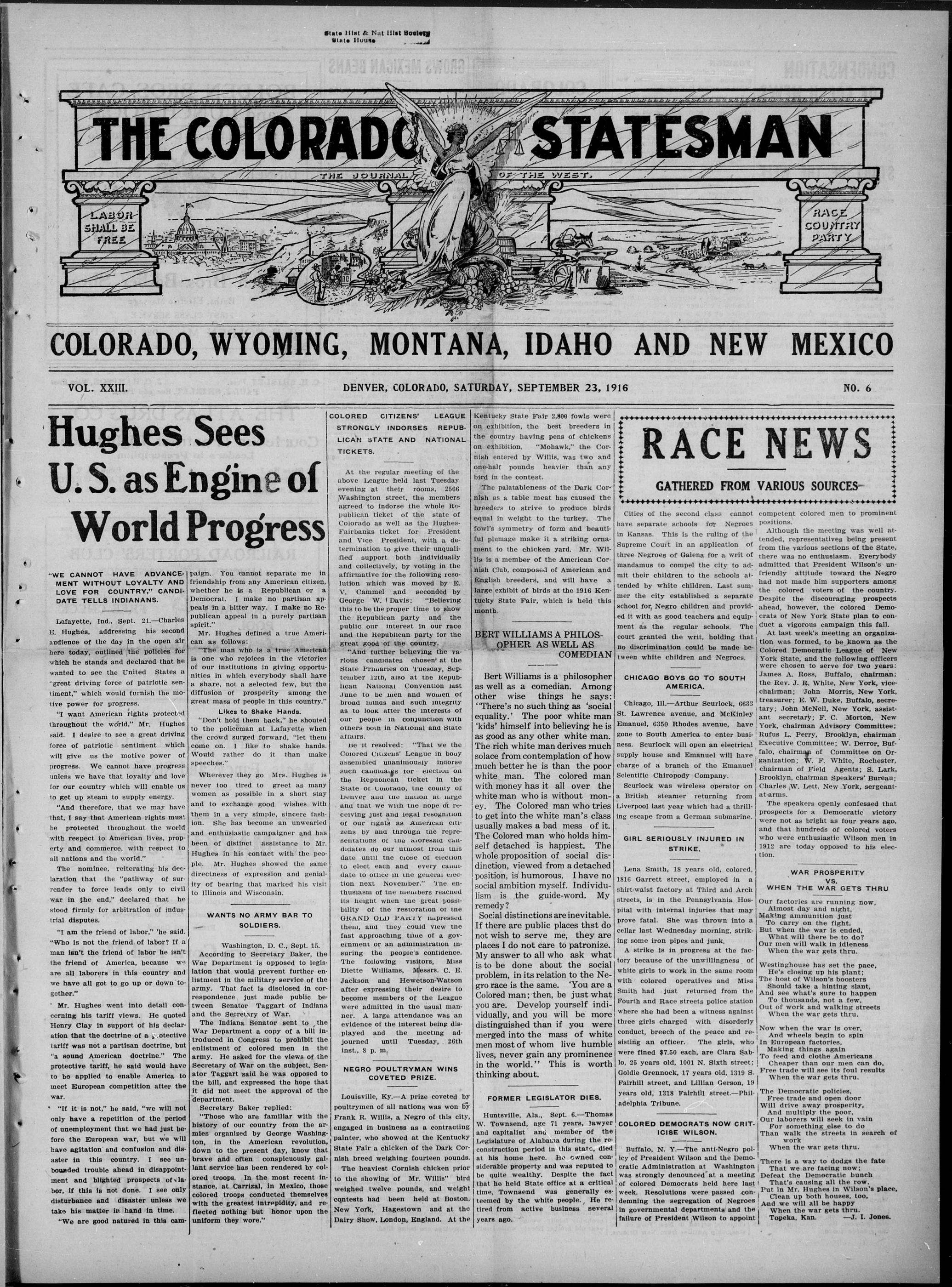
Hughes Sees U.S. as Engine of World Progress
VOL. XXIII.
Hughes
U. S. as E
World
"WE CANNOT HAVE ADVANCEMENT WITHOUT LOYALTY AND LOVE FOR COUNTRY," CANDIDATE TELLS INDIANANS.
Lafayette, Ind., Sept. 21.—Charles E. Hughes, addressing his second audience of the day in the open air here today, outlined the policies for which he stands and declared that he wanted to see the United States a "great driving force of patriotic sentiment," which would furnish the motive power for progress.
"I want American rights protected throughout the world," Mr. Hughes said. I desire to see a great driving force of patriotic sentiment which will give us the motive power of progress. We cannot have progress unless we have that loyalty and love for our country which will enable us to get up steam to supply energy.
"And therefore, that we may have that, I say that American rights must be protected throughout the world with respect to American lives, property and commerce, with respect to all nations and the world."
The nominee, reiterating his declaration that the "pathway of surrender to force leads only to civil war in the end," declared that he stood firmly for arbitration of industrial disputes.
"I am the friend of labor," he said. "Who is not the friend of labor? If a man isn't the friend of labor he isn't the friend of America, because we are all laborers in this country and we have all got to go up or down together."
Mr. Hughes went into detail concerning his tariff views. He quoted Henry Clay in support of his declaration that the doctrine of a protective tariff was not a partisan doctrine, but "a sound American doctrine." The protective tariff, he said would have to be applied to enable America to meet European competition after the war.
"If it is not," he said, "we will not only have a repetition of the period of unemployment that we had just before the European war, but we will have agitation and confusion and disaster in this country. I see unbounded trouble ahead in disappointment and blighted prospects of labor, if this is not done. I see only disturbance and disaster unless we take his matter in hand in time.
"We are good natured in this cam-
paign. You cannot separate me in friendship from any American citizen, whether he is a Republican or a Democrat. I make no partisan appeals in a bitter way. I make no Republican appeal in a purely partisan spirit."
Mr. Hughes defined a true American as follows:
"The man who is a true American is one who rejoices in the victories of our institutions in giving opportunities in which everybody shall have a share, not a selected few, but the diffusion of prosperity among the great mass of people in this country."
Likes to Shake Hands.
"Don't hold them back," he shouted to the policeman at Lafayette when the crowd surged forward, "let them come on. I like to shake hands. Would rather do it than make speeches."
Wherever they go Mrs. Hughes is never too tired to greet as many women as possible in a short stay and to exchange good wishes with them in a very simple, sincere fashion. She has become an unwearied and enthusiastic campaigner and has been of distinct assistance to Mr. Hughes in his contact with the people. Mr. Hughes showed the same directness of expression and geniality of bearing that marked his visit to Illinois and Wisconsin.
WANTS NO ARMY BAR TO SOLDIERS.
Washington, D. C., Sept. 15.
According to Secretary Baker, the War Department is opposed to legislation that would prevent further enlistment in the military service of the army. That fact is disclosed in correspondence, just made public between Senator Taggart of Indiana and the Secretary of War.
The Indiana Senator sent to the War Department a copy of a bill introduced in Congress to prohibit the enlistment of colored men in the army. He asked for the views of the Secretary of War on the subject. Senator Taggart said he was opposed to the bill, and expressed the hope that it did not meet the approval of the department.
Secretary Baker replied:
"Those who are familiar with the history of our country from the armies organized by George Washington, in the American revolution, down to the present day, know that brave and often conspicuously gallant service has been rendered by colored troops. In the most recent instance, at Carrizal, in Mexico, those colored troops conducted themselves with the greatest intrepidity, and reflected nothing but honor upon the uniform they wore."
DENVER, COLORADO, SATURDAY, SEPTEMBER 23, 1916
State Hist & Nut Hist Boosty
State House
BROWS MEXICAN REVIEWS
RADC
THE JOURNAL
G, MONTAN
DENVER, COLORADO, SAT
COLORED CITIZENS' LEAGUE STRONGLY INDORSES REPUBLICAN STATE AND NATIONAL TICKETS.
At the regular meeting of the above League held last Tuesday evening at their rooms, 2566 Washington street, the members agreed to indorse the whole Republican ticket of the state of Colorado as well as the Hughes-Fairbanks ticket for President and Vice President, with a determination to give their unqualified support both individually and collectively, by voting in the affirmative for the following resolution which was moved by E. V. Cammel and seconded by George W. Davis: "Believing this to be the proper time to show the Republican party and the public our interest in our race and the Republican party for the great good of the country.
"And further believing the various candidates chosen at the State Primaries on Tuesday, September 12th, also at the Republican National Convention last June to be men and women of broad minds and such integrity as to look after the interests of our people in conjunction with others both in National and State affairs.
Be it resolved: "That we the Colored Citizens' League in body assembled unanimously inforce such candidates for election on the Republican ticket in the State of Colorado, the county of Denver and the nation at large and that we with the nope of receiving just and legal recognition of our rights as American citizens by and through the representations of the aroresaid candidates do our utmost from this date until the close of election to elect each and every candidate to office in the general election next November." The enthusiasm of the members reached its height when the great possibility of the restoration of the GRAND OLD PARTY impressed them, and they could view the fast approaching time of a government or an administration insuring the people's confidence. The following visitors, Miss Diette Williams, Messrs. C. E. Jackson and Hewetson-Watson after expressing their desire to become members of the League were admitted in the usual manner. A large attendance was an evidence of the interest being displayed and the meeting adjourned until Tuesday, 26th inst., 8 p. m.
NEGRO POULTRYMAN WINS
COVETED PRIZE.
Louisville, Ky.—A prize coveted by poultrymen of all nations was won by Frank R. Willis, a Negro of this city, engaged in business as a contracting painter, who showed at the Kentucky State Fair a chicken of the Dark Cornish breed weighing fourteen pounds. The heaviest Cornish chicken prior to the showing of Mr. Willis" bird weighed twelve pounds, and weight contests had been held at Boston, New York, Hagestown and at the Dairy Show, London, England. At the
Kentucky State Fair 2,800 fowls were on exhibition, the best breeders in the country having pens of chickens on exhibition. "Mohawk," the Cornish entered by Willis, was two and one-half pounds heavier than any bird in the contest. The palatableness of the Dark Cornish as a table meat has caused the breeders to strive to produce birds equal in weight to the turkey. The fowl's symmetry of form and beautiful plumage make it a striking ornament to the chicken yard. Mr. Willis is a member of the American Cornish Club, composed of American and English breeders, and will have a large exhibit of birds at the 1916 Kentucky State Fair, which is held this month.
BERT WILLIAMS A PHILOSOPHER AS WELL AS COMEDIAN
Bert Williams is a philosopher as well as a comedian. Among other wise things he says: "There's no such thing as 'social equality.' The poor white man 'kids' himself into believing he is as good as any other white man. The rich white man derives much solace from contemplation of how much better he is than the poor white man. The colored man with money has it all over the white man who is without money. The Colored man who tries to get into the white man's class usually makes a bad mess of it. The Colored man who holds himself detached is happiest. The whole proposition of social disdinction, viewed from a detached position, is humorous. I have no social ambition myself. Individualism is the guide-word. My remedy?
Social distinctions are inevitable. If there are public places that do not wish to serve me, they are places I do not care to patronize. My answer to all who ask what is to be done about the social problem, in its relation to the Negro race is the same. 'You are a Colored man; then, be just what you are. Develop yourself individually, and you will be more distinguished than if you were merged into the mass of white men most of whom live humble lives, never gain any prominence in the world.' This is worth thinking about.
FORMER LEGISLATOR DIES.
Huntsville, Ala., Sept. 6.—Thomas W. Townsend, age 71 years, lawyer and capitalist, and member of the Legislature of Alabama during the reconstruction period in this state, died at his home here. He owned considerable property and was reputed to be quite wealthy. Despite the fact that he held State office at a critical time, Townsend was generally esteemed by the white people. He retired from active business several years ago.
RACE NEWS
Cities of the second class cannot have separate schools for Negroes in Kansas. This is the ruling of the Supreme Court in an application of three Negroes of Galena for a writ of mandamus to compel the city to admit their children to the schools attended by white children. Last summer the city established a separate school for Negro children and provided it with as good teachers and equipment as the regular schools. The court granted the writ, holding that no discrimination could be made between white children and Negroes.
CHICAGO BOYS GO TO SOUTH AMERICA.
Chicago, Ill.—Arthur Scurlock, 6633 St. Lawrence avenue, and McKinley Emanuel, 6350 Rhodes avenue, have gone to South America to enter business. Scurlock will open an electrical supply house and Emanuel will have charge of a branch of the Emanuel Scientific Chiropody Company. Scurlock was wireless operator on a British steamer returning from Liverpool last year which had a thrilling escape from a German submarine.
GIRL SERIOUSLY INJURED IN
STRIKE.
Lena Smith, 18 years old, colored, 1816 Garrett street, employed in a shirt-waist factory at Third and Arch streets, is in the Pennsylvania Hospital with internal injuries that may prove fatal. She was thrown into a cellar last Wednesday morning, striking some iron pipes and junk.
A strike is in progress at the factory because of the unwillingness of white girls to work in the same room with colored operatives and Miss Smith had just returned from the Fourth and Race streets police station where she had been a witness against three girls charged with disorderly conduct, breech of the peace and resisting an officer. The girls, who were fined $7.50 each, are Clara Sablo, 25 years old, 1001 N. Sixth street; Goldie Grennock, 17 years old, 1319 S. Fairhill street, and Lillian Gerson, 19 years old, 1318 Fairhill street.—Philadelphia Tribune.
COLORED DEMOCRATS NOW CRIT
ICISE WILSON.
Buffalo, N. Y.—The anti-Negro policy of President Wilson and the Democratic Administration at Washington was strongly denounced at a meeting of colored Democrats held here last week. Resolutions were passed condemning the segregation of Negroes in governmental departments and the failure of President Wilson to appoint
NO. 6
competent colored men to prominent positions. Although the meeting was well attended, representatives being present from the various sections of the State, there was no enthusiasm. Everybody admitted that President Wilson's unfriendly attitude toward the Negro had not made him supporters among the colored voters of the country. Despite the discouraging prospects ahead, however, the colored Democrats of New York State plan to conduct a vigorous campaign this fall.
At last week's meeting an organization was formed, to be known as the Colored Democratic League of New York State, and the following officers were chosen to serve for two years: James A. Ross, Buffalo, chairman; the Rev. J. R. White, New York, vice chairman; John Morris, New York, treasurer; E. W. Duke, Buffalo, secretary; John McNeill, New York, assistant secretary; F. C. Morton, New York, chairman Advisory Committee; Rufus L. Perry, Brooklyn, chairman Executive Committee; W. Derror, Buffalo, chairman of Committee on Organization; W. F. White, Rochester, chairman of Field Agents; S. Lark, Brooklyn, chairman Speakers' Bureau; Charles W. Lett, New York, sergeant-at-arms.
The speakers openly confessed that prospects for a Democratic victory were not as bright as four years ago, and that hundreds of colored voters who were enthusiastic Wilson men in 1912 are today opposed to his election.
WAR PROSPERITY
VS.
WHEN THE WAR GETS THRU
Our factories are running now,
Almost day and night,
Making ammunition just
To carry on the fight.
But when the war is ended,
What will there be to do?
Our men will walk in idleness
When the war gets thru.
Westinghouse has set the pace,
He's closing up his plant;
The host of Wilson's boosters
Should take a hinting slant,
And see what's sure to happen
To thousands, not a few,
Out of work and walking streets
When the war gets thru.
Now when the war is over,
And wheels begin to spin
In European factories,
Making things again
To feed and clothe Americans
Cheaper than our men can do,
Free trade will see its foul results
When the war gets thru.
The Democratic policies,
Free trade and open door
Will drive away prosperity,
And multiply the poor,
Our laborers will seek in vain
For something else to do
Than walk the streets in search of
work
When the war gets thru.
There is a way to dodges the fate
That we are facing now;
Defeat the Democratic bunch
That's causing all the row.
Put in Mr. Hughes in Wilson's place,
Clean up both houses, too,
And we will all be happy
When the war gets thru.
Topeka, Kan. —J. I. Jones.
CONDENSATION OF FRESH NEWS
THE LATEST IMPORTANT DISP
PATCHES PUT INTO SHORT,
CRISP PARAGRAPHS.
STORY OF THE WEEK
SHOWING THE PROGRESS OF EVENTS IN OUR OWN AND FOREIGN LANDS.
Western Newspaper Union News Service.
ABOUT THE WAR
Bulgarian troops advanced further in the Dobrudja region.
Russians gain new positions in the Ludowa region of the Carpathians.
German hydroplanes successfully bombard allied warcraft off the coast of Flanders.
Russians continue drive on Lemberg, closing in Halicz from north and southeast.
Berlin admits the loss of trenches to the entente troops east of Ginchy and near Combles.
Florina, an important Macedonian stronghold of the Bulgar-Teuton forces, captured by the French in new drive.
German-Austrian-Hungarian forces along the Stokhod river renew offensive and penetrate four lines of Russian trenches, capturing 2,500 men.
Further successes for the central powers are reported southeast of Lemberg, resulting in the capture of 4,200 prisoners.
Athens diplomatic circles report that the Austrians are about to evacuate Triest, the chief port of the Teutonic powers on the Adriatic.
At Chihuahua City, Mex., forces of government soldiers were detailed to bring order out of the chaos created by Villa's Hidalgo day attack upon the state capital.
Four giant Russian aeroplanes bombard a German seaplane station, on Lake Angern in the gulf of Riga, dropping seventy-three bombs. Eight German machines which attacked the Slav flyers were put to flight.
Further gains on the Somme front are reported by London and Paris war offices. North of the river the British advanced 1,000 yards over a one-mile front, capturing powerful fortified German work known as the "quadrillateral." The French, south of the river, in the drive on Combles, carried another system of German trenches. In the Verdun sector the French occupied trench on Dead Man's hill.
WESTERN
The old Paisley shawl of grandmother's day is coming back into its own along with a lot of Spanish frills and furbelows. This is the latest edict of fashion.
President and Mrs. Wilson left Long Branch, N. J., for Columbia, S. C., to attend the funeral of his sister, Mrs. Annie E. Howe, who died Saturday in New London, Conn.
Miss Phyllis Julia Neilson-Terry, the English actress, and Cecil Frank King Ogden, her manager, were married in the British consulate at New Orleans, La.
Private John Clyne, B. Company, Second Missouri Regiment, was shot and killed by a military guard at Dolores, Texas, as the result, it is said, of an altercation with the guard.
Four bandits who got $6,000 in a daylight robbery of the state bank of Homestead, Fla., and killed two members of the posse sent to pursue them through the Everglades, now have put to sea in a disabled motor boat, according to a message received at Miami, Fla.
Mrs. George T. Marye, wife of the former ambassador to Russia, received at San Francisco a communication from the imperial court advising her that the Badge of Distinction of the Russian Red Cross had been conferred upon her by the empress. This is said to be the first time this honor has been accorded to any but a Russian.
Interest in the twenty-third International Irrigation Congress, to be held Oct. 14, 16, 17 and 18 at El Paso, Tex., is increased this year by the fact that the great Elephant Butte dam will be dedicated at the opening meeting by President Wilson and delegates will have unusual opportunities for inspecting this mammoth reclamation project.
W GTON
Development of the new American naval base in Fonseca Bay, Nicaraguan waters, has begun with the arrival of the armored cruiser San Diego, flagship of the Pacific fleet, to make surveys.
Brig. Gen. J. J. Pershing, commander of the American punitive expedition in Mexico and ranking brigadier of the army, probably will be made a major general, a vacancy in that grade having been created by the death of Major General Mills. Mrs. Charles S. Thomas, wife of the senior senator from Colorado, is ill with typhoid fever at her home in Washington. An interest rate of $3 \frac{1}{2}$ per cent for fifteen-day notes at the Dallas Federal Reserve Bank was approved by the reserve board.
FOREIGN
Major Cedric Charles Dickens, grandson of Charles Dickens, was killed in action in France.
The bill authorizing the new French loan of $2,400,000,000 was passed by the chamber of deputies amid an outburst of enthusiasm.
Many lives have been lost and enormous damage has been caused near Gablonz, Bohemia, by the bursting of a dam in the valley at Weissendesse.
The British steamers Llangors E. Butetown and Swedish Prince have been sunk by submarines. The crews of the vessels were saved and arrived at Marseilles.
"If Villa should attempt an attack on us, we are ready," said Consul Andres Garcia, in Juarez, when informed of a rumor in El Paso that such an attack was expected.
The mystery of the whereabouts of former Queen Natalie of Serbia, who disappeared at the outbreak of the war was cleared up, when she was discovered as a common serving woman in a big hospital in Bordeaux.
Food disorders have broken out in Vienna, said a Geneva dispatch to the London Exchange Telegraph. Beef is selling at $4 a pound and rice at $2 a pound. There is terrible distress among families of workingmen, the dispatch added.
King George sent the following message to Gen. Sir Douglas Haig, the British commander in France: "I congratulate you and my brave troops on the brilliant success just achieved. I have never doubted that complete victory will ultimately crown our efforts and the splendid results of the fighting yesterday confirmed this view."
SPORTING NEWS
Standing of Western League Clubs.
CLUBS— W. L. Pct.
Imaha 91 53 .633
Lincoln 83 68 .550
Slout City 75 69 .510
Denver 73 74 .497
Des Moines 73 74 .497
Topeka 67 81 .453
St. Joseph 64 83 .435
Colo. Springs 56 89 .336
Peter Barclay, traveling secretary of the Denver Bears, completed arrangements for the Barnstorming Grizzlies to play a series of games in Durango on Oct. 3, 4. 5 and 6.
Ty Cobb conceded his defeat by Tris Speaker of the Indians for batting honors in the American League. This season marks the first in ten years that the Georgia peach has been deprived of the title of premier swatsman of the league.
Harvard carried off the intercollegiate tennis championship in both singles and doubles at the Merion Cricket Club at Haverfort at Philadelphia and thereby gained possession of the silver challenge cup, put up for competition in 1913 by Harrison K. Caner.
Three of the four favorites in the opening race of the Columbus, Ohio, Grand Circuit meeting were from the Murphy stable. Only the most pronounced one, The Real Lady, was successful. She took the Horse Review futurity for 2-year-old trotters in straight heats, getting no real opposition from even Emma Magowan, that was twice second. E. Colorado, owned by George Estabrook of Denver, was among the also rans.
GENERAL
Simeon Ogden Edison, an uncle of Thomas A. Edison, died at the home of a daughter at East Orange, N. J. Mr. Edison was 90 years old. Foreign ships arriving at Newport News for cargo and coal have reported to the British authorities that there is another German raider in the Atlantic. Four persons were killed at North Springfield, eighteen miles west of Erie, Pa., when the automobile in which they were riding was struck by a New York Central train. Seth Low, formerly mayor of New York and one-time president of Columbia University, died at his country home, Broadbrook Farm, Bedford Hills, N. Y., at the age of 66 years.
With about 40,000 state and regular troops stationed at El Paso, Tex., approximately 25,000 wrist watches have been sold in El Paso within the last sixty days, a leading local dealer estimated.
A torpedo sank the British ship Kelvinia, carrying twenty-eight Americans, according to G. W. Dillard of Richmond, Va., one of the Americans who arrived in New York on the Cunard liner Tuscania.
Mrs. Helen Evers, the acknowledged beauty of the so-called blackmail syndicate broken up by the raid of secret service detectives on the Tyson apartments in Chicago, was admitted to bail and given her liberty. Her bonds were fixed at $25,000.
The Sovereign Grand Lodge of Odd Fellows in annual session at Chattanooga, Tenn., elected the following officers: Grand sire, Frank C. Goudy of Denver; deputy grand sire, Henry C. Borst of Amsterdam, N. Y.; grand secretary, J. B. Goodwin, Atlanta, Ga.; grand treasurer, William H. Cox, Louisville, Ky.
Eighty-seven Villistas captured by Carranzistas after the bandit attack on Chihuahua City Saturday, were lined up before firing squads and executed. Among the prisoners was Col. Marino Tames, who mutinied from Juarez with 100 men and joined the Villistas.
Francis B. Sayre, President Wilson's son-in-law, who has visited the American troops along the Mexican border in the interest of the Young Men's Christian Association in Massachusetts, arrived in New York on the steamship Antilles from New Orleans.
COLORADO
STATE NEWS
DATES FOR COMING EVENTS.
DATEES FOR COMING EVENTS.
Sept. 27-29—State Convention B.P.O. E. of Quincy.
Sept. 29—Prohibition State Convention at Denver.
Sept. 28-30—Third Annual Pine River Valley and Southern Ute Indian Fair at Ignacio.
Sept. 30—Harvest Festival at Briggsdale.
Oct. 12—Annual Poudre Cafon Picnic at Fort Collins.
Jan. 20-27—Annual Western Stock Show at Denver.
About 1,000 Masons from all parts of the state are in Denver attending various annual meetings of the order.
More than 85,000 tourists visited Estes Park this summer, according to Enos Mills, the Colorado naturalist.
Mesa Verde National Park and the cliff dwellings are to be shown by film all over the United States this winter.
Members of the federal farm loan board were guests and speakers at a luncheon given by the Civic association of Denver.
Traveling on a special train, a contingent of business men will leave Denver Sept. 24 for a trade-making trip through the San Luis valley.
A tunnel 2,000 feet long under Cumbres pass with a $2\frac{1}{2}$ per cent. grade is contemplated by the Denver & Rio Grande for its proposed standard-gauge line into Durango.
Share in an estate of which settlement is being made in Indianapolis is awaiting Nora Naughton and Bridget, or Dela, Naughton, whom the administrators are trying to locate.
Denver's high school cadet regiment will start out with 818 boys as its membership, according to reports made to the school board by the principals of the five high schools.
The fifty-first annual meeting of the Rocky Mountain Baptist Association opened at Loveland for a three-day session. Forty-six churches were represented and a number of prominent ministers and laymen were present. Former governor J. Frank Hanly of Indiana, nominee of the Prohibition party for president, and Rev. Ira Larthrith of Tennessee, the vice presidential nominee, will campaign in Colorado the last week in September. Despite all efforts on the part of the police no trace has been secured of the two blow-blowers who visited four downtown Denver business houses. The authorities believe the crooks, after getting nearly $350, left the city.
Colorado leads every state in the union in tungsten production by more than $600,000 annually, according to a statement contained in a report submitted to a committee of the Metal Mining Association at a meeting held in Boulder.
The Denver Election Commission partly completed totaling votes for candidates for Democratic nominations. The totals show that Benjamin C. Hilliard defeated H. B. Teller for the nomination for congressman by a majority of 76.
The state convention of the Colorado Prohibitionists will convene at the Trinity Methodist church, Denver, Sept. 29. The convention will nominate a full set of presidential electors and determine the action to be taken on a state ticket.
Sister Cornelia O'Hara, Sister of Charity for more than forty years and for the last twenty years one of the most popular and efficient members of the nurses' staff at St. Joseph's hospital, died of acute paralysis after an illness of three months.
Following an investigation the Colorado State Board of Architects has exonerated Architects McLaren and Thomas of Colorado Springs of all blame for the collapse of the amphitheatre at the Welsh-White fight at Colorado Springs on Labor Day.
Love again laughed at lawyers and separate maintenance suits in the District Court in Denver when Mrs. Sarah Eaves Savage, accompanied her husband, John A, Savage, to the court house and secured dismissal of the second suit for separate maintenance she had filed against her husband.
It is stated that development work at the Governor mine, in the Sneffels district, about nine miles from Ouray, opened up several inches of quartz which runs over 1,000 ounces in gold and valued at $20,000 per ton. Alongside the quartz are several inches of mud or talc that "pans" about $5.00 per pound.
While W. H. George, who made a voluntary confession at Cheyenne that he had shot his sweetheart, Evelyn Rodgers of Denver, still clung to his story at Littleton, where he had been taken, Miss Rodgers was paying a "life-sized" visit to the Denver chief of police and assuring him earnestly that she was not dead.
A life-size picture of the late Sarah Platt Decker, noted Denver suffrage worker, will adorn a room in the new home of the Blackwell estate in Boston. The picture was presented by Denver suffrage workers on the occasion of the dedication of the new home. Marshall Gould, aged 8, youngest son of Mr. and Mrs. S. E. Gould of Park Center, a fruit-growing section five miles north of Cañon City, was accidentally shot through the head and probably fatally wounded by his 12-year-old brother Eberle while hunting.
EXPECTED to Give the Largest Yield of Any of the State's Many Valuable Products.
Western Newspaper Union News Service.
Denver.—Among the best crops of Colorado's harvest this fall will be the Mexican bean, according to reports received from the rural sections of the state. As the summer has been an exceptionally dry one, the bean, which is the hardiest crop raised in this state, probably will give the largest yield per acre of any crop.
The raising of the Mexican bean is practically a new branch of agriculture in Colorado. It has been known for some time that the soil and climate of eastern Colorado are particularly adapted to the culture of this crop, but growers have been wary of planting beans on account of the low market price in this state. The price offered by eastern Colorado dealers is only 4 or 5 cents a pound, while the Mexican bean is retailed in Kansas at two pounds for 25 cents.
J. G. Wills, a rancher of Arriba, has seventy-five acres of beans planted on his ranch in Lincoln county. He reports that since planting 1,100 pounds of seed in June, he has not had to pay any attention to the crop in the way of labor. Although the plants suffered from a drought for a month and a half two heavy rainfalls in the middle of July brought out the pods, and the crop improved immediately.
After the beans are harvested Mr. Wills expects to get 500 pounds per acre from his crop. This will make a total of 37,500 pounds for the entire seventy-five acres, which, retailing at the low price of 5 cents a pound, will mean a return of $1,875. He estimates his cost as follows: Cost of seed, $50; planting, labor, $38; harvesting and threshing, $200; making a total of $288. His profit on the season's crop will amount to about $1,500. At the present time the production of the Mexican bean is rather small in this state, but farmers who have had experience with it say that it makes one of the best crops grown here.
Denver May Get Farm Loan Bank.
Denver.—This city may receive a federal farm loan bank as a Christmas present and at the same time the farmers of the intermountain region will find dawning for them an era of emancipation from the manipulations of the loan shark. Following an exhaustive presentation of the claims of Denver for location of one of the twelve banks, Chairman George W. Norris of the federal board announced a program that would require several weeks and then declared that the decision defining the boundaries of the twelve bank districts and designating the bank center for each district probably would be forthcoming just before Christmas. "This has been one of the best hearings that we have had," said Mr. Norris just before the departure of the train bearing the party.
Swindle Laid to Turner's Slayer.
Denver—Police authorities and detective agencies of Denver are investigating the theory that Leopold Seeds who was arrested here June 4, 1915, on charges of swindling a Colorado rancher out of $8,000 by a wire-tapping game in Excelsior Springs, Mo., was none other than C. E. Wilson, alias Brown, who shot and killed Frank H. Turner at Gills, Colo., June 23 last, and who now is being sought as a member of the gang of black-mailers recently uncovered in Chicago.
Live Stock Men Close Sessions.
Denver.—The market and livestock committees of the American National Livestock association concluded their sessions in Denver. The subjects canvassed by the stockmen included the national probe into the packing house manipulation of prices of livestock, proposed monthly reports by the department of agriculture, the Texas freight rate decision, the pending range homestead bill and the twentieth annual convention of the organization in Cheyenne next year.
Woman's Federation Elects Officers.
Glenwood Springs.—The Colorado Federation of Women's Clubs, in annual convention here, elected the following officers: President, Mrs. Adam Weiss, of Del Norte; first vice president, Mrs. Charles H. Jacobson, of Denver; second vice president, Mrs. R. H. Bruce, Sterling.
Horse Thief Suspect Returned.
Pueblo — L. W. Smith, who was arrested by Deputy Sheriff C. L. Fiscus when he was caught trying to sell a horse stolen from the stable of L. E. Miller of Cañon City, has been returned to Cañon City on request of the sheriff of Fremont county.
Second Victim of Arena Smash Dies.
Second Victim of Arena Smash Dies.
Colorado Springs.-Thomas Allen,
65, negro janitor at the Colorado Savings
Bank, died at St. Francis' hospital as the result of injuries suffered in the collapse of the grandstand at the Welsh-White prize fight, Labor Day. This is the second death resulting from the disaster in which about 250 persons were injured. As the result of the disaster, twenty-five damage suits against the Hundred Million Dollar Athletic Club of Colorado Springs are being filed.
924 19th Street, Denver, Colorado
All Kinds of Sandwiches
Bolden Bros. Barber Shop
Baths, Electric Massage
FIRST CLASS SERVICE
R. B. BOLDEN, Mgr. 926 19th St. Denver
C. H. SHIRLEY, Pres. J. C. HAMPSON, Vice Pres PAUL J. SHIRLEY, Sec. and Treas.
Courteous Treatmet. Right Prices Leaders in Prescription
RAILROAD PORTERS' CLUB LUNCHOOM IN CONNECTION
PHONE MAIN 3028 RES. PHONE GALLUP 942 JOHN K. RETTIG Meats, Fancy and Staple Groceries 1864 CURTIS STREET Corner Nineteenth. Denver, Colo.
The MARKET COMPANY
C. E. SMITH, Manager, Res. Phone South 1608
Wholesale and Retail Staple and Fancy Groceries, Fish and Oysters. Hotels and Restaurants Our Specialty. Fresh and Cured Eastern Corn Fed Meats Fruits, Vegetables, Poultry and Game.
Telephones Main 4302, 4303, 4304, 4308
622-636 15th Street Denver, Colorado
Established 1876
PIONEER HATTERS OF THE WEST
WE MAKE OLD HATS NEW
PRACTICAL HATTERS
RENOVATORS, BLEACHERS DYERS AND FINISHERS
Of Gents' and Ladies' Hats of Every Description
1624 Champa St., Denver, Colo.
DINNER
11:30 to 2 p.m.
All Ki
Bolden
Ba
FI
R. B. BOLDI
A. H. SHIRLEY, Pres.
PAUL J.
THE A
Courteous T
Leade
Store No. 1.
2701 WELTON ST.
Main 895 875
W. C. CAMPTON, Pres.
RAILROA
LUNCH
VINE
Bros. Barb
Maths, Electric Massa
FIRST CLASS SERVICE
EN, Mgr. 926
J. C.
SHIRLEY, Sec. and
ATLAS DR
Treatmet. P
ers in Prescrip
AD PORTEL
BOOM IN CONN
ND F
St. Only one block from
J. B. MINTER, Barber,
16. DENV
RES.
N K. RET
y and Staple
64 CURTIS STREET
MARKET CO
, Manager, Res. Phon
Taple and Fancy Gro
and Restaurants Our
Fresh and Cured
Corn Feed
Vegetables, Poultry and
es Main 4302, 4303, 4304
erhead
TELEPHONE MAIN 3
Established 1876
R HATTERS OF THE
MAKE OLD HATS IN
TICAL HAT
LEACHERS DYERS
Ladies' Hats of Eve
Champa St., Denver
Short Orders at All Hours
dwiches
ber Shop
message
VICE
26 19th St. Denver
D. HAMPSON, Vice Pres
and Treas.
RUG CO.
Right Prices
Description
Store No.2
26TH AND WELTON
Main 4955.4956
J. B. MINTER, Sec.
ERS' CLUB
INECTION
FREE CHECK
ROOM
From Union Depot.
er.
VER, COLORADO.
AFRO-AMERICAN CULLINGS
Dr. John Patrick Turner, one of Philadelphia's foremost colored physicians and a medical inspector in the public schools, has been assigned the task of organizing a new town for the African race in the mountains of North Carolina. The tract over which the novel town will be laid out covers more than 4,000 acres and is located on the main line of the Seaboard Air Line railway, with a direct route to the markets of the world. Doctor Turner is authority for the statement that the town will be unique in many ways and will be a standard for the establishment of Negro communities in the future.
Plans for the new Negro town are being worked out at Chautauqua, N. Y., and by those employed in the establishment and maintenance of Pinehurst, N. C. No name has been selected but the town and the streets will be named after illustrious Negro men and women.
The charter of the new Negro town will restrict ownership of all property to persons of African descent. It is proposed to make the place the center for the development of Negro music. A university and industrial school are to be features. Two modern hotels will be established, one for blacks and the other for white tourists, who may visit the community to observe its workings.
There are to be raised figs, sugar cane, tobacco and wheat on the land neighboring the town, every home of which will have its vegetable and flower garden. The industries will include the making of silk, sugar, flour, tobacco, steel and machinery, according to Doctor Turner. All of these plants will employ Negro laborer. Every opportunity will be given Negro laborers to become efficient in the industrial school, the paramount idea of the whole project being co-operation. John T. Patrick of North Carolina, founder of Southern Pines and South Mount, N. C., is the principal financial backer of the project. He is a retired official of the Sea Board Line railway and is deeply interested in the development of the colored people in North Carolina.
At the Negro education convention at Washington, the question "Should the Education of the Negro and White Youth be Identical?" was taken up at the morning session. Prof. J. E. Bonner, principal of Peabody school, Wilmington, N. C., leading in the discussion. He was followed by J. B. Dudley, president of Agricultural and Mechanical college, Greensboro, N. C., who differed from Professor Bonner, saying that each one had particular environments and characteristics which must be trained and cultivated
Professor Jayson, president of the State college, Dover, Del., brought forth cheers when he said: "Give the Negro a chance as long as you can and as full a training as you can. It is impossible to teach a boy scientific agriculture until that boy has learned to read and write. That is, the foundation must first be laid, and for industrial education the training is just the same up to a certain point. Beyond that point the boy or girl begins to specialize and emphasis is given to one line of work. Give him the best start possible."
A resolution was offered by Col. George T. Wasson to the effect that the congress indorse Hughes and Fairbanks for president and vice president, but after a lengthy discussion, a
The general life of a nation such as America, composed of many groups and interests in complicated alignments and opposition, can only be successful when each of those groups is fully self-conscious. When every group knows both its capabilities and its rights, uses the former and insists upon the latter, then we shall have a nation that is both progressive and civilized and free from slavery.
We are far from that now, but with every new organization of self-expression on the part of a group we come nearer to it. One such expression that may play an important part in civilizing our life is the Champion Magazine, of which the first number has just been issued. This magazine, edited by the well-known Negro poet, Fenton Johnson, having as associate editors Emory Elrage Scott, Binga Dismond and Inez Cantey, is devoted to the service of the Negro race, and apparently aims to cover every feature of Negro activity—business, literary, artistic and athletic—in a fashion that combines the freshness of news—and illustrated news, at
A Salt Lake City man is the inventor of an undershot water wheel that will run when wholly submerged in a stream, the blades folding on the upward side.
Italian peat too low in fuel value to be used for heating is being utilized in the manufacture of nitrogen fertilizers.
A luncheon case of English invention is so shaped that it will also serve as a footrest in an automobile.
substitute was offered. It was contended that the aims of the congress were too broad and too important to allow politics to be injected. Nelson Crews of Kansas City made an appeal for the passage of the original resolution, saying that all right-thinking colored men believed in it and favored it. Because of an incomplete roll of delegates a vote on the resolution was deferred until a later session. A distinguished visitor to the congress was introduced in the person of Bishop I. N. Ross of the A. M. E. church. He made a short address, saying in part as follows:
"I assure you this has been very refreshing to me. I have been so much engrossed in my business that I have employed two and three secretaries, and I failed even to realize until this morning that you were in session. I feel that I owe it to myself to pay respects to such a distinguished body of educators and race builders.
"I have the right as an American citizen, who for 36 years has stood in the forefront championing the cause of the rights of men, to say that out of one blood God created all men to dwell upon the face of the earth, one rule to regulate the actions of men.
"Anything that savors of difference or discrimination is a traversal or reversal of the principles instituted by the King of Kings. Everything the white man has the black man ought to have. The only way to solve this question is, faith in God, right living, spinal column and manhood. Turn on the headlight to find the path of duty and follow it unerringly to the end. With faith in God, march on, saying as you go, 'Give me liberty or give me death.'"
There is a plan to erect a suitable monument to mark the grave of Jennie Dean, who was a colored missionary worker of northern Virginia. Jennie Dean, who died May 3, 1913, and who is buried in the cemetery attached to Calvary chapel, in Prince William county, Virginia, is held in affectionate remembrance not only by many colored people, but by many white persons whose respect she attained as the result of her unselfish missionary work. She was the founder of five Baptist churches in northern Virginia and of the Manassus Industrial school, as well as of the Union Baptist Sunday School Convention of Northern Virginia and the Northern Virginia Baptist association. The building of Calvary chapel was her first work, and she was buried there, about a quarter of a mile from her late home near Sudley Springs. Her grave is still unmarked, for the reason that no organization has ever been formed to receive money which has been collected in northern Virginia to purchase a monument.
The Negro population of Detroit has increased nearly 150 per cent during the last six years, according to estimates made by the Associated Charities. The Negro population now is fixed at about 15,000, as compared with 6,000 shown by the federal census in 1910. The heavy increase is accounted for by the fact that a number of local industrial concerns are importing Negroes from the South in carload lots for work in local factories. Factory manager declare the Southern Negro, when properly trained, is a good workman, reliable and willing.
that—with the reflective editorial attitude that should characterize a monthly publication.
While the advertising in the first number is from Chicago firms, the magazine aims to be national in character. It will be independent in politics.
While the general public is apt to concede that the Negro may excel as a musician, while artistic ability in other avenues is often conceded to him, he has probably not achieved as yet a reputation, to a wide extent, at any rate, of being formidable in athletics. It is interesting to note, therefore, that Binga Dismond, an associate editor of this magazine, is a University of Chicago spinner with all sorts of record-breaking feats, individual and in relay work, to his credit.—Chicago Evening Post.
The colored graduate of Harvard would not seek mental labor any more than the white graduate would, although the infamous American color prejudice often compels him to accept an inferior job in order to earn an honest living.
A stopper for kitchen sinks so attached to the strainer plate over the outlet that it always will be found when needed, has been patented.
Natives of the interior of China hatch both hen and duck eggs by burying them in lukewarm rice, which is reheated daily.
With but little deviation from the popular American game, baseball is played in Russia, but there it is known as lukta.
COL. BULGER GETS STAY
COL. BULGER GETS STAY
PARDON BOARD ORDERS INSANITY EXAMINATION.
Sentence Commutation Denied Eight,
Granted in One and Two Cases
Continued to Next Meeting.
Western Newspaper Union News Service.
Denver—"Col." James C. Bulger, who killed Lloyd F. Nicodemus in the Savoy hotel on May 6, 1914, and has been tried twice, sentenced to die once and had execution of that sentence delayed by the Supreme Court several times, for one legal reason and another, is to have another chance for his life.
The Board of Pardons, after hearing arguments of Bulger's counsel for a commutation of sentence on the ground that Bulger is now suffering from paranoia, decided that the governor should appoint a special alienist to "study Bulger's mental condition" and report to the board later. And the board further decided that, pending this report, execution of the sentence of deatn on Bulgar shall be postponed and no further steps will be taken by the board in the matter and no additional arguments heard until this report of the special alienist is received by the governor and communicated to the board.
Eleven other cases were heard by the board. Commutation of sentence was denied in eight of them and granted in one, while the hearing of the other two cases was continued until the next meeting of the board, which probably will be in November. Those denied commutations, and the charges upon which they were convicted were John Cox, three murder charges; Mike Svilar, murder; Elberto Trijo, murder; Frank Butts, murder; Luther W. Lee, forgery; Jose Luchuga, statutory offense; Harry Newell, robbery with a gun, and A. Sorbin, burglary and larceny. Thomas Clark, who was sentenced to serve from four to seven years for cattle stealing, was given his freedom. He had only a few months to serve.
The case of Frank Goodrich, charged with a minor offense, was continued, as was also the case of Gerrit Van Wyck, accused of murder: Van Wyck's case has attracted wide-spread attention. He was sentenced to life imprisonment in 1900 for the murder of his sister-in-law Miss Gerritje Haast. He had two trials. In the first he and his wife were found guilty jointly, but in the second trial his wife was acquitted.
Colorado Guards to See Service.
Hope of going to the border, once more has been inspired in the hearts of the militiamen at the Golden rifle range by a news dispatch from Washington, reporting that Secretary of War Newton D. Baker had determined that every unit of the national guard should see border service before being mustered out of the national service. The dispatch said that all the troops not now on the border probably would be there or on their way there within two weeks, and that troops now at the border, whose places they would take would be sent home and mustered out. The Colorado militia is ready to go now, said Capt. W. T. Bates, commandant in charge. If the call comes approximately 1,300 men will entrain for border service, the captain thought. Two companies of the militia, composed of college men, Battery A of Fort Collins and Company A, engineers, of Boulder, were mustered out and the men left for their homes.
Pays $10,000 on Asylum Cottages.
The state auditor's office issued a warrant for $10,000 to Avid Oleson contractor, who is building new cottages at the State Asylum for the Inane at Pueblo. This makes $112,000 Mr. Oleson has been paid on his contract calling for $134,000. The contract is nearly completed.
Compensation Act Brings $49,000.
The State Compensation Insurance Fund, administered by the Industrial Commission, announces that its premiums for the first half or the new year have reached a total of $49,000. The total paid in for the first half of the year will be about $53,000 and the fund is now doing a business of over $100,000 a year.
Mint to Run 20 Hours Each Day.
Orders received from the treasury department at Washington will keep the Denver mint machinery in action twenty hours every day for an indefinite period on account of the short age of small coins throughout the country.
To Stop Law Going on Ballot.
Daniel A. Lord, through his attorney, filed suit as a taxpayer against John E. Ramer, secretary of state, for a writ prohibiting him from placing the question of stock running at large on the ballot at the coming election.
"Wig-Wag" Signals Ordered Installed
Automatic night and day signals will be installed not later than Dec. 16 on eight of the grade crossings of the Denver & Interurban electric railroad and the Colorado & Southern railroad between Denver and Boulder and Denver and Marshall. Each signal will consist of an electric gong, semaphore arm and red night light. They will all be of the most modern type of wig wag. Before being installed each signal must be approved by the engineers of the state public utility commission.
VILLA ATTACKED PRINCIPAL PORTS
VILLA ATTACKED PRINCIPAL PORTS
GUADALAJARA, TAMPICO AND VERA CRUZ ARE OBJECTS OF BANDITS ON HIDALGO DAY.
ELECTION ON OCT. 22
U. S. TO ENTER INTO NO AGREE-MENT UNTIL FACTS OF CHI-HUAHUA ATTACK KNOWN.
Western Newspaper Union News Service.
Chihuahua City, Mex., Sept. 21.—Revolutionary attacks were made upon Guadalajara, Tampico and Vera Cruz. Sept. 16, simultaneously with Villa's Hidalgo Day attack upon this city, according to reports received here by Gen. Jacinto B. Trevino
Other than to say that, although well timed, the attacks in all three cities were promptly suppressed, no details were received. Gen. Trevino announced a revised list of the casualties in Saturday's engagement here. The government losses in killed and wounded he placed at 53 while the Villa casualties he estimated at between 200 and 250, including 94 prisoners taken and executed.
He asserted that he had learned from captives that the Villistas who are reported to be reorganizing in the Sierra de la Silla, have with them about 150 wounded who have neither medical attention nor medical supplies.
Government patrols are operating everywhere within a radius of ten miles of the city and thus far no armed bandits have been encountered, it was announced at the commandancia.
While it is not generally believed Villa will soon make another attack upon the city, orders have been issued to take every precaution, artillery having been mounted on the hills and heavy outposts being maintained.
New London, Conn.—Until an official account of the reported attack on Chihuahua by Villa forces is received by the Mexican-American joint commission, its members will not enter into any agreement on a plan for the maintenance of peace on the border, it was learned here.
The American commissioners conferred at length with Counselor Polk of the State Department. Prior to the conference the American representatives spread before the Mexican commissioners a mass of documentary evidence relating to conditions in Mexico. Mexico City.—A decree by Gen. Carranza was published changing the date for the election of delegates to a constitutional assembly from Oct. 15 to Oct. 22. The assembly will convene at Queretaro on Nov. 20 and the first formal session will be held Dec. 1.
Mercedes, Tex.-The First and Second regiments of infantry, Tennessee National Guard, passed through here en route to McAllen and Pharr, where they will take the places of one New York regiment recently sent home and the Second New York infantry which Gen. Funston has ordered returned home.
San Antonio, Tex.-Para typhoid, an epidemic of which threatened Mission and other points at which New York national guardsmen were encamped, virtually has been wiped out, Col. Walter D. McCaw, chief surgeon of the Southern department, who said health conditions along the border are excellent.
ALLIES LOSE 500,000 AT SOMME
French Bayonet Attack Routes Teutons Along Three-Mile Line.
Berlin.—British and French losses in the battle of the Somme have reached about 500,000 men, the Overseas News Agency estimates.
London, Sept. 21.—In an effort to retrieve lost territory, the Germans Wednesday made violent counter attacks against the French over a three-mile front in the region of the Priez farm and Bouchavesnes, north of the Somme. The Teutons threw attack after attack along the line from 9 o'clock in the morning until dark, and at the end of the day the French were everywhere holding their positions, according to Paris, and the battlefield at points was covered with German dead.
Germans penetrated part of Bouchavesnes, but the French met them with the bayonet and dislodged them. Four assaults at the Priez farm were repulsed by the French. Rumanians are driven back to the Transylvanian Alps in the region of Hatszeg.
Two Killed in Santa Fé Wreck.
Los Angeles.—One and possibly two persons were killed and at least eight were injured on the derailment of the west-bound Atchison, Topeka & Santa Fé railway "California Limited," one mile east of Kingman, Ariz., according to a report to Santa Fé headquarters here. Engineer R. W. Gholson was killed. Fireman H. A. Osborn of Needles, Calif., is missing and reported probably killed. Four or five passengers, two cooks and two waiters were injured.
The Curtis Park Floral Company
FLORAL DESIGNS PUT UP WHILE YOU WAIT
CHOICE PLANTS AND CUT FLOWERS CONSTANTLY ON HAND
GREENHOUSES: Thirty-Fourth and Curtis Streets
TELEPHONE, MAIN 1511 DENVER, COLO
The Champa Pharmacy
Twentieth and Champa,
Is the place to get your
DRUGS, CHEMICALS AND PATENT MEDICINES
WE SERVE DRINKS.
Prescriptions Our Specialty.
Phone us and we will deliver the goods to all parts of the city.
JAMES E. THRALL, PROPR.
PHONE MAIN 2425.
When You Want
The Heads, Feet, Tails, Snouts, Neckbones or Chiterlings, or any other part of the hog except the squeal, go to
JOSEPH CARTER
Express, Moving,
and Storage
COAL AND WOOD
PROMPT DELIVERY.
Phone Main 6544.
2415 WASHINGTON STREET.
TELEPHONE YORK 6668.
J. H. Biggins
GENERAL FURNITURE REPAIRING
AND UPHOLSTERING.
2300-6 Larimer Street Phone Main 1461
ORIENTAL RESTAURANT
Chop Suey, Noodles and Short Orders
Phone Main 4896
1848 Arapahoe
乐缉轩
Miss M. Cowden Hair Dressing Parlor
Shampoo, cutting and curling. Scalp treatment, hair tonics, hair straightening, manicuring. Stage wigs for rent; theatrical use and masquerades. Goods delivered out of the city. All shades of hair matched by sending sample of hair; also combings made up.
Cheapest Switches 50 Cents
1219 21st St. Denver, Colo.
DO IT NOW Subscrbe
for THIS
PAPER
THE COLORADO STATESMAN
THE JOURNAL OF THE NEWS
LABOR
INSTITUTE
1912
WACK
COUNTRY
SARTY
1824 Curtis Street. Room 25.
Phone Main 7417.
One Year ..... $ 2.00
Six Months ..... 1.00
Three Months ..... .60
PAYABLE IN ADVANCE.
Entered as second-class matter at the postoffice in the City of Denver, Colo.
Reading notices, ten lines or less, 10 cents per line. Each additional line over ten lines, 5 cents per line. Display advertising 50 cents per inch.
Remittances should be made by Express Money Order, Postoffice Money Order, Registered Letter or Bank Draft. Postage stamps will be received the same as cash for the fractional part of a dollar. Only 1c and 2c stamps taken.
No discounts allowed on less than three months' contract. Cash must accompany all orders from parties unknown to us. Further particulars on application.
Objects, plainly written only upon one side of the paper, must reach us Tuesdays, if possible, anyway not later than Wednesdays, and bear the signature of the author. No manuscript returned, unless stamps are sent for postage.
Communications to receive attention must be newsy, upon important sub-All communications of a personating nature that are not complimentary will be withheld from the columns of this paper.
RECOGNIZED BY THE RETAIL ASSOCIATION OF THE DENVER CHAMBER OF COMMERCE AS AN ADVERTISING MEDIUM OF THE FIRST CLASS.
BE ON YOUR GUARD.
Fellow Negro citizens, "Be guarded!" You cannot afford to swallow this talk about who were our friends and how much we have lost, etc., as it's useless, irrelevant and a waste of valuable time to consider. The one thing confronting us and likely to be most impressive is—will we run the risk of another DEMOCRATIC HEAD in the nation, and seeing now that we are hanging on a thread, can we afford to experiment with the little privilege or advantage left us? "No Wilson! No Gunter!" They tell you "No Carlson, but Hughes!" Can't work successfully. Remember—"Equals added to unequals, the wholes are unequals." We asked for bread; we got a stone, and Negroes whose teeth have not only been set on edge, but have had a forced extraction, can tell you their experience of trying to pull up a stream. Dismiss from your mind—a little Democrat, a little more Republican, an Independent, or something else. Too many on the brain. Republican, pure and simple—Hughes and Carlson—"safety first" for nation and state. If you want first-hand information of American democracy in the present administration as regards the Negro, ask Bishop Walters of the A. M. E. Zion Church, New York, and Munroe Trotter, editor of the Boston Guardian. They got a square meal with the full desserts and they were the "stars" of the Negro Democrats in the East. Keep your eye on the STAR of the West and see the light of its influence cease to shine. Colorado Negroes, remember the part and the counterpart HUGHES-
Colorado Negroes, remember the part and the counterpart HUGHES-CARLSON. Commit to memory so that it becomes second nature.
DENVER THE FASHIONABLE.
Ye ladies and gentlemen who yearn for the approach of the fall season so as to bedeck yourselves with the latest that appease the ultra-fashionable, have an opportunity to get in first, as the wonderful creations and designs displayed by our Denver stores cannot be surpassed anywhere in the country. This may be termed, "putting it strong," but when the public learns that the merchants and their representatives were quick to perceive the unfortunate results to be brought about by the European war, and turned their thoughts to the best that America can produce, they will discover there was no slowness in taking advantage of every opportunity that presented itself to supply the Denver patrons with the best that could be procured. Nor is this all: the astonishing feature is in the prices, so moderate that business promises to eclipse past records and set a pace for future competition. All these stores that advertise with us from time to time cannot help from realizing the taste cultivated by their patrons and customers; hence the necessity for importing the best goods to meet the present demands arises. Show windows are more attractive, and the magnetism which they possess exhibits itself in the crowded sidewalks by pedestrians eager to catch the first glimpse of what is called "the newest and the latest." Summer's pleasure is now lost in Autumn's fascinations, and the agent of the seasons in his willingness to respond to the appeals of members of the world of fashion is not hesitating to give us the kind of weather conditions favorable and consistent with the exhibition of this specialty in wearing apparel. It is reasonable to hope that business will be greater and brighter and the reciprocity between our Denver dry goods merchants and the public be ever on the increase. Denver can fittingly be styled one of the American cities of fashion from her ability to cater to the most critical and fastidious, always succeeding in having increased trade and real business improvement.
DEATH OF THE HON. SETH LOW.
With the passing away of the Hon. Seth Low, formerly mayor of New York and at one time president of Columbia University, the nation lost a strong man and the Negro Population a friend. He had been ill for a few months with a complication of diseases and succumbed last Sunday at his country home, Broadbrook Farm, Bedford Hills, New York. During his lifetime he filled many positions in the government on commissions to investigate matters for the welfare of the people and a few months ago was appointed a member of a commission on the Colorado labor troubles.
He was popular with the Negro race in his capacity as chairman of the Executive Board of Tuskogee Institute, and by his interest and activity was largely responsible for the development of the Institute and the successful accomplishments of the late Booker T. Washington. We had an opportunity to hear him at Shorter Chapel early this year on the life and work of Dr. Washington, to whom he paid a glowing tribute and emphasized the necessity of our participating in the $2,000,000 memorial which he and the other trustees were getting up in the main for the permanency of Tuskegee Institute and a lasting memorial to his late friend and leader of our race. By his special admiration for Booker Washington and his work, Mr. Low brought many friends to our side resulting in practical sympathy for us and helping the solution of the race problem in this country. Altho a man of 66 years, yet it seems hard to part with such men—Americans, white outside and inside, who in having the courage of their convictions, are not afraid to stand for right and defend us against unjust and unfair discriminations and injustice on a whole. But His will must be obeyed, and we sincerely hope that our loss may be the gaining of his reward for a life of service and duty to his fellowmen, his country and his God, of which there can be no better epitaph. The Colorado Statesman offers its deepest sympathy to Mrs. Low and other members of the bereaved family, assuring them of the expression of sorrow among the Denver Negro public over their loss, which is our loss, and in commending them to the consolation of the All-Comforting One, prays that they may find a solace in the fact that Hon. Seth Low, husband and father, has left behind him a memorial that can never be forgotten—A Man Who Worked for the Cause That Lacks Assistance.
Government Must Stand Behind People If They Are to Win World's Trade War
By J. SELWIN TAIT
Probably within a year or two, certainly before the present decade ends, the principal nations of the world, including the United States, will be engaged in a commercial struggle as fierce and as far-reaching as the physical war now being waged in Europe.
Although the outcome of that struggle may involve no actual blood-shed, it cannot fail to have a very material effect upon our own future welfare, as well as that of our posterity. Upon it will depend absolutely our future rank among the commercial nations of the earth, and, it may be, very much more than that. It is indeed by no means a far-fetched idea that, in view of the orbit into which that contest may move and the vast populations likely to be involved, it will settle that vitally momentous question, where the world's future balance of power shall lie. If this view is correct, we shall not be able, as a country, to continue to live only to ourselves, as we have done in the past.
In the future commercial battles of the world we must interest ourselves vigorously as other first-class nations do. The force of our unequaled wealth and energies, aided by the generous support of our government, must be felt under this new commercial regime. This much, at least, we owe, not to ourselves alone, but to the world at large. Considered, however, only from a selfish point of view, we can no longer fail to recognize that if our people are to have an equal chance in the markets of the world with the people of other countries our government must stand behind them in the same way that other governments stand behind their people. If this cannot be assured, then it will be small blame to our bankers if, so handicapped, they continue to refuse to send their funds thousands of miles away from home and outside the protection and support of their own government.
Better Understanding Between Country and City One of Nation's Big Needs
By JAMES A. EMERY Counsel for Council of Industrial Defense
The extraordinary growth of our financial and industrial operations has been accompanied by an increasing complexity of process that has made it more difficult for the smaller, the rural, communities of the West and South to understand and appreciate the nature and operation of American business. The rise of great cities, with their extraordinary evidences of success and wealth, has created a feeling of jealousy among the more primitive communities and the suspicion that the great industrial centers are growing at the expense of the country.
The shrewd self-seeker, who has perceived this condition and played upon it, has made matters worse. Unfortunately, the field has been left almost entirely to the demagogue; the business man too frequently has failed to play his part in making clear to his uninformed fellow-countrymen that the men employing the intricate methods of modern business are just as honest, and that their mode of doing business is just as clear and just and true as those simpler and more familiar means of carrying on the nation's work that were used when the nation itself was a much simpler structure than it has become today.
We need, and need as never before, systematic effort to create better understanding between industry and agriculture, the factory and the farm, city and country, so that each may realize that there is no antagonism, but only a community of interest, not only in the preservation of a prosperity which each shares, but in the perpetuation of those sound principles of government economics without which none can succeed.
Retention of Philippines Under Present Conditions Dangerous to United States
By GEORGE A. MALCOLM Dean of Law Department of the Philippine University
At the present time there are about twenty-five hundred students, practically all natives of the islands, in the university at Manila. If anything, the islands are becoming too interested in the professions for their own good, the country being agricultural.
There are as capable men in the islands for the directing of their government and administration as are to be found in any country. Their one greatest problem when their independence is given them will be adequate defense. *Lack of finances will prove a handicap in maintaining as adequate a system of defense as the United States has constructed.
It is, of course, guesswork what foreign country, if any, would undertake the conquest of the islands. The costly fortifications the United States has placed there would likely be ineffective in the face of a determined blow. In its present position it is costly and dangerous for the United States to continue the supervision of the islands for this reason. The sooner, therefore, that the islands are granted their independence, the better for this country.
A blow at the islands would of course implicate the United States. While running the chance, the country is really gaining nothing.
At Least Two Thousand Aeroplanes Are Needed by the American Army and Navy
Two thousand aeroplanes would scarcely fill the requirements of the American army and navy, in my judgment.
It is a sad thing for an American to contemplate that we are the hindmost nation in aviation, when the aeroplane is the invention of an American. But the fact is that American aeroplanes are practically unknown in Europe, and American aviators know little about the art of flying. The English are far ahead of all nationalities in aviation. England has 6,000 machines in service, 2,400 of which are in France. At the outset of the war the Germans were perhaps superior. The Fokker machine had a speed record that exceeded any machine used by the English or French, the Fokker attaining a speed of 112 miles an hour. The new English machine—the Vicker bullet—can fly at the rate of 117 miles an hour. It can be manipulated like a top and can be turned around in the air as if it were on a pivot. It's no trick at all to send it shooting straight into the air for a mile or letting it drop on a dead line toward the earth.
---
COLORADO STATESMAN
---
The Mouth-Piece of the People of Colorado and the Entire West
---
A RELIABLE chronicle of their doings and progress; a faithful mirror of their wants, their hopes, their best aspirations.
THE COLORADO STATESMAN
Unequaled as an advertising medium for the business of professional men and women.
An excellent family journal speaking to and for many thousand colored citizens. TWO DOLLARS A YEAR
THE GREAT ORGAN OF THE LABORING MASSES
THE COLORADO STATESMAN
LAUREN SMITH DE FREEL
NAACP COVINITY PARTY
THE
COLORADO
STATESMAN
is the only Negro paper
recognized by the Retail
Association of the Denver
Chamber of Commerce as
an advertising medium
of the first class.
Phone:
Main 7417.
Lee Blayburn made a business trip to Boulder Monday.
Mr. H. D. Givens is in Denver for an indefinite stay, having arrived from Parsons, Kan.
A. G. Travers and wife, who spent several months in visiting in the East, have returned home looking very much improved.
The Rev. J. W. Hudston will officiate at 11 o'clock Sunday at the Church of the Redeemer. He hopes to see both old and new friends.
Edward Banks, who has been in poor health for several years, departed from the city this week for Hot Springs, Ark.
Don't forget the grand Masonic entertainment and Cake Walk at East Turner Hall, Thursday, Nov. 30. A good time all the time. Morrison's Full Orchestra.
Rev. and Mrs. Wayman Ward, Boulder, stopped over here Monday and Tuesday en route for Pueblo to attend conference of the A. M. E. denomination.
Augustus Dyer, popular city butler, with the John Campion family, is on a two weeks' vacation. He intends taking advantage of both the hunting and fishing season.
Cards are out announcing the marriage of Hampton A. Cowan to Mrs. Evellyn D. Andrews, which happy event will take place Wednesday, Sept. 27th, at 1882 Marion street, the residence of the prospective bride.
Dr. and Mrs. DeFrantz and little daughter, after visiting friends and relatives in Topeka and attending the Baptist convention in Kansas City, have returned home.
Joseph Fisher, well known resident and employé at the stockyards for a number of years, returned home from the hospital much improved from his recent accident—a fall from a horse.
Raymond Clark, wife and little Miss Clark, returned to Denver last Saturday from South Dakota, after a two-year sojourn. Their friends were delighted to see them again.
Dr. E. H. Borden, pastor of Live Oak Baptist Church of Beaumont, Texas, was a visitor in the city this week. He in company with Rev. P. R. Fossett were pleasant callers at our office last Tuesday.
Rev. and Mrs. D. E. Over, Mrs. John Moore, Mrs. L. White, have returned from Kansas City where they were delegates to the Baptist convention. An echo meeting was held at Zion Sunday evening.
Thomas Allen, aged 65, who had been janitor at the Colorado Springs Savings Bank for a number of years, died Monday at the St. Francis Hospital at Colorado Springs as the result of injuries suffered in the collapse of the grandstand at the Welsh-White prize fight Labor Day.
Mrs. Minnie Bond and John Fishback were elected committeeewoman and committeeman for District C, Precinct 6. Mrs. Bond was elected over Mrs. Lizzie George who occupied the position for a number of years. The electors felt the change would be advantageous to them and therefore carried for Mrs. Bond.
Mrs. John Newman of Grand Junction, on her return from visiting her daughter and husband, Mr. and Mrs. Smithea in Detroit, was the guest of
H. F. Smith and wife for several days. She left the city Wednesday for Pueblo to attend the annual conference of the A. M. E. church and visit with her son.
Mrs. M. Waters of the De Lux apartments gave a select social affair Wednesday evening, complimentary to Mrs. Nellie Hamlet of Colorado Springs, who, for several weeks has been the house guest of Mrs. W. R. Greenwood. Those present be sides the honored guest were: Mrs Jennie DeShattio, Mr. and Mrs. W. R. Greenwood, Mrs. J. D. D. Rivers, Mrs Kimbrough and B. C. Curtis, Dainty refreshments were served and a very enjoyable evening was spent. The charming hostess did herself proud.
Miss Frances Russ, who recently married in San Diego, Calif., to Mr. Cornelius Christman, returned to visit her mother, Mrs. Lottie Russ, last Thursday. She is looking the picture of health and her many friends wish her married life one big success. Mrs. Russ-Christman leaves next week for Kansas City and St. Louis to visit her husband's folks. Mrs. Russ-Christman expects to make her future home in San Diego, although she expects to spend each summer visiting her mother, father and her brother Trueman Russ.
MARGARET WASHINGTON CLUB ENTERTAINS.
One of the most attractive affairs of the season was a reception given by the Margaret Washington Social Art and Literary club at the beautiful home of Mr. and Mrs. J. L. Burnett, 3412 Columbine street, Friday afternoon, September 8. The occasion being the club's first anniversary. Yellow and purple asters was the color note in the artistic decoration of the dining room, that being the club colors. Profusions of various colored flowers, ferns, palms and smilax lent charm to the rest of the house. Over 300 friends were the guests of the club during the afternoon. Many of the beautifully gowned ladies came in autos.
The Taka, Art, Sunshine, Twentieth Century and Widows' clubs came in a body.
The president, Mrs. J. L. Burnett, Vice President Mrs. E. L. Pollard, Treasurer Mrs. E. V. Cammel were in the receiving line.
The assisting hostesses were:
Mesdames J. T. Hammonds, M. L. Beatty, Wm. Edson, Miller, Byrd, Hopkins, C. Robinson, H. Witt, B. F. Givens, Burns, D. W. Mallard, C. B. Charleston, Manly. Misses Beatrice Lewis, Carrie Finley.
The ladies entertained their husbands and a few friends at a house party in the evening, from 8 until 10:30. Everybody reported having a lovely time.
BURLINGTON RAILROAD MEN IN CITY.
Messrs. J. Henry Turner, chef, and his assistant, John R. Elllett of Chicago, were in the city this week with Vice President H. E. Byram of the Burlington. Mr. Turner has twenty-four years to his credit with this popular road. He is a progressive citizen of the Windy City.
H. L. Brown, Omaha chef on General Manager Holdredge's private car, was a visitor in Denver this week. Mr. Brown owns some good property and stands high in church and lodge circles. He has been with the Burlington road so long (thirty-eight years) that he is known on the road as "B. and M. Brown." He is enrolled on The Statesman's subscription book.
Wm. Walker, Lincoln, with the superintendent of this popular road, was also a visitor in our city.
Y. W. C. A. NOTES.
An excellent program was rendered at the Phyllis Wheatley Y. W. C. A. Vesper service last Sunday.
Mrs. Burnley was in charge. Addresses were made by Mrs. Bond, Mrs. M. A. Brown, of Paris, Texas, and Miss Booker, instructor in music at the A. B. C. College in Little Rock, Arkansas. A violin selection was rendered by Miss Spratlin, accompanied by her brother.
A good meeting was held Monday night.
On Monday evening September 25, a membership rally will take place. Everybody is urged to bring one or more new members.
Mrs. Effie Waldon will preside at next Sunday's Vesper service September 24.
RACE COMMITTEE OF 500 ORGANIZED.
On the evening of August 29th, 1916, an organization was effected at 1021 Nineteenth street, Denver, Colorado, to be known as Race Committee of 500, composed of the following officers: A. C. Cash, president. Harry Jones, vice president. J. H. Brown, second vice president. Charles Barley, treasurer. J. L. Jones, chaplain. J. H. Oliver, secretary. Monroe Tompkins, corresponding secretary.
The said Committee of 500 adopted the following resolution:
Be it Resolved, That we indorse the work of Jerry Nashville Walker and the Colorado African Colonization Company, in conjunction with the White Advisory Board, of said company, to bring about better treatment of the African race in the United States, and to stop the unjust discrimination against the race in this country, also to assist and encourage all Afro-Americans who wish to emigrate to Liberia. The committee of 500, together with the commander-in-chief, Jerry Nashville Walker, who has brought and promises to bring to the race the greatest and best results.
Press committee—Geo. H. Reynolds, S. H. Hobson, Miss T. Mims Harry Jones, J. L. Jones, secretary; J. R. Hanger, chairman.
We invite all whose views agree with the above to meet with us and help in this fight, at 1223 Nineteenth street at 8 o'clock every Tuesday evening.
BIG THANKSGIVING BALL.
Fern Hall, Nov. 30. Prize of $10 in gold will be given away. Admission 25c.
ZION NOTES.
During the last week in the month of November Zion will celebrate the fiftieth anniversary of her birth. During a half century this church has stood a beacon in the midst of the Rocky Mountain wilderness. The influence which she has wielded on the development of this season can be fully estimated by no man. That this occasion should be properly celebrated is both wise and expedient. The preparations toward that end are going forward. The observances will take the nature of a Golden Jubilee. A full program will be published shortly.
The pastor and party returned last week from Kansas City, where the setting of the greatest national Baptist convention was held. A constructive program was carried out which means a revolution in the future of the church. The party enjoyed a most pleasant trip and returned with great enthusiasm concerning the missionary prospect
Dr. E. H. Borden of Beaumont, Texas, formerly a professor of the Greek and Hebrew languages at the Western University, Macon, Mo., occupied the pulpit last Sunday morning. Dr. Borden's message was fully in keeping with his scholarly character and was a delight to the congregation.
Sunday School Rally Day will be held on the second Sunday in October. Great preparations are being made for a home coming. It is expected that every member of the church, who can make it convenient, will be numbered with the children. The mark has been set for 500. Don't fail to come!
A WISE MOVE
When the Republican County Central organization elected William A. Dollison chairman and Robert L. Meyers secretary at their meeting last Saturday evening at the Brown Palace hotel, it was conceded that "the best interests of the party" would be represented by these men. Mr. Dollison, a Republican to the back bone, gave way rather than contesting with his predecessor, Geo P. Steele, in the election prior to this for the peace and harmony of the organization and its further success, and so in honoring him with the present position, there is every reason to expect a successful result for the party in this campaign. The support of every candidate on the Republican state, congressional, judicial, senatorial, representative and county tickets was pledged and new life and vigor given every loyal Republican to assist the chairman and secretary in steering the county ship to safety. The County Central Committee headquarters, located in the Colorado hotel, Seventeenth and Tremont streets, consist of very accommodating and desirable suite of rooms, and Chairman Dollison, who is accredited a man possessed with a specialty of pleasing the eye which in turn influences the mind proposes to make headquarters so attractive as to strengthen Republican character and possibly make some converts to his political faith.
The Colorado Statesman offers its congratulations to Messrs. Dollison and Meyers for a very successful term of office and assures them of its willingness and readiness to help them in whatever sphere it can.
CARD OF THANKS.
I wish to thank the many friends who so kindly rendered their assistance and the beautiful floral offerings during my sad bereavement by the death of my husband, Alex. Price.
MRS. EMMA PRICE.
A money-maker—Sixteen-room hotel and store, strictly modern, newly decorated, in best location and cheap rent. Located at 2130 Arapahoe, Owner, 2809 West Colfax avenue, or inquire Lutz Grocery, corner Twenty-second and Arapahoe.
TO DISGUISE MILK
MANY WAYS OF PREPARING IT FOR CHILDREN.
Not All Youngsters Like This Most Valuable of All Foods, and Here Are Some Methods of Introducing It Into Diet.
How to introduce the necessary quantity of milk into the diet of a child who dislikes it is problem which confronts many mothers at this time of year. Milk is such a perfect food for children that it is always a pity when it is not taken readily an enjoyed, but with a little fenuity, the trouble usually may be overcome. The best authorities on children's diet consider a quart of milk day the proper allowance for a child past the third year, this quantity to include milk used in preparing food and that served with cereals, as well as milk taken as a beverage.
Where a child shows a disinclination to drink milk, fancy colored glasses with figures sketched on the outside will often change the aspect of things and distract the child's attention. Sucking the milk through a straw is another innocent trick by means of which the desired quantity is absorbed. Cocoa, either hot or cold, is another valuable means of introducing milk into a child's diet, as only enough cocoa need be added to change the appearance and flavor.
An excellent way of introducing milk into a child's diet is with vermicelli, which in many families is considered the nursery form of macaroni. Instead of the familiar white sauce served to adults the final cooking of the vermicelli should be in milk and slightly thickened. Milk should also be used on finely chopped potato and on any other vegetables where a cream sauce would ordinarily be served.
Cereals cooked in milk instead of in water are practically the same in appearance, though much more nutritious because of the milk absorbed in the slow cooking. Half milk and half water may also be used, or the preliminary cooking can be done in water and milk added to the cereal when partly done. Cereal puddings, either hot or cold, also offer a wide range for the attractive use of milk. The simplest of creamy rice puddings can be completely changed in appearance by the addition of cocoa stirred in while the ingredients are being mixed.
An egg poached in milk and served with a spoonful of thickened milk poured over it on a slice of toast will often be enjoyed by a child who refuses milk as a beverage. Another excellent way of combining egg and milk is to be an egg until light and foamy, adding a scant half cupful of milk and a few grains of salt. Pour into a buttered ramekin and set in a pan of boiling water either on the stove or in the oven. Do not stir but let it cook until thick and creamy. Let the child eat it from the ramekin.
"Hodge Podge Pickle" Recipe.
"Hodge Podge Pickle" Recipe.
One dozen cucumbers, sliced thinly;
one gallon shredded cabbage, four
onions, three teaspoonfuls salt, two
cupfuls white sugar, four red peppers, one-half pound dry mustard, one
ounce celery seed, one ounce white
and black mustard seed. Add enough
vinegar to mix thoroughly, and let
come to boiling point. Stir in mustard, which has been mixed with cold
vinegar. Boll 20 minutes; seal in jars
while hot. Excellent to serve with
meats.
Stuffed Egg Aurore.
These are made by removing the yolks from hard-boiled eggs, and mixing them with a tablespoonful of fresh cream, the same amount of fresh butter, English mustard, and a teaspoonful of minced tarragon leaves. The mixture should be put through a fine wire sieve, then into a pastry bag and forced through a rose tube into the halved whites of the eggs; each is decorated with a star-shaped piece of plimento and garnished with watercress. They may be served in nests of watercress.—Vogue.
Beef Relish
Mix well together one quart of finely chopped cabbage, one quart of chopped boiled beef, two cupfuls of sugar, one cupful of chopped onion, one cupful of grated horseradish, one tablespoonful of salt and a small amount of cayenne. Cover with cold vinegar and keep well corked. This is a change from the familiar kinds of pickles kept on hand by the careful housewife.
Tomato Savory:
Take one-half pound of tomatoes, skin them, cut them in slices, put one ounce of butter into a saucepan, add the tomatoes, pepper and salt, and cook them slowly about ten minutes, then add the yolks of two fresh eggs. Stir till the mixture is quite a thick paste and serve it on little crouts of fried bread.
Ingenious Tray Stand.
There is always more or less trouble with an invalid's tray unless one happens to be the possessor of a bedside table. One woman pushed a drophead sewing machine close to the bed, turned the cover back over the bed, and found that she had an excellent stand for the tray.
Have Salt and Pepper Mixed.
It is a good idea to have a gooof sized kitchen salt shaker filled with a mixture of salt and pepper. This saves time in seasoning.
Blue Serge Sale Ends on Saturday
1920
THIS great au-
stration sale e
with the closing
p. m. Tomorro
portunity to avail
price concession
autumn suits fo
men, whether tah
or regularly prop
curate fit is pos
and no charges a
ations.
$18-$20 Blu
$14
$22-$25 Blu
$17
$28-$30 Blu
$21
THE M
THIS great autumn style der
station sale ends Saturday m
with the closing of this store a
m. Tomorrow is your last
fortunity to avail yourself of the
face concessions on the new
sumn suits for men and y
n, whether tall, short, stout
regularly proportioned. A
rate fit is positively guaran
d no charges are made for
ons.
8-$20 Blue Serge S
$14.50
2-$25 Blue Serge S
$17.50
8-$30 Blue Serge S
$21.50
THE MAY CO
THIS great autumn style demonstration sale ends Saturday night with the closing of this store at 10 p.m. Tomorrow is your last opportunity to avail yourself of these price concessions on the newest autumn suits for men and young men, whether tall, short, stout slim or regularly proportioned. An accurate fit is positively guaranteed and no charges are made for alterations.
$18-$20 Blue Serge Suits
$14.50
$22-$25 Blue Serge Suits
$17.50
$28-$30 Blue Serge Suits
$21.50
THE MAY CO.
Mrs. R. K. DePriest of 2516 Lafayette street has a nicely modern furnished room for rent. Gentlemen only. Phone York 1159 W.
Daily Thought.
The mind that is cheerful in its present state will be adverse to all solicitudes to the future, and will meet the bitter occurrences of life with a placid smile.—Horace.
His Future Home Apparent.
The man who says he was never scared in all his life ought to begin right now to be afraid of what eter nity holds for, those who do not tell the truth.
FERN HALL 2711 Welton Street
Can be rented for Private or Public of any nature, with latest first-class Phone M
Can be rented for Private or Public Parties. Dances or Gathering of any nature, with latest first-class accommodation. Phone Main 2860
---
autumn style demon-
ends Saturday night
of this store at 10
now is your last op-
til yourself of these
ons on the newest
for men and young
all, short, stout slim
portioned. An ac-
sistively guaranteed
are made for alter-
e Serge Suits
4.50
e Serge Suits
7.50
e Serge Suits
1.50
AY CO.
HIs Bad Day.
John had been naughty all day, and when his father came home that evening his mother asked him to speak to him. Calling John into the room he said, "Well, John, what kind of a boy have you been today?" Looking earnestly at his father, he said, "Well, daddy, some days I'm good and some days I'm bad, but today I'm no good at all."
Doing Their Best.
Urban—"Do your hens lay well?" Sububs—"They seem to be making a conscientious effort to do so. Not one has left her nest for the last six weeks."
R. L. PHYN1X, Manager.
The HOME BEAUTIFUL Flowers and Shrubbery Their Care and Cultivation
0
Vincent Astor's Place on the Hudson.
FALL WORK INTERESTING
BY ELIZABETH VAN BENTHUYSEN
In the cheery October days—the days of brown ale and invigorating atmosphere—the garden comes fully into its own. There is not only the fascination of working among the plants and flowers, but there is preparation for the spring. If the autumn is neglected there will be no realization of any spring hopes.
Planning and foresight are essential to garden success, and the man who had the most pleasure in his October work will reap the greatest reward when the springtime comes. Perennials must be transplanted. Good, safe places are to be found for them, with a good covering of leaves to keep away the chill of cold days.
Transplanting is real work. A rainy day helps lighten the task because there is no need for watering or shading the plants. A troweelful of manure under each plant will lead the neighbors next spring to wonder why your foxgloves send up spires five feet high instead of mere three feet that less carefully handled plants attain.
Don't let the perennials crowd each other. Where the clumps have grown so closely as to crowd, cut them in divisions with a sharp spade and reset them in good, rich soil.
In October the perennials will be ripening their seed, which process they begin in September. The seed can be saved in separate colors if the flower stalks were marked while they were in bloom. It is worth the while to save the seed, even though it has to be mixed. The mixed seed can be sown in out-of-the-way places. Hollyhocks, foxgloves, poppies, Canterbury Bells, Sweet William and Coreopsis will produce large envelopes of seed. It must not be forgotten that a supply of dead leaves has to be laid in when leaves begin to fall. They are the natural blankets that are provided for the tucking away of the children of the garden in the winter beds. A little addition to the leaf supply, carefully packed away each day in sacks or barrels instead of wastefully burning them will save many flowers and pay a dividend in pleasure and profit.
Among the wealthy folk of the East the fall is being used for general garden work. Vincent Astor is having a remarkable lot of work done at his country place, Rhinecliffe, on the Hudson river. He found that the roads and walks were in many cases badly laid out. They were crooked and lacked symmetry in keeping with the estate. So he has had his roads straightened and put in order.
[Image of a bonsai tree in a pot with water and rocks].
BONSAI
Japanese Table Tree One Hundred Years Old.
SOMETHING ABOUT DAHLIAS
By G. T. GEOFFRY.
If you want dahlia roots for next year, plant them in small pots and let them remain all summer. Keep them over winter like old roots; and start them again in the spring. I do not say this is absolute, but it is one of the best ways I know to raise dahlias successfully.
It is the claim of dahlia growers that in dividing the roots almost all the varieties will degenerate. This is the reason we have so few good flowers.
A good dahlia should bloom from July until frost; and if it does not it is not worth keeping. There are dahlias that will.
Dahlias can be grown from seeds. They grow stronger than from cuttings and roots, but it is difficult to find good seeds.
Many believe that a cutting will not flower and make roots and keep over winter, but that is not true. That is the way they are raised all over the continent.
The mode of planting has much to do with the final results of the beauty of dahlias.
JAPANESE TABLE TREE
There are some curious old trees in Japan that have just the opposite qualities to those which are found in the United States. Out in our great forest country, when a tree has reached the dignity of 100 years of undisputed residence in any one community, it rears its proud old head and stands as a landmark and a leading citizen of the forest.
Japan supplies some very strange specimens that live to be 100 years of age without ever getting off an ordinary table. They are stunted, gnarled little gnomes of trees, made to dwell all their lives in the prison of a bowl, where water is placed to give a tiny landscape effect and miniature houses are built under the shade of the stunted, miserable little semblance of a forest giant.
In the picture one sees how the Japanese use the dwarfed trees for home decorative effect. As all things are really relative, the tree preserves its dignity by being as much larger than the miniature house than a real tree would loom above a sure-enough dwelling.
But it is a dwarf, nevertheless, and the idea can be used for home or garden decoration when one finds a stunted tree that, like Peter Pan, never will grow up.
BONSAI
---
TREES TURN TO STONE
Petrified Forest of Arizona Owned by Uncle Sam.
Study of These Relics of the Age of Reptiles Is Full of Interest to the Geologist.
The "petrified forest" of Arizona is one of the most interesting possessions of Uncle Sam. There are really a series of petrified forests which lie a short distance south of Adamana, on the line of the Santa Fe railroad.
There are four "forests," included in a government reservation called "Petrified Forest National Monument," created by presidential proclamation in 1906. The name "forest" is not strictly appropriate, for the petrified tree trunks are all prostrate and are broken into sections. The logs are the remains of giant trees that grew in Triassic time, the age of reptiles. The trees were related to the Norfolk Island pine, now used for indoor decoration. Doubtless they grew in a nearby region and, after falling, drifted down a water-course and lodged in some eddy or a sand bank. Later they were buried by sand and clay, finally to a depth of several thousand feet. The conversion to stone was effected by gradually replacement of the woody material by silica in the form called chalcedony, deposited by underground water. A small amount of iron oxides deposited at the same time has given the brilliant and beautiful brown, yellow, and red tints which appear in much of the material.
Some of the tree trunks are six feet in diameter and more than 100 feet in length. In the first forest there is a fine trunk that forms a natural bridge over a small ravine, the water having first washed away the overlying clay and sand and then, following a crevice, worked out the channel underneath. The length of this log is 110 feet, and the diameter four feet at the butt and $1 \frac{1}{4}$ at the top.
The petrified woods are beautiful objects for study. When thin slices are carefully ground down to a thickness of 0.003 inch or less and placed under the microscope they show perfectly the original wood structure, all the cells being distinct, though now they are replaced by chalcedony. By studying the sections F. H. Knowlton of the United States geological survey, department of the interior, has found that most of these araucarian trees were of the species Araucarioxylon arizonicum, a tree now extinct. It is known to have lived at the same geologic time also in the east-central part of the United States, where the remains of some of its associates have also been found.
UNCLE SAM WILL ENDEAVOR TO AMERICANIZE IMMIGRANTS
Launches Campaign to Induce 3,000,000 Non-English Speaking Residents to Attend Night School.
Uncle Sam has inaugurated a great "America First" campaign. The object of this movement is to induce 3,000,000 non-English speaking immigrants in the United States to attend night school and learn the language of America. The campaign is directed by the United States bureau of education, which is a part of the department of the interior.
The commissioner of education has designated men dealing with the immigrant's problems from every angle to serve on a national committee of 100 to further the purposes of the campaign. This action is the result of resolutions adopted by two Americanization conferences held during the recent meetings of the National Educational association in Detroit and in New York, at which times it was decided that the removal of the inability of the foreign-born residents to speak English could be hastened by concerted effort and co-operation of all interested agencies and individuals working intensively on a nation-wide basis prior to or immediately subsequent to the opening of evening schools in October.
Letters of appointment were sent to representative industrial leaders, educators, labor and immigration officials, state officials, editors, officers of patriotic, civic and racial organizations and public spirited citizens in every section of the United States. The function of the committee will be to co-operate with the bureau in enlisting the active interest of school superintendents, chambers of commerce, commercial organizations, industrial establishments, labor unions and private organizations.
For the purpose of enlisting native and foreign-born American citizens in the "America First" campaign an enrollment blank headed "Sign this card and join the Americanization movement" will be used. Thousands of these cards, asking eachigner for his personal help, will be disseminated in states and cities where immigrants reside. Through the active assistance secured in this manner the bureau expects to be able to reach thousands of immigrants which it would reach in no other way. Co-operating subcommittees will be appointed in the principal immigrant communities.
Glass Sand Output Grows
The production of glass sand in this country in 1915 was 1,884,044 short tons, valued at $1,606,640. This is the largest quantity ever reported by the United States geological survey, which has just issued a report on sand and gravel.
WASTE LANDS COSTLY
"Loafer" Acres Are a Dead Loss to the Farmer.
An Acre of Land Is Eaten Up by Every 214 Rods of the Old-Fashioned Zigzag Rail Fence.
It takes only 214 rods of the old-fashioned zigzag rail fence, once so common in the country and still seen on many farms, to waste an acre of what might be productive land. It takes only 209 rods of untrimmed hedge to waste an acre of what otherwise might be productive land. For the same expenditure of land one can run 450 rods of woven wire and 473 rods of barbed wire fence.
These calculations have been made by Uncle Sam and are embodied in a farmers' bulletin recently issued. The conclusion is reached in this bulletin that many farmers would make more money if their business were larger but that the size of a farm, from a financial standpoint, is measured not by the number of acres embraced in it, but by the number that are producing crops, pasturing animals economically, or supporting a growth of marketable forest products. Nonproductive acres are loafer acres, it is pointed out, and the money tied up in them is dead capital.
Farm lanes often may be eliminated by a simple rearrangement of fields, heathlands, or turning spaces at the edges of fields, avoided, and the farmstead itself, the group of farm buildings with their lots and yards, the garden and the orchard, made compact. In the case of the farmstead, however, considerations of health and attractiveness may well justify a slight sacrifice of economy.
Obviously, the higher the price of land rises the more incentive there is for the farmer to avoid waste in the utilization of it. It is significant, however, that irrespective of the price, tenants put a greater part of their land to productive use than owners. The tenant pays rent for each acre and he cannot afford to have any of them idle. On the other hand, the man who has no rent to pay may be able to get along on the produce of a part only of his farm, and he is, therefore, more likely to overlook the potential value of the part he wastes. By so doing he is, of course, throwing away opportunities to make money, but this is not always appreciated by those who have not grasped the important fact that in the majority of cases to increase the size of the farm business is to increase the profits from it. Those owners, however, who, realizing this, are operating leased land in addition to their own, are, like tenants, careful to see that they pay for no loafer acres.
To anyone who is buying or leasing land, then, it is pointed out, the important question is not "how much am I paying an acre for this tract?" but "how much am I paying for the acres that are going to work for me?" In the new bulletin it is calculated that a farm of 100 acres selling at $100 an acre will cost the purchaser actually $111.11 an acre if 90 per cent of it is productive and $200 an acre if only 50 per cent of it is. As a matter of fact, the percentage of improved land in farms east of the Mississippi is only 59.5 and west of that river only 50.8. Improved land, however, is not always the same as productive land. A good timber lot, for example, is not improved, but it may be highly productive, and farm buildings and fences stand on land that is improved but produces nothing. In the final analysis, it is the amount of productive land that determines the earning capacity of a farm and that should, therefore, determine its price.
$7,217,956 in Canal Tolls.
Uncle Sam had collected $7,217,956 in Panama canal tolls at the end of July, 1916, according to the Canal Record. The collections from vessels in the coastwise trade of the United States formed $1,923,122 of this total. The tolls collected in July, 1916, amounted to $460,123.
Lack of Fingers Didn't Bother This Marksman
Rejected for enlistment in the United States marine corps because the "trigger" and middle fingers were missing from his right hand, a raw-boned applicant from Oklahoma, went from the recruiting station in St. Louis to a shooting gallery nearby, and made 25 straight hits on a moving target with a small caller rifle, while the sergeant who had rejected him looked on. "I can shoot better with my little finger than some men can with their trigger fingers," the Oklahoma said after his performance at the gallery, "and I cannot understand why you won't take me."
The marine sergeant explained that a hand minus several fingers would look bad when encased in white gloves and that the loss of the fingers would seriously interfere with the proper handling of the rifle at drills. But the Oklahoma recruit was unconvinced and went back home in the belief that the government doesn't know a good man when it sees one.
WASHINGTON GOSSIP
French Remains the Menu Language of Washington
FRENCH will remain the language of Washington menu cards. No matter how strong the offensive of the New York hotel chefs becomes to have the French of the bills of fare supplanted by English, the lines of French on menu cards bid fair to hold firm in the capital
connolisseur to change his language," continued the maître d'hotel. "There are many persons, those persons who are accustomed to eating at hotels and cafes, who would not know how to order their meals if the French on the menu card was supplanted by English."
"Will there be a change from the old order which might interfere with the gastronomic environs of Washington's gourmets?"
"Jamais, jamais," which in the words of the language attacked means. "Never, never."
Inventor Proposes National Emblem of 13 Balls
Inventor Proposes National Emblem of 13 Balls
WASHINGTON.—At last the number of 13 is to be shown to the world in its true light. All this argument about it being unlucky is "bosh," according to R. S. Gibson, who is organizing a class of students in Washington to figure
these stones." "That picture," he said, "shows you what you will find in the cells of the human body, and in all the planets and the stars.
"Take 12 perfect spheres of equal size and group them around a thirteenth so they will all touch, and you have a perfect symmetrical group. That is a discovery of my own, and I believe it can be worked out to be worth some money."
The inventor's idea is that if he can get several people to study his discovery, one of them is likely to get the idea that will be worth the $100,000.
"The principle of the 13 idea is basic," Gibson said. "Christ and the 12 apostles, 12 jurymen and a judge and the 13 original states are a few examples.
"I have written President Wilson, Bryan, Roosevelt and others, trying to get them to adopt that cluster as a national emblem. It stands for the original states and at the same time is a perfect symmetrical group."
Our Soldiers May Look Like the Knights of Old
Our Soldiers May Look Like the Knights of Old
ALL existing records concerning the types of breastplates, shields, helmets, and even suits of armor worn by the knights of the middle ages, are being closely studied by the ordnance bureau of the war department in an effort to find the best kind of protec-
States intent on improving the devices which warriors of bygone days resorted to when cross-bows and battle axes were used on the field of war.
The other day, for example, the bureau had before it a working model of a coat of armor invented by an American. Its pattern was adopted from a type favored by the ancient Samurai of Japan. The breastplate was formed of a V-shaped shell of quarter-inch steel with a padded lining.
A mask of similar design with opening for the eyes was intended to be used to protect the face and head. Shoulder plates and epaulets of the same material completed the equipment.
All known designs of helmets are likewise being studied in order to provide bullet-defying headgear for the men. Besides the designs in use at present in Europe—the solid-piece types used by the British and Germans and the sectional type used by the French—designs similar to those used by the Crusaders with neck-pieces and vizors are also being studied.
The bureau is also at work on various types of hand grenades, although as far back as 1908 the army experts had devised a grenade which, it is thought, is as good as, if not better, than the kind in use in Europe.
Crab Supply of the Capital City Is Diminishing
Crab Supply of the Capital City Is Diminishing
WASHINGTON is famed as a "great place for crabs." Well may this be true, for the city lies within short distance of the principal crab fisheries of the Atlantic coast—those in Chesapeake bay. But the city's reputa-
luxurious delicacy? The bureau of fisheries has been moved to act to prevent such a tragedy. One of its crab experts is now down in the Chesapeake bay region making a thorough study of the causes of the decline of the crab output. He is going from crab fishery to crab fishery studying crab life at first hand from every angle.
Generally speaking, it is thought that the chief cause of the decreased supply is due to the very extensive fishing which has been carried on within the last few years around these shores. No attempt has ever been made to prepare for the future's output by such means of artificial propagation as scientific fishermen now use in regard to that other valuable crustacean, the lobster.
Winter as well as summer has seen an uninterrupted pursuit of the hard-shelled crab; such persistent "crabbling" could not be without the effect which it is now beginning to show.
Chesapeake bay during the summer months is crowded with fishermen, nets and crabs; it provides an unexcelled field for the study of the industry. Owing to the differences in the depths of the bay at different places one can also observe the different methods followed by crab fishers.
Familiar, indeed, to Washingtonians is the sportsman who spends a day at the beach, and, with his string or handline baited with meat, entices the crabs into his waiting dip net. But his returns are nearly always negligible, two dozen crabs being considered a good day's catch. Not so is the luck of the professional fisherman, who fishes for crabs and not for pleasure. His method is calculated to bring a greater return for a less expenditure of energy
This is the opinion of August F. Moeller, maitre d'hotel of the New Willard.
"We have decided to be strictly neutral," said Moeller, with a twinkle in his eye and a decidedly Teutonic accent when questioned as to the proposed obviation of the French from the bill of fare.
"Why, it would be just the same as asking the average English-speaking
connoisseur to change his language," are many persons, those persons who cafes, who would not know how to o menu card was supplanted by English. "Will there be a change from the gastronomic environs of Washington "Jamais, jamais," which in the w "Never, never." Inventor Proposes Nation WASHINGTON.—At last the number true light. All this argument abo to R. S. Gibson, who is organizing a cl
?
these stones." "That picture," he said, cells of the human body, and in all the "Take 12 perfect spheres of equa teenth so they will all touch, and y That is a discovery of my own, and I be some money."
The inventor's idea is that if he c covery, one of them is likely to get the "The principle of the 13 idea is b apostles, 12 jurymen and a judge and amples. "I have written President Wilson, get them to adopt that cluster as a original states and at the same time is
Our Soldiers May Look
ALL existing records concerning the and even suits of armor worn by being closely studied by the ordnance effort to find the best kind of protection for American soldiers in trench warfare.
And the office of the chief of ordnance is getting to look like the showroom of the royal armorer in the days of Richard Coeur de Lion. Since the European armies began to adopt steel helmets and breastplates as protection against the hallstorms of shrapnel and the spatter of machinegun bullets, a crop of inventors has sprung up throughout the United
States intent on improving the device sorted to when cross-bows and battle sails
The other day, for example, the buil a coat of armor invented by an Ameri type favored by the ancient Samurai c of a V-shaped shell of quarter-inch shell
A mask of similar design with op used to protect the face and head. same material completed the equipment
All known designs of helmets are vide bullet-defying headgear for the present in Europe—the solid-piece type and the sectional type used by the Fro the Crusaders with neck-pieces and vi
The bureau is also at work on var as far back as 1908 the army expert thought, is as good as, if not better, the
Crab Supply of the Cap
WASHINGTON is famed as a "great true, for the city lies within sho erles of the Atlantic coast—those in C
A fish is swimming underwater.
luxurious delicacy? The bureau of fish such a tragedy. One of its crab expert region making a thorough study of the output. He is going from crab fishery first hand from every angle. Generally speaking, it is thought supply is due to the very extensive fish the last few years around these shores prepare for the future's output by su scientific fishermen now use in regard lobster. Winter as well as summer has seen shelled crab; such persistent "crabb which it is now beginning to show. Chesapeake bay during the summ
MENU
PRIX DE BOUF
PRIX DE DÉBULAI
DE VÉNIU
POMMES
DE VÉNIU
...
continued the maitre d'hotel. "There are accustomed to eating at hotels and order their meals if the French on the thee. the old order which might interfere with son's gourmets?" words of the language attacked means.
Annual Emblem of 13 Balls
of 13 is to be shown to the world in its out it being unlucky is "bosh," according class of students in Washington to figure out an invention worth $100,000. The new invention, when it is discovered, will be the result of a close study of a cluster of "stones" which he says he has discovered to be the basis of all nature.
Gibson, who claims to be the inventor of the paper headrest for barber chairs, pointed to a chart on the wall of his room. The chart was a picture of 12 balls grouped around a single one in the center, and on the bottom was printed these words, "What means
I, "shows you what you will find in the planets and the stars.
real size and group them around a thir-
you have a perfect symmetrical group.
believe it can be worked out to be worth
can get several people to study his dis-
idea that will be worth the $100,000.
basic," Gibson said. "Christ and the 12
the 13 original states are a few ex-
Bryan, Roosevelt and others, trying to
national emblem. It stands for the
is a perfect symmetrical group."
Like the Knights of Old
types of breastplates, shields, helmets,
by the knights of the middle ages, are
bureau of the war department in an
ROBOT WAR
ses which warriors of bygone days rexes were used on the field of war. bureau had before it a working model of american. Its pattern was adopted from a of Japan. The breastplate was formed steel with a padded lining. opening for the eyes was intended to be Shoulder plates and epaulets of the ant. likewise being studied in order to promen. Besides the designs in use at types used by the British and Germansench—designs similar to those used by zizors are also being studied. various types of hand grenades, although its had devised a grenade which, it is than the kind in use in Europe.
Capital City Is Diminishing
at place for crabs." Well may this be short distance of the principal crab fish-chesapeake bay. But the city's reputa-
tion in this one line is in jeopardy.
Season by season for the past ten years the crab supply has been slowly diminishing, and this year the dealers are noticing that the number of crabs sent to market is showing a marked decline. It is difficult to secure as many hard-shelled crabs as the trade demands, to say nothing of the soft-shelled ones, which are unusually scarce.
Is it possible that the snowy crab-flake is destined to become only a
heries has been moved to act to prevent arts is now down in the Chesapeake bay the causes of the decline of the crab try to crab fishery studying crab life at that the chief cause of the decreased fishing which has been carried on within les. No attempt has ever been made to much means of artificial propagation as to that other valuable crustacean, the en an uninterrupted pursuit of the harding" could not be without the effect other months is crowded with fishermen, called field for the study of the industry. of the harb of differen
Agriculture
Above—Typical scene of present-day on big Indian farm on the Flathead reservation. Below—Bunch of "shorthorns," part of 10,000 head recently purchased by the Indian office for the Crow Indians in Montana.
Above—Typical scene of present-day on big Indian farm on the Flathead reservation. Below—Bunch of "shorthorns," part of 10,000 head recently purchased by the Indian office for the Crow Indians in Montana.
Is the Indian in a fair way to become again, as he was in the beginning, the Great American Herdsman? It looks so. A new policy applied by Uncle Sam to the management of Indian affairs has done much in this direction.
"It is not only possible," says Cato Sells, the commissioner of Indian affairs, "but entirely probable that the Indians will become the foremost herdsmen of America. The situation presents a business and industrial opportunity, the successful working out of which will go a long way towards solving the meat problem."
000 has been spent. During the fiscal year ended June 30, 1915, 3,682 horses and mules, 72 stallions and jacks, 15,804 cows and heifers, 1,194 bulls were bought. During the preceding year the purchases numbered 2,678 stallions, 1,048 bulls, 12,272 heifers, 2,510 steers, 3,738 cows, 2,110 mares, 469 rams, 51 sheep, 670 horses and 67 mules.
Something of the result of the breeding-up process is shown by the statistics of sales of Indian stock during the last four years. In 1912 the Indians realized from this source $1,571,795; in 1913, $1,783,950; in 1914 when the sale of heifers was proph
The department of agriculture deems the question of meat supply one of the most serious confronting the country, and has large plans for its solution. These include the much-talked-of diversification in southern farming, with the introduction of live stock as a staple source of profit. But the Indian reservations offer a large opportunity to help the situation. Here are vast expanses upon which large herds may be maintained. The problem is to effect almost a revolution in the administration of these areas which will insure their maximum use, considering both the needs of the nation and the needs of the Indian.
Indian Fitted for Work.
The Indian is peculiarly fitted to become national herdsman, it is held. He is a natural out-of-doors man. He is nearly always an expert rider and roper. He can train herds both of cattle and horses to a control which white men cannot duplicate. As sheepers, the Navajoes care for their sheep with a fidelity unequaled among white sheep men; during the lambing season the whole family stays with the flocks, and the lambing percentage is unusually high, regardless of the weather conditions.
The present commissioner of Indian affairs, Mr. Sells, is a lawyer, banker, agriculturist and scientific stockman. He knows farming and stock raising and the sound value of securities based on farm land and stock; and he knows Indians. He bought and sold for them and from them before taking his present responsibility. In common with many others, he holds that only scientific agriculture will conserve the future of an America sure to double in population at no very distant date. Of course, he thinks the Indians should have a part in this development—his logical, natural part.
Really it involves the introduction of the Montessori idea, if not quite the Montessori system, among the Indians. The reasoning runs: "If they prefer the open, let them have it. If they would rather work with a lariat than pick and shovel, give them the lariat. If they want broad, unfenced expanses, rather than one little plot of ground, do not circumscribe them. If the appeal of prairie, mountain and stream is more compelling than the attractions of double-entry bookkeeping or the past particle, why press them with the latter? Remembering, however, that their use of the lariat, of their wide acres, of their mountains and streams must be made practical—must return a quid pro quo both to themselves and the United States at large.
Let the Indian at once follow his bent and contribute to the food supply of the nation; this is both the theory and the working rule at the Indian office today.
To finance the plan of developing the Indian reservations as producing areas was not difficult. Many of the Indian tribes have large tribal savings which are under the control of the Indian commissioner. Others lacking cash have lands and timber that are first-rate security for loans.
Starts Unbuilding of Herds.
To start the upbuilding of Indian herds Mr. Sells issued the following orders three years ago:
Prohibiting the sale of any heifers whatever.
Requiring the elimination of all the old or low-bred bulls, rams, and stallions, the bulls to be fattened and sold.
Providing that all subsequent leases to white cattlemen be made for a short time and revokable, with a view of placing Indian herds under government supervision on the lands as soon as possible.
With this start, the purchase of new animals began at once. Some $3,000.
000 has been spent. During the fiscal year ended June 30, 1915, 3,682 horses and mules, 72 stallions and jacks, 15,804 cows and heifers, 1,194 bulls were bought. During the preceding year the purchases numbered 2,678 stallions, 1,048 bulls, 12,272 heifers, 2,510 steers, 3,738 cows, 2,110 rams, 469 rams, 513 sheep, 670 horses and 67 mules.
Something of the result of the breeding-up process is shown by the statistics of sales of Indian stock during the last four years. In 1912 the Indians realized from this source $1,571,795; in 1913, $1,783,950; in 1914 when the sale of heifers was prohibited, $1,599,633; and in 1915, $2,114,623.
Hand in hand with the development of the live stock industry goes the general agricultural development of the Indian reservation. Statistics on the value of crops raised by the Indians since 1890 follow. In 1890, $1,507,072; in 1900, $1,408,865; in 1911, $1,951,762; in 1912, $3,250,288; in 1913, $4,021,392; in 1914, $4,007,335; and in 1915, $4,790,968.
MAKE BEST HUNTING GROUNDS
National Forests Abound in Game Animals Because of Protection Afforded by Officers.
The national forests, it is pointed out by Uncle Sam, contain the best hunting grounds in the country. The number of game animals is increasing on account of the protection from forest fires and illegal killing which is afforded by forest officers. On many of the forests deer, elk, mountain sheep and other species are fairly plentiful, while small game is usually abundant. Bear, mountain lion and other predatory animals are found on most of the forests and the killing of these meat eaters is encouraged because they prey on domestic stock and the herbivorous game animals.
The forest service is making every effort to encourage this use of the national forests, but at the same time has issued a warning against the destruction of property and human life by careless hunters. It is estimated that between 150 and 200 persons are killed annually in hunting accidents in this country, and that this number is increasing. Furthermore, it is stated, 15 per cent of all the forest fires in the national forests are caused by careless hunters and campers.
The best indication of a man's fitness to be in the woods, the warning points out, is the care which he shows in handling firearms and fire. None but the most inexperienced tenderfoot will shoot without getting a plain view of his game, while the man who lets his campfire escape or who carelessly drops a lighted match or hot tobacco ashes betrays at once his ignorance of the fundamental principles of woodcraft. Such men, says the warning, should keep out of the woods.
FOREST NOTES
(From the Forest Service, U. S. Department of Agriculture.)
The annual value of the farm woodlot products of the United States is over $195,000,000.
More people spent their vacations on national forests this summer than have ever done so before, many persons traveling long distances by automobile in order to camp in these public playgrounds.
The rabies epidemic which is carried by infected coyotes is spreading eastward in Utah. Rabid coyotes are common in the entire western part of the state, and one has been killed within thirty miles of Salt Lake City.
Tourist registers are in use on many of the national forests. By registering their names and destinations, persons going into the mountains can arrange to have telegrams and other important messages forwarded by the forest rangers. Experiments at the forest product laboratory at Madison, Wis., have resulted in the discovery of a method whereby the yields of alcohol an acetate of lime from the destructive distillation of hardwoods have been increased 15 per cent.
UNCLE SAM, LAND AGENT, BUSY MAN
UNCLE SAM, LAND AGENT, BUSY MAN
Real Estate Business of Government Has Increased in Recent Years.
WESTERNER DIRECTS AFFAIRS
Clay Tallman, Chief of Federal General Land Office, Believes Greatest Achievement Has Been in Lessening Delays.
In spite of the fact that millions upon millions of acres of the public domain have been settled by home-seekers under the federal homestead act and it has been generally supposed that the greater part of the public lands have been occupied, Uncle Sam's real estate business continues to be quite active. In fact, it has grown steadily during the past few years, according to reports which recently have been made public. As there is still left more than a quarter of a billion acres in the public domain, it is not expected that the government will go out of the real estate business for some time to come.
The manager of Uncle Sam's real estate business is Clay Tallman of Nevada, who was made chief of the
C. HARRIS & EWING
Clay Tallman.
general land office by Secretary of the Interior Franklin K. Lane, who has general supervision over the land office.
Mr. Tallman has instituted many reforms in the administration of the land office, the most important of which, he believes, is that which has reduced the delays in acting upon homestead final proofs and applications for surveys.
The lessening of these delays, it is believed, has been partly responsible for the increased amount of business handled by the land office in the past two years.
Review of Year's Work.
In the belief that few people have any idea of what the general land office has to do or how extensive its field of operations is, the department has given out a review of the work done by the land office during the fiscal year 1915. According to this review, the land office has done these things during the year:
Patented 13,025,427 acres, as against 12,678,076 acres in 1913 and 10,135,475 acres in 1912.
Issued 2,711 patents on desert-land entries, embracing 448,752 acres, as against 2,127 patents embracing 346,794 acres during the year previous, 2,209 patents embracing 356,474 acres in 1913, and 2,225 patents embracing 364,728 acres in 1912.
Issued 1,669 patents in fee to Indians, relieving 202,050 acres from restrictions against alienation, and rendering such acreage subject to taxation, as against 986 patents, embracing 122,432 acres in 1913, and 1,051 patents, embracing 137,267 acres in 1912.
Patented 146,079 acres under the Carey act, as against 4,244 acres the year before and 35,170 acres in 1912-1913.
Patented and certified under railroad and wagon-road grants 1,624,142 acres, as against 828,911 acres in 1914, 1,340,998 acres in 1913, and 20,975 acres in 1912.
Allowed entries of public and Indian lands for 16,861,214 acres, as against 16,522,852 acres in 1914, 15,867,222 acres in 1913, and 14,574,688 acres in 1912.
Approved and accepted original surveys covering 11,988,387 acres, and 2,350,962 acres of resurveys, an acreage largely in excess of accepted surveys in any year during the last two decades:
Opened Up "Lake" Lands.
Surveyed and opened to entry 27-416 acres of Arkansas lands heretofore erroneously shown on the plains of survey as lake or sunk lands. Rejected 600 applications for Indian allotments, for the reason that it was ascertained, through new methods of investigation, the applicants were not entitled thereto, thus rendering 95,000
acres of land subject to other disposition.
Sold 889 tracts of land surveyed as villa sites, fronting on Flathead lake, Montana, for $125,000, some tracts selling for $300 per acre. First sale of the kind in the disposition of public lands.
Do You Know That-
Settled and disposed of a long-standing controversy involving the exchange of over 400,000 acres of land in the Navajo and Moqul Indian reservations, Arizona, for lands outside of said reservations.
Restored to settlement and entry after special investigation in the field, 7,805 acres in the Imperial valley, California.
Surveyed in the field, under the Alaska coal leasing act of October 20, 1914, the coal lands in the Matanuska, Bering river and Nenana coal fields, organizing therefor 15 separate field parties.
Surveyed within railroad grants, during 1914 and 1915, 4,008,000 acres, as against 1,620,000 acres in 1912 and 1913.
NATION'S MERCHANT MARINE SHOWS THE GREATEST GAIN
IS PREPARED TO DO ALL KINDS OF
Increase in Tonnage In Two Years Nearly as Large as That of All Other Nations Combined.
JOB PRINTING
The American merchant marine made a larger gain than that of any other country in the world during the two years following the outbreak of the European war. In fact, the gain of American ships is nearly as great as that of all other nations combined. These figures, contained in the annual volumes of Lloyd's Register of Shipping for the year ending June 30, 1916, are accepted by Uncle Sam as authoritative.
Commercial, Fraternal, Church, Book and Stationery Jobs A SPECIALTY
The American merchant marine has increased from 3,174 ships with a gross tonnage of 5,368,194 in 1914 to 3,245 ships with a gross tonnage of 6,148,861 in 1916.
Results of the changes wrought by two years of world warfare are perhaps less marked than has been generally supposed. The world's merchant shipping is less by 406,416 gross tons than at the outbreak of the war, while during the two years just before the war merchant shipping increased from 44,600,677 tons in 1912 to 49,089,552 tons in 1914.
Since the outbreak of the war the shipping of neutral nations has gained 827,019 tons; and the shipping of the allies has gained 269,740 tons, while shipping under German, Austro-Hungarian and Turkish flags is 1,503,215 tons less.
Ball and Concert Programs, Bill and Letter Heads, Calling Cards, Wedding Cards, Envelopes and Everything in the Printing Line Turned Out in the Neatest and Best Style Promptly on Short Notice.
The increase in American tonnage is mainly due to the ship-registry act of August, 1914, which permitted American owners of ships under foreign flags to obtain the American flag and register. To this act is also attributable part of the losses of British, German, and all other foreign shipping, as by that act 350,000 tons of shipping under the British flag, 150,000 tons under the German flag, and 125,000 tons under other foreign flags, owned by Americans, secured American registry. British tonnage thus transferred is greater than the net British loss during the war. The German merchant marine is the heaviest loser, 1,307,744 tons, almost wholly through the transfer to other flags, either under our registry law or through capture by the allied powers. Very few German merchant vessels, except auxiliary cruisers sunk by gunfire in battle, have been destroyed.
We Have Supplied Our Office with New Job Press & Type of Up-to-Date Style and Our Work Will Be on a Par with the Very Best.
OUTPUT WORTH OVER BILLION
Uncle Sam's Census Figures Show Iron and Steel Business of Country Has Reached Great Proportions.
Give Us a Trial and We Will Give You Satisfaction
The United States produces normally more than a billion dollars worth of steel and iron annually. These figures are shown by Uncle Sam as a result of the census of 1914, in which year the value of the products amounted to $919,527,244. The statistics for 1914 covered a period of marked depression, unofficial figures estimating the output in 1914 to have been 25 per cent less than in 1913. The output in 1909, the last previous year covered by the census reports was valued at $992,349,573. These figures are taken to indicate that the normal output now is well above the billion-dollar mark.
The reductions in the output from 1000 to 1014 were greater in railway steel, because of the absence of extensive railroad building or rebuilding in 1914. The output of rails in 1914, not including rerolled or renewed rails, was only 1,842,041 tons, valued at $4,009,918, as compared with 2,858,599 tons, valued at $81,128,295 in 1909, a decrease of 35.6 per cent in tonnage and 33.4 per cent in value.
Prices as Reasonable as Those of Any Job Office in Denver
The production of armor plate, gun forge, g and ordinance showed a big increase in 1914, the value of the output increasing 87.3 per cent, as compared with the output of 1909.
Women who work in the mines of Austria are paid 28 cents a day, according to a recent report of Robert S. Townsend, Uncle Sam's vice consul at Carlsbad. In telling of a new wage scale put into effect for miners in the district of Bohemia, Mr. Townsend reports that wages have been fixed at 85 cents a day for overseers; 60 cents a day for ore diggers, ore handlers, mechanics of all classes, and stokers; 57 cents for workmen over twenty years of age; 45 cents for workmen between the ages of sixteen and twenty; and 22 cents a day for boys and women.
THE STAR HAIR GROWER
THE WORLD'S FINEST HAIRDRESSER
A Wonderful Hair Dressing and Grower.
One Thousand Agents Wanted. Good Money Made. We want Agents in every city and village to sell THE STAR HAIR GROWER. Can we use or wonderful preparation. Can we used with or without Sells for 25 cents per box—One 25-cent box will prove its value. Any person that will use a 25-cent box will be convinced. No matter what has failed to grow your hair, just give THE STAR HAIR GROWER a trial and be convinced. Send 25 cents for a full size hair. Send 25 cents for a full size hair and we will send you a full supply that you can begin work at once; also agent's terms. Send all money by Money Order to
THE STAR HAIR. GRE
Northern Branch: South
1113 Clark St. P.
EMANSTON, M.L. GR
NOTE—Persons living in
get their goods three days
will order from THE STAR
MFR., P. O. BOX 812, GRE
THE STAR HAIR. GROWER, Mfr.
Northern Branch: Southern Branch:
1113 Clark St.
EVA WTON, HL.
GREENSBORO, N.C.
NOTE.—Porsons living in the South can
get their goods three days earlier if they
will order from THE STAR HAIR GROWER
MFR., P. O. BOX 812, GREENSBORO, N.C.
C. F. I
C. F. HALL
Coal, Wood and Ex
COAL $4.25 per ton a
PROMPT DELIVERY TO ANY PART OF T
Wood and Exp $4.25 per ton a DELIVERY TO ANY PART OF T
food and Express
25 per ton and up
ERY TO ANY PART OF THE CITY
Coal, Wood and Express
COAL $4.25 per ton and up
PROMPT DELIVERY TO ANY PART OF THE CITY
Phone Main 8559
521 TWENTY-EIGHTH STREET, Between Glenarm and Welton, DE
ITH STREET, Between Glenarm and
EET, Between Glenarm and Welton, DENVER
521 TWENTY-EIGHTH STREET, Between Glenarm and Welton, DENVER
Phone Champa 2211
The Chesapeake
Fish & Oyster
Denver's Only Exclusive Fish and
Fresh Fish, Oysters, Salt, Smoked, Dried
Poultry and Game of All
The Chesapeake Fish & Oyster Co.'s Only Exclusive Fish and Oyster Oysters, Salt, Smoked, Dried and Poultry and Game of All Kinds
Chesapeake
& Oyster Co.
Exclusive Fish and Oyster House
Salt, Smoked, Dried and Canned Fish
and Game of All Kinds
Denver's Only Exclusive Fish and Oyster House
Fresh Fish, Oysters, Salt, Smoked, Dried and Canned Fish
Poultry and Game of All Kinds
828 Fifteenth Street Denver, Colo
W. C. Campton, Pres. W. M. Brewster, Treas. J. W. Minter, Sec.
RAILROAD PORTERS' CLUB
LUNCH ROOM IN CONNECTION
n, Pres. W. M. Brewster, Treas. J. V.
ROAD PORTERS'
NCH ROOM IN CONNECTI
W. M. Brewster, Treas. J. W. Minter, Sec. PORTERS' CLUB BOOM IN CONNECTION
W. C. Campton, Pres. W. M. Brewster, Treas. J. W. Minter, Sec. RAILROAD PORTERS' CLUB LUNCH ROOM IN CONNECTION
BILLIARDS AND
POOL
1728½ Wazee St. Only one
J. B. MINTER.
Wazee St. Only one block from Union
J. B. MINTER. Barber.
MAIN 8416. DENVER, CO
PA 2077.
Only one block from Union Depot.
B. MINTER. Barber.
DENVER, COLORADO.
1728 $ _{1/2} $ Wazee St. Only one block from Union Depot.
J. B. MINTER. Barber.
PHONE MAIN 8416. DENVER, COLORADO
PHONE CHAMPA 2077
CAMMEL AND CO.
The Progressive
Funeral Directors
[Picture of a man in a suit with a bow tie and a mustache].
WE TAKE GREAT PRIDE IN THE FACT THAT WE ARE "THE LEADING FUNERAL DIRECTORS." WE CAN FURNISH ELEGANT ROLLING STOCK. AUTOS IF
E. V. Cammel, PRES. @ MGR PRE
You Will Be Delighted With Our S
Little Things That Count LADY A
CURTIS M. HARRIS
Assistant Manager and Funeral Director
OFFICE AND PARLORS 2418
Not Easily Excited.
PRES. @ MGR PREFERRED.
Delighted With Our Service As We
at Count LADY ATTENDANT
J. HARRIS Auto
and Funeral Director
ARLORS 2418 WELTON ST
MGR PREFERRED.
With Our Service As We Look After The
LADY ATTENDANT.
RIS Auto for Hire
General Director
S 2418 WELTON ST. DENVER
E. V. Cammel, PRES. @ MGR PREFERRED.
You Will Be Delighted With Our Service As We Look After The Little Things That Count LADY ATTENDANT.
CURTIS M. HARRIS Auto for Hire
Assistant Manager and Funeral Director
OFFICE AND PARLORS 2418 WELTON ST. DENVER
There was an explosion of a gas tank in a local factory that caused consternation among the employees without injuring any or doing great damage. In the wild rush to escape it was not noticed that one of the old clerks picked up his desk and carried it out through a passage and set it down in the rear of the lot. When quiet was restored and the desk was discovered outside the wonder grew as it took three men the better part of the afternoon to get the desk back into the building. And the man who performed the feat had the effrontery to declare that he had got accustomed to those explosions and they did not disturb him greatly any more.
```markdown
```
---
---
Denver, Colo.
FREE CHECK ROOM
The little boy while playing out in the yard came upon an old paint-bespattered hat and at that moment happened to see a painter working on a barn not far distant. Going up to him, he said, "Here's your hat, Mister. Upon being told that the hat did not belong to him he looked at the painter, then at the hat, and finally said. "Well, it looks like you."
Much Salt in Rock.
It has been estimated that 84,000,000 cubic miles of the average igneous rock would yield, on decomposition all the sodium of the ocean and the sedimentary ro
A
DAY OR NIGHT
VOGUES
AND
VANITIES
BY
JULIA BOTTOMLEY
If the trim tailormade shown here and nothing further to recommend it, its independence and originality of style would command attention. The test of perfection in a tailormade is to be able to do this in the face of its unobtrusive color and severity of lines. The suit pictured is so quiet as to color and finish that it might pass unnoticed, but by sheer cleverness of design and perfection of workmanship everyone is compelled to look twice—and to admire.
The plain skirt hangs in five panels, formed by deep inverted plaits. It has a narrow hem and reaches a little below the sheoots. The fastening is at the left side under one of the plaits and there is no finish except necessary machine stitching.
development of braid defines the and velvet is it and vest that that is. This design to the slender nance of straightness. In the coat set under a jacket and below the The jacket has rolled sailor collar rather large att rowed below the with an 'overlap. This, and the be bound with braid Metal buttons sleeve from the bow, and down the vest. Larger by
Coats that introduce braid bindings are rare this season but both braid and velvet are successfully used in the
M
THE FASHION OF THE TIME
The magnificent gown pictured was made for an exhibition of 'the best that gown makers can do and for the consideration of critical and experienced judges of apparel. It appeared in the Fashion Show with immense credit to its producers and stands for the utmost in rich and refined design. Black velvet and ermine furnished inspiration to the designer, who played up to them with black georgette crepe embroidered with silver, and a foundation petticoat of black satin. The satin petticoat has a border of net and is cut considerably shorter than the petticoat of crepe and skirt of velvet lined with soft white satin.
The bodice is of crepe, embroidered across the front with silver, and has an overdrape of velvet bordered with ermine. The sleeves are elbow length but finished with a deep shaped flounce of the crepe, whi with ermine. A about the top of portant item in the ports two small bordered with ermine silver tassel and one of them.
Just the hat chosen to be worn brim of black crepe with velvet, and of velvet. There paradise at the frite quite splendid en that require the and it is dignified same time.
A new chocolate for the fail.
---
development of this motel. Silk braid defines the edges of the coat, and velvet is introduced in a collar and vest that are wonderfully becoming. This design is of special interest to the slender woman, with its avoidance of straight lines and its shapefulness. In the coat a flaring peplum is set under a jacket that opens above and below the waistline at the front. The jacket has long revers and a rolled sailor collar. The coat sleeve is rather large at the top, but is narrowed below the elbow and closes with an 'overlap along the forearm. This, and the bottom of the sleeve, is bound with braid.
Metal buttons are set along the sleeve from the waist nearly to the elbow, and down the front of the velvet vest. Larger buttons of the same kind are used for fastening the coat and are joined by a silk cord. They are set above the waistline.
T
of the crepe, which is also bordered with ermine. A wide crushed girdle about the top of the skirt is an important item in the design and it supports two small ornaments of silver, bordered with ermine, at the front. A silver tassel and cord hangs from each of them.
Just the hat for such a gown was chosen to be worn with it. It has a brim of black crepe georgette bordered with velvet, and a soft puffed crown of velvet. There is a spray of black paradise at the front. This costume is quite splendid enough for occasions that require the most for real dress, and it is dignified and brilliant at the same time.
A new chocolate is one of the brownies for the fail.
---
INCORPORATED AND BONDED
NOTARY PUBLIC
7992.
Phone Main 6319
Elegant Auto Service at the Popular Pro
THE DENVER MON
MRS. J. H. STEELE, Mgr. 2445 I
Special Auto Service Accommodating 10 F
some Casket $50
For Horse Carriages We Chan
Bonded to the City.
Van Dyk
Photo S
IN THE NASSAU BUIL
1229 SIXTEENTH
The finest, largest and best photo st
reception room is 40 feet by 50 feet al
exclusive. Picturesque posings and exq
Will H. Nast, Operate
Day or Night
at the Popular Price for Carriages.
HER MORTUARY
2445 Larimer Street, Denver, Colo.
Amodating 10 People Including Hand-
ne Casket $50.
Carriages We Charge $3.50.
Need to the City.
Dyke
Photo Studio
MASSAU BUILDING.
SEVENTH STREET
And best photo studio in Denver. Our
set by 50 feet alone. Our styles are
positions and exquisite lightings.
Nast, Operator.
Phone Main 6319 Day or Night
Elegant Auto Service at the Popular Price for Carriages.
THE DENVER MORTUARY
MRS. J. H. STEELE, Mgr. 2445 Larimer Street, Denver, Colo.
Special Auto Service Accommodating 10 People Including Handsome Casket $50
For Horse Carriages We Charge $3.50.
Bonded to the City.
Van Dyke
Photo Studio
IN THE NASSAU BUILDING.
1229 SIXTEENTH STREET
The finest, largest and best photo studio in Denver. Our reception room is 40 feet by 50 feet alone. Our styles are exclusive. Picturesque posings and exquisite lightings.
Will H. Nast, Operator.
W. F. PLAMBECK
EXPERT WATCH MAKER
1715 CHAMPA STREET.
A full line of Watches, Clocks, Diamonds and Jewelry
at lowest prices. Courteous treatment to all
---
THE BARBER'S CAFE
THE PEARL BARBER SHOP
1021 19th Street
First-Class Tonsorial Artists in attendance. Best line of Cigars and
Tobacco. We solicit your patronage. First-Class work guaranteed.
HARRY JONES, Prop. DENVER, COLO
The Right Kind of Reading Matter
The home news; the doings of the people in this town; the gossip of our own community, that's the first kind of reading matter you want. It is more important, more interesting to you than that given by the paper or magazine from the outside world. It is the first reading matter you should buy. Each issue of this paper gives to you just what you will consider
The Right Kind of Reading Matter
J. K. CONTEE
Pres. and Mgr.
RESIDENCE PHONE YORK 7992
FRANK S. REED,
License Embalmer & Director
Lady Assistant
Polite Service
to All
Parlors, 2745 Welton Street
Denver, Colorado
HONEST GOODS
HONEST WORK
AT HONEST
PRICES
Imper Repairing