Colorado Statesman
Saturday, September 30, 1916
Denver, Colorado
Page text (machine-generated)
THE COLORADO STATESMAN
THE JOURNAL OF THE WEST.
LABOR SHALL BE FREE
RAGE COUNTRY PARTY
COLORADO, WYOMING, MONTANA, IDAHO AND NEW MEXICO
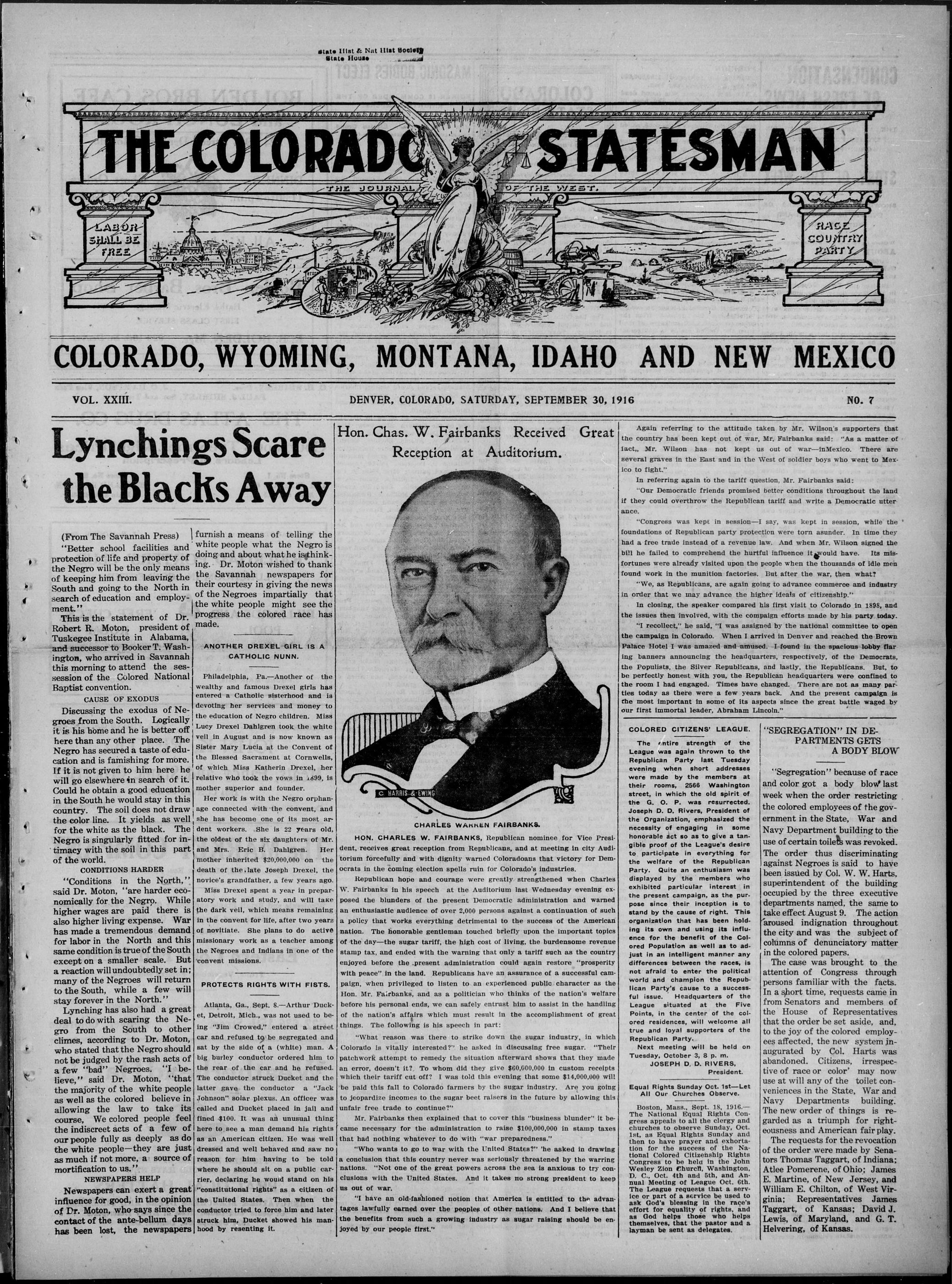
Lynchings Scare the Blacks Away
VOL. XXIII.
Lynchin the Blac
(From The Savannah Press)
"Better school facilities and protection of life and property of the Negro will be the only means of keeping him from leaving the South and going to the North in search of education and employment."
This is the statement of Dr. Robert R. Moton, president of Tuskegee Institute in Alabama, and successor to Booker T. Washington, who arrived in Savannah this morning to attend the sesession of the Colored National Baptist convention.
CAUSE OF EXODUS
Discussing the exodus of Negroes from the South. Logically it is his home and he is better off here than any other place. The Negro has secured a taste of education and is famishing for more. If it is not given to him here he will go elsewhere in search of it. Could he obtain a good education in the South he would stay in this country. The soil does not draw the color line. It yields as well for the white as the black. The Negro is singularly fitted for intimacy with the soil in this part of the world.
CONDITIONS HARDER
"Conditions in the North," said Dr. Moton, "are harder economically for the Negro. While higher wages are paid there is also higher living expense. War has made a tremendous demand for labor in the North and this same condition is true of the South except on a smaller scale. But a reaction will undoubtedly set in; many of the Negroes will return to the South, while a few will stay forever in the North."
Lynching has also had a great deal to do with scaring the Negro from the South to other climes, according to Dr. Moton, who stated that the Negro should not be judged by the rash acts of a few "bad" Negroes. "I believe," said Dr. Moton, "that the majority of the white people as well as the colored believe in allowing the law to take its course. We colored people feel the indiscreet acts of a few of our people fully as deeply as do the white people—they are just as much if not more, a source of mortification to us."
NEWSPAPERS HELP
Newspapers can exert a great influence for good, in the opinion of Dr. Moton, who says since the contact of the ante-bellum days has been lost, the newspapers
furnish a means of telling the white people what the Negro is doing and about what he is thinking. Dr. Moton wished to thank the Savannah newspapers for their courtesy in giving the news of the Negroes impartially that the white people might see the progress the colored race has made.
ANOTHER DREXEL GIRL IS A CATHOLIC NUNN.
Philadelphia, Pa.—Another of the wealthy and famous Drexel girls has entered a Catholic sisterhood and is devoting her services and money to the education of Negro children. Miss Lucy Drexel Dahlgren took the white veil in August and is now known as Sister Mary Lucia at the Convent of the Blessed Sacrament at Cornwells, of which Miss Katherin Drexel, her relative who took the vows in 1899, is mother superior and founder.
Her work is with the Negro orphanage connected with the convent, and she has become one of its most ardent workers. She is 22 years old, the oldest of the six daughters of Mr. and Mrs. Eric B. Dahlgren. Her mother inherited $20,000,000 on the death of the late Joseph Drexel, the novice's grandfather, a few years ago. Miss Drexel spent a year in preparatory work and study, and will take the dark veil, which means remaining in the convent for life, after two years of novitiate. She plans to do active missionary work as a teacher among the Negroes and Indians in one of the 'convent missions.
PROTECTS RIGHTS WITH FISTS.
Atlanta, Ga., Sept. 8.—Arthur Ducket, Detroit, Mich., was not used to be "Jim Crowed," entered a street car and refused to be segregated and sat by the side of a (white) man. A big burley conductor ordered him to the rear of the car and he refused. The conductor struck Ducket and the latter gave the conductor a "Jack Johnson" solar plexus. An officer was called and Ducket placed in jail and fined $100. It was an unusual thing here to see a man demand his rights as an American citizen. He was well dressed and well behaved and saw no reason for him having to be told where he should sit on a public carrier, declaring he would stand on his "constitutional rights" as a citizen of the United States. Then when the conductor tried to force him and later struck him, Ducket showed his manhood by resenting it.
DENVER, COLORADO, SATURDAY, SEPTEMBER 30, 1916
Hon. Chas. W. Fairbanks Received Great Reception at Auditorium.
C HARRIS & EWING
CHARLES WARREN FAIRBANKS.
HON. CHARLES W. FAIRBANKS, Republican nominee for Vice President, receives great reception from Republicans, and at meeting in city Auditorium forcefully and with dignity warned Coloradoans that victory for Democrats in the coming election spells ruin for Colorado's industries.
Republican hope and courage were greatly strengthened when Charles W. Fairbanks in his speech at the Auditorium last Wednesday evening exposed the blunders of the present Democratic administration and warned an enthusiastic audience of over 2,000 persons against a continuation of such a policy that works everything detrimental to the success of the American nation. The honorable gentleman touched briefly upon the important topics of the day—the sugar tariff, the high cost of living, the burdensome revenue stamp tax, and ended with the warning that only a tariff such as the country enjoyed before the present administration could again restore "prosperity with peace" in the land. Republicans have an assurance of a successful campaign, when privileged to listen to an experienced public character as the Hon. Mr. Fairbanks, and as a politician who thinks of the nation's welfare before his personal ends, we can safely entrust him to assist in the handling of the nation's affairs which must result in the accomplishment of great things. The following is his speech in part:
"What reason was there to strike down the sugar industry, in which Colorado is vitally interested?" he asked in discussing free sugar. "Their patchwork attempt to remedy the situation afterward shows that they made an error, doesn't it? To whom did they give $60,000,000 in custom receipts which their tariff cut off? I was told this evening that some $14,000,000 will be paid this fall to Colorado farmers by the sugar industry. Are you going to jeopardize incomes to the sugar beet raisers in the future by allowing this unfair free trade to continue?"
Mr. Fairbanks then explained that to cover this "business blunder" it became necessary for the administration to raise $100,000,000 in stamp taxes that had nothing whatever to do with "war preparedness."
"Who wants to go to war with the United States?" he asked in drawing a conclusion that this country never was seriously threatened by the warring nations. "Not one of the great powers across the sea is anxious to try conclusions with the United States. And it takes no strong president to keep us out of war.
"I have an old-fashioned notion that America is entitled to the advantages lawfully earned over the peoples of other nations. And I believe that the benefits from such a growing industry as sugar raising should be enjoyed by our people first."
Again referring to the attitude taken by Mr. Wilson's supporters that the country has been kept out of war, Mr. Fairbanks said: "As a matter of fact., Mr. Wilson has not kept us out of war—in Mexico. There are several graves in the East and in the West of soldier boys who went to Mexico to fight."
In referring again to the tariff question, Mr. Fairbanks said:
"Our Democratic friends promised better conditions throughout the land if they could overthrow the Republican tariff and write a Democratic utterance.
"Congress was kept in session—I say, was kept in session, while the foundations of Republican party protection were torn asunder. In time they had a free trade instead of a revenue law. And when Mr. Wilson signed the bill he failed to comprehend the hurtful influence it would have. Its misfortunes were already visited upon the people when the thousands of idle men found work in the munition factories. But after the war, then what?
"We, as Republicans, are again going to advance commerce and industry in order that we may advance the higher ideals of citizenship."
In closing, the speaker compared his first visit to Colorado in 1898, and the issues then involved, with the campaign efforts made by his party today. "I recollect," he said, "I was assigned by the national committee to open the campaign in Colorado. When I arrived in Denver and reached the Brown Palace Hotel I was amazed and amused. I found in the spacious lobby flaring banners announcing the headquarters, respectively, of the Democrats, the Populists, the Silver Republicans, and lastly, the Republicans. But, to be perfectly honest with you, the Republican headquarters were confined to the room I had engaged. Times have changed. There are not as many parties today as there were a few years back. And the present campaign is the most important in some of its aspects since the great battle waged by our first immortal leader, Abraham Lincoln."
COLORED CITIZENS' LEAGUE.
The entire strength of the League was again thrown to the Republican Party last Tuesday evening when short addresses were made by the members at their rooms, 2566 Washington street, in which the old spirit of the G. O. P. was resurrected. Joseph D. D. Rivers, President of the Organization, emphasized the necessity of engaging in some honorable act so as to give a tangible proof of the League's desire to participate in everything for the welfare of the Republican Party. Quite an enthusiasm was displayed by the members who exhibited particular interest in the present campaign, as the purpose since their inception is to stand by the cause of right. This organization that has been holding its own and using its influence for the benefit of the Colored Population as well as to adjust in an intelligent manner any differences between the races, is not afraid to enter the political world and champion the Republican Party's cause to a successful issue. Headquarters of the League situated at the Five Points, in the center of the colored residences, will welcome all true and loyal supporters of the Republican Party.
Next meeting will be held on Tuesday, October 3. 8 p. m.
Equal Rights Sunday Oct. 1st—Let All Our Churches Observe.
Boston, Mass., Sept. 18, 1916.—The National Equal Rights Congress appeals to all the clergy and churches to observe Sunday, Oct. 1st, as Equal Rights Sunday and then to have prayer and exhortation for the success of the National Colored Citizenship Rights Congress to be held in the John Wesley Zion Church, Washington, D. C., Oct. 4th and 5th, and Annual Meeting of League Oct. 6th. The League requests that a service or part of a service be used to ask God's blessing in the race's effort for equality of rights, and as God helps those who helps themselves, that the pastor and a layman be sent as delegates.
NO.7
"SEGREGATION" IN DEPARTMENTS GETS A BODY BLOW
"Segregation" because of race and color got a body blow last week when the order restricting the colored employees of the government in the State, War and Navy Department building to the use of certain toilets was revoked. The order thus discriminating against Negroes is said to have been issued by Col. W. W. Harts, superintendent of the building occupied by the three executive departments named, the same to take effect August 9. The action aroused indignation throughout the city and was the subject of columns of denunciatory matter in the colored papers.
The case was brought to the attention of Congress through persons familiar with the facts. In a short time, requests came in from Senators and members of the House of Representatives that the order be set aside, and, to the joy of the colored employees affected, the new system inaugurated by Col. Harts was abandoned. Citizens, irrespective of race or color' may now use at will any of the toilet conveniences in the State, War and Navy Departments building. The new order of things is regarded as a triumph for righteousness and American fair play.
The requests for the revocation of the order were made by Senators Thomas Taggart, of Indiana; Atlee Pomerene, of Ohio; James E. Martine, of New Jersey, and William E. Chilton, of West Virginia; Representatives James Taggart, of Kansas; David J. Lewis, of Maryland, and G. T. Helvering, of Kansas.
THE | EST IMPORTANT DIS
PATCHES PUT INTO SHORT,
CRISP PARAGRAPHS.
STORY OF THE WEEK
SHOWING THE PROGRESS OF
EVENTS IN OUR OWN AND
FOREIGN LANDS.
Western Newspaper Union ews Bervice,
ABOUT THE WAR
Strong Russian attacks in Volhynia,
Galicia and the Carpathians repulsed,
says the Berlin war ofice.
British and Serbians report gains
in the Macedonian zone against .the
Bulgars ang Teutonic alltes.
British cross the river Struma at
three places and take Jenmita, driv-
ing the Bulgars before them.
Allied transport laden with troops
sunk by a submarine in the Mediter-
ranean, says Berlin admiralty report.
Storming of trenches in the Canal
du Nord region gives French import-
ant advantage in their advance to-
ward Peronne.
Situation in Greece still tense, in-
surrection leaded by former Premier
Venizelos threatening to break forth
at any moment.
Thiepval has fallen into British
hands, as has also the fortified town
of. Gaudecourt, according to the Brit:
ish official statement.
German Zeppelins in night air raid
‘on London kill thirty persons and in-
jure 116, eleven women and children
being among the slain.
Allied war offices report continued
successes in the Macedonian cata-
paign. Serbian troops cross frontier
and carry on fighting in their own
country.
Combles, pivotal point in the Ger-
man line guarding the approach to
Bapaume, now is entirely in the hands
of the allies us the result of a com-
bined attack. °
German pilots shoot down twenty-
four entente aeroplanes and allied
eviators bring down twenty-six Teu-
ton planes in the aerial encounters on
varlous war fronts.
German official statement admits
“conquest” of villages necessary to
capture of Combles, but gives great
praise to troops who defended these
important possessions.
Two British subjects and thirty-six
out of thirty-eight Carranza soldiers
were killed when Villistas raided an
oll camp near Tuxpam Sept. 16, ac-
cording to officers of the tank steam-
er Topila, which arrived at Galves-
ton, Tex.
WESTERN.
President Wilson will speak in Chi-
cago on Oct. 19.
An order issued at Washington di-
recting Troop A, Kansas cavalry, to
proceed to the border, was received
‘at post headquarters at Fort Riley,
Kan.
Acording to the official advices,
tungsten and molybdenite have been
added to the list of goods that are pro-
hibited to be exported from Japan
without special permit.
‘Three of the mall pouches stolen
from a Santa Fé train near Syracuse,
Kan, several weeks ago, have been re-
covered by Tonelli inspectors from
the Denver and Kansas City offices.
‘The most severe frost since 1883
visited Wisconsin on three successive
mornings, caught the tobacco crop
still standing and is destined to cause
financial loss to growers of close to
$1,500,000.
A report that the family of E. O, Or-
pet, father of William Orpet, recently
acquitted of the charge of slaying Ma
rion Lambert, was about to remove
to California was denied both by Or-
pet and by Cyrus McCormick at Chi-
cago.
Within the week the proposed in-
crease in the cost of bread will be put
into force in Chicago. Bakers in
other big cities are expected to fol-
low. in another week, and within a
month the jump will be declared uni-
versal.
WASHINGTON
‘The State Department was official:
ly advised that Burton Wilson, a
prominent American and president of
the American Club of Mexico City,
has been thrown into jail by Car
ranza,
A most curious land case turned up
a few days ago, when it was learned
that an Indian tribe was trying to se
cure the return of 164,000 acres o.
WR ee a ee ea tae ema tes
FOREIGN
Canada has subscribed $180,000,000
for the $10,000,000 war loan.
The earl of Essex was found dead
in bed in London. He had been ill
for some time.
Maj. Gen. George W. Goethals, gov-
ernor of the Panama canal zone, sailed
from Colon for New York.
On his trip to the Italian front the
American ambassador, Thomas Nel-
son Page, had two narrow escapes
from Austrian shell fire.
A Russian torpedo boat sank three
Turkish ships and several sailing ves-
sels loaded with coal at the port of
Eregli, 128 miles east of Constanti.
nople.
The Argentine minister of war, Gen.
A. P, Allaria, has resigned owing to a
disagreement with a decision of the
president regarding the promotion of
several generals,
Gertrude Aimes Lincoln of Los An:
geles, Cal., was married at Heilingly,
near East Bourne, England, to Lieut.
Arthur Lett Haines of the Royal Field
artillery. London newspapers say she
is a granddaughter of Abraham Lin.
coln.
Counsel General Skinner succeeded
in effecting the release from the
prize court of 1,200 packages of mail
from the United States to belligerent
countries seized on the steamship
Heligolay on her arival in British
on March 28.
Supporters of Mayor Sanchez Por-
tal, Mberal candidate for governor of
Santa Clara province, Cuba, came in-
to collision with adherents of the con-
servative nominee, One conservative
was killed and fifteen members of
that party were wounded. Two liber-
als were wounded.
An unofficial estimate published in
Paris of the Austro-German _ losses
from February of this year to the end
ot the summer places the number at
two millions. Of these 700,000 were
estimated to have been suffered on
the eastern front; 500,000 at Verdun;
400,000 on the Italian front, and 400,
000 on the Somme front.
SPORTING NEWS
Final Standing of Western League.
CLUBS— WwW. Pet.
Omaha ......0ece00+-. 93 57 620
Lincoin 2222220000551 85 64 ‘670
Bloux City 6255550555579 71 ‘a7
Denver ......ie.ssees 77751507
Des Moines 222222152175 75 ‘00
Topeka ....0..iic.lse TL 838 461
St Joseph 20055552551 67 6 laa
Golo. Springs cle eee) es lene
Indian yells mingled with the calls
of cowboys and the pounding of
horses’ hoofs as they raced across the
grounds were features at the open-
ing here of the Seventh Annual Pen-
dleton, Ore., Round-Up.
Joe Flynn, the “Battling Wop,” add.
ed another kayo to his lengthy list at
Denver when he dropped Johnny Ar
rousez of California in the eleventh
round of a scheduled fifteen-round
bout.
Charlie White and Freddie Welsh
are being matched for a ninety-nine-
round lightweight championship bat-
tle, to be fought at Tia Juana, Mex.
Thanksgiving day, Nate Lewis, man-
ager for White, announced in Cleve-
land, Ohio, while en route to Pitts-
burg.
Fair weather favored the opening
of the Great Western Circuit races
at the Missouri state fair at Sedalia.
The main event on the racing card
was the 2:09 pace for a $1,000 purse.
The race went five heats and was
won by Dick Sentinal, the best time
bein 2:06%.
Miss Molla Bjurstedt, national wom.
an’s tennis champion in singles, was
eliminated as a competitor in the dou:
bles in the women’s open tennis tour
nament at the Longwood Cricket Club
at Boston. Paired with Miss Eleanor
A. Sears of Boston, she was defeated
by Mrs. A. A. Shurtleff of Boston, and
Mrs. H. H. Smith of Philadelphia, 2-6,
6-4, 6-4,
sENERAL
‘Thirty-three Scotch and one Irish
girl, making up a contingent of
brides-to-be, arrived in New York on
the Anchor line steamer California
from Glasgow.
Mrs. Peter L. Shepard, mother of
Finlay Shepard who married Helen
Miller Gould, died at New Haven,
Conn., in her eighty-sixth year from
infirmities of age.
Col. Caesar Rodney May, twents
years a resident of Camden, N. J., died
in Cooper hospital. He was 75 years
old. He was born in Illinois and as ¢
boy was a close friend of Abrabam
Lincoln.
Elimination of the word “damn’
from the Episcopal prayer book and
the substitution of the word “con.
demn” is recommended by the com:
mission on revision of the prayer book
in a report to be submitted to the tri-
ennial convention of the Protestant
Episcopal church at St. Louis.
New York state soldiers on the Mex.
fcan border will use an eight-foot bal
lot on election day, according to Sec
retary of State Hugo. It will be the
longest ever used in a combined na-
tional and state election and the first
“war ballot” since 1898, when Amer.
ican soldiers were on Cuban soil,
Suits for divorce from two hus.
bands of the same name, filed by Mrs.
Maggie Hill, are pending in the Dis.
trict Court ‘at Oklahoma City, Okla.
Mrs, Hill filed the sults seeking abso
lute divorce on grounds of abandon.
ment and non-support trom the one,
Cyrus Hill, and an annulment of the
marriage to the other, Tony itll,
Major General Funston, at’San An.
tonto, Texas, sald he had ‘no objection
to the holding of reviyals, along the
Mexican border by Baptist ministers,
but that he did not. wish auch meet:
ings tnside the military camps. t
COLORADO
STATE NEWS
DATES FOR COMING EVENTS
oyterian Churches at Grand Junction.
Jan. 20-27—Annual Western Stock
Show at Denver.
Oct. 1 has been chosen as Go-To-
Church day.
Over 600 students are registered at
the Fort Collins college.
‘The 1916 Synod of the Presbyterian
church, district of Colorado, will meet
in Grand Junetion, Oct. 17-19,
One cent per gallon was taken off
the price of gasoline in Denver, which
now sells at 22 cents a gallon.
Chas. W. Fairbanks, Republican
candidate for Vice President, address-
ed a large audience at the Denver Av
ditorium,
The Leadville district is booming
and the output reported the greatest
in history. Lake county mines this
year will produce $18,000,000.
Esther Brown, who was arrested in
Denver in company with a man giving
his name as Edward Sears, is believed
to be Esther Elison of Eaton,
Two leads of good ore is the daily
output from the P. T. mine located on
Chicago Creek, Idaho Springs district.
Some of this ore assays over $100.
The National Association of Life
Underwriters elected J. Stanley Ed-
wards of Denver second vice presi
dent at its annual convention st St.
Louis.
John Reidy, Colorado pioneer and
deputy United States marshal for
eighteen year, died at his home in
Denver. He had been ill about two
weeks,
Over 1,200 carloads of cantaloupes
have been shipped from the Rocky
Ford and Ordway districts, and grow-
ers received a higher price than for
years past.
‘The Jenkins and Johnson lease on
the Pozo property near Idaho Springs
is among the best in the camp that
maintains the regular output of about
150 tons of good ore per month.
‘The fifty-third annual session of the
Rocky Mountain Baptist Association
met at the Baptist church of Love-
land. ‘Thirty-six of the forty churches
of the association were represented.
The first subscription to the Den-
ver Labor Temple, which unions of
the city are planning to build, was
voted by the Denver Trades and La-
bor Assembly at its regular meeting.
Mrs. M. A. Potter, prominent socl-
ety woman of Indianapolis, sustained
concussion of the brain and may dle
as the result of an automobile accl-
dent on the Cheyenne road near Colo-
rado Springs.
Ore shipments of 333 carloads from
the Silverton district for the month
of August, broke all records for the
month in past years. At an average
of twenty-two tons to the car, the ton-
nage production amounted to a total
of 7,326 tons for that month.
William Bayard Craig, for whom the
principal town of Moffat county was
named and who originally owned the
greater part of the townsite, died and
was buried from the Craig Central
Christian church, which was_ built
largely through his efforts while its
pastor thirty years ago.
Juan Valdez, an escaped convict
from the New Mexico penitentiary,
and who is said to be the leader of a
gang of cattle rustlers that has op-
erated in southern Colorado and Ok-
lahoma and who has been sought for
by officers of Las Animas county for
almost a year, was captured at La
Junta.
‘The leasers,on the Senator mine,
below Black Hawk, shipped a carload
of concentrates from the Iron City
concentrator, weighing 19,320 pounds,
to the Globe smelter, which was set
tled for at 1.65 ounces gold, 17.52
ounces silver and 6.7 per cent lead,
showing the ore to be worth $42.77
per ton, producing a check for $356.97.
A shipment of two lots of ore to the
sampling works at Black Hawk from
the famous Pittsburg mine in lower
Russell Guich, returned exceptionally
high values, one lot bringing 3.97
ounces gold, 6.50 ounces silver and
6.60 per cent copper; the other lot re
turning yalues of 12.79 ounces gold,
18.80 ounces silver and 18 per cent
copper,
The arrest in Chicago of Willard
Powell, alias the “Waco Kid,” as a
suspect in connection with the nation.
wide blackmailing gang being round-
ed up hy the federal authorities of
Chicago, is one of the latest develop:
ments in the case with a Colorado
angle. The “Waco Kid" was arrested
in Denver last June on a charge of
wiretapping” and was later extra
dited to Illinois,
Left alone at home with her in
valid mother, 12-year-old Lottie Craft,
Dinara eos Manel” doa nero peeedagete ! t NS
MASONIC BODIES ELECT
BOLDEN BROS. CAFE
and LUNCH ROOM
924 19th Street, Denver, Colorado
DINNER AMEE" Short Orders
11:30to2p.m. “i iat a at All Hours
All Kinds of Sandwiches
RINKER 18 COMMANDER OF THE
KNIGHTS TEMPLAR.
Mrs, Eliza 8, Cohen Elected Grand
Secretary of Eastern Star for
‘Twenty-tifth Year.
Western Newspaper Union News Service,
Denver—Mrs, Eliza 8, Cohen of Coio
rado Springs was elected grand sec-
retary of the Eastern Star at a meet-
ing held at El Jebel Temple. ‘This is
her twenty-fitth consecutive year in
this office. At Colorado Springs nex:
september the silver anniversary’ of
the order and the thirty-fifth anni-
versary of its establishment ‘in Colo-
rado will be celebrated.
The Grand Commandery, Knights
Templar of Colorado, completed its
balloting with the following officers
elected: John E. Rinker, Cripple
Creek, grand commander; Will D.
Grisard, Pueblo, deputy grand com-
mander; Clarence M. Kellogg, Den
ver, grand generalissimo; George A.
Reese, Trinidad, grand captain gen-
eral; Stanley C. Warner, Denver.
grand senior warden; James P.
Barnes, Colorado Springs, grand jun-
sor warden; Frank L. Bishop, Den-
ver, grand treasurer; Charles H.
Jacobson, Denver, grand recorder;
Fred W. Willman, grand chaplain; H.
W. Woodward, Leadville, grand stand-
ard bearer; Marshall H. Van Fleet,
Alamosa, grand sword bearer; Charles
. Keepers, Denver, grand warden;
Sheridan S. Kendall, Denver, grand
captain of guard.
‘Those elected to office in the Or-
der of the Eastern Star were: Mrs.
Katie J. Davis, worthy grand matron,
Willard W, Adams, Boulder, worthy
grand patron; Mrs. Carrie MacCarthy,
Fort Collins, associate grand matron,
Wilkins O. Petersos, Pueblo, associ-
ate ‘grand patron; Mrs, Eliza S. Co-
hen, Colorado Springs, grand secre-
tary; Miss Kueble, Leadville, grand
treasurer; Mrs. Mollie 8. Richmond,
Colorado Springs, grand conductress,
Mrs. Mary B. Rhoades, Denver, asso-
ciate grand conductress.
Grand Lodge Ancient Free and Ac-
cepted Masons—Guy V. Sternberg,
Grand Junction, grand master; L. D.
Urain, Fort Collins, deputy grand mas-
ter; Clarence M. Kellogg, Denver,
senior grand warden; Frank L.
Bishop, Denver, junior grand warden;
H, W. Woodward, Leadville, grand
treasurer; Charles H. Jacobson, Den-
ver, grand secretary; Haslett P.
Burke, Sterling, grand orator; Fred
W. William, Denver, grand chaplain;
William W. Cooper, Denver, grand
lecturer; Marshall H. Van Fleet, Ala-
mosa, grand marshal; Edward P. Huf-
ferd, Colorado Springs, senior grand
deacon; John H. Gabriel, Denver,
Junior grand deacon; Ernest B, Ford-
ham, Glenwood Springs, senior grand
steward; L. Wirt Markham, Lamar,
Junior grand steward, and Allen J.
Read, Denver, grand tiler.
Grand Chapter, Royal Arch Masons
—James R. Killian, grand high priest;
William 8, Pickerill, Durango, deputy
grand igh priest; Herbert S. Sands,
Denver, grand king; Marshall H. Van
Fleet, Alamosa, grand scribe; Robert
M. Simons, Denver, grand treas-
urer; Charles H. Jacobson, Denver,
grand secretary; Mark B. Gill, Fort
Morgan, grand captain of host; Sam-
uel J. Sweet, Denver, grand principal
sojourner; Will D. Grisard, Pueblo,
grand Royal Arch captain; Reuben W.
Hershey, Denver, grand master, third
veil; Harry V. Williamson, Delta,
grand master, second veil, and Allen
J, Read, Denver, grand sentinel,
Bolden Bros. Barber Shop
Baths, Electric Massage §
FIRST CLASS SERVICE
R. B. BOLDEN, Mgr. 926 19th St. Denver
G. SHIRLEY, Pres. J. 0. HAMPSON, Vice Pues
PAUL J. SHIRLEY, Seo. and Treas,
_ THE ATLAS DRUG CO.
Courteous Treatmet. Right Prices
Leaders in Prescription
Btore No. 1. Store No. 2
701 WELTON 8T 26TH AND WELTOR
Main 895 875 Main 4955.4956
W. C. CAMPTON, Pres, J. B. MINTER, Seo.
"RAILROAD PORTERS’ CLUB
| LUNCHOOM IN CONNECTION
| BILLIARDS AND FREE CHECK
| POOL ROOM
1728, Waree 8t. Only one block from Union Depot.
J. B, MINTER, Barber,
PHONE MAIN 8416. _ DENVER, COLORADO.
PHONE MAIN 3028 RES. PHONE GALLUP 943
JOHN K, RETTIG:
Meats, Fancy and Staple Groceries
Lier 1864 CURTIS STREET ¥ se eee
One Killed, Another Loses Arm.
The MARKET COMPANY
©. E. SMITH, Manager, Res. Phone South 1608
Wholesale and Retail Staple and Fancy Groceries, Fish and Oysters,
Hotels and Restaurants Our Specialty.
Fresh and Cured
Eastern Corn Fed Meats
Fruits, Vegetables, Poultry and Game.
Telephones Main 4302, 4303, 4304, 490b
622-636 15th Street Denver, Colorado
Pueblo.—William E. Turner, aged
28, of this city, was killed, and George
Roberts, also of Pueblo, lost an arm
while hunting rabbits twenty-two
miles south cf this city. Roberts, who
was in the front seat of the automo:
bile, in getting out of the car acct.
dentally caused the gun to be dis-
charged, tearing off his right arm.
Part of the shot penetrated Turner's
head. Some of the shot entered Tur
ner’s temple, inflicting a wound which
a few hours later caused his death,
Both men were accompanied by thelr
wives.
Boys Make Long Bicycle Trip.
Colorado Springs—After a cross:
country trip by bicycle of 4,284 miles
Joe Bruce and Lester Atkinson, two
high school boys, returned to Colo
rado Springs. They left on their bi-
cycles June 12 for New York and
traveled by way of the Great Lakes,
arriving at New York on Aug. 19. The
trip was made entirely by bicycle
and the boys averaged about 100
miles every day they traveled.
Weatherhead Hat Co.
TELEPHONE MAIN 3203
Established 1876 s
PIONEER HATTERS OF THE WEST
WE MAKE OLD HATS NEW
PRACTICAL HATTERS
RENOVATORS, BLEACHERS DYERS AND FINISHERS
Of Gents’ and Ladies’ Hate of Every Description
1624 Champa 8t., Denver, Colo, ©
Doctor Killed in Auto Wreck.
Hayden, Colo.—Dr. D. V. Solandt,
one of the most widely known physi-
cians of northern Colorado, was
killed when his auto turre? turtle
while responding to a call’ from
Steamboat Springs.
Portland Shaft Pays $60 a Ton.
Colorado Springs.—There are more
millions in gold ore on the nineteenth
level of the Fortland Gold (Mining
Company’s mine at Cripple Creek than
on any level of the famous mine
above, according to official state-
ments. This level is 1,950 feet below
the collar of the shaft and the ore
shoot has been opened 500 feet from
end to end and from ten to forty feet
m width, The values are higher than
in the level above. The ore shaft so
far has averaged better than $60 a
ton.
AFRO-AMERICAN CULLINGS
‘Thomas E, Taylor, secretary of the
G men’s branch of the Young
More Christian association, whose
regignation was tendered some time
ago, will become secretary of the New
York branch, and left August 20
to take up his work there. IF. E. De-
rants, who has been physical director
of. the colored branch for the last
three years, has been appointed acting
secretary until the position can be
filled permanently, reports the Indian-
apolis News,
‘The branch in New York is in Fit-
ty-third street and the property Is
Yalued gt $75,000. ‘The board of man-
agement recently bought a lot In One
Hundred and Thirty-fifth street, and
Wogk on # $110,000 building will be be-
sah in November.
Mr. Taylor's resignation has been
deeply regretted by those interested in
thé success of the Y. M. C. A. branch
here. He came here in 1905 when the
association had its headquarters in
rented property in North California
street, and there were only 17 mem-
‘vers, Doctor Hummons was president
af;the board of management when Mr,
Taylor came here. During the 11
yehrs Mr, Taylor has been secretary
the membership reached 1,000. Mr.
Taylor said he attributes much of the
success of the association to the in-
terest of George L. Knox, now presi-
dent of the board of management. In
speaking of the association here three
years ago when the new building was
dedicated, Booker ‘T. Washington said
its work was not surpassed by that of
any lke. organization he knew of,
and that it was filling one of the
greatest needs in the community life
of the eity.
Mr, Taylor said the relations of the
Central ¥..M. C. A. and the colored
‘men’s branch always have been friend-
Jy, and that too much cannot be said
of the interest of A. H. Godard, sec-
retary, whose advice has always been
available and whose influence has been
exerted in the Interest of the colored
work, whenever {t was needed.
Mr. Taylor was born and reared in
London, Canada, and for six years be-
tore coming to this city was a letter
carrier there. He attended the first
meeting called for boys by the Cen-
tral association in London, and held
many responsible positions in the boys’
department, later becoming a member
of the board of directors.
‘The world’s fastest runner will never
race again, if physicluns who are at-
tending him are correct.
Howard P. Drew, the colored ath-
lete, who holds the world’s record of
9 35 seconds for 100 yards and has
equaled the mark of 21 1-5 seconds for
220 yards, is suffering from a stroke
of paralysis at Los Angeles, His left
side is affected and it was announced
that he may recover partially, but that
the affliction is certain to bar him from
fast competition for the rest of his life.
Drew is a Springileld, Mass., boy
and it was as a member of the high-
school track team of that city that he
first gained fame. He was on the
American team at the Stockholm
Olympic contests and has retained the
national championship for years.
Drew completed in the Luke Front
Olympic games at Chicago, and defeat-
ed the best of the athletes in that
city.
For the past two years he has made
‘his home on the coast, competing for
a California school. He is married and
has a family.
Attention has been called before to
the wide employment of electric pocket
lamps by the fighting men of Europe.
According to a recent statement in the
Dally Mail, it ts learned that two Lon-
don firms have produced between
them no less than 2,000,000 batteries
during the Inst year. Prior to the war
only about 50,000 such batteries were
made in the entire United Kingdom.
The annual encyclopedia of Negro
progress Issued at Tuskegee contains
4 list of towns and settlements in the
United States populated and governed
almost entitely by negroes. Most of
these towns are small. Buxton, Ia.,
with 5,000 population, 1,000 of whom
are whites, being the largest, and
Boley, Okla., the next. It will be in-
teresting to witness the results of this
experiment.
California has several fine sea-level
highways. They skirt the shore of
the Pacific and are built of concrete.
Apparatus to sterilize air and medi-
cate it for the use of invalids has
been Invented by a Pittsburgh man.
A large Industry in Christiania.
Norway, has leased its idle land at a
cheap rate to its employees, who will
erect thereon individual suburban
homes of thelr own.
‘A new trap to be attached to a re-
frigerator drain pipe permits waste
water to flow out, but prevents the en-
trance of warm air or vermin.
Mrs. Eliza Ward of Asbury, Md., has
three sons and severt grandsons in
Company L, the Crisfleld unit of the
Virst Maryland regiment.
The public farewell tendered by
the committee of management of the
colored Y. M. C, A., in the association
rooms, {n honor of Thomas B. Taylor,
secretary who left for New York,
where he Is, to become head of the
New York branch, was evidence of
the high regard in which Taylor Is
held by the colored citizens. The oc-
casion was also a welcome. to F. E.
DeFrantz, former physical director,
who is becoming acting secretary of
the work there. Dr. J. H. Ward, for
many years chairman of the member-
‘ship committee, was master of cere-
monies.
A number of swhite and col-
ored citizens participated in the
Program, all of whom praised Tay-
lor for his self-sacrificing spirit,
‘his courage, faith and optimism. ‘The
belief was expressed that few men
could have accomplished what ‘Taylor
had in the 11 years he has been con-
nected with the colored branch,
©. B. Stacy, state secretary of the
X. M. G. A, the first speaker on the
Program, spoke in the highest terms
of what Taylor had accomplished in
the state, referring to him as a plo-
neer in the ¥Y. M. ©. A. movement
among the colored people of Indiana.
He spoke of the genuine friendship ex-
isting between ‘Taylor and all the
Y. M. C. A. workers, how his enthusi-
}asm and faith in the future of the col-
ored branch had inspired workers of
the central association and the field
of workers to a larger interest in the
success of the colored work.—Indian-
‘apolis News.
‘The 1916-1917 “Negro Year-Book”
estimates that the colored race is now
raising $1,500,000 yearly in this coun-
try for the support of schools—most
of this probably going to denomina-
tional colleges and academies, but
much being expended in rural dis-
tricts upon primary schools. The
Rosenwald fund for building country
schoolhouses, for example, offers can-
tributions only to communities which
have themselves raised an equai
amount. For private and higher
schools for the Negro in 1914-15, the
United States, the states and the cit-
tes spent $703,356. For colored pub-
lic schools the 16 former slave states,
the District of Columbia and Okla-
homa spent $10,665,000, which is a Hit-
tle more than one-ninth the amount
expended for white public schools.
‘Taking all schools and the country as
a whole, to Negro education was given
less than $15,000,000—as against
nearly $820,000,000 spent for education
of the whites. "The combined budget
of four or five of our largesi untverst-
ties would equal the amount spent on
the separate education of our Negro
population! ‘The spectacle of a none
too prosperous Negro population giv-
‘ng (for it) large suns ought to In-
spire more generosity among the
whites—New York Post.
‘Trainmen put off two young men
who had boarded a boxcar at Weath-
erby, Mo. Between that place and
Maysville the train had a wreck and
that particular car was badly smashed,
When the boys later walked into Mays-
ville they hunted up the brakemen and
thanked them for saving their lives,
The harbor of Hamburg has been
equipped with flouting docks of two
types, which permit them to raise
from the water vessels longer than the
docks themselves.
Two blind men have started a bas
ket-making business near Worcester,
Mass. They are Axel Carlson and Au-
gust Kellstrom, each of whom lost his
sight two years ago. They are raising
their own willows and have half an
acre now about two feet tall, in the
rear of their little workshop.
An automobile built for the czar can
be converted into a motor sleigh by
replacing the front wheels with run-
ners and placing chains on the rear
ones,
The seven principal engineering so-
cleties of Germany have combined Into
a new association called the Deut-
scher Vereine. (German Association
of Technical Scientific societies).
All the steam railways in New Zea-
land are owned and operated by the
government. There are about 3,000
miles of road in operation, and new
lines are under construction,
‘An opening extends through a new
rubber hot-water bottle into which a
glass bottle can be inserted to keep
the contents of the Inter warm.
‘Three of tne most enthusiastic mo-
tion picture fans in Atlanta, Ga., are
sixty-five years of age and go to the
movies in roller chairs, One of this
trio Is a woman,
Pure food advocates In Japan re-
cently discovered that much rice was
Adulterated with quartz sand to in-
crease its weight.
Tuberculosis among the miners in
the South African gold fields hiss been
reduced by the use of electricity for
light
GUARDS FROM ALL PARTS OF
THE COUNTRY ARE GO-
ING SOUTH.
FUNSTON TO SELECT 10,000 MEN
NOW ON DUTY AND SEND
THEM HOME.
Western Newspaper Union News Service.
Denver.—Batterles B and © from
Colorado, and National Guard organ-
izations from New Hampshire, Penn-
sylvania, New Jersey, District of Co-
lumbla, Virginia, New York, Ala-
bama, Georgia, Connecticut, Florida,
Michigan, Minnesota and California
vere ordered to the Mexican border
by the War Department.
Instructions were sent from Wash-
ington to Maj. Gen. Funston, order-
ing him to select upon the arrival ot
these organizations at the border 10,
000 National Guard infantry now on
duty there and return them to state
mobilization camps.
The organizations ordered south in-
clude Batteries B and C; Golo.; Field
Artillery Battery A, N. H,; Batteries
©, N. J.; Third Regiment, Pa.; Bat-
tery A, D. C.; First Battalion and Bat:
tery C, Va; Third Regiment, N. Y.;
Batteries A and C, Ala; First Bat-
alion, Ga.; Batteries B and F, Comn.;
jatteries A and B, Mich., and First
Kegiment (less Second Battalion),
Minn,
Infantry—Second Regiment, Fla.;
H, Third Regiment, D. C.
Cavalry—Troop A, D. C.
Engineers—Company A, Calif.
Republican Vice Presidential Candi-
date Addresses Large Crowd
ae thes Auditorton
Denver.—Charles Warren Fairbanks,
Republican vice presidential candi-
date, arrived here Wednesday atter-
noon from Omaha and addressed a
es ™ *
Uy ge 86—™NUD
SP eo!
ey <s m7)
Ce Re.
ed
os
Sy
9 ey
i >
io)
Ca 2
3} Pithwkr ,
rge audience at the Auditorium on
Wednesday evening. He left ‘Thurs
day for Colorado Springs, where he
spoke in the evening, after address-
ing a meeting at North Park in the
afternoon,
Little Response to Strike Call.
New York—Labor unions in New
York Wednesday were stonding by
contracts they have with employers,
and there was little response to the
call for a general walkout in sympa-
thy with the striking employés of the
traction lines,
THIEPVAL REDOUBT TAKEN.
British Hurl Germans From 2,000
Yards of Somme Trenches.
London.—British attacks north o.
the Some resulted in the capture of
2,000 yards of German trenches north
ot Flers and a strong redoubt 2,000
yards northeast of Thiepval,
French repulse violent counter-at
tacks by Germans on recently won po
sitions from Bouchavesnes to the
southern edge of the Bois 1'Abbe farm.
London claiis the capture of 10,000
prisoners by the English troops in the
Somme fighting in last two weeks.
Russian attack on German troops in
Galicia near Lucova {s repulsed with
heavy losses,
Bulgarians claim repulse of entente
troops all along the line in Macedonia
Paris contradicts it, however, saying
the Bulgar attacks on one sector were
beaten back.
Russians gain successes along the
Black Sea coast in Armenia and on
the Persian front near Hamadan.
Greek government, in agreement
with King Constantine. is reporte
having decided on military co-opera:
tion with the entente powers,
Mexican Bandits Wreck Train.
Laredo, Texas—Bandits Sept. 23ru
wrecked a north-bound Nationa) Rail-
ways pasenger train between Gonzalé;
Junction and San Luis Potosi, Mexico,
resulting in the loss of several lives.
A few minutes later a south-bound
train, composed of passenger an!
freight cars, crashed head on into the
wreckage, which was set on fire by
the bandits, resulting in the loss of
about a score more lives, according to
T, B. Hohler. British charge at Mex-
feo City, who arrived here.
FEDERAL APPROPRIATION NEAR:
LY $1,000,000 FOR COLORACO.
Commission to Expend $80,000 Thiv
Year for Completion of Five
Projects in Colorado.
Western Newspaper Union News Servios.
A tentative program for the dispo-
sition of the federal funds available
for improvement of post roads or
highways which may be declared post
roads was discussed at a meeting of
the State Highway Commission.
About $1,000,000 has been appropri-
ated for use in Colorado, the state
and the counties benefited to put up
dollar for dollar. For the first
year It has ‘been proposed that the
$80,000 from the government fund be
expended for five different projects
which would greatly benefit ‘the com-
munities through which the roads
run. For the completion of the Den-
verLittleton hard-surfaced, road, $29,-
000 would pay for halt the cost of
construction; from Granite to Twin
Lakes, $6,000; Trinidad to Walsen-
burg, $15,000; Placerville to Paradox,
$10,000, and Rifle to Craig, $20,000.
For the second year the tenative pro-
gram discussed was as follows: Den-
ver to Broomfield, $30,000; Colorado
Springs to Palmer Lake, $15,000;
Grand Junction to Delta, $15,000;
Montrose to Ouray, $20,000; Dolores
to Rico, $10,000; Pagosa to. Chama,
$10,000; Lamar to Springfield, $5,000;
‘Walden to Rand. ‘$2,500; Wray to
‘Idalia, 3,000; Morrison to Conifer, $5,-
000; Pueblo to Avondale, $5,000; Cas-
le Rock to Kiowa, $3,000; Walsen-
burg to Pueblo county line, $5,000;
Kremmling to Dillon, $5,000; State
Bridge to Wolcott, $3,000; Burling-
ton to Cheyenne Wells, $2,000.
MANY MINES RESUMING.
_ Records by 25 Per Cent.
Denver—Colorado Is experiencing
the greatest mining boom in the his-
tory of the state, according to M. B.
Tomlin, state mining commissioner.
Mr. Tomlin hes ascertained through
inspection trips over the state and re-
ports from mining centers that Colo
rado’s metal output for 1916 will be
more than 25 per cent larger than in
1915, the greatest in the Listory of
the state; that new mines are being
located; old mines are being re-
opened; every miner in the state has
work, and tere 1s an unprecedented
demand for labo. at the mines,
Leadville has a greater tonnage out-
put than ever before and when the
old downtown mines there begin op:
erations the output will be given aa-
ditional Impetus.
In Boulder county the production
of gold and silver ore is more than
25 per cent greater than ever before
known and the present output for
1916 has surpassed that of 1915 al-
ready.
In Cripple Creek there is not much
fluctuation, the output there being
wbout to capacity always.
Throughout the San Juan district,
the Leadville district and all over the
southern part of the state there is a
searcity of miners and common labor.
Commissioner Fred Carroll and In
spector A. E. Monyhan report this
true wherever they have been.
OE ne er Be ee OS TRE aR gC
Coal production in Colorado for the
first seven wonths of 1916 showed an
increase of 1,253,160 tons over the
same period in 1915, Figures just
compiled by Mrs. Ada Tibbits, clerk
of the State Coal Mining Department,
how the total number of tons mined
from Jan. 1 to Sept. 1 this year was
6,268,481. For August alone the pro
duction was 846,706 tons, an increase
of 113,444 tons over August last year.
The biggest increases for the year
are shown in Las Animas county,
which has produced 2,644,376 tons, an
increase of 842,246 tons over the first
seven months of last year, and Huer-
fano county, where the mines have
wade a gain of 138,248 tons in the
same period, the total production up
to Sept, 1 being 1,057,704 tons, Other
increases for the seven months are in
Routt county, 95,558; Fremont, 73,
183; Gunnivon, 36,677; Boulder, 32,
77, and Jefferson, 17,271. The aver
uge number of men employed in the
nines has been 11935 with 1 8.7 aa
the total number of days worked.
inpeeene Glatauar Bhisthente..
There were thirty sine,more liquor
shiprents ‘nio Der during the
month of August than during the
month o; July and the shi) ents
were larger in bk than any previous
month gin¢» pro lon went Into ef-
fect, according io wv. S. Lail, deputy
clerk and recorder for the city and
county of Denver. The total ship.
ments for August were 8,144, against
8,105 for the previous month.
$8,000,000 Will Be Reclamation Plea.
Estimates were mace at the closing,
session of the three-day conterence
‘n Denver of managers of government
reclamation projects calling for an
expenditure of $8,000,000 on thirty
projects during the fiscal year begin-
ning June 30, 1917. Reports made at
the conference showed that there
would be a great gain in the dairying
and general. farming industries in
Colorado following the completion of
the Uncompahgre and Grand Valley
The Gea Dex ae a .
Curtis Zp —
Park © eRe
Floral See
Company ay BE
FLORAL DESIGNS Su "Witz NS Mj N
GHOIGE PLANTS AND CUT FLOWERS Sorstac-s “WN
Ode usin so peer onto
The Champa Pharmacy
Twenticth and Champa,
5 Is the place to got your
DRUGS, CHEMICALS AND PATENT MEDICINES
WH SERV DRINES.
Prescriptions Our Specialty.
Phone us and we will deliver the goods to all parts of tho city.
JAMES E. THRALL, Propr.
PHONE MAIN 2426.
When You Want
The Heads, Feet, Tails, Snouts,
Neckbones or Chiterlings, or any
other part of the hog except the
squeal, go to
East’s Market 7300rhone Main Lael
aaaaanaaanananan anna nnnna
:
t Ghe }
3
3
: WARD AUCTION :
COMPANY |
$ Sales Dally at 2 p.m. Office Fur 3
t niture a Specialty. 3
= 3
: PRIVATE SALES AT ALL TIMES ;
$ — 3
$ HAVE MOVED TO— 3
t gg-172339 GLENARM sT.-we 3
t PHONE MAIN 1675. 3
Lessssssssccenacecccsscees
FOTFFEETEPL EE HSE E EE EES.
; THE BEST ICE CRAM AND
$ CANDIES AT
+
+ 0.P.BAUR @ CO.
t
t CATERERS AND
t CONFECTIONERS
$ Phone: 168
$ 1612 Curtis Street, Denver, Colo.
wea ee A eR ane CES EEA aa
JOSEPH CARTER
Express, Moving,
and Storage
COAL AND WOOD
PROMPT DELIVERY,
Phone Main 6544,
2415 WASHINGTON STREET.
TELEPHONE YORK 6668
J. H. Biggins
GENERAL FURNITURE REPAIRING
AND UPHOLSTERING.
WORK GUARANTEED,
1417 Eant 24th Avenue, Denver, Cole.
=
= i
a4
Seie ZA
<ais
em &
wad
a 3 5
a 8
a2
3
Zak
ta £ =
ms O OS
——) 54
es
° ‘
Miss M. Cowden
Hair Dressing Parlor
: Shampoo, cutting and ourting.
; Scalp treatment, hair tonics,
i hair straightening, manicuring.
Stage wigs for rent; theatrical
use and masquerades.
: Goods delivered out of the
city. All shades of hair matched
by sending sample of hair; also
: combings made up.
Cheapest Switches 50 Cents
1219 2iat Bt. Denver, Colo.
[vor now |
THE COLORADO STATESMAN
JEREMY A. SCHNEIDER
LABOR
SMALLS BE
FREE
VOLKS
COWBOY
PARTY
JOS. D. D. RIVERS.....Proprietor
1824 Curtis Street, Room 25.
Phone Main 7417.
SUBSCRIPTION RATES.
One Year ..... $ 2.00
Six Months ..... 1.00
Three Months ..... 60
PAYABLE IN ADVANCE.
Entered as second-class matter at the postoffice in the City of Denver, Colo.
Reading notices, ten lines or less, 10 cents per line. Each additional line over ten lines, 5 cents per line. Display advertising 50 cents per inch.
Remittances should be made by Express Money Order, Postoffice Money Order, Registered Letter or Bank Draft. Postage stamps will be received the same as cash for the fractional part of a dollar. Only 1c and 2c stamps taken.
jects, plainly written only upon one side of the paper, must reach us Tuesdays, if possible, anyway not later than Wednesdays, and bear the signature of the author. No manuscript returned, unless stamps are sent for postage.
Communications to receive attention must be newsy, upon important sub- All communications of a personating nature that are not complimentary will be withheld from the columns of this paper.
RECOGNIZED BY THE RETAIL ASSOCIATION OF THE DENVER CHAMBER OF COMMERCE AS AN ADVERTISING MEDIUM OF THE FIRST CLASS.
DENVER AND PROSPERITY.
According to reports from merchants, business firms, etc., "Denver" and "Prosperity" are becoming synonymous terms. Following the reports from June, 1915, to the present time there is a steady increase of profits, some ranging as high as 50 and 60 per cent, and yet the average consumer has not complained of any noticeable increase in the cost of living. We do not want to guess the cause of this satisfactory business turn, but we cannot help from attributing a fair share to the order of PROHIBITION which has really turned many a "liquor nickel" into channels of benefit to the household. Compare the importation of liquor (that is the amount expended) from Jan. 1, 1916, to the present with the receipts of liquor interests for the same period last year, and the conclusion is bound to credit the prohibitive element in our state as being largely responsible. There really is no doubt that the average spender over the bar gave more in gifts than he actually consumed, and very often his intended expenditure of a dime cost him a dollar ere he left the counter. He institutes a different action now, as he is compelled to adopt the anti-treating law, and therefore being forced to be selfish he has in the end a larger income which is generally the nucleus for a greater expenditure. Whether this is accepted or not, we are sure that more money is being spent by the people, and while they are satisfied with the returns for their investment the business men are happy in the thought that the people of Denver have resolved to spend more for necessaries than luxuries. Real estate is cheaper, automobiles are greatly reduced, liquor has gotten a telling uppercut and the result being a better income it necessarily follows there must be a PROSPEROUS DENVER.
COLORADO REPUBLICANS PLAN CONSTRUCTIVE PLATFORM.
The enforcement of all laws and the introduction of planks which mean a government of efficiency and economy resulting in actual constructive work form the platform that the Republican party adopts in the state of Colorado for the present election campaign. The return to a protective tariff, the thorough support of the prohibition law, the loan of school funds to farmers, workmen's compensation, business management of state affairs, adequate provision for insane and mental defectives, more educational advantages, water defense and the Colorado made goods movement are among the pledges made by candidates for Congress, Legislature, Senate, etc., and the Colorado Statesman, a firm believer in Republican party politics, is proud to reindorse this platform that demonstrates the worth of this party to the American nation, and which we have the opportunity of being associated with for over thirty years as a paper, and all our life as citizen. The tremendous opposition that is being hurled at the Republican party by Demo cratic forces will cause an impenetrable line of defense, and electors of Colorado will leave no margin as to probabilities but give a clear and decisive defeat to a political party that glories in the result of chance rather than plan, prepare and construct to their credit and the good of a whole cause...
Inspired as we are with the advantages to be gained in common from a political party which recognizes and respects American manhood and citizenship, it necessarily follows that the majority of electors, and especially people, the recipients of the least favors, should give their all to the support of so worthy an institution as the Republican party.
REPUBLICAN VICTORY MEANS GREATER COLORADO.
With the facts of the successful achievements of the State of Colorado for the period 1915-1916 indelibly stamped on our minds in spite of the efforts of Democratic senators and congressmen to impair our industries, the truthful, wide-awake public will exercise the greatest caution in protecting themselves against a Democratic invasion or tampering which threatens them in the present political campaign. Men and women who are entrusted with the high and honorable office of representing the people whether in state or nation have a particular mission to fill, and because of the importance of this mission their actions are very keenly observed as to the promotion of that which serves the best interests of their constituents or, on the other hand, their contribution to the destruction of our pillars of success and the impediments they place in the way of our beneficial attainments. The promises made when the eagerness for political honors is at high water mark ought to find an outlet in the desire to fulfil whenever and wherever the opportunity offers, and the impression made upon the supporters of such a candidate or party insures confidence and a return to office eventually.
Colorado under Democratic administration is not so long past as to be forgotten by us, as the bruises, the sores, the heartaches caused by our state representatives, as well as national characters, have not been healed; but with the restoration of Republican foresight, administrative ability and competency in dealing with various problems confronting the people, we are gradually emerging from an almost hopeless condition to a time of improvement and progressiveness. The possibilities for engaging in large manufacturing interests in Colorado present themselves in so forceful a manner that support should not be lacking, and yet there was so much of obstruction during Democratic regime as to cause a non-development of industries that would give our state a conspicuous position in the eyes of the American public. The business men all over the state can see the bright future there is for Colorado by carrying out the policy of the Republican party—which policy means expansion and development of our resources, and surely in appealing to the good sense and judgment of the people, they will range them selves on the side of a government that does not delight in mere opposition to things favorable to a people but who will with sane and sober leadership, having the courage of their convictions, guide us to unlimited success. The weak policy, the ever-changing actions, the inability to solve governmental problems when the Democratic party is in power prove conclusively that the continuation of Republican influence in the state must result in great growth of prosperity and a COLORADO that will favorably compare with any of the older states of the Union. Bend every effort and utilize every brain cell and nerve tissue to bring about in this campaign a REPUBLICAN VICTORY WHICH IS AN INDICATION OF GREATER COLORADO.
```markdown
```
United States Only Civilized Nation in World Not Developing Its Rivers
By SENATOR FRANCIS G. NEWLANDS of Nevada
Is river regulation and river navigation a failure elsewhere in the civilized world? Is not river transportation employed side by side with rail transportation in every civilized country in the world that has rivers? Can you point me to one that has not fully developed its rivers or is not now engaged in the work of developing its rivers?
We have Germany, we have France, we have Austria, we have Russia, all of which countries either have developed or are in the work of developing their rivers to their full capacity for transportation, even going to the extreme of connecting those rivers at their headwaters and at other places with each other in such a way that they have a perfect network of waterways, consisting of natural and artificial waterways, just as complete a network as the railways themselves. There it is well understood that the rivers are to be used for cheap and bulky products, far exceeding in tonnage the valuable products, and whose cheap transportation is absolutely essential to cheap living among the people and to cheap production and manufacture everywhere.
In this country the railroads, eager to absorb the entire tonnage, have upon these products received rates that are hardly compensatory, because the products will not stand high rates of transportation, and we are constantly increasing the capitalization of the railways of the country to meet the demand of bulky transportation, which could be much more economically made by the cheaper development of our rivers for transportation. But in all those foreign and highly civilized countries we find the water carrier co-ordinating with the rail carrier and not sandbagged by the rail carrier, and both of them co-ordinating with the ocean carriers in the development of a scientific system of transportation. If the development of our rivers has failed, why has it failed? Because our engineers are incompetent? No; because congress has been incompetent.
One Hour of Each Schoolday Should Be Set Aside for Real Physical Education
By GEORGE WITTICH
Supervisor of Physical Education, Milwaukee, Wis.
Many parents and educators believe that flushed cheeks and a tolerably lively disposition on the part of their children are signs of perfect health. This is not always true. If parents would observe their children closely, they would find the flesh of many of the latter flabby and without tone, owing to a lack of necessary vigorous physical activity. The bones, too, cannot grow as they should during an inactive school life. Vigorous actions strengthen muscles and bones alike, particularly the attachments of the former. Through certain exercises of co-ordination, the child becomes acquainted with its own body and its possibilities and limitations. The heart muscle becomes stronger and the chest deeper, thereby enhancing the supply of the rapidly growing body with the necessary building material.
Such a physical development of the schoolchild is impossible in our present public school education, with its few minutes of calisthenics and recess.
One hour each schoolday should be set aside for directed physical education and play and this period should not be cut on account of any other study. The physical welfare of the child is all-important and nothing must be permitted to interfere with it; every success as well as happiness in life are based on a good physical condition.
The reservation of one hour for physical exercises on each schoolday will suffice to obtain the desired results, and will enable a competent director to plan and apply the various essential phases of physical education.
Statistics Show the Mothers' Pension System Is Most Economical and Humane
By JUDGE HENRY NEIL of Denver, Col.
Taxpayers of New York city alone paid $3,561,700, or $158.74 per child, to support about 22,500 dependent children in 1915. It is estimated charitable institutions received more than $3,000,000 more from philanthropic sources.
Under the mothers' pension system 27 states paid $10,000,000, or $100 per child, for the support of 100,000 children.
These figures show that the mothers' pension system is the more economical for the taxpayer. And under the pension system children have the love and training of mothers and mothers have the comfort and natural right of rearing them.
If mothers are pensioned so they will not have to work just before and after childbirth, the burden on the taxpayer will be lightened, child poverty reduced more than one-half, and only the motherless child will need to seek a home in an institution.
Permanently One-sided Commerce Would Throw Trade of World Out of Balance
By GEORGE E. ROBERTS
Assistant to President of National City Bank of New York
The trade of the world is interdependent and must be kept in balance. You cannot suddenly shift a large body of it without making a multitude of shifts. If we have learned anything in the last year it is that you cannot have a permanently one-sided trade. You soon reach the point where you have to lend money to your customer in order that he may continue his purchases, and, of course, there is a limit to that.
If it were possible for us to take over all the business in South America that Great Britain and Germany have had, we would have to take all the South American products Great Britain and Germany have taken, and if we were going to do all of this business permanently, and that much business was lost to Great Britain and Germany permanently, then there would have to be a shift of population from those countries to the United States. These world relations are the result of growth and gradual readjustments rather than sudden changes.
We will gain trade as other peoples gain purchasing power rather than by supplanting rivals.
---
---
THE COLORADO STATESMAN
---
The Mouth-Piece of the People of Colorado and the Entire West
---
RELIABLE chronicle of their doings and progress; a faithful mirror of their wants, their hopes, their best aspirations.
THE
COLORADO
STATESMAN
Unequaled as an advertising medium for the business of professional men and women.
An excellent family journal speaking to and for many thousand colored citizens. TWO DOLLARSA YEAR
THE GREAT ORGAN OF THE LABORING MASSES
THE COLORADO STATESMAN
PACIFIC COUNTRY PARTY
THE
COLORADO
STATESMAN
is the only Negro paper
recognized by the Retail
Association of the Denver
Chamber of Commerce as
an advertising medium
of the first class.
Phone:
Main 7417.
Mr. Winter will soon appear on the scene judging from these frosty mornings.
Attorney Townsend returned Saturday from Cheyenne where he was called on legal matters.
Mrs. Morgan of Chicago, house guest of Mrs. T. E. McClain of 822 32d st., has returned home by the way of Omaha.
Don't forget the grand Masonic entertainment and Cake Walk at East Turner Hall, Thursday, Nov. 30. A good time all the time. Morrison's Full Orchestra.
Attorney Granberry and wife, of St. Louis, sister of Mrs. T. E. McClaim, have arrived in the city to remain permanently.
If you desire quick service and prompt delivery, don't forget Carter, the coal and kindling dealer, who also does express work, at 2415 Washington street. Phone Main 6544.
W. D. Mayo, nephew of W. D. Mayo, who has been working in Estes Park, returned to the city this week. He reports having had a successful season.
Mrs. Frank Stewart, after spending several months in the city as guest of her aunt, Mrs. Violet Thompson, returned to her home in Chicago Thursday.
Miss Velma, Wesson and Miss Zelma Winslow of Pueblo are visiting-with Mrs. Jones of 2828 Welton street. Mrs. Jones, in her usual manner, is giving them quite a delightful time.
Grand calico dress dance Thursday, October 5th, at Fern hall, 2711 Welton street, under the auspices of Mountain Lodge of Elks. Morrison's new orchestra will furnish the music, while James Clark, famous as chairman of committee on arrangements, will afford perfect satisfaction to guests. Admission 25 cents.
Master G. Leon White, Pittsburg, Pa.; the Misses Brooks, Little Rock, Ark.; Miller, Atchieson, Kansas; Trimble and Leva Browell, Kansas, Mo., and Mr. Whitford, Kansas City, Kan., are visiting with friends in the city.
G. W. Obee, accompanied by his wife and two sons, are here from Omaha, Neb. Mr. Obee is in the undertaking business, and being successful is motoring to Los Angeles to open a branch business.
Mr. and Mrs. W. J. Adams and little daughter, Alurima, arrived from Portland, Oregon, to make their home in Denver. They are the house guests of Mrs. E. M. Gibson, 568 Clayton street.
Geo. S. Contee arrived home last Saturday from Washington, D. C., where he attended the session of the B. M. C., and also visited his mother and other relatives. He reports a delightful trip.
Mrs. D. A. Turner and Mrs. Georgia McCain and little son, who have been visiting relatives and friends in Kansas City, Kan., for several months, stopped in Denver only a few days when they left Wednesday for Oakland, Cal., the home of Mrs. McCain. Mrs. Turner will remain there several months.
The Rev. A. M. Ward, who for four years has been Presiding Elder of the Rocky Mountain District, Colorado Annual Conference of the African M. E. Church, closed the year with all reports at high water mark and the banner of the district unfurled to the breeze. He comes to the pastorate of
```markdown
```
Campbell Chapel, 23rd and Lawrence streets, Denver, Colo., with thirty years of ministerial experience. During these thirty years he held pastorate of leading churches of his denomination in the West, these three last being at St. Johns, Topeka, Kans. First A. M. E., Kansas City, Kans., and Shorter Chapel, Denver, serving five years in each of the two last names mentioned. He not only ranks among the leading financiers in the pastorate but is known as the pastor evangelist.
The best public treat opening the autumn season will be the Elks Grand calico dress ball on Thursday evening, October 5th, at Fern hall, 2711 Welton street, where Morrison's new orchestra will delight the lovers of terpsichore. The Elks are determined to prove that their entertainments are in a class by themselves, so don't fail to be present. Admission 25 cents.
COLORED WOMAN'S REPUBLICAN LEAGUE.
This organization, the only incorporated political league among colored women, held a very successful meeting last Thursday evening at Republican county committee's headquarters, and perfected plans for work in supporting the whole Republican ticket in this campaign. Mrs. Isabel Stewart, president, and Mrs. Effle Waldon, chairman of the executive board, are popular residents whose influence in the community counts very highly, and the confidence placed in them by our women should insure them quite a help in their championing the Republican campaign.
MARGARET WASHINGTON CLUB
ELECT OFFICERS.
The following officers were elected for the ensuing year for the Margaret Washington Social, Art and Literary Club: Mrs. J. L. Burnett, president; Mrs. E. L. Pollard, vice president; Mrs. D. W. Mallard, secretary; Mrs. Herbert Witt, assistant secretary; Mrs. E. V. Cammel, treasurer; Mrs. L. J. Manley, chaplain; Miss Beatrice Lewis, chairman of literary program, assisted by Miss Carrie Finley; Mrs. W. M. Edson, chairman of parliament-
BIG THANKSGIVING BALL.
Fern Hall, Nov. 30. Prize of $10 in gold will be given away. Admission 25c.
CAMPBELL CHAPEL SUNDAY SERVICES.
Sunday School, 9;45 a. m.
Preaching by the Pastor, A. M.
Ward, 11 a. m:
General class at 12.30.
Holy communion will be served at
the eneving service.
A cordial welcome will be given to
all who will come and worship with
us.
A. M. WARD, Pastor.
Y. M. C. A. NOTES.
Those who failed to attend the men's meeting at the Y. M. C. A. last Sunday afternoon were unfortunate, to say the least. For it has been a long while since a better address was listened to than the one given by the Rev. William C. Garberson, pastor of Mount Rermon Baptist church, on the subject "The World and the Church." The membership social Tuesday evening, opening up the social work for the fall season, was a very pleasant affair. The men played games and had a good time in general to the accompaniment of the music of the Queen City band, which was rehearsing upstairs. A committee of ladies, consisting of Mrs. King, Mrs. Sprague, Mrs. Lightner and Mrs. Norris, served refreshments. The social work committee, of which George C. King is chairman, saw to it that every one had a pleasant time. At the close the men sung "Onward Christian Soldiers."
On Sunday afternoon, October 1, the religious work for the fall season will open up. The principal address will be delivered by Rev. C. E. Carroll, pastor of the Fifth Avenue M. E. church. Short addresses will also be made by pastors of our local churches. Miss Mattie A. Booker, director of music in the Arkansas Baptist College, Little Rock, Ark., will render special piano selections. The program begins at four o'clock. The boys' work will also open up on Sunday afternoon at 2:30 o'clock. A special program will be rendered under the leadership of Mr. Herbert S. Williams. Next Monday evening the social work committee will entertain the Christian Endeavor Society of Shorter A. M. E. church.
A money-maker-Sixteen-room hotel and store, strictly modern, newly decorated, in best location and cheap rent. Located at 2130 Arapahoe. Owner, 2809 West Colfax avenue, or inquire Lutz Grocery, corner Twenty-second and Arapahoe.
Bishop H. B. Parks Holds Brilliant Session of the Colorado Annual Conference
The thirtieth session of the Colorado Annual Conference held last week in Pueblo, was one of the best in its history. The beautiful new brick edifice in which the sessions were held, the ideal weather, the fine fraternal spirit and zeal for the cause in evidence and the fine attendance on every session all conspired to make the conference a memorable one.
The Rev. Dr. John Adams, lawyer-preacher, and his great people put the conference under a big debt of gratitude to them for the splendid modern church building which they have erected at great sacrifice and for the fine entertainment given. The work of this pastor and people during the past two years has been little short of a miracle. Rev. W. T. Biggers of St. John and Henry of the Baptist church also manifested a very liberal spirit by providing comfortable homes and entertaining the entire-delegation at a well arranged luncheon.
While every session was a great one, perhaps the ones which came in for special mention were the welcome service in which the mayor of the city and representative laymen extended a cordial welcome to which Rev. R. L. Pope responded, the educational anniversary when Rev. A. Wayman Ward delivered the sermon and a collection of $175 was taken, the Sunday school and League mass meeting, when Rev. J. B. Isaacs spoke to a great crowd of young people representing all the local churches, and when the Payne Chapel (Colorado Springs) choir held forth to the delight of every one, and the Sunday morning services, when Bishop H. B. Parks delivered one of the most eloquent and forceful sermons ever listened to.
The reports were highly gratifying Shorter Chapel enjoyed the distinction of reporting free of mortgage debt; Rev. R. H. Herring of Phoenix reported more than $1,399 paid on mortgage debt during the year; Rev. A. W. Ward reported 100 per cent increase in Dollar Money, and Rev. John Adams reported the largest amount raised for building purposes. The reading of these reports called forth rounds of applause. The growth in membership was in keeping with the financial activity, almost every pastor reported a substantial increase.
The meeting of the conference branch, Mite Missionary Society, was also a pleasant and profitable one. While Mrs. Pope of Shorter was detained in Florida, Mrs. Washington and the delegates from Shorter and Campbell gave good account of themselves. Mesdames Mattie P. King, Mary E. Wade, Martha Eubanks and Alice L. Mason represented Shorter and Mesdames Anna Johnsan, Martha Creen, Bethia Mason and Miss Alexander represented Campbell. The following are the officers for the ensuing year: Mrs. Janie M. Pope, president; Mrs. J. P. Watson, vice president; Mrs. Mattie P. King, secretary; Mrs. A. E. Vest, corresponding
Philadelphia, Pa.—A letter from Mr. I. T. Demby contains the cheering news that the opening of the Colored Shirt Waist Factory, at the northwest corner 22nd and Ridge avenue, has proven to be a success and running on full time. The average output is 300 to 400 dozen per week. Mr. I. Redeskey, the founder and manager of the factory, has also introduced himself in our churches. On Sunday, Aug. 27, he donated to Haven M. E. Church $10. On Thursday, Sept. 7th, he visited St. Pauls Baptist Church, donated $3.00 and made a speech in behalf of our young colored women to interest themselves to learn the trade. He gave the young ladies at the factory, during the month of August, two ice cream receptions and one water melon reception.
We should show our appreciation in behalf of our race to assist in sending application of any young colored woman who desires to learn. No tuition fee. Will find work and paid for her service when properly done. Visitors are cordially invited to inspect the factory.
Omaha, Neb., Sept. 19.—The dismissal of the colored "Red Caps" who have been employed at the Union Depot for the last six years is to be regretted and should not be permitted to pass unchallenged. The men have evidently given satisfaction for they have been retained all this time with very little change in the corps. In other words, most of the men who went to work in this capacity some six years ago have remained up until the time of their summary dismissal Monday. This fact would indicate that they have given satisfaction. It has been rumored that President Calvin, of the Union Pacific.
secretary; Mrs. Ella N. Braxton, superintendent of Mite Boxes; Mrs. A. M. Ward, treasurer. Mrs. James Washington was elected president, but owing to the transfer of her husband her successor comes into office. Resolutions were adopted welcoming the return of Bishop Parks to the district and also endorsing Chas, E. Hughes for President of the United States, and Geo, A. Carlson for governor of Colorado. The bishop was accompanied by Mrs. Parks, who is a favorite among the missionary workers. Revs. S. R. McGinnis and W. T. Thornton are among the promising young men of the conference. The annual and missionary sermons were preached by them respectively. The conference closed Sunday evening with the announcement of the following appointments:
ROCKY MOUNTAIN DISTRICT.
Rev. Robert L. Pope, B. D., Presiding Elder
Shorter Chapel, to be supplied.
Payne Chapel, Rev. J. B. Isaacs, A.
M.
Campbell Chapel, Rev. A. M. Ward.
St. John, Rev. R. H. Harbert.
St. Paul, Rev. John Adams, D. D.
St. Lake, Rev. D. R. Jones.
Cheyenne, Rev. J. W. Rodgers
Boulder, Rev. A. Wayman Ward.
Sheridan, Rev. C. H. Henderson,
D. D.
Ogden, Rev. ... W. H. Morris.
Grand Junction, Rev. A. C. Taylor.
Alliance Circuit, Rev. T. B. J. Barclay.
Cripple Creek, Rev. S. B. F. Lowe.
Ward Mission, Rev. W. H. Mance.
Dearfield, Rev. B. F. McCully.
Leadville, to be supplied.
Rock Springs and Laramie, to be supplied.
ALBUQUERQUE DISTRICT.
Rev. J. P. Howard, D. D., Presiding
Elder.
Albuquerque, Rev. J. M. Endicott.
Phoenix, Rev. R. H. Herring.
Trinidad, Rev. Wm. Hawkins.
La Junta, Rev. W. E. Washington.
Rouse and Raton, Rev. W. T. Thornton.
Walsenburg, Rev. Charles Woods.
Las Vegas, Rev. E. Ramsey
Santa Fé, Rev. B. H. Moore.
Durango, to be supplied.
Gallup, Rev. W. L. N. Baker.
Prescott, Rev. W. E. Williams.
Tucson, Rev. S. R. McGinnis
Douglas, Rev. P. M. Rickman.
Globe, Rev. Grant R. Kirby
Clifton, to be supplied.
Alamosa, to be supplied.
Transfers.
Rev. Jas. Washington to Califnoria
conference.
Rev. F. L. Donohoo to California
conference.
Rev. C. H. Henderson from East Alabama conference to this one.
unlike his predecessor, is unfriendly to Colored employees. The fact that colored janitors were replaced by Japanese a few weeks ago, and now the dismissal of the "Red Caps" would seem to lend color to this rumor. The Japanese janitors did not last long and it is to be hoped that the displacement of the Red Caps is only temporary.
Omaha, Neb.—Despondent because an operation for cancer on the brain was not successful, Counselor Silas Robbins, the first colored man admitted to practice law in this State, committed suicide by shooting himself through the brain The operation was performed several months ago, but Mr. Robbins had not lost his cheerful disposition, although his case was known to be hopeless, until a few days before he took his life. Mr. Robbins was a native of Ohio and was 57 years of age. He came to Nebraska in 1889, and was admitted to the bar, being the first Negro admitted in this State. He is survived by the widow, two sons, Guy and Clifford, one daughter, Mrs. Wm. Penn, and a stepson.
Manila, P. I.—Experiments made with a new gunpowder invented by Troopers William Peters and Kyle Arnell of the Ninth Cavalry, stationed at this point, were highly successful. Tests in a regulation army rifle at Fort Camp Stotenbury with the powder showed that it would send a steel bullet half way through a steel plate one inch thick.
Mrs. R. K. DePriest of 2516 Lafayette street has a nicely modern furnished room for rent. Gentlemen only. Phone York 1159 W.
Blue Serge Sale Ends on Saturday
C.
THIS great aut
stration sale en
with the closing
p. m. Tomorrow
portunity to avail
price concession
autumn suits for
men, whether tal
or regularly prop
curate fit is pos
and no charges a
ations.
$18-$20 Blue
$14
$22-$25 Blue
$17
$28-$30 Blue
$21
THE M
IHS great autumn style deration sale ends Saturday night at the closing of this store at Tomorrow is your last unity to avail yourself of the concessions on the new suits for men and you whether tall, short, stout regularly proportioned. All the fit is positively guaranty no charges are made for any s.
-$20 Blue Serge S
$14.50
-$25 Blue Serge S
$17.50
-$30 Blue Serge S
$21.50
THE MAY CO
THIS great autumn style demonstration sale ends Saturday night with the closing of this store at 10 p.m. Tomorrow is your last opportunity to avail yourself of these price concessions on the newest autumn suits for men and young men, whether tall, short, stout slim or regularly proportioned. An accurate fit is positively guaranteed and no charges are made for alterations.
$18-$20 Blue Serge Suits
$14.50
$22-$25 Blue Serge Suits
$17.50
$28-$30 Blue Serge Suits
$21.50
THE MAY CO.
SHORTER CHAPEL NOTES.
Rev. C. H. Henderson, D. D., of Birmingham, Ala., will occupy the pulpit tomorrow morning and Rev. J. P. Howard, D. D., Presiding Elder-Evangelist, will preach tomorrow evening. Bishop will transfer in a pastor for Shorter. Until our new pastor arrives our new presiding elder will have charge.
Shorter sent to the recent conference one of the largest reports in her history. The report showed a membership of 751; dollar money, $477.00; for missions from Mite Society, $150.00; for current expenses of local church, $2,089.98; total for all purposes, $7,043.49.
Shorter has a hearty "God bless you" for the retiring pastor and presiding elder and a cordial welcome for the incoming presiding elder.
Mrs. Elizabeth Crane, Mrs. Pope's mother, continues very ill in her Florida home. Rev. Pope has taken up temporary quarters at 1182 So. Pearl street. South 3464 will reach him by phone.
Mrs. Z. Hooper, nicely furnished rooms; strictly modern; prices reasonable. Rooms for light housekeeping for man and wife. 2443 Tremont Place, Denver, Colo.
---
umn style demon-
ands Saturday night
of this store at 10
new is your last op-
yourself of these
s on the newest
r men and young
l, short, stout slim
ortioned. An ac-
tively guaranteed
re made for alter-
e Serge Suits
.50
e Serge Suits
.50
e Serge Suits
1.50
AY CO.
CAMMEL AND CO. NOTICES.
Mrs. Lusticia Miller died at the County Hospital, Tuesday, September 26, from carsinicuna of the uterus. Funeral services at parlos Thursday, September 28. Interment at Riverside.
THE DENVER MORTUARY, one of the most up-to-date undertaking establishments in the city, 2445 Larimer street, is being recognized as very helpful to our people when the necessity arises. Mrs. J. H. Steele, who is the proprietress, spares no pains to give satisfactory service to patrons, and can meet with her moderate prices the requirements of the bereaved.
BUY GOOD BOOKS
Negro Year Book, just off the press. A compendium of useful knowledge of the Negro race. Life of Booker T. Washington with free picture. $1.25.
Paul Lawrence Dunbars complete poems, cloth bound, $1.75.
Postage 10e extra on each book.
For sale by The Colorado Statesman, 1824 Curtis st., Room 25.
Or J. H. Donlphan, 1721 Marion st.
Wanted—Bright young man for porter and delivery in millinery shop.
Must have wheel. Apply at once.
Apperson's, 401 Sixteenth street.
Important New Personage in the Rural Life of the United States.
MORE THAN 1,000 AT WORK
Nation-Wide System of Instruction Result of Co-operation by Uncle Sam With States and Local Communities.
A new personage in the rural life of the United States is the county agent. It has been through the county agent in the past few years that Uncle Sam has been distributing the stored up knowledge that has been acquired through years of research work by the government agricultural experts and it is through the county agent that Uncle Sam expects to further expand the great educational work that is being done among the farmers and their families throughout the country.
The county agent is the agricultural general physician of his neighborhood. If a farm is sick and run down, he visits it, diagnoses the cause and prescribes the remedy.
The nation-wide system of agricultural instruction, in which the county agents play so important a part, has been made possible by co-operation between Uncle Sam and the various states and counties.
During the last fiscal year nearly $5,000,000 has been spent in the furtherance of this enterprise. Of this sum a little more than $2,000,000 came from the United States treasury; about $1,200,000 from the various state treasuries; a little less than $1,000,000 from county moneys; $225,000 from the state agricultural colleges and the remainder from miscellaneous sources.
Year by year for seven years, more federal money becomes available under the terms of the agricultural extension act. If the states contribute the share required of them, more than $8,000,000 will be spent annually by the final year 1922.
Nearly $2,500,000 of the extension funds, or more than one-half of the total, is used to carry on the work of county agents.
More Than 1,000 Agents. There are now more than one thousand of these agents and their number grows steadily as the farmers come to appreciate the value of their service. A county agent is a sort of a deputy secretary of agriculture. He is the joint representative of the local community the state college and the department of agriculture. Through him the neighborhood, the state and the nation give their help to all the farmers in the county.
This help is varied and the list of the county agents' activities is a long one. They supervise the construction of silos, assist in the importation of purebred stock, demonstrate the use of serums for the control of hog cholera, anthrax, blackleg and other animal diseases, further the work of tick eradication, plan terracing and drainage systems, give demonstrations in the use of lime and the mixing of fertilizers, organize cow-testing associations, promote the formation of co-operative purchasing and marketing associations, help the farmers in their bookkeeping.
The county agent is the connecting link between scientific and commercial agriculture. It is his task to pour over the land the treasures of the once-desplumed "book farming."
The work, however, is not confined to farming alone. The agricultural extension act expressly provides that a part of the money appropriated in accordance with its terms shall be spent in giving to women the same assistance in their problems that the men receive in theirs.
It has been thoroughly realized that the production of crops—even the production of crops at a profit—is not the sole purpose of life in the country The farmer, it is true, must produce to live, but he does not live solely to produce. The comfort, the health, the welfare and the happiness of his family depend on many other things than the yield of his fields and herds.
Many Woman Agents at Work.
Nearly four hundred woman county agents are now at work in 15 southern states
Moreover, anything which benefits the children is of vital interest and benefit to rural women. The work for boys' corn clubs, pig clubs and poultry clubs, as well as that in such organizations as the peanut, baby-beef and potato clubs for farm boys and farm girls, directly touches the home, and hence operates to the interest of rural mothers, daughters and wives.
There are over five thousand women who have volunteered to co-operate with the department of agriculture and the state colleges in promoting this work. Many women are giving a large part of their time without compensation. The last available figures show an enrollment of 250,000 young people in the various progressive-agriculture clubs under the direction of county agents and women demonstrators, assisted by volunteer experts of both sexes. The volunteer work is increasing in scope, and it is probable that before long 50,000 women will be working in direct co-operation with the department of agriculture and the state agricultural agencies to promote the practice of scientific agricultural methods.
BLISTER RUST PERIL
Endangers Valuable White Pine Forests of Country.
Uncle Sam is Making Determined Effort to Stamp Out Disease Brought in From Europe in 1909.
Uncle Sam is making a determined effort to curb the epidemic of white-pine blister rust which was brought into the United States in 1909 with the importation of great numbers of seedlings and which now threatens the valuable stands of white pine in this country.
It is estimated that the valuation of the present stand of mature eastern white pine is approximately $186,000,000. In the western forests are two species of white pine which may be attacked by blister rust, namely, sugar pine and western white pine. The mature stand of these two is estimated to be worth $240,000,000. These figures show the importance of guarding the pines against this disease. In 1915, serious and extensive outbreaks occurred in the eastern states. As the white pine, in many sections, at least, is much the most valuable tree now available for future forests, its loss would be regarded as a real catastrophe, for no other tree can take its place.
The white-pine blister rust is a destructive disease of the so-called white pines, that is, pines which bear their needles in bundles of five each. It is caused by a parasite fungus similar in many respects to the fungi that cause wheat rust and cedar rust. Like those diseases, it requires two distinct kinds of host plants in order to complete its entire life. These are (1) the fiveneedle pine and (2) the wild and cultivated currants and gooseberries. Those who suspect that their trees have this disease are urged by Uncle Sam to notify the bureau of plant industry, which will make an inspection or secure a competent inspection free of charge. Indication of the presence
CYCLE OF LEAVES
Diagram Indicating the Life Circuit of the Casual Fungus of the White-Pine Blister Rust.
a. Blisters on pine in May and early June, from which the disease spreads to currant or gooseberry leaves and produces the early-summer stage; b. thence it may spread to another currant leaf and produce the a woody crop of the early summer stage; c. or it may produce the late summer stage; d. in this stage, in the fall, it infects neighboring white pines, or may not include the pine (a) which bore the blisters that started the outbreak the preceding spring.
of the disease is given by the presence of a girdle of dead, cracked bark below the dead part of any tree of this character.
CAN SEE THROUGH CONCRETE
Swiss Engineer Has Succeeded in Photographing Interior Structure by Means of Roentgen Rays.
To be able to examine the iron reinforcements of concrete work without destroying or disturbing the concrete structure would seem to be a difficult feat but that it is possible is shown by some successful experiments in the use of Roentgen rays for this purpose recently made by Inspecting Engineer E. Stettler of the Swiss railway department, according to a report made by George Nicholas Mft, Uncle Sam's consul at St. Gall, Switzerland.
"The advantages of being able to make an examination of the condition of such re-enforcements or the proper disposition and situation thereof without destroying the concrete structure are self-evident, as well as the desirability of being able to make an inspection of the position of the re-enforcing iron rods upon the completion of the cement parts of a new building or a new cement structure," says Mr. Ifft.
"Engineer Stettler, by the use of special plates adapted to any construction, has apparently obtained serviceable pictures of the inner structure of cement blocks. To eyes accustomed to pictures with great detail and much light and shadow, the first results of the Roentgen exposure may seem somewhat meager. However, the iron reinforcement in the pictures are shown in their proper size and situation, as also the connections and crossings, so that the imperfect connections can be clearly recognized."
Japanese Bank for U. S.
Uncle Sam says the California state superimendent of banks has issued a license to the Sumitomo Bank (Ltd.) of Osaka, Japan, to establish a branch in San Francisco. The allotment of capital to the branch is $900,000.
Uncle Sam Comes to Aid of Housewife
Uncle Sam Comes to Aid of Housewife
Uncle Sam has undertaken to see that when a housewife buys a basket of grapes, other fruits or vegetables, she can tell just how much she is getting for her money. This has been done by fixing certain standard sizes for baskets or other containers used for small fruits, berries and vegetables. These standards are fixed by an act of congress which becomes effective November 1, 1917.
Standards of three capacities—two, four and twelve quarts, dry measure—are fixed for Climax baskets, the familiar type which has a relatively narrow, flat bottom, rounded at each end, and thin sides flaring slightly from the perpendicular, with the handle hooped over at the middle from side to side. The standards for other baskets or containers fix their capacities at one-half pint, one pint, one quart or multiple of one quart, dry measure. These containers may be of any shape so long as their capacities accurately accord with the standard requirements.
The act affects only baskets or containers used in interstate commerce, but as a large part of the traffic in fruits and vegetables in this country enters interstate commerce, it is expected that the standards will be generally adopted by the manufacturers of baskets and other containers, whether they are to be used in interstate commerce or in local trade.
The result will be that when the housewife goes to market in the future she will buy her fruit and vegetables by the pint or quart and not by the basket.
LARGEST PART OF AMERICAN TRADE WITH GREAT BRITAIN
England and Her Colonies Took Nearly Half of Exports of United States in 1915.
The volume of trade between the United States and England and her possessions reached approximately $2,000,000,000 in the calendar year 1915. These figures are shown in a compilation made by Uncle Sam of statistics relative to the distribution of American commerce since the European war started.
British territory is far in the lend both as the source of our imports and as the market for our exports, having supplied over one-third of the former and having taken nearly one-half of the latter in the calendar year 1915. Imports from the United Kingdom and her colonies increased from $572,000,000 in 1913 to $624,000,000 in 1915, while exports thereto rose from $1,120,000,000 to $1,637,000,000. Other sections of the world as a rule show decreased imports in the last two years, but gains in exports have been widely distributed. To French territory our exports increased from $160,000,000 to $507,000,000, and they formed 14 per cent of the total in 1915, as against $6½ per cent in 1913. There were also large gains in exports to nearly all European countries except Germany, Belgium and Austria-Hungary. Exports to Germany fell from $352,000,000 in 1913 to $12,000,000 last year, and those to Belgium from $64,000,000 to $23,000,000.
In those cases where foreign nations have colonial possessions our trade is largely with the home country, except that we have a vast commerce with British colonies and buy considerable raw material from the Dutch East Indies. Thus we bought from Danish colonies about $300,000 worth of merchandise in 1915 and sold to them a like sum. French colonies sold to us $2,400,000 and bought from us $7,100,000. German colonies show imports into the United States, $200,000; exports from the United States, $100,000. In the case of the Portuguese colonies our imports were $1,700,000, our exports $3,200,000; Italian colonies, imports $100,000; exports, $200,000; Belgian colonies, imports $100,000; exports, $27,000; Japanese colonies, imports $300,000; exports, $1,800,000; Dutch colonies, imports $16,900,000; exports, $7,000,000; and British colonies, imports $366,000,000; exports, $495,000,000.
MUST GET THE CZAR'S O. K.
Otherwise No Corporation Can Transact Any Business in Russia—Change in System Sought.
In order for any corporation to transact any business in Russia it is still necessary to secure special permission from the imperial Russian government, says Uncle Sam. Russian business interests, however, are now attempting to secure a change in the incorporation laws and it is believed that in the future companies will be incorporated in Russia on the principle of registration instead of the existing principle of special permission.
The American-Russian Chamber of Commerce has issued a bulletin devoting special attention to the Russian press as an advertising medium.
The development of trade between the two countries, the commerce chamber states, involves particularly the establishment of American corporations in Russia for the purpose of selling American products and of undertaking the development of Russian business enterprises, and the securing of direct and permanent connections in the Russian market by the use of advertising. Russia has an extensive and well-established press. Just before the war there were approximately 2,167 papers and magazines published in 246 cities and towns, reaching every part of the empire. There is not only a daily metropolitan press, with large circulation, but the provincial press and the trade papers are thoroughly organized.
Wisconsin Industries Grow.
Salaries paid by the manufacturing establishments of Wisconsin increased 46 per cent in total amount between 1909 and 1914, according to a statement issued by the United States bureau of the census. Salaries and wages together increased 25.2 per cent. The capital invested in manufactures in 1914 was $754,287,000, compared with $605,657,000 in 1909.
MANY AMERICAN FREIGHT
CARS NOW SOLD ABROAD
Exports of Railway Equipment and Material More Than Doubled Within Two Years.
The United States has supplied large quantities of railway materials and equipment to other parts of the world in the last year, according to figures compiled by Uncle Sam. The exports of this class of material during the last fiscal year were more than double those of 1914. The total value of the exports in the last fiscal year was $74,729,000, as compared with $34,919,000 in 1914.
Until very recently Canada and Cuba have been the foremost foreign markets for our freight cars; Cuba, Canada and Brazil the largest markets for exported locomotives; and Canada, Australia, Japan, Brazil, Argentina and Cuba the leading markets for our steel rails. Recently the United States has been sending unusual quantities of freight cars and other supplies to Russia, chiefly via her Pacific frontier, and important consignments have gone also to France and Spain, as well as to established markets in Cuba, Canada and Central America. The total exports of freight cars in one month were valued at $1,613,000, of which $1,086,000 worth went to Russia. Steel rails to the value of $1,730,000 were sold abroad during the month, the exports to France alone amounting to $1,188,000. Of the $721,000 worth of steam locomotives sold abroad, $272,000 worth went to Spain. The quantities of railway material exported during the last fiscal year as compared with the fiscal year 1914, were:
Classes of material. 1914. 1916.
Railway cars. $11,178,000. $26,690,000.
Rails for railways. 10,250,000. 17,687,000.
Locomotives:
Steam. 3,692,000. 12,696,000.
Electric. 437,000. 455,000.
Engine parts. 3,357,000. 7,274,000.
Switches and other track
materials. 2,534,000. 5,256,000.
Tiles. 2,555,000. 2,438,000.
Railroad spikes. 346,000. 1,396,000.
Car wheels. 414,000. 742,000.
Telegraph instruments. 137,000. 149,000.
Total. $21,919,000. $47,289,000.
MUCH CANNED FISH IS SOLD
Value of Output in United States, Including Alaska, Increases 56.1 Per Cent In Five Years.
An increase of 56.1 per cent in the value of canned fish and oysters produced in the United States during 1914, over the amount for 1909, was reported by the bureau of the census. There was an increase of 15.2 per cent in the number of such canning establishments.
Returns were received from 538 establishments engaged in the canned and preserved fish and oyster industry in 1914, the products of which for that year were valued at $55,283,404. For 1909 there were reported 467 establishments, with products valued at $38,372,086.
The output of canned fish and oysters alone increased in value from $26,470,-289 in 1909 to $41,321,593 in 1914, and that of salted or pickled fish, from $7,398,838 in the earlier year to $-200,162 in the later, or by 24.3 per cent. The production of smoked or dried fish decreased in value from $3,-900,417 in 1909 to $2,759,341 in 1914. The figures given include data for Alaska as well as for continental United States.
STUDY AMERICAN METHODS
Russian Students Will Come to This Country to Learn How Business Is Conducted Here.
A number of Russian students may be sent to the United States to study American business methods and various features of commercial activity in this country, Uncle Sam has been advised by the United States consul general at Moscow. The Russian-American chamber of commerce is pushing the matter, asserting that Russian young men wishing to specialize in the technics of trade and industry would become acquainted in America with the best technical education, which in no other country is developed to such a degree as it is in America.
By visits of Russian students to America, it is declared, Russia will have the possibility of becoming closely acquainted with authoritative information on economic and commercial questions. The chamber will endeavor to have the government provide the funds for the trip of the students to this country.
Children Reap Good Profits From Back-Yard Gardens.
Many Cities Throughout the Country Are Now Adopting the Plan Proposed by Uncle Sam.
Uncle Sam is obtaining good results in the movement for the establishment of home gardens under direction of the public schools so that there may be created productive occupation for school children, especially those in manufacturing towns and mill villages. By creating such productive occupation outside of school hours children are enabled to make about as much money from their home gardens as if they were employed in factories. This plan of home gardening directed by the school has been adopted by about one hundred cities. Fifty thousand children are cultivating back-yard gardens under school supervision in these cities, some of the children making as high as $150 from their gardens for one season. The city of Chattanooga, Tenn., which has adopted the government plan, now has 11 garden teachers in charge of this work.
"Garden surveys," to determine the adaptability of conditions for home garden work, have been made by the United States bureau of education in San Francisco, Cal., Richmond, Ind., Nashville, Tenn., and several other cities. The survey of Richmond showed that even in a city of this size 85 per cent of the children were without employment during the summer, but that they had sufficient garden space available to produce at least $85,000 worth of vegetables every season. The bureau's plan provides for a teacher, trained and skilled in gardening, for each elementary city school with its two or three hundred children; for an intensive system of gardening, and for the application of business methods, intelligent direction and close supervision.
FIRST-AID MEASURES TO PREVENT IVY POISONING
Uncle Sam Finds Time to Issue Warning Against Danger That May Be Encountered in the Woods.
Uncle Sam, among all his other activities, has found time to make a little study of the poison ivy and to issue
Poison Ivy.
some first-aled instructions for the benefit of those who may come in contact with the plant while wandering through the woods. He urges those who do not know what poison ivy looks like to become familiar with its appearance and then keep as far away from it as possible. The leaves of the plant are irregular, oval pointed and course toothed. They are always in groups of three. The plant, which sometimes takes the form of a low shrub, sometimes a graceful vine and again sends out horizontal branches like a tree, has clusters of small greenish white berries.
The poison is contained in an oil secreted by the plant and which does not penetrate the skin rapidly. If one thinks he has been exposed he should wash the exposed parts with salt water or hot water and soap, and afterwards bathe thoroughly with alcohol or listerine. If no soap is at hand, the hands may be given a good scrubbing with sand or mud in the first stream encountered. This may wash off the oil before it has had time to get through the natural protective coating of the skin.
If poisoning develops, the following formula is recommended by Uncle Sam as a remedy:
Carbolic acid.....2 grams
Resorcin .....2 grams
Bismuth subgallate.....4 grams
Equal parts water and limewn-
ter to make.....250 c. c.
This solution may be dabbed on the
affected parts several times a day.
Scraps Yield Big Sum
The value of the copper, lead, zinc, tin, aluminum and antimony recovered in the United States from scrap metals, skimmings and drosses in 1915, was $114,304,930, against $57,039,766 in 1914, a 100 per cent increase, according to statistics prepared by the United States geological survey.
Buy Waterworks Plant in U. S.
Consul General Frederic W. Goding reports to Uncle Sam from Guayaquil, Ecuador, that the first order for machinery for the city waterworks of Cuenca, Ecuador, has been secured by a New York firm for 32,000 sucres, which at the present rate of exchange equis $13,550.
PLANS GREAT NEW INDUSTRY IN U. S.
Uncle Sam Seeks to Promote Manufacture of Linen in This Country.
HOME PRODUCT IN DISFAVOR
One of Big Problems Is to Convince American Public That Goods Made Abroad Are Not necessarily of Better Grade.
Uncle Sam is planning to establish a great new industry in the United States. It is proposed, if possible, to create a real linen industry here, inasmuch as this country is the greatest consumer of linen in the world. The high price of linen and the flax fiber from which linen is made has centered attention on the project recently.
There seem to be two big problems which must be solved before success is assured. One is to find some artificial method of preparing the flax straw for the spinner, thus relieving the flax grower of this task, and the other is to convince the American public that just because an article is made abroad it is not necessarily any better than one made at home. These and other minor problems are discussed in a report by W. A. Graham Clark, just published by the bureau of domestic and foreign commerce.
The only country in which the production of flax fiber has increased consistently in recent years is Russia, the report states. In the British Isles and in France the production has decreased in spite of all efforts to keep the industry growing, and in Austria-Hungary, Belgium and the Netherlands the industry has not been able to hold its own. The American production has never been of importance. Thanks to liberal government aid and to cheap labor, the Russians had gradually been getting a monopoly of the business up to the time the war broke out.
Flax Raised Here for Seed.
In the United States flax has been raised almost entirely for the seed, which is used to make the well-known linseed oil so necessary for the production of good paints and varnishes. Of some 3,000,000 acres of flax raised in this country in 1915, the department of agriculture estimates that only 2,000 acres were devoted to flax for fiber. The bulk of the straw from the seed-bearing plants is burned and used for fertilizer. It should be borne in mind, however, that flax growing for seed and flax growing for fiber are separate and distinct industries. Some flax is grown for both seed and fiber, but a decision must be made as to which is to be the more important product.
In Europe the farmer not only raises the flax, but prepares the fiber for the spinner. This preparation requires several processes, one of which, known as "retting," requires considerable cheap labor and much time and is in addition a most disagreeable process for the workmen. The problem in this country is to find some chemical process of retting that can be carried out at a factory and thus allow the farmer to confine his attention to the agricultural end of the industry. This is the only condition on which the American farmer will take to growing flax for the fiber, Mr. Clark thinks. Some progress is already being made in chemical retting, and at least two concerns are now buying flax stalks from the growers for further treatment. Chemical processes have been tried before without much success, but one of the new concerns is now selling chemically reted fiber to Europe and the other is making course linens for use in clothing and for curtains.
Must Create Home Market. Even if a good all-American linen is produced in this country, however, there still remains the great problem of finding a market for it. That means that time and effort will be required to persuade the consumer to buy the domestic product instead of the imported. Many people invariably choose the imported article when it is displayed alongside of domestic products, almost regardless of quality. The president of a mill now making dyed and bleached dress linens from American flax has found that, small as is his product, there is difficulty in getting the jobbers and department stores to handle it. The tendency is to assume that, even though it is apparently of excellent quality, it cannot equal the old established linens from abroad. There will never be a better time than the present to popularize the domestic product, for the imported article is scarce and high-priced. In normal times our imports of linen goods vary from $25,000,000 to $30,000,000, and the demand had been steadily increasing up to the time of the war.
Area of Canal Zone.
The area of the Panama Canal zone within the limits of five miles on either side of the center line of the canal, including land and water, but not including the area within the three-mile limit from the Atlantic and Pacific ends, is 441.5, made up of: Land area, 332.35 square miles; Gatun lake, 106.4; Miraflores lake, 1.9; and the area of the channels from the coast to Gatun and Miraflores locks, 0.85 square mile. Including all the waters of Gatun lake, over which the Panama canal has absolute control, the total area of the Canal zone, according to the Canal Record, is 502.5 square miles.
BAUR
C4) Their Care and Cultivation. Gai
@ i>
IAS Ga
bw BE
SS) Gea 2
Cyan fe
ON a 9
pak . i
Nees om : s
ad id ,
Su Lp ap eses 8 ..
— im J bY e 1% Sn ME, tect A
aad i RO as a srr oho
BY, th ee WRC
% eaed f 4 ie
Oe a ake ee
OOO BB Lo dah Seth Se Se
© hee, Sk aOR Pe DU Re erie ell
ae Mad ae aa g x a ae Fe os ‘
Hem pen NOR Fe 2
tig BEI AS ENG Seana oN, 2 yee 5
ee Ne ee ee
ERs ee ee
bos 2 AION CEES Bere 7 ee ae F
De ase a Co ae
oe ee
z : LG eS
a Be Pee oie gel Dr ee) a Re a eae
A Driveway Made Beautiful With a Fine Effect of Masse Planting.
fe i bl 3
{| ‘Hh hie
Cale ot
it Py eit ne eee ieee ya
A eee es oS "
r i Lee | id 2 Pe
at tte ee we | i ri
| ; oak ad es kissveees Peas ee ?
Re eee ic aks, Cees yi 1 Mitch
ie : oe =e =p Bs re) 3 | i 4
| ca RR ee ge
en Tee ae
ee ay er ee Pedic tie Heed ed es
Tae Nee eo ae aes a See ohne ee
‘Daleice and Palms Massed Together Form a Foreground of Beauty for tre
Home Setting.
EFFECTS IN MASSING
By L. M. ie hare aaa)
4wo recent photographs showing
handsome California homes, one at
Berkeley, and the other the Smith
home at Oakland, illustrate nicely one
of the principles of art that the maker
of a garden will do well to study. It
fs the general scheme producing an ef
fect with masses of plants, and with
follage thrown daringly into back-
ground or foreground with little ap-
parent thought for the individual
plant,
It follows the idea of the lttle
darky who came home ong day with
a crude drawing made in school. ‘The
Uttle boy held up proudly the product
and said:
“See, mammy, here am what I done
drawed today.”
“What dat?” inquired the mother
“Hits er cow,” sald the little fel
low.
“Yas, hits er cow, all right,” sald
the mother, “but whar am de tall?”
“De teacher she done tole me," re
sponded the child, “dat so long as de
general effect am good, neber mind de-
tall.”
‘That is the theory shown striking
ty by these two California pictures. In
one is found a heavy massing of green
effects in the background, with the
eame general scheme of mass being ap
plied to the plants and grasses border-
ing the driveway. Not a single one of
the trees or plants stands out individ
ually, but they all blend into a gen
eral purpose.
In the second picture the mass {s
transferred from background to fore
ground, leaving the house itself to
etond boldly forth against the skyline
In directly opposite ways the pictures
show effects of mass arrangement. I
belongs to its school of art, and to
art as applied to the garden, as clearly
as the same theory has plad® in paint
ing in ols.
And it must be remembered that it
takes more real work to get effect
from a seemingly disordered mass
than it does to care for striking, in
Mividual abd inoléted ‘elements:
AMONG THE FLOWERS
Cut flowers of annuals that seed
freely and prolong the season of
bloom. If allowed to mature seeds,
they cease to bloom.
Don't neglect the potted plants; wa-
ter well, and shade from the after
noon sunshine.
When shade is recommended, dark-
ness or dense shade are not meant.
All plants require a good light.
Many plants will bear strong sky
light that would be badly damaged if
set in strong sunshine.
For potted plants that must have
sunshine, set the pots in a jardiniere,
or set in a box with a packing of moss
around them to encourage moisture.
Root geranium slips now, if you
want winter bloomers. Keep growing
thriftily, pinching off all buds until
late September.
‘To root hardwood, shrubbery plants,
cut just below the joint, as all slips
send out roots from the joint, whether
soft or hardwood.
Do not make the mistake of rooting
for winter bloomers plants that bloom
only in the summer. Some gerantums
bloom more freely than others.
Evaporation is rapid; if showers are
few, the plants will become stunted
from thirst; if too much rain, weeds
must not be allowed to choke the
plants,
All shrubby pot plants should be set
in a sheltered place, out of doors, with
good light, but some shade during the
hot season, where strong winds cannot
rack them.
Prune older, weaker branches from
shrubs and roses that are done bloom-
ing, and mulch roots,
Cut and pile sod for pot compost
later.
Weather seldom affects weeds ad-
versely.
Heavy shade is often worse than
strong sunlight.
Sow seeds for basket plants and win-
dow garden now.
Prune out the branches of the dahlia
to promote development of flowers;
water well and tie to stakes,
!
THE PRIMARY WINNERS
ROBINSON DEFEATS McMULLIN
BY 106 VOTES.
Official Count Ends Closest Contest
Yet Recorded in Colorado Pri-
mary Elections.
Western Newspaper Union News Service.
Denver.—William C. Robinson of
Colorado Springs won the Republican
nomination for attorney general by
106 votes. The official count by the
State Canvassing Board gives Mr.
Robinson 14,885 votes end Samuel G.
McMullin 14,799. Rees D. Rees ot
Denver, third highest candidate, re
ceived 14,640, ar just 245 votes less
than the high man, The race for the
nomination. was the closest and most
exciting in the history of Colorado
primary electione.
Governor Carlson's majorjty for the
Republican gubernatorial fomination
over Samuel D. Nicholson of Lead:
ville was 3,125.
John E. Ramer, secretary of state
end candidate for renomination with-
out an opponent, received the highest
number of votes cast for any candi-
date, The total number of ballots
cast for him ‘was 68,103.
Moses E. Lewis, lieutenant gov-
ernor and caudidate for renomination,
received the second highest number,
58,040.
Samuel N. Wheeler and Morton 8.
Bailey were given the Democratic
nominations ‘for justices of the Su
preme Court by substantial majori-
ties, Wheeler was highest and Bailey
second, George W. Musser, former
chief justice, was defeated by Justice
Bailey by 841 votes.
For State Officers.
‘The official count on elective offi
cials of the state was as follows:
Governor—Julius C. Gunter (Dem.,
unopposed), 39,569; George A. Carl.
son (Rep.), 42,003; Samuel D. Nich-
olson (Rep.), 38,878.
Lieutenant Governor — Moses E.
Lewis (Rep., unopposed), 58,040;
James A. Pulliam (Dem.), 21,458;
Franklin B. Carringer (Dem.), 18,434.
Secretary of State—John ©. Ramer
(Rep., unopposed), 58,103; William F,
Allen (Dem., unopposed), 36,397.
‘Treasurer—Harry E, Mulnix (Rep.
unopposed), 65,843; R. H. Higgins
(Dem., unopposed), 36,358.
Attorney General—(Rep.), Williara
C. Robinson, 14,885; Samuel G. Mc-
Mullin, 14,779; Rees D. Rees, 14,640;
Grant E. Halderman, 8196; M. B.
Kennedy, 6,384; Arthur Morrison, 6,-
325, (Dem.), Leslie Hubbard, unop-
posed, 35,777.
Auditor of State—(Rep.), Olle Thor-
son, 25,418; H. H. Harbaugh, 17,718;
Arthur M. Stong, 17,288. (Dem.),
Charles A. Leckenby, 23,119; Roy M.
Davis, 16,731.
Supt. of Public Instruction—(Rep.),
Helen M. Wixson, 42,193; Grace El-
len Shoe Smith, 20,706. (Dem.}, Mary
©. C. Bradford, unopposed, 37,682.
For Congressmen,
First District—(Rep.), Vaile, 4,948;
Ritter, 4,237; Dickson, 4,138; Brown,
2,106; Pickens, 1,292; Fribourg, 1,028;
Eastwood, 694. (Dem.), Hilliard, 4,
510; Teller, 4,434,
Second District — (Rep.), Timber
lake, unopposed, 19,242. (Dem.), Jones,
5,441; Drum, 4,405; Drennan, 87.
Third District—(Rep.), McClelland,
8,632; Peterson, 6,881; Stanley, 2,802.
(Dem.), Keating, 10,597; Francis, 70.
Fourth District—(Rep.), Baird, un-
opposed, 7,822. (Dem.), Taylor, un-
opposed, 10,0206.
For District Attorneys,
First—Ashbaugh, 1,745; Quaintance,
1,277; Vivian, 904; glohnson, 2,466,
| Second — ‘amnene, 6,921; Benson,
4,352; Stark, 2,725, Davis, 3,574;
Hornbein, 3,861; Foley, 5,349,
|. Third—Hawley, 3,420; Blickhahn,
2,406; Lambright, 1,848,
| Fourth—Strachan, 7,020; Purcell,
8,905.
Fifth—Ryan, 1,322; Bonner, 936;
Whatley, 1,121; Purple, 184.
Sixth—Emigh, 690; Perkins, 457;
Lane, 1,325; Downey, 1,266.
| Seventh—Stivers, 4,047; Welser, 3,-
2,000,000 TONS OF BEETS.
$50,000,000 Estimated to Be Value of
Colorado's Sugar Crop This Year.
Denver.— Preparations are being
made by Colorado beet sugar fac
tories for the opening of the greatest
season in the history of the industry
in this state. Recent estimates show
that the crop will total 2,000,000 tons
and will reach a value of $50,000,000.
In gathering and manufacturing the
eugar, the services of 25,000 harvest
and factory hands will be required.
According to government statistics
Colorado this year will place one-third
of the total national output of beet
sugar on the market and with the
constant rise in the market price of
this staple, unprecedented prosperity
is in sigbt throughout the state.
Boulder Girl Killed in Kansas City.
Boulder—News was received here
of the death in an auto accident 1:
Kansas City of Miss Frances Kitchen
recently of Boulder. She was visit
ing a schoolmate there for a few days
while en route to New Orleans tc
snake her home with her brother
Sharles. The machine in which she
was riding was struck by an inter
urban car between Kansas City and
Excelsior Springs. Miss Kitchen wa:
sitting with the driver, who was alsc
killed.
ASSEMBLY CANDIDATES
PRIMARY RESULTS FOR MEM-
BERS OF LEGISLATURE.
Secretary of State Compiles Count on
All Candidates in the Recent
Primary Election in Colo.
Western Newspaper Union News Service
Denver.—Secretary of State Ramer
announced the complete results of the
primary election, The State Canvass
ing Board completed its count of votes
for candidates in the Eighth, Ninth,
Tenth, Eleventh, Twelfth and Thir
teenth judicial districts, for district
attorney, on all candidates for district
judge in all judicial districts and oa
all candidates for legisiative nomina-
tions. Other results have already been
announced. The totals were:
mt State Senators.
rst District—Carpenter (R), 9,299;
Hattenbach (H), 6,012; Starkweather
(R), 6,681. Wililams (D), 3,624; Dunk-
lee (D), 6,367; Tierney (Db), 5,318,
Second—Andrew (R), 2,637." Dunlap
(D), 2,957,
Third—Putfer (R), 3,758. Gove (D),
900; “Gould (P), 33.
Fourth—Barela (R), 2,208. DeBusk
(D), 724.
Fitth—iiard (R), 1,237. Andrew
(D), 1,094.
Séventh—winbourn (R), 3.352. Cal-
aren (D), 1,081,
qqhishth—smith av, 1470. Staley (D),
Ninth—Lines (R), 858. Cummings
@), 384.
Bleventh—Dale (R), 1,688. Hether-
ington (D). 773,
‘Thirteenth—Mann (R), 1,074, MeWil-
Mams (D), 870,
Nineteenth—Pingrey (R), 537. West
D), 1.480,
* ‘Pwenty-first—Deane (R), 1,114. Na-
pier (D), 1,471,
‘Twenty -‘second — Riddle (R), 2.264.
Cavanaugh (Db), 1,254.
‘Twenty-third—Inge (R), 991. Colt-
man (D), 770.
‘Twenty - fourth—Newcomb (R), 788.
Adams (D), 295,
‘Twenty-sixth—Stumm (R), 669. Fin-
cher (D), 573,
Representatives.
agh@ams—Kramer (R), 333. Emery (D),
rotlamosa—Pyke (R), 411. Born (D),
Arapahoe and Elbert—Hauks (R),
1,177." “Roth (D), 589.
Boulder—Secor (R), 1,709; Girard
(R), 1.707. Ardourel (D),’ 1,488; Gold-
en (D), 1,397.
Chaffee—Alexander (R), 507. Wright
(Dy, 457.
Clear Creek—Crist (R), 294, MeDon-
ald (D), 363.
Conesos—Garela (R), 723. Valasques
@), 78.
‘Crowley and Otero—Bashor (R), 1.
134; Mueller (R), 1,072. Roberts (D},
702i Herzberger (D}), 6i4.
Denver—Baer, Charles (R), 8.8473
Bilis, Carl M." (R), 6,834; Ferguson,
Harry G. (R), 6,641;' Harris, Robert
GO, 6.581; Whiters, eGorge P.'(R), 6.-
8347 Rhoads, ‘Halsey M.. (R), 6,479;
Benson, Joseph B. (R), 6.894; Cranmer,
W.'H. it. (R), 6,230; Azpell, ‘Thomas F.
(R), 6.183; Linton, Charles T. "(R), 6.
099; Fairtield, Golding (R). 6/023;
Steele, Hugh BR, i). 6.068. Crowley,
Clem F. (D), 5,657; Maloney, John W:
(D), 5,302; Garrett, James 6, (D), 5,
176? Meyer, Arthur D. (D), 6,134; O'-
Brien, John M.(D). 5,035; Willison,
Robert: (D), 4,930; Vallero, Charles J.
(DD. 4778; Yaeger, Georse A. (D). 4:
3502 Rogers, Edmund (D), 4/348;
Heartz, Evangeline (D), 4,052; Ander-
son, Frederick D. (D), 4,011; | Proske,
Theodore H. (D), 3,824,
Delta—Rockwell (R), 1,829. Fergu-
sont), 524.
Douglas—Taylor (R), 176, Cross-
walt (D), 115.
jobisle—Burbank (R), 394, Mayer.(D),
El Paso—Wilson (R), 3,314, (P), 27:
Sims (R), 3,091, (P), 36; " Torbit "CRD,
2.834, CP). 25. Counts (D), 867; Meyer
(D),'91; Gambrit (D), 75,
Fremont—Colgate (R), 906. Locke
(D), 368,
Garfleid and Rio, Blanca—Lee (R),
762.” Barlow (D), 726.
Gilpin—Wilkinson (R), 46. Jenkins
(D), 227,
Ginnison—Good (R), 380, ‘Thompson
(D), 315.
Hinsdale, Archuleta and Mineral—
Nossaman (R), 414. Furrow (D), 382,
Huerfana and Costilla—Gallegos, J.
P.(R),1,402, Gallegos, Jasper (D), 109.
‘Jefferson—Grattan (R), 1,401. Friend
Dy, 434.
Klowa and Bent—Cherry (R), 345.
Best (D), 581.
“qyitkecretiey CD, 697. Owen (D),
cbt Flate—MeDevitt (R), 365. Kelley
Larlmer—Nelson (R), 1,533. Banks
«D), 500,
Las Animas—Schmidt (R), 2,141;
Mascarenas 'R), 1,936. Frizey (D), 642;
Luero (D), 596.
Lincoln, Kit Carson and Cheyenne—
Rothwell G), 1.146. "Sommerville (D),
42.
Logan and Sedgwick—Scott (R), 957.
Giscomini (D), 519,
Mesa—Sampiiner (R), 1,398. Cannon
(D), 733.
Montezuma and Dolores—Green (R),
208. Laube (D). 676.
Montrose—Wonder (R), 361. Horton
«D). 686,
Morgan and Washington—Gill (R),
1447. Farrar (D), 601
Ouray—Ferguson (R), 150. DuProw
(D), 396.
Phillips and Yuma—Damewood (R),
684, Welr (D), 539.
gfitiin—Downey (H), 89. Ashby (D),
439,
Prowers and Baca—Cole (R), 654.
Roth /D). 589.
Pueblo-stokor (BR). 2.925: Pholpa
(R), 2819; Foater (R), 2.100: Medde
(RD. 1/967, “Mishou (D), 2,705; Cowe-
fteld (D), 2,701; Fuller (D), 2.659;
Studzinski (), 2,594.
Rio Grande—Edman (R), 636. Bron-
Augh (D), 135.
Routt and ‘Mofrat—Smith (R), 780.
Mann’ (D), 276.
Saguaché and Custér—MeNeely (R),
301. Marold (D), 446.
San Juan—Holoman (R), 91. ‘Rodg-
ers (D), $3.
San Miguel—Crass (R), 310. Doyle
(D). 307,
Summit, Grand and Jackson—Murphy
(R), 300," Wilkins (D), 418.
‘Teller and Park—Shockey (R), 117:
Nagel. Jr. (R), 656. Harris (D), 1,143;
Ifinger (D). 1,62,
Weld—Glicrest’ (R). 2.781; Graves
(R), 2.823, Houtehens (D), $42; Hart
(Dd, Sit.
District Judges.
Second—Whitford (R) (high), 6,643;
Cobbey (R), 2863; Richmond (R), 2-
715: Palmer (R),\ 4,193." Mullins \(D)
(high), 4.042; Wright (D), 3.195; San-
bourn “(D), 2,020.
‘Third (to fill vacancy) —Hilliard (R),
4.559, McChesney D). 1,845,
Biaventhn Geccar (R). 1.698. Wilks
_IS PREPARED TO DO
ALL KINDS OF
Commercial, Fraternal,
Church, Book and
Stationery Jobs
{_————___________________}
Ball and Concert Programs, Bill
and Letter Heads, Calling Cards,
Wedding Cards, Envelopes and
Everything in the Printing Line
Turned Out in the Neatest and
Best Style Promptly on Short
Notice.
We Have Supplied Our
Office with New Job Press
& Type of Up-to-Date Style
and Our Work Will Be on
a Par with the Very Best.
Give Us a Trial
and We Will Give
You
Satisfaction
i ——————————eeee—eeeeeee—
Prices as Reasonable
as Those of Any
Job Office in Denver |
The Colorado
Statesman
1824 CURTIS STREET
| Room: 25 Phone Main 7417 :
The 1916 Synod of the Presbyterian
church, district of Colorado, will meet
im Grand Junetion. Oct. 17-19.
PHONE MAIN 6123—Day or Night
THE
DOUGLASS UNDERTAKING
COMPANY
INCORPORATED AND BONDED
NOTARY PUBLIC
J. R. CONTEE
Pres. and Mgr.
RESIDENCE PHONE YORK 7992
FRANK S. REED,
License Embalmer & Director
Lady Assistant
Polite Service
to All
Parlors, 2745 Welton Street
TAR HAIR GROWER A Wonderful Hair Dressing and Grower
THE STAR HAIR GROWER
A Wonderful Hair Dressing and Grower.
One Thousand Agents Wanted. Good Money Made. We want Agents in every city where we work. We want the best ER. This is a wonderful preparation. Can be used with or without straightening irons. Sells for 25 cents per box—One 25-cent box will prove its value. Any person that will use a 25-cent box will be convinced. No matter what has failed to grow your hair, just use a 25-cent box. You will be convinced. Send 25 cents for a full size box. If you wish to be an agent, send $1 and we will send you a full supply that you can begin work at once; also agent's terms. Send all money by Money Order to
THE STAR HAIR. GROWER, Mfr.
Northern Branch: Southern Branch:
1113 Clark St., P. O. Box 812,
BRISTOL FALL, GREENSBORO, N.C.
NOTE: Persons living in the South can get their goods three days earlier if they will order from THE STAR HAIR GROWER MFR., P. O. BOX 812, GREENSBORO, N.C.
C. F.
F. HALL
C. F. HALL
THE COAL MAN
Coal, Wood and Exp
COAL $4.25 per ton a
PROMPT DELIVERY TO ANY PART OF T
Phone Main 8559
521 TWENTY-EIGHTH STREET, Between Glenarm and
Wood and Express
$4.25 per ton and up
DELIVERY TO ANY PART OF THE CITY
Phone Main 8559
TH STREET, Between Glenarm and Welton, DENVER
Coal, Wood and Express COAL $4.25 per ton and up PROMPT DELIVERY TO ANY PART OF THE CITY
521 TWENTY-EIGHTH STREET, Between Glenarm and Welton, DENVER
Phone Champa 2211
The Chesapeake
Fish & Oyster
Denver's Only Exclusive Fish and
Fresh Fish, Oysters, Salt, Smoked, Dried
Poultry and Game of All
828 Fifteenth Street D
Chesapeake
Fish & Oyster Co.
's Only Exclusive Fish and Oyster House
Oysters, Salt, Smoked, Dried and Canned Fish
Poultry and Game of All Kinds
eenth Street Denver, Colo.
The Chesapeake Fish & Oyster Co.
Denver's Only Exclusive Fish and Oyster House Fresh Fish, Oysters, Salt, Smoked, Dried and Canned Fish Poultry and Game of All Kinds 828 Fifteenth Street Denver, Colo.
M. B. H.
E. V. Cammel, PRES. @ MGR PH
You Will Be Delighted With Our
Little Things That Count LADY
CURTIS M. HARRIS
Assistant Manager and Funeral Direct
OFFICE AND PARLORS 24
FERN
2711 Wel
Can be rented for Private or Public
PRES. @ MGR PREFERRED.
Delighted With Our Service As We Look After The
Cat Count LADY ATTENDANT.
A. HARRIS Auto for Hire
and Funeral Director
BARLORS 2418 WELTON ST. DENVER
ERN HALL
711 Welton Street
Private or Public Parties. Dances or Gathering
with latest first-class accommodation.
Phone Main 2860
E. V. Cammel, PRES. @ MGR PREFERRED.
You Will Be Delighted With Our Service As We Look After The
Little Things That Count LADY ATTENDANT.
CURTIS M. HARRIS Auto for Hire
Assistant Manager and Funeral Director
OFFICE AND PARLORS 2418 WELTON ST. DENVER
Can be rented for Private or Public Parties. Dances or Gathering of any nature, with latest first-class accommodation.
---
A. B.
A
PHONE CHAMPA 2077
Denver, Colorado
DAY OR NIGHT
CAMMEL AND CO. The Progressive
WE TAKE GREAT PRIDE IN THE FACT THAT WE ARE "THE LEADING FUNERAL DIRECTORS." WE CAN FURNISH ELEGANT ROLLING STOCK. AUTOS IF
R L. PHYN1X, Manager.
I
File fabrics have reached a degree of beauty which makes them rival fur. At first they were woven to imitate the pelts of animals, and at this they show themselves marvelously adept. But now their designers are looking for new worlds to conquer and thinking along independent lines. Many of the new plushes and velvetds do not seek to imitate anything, but to establish an unrivaled position for beauty and durability in their own field.
A coat made of two-toned plush, shown in the picture, is an example of this new departure in the world of pile fabrics. Bands of fur, as in so many of this season's conts, are used for trimming and for the collar. Beaver, in this instance, matches the castor which prevails in the coat. The surface of wavy lines is in castor and black.
The coat hangs loose at the front and is shirred at the waistline across the back. The large buttons are covered with fur, and the cords that define the shirring are terminated at each side with a big flat cabochon of fur.
Tasteful Coat for Little Girl
Z
V
By way of showing us that the very simplest things need only a clever finishing touch or two to make them good style, this coat for a little miss made its debut at a formal style show. It is a little between-season affair of soft silk, lined with crepe de chine, and it might be developed in satin or in a smooth-faced light-weight cloth. Since it is so simple it may be relied upon to hold its own for more than one season.
To make it would hardly tox the knowledge of a beginner in the art of sewing. The yoke is straight and plain and laid in a hem at the lower edge. The skirt is a straight length of the material, hemmed along one raw edge and gathered at the other, where it is stitched to the yoke. The sleeves are set in to the yoke and widen toward the wrist. At the wrist the crepe lining and the material of the coat are turned back and stitched together. The small sailor collar is faced with crepe.
Two little pockets are set on, one at each side. They are of the silk and are shirred into a ruffle at the top. They are real pockets, meant for use, like the handsome white pearl buttons that fasten the coat from neck to hem.
For winter wear coats of this character, that is those that are intended for dressy wear, are more often made of velvet or plush than anything else. Narrow bands of fur help out in trimming them, and they are made with high collars. Gay and pretty colors are favored for the little miss, and her
The rolled-over collar may be turned up about the neck. As pictured, the collar of a striped blouse is turned over it.
Many of the new coats reach to the bottom of the dress, but an equal number are from four to six inches shorter than the dress skirt, like the model in the illustration.
These newest designs in pile fabrics are adapted to elegant coat suits for winter wear. The coats are as widely useful as coats of fur and have the charm of novelty—which is an irrisistible feature of their makeup.
Roll for Embroidery Pieces.
Embroidered doilies and lacey centerpieces look best when not creased by folding. Fine linen pieces that are not often used become yellowed from exposure to light, and even the best bureau drawers will allow some dust to sift in. The preservation of these dainty linens is made secure by the use of heavy dark blue paper rolls tied with tapes, preventing yellowing, wrinkling or soiling.
Z
bonnet or hat is quite likely to be made of the same material as her coat
Julia Bottomley
Black Blouses.
The woman in mourning finds prices for clothing of good quality higher than prices for colored things. Especially is this so when she dons thin blouses of black and white. These blouses are usually very expensive. She can obviate this expense, however, by buying a sheer blouse of all black chiffon or Georgette crape and lining it herself with white chiffon or lace, or wearing it over a dainty white camisole. A separate white collar, too, can be worn to relieve the intenseness of the black. For $6 or $7 a black blouse can be bought as attractive as a black-and-white blouse that would cost $10 or $12.
Embroidered Furs
By actually stitching with heavy colored silk floss or gold or silver thread, or more successfully by braiding with metal galloon, flower and conventional designs are laid upon the smooth fur which are being used so much in millinery and for neckpieces and cuffs.
Pearl Trimming.
Pearl trimmings can be kept in good condition if laid in a box with powdered magnesia. Just thick enough to cover the pearls.
Joslin's
ANNUAL
PROFIT Sharing
Sale BEGINS
MONDAY OCT.2.
W. C. Campton, Pres. W. M. Brewster, Treas. J. W. Minter, Sec. RAILROAD PORTERS' CLUB LUNCH ROOM IN CONNECTION
Phone Main 6319 Day or Night
Elegant Auto Service at the Popular Price for Carriages.
THE DENVER MORTUARY
MRS. J. H. STEELE, Mgr. 2445 Larimer Street, Denver, Colo.
Special Auto Service Accommodating 10 People Including Handsome Casket $50
For Horse Carriages We Charge $3.50.
Bonded to the City.
Van Dyke
Photo Studio
IN THE NASSAU BUILDING.
1229 SIXTEENTH STREET
The finest, largest and best photo studio in Denver. Our reception room is 40 feet by 50 feet alone. Our styles are exclusive. Picturesque posings and exquisite lightings.
Will H. Nast, Operator.
THE BARBER'S CAFE
First-Class Tonsorial Artists in attendance. Best line of Cigars and Tobacco. We solicit your patronage. First-Class work guaranteed. HARRY JONES, Prop. DENVER, COLO.
MILITARY WORKER
BILLIARDS AND POOL
1728½ Wazee St. Only one block far
J. B. MINTER, Barber
PHONE MAIN 8416. DENT
Phone Main 6319
Elegant Auto Service at the Popular P
THE DENVER MO
MRS. J. H. STEELE, Mgr. 2445
Special Auto Service Accommodating 10 H
some Casket $50
For Horse Carriages We Ch
Bonded to the City.
Van Dyk
Photo S
IN THE NASSAU BUILD
1229 SIXTEENTH
The finest, largest and best photo st
reception room is 40 feet by 50 feet al
exclusive. Picturesque posings and exc
Will H. Nast, Operat
W. F. PLAMBECK
EXPERT WATCH MAKER
1715 CHAMPA STREET
A full line of Watches, Clocks, Diamonds and Jewelry
at lowest prices. Courteous treatment to all
FREE CHECK ROOM
From Union Depot.
ER.
VER, COLORADO.
Day or Night
Price for Carriages.
ORTUARY
Larimer Street, Denver, Colorado.
People Including Hand
arge $3.50.
ike
Studio
BUILDING.
N STREET
studio in Denver. Our
alone. Our styles are
quisite lightings.
tor.
HONEST GOODS
HONEST WORK
AT HONEST
PRICES.
Import Repairing