Colorado Statesman
Saturday, October 7, 1916
Denver, Colorado
Page text (machine-generated)
State Hist & Nat Hist Society
State House
THE COLORADO STATESMAN
THE JOURNAL OF THE WEST.
LABOR SHALL BE FREE
RACE COUNTRY PARTY
COLORADO, WYOMING, MONTANA, IDAHO AND NEW MEXICO
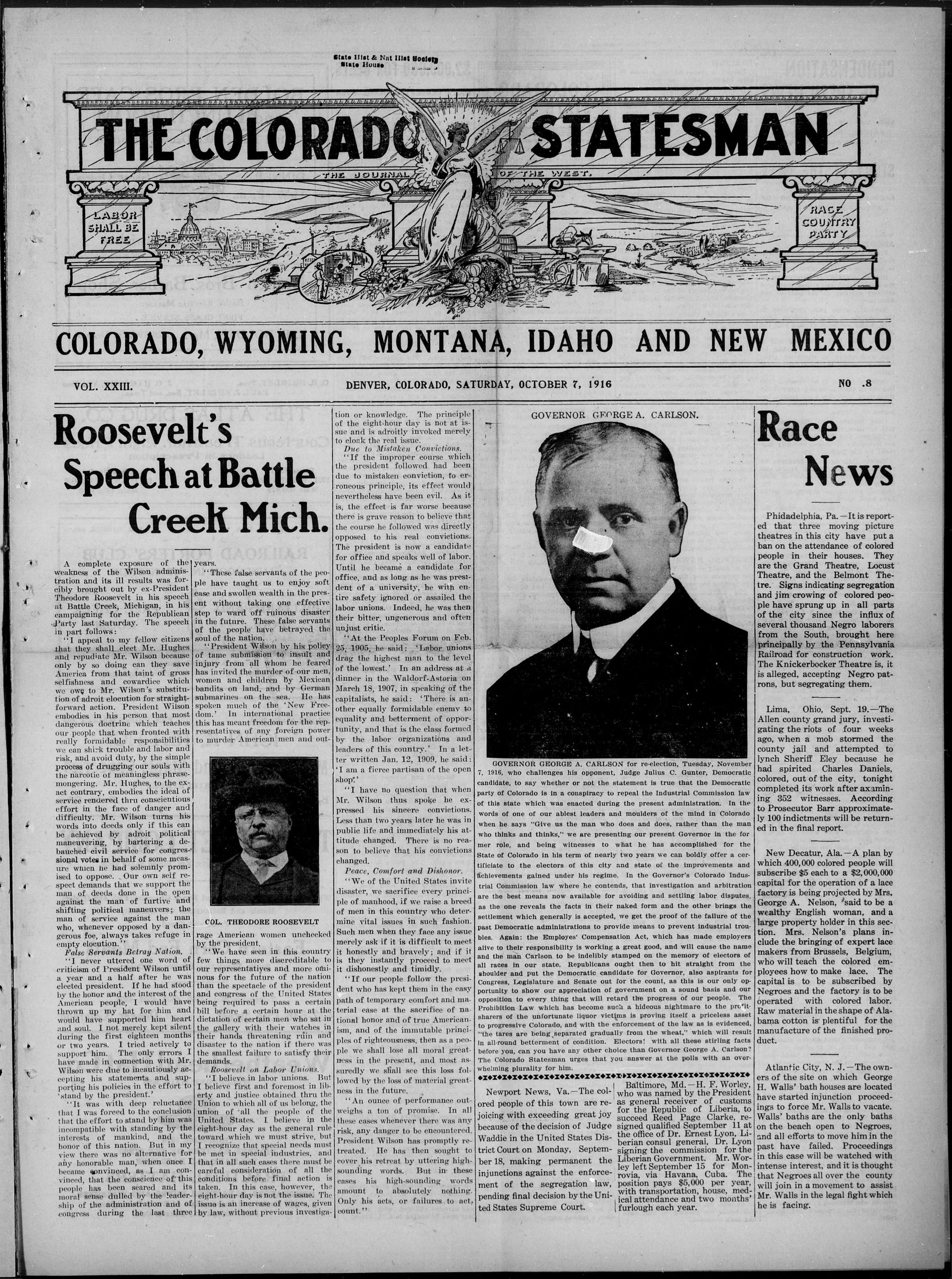
Roosevelt's Speech at Battle Creek Mich.
VOL. XXIII.
Roosevelt Speech a Crec
A complete exposure of the weakness of the Wilson administration and its ill results was forcibly brought out by ex-President Theodore Roosevelt in his speech at Battle Creek, Michigan, in his campaigning for the Republican Party last Saturday. The speech in part follows:
"I appeal to my fellow citizens that they shall elect Mr. Hughes and repudiate Mr. Wilson because only by so doing can they save America from that taint of gross selfishness and cowardice which we owe to Mr. Wilson's substitution of adroit elocution for straightforward action. President Wilson embodies in his person that most dangerous doctrine which teaches our people that when fronted with really formidable responsibilities we can shirk trouble and labor and risk, and avoid duty, by the simple process of drugging our souls with the narcotic of meaningless phrase-mongering. Mr. Hughes, to the exact contrary, embodies the ideal of service rendered thru conscientious effort in the face of danger and difficulty. Mr. Wilson turns his words into deeds only if this can be achieved by adroit political maneuvering, by bartering a debauched civil service for congressional votes in behalf of some measure when he had solemnly promised to oppose. Our own self respect demands that we support the man of deeds done in the open against the man of furtive and shifting political maneuvers; the man of service against the man who, whenever opposed by a dangerous foe, always takes refuge in empty elocution."
"I never uttered one word of criticism of President Wilson until a year and a half after he was elected president. If he had stood by the honor and the interest of the American people, I would have thrown up my hat for him and would have supported him heart and soul. I not merely kept silent during the first eighteen months or two years. I tried actively to support him. The only errors I have made in connection with Mr. Wilson were due to incautiously accepting his statements and supporting his policies in the effort to 'stand by the president.' "It was with deep reluctance that I was forced to the conclusion that the effort to stand by him was incompatible with standing by the interests of mankind, and the honor of this nation. But in my view there was no alternative for any honorable man, when once I became convinced, as I am convinced, that the conscience of this people has been seared and its moral sense dulled by the leadership of the administration and of congress during the last three
---
"These false servants of the people have taught us to enjoy soft ease and swollen wealth in the present without taking one effective step to ward off ruinous disaster in the future. These false servants of the people have betrayed the soul of the nation.
"President Wilson by his policy of tame submission to insult and injury from all whom he feared has invited the murder of our men, women and children by Mexican bandits on land, and by German submarines on the sea. He has spoken much of the 'New Freedom.' In international practice this has meant freedom for the representatives of any foreign power to murder American men and out-
T. H.
rage American women unchecked by the president.
"We have seen in this country few things more discreditable to our representatives and more ominous for the future of the nation than the spectacle of the president and congress of the United States being required to pass a certain bill before a certain hour at the dictation of certain men who sat in the gallery with their watches in their hands threatening ruin and disaster to the nation if there was the smallest failure to satisfy their demands.
Roosevelt on Labor Unions. "I believe in labor unions. But I believe first and foremost in liberty and justice obtained thru the Union to which all of us belong, the union of 'all the people of the United States. I believe in the eight-hour day as the general rule toward which we must strive, but I recognize that special needs must be met in special industries, and that in all such cases there must be careful consideration of all the conditions before final action is taken. In this case, however, the eight-hour day is not the issue. The issue is an increase of wages, given by law, without previous investiga-
DENVER, COLORADO, SATURDAY, OCTOBER 7, 1916
tion or knowledge. The principle of the eight-hour day is not at issue and is adroitly invoked merely to cloak the real issue. Due to Mistaken Convictions. "If the improper course which the president followed had been due to mistaken conviction, to erroneous principle, its effect would nevertheless have been evil. As it is, the effect is far worse because there is grave reason to believe that the course he followed was directly opposed to his real convictions. The president is now a candidate for office and speaks well of labor. Until he became a candidate for office, and as long as he was president of a university, he with entire safety ignored or assailed the labor unions. Indeed, he was then their bitter, ungenerous and often unjust critic.
"At the Peoples Forum on Feb. 25, 1905, he said: 'Labor unions drag the highest man to the level of the lowest.' In an address at a dinner in the Waldorf-Astoria on March 18, 1907, in speaking of the capitalists, he said: 'There is another equally formidable enemy to equality and betterment of opportunity, and that is the class formed by the labor organizations and leaders of this country.' In a letter written Jan. 12, 1909, he said: 'I am a fierce partisan of the open shop.' "I have no question that when Mr. Wilson thus spoke he expressed his sincere convictions. Less than two years later he was in public life and immediately his attitude changed. There is no reason to believe that his convictions changed.
"We of the United States invite disaster, we sacrifice every principle of manhood, if we raise a breed of men in this country who determine vital issues in such fashion. Such men when they face any issue merely ask if it is difficult to meet it honestly and bravely; and if it is they instantly proceed to meet it dishonestly and timidly.
"If our people follow the president who has kept them in the easy path of temporary comfort and material ease at the sacrifice of national honor and of true Americanism, and of the immutable principles of righteousness, then as a people we shall lose all moral greatness in the present, and most assuredly we shall see this loss followed by the loss of material greatness in the future.
"An ounce of performance outweighs a ton of promise. In all these cases whenever there was any risk, any danger to be encountered, President Wilson has promptly retreated. He has then sought to cover his retreat by uttering high-sounding words. But in these cases his high-sounding words amount to absolutely nothing. Only his acts, or failures to act, count."
GOVERNOR GEORGE A. CARLSON.
GOVERNOR GEORGE A. CARLSON for re-election, Tuesday, November 7, 1916, who challenges his opponent, Judge Julius C. Gunter, Democratic candidate, to say whether or not the statement is true that the Democratic party of Colorado is in a conspiracy to repeal the Industrial Commission law of this state which was enacted during the present administration. In the words of one of our ablest leaders and moulders of the mind in Colorado when he says "Give us the man who does and does, rather than the man who thinks and thinks," we are presenting our present Governor in the former role, and being witnesses to what he has accomplished for the State of Colorado in his term of nearly two years we can boldly offer a certificate to the electors of this city and state of the improvements and achievements gained under his regime. In the Governor's Colorado Industrial Commission law where he contends, that investigation and arbitration are the best means now available for avoiding and settling labor disputes, as the one reveals the facts in their naked form and the other brings the settlement which generally is accepted, we get the proof of the failure of the past Democratic administrations to provide means to prevent industrial troubles. Again: the Employes' Compensation Act, which has made employers alive to their responsibility is working a great good, and will cause the name and the man Carlson to be indelibly stamped on the memory of electors of all races in our state. Republicans ought then to hit straight from the shoulder and put the Democratic candidate for Governor, also aspirants for Congress, Legislature and Senate out for the count, as this is our only opportunity to show our appreciation of government on a sound basis and our opposition to every thing that will retard the progress of our people. The Prohibition Law which has become such a hideous nightmare to the profit-sharers of the unfortunate liquor victims is proving itself a priceless asset to progressive Colorado, and with the enforcement of the law as is evidenced, "the tares are being separated gradually from the wheat," which will result in all-round betterment of condition. Electors! with all these stirling facts before you, can you have any other choice than Governor George A. Carlson? The Colorado Statesman urges that you answer at the polls with an overwhelming plurality for him.
Newport News, Va. The colored people of this town are rejoicing with exceeding great joy because of the decision of Judge Waddie in the United States District Court on Monday, September 18, making permanent the injunctions against the enforcement of the segregation law, pending final decision by the United States Supreme Court.
Baltimore, Md.—H. F. Worley, who was named by the President as general receiver of customs for the Republic of Liberia, to succeed Reed Page Clarke, resigned qualified September 11 at the office of Dr. Ernest Lyon, Liberian consul general, Dr. Lyon signing the commission for the Liberian Government. Mr. Worley left September 15 for Monrovia, via Havana, Cuba. The position pays $5,000 per year, with transportation, house, medical attendance and two months' furlough each year.
NO .8
Race News
Phidadelphia, Pa. - It is reported that three moving picture theatres in this city have put a ban on the attendance of colored people in their houses. They are the Grand Theatre, Locust Theatre, and the Belmont Theatre. Signs indicating segregation and jim crowing of colored people have sprung up in all parts of the city since the influx of several thousand Negro laborers from the South, brought here principally by the Pennsylvania Railroad for construction work. The Knickerbocker Theatre is, it is alleged, accepting Negro patrons, but segregating them.
Lima, Ohio, Sept. 19.—The Allen county grand jury, investigating the riots of four weeks ago, when a mob stormed the county jail and attempted to lynch Sheriff Eley because he had spirited Charles Daniels, colored, out of the city, tonight completed its work after examining 352 witnesses. According to Prosecutor Barr approximately 100 indictments will be returned in the final report.
New Decatur, Ala. — A plan by which 400,000 colored people will subscribe $5 each to a $2,000,000 capital for the operation of a lace factory is being projected by Mrs. George A. Nelson, said to be a wealthy English woman, and a large property holder in this section. Mrs. Nelson's plans include the bringing of expert lace makers from Brussels, Belgium, who will teach the colored employees how to make lace. The capital is to be subscribed by Negroes and the factory is to be operated with colored labor. Raw material in the shape of Alabama cotton is plentiful for the manufacture of the finished product.
Atlantic City, N. J. -The owners of the site on which George H. Walls' bath houses are located have started injunction proceedings to force Mr. Walls to vacate. Walls' baths are the only baths on the beach open to Negroes, and all efforts to move him in the past have failed. Proceedings in this case will be watched with intense interest, and it is thought that Negroes all over the county will join in a movement to assist Mr. Walls in the legal fight which he is facing.
CONDENSATION OF FRESH NEWS
THE LATEST IMPORTANT DISPATCHES PUT INTO SHORT,
CRISP PARAGRAPHS.
STORY OF THE WEEK
STORY OF THE WEEK
SHOWING THE PROGRESS OF EVENTS IN OUR OWN AND FOREIGN LANDS.
Western Newspaper Union News Service.
ABOUT THE WAR
Fresh attacks by Rumanians along the entire front in Dobrudja results in repulses for the central powers.
Italians capture two lofty peaks on the Carso front and report increased artillery activity on the part of the Austrians.
Teutonic allies gain successes in the fighting in Galicia around Lemberg, while southeast of that city the Russians report gains.
More than 3,000 prisoners and a vast amount of munitions taken by Van Falkenhayn as result of great German victory in the Hermanstadt region.
Serbian troops have crossed the Danube in their campaign against the Bulgarians, and also have routed the enemy from four more towns in the region of Florina.
Field Marshal von Mackensen is said to have ordered the evacuation of Silistria and Turtukai, the important Rumanian fortresses recently captured by the Teutonic forces.
Violent fighting is in progress on the Russian front west of Lutsk and in Galicia, both sides resisting stubbornly the assaults of the other. Petrograd admits no important gains have been made.
The Central powers crushed the Rumanians in three-day battle in Transylvania. Rumania admits defeat, announcing that troops fought way through encircling lines of Germans and Austrians.
The Greek situation continues to develop. King Constantine, according to an Athens dispatch, has in his hands the resignations of the members of the Cabinet except those of the premier and the foreign minister
WESTERN
Fire in the Morris & Co. packing plant at Omaha entirely gutted that structure, entailing a loss estimated at $750,000.
Prices of cane sugar registered another advance at San Francisco, the new quotations being $7.10 per hundred pounds wholesale and $7.60 retail.
Early arrival in America of two Zeppelins bearing mail was predicted in San Francisco by Monroe P. Marks, who has just returned from a visit to Germany.
Brig. Gen. J. J. Pershing, at San Antonio, Texas, received official notification of his promotion to major general, filling the vacancy made by the death of Maj. Gen. Albert Mills. Testimony was concluded at Sidney, Neb., in the trial of Frank Connell, of Denver, charged with the killing of Ira Cox, farmer, last July, when fleeing from Sunol, Neb., after the robbery of a bank. Highest prices ever known at this season of year were registered for butter and eggs at Chicago, as further additions were made to an advance that had been almost continuous for the last two months.
It was announced at military headquarters at El Paso, Texas, that Battery B of Denver and Battery C of Colorado Springs, a part of the Colorado National Guard, would go into camp at Deming, N. M., upon their arrival at the border.
Wage increases or shorter hours were announced by the packers and garment firms in Chicago, to affect 80,000 workers, making an annual increase in pay rolls of $5,000,000. The packers' changes are to affect all plants of the firms involved in the United States.
W SHINGTON
Marked increases in the cost of living is shown in the rising tendency of prices of food stuffs on October 1.
United States Senator James P. Clarke, president pro tempore of the United States Senate, died at his home at Little Rock, Ark.
A complete report on the manufacture and price of gasoline will be made public by the federal trade commission within the next few weeks.
The geological survey reports that Colorado, Wyoming and Montana combined produced 347,397,000 cubic feet of natural gas in 1915. The output was worth $63,398.
The shooting of Capt. Wilson of the Second Idaho Infantry by a Mexican sentry at Nogales, Ariz. was reported to the War Department by Gen. Funston. Although the shooting was reported to be accidental and Capt. Wilson's wound is not serious, the Mexican was arrested by the Carranza authorities.
The greatest American relief camp to be undertaken since the organization of the Belgian relief commission was launched by the American committee for Armenian and Syrian relief.
FOREIGN
Belfast is preparing for a boom in ship building after the war.
British losses in Somme drive to date estimated at 300,000 men.
Count Okuma, the prime minister of Japan, resigned owing to his advanced age.
The London foreign office stated that the reply to the American note regarding the censorship of mails is on its way to Washington.
The British schooners William George, 151 tons, and Pearl of Truro, 144 tons, and the Norwegian schooner Manuel of Tonsberg, have been sunk.
A young English girl has written to Dr. Rochon Duvigneaud of Paris, offering to give one of her eyes to a soldier who has lost his sight serving France.
A Zurich dispatch asserted that the kaiser had personally appealed to President Wilson to end the war, but that the president had refused to intervene at this time.
Twenty-five workmen were killed through the collapse of a portion of the railway tunnel of the Vise-Aix-La-Chapelle line, according to the Amsterdam Echo Belge.
Gen. Carlos Ozuna arrived in Chihuahua City with 1,500 infantry and cavalry from Saltillo by way of Torreon to take the field in Western Chihuahua against the bandits, led by Villa and Jose Ynez Salazar.
In a fight which broke out at Managua, Nicaragua, during the election of G. Chamorro as president of the republic, Salvador Zelaya, a nephew of former President Zelaya, attacked a group of conservatives, shooting and killing four of them.
No alien of a nationality at present hostile to Great Britain may form business connections in the island of Jamaica for a period of twenty years after the termination of the war, according to the terms of a resolution adopted by the Colonial legislature at Kingston, Jamaica. Decrees issues at Mexico City by Gen. Carranza provide for the complete re-establishment of tribunals of justice throughout the republic. Governors are ordered to carry out the laws of each state according to the constitution and to appoint magistrates and judges for the regular term. All the courts must be in operation by November 1.
SPORTING NEWS
Abe Attell, of New York, was given the decision over Stanley Yoakum in his fight at Denver.
Kid Williams, the bantamweight champion of the world, outclashed Benny Kaufman, Philadelphia's best bantamweight, in six rounds at Philadelphia.
Brooklyn clinched the National league pennant Tuesday by defeating New York 9 to 6, while Philadelphia, the runner-up, was losing two games to Boston.
Mrs. J. V. Hurd, of Pittsburg, who, as Miss Dorothy Campbell, was champion woman golfer of this country, Great Britain and Canada, was medalist in the qualifying round of the women's national golf championship at Belmont Spring Country Club at Boston.
Two world's records were made by The Real Lady in winning the two-year-old division of the Kentucky futurity, the principal event of the opening day of the forty-fourth annual meeting of the Kentucky Trotting Horse Breeders' association at Lexington.
GENERAL
City Marshal Starr of Braggs, Okla., and Dart Dazzler were killed in a revolver fight in which John Marlow, a policeman, was wounded seriously. The tentative tax list of New York city on real estate for 1917, shows a total assessed valuation of nearly $8,000,000,000. The tentative assessment on personal property is placed at $500,000,000.
The body of a well-dressed and apparently wealthy woman about 60 years old, who had been shot twice in the head and robbed, was found in a clump of bushes just outside Grand Rapids, Mich.
Clarence Meyers, 23 years old, confessed that he murdered William Travis, 43 years old, a well-to-do farmer, living near Fremont, Mich., last October, to make clear the way for his marriage to Travis' wife, 42 years old.
Germany will be ready for any trade war her enemies may wage against her after the end of hostilities in the field, says Gen. Henry H. Morgan, United States consul general at Hamburg, who has just returned to New York from his post.
The wholesale clothiers' association of Chicago, employing 20,000 workmen, announced today that it would reduce working time in its factories from forty hours to forty-eight hours a week, but that pay would remain the same, and that time and a half would be paid for overtime.
Maj. Gen. George W. Goethals, governor of the Panama canal zone, arrived in New York from Colon on the steamship Pastores of the United Fruit line. Goethals said he did not expect to return to the canal zone, as he plans to retire from the army in December.
Ginning of the cotton crop is breaking all records. Announcement by the census bureau that 4,062,991 bales had been ginned, from this year's crop prior to Sept. 25, disclosed that all former totals for ginning to that date had been exceeded.
Oct. 6—Frontier Day Celebration at Castle Rock.
Oct. 12—Annual Poudre Cafon Plenio at Fort Collins.
Oct. 17-19—Meeting of Synod of Presbyterian Churches at Grand Junction.
Oct. 27—Farm Exhibit at Grand Valley.
Jan. 20-27—Annual Western Stock Show at Denver.
Feb. 2-4—Y. M. C. A. Annual Convention at Colorado Springs.
Sugar advanced 15 cents per hundred in Denver.
James H. Campion was killed by a tramway car in Denver.
Englewood has filed a petition asking to become a part of Denver.
The Colorado National Guard is now stationed at Camp Deming, N. M.
Over 72,000 sheep were received at the Denver Union Stock Yards Monday.
Over 150 delegates attended the annual convention of the W. C. T. U. in Pueblo.
The $1,000,000 estate of Adolph J. Zang will go to the widow and five children.
A community farm exhibit is planned by the people of Grand Valley and vicinity for Friday, October 27.
Autoists have been given the right to enter the spacious parks and playgrounds at Colorado Springs.
The Progressive mining property adjoining the Harvard, on North Fryer Hill at Leadville, has been reopened. A simple faith in sudden friendship cost F. M. Grider of Jefferson $6, according to a report made to Denver police. Fire destroyed the home of Bert Marsh near Fort Lupton. Mrs. Marsh was severely burned, but his five children escaped. It is rumored that the Bear Gulch property of the Colorado Fuel & Iron Company in Fremont county will resume operations. Mundell Brothers on Bear Creek, southeast of Artesia, have secured four cuttings of alfalfa this summer from sixty acres.
J. Bernard, candidate for county commissioner, and one of the wealthiest citizens of Boulder, died suddenly of apoplexy at Niwot.
A federal investigation into the increase in the cost of all foodstuffs was demanded by the Denver Housewives' league yesterday.
The cost of the proposed paving and lighting improvements in the South Side district of Pueblo is estimated that $500 for each pair of lots.
E. L. Kolb, of Grand Cañon, Ariz., and Beft Loper, of Torrey, Utah, successfully navigated the Westwater canon rapids of the Grand river, 30 miles west of Grand Junction in a canon.
According to the most reliable reports which come from the federal farm loan board, Fort Morgan boasts the first completed organization of farmers into a loan association in the United States.
Hurled from the platform of a Colorado & Southern train while it was traveling at the rate of forty miles an hour, Thelma Osborn, a 17-year-old high school girl of Denver, was dangerously injured.
Judge Thomas Henry Anderson, senior justice of the Supreme Court of the District of Columbia, author, lecturer and former minister to Bolivia, died in St. Joseph's hospital at Denver. He was 59 years old.
J. A. Frame of Mitchell, Neb., has written a letter in defense of the late John Wesley Arasmith, the Golden editor and high school principal, whose $10,000 estate has been claimed by Mrs. Samuel King of Chicago on the ground that she is his only daughter by his first marriage.
According to abstract of assessment Weld county property values are three million dollars higher than those of last year. There are 2,091 automobiles as against 1,216 for 1915. It is estimated that the population of the county is about 50,000.
Forty-four students of the University of Colorado were received into membership by the First Postbysterian church at Boulder as a result of the campaign for Sunday school and church attendance waged in connection with the nation-wide "go-to-Sunday-school-and-stay-to-church" day.
Charles Stevens, alias Savage, a Denver negro, convicted in 1908 of a sensational $50,000 mall robbery in Kansas City and characterized by federal authorities as one of the most notorious postal robbers in the country, was arrested in the home of his grandfather, Isaac Brown, at Denver.
Rex Yeager has been appointed member of the state embalming board and J. C. Bloom was reappointed a member of the state board of Optometry.
The cattlemen of Douglas county celebrated frontier day at Castle Rock. Bronco-busting, bronco relay races, steer roping and other cowboy games were the attractions.
The School of Mines at Golden enjoys the distinction of being the first civilian school in the United States to be designated by the war department a federal military college.
$2,000,000 FOR BEETS
FROM LARGEST ACREAGE EVER RAISED AT LONGMONT.
Slicing Begun From 2,600 Acres Will Bring Four and a Half Months of Prosperity.
Western Newspaper Union News Service.
Longmont, Colo.—The beet slicing campaign at the Longmont factory has opened. The campaign will be the longest in the history of the factory, lasting four and a half months, in which time the sugar will be extracted from 26,000 acres of beets, the largest acreage ever grown here. During the long campaign more than 600 men will be employed, and, in addition, another 150 will be employed at the different receiving stations.
Figuring on last year's production, a little more than twelve tons to the acres, on an average, the huge Longmont yield this year will be 312,000 tons. The average price last year was a trifle under $6 per ton. This year the company will pay 50 cents more per ton, or an average of $6.50, which will bring the grand total received by the farmers for their beets to $2,000,000 or more.
The beet crop has spelled prosperity to the Longmont section for several months. The growers will share their $2,000,000 to the extent of $500,000 for field work alone, nearly all of which will find its way over the counters of the Longmont merchant. Business men are reporting the most prosperous times in their history.
To Observe Fire Prevention Day.
To Observe Fire Prevention Day.
Denver.—Seventy-three per cent of the fires in the United States, according to the statistics which have been carefully gathered in every city, are due to carelessness. In other words, due caution could save almost three-fourths of the $500,000,000 worth of property destroyed annually, and prevent the loss of thousands of lives. These are conditions which have led to official recognition on the part of the president of the United States and governors of many states, including Governor Carlson of Colorado, of Fire Prevention day, October 9.
Veteran, 94. Weds; Bride, 78.
Colorado Springs.—Maj. Charles A. Gordon, 94 years old and veteran of four wars, was married here for the fifth time. The bride, who was Mrs. Margaret Dixon, is 78 years old and has been married four times. Major Gordon took his bride to the home of himself and his son, James E. Gordon, who is 78, the same age as his stepmother. Major Gordon, despite his 94 years, works daily at his occupation as caretaker of the interurban railway car barns.
Woman Guilty of Manslaughter.
Woman Guilty of Manslaughter.
Pueblo.—Mrs. Sadie Lawson, charged with the murder of Maximo Basquez on the night of Aug. 15, was found guilty of manslaughter after the jury had been out over five hours. The jury recommended the leniency of the court. The conviction of Mrs. Lawson was the second one of the week in which a woman was found guilty of manslaughter in the District Court. Mrs. Martha Gallimore received a like verdict for the murder of Albert Long.
Marshal and Woman Slain.
Fort Morgan.—Town Marshal Chas. Eyser, 55, and Mrs. Godfrey Weymer, were shot and killed in a lodging-house over the Manhattan Café, where the officer had gone to arrest John Swan and Roy Wilcox, cowboys, on the charge of drinking. As Marshal Eyser died he said, "John Swan shot me; take my gun!" It is believed Mrs. Weymer was killed by a bullet from Eyser's gun. The police later arrested Swan and Wilcox.
Sixty-Mile Gale Kills Man.
Cripple Creek.—A high wind which blew at a rate of about sixty miles an hour was responsible for one death and caused considerable minor damage. James Gaston, 74, a pioneer of this district, was killed when the wall of a log cabin was blown over by the wind and fell on him, crushing his skull. Death was instantaneous.
Man Says Wife Kidnaped Children.
Eaton.—That his wife, Mrs. J. H. Rogers, formerly of this city, came here in a motor car from Cheyenne, called their two young sons, Herbert and Gordon, from the school house, placed them in the car and carried them off, is the allegation of John Rogers.
Motion for New Trial for Dickens.
Boulder.—District Attorney Russell W. Fleming states that arguments in the motion for a new trial for Rlenzi Dickens, convicted of the murder of his father, William H. Dickens, on the night of Nov. 30, 1915, will be heard not later than Oct. 15.
Denver Postoffice Gains $5.150.
Denver.—The receipts of the Denver postoffice for September increased 4.15 per cent over the receipts of the corresponding month last year. In September, 1915, the receipts amounted to $123,851, as against $129,002 last month, a gain of $5,150.
Arrested for Shooting Stray Cows. Greeley.—Lloyd E. Dorssey, 23, a ho.nesteader of the Grover district was arrested charged with shooting four cows belonging to J. H. Eaton.
924 19th Street, Denver, Colorado
DINNER
11:30 to 2 p.m.
All Ki
Bolden
Ba
FI
R. B. BOLDE
A. H. SHIRLEY, Pres.
PAUL J.
THE AT
Courteous T
Leade
All Kinds of Sandwiches
Harden Bros. Barber Shop
Baths, Electric Massage
FIRST CLASS SERVICE
BOLDEN, Mgr. 926 19th St.
LEY, Pres. J. O. HAMPSON
PAUL J. SHIRLEY, Sec. and Treas.
E ATLAS DRUG CO.
Ous Treatmet. Right Leaders in Prescription
1. Store
ON ST. 26TH ANN
175 Main 4
PTON, Pres. J. B. MILK
HALROAD PORTERS' CHE
LUNCHOOM IN CONNECTION
ARDS AND
COOL FREE C
ROO
28½ Wazee St. Only one block from Union De
J. B. MINTER, Barber.
NE MAIN 8416. DENVER, COLOR
N 3023 RES. PHONE C
JOHN K. RETTIGER
Fancy and Staple Gro
1864 CURTIS STREET
seventh.
MARKET COMP
E. SMITH, Manager, Res. Phone South 10
d Retail Staple and Fancy Groceries, Fish
Hotels and Restaurants Our Specialty.
Fresh and Cured
Eastern Corn Fed Me
Fruits, Vegetables, Poultry and Game.
Telephones Main 4302, 4303, 4304, 4305
15th Street Denver,
atherhead Ha
TELEPHONE MAIN 3203
All Kinds of Sandwiches
Bolden Bros. Barber Shop
Baths, Electric Massage
FIRST CLASS SERVICE
R. B. BOLDEN, Mgr. 926 19th St. Denver
C. H. SHIRLEY, Pres. J. C. HAMPSON, Vice Pres PAUL J. SHIRLEY, Sec. and Treas.
Courteous Treatmet. Right Prices Leaders in Prescription
W. C. CAMPTON, Pres.
RAILROAD
LUNCHC
BILLIARDS A
POOL
1728½ Wazee
J
PHONE MAIN 84
PHONE MAIN 3028
JOHN
Meats, Fancy
180
Corner Nineteenth.
The MAR
C. E. SMITH,
Wholesale and Retail St
Hotels an
Eastern
Fruits, V
Telephone
622-636 15th St
Weathe
TE
RAILROAD PORTERS' CLUB LUNCHOOM IN CONNECTION
PHONE MAIN 3028 RES. PHONE GALLUP 942 JOHN K. RETTIG Meats, Fancy and Staple Groceries 1864 CURTIS STREET Corner Nineteenth. Denver, Cola.
The MARKET COMPANY
C. E. SMITH, Manager, Res. Phone South 1608
Wholesale and Retail Staple and Fancy Groceries, Fish and Oysters. Hotels and Restaurants Our Specialty. Fresh and Cured Eastern Corn Fed Meats Fruits, Vegetables, Poultry and Game.
Telephones Main 4302, 4303, 4304, 4308 622-636 15th Street Denver, Colorado
Established 1876
PIONEER HATTERS OF THE WEST
WE MAKE OLD HATS NEW
PRACTICE
RENOVATORS, BE
Of Gents' and
1624
PRACTICAL HATTERS
ATORS, BLEACHERS DYERS AND FILM
Gents' and Ladies' Hats of Every Descrip
1624 Champa St., Denver, Colo.
RENOVATORS, BLEACHERS DYERS AND FINISHERS
Of Gents' and Ladies' Hats of Every Description
1624 Champa St., Denver, Colo.
Store No. 1.
2701 WELTON ST.
Main 895 875
Short Orders at All Hours
ndwiches
Ber Shop
message
VICE
26 19th St. Denver
C. HAMPSON, Vice Pres
and Treas.
RUG CO.
Right Prices
Description
Store No. 2
26TH AND WELTON
Main 4955 4956
J. B. MINTER, Sec.
ERS' CLUB
NNECTION
FREE CHECK
ROOM
From Union Depot.
VER, COLORADO.
S. PHONE GALLUP 942
TTIG
Apple Groceries
SEET
Denver, Colo.
COMPANY
Phone South 1608
proceries, Fish and Oysters
or Specialty.
ed Meats
and Game.
, 4304, 4305
Denver, Colorado
Hat Co
3203
ATTERS
RS AND FINISHERS
Every Description
er, Colo.
VINE
```markdown
```
AFRO-AMERICAN CULLINGS
When Booker Washington published his account of his own life 15 years ago, at the moment the National Negro Business league had just been launched, before the library at Tuskegee for which Carnegie partly paid had been built, and before the famous lunch with President Roosevelt, his educational work was in full tide. It is now possible to see his labors as a whole and in perspective, as well as to give him credit for many accomplishments that with natural modesty he himself attributed largely to circumstances or to others.
The main facts in Booker Washington's career are well known: How he was born in a slave hut in a remote part of western Virginia, a year or two before the Civil war broke out; how after the war his stepfather and mother (his father is unknown) removed to Malden, W. Va., to work there in salt and coal mines; how, held back by his step-parent but encouraged by his mother, he learned to read and attended night school; how in 1872 he walked, begged, and worked his way to Hampton institute; and how after his graduation from Hampton, the path of opportunity opened before him when in 1881 he was appointed organizer and teacher of a new Negro normal school at Tuskegee. Many may not know that the most important day in his later career was that on which he delivered an address in 1895 at the Atlanta and Cotton States International exposition—one for which President Cleveland sent him a letter of thanks. A few doubtless know that the last ten years of his work were done with a body and nervous system worn out by incessant labor, so that repeatedly he was on the point of breaking down. This is told in a recent publication with all the detail which is possible in a volume of 300 pages, and in a manner not unskilled. The marshalling of facts is effective, though there is some repetition; and if the style is undistinguished and sometimes awkward, and the general paragraphs or chapters on "the times" of Washington vague and clumsily interpolated, the writer atones for this by the manifest enthusiasm he brings to his book. He feels, though he cannot fully express, the touch of the epic in this first great Negro leader's career.
The steady advance of the American Negro is a conspicuous proof of the principle that progress can be had by peaceful methods. Year by year Tuskogee institute issues a "Negro Year Book," which is a sort of log of the forward movement of the race. The 1916 edition has just been issued.
At the particular moment the matter is one of unusual national importance because of the new migration which is sending Negroes from the South to the northern and western states. The European war seems to be opening closed doors to the race. With the stoppage of immigration and the actual dearth of labor in some fields fresh opportunities have come to the farm workers of the South. Negroes are replacing aliens from many nations.
This industrial migration will doubtless have far-flung effects. If it advances sufficiently it may lessen the tension of the race problem in the South. At the same time the greater educative facilities of the North and West are likely to play a powerful part in making the southern Negro something different.
Altogether the unconscious turn of
More than 1,000 kinds of sausages are known in Germany.
Kern county, Cal., contains 55,842 acres of proved oil lands.
An enamel to glaze pottery without the use of heat is a German invention.
The government of India has prohibited the importation of sulphur matches.
The Russian government controls the prices charged for medical prescriptions.
The Chilean government has appointed a commission to make a study of the water power available for hydroelectric development.
A dredge built in Holland for the government of Uruguay crossed the Atlantic ocean under its own steam.
A recently patented combined typewriter table and chair fold together to form a cover for a machine and to economize floor space.
Of English invention is a new lubricant for cutting screw threads in aluminum more satisfactorily than heretofore possible.
Several types of compressed air operated hoisting machines have been designed for use in places where the are hazard is great.
A machine has been perfected in Saxony that embroiders designs upon three dozen pairs of stockings at once, a battery of needles making 288 atlantic simultaneously.
events has opened a new chapter in the history of the American Negro, a chapter more fateful than any written since the great reaction of apathy settled upon the nation after reconstruction days. Once more the Negro is becoming a vital problem.
The most impressive development of the last few days so far as the Negro is concerned is the moral fatigue with which white people have viewed him. For a long time the country traveled on the moral momentum generated by the abolitionists and by the political results of the Civil war. That no longer exists. Outside of a small group of relatively dumb reformers, nobody cares seriously. Disfranchisement is an accepted principle in the South. "Jim Crow" laws no longer arouse comment. Segregation is growing, South, West and North. The most frequent feeling on the part of whites is one of helpless, hopeless acquiescence in forces which they feel unable to challenge.
The old belief in equality is dormant. Orators will not admit it, no one whose political faith must be on parade can afford to admit it, but the truth is that race prejudice was never stronger. Not even the Christian brotherhood of man is a powerful enough motive to weld together different races belonging to the same religious denomination.
Until the European war shut off immigration and forced American industry to summon the workers of the South segregation of all kinds appeared destined to grow greatly. The movement was from below. Largely it lacked leaders. But it swept on. The same ruthless instincts and the same moral fatigue exist today. Yet industrial necessity has brought forward new factors. In the factory, shop and construction camp another future is opening.—John Vance Cheney, in the Chicago Herald.
With commemorative exercises of dignity and eloquence the little log cabin that was Lincoln's birthplace has been set apart as a shrine. One lesson of the great life of the emancipator, a lesson for two races and for all mankind, has been that the humblest origin need not prove a mortmain to check the will to rise. The Southern Workman tells the story of one who came "up from slavery" in an Alabama town. The father of John Guss Frazer was a freedman. The son went from the farm to town and entered the service of a tailoring establishment. He was paid 30 cents a day for errands and odd jobs. He watched the others press clothes, and soon he had an iron in his hand and was earning a dollar. Finally he bought the business. Then, with one chair, he started a barber shop. He bought and sold cattle. He purchased a cement-block machine, made his own blocks and built a three-story building to hold the barber shop, a store, a lodge room for rental and an undertaking establishment. He built a house for himself and beside it a cottage hotel. The buildings are all of them erected on the very ground where his father once worked as a slave. Yet there are cynics who hold that a man who is born to a lowly lot in life must fold his hands in the tacit acceptance of a providential dispensation, and deny to the world the inspiring pattern of "toll unsevered from tranquility."
As a mineral producer Alabama ranks first among the southern states.
More than 27,000 tons of honey are produced annually by the American bee.
Lightning is more frequent in Illinois and Florida than in any other states.
A sanitary guard has been invented to prevent persons handling spigot outlets.
Skins of the damson plums are being utilized in England to produce a blue dye.
In times of peace London contains 16 embassies and legations representative of foreign countries.
Pilers have been patented by an Illinois inventor to split insulation and remove it from wires neatly.
As a race, the tallest people in the world are the Bororos, of the south-west of Brazil. They average six feet four inches in height.
Several French lighthouses have been equipped with lenses that enable their lights to be seen from fifty to sixty miles at sea.
Numerous economies are claimed for a new automobile that can be run by gasoline or electricity or a combination of the two.
British aviators have found that horsehair cushions provide enough elasticity to counteract the vibration of aeroplanes and make the use of magnetic compasses possible.
READY TO HUNT VILLA
COLORADO MILITIA DEPARTS FOR BORDER DUTY.
Arduous Camp Life of Months Ended and Boys Thrill at Hope of Action at the Front.
Western Newspaper Union News Service. Denver.—With the waving of handkerchiefs and khaki hats, the puffing of engines, the crunching of air brakes, the creaking of car wheels and the hilarious cheers of nearly 300 eager, happy soldier boys, the two special Santa Fé trains bearing the members of Batteries B and C and the headquarter's detachment of the Colorado National guard pulled away from the tranquil tents and dreamy camp fires of the state mobilization grounds Sept. 30 for the less tranquil, if not less dreamy, border of Mexico.
The last day was a busy one at the rifle range for the boys of the first separate battalion of artillery—a day of noise, of busling activity, of excitement and of anticipation. But they worked hard and shortly after 10 o'clock the commanding officers announced they were "ready to hunt Villa" and the boys left for the border. There were many fond farewells for fathers, mothers, sisters, brothers, wives, sweethearts and friends swarmed in crowds about the mobilization grounds all afternoon. Battery B is from Denver and Battery C from Colorado Springs.
The headquarters detachment is composed of four officers and about seventeen men. The officers are Major William Fletcher Sharp, Capt. H. C. Nickerson, adjutant; Lieut. Louis G. Carpenter, quartermaster; Lieut. Thos. Slayton, veterinarian, and Capt. Harry F. Finney, medical officer. Major Sharp will be in chief command of the troops.
The first train carried nine officers and about 134 men and was made up as follows: One baggage car, ten stock cars, seven flat cars, four box cars, three tourist sleepers and one standard car. The other train had one less box car and two less stock cars and carried four officers and about 11 men.
The batteries took eight 3-inch guns, four to each battery; 341 horses, 37 mules, 7 wagons, a kitchen car, a car of hay, a car of straw, a car of oats and a sufficient quantity of rations to last three days. The men all are thoroughly trained, according to Major Sharp, and are ready for active service, having been drilled in every department of artillery practice. Only two men were unfit to go with their respective units to the border, according to Captain Leonard S. Hughes, sanitary and medical inspector. Those two were discharged from the service for disability.
Democrats Adopt State Platform.
Many measures embodying their declared ambition "to build a better commonwealth" are included in the Democratic state platform, issued by the State Democratic candidates. The document is as long as the one issued by the Republican candidates and touches upon many of the same subjects. It devotes considerable space to praise of Wilson and his administration. Improved roads, creditable investment of state school funds, extension of mothers' compensation work, more effective prohibition statutes, a minimum wage law for women and minors, state help for the State Humane Society, and co-operation with the federal government in the storage of irrigation waters in Colorado are among the most important planks.
Republicans Adopt Platform.
Limitation on the importation of liquors into the state, strengthening of the prohibition enforcement law, continuance of the work of the State Survey Commission to increase efficiency and economy in the state government and constructive legislation on more than two score other subjects are indorsed in the Republican state platform adopted by the party's state candidates at a meeting with Phillip B. Stewart, Republican state chairman.
Mrs. Watson Looking for Brothers
Governor Carlson has been asked to assist a San Francisco woman, Mrs Anna Emery Watson, to find her two brothers, Henry and William Emery, who were at Rocky Ford several years ago. The men are of middle age. Mrs Watson lives at 2402 California street, San Francisco.
Assessments Reduced About $6,000,000
The Denver County Board of Equalization reduced the assessments on the property of the Denver Tramway Company and the Denver Gas and Electric Light Company. The total reduction of valuation of the property of the two companies is a little more than $6,000,000.
Building Permits Increasing Steadily.
With the erection of four office buildings of the value of $151,000 twenty-eight brick residences, costing $123,800, and forty-eight garages, costing $37,790, the September record of permits issued in the building department of Denver continues the increase in the value of constructions made this year over last. For the first nine months 1916 shows an increase of $1.122,120 in value for buildings erected as compared with the same period of 915.
RAILROAD GAINS ARE PHENOMENAL
RAILROAD GAINS ARE PHENOMENAL
THE GROSS EARNINGS FOR COUNTRY SHOW $1,434 PER MILE AGAINST $1,202 IN 1915.
REPORTS OF 126 ROADS
EXTRAORDINARY INCREASE DUE
TO GENERAL REVIVAL
OF BUSINESS.
Western Newspaper Union News Service.
Washington. — Railroad earnings
continued their phenomenal upward
trend during August, according to
statements filed by carriers with the
Interstate Commerce Commission.
The gross earnings for the country
averaged $1,434 per mile, as against
$1,202 in August, 1915, while the net
earnings this year averaged $536, as
against $426 last year.
In the eastern district net earnings
this year averaged $871 and last year
$744; in the southern district $358
and $270, and in the western district
$461 and $345 respectively.
The reports were made by 126 of the largest carriers in the country, who scheduled gross operating revenues of $425,131,154 for the two months year, as against $359,802,536 last year, and $220,453,001 for August this year, as against $184,197,263 for August last year.
While gross earnings and net earnings are both increasing rapidly, expenditures are going ahead also, according to the reports, which indicate that they increased from $118,940,675 in 1915 to $138,023,776 in August, 1916.
GEO. A. JOSLYN IS DEAD
President of Western Newspaper Union Passes Away at Home in Omaha From Paralytic Stroke. Omaha.—George A. Joslyn, president of the Western Newspaper Union, died of a paralytic stroke October 4 at his home here. He was one of Omaha's leading business men, and it was largely through
J. B.
GEORGE A. JOSLYN. his guidance that the Western Newspaper Union has become the large publicity concern it is, having offices in thirty-one cities in different parts of the country. Mr. Joslyn is survived by his wife, and adopted daughter, Mrs. David Magowan.
THOUSANDS OF RUSSIAN DEAD.
Russians in New Thrust Push Lines Nearer to Lemburg.
London, Oct. 5.—The fierce battle which has been raging for several days west of Lutsk, in Volhynia, is still without a decisive result for either side, while in Galicia, along the Zlota Lipa river, where the Russians are trying to push through to Lemberg, the Austro-German forces still are holding back the Russians.
Berlin, in its official account of the fighting near Lutsk, says the Russian dead number thousands.
Bucharest still is silent with regard to the operations of Rumania's troops which crossed the Danube river between Rustchuk and Turtukai and invaded Bulgarian territory. Berlin says, however, that these men have been withdrawn.
Operations on the Somme front are greatly impeded by heavy rains and virtually the only activity reported is that of artillery. King Constantine has accepted the resignation of the Greek cabinet and a new ministry is to be formed.
CONNELL GUILTY OF MURDER.
Former Insmont Postmaster Convicted of Stlaying Man After Holdup.
Sidney, Neb.—J. F. Connell, former postmaster of Ansmont, Colo., was found guilty of first degree murder and sentenced to life imprisonment for the murder of Ira C. Paup near Sunol, Neb., July 28 last. Connell and Granger Lukens of Denver were charged with killing Paup and Paul Vasik following the robbery of the State Bank of Sunol.
The
Curtis
Park
Floral
Company
FLORAL DESIGNS PUT UP WHILE
YOU WAIT
CHOICE PLANTS AND CUT FLOWERS CONSTANTLY
ON HAND
GREENHOUSES: Thirty-Fourth and Curtis Streets
TELEPHONE, MAIN 1511
DENVER, COLO
The Champa Pharmacy
When You Want
The Heads, Feet, Tails, Snouts, Neckbones or Chiterlings, or any other part of the hog except the squeal, go to
East's Market
The
WARD AUCTION
COMPANY
Sales Daily at 2 p.m. Office Furniture a Specialty.
PRIVATE SALES AT ALL TIMES
HAVE MOVED TO
1723-39 GLENARM ST.
PHONE MAIN 1675.
THE BEST ICE CREAM AND
CANDIES AT
O.P. BAUR & CO.
CATERERS AND
CONFECTIONERS
Phone: 168
Phone: 168
1512 Curtis Street, Denver, Colo.
JOSEPH CARTER
Express, Moving,
and Storage
COAL AND WOOD
PROMPT DELIVERY.
Phone Main 6544.
2415 WASHINGTON STREET.
TELEPHONE YORK 6668.
J. H. Biggins
GENERAL FURNITURE REPAIRING
AND UPHOLSTERING.
WORK GUARANTEED.
1417 East 24th Avenue, Denver, Colo.
2300-6 Larimer Street Phone Main 1461
Phone Main 4896 1848 Arapahoe
乐泽轩
Miss M. Cowden Hair Dressing Parlor
Shampoo, cutting and curling. Scalp treatment, hair tonics, hair straightening, manicuring. Stage wigs for rent; theatrical use and masquerades. Goods delivered out of the city. All shades of hair matched by sending sample of hair; also combings made up.
Cheapest Switches 50 Cents
1219 21st St. Denver, Colo.
DO IT NOW Subscribe for THIS PAPER
THE COLORADO STATESMAN
LABOR HALL OF FREES
MASS COUNTY PARTY
Entered as second-class matter at the postoffice in the City of Denver, Colo.
Reading notices, ten lines or less, 10 cents per line. Each additional line over ten lines, 5 cents per line. Display advertising 50 cents per inch.
Remittances should be made by Express Money Order, Postoffice Money Order, Registered Letter or Bank Draft. Postage stamps will be received the same as cash for the fractional part of a dollar. Only 1c and 2c stamps taken.
No discounts allowed on less than three months' contract. Cash must accompany all orders from parties unknown to us. Further particulars on application.
Communications to receive attention must be newsy, upon important subjects, plainly written only upon one side of the paper, must reach us Tuesdays, if possible, anyway not later than Wednesday, and bear the signature of the author. No manuscript returned, unless stamps are sent for postage.
All communications of a personating nature that are not complimentary will be withheld from the columns of this paper.
RECOGNIZED BY THE RETAIL ASSOCIATION OF THE DENVER CHAMBER OF COMMERCE AS AN ADVERTISING MEDIUM OF THE FIRST CLASS.
THE COMING TEST.
the test of the Negro's self-reliance he grew up to him next month. It is not the daily wants may be provided for, but out of the heedless conditions of responsibilities strange and new, but a keener appreciation of vital inure welfare as a citizen and deterrent privileges of a free man.
The political and is to be fought out, closing of the President of the United States four years have combined to be better of the issues upon which candor more than forty years the color of the cast his ballot had something easy to develop as a freeman and a action has been an evidence of his the Republican party has clung to the public life of the nation's great and strong, have forged to the most unruvenous tutelage of men of greed will have driven into the backgroun-ive issues which heretofore appeals and issues have given interests, abandonment will mean the elimination factor in all parts of the Union. Still already in the South, but the war and more subtle tactics. The politics is to be the policy in the main actively dominant. Closer to upon industrial matters, and a cost, is the ambition of these new and West.
The most severe test of the Negro's self-reliance that he has ever been called to face will be up to him next month. It is not a matter of industrial activity by which his daily wants may be provided for, as was the case when he was forced to step out of the heedless conditions of slavery and adjust himself to personal responsibilities strange and new, but it is a trial requiring a finer intelligence, a keener appreciation of vital influences having direct bearing upon his future welfare as a citizen and determining his capacity to employ and enjoy the privileges of a free man.
This test is to be political and is to be fought out in the course of this campaign for the choosing of the President of the United States. Swift-moving events of the past four years have combined to bring about a complete change in the character of the issues upon which candidates for office go before the people. For more than forty years the colored voter has felt that the manner in which he cast his ballot had something to do with the opportunity he might enjoy to develop as a freeman and a citizen, and the solidarity of his political action has been an evidence of his faith and trust in the principles to which the Republican party has clung and which formed the basis and bulwark of the public life of the nation's greatest statesman. But new ideas, vigorous and strong, have forged to the front in the last four years, and under the strenuous tutelage of men of great political power and dauntless personal will have driven into the background the sentiments as well as many of the live issues which heretofore appealed to the people, and with these sentiments and issues have given interests so vital to the Negro that their continued abandonment will mean the elimination of the Negro as an important political factor in all parts of the Union. This object has been accomplished practically already in the South, but the work in the North and West requires stranger and more subtle tactics. The abandonment of all race controversies in politics is to be the policy in the North and West, while in the South they remain actively dominant. Closer touch among the white people of the nation upon industrial matters, and a compromise of sectional feeling at whatever cost, is the ambition of these new thinkers and wonder-workers of the North and West.
TO MAKE THE NEGRO WORK
to think that the Negro has to be able of demonstration, it really ap- is not universally so, but the reg-eral characteristic that the proble-
Did you ever stop to think that the Negro has to be made to work?
As a truth capable of demonstration, it really appears that this is the case. Of course, it is not universally so, but the requirement seems to fit him so well as a general characteristic that the problem is engaging the attention of the world's civilizing and developing forces, especially upon the Negro's native hearth.
Work, industry, hard labor and struggle, are the voluntary obligations assumed by civilization, and civilized society would be short lived if this obligation were not perpetually fulfilled.
That the Indian will not work is proverbial, and because of that fact he has steadily faded before the advancing and overwhelming forces of industry. As a rule, the Negro in Africa does not have to work to live, any more than the American Indian had to work, but he can work and will work under various forms of persuasion, inducement or compulsion. Slavery was compulsory labor, and though its barbarous injustice and accompanying horrors condemned it finally in the eyes of all civilized people, it inculcated in the American Negro the habit of industry and gave him the necessary and acceptable means of protecting and sustaining himself as an independent, emancipated part of society. Here, necessity compels all men to work, and it is well that it does. But the African nature is unchanged, and the white man is taking possession of and developing Africa because the African does not realize that labor is necessary to develop and the mastery of the earth. But the white man is unable to work in tropical Africa, or any where else in the tropics, it seems, and so he is endeavoring to induce the Negro to work, for the development of the Negro's own country, for the benefit and control of the white man. And he reports that he is succeeding. Where slavery or other form of compulsion failed, the principle of adequate compensation, based upon the amount of work accomplished, is leading the native Negro into the ways of regular labor. Regular labor, free labor, voluntary labor—is the source of all human development.
It is well for the Negro that he can and will work
Southern Woman Looks Vainly For "Jim Crow" Car
(From Chicago Defender)
Chicago, Ill., Sept. 19.—Daisy Chaucy (white) 751 North Dearborn street, hailing from North Carolina, the home of the Bleases and other race-hating people, undertook to pass a "Jim Crow" law in this city last Wednesday morning and put it in force. It resulted in her arrest, a night in the Clark street jail annex and her being lectured and fined by Judge Goodnow, Saturday morning. But that is not all.
Mrs. Antoinette Barrow Milton 2902 Vernon avenue, a lady of fine character, owner of her home boarded a south bound Cottage Grove avenue car last Wednesday morning. The car being crowded and no one offering her a seat because of her color she stood till the car reached Randolph street when a white man, who had been conversing with a white girl, arose to get off. Mrs. Milton started to sit down in the empty seat, but this little stubborn southern winch moved on the out side and put her hands on the back of the seat in front of her, telling Mrs. Milton she could not sit there. A few words followed when Mrs. Milton forced her way into the seat and proceeded to look out the window.
"Better make her move," shouted the southern white.
Mrs. Milton paid no attention. "Do you think I would set beside one as black as you," shouted the girl. Mrs. Milton said nothing. The girl pulled out her hatpin and attempted to stick Mrs. Milton with it, but the latter forced it out of her hand before she could use her weapon. Again the white girl started on her rampage, this time cursing. Finally a white boy yelled at her, "Aw, sit down; that woman is as good as you are." Then that did start things a-fresh. The white girl turned her attention on to the white boy.
Mrs. Milton followed the girl from the car when she alighted at Adams street to Wurlizters music house, where she worked. Then she made for the central police station, swearing out a warrant.
The warrant was given to Detective Sergeants Cohen and Russel, both white, failed in their duty. So Sergeant Rhoades and officer Glenn were put on the job.
Upon entering the Wabash avenue store they easily learned the whereabouts of the Chauncy girl, for she had bragged about what she had done to a "N woman." The detectives, accompanied by Mrs. Milton, went to the general manager and pointed the girl out.
Detective Rhoades stepped quietly up to the girl and told her she was under arrest. "Well, you don't think I'm going with the likes of you, do you?"
"Well, madam, you will go with me willingly or we will have to take you by force. This southern attitude you have might just as well drop now," answered the officer.
"It's too bad they don't send a white man," retorted back the girl.
At that remark the proprietor of the store, hearing the conversation, stepped up and told the girl that he wouldn't stand for any disturbance, that she was under arrest, the men had a warrant for her and that they were officers of the law and she must go with them.
Miss Chauncy was locked up in the Clark street annex, where she awaited trial Saturday morning.
The judge lectured her severely saying that the fine should be much larger. "Your case is really one of assault and battery with intent to kill. You are not in North Carolina. You are living in a land where all people are free and alike regardless of color
or creed. You are fined $5 and cost."
---
A young white man stepped forward and paid the fine.
THE COLORADO STATESMAN
FOR SIXTEEN YEARS HAS FOUGHT FOR CONGRESS
Aaron P. Prioleau of Eutawville, S. C., for sixteen years has been fighting to establish his right to a seat in the Congress of the United States. He was a candidate for Congress from the First Congressional District of South Carolina at each election during the past sixteen years, the district having a large majority of Negro residents.
Each time the democratic election managers have counted him out and each time he has instituted a contest. He has a contest pending now for his right to a seat in the 64th Congress. This contest was argued last March, and the committee on contest has reported against Mr. Prioleau, but final action has not been taken.
The Mouth-Piece of the People of Colorado and the Entire West
Although Congress appropriated the sum of $2,000 for expenses contracted by a contestant, Mr. Prioleau has not been able to secure the payment of this sum from the 62d and 63d Congresses. He claims that because of the holding up of his claims he has had to mortgage his farm lands in Eutawville to the extent of $4,000 to meet the expense attaching to his contests.
Mr. Prioleau declares that in the campaign this year an effort will be made to have the Republican party represented by a white man who is friendly to the race, but if that is not possible he will again be a candidate, as he will not consent that the party should not be recorded as making a fight for representation. he is delivering lectures at various points around New York.
RELIABLE chronicle of their doings and progress; a faithful mirror of their wants, their hopes, their best aspirations.
STATEMENT OF THE OWNERSHIP
MANAGEMENT, CIRCULATION,
ETC., REQUIRED BY THE ACT OF
COGRESS OF AUGUST 24, 1912,
OCC 10C 2016 STATESMAN,
Published Weekly at Denver, for October
2, 1916.
THE COLORADO STATESMAN
Unequaled as an advertising medium for the business of professional men and women.
An excellent family journal speaking to and for many thousand colored citizens.
TWO DOLLARS A YEAR
THE GREAT ORGAN
BUY GOOD BOOKS.
Unequaled as an advertising medium for the business of professional men and women.
An excellent family journal speaking to and for many thousand colored citizens.
TWODOLLARSAYEAR
BUY GOOD BOOKS.
Negro Year Book, just off the press. A compendium of useful knowledge of the Negro race.
Life of Booker T. Washington with free picture, $1.25.
Paul Lawrence Dunbars complete poems, cloth bound, $1.75.
Postage 10c extra on each book.
For sale by The Colorado Statesman, 1824 Curtis st., Room 25.
Or J. H. Doniphan, 1721 Marion st
THE COLORADO STATESMAN
LABOR SHALL BE FREE
NASS COUNTY PARTY
is the only Negro paper recognized by the Retail Association of the Denver Chamber of Commerce as an advertising medium of the first class.
Phone:
Main 7417.
Mrs. John Frazier, of 3019 Franklin street, entertained last Thursday evening at supper, Mrs. Williams, of Kansas City, and Mrs. Thompkins.
Mrs. Marjorie Colston Edwards arrived in the city Tuesday from Ellis, Kan., visiting her mother and friends; she will return home today.
Mrs. G. A. Logan of 2361 Ogden street, returned to the city after visiting with relatives and friends in Moberly, Mo., Atchison and Topeka, Kan.
John W. Allen, head waiter of the Boulderado hotel, made a flying trip to Denver last Tuesday, returning Wednesday evening. He reports conditions very favorable in Boulder for our people, and his staff, consisting of Messrs. Kinney, Evans, Buckhalter and Master Frank Smith, are his admirable supporters in preserving and maintaining the prestige that colored employees have succeeded in establishing at this magnificent hostelry. Mr. Allen was a pleasant caller at our office.
Henry J. Foster and George B. Burrell, employés of Mr. Frank Trumbull, formerly of Denver, and now one of the chief executives of the railroads throughout the country, also member of the Tuskegee Institute Board of Trustees, arrived in the city last Saturday. Messrs. Foster and Burrell are delighted with the opportunity to see relatives, friends and associates, they being former Denverites, and what, with the continuous round of receptions in their honor, the Hello, Henry! and Hello, George! their week-end visit has resurrected the good old times of our Western city, Denver, the memory of which is endeared to them. Being old friends, they were special callers at our office.
The pupils of Miss Beatrice Thrasheley, in recital at Zion Baptist church last Tuesday evening, gave another proof of the ability of the Negro to measure up to artistic standards, and especially in music we seem to have an endowment which, under the cultivation of professional instruction rewards us with recognition among all peoples and races of the earth. It would not be doing justice to ourselves or the public to specially commend any one of performer as there was an exhibition of superior attainments both in the junior as well as the senior pupils which reflected the highest credit on their instructor. Miss Thrasheley, in her modest and unassuming way, appears to specialize on the interpretation of the masters, and from the simple exercise, to the technical étude to the classical roles, her scholars aim at a rendition that would call forth appreciation from many composers were it possible for them to hear these juveniles. There is no doubt that parents will soon be rewarded for the sacrifices they are making, and with their continuous support, someday, somewhere, sometime, they will bless the memory of this musical instructor of whom the race is. proud. Further success is the wish of the Colorado Statesman. It would be well for teacher and pupils to hear the world's greatest pianist-Paderewski, Friday, Oct. 13.
COLORED CITIZENS' LEAGUE.
Members of the above League are becoming very enthusiastic in the state and national campaign. Larger attendances are evidenced at the meetings, and preparation is being made for an information bureau, public meetings, etc., for the benefit of electors. All persons connected with this organization are herein reminded of meeting Tuesday, 10th inst., 8 p. m., at League Rooms, 2566 Washington street. JOSEPH D. D. RIVERS, President
Don't forget the grand Masonic entertainment and Cake Walk at East Turner Hall, Thursday, Nov. 30. A good time all the time. Morrison's Full Orchestra.
COUNTY JAIL CONCERT.
The concert tomorrow at the County Jail promises to be one of the best of the series. Miss Cleo Hobson and Master Atwell Rose, two juvenile representatives of the musical art among our race in the West have been specially requested to contribute to the program. Master Rose on the violin and Miss Hobson on the piano, will render selections from Cavalleria Rusticana, as well as the latest popular American airs, while Mrs. Jasper Williams, soprano, of Shorter A. M. E. church, will render "The Song of the Soul," assisted by a choir of select voices, including Mrs. Pearl Rose. Messrs. Clarke and Burrell, Hewetson-Watson, in charge of program. These concerts, under the auspices of the Social Science Department of the Woman's club, a white organization, are arranged by Miss Ivah Dunklee, head of the department. Our people should endeavor to attend these events, as a cordial invitation is extended the public, and the work or complished has been materially helpful in bringing about the reformation of many unfortunate inmates. Concert begings 2:30 p. m. sharp.
BIG THANKSGIVING BALL.
Fern Hall, Nov. 30. Prize of $10 in gold will be given away. Admission 25c.
COLORED WOMEN'S REPUBLICAN ORGANIZATION.
At the home of Mrs. R. B. Anderson, 2421 Ogden street, on Wednesday evening last a large and representative gathering of colored voters assembled to hear Miss Mary Krout of Chicago, representative of the Republican Women's National Committee, who addressed them on the important issues in the campaign. Among her auditors were a number of candidates who profited by the very impressive address, the same covering, in detail, vital points in the nation's life. Mrs. Isabel Stewart, president of the organization, conducted the meeting successfully, which was brought to a close with a stirring speech from Mr. George Gross, and the greeting of the respective candidates for city and state election.
The Colored Citizens' League was represented by Joseph D. D. Rivers, president and many others. The enthusiasm displayed was very remarkable, which spells success for the party.
REGISTRATION!
Thursday, October 12, and 19 are precinct Registration Days, the only opportunity for persons of the voting age to establish their claims to the right of the franchise, and receive that permission from the authorities if they are not yet the possessors in Colorado. Further, electors who have changed their addresses, make it a duty, a pleasurable task to go to the Elections Commission office in basement of Court House, 15th and Tremont streets, and inform them of the change; and persons who are a little doubtful if their names are recorded, just drop in for a few moments at your precincts and inquire of clerks if your names are there, and if the reply doesn't come with that little word "Yes," which means so much to us, then see to it. Remember, this is Election the Extraordinary the National, in which, if you fail to take a part; your Birthright, Blessing and every other valuable possession will be lost to you.
State and Central Committee heads, Executive and Precinct Committeeemen and women, get busy and send out your agents now, so that they can get in effective and successful work. Don't wait for last day propositions, as the average American elector—colored and white—is thinking, and that deeply. Past actions are not necessarily axioms of today. Be therefore on the alert and act wisely.
HALLOWE'EN MASK BALL.
Fern Hall. Two grand prizes given away. Opera glasses for the neatest dressed lady, and a walking cane to the tackiest dressed gentleman. Carl Weston, floor manager for this grand event. Morrison's full orchestra. Admission 35 cents.
FUNERAL NOTICE
Mr. Carl Angelo Lewis, 33 years, loved brother of Mrs. Mable Lowery, 650 Mariposa street. departed this life Sunday, Oct. 1, 11:40 a. m., of pneumonia. Remains were shipped to Lawrence, Kan., Oct. 3, over U. P. R. R., accompanied by Mrs. Mabel Lowery, sister.
Mr. Anderson C. Cash departed this life Oct. 3 at Mercy hospital of pneumonia. Funeral notice later.
Mrs. Amanda Singleton, aged 40, beloved aunt of Mrs. Bertha Jenkins, 421 25th street. departed this life Sunday, Oct. 1, 2 p. m., of pneumonia. Funeral services Sunday, Oct. 8, 1 o'clock, from parlor, 2745 Welton street. Interment Riverside, under the auspices of Boykin Tabernacle.
SHORTER CHAPEL NOTES.
The order of service tomorrow will be as follows: 11:00 a. m., Rev. J. P. Howard, D. D., presiding elder of Albuquerque district; 7:30 p. m., Rev. W. H. Mance, pastor of Ward Mission.
Beginning with to-morrow evening our service will begin at 7:30 instead of 8:00, and the Allen C. E. League will begin at 6:30 instead of 7:00.
Rev. C. H. Henderson, of Birmingham, Ala., after spending a week here visiting and preaching two splendid sermons for us last Sabbath, being the guest of Presiding Elder Pope, left Tuesday evening over the Burlington for Sheridan, his new charge.
Rev. B. F. McCully spent last Sunday in Dearfield, his new charge. He reports a splendid service, and is very much encouraged over the future outlook of this community.
Rev. Robert L. Pope left this morning for Cripple Creek, where he will hold his malden quarterly meeting.
The wedding bells rang cheerfully at the parsonage this week. Mr. Fred D. Brown and Miss Bernice S. Colston were the contracting parties Tuesday evening, and Mr. Walter Vernell and Miss Parthinia Lyons, Wednesday, at high noon. Our congratulations and best wishes go with both couples.
PEOPLE'S PRESBYTERIAN.
East 23rd Ave. and Washington St.
Pastor, J. A. Thos. Hazell, S. T. B.
Sermon Topics Sunday, Oct 8;
11 a. m., "Half An Hour Silence in Heaven."
5:30 p. m., "The Carcass and the Eagles."
The Synod of Colorado, made up of the four Presbyteries of the state, will hold its annual convention in the First Presbyterian church of Grand Junction from the 17th to the 19th inst. Not only is each church requested to be represented by delegates, but the Woman's Missionary Society is entitled to equal show.
The Rev. L. B. West, incumbent of the Union church at Dearfield, leaves to assume charge of the Biddleville Presbyterian church, Charlotte, N. C. This church is made up of some of the brainiest men on the faculty of Biddle university, and some of the fair daughters of Scotia seminary who are teachers in the public schools of the Queen City of the South. Our prayers go with Brother West. Our hope is that his life will be spared many years to do the work of the ministry to which he has been called. His successor is the Rev. O. I. McLeod, recent teacher of the Salem Industrial high school, Salem, S. C., but now of Meadville, Va. Mr. McLeod comes to us highly recommended as a man of peculiar fitness for such a work as Dearfield Colony will offer. His experience along agricultural lines ought to enable him as a teacher, preacher and leader of the people to be an invaluable asset to the community.
Among the speakers at the fair at Dearfield last week was Dr. M. Travis.
CAMPBELL CHAPEL AFRICAN
M. E. CHURCH.
23rd and Lawrence Streets.
Rev. A. M. Ward pastor.
Sunday School at 9:45 a. m. W. N.
Wolfskill, superintendent.
Preaching at 11 a. m. and 7:45 p. m.
by the pastor.
Allen Christian Endeavor League, Frank Caldwell, president, at 6:45 p.m.
Prayer meeting Wednesday evening.
Class meeting Friday, p. m.
Strangers are welcome.
The new pastor and his wife were greeted by large and very cordial audiences at the services throughout the day last Sunday. Presiding Elder J. P. Howard delivered a good gospel sermon at the morning services and at the evening service the Rev. James Washington, former pastor, who left on Thursday morning for his new post in San Francisco, Cal., delivered a stirring farewell sermon to this congregation that he had served for three years. The collection for the entire day was about $70.
There was a full attendance at the official meeting held on Tuesday evening. A motion prevailed to change the class meeting from Sunday to Friday evening of each week.
Y. M. C. A. NOTES.
The Y. M. C. A. rooms were crowded with visitors last Sunday after noon at 4 o'clock to listen to the program which was to be rendered. After a brief devotional period, participated in by the Rev. Mr. McNeil of Nebraska and Rev. G. Sterling Sawyer, pastor of Scott M. E. church, Miss Mattie A. Booker, director of music in the Arkansas Baptist College at Little Rock, rendered a very splendid selection on the piano. She was greeted with a hearty round of ap plause by the audience.
The address was delivered by the Rev. C. E. Carroll, Ph. D., pastor o the Fifth Avenue M. E. church, whose subject was "Will Colorado Kee Dry?" Dr. Carroll's address was a very strong and instructive one, and
No community builds only for the present. Public buildings, parks, driveways and viaducts, for example, are planned to meet the requirements of the community's growth.
A telephone company must also build for the future.
Communities are always growing up to their telephone development. Hence exchanges, switchboards and subways must be built, not only to care for present needs, but they must be planned to be readily and economically adapted to necessary extensions and developments for several years ahead.
Construction plans are based on careful studies of each locality by men especially trained in estimating possibilities in growth of population and commercial and industrial expansion.
It is the long look ahead that enables our engineers to anticipate the future needs of each locality and to provide increased telephone facilities when needed, most efficiently and economically.
The public is best served by this policy of anticipating rather than trailing in the rear of a community's advancement.
The Mountain States Telephone and Telegraph Co.
Building for the Future
was well received. He showed from every standpoint why it was to the advantage of the people of Colorado that the state should be kept dry. A pleasant social period was enjoyed after the meeting.
On Monday evening the social work committee entertained the Christian Endeavor Society of Shorter A. M. E. church. The members of the society met in a room upstairs and transacted the business of the month, and were afterwards entertained by the committee. Songs were sung, games played and a pleasant time in general was enjoyed. A championship game of croquet will be played next Saturday afternoon.
The boys' meeting next Sunday afternoon will be held at 2:30 o'clock, with Mr. J. G. Arnold, of the Central Y. M. C. A., speaker. The men's meeting at 4 o'clock will be addressed by the Rev. C. H. Marshall of St. Barnabas Episcopal church; subject, "What Is Socialism?" Special piano selections by Miss Edna C. Freeman and Mr. Norris of Arkansas. All will be welcome.
CONDOLENCE OF SYMPATHY
Denver, Colo., Oct. 4, 1916.
Whereas, Providence has seen fit to take from among us our brother, friend and co-worker, A. C. Cash, who died at Mercy Hospital Monday, Oct. 2, 1916, 12:15 a. m.;
Resolved, That we, the members of the Race Committee of Five Hundred, of which he was president, feel very keenly the loss of our friend and president;
Resolved, That a copy of these resolutions be given to relatives of deceased, and one to be retained by this organization.
Committee on Condolence:
Committee on Condolence:
J. R. HANGER,
J. R. JONES,
J. H. OLIVIER.
Newly modern furnished rooms from $1.50 to $2.00 a week. Some unfurnished. Call in the morning until 12.
Night from 8 on, for information, at 2231 Washington street.
Mrs. Z. Hooper, nicely furnished rooms; strictly modern; prices reasonable. Rooms for light housekeeping for man and wife. 2443 Tremont Place, Denver, Colo.
Mrs. R. K. DePriest of 2516 Lafayette street has a nicely modern furnished room for rent. Gentlemen only. Phone York 1159 W.
Wanted—Bright young man for porter and delivery in millinery shop. Must have wheel. Apply at once Apperson's, 401 Sixteenth street.
A money-maker—Sixteen-room hotel and store, strictly modern, newly decorated, in best location and cheap rent. Located at 2130 Arapahoe, Owner, 2809 West Colfax avenue, or inquire Lutz Grocery, corner Twenty-second and Arapahoe.
Joslin's
ANNUAL
PROFIT Sharing
Sale
PLEASE NOTICE
The public response has far exceeded our expectations; the merchandise, in the main, bought months ago for this sale will be exhausted before we had anticipated and cannot be replaced by us at the prices we are now selling it for, hence we are compelled to close the Profit Sharing Sale five days before we had intended.
Monday, October 9th will be the last day of the sale. Sale Prices will remain in force until then.
Quantities are now becoming limited, in many instances, so it would be wise to do your buying as soon as possible The Joslin Dry Goods Co.
FERN HALL 2711 Welton Street
Can be rented for Private or Public Parties. Dances or Gathering of any nature, with latest first-class accommodation. Phone Main 2860
P
Francis Scott Key Rose—the Flowers Are Unusually Large.
THE BIG OAK
Huge Linden Located on the Outskirts of Staffelstein, Bavaria, Said to Be 500 Years Old.
FAVORITE ROSES
BY ELIZABETH VAN BENTHUYSEN.
There is absolutely nothing in the realm of esthetic culture that is so thoroughly dominated by personal favor as the selection of a pet rose. Every lover of the garden and of the home beautiful selects a favorite rose almost as soon as the interest of flower culture is born.
I have been much interested in the season's favorites and the reasons given by rose enthusiasts for their likes and dislikes. They offer to the student and the culturist valuable hints in the care and selection of any favorite, because what one may find as an argument for his pet blossom may be equally true in any number of cases and many of my readers may be able readily to meet the claims advanced by others and find equal merit for their own selections.
The delicate formation, coloring and perfume of the rose all combine to make its study especially worth while. Intelligent choice of a favorite often marks the flower-lover as gifted—and a selection that does not follow popular fancy always reveals an amateur who is not superficial. For instance, the enthusiasts are now experimenting with the Gruss aus Teplitz, a lovely hybrid tea, to find out how well it will stand the winter in northern climates. Personally, I think that the rose is sufficiently hardy to stand anything save an unusually cold zone. It has the advantage, too, of being a prolific producer of blooms. From May until November the raiser of the pretty tea rose is rarely without some sweet evidence of the possession.
It can be planted in the sunshine or in the shade, under hanging trees or in the open, and a little severe pruning in the early spring is about all that the delicate rose demands. There is something in the rose that blinds the present to the past, and one feels like the owner of a rare old bit of period furniture when it forms part of the garden.
Those who do not believe the ancient adage that every rose must have its thorns are showing much partiality this year for the Paul Neyron. Every month it produces its flowers, with the blossoms on long stems and leaves of a beautiful dark green. If cut when in bud, the flowers have a remarkable lasting quality. As I said, it is almost thornless, and its flower develops near-
ly every shade of pink. It needs little save proper planting in soil free from weeds and fertilizing with old manure. Harrison's Yellow, an Austrian brier, is also one of the favorite flowers of this season's culturists. It is a sturdy member of the rose family, possessing the hardiness that makes such an appeal to the rose lover. Harrison's Yellow is no pampered child of luxury. It "just grows up," like Topsy, if it has the least chance. The buds of clear, pure yellow begin to show in May. The foliage is fine and small, with a pleasing green. A lazy man or woman ought to adore the type, for it needs practically no pruning, unless one wishes to limit the growth. The flowers are put forth on wood of the previous season, so that if pruning is to be done at all it ought to be done only after flowering.
The Killarney rose is also being given a prominent place in the year's planting. Its freedom from disease and from insects commend it to many of the best growers, and the pink-and-white flowers have an odor of wonderful character. They should be set out in the spring as soon as the danger of frost is over. Dig a hole two feet square by two feet deep, place a few stones at the bottom for drainage, and then fill with good soil, mixed with well-rotted manure.
If large roses are wanted, cut the buds so that only a few remain. Cutting the long stems improves the plant. After thorough blooming, prune back freely, and the bush will remain healthy and will increase in size. They require covering before the frost appears.
THE BIGGEST GERMAN TREE
The German empire has produced many things that have held records for magnitude but none of them hold more interest than the empire's biggest tree. It is a huge linden located on the outskirts of the village of Staffelstein, in Bavaria. The folklore and history of the region say that the tree is five hundred years old.
The authorities have filled the hollow interior with cement to strengthen and preserve the landmark. It is 80 feet in circumference.
During the Napoleonic invasion of Germany it is related that the French Marshal Berthier rode his horse into the hollow of the tree and turned the animal around there.
BUILDING OF NAVY OFFERS PROBLEMS
Construction Program Will Tax Government and Private Ship Yards.
UNCLE SAM TO BUILD PART
Four Dreadnaughts Planned Will Be Larger Than California and Tennessee, Now Under Construction.
Uncle Sam has a big problem on his hands in securing the construction within a reasonable time of the 63 warships included in the first installment of the three-year naval building program authorized by congress and approved by the president. With all the government navy yards already overtaxed with work, six private shipbuilding plants are expected to compete for the contracts for building these vessels, but how the private yards are going to be able to handle the work in anything like reasonable time without devoting themselves exclusively to government work, is a problem that has been worrying both the navy department and the private shipping interests.
Designs for practically all the ships authorized by congress have been completed by the architects of the navy department, and bids for the construction of most of them have been asked. These vessels include four dreadnaughts, four battle cruisers, four scout cruisers, 20 destroyers, 30 submarines, an ammunition ship, a fuel ship, a hospital ship and a gunboat. The fuel ship, hospital ship and gunboat, respectively, are to be built at the Boston, Philadelphia and Charleston (S. C.) yards.
Government Yards Busy.
Secretary of the Navy Daniels had hoped that some of the new dreadnaughts might be built in the government navy yards, but the fact that it was decided last year to build the California and the Tennessee in the government yards when bids from private contractors were rejected as too high, has made this seem improbable. The California and Tennessee were allotted for construction, respectively, to the Mare Island and New York navy yards. As the Tennessee has not even been started in the New York yard, owing to the delay in completing the New Mexico there, and as there was a long delay in starting the California on account of the necessity of building a slip at the Mare Island yard, no new work can be undertaken at these yards now.
The dreadnaughts about to be contracted for will be known for the present as battleships, Nos. 45 to 48, inclusive, and will be slightly larger than their immediate predecessors, the California and Tennessee.
To Have Twenty-One Knot Speed.
The scout cruisers are designed to be the largest and fastest vessels of this class ever laid down for any navy. Their characteristics will be: Displacement, 7,100 tons; speed, 35 knots; length, 550 feet; beam, 55 feet, armament, eight 6-inch guns, four torpedo tubes, and two 3-inch anti-aircraft guns; complement, 330. A distinct departure for vessels of such powerful type will be their complete equipment for carrying, launching and operating the largest hydro-deroplanes.
The hospital ship will be the first vessel ever built specially for this purpose for the United States navy, those now in use being converted merchant ships. Every feature of an up-to-date and complete hospital will be embodied in the ship, which will have accommodations for 500 patients. Its displacement will be 9,800 tons, length 490 feet, beam 60 feet $10\%$ inches, draft 19 feet 6 inches and speed 16 knots. Under the terms of the Geneva convention, which makes hospital ships immune from capture or attack, the vessel will carry no armament, either for offense or defense.
The gnu boat will be of a type specially designed for service in tropical waters and of light draft for use in shallow rivers. Its characteristics will be: Displacement, 1.575 tons; length 241 feet 2 inches; beam, 41 feet $2\frac{1}{2}$ inches; draft, 11 feet 4 inches; armament, three 4-inch guns, two 1-pounder guns, four 30-caliber machine guns, two 3-inch field guns, two 3-pounder guns; speed, 12 knots; complement, 149.
Opens Land to Settlement.
Upon the recommendation of Secretaries Lane and Houston, the president has signed an executive order excluding about 140,564 acres from the Monterey forest, California, and providing for the restoration to the public domain of the unwithdrawn public lands therein to settlement in advance of entry.
Mexico Requires Passports.
No foreigner can enter Mexico without a passport now, Uncle Sam has been advised. The passports must be obtained from Mexican consuls in the country of the passenger's origin.
DROP IN DEATH RATE
Decrease of 10 Per Cent Shown Within Ten Years.
Uncle Sam Estimates 170,000 Lives Were Saved in 1915 By Progress in Medicine and Sanitation.
Approximately 170,000 lives were saved in the United States in 1915, Uncle Sam estimates, as a result of the great progress made during recent years in the sciences of medicine and sanitation, together with the widespread awakening of the people throughout the country to the importance of supporting the public health authorities. Uncle Sam's estimate is based upon figures showing the death rates in the various states and cities in what is known as the registration area of the United States.
The death rate for 1915, 13.5 per 1,000 population, is the lowest ever recorded, the most favorable year prior to 1915 having been 1914, for which the rate was 13.6. It is markedly lower than the average rate for the five-year period 1901 to 1905, which was 16.2. The decrease thus amounts to 16.7 per cent, or almost exactly one-sixth, during a little more than a decade. When due allowance is made for the addition of many new states to the registration area between 1905 and 1915, and the comparison is confined to the group of registration states as constituted during the period 1901-5—the present population of which is about one-fourth of the total for the country—there is still shown a very considerable decrease, from 15.9 to 14.3 per 1,000 population, or 10.1 per cent. This decrease, on the basis of the present, population, would amount to 42,786 deaths. On the assumption that a corresponding reduction has taken place throughout the entire country, this would indicate a saving of approximately 170,000 lives in 1915 for the United States as a whole.
In the states for which death rates for 1901-1905 are given, the greatest proportional decrease between that period and 1915 is shown for Rhode Island, 16.9 per cent. Next in order are New York, with a decrease of 14.6 per cent; New Jersey, 14.3 per cent; Massachusetts, 12.7 per cent; Vermont, 9.3 per cent; Connecticut, 5.1 per cent; Indiana, 3.8 per cent; New Hampshire, 3 per cent; and Maine, 1.9 per cent. Michigan alone showed a slight increase, eight-tenths of 1 per cent.
Among the cities having 100,000 or more inhabitants in 1910 the tendency is toward a still greater reduction in mortality. The following-named cities show, for 1915, decreases of 20 per cent or more as compared with the five-year period 1901-1905: Newark, N. J., 29.9 per cent; Atlanta, 28.4 per cent; New York city, 26.8 per cent; Los Angeles, 25 per cent; Jersey City, 29.0 per cent; Pittsburgh, 23.9 per cent; St. Louis, 22.9 per cent; Denver, 22.7 per cent; Providence, 22.3 per cent; Paterson, 21.9 per cent; San Francisco, 21.7 per cent; Fall River, 21.7 per cent; Louisville, 21.1 per cent; Nashville, 20 per cent.
WAR EATS UP TIMBER SUPPLY
Uncle Same Will Aid American Producers in Obtaining Business of World When Hostilities End.
Uncle Sam will co-operate with the lumber manufacturers of the United States in sending abroad corps of experts to study the condition of European lumber markets with a view to a great expansion of the field of the American producer. This action was determined upon not only in anticipation of a great demand which is expected to be created when the time for rebuilding Europe comes, at the close of the great war. But in order that proper advantage may be taken by American manufacturers of the demand that it is believed will be evident even before the war ends.
Reports presented at a conference between representatives of the government and of the manufacturers and lumber organizations, showed that the Belgian forests have been entirely destroyed, that the forests of England and Scotland have been denuded and imported lumber will be needed for all future building, until new forests grow to take the place of the timber cut, for war purposes, that Italy's supply of timber has been used for war operations, and that the greater part of the Spanish forests have been cut and sold to warring nations. Germany's need is only less than the allies, it was reported, in proportion to the extent to which the German government had foreseen the future and prepared to meet the emergency by the holding of great tracts as public forest. Russia has great supplies of standing timber, but it was declared that this will not be available to the other allies during the war at least, and even after peace is declared will not be suited to the demand, owing to its lower quality.
In view of these conditions, it was the belief of the manufacturers and the government experts that the American lumber industry is destined to secure a vast volume of foreign business during the next few years.
Output of Chemicals Boosted
Uncle Sam's census figures show that the value of the chemical products of the United States in 1914 was $71,047,223, as compared with $57,216,072 in 1909
POSTAL BUSINESS NOW IS GIGANTIC
Report Shows It Has Reached an Average of a Million Dollars a Day.
NUMBER OF OFFICES LOWER
More than 20,000 Discontinued With Extension of Rural Delivery— Postage Stamps First Used in 1847.
Uncle Sam's postal service, with the growth of the country, has become a gigantic organization. The post office department now transacts an average of $1,000,000 worth of business every day, through something like 300,000 human agents, at 56,000 post offices and 6,500 other stations of all kinds. The department handles annually about 1,000,000,000 parcels, 10,000,000 pieces of first-class mail and more than 1,000,000,000 pounds of second-class matter, conveying mail not only to every nook and corner of the country, but to all parts of the world.
This tremendous business of Uncle Sam's has been built up since 1789. In that year there were 75 post offices in the United States. By 1901 this number had increased to 76,945. Since 1901 the number has steadily declined, owing to the introduction of rural delivery. Between July 1, 1901, and July 1, 1915, 20,565 post offices were discontinued and the number was reduced to 56,380.
Reforms Made Under Tyler.
Uncle Sam has recently prepared some interesting historical data, showing the progress of the postal service since its early days.
During the administration of President Tyler, while Charles A. Wickliffe of Kentucky was postmaster general, many reforms were instituted, such as cheapening the postage, improving the manner of letting routes by contract, prohibiting private expresses, and restricting the franking privilege. The "foreign desk," from which ultimately grew the admirable arrangement of the postal union, was instituted by Horatio King of Maine. Through the efforts of Judge Hall of New York, postmaster general under President Fillmore, the postage on letters was reduced to 3 cents. The registration system came in under Postmaster General Campbell of Pennsylvania, during the administration of President Pierce. The free delivery service was inaugurated in 1863 by Montgomery Blair of Maryland, also the money order system in 1864, in Lincoln's administration. The railway mail service dates from July, 1862, when Judge Holt of Kentucky ordered its establishment, the first railway post office being from Quincy, Ill., to St. Joseph, Mo., on the Hannibal and St. Joseph railway.
Other progressive steps, with the dates upon which they were taken, are summarized as follows:
Postage stamps first issued at New York July, 1847.
Stamped envelopes first issued June, 1853.
Newspaper wrappers, act of congress, February, 1861.
International money orders, October, 1867.
Postal cards, May, 1873.
Postage reduced to 2 cents, October,
1883.
Special delivery, October, 1885.
Rural delivery, October, 1896.
Postal savings, January, 1911.
Parcel post, January, 1913.
Forty-Eight Men in Office.
Forty-eight men have held the position of postmaster general and directed the affairs of the post office department since 1775. The term of service apparently was longer in the olden days than at present, for from 1775 to 1850—75 years—there were only 17 men in the position, Glideon Granger of Connecticut having served thirteen years and eight months, and Return J. Meigs of Ohio nine years and three months. From 1850 to 1916—66 years—there have been 31 men in the office. President Roosevelt had four postmasters general; Grant, Arthur and Cleveland, the latter during his two terms, had four each; Washington and Buchanan had three each; Jackson, Fillmore, Lincoln, Hayes and McKinley, two each, and the remaining presidents retained the same man in the office throughout their terms.
In 1829 the postmaster general became a member of the cabinet by the action of President Jackson, William T. Barry of Kentucky being the first man to hold that honor. Pennsylvania and New York have furnished the largest number of postmasters general, each having six to its credit. Connecticut, Kentucky, Tennessee and Wisconsin have furnished four each; Massachusetts, Maryland and Ohio three each, while no other state has supplied more than one man for the place.
Plants Fewer. Output Greater.
While the number of establishments engaged in the manufacture of electrical machinery and supplies in the United States has decreased from 1,151 in 1909 to 1,121 in 1814, according to Uncle Sam's census figures, the value of the output increased from $240,037,479 in 1909 to $359,412,676 in 1914, a gain of 49.7 per cent.
Uncle Sam Spends Much Time and Money on Wards.
Work of Handling 300,000 Red Men Owning Property Worth Hundreds of Millions, Is No Child's Play.
A tremendous amount of time, money and attention is spent by Uncle Sam upon his Indians. The official care of more than 300,000 Indians is something more than mere child's play, especially when it is remembered that hundreds of millions of dollars' worth of property are owned by the red men.
During the past three years under the administration of Secretary Lane more than $687,000 has been collected as tribal royalties on coal and asphalt lands belonging to the Choctaw and Chickasaw tribe; for the years 1913, 1914 and 1915, restrictions on alienation of 191,644 acres of land were removed, of which 159,000 acres were sold for the benefit of allottees, the amount derived from the sale being $1,568,000.
For the past three years there was collected, as royalties of individual Indians from oil produced on restricted allotted lands, the total sum of $5,563,000, the highest returns being for the year 1914, which was $2,113,000.
Of the original area allotted to members of the Five Civilized Tribes, amounting to over 15,000,000 acres, restrictions on alienation have been removed by operation of law, by the secretary of the interior, on over 12,000,000 acres, leaving 3,318,000 acres retained by only 32,540 restricted Indians of a total number of 101,521 enrolled members of the Five Civilized Tribes.
Aggressive work has been carried on during the same three years in all other departments of the Indian office. In that time 13,000 allotments of land have been made, embracing more than 2,284,000 acres; the Fort Peck reservation in Montana has been opened to settlement and the Colville reservation in the state of Washington has been opened, making available for homestead entry 350,000 acres.
There has also been the withdrawal of lands in Arizona for the Papago Indians; the granting of new oil and gas leases in the Osage reservation, Oklahoma, on the expiration of the Foster lease, procuring as a bonus value for the tribe $3,232,600, an increase in royalty from $12½ per cent to 16 2-3 per cent and 20 per cent on oil, and an estimated increase in royalty on gas from 600 to 700 per cent over the amount paid on the old form of lease, which expired March 16, 1916.
Competency commissions have been appointed to pass on qualifications of Indians to individually handle their affairs and these commissions are at work in the Southwest, their recommendations so far having resulted in the fee patenting of over 132,000 acres, thereby placing within the taxing power of the states of Idaho, Montana, Oregon, Nebraska, North Dakota and South Dakota, considerably over two and one-half millions of dollars' worth of property.
DEVISE MACHINE TO TEST
THE STRENGTH OF BOXES
Uncle Sam's Forestry Engineers Seek Means of Decreasing Damage to Shipments in Transit.
Uncle Sam is endeavoring to establish a standard of strength for boxes in order to reduce the damage caused by these wood containers breaking to pieces and scattering their contents as a result of rough handling in transit.
A machine for testing the strength of boxes has been devised by engineers of the forest service and is in use at the forest products laboratory at Madison, Wis. The machine is the result of experiments made to determine a fair test for all types of boxes. Big losses are caused by the breakage of boxes in transit, and all parties concerned are said to be anxious to determine the best kind of box.
The machine consists of a hexagonal drum with $3\frac{1}{2}$ foot sides, which is lined with thin steel sheets. Pieces of scantling bolted to the bottom form what are known as "hazards."
In making the tests boxes filled with cans containing water are placed in the drum, which is then rotated. The "hazards" cause the boxes to be carried part way around and then dropped back to the lower level of the drum. Each fall of this sort is a pretty fair imitation of the probable treatment it would receive in shipment. The boxes are watched carefully, and notes are taken on the manner in which they give way and the number of falls required to break them in pieces.
The tests also show the best methods of box construction. The experts say that one of the most striking things brought out was the inadequacy of the ordinary methods of nailing up boxes. The number of nails used and the way they are put in are important. One nail more to the side of a box will give it a great deal more strength than might be thought. The nails should not be driven too deep into the wood. In many cases, it is said, proper nailing will allow a reduction of the amount of lumber used without any decrease in the value of the box. Boxes with cleated ends were found to be much stronger than those without cleats.
NATIONAL CAPITAL AFFAIRS
Uncle Sam's Lights That Signal Storm Warnings
WASHINGTON.—Uncle Sam's lighthouse service is not the only one of his agencies that display lights at night for the information and welfare of the mariner. Whenever a storm is brewing along the coasts or over the
cases the stations are being relocated at points easily seen by the officers of approaching or passing ships. The new stations are being installed in tall, specially constructed steel towers, dozens of which are being erected along the shores of the five lakes and their connecting waterways.
The taller towers will make possible the establishment of the new signal system in which three lights, one above the other, will be used instead of the two lights in a vertical plane heretofore employed.
The new system was worked out after experiments carried on by the instrument experts of the weather bureau on the Potomac below Washington under various weather conditions. These experiments brought out the fact that lights, to be seen by the naked eye as separate bright objects, must be approximately four feet apart for each mile the observer is distant. This information was made use of in designing the new towers and in arranging the placement of the signal lamps. At the same time the instrument experts experimented with various lights and decided to make use of electric bulbs of the new gas-filled type to increase still further the efficiency of the newly equipped stations.
How Oscar Underwood Folds and Stamps a Letter
ONE of the funny sights of Washington is Senator Oscar Underwood in the act of folding up a letter. Underwood is a man greatly prejudiced in favor of neatness, not only in his personal appearance but in everything he
ment to make certain it is spotless and free from the slightest imperfection. If he discovered one edge protruding even an eentsy-teentsy bit beyond the others it would make him unhappy. But if his workmanship seems to be all right, he carefully licks the flap of the envelope, taking pains to see that every particle of the muclage is moistened.
He seals the envelope with great care and that brings him to the delicate task of putting on the stamp.
None of your lopsidedly stamped envelopes for Oscar. He takes enough time to insure having the stamp in perfect plumb-line with the end of the envelope—and then proceeds painstakingly to the folding of the next letter.
If he is free from interruptions Underwood can fold from 10 to 15 letters an hour. His letters are usually done up by others, however, and in that way he gains a great deal of time for affairs of state.
Neatness is just as much a part of the Underwood make-up as his calmness. And the only thing that might ever ruffle that calmness would be a lack of neatness. Once in a while one of his office force will hurriedly crumple up a piece of waste paper and fire it at the waste basket—and miss. If Underwood happens to be at his desk and sees the piece of crumpled paper on the floor, he will quietly and unostentiously go and pick it up and place it in the basket.
Good Hunting Ground for the Amateur Botanist
Good Hunting Ground for the Amateur Botanist
THE environs of Washington are an excellent hunting ground for the amateur botanist, for they are full of varieties of plants—trees, shrubs wild flowers, mosses and ferns. To hold even the commonest of these varie
is a line of trees, some common, other imported varieties. By noticing these one soon acquires a deeper interest. And then the real holidays come when the woods are sought and truly inspiring lessons are learned in the real out-of-doors of nature.
The tree families are well represented here. The deciduous varieties, meaning those which shed their leaves, are especially abundant. Of course, the oaks are in manifold numbers—the Spanish, pin, shingle, black jack, swamp white, red, black, bur, post and white. These are everywhere and they have a venerable history.
The maples have taken a hold on Washington's fancy, and elms, gums, and many less familiar trees are numerous here.
To many people the chief charm of the woods and fields lies in the multitudes of wild flowers that are to be found. Washington may deem itself fortunate in having a bountiful supply. Their names eve legion, and it is an impossible task to cover the list. One of the difficulties of such a list is that many of the flowers found in the woods have escaped from some garden, and though they are found apparently uncultivated they cannot be called wild flowers; on the other hand, many of the originals of the perfected garden flowers are trailing there in their simple loveliness and the list is about evened.
Collection of Meteorites in National Museum
IN CONSIDERING the wonders of the universe, have you ever realized how conspicuous among them are the meteorites, those wonderful messages, dropped from the sky, for one to wonder at and study? They are the only material objects which come to the
The National museum has recently issued a handbook and descriptive catalogue of the meteorite collection in the museum, written by Dr. George P. Merrill, head curator of geology. Although meteorites have presumably fallen since time immemorial, great deal of skepticism was felt at first by both the popular and scientific minds regarding the possibilities of stones falling from space. So great was this skepticism that the examples preserved in the public museums were once hidden or discarded, the custodians fearing to make laughing stocks of themselves.
```markdown
```
cases the stations are being relocated
approaching or passing ships. The no
specially constructed steel towers, dozer
shores of the five lakes and their connex
The taller towers will make possi-
system in which three lights, one above
two lights in a vertical plane heretofo
The new system was worked out
instrument experts of the weather bury
under various weather conditions. That
that lights, to be seen by the naked e
approximately four feet apart for ea
information was made use of in design
the placement of the signal lamps. An
experimented with various lights and
of the new gas-filled type to increase
equipped stations.
How Oscar Underwood For
ONE of the funny sights of Washing-
act of folding up a letter. Under
favor of neatness, not only in his per-
dog. He would no more be a party to
does. He would no more be a party to a letter carelessly folded than he would wear the same collar all week. First he folds the sheet over, matches the corners right down to an infinitesimal fraction of a hair's breadth, and carefully creases the paper in the middle. Then comes the most difficult part. He must determine, just with his eye, how to make three additional folds, each one of exactly the same size. Having done that, Underwood stares at the finished product a mo-
ment to make certain it is spotless and
If he discovered one edge protruding or
others it would make him unhappy. In
right, he carefully licks the flap of the
every particle of the mucilage is moist.
He seals the envelope with great o
task of putting on the stamp.
None of your lopsidedly stamped
time to insure having the stamp in p
envelope—and then proceeds painstake.
If he is free from interruptions U
an hour. His letters are usually don
way he gains a great deal of time for a
Neatness is just as much a part o
ness. And the only thing that might
lack of neatness. Once in a while one o
up a piece of waste paper and fire
Underwood happens to be at his desk a
the floor, he will quietly and unoster
it in the basket.
Good Hunting Ground for
THE environs of Washington are a
amateur botanist, for they are fur
wild flowers, mosses and ferns. To h
A woman is spraying water on a tree.
is a line of trees, some common, other one soon acquires a deeper interest. the woods are sought and truly inspire doors of nature.
The tree families are well repre meaning those which shed their leaves, oaks are in manifold numbers—the S. white, red, black, bur, post and white a venerable history.
The maples have taken a hold on and many less familiar trees are nume To many people the chief charm of tudes of wild flowers that are to be fortunate in having a bountiful supply impossible task to cover the list. One many of the flowers found in the wood though they are found apparently un flowers; on the other hand, many of flowers are trailing there in their simple
Collection of Meteorites
IN CONSIDERING the wonders of the conspicuous among them are the dropped from the sky, for one to work material objects which come to the earth from the vast outer world.
In the collection shown in the new building of the National museum in this city is a remarkably fine exhibit of meteorites. It includes complete meteorites ranging in size from the merest pebbles to great bowlerlike masses, and casts reproducing giant forms like that of Bacubirito, which has been estimated to weigh 25 tons, and still rests where it fell in Mexico. The National museum has recently
The National museum has recently issued a handbook and descriptive co the museum, written by Dr. George P. Although meteorites have presun great deal of skepticism was felt at minds regarding the possibilities of st this skepticism that the examples once hidden or discarded, the custodians themselves.
inland waterways colored lights twinkle forth from hundreds of special storm-warning stations of the weather bureau, combined in such a way as to furnish navigators with specific information that will foreaam them.
One interesting fact is that the mushroomlike growth of many lake ports, bringing into existence cities with their myriads of lights, obscured numbers of the stations that when established were the most outstanding features of the night view. In such
at points easily seen by the officers of new stations are being installed in tall, ins of which are being erected along the erecting waterways. To the establishment of the new signal the other, will be used instead of the are employed. After experiments carried on by the ocean on the Potomac below Washington these experiments brought out the fact eye as separate bright objects, must be much mile the observer is distant. This timing the new towers and in arranging at the same time the instrument experts decided to make use of electric bulbs still further the efficiency of the newlyolds and Stamps a Letter
Potom is Senator Oscar Underwood in the warwood is a man greatly prejudiced in personal appearance but in everything he
মহাত্মগণ
মহাত্মগণ
and free from the slightest imperfection. even an centsy-teentsy bit beyond the. But if his workmanship seems to be all the envelope, taking pains to see that stened. care and that brings him to the delicate envelopes for Oscar. He takes enough perfect plumb-line with the end of the singly to the folding of the next letter. underwood can fold from 10 to 15 letters up by others, however, and in that affairs of state. of the Underwood make-up as his calm ever ruffle that calmness would be a of his office force will hurriedly crumple it at the waste basket—and miss. If and sees the piece of crumpled paper on stationously go and pick it up and place
for the Amateur Botanist
an excellent hunting ground for the all of varieties of plants—trees, shrubs, hold even the commonest of these varie-
ties in one's mind is a stupendous feat, but once accomplished, it leads ever onward. Most people have a good nucleus for plant knowledge around which to accumulate more. The love of nature seems implanted within the human heart. There is no denying that things out of doors call irresistibly. And tree students, it is said, become as enthusiastic as bird students.
The streets of Washington are the rightful places for beginners. Bordering almost every capital thoroughfare
or imported varieties. By noticing these
And then the real holidays come when
ing lessons are learned in the real out-of-
presented here. The deciduous varieties,
are especially abundant. Of course, the
Spanish, pin, shingle, black jack, swamp
These are everywhere and they have
in Washington's fancy, and elms, gums,
serous here.
of the woods and fields lies in the multi-
ne found. Washington may deem itself
y. Their names are legion, and it is an
of the difficulties of such a list is that
hands have escaped from some garden, and
encultivated they cannot be called wild
of the originals of the perfected garden
the loveliness and the list is about evened.
is in National Museum
The universe, have you ever realized how
meteorites, those wonderful messages,
under at and study? They are the only
A man running away from a fire.
catalogue of the meteorite collection in Merrill, head curator of geology. mainly fallen since time immemorial, first by both the popular and scientific tones falling from space. So great was reserved in the public museums were ans fearing to make laughing stocks of
ECONOMY IN HOME
ECONOMY IN HOME
MANY WAYS IN WHICH MONEY
MAY BE SAVED.
Substitutes for Expensive Meats and Other Table Furnishings Are Possible, and Health of the Family Will Be Improved.
By Nellie Maxwell, Department of Farmers' Institutes of the University of Wisconsin.
We all know, if we have given the subject any thought that the feeding of the family is the most expensive item in the list of household accounts.
Every housewife should keep a careful account of her income and outgo. Too many of us are like the young bride who was given a set of books in which to keep her accounts and when asked by her husband at the end of the month if her accounts balanced, showed him the book, on one page was written, "Received of John, sixty dollars," on the opposite page these words "spent it all."
Since the cost of living is constantly advancing it is vitally necessary that real concern be paid to reducing certain items of expenditure, and as meat is one of the most expensive of our foods, any economy in the purchase of it will make a noticeable reduction in the food bill. By using meat substitutes of cheese, nuts, milk and eggs which are less expensive but fully as nutritious, the expenses may be reduced. Cheese has a food value of twice that of meat pound for pound, and can be used with much less waste. The use of cheese in combination with milk and eggs makes a most satisfactory substitute for meat.
The cheaper cuts of meat may be utilized more often and on the farm all kinds of meat may be salted, pickled, canned or dried for future use. So that in time of plenty prepare for the famine. Pork sausage, fried to sear both sides of small cakes, packed in large jars and covered with the bolling hot fat so that it makes a perfect seal over the sausage will keep to use in midsummer and is a constant source of satisfaction for it is so easy to get it ready for breakfast as it needs but little more cooking. Chicken may be canned when too much is cooked and set away for another time when an emergency calls it forth. The utilizing of left-overs in the planning of the meals is another important point for the housewife to consider. It goes without saying that she plans her menus days ahead in order to save expense and use these left-overs acceptably.
Fruits and vegetables lend themselves to all sorts of combinations as salads and soups, and make dishes that are tasty and wholesome. The costly habit of eating more than we need is not only wasteful of material, bad on the complexion, but vastly more important, ruinous to the digestive organs. Preparing more food than is used, paring away vegetables and fruits, cooking vegetables in so much water that much of the food value is wasted, throwing away the trimmings and bones of meat, that would make good broths, stews or soups—these are some of the wastes that need to be watched. Constant vigilance is the price of success in expenditures as in other things.
Lemon Preserve.
Peel and cut one dozen lemons in slices and soak for a day in cold water. Then boil four pounds of sugar and a cupful of water for about twenty minutes and tir to keep from burning. Next add the lemons, some chopped raisins and almonds and let thicken slowly. This is a delicious and new filling for sandwiches to serve with iced tea or lemonade on a warm afternoon.
To keep lemons fresh, put a layer of fine dry sand at the bottom of a large earthen jar. Place on this a layer of lemons, stalk downward, being careful that they do not touch one another. Cover these with a three-inch layer of sand. Add another layer of lemons, and so on until the jar is full. In a cool, dry place lemons packed like this will keep a year.
Some Favorite Potato Recipes
Potatoes Fried Whole—When nearly boiled enough, put small potatoes into a saucepan with butter or beef drippings. Shake them about to prevent burning until they are brown and crisp. Drain them from the fat. It will be an improvement if they are floured, dipped in beaten egg and rolled in fine bread crumbs and then friend. Potatoes for Breakfast—Cut cold boiled potatoes in slices lengthwise, dip them in beaten egg and put on a buttered ple plate in the oven. As soon as they are brown and hot, serve.
The Linen Press.
With regard to household linen, as a rule the middle of sheets wear out first; but by the old-fashioned plan of turning sides to middle you can give them a fresh lease of life. When past use for beds they serve as dust sheets and on ironing boards.
For Delicate Fabrics.
To clean fine muslin blouses, table centers, etc., dissolve a tablespoonful of borax in a gallon of water; put the muslins into this and let them remain for half an hour; then gently rub them out in fine white suds.
Washing Comforters
When washing summer comforters do not wring them. Let them hang and drip from the line. Then before they are quite dry whip with a beater to make them fluffy and light
THE KITCHEN CABINET
If I knew you and you knew me—
If both of us could clearly see,
And with an inner sight divine
The meaning of your heart and mine,
I'm sure that we would differ less
And clasp our hands in friendliness;
Our thoughts would pleasantly agree
If I knew you and you knew me.
-Nixon Waterman.
HURRIED EATING
Hasty eating is not by any means an accomplishment that is acquired alone by the busy business man, for it is nearly as common among women. This violation of nature's laws, sooner or later will bring the penalty of indigestion and disordered liver.
business man, for it is nearly as common among women. This violation of nature's laws, sooner or later will bring the penalty of indigestion and disordered liver. Food hurried along in the body is either wasted, fulfilling no part of its natural functions in nutrition or it is retained in the intestine in this undigested state, causing fermentation and kindred ills that lead to serious trouble.
It is easy to see that the active outdoor worker may, with less danger, bolt his food, for he sits down for his quiet noon hour and his digest'on is in perfect working order owing to active exercise. The indoor worker rushes to the lunch counter, often standing while he bolts a piece of pie and washes it down with a glass of milk or a cupful of coffee. Then goes back to an office where he sits in a stooping position, which retards digestion.
It would be far wiser for the indoor worker to fast at noon or take but a glassful of buttermilk or milk than to hurry into the stomach a mixture of lily blended foos.
The normal secretions of the mouth are alkaline and as starch is digested in such a medium it is necessary that all starchy foods be properly insalivated. If a piece of bread and butter is well divided in the mouth and a spoonful of acid fruit is added to it the acid retards the action of the alkaline. These foods should be eaten alone: fruit, then starches. Fatty foods are valuable, but mix them with starch in the form of pie and trouble begins if you have any digestive weakness. The fat surrounds the starch grains, preventing the action of the mouth and intestinal juices and more trouble ensues.
The foods best suited to the indoor worker are the easily digested foods, and even milk should be sipped, not swallowed as one does water. Milk and eggs, and dishes made from them are best suited to the indoor worker.
CHEESE DISHES.
There are so many kinds of cheeses and so many ways of preparing this delicious food that there is no excuse for lack of variety.
BONSAIR
Italian Cheese With Rice.—Put a half cupful of well washed rice to cook in a pint of boiling water, cook five minutes from the time it boils Drain and rinse the rice in cold water; add a cupful of canned tomatoes three-quarters of a cupful of water one chopped onion, half a chopped green pepper, half a teaspoonful on parsley, three whole cloves and salt to taste. Cook together until the rice is soft, then add a half cupful of grated cheese. Serve steaming hot, as a main dish; it will be found to be most appetizing.
Dream Cakes.—Cut thin slices of rye bread and trim off all the crusts. Butter lightly, spread with grated cheese, red pepper, a few drops of Worcestershire sauce and salt; cover with a second slice and then saute both sides in a little butter. These should be eaten at once. Serve with the salad.
Cheese and Apple Fritters.—Slice tart apples in thin slices, put thin slices of cheese between, sandwich fashion and saute in a little butter until the apple is soft.
Welsh Rarebit.—Scald two cupfuls of rich milk, add a tablespoonful of butter and half a teaspoonful of soda. When this is bubbling stir in two cupfuls of mild cheese, cut in bits, a teaspoonful of mustard, moistened with milk; add cayenne and salt and one well beaten egg. When the cheese melts, turn it over slices of buttered toast or toasted buttered crackers which have been softened by dipping into a little hot milk. One need not fear bad dreams if the cheese is simply melted.
Curried Carrots.—Cut up in strips as many carrots as are required for the family. Put them wet, into a saucepan with a tablespoonful of butter, a teaspoonful of curry powder and salt and cayenne pepper to taste. Cover the pan closely to keep in all the steam and cook until tender in their own steam and juice. More water may be added if necessary, but the flavor is much better cooked in no water.
Do You Know That—
The COLORADO STATESMAN
IS PREPARED TO DO ALL KINDS OF
JOB PRINTING
Commercial, Fraternal, Church, Book and Stationery Jobs A SPECIALTY
Ball and Concert Programs, Bill and Letter Heads, Calling Cards, Wedding Cards, Envelopes and Everything in the Printing Line Turned Out in the Neatest and Best Style Promptly on Short Notice.
We Have Supplied Our Office with New Job Press & Type of Up-to-Date Style and Our Work Will Be on a Par with the Very Best.
Give Us a Trial and We Will Give You Satisfaction
Prices as Reasonable as Those of Any Job Office in Denver