Colorado Statesman
Saturday, October 14, 1916
Denver, Colorado
Page text (machine-generated)
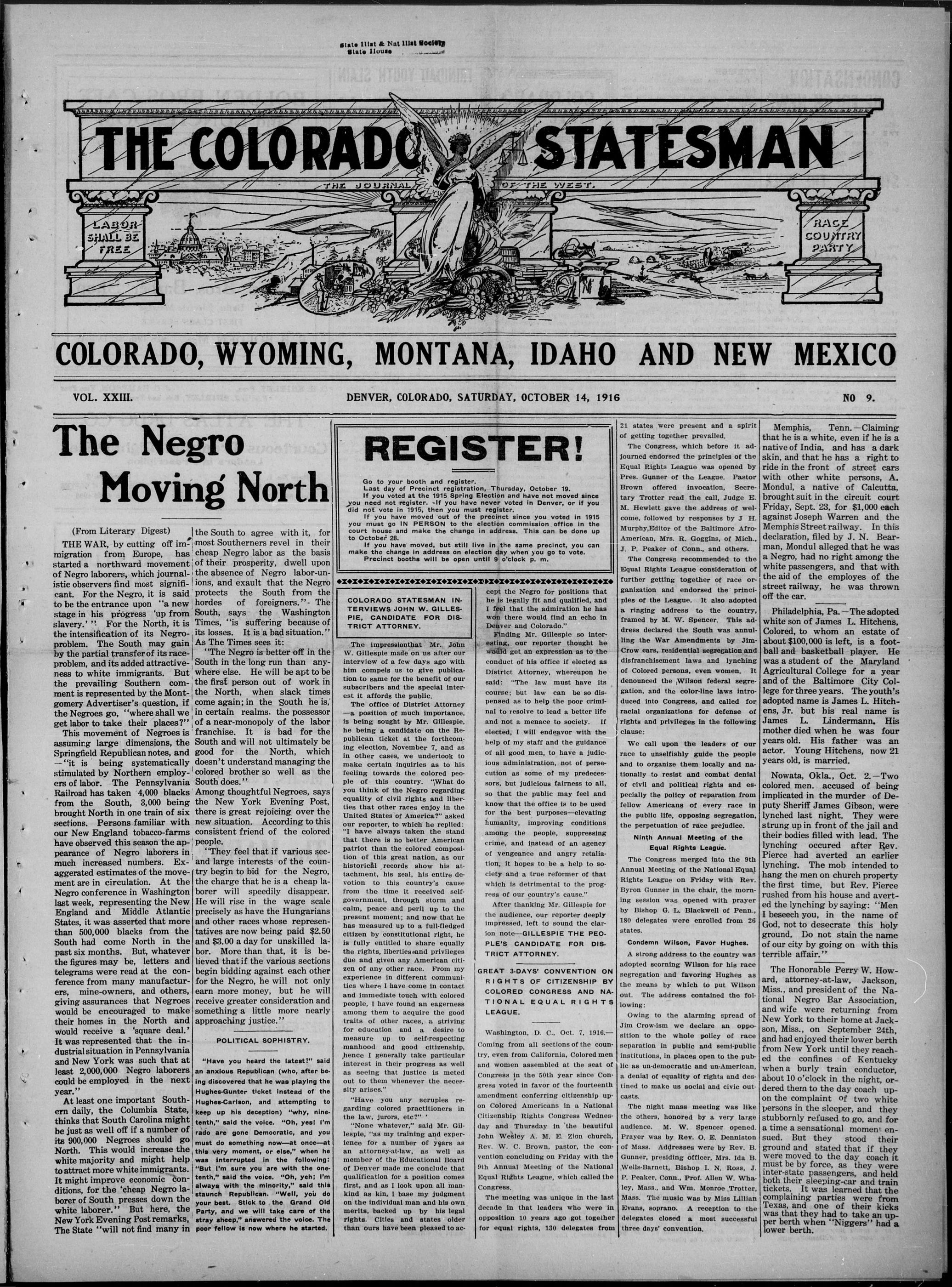
THE COLORADO STATESMAN
THE JOURNAL OF THE WEST.
LABOR SHALL BE FREE
RAGE COUNTRY PARTY
COLORADO, WYOMING, MONTANA, IDAHO AND NEW MEXICO
The Negro Moving North
VOL. XXIII.
(From Literary Digest)
THE WAR, by cutting off immigration from Europe, has started a northward movement of Negro laborers, which journalistic observers find most significant. For the Negro, it is said to be the entrance upon "a new stage in his progress 'up from slavery.'" For the North, it is the intensification of its Negroproblem. The South may gain by the partial transfer of its raceproblem, and its added attractiveness to white immigrants. But the prevailing Southern comment is represented by the Montgomery Advertiser's question, if the Negroes go, "where shall we get labor to take their places?"
This movement of Negroes is assuming large dimensions, the Springfield Republican notes, and—"it is being systematically stimulated by Northern employers of labor. The Pennsylvania Railroad has taken 4,000 blacks from the South, 3,000 being brought North in one train of six sections. Persons familiar with our New England tobacco-farms have observed this season the appearance of Negro laborers in much increased numbers. Exaggerated estimates of the movement are in circulation. At the Negro conference in Washington last week, representing the New England and Middle Atlantic States, it was asserted that more than 500,000 blacks from the South had come North in the past six months. But, whatever the figures may be, letters and telegrams were read at the conference from many manufacturers, mine-owners, and others, giving assurances that Negroes would be encouraged to make their homes in the North and would receive a 'square deal.' It was represented that the industrial situation in Pennsylvania and New York was such that at least 2,000,000 Negro laborers could be employed in the next year."
At least one important Southern daily, the Columbia State, thinks that South Carolina might be just as well off if a number of its 900,000 Negroes should go North. This would increase the white majority and might help to attract more white immigrants. It might improve economic conditions, for the 'cheap Negro laborer of South presses down the white laborer." But here, the New York Evening Post remarks, The State "will not find many in
the South to agree with it, for most Southerners revel in their cheap Negro labor as the basis of their prosperity, dwell upon the absence of Negro labor-unions, and exault that the Negro protects the South from the hordes of foreigners." The South, says the Washington Times, "is suffering because of its losses. It is a bad situation." As The Times sees it: "The Negro is better off in the South in the long run than anywhere else. He will be apt to be the first person out of work in the North, when slack times come again; in the South he is, in certain realms, the possessor of a near-monopoly of the labor franchise. It is bad for the South and will not ultimately be good for the North, which doesn't understand managing the colored brother so well as the South does."
Among thoughtful Negroes, says the New York Evening Post, there is great rejoicing over the new situation. According to this consistent friend of the colored people. "They feel that if various second and large interests of the country begin to bid for the Negro, the charge that he is a cheap laborer will speedily disappear. He will rise in the wage scale precisely as have the Hungarians and other races whose representatives are now being paid $2.50 and $3.00 a day for unskilled labor. More than that, it is believed that if the various sections begin bidding against each other for the Negro, he will not only earn more money, but he will receive greater consideration and something a little more nearly approaching justice."
POLITICAL SOPHISTRY.
"Have you heard the latest?" said an anxious Republican (who, after being discovered that he was playing the Hughes-Gunter ticket instead of the Hughes-Carlson, and attempting to keep up his deception) "why, nineteenth," said the voice. "Oh, yes! I'm rado are gone Democratic, and you must do something now—at once—at this very moment, or else," when he was interrupted in the following: "But I'm sure you are with the one-tenth," said the voice. "Oh, yeh; I'm always with the minority," said this staunch Republican. "Well, you do your best. Stick to the Grand Old Party, and we will take care of the stray sheep," answered the voice. The poor fellow is now where he started.
DENVER, COLORADO, SATURDAY, OCTOBER 14, 1916
REGISTER!
Go to your booth and register.
Last day of Precinct registration, Thursday, October 19.
If you voted at the 1915 Spring Election and have not moved since you need not register. -If you have never voted in Denver, or if you did not vote in 1915, then you must register.
If you have moved out of the precinct since you voted in 1915 you must go IN PERSON to the election commission office in the court house and make the change in address. This can be done up to October 28.
If you have moved, but still live in the same precinct, you can make the change in address on election day when you go to vote.
Precinct booths will be open until 9 o'clock p. m.
COLORADO STATESMAN INTERVIEWS JOHN W. GILLESPIE, CANDIDATE FOR DISTRICT ATTORNEY.
The impressionthat Mr. John W. Gillespie made on us after our interview of a few days ago with him compels us to give publication to same for the benefit of our subscribers and the special interest it affords the public.
The office of District Attorney—a position of much importance, is being sought by Mr. Gillespie, he being a candidate on the Republican ticket at the forthcoming election, November 7, and as in other cases, we undertook to make certain inquiries as to his feeling towards the colored people of this country. "What do you think of the Negro regarding equality of civil rights and liberties that other races enjoy in the United States of America?" asked our reporter, to which he replied: "I have always taken the stand that there is no better American patriot than the colored composition of this great nation, as our historical records show his attachment, his zeal, his entire devotion to this country's cause from the time it received self-government, through storm and calm, peace and peril up to the present moment; and now that he has measured up to a full-fledged citizen by constitutional right, he is fully entitled to share equally the rights, liberties and privileges due and given any American citizen of any other race. From my experience in different communities where I have come in contact and immediate touch with colored people, I have found an eagerness among them to acquire the good traits of other races, a striving for education and a desire to measure up to self-respecting manhood and good citizenship, hence I generally take particular interest in their progress as well as seeing that justice is meted out to them whenever the necessity arises."
"Have you any scruples regarding colored practitioners in the law, jurors, etc?" '
"None whatever," said Mr. Gillespie, "as my training and experience for a number of years as an attorney-at-law, as well as member of the Educational Board of Denver made me conclude that qualification for a position comes first, and as I look upon all mankind as kin, I base my judgment on the individual man and his own merits, backed up by his legal rights. Cities and states older than ours have been pleased to ac-
cept the Negro for positions that he is legally fit and qualified, and I feel that the admiration he has won there would find an echo in Denver and Colorado."
Finding Mr. Gillespie so interesting, our reporter thought he would get an expression as to the conduct of his office if elected as District Attorney, whereupon he said: "The law must have its course; but law can be so dispensed as to help the poor criminal to resolve to lead a better life and not a menace to society. If elected, I will endeavor with the help of my staff and the guidance of all good men, to have a judicious administration, not of persecution as some of my predecessors, but judicious fairness to all, so that the public may feel and know that the office is to be used for the best purposes—elevating humanity, improving conditions among the people, suppressing crime, and instead of an agency of vengeance and angry retaliation, it hopes to be a help to society and a true reformer of that which is detrimental to the progress of our country's cause."
After thanking Mr. Gillespie for the audience, our reporter deeply impressed, left to sound the clairion note—GILLESPIE THE PEOPLE'S CANDIDATE FOR DISTRICT ATTORNEY.
GREAT 3-DAYS' CONVENTION ON RIGHTS OF CITIZENSHIP BY COLORED CONGRESS AND NATIONAL EQUAL RIGHTS LEAGUE.
Washington, D. C., Oct. 7, 1916.— Coming from all sections of the country, even from California, Colored men and women assembled at the seat of Congress in the 50th year since Congress voted in favor of the fourteenth amendment conferring citizenship upon Colored Americans in a National Citizenship Rights Congress Wednesday and Thursday in the beautiful John Wesley A. M. E. Zion church, Rev. W. C. Brown, pastor, the convention concluding on Friday with the 9th Annual Meeting of the National Equal Rights League, which called the Congress. The meeting was unique in the last decade in that leaders who were in opposition 10 years ago got together for equal rights, 130 delegates from
21 states were present and a spirit of getting together prevailed.
The Congress, which before it adjourned endorsed the principles of the Equal Rights League was opened by Pres. Gunner of the League. Pastor Brown offered invocation, Secretary Trotter read the call, Judge E. M. Hewlett gave the address of welcome, followed by responses by J H. Murphy, Editor of the Baltimore Afro-American, Mrs. R. Goggins, of Mich., J. P. Peaker of Conn., and others.
The Congress recommended to the Equal Rights League consideration of further getting together of race organization and endorsed the principles of the League. It also adopted a ringing address to the country, framed by M. W. Spencer. This address declared the South was annulling the War Amendments by Jim-Crow cars, residential segregation and disfranchisement laws and lynching of Colored persons, even women. It denounced the Wilson federal segregation, and the color-line laws introduced into Congress, and called for racial organizations for defense of rights and privileges in the following clause:
We call upon the leaders of our race to unselfishly guide the people and to organize them locally and nationally to resist and combat denial of civil and political rights and especially the policy of reparation from fellow Americans of every race in the public life, opposing segregation, the perpetuation of race prejudice.
Ninth Annual Meeting of the
The Congress merged into the 9th Annual Meeting of the National Equal Rights League on Friday with Rev. Byron Gunner in the chair, the morning session was opened with prayer by Bishop G. L. Blackwell of Penn., 180 delegates were enrolled from 26 states.
Condemn Wilson, Favor Hughes.
A strong address to the country was adopted scoring Wilson for his race segregation and favoring Hughes as the means by which to put Wilson out. The address contained the following:
Owing to the alarming spread of Jim Crow-ism we declare an opposition to the whole policy of race separation in public and semi-public institutions, in places open to the public as un-democratic and un-American, a denial of equality of rights and destined to make us social and civic outcasts.
The night mass meeting was like the others, honored by a very large audience. M. W. Spencer opened. Prayer was by Rev. O. E. Denniston of Mass. Addresses were by Rev. B. Gunner, presiding officer, Mrs. Ida B. Wells-Barnett, Bishop I. N. Ross, J. P. Peaker, Conn., Prof. Allen W. Whaley, Mass., and Wm. Monroe Trotter, Mass. The music was by Miss Lillian Evans, soprano. A reception to the delegates closed a most successful three days' convention.
NO 9.
Memphis, Tenn.—Claiming that he is a white, even if he is a native of India, and has a dark skin, and that he has a right to ride in the front of street cars with other white persons, A. Mondul, a native of Calcutta, brought suit in the circuit court Friday, Sept. 23, for $1,000 each against Joseph Warren and the Memphis Street railway. In this declaration, filed by J. N. Bearman, Mondul alleged that he was a Negro, had no right among the white passengers, and that with the aid of the employees of the street railway, he was thrown off the car.
Philadelphia, Pa.—The adopted white son of James L. Hitchens, Colored, to whom an estate of about $100,000 is left, is a football and basketball player. He was a student of the Maryland Agricultural College for a year and of the Baltimore City College for three years. The youth's adopted name is James L. Hitchens, Jr. but his real name is James L. Lindermann. His mother died when he was four years old. His father was an actor. Young Hitchens, now 21 years old, is married.
Nowata, Okla., Oct. 2.—Two colored men, accused of being implicated in the murder of Deputy Sheriff James Gibson, were lynched last night. They were strung up in front of the jail and their bodies filled with lead. The lynching occured after Rev. Pierce had averted an earlier lynching. The mob intended to hang the men on church property the first time, but Rev. Pierce rushed from his house and averted the lynching by saying: "Men I beseech you, in the name of God, not to desecrate this holy ground. Do not stain the name of our city by going on with this terrible affair."
The Honorable Perry W. Howard, attorney-at-law, Jackson, Miss., and president of the National Negro Bar Association, and wife were returning from New York to their home at Jackson, Miss., on September 24th, and had enjoyed their lower berth from New York until they reached the confines of Kentucky when a burly train conductor, about 10 o'clock in the night, ordered them to the day coach upon the complaint of two white persons in the sleeper, and they stubbornly refused to go, and for a time a sensational moment ensued. But they stood their ground and stated that if they were moved to the day coach it must be by force, as they were inter-state passengers, and held both their sleeping-car and train tickets. It was learned that the complaining parties were from Texas, and one of their kicks was that they had to take an upper berth when "Niggers" had a lower berth.
CONDENSATION OF FRESH NEWS
THE LATEST IMPORTANT DIS PATCHES PUT INTO SHORT, CRISP PARAGRAPHS.
SHOWING THE PROGRESS OF EVENTS IN OUR OWN AND FOREIGN LANDS.
ABOUT THE WAR
London reports important gains resulting from gas attack south of Ancre. French and British infantry driving with terrific force at German lines on Somme.
Three British cruisers which arrived at Newport, R. I., are on the trail of the German submarine which raided the steamship lanes Sunday and sank nine ships.
Russia has lost 6,000,000 men during the first two years of the war, and at least 1,250,000 in this year's offensive, according to estimates from Danish sources, given out by the semi-official news agency at Berlin.
All horses and mules in and near Chihuahua City are being seized by the Carranza military officers for use in the field against Villa. Horses were being taken from coaches and wagons in the streets of Chihuahua City, according to the refugees arriving at El Paso, Texas.
The submarine arm of the imperial German navy ravaged shipping off the eastern coast of the United States Sunday. Four British steamers, one Dutch and one Norwegian,and one vessel unidentified, were sent to the bottom or left crippled derelicts off Nantucket shoals.
French troops south of the Somme have pushed the German lines farther back on front of two and a half miles and captured the village of Bovent, the north and west outskirts of Ablaincourt, and also the greater part of the Chaulnes wood. Prisoners to the number of 1,200 were taken according to the official communication.
Germans closely pressing the retreating Rumanians in Transylvania, taking 1,175 prisoners. Other Teutonic successes reported in Galicia. Russians being driven back near Lutsk, in Volhynia. Teutonic forces have evacuated three towns and lost two more in Macedonia. Heavy artillery activity reported from Italian front.
WESTERN
General Carranza signed a decree prohibiting bull fighting throughout Mexico.
Auto bandits held up eight restaurants in northern Hammond, Ind., and made their escape with about $3,000 in cash.
A small cavalry patrol of Carranzistas and scouts of a hostile force, presumably Villistas, engaged in a running fight across the river just below Juarez.
Plans have been completed for the location near Denver of a plant to manufacture breakfast food and other table products from beardless emmer, the new grain evolved by Prof. B. C. Buffum, of Worland, Wyo.
The first full war strength infantry regimental hike attempted in the recent history of the United States army began when 1,975 officers and men under command of Col. Abner Picklering left Douglas, Ariz., to march to Fort Huachuca, sixty-five miles west. The United States government, according to officials at Salt Lake, spent $15,000 in convicting Utah master plumbers of violating the Sherman anti-trust law. It will get back in fines about $7,000. Chris Irving of Denver, president of the National Association of Master Plumbers, president of the Colorado State Association and member of the Denver organization, received the heaviest fine—$1,500.
WASHINGTON
Telegraphing from Athens, Reuter's correspondent says Prof. Lambros has succeeded in forming a Greek cabinet. Elaborate plans to prevent the diversion into improper channels of any part of the $75,000,000 which the federal government is to spend in cooperation with states on good roads within the next five years have been made. Col. Barragan, chief of staff to First Chief Carranza, said that an agreement to withdraw American troops from Mexico must be signed and a definite date for withdrawal must be set before any other questions affecting Mexico can be successfully taken up by the Mexican-American commission at Atlantic City.
It was learned that State Department officials and President Wilson are seriously concerned over the clash in Germany between the Von Tirpitz group of radicals, which seeks a resumption of indiscriminate submarine warfare, and the Von Bethmann-Hollweg group, which seeks to retain the friendship of the United States.
An indictment against Oscar D. McDaniel, prosecutor of Buchanan county, was returned at St. Joseph, Mo., by a grand jury which investigated the murder of McDaniel's wife.
FOREIGN
One of the largest Austrian warships blew up recently at Pola, according to a press dispatch from Zurich.
Marshal Count Terauchi, new Japanese premier, has completed his cabinet with the statesman Motono as foreign minister.
The Wireless Press has received word from Madrid by way of Rome that the Spanish government has given definite orders prohibiting the revictualing of submarines in Spanish waters.
The transport Gallia, carrying 2,000 French and Serbian troops, has been torpedoed by a submarine. The torpedo exploded the transport's cargo of munitions. Up to the present 1,362 soldiers have been rescued. The survivors were landed at Sardinia.
A Cologne dispatch says that the pope has addressed a letter to the German bishops through Cardinal von Hartmann, declaring that though his efforts for peace are at present unsuccessful, he is endeavoring to soften the violent animosity between the belligerent peoples.
The Danish submarine Dykkeren, which sank after a collision with a Norwegian steamer, has been brought to the surface. Five of the six members of the crew who went down with the craft were rescued alive. Lieutenant Commander Christiansen was found dead in the conning tower.
The personnel of the Japanese cabinet of Premier Terauchi has been announced as follows: Premier and temporary finance minister, General Terauchi; home, Shimpei Goto; army, Kenichi Oshima; navy, Tomosaburo Kato; justice, Itasu Matsumuro; agriculture and commerce, Kiyoshi Nakashoji; communications, Kenjiro Den.
French newspapers generally take the view that the German submarine raid in American waters was more for its effect on the United States than anything else. "Germany has reopened the question of obtaining something from America in return for concessions in the submarine warfare," says the Paris Journal. "Germany probably wants to force the peace movement in America."
SPORTING NEWS
Brooklyn defeated Boston in the third game of the world series, 4 to 3. Gunboat Smith of New York outfought Joe Cox of Springfield, Mo., in ten rounds at Brooklyn, N. Y. Battling Levinsky of New York, claimant to the light heavyweight title, and Gus Christie of Milwaukee, fought eight fast rounds at Memphis to a draw. Volga, full sister to Peter Volo, duplicated the latter's accomplishments in making a new set of records for 3-year-old fillies in winning the 3-year-old trotting division of the Kentucky futurity, valued at $14,000 and worth $8,500 to the winner, at the Kentucky Horse Breeders' Association meeting at Lexington.
Miss Alexa Stirling of Atlanta, Ga., won the woman's national golf championship on the links of the Belmont Springs Country Club at Belmont, Miss., by defeating Miss Mildred Caverly of Philadelphia, 2 and 1 in the final match of the annual title tournament. The winning of the highest golf honor for women by a 19-year-old girl was regarded as the most notable achievement in the history of the United States Golf Association.
GENERAL
A seat on the New York stock exchange was sold for $74,500, an advance on the last sale of $4,500. Thomas Mott Osborne, philanthropist, reformer and "Golden Rule" warden of Sing Sing, N. Y., has resigned as warden. Mrs. Jessie Dangerfeld Keene, aged 76, widow of the late James R. Keene, the horseman, died at her home at Cedarhurst, N. Y., after a long illness. The Scandinavian-American liner Frederick VIII, which arrived in New York, was taken into Kirkwall by a British warship and 1,000 bags of German mail removed. Frank Dodd, a negro prisoner, held on a charge of having annoyed a young white woman, was taken from the county jail at Dewitt, Ark., by a mob and hanged from a tree.
The unfilled orders of the United States Steel corporation on Sept. 30 stood at 9,522,584, a decrease of 137,773 tons compared with those of Aug. 31, according to the monthly statement.
Secretary of the Treasury McAdoo personally assured prospective passengers that there was no danger in traveling aboard English ships, according to a statement made in New York by a prominent steamship man.
"The German government will be held to the complete fulfillment of its promises to the government of the United States," President Wilson said at Long Branch, N. J., in a statement to the American people, upon the German submarine attacks off New England.
Gasoline has become so scarce in Germany since the war started, said Ambassador Gerard upon his arrival in New York, that he is compelled to get his personal supply from Holland in sealed cans. Berlin taxicabs are not allowed to use gasoline, but they have a good substitute in benzoln.
R. J. Dunham, vice president of Armour & Co., announced that at the next meeting of the board of directors an increase in capitalization from $20,000,000 to 100,000,000 will be considered. A stock dividend of 400 per cent is said to be planned.
COLORADO
STATE NEWS
Western Newspaper Union News Service.
DATES FOR COMING EVENTS.
Oct. 17-19—Meeting of Synod of Presbyterian Churches at Grand Junction.
Oct. 27—Farm Exhibit at Grand Valley.
Oct. 30-Nov. 4—Meeting Colo. State Teachers' Association.
Jan. 1-6 -Poultry Show at Denver.
Western Stock
Show at Denver.
Feb. 2-4—Y. M. C. A. Annual Convention at Colorado Springs.
Estes Park is to have a $200,000 hotel.
J. Hamilton Lewis, U. S. Senator from Illinois, delivered a speech in Denver.
Over 600 Weld county miners are now affiliated with the United Mine Workers organization.
The Telephone Company is planning to spend $4,000,000 for betterment of the service in Colorado.
In Park county, general activity at the tungsten camp continues, with the pay streak increasing with development.
John L. Moore, a farmer near Longmont, has lost nine relatives in the war. They were members of a Scottish regiment.
Plans are being made at Colorado Springs to assist in the campaign for settlers started by the State Board of Immigration.
Mrs. Mary Andrews, for twenty-five years a resident of Colorado, died at her home in Denver. Death followed a stroke of apoplexy.
The Victor Consolidated Gold Mining Company will pay its quarterly dividend Oct. 25. The amount of $90,000 will go to stockholders.
Oscar Lewis, 81, for over forty years a prominent pioneer mining man and hay and grain dealer of Colorado, died at St. Luke's hospital in Denver.
The report of the Denver Visiting Nurse's Association for the past year shows that 6,000 more calls were made by the eight nurses than in the year before.
Colorado crops this year are bringing the highest price they have brought since the great war began, and also the highest price for many years before the war.
The wireless telegraph outfit being installed at the University of Denver is almost ready for use. The instrument is to be strong enough to pick up messages from Honolulu.
Good road enthusiasts have petitioned the county commissioners to provide for a special election on a bond issue of $250,000 to improve the roads of Boulder county.
In Montezuma district, at the St. John's group, there are 6,000 tons of stope-filling on the surface, ready for treatment. This is part of 30,000 tons rendered available by development.
Fire clay of the better class and several forms of pottery clay are produced in Colorado, especially in Jefferson county, some fifteen miles west of Denver.
The long-heralded advance in the prices of bread and bakery products in Denver went into effect, but with such a variety of sizes and prices that the public is confused as to what it is getting for its money.
Coupled with an announcement of recommendations for expenditure on the Uncompahgre and Grand Valley, the two government reclamation projects in Colorado, is the statement that both will be completed by July 1, 1917.
Denver's poultry show this winter promises to be larger and better than ever, according to preparations being carried forward by the various committees in charge. The show will be held in the Auditorium for six days, beginning Jan. 1, 1917.
Suit has been filed in the District Court of Denver by Miss Zhela Maud against Dr. Allen P. Hubbard of Grand Junction. Miss Maud seeks to recover damages aggregating $20,000 from the physician for an alleged breach of promise of marriage.
Two golden weddings were celebrated in Denver, that of Mr. and Mrs. M. J. Post, who received their friends at their apartments, and that of Mr. and Mrs. J. W. Yelton of Florence, who observed their golden anniversary at the home of their son, Frank Yelton.
A "courting bureau" established by the city or state to bring together lonely young men and women was suggested in Denver by Mrs. Louise Mellen, assistant superintendent of the State Free Employment Bureau, while discussing the case of Clara Bishoff, the Brooklyn girl who caused much newspaper comment by advertising for a husband who had an income of at least $50 a week and was willing to support her invalid mother.
Estimates of the United States crop report for Colorado for this year gave the following forecasts: Corn, 7,600,000 bushels; all wheat, 10,800,000 bushels; oats, 9,900,000 bushels; barley, 4,160,000 bushels; potatoes, 6,380,000; hay, 1,829,000 tons; peaches, 405,000 bushels.
Attorneys for Edward L. Seiwald, serving a sentence in Canon City on a conviction for the murder of Patrolman William McPherson of Denver, have asked the Supreme Court to set aside a conviction for the murder of Andrew J. Loyd, a saloonkeeper.
TRINIDAD YOUTH SLAIN
MURDERED BY CATTLE RUSTLERS NEAR SCOTT RANCH.
James Scott Shot a Short Distance From Spot Where Father Was Killed Over a Year Ago.
Western Newspaper Union News Service.
Trinidad.—A short distance from the spot where his father, James Scott, was shot and killed a year and a half ago, William Scott, 19, was murdered by cattle rustlers near the Scott ranch, fourteen miles northwest of Trinidad.
Scott and a younger brother set out from the house late in the day and came across two men skinning the carcass of a calf. The men fled, and William Scott remained with the carcass while his younger brother returned to the house for horses with which to overtake the fugitives. When he returned he found his brother dead with a bullet wound through the heart. The carcass had disappeared.
Posses are scouring Las Animas county in search of the two men. The younger boy described the men as undersized and of a foreign appearance, presumably either Mexican or Italian.
James Scott, a justice of the peace in this district, and the father of the murdered boy, met his death while driving down a road near his ranch in April, 1915. Six weeks later Frank Fucurino was found guilty of the murder and sentenced to a life term in the penitentiary. Police authorities do not believe the two murders have any connection.
Longmont Duck Hunter Killed.
Longmont.—Howard Ownbey, 15 years old, son of J. L. Ownbey of this city and nephew of Col. J. O. Ownbey, wealthy mining man of Boulder, was found dead about three-quarters of a mile from his home with a gunshot wound in his neck. The lad had been shooting ducks on a nearby lake and, when he failed to return at supper time, members of the family hunted for him and at length summoned a searching party from neighboring farms. The woods between the Ownbey farm and the lake was searched and young Ownbey's horse, with reins trailing, was found. A short distance away the body of the lad was found.
Leadville Man Shot to Death.
Leadville.—Willis K. Patten, 35, a blacksmith, was found dead in his home with a bullet wound in his head. Three shots from a .220 caliber rifle had been fired into the room, apparently through a window. The police arrested Mrs. Henry Wolf, who was known as the common-law wife of Patten, and Roy Southwell, also a blacksmith and a boarder at the Patten home. Mrs. Wolf separated from her husband, who lives in Rawlins, Wyo., a year ago, and came to Leadville, where she joined Patten.
Greek Admits Kidnap Plot.
Greek Admits Kidnap Plot.
Steamboat Springs.-James Karaseouls, arrested through his discovery by the Misses Leota and Loretta Crosswhite as the survivor of the two Greeks who kidnapped Robert Matson Perry, superintendent of the Oak Hills coal mines at Oak Creek, pleaded guilty to a charge of kidnapping and waived preliminary examination in justice court. He was bound over to the District Court for trial at the January term.
German Day Celebrated.
Pueblo.—Nearly 500 Germans of Pueblo met in celebration of the anniversary of the founding of Germantown, Pa., and of the landing of the Germans in the United States in 1683. The afternoon was devoted to a program of speech making, songs and music.
Admits Robbing Englewood Bank. Littleton.—Norvell King, charged with the robbery of the First National bank, Englewood, and fled to Denver in an automobile, pleaded guilty of the crime and was sentenced to a term of from fifteen to twenty years in the state penitentiary.
W. C. T. U. Re-Elects Mrs. Hungerford Pueblo.-The twenty-ninth annual convention of the W. C. T. U. closed here. Mrs. Adrianna Hungerford, president of the state association for the last fourteen years, was again elected president by acclamation.
Mexican Dead; Companion Held
Mexican Dead; Companion Held.
Monte Vista.—Bonafacio Martinez is dead and Pedro Trojillo is under arrest pending a coroner's investigation.
Both men are prominent farmers of Seven Mile Plaza, nine miles west of here.
Longmont City Hall Declared Unsafe.
Longmont. — The Longmont city hall, which has stood for thirty-two years, has been condemned by the county grand jury as being unsafe.
Denver Woman Shoots Herself
Longmont.-Mrs. Edna Seaman, 35, of Denver, shot and seriously injured herself at the residence of John Neble, wealthy mine operator and president of the Neble Mining Company at Camp Angeline, eleven miles northwest of Lyons. She was brought to Longmont and is in a critical condition at a local hospital. She has refused to give any explanation further than a remark made to Sheriff Buster that Neble was responsible for her attempt at suicide.
924 19th Street, Denver, Colorado
DINNER
11:30 to 2 p.m.
All Kinds
Bolden Bro
Baths,
FIRST
R. B. BOLDEN,
O. H. SHIRLEY, Pres.
PAUL J. SHI
THE ATL
Courteous Tre
Leaders
All Kinds of Sandwiches
Harden Bros. Barber S
Baths, Electric Massage
FIRST CLASS SERVICE
BOLDEN, Mgr. 926 19th St.
LEY, Pres. J. O. HAMPSON
PAUL J. SHIRLEY, Sec. and Treas.
E ATLAS DRUG C
ous Treatmet. Right H
Leaders in Prescription
1. ST.
26TH AND
775
Main 4
PTON, Pres. J. B. MIN
LROAD PORTERS' CL
LUNCHOOM IN CONNECTION
All Kinds of Sandwiches
Bolden Bros. Barber Shop
Baths, Electric Massage
FIRST CLASS SERVICE
R. B. BOLDEN, Mgr. 926 19th St. Denver
C. H. SHIRLEY, Pres. J. C. HAMPSON, Vice President PAUL J. SHIRLEY, Sec. and Treas.
Courteous Treatmet. Right Prices Leaders in Prescription
W. C. CAMPTON, Pres.
RAILROAD
LUNCHOOM
RAILROAD PORTERS' CLUB LUNCHOOM IN CONNECTION
BILLIARDS AND
POOL
1728½ Wazee St. C
J. B. I
PHONE MAIN 8416.
28½ Wazee St. Only one block from Union De
J. B. MINTER, Barber.
NE MAIN 8416. DENVER, COLORADO
1728 $ \frac{1}{2} $ Wazee St. Only one block from Union Depot.
J. B. MINTER, Barber.
PHONE MAIN 8416. DENVER, COLORADO.
Meats, Fancy 1864
JOHN K. RETTIGER
Fancy and Staple Gro
1864 CURTIS STREET
month.
MARKET COMP
E. SMITH, Manager, Res. Phone South 10
d Retail Staple and Fancy Groceries, Fish
Hotels and Restaurants Our Specialty.
Fresh and Cured
Eastern Corn Fed Me
Fruits, Vegetables, Poultry and Game.
Telephones Main 4302, 4303, 4304, 4305
15th Street Denver,
atherhead Hat
TELEPHONE MAIN 3203
Meats, Fancy and Staple Groceries 1864 CURTIS STREET
The MARK
C. E. SMITH, Man
Wholesale and Retail Staple
Hotels and Res
Frees
Eastern C
Fruits, Vegeta
Telephones Ma
622-636 15th Street
Weather
TELEPH
The MARKET COMPANY
C. E. SMITH, Manager, Res. Phone South 1608
Wholesale and Retail Staple and Fancy Groceries, Fish and Oysters. Hotels and Restaurants Our Specialty. Fresh and Cured Eastern Corn Fed Meats Fruits, Vegetables, Poultry and Game.
Telephones Main 4302, 4303, 4304, 4308
622-636 15th Street Denver, Colorado
Established 1876
PIONEER HATTERS OF THE WEST
WE MAKE OLD HATS NEW
PRACTICAL HATTER
RENOVATORS, BLEACHERS DYERS AND FIL
Of Gents' and Ladies' Hats of Every Descrip
1624 Champa St., Denver, Colo.
PRACTICAL HATTER
ATORS, BLEACHERS DYERS AND FIL
Gents' and Ladies' Hats of Every Descrip
1024 Champa St., Denver, Colo.
RENOVATORS, BLEACHERS DYERS AND FINISHERS
Of Gents' and Ladies' Hats of Every Description
1624 Champa St., Denver, Colo.
Store No. 1.
2302 WELTON ST.
Main 895 875
PHONE MAIN 3028
Corner Nineteenth.
Short Orders at All Hours
Sandwiches
Barber Shop
Massage
SERVICE
926 19th St. Denver
J. O. HAMPSON, Vice Prod.
co. and Treas.
DRUG CO.
St. Right Prices
Description
Store No. 2
26TH AND WELTON
Main 4955-4956
J. B. MINTER, Sec.
TERS' CLUB
ONNECTION
FREE CHECK
ROOM
ock from Union Depot.
carber.
DENVER, COLORADO.
RES. PHONE GALLUP 942
ETTIG
Staple Groceries
STREET
Denver, Colo.
COMPANY
Phone South 1608
Groceries, Fish and Oysters
Our Specialty.
Fed Meats
Entry and Game.
4303, 4304, 430b
Denver, Colorado
Bad Hat Co.
MAIN 3203
HATTERS
VERS AND FINISHERS
of Every Description
Denver, Colo.
VINE
---
AFRO-AMERICAN CULLINGS
In a communication to the New York Times, Kelly Miller, dean of the College of Arts and Sciences in Howard university, says: "I have read with great interest your highly illuminating editorial article on the economic opportunities of the Negro in the North. Under the spur of urgent industrial demands it seems entirely likely that hundreds of thousands of Negroes will be transferred to the North, and thus shift to some extent the center of gravity of the problem.
"I beg to call attention to the importance of securing adequate provision for safeguarding the moral and social life of these people suddenly thrust into a new environment. The immigrant who, previous to the European war, had flocked to our shores in unprecedented numbers, in addition to their racial assimilability, have been assisted in adjusting themselves to their new relations by the Christian churches and other agencies playing beneficially upon them. The Negro laborer from the South has no such helpful influences.
"Coming from an environment of social and civil restriction into a section of complete public and civil freedom, he will, naturally enough, first, mistake liberty for license unless he is carefully safeguarded and encouraged in the right direction. The captains of industry are apt to be shortsighted. Immediate economic advantage blinds them to the evil consequences that may follow in its wake.
"Should the influx of Negro laborers to the North, without proper restriction and control, be allowed to prejudice public opinion and thus reproduce Southern proscription in the Northern states, the last state of the race would be worse than the first. The Negro church where these laborers are at work should be encouraged to reach out and lay hold upon every workman who comes to the Northern communities. Such agencies as the Young Men's Christian association should be established and encouraged. Tried and experienced social workers should move among them with a view to relating them sensibly to their new environment.
"This new industrial movement, which opens up untold possibilities for the race, illustrates anew the importance of the higher education through which a body of trained leaders may be prepared for the arduous tasks of guiding aright the masses of their race amid the dangers and vicissitudes of life.
"As an illustration of this principle, the National League on Urban Conditions among Negroes has recently been able to find places on the tobacco plantations of Connecticut for 700 Negro students. I have, personally, placed over 75 students of Howard university in these tobacco fields. Experience has more than abundantly justified the wisdom of sending with each group of students an instructor to advise and encourage and direct them in their new relationship.
"The economic opportunity for the race is, indeed, a large one. But great also are the moral responsibilities. Let us hope that the Negro will be encouraged to receive and appreciate the advantage of both."
William H. Holtzclaw, founder and principal of the Utica Normal and Industrial institute, Utica, Miss., and considered by the late Booker T. Washington as one of the most prominent graduates of Tuskegee, has issued an
To help Negro boys become practical farmers and to assist Negro girls in becoming competent housewives the United States department of agriculture, in co-operation with the state colleges, is organizing throughout the South Farm Makers' club for rural Negro children.
This activity, begun experimentally last year by the office of extension work, South, has grown rapidly and already is thoroughly organized in Virginia, North Carolina, Florida and Mississippi. The work also is being carried on to some extent in each of the other southern states.
The chief object of these clubs is to encourage Negro farmers, particularly in the cotton sections, to raise some food instead of devoting their entire attention to a single crop.
In the clubs for boys the typical plan is to encourage and help the members to use an acre, one-half of which is devoted to corn, one-fourth to potatoes and one-fourth to peanuts. This teaches a desirable rotation and at the same time furnishes three food products for human consumption, and two that are useful for cattle or hogs.
The best conductors of lightning, placed in the order of conductivity, are metals, gas coke, graphite, solutions of salts, acids and water. The best non-conductors, ending with the most perfect insulation, are India rubber, guttapercha, dry air and gases, wool, ebonite, silk, glass, wax, sulphur, resins and paraffin.
Pockets for money and jewelry are woven into the tops of women's stockings that a Pennsylvanian has patent-
appeal for contributions towards a balance of $2,500 required to install a plant to provide light, power and heat for his school, where 400 colored girls and boys and given a common English education and are taught some trade.
With the installation of a new light and power plant at Tuskegee, that institution has turned over to Utica its old plant. The cost of setting this up will total $4,000. Of this amount $1,500 has already been raised, largely through an appeal published in the Boston Transcript last March by some northern friends of Mr. Holtzclaw's school. Work of installation has already been started, and Mr. Holtzclaw now asks for the necessary balance so that the plant may be ready for the opening of the school in the fall.
Three hundred delegates were in attendance at the opening of the thirty-sixth annual session of the national Baptist convention, a Negro organization which is meeting in Kansas City the second time in 20 years.
It is an organization representing the religious activities of the Negro Baptist churches of all America and its possessions. The sessions are being held in Armory hall, Fourteenth and Michigan avenue, and will continue to noon on Monday.
The convention supervises 20,000 Negro Baptist churches with an estimated membership of 2,750,000. At this session the establishment of a theological college at Nashville, Tenn., will be considered. The church conducts 50 denominational schools, mostly in the South.
Tuskegee Institute does a useful work in publishing the Negro Year Book, the fourth annual edition of which now is available. The book contains nearly 500 pages, a remarkable evidence in itself of the growing activities of the race and the increasing interest in its efforts at improvement. One cannot fail to be impressed by the record of substantial and most creditable achievement on the part of both individuals and organizations. In the volume are found interesting discussions of such topics as the Negro and segregation, the Negro and woman suffrage, the Negro and prohibition. The book is indispensable to those who wish to be well informed on a most important phase of American life.
It is said that Norway (Me.) men during the Civil war received more commissions in the army than men from any other town of its size in the state. Among them were one brevet major general, one brigadier general, two brevet brigadier generals, three colonels, ten captains, five lieutenants, one chaplain, one assistant surgeon and one regimental quartermaster.
Recent investigations of Korea's iron mines have led to the prediction that they can be made to supply all domestic demands and in addition supply Japan with 1,000,000 tons of metal annually.
Scientists have estimated that the heat received from the sun by the earth in a year is sufficient to melt a layer of ice 100 feet thick covering the entire globe.
A museum of the horse, presenting a complete history of that animal from the earliest known period to the present, has been established in Paris.
The girl members of these clubs receive practical instruction in gardening, canning, cooking and housekeeping.
According to reports the county superintendents of schools and teachers of Negro elementary schools are supporting the work actively and state agricultural colleges and the technical schools established for the race are active co-operators in the larger phases of the work.
For a number of years bricks have been made from lava rocks deposited by ancient flows in certain parts of the Hawaiian islands. Now it is believed that a station erected near one of the active volcanoes could by means of an endless chain of buckets transport the molten lava directly from the pit to the station, where it could be poured into molds.
The tension members of a truss frame that supports a flat car of unusual capacity on a European railroad are formed of steel wire cables instead of the usual rods or bars.
Miss Gertrude Isabelle Butler of Gloucester, Mass., has never been absent or tardy in the 13 years she spent at primary, grammar and high schools. In addition she was an honor scholar at the high school, and a member of the girls' baseball team, of the class basketball team, of the glee club and of the dramatic club.
A butter substitute made of coconut oil, egg yolks and a small amount of cream has been invented in Bohemia.
COLORADO CROP REPORT
EXPERTS PLACE VALUE OF
YEARS CROPS AT $80,195,910.
Reports Show Steady Increase in Acre-
age—Beets Worth $16,605,000;
Apples, $2,480,000, and Beans
$17,450,500.
Denver.—Figures compiled by government experts put the estimated production of Colorado crops for 1916 at a total value of $80,195,910. This is an increase of $12,113,910 over 1915, and $13,069,486 over 1914. The report is published by the Denver Civic Association to demonstrate the expanding prosperity of the agricultural sections of the state and to show that any falling off in production has been more than balanced by the increased prices being realized for the products of the soil.
It is shown that for three years there has been a steady increase in acreage devoted to crops. The acreage in 1914 was 2,605,400; in 1915, 2,754,800, and this year, 2,961,000, an increase in 1916 over 1915 of 206,200 acres.
Notes of the big increases are made showing that the acreage of sugar beets has increased 64,200, the production 880,000 tons, and the value $6,267,400 in 1916 over 1915. Beans gained in acreage 17,000, production 159,000, and value $964,500. The potato crop this year will be worth $3,792,100 more than last year. The acreage of wheat increased 167,000 and the value $2,480,000.
Other crops increasing in value include rye, barley, oats, pears, truck garden products, kaffir corn and cantaloupes. Hay, corn and peaches showed a decrease in value.
The total value of the sugar beet crop is $16,605,000, as compared with $10,337,600 in 1915 and $9,691,000 in 1914. The acreage, production and price increased for each year.
Beans went from 21,000 acres in 1914 and 1915 to 38,000 acres in 1916, the production increasing from 300,000 bushels in 1914 to 340,000 bushels in 1915, and 499,000 bushels in 1916, and the price advanced from $2.30 to $3.50. The total value of the bean crop in 1916 was $1,746,500, or considerably more than twice the value in 1915.
Apples decreased from 693,000 barrels in 1915 to 689,000 in 1916. The total value of this year's crop is $2,480,000.
The rye crop of 30,000 acres was 392,000 bushels, at a price of 86 cents, a total value of $337,120.
The total acreage of potatoes is given as 50,000, a decrease of 3,000 over the two preceding years. The production dropped from 7,150,000 bushels in 1914 to 5,872,000 in 1916, and the value was $8,514,000, as compared with $4,722,300 in 1915.
The acreage in hay was 970,000 in 1914 and 1915 and 892,000 in 1916. The price increased from $7.70 last year to $9 this year, and the total value of the crop in 1916 is $18,423,000.
The state produced 130,000 acres of barley in 1915 and 1916 and the production this year was 4,108,000 bushels. The price advanced 20 cents per bushel during the year, the total value of the crop being $3,286,400, as compared with $2,808,000 in 1915.
Corn decreased approximately 3,600,000 bushels, the total production this year being 7,628,000 bushels, and the total value $5,873,000, as compared with $7,670,400 in 1915.
The acreage in wheat in 1916 was 727,000, as compared with 560,000 in 1915. The production was 10,820,000 bushels, as compared with 13,310,000 in 1915. The price was $1.27 this year, as against 82 cents last year. the total value of the crop is $12,754.100, an increase of almost $3,000,000.
The pear crop is valued at $430,000, three times that of 1915. The production was 92,000 bushels and the price was $2.50, as compared with $1.50 last year.
The acreage in peaches was 405,000. The price was 1 cent less than last year and the total value of the crop this year is $571,050.
Other fruits and vegetables were valued at $1,684,000, truck garden products at $750,000, and kaffir corn at $764,400.
The cantaloupe crop was 1,600 cars, against 800 last year. The price per car went from $200 in 1914 to $320 this year, and the total value of the 1916 crop was $512,000.
Other crops this year were: Cherries, $75,000; strawberries, $105,000; tomatoes, $60,000; cabbage, $300,000; onions, $80,000; celery, $87,500; field peas, $200,000; canning peas, $80,000; cucumbers for seed and pickles, $175,000.
Wednesday the state began to take charge of the indigent insane patients now being provided for by the counties of the state, according to an announcement made by Governor Carlson. This is made possible by the completion of the five new buildings in cottage style erected at the state insane asylum in Pueblo. It is estimated that within a few weeks the state government will have assumed responsibility for more than 300 insane persons whose keeping has heretofore been borne by the counties.
GERMAN LOSSES TOTAL 3,556,018
ACCORDING TO BRITISH COMPILA TION FROM OFFICIAL BER LIN CASUALTY LISTS.
GREEK FLEET SEIZED
ALL BUT THREE VESSELS TAKEN
OVER BY ALLIES AS ACT
OF PRECAUTION.
London.—German casualties from the beginning of the war to the end of September were 3,556,018, according to an official British compilation as given out here. The statement says:
"A report compiled from German official casualty lists shows the total German casualties in September as 179,684, bringing up the total since the war from the same source to 3,556,018."
The full text of the statement issued by the British official press bureau follows:
"German casualties exclusive of corrections, reported in the month of September in German official casualty lists were: Dead, 32,282. Prisoners and missing, 32,259. Wounded, 115,343. These added to those reported in previous months, including the corrections reported in September, total since the war: Dead, 870,182. Prisoners and missing, 4282,829. Wounded, 2,257,007. The figures included all the German nationalities — Prussians, Bavarians, Saxons and Wurttembergers. They did not include the naval casualties or casualties among the colonial troops. It should be noted that the figures do not constitute an estimate by the British authorities. They merely represent the casualties announced in the German official lists. Also that the casualties are those reported during the month of September and not reported as having been incurred in September."
London.—Allied warships Wednesday seized the entire Greek navy, with the exception of three vessels, as precautionary measure for protection of entente fleets in Greek waters. The Greek navy consists of five battleships, the Kilkis, Lemnos, Psara, Spetsal and Hydra; one armored cruiser, the Averoff; the coast defense ship Basileus Georgios; the cruisers Helli and Nauarchos Miaulis; ten gunboats; seventeen torpedo boat destroyers; nine torpedo boats; three submarines and several transports and other craft. The Greek naval force has been estimated at 4,000 officers and men. The best ships in the Greek navy are the Kilkis and Lemnos, which are former American battleships Idaho and Mississippi.
Italians resume offensive in campaign against Trieste and take 6,000 prisoners in several attacks south and southeast of Gorizia. The second Rumanian army defeated by the Teutonic-Bulgar forces, is continuing to retreat, hard-pressed by its foe, in Transylvania. French capture salient from Germans near Vermandovillers in fighting in France.
Twelve Shot in Strike Battle.
Bayonne, N. J.-Pollice with Win-
chesters and automatics patrolled
"The Hook" district near the Stands
ard Oil Company plants, where four
patrolmen and eight strikers fell during a riot.
PRICES FOR FARM PRODUCTS
Washington.—Prices of farm products continue to rise. Producers were being paid 27.6 per cent more on Oct. 1 than a year ago, the Department of Agriculture announced in its monthly statement of the level of prices on principal crops. That level increased 1.3 per cent during September, compared with a decrease of about 3 per cent during that month in the last eight years. Oct. 1, two years ago, prices were 19.9 per cent lower than on that date this year, and the average for the last eight years on Oct. 1 was 23.8 per cent lower.
Kaiser Will Respect Promises.
New York.—Count Von Bernstorff, German ambassador, declared that "There will be no recurrence of the U-boat warfare. Germany does not contemplate in any way to violate the pledge she made to this country." The ambassador's statement was made after he had held a conference with James W. Gerard, American ambassador to Germany, who has just arrived in this country on a vacation.
Bride Slays Husband, Kills Self.
Pueblo.—A bride of six months, after returning cheerly from a walk with her husband, shot him dead in their apartment here and then put a bullet through her own brain. She fell upon the bed, with the revolver clutched in her hand, and died immediately. The husband was Claude S. Swartz, 19 years old, son of C. E. Swartz, and the wife was Bessie S. Swartz, daughter of Joseph Burgess. The families of both live at Avondale, where the fathers are wealthy ranchmen.
FLORAL DESIGNS PUT UP WHILE YOU WAIT
CHOICE PLANTS AND CUT FLOWERS CONSTANTLY ON HAND
GREENHOUSES: Thirty-Fourth and Curtis Streets
TELEPHONE, MAIN 1511 DENVER, COLO
The Champa Pharmacy
When You Want
The Heads, Feet, Tails, Snouts, Neckbones or Chiterlings, or any other part of the hog except the squeal, go to
East's Market
The
WARD AUCTION
COMPANY
Sales Daily at 2 p.m. Office Furniture a Specialty.
PRIVATE SALES AT ALL TIMES
HAVE MOVED TO—
1723-39 GLENARM ST.
PHONE MAIN 1675.
THE BEST ICE CREAM AND
CANDIES AT
O. P. BAUR & CO.
CATERERS AND
CONFECTIONERS
Phone: 168.
1513 Curtis Street, Denver, Cole.
JOSEPH CARTER
Express, Moving and Storage COAL AND WOOD PROMPT DELIVERY.
2415 WASHINGTON STREET.
TELEPHONE YORK 6668.
J. H. Biggins
GENERAL FURNITURE REPAIRING
AND UPHOLSTERING.
WORK GUARANTEED.
1417 East 24th Avenue, Denver, Colo.
2300-6 Larimer Street Phone Main 1461
ORIENTAL RESTAURANT
Chop Suey, Noodles and Short Orders
Phone Main 4896
1848 Arapahoe
乐洋轩
Miss M. Cowden Hair Dressing Parlor
Shampoo, cutting and curling. Scalp treatment, hair tonics, hair straightening, manicuring. Stage wigs for rent; theatrical use and masquerades. Goods delivered out of the city. All shades of hair matched by sending sample of hair; also combings made up.
Cheapest Switches 50 Cents
1219 21st St. Denver, Colo.
DO IT NOW Subscribe for THIS PAPER
THE COLORADO STATESMAN
RACE COUNTRY PARTY
SUBSCRIPTION RATES.
One Year ..... $ 2.00
Six Months ..... 1.00
Three Months ..... .60
PAYABLE IN ADVANCE.
Entered as second-class matter at the postoffice in the City of Denver, Colo.
Reading notices, ten lines or less, 10 cents per line. Each additional line over ten lines, 5 cents per line. Display advertising 50 cents per inch.
Remittances should be made by Express Money Order, Postoffice Money Order, Registered Letter or Bank Draft. Postage stamps will be received the same as cash for the fractional part of a dollar. Only 1c and 2c stamps taken.
No discounts allowed on less than three months' contract. Cash must accompany all orders from parties unknown to us. Further particulars on application.
Communications to receive attention must be newsy, upon important subjects, plainly written only upon one side of the paper, must reach us Tuesdays, if possible, anyway not later than Wednesdays, and bear the signature of the author. No manuscript returned, unless stamps are sent for postage. All communications of a personating nature that are not complimentary will be withheld from the columns of this paper.
RECOGNIZED BY THE RETAIL ASSOCIATION OF THE DENVER CHAMBER OF COMMERCE AS AN ADVERTISING MEDIUM OF THE FIRST CLASS.
During the political excitement Colorado should not lose sight of the fact that, regardless of local differences she needs protection from the general government if she hopes to develop her infant industries. She should certainly be among the states that are for protection, and her electors should not overlook this important factor. We want Coloradoans in Congress who will be for her interest first, last and at every turn of the road be on guard and defend every bill that is calculated to make our state prosperous.
There is nothing in the present political situation to call for a noisy campaign. It is only essential that the Republican organizations and press keep in touch with the people upon topics of current political interest. It may annoy the Democrats to know that the Republican press, the sentinels of the party, are on the alert and keeping the army informed of the moves of the enemy. It is not to be expected that the Democratic bosses will approve of this vigilance, but they will have to endure it just the same. A calm, fair and unimpassioned discussion of public questions is always in order. If public interest is to be kept alive to public needs, it is absolutely necessary that this course be pursued.
ON BEING JEALOUS.
The great sin of our race is our petty jealousy. It grows out of the idea that "all Coons look alike," and are alike in habits and disposition. This idea is fanned every day by the white people with whom we come in contact. The average white man preaches the doctrine that the crap-shooter and dark "nymph du pave" belong in the same class with the hard working and honest man and woman of our race whose efforts are upward and onward. There is the differences among our people, just the same as among the white, and we have got to recognize them and lend our best efforts to the uplifting of the honest and industrious. We must be broad and charitable in all that we do, seeking ever to instill the idea of appreciation of the honesty and efforts of those who lift themselves by their bootstraps above natal conditions. In this way we multiply avenues of employment for the people of our own race. When we can have business houses like the other race, employing our boys and girls, we will have made a long step in the solution of the problem.
THE JEW AND THE NEGRO.
The persecution against the Jews has a striking analysis in the ostracism and prejudice against the Negro. In both cases it is a blot upon our civilization. Nobility of character spares neither. To say that he is a Jew or Negro is enough to count any kind of contempt or discrimination. Either the Jew or a Negro may be accused of all sorts of high crimes and misdeanors, which every sensible man knows that he never committed, yet the very accusation has its due effect in prejudicing the minds of the people and the prejudice leads to the infliction of all kinds of pain, suffering and imprisonment and even death. The prejudice in either case is based on nothing reasonable. The accident of birth is beyond our control. Both the Jew and Negro would willingly associate with other people and mix freely in their life and affairs if social barriers were cast away. But as the Jews feel the force of this class distinction it ought to bring them into greater sympathy with the Negro, and colored people ought in turn enter into deeper interest with the Jew; but, strange to say, that here the analogy ends, for both of these persecuted people, while not enemies of each other, at least have many divergent points that they cannot coalesce. Thus is perpetrated in the world these differences, but perhaps, as the struggle becomes more intense right thinking and right acting will come to prevail. Let us hope that the Union will come very soon and all persecuted people as well as their persecutors will see that the wisdom and justice of an intelligent public opinion demands that senseless and color prejudice shall not continue in this new era of civilization and liberty loving age.
ILL-FOUNDED EXPECTATIONS.
The Negro's general ideas of the powers and possibilities of a political party to establish and maintain social privileges for the enjoyment of any particular class of people are largely erroneous. We often hear criticisms of the Republican party because it does not boldly take steps to abolish the Jim Crow laws passed by Southern Legislatures, or that it does not absolutely put a stop to lynchings, or otherwise exercise a restrictive authority in a manner to make the Negro's lot just as happy and just as easy as that of other classes of citizens who, as classes, know nothing of these afflictions. These criticisms are not altogether just, because the questions involved are social more than political, and are subject, first of all and almost soley, to the authority vested in the people of the several states, or are grounded, rightly or wrongly, in the sentiment of the people of communities, states or sections. The greatest of the Negro's ills grow out of race prejudice, and this prejudice, so called, partakes of the quality of public sentiment, because it is so generally shared by racial elements and is not in fact restricted by political affiliations. Race prejudice is a white man's disease, not at all monopolized by Democrats. It cannot be overcome by law nor by any other form of restrictive force. Its cure lies only in the way of social development, and so far at is is curable, it must come through the slow development of refining influences, touching and improving both races, and the gradual amelioration of hard and repulsive social relations. Law or political power can help this development only in a general and far-off way, as by the increase of educational facilities, the regulation or control of common carriers engaged in interstate commerce, the extension of civil service and such other restricted supervision as national authority warrants. Every state controls its own citizens beyond the point of general restriction established by the provisions of the national constitution. This, is the reason why we have repeatedly declared against the empty profession of political "friendship" for the black man in national Republican platforms. It means nothing that can be enforced by law, and it creates and keeps alive expectations which have no possible chance of realization through political channels.
Better System of International Law Will Grow Out of World-Wide War
By ROBERT BACON
Former Secretary of State and Former Ambassador to France
From day to day the press reports that international law has been violated. Thoughtless people assert that international law has gone by the board, and even statesmen ask themselves whether there really is an international law, or whether it will survive the lawlessness which the war seemed to engender. What role can The Hague conferences hope to play when their work has been thrown to the winds? What is to be the outcome of it all?
Perhaps the wisest way to answer these questions and to overcome these doubts and misgivings of the future is not to appeal merely to the reason of the thing, but to invoke history. If we were asked to pick out the periods of greatest lawlessness in modern times, we undoubtedly would select the Thirty Years' war and the wars of the French revolution and empire. To a spectator of the Thirty Years' war, which devastated Europe, particularly Germany, from 1618 to 1648, when the congress of Westphalia not only concluded peace, but laid the foundation of modern international relations, it would have seemed that law and order had been thrown to the winds and that anarchy had taken undisputed possession of the continent of Europe, which then was almost synonymous and coextensive with civilization and the world.
I have thought it best to answer the question whether international law can survive the violations of the present war by showing that international law has survived even greater violations extended through a longer period of years. What has happened not only once, but over and over again, is bound to happen in the future; and just as the steady development of international law has received a great impetus by a catastrophe which was thought to have buried it under its ruins, we are justified in the belief that after this war there will be a greater, a more adequate and a nobler system of international law as a consequence of a desire existing in every quarter of the world to perfect the law of nations so that it may be a safe and sure guide for the conduct of nations, as the law of every country is a safe and a sure guide and a standard of conduct for the peoples thereof.
College Men Owe Duty to World Because of Special Opportunities Given Them By ERNEST MARTIN HOPKINS President of Dartmouth College
I think the college man has not had the idea of service sufficiently developed in him. There is a tendency among many of them to try to capitalize too much into money what they have secured at college. No college justifies itself if that is the only thing it gives the young men.
College men should measure their success in terms of their ability to help the world collectively and individually. The law of noblesse oblige applies pretty distinctly to college men. They have had special opportunities and they ought to pay heed to the need for special service. More ought to be expected of them than of men who have not had a like chance.
The greatest danger that I can see to the college of the future is a change in the type of men who go into college teaching as a profession. There is need in every college community, perhaps, of a few men of superior attainments and scholarship, but in general the need is for men of high intellectual attainment associated with the highest type of character
We talk a great deal about avoiding the contagion of evil, but it is my belief that goodness is as infectious as evil, and if we are to do our best by the boys who are intrusted to us for the four important years between the ages of eighteen and twenty-one, we should have men in our teaching forces whose contagious goodness of the most manly sort is just as marked as any intellectual excellence. Futile goodness is one of the least admirable things in the world.
If a college does its job right it sends its graduates out among their fellows to be of some service in the world. A college ought to be the stronghold of democracy—the same principle of democracy that we are now trying to work out in the national government ought to exist in the colleges everywhere.
American Statesmen Miss Opportunity to Point Way to Lasting World Peace By WILLIAM H. BLYMER of New York
Our statesmen are missing one of the greatest opportunities that has ever presented itself to the lot of man. They are taking no cognizance of the fact that the swing of the pendulum will next be as far against war as it has been for it; that the great generals will soon be saying, "Let us have peace;" that the people of the belligerent nations are ready to back such a movement, that the general suppression of British navalism and Prussian militarism are the great objectives on the opposing sides; that the time to act is the present, before either side has won a decisive victory, and that all that is required to accomplish these results, or to bring about a general disarmament is to get men to think until they can see that the nations can exist on the same basis of good faith as have the several American states or the United States and Canada. Our economic position at this time would be a great factor in hastening such a result.
Stopping of Wastage From Industrial Illness Must Be Part of Preparedness
By FRANK MORRISON
Secretary of the American Federation of Labor
It has been stated that every year there are over three million cases of industrial illness, caused mainly by long hours, low wages, dust, bad air, fumes, smoke, poisonings and poor ventilation; and that through typhoid fever and malaria alone $900,000,000 is annually lost to this nation—enough to equip the largest army and navy in the world, and then have a balance sufficient to pay the tuition of every boy in college.
A system of national preparedness that does not include recognition of this frightful and preventable wastage is the preparedness urged by big business. A morality that ignores these facts and condemns war is based on meaningless phrases.
---
THE COLORADO STATESMAN
The Mouth-Piece of the People of Colorado and the Entire West
A RELIABLE chronicle of their doings and progress; a faithful mirror of their wants, their hopes, their best aspirations.
THE COLORADO STATESMAN
Unequaled as an advertising medium for the business of professional men and women.
An excellent family journal speaking to and for many thousand colored citizens.
TWO DOLLARS A YEAR
THE GREAT ORGAN
OF THE
LABORING MASSES
---
THE COLORADO STATESMAN
THE COLORADO
OF THE DAY
CAMPAIGN
MUST BE
YARDS
CAMPAIGN
COUNTRY
PARTY
THE
COLORADO
STATESMAN
is the only Negro paper
recognized by the Retail
Association of the Denver
Chamber of Commerce as
an advertising medium
of the first class.
Phone:
Main 7417.
Keep off the date of November 16th.
Madam Jarley's Waxworks at Shorter Chapel.
Mr. and Mrs. Thomas D. Webb have purchased a beautiful modern home at 1832 Marion street. Walter H. Pritchett, our progressive real estate dealer, was the agent.
Mrs. Pearl Rose has removed from 712 Twenty-ninth street and is now occupying comfortable quarters at 726 East Twenty-fifth avenue, where she will be at home to her friends.
The Elks scored a fair success in their entertainment of last week Thursday, when their patrons expressed themselves delighted with the enjoyment that was provided in the Calico Ball. The management was praised for the way they carried out their part with satisfaction to all.
Don't forget the grand Masonic entertainment and Cake Walk at East Turner Hall, Thursday, Nov. 30. A good time all the time. Morrison's Full Orchestra.
The vocal and instrumental quartet of the Colored Women's Republican League, consisting of Mesdames Claire Smith, Senora Langston, Grace McCain and Miss Helen Minnis, rendered beautiful selections at the Women's Republican meeting held Tuesday evening last at the Brown Palace hotel. They were well received and heartily applauded. Another demonstration of our people's ability.
Mrs. Charles A. Burton, beloved wife of C. A. Burton, popular Denverite, passed from this life last Monday during the absence of her husband from the city. She was a faithful member of Shorter A. M. E. church and was very much respected in the community. Funeral will be held today from Horan's undertaking parlors, Cleveland place, between Fifteenth and Sixteenth streets, at 1 p.m. Rev. C. A. Williams of Shorter church will officiate.
GRAND BALL AND ENTERTAINMENT.
Given in honor of our popular song writers, Shelton Brooks and Clarence Bowen, Pantages Stars, at Fern Hall, Tuesday, October 17th. Morrison's Orchestra. Admission, 25c. Mr. Brooks and Mr. Bowen will be on hand early to greet all friends. Both will render some of their original selections.
COLORED CITIZENS' LEAGUE.
Great preparations are being made for a GRAND REPUBLICAN RALLY a few days hence, when some of the leading characters of the nation will be present to address us. President Rivers and his associates of the League intend to greet the speakers with a large and influential audience, and in their absolute support of the Republican Party in nation, state and county, hope to bring about the restoration of a united party. Interest, individually and collectively, is being evinced by the members who form themselves into committees for carrying out a successful campaign. Further announcement as to time and place of the Republican rally will be made later, and members are requested to be in their places Tuesday, October 17, 8 p. m., to receive instructions as to the league's part in the campaign.
THURSDAY, OCT. 19, LAST DAY
FOR REGISTRATION.
No American citizen of the votable age should lose the only and last opportunity to enroll their names which gives them the political rights and privileges of their country. The chairmen of both political parties are endeavoring to see everybody regis
tered and Chairman Dollison of the Republican County Central Committee advises all electors to be sure about their registration, as in this campaign not only is every vote needed but the anticipated majority for the Republican ticket's success can only be secured by a large registration. Let us assist him and insure every citizen on the roster of voters. Quit ourselves as men and women and take our respective part in the national, state and county election.
COL. ROOSEVELT WILL SPEAK
HERE FOR HUGHES, OCT. 24.
Ex-President Roosevelt will speak in Denver, Tuesday, October 24. Comment on Mr. Roosevelt as a convincing debater is unnecessary at this point, but with the ovation and grand reception that will be extended him as heretofore, Colorado Republican leaders will be given an opportunity to learn what unification of party interests means. It would be greatly beneficial to all Negro electors to hear this celebrated American who is so universally recognized.
KNIGHTS OF PYTHIAS.
Endowment Department.
On Thursday, September 14th, 1916,
this department paid to Mrs. Lewis W.
George, the sum of three hundred
dollars ($300.00) as the endowment of
the late Lewis W. George, the lamented
brother of the Pythias Lodge
No. 11.
Since our endowment department
started, which was on January 1, 1915,
we have paid out two thousand seven
hundred and ninety two dollars
($2,792.00) which speaks highly of our
endowment department.
Respectfully,
HARRY JONES, C. C.
A. R. BUTLER, K. of R. & S.
DAY NURSERY AND WOMAN'S CLUB HOME ASSOCIATION.
Denver has clearly given her approval and endorsement of this organization by the very generous response on Saturday last—the Club's Tag Day.
This being the first venture of our colored women and not being versed in the system and method of soliciting, we think the collection of $770.39 a good return for their initial act, which deserves the highest commendation. Too much praise cannot be given these thoughtful, earnest workers of our race who in their endeavors of self-help are gradually removing the obstacles in the race's pathway and breaking down the bars of prejudice that try to exclude us from the light of progress.
A detailed account of the result of the whole campaign and the success of their noble efforts for the past two months will be published in our next issue. The Colorado Statesman in giving its heartiest support to this worthy cause urges the people of color of this city and state to do their best in helping this institution to be a permanent and valuable asset to our community. The thanks of the promoters are extended to our people as well as our white friends who so nobly assisted them.
THE PEOPLE"S PRESBYTERIAN CHURCH.
The Synod of Colorado, made up of the four Presbyteries of the state, will convene in the First Presbyterian church of Grand Junction from the 17th to the 19th inst. It is hoped that the church and its organizations will send representatives. Rev. L. B. West, incumbent of the Union church at Dearfield, left Monday evening to assume charge of the Biddleville Presbyterian church, Charlotte, N. C. Our prayers go with Brother West, and we wish for him abundant success in his new field of labor. His successor, Rev. O. J. McLeod of Meadville, Va., will occupy the pulpit of the People's church at one of the services tomorrow.
DOUGLAS UNDERTAKING CO.
Funeral Notices.
Anderson C. Cash, age 48 years, of 1801 Lafayette street, departed this life October 1, 1916, at 6:15 p. m., at Mercy Hospital. Funeral services will be held Sunday, October 15th, at 2:30 p. m., from Bethlehem Church. Rev. Reynolds in charge. Interment Riverside.
Virgil Bomer, aged 42, beloved son of Mother Mattie Bomer of 1886 Marion street, departed this life October 10th. Funeral notice later.
Building for the Future
No community builds only for the present. Public buildings, parks, driveways and viaducts, for example, are planned to meet the requirements of the community's growth.
A telephone company must also build for the future.
Communities are always growing up to their telephone development. Hence exchanges, switchboards and subways must be built, not only to care for present needs, but they must be planned to be readily and economically adapted to necessary extensions and developments for several years ahead.
Construction plans are based on careful studies of each locality by men especially trained in estimating possibilities in growth of population and commercial and industrial expansion.
It is the long look ahead that enables our engineers to anticipate the future needs of each locality and to provide increased telephone facilities when needed, most efficiently and economically.
The public is best served by this policy of anticipating rather than trailing in the rear of a community's advancement.
The Mountain States Telephone and Telegraph Co.
Y. M. C. A. NOTES.
The failure of the regular speaker to appear at the men's meeting last Sunday afternoon did not seemingly interfere with the success of the four o'clock men's meeting. As on the previous Sunday, a large number was present. Dr. Spratlin, who said he had come out to listen to the discussion of the subject of Socialism, was called upon. He led off with some very timely remarks, and expressed the hope that the work of the association might be pushed on to a complete success. He was followed by Dr. De Frantz and others, who urged the men to a higher faith in God and a firmer confidence in threeselves.
Earlier in the afternoon J. G. Arnold, boys' work secretary of the Central Y. M. C. A., addressed a meeting of the boys. He told them that the thing the average boy or man needed was a stronger will. He further said that any boy could be religious if only he was willing to "wish" it strong enough. Next Sunday afternoon at 2:30 o'clock, W. Houston Barclay, assistant boys' secretary of the Central Y. M. C. A., will address the boys.
A Ladies Day program will be rendered at the regular 4 o'clock meeting next Sunday afternoon. It will be in charge of Mrs. Mamie Lewis. Splendid talent has been secured. Both men and women will be welcome.
The Boys' Bible class work will begin on Friday evening, October 20th.
WARD CHAPEL A. M. E. CHURCH.
Larimer and Thirty-first Streets, Rev
W. H. Mance, Pastor.
There will be a grand re-opening of Ward Mission tomorrow afternoon at 3 p. m., when a great outpouring of the members and friends of all the churches are expected. Rev. J. P. Howard, D. D., presiding elder of the Albuquerque district, will deliver the sermon and Revs. A. M. Ward and C. A. Williams, with Shorter and Campbell, will be on on the firing line. Rev. W. H. Mance of Tucson, Ariz., the new pastor, comes to us well recommended and he is leaving no stone unturned to make this a brilliant occasion. Beginning with tomorrow afternoon, a ten day's meeting will be conducted by the pastor and Dr. Howard. The public is cordially invited to come out and help us.
BIG THANKSGIVING BALL.
Fern Hall, Nov. 30. Prize of $10 in gold will be given away. Admission 25c.
Mrs. R. K. DePriest of 2516 Lafayette street has a nicely modern furnished room for rent. Gentlemen only. Phone York 1159 W.
Wanted—Bright young man for porter and delivery in millinery shop. Must have wheel. Apply at once Apperson's, 401 Sixteenth street.
HALLOWE'EN MASK BALL.
Fern Hall. Two grand prizes given away. Opera glasses for the neatest dressed lady, and a walking cane to the tacklest dressed gentleman. Carl Weston, floor manager for this grand event. Morrison's full orchestra. Admission 35 cents.
BUY GOOD BOOKS.
Negro Year Book, just off the press.
A compendium of useful knowledge of the Negro race.
Life of Booker T. Washington with free picture, $1.25.
Paul Lawrence Dunbars complete poems, cloth bound, $1.75.
Postage 10c extra on each book.
For sale by The Colorado Statesman, 1824 Curtis st., Room 25.
Or J. H. Doniphan, 1721 Marlon st.
For Sale—Good horse, fit for farmer and wagon; 5221 Lincoln street. Phone Main 1209.
Mrs. Z. Hooper, nicely furnished rooms; strictly modern; prices reasonable. Rooms for light housekeeping for man and wife. 2443 Tremont Place, Denver, Colo.
A money-maker—Sixteen-room hotel and store, strictly modern, newly decorated, in best location and cheap rent. Located at 2130 Arapahoe. Owner, 2809 West Colfax avenue, or inquire Lutz Grocery, corner Twenty-second and Arapahoe.
Special Ann
We wish to notify all our customer conditions, we have been able to import Fancy China and Dinnerware the prices we are quoting you can Glassware elsewhere:
42-Piece Cottage Dinner Set
96-Piece Dinner Sets.....
We have just received a large ship warmers, priced from
732-36 FIFTEENTH
Special Announcement
Special Announcement
We wish to notify all our customers that in spite of European War conditions, we have been able to secure a large percentage of our import Fancy China and Dinnerware, and we are frank to say that at the prices we are quoting you cannot afford to buy your China and Glassware elsewhere;
42-Piece Cottage Dinner Sets.....$ 3.50 to $ 7.50 Set
96-Piece Dinner Sets.....$15.00 to $35.00 Set
We have just received a large shipment of our Famous Pottery Footwarmers, priced from $1.25 to $3.75 each.
FERN HALL 2711 Welton Street
Can be rented for Private or Public of any nature, with latest first-class Phone M
Can be rented for Private or Public Parties. Dances or Gathering of any nature, with latest first-class accommodation. Phone Main 2860
Alaskan Gold Mines
Alaskan Gold Mines.
The first gold mining in Alaska was in the Juneau gold belt. More than $60,000,000 worth of gold has been produced from this region. Most of this gold has been taken from the mines near Juneau
"Just Tickled."
The Atchison Globe vouches for the small boy, who, returning from a first dental experience, was asked, "Did it hurt?" and replied, "No, he just tickled my teeth with his little auto."
Greenland's Proper Size.
Corrections made recently in maps of Greenland have shown it to be about 150,000 square miles larger than formerly believed.
Worth While Quotation.
"Responsibility walks hand in hand with capacity and power."—Selected.
How?
The timetable of a Sea Gate steamboat line shows a boat leaving at 8:30 p. m. On Saturdays, however, it says, "the boat leaving at 3:30 p. m. will not run." "Will it walk, swim, sink, or fly?" asks an inquisitive commuter.
Dare Not Take Chances
Life is so full of a number of things that most of us are afraid if we stopped to feel as happy as kings something would boll over on the kitchen stove—Mil
nouncement
ers that in spite of European War
secure a large percentage of our
live, and we are frank to say that at
not afford to buy your China and
sets.....$ 3.50 to $ 7.50 Set
.....$15.00 to $35.00 Set
ment of our Famous Pottery Foot-
on $1.25 to $3.75 each.
SONS
STREET (AT STOUT)
Parties. Dances or Gathering
is accommodation.
Main 2860
R. L. PHYN1X, Manager.
How?
The Eating of Vegetables Without Mastication Is Productive of Gastric Rebellion.
Indigestion is often attributed to tasty eating, and people are reproved and rightly so, for bolting their food; but it is interesting to observe that while the bolting of meat is always severely censured, one never tears any blame attached to those who swallow fruit by the mouthful, and deprure uncooked vegetables without any attempt at mastication. Nevertheless, it is the hasty swallower of vegetable liber who is really the inciter of gastric rebellion. Vegetables are, at all times, very imperfectly digested by the stomach, and require their tough fibers to be thoroughly broken up by the teeth if they are to be dissolved even in the bowel.
There is a well-known saying which avers that digestion waits upon appetite, and there is no doubt that of all the helps to digestion a keen desire for food is the most powerful and important. But appetite itself often depends upon conditions which are independent of the body's absolute necessities. Thus the aspect of the food, its smell, taste and even the manner in which it is served, all help either to stimulate a desire for it, or to induce a sense of aversion, while the environment of the diner often exercises important influence, beneficial or otherwise. Brain work of any kind interes with the rapid digestion of food, and even the habit of reading during meal times, practiced by so many, is conducive neither to appetite nor digestion. A well-lighted room, music and frivolous conversation will often permit a chronic dyspeptic to enjoy without remorse the pleasures of the table, while a depressing atmosphere, uncongenial company and unappetizing dishes may induce a fit of indigestion in the most healthy individual.—Food and Cookery.
COOKING UTENSILS OF GLASS
Baking Dishes Made of New Material Have Been Found Very Satisfactory and Almost Unbreakable.
A new material now on the market for cooking utensils is glass. A great variety of cooking dishes are made, out the baking dishes or casseroles, would probably appeal most to the home-keeper. No silver or copper container is required for the casserole when put on the table and hence they are comparatively inexpensive. A great variety of dishes have been cooked in the glass casserole with splendid results. The material is cooked uniformly throughout the dish, due to the conductivity of glass and the results have been just as good with a souffle as with a meat pie.
The oven can be better regulated since one can see the material cooking in the dish—1. e. one can see whether it is cooking too fast or too slow.
The utensils are attractive and seem to be almost unbreakable.
The casserole has proved to be the most satisfactory baking dish we have ever used—Magdalene Hahn, Colorado Agricultural College, Fort Collins, Colo.
Pepper Meat Cups.
Take as many large peppers as you need, either green or red, but of the sweet variety, and as round as you can get them. Cut off the tops, take out the seeds, pour boiling water over them and cook gently for five minutes. Drain well, place in a baking dish and fill with a mixture made according to these directions: Take enough of the white meat of chicken—other meats will do if you have no cooked chicken on hand—fill a cup with the meat chopped fine, one and a half cupfuls of bread crumbs moistened with a little hot water to swell them; also a large tomato peeled and chopped, with two teaspoonfuls of grated or chopped onion, an ounce of butter, a level tablespoonful of chopped parsley, half a teaspoonful of salt, a dash of red pepper and a raw egg well beaten. Pour a little stock or hot wafer around the peppers and a very little over each one and bake 25 minutes.—New York Sun.
Chocolate Hearts.
Two ounces of butter, two ounces of cornstarch, two ounces of grated chocolate, a tablespoonful of milk, two eggs, one-quarter tablespoonful of baking powder, three ounces of powdered sugar.
Cream the butter and sugar together, beat in the eggs, next add the chocolate, cornstarch, baking powder and sufficient milk to make a thick batter (rather over a tablespoonful may be required).
Have ready 12 little heart-shaped tins well greased. Divide the mixture between them and bake for half an hour in a moderate oven.
Sour Milk Spice Cake.
Tou calls for a cupful of sugar and a half a cupful of butter creamed together. To this should be added a beaten egg, one teaspoonful of each of the following: Cinnamon, salt, nutmeg, ground cloves and vanilla. Add the cup of sour milk or cream and a teaspoonful of soda dissolved in a little cold water. Finally add two cupfuls of flour and a cupful of raisins tossed in a little of the flour. A little citron may be added if desired, though this is not necessary.—New York Sun.
To Remove iodine Stains.
Immerse the stained articles immediately in a gallon of water to which has been added about two teaspoonfuls of plain household ammonia.
In Woman's Realm
New Coats Are of Luxurious Looking, Furry, Thick Fabrics and the High Collar Has Been Reinstated — Wraps For Children Are Shown in Many Patterns and Materials.
Soft, thick fabrics, loosely woven and luxurious looking, supply a deep, persistent undertone in the harmonies of the new fashions. There are many of them, christened with names more or less descriptive of their character which is decidedly furry. They suggest warmth and comfort and enhance the value of the new fashionable colors, being especially good in burgundy, prunelle, castor and dark brown. They call for fur in trimmings, but fur is scarce and therefore high priced. But wonderful fur fabrics answer the pur-
I
THE WINTER COAT
I
AUTUMN MODES IN COATS.
pose and cost much less than fur trim-
mings.
A coat of Bolivia cloth, shown in
the picture is trimmed with a fur
fabric imitating beaver. The castor
color of this trimming looks well with
all the fashionable colors brought out
this season and is used for both coats
and suits in collars and cuffs and band-
ings.
The high, enveloping collar which
may be turned up about the face, made
its entry last year and was reluctantly
REVIEWING THE STYLES
ING THE STYLES IN CHILDREN
U
retired when the weather grew warm. With the return of cool days, it has been promptly reinstated so that we are to be once more muffled up in neckwear. The collar on the coat pictured is of velvet banded with fur fabric.
The average coat is not as long as the model pictured for it lacks a few inches of covering the dress, and there onto it. There are large patch pockets. It is a trim, little garment, very shapely looking, suited to the littl five and upward.
Johna B
---
is more style in it. This coat would be improved by a little shortening. It is simple in width, simple in cut and line, and these are the things that insure grace. The sleeves are capacious, with wide, turned-back cuffs bordered with fur banding.
In reviewing the styles presented for children, it appears that there is a long procession of coats that have been made in a considerable variety of materials and patterns. For practical wear there are models in serge wool, velours. Scotch mixtures
I
and other durable cloths. Coats of corduroy and velveteen are dressier but not less durable. They are shown in blue, brown, green and black. Among novelties, plushes and furfabrics woven in special patterns provide something new, unlike the materials with which everyone is familiar. The school coat shown in the picture is a gray, white and brown plaid mixture with collar and cuffs of velveteen. It has a straight body with a shaped skirt (cut on the bias) set
G IN CHILDREN'S COATS.
onto it. There are large, practical patch pockets. It is a trim, well-fitting little garment, very shapely and neat looking, suited to the little miss of five and upward.
---
John Bottomly
UNCLE SAM BUYS WELL
Cuts Cost of Feeding His Sailors While Prices Soar.
Result Is Obtained Largely by Requiring Competitive Bids on Every Item in Provision Contracts.
In these days when the price of provisions is advancing, it may be interesting to know that Uncle Sam solves the problem of giving to the man behind the guns all the food he needs without making too heavy a drain on the public treasury.
Since the outbreak of the war in Europe the cost of provisions generally has steadily increased; and yet, according to the navy department, the average cost of subsisting one man per day in our navy has, for the first three quarters of the fiscal year 1916, dropped more than three-quarters of a cent from the average for the fiscal year ended June 30, 1914. This would mean a net saving cost of foodstuffs of about $100,000 in the subsistence of the navy in spite of the increased cost of foodstuffs, due to war conditions.
If, as indicated by official records, prices of provisions have advanced on the average of 10 per cent since the outbreak of the war, this would mean a comparative lesser cost for subsisting the navy during the fiscal year 1916 of something like a half million dollars.
Department officials think that one of the great factors in thus reducing the cost of subsistence was an order promulgated in August, 1914, by the secretary, requiring that no provision requisition would thereafter call for any proprietary article, any food substitute or any other item on which public competition could not be had.
Therefore, in lieu of prepared foods and food substitutes, the men are now supplied with fresh provisions, which, whenever practicable, include season fruits and vegetables; and, with the modern equipment installed on board naval vessels, good and wholesome food is prepared on the ships from the raw material. The result is that the daily bill of fare in the fleet is at least as good as, if not indeed superior to, that of the average home on shore.
Improvement in the purchasing system is also in a measure responsible for the decreased cost of subsistence. The first step toward reform along these lines was the passage by congress of the requirement that all provision contracts be awarded, item by item, to the lowest bidder on each; whereas formerly different kinds of provisions were grouped into classes and the lowest bidder on each class was given the contract for that class. As the quantities were estimated only, this system enabled contractors, by balancing their bids, to sell one thing and deliver another, or to inflate the purchase price without danger of discovery.
(From the United States Forest Service.)
One ton of coniferous wood waste will produce from 15 to 25 gallons of 100-proof alcohol.
The farm woodlots of the United States contain about 10 per cent of the total standing timber in the country.
Grazing experts of the forest service estimate that the cost of producing lambs in the northwestern states is $1.82 per head.
The stand of timber on the two great national forests in Alaska is estimated by the forest service as over 70,000,000,000 board feet, while the annual growth will, it is said, produce of pulpwood alone enough for the manufacture of 3,000 tons of wood pulp a day.
Oak is the most suitable wood for carving, on account of its durability and toughness, without being too hard. Chestnut, American walnut, mahogany and teak are also desirable, while for fine work Italian walnut, lime, sycamore, apple, pear or plum are generally chosen.
MAKE PAPER OF WILD GRASS
Investigation Shows That Material Found in Profusion in Burma Can Be Used Successfully.
The wild kaing grass of Burma may be used for the manufacture of paper, Uncle Sam has learned. The possibilities of using this grass for paper making have been under investigation by British paper manufacturers and others interested in the matter for several years and it is now announced that the conversion of this grass into pulp and subsequently into paper can be accomplished in a simple and economical manner. It is said that arrangements soon will be made for the collection of the grass, its conversion into pulp and its shipment in that form to paper makers in the United Kingdom.
Kaing grass grows in great profusion in all parts of Burma, frequently reaching a height of ten feet. As a paper-making material it may be classed with esparto grass, and is much cheaper, though the quality of the pulp is not quite so good as that obtained with esparto. Esparto grass is to a large extent cultivated, whereas kaing grass grows wild and is sometimes rank and coarse. By systematic cutting, however, over properly preserved areas, a finer grass of uniform quality can be obtained in a very short time, it is said.
ILLNESS CAUSE OF TERRIFIC WASTE
Uncle Sam Seeking to Reduce Great Economic Loss Among Workers.
HEALTH LABORER'S CAPITAL
Conservation of Efficiency, Aside From Humanitarian Aspects, Called a Plain Business Proposition.
Uncle Sam is turning his attention to the task of improving health conditions among the 30,000,000 workers in the United States.
The United States bureau of mines, in the past, has been mainly interested in the reduction of deaths by accident among men connected with the mining industry, has broadened its scope to include the health of the men, and has just issued a report on health conservation at steel mills. This report, while especially prepared for the benefit of the men who toil in the great steel mills, contains advice of direct value to every one of the 30,000,000 workers in the United States and also to all employers of labor.
The issuance of this report is directly due to a co-operative agreement entered into by Director Van. H. Manning of the bureau of mines with the public health service, the latter service assigning Surgeon J. A. Watkins to the task.
"The importance of the prevention of disease among workers can be realized from the fact that the average loss of time due to illness among approximately 30,000,000 workers in the United States is nine days a year," says Surgeon Watkins. "If medical attention be estimated at one dollar a day and earnings at two dollars a day, this loss amounts to nearly $880,000,000 annually.
"The statement that a man whose health is below par has a working efficiency below par should need no explanation. Efficiency of the workman is a subject no operator can afford to ignore, for, after all, industrial efficiency depends on the man behind the machine. Aside, then, from its humanitarian aspects, the prevention of conditions productive of ill health is a plain business proposition.
"Health is the workingman's capital, his stock in trade. Without health his earning capacity is limited, and those dependent on him suffer as well as he. The workingman has a right to demand that he be not required to work beside men who are diseased or mentally deranged. All candidates for employment and all men already employed should be examined in order that those physically or mentally defective may be detected and given medical attention. Moreover, a system of medical supervision is necessary in order to prevent the introduction and spread of infectious or contagious diseases. Experienced, hardworking and valuable employees may not be working at their full capacity because of some defect of which they are unaware. Should such conditions be brought to light and remedied, these men will be restored to full efficiency.
"Again, a progressive disease may be affecting a person, so that his working period is being rapidly shortened. With a system of physical examination his condition is discovered, treatment is instituted at an earlier date, and relief made more certain. Physician Should Be in Charge.
Physician Should Be in Charge.
"In the past it has been customary for the attending physician of an industrial plant to confine his activities to the treatment of those injured or taken acutely ill while at work and to give only a part of his time to these duties. The physician should be a whole-time employee, and his expert knowledge and training along other lines should be utilized. His duties should include medical examination and supervision of the health of the working force.
"Another important duty that a company may take up is that of personal hygiene. Employees of experience and skill whose services are of value may be living in such unhygienic surroundings that their period of service is being rapidly cut short. By encouragement and advice the condition can be corrected and sickness in the family prevented.
"Undue fatigue is one of the most common causes of occupational disability; it lowers the vitality of the individual and thereby increases his susceptibility to the hazards of his occupation and to disease in general. Fatigue is also of direct practical importance. It lengthens the time necessary for the worker to perform a given amount of work, thereby decreasing the amount of work performed in a given length of time, as, for instance, a working day. In addition, it increases the liability of error and is an important causative factor of accidents."
Millions in Macaroni.
The United States produced $13,284,302 worth of macaroni, vermicell and noodles in 1914, according to census figures just made public by Uncle Sam. There were 373 establishments engaged exclusively in the manufacture of these articles, giving employment to 4,665 persons, who received $2,389,433 for their services.
WASHINGTON GOSSIP
Designing Great Field Howitzers for Our Army
WASHINGTON.—Army ordnance experts are at work on designs for huge field howitzers as large as or larger than the German 42-centimeter guns which wrecked Belgium and French forts early in the war. They will be at
enormous weight of the gun and carriage in such a way that it can be moved over any good road.
That difficulty is a determining factor in heavy artillery designs. Around a few of the largest cities well-ballasted roads which would support the weight of the huge guns can be found, but even such a highway as the post road from Boston to New York, it is said, has many sections so lightly built that the great weight would crush through.
How Four Girls From Ohio Got Coveted Tickets
How Four Girls From Ohio Got Coveted Tickets
OUT in Cleveland, O., there are four young women who are telling how they saw the president deliver his railroad strike message to the joint session of congress. The day the senate and house met together there was the usual
lege and receive it. This might be true if the galleries held 10,000 people instead of 900.
The four young women from Cleveland, luckler than most visitors, received one ticket, to be parcelled among the quartet. They were seated in the restaurant of the house of representatives at lunch planning to draw lots to see which one should take the prized ticket, and just as they had settled this point one of them shrieked aloud and jumped from her chair with a brand-new silk dress soaking with coffee.
At the same moment, Theodore Tiller, president of the National Press and veteran of the press gallery of the house, arose with confusion covering him from head to foot. He felt, he said, as if he was about to be hanged. Apologies dripped from him, and he resembled the last rose of summer and other sad spectacles.
There was no question about the dress being spoiled. Tiller had upset a large cup of coffee, and every bit of it had fallen into the young woman's lap.
"Because if you are," continued the coffee-stained one, "if you would get us a ticket to the gallery today I would forgive you."
She said that Representative Gordon of Ohio had promised to get one for her, but that he had not shown up.
"Tickets are hard to get," said Tiller, "but I will see what I can do."
He then left the restaurant. In ten minutes Mr. Tiller appeared again with three gallery tickets. Where he got them no one knows, but the lady with the coffee in her lap is understood to have said, just before leaving the capitol:
"Oh, Mr. Tiller, if you get us tickets every time the president speaks, you can pour coffee on me all you want."
Old Civil War Veteran Seeks Small Navy Berth
Old Civil War Veteran Seeks Small Navy Berth
AN OLD man in his eighteenth year, who ran ammunition down the Potomac river during the Civil war and piloted transports that brought the dead and wounded of the battle of the Wilderness to Washington, came to the navy
partment told him all the civilian navy positions were under the civil service.
"Why don't you go to the Soldiers' home?" one of the naval officers asked him.
"I'm a sailor man from tip to toe," the patriarchal Key replied, "and soldiers and sailors don't agree."
The veteran brought with him to the navy department his record, as published by the United States Army and Navy Historical association, and which showed he had been active in the Union side all during the war after he escaped from the Confederate navy, into which he had been conscripted for three months.
"I've never asked the government for anything before," the veteran said when he came to the navy department. "And now I only want some little job that will enable me to keep soul and body together."
The veteran left the navy department disappointed, but not yet ready to give up his quest for a job.
Capitol Employee Posed for Pediment Statuary
JOHN A. MARTIN, electrician employed at the capitol, is the original of the ironworker in the group of statuary recently placed on the pediment of the house wing of the capitol. This fact became known when a letter of the sculptor, Paul Bartlett, and one of
of the country's prosperity. Mr. Martin, who became acquainted with Paul Bartlett some time ago, was asked by the sculptor to pose for this part of the group. Later Elliott Woods, superintendent of the capitol, wrote the following letter to Martin:
"I am requested to extend the thanks of Paul Bartlett, sculptor, for your kindness in posing for some portions of the modeling for the statuary to be installed in the pediment of the house wing of the capitol. It is a compliment to you that a great artist like Mr. Bartlett should so approve of your physical development as to want you to pose for one of these figures. It ought to be a source of some further gratification that you have contributed in this manner to one of the great pieces of art for the nation's capital."
A man in a uniform points at a cannon firing a large cannon.
enormous weight of the gun and carr
moved over any good road.
That difficulty is a determining fact,
a few of the largest cities well-ballas
weight of the huge guns can be found,
road from Boston to New York, it is sa
that the great weight must crush thro
How Four Girls From OL
OUT in Cleveland, O., there are four y
saw the president deliver his railroa
of congress. The day the senate and he
scramble for seats in the galleries. This privilege is as valuable as a gold-bearing claim in the Rocky mountains. Each senator gets one ticket for the galleries; each representative gets one, and there are a few favored officials of congress who get from five to ten aplace. Upon this occasion there were the usual number of visitors in town, each one of whom believed fervently that all he had to do was to descend upon his representative or senator and ask for the gallery privi-
lege and receive it. This might be true instead of 900.
The four young women from Cleveland one ticket, to be parceled among a restaurant of the house of representation, see which one should take the prized tip point one of them shrieked aloud and a new silk dress soaking with coffee.
At the same moment, Theodore Tr and veteran of the press gallery of the him from head to foot. He felt, he said, Apologies dripped from him, and he re other sad spectacles.
There was no question about the e a large cup of coffee, and every bit of lap.
Suddenly she said:
"Are you a member of congress?"
Mr. Tiller resented the accusation. "Because if you are," continued the us a ticket to the gallery today I would. She said that Representative Gordon her, but that he had not shown up. "Tickets are hard to get," said Tiller He then left the restaurant. In te with three gallery tickets. Where he g with the coffee in her lap is understo the capitol: "Oh, Mr. Tiller, if you get us tick you can pour coffee on me all you want
Old Civil War Veteran S
AN OLD man in his eightieth year, wh river during the Civil war and pilo and wounded of the battle of the Wilder
NAVY DEPT
I ONLY WANT
SOME LITTLE
JOB THAT WILL
KEEP SOUL AND
BODY TOGETHER
RECORD
partment told him all the civilian navy
"Why don't you go to the Soldiers' him.
"I'm a sailor man from tip to toe
soldiers and sailors don't agree."
The veteran brought with him to the
lished by the United States Army and N
showed he had been active in the Un
escaped from the Confederate navy, in
three months.
"I've never asked the government f
when he came to the navy department
job that will enable me to keep soul an
The veteran left the navy department
give up his quest for a job.
Capitol Employee Posed
JOHN A. MARTIN, electrician employee
ironworker in the group of statuary
the house wing of the capitol. This fa
sculptor, Paul Bartlett, and one of
Superintendent Elliott Woods of the capitol were shown to friends by Mr. Martin.
The ironworker in the group of statuary is an important part of the whole figure, which represents Peace protecting Genius. He is a companion piece to the character in the group which represents agriculture, the sculptor explaining in his address at the unveiling that agriculture and the iron industry form the fundamentals
of the country's prosperity. Mr. Martin Bartlett some time ago, was asked by the group. Later Elliott Woods, superintendent letter to Martin:
"I am requested to extend the thank kindness in posing for some portions of installed in the pediment of the housement to you that a great artist like Mr. physical development as to want you ought to be a source of some further g in this manner to one of the great pieces
least 16-inch caliber, with a range of 12 to 15 miles, hurling a projectile weighing more than a ton and carrying a large amount of high explosive. In addition to placing several of these mammoth weapons along the coast line for mobile defense against naval attack, army officials are now considering the creation of a special regiment, equipped with six howitzers, to work as a unit of the mobile army. The problem confronting the designers in that regard is to distribute the
marriage in such a way that it can be
actor in heavy artillery designs. Around
lasted roads which would support the
but even such a highway as the post
said, has many sections so lightly built
rough.
Ohio Got Coveted Tickets
young women who are telling how they
road strike message to the joint session
house met together there was the usual
!
true if the galleries held 10,000 people
leveland, luckler than most visitors, re-
t the quartet. They were seated in the
ives at lunch planning to draw lots to
ticket, and just as they had settled this
jumped from her chair with a brand-
Tiller, president of the National Press
he house, arose with confusion covering
said, as if he was about to be hanged.
assembled the last rose of summer and
address being spoiled. Tiller had upset
it had fallen into the young woman's
he coffee-stained one, "if you would get
and forgive you."
on of Ohio had promised to get one for
tiller, "but I will see what I can do."
ten minutes Mr. Tiller appeared again
got them no one knows, but the lady
good to have said, just before leaving
kets every time the president speaks,
nt."
Seeks Small Navy Berth
who ran ammunition down the Potomac
noted transports that brought the dead
ness to Washington, came to the navy
department the other day looking for a job.
"Ive done too much for my country to be left to starve," he told naval officers to whom he made his application. "My $24 a month pension is just enough to starve on."
The old man was William Key, who has lived alone in Southwest Washington since his wife died a year ago.
He was unable to see Secretary Daniels, but other officers at the de
positions were under the civil service. home?" one of the naval officers asked bee," the patriarchal Key replied, "and the navy department his record, as pub-Navy Historical association, and which union side all during the war after he into which he had been conscripted for for anything before," the veteran said it. "And now I only want some little and body together." ment disappointed, but not yet ready to for Pediment Statuary lived at the capitol, is the original of the cry recently placed on the pediment of fact became known when a letter of the
A man in a black shirt and plaid pants is working on a black anvil. In the background, a woman in a white dress is smoking a cigarette.
In, who became acquainted with Paul the sculptor to pose for this part of the indent of the capitol, wrote the follow-anks of Paul Bartlett, sculptor, for your of the modeling for the statuary to be the wing of the capitol. It is a compli-ir. Bartlett should so approve of your art to pose for one of these figures. It gratification that you have contributed pieces of art for the nation's capitol."
THE FLOWER GARDEN
Among the Most Satisfactory House Plants for Winter Are Palms and Clinging Vines.
```markdown
```
Showing the Beauty of the Massing of Hydrangea.
HOUSE PLANTS IN WINTER
By L. M. BENNINGTON.
Among the most beautiful and satisfactory house plants for winter are palms. They are very strong and hardy, and with the observation of a few simple rules can be kept green and vigorous all winter. More palms are killed by overheating than by cold. They should have a temperature of between 50 and 60 degrees. If it is not convenient to have any room in the house kept as cool at this, stand them in the corner farthest from the radiator, as close as possible to the light, but not in the glaring sun.
The worst enemy of the plants is dust. Owing to its smooth leaves, the palm can be readily kept free from this. Its leaves should be washed with a soft sponge and lukewarm water.
The watering of the plants is of great interest. The great danger is that the housewife will be too generous in this respect. It is difficult to give a definite rule. Generally speaking, the earth in the pot should be kept moist, but not wet. If the room is kept at high temperature, the plant will require more water than in a cool place. But winter should be a time of rest for the plant. It should not do much growing, and therefore nourishment and water should be given sparingly. It is easy to soak the soil of a plant, but hard to dry it, once thoroughly wet.
Neither a palm, or any other plant, should ever be put in a glazed pot. If an ornamental pot is desired, the earthen pot should be set inside. A porous pot absorbs and evaporates the moisture, while in a glazed pot the earth grows sour and unfit for even very hardy plants. There should be a hole in the bottom of the pot, over which a stone, a bit of broken crockery or something similar should be laid. This will keep the earth from filling it up, and the surplus water will trickle out beneath. A few lumps of common charcoal at the bottom of the pot will prevent the roots from rotting, and powdered charcoal mixed with the earth has the same effect, keeping the bottom from turning sour.
Having temperature and moisture right, the next enemy of the plant is parasites, such as fungi and insects. Many little insect pests infest the palm. Some of these are destroyed by washing the leaves with a sponge and soft brush, using clean water only. Those that cannot be destroyed in this way, such as scales, can be quickly dispatched by tobacco juice diluted with water. Any tobaccoist or cigar manufacturer will give you all the ribs of tobacco leaves you want. Put a handful of these in a quart of water and boll. Wash the leaves with this, and if you put in a little whale-oil soap, it will be more effective. Of
course, there are many insecticides used by florists, but this is a cheap simple remedy, which is just as effective as any other. Being a vegetable poison, no great care is required in handling or using the tobacco juice whereas paris green and other mineral poisons should be applied with the greatest precaution, as even a slight overdose will scorch the leaves and thereby ruin the plant.
CONSIDER THE PHLOX
By L. M. BENNINGTON.
Even moralists tell us that there is an element in all mankind that leads to the enjoyment of speculation and chance. For the gratification of this instinct I do not know any more interesting study than the phlox when one resorts to seeds for the growth of plants. Of course, the stalid, regular garden worker will resort to cuttings, because no one can guess, even approximately, what will come from the seed venture.
But there is a lot of fun in taking the seeds and watching the results. They may be anything, from a perverse and wayward floral child to the light of the garden when it is left to first principles for its start in life.
the phlox Drummondi is the first parent of the family. It was found growing wild in Texas back in 1834, and since that time it has grown in popularity. Essentially a garden flower, it fully justifies the use of the Greek name because it is literally a flame of light. There is no question but that it is far better for having been planted in the fall. At the first hint of spring it will start its growth, and the hard treatment of a rough winter will not serve to deter it in its determination to help brighten the world. The one thing that phlox will not stand is heavy clay soil. Planted along walls and hedges, with borders and in places where the irregular size of the plants affords contrast in color, there is nothing more calculated to add life to the garden vista than the simple phlox.
CARE OF THE HOLLYHOCK
Keep the hollyhock flowers picked off. Remove them as soon as they begin to die. This serves two purposes: it makes the plant more atractive and it prevents seed from forming. If you have noticed, there are almost always little branches starting about the base of the old plants. If seed is not allowed to develop, the energy of the plant will be expended on these, and they will bear a good crop of flowers late in the season. But if the plant perfects seet they never amount to anything. See to it that they are encouraged to make themselves useful.
WELL, HERE'S SOME HOPE AT LAST! SEALSKIN COATS ARE TO BE CHEAPER
WELL, HERE'S SOME HOPE AT LAST! SEALSKIN COATS ARE TO BE CHEAPER
Here's a ray of light to relieve the gloom caused by the increased cost of living. Sealskin coats may be cheaper as a result of the European war. This is due to an unusual situation, of which Uncle Sam has taken advantage.
In spite of being the largest producers of sealskins and the largest consumers of finished seal furs, the United States has never had a fur seal dressing and dyeing industry.
American sealskins have been sent to London, dressed and dyed there, and then shipped back to America for sale, incidentally paying a tariff duty on the imported furs, besides bearing the cost of double transportation charges.
With the outbreak of the European war agitation for starting an American seal-fur industry was started. The department of commerce, which, through the bureau of fisheries, controls the seal hood of the Pribiloff islands, Alaska, decided to hold a sale of raw sealskins for the first time in the United States. Prior to this sale, the skins had always been sold on the London market. This sale was a great success, and led directly to the establishment of a new American industry, which is destined to save 52 per cent of the prior cost of manufacturing seal furs.
A firm of fur dealers in St. Louis was the pioneer in this industry, and is now dressing and dyeing 10,000 sealskins in its plant, using methods formerly employed only in England. At the same time it is rapidly extending its plant, with the idea that the new industry shall become permanent.
DEAL SWAYS ELECTION
Order Filled in America Decides Spanish Campaign.
Uncle Sam, In His Role of Drummer, Incidentally Aids Madrid Government in Winning Fight.
Uncle Sam, in his capacity as the great American drummer, played an important, if inconspicuous part, in general elections recently held in Spain. This is one of the interesting facts brought out by a study of the activities of Uncle Sam in the promotion of foreign trade for American business men.
The present liberal government of Spain was successful in the recent election, partly because it was able to import enough copper sulphate, commonly known as blue vitriol, to save the vineyards from destruction by mildew. Wine is one of the important Spanish products, and when mildew made its appearance this spring a vigorous appeal for help was made to the government and a promise was given to save the crop. Copper sulphate is the best cure for this disease of the vine, but owing to war conditions in the industrial countries of Europe, and the lack of shipping facilities, it was no easy matter to place a contract with any certainty of its being fulfilled in time to save the wine crop. The American commerce attach at Paris learned of the situation and persuaded the Spanish government to place an order for $800,000 worth of the chemical in this country.
The bureau of foreign and domestic commerce took an active interest in seeing that this order was filled in time. For a period the matter assumed political importance in Spain, and failure to carry out its promises would have weighed heavily against the government at the polls.
LEAD PENCIL IS HIT BY WAR
Conflict Cuts Off Supply of Fire-Clay, But Results in Development of Domestic Deposits.
Even the lowly lead pencil has felt the evil effects of the European war; Uncle Sam reports that the war has caused a shortage in high-grade fire clay formerly imported from Germany which has seriously affected the manufacture of crucibles and lead pencils in this country. Efforts have been successful, however, in locating a domestic supply of clays suitable for use in these industries in Arkansas, Illinois, Missouri and Ohio.
Clay mining in 1915 was more prosperous, especially during the latter part of the year, than in 1914, the quantity of clay marketed being 2,362-954 short tons, valued at $3,971,941, an increase of 153,094 tons in quantity and $215,373 in value over 1914. Fire clay is the most important variety of clay, 1,570,481 tons being reported for 1915, valued at $2,361,482, an increase of 161,014 tons and $214,205 over 1914. There were 28,031 tons of domestic kaolin, the purest form of clay, marketed in 1915, valued at $241,520, a small decrease from 1914. The imports of clay decreased considerably in quantity and value and were the smallest in quantity since 1908 and the lowest in value since 1005.
Honduras Takes Up Baseball. Uncle Sam says that Honduras is becoming aroused to the great American game and strong interest in baseball has been developed in the Puerto Cortes district. Until this season the game had only been played in two small American colonies, but now contests by native teams in San Pedro Sula are well attended and the crowds become as enthusiastic as in any big league city in the United States. The limited population, however, will prevent the local leagues from reaching large proportions.
American Shipping Doubled.
Uncle Sam reports that American shipping in foreign trade has increased from 2,405 vessels of 1,076,152 gross tons on June 30, 1914, to 3,135 vessels of 2,194,470 gross tons on June 30, 1916. Nearly half of this tonnage, 320 vessels of 1,074,679 gross tons, hails from New York city.
Do You Know That—
The COLORADO STATESMAN
IS PREPARED TO DO ALL KINDS OF
SIX OR MORE SMOKESTACKS FOR NEW BATTLE CRUISERS
Uncle Sam's Fleet of Warships Will Have the Appearance of Blast Furnaces Gone to Sea.
Uncle Sam's new battle cruisers, four of which have been authorized to be laid down next year, will look like blast furnaces gone to sea. Each will be equipped with six or more smoke-stacks, according to plans now being completed by the navy department.
Commercial, Fraternal, Church, Book and Stationery Jobs A SPECIALTY
Some American cruisers carry four stacks, and some of European construction have five. With exception of a few small destroyers, no vessel in operation has six.
The battle cruisers will be electric driven and oil burning. The builders will be required to produce vessels that will give off no smoke when it is desired to conceal their movements. They will also be equipped so as to pour out heavy banks of black smoke as a screen to conceal the operations of vessels behind them.
To make the 35-knot speed required, it has been necessary to provide the ships with between 180,000 and 200,000 horse power, generated by steam turbines, which, in turn, drive the electric generators. Navy experts are confident they will make 35 knots with full equipment aboard, and, stripped, will run 38 knots, or more than 42 miles an hour.
Ball and Concert Programs, Bill and Letter Heads, Calling Cards, Wedding Cards, Envelopes and Everything in the Printing Line Turned Out in the Neatest and Best Style Promptly on Short Notice.
European navies try out their swift boats for speed without armament and with only a small portion of their fuel cargo aboard. American navy craft, however, must make the required speed with full fighting equipment and at least two-thirds of full fuel capacity.
HAVE TROUBLE BUYING TIRES
Norwegians Cannot Get Sufficient Quantity to Equip Automobiles They Are Buying in America.
We Have Supplied Our Office with New Job Press & Type of Up-to-Date Style and Our Work Will Be on a Par with the Very Best.
Uncle Sam's consul general at Christiania reports that Norwegian automobilists have been having their troubles in obtaining rubber tires which, under an arrangement with the British authorities, are imported into Norway through London and consigned only to the Royal Automobile club, Christiania. The club distributes the tires to the dealers, who are obliged to give guarantees that they are to be used only in Norway. Practically all the automobiles imported are now of American make and must be shipped without rubber tires. There is a great dearth of tires in the market, but it is thought that the shortage will be only temporary. The greatly increased demand for automobiles on account of the present Norwegian prosperity has made it hard to obtain enough rubber tires to supply the requirements of the trade
Give Us a Trial and We Will Give You Satisfaction
The automobile club succeeded in obtaining permission to import 9,000 automobile tires, 4,800 motor tubes, and 800 motorcycle tires during the current year. At that time the quantity was deemed sufficient for the needs of the country. The prosperous times, however, upset all calculations. While on January 1, 1916, there were registered in Norway only 1,520 automobiles, the number has now increased to 2,084, and it has become apparent that the automobile supplies for which licenses had been obtained will not last through the year.
Prices as Reasonable as Those of Any Job Office in Denver
BUILT FIRST STONE BOATS
United States, Not Norway, Entitled to Credit, Says Uncle Sam's Bureau of Navigation.
Uncle Sam says that the United States, and not Norway, as has been claimed in press dispatches, put into operation the first stone vessels ever built. The boat built in Norway resembles a barge with the ribs of steel and the hull of concrete.
The bureau of navigation, department of commerce, says that the scows A. S. & G. Company No. 33 and No. 66 were built of concrete at Fairfield, Md., in 1912 and 1913, respectively, by the Arundel Sand and Gravel company of Baltimore, Md. These vessels measure approximately 112 feet in length and 28 feet in beam, and it is believed they are the first vessels ever built of concrete. The No. 66 was abandoned as unfit for service in the early part of the current year and the No. 38 is still in commission.
Lyman's
ON ARAPAHOE
JUST OFF 16th STREET
Where Style and
Elegance in
Millinery
Reign Supreme
THE STAR HAIR GROWER
A
C. F.
F. HAI
C. F. HALL
THE COAL MAN
Coal, Wool
COAL $4.25
PROMPT DELIVERY
Phone
521 TWENTY-EIGHTH STREET
The C
Fish &
Denver's Only Exc
Fresh Fish, Oysters, Sal
Poultry and
828 Fifteenth S
Wood and Exp
$4.25 per ton a
DELIVERY TO ANY PART OF T
Phone Main 8559
TH STREET, Between Glenarm and
521 TWENTY-EIGHTH STREET, Between Glenarm and Welton, DENVER
The Chesapeake
Fish & Oyster Co
's Only Exclusive Fish and Oyster
Oysters, Salt, Smoked, Dried and
Poultry and Game of All Kinds
eenth Street Denv
PA 2077
Denver's Only Exclusive Fish and Oyster House Fresh Fish, Oysters, Salt, Smoked, Dried and Canned Fish Poultry and Game of All Kinds
PHONE CHAMPA 2077
E. V. Cammol, PRES. @ MG
You, Will Be Delighted With
Little Things That Count I
CURTIS M. HARRIS
Assistant Manager and Funeral
OFFICE AND PARLORS
PRES. @ MGR PREFERRED.
Delighted With Our Service As We
at Count LADY ATTENDANT
J. HARRIS Auto
and Funeral Director
HARLORS 2418 WELTON ST
E. V. Cammel, PRES. 2 MGR PREFERRED. You, Will Be Delighted With Our Service As We Look After The Little Things That Count LADY ATTENDANT." CURTIS M. HARRIS Auto for Hire
A Wonderful Hair Dressing and Grower.
One Thousand Agents Wanted. Good Money Made. We want Agents in every city and village to sell THE STAR HAIR GROWER. This is a wonderful preparation. Can be used with or without straightening irons. It will prove its value. Any person that will use a 25-cent box will be convinced. No matter what has failed to grow your hair, just give THE STAR HAIR GROWER a trial and be convinced. Send 25 cents for a full size box. If you wish to be an agent, send $1 which will be paid to you. You can begin work at once; also agent's terms.
Send all money by Money Order to
EVANSTON, ILL. GREENSBORO, N. C.
NOTE.—Persons living in the South can get their goods three days earlier if they will order from THE STAR HAIR GROWER MFR., P. O. BOX 812, GREENSBORO, N. C.
Wood and Express
4.25 per ton and up
VERY TO ANY PART OF THE CITY
One Main 8559
STREET, Between Glenarm and Welton, DENVER
Phone Champa 2211
Chesapeake
& Oyster Co.
Exclusive Fish and Oyster House
Salt, Smoked, Dried and Canned Fish
and Game of All Kinds
Street Denver, Colo.
CAMMEL AND CO.
The Progressive
Funeral Directors
WE TAKE GREAT PRIDE IN THE
FACT THAT WE ARE "THE LEAD
ING FUNERAL DIRECTORS."
WE CAN FURNISH ELEGANT
ROLLING STOCK. AUTOS IF
MGR PREFERRED.
With Our Service As We Look After The
LADY ATTENDANT."
RIS Auto for Hire
Rural Director
8 2418 WELTON ST. DENVER
DAY OR NIGHT
NOT SQUARE DEAL FOR RURAL PUPILS
Uncle Sam Finds Discrimination in System in Favor of Urban Children.
SHORTER TERM IN COUNTRY
Improvement Can Be Made by Increas ing Average Daily Attendance, Which Is Far Below That
Uncle Sam has come to the conclusion that the farmer boy and girl of the county are not getting a square deal in the matter of obtaining an education. Discriminations, which he describes as among the "rankest" kind, are permitted against rural school pupils, as compared with city school children by the public school policy of the United States, according to J. L. O'Brien, school extension agent of the bureau of education of the department of the interior, in a series of discussions of the rural school term just issued.
"One thing to be remembered in connection with the rural school term, as concerns the country at large," says Mr. O'Brien, "is that farm boys and girls have a school term 46.6 days shorter than that of their city cousins. In every section of the United States there is a discrimination in our public school policy against farm boys and farm girls. For example, this discrimination costs the country pupils of the South Atlantic states 59.2 days; South Central states, 56.4; North Central states, 31.4; Western states, 35.7, and North Atlantic division, 28.8 days. In the language of O. W. Neal, professor of rural education, State Normal school, Stevens Point, Wis., 'the further we go into the study of the rural school term the more evident it becomes that the country pupils are not given a square deal in free school privileges.'"
Term May Be Increased.
The rural school term throughout the country may be increased without voting another day of school or levying another mill of school tax, according to Mr. O'Brien. He explains that this can be done by improving the average daily attendance of the pupils actually enrolled in school through more strict enforcement of the compulsory attendance laws. Where such laws have been enacted he points out that the legislature has the power of creating compulsory attendance statutes that will increase the attendance in rural schools. He further says:
"The enrollment of pupils in the rural schools, according to the latest available data, was 11,100,553 in 1910, with an average daily attendance therein of 7,509,558, making the average daily absences in the rural schools alone 3,500,995. These figures are appalling. The average daily attendance in rural schools for the country at large is only 67.6 per cent—an average daily attendance of 11.7 per cent lower than that in urban schools. It is evident that rural school pupils are penalized in this matter of free school privileges not only by the general policy of the various states, but also by indifferent, ignorant or selfish parents, who fail to do their duty to their own children in allowing them to remain out of school while school is in session.
Discriminations Are Injustice. "The lack of equal school privileges for the farm boy and the farm girl as compared with the school privileges provided for the city boy and the city girl, in length of school term, in equipment, in professional supervision, and in the qualification of teachers, are injustices that might have been tolerated in a despotism, but are discriminations that should have no place in the government of the people, by the people, and for the people. "If the rural school attendance were raised from 67.6 per cent—the average daily attendance in the rural public schools of the United States—to 90.6 per cent, the average daily attendance in the rural public schools of Oregon, it would mean an increase of the rural school term in effect and in the aggregate for the country at large of 23 per cent."
There are rural school districts in California' a, according to Mr. O'Brien, with only a 50-day school term. He says Colorado has only a 55-day school term, Illinois, 44 days; Iowa, 40 days; North Dakota, 20 days; South Dakota, 50 days; Tennessee, 55 days, and Texas, 30 days. He says there are other states in which the campaign for a longer rural school term should be waged in and out of season.
Japan Exports Much Cotton Cloth.
George H. Skidmore, Uncle Sam's consul general at Yokohama reports that Japan's exports of cotton yarn have shown a large increase since the latter part of last year. According to the Japan Chronicle, exports of various cotton cloths during the first half of 1016 amounted in value to $23,415,072. This figure is unprecedentedly large and shows an increase of $4,123,467 over the amount for the preceding six months and $10,966,488 over that of the corresponding period last year. The highest rate of increase was seen in the exports to India, followed by Siberia, while the exports to the Philippines decreased by about one-half as compared with the preceding half year.
REGAINS LOST GROUND
American Shipping on Pacific Makes Spurt Upward.
Uncle Sam Sees in Recent Ship Purchase Change in Conditions Which Placed Japan in Lead.
Uncle Sam sees a turning point in the fortunes of American shipping on the Pacific in the recent purchase of three large ships by the Pacific Mall Steamship company. An interesting report on the subject just made public by the bureau of foreign and domestic commerce says that this purchase adds 17,100 gross tons to the 5,000 tons that remained of American shipping on the Pacific. Prior to the war the total American tonnage engaged in this trade was 80,000 gross tons.
The war has cut down the total shipping of all nations engaged in transpacific trade from 380,000 gross tons to 280,000.
Before the war American shipping comprised 21 per cent of the total, British shipping 39 per cent, and Japanese 33 per cent. Up to the time the recent purchases were made American shipping had fallen off to $^2$ per cent, British tonnage had fallen off 30 per cent, Japanese tonnage had increased 55 per cent of the total, and Dutch shipping had jumped from practically nothing at all to 13 per cent.
A very interesting section of the report is devoted to shipbuilding activities in Japan and China. Japanese shipyards are taxed to the limit of their capacities. Orders for ships from abroad have been refused, as the yards have booked orders for Japanese ships that will keep them busy for the next two years. The builders, however, are handicapped by a lack of material, and it is an interesting fact that one large shipbuilding company is buying all of its material from this country. Boilers, engines, and other fittings cannot be had at very reasonable prices, for they cannot be manufactured at home as cheaply as they can be turned out in the United States and England. But in spite of all handicaps, Japan is losing no time in taking advantage of the present unparalleled opportunities. Purchases of foreign ships have been made at very high prices. The report calls attention to the fact that although the keel of the first steel vessel was laid in Japan as late as 1890, the total shipping tonage of the country at the present time, including the vessels in the colonies, is no less than 2,158,000 gross tons.
The Chinese are also busy at their yards in Shanghai and Hongkong, although badly handicapped by scarcity of materials. One Hongkong company is at work on eight ocean freighters for Norwegian owners. Two more of a similar type will be started as soon as facilities will permit, and there are additional contracts for five others. This company recently voted to increase its capital stock to $1,500,000.
Sea Fowl Trapped by Oil Poured on Water.
Crude oil that had been thrown overboard by Uncle Sam's warships to quell the raging waters which destroyed the U. S. S. Memphis during a recent storm, stuck to the wings of seagulls and other waterfowl taking refuge in the bays along the coast of Santo Domingo, and rendered them helpless and unable to fly for several days.
Members of the United States Marine corps, on expeditionary duty in the island, captured hundreds of the birds with their naked hands.
The oil-begrimed fowl wandered up and down on the beach, crying pitifully, while the marines stood guard to see that boys did not harm them.
CHINA SENDS EGGS TO U. S
Product Is Either Frozen or Dried by American Plant in Shanghai Before Being Shipped.
Thomas Sammons, Uncle Sam's consul general at Shanghai, reports that an American egg-preserving plant has recently been completed at Shanghai and is now handling 300,000 eggs daily. The product is either frozen or dried, and shipped to the United States at present via the Pacific Coast. The frozen product is divided into three classes—whole eggs, egg yolks and whites of eggs. The dried product consists of whole eggs and egg yolks. In both instances the eggs are churned or "scrambled." The albumen is largely used in the manufacture of candies in the United States, while there is a demand for the frozen product for bakeries and hotels.
All the Chinese employees are inspected by an American physician, and all are vaccinated. Cleanliness is noticeable on all sides. It is estimated that the Chinese girls and other employees in this egg plant are paid less than a quarter of the wages received by Americans in American plants of a similar character. While the Chinese girls will, no doubt, become more proficient with experience, they are not yet able to perform as much work as female labor in similar lines in the United States. Their present pay is approximately $5 a month.
PHONE MAIN 3123—Day or Night
THE
DOUGLASS UNDERTAKING
COMPANY
INCORPORATED AND BONDED
NOTARY PUBLIC
ORK 7992
Director
nt
FRANK S. REED,
License Embalmer & Director
Lady Assistant
Polite Service
to All
Street Denver, Colorado
Day or Night
at the Popular Price for Carriages.
VERMORTUARY
2445 Larimer Street, Denver, Colo.
accommodating 10 People Including Hand-
some Casket $50.
Carriages We Charge $3.50.
conded to the City.
W. M. Brewster, Treas. J. W. Minter, Sec.
D PORTERS' CLUB
ROOM IN CONNECTION
Parlors, 2745 Welton Street
Phone Main 6319
Elegant Auto Service at the Popular Pro
THE DENVER MOR
MRS. J. H. STEELE, Mgr. 2445 L
Special Auto Service Accommodating 10 P
some Casket $50.
For Horse Carriages We Chan
Bonded to the City.
W. C. Campton, Pres. W. M. Brewster, Trea
RAILROAD PORTER
LUNCH ROOM IN CONN
Phone Main 6319 Day or Night
Elegant Auto Service at the Popular Price for Carriages.
THE DENVER MORTUARY
MRS. J. H. STEELE, Mgr. 2445 Larimer Street, Denver, Colo.
Special Auto Service Accommodating 10 People Including Hand-
some Casket $50.
For Horse Carriages We Charge $3.50.
Bonded to the City.
W. C. Campton, Pres. W. M. Brewster, Treas. J. W. Minter, Sec. RAILROAD PORTERS' CLUB LUNCH ROOM IN CONNECTION
1728½ Wazee St. Only one block from
J. B. MINTER. Barber
PHONE MAIN 8416. DENV
The HOO
Suction
IS SO
OF
That a child can run it. The Hoo
combined carpet sweeper and vacu
the market. It sweeps, shakes an
ting all the dirt both on the surf
neath.
A Whole Year to Pay for
Ask for a free demonstration in
The Denver Gas & Electric L
Only one block from Union Depot.
B. MINTER. Barber.
DENVER, COLORADO.
HOOVER
Suction Sweeper
1728 $ \frac{1}{2} $ Wazee St. Only one block from Union Depot. J. B. MINTER. Barber.
IS SO EASY TO OPERATE
run it. The Hoover is the only sweeper and vacuum cleaner on sweeps, shakes and vibrates, get both on the surface and under-
ar to Pay for the Hoover
the demonstration in your home.
& Electric Light Company
That a child can run it. The Hoover is the only combined carpet sweeper and vacuum cleaner on the market. It sweeps, shakes and vibrates, getting all the dirt both on the surface and underneath.
Ask for a free demonstration in your home.
The Denver Gas & Electric Light Company
W. F. PLAMBECK
EXPERT WATCH MAKER
1715 CHAMPA STREET
A full line of Watches, Clocks, Diamonds and Jewelry
at lowest prices. Courteous treatment to all
100
THE BAR
THE BARBER'S CAFE
First-Class Tonsorial Artists in attendance. Best line of Cigars and Tobacco. We solicit your patronage. First-Class work guaranteed.
HARRY JONES, Prop. DENVER, COLO.
J. R. CONTEE
Pres. and Mgr.
BILLIARDS AND POOL
```markdown
```
FREE CHECK ROOM
HONEST GOODS
HONEST WORK
AT HONEST
PRICES.
Dept. Repairing