Colorado Statesman
Saturday, October 21, 1916
Denver, Colorado
Page text (machine-generated)
THE COLORADO STATESMAN
THE JOURNAL OF THE WEST.
LABOR SHALL BE FREE
RACE COUNTRY PARTY
Walter C. Heckendorf, FOR JUVENILE JUDGE "THE PEOPLE'S CHOICE"
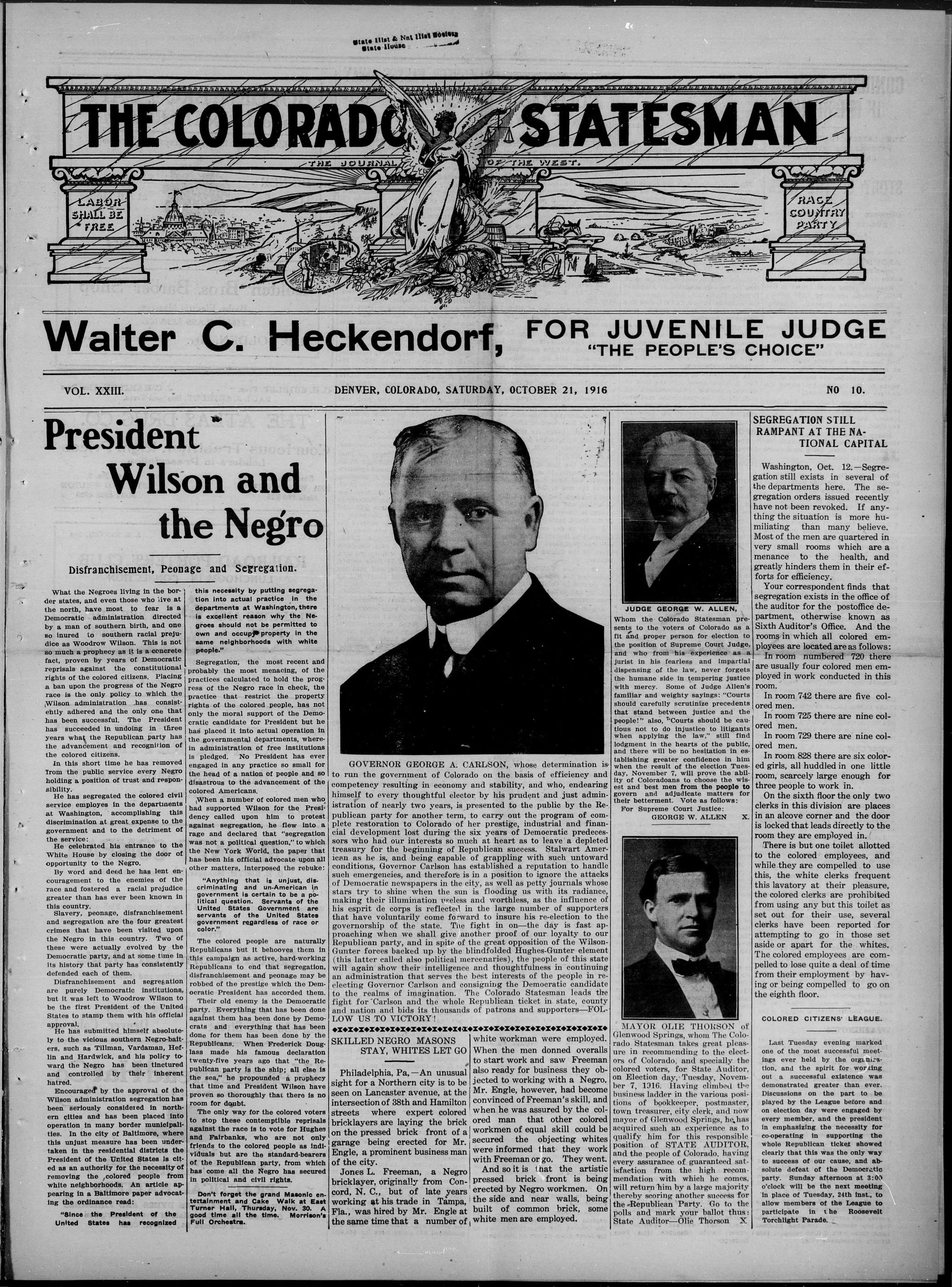
President Wilson and the Negro
Disfranchisement, Peonage and Segregation.
VOL. XXIII.
Presiden
Wils
th
Disfranchisement, Peon
What the Negroes living in the border states, and even those who live at the north, have most to fear is a Democratic administration directed by a man of southern birth, and one so inured to southern racial prejudice as Woodrow Wilson. This is not so much a prophecy as it is a concrete fact, proven by years of Democratic reprisals against the constitutional rights of the colored citizens. Placing a ban upon the progress of the Negro race is the only policy to which the Wilson administration has consistently adhered and the only one that has been successful. The President has succeeded in undoing in three years what the Republican party has the advancement and recognition of the colored citizens.
In this short time he has removed from the public service every Negro holding a position of trust and responsibility.
He has segregated the colored civil service employees in the departments at Washington, accomplishing this discrimination at great expense to the government and to the detriment of the service:
He celebrated his entrance to the White House by closing the door of opportunity to the Negro.
By word and deed he has lent encouragement to the enemies of the race and fostered a racial prejudice greater than has ever been known in this country.
Slavery, peonage, disfranchisement and segregation are the four greatest crimes that have been visited upon the Negro in this country. Two of these were actually evolved by the Democratic party, and at some time in its history that party has consistently defended each of them.
Disfranchisement and segregation are purely Democratic institutions, but it was left to Woodrow Wilson to be the first President of the United States to stamp them with his official approval.
He has submitted himself absolutely to the vicious southern Negro-baiters, such as Tillman, Vardaman, Helfin and Hardwick, and his policy toward the Negro has been tinctured and controlled by their inherent hatred.
Encouraged by the approval of the Wilson administration segregation has been seriously considered in northern cities and has been placed into operation in many border municipalities. In the city of Baltimore, where this unjust measure has been undertaken in the residential districts the President of the United States is cited as an authority for the necessity of removing the colored people from white neighborhoods. An article appearing in a Baltimore paper advocating the ordinance read:
"Since the President of the United States has recognized
this necessity by putting segregation into actual practice in the departments at Washington, there is excellent reason why the Negroes should not be permitted to own and occupy property in the same neighborhoods with white people."
Segregation, the most recent and probably the most menacing, of the practices calculated to hold the progress of the Negro race in check, the practice that restrict the property rights of the colored people, has not only the moral support of the Democratic candidate for President but he has placed it into actual operation in the governmental departments, wherein administration of free institutions is pledged. No President has ever engaged in any practice so small for the head of a nation of people and so disastrous to the advancement of the colored Americans.
When a number of colored men who had supported Wilson for the Presidency called upon him to protest against segregation, he flew into a rage and declared that "segregation was not a political question," to which the New York World, the paper that has been his official advocate upon all other matters, interposed the rebuke:
"Anything that is unjust, discriminating and un-American in government is certain to be a political question. Servants of the United States Government are servants of the United States government regardless of race or color."
The colored people are naturally Republicans but it behooves them in this campaign as active, hard-working Republicans to end that segregation, disfranchisement and peonage may be robbed of the prestige which the Democratic President has accorded them.
Their old enemy is the Democratic party. Everything that has been done against them has been done by Democrats and everything that has been done for them has been done by the Republicans. When Frederick Douglass made his famous declaration twenty-five years ago that "the Republican party is the ship; all else is the sea," he propounded a prophecy that time and President Wilson have proven so thoroughly that there is no room for doubt.
The only way for the colored voters to stop these contemptible reprisals against the race is to vote for Hughes and Fairbanks, who are not only friends to the colored people as individuals but are the standard-bearers of the Republican party, from which has come all the Negro has secured in political and civil rights.
Don't forget the grand Masonic entertainment and Cake Walk at East Turner Hall, Thursday, Nov. 30. A good time all the time. Morrison's Full Orchestra.
DENVER, COLORADO, SATURDAY, OCTOBER 21, 1916
M.
GOVERNOR GEORGE A. CARLSON, whose determination is to run the government of Colorado on the basis of efficiency and competency resulting in economy and stability, and who, endearing himself to every thoughtful elector by his prudent and just administration of nearly two years, is presented to the public by the Republican party for another term, to carry out the program of complete restoration to Colorado of her prestige, industrial and financial development lost during the six years of Democratic predecessors who had our interests so much at heart as to leave a depleted treasury for the beginning of Republican success. Stalwart American as he is, and being capable of grappling with such untoward conditions, Governor Carlson has established a reputation to handle such emergencies, and therefore is in a position to ignore the attacks of Democratic newspapers in the city, as well as petty journals whose stars try to shine when the sun is flooding us with its radiance, making their illumination useless and worthless, as the influence of his esprit de corps is reflected in the large number of supporters that have voluntarily come forward to insure his re-election to the governorship of the state. The fight in on—the day is fast approaching when we shall give another proof of our loyalty to our Republican party, and in spite of the great opposition of the Wilson-Gunter forces backed up by the blindfolded Hughes-Gunter element (this latter called also political mercenaries), the people of this state will again show their intelligence and thoughtfulness in continuing an administration that serves the best interests of the people in re-electing Governor Carlson and consigning the Democratic candidate to the realms of imagination. The Colorado Statesman leads the fight for Carlson and the whole Republican ticket in state, county and nation and bids its thousands of patrons and supporters—FOLLOW US TO VICTORY!
SKILLED NEGRO MASONS STAY, WHITES LET GO
Philadelphia, Pa,—An unusual sight for a Northern city is to be seen on Lancaster avenue, at the intersection of 88th and Hamilton streets where expert colored bricklayers are laying the brick on the pressed brick front of a garage being erected for Mr. Engle, a prominent business man of the city.
Jones L. Freeman, a Negro bricklayer, originally from Concord, N. C., but of late years working at his trade in Tampa, Fla., was hired by Mr. Engle at the same time that a number of
white workman were employed. When the men donned overalls to start work and saw Freeman also ready for business they objected to working with a Negro, Mr. Engle, however, had become convinced of Freeman's skill, and when he was assured by the colored man that other colored workmen of equal skill could be secured the objecting whites were informed that they work with Freeman or go. They went. And so it is that the artistic pressed brick front is being erected by Negro workmen. On the side and near walls, being built of common brick, some white men are employed.
J. B. H.
JUDGE GEORGE W. ALLEN,
Whom the Colorado Statesman presents to the voters of Colorado as a fit and proper person for election to the position of Supreme Court Judge, and who from his experience as a jurist in his fearless and impartial dispensing of the law, never forgets the humane side in tempering justice with mercy. Some of Judge Allen's familiar and weighty sayings: "Courts should carefully scrutinize precedents that stand between justice and the people!" also, "Courts should be cautious not to do injustice to litigants when applying the law," still find lodgment in the hearts of the public, and there will be no hesitation in establishing greater confidence in him when the result of the election Tuesday, November 7, will prove the ability of Coloradoans to choose the wisest and best men from the people to govern and adjudicate matters for their betterment. Vote as follows:
M. B.
MAYOR OLIE THORSON of Glenwood Springs, whom The Colorado Statesman takes great pleasure in recommending to the electors of Colorado, and specially the colored voters, for State Auditor, on Election day; Tuesday, November 7, 1916. Having climbed the business ladder in the various positions of bookkeeper, postmaster, town treasurer, city clerk, and now mayor of Glenwood Springs, he has acquired such an experience as to qualify him for this responsible position of STATE AUDITOR, and the people of Colorado, having every assurance of guaranteed satisfaction from the high recommendation with which he comes, will return him by a large majority thereby scoring another success for the Republican Party. Go to the polls and mark your ballot thus: State Auditor—Olie Thorson X
NO 10.
SEGREGATION STILL RAMPANT AT THE NATIONAL CAPITAL
Washington, Oct. 12.—Segregation still exists in several of the departments here. The segregation orders issued recently have not been revoked. If anything the situation is more humiliating than many believe. Most of the men are quartered in very small rooms which are a menance to the health, and greatly hinders them in their efforts for efficiency. Your correspondent finds that segregation exists in the office of the auditor for the postoffice department, otherwise known as Sixth Auditor's Office. And the rooms in which all colored employees are located are as follows: In room numbered 720 there are usually four colored men employed in work conducted in this room. In room 742 there are five colored men. In room 725 there are nine colored men.
In room 729 there are nine colored men.
In room 828 there are six colored girls, all huddled in one little room, scarcely large enough for three people to work in.
On the sixth floor the only two clerks in this division are places in an alcove corner and the door is locked that leads directly to the room they are employed in.
There is but one toilet allotted to the colored employees, and while they are compelled to use this, the white clerks frequent this lavatory at their pleasure, the colored clerks are prohibited from using any but this toilet as set out for their use, several clerks have been reported for attempting to go in those set aside or apart for the whites. The colored employees are compelled to lose quite a deal of time from their employment by having or being compelled to go on the eighth floor.
COLORED CITIZENS' LEAGUE.
Last Tuesday evening marked one of the most successful meetings ever held by the organization, and the spirit for working out a successful existence was demonstrated greater than ever. Discussions on the part to be played by the League before and on election day were engaged by every member, and the president in emphasizing the necessity for co-operating in supporting the whole Republican ticket showed clearly that this was the only way to success of our cause, and absolute defeat of the Democratic party. Sunday afternoon at 3:00 o'clock will be the next meeting in place of Tuesday, 24th inst., to allow members of the League to participate in the Roosevelt Torchlight Parade.
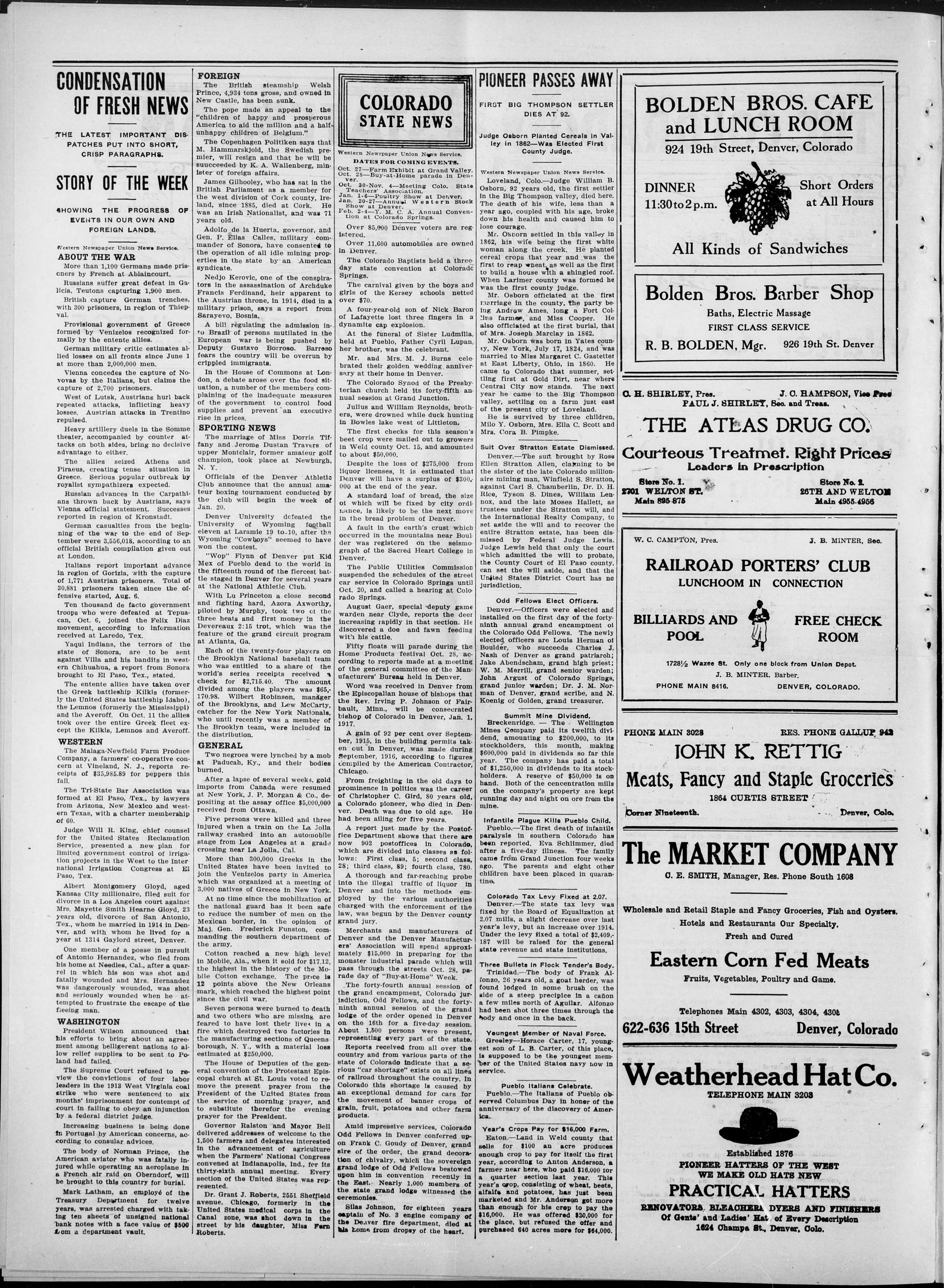
CONDENSATION OF FRESH NEWS
THE LATEST IMPORTANT DIS PATCHES PUT INTO SHORT, CRISP PARAGRAPHS.
STORY OF THE WEEK
STORY OF THE WEEK
SHOWING THE PROGRESS OF EVENTS IN OUR OWN AND FOREIGN LANDS.
Western Newspaper Union News Service.
ABOUT THE WAR
More than 1,100 Germans made prisoners by French at Ablaincourt.
Russians suffer great defeat in Galicia, Teutons capturing 1,900 men.
British capture German trenches, with 300 prisoners, in region of Thiepval.
Provisional government of Greece formed by Venizelos recognized formally by the entente allies.
German military critic estimates allied losses on all fronts since June 1 at more than 2,000,000 men.
Vienna concedes the capture of Novovas by the Italians, but claims the capture of 2,700 prisoners.
West of Lutsk, Austrians hurl back repeated attacks, inflicting heavy losses. Austrian attacks in Trentino repulsed.
Heavy artillery duels in the Somme theater, accompanied by counter attacks on both sides, bring no decisive advantage to either.
The allies seized Athens and Piraeus, creating tense situation in Greece. Serious popular outbreak by royalist sympathizers expected.
Russian advances in the Carpathians thrown back by Austrians, says Vienna official statement. Successes reported in region of Kronstadt.
German casualties from the beginning of the war to the end of September were 3,556,018, according to an official British compilation given out at London.
Italians report important advance in region of Gorizia, with the capture of 1,771 Austrian prisoners. Total of 30,881 prisoners taken since the offensive started, Aug. 6.
Ten thousand de facto government troops who were defeated at Tepuacan, Oct. 6, joined the Felix Diaz movement, according to information received at Laredo, Tex.
Yaqui Indians, the terrors of the state of Sonora, are to be sent against Villa and his bandits in western Chihuahua, a report from Sonora brought to El Paso, Tex., stated.
The entente allies have taken over the Greek battleship Kilkis (formerly the United States battleship Idaho), the Lemnos (formerly the Mississippi) and the Averoff. On Oct. 11 the allies took over the entire Greek fleet except the Kilkis, Lemnos and Averoff.
WESTERN
The Malaga-Newfield Farm Produce Company, a farmers' co-operative concern at Vineland, N. J., reports receipts of $35,985.89 for peppers this fall.
The Tri-State Bar Association was formed at El Paso, Tex., by lawyers from Arizona, New Mexico and western Texas, with a charter membership of 60.
Judge Will R. King, chief counsel for the United States Reclamation Service, presented a new plan for limited government control of irrigation projects in the West to the International Irrigation Congress at El Paso, Tex.
Albert Montgomery Gloyd, aged Kansas City millionaire, filed suit for divorce in a Los Angeles court against Mrs. Mayette Smith Hearne Gloyd, 23 years old, divorcee of San Antonio, Tex., whom he married in 1914 in Denver, and with whom he lived for a year at 1314 Gaylord street, Denver.
One member of a posse in pursuit of Antonio Hernandez, who fled from his home at Needles, Cal., after a quarrel in which his son was shot and fatally wounded and Mrs. Hernandez was dangerously wounded, was shot and seriously wounded when he attempted to frustrate the escape of the fleeing man.
WASHINGTON
President Wilson announced that his efforts to bring about an agreement among belligerent nations to allow relief supplies to be sent to Poland had failed.
The Supreme Court refused to review the convictions of four labor leaders in the 1913 West Virginia coal strike who were sentenced to six months' imprisonment for contempt of court in failing to obey an injunction by a federal district judge.
Increasing business is being done in Portugal by American concerns, according to consular advises.
The body of Norman Prince, the American aviator who was fatally injured while operating an aeroplane in a French air raid on Oberndorf, will be brought to this country for burial.
Mark Latham, an employé of the Treasury Department for twelve years, was arrested charged with taking ten sheets of unsigned national bank notes with a face value of $500 from a department vault.
FOREIGN
The British steamship Welsh Prince, 4,934 tons gross, and owned in New Castle, has been sunk.
The pope made an appeal to the "children of happy and prosperous America to aid the million and a half unhappy children of Belgium."
The Copenhagen Politiken says that M. Hammarskjold, the Swedish premier, will resign and that he will be succeeded by K. A. Wallenberg, minister of foreign affairs.
James Gilhooley, who has sat in the British Parliament as a member for the west division of Cork county, Ireland, since 1885, died at Cork. He was an Irish Nationalist, and was 71 years old.
Adolfo de la Huerta, governor, and Gen. P. Elias Calles, military commander of Sonora, have consented to the operation of all idle mining properties in the state by an American syndicate.
Nedjo Kerovic, one of the conspirators in the assassination of Archduke Francis Ferdinand, heir apparent to the Austrian throne, in 1914, died in a military prison, says a report from Sarayevo, Bosnia.
A bill regulating the admission into Brazil of persons mutilated in the European war is being pushed by Deputy Gustavo Borroso. Barroso fears the country will be overrun by crippled immigrants.
In the House of Commons at London, a debate arose over the food situation, a number of the members complaining of the inadequate measures of the government to control food supplies and prevent an executive rise in prices.
SPORTING NEWS
The marriage of Miss Dorris Tiffany and Jerome Dustan Travers of upper Montclair, former amateur golf champion, took place at Newburgh, N. Y.
Officials of the Denver Athletic Club announce that the annual amateur boxing tournament conducted by the club will begin the week of Jan. 20.
Denver University defeated the University of Wyoming football eleven at Laramie 19 to-10, after the Wyoming "Cowboys" seemed to have won the contest.
"Wop" Flynn of Denver put Kid Mex of Pueblo dead to the world in the fifteenth round of the fiercest battle staged in Denver for several years at the National Athletic Club.
With Lu Princeton a close second and fighting hard, Azora Axworthy, piloted by Murphy, took two ct the three heats and first money in the Devereaux 2:15 trot, which was the feature of the grand circuit program at Atlanta, Ga.
Each of the twenty-four players on the Brooklyn National baseball team who was entitled to a share of the world's series receipts received a check for $2,715.40. The amount divided among the players was $65-170.98. Wilbert Robinson, manager of the Brooklyns, and Lew McCarty, catcher for the New York Nationals, who until recently was a member of the Brooklyn team, were included in the distribution.
GENERAL
Two negroes were lynched by a mob at Paducah, Ky., and their bodies burned.
After a lapse of several weeks, gold imports from Canada were resumed at New York, J. P. Morgan & Co., depositing at the assay office $5,000,000 received from Ottawa.
Five persons were killed and three injured when a train on the La Jolla railway crashed into an automobile stage from Los Angeles at a grade crossing near La Jolla, Cal.
More than 300,000 Greeks in the United States have been invited to join the Venizelos party in America which was organized at a meeting of 3,000 natives of Greece in New York.
At no time since the mobilization of the national guard has it been safe to reduce the number of men on the Mexican border, in the opinion of Maj. Gen. Frederick Funston, commanding the southern department of the army.
Cotton reached a new high level in Mobile, Ala., when it sold for $17.12, the highest in the history of the Mobile Cotton exchange. The price is 12 points above the New Orleans mark, which reached the highest point since the civil war.
Seven persons were burned to death and two others who are missing are feared to have lost their lives in a fire which destroyed two factories in the manufacturing sections of Queensborough, N. Y., with a material loss estimated at $250,000.
The House of Deputies of the general convention of the Protestant Episcopal church at St. Louis voted to remove the present prayer from the President of the United States from the service of morning prayer, and to substitute therefor the evening prayer for the President.
Governor Ralston and Mayor Bell delivered addresses of welcome to the 1,500 farmers and delegates interested in the advancement of agriculture when the Farmers' National Congress convened at Indianapolis, Ind., for its thirty-sixth annual meeting. Every section of the United States was represented.
Dr. Grant J. Roberts, 2551 Sheffield avenue, Chicago, formerly in the United States medical corps in the Canal zone, was shot down in the street by his daughter, Miss Fern Roberts.
COLORADO STATE NEWS
Western Newpaper Union News Service.
DATES FOR COMING EVENTS.
Oct. 27—Farm Exhibit at Grand Valley.
Oct. 28—Buy-at-Home parade in Denver.
Oct. 30-Nov. 4—Meeting Colo. State
Teachers.
Oct. 30-Nov. 4—Meeting Colo. State Teachers' Association.
Jan. 14—Meeting Colo. State Teachers' Association.
Teachers' Association.
Jan. 1, 1-6 - Poultry Show at Denver.
Jan. 2, 7 - Annual Western Stock
Show at Denver.
Feb. 2-4 - Y. M. C. A. Annual Conven-
tion at Colorado Springs.
Over 85,000 Denver voters are regi-
stered.
Over 11,600 automobiles are owned
in Denver.
The Colorado Baptists held a three-
day state convention at Colorado
Springs.
The carnival given by the boys and
girls of the Kersey schools netted
over $70.
A four-year-old son of Nick Baron
of Lafayette lost three fingers in a
dynamite cap explosion.
At the funeral of Sister Ludmilla,
held at Pueblo, Father Cyril Lupan,
her brother, was the celebrant.
Mr. and Mrs. M. J. Burns celebrated their golden wedding anniversary at their home in Denver.
The Colorado Synod of the Presbyterian church held its forty-fifth annual session at Grand Junction.
Julius and William Reynolds, brothers, were drowned while duck hunting in Bowles lake west of Littleton.
The first checks for this season's beet crop were mailed out to growers in Weld county Oct. 15, and amounted to about $50,000.
Despite the loss of $275,000 from liquor licenses, it is estimated that Denver will have a surplus of $200,000 at the end of the year.
A standard loaf of bread, the size of which will be fixed by city ordinance, is likely to be the next move in the bread problem of Denver.
A fault in the earth's crust which occurred in the mountains near Boulder was registered on the seismograph of the Sacred Heart College in Denver.
The Public Utilities Commission suspended the schedules of the street car service in Colorado Springs until Oct. 20, and called a hearing at Colorado Springs.
August Gaer, special deputy game warden near Clyde, reports the deer increasing rapidly in that section. He discovered a doe and fawn feeding with his cattle.
Fifty floats will parade during the Home Products festival Oct. 28, according to reports made at a meeting of the general committee of the Manufacturers' Bureau held in Denver.
Word was received in Denver from the Episcopallian house of bishops that the Rev. Irving P. Johnson of Fairbault, Minn., will be consecrated bishop of Colorado in Denver, Jan. 1, 1917.
A gain of 92 per cent over September, 1915, in the building permits taken out in Denver, was made during September, 1916, according to figures compiled by the American Contractor, Chicago.
From freighting in the old days to prominence in politics was the career of Christopher C. Gird, 80 years old, a Colorado pioneer, who died in Denver. Death was due to old age. He had been alling for five years.
A report just made by the Postoffice Department shows that there are now 902 postoffices in Colorado, which are divided into classes as follows: First class, 5; second class, 28; third class, 89; fourth class, 780. A thorough and far-reaching probe into the illegal traffic of liquor in Denver and into the methods employed by the various authorities charged with the enforcement of the law, was begun by the Denver county grand jury. Merchants and manufacturers of Denver and the Denver Manufacturers' Association will spend approximately $15,000 in preparing for the monster industrial parade which will pass through the streets Oct. 28, parade day of "Buy-at-Home" Week.
The forty-fourth annual session of the grand encampment, Colorado jurisdiction, Odd Fellows, and the forty-ninth annual session of the grand lodge of the order opened in Denver on the 16th for a five-day session. About 1,500 persons were present, representing every part of the state. Reports received from all over the country and from various parts of the state of Colorado indicate that a serious "car shortage" exists on all lines of railroad throughout the country. In Colorado this shortage is caused by an exceptional demand for cars for the movement of banner crops of grain, fruit, potatoes and other farm products.
Amid impressive services, Colorado Odd Fellows in Denver conferred upon Frank C. Goudy of Denver, grand sire of the order, the grand decoration of chivalry, which the sovereign grand lodge of Odd Fellows bestowed upon him in convention recently in the East. Nearly 1,000 members of the state grand lodge witnessed the ceremonies. Silas Johnson, for eighteen years captain of No. 3 engine company of the Denver fire department, died at his home from dropsy of the heart.
PIONEER PASSES AWAY
FIRST BIG THOMPSON SETTLER
DIES AT 92.
Judge Osborn Planted Cereals in Valley in 1862—Was Elected First County Judge.
Western Newspaper Union News Service.
Loveland, Colo.—Judge William B. Osborn, 92 years old, the first settler in the Big Thompson valley, died here. The death of his wife, less than a year ago, coupled with his age, broke down his health and caused him to lose courage. Mr. Osborn settled in this valley in 1862, his wife being the first white woman along the creek. He planted cereal crops that year and was the first to reap wheat, as well as the first to build a house with a shingled roof. When Larimer county was formed he was the first county judge. Mr. Osborn officiated at the first marriage in the county, the party being Andrew Ames, long a Fort Collins farmmee, and Miss Cooper. He also officiated at the first burial, that of Mrs. Joseph Marclay in 1862.
Mr. Osborn was born in Yates county, New York, July 17, 1824, and was married to Miss Margaret C. Gastetter at East Liberty, Ohio, in 1860. He came to Colorado that summer, settling first at Gold Dirt, near where Central City now stands. The next year he came to the Big Thompson valley, settling on a farm just east of the present city of Loveland.
He is survived by three children, Milo Y. Osborn, Mrs. Ella C. Scott and Mrs. Cora B. Pimpke.
Suit Over Stratton Estate Dismissed.
Suit Over Stratton Estate Dismissed.
Denver.—The suit brought by Rose Ellen Stratton Allen, claiming to be the sister of the late Colorado millionaire mining man, Winfield S. Stratton, against Carl S. Chamberlin, Dr. D. H. Rice, Tyson S. Dines, William Lennox, and the late Moses Hallett, as trustees under the Stratton will, and the International Realty Company, to set aside the will and to recover the entire Stratton estate, has been dismissed by Federal Judge Lewis.
Judge Lewis held that only the court which admitted the will to probate, the County Court of El Paso county, can set the will aside, and that the United States District Court has no jurisdiction.
Odd Fellows Elect Officers.
Denver.—Officers were elected and installed on the first day of the forty-ninth annual grand encampment of the Colorado Odd Fellows. The newly elected officers are Louis Herman of Boulder, who succeeds Charles J. Nash of Denver as grand patriarch; Jake Abendscham, grand high priest; W. M. Merrill, grand senior warden; John Argust of Colorado Springs, grand junior warden; Dr. J. M. Norman of Denver, grand scribe, and N. Koenig of Golden, grand treasurer.
Summit Mine Dividend.
Breckenridge. — The Wellington Mines Company paid its twelfth dividend, amounting to $200,000, to its stockholders, this month, making $600,000 paid in dividends so far this year. The company has paid a total of $1,250,000 in dividends to its stockholders. A reserve of $50,000 is on hand. Both of the concentration mills on the company's property are kept running day and night on ore from the mine.
Infantile Plague Kills Pueblo Child.
Pueblo.—The first death of infantile paralysis in southern Colorado has been reported. Eva Schimmer, died after a five-day illness. The family came from Grand Junction four weeks ago. The parents and eight other children have been placed in quarantine.
Colorado Tax Levy Fixed at 2.07. Denver.—The state tax levy was fixed by the Board of Equalization at 2.07 mills, a slight decrease over last year's levy, but an increase over 1914. Under the levy fixed a total of $2,409.187 will be raised for the general state revenue and state institutions.
Three Bullets in Flock Tender's Body. Trinidad.—The body of Frank Alfonzo, 26 years old, a goat herder, was found lodged in some brush on the side of a steep precipice in a canon a few miles north of Aguilar. Alfonzo had been shot three times through the body and once in the back.
Youngest Member of Naval Force. Greeley—Horace Carter, 17, youngest son of L. B. Carter, of this place, is supposed to be the youngest member of the United States navy now in service.
Pueblo.—The Italians of Pueblo observed Columbus Day in honor of the anniversary of the discovery of America.
Year's Crops Pay for $16,000 Farm.
Eaton—Land in Weld county that sells for $100 an acre produces enough crop to pay for itself the first year, according to Anton Anderson, a farmer near here, who paid $16,000 for a quarter section last year. This year's crop, consisting of wheat, beets, alfalfa and potatoes, has just been marketed and Mr. Anderson got more than enough for his crop to pay the $16,000. He was offered $20,000 for the place, but refused the offer and purchased 640 acres more for $64,000.
BOLDEN BROS. CAFE and LUNCH ROOM 924 19th Street, Denver, Colorado
DINNER
11:30 to 2 p.m.
All Kinds
Bolden Bre
Baths,
FIRST
R. B. BOLDEN,
O. H. SHIRLEY, Pres.
FAUL J. SHIRLEY
THE ATL
Courteous Tre
Leaders
Store No. 1.
2701 WELTON ST.
Main 895-875
All Kinds of Sandwiches
Harden Bros. Barber S
Baths, Electric Massage
FIRST CLASS SERVICE
BOLDEN, Mgr. 926 19th St.
LEY, Pres. J. O. HAMPSON
PAUL J. SHIRLEY, Sec. and Treas.
E ATLAS DRUG C
ous Treatmet. Right
Leaders in Prescription
1. STORE
DON ST.
1775
26TH ANN
Main 4
PTON, Pres. J. B. MI
LROAD PORTERS' C
LUNCHOOM IN CONNECTION
All Kinds of Sandwiches
Bolden Bros. Barber Shop
Baths, Electric Massage
FIRST CLASS SERVICE
R. B. BOLDEN, Mgr. 926 19th St. Denver
C. H. SHIRLEY, Pres. J. C. HAMPSON, Vice Pres PAUL J. SHIRLEY, Sec. and Treas.
Courteous Treatmet. Right Prices Leaders in Prescription
W. C. CAMPTON, Pres.
RAILROAD
LUNCHOOM
RAILROAD PORTERS' CLUB LUNCHOOM IN CONNECTION
BILLIARDS AND
POOL
1728½ Wazee St. C
J. B. I
PHONE MAIN 8416.
28½ Wazee St. Only one block from Union De
J. B. MINTER, Barber.
NE MAIN 8416. DENVER, COLOR
1728 $ \frac{1}{2} $ Wazee St. Only one block from Union Depot.
J. B. MINTER, Barber.
PHONE MAIN 8416. DENVER, COLORADO
Meats, Fancy a 1864 OY
JOHN K. RETTIGER
Fancy and Staple Grocery
1864 CURTIS STREET
seventh.
MARKET COMPANY
E. SMITH, Manager, Res. Phone South 1
d Retail Staple and Fancy Groceries, Fish
Hotels and Restaurants Our Specialty.
Fresh and Cured
Eastern Corn Fed Me
Fruits, Vegetables, Poultry and Game.
Telephones Main 4302, 4303, 4304, 4306
15th Street Denver,
atherhead Hall
TELEPHONE MAIN 3203
Meats, Fancy and Staple Groceries 1864 CURTIS STREET
The MARKET
C. E. SMITH, Man
Wholesale and Retail Staple
Hotels and Res
Fresh
Eastern C
Fruits, Vegeta
Telephones Ma
622-636 15th Street
Weather
TELEPHONE
The MARKET COMPANY
C. E. SMITH, Manager, Res. Phone South 1608
Wholesale and Retail Staple and Fancy Groceries, Fish and Oysters. Hotels and Restaurants Our Specialty. Fresh and Cured Eastern Corn Fed Meats Fruits, Vegetables, Poultry and Game.
Telephones Main 4302, 4303, 4304, 430b
622-636 15th Street Denver, Colorado
Established 1876
PIONEER HATTERS OF THE WEST
WE MAKE OLD HATS NEW
PRACTICAL HATTER
RENOVATORS, BLEACHERA DYERS AND FIL
Of Gents' and Ladies' Hat, of Every Descrip
1624 Champa St., Denver, Colo.
PRACTICAL HATTER
ATORS, BLEACHERA DYERS AND FIL
Gents' and Ladies' Hat, of Every Descrip
1624 Champa St., Denver, Colo.
RENOVATORS, BLEACHERA DYERS AND FINISHERS
Of Gents' and Ladies' Hat, of Every Description
1824 Champa St., Denver, Colo.
PHONE MAIN 3028
Corner Nineteenth.
Short Orders at All Hours
Sandwiches
Barber Shop
Massage
SERVICE
926 19th St. Denver
J. O. HAMPSON, Vice Pres
so. and Treas.
DRUG CO.
St. Right Prices
Description
Store No. 2
26TH AND WELTOM
Main 4955.4956
J. B. MINTER, Sec.
TERS' CLUB
CONNECTION
FREE CHECK
ROOM
ock from Union Depot.
Barber.
DENVER, COLORADO.
RES. PHONE GALLUP 942
ETTIG
Staple Groceries
STREET
Denver, Colo.
COMPANY
Phone South 1608
Groceries, Fish and Oysters
Our Specialty.
Fed Meats
Entry and Game.
303, 4304, 430b
Denver, Colorado
Bad Hat Co.
MAIN 3208
HATTERS
VERS AND FINISHERS
Of Every Description
Denver, Colo.
VINE
A
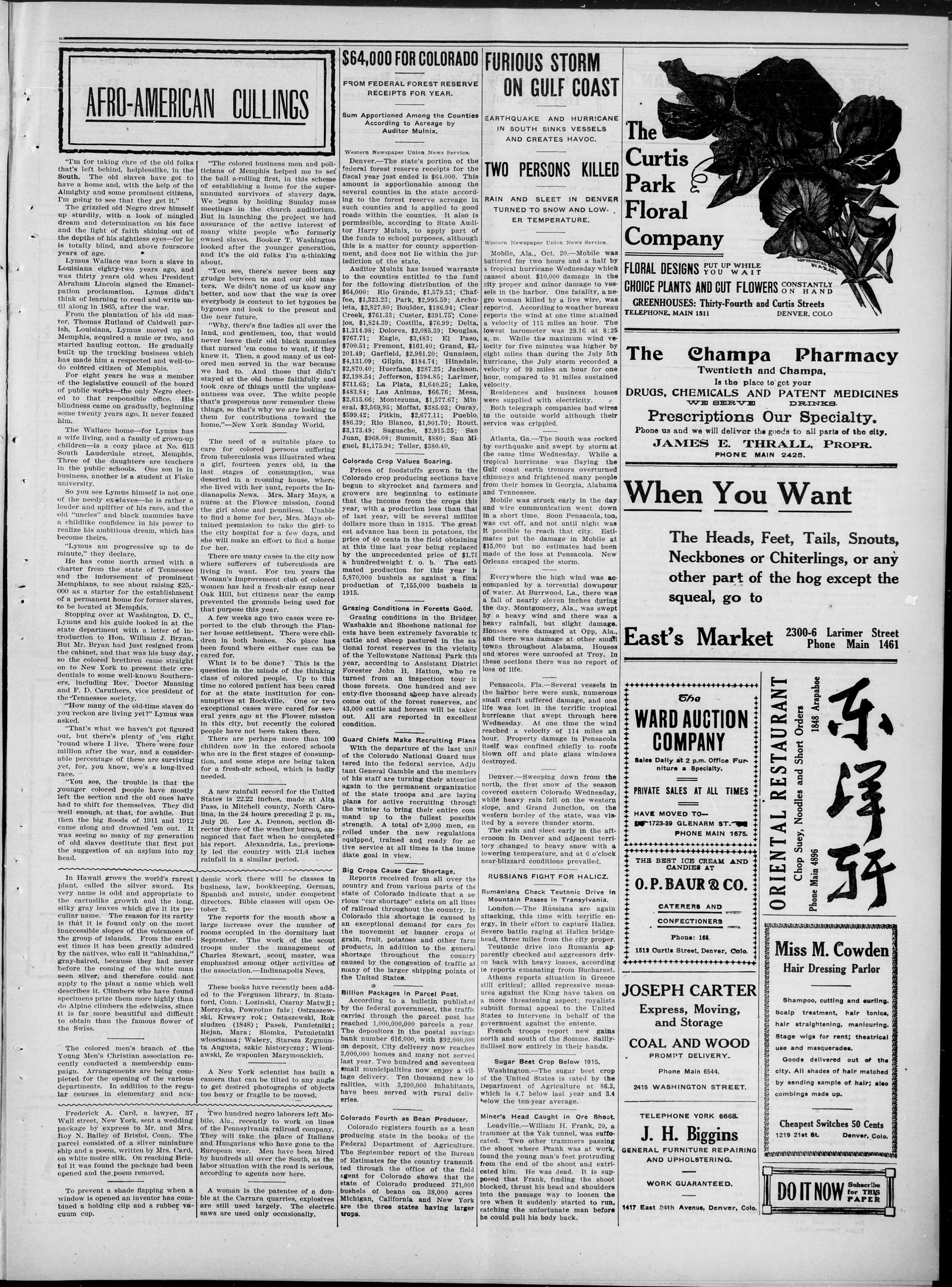
AFRO-AMERICAN CULLINGS
"I'm for taking care of the old folks that's left behind, helplesslike, in the South. The old slaves have got to have a home and, with the help of the Almighty and some prominent citizens, I'm going to see that they get it."
The grizzled old Negro drew himself up sturdily, with a look of mingled dream and determination on his face and the light of faith shining out of the depths of his sightless eyes—for he is totally blind, and above fourscore years of age.
Lymus Wallace was born a slave in Louisiana eighty-two years ago, and was thirty years old when President Abraham Lincoln signed the Emancipation proclamation. Lymus didn't think of learning to read and write until along in 1865, after the war.
From the plantation of his old master, Thomas Rutland of Caldwell parish, Louisiana, Lymus moved up to Memphis, acquired a mule or two, and started hauling cotton. He gradually built up the trucking business which has made him a respected and well-to-do colored citizen of Memphis.
For eight years he was a member of the legislative council of the board of public works—the only Negro elected to that responsible office. His blindness came on gradually, beginning some twenty years ago. It never feazed him.
The Wallace home—for Lymus has a wife living, and a family of grown-up children—is a cozy place at No. 613 South Lauderdale street, Memphis. Three of the daughters are teachers in the public schools. One son is in business, another is a student at Fiske university.
So you see Lymus himself is not one of the needy ex-slaves—he is rather a leader and uplifter of his race, and the old "uncles" and black mammals have a childlike confidence in his power to realize his ambitious dream, which has become theirs.
"Lymus am progressive up to de minute," they declare.
He has come north armed with a charter from the state of Tennessee and the indorsement of prominent Memphians, to see about raising $25-000 as a starter for the establishment of a permanent home for former slaves, to be located at Memphis.
Stopping over at Washington, D. C., Lymus and his guide looked in at the state department with a letter of introduction to Hon. William J. Bryan. But Mr. Bryan had just resigned from the cabinet, and that was his busy day, so the colored brethren came straight on to New York to present their credentials to some well-known Southerners, including Rev. Doctor Manning and F. D. Caruthers, vice president of the Tennessee society.
"How many of the old-time slaves do you reckon are living yet?" Lymus was asked.
"That's what we haven't got figured out, but there's plenty of 'em right 'round where I live. There were four million after the war, and a considerable percentage of these are surviving yet, for, you know, we're a long-lived race.
"You see, the trouble is that the younger colored people have mostly left the section and the old ones have had to shift for themselves. They did well enough, at that, for awhile. But then the big floods of 1911 and 1912 came along and drowned 'em out. It was seeing so many of my generation of old slaves destitute that first put the suggestion of an asylum into my head.
In Hawaii grows the world's rarest plant, called the silver sword. Its very name is odd and appropriate to the cactuslike growth and the long, silky gray leaves which give it its peculiar name. The reason for its rarity is that it is found only on the most inaccessible slopes of the volcanoes of the group of islands. From the earliest times it has been greatly admired by the natives, who call it "ahinahina," gray-haired, because they had never before the coming of the white man seen silver, and therefore could not apply to the plant a name which well describes it. Climbers who have found specimens prize them more highly than do Alpine climbers the edelweiss, since it is far more beautiful and difficult to obtain than the famous flower of the Swiss.
The colored men's branch of the Young Men's Christian association recently conducted a membership campaign. Arrangements are being completed for the opening of the various departments. In addition to the regular courses in elementary and aca
Frederick A. Card, a lawyer, 37 Wall street, New York, sent a wedding package by express to Mr. and Mrs. Roy N. Bailey of Bristol, Conn. The parcel consisted of a silver miniature ship and a poem, written by Mrs. Card, on white moire silk. On reaching Bristol it was found the package had been opened and the poem removed.
To prevent a shade flapping when a window is opened an inventor has combined a holding clip and a rubber vacuum cup.
"The colored business men and politicians of Memphis helped me to set the ball a-rolling first, in this scheme of establishing a home for the super-annuated survivors of slavery days. We began by holding Sunday mass meetings in the church auditorium. But in launching the project we had assurance of the active interest of many white people who formerly owned slaves. Booker T. Washington looked after the younger generation, and it's the old folks I'm a-thinking about.
"You see, there's never been any grudge between us and our old masters. We didn't none of us know any better, and now that the war is over everybody is content to let bygones be bygones and look to the present and the near future."
"Why, there's fine ladies all over the land, and gentlemen, too, that would never leave their old black mammles that nursed 'em come to want, if they knew it. Then, a good many of us colored men served in the war because we had to. And those that didn't stayed at the old home faithfully and took care of things until the unpleasantness was over. The white people that's prosperous now remember these things, so that's why we are looking to them for contributions toward the home."—New York Sunday World.
The need of a suitable place to care for colored persons suffering from tuberculosis was illustrated when a girl, fourteen years old, in the last stages of consumption, was deserted in a rooming house, where she lived with her aunt, reports the Indianapolis News. Mrs. Mary Mays, a nurse at the Flower mission, found the girl alone and penniless. Unable to find a home for her, Mrs. Mays obtained permission to take the girl-to the city hospital for a few days, and she will make an effort to find a home for her.
There are many cases in the city now where sufferers of tuberculosis are living in want. For ten years the Woman's Improvement club of colored women has had a fresh-air camp near Oak Hill, but citizens near the camp prevented the grounds being used for that purpose this year.
A few weeks ago two cases were reported to the club through the Flanner house settlement. There were children in both homes. No place has been found where either case can be cared for.
What is to be done? This is the question in the minds of the thinking class of colored people. Up to this time no colored patient has been cared for at the state institution for consumptives at Rockville. One or two exceptional cases were cared for several years ago at the Flower mission in this city, but recently the colored people have not been taken there.
There are perhaps more than 100 children now in the colored schools who are in the first stages of consumption, and some steps are being taken for a fresh-air school, which is badly needed.
A new rainfall record for the United States is 22.22 inches, made at Alta Pass, in Mitchell county, North Carolina, in the 24 hours preceding 2 p. m., July 26. Lee A. Denson, section director there of the weather bureau, announced that fact when he completed his report. Alexandria, La., previously led the country with 21.4 inches rainfall in a similar period.
demic work there will be classes in business, law, bookkeeping, German, Spanish and music, under competent directors. Bible classes will open October 3.
The reports for the month show a large increase over the number of rooms occupied in the dormitory last September. The work of the scout troops under the management of Charles Stewart, scout master, was emphasized among other activities of the association.—Indianapolis News.
These books have recently been added to the Ferguson library, in Stamford, Conn.: Lozinski, Czarny Matwij; Morzycka, Powrotne fale; Ostraszewski, Krwawy rok; Ostaszewski, Rokludzen (1848); Pasek, Pamietnik; Rejan, Mara; Slomka, Patmietnik wloscianaa; Walery, Starsza Zygmunta Augusta, szkic historyczny; Wieniawski, Ze wsponlen Marymonckich.
A New York scientist has built a camera that can be tilted to any angle to get desired photographs of objects too heavy or fragile to be moved.
Two hundred negro laborers left Mobile, Ala., recently to work on lines of the Pennsylvania railroad company. They will take the place of Italians and Hungarians who have gone to the European war. Men have been hired by hundreds all over the South, as the labor situation with the road is serious, according to agents now here.
A woman is the patentee of a double at the Carrara quarries, explosives are still used largely. The electric saws are used only occasionally.
$64,000 FOR COLORADO
FROM FEDERAL FOREST RESERVE RECEIPTS FOR YEAR.
Sum Apportioned Among the Counties According to Acreage by Auditor Mulnix.
Western Newspaper Union News Service.
Denver.—The state's portion of the federal forest reserve receipts for the fiscal year just ended is $64,000. This amount is apportionable among the several counties in the state according to the forest reserve acreage in such counties and is applied to good roads within the counties. It also is permissible, according to State Auditor Harry Mulnix, to apply part of the funds to school purposes, although this is a matter for county apportionment, and does not lie within the jurisdiction of the state.
Auditor Mulnix has issued warrants to the counties entitled to the fund for the following distribution of the $64,000: Rio Grande, $1,579.53; Chafee, $1,232.23; Park, $2,995.59; Archuleta, $2,827.80; Boulder, $186.94; Clear Creek, $761.33; Custer, $391.75; Conejos, $1,824.39; Costilla, $76.99; Delta, $1,314.98; Dolores, $2,085.39; Douglas, $767.71; Eagle, $3,483; El Paso, $700.51; Fremont, $161.40; Grand, $3,201.49; Garfield, $2,981.20; Gunnison, $4,131.09; Gilpin, $184.74; Hinsdale, $2,870.40; Huerfano, $287.25; Jackson, $2,198.54; Jefferson, $394.85; Larimer, $711.65; La Plata, $1,640.25; Lake, $483.84; Las Animas, $66.76; Mesa, $2,615.66; Montezuma, $1,577.67; Mineral, $3,569.95; Moffat, $385.03; Ouray, $599.42; Pitkin, $2,677.11; Pueblo, $86.39; Rio Blanco, $1,901.70; Routt, $3,173.49; Saguache, $2,915.25; San Juan, $68.08; Summit, $880; San Miguel, $1,175.94; Teller, $380.40.
Colorado Crop Values Soaring
Prices of foodstuffs grown in the Colorado crop producing sections have begun to skyrocket and farmers and growers are beginning to estimate that the income from the crops this year, with a production less than that of last year, will be several million dollars more than in 1915. The greatest advance has been in potatoes, the price of 40 cents in the field obtaining at this time last year being replaced by the unprecedented price of $1.75 a hundredweight f. o. b. The estimated production for this year is 5,870,000 bushels as against a final production of 7,155,000 bushels in 1915.
Grazing Conditions in Forests Good.
Grazing conditions in the Bridger, Washakie and Shoshone national forests have been extremely favorable to cattle and sheep pastured in the national forest reserves in the vicinity of the Yellowstone National Park this year, according to Assistant District Forester John H. Hatton, who returned from an inspection tour in those forests. One hundred and seventy-five thousand sheep have already come out of the forest reserves, and 43,000 cattle and horses will be taken out. All are reported in excellent condition.
Guard Chiefs Make Recruiting Plans With the departure of the last unit of the Colorado National Guard muster into the federal service, Adjutant General Gamble and the members of his staff are turning their attention again to the permanent organization of the state troops and are laying plans for active recruiting through the winter to bring their entire command up to the fullest possible strength. A total of 3,000 men, enrolled under the new regulations equipped, trained and ready for active service at all times is the immediate goal in view.
Big Crops Cause Car Shortage.
Reports received from all over the country and from various parts of the state of Colorado indicate that a serious "car shortage" exists on all lines of railroad throughout the country. In Colorado this shortage is caused by an exceptional demand for cars for the movement of banner crops of grain, fruit, potatoes and other farm products, in addition to the general shortage throughout the country caused by the congestion of traffic at many of the larger shipping points of the United States.
According to a bulletin published by the federal government, the traffic carried through the parcel post has reached 1,000,000,000 parcels a year. The depositors in the postal savings bank number 616,000, with $92,000,000 on deposit. City delivery now reaches 3,000,000 homes and many not served last year. Two hundred and seventeen small municipalities now enjoy a village delivery. Ten thousand new localities, with 3,200,000 inhabitants, have been served with rural deliveries.
Colorado Fourth as Bean Producer
Colorado registers fourth as a bean producing state in the books of the Federal Department of Agriculture. The September report of the Bureau of Estimates for the country transmitted through the office of the field agent for Colorado shows that the state of Colorado produced 371,000 bushels of beans on 38,000 acres. Michigan, California and New York are the three states having larger crops.
EARTHQUAKE AND HURRICANE
IN SOUTH SINKS VESSELS
AND CREATES HAVOC.
TWO PERSONS KILLED
RAIN AND SLEET IN DENVER
TURNED TO SNOW AND LOW-
ER TEMPERATURE.
Western Newspaper Union News Service.
Mobile, Ala., Oct. 20.—Mobile was battered for two hours and a half by a tropical hurricane Wednesday which caused about $10,000 damage in the city proper and minor damage to vessels in the harbor. One fatality, a negro woman killed by a live wire, was reported. According to weather bureau reports the wind at one time attained a velocity of 115 miles an hour. The lowest barometer was 29.16 at 8:25 a.m. While the maximum wind velocity for five minutes was higher by eight miles than during the July 5th hurricane, the July storm recorded a velocity of 99 miles an hour for one hour, compared to 91 miles sustained velocity.
Residences and business houses were supplied with electricity. Both telegraph companies had wires to the outside world although their service was crippled.
Atlanta, Ga.—The South was rocked by earthquake and swept by storm at the same time Wednesday. While a tropical hurricane was flaying the Gulf coast earth tremors overturned chimneys and frightened many people from their homes in Georgia, Alabama and Tennessee.
Mobile was struck early in the day and wire communication went down in a short time. Soon Pensacola, too, was cut off, and not until night was it possible to reach that city. Estimates put the damage in Mobile at $15,000 but no estimates had been made of the loss at Pensacola. New Orleans escaped the storm.
Everywhere the high wind was accompanied by a torrential downpour of water. At Burrwood, La., there was a fall of nearly eleven inches during the day. Montgomery, Ala., was swept by a heavy wind and there was a heavy rainfall, but slight damage. Houses were damaged at Opp, Ala., and there was damage at other small towns throughout Alabama. Houses and stores were unroofed at Troy. In these sections there was no report of loss of life.
Pensacola, Fla.—Several vessels in the harbor here were sunk, numerous small craft suffered damage, and one life was lost in the terrific tropical hurricane that swept through here Wednesday. At one time the wind reached a velocity of 114 miles an hour. Property damage in Pensacola itself was confined chiefly to roofs blown off and plate glass windows destroyed.
Denver.—Sweeping down from the north, the first snow of the season covered eastern Colorado Wednesday, while heavy rain fell on the western slope, and Grand Junction, on the western border of the state, was visited by a severe thunder storm.
The rain and sleet early in the afternoon in Denver and adjacent territory changed to heavy snow with a lowering temperature, and at 6 o'clock near-blizzard conditions prevailed.
RUSSIANS FIGHT FOR HALICZ.
Rumanians Check Teutonic Drive in Mountain Passes in Transylvania. London.—The Russians are again attacking, this time with terrific energy, in their effort to capture Haliez. Severe battle raging at Halicz bridgehead, three miles from the city proper. Teutonic drive into Rumania apparently checked and aggressors driven back with heavy losses, according to reports emanating from Bucharest. Athens reports situation in Greece still critical; allied repressive measures against the King have taken on a more threatening aspect; royalists submit formal appeal to the United States to intervene in behalf of the government against the entente. French troops report new gains north and south of the Somme. Sailly-Sallisel now entirely in their hands.
Sugar Beet Crop Below 1915.
Washington.—The sugar beet crop of the United States is rated by the Department of Agriculture at 86.3, which is 4.7 below last year and 3.4 below the ten-year average.
Miner's Head Caught in Ore Shoot.
Leadville.—William H. Frank, 20, a trammer at the Yak tunnel, was suffocated. Two other trammers passing the shoot where Frank was at work, found the young man's feet protruding from the end of the shoot and extricated him. He was dead. It is supposed that Frank, finding the shoot blocked, thrust his head and shoulders into the passage way to loosen the ore when it suddenly started to run, catching the unfortunate man before he could pull his body back.
The
Curtis
Park
Floral
Company
FLORAL DESIGNS PUT UP WHILE
YOU WAIT
CHOICE PLANTS AND CUT FLOWERS CONSTANTLY
ON HAND
GREENHOUSES: Thirty-Fourth and Curtis Streets
TELEPHONE, MAIN 1511
DENVER, COLO
The Champa Pharmacy
Twentieth and Champa,
Is the place to get your
DRUGS, CHEMICALS AND PATENT MEDICINES
WE SERVE DRINKS.
Prescriptions Our Specialty.
Phone us and we will deliver the goods to all parts of the city.
JAMES E. THRALL, PROPR.
PHONE MAIN 2425.
When You Want
The Heads, Feet, Tails, Snouts, Neckbones or Chiterlings, or any other part of the hog except the squeal, go to
East's Market
The
WARD AUCTION
COMPANY
Sales Daily at 2 p.m. Office Furniture a Specialty.
PRIVATE SALES AT ALL TIMES
HAVE MOVED TO—
1723-39 GLENARM ST.
PHONE MAIN 1675.
THE BEST ICE CREAM AND CANDIES AT
O.P. BAUR & CO.
CATERERS AND
CONFECTIONERS
Phone: 168.
1513 Curtis Street, Denver, Colo.
JOSEPH CARTER
Express, Moving,
and Storage
COAL AND WOOD
PROMPT DELIVERY.
Phone Main 6544.
2415 WASHINGTON STREET.
TELEPHONE YORK 6668.
J. H. Biggins
GENERAL FURNITURE REPAIRING
AND UPHOLSTERING.
WORK GUARANTEED.
1417 East 24th Avenue, Denver, Colo.
2300-6 Larimer Street Phone Main 1461
1848 Arapahoe
Phone Main 4896
Miss M. Cowden Hair Dressing Parlor
Shampoo, cutting and curling. Scalp treatment, hair tonics, hair straightening, manicuring. Stage wigs for rent; theatrical use and masquerades. Goods delivered out of the city. All shades of hair matched by sending sample of hair; also combings made up.
Cheapest Switches 50 Cents
1219 21st St. Denver, Colo.
DO IT NOW Subscribe
for THIS
PAPER
THE COLORADO STATESMAN
THE ASSUMPTION OF THE STATE
CARSON SHOULD BE FREE
COUNTRY PARTY
1824 Curtis Street, Room 25.
Phone Main 7417.
SUBSCRIPTION RATES.
One Year ..... $ 2.00
Six Months ..... 1.00
Three Months ..... 60
PAYABLE IN ADVANCE.
Entered as second-class matter at the postoffice in the City of Denver, Colo.
Reading notices, ten lines or less, 10 cents per line. Each additional line over ten lines, 5 cents per line. Display advertising 50 cents per inch.
Remittances should be made by Express Money Order, Postoffice Money Order, Registered Letter or Bank Draft. Postage stamps will be received the same as cash for the fractional part of a dollar. Only 1c and 2c stamps taken.
No discounts allowed on less than three months' contract. Cash must accompany all orders from parties unknown to us. Further particulars on application.
Communications to receive attention must be newsy, upon important subjects, plainly written only upon one side of the paper, must reach us Tuesdays, if possible, anyway not later than Wednesdays, and bear the signature of the author. No manuscript returned, unless stamps are sent for postage.
All communications of a personating nature that are not complimentary will be withheld from the columns of this paper.
RECOGNIZED BY THE RETAIL ASSOCIATION OF THE DENVER CHAMBER OF COMMERCE AS AN ADVERTISING MEDIUM OF THE FIRST CLASS.
LABOR BRINGS ITS OWN REWARD.
It is gratifying to be able to publish that success has at last crowned the efforts of Chairman Phillip B. Stewart of the State Central Committee and Chairman William A. Dollison of the County Central Committee in uniting the various minor organizations of the Republican party into such an impregnable whole, that concerted action must render the assaults of our Democratic opponents ineffective and place us on the side of success in this most important event that is practically at our doors. The striving for superior recognition, or first place in honor rank, or particular credit, is a disease common to many organized bodies, and in working separately, while some good may be accomplished, yet that greater success is lost by the spirit of selfishness which generally stands out conspicuously in their deliberations of the cause they represent. These two Republican leaders, having given up a great portion of their time and energy to the solution of such problems and the adjusting of these matters, begin to feel themselves rewarded in the results that are being presented, and after the relief from the uniting of all the associations on the side of the whites, are basking in a purified atmosphere among the blacks by the combination of their leagues and clubs with a permanent harmonious feature permeating them. This consolidation will bring about an event to take place next Thursday, when a great Republican Rally, under the auspices of the Colored Republicans of Denver, will demonstrate the oneness of the Republican Party, as speakers, colored and white, including prominent persons from Eastern cities, will address the large assembly on the Republican Party's contribution to the nation's progress and the benefits and blessings derived therefrom.
On Thursday evening, 26th inst., at 8 o'clock, a monster meeting will be held at East Turner Hall, where there will be such a phalanx of Republican advocates, that our Democratic friends will have to take a fall-hike to the heights of the Rockies, and in the language of the poet, "Go bury thy sorrows," turn skywards for consolation over the overwhelming defeat that will be theirs in state and nation. Pulling as we are at the same time, with our oars making the same stroke, we can see victory ahead, and must achieve it through the influence of the master minds at the Republican state and county headquarters, who are bent on nothing less than success to the Grand Old Party of which we are the components parts.
DEATH OF CAPTAIN SILAS H. JOHNSON
Another link in the chain of Denver, past and present, was snapped on Sunday last, at 2:45 p. m., when Captain Silas H. Johnson, retired, of the Denver Fire Department, paid the toll enacted by the last enemy from all mortals existing on this earth, at his late residence, 1721 Martion street. Born in Missouri in 1849 he struggled to reach the biblical allotment of three score years and ten, but his health began to fail, and after confinement to his bed for two weeks he succumbed to the malady of dropsy of the heart. He became a member of No. 3 Fire Company March 5, 1895, and in 1897 was appointed captain, a position which he held with honor to himself and the department as well as credit to his race until his retirement, the early part of this year. Known in Denver for over thirty-five years, he commanded the respect and attracted the admiration of a majority of its citizens, and his devotion to duty, his kind though disciplinary treatment of his subordinates, his charitable aid to individuals, families, religious and other institutions placed him in a position and gave him a reputation worthy of emulation by those who survive him. Our years of association with him gave us the proof and real experience of practical Christianity, as his desire and special request to avoid any publicity or ostentation in his gifts to suffering humanity impressed us as to his true discipleship to the Master he served and the Saint he patterned. HE IS GONE; but like the soul that never dies, his good deeds live after him, and when the Compiler of Records shall have completed his work, we feel sure that the name of Silas H. Johnson will be inserted among those who have left footprints on the sands of time. To his sorrowing daughter, Mrs. Harry Cowell, and son-in-law and other relatives, the Colorado Statesman tenders its heartfelt sympathy, recommending them to the consolation that cometh from Him who has taken their deceased father and friend to a home of reward, where a brighter and nobler life awaits him, and where the welcome words, "Well done, good and faithful servant; thou hast been contented in a few things, I'll make the lord over many things," shall be extended to him in the land of bliss and happiness where we hope to meet him sooner or later.
Mrs. R. K. DePriest of 2516 Lafayette street has a nicely modern furnished room for rent. Gentlemen only. Phone York 1159 W.
Ex-President Roosevelt will speak in Denver, Tuesday, October 24. Comment on Mr. Roosevelt as a convincing debater is unnecessary at this point, but with the ovation and grand reception that will be extended him as heretofore, Colorado Republican leaders will be given an opportunity to learn what unification of party interests means. It would be greatly beneficial to all Negro electors to hear this celebrated American who is so universally recognized.
Wanted—Bright young man for porter and delivery in millinery shop. Must have wheel. Apply at once. Apperson's, 401 Sixteenth street.
BUY GOOD BOOKS.
Negro Year Book, just off the press. A compendium of useful knowledge of the Negro race.
Life of Booker T. Washington with free picture, $1.25.
Paul Lawrence Dunbars complete poems, cloth bound, $1.75.
Postage 10c extra on each book.
For sale by The Colorado Statesman, 1824 Curtis st., Room 25.
Mrs. Z. Hooper, nicely furnished rooms; strictly modern; prices reasonable. Rooms for light housekeeping for man and wife. 2443 Tremont Place, Denver, Colo.
For Sale—Good horse, fit for farmer and wagon; 5221 Lincoln street. Phone Main 1209.
1,100 Slain By Trains in Year Because They Look But Do Not Stop and Listen
A woman who was driving on a country road concluded that she had plenty of time in which to cross the track in front of an approaching train; so she whipped up her horse, to make sure, and got on the crossing just as the train swept over it—and her. A man in an automobile in a town, through a like mistake of judgment, met with the like result. Yet both were ordinarily careful persons and of perhaps rather more than average intelligence.
In each case the train was in plain view a quarter of a mile away and the whistle was sounded repeatedly. They were not allowed to overlook the train's approach; they knew it was coming. But they were so absolutely convinced that they could get across in ample time that they persisted until it was too late to stop.
More than 1,100 persons were killed in this way on American roads last year. They look, but they do not stop and listen. They were not killed because they didn't see the train coming, but because they did see it. This is what happens in nearly all such cases. The person looks at the train and quickly makes up his mind what to do. The train is a quarter of a mile away, and the person is one-tenth that distance from the track or 132 feet. Therefore the train is passing across his line of vision at a very sharp V-shaped angle. Consider this for a moment. If you stand in the track facing an approaching train it seems to be standing still except for the smoke. Move off from the track 132 feet and the train going 50 miles an hour will move up apparently at the rate of five miles an hour.
Of course this apparent speed rapidly approximates the actual speed as the train draws nearer, but to the unthinking and inexperienced person who merely glances at it, the impression received is apt to be five miles an hour. That this is at the bottom of most crossing accidents is evident when it is considered that by far the most of them occur on a straight track and where the train is in plain sight. The person that cannot see a train listens, but the person who can see it does not listen and sees wrong.
The simple problems of apparent and actual speeds of approaching trains at various angles of vision and speeds and distances should be printed in all school arithmetics and taught and illustrated in all schools so that the coming generation of men not only may be forewarned and forearmed, but may go home in the evening and forewarn and forearm the present one.
Creation of Tariff Commission By Congress Result of Popular Demand
After eighteen months of strenuous campaigning for a permanent, nonpartisan tariff commission, during which we succeeded in securing the support of over seven hundred organizations, representing every phase of activity, with a membership of over six millions of voters, nearly half of which was represented by agricultural organizations, our efforts were crowned with success. The demand to "take the tariff out of politics" found a ready response everywhere. Ninety-two per cent of approximately two thousand publications to which the plan was submitted approved it and gave it strong support. Popular demand was so great and the need for such a body so obvious that the president came out in support of such a commission, and in June, for the first time in history, both of the leading political parties, in their respective platforms, indorsed the plan without qualification.
The Rainey tariff commission bill became a law September 8. If the president is fortunate in the selection of the commissioners, this legislation will make history. It will gradually destroy the tariff as a political issue, and such tariff changes as may be required from time to time will be made upon definite and authentic information instead of upon pull and guesswork. When the commission shall have gathered all the essential information upon the subject of tariff, analyzed, classified and indexed the same, and set it forth in plain English, the voters of the country, at the polls, will determine a permanent tariff policy, and the rates will be adjusted to it. This is what occurred in European countries after full information had been gathered, and it is what will occur here. This measure should prove a great piece of constructive legislation.
There is another feature: It is perhaps the best example of recent years of the people forcing legislation from congress. It shows conclusively that the people rule when they will to do so.
Federal Control Alone Can Prevent Exhaustion of Our Petroleum Supply
By JAMES K. McMANNUS, Petroleum Expert
The government and people of the United States are making a grave mistake by not paying more attention to the further development of its petroleum supply. I am convinced that unless the proper authorities take hold of this matter and institute radical changes from present methods the supply of this product will be exhausted within fifty years. I say this because during the last three decades motor vehicles and different grades of engines which use enormous quantities of petroleum annually have come into being, making petroleum and its products of the most vital importance from an industrial standpoint.
Then again, the development of our navy during the past year calls for almost an unlimited supply of petroleum, for which there is no substitute, as far as I know, and if this country is to be sincere in its advocacy of "a greater preparedness," it must adopt a vigorous and far-reaching policy of conserving its supply of petroleum. It is not only necessary that we have enough on hand for the present, but we should be prepared for the future.
The exhaustion of our petroleum supply would affect every home within our boundaries. Everyone uses it in one form or another. There is no line of business that does not demand the use of petroleum, and if the oil pools were to run dry tomorrow nearly every industrial wheel not only in this country but in the world, might cease to revolve.
The production of the world at present is about one million barrels a day. Nature cannot replenish this supply without the aid of conservation and active scientific study. It is possible that the world supply will be exhausted within the lifetime of our children, and there is no possible solution for such a contingency except federal control.
A. B.
Frank Rogers Undertaker
Carriage or Auto Service, Courtesy and Accommodation a Specialty. We strive to please. Personal supervision of ladies and children, the same kindly care. Lady assistant.
FRANK ROGERS
1849 Arapahoe Street, Denver, Colo.
(Advertisement)
Denver. Colo.
(Advertisement)
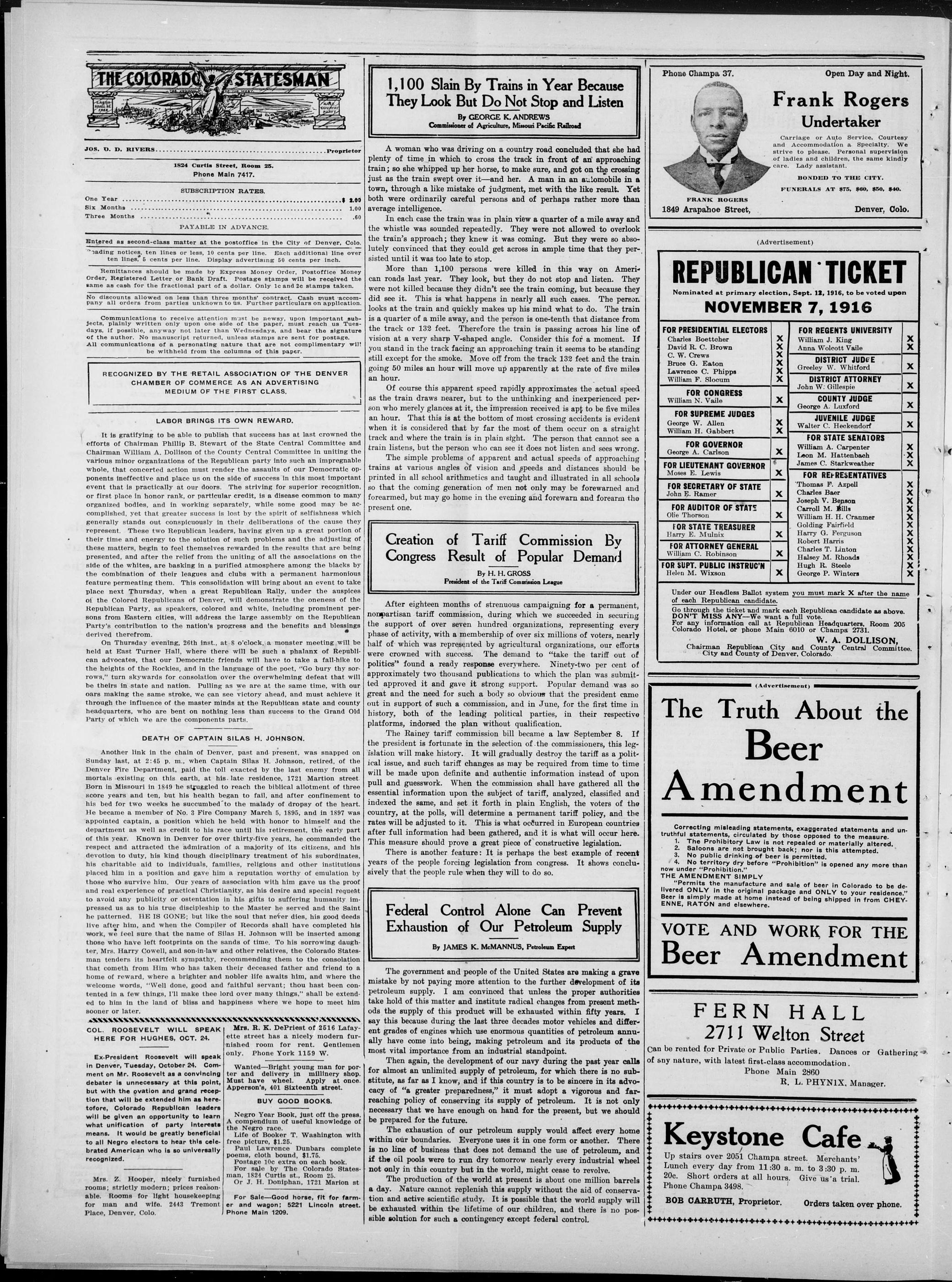
REPUBLICAN TICKET
Nominated at primary election, Sept. 12, 1916, to be voted upon NOVEMBER 7.1916
FOR PRESIDENTIAL ELECTORS
Charles Boettcher
David R. C. Brown
C. W. Crews
Bruce G. Eaton
Lawrence C. Phipps
William F. Slocum
FOR REGENTS UNIVERSITY
William J. King
Anna Woleott Vaile
DISTRICT JUDGE
Greeley W. Whitford
DISTRICT ATTORNEY
John W. Gillespie
FOR CONGRESS
William N. Vaile
FOR SUPT. PUBLIC INSTRUC'N
Helen M. Wixson
FOR GOVERNOR
George A. Carlson
FOR LEUTENANT GOVERNOR
Moses E. Lewis
FOR SECRETARY OF STATE
John E. Ramer
FOR AUDITOR OF STATE
Olie Thorson
FOR STATE TREASURER
Harry E. Mulnix
FOR ATTORNEY GENERAL
William C. Robinson
FOR REPRESENTATIVES
Thomas F. Azpell
Charles Baer
Joseph V. Benson
Carroll M. Bills
William H. H. Cranmer
Golding Fairfield
Harry G. Ferguson
Robert Harris
Charles T. Linton
Halsey M. Rhoads
Hugh R. Steele
George P. Winters
Under our Headless Ballot system you must mark X after the name of each Republican candidate.
Go through the ticket and mark each Republican candidate as above.
DON'T MISS ANY—We want a full vote.
For any information call at Republican Headquarters, Room 205 Colorado Hotel, or phone Main 6010 or Champs 2731.
W. A. DOLLISON,
Chairman Republican City and County Central Committee.
City and County of Denver, Colorado.
The Truth About the Beer Amendment
Correcting misleading statements, exaggerated statements and untruthful statements, circulated by those opposed to the measure.
4. No territory dry before "Prohibition" is opened any more than now under "Prohibition."
THE AMENDMENT SIMPLY
"Permits the manufacture and sale of beer in Colorado to be delivered ONLY in the original package and ONLY to your residence."
Beer is simply made at home instead of being shipped in from CHEYENNE, RATON and elsewhere.
VOTE AND WORK FOR THE Beer Amendment
FERN HALL
2711 Welton Street
Can be rented for Private or Public Parties. Dances or Gathering
of any nature, with latest first-class accommodation.
Phone Main 2860
R. L. PHYN1X, Manager. Keystone Cafe
A WOMAN
Up stairs over 2051 Champa street. Merchants' Lunch every day from 11:30 a. m. to 3:30 p. m. 20c. Short orders at all hours. Give us'a trial. Phone Champa 3498.
BOB CARRUTH, Proprietor. Orders taken over phone.
THE COLORADO STATESMAN
LABOR MUST BE FREE
MAJOR COUNTRY PARTY
THE
COLORADO
STATESMAN
is the only Negro paper
recognized by the Retail
Association of the Denver
Chamber of Commerce as
an advertising medium
of the first class.
Phone:
Main 7417.
Mrs. Julia Lavkins returned last Monday from Cheyenne, Wyo., after a week's visit with friends.
Dont forget the big Republican rally at East Turner hall next Thursday night. The colored Republicans of Denver are going to make this one of the greatest meetings of the campaign. Prominent speakers will be present.
Mrs. John Short, who has been visiting her sister and friends in Los Angeles, California, returned home last Friday after a very pleasant trip.
William H. Duncan of Glenwood Springs will arrive in the city next Thursday to attend the Grand Republican Rally of the Colored Citizens of Denver.
Bob Carruth, proprietor of the Keystone Cafe, 2051 Champa street, begs to inform his patrons that he is still a professor of the culinary art and will endeavor to cater to the appetites of his numerous customers as heretofore at the above address and at the same moderate prices.
```markdown
```
Frank Rogers, who has been in the undertaking business for years with both white and colored firms is engaged in business for himself and requests the patronage of those who are acquainted with his ability as well as the Denver public to give him a trial in relieving the sufferings of the bereaved. His guarantee for the best that can be given is a sure indication of his successful operations. His advertisement appears in this and succeeding issues.
HEAR COLONEL ROOSEVELT.
Tuesday evening at the city Auditorium, 8 o'clock, when he will remove all doubts from would-be Republicans and resurrect that GRAND OLD PARTY spirit which is indicative of Republican success. Go early if you are to be seated as TEDDY'S CROWD IS UNUSUAL. Quite a number of prominent colored Republican citizens are appointed on the reception committee.
NOTICE.
Denver, Colo., Oct. 19, 1916.
Notice is hereby given to all members of R. C. F. H. that regular meeting day, Tuesday, Oct. 24, has been changed to Thursday, Oct. 26, account of Tuesday, Oct. 24 being the day on which Hon. Theodore Roosevelt will appear in Denver.
Members of R. C. F. H. are also hereby informed and reminded that on account of the death of A. C. Cash, thirty days notice is hereby given that Tuesday, Nov. 21, after November 17, will be the date on which a successor to A. C. Cash will be chosen.
HARRY JONES,
SHORTER CHAPEL.
Washington and Twenty-Third Sts.
Rev. C. A. Williams, Pastbr.
11:00 a. m.—Morning Service.
9:45 a. m.—Sunday School.
6:30 p. m.—Allen C. E. League.
7:30 p. m.—Evening Service.
The choir will render at morning service the anthem "Bless the Lord," by F. D. Williams.
FUNERAL NOTICES OF CAMMEL & CO.
The funeral services of the late Capt. Silas H. Johnson, beloved father of Mrs. Harry Cowell and retired captain of Engine Company No. 3, who died at his home Sunday, Oct. 15, 1916, from dropsy of the heart, were held at the residence, 1721 Ma-
---
rion street, Tuesday, Oct. 17. Services conducted by Rev. A. M. Ward. Cammel & Co., in charge. Interment at Fairmont, by auto.
Capt. Johnson was a resident of Denver for more than thirty years and was one of its most highly respected citizens. He was a member of the fire department for twenty-two years, and was retired Jan. 1, 1916.
Mr. Henry Hurd, formerly of Memphis, Tenn., died at 2755 Welton street, Saturday, Oct. 14, 1916, from tuberculosis. Funeral notice later.
ROOSEVELT TORCHLIGHT PA
RADE, TUESDAY, 24, 7 P. M.
You cannot, you must not, miss this great treat offered by the Republican party in honor of the greatest living American—ex-President Theodore Roosevelt, who will be here on Tuesday, 24th inst. to address Colorado electors on behalf of Charles Evans Hughes, Republican presidential nominee. A torchlight procession consisting of Republicans from every walk and station in life will participate. Assembling at Eighteenth street and Broadway at 7 p. m., the parade will proceed along the principal streets of the city, led and accompanied by a number of bands, among them being the Queen City Band (colored) of this city. A representative element from the various Republican colored clubs and leagues will be among the participants, and the Colorado Statesman requests every Negro to give Colonel Roosevelt a hearty reception.
Y. M. C. A. NOTES.
In spite of the inclement weather, a large number was present last Sunday afternoon to hear the program. It was Ladies' Day, the program being in charge of Mrs. Mamie Lewis, organist of Bethlehem Baptist church. Toward the close of the program, Dr. De Frantz announced the death of Capt. Silas Johnson, which had taken place early in the afternoon. Messrs. Bondurant and Lightner were named as a committee to present resolutions on behalf of the Committee of Management and members of the Association.
The Bible class work for the larger boys will begin next Friday evening at 7 o'clock, and will be led by the Rev. G. Sterling Sawyer, pastor of Scott M. E. church. The subject for the course will be "Men Who Dared." A joint public meeting of the Y. M. C. A. and the Y. W. C. A. will be held at the People's Presbyterian church, 23d Avenue and Washington street next Sunday afternoon, beginning at 3:30 o'clock. The Rev. Dr. E. N. Orr, pastor of the First United Presbyterian church, will be the speaker. The singing will be led by Mr. Virgil H. Wolfskill. Special music will be rendered by the Queen City band. The entire public will be welcome.
PEOPLE'S PRESBYTERIAN
E. Twenty-third Avenue and Washington Street, Pastor, J. A. Thos. Hazell, S. T. B.
The Rev. O. J. McLeod of Meadville, Va., successor to Rev. L. B. West, late incumbent of the Union church at Deerfield, will occupy the pulpit at one or both of the services Sunday, Oct. 21. At 3:30 o'clock Rev. Bell has secured the use of the auditorium of the church for the public meeting under the auspices of the Y. M. C. A.
Next Wednesday night the pastor will report the business transactions of the 45th annual meeting of the Synod of Colorado at the First Presbyterian church, Grand Junction, held Oct. 17, 18 and 19. "All the members are urged to be present.
The Rev. Thos. Bell, secretary of the Colored Branch of the Y. M. C. A. will preach the fifth Sabbath of the month in the morning and at both services on the first Sabbath of November during the absence of the pastor. The Woman's Missionary Society will observe a program for the Quarter the afternoon of the fifth Sabbath.
ROGERS UNDERTAKING CO.
1849 Arapahoe Street
Mrs. Bertie Gay Corry, late of 1831 Curtis street, died October 13 at 6 a.m. The remains were shipped to Crook, Colo., on Saturday last for interment.
She, was the beloved wife of Leo Corry and lived in Denver a short time prior to her death. She leaves a husband, son and sister besides many friends to mourn her irreparable loss.
Once on a time, wise men brought to a dear little Baby King priceless gifts of frankincense and myrrh. That was a long time ago, but the custom still remains to this day.
Every American baby that comes from the fairyland of flowers and dreams and loving thoughts is a king in his little realm—home. Somebody stands beside his crib in the morning time each day, anxious to catch the first glimpse of his shining eyes as they peep from the rose petals called eyelids.
The Lewis Store is his loyal subject, ready to serve him from year's end to year's end; and each season one whole week is set apart as a sort of celebration in his honor.
So, from Monday morning till Saturday night, baby is monarch here, and every one of us has but one thought—"Baby must have the best there is on earth"
A.T. Lewis & Son
embroidered, $4 to $15.
"Little Toodles' First
Short Coat," hand-embroided, sizes 6
months to 1 year; $4, $5
to $7.50.
—Third Floor.
CHILDREN'S DRESSES
White yoke dresses,
sizes 6 months to 2
years — special prices,
50c, 75c and 98c.
Hand-made dresses,
sizes 6 months to 2
years — special prices,
$1 to $1.50.
French waist dresses,
sizes 2 to 6 years,
special prices, $1.00, $1.98
to $7.50.
Third Floor.
Mail Orders Given
Prompt and
Careful
Attention.
DENVER
CAMPBELL CHAPEL AFRICAN M. E. CHURCH NOTES.
A. M. Ward, Pastor.
Sunday will be observed as quarterly meeting day in our church, and Presiding Elder R. L. Pope will preach morning and evening. The Rev. C. A. Williams, pastor of Shorter Chapel, will preach at 3 p. m., followed by the celebration of the Holy Communion, with Rev. W. H. Mance of Ward Mission and the Rev. B. F. McCully of Dearfield Mission assisting.
Sunday school at 9:45 a. m., V. N. Wolfskill, superintendent.
Allen Christian Endeavor League at 6:45 p. m., Miss Carrie Britton, president.
Interesting services were held on last Sunday. Rev. W. H. Mance occupied the pulpit at 11 a. m., and the pastor in the evening. Presiding Elder Howard worshipped with us in the morning.
Our first quarterly conference will be held on Tuesday evening at 8:30 o'clock, at which time all auxiliaries of the church will be expected to report.
A large gathering responded to the call of the pastor for a church conference last Tuesday evening. The membership roll was revised, plans were made to install a new furnace and for a Thanksgiving rally to be held for that end. The meeting was in every way successful and harmonious. At the close of the conference supper was served in the parsonage by Mrs. B. F. Givens and others of the Improvement Club.
The pastor and wife are comfortably housed in the parsonage of the church, 1218 Twenty-third street. Ph. Main 5474.
Prayer meeting Wednesday, 8 p. m. Class meeting Friday, 8 p. m., and Classes Nos. 8 and 9 will meet on Sundays at the close of the morning services. The public is invited to attend all of our services.
HALLOWE'EN MASK BALL.
Fern Hall. Two grand prizes given away. Opera glasses for the neatest dressed lady, and a walking cane to the tackiest dressed gentleman. Carl Weston, floor manager for this grand event. Morrison's full orchestra. Admission 35 cents.
BIG THANKSGIVING BALL.
Fern Hall, Nov. 30. Prize of $10 in gold will be given away. Admission 25c.
Keep off the date of November 16th. Madam Jarley's Waxworks at Shorten Chapel.
---
His
dear little Baby
from still remains
the fairyland of f
ands beside his
they peep fro
From
obtained
will fin
every d
The B
rose gar
to come
His Week
little Baby King priceless gifts of fr
ill remains to this day.
eyland of flowers and dreams and lov
beside his crib in the morning time ea
peep from the rose petals called ey
From every land where lovely baby
obtained have come the best they ha
will find things for his comfort or p
every department of the store.
The Baby Shop is dressed in gay a
rose garden—and every baby and his
to come and enjoy with us this—Bab
Baby—His Week
From every land where lovely baby things may be obtained have come the best they have to offer. You will find things for his comfort or pleasure in almost every department of the store.
The Baby Shop is dressed in gay attire—a veritable rose garden—and every baby and his mother is invited to come and enjoy with us this—Baby week.
BABIES' AUTOMOBILES
Rattan baby buggles, tan,
gray, $18.00.
—Annex Store.
BABY DRESSES
Hand-made dresses,
Collapsible go-carts, specially
priced, $5.50 to $13.00.
Baby Sulkies, $1.50, $2.25, $3.75,
$5.00.
Chair carts, $2.45, $3.00 to
$7.00.
basket markets to
Oriole goo
TOYE
Teddy Browl-
Gas that
Dogs that
Cows that
Pligs that
Ducks that
And all th
in the Ark.
Rattles.
toys.
A, B, C b
Dolls of a
—T
TOWE
Baby towe
TOYS FOR BABY.
Teddy Bears that walk and growl—
Cats that meow—
Dogs that bark—
Cows that moo—
Pigs that grunt—
Ducks that quack—
And all the animals that lived in the Ark.
Rattles, roley-poleys, rubber toys.
A, B, C blocks
Dolls of all kinds.
—Toy Shop, Basement.
TOWELS FOR BABY
Baby towels, 20c to 60c each.
The Joslin Store is Ready With Winter SHIVER!
Warm Blankets and Inforts
Downstairs Store.
ST REASONABLE, TOO.
Wool-Nap Blankets
$1.90 a Pair
NEW YORK
The J
is R
Wi
T SHI
d, Warm I
Comforts
Downstairs St
THE MOST REASO
Woo
The Joslin Store is Ready With Full Winter Stocks DON'T SHIVER!
—Pretty pink and blue plaids, wool finish, cotton fleeced, for full size beds.
Cotton Sheet Blankets
25%
—Called Sheet Blankets because they are extensively used in the winter time for sheets.
—They come in white, gray or tan, white and colored contrast borders.
—$1.00, $1.20 and $1.50 a Pair
PORTS
Online covered Com-
—Silf forts,
—$1.35 to $3.50
Shoe News
Important to Parents
—For Girls—
Good, warm, silkoline covered Comforts, cotton filled,
$1.35 to $3.50
hoe News ant to Parents For Girls-
School Shoe News
—Gun metal Shoes for school girls. Our "Little Princess" make—and made to our special order.
Sizes 5 to 8.....$2.00
Sizes 8½ to 11.....2.25
Sizes 11½ to 2.....2.50
—Big Boys' Shoes—
—Shoes on snappy, new English lasts; gunmetal, patent colt and tan Russia calf—All hand sewed; sizes 2½ to 5½.
—$3.50 a Pair
Joslin DRY GOODS CO.
---
---
THE LEWIS STORE
"Sweetest lil' feller
Everybody knows;
Baby—Hi
he, wise men brought to a dear little lil' a long time ago, but the custom still rea'an baby that comes from the fairyland realm—home. Somebody stands basic glimpse of his shining eyes as they pe
at his loyal subject, ready to serve to year's end; and each season set apart as a sort of celebration
morning till Saturday night, baby and every one of us has but one it have the best there is on earth."
SWEATERS AND SWEATER SETS
Sweaters, small sizes only, cardinal and gray, specially priced, 50c each.
All wool sweaters, gray, red navy. Special price, $1.98.
Other sweaters, $1.25, $1.50.
$1.98 to $4.00.
Crib, play pen, and bassinet, all in one. The most useful piece of furniture baby can own. We are exclusive agents in Denver. Also the engagement of chairs, seats, baskets, basket wardrobes and bassinets.
Third Floor.
FOR BABY'S CRIB
Crib sheets, 60c each.
Crib blankets, 75c to $5.00 the
pair.
Annex Store.
T. Lew
NEW YORK
The
i
Full W
DON'T S
Plenty of Good, Warm
Comfort
In the Downsta
THE PRICES ARE MOST R
White Blankets
$3.95 a Pair
-50 pairs of beautiful white Blankets, wool and cotton mixed, for full-sized beds (66x80), silk bound to match, dainty colored borders; 25% under value.
Plaid Wool Nap, elderdown finish, extra heavy weight— splendid-assortment of plaids.
COMFORTS
Good, warm, silkoline cov forts, cotton filled,
$1.0
School Sho
All Important
For Boys—
Shoes with 2 full oak soles, high cuts, straps and buckles. Extraordinary service may be expected of these shoes.
Sizes 10 to 13 ..... $2.25
Sizes 1 to $5½ ..... 3.00
—Scout Juniors for rough
and tumble boys—Black
and tan uppers, lace style,
elk soles.
Sizes 9 to 13½ ..... $1.95
Sizes 1 to $5½ ..... 2.45
```markdown
```
Phone Main 1289
Dunno what t' call him,
But he mighty lak' a rose."
eek
celess gifts of frankincense and
day.
d dreams and loving thoughts is
the morning time each day, anxious
the petals called eyelids.
d where lovely baby things may be
the best they have to offer. You
for his comfort or pleasure in almost
of the store.
s dressed in gay attire—a veritable
every baby and his mother is invited
with us this—Baby week.
MOBILES
—Annex Store.
Third Floor.
FOR BABY'S
PLEASURE
Hand - decorated 3-
piece comb and brush
sets, 75c and 98c.
Hand - decorated 4-
piece comb and brush
sets, $150 to $3.00.
Record books, 50c, 75c
to $1.50.
Teething rings, 25c,
$5c to 50c.
Hot water
bottles
decorated, at 98c
to $1.50.
Rattles, 25c
to 98c.
—3rd Floor.
lin Store
y With
er Stocks
Silkoline and silk mull covered Comforts, wool filled, for $4.50 to $7.50
---
—$3.50 a Pair
Charges prepaid on all Retail Purchases Shipped Anywhere in the United States.
cks
TARTAN
OUTING FLANNEL
GARMENTS
For Women and Girls
Fourth Floor
Girls' Petticoats
—Pink or blue striped Outing
with Cambric Waist.
Sizes 5 to 8 for.....49c
Sizes 10, 12, 14.....59c
—Children's One-piece Sleeping Gar-
ments with feet.
—50c Each
—Women's Short Skirts, all white,
with deep, full flounce, scallop finish,
—65c Each
—Women's Night Dresses, with hood
attached,
—1.25 Each
—Women's Night Dresses, with foot
pockets and detachable hood,
—$1.75 Each
---
BABY DRESSES
Hand - made dresses,
special prices,
$2.60 $2.98 to $7.50.
fans' glips,
special prices, 50c, 75c,
$1.50 to $3.50.
PARIS
THE PALACE
An Attractive Arrangement of Plants in the House.
THE INDOOR GARDEN
By ELIZABETH VAN BENTHUYSEN.
I imagine that most of my readers are now having their joys and sorrows with the indoor garden—that sole substitute for the out-of-door theater of the good months. But as half a loaf is better than no bread, so the pleasure of having a few flowers in the house during the cold months is worth all the time and trouble that it requires, and the added consolation is present that one need not be entirely without color and fragrance even though the winds are blowing a dirge outside.
There is hardly a real lover of flowers in the world who has not at least tried to make an indoor winter garden. some of us cling with more tenacity than others to the expedient, but sooner or later it comes to every flower lover as either a hope or a disappointment. I am convinced that where the latter state is reached it is through either ignorance or lack of patience. The intimate association that one has with the few plants which may be nurtured throughout the winter makes them all the dearer. One becomes better acquainted with them. They become actually members of the family, and they take on the character of children as they are given more and more the sort of solicitous care that a mother might be expected to bestow upon an invalid child.
Light, moisture, warmth, fresh air and protection from insects are the prime essentials of the winter garden. Most flowering plants ought to have the full sun for at least a part of the day. A number of the foliage plants will do very well without the direct rays, if there be plenty of light. The heat in the room where plants are to be kept must be under control so that a temperature of from 40 to 60 degrees may be maintained overnight. Even where it is only possible to maintain 40 degrees of heat most of the ordinary house plants can be kept, if they can be protected during especially cold weather from frost striking through the windows.
One often finds it possible to cut off a bay window, or other like window space, so that it may be sheltered by screens or curtains running well up to the ceiling. Thus the particular part of the room may be kept warmer at night and in an atmospheric state better suited to the plants.
Generally speaking, the question of proper moisture is the most neglected feature of the winter garden problem. It is a happy sequel that the problem is easily regulated. The greatest trouble is to know just what the plants require. Moisture in the air is just as essential as moisture on the soil. Steam heat and the improved methods for supplying winter comfort to people, takes the vitalizing element out of the air. It can be remedied by placing vessels of water on radiators, or near stoves where plants are kept in the room. The evaporation of the water attends to this necessary detail quite well. In providing moisture for the soil it
1
An Unusual and Artistic Planting Scheme.
is likely that the amateur will overdo the trick more often than it will be underdone. Many of the plants will take a winter snooze through the cold months and will require little soil moisture. Plants in bloom and in active growth, of course, require more. In many cases thorough drainage must be provided because a water-saturated soil will prove fatal and you must remember that it is quite possible to drown a plant.
Escaping illuminating gas or coal gas will poison your plants. They are very sensitive and must have air to breathe that is not polluted. A flower will discover gas poison before the average person will do so. Keep your plants clean. Insects thrive on dirty plants. They also propagate more rapidly indoors than out. Light spraying is almost a necessity.
Diversified farming may be the watchword of the time, but it is not the principle to follow in the house garden. To have a little of everything generally means that you will not have much of anything. The varieties must be limited. A number of plants of the same haift and color are much better than a collection.
Begonias will give a touch of color to the winter garden. A temperature of 55 degrees is required for them, and they can be propagated by tubers, leaves or cuttings. The gloxinia requires heat in the early stages. The easiest method of propagation is from tubers direct. The amarylis, or hippeastrum, makes a handsome pot plant. Its flowers are large and they vary in tint. They require very little water to make a winter success. The bantana requires a fairly warm spot for the best results, but it makes a fine plant for winter blooming. The spirea, with its creamy masses and delicate color is always a valuable factor. Good drainage and plenty of moisture are required.
ROSES FOR NORTHERN LATI TUDES
For hardiness, sturdy growth, freedom of bloom, color and beauty of flower and foliage free from disease, Rudiance is a glorious extra hardy hybrid tea.
If you can have but one white rose select Frau Karl Druschki. With its large, full, pure-white flower, it is a thing of beauty.
Another hybrid perpetual which is a good one to select is Mrs. John Laing. It is a beautiful soft pink rose, well formed and a persistent bloomer.
For a good red rose Captain Haywood, a hybrid perpetual is a good choice.
Then there are many old favorites such as General Jacqueminot, Mme Plantier, Harrison, George IV, black rose and the York and Lancaster roses
Most rose plants stand the cold weather fairly well. It is the melting snows and cold rains with freezing weather overnight in the spring that is most trying to the life of the rose. To withstand these quick climatic changes your rose plants require good winter protection.
THE OAK TREE
---
TOWER 133 YEARS OLD
Uncle Sam's First Beacon Light Still Shines.
Mariners' Guide Was First Built at Boston Harbor 200 Years Ago, but Was Destroyed by British in 1776.
Amid the passing of the old-time landmarks, Uncle Sam's first lighthouse still stands sturdily at the entrance of Boston harbor, giving its warnings to mariners through the flashing of its powerful light and the screeching of its siren. The two hundredth anniversary of the establishment of the Boston light was recently celebrated in the presence of high government officials, the governor of Massachusetts, the mayor of Boston and other dignitaries. The present structure is 133 years old, having been built in 1783 to replace the tower which had been destroyed by the British at the beginning of the Revolutionary war, in 1776.
At the celebration of the two hundredth anniversary of the establishment of the light, in which Secretary Redfield of the department of commerce took a leading part, a bronze tablet, installed in the tower, was unveiled. The tablet recites the fact that the lighthouse was built by the province of Massachusetts and was first lighted September 14, 1716.
Boston light has had an eventful and interesting history during its 200 years of existence. First built by the province of Massachusetts, it was captured and recaptured several times in the early days of the Revolution, and finally demolished by the British in 1776 at the time of the evacuation of Boston. It was rebuilt on the same site in 1783, immediately after the close of the war, and with eight other colonial lights then in operation, was taken over by the general government in accordance with the act of congress of August 7, 1789. The height of the tower was increased in 1859, and the buildings have been renovated and the apparatus and equipment improved from time to time, as needed, so that despite its age, the light station is for all practical purposes essentially modern and up-to-date. It displays an incandescent oil-vapor light giving a white flash of 100,000 candle power every 30 seconds, visible 16 miles in clear weather, and as an auxiliary aid in foggy weather sounds a powerful steam siren, with a double blast of five seconds each every minute.
May Predict Weather Two Weeks in Advance
Uncle Sam's forecasters soon may be able to predict the weather that any part of the country is to have two weeks in advance, at least as to the time when storms may be expected to make their appearance. This, it is claimed, may be the result of a new discovery. Research, conducted by a former chief of the United States weather bureau and a representative of the Smithsonian institution, has shown there are rifts in the upper clouds of the solar atmosphere, which cause a variation in the amount of heat radiated to the earth. It is said the investigators have discovered the period of time between the passage of a heat rift in the solar atmosphere and the appearance of resulting storms on the earth.
```markdown
```
BUILDING OPERATIONS GAIN
Uncle Sam's Statistics Show Increase of 4 Per Cent in 1915 in 48 of Largest Cities.
Uncle Sam finds from a compilation of building statistics that building operations in many of the larger cities of the country increased in 1915 as compared with the preceding year. These figures show that in 48 selected cities the total cost of building operations was $641,769,199, an increase of $22,016,845, or nearly 4 per cent over 1914. Twenty-eight of these cities showed increase and 20 showed decrease.
New York was the leading city in cost of building operations, with $103,023,800, an increase of $28,993,559 over 1914. Chicago, which was the leading city in 1914, was second in 1915, with building operations costing $97,291,400, an increase of $14,029,690. Brooklyn was third, with a total of $45,601,851, an increase of $3,729,544 over 1914.
The number of permits issued or buildings erected in 1915 in these 48 cities was 201,190, a decrease of 2,542 compared with 1914. The number of permits or buildings ranged from 469 in St. Joseph Mo., to 14,515 in Brooklyn, N. Y. The average cost per operation was $3,190 in 1915 compared with $3,042 in 1914.
Growth of Free Delivery.
Free-delivery service of postal matter in the United States, established July 1, 1863, under Postmaster General Montgomery Blair of the District of Columbia, has grown from 66 city delivery offices having 685 carriers and costing $317,063 in 1864 to 1,808 city delivery offices having 32,902 carriers and costing $420,238,876 in 1915.
One ton of whale blubber will yield 200 gallons of oil.
PURE WATERPUTS TYPHOID TO ROUT
Cities Which Have Improved Their Supply Have Reduced Death Rate.
BIG SUMS ARE BEING SPENT
More Than a Billion Dollars Now Invested in Plants Owned by Larger Cities, Says Uncle Sam.
That the people of the United States are spending larger sums every year to obtain a pure water supply and that the obtaining of such a supply by the operation of purification plants is conquering typhoid fever in the larger cities of the country are among the interesting facts brought out by Uncle Sam in a recent bulletin.
The bulletin also shows that a great majority of the larger cities of the country now own their own water-supply systems. Of the 204 cities having more than 30,000 inhabitants in the fiscal year 1914-15, 155, or 76 per cent, owned their water systems. Seventy-three of these cities were operating purification plants in that year and of this number 61 had either built or improved and enlarged their plants since 1903.
"During this same period," continues the bulletin, "there has been throughout the country a remarkable decrease in the death rate due to typhoid fever. Although this decrease has taken place in both urban and rural localities, it is noteworthy that in most of the large cities which have recently built or improved and enlarged their purification plants the decline has been greater—in some cases very much greater—than the average decline elsewhere. For example, in Cleveland the typhoid death rate fell from 111 per 100,000 population in 1903 to 8.1 in 1914; in Philadelphia, from 72.3 to 7.6; in Pittsburgh, from 132.7 to 15; in Cincinnati, from 42.2 to 6.2; in Chicago, from 32.5 to 6.6; in St. Louis, from 52.6 to 12; in Washington, from 48.5 to 11.9; in Minneapolis, from 41.1 to 12.5, and in New York, from 17.1 to 6.3.
Filtration Dates Back to 1829.
"The history of the purification of water for public use dates from 1829, when some filter beds were used in connection with the water supply of London, England; but the discovery that slow sand filtration not only removed inorganic matter, turbidity, color, state, odor, etc.—acting merely as a strainer—but also removed nearly all the bacteria, was not made until about sixty years later.
"The first purification plant constructed in the United States was put in operation in Washington, D. C., in 1853. This was of the "sedimentation" type, which depends upon the force of gravity to carry down and deposit the clay and silt. Similar plants were installed in Louisville, Ky., in 1879; Council Bluffs, Ia., in 1883; Dallas, Tex., in 1889, and Omaha, Neb., and Oshkosh, Wis., in 1890.
"In 1900 a plant for the purification of water by chemical sterilization was built at Mobile, Ala. This process consists in the addition to the water of various chemicals which either kill the bacteria or make it possible to remove them by subsidence or filtration. From 1905 to 1914, inclusive, chemical sterilization plants were built in 40 other cities of over 30,000, and at present time more than half of the municipally owned water-supply systems having purification plants are using this method, either exclusively or in combination with one or more of the other processes.
"Of the 73 cities employing purification systems, 60 obtain their water supply, wholly or in part, from rivers and other streams, 12 from lakes, and one—Lincoln, Neb.—from wells.
Cost of Water-Supply Plants. "The growing solicitude for the purity and adequacy of the water supply is further indicated by the very considerable increase which has taken place during recent years in the amount invested in municipal water-supply plants. The total capital invested in these plants in 1903-4, in the 105 cities of over 30,000 which owned, either wholly or in part, and operated their water systems, and for which data are available, was, in round numbers, $513,000,000, representing a per capita investment of approximately $29. In the fiscal year 1914-15 the number of such cities owning their plants had increased to 155, the total investment to $1,071,000,000, and the per capita investment to approximately $38. The increase in the per capita investment during the 11 years thus amounted to 31 per cent.
"While it is, of course, quite true that an adequate supply of pure water can be provided for one city at a far less per capita cost than for another, by reason of differences in the construction problems involved or in the nature of the sources from which the water is obtained, the fact of prime significance brought out by the report is that an efficient system is now regarded by most cities as an economic necessity and hence is acquired, regardless of the cost."
Uncle Sam says that the value of the total mineral output of Alaska for the year 1915 was $32,854,229, as compared with $19,065,608 in 1914.
PEOPLE OF THE UNITED STATES DRINK 32,850,000,000 CUPS OF TEA IN YEAR
The people of the United States consumed 32,850,000,000 cups of tea during the year ending June 30, 1916. At least enough tea was imported into the United States to brew that many cups of the beverage. The imports for the year amounted to 109,500,000 pounds, or more than one pound for every man, woman and child in the country. About 14,000,000 pounds more tea was consumed during this year than during the preceding 12 months.
Uncle Sam is taking good care of his ever-increasing class of teadrinking people, and in order better to protect them from impure or adulterated tea he maintains a special corps of examiners and assistant examiners, all under the direction of a supervisor located in Washington. There are at present seven examiners in the seven districts of the country, and whenever tea is imported from a port where there is no examiner a sample is sent to an examiner at the nearest port.
Whenever tea is rejected by any of the examiners a pound sample is immediately shipped to the office of the supervisor, when it is again tested and compared with its respective government standard for quality, purity and fitness for consumption.
It is the opinion of the Englishmen, and, indeed, some of our own experts here, that in spite of the fact that so much tea is consumed in the United States, Americans, as a rule, do not know how to make it properly, and therefore, the very good tea that reaches our shores—and Uncle Sam allows no tea here that is not good—is spoiled in the making.
SMALL PART OF COST
No Burden in Free Text Books, Says Uncle Sam.
Exaggerated Ideas Prevail, It Is Declared, as to Amount Spent for This Part of School Equipment in the United States.
Uncle Sam does not believe that the introduction of free text books in the schools would add greatly to the cost of the public school system or increase the rate of taxation for school purposes to any extent. He cites figures to show that the cost of text books is a relatively small item in the total expenditure for school purposes.
Officials of the United States bureau of education declare that exaggerated ideas prevail concerning the total number of text books sold in the United States each year. It is said that confidential data obtained by the bureau from 50 text-book publishers, who handle 99 per cent of the total text-book sales of the country, show that their aggregate sales annually of text books for use in public schools, elementary and high, aggregate about $15,000,000.
According to figures which have been compiled by experts of the bureau, the total enrollment in public elementary and high schools amounts to about 18,500,000. Excluding the elementary school enrollment of California, since California prints its own elementary books, the number becomes 18,250,000. For each child enrolled in the public schools in the United States, therefore, the total annual sale of text books is about 80 cents. It has been figured that the total expenditure per child for all school purposes is approximately $38.31. The cost of text books is therefore approximately 2 per cent of the total cost of maintenance, support and equipment. The cost per child on the school population basis—five to eighteen years of age—according to officials of the bureau, is 56.6 cents; the annual per capita cost of text books on the total population basis is less than 15 cents.
UNCLE SAM HAS REMOVED
GREAT AVIATION HAZARD
Government's Experts Have Eliminated Danger of Bursting Propellers, It Is Announced.
Uncle Sam's experts have succeeded in removing one of the paramount hazards in aviation, it is announced. The bursting of aerial propellers has been the source of a large part of aviation accidents and the danger of this has now been eliminated, it is said.
Under the new $13,000,000 congressional appropriation, the foremost minds of the land are now combining to make aeroplanes as nearly perfect as can be done and to place this country's air fleets on a footing with those of European nations.
The executive committee of the newly-appointed advisory committee for aeronautics is in charge of the experimentation. This committee consults with the best engineering talent the country provides, as well as with experts from the bureau of standards. The chairman is Dr. S. W. Stratton, director of the bureau of standards. The other members are Prof. J. S. Ames of Johns Hopkins university; Prof. Charles C. Marvin, chief of the weather bureau; Prof. C. D. Walcott, secretary of the Smithsonian institution; Lieut. Col. George O. Squire, U. S. A., and Commander Mark L. Bristol and Lieut. Commander James O. Richardson, both naval officers.
Seek Recruits in Small Cities.
Uncle Sam's marine corps recently opened recruiting stations in 40 small cities from coast to coast. This action was taken to meet the demands made necessary by the recruitment of 5,000 additional enlisted marines just authorized. Recruiting activities of these "soldiers of the sea" were formerly confined to large cities—this new procedure opens the door to virgin recruiting fields. This organization has always been recruited to full authorized strength, and marine corps officials are confident of filling their increased ranks in one year.
Annual Value of Products Passes Half Billion Mark.
Uncle Sam's Census Figures Show Gain of 17.6 Per Cent in Five Years —Capital of $303,840,000 Invested.
The United States is manufacturing approximately half a billion dollars' worth of cigars, cigarettes, chewing and smoking tobacco and snuff every year, according to figures compiled by Uncle Sam. The value of the tobacco products of the country in 1914, according to census figures just made public, amounted to $490,165,000, and as the output increased 17.6 per cent in the five-year period between 1909 and 1914, it may be assumed that it will be considerably above the half-billion dollar mark for the present year.
There was in 1914 $303,840,000 capital invested in the industry, which gave employment to 210,894 persons.
While there were big increases in the number of persons employed in the industry and the value of the output, there was a decrease of 11.6 per cent in the number of establishments engaged in the manufacture of tobacco products, and the number of proprietors and firms engaged in the business decreased 13.8 per cent. The number of salaried employees increased 27.5 per cent and the number of wageearners in the industry increased 7.2 per cent.
BIG TUNGSTEN BELT FOUND
Prospecting Following First Development in California Shows Deposits Cover Strip Fifteen Miles Long.
The development in recent months of tungsten deposits which were first discovered in California in 1913, has greatly stimulated prospecting and tungsten has been found in a belt 15 miles long. One of Uncle Sam's experts, who has visited the field, has found that the ore bodies have some remarkable characteristics.
The deposits are eight miles west of Bishop, Inyo county, California. On April 7, 1916, the Standard Tungsten company began work. Trails and roads were built, ore bodies were opened up, a mill was erected, and electric power was brought in. On June 7 the mill began to crush ore. The Tungsten Mines company started work on May 4, and by the latter part of July had completed a mill of 300 tons daily capacity, and was rapidly opening its main ore body, disclosing a lode as much as 60 feet wide.
The ore bodies, it is found by the geological survey, are of a kind not mentioned by the recognized authorities on ore deposits as a commercial source of tungsten. The ore consists of schelite associated mainly with garnet, epidote and quartz. The general country rock is granite, but in it are scattered masses of limestone, which became mineralized at the time when the granite cooled from a molten condition. The limestones were altered to masses of garnet carrying subordinate schelite by the metallic vapors then given off, and these are the ore bodies now worked.
UNCLE SAM TO BUILD SHIPS
Law Passed by Last Congress Creates Corporation With a Capital of $50,000,000.
Uncle Sam is now ready to become a ship owner.
The shipping bill, which has been signed by the president and is now a law, creates a corporation capitalized at $50,000,000. The law authorizes a government shipping board to build, buy or lease ships for commercial purposes in times of peace, and to be used as naval auxiliaries in war. The government will subscribe to the controlling share of the capital, the secretary being authorized to sell Panama canal bonds up to $50,000,000 to raise the money. After five years the ships are to be disposed of to private owners
The board to be appointed by the president will consist of five members, with a salary of $7,500. The shipping board is authorized to employ attorneys, marine architects, appoint officers and otherwise make rules for the operation of its ships.
NEWS and GOSSIP OF WASHINGTON
WASHINGTON.—Army ordnance experts after many experiments with about a score of aerial bombs, it is reported, have found a bomb of high explosive power, combined with the use of deadly gases, the invention of an
length and approximately five inches in diameter, shaped like a torpedo. In addition to an explosive charge of T. N. T., it contains a gas chamber in which a new and secret combination of gas is used.
It is estimated that the bomb has a fatal destructive radius of at least 100 yards.
One of the chief features of the bomb in which it differs radically from bombs which depend for bursting force on contact with the earth or other object, is that it may be exploded in the air with full power. This is said to enhance its destructive power to a much larger degree than any known form of contact bomb, as it may be exploded over the heads of troops and spread gases earthward over a larger surface.
By means of an electric timing device the operator of an aeroplane, it is asserted, will be able to regulate to a second the time of the explosion of the bomb. Another unique feature of this weapon permits of its use as an aerial torpedo when not desired to use it as a "drop" explosive. The bomb may be made with a new type of electric motor and propeller, which would enable the aviation operator to fire it horizontally, or to direct it toward a target at any angle. The bombs are arranged for attaching to the undersides of aeroplanes, to be released by foot pressure on a trigger.
Feathered Summer Residents of Capital Leaving
AS THE thousands of Washingtonians who deserted the city with the approach of the summer months for the seashore and mountain resorts of the North begin to return to their homes, thousands of visitors who annually make their summer homes here are leaving for the South
known far and wide for his sweet song—the bluebird, who brings happiness; the downy woodpecker, who excavates his home in the dead limbs, and the many other members of the feathered tribe who furnish song and sunshine to city dwellers.
It is the common observation of persons who are interested in birds, and even the observation of many other persons who have no particular interest in the subject, that the bird-protection laws of the federal government and of the various states are producing the results which are the aim of these laws. A great increase is noted in the number of song birds, game birds and especially in the number of birds of gay plumage.
This comment is often heard among the Washington people who are interested in birds. Last spring they noted that bluebirds, indigo buntings, goldfinches, redstarts, orioles, scarlet tanagers, summer tanagers, cardinals and the yellow warblers were more numerous than in preceding years, and the increase in the numbers of these gay and beautiful birds is apparent to nearly everybody, and particularly to persons who live in the suburbs of Washington or on the edges of the city, and who have gardens and yards with shrubbery in them.
Lineage of the Lamp Shown in Museum Collection
A COLLECTION of all the various illuminating devices used throughout the history of the world is now being prepared by Dr. Walter Hough of the National museum here, and will be placed on exhibition as soon as space can
of the collection is already occupying three cases in the museum, where it attracts a great deal of attention among visitors.
Ultimately, Doctor Hough hopes to broaden the collection into a complete history of fire rather than a history of illuminating alone. Among his present specimens are many curious old stoves and bellows and foot-warmers, and one curfew which is said to be the only one in America. It is the popular opinion in this country that the curfew was a bell, but instead it is a sort of brass lid which was used to cover the fire. At one time in England a law was passed requiring every light to be out at a certain hour in the night, presumably nine o'clock, and in order to comply with the letter of this law people had to suppress their fires. Thus the hour when the fires were covered with curfew came to be called the curfew hour.
President Must Be Able to Use Any Kind of Pen
President Must Be Able to Use Any Kind of Pen
SOME men prefer soft pens. Some prefer hard. Some couldn't write without a fountain pen. And there are still some elderly men surviving who insist on using quills. The president of the United States has got accus-
row Wilson" to this act, he signed one syllable with each pen, his intention being to forward one pen to each of the heads of the four brotherhoods. In signing the Phillipine bill he used a pen furnished for the occasion by Manuel Quezon, the resident delegate from the Philippines. It was gold-pointed and orate. In signing the bills of lading act, he used a pen made from the quill of a sorenine, which Senator Pomerene had provided.
DEADLIER
BOMB THAN
ANY EUROPE
MAS USED
HIGHLY
DESTRUCTIVE
length and approximately five inches in addition to an explosive charge of TN which a new and secret combination of It is estimated that the bomb has 100 yards.
One of the chief features of the h bombs which depend for bursting fore object, is that it may be exploded in the enhance its destructive power to a mu of contact bomb, as it may be exploded gases earthward over a larger surface.
By means of an electric timing d is asserted, will be able to regulate to the bomb. Another unique feature of aerial torpedo when not desired to us may be made with a new type of elec enable the aviation operator to fire it target at any angle. The bombs are sides of aeroplanes, to be released by
Feathered Summer Resid
AS THE thousands of Washingtonian proach of the summer months for the North begin to return to their home make their summer homes here are leaving for the South.
Not everyone in Washington has noticed it, but ever since the first chilly night they have been quietly slipping away, and already many thousands of Washington's summer residents have left. They form the army of songbirds that make their homes in the shrubs and trees that adorn the parks of the national capital. They are the robin and the wren, the modest wood thrush.
known far and wide for his sweet son,
the downy woodpecker, who excavates
many other members of the feathered
to city dwellers.
It is the common observation of pea
even the observation of many other pea
in the subject, that the bird-protection
the various states are producing the re
a great increase is noted in the numb
cially in the number of birds of gay pea.
This comment is often heard and
interested in birds. Last spring they
goldfinches, redstarts, orioles, scarlet
and the yellow warblers were more m
the increase in the numbers of these
nearly everybody, and particularly to
Washington or on the edges of the c
with shrubbery in them.
Lineage of the Lamp Sho
A COLLECTION of all the various ill
history of the world is now being
National museum here, and will be pla
A
of the collection is already occupying
attracts a great deal of attention amo
Ultimately, Doctor Hough hopes
plete history of fire rather than a his
present specimens are many curious
ers, and one curfew which is said to a
popular opinion in this country that the
sort of brass lid which was used to c
a law was passed requiring every light
night, presumably nine o'clock, and in
law people had to suppress their fires
covered with curfew came to be called
President Must Be Able
SOME men prefer soft pens. Some p
out a fountain pen. And there are
insist on using quills. The president
tom himself to using all kinds of pens to gratify the vanity of those who want to keep as souvenirs the pens with which certain measures in which they are interested are signed. Ordinarily the president uses a soft-pointed fountain pen, but lately in approving important measures of legislation he has used every variety of pen. The eight-hour railroad bill he signed with four ordinary pens with steel points and black wood holders. In affixing the name, "Wood-
row Wilson" to this act, he signed one being to forward one pen to each of the In signing the Philippine bill he uses Manuel Quezon, the resident delegate pointed and orate. In signing the bills of lading act, he porcupine, which Senator Pomerene b
American, which is said to excel in destructiveness any similar weapon known here or in Europe.
The tests proved so uniformly satisfactory, it was said, that the war department has been urged to adopt the bomb for use in the aviation service. F. E. Barlow, an employee of the Frankfort arsenal, Philadelphia, the inventor, has offered its exclusive use to the United States government.
The Barlow bomb is six feet in
an diameter, shaped like a torpedo. In N. T., it contains a gas chamber in gas is used. a fatal destructive radius of at least bomb in which it differs radically from one on contact with the earth or other air with full power. This is said to each larger degree than any known form and over the heads of troops and spread device the operator of an aeroplane, it a second the time of the explosion of this weapon permits its use as an it as a "drop" explosive. The bombetric motor and propeller, which would horizontally, or to direct it toward a arranged for attaching to the underfoot pressure on a trigger.
Dents of Capital Leaving
as who deserted the city with the ap- the seashore and mountain resorts of es, thousands of visitors who annually
SOUTH
the bluebird, who brings happiness; his home in the dead limbs, and the tribe who furnish song and sunshine persons who are interested in birds, and persons who have no particular interest laws of the federal government and of results which are the aim of these laws. of song birds, game birds and espeumage. among the Washington people who are noted that bluebirds, indigo buntings, tanagers, summer tanagers, cardinals, numerous than in preceding years, and gay and beautiful birds is apparent to persons who live in the suburbs of city, and who have gardens and yards
DOWN in Museum Collection
illuminating devices used throughout the prepared by Dr. Walter Hough of the展 on exhibition as soon as space can
be found for it. Stowed away in large airtight cabinets in Doctor Hough's office is the complete record of man's development as shown by his lighting appliances from the days of the primitive campfire to the present tungsten filament. Here is the firebrand by which our aboriginal ancestor transferred fire from tribe to tribe; here is the animal's skull, which constituted the first attempt at a lamp, and the greased stick that was superseded by the candle. A part
three cases in the museum, where it long visitors.
To broaden the collection into a compartment of illuminating alone. Among his old stoves and bellows and foot-warming the only one in America. It is the fire curfew was a bell, but instead it is a over the fire. At one time in England it to be out at a certain hour in the order to comply with the letter of this. Thus the hour when the fires were the curfew hour.
To Use Any Kind of Pen
prefer hard. Some couldn't write with still some elderly men surviving who of the United States has got to accus-
A
he syllable with each pen, his intention the heads of the four brotherhoods. used a pen furnished for the occasion by me from the Philippines. It was gold- used a pen made from the quill of s and provided.
WAR HAS CREATED BIG NEW INDUSTRY
United States Makes Remarkable Strides in Manufacture of Chemicals.
FREED FROM FOREIGN YOKE
Production of Nearly Enough Coal Tar Dyes to Meet Domestic Demand Big Feature of Develop-
"No branch of American industry has ever presented such a marvelous rate of expansion as has that of chemical technology during the past two years," says Dr. Thomas H. Norton, one of Uncle Sam's special commercial agents, who has been devoting a large part of his time to the study of this new development of American industry. Included in this industry is the manufacture of coal-tar dyes, for which the United States depended almost entirely upon European manufacturers until the war cut off the supply.
"The national exposition of chemical industries, held recently in New York," says Doctor Norton, "showed the wonderful strides that had been made in this field during the past two years.
"The degree to which this nation was dependent upon foreign sources for the greater part of its chemicals, drugs and dyes was revealed to us in a brusque, uncomfortable manner as the rapid succession of embargoes consequent upon the great European conflict suddenly threatened a multitude of manufacturing activities, dependent upon regular supplies of certain chemicals, with dislocation or paralysis," says Doctor Norton.
"The exposition recently held was a barometer, as it were, showing in a vivid, picturesque way the wonderful progress and adaptation characteristic of these past few months, how American enterprise, skill, science and capital have united to lay broad and deep the foundations of a comprehensive and self-contained national chemical industry. While the genius and energy of European chemists have been concentrated upon means and methods of destroying life and annihilating armed power, American chemists have been equally active in synthetic, constructive fields, swiftly evolving, one after another, various branches of industrial effort destined to emancipate us from a foreign commercial yoke.
"Among the many interesting features illustrative of this evolution were such exhibits as the following: The barium industry, now utilizing to the fullest extent the boundless domestic deposits of barytes; the contact sulphuric acid process, now unsurpassed in volume and perfection of method; chemical glassware and porcelain, equal to the finest products of Germany; bleaching powder of the highest grade, of which, two years ago, but one-quarter of the country's needs was of domestic origin; the numerous sodium compounds, such as the ferrocyanide and the chlorate, now effectively and satisfactorily replacing the corresponding potassium salts, formerly imported in such quantities; a large group of medicinal chemicals hitherto secured exclusively from across the Atlantic, etc.
"There were instructive exhibits showing how American ingenuity is seeking to solve the nitrogen problem, and free us from further dependence upon Chile's swiftly vanishing stock of nitrate.
"The most striking feature of the exposition was found in its revelation of the astonishing rapidity with which an American coal-tar chemical industry is being created. Formerly most of the coal-tar, benzol and ammonia, liberated by our by-product coke ovens, was allowed to go to waste. Now it is all recovered.
Growth Almost Mushroomlike.
"There has been an almost mushroomlike growth of the industries producing dyestuffs, explosives, photographic chemicals, and synthetic medicinals, flavors and perfumes from prosaic coal-tar. And yet there is little of the mushroom about the spacious factories and jungles of machinery which have so swiftly appeared upon the scene.
"Two years ago a single firm made aniline on a small scale, while six companies produced artificial dyestuffs from intermediates imported from Europe.
"Today 18 companies are manufacturing synthetic carbolic acid, and over 40 are producing aniline and other intermediates. Over 30 companies are making coal-tar dyes. The total number of operatives in this branch two years ago was 400; now single establishments employ 1,000 workmen. In 1914 we made one-tenth of the synthetic colors consumed in the United States by "assembling" foreign semi-manufactured material. Today we produce three-quarters of the amount of artificial colors normally required by our textile, paper, and other industries, and every pound is made from American coal tar! The production is largely concentrated upon a few staple colors, used in great amounts. The variety of shades available is, however, being rapidly increased. A few years will see the American industry able to supply the great bulk of the domestic demand both in quantity and in variety."
Do You Know That—
Value Shown in Model Constructed for Uncle Sam.
Its Use Decreases Waste of Energy Consumed in the Making of Too Frequent Repairs, Is the Claim Made for This Material.
The use of creosote for lengthening the period of service of timbers on the farm is illustrated in a small model farm which has just been installed in Uncle Sam's forest products laboratory, at Madison, Wis. This model and a similar one which is being used for exhibit purposes by the National Lumber Manufacturers' association were made by Dean A. Schwechard who graduated this year from the manual arts course of the University of Wisconsin.
The COLORADO STATESMAN
The green fields and orchards surrounding the farm are inclosed with fences supported by fence posts with well-creosoted butts. Near the barn is an open-tank treating plant, a desirable addition to the equipment of any farm. It consists of one or more strong makes which may be heated either by a fire built beneath or by steam coils if a steam boiler is available. A wooden silo with creosoted staves is also shown. In the local telephone line which passes the farm the poles are creosoted from the butt to a point well above the ground line.
IS PREPARED TO DO ALL KINDS OF
The porch sills, steps and the timbers in the bridge across the creek have also been treated with the oil to prevent decay which occurs most readily in such damp locations where there is a poor circulation of air. Even the railroad which crosses one corner of the pasture shows a good penetration of creosote in the cross ties on which the tracks are laid. The wood blocks with which the barn is paved also have their share of preservative treatment.
Commercial, Fraternal, Church, Book and Stationery Jobs A SPECIALTY
Although the effects of the creosote treatments are at first sight inconspicuous, yet they contribute to the well-kept appearance of the buildings and grounds. The general air of thrift is the result of efficient utilization which decreases the waste of energy consumed in making too frequent repairs.
POPULARITY OF UKULELE
KEEPING HAWAIIANS BUSY
Ball and Concert Programs, Bill and Letter Heads, Calling Cards, Wedding Cards, Envelopes and Everything in the Printing Line Turned Out in the Neatest and Best Style Promptly on Short Notice.
Manufacturers Can't Meet the Demand for This Musical Instrument in United States.
The vogue of the Hawaiian ukulele in the United States has resulted in making the manufacture of that musical instrument one of the important industries of the Hawaiian islands in the past few months, says one of Uncle Sam's representatives in Honolulu. At the end of August, 1915, manufacturers were turning out about 500 or 600 instruments a month, while a year later the output had been increased to 1,600 a month and the demand from United States music dealers could not be met.
We Have Supplied Our Office with New Job Press & Type of Up-to-Date Style and Our Work Will Be on a Par with the Very Best.
There are eight principal manufacturers of ukuleles in Honolulu, with a scattering of instruments coming from small makers in the other islands. Each manufacturer has turned his small workshop into a factory, adding new workers and increasing the plant as rapidly as possible. A company recently was organized in Honolulu with plans to manufacture from 1,000 to 2,000 ukuleles per month with improved machinery, the workers to be Hawaiians and Portuguese. The originator of the ukulele, a Portuguese who is now head of a manufacturing company, is still an active worker in his own factory, and turns out about 700 instruments per month. Another Honolulu firm produces about 400 a month.
Give Us a Trial and We Will Give You Satisfaction
The Hawaiians and Portuguese of Hawaii claim that the instruments made by them, especially of koa wood, are seasoned and properly prepared. The highest-priced products are heavily beaded. The tone is one of the most important items in the construction of the ukulele, and the Hawaiians and Portuguese claim that this is obtained only with the use of properly seasoned koa wood and proper attention paid to shaving the wood and fitting it.
The plans of the new companies forming, and of old factories being enlarged, will give an output close to 3,000 per month, or 36,000 per year.
Prices as Reasonable as Those of Any Job Office in Denver
BREAD COSTS HALF BILLION
Huge Sum Spent Annually in United States for Staff of Life and Other Bakery Supplies.
The people of the United States spend approximately half a billion dollars for bread and other bakery supplies every year in addition to the cost of that which is made at home. The value of the bread, biscuit, crackers and other bakery supplies made in the United States in 1914 was $491,893,000, an increase of 23.9 per cent as compared with the output in 1909. These figures, taken from the census of 1914, have just been made public by Uncle Sam.
According to the census figures there were 25,963 establishments devoted exclusively to the manufacture of bread and other bakery supplies and these establishments gave employment to 172,682 persons in 1914. The capital invested in the business in 1914 amounted to $271,262,000, an increase of 27.4 per cent as compared with the amount invested in 1909.
GRAND REPUBLICAN
COLORED REPUBLICANS OF DENVER.
Thursday Night, Oct., 26.,
EAST TURNER HALL
Speakers Local and National
Morrison's Full Orchestra
Chairmen of Various Committee-T. E. Henderson, Arrangement: Jos. D. D. Rivers, Publicity: Geo. Gross, Refreshments. Mrs. Isabelle Stewart will preside at the meeting. Queen City Band in Attendance.
Lyman's
ON ARAPAHOE
JUST OFF 16th STREET
Where Style and
Elegance in
Millinery
Reign Supreme
1
1
Under the Auspices of the
VOGUES
AND
VANITIES
BY
JULIA BOTTOMLEY
Nothing that we buy ready made offers us quite so wide a range of choice in styles as the practical long coats for daily wear. But this variety is more a matter of details in finishing than variation in outline. Long, straight coats of ankle width, high collars, big cuffs and rather narrow belts may be looked for and found in the output of nearly every manufacturer, so that the style is established. Also coats are long enough to cover the dress or to come within a few inches of it.
The two coats shown in the picture illustrate the similarity in outline and the variation in materials and in the details of finishing that make so much latitude in choice. The coat at the left is made of plush, and there are others much like it made of Bolivia cloth, heavy wool velours, and other cloak-
THE
S
One of the New Blouses.
One more of the new blouses adds to their persistent assurance that styles are little changed from those of the past summer. High collars were promised with the incoming of autumn, but they have been neglected. There are only a few of them as compared to the unending procession of models with the open throat. But women whose necks are thin manage to wear the open-throated styles by using high chemisies under them. These are made of fine net or lace and are boned. They improve the average neck wonderfully.
The blouse shown here is a flesh-colored georgette crape, made with a cape collar which widens at the back. It is dainty decorated with small sprays of flowers embroidered at each side. Little spots of high color or black are introduced in these embroidered motifs, on many waists. The sleeves are long but do not extend over the hand. They are finished with a narrow band at the wrist.
Georgette crepe and chiffon cloth are
ings. It has the regulation turn of collar, high about the neck, but this collar is extended into a smart cape. The cuffs are of the usual pattern. A few big buttons add much to the smartness of the model and are placed on the collar and cuffs purely for ornament. They fasten the front of the coat from throat to waist. A belt of the same material as the coat fastens at the side under a handsome silk buckle.
The coat at the right is a little less full but otherwise much the same as the other one. It is gray, flecked with white and black, and is finished with collar and cuffs of black seal plush. Large buttons in gray barred with black fasten it at the front and are, set in groups of three at each side. Either of these attractive coats will bear the burden of daily wear and not grow tiresome.
J
more used for blouses than any other materials. But the selection is varied by blouses of novelty silk laces and net. Crepe de chine is used for many tailored models. They are plain only by comparison, and far from severe. Folds, fancy stitching and buttons ornament them, and their collars are not so large as those of dresser designs. The new peplum blouse is featured in recent displays. It is effective in white or flesh-colored georgette crepe, and the peplum.and cuffs are often embroidered or covered with fancy needlework in black and white silk. It is belted, with a narrow belt at the waistline.
Trimming bands for Dresses.
Trimming bands are used on the skirt part of one-piece dresses to accentuate the fullness and the flare. Ribbon is used so much, indeed, that one may really make a new frock out of an old one by using a narrow ribbon for the waist part and wide ribbon for trimming bands on the skirt.
FRANK S. REED,
License Embalmer & Director
Lady Assistant
Polite Service
to All
Day or Night
at the Popular Price for Carriages.
DVER MORTUARY
2445 Larimer Street, Denver, Colo.
Accommodating 10 People Including Hand-
some Casket $50.
Carriages We Charge $3.50.
Bonded to the City.
W. M. Brewster, Treas. J. W. Minter, Sec.
D PORTERS' CLUB
BOOM IN CONNECTION
Parlors, 2745 Welton Street
Phone Main 6319
Elegant Auto Service at the
THE DENVER
MRS. J. H. STEELE, Mgr.
Special Auto Service Accommodation
some Cas
For Horse Carriage
Bonded to
W. C. Campton, Pres. W. M. Bre
RAILROAD PO
LUNCH ROOM I
Service at the Popular Price
DENVER MORR
Dr. 2445 La.
Accommodating 10 Pers.
some Casket $50.
See Carriages We Charge
Bonded to the City.
W. M. Brewster, Treas.
AD PORTER
BROOM IN CONN
AND F
St. Only one block from
J. B. MINTER. Barber.
416. DENVE
R HAIR C
A Wonderful Hair
Phone Main 6319 Day or Night
Elegant Auto Service at the Popular Price for Carriages.
THE DENVER MORTUARY
MRS. J. H. STEELE, Mgr. 2445 Larimer Street, Denver, Colo.
Special Auto Service Accommodating 10 People Including Handsome Casket $50.
For Horse Carriages We Charge $3.50.
Bonded to the City.
W. C. Campton, Pres. W. M. Brewster, Treas. J. W. Minter, Sec. RAILROAD PORTERS' CLUB LUNCH ROOM IN CONNECTION
BILLIARDS AND POOL
Only one block from Union Depot.
B. MINTER. Barber.
DENVER, COLORADO.
1728½ Wazee St. Only o
J. B. MINTI
PHONE MAIN 8416.
1728 $ \frac{1}{2} $ Wazee St. Only one block from Union Depot. J. B. MINTER. Barber.
THE STAR HAIR GROWER
A Wonderful Hair Dressing and Grower.
One Thousand Agents Wanted and Grower.
Eye Made. We want Agents in every city and village to sell THE STAR HAIR GROWER. This is a wonderful preparation. Can be used with or without straightening irons. Sells for 25 cents per box—One 25-cent box will cost 50 cents. We use a 25-cent box will be convinced. No matter what has failed to grow your hair, just give THE STAR HAIR GROWER a trial and be convinced. Send 25 cents for a full size. If you wish to be an agent, send $1 and we will send you a copy. You can begin work at once; also agent's terms.
Send all money by Money Order to
EVANSTON, ILL. GREENSBORO, N.C.
NOTE—Persons living in the South can get good school in the North, but will order the STAR the HIR GROWER MFR, P. O. BOX $12, GREENSBORO, N.C.
Phone Champa 2211
The Chesapeake
Fish & Oysters
Denver's Only Exclusive Fish and
Fresh Fish, Oysters, Salt, Smoked, Dried
Poultry and Game of All I
Chesap & Oyster Exclusive Fish and Salt, Smoked, Dried
Chesapeake & Oyster Co. Exclusive Fish and Oyster House Salt, Smoked, Dried and Canned Fish
The Chesapeake Fish & Oyster Co.
Denver's Only Exclusive Fish and Oyster House Fresh Fish, Oysters, Salt, Smoked, Dried and Canned Fish Poultry and Game of All Kinds 828 Fifteenth Street Denver, Colo.
THE BARBER'S CAFE
First-Class Tonsorial Artists in attendance. Best line of Cigars and Tobacco. We solicit your patronage. First-Class work guaranteed.
HARRY JONES, Prop. DENVER, COLO.
J. R. CONTEE
Pres. and Mgr.
A
FUNERAL CARRIAGE
```markdown
```
FREE CHECK ROOM
```markdown
```