Colorado Statesman
Saturday, October 28, 1916
Denver, Colorado
Page text (machine-generated)
Walter C. Heckendorf, FOR JUVENILE JUDGE "THE PEOPLE'S CHOICE"
The Colorado Statesman
GREELEY W. WHITFORD, for District Judge. "The Choice of the Community." George A. Luxford, for County Judge, "Choice of the CITIZENS"
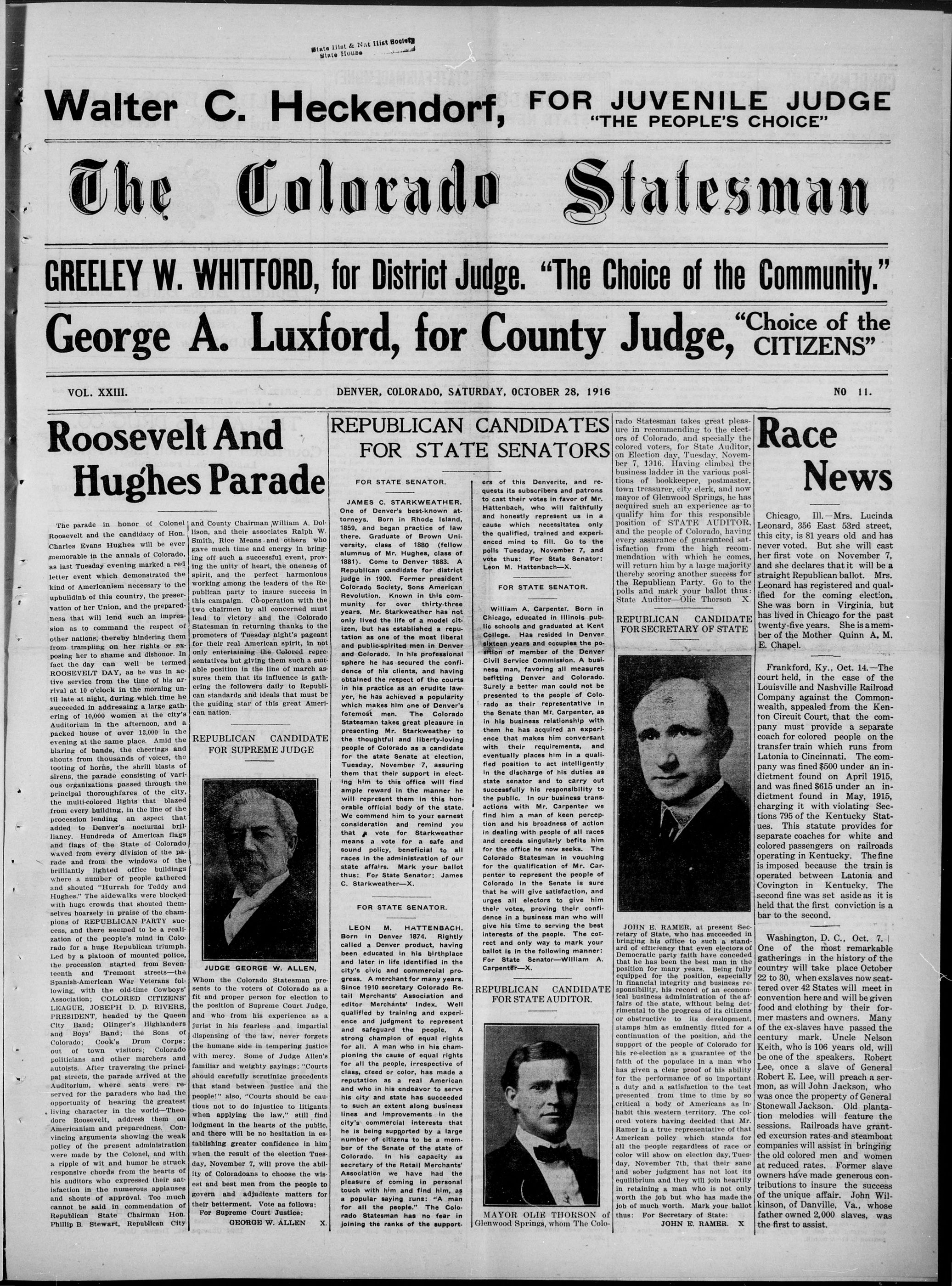
Roosevelt And Hughes Parade
VOL. XXIII.
The parade in honor of Colonel Roosevelt and the candidacy of Hon. Charles Evans Hughes will be ever memorable in the annals of Colorado, as last Tuesday evening marked a red letter event which demonstrated the kind of Americanism necessary to the upbuildinb of this country, the preservation of her Union, and the preparedness that will lend such an impression as to command the respect of other nations, thereby hindering them from trampling on her rights or exposing her to shame and dishonor. In fact the day can well be termed ROOSEVELT DAY, as he was in active service from the time of his arrival at 10 o'clock in the morning until late at night, during which time he succeeded in addressing a large gathering of 10,000 women at the city's Auditorium in the afternoon, and a packed house of over 13,000 in the evening at the same place. Amid the blaring of bands, the cheerings and shouts from thousands of voices, the tooting of horns, the shrill blasts of sirens, the parade consisting of various organizations passed through the principal thoroughfares of the city, the multi-colored lights that blazed from every building, in the line of the procession lending an aspect that added to Denver's nocturnal brilliance. Hundreds of American flags and flags of the State of Colorado waved from every division of the parade and from the windows of the brilliantly lighted office buildings where a number of people gathered and shouted "Hurrah for Teddy and Hughes." The sidewalks were blocked with huge crowds that shouted themselves hoarsely in praise of the champions of REPUBLICAN PARTY success, and there seemed to be a realization of the people's mind in Colorado for a huge Republican triumph. Led by a platoon of mounted police, the procession started from Seventeenth and Tremont streets—the Spanish-American War Veterans following, with the old-time Cowboys' Association; COLORED CITIZENS' LEAGUE, JOSEPH D. D. RIVERS, PRESIDENT, headed by the Queen City Band; Olinger's Highlanders and Boys' Band; the Sons of Colorado; Cook's Drum Corps; out of town visitors; Colorado politicians and other marchers and autoists. After traversing the principal streets, the parade arrived at the Auditorium, where seats were reserved for the paraders who had the opportunity of hearing the greatest living character in the world—Theodore Roosevelt, address them on Americanism and preparedness. Convincing arguments showing the weak policy of the present administration were made by the Colonel, and with a ripple of wit and humor he struck responsive chords from the hearts of his auditors who expressed their satisfaction in the numerous applauses and shouts of approval. Too much cannot be said in commendation of Republican State Chairman Hon. Phillip B. Stewart, Republican City
and County Chairman William A. Dollison, and their associates Ralph W. Smith, Rice Means and others who gave much time and energy in bringing off such a successful event, proving the unity of heart, the oneness of spirit, and the perfect harmonious working among the leaders of the Republican party to insure success in this campaign. Cooperation with the two chairmen by all concerned must lead to victory and the Colorado Statesman in returning thanks to the promoters of Tuesday night's pageant for their real American spirit, in not only entertaining the Colored representatives but giving them such a suitable position in the line of march assures them that its influence is gathering the followers daily to Republican standards and ideals that must be the guiding star of this great American nation.
REPUBLICAN CANDIDATE FOR SUPREME JUDGE
JUDGE GEORGE W. ALLEN.
Whom the Colorado Statesman presents to the voters of Colorado as a fit and proper person for election to the position of Supreme Court Judge, and who from his experience as a jurist in his fearless and impartial dispensing of the law, never forgets the humane side in tempering justice with mercy. Some of Judge Allen's familiar and weighty sayings: "Courts should carefully scrutinize precedents that stand between justice and the people!" also, "Courts should be cautious not to do injustice to litigants when applying the law," still find lodgment in the hearts of the public, and there will be no hesitation in establishing greater confidence in him when the result of the election Tuesday, November 7, will prove the ability of Coloradoans to choose the wisest and best men from the people to govern and adjudicate matters for their betterment. Vote as follows: For Supreme Court Justice:
DENVER, COLORADO, SATURDAY, OCTOBER 28, 1916
REPUBLICAN CANDIDATES FOR STATE SENATORS
State Hist & Nat Hist Books
State House
eckendo
lorad
, for District J
xford, for
DENVER, COLORADO, SAT
REPUBLICAN
FOR STA
FOR STATE SENATOR:
JAMES C. STARKWEATHER. One of Denver's best-known attorneys. Born in Rhode Island, 1859, and began practice of law there. Graduate of Brown University, class of 1880 (fellow alumnus of Mr. Hughes, class of 1881). Come to Denver 1883. A Republican candidate for district judge in 1900. Former president Colorado Society, Sons American Revolution. Known in this community for over thirty-three years. Mr. Starkweather has not only lived the life of a model citizen, but has established a reputation as one of the most liberal and public-spirited men in Denver and Colorado. In his professional sphere he has secured the confidence of his clients, and having obtained the respect of the courts in his practice as an erudite lawyer, he has achieved a popularity which makes him one of Denver's foremost men. The Colorado Statesman takes great pleasure in presenting Mr. Starkweather to the thoughtful and liberty-loving people of Colorado as a candidate for the state Senate at election, Tuesday, November 7, assuring them that their support in electing him to this office will find ample reward in the manner he will represent them in this honorable official body of the state. We commend him to your earnest consideration and remind you that a vote for Starkweather means a vote for a safe and sound policy, beneficial to all races in the administration of our state affairs. Mark your ballot thus: For State Senator: James C. Starkweather—X.
FOR STATE SENATOR
LEON M. HATTENBACH. Born in Denver 1874. Rightly called a Denver product, having been educated in his birthplace and later in life identified in the city's civic and commercial progress. A merchant for many years. Since 1910 secretary Colorado Retail Merchants' Association and editor Merchants' Index. Well qualified by training and experience and judgment to represent and safeguard the people. A strong champion of equal rights for all. A man who in his championing the cause of equal rights for all the people, irrespective of class, creed or color, has made a reputation as a real American and who in his endeavor to serve his city and state has succeeded to such an extent along business lines and improvements in the city's commercial interests that he is being supported by a large number of citizens to be a member of the Senate of the state of Colorado. In his capacity as secretary of the Retail Merchants' Association we have had the pleasure of coming in personal touch with him and find him, as a popular saying runs: "A man for all the people." The Colorado Statesman has no fear in joining the ranks of the support-
---
ers of this Denverite, and requests its subscribers and patrons to cast their votes in favor of Mr. Hattenbach, who will faithfully and honestly represent us in a cause which necessitates only the qualified, trained and experienced mind to fill. Go to the polls Tuesday, November 7, and vote thus: For State Senator: Leon M. Hattenbach—X.
FOR STATE SENATOR.
William A. Carpenter. Born in Chicago, educated in Illinois public schools and graduated at Kent College. Has resided in Denver sixteen years and occupies the position of member of the Denver Civil Service Commission. A business man, favoring all measures befitting Denver and Colorado. Surely a better man could not be presented to the people of Colorado as their representative in the Senate than Mr. Carpenter, as in his business relationship with them he has acquired an experience that makes him conversant with their requirements, and eventually places him in a qualified position to act intelligently in the discharge of his duties as state senator and to carry out successfully his responsibility to the public. In our business transactions with Mr. Carpenter we find him a man of keen perception and his broadness of action in dealing with people of all races and creeds singularly befits him for the office he now seeks. The Colorado Statesman in vouching for the qualification of Mr. Carpenter to represent the people of Colorado in the Senate is sure that he will give satisfaction, and urges all electors to give him their votes, proving their confidence in a business man who will give his time to serving the best interests of the people. The correct and only way to mark your ballot is in the following manner: For State Senator—William A. Carpenter—X.
REPUBLICAN CANDIDATE FOR STATE AUDITOR.
MAYOR OLIE THORSON of
Glenwood Springs, whom The Colo-
rado Statesman takes great pleasure in recommending to the electors of Colorado, and specially the colored voters, for State Auditor, on Election day, Tuesday, November 7, 1916. Having climbed the business ladder in the various positions of bookkeeper, postmaster, town treasurer, city clerk, and now mayor of Glenwood Springs, he has acquired such an experience as to qualify him for this responsible position of STATE AUDITOR, and the people of Colorado, having every assurance of guaranteed satisfaction from the high recommendation with which he comes, will return him by a large majority thereby scoring another success for the Republican Party. Go to the polls and mark your ballot thus: State Auditor—Olie Thorson X
REPUBLICAN CANDIDATE FOR SECRETARY OF STATE
M. H.
JOHN E. RAMER, at present Secretary of State, who has succeeded in bringing his office to such a standard of efficiency that even electors of Democratic party faith have conceded that he has been the best man in the position for many years. Being fully equipped for the position, especially in financial integrity and business responsibility, his record of an economical business administration of the affairs of the state, without being detrimental to the progress of its citizens or obstructive to its development, stamps him as eminently fitted for a continuation of the position, and the support of the people of Colorado for his re-election as a guarantee of the faith of the populace in a man who has given a clear proof of his ability for the performance of so important a duty and a satisfaction to the test presented from time to time by so critical a body of Americans as inhabit this western territory. The colored voters having decided that Mr. Ramer is a true representative of that American policy which stands for all the people regardless of race or color will show on election day, Tuesday, November 7th, that their sane and sober judgment has not lost its equilibrium and they will join heartily in retaining a man who is not only worth the job but who has made the job of much worth. Mark your ballot thus: For Secretary of State:
NO 11.
Race News
Chicago, Ill.—Mrs. Lucinda Leonard, 356 East 53rd street, this city, is 81 years old and has never voted. But she will cast her first vote on November 7, and she declares that it will be a straight Republican ballot. Mrs. Leonard has registered and qualified for the coming election. She was born in Virginia, but has lived in Chicago for the past twenty-five years. She is a member of the Mother Quinn A. M. E. Chapel.
Frankford, Ky., Oct. 14.—The court held, in the case of the Louisville and Nashville Railroad Company against the Commonwealth, appealed from the Kenton Circuit Court, that the company must provide a separate coach for colored people on the transfer train which runs from Latonia to Cincinnati. The company was fined $500 under an indictment found on April 1915, and was fined $615 under an indictment found in May, 1915, charging it with violating Sections 795 of the Kentucky Statues. This statute provides for separate coaches for white and colored passengers on railroads operating in Kentucky. The fine is imposed because the train is operated between Latonia and Covington in Kentucky. The second fine was set aside as it is held that the first conviction is a bar to the second.
Washington, D. C., Oct. 7. One of the most remarkable gatherings in the history of the country will take place October 22 to 30, when exslaves now scattered over 42 States will meet in convention here and will be given food and clothing by their former masters and owners. Many of the ex-slaves have passed the century mark. Uncle Nelson Keith, who is 106 years old, will be one of the speakers. Robert Lee, once a slave of General Robert E. Lee, will preach a sermon, as will John Jackson, who was once the property of General Stonewall Jackson. Old plantation melodies will feature the sessions. Railroads have granted excursion rates and steamboat companies will assist in bringing the old colored men and women at reduced rates. Former slave owners have made generous contributions to insure the success of the unique affair. John Wilkinson, of Danville, Va., whose father owned 2,000 slaves, was the first to assist.
CONDENSATION OF FRESH NEWS
THE LATEST IMPORTANT DIS
PATCHES PUT INTO SHORT,
CRISP PARAGRAPHS.
STORY OF THE WEEK
SHOWING THE PROGRESS OF EVENTS IN OUR OWN AND FOREIGN LANDS.
Western Newspaper Union News Service.
ABOUT THE WAR
Serbians capture town of Velyeselo, near Brod, in drive toward Monastir. Russians repulse Teuton attack near the Narayuvka on the Galician front.
The Rumanian fort of Constanza has been captured by the Germans, the war office at Berlin announced.
Emperor William reported to be at Bapaume supervising preparations for gigantic new German counter offensive in the Somme region.
The Bucharest war office announced that the Rumanian forces in Dobrudja had made a further retirement before the army of Field Marshal von Mackensen.
Teutonic successes continue in the Dobrudja region. Russo-Rumanian army still is in retreat, although its resistance at some points is described as stubborn.
Lloyd's announces that the Norwegian steamer Ull, 1,138 tons; the Danish steamer Helga, 1,182 tons; the Greek steamer Aris and the Norwegian steamer Drafn have been sunk.
Felix Diaz completed the conquest of the state of Mexico when he entered Toluca, the capital, according to a message received at Douglas, Ariz., by a Mexican identified with the Felicista movement.
More than 1,000 yards of German trenches in the region of Gueudecourt and Les Boeufs were taken by the British in fighting north of the Somme river in France, according to the official communication issued at London. French troops, apparently in an effort to counter German successes in Rumania, have attacked in force at Verdun, capturing Douaumont village and the Thiaumont work, together with more than two miles of German positions. Four tons of projectiles were dropped by a French air squadron of twenty-four machines on blast furnaces north of Metz and on the Metz and Thionville stations, the Paris war office announced in its report of aviation activities.
Rumanian resistance in the Rothen-them pass has been broken and Predeal, north of Kronstadt, is in Teutonic hands. Bucharest, however, claims the capture of several hundred prisoners in an attack covering the entire Oltuz region.
WESTERN
John Henry Heil, ousted principal of the Morgan Park high school, has left Chicago.
Five white men and one negro were killed at a gravel pit one mile from Barton, Ala., when several tons of sand caved in and crushed them to death.
Two trainmen of Cheyenne were killed and several passengers slightly injured when Union Pacific limited No. 7, westbound, collided with a freight train near Bushnell, Neb.
Mrs. Maria Simpson Clingman, 106 years old, died at Cecauville, Ill. She would have been 107 on Dec. 12. Mrs. Clingman leaves four children, the oldest 74 and the youngest 65. She came from Ohio in 1835.
Major R. R. Moton, president of Tuskegee institute, in an address at Montgomery, Ala., declared that the negro should remain in the South and study his own shortcomings with a desire and aim to overcome them.
WASHINGTON
Charges that General Carranza is preparing to leave Mexico are being freely made by his political opponents in Mexico City. The state department was informed that the Petroleum Products Company of San Francisco had been removed from the British trade blacklist. The department of justice asked the Supreme Court temporarily to postpone reargument of the dissolution suit against the International Harvester corporation. The motion was granted, but no time for reargument was set. The National Association of Attorneys General, composed of the law officers of the various states, in which Colorado is represented, filed an interesting brief with the United States Supreme Court in the Ohio "blue sky" case.
The historic names, Congress, United States, Alliance and Ranger, probably will appear again in American navy lists with the christening of the four giant battle cruisers, bids for which will be opened at the navy department in December.
It was announced that Senator Warren of Wyoming has been placed on the special roll of honor that entitles him to a special pension "for heroism performed in actual conflict with the enemy beyond the call of duty." The pension is $10 a month.
FOREIGN
The 4,200-ton British steamship Midland has been sunk.
Switzerland is taking a census of motor vehicles suitable for use by the army.
The French government officially designated a commission for developing the use of agricultural machinery among the farmers of France.
The American fishing schooners Richard W. Clark and Maryland have been released. They will be permitted to proceed to their destinations with their catches.
Government agents claim to have received additional confirmation of Villa's reported defeat of Gen. Carlos Ozuna's Carranza column at Palomas, eighteen miles west of Chihuahua City.
According to the London newspapers the Germans appear to have forced the evacuation of Constanza by cutting the trans-Dobrujdja railway about twenty miles west of the Black sea coast.
Captain Boelke, the famous German aviator, shot down two more aeroplanes, bringing up the total to thirty-eight, the Berlin war office announced. Twenty-two allied airships were destroyed during the day.
All accounts in the Berlin papers agree in calling the assassination of Premier Stuergkh of Austria the deed of an irresponsible political fanatic, if not a neurasthenic, whose mind has given way under the strain of war.
Germany is about to repatriate 10,000 Italian civilians who are unfit for military service and who have been interned in Germany, according to news dispatches from Rome. It is said that the German authorities lack the means of feeding these prisoners and will send them home by way of Chilasso.
A Central News dispatch from Amsterdam says: "Emperor William, in a speech to the troops on the western front after commemorating the dead, said: 'But we who are living will fight further until nobody will ever dare again to assail the honor and liberty of the German people.'" The emperor, adds the dispatch, said he hoped God would be with the Germans in the fighting.
SPORTING NEWS
The new $250,000 gymnasium of the Michigan Agricultural college is being rushed to completion.
The mare Mabel Trask has won more than $30,000 in the harness events of the season just closed.
The University of Wyoming won their first conference game of the year at Logan, Utah, defeating the Utah Aggies, 23 to 10.
Young Ahearn, Brooklyn middleweight, outpointed Len Rowlands, Milwaukee, in a ten-round no-decision contest at Milwaukee, by the exclusive use of a light left jab.
Roan Hal, the 2:03 $4 pacer, took in straight heats the $1,500 2:00-class pacing race, the feature at Atlanta, Ga., at the close of the Grand Circuit meeting, from Hal Boy.
Battling Levinsky of Bridgeport, Conn., claimed the light heavyweight championship of America, after outpointing Jack Dillon of Indianapolis in a twelve-round bout at Boston. Charley White's reputation did not suffer any in Pittsburg, Pa., for he whipped Dick De Sanders to a frazzle in a six-round bout before the Duquesne A. C. at the Moose temple. W. H. Spencer of the Mound City Rifle club, St. Louis, won first place in a field of 929 competitors and the title of individual champion rifle shot of the United States in the individual rifle match of the national board for promotion of rifle practice, at Jacksonville, Fla.
GENERAL
Nineteen are dead as the result of the explosion in the Marvel, Ala., mine.
Woman suffrage was indorsed in resolutions adopted at the Philadelphia session of the thirteenth biennial convention of the International Ladies' Garment Workers' union.
Harry K. Thaw is a campaigner. The one-time frequenter of the "White Way," and slayer of Stanford White, is out to beat Almet M. Jenks for the place of chief justice of the Court of Appeals in New York.
James W. Gerard, American ambassador to Germany, went to Shadow Lawn to discuss with President Wilson what the ambassador characterized later as "every phase of the situation involved in my work at Berlin."
A good roads committee of one hundred has been organized by the Los Angeles Chamber of Commerce to campaign actively for the $15,000,000 proposed state issue of bonds for highways, to be voted on at the general election, Nov. 7.
Vance C. McCormick, chairman of the Democratic national committee, was served in New York with a summons and complaint in a second suit for libel, brought against him by Jeremiah A. O'Leary, one of the heads of the American Independence conference. The action is for $100,000.
"Dr." Percival V. Allen, convicted in Seattle of a statutory offense as a result of his living with Miss Anna M. Danielson, member of a wealthy Iowa family and who died in July, is to be accused of bigamy, according to announcement by the prosecuting attorney at Tacoma, Wash.
A degree of doctor of laws was conferred upon Thomas A. Edison, the inventor, over the telephone by Dr. John H. Finley, president of the University of the State of New York, at the closing session of the institution's fifty-second convocation.
COLORADO
STATE NEWS
Western Newspaper Union News Service.
DATES FOR COMING EVENTS.
Oct. 30-Nov. 4—Meeting Colo. State
Teachers' Association.
Jan. 1-6 *Poultry show* at Denver
*Atletic Club boxing contests*
at Denver
Jan. 20-27—Annual Western Stock Show at Denver.
Feb. 2-4—Y. M. C. A. Annual Convention at Colorado Springs.
Denverites are planning a $1,000,000 hotel.
The state tax levy was fixed at 2.07 mills by the state board of equalization.
A large class was initiated into the Knights and Ladies of Security lodge at Pueblo.
Registration at Colorado Springs shows a gain this year of 1,500 over that of 1912.
The Denver Trades and Labor assembly has gone on record against the so-called herd law.
One man was killed and another man was fatally injured in accidents in Denver Sunday.
Warden Capp has been granted a stay of sixty days in the ouster suit brought against him.
Mrs. Harriet McMillin, 98 years old, died at the home of her daughter, Mrs. O. H. Loftus, in Denver.
Mrs. W. H. Wolfsberger, 61 years old, of Denver, died of heart disease while bathing in a pool at Steamboat Springs.
Mrs. Harriette M. McMillan, probably the oldest resident of Denver, died at the home of her daughter, Mrs. O. H. Loftus, in Denver, aged 98.
With four children, nine grandchildren and one great-grandchild present, Mr. and Mrs. J. F. Ireland celebrated their golden anniversary at Eaton.
Fourteen more motorists paid $5 fines in Denver city court for violation of the bright lights ordinance. Six others were fined and one discharged.
Fire, believed to be due to an incendiary, destroyed an old concentrating plant at Fox and Ellsworth streets, in Denver, causing an estimated loss of $6,000.
A suit for $20,000 was filed in the District Court in Denver for Miss Delight Howell Kuehne, against Joe Bonds, pugilist, who is billed to fight Fred Fulton in Denver, Nov. 6.
A mining deal involving $22,000 was closed at Boulder when E. J. Leving & Co., of Philadelphia, bought four tungsten lode claims from Robert Kermack and Harold De Vries.
The Elkton mine in the Victor district was closed down, the reason assigned being that the ore bodies had been worked out down to the 1,640 foot level, which is that of the Roosevelt drainage tunnel.
A municipal community center of recreation will, to a considerable extent, eliminate the many sex problems which are confronting the juvenile courts, according to Miss Josephine Roche, investigator for the Denver Juvenile Court, in her address to the Mothers' Congress at the Denver Woman's club.
From the main office of the Portland Gold Mining Company in Colorado Springs checks were sent out for the usual quarterly dividend. 3 per cent on $3,000,000 in outstanding capital stock. This foots up $90,000, making $360,000 for 1916, and a grand total of $10,537,080 in dividends since the company was organized.
Denver prices for flour, which advanced Monday from $4.10 to $4.20, took an even more spectacular jump Tuesday. The price on one grade advanced from $4.20 to $4.25, and on another from $4.20 to $4.45. This advance follows the announcement made of increases in prices on potatoes and a number of brands of canned goods.
The effect of the car shortage in Colorado is beginning to be felt at the dinner table of every Denver household. The shortage of cars to move Colorado's potato crop is declared directly responsible for the high cost of potatoes in Denver and unless relief is forthcoming within a short time it will only be a matter of weeks before the tubers will have reached such a high price as to make them prohibitive in many Denver homes.
The entire country contains no more enthusiastic believer in the future of Colorado as the national playground of the world than Theodore Roosevelt, former president, noted hunter and lover of nature. In one of the intervals in the program outlined for the Oyster Bay statesman in Denver Tuesday, he stopped to express in his terse, positive and effective style his appreciation of the beauty and charm of the scenic wonders of the state, and the possibilities for their future development.
A tax of 70 cents per capita was decided upon this year by the Independent Order of Odd Fellows at its closing session in Denver for the maintenance of the lodge home at Cafon City, and an appropriation of $11,000 granted to take care of the increase in residents at the home.
Bank clearings in Denver continue to increase. The gain last week over the same week last year was 18.5 per cent. The clearings for the week ending Oct. 19 were $16,194,000. The previous week showed clearings of $15,133,000.
TREASURER'S REPORT SHOWS
RECEIPTS TOTALED $21,848.13.
Premiums Representing an Outlay of
25 Per Cent More Than Any Previous
Year Paid in Full.
Western Newspaper Union News Service.
Puchle, Colo.—The report of Treasurer McLagan of the Colorado State Fair association shows that the receipts this fall were the largest in the history of the association and that after every bill is paid there will be a small surplus on hand. The total receipts for the week were $21,848.13, of which $14,268.22 were taken in at the gate and grandstand. The premiums were all paid in full and represented an outlay of over 25 per cent more than any previous year.
The amusements also cost more than any previous year, $7,500 being paid for aeroplane flights, auto races and Wild West exhibitions. Horse racing was done away with this year for the first time. Improvements costing several thousand dollars are under consideration for next year. This fall a joint board of four from the Commerce club, Rotary and Lion's club will be appointed to work in conjunction with the fair board.
Annual Potato Show at Monte Vista. Monte Vista, Colo.—The first annual potato show given by the Farmers' Union Association of the Monte Vista district was held here. The potato crop in this section this year has been far beyond anything ever known before. Yield and prices have been phenomenal. The farmers arranged the show to exchange ideas as to the most successful methods used, as well as to celebrate their success in the growing of their crops. During the exhibition a number of farmers publicly burned the mortgages on their land, this year's crop having enabled them to pay off all indebtedness.
Some of the yields reported by individual farmers were painted on streamers and posted in conspicuous places at the potato show. For instance, William Macy and sons reported a gross return of $423.10 from one measured acre. William Bowsher cleared $12,000 from 160 acres.
About 13,000 carloads of potatoes have been shipped already from Monte Vista and Del Norte stations, and 1,000 cars remain awaiting transportation facilities. The potato growers plan to build a $20,000 storage house next summer to hold their crops in case other years have car shortages such as marked the present year.
Rev. Young Heads State Baptists.
Colorado Springs.—The twenty-eighth annual convention of the Colorado Baptists elected the following officers: President, Rev. Thos S. Young of Denver; first vice president, Rev. E. W. Lee of Denver; second vice president, Rev. G. R. Tanner of Canon City; recording secretary, Rev. W. E. Mason of Denver; assistant recording secretary, Rev. L. D. Crosby of Fort Collins; historian Rev. Joshua Gravett of Denver; auditors, Rev. S. St. John and Rev. R. J. Wallace.
Powder Explosion Injures Three.
Lafayette.—Roy Clay tried to break open a fifty-pound key of powder with a pick at the Shamrock mine, eleven miles northeast of here, and is in the Longmont hospital suffering from burns that may destroy his eyesight. Two companions were also severely burned, but returned to their homes for treatment.
Accused of Burning Husband's Clothes
Greeley.—Mrs. K. M. Kim, 35 years old, a Korean, was arrested on an accusation of being a pyromaniac. She is charged with having burned a trunkful of clothes belonging to her husband. She was found in her home which was on fire, a quantity of trash having been placed against the side of the building and ignited.
Ask Board to Relieve Car Shortage.
Denver.—An appeal to the Interstate Commerce Commission to come to the aid of the shippers of Colorado who are losing thousands of dollars daily through the continued shortage of cars was made by wire by the State Public Utilities Commission.
Yeggmen Crack Superior P. O. Safe.
Boulder.—The postoffice safe at Superior was cracked Monday for the second time within the past year. About $60 was taken. In January yeggmen blew open the safe with nitroglycerine and took $300 in money and stamps.
Ex-President Roosevelt in Denver
Denver.—Col. Theo. Roosevelt was here Tuesday, and delivered two addresses at the Auditorium.
Miner Buried Under Shoe Rescued.
Frederick—Three tons of coal and rock fell upon Harry Samfleth, a miner employed in the Slope mine here, and when other workmen dug the caved-in mass away, after almost an hour's work, they expected to find Samfleth dead. Instead, the miner got up without assistance, brushed the dirt from his clothes, and asked if he was hurt. He seemed to have only a few scratches on his face, but later it was discovered he had broken a rib.
BOLDEN BROS. CAFE and LUNCH ROOM 924 19th Street, Denver, Colorado
DINNER
11:30 to 2 p.m.
All Kinds of Sandwiches
Bolden Br
Baths,
FIRST
R. B. BOLDEN,
C. H. SHIRLEY, Pres.
PAUL J. SHI
THE ATL
Courteous Tre
Leaders
Golden Bros. Barber Sh
Baths, Electric Massage
FIRST CLASS SERVICE
S. BOLDEN, Mgr. 926 19th St. D.
LEY, Pres. J. C. HAMPSON
PAUL J. SHIRLEY, Sec. and Treas.
THE ATLAS DRUG CO.
Fewous Treatmet. Right P
Leaders in Prescription
D. I.
TON ST.
875
Store N
26TH AND
Main 495
IPTON, Pres. J. B. MINT
MILROAD PORTERS' CL
LUNCHOOM IN CONNECTION
Bolden Bros. Barber Shop Baths, Electric Massage FIRST CLASS SERVICE R. B. BOLDEN, Mgr. 926 19th St. Denver
C. H. SHIRLEY, Pres. J. C. BAMPSON, Vice Pres PAUL J. SHIRLEY, Sec. and Treas.
THE ATLAS DRUG CO.
Courteous Treatmet. Right Prices Leaders in Prescription
Store No. 1.
2701 WELTON ST.
Main 895 875
Store No. 2.
26TH AND WELTON
Main 4955 4956
W. C. CAMPTON, Pres.
RAILROAD
LUNCHOOM
RAILROAD PORTERS' CLUB LUNCHOOM IN CONNECTION
BILLIARDS AND
POOL
1728½ Wazee St. C
J. B. I
PHONE MAIN 8416.
728½ Wazee St. Only one block from Union Depot
J. B. MINTER, Barber.
ONE MAIN 8416. DENVER, COLORADO
1728 $ \frac{1}{2} $ Wazee St. Only one block from Union Depot.
J. B. MINTER, Barber.
PHONE MAIN 8416. DENVER, COLORADO.
Meats, Fancy 1864
JOHN K. RETTIG
Fancy and Staple Grocery
1864 CURTIS STREET
eenth.
MARKET COMPANY
E. SMITH, Manager, Res. Phone South 1608
and Retail Staple and Fancy Groceries, Fish and
Hotels and Restaurants Our Specialty.
Fresh and Cured
Eastern Corn Fed Meat
Fruits, Vegetables, Poultry and Game.
Telephones Main 4302, 4303, 4304, 4305
15th Street Denver,
atherhead Hat
TELEPHONE MAIN 3203
The MARKET
C. E. SMITH, Man
Wholesale and Retail Staple
Hotels and Retail
Eastern Co
Fruits, Vegeta
Telephones Ma
622-636 15th Street
Weatherl
TELEPH
The MARKET COMPANY
C. E. SMITH, Manager, Res. Phone South 1608
Wholesale and Retail Staple and Fancy Groceries, Fish and Oysters. Hotels and Restaurants Our Specialty. Fresh and Cured Eastern Corn Fed Meats Fruits, Vegetables, Poultry and Game.
Telephones Main 4302, 4303, 4304, 4308
622-636 15th Street Denver, Colorado
Weatherhead Hat Co. TELEPHONE MAIN 3203
Established 1876
PIONEER HATTERS OF THE WEST
WE MAKE OLD HATS NEW
PRACTICAL HATTERS
RENOVATORS, BLEACHERS DYERS AND FIL
Of Gents' and Ladies' Hats of Every Descrip
1624 Champa St., Denver, Colo.
PRACTICAL HATTERS
ATORS, BLEACHERS DYERS AND FINISH
Gents' and Ladies' Hats of Every Descriptio
1624 Champa St., Denver, Colo.
RENOVATORS, BLEACHERS DYERS AND FINISHERS Of Gents' and Ladies' Hats of Every Description 1624 Champa St., Denver, Colo.
PHONE MAIN 8028
Corner Nineteenth.
Short Orders at All Hours
Barber Shop
Massage
SERVICE
926 19th St. Denver
J. C. HAMPSON, Vice Pres
ec. and Treas.
DRUG CO.
St. Right Prices
Description
Store No. 2
26TH AND WELTOM
Main 4955-4956
J. B. MINTER, Sec.
TERS' CLUB
CONNECTION
FREE CHECK
ROOM
ock from Union Depot.
Harber.
DENVER, COLORADO.
RES. PHONE GALLUP 942
ETTIG
Staple Groceries
STREET
Denver, Colo.
COMPANY
Phone South 1608
Groceries, Fish and Oysters
Our Specialty.
Fed Meats
Entry and Game.
303, 4304, 4305
Denver, Colorado
d Hat Co.
IN 3203
HATTERS
BUYERS AND FINISHERS
Of Every Description
Denver, Colo.
601
A
```markdown
```
AFRO-AMERICAN CULLINGS
In a communication to the New York Times, Charles W. Thomas, president of the Teachers' Association of the District of Columbia, makes the following remarks:
It is surprising to find the editorial columns of the Times, usually accurate, right and fair, making a vulnerable and flippant statement about such a social issue as is involved in "The Colored Migration to the North."
In a recent work of great merit by Huntington, "Climate and Civilization," it is indicated how the migration of people from warm and enervating climates to cool and stimulating ones releases pent-up energy and spells achievement. From that viewpoint alone the migration of the colored man to the North is to be judged, not by its effects upon that section or upon the South, but by its effects upon the colored man himself, as an American citizen, thinking to work himself to the highest unit value in the civilization and by its creation of a social surplus.
The facts are, in this migration, the colored men are not being misled as on some occasions, but they are, as students in southern schools, aiming to complete their education by working in the North under contract, personal teacher-foreman supervision, and medical attendance, and, as heads of families, they want better educational facilities for their children with greater security for their lives and their families.
The Times statement that the South knows how to manage the colored man better than the North is the same dangerous half-truth which delayed the abolition of slavery and increased the cost. It seems strange that men should be unwilling to believe in the efficiency of contact, sympathy, and co-operation to produce the true democracy which they claim to want, and thus to realize the intent of the fathers who aimed to found a home of justice, freedom, and opportunity for the oppressed of all the world, yet the colored man finds that unwillingness to prevail in some sections of this country, and in some social groups in all sections.
The fact that the colored man consents to leave a section to which he is already so well adapted and in which he is "the possessor of a near-monopoly of the labor franchise," shows his aspirations for the fullness of life and his willingness to pay the price. Already 300,000 of Virginia's native colored people can be found in other states in the Union.
The North will have no regrets for this new migration to the extent that it continues under the auspices of social agencies which aim to adjust the colored man to his new environment so that he may not separate opportunity and responsibility, and so that he may conduct himself in such a manner as to gain the respect of and live at peace with his white neighbors.
The Fifteenth regiment of infantry, New York National Guard, the first Negro regiment to be organized in the state, received its colors from Governor Whitman, and passed in review before him in front of the Union League club, at Fifth avenue and Thirty-ninth street. Thousands of Negroes lined the avenue above and below the club, and applauded the marching of the soldiers, the addresses of the governor and Col. William Hayward, the incidents of the ceremony of presenting the colors—and Bert Williams' impromptu equestrian act.
The first annual session of the National Negro Travelers' Protective association was held in the parlor of the Dunbar hotel, with C. E. Howard of Jacksonville, acting president, in the chair.
The session was very enthusiastic. The action of the temporary organization was adopted and committees were appointed as follows: Local membership, R. A. Blount, J. B. Long, Atlanta, and R. K. Tucker of Mississippi On law, G. W. Powell, George E. Taylor, B. K. Tucker, J. B. Long and A. L. Green of Alabama. An open meeting was held at First Congregational church and among the speakers were: Bishop Camphor, C. E. Howard, G. E. Taylor, and others. Birmingham (Aln.) Age-Herald.
That the white man is "wearing himself out" and killing his own race off, and soon, if the Negro will only keep quiet, the colored race will have the world to itself, was the belief expressed by Rev. S. L. Carrothers in an address before the annual race conference at Mount Carmel Baptist church at Washington. He added,
New lines of Japanese steamships are to be established between Japan and South American ports in order to obviate the necessity of trans-shipping cargoes either at London or Marseille. A new service employing five new ships of 7,500 tons each is to be begun between Japan and Brazil, and it is probable that another company will also enter the new field.
The wreck record of the Baltic sea is greater than that of any other part of the world.
Williams, the darky comedian, is also inspector of small arms in the regiment, with the rank of captain. He is on the staff of Colonel Hayward, the public service commissioner, who is commander of the regiment, and, as such, he was privileged to ride behind the colonel at the head of the marching men.
The regiment came down from its armory at One Hundred and Thirty-second street and Seventh avenue, to the Grand Central on the subway, and there formed in line, the staff officers mounting horses to lead the regiment west in Forty-second street. Bert's horse, a light gray charger, began to waltz about the street the moment the captain-comedian got into the saddle. Colonel Hayward gave the command to march. The band struck up "Onward, Christian Soldiers." The long column moved—and Williams' horse, ears straight back, tail out, and feet flying, dashed ahead. The rider was taken by surprise, but clung to his saddle and succeeded in stopping his charger as soon as the animal had put a satisfactory distance between himself and the band. The horse even consented to wait, though rather impatiently, at Fifth avenue until the regiment had caught up, and Bert was in his place when his line turned south in the avenue.
Colonel Hayward and his staff, as they turned into Fifth avenue, were applauded by thousands in front of the Union League club—and Captain Bert's temperamental mount once more abandoned the parade. Down the avenue the animal rushed, Bert staying in his seat, but apparently his self-confidence had been left with the regiment. He did not even notice that the runaway was dashing straight at four active motion picture cameras set to record the approach of the regiment, and eagerly putting on film everyone of the multitudinous movements and expressions registered by himself and the horse.
Two mounted policemen at Thirty-ninth street stopped the runaway and saved Bert—the whole action also occurring in the focus of the cameras. The policemen held the animal's bridle until he seemed quiet and then let go. The rescue accomplished, the applause broke out again, and Bert's horse made another dash. But a traffic policeman at the corner caught him at his fourth leap—and Bert didn't stay to continue his act any longer. He slid from his saddle to the ground and planted the well-known Williams feet on the pavement with more emphasis than he ever waved them over the footlights. Governor Whitman, in presenting the colors to the regiment, spoke to the men on their duty as members of the National Guard. The regiment was authorized by recent legislation. Most of its staff officers are white men, but its line officers are Negroes.
With the Panama canal open and direct steamship lines between the Atlantic coast of the United States and Australasia, New Zealand should be a splendid field for American exports, and the steamship service is assured, for there are now agents of a strong American shipping company looking the field over with a view to establishing a regular monthly service both ways to begin with, and doubtless more will follow.
The government of Chile has authorized the erection of a technical industrial school.
however, that he hoped the white man would "wake up" before he reached this depth of destruction.
Rev. Milton Waldron urged that concerted efforts should be made to have the Negro race as a whole better its condition. He also insisted that colored persons should not regard themselves as a race apart, but rather as an integral part of the great human family.
Prof. C. M. Thomas, a teacher in the Miner Normal school, made a plea for race solidarity. Several of the speakers who followed him congratulated him upon his talk, including its discussion of problems and their solution.
A plan is being considered to create a nation-wide plan for the betterment of the colored race. H. Martin Williams, reading clerk of the house of representatives, is scheduled as one of the afternoon speakers.
A graphophone nearly eight feet high and correspondingly powerful, although only the usual records are used, has been built by a Tacoma musician for concert purposes in public parks.
"Let the Negro remember that the color line vanishes in the presence of real greatness." So says Rabbi Wise of New York city, speaking of the late Booker Washington. "Let the Negro ever bear in mind that while an entire race cannot seek protection under the shadow of one great name or ten great names, a race, like a man, must stand upon its own feet and not upon the shoulders of a single man."
New fields of calcium borax have been discovered near Iquique, Chile.
VILLA FORCES MENACE MEXICO
REBEL CAMPFIRES IN SIGHT OF CHIHUAHUA AS TREVINO SENDS FAMILY AWAY.
U. S. TROOPS TO REMAIN
NEW CRISIS SEEN IN ACTIVITIES OF BANDITS IN NORTHERN
Western Newspaper Union News Service.
Washington, Oct. 26.—Conditions in northern Mexico, revolving on the new ascendancy of Villa as a military leader, are commanding more attention than at any other time since the border raids which resulted in the dispatch of the American punitive expedition.
Administration officials made no effort to disguise their opinion that the American-Mexican commission sitting at Atlantic City can not be expected to arrive at a satisfactory solution of border problems until the situation in Chihuahua has been clarified. Any agreement for the early withdrawal of Gen. Pershing's forces from Mexico apparently is considered now as out of the question.
Moreover, the impression stood out clearly from all the views expressed that while the present situation exists there is little possibility that the forces of regulars or national guardsmen on the border will be reduced. It was indicated that no chances would be taken of another raid into American territory.
Coupled with ugly reports which disparage the stability of Gen. Carranza's regime and interpret his removal from Mexico City to Querataro as a sign of the breaking-up process which his enemies have repeatedly predicted, the military movement of Villa, now making a formidable campaign in Chihuahua, are regarded here as menacing the de facto government's control of the whole northern country.
Department officials said they had not heard the report reaching the border that Chihuahua had actually fallen. As a matter of military strategy it was pointed out that Villa, once occupying Chihuahua, could compel the surrender of Juarez, as he did easily once before and at another stroke might take Torreon, Monterey and Saltillo, where he would be a military factor somewhat different from the bandit whose life an American military expedition was dispatched for.
The Mexican embassy's explanation of Gen. Carranza's move to Queretaro was that he had gone to prepare for the meeting of the constituent assembly, for which deputies just have been elected. The arrival of the families of Generals Carranza and Obregon in the United States was declared to be without significance.
Teutons Closing in on Rumania.
London, Oct. 26.—Berlin reports capture of important city of Chernavoda in the Dobrudja offensive and the continued retreat of the Russo-Rumanians before the armies of the central powers.
Three successive counter attacks by the Germans before Verdun repulsed, says Paris statement. French progress near Fumin wood and Chenois. German submarine warfare directed against Norwegian vessels continues to an alarming degree, several more sinkings being reported.
STATE FUNERAL FOR PREMIER.
Body of Count Sturgkh Buried at Halbenrain.
Vienna.—The funeral of Count Karl Sturgkh, late Austrian primer, was held in the cathedral at St. Stephens. Archbishop Piffl officiated. Emperor Francis Joseph was represented by Archduke Leopold Salvator. The body was taken to Halbenrain, the premier's former home, for burial in the family tomb.
For successor to Count Sturgkh as premier the names of Dr. Ernest Von Koerber, now finance minister of Austria-Hungary, and Prince Conrad Von Hohenlohe-Schillingsfurst, now Austrian minister of the interior, are mentioned.
Dr. Friederich Adler, who shot and killed Premier Sturgkh was turned over to the court where the case is to be tried.
Flour Sells at $9.70 Barrel.
Chicago.—With flour hitting high at $7.00 a barrel, wholesale, Oct. 25, flour men are looking for the product to go to $10 a barrel.
Episcopalians Pass Dry Rule.
St. Louis, Mo.—A resolution passed by the house of deputies asks all members of the Protestant Episcopal Church of America to refrain from the use of all alcoholic and intoxicating liquors at public banquets or gatherings.
Canada Averts Railway Strike.
Winnipeg, Man.—The threatened strike of conductors and trainmen of the Canadian Pacific railway has been called off.
PAPER-MAKING TIMBER
GROWING IN COLORADO'S NATIONAL FORESTS.
Rapid Rise in Cost of Paper May Make Possible Utilization of State's Great Forests.
Western Newspaper Union News Service. Denver.-The recent rapid rise in the cost of print paper and the difficulties encountered by the mills in their efforts to supply the demand at any cost have led both government bureaus and private companies to experiment with chips of various western woods, and experiments conducted by the Forest Service, according to a bulletin just issued by the latter department, especially, have demonstrated that good grades of paper can be made from a number of woods herefore not used. It is estimated that some of these woods when cut into chips, dried and baled, can be delivered to the mills at a very small advance over the cost of local timber. Wisconsin papermakers are said to be already profiting from the experiment.
Much of Colorado's best timber, located in the southern portions of the state, is yellow pine and unsuited for wood pulp purposes, but there are also thousands of acres of Engelmann and blue spruce, aspen, alpine fir, lodgepole pine and other varieties of pulp wood in the national forests that could be utilized if a local factory was established or better freight rates made to eastern points, it is claimed. The cost of labor in Colorado would also be a factor to be considered. However, if the paper scarcity continues it is thought extremely likely that some effort will be made to utilize Colorado's vast timber resources, either by manufacturing the paper here or attempting to obtain more favorable rates to Wisconsin plants.
Ehrhart Outlines Road Plan.
Thos J. Ehrhart, state highway commissioner, has a somewhat different plan for centralizing the control of road building in Colorado from that offered by other experts. Mr. Ehrhart is a strong exponent of the centralization plan, but offers a less circuitous path, some students of the problem believe, to achieving it than that which entails the practical abolishment of the present highway statutes, with a bond issue of $25,000,000. Mr. Ehrhart's plan involves in effect the same provisions as that submitted by other experts to the state survey committee, which has undertaken a "clearing house," state-wide suggestion method of framing a practical law, but it does not give the state highway commission plenary control, nor take maintenance responsibility for state roads off the shoulders of the county authorities. Under the plan proposed to the state survey committee the highway commission would be empowered to take over all state roads after they are completed and keep them in condition, and have advisory control over the county roads. Mr. Ehrhart's proposal provides that the highway commission shall have only authority to compel the counties to do the necessary amount of maintenance work. It provides also for road overseers, chosen by competitive examination if necessary, in each county, who will be subject to removal by the highway commission.
Freight Car Shortage.
Denver.—The shortage of freight cars in the United States, predicted by the Interstate Commerce Commission three months ago, has extended to Colorado. Friday the State Public Utilities Commission went into exe executive session to consider what effectual steps could be taken at once to handle the situation and keep it controlled. It is possible that, as one measure of prompt relief, the commission may permit the railroad companies to charge $2 a day demurrage instead of $1 a day, on all box cars, and $2 a day demurrage for the first three days and $4 a day for all succeeding days on all refrigerator cars held beyond the free maximum limit of forty-eight hours.
Hodcarriers Threaten to Strike.
The hodcarriers of Denver will strike Nov. 1 unless wages are increased to $4 a day, according to a notice received by the Industrial Commission from the Denver union. The hodcarriers made their demand initially last summer. On June 1 they received an increase from $3.50 to $3.75.
Take 56 Insane Men to Pueblo.
Fifty-six men were taken from the county hospital in Denver to the insane asylum at Pueblo. This leaves only ten inmates, women, in the Denver institution. In ten days they will be taken to the Pueblo asylum.
Road House Raid Causes Confusion.
Road House Hald Causes Confusion.
The cherubs of gladness were overcome by the imps of gloom in the Sand Creek voadhouse when D. R. Giles, governor's agent; Detectives Cook, Klein and Davis, and several state deputies walked in and informed the joyous gathering that the place was under arrest. Chaos quickly followed the entrance of the state officers.
Pretty girls and fashionable young men rushed for doors and windows and the officers had their hands full for a few moments
FLORAL DESIGNS PUT UP WHILE YOU WAIT
CHOICE PLANTS AND CUT FLOWERS CONSTANTLY ON HAND
GREENHOUSES: Thirty-Fourth and Curtis Streets
TELEPHONE, MAIN 1511 DENVER, COLO
The Champa Pharmacy
Twentieth and Champa,
Is the place to get your
DRUGS, CHEMICALS AND PATENT MEDICINES
WE SERVE DRINKS.
Prescriptions Our Specialty.
Phone us and we will deliver the goods to all parts of the city.
JAMES E. THRALL, PROPR.
PHONE MAIN 2425.
When You Want
The Heads, Feet, Tails, Snouts, Neckbones or Chiterlings, or any other part of the hog except the squeal, go to
East's Market
The
WARD AUCTION
COMPANY
Sales Daily at 2 p.m. Office Fur-
niture a Specialty.
PRIVATE SALES AT ALL TIMES
HAVE MOVED TO—
1723-39 GLENARM ST.
PHONE MAIN 1675.
THE BEST ICE CREAM AND
CANDIES AT
O.P. BAUR & CO.
CATERERS AND
CONFECTIONERS
Phone: 168.
1512 Curtis Street, Denver, Colo.
JOSEPH CARTER
Express, Moving,
and Storage
COAL AND WOOD
PROMPT DELIVERY.
Phone Main 6544.
2415 WASHINGTON STREET.
TELEPHONE YORK 6668.
J. H. Biggins
GENERAL FURNITURE REPAIRING
AND UPHOLSTERING.
WORK GUARANTEED.
1417 East 24th Avenue, Denver, Colo.
---
2300-6 Larimer Street Phone Main 1461
Phone Main 4896 1848 Arapahoe
乐绎轩
Miss M. Cowden Hair Dressing Parlor
Shampoo, cutting and curling. Scalp treatment, hair tonics, hair straightening, manicuring. Stage wigs for rent; theatrical use and masquerades. Goods delivered out of the city. All shades of hair matched by sending sample of hair; also combings made up.
Cheapest Switches 50 Cents
1219 21st St. Denver, Colo.
DO IT NOW Subscribe
for THIS
PAPER
THE COLORADO STATESMAN
CAN YOU BELIEVE BE FALSE
MURCY COUNTY PARTY
SUBSCRIPTION RATES.
One Year ..... $ 2.00
Six Months ..... 1.00
Three Months ..... .60
PAYABLE IN ADVANCE.
Entered as second-class matter at the postoffice in the City of Denver, Colo.
Reading notice, ten lines or less, 10 cents per line. Each additional line over ten lines, 5 cents per line. Display advertising 50 cents per inch.
Remittances should be made by Express Money Order, Postoffice Money Order, Registered Letter or Bank Draft. Postage stamps will be received the same as cash for the fractional part of a dollar. Only 1c and 2c stamps taken.
No discounts allowed on less than three months' contract. Cash must accompany all orders from parties unknown to us. Further particulars on application.
Communications to receive attention must be newsy, upon important subjects, plainly written only upon one side of the paper, must reach us Tuesdays, if possible, anyway not later than Wednesday, and bear the signature of the author. No manuscript returned, unless stamps are sent for postage. All communications of a personating nature that are not complimentary will be withheld from the columns of this paper.
RECOGNIZED BY THE RETAIL ASSOCIATION OF THE DENVER CHAMBER OF COMMERCE AS AN ADVERTISING MEDIUM OF THE FIRST CLASS.
Next week, the closing week of this campaign, we desire to round off our labors for Republicanism by calling the attention of our many readers to the unexceiled character of the several men and women who constitute the candidates of our party. It is a part of the principles of the Republican party to nominate only good and capable candidates, and so strictly has this rule been followed this year that a personal comparison of our ticket with that of the opposite forces would be odious.
THE WRONG YEAR.
This is the wrong year for colored voters to be careless of or disinterested in the drift of political events; the wrong year to heedlessly vote into office a man who has been an enemy of the race; the wrong year to blindly follow the clamor raised to perpetuate the political fortunes of anyone who has felt or will feel under no obligations to the colored voter. This is a year when political sincerity and private integrity are to be placed on trial for the sake of a people's future assurance and welfare.
NEXT WEEK WILL CLOSE THE CAMPAIGN
The political campaign just about to close will go down in history as one of the most remarkable ones. In its national features it has been comparatively calm, and quiet. Not so much beating of drums and flaring of trumpets as usual, but a strong, deep current of intense loyalty to the Republican candidates for President and Vice-President seem to move the Republican rank and file as never before. The name of Charles E. Hughes is one to conjure with. It fires the imagination and inspires hope. But the masses have so long settled down in their resolution to send him to the White House, as a matter of course, that they are making very little fuss about it. It verifies the old adage that "still water runs deep." No class of citizens in the entire country are as unanimous in their wish to see Mr. Hughes directing the administration, none have labored more faithfully and zealously for this result than the Negro. No candidate for President has ever won in equal degree the admiration and love which throb in every colored person's heart as the name of Mr. Hughes. Never before has there been such universal expression of high opinion of a presidential candidate as that which is so freely uttered by pen and voice by the leading colored men and women of the country. Such a phenomenon is not an accident. It is the sequence of a deep instinct. The race keenly feels that it is passing through a dark crisis. The tide of intolerance, jim-crowism, lynching, burning and general hatred of the Negro is rising higher and continually spreading. The fourteenth and fifteenth amendments to the constitution, the charter of our rights as citizens, are defiantly assailed. It is no wonder therefore that the race turns its eyes with yearning hope on the one man who has at all times, in and out of office, declared in unequivocal language for equality of civil and political rights to all citizens, regardless of race, color or condition. Even colored men who have for years affiliated with the Democratic party and been rewarded by that organization have returned to the Republican party this year and are ardently working for the success of Mr. Hughes. In the state of Colorado it is pleasing to know as we do that our people are more enthusiastic and united on the whole Republican ticket than in any election for many years.
Good Breeding Necessary.
The most familiar and intimate habitues, connections, friendships, require a degree of good breeding both to preserve and cement them.—Lord Chesterfield.
A Good Man.
Put an end once for all to this discussion of what a good man should be and be one.—Marcus Aurelius.
Put an end once for all to this discussion of what a good man should be and be one.—Marcus Aurelius.
In Old Peru.
According to El Bien Agricola of Chiclaya, reut explorations made at a place called Hunca Pintada, situated between the districts of Tucume and Ilimo, resulted in the discovery of Inca ruins of great importance which the authorities have ordered to be preserved as carefully as possible in their original state.
Wisdom will never let us stand with any man or men on an unfriendly footing.—Emerson.
It Sure Does.
It takes hard cash to provide a per
maynt soft berth.
Healthy Railroad Growth Basis of All Preparedness, Military or Commercial
Healthy Railroad Growth Basis of All Preparedness, Military or Commercial
No program of preparedness, military or commercial, whatever its extent or elaboration, that the United States, after the usual amount of talking, may at some day happily carry out, can stand against the relentless test of war or competition much longer than an Eskimo's ice igloo against the tropical sun, which ignores as the rock-riveted foundation stone a healthy, vigorous system of transportation by railways.
All the armies of the warring nations would avail the United States little were railways inadequate to rush them and their supplies speedily to a threatened territory; all the ammunition plants in vain, were bridges and cars incapable of bearing the giant weight of modern guns; all the fleets impotent, were there a stoppage in the steady flow of fuel to the seaboard.
All the best-laid plans for peaceful leadership in trade must "gang agley" if failure of the railways to build in advance of the increased foreign trade we hope to win should follow on continued neglect of the railway problem.
Analysis of recent railway history in the United States shows incontrovertibly that expenditures on expansion and improvement of railway facilities have been inadequate to keep pace with even the normal growth of the United States. Construction, be it of freight cars, locomotives or new trackage, has been insufficient merely to meet the average gain of 8 per cent per year which in normal times has been our growth in railway traffic.
Railways must be in the field in advance of commerce or commerce must wait on the railways, as we should have learned in the freight embargoes of the present year. The nation, it is vital to remember, in its past has been engrossed almost wholly with the domestic trade of a new and vast country. It has reached an epocal turning point. It is engrossed today with the idea of a larger future share in world commerce.
At the very outset, then, all speculation as to such a future is the most futile, silliest prattle if we are not to abandon at once and completely the ruinous policy of niggardliness which has well-nigh stopped recent railway development in the United States.
Compulsory Arbitration Badly Needed to Protect 30,000,000 Independent Workers
By CHARLES S. SCOTT of Chicago
I am a firm believer in arbitration and believe it should be enforced by the government.
Besides the 360,000 income-tax payers in the United States and 2,000,000 members of the Federation of Labor, there are about 30,000,000 people, small business men, farmers, clerks and helpers, of whom none are any better off than if they were all working for wages.
The average amount per worker, for all the manufacturing firms in the United States (as taken from the 1910 United States census figures), dividing the entire earnings of the firms equally among the workers after paying 6 per cent on actual money invested (not watered stock), is $713 a year, without allowing anything for depreciation. The rapid increase of the city population over that of the farm indicates that conditions are worse on the farms.
From the above it is easy to see that 2,000,000 union labor men hold up a few thousand capitalists, who in turn shift the raise on to the 30,000,000 independent workers, of whom 20,000,000 earn less than $700 a year. Many of the union labor men earn more than three times the average wage.
I think that an ideal method of arbitration is by the Newlands act, two for the capitalist, two for the union, and two for the consumer.
Supremacy Abroad Must Not Be Bought by Squeezing the Labor Cost at Home
By JOHN P. WHITE
President of the United Mine Workers
American supremacy after the war is an ambition that appeals to the members of organized labor as strongly as it does to other citizens. But labor wants a clear understanding of just what is to be meant by American supremacy. If supremacy shall involve the draining of the country's wealth for investment in other markets while millions of men and women at home continue to labor long hours for less than living wages, labor wants none of it! Supremacy abroad must not be purchased by squeezing labor cost at home. Industrial prosperity must reach a standard that bespeaks a just distribution of earnings before we can hope to reach a commanding position based upon the real prosperity and contentment of our people.
Labor will do its share to put America in the foremost of the world's great industrial nations. But it will resist with all its power the efforts of men who, when they plan a campaign of commercial conquest, regard labor merely as a troublesome factor to be considered in meeting world competition.
Universal Military Service in This Country Will Tend to Preserve Peace
Universal Military Service in This Country Will Tend to Preserve Peace
By MRS. MARGARITA S. GERRY
Member of Board of Education, Washington, D. C.
I have not thought much of conscription as such, but I have given much thought to compulsory military service. That is a greater issue in this country, of course, since we are not at war.
I heartily favor universal military service. I believe it is the only way in which we can have an adequate and well-trained army. I believe it would lead to peace.
It is doubtful whether, if we had the full strength of this country's manhood trained for such service, any nation would dare attack us, isolated as we are from the rest of the world.
A year's military service for a young man would mean the making of him. I would be perfectly willing for my son to give up a year of his life to active military training.
Obviously, if we had compulsory universal military service in time of peace we would not need conscription in time of war.
J. B.
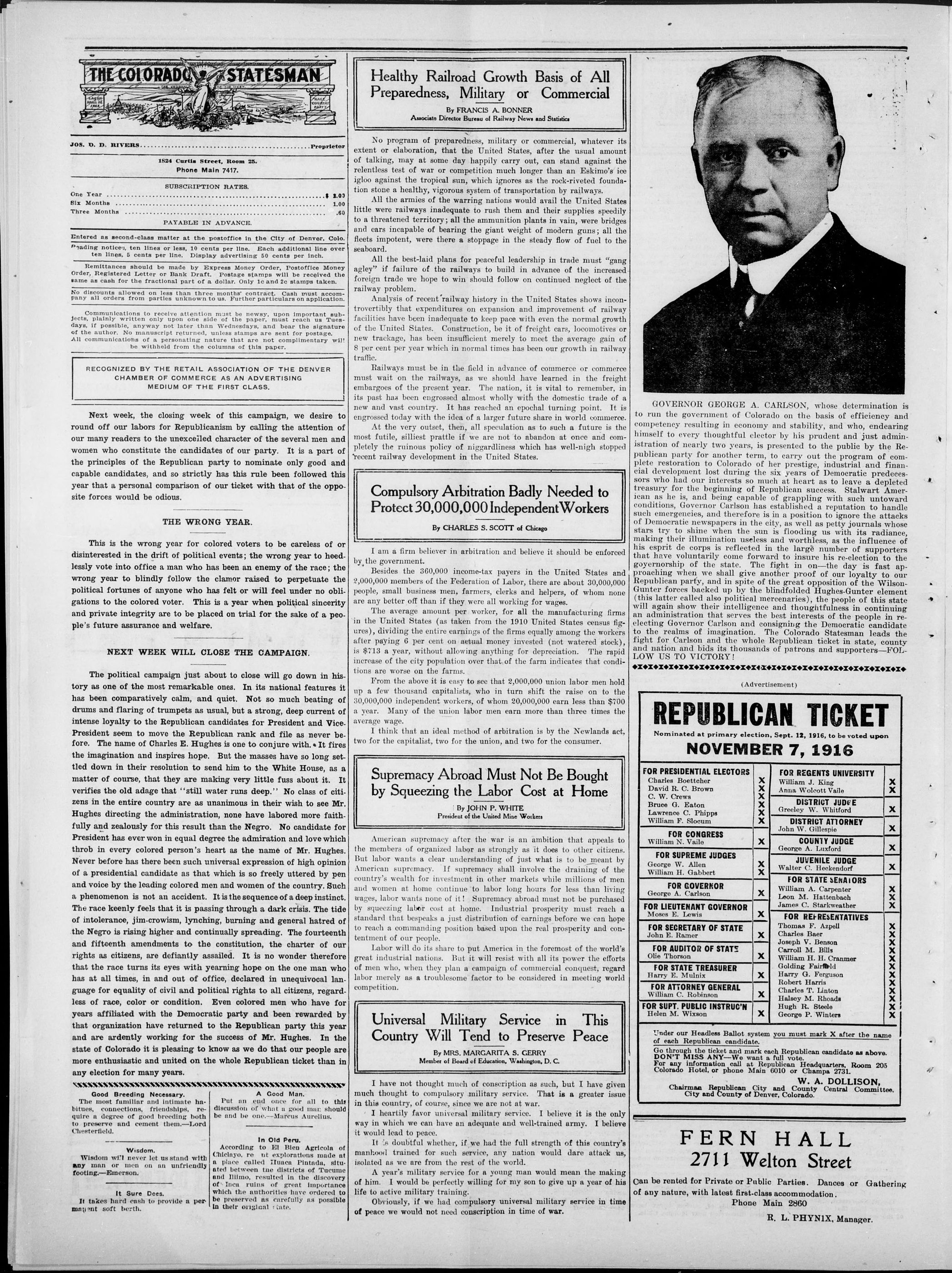
GOVERNOR GEORGE A. CARLSON, whose determination is to run the government of Colorado on the basis of efficiency and competency resulting in economy and stability, and who, endearing himself to every thoughtful elector by his prudent and just administration of nearly two years, is presented to the public by the Republican party for another term, to carry out the program of complete restoration to Colorado of her prestige, industrial and financial development lost during the six years of Democratic predecessors who had our interests so much at heart as to leave a depleted treasury for the beginning of Republican success. Stalwart American as he is, and being capable of grappling with such untoward conditions, Governor Carlson has established a reputation to handle such emergencies, and therefore is in a position to ignore the attacks of Democratic newspapers in the city, as well as petty journals whose stars try to shine when the sun is flooding us with its radiance, making their illumination useless and worthless, as the influence of his esprit de corps is reflected in the large number of supporters that have voluntarily come forward to insure his re-election to the governorship of the state. The fight in on—the day is fast approaching when we shall give another proof of our loyalty to our Republican party, and in spite of the great opposition of the Wilson-Gunter forces backed up by the blindfolded Hughes-Gunter element (this latter called also political mercenaries), the people of this state will again show their intelligence and thoughtfulness in continuing an administration that serves the best interests of the people in reelecting Governor Carlson and consigning the Democratic candidate to the realms of imagination. The Colorado Statesman leads the fight for Carlson and the whole Republican ticket in state, county and nation and bids its thousands of patrons and supporters—FOLLOW US TO VICTORY!
```markdown
```
(Advertisement)
REPUBLICAN TICKET
Nominated at primary election, Sept. 12, 1916, to be voted upon NOVEMBER 7, 1916
FOR PRESIDENTIAL ELECTORS
Charles Boettcher
David R. C. Brown
C. W. Crews
Bruce G. Eaton
Lawrence C. Phipps
William F. Slocum
FOR CONGRESS
William N. Vaile
FOR SUPREME JUDGES
George W. Allen
William H. Gabbert
FOR GOVERNOR
George A. Carlson
FOR LIEUTENANT GOVERNOR
Moses E. Lewis
FOR SECRETARY OF STATE
John E. Ramer
FOR AUDITOR OF STATE
Olie Thorson
FOR STATE TREASURER
Harry E. Mulnix
FOR ATTORNEY GENERAL
William C. Robinson
FOR SUPT. PUBLIC INSTRUC'N
Helen M. Wixson
FOR REGENTS UNIVERSITY
William J. King
Anna Wolcott Vaile
DISTRICT JUDGE
Greeley W. Whitford
DISTRICT ATTORNEY
John W. Gillespie
COUNTY JUDGE
George A. Luxford
JUVENILE JUDGE
Walter C. Heckendorf
FOR STATE SENATORS
William A. Carpenter
Leon M. Hattenbach
James C. Starkweather
FOR REPRESENTATIVES
Thomas F. Azpell
Charles Baer
Joseph V. Benson
Carroll M. Bills
William H. H. Cranmer
Golding Fairfield
Harry G. Ferguson
Robert Harris
Charles T. Linton
Halsey M. Rhoads
Hugh R. Steele
George P. Winters
Under our Headless Ballot system you must mark X after the name of each Republican candidate.
Go through the ticket and mark each Republican candidate as above.
DON'T MISS ANY—We want a full vote.
For any information call at Republican Headquarters, Room 205 Colorado Hotel, or phone Main 6010 or Champa 2731.
W. A. DOLLISON,
Chairman Republican City and County Central Committee,
City and County of Denver, Colorado.
FERN HALL 2711 Welton Street
Can be rented for Private or Public Parties. Dances or Gathering of any nature, with latest first-class accommodation.
Phone Main 2860
R. L. PHYN1X, Manager.
THE COLORADO STATESMAN
THE COLORADO STATESMAN
LAUGH
SHOULD BE
FREE
HASS
COUNTRY
PARTY
THE
COLORADO
STATESMAN
is the only Negro paper
recognized by the Retail
Association of the Denver
Chamber of Commerce as
an advertising medium
of the first class.
Phone:
Main 7417.
Thomas Webb is numbered among the sick this week.
The best thinking voters "woodrow" Wilson up Salt Creek.
Mr. H. G. Newsome of Akron, Colo., was in the city the first of the week.
Mrs. T. E. Henderson, who has been quite ill for several days, is much improved.
Mrs. John Short, who has been suffering with a severe cold since her return from Los Angeles, is improving.
The many friends of Mrs. Dudley Clark, mother of Mrs. Ida DePriest, will be sorry to learn of her serious illness.
Mr. and Mrs. William H. Talton and little son Henry left for St. Louis, Chicago and St. Paul on a visit to friends and relatives.
Rev. R. L. Pope is suffering from a slight throat affection necessitating an operation which was performed by Dr. J. H. P. Westbrook.
The Colored Republicans held a rousing and enthusiastic meeting at East Turner hall last Thursday night. Spicy speeches sandwiched with facts brought forth vigorous applause from the appreciative and attentive audience. The committees in charge deserve no little amount of credit for the meeting's big success.
Mr. J. W. Tinsley of Oakley, Kan. but now residing in Denver, entertained his family at a reunion in honor of his 80th birthday at his home, 3325 Williams street, Oct. 14, 1916 Those present were: Mr. and Mrs. William Jackson and children, Mrs. Mary Tivis, Mrs. Martha Brown and children, and Mrs. Sarah Tinsley.
Mrs. Opal Morgan of 3131 California street, entertained a few friends at dinner Wednesday evening in honor of her husband's birthday. Those present besides the host and hostess were Mr. Geo. Green of Chicago, Messrs. Geo. Walker, Henry Hinkle, S. H. Baxter, Mack Morrow; Misses Etta McDaniel, Lena Mason, and Drs. Westbrook and Cantey. Little Miss Morrison rendered several excellent selections at the piano.
William Walton of 2946 Arapahoe street, well known contractor of plastering and bricklaying in Denver, has recently come in possession of a fine five-passenger touring car. Mr. Walton has labored among us for a number of years and has built up a business of which the whole race is proud of, as by persistent efforts and indomitable pluck and courage he has won recognition from both sides. Congratulations from the Colorado Statesman.
SAMUEL BONDURANT, our popular and distinguished citizen, and proprietor of the long established Denver Cleaning and Pressing Works, has recently purchased a five-passenger Ford automobile which is an indication of progressive business. Mr. Bondurant says "pleasure is all right," but his business experience suggests keeping abreast the times and therefore his acquisition of a car is for the advantages and facilities that will be afforded his business. Push on, Samuel, and score more of success.
THE ROCKY MOUNTAIN ATHLET IC CLUB
Have opened in their new quarters at 920 19th street, under the management of Louis R. May, who wishes to extend a cordial invitation to all the patrons of the club. Big opening Saturday evening, Oct. 28, 1916. The rooms have been beautifully decorated and everything is in first-class style.
Y. M. C. A. NOTES.
The joint public meeting of the Y. M. and the Y. W. C. A., held at the People's Presbyterian Church last Sunday afternoon, was well attended. The presence of the Queen City Band was quite an attraction. Rev. Dr. E. N. Orr, the speaker, was at his best, and delivered a very strong and impressive address on the subject "Jesus the Light of the World."
On Friday evening the educational work of the Boys' Department will open up with an address on "What's Inside an Automobile?" by Professor John Lough, Instructor of the Automobile Department of the Central Y. M. C. A. The talk will be given at 7:30 o'clock, and all boys, and men, too, if they desire to come, will be welcome.
Next Sunday afternoon Rev. G. Sterling Sawyer will speak at the boys' meeting at 2:20 o'clock. The men's meeting will be held at 4:00 o'clock and the Rev. Dr. Walter S. Rudolph, pastor of the Union Congregational Church, will be the speaker. Miss Mabel Cole, of the People's Presbyterian Church Choir, will be special soloist. All will be welcome.
WARD CHAPEL, A. M. E. CHURCH
Thirty-first and Larimer Streets.
The series of meetings are being regularly attended with interest. Mrs. Elliot and family, Mrs. Thomas with others have rendered valuable service. There will be preaching tomorrow at 11 a. m. by the pastor. At 3 o'clock p. m. Rev. C. A. Williams, D. D., will preach for us. Also Rev. A. M. Ward, pastor at Campbell, and his congregation, will be with us.
COLORED NATIONAL Y. W. C. A
SECRETARY VISITS DENVER.
Miss Eva D. Bowles, a national secretary of the Young Women's Christian Association arrived in Denver this week and is making her first official visit to the Phyllis Wheatley Y. W. C. A. club located at 318 25th street. During her stay in this city Miss Bowles is to be the guest of Mrs. Hattie Payne, 2420 Clarkson street, and will be at home there to all women and girls interested in the Y. W. C. A. Miss Bowles hails from Ohio and for many years has been interested in educational work of our people. She began her work in the Colored Young Women's Christian Association in New York City, New York, about ten years ago, as its first general secretary. She has successfully held her position on the secretarial force of the National Board Young Women's Christian Association for nearly four years.
For many years Mrs. W. A. Hunton, wife of the dean of the colored secretarial force of the Y. M. C. A., and senior international secretary of the Colored Department Y. M. C. A. in America, labored in the interest of the Y. W. C. A. among colored young women. She was the special worker of color on the Nation Board of the Y. W. C. A. Through her became our first colored National Student Secretary.
At the expiration of two years she resigned to get married and was succeeded by Miss Cecelia Holloway, who two years later resigned to become Mrs. Dr. Cabiners, and was succeeded by Miss Josephine P. Pinyon who served for three and one-half years, resigning recently to accept position as teacher in Summer High School, Kansas City, Kan.
It was about February, 1913, that Mrs. Hunton's dream was realized in the appointment of Miss Eva D. Bowles on the National Board for Colored Y. W. C. A. work in cities. The Phyllis Wheatley Y. W. C. A. is glad to welcome Miss Bowles and invites the public to attend our first anniversary celebration at the People's Presbyterian church at 8 p. m., Monday, Oct. 30, where Miss Bowles is to be the speaker. An informal reception will follow at the Association rooms across the street. Miss Bowles will talk at the vesper service at 4 p. m., Sunday. During her stay she will survey the field and the possibilities of the work among our women and girls in Denver.
LYDIA SMITH WARD. President.
SHORTER CHAPEL
Washington and Twenty-third Streets.
Rev. C. A. Williams, Pastor.
11:00 a.m.—Morning service.
9:45 a.m.—Sunday school.
6:30 p.m.—Allen C. League.
7:30 p.m.—Evening service.
The choir will render at morning service the anthem, "Thou Lord Wilt Arise," by Ashford; also the quartet, "For God So Loved the World," by Witty.
At the evening service., the quartet, "Lord of Our Life," by Barnby, will be rendered. Members and friends are requested to be punctual as Pastor Williams is beginning and ending on time.
Don't forget the grand Masonic entertainment and Cake Walk at East Turner Hall, Thursday, Nov. 30. A good time all the time. Morrison's Full Orchestra.
(Advertisement)
William N. Vaile Republican Candidate for CONGRESS
Is now on the Mexican border, under the call of the President of the United States.
Lieutenant Vaile believes in PREPAREDNESS for PEACE and in PROTECTION for PROSPERITY. When he believes in a thing he believes in working at it himself.
He cannot personally conduct his campaign because he has been assigned to military duties at Douglas, Arizona, by the President of the United States.
When he is elected to Congress, and takes his seat in March, 1917, he will be able to give his entire time to the duties of that office.
The Colorado Statesman indorses Mr. Vaile and urges every elector of our race to give him their hearty support as he is TRUE BLUE, and recognizes the value or worth of a man by his actions in doing all he can for his fellowmen when placed in a position to represent them.
Send Him to Congress for the FirstDistrict of Colorado AND SAVE OUR STATE FROM FURTHER INDUSTRIAL RUIN.
PEOPLE'S PRESBYTERIAN.
East 23rd Ave. and Washington St.
Pastor: J. A. Thos-Hazell, S. T. B.
The Rev. O. J. McLeod, pastor of the Community Church at Dearfield, preached two extraordinarily strong sermons from the People's pulpit last Sabbath. His ripeness of scholarship plus his consecration of life, coupled with industrial life of the South, cannot but make him a contending force for righteousness and moral uplift to the people among whom he will labor in the colony. We look forward for great accomplishments under the leadership of Brother McLeod at Dearfield.
Rev. J. A. Thos-Hazell will be away from his pulpit for the next two Sabbaths. Rev. Thos. Bell of the Y. M. C. A. will perform the pulpit work at that time. The Woman's Missionary Society will observe their regular quarterly program Sunday afternoon at 5:30 oclock in the Chapel.
The Synod of Colorado held its annual session at Grand Junction last week. The pastor of the People's Church in the absence of the chairman of Synod's Committee on Freedmen's Work, read the report. Immediate steps are being taken by the Presbytery of Denver and the Synod of Colorado to liquidate the indebtedness of the People's Church to the Presbyterian Board of Church Erection in New York to the amount of $1,700.
Keep off the date of November 16th.
Madam Jarley's Waxworks at Shorter Chapel.
CAMPBELL CHAPEL, A. M. E
CHURCH NOTES.
Twenty-third and Lawrence Streets
Sunday school, 9:45 a. m., V. N. Wolfskill, superintendent.
Preaching, 11 a. m., by the pastor.
Class meeting at close of morning service.
Allen Christian Endeavor League meeting, Miss Carrie Britton, president, at 6:45 p. m.
Preaching at 7:45 p. m., by pastor.
Prayer meeting Wednesday, 8 p. m.
Class meeting, Friday, 8 p. m.
Those were stirring times down in Campbell Chapel throughout the first quarterly meeting occasion, beginning with fasting and prayer early Friday, continuing with a good love feast conducted by Presiding Elder R. L. Pope Friday night, followed by good old Methodist preaching services three times on Sunday. The choir under direction of Mrs. Ida Craig rendered good music and there was one accession to the membership. Large audiences filled the church and the presence of our Lord was manifested. Good gospel sermons were delivered by Presiding Elder Pope at 11 a.m. Rev. C. A. Williams, pastor of Shorter Chapel at 3 p. m., and Rev. Benjamin F. McCulley, pastor at Deerfield Mission, at 8 p. m.
The collection for the day was very good, reaching nearly $100. An enthusiastic meeting of the officials and church membership was held on Wednesday evening and plans were made for a $400 Thanksgiving rally, to be known as the gold and silver rally. Mrs. B. F. Givens and Mrs. Ed Johnson were elected generals of the two armies. The money is to be raised for the purchase of a furnace, winter coal and immediate needs.
HALLOWE'EN MASK BALL.
Fern Hall. Two grand prizes given away. Opera glasses for the neatest dressed lady, and a walking cane to the tackiest dressed gentleman. Carl Weston, floor manager for this grand event. Morrison's full orchestra. Admission 35 cents.
Mrs. R. K. DePriest of 2516 Lafayette street has a nicely modern furnished room for rent. Gentlemen only. Phone York 1159 W.
Mrs. Z. Hooper, nicely furnished rooms; strictly modern; prices reasonable. Rooms for light housekeeping for man and wife. 2443 Tremont Place, Denver, Colo.
ANY editor wishing to get into hot water can easily do so by suggesting that the South is capable of an occasional mistake in handling the Negro question. The South prides itself on many things, but, most of all, it believes its attitude toward the Negro to be inspired, to partake of such a wonderfully inscrutable perfection that no man, especially if he lives north of Mason and Dixon's line, is wise enough to find a flaw in it.
Some of the keenest and most conscientious editors of the nation have ventured to suggest points here and there where the situation might be improved, but they were invariably reminded to keep off of subjects which they could know nothing about. Let us hope, therefore, that the South will justify the supreme reverence it shows for the course it has selected. Let us hope. it will ultimately bring peace on earth, good will toward black and white men, and that we can all go to heaven together.—Life.
Syracuse, N. Y.—Race prejudice is the accusation lodged by Dr. Isabelle Vandervall of Orange, N. J., against the Women's and Children's Hospital because she was refused admission when she came here last May as an interne. Dr. Vandervall, an honor graduate of the New York Medical College, where she came here last May as an interne. Dr. Vandervall, an honor graduate of the New York Medical College, where she ranked 97.8 per cent, demands $5,000 damages in a Supreme Court suit. On the night Dr. Vandervall presented herself at the hospital she was forced to stand outdoors in a rain storm, she charges, because of her color.
First Landlady—"I manage to keep my boarders longer than you do." Second Landlady—"Oh, I don't know. You keep them so thin that they look longer than they really are."—The Pathfinder.
Negro Year Book, just off the press.
A compendium of useful knowledge of
the Negro race.
Life of Booker T. Washington with
free picture, $1.25.
Paul Lawrence Dunbars complete
poems, cloth bound, $1.75.
Postage 10c extra on each book.
For sale by The Colorado States-
man, 1824 Curtis st., Room 25.
Or J. H. Doniphan, 1721 Marion st.
For Sale—Good horse, fit for farm-
er and wagon; 5221 Lincoln street.
Phone Main 1209.
Wanted—Bright young man for por-
ter and delivery in millinery shop.
Must have wheel. Apply at once.
Apperson's, 401 Sixteenth street.
Fern Hall, Nov. 30. Prize of $10 in gold will be given away. Admission 25c.
A HINT TO EDITORS
Only Look Longer.
BUY GOOD BOOKS.
SALE ENDS Next MONDAY
Society Brand Clothes
O.A.D.B.C.
Broken Lines of $18 & $20 Fancy Suits & Overcoats
CAMMEL AND CO.
The Progressive
Funeral Directors
WE TAKE GREAT PRIDE IN THE
FACT THAT WE ARE "THE LEAD
ING FUNERAL DIRECTORS."
WE CAN FURNISH ELEGANT
ROLLING STOCK. AUTOS IF
E. V. Cammel, PRES. @ MGR PREFERR
You Will Be Delighted With Our Service
Little Things That Count. LADY ATTEN
CURTIS M. HARRIS
Assistant Manager and Funeral Director
OFFICE AND PARLORS 2418 WELT
Appel=Zizka
Established 1871 Phone Main 2994
PREFERRED.
With Our Service As We Look After The
LADY ATTENDANT.
Auto for Hire
Director
2418 WELTON ST. DENVER
Izka Denver's Best and Largest
TAILORS
e Main 2994 417 Sixteenth Street
E. V. Cammel, PRES. @ MGR PREFERRED.
You Will Be Delighted With Our Service As We Look After The
Little Things That Count. LADY ATTENDANT.
W. F. PLAMBECK
EXPERT WATCH MAKER
1715 CHAMPA STREET
A full line of Watches, Clocks, Diamonds and Jewelry
at lowest prices. Courteous treatment to all
---
PHONE CHAMPA 2077
DAY OR NIGHT
HONEST GOODS
HONEST WORK
AT HONEST
PRICES
Expert Repairing
A woman in a wide-brimmed hat is working in a field, holding a hoe and tending to the crops.
"The Woman With a Hoe."
CABBAGES AND A KING
By ELIZABETH VAN BENTHUYSEN.
By ELIZABETH VAN BENTHUYSEN.
When the Walrus, in the time-honored verse, called attention to the fact that the time had come to speak of cabbages and kings, the beast did not have any idea that the time would come when there would be any actual relationship between the two. Now kings have come to know the value of the cabbage while the value of the king has taken somewhat of a slump in the opposite direction.
This story deals with an Oil King and a cabbage crop. Midas, with his fund of gold; Croesus, long mentioned as a marvel of money, and the other owners of large kingly chests were but ordinary pikers compared to John D. Rockefeller. He has in one vault in the basement of the produce exchange in New York more hidden wealth than all of the old kings put together.
Yet he has a lively interest in raising cabbages.
His interest in this direction is valuable to all of the persons in the country who have garden plots because it is a lesson in the economy of space, and a tip from the richest man in the world as to the value of using every spare spot for raising something from the soil.
What he sees in New York is equally possible on the most remote hillside in America, and it is for this reason that I am showing you a picture of the Oil King's cabbage patch and telling you how the man with the greatest store of wealth wisely refuses to let a chance to raise even a tiny crop be wasted.
When I say cabbages, I do not mean that the patch is confined to this one
THE COLUMN
THE GARDEN OF THE TEMPLE
How Not to Fix Your Garden.
MONEY CAN'T MAKE A GARDEN
BY ELIZABETH VAN BENTHUYSEN
If one had all of the money in the world and no artistic or practical ideas to go with it, he could not produce a garden worth while. I am struck with this fact while looking at some of the new landscape work at the rich estates that make the Eastern coast a fairyland.
The accompanying illustration will show a case in point. Here is a garden where money enough has been spent to buy a farm. Yet the figures are stiff and grouped with about as much art as the man used who first put figures in a multiplication table. Regular, stiff and awkward, the costly bits of work are placed just like so many pawns on a chessboard.
---
thing. It is only one of many. All of the garden products that can be used in a tiny space are utilized, and around the edges, to work in a little art along with utility, there are flowers.
The Rockefeller cabbage patch is located in the yard of the world-famous Rockefeller institute at Sixty-sixth street and the East river, New York city. It is in this remarkable institution that the wise men of science try germs on monkeys and dogs so that they can learn how to save the lives of babies and grownups. Many of the greatest discoveries of science have been made in the *tg* building.
But when the master of the millions came along he saw something beside the germs and the mysterious researches of science in the vicinity. It occurred to him that the germs had nothing to do with the yard about the place, and that no amount of bacilli could interfere with putting the open ground to some use.
So he ordered that the women and children in the congested, poor neighborhood be given a chance to raise vegetables on the unused yard. The order brought about a transformation. Now on any day one may see the woman with the hoe at work on the garden that fringes the skirts of great learning. She is not bowed by the weight of centuries like Edward Markham's famous "Man With the Hoe." She is happy in the chance to make a better table for her little ones at the expense of a man whose millions do not prevent him from seeing little things clearly.
I wonder if my readers are using their available space for garden purposes with as much wisdom as the very poor of New York are doing in the cabbage patch of the Oil King?
THE PILLAR OF THE OFFICE
That is just what one does not want. Better take a handful of natural rocks and a barrel of moss and ferns and mix the combination with a sense of arrangement than to waste thousands on a decorative scheme that only holds up to pity the poverty of the mind which cannot do with much what thousands actually accomplish with little.
NOTES OF THE GARDEN
Parsnips for winter use should be dug and stored before the ground freezes.
In 1914 the value of the output of 1,-124 fertilizer plants in the United States, was $168,388,405.
Cut mint for winter use and tie it in small bunches. Hang it in airy, shady places to dry.
一
ROAD WORK SHOWS GREAT INCREASE
ROAD WORK SHOWS GREAT INCREASE
Expenditures in United States Have Increased 250 Per Cent in Twelve Years.
STATES NOW DO LARGE PART
More Than 11 Per Cent of 277,000 Miles of Highways Have Been Improved With Some Form of Surfacing.
A report just made public by Uncle Sam shows a tremendous increase during the past 12 years in the total expenditures for roads and bridges in the United States. It also shows a marked growth of building and maintenance activities under state supervision and a sharp decrease in the proportion of contributions in the form of statute labor. These facts are brought out by statistics for the calendar year 1915, recently compiled by the office of public roads and rural engineering of the U. S. department of agriculture.
The total length of public roads in the United States outside the limits of incorporated towns and cities was about 2,452,000 miles on January 1, 1916. Of this, about 277,000 miles, or 11.3 per cent, were improved with some form of surfacing. The mileage of surfaced roads has been increasing at the rate of about 16,000 miles a year, and in 1915 approximately one-half of this increase was made under the supervision of state highway departments. In addition these departments supervised the maintenance of nearly 52,000 miles of main and trunk line roads.
The increase in expenditures for road and bridge work in the United States has been from approximately $80,000,000 per year in 1904 to about $282,000,000 in 1915, an increase of more than 250 per cent. The expenditure of state funds during this same period increased from about $2,550,000 to more than $33,000,000. In addition, more than $27,000,000 of local funds was spent under state supervision in 1915, bringing the total road and bridge expenditures managed by the states to $80,514,699. This amount is greater than the total expenditures for roads and bridges from all sources in 1904.
The growth in importance of the state highway departments has been rapid. The first of these agencies was created in 1891 in New Jersey and now some form of highway department exists in every state except Indiana, South Carolina, and Texas. Since their inception these departments had expended to January 1, 1916, an aggregate of $265,350,825 in state funds for road and bridge construction, maintenance, and administration. They had constructed over 50,000 miles of roads in co-operation with the states. More than 40,000 miles of these roads were surfaced.
The falling off in the value of road work performed by statute and convict labor was from $20,000,000 in 1904. when the total road expenditures were $80,000,000, to about $15,000,000 in 1915 when the total expenditures had grown to $282,000,000. This was a reduction from 25 per cent of the total in the former year to less than $1/2 per cent of the total in 1915.
Building Better Roads.
An increase in the use of better and more expensive types of roads also is shown by the recently compiled statistics. This development has been due, in large part, to the great increase in automobile traffic. It is estimated that there are now approximately two and a half million automobiles in use on the roads of the country, or one car for every mile of road. This present motor traffic is in excess of traffic of all sorts 12 years ago.
The cash road and bridge expenditures of the United States averaged only $28 per mile of rural roads in 1904. In 1915 this average had grown to $109 per mile. New Jersey led all other states, both in 1904 and in 1915, with $221 and $475 per mile respectively. Nevada made the least expenditure in both years—$3.72 per mile in 1904 and $47 per mile in 1915.
PAPER PRODUCTION GROWING
Uncle Sam's Reports Show Gain of
24.1 Per Cent in Output From
1909 to 1914.
The United States produced $332,147,
000 worth of paper and wood pulp in
1914, according to Uncle Sam's figures
as given in a census report just made
public. This is an increase of 24 per
cent over the value of the production
in 1909, which was $267,657,000.
To produce this amount of paper in
1914 required a capital of $534,625,000,
an increase of 30.6 per cent over the
capital employed in the industry in
1909.
The number of persons employed in
the industry in 1914 was 81,223, to
whom $66,104,000 was paid in salaries
and wages.
Copper Output Breaks Record. Uncle Sam reports that the production of copper in the United States in the first six months of 1916 exceeded that of any equal period in the history of the industry, indicating that the year probably will prove the most prosperous ever known.
MORE GAS BEING USED
Output of Natural Product Breaks Record in 1915.
Quantity Consumed Exceeds by Nearly 37,000,000,000 Cubic Feet, the Previous High Mark.
The United States continues to increase its production of natural gas, in spite of the exhaustion of fields in some parts of the country. Statistics prepared by Uncle Sum show that more natural gas was produced and consumed in the United States than in any other year. The quantity used was 628,578,842,000 cubic feet, which exceeds by nearly 37,000,000,000 cubic feet, or 6 per cent, the former record, established in 1914. The average price of this gas at the point of consumption was 16.12 cents a thousand cubic feet, and its total market value was $101,312,381, a gain of 0.22 cent in unit price and of $7,196,857, or 7.6 per cent, in total value compared with the figures for 1914.
Credit for the increased production of natural gas belongs, in the order given, to Ohio, Oklahoma, West Virginia, Pennsylvania, Kansas and California, which together produced nearly 40,000,000,000 cubic feet more in 1915 than in 1914. Significant increases, important locally but unimportant as affecting the production of the entire country, were credited to Arkansas, Wyoming and Missouri. The principal beneficiaries of the increased production of natural gas were, in the order named, Pennsylvania, Oklahoma, Ohio, California and Kansas, which together consumed nearly 38,000,000,000 cubic feet more in 1915 than in 1914.
Of the total production of natural gas in 1915, it is estimated that 217,202,943,000 cubic feet, or 35 per cent, was distributed to 2,195,081 domestic consumers at an average price of 28.32 cents a thousand cubic feet, and that the remaining 65 per cent was distributed to 18,358 industrial consumers at an average price of 9.7 cents a thousand. Compared with the corresponding statistics for 1914 these figures indicate, with regard to the gas supplied to domestic consumers, gains of 7 per cent in quantity, 6 per cent in the number of consumers, and 0.28 cent in average price; with regard to the gas supplied to industrial consumers, gains of 6 per cent in quantity, 3 per cent in the number of consumers, and 0.12 cent in average price. The percentage of the total quantity consumed for domestic purposes was slightly greater in 1915 than in 1914.
WILL TRAVEL IN AIRSHIPS
New Corporation Proposes to Establish Service Between Berlin and Constantinople.
Uncle Sam's vice consul at Carlsbad, Austria, Robert S. Townsend, has reported the formation of an international airship corporation in Berlin which, as a result of the great development of aerial travel during the war, proposes to establish an aerial post service between Berlin and Constantinople. If this proves a success it is proposed to establish a passenger line.
Its plan is to have the route extend from Berlin to Carlsbad, continuing to Vienna via Budweis, from there to Budapest, and thence on to Constantinople over Sofia. Between these larger cities are to be numerous landing stations, the cities chosen for landings to subscribe for shares. In this way the corporation hopes to obtain the necessary capital to finance the project. A representative of the corporation has already visited Carlsbad and has talked with the city council as to the probability of obtaining an old racecourse as a landing station, and as to the chance of the city raising the necessary amount of money as its share of the capital. The scheme also includes the building of a modern hotel at the landing station there.
It is believed that with the advanced experience with heavier-than-air machines during the present war there is no reason why such an enterprise should not be practicable, as well as possible, should the necessary capital be obtained for its foundation.
WILL DEVELOP GREAT PAPER INDUSTRY IN PHILIPPINES
Growing Scarcity of Materials Leads to Investigation of Possible Sources in Islands. The development of a great paper industry in the Philippine islands may be one result of the growing scarcity of materials formerly used in the manufacture of paper. Prompted by this scarcity, the bureau of science of the Philippine islands has been making some investigations, and Uncle Sam's commercial representative at Manila declares that the facts collected are regarded as evidence that an industry of great economic value could be developed.
For several years, it is said, the bureau has been investigating the suitability of bamboo, cogon grass, abaca and various palm fibers for paper pulp. Other minor sources of pulp from Philippine plants are bowstring hemp, coconut coir, the leaf stalks of the nipa palm, parts of the betel-nut palm, the purl palm and waste bejuco. Bamboo fiber, it is said, is eminently fitted for book paper and for certain grades of writing and lithographic papers, either alone or when blended with rag or sulphite wood pulp.
AUTO INDUSTRY OF UNITED STATES MORE THAN DOUBLED IN SIZE WITHIN FIVE YEARS
The value of the automobiles manufactured in the United States in 1914 was more than two and one-half times as large as that of the output of 1909, according to a report issued by Uncle Sam showing the remarkable growth of this immense new industry.
The value of the output of automobile factories in 1914 was $632,831,000, an increase of $383,629,000, or 153.9 per cent, over 1909.
Persons engaged in the industry in 1914 numbered 145,951, an increase of 71 per cent over 1909, while the amount paid in salaries and wages to these employees increased from $58,173,000 in 1909 to $139,453,000 in 1914, a gain of 139.7 per cent.
The capital invested in the industry jumped from $173,837,000 in 1909 to $407,730,000 in 1914, an increase of 134.5 per cent.
That buyers of automobiles got more for their money relatively in 1914 than they did in 1909 is shown by the fact that the value of the materials entering into the construction of the cars increased 170.6 per cent in the five-year period, while the value of the finished product increased only 153.9 per cent, and the value added by manufacture increased only 135.3 per cent.
KEEPING PUBLIC WELL
Uncle Sam's Health Service Adopts New Methods.
Substitute Popular Bulletins on Disease Prevention for Scientific Treaties That Few Read.
Four years ago Uncle Sam's public health service was an establishment which manufactured scientific treaties on disease—which nobody but physicians read.
Today it is an instrument for the dissemination of human happiness.
It all happened because a man had an idea. "What," said Dr. W. C. Rucker, assistant surgeon general in charge of domestic quarantine matters, "is the use of a public health service unless people know what we are doing?"
Nobody had a satisfactory answer. So Surgeon General Rupert Blue and the new secretary of the treasury, McAdoo, under whom the public health service is placed for administrative purposes, agreed with Rucker that it
HARRIS & EWING
Dr. W. C. Rucker.
might be a good idea to take the public into its confidence on public health matters.
Some of the results are remarkable. In 1912 the service published and sent out 300,000 scientific publications. In 1915 the service sent out more than 3,000,000 publications, both scientific and popular—but mainly popular—to individuals all over the United States. And 1916 will break the record again.
A year ago Doctor Rucker's division began sending out a "Health News" bulletin to a few newspapers that wanted it. Today 8,000 daily and weekly newspapers get this bulletin. When the outbreak of infantile paralysis occurred in New York the public health service wrote up a bulletin telling what the public could do to help prevent the spread of the malady. The bureau had 50,000 requests for this little bulletin. Nobody in the United States with a two-cent postage stamp need be ignorant of how files breed, how they carry disease, how to screen a house and how to prevent the breeding of files. The service still writes scientific bulletins. Specialists work in its laboratories and statisticians figure out mortality and morbidity rates. Highly technical articles are prepared for physicians and health officials all over the country.
But everything it does now is rewritten in popular form for the layman. The service had adopted the slogan that disease prevention means getting rid of the causes, and getting rid of causes requires education of the public to know the causes.
Four years ago scarcely anybody in the country knew there was such a thing as a public health service. Today it is one of the best-known and most useful branches of the government establishment. And the year 1915 showed the lowest mortality rate the United States has ever had, 13.5 per 1,000 population, the year 1914 holding the previous low record, 13.6
per 1,000. The 1915 rate was a 10.6 per cent decrease in the death rate over the average rate for the five-year period 1906 to 1910.
UNCLE SAM BUYS TRACTORS
Obtains Large Number of Machines Similar to Those Converted Into "Land Dreadnaughts" by British.
Uncle Sam has purchased, for the use of his army, a large number of caterpillar tractors very similar to those converted into the "land dreadnaughts" by the British in northern France.
The same Peorla, Ill., firm which supplied the British with the foundations for the armored fighting monsters has contracted to build the huge tractors for this government. The tractors will weigh between 13,000 and 14,000 pounds. This is considerably below the weight of the tractors furnished for Great Britain. Their price will be $4,775 each. It will cost $1,000 additional for encasing them in armor.
Colonel Rice of the ordnance department explained that while these tractors could easily be turned into land dreadnaughts similar to the British "tanks," it is unlikely this will be done. The tractors bought for the United States army are to be used to haul big guns. They will be armored, and probably will carry rapid firing rifles, but more for defense than offense. They are much similar to the ordinary farm tractors, except that they are more powerfully constructed. It is understood that numerous experiments with the tractors, said to have brought such terrible destruction in the European war zone, have already been conducted by the United States army.
FINDS LACK OF LINGUISTS
Uncle Sam Has Difficulty Obtaining Young Men for the Bureau of Foreign and Domestic Commerce.
Uncle Sam is experiencing difficulty in finding young Americans who are familiar enough with foreign languages to be of use to the bureau of foreign and domestic commerce, which is now engaged in making investigations all over the world with a view to aiding in the extension of American trade in foreign countries. It is said that very few applicants to the bureau have a practical knowledge of French, fewer still of Spanish and that it is not on record that any native-born American in captivity has a good understanding of Russian.
It is pointed out that French is not only the language of diplomacy and the official speech of a great republic and its colonial dominions, but the storehouse of the only modern literature which is a fair rival to that of the English-speaking peoples; that Spanish is the commercial key to half the area of our own western continent, and that Russian introduces its learner to another great literature, and to an undeveloped empire of 185,000,000 as well.
```markdown
```
"Have you any jujubes today?"
This may be the housewife's query to the corner grocery man in the near future as a result of a discovery made by one of Uncle Sam's plant experts on a recent expedition into China.
This expert found the jujube tree which bears a heavy crop of a brownish fruit that, when fresh, is declared to be delicious, and when dried, offers a confection very similar in taste to the Persian date.
The section in which it is productive in China is a semi-arid belt where winter temperatures do not go much below zero Fahrenheit. This indicates that it would be of particular value to Texas, California, New Mexico, Arizona, southern Utah, and perhaps even farther north. Already, several thousand seedlings have been grown at the plant introduction garden at Chico, Cal., from the specimens sent to this country, and some of these have borne desirable fruit, which confirms the experimenters in their belief that this tree may contribute a new fruit industry to the sections indicated.
International Film Service
The photograph shows a torpedo that has just been fired coming toward the new torpedo catcher, which Uncle Sam is testing at the government naval station in Newport. It is hoped that the new invention will render the torpedo harmless. The catcher consists of a net of heavy wire supported on a steel frame and when used as a protection to ships is hung over the ship's side about 25 feet away. As the torpedo hits the net its head is held and the rear end of the torpedo comes above water, allowing the propeller to spin harmlessly.
BIG SEA THERE ONCE
Western Plains and Rocky Mountains Under Water.
Uncle Sam's Geologists Re-Create in Imagination Even Forests That Stood on Sandy Shores.
Uncle Sam's geologists have reconstructed in imagination the great sea which they say once covered all the great western plains and a part if not all of the Rocky Mountain region. They have conjured up even a picture of the forest which grew on the sandy shore of this sea, naming the species of trees which grew there.
"A study of the rock beds upturned along the eastern base of the mountains and of well records and fossiliferous rocks farther out on the plains" says a bulletin of the United States Geological Survey, "shows that in Cretaceous time the sea covered the great plains and the larger part or all of the Rocky Mountain area, and that it remained here so long that the muds and sands deposited on its bottom reached a thickness of more than a mile in the area now drained by South Platte River.
"The latest deposits in this sea now form the Fox Hills sandstone, which is 800 to 1,000 feet thick in northeastern Colorado and was evidently laid down in a shallow sea in which there were strong currents. The Fox Hills sandstone contains the remains of marine animals and plants, especially of a certain seaweed or alga, but land plants also are found in certain layers near the top of this formation, though beneath the highest beds containing marine fossils. At two localities, 10 to 12 miles southwest of Greeley, Colo., leaves of land plants are so plentiful and so well preserved that they must have grown near where they were found, so that they indicate the character of the forest which grew on the low, sandy shore of the Cretaceous sea, as well as the approximate position of the shore. The land plants found here include two species of Sequoia, now represented by the big trees and redwood of California, two yewlike trees, a fig, a tree related to the wax myrtle, and a tree like the buckthorn, a relative of the black haw, and also a fern, a scouring rush, and other plants."
FIND POTASH IN LAKE MUDS
Uncle Sam's Chemists Make Important Discovery in the Salt Lake Desert.
In the brines and muds of the Salduro marsh, a sink in the Salt Lake desert, about 60 miles west of the southwest edge of Great Salt lake, Uncle Sam's chemists have discovered what it is believed will prove to be a valuable supply of potash.
Singularly enough the salt crust left at the surface of the desert through the evaporation of the brines contains little more than a trace of potash, most of the potash being confined to the brines and to the muds underlying the salt crust. The successful extraction of this potash is a fascinating as well as most pressing problem for the chemical engineer. According to the analyses made by the geological survey, the brines and muds from the Salduro marsh contain considerable magnesium chloride, as well as chlorides of potassium and sodium, and so are somewhat similar in composition to the deposits from which potash is manufactured in Germany. Therefore, it appears that success in methods of manufacturing potash at the Salduro marsh should prove comparatively easy. While no extensive exploratory work has been done by the survey to show the area of the deposit it is believed that the amount of potash present in the region, if it can be extracted with commercial success is sufficient to provide a valuable source of supply to the country.
USING WASTE PRODUCT
Uncle Sam Finds Way to Utilize Discarded Tanbark.
Great Quantity of Material Formerly Thrown Away May Replace Rags In Felt Roofing Industry.
Uncle Sam abhors waste, and his experts are always busy trying to find a use for materials that now have no value.
One of the latest results of this work has been the development in the forest products laboratory of a method for using waste hemlock tanbark to partially replace expensive rag stock in the manufacture of felt roofing. The tanbark is now being used commercially by co-operating mills, according to an announcement made by the forest service. It is stated that, in these mills, from 20 to 30 per cent of the rags is being replaced by waste bark, and that the quality of the finished product is equal to that manufactured solely from rags. Members of the forest service who have been conducting the experiments say that the utilization of the bark will make it possible to effect a considerable saving in the manufacture of felt roofing.
According to the census of 1000, over 698,000 tons of hemlock bark were produced each year in the United States. After the tannin is extracted this bark is used for fuel purposes, for which it is said to have a value of 60 cents per ton. The extent of the savings rendered possible by the new methods is pointed out by the fact that the roofing mills of the United States have a total estimated annual production of 237,000 tons of finished roofing of all kinds.
In addition to the use of the bark for roofing, papers made at the forest products laboratory on the basis of 80 per cent of waste tanbark, have been successfully printed on a commercial twelve-color wall-paper printing machine, and give promise of being entirely satisfactory. Other paper of the same make-up has been made into fiber conduits by a commercial manufacturer.
Other possible uses of waste bark which suggest themselves, say the forest service paper experts, are the use of bark mixed with ground wood for the production of wall board, or with sulphite screenings in the manufacture of car liners. Studies already made at the forest products laboratory indicate that it may be possible to use waste hemlock and oak tanbark in making sheathing paper, carpet liners, bottle wrappers, deadening felt, and the like.
U. S. WORKERS FORM UNION
One Object of Organization, It Is Said, Is to Prove That Government Jobs Are No Sinecures.
Approximately 5,000 workers in the government service at Washington are already enrolled in the newly formed union of federal employees, and branches are already being formed in other cities, according to H. M. McLarin, president of the union.
Every cabinet department and every independent bureau in Uncle Sam's establishment is represented in the new union. Membership includes all ranks, from laborers, messengers, and low-paid clerks to chiefs of important divisions and highly trained experts in scientific bureaus.
"The union is an organization of Uncle Sam's hardest-working employees for the benefit of the workers and the service," declares McLarin. "Above all, the union proposes to make efficient service in the government recognized by the general public; to make clear to every citizen that government positions are not secrecures, but responsible opportunities for public service."
NATIONAL CAPITAL AFFAIRS
Political Views Divide Many Washington Families
WASHINGTON.—Meredith Nicholson, the author who was offered a post in the diplomatic service by President Wilson, and his wife have agreed to differ on a most important question. It is that of the candidacy of Mr. Wilson for re-election. Mr. Nicholson is for him and Mrs. Nicholson is against him and for Mr. Hughes.
A number of other equally well-known families have divided within the last few weeks over the presidential campaign. Among the couples which have agreed to differ as to presidential candidates are Representative William Kent of California and Mrs. Kent, Mr. and Mrs. Fremont Older of California, Mr. George Mid-
daughter of Senator La Follette of Hopkins of New Jersey, and Mr. and Wis.
The wives maintain that for them fundamental importance than that of been indersed by Mr. Hughes and op they are out to defeat Mr. Wilson.
Rapid Work on the Bee
NOTHER step in the building of t has been taken—that of letting co walls of the beautiful monument an
ator La Follette of Wisconsin; Mr. a
Jersey, and Mr. and Mrs. Richard Lloyd a
maintain that for them and for all women n
importance than that of national woman su
Mr. Hughes and opposed by Mr. Wilson
defeat Mr. Wilson.
k on the Beautiful Lincoln
In the building of the Lincoln memorial
en—that of letting contracts for construct
beautiful monument and of the masonry a
daughter of Senator La Follette of Wisconsin; Mr. and Mrs. J. A. H. Hopkins of New Jersey, and Mr. and Mrs. Richard Lloyd Jones of Madison, Wis.
The wives maintain that for them and for all women no issue is of more fundamental importance than that of national woman suffrage, which has been indorsed by Mr. Hughes and opposed by Mr. Wilson. For this reason they are out to defeat Mr. Wilson.
Rapid Work on the Beautiful Lincoln Memorial
ANOTHER step in the building of the Lincoln memorial in Potomac park has been taken—that of letting contracts for construction of the terrace walls of the beautiful monument and of the masonry approaches to the gigantic pile. An appropriation of $309,500 is available for the building of these features of the memorial, which, according to specifications, are to be of the best granite obtainable.
Indications are that the imposing monument to the martyred president of the sixties will be completed months ahead of the time stipulated in the contract. The contract time is March, 1918, but work is progressing at such a rate on the memorial that the more optimistic of the officials in charge of the construction are hazarding the belief that the structure will be standing as a complete tribute to the immortal Lincoln by the end of 1917.
the construction are hazarding the bed
as a complete tribute to the immortal D
Already the colonnade and the out-
pleted. The interior, mostly of limestone
interior columns are now in place. The
in and the roof is not yet on.
Work on the granite terrace walls,
started, and grading of the mound on
pushed forward with all possible speed
of teams are engaged in the work of
tates extension of Potomac park in a
river more than 200 feet.
Dredges are employed in the bulb
earth from the river and piling it up
constructed for the purpose. This work
of the memorial, instead of following the
will be bowed out 200 feet farther into
Officials in charge of the work said
of the biggest tasks in the construction
while a great part of this work has
weeks before the ground in the locality
the appearance it is expected to tal-
memorial.
Post Office Department
T MAY not be generally known, but
By this means he is combating the
ago, when the post office department as
are hazarding the belief that the structure route to the immortal Lincoln by the end of colonnade and the outside walls of the saddle, mostly of limestone, is almost installed are now in place. The ceiling beams of it is not yet on. Granite terrace walls and the masonry appalling of the mound on which the memorial with all possible speed. Hundreds of work engaged in the work of completing this mound of Potomac park in the vicinity of the river 200 feet. Employed in the building up of the new river and piling it up behind the new seawater purpose. This work means that the park instead of following the line it now does at 200 feet farther into the river. Large of the work said that landscaping aasks in the construction of the memorial, a part of this work has already been accomplished in the locality of the monument which it is expected to take on according to the Department Running a Lab.
generally known, but Uncle Sam is today not he is combating the high cost of living. Post office department asked for bids for the
Already the colonnade and the outside walls of the structure are completed. The interior, mostly of limestone, is almost installed, while the eight interior columns are now in place. The ceiling beams of bronze are not yet in and the roof is not yet on.
Work on the granite terrace walls and the masonry approaches has been started, and grading of the mound on which the memorial stands is being pushed forward with all possible speed. Hundreds of workmen and scores of teams are engaged in the work of completing this mound, which necessitates extension of Potomac park in the vicinity of the memorial into the river more than 200 feet.
Dredges are employed in the building up of the new ground, taking the earth from the river and piling it up behind the new seawall which is being constructed for the purpose. This work means that the park in the vicinity of the memorial, instead of following the line it now does along the driveway will be bowed out 200 feet farther into the river.
Officials in charge of the work said that landscaping and grading is one of the biggest tasks in the construction of the memorial, and explained that while a great part of this work has already been accomplished, it will be weeks before the ground in the locality of the monument will begin to assume the appearance it is expected to take on according to the plans of the memorial.
Post Office Department Running a Big Laundry
T MAY not be generally known, but Uncle Sam is today running a laundry. By this means he is combating the high cost of living. A couple of years ago, when the post office department asked for bids for the washing of towels for the department in Washington, the prices seemed to be abnormally high for the great number to be laundered.
Someone in the department suggested that it take over the towel-washing business itself as an experiment. The suggestion sounded good to the officials, who purchased a small washing machine, and it was soon found that the towels were being washed at a rate much below that
the past few weeks, decided to go into scale. A new and larger washing machine proposes not only to wash the towels of those used at the Washington city post office laundry will wash on an average. The department has found that it at a cost of not over 18 cents per 100 by the department were in the neigh therefore be estimated that the depa year by doing its own laundry work, at all times, but is sure that they are
Rat Proves Prediction
THE latest fashion note that skirts w vindicated the other night, when a bulldogs, ran toward a crowd of women corner of Thirteenth street and Pennsylvania avenue northwest.
the past few weeks, decided to go into the laundry business on an even larger scale. A new and larger washing machine has been purchased, and it now proposes not only to wash the towels of the post office department, but also those used at the Washington city post office. This will mean that the post office laundry will wash on an average of about 4,000 towels each day.
kks, decided to go into the laundry business. I larger washing machine has been purchased to wash the towels of the post office department in Washington city post office. This will make wash on an average of about 4,000 towels. It has found that it can wash and iron over 18 cents per 100 towels. It is said that it were in the neighborhood of 50 centsimated that the department is saving apposite own laundry work, and not only has it is sure that they are thoroughly washed.
Prediction on Fashions
Ion note that skirts will be higher this season. Be other night, when a large rat, in his effort a crowd of women who were watching a ninth street and Penn-
The department has found that it can wash and iron these 4,000 towels at a cost of not over 18 cents per 100 towels. It is said that the bids received by the department were in the neighborhood of 50 cents per 100. It can therefore be estimated that the department is saving approximately $500 a year by doing its own laundry work, and not only has its towels on hand at all times, but is sure that they are thoroughly washed.
Rat Proves Prediction on Fashions is Correct
THE latest fashion note that skirts will be higher this season was more than vindicated the other night, when a large rat, in his efforts to escape two bulldogs, ran toward a crowd of women who were watching the chase near the corner of Thirteenth street and Pennsylvania avenue northwest.
Through some mysterious agency of "ratdom" a huge rodent escaped sentries and meandered toward the white light of the avenue. As far as can be learned it was but a sightseeing trip, but Sir Rodent had not counted up the carnivorous capacity of other members of the animal kingdom.
Two bulldogs simultaneously spied the tourist and both claimed him for their own. Two sets of teeth closed upon Mr. Rat about the same time, and a guttural argument ensued as to rightful ownership. Becoming incensed at the futility of this argument, both dogs loosened their hold upon the rat, who scampered toward what looked to be a wall of protection, but which was really a flock of skirts whose owners had stopped on the corner to witness the struggle.
him for their own. Two sets of teeth time, and a guttural argument ensued incensed at the futility of this argument the rat, who scampered toward what which was really a flock of skirts who to witness the struggle. Then it was that fashion came higher, and hastily departing visions would say, "that is another story."
n. Two sets of teeth closed upon Mr. R. aural argument ensued as to rightful own utility of this argument, both dogs loosened superped toward what looked to be a wall a flock of skirts whose owners had stopped truggle. s that fashion came into her own, for skirtly departing visions of dainty ank—but is another story."
Then it was that fashion came into her own, for skirts certainly went higher, and hastily departing visions of dainty ank—but then, as Kliping would say, "that is another story."
His Ratship was captured.
MORE HORSES THAN EVER BEFORE.
Nearly everyone believes that the horse is fast disappearing; but they are in error. Census statistics show that there are more horses in this country so that ever before, notwithstanding that 500,000 horses have been gathered up by France and Great Britain and sent to the war front.
Nearly everyone believes that the law in error. Census statistics show that a low than ever before, notwithstanding a up by France and Great Britain and seas. The motor car and the motor truck have not caused a corresponding decree by figures gathered in Chicago, where increased from 11,000 to 43,000, while ho 58,000 to 49,000. Thus 32,000 motor cars 9,000 horse-drawn vehicles. From these long time before horses disappear fro
one believes that the horse is fast disappear
statistics show that there are more horses
before, notwithstanding that 500,000 horses h
Great Britain and sent to the war front.
car and the motor truck, while greatly incre
corresponding decrease in the use of horses
in Chicago, where in the last five years
200 to 43,000, while horse-drawn vehicles on
Thus 32,000 motor cars came into use, but t
vehicles. From these figures it would see
the horses disappear from the streets.
The motor car and the motor truck, while greatly increasing in numbers, have not caused a corresponding decrease in the use of horses. This is shown by figures gathered in Chicago, where in the last five years motor vehicles increased from 11,000 to 43,000, while horse-drawn vehicles only decreased from 58,000 to 49,000. Thus 32,000 motor cars came into use, but they displaced only 8,000 horse-drawn vehicles. From these figures it would seem that it will be a long time before horses disappear from the streets.
Wilson for re-election. Mr. Nicholson is for him and Mrs. Nicholson is against him and for Mr. Hughes. A number of other equally well-known families have divided within the last few weeks over the presidential campaign. Among the couples which have agreed to differ as to presidential candidates are Representative William Kent of California and Mrs. Kent, Mr. and Mrs. Fremont Older of California, Mr. George Middleton and his wife, Fola La Follette.
of Wisconsin; Mr. and Mrs. J. A. H.
Mrs. Richard Lloyd Jones of Madison,
and for all women no issue is of more
national woman suffrage, which has
posed by Mr. Wilson. For this reason
Beautiful Lincoln Memorial
the Lincoln memorial in Potomac park
contracts for construction of the terrace
of the masonry approaches to the
C. L.
bef that the structure will be standing Lincoln by the end of 1917. Outside walls of the structure are comome, is almost installed, while the eight the ceiling beams of bronze are not yet and the masonry approaches has been in which the memorial stands is being used. Hundreds of workmen and scores completing this mound, which necessi- the vicinity of the memorial into the rolling up of the new ground, taking the behind the new seawall which is being park means that the park in the vicinity the line it now does along the driveway to the river. Did that landscaping and grading is one of the memorial, and explained that already been accomplished, it will be of the monument will begin to assume like on according to the plans of the
Running a Big Laundry
Uncle Sam is today running a laundry. high cost of living. A couple of years asked for bids for the washing of towels
for the department in Washington, the prices seemed to be abnormally high for the great number to be laundered. Someone in the department suggested that it take over the towel-washing business itself as an experiment. The suggestion sounded good to the officials, who purchased a small washing machine, and it was soon found that the towels were being washed at a rate much below that quoted. The department has within
to the laundry business on an even larger machine has been purchased, and it now of the post office department, but also post office. This will mean that the post office of about 4,000 towels each day. It can wash and iron these 4,000 towels towels. It is said that the bids received neighborhood of 50 cents per 100. It can treatment is saving approximately $500 a and not only has its towels on hand thoroughly washed.
on Fashions is Correct
will be higher this season was more than large rat, in his efforts to escape two who were watching the chase near the
a closed upon Mr. Rat about the same and as to rightful ownership. Becoming bent, both dogs loosened their hold upon looked to be a wall of protection, but those owners had stopped on the corner into her own, for skirts certainly went of dainty ank—but then, as Kipling
horse is fast disappearing; but they are there are more horses in this country that 500,000 horses have been gathered out to the war front. k, while greatly increasing in numbers, use in the use of horses. This is shown in the last five years motor vehicles inse-drawn vehicles only decreased from as came into use, but they displaced only the figures it would seem that it will be on the streets.
Do You Know That-
The COLORADO STATESMAN
IS PREPARED TO DO ALL KINDS OF
JOB PRINTING
Commercial, Fraternal, Church, Book and Stationery Jobs A SPECIALTY
Ball and Concert Programs, Bill and Letter Heads, Calling Cards, Wedding Cards, Envelopes and Everything in the Printing Line Turned Out in the Neatest and Best Style Promptly on Short Notice.
We Have Supplied Our Office with New Job Press & Type of Up-to-Date Style and Our Work Will Be on a Par with the Very Best.
Give Us a Trial and We Will Give You Satisfaction
Prices as Reasonable as Those of Any Job Office in Denver
Phone Champa 37.
FRANK ROGERS
1849 Arapahoe Street,
(Adver
The Truth
Be
Amen
Correcting misleading statements, circulated by
1. The Prohibitory Law is no
2. Saloons are not brought in
3. No public drinking of beer
4. No territory dry before "Prohibition."
THE AMENDMENT SIMPLY
"Permits the manufacture and
livered ONLY in the original pack
Beer is simply made at home inste
ENNE, RATON and elsewhere.
VOTE AND W
Beer An
Keystone
Up stairs over 2051 Champa
Lunch every day from 11:30
20e. Short orders at all hou
Phone Champa 3498.
K ROGERS
Shoe Street, D
Truth About Beer Amendment
ing misleading statements, exaggerated statements, circulated by those opposed to the Prohibitory Law is not repealed or materially are not brought back; nor is this attentive public drinking of beer is permitted. Rititory dry before "Prohibition" is opened a Prohibition."
MENT SIMPLY the manufacture and sale of beer in Color in the original package and ONLY to you made at home instead of being shipped in N and elsewhere.
AND WORK FOR Our Amendment
wstone Cafe
over 2051 Champa street. Merchants' day from 11:30 a. m. to 3:30 p. m. orders at all hours. Give us a trial. Champa 3498.
The Truth About the Beer Amendment
Correcting misleading statements, exaggerated statements and untruthful statements, circulated by those opposed to the measure.
1. The Prohibitory Law is not repealed or materially altered.
2. Saloons are not brought back; nor is this attempted.
3. No public drinking of beer is permitted.
4. No territory dry before "Prohibition" is opened any more than now under "Prohibition."
THE AMENDMENT SIMPLY
"Permits the manufacture and sale of beer in Colorado to be delivered ONLY in the original package and ONLY to your residence." Beer is simply made at home instead of being shipped in from CHEYENNE, RATON and elsewhere.
Up stairs over 2051 Champa street. Merchants' Lunch every day from 11:30 a. m. to 3:30 p. m. 20c. Short orders at all hours. Give us a trial. Phone Champa 3498.
BOB CARRUTH, Proprietor. Orders taken c
Special Ann
We wish to notify all our custom
conditions, we have been able to
import Fancy China and Dinnerwa
the prices we are quoting you can
Glassware elsewhere:
42-Piece Cottage Dinner S
96-Piece Dinner Sets....
We have just received a large shi
warmers, priced from
CARS
Special Announcement
Notify all our customers that in spite of E
have been able to secure a large perc
China and Dinnerware, and we are frank t
are quoting you cannot afford to buy you
where:
Free Cottage Dinner Sets.....$ 3.50 to $ 7.50
Free Dinner Sets.....$15.00 to $35.00
received a large shipment of our Famous
warmers, priced from $1.25 to $3.75 each.
CARSONS
Special Announcement
We wish to notify all our customers that in spite of European War conditions, we have been able to secure a large percentage of our import Fancy China and Dinnerware, and we are frank to say that at the prices we are quoting you cannot afford to buy your China and Glassware elsewhere:
42-Piece Cottage Dinner Sets.....$ 3.50 to $ 7.50 Set
96-Piece Dinner Sets.....$15.00 to $35.00 Set
We have just received a large shipment of our Famous Pottery Footwarmers, priced from $1.25 to $3.75 each.
CARSONS
732-36 FIFTEENTH STREET (AT STOUT)
Lyn
yman ON ARA JUST OFF
Lyman's
ON ARAPAHOE
JUST OFF 10th STREET
Where Style and
Elegance in
Millinery
Reign Supreme
Open Day and Night.
Frank Rogers Undertaker
Carriage or Auto Service, Courtesy and Accommodation a Specialty. We strive to please. Personal supervision of ladies and children, the same kindly care. Lady assistant. BONDED TO THE CITY. FUNERALS AT $75, $60, $50, $40.
(Advertisement)
About the Beer Amendment
elements, exaggerated statements and un-
by those opposed to the measure.
not repealed or materially altered.
not back; nor is this attempted.
beer is permitted.
"Prohibition" is opened any more than
and sale of beer in Colorado to be de-
package and ONLY to your residence."
Instead of being shipped in from CHEY-
WORK FOR THE
Amendment
e Cafe
pa street. Merchants'
3:30 a. m. to 3:30 p. m.
hours. Give us a trial.
Orders taken over phone.
announcement
customers that in spite of European War
to secure a large percentage of our
ware, and we are frank to say that at
cannot afford to buy your China and
Set s.....$ 3.50 to $ 7.50 Set
.....$15.00 to $35.00 Set
shipment of our Famous Pottery Foot-
from $1.25 to $3.75 each.
RSONS
man's
ON ARAPAHOE
JUST OFF 18th STREET
Denver, Colo.
In Woman's Realm
Coats for the Small Girl Are Shown in Great Variety and Are Made in Many Materials—Cap and Muff to Match—New Coiffures That Are Inspirations of Hairdresser
FAMOUS FASHION WRITER
Julia Bottomley is recognized as one of the best informed women's fashion writers in the world, and she writes the needs and desires of women in the small towns and country, for not many years and assuring us of the military shop in a little Colorado. And the articles she prepares for us are written with a view to meeting the needs of the community. The tawdry and extravagant
H
JU
H
After reviewing coats made for the small girl it seems that they range through as great a variety of materials, and almost as great a variety of styles, as coats for grown-ups. All the soft, woolly goods, several furfabrics and plushes, velvet in various colors, and all-fur coats promise a season of rich and comfortable outdoor wear for the little miss.
They have added coiff of hair to other high an and are showing other puffs and several sho at the crown of the he for those who like a lo. Among high coiffure design in which a band is wound about the hand of ribbon, near t
It is a fad of the season to have a hat or bonnet and a tiny muff made of the same material as the coat. From top to toe almost everything small ladies wear is of one kind of cloth. For trimming, narrow bandings of the shorthaired and least costly furs are used. Smocking and shirring play important roles in making coats of wool volours, Bolivia and similar clothes, and they are at their best on velvet. But coats of fur-fabrics or plush, like that shown in the picture, must be made on the plainest lines. All-fur coats of white rabbit with caps and muffs to match make the most captivating sets imaginable. Baby Bunting's father spends his time to good advantage when he manages to clothe his small daughter in these
A
THE MIRROR
THE FASHION
snowy skins. Rabbit is frankly rabbit this year, and costs money, at that. There are fascinating coats of white brozcloth trimmed with bandings of brown fur, and they are quaint replicas of models made for grown people.
The coat shown in the picture is a practical model of brown plush very durable and warm. It is so simple that there is almost no reason for a description of it. It has a turnover collar and cuffs of the same material as the belt. The belt slips through straps at the sides, and odd silk buttons provide the means of fastening.
Now that the waved and puffed and otherwise elaborated colfur has come back, hairdressers appear to be working under the spur of new inspirations.
fastened with a shear one of many styles part on the forehead touch.
Jerse
Paris likes it.
America likes it.
So it will go merrily.
It will not pass witch.
Silk jersey is expe winter.
It makes a smart round rig.
In a coated belt dry modish.
---
---
are taboo with her. Leading wholesale and retail dealers and manufacturers of women's apparel recognize in Mrs. Bottomley an authority and the editor of the frequently published Journal has consulted her frequently. The editor of one monthly fashion periodical is a regular contributor to another and I fashion editor for an important newspaper syndicate. Before the war Mrs. Bottomley went annually to the Paris fashion district where he has kept in touch by personal correspondence. We publish these articles by special arrangement.
Q
They have added coiffures with loops of hair to other high and stately styles, and are showing others with small puffs and several short curls plinned at the crown of the head in the back, for those who like a lower hairdress.
Among high coiffures there is one design in which a band of waved hair is wound about the head like a wide band of ribbon, near the forehead. It allows a few orderly waves and ringlets to escape about the face, and the back hair is arranged in puffs at the top of the crown. This is an unusual and very finished-looking hairdress.
A similar coifure is shown in the pleture. In this design all the hair is waved and the front hair is combed back over a foundation which raises it at the top of the head. At the back a cluster of curls is plinned below the crown and a band of waved hair is brought across above the nape of the neck. It will be seen that ornamental pins are an essential part of this coifure—they finish and support it.
The coifure at the left is much simpler. All the hair is marcelled for it and combed toward the top of the crown. It is finished in a small coif
```markdown
```
fastened with a shell comb. This is one of many styles to which a side part on the forehead gives a youthful touch.
Julia Bottomley
Jersey.
Paris likes it.
America likes it.
So it will go merrily on.
It will not pass with the summer.
Silk jersey is expected to remain all winter.
It makes a smart and useful all round rig.
In a coated belt dress it is altogether modish.
---
PHONE MAIN 6123-Day or Night
THE
DOUGLASS UNDERTAKING
COMPANY
RESIDENCE PHONE YORK 7992
FRANK S. REED,
License Embalmer & Director
Lady Assistant
Polite Service
to All
Parlors, 2745 Welton Street
Phone Main 6319
Elegant Auto Service at the H
THE DENVER
MRS. J. H. STEELE, Mgr.
Special Auto Service Accommodation
some Cas
For Horse Carriages
Bonded to
W. C. Campton, Pres. W. M. Brev
RAILROAD PO
LUNCH ROOM IN
Day or Night
Service at the Popular Price for Carriages.
DINVER MORTUARY
Dr. 2445 Larimer Street, Denver, Colo.
Accommodating 10 People Including Handsome Casket $50.
Se Carriages We Charge $3.50.
Bonded to the City.
W. M. Brewster, Treas. J. W. Minter, Sec.
AD PORTERS' CLUB
ROOM IN CONNECTION
Phone Main 6319 Day or Night
Elegant Auto Service at the Popular Price for Carriages.
THE DENVER MORTUARY
MRS. J. H. STEELE, Mgr. 2445 Larimer Street, Denver, Colo.
Special Auto Service Accommodating 10 People Including Handsome Casket $50.
For Horse Carriages We Charge $3.50.
Bonded to the City.
W. C. Campton, Pres. W. M. Brewster, Treas. J. W. Minter, Sec. RAILROAD PORTERS' CLUB LUNCH ROOM IN CONNECTION
17281/2 Wazee St. Only on J. B. MINTE
St. Only one block from Union Depot. J. B. MINTER. Barber.
1728½ Wazee St. Only one block from Union Depot.
J. B. MINTER. Barber.
PHONE MAIN 8416. DENVER, COLORADO
THE STAR HAIR GROW
R HAIR GROWER A Wonderful Hair Dressing and Grower
THE STAR HAIR GROWER
THE STAR HAIR GROWER
A Wonderful Hair Dressing and Grower.
One Thousand Agents Wanted. Good Money Made. We want Agents in every city and village to sell THE STAR HAIR GROWER. This is a wonderful preparation. Can you do it without straightening irons. Sells for 25 cents will prove its value. Any person that will use a 25-cent box will be convinced. No matter what has failed to grow your hair, just give THE STAR HAIR GROWER a trial and be convinced. Send 25 cents for a full size hair to be an agent, send $1 and we will send you the hair. You can begin work at once; also agent's terms. Send all money by Money Order to
EVANSTON, ILL. GREENSBORO, N.C.
NOTE- Persons living in the South can
get their goods three days earlier if they
are in the North. GREENSBORO, N.C.
MFR, P. O. BOX 812, GREENSBORO, N.C.
Phone Champa 2211
The Chesapeake
Fish & Oysters
Denver's Only Exclusive Fish and
Fresh Fish, Oysters, Salt, Smoked, Dried
Poultry and Game of All
Chesapeake & Oyster Co. Exclusive Fish and Oyster House S, Salt, Smoked, Dried and Canned Fishtry and Game of All Kinds
The Chesapeake Fish & Oyster Co.
Denver's Only Exclusive Fish and Oyster House Fresh Fish, Oysters, Salt, Smoked, Dried and Canned Fish Poultry and Game of All Kinds 828 Fifteenth Street Denver, Colo.
THE BARBER'S CAFE
First-Class Tonsorial Artists in attendance. Best line of Cigars and Tobacco. We solicit your patronage. First-Class work guaranteed. HARRY JONES, Prop. DENVER, COLO
J. R. CONTEE
Pres. and Mgr.
BILLIARDS AND POOL
PHONE MAIN 8416.
A
INCORPORATED AND BONDED
NOTARY PUBLIC
X 7992
rector
street Denver, Colorado
A woman in a traditional dress
FREE CHECK ROOM
DENVER, COLORADO.