Colorado Statesman
Saturday, January 13, 1917
Denver, Colorado
Page text (machine-generated)
THE COLORADO STATESMAN
THE JOURNAL OF THE WEST.
LABOR SHALL BE FREE
RAGE COUNTRY PARTY
Inauguration Of Governor J. C. Gunter
VOL. XXIII.
Inaugur
Govern
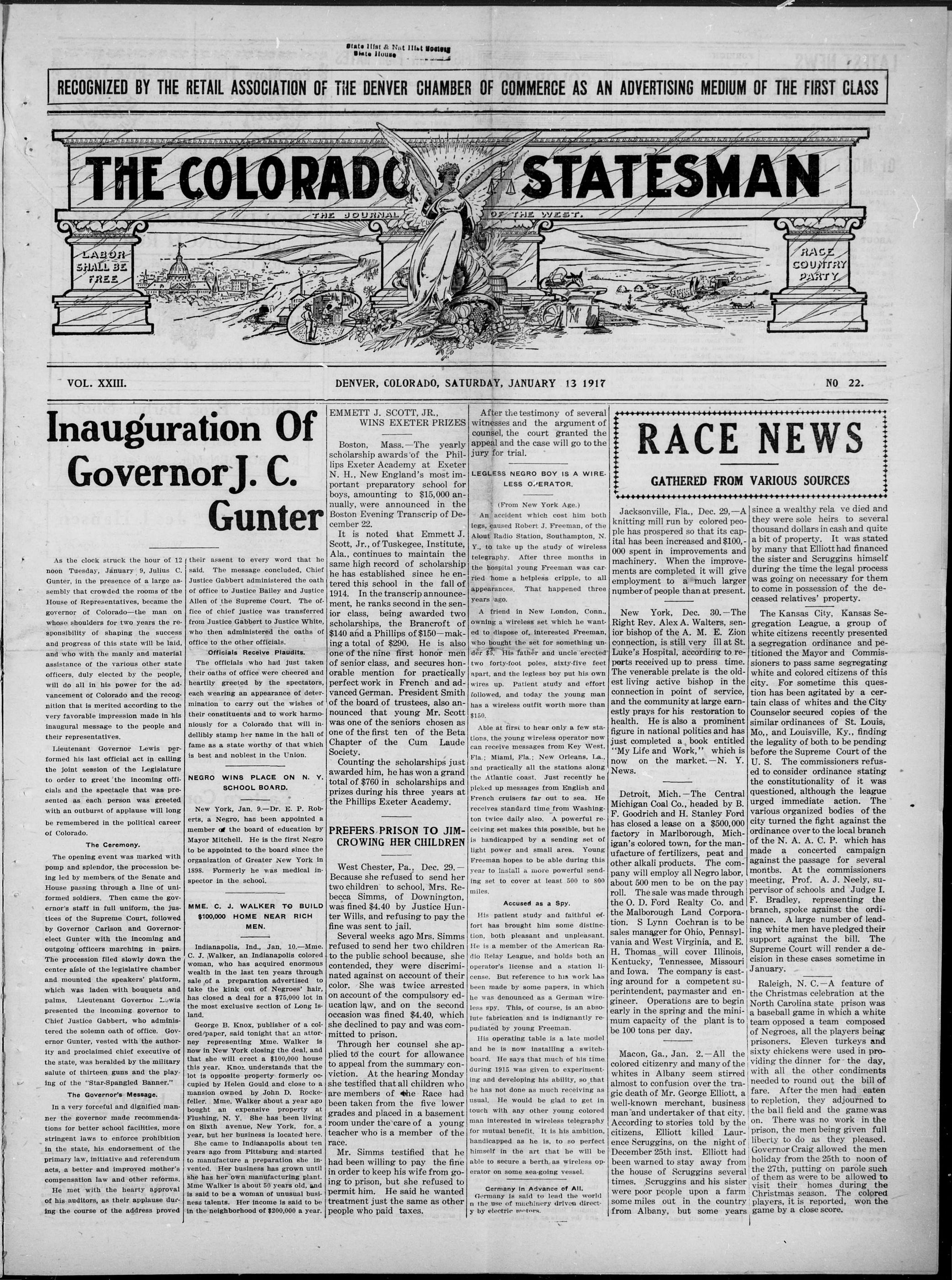
As the clock struck the hour of 12 noon Tuesday, January 9, Julius C. Gunter, in the presence of a large assembly that crowded the rooms of the House of Representatives, became the governor of Colorado—the man on whose shoulders for two years the responsibility of shaping the success and progress of this state will be laid, and who with the manly and material assistance of the various other state officers, duly elected by the people, will do all in his power for the advancement of Colorado and the recognition that is merited according to the very favorable impression made in his inaugural message to the people and their representatives.
Lieutenant Governor Lewis performed his last official act in calling the joint session of the Legislature to order to greet the incoming officials and the spectacle that was presented as each person was greeted with an outburst of applause will long be remembered in the political career of Colorado.
The Ceremony.
The opening event was marked with pomp and splendor, the procession being led by members of the Senate and House passing through a line of uniform soldiers. Then came the governor's staff in full uniform, the justices of the Supreme Court, followed by Governor Carlson and Governorelect Gunter with the incoming and outgoing officers marching in pairs. The procession filed slowly down the center aisle of the legislative chamber and mounted the speakers' platform, which was laden with bouquets and palms. Lieutenant Governor Lewis presented the incoming governor to Chief Justice Gabbert, who administered the solemn oath of office. Governor Gunter, vested with the authority and proclaimed chief executive of the state, was heralded by the military salute of thirteen guns and the playing of the "Star-Spangled Banner."
The Governor's Message.
In a very forceful and dignified manner the governor made recommendations for better school facilities, more stringent laws to enforce prohibition in the state, his endorsement of the primary law, initiative and referendum acts, a better and improved mother's compensation law and other reforms.
He met with the hearty approval of his auditors, as their applause during the course of the address proved
their assent to every word that he said. The message concluded, Chief Justice Gabbert administered the oath of office to Justice Bailey and Justice Allen of the Supreme Court. The office of chief justice was transferred from Justice Gabbert to Justice White, who then administered the oaths of office to the other officials.
Officials Receive Plaudits.
The officials who had just taken their oaths of office were cheered and heartily greeted by the spectators, each wearing an appearance of determination to carry out the wishes of their constituents and to work harmoniously for a Colorado that will indelibly stamp her name in the hall of fame as a state worthy of that which is best and noblest in the Union.
NEGRO WINS PLACE ON N. Y. SCHOOL BOARD.
New York, Jan. 9.—Dr. E. P. Roberts, a Negro, has been appointed a member of the board of education by Mayor Mitchell. He is the first Negro to be appointed to the board since the organization of Greater New York in 1898. Formerly he was medical inspector in the school.
MME. C. J. WALKER TO BUILD $100,000 HOME NEAR RICH
Indianapolis, Ind., Jan. 10.—Mme. C. J. Walker, an Indianapolis colored woman, who has acquired enormous wealth in the last ten years through sale of a preparation advertised to take the kink out of Negroes' hair, has closed a deal for a $75,000 lot in the most exclusive section of Long Island.
George B. Knox, publisher of a colored paper, said tonight that an attorney representing Mme. Walker is now in New York closing the deal, and that she will erect a $100,000 house this year. Knox understands that the lot is opposite property formerly occupied by Helen Gould and close to a mansion owned by John D. Rockefeller. Mme. Walker about a year ago bought an expensive property at Flushing, N. Y. She has been living on Sixth avenue, New York, for a year, but her business is located here. She came to Indianapolis about ten years ago from Pittsburg and started to manufacture a preparation she invented. Her business has grown until she has her own manufacturing plant. Mme Walker is about 50 years old, and is said to be a woman of unusual business talents. Her income is said to be in the neighborhood of $200,000 a year.
DENVER, COLORADO, SATURDAY, JANUARY 13 1917
State Hist & Nat Hist Bodies
State House
OF THE DENVER CHAMBER
ADC
THE JOURNAL
DENVER, COLORADO, SAT
EMMETT J. SCOTT, JR.,
WINS EXETER PRIZES
Boston, Mass.—The yearly scholarship awards of the Phillips Exeter Academy at Exeter N. H., New England's most important preparatory school for boys, amounting to $15,000 annually, were announced in the Boston Evening Transcrip of December 22.
It is noted that Emmett J. Scott, Jr., of Tuskegee, Institute, Ala., continues to maintain the same high record of scholarship he has established since he entered this school in the fall of 1914. In the transcrip announcement, he ranks second in the senior class, being awarded two scholarships, the Brancroft of $140 and a Phillips of $150—making a total of $290. He is also one of the nine first honor men of senior class, and secures honorable mention for practically perfect work in French and advanced German. President Smith of the board of trustees, also announced that young Mr. Scott was one of the seniors chosen as one of the first ten of the Beta Chapter of the Cum Laude Society.
Counting the scholarships just awarded him, he has won a grand total of $760 in scholarships and prizes during his three years at the Phillips Exeter Academy.
PREFERS PRISON TO JIMCROWING HER CHILDREN
West Chester, Pa., Dec. 29. Because she refused to send her two children to school, Mrs. Rebecca Simms, of Downington, was fined $4.40 by Justice Hunter Wills, and refusing to pay the fine was sent to jail.
Several weeks ago Mrs. Simms refused to send her two children to the public school because, she contended, they were discriminated against on account of their color. She was twice arrested on account of the compulsory education law, and on the second occasion was fined $4.40, which she declined to pay and was committed to prison.
Through her counsel she applied to the court for allowance to appeal from the summary conviction. At the hearing Monday she testified that all children who are members of the Race had been taken from the five lower grades and placed in a basement room under the care of a young teacher who is a member of the race.
Mr. Simms testified that he had been willing to pay the fine in order to keep his wife from going to prison, but she refused to permit him. He said he wanted treatment just the same as other people who paid taxes.
After the testimony of several witnesses and the argument of counsel, the court granted the appeal and the case will go to the jury for trial.
LEGLESS NEGRO BOY IS A WIRE
LESS O'ERATOR.
(From New York Age.)
An accident which cost him both legs, caused Robert J. Freeman, of the Alout Radio Station, Southampton, N.Y., to take up the study of wireless telegraphy. After three months in the hospital young Freeman was carried home a helpless cripple, to all appearances. That happened three years ago.
A friend in New London, Conn., owning a wireless set which he wanted to dispose of, interested Freeman, who bought the set for something under $5. His father and uncle erected two forty-foot poles, sixty-five feet apart, and the legless boy put his own wires up. Patient study and effort followed, and today the young man has a wireless outfit worth more than $150.
Able at first to hear only a few stations, the young wireless operator now can receive messages from Key West, Fla.; Miami, Fla.; New Orleans, La., and practically all the stations along the Atlantic coast. Just recently he picked up messages from English and French cruisers far out to sea. He receives standard time from Washington twice daily also. A powerful receiving set makes this possible, but he is handicapped by a sending set of light power and small area. Young Freeman hopes to be able during this year to install a more powerful sending set to cover at least 500 to 800 miles.
Accused as a Spy.
His patient study and faithful effort has brought him some distinction, both pleasant and unpleasant. He is a member of the American Radio Relay League, and holds both an operator's license and a station license. But reference to his work has been made by some papers, in which he was denounced as a German wireless spy. This, of course, is an absolute fabrication and is indignantly repudiated by young Freeman.
His operating table is a late model and he is now installing a switchboard. He says that much of his time during 1915 was given to experimenting and developing his ability, so that he has not done as much receiving as usual. He would be glad to get in touch with any other young colored man interested in wireless telegraphy for mutual benefit. It is his ambition, handicapped as he is, to so perfect himself in the art that he will be able to secure a berth as wireless operator on some sea-going vessel.
Germany in Advance of All. Germany is said to lead the world in the use of machinery driven directly by electric motors.
RACE NEWS
Jacksonville, Fla., Dec. 29,—A knitting mill run by colored people has prospered so that its capital has been increased and $100,000 spent in improvements and machinery. When the improvements are completed it will give employment to a much larger number of people than at present. since a wealthy rela ve died and they were sole heirs to several thousand dollars in cash and quite a bit of property. It was stated by many that Elliott had financed the sister and Scruggins himself during the time the legal process was going on necessary for them to come in possession of the de-
New York, Dec. 30.—The Right Rev. Alex A. Walters, senior bishop of the A. M. E. Zion connection, is still very ill at St. Luke's Hospital, according to reports received up to press time. The venerable prelate is the oldest living active bishop in the connection in point of service, and the community at large earnestly prays for his restoration to health. He is also a prominent figure in national politics and has just completed a book entitled "My Life and Work," which is now on the market.—N. Y. News.
Detroit, Mich. -The Central Michigan Coal Co., headed by B. F. Goodrich and H. Stanley Ford has closed a lease on a $500,000 factory in Marlborough, Michigan's colored town, for the manufacture of fertilizers, peat and other alkali products. The company will employ all Negro labor, about 500 men to be on the pay roll. The sale was made through the O. D. Ford Realty Co. and the Malborough Land Corporation. S Lynn Cochran is to be sales manager for Ohio, Pennsylvania and West Virginia, and E. H. Thomas will cover Illinois, Kentucky, Tennessee, Missouri and Iowa. The company is casting around for a competent superintendent, paymaster and engineer. Operations are to begin early in the spring and the minimum capacity of the plant is to be 100 tons per day.
Macon, Ga., Jan. 2.—All the colored citizenry and many of the whites in Albany seem stirred almost to confusion over the tragic death of Mr. George Elliott, a well-known merchant, business man and undertaker of that city. According to stories told by the citizens, Elliott killed Laurence Scruggins, on the night of December 25th inst. Elliott had been warned to stay away from the house of Scruggins several times. Scruggins and his sister were poor people upon a farm some miles out in the country from Albany, but some years
NO 22.
since a wealthy rela ve died and they were sole heirs to several thousand dollars in cash and quite a bit of property. It was stated by many that Elliott had financed the sister and Scruggins himself during the time the legal process was going on necessary for them to come in possession of the deceased relatives' property.
The Kansas City, Kansas Segregation League, a group of white citizens recently presented a segregation ordinance and petitioned the Mayor and Commissioners to pass same segregating white and colored citizens of this city. For sometime this question has been agitated by a certain class of whites and the City Counselor secured copies of the similar ordinances of St. Louis, Mo., and Louisville, Ky., finding the legality of both to be pending before the Supreme Court of the U. S. The commissioners refused to consider ordinance stating the constitutionality of it was questioned, although the league urged immediate action. The various organized bodies of the city turned the fight against the ordinance over to the local branch of the N. A. A. C. P. which has made a concerted campaign against the passage for several montbs. At the commissioners meeting, Prof. A. J. Neely, supervisor of schools and Judge I. F. Bradley, representing the branch, spoke against the ordinance. A large number of leading white men have pledged their support against the bill. The Supreme Court will render a decision in these cases sometime in January.
Raleigh, N. C.—A feature of the Christmas celebration at the North Carolina state prison was a baseball game in which a white team opposed a team composed of Negroes, all the players being prisoners. Eleven turkeys and sixty chickens were used in providing the dinner for the day, with all the other condiments needed to round out the bill of fare. After the men had eaten to repletion, they adjourned to the ball field and the game was on. There was no work in the prison, the men being given full liberty to do as they pleased. Governor Craig allowed the men holiday from the 25th to noon of the 27th, putting on parole such of them as were to be allowed to visit their homes during the Christmas season. The colored players, it is reported, won the game by a close score.
LATEST NEWS EPITOMIZED
FROM TELEGRAPHIC REPORTS THAT COVER THE WEEK'S EVENTS.
OF MOST INTEREST
OF MOST INTEREST
KEEPING THE READER POSTED ON MOST IMPORTANT CURRENT TOPICS.
Western Newspaper Union News Service.
ABOUT THE WAR
Lloyd's announces that the British steamer Allie, 1,244 tons, and the Danish steamer Ebro, 1,027 tons, and Viking have been sunk.
The capture of Fokshani, which lies on the railroad forty-five miles northwest of Galatz, apparently places this important Danube town in jeopardy.
Braila, Rumania's chief commercial city, has been captured by the Germans and Bulgarians. Four Rumanian towns were taken and 1,400 prisoners brought in.
In Volhynia, near Novo Selki, and in Galicia north of Zborow, the Germans have attempted advances against the Russians, but were repulsed, according to Petrograd.
Carranza forces now occupy Jiminez, Santa Rosalia and Parral, while Francisco Villa and his staff have fled to the State of Durango over the branch railroad from Parral to El Oro, Durango.
There is still vigorous fighting going on in northern Russia in the region of Riga. Berlin reports the repulse of Russian attacks on both sides of the river Aa and between Friedrichstadt and the Mitau-Olai road.
Ministers of the entente powers Tuesday handed to the Greek government an ultimatum, giving Greece forty-eight hours to comply with the demands contained in the note drawn up by France, Great Britain and Russia on Dec. 31.
Four alleged Mexican filibusters were either killed or badly wounded in an encounter with troops of the First New Hampshire infantry at Zapata, Tex., according to reports reaching Laredo. The same report says that Mexican revolutionists have captured Ramilene and Parral, two small villages about ten miles below the border from Zapata.
The invasion of Rumania by the troops of the central powers continues to progress. Berlin reports that the invaders, moving eastward into Moldavia from the Transylvania Alps region, are gaining ground step by step. In this fighting the Teutonic allies, according to Berlin, have taken 5,499 prisoners and captured three guns and ten machine guns.
WESTERN
Politics will be barred from land bank appointments.
The Washington State Legislature passed a memorial to Congress advocating a national prohibition law and praying the submission of such a constitutional amendment.
Private Clare H. Chambers of the supply company, Wyoming infantry, died at the Deming, N. M., base hospital of pneumonia. His remains were sent to his former home at Cheyenne.
Within two blocks of police headquarters four Chinese boy bandits held up a Chinese restaurant at San Francisco, bound and gagged four Chinese and escaped with nearly $1,000 in coin and jewelry.
After a five-hour deadlock, during which sixty-six ballots were taken, John M. Teeling of Hastings was selected as messenger to carry the eight electoral votes of Nebraska to Washington. He was instructed to cast them for Wilson and Marshall.
WASHINGTON
The Senate passed, 55 to 32, Sheppard bill to abolish saloons in District of Columbia.
Ten mines in Arizona paid $34,000,000 in dividends during the past year. Adding Utah, Montana, Nevada and Idaho dividends to those of Arizona we have a total of over $100,000,000 in dividends paid out of the mines of these five Western states in a single year.
That the mention by him of the name of the cabinet officer alleged to have been engaged in stock gambling through leaks of important news would entail the mentioning of another official "of higher position," which would be "disastrous to the nation and administration" and "would be more serious than if I cast a cloud over the entire Congress and was sent to jail myself for life," was the sensational statement which Thomas W. Lawson made to the House rules committee.
Representative Emerson of Ohio offered a resolution in the House to provide an extra month's pay for all national guardsmen on the border.
Ordnance and aircraft innovations designed from lines developed by European belligerents have been authorized by both War and Navy Departments.
Secretary Daniels appealed to Congress for $12,000,000 to add to navy yard construction facilities because of the failure of private builders to submit bids for the battle cruisers and scout cruisers.
FOREIGN
Vice Admiral Sir George Warrender died in London.
Great Britain has received Norway's reply in regard to the coal embargo, and the situation is much improved.
King Constantine at Athens applied for and received the regular bread card which is issued to all heads of families.
Announcement that E. H. Sothern never again will appear on the stage was made in New York by the actor's physician.
The withdrawal of Greek troops from Thessaly has virtually been completed. Women armed with rifles are replacing the guards on the railroads, bridges and passes.
M. Herriot, minister of supplies, has decided that the rations of sugar for the French people shall be one pound and one-half a month for each person after Feb. 1, says the Paris Matin.
An article which sought to provide for the serving in Congress of other than native-born citizens was voted down at Queretaro, Mex., by the constitutional convention.
Count Romanones, who has been premier in the Spanish ministry since December, 1915, presented to King Alfonso the resignation of the entire Cabinet and Price Golitrine was appointed premier.
More than forty persons now are imprisoned as a result of the investigations at Rome into the destruction in September, 1915, and August, 1916, respectively, of Italian battleships Bencdetto Brin and Leonardo da Vinci. The latter was blown up in Tarento harbor and 248 men perished.
C. N. Barnes, minister of pensions, in a speech in London, said President Wilson's suggestion that the belligerents state their terms for peace was entitled to all possible respect. The American people, the minister added, on the whole wanted to be on friendly terms with England and therefore "we ought to cultivate that friendship."
The dinner given in Berlin by the American Association of Commerce and trade of Berlin in honor of James W. Gerard, American ambassador to Germany, who has just returned to the German capital from a visit to the United States, developed into a demonstration of the good feeling entertained in the higher government circles and banking and business establishments toward the United States. The Boersen Zeitung, Berlin's leading financial organ, seizes upon the dinner given to Ambassador Gerard by the American Association of Commerce and Trade as an opportunity to discuss peace again. It declares that the banquet had unusual importance and expresses almost enthusiasm at the cordial relations existing between the United States and Germany, as it finds them in the expressions of the speakers.
SPORTING NEWS
Wisconsin defeated Northwestern University, 29 to 21, at conference basketball at Chicago.
Chris Jordan, champion Greek wrestler, is scheduled to meet Clarence Eklund, the light-heavyweight champion of the world, in a match at the Orpheum theater in Sheridan, Wyo., Jan. 23.
Willie Hoppe, in a twenty-point match with Charlie Peterson of St. Louis at Omaha, set a new world record for three-cushion billiards with an unfinished run of 15. The previous record was 14.
Probably the best field of ski experts ever assembled in this country will compete in the fourteenth national tournament at St. Paul on Jan. 29 and 30. Every big club in the country will be represented.
Following the meeting at Pueblo, Colo., between Frank C. Zehrung, president of the Western league, and the members of the Rotary Club, comes a persistent rumor that with Zehrung boosting the deal to have the franchise of the Topeka club transferred to Pueblo. Ham Patterson, one-time manager of the old Pueblo team, and Doc White, the old Sox pitcher, are working overtime to become partners in the ownership of the franchise the minute the switch is made.
GENERAL
United States may use Mexican railroad to withdraw portion of Pershing's expedition from Mexico. Dr. E. P. Roberts, a negro, has been appointed a member of the board of education by Mayor Mitchel of New York. Two negro prisoners were suffocated, one was probably fatally burned and more than fifty others narrowly escaped death in a fire which started in cellhouse A at the state reformatory at Frankfort, Ky. California's thirteen electoral votes were cast in the assembly of the California Legislature for President Wilson and Vice President Marshall Francis J. Heney, who received the highest popular vote for elector, was selected as messenger to carry the result of the ballot to Washington.
On a series of warrants charging him with receiving graft money for allowing vice to operate in Chicago, Chief of Police Charles Healey was freed under $25,000 bond. He was arrested by detectives from State's Attorney Hoyne's office. At Ossipee, N. H., Frederick L. Small, Boston broker, was found guilty of murdering his wife and sentenced by Judge Hivel to imprisonment in the state prison at Concord "until the 15th day of January, 1918, and on that day shall be hanged by the neck until dead."
COLORADO
STATE NEWS
Jan. 22—Meeting Colorado Editorial Association and Banquet to Members of Colorado Assembly at Denver.
Jan. 18-27—Annual Food Show at Denver.
Jan. 20-27—Annual Western Stock Show at Denver.
Feb. 2-4—Y. M. C. A. Annual Convention at Colorado Springs.
The Pueblo irrigation system is to be greatly enlarged.
Roads in Denver's mountain parks are reported in excellent condition for travel.
Railroads operating into Pueblo showed tremendous increase in business for 1916.
A revenue of $13,900 from the sale of the new 1917 auto licenses was taken in by the state during the first two days of the year.
Experiments in oiling the streets of Denver, both asphalt and graveled, are to be made next summer by the department of parks and improvements.
An inheritance tax of $57,245.64 on the estate of the late Thomas M. Patterson, who died on July 23 last, was paid to the state on a total valuation of $1,611,801.60.
The State Public Utilities Commission denied permission to the Denver & Salt Lake railroad to increase its freight rates on lumber hauled between Tolland and Tabernash and Denver.
Agitation to place smelters under the supervision of the state public utilities commission was one of the principal issues discussed at the Colorado Metal Mining association meeting in Denver.
The state of Colorado started suit in the Supreme Court of New York to collect $100,000 inheritance tax from the estate of the late John Harbeck of Boulder, Colo. The estate is valued at approximately $3,000,000.
Applications for filings on approximately 1,000,000 acres of public land in Colorado were made in less than a week after the announcement that President Wilson had signed the 640-acre grazing homestead law.
Secretary of State-elect James R. Noland announced that he would retain the heads of virtually all the bureaus of the department, some of the head clerks and all the stenographers, until at least March or April.
Ten thousand laborers are needed in the intermountain territory this spring to carry on railroad, irrigation, industrial and other construction work, and railway officials say they do not know where they are to be obtained.
Nearly 400 Democrats attended the Jackson day banquet given by the Democratic club at El Jebel temple in Denver in honor of Judge Julius C. Gunter, who Tuesday became governor of Colorado, and other state officials-elect.
Sheep feeders in the Arkansas valley will send over 255,000 head of lambs to market this month. The lambs have been fed at the stock farms in the valley and will be rushed out this month for fear of a drop in price.
Three persons were seriously injured and a baby in the protecting arms of its mother escaped unscathed when the automobile of Thomas Clevel of Pueblo turned over on South Santa Fé avenue at the bridge over the Arkansas river.
The act adopted by the people of the state at the general election last November providing for the investment of public school funds, which includes the right to loan school money on unincumbered farm lands, was held to be constitutional under an opinion rendered by Attorney General Fred Farrar.
The Highland Mary Mining Company at Ophir is taking out mineral from an ore body seven feet wide be tween walls and is putting all of it through the mill for a test on the value of the total product. The company owns a ten-stamp mill adjoining the group of mines, which is equipped with electrical power.
Colorado produced 190,000 barrels of petroleum in 1916, as compared with 208,475 barrels, of forty-two gallons each, in 1915, according to a report made public by the United States Geological Survey. The production o the entire country reached 292,300, 000 barrels for the year, an increase of 11,195,896 over 1915. Power to issue or deny certificates of public convenience and necessity, permitting competing utilities to enter a given field or forbidding them that right, should be vested by law in the State Public Utilities Commission, according to recommendations made in the biennial report of the State Public Utilities Commission.
Flour jumped 10 cents again in Denver, making an advance of 40 cents in less than two weeks. This makes the present selling price $4.70 for Longmont Special and $4.80 for Pride of the Rockies and Hungarian Patent, or equal the highest selling price since the war began. After a year of unusual conditions in the mining industry, members of the Colorado Metal Mining Association from all parts of Colorado gathered at Denver to consider matters of unusual importance to the members and the state as a whole.
FIGHT FOR FAIR RATES
FIGHT FOR FAIR RATES
RECOMMENDED BY GOVERNOR CARLSON IN FINAL MESSAGE.
Urges New Laws to Protect School Lands and More Stringent Liquor Laws.
Western Newspaper Union News Service.
Denver.—The enactment of laws to safeguard the interests of the school children of Colorado through the proper administration of the state school lands, representing a value of $175,000,000, and to make more effective the present statutes on bribery, libel and corrupt practices, were urged upon the Twenty-first General Assembly by Gov. Carlson in his outgoing message, delivered Jan. 8 before a joint session of both branches of the Assembly in the House chamber.
A vigorous prosecution of the campaign for equitable freight rates and transportation rates for Colorado, started by the Colorado Fair Freight Rates Association and now being pushed by the association in co-operation with the State Public Utilities Commission, was urged by Gov. Carlson at the outset of his message. An appropriation of $25,000, he said, should be made for use by the State Public Utilities Commission in prosecuting the suit to a successful conclusion. Among his recommendations was a suggestion that the General Assembly appoint a committee to conduct an exhaustive inquiry into state printing costs.
The defense of Colorado waters, initiative and referendum, proposed changes of laws governing the financing of irrigation districts, the state tax commission, care of the insane, a state budget, the work of the state survey committee, federal aid for good roads, workmen's compensation law, state industrial commission, and prohibition enforcement, were among the subjects discussed in the governor's message.
He strongly defended the operation of the state industrial law and the purposes for which it was enacted and declared himself unalterably opposed to a repeal of the law or the restricting of any of the powers now vested in the state industrial commission.
A pure seed law, such as is to be asked by the farmers' grange organizations of the state, and an adequate appropriation to defray the cost of litigation involving the protection of Colorado water rights were recommended.
The Legislature also was urged to keep all appropriations within the estimated state revenue for the period for which such appropriations are made.
As his conclusion Gov. Carlson said to the members of the Senate and House: "My parting word is that you co-operate with your incoming governor; give him your fullest confidence, your loyalty, support and best efforts, and determine firmly to render here even more beneficial and far-reaching service to your state than has been rendered by any preceding assembly."
Injured at Springs Fight Get $25,000.
Denver: Claims of persons injured in the grandstand crash at the Welsh-White fight at Colorado Springs on Labor day are being paid by the Casualty company to the amount of $25,000 on a pro rata basis. The company is not liable for a greater amount than $25,000, that being the value of the policy taken out prior to the fight by the Colorado Springs Athletic club.
Suits for $225,000 had been filed.
Barber Died in Pagosa Springs.
Pagosa Springs.—A man named George Barber died in a Pagosa Springs hotel in November, 1900, under strange circumstances. Myrtle A. Wright and W. P. Neff, who brought him to this city, were arrested and charged with administering poison to him. A Sioux City, Iowa, life insurance company is said to have lost heavily by Barber's death.
Denver.—Fire wrecked a big barn at Forty-seventh and Lafayette streets, adjoining the stockyards, burning to death seventy-five horses and causing an estimated loss of $75, 000. Two firemen were injured.
Denver.—The list of appointments made by Governor Carlson during the vacation period of the State Legislature was sent to the Senate for confirmation Monday morning, and went over "for further consideration."
20,000 Bushels of Wheat Burned.
Sterling.—Twenty thousand bushels of wheat were destroyed when the farmers' elevator at Fleming was burned.
Unconscious Two Weeks, Dies. Grover.—After lying in an unconscious condition for more than two weeks, during time he revived for not more than five minutes at a time, C. D. Martin died as the result of the accident sustained while hauling coal from Pine Bluffs to his ranch, near Hereford. In crossing a ditch he was thrown from the wagon by the lurch and alighted in front of the loaded wagon. Both wheels passed directly over his head and shoulders and caused a concussion of the brain
we have conducted an exclusive Jewelry Store in Denver. Square dealing, conservatism and yet progressive merchandizing is our motto.
ESTABLISHED
1879
Stark
JEWELERS
709 AND 711 SIXTEENTH STREET,
BOLDEN BROS
and LUNCH R
924 19th Street, Denver
711 SIXTEENTH STREET, DENVER, COL
OLDEN BROS. CAF
and LUNCH ROOM
1924 19th Street, Denver, Colorado
924 19th Street, Denver, Colorado
NNER
30 to 2 p.m.
Short Or
at All He
DINNER
11:30 to 2 p.m.
All Kinds of Sandwiches
Bolden Bros. Barb
Baths, Electric Mass
FIRST CLASS SERVI
R. B. BOLDEN, Mgr. 926
For Christmas Presents Jes
Watchcs—Diamonds—Jewelry
Repairing a Specialty
42S 16TH STREET
DENVER, COLO.
Phone Main 3012.
Golden Bros. Barber Sh
Baths, Electric Massage
FIRST CLASS SERVICE
E. BOLDEN, Mgr. 926 19th St. D.
Christmas Presents
— Diamonds — Jewelry
Specialty
STREET
NVER. COLO.
in 3012.
Jes I. Harn
Manufacturing
Watchmaker and
Bolden Bros. Barber Shop
Baths, Electric Massage
FIRST CLASS SERVICE
R. B. BOLDEN, Mgr. 926 19th St. Denver
For Christmas Presents
Watchches — Diamonds — Jewelry
Repairing a Specialty
42S 16TH STREET
DENVER, COLO.
Phone Maln 3012.
Jes I. Hansen
Manufacturing
Watchmaker and Jeweler
JOHN K. RETTIG
Fancy and Staple Gro
1864 CURTIS STREET
eighteenth.
MARKET COMP
E. E. SMITH, Manager, Res. Phone South 160
and Retail Staple and Fancy Groceries, Fish
Hotels and Restaurants Our Specialty.
Fresh and Cured
Eastern Corn Fed Mea
JOHN K. RET Meats, Fancy and Stap 1864 CURTIS STREET
Meats, Fancy and Staple Groceries 1864 CURTIS STREET
The MARKET CO
C. E. SMITH, Manager, Res. Pho
Wholesale and Retail Staple and Fancy Gro
Hotels and Restaurants Our
Fresh and Cured
Eastern Corn Fe
The MARKET COMPANY
The MARKET COMPANY
C. E. SMITH, Manager, Res. Phone South 1608
Wholesale and Retail Staple and Fancy Groceries, Fish and Oysters Hotels and Restaurants Our Specialty. Fresh and Cured
Fruits, Vegetables, Poultry and Game.
Telephones Main 4302, 4303, 4304, 430
622-636 15th Street Denver
Telephones Main 4302, 4303, 4304, 4305
15th Street Denver,
Telephones Main 4302, 4303, 4304, 4305
622-636 15th Street Denver, olorado
W. F. PLAMBECK
EXPERT WATCH MAKER
1715 CHAMPA STREET
A full line of Watches, Clocks, Diamonds and Jewelry
at lowest prices. Courteous treatment to all
Weatherhead
TELEPHONE MAIN 3
atherhead Hat
TELEPHONE MAIN 3203
Weatherhead Hat Co. TELEPHONE MAIN 3203
Established 1876
PIONEER HATTERS OF THE
WE MAKE OLD HATS BY
PRACTICAL HAT
RENOVATORS, BLEACHERS DYERS
Of Gents' and Ladies' Hats of Eve
1624 Champa St., Denver,
Established 1876
PIONEER HATTERS OF THE WEST
WE MAKE OLD HATS NEW
PRACTICAL HATTERS
ATORS, BLEACHERS DYERS AND FINE
Gents' and Ladies' Hats of Every Descripti
1624 Champa St., Denver, Colo.
RENOVATORS, BLEACHERS DYERS AND FINISHERS
Of Gents' and Ladies' Hats of Every Description
1624 Champa St., Denver, Colo.
A Dollar spent at with un Sent out Kept with the home merchants it is a benefit. Business men should awake to this dollar at home and make a bid for it
with the home merchants it is a messenger of Business men should awake to the importance of ar at home and make a bid for it by judicious
Kept with the home merchants it is a messenger of continuous benefit. Business men should awake to the importance of keeping this dollar at home and make a bid for it by judicious advertising.
PHONE MAIN 3028
Corner Nineteenth.
ESTABLISHED
1879
Stark
JEWELERS
DENVER, COLORADO
OS. CAFE
ROOM
ver, Colorado
Short Orders at All Hours
Barber Shop
Massage
SERVICE
926 19th St. Denver
S I. Hansen
Manufacturing
Watchmaker and Jeweler
RES. PHONE GALLUP 942
ETTIG
Staple Groceries
STREET
Denver, Colo.
COMPANY
Phone South 1608
Groceries, Fish and Oysters
Our Specialty.
Fed Meats
303, 4304, 4305
Denver, olorado
HONEST GOODS
HONEST WORK
AT HONEST
PRICES
Expert Repairing
jewelry
d Hat Co.
IN 3203
876
GUNTER'S MESSAGE
New Era of Progress for Colorado Heralded by Governor in Inaugural Address.
Rigid Enforcement of Dry Law Better Schools, Good Roads and Budget System Recommended.
Western Newspaper Union News Service.
Governor Gunter Revlews Prosper
ity and Growth of Centennial
Forty years August last the territory of Colorado became a sovereign state. Population then, 60,000; now, 1,000,000. Less than 3 per cent less than 1 per cent materially improved, Now one-third of the state taxable and 10 per cent of the land well improved. Assessed valuation then less than 1 per cent twice as great; livestock three times as great; minerals two and a half times as great and agriculture more than 10 times as much. The statehood produced $6,000,000; this year an excess of $63,000,000. In 1877, 950 miles of railroad, assessed valuation $4,000,000; to be added to the assessed valuation $173,000,000;—From Governor Gunter's inaugural address.
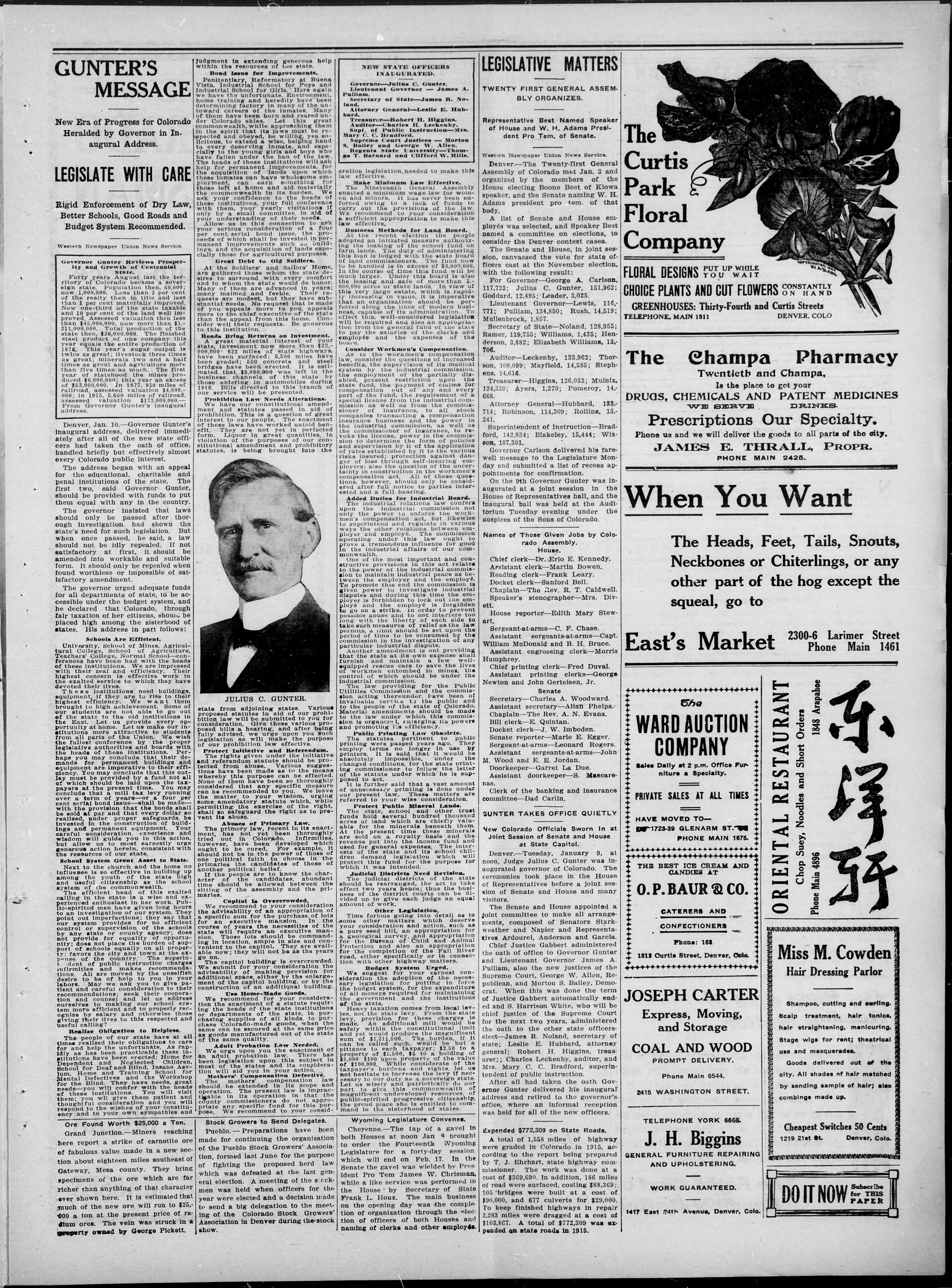
Denver, Jan. 10.—Governor Gunter's inaugural address, delivered immediately after all of the new state officers had taken the oath of office, handled briefly but effectively almost every Colorado public interest. The address began with an appeal for the educational, charitable and penal institutions of the state. The first two, said Governor Gunter, should be provided with funds to put them equal with any in the country. The governor insisted that laws should only be passed after thorough investigation had shown the state's need for such legislation. But when once passed, he said, a law should not be idly repealed. If not satisfactory at first, it should be amended into workable and suitable form. It should only be repealed when found worthless or impossible of satisfactory amendment.
The governor urged adequate funds for all departments of state, to be accessible under the budget system, and he declared that Colorado, through fair taxation of her citizens, should be placed high among the sisterhood of states. His address in part follows:
Schools Are Efficient.
University, School of Mines, Agricultural College, School of Agriculture, Teachers' College, Normal School—conferences have been had with the heads of these institutions. We are impressed with their zeal and efficiency. Their hard work as effective work in the exalted service to which they have devoted their lives.
These institutions need buildings, equipment if they are to rise to their full potential, and training brought to high achievement. Some of our students are not able to go out of the state to the old institutions in the East. Let us provide every opportunity for students to institutions more attractive to students from all parts of the Union. We wish the fullest conference by the proper legislative authorities at the old institutions. Perhaps you may conclude that their demands for permanent buildings and equipment are imperative to their efficiency. The pay may be provided by a fund not all of which should be laid upon the taxpayers at the present time. You may conclude that a mill tax levy running on the central serial bond issue—shall be made—with the provision that the bonds shall be sold at par and that every dollar so resized in the proper legal form be reserved in the construction of buildings and permanent equipment. Your careful consideration, experience and wisdom will guide you in this action, and generous action herein, consistent with the resources of our state.
School System Grent Asset to State.
Next to the church and the home no influence is so effective in building among the youth of the state high and useful citizenship as the school system of the commonwealth.
Efficient and efficient of this exalted calling in the state is a wise and experienced enthusiast in her work. Public-spirited men have given long hours to an investigation of our system. They point out imperfections; they such as the system or provide for the efficient control or supervision of the schools by any state or county agency; does not provide for equality of opportunity; does not place the burden of support of schools equally on all properties; favors the choice towards the expense of the country. The superintendent of public instruction charges infirmities and makes recommendations. All are moved by the unselfish desire to be of help to you your labors, and careful to do so give you the help of the other needs and careful consideration to their recommendations; seek their cooperation and counsel and let us address ourselves to making our school system more efficient and to properly resolve to give the entry and otherwise those getting their lives to this respected and useful calling.
Realize Obligation to Helpians.
The people of our state have at all times realized the unfortunate, as rapidly as has been practicable these institutions have been erected: Home for Dependent and Neglected Children, School for Development and Training School for Mental Defectives and the Workshop for the Blind. They have needs, great needs—you will confer with the heads of these institutions. You will instruct them the patient and thoughtful consideration and you will respond to the wishes of your constituency and to your own sympathies and
Ore Pound Worth $2,500 a Fork Grand Junction.—Miners reaching here report a strike of carnotite ore of fabulous value made in a new section about eighteen miles southeast of Gateway, Mesa county. They bring specimens of the ore which are far richer than anything of that character ever shown here. It is estimated that much of the new ore will run to $25,000 a ton at the present price of radium ores. The vein was struck in a property owned by George Pickett.
judgment in extending generous help within the resources of the state.
Bond Issue for Improvements.
Penitentiary, Reformatory at Buena Vista, Industrial School for Poys and Industrial School for Girls. Here again we have the unfortunate Environment, we have the difficulty in determining factory in many of the untoward careers of the inmates. Many of them have been born and reared under Colorado skies. Let this great unfortunate environment in the spirit that its laws must be respected and obeyed, be willing, yea solicitous, to extend a wise, helping hand to every deserving inmate, and especially for the young girls martyred in have left at home and aid materially the commonwealth in its burden. We ask your confidence to the heads of these institutions, your full conference with them, to help you with a small committee in aid of your understanding of their needs.
Allow us in this connection to ask your serious consideration of a four per cent. serial bond issue, the pro-
spective improvement in manent improvements such as buildings, and the acquisition of lands especially those for agricultural purposes.
Grant Debt to Old Soldiers.
At the Soldiers' and Sailors' Home, are gathered those whom the state desires to surround with every comfort from the state. Many of them are advanced in years, many malmed and foeble. Their requests are modest, but they have substantial needs. No request that is made of you appeals more to you, appeals to you are more than the appeal from this home. Consider well their requests. Be generous to this institution.
Ronds Bring Returns on Investment.
A great material interest of your state may be obtained by having 622 miles of state highways, have been surfaced; 5,500 miles have been graded; 500 concrete and steel bridges have been erected; it is est. 1916 that 200,000 miles of left the business channels of this state by those entering in automobiles during 1916. Bills directed to this branch of our service will be presented in the next meeting.
We have our constitutional amendment and statutes passed in aid of prohibition. This is a question of great importance to our state. Of these laws have worked untold benefit. They are not yet in perfect form. Liquor in great quantities, in violation of the constitutional amendment and prohibitory statutes, is being brought into the
J. B.
JULIUS C. GUNTER.
state from adjoining states. Various probation law and of our prohibition law will be submitted to you for consideration. Give these various proposed bills a hearing, and after being fully advised, we urge upon you such legislation as will make the purpose of our probation law live. The Injiciative Law and Referendum. The rights given under the initiative and referendum statute should be protected from abuse. Various suggestions have been made as to the means whereby this purpose can be made so thoroughly considered that any specific measure can be recommended to you. We leave the matter to your wisdom, urging some amendatory statute which, while permitting the exercise of the right, should safeguard the right as to prevent its abuse.
Abuser of Primary Law
Abuses of the new law, present in its enactment, has not yet been thoroughly tried out in Colorado. In infirmities, however, have been developed which ought to be cured. For example, it should be the case that power of political faith to choose in the primaries the candidates of those of another political belief.
If the people are to know the character of the candidates, abundant time should be allowed between the sitting of the assembly and the primaries.
Capitol Is Overcrowded.
We recommend to your consideration the advisability of an appropriation of a specific sum for the purchase of lots for an executive mansion. In the course of years on securities of the estate will require an executive mansion. Those lots should be commanding in location, ample in size and convenient to the capitol. They are available now; they will not be as the years go on. The capitol building is overcrowded. We submit for your consideration the advisability of making provision for the purchase of the augmentation of the capitol building, or by the construction of an additional building.
Ure Home-Made Good
Use Home-Made Goods
We require the enactment of a statute requiring the heads of the state institutions or departments of the state, in purchase Colorado-made goods, when the same can be secured at the same price as goods manufactured out of the state of the same country.
Protection Law Needed.
We urge upon you the enactment of an adult probation law. There has been legislation upon its subject and its enforcement will aid you in your action.
Mothers' Compensation Defective.
The mothers' compensation law shall be enacted in its scope and operation. The present law is impracticable in its operation in that the county community has a specific fund for this purpose. We recommend to your consid-
Stock Growers to Send Delegates.
Pueblo. — Preparations have been made for continuing the organization of the Pueblo Stock Growers' Association, formed last June for the purpose of fighting the proposed herd law which was defeated at the last general election. A meeting of the stockmen was held when officers for the year were elected and a decision made to send a big delegation to the meeting of the Colorado Stock Growers' Association in Denver during the stock show.
NEW STATE OFFICERS INAUGURATED.
Governor—Julus C. Gunter.
Lieutenant Governor — James A.
Pulliam.
Secretary of State—James R. No兰.
Attorney General—Leslie E. Hubb
hert, Treasurer—Robert H. Higgins,
Auditor—Charles H. Leckenby,
Instruction—Mrs.
Mary, C. C. Bradford.
Supreme Court Justices — Morton S. Bailey and George W. Allen.
eration legislation, needed to make this law effective.
Make Minimum Law Effective.
The Nineteenth General Assembly enacted a minimum wage law for women enforced owing to a lack of uniforms to carry out the provisions of the law.
We recommend to your consideration a sufficient appropriation to make this law.
Business Methods for Land Board.
At the recent election the people adopted an initiated authorizing the loaning of the school fund on farm lands. The duty of administering the land is the responsibility of land commissioners. The fund now to be handled is in excess of $3,000,000. In the course of time this fund will be much larger. Under this board is also responsible for the management of 000,000 acres or state lands. In view of this very large estate, which is rapidly increasing in value, it is imperative that an organization should be persevering in its business, capability of its administration. To effect this, well-considered legislation will be required and also an appropriation from the general fund of the state government to the salaries of the clerks and employees and the expenses of the board.
Consider Workmen's Compensation.
As to the workmen's compensation law, consider the questions of increased liability, the special system, by the industrial commission, the employment of the partially disabled, present restriction upon the state fund, the payment of claims for compensation out of any and every special license from the industrial commission as well as from the commissioner of insurance, to all stock companies transacting a compensation insurance business and the power of the commissioner as well as the commissioner of insurance, to revoke the license, power in the commission to determine the form of policies and supervision by it of the application of risks insured; protection against danger of loss through self-insuring employers; also the question of the uncertainty in construction in the workmen's compensation act; should these ques
Added Duties for Industrial Board.
The industrial relations law confers upon the industrial commission not to the power of the men's compensation act, but likewise to superintend and regulate in various ways the other relations between employer and employe. The commission is to provide this act relates to prove a tremendous influence for good in the industrial affairs of our commonwealth.
One of the most important and conscientious duties of the industrial commission to maintain industrial peace as between the employer and the employe. To promote this end the commission is to give the employer the disputes and during this time the employer is forbidden to lock out the employe and the employe is forbidden to go on a strike. In order to prevent long with the liberty of each side to take such measures of relief as the law permits, a limit should be set upon the period of time to be consumed by the commission to be the union of any other industrial dispute.
Another amendment is out providing that the state at its own expense shall furnish rescue cars to save the lives of workmen entombed in mines, the control of which should be under the industrial commission, and law providing for the Public Utilities Commission and the commission acting thereunder, have been of invaluable benefit to the state of Colorado. Material amendments should be made to the law under which this commission is organized, enlarging its powers and authority. Public Printing Law Obsolete. The statutes pertinent to public printing were passed years ago. They employ terms longer in their meaning. It is said that it would be absolutely impossible, under the changed conditions, for the state printing commissioner to follow the letter of the law under which he is supposed to act.
It is further said that a vast amount of unnecessary printing is done under our present law. These matters are referred to your wise consideration. In particular, the state school and other trust funds hold several hundred thousand acres or land which are chiefly valuable for the minerals beneath them. These places for mining are sold on a royalty basis and the revenue put into the income fund and used for general expenses. The interests of the state and its school children demand legislation which will protect fund for the purpose for which it was intended.
Judicial Districts Need Revision. The judicial districts of the state should be rearranged, the act to take effect two years hence; thus the business district will be divided up to give each judge an equal amount of work.
Other Legislation
Time forbids going into detail as to some other matters which deserve your consideration and action, such as the need for a geological survey, and appropriation for the Bureau of Child and Animal Protection and also an appropriation for the Bureau of Road, either specifically or in connection with other highway matters.
Budget System Urged.
We suggest for your earnest consideration necessary legislation for putting in force the budget system, for the expenditure of all monies required for maintaining the government and the institutions
Heavy taxation comes from local levies, not the state levy. From the state levies, an additional mill would be made. An additional mill would be safely within the constitutional limit and yet would produce the magnificent tax. If the tax is not called such, would be but a pittance to each taxpayer; $2.50 to a property of $2,500, $5 to a holding of a property of $100,000. While considerate of the taxpayer's burdens and rights, let us not hesitate to increase the levy if necessary to duty as such. We will wisely and patriotically do our part to give this commonwealth of magnificent undeveloped resources of public-spirited progress of citizenship, and to command in the sisterhood of states.
Wyoming Legislature Convenes.
Cheyenne.—The tap of a gavel in both Houses at noon Jan. 9 brought to order the Fourteenth Wyoming Legislature for a forty-day session which will end on Feb. 17. In the Senate the gavel was wielded by President Pro Tem James W. Chrisman, while a like service was performed in the House by Secretary of State Frank L. Houx. The main business on the opening day was the completion of organization through the election of officers of both Houses and naming of clerks and other employees.
LEGISLATIVE MATTERS
TWENTY FIRST GENERAL ASSEMBLY ORGANIZES.
Representative Best Named Speaker of House and W. H. Adams President Pro Tem, of Senate.
Denver—The Twenty-first General Assembly of Colorado met Jan. 3 and organized by the members of the House electing Boone Best of Kiowa speaker, and the Senate naming W. H. Adams president pro tem. of that body.
A list of Senate and House employés was selected, and Speaker Best named a committee on elections, to consider the Denver contest cases.
The Senate and House, in joint session, canvassed the vote for state officers cast at the November election, with the following result:
For Governor—George A. Carlson, 117,723; Julius C. Gunter, 151,962; Goddard, 12,495; Leader, 3,025.
Lleutenant Governor—Lewis, 116,771; Pulliam, 134,850; Rush, 14,519; Mullenbrenck, 1,857.
Secretary of State—Noland, 123,955; Ramer, 119,755; Williams, 1,435; Henderson, 3,882; Elizabeth Williams, 13,706.
Auditor—Leckenby, 133,962; Thorson, 109,099; Mayfield, 14,585; Stephens, 14,616.
Treasurer—Higgins, 126,033; Mulnix, 124,330; Ayers, 1,270; Pomeroy, 14,688.
Attorney General—Hubbard, 133,714; Robinson, 114,309; Rollins, 15,241.
Superintendent of Instruction—Bradford, 142,834; Blakeley, 15,444; Wixson, 107,301.
Governor Carlson delivered his farewell message to the Legislature Monday and submitted a list of recess appointments for confirmation.
On the 9th Governor Gunter was inaugurated at a joint session in the House of Representatives hall, and the inaugural ball was held at the Auditorium Tuesday evening under the auspices of the Sons of Colorado.
Names of Those Given Jobs by Colorado Assembly. House
Chief clerk—Dr. Erlo E. Kennedy.
Assistant clerk—Martin Bowen.
Reading clerk—Frank Leary.
Docket clerk—Sanford Bell.
Chaplain—The Rev. R. T. Caldwell.
Speaker's stenographer—Mrs. Divett.
House reporter—Edith Mary Stewart.
Sergeant-at-arms—C. F. Chase.
Assistant sergeants-at-arms—Capt William McDonald and B. H. Bruce.
Assistant engrossing clerk—Morris Humphrey.
Chief printing clerk—Fred Duval.
Assistant printing clerks—George Newton and John Gertelsen, Jr.
Senate
Secretary—Charles A. Woodward.
Assistant secretary—Allan Phelps.
Chaplain—The Rev. A. N. Evans.
Bill clerk—E. Quintan.
Sergeant-at-arms—Leonard Rogers.
Assistant sergeants-at-arms—John
M. Wood and E. E. Jordan.
Doorkeeper—Garret La Due.
Assistant doorkeeper—S. Mascarenas.
Clerk of the banking and insurance committee—Dad Carlin.
GUNTER TAKES OFFICE QUIETLY
New Colorado Officials Sworn In at Joint Session of Senate and House at State Capitol.
Denver.—Tuesday, January 9, at noon, Judge Julius C. Gunter was inaugurated governor of Colorado. The ceremonies took place in the House of Representatives before a joint session of Senate and House and many visitors.
The Senate and House appointed a joint committee to make all arrangements, composed of Senators Starkweather and Napier and Representatives Ardourel, Anderson and Garcia.
Chief Justice Gabbert administered the oath of office to Governor Gunter and Lieutenant Governor James A. Pulliam, also the new justices of the Supreme Court, George W. Allen, Republican, and Morton S. Bailey, Democrat. When this was done the term of Justice Gabbert automatically ended and S. Harrison White, who will be chief justice of the Supreme Court for the next two years, administered the oath to the other state officer-elect—James R. Noland, secretary of state; Leslie E. Hubbard, attorney general; Robert H. Higgins, treasurer;; Charles Leckenby, auditor, and Mrs. Mary C. C. Bradford, superintendent of public instruction.
After all had taken the oath Governor Gunter delivered his inaugural address and retired to the governor's office, where an informal reception was held for all of the new officers.
Expended $772,309 on State Roads.
A total of 1,558 miles of highway were graded in Colorado in 1915, according to the report being prepared by T. J. Ehrhart, state highway commissioner. The work was done at a cost of $369,690. In addition, 186 miles of road were surfaced, costing $88,369; 105 bridges were built at a cost of $90,000, and 677 culverts for $29,000. To keep finished highways in repair 2,283 miles were dragged at a cost of $103,867. A total of $772,309 was expended on state roads in 1915.
The
Curtis
Park
Floral
Company
FLORAL DESIGNS PUT UP WHILE
YOU WAIT
CHOICE PLANTS AND CUT FLOWERS CONSTANTLY
ON HAND
GREENHOUSES: Thirty-Fourth and Curtis Streets
TELEPHONE, MAIN 1511
DENVER, COLO
The Champa Pharmacy
Twentieth and Champa,
Is the place to get your
DRUGS, CHEMICALS AND PATENT MEDICINES
WE SERVE DRINKS.
Prescriptions Our Specialty.
Phone us and we will deliver the goods to all parts of the city.
JAMES E. THRALL, PROPR.
PHONE MAIN 2425.
When You Want
When You Want
The Heads, Feet, Tails, Snouts, Neckbones or Chiterlings, or any other part of the hog except the squeal, go to
Sales Daily at 2 p.m. Office Furniture a Specialty.
HAVE MOVED TO-
1723-39 GLENARM ST.
PHONE MAIN 1675.
THE BEST ICE CREAM AND
CANDIES AT
O.P. BAUR & CO.
CATERERS AND
CONFECTIONERS
Phone: 168.
1512 Curtis Street, Denver, Colo.
JOSEPH CARTER
Express, Moving,
and Storage
COAL AND WOOD
PROMPT DELIVERY.
Phone Main 6544.
2415 WASHINGTON STREET.
TELEPHONE YORK 6668.
GENERAL FURNITURE REPAIRING
AND UPHOLSTERING.
WORK GUARANTEED.
1417 East 24th Avenue, Denver, Colorado
2300-6 Larimer Street Phone Main 1461
ORIENTAL RESTAURANT
Chop Suey, Noodles and Short Orders
Phone Main 4896
1848 Arapahoe
乐泽轩
Miss M. Cowden Hair Dressing Parlor
Shampoo, cutting and curling. Scalp treatment, hair tonics, hair straightening, manicuring. Stage wigs for rent; theatrical use and masquerades. Goods delivered out of the city. All shades of hair matched by sending sample of hair; also combings made up.
Cheapest Switches 50 Cents
1219 21st St. Denver, Colo.
DO IT NOW Subscribe for THIS PAPER
THE COLORADO STATESMAN
LABOR
SHARES
THE
PARTY
RACE
COUNTRY
PARTY
JOS. D. D. RIVERS.....Proprietor
1824 Curtis Street, Room 25.
Phone Main 7417.
SUBSCRIPTION RATES.
One Year ..... $ 2.00
Six Months ..... 1.00
Three Months ..... .60
PAYABLE IN ADVANCE.
Entered as second-class matter at the postoffice in the City of Denver, Colo.
Reading notices, ten lines or less, 10 cents per line. Each additional line over ten lines, 5 cents per line. Display advertising 50 cents per inch.
Communications to receive attention must be neway, upon important subjects, plainly written only upon one side of the paper, must reach us Tuesdays, if possible, anyway not later than Wednesdays, and bear the signature of the author. No manuscript returned, unless stamps are sent for postage. All communications of a personating nature that are not complimentary will
Remittances should be made by Express Money Order, Postoffice Money Order, Registered Letter or Bank Draft. Postage stamps will be received the same as cash for the fractional part of a dollar. Only 1c and 2c stamps taken.
No discounts allowed on less than three months' contract. Cash must accompany all orders from parties unknown to us. Further particulars on application.
RECOGNIZED BY THE RETAIL ASSOCIATION OF THE DENVER CHAMBER OF COMMERCE AS AN ADVERTISING MEDIUM OF THE FIRST CLASS.
NOW that Governor Julius C. Gunter is entrusted with the reins of the government of Colorado for the period 1917-1918, it necessarily follows that every citizen who stands for good government and an administration beneficial to us will support him for the successful carrying out of the various points in his message delivered Tuesday last to a great throng of admirers from both political parties.
There are some people who can never take defeat with that spirit of "true manliness" which guides one in victorious achievements, and which characterizes the noble mind, and hence we find them struggling to admit facts that leave no margin for guessing, or refusing to fall in line to bring about such results as will be beneficial to a community, a state and a nation.
OUR POLICY WELL KNOWN.
It is hardly necessary to go over the path that we have trodden for years in declaring our political faith, but in the same breath we can certify that whether our party wins or loses we follow in the wisdom of contributors to our country's cause, helping to suppress the evil and boldly supporting the good, and we think this time an opportunity presents itself for us to offer our present governor and associate state officials our best wishes for a successful administration, assuring them that the columns of the Colorado Statesman are always opened for the circulation of matter that will help to broaden the vision of the people, making them view the things that appear in opposition to them with a calmer and saner thought, working with the head or leader for an insurance of that success which results from united action.
It is then that we say to our representatives, both in the House and Senate, ACT WELL THEIR PART, so that to them will be given the credit of being formidable assets to the upbuilding on future life of Colorado; and whether they be Republicans or Democrats, the Twenty-first Assembly will record the good deeds that have been done as they, instead of being stumbling blocks, considered the people's interests, their state's welfare and the nation's good.
IMPRESSIONS ON THE PUBLIC.
The impression made in the beginning of the present administration by the governor's recommendations; the different bills introduced by the legislators for the enforcement of the statutes; the forgetting of party ties and affiliations for the service of the common interests of the people—all these go to prove that no longer is selfishness, no longer is narrowness the guiding stars of the people's representatives, but combined action and consolidated efforts will shape the destiny of any country, race or nation, and our political leaders are waking up to this truth.
Fellow citizens, join with the Colorado Statesman in wishing the present administration that success which will bring multiplied advantages to our state, thereby helping our thoughts and actions to seize every opportunity for bigger, better and brighter things in Colorado.
The Right Kind of Reading Matter
The home news; the doings of the people in this town; the gossip of our own community, that's the first kind of reading matter you want. It is more important, more interesting to you than that given by the paper or magazine from the outside world. It is the first reading matter you should buy. Each issue of this paper gives to you just what you will consider
The Right Kind of Reading Matter
---
Federal University of Commerce Needed To Give Training for Foreign Service
By DR. G. L. SWIGGETT Assistant Secretary General Pan American Financial Congress
The foreign relations of a country refer no longer to that nation's affairs of state. The flag will follow, henceforth, trade and social welfare work as never before. This kind of service is carried on by organizations and individuals, with or without governmental patronage, and needs a superior and particular kind of preparation in view of the services to be undertaken. The nation's foreign policy may be elastic, but must be in accord with and fundamentally true to the genius and political principles of the government.
Training for foreign service, adequate to achieve the end in view, must be based on satisfactory courses in commercial education. This type of education should be established in all cities of present potential foreign trade. It should be established with due cognizance on the part of business men of the proper emphasis to be placed upon the inherent educative value of certain studies, particularly for certain grades in the school of the student, and with due recognition, as well, on the part of educators, that not only is co-operation with local industrial, mercantile and manufacturing interests essential for the most efficient and least wasteful method of instruction in commercial branches, but that a readjustment of our traditional educational organization and its administration is highly desirable in order to articulate and accredit the excellent instruction that is now being given in extramural or nonacademic agencies as emergency preparation for specific careers in business, domestic or foreign.
I foresee, therefore, the establishment in the early future of a federal university of commerce, the natural culmination of the nation's local efforts in this field of education. I refer particularly to those courses in commerce that relate to foreign service. Providence, political wisdom, educational integrity and economy demand that we all think in that direction and work to the establishment of such an institution, whether there be but one or several in the land.
Our nation must not be divided against itself in this respect. I do not think that we can create a unity of conception in foreign policy in separate and disparate institutions under varied control and catering to diversified local interests. Only a federal university of commerce, with proper establishment and direction, can train the young men and young women of this nation for foreign missions with the singleness of aim and lofty vision that such a career demands today.
Taxing of Extravagant Expenditures Would Promote Productive Investment
By FRANK A. VANDERLIP
President National City Bank of New York
I believe the whole theory of the taxation of incomes is wrong. In saying that, I do not mean that I would deny the weight of taxation should fall in an increasing ratio on great wealth.
Instead of taxing incomes, I believe we should tax expenditures. The income, no matter how large it may be, that is all promptly returned to reproductive investment is of the greatest value to society; its owner is only a trustee, who gives his experienced judgment to returning the income wisely to society. It is not great incomes that we should object to, but great expenditures that are made for unproductive purposes that represent lavishness and extravagance.
Lavishness and extravagance are by no means confined to those who receive great incomes. Such expenditures are a double destruction; they destroy the capital so spent, robbing society of its service, and frequently they destroy the ability of the spenders to render society full service. The man who, by judgment, thrift and economy, by moderate living and modest expenditure, accumulates an income which he promptly returns to reproductive work, is rendering the highest type of service, while profligate expenditure, whoever is responsible for it, robs all men and leaves the nation poorer by its double reaction.
United States One Nation in the World That Can Bring About Permanent Peace
Upon the American people rests the responsibility and duty of leadership in the movement for permanent peace among civilized nations. It is no quixotic enterprise to which we are called. We are not meddlers in the affairs of others when we say that war must cease.
The interdependence of nations, the bonds of commerce and finance, entirely aside from the dictates of common humanity, make it impossible for this plague of war to exist anywhere upon the globe without seriously affecting both our international relations and our domestic affairs. Our protest is not sentimental, although we thank God we are moved by human suffering and the waste of human life by this destroying world sickness.
The close of the world war strikes the hour for the organization among civilized nations of an actual federation with the purpose of maintaining a world peace. And America is the one nation which can propose such a federation and effect its organization. The task is hopeless without us. This is because of our nonparticipation in the present struggle and because of the magnitude of the nation and its resources.
Farm Dwellers Destined to Dominate National Life of the United States
By CARL VROOMAN, Assistant Secretary of Agriculture
The farmer is now in the saddle. There is no profession or occupation in the world which to my mind offers as many attractions as that of the farmer. The time is coming in this country when everybody who can is going to live in the country. We are getting all the comforts of city life in the country now, getting all sorts of things that our ancestors did not have.
Country life is becoming every year more interesting, more attractive, and we are going to build up, as I firmly believe, in this country a great civilization, the dominant note of which is going to be the agricultural note. I believe that the farmers, the country dwellers, of this country in the future are going to dominate our national life, and if they do I feel sure the future of this country is assured.
---
THE COLORADO STATESMAN
---
The Mouth-Piece of the People of Colorado and the Entire West
---
A RELIABLE chronicle of their doings and progress; a faithful mirror of their wants, their hopes, their best aspirations.
THE COLORADO STATESMAN
Unequaled as an advertising medium for the business of professional men and women.
An excellent family journal speaking to and for many thousand colored citizens. TWO DOLLARS A YEAR
THE GREAT ORGAN OF THE LABORING MASSES
Keep off the date February 8th. Shriners' entertainment. Fern hall.
T. W. Yeiser of Cañon City, Colo., was in the city this week.
Mrs. George Gross is ill this week, threatened with pneumonia.
Mr. John Carrie, Sr., of 2323 Ogden street is very ill.
CAMPBELL CHAPEL, AFRICAN E. CHURCH.
Twenty-third and Lawrence street. A. M. Ward, minister. Phone Ma. 5474.
Sunday school 9:45 a. m. Virgil M. Wolfskill, superintendent.
Preaching 11 a. m. by pastor.
Allen Christian Endeavor at 6:15 p. m.
Preaching by pastor at 7:30 p. m.
Those were stirring old Methodist
Mr. and Mrs. A. J. Yarber of Florence, Colo., were in the city this week on business.
Mrs. Morris Campbell fell on the ice at her home last Saturday and injured her shoulder.
Mrs. S. E. Brannum, who met with an injury a year ago, is improving so rapidly that she has discarded one of her crutches.
January 29, 1917, mask ball at Fern hall, 2711 Welton street. Given by C. A. C. M. Morrison's orchestra. Admission, 25 cents.
Bolden Bros.' Café and Lunch Room at 924 Nineteenth street is making a specialty of their early morning breakfasts. Best of home-cooked meals served on short notice at very moderate prices.
Harrison F. Smith, who has had charge of the Barth block for a number of years, has been confined at his home for several days of last week. He was able to resume a portion of his duties this week.
Tom Bass, the noted horseman of Mexico, Mo., who has a national reputation, will attend the Stock Show, which meets here January 20 to 27. Mr. Bass is without doubt the most prominent Negro horseman in the United States.
Third of winter musicales at People's Presbyterian church, Thursday night, January 25, by Misses Cleo Hobson and Virgie Cole, supported by others. Admission, 15 and 10 cents.
While attending the fire last Tuesday night at Forty-seventh and Lafayette street, William Sloan and Alfred Froman of Engine Company No. 3 were caught under a falling wall while fighting the blaze. Sloan's leg and arm was injured and Froman was badly bruised. Both were taken to St. Joseph's hospital.
Mrs. L. C. Connell was taken seriously ill last Saturday with la gripe, but at present writing hopes are held out for her early recovery. Mrs. Connell has been very attentive in ministering to the wants of her husband, who has been quite ill, but is now so that he can get around the house. Their many friends have assisted them very materially, as they are worthy citizens of Denver. May they soon regain their usual good health, is the wish of their host of friends.
Mr. and Mrs. Morris Campbell celebrated their thirtieth wedding anniversary Friday, Jan. 5, 1917, at their cozy residence, 835 Elati street. The house was beautifully decorated for the occasion. Many of their numerous friends graced the occasion with their presence and showered them with useful presents. A delicious buffet luncheon was served. Mrs. M. E. Morrison and Valerez Spratlin furnished music. May Mr. and Mrs. Campbell have many years of happiness is the wish of their many friends.
District Attorney Samuel W. Johnson of Adams county is investigating the burning of the home of U. S. G. Cooper, colored, who owns a tract of 2,400 acres of land near Salem. Cooper has had considerable trouble with cattlemen. A few days ago he drove to Denver with his family. When he returned to his ranch, which he had left in charge of a hired man, he found his house a pile of smoking embers. His milk house had also been set on fire but, failing to burn down, had been torn into ruins and a couple of smaller outbuildings had been hauled away bodily, which fact convinced Cooper that the fire was of incendiary origin. His hired man had left the place in Cooper's absence.
The Hobson-Cole piano, violin and song recital Thursday night, January 25, at People's Presbyterian church. Adults, 15 cents; children, 10 cents.
Furnished rooms and house for rent at 2358 Tremont Place. Inquire at 1824 Curtis street, Room 25.
Night and Day Cafe
919 19th street, between Champa and Curtis. Merchants' Lunch every day from 11:30 a. m. to 3:30 p. m., 20c. Short orders at all hours. Give us a trial. Phone Main 6699.
---
Oil Makes Millions
We offer investors an opportunity to share in legitimate oil business in the POWDER RIVER FIELD, where we own 2,560 acres, which adjoins the Mid-West oil field of Salt Creek, who are producing 30,000 barrels daily. HONEST, EXPERIENCED, PROGRESSIVE MANAGEMENT. Will return your money within 33 days after investing, if not satisfied. Capitalization $500,000.00, par value $1.00. Per share 25 cents; 5 per cent discount for cash. Installment, 100 shares, $5.00 down and $5.00 per month. Wire reservation at once.
Northwest Oil & Refining Company
Office, 726 Eighteenth Street,
TEL. CHAMPA 1829. DENVER, COLO.
CAMPBELL CHAPEL, AFRICAN M.
E. CHURCH.
Twenty-third and Lawrence streets.
A. M. Ward, minister. Phone Main
5474.
Sunday school 9:45 a. m. Virgil N.
Wolfskill, superintendent.
Preaching 11 a. m. by pastor
Allen Christian Endeavor at 6:30 p. m.
Preaching by pastor at 7:30 p. m.
Those were stirring old Methodist times in the services of Campbell chapel. The pastor preached in the morning and the Rev. W. C. Williams of Ebenezer A. M. E. church, Kansas City, Mo., former pastor of Campbell, preached at the evening services.
There were three additions to the membership and one young man came forward for prayer.
Sunday was the beginning of splendid revival services which have created great interest nightly during this week. The pastor is being assisted by pastors in this city, and the meeting is to last through next week and up to the quarterly meeting, which will be held by Presiding Elder R. L. Pope on Sunday, January 21.
Song, violin and literary contributions will feature the piano entertainment of Cleo Hobson and Virgine Cole at People's Presbyterian church Thursday night, January 25. Admission, 15 and 10 cents, respectively.
PEOPLE'S PRESBYTERIAN.
East Twenty-third avenue and Washington street, Pastor, J. A. Thos.-Hazell, S. T. B.
Sermon topics Sunday, January 14: 11 a. m., "Uprooting Christianity From Its True Setting"; 5 p. m., "American Presbyterianism in the Foreign Mission Field."
The Presbytery of Denver convenes in the Hyde Park Presbyterian church Tuesday next at 10 o'clock. Conferences as follows: "Evangelistic Work," conducted by Dr. F. E. Smiley, 11:45 to 12:30; "The Prayer Life of the Minister," by Rev. S. A. Siewert, 2:15 to 3 p. m. The permanent committees on "Church Erection," "Freedmen" and "The American Bible Tract Societies" will report. The committee on "Bills and Overture," through its chairman, Rev. J. A. Thos-Hazell, S. T. B., will report on the overture sent down to the various Presbyteries of the church by the last General Assembly on a new chapter 18 of the form of government, entitled "of missions." The General Assembly, by virtue of the power vested in it by chapter 24 of the "form of government," hereby proposes to the Presbyterians an amendment and alteration of the "form of government." chapter 18.
The pastor of the People's church will overture the next General Assembly of the Presbyterian Church, U. S. A., that convenes on the third Thursday next May at Dallas, Texas, through the Presbytery of Denver, to declare "null and void" the present Board of Freedman; to further instruct the Board of Home Missions to take under its control all the colored Presbyterian work of the country, regardless as to the geography in which such work is located. To consider it on equal basis in every respect with all other missionary enterprises of the church. The originator of this overture will request the Presbytery of Denver to ask the other 290 Presbyteries of the church to join with it in thus memorializing the next General Assembly. From the advanced sale of tickets for the Hobson-Cole testimonial a crowded house will be present to witness the program and encourage the young, Thursday night, January 25.
Night and
919 19th street, between O
Merchants' Lunch every day
3:30 p. m., 20c. Short orders
us a trial. Phone Main 6699
BOB CARRUTH, Proprietor
Oil Make
We offer investors an opp oil business in the POWDER 2,560 acres, which adjoins the Greek, who are producing 30
FUNERAL NOTICES BY DOUGLASS UNDERTAKING COMPANY.
Mrs. Hannie Johns, aged 45, beloved wife of Mr. Jas. M. Johns, who departed this life January 2 at residence, 1410 Grant street. Services were held Thursday, January 4, at the Douglass chapel. Rev. Sawyer of Scotts' M. E. church officiated. Remains were shipped to Little Rock, Ark., for interment.
Mr. Gilbert Ross, aged 37 years, who departed this life December 30 in San Antonio, Texas. Remains were received Friday, January 5. Services were held Sunday, January 7, 3:30 p. m., from our chapel, Rev. D. E. Over officiating. Interment Riverside cemetery.
Mr. Van Buren Brown, aged 81, beloved husband of Mrs. Mary Brown of Dearfield, Weld county, Colorado, departed this life January 4. Services were held Tuesday, January 9, 10 a.m., from Douglass Undertaking Company chapel. Rev. A. M. Ward officiated. Interment Riverside.
Mrs. Lucy Kiddick, aged 75 years, devoted mother of Mrs. Annie M. Jones, grandmother of Ledgard C. Jones of this city, Frank Jones of Chicago, departed this life Monday, January 8, at residence, 2515 Franklin street. Remains shipped to Colorado Springs Thursday morning where services were held at Payne's chapel, under auspices of Elizabeth chapter, O. of E. S. Interment Evergreen cemetery.
FUNERAL NOTICES OF CAMMEL & COMPANY.
Funeral services for Mrs. Lavenie Thomas, beloved mother of Mrs. Frank Payne, who died Wednesday, January 3, were held Saturday, January 6, at the residence, 2420 Clarkson street, Rev. C. A. Williams officiating, assisted by Rev. A. M. Ward. Interment Fairmount. Cammel & Company in charge.
Mr. Clark Culpepper, late of 2427 Washington street, departed this life Sunday, January 7, at 2:30. Funeral services Sunday January 14, at the parlors of Cammel & Company, 2418 Welton street.
New Private Dancing School
New Private Dancing School
Every Monday and Thursday nights. Lessons and Social Lessons 25c. Fern hall, 2711 Welton St. Morrison's Orchestra. R.L. Phynix Mgr Phone Main 2860
For Rent—A modern 5-room brick house at 1750 Humboldt street.
Mrs. Z. Hooper, nicely furnished rooms; strictly modern; prices reasonable. Rooms for light housekeeping for man and wife. 2443 Tremont Place, Denver, Colo.
Mrs. J. J. Brown of 2538 Glenarm Place will serve chitterling every Saturday night and Sunday dinner every Sunday from 1 to 2:30 p. m.. Your patronage is solicited. Phone Main 3824.
Day Cafe
hampa and Curtis.
from 11:30 a. m. to
at all hours. Give
oa and Curtis. 11:30 a. m. to all hours. Give Orders taken over phone.
s Millions
portunity to share in legitimate
RIVER FIELD, where we own
the Mid-West oil field of Salt
,000 barrels daily. HONEST,
ESSIVE MANAGEMENT.
A
CLEO
Missis Cleo I. Hobson
Who will
MUSICAL
People's Presl
THURSDAY,
CLEO EIRGI
Missis Cleo I. Hobson and Virgie
Who will Appear in
MUSICAL RECITA
AT
People's Presbyterian C
THURSDAY, JAN., 25, 19
Admission: Adults 15 Cents
---
The MARKE
C. E. SMITH, Manage
Wholesale and Retail Staple and
Hotels and Restaurant
Fresh
Eastern Co
MARKET COMMERCE
E. SMITH, Manager, Res. Phone South 1
and Retail Staple and Fancy Groceries, Fish
Hotels and Restaurants Our Specialty.
Fresh and Cured
Eastern Corn Fed Me
The MARKET COMPANY
C. E. SMITH, Manager, Res. Phone South 1608
Wholesale and Retail Staple and Fancy Groceries, Fish and Oysters Hotels and Restaurants Our Specialty. Fresh and Cured
Fruits, Vegetables, Poultry and Game.
Telephones Main 4302, 4303, 4304, 4305 622-636 15th Street Denver,
THE PEARL
1021 1
First-Class Tonsorial Artists in Tobacco. We solicit your patrona
THE PEARL BARBER SHOP
THE BARBER'S CHAIR
THE PEARL BARBER SHOP
1021 19th Street
First-Class Tonsorial Artists in attendance. Best line of Cigars
acco. We solicit your patronage. First-Class work guaranteed.
BY JONES, Prop.
DENVER.
THE EAST TURNER HALL
can be rented very reasonable by Societies, Lodges and
organizations. The Hall is suitable for Entertainment
ences and Athletic Exhibitions.
First-Class Tonsorial Artists in attendance. Best line of Cigars and Tobacco. We solicit your patronage. First-Class work guaranteed.
HARRY JONES, Prop. DENVER, COLO
THE EAST TURNER HALL
Can be rented very reasonable by Societies, Lodges and Organizations. The Hall is suitable for Entertainments, Dances and Athletic Exhibitions.
Can be rented very reasonable by Societies, Lodges and Organizations. The Hall is suitable for Entertainments, Dances and Athletic Exhibitions.
REFRESHMENTS SERVED.
2132 ARAPAHOE ST. PHONE MAIN 2449
NOTHING DOWN
BUYS A PIANO
THE PIANO
H. A. TRI
211 Charles Block. Cor. 15th and
ING DOWN AND 17 CTS.
BUYS A PIANO. SALE NOW ON.
THE PIANO EXCHANGE
H. A. TRIGGS, Manager
Block. Cor. 15th and Curtis Streets. Phone
NOTHING DOWN AND 17 CTS. A DAY BUYS A PIANO. SALE NOW ON.
211 Charles Block. Cor. 15th and Curtis Streets. Phone Champa 3742.
CLEO
A. E.
EIRGIR
pson and Virgie S. Cole,
will Appear in
L RECITAL
AT
bsbyterian Church.
, JAN., 25, 1917.
PORO SCALP
TREATMENT
Braids and Transformations made to
order and from combings.
MRS. SARAH FRANKLIN,
Phone Champa 4113.
2449 Court Pl Denver, Colo
ET COMPANY
Manager, Res. Phone South 1608
and Fancy Groceries, Fish and Oysters.
restaurants Our Specialty.
fish and Cured
orn Fed Meats
Denver, Colorado
L BARBER SHOP
TURNER HALL
enable by Societies, Lodges and Or-
is suitable for Entertainments,
hibitions.
N. AND 17 CTS. A DAY
ANO. SALE NOW ON.
NO EXCHANGE
TRIGGS, Manager
and Curtis Streets. Phone Champa 3742.
Children 10 Cents.
DENVER, COLO.
THE KITCHEN CABINET The cares of the day, old moralists say. Are quite enough to perplex one. Then drive today's sorrow away till tomorrow.
And then put it off till the next one.
DIFFERENT SALAD DRESSINGS.
In making salad dressings it is most important that all materials should be of the best, eggs, olive oil, vinegar and seasonings. Salad dressings should be a pleasing contrast to the salad. It is not possible to use the same dressing on all
olive oil, vinegar and seasonings. Salad dressings should be a pleasing contrast to the salad. It is not possible to use the same dressing on all kinds of salads without sacrificing the zest of a salad. French dressing is the easiest to make and one of the most popular ones. It may be varied by using different combinations with it, such as American cheese, Roquefort, minced hard cooked eggs, chopped olives, onions, plentos, chili sauce, green pepper, parsley, chives, tabasco and worcestershire sauces. Fruit juices such as pineapple juice makes one of the most delicious of salad dressings, used as a base.
Pineapple Dressing.—Mix all of the following in a double boiler: two tablespoonfuls of sugar, one-half tablespoonful of flour, two egg yolks, and one-half cupful of pineapple juice. Cook over water until thick, add the juice of half a lemon and a half cupful of whipped cream. If the cream cannot be obtained use condensed milk, dropping it slowly into the mixture; beating all the time.
Whipped Cream Dressing.—Take one-half cupful of whipped cream, add two tablespoonfuls of vinegar, two tablespoonfuls of sugar, one teaspoonful of mustard, and salt and pepper to taste. Shred a cabbage very fine and pour the vinegar over this, mix well, when ready to serve pour off all the liquid possible and fold in the cream beaten stiff.
Chili Dressing—Use three tablespoonfuls of olive oil to one of vinegar, add a few drops of onion, juice and salt and pepper to taste. When ready to serve add finely chopped green pepper and enough thick chili sauce to color the dressing red. Serve on cabbage or any desired vegetable combination.
Fruit salads are delicious to serve as a dessert or with a heavy dinner, as they are lighter than the ordinary salads.
We lose money and comfort, and even temper sometimes, by not learning to be more careful.—Dickens.
What a jolly, excellent, lovable world it is.—Dickens.
SEASONABLE GOOD THINGS.
The following is mincement which is easily made. Take one cupful of
chopped cold meat, a half teaspoonful of salt, two large apples, chopped fine; one cupful of raisins, one cupful of sugar, one-half cupful of molasses, one-half of a cupful of suet, chopped; one-half cupful of vinegar, one tablespoonful of
teaspoonful of salt, two large apples, chopped fine; one cupful of raisins, one cupful of sugar, one-half cupful of molasses, one-half of a cupful of suet, chopped; one-half cupful of vinegar, one tablespoonful of cloves, one of cinnamon and a cupful of canned fruit juice and a cupful of boiling water. Cook all together and cool before using. This makes three pies.
Potato Rolls.—To one cupful of hot, mashed potatoes add a fourth of a cupful of butter and the same amount of sugar, add a teaspoonful of salt, and a cupful of scalded milk. Cool until tepid, then add two egg yolks, and a yeast cake, dissolved in a fourth of a cupful of water; beat well and add three-fourths of a cupful of flour, and let stand well covered where it will rise in about an hour. Add three or four more cupfuls of flour, knead well and set to rise to double its bulk. Shape into finger rolls, rise and bake in a moderate oven. This makes about three dozen small rolls.
Bermuda Salad.—Take a half cupful of thinly sliced Bermuda onions, dredge with salt and pepper, and pour over it two tablespoonfuls of vinegar and a teaspoonful of sugar. Let stand to season. Cut one and a half cupfuls of cooked beets in narrow strips, mix with a French dressing, using three tablespoonfuls of oil and one of vinegar, add the drained onions. Let stand a few minutes, add water cress, well tossed in French dressing, and serve.
Chicken Pie.—Cook a four-pound chicken until very tender, after disjointing, and put into a deep baking dish, make a sauce of five cupfuls of chicken broth, three tablespoonfuls each of flour and butter, and pepper and salt tc taste. Make a rich crust, put the chicken in the pan, pour over the sauce and a tablespoonful of scraped onion, cover with the crust, leaving a vent for the steam to escape. A short time before serving pour into the pie a half cupful of rich cream.
Mignons of Beef.—Take thick pieces of tender loin or tenderloin sliced, split each fillet nearly in two lengthwise, spread between, sandwich fashion, some beef marrow that has been mashed and seasoned with salt, pepper, minced parsely and a little onion. Fasten together with wooden toothpicks and broil the fillets. Serve with tomato sauce.
Nellie Marwell
Woman Has Unique Occupation, Cooking for Uncle Sam's Bugs
THE LABORATORY
An absolutely unique occupation is that followed by Miss Agnes Quirk. She cooks for bugs. In her model kitchen, in the department of agriculture, shown in the picture, she prepares food for millions and trillions of boarders in the bureau of plant pathology, the microscopic bacteria in 3,500 test tubes. The food material on which these bacteria live must be prepared by an expert. Miss Quirk in her kitchen averages about 40,000 tubes of culture media per annum. Her dishes are washed in distilled water, dried in alcohol and sterilized by baking in a hot oven for more than one hour.
STAGES INTO DISCARD WEALTH IS SCATTERED
Automobiles Replace Horses in Yellowstone Park.
Uncle Sam Decides That Picturesque Vehicles Must Give Way to More Modern Transportation.
The old slow-going, picturesque horse-drawn stages have passed forever from the Yellowstone National park. They will be supplanted by comfortable, ten-passenger automobiles, which will run the visitor rapidly through the long stretches of lodge-pole forests that intervene between the spots of special interest. The hurried visitor may then spend a minimum of time in travel and have more time at the geysers, the lake and the canyon. The leisurely visitor may linger as he pleases at the points which command his special interest. But one may, if he chooses, hire a horse-drawn surrey.
The passing of the horse is one of the result of an entire reorganization made by Uncle Sam of the living and transportation facilities of Yellowstone. By agreement of the concessioners, three new companies will supplant the half-dozen or more which have existed heretofore. A new transportation company has been organized to furnish motor service for the entire park. The hotel company will also reorganize on a broader basis, and the camps will combine on a basis which, with new equipment and increased facilities, will give the public a greatly bettered service.
The passing of the horse-drawn stages has enabled the interior department to so simplify the schedules that the private motorist will have as much freedom in the park, within reasonable regulations for the public safety, as upon the common highways without.
With these sweeping constructive changes the department believes that the Yellowstone National park will enter upon a period of extraordinary public usefulness and comfort.
SEEKING OIL AND GAS LANDS
Uncle Sam Has Geologists at Work on Investigations for the Benefit of the Public.
Uncle Sam now has a corps of trained geologists working throughout this country to obtain information that will assist in developing the oil and gas resources, but their work, unlike that of the geologists in the employ of oil and gas companies, is done for the benefit of the country as a whole, and the landowner as well as the oil man can make use of the information it obtains.
It is now generally conceded that the work of locating places where oil and gas are likely to be found by drilling is a task for palmstaking and scientific geology. Although geologists do not brag that they can positively determine whether oil and gas can be found in any special region, they can locate the geologic structures—the rock arches and domes—which have a great influence on the accumulation of oil and gas. For this reason most of the large oil companies are now employing geologists to guide them in leasing and in locating exploratory wells.
Change Shown by Location of Biggest National Banks.
Hundred Largest Institutions Now Are Distributed Through 22 States, Uncle Sam Reports.
That the wealth of the country is being distributed more widely and not concentrated in a few of the larger cities as it was a few years ago is indicated by a statement of Uncle Sam regarding the location of the hundred largest national banks of the country. Officials of the treasury department attribute this change largely to the operation of the new federal reserve system. Formerly the one hundred largest national banks in the United States were congested principally in a comparatively few financial centers. Today the big banks are distributed through 22 states and in 33 cities, embracing every section of the country.
The 100 national banks with the largest resources as shown by a recent call, all have resources in excess of $20,000,000, with one exception, the exception being one of the Chicago banks.
Oklahoma, Alabama, Louisiana, Virginia, Washington, New Jersey and Oregon each contain one of the 100 largest banks.
Texas, Nebraska, Maryland, Michigan, Indiana and Wisconsin each contain two of these banks.
Colorado has three.
Ohio, Minnesota and Massachusetts each have five.
California and Illinois have seven each.
Missouri has eight.
Missouri has eight.
Pennsylvania has 16.
New York has 25.
In two months the resources of the 100 largest banks increased $550,000,-000, or nearly 9 per cent.
Outside of the central reserve cities the large banks which showed increases of as much as $5,000,000 each in deposits in this period were those located in Dallas, New Orleans, Buffalo, Kansas City, Philadelphia, San Francisco, Cleveland, Pittsburgh and Boston.
Among the 100 largest banks were only five which did not show an increase. Three of these banks showing reductions were located in New York and two in California. The largest reduction shown by any one of these five banks was less than $2,250,000.
The largest percentage of increase was shown by a bank in Texas, which increased over 33 per cent, or over $6,000,000.
Australians Like Cities
Uncle Sam's consul general at Sydney is struck by the unusually large urban population in Australia. Sydney, with a population of 763,000, represents over 40 per cent of the people of New South Wales; Perth, with a population of 122,000, represents 38 per cent of the inhabitants of western Australia. Brisbane, with 162,000, represents nearly 24 per cent of the people of Queensland; Hobart, with 40,000, has under 20 per cent of the people of Tasmania; Melbourne, with a population of 684,000, contains 48 per cent of the total population of Victoria; and Adelaide, with 205,000, has over 46 per cent of the people of South Australia.
GREATEST NUMBER IN U. S. SCHOOLS
Larger Proportion of Population Students Than in Other Leading Countries.
EMPLOY 706,000 TEACHERS
Expenditures for Education Reach $1,
000,000,000 Annually, Half of
Which Goes for Public Elementary Instruction.
There were 23,500,000 persons attending schools of some kind in the United States in 1916, according to estimates of Uncle Sam. "This means," declares the annual report of the commissioner of education, "that approximately 24 per cent of the inhabitants of the United States are attending school, as compared with 19 per cent in Great Britain, 17 per cent in France, 20 per cent in Germany, and a little over 4 per cent in Russia." The bureau points out, however, that the result is much less favorable to the United States if daily attendance, rather than enrollment, is taken as the basis for comparison, since some of the other nations have better attendance and a longer school term than the United States.
The number of pupils in public kindergarten and elementary schools rose from 16,900,000 in 1910 to 17,935,000 in 1914, an increase of more than a million in four years. In the same period the number of public high school students increased from 915,000 to 1,219,000; and for 1915 the corresponding figure was 1,329,000. As the result of this increase of 110,000 in public high school students the total number of students in the 14,000 high schools of all kinds increased to 1,500,000. Of the 11,674 public high schools reported, 8,440 had full four-year courses. Approximately 93 per cent of all public high school students are in four-year high schools.
Teachers Number 706,000.
The report analyzes the number of teachers in the United States, showing that of the 706,000 teachers, 169,000 were men and 537,000 women. The number of man teachers has increased very slightly since 1900; the number of woman teachers has almost doubled. In public elementary schools the number of man teachers has decreased 20 per cent since 1900, while the number of woman teachers has increased 8 per cent. In 1900 teaching positions in public high schools were evenly divided between men and women. At the present time women outnumber the men by 8,000. The average annual salary of all teachers is $525. The figure is highest in the East and North Atlantic states, with $699 and $696, respectively, and lowest in the South Atlantic states, $329. It varies from $234 in Mississippi to $871 in California, and $941 in New York.
Expenditures for education in 1914, partly estimated, totaled close to $800,000,000. An estimate, making due allowances for the intervening two years and for items necessarily omitted, would easily bring the nation's current educational expenditure to $1,000,000,000. Public elementary schools cost in 1915 approximately $500,000,000; public high schools, $70,000,000; private elementary schools, $52,000,000; private secondary schools, $15,000,000; universities, colleges and professional schools, $100,000,000; normal schools, $15,000,000.
Of the $555,077,146 actually reported for public schools in 1914, $398,511,104 was by the North Atlantic and North Central states. New York expended $66,000,000; Pennsylvania, $52,000,000; Illinois, $39,007,314; Ohio, $35,172,950; California, $26,579,804; Massachusetts, $25,492,292; and New Jersey, $23,284,096. Six states, New Hamphire, Vermont, Delaware, Wyoming, New Mexico and Nevada, expended less than $2,000,000. On a per capita basis Utah ranked highest, with an expenditure for education of $10.07, Idaho expended $9.66 per capita of population, North Dakota, $9.62; Montana, $9.50; Arizona, $8.93; and Washington, $8.89; while Mississippi spent $1.48, South Carolina, $1.83; Alabama, $1.97, and Georgia, $1.98.
Millions in Gifts.
Gifts and bequests to education amounted to $31,357,398 in 1914, of which $26,670,017 was for universities and colleges, $1,558,281 for theological schools and $1,495,773 for law schools. Since 1896 sums aggregating $407,000,000 have been given to educational institutions by private donors.
In discussing educational movements the report points out that most of the recent contributions are in the domain of practice rather than in theory. The report declares: "There seems to be a clearer vision as to the essential aims of education. Educational surveys have multiplied to a remarkable extent; almost no field has now been left untouched, and the latest findings in scientific measurements are being utilized in survey work. The health movement in education has experienced a notable stimulus from the preparedness situation and the demand for military training. Rural education has more and more enlisted the interest of the general public outside of professional circles and has clearly become a problem of administration and financing, rather than promotion. Vocational education is advancing slowly, but steadily, in a way that seems to afford the best possible guaranty of permanence."
GUARDS INDIAN FUNDS
Woman Cares for Surplus Millions of the Red Men.
As Result of Her Vigilance, Uncle Sam Has Made Record of Never Losing Penny for His Wards.
How many guardians can congratulate themselves upon the fact that they have never lost a penny for a ward during a period of half a dozen years? Uncle Sam, however, can say this for himself when it comes to the guardianship over the money of his Indian wards. This is somewhat notable in itself, but it is still more so when it is realized that a woman looks after the surplus cash of the Indians and sees that it is safely banked and that the highest possible rate of interest is secured.
There are thousands of Indian bank depositors in the United States, and their cash holdings amount to over $10,000,000. Their tribal holdings in banks amount to $4,000,000 more, making a total of $22,000,000 on deposit. It is the duty of Miss Edith A. Fries of the bureau of Indian affairs at Washington to see that the money is placed to the best possible advantage of its owners, and also to make sure that it is fully protected.
Miss Fries takes no chances, or the government record could hardly stand flawless as it does today, with not a loss of a single dollar to be accounted for. Every chance of loss is eliminated by the thorough manner in which she goes about her work of safeguarding the money in her care.
In the first place, no banks are permitted to serve as depositories of Indian funds except such as are able to give evidence of stability and safe management; in the second, no dollars enter their coffers until they are covered, dollar for dollar, by bonds, which secure their safety. It has happened in a few instances that a bank, after serving acceptably for several years, has suffered reverses and closed its doors, but in every case the full amount due the Indians was collected from the sureties on the bonds.
To keep the funds in her charge in this condition of happy security, Miss Fries has to give a full day's work six days of every week to her task. She has become well acquainted with national bank operations and with the laws of the state banking departments of every section in which Indians hold residence. She has learned the capacity of the leading banks in those sections and also the highest rate of interest each can pay, and she makes it her business to procure for the Indians the highest possible price for their money consistent with safety.
The government, be it known, does not permit the Indians to handle the moneys which accrue to them in one way and another unless they have developed to a condition of self-helpfulness, and shown entire competency to manage their own affairs. The money derived by them from the sale of lands granted by the government or through the development of resources on their allotments is not paid to them outright, but is given to the Indian field superintendents, who handle the funds for the Indians in their agencies.
When a superintendent accumulates a large trust sum, as he frequently does, he invites the state and national banks in the vicinity of the agency to submit bids as to interest rates. These rates are sent to the Indian office, and it is the work of Miss Fries to consider them and to select a bank or banks in which to place the funds. Many banks regard Indian moneys as desirable deposits, and as a result good interest rates are quoted. It is not unusual to receive 4 per cent on check accounts. On time deposits the rate often reaches 5 per cent and occasionally 6.
Banish Worry and Live Longer, Says Uncle Sam
The public health service, which has been gathered statistics on nervous diseases and their tendency to shorten life, has issued a bulletin against worrying.
"So far as is known," says the bulletin, "no bird ever tried to build more nests than its neighbor; no fox ever fretted because he had only one hole in which to hide; no squirrel ever died of anxiety lest he should not lay by enough nuts for two winters instead of for one; and no dog ever lost any sleep over the fact that he did not have enough bones laid aside for his declining years."
```markdown
```
Clothing Output Large.
Approximately half a billion dollars' worth of men's and boys' clothing is manufactured In the United States every year. Uncle Sam's census statistics on the industry, just made public, show the total value of the output in 1914 was $458,210,985. There were 4,830 establishments engaged in the industry during that year, giving employment to 200,809 persons.
To Open Big Coal Field.
Uncle Sam's geologists estimate that there are 10,000,000,000 tons of lignite coal in the Nenana field of Alaska, which will be opened up by the government railroad now under construction from Seward to Fairbanks.
AIR UNITS OUTLINED
Jncle Sam Decides on Equipment for Each Squadron.
Vast Amount of Supplies Needed to Keep Twelve Airplanes in Active Operation in Field.
Uncle Sam's military experts have completed the first standardized schedule of equipment for airplane units ever adopted by the United States army. By adoption of the schedule airplane units will be as completely standardized as are regiments, battalions and companies of infantry, which has never been done before.
Each airplane squadron will have the following equipment:
Twelve airplanes.
Twenty-three motortrucks, including a tank truck for fuel.
One seven-passenger automobile.
Seven motorcycles.
Twelve portable canvas hangars.
Two portable machine shops with stock material and equipment.
Ten spare airmotors.
Full assortment of spare parts for
airplanes, motortrucks, automobiles,
and motorcycles.
Fuel and oil sufficient to last six
months.
Full photographic, signal and other
equipment.
Twelve machine guns and ammunition.
Twelve rifles and ammunition.
Twelve shotguns and ammunition.
Twelve revolvers and ammunition.
The mechanical equipment of each squadron, exclusive of the ordnance and quartermaster's supplies, will cost approximately $455,000.
The statistics were compiled after observations were made of a squadron in actual practice on a war footing on the Mexican border.
While the list furnishes an outline of the equipment necessary for an aero base for each squadron, it is intended that the personnel for the operation of this base shall not be drawn from the squadron. It is intended that the skilled mechanics shall be provided through the mobilization from commercial factories in time of war of a reserve of men highly trained in the particular branches required.
On the basis of the regular army list, National Guard air units must be equipped. Before a state airplane company or squadron can be accepted as a part of the federalized National Guard, it must be able to produce for inspection the full equipment specified, and the expense of assembling and caring for the material is so great that it is regarded as unlikely that many states will desire to develop this particular branch of the military service, although congress has provided for 12 air squadrons, one to operate with each of the 12 National Guard divisions.
Plans are being perfected by the war department by which National Guardsmen who wish to enter the aviation service will be educated by the government. When a sufficient number of members of the Guard in any locality have complied with the necessary preliminaries and passed the prescribed examination, an airplane company of squadron equipment will be supplied, complete in every detail, by the federal government, which will also bear the expense of maintenance. The unit will then be regarded as a reserve of the regular army, subject to the call of the president only.
The tactical organization of the aerial service, as at present projected, makes the airplane company, the material and personnel for the operation of one airplane, the unit. Twelve of these companies form a squadron; three squadrons — seventy-two companies and airplanes form a brigade.
African Natives Crying for More Wrist Watches
There is great suffering in British East Africa and Uganda, wherever that is, as a result of a scarcity of wrist watches. According to Uncle Sam's consul at Mombasa, the natives are crying for wrist watches and the Indian traders who minister to their wants can't get enough to supply the demand.
The natives insist that the watches be bright and shining with leather bands and holders. The traders, Uncle Sam's representative reports, are very desirous of establishing connections with American manufacturers of wrist watches as the war has cut them off from their usual sources of supply.
.....
National Forests' Water Power. In the fiscal year 1916, says Henry S. Graves, chief of the forest service, in his annual report, 20 new water power projects which utilize national forest land began operation. This was an increase of $18\frac{1}{2}$ per cent in the total number. In the fiscal year 1915 the number of new projects which began operation was 12. Forty-two per cent of the total developed water power of the United States utilize national forest land, the forest service figures show.
Hard to Rob Uncle Sam.
The recent arrest of a government clerk charged with stealing $500 in unsigned National bank notes brought out the fact that only four times before in history has anyone succeeded in robbing the United States treasury
Uncle Sam Protects People From Impositions on Part of Manufacturers.
MANY SAMPLES ARE TESTED
Thousands of Shipments Offered for Import Found to Violate Law and Are Excluded From
If any person in the United States is sold adulterated food or drugs it is not because Uncle Sam does not do his utmost to prevent it. Government officials in charge of the enforcement of the federal food and drugs act never relax their vigilance, and their efforts in thousands of tases have prevented impositions upon the people at the hands of manufacturers.
During the last year United States department of agriculture officials analyzed 29,833 samples of foods and drugs offered for interstate shipment and for import. A physical examination was made of samples from 76,469 shipments offered for import. Of these foreign shipments, 6,353 were found to violate the law in some respects and were either excluded from the country or admitted only after the importers had relabeled them to comply with the law. Of the samples of domestic products analyzed, 3,535, either because of the nature of the product or because the label on it did not tell the truth, were found to be in violation of the federal law. In 1,364 cases the department recommended to the department of justice that criminal prosecution be instituted against the manufacturers or that the goods be seized. In many cases, where there was no evidence of intention to defraud and where there was merely some easily remedied flaw in the wording of a label, the shippers, after being warned in hearings, voluntarily took steps which made their products fully comply with the requirements. In all, there were held 8,715 such hearings, many of which resulted in the prosecutions indicated and the gathering of evidence for a large number of additional cases.
The bureau of chemistry, in its annual report, also calls attention to the fact that through the system of service and regulatory announcements now in use, manufacturers are given due notice of the requirements and thus are enabled voluntarily to make their products conform to the law. In this way the government achieves its purpose, frequently without entering into needles and very expensive litigation. In the regulatory work, special emphasis has been given to the control of drug products and foods liable to spoilage and pollution. These frequently constitute a serious menace to health. The food inspectors have been instructed to be particularly watchful for interstate shipments of bad eggs, milk, oysters and spoiled canned goods, and false and fraudulently labeled medicines and spurious, synthetic drugs.
Curbing Fraudulent Medicines.
Attempts to counterfeit or adulterate imported drugs have been more common since the recent high price and scarcity of many of these products encouraged their imitation. It is interesting to note that of the 1,036 cases terminated in the courts during the year, 198 were brought on account of the false and fraudulent labeling of medicines. In all of these medical cases save five the courts found for the government, and this, it is believed, has exercised an important deterrent effect on the vendors of nostrums shipped from one state to another.
The work of controlling the fraudulent labels of medicines and mineral waters has been greatly strengthened by the establishment of a separate office to deal with these matters. At the request of the secretary of agriculture an officer of the United States public health service has been detailed to take charge of this work. Moreover, through the close co-operation established with the foods and drugs officials of many of the states, the department was able to direct the attention of the local authorities to the presence of spurious drugs in their states and, as a result, much of these fraudulent goods in the hands of local dealers and beyond the reach of the federal authorities were destroyed by state and municipal officers who, in many cases, prosecuted those responsible for the local traffic.
Extend Milk Control.
The co-operation in the sanitary control of the milk supply of small cities has been extended in Illinois, Iowa, Missouri, Kansas, Nebraska and in New England. It is proposed to repeat this work year after year, extending it each year to new territory. In some localities bad conditions were found, due in the main to insufficient cooling and careless handling. Perhaps the best results of this work has been that it stimulated some of the local authorities to take up similar work independently, so that definite permanent improvement of the milk supply of a number of cities has resulted. The co-operative work on the control of the shipment of decomposed eggs has been extended to cover much of the territory in which shipments originate so that eggs are now candled before shipment far more than formerly and the spilled eggs destroyed or fed to poultry and stock.
COATS CONTINUE TO SHOW THE LIBERAL LINES THAT MARKED THE EARLIEST MODELS
```markdown
```
LIBERAL LINES IN COATS.
The latest arrivals in coats have not departed from the liberal lines of early models, neither as to length nor width. They give the same impression of luxurious warmth and substantial comfort. Some of them achieve original touches in detail of construction and trimming and succeed in presenting something new in a world of varied coats.
Two examples that can hardly be excelled for beauty and utility are shown. They proclaim the cleverness of their designer inasmuch as they follow the mode, but by original means. At the right a coat, which might be made in any of the popular cloths, is cut with the body and sleeves in one. It is set to the figure over the shoulders by small tucks at the back which extend from a square yoke to the top of the sleeves. Wide cuffs, a convertible collar, and patch pockets, to which we
Q
A
CHARMING AFTERNOON GOWN.
see accustomed, are as plain as can be and nothing is allowed to divide the attention, which is centered on the general excellence of this design.
A fine combination of cloth and fur, nown at the left, is cut on lines that are almost straight, with a hint of definition at the waistline. A little fullness in the body is laid in pluits that disappear in a piping set in at the front. Silk cord and pony skin distinguish this model by way of decoration. The pony skin is trimmed into points along one edge and forms a deep border at the bottom of the coat. The same idea appears in the collar which is almost covered by the pony skin, and in cuffs made entirely of it. Both conts are long and both leave notting to be desired in the direction of style or comfort.
Georgette crepe embellished with velvet and needlework and brightened with a little touch of silver make up the very pretty afternoon gown which is pictured here. It is an interesting
model and a happy choice for anyone who wants a dressy gown that will serve for many occasions. It is unpretentious but it is also elegant, and its design is so simple that the choice of color is widened. Where it is to serve for both afternoon and evening blue, light gray, taupe, olive green, burgundy and anethyst are good colors that will prove successful in it.
The underskirt and bodice are made of satin and are plain. The georgette skirt is bordered with a narrow band of velvet headed by a line of silver braid. Above this a band is embroidered by long stitches in silk floss. The crepe is laid in three deep folds and draped over the shoulders, and between this draping a plain piece of crepe extends across the back and front. Narrow bands of needlework provide the decoration for the bodice. Short shoulder straps are made of it
```markdown
```
and finished with small pendant bails of silver. The bodice shows a little chemisette of embroidered net. A wide flat girdle is made of satin velled with georgette and ornamented with a band of needlework. It extends below the waistline, wrapping the figure loosely. The sleeves are full from shoulder to cuff. Here they are shirred to form the deep narrow cuffs that are finished at the hand with a band of needlework. The hat of gold lace, which harmonizes so well with this gown, is bound at the edge of the brim with sealskin and trimmed with a small pompon of this fur. It would be just as pretty made of silver lace, and the fur might be moleskin. The choice will depend upon becomingness to the individual.
Julia Bottomley
NATIONAL CAPITAL AFFAIRS
Rare Chinese Books Now in Congressional Library
WASHINGTON. There is a Chinese library in Washington which ranks third among the Chinese libraries of the Western world, a library which contains more than 40,000 volumes of Chinese printed books, and 10,000 volumes in other Asiatic tongues, according to Dr. Walter T. Swingle of the Library of Congress.
clared Doctor Swingle. "An exhibition recently prepared at the library shows Sung, King, and Yuan dynasty prints, and two early Ming prints, printed before 1450 A. D. Some of these works are of great interest, being editions supposed to have been lost even in the Orient.
"Besides these early works dating from the twelfth century, the same exhibit contains material illustrating the three largest books in the world.
"These are: 'The Great Ming Encyclopedia,' which took the equivalent of 8,000 years' work in compilation; the 'Imperial Encyclopedia,' the largest printed work made up by order of the Manchu emperor, Ch'en Lung, from 1773 to 1782, and including all the principal works in the Chinese language."
How President Wilson Obtains Wanted Relaxation
How President Wilson Obtains Wanted Relaxation
FOR the last few months there has been a great mystery about the White House. It has to do with one of the means which the president employs to relax from his presidential duties. This form of amusement is nothing
latest detective stories. President Wilson does not believe it wise to keep the midnight oil burning. Therefore, the hours of 11 o'clock usually finds him in bed. More often it is before 11 o'clock that he retires. This is necessary because of his early rising.
The following sign could properly be posted upon the door of the White House offices:
"Office hours, 5 o'clock in the morning until 10:30 o'clock at night."
Usually the president's afternoons have been given over to recreation, which may be golf, or motor rides. Mrs. Wilson is generally his companion in both. The motor trips are usually over by 6 o'clock, so there is ample time to prepare for 7 o'clock dinner. Most of the president's evenings have been devoted to work.
Plan Made to Treat "Postmastering" as a Business
PLANS by which the present method of presidential appointment of post masters will be abolished and appointments made instead under the civil service are under consideration by the post office department. If Mr. Burle- service idea, in made low, it will take.
The plan proposed would make postmastership a business which a man must first qualify for before receiving an appointment. It would make possible the promotion of a postmaster from a small office to a larger one, and instead of installing a postmaster for a four-year term to remain in one place he would be installed in the office he is best fitted for. If it were found that a postmaster serving in an office with receipts of $10,000 was qualified to serve in an office with receipts of $100,000 he would be in line for promotion to such an office.
By this method the service, it is declared, would be improved and at the same time would be placed on a business basis and economies realized.
The proposed change would affect 9,192 postmasters, the number now appointed by the president. Of these 567 are first class, 2,212 second class, 6,413 third class.
Talented Sculptress Makes Bugs for Government
PERSONALITY and achievement unite to make of Mrs. Mica Zesta Heldemann one of the most interesting figures in the galaxy of gifted women of the capital city. Of Danish birth, she studied sculpture under the ablest mas-
wondrously beautiful, while others, in their magnified ugliness, are hideous beyond compare
Modest in the extreme, Mrs. Heildemann refused to see anything extraordinary in the unusual and clever samples of her art that are everywhere in evidence in her charming home at Forest Glen.
"Usually I make only the bad bugs," Mrs. Heildemann explained, "the ones that are injurious to health and to the crops of the farmer and fruit grower. Never are any made for just their beauty or their good qualities. And they are of necessity made so scientifically as to be of value educationally. These models are used very largely in the agricultural colleges to impress upon the students the character of the insects and bugs of various kinds that prey upon the grains, fruits and vegetables and cause destruction of crops. Sometimes there are insects that combat such pests, and I make them, too.
"The models of the bugs must be large enough so that the tiniest insect represented is seen in as much detail as if it were being observed in life under a strong glass."
Asked of what material she made her bugs, Mrs. Heildemann replied: "Anything and everything. Of course, I have a composition which is my real secret, but the rule that guides me in choosing materials is to make them lifelike; so all sorts of materials are used. I study the bug, and anything that will make the big model look just as it looks in life, I use. After the drawing is made to suit me, then a skeleton must be made for permanency to build upon.
"Into the construction of this go also many things, according to the nature of the insect—wire, metals, wax, hairs, thread, silk, celluloid, glass, rubber, plaster of paris, leather, several special kinds of gauzes, silvery powder and the composition; and the first thing you know the bug is done. Yes, it is tedious work; always weeks, sometimes months, are required in making some of the more difficult ones."
The Chinese library in question is part of the Library of Congress, and is known as the Chinese collection of that institution. "We have not only one of the largest and probably the best arranged collections in Western countries, but are fortunate in possessing many very rare or very valuable works which would be highly prized even in China," de-
clared Doctor Swingle. "An exhibition Sung, King, and Yuan dynasty prints before 1450 A. D. Some of these work supposed to have been lost even in the "Besides these early works dating exhibit contains material illustrating the "These are: 'The Great Ming Ency 8,000 years' work in compilation; the printed work made up by order of the 1773 to 1782, and including all the pri
How President Wilson O
FOR the last few months there has House. It has to do with one of to relax from his presidential duties.
A man playing pool
latest detective stories. President Wills midnight oil burning. Therefore, the bed. More often it is before 11 o'clock because of his early rising.
The following sign could properly House offices:
"Office hours, 5 o'clock in the morning. Usually the president's afternoons which may be golf, or motor rides. M in both. The motor trips are usually o to prepare for 7 o'clock dinner. Most devoted to work.
Plan Made to Treat "Post
PLANS by which the present method masters will be abolished and app service are under consideration by the
son's idea is made law it will take away from members of congress their influence in the selection of postmasters and remove from politics a subject of patronage the country over. Among many members of congress there is a strong sentiment for the law. The department, it is said, has been handicapped in some of its progressive measures because postmasters were chosen for their popularity rather than for their business ability. The plan proposed would make
postmastership a business which a ma-
ing an appointment. It would make p
from a small office to a larger one, and
a four-year term to remain in one place
is best fitted for. If it were found that
receipts of $10,000 was qualified to serv
he would be in line for promotion to o
By this method the service, it is d
same time would be placed on a busin
The proposed change would affect
appointed by the president. Of these
6,413 third class.
Talented Sculptress Make
PERSONALITY and achievement un-
mann one of the most interesting f
the capital city. Of Danish birth, she
COPIDRYAS GLOVER!
wondrously beautiful, while others, in beyond compare
Modest in the extreme, Mrs. Heide dinary in the unusual and clever samp evidences in hat charming home at Fore
"Usually I make only the bad bugs, that are injurious to health and to the Never see any made for just their beae of necessity made so scientifically models are used very largely in the age students the character of the insects at the grains, fruits and vegetables and o there are insects that combat such pes
"The models of the bugs must be represented is seen in as much detail
不求能
相通
学之易
居之难
In recently prepared at the library shows
books, and two early Ming prints, printed
books are of great interest, being editions
the Orient.
going from the twelfth century, the same
the three largest books in the world.
cyclopedia,' which took the equivalent of
the 'Imperial Encyclopedia,' the largest
the Manchu emperor, Ch'ien Lung, from
incipial works in the Chinese language."
obtains Wanted Relaxation
been a great mystery about the White
the means which the president employs
This form of amusement is nothing
more than the good old game of pool,
or, speaking in more polite terms,
pocket billiards.
When the conditions are normal at the White House the president has two means of relaxation other than playing billiards. He takes great delight in reading poetry aloud. The other form of amusement is the reading of detective stories. There is a government employee in Washington who considers it his especial duty to keep the president supplied with the
Sisson does not believe it wise to keep the hours of 11 o'clock usually finds him in lock that he retires. This is necessary he be posted upon the door of the White morning until 10:30 o'clock at night." has been given over to recreation, Mrs. Wilson is generally his companion over by 6 o'clock, so there is ample time of the president's evenings have been
"mastering" as a Business
of presidential appointment of post positions made instead under the civil post office department. If Mr. Burle-
CIVIL SERVICE
FOR
POSTMASTERS
POST
OFFICE
I'M TELLIN' YOU THAT
THEY'LL LOSE
SOME VERY
EFFISH JUNT
MEN BY
DOIN' THIS
WAY—
a. b. c.
an must first qualify for before receiv-possible the promotion of a postmaster and instead of installing a postmaster for once he would be installed in the office he at a postmaster serving in an office with live in an office with receipts of $100,000 such an office. Declared, would be improved and at the stress basis and economies realized. Act 9,192 postmasters, the number now 567 are first class, 2,212 second class, **Xes Bugs for Government**
Write to make of Mrs. Mica Zesta Heide-figures in the galaxy of gifted women of studied sculpture under the ablest masters of Europe, and has created some remarkably skillful portraits in bronze and marble.
But it is not for her art statues and portrait busts that Mrs. Heldemann has achieved distinction in governmental circles, but for her wonderful models of bugs, of which she has made so many that she has forgotten the names of half of them.
Under her talented fingers the bugs are marvels of art. They are made on a gigantic scale. Some are their magnified ugliness, are hideous
Heidemann refused to see anything extraoropleles of her art that are everywhere in West Glen.
"Mrs. Heidemann explained, "the ones he crops of the farmer and fruit grower. beauty and their good qualities. And they as to be of value educationally. These agricultural colleges to impress upon the and bugs of various kinds that prey upon because destruction of crops. Sometimes tests, and I make them, too. large enough so that the tiniest insect as if it were being observed in life
be her bugs, Mrs. Heidemann replied:
I have a composition which is my real
PETER H. BURGESS
J. R. CONTEE Pres. and Mgr.
FRANK S. REED,
License Embalmer & Director
Lady Assistant
Polite Service
to All
Parlors, 2745 Welton Street
THIN
Giant Bach-B
and T
Lankford and McC
STRICTLY FIRST
Cleaning, Pressing, Dye
JOIN OUR MONTHLY PR
506 Eighteenth Street
THE STAR HA
THINK
Int Bach-Benz Cleaners and Tailors
Lankford and McCain, Proprietors
STRICTLY FIRST-CLASS WORK
Cleaning, Pressing, Dyeing and Remodelling
OUR MONTHLY PRESSING CLUB—$1.50
Seventh Street Phone Main 7376
STAR HAIR GROWER
A Wonderful Hair Dressing and Grower
Giant Bach-Benz Cleaners and Tailors
THE STAR HAIR GROWER
THE STAR HAIR GROWER
A
A Wonderful Hair Dressing and Grower.
One Thousand Agents Wanted. Good Money Made. We want Agents in every city, wherever we are. We have a MAYOR ER. This is a wonderful preparation. Can be used with or without straightening irons. Sells for 25 cents per box—One 25-cent box will prove its value. Any person that will use a 25-cent box will be convinced. No matter what has failed to grow your hair, just use it. Send 25 cents for a full supply. Send 25 cents for a full size box. If you wish to be an agent, send $1 and we will send you a full supply that you can begin work at once; also agent's terms.
Send all money by Money Order to
THE STAR HAIR. GROWER, Mfr.
Northern Branch: Southern Branch:
1113 Clark St., P. O. Box 812,
EVANSTON ST., GREENSBORO, N.C.
Can you live living there, can you get their goods three days earlier if they will order from THE STAR HAIR GROWER MFR., P. O. Box 812, GREENSBORO, N.C.
Phone Main 6319
Elegant Auto Service at the P
THE DENVER
MRS. J. H. STEELE, Mgr.
Special Auto Service Accommodation
some Cask
For Horse Carriages
Bonded to t
Weatherhe
TELEPHONE
n 6319 Day or Night
Int Auto Service at the Popular Price for Carriages.
THE DENVER MORTUARY
STEELE, Mgr. 2445 Larimer Street, Denver, Colo.
To Service Accommodating 10 People Including Hands-
some Casket $50.
For Horse Carriages We Charge $3.50.
Bonded to the City.
atherhead.Hat Co.
TELEPHONE MAIN 3203
THE DENVER MORTUARY
MRS. J. H. STEELE, Mgr. 2445 Larimer Street, Denver, Colo.
Special Auto Service Accommodating 10 People Including Handsome Casket $50.
For Horse Carriages We Charge $3.50.
Bonded to the City.
Weatherhead.Hat Co.
Established 1876
PIONEER HATTERS OF THE WEST
WE MAKE OLD HATS NEW
PRACTICAL
RENOVATORS, BLEACHERS
Of Gents' and Ladies' Hats
1624 Champa St.,
GEORGE BELL, Pres.
A. L. SHELLEY, Vice-Pres.
THE GEORGE BELL
(Incorporate
LAPIDARIES AND MANUFACT
437 SEVENTEENTH STREET
PRACTICAL HATTERS
ATORS, BLEACHERS DYERS AND FINISHERS
Gents' and Ladies' Hats of Every Description
1624 Champa St., Denver, Colo.
BELL, Pres. H. H. ADDENBROOKE, Treas.
LEY, Vice-Pres. M. P. BELL, Secy.
THE GEORGE BELL COMPANY
(Incorporated)
DARIES AND MANUFACTURING JEWELERS
SEVENTH STREET DENVER, COLORADO
RENOVATORS, BLEACHERS DYERS AND FINISHERS Of Gents' and Ladies' Hats of Every Description 1624 Champa St., Denver, Colo.
GEORGE BELL, Pres. H. H. ADDENBROOKE, Treas.
A. L. SHELLEY, Vice-Pres. M. P. BELL, Secy.
THE GEORGE BELL COMPANY
(Incorporated)
LAPIDARIES AND MANUFACTURING JEWELERS
437 SEVENTEENTH STREET DENVER, COLORADO
PHONE CHAMPA 2077
CAMMEL AND CO.
The Progressive
Funeral Directors
A. H.
E. V. Cammel, PRES. @MGR PRE
You Will Be Delighted With Our
Little Things That Count. LADY
CURTIS M. HARRIS
Assistant Manager and Funeral Director
OFFICE AND PARLORS 241
Camel, PRES. @ MGR PREFERRED.
Be Delighted With Our Service As We Look After The
That Count. LADY ATTENDANT.
S M. HARRIS Auto for Hire
Manager and Funeral Director
D PARLORS 2418 WELTON ST. DENVER
E. V. Cammel, PRES. @ MGR PREFERRED.
You Will Be Delighted With Our Service As We Look After The
Little Things That Count. LADY ATTENDANT.
CURTIS M. HARRIS Auto for Hire
Assistant Manager and Funeral Director
OFFICE AND PARLORS 2418 WELTON ST. DENVER
FUNERAL CARRIAGE
WE TAKE GREAT PRIDE IN THE FACT THAT WE ARE "THE LEADING FUNERAL DIRECTORS." WE CAN FURNISH ELEGANT ROLLING STOCK. AUTOS. IF
Denver, Colorad0
DAY OR NIGHT