Colorado Statesman
Saturday, January 27, 1917
Denver, Colorado
Page text (machine-generated)
THE COLORADO STATESMAN
THE JOURNAL OF THE WEST.
LABOR SHALL BE FREE
RAGE COUNTRY PARTY
White D
And Th
WHITE PHYSICIAN KNOWS
OR PATHOLOGY OF NEGRO
EDITOR MEDICAL REVIEW
SENSATIONAL ARTIC
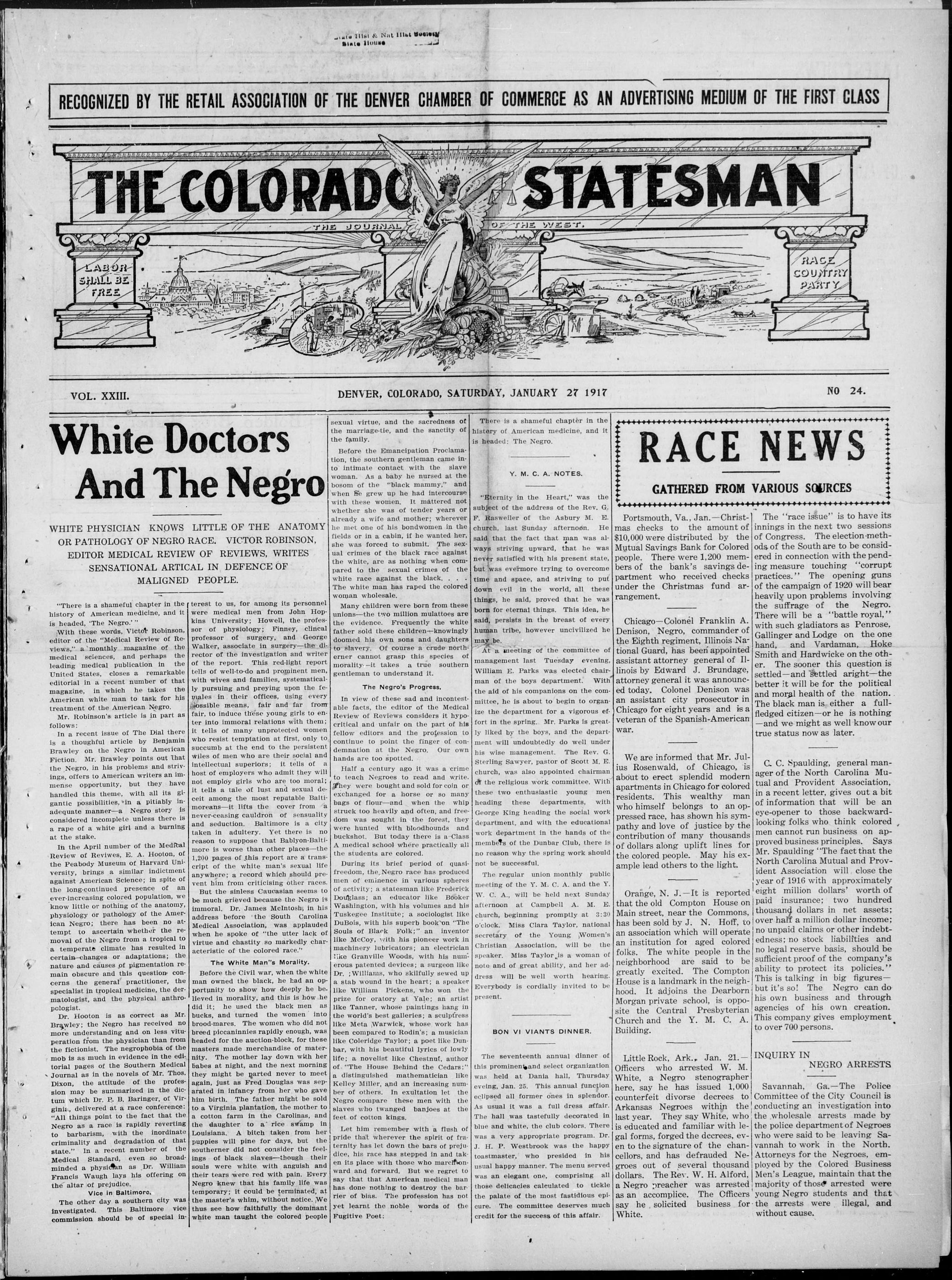
White Doctors And The Negro
WHITE PHYSICIAN KNOWS LITTLE OF THE ANATOMY OR PATHOLOGY OF NEGRO RACE. VICTOR ROBINSON, EDITOR MEDICAL REVIEW OF REVIEWS, WRITES SENSATIONAL ARTICAL IN DEFENCE OF
MALIGNED PEOPLE
"There is a shameful chapter in the history of American medicine, and it is headed, 'The Negro.'"
With these words, Victor Robinson, editor of the "Medical Review of Reviews," a monthly magazine of the medical sciences, and perhaps the leading medical publication in the United States, closes a remarkable editorial in a recent number of that magazine, in which he takes the American white man to task for his treatment of the American Negro.
Mr. Robinson's article is in part as follows:
In a recent issue of The Dial there is a thoughtful article by Benjamin Brawley on the Negro in American Fiction. Mr. Brawley points out that the Negro, in his problems and strivings, offers to American writers an immense opportunity, but they have handled this theme, with all its gigantic possibilities, in a pitiably inadequate manner—a Negro story is considered incomplete unless there is a rape of a white girl and a burning at the stake.
In the April number of the Medical Review of Reviwes, E. A. Hooton, of the Peabody Museum of Harvard University, brings a similar indictment against American Science; in spite of the long-continued presence of an ever-increasing colored population, we know little or nothing of the anatomy, physiology or pathology of the American Negro; there has been no attempt to ascertain whether the removal of the Negro from a tropical to a temperate climate has resulted in certain changes or adaptations; the nature and causes of pigmentation remain obscure and this question concerns the general practitioner, the specialist in tropical medicine, the dermatologist, and the physical anthropologist.
Dr. Hooton is as correct as Mr. Brawley; the Negro has received no more understanding and on less vituperation from the physician than from the fictionalist. The negrophobia of the mob is as much in evidence in the editorial pages of the Southern Medical Journal as in the novels of Mr. Thos. Dixon, the attitude of the profession may be summarized in the dictum which Dr. P. B. Baringer, of Virginia, delivered at a race conference: "All things point to the fact that the Negro as a race is rapidly reverting to barbarism, with the inordinate criminality and degradation of that state." In a recent number of the Medical Standard, even so broad-minded a physician as Dr. William Francis Waugh lays his offering on the altar of prejudice.
Vice in Baltimore.
The other day a southern city was investigated. This Baltimore vice commission should be of special in-
VOL. XXIII.
terest to us, for among its personnel were medical men from John Hopkins University; Howell, the professor of physiology; Finney, the clinical professor of surgery, and George Walker, associate in surgery—the director of the investigation and writer of the report. This red-light report tells of well-to-do and prominent men, with wives and families, systematically pursuing and preying upon the females in their offices, using every possible means, fair and far from fair, to induce these young girls to enter into immoral relations with them; it tells of many unprotected women who resist temptation at first, only to succumb at the end to the persistent wiles of men who are their social and intellectual superiors; it tells of a host of employers who admit they will not employ girls who are too moral; it tells a tale of lust and sexual deceit among the most reputable Baltimoreans—it lifts the cover from a never-ceasing cauldron of sensuality and seduction. Baltimore is a city taken in adultery. Yet there is no reason to suppose that Bablyon-Baltimore is worse than other places—the 1,200 pages of this report are a transcript of the white man's sexual life anywhere; a record which should prevent him from criticising other races.
But the sinless Caucasian seems to be much grieved because the Negro is immoral. Dr. James McIntosh, in his address before the South Carolina Medical Association, was applauded when he spoke of "the utter lack of virtue and chastity so markedly characteristic of the colored race."
The White Man"s Morality.
Before the Civil war, when the white man owned the black, he had an opportunity to show how deeply he believed in morality, and this is how he did it; he used the black men as bucks, and turned the women into brood-mares. The women who did not breed piccaninnies rapidly enough, was headed for the auction-block, for these masters made merchandise of maternity. The mother lay down with her babes at night, and the next morning they might be parted never to meet again, just as Fred Douglas was separated in infancy from her who gave him birth. The father might be sold to a Virginia plantation, the mother to a cotton farm in the Carolinas, and the daughter to a rice swamp in Louisiana. A bitch taken from her puppies will pine for days, but the southerner did not consider the feelings of black slaves—though their souls were white with anguish and their tears were red with pain. Every Negro knew that his family life was temporary; it could be terminated, at the master's whim, without notice. We thus see how faithfully the dominant white man taught the colored people
DENVER, COLORADO, SATURDAY, JANUARY 27 1917
State Hist & Nat Hist Society
State House
THE DENVER CHAMBER
ADC
E JOURNAL
DENVER, COLORADO, SATU
sexual virtue, and the sacredness of the marriage-tie, and the sanctity of the family.
Before the Emancipation Proclamation, the southern gentleman came into intimate contact with the slave woman. As a baby he nursed at the bosom of the "black mammy," and when he grew up he had intercourse with these women. It mattered not whether she was of tender years or already a wife and mother; wherever he met one of his bondwomen in the fields or in a cabin, if he wanted her, she was forced to submit. The sexual crimes of the black race against the white, are as nothing when compared to the sexual crimes of the white race against the black. . . The white man has raped the colored woman wholesale.
Many children were born from these unions—the two million mulattoes are the evidence. Frequently the white father sold these children—knowingly doomed his own sons and daughters to slavery. Of course a crude northerner cannot grasp this species of morality—it takes a true southern gentleman to understand it.
The Negro's Progress.
In view of these sad and incontestable facts, the editor of the Medical Review of Reviews considers it hypocritical and unfair on the part of his fellow editors and the profession to continue to point the finger of condemnation at the Negro. Our own hands are too spotted.
Half a century ago it was a crime to teach Negroes to read and write. They were bought and sold for coin or exchanged for a horse or so many bags of flour—and when the whip struck too heavily and often, and freedom was sought in the forest, they were hunted with bloodhounds and buckshot. But today there is a-Class A medical school where practically all the students are colored.
During its brief period of quasi-freedom, the Negro race has produced men of eminence in various spheres of activity; a statesman like Frederick Douglass; an educator like Booker Washington, with his volumes and his Tuskegee Institute; a sociologist like DuBois, with his superb book on "The Souls of Black Folk;" an inventor like McCoy, with his pioneer work in machinery lubricators; an electrician like Granville Woods, with his numerous patented devices; a surgeon like Dr.; Williams, who skillfully sewed up a stab wound in the heart; a speaker like William Pickens, who won the prize for oratory at Yale; an artist like Tanner, whose paintings hang in the world's best galleries; a sculptress like Meta Warwick, whose work has been compared to Rodin's; a musician like Coleridge Taylor; a poet like Dunbar, with his beautiful lyrics of lowly life; a novelist like Chestnut, author of. "The House Behind the Cedars;" a distinguished mathematician like Kelley Miller, and an increasing number of others. In exultation let the Negro compare these men with the slaves who twanged banjoes at the feet of cotton kings.
Let him remember with a flush of pride that wherever the spirit of fraternity has let down the bars of prejudice, his race has stepped in and taken its place with those who march onward and forward. But we regret to say that that American medical man has done nothing to destroy the barrier of bias. The profession has not yet learnt the noble words of the Fugitive Poet:
There is a shameful chapter in the history of American medicine, and it is headed: The Negro.
Y. M. C. A. NOTES.
"Eternity in the Heart," was the subject of the address of the Rev. G. F. Rasweller of the Asbury M. E. church, last Sunday afternoon. He said that the fact that man was always striving upward, that he was never satisfied with his present state, but was evermore trying to overcome time and space, and striving to put down evil in the world, all these things, he said, proved that he was born for eternal things. This idea, he said, persists in the breast of every human tribe, however uncivilized he may be.
At a meeting of the committee of management last Tuesday evening, William E. Parks was elected chairman of the boys department. With the aid of his companions on the committee, he is about to begin to organize the department for a vigorous effort in the spring. Mr. Parks is greatly liked by the boys, and the department will undoubtedly do well under his wise management. The Rev. G. Sterling Sawyer, pastor of Scott M. E. church, was also appointed chairman of the religious work committee. With these two enthusiastic young men heading these departments, with George King heading the social work department, and with the educational work department in the hands of the members of the Dunbar Club, there is no reason why the spring work should not be successful.
The regular union monthly public meeting of the Y. M. C. A. and the Y. W. C. A., will be held next Sunday afternoon at Campbell A. M. E. church, beginning promptly at 3:30 o'clock. Miss Clara Taylor, national secretary of the Young Women's Christian Association, will be the speaker. Miss Taylor is a woman of note and of great ability, and her address will be well worth hearing. Everybody is cordially invited to be present.
BON VI VIANTS DINNER.
The seventeenth annual dinner of this prominent and select organization was held at Dania hall, Thursday evening, Jan. 25. This annual function eclipsed all former ones in splendor. As usual it was a full dress affair. The hall was tastefully decorated in blue and white, the club colors. There was a very appropriate program. Dr. J. H. P. Westbrook was the happy toastmaster, who presided in his usual happy manner. The menu served was an elegant one, comprising all those delicacies calculated to tickle the palate of the most fastidious epicure. The committee deserves much credit for the success of this affair.
1
RACE NEWS
GATHERED FROM VARIOUS SOURCES
Portsmouth, Va., Jan. — Christmas checks to the amount of $10,000 were distributed by the Mutual Savings Bank for Colored people. There were 1,200 members of the bank's savings department who received checks under the Christmas fund arrangement.
Chicago—Colonel Franklin A. Denison, Negro, commander of the Eighth regiment, Illinois National Guard, has been appointed assistant attorney general of Illinois by Edward J. Brundage, attorney general it was announced today. Colonel Denison was an assistant city prosecutor in Chicago for eight years and is a veteran of the Spanish-American war.
We are informed that Mr. Julius Rosenwald, of Chicago, is about to erect splendid modern apartments in Chicago for colored residents. This wealthy man who himself belongs to an oppressed race, has shown his sympathy and love of justice by the contribution of many thousands of dollars along uplift lines for the colored people. May his example lead others to the light.
Orange, N. J. - It is reported that the old Compton House on Main street, near the Commons, has been sold by J. N. Hoff, to an association which will operate an institution for aged colored folks. The white people in the neighborhood are said to be greatly excited. The Compton House is a landmark in the neighborhood. It adjoins the Dearborn Morgan private school, is opposite the Central Presbyterian Church and the Y. M. C. A. Building.
Little Rock, Ark., Jan. 21. Officers who arrested W. M. White, a Negro stenographer here, say he has issued 1,000 counterfeit divorce decrees to Arkansas Negroes within the last year. They say White, who is educated and familiar with legal forms, forged the decrees, even to the signature of the chancellors, and has defrauded Negroes out of several thousand dollars. The Rev. W. H. Alford, a Negro preacher was arrested as an accomplice. The Officers say he solicited business for White.
NO 24.
The "race issue" is to have its innings in the next two sessions of Congress. The election-methods of the South are to be considered in connection with the pending measure touching "corrupt practices." The opening guns of the campaign of 1920 will bear heavily upon problems involving the suffrage of the Negro. There will be a "battle royal," with such gladiators as Penrose, Gallinger and Lodge on the one hand, and Vardaman, Hoke Smith and Hardwicke on the other. The sooner this question is settled—and settled aright—the better it will be for the political and moral health of the nation. The black man is either a fullfledged citizen—or he is nothing—and we might as well know our true status now as later.
C. C. Spaulding, general manager of the North Carolina Mutual and Provident Association, in a recent letter, gives out a bit of information that will be an eye-opener to those backward-looking folks who think colored men cannot run business on approved business principles. Says Mr. Spaulding "The fact that the North Carolina Mutual and Provident Association will close the year of 1916 with approximately eight million dollars' worth of paid insurance; two hundred thousand dollars in net assets; over half a million dollar income; no unpaid claims or other indebtedness; no stock liabilities and no legal reserve basis, should be sufficient proof of the company's ability to protect its policies." This is talking in big figures—but it's so! The Negro can do his own business and through agencies of his own creation. This company gives employment to over 700 persons.
INQUIRY IN
Savannah, Ga.—The Police Committee of the City Council is conducting an investigation into the wholesale arrests made by the police department of Negroes who were said to be leaving Savannah to work in the North. Attorneys for the Negroes, employed by the Colored Business Men's League, maintain that the majority of those arrested were young Negro students and that the arrests were illegal, and without cause.
LATEST NEWS EPITOMIZED
FRO.M TELEGRAPHIC REPORTS THAT COVER THE WEEK'S EVENTS.
OF MOST INTEREST
OF MOST INTEREST
KEEPING THE READER POSTED
ON MOST IMPORTANT
CURRENT TOPICS.
Western Newspaper Union News Service.
ABOUT THE WAR
The sinking of four steamers, one of British and three of neutral registry, was announced in London by Lloyd's.
The breaking up of a Russian raid after the advancing troops had entered the German first line east of Dvinsk is reported at army headquarters.
The Gazette Norodova at Berlin reports that all the students of Warsaw University and the Technical University have joined the new Polish army in a body.
Isolated attacks and counter-attacks have taken place in Russia, in the region of Freidrichstadt, Baranovitch and Kovel, without either side attaining any important results.
The Canadian troops fighting in France have gained a marked ascendency over the Germans in trench warfare, according to an official communication received from London.
British troops in their efforts to surround the German forces in German East Africa are making considerable progress, according to a statement issued by the British official press bureau.
British troops in their efforts to surround the German forces in German East Africa are making considerable progress, according to a statement issued by the British official press bureau.
A Berlin wireless dispatch says radio distress signals picked up at Rotterdam reported a British transport with 1,800 men on board had struck a mine in the English channel and was sinking.
The Teutonic troops have resumed their advance in Dobrudja, it is announced officially. German and Bulgarian forces crossed the southern estuary of the Danube near Tultcna and held the ground against Russian attacks.
A sharp attack by the Austrians southeast of Gorizia resulted in the penetration of one of the Italian trenches, the war office announced, but was followed immediately by the driving out of the hostile contingents that had entered.
Japan is confronted with an internal crisis. The opponents of the administration of Count Terauchi have opened a vigorous campaign on the ground that the Terauchi non-partisan cabinet was formed in violation of the spirit of the constitution.
WESTERN
Edward A. Dalton, vice president of the Association of Advertisers, died in Spokane, Wash.
The national annual convention of the Pike's Peak Ocean-to-Ocean Highway Association will be held in St. Joseph, Mo., Feb. 13 and 14.
In a fire at Seattle, Wash., which destroyed the Grand Opera House, Assistant Fire Chief Fred Gillan was killed and eight firemen were seriously injured.
Joint purchase of news print paper for distribution among its members by a committee was indorsed by the Southern California Editorial Association at its meetings in Los Angeles, Cal.
Thirty patients from the United States army field hospital in Mexico arrived at the base hospital in El Paso, Tex., and reported the field hospital was being evacuated and all patients returned to their commands or sent to the base hospital there.
WASHINGTON
Germany has withdrawn the charges of unneutral conduct against Ambassador Voplcka, who is accorded to Rumania, Serbia and Bulgaria. The announcement was made by the State Department at Washington.
The United States Employment Bureau at Washington announced that has completed plans with the War Department to obtain employment for national guardsmen returning from the border who may be out of work.
Withdrawal of the outposts of Gen. Pershing's force in Mexico has been ordered by the War Department with approval of President Wilson. There were intimations that as soon as the outposts are brought in the movement of the main body of troops toward the border will be begun.
A federal steel plant to supply wholly or in part the needs of the United States navy, is under consideration by the Navy Department.
"Bone-dry" prohibition for both Alaska and Hawaii virtually was decided upon by the House territories committee in Congress.
Nine Americans were among t crew on the British steamer St. Theodore and were taken by the German raider and landed with other survivors at Pernambuco on the Japanese ship, Hudson, at Maru.
FOREIGN
An American Chamber of Commerce has been successfully organized in London.
No one in authority in the British government would comment upon President Wilson's address to the Senate, but newspapers are discussing it at great length.
Amedee Bollee, Sr., an inventor, known in France as "the father of automobilism," is dead in Paris. Bollee was the builder of a steam car which he first operated in 1873.
Average dividends of the eight hundred largest stock companies in Denmark have increased from 6.8 per cent in 1912, to 12.8 per cent in 1916. Steamship companies show the largest increase from 4.5 per cent in 1912 to 31 per cent in 1916.
Recourse will be had to compulsory national service if the appeal for voluntary service fails to evoke sufficient response, declared Arthur Neville Chamberlain, director general of national service, at a meeting of employers and employés at Birmingham, England.
The Copenhagen Politiken, as quoted in an Exchange Telegraph dispatch, says the Socialist party of Norway has adopted a resolution supporting the American proposal that an international Socialist congress be summoned to meet at The Hague to prepare the way for peace.
Following the influx into Holland of German and Belgian children, as well as many children of Dutch families resident in Germany, 500 youngsters are now being sent to Amsterdam from Austria and even children of Rumanian and Turkish nationality are being taken there by a Jewish relief organization.
Japanese bankers, it is announced, have signed an agreement with the Bank of Communications for a loan of $5,000,000 in silver at $7½ per cent. The Chinese parliament attempted to prevent the loan, but was unsuccessful as the transaction, it was stated, does not increase the government's liability in connection with the bank
Official figures announced for 1916 show German aviators were victors in a majority of the aerial battles on all fronts and that Germany lost fewer battle planes than her antagonists. The official figures show the total losses of aeroplanes on both sides during 1916 to have been 1,005. Of these the entente forces lost 784 and the Germans 221. On the west front alone both sides lost 920 and of these 180 were German war planes.
SPORTING NEWS
"Happy" Felsch has signed his contract with the Chicago Sox. Edward (Strangler) Lewis, Kentucky heavyweight, won in two straight falls a wrestling match in Los Angeles, Cal., with Gus Kervaras. The Northwestern bonspiel opened in Duluth, Minn., for the curling championship of America. More than 100 rinks, twenty of these being Canadian, were entered. Dave Davies of Detroit defeated Courtney Chapman of Chicago, 400 to 227, in the first match of the first inter-city English billiard contest ever played in America.
President Frazee of the Red Sox announced in Boston that nine members of the world's champions have signed contracts and that before long he expects to have at least five more. He would not divulge the names of any who have signed on players request.
GENERAL
Three men were burned to death and four others seriously injured in a hotel fire in Portland, Ore.
Three bandits, Oscar Poe, Will Hard and Harry Hart, were shot and killed by a posse under Sheriff Roach, eighteen miles southwest of Okmulgee, Okla.
Overalls will be worn by numbers of Chicago women at their work here after if the judgment, announced of buyers for a leading department store is sustained.
A check written by her wandering husband, whose mind had become a blank, enabled Mrs. G. W. Watson of Collinsville, Ill., to find Watson in Pittsburg, Kan.
John W. Blancett, accused of the murder of Clyde Armour, his travelling companion, has been arrested at Friday Harbor, Wash., and taken to Santa Fe, N. M., for trial.
The taking up of the new $250,000,000 loan to Great Britain will increase American investment in foreign government loans or commercial credits due to the war to $2,350,000,000, of which about half is to Great Britain or British banks.
In examining the records of Hiram Masonic lodge No. 40 of Raleigh, N.C., it was recently found that the regular meeting of the lodge that was begun on the night of April 17, 1865—the night news was received that Lincoln was shot—had never been officially concluded, and this formality was carried out with historic ceremonies.
# A long step toward the simplification of judicial procedure in the Federal Courts of Colorado and the other states is provided in a bill reported favorably out of the United States Senate judiciary committee by Senator Sutherland of Utah, who is president of the American Bar Association.
The death of David Hartman, 63 years old, at Dover, Ohio, was said by attending physicians to have resulted from insufficient nourishment. Hartman is said to have been living on from 3 to 10 cents per day.
Western Newspaper Union News Service.
DATES FOR COMING EVENTS.
Jan. 20-27—Annual Western Stock Show at Denver.
Feb. 2-4—Y. M. C. A. Annual Convention at Colorado Springs.
Feb. 28-March 1—Carnival of Mid-Winter Sports at Steamboat Springs.
Gunnison Odd Fellows have moved into their new hall.
A shorthorn bull, exhibited at the Denver stock show, was sold for $1,000.
Bon I. Look, Denver merchant, died of pneumonia in the home of relatives at Pekin, Ill.
Notwithstanding the zero weather, society night at the Denver horse show brought out a large crowd.
William H. Gabbert, former chief justice of the Supreme Court, will make Denver his home in the future.
Governor Gunter addressed the members of the Mountain States Hardware Dealers convention in Denver.
Three hundred grocers attended the seventeenth state convention of the Retail Merchant's Association at Boulder.
Many persons inspected the food exhibits and specimens of Colorado's manufactured products at the Denver Chamber of Commerce.
The work on the program for the community welfare conference at Glenwood Springs to extend over four days, has now been completed.
The officers of the national forest service from six states will be in Fort Collins Feb. 1 for the purpose of studying live stock conditions.
A trainload of high-grade Colorado potatoes were shipped to eastern markets from Ault and Eaton. The spuds were valued at $35,000.
Several elk, belonging to the large band that range in the lower part of Mineral county, have been seen in the foothills near the D. & R. G. tracks.
Philip D. Armour III. of Chicago, with a party of about forty employees of the Armour Packing company, arrived in Denver to attend the stock show.
A passenger train from Alamosa was reported stalled in the snow at the top of Cumbres pass Monday. The snow plow was stuck in drifts on the summit.
Wounds received on Oct. 30, when he was attacked by a mad dog, caused the death of Virgil Harrington, 15-year-old son of Mr. and Mrs. H. T. Harrington of Denver.
The Ohio and Colorado Smelting and Refining Company of Salida awarded increased wages of twenty cents a shift for all employees on the payroll, beginning Jan. 1.
San Miguel county mines shipped gold, silver, lead and copper ores valued at $2,026,102 to the American Smelting and Refining Company's plant at Durango during 1916.
Railroad travel to Denver for the National Western Livestock show, at the stockyards stadium, was the heaviest in the history of the show, according to officials at the Union station.
Twenty-five people, all save one unacquainted with John Lawrence Smith, who was shot to death by his wife, Mrs. Stella Newton Moore Smith, gathered in Denver for the funeral services.
Predictions that Denver will become the feeder cattle market of the country within the next ten years were made by H. A. Jastro, former president of the American National Livestock Association, while visiting Denver.
Roy Solomon, the 7-year-old son of Charles Solomon, mayor of Edgewater, is in a critical condition at his home as the result of a skating accident, he having fallen over the prostrate body of a companion and having his throat cut on the other boy's skate.
The broad gaging of the Marshall Pass route and the electrification of certain portions of the road is given out by a Grand Junction paper as two big items of improvement to be made by the Denver and Rio Grande railroad during the present year.
The government report on the snowfall in the mountains of Colorado at the end of December shows a deficiency in the districts which are drained by the Arkansas river and Rio Grande river, while nearly all of the other water sheds of the state have an excess.
A plan to create a building fund of approximately $500,000 a year for the next ten years and to increase revenues for maintenance and operation costs of the state educational institutions of Colorado will be presented for the consideration of the General Assembly.
Montrose is considering an ordinance which calls for an election on Feb. 20 to vote on a proposition to issue $80,000 in 4% per cent bonds for the purpose of funding the present issue of water bonds which must be paid on or before the year 1920.
For the first time in the history of the Boy Scout movement, a city has been designated as the headquarters of a large district outside its own boundaries. Denver has become the center of the work in the Rocky Mountain region through the special action of the national council.
CHOICE SEED POTATOES
AND ENRICHMENT OF SOIL URGED FOR BEST RESULTS.
Lou D. Sweet Tells Members of Fort Collins Congress 2,000 Bushels an Acre Are Possible.
Western Newspaper Union News Service.
Fort Collins.—How potato culture improved in approximately the first century of the commercial growing of that vegetable until a yield of 2,000 bushels to the acre has been produced, and how far below this figure the present average yield has fallen, was told to the State Potato Growers' Association here by Lou D. Sweet, president of the Potato Association of America and president of the Colorado Potato Growers' Association.
Mr. Sweet urged selective breeding of seed potatoes and enrichment of the soil, with consequent capacity of a given area to support more hills of potatoes, as remedies for the present condition.
"On the great Dalmony farm of the earl of Roseberry, near Edinburgh, this record has been increased in recent years to some 2,000 bushels, the largest ever recorded.
"In this country our farmers generally have been sending their best potatoes to market and keeping the small ones and culls for seed, with the natural result that their potatoes rapidly have deteriorated until the average yield is only ninety-seven bushels an acre, while the quality is such that the average consumption is only 2.4 bushels per capita.
Other speakers before various divisions of the Colorado Farmers' congress were Prof. J. G. Milward of the University of Wisconsin, who outlined the work of the Potato Growers' Association in his own state; Asa Maxon of Longmont, who spoke on seed growing; P. K. Blinn of the experiment station at Rocky Ford, who talked on alfalfa seed production; H. W. Bowman of Trinidad, on milk production; ;Dr. George M. Potter of the bureau of animal industry, on diseases among cattle, and Ralph Pitts of Denver, on moving pictures.
Sessions of the potato growers, the State Dairy Association and the Rural Women's conference were held in connection with the congress.
Mrs. Smith Denied Bail.
Denver.—Judge Charles C. Butler has denied the application of Mrs. Stella Moore Smith, charged with the murder of her husband, John Lawrence Smith, for release on ball, and set her trial for March 12. This means that Mrs. Smith will for the next forty-eight days and during her trial, occupy the same cell in which Mrs. Gertrude Patterson, Mrs. Ida F. Mercer, Mrs. Heien Schmidlap, Mrs. Berta Wright and other women charged with murder whiled away the hours while they waited for their trials.
Proceeds of One Acre for War.
Fort Collins.—Every Colorado farmer may give the proceeds of one acre of land from his next crop for the relief of war sufferers in Europe. This is the big possibility in an idea developed at a session of the Colorado Farmers' Congress. When O. F, Gardner, president of the congress, presented the plan before the farmers at the fifth annual rural life banquet it swept the audience like wildfire.
Attorney Dead When Case Is Called.
Sterling—When Nick Hergenroder, a Russian accused of assault, appeared in Justice Court to give bond for his appearance, his attorney. Quitman Brown, was not present. The magistrate waited a half hour for the attorney and then sent to his home. There it was learned that Mr. Brown had died of heart disease at the very hour he should have appeared in court.
Ninety-three True Bills Returned.
Steamboat Springs—It is likely that the present term of District Court will be prolonged for more than a month, on account of the number of indictments returned by the grand jury, which has been in session for the past three week. Ninety-three true bills were returned.
Dickens is Sentenced.
Boulder. — Rienzi Dickens, found guilty by a jury several months ago of the murder of his father, William H. Dickens, was denied a retrial by Judge Nell F. Graham in the District Court here and sentenced by him to spend from eighteen to twenty-seven years in the state penitentiary.
Denver Stock Show Best in Years.
Denver. — The eleventh annual National Western Stock show opened its doors on the 20th, and, after looking over the exhibit, the judge and experts in charge declared it the greatest stock show ever held west of Chicago.
Pioneer Banker Dies on Coast.
Loveland.—Aaron S. Benson, pioneer builder, banker, farmer and capitalist of northern Colorado, a resident of Loveland for almost forty years, and whose life is intimately linked with the growth and development of the resources of this county, died in San Diego, Cal., where he was sojourning for the winter. His widow and one son, Clarence V. Benson of Denver, were with him at his death, which resulted from general debility and old age
DENVER, COLORADO
OS. CAFE
ROOM
ver, Colorado
709 AND 711 SIXTEENTH STREET, DENVER, COL
BOLDEN BROS. CA
and LUNCH ROOM
924 19th Street, Denver, Colorado
924 19th Street, Denver, Colorado
Short Orders at All Hours
All Kinds of Sandwiches
Bolden Bros. Barber Sh
Baths, Electric Massage
FIRST CLASS SERVICE
R. B. BOLDEN, Mgr. 926 19th St. D
For Christmas Presents
Watchcs—Diamonds—Jewelry
Repairing a Specialty
428 16TH STREET
DENVER, COLO.
Phone Main 3012.
Jes I. Ham
Manufacturing
Watchmaker and
Barber Shop
Massage
SERVICE
926 19th St. Denver
S I. Hansen
Manufacturing
Watchmaker and Jeweler
Bolden Bros. Barber Shop Baths, Electric Massage FIRST CLASS SERVICE R. B. BOLDEN, Mgr. 926 19th St. Denver
For Christmas Presents
Watchcs—Diamonds—Jewelry
Repairing a Specialty
42S 16TH STREET
DENVER, COLO.
Phone Main 3012.
Jes I. Hansen
Manufacturing
Watchmaker and Jeweler
HONE MAIN 3028
RES. PHONE GALLUP 942
JOHN K. RETTIG
Meats, Fancy and Staple Groceries
1864 CURTIS STREET
JOHN K. RETTIG
Meats, Fancy and Staple Gro
1864 CURTIS STREET
Corner Nineteenth.
The MARKET COMP
C. E. SMITH, Manager, Res. Phone South 160
Wholesale and Retail Staple and Fancy Groceries, Fish and
Hotels and Restaurants Our Specialty.
Fresh and Cured
Eastern Corn Fed Mea
COMPANY
Phone South 1608
Groceries, Fish and Oysters
Our Specialty.
Fed Meats
The MARKET COMPANY
The MARKET COMPANY
C. E. SMITH, Manager, Res. Phone South 1608
Wholesale and Retail Staple and Fancy Groceries, Fish and Oysters Hotels and Restaurants Our Specialty. Fresh and Cured
Eastern Corn Fed Meats
Fruits, Vegetables, Poultry and Game.
Telephones Main 4302,4303,4304,4305
Denver, olorado
W. F. PLAMBECK
EXPERT WATCH MAKER
1715 CHAMPA STREET
A full line of Watches, Clocks, Diamonds and Jewelry
at lowest prices. Courteous treatment to all
HONEST GOODS
HONEST WORK
AT HONEST
PRICES
Expert Repairing
Weatherhead Hat Co
d Hat Co.
IN 3203
Weatherhead Hat Co.
TELEPHONE MAIN 3203
Established 1876
PIONEER HATTERS OF THE WEST
WE MAKE OLD HATS NEW
PRACTICAL HATTERS
RENOVATORS, BLEACHERS DYERS AND FINIS
Of Gents' and Ladies' Hats of Every Descriptio
1624 Champa St., Denver, Colo.
MATTERS
MATTERS AND FINISHERS
IN Every Description
Denver, Colo.
at home reacts in its benefits
unceasing general profit,
out of town it's life is ended,
a messenger of continuous
to the importance of keeping
or it by judicious advertising.
RENOVATORS, BLEACHERS DYERS AND FINISHERS
Of Gents' and Ladies' Hats of Every Description
1624 Champa St., Denver, Colo.
Kept with the home merchants it is a messenger of benefit. Business men should awake to the importance this dollar at home and make a bid for it by judicious s
Kept with the home merchants it is a messenger of continuous benefit. Business men should awake to the importance of keeping this dollar at home and make a bid for it by judicious advertising.
we have conducted an exclusive Jewelry Store in Denver. Square dealing, conservatism and yet progressive merchandizing is our motto.
ESTABLISHED
1879
Stark
JEWELERS
VINE
DINNER
11:30 to 2 p.m.
PHONE MAIN 3028
622-636 15th Street
W. F. PLAMBECK
EXPERT WATCH MAKER
1715 CHAMPA STREET
A full line of Watches, Clocks, Diamonds and Jewelry
at lowest prices. Courteous treatment to all
```markdown
```
A Dollar
ESTABLISHED
1879
Stark
JEWELERS
Denver, Cola.
MUST END WAR WITHOUT VICTORY
Peace Lasting Through All Time Should Recognize Equality of All, Declares President.
WAY TO SEA OPEN TO ALL
New Monroe Doctrine Urged in Plan for League to Stop Clash of Armed Forces.
Western Newspaper Union News Service.
Washington, Jan. 24.—A free Poland is one of the necessities of peace when belligerent Europe sits down to make a treaty, Woodrow Wilson told the Senate Monday. And that peace, the President declared, "must be given by some definite concert of power which will, make it virtually impossible that any such catastrophe"—the war"should overwhelm"us again." To that end, said the President, discussing his idea of a World League to Enforce Peace, the people of America should "add their authority and their power to the authority and force of other nations to guarantee peace and justice throughout the world."
"Such a settlement," he added, "cannot now be long postponed," but, he declared, any treaty which ends the war must be "not merely a peace that will serve the several interests and immediate aims of the nations engaged;" it must be a peace without victory. He realized, he declared, "that mere terms of peace between the belligerents will not satisfy the belligerents themselves," and thus brings the need of a World Peace league.
"Victory," declared the President, "would mean peace forced upon the loser, a victor's terms imposed upon the vanquished," and, he asserted, only a "peace between equals can last." When the war ends, he said, "the paths of the sea must, alike in law and fact, be free," because "the free, constant, unthreatened intercourse of nations is an essential part in the process of peace and development."
German Reply to Note is Indefinite.
The President spoke as follows:
The President spoke as follows:
Gentlemen of the Senate: On the 18th of December last I addressed an identical note to the governments of the nations now at war, requesting them to state more definitely than they had yet been stated by either group of belligerents the terms upon which they would deem it possible to make peace. I spoke on behalf of humanity and of the rights of all neutral nations like our own, many of whose most vital interests the war puts in constant jeopardy.
The central powers united in a reply which stated merely that they were ready to meet their antagonists in conference to discuss terms of peace.
The entente powers have replied much more definitely and have stated in general terms indeed, but with sufficient definiteness to imply details, the arrangements, guarantees and acts of reparation which they deem to be the indispensable conditions of a satisfactory settlement.
Peace Only by Union of Powers.
We are that much nearer a definite discussion of the peace which shall end the present war. We are that much nearer the discussion of the international concert which must thereafter hold the world at peace.
In every discussion of the peace that must end this war it is taken for granted that peace must be given by some definite concert of power which will make it virtually impossible that any catastrophe should ever overwhelm us again. Every lover of mankind, every sane and thoughtful man, must take that for granted.
I have sought this opportunity to address you because I thought that I owed it to you, as the council associated with me in the final determination of our international obligations, to disclose to you, without reserve, the thought and purposes that have been taking form in my mind in regard to the duty of our government in these days to come, when it will be necessary to lay afresh and upon a new plan, the foundations of peace among the nations.
America to Play Part in Peace.
America to Play Part in Peace.
It is inconceivable that the people of the United States should play no part in that great enterprise. To take part in such a service will be the opportunity for which they have sought to prepare themselves by the very principles and purposes of their polity and the approved practices of their government ever since the days when they set up a new nation in the high and honorable hope that it might, in all that it was and did, show mankind the way to liberty. They cannot, in honor, withhold the service to which they are now about to be challenged. They do not wish to withhold it. But they owe it to themselves and to the other nations of the world to state the conditions under which they will feel free to render it.
That service is nothing less than this—to add their authority, and their power, to the authority and force of other nations to guarantee peace and justice throughout the world. Such a settlement cannot now be long postponed. It is right that before it comes this government should frankly formulate the conditions upon which it would feel justified in asking our people to approve its formal and solemn adherence to a League for Peace. I am here to attempt to state those conditions.
Lasting Peace Is U. S. Demand.
The present war must first be ended; but we owe it to candor and to a just regard for the opinion of mankind to say that so far as our participation in guarantees of future peace is concerned, it makes a great deal of difference in what way and upon what terms it is ended. The treaties and agreements which bring it to an end must embody terms which will create a peace that is worth guaranteeing and preserving, a peace that will win the approval of mankind; not merely a peace that will serve the several interests and immediate aims of the nations engaged. We shall have no voice in determining what those terms shall be, but we shall, I feel sure, have a voice in determining whether they shall be made lasting or not by the guarantees of a universal covenant and our judgment upon what is fundamental and essential as a condition precedent to permanency should be spoken now, not afterward when it may be too late.
No covenant of cooperative peace that does not include the peoples of the New World can suffice to keep the future safe against war, and yet there is only one sort of peace that the peoples of America could join in guaranteeing.
Terms Must Satisfy America.
The elements of that peace must be elements that engage the confidence and satisfy the principles of the American governments, elements consistent with their political faith and the practical convictions which the peoples of America have once for all embraced and undertaken to defend.
I do not mean to say that any American government would throw any obstacle in the way of any terms of peace the governments now at war might agree upon or seek to upset them when made, whatever they might be.
I only take it for granted that mere terms of peace between the belligerents will not satisfy even the belligerents themselves. Mere agreements may not make peace.
It will be absolutely necessary that a force be created as a guarantor of the permanency of the settlement so much greater than the force of any nation now engaged or any alliance hitherto formed or projected, that no nation, no probable combination of nations could face or withstand it.
If the peace presently to be made is to endure it must be a peace made secure by the organized major force of mankind. The terms of the immediate peace agreed upon will determine whether there is a peace where such guarantee can be secured.
Questions on Which Peace Hinges.
The question upon which the whole future peace and policy of the world depends is this:
Is the present war a struggle for a just and secure peace, or only for a new balance of power? If it be only a struggle for a new balance of power, who will guarantee the stable equilibrium of the new arrangement? Only a tranquil Europe can be a stable Europe. There must be, not a balance of power, but a community of power; not organized rivalries, but an organized common peace.
Fortunately, we have received very explicit assurances on this point. The statesmen of both groups of nations now arrayed against one another have said, in terms that could not be misinterpreted, that it was no part of the purpose they had in mind to crush their antagonists. But the implications of these assurances may not be equally clear to all—may not be the same on both sides of the water. I think it will be serviceable if I attempt to set forth what we understand them to be.
They imply first of all that it must be a peace without victory. It is not pleasant to say this. I beg that I may be permitted to put my own interpretation upon it, and that it may be understood that no other interpretation was in my thought. I am seeking only to face realities and to face them without soft concealments. Victory would mean peace forced upon the loser a victor's terms imposed upon the vanquished. It would be adopted in humiliation, under duress, at an intolerable sacrifice, and would leave a sting, a resentment, a bitter memory upon which terms of peace would rest, not permanently, but only as upon quick-sand. Only a peace between equals can last; only a peace the very principle of which is equality and a common participation in a common benefit.
The right state of mind, the right feeling between nations, is as necessary for a lasting peace as is the just settlement of vexed questions of territory or of racial and national allegiance.
Right to Be the Basis of Terms.
The equality of nations upon which peace must be founded, if it is to last, must be an equality of rights; the guarantees exchanged must neither recognize nor imply a difference between big nations and small, between those that are powerful and those that are weak. Right must be used upon the common strength, not upon the individual strength, of the nations upon whose concert peace will depend Equality of territory or of resources, of course, cannot be; nor any other sort of equality not gained in the ordinary peaceful and legitimate development of the peoples themselves. But no one asks or expects anything more than an equality of rights. Mankind is looking now for freedom of life, not for equipoises of power.
And there is a deeper thing involved than even equality of right among organized nations. No peace can last, or ought to last, which does not recognize and accept the principle that governments derive all their just powers from the consent of the governed, and that no right anywhere exists to hand peoples about from sovereignty to sovereignty as if they were property. I take it for granted, for instance, if I may venture upon a single example, that statesmen everywhere are agreed that there should be a united, independent and autonomous Poland, and that henceforth an inviolable security of life, of worship and of industrial and social development should be guaranteed to all peoples who have
lived hitherto under the power of governments devoted to a faith and purpose hostile to their own.
Conditions Clearly Indispensable.
I speak of this not because of any desire to exalt an abstract political principle which has always been held very dear by those who have sought to build up liberty in America, but for the same reason that I have spoken to the other conditions of peace which seem to me clearly indispensable because I wish frankly to uncover realities. Any peace which does not recognize and accept this principle will inevitably be upset. It will not rest upon the affections or the convictions of mankind. The ferment of spirit of whole populations will fight constantly against it, and all the world will sympathize. The world can be at peace only if its life is stable, and there can be no stability where the will is in rebellion, where there is not tranquillity of spirit and a sense of justice and freedom and right.
So far as practicable, moreover, every great people now struggling towards a full development of its resources and of its powers should be assured a direct outlet to the great highways of the seas. Where this cannot be done without the cessation of territory, it can no doubt be done with the neutralization of direct rights of way under the general guarantee which will assure peace itself. With a right comity or arrangement no nation need be shut away from free access to the open paths of the world's commerce.
And the paths of the sea must, allike in law and in fact, be free. The freedom of the seas is the sine qua non of peace, equality and cooperation.
No doubt a somewhat radical reconsideration of many of the rules of international practice hitherto sought to be established may be necessary in order to make the seas indeed free and common in practically all circumstances for the use of mankind, but the motive for such changes is convincing and compelling. There can be no trust or intimacy between the peoples of the world without them. The free, constant, unthreatened intercourse of nations is an essential part of the process of peace and development. It need not be difficult to define or to secure the freedom of the seas, if the governments of the world sincerely desire to come to an agreement concerning it.
Navies of World to Co-Operate.
It is a problem closely connected with the limitation of naval armaments and the co-operation of the navies of the world in keeping the seas at once free and safe. And the question of limiting naval armaments opens the wider and perhaps more difficult question of the limitation of armies and of all programs of military preparation. Difficult and delicate as these questions are, they must be faced with the utmost cander and decided in a spirit of real accommodation if peace is to come with healing in its wings and come to stay. Peace cannot be had without cessation and sacrifice. There can be no sense of safety and equality among the nations if great preponderating armament here and there to be built up and maintained.
Plan for Peace as for War.
The statesmen of the world must plan for peace and nations must adjust and accommodate their policy to it as they have planned for war and made ready for pitiless contest and rivalry. The question of armaments, whether on land or sea, is the most immediately and intensely practical question connected with the future fortunes of nations and of mankind.
I have spoken upon these great matters without reserve and with the utmost explicitness, because it has seemed to me to be necessary if the world's yearning desire for peace was anywhere to find free voice and utterance. Perhaps I am the only person in high authority amongst all the peoples of the world who is at liberty to speak and hold nothing back. I am speaking as an individual, and yet I am speaking also, of course, as the responsible head of a great government, and I feel confident that I have said what the people of the United States would wish me to say.
May I not add that I hope and believe that I am in effect speaking for liberals and friends of humanity in every nation and of every program of liberty? I would fain believe that I am speaking for the silent mass of mankind everywhere, who have as yet had no place or opportunity to speak their real hearts out concerning the death and ruin they see to have come already upon the persons and the homes they hold most dear.
Monroe Doctrine Preached for World.
And in holding out the expectation that the people and government of the United States will join the other civilized nations of the world in guaranteeing the permanence of peace upon such terms as I have named, I speak with the greater boldness and confidence because it is clear to every man who can think that there is in this promise no breach in either our traditions or our policy as a nation, but a fulfillment, rather, of all that we have professed or striven for.
I am proposing, as it were, that the nations should with one accord adopt the doctrine of President Monroe as the doctrine of the world: That no nation should seek to extend its policy over any other nation or people, but that every people should be left free to determine its own policy, its own way of development, unhindered, unthreatened, unafraid, the little along with the great and powerful.
Marshall Gives Notice of Message.
Vice President Marshall laid before the Senate a letter from the President, stating that he had an important communication relating to foreign affairs which he deemed it his duty to lay before the Senate, and which he would like to present in person. The Senate adopted a resolution, by Senator Stone, to hear the President, at 1 o'clock. No other President has addressed either branch of Congress separately since Thomas Jefferson did in 1801. In fact, no President addressed Congress in joint session since that time until President Wilson revived the custom in 1913.
HUNTING RAIDER WITHOUT LIGHTS
AMERICAN STEAMER NEARLY RUNS DOWN CRUISERS OFF COAST IN DARKNESS.
SAW FIVE WAR VESSELS
CAPTAIN BEVERIDGE OF STEAM
SHIP MOOREMAC ARRIVES
FROM CUBA WITH REPORT.
New York, Jan. 25.—Five war vessels running without lights and believed to have been British and French cruisers were sighted thirty miles off the mouth of Chesapeake bay by officers of the American steamship Mooremac, which arrived here from Cuba today. According to Captain Beveridge, he was first apprised of the presence of the cruisers when he nearly ran one of them down. Altho dark, he managed to distinguish from the bridge that it had four funnels. Another vessel some distance away promptly flooded him with a searchlight and shortly afterward three more warships of similar type were seen.
It is certain that these warships were making an attempt to capture the German raider submarine that has caused so much terror to British and French commerce.
Rio Janeiro.—Practically every mile of the east South American coast line will have been searched out within the next few days for the raider. Warships from Brazil, Argentine and Uruguay have taken up the quest, seeking to prevent violation of the neutrality of their waters, as well as a vast fleet of allied warships.
London, Jan. 25.—The last reports received in naval circles from the naval action in the North sea serve only to confirm the official announcement of the admiralty. It is not considered likely that many details will be added to the official report as the battle was fought in a night of pitchy blackness. Naval officials are surprised that an engagement was possible under those circumstances and point out that as the combatants carried no lights, accurate gunnery must have been exceedingly difficult.
VETO BY UTAH'S GOVERNOR.
Claims That Annual Expense Is Too Heavy for State.
Salt Lake City.—Though pledged to have a strong state-wide prohibition measure passed and effective by "at least Aug. 1," Gov. Simon Bamberger is also pledged to economy. For that reason he today announced that if the upper house passed the state-wide prohibition bill, the Young bill, passed by the lower house by a vote of 45 to 1, he will veto and send it back. The principal objection of the governor is that the measure, in present form, entails an annual expense of $17,600, $2,500 of it being salary for a commissioner of prohibition. The Young bill, most drastic of the two now before the legislature, provides no liquor containing more than one-half of 1 per cent alcohol may be sold. The house passed it over the disapproval of the executive.
Uncle Sam May Build Plant.
Washington.—Uncle Sam probably will build himself a $1,000,000 government paper manufacturing plant. Despite the fact that specifications call for less paper than last year, the paper the government must buy will cost $1,000,000 more than last year.
10.000 to 12.000 People Nightly.
10,000 to 12,000 People Nightly. Denver.—It's not an exaggeration to say each succeeding night of the National Western Horse Show has been better than the preceding. It's a fact that was apparent to the 10,000 persons who packed the stockyards stadium every night for the succeeding evenings of thrills and gayety and "noble horsemanship" in the greatest stock show in Denver's history.
Educational Tour for Peace
Washington.—President Wilson has taken under consideration a suggestion that after Congress adjournurs he make a number of speeches in different parts of the country in a campaign of education in connection with the idea expressed by him in his address on peace before the Senate.
New National Bank Examiner.
Washington.—Removal of Charles Starek from office as chief national bank examiner for the Second Federal Reserve district, with headquarters at New York, and the appointment in his place of William P. Malburn, assistant secretary of the treasury, was announced by Controller Williams.
Japan Parliament Opens Campaign.
Tokio.—The majority groups in parliament opened their campaign against the Terauchi administration by introducing in the house of peers a resolution of lack of confidence. Vigorous attacks were made on various points in the addresses delivered by Count Terauchi and Viscount Motono, foreign minister. Viscount Ishii, former minister of foreign affairs, protested against any insinuation by the administration that the Okuma cabinet had interfered in China improperly.
FLORAL DESIGNS PUT UP WHILE YOU WAIT
CHOICE PLANTS AND CUT FLOWERS CONSTANTLY ON HAND
GREENHOUSES: Thirty-Fourth and Curtis Streets
TELEPHONE, MAIN 1511 DENVER, COLO
The Champa Pharmacy
When You Want
The Heads, Feet, Tails, Snouts, Neckbones or Chiterlings, or any other part of the hog except the squeal, go to
JOSEPH CARTER
Express, Moving,
and Storage
COAL AND WOOD
PROMPT DELIVERY.
Phone Main 6544.
2415 WASHINGTON STREET.
TELEPHONE YORK 6668.
J. H. Biggins
GENERAL FURNITURE REPAIRING
AND UPHOLSTERING.
WORK GUARANTEED.
1417 East 24th Avenue, Denver, Colo.
2300-6 Larimer Street
Phone Main 1461
Phone Main 4896 1848 Arapahoe
不捍歼
Miss M. Cowden Hair Dressing Parlor
Shampoo, cutting and curling. Scalp treatment, hair tonics, hair straightening, manicuring. Stage wigs for rent; theatrical use and masquerades. Goods delivered out of the city. All shades of hair matched by sending sample of hair; also combings made up.
Cheapest Switches 50 Cents
1219 21st St. Denver, Colo.
DO IT NOW Subscribe
for THIS
PAPER
THE COLORADO STATESMAN
THE BRUNCHMAN OF THE WORLD
CAUGH
SLEEP
FREE
BLAKE
COUNTRY
PARTY
One Year ..... $ 2.09
Six Months ..... 1.00
Three Months ..... 60
PAYABLE IN ADVANCE.
Entered as second-class matter at the postoffice in the City of Denver, Colo.
Remittances should be made by Express Money Order, Postoffice Money Order, Registered Letter or Bank Draft. Postage stamps will be received the same as cash for the fractional part of a dollar. Only 1c and 2c stamps taken.
No discounts allowed on less than three months' contract. Cash must accompany all orders from parties unknown to us. Further particulars on application.
Reading notices, ten lines or less, 10 cents per line. Each additional line over ten lines, 5 cents per line. Display advertising 50 cents per inch.
Communications to receive attention must be newsy, upon important subjects, plainly written only upon one side of the paper, must reach us Tuesdays, if possible, anyway not later than Wednesdays, and bear the signature of the author. No manuscript returned, unless stamps are sent for postage. All communications of a personating nature that are not complimentary will be withheld from the columns of this paper.
RECOGNIZED BY THE RETAIL ASSOCIATION OF THE DENVER CHAMBER OF COMMERCE AS AN ADVERTISING MEDIUM OF THE FIRST CLASS.
UNITY AMONG OUR PEOPLE.
WHEN WE LOOK OUT upon the Heavens and view the various bodies thereof; when we think of the planetary system and its wonder-working action, we must conclude with definiteness that there is a great and wonderful harmonious action—an acting in concert, a unitary method in Nature and the carrying out of her plans, that cause the millions of those bodies (large and small) to keep in equilibrium and work so agreeably with one another, thereby hindering terrible and great disastrous occurrences which would be inevitable were they to act in opposition. Our eclipses, tidal waves, earthquakes and similar things have their origin in some little disruption of those heavenly agents that give us light, heat, etc., and therefore the more harmoniously they work the better are the results obtainable. Here, then, is a very good lesson for us, "the benefits and advantages of united efforts." How often have we not experienced that for lack of this great and all-desirable quality of UNITY among us as a people and a race, we to a certain extent suffer from the most trying and unfavorable circumstances and conditions; how unfortunate in filling the role of non-success in our business transactions; how we glory in the triumph of certain things which like the beautiful appearance of the soap bubble with its rainbow garb, burst with a little pressure on account of not possessing any solidity, and in a word we can safely say, because there is no adherence to the old and far-famed motto: "In Unitey There is Strength." We have not to go beyond our city as we can find the proofs for the bearing out of our contention in our various business engagements and connections, as visitors have on many occasions after a few weeks of temporary residence informed us of the serious lacking of our people in the particular of united efforts. The Negro population of Denver is estimated at about nine thousand and it is alarming to note the numerous branches of the same sphere of business in such a small number, and it's very amazing how many of them exist at all! Our churches, almost adjacent to one another as far as location is concerned, lack that unanimity of spirit on account of denominational narrowness, and although there is a ministers' union, yet as far as the accomplishment of anything for the general welfare of the people goes, we have not yet been able to indorse any generic action of the leaders for any progress in the commercial or industrial life of us which would tend to make us improve and acquire lucrative positions. Our managers of business which caters to the social side, also the proprietors of restaurants, and other like places, all seem to strive to oppose one another for mere individual gain than for a collective prosperity which would be advantageous to all. These and many other phases prove conclusively that we have not gotten hold as yet of the business qualities of our white brethren, and unless we imitate him by uniting our efforts, harmonizing our ideas, concentrating our forces, co-operating in business transactions, whereby we will have a grand consolidation, we may never hope to form one of the links in that progressive chain which is strong and mighty. Endeavor therefore to change and interchange our views, whether from press, pulpit or individual conversation, and strive to obtain such qualifications as to put us on an equal plane in business with the other side; and as all nature seem to work in unison for the benefit and betterment of humanity, so can we learn such lessons from her as to result in unbounded and unlimited success. No lack of concentration, nor over-concentration, but concentration. Work unceasingly for the bringing about of united action among our people.
```markdown
```
Made Cigarettes Fashion.
Laurence Oliphant, a man both of letters and fashion, is generally credited with having first introduced cigarettes into English society. They became fashionable in about 1870 and had a revolutionary effect on smoking among women. Those of the lower classes had frequently been pipe smokers, but in society the ladies, perhaps for physical reasons, never took up either pipe or cigar to any extent. The cigarette offered them a milder and more delicate means of sharing man's delight in the weed.
Half a loaf is good enough for the man who loafs half of the time. And the loafing man thinks so himself and is willing to put up with it.
Nearer and Dearer.
When you were a blushing miss, and I was your dutiful swain, a smile from you savored of bliss and a frown filled my heart with pain. Then you were dear; but now, as my wife, of course you are somewhat nearer, and in paying your bills, on my life, I swear you get dearer and dearer.
Bumper Crops No Boon to Farmer Who Gets Less Than When Yield Is Small
While congress is considering the high cost of living from the standpoint of the city consumer, it might also consider the high cost of universal bumper crops to the farmers who produce them. A study of the statistics of the department of agriculture will show that bumper crops, with all the extra labor they involve, bring the farmers shorter returns than the lean ones.
For instance, in 1911 the world had a lean year so far as grain crops go. Leaving out rice, the total grain yield was 13,786,000,000 bushels—enough to load a train five times around the earth at the equator. In 1912 there was a bumper crop, the biggest yield of grain that Mother Earth, in all her history, ever produced. It reached the enormous total of 16,150,000,000 bushels, practically ten bushels for every man, woman and child upon the face of the globe—enough to load a string of cars reaching more than six times around the earth.
And yet, based on the farm prices per bushel prevailing in the United States on December 1 of the two years, which is fairly representative of world prices, the farmer got more actual cash for his lean crop of 1911 than he got for his fat one of 1912. The average per-bushel price of the five great cereals was approximately 73 cents in 1911, as compared with 55 cents in 1912. So, if you will take out your pencil and figure it up, you will find that the world's farmers received approximately a billion and a quarter dollars less for the great bumper crop of 1912 than they got for the lean crop of 1911.
The same conditions obtained in 1906 and 1907. Here the former year was one of those great fat ones when the granaries of the world were overflowing, and the latter a very lean one. Yet the farmers got nearly two billion dollars less for their great bumper crop of 1906 than they received for their lean crop of 1907.
All the world understands, of course, the law of supply and demand, and knows that big crops mean lower per-bushel prices. But to take both worldwide, all-crop statistics and national single-crop statistics and to find that without exception the bumper crops bring less money in the aggregate to the farmer than the very lean ones is to disclose a condition in the economics of food production that is at once surprising and important.
Agricultural Democracy Will Arise in Mexico if U. S. Keeps Its Hands Off
The revolutions of Mexico are awaking the Peons—giving them power of arms—and in a few years Mexico will arise out of its present feudal state into an agricultural democracy.
There are 12,000,000 peons of the Aztec blood, 85 per cent of the population, and they are now conscious of their power. They learned it in war, and nothing can prevent them from asserting themselves and claiming the land that is theirs.
Now there is no middle class. There is great wealth on one side—and that mostly foreign—and great poverty on the other. The peons have been actual serfs, ground into dust until the revolutions started, but now they have felt freedom, and no longer look to one man as a liberator, but are beginning to look to themselves.
The feeling of power is growing, and in not many years we shall see in Mexico a land of strength, based on agrarian democracy.
In Yucatan wonderful progress has been made toward developing a middle class. The south of Mexico has been at peace longer than any other part.
Yucatan is practically owned by 40 lords, who formerly forced the peons to do all the work on the estates. Sisal is the principal product.
Now the laborers demand as much as $1 American money a day, and get it, or else they rent land and pay a part of the crop as rental each year.
The sisal lords are no longer rulers but are employers. In time the northern part of Mexico will advance as far, and the beginning of a wonderful, rich, powerful democracy will be laid.
Interference of the United States in Mexico would be unwarranted, and, to my mind, criminal. A nation has a soul just as an individual has, and the nation must work out its own salvation.
American capital is causing all the so-called border troubles in an effort to have the United States annex Mexico.
Publicity Has Made Strikes Rare in Canada—Why Not in United States?
By A. N. SPAULDING of Washington, D. C.
It is generally conceded that Canada has the most effective system set devised for the peaceful settlement of labor disputes. Since the law was put into force that country has been remarkably free from labor troubles.
The law prohibits, under severe penalties, a strike or lockout until certain requirements of the act have been complied with.
There must be at least thirty days' notice of the desired change of conditions by employees or employers, as the case may be—an increase of wages or better terms of employment on the one hand or a proposed reduction on the other.
If, then, the parties are unable to come to an agreement, the one contemplating a strike or a lockout is compelled to lay the case before the government and call for the appointment of a board of investigation.
The minister of labor notifies each party to the dispute to name a member of the board, and they agree to a third, or the third member may be appointed by the minister of labor himself.
A public inquiry follows, the board being empowered to summon witnesses and compel testimony. It is not an arbitration board. Its purpose is to bring the actual facts before the public. But in the course of its investigation it does all it can to effect an amicable settlement, and its final report is in the nature of a recommendation to one or both of the parties involved.
After its findings, are published the employees may strike or the employers lock out, if they wish, but the recommendations of the board have been, as a rule, accepted.
The admirable success of this system is due solely to publicity. Could it not be tried in the United States?
NOTHING DOWN AND 17 CTS. A DAY
BUYS A PIANO. SALE NOW ON.
THE PIANO EXCHANGE
H. A. TRIGGS, Manager
211 Charles Block, Cor. 15th and Curtis Streets. Phone Champa 3742.
Night and Day Cafe
Night and Day Cafe
A WOMAN
919 19th street, between Champa and Curtis. Merchants' Lunch every day from 11:30 a. m. to 3:30 p. m., 20c. Short orders at all hours. Give us a trial. Phone Main 6699.
BOB CARRUTH. Proprietor. Orders taken over phone.
THE BARBER'S CAFE
THE PEARL BARBER SHOP
First-Class Tonsorial Artists in attendance. Best line of Cigars and Tobacco. We solicit your patronage. First-Class work guaranteed.
HARRY JONES, Prop. DENVER, COLO.
HARRY JONES, Prop.
THE EAST TURNER HALL
Can be rented very reasonable by Societies, Lodges and Organizations. The Hall is suitable for Entertainments, Dances and Athletic Exhibitions.
REFRESHMENTS SERVED.
2132 ARAPAHOE ST. PHONE MAIN 2449
2132 ARAPAHOE ST.
The Right Kind of Reading Matter
The home news; the doings of the people in this town; the gossip of our own community, that's the first kind of reading matter you want: It is more important, more interesting to you than that given by the paper or magazine from the outside world. It is the first reading matter you should buy. Each issue of this paper gives to you just what you will consider
The Right Kind of Reading Matter
The Right Kind of Reading Matter
Proper Illustration.
Victorious But Conquered.
It is a mistake, avers the Illuminating Engineer Society, to use a bright light against a dark background, and while an artistic fixture is well enough as a decoration, yet lamps which in themselves are good and suitable will not be satisfactory from a hygienic standpoint unless the fixtures are in the right position. In planning the illumination of a room it is only common sense to determine just what you are going to use that room for, and then to arrange the lighting. By doing this it should be possible for people of middle age to add years of excellent eyesight which otherwise would soon diminish. Where children of various ages are in a family the matter of artificial light is of great importance. The general health of a growing boy or girl may be seriously affected by careless lighting, especially in rooms where they read or study their lessons.
Victories are often purchased at great cost. Sometimes the victory becomes a defeat. What tickles the national fancy may drive men to extremes but the extremes may bring consequences little dreamed of. In the midst of the celebrations of victory the collapse of power may begin. No nation is so dangerously near calamity as it is in the moment of its triumphs. Then it is that the bars of restraint are lowered and follies caper in the guise of festive heralds of greatness. One can't rise and by rising tamper with principles. No man can ever get above his honor and remain worthy of himself. The fact that you rise is evidence that you will need all your powers to keep you in high station.
Service of Philosophy
The service of philosophy, of speculative culture, toward the human spirit is to rouse, to startle it into sharp and eager observation—Walter Pater.
Slightly Mixed.
There is a good anecdote of an Irishman giving the password at the battle of Fontenoy, at the time the great Saxe was marshal. "The password is Saxe; now, don't forget it," said the colonel. "Saxe, faith, I won't. Wasn't my father a muller?" "Who goes there?" cried the sentry, after he had arrived at the pass. The Irishman looked as confidential as possible, and whispered in a sort of how" "Bags, yer honor."
Early French Lighthouse
One of the most beautiful of the early lightlouses, and the first tower in a sea-swept position, was Cordouan light, on the coast of France at the entrance to the River Gironde. It was built in 1611, and, although it has been remodeled, some of the original structure is still there, more than two hundred feet high.
THE COLORADO STATESMAN
Mrs. H. R. Hicks, after spending several weeks very pleasantly with friends in Chicago, returned home last week.
John Fluellen, brother of Mrs. S. R. Lewis, died Wednesday of tuberculosis. The remains were shipped to Joplin, Mo., for burial.
DOUGLAS UNDERTAKING CO-PANY; FUNERAL NOTICES.
Richard B. Smith, age 65, late 1050 Logan street, departed this Sunday, Jan. 21st, at 2 a. m. Fun services was held Thursday, Jan. 2 2 p. m., from Douglas Chapel, u auspices of Car Post G. A. R.
Miss Hattie Maddux returned home last Thursday from Emporia, Kan., where she went to attend the funeral of her brother.
Mr. Wm. Jones of 2918 Glenarm place departed this life Wednesday, Jan. 24, 1917, at 2 p. m. Funeral Sunday at 2:30 p. m. at Scott M. E. Church. Denver Mortuary in charge.
Frank Payne died Wednesday at Pueblo, after an illness of several months. He was a member of Rocky Mountain lodge No. 2320, G. U. O. of O. F. Funeral notice latter. Cammel & Co. in charge.
Misses Dorothy and Ruth Caves of Cripple Creek arrived in the city Monday and remained until Wednesday, when they left for Boulder, where they will enter school. Both young ladies are very intelligent and refined.
W. H. Duncan, one of Glenwood Springs prominent citizens, was a Denver visitor this week. Mr. Duncan is an ex-newspaper man. He made the Statesman office a pleasant visit.
"Free Masonary Outdone," or "The Up-to-Date Order of the Goosie Girls," will be given at Shorter A. M. E. Church Thursday evening, Feb. 1, 1917. Admission, 10 cents.
MRS. MAE BYRD, Manager.
Policeman J. C. Cooper of Colorado Springs spent several days in the city this week. Mr. Cooper has been on the police force for six years. He is considered a very efficient officer.
Richard B. Smith, who has been sick for several weeks, passed away last Sunday morning and was buried Thursday. He was a worthy citizen, and will be missed in this community. Peace to his ashes.
Mr. and Mrs. Claude Harold DePriest are the happiest couple in the city, as they are the proud parents of a fat lusty boy, who made his appearance last Tuesday. Grandpa and Grandma DePriest and Grandma Davis are all smiles.
D. J. Hodges, Jr., received the sad news of the death of his father in Memphis, Tenn., Tuesday, Jan. 23. Mr. Hodges was in his seventy-ninth year and was active in the early development of the Negro mechanics of that city and was also prominent in Masonic circles. He visited in Denver several years ago. He leaves a wife, three daughters and five sons to mourn his loss.
J. E. Bruce, the oldest chef in point of service on the Denver and Rio Grande, was very seriously scalded last Sunday in a wreck which happened on that road to a special train of capitalists. John R. Green, chef on the dinner, was also scalded. Their many friends join the Statesmen in extending sympathy.
At the regular monthly meeting of Corp. William White Camp No. 4, held last Friday evening, Jan. 19, the following officers were elected for the ensuing year: Commander, Walter H. Vernell; senior vice commander, John Norton; junior vice commander, Thos. Jones; officer of the day, Allen Webb; officer of the guard, John Perry; trustees, Thos. Campbell, Amos Elliston, Wm. Robinson; adjutant, Wm. Robinson; quartermaster, Morgan Wells; chaplain, Thos. Dickerson; sergeant major, Frank Voorse; quartermaster sergeants, Jesse D. Willis, Henry Anderson; chief musician, Augustus Morris.
TOWNSEND & McCLAIN'S NEW
LOCATION.
Lawyer W. B. Townsend and Dr. T. E. McClain can be found at their new location, S. E. corner Seventeenth and Curtis streets, upstairs, suite 3, 4 and 5.
Keep off the date February 8th. Shriners' entertainment. Fern hall.
DOUGLAS UNDERTAKING COMPANY; FUNERAL NOTICES.
Richard B. Smith, age 65, late of 1050 Logan street, departed this life Sunday, Jan. 21st, at 2 a.m. Funeral services was held Thursday, Jan. 25th, 2 p.m., from Douglas Chapel, under auspices of Car Post G. A. R. Rev. Price officiated. Interment in old soldiers' plot at Riverside.
Albertie M. Garner, age 25 years, principal of Welterforce school in Gallatin, Mo., beloved son of Mrs. Mary Oliver Garner, 623 29th street, nephew of Mr. Fait H. R. Fugitt, departed this life Sunday, Jan. 21st. Funeral services to be held Sunday, Jan. 25th, 2 p.m. from Douglas Chapel, Rev. Price officiated. Interment in family plot at Fairmount.
GET-TOGETHER MEETING AT THE SPRINGS.
On Wednesday of last week, at Colorado Springs, the presiding elder of the Rocky Mountain district called together a group of near-by pastors and Christian workers and formulated plans for the district conference and Sunday school and league convention to be held June 6-10 at Cheyenne, Wyo. The gathering, as planned, will take on largely the aspect of a school of methods in which concrete demonstrations in the various departments of the Bible school will be given. Wide-awake singing is to be a feature of the convention. An experienced director has been given full charge of the music. Among those who attended were: Rev. R. L. Pope and C. A. Williams and Mrs. Fannie Brown of Denver, Rev. R. H. Harbert of Pueblo, Rev. and Mrs. J. B. Isaacs; Mesdames L. M. Gudgel, Maggie S. Carter, E. B. Butler, Lizzie Watson, M. Manley and other of Colorado Springs. The meeting was wondrously agreeable, the responsibility for which rests upon the shoulders of Rev. Isaacs, the pastor, and Mrs. Gudgel, the district superintendent, and their committee, who served a most delicious turkey dinner.
PEOPLE'S PRESBYTERIAN
East Twenty-third and Washington Streets, J. A. Thos. Hazell, S. T. B., Pastor.
Sermon topics Sunday, Jan. 28th:
11 a. m.—"The Christian Munitions."
5 p. m.—"The 'A, B, C' of the Gospel."
WANTED—A second-hand copy of Dunbar's complete works; it must be in good condition and reasonable in price. Call at Statesman office, 1824 Curtis st., room 25.
Denver Mortuary—Office and residence, 2610 Downing street. Phone, day or night, York 5952W.
WARD MISSION.
Thirty-first and Larimer Streets, Rev. B. F. McCully, Pastor.
Despite the storm our usual services were held last Sunday with splendid impression. Our pastor will fill the pulpit tomorrow, using as his subject, "Lessons From the Rich Man and the Lazarus." A wide awake Sunday school in the afternoon. Our friends are invited to worship with us.
CAMPBELL CHAPEL AFRICAN MA
E. CHURCH.
Twenty-third and Lawrence Streets
A. M. Ward Minister, 1218 Twenty-third Street, Phone Main
5474
Sunday school, 9.45 a. m., Virgil N. Wolfskill, superintendent.
Preaching 11 a. m., by Pastor.
Meeting for men and women under auspices of the Y. M. C. A., and Y. W. C. A. Club at 3:30 p. m., Sunday.
Allen C. E. League meeting for young people at 6:30 p. m.
Preaching at 7:30 p. m., by pastor.
Interesting services were held nightly for two weeks, which proved helpful to all in attendance.
The second quarterly meeting on Sunday was the occasion for a spiritual feast. Presiding Elder R. L. Pope preached morning and evening, and the Rev. C. A. Williams of Shorter Chapel delivered the holy communion sermon at 3 p. m.
Rev. A. M. Ward officiated at the funeral service of Mrs. Margaret Revis, aged 96 years, the oldest member of Campbell Chapel, at 1 o'clock p. m. She had probably been a Christian for 80 years, having found our Lord early in life. A large gathering crowded the church.
10
In our endeavor to furnish continuous and dependable telephone service, we necessarily perform tasks with which the public generally is not familiar.
Subjected, as is telephone equipment, to the every whim of the elements, a continual watchfulness upon our part is necessary to provide against any interruption of service.
Disturbances are many and varied, a snow storm in the north, a cloud burst in the south, all tend to interrupt service to a greater or lesser degree.
In order to detect any disturbance which may have occurred during the night, early each morning, before the traffic of the day commences, capable employees in all parts of our territory are engaged in the testing of all toll lines in our system.
These tests are made to determine the location of any irregularities, our one desire being the establishment of continuous and uninterrupted service by the time the business life of our territory requires it.
The maintaining of continuous service is one of the many problems of our Company and one that is rarely considered by the telephone using public.
Original St. Sophia.
One of the most interesting of Salonikl's famous 22 churches is St. Sophia. Like its greater homonym of Constantinople, the National Geographic Magazine observes, it is a domed basilica, and it was long considered to be a provincial copy of that great original. As a matter of fact, the Salonikl church is the original, having been built a hundred years or more the earlier, at the end of the fourth or the beginning of the fifth century. The church has suffered disastry by fire, earthquake and restoration, but the original lines of the structure remain, as well as the pillars and beautiful capitals of windblown acanthus, and two fine fragments of mosaic. The principal mosaic, an Ascension, with decorative green trees between the standing figures, lines the great dome. It is supposed to date-from 645, though the figure of Christ in the center is older still.
'Tis Indeed Sad.
Cleopatra, it seems, was homely enough to stop a clock, had there been clocks in her interesting days, and a feeling of sadness comes over us as we reflect that Antony ruined a great career for nothing.—Milwaukee Journal.
January 29, 1917, mask ball at Fern hall, 2711 Welton street. Given by C. A. C. M. Morrison's orchestra. Admission, 25 cents.
Furnished rooms and house for rent at 2358 Tremont Place. Inquire at 1824 Curtis street, Room 25.
For Rent—A modern 5-room brick house at 1750 Humboldt street.
Mrs. Z. Hooper, nicely furnished rooms; strictly modern; prices reasonable. Rooms for light housekeeping for man and wife. 2443 Tremont Place, Denver, Colo.
Mrs. J. J. Brown of 2538 Glenarm Place will serve chitterling every Saturday night and Sunday dinner every Sunday from 1 to 2:30 p. m., Your patronage is solicited. Phone Main 3824.
New Private Dancing School
Every Monday and Thursday nights. Lessons and Social Lessons 25c. Fern hall, 2711 Welton St. Morrison's Orchestra. R. L. Phynix Mgr Phone Main 2860
Testing the Lines
Oil Makes Millions
We offer investors an opportunity to share in legitimate oil business in the POWDER RIVER FIELD, where we own 2,560 acres, which adjoins the Mid-West oil field of Salt Creek, who are producing 30,000 barrels daily. HONEST, EXPERIENCED, PROGRESSIVE MANAGEMENT. Will return your money within 33 days after investing, if not satisfied. Capitalization $500,000.00, par value $1.00. Per share 25 cents; 5 per cent discount for cash. Installment, 100 shares, $5.00 down and $5.00 per month. Wire reservation at once.
Northwest Oil & Refining Company
```markdown
```
The MARK
C. E. SMITH, M
Wholesale and Retail Staple
Hotels and Re
Fres
Eastern C
MARKET COMMERCE
E. SMITH, Manager, Res. Phone South 1
and Retail Staple and Fancy Groceries, Fish
Hotels and Restaurants Our Specialty.
Fresh and Cured
Eastern Corn Fed Me
The MARKET COMPANY
The MARKET COMPANY
C. E. SMITH, Manager, Res. Phone South 1608
Wholesale and Retail Staple and Fancy Groceries, Fish and Oysters Hotels and Restaurants Our Specialty. Fresh and Cured
Eastern Corn Fed Meats
Fruits, Vegetables, Poultry and Game.
Telephones Main 4302, 4303, 4304, 4305 622-636 15th Street Denver,
---
PORO SCALP TREATMENT
Braids and Transformations made to order and from combings.
MRS. SARAH FRANKLIN,
Phone Champa 4113.
2449 Court Pl Denver, Colo
ET COMPANY
Manager, Res. Phone South 1608
and Fancy Groceries, Fish and Oysters.
Restaurants Our Specialty.
fish and Cured
Corn Fed Meats
Denver, Colorado
MANY WAYS OF GARNISHING
Hostess Will Find It Easy to Select Method of Improving Appearance of Dishes Served.
For garnishing meats, fritters of vegetables are delectable and potato cakes and croquettes fried golden brown in deep fat are also used in the same way.
If you want color on the fish platter to go with the vegetables, bright red pimentos furnish it. A can of these will last all winter, as only a little is needed. When you have opened the can use what you need and then remove the remainder to a glass jar and cover with cold olive oil and they will not spoil.
Tomato is also a bright garnish and is liked molded in aspic, but the olives that you buy ready stuffed with Simolas lend themselves to decoration readily. Slice them across the stuffing and you have little green rings with red centers that improve a salad in a jiffy.
Mashed potatoes can be formed into baskets and baked so they hold their shape, and rice may be mixed with butter and chilled to form a holder for various foods, but these fancies are difficult to carry out and are not worth while. Anything that indicates that a great amount of unnecessary trouble has been spent displeases thoughtful persons and is apt to be absurd. "To know when to stop is to know a whole lot," Mark Twain made one of his characters declare, and this applies to garnishing as well as to other things.
FOR HEALTH IN HOUSEHOLD
Observances That Seem Simple in
Themselves, but Really Are of
the Highest Importance.
Is there a thermometer in your living and sleeping rooms?
Are the living rooms kept at a temperature not exceeding 70 degrees?
Have you any method of ventilating the top of the rooms where foul air is apt to collect?
Are your windows arranged so that they can be lowered from the top?
Are your sleeping rooms kept cooler than your living rooms?
Do you open your chamber window and turn back your bed covers as soon as you are dressed?
Do you open your closet door at the same time?
Are all living rooms and sleeping rooms aired each day?
Does the member of the family who is the last to retire thoroughly air the living room where the family has been sitting during the evening, in order that the foul air may not have a chance to circulate through the house during the night?
Time and money spent in attaining these ends will be well invested, and the householder will be rightly repaid by increasing vigor, comfort and happiness of every member of the family.
Cheap Substitute for Linoleum.
An inexpensive and sanitary substitute for linoleum can easily be made by pasting together three sheets of brown paper used for wrapping up goods. After thoroughly cleaning the floor a sheet of the paper should be pasted down and allowed to dry. Then a second sheet is laid down and allowed to dry before laying a third sheet. If a pattern floor covering is desired, ordinary wallpaper serves the purpose admirably. It is pasted to the top sheet of brown paper already laid. The whole, being thoroughly dry, a coat of sizing is applied and left to set, after which a coat of good varnish completes the process. This floor covering has all the advantages of real linoleum and may be washed and polished in the usual way.
Hot Biscuit.
Three cupfuls of flour, two tablespoonfuls of baking powder, three-fourths of a teaspoonful of salt, three tablespoonfuls of butter, three-fourths to one cupful of milk.
Mix and sift the flour, baking powder and salt together twice; then cut in the butter with a fork until it is in fine bits. Add the milk gradually, just enough to make a soft dough. Do not handle any more than is necessary. Turn out on a floured board and roll to about three-fourths of an inch thickness. Cut, then place on a baking sheet and bake in a hot oven from 12 to 15 minutes.
Aromatic Spice Apple
This harps back to the days when our grandmothers were young girls, with all of the girl's love for fragrant scents and odors. A small red apple is selected, care being taken that it is a perfect one, and the entire outside is covered with cloves, the small ends of which are stuck into the apple until none of the skin of the latter is exposed. When dried in a cold room overnight, an ornamental bow is tied to the stem and the aromatic apple is then ready to impart its delightful fragrance to the articles in trunks, drawers, etc.
Coffee Cakes.
After beating together about four ounces of butter and four ounces of sugar, stir in gradually half a pound of sifted flour, two well-beaten eggs and a little milk. Add six ounces of plumped currants. Make a small quantity of strong coffee and when cool, add a good tablespoonful to the mixture. Then mix in a heaped teaspoonful of baking powder. Put into greased patty tins and bake in a brisk oven for about fifteen minutes. While warm they should be leed with an icing flavored with coffee.
AFRO-AMERICAN CULLINGS
Following is the address delivered by I. M. Terrell, principal of Prairie View college for colored youths before the State Association of Negro Teachers at the recent session in Calvert: "Three-fourths, or 75 per cent, of the Negro population of Texas live in the rural districts. But during the decade between 1900 and 1910 urban population increased nearly 7 per cent, while rural population had a corresponding decrease, due largely to unsettled and unattractive conditions in country communities. The conditions are the result of poor educational advantages. Over 98,000, or 27 per cent, of the 361,000 Negroes ten years of age and over living in the rural districts in 1910<sup>4</sup> were unable to read and write—were illiterate. There is no reason why the country folk should not be quite as intelligent as the city or town people.
"My object in quoting the above statistics is simply to impress you with the fact that a great responsibility rests upon the teachers in the rural districts. Unless we are able to improve conditions among our people in these parts they will begin to grow more restless and finally to drift or flock to the cities in great quantities, and even to other states. There is no greater proof of this fact now than the recent wholesale migration of Negroes to various sections of the country from other southern states. Texas has not suffered appreciably in this respect, so far, attributable in large part, I believe, to the fact that so far educational advantages in this state, so far as the Negro is concerned, surpass those of most southern states. And yet, while Texas has done a good part by its Negro population in an educational way, I am convinced that the situation is not yet safe, and something more must be done in order to forestall the same restlessness and exodus of the Negro population as now is occurring in other states.
"The Negro does not seem to have been fully imbued with the spirit of rural betterment that is gripping the country. Somebody has been delinquent. The character of the average public school is not such as to insure the firmness of the educational system as represented by the Negro element. There have been too few efforts in the state at the establishment of rural high schools among colored people. And I am sure we all appreciate the need of such schools both as a means of affording opportunities for better preparation for life to those who will not find it possible to secure college education as well as for those who wish to go direct from their home to college.
"In order to obtain or build up such schools, there must be co-operation between teachers and parents. The teacher must show his interest in the community's welfare. If he allows himself to be actuated by selfish motives, he can never hope to build up a school community. He must put the interests of the community first. He must subordinate his own to society's welfare.
"The building-up of higher educational institutions is dependent upon the efficiency of the public schools. Seven-eighths of the attendance in the colleges of the state is made up of pupils from rural districts. Wherefore, it behooves us to look to the strengthening of the public school system, if we would insure the steady progress and development of our schools for higher learning.
To the memory of Paul Laurence Dunbar, the Negro poet, educator and philanthropist, a bronze tablet was unveiled on Wednesday in the new Paul Laurence Dunbar school, Caroline and Jefferson streets, Baltimore. The ceremonies, conducted in the assembly room, were impressive. The dead poet was eulogized as "the only man of pure African blood and of American civilization to feel the Negro life esthetically and express it lyrically." Addresses were made by Charles J. Koch, superintendent of public schools; Hugh M. Burkett, a personal friend of Dunbar, and others. Alice Dunbar Nelson, widow of Dunbar, unveiled the tablet.
Costa Rica now manufactures and exports Portland cement, a quarry of appropriate stone having been recently discovered. She also has sent her first shipment of manganese ore to the United States.
A Vienna physician has obtained good results and effected some cures by treating insane persons with hypodermic injections of pure oxygen.
Government investigators found health standards low among New York garment workers. Only 2 per cent were free from physical defects or diseases.
Duralium is the name given in Germany to several light but tough alloys in which aluminum plays the chief part.
Oxygen apparatus that can be carried in a man's pocket has been invented in France for reviving gas victims.
"The student gets his taste and ambition for higher education in the public school, if he is to have it at all. Since such large proportion of our youth is trained in the rural districts, how necessary that we should take pains to provide proper educational advantages for their early training. We should seek to impress these boys and girls that education is not merely a tool for enabling them to provide or procure a living easier, but that it is intended to better fit people to live as units of society.
"The country must not be neglected; it is the staff upon which civilization rests. As the rural communities stand so stands the state—economically, industrially and educationally."
Archibald H. Grimke was re-elected president of the American Negro Academy at the session of its twentieth annual gathering, which is being held at the Twelfth street branch of the Young Men's Christian association in Washington. Other officers elected for the coming year were: First vice president, Prof. Kelly Miller; second vice president, Rev. Matthew Anderson; third vice president, Rev. L. V. Johnson; fourth vice president, Bishop J. Albert Johnson; recording secretary, Arthur U. Craig; corresponding secretary, J. W. Cromwell, and treasurer, Rev. F. J. Grimke. Prof. Kelly Miller, J. E. Moreland, J. W. Cromwell, L. W. Hershaw, F. H. M. Murray and F. J. Grimke were elected members of the auditing committee.
Prof. Kelly Miller of Howard university made an address, "Douglass From 1865 to 1895," and Judge Robert H. Terrell spoke on Douglass' work as an orator. Mr. Grimke spoke on Douglass as an anti-slavery agitator, dealing extensively with his work in the northern cities a number of years prior to the Civil war. Talks on the anti-slavery agitation prior to the advent of Douglass and on his work as a journalist were made by Carter Woodson and J. E. Bruce of New York city.
Douglass came to Washington after the close of the Civil war, where he resided until 1895, the time of his death. He was an escaped slave from Maryland, who toured the northern states in the interests of freedom for the slaves. His two sons served in the war. He was a contributor to the periodicals of his day and wrote an autobiography that is considered one of the most interesting contributions to the literature of the colored race.
The summer residents at Blue Ridge Summit, Monterey, Charmian and Buena Vista Springs, from Baltimore, Richmond, Norfolk, Philadelphia and Pittsburgh, have purchased land formerly belonging to the late George T. Oliver of Baltimore at Blue Ridge Summit.
A church, 30 by 58 feet, is now being built, which, when completed, will be presented to the colored people of that section, to be used as a place of worship during the summer. Heretofore the colored help at the many cottages had no church in which to hold religious services.
If a regiment of 1,000 men, with equipment of 60,000 pounds, marches ten miles, it does as much work as laborers raising a weight of 260,000 tons a distance of one foot.
The Hungarian government has established an experiment station for the study of the culture of flax and hemp.
The 1910 census shows that 69,918 farms are operated by Negroes in Texas. Twenty-one thousand, two hundred and thirty-two of these farms are owned by them, while the remaining 48,605 farms are rented.
An English lighthouse has been equipped with a lamp that can be lowered almost to sea level in foggy weather when it would be invisible in its regular position.
Mrs. H. H. Gilson of East Haverhill, N. H., has a duck which in one day laid three eggs, a double-yolk one in the morning, and two soft-shelled ones in the afternoon.
By royal order, the celebration of Arbor day has been made obligatory in every township and municipality in Spain, and tree-planting is to be more extensive than heretofore.
There is a shoemaker in Kensington, Pa., who always signs his name by using his initials only, because his name takes too long to write. His name is Louis J. Sellamonweinsteinovitchski.
As a general thing land is being made by the recession of the sea along the east coast of Africa, while it is being cut away on the west coast of Europe.
In some parts of India castor oil beans are made into an illuminating gas that is said to be superior to coal gas.
A Russian naval officer is the inventor of an electrical machine for writing messages in cipher and translating such messages.
CROP VALUES HIGHEST
All Records Broken by the Production in 1916.
Yields of Corn, Cotton, Wheat and Hay in United States Each Worth More Than Billion Dollars.
All records for value of the country's important farm crops were exceeded in 1916, despite their smaller size. The value was placed at $7,641,609,000 by Uncle Sam in his final estimates of the year. That is $1,750,000,000 more than the same crops were worth in 1915. Higher prices, due partly to reduced production and partly to the demands for American food from the warring nations, were responsible for the vast increase in value. Four crops each were worth more than $1,000,000,000. Corn, with a total value of $2,295,783,000 showed the greatest increase, being worth $773,103,000 more than last year's output.
Cotton, the second most valuable, with a total of $1,079,598,000, increased $475,378,000 over last year.
Wheat, the third, was worth $1,025,-705,000, or $83,462,000 over the year before, when the production was almost 400,000,000 bushels more.
Hay was fourth with a value of $1,-008,894,000, an increase of $95,250,000.
Compared with last year's value, other crops showed the following increases:
Oats, $96,673,000; potatoes, $95,-071,000; tobacco, $72,727,000; barley, $41,362,000; rye, $12,774,000; buckwheat, $1,521,000; flaxseed, $13,940,000; rice, $10,974,000; sweet potatoes, $13,161,000; sugar beets, $4,243,000; beans, $17,992,000; kafirs, $2,112,000; onions, $1,601,000; apples, $27,660,000; oranges, $9,545,990, and wild hay, $11,-053,000.
A revision of the 1915 estimates of crop production, was announced by the department, showing the corn crop to have been 2,994,793,000 bushels last year, a reduction of 59,742,000 bushels from previous estimates, and wheat for 1915 was placed at 1,025,801,000 bushels, an increase of 13,296,000 bushels over estimates made last December.
Productions of minor crops, compared with last year's figures, follow:
Crop. 1916. 1915.
Beans 8,846,000 10,320,000
Kafirs 50,340,000 114,460,000
Onions (12 states) 6,417,183 7,663,712
Oilcrops (tons, nine states) 246,988 670,631
Hops, pounds 50,537,000 52,986,000
Cranberries, bbls 415,000 441,000
Pecans 36,909,000 64,909,000
Pears 10,377,000 11,276,000
Oranges (boxes) 23,835,000 21,260,000
SHARK SKIN SHOES NEXT!
Use May Be Found for Terror of the Seas If Price of Leather Continues to Soar.
You may at some time in the near future be wearing shoes made of shark skin if the price of leather continues to aviate and investigations now being made by Uncle Sam produce results. The bureau of fisheries of the department of commerce has taken up the possible value of shark skins in making various kinds of leather. Such skins have for many years had a limited demand in the United States as coverings for minor articles of ornament and utility, but their use as leather has been very restricted. An acceptable leather has been prepared from shark skins in several foreign countries.
Shark skins are very tough and durable, and some of them show a beautiful surface pattern which persists in the tanning process. Leather made from the skins of the larger sharks has a very considerable body, and such sharks will be in greatest demand if the experiments of the bureau of fisheries prove as successful as anticipated, although the skins of minor sharks and the grayfish also are being handled.
Arrangements have been made for securing from Florida fishermen a supply of very large shark skins; and further specimens are expected from other sources, especially from a number of lightships off the South Atlantic and Gulf coasts. The bureau of lighthouses is co-operating in this matter and will authorize the men on southern lightships to catch sharks and preserve their skins. The bureau of fisheries is supplying fishing tackle. The skins will be sent to tanners for treatment in various ways, and it is hoped that such raw material will prove so useful that fishermen on all parts of the coast may hereafter find a market for the skins of all kinds of sharks now incidentally caught in line and net fishing.
Times Are Hard When Tax Collector Comes Around
Pity the poor corporations!
Nearly half of them are operated at a loss, according to the returns filed with Uncle Sam's internal revenue bureau under the income tax law.
Of the 366,443 corporations reporting last year under the income tax law 175,532 claimed an operating deficit or no taxable income, and therefore claimed immunity from all taxation.
Similar figures, showing that approximately half the corporations are losing money, have been filed each year since the corporation excise and income tax laws have been on the statute books.
U.S.MINE OUTPUT SETS NEW RECORD
Value of Minerals Produced in 1916 Is Placed at Three Billion Dollars.
COPPER SENSATION OF YEAR
Iron Contends for First Place With
Yield Worth $178,000,000—Coal
Production Also the Greatest Ever Known.
Three billion dollars is the value put
upon the 1916 output of American
mines in estimates made by Uncle
Sam. The enormous production was
accompanied by the greatest profits the
mining industry of the country ever
has known, copper alone netting about
$300,000,000.
Production, it is estimated, has run at least 25 per cent ahead of 1915. The copper output was the sensation of the year in the mining world. At an average price of 27 cents a pound the 1916 production had a value of $520,000,000, compared with $243,000,000 the year before and $190,000,000 in 1913. The profits were the greatest ever known in the metal. Prices averaged slightly more than 27 cents as against 17 cents in 1915.
Arizoona led the states in copper production, mining 675,000,000 pounds against 432,000,000 pounds the year before. Montana came second with 350,000,000 pounds, and Michigan was third with 269,000,000 pounds. Alaska mined 120,000,000 pounds, which was almost twice the 1915 production. Tennessee alone of the copper states failed to increase its yield.
Iron in Second Place.
Iron contends with copper for first place among the metals produced. Shipments of iron ore last year, it is estimated, amounted to $178,000,000 in value, an increase of $77,000,000 over 1915. The country's mines produced 75,500,000 gross tons, against 55,000,000 the year before. Production of pig iron during the year made a record with 39,000,000 tons, against 30,000,000 tons in 1915. Iron ore in stock at the mines is put at 10,000,000 tons, a falling off 3,000,000 tons since last year. The 1916 coal production also was the greatest ever known. The mines sold 597,500,000 tons, compared with 570,000,000, the record established in 1913. The quantity of bituminous coal mined was 509,000,000, an increase of 66,500,000 over 1915. The Pennsylvania anthracite production of 88,312,000 was a decrease of 600,000 tons.
Preliminary estimates indicate 4 per cent more crude petroleum was marketed in 1916 than in 1915. The total amount produced is put at 292,300,000 barrels. About 38 per cent of this came from the Oklahoma-Kansas field; 30 per cent from California and the remainder from the Appalachian, Indiana, Illinois, North Texas, North Louisiana, Gulf coast and Rocky mountain fields.
Millions in Quicksilver.
The 1916 domestic output of quicksilver was valued at $3,643,000, the greatest production in quantity since 1904, and the greatest in value since 1875. Figures for 1916 show an increase of 39 per cent in quantity and 89 per cent in value over 1915. High prices stimulated unusual activity in the western states.
The value of spelter from United States ore in 1916 was $150,000,000. The output of zinc increased 95,000 tons, making a new record for the metal. Lead also shows a large increase, the $15,000,000 output representing a gain of 50 per cent.
Every western state shows a big mining gain. Arizona's output alone shows an increase of $100,000,000; Utah and Montana combined show another $100,000,000. Ten mines in Arizona paid $34,000,000 in dividends during the year. Utah, Montana, Nevada and Idaho combined paid $66,000,000 in dividends.
WILL TAKE LUMBER CENSUS
Uncle Sam to Undertake Important Work in Co-operation With National Lumber Association.
Uncle Sam, through the medium of the forest service, acting in co-operation with the National Lumber Manufacturers' association, is preparing to take a census of the lumber production of the United States for 1916. The information to be obtained by this work, it is stated, will be of immense benefit to the lumber industry, the forest service and other branches of the government.
It is estimated by the forest service that there are more than 30,000 sawmills in the country and it is planned to have the investigation reach every sawmill in operation. Each of these will be asked to make a detailed report of its production. Information is sought as to the total quantity of each kind of wood sawed, the number of lath and shingles manufactured and the average mill value for each species.
Denuded Lands Refcrested.
Approximately 10,390 acres of denuded lands within the national forests were reforested in the fiscal year 1916. The total number of trees planted was 6,146,637, while 8,280 pounds of tree seed were sown.
How Many of 'em Have You Got?
Since the United States mints were established In 1792. they have coined:
Where are they now? It is estimated that probably not more than half these coins are still in existence and that only a small fraction is in active circulation.
Children's savings banks account for a considerable part of the small coins. They keep out of circulation for months and years on end untold numbers of pennies, nickels and dimes. Slot machines also keep large sums tied up for weeks at a time.
The scarcity of pennies, nickels and dimes became so acute that the mints were kept busy turning them out, delaying the issuance of new quarters and half-dollars for several months.
The expansion of retail business, making it necessary for grocers, bakers and other retail merchants to keep more change in their cash registers, is given by Uncle Sam as one of the causes of the unusual demand for small coins recently.
The six-cent loaf is the chief cause of the increased demand for pennies. Six-cent bread is the rule in many cities now, and probably half-a-million loaves are sold every day at that price. That means half-a-million extra pennies are needed every day, unless some means is found to make those already in circulation move faster.
If all one-cent newspapers in the United States suddenly raised the price to two cents, as many are doing, there would be something like a penny famine, until the mints had time to rush several million new pennies into the market.
---
FOREST REVENUES BIG CORN IS WORLD KING
733,000,000 dimes.
855,000,000 nickels.
2,345,000,000 cents.
Where are they now? It is es- half these coins are still in exister- in active circulation.
Children's savings banks acco- small coins. They keep out of cir- untold numbers of pennies, nickels, large sums tied up for weeks at a-
The scarcity of pennies, nick- the mints were kept busy turning new quarters and half-dollars for a-
The expansion of retail busine- bakers and other retail merchants registers, is given by Uncle Sam as mand for small coins recently.
The six-cent loaf is the chief pennies. Six-cent bread is the ru- half-a-million loaves are sold every a-million extra pennies are neede- found to make those already in cir-
If all one-cent newspapers in the price to two cents, as many are do penny famine, until the mints had nies into the market.
FOREST REVENUES BIG
Receipts Nearly Pay Expenses of National Reserves.
Road-Building One Cause of the More General Use of Government Timbered Districts.
An increase of more than $340,000 in receipts, which totaled over $2,800,-000, marked the administration of Uncle Sam's national forests in the past year, according to the annual report of Chief of the Forest Service Henry S. Graves. This increase was obtained by rapid progress in land classification, by a material advance in development work, in which road-building is one of the largest factors, and by relatively small losses from forest fires.
The receipts from timber were over $1,400,000, a 20 per cent increase; grazing receipts were $1,200,000, and water-power rentals brought in $100,-000.
"At present the receipts from national forests are approximately three-fourths of what it costs to protect them and carry on the current business," says the report. "In addition to this cost, however, there are expenses which are primarily in the nature of investments."
Roads and other improvements, reforestation of denuded lands and classification and survey work are pointed out as examples. The report says that the total expenses approximate $5,275,000.
Declaring that the business of the national forests is on a sound basis, the report continues: "An efficient organization has been built up to handle the work of protection of the forests and of developing the resources. The rapidly increasing use of the forests points not only to greater service to the public, but also to increased financial returns."
Chief Forester Graves looks for a steady increase in the returns from the national forests. He holds that, in spite of the condition of the lumber market, a steady and increasing local demand for national forest timber is created by the upbuilding of the country. This demand, it is predicted, will be constantly growing even though sales for the general market will fluctuate with the prevailing business conditions. The report adds that the returns from grazing will increase as more stock uses the forests, in consequence of range improvement and the development of new ranges.
AMERICAN PIANOS IN DEMAND
Sold in Ever-Increasing Numbers in All Parts of World-Australia Is the Best Customer.
American pianos and player pianos are being used in ever-increasing numbers in every quarter of the globe. Despite a big falling off in the exports to the war-ridden countries of Europe, sales of American instruments abroad for the fiscal year 1916 were by far the largest ever recorded, Uncle Sam's bureau of commerce reports.
Over 10,800 pianos and player pianos of domestic manufacture were sold to foreign countries in that year, and of that number 5,000 went to Australia, New Zealand and the Philippines, over 500 to Africa, and 84 to Asia. In the same year we sold 1,675 to South America, 2,446 to North America and 1,066 to Europe. No other year equaled this record.
The growth in exports of American pianos and player pianos is shown by the following table:
Fiscal year. Number exported. Values.
1901 1,960 $ 325,900
1906 2,768 628,500
1911 5,617 1,307,300
1916 10,804 2,087,600
Australia is the section where the sales are the largest and show the most rapid growth. The sales of planes exclusive of player pianos to all foreign countries increased from 7,527, in 1912 to 9,343 in 1916. Those to Australia alone increased nearly nine fold—from 458 to 4,407; those to New Zealand, from 7 to 99; to British South Africa, from 23 to 473; Cuba, from 446 to 1,031; Argentina, from 396 to 576; and Spain, from 14 to 244.
Greatest Contribution of America to Food Supply of Nations.
Uncle Sam's Agricultural Experts Declare That It Is More Valuable Than Any Other Two Crops.
Uncle Sam's agricultural experts say that it must be generally conceded now that corn is the most important contribution of America to the food supply of the world. They declare that in this country at the present time the corn crop is more valuable than any other two crops.
The popularity of corn with the American farmer, they say, is due to the fact that it will adapt itself to a great variety of conditions and yield more food per acre than any other grain crop.
In many schools throughout the country general courses are given in which the imparting of agricultural information is the chief aim. As corn is one of the leading crops usually a number of lessons are devoted to this subject. In applying the vocational aim to such a course in regions where corn is the leading crop, the department's officials say, a large share of the time should be given the subject as a means of applying the principles of plant production. Students in such a course, they state, should be required to grow half an acre or more of corn in connection with the study of the subject. In rounding out such a general course, it is further suggested by the experts of the department that each student may keep one or more calves or pigs.
It is the opinion of the officials that even if corn is considered in the elementary schools, students of the secondary schools should also take up the subject. Corn-growing involves a great many of the principles of plant production, and the subject cannot be exhausted in the elementary school. The department suggests that secondary students have reached an age where they cannot only learn better how to do a thing, but they have also developed the power to reason, so that they can better learn the why. This subject is strongly urged by the department for all rural schools.
INSTITUTION 70 YEARS OLD
Enterprise Which Has Been Fostered by Uncle Sam Was Established by an Englishman.
The Smithsonian institution has just celebrated its seventieth birthday. This institution, which has been fostered by Uncle Sam for nearly three-quarters of a century, was founded by an Englishman, James Smithson. In accordance with his will, dated October 26, 1826, his fortune of more than $500,000 was left in trust to the United States to found at Washington an establishment for the increase and diffusion of knowledge among men. Smithson died on June 27, 1829, and his bequest was acquired in 1838, but it was not until eight years later that President Polk signed the act of congress establishing the Smithsonian institution. The act provided, among other things, for a board of regents to have charge of the institution's affairs. The board was to be composed of the vice-president, the chief justice of the United States, the mayor of the city of Washington, three senators, three representatives and six citizens at large
In general the institution was to further knowledge by carrying on, or assisting investigations in all branches of arts and sciences, and to disseminate the results of such researches by publication. The act directed, as a part of the plan of organization, the founding of a library, a museum and a gallery of art, and made provisions for researches, explorations and lectures.
After seventy years, the operations of the institution are continued along these same general lines, although other features have been incorporated.
It is international in its scope, and governmental in its affiliations, now administering several government-supported bureaus, some of which had their origin in the institution's early activities.
My character may be my own, but my reputation belongs to any old body that enjoys gossiping more than telling the truth.
The Norwegian people having so much coast line always have fish, yet never seem to tire of it. One of the most delicious of fish dishes is made from canned fish-balls, making a white sauce and serving them hot in the sauce.
Cake
The lean varieties of fish they usually boil, such as cod, haddock, red snapper and mackerel. Cut the slices of the well-cleaned fish in diagonal slices, as the fish stays together better, and cook in slightly acidulated water a few whole black peppers and a little salt; then cover and simmer until the fish is tender. Fish Pudding.—Cook the fish a little underdone in water with a tablespoonful of vinegar and salt and black peppers, and then drain and pound until all the fiber is broken. Now season with butter, cream and fish stock, until it is of the consistency of thin cake batter. Pour into greased molds and steam for two hours and a half. Serve with drawn butter sauce.
Cod en Casserole.—Prepare cod as for frying. Dot the bottom of the casserole with bits of butter, then place in it a layer of fish. Dust lightly with flour, salt and pepper. Dot with butter and repeat. When the fish is all used pour over it a half cupful of water or fish stock, a third of a cupful of orange juice and the juice of half a lemon. Add parsley and onion. Fit the cover tightly and bake until tender.
Baked Salmon.—Clean a four-pound salmon, and stuff with bread dressing made from a cupful of crumbs, half a cupful of finely chopped apple, parsley, onion, and salt and pepper to taste. Add fish stock and a beaten egg to moisten. Wrap in an oilled paper and place in a baking pan with water and butter. Bake in a quick oven for an hour, basting often, so that the paper is kept moist. Thicken the gravy slightly with flour and serve garnished with radishes and parsley, or lemon and parsley.
Fried Cod Roe.—Slice the roe and fry a rich brown in butter. On each slice is laid a slice of lemon and a small butter ball mixed with chopped parsley. Garnish with slices of tomato and serve cold.
We never know how much one loves
till we know how much he is willing
endure, to be patient, and it is
the offering element that measures
love—Henry Ward Beecher.
SOME COMPANY DISHES.
When entertaining a few guests, a
rew dishes out of the ordinary are al-
ways enjoyed.
Mashed Chops. Boll and mash four
medium-sized potatoes, beat until
light, season, add
the yolk of one egg
and two table-
spoonfuls of milk.
Mashed Chops. Boil and mash four medium-sized potatoes, beat until light, season, add the yolk of one egg and two tablespoonfuls of milk. Broil ten chops on one side for five minutes, turn and sear on the other side. Heap the potatoes on the broiled chops in tiny mounds, dip in egg, roll in crumbs and fry in deep fat. Serve with a garnish of peas.
Oyster Cocktails in Peppers. Cut the stem ends from green peppers, remove the seeds and stand the peppers in a dish of chopped ice. Put in four tablespoonfuls of tomato catsup, two of lemon juice, a dash of tabasco, salt and pepper and five nice, fat oysters.
Anchovy Canapes.—Mash three anchovies, add a teaspoonful of onion juice, the yolk of a hard-cooked egg, a dash of pepper and a tablespoonful of olive oil. Cut rounds of brown bread, toast them quickly, spread with soft butter, and then with the anchovy mixture. Garnish with sliced, stuffed olives, and the white of the egg, put through a fruit press. Serve on a hot plate.
Cream Cheese in Green Peppers.—Cut the stem ends from two or three green peppers and fill with good seasoned cream cheese, adding cream, salt, pepper, chopped chives or onion; fill the peppers after removing the seeds and white pulp, press the mixture into the peppers firmly and allow them to stand for a few hours on ice to get firm. When ready to serve, cut in quarter-inch slices, using a sharp knife. Serve on an individual plate with a cracker for the after-dinner coffee. This may be used on lettuce with a salad dressing, making a pretty as well as a satisfying salad.
Cauliflower in Tomatoes—Peel six tomatoes, cut off the stem ends and scoop out the seeds. Fill the tomatoes with bits of cold boiled cauliflower, add French dressing, put in a tablespoonful of catsup in the middle of each; serve on lettuce leaves as a salad.
Apple Croquettes.—To one cupful of apple sauce add one-half cupful of fine cracker crumbs, a pinch of salt, sugar, cinnamon and nutmeg to taste. Stand aside for an hour and a half, then mold in balls to represent apples. Crumb and fry. Use cloves to represent stems and garnish with fresh leaves when obtainable. Nellie Maxwell
STATE JOBS GIVEN OUT
A. P. ANDERSON NAMED TO PUBLIC UTILITY COMMISSION.
Tynan and Capp Reappointed Ward ens of Penitentiary and Reformatory, by Gov. Gunter.
Western Newspaper Union News Service.
Denver.—Eleven appointments to state offices submitted by Governor Gunter, the first to be named since his inception to office, were confirmed by the Senate in full executive session.
Upon four of the appointments, the Senate voted unanimously. They were Ehrhart, Chambers, Horn and Lewis. Upon the confirmation of the others, party lines prevailed. List of appointees:
Geo. T. Bradley, chairman of the Utilities Commission, for a term of two years.
Thomas Tynan, warden of the state penitentiary, to succeed himself, two-year term beginning April 4, 1917.
M. P. Capp of Boulder county, warden of the state reformatory, now serving in that capacity, two-year term beginning April 4, 1917.
Thomas J. Ehrhart, state highway commissioner, to succeed himself, four-year term beginning March 27, 1917.
Raymond Miller, Klowa county, member of the State Land Board to succeed Fred Farrar, six-year term to begin Jan. 9, 1917.
Aaron P. Anderson of Denver, a member of the public utilities commission, to succeed S. S. Kendall, term expired, six-year term to begin Jan. 9, 1917.
Samuel J. Lewis of Denver, state printing commissioner, to succeed Rollie Bradford, two-year term to begin Feb. 1, 1917.
William M. Crowley of Denver, state boiler inspector, at present deputy inspector, to succeed George Cosseboom, two-year term to begin April 1, 1917.
William H. Malone of Denver, public trustee for Denver county, to succeed H. A. Hicks, four-year term to begin April 3, 1917; was Hicks' predecessor. E. F. Chambers, public trustee for Las Animas county, to serve four years, beginning April 3, 1917. W. G. Hines, public trustee for El Paso county, to serve four years, beginning April 3, 1917. Chester B. Horn, public trustee for El Paso county, to serve four years, beginning April 3, 1917.
Campion Estate Pays Inheritance Tax
The estate of the late John F. Campion, millionaire mining man, paid an inheritance tax of $31,688.33 to the state. The sum represents the tax on a gross valuation of $1,150,872.36. After deductions for administration, the net estate amounted to $1,009,874.77. The value of the real estate was placed at $58,548, and the personal estate at $1,052,324.36.
Court Declines to Oust Capp.
The Supreme Court denied a motion to set aside and reconsider a writ of supersedeas it had issued in December allowing M. P. Capp, warden of the state reformatory, to retain office pending a review by that tribunal of an ouster suit won by R. L. Shaw of Buena Vista in the Chaffee county District Court.
Minimum Wage Law Introduced.
Representative Crowley has introduced a minimum wage bill in the House and Representatives Andersou and Friend became sponsors for a measure providing for an amendment to the child labor law, which, if adopted, will prohibit children of less than 14 years from working in beet fields.
To Make Ft. Logan Divisional Post.
Through a joint memorial introduced in the Legislature, the President of the United States and Congress will be asked to establish at Fort Logan a full tactical division of the United States army, with proper proportion of cavalry, field artillery and special troops.
Labor Commissioner Makes Report.
The child labor law, the woman's eight-hour law and the factory inspection law have been operated with unusual success in the state during the last two years, according to the biennial report of the State Bureau of Labor-Statistics, submitted by Axel Swanson, deputy labor commissioner.
State Auditor Makes Appointments.
State Auditor Charles H. Leckenby announces the following appointments: Deputy public examiners, James P. Mullins of Denver and J. A. Schryver of La Plata county; clerks to public examiners, Florence Howard of Teller county, Agnes Giggal of Denver and Harry Hicks of Denver.
Place Smelters Under State Control.
Pueblo Woman Given Place.
Mrs. Mary Wuksinech of Pueblo was named by Secretary James R Noland as assistant superintendent of the state free employment bureau in that city.
UNCLE SAM'S AIDS MAKING BLIND SEE
Federal Doctors Save Sight of Hundreds in Campaign Against Trachoma.
PREVENT SPREAD OF DISEASE
Dr. John McMullen, Known as the "Miracle Man" Among the Mountaineers, Tells Interesting Incidents of Work.
"You are a sight for sore eyes," had a double meaning when a friend used that expression in greeting Dr. John McMullen, the physician who has been leading Uncle Sam's public health service campaign against trachoma, or granulated eyelids.
In the past year through him and his assistants hundreds have regained their sight, and thousands have been cured of the disease, which in time would have destroyed their eyes. The infection threatened to involve many states, but the service has held it within the Appalachian regions of Kentucky, Tennessee, Virginia and West Virginia.
The economic value of the work already done cannot be estimated, for there is no telling how far the infection would have extended by this time if it had reached the more populous areas; but its humanitarian accomplishment has paid a hundredfold on the federal capital—$43,000 last year—invested.
Save 1,800 From Blindness.
The service has three hospitals in Kentucky and one each in the other three states where trachoma is prevalent. It probably saved at least 1,800 patients from total blindness; has had an attendance of 19,000 days in the hospital and given over 100,000 treatments at clinics. The doctors and nurses managed to give 328 talks, visit 3,500 homes and 625 schools. "Gov't Doctor" McMullen, who is regarded in that section as a miracle man, was induced to tell some of the many incidents that he knows about the work among the simple and hospitable mountaineers.
"Iimagine your eyelashes turned under the lids and resting on your eyeballs," he said, "then you will have the sensations with which trachoma tortures its victims. As the disease progresses the eyeball is affected and the vision impaired until gradually the sight is lost.
"The feeling is that light must be kept out, and in the advanced stages patients go about with their eyes swathed night and day in bandages.
"A dear little girl of twelve, who was brought to us by her mother, wore a deep, old-fashioned sunbonnet, which she would not let anyone remove, night or day. Its shade protected her eyes from the daylight, and her imagination made her believe that it helped her to bear the pain at night. Of course it is often difficult to induce these people, unfamiliar with anesthetics, to submit to operations, but the hardest struggle we had with this young lady was to remove that sunbonnet.
"She was so young that the eyes had not been affected, and she was in a few weeks as well as ever, and she has not worn a hat since that time.
"Another child presented a pitiful case. The little thing had so long carried her head to one side to avoid the glint of the sunshine that her spine had become curved. We have cured the eyes, but we cannot restore the back.
By Order of the Court.
"Two cases—the only ones—came by judicial compulsion. A local magistrate had before him a neighbor who had committed some indiscretion, and this was the oracular judgment: 'John, you know I can send you to jail, but you think I ain't goin' to. I am, though, unless you do what I tell you. You have said, by thunder, you wouldn't let Doc McMullen touch your boys' eyes, and now I say, by thunder, if you don't, I'll send you to jail until you do.'
"To save trouble for John, those boys were carefully treated, and each of them made a good recovery.
"We are as busy as we can be, but we know that we are reaching only a small part of the cases. Some in the way-back districts do not come, and our force is too small to reach them where they live."
"The various counties have provided money for the rest of the houses which we hire, and in some cases have added small sums. Communities are begging us to establish hospitals where they can reach them, but we have not the men or the nurses or the money to run them. Each hospital requires 20 beds, a physician who is a specialist in the treatment of eyes, besides nurses and orderlies, and each costs about $8,000 a year.
"A torpedo destroyer costs about $1,200,000, which is $200,000 more than the total annual appropriation for the public health service. Out of that amount it must maintain the marine hospital service, including a sanatorium for tuberculous patients and quarantine at all ports of entry to the United States and our islands. It has a staff of only 200 regular physicians and about 250 part-time men. So the real reason the service can do no more for the American blind is that it lacks the more
Do You Know That-
Coast Guards Save Many Who Apparently Are Drowned
No Branch of Uncle Sam's Service Has Greater Diversity of Activities—Work Covers Big Area.
The work of Uncle Sam's coast guard is always interesting. No branch of the federal service can report a greater diversity of activities, and each year adds to the constantly growing panoramic stirring events on the sea, which seemingly are endless in their possibilities. The scenes of rescue work included the vicinities of all stations and the cruising districts of the cutters, embracing as they do, the Atlantic and gulf coasts within the continental limits of the United States, the waters of the great lakes, the Pacific coast, including Alaskan waters, and the waters surrounding the outlying possessions of Hawaii and Porto Rico.
The COLORADO STATESMAN
IS PREPARED TO DO ALL KINDS OF
In addition to their work of protecting commerce and navigation along our shores, the units of the coast guard are frequently called upon to assist bathers and swimmers and others whose lives are imperiled in the water. Often in cases of this kind the persons taken in hand by the corps are in a serious condition, and in some instances apparently drowned. Nearly always painstaking and intelligent attention is required to bring them safely around and prevent ill after-effects. The treatment administered in this resuscitating work is based upon scientific principles and its efficacy has been established in practice extending over a long period of years. In all cases of apparent drowning, even though the patient has been under water for as long as 30 minutes, the corps is expected to subject the patient to the prescribed manipulation long enough to revive him or to afford positive and convincing evidence that life is extinct. Instances have occurred, officials of the guard say, in which by such indefatigable effort persons have been restored after physicians in attendance have pronounced them dead.
JOB PRINTING
During the past fiscal year 28 cases of resuscitation and attempted resuscitation by the service crews were reported, in which the patients had been in the water either helpless or unconscious for periods varying from a few minutes to as long as 23 minutes.
Ball and Concert Programs, Bill and Letter Heads, Calling Cards, Wedding Cards, Envelopes and Everything in the Printing Line Turned Out in the Neatest and Best Style Promptly on Short Notice.
In 13 of the 23 cases the work of the corps was reported as successful. In ten of these 13 cases artificial respiration was employed for periods varying from a few minutes to an hour and fifteen minutes, while in the three other cases friction of body and limbs was sufficient to effect restoration. Five of the 13 persons revived were apparently dead when the corps took charge of them; they had been under water for periods varying from one to seven minutes, and the work of restoration required periods varying from five minutes to an hour and fifteen minutes.
We Have Supplied Our Office with New Job Press & Type of Up-to-Date Style and Our Work Will Be on a Par with the Very Best.
WOULD STOP UNEMPLOYMENT
Commissioner General of Immigration Plans National Co-Operative System to Solve Big Problem.
Efforts to settle for all time the questions of unemployment in the United States and the lack of skilled workers are being continued by Anthony Caminetti, Uncle Sam's commissioner general of immigration, who is in charge of the employment bureau of the department of labor, by trying to bring about a national co-operative system of employment. He would also give industrial education to poor children at the expense of the national or state government, as the case may be.
Give Us a Trial and We Will Give You Satisfaction
In addition to the co-operation of the national Boy Scouts and Girl Scouts and that of many woman's organizations, efforts will be made to get the great national organizations of men interested.
The idea is to establish a federated committee in each town or community where there is a branch office of the department's employment bureau. This committee is to be composed of representatives of organizations there to distribute information as to where there are openings for employment and where people to file them may be found.
Prices as Reasonable as Those of Any Job Office in Denver
"Sleet!"
Let's see. Oh, yes, the word was in common use away back in the early days of 1916, but nowadays one says "glaze," "glaze storm" and "ice storm" if he wishes to be correct and oblige the United States weather bureau.
"Sleet," says a Washington dispatch, "is officially described as small globules of rain frozen before striking the earth. When rain freezes after falling and forms a glassy coating on the ground, trees and wires the condition is called a 'glaze,' and when this is severe and accompanied by wind it is reported as an 'ice storm.'"
In passing, it may be added that the weather bureau has substituted "tornado" for "cyclone." "Blizzard" is still left to us, also "rip-snorter."
THE FASHION OF THE TWENTIETH CENTURY
Always Good Styles in Furs
The pretty frock above is so simple and so expressive, that youth could not find anything better suited to herself, if she searched for days in the places where party frocks grow. This little gown possesses style—the intangible element that we all adore. Some people achieve it and others do not, and therein lies all the difference between success and lack of it in dress.
There is nothing much to tell about this model except that the skirt is of light-colored taffeta daintily crossbarred in other light colors. It is as plain and straight as can be and is finished with a hem beaded by a single narrow tuck. The tuck helps to give the skirt the right "set" about the bottom. It is gathered to a narrow belt and joined to a bodice of net and plain taffeta. The underbodice of net is gathered at the shoulders and has a round neck finished with a tiny hem.
Always Good
It is rather late in the season to consider buying furs, but for that very reason it is a good time to buy. Merchants sometimes find themselves with a few sets of really good furs left over after the holidays and are willing to sacrifice a little on them rather than carry them over to another year. Changes in styles may hurt their sale for the merchant, no matter how valuable the skins. But changes in styles need not worry the woman who owns good furs, for they are among the things that need not bow to fashion's whims.
A neckpiece and muff like those shown in the picture are not likely to be ever out of style. If tails and heads and paws disappear in the sets for the new season, it is no trouble to take them off and put them away until fashion calls for them again. A plain muff of moderate size is always good style, and in scarfs style is as much a matter of adjustment as shape. A plain scarf can be adjusted and worn in accordance with the mode. The set shown in the picture is of fox fur dyed black and tipped with white.
Fox is a very popular fur and the carest pelts are extravagantly high priced, some of them bringing upwards of a thousand dollars. But the inex-
There are short, full sleeves of the net, with a ruching of frayed taffeta at the top of the hem, making a pretty decoration. The sleeves are set to the bodice with a band of lace insertion.
The taffeta overbodice, which is merely a very wide girdle, is adorned with little sprays of embroidery. Aside from this almost babyish decoration, the frock is allowed two frivolous touches. One of them is a bit of net drapery at one side, and the other is a tiny bouquet suspended by baby ribbon from the bodice. Of course they have no excuse for being—except that eyes were made for seeing.
Any of the sheer cotton dress goods, as voile or organdy, might be used to make the skirt, and worn over a petticoat of pluff taffeta, for a frock of this kind. But it is best to be a perfect copyist of a model of such excellence, than to risk experimenting.
Styles in Furs
pensive pelts are all the fur long and silky. It is called a "soft" fur by furriers because it does not wear as long as the fur from some other animals, as mink or skunk—both of them beautiful furs. Squirrel, in the natural and dyed colors, is a satisfactory fur, so far as wear is concerned, and what is known as martin will give most excellent service. It takes an expert to pass judgment on furs and from the present outlook, good furs may be regarded as a paying investment.
Julia Bottomly
Many ladies embroider linen or lawn shirt blouses or linen centerpieces for their friends. Many, too, though naturally neat, will find their work soiled before it is finished. If one desires to make up such material, or give it to a friend without washing, it may be made perfectly clean by sprinkling thickly with French chalk and rolling up for a day or two. The chalk may afterwards be shaken out.—Christian Science Monitor.
Ten Minute Classics Famous Tales and Legends Told in Brief Form
Copyright by J. W. Muller
Land's End, the Lizard, the Needles, Portsmouth, Calais, Dunkirk, the North sea and the Orkneys—all the places that figure today in the submarine and other naval news of the two huge watching sea powers, figure thrillingly in the last and greatest scene of Charles Kingsley's famous sea story, "Westward Ho!" When Don Guzman Maria Magdalena Sotomayor de Soto won and carried away from Devon, Rose Salterne, whom all the young blades called the Rose of Torridge, Amyas Leigh of Bideford swore a great oath. He swore that he would kill the Spanish grandee, though he hunted him around the earth's globe and though a thousand times a thousand salt tides should pass before he found him.
He sailed his tall ship Rose to the Spanish Main and failed to meet his foe. But he left the ship's bones there with those of his brother, and he returned home knowing that Rose was dead in Venezuela. It made his hatred all the more black, seeing that there was little left to him except that hatred.
He prayed often thereafter—an awful prayer. It was that Don Guzman might not die before they met.
A wild joy was his when one day Sir Richard Grenville stormed into his house and brought news that a great Armada of Spain was sailing toward the coast of England to break the island kingdom forever.
He sailed out of Bideford into the Bristol channel and around Land's End up the English channel to Plymouth, where were gathered ships of Francis Drake, John Hawkins, Frobisher, Raleigh and a dozen more of Queen Elizabeth's Spain-hating gentlemen-adventurers. None hated Spain more than did the crew of Amyas Leigh's ship, the Vengeance.
They waited till the Armada was spied sweeping up Channel past the Lizard in formation half-moon-wise and full seven miles from wing to wing.
Then they put out.
They banged and ran away and banged and fled again, their little ships hanging to the Spaniard's high seastakes as snapping whippets might hang to a herd of Andalusian bulls.
They shuffled the huge fleet past Plymouth and down the coast to Portsmouth. From the Needles poured English ship after ship to join the fight that shook the white chalk cliffs. Past Brighton cliffs, Beachy head, Hastings and Dungeness it roared with clouds of sulphur smoke and vast painted silk banners shining high above.
The Vengeance was in the press of it. Amyas Leigh was at the helm, and by his side fierce old Salvation Yeo, who had been with John Oxenham at Panama and had only one wish in all the world—to pay back the Spaniards for hanging that beloved captain.
Through smoke and bangings and battles, now of single ships, now of confused squadrons, these two steered the Vengeance ever again toward one Spanish ship, a great galleon whose banners flaunted the bright cont-of-arms of De Soto. And Don*Guzmian was not remiss. Shining in silvery mail, his brave figure stood on the poop, beckoning to Amyas Leigh with a hungry sword.
The sea-fight drove down on Calais, and toward yellow Dunkirk sands, and of a sudden northward and out into the North sea. Then the English fleet knew that the great Armada was running. Past Yarmouth and the mouth of the Humber and Flamborough head they drove the fleeing ships. The Scottish coast came in sight. My Lord Thomas Howard hung to them and drove them beyond the tempting shelter of the Firth of Forth.
Once past there, it was all over. The avalanche that was to overwhelm England had melted helplessly and pitiably away.
One by one the English ships dropped off, to pillage prizes or carry them into port. At last only one ship remained in chase. It was the Vengeance, and the ship she chased was the galleon Santa Catherine—shottorn, gale-battered, her gold tarnished and her bright silken banners ragged, but unbeaten still and commanded still by the undaunted Don Guzman.
They raced around Scotland and the Orkneys. Then the Vengeance forced him south again, down between the Hebrides and Scotland and past the Isle of Skye, whose wild inhabitants howled with glee. Into the Irish sea they raced, and southward past Holyhead into Cardigan bay. Four times they fought, and still Don Guzman evaded a grapple. So on the sixteenth day of the chase the two came around St. David's head and into the opening of Amyas Leigh's own Bristol channel. They turned eastward—toward home, the home whence the Spaniard had taken the Rose of Torridge, Amyas Leigh exulted that his revenge should be so finely staged. But one on board said: "Eastward Ho never brought us luck!" and at that moment a tearing squall broke from a long, black cloud. The two ships were wrapped in a
Then they put out.
gray whirlwind as they staggered helplessly to lee. "Can you see the chase?" yelled Amyas, and then: "Hurrah!" There was the Santa Catherine, flying with splitten canvas. "Range alongside, though it blow live imps and witches!" bellowed Amyas. Salvation Yeo leaped to the helm. "Port! For the love of God, port your helm!" Amyas and Yeo leaned to the helm like yoked steers. The Vengeance careened, but she swung around. Within two hundred yards was the Spaniard, and in front of him loomed a huge, dark mass that was not rain or cloud. "Lundy!" screamed Yeo. "The Isle of Lundy! Hard aport, and may the Lord have mercy on us! Look at the Spaniard!"
Between them and the wall of granite the galleon loomed dimly, struggled to obey her helm, fell away, and rushed to her doom.
"Lost! Lost!" cried Amyas Leigh, madly. He hurled his sword far into the sen. "Shame! To lose my right, my right! When it was in my very grasp! Unmerciful!"
A crack rent the sky. There was a world of bright flame against which stood out every mast and sail, the sinking galleon and Salvation Yeo, bright and fearful, the tiller in his hand. Then Salvation Yeo dropped dead on deck and utter darkness fell—a black, black night that never lifted again for Amyas Leigh of Devon. The great flash of lightning had struck him blind.
It is not too much to say that this story, written by a churchman, is one of the very finest sea stories ever produced in any language or in any age. Whoever has followed the course of the Spanish Conquistadores and their English enemies over the Spanish Main, bears witness not only to the beauty of Charles Kingsley's descriptions of Caribbean tropics, but to their wonderful accuracy. Yet Kingsley never saw the American tropics until 1870, and he wrote "Westward Hol!" in 1855. He got almost all his material from Hakluyt and English histories; but he had the imagination of genius, whose mark is that in its farthest flight it still grips undeviatingly at the truth.
ONLY NOBLES AND PEASANTS
Russia a Country Where There Is No Middle Class, as in the Rest of Europe.
Contrary to the laws existing in England and Sweden, in Russia when a lady belonging to a titled family marries a Russian gentleman without a title she takes her husband's name entirely, and the only right left to her of her former title is to write on her visiting cards and official papers, "Mrs. So-and-So, born Princess, Countess or Baroness So-and-So." Her children are called by their father's name. There are only a few exceptions to this rule, according to London Tit-Bits.
In Russia no middle class or gentry are known. There are only nobles and peasants. The czar, however, grants sometimes for special merit the right to be styled a nobleman, and also for the same reason the titles of count and baron, and occasionally that of prince.
All those merchants who have kept firms flourishing for a hundred years have the right to receive the title of baron. This law was made by Peter the Great over 200 years ago, but the merchants very seldom accept this German title and generally decline the privilege.
In former days when the peasants were still slaves they had no family names, but were called by their father's Christian name. Peter's son was called son of Peter—in Russian Petrov. So also Smirnov—Simon's son; Ivanov—Ivan's (John) son; and so on. When slavery was abolished and the emancipation proclaimed by the Emperor Alexander II, they all kept these names. Since then many of them have received the right to belong to the class of nobles.
The Russian clergy, belonging to the class of peasants, for it very seldom happens that nobles become priests, have special family names. Their names mean always a feast day, or a precious stone, or something connected with the church. In former days the clergy was a class apart, and a son of a clergyman was bound to be a clergyman, and when they first entered the church they chose a name for themselves.
"Did you see where they arrested a motorist because he wasn't lit up?" "And they arrested me because I
"Why did you enlist, John, and go into all this fighting and danger?"
"Sure, I did it to get some peace and comfort in me life."
Different View.
RESIDENCE PHONE YORK 7992
FRANK S. REED,
License Embalmer & Director
Lady Assistant
Polite Service
to All
Parlors, 2745 Welton Street
THINK
Bach-Benz Cleaners
and Tailors
and McCain, Proprietors
FIRST-CLASS WORK
Dyeing, Dyeing and Remodelling
THLY PRESSING CLUB—$1.50
Phene Main 7376
R HAIR GROWER
A Wonderful Hair Dressing and Grower
THIN
Giant Bach-Bee
and T
Lankford and McC
STRICTLY FIRST
Cleaning, Pressing, Dye
JOIN OUR MONTHLY PR
506 Eighteenth Street
THE STAR HA
THINK
Bach-Benz
Hand Tailor
ford and McCain, Pro
NTLY FIRST-CLASS
Pressing, Dyeing and
MONTHLY PRESSING
et
HAR HAIR
A Wonderful Hair
Lankford and McCain, Proprietors STRICTLY FIRST-CLASS WORK Cleaning, Pressing, Dyeing and Remodelling JOIN OUR MONTHLY PRESSING CLUB-$1.50 506 Eighteenth Street Phone Main 7376
THE STAR HAIR GROWER
A Wonderful Hair Dressing and Grower.
One Thousand Agents Wanted. Good Money
Made. We want agents in every city
where we live. We have the AWER.
This is a wonderful preparation. Can
be used with or without straightening irons.
Sells for 25 cents per box—One 25-cent box
will prove its value. Any person that will
use a 25-cent box will be convinced. No matter
what has failed to grow your hair, just
be convinced. Send 25 cents for a full size
box. If you wish to be an agent, send $1
and we will send you a full supply that
you can begin work at once; also agent's terms.
Send all money by Money Order to
THE STAR HAIR. GROWER, Mfr.
Northern Branch: Southern Branch:
1131 Clark St., P. O. Box 812,
EVANSTON, LL., GREENSBORO, N.C.
NO. 812. Get their goods three days earlier if they
will order from THE STAR HAIR GROWER
MFR., P. O. BCX 812, GREENSBORO, N.C.
Denver Mortuary
MRS, J. H, STEELE, Munger.
Office and Res., 2610 Downing.
Phone, Day or Night—6319 Main.
Service from Better and Spacious
Parlors
Our Prices Most Rensonable.
rhead Hat Co.
EPHONE MAIN 3203
Weatherhe TELEPHONE
erhead
TELEPHONE MAIN 32
Weatherhead Hat Co. TELEPHONE MAIN 3203
```markdown
```
Established
PIONEER HATTERS
WE MAKE OLD
PRACTICAL
RENOVATORS, BLEACHERS
Of Gents' and Ladies' Hat
1624 Champa St.,
GEORGE BELL, Pres.
A. L. SHELLEY, Vice-Pres.
THE GEORGE BELL
(Incorporate
LAPIDARIES AND MANUFACT
437 SEVENTEENTH STREET
Established 1876
R HATTERS OF THE
MAKE OLD HATS IN
TICAL HAT
LEACHERS DYERS,
Ladies' Hats of Eve
Champa St., Denver,
Established 1876
HATTERS OF THE WEST
MAKE OLD HATS NEW
MICAL HATTERS
TEACHERS DYERS AND FINISHERS
ladies' Hats of Every Description
Tampa St., Denver, Colo.
Established 1876
PIONEER HATTERS OF THE WEST
WE MAKE OLD HATS NEW
PRACTICAL HATTERS
RENOVATORS, BLEACHERS DYERS AND FINISHERS
Of Gents' and Ladies' Hats of Every Description
1624 Champa St., Denver, Colo.
MERGE BELL CO.
(Incorporated)
AND MANUFACTURING
STREET D
CAMME
The
Funer
AGE BELL COMPANY
(Incorporated)
MANUFACTURING JEWELERS
ET DENVER, COLORADO
DAY OR NIGHT
CAMMEL AND CO.
The Progressive
Funeral Directors
A. H.
WE TAKE GREAT PRIDE IN THE FACT THAT WE ARE "THE LEADING FUNERAL DIRECTORS." WE CAN FURNISH ELEGANT ROLLING STOCK. AUTOS IF
E. V. Cammel, PRES. @ MGR PRE
You Will Be Delighted With Our
Little Things That Count. LADY A
CURTIS M. HARRIS
Assistant Manager and Funeral Director
OFFICE AND PARLORS 2418
@ MGR PREFERRI
ed With Our Service
nt. LADY ATTENI
ERRIS
General Director
ERS 2418 WELT
MGR PREFERRED.
With Our Service As We Look After The
LADY ATTENDANT.
RIS Auto for Hire
Rural Director
S 2418 WELTON ST. DENVER
You Will Be Delighted With Our Service As We Look After The Little Things That Count. LADY ATTENDANT.
J. R. CONTEE
Pres. and Mgr.
A
PHONE CHAMPA 2077
INCORPORATED AND BONDED
NOTARY PUBLIC
7992
rector.
TOMB OF MARY
H. H. ADDENBROOKE, Treas,
M. P. BELL, Secy.
Denver, Colorad0
DAY OR NIGHT