Colorado Statesman
Saturday, February 3, 1917
Denver, Colorado
Page text (machine-generated)
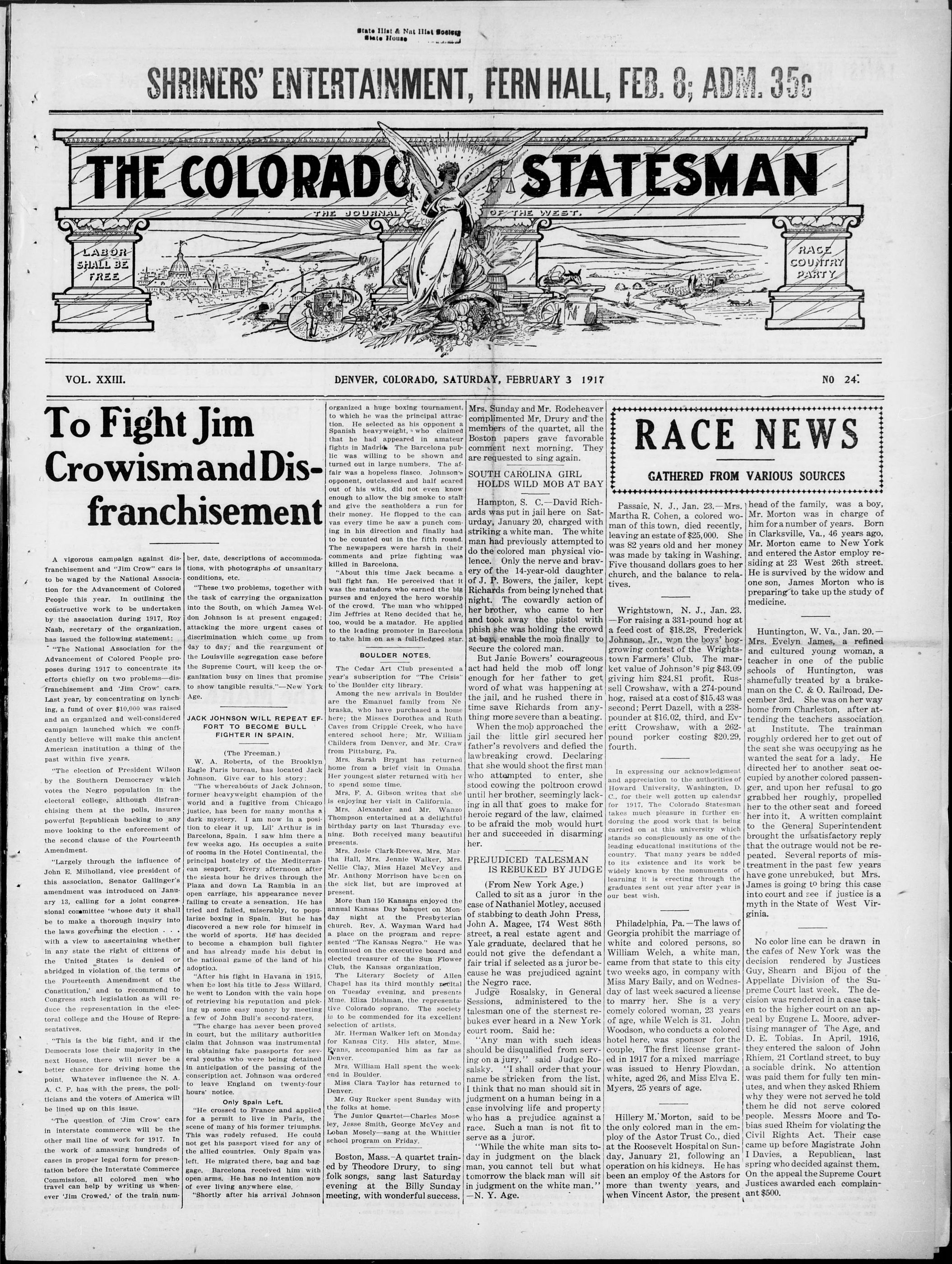
SHRINERS' ENTERTAINMENT, FERN HALL, FEB. 8; ADM. 35c
THE COLORADO STATESMAN
THE JOURNAL OF THE WEST.
LABOR SHALL BE FREE
RACE COUNTRY PARTY
To Fight Jim CrowismandDisfranchisement
VOL. XXIII.
To Fight
Crowism
franc
A vigorous campaign against disfranchisement and "Jim Crow" cars is to be waged by the National Association for the Advancement of Colored People this year. In outlining the constructive work to be undertaken by the association during 1917, Roy Nash, secretary of the organization, has issued the following statement: "The National Association for the Advancement of Colored People proposes during 1917 to concentrate its efforts chiefly on two problems—franchisement and 'Jim Crow' cars. Last year, by concentrating on lynching, a fund of over $10,000 was raised and an organized and well-considered campaign launched which we confidently believe will make this ancient American institution a thing of the past within five years.
"The election of President Wilson by the Southern Democracy which votes the Negro population in the electoral college, although disfranchising them at the polls, insures powerful Republican backing to any move looking to the enforcement of the second clause of the Fourteenth Amendment.
"Largely through the influence of John E. Milholland, vice president of this association, Senator Gallinger's amendment was introduced on January 13, calling for a joint congressional committee 'whose duty it shall be to make a thorough inquiry into the laws governing the election . . . with a view to ascertaining whether in any state the right of citizens of the United States is denied or abridged in violation of the terms of the Fourteenth Amendment of the Constitution,' and to recommend to Congress such legislation as will reduce the representation in the electoral college and the House of Representatives.
"This is the big fight, and if the Democrats lose their majority in the next House, there will never be a better chance for driving home the point. Whatever influence the N. A. A. C. P. has with the press, the politicians and the voters of America will be lined up on this issue.
"The question of 'Jim Crow' cars in interstate commerce will be the other mail line of work for 1917. In the work of amassing hundreds of cases in proper legal form for presentation before the Interstate Commerce Commission, all colored men who travel can help by writing us whenever 'Jim Crowed,' of the train num-
ber, date, descriptions of accommodations, with photographs of unsanitary conditions, etc.
"These two problems, together with the task of carrying the organization into the South, on which James Weldon Johnson is at present engaged; attacking the more urgent cases of discrimination which come up from day to day; and the reargument of the Louisville segregation case before the Supreme Court, will keep the organization busy on lines that promise to show tangible results."—New York Age.
JACK JOHNSON WILL REPEAT EF
FORT TO BECOME BULL
FIGHTER IN SPAIN.
(The Freeman.)
W. A. Roberts, of the Brooklyn Eagle Paris bureau, has located Jack Johnson. Give ear to his story:
"The whereabouts of Jack Johnson, former heavyweight champion of the world and a fugitive from Chicago justice, has been for many months a dark mystery. I am now in a position to clear it up. Lil' Arthur is in Barcelona, Spain. I saw him there a few weeks ago. Hs occupies a suite of rooms in the Hotel Continental, the principal hostelry of the Mediterranean seaport. Every afternoon after the siesta hour he drives through the Plaza and down La Rambia in an open carriage, his appearance never failing to create a sensation. He has tried and failed, miserably, to popularize boxing in Spain. But he has discovered a new role for himself in the world of sports. He has decided to become a champion bull fighter and has already made his debut in the national game of the land of his adoption.
"After his fight in Havana in 1915, when he lost his title to Jess Willard, he went to London with the vain hope of retrieving his reputation and picking up some easy money by meeting a few of John Bull's second-raters.
"The charge has never been proved in court, but the military authorities claim that Johnson was instrumental in obtaining fake passports for several youths who were being detained in anticipation of the passing of the conscription act. Johnson was ordered to leave England on twenty-four hours' notice.
Only Spain Left.
"He crossed to France and applied for a permit to live in Paris, the scene of many of his former triumphs. This was rudely refused. He could not get his passport vised for any of the allied countries. Only Spain was left. He migrated there, bag and baggage. Barcelona received him with open arms. He has no intention now of ever living anywhere else. "Shortly after his arrival Johnson
DENVER, COLORADO, SATURDAY, FEBRUARY 3 1917
State Hist & Nat Hist Books
State House
ENTAINMENT
ADO
THE JOURNAL
DENVER, COLORADO, SAT
organized a huge boxing tournament, to which he was the principal attraction. He selected as his opponent a Spanish heavyweight, who claimed that he had appeared in amateur fights in Madrid. The Barcelona public was willing to be shown and turned out in large numbers. The affair was a hopeless fiasco. Johnson's opponent, outclassed and half scared out of his wits, did not even know enough to allow the big smoke to stall and give the seatholders a run for their money. He flopped to the canvas every time he saw a punch coming in his direction and finally had to be counted out in the fifth round. The newspapers were harsh in their comments and prize fighting was killed in Barcelona.
"About this time Jack became a bull fight fan. He perceived that it was the matadors who earned the big purses and enjoyed the hero worship of the crowd. The man who whipped Jim Jeffries at Reno decided that he, too, would be a matador. He applied to the leading promoter in Barcelona to take him on as a full-fledged star
BOULDER NOTES
The Cedar Art Club presented a year's subscription for "The Crisis" to the Boulder city library. Among the new arrivals in Boulder are the Emanuel family from Nebraska, who have purchased a home here; the Misses Dorothea and Ruth Caves from Cripple Creek, who have entered school here; Mr. William Childers from Denver, and Mr. Craw from Pittsburg, Pa.
Mrs. Sarah Bryant has returned home from a brief visit in Omaha. Her youngest sister returned with her to spend some time.
Mrs. F. A. Gibson writes that she is enjoying her visit in California.
Mrs. Alexander and Mr. Wanzo Thompson entertained at a delightful birthday party on last Thursday evening. Both received many beautiful presents.
Mrs. Josie Clark-Reeves, Mrs. Martha Hall, Mrs. Jennie Walker, Mrs. Nellie Clay, Miss Hazel McVey and Mr. Anthony Morrison have been on the sick list, but are improved at present.
More than 150 Kansans enjoyed the annual Kansas Day banquet on Monday night at the Presbyterian church. Rev. A. Wayman Ward had a place on the program and represented "The Kansas Negro." He was continued on the executive board and elected treasurer of the Sun Flower Club, the Kansas organization.
The Literary Society of Allen Chapel has its third monthly recital on Tuesday evening, and presents Mme. Eliza Dishman, the representative Colorado soprano. The society is to be commended for its excellent selection of artists.
Mr. Herman Walker left on Monday for Kansas City. His sister, Mme. Evans, accompanied him as far as Denver.
Mrs. William Hall spent the week-end in Boulder.
Miss Clara Taylor has returned to Denver.
Mr. Guy Rucker spent Sunday with the folks at home.
The Junior Quartet—Charles Moseley, Jesse Smith, George McVey and Loban Mosely—sang at the Whittier school program on Friday.
Boston, Mass. -A quartet trained by Theodore Drury, to sing folk songs, sang last Saturday evening at the Billy Sunday meeting, with wonderful success.
Mrs. Sunday and Mr. Rodeheaver complimented Mr. Drury and the members of the quartet, all the Boston papers gave favorable comment next morning. They are requested to sing again.
Hampton, S. C.—David Richards was put in jail here on Saturday, January 20, charged with striking a white man. The white man had previously attempted to do the colored man physical violence. Only the nerve and bravery of the 14-year-old daughter of J. P. Bowers, the jailer, kept Richards from being lynched that night. The cowardly action of her brother, who came to her and took away the pistol with phish she was holding the crowd at bay, enable the mob finally to secure the colored man.
But Janie Bowers' courageous act had held the mob off long enough for her father to get word of what was happening at the jail, and he rushed there in time save Richards from anything more severe than a beating.
When the mob approached the jail the little girl secured her father's revolvers and defied the lawbreaking crowd. Declaring that she would shoot the first man who attempted to enter, she stood cowing the poltroon crowd until her brother, seemingly lacking in all that goes to make for heroic regard of the law, claimed to be afraid the mob would hurt her and succeeded in disarming her.
PREJUDICED TALESMAN IS REBUKED BY JUDGE
(From New York Age.)
Called to sit as a juror in the case of Nathaniel Motley, accused of stabbing to death John Press, John A. Magee, 174 West 86th street, a real estate agent and Yale graduate, declared that he could not give the defendant a fair trial if selected as a juror because he was prejudiced against the Negro race.
Judge Rosalsky, in General Sessions, administered to the talesman one of the sternest rebukes ever heard in a New York court room. Said he:
"Any man with such ideas should be disqualified from serving on a jury," said Judge Rosalsky. "I shall order that your name be stricken from the list. I think that no man should sit in judgment on a human being in a case involving life and property who has a prejudice against a race. Such a man is not fit to serve as a juror.
"While the white man sits today in judgment on the black man, you cannot tell but what tomorrow the black man will sit in judgment on the white man." N. Y. Age.
RACE NEWS
GATHERED FROM VARIOUS SOURCES
Passaic, N. J., Jan. 23.—Mrs. Martha R. Cohen, a colored woman of this town, died recently, leaving an estate of $25,000. She was 82 years old and her money was made by taking in Washing. Five thousand dollars goes to her church, and the balance to relatives.
head of the family, was a boy, Mr. Morton was in charge of him for a number of years. Born in Clarksville, Va., 46 years ago, Mr. Morton came to New York and entered the Astor employ residing at 23 West 26th street. He is survived by the widow and one son, James Morton who is
Wrightstown, N. J., Jan. 23.
—For raising a 331-pound hog at a feed cost of $18.28, Frederick Johnson, Jr., won the boys' hoggrowing contest of the Wrightstown Farmers' Club. The market value of Johnson's pig $43.09 giving him $24.81 profit. Russell Crowshaw, with a 274-pound hog, raised at a cost of $15.43 was second; Perrt Dazell, with a 238-pounder at $16.02, third, and Everitt Crowshaw, with a 262-pound porker costing $20.29, fourth.
In expressing our acknowledgment and appreciation to the authorities of Howard University, Washington, DC., for their well gotten up calendar for 1917, the Colorado Statesman takes much pleasure in further endorsing the good work that is being carried on at this university which stands so conspicuously as one of the leading educational institutions of the country. That many years be added to its existence and its work be widely known by the monuments of learning it is erecting through the graduates sent out year after year is our best wish.
Philadelphia, Pa. —The laws of Georgia prohibit the marriage of white and colored persons, so William Welch, a white man, came from that state to this city two weeks ago, in company with Miss Mary Baily, and on Wednesday of last week secured a license to marry her. She is a very comely colored woman, 23 years of age, while Welch is 31. John Woodson, who conducts a colored hotel here, was sponsor for the couple. The first license granted in 1917 for a mixed marriage was issued to Henry Plowdan, white, aged 26, and Miss Elva E. Myers, 25 years of age.
Hillery M. Morton, said to be the only colored man in the employ of the Astor Trust Co., died at the Roosevelt Hospital on Sunday, January 21, following an operation on his kidneys. He has been an employ of the Astors for more than twenty years, and when Vincent Astor, the present
NO 24.
head of the family, was a boy, Mr. Morton was in charge of him for a number of years. Born in Clarksville, Va., 46 years ago, Mr. Morton came to New York and entered the Astor employ residing at 23 West 26th street. He is survived by the widow and one son, James Morton who is preparing to take up the study of medicine.
Huntington, W. Va., Jan. 20. Mrs. Evelyn James, a refined and cultured young woman, a teacher in one of the public schools of Huntington, was shamefully treated by a brakeman on the C. & O. Railroad, December 3rd. She was on her way home from Charleston, after attending the teachers association at Institute. The trainman roughly ordered her to get out of the seat she was occupying as he wanted the seat for a lady. He directed her to another seat occupied by another colored passenger, and upon her refusal to go grabbed her roughly, propelled her to the other seat and forced her into it. A written complaint to the General Superintendent brought the unsatisfactory reply that the outrage would not be repeated. Several reports of mistreatment in the past few years have gone unrebuked, but Mrs. James is going to bring this case into court and see if justice is a myth in the State of West Virginia.
No color line can be drawn in the cafes of New York was the decision rendered by Justices Guy, Shearn and Bijou of the Appellate Division of the Supreme Court last week. The decision was rendered in a case taken to the higher court on an appeal by Eugene L. Moore, advertising manager of The Age, and D. E. Tobias. In April, 1916, they entered the saloon of John Rhiem, 21 Cortland street, to buy a sociable drink. No attention was paid them for fully ten minutes, and when they asked Rhiem why they were not served he told them he did not serve colored people. Messrs Moore and Tobias sued Rheim for violating the Civil Rights Act. Their case came up before Magistrate John I Davies, a Republican, last spring who decided against them. On the appeal the Supreme Court Justices awarded each complainant $500.
FOREIGN
Petrograd, says a heuter dispatco
from the Russian capital to London.
A Constantinople dispatch to Amster-
dam says that the Turkish parliament
on the recommendation of the govern-
ment, has formally adopted the Gre-
gorian calendar.
‘The Prussian minister of education
has announced at a meeting of the
budget committee of the reichstag in
Berlin that 10,950 public school teach-
ers have fallen during the war anc
‘that their places have been taken by
women,
“The king has appointed the duke
of Connaught to de colonel-in-chief of
‘the volunteer force,” says an official
announcement issued in London. The
duke of Connaught retired from the
governor generalship of Canada last
October.
|, ,The ceremony of saluting the en-
tente allies’ flag by Greece was car-
ried out Monday afternoon in the
Zappeion in accordance with the ar.
rangement recently entered into be
tween the Greek government and the
entente powers,
The Pkstrabladet reports the ar-
rival at Copenhagen of twenty-six
Swedish, Norwegian and American
seamen belonging to the crew of the
‘British steamer Yarrowdale, which
was captured by the German raider in
the south Atlantic. They had been
interned at Neustrelitz,
Russia is experiencing famine in
the midst of plenty, according to an
article in the London Times. The
article refers chiefly, but not exclusive
ly, to Petrogradand Moscow. The
|writer believes that there is enough
|food in Russia to supply the entire
| population two years, but, because of
the inadequacy of the railroads, lack
of organization and co-ordination in
distribution, the people in some dis:
tricts find it difficult, even imposst-
ble, to get supplies.
SPORTING NEWS
Johnny Dundee showed in New Or
leans conclusively that his knockout
at the hands of Willle Jackson was a
fluke, for he beat Jimmie Hanlon of
Denver to a whisper in twenty rounds
Hanlon not winning a round.
Henry Irslinger of Austria, claim
ant of the world’s middleweight
wrestling championship and holder of
the Lord Lonsdale belt, suffered
probable concussion of the brain in
his match with Michael Yokel at At
lantic City, N. J.
Fred Winsor, a local boxing pro
moter in Salt Lake City, announced
that he has signed Jim Flynn of Pu
eblo, Colo,, and Jack Dempsey of Sal
Lake for a fifteen-round match Feb
14, at Murray, Utah, a suburb of Sal
Lake. The men are heavyweights,
Stephen McDonald was killed in Al
bany, N. Y., in the second minute o}
the first round of his first professiona
prizefight when Toddy Hicks landec
a hard blow with his right hand unde
McDonald’s heart. Hicks was ar
rested on a charge of manslaughter.
‘The release of John Thompson an¢
William Stellbauer, outfielders, was
announced in Philadelphia by Connie
Mack, manager of the Philadelphis
American League Baseball Club
Thompson goes to the Omaha, Neb.
Club and Stellbauer to Houston, Tex
Kid Williams, great little battler
didn’t lose his ability to fight to Pete
Herman along with his crown
month ago, That he retains a won
derful power to battle was demon
strated at Kansas City, Mo., when he
administered to Benny McNeil, Brit
ish bantam, a beating that was all but
a knockout,
GENERAL
Mrs. S. Olin Johnson, wife of one
of Detroit's best known business men
and prominent socially, shot anc
killed herself in her home in Detroit,
Mich.
Bernard Baruch, Wall street plun.
ger in New York, cleared $476,000
playing peace hunches during thir
teen days in December, according to
his testimony to the “Leak” commit:
tee.
Ninety medical schools in the Unit
ed States with a total enrollment in
graduating classes of more than 3,00
young men, available for army and
navy service, has been instituted al
Chicago.
‘Three persons were killed and thir.
ty-three injured, two probably fatally,
in a rear end collision between a Cot
ton Belt engine carrying a caboose
and a Rock Island passenger train at
Mounds, Ark.
The Iowa House at Des Moines, Ia.,
by a vote of 95 to 0, passed the bill
providing for a repeal of the prest-
dential preference primary law, and
LATEST NEWS
EPITOMIZED
OF MOST INTEREST
ABOUL 1HE Wan
Francisco Villa and his troops are
in potential control of northern Mex-
ico, according to reports.
In northwest Russia on the Riga
sector considerable fighting continues.
Here both Berlin ond Petrograd rec-
ord the repulse of attacks,
A vessel believed be the German
raider is reported to have been
cruising off Monte Christi, on the
north coast of Santo Domingo.
Considerable aerial activity con-
tinues over the fines in France. Lon-
don reports the destruction of three
German machines.
The German submarine recently re-
ported sunk near Hammerfest was
the U-27, commanded by Captain
Benber, according to information re-
ceived at Christiania,
In the battle northeast of Jacobeni
on the northern end of the Rumanian
front, Russian troops captured thirty
officers and more than 1,000 men, the
war office announced in Petrograd.
Between Soissons and Rheims and
south and west of Het Sas in Belgium,
the Germans have attempted ad-
vances by means of surprise attacks,
but in both instances were compelled
to desist.
Between Les Eparges and the Ca-
lonne trench, north of Verdun, the
French have carried out a successful
attack against the Germans, taking
elements of trenches from the troops
of the German crown prince,
Despite the severity of the weather
reported from nearly all the Euro-
pean battle fronts, spirited fighting is
taking place in several of the war
areas, The most notable recent de-
velopment is on the northern end of
the Rumanian line, where the Rus-
sians took the offensive and broke
through the Austro-German lines on a
two-nile front along the railway from
Kimpolung to Jacobeni,
WESTERN
A bill which would permit women
to vote in all Texas primaries has
been introduced in the Texas Senate.
The weather at Lewistown, Mont.,
is said to be the coldest of the winter
with the thermometer registering 36
degrees below zero.
Redondo Beach, one of the resorts
contiguous to Los Angeles, will be
“dry” right down to the ocean's edge
after Aug. 31. The election Jan, 28
showed a maority of 252 ror prohibi-
ton,
In the worst blizzard that ever
swept over South Dakota since 1888
the westbound Olympian train No. 15
on the Chicago, Milwaukee & St. Paul
railroad is wrecked two miles west of
Roscoe, 8. D. Ten cars are in the
ditch,
As a result of the finding of the
bodies of four children of S. A, He-
wett, a brakeman, in the ruins of his
burned house at Auburn, Wash., He-
wett was arrested and,,to avoid a
threatening crowd, he was put on a
train and taken to Seattle,
WASHINGTON
Colin Neblett of Silver City, N. M.,
has béen nominated by President
Wilson to be United States district
judge for New Mexico.
A Dig cabinet shift will take place
early in President Wilson's second
term, it is learned in Washington.
‘This will be in addition to the diplo-
matic shakeup which is expected
about March 4 or soon thereafter.
Just as soon as General Pershing’s
command is back on United States
territory, another large group of
militia, probably 25,000, will be er-
dered home for muster out, The re-
turn of the present 25,000 to. their
home bases will be completed by Feb.
20, it was said at the War Depart-
ment in Washington. Meantime, there
will be no loss of time in releasing
other units which have been on the
border as a support to the Pershing
column,
New York importers have peti
tioned the Treasury Department at
Washington (o refund them approxi-
mately $2,500,000 representing 10 per
cent of duties on imports from Ger-
many and Austria since February,
1915, on the ground that they paid
heavier duties than were warranted
by value because of the depreciation
of German and Austrian currency,
‘The administration’s $800,000,000 de-
fense budget began to take final
shape in Congress when the House
passed the fortifications bill carrying
a total of more than $51,000,000 for
coast defenses, and the House naval
committee completed its 1918 naval
appropriation bill with a total of more’
than $351,000,000.
Major G. H. Crabtree of the Medical
corps will be placed on the retired list
COLORADO
STATE NEWS
Western Newspaper Union News Service.
DATES FOR COMING EVENTS.
Feb, 2-4—¥. M. C, A. Annual Conven-
tion at Coloradé Springs.
Feb, 28-March 1—Carnival of Mid-Win-
ter Sports at Steamboat Springs.
After being out for several hours
the jury in the case of George Seager,
at Brighton, charged with cattle steal-
ing, brought in a verdict of gullty.
‘The Degge-Clark tungsten mill at
Boulder has started up after three
weeks’ idleness in which the machin-
ery was given a thorough overhauling.
Three attempts to hold up as many
parties of motorists on the Denver-
Golden road were made Sunday by
three masked men. All were unsuc-
cessful.
Feeling is running high at Fort Col-
lins over the killing by an unidenti-
fied motorist of A. T. Gilkison, 69, pio-
neer of this section and widely known
mining man,
Approximately $400,000 was brought
into the state during the last year by
new settlers, according to the annual
report of the Colorado State Board of
Immigration,
The state will receive an increased
revenue of $25,000 this year from the
State Insurance Department, accord-
ing to E. R. Harper, state infurance
commissioner.
Colorado's reputation for good roads
and its scenic beauties brought 26,500
out-of-town automobiles to Salida in
1916, according to estimates by State
Commissioner Thomas J, Ehrhart.
‘Through acquiescence by the citi-
zens of Ouray and permission of the
ste game warden six mountain
sheep have been given to Denver, and
will be kept at the municipal inclo-
sure at Genesee mountain,
Physical examinations for qualitica
tion for enlistment in the government
cadets have been passed by more
than 250 Denver high school boys.
School Examiner John C, Chase, Jr., is
conducting the examinations,
Claiming jack rabbits in the east-
ern part of-the state not only eat
crops, but even trample them under
foot, Senator Mitten of Wray intro-
duced a bill in the Senate asking for
a bounty of 5 cents a head,
Hollis R, Mills of Hartsel was clect-
ed president of the newly organized
Colorado Sheep Growers’ Association,
organized with an initial membership
of twenty-three, The next meeting ot
the association will be held in Denver
during the week of the 1918 Stock
Show.
‘The Nederland Fish and Game Club
has been notified that an allotment of
fifty elk for release in the mountains
near here under {ts protection, has
been made by the National Park com-
missioners, and that the elk will soon
be captured in the Yellowstone park
country and shipped to Nederland.
Yeggs blew open the safe of the
store of the Rocky Mountain Mercan-
tile Company at Marshall and ob-
tained $20 in stamps and about $10 in
small change, The company money
had been brought to Boulder during
the day by A. H. Antoine, manager of
the store, and deposited in a local
bank.
By the passage by the United States
Senate of the Hilliard bill, author-
izing the sale of property of the Hast
Denver High school, the way has
been opened for the disposal of the
site at Stout and Nineteenth streets
by the school board and the location
of the school upon another site, and
the erection® of a new and modern
building.
‘The town of Hayden, near Lead-
ville, has passed out of existence.
Two towns were name Hayden, the
other being in Routt county, on the
Denver & Salt Lake railroad. Con-
fusion in the delivery of mail and sup-
plies brought the matter before the
Public Utilities Commission, It
asked the smaller town, near Lead-
ville, to change its name, After this
it will be known as Dana, Colo,
‘The failure to secure low freight
rates by reason of water competition,
which prompted Denver men to begin
the construction of the Colorado &
Southern railroad, became an issue be-
fore Hxaminer Myron Pattison of the
interstate Commerce Commission at
the hearing in the federal building in
the action brought by the Colorado
Fair Rates Association to secure an
equitable adjustment of freight rates.
T. Harold Murphy, a chemist in the
Federal Sugar Refining Company,
Yonkers, N. Y., and son of L. F, Mur-
phy, Denver, recently received a com-
mission of quartermaster captain of
the New York Army's reserve corps.
The commission was signed by Presi-
dent Wilson and Secretary of War
Baker, The appointment was made
by competitive examination which
several New York business men took
last fall.
Because Pueblo county is rapidly
coming to the front as a corn-raising
county, efforts to stimulate the erow-
NEW CHANGE IN LAW
e For More Than Thirty-Five Years ‘
: sie ari ;
y LQ F/" ing, conservatism and Nn s
4b ne cme Cane”
iE 709 AND 711 SIXTEENTH STREET, DENVER, COLORADO #
EGISLATURE MAY ABOLISH A
PART OF PRIMARY LAW.
Would Make Cattle Rustling a Pent
tentiary Offense As Fines Are
No Good.
Western Newspaper Union News Service,
Denver.—The abolition of the as-
sembly feature of the present direct
primary law of Colorado, a prohibi:
tion against paying for signatures to
nominating petitions and a radical
change in the method of designating
party noniinees in direct primary elec:
tions are provided in a bill intro-
duced in the General Assembly. The
proposed law would do away with the
present party assembly nomination
methods, It would also do away with
the present system of each party hay-
ing a separate ballot in the Septem-
ber primary election.
‘The most radical change is in the
method of nomination. The bill pro-
vides that “any person who is a quall-
fied elector may file a petition with
the county clerk of the county or
counties over which the office to
which he aspires has jurisdiction.”
Cattle rustling, which in the early
days meant a noose and a stout limb
for the guilty rustler, has not alto-
gether disappeared in Colorado, and
while Representative Banks of Lari-
mer county does not believe in
“stringing up” a rustler, he believes
present laws covering the theft of cat-
tle should be amended. A bill intro-
duced by him in the House is along
this line.
Under the present law, a cattle thiet
may be fined “up to $5,000” or impris-
oned “up to six years.” This sounds
like a severe penalty, but, according
to Mr, Banks, is not.
So I propose to make a man go to
the penitentiary in addition to pay-
ing a fine, The law should read that
the offender be sent to the peniten-
Uary for from one to six years. The
law is ineffective under “its present
wording.”
‘An appropriation of $5,000 to erect
an auditorium in Beecher park, in
Yuma county, proposed in House bill
No, 102, was passed on second read-
ing.
House bill No. 4, prohibiting the im-
portation of peyote, a narcotic drug,
into Colorado, was also passed on sec-
ond reading,
A bill calling for the investigation
of smelters and identical with the
bill introduced in the Senate by Sen-
ators Candlish and Fincher, was in-
troduced in the House by Representa-
tive Ardourel.
Representatives Girard and Owen
introduced a bill providing for an ap-
propriation of $77,500 for the main-
tenance of the State Board of Immi
gration during 1917 and 1918.
BOLDEN BROS. CAFE
and LUNCH ROOM
924 19th Street, Denver, Colorado
ico
DINNER fod BS e? Short Orders
11:30to2p.m. “AM re By at All Hours
Ota
All Kinds of Sandwiches
Bolden Bros. Barber Shop
Baths, Electric Massage
FIRST CLASS SERVICE
R. B. BOLDEN, Mgr. 926 19th St. Denver
fe Gane Pest Jes’ Lk Hansen
Repairing a Specialty Manufacturing
vom, BENVEN CLO. Watchmaker and Jeweler
PHONE MAIN as RES. PHONE GALLUP 9423
JOHN K. RETTIG —
Meats, Fancy and Staple Groceries
1864 CURTIS STREET / a
Corner Nineteenth. “Denver, Colo,
Forest Supervisors Meet.
Denver.—Blizzards, biting winds of
seventy-five miles an hour velocity,
snowdrifts, impassable trails did not
keep away from Denver the forest su-
pervisors of the Denver district. They
commenced their annual conference
in Denver Monday, Every branch of
the service is to be discussed. Fire
[protection, highways, organization, the
establishment of parks and recreation
areas, game sanctuaries and other
‘phases of the work are the subject of
speeches and informal talks. L. B.
Cooper’s experience shows that no ob-
stacles can keep a supervisor away
from these meetings. He is one of
sixty here at the conference and he
hails from Pinedale, Wyo., a village
110 miles from a railroad. It took him
two days and one night to get to the
Union Pacific. His wife and children
were with him in an automobile and
the party was preceded by a 7,000.
pound truck to open the road. It was
perilous work, however, for the truck
and car had to be dug out of the
deep snow many times, Smith Riley,
district forester, is presiding at the
ontatence:
C. E. SMITH, Manager, Res. Phone South 1608
Wholesale and Retail Staple and Fancy Groceries, Fish and Oystera
Hotels and Restaurants Our Specialty.
Fresh and Cured
Eastern Corn Fed Meats
Fruits, Vegetables, Poultry and Game.
Telephones Main 4302, 4303, 4304, 4305
622-636 15th Street Denver, olorado
New Malady at Salida.
W. F. PLAMBECK ZGSTIONTST WORK
EXPERT WATCH MAKER AT HONEST
1715 CHAMPA STREET F PRICES.
eg eaee ee Dinners ed devel, | Eee =
| Salida—One death has_ occurred
‘and a whole family is seriously ill as
‘the result of a peculiar malady that
is puzzling the State Board of Health
and the medical authorities of three
cities, The disease has been declared
by some to resemble typhus, and by
others to show some of the character
istics of severe influenza. Charles I.
Cantonwine, a farmer living near Sa-
lida, was the first victim. He was
taken suddenly ill and died in a few
days. Investigation showed that no
diagnosis could be made of the cause
of his death and also that his entire
family was ill with the same myster-
nnn dikeaae?
Weatherhead Hat Co.
TELEPHONE MAIN 3203
[FQ
tua
Established 1876
PIONEER HATTERS OF THE ‘WEST <i
WE MAKE OLD HATS NEW
PRACTICAL HATTERS
RENOVATORS, BLEACHERS DYERS AND FINISHERS
Of Gents’ and Ladies’ Hats of Every Description
1624 Champa St., Denver, Colo.
Will Increase Judges.
Denver—The number of district
Judges in Denver will be increased
from five to seven if the Denver mem:
bers of the State Senate are able to
effect the passage of a measure intro
duced in the Senate bearing the
names of all the Denver members of
the body.
Dies From Black Leg.
Salida —Robert W. Forbes, a promi-
nent cattleman of Saguache, died last
week of anthrax, commonly known as
blackleg. The disease often attacks
sheep and cattle, but seldom human
beings. Forbes’ finger became in-
fected from skinning the carcass of
an animal that had anthrax. Shortly
afterward a black spot appeared upon
his shoulder, followed by others on
various parts of his body. Death fol-
lowed several days’ illness.
© Spent at home reacts in its benefits
Do lar with unceasing general profit.
Sent out of town it’s life is ended,
Kept with the home merchants it is a messenger of continuous.
benefit. Business men should awake to the importance of keeping,
this dolar ot home and make a bid for it by judicious advertising,
AFRO-AMERICAN CULLINGS
There is a new national problem with very direct local bearings. It is the migration of Negro laborers from the South to the eastern states, to New York and Pennsylvania, to Illinois and the middle West, with a full share to Chicago.
The reason for this infux of the tide of Negro labor is the stoppage of immigration by the war and the exodus of many foreign-born residents back to their fatherlands at the call of the colors. Some of the Negroes are coming out of the South at their own prompting to better their conditions. Others, perhaps many more, are coming because employers have their agents among the southern Negroes, offering them work and actually employing them. So many are leaving their southern homes and places of employment that in certain sections of the South there is arising not a little excitement and opposition. Employment agents from other sections are said to be warned away, or even threatened if they do not keep hands off the steadily-employed or surplus labor of the South.
Hitherto it has been too generally the fact that the labor of Negroes has been more tolerated than welcomed. At any rate, very many Negroes have been made to feel that this is the case with them, even where, as in the South, there were no other laborers to do their work. And more and more, rather than less and less, in the North and at the West scant welcome has been extended to them at best, and direct antagonism has threatened them at the worst. Increasingly this has been the attitude of white laborers, unorganized as well as organized. Almost all labor unions profess to make no discrimination against color, but very few of them admit Negroes as freely as whites to their membership. This antagonism is aggravated by the employers whose preference for Nego labor seems to be a discrimination against white labor or its standards of living and wages. Landlords also are reluctant to rent their houses and flats to Negro families, but not more so than the white population surrounding their property is opposed to having Negroes move into the neighborhood.
Notwithstanding these disturbing conditions, Negro labor is being sought and is seeking to meet the increasing demand and opening opportunity. But the situation thus being created in many localities is sure to become so dangerous as to demand immediate attention, investigation and provision for the future. Many are the dangers which are to be feared not only, but which already confront every community into which Negro laborers are coming more rapidly than special provision for them is made. Housing conditions were among the dangers with which the increasing Negro population of New York city confronted its public-spirited citizens of both races. Overcrowding and the mixing of better and worse elements in the insanitary "old law" tenements were found, on investigation, to be very bad. Yet the movement of the better class of Negro families to the better tenement houses in the Harlem district was found to be encouraging. Whole sections of that district were practically given over to the occupancy of this higher class of Negro tenants.—Chicago Daily News.
What the southern Negro has won for himself, the Mexican peon in the copper mines of Arizona and the Southwest has won by similar pressure. He
Texas has as good and even better public schools for Negroes than any other state, and I see no excuse for the very poor record being made in attendance. There may be a disposition on the part of some to attribute it to the economic condition of the Negro in Texas. But the Negroes in Texas have a superior advantage, economic advantage, over Negroes in other states. There is no other place where on the whole the soil is more fertile and will yield or respond more readily to a sympathetic touch. As a matter of fact, the Negroes in this state compare favorably from an economic standpoint with those in other states. Twenty-one thousand one hundred eighty-two farms are owned by Negroes in Texas, comprising an aggregate of 4,264,198 acres valued at $93,820,233. The Negroes of Texas rank third in number of farms owned; fourth in the valuation of these farms, more than half of the acreage being improved lands. This does not indicate that colored people of this state are economically so far behind those elsewhere and yet the proportional in-
Dr. E. P. Roberts, a Negro, was appointed a member of the board of education of New York by Mayor Mitchel, who also announced the appointment of 11 other persons to the board. Doctor Roberts is the first Negro to be appointed to the board since the organization of Greater New York in 1898. He formerly was a medical inspector in the schools.
Toronto's new 14-story, $4,000,000 hotel, the Devonshire, is to be without a bar.
has come into the field as a permanent factor, and an increasing one. When given a chance he has shown his willingness to organize with the Anglo-Saxon, and to take all the responsibilities and consequences of organization. Labor leaders claim that war between the United States and Mexico at the time of the Carrizal clash last summer was averted through the influence of Mexican and American trade unionists. They understood each other because of their industrial association. In the one hesitant and reluctant step taken here enthusiasts may see an augury of better relations between the 11,000,000 of American Negroes and 89,000,000 American whites.
In the same session at which the labor delegates were offering this promise of peace at home the executive council presented a recommendation that new efforts be made to influence the conditions of future peace abroad. In a special report on international labor relations it told of the breaking down of the International Federation of Trade unions, through the secession of the British, French and Belgians. The American movement, in the opinion of the council, should persist in its effort to have a world congress of labor meet at the time and in the city where the peace congress of the nations shall assemble at the close of the war. It urges that only the influence of the organized workers of the nations, exerted upon the diplomats at that time, can assure the world a peace founded upon justice.
"We are keenly conscious that institutions and regulations alone are not sufficient," says the report. "Back of them must be an international mind and conscience educated to demand the democratization and humanization of our common affairs. The labor movements of all countries have contributed much to the will for peace and justice, and must do their part in the development of the agencies by which their will can be expressed."
Tentative suggestions for a league to enforce peace by both military and economic power are put forth by the report. It holds that the fight against militarism must be made within each country by its own people.
"The Negro farmers of northern Louisiana and Mississippi are so prosperous they are all buying automobiles," said Governor Blanchard of Louisiana. "Twenty-cent cotton has found the farmers in that section with plenty of cotton. A great deal of it is this year's crop, and a lot is left over from last year. So when the price was right the Negroes, as well as the white cotton growers, suddenly found themselves in the most prosperous condition they had been in for years. As a result the automobile dealers of northern Louisiana and Mississippi cannot supply the demand.
Bucharest, the capital of Roumania, has a population of 400,000 and is said to be the gayest city in the world. The Roumanians are a Latin race and Bucharest is a deliberate imitation of Paris.
Roumanian infantrymen are unrivaled in the Balkans, and the Roumanian cavalry is as good as any in Europe. The Roumanian is a fine horseman and the cavalry spirit is born in him.
Oue mile of a country road in Oregon is surfaced with borax.
crease ownership within the last census decade has only been 5.2 per cent, which is comparatively a low rate of increase. It is our patriotic duty as citizens of this state and nation to see that we do not become a burden upon the state or nation—economically or educationally. We have done fairly well on the whole with respect to these things, but could do a great deal better as the record shows.
The only way that we shall ever be able to change this condition of affairs is by a campaign of education on the part of rural teachers, especially among the parents, pointing out to them the folly of taking the child from school because perhaps he can be of material value in terms of dollars and cents when as a matter of fact his future is of infinitely more value provided he were allowed to spend his time in preparing himself. It is a great problem to be worked out—looming up larger of course in the rural districts for the reason that conditions are more favorable and yet not more favorable than in large manufacturing cities. Communication to the Houston (Tex.) Post.
An Illinois inventor has patented hangers for barn or other doors that are suspended from tracks that can be adjusted to work properly when a door warps.
In announcing civil service examinations for masons in the Indian service at Haskell institute, at Haskell, Kan., the government advertises: "Wanted, masons (brick), men only."
Street traffic in San Francisco is regulated by electric semaphores.
N. Y. HARBOR SEALED BY U.S.
N. Y. HARBOR SEALED BY U.S.
INTERNED VESSELS MAY AT TEMPT TO EFFECT AN ESCAPE, ACCORDING TO REPORTS.
WATCHMEN ON GUARD
PORT COLLECTOR AND MEN ON THE ALERT TO PREVENT ANY RUN FOR OPEN SEA.
New York.—The port of New York is sealed by order of Dudley Field Malone, collector of the port. Vessels of every description, including tug boats, were turned back at quarantine by the torpedo boat stationed there to maintain neutrality of the United States. The purpose of Mr. Malone's order remained a mystery upon which he declined to throw any light.
While there was no apparent basis for the belief such drastic action resulted from information that one or more of the great German liners interned at Hoboken was preparing to make a dash for the open sea, it was significant that a deputy collector conferred on the Hamburg-American line dock with the chief of police of Hoboken and representatives of the steamship company. Twenty-four steamships, some of them the largest in the world, owned by German interests, are tied up at piers on the New Jersey side of the Hudson river, while three Austrian vessels are docked at Brooklyn piers.
MEXICO HAS CONSTITUTION.
New Document Finished and Signed After Three Months and Filled With Radical Laws.
Queretaro, Mexico.—The delegates to the constitutional assembly, which concluded its labors, assembled and signed the constitution on which they had been working for two months. The ceremony was attended by great enthusiasm. All the members of the cabinet were present except Luls Cabrera, minister of finance, and Ygnacio Bonillas, minister of fento and communications. The new constitution contains some advanced legislation. Among the provisions are:
Abolition of the office of vice president; prohibition of the re-election of a President; stringent and radical labor laws, which provide for an eight hour day, seven hours of night work and six working days a week; compulsory arbitration, profit sharing, free employment bureau, anti-trust laws, a national Department of Health and plenary powers and compulsory military instruction.
Wrath Over Peace Rejection.
Amsterdam, Holland.—Emperor William, replying to a telegram received by him from the director of the province of Brandenburg, says a dispatch from Berlin, sent this message: "After thirty months of warfare, rich in sac riffles, the entire German people, in holy wrath at the rejection of my peace offer, is inspired anew with doubled strength and stands as one man with the Kaiser and empire in order victoriously to pass through the blood of the final battle which now has be come inevitable for house, home honor and freedom, and finally to place every peace disturber within bounds. May God and our good sword help us thereto."
Conference of All Nations.
Washington.—A conference of all nations will be necessary to determine arrangements for future world peace, according to official opinions expressed here. In view of this conviction the impression has gained ground that when the President moves again it will be formally to suggest such a conference.
Heavy Fighting Resumed.
Berlin.—On the northern Rumanian front heavy fighting has been resumed, the Russians making several attacks south of the Putna valley. The war office announced that the Russians succeeded in penetrating a German point of support. German troops stormed Russian positions on the east bank of the Aa river near the northern end of the Russian front and repulsed several Russian counter attacks. They took prisoner more than 900 men and captured fifteen machine guns.
The French made an attack on German positions in the vicinity of Leintrey, near the Lorraine frontier, the war office announces. They were repulsed.
Petrograd.—Advancing waist deep in the snow, Russian troops have stormed and captured at the point of the bayonet German positions on the heights east of Jacobeni, according to official statements.
Paris.—French forces penetrated the first and second German lines south of Leintrey and brought back all German defenders of those positions as prisoners or killed them in the fighting, it was announced by official statement.
TO SINK VESSELS WITHNOWARNING
TO SINK VESSELS WITHNOWARNING
GERMANY REVOKES PLEDGES TO
U. S. IN STRONG NOTE RE-
CEIVED AT WASHINGTON.
RUTHLESS SEA WARFARE
ACTION TO FORCE PEACE NEGOTIATIONS IN SHORT TIME IS THE TEUTONIC VIEW.
Washington.—Following is the note of the Imperial German Government announcing its decision to adopt a policy of unrestricted naval warfare, which was handed to Secretary Lansing by Count von Bernstorf:
Mr. Secretary of State:—Your Excellency was good enough to transmit to the imperial government a copy of the statement made by the President of the United States of America addressed to the Senate on the 22nd inst. The imperial government has given it the earnest consideration which the President's statements deserve, inspired as much as possible by the profession of responsibility. It is highly gratifying to the imperial government to ascertain that the main tendencies of this important statement correspond largely to the interests of Germany. The principles especially include self government and equality of rights for all nations. Germany would be sincerely glad if in recognition of this principle cooperation should not enjoy the benefits of political independence, should now obtain their freedom.
The German people also repudiate all alliances which serve to force the countries into a competition for might and to involve them in a net of selfish interests. The German people will gladly co-operate in all efforts to prevent future wars. The freedom of the seas, being a preliminary condition of the free existence of nations and the peaceful intercourse between the peoples of the world, commerce of all nations, has always formed part of the leading principles of Germany's political program. All the more the imperial government regrets that the attitude of her enemies, and that the business makes it impossible for the world at present to bring about the realization of these lofty ideals, Germany and her allies were ready to enter now into a discussion of peace, and had set down their aims. The German people or and free development of their peoples. Their aims, as has been expressly stated in the note of December 12, 1916, were not directed toward the destruction or annihilation of their enemies, but to the conviction perfectly compatible with the rights of other nations.
As to Belgium, for which such warm and cordial sympathy is felt in the United States, the chancellor had determined that its annexation had never formed part of Germany's intentions. The peace to be signed with Belgium was to provide for such conditions in that it should be maintained to maintain friendly, neighborly relations, that Belgium should not be used again by Germany's enemies for the purpose of instigating continuous hostilities, and that its resources are all the more necessary, as Germany's enemies have repeatedly stated, not only in speeches delivered by their leading men, but also in the newspapers, but in Paris, that it is their intention not to treat Germany as an equal, even after peace has been restored; but to continue their hostile attitude and essentially a systematic economical war against her.
The attempt of the four allied powers to bring about peace has failed owing to the lust of conquest of their enemies, who desired to dictate the conditions of following the principle of nationality our enemies have disclosed their real aims in this way, viz.: to dismember and dishonor Germany, Austrian army, and French army, wish of reconciliation they oppose the will of destruction. They desire a fight to the bitter end. A new situation thus has been created which forces Germany to new decisions. Since two years and a half ago, Germany has been power for a criminal attempt to force Germany into submission by starvation. In brutal contempt of international law the group of powers led by England has been forced to kill the trade of their opponents, but they also by ruthless pressure compel neutral countries either to forego altogether every trade not agreeable to the envoys or to admit it according to their arbitrary decrees.
The American government knows the steps which have been taken to cause England and her allies to return to the rules of international law and to respect the freedom of the seas. The English government, however, insists upon continuing its war of starvation, which does not at all affect the military power of its opponents, but compels women and children, the sick and the aged, to suffer for their country, pains and privations which endanger the vitality of the nation. Thus British tyranny mercilessly increases the suffering of the world, indifferent to the laws of humanity, indifferent to the protests of the neutrals, whom they severely harm, indifferent even to the silent donging for peace among England's own allies. Each day of the terrible struggle causes new destruction, new suffering. Each day, shortening the war will, on both sides, preserve the lives of thousands of brave soldiers and be a benefit to mankind.
The imperial government could not justify before its own conscience, before the German people, and before his desire to the neglect of tiny means destined to the war. Like the President of the United States, the imperial government had hoped to reach this goal by negotiations. After the attempts to come to understanding powers have been answered by the latter with the announcement of an intensified continuation of the war, the imperial government, in order to serve the people, has to fight with higher sense and not to wrong its own people, is now compelled to continue the fight for existence, again forced upon it with the full employment of all the workers, and to enclose two memorandum regarding the details of the contemplated military measures at sea, I remain, etc. (Signed): J. BERNSTOFF.
KILLED UNDER WHEELS.
Former State Official Killed by Rio Grand Train on Track Crossing.
A. J. Hunter, 58 years old, widely known in political circles in the state, and for the last four years special agent of the Denver & Rio Grande railroad, was run over and killed at the railway crossing near West Eighth avenue and Navajo street. Mr. Hunter, in the round of his duties, had completed the inspection of No. 65, an outgoing freight train.
FLORAL DESIGNS PUT UP WHILE YOU WAIT
CHOICE PLANTS AND CUT FLOWERS CONSTANTLY ON HAND
GREENHOUSES: Thirty-Fourth and Curtis Streets
TELEPHONE, MAIN 1511 DENVER, COLO
The Champa Pharmacy
When You Want
The Heads, Feet, Tails, Snouts, Neckbones or Chiterlings, or any other part of the hog except the squeal, go to
East's Market
The
WARD AUCTION
COMPANY
Sales Daily at 2 p.m. Office Furniture a Speciality.
PRIVATE SALES AT ALL TIMES
HAVE MOVED TO—
1723-39 GLENARM ST.
PHONE MAIN 1675.
THE BEST ICE CREAM AND CANDIES AT
O.P. BAUR & CO.
CATERERS AND
CONFECTIONERS
Phone: 168
1519 Curtis Street, Denver, Colo.
JOSEPH CARTER
Express, Moving,
and Storage
COAL AND WOOD
PROMPT DELIVERY.
2415 WASHINGTON STREET.
TELEPHONE YORK 6668.
GENERAL FURNITURE REPAIRING AND UPHOLSTERING.
WORK GUARANTEED.
1417 East 24th Avenue, Denver, Colo.
2300-6 Larimer Street Phone Main 1461
Phone Main 4896 1848 Arapahoe
乐绎轩
Miss M. Cowden Hair Dressing Parlor
Shampoo, cutting and curling. Scalp treatment, hair tonics, hair straightening, manicuring. Stage wigs for rent; theatrical use and masquerades. Goods delivered out of the city. All shades of hair matched by sending sample of hair; also combings made up.
Cheapest Switches 50 Cents
1219 21st St. Denver, Colo.
DO IT NOW Subscribe for THIS PAPER
THE COLORADO STATESMAN
THE AFRICAN REPUBLIC
GARDEN SHALL BE FIRE
BACK GOVTNIR PARTY
SUBSCRIPTION RATES.
Entered as second-class matter at the postoffice in the City of Denver, Colo.
Remittances should be made by Express Money Order, Postoffice Money Order, Registered Letter or Bank Draft. Postage stamps will be received the same as cash for the fractional part of a dollar. Only 1c and 2c stamps taken.
No discounts allowed on less than three months' contract. Cash must accompany all orders from parties unknown to us. Further particulars on application.
Reading notices, ten lines or less, 10 cents per line. Each additional line over ten lines, 5 cents per line. Display advertising 50 cents per inch.
Communications to receive attention must be newsy, upon important subjects, plainly written only upon one side of the paper, must reach us Tuesdays, if possible, anyway not later than Wednesdays, and bear the signature of the author. No manuscript returned, unless stamps are sent for postage.
All communications of a personating nature that are not complimentary will be withdrawn from the columns of this paper.
RECOGNIZED BY THE RETAIL ASSOCIATION OF THE DENVER CHAMBER OF COMMERCE AS AN ADVERTISING MEDIUM OF THE FIRST CLASS.
PATRIOTISM AMONG AMERICANS
THE European War, now in its third year, even though such a bloody conflict, has done more to make humanity realize to its greatest extent the meaning of the term PATRIOTISM than anything else we can recall, and we take this opportunity because of present day particular events to say something on "patriotism in America," which may help to bring about a better understanding, a mutual and more concerted action between the various races under this one great flag and loyalty unsurpassed one to another demonstrating that oneness of purpose which would command the respect of the world by solving our home problems with satisfaction to all.
BIRTHDAY CELEBRATIONS.
In a few days hence will be commemorated by various classes of citizens the birthdays of three of America's illustrious sons—George Washington, Abraham Lincoln and Frederick Douglas, the first two accredited with giving the nation its birth and prosperity respectively, and the third immortalized as the wonderful agent who broke down the barriers of inhumanity and serfdom and created that recognition which gave practical indorsement of the "brotherhood of man"—the commemoration of the birthday of these three distinguished American characters should fill us with the kind of patriotism that creates an outburst of enthusiasm emanating from the heart, the same being reflected in the spirit of American citizenship and American manhood. The pride of having produced such men aforementioned leads us to the ambitious role for which singularly as well as collectively we pleasurably compete in
PATRIOTISM IN THE NATION.
It was during the time of the Punic Wars when the Romans and Carthaginians fought with varied success for a number of years, that a proof of patriotism was given that will never be effaced from the pages of history. When in a battle on land the Romans were defeated with great loss, one of their greatest generals, the Consul Regulus, was taken prisoner and thrown into a dungeon. It is further recorded that years afterwards this man was sent to Rome accompanying an embassy from Carthage with proposals of peace, they having been in turn defeated. Believing that his long captivity would cause Regulus to urge the Roman Senate to accept the proffered terms, the Carthaginians felt sure their mission would have succeeded, but the inflexible Roman persuaded the Senate to reject the proposal and continue the war, assuring his countrymen that the resources of Carthage were nearly exhausted. Bound by his oath to return if peace were not concluded, Regulus went back and it is generally stated he was tortured to death by the exasperated Carthaginians.
This incident stirs one to the very core and the comment on such patriotism would be uniform; but though we may not have a case in parallel in our country, yet we can relate numerous incidents of patriotism in daring deeds and heroic actions in defense of the honor of our country and the upholding of our flag. The recent event in Mexico at Parral and Carizal furnishes sufficient proof of what the military citizens of this nation have imbedded in their hearts, and when the call comes, the ever-ready action is evidenced by the genuineness of their patriotism.
POLITICS, BUSINESS, ETC.
THE statesman with his patriotic zeal bids his associates to follow in that which means the country's welfare and keep to the policy of their political views even though they may meet with temporary defeat; the business man with his years of experience of support from certain classes of the community while others are entirely forgetful of his existence throws out the hint in every conversation, and rouses his people in conferences to be more patriotic, as by this means only can he survive in the business world and make a reputation worthy of commendation; the religionist in championing the virtue of his particular creed beseeches his hearers to indulge in a religious fervor that will cause his doctrine to have a permanent grip upon them; the journalist working day and night exhausting every energy as it were to furnish the best and the most in the literary world for the edification of the people and the information of the public—these and many more offer living and fitting examples to the patriotism that will force its success on any race, nation or country; and now we come to this question of vital importance, "IS THERE ROOM FOR ALLROUND IMPROVEMENT OF THIS GRAND QUALITY PATRIOTISM AMONG ALL AMERICANS?" We say "there is room." Cultivate that spirit which makes one look at self, after self and besides self. With this common action or end in view we naturally become part and parcel of that whole where the interests are mutual and a reciprocity that will not and cannot stop here or there is bound to ensue resulting in benefits almost unlimited.
PATRIOTIC REQUEST.
Will the people of our race in Denver add another item to their resolutions of 1917 endeavoring to exhibit a better patriotic spirit among themselves, as while there is an insurance of their patriotism—(the nation's welfare)—yet they must first demonstrate that they are the possessors of the spirit in its entirety to insure the success they are anxious to achieve?
Kansas City, Kans.—Judge John T. Sims of the probate court has taken into his office a young Colored man, Walker Manaway. It is hoped that other officers may follow the example set by Judge Sims. It is only fair to the taxpayers and citizens who are putting something in all the time and getting nothing back. Judge Sims is to be congratulated on being one whose heart and soul stand for justice toward all mankind.
How They Seemed to Serve.
No one at Peggy's house wears earrings. When the caller who was wearing them noticed Peggy's curious interest she took the little one on her lap so she could examine the pearls more closely. After puzzling over them a little while Peggy solicitously inquired: "Does oo has to button oo ears on?"
Keep Cheerful.
Let us all try to do at least one good deed each day and keep a cheerful face, even if things do go awry. A cheerful face brightens many a weary soul and a kind deed or word wins many a heart.
Unrestricted Immigration of Japanese Would Give U.S.a New Race Problem
Unrestricted Immigration of Japanese Would Give U.S.a New Race Problem
By FRANCIS J HENEY
One of Framers of Anti-Alia Legislation in California
The people of the Pacific coast, of California in particular, are naturally opposed to wholesale Japanese immigration. If the natives of Japan, the working class especially, were permitted to emigrate to any particular section of the United States unrestricted, and if they were allowed to possess land on exactly the same terms as do the citizens of this country, it would be a matter of grave concern to the entire nation.
In am not opposed to Japanese immigration in California through any fear that these people will not become good citizens, i.e., law-abiding and industrious citizens. My objection rests on a conviction that the yellow races of the Orient can never be assimilated by the Caucasian race.
Should we permit these nationalities to come into our country unrestricted, giving them the privilege of purchasing land on the same basis as native Americans now hold it, we would only be loading ourselves down with the responsibility of another race problem, similar to the one we are confronting in the South today.
It was to avoid the possibility of any such contingency that the alien land law of 1913 was passed by the California legislature. This measure provides that no alien not eligible to citizenship has the right to own land in California.
The stability of our democracy rests on the elimination of class, cohesion of races, and a united purpose regarding ideals. If a race totally different from our own is allowed to gain a footing in this country, to own our land on equal terms, and is yet unable to meet us on equal terms socially and economically, surely we are victimizing ourselves and fostering a condition in which lurks the direct peril to our pation as an institution. Such a condition would strike at the very foundation of the republic.
The gentlemen's agreement, by which it is understood that Japan will not give passports to its coolie or laboring class, has the effect of protecting us from an influx of cheap laborers and undesirable yellow men. And the California alien land law gives the Japanese already in this country exactly the same privileges which are extended to Americans in the empire of Japan. Americans are not permitted to own agricultural land in Japan; therefore why should the Japanese be given the right to possess farms here?
League to Enforce Peace or Domination by One Nation Alone Will Stop Warfare
By A. LAWRENCE LOWELL
President of Harvard University
Under present conditions it is easy to see that wars in the future are likely to become more rather than less barbarous, if the world is to go on with great nations standing armed against one another, each planning or fearing an attack, and each preparing to the utmost for the shock. Mankind is brought face to face with the alternative of losing its civilization in the blast of war, or of contriving some means of stopping war; and there would appear to be only two means of stopping war, either a league of the nations of the earth for that purpose, or the domination of the whole world by one government. The latter does not come within American philosophy, for we would not be that nation if we could, and if we did, we should lose in the process all in the way of political principles that we have stood for; and we certainly cannot contemplate a domination of the world by any other nation. The alternative, then, is a league of nations for the prevention of war.
Of all the plans proposed for common action among nations to prevent war, the only one which seems to have a chance of success is that of the League to Enforce Peace, because it proposes the use of force. Utopian ideas of a millennium based upon a belief in the progressive moral improvement of men are all very well, but they do not remedy the disease from which the present organization of mankind into hostile nations suffers. To leave force out in regulating international affairs, on the theory of the eventual perfectability of man, would be like disbanding the police force of a large city on the same ground. Mankind needs the policeman not only because many men are bad, but because many are timid, more distrustful than they are untrustworthy, ready to strike for fear that others may do so first—for fear is no less a source of violence than is evil intent. The experience of the world has shown that when any authority is set up, backed by force, men cease to carry arms, but are ready, if necessary, to support those to whom force is intrusted. The time has come when we must put force behind international law, as we do behind every other kind of law that is obeyed.
History Indicates That Prosperity and Not Panic Will Come at the End of the War
By THEODORE H. PRICE
Editor of Commerce and Finance
In every case the post-bellum history of former great wars records a continuance of the business activity which the wars themselves had stimulated. After Waterloo England entered upon the greatest era of industrial and commercial expansion she had ever known. The British empire of commerce was, in fact, made possible by the Napoleonic wars. After our Civil war the United States and the entire American continent, north and south, had a boom which lasted until 1873. After the Franco-Prussian war, France, despite her defeat and the indemnity of five billion francs she paid Germany, became more prosperous than ever in her history.
The reason for this seeming paradox is that the activities of reconstruction are more stimulating than those of destruction, because they are inspired by hope rather than by vindictiveness or revenge. People work more eagerly to live than to die.
In so far as America is concerned, I cannot see that we have anything to regret or fear if peace should come tomorrow on terms that would guarantee the future integrity of international law.
A few mushroom munition plants would be dismantled and there would be some relocation of labor, but the more important and permanent business of the country would probably boom. The money which the war has provided us will permit of the re-financing of our railways and other industrial and distributive enterprises upon a scale that will be adequate to our present development and the amount of money thus put in circulation will far exceed any profit that we may reap from a continuance of the war.
---
THE COLORADO STATESMAN
---
The Mouth-Piece of the People of Colorado and the Entire West
---
ARELIABLE chronicle of their doings and progress; a faithful mirror of their wants, their hopes, their best aspirations.
THE
COLORADO
STATESMAN
Unequaled as an advertising medium for the business of professional men and women.
An excellent family journal speaking to and for many thousand colored citizens. TWO DOLLARS A YEAR
THE GREAT ORGAN OF THE LABORING MASSES
THE COLORADO STATESMAN
Don't forget the Shriners' Big Entertainment at Fern Hall Thursday night, February 8th. A good time for all.
Mr. T. L. Cate, editor of The Megaphone of Pueblo, was in the city this week.
THE GOOD WEIGHT GROCER
This new addition to our Points business is located in the ter building, 2549 Washington st. Messrs. W. T. Fletcher and G. Williams, proprietors. A fresh li Fancy Groceries will be on hand.
Born—To Mr. and Mrs. Pleomeoing Von Dickersohn, a fine daughter, last Wednesday. Mother and baby are doing fine.
G. W. Halsey, who is now located at Leadville, Colo., in the employ of the D. & R. G. Railroad Company, was in the city a few days last week.
John R. Ellett of Chicago spent several days in the city this week with officials of the Burlington railroad.
George Gross, formerly employed in the Secretary of State's office at the State Capitol, has secured a position with the A. T. Lewis Dry Goods Company.
We are glad to announce that W. M. Walton of 2946 Arapahoe street, who has been confined to his home for the past seven weeks with pneumonia, is able to be out.
Mr. J. Henry Turner, chef on the vice president's car of the Burlington, arrived in the city Wednesday and remained until Friday. Mr. Turner is a boyhood friend of J. H. Doniphan. He made The Statesman office a pleasant visit.
Carter Jefferson of 2646 California street, son-in-law of Mr. William Allen, curio maker, met with a painful accident recently by falling on the ice and dislocating his right knee.
Rev. A. M. Ward united in holy wedlock Mr. Frank King and Miss Edna Ashby at the residence of Mr. and Mrs. Sloane, 2621 Marion street. The affair was witnessed by immediate friends of the contracting parties and was a joyful event.
James Thomas, son of Mr. and Mrs. Thomas, highly respected citizens of Denver for many years, came in from the ranch at Barr Lake to attend Stock Show week. He reports everything satisfactory on the ranch.
The Colorado Statesman offers its sympathy to the Rev. J. A. Thomas-Hazell over the total loss by fire of his house and contents on the Lone Crest ranch at Dearfield Colony last Saturday afternoon at 2 o'clock. Fortunately for the Roverend, the property was insured.
Frank Burnley, genial and popular manager of the Railroad Men and Waiters' Club, pulled off one of his agreeable surprising stunts last Saturday evening when he entertained the members of the club. Cards and music were enjoyed with the finishing touches of dainty refreshments which brought forth commendations from the members, declaring Mr. Burnley a manager worthy of the position, as he is always thinking the best plans to please the members. After such an enjoyable entertainment the members departed wishing a more prosperous year in the club's life of 1917.
Mrs. Eilza Morris, mother of W. H. Morris, popular townsman of Denver, died January 13th, at the home of her granddaughter, Mrs. Mona Page, of Mexico, Mo. The remains were taken to Hannibal, Mo., for burial. Mr. and Mrs. W. H. Morris attended the funeral. The Colorado Statesman offers its heartfelt sympathy to these friends and acquaintances of long standing, trusting they will be consoled by the happy, faithful, Christian life that their mother lived. "By their fruits ye shall know them."
The barn dance under the auspices of the Smart Set Club, Billy Knight, manager, scored quite a success in their first annual event at East Turner hall Friday, January 26th. There was an exhibition of costume which revived the pleasant memories of the days of "ye ole barn," and the fun created and amusement afforded the large attendance amply rewarded the promoters for their efforts. Billy Knight, with his assistant, Ed Jackson, deserve congratulations on the management of the event, as every one expressed satisfaction over the successful carrying out of the dances and the general conducting of this initial success of the club.
Fern Hall, 2711 Welton, R. L. Phynix, Manager, Phone Main 2860.
THE GOOD WEIGHT GROCERY.
This new addition to our Five Points business is located in the Baxter building, 2549 Washington street, Messrs, W. T. Fletcher and G. W. Williams, proprietors. A fresh line of Fancy Groceries will be on hand to supply every householder, and from the experience of the proprietors in this particular line the public is guaranteed everything in quality, and in weight according to the name. Motor delivery to any part of the city.
Thursday, February 15th, will be the opening day. Give them a trial and be convinced.
Another effort deserving of patronage and The Colorado Statesman hopes every success.
B. C. CURTIS, POPULAR CHEF, HAS RETURNED.
B. C. Curtis, who has been on a month's vacation visiting in Omaha, Oklahoma, Kansas City and Great Bend, Kan., returned home Monday very much benefited by his trip. He reports the Negroes throughout Oklahoma as being very prosperous, both in farming and in the oil industry, but says the sanitary conditions, especially among our people, could be greatly improved. Mr. Curtis had the pleasure of meeting several of the prosperous farmers, and visiting their farms, near Great Bend, Kan., among whom were Mrs. Johnson, who owns a section of valuable farming land; Mrs. Nannie Rawles Fox, Mr. Joe Downing and Mr. and Mrs. Israel Fancher and several others.
While in Kansas City, Mr. Curtis met several former Denverites, among them A. Rivers, who is now conducting the Afro-American Employment Company at 1510 East Eighteenth street, and is doing a land office business.
Y. M. C. A. NOTES.
The members of the Boys' Band are preparing to give a minstrel show in the near future. Mr. Boykin, leader of the band, is directing them. The principal characters have all been chosen, but there is room for others who might wish to take part. Anyone who wishes to show his entertaining abilities should apply to Mr. Boykin at the Y, M, C, A, building any Monday or Thursday evening, or leave his name with the secretary. Mr. Parks, chairman of the boys' department, and his committee met on Thursday evening to lay out a plan of work for the boys. A thorough program is being mapped out which will greatly strengthen the department and add to the entertainment and instruction of the boys. The plans will be worked out by the time the new billiard table is installed.
Owing to other meetings which were held at the same time last Sunday afternoon, the women largely outnumbered the men at the union public meeting of the Y. M. and Y. W. C. A. which was held at Campbell church. Miss Clara I. Taylor, who delivered the address, gave a talk on the origin and history of great hymns. The addresses were illustrated by hymns which were sung by the audience which was led by an improved choir. "Swing Low, Sweet Chariot" and "Steal Away" were among the numbers which she characterized as strictly American music.
Next Sunday afternoon the Rev. Charles L. Dean, pastor of the Broadway Christian church, will be the speaker. Mr. Dean has the reputation of being a strong and able speaker, and all men are cordially invited to come and hear him. The meeting will begin at 4 o'clock.
Campbell Chapel, African M. E. Church, Twenty-third and Lawrence streets., A. M. Ward, minister, Phone Main 5474. Residence, 1218 Twenty-third street. Sunday school at 9:45 a. m., V. N. Wolfskill, superintendent. Preaching and general class at 11 a. m., A. C. E. League meeting for young people at 6:30 p. m. Preaching and holy communion at 7:30 p. m. Interesting services were held last Sunday, which included the monthly public meeting of the Y. M. C. A. and Y. W. C. A. Club. At the latter service Miss Clara Taylor, national secretary of the Y. W. C. A., was the able and interesting speaker.
Unusual interest was shown by the officers and members of Campbell Chapel in the large and enthusiastic attendance Tuesday night at the second quarterly conference. Presiding Elder R. L. Pope filled the chair. Mr. Readie Steward, assisted by A. C. Caldwell, wrote up the doings. The reports showed that about $998, or nearly $1,000, had been collected for all purposes this quarter. More than $600 of this amount was for the trustee departments. The reports showed, further, that the Sunday school and all departments are in a healthy condition. These were commended by the presiding elder and the pastor thanked his officers and members for doing their duty so well.
CARD OF THANKS
Mrs. William Jones wishes to extend her heartfelt thanks to the many friends for favors shown during the illness of her husband, and special thanks are extended to the following ladies for the beautiful floral offerings: Mrs. N. H. Miller, Mrs. Hill and Mr. A. Lynch.
HOBSON-COLE RECITAL.
Thursday evening, January 26, 1917, at the People's Presbyterian Church, will not be easily forgotten by those whose good fortune it was to be treated to such a musical feast, for as long as we have followed such events and can remember, we have never witnessed in Denver such an aggregation of musical ability among our people and such an exhibition in a variety as on this evening. We have had artists from many of the larger cities and brilliant talents in exhibitions of amazing greatness and marvellous action, but for local events we are compelled, if there is any such thing as fair-minded action in us, to give the honor to this noteworthy musical treat.
It was unique, as it was a recital, the leading performers being Miss Cleo Hobson and Miss Virgie Cole, Denverites of the ages sixteen and fourteen respectively, and while we have heard these juveniles in pupils' concerts and minor entertainments, yet we had no idea of listening to a rendition of such artistic temperament. Unique, we say, because the support given by the contributors of the other items of the program was of such a standard that the leading performers had quite a competition and therefore it was not merely sitting and playing something that they had practised and practised until it had reached an automatic role, but everything that study and care and touch and interpretation could do had to be brought in to equalize, then surpass other performers.
Miss Hobson's pieces, "Prelude in C Sharp Minor" by Rachmaninoff, "Pan" (Pastoral) by Godard, "Hexentanz" by MacDowell, "Springtime" (Valse de Salon), by Carreno—and Miss Cole's pieces, "Etnicelles, Op. 36, No. 6, by Moszkowski, "Egyptian Love Song" by Ethelbert Nevin, "Rakoczy March" by Lliszt, and the "Hungarian Rhapsodie" by Koelling (played in duet form) all arranged for the piano were executed with an ease, grace and finish by these young folks as would do honor to performers of riper age and experience.
This reflects the highest credit on the instructors of the pupils, Miss Belle d'Autremont, who is Miss Hobson's, and Miss Beatrice Thrashley, who is Miss Cole's. These two music teachers are of years' standing in our community and by the results of their work have given the best guarantee as teachers of the Art—Music.
Other contributors to the program were Mr. Valaurez Spratlin, accompanist, with Mrs. Lula Madison, vocal soloist; Miss Marjorie Dowe and Master Edward Davis, violinists (pupils of George Morrison of the Morrison orchestra); Master Glen Coates, and the church choir under the leadership of the pastor, Rev. J. A. Thomas-Hazell. This entertainment, gotten up under the auspices of the pastor and members of the People's Presbyterian Church in appreciation of faithful services by these youths, serves as a striking contrast to those who forget the appreciation that long and faithful service merits, and as this is the first time we have known such a broad spirit to prevail among our local musicians in Denver, we take pleasure in commending the large audience that greeted the performers and the encouragement they offered, and the satisfaction they expressed by their continuous applause. The door is now open. Let others enter.
PEOPLE'S PRESBYTERIAN.
East Twenty-third avenue and Washington street. Pastor, J. A. Thomas Hazell, S. T. B. Sermon topics: Sunday, Feb. 4, 11 a. m., "Itshi-BenOb With a New Sword;" 5 p. m., "Jesus, Saxor."
Perhaps the most wonderful and successful recital ever given in this church was that of last Thursday night, Jan. 25, by the Misses Cleo Hobson and Virgile Cole. When the history of great successful musicals shall have been written for Denver among its colored population, the Hobson-Cole concert will have a very respectable place. Under our church notes it is not for us to compliment the choir and more especially on account of our association therewith, but we do want to congruate the soprano soloist, Mrs. Lula Madison, who is also a member of this singing organization, for the splendid contribution she rendered in connection with this memorable music-fest last Thursday night. Mrs. Madison promises to develop into a soloist of rare attainment. The race ought to be proud of her.
The last of the series of musical exhibitions for the season will be observed some time during the month of March. Whilst initiative will be the choir of the People's Church, yet the effort is one for the community. With this end in view, one of the greatest chorus productions of the Negro Race in this country can be realized in Denver. The pieces are the compositions of the most talented Negroes of today. The old plantation songs, which call for mirth and humor when sung by colored people to white folks, good as these songs are, are not staged for this concert. The selections are the weightier deliverances of the literary and musical giants of the race. Every line, yea every word, is highly significant as to the higher emancipation of the race. Tenors, bassos and altos of secular or church organizations can be admitted to this choir for this specific work by applying to the director, J. A. Thos. Hazell. Rehearsals every Friday night at 7:30 o'clock. Your co-operation is needed.
DOUGLAS UNDERTAKING COMPANY FUNERAL NOTICE.
Mr. Frank W. Smith, aged 31, beloved husband of Mrs. Grace Smith, 1931 Lawrence street, departed this life January 25th at 8:30 p.m. Funeral services to be held Sunday, February 4th, 2 p.m. from the Douglass parlors under auspices of Building Laborers' Union Association of America. Interment Riverside.
Lawyer W. B. Townsend and Dr. T. E. McClain can be found at their new offices, 929 Seventeenth street, upstairs, Rooms 3, 4 and 5.
The Good Weight Grocery
W. T. Fletcher and G. W. Williams, Proprietors. WILL OPEN FEBRUARY 15, 1917.
RETAIL STAPLE AND FRANCY GROCERIES, CORN FED MEATS. MOTOR DELIVERY TO ANY PART OF THE CITY.
2549 Washington St. Denver, Colo. Baxter Bldg. G. W. WILLIAMS, Manager
THE BARBER'S CAFE
THE PEARL BARBER SHOP
First-Class Tonsorial Artists in attendance. Best line of Cigars and Tobacco. We solicit your patronage. First-Class work guaranteed.
Night and
919 19th street, between
Merchants' Lunch every
3:30 p. m., 20c. Short on
us a trial. Phone Main 6
BOB CARRUTH, Proprietor
THE EAST
Can be rented very reason
organizations. The Hall
Dances and Athletic Exh
Night and Day Cafe
919 19th street, between Champa and Curtis. Merchants' Lunch every day from 11:30 a. m. to 3:30 p. m., 20c. Short orders at all hours. Give us a trial. Phone Main 6699.
THE EAST TURNER HALL
ainted very reasonable by Societies, Lodge
s. The Hall is suitable for Enter-
d Athletic Exhibitions.
THE EAST TURNER HALL
Can be rented very reasonable by Societies, Lodges and Organizations. The Hall is suitable for Entertainments, Dances and Athletic Exhibitions.
REFRESHMENTS SERVED.
2132 ARAPAHOE ST. PHONE MAIN 2449
```markdown
```
The MARKET
C. E. SMITH, Man
Wholesale and Retail Staple a
Hotels and Res
Fres
Eastern Co
MARKET COMM
E. SMITH, Manager, Res. Phone South
Retail Staple and Fancy Groceries, Fi
Hotels and Restaurants Our Specialty
Fresh and Cured
tern Corn Fed Me
The MARKET COMPANY
The MARKET COMPANY
C. E. SMITH, Manager, Res. Phone South 1608
Wholesale and Retail Staple and Fancy Groceries, Fish and Oysters Hotels and Restaurants Our Specialty. Fresh and Cured
Fruits, Vegetables, Poultry and Game.
Telephones Main 4302, 4303, 4304, 430
622-636 15th Street Denver
Telephones Main 4302,4303,4304,4305th Street Denver
HARRY JONES, Prop.
and Day Cafe
in Champa and Curtis.
day from 11:30 a. m. to
orders at all hours. Give
5699.
etor. Orders taken over phone.
TURNER HALL
enable by Societies, Lodges and Or-
is suitable for Entertainments,
inhibitions.
PHONE MAIN 2449
PORO SCALP TREATMENT
Braids and Transformations made to order and from combings.
MRS. SARAH FRANKLIN,
Phone Champa 4113.
2449 Court Pl Denver, Colo
ET COMPANY
Manager, Res. Phone South 1608
and Fancy Groceries, Fish and Oysters.
Restaurants Our Specialty.
fish and Cured
Corn Fed Meats
Denver, Colorado
ALMA
S
DENVER, COLO.
A
What though the field is lost?
All is not lost—the unconquerable will
And courage never to submit nor
yield;
And what is else, not to be overcome!
DAINTY DISHES.
The Thousand island dressing has
as many ways for preparation as there
are islands. Here
is one which is
good: Use well
washed head lettuce and serve
with the following
dressing: Put into
a glass fruit jar
one-half cupful of
olive oil, the juice
is one which is good: Use well washed head lettuce and serve with the following dressing: Put into a glass fruit jar one-half cupful of olive oil, the juice of a lemon, the juice of half an orange, one-half teaspoonful of grated onion, one tablespoonful of finely chopped parsley, eight olives, stoned and sliced lengthwise; one-half teaspoonful of salt, one-fourth of a teaspoonful of paprika, the same amount of mustard, and one teaspoonful of worcestershire sauce. Put on the cover and shake until smooth and thick. Chill thoroughly and shake again just before using.
Almond Cheese Salad.—Mash a ten-cent cream cheese, and add four tablespoonfuls of thick, sweet cream; when well mixed add two tablespoonfuls of chopped almonds, a few grains of salt, and a third of a cupful of whipped cream. Line small molds with the mixture and fill the centers with bar-le-duc currants and cover with cheese. Let stand in ice box until thoroughly chilled and remove to small nests of crisp lettuce. Serve with French dressing to which has been added two teaspoonfuls of worcestershire sauce.
Tamales.—Boil until tender a good fowl; strip the meat from the bones and chop fine. Chop half a pound of raisins and half a cupful of stoned olives with one small red pepper, very fine. Mix all together and stir in two cupfuls of cornmeal, wet with scalding water, season with salt, onion juice and a teaspoonful of sugar. Add more water and cook over the fire 15 minutes; then add six chopped, hard cooked eggs; lay the paste on green corn husks, wrap and tie and drop them into boiling salted water and cook until tender.
Italian Salad.—Chill celery in cold water with a cut clove of garlic, rub the salad bowl with the cut side of a clove of garlic and combine almost any number of vegetables, adding a sprig of chopped mint. Dress with French dressing and serve all the ingredients well chilled.
Simpe Steamed Pudding.—Take a cupful each of grated raw potato, carrots, chopped suet, brown sugar, a pound of rasins, a cupful and a half of flour, a teaspoonful of soda, a tablespoonful of water, a teaspoonful of salt, a teaspoonful of cinnamon, a teaspoonful of nutmeg, and a teaspoonful of alispice. Mix thoroughly in the ord-r given; put into a well-oiled pudding mold, cover and steam five hours. Serve hot with hard fruit sauce.
GOOD PINEAPPLE DISHES.
There is no fruit which lends itself so nicely to salad combinations, puddings or creams, as the pineapple.
POTTED BLOOMS
Pineapple Ice.—Cook together for five minutes 2½ cupfuls of sugar, a quart of water; add the juice of two lemons and the grated fruit of two pineapples. Strain and press through a cloth until all the juice is extracted. Partly freeze, then add the whites of two eggs and finish freezing.
For pineapple ice cream, use any recipe for ice cream and stir in finely shredded pineapple with a little flavoring. A vanilla ice cream is delicious served with a spoonful of shredded preserved pineapple, with a few chopped pecans or almonds sprinkled over each dish.
Pineapple with ordinary apple juice makes a most delicious jelly. The pineapple alone will not make a satisfactory jelly
Pineapple Marmalade.—Pare and grate a sufficient number of ripe pineapples. Weigh the pulp and place it in a granite preserving kettle and let simmer gently for 20 minutes. Add three-quarters of a pound of sugar for each pound of the fruit, boil seven minutes and put into Jars.
Hawaiian Dessert.—Soak a cupful of tapioca in a cupful of cold water over night. In the morning place in a double boiler with three cupfuls of brown sugar and enough water to cover. Add pineapple juice as required, and cook until the tapioca is transparent, stirring frequently. When serving, pour over the tapioca shredded pineapple, sugar and whipped cream.
Another delicious candy is prepared by making balls of the fondant and pressing a small cube in each for decoration.
Pineapple Marshmallow.—Mix equal amounts of marshmallows cut in quarters and pineapple cut in cubes; add a little pineapple juice and allow it to stand for a while in a cold place. Just before serving, add this to lightly sweetened whipped cream, and a few chopped almonds. Serve in sherbet cups, garnished with cherries.
Nellie Maxwell
Evolution of Artificial Light From Days of Birch Bark Torch
METAL LIGHTS
The Smithsonian institution has recently arranged an exhibit showing the evolution of light from the days of the birch-bark torch to the present. Specimens in the collection show many weird forms of lamps and torches in vogue at different periods. The torch at the left of the picture is of birch bark while next to it are a gourd and the skull of an animal. Later stones were fashioned into peculiar shapes to hold grease and oil. Oil was later burned in the vessels and still later came glass receptacles into which wicks were inserted. The latest development is that of the modern incandescent bulb and the modern gas fixture.
NEW RADIO STATIONS
Uncle Sam Installing Powerful System Throughout Country.
Work of Installing New Equipment and Improving the Old Is Being Pushed by Navy Department.
Uncle Sam is pushing the work upon a chain of high-power wireless stations that are to be established throughout the country by the navy department.
Contracts have recently been entered into by the department for the radio equipment at San Diego and Pearl Harbor, and for the radio and power equipment at Cavite, and while it is said that the general trade conditions have caused some delay, it is believed that the San Diego station will be in operation soon and the others will follow.
Officers of the bureau say that the equipment of the stations at Boston, the Great Lakes, Charleston, Key West, New Orleans, Guantanamo, San Juan and Cordova, Alaska, has been so improved as to render these stations capable of communicating with vessels beyond the range of low-powered stations and also to relay messages across the continent. It is intended to similarly equip the station at Mare Island.
Distant control of stations, to permit simultaneous sending and receiving of messages, has been established during the past year at Arlington, Mare Island, Boston and Washington, and similar improvement will be made in the near future, the officials say, at Charleston, Key West, Puget Sound and New Orleans. In stations thus equipped for transmitting with a large and small set, with facilities for receiving simultaneously the signals coming in from similar sets, the capacity for handling messages is increased fourfold. Marked improvement has recently been made, it is said, in the transmitting and receiving capacity of the more important vessels of the navy.
Pennies Keep Mint Busy.
According to the report of the directors of the mint, there were coined by the United States during the last year 347,900,469 coins with a total value of $33,743,376.07.
The greatest number of coins minted were 1-cent pieces, of which there were 190,290,677. There were 796,000, in round numbers, of $20 gold pieces coined. There were, approximately, 37,000,000 pieces coined for other governments.
National Forests Restricted.
Since the passage in 1912 of the act providing funds for land classification, and as a direct result of the classification work, a total of 13,477,781 acres has been eliminated from the national forests. This includes an elimination of approximately 5,800,000 acres of land from the Chugach national forest in Alaska, which embraced lands of low value for any purpose other than mining.
German Exports to U. S. Drop.
The total value of the exports invoiced at the American consulates in Germany for the United States during 1916 was $8,349,902, as against $39,967,183 for 1915. Exports to the Philippines were valued at $21,428 against $140,871. No exports were declared during the year for Hawall or Porto Rico, while in 1915 the shipments were valued at $89,159 and $16,841, respectively.
California Gets Largest Share of Million Dollars to Be Spent by Uncle Sam in Next Fiscal Year.
Secretary of Agriculture Houston has announced the amount allotted to each state from the $1,000,000 to be spent by Uncle Sam during the fiscal year 1918 in constructing roads and trails within or partly within the national forests. This money is part of the $10,000,000 appropriated by the federal aid road act to assist development of the national forests, which becomes available at the rate of a million dollars a year for ten years.
The allotments as approved are as follows: Alaska, $46,354; Arizona, $58,604; Arkansas, $9,803; California, $140,988; Colorado, $62,575; Idaho, $108,730; Montana, $70,042; Nevada, $19,296; New Mexico, $42,495; Oregon, $128,111; South Dakota, $8,092; Utah, $41,167; Washington, $91,944; Wyoming, $40,684. A total of $9,995 has been allotted to Florida, Michigan, Minnesota, Nebraska, North Dakota and Oklahoma. The group of eastern states—Georgia, Maine, New Hampshire, North and South Carolina, Tennessee, Virginia and West Virginia—in which the government is purchasing lands for national forests, receives $21,120.
In making allotments, it is explained, 10 per cent of the amount available for 1918 is withheld as a contingent fund. One-half of the remainder has been appropriated among the states in amounts based on the area of the national forest lands in each state, while the other half has been allotted on a basis of the estimated value of the timber and forage resources which the forests contain.
COTTON CROP IS VALUABLE
Yield for Season of 1915 Was Worth
More Than Three-Quarters of
Billion Dollars to Growers.
Final figures compiled by Uncle
Sam's census experts for the season
of 1915 show that the crop of cotton
and cottonseed was worth more than
$750,000,000. The production of 11,
191,820 bales of cotton was worth $627,
940,000 to the growers while the 4,
902,000 tons of cottonseed produced
was worth $167,900,000.
Texas alone produced 3,227,480
equivalent 500-pound bales, or nearly
29 per cent of the total American crop
of 1915; while four states—Alabama
Georgia, South Carolina, and Texas,
each with an output of more than 1,
000,000 bales—together produced nearly
two-thirds of the crop.
According to the revised estimates of the department of agriculture, the acreage from which the crop of 1915 was harvested amounted to 31,412,000—the smallest since 1907. This reduction in acreage was due to the demoralized state of the cotton market following the outbreak of the European war. The average production of lint per acre in 1915, as estimated by the department of agriculture, was 170 pounds, as against 209 pounds in 1914, 182 pounds in 1913, 191 pounds in 1912, and 206 pounds in 1911.
Japanese Get 12-Hour Day.
Japanese wage-earners have not heard of the eight-hour day, but they have won a 12-hour day, according to Uncle Sam's commercial representatives in the Orient. In a new factory law which has gone into effect, 12 hours a day is fixed as the maximum number of working hours for laborers. Two million girls employed in Japanese factories hall the new law as a great improvement in working conditions.
Joins Uncle Sam's Marines in Order to "Thaw Out"
Chilled with the icy winds of northern Minnesota, and seeking a more congenial climate, Charles Johnson, a hardy lumberman from Aitkin, enlisted in the United States Marine corps at Duluth and was immediately transferred for training at Mare Island, Cal.
"The lumberjacks can't stand the cold this winter," said Johnson.
Johnson requested to be sent with the marines to Santo Domingo or the Phillippines as soon as possible, as he is convinced that a long sojourn near the equator will be necessary to thoroughly thaw him out.
SCHOOL TERMSLONGER
Reports Show Many States Have Raised Legal Minimum.
Development of State Financial Aid for Weak Districts Has Aided in Bringing About Change.
Forty-four states have established by law a minimum terms of from 60 to 180 days term of school for each organized district, according to a bulletin just issued by Uncle Sam through the bureau of education. J. C. Muerman, who compiled the bulletin, points out that four states, Louisiana, Alabama, Rhode Island, and Georgia, have no minimum requirement laws, but that one of these, Rhode Island, has for over ten years maintained the longest average term in the United States. While the minimum number of days required is almost invariably much less than the actual average number of days in the school term for the state, a majority of the states still report many schools unable to meet even the low minimum requirements. Within the past three years, 12 states—Arizona, Colorado, Idaho, Kansas, Maine, Nebraska, New York, North Carolina, North Dakota, Vermont, and Wyoming—have added from 10 to 60 days to the legal requirement of a minimum school term.
Some of the factors that have operated in favor of a longer school term, aside from the general awakening of public sentiment, are the phenomenal growth of the public high schools, the development of state financial aid for weak districts, equalization funds, and penalties for not maintaining a minimum term required by law. The growth of the public high schools has tended to lengthen the term in the elementary schools by setting up standards of admission by certificate or examination which can ordinarily be met by grade schools with a term of at least eight months.
"Lack of provision for adequate funds is perhaps the greatest hindrance to a longer school term," declares Mr. Muerman. "A majority of the states have fully realized the necessity for more state financial assistance and have enacted laws giving state aid to weak districts to enable them to maintain a minimum school term. A wise provision in most of these laws makes the levy a specified minimum rate of local taxation necessary and provides for a certain specified standard of school before aid becomes available. These laws are, as a rule, intended to help only those who first help themselves. The necessity of greater local co-operation and aid is urged in the 1912 report of the state department of public instruction for Georgia. This report calls attention to a tendency to lean too heavily upon state aid, and cites the laws of another state which require a county levy of not less than three and not more than seven mills before state aid can be secured."
In answer to an inquiry from the commissioner of education, over one-half of all the state superintendents have expressed a willingness to cooperate in securing a uniform 160 days' term for all schools, including rural schools. This would represent considerable improvement over the present average of 137.7 days.
National Forest Improvements.
During the past fiscal year there were constructed in the national forests 227 miles of new road, 1,975 miles of trails, 2,124 miles of telephone line, 89 miles of fire lines, 81 lookout structures, 40 bridges, 222 miles of fence, 545 dwellings, barns and other structures, 17 corrals, and 202 water improvements.
West Has Most Timber
Revised estimates place the amount of standing merchantable timber in the United States at approximately 2,767,000,000,000 board feet. Of this amount 1,464,000,000,000 board feet, or 53 per cent of the total, is in California, Washington, Oregon, Idaho and Montana.
Forest Fire Losses Heavy
It is estimated that in 1915 about 40,000 forest fires occurred in the United States, which burned over about 5,900,000 acres and caused a damage of approximately $7,000,000.
Provide Range For Elk.
On about two million acres of national forest lands grazing by domestic stock is either entirely prohibited or is greatly restricted to provide range for elk.
DECLARES WAR ON INDUSTRIAL WASTE
Uncle Sam Strives to Secure Adequate Use of Resources of Nation.
MANY PROBLEMS ARE SOLVED
Experts of Department of Agriculture Have Taken Lead in Campaign That Is Being Waged by Government.
"To admit the existence of waste in agricultural products," said Secretary of Agriculture Houston in a recent address, "is to admit either an economic decadence or a lack of inventive genius."
In this sentence the secretary of agriculture summed up the reasons lying behind the great campaign now being waged by Uncle Sam—the war on waste.
In this great struggle for a proper and adequate use of all the resources of the nation, the department of agriculture is in the front rank, for it is here that a considerable number of valuable discoveries and inventions have been made within the past two years which will do much to increase the commercial output of the United States and to enable every industry to make the most of products which, in the past, were considered worthless. The great majority of persons are familiar with the statement of the Chicago ment packer who boasted that his factories utilized "every part of the pig but the squeal." Possibly the time will come when government scientists, putting their minds seriously to the problem, will be able to suggest some economic use of this waste material.
Cider Makes Profit.
Consider, for example, the results of experiments in connection with concentrated cider, one of the most important of the department's investigations within the past year. At one stroke, the government scientists gained a sweeping victory over the waste in apples, the high cost of cider producing, the charges for shipping the product, the waste in the deterioration of the cider and the cost of the product itself. As a result of Uncle Sam's work several cider mills in Washington and Oregon have commenced to manufacture concentrated cider.
The elimination of seeds from the majority of oranges has deprived Uncle Sam of the opportunity of doing any research work along this line, but there recently arose a considerable difficulty in connection with the handling of this fruit which the department of agriculture was able to solve and thus prevent another considerable source of waste.
It was found that a proportion of the Florida oranges, upon arrival in New York or other comparatively distant points, were practically worthless on account of numerous "bad spots" and rotten places on the skins. The consumer naturally declined to purchase fruit so marked and the loss to the shippers and retailers threatened to mount into millions of dollars. The government took the matter in hand, however, and found that the blemishes were due to lack of care in picking the oranges and that wherever the skin was damaged by the shears or even the fingernails of the careless picker the rotten spots would appear in a short time.
Make $5,000,000 Living.
As a result, an order went forth that all orange pickers were to wear gloves and use only blunt-pointed shears, thus reducing the chances of blremishes to a minimum. At once the condition of the fruit improved and there has been no recurrence of this difficulty.
But the education of the farmer in the avoiding of waste is not confined only to the finished product or to its handling. The government is continually working out new ideas for:
A more economic use of farm lands.
The better rotation of crops.
The use of more useful fertilizers.
The introduction of new plants or animals which will utilize the waste spaces in different parts of the country.
The keeping of farm records which will show the farmer how much he is wasting and where this leak occurs.
Making the labor of housekeeping easier and less wasteful. Educating children in the raising of pigs, corn, etc. In short every foot of space and every ounce of product should be utilized to its fullest extent and absolutely nothing allowed to go to waste. Another place in which Uncle Sam's ingenuity in connection with waste products came into play was in the suggestion made by the government that paper manufacturers, who have been complaining of the high price of print paper for the past two years, make use of broom corn, cereal stalks, "zacaton," a wild grass that grows in New Mexico and is now of no use at all, and "hemp hurds," a by-product which remains after the hemp is harvested.
In order practically to demonstrate the value of the zacaton and the hemp hurds for paper-making, the government published bulletins about these two products and their possibilities, utilizing paper manufactured from these sources for the purpose.
The government has declared war on waste in deadly earnest, and Uncle Sam will not be satisfied until every particle of wasted time, labor and material is used for the benefit of the nation and the nation's people.
NO RACE SUICIDE IN UNITED STATES
Birth Rate Exceeds Mortality by Nearly 78 Per Cent, Uncle Sam Shows.
IS GREATEST IN MINNESOTA
First Statistics Collected by Government in New Registration Area Discloses Rapid Growth in Population.
Uncle Sam has discovered that the United States need not be alarmed over the possibility of race suicide. The first birth statistics ever compiled and made public by the government show that for what is known as the birth registration area, with an estimated population of 31,150,000 in 1915, the birth rate exceeded the death rate by 10.9 per 1,000, or nearly 78 per cent.
The recently established birth registration area comprises the six New England states, New York, Pennsylvania, Michigan, Minnesota and the District of Columbia. The population in this area represented approximately 31 per cent of the total for the United States. The birth rate for this area in 1915 was 24.9 per 1,000 population, while the death rate was 14 per 1,000. This means that if the birth and death rates prevailing in that year were to remain unchanged, and if no migration were to take place to or from the area to which the figures relate, its population would increase annually by 10.9 per 1,000, or by nearly 1.1 per cent. The birth rate of the registration states ranged from 2.1 in Maine to 26.7 in Connecticut and Michigan; and the death rate ranged from 10.1 in Minnesota to 16.1 in New Hampshire. The highest death rate was thus much lower than the lowest birth rate. The greatest excess of births over deaths—14.4 per 1,000 population—appears for Minnesota, and the smallest—5.5 per 1,000—for Maine.
For every state in the registration area and for most of the cities there was a substantial excess of births over deaths, but this excess was most pronounced in those localities in which the proportion of foreign population is largest.
Deaths Lead in Three Cities.
The statistics cover 96 cities and towns having, at the last census, 25,000 inhabitants or more. Of these, there were only three—Kingston and Troy, N. Y., and Norristown, Pa.—in which the deaths exceeded the births in 1915, and in each case the excess was small, being greatest—1.1 per 1,000 population—for Troy.
The cities showing the highest five birth rates are: Detroit, Mich., 37.9; Chicagoe, Mass., 37.6; Niagara Falls, N. Y., 37.5; New Britain, Conn., 36.4; and Chelsea, Mass., 34.5. The death rates for these cities—15.7, 14.7, 16, 11, and 14.3, respectively—were, with the single exception of that of New Britain, higher than the average for the birth registration but were far below the maximum death rate shown for any city in the area—21.7, for Norristown, Pa.
The lowest five birth rates appear for Brookline, Mass., 12.7; York, Pa., 17.6; Kalamazoo, Mich., 18.2; Kingston, N. Y., 18.5, and Troy, N. Y., 18.6. The death rates for the first five-named places were lower than the average for the registration area, and those for the first-named three were lower than the corresponding birth rates; but for Kingston and Troy the death rates—18.6 and 19.7, respectively—exceeded the birth rates.
One in Ten Infants Dies.
The rate of infant mortality—that is, the number of deaths of infants under one year of age per 1,000 born alive—is of particular interest. This rate, for the registration area as a whole, was 100 in 1915. Among the 10 states these rates ranged from 70 in Minnesota to 120 for Rhode Island; and among the 96 cities and towns it varied from 54 for Brookline and Malden, Mass., to 196 for Shenandoah, Pa.
It might be expected that a high rate of infant mortality would accompany a high birth rate, but an examination of the figures fails to disclose this character. Among the states, both the highest and the lowest infant-mortality rate—120 for Rhode Island and 70 for Minnesota—are found in connection with birth rates—23.1 and 24.5 per 1,000 population, respectively—which are below the average for the registration area; and, moreover, the birth rate in the state with that lowest infant mortality is higher than that in the state with the highest infant mortality.
Among the cities and towns the lowest infant-mortality rate—54 per 1,000 births—is shown for both Brookline and Malden, Mass. The former place had the lowest birth rate—12.7 per 1,000 population—given for any city or town in the registration area, but the birth rate of the latter—23.5 per 1,000—was not far below the average for the area. The highest infant-mortality rate—196 per 1,000 births, for Shenandoah, Pa.—is accompanied by a birth rate—32.7 per 1,000 population—which is far above the average, although considerably below the maximum. Of the ten cities in which the birth rates were highest, three show infant-mortality rates lower than the average, and of the ten places in which the birth rates were lowest, five show infant-mortality rates higher than the average.
Dominicans Have Adopted American Pastimes.
Pitching horseshoes bids fair to rival baseball among the natives of Santo Domingo, who have taken to this oldtime sport with wild enthusiasm, according to Uncle Sam's marines just returned from the island republic. Horseshoe flinging is a daily habit, and the keenest rivalry exists among the leaders, who, following the custom of Uncle Sam's proteges everywhere, take readily to all American games, introduced by the "soldiers of the sea."
Since the American occupation the Dominicans have developed many promising devotees to the national game, but the majority of the natives prefer the more leisurely pastime of making "dead ringers" beneath the palms to rounding the bases under a tropical sun.
MILLIONS GO ASTRAY
Vast Sum in Missives Reaching Dead Letter Office.
Uncle Sam Keeps Little of This Wealth, However, as Most of It Is Restored to the Owners.
Uncle Sam found more than $2,500,000 worth of checks, drafts, money orders and other valuable papers in undelivered letters which reached the dead letter office during the last year, but he didn't get to keep much of it. Most of this wandering wealth was restored to its owners.
First Assistant Postmaster General Daniel C. Roper in his annual report announces that the dead letter division handled 10,839,890 letters and parcels during the year, a slight increase over the previous year. One-third of these letters and parcels, or 3,677,194, was delivered; 101,485 contained things of value without clew to their senders and were held for claimants; 7,019,436 had to be destroyed, and 41,775 were still being investigated.
In addition to the valuable papers, with a face value of $2,303,119, found in undeliverable letters, many contained stamps, and some currency was found loose in the mails. The stamps and currency unclaimed, together with proceeds from the sale of articles of merchandise removed from undelivered letters aggregated $53,665, and $11,000 was realized from six months' operation of a new postal regulation requiring collection of one cent on advertised letters, making the total net revenue $64,665. Mr. Roper says that the revenue estimated under the present conditions for a year would be approximately $75,000, which would make the dead letter division self-sustaining.
To prevent the unnecessary accumulation of letters containing valuable inclosures, a provision was contained in the last postal appropriation law reducing the limit of time that such letters shall be held awaiting reclamation from four years to two years.
On account of the large growth in the parcel post business, experience has demonstrated that the accumulation of this matter at the points designated for handling dead parcels has become so large as to make it difficult to find space for its accommodation. Regulations provide, in the case of insured parcels, that claims for indemnity must be filed within six months, and it has been found there is very little call for lost parcels after the lapse of that time. Accordingly, an order will be issued amending the regulations so as to reduce the time for holding such parcels prior to sale from 12 months to 6 months. Last year, 395,161 parcels were found undeliverable.
Dead mail received by the division of dead letters, during the year contained 677,700 misdirected letters, 115,766 unaddressed letters, 228,700 letters held for postage, 440,200 letters written on hotel letter paper by persons unknown to the hotels and 104,700 letters bearing fictitious signatures.
TUBER SUBJECT TO INQUIRY
Uncle Sam's Experts Trying to Develop New Varieties Specially Adapted to Different Localities.
Uncle Sam's experts are conducting a number of potato investigations in various states. One of the main features of the work is the development, from seed, of new varieties of potatoes specially suited for certain purposes and adapted to the special growing regions in which such products can most economically be produced.
A large number of seedlings have been grown and those of greater promise only retained, of which it is understood there are some 300 considered of sufficient value to warrant further testing. These are being tried out in cooperation with the various state agricultural stations, and as soon as they have proved their worth in any locality arrangements will be made to establish the variety in the region to which it is best adapted.
In this very interesting investigation experiments are being made leading to a determination of the factors necessary for the production of disease-free potatoes. It has been found that where land has previously been in cultivation with grains and alfalfa it may produce disease-free potatoes.
AFRO-AMERICAN CULLINGS
The 5,000 colored workmen who have come to Detroit in 1916 from the Southern towns constitute but 5 percent of the exodus from the South for the year.
The phenomenon, we learn from the Crisis, the intelligent organ of the Negro, is much more widespread than we had reason to suppose.
These colored workers we will need badly, because the supply of European immigrants having been cut off, perhaps for a long time, and the native American holding unskilled work in contempt, we will either have to invite Mexicans or Japs, import Negroes, as did our ancestral planters, or dig and delve ourselves.
But observe what an upsetting thing it is. The Southern municipalities are passing ordinances penalizing those who "entice away laborers," reminiscent of the fugitive slave laws of the South. The Southern legislatures are discussing means of preventing the Negroes from leaving. For the old white families consider work degrading, and the loss of their workers would be a real hardship.
On the other hand, the American Federation of Labor is alarmed at this exodus of the colored man, who, they say, is sought by Northern industry because he is unorganized. However, the resolutions do say that the best way to prevent the lowering of the standard of Northern workers is to go into the South and organize the Negro, a thing which organized labor has hitherto overlooked.
The Crisis attempts to give the exodus a political coloring by intimating that the colored worker is leaving the South and coming North to claim justice under the laws, which, as everyone knows, he does not get in the South.
Some people are forever in a torment of fear over two aspects of the same thing. They want some lowly form of man to dig and delve and sow and reap for them.
But at the same time, they profess to be alarmed at the inroads of vast numbers of unassimilated laborers. The old slave system where one didn't have to pretend that the navy was a citizen and a voter had a lot of pleasing aspects to some people.
The colored man has been turned into a good citizen and a reliable and tolerable neighbor, just as well as have a lot of Europeans whose skin permits them more pretensions. And, moreover, he is here, and we have fought a war over his rights, and we need him.
The exodus to the North will oblige the Southerners to treat colored men with less contempt, and likewise to treat all who work for a living with less aristocratic disdain.—Exchange.
Negroes are no longer to be shut out, either directly or indirectly, from the American trade union movement. Instead, they are to be welcomed in.
This is the stand taken by the American Federation of Labor, in convention assembled upon the issue raised by the wholesale migration of Southern Negroes to the industrial center of Pennsylvania and the middle West, according to the special correspondent of the New York Evening Post at Baltimore.
This resolution, presented by the delegates from the Ohio State Federation of Labor, has been approved:
"Whereas, The emigration of Southern Negroes to Northern labor centers, which has lately attracted the atten-
Negro workers of the Panama canal and Panama railroad and unemployed Negroes have taken steps under the leadership of two lawyers to form a permanent organization of workingmen, to be affiliated with a similar organization in the city of Colon.
There is a general feeling of dissatisfaction among many of the workers, but it does not seem probable that there will be any further strike, at least until the recently appointed board on rates of silver pay has made its report, and it seems probable that the action recommended by the board will be such as to alleviate the condition of the workers. The board has been having frequent meetings, investigating thoroughly, calling on employees and everyone whose knowledge of the situation may help to arrive at fair conclusions.
The solution of the Negro educational problem consists very largely as Dr. Booker T. Washington long advocated in giving the Negro a training the results of which will convince the southern white man that it has really done the pupil good. The work begun
Forestry experts have found that a plant growing luxurantly in the Philippines and heretofore thought to be a weed is used in other parts of the far East for the production of camphor.
A Spanish physician has developed a method for obtaining a potassium fertilizer from sea water, which he has named marine kainit.
Wilmington, Del., is to have a new free library building to cost $500,000.
tion of the United States department of labor, and has occasioned anxiety on the part of the organized labor movement because of the danger such emigration will cause the workers in the Northern states; and,
"Whereas, The investigation of such emigration and importation of Negroes into the state of Ohio has demonstrated to the satisfaction of the labor leaders of the state that they are being brought North for the purpose of filling the places of union men demanding better conditions, as in the case of the freight handlers; and,
"Whereas, The shortage of Europen labor has made the Southern Negro an asset in the labor markets of the North, and the conditions that prevail in Ohio may apply in all Northern states; therefore, be it
"Resolved, That this thirty-sixth annual convention of the American Federation of Labor instruct the president and executive council to inaugurate a movement looking toward the organization of these men in the Southern states, to the end that they may be instructed and educated along the lines of the trade union movement, and thereby eliminate this menace to the workers of the Northern states."
This means that the thousands of colored workers who have come to the North to get the high wages offered in steel and munition plants during the European war have created a big, new problem. The color line, informally drawn in the old days by most trade unions, has not prevented the coming of the colored worker into industry. If not organized he cannot be counted upon to keep up the wage scale. As the Negro is on the average better educated and more independent today than formerly, he resents the trade unionists' exclusion policy more than he once did. And he cannot be driven out. He must be organized.
The people of Richmond, Ind., the wealthy, the social leaders and the poor, joined today in paying tribute to a young Negro, Wesley Howard, a violinist, who recently was graduated with exceptional honors from the Boston Conservatory. He will play at a testimonial concert tonight. Young Howard was reared in Richmond. Four years ago the people of the city, realizing his exceptional talent, raised money to enable him to study under the best masters of America.
Cold weather in the North is causing many Negroes who left the South on promises of good pay and steady work to return to their homes in Georgia. Some of the Negroes are arriving on trains and some on foot. Those who have returned say that others will come back South just as soon as they can get transportation. Many letters appealing for railroad tickets have been received from the Negroes who went North in the fall.
New tinware will never rust if rubbed with fresh lard and baked in the oven before being used.
Japanese publicists believe that Japan is the most prosperous country in the world.
Nellie Powell, who died in Cleveland, left $1,000 for the support of four pet cats.
Forty-nine factories in the United States make needles and pins, and all report an increase in business.
in Macon county, Alabama, by the generosity of Mr. H. H. Rogers, and continued through the kindness of his family, proves the willingness of Negroes to become industrious farmers in a region where good schools and respectable social conditions are vigorously maintained. All the rest of the Black Belt counties have lost population in the past ten years. This county, though containing no large cities, has gained 10 per cent. Is there not here a hint of value to the rural white community and incidentally to the rural Christian who wishes to build up his neighborhood and church?
A pear tree on the farm of J. S. Engle of Shoemareksville, Pa., one hundred and sixty-three years old, is bearing fruit.
The Roumanian infantry rifle is the Mannlicher, and the field gun a Krupp quick-fire, 75-millimeter, with a maximum range of 6,500 yards.
Judge Steers of Brooklyn, N. Y., rules that a husband may logically spank a wife who refuses to kiss him.
Paris plans to obtain 300,000 electrical horse power by damming the River Rhone at a point 300 miles from the city.
The atmosphere of Zutuland is so clear that it is said objects can be seen by starlight at a distance of seven miles.
Forestry experts have demonstrated that teak timber can be grown on plantations that is as strong as that from natural forests.
$11,000,000 VALUE PLACED ON
LIVESTOCK SHOWN.
Bank Clearings Far Above National Western Stock Show Sales in 1916.
Western Newspaper Union News Service.
Denver.—Paid admissions during the week, representing persons who actually passed through the main gates, excluding exhibitors, persons who had passes, those who went through the secretary's office and the thousands. who got in through the various side entrances, totaled 72,131. Last year the same count amounted only to 57,141.
Stock show officials declare the actual number of people who appeared upon the grounds during the week will reach 150,000.
This year 4,000 automobiles were checked at the entrance to the stadium during the week. Last year half of that number were recorded.
The total sales for the eight days of the show, in and out of the ring, amounted to $7,000,000, and the value of the livestock exhibited was more than $11,000,000. The thoroughbreds shown, which are included in the total value of the livestock, were valued at $1,100,000. The Stockyards Bank showed clearings for the week of $4,750,000, against $3,320,000 last year.
Wins Over Omaha.
Denver.—The Denver police team won the tug-of-war which closed the eleventh annual National Western Stock Show after a pull of one hour and forty-three minutes. The two teams fought every inch of the way gained by their opponents. When the pistol announced the winner, the chiefs of both teams went into the ring and shook hands with each other and the members of each team. At 9:57 the two teams settled back against the rope, and for the next hour the crowd went wild cheering as quarter-inch by quarter-inch was taken up by one side or the other. The Omaha team, aggregating 1,407 pounds, against the Denver team's weight of 1,358, pulled the black knot which marked the center of the rope four inches upon their side of the center within the first minute of the contest. Within the next thirty minutes that knot did not move four inches either way.
A City of Homes.
Denver.—A movement launched by the Real Estate Bureau of the Civic Association last Friday to make Denver known as a city of homes has proved so popular that the organization has decided to conduct a campaign which may extend over a period of a year or more. Mayor Speer issued a statement in which he declared that the movement appealed to him and that he would like to see every citizen a home owner of the kind that is willing to sacrifice some personal interest for the greater beauty, prosperity and happiness of the community.
5.000 Members for Red Cross
Denver.—A campaign to obtain 5,000 or more additional members for the Denver chapter of the American National Red Cross Society will be started by prominent men and women of Denver, who have volunteered their services to forward the humanitarian work of the society. Headquarters have been opened where those desiring to become members may do so by the payment of one dollar. No field service is required of the members.
Denver Flower Carnival.
Denver.—Denver is to have a monster flower carnival next summer, a sequel to the Flower Show held a short time ago for the purpose of developing and advertising the floral possibilities of this city. Denver's sunshine makes wonderfully beautiful flowers of the rarest perfume. Many persons doubtless do not realize that Denver grows and ships to the Pacific coast the glorious poinsettas of which near-tropical Los Angeles is so proud.
Auditorium Beautiful.
Denver.—Science and art have laid a magic hand upon Denver's municipal Auditorium, and Jacob Mazer, the first man to win the title of acoustical engineer, who is just completing a $22,000 job in correcting the sound properties and beautifying the interior, declared yesterday that, to his knowledge, there was no municipal institution of its kind in the country which can compare with it.
Colorado Peace League.
Denver.—The first systematic effort toward organizing Colorado into the league for universal peace is being made at the present time. W. R. Boyd, Jr., executive secretary of the southwestern district of the league, is in Denver for the purpose of completing the organization in Colorado.
Purchase Office Building.
Denver.—The Temple Court block, one of the largest shop and office buildings on Fifteenth street, was sold to a Texas investment syndicate for $350,000. The deal was made by a representative of the Texas capitalists who came to Denver to visit the Stock Show. The sale was a cash transaction. The building was purchased as an investment, and extensive alterations and improvements are contemplated by the new purchasers.
REQUIRING ONLY ONE EGG
Four Economical Preparations That Are Thoroughly Good, Although They Can Be Made Cheap.
Do You Know That一
Cornstarch Pudding.—To one cupful boiling milk add two level tablespoonfuls cornstarch, mix with one teaspoonful salt and two tablespoonfuls cold milk. Boll a few minutes, stirring constantly, then cook slowly ten minutes. Beat one egg and one teaspoonful sugar and add to the cornstarch. Cook one minute, add one teaspoonful flavoring. Remove from fire and beat. Pour in mold.
The COLORADO STATESMAN
Queen's Pudding.—Pour one cupful scalding milk over one-fourth cupful bread crumbs. Beat yolk of one egg with two even tablespoonfuls sugar, pinch of salt and grated rind of one-fourth lemon. Stir all together, put in buttered dish and bake 15 minutes. Spread over top layer of jam or jelly and cover with the stiffly beaten white, mixed with two tablespoonfuls sugar and juice of one-fourth lemon. Brown in oven.
IS PREPARED TO DO ALL KINDS OF
Banana Pudding. -Bent yolk of one egg, two tablespoonfuls sugar and one-fourth teaspoonful salt. Add juice of one-half tart orange and one cupful milk. Arrange sliced bananas and bread crumbs in baking dish and pour this custard over it. Bake in hot oven 20 minutes. Beat the white of egg stiff and add two tablespoonfuls sugar and juice of one-half orange. Spread on pudding and brown.
JOB PRINTING
Baked Cornstarch Lemon Meringue.
—Heat one cupful to boiling point,
then stir in one level tablespoonful butter blended with same of cornstarch.
Cook one minute, stirring constantly.
Add the yolk of one egg, beaten with two tablespoonfuls sugar, grated rind one-fourth lemon, juice of one-half lemon and pinch of salt. Bake 20 minutes. Beat white of egg with three tablespoonfuls sugar, spread on top and brown.
Commercial, Fraternal, Church, Book and Stationery Jobs A SPECIALTY
Apple Cracker Pudding.
Three medium-sized apples, six large milk or soda crackers, cold water, one teaspoonful butter, one pint milk, two eggs, one-half cupful sugar, one teaspoonful lemon extract, nutmeg.
Crumble the crackers into a pudding dish; pour over these enough cold water to soak them until soft. Pare the apples, cut them in halves, remove core and put them on the stove with a small quantity of water; stew ten minutes. Pour milk over soaked crackers, add eggs beaten, and stir in the apples with the sugar. Add flavoring and grate nutmeg over the top of the pudding. Place butter on top just as the pudding is ready to be put into the oven. Bake in a slow oven until firm and brown. Serve hot.
Ball and Concert Programs, Bill and Letter Heads, Calling Cards, Wedding Cards, Envelopes and Everything in the Printing Line Turned Out in the Neatest and Best Style Promptly on Short Notice.
Garnishes for Foods
Flowers, fruits and the sweet gelatin garnishes should be used only on desserts. Jellies make attractive garnishes, for they sparkle and quiver and, best of all, add to the taste of what they decorate. Little molds for stamping out decorations may be bought, but they are not needed if you have a sharp-pointed knife and a steady hand.
We Have Supplied Our Office with New Job Press & Type of Up-to-Date Style and Our Work Will Be on a Par with the Very Best.
Invert a glass of very cold current or crabapple jelly onto a cutting board and slice it, and then cut it into strips, hearts, rings and such figures. These are pretty on all custards and on floating island and delicate molds.
Biscuit Tortoni in Boxes
One cupful died macaroons finely crushed, two cupfuls thin cream, half cupful sugar, third cupful sherry, one pint heavy cream. Soak macaroon in thin cream one hour, add sugar, wine and freeze to a mush; then add heavy cream beaten stiff. Mold, pack in salt and ice and let stand two hours. Turn lady fingers, arrange on plate in form of box. Remove ice cream from brick, cut a slice three-fourths inch thick and place in box.
Give Us a Trial and We Will Give You Satisfaction
Dream Cakes.
Melt one-half cupful of grated cheese and add to it one-eighth teaspoonful paprika, one-eighth teaspoonful salt, a few grains of cayenne and, if not thin enough, add cream, to make a smooth paste. Cut fresh bread in very small slices, spread a slice with the cheese mixture, press another slice on quite firmly and saute in butter. When brown on one side turn over and brown the other.
Shrimps a La St. Jacques.
Chop two cans of shrimps and fry in one tablespoonful of butter with a small onion chopped fine, add three quarters of a cupful of milk, salt and pepper to taste, yolk of one egg. Stir but do not let boil. Pour into buttered dish or clamshells, cover with bread crumbs and bake until brown. Serve with sliced lemon.
Prices as Reasonable as Those of Any Job Office in Denver
Jugged Chicken.
Cut up chicken as if for fricassee. To every pound of meat allow two heaping teaspoonfuls of flour, one scant teaspoonful of salt, one-quarter of pepper. Roll each piece of chicken in the mixture. Pack closely in a large beanpot, cover with boiling water and bake until tender, two or three hours.
Favorite Salad.
One pint of baked beans, four tea spoonfuls chopped celery, two table spoonfuls chopped onions, two cupfuls chopped raw cabbage. Mix together and serve with your favorite salad dressing.
For Silverplate.
When putting away best silver after use try placing a piece of loaf sugar in both teapot, coffee pot and hot water jug to absorb any moisture that might be left in, and leave lid open.
LATEST COIFFURES SHOW NEW TOUCHES
Ingenious Disposition Made of Hair Which Is Abundant but Not Particularly Long Strip of Malines Used Effectually—Riding Habit Which Is About the Last Word in Such Togs.
Here is one of those new colfures that dispose of the ends of the hair in some mysterious way without coll or braid or twist or any other visible means, except two soft curls at the nape of the neck. We look at it to admire and to ponder the ingenuity that made so beautiful a disposition
cars, spread over the back of the head, and the ends turned under at the nape of the neck. It is held in place with invisible wire plus. A single strand above the left temple is left free, however, until a larger shell comb has been thrust in at the crown. It is brought back over the comb and its ends are
New Departu
new Departure in Coiffu
THE FASHION WEEKLY
of hair which is abundant but not long. The secret of dressing the hair in this way appears to be in parting it off in the right way.
The front hair for this coiffure is parted off and combed forward as for a pompadour. The remainder of the hair is combed to the back of the neck and tied, and the ends are separated into two strands and curled. The front hair is parted at each side above the temples, and waved. At the top of the head the hair is brought back in a small pompadour, the ends loosely twisted and pinned to the crown. The side hair is combed down over the
Riding To
A
C
Riding Togs for 1917.
A model to which you can pin your taith, if you are contemplating a new riding habit, is pictured here. It is made in one of the new weaves that have been so much promoted for sports wear, but probably as good a choice as can be made for practical service is covert cloth. A dark tan color in this material, cut on the same lines as those of the habit shown here, will furnish its owner with the best of style. She can wear it with the assurance that it is correct.
The coat is cut on the trimmest of lines and is as severe as the art of the tailor can make it. In some of the new habits coats are a very little longer than in this conservative model. But thi. is a matter of personal taste, and a difference of an inch and a half perhaps covers the latitude of choice. The waistlines are very long and the skirt moderately
The hat is less stiff than the regulation hat for riding, but has not displaced its rigid predecessors. Like the material in the habit it is a new
```markdown
```
ears, spread over the back of the head, and the ends turned under at the nape of the neck. It is held in place with invisible wire pins. A single strand above the left temple is left free, however, until a larger shell comb has been thrust in at the crown. It is brought back over the comb and its ends are
re in Coiffures.
concealed by pinning them under the top of the comb.
In this coiffure there is a short finger of hair across the forehead, which is slightly curled. The shell comb is brightened with two rows of rhinestones.
Colfures of this character are in evidence at the theater, and there is a pretty fashion of covering them with a strip of the finest malines as like the hair in color as possible. This is almost invisible, like a hair net, and just where it begins or ends keeps one guessing. But it keeps the hair neat and supports the coiffure.
G
arrival in the realm of apparel, and is comfortable and elegant. It fits the head snugly and is so constructed that it may be made to measure. This is a boon to women who have abundant hair.
There are "dress" habits and polo habits in which the most vivid reds and greens demonstrate a courageous use of color in riding togs. These high-colored coats are worn with white trousers, and the polo coats are sleeve less. But they are another story.
Boudoir pillow covers do not necessarily have to be embroidered to be dalty. Good-looking ones are simply lace-trimmed. One seen recently, had two three-inch bands of fine cluny insertion set in diagonally across either corner, and the effect, it must be conceded, was excellent.
Julia Bottomley
A Dainty Pillow.
Ten Minute Classics Famous Tales and Legends Told in Brief Form
Copyright by J. W. Muller
The everlasting strife between Armenians and Kurds in the territory where Russia, Persia and Turkey adjoin, is the theme of the Armenian story given here. Its scene is in the present field of war. It is from Aharoneau's tale, "Blaes the Ox."
Chsro, the Armenian hunter, cared for weather as little as did the bears and wolves that he fought. He suffered nature's cruelties as stubbornly as did the rocks of his native mountains. His continual strife, his continual shedding of blood, had given him not only the courage of a beast of prey but the silence of one.
Silent and unsmilling, he brought his trophies to the village. Silent and unsmilling, he bore them past the admiring people. Silent and unsmilling, he departed.
But one day he entered the village smiling. On his back was a strange, a horrible burden. It was not a dead wild beast, but prey heavier and far more noble. And Chro smiled under this burden. With a terrible, fatal smile Chro smiled as he stooped beneath the body of his only son.
"See Chro's trophy!" he cried, when the villagers gathered. "Whose prey this? It is the prey of the Kurds! I hunt wild beasts! They hunt Armenians!"
The son had been killed by Kurdish raiders while he was trying to defend from them the pair of oxen with which he had been plowing.
And Chro went back to his mountains and lay in wait—but not for animals. He did not turn his steps homeward again until he had drunk out of his hollowed hand the blood of the Kurds who had slain his son.
When he re-entered the village the neighbors clamored that it had been raided in his absence and that his daughter and his son's widow had been carried off. Chsro listened. Without a word or a sob, he listened, turned away, and disappeared.
After many days he came back and did something that struck the village dumb. He gathered his possessions, piled them in his house and set all on fire. When the last glowing rafter had fallen, he took his little grandson Trumbo by the hand and went away.
None of the village ever saw him again, but before many days they learned of the terrible deed that the iron man had done previously to burning his house. He had crept to the Kurdish stronghold and had stabbed the two captured women to death, that the outrage to his family honor might vanish from the earth.
Chroo and his little Thumo wandered, clinging to existence by every means that misery could devise. As they went on, begging, starving, freezing, the old hunter's mind became sick. Thumo's great, blue eyes made him shudder; for they were the eyes of his unhappy mother, whose innocent blood had poured dreadfully over the hunter's hand when he stabbed her.
He began to forget why he had slain his dear ones. Only the horror, the heartlessness of his deed survived in his memory. He suffered dim torments by day. Vivid phantoms tortured him at night. If it had not been that he must remain alive to care for little Thumo, his practiced hand would have sent the steel into his own throat, and he would have gone to God to tell his tale—such a tale, thought old Chroo sobbing, that heaven would shudder, the angels would wall and the rplendid stars lose light.
Weary, wretched and ragged, they came at last into a town where there was a bazaar. Chsro and Thumo sat down against a wall to get the warmth of a meager sun. Suddenly the old man, looking at the busy market scene, began to ween.
Little Thumo looked in the direction of his grandfather's gaze. He saw a Kurd with a beautiful ox.
"Blaes, grandfather, our Blaes!" screamed the child. He ran to the ox and began to kiss the broad forehead between the soft, gentle eyes.
The Kurd, suspecting instantly that these must be the previous owners of the animal, tried to drive it away; but the child clung to the great, silken ear, and the powerful brute stood obstinately still, seeking Thumo's cheek with his muzzle.
"It is not thine!" said the Kurd softly. "My life on it! Come, child, and let him go!"
He tried to loose the boy's hold on the ox. "Grandfather! Grandfather!" wailed Thumo.
A crowd had gathered. Chsro could not see what was happening. He could only hear his grandchild scream. Instant fury seized him. He sprang up, broke through the crowd, and leaped at the Kurd, gripping his throat.
The Kurd struggled. He tore the hair from Chsro's head. But the nervous old hands were as iron rings, and with a hoarse growl the Armenian's fingernails dug deeply, deeply.
The bystanders tried to pull him off, but he clung to his victim like a leech. As if a leech were sucking at the Kurd's throat, a dark stream of blood
began to trickle under the tearing fingers.
Chsro's white beard was red with it As the two wrestled, breast to breast, panting, Chsro looked like a shaggy beast that has torn its prey and is devouring it while it still lives.
At last the police arrived and tore him from the fainting Kurd, who hardly waited to revive before he hurried to get away with his ox.
The guards led Chsro toward jail. Thumo, crying, ran after the beloved ox. Then he turned and trotted after the beloved grandfather. He clutched the old man's rags and screamed, "Blaes, grandfather, Blaes!"
The old man went on with the police, silently. The child turned and ran after the ox again. Again he turned to follow his grandfather. Thus he ran from one to the other till he realized that the distance between the two beloved objects was growing too great. Then he cried bitterly and pursued the old man.
But before he could reach him, his grandfather disappeared behind a great door, that closed with a loud reverberation. The child beat at the iron-studded thing, scratched it, stamped with his feet, and implored. It was in vain.
Exhausted, he sat down at the prison portal, held his little head between his hands, and sobbed quietly to himself.
He had no grandfather now, and no Blaes.
Modern Armenian literature has not been sufficient either in quantity or achievement to command a prominent position in the popular regard of western nations. It has been sparingly translated into English and somewhat more extensively into German. Awetis Aharoneau, the author of this story, is probably the most popular Armenian writer today. He was born in 1866 in Igidir, a village in the area which has been the fighting ground of the Russian and Turkish armies.
MISTOOK HUNTER FOR STUMP
Nimrod's Peculiar Experience With a Lynx Who Had Been After a Squirrel Dinner.
I was once teaching school, writes a Companion reader, in a backwoods region, where game was very plentiful. One afternoon in the hunting season I made my way to a small valley about a mile from the settlement, down which ran a well-beaten deer trail.
I took my post on a small hill that commanded a good view of the valley. In front of me, and about 12 feet distant, was a large pine tree; behind me was an old stump. As the evening was cool, I wore a gray sweater, and my hat was also gray.
After waiting for nearly an hour, I noticed a movement in a small clump of bushes to my right. Then the horns and head of a large buck appeared, but he drew back before I had a chance to fire. With rifle cocked and finger on the trigger, I crouched, waiting for him to show himself again. A squirrel chattered sharply from the stump behind. Then he landed squarely on the top of my head, from which he sprang to the tree. Immediately after I was thrown violently forward on my face by some heavy object that descended with great force on my back. The blow almost drove the breath from my body. My rifle was discharged as I fell.
Very much surprised and considerably alarmed, I scrambled to my feet, but nothing living was in sight. I peered behind stumps and fallen logs, more mystified every moment. No owl swooping down upon the squirrel could have inflicted such a blow, neither had any limb fallen from the tree. I looked up among the thick foliage, but there was nothing to be seen. I walked round to the other side of the tree. On a large bough, but well hidden, I discerned a dim, gray shape. It was a full-grown lynx. I brought him down by a well-directed shot.
Now I understood the situation. Near the stump on which the squirrel had been sitting lay a large log. Behind this the lynx had crept on his prey. In escaping, the little animal had leaped to my head, and thence to the tree. His enemy had followed him, and he must have been mightily surprised at landing on a man, and also by the report of my rifle.
Naturally I saw nothing more of the deer, but was richer by a fine lynx skin and a most uncommon experience—Youth's Companion.
"Boys," said a teacher to her Sunday school class, "can any of you quote a verse from scripture to prove that it is wrong to have two wives?" A bright boy raised his hand. "Well, Thomas," encouraged the teacher. Thomas stood up. "No man can serve two masters," he said proudly.
A Wise Boy.
PHONE MAIN 6123-Day or Night
THE
DOUGLASS UNDERTAKING
COMPANY
INCORPORATED AND BONDED
NOTARY PUBLIC
RESIDENCE PHONE YORK 7992
FRANK S. REED,
License Embalmer & Director
Lady Assistant
Polite Service
to All
Parlors, 2745 Welton Street
THINK
Chch-Benz Cleaners
and Tailors
and McCain, Proprietors
FIRST-CLASS WORK
Dyeing, Dyeing and Remodelling
THLY PRESSING CLUB—$1.50
Phone Main 7376
R HAIR GROWER
A Wonderful Hair Dressing and Grower
THIN
Giant Bach-Bo
and T
Lankford and McC
STRICTLY FIRST
Cleaning, Pressing, Dye
JOIN OUR MONTHLY PR
506 Eighteenth Street
THE STAR HA
THINK
Bach-Benz
and Tailor
ford and McCain, Pro-
tently FIRST-CLASS
pressing, Dyeing and
monthly PRESSING
set
R HAIR
A Wonderful Hair
THINK
Giant Bach-Benz Cleaners and Tailors
Lankford and McCain, Proprietors
STRICTLY FIRST-CLASS WORK
Cleaning, Pressing, Dyeing and Remodelling
JOIN OUR MONTHLY PRESSING CLUB—$1.50
506 Eighteenth Street Phone Main 7376
THE STAR HAIR GROWER
A Wonderful Hair Dressing and Grower.
One Thousand Agents Wanted. Good Money Made. We want Agents in every city and village to sell THE STAR HAIR GROWER. This is a wonderful preparation. Can be used with or without straightening irons. If you wish to sell the 25-cent box will prove its value. Any person that will use a 25-cent box will be convinced. No matter what has failed to grow your hair, just give THE STAR HAIR GROWER a trial and be convinced. Send 25 cents for a full size box. If you wish to be an agent, send $1 to the company. If you wish to begin work at once; also agent's terms. Send all money by Money Order to
ARK, t.,
BOX 812,
GREENBORO, N.C.
EVANS, L.ILL,
BOX 812,
NOTE—Persons living in the South can get their goods three days earlier if they WORK MFR, P. O. BOX 812, GREENSBORO, N.C.
Denver Mortuary
MRS. J. H. STEELE, Manager.
Office and Res., 2010 Downing.
Phone Day or Night, York 5952W
Service from Better and Spacious
Parlors
Our Prices Most Reasonable.
Weatherhe
TELEPHONE
erhead
TELEPHONE MAIN 32
rhead Hat Co.
EPHONE MAIN 3203
Weatherhead Hat Co. TELEPHONE MAIN 3203
```markdown
```
Established
PIONEER HATTERS
WE MAKE OLD
PRACTICAL
RENOVATORS, BLEACHERS,
Of Gents' and Ladies' Hat
1624 Champa St.,
GEORGE BELL, Pres.
A. L. SHELLEY, Vice-Pres.
THE GEORGE BELL
(Incorporate
LAPIDARIES AND MANUFACT
437 SEVENTEENTH STREET
Established 1876
R HATTERS OF THE
CAMPAKE OLD HATS N
TICAL HAT
LEACHERS DYERS,
Ladies' Hats of Eve
Champa St., Denver,
H. H. AD
M. P. BB
GURGE BELL CO.
(Incorporated)
ND MANUFACTURING
STREET
D
77
CAMME
The
Funer
ESTABLISHED 1876
HATTERS OF THE WEST
MAKE OLD HATS NEW
MICAL HATTERS
TEACHERS DYERS AND FINISHERS
Radies' Hats of Every Description
Gampa St., Denver, Colo.
H. H. ADDENBROOKE, Treas.
M. P. BELL, Secy.
AGE BELL COMPANY
(Incorporated)
MANUFACTURING JEWELERS
NET DENVER, COLORADO
Established 1876
PIONEER HATTERS OF THE WEST
WE MAKE OLD HATS NEW
PRACTICAL HATTERS
RENOVATORS, BLEACHERS DYERS AND FINISHERS
Of Gents' and Ladies' Hats of Every Description
1624 Champa St., Denver, Colo.
GEORGE BELL, Pres. H. H. ADDENBROOKE, Treas.
A. L. SHELLEY, Vice-Pres. M. P. BELL, Secy.
THE GEORGE BELL COMPANY
(Incorporated)
LAPIDARIES AND MANUFACTURING JEWELERS
437 SEVENTEENTH STREET DENVER, COLORADO
CAMMEL AND CO. The Progressive Funeral Directors
A. H.
E. V. Cammel, PRES. @ MGR PRIZE
You Will Be Delighted With Our
Little Things That Count LADY
CURTIS M. HARRIS
Assistant Manager and Funeral Director
OFFICE AND PARLORS 241
MGR PREFERRIE
d With Our Service
LADY ATTENE
ERRIS
General Director
RS 2418 WELT
MGR PREFERRED.
With Our Service As We Look After The
LADY ATTENDANT.
RIS Auto for Hire
oral Director
S 2418 WELTON ST. DENVER
E. V. Cammel, PRES. @ MGR PREFERRED.
You Will Be Delighted With Our Service As We Look After The Little Things That Count LADY ATTENDANT.
CURTIS M. HARRIS Auto for Hire
Assistant Manager and Funeral Director
OFFICE AND PARLORS 2418 WELTON ST. DENVER
J. R. CONTEE
Pres. and Mgr.
A
PHONE CHAMPA 2077
C
TOMB OF THE MAYOR
WE TAKE GREAT PRIDE IN THE FACT THAT WE ARE "THE LEADING FUNERAL DIRECTORS." WE CAN FURNISH ELEGANT ROLLING STOCK AUTOS. IF
Denver, Colorad0
DAY OR NIGHT