Colorado Statesman
Saturday, February 17, 1917
Denver, Colorado
Page text (machine-generated)
Recognized by Denver Civic & Commercial Ass'n As An Advertising Medium of the First Class
THE COLORADO STATESMAN
THE JOURNAL OF THE WEST.
LABOR SHALL BE FREE
RACE COUNTRY PARTY
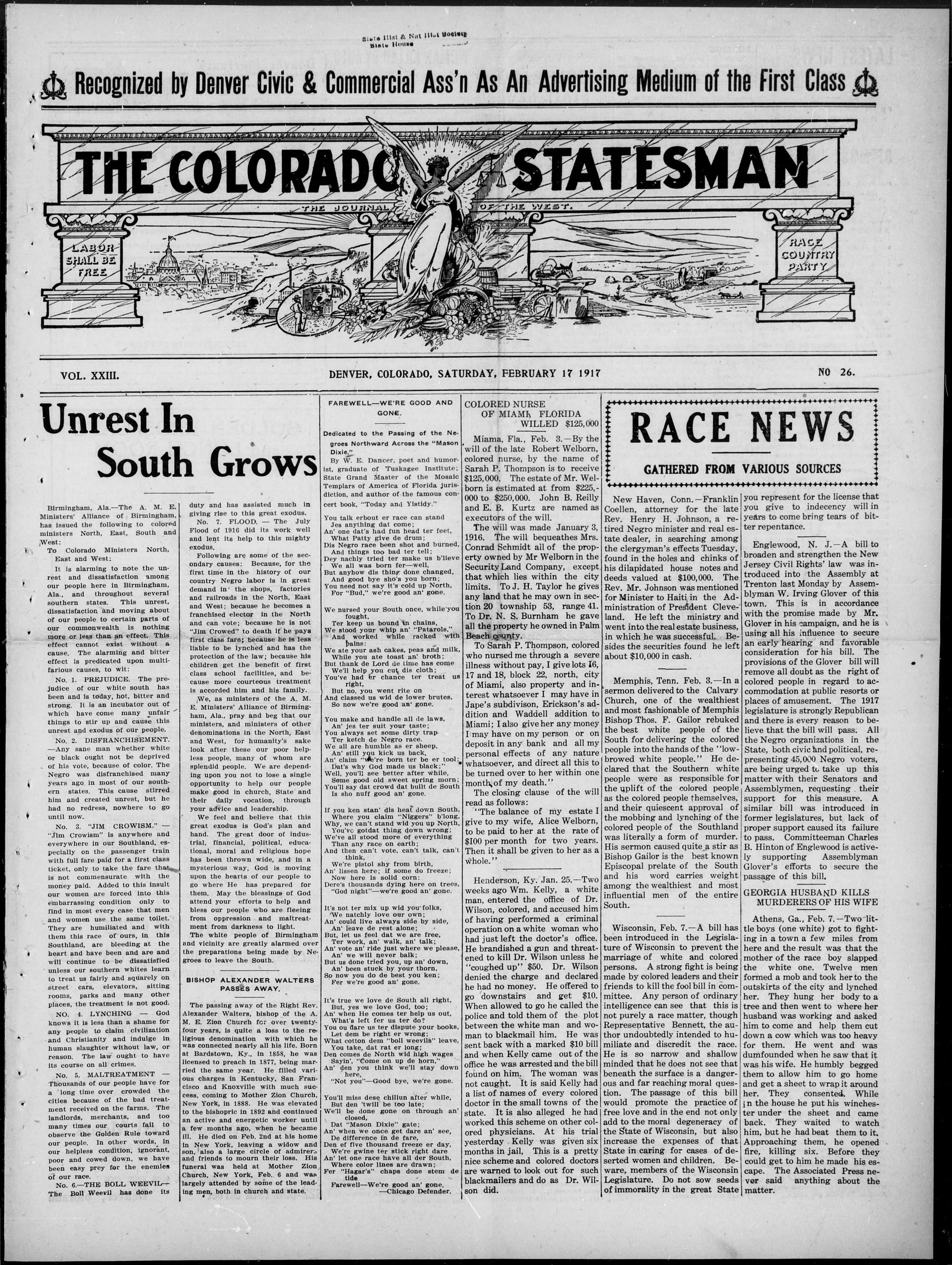
Unrest In South Grows
VOL. XXIII.
Unrest In South
Birmingham, Ala.—The A. M. E. Ministers' Alliance of Birmingham, has issued the following to colored ministers North, East, South and West:
To Colorado Ministers North, East and West:
It is alarming to note the unrest and dissatisfaction among our people here in Birmingham, Ala., and throughout several southern states. This unrest, dissatisfaction and moving about of our people to certain parts of our commonwealth is nothing more or less than an effect. This effect cannot exist without a cause. The alarming and bitter effect is predicated upon multifarious causes, to wit:
No. 1. PREJUDICE. The prejudice of our white south has been and is today, hot, bitter and strong. It is an incubator out of which have come many unfair things to stir up and cause this unrest and exodus of our people.
No. 2. DISFRANCHISEMENT.—Any sane man whether white or black ought not be deprived of his vote, because of color. The Negro was disfranchised many years ago in most of our southern states. This cause stirred him and created unrest, but he had no redress, nowhere to go until now.
No. 3. "JIM CROWISM." — "Jim Crowism" is anywhere and everywhere in our Southland, especially on the passenger train with full fare paid for a first class ticket, only to take the fare that is not commensurate with the money paid. Added to this insult our women are forced into this embarrassing condition only to find in most every case that men and women use the same toilet. They are humiliated and with them this race of ours, in this Southland, are bleeding at the heart and have been and are and will continue to be dissatisfied unless our southern whites learn to treat us fairly and squarely on street cars, elevators, sitting rooms, parks and many other places, the treatment is not good. NO. 4. LYNCHING — God knows it is less than a shame for any people to claim civilization and Christianity and indulge in human slaughter without law, or reason. The law ought to have its course on all crimes.
No. 5. MALTREATMENT — Thousands of our people have for a long time over crowded the cities because of the bad treatment received on the farms. The landlords, merchants, and too many times our courts fail to observe the Golden Rule toward our people. In other words, in our helpless condition, ignorant, poor and cowed down, we have been easy prey for the enemies of our race.
No. 6.—THE BOLL WEEVIL—The Boll Weevil has done its
duty and has assisted much in giving rise to this great exodus. No. 7. FLOOD. — The July Flood of 1916 did its work well and lent its help to this mighty exodus.
Following are some of the secondary causes: Because, for the first time in the history of our country Negro labor is in great demand in the shops, factories and railroads in the North, East and West; because he becomes a franchised elector in the North and can vote; because he is not "Jim Crowed" to death if he pays first class fairs; because he is less liable to be lynched and has the protection of the law; because his children get the benefit of first class school facilities, and because more courteous treatment is accorded him and his family.
We, as ministers of the A. M. E. Ministers' Alliance of Birmingham, Ala., pray and beg that our ministers, and ministers of other denominations in the North, East and West, for humanity's sake look after these our poor helpless people, many of whom are splendid people. We are depending upon you not to lose a single opportunity to help our people make good in church, State and their daily vocation, through your advice and leadership.
We feel and believe that this great exodus is God's plan and hand. The great door of industrial, financial, political, educational, moral and religious hope has been thrown wide, and in a mysterious way, God is moving upon the hearts of our people to go where He has prepared for them. May the blessings of God attend your efforts to help and bless our people who are fleeing from oppression and maltreatment from darkness to light.
The white people of Birmingham and vicinity are greatly alarmed over the preparations being made by Negroes to leave the South.
BISHOP ALEXANDER WALTERS
PASSES AWAY.
The passing away of the Right Rev. Alexander Walters, bishop of the A. M. E. Zion Church for over twenty-four years, is quite a loss to the religious denomination with which he was connected nearly all his life. Born at Bardstown, Ky., in 1858, he was licensed to preach in 1877, being married the same year. He filled various charges in Kentucky, San Francisco and Knoxville with much success, coming to Mother Zion Church, New York, in 1888. He was elevated to the bishopric in 1892 and continued an active and energetic worker until a few months ago, when he became ill. He died on Feb. 2nd at his home in New York, leaving a widow and son, also a large circle of admirers and friends to mourn their loss. His funeral was held at Mother Zion Church, New York, Feb. 6 and was largely attended by some of the leading men, both in church and state.
DENVER, COLORADO, SATURDAY, FEBRUARY 17 1917
State Hist & Nat Hist Biosci
State House
Commercial Ass'n
ADO
E JOURNAL
DENVER, COLORADO, SATUR
FAREWELL—WE'RE GOOD AND GONE.
Dedicated to the Passing of the Negroes Northward Across the "Mason Dixie."
By W. E. Dancer, poet and humorist, graduate of Tuskagee Institute; State Grand Master of the Mosaic Templars of America of Florida jurisdiction, and author of the famous concert book, "Today and Yistidy."
You talk erobut er race can stand
Jes anything dat come;
An' one dat's had fun head ter feet,
What Patty give de drum;
Dis Negro race been shot and burned,
And things too bad ter tell;
Dey nachly tried ter make us b'lieve
We all was born fer—well,
But anyhow dis thing done changed,
And good bye sho's you born;
You need not say it's cold up North,
For "Bud," we're good an' gone.
We nursed your South once, while you fought,
Ter keep us bound in chains,
We stood your whip an' "Patarols,"
And worked while racked with
pains:
We ate your ash cakes, peas and milk,
While you ate toast an' broth;
But thank de Lord de time has come
We'll help you cut dis cloth;
You've had er chance ter treat us
right,
But no, you went rite on
And classed us wid de lower brutes,
So now we're good an' gone.
You make and handle all de laws,
An' jes ter suit your taste;
You always set some dirty trap
Ter ketch de Negro race.
We all are humble as er sheep,
An' still you kick us back,
An' claim "we're born ter be er tool;
Dat's why God made us black;"
Well, you'll see better after while,
Some good old sweet spring morn;
You'll say dat crowd dat built de South
Is sho nuff good an' gone.
If you ken stan' dis heat down South,
Where you claim "Niggers" b'long,
Why, we can't stand wid you up North,
You've gotdat thing down wrong;
We've all stood more of everything
Than any race on earth;
And then can't vote, can't talk, can't
think,
We're pistol shy from birth,
An' lissen here; if some do freeze;
Now here is solid corn;
Dere's thousands dying here on trees,
"God night"—we're good an' gone.
It's not ter mix up wid you folks,
We natchly love our own;
An' could live always side by side,
An' leave de rest alone;
But, let us feel dat we are free,
Ter work, an' walk, an' talk;
An' vote an' ride just where we please,
An' we will never balk;
But us done tried you, up an' down,
An' been stuck by your thorn,
So now you do de best you ken;
Fer we're good an' gone.
It's true we love de South all right,
But, yes we love God, too;
An' when He comes ter help us out,
What's left fer us ter do?
You ou dare us ter dispute your books,
Let dem be right er wrong;
What cotton dem "boll weevils" leave,
You take, dat rat er long;
Den comes de North wid high wages
Sayin', "Come on up de horn,
An' den you think we'll stay down
here,
"Not you"—Good bye, we're gone.
You'll miss dese chillun after while,
But den 'twill be too late;
We'll be done gone on through an'
closed,
Dat "Mason Dixie" gate;
An' when we once get dare an' see,
De difference in de fare,
Den ef five thousand freeze er day,
We're gwine t stick right dare
An' let one race have all der South,
Where color lines are drawn.
COLORED NURSE
Miama, Fla., Feb. 3.—By the will of the late Robert Welborn, colored nurse, by the name of Sarah P. Thompson is to receive $125,000. The estate of Mr. Welborn is estimated at from $225,000 to $250,000. John B. Reilly and E. B. Kurtz are named as executors of the will. The will was made January 3, 1916. The will bequeathes Mrs. Conrad Schmidt all of the property owned by Mr Welborn in the Security Land Company, except that which lies within the city limits. To J. H. Taylor he gives any land that he may own in section 20 township 53, range 41. To Dr. N. S. Burnham he gave all the property he owned in Palm Beach county.
To Sarah P. Thompson, colored who nursed me through a severe illness without pay, I give lots 16, 17 and 18, block 22, north, city of Miami, also property and interest whatsoever I may have in Jape's subdivison, Erickson's addition and Waddell addition to Miami; I also give her any money I may have on my person or on deposit in any bank and all my personal effects of any nature whatsoever, and direct all this to be turned over to her within one month of my death."
The closing clause of the will read as follows:
"The balance of my estate I give to my wife, Alice Welborn, to be paid to her at the rate of $100 per month for two years. Then it shall be given to her as a whole."
Henderson, Ky. Jan. 25.—Two weeks ago Wm. Kelly, a white man, entered the office of Dr. Wilson, colored, and accused him of having performed a criminal operation on a white woman who had just left the doctor's office. He brandished a gun and threatened to kill Dr. Wilson unless he "coughed up" $50. Dr. Wilson denied the charge and declared he had no money. He offered to go downstairs and get $10. When allowed to go he called the police and told them of the plot between the white man and woman to blackmail him. He was sent back with a marked $10 bill and when Kelly came out of the office he was arrested and the bill found on him. The woman was not caught. It is said Kelly had a list of names of every colored doctor in the small towns of the state. It is also alleged he had worked this scheme on other colored physicians. At his trial yesterday Kelly was given six months in jail, This is a pretty nice scheme and colored doctors are warned to look out for such blackmailers and do as Dr. Wilson did.
RACE NEWS
New Haven, Conn.—Franklin Coellen, attorney for the late Rev. Henry H. Johnson, a retired Negro minister and real estate dealer, in searching among the clergyman's effects Tuesday, found in the holes and chinks of his dilapidated house notes and deeds valued at $100,000. The Rev. Mr. Johnson was mentioned for Minister to Haiti in the Administration of President Cleveland. He left the ministry and went into the real estate business, in which he was successful. Besides the securities found he left about $10,000 in cash.
Memphis, Tenn. Feb. 3.—In a sermon delivered to the Calvary Church, one of the wealthiest and most fashionable of Memphis Bishop Thos. F. Gailor rebuked the best white people of the South for delivering the colored people into the hands of the "lowbrowed white people." He declared that the Southern white people were as responsible for the uplift of the colored people as the colored people themselves, and their quiescent approval of the mobbing and lynching of the colored people of the Southland was literally a form of murder. His sermon caused quite a stir as Bishop Gailor is the best known Episcopal prelate of the South and his word carries weight among the wealthiest and most influential men of the entire South.
Wisconsin, Feb. 7.—A bill has been introduced in the Legislature of Wisconsin to prevent the marriage of white and colored persons. A strong fight is being made by colored leaders and their friends to kill the fool bill in committee. Any person of ordinary intelligence can see that this is not purely a race matter, though Representative Bennett, the author undoubtedly intended to humiliate and discredit the race. He is so narrow and shallow minded that he does not see that beneath the surface is a dangerous and far reaching moral question. The passage of this bill would promote the practice of free love and in the end not only add to the moral degeneracy of the State of Wisconsin, but also increase the expenses of that State in caring for cases of deserted women and children. Beware, members of the Wisconsin Legislature. Do not sow seeds of immorality in the great State
NO 26.
you represent for the license that you give to indecency will in years to come bring tears of bitter repentance.
Englewood, N. J.—A bill to broaden and strengthen the New Jersey Civil Rights' law was introduced into the Assembly at Trenton last Monday by Assemblyman W. Irving Glover of this town. This is in accordance with the promise made by Mr. Glover in his campaign, and he is using all his influence to secure an early hearing and favorable consideration for his bill. The provisions of the Glover bill will remove all doubt as the right of colored people in regard to accommodation at public resorts or places of amusement. The 1917 legislature is strongly Republican and there is every reason to believe that the bill will pass. All the Negro organizations in the State, both civic and political, representing 45,000 Negro voters, are being urged to take up this matter with their Senators and Assemblymen, requesting their support for this measure. A similar bill was introduced in former legislatures, but lack of proper support caused its failure to pass. Committeeman Charles B. Hinton of Englewood is actively supporting Assemblyman Glover's efforts to secure the passage of this bill.
GEORGIA HUSBAND KILLS MURDERERS OF HIS WIFE
Athens, Ga., Feb. 7. —Two little boys (one white) got to fighting in a town a few miles from here and the result was that the mother of the race boy slapped the white one. Twelve men formed a mob and took her to the outskirts of the city and lynched her. They hung her body to a tree and then went to where her husband was working and asked him to come and help them cut down a cow which was too heavy for them. He went and was dumfounded when he saw that it was his wife. He humbly begged them to allow him to go home and get a sheet to wrap it around her. They consented. While in the house he put his winchester under the sheet and came back. They waited to watch him, but he had beat them to it. Approaching them, he opened fire, killing six. Before they could get to him he made his escape. The Associated Press never said anything about the matter.
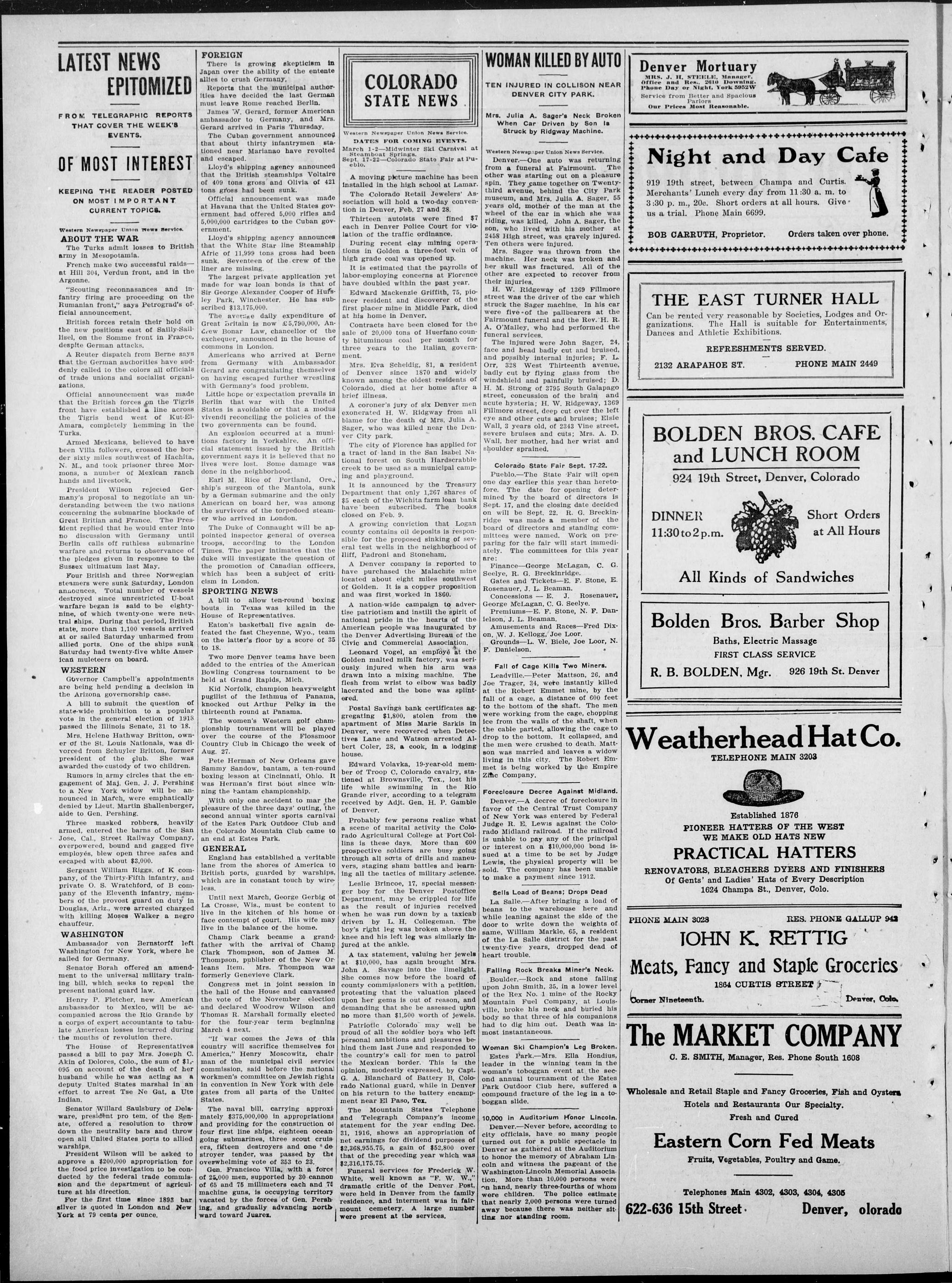
LATEST NEWS EPITOMIZED
FROM TELEGRAPHIC REPORTS THAT COVER THE WEEK'S EVENTS.
OF MOST INTEREST
OF MOST INTEREST
KEEPING THE READER POSTED ON MOST IMPORTANT CURRENT TOPICS.
Western Newspaper Union News Service.
ABOUT THE WAR
The Turks admit losses to British army in Mesopotamia.
French make two successful raids—at Hill 304, Verdun front, and in the Argonne.
"Scouting reconnaisances and infantry firing are proceeding on the Rumanian front," says Petrograd's official announcement.
British forces retain their hold on the new positions east of Sailly-Sallisel, on the Somme front in France, despite German attacks.
A Reuter dispatch from Berne says that the German authorities have suddenly called to the colors all officials of trade unions and socialist organizations.
Official announcement was made that the British forces on the Tigris front have established a line across the Tigris bend west of Kut-El-Amara, completely hemming in the Turks.
Armed Mexicans, believed to have been Villa followers, crossed the border sixty miles southwest of Hachita, N. M., and took prisoner three Mormons, a number of Mexican ranch hands and livestock.
President Wilson rejected Germany's proposal to negotiate an understanding between the two nations concerning the submarine blockade of Great Britian and France. The President replied that he would enter into no discussion with Germany until Berlin calls off ruthless submarine warfare and returns to observance of the pledges given in response to the Sussex ultimatum last May.
Four British and three Norwegian steamers were sunk Saturday, London announces. Total number of vessels destroyed since unrestricted U-boat warfare began is said to be eighty-nine, of which twenty-one were neutral ships. During that period, British state, more than 1,100 vessels arrived at or sailed Saturday unharmed from allied ports. One of the ships sunk Saturday had twenty-five white American muleteers on board.
WESTERN
Governor Campbell's appointments are being held pending a decision in the Arizona governorship case.
A bill to submit the question of state-wide prohibition to a popular vote in the general election of 1918 passed the Illinois Senate, 31 to 18.
Mrs. Helene Hathway Britton, owner of the St. Louis Nationals, was divorced from Schuyler Britton, former president of the club. She was awarded the custody of two children.
Rumors in army circles that the engagement of Maj. Gen. J. J. Pershing to a New York widow will be announced in March, were emphatically denied by Lieut. Martin Shallenberger, aide to Gen. Pershing.
Three masked robbers, heavily armed, entered the barns of the San Jose, Cal., Street Railway Company, overpowered, bound and gagged five employees, blew open three safes and escaped with about $3,000.
Sergeant William Riggs, of K company, of the Thirty-Fifth infantry, and private O. S. Wratchford, of B company of the Eleventh infantry, members of the provost guard on duty in Douglas, Ariz., were arrested charged with killing Moses Walker a negro chauffeur.
WASHINGTON
Ambassador von Bernstorff left Washington for New York, where he sailed for Germany.
Senator Borah offered an amendment to the universal military training bill, which seeks to repeal the present national guard law.
Henry P. Fletcher, new American ambassador to Mexico, will be accompanied across the Rio Grande by a corps of expert accountants to tabulate American losses incurred during the months of revolution there.
The House of Representatives passed a bill to pay Mrs. Joseph C. Akin of Dolores, Colo., the sum of $1,095 on account of the death of her husband while he was acting as a deputy United States marshal in an effort to arrest Tse Ne Gat, a Ute Indian.
Senator Willard Saulsbury of Delaware, president pro tem, of the Senate, offered a resolution to throw down the neutrality bars and throw open all United States ports to allied warships.
President Wilson will be asked to approve a $200,000 appropriation for the food price investigation to be conducted by the federal trade commission and the department of agriculture at his direction.
For the first time since 1893 bar silver is quoted in London and New York at 79 cents per ounce.
FOREIGN
There is growing skepticism in Japan over the ability of the entente allies to crush Germany.
Reports that the municipal authorities have decided the last German must leave Rome reached Berlin.
James W. Gerard, former American ambassador to Germany, and Mrs. Gerard arrived in Paris Thursday.
The Cuban government announced that about thirty infantrymen stationed near Marianao have revolted and escaped.
Lloyd's shipping agency announced that the British steamships Voltaire of 409 tons gross and Olivia of 421 tons gross had been sunk.
Official announcement was made at Havana that the United States government had offered 5,000 rifles and 5,000,000 cartridges to the Cuban government.
Lloyd's shipping agency announces that the White Star line Steamship Afric of 11,999 tons gross had been sunk. Seventeen of the crew of the liner are missing.
The largest private application yet made for war loan bonds is that of Sir George Alexander Cooper of Hufsley Park, Winchester. He has subscribed $13,175,000.
The average daily expenditure of Great Britain is now £5,790,000, Andrew Bonar Law, chancellor of the exchequer, announced in the house of commons in London.
Americans who arrived at Berne from Germany with Ambassador Gerard are congratulating themselves on having escaped further wrestling with Germany's food problem.
Little hope or expectation prevails in Berlin that war with the United States is avoidable or that a modus vivendi reconciling the policies of the two governments can be found.
An explosion occurred at a munitions factory in Yorkshire. An official statement issued by the British government says it is believed that no lives were lost. Some damage was done in the neighborhood.
Earl M. Rice of Portland, Ore., ship's surgeon of the Mantola, sunk by a German submarine and the only American on board her, was among the survivors of the torpeded steamer who arrived in London.
The Duke of Connaught will be appointed inspector general of oversea troops, according to the London Times. The paper intimates that the duke will investigate the question of the promotion of Canadian officers, which has been a subject of criticism in London.
SPORTING NEWS
A bill to allow ten-round boxing bouts in Texas was killed in the House of Representatives.
Eaton's basketball five again defeated the fast Cheyenne, Wyo., team on the latter's floor by a score of 35 to 18.
Two more Denver teams have been added to the entries of the American Bowling Congress tournament to be held at Grand Rapids, Mich.
Kid Norfolk, champion heavyweight pugilist of the 1sthmus of Panama, knocked out Arthur Pelky in the thirteenth round at Panama.
The women's Western golf championship tournament will be played over the course of the Flossmoor Country Club in Chicago the week of Aug. 27.
Pete Herman of New Orleans gave Sammy Sandow, bantam, a ten-round boxing lesson at Cincinnati, Ohio. It was Herman's first bout since winning the bantam championship. With only one accident to mar the pleasure of the three days' outing, the second annual winter sports carnival of the Estes Park Outdoor Club and the Colorado Mountain Club came to an end at Estes Park.
GENERAL
England has established a veritable lane from the shores of America to British ports, guarded by warships, which are in constant touch by wireless.
Until next March, George Gerbig of La Crosse, Wis., must be content to live in the kitchen of his home or face contempt of court. His wife may live in the balance of the home.
Champ Clark became a grandfather with the arrival of Champ Clark Thompson, son of James M. Thompson, publisher of the New Orleans Item. Mrs. Thompson was formerly Genevieve Clark.
Congress met in joint session in the hall of the House and canvassed the vote of the November election and declared Woodrow Wilson and Thomas R. Marshall formally elected for the four-year term beginning March 4 next.
"If war comes the Jews of this country will sacrifice themselves for America," Henry Moscowitz, chairman of the municipal civil service commission, said before the national workmen's committee on Jewish rights in convention in New York with delegates from all parts of the United States.
The naval bill, carrying approximately $375,000,000 in appropriations and providing for the construction of four first line ships, eighteen ocean-going submarines, three scout cruisers, fifteen destroyers and one *destroyer tender*, was passed by the overwhelming vote of 353 to 23.
Gen. Francisco Villa, with a force of 25,000 men, supported by 30 cannon of 65 and 75 millimeters each and 75 machine guns, is occupying territory vacated by the forces of Gen. Pershing, and gradually advancing northward toward Juarez.
Western Newspaper Union News Service.
DATES FOR COMING EVENTS.
March 1-2—Midwinter Ski Carnival at
Steamboat Springs.
Sept. 17-22—Colorado State Fair at Pu-
eblo.
The Colorado Retail Jewelers' Association will hold a two-day convention in Denver, Feb. 27 and 28. Thirteen autoists were fined $7 each in Denver Police Court for violation of the traffic ordinance. During recent clay mining operations in Golden a three-foot vein of high grade coal was opened up. It is estimated that the payrolls of labor-employing concerns at Florence have doubled within the past year. Edward Mackenzie Griffith, 75, pioneer resident and discoverer of the first placer mine in Middle Park, died at his home in Denver. Contracts have been closed for the sale of 20,000 tons of Huerfano county bituminous coal per month for three years to the Italian government.
Mrs. Eva Scheldig, $1, a resident of Denver since 1870 and widely known among the oldest residents of Colorado, died at her home after a brief illness.
A coroner's jury of six Denver men exonerated H. W. Ridgway from all blame for the death of Mrs. Julia A. Sager, who was killed near the Denver City park.
The city of Florence has applied for a tract of land in the San Isabel National forest on South Hardscrabble creek to be used as a municipal camping and playground.
It is announced by the Treasury Department that only 1,267 shares of $5 each of the Wichita farm loan bank have been subscribed. The books closed on Feb. 9.
A growing conviction that Logan county contains oil deposits is responsible for the proposed sinking of several test wells in the neighborhood of Iliff, Padroni and Stoneham.
A Denver company is reported to have purchased the Malachite mine located about eight miles southwest of Golden. It is a copper proposition and was first worked in 1860.
A nation-wide campaign to advertise patriotism and instill the spirit of national pride in the hearts of the American people was inaugurated by the Denver Advertising Bureau of the Civic and Commercial Association.
Leonard Vogel, an employee at the Golden malted milk factory, was seriously injured when his arm was drawn into a mixing machine. The flesh from wrist to elbow was badly lacerated and the bone was splintered.
Postal Savings bank certificates aggregating $1,800, stolen from the apartment of Miss Marie Sarkis in Denver, were recovered when Detectives Lane and Watson arrested Albert Coler, 28, a cook, in a lodging house.
Edward Volavka, 19-year-old member of Troop C, Colorado cavalry, stationed at Brownsville, Tex., lost his life while swimming in the Rio Grande river, according to a telegram received by Adjt. Gen. H. P. Gamble of Denver.
Probably few persons realize what a scene of marital activity the Colorado Agricultural College at Fort Collins is these days. More than 600 prospective soldiers are busy going through all sorts of drills and maneuvers, staging sham battles and learning all the tactics of military science.
Leslie Brincoe, 17, special messenger boy for the Denver Postoffice Department, may be crippled for life as the result of injuries received when he was run down by a taxicab driven by L. H. Collegeman. The boy's right leg was broken above the knee and his left leg was similarly injured at the ankle.
A tax statement, valuing her jewels at $10,000, has again brought Mrs. John A. Savage into the limelight. She comes now before the board of county commissioners with a petition, protesting that the valuation placed upon her gems is out of reason, and demanding that she be assessed upon no more than $1,500 worth of jewels.
Patriotic Colorado may well be proud of all the soldier boys who left personal ambitions and pleasures behind them last June and responded to the country's call for men to patrol the Mexican border. This is the opinion, modestly expressed, by Capt. G. A. Blanchard of Battery B, Colorado National guard, while in Denver on his return to the battery encampment near El Paso, Tex.
The Mountain States Telephone and Telegraph Company's income statement for the year ending Dec. 31, 1916, shows an appropriation of net earnings for dividend purposes of $2,368,955.75, a gain of $52,800 over that of the preceding year which was $2,316,175.75.
Funeral services for Frederick W. White, well known as "F. W. W." dramatic critic of the Denver Post, were held in Denver from the family residence, and interment was in fairmount cemetery. A large number were present at the services.
WOMAN KILLED BY AUTO
TEN INJURED IN COLLISION NEAR DENVER CITY PARK.
Mrs. Julia A. Sager's Neck Broken When Car Driven by Son Is Struck by Ridgway Machine.
Western Newspaper Union News Service.
Denver.—One auto was returning from a funeral at Fairmount. The other was starting out on a pleasure spin. They came together on Twenty-third avenue, behind the City Park museum, and Mrs. Julia A. Sager, 55 years old, mother of the man at the wheel of the car in which she was riding, was killed. John A. Sager, the son, who lived with his mother at 2458 High street, was gravely injured. Ten others were injured.
Mrs. Sager was thrown from the machine. Her neck was broken and her skull was fractured. All of the other are expected to recover from their injuries.
H. W. Ridgeway of 1369 Fillmore street was the driver of the car which struck the Sager machine. In his car were five-of the palbearers at the Fairmount funeral and the Rev. H. R. A. O'Malley, who had performed the funeral services.
The injured were John Sager, 24, face and head badly cut and bruised, and possibly internal injuries; F. L. Orr, 328 West Thirteenth avenue, badly cut by flying glass from the windshield and painfully bruised; D. H. M. Strong of 3795 South Galapago street, concussion of the brain and acute hysteria; H. W. Ridgeway, 1369 Fillmore street, deep cut over the left eye and other cuts and bruises; Elsie Wall, 3 years old, of 2343 Vine street, severe bruises and cuts; Mrs. A. D. Wall, her mother, had her wrist and shoulder sprained.
Colorado State Fair Sept. 17-22.
Pueblo.—The State Fair will open one day earlier this year than heretofore. The date for opening determined by the board of directors is Sept. 17, and the closing date decided on will be Sept. 22. R. G. Breckinridge was made a member of the board of directors and standing committees were named. Work on preparing for the fair will start immediately. The committees for this year are:
Finance—George McLagan, C. G. Seelye, R. G. Breckinridge.
Gates and Tickets—E. F. Stone, E. Rosenauer, J. L. Beaman.
Concessions — E. J. Rosenauer, George McLagan, C. G. Seelye.
Premiums—E. F. Stone, N. F. Danielson, J. L. Beaman.
Amusements and Races—Fred Dixon W. J. Kellogg, Joe Loor.
Grounds—L. W. Biele, Joe Loor, N.
F. Danielson.
Fall of Cage Kills Two Miners.
Leadville.—Peter Mattson, 26, and Joe Trager, 34, were instantly killed at the Robert Emmet mine, by the fall of a cage, a distance of 600 feet to the bottom of the shaft. The men were working from the cage, chopping ice from the walls of the shaft, when the cable parted, allowing the cage to drop to the bottom. It collapsed, and the men were crushed to death. Mattson was married and leaves a widow living in this city. The Robert Emmet is being worked by the Empire Zinc Company.
Foreclosure Decree Against Midland.
Foreclosure Decree Against Midland.
Denver.—A decree of foreclosure in favor of the Central Trust Company of New York was entered by Federal Judge R. E. Lewis against the Colorado Midland railroad. If the railroad is unable to pay any of the principal or interest on a $10,000,000 bond issued at a time to be set by Judge Lewis, the physical property will be sold. The company has been unable to make a payment since 1912.
Sells Load of Beans; Drops Dead
La Salle.—After bringing a load of beans to the warehouse here and while leaning against the side of the door to write down the weights of same, William Markle, 65, a resident of the La Salle district for the past twenty-five years, dropped dead of heart trouble.
Falling Rock Breaks Miner's Neck.
Boulder.—Rock and stone falling upon John Smith, 35, in a lower level of the Rex No. 1 mine of the Rocky Mountain Fuel Company, at Louisville, broke his neck and buried his body so that three of his companions had to dig him out. Death was inmost instantaneous.
Woman Ski Champion's Leg Broken.
Estes Park.—Mrs. Ella Hondius, leader in the winning team in the woman's toboggan event at the second annual tournament of the Estes Park Outdoor Club here, suffered a compound fracture of the leg in a toboggan slide.
10,000 in Auditorium Honor Lincoln.
Denver.—Never before, according to city officials, have so many people turned out for a public spectacle in Denver as gathered at the Auditorium to honor the memory of Abraham Lincoln and witness the pageant of the Washington-Lincoln Memorial Association. More than 10,000 persons were on hand, nearly three-fourths of whom were children. The police estimate that nearly 2,000 persons were turned away because there was neither sitting nor standing room.
Denver Mortuary
MRS. J. H. STEELE, Manager.
Office and Res., 2610 Downing.
Phone Day or Night, York 5952W
Service from Better and Spacious
Parlors
Our Prices Most Reasonable.
Night and
919 19th street, between
Merchants' Lunch every day
3:30 p. m., 20c. Short order
us a trial. Phone Main 669
BOB CARRUTH, Proprietor
THE EAST T
Can be rented very reasonable
ganizations. The Hall is
Dances and Athletic Exhibit
REFRESHM
Right and Day Care
with street, between Champa and Curtis.
Presents' Lunch every day from 11:30 a. m. to
m., 20c. Short orders at all hours. Give
al. Phone Main 6699.
ARRUTH, Proprietor. Orders taken over
THE EAST TURNER HALL
rented very reasonable by Societies, Lodges
ions. The Hall is suitable for Entertain-
and Athletic Exhibitions.
REFRESHMENTS SERVED.
Night and Day Cafe
919 19th street, between Champa and Curtis. Merchants' Lunch every day from 11:30 a. m. to 3:30 p. m., 20c. Short orders at all hours. Give us a trial. Phone Main 6699.
THE EAST TURNER HALL
Can be rented very reasonable by Societies, Lodges and Organizations. The Hall is suitable for Entertainments, Dances and Athletic Exhibitions.
2132 ARAPAHOE ST.
BOLDEN
and LUN
924 19th Street
OLDEN BROS. CA
and LUNCH ROOM
1924 19th Street, Denver, Colorado
924 19th Street, Denver, Colorado
NNER
30 to 2 p.m. Short Or
at All He
DINNER
11:30 to 2 p.m.
All Kinds of Sandwiches Bolden Bros. Barber Sh
ilden Bros. Barber Sh Baths, Electric Massage FIRST CLASS SERVICE
R. B. BOLDEN, M
Weatherh
TELEPHON
BOLDEN, Mgr. 926 19th St. D
atherhead Hat
TELEPHONE MAIN 3203
R. B. BOLDEN, Mgr. 926 19th St. Denver
Weatherhead Hat Co. TELEPHONE MAIN 3203
Established 1876
PIONEER HATTERS OF THE WEST
WE MAKE OLD HATS NEW
PRACTICAL
RENOVATORS, BLEACHE
Of Gents' and Ladies'
1624 Champa
HONE MAIN 3028
JOHN K.
Meats, Fancy and
1864 CURT
Corner Nineteenth.
The MARKET
C. E. SMITH, Manage
Wholesale and Retail Staple and
Hotels and Restau
Fresh a
Eastern Cor
PRACTICAL HATTERS
MATERORS, BLEACHERS DYERS AND FINISHERS
Gents' and Ladies' Hats of Every Description
1624 Champa St., Denver, Colo.
IN 3028 RES. PHONE G
JOHN K. RETTIG
Fancy and Staple Grocer
1864 CURTIS STREET
seventh.
MARKET COMP
E. SMITH, Manager, Res. Phone South 160
and Retail Staple and Fancy Groceries, Fish and Hotels and Restaurants Our Specialty.
Fresh and Cured
Eastern Corn Fed Meal
RENOVATORS, BLEACHERS DYERS AND FINISHERS Of Gents' and Ladies' Hats of Every Description 1624 Champa St., Denver, Colo.
The MARKET COMPANY
C. E. SMITH, Manager, Res. Phone South 1608
Wholesale and Retail Staple and Fancy Groceries, Fish and Oysters Hotels and Restaurants Our Specialty. Fresh and Cured
Eastern Corn Fed Meats
Fruits, Vegetables, Poultry and Game.
Telephones Main 4302, 4303, 4304, 430
22-636 15th Street Denver
Telephones Main 4302, 4303, 4304, 4305
15th Street Denver,
Telephones Main 4302, 4303, 4304, 4305
622-636 15th Street Denver, olorado
```markdown
```
A Day Cafe
Champa and Curtis.
from 11:30 a. m. to
s at all hours. Give
Orders taken over phone.
BURNER HALL
e by Societies, Lodges and Or-
suitable for Entertainments,
ions.
NTS SERVED.
PHONE MAIN 2449
BROS. CAFE
CH ROOM
Denver, Colorado
Short Orders at All Hours
Barber Shop
926 19th St. Denver
ead Hat Co.
E MAIN 3203
HATTERS
RES. DYERS AND FINISHERS
Meats of Every Description
t., Denver, Colo.
RES. PHONE GALLUP 942
RETTIG
Staple Groceries
IS STREET
Denver, Colo.
T COMPANY
Res. Phone South 1608
Fancy Groceries, Fish and Oysters
Plants Our Specialty.
and Cured
Fed Meats
02, 4303, 4304, 4305
Denver, olorado
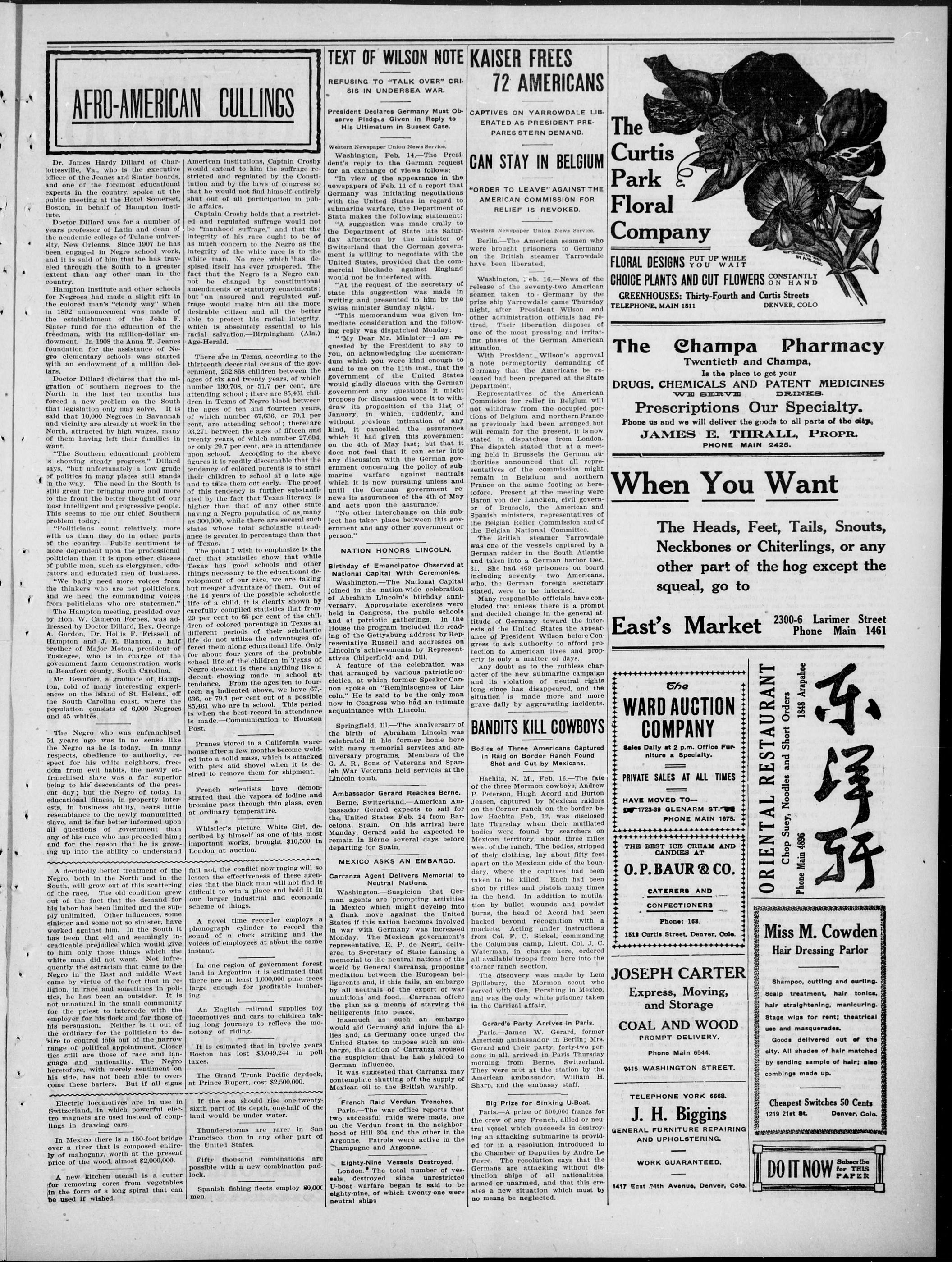
AFRO-AMERICAN CULLINGS
Dr. James Hardy Dillard of Charlottesville, Va., who is the executive officer of the Jeanes and Slater boards, and one of the foremost educational experts in the country, spoke at the public meeting at the Hotel Somerset, Boston, in behalf of Hampton Institute.
Doctor Dillard was for a number of years professor of Latin and dean of the academic college of Tulane university, New Orleans. Since 1907 he has been engaged in Negro school work, and it is said of him that he has traveled through the South to a greater extent than any other man in the country.
Hampton institute and other schools for Negroes had made a slight rift in the colored man's "cloudy way" when in 1892 announcement was made of the establishment of the John F. Slater fund for the education of the freedman, with its million-dollar endowment. In 1908 the Anna T. Jeanes foundation for the assistance of Negro elementary schools was started with an endowment of a million dollars.
Doctor Dillard declares that the migration of southern negroes to the North in the last ten months has forced a new problem on the South that legislation only may solve. It is said that 10,000 Negroes in Savannah and vicinity are already at work in the North, attracted by high wages, many of them having left their families in want.
"The Southern educational problem is showing steady progress," Dillard says, "but unfortunately a low grade of politics in many places still stands in the way. The need in the South is still great for bringing more and more to the front the better thought of our most intelligent and progressive people. This seems to me our chief Southern problem today.
"Politicians count relatively more with us than they do in other parts of the country. Public sentiment is more dependent upon the professional politician than it is upon other classes of public men, such as clergymen, educators and educated men of business.
"We badly need more voices from the thinkers who are not politicians, and we need the commanding voices from politicians who are statesmen."
The Hampton meeting, presided over by Hon. W. Cameron Forbes, was addressed by Doctor Dillard, Rev. George A. Gordon, Dr. Hollis F. Frissell of Hampton and J. E. Blanton, a half brother of Major Moton, president of Tuskegee, who is in charge of the government farm demonstration work in Beaufort county, South Carolina.
Mr. Beaufort, a graduate of Hampton, told of many interesting experiences on the island of St. Helena, off the South Carolina coast, where the population consists of 6,000 Negroes and 45 whites.
The Negro who was enfranchised 54 years ago was in no sense like the Negro as he is today. In many respects, obedience to authority, respect for his white neighbors, freedom from evil habits, the newly enfranchised slave was a far superior being to his descendants of the present day; but the Negro of today in educational fitness, in property interests, in business ability, bears little resemblance to the newly manumitted slave, and is far better informed upon all questions of government than any of his race who has preceded him; and for the reason that he is growing up into the ability to understand
A decidedly better treatment of the Negro, both in the North and in the South, will grow out of this scattering of the race. The old condition grew out of the fact that the demand for his labor has been limited and the supply unlimited. Other influences, some sinister and some not so sinister, have worked against him. In the South it has been that old and seemingly ineradicable prejudice which would give to him only those things which the white man did not want. Not infrequently the ostracism that came to the Negro in the East and middle West came by virtue of the fact that in religion, in race and sometimes in politics, he has been an outsider. It is not unnatural in the small community for the priest to intercede with the employer for his flock and for those of his persuasion. Neither is it out of the ordinary for the politician to desire to control jobs out of the narrow range of political appointment. Closer ties still are those of race and language and nationality. The Negro heretofore, with merely sentiment on his side, has not been able to overcome these barriers. But if all signs
Electric locomotives are in use in Switzerland, in which powerful electro magnets are used instead of couplings in drawing cars.
In Mexico there is a 150-foot bridge over a river that is composed entirely of mahogany, worth at the present price of the wood, almost $2,000,000.
A new kitchen utensil is a cutter for removing cores from vegetables in the form of a long spiral that can be used if wished.
American institutions, Captain Crosby would extend to him the suffrage restricted and regulated by the Constitution and by the laws of congress so that he would not find himself entirely shut out of all participation in public affairs.
Captain Crosby holds that a restricted and regulated suffrage would not be "manhood suffrage," and that the integrity of his race ought to be of as much concern to the Negro as the integrity of the white race is to the white man. No race which has desplied itself has ever prospered. The fact that the Negro is a Negro cannot be changed by constitutional amendments or statutory enactments; but an assured and regulated suffrage would make him all the more desirable citizen and all the better able to protect his racial integrity, which is absolutely essential to his racial salvation.—Birmingham (Ala.) Age-Herald.
There are in Texas, according to the thirteenth decennial census of the government, 252,868 children between the ages of six and twenty years, of which number 130,708, or 51.7 per cent, are attending school; there are 85,461 children in Texas of Negro blood between the ages of ten and fourteen years, of which number 67,636, or 79.1 per cent, are attending school; there are 93,271 between the ages of fifteen and twenty years, of which number 27,694, or only 29.7 per cent, are in attendance upon school. According to the above figures it is readily discernable that the tendency of colored parents is to start their children to school at a late age and to take them out early. The proof of this tendency is further substantiated by the fact that Texas literacy is higher than that of any other state having a Negro population of as many as 300,000, while there are several such states whose total scholastic attendance is greater in percentage than that of Texas.
The point I wish to emphasize is the fact that statistics show that while Texas has good schools and other things necessary to the educational development of our race, we are taking but meager advantage of them. Out of the 14 years of the possible scholastic life of a child, it is clearly shown by carefully compiled statistics that from 29 per cent to 65 per cent of the children of colored parentage in Texas at different periods of their scholastic life do not utilize the advantages offered them along educational life. Only for about four years of the probable school life of the children in Texas of Negro descent is there anything like a decent showing made in school attendance. From the ages ten to fourteen as indicated above, we have 67, 636, or 79.1 per cent out of a possible 85,454 who are in school. This period is when the best record in attendance is made.—Communication to Houston Post.
Prunes stored in a California warehouse after a few months become welded into a solid mass, which is attacked with pick and shovel when it is desired to remove them for shipment.
French scientists have demonstrated that the vapors of iodine and bromine pass through thin glass, even at ordinary temperature.
Whistler's picture, White Girl, described by himself as one of his most important works, brought $10,500 in London at auction.
fail not, the conflict now raging will so lessen the effectiveness of these agencies that the black man will not find it difficult to win a place and hold it in our larger industrial and economic scheme of things.
A novel time recorder employs a phonograph cylinder to record the sound of a clock striking and the voices of employees at about the same instant.
In one region of government forest land in Argentina it is estimated that there are at least 1,000,000 pine trees large enough for profitable lumbering.
An English railroad supplies toy locomotives and cars to children taking long journeys to refresh the monotony of riding.
It is estimated that in twelve years Boston has lost $3,049,244 in poll taxes.
The Grand Trunk Pacific drydock, at Prince Rupert, cost $2,500,000.
If the sea should rise one-twenty- sixth part of its depth, one-half of the land would be under water.
Thunderstorms are rarer in San Francisco than in any other part of the United States.
Fifty thousand combinations are possible with a new combination padlock.
Spanish fishing fleets employ 80,000 men.
TEXT OF WILSON NOTE
REFUSING TO "TALK OVER" CRISIS IN UNDERSEA WAR.
President Declares Germany Must Observe Pledges Given in Reply to His Ultimatum in Sussex Case.
Washington, Feb. 14.—The President's reply to the German request for an exchange of views follows:
"In view of the appearance in the newspapers of Feb. 11 of a report that Germany was initiating negotiations with the United States in regard to submarine warfare, the Department of State makes the following statement:
"A suggestion was made orally to the Department of State late Saturday afternoon by the minister of Switzerland that the German government is willing to negotiate with the United States, provided that the commercial blockade against England would not be interfered with.
"At the request of the secretary of state this suggestion was made in writing and presented to him by the Swiss minister Sunday night."
"This memorandum was given immediate consideration and the following reply was dispatched Monday:
"My Dear Mr. Minister—I am requested by the President to say to you, on acknowledging the memorandum which you were kind enough to send to me on the 11th inst., that the government of the United States would gladly discuss with the German government any questions it might propose for discussion were it to withdraw its proposition of the 31st of January, in which, suddenly, and without previous intimation of any kind, it cancelled the assurances which it had given this government on the 4th of May last; but that it does not feel that it can enter into any discussion with the German government concerning the policy of submarine warfare against neutrals which it is now pursuing unless and until the German government renews its assurances of the 4th of May and acts upon the assurance."
"No other interchange on this subject has taken place between this government and any other government or person."
NATION HONORS LINCOLN.
Birthday of Emancipator Observed at National Capital With Ceremonies. Washington.—The National Capital joined in the nation-wide celebration of Abraham Lincoln's birthday anniversary. Appropriate exercises were held in Congress, the public schools and at patriotic gatherings. In the House the program included the reading of the Gettysburg address by Representative Russell and addresses on Lincoln's achievements by Representatives Chiperfield and Dill. A feature of the celebration was that arranged by various patriotic societies, at which former Speaker Cannon spoke on "Reminiscences of Lincoln." He is said to be the only man now in Congress who had an intimate acquaintance with Lincoln.
Springfield, Ill.—The anniversary of the birth of Abraham Lincoln was celebrated in his former home here with many memorial services and anniversary programs. Members of the G. A. R., Sons of Veterans and Spanish War Veterans held services at the Lincoln tomb.
Ambassador Gerard Reaches Berne. Berne, Switzerland.—American Ambassador Gerard expects to sail for the United States Feb. 24 from Barcelona, Spain. On his arrival here Monday, Gerard said he expected to remain in Bérne several days before departing for Spain.
MEXICO ASKS AN EMBARGO.
Carranza Agent Delivers Memorial to Neutral Nations.
Washington.—Suspicion that German agents are prompting activities in Mexico which might develop into a flank move against the United States if this nation becomes involved in war with Germany was increased Monday. The Mexican government's representative, R. P. de Negri, delivered to Secretary of State Lansing a memorial to the neutral nations of the world by General Carranza, proposing mediation between the European belligerents and, if this fails, an embargo by all neutrals of the export of war munitions and food. Carranza offers the plan as a means of starving the belligerents into peace. Inasmuch as such an embargo would aid Germany and injure the allies and, as Germany once urged the United States to impose such an embargo, the action of Carranza aroused the suspicion that he has yielded to German influence.
It was suggested that Carranza may contemplate shutting off the supply of Mexican oil to the British warship.
French Raid Verdun Trenches.
Paris.—The war office reports that two successful raids were made, one on the Verdun front in the neighborhood of Hill 304 and the other in the Argonne. Patrols were active in the Champagne and Argonne.
Eighty-Nine Vessels Destroyed. London. The total number of vessels destroyed since unrestricted U-boat warfare began is said to be eighty-nine, of which twenty-one were neutral ships
CAPTIVES ON YARROWDALE LIBERATED AS PRESIDENT PREPARES STERN DEMAND.
CAN STAY IN BELGIUM
"ORDER TO LEAVE" AGAINST THE AMERICAN COMMISSION FOR RELIEF IS REVOKED.
Western Newspaper Union News Service.
Berlin.—The American seamen who were brought prisoners to Germany on the British steamer Yarrowdale have been liberated.
Washington, Feb. 16.—News of the release of the seventy-two American seamen taken to Germany by the prize ship Yarrowdale came Thursday night, after President Wilson and other administration officials had retired. Their liberation disposes of one of the most pressing and irritating phases of the German American situation.
With President_Wilson's approval a note permeptorily demanding of Germany that the Americans be released had been prepared at the State Department.
Representatives of the American Commission for relief in Belgium will not withdraw from the occupied portions of Belgium and northern France as previously had been arranged, but will remain for the present, it is now stated in dispatches from London. The dispatch stated that at a meeting held in Brussels the German authorities announced that all representatives of the commission might remain in Belgium and northern France on the same footing as heretofore. Present at the meeting were Baron von der Lancken, civil governor of Brussels, the American and Spanish ministers, representatives of the Belgian Relief Commission and of the Belgian National Committee.
The British steamer Yarrowdale was one of the vessels captured by a German raider in the South Atlantic and taken into a German harbor Dec. 31. She had 469 prisoners on board including seventy - two Americans, who, the German foreign secretary stated, were to be interned.
Many responsible officials have concluded that unless there is a prompt and decided change in the general attitude of Germany toward the interests of the United States the appearance of President Wilson before Congress to ask authority to afford protection to American lives and property is only a matter of days.
Any doubt as to the ruthless character of the new submarine campaign and its violation of neutral rights long since has disappeared, and the situation is made more and more grave daily by aggravating incidents.
BANDITS KILL COWBOYS
Bodies of Three Americans Captured in Raid on Border Ranch Found Shot and Cut by Mexicans.
Hachita, N. M., Feb. 16.—The fate of the three Mormon cowboys, Andrew P. Peterson, Hugh Acord and Burton Jensen, captured by Mexican raiders on the Corner ranch on the border below Hachita Feb. 12, was disclosed late Thursday when their mutilated bodies were found by searchers on Mexican territory, about three miles west of the ranch. The bodies, stripped of their clothing, lay about fifty feet apart on the Mexican side of the boundary, where the captives had been taken to be killed. Each had been shot by rifles and pistols many times in the head. In addition to mutilation by bullet wounds and powder burns, the head of Acord had been hacked beyond recognition with a machete. Acting under instructions from Col. F. C. Sickel, commanding the Columbus camp, Lieut. Col. J. C. Waterman, in charge here, ordered all available troops from here into the Corner ranch section.
The discovery was made by Lem Spillsbury, the Mormon scout who served with Gen. Pershing in Mexico, and was the only white prisoner taken in the Carrizal affair.
Gerard's Party Arrives in Paris.
Paris.—James W. Gerard, former American ambassador in Berlin; Mrs. Gerard and their party, forty-two persons in all, arrived in Paris Thursday morning from Berne, Switzerland. They were met at the station by the American ambassador, William H. Sharp, and the embassy staff.
Big Prize for Sinking U-Boat.
Paris.—A prize of 500,000 francs for the crew of any French, allied or neutral vessel which succeeds in destroying an attacking submarine is provided for in a resolution introduced in the Chamber of Deputies by Andre Le Fevre. The resolution says that the Germans are attacking without distinction ships of all nationalities, armed or unarmed, and that this creates a new situation which must by no means be neglected.
FLORAL DESIGNS PUT UP WHILE YOU WAIT
CHOICE PLANTS AND CUT FLOWERS CONSTANTLY ON HAND
GREENHOUSES: Thirty-Fourth and Curtis Streets
TELEPHONE, MAIN 1811 DENVER, COLO
The Champa Pharmacy
Twentieth and Champa,
Is the place to get your
DRUGS, CHEMICALS AND PATENT MEDICINES
WE SERVE DRINKS.
Prescriptions Our Specialty.
Phone us and we will deliver the goods to all parts of the city.
JAMES E. THRALL, PROPR.
PHONE MAIN 2425.
When You Want
The Heads, Feet, Tails, Snouts, Neckbones or Chiterlings, or any other part of the hog except the squeal, go to
JOSEPH CARTER
Express, Moving, and Storage
COAL AND WOOD
PROMPT DELIVERY.
2415 WASHINGTON STREET.
TELEPHONE YORK 6668.
J. H. Biggins
GENERAL FURNITURE REPAIRING
AND UPHOLSTERING.
WORK GUARANTEED.
1417 East 24th Avenue, Denver, Colo.
2300-6 Larimer Street Phone Main 1461
ORIENTAL RESTAURANT
Chop Suey, Noodles and Short Orders
Phone Main 4896
1848 Arapahoe
乐缉轩
Miss M. Cowden Hair Dressing Parlor
Shampoo, cutting and curling. Scalp treatment, hair tonics, hair straightening, manicuring. Stage wigs for rent; theatrical use and masquerades. Goods delivered out of the city. All shades of hair matched by sending sample of hair; also combings made up.
Cheapest Switches 50 Cents
1219 21st St. Denver, Colo.
DO IT NOW Subscribe for THIS PAPER
THE COLORADO STATESMAN
LADY
SIMUL BE
FREE
RACE
COUNTRY
PARTY
JOS. O. D. RIVERS.....Proprietor
1824 Curtis Street, Room 25.
Phone Main 7417.
SUBSCRIPTION RATES.
One Year .....$ 2.00
Six Months .....1.00
Three Months ......60
PAYABLE IN ADVANCE.
Entered as second-class matter at the postoffice in the City of Denver, Colo.
No discounts allowed on less than three months' contract. Cash must accompany all orders from parties unknown to us. Further particulars on application.
Reading notices, ten lines or less, 10 cents per line. Each additional line over ten lines, 5 cents per line. Display advertising 50 cents per inch.
Communications to receive attention must be newsy, upon important subjects, plainly written only upon one side of the paper, must reach us Tuesdays, if possible, anyway not later than Wednesday, and bear the signature of the author. No manuscript returned, unless stamps are sent for postage.
All communications of a personating nature that are not complimentary will be withheld from the columns of this paper.
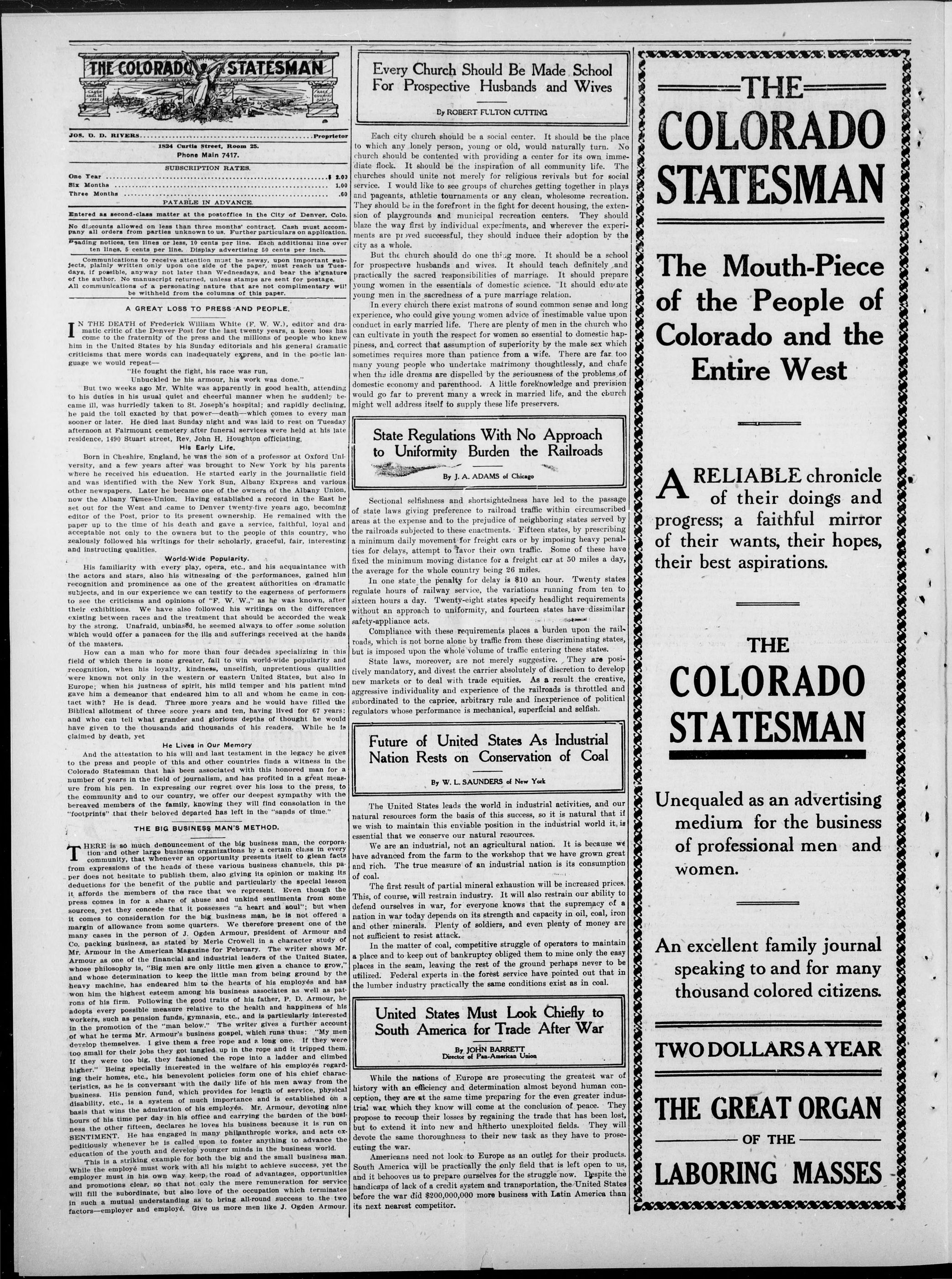
A GREAT LOSS TO PRESS AND PEOPLE.
IN THE DEATH of Frederick William White (F. W. W.), editor and dramatic critic of the Denver Post for the last twenty years, a keen loss has come to the fraternity of the press and the millions of people who knew him in the United States by his Sunday editorials and his general dramatic criticisms that mere words can inadequately express, and in the poetic language we would repeat—
But two weeks ago Mr. White was apparently in good health, attending to his duties in his usual quiet and cheerful manner when he suddenly became ill, was hurriedly taken to St. Joseph's hospital; and rapidly declining, he paid the toll exacted by that power—death—which comes to every man sooner or later. He died last Sunday night and was laid to rest on Tuesday afternoon at Fairmount cemetery after funeral services were held at his late residence, 1490 Stuart street, Rev. John H. Houghton officiating.
His Early Life.
Born in Cheshire, England, he was the son of a professor at Oxford University, and a few years after was brought to New York by his parents where he received his education. He started early in the journalistic field and was identified with the New York Sun, Albany Express and various other newspapers. Later he became one of the owners of the Albany Union, now the Albany Times-Union. Having established a record in the East he set out for the West and came to Denver twenty-five years ago, becoming editor of the Post, prior to its present ownership. He remained with the paper up to the time of his death and gave a service, faithful, loyal and acceptable not only to the owners but to the people of this country, who zealously followed his writings for their scholarly, graceful, fair, interesting and instructing qualities.
World-Wide Popularity.
His familiarity with every play, opera, etc., and his acquaintance with the actors and stars, also his witnessing of the performances, gained him recognition and prominence as one of the greatest authorities on dramatic subjects, and in our experience we can testify to the eagerness of performers to see the criticisms and opinions of "F. W. W." as he was known, after their exhibitions. We have also followed his writings on the differences existing between races and the treatment that should be accorded the weak by the strong. Unafraid, unbiased, he seemed always to offer some solution which would offer a panacea for the ills and sufferings received at the hands of the masters.
How can a man who for more than four decades specializing in this field of which there is none greater, fail to win world-wide popularity and recognition, when his loyalty, kindness, unselfish, unpretentious qualities were known not only in the western or eastern United States, but also in Europe; when his justness of spirit, his mild temper and his patient mind gave him a demeanor that endeared him to all and whom he came in contact with? He is dead. Three more years and he would have filled the Biblical allotment of three score years and ten, having lived for 67 years; and who can tell what grander and glorious depths of thought he would have given to the thousands and thousands of his readers. While he is claimed by death, yet
He Lives in Our Memory
And the attestation to his will and last testament in the legacy he gives to the press and people of this and other countries finds a witness in the Colorado Statesman that has been associated with this honored man for a number of years in the field of journalism, and has profited in a great measure from his pen. In expressing our regret over his loss to the press, to the community and to our country, we offer our deepest sympathy with the bereaved members of the family, knowing they will find consolation in the "footprints" that their beloved departed has left in the "sands of time."
THE BIG BUSINESS MAN'S METHOD.
THERE is so much denouncement of the big business man, the corporation and other large business organizations by a certain class in every community, that whenever an opportunity presents itself to glean facts from expressions of the heads of these various business channels, this paper does not hesitate to publish them, also giving its opinion or making its deductions for the benefit of the public and particularly the special lesson it affords the members of the race that we represent. Even though the press comes in for a share of abuse and unkind sentiments from some sources, yet they concede that it possesses "a heart and soul"; but when it comes to consideration for the big business man, he is not offered a margin of allowance from some quarters. We therefore present one of the many cases in the person of J. Ogden Armour, president of Armour and Co. packing business, as stated by Merle Crowell in a character study of Mr. Armour in the American Magazine for February. The writer shows Mr. Armour as one of the financial and industrial leaders of the United States, whose philosophy is, "Big men are only little men given a chance to grow," and whose determination to keep the little man from being ground by the heavy machine, has endeared him to the hearts of his employés and has won him the highest esteem among his business associates as well as patrons of his firm. Following the good traits of his father, P. D. Armour, he adopts every possible measure relative to the health and happiness of his workers, such as pension funds, gymnasia, etc., and is particularly interested in the promotion of the "man below." The writer gives a further account of what he terms Mr. Armour's business gospel, which runs thus: "My men develop themselves. I give them a free rope and a long one. If they were too small for their jobs they got tangled up in the rope and it tripped them. If they were too big, they fashioned the rope into a ladder and climbed higher." Being specially interested in the welfare of his employés regarding their homes, etc., his benevolent policies form one of his chief characteristics, as he is conversant with the daily life of his men away from the business. His pension fund, which provides for length of service, physical disability, etc., is a system of much importance and is established on a basis that wins the admiration of his employés. Mr. Armour, devoting nine hours of his time per day in his office and carrying the burden of the business the other fifteen, declares he loves his business because it is run on SENTIMENT. He has engaged in many philanthropic works, and acts expeditiously whenever he is called upon to foster anything to advance the education of the youth and develop younger minds in the business world.
This is a striking example for both the big and the small business man. While the employé must work with all his might to achieve success, yet the employer must in his own way keep, the road of advantages, opportunities and promotions clear, so that not only the mere remuneration for service will fill the subordinate, but also love of the occupation which terminates in such a mutual understanding as to bring all-round success to the two factors—employer and employé. Give us more men like J. Ogden Armour.
Every Church Should Be Made School For Prospective Husbands and Wives
By ROBERT FULTON CUTTING
Each city church should be a social center. It should be the place to which any lonely person, young or old, would naturally turn. No church should be contented with providing a center for its own immediate flock. It should be the inspiration of all community life. The churches should unite not merely for religious revivals but for social service. I would like to see groups of churches getting together in plays and pageants, athletic tournaments or any clean, wholesome recreation. They should be in the forefront in the fight for decent housing, the extension of playgrounds and municipal recreation centers. They should blaze the way first by individual experiments, and wherever the experiments are proved successful, they should induce their adoption by the city as a whole.
But the church should do one thing more. It should be a school for prospective husbands and wives. It should teach definitely and practically the sacred responsibilities of marriage. It should prepare young women in the essentials of domestic science. It should educate young men in the sacredness of a pure marriage relation.
In every church there exist matrons of sound common sense and long experience, who could give young women advice of inestimable value upon conduct in early married life. There are plenty of men in the church who can cultivate in youth the respect for women so essential to domestic happiness, and correct that assumption of superiority by the male sex which sometimes requires more than patience from a wife. There are far too many young people who undertake matrimony thoughtlessly, and chafe when the idle dreams are dispelled by the seriousness of the problems of domestic economy and parenthood. A little foreknowledge and provision would go far to prevent many a wreck in married life, and the church might well address itself to supply these life preservers.
State Regulations With No Approach to Uniformity Burden the Railroads
By J. A. ADAMS of Chicago
Sectional selfishness and shortsightedness have led to the passage of state laws giving preference to railroad traffic within circumscribed areas at the expense and to the prejudice of neighboring states served by the railroads subjected to these enactments. Fifteen states, by prescribing a minimum daily movement for freight cars or by imposing heavy penalties for delays, attempt to favor their own traffic. Some of these have fixed the minimum moving distance for a freight car at 50 miles a day, the average for the whole country being 26 miles.
In one state the penalty for delay is $10 an hour. Twenty states regulate hours of railway service, the variations running from ten to sixteen hours a day. Twenty-eight states specify headlight requirements without an approach to uniformity, and fourteen states have dissimilar safety-appliance acts.
Compliance with these requirements places a burden upon the railroads, which is not borne alone by traffic from these discriminating states, but is imposed upon the whole volume of traffic entering these states.
State laws, moreover, are not merely suggestive. They are positively mandatory, and divest the carrier absolutely of discretion to develop new markets or to deal with trade equities. As a result the creative, aggressive individuality and experience of the railroads is throttled and subordinated to the caprice, arbitrary rule and inexperience of political regulators whose performance is mechanical, superficial and selfish.
Future of United States As Industrial Nation Rests on Conservation of Coal
The United States leads the world in industrial activities, and our natural resources form the basis of this success, so it is natural that if we wish to maintain this enviable position in the industrial world it is essential that we conserve our natural resources.
We are an industrial, not an agricultural nation. It is because we have advanced from the farm to the workshop that we have grown great and rich. The true measure of an industrial nation is its consumption of coal.
The first result of partial mineral exhaustion will be increased prices. This, of course, will restrain industry. It will also restrain our ability to defend ourselves in war, for everyone knows that the supremacy of a nation in war today depends on its strength and capacity in oil, coal, iron and other minerals. Plenty of soldiers, and even plenty of money are not sufficient to resist attack.
In the matter of coal, competitive struggle of operators to maintain a place and to keep out of bankruptcy obliged them to mine only the easy places in the seam, leaving the rest of the ground perhaps never to be utilized. Federal experts in the forest service have pointed out that in the lumber industry practically the same conditions exist as in coal.
United States Must Look Chiefly to South America for Trade After War
By JOHN BARRETT
Director of Pan-American Union
While the nations of Europe are prosecuting the greatest war of history with an efficiency and determination almost beyond human conception, they are at the same time preparing for the even greater industrial war which they know will come at the conclusion of peace. They propose to recoup their losses by regaining the trade that has been lost, but to extend it into new and hitherto unexploited fields. They will devote the same thoroughness to their new task as they have to prosecuting the war.
Americans need not look to Europe as an outlet for their products. South America will be practically the only field that is left open to us, and it behooves us to prepare ourselves for the struggle now. Despite the handicaps of lack of a credit system and transportation, the United States before the war did $200,000,000 more business with Latin America than its next nearest competitor.
---
---
THE COLORADO STATESMAN
---
The Mouth-Piece of the People of Colorado and the Entire West
---
A RELIABLE chronicle of their doings and progress; a faithful mirror of their wants, their hopes, their best aspirations.
THE COLORADO STATESMAN
Unequaled as an advertising medium for the business of professional men and women.
An excellent family journal speaking to and for many thousand colored citizens. TWO DOLLARS A YEAR
THE GREAT ORGAN OF THE LABORING MASSES
THE COLORADO STATESMAN
James Byrd; one of our most efficient letter carriers, is enjoying his annual vacation.
Mrs. M. Dyer of 732 W. Colfax is quite ill at her home, threatened with pneumonia.
SELF-IMPROVEMENT ANNUAL EVENT.
Again this Woman's Club, one the leading organizations of the We demonstrated their ability to cater the social side of life by inviting th
Emmet Blackwell of 2949 California street met with a painful accident last Monday by piercing his left hand with a chisel.
Miss Hattie Logan, after spending several months in Topeka with relatives and friends, has returned home.
Oxdansen and Folk Dance given by Pride of Denver Tabernacle 521 at Old Colony Hall, Thursday, March 29. Willie Knight, manager. Morrison's orchestra. Admission, 25 cents.
Charles Miller is studying auto mechanics so as to fit himself for running a machine. This is a step in the right direction. More of our men should so employ their leisure time in this growing industry.
James Mason arrived in the city this week from Kansas City, Mo., where he is at present residing. His wife will accompany him when he returns.
Willard Childers, late employé of the Denver club, is making favorable impression with the management of the Boulderado hotel in Boulder, where he is at present employed. Keep up "making good," Willard. We have the eye on you.
C. H. Barber and wife returned to the city Saturday from Chicago. Mrs. Barber is very much crippled, although she was attended during her illness in Chicago by one of the most reputable physicians there. She is suffering from an affection of the knec. The Barbers are residing with the Connells, 729 Elati street.
Tomorrow is the forty-fourth marriage anniversary of Mr. and Mrs. John Wimms, which they will fittingly observe. The Statesman extends congratulations to this worthy couple. Mrs. Wimms is as spry as a miss of sixteen summers and Johnnie is all smiles to think that he has such an industrious help mate.
John W. Levell is now employed at the Unit d States National bank, Vice R. E. Lewis, who recently resigned. Mr. Levell has many friends in Denver who congratulate him on his good fortune. The Statesman extends good wishes.
Mr. and Mrs. Z. Hooper announce the engagement of their daughter, Miss Rosetta Elizabeth Hooper, to Mr. Thomas Watkins, a talented musician of Chicago, Ill. Wedding will take place in the near future.
Mrs. Waller, mother of Mrs. Chas. S. Muse, Alex. A. and Wm. Waller, died at the Muse residence Tuesday of pneumonia. The funeral of the deceased was held Friday at Zion Baptist church, conducted by Rev. D. E. Over.
```markdown
```
Robert A. Payne, employe at the city hall, left for St. Paul, Minn., on receiving the sad news of the death of his wife who was visiting a sick son. Mrs. Payne leaves a number of children and a large circle of friends and relatives to mourn their loss, and the sympathy of the community, with whom her husband is very popular, is extended to him and other bereaved members of the family in this trying experience.
John W. Allen passed through the city on his way to Boulder after visiting and spending a delightful time for nearly three months with his mother, Mrs. Emily Tarlton, Sedalia, Mo., and his brother, Thomas Waters of St. Louis. Mr. Allen reports unusual prosperity among our business people and general satisfaction from an allround standpoint. Special mention is made of the Rev. Ward of Morgan St. Baptist church, Sedalia, as an able leader, champion and advocate of race pride, uplift and business qualification among our people.
Oxdansen and Folk Dance given by Pride of Denver Tabernacle 521 at Old Colony Hall, Thursday, March 29. Willie Knight, manager. Morrison's orchestra. Admission, 25 cents.
SELF-IMPROVEMENT ANNUAL EVENT.
Again this Woman's Club, one of the leading organizations of the West, demonstrated their ability to cater to the social side of life by inviting their friends and supporters to their annual reception, which took place Thursday evening last. As usual, it was a formal affair, the ladies, in the latest costumes of various designs, vieing with the conventional evening dress of the gentlemen. After the reception dancing was engaged in and the guests departed at midnight with the reluctance that accompanies the enjoyment of good things. This organization of a number of years' standing has done much good in improving the general status of members of the community as well as making their charitable works of lasting benefit to humanity. Continue the good work and be a blessing to others is the best wish of The Colorado Statesman.
Dear Editor:
Kindly allow me space in your valuable column to offer my gratitude and deep sense of appreciation to the portion of the public who responded to the solicitation of funds with which to procure a pair of artificial legs for me. I take this opportunity to further inform the public that only a part of the money has been raised, and being so pleased with the preliminary efforts of my helpers, I trust their large, charitable and humane spirits will allow them to consummate the worthy object they have started. Any subscriptions on my behalf can be sent to the office of the Colorado Statesman. Thanking you editor for publication and again expressing my best wishes to the generous donors, I hope my prospects for obtaining these articles may result in success.
Gratefully yours.
Graterly yours,
ALONZO PARHAM,
County Hospital, Ward 3.
AN APT ANSWER.
Last Monday a prominent divine asked his youngest boy, a very bright urchin, "What day is this we always celebrate?" The boy, after a few minutes thought, replied: "This is Lincoln Day, he was the president of the Colored people.
THE GOOD-WEIGHT GROCERY.
2549 Washington street, Baxten building, is now open for business. The proprietor and manager, W. T. Fletcher and J. W. Williams, respectively, have resolved to prove to their patrons their ability to satisfy them in every line of fancy groceries and corn-fed meats if they would only give them a trial. The Colorado Statesman hopes a large patronage and bountiful success for this new addition to the business field.
Y. M. C. A. NOTES.
The spring-like weather, which has prevailed for several days prior to the present cold snap, has set the boys dreaming of outdoor sports and activities; hence jumping, outside indoor baseball and other forms of sport have largely engaged the attention of the "Y" boys, and other things also are being planned. The committee on boys work made Mr. "Bob" Davis head of the baseball work, and Mr. Earl Smith has been placed in charge of all track-team work for the coming season. Application has already been made to the May Company for membership in the Saturday afternoon Junior Baseball League.
Mr. I. Sassamori, assistant pastor of the Japanese Mission, gave the men a splendid meeting last Sunday afternoon in his address on Buddhism, the teaching of which, he said, is that the individual, by being good, may after death attain to "nothing." He said it held out no hope, no ideal for the individual, and as a consequence Christianity is making rapid strides among the Japanese people, especially the intelligent and educated classes.
The Lincoln-Douglass program, postponed from last Sunday, will be held at the Scott M. E. church next Sunday afternoon, the 18th, at 4 o'clock. Great effort has been made to make this double program one of the best ever. The best speakers in the city have been secured, and popular and appropriate music will be rendered. Everybody is asked to be present.
The Ministers' Alliance is planning a monster mass meeting for the afternoon of Sunday, February 25th, to listen to addresses by experts representing the proposed censorship of motion picture films by the state. The meeting will be held at the Zion Baptist church. All religious, social and civic organizations are requested to use their influence to make the meeting a success. On that account the union public meeting of the Y. M. and Y. W. C. A., planned for Central Baptist church on that afternoon, will doubtless be cancelled.
NOTHING DOWN AND 17 CTS. A DAY
BUYS A PIANO. SALE NOW ON.
THE PIANO EXCHANGE
H. A. TRIGGS, Manager
211 Charles Block. Cor. 15th and Curtis Streets. Phone Champa 3742.
THE BARBER'S CAFE
THE PEARL BARBER SHOP
First-Class Tonsorial Artists in attendance. Best line of Cigars and Tobacco. We solicit your patronage. First-Class work guaranteed.
HARRY JONES, Prop. DENVER, COL0
CAMPBELL CHAPEL AFRICAN M
E. CHURCH.
Twenty-third and Lawrence Streets,
A. W. Mard. Minister. Phone.
Sunday School, 9:45 a. m., V. N. Wolfskill, superintendent.
Preaching, 11 a. m., by pastor.
Allen C. E. League meets at 6:30 p.
m.
Preaching at 7:30 p. m.
Interesting services were held last Sunday. The spiritual tide ran unusually high at the evening service, with its large audience and special music by the senior choir and congregation from the A. M. E. Hymnal, which seemed good enough for any desiring real worship. These good old Methodist songs by our full choir have been commended by many, old and young. Some of these were composed by our own bishops and laymen. All weekly meetings, except the Friday night class, Sunday school board, etc., were dispensed with for the present by the pastor that he and his congregation might attend the revival services at the "Mother Church," Shorter Chapel.
Brother Court Peoples, who has been indisposed for several months, has moved to Deerfield in search of health. Our prayers go with him.
BOULDER NOTES
The Missionary Society of Allen Chapel has prepared a delightful play to be presented on Thursday evening, February 22, at the church. The play is "Aunt Susan Jones," a farce. The Cedar Art Club gave its valentine party at the residence of Miss Julia Winn on Wednesday evening. Misses Pauline Rucker and Ida Harris have been on the sick list, as has also A. J. Stevens. Mr. and Mrs. Winfield of Omaha are visiting with Mr. and Mrs. W. W. Bryant. Alva Rucker and Hazel McVey are candidates for high school graduation this year. Miss Buchanan and Mr. Brickler of the university made all credits the past semester. Brickler contemplates going out for the university track team. He won last year's meet for North Denver High.
C. Frank Smith is the new president of the Mutual Literary Society and is making things hum; big crowds and good programs. Mr. and Mrs. John Wilson of East Boulder, Mr. Delno Ward of Washington, D. C., and Rev. and Mrs. A. W. Ward were guests of Mr. and Mrs. Oscar White and a most delightful dinner on last Sunday. Sunday visitors in the city included Mr. Lee Morrison, Mr. and Mrs. George Morrison, and Mesdames Allen and May.
Boulder boys are hoping to get up a tennis team this summer.
The large audience at Allen Chapel on Sunday evening was given a rare treat to a violin solo, "The Angels Serenade," by Prof. George Morrison of Denver. His wife accompanied him on the piano.
Mr. John Allen has returned from an extended visit in the east.
TOWNSEND & McCLAIN'S NEW
LOCATION.
Lawyer W. B. Townsend and Dr. T. E. McClain can be found at their new location, S. E. corner Seventeenth and Curtis streets, upstairs, suite 3, 4 and 5.
Denver Mortuary—Office and residence, 2610 Downing street. Phone, day or night, York 5952W.
DOUGLASS UNDERTAKING COMPANY'S DEATH NOTICE.
William Stewart, age 23, departed this life Wednesday, Feb. 7th, at County hospital. Funeral notice later.
DENVER, COLO.
DIRECTORY.
Pride of Denver Taferanacle 521—Meets 2nd and 4th Tuesday of each month at 2540 Washington St.
Oliver Royal House of S. M. T.—Meets 2nd Monday of each month at 2540 Washington St.
FUNERAL NOTES OF CAMMEL AND COMPANY.
Rainwater, Louis, 37, died at 517
Twenty-eighth street Monday, Feb.
12, 1917. Funeral announcement later.
Twenty-eighth street Monday, Feb
12, 1917. Funeral announcement later.
Waller, Mrs. Louise, 84, died at the
residence of her daughter, Mrs. Chas.
P. Muse, 1221 Gaylord street, Tues-
day, February 13. Mrs. Waller was
one of Denver's pioneer citizens. She
leaves to mourn her loss one daughter
and three sons, Mrs. Chas. S. Muse of
Denver, wife of the editor of the Den-
ver Star; William of Denver, Alexander
A., secretary and manager of the
C. A. Loan and Realty Co., of Denver,
and Richard of Chicago. Funeral was
held Friday at 2 p. m., from Zion Baptist church.
PEOPLE'S PRESBYTERIAN.
East Twenty-third Ave., and Washington St., J. A. Thos. Hazell, S. T. B., Pastor.
Serman Topics Sunday, February 18th:
11 a. m.—"Messiah the Problem of the Ages."
5 p. m.—"His Name."
A series of special evangelistic sermons is being delivered at People's church until Palm Sunday, April 8. The Wednesday night messages are especial features of this program. Congregational singing with choir selections is a live wire for these services. The choir renders tomorrow "A Call to Worship," and "God that Madeth Earth and Heaven." Everybody is cordially invited.
Mrs. Belle Brown, 2435 Tremont street, was baptized last Sabbeth morning. Sunday, March 18th, is the date set for the confirmation of baptismal vows of such persons contemplating membership with the People's church. The class is now open for members. All should avail themselves at this time.
Fern Hall, 2711 Welton, R. L. Phynix, Manager. Phone Main 2860.
WANTED—A second-hand copy of Dunbar's complete works; it must be in good condition and reasonable in price. Call at Statesman office, 1824 Curtis st., room 25.
Furnished rooms and house for rent at 2358 Tremont Place. Inquire at 1824 Curtis street, Room 25.
Lawyer W. B. Townsend and Dr. T. E. McClain can be found at their new offices, 929 Seventeenth street, upstairs, Rooms 3, 4 and 5.
Mrs. Z. Hooper, nicely furnished rooms; strictly modern; prices reasonable. Rooms for light housekeeping for man and wife. 2443 Tremont Place, Denver, Cole.
Useful Pet
A soldier was grumbling about the scorpions, rattlers, and tarantulas that helped to enlist duty on the Mexican border, when a boy from Kansas ventured to say: "In Kansas my dad keeps a rattlesnake in the house as a pet. One time, he said, a burglar broke into the house, and that rattler coiled himself around the burglar and rattled out the window for a police-man."
Millionaires in Cheerfulness.
Many people in ordinary circumstances are millionaires of cheerfulness. They make their neighborhood brighter, happier, and a better place to live in by their presence; they raise the value of every lot for blocks around them.—Anon.
DESSERT TO TEMPT INVALID
Baked Milk With Stewed or Fresh Fruit Is Appetizing and Can Do No Harm.
A perfectly innocuous dessert for the most delicate of patients is provided by baked milk, and it makes a very pleasant accompaniment for stewed or fresh fruit. It is very simply prepared, as the milk is merely put into an earthen ware jar, covered tightly and allowed to bake in a very slow oven for several hours, until it is of the consistency of very thick cream. The main attraction about that recipe is its harmlessness, but a really delicious and nutritious pudding can be made from the following:
Rice Flour Pudding.—One-half pint milk, two tablespoonfuls cream, one ounce butter, one ounce rice flour, whites of two eggs, flavoring, one tablespoonful sugar. Put the milk, butter and sugar into a saucepan and bring just to the boiling point; mix the rice, flour and cream well together and stir into the boiling milk; draw to one side to cool and beat the whites of egg to a stiff froth, then add them to the rest, folding them carefully in so as not to break down their fluffiness. Pour into a fireproof dish and bake in a quick oven until a light golden brown.
MAKES MOST TASTY OMELET
Prepared With Kidneys It Is "Some thing Different" From the Usual Run of Egg Mixtures.
Melt two tablespoonfuls of bacon drippings in a frying pan; add two lambs' kidneys that have been cut into dice and toss them about in the hot dripping for three minutes. Then add sufficient thick brown sauce to molten, and season with a pinch of paprika and one tablespoonful of worcestershire sauce. Prepare an ordinary omelet from the yolks of four eggs beaten with a little salt, pepper and four tablespoonfuls of water, and when very light fold in the stiffly whipped egg whites. Turn into an omelet pan in which has been melted one tablespoonful of butter and cook very slowly until well risen. Then spread with the kidney mixture, sprinkle with chopped parsley, and turn over, after loosening the sides, into a neat half circle. Tip the pan gently, so that the interior of the omelet may cook through, and serve inverted on a hot platter.
Pan Dowdy.
Pare and quarter enough sour, juicy apples to nearly fill an earthen baking dish, add to the apples half a cupful of hot water and nearly a cupful of molasses. For crust use one quart of flour, one teaspoonful soda, two teaspoonfuls cream of tartar, one teaspoonful salt, half a cupful creamed butter, one pint rich, sweet milk. Mix soda, cream of tartar and salt well into dry flour, work the creamed butter into the prepared flour till fine and yellow. Add milk to this mixture and mold to a delicate dough. Roll it out an inch thick and fit closely over the apples. Bake in a moderate oven as long as the crust will allow. When done, while warm, break the crust into pieces and mix through the apples; serve with cream or milk.
Something Nice for Supper.
Here is a nice supper dish I made from the remnants of a roast of beef: Chop or cut fine all the lean beef and mince an onion fine. Put into a baking dish and cover with the leftover gravy. Cook in hot oven about three-quarters of an hour. Have hot mashed potatoes ready, remove dish from oven and spread mashed potatoes over top. Well season and return to oven to brown. I served this dish one night last week with hot biscuits, apple sauce, doughnuts, pickles and tea and I must say they did full justice to it. Try it some day—Exchange.
Turkish Dish.
Stew one cupful of cold lamb with one teaspoonful of minced onion in one cupful of water until very tender. Skim out the meat and add to the water enough strained tomato to make one plnt, or use more water if you have not enough of the tomato. Season highly with salt and pepper and a little curry or chutney sauce.
Cafe Mousse.
Whip one pint of heavy cream and add one-half cupful of powdered sugar. Next add one cupful of black coffee infusion and one-fourth teaspoonful of salt. Turn the mixture into a mold, pack in ice and let stand for five hours.
Baptist Dip.
Roll light dough very thin; cut with small biscuit cutter, or in squares with a knife. Fry in hot lard until light brown. Place in colander to remove fat. Prepare milk or cream gravy, as for common toast.
Handy Sewing Basket
To make a handy sewing basket cover a square or an oblong peach basket or any cardboard box with cretonne and line with contrasting lining cotton; sew in pockets for necessary articles needed for sewing.
Ada's Hoptoad.
Very nice for breakfast with coffee. One cupful sour milk, one egg, one half teaspoon,ul salt, one of soda and flour enough to make a stiff batter; drop from spoon into hot lard and fry.
Restoring Color.
When the color has been taken out of black goods it may be restored by the application of liquid ammonia.
The KITCHEN CABINET
Who bides his time—he tastes the sweet
Of honey, the saltest tear;
And though he fares with slowest feet,
Joy runs to meet him, drawing near;
The birds are heralds if his cause,
And like a never ending rhyme,
The roadside blood in his applause.
Who bides his time.
James W. Riley.
COFFEE AS A FLAVOR.
Coffee when used as a flavoring should be made a very strong concoction, using the best of flavored coffee, well prepared.
PINEAPPLE
Coffee Mousse. Put half a table-spoonful of powdered gelatin into a saucepan, add a half cupful of strong coffee and dissolve; add to it four crushed macaroons and a half cupful of milk and sugar to taste. When nearly cold, beat, and when about to set, add one cupful of stiffly beaten cream that has been flavored with vanilla. Have ready some little fancy molds, fill with the mixture and allow to set. Turn out, decorate with whipped cream and chopped pistachio nuts.
Coffee Ice Cream.—One cupful of black coffee, one pint of milk, one pint of whipped cream, one cupful of sugar, four yolks of eggs, one tablespoonful of vanilla and a pinch of salt. Put the yolks of the eggs with the sugar and milk into a saucepan and stir over the fire until thick. Strain and cool; add the whipped cream, the coffee and vanilla and freeze. Serve in glasses.
Coffee Frosting.—Add two tablespoonfuls of strong black coffee to a cupful of confectioner's sugar; add the whites of an egg, a teaspoonful each of lemon juice and vanilla extract; heat until thick.
Coffee Sherbet.—Soften a table-spoonful of gelatin with a half cupful of water; add two cupfuls of strong coffee, one cupful of sugar and two cupfuls of cream. Stir over the heat until the gelatin is dissolved, strain and cool. Freeze as usual. Serve in sherbet cups.
Coffee as flavoring for custard pie or cup custards makes a desirable change from the usual flavoring. For cake filling coffee may be used instead of water in boiled frosting and poured over the beaten whites of the eggs.
Coffee cream filling for cake, using coffee instead of part of the milk or cream for the liquid in the filling, is good.
The pleasantest things in the world are pleasant thoughts, and the great art in life is to have as many of them as possible. Bovee.
WORK WITH ONE RECIPE.
A good reliable cake recipe has countless ways of appearing in such a variety of forms that it is never suspected of having the same foundation. By long practice and carefully eliminating every waste motion, one may become so proficient in the making and baking that the results are always reliable.
MILK
A good standby quickly made and easily juggled so that it covers many emergencies is the following: Sift two teaspoonfuls of baking powder with a pinch of salt and a cupful and a half of flour. Cream two tablespoonfuls of butter (softened, not melted) with a cupful of granulated sugar. This is quickly done by warming both sugar and butter; add a half cupful of milk and two well-beaten eggs. The eggs are added to the sugar and butter, and the milk (after rinsing out the egg bowl) is added alternately with the flour. Beat vigorously and bake, with the addition of flavoring, in a sheet. Cover with icing, also flavored, and we have a good regulation cake. Nuts may be placed on top, and then the cake is served in squares. By adding orange peel, grated to the batter, and orange juice to confectioner's sugar, a change of cake is made by change of flavor.
Bake this same cake in a sheet without flavoring, cut it in slices and each slice then cut in two and put together sandwich fashion, with raspberry jam and the sandwich frosted all over, makes most delicious little company cakes. Any filling desired may be used.
Bake this recipe in two layers, flavoring as desired, and the remainder of the batter flavor with spices; add nuts and raisins and bake in small patty pans. For the layer cake use whipped cream as a filling and for the top, sweetening and flavoring the cream.
Cup cakes may be baked of the plain batter, then the tops removed and the centers filled with whipped cream, mixed with any fresh fruit, like crushed strawberries. Ice cream may be served in these small cakes, making a most dafty dessert.
The cake may be baked in a round loaf and when cool the top removed and the center filled with a cooked cream, or with whipped cream, sliced bananas and shredded pineapple and a few quartered maffshmallows. Serve hot. The crumb that is removed may be served in a chilled custard. This cake baked in a sheet may be cut in squares and served with any pudding sauce as a dessert.
Nellie Maxwell
HISTORIC MOUNT VERNON SORCERERS TAKE TOLL UNWELCOME PLANT
Mansion Which Is the Shrine of All Americans Was Built for Lawrence Washington, Half-Brother of George—Has Frequently Been Repainted and Additions Made—As It Is Today.
[Image of a large, white building with a central cupboard and a tower with a cross on top.]
WHILE George Washington's half-brother, young Lawrence Washington, was absent from home, the father rebuilt a house at Mount Vernon for him, and this now forms the central part of the mansion. On his return, Lawrence brought to the home his young bride, the beautiful Miss Fairfax, daughter of his neighbor, Colonel Fairfax of Belvoir, an adjoining estate. Lawrence called the place Mount Vernon in honor of his English friend, Lord Vernon, under whom he had served in the navy.
Shortly after the death of Lawrence Washington, his daughter Sarah died without heirs, and the Mount Vernon estate passed by will into the hands of General Washington. In order to acquire full title, he purchased from the widow of Lawrence her dower
This he did in 1785, spacious banquet hall at a library and bedroom. The pitch of the room and dormer windows make the attic available apartments, these improving in an 18-room house after was dignified by the sion." In changing the quantity of the original 1743), though consider worn on the exposed s found good enough to a turning them over. The Washington's resourcecently come to light by uncovering of a portico portico roof, which for tiding of rain, had been slim in 1800, revealing a few shingles of 1743 and
Old Kitchen of Mount Vernon.
rights. Henceforth he was sole owner of the estate; an estate which had been in the family since its acquisition by grant in 1670, and which remained in the family until sold in 1858 by John Augustine Washington to the Ladies' Mount Vernon association. These facts, which shed some interesting light on the early history of Mount Vernon, were obtained by Mr. Callahan after constant study of the old official records of the courts and vestry books of the counties in this part of Virginia. They establish beyond all doubt the truth which is that the central part of the Mount Vernon mansion was built by General Washington's father, that General Washington lived there for two years when a baby, and that his father built what is now the most conspicuous landmark on the place—the old barn.
Visitors to Mount Vernon during the past few months have had opportunity to witness the interesting work of reroofing Washington's old home, the historic mansion wherein he died. It is learned that this is the fourth time the roof has been shingled, the other dates being 1742, 1785 and 1860. In each instance the material selected and used was the best cypress shingles.
A short historical review of the construction and alteration of this old dwelling may be worth notice, as few among the many visitors happen upon information on the subject. The central portion of the present building was erected in 1742-3 for Maj. Lawrence Washington, who named it the Mount Vernon "Villa," out of respect for Admiral Edward Vernon of the British navy, under whom he had been serving in South America. This modest cottage, or villa, consisted of four rooms on the ground floor, with bedrooms and an unfinished attic above.
At the death of Lawrence Washington, 1752, the property fell to the ownership of his half-brother, George, who, in 1775, added to the attractiveness of the interior by paneling the hall and having the ceilings of the parlor and dining room decorated in stucco. After the revolution Washington's increased fame attracted to Mount Vernon such a horde of guests it was found a difficult problem to entertain them comfortably in the limited number of rooms at his disposal. At first General Washington thought of tearing down the old building and erecting a more pretentious dwelling of suitable proportions to meet the requirements, but he finally decided to enlarge the cottage.
This he did in 1785, by adding a spacious banquet hall at one end and a library and bedroom at the other. The pitch of the room was changed and dormer windows arranged to make the attic available for sleeping apartments, these improvements resulting in an 18-room house, which thereafter was dignified by the term "mansion." In changing the roof of a large quantity of the original shingles (of 1743), though considerably weather worn on the exposed surfaces, were found good enough to use again by turning them over. This evidence of Washington's resourcefulness has recently come to light by the temporary uncovering of a portion of the east portico roof, which for the better shedding of rain, had been slightly changed in 1860, revealing a few courses of the shingles of 1743 and 1785. These mute reminders of the past are now again sealed from view and so protected as to remain intact as long as the mansion shall endure.
When the Mount Vernon Ladies' association came into possession of the homestead the mansion was empty. Unceasing effort has been and is being made to recover the original things, but they are widely scattered and held by people who are reluctant to give them up. From time to time, however, some of the old pieces are offered for sale, but as a general rule, the prices asked are almost prohibitive. The government purchased a number of Washington relies many years ago. Among the present collection at Mount Vernon are many pieces of furniture of contemporaneous interest which have been accepted temporarily to fill vacancies in the various rooms, but as rapidly as original Washington articles are secured the non-original are eliminated.
Until recently the owners have had nothing definite to guide them respecting what the rooms formerly contained, but there has now been found the inventory made by the appraisers of Washington's effects shortly after he died. This important document will be of inestimable assistance in accurately refurnishing the mansion. Studying Mount Vernon from the viewpoint of a casual visitor, it is difficult to conceive of a more charm-
THE STREET
Outbuildings on Estate
ing spot. The perpetuation is attributable to the management and devotion of the Ladies' association. The founder of this remarkable body was Miss Ann Pamela Cunningham.
Why Washington Was Not a Signer.
Why Washington was Not a Signer.
At the time the Declaration of Independence was given to the world, Washington was at the head of the patriot army in New-York state, trying hard to keep Lord Howe and his British soldiers from capturing the state; and that is why his name does not appear among the signers of the Immortal document. It is pretty certain that had he been conveniently near he would have been asked to put his name at the head of the list.
Duty Intrusted to Americans
The preservation of the sacred fire of liberty, and the destiny of the republican model of government are justly considered as deeply, perhaps finally, staked on the experiment intrusted to the hands of the American people. George Washington: Inaugural Address.
Collect $750,000 a Year From Koreans for Services.
Interesting Report Made to Uncle Sam's Museum Regarding People's Warfare Against Evil Demons.
A fascinating report has been made to Uncle Sam's National Museum at Washington by Dr. I. M. Casanowicz on the sorcery of Korea. He describes the superstitions of the people regarding evil demons, which they believe constantly beset them. The Koreans believe the air, their dwellings, the forests—in short, every thing and every place—is the abiding place of spirits. These spirits are all evil and have for their sole purpose the annoyance of the people of the earth. All bad luck, all illness, all privation and hardship is due to the malevolence of the demons. They have two classes of persons to exercise these spirits. One is composed of men called Pansus, the other of women called Mutangs.
The Pansus are necessarily blind men. The Koreans share with other peoples the belief that persons deprived of sight are given familiar spirits which enable them to see with an inward eye more than the normal person can envision. The Mutangs are outcasts. These women belong to the lowest stratum of Korean society, and although despised socially to the extent that they are not even permitted to enter cities, they are feared and respected because of their powers. These women go into their business because they declare they feel a call. They usually pair with the Pansu men, sorcerers and sorceresses going about together. Their chief business consists in healing the sick. The report says that the people of Korea pay these exorcists annually approximately $750,000 for their services.
The blind Pansus are believed to have attained a mastery over the evil spirits and therefore can control them. The Mutangs have influence with them because they are reputed to be on friendly terms with the spirits and can cajole and wheedle them. Between the Pansus and the Mutangs the people feel confident of salvation from bodily evils. The National Museum has come into possession, through the agency of W. W. Rockhill, formerly minister to China, of some of the costumes and paraphernalia worn by Mutangs at their incantations. They are extremely rich. These women go to the houses of sick persons and there sing and dance for hours on end until the evil spirits depart from the afflicted one. Their attendants beat constantly upon drums shaped like hour glasses.
STOCK OF POTATOES SHORT
Uncle Sam Finds That Supply on Hand for Market Is Far Below That of Previous Years.
Supplies of potatoes on hand January 1, 1917, for market in 19 important northern potato-growing states, were estimated by Uncle Sam's bureau of crop estimates to be about 44 per cent smaller than a year ago, 65 per cent smaller than two years ago, and 54 per cent smaller than the average holdings on January 1 of the preceding five years.
If, for the purpose of comparison, the estimates in percentages of marketable stocks of potatoes on hand January 1 be applied to the estimates of total production, it shows, in the 19 states included (which produced 61 per cent of the total 1916 crop, and 66 per cent of the 1915 crop), a total of 59,938,000 bushels on January 1, 1917, compared with 106,225,000 a year ago, 169,554,000 two years ago, and 129-941,000 bushels the average holdings of the preceding five years on January 1.
Awful Thought
Favorite foods that mother used to make were the topic of conversation at the boarding house table. After numerous interchanges came a lull. Then a callow youth whom bashfulness usually kept silent broke it with this bombshell: "D-d-d-did any of you ever eat sauerkraut with whipped cream on it?"
Uncle Sam's Soldiers of Sea Are Expert Riflemen
Declaration that since the days of frontier life have passed Americans are no longer entitled to their former fame as riflemen are completely refuted by statistics, say officers of Uncle Sam's marines. These officers recently compiled data showing that splendid shooting qualities are still characteristic of American troops.
More than 73 per cent of the 6,141 members of the United States Marine corps who fired during 1916, on the 14 marine corps rifle ranges, are qualified skilled riflemen, according to the table just compiled. Of these sea-soldiers, 921, or 15 per cent, are expert riflemen; 1,044, or 17 per cent, are sharpshooters, and 2,518, or 41 per cent, are marksmen.
It is doubtful if Leatherstocking himself could outshoot them, say the marines.
Uncle Sam Spends Thousands of Dollars to Keep Out One Little Moth Egg.
OUARANTINE IS MAINTAINED
Bars Are Put Up Against Infested Cotton From Egypt, Diseased Potatoes, Trees, Shrubs and Other Plants.
Although it may seem ridiculous to spend thousands of dollars annually to prevent one little moth egg that could pass through the eye of a cambric needle from entering the country, Uncle Sam is employing the machinery of the department of agriculture, state, treasury and post office to keep out that little pest, the pink cotton bollworm.
The same agencies are united to exclude by quarantine diseased potatoes, trees, shrubs and plants, and in so doing are accomplishing far more than one would think toward holding down the cost of living.
The "general staff" which conducts the defense against plant disease is known as the federal horticultural board and is composed of five high officials of appropriate bureaue of the department of agriculture.
All along the fertile valley of the Nile, where the luxuriant Egyptian cotton grows, planters are more worried over the ruinous work of the pink boll-worm in their cotton fields than they are over the greater devastation of the European war.
The pink boll-worm was taken to Egypt from India, where its wretched family billions are still leaving their baleful impress.
While the annual yield of American Sea Island cotton, the best in the world, is by no means enough to make all the spool cotton, automobile tires and other textiles requiring a grade better than that of ordinary upland cotton, it is somewhat surprising to learn that 300,000 bales of Egyptian cotton contaminated by the pink boll-worm are imported with impunity to the United States.
Every Bale Disinfected.
This was made possible by a system of fumigation originated by the board and worked out on a commercial scale by its experts, by which every bale is disinfected before distribution. The cotton—a couple of hundred bales at a time—is placed in a great horizontal cylinder of heavy structural steel, hermetically sealed and then the air is pumped out until there is almost a vacuum within. Hydrocyanic acid gas is then admitted, and although the bales are compressed before shipment until they are almost as hard as blocks of wood, it penetrates the cotton so that all animal life, including bollworms in every stage, becomes extinct in less than an hour and the cotton can be sent without possibility of spreading infection to any mill for manufacture.
There are only four of these fumigating tanks in the country, one at each of the four ports of entry for cotton—New York, Newark, N. J.; Boston and San Francisco.
Although privately operated, these tanks are under the closest of government inspection. The bales must be left in the receiving chambers a certain time; the poisonous gas must be of a positive strength; the appliances and chemicals tested and every precaution must be taken to evacuate the gas without risk of life to the men operating the plant.
One shipment of the infested cotton seed—and it is believed to be the only one—is known to have entered this country, and that was before the quarantine was established. This lot was taken to Arizona, where a state quarantine was in force; the infestation was detected and the whole lot burned. It is believed that the pink pest has not succeeded in running the blockade.
Guard Potato Crop.
One of the most pressing matters now under the board's attention is the oversight of potatoes coming into the country to make up the 60,000,000-bushel shortage in the American crop. Naturally, our Canadian neighbor wishes to share in the high prices, and his crop is wanted here; but the board says: "No diseased stock may be entered."
Accordingly, this working plan has been agreed upon between the two countries; Canada may send potatoes free from injurious disease and insect pests to ports of entry designated by this country. On arrival the tubers are examined by federal inspectors, and if found to be infected are returned to the consignors at their expense. Potatoes are coming into the country in such quantities that, although in the main they are all right, carloads are sent back almost every day.
Another thing which the board is fighting is the importation of any nursery stock which carries the white pine blister rust, a tree disease destructive of both ornamental and forest pines.
Cotton seed, except from some parts of Mexico; the seed of alligator pears from Mexico and Central America, living canes of sugar, all citrus nursery stock, all Indian corn or maize from oriental countries and some less important plant products may not be imported at all, because each is likely to carry some disease which thus far has not broken out in our native plants.
FAIRFAX COURT HOUSE
In This Ancient Building the Wills of George and Martha Washington, Restored to Almost Their Original Perfection, Are Carefully Preserved—Both Have Passed Through Many Vicissitudes.
THE CHURCH OF THE SUNSHINE
GEORGE WASHINGTON'S will was signed at Mount Vernon July 9, 1799, five months before his death. From beginning to end it gives evidence of the firm hand and clear mind of its maker. It contains many legal phrases, but it was not written under the instruction of a lawyer, and there is reason to believe that nobody was consulted in its construction. Modern skill has rescued the document from dilapidation and impending destruction and has assured to all Americans the opportunity to read it exactly as it was written. It was filed for probate in the year 1800 in the court house of Fairfax county, Virginia, in which Mount Vernon is situated. In the intervening 116 years it has undergone vicissitudes, including much miscellaneous manhandling and one removal and concealment.
Through all of a century he who ran so far as Fairfax court house might read at his leisure and with his own hands manipulate the original document and at his pleasure thumb and fumble it, with only a court attendant near to see that the will was not carried away, wholesale or piecemeal. One of the pages of the will bears mute testimony to the success of some unknown enthusiastic relic hunter who tore off and carried away one corner.
At the beginning of the Civil war the will was taken to Richmond, and there securely hidden. It was returned to Fairfax court house when peace had been restored. The same care was not taken of the will of Martha Washington, on file in the same court house, and it was carried off by a Union soldier and was for a time in the possession of the late J. Plerpont Morgan. After a suit had been begun to secure its restoration to Virginia and Fairfax county, it was returned to the court house.
The decades that have passed since the filing of General Washington's will, the journey to and from Richmond, the careless if affectionate handling to which the precious manuscript was subjected did not tend to its preservation. Finally it became a thing of rags and tatters. Its custodians, with the best intentions, added to its peril of early and complete obliteration by persistently folding it lengthwise, following the original fold of the clerk of 1800.
In charge of the repair section of the manuscript division is William Berwick, said to be the greatest living expert in the restoration of old manuscripts. To him was given the task of restoring the immortal document. Impressed with a desire to preserve the tremendously important and interesting relic, Mr. Berwick has accomplished something very like a miracle. Although the work was begun by Mr. Berwick in 1910 it was but recently completed. The restorer, working odd days and intervals sometimes widely apart, needed much time to bring the manuscript to its present form.
As soon as he finished with the will of General Washington he began the restoration of the will of Martha Washington, returned by Mr. Morgan to Fairfax county. The elder Mr. Morgan having had the Martha Washington will in his possession, and having bound and preserved it carefully, it was in much better condition than that of the first president and gave Mr. Berwick far less trouble. Further, it contains but eight pages.
Notwithstanding Mr. Morgan's care of Martha Washington's will, the Virginians apparently are yet somewhat resentful that the document was kept from them so long. The text of the inscription over Martha Washington's will in Fairfax court house is as follows:
"The original last will and testament of Mrs. Martha Washington. It is dated March 4, 1802, and was admitted to probate by the county court of Fairfax June 21, 1802, and was restored to its present form in the year
1916 by William Berwick, under the supervision of James M. Love, F. W. Richardson and R. Walton Moore, a committee appointed by the circuit court, the judge of which was J. B. T. Thornton. The will was stolen from Fairfax court house during the Civil war and returned to the office 1915 after litigation in the Supreme court of the United States."
Both wills now are in steel cases, sunk in concrete, thoroughly protected against fire and thieves, as they are hermetically sealed. They are placed in the west wall of the court house at Fairfax. The cases have glass fronts, two pages of each will being exposed to view through the glass fronts. Velvet curtains are drawn over these fronts when the documents are not on exhibition, shutting out the destructive rays of the light.
Thanks to the foresight of the officials of the library of congress and the intricate and expert work of Mr. Berwick the documents as they were written are accessible to everyone. There is no charge or fee to view them. The court house in which they are kept was built in the same year that General Washington's will was probated and filed, 1800. The building and the most precious of its contents are of the same age, 116 years.
General Washington's will as restored is perfect as it came from his hand and has the few imperfections he left in it, including some occasional
THE COURT
Interior of Court House, Which Appears Now as It Did More Than a Century Ago.
lapses in orthography and the omission of his name at the bottom of page 23, notwithstanding the fact that he began: "In the name of God, Amen! I, George Washington of Mount Vernon, a citizen of the United States and lately president of the same, do make, ordain and declare this instrument which is written with my own hand and every page thereof sub-scribed with my name to be my last Will & Testament, revoking all others."
This omission may have been due to the fact that the last three words on that particular page are "City of Washington." It is easy to surmise that having just written "Washington," and engrossed in thought, the Father of his Country naturally mistook the name of the city for his own and thought that he had signed as in the preamble he undertook to do.
President Rode In State.
When Washington, as president, lived in Philadelphia, his stables contained ten coach and saddle horses in addition to the white chargers used when he went upon state occasions, He had a coachman and two grooms, who wore livery of white cloth trimmed with scarlet or orange.
War College Heads Prepare for Handling of Great Volunteer Force.
RAPID TRAINING PROPOSED
Special Attention Given to Selection of Officers Qualified by Experience to Lead Men
Washington.—The war college division of the general staff of the United States army has complete plans prepared for the mobilization of a citizens' army. These plans were completed some time ago in anticipation of the time when the United States might be called upon to enter into hostilities against a first-class power. These plans were based, it is said, upon the possibility that the first call for volunteers might be for 1,000,000 men. The war college recently prepared an official paper dealing with the raising of a volunteer army.
"Under existing laws and under contemporaneous conditions therewith," says the war college, "it has heretofore been assumed that in the event of a war with a first-class power the United States would require not less than half a million of men for the first line, behind which could be prepared the greater army of citizen soldiers upon whom our main reliance for national defense is conditionally placed."
Subject to President's Call.
The organization of volunteer armies can only be undertaken following the presidential proclamation stating the number needed, and on this subject the war college says:
"Volunteer forces may be raised, organized and maintained only during the existence or imminence of war, and only after congress shall have authorized the president to raise such forces. Congress could, however, by legislative enactment, authorize the president to raise such forces in time of peace.
"When so authorized, the president will issue his proclamation, stating the number of men desired for each arm, corps, or department, within such limits as may be fixed by law. It is probable that the proclamation will also recite the causes that make the call necessary and will state that the enlisted men shall be taken, as far as practicable, from the several states, territories and District of Columbia in proportion to the respective populations thereof.
"Following the call of the president for volunteers, the secretary of war notifies the governors, etc., as in a call for militia, informing them of the quota for their respective states, the existing militia organizations that will be received into the volunteers, the new organizations that it is desired to raise, and the maximum and minimum strength of organizations."
All terms of enlistments, it is pointed out, "will be the same as that for the regular army, exclusive of reserve periods," and no person can be enlisted for the volunteer forces "who is not effective and able-bodied," and who is not within the ages stipulated for that service under the law as it exists at the time of the president's call. Neither can any man be enlisted who does not speak the English language, while persons under eighteen years of age can be accepted only with the signed approval and consent of the parent or guardian of that person.
```markdown
```
Recruiting, Rendezvous and Depots. The war college continues: "With a view to recruiting and maintaining all organizations of the land forces as near their prescribed strength as practicable, the necessary rendezvous and depots will be established by the secretary of war and will be directly controlled by him. Here the recruits will be enlisted and trained. For the purposes of instruction and discipline, the troops at the recruit depots may be organized into companies and battalions, at the discretion of the secretary of war. The noncommissioned officers and privates will be of such grades and numbers as the president may prescribe.
"It is apparent that the recruits at the rendezvous and depots are intended to form a reserve battalion for each regiment or equivalent thereof of regulars and volunteers only; for the act also provides that in order to maintain the land militia organization at their maximum strength the recruit rendezvous and depots in any state or territory may, at the request of the governor thereof, enlist and train recruits for land militia in the service of the United States from such state or territory. All the officers required for such recruit rendezvous and depots will be volunteers of the proper arm of the service.
Appointment of Officers.
"All volunteer officers are appointed by the president, but the number and grade of such officers shall not exceed the number and grade of like officers provided for a like force of the regular army, and they will be subject to such assignment to duty and transfers as the president may direct.
"In order that the lives of those patriotic citizens who may volunteer for service may be safeguarded and conserved and not risked under persons lacking in experience in the care of soldiers in camp and in battle, the
war department has decided and announced that the appointment to volunteer commissions will be made from those classes of our citizens who have had such experience, and that from those classes the selections will be made in the following order:
(A)—Persons who have had experience as commissioned officers in the regular army of the United States and ex-officers of volunteers of proved experience and efficiency.
(B)—Non-commissioned officers of experience in the regular army.
(C)Persons who have had experience as officers in the militia.
(D)Persons who have qualified according to law under prescribed examinations to test their fitness to command and control men in the field.
(E)Graduates of educational institutions of military standing to which regular army officers are detailed as professors of military science under the law.
(F)Should the necessary number of volunteer officers required not be furnished from the above classes, the war department will give civilians lacking in actual military experience an opportunity to appear for examination to test their fitness for commissions, before boards which the war department proposes to create in the several states.
Under the caption "Training of Volunteers" the war college pamphlet reads:
"The training of volunteer troops must begin without delay after their induction into the service. No time must be lost. It should begin at the company rendezvous, without waiting for complete mobilization. Under our traditional policy of relying principally for defense upon citizen soldiers, the larger part of our land forces will not be fully trained on the outbreak of war. It is more than probable that we shall have to employ some of them with little or no training as soon as they can be assembled in suitable units.
"The amount and character of the training will at first be directly proportional to the time consumed, provided a rational scheme be followed. How much time will be available it is impossible to predict. It is reasonable to assume, however, that in the event of a war with an oversea enemy it will be the time required for our enemy to establish at least a partial control of the sea sufficient to open the way for landing of expeditionary forces.
"Any system of training, however, good in itself, will fail to bring the desired results unless there are available a sufficient number of trained instructors, officers and noncommissioned officers. The blind cannot lead the blind."
Referring to the mobilization of the volunteer armies, the war college points out that all points of mobilization have been selected, one in each state of the Union, and that these preliminary arrangements have been approved by both the federal and state authorities. These plans provide for the necessary buildings, for water supply, and all other essential needs which will arise.
Arizona Mightiest of All Fighting Vessels.
The Arizona, the newest addition to the United States battleship division, not only is the biggest of Uncle Sam's sea fighters, but no other naval power has a fighting vessel that can reach it in size.
It is larger by 200 tons that the Pennsylvania, the flagship of Admiral Mayo, of which it is a sister ship.
It will be a damaging foe for an enemy to meet. Its twelve 14-inch guns fire a broadside of 20,000 pounds of steel, which can be directed accurately at a mark 15 miles distant. The broadside is 6,000 pounds more than the combined broadsides of the Kansas, Vermont and New Hampshire, ships that have been placed in the reserve fleet.
The displacement of the Arizona is 31,600 tons. It is propelled by oil-burning engines, which drive it at a speed averaging 20 knots an hour.
WAITS IN SILENT GRIEF FOR NEWS OF LOVED ONES
Plight of Bereaved Englishman in New York Brings Home to Watchers —Tragedy of New Warfare.
New York.—It took the silent grief of John M. Little, Englishman, to bring keenly home to the officials and clerks of the Anchor line offices the loss of the California, one of the liners sunk as a result of Germany's new submarine campaign.
Modestly, almost diffidently, Little, a spare, slight man, asked for news of his wife and four children, steerage passengers. The latest cable, he was told, reported his wife and one child missing—the others had been saved.
"But the wife and baby," he pleaded, "Can't you give me a word of hope? No one dared reply. Tears welled from Little's eyes and rolled unrestrainedly down his cheeks. The bustling activity stopped and heads were bowed.
Straightening himself with an effort Little squared his shoulders and walked away, the tears still streaming down his face.
Not a word was uttered as the work of the busy office was resumed.
AMERICAN CANDY SUPPLANTS CHOP SUEY IN AFFECTIONS OF THE CHINESE
When you were a kid, did you ever steal your mother's keg of best sirup, grab a handful of peanuts, start a fire in the kitchen and make what you considered the best molasses candy ever tasted? Well, if you did and were successful, it might pay you to re-learn the process in a modern way, because there is a new and big market for candy these days.
It's a long jump to Peking or thereabout, but if you are a manufacturer of candy it might pay you to maneuver an Atlantic voyage, out of the track of undersea craft, then dodge the wanton bullets that are singing dirges on European battlefields and cross the steppes to scale the ageworn wall that girts the western frontier of China.
The Chinese have diverted their taste for chop suey to confectionery, it appears. They have an insistent sweet tooth and American candies are required to satisfy their cravings, according to reports received by Uncle Sam.
British-made candies are fast being supplanted by the more toothsome bonsons of American manufacture and an unprecedented demand for these articles is expected to launch United States confectioners in a great competitive race for Mongolian business.
Trade reports show that the Celestials consume more chocolate than any other kind of candy, but they are developing a fondness for mixed and fancy goods.
The story is told that the Chinese were first attracted to candy by the colored paper and other decorative material used to wrap the boxes. A bite or two must have convinced them that the contents of the pretty package were well worth digesting, because they have been smacking their lips over the sweets ever since the first trial bite.
It is said some of the Chinese have deserted the traditional rice dish for the American dainty.
FOOD SUPPLY SMALLER
Fails to Keep Pace With the Growth of Population.
Unce Sam's Figures Show Decline In Per Capita Production in Most Items of Nation's Diet.
The nation's food supply has not kept pace with the growth in population, figures furnished by Uncle Sam show. The statistics cover the last 16 years, during which the population has grown about 33 per cent and disclose that in foods constituting about 75 per cent of the country's diet there has been a decline in per capita production.
Officials believe that despite this showing there is no danger of a food shortage.
Secretary Houston in a statement said:
"With all three agencies now available for improving agriculture, there is ground for optimism as to the ability of the nation not only to supply itself with food, but increasingly to meet the needs of the world."
The output of meat and dairy products, which furnish 37 per cent of the food that goes on the American table, fell from 248.2 pounds for each person in 1899 to 219.6 in 1915. Cereals, which supply 31 per cent, declined from 43.9 bushels to 40.2. Fish fell from 12.5 pounds to 11.6 in 1908, with no figures given for 1915. Potatoes remained at about the same ratio of production, but sweet potatoes increased about 50 per cent per capita. Poultry products made slight gains.
Production and consumption of fruit and vegetables has increased rapidly within the last few years, and they constitute a larger and more important part of the permanent diet.
FERTILIZER SOURCE FOUND
Uncle Sam Will Encourage Development of Bone Deposits on the Pribiloff Islands.
A new source of fertilizing material has been found in the bone deposits on the Pribiloff islands. These represent the accumulation of a century or more and have resulted principally from the slaughter of seals on the killing grounds. They are probably the largest bone deposits in the world, and their commercial value has been recognized so that Uncle Sam is sending circulars to persons interested in utilizing them.
It is stated that there are at least 5,000 tons in sight on one island and 1,000 tons on another, while it is probable that much larger deposits will be found below the surface. There will be some difficulty in removing the bones, for there is no good landing place on any of the islands, and it is necessary for vesels to anchor half a mile or more from the shore. Government supplies are landed in native skin boats capable of carrying five tons, and scows of similar capacity have been introduced.
INDIANS WERE STONE MASONS
Excavations in Mosa Vero National Park Disclose Masonry at Least 600 Years Old.
There were stone masons and brick layers, somewhat different from those of the present day, in Colorado 600 years ago, according to Dr. J. Walter Fowke of the Smithsonian institution, who has been engaged in excavation work in the Mosa Vero National park. Evidences of buildings fully 600 years old, constructed with a form of brick, with stone foundations, were discovered by the excavators, says Doctor Fowke. The North American Indian became a stone mason because of his life in the cliffs and science believes he is responsible for many of the relics found today in the park.
"The prehistoric masonry in this region," says Doctor Fowke, "is a development that occurred before the advent of the white man."
Relics of the buildings were taken to Washington and placed in the institution
Do You Know That—
IS PREPARED TO DO ALL KINDS OF
ASKS MANY QUESTIONS
Uncle Sam Starts Living Cost Probe in Washington.
Commercial, Fraternal, Church, Book and Stationery Jobs A SPECIALTY
Seeks All Kinds of Intimate Information Regarding Household Expenses, Income and Savings.
What is your salary?
How much rent do you pay?
What did you pay for that suit?
What did your wife's last hats,
gowns and coats cost?
What do you pay for coal?
How much do you pay your maid-servant?
What is your monthly grocery bill?
How much money do you have left over—if any—each month, after all your bills are paid—if you pay them?
Those are some of the intimate questions asked of Washingtonians by Uncle Sam through agents of the labor statistics bureau of the department of labor. The agents worked under an appropriation recently granted by congress.
Ball and Concert Programs, Bill and Letter Heads, Calling Cards, Wedding Cards, Envelopes and Everything in the Printing Line Turned Out in the Neatest and Best Style Promptly on Short Notice.
On the result of the probe there, will rest whether congress will carry the queries into other sections of the country.
The agents visited specified sections of Washington, leaving a schedule of questions to be filled out by the housewives of the district. Later other agents called at these houses and collected the schedules which were filled out with the desired information as to the amount of money expended annually for rent, clothing, food, light, and the other necessities of life, and the quantity of each commodity received for the money.
We Have Supplied Our Office with New Job Press & Type of Up-to-Date Style and Our Work Will Be on a Par with the Very Best.
Dr. Royal Meeker, head of the bureau of labor statistics, said everyone connected with the inquiry realized the intimate and personal nature of the questions propounded, and for that reason absolute secrecy would be maintained as to the information given the agents. Besides studying families, the bureau investigated what are the incomes and expenses of single women who board or who room and prepare their own meals or eat in restaurants.
ALL EXPORT RECORDS BROKEN
Value of Shipments From United States in 1916 $2,000,000,000 Greater Than in 1915.
American exports for 1916 reached the unprecedented total of $5,481,000,000, Uncle Sam reports. According to a statement issued by the bureau of foreign and domestic commerce of the department of commerce, this exceeds the total for 1915 by $1,926,000,000 and the total for 1913 by $2,997,000,000.
Imports in 1916 aggregated $2,392,000,000, also a record total. For 1915 the total was $1,779,000,000, and for 1912, the previous record year, $1,818,000,000.
Prices as Reasonable as Those of Any Job Office in Denver
The year's export balance was $3,-
089,000,000, as compared with $1,776,
000,000 for 1915, and $2,456,000,000 for
the five-year period from 1910 to 1914
inclusive.
The net inward gold movement for
the year was $530,000,000, also a new
record. It compares with a net inward
gold movement of $421,000,000 in 1915
and a net outward gold movement of
$165,000,000 in 1914. Gold imports in
1916 aggregated $686,000,000, against
$452,000,000 in 1915 and $57,000,000 in
1914. The corresponding gold exports
were $156,000,000, $31,000,000 and
$223,000,000 respectively.
U. S. Leads in Wireless.
That the government wireless stations of the United States are better equipped than those of any other nation, and that with the completion of several new stations now in process of construction the United States will be able to cover the greater part of the globe with communication over its own wireless lines, are facts brought out recently. The new stations giving American wireless a range that almost circles the earth with the present long-distance transmission instruments are those built at the Canal zone, Hawaii and the Philippine islands.
Fads And Fancies
Of
Fashion
One of the developments of the one-piece dress, which makes of it a good model for the promenade, is shown in the accompanying photograph. It looks like a plaited skirt of silk jersey, with a plain cont suggestive of a sweater, but its looks are misleading. It is a one-piece garment, and it might be made in serge, gaberdell, or any pliable woolen goods. Like so many others, it bears the imprint of sports styles in the straight lines of the body, in the long girdle which is wrapped easily about the waist, and in the patch pockets.
surely turn round to lo to wonder at the clever signer.
Because of its pocke and its odd belt, "Sip written boldly on the And because of her su her swagger stick the their wearer is above knows smart style and her own.
It does not take lo story of the pretty suit is plain and all its pot centered in the cont.
This is one of those designs which are adapted to almost any color. It has a number of novel finishing touches that give it a distinction which will match up with the peculiar shades of green and the beautiful blues that have captivated everybody. But whatever color is chosen must be used throughout. The ties at the throat, of brocaded ribbons, furnish all the contrast needed.
It is noticeable that the sleeves are $ \alpha $ the same material as the dress and
I
I
that a deep cuff is set into the band that finishes them. Those who regret the disappearance of the crepe sleeves may have these cuffs made of crepe, which is so soft and so becoming to the hands. The pockets are put on with close-set rows of buttons, covered with the same material as the dress. Smaller buttons, made the same way, fasten the bodice above the waistline. All the lines are long and straight in this model; even the collar is carefully managed so that they are unbroken.
The first fugitive fine day that the year vouchsafes to drop in the frozen north, we are likely to meet this pretty substitute for the street suit. We will
pockets are large and contrasting color. T and turned back, the down with buttons. Ished in the same way the same as that in Buttons covered w of the suit fasten the front and are used in on each side. A must, of course, appe-regulated garment fo is seen in the lines the side the buttons, brig greater prominence.
---
surely turn round to look it over and to wonder at the cleverness of its designer.
Because of its pockets and buttons and its odd belt, "Spring, 1917," is written boldly on the suit pictured. And because of her suit and hat and her swagger stick the judgment of their wearer is above question; she knows smart style and chooses it for her own.
It does not take long to tell the story of the pretty suit, since its skirt is plain and all its points of interest centered in the coat, which is short. Although women are reluctant about giving up short skirts, this model reaches an inch or so below the shoe top, and shows the insistence of designers in their attempt to bring longer skirts into favor. This skirt model
The coat hangs straight at the front, and would at the back if it were not held in a little by the belt. There is an odd management of this feature. The belt of the material slips through slashes in each side of the front of the coat and buttons in the back. The
1
pockets are large and lined with a contrasting color. They are slashed and turned back, the points fastened down with buttons. The cuffs are finished in the same way; their lining is the same as that in the cont. Buttons covered with the material of the suit fasten the coat down the front and are used in decorative rows on each side. A little needlework must, of course, appear on every well-regulated garment for spring, and it is seen in the lines that are placed beside the buttons, bringing them into greater prominence.
---
RESIDENCE PHONE YORK 7992
FRANK S. REED,
License Embalmer & Director
Lady Assistant
Polite Service
to All
Parlors, 2745 Welton Street
HAIR GROWER A Wonderful Hair Dressing and Grower
THE STAR HA
THE STAR HAIR GROWER
A Wonderful Hair Dressing and Grower.
One Thousand Agents Wanted. Good Money
and village to sell THE STAR HAIR GROW-
ER. This is a wonderful preparation. Can
use it for a brightening hair. Sells for 25 cents in the box; the next box will prove its value. Any person that will use a 25-cent box will be convinced. No matter what has failed to grow your hair, just give THE STAR HAIR GROWER a trial and be convinced. Send 25 cents for a full size box. If you wish to be an agent, send 51 cents for a full size box. If you wish to sell your hair, you can begin work at once; also agent's terms.
Send all money by Money Order to
EVANSTON, ILL. GREENSBORO, N.C.
NOTE—Persons living in the South can get a free room with order from THE STAR HAIR GROWER MFR., P. O. BOX 812, GREENSBORO, N.C.
THINK
Giant Bach-Ben
and Tail
Lankford and McCain
STRICTLY FIRST-CLE
Cleaning, Pressing, Dyeing
JOIN OUR MONTHLY PRESS
506 Eighteenth Street
THINK
h-Benz Cleaners
and Tailors
and McCain, Proprietors
LY FIRST-CLASS WORK
ing, Dyeing and Remodelling
HLY PRESSING CLUB—$1.50
Phone Main 7376
PORO SCALP
TREATMENT
Braids and Transformations made to order and from combings.
MRS. SARAH FRANKLIN,
Phone Champa 4113.
2449 Court Pl Denver, Colo
The Good Groce
The Good Weight Grocery
RETAIL STAPLE AND FRANCY GROCERIES, CORN FED MEATS. MOTOR DELIVERY TO ANY PART OF THE CITY.
2549 Washington St. Denver, Colo.
Baxter Bldg. J. W. WILLIAMS, Manager
The Right Kind of Reading Matter
The home news; the doings of the people in this town; the gossip of our own community, that's the first kind of reading matter you want. It is more important, more interesting to you than that given by the paper or magazine from the outside world. It is the first reading matter you should buy. Each issue of this paper gives to you just what you will consider
The Right Kind of Reading Matter
J. R. CONTEE
Pres. and Mgr.
A
```markdown
```
#
INCORPORATED AND BONDED
NOTARY PUBLIC
X 7992.
director.
street Denver, Colorado
LAUREL
BELLIGERENT BOYS BROUGHT HOME
Uncle Sam Kept Busy Getting Over-Enthusiastic Youths Out of Danger.
GETS THOUSANDS OF PLEAS
State Department Obtains Discharges From Foreign Armies in Response to Appeals From Frantic American Mothers.
"Here's an unusual one," remarked Miss Frances Marsh.
"They're all unusual," observed Frank N. Bauskett.
"But this one is unusually so," persisted Miss Marsh. "It is from the mother, of course. Her fourteen-year-old boy has joined the Canadian forces and begun his training for the campaign in France. We'll have to get him out."
Mr. Bauskett agreed. And they—with the aid of various forces and influences—eventually got the hopeful trooper released, for that is their every-day business.
There are so many cases of young men under age who have joined the fighting forces against the wishes of their parents that to handle the work U.clee Sam has created a special division in the diplomatic bureau of the department of state. Mr. Bauskett and Miss Marsh are the staff of the new division under the direction of Sidney Y. Smith, chief of the bureau
The case of the militant fourteen-year-old is one of the more striking incidents that have come to their notice. The youngster fired his imagination by reading stories of poison gas, bayonet charges and the tossing of handgrenades. He decided to have a try at the war game on his own account. He figured that he would be especially good with the grenades because he was a pitcher on his baseball team. Accordingly, he slipped across the Canadian line, applied to a recruiting office and was accepted by the officer in charge.
In spite of his youth, the boy passed the physical examination, and was booked for service. He was not to go as a drummer boy—he was taken on as an infantry recruit with the understanding that he was to tote the regulation rifle and carry on his shoulder the small department store which the soldier calls his kit. With his uniform on his back and his dream of battle in his eyes, the happy youngster wrote the great news home.
Mother Makes Appeal.
As is usually the case, the mother did not share in her son's ardent desire to die for some other country. She wrote a tearful and insistent letter to the department of state.
"He is but fourteen years old," she said, "and he's the only boy I've got. If it were a case of giving him for my own country, I would not say a word. But I do not want to lose my boy through any foolish desire of his to see the world and the excitement of war. He is but a child—and I still think of him as a baby. I inclose his birth certificate and a picture of him that was taken but a month before he left home."
The picture showed a serious-faced boy—in knickers!
As soon as the facts were submitted to the Canadian war office the king lost an ambitions Tommy. The boy was at once released. Since then there has been another boy of the same age who succeeded in getting into the Canadian recruits and who had to be yanked out again by the long arm of Washington officialdom.
These two so far represent the fartest north in martial juvenility. But there was the more recent case of a Bostonian sixteen years old who had to be forcibly divorced from his dreams of blood and glory by the busy bureau in the department of state. The total of these belligerent youths is startling. A four-story cabinet in Mr. Bauskett's office is stuffed tightly with correspondence on these matters. In this cabinet the investigations concerning 3,000 enlisted boys are filed. And these are only the cases that have not yet been settled. There are many others that have ended with the discharge of the disgusted young warriors. Inquiries pour in at the rate of 50 a day.
Another case of special interest was that of a minor who was in Australia when the war broke out. He caught the fever and volunteered for the Anzac forces. When the father, out in Ohio, heard of it, he got in touch with the state department, and started immediately for Melbourne. The Australian authorities agreed to discharge the youngster. But— "This boy of yours," they said to the old gentleman, "has had several months' training here. We figure that this training cost the colony $150. It has been entirely wasted, and we think that it would be only right for you to pay our government $150 in compensation." The father paid. He brought the son home after the trip that took five months in time and over a thousand dollars in money.
Sometimes the investigations of the Bureau are brought to an abrupt and tragic end. Three cases have been ended with the terse communication from the British war office: "Private — has been killed in action."
LARKSPUR AS MENACE
Determined Definitely to Be Poisonous to Live Stock.
Uncle Sam's Experts Undertake Big Task of Eliminating Plant From the National Forests.
Uncle Sam's forest service, in line with its general policy to better the conditions of the national forest ranges, is now undertaking the eradication of various poisonous plants which each year, it is stated, cause the loss of some $300,000 worth of live stock using the ranges as pasture.
Forest rangers and others have made an investigation of this condition, and it has been ascertained that, while other plants are known to poison live stock, larkspur is the one which is responsible for the greatest losses of cattle on mountain stock ranges, and consequently the one plant which the service is determined it must dispose of in some way or other.
This plant occurs, it has been found, both as scattered plants and in patches, varying in size up to as much as 100 acres. The bulk of the losses from cattle are confined to those areas where the plant is more plentiful and where, therefore, it is possible for the cattle to obtain larger quantities of it.
In an effort to conquer this evil many of the ranges containing the largest patches of larkspur have been fenced by the stockmen, but this method is not only expensive, but it also usually involves the loss of a large quantity of valuable forage which is included in the infested range.
It has been known, it is said, in a general way for years that larkspur is poisonous to live stock, but there has been, up to recently, very little definite knowledge on the subject. Therefore, it was necessary to carry out a number of experiments to find out what effect the plant had on various kinds of animals; whether all the varieties of the plant are poisonous, and last, whether the cases of poisoning are caused by the eating of the roots of the plant, or eating the leaves and stalks.
Extended experiments have been conducted along these lines which have shown that some animals are polished by the plant, while others are not. With the results of these experiments the forest service has been able to make its plans for handling the ranges on which the larkspur occurs and for the eradication of the plant. It was found that the most satisfactory method of solving the larkspur problem would be to grab up the plants by the roots. Considering the wide areas that must be covered, this sounds like a man-sized job, and it is; but the results which have been obtained, it is said, have proved that the expense involved has been more than justified.
HAVE SOME SMOKED DOGFISH?
Uncle Sam's Experiments Said to Have Shown Despised Species Can Be Made Delicacy.
Smoked dogfish may be a new delicacy on the up-to-the-minute menu in the future, if Uncle Sam's designs are carried out. Experiments in smoking various species of fresh-water fish, begun at the Fairport-(Mich.) station of the United States bureau of fisheries about two years ago, have yielded interesting results. The bowfin, or grindle, which usually is regarded as practically worthless, has been found to yield a very superior product when properly smoked. All who have eaten samples have spoken of the excellent texture and flavor of the meat, and some have pronounced it the best of smoked fish, Uncle Sam asserts. Further experiments are being made with a view of obtaining a product which will appeal to the trade in appearance and quality.
4
The bowfin is generally known through the Mississippi basin as dogfish, and has been regarded as practically worthless. It is abundant in the Great Lakes and in sluggish waters from Minnesota and New York to Florida and Texas. The proper utilization of this species will not only add another commercial product to the market, but also will tend to reduce the relative abundance of a species which is most predacious upon the other fishes that are more highly valued in the fresh state.
Few New Yorkers Pass Tests Fixed for Marines
Only about 3 per cent of the young men in little old Manhattan who apply for enlistment in the United States Marine corps are qualified to become "soldiers of the sea," according to a statement issued by a New York recruiting official of that corps.
During the first nine months of 1916 there were 5,081 applicants for enlistment in the marine corps recruiting district of New York, and but 167 were accepted for enlistment. Only one out of every thirty men who applied could meet the requirements. Out of 810 examinations by the medical officer, 556 were rejected, and the principal causes given for these rejections were: Defective vision, 90; defective teeth, 84; heart affections, 77; flat feet, 74, and underweight and poor physique, 70.