Colorado Statesman
Saturday, February 24, 1917
Denver, Colorado
Page text (machine-generated)
Recognized by Denver Civic & Commercial Ass'n As An Advertising Medium of the First Class
THE COLORADO STATESMAN
THE JOURNAL OF THE WEST.
LABOR SHALL BE FREE
RACE COUNTRY PARTY
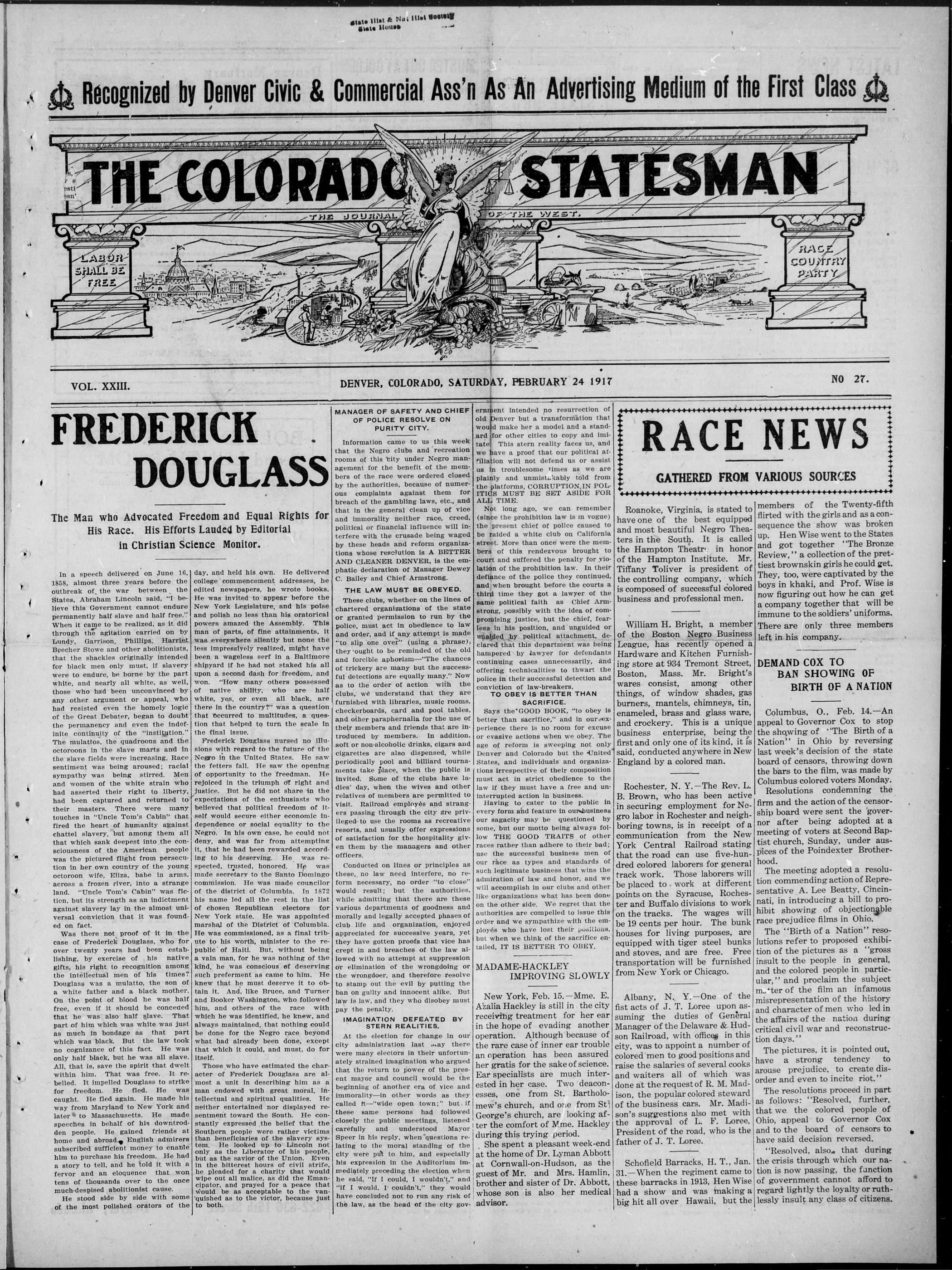
FREDERICK DOUGLASS
The Man who Advocated Freedom and Equal Rights for His Race. His Efforts Lauded by Editorial in Christian Science Monitor.
VOL. XXIII.
FREDERICK DOU
The Man who Advocated Fr
His Race. His Effort
in Christian Sc
In a speech delivered on June 16, 1858, almost three years before the outbreak of the war between the States, Abraham Lincoln said, "I believe this Government cannot endure permanently half slave and half free." When it came to be realized, as it did through the agitation carried on by Lundy, Garrison, Phillips, Harriet Beecher Stowe and other abolitionists, that the shackles originally intended for black men only must, if slavery were to endure, be borne by the part white, and nearly all white, as well, those who had been unconvinced by any other argument or appeal, who had resisted even the homely logic of the Great Debater, began to doubt the permanency and even the indefinite continuity of the "institution." The mulattos, the quadroons and the octoroons in the slave marts and in the slave fields were increasing. Race sentiment was being aroused; racial sympathy was being stirred. Men and women of the white strain who had asserted their right to liberty, had been captured and returned to their masters. There were many touches in "Uncle Tom's Cabin" that fired the heart of humanity against chattel slavery, but among them all that which sank deepest into the consciousness of the American people was the pictured flight from persecution in her own country of the young octooroon wife, Eliza, babe in arms, across a frozen river, into a strange land. "Uncle Tom's Cabin" was fiction, but its strength as an indictment against slavery lay in the almost universal conviction that it was founded on fact.
Was there not proof of it in the case of Frederick Douglass, who for over twenty years had been establishing, by exercise of his native gifts, his right to recognition among the intellectual men of his times? Douglass was a mulatto, the son of a white father and a black mother. On the point of blood he was half free, even if it should be conceded that he was also half slave. That part of him which was white was just as much in bondage as that part which was black. But the law took no cognizance of this fact. He was only half black, but he was all slave. All, that is, save the spirit that dwelt within him. That was free. It rebelled. It impelled Douglass to strike for freedom. He fled. He was caught. He fled again. He made his way from Maryland to New York and later to Massachusetts. He made speeches in behalf of his downtrodden people. He gained friends at home and abroad. English admirers subscribed sufficient money to enable him to purchase his freedom. He had a story to tell, and he told it with a fervor and an eloquence that won tens of thousands over to the once much-despised abolitionist cause.
He stood side by side with some of the most polished orators of the
day, and held his own. He delivered college commencement addresses, he edited newspapers, he wrote books. He was invited to appear before the New York Legislature, and his poise and polish no less than his oratorical powers amazed the Assembly. This man of parts, of fine attainments, it was everywhere silently but none the less impressively realized, might have been a wageless serf in a Baltimore shipyard if he had not staked his all upon a second dash for freedom, and won. "How many others possessed of native ability, who are half white, yes, or even all black, are there in the country?" was a question that occurred to multitudes, a question that helped to turn the scale in the final issue.
Frederick Douglass nursed no illusions with regard to the future of the Negro in the United States. He saw the fetters fall. He saw the opening of opportunity to the freedman. He rejoiced in the triumph of right and justice. But he did not share in the expectations of the enthusiasts who believed that political freedom of itself would secure either economic independence or social equality to the Negro. In his own case, he could not deny, and was far from attempting it, that he had been rewarded according to his deserving. He was respected, trusted, honored. He was made secretary to the Santo Domingo commission. He was made councilor of the district of Columbia. In 1872 his name led all the rest in the list of chosen Republican electors for New York state. He was appointed marshal of the District of Columbia. He was commissioned, as a final tribute to his worth, minister to the republic of Haiti. But, without being a vain man, for he was nothing of the kind, he was conscious of deserving such preferment as came to him. He knew that he must deserve it to obtain it. And, like Bruce, and Turner and Booker Washington, who followed him, and others of the race with which he was identified, he knew, and always maintained, that nothing could be done for the Negro race beyond what had already been done, except that which it could, and must, do for itself.
Those who have estimated the character of Frederick Douglass are almost a unit in describing him as a man endowed with great moral, intellectual and spiritual qualities. He neither entertained nor displayed resentment toward the South. He constantly expressed the belief that the Southern people were rather victims than beneficiaries of the slavery system. He looked up to Lincoln not only as the Liberator of his people, but as the savior of the Union. Even in the bitterest hours of civil strife, he pleaded for a charity that would wipe out all malice, as did the Emancipator, and prayed for a peace that would be as acceptable to the vanquished as to the victor, because just to both.
State Hist & Nat Hist Society
State House
Commercial Ass'n
ADC
JOURNAL
DENVER, COLORADO, SATU
MANAGER OF SAFETY AND CHIEF OF POLICE RESOLVE ON PURITY CITY.
Information came to us this week that the Negro clubs and recreation rooms of this city under Negro management for the benefit of the members of the race were ordered closed by the authorities, because of numerous complaints against them for breach of the gambling laws, etc., and that in the general clean up of vice and immorality neither race, creed, political or financial influence will interfere with the crusade being waged by these heads and reform organizations whose resolution is A BETTER AND CLEANER DENVER, is the emphatic declaration of Manager Dewey C. Bailey and Chief Armstrong.
THE LAW MUST BE OBEYED.
These clubs, whether on the lines of chartered organizations of the state or granted permission to run by the police, must act in obedience to law and order, and if any attempt is made "to slip one over" (using a phrase), they ought to be reminded of the old and forcible aphorism—"The chances of trickery are many but the successful detections are equally many." Now as to the order of action with the clubs, we understand that they are furnished with libraries, music rooms, checkerboards, card and pool tables, and other paraphernalia for the use of their members and friends that are introduced by members. In addition, soft or non-alcoholic drinks, cigars and cigarettes are also dispensed, while periodically pool and billiard tournaments take place, when the public is invited. Some of the clubs have ladies' day, when the wives and other relatives of members are permitted to visit. Railroad employés and strangers passing through the city are privileged to use the rooms as recreative resorts, and usually offer expressions of satisfaction for the hospitality given them by the managers and other officers.
Conducted on lines or principles as these, no law need interfere, no reform necessary, no order "to close" would result; but the authorities, while admitting that there are these various departments of goodness and morally and legally accepted phases of club life and organization, enjoyed appreciated for successive years, yet they have gotten proofs that vice has crept in and breaches of the law allowed with no attempt at suppression or elimination of the wrongdoing on the wrongdoer, and therefore resolve to stamp out the evil by putting the ban on guilty and innocent alike. But law is law, and they who disobey must pay the penalty.
IMAGINATION DEFEATED BY
STERN REALITIES.
At the election for change in our city administration last may there were many electors in their unfortunately strained imagination who argued that the return to power of the present mayor and council would be the beginning of another era of vice and immorality—in other words as they called it—"wide open town;" but. if these same persons had followed closely the public meetings, listened carefully and understood Mayor Speer in his reply, when questions relating to the moral standing of the city were put to him, and especially his expression in the Auditorium immediately preceding the election when he said, "If I could, I wouldn't," and "If I would, I couldn't," they would have concluded not to run any risk of the law, as the head of the city gov-
ernment intended no resurrection of old Denver but a transformation that would make her a model and a standard for other cities to copy and imitate. This stern reality faces us, and we have a proof that our political affiliation will not defend us or assist us in troublesome times as we are plainly and unmistakably told from the platforms, CORRUPTION, IN POLITICS MUST BE SET ASIDE FOR ALL TIME.
Not long ago, we can remember (since the prohibition law is in vogue) the present chief of police caused to be raided a white club on California street. More than once were the members of this rendezvous brought to court and suffered the penalty for violation of the prohibition law. In their defiance of the police they continued, and when brought before the courts a third time they got a lawyer of the same political faith as Chief Armstrong, possibly with the idea of compromising justice, but the chief, fearless in his position, and unguided or unaided by political attachment, declared that this department was being hampered by lawyer for defendants continuing cases unnecessarily, and offering technicalities to thwart the police in their successful detection and conviction of law-breakers.
TO OBEY IS BETTER THAN
SACRIFICE.
Says the GOOD BOOK, "to obey is better than sacrifice," and in our experience there is no room for excuse or evasive actions when we obey. The age of reform is sweeping not only Denver and Colorado but the United States, and individuals and organizations irrespective of their composition must act in strict obedience to the law if they must have a free and uninterrupted action in business. Having to cater to the public in every form and feature in our business our sagacity may be questioned by some, but our motto being always follow THE GOOD TRAITS of other races rather than adhere to their bad; use the successful business men of our race as types and standards of such legitimate business that wins the admiration of law and honor, and we will accomplish in our clubs and other like organizations what has been done on the other side. We regret that the authorities are compelled to issue this order and we sympathize with the employés who have lost their positions, but when we think of the sacrifice entailed, IT IS BETTER TO OBEY.
MADAME-HACKLEY
IMPROVING SLOWLY
New York, Feb. 15.—Mme. E. Azalia Hackley is still in the city receiving treatment for her ear in the hope of evading another operation. Although because of the rare case of inner ear trouble an operation has been assured her gratis for the sake of science. Ear specialists are much interested in her case. Two deaconesses, one from St. Bartholomew's church, and one from St George's church, are looking after the comfort of Mme. Hackley during this trying period. She spent a pleasant week-end at the home of Dr. Lyman Abbott at Cornwall-on-Hudson, as the guest of Mr. and Mrs. Hamlin, brother and sister of Dr. Abbott, whose son is also her medical advisor.
RACE NEWS
GATHERED FROM VARIOUS SOURCES
Roanoke, Virginia, is stated to have one of the best equipped and most beautiful Negro Theaters in the South. It is called the Hampton Theatre in honor of the Hampton Institute. Mr. Tiffany Toliver is president of the controlling company, which is composed of successful colored business and professional men.
William H. Bright, a member of the Boston Negro Business League, has recently opened a Hardware and Kitchen Furnishing store at 934 Tremont Street, Boston, Mass. Mr. Bright's wares consist, among other things, of window shades, gas burners, mantels, chimneys, tin, enameled, brass and glass ware, and crockery. This is a unique business enterprise, being the first and only one of its kind, it is said, conducted anywhere in New England by a colored man.
Rochester, N. Y.—The Rev. L. B. Brown, who has been active in securing employment for Negro labor in Rochester and neighboring towns, is in receipt of a communication from the New York Central Railroad stating that the road can use five-hundred colored laborers for general track work. Those laborers will be placed to work at different points on the Syracuse, Rochester and Buffalo divisions to work on the tracks. The wages will be 19 cents per hour. The bunk houses for living purposes, are equipped with tiger steel bunks and stoves, and are free. Free transportation will be furnished from New York or Chicago.
Albany, N. Y.—One of the fist acts of J. T. Loree upon assuming the duties of General Manager of the Delaware & Hudson Railroad, with offices in this city, was to appoint a number of colored men to good positions and raise the salaries of several cooks and waiters all of which was done at the request of R. M. Madison, the popular colored steward of the business cars. Mr. Madison's suggestions also met with the approval of L. F. Loree, President of the road, who is the father of J. T. Loree.
Schofield Barracks, H. T., Jan. 31.—When the regiment came to these barracks in 1913, Hen Wise had a show and was making a big hit all over Hawaii, but the
NO 27.
members of the Twenty-fifth flirted with the girls and as a consequence the show was broken up. Hen Wise went to the States and got together "The Bronze Review," a collection of the prettiest brownskin girls he could get. They, too, were captivated by the boys in khaki, and Prof. Wise is now figuring out how he can get a company together that will be immune to the soldiers' uniforms. There are only three members left in his company.
DEMAND COX TO BAN SHOWING OF BIRTH OF A NATION
Columbus, O., Feb. 14.—An appeal to Governor Cox to stop the showing of "The Birth of a Nation" in Ohio by reversing last week's decision of the state board of censors, throwing down the bars to the film, was made by Columbus colored voters Monday. Resolutions condemning the firm and the action of the censorship board were sent the governor after being adopted at a meeting of voters at Second Baptist church, Sunday, under auspices of the Poindexter Brotherhood. The meeting adopted a resolution commending action of Representative A. Lee Beatty, Cincinnati, in introducing a bill to prohibit showing of objectionable race prejudice films in Ohio.
The "Birth of a Nation" resolutions refer to proposed exhibition of the pictures as a "gross insult to the people in general, and the colored people in particular," and proclaim the subject matter of the film an infamous misrepresentation of the history and character of men who led in the affairs of the nation during critical civil war and reconstruction days."
The pictures, it is pointed out, have a strong tendency to arouse prejudice, to create disorder and even to incite riot."
The resolutions proceed in part as follows: "Resolved, further, that we the colored people of Ohio, appeal to Governor Cox and to the board of censors to have said decision reversed.
"Resolved, also $ ^{n} $ that during the crisis through which our nation is now passing, the function of government cannot afford to regard lightly the loyalty or ruthlessly insult any class of citizens.
LATEST NEWS EPITOMIZED
FROM TELEGRAPHIC REPORTS THAT COVER THE WEEK'S EVENTS.
OF MOST INTEREST
KEEPING THE READER POSTED ON MOST IMPORTANT CURRENT TOPICS.
WESTERN Newspaper Union News Service
ABOUT THE WAR
Petrograd reports driving out Germans who entered trenches south of Dvinsk.
Turks forced back on Tigris river; British capturing all of ground in Dahra bend and taking 1,995 prisoners.
The Norwegian collier Dalbeatie, from Glasgow to Gibraltar, was sunk by shell fire on the 17th. Two Americans were on board.
"It must be repeated again that whoever dares penetrate the barred zone perishes," declared the official government press bureau at Berlin in a statement discussing the British claim that the submarine war has failed.
Lloyd's announces the sinking of the British steamer Langscar, 2,777 tons; the Hopemoor, 3,740 tons; the Afton, 1,156 tons; the Greenland, 1,753 tons; the Kyunsti, tonnage not recorded; the schooner Percy Roy and a trawler.
The British smashed the German defenses near Armentieres and Ypres on Wednesday. French batteries wreck German line northwest of Hill 304. Artillery duels raging on Italian front. Russians and Teutons lock horns on big eastern front; no decisive result. English capture one Turk garrison and put another to flight on the Sinai peninsula.
Casualties in the German army, exclusive of Colonial troops, reported in the German casualty lists in the month of January, 1917, totaled 77,534 officers and men killed, wounded, prisoners or missing. These casualties bring the total of Germans killed and those who died of wounds or sickness to 988,329, and the total casualties since the war began to 4,087,692.
WESTERN
Governor De Baca of New Mexico died Sunday.
The burial of Gen. Funston will take place in the national cemetery at the Presidio, San Francisco.
Employees of the postoffice in Chicago have been order to refrain from discussing international politics either among themselves or with the public.
Gen. Funston's mother, Mrs. E. H Funston, left Emporia, Kan., for San Francisco to attend the funeral of her son.
Governor Lister signed the "bonedry" prohibition bill in the presence of officers of the W. C. T. U. and other advocates of the measure at Olympia, Wash.
Three American duck hunters were held up in Sonora by two Mexicans dressed in soldiers' uniforms, relieved of $550, two shotguns and a rifle and one of them was threatened with death, according to a report from Yuma, Ariz.
A 17-year-old girl from Salida, Colo., found in a disorderly house in Casper, Wyo., has resulted in the arrest by members of the United States Department of Justice, working out of the Denver office, of two men and a woman on a charge of violating the white slave law.
WASHINGTON
A committee appointment of benefit to Colorado has been made in the transfer of Senator Shafroth of Colorado to the Senate committee on public lands.
The Navy Department awarded contracts to three companies for the manufacture of 14,200 14-inch shells for the navy at a total price of $7,100,000.
The Navy Department has decided to equip the Philadelphia and Norfolk navy yards for the building of capital ships. An appropriation of $12,000,000 is available for this purpose from the last naval bill.
President Wilson sent a letter to Chairman Stone of the Senate foreign relations committee, urging action during this session of Congress on the treaty to indemnify Colombia for the partition of Panama.
Secretary of State Lansing and Attorney General Gregory asked the Senate judiciary committee to pass immediately a bill which would give the President power to handle the present international situation without recourse to assembling Congress for the purpose of declaring war.
Senator Ashurst's bill to make a national park of the Grand Canyon of the Colorado was favorably reported to the Senate from the public lands committee. The land is now government owned. About 800 square miles would be included.
President Wilson and other high officials as well as army officers generally expressed deep regret over the sudden death of Maj. Gen. Frederick Funston at San Antonio. Many of them sent messages of condolence to Mrs. Frederick Funston, visiting in San Francisco.
FOREIGN
The British steamer Iolo, of 3,903 tons gross, has been sunk.
Falling walls of buildings wrecked by flames crushed three firemen to death and badly injured five others at Quebec.
Eleven men of the crew of the British steamer Romsdalen, reported sunk, are missing, Lloyd's Shipping agency announced.
Lieut. Toyoo Yamamura of the Japan air squadron met death at Yokosuka when the hydroplane he was piloting became disabled and fell into the sea.
All Americans from Berlin have reported that the situation in Berlin, so far as Americans are concerned, is little changed since the departure of Ambassador Gerard.
It is reported from Copenhagen, says the Overseas News Agency, that 1,500 persons were killed and 2,000 wounded in an explosion of ammunition at Archangel, Russia. A law has been passed by the Australian government, according to a Reuter dispatch from Melbourne, for bidding the departure of women on children for Europe under any circumstance. Collapse of the Cuban revolt movement was predicted when announcement was made of the tightening of the grasp of government troops of Gen. Jose Miguel Gomez's force at Santa Clara.
Frederic C. Penfield, American ambassador at Vienna, is said by Reuter's Amsterdam correspondent to have delivered to the Austro-Hungarian foreign minister a request for a clear and final definition of Austria-Hungary's attitude regarding sub marine warfare.
The London Daily Express understands that Lieut. Gen. Sir Neville MacCready, the adjutant general, has a scheme whereby women will be substituted for men wherever possible in the army, both in France and in Engl land, and to release to the fighting line men now employed in clerical and other departments.
SPORTING NEWS
A bill which would have prohibited Sunday golfing in North Carolina was killed in the lower House of the Assembly.
Joe Rivers of Los Angeles knocked out Frankie Murphy of Denver in the second round of a scheduled twelve-round fight at Columbus, Ohio.
Young Azevedo of San Francisco knocked out Benny Chavez of Trinidad, Colo., at Salt Lake City in the first round of their scheduled six-round bout.
Plans have been completed to hold the East-West tennis matches at Los Angeles, March 7, 8, 9 and 10 on a specially constructed asphalt court on Bovard field of the University of Southern California.
Sailor Kirke was awarded the popular decision over Wop Flynn at the National Athletic Club in Denver in a fiercely fought twenty-round battle. Flynn had the best of the first seven rounds, but after that it was easy sailing for Kirke. In the semi-wind-up, which was between Jimmy Summers and Jack Hogan, the referee stopped the bout in the fourth round and awarded the decision to Summers.
GENERAL
The woman suffrage amendment bill was passed by the New York Assembly without debate by a vote of 124 to 10.
Harry McKinley, a cousin of the late President McKinley, is being sought by Chicago police following the disappearance from his home at Birmingham, Ala., Feb. 11.
Potatoes at $1 a peck in scant supply; sugar at 10 cents a pound; cabbage at 12 cents, and onions at 18 cents a pound, were increased quotations encountered by householders in their marketing at Boston.
Governor Campbell of Arizona issued a requisition on the governor of Texas for the extradition of L. Anderson and John Groff, in jail at El Paso, Tex., charged with murder of Stephen Hughes, a wealthy ranchman of Tempe, nine miles east of Phoenix, early last December.
Mardi Gras was ushered in at New Orleans, La., under brilliant skies and with a temperature of 76 degrees. Rex, king of the carnival, arrived and was escorted through the streets by marines and sailors from the battleship Maine, torpedo destroyer Sterret, McDonough and other United States vessels.
The resignation of Governor John B. Kendrick, which will be tendered so that he can become U. S. senator for Wyoming, will bring State Senator Tom G. Powers of Torrington within one step to the governorship. Powers was elected president ad interim of the State Senate just before the adjournment sine die of the Legislature. Secretary of State Frank Houx becomes governor on Kendricks resignation becoming effective.
American Mormons who attended the funeral of the three Mormon victims of the Corner ranch raid, returned to El Paso, Tex., with additional details of their murder. They confirmed earlier reports that the bodies of the Americans were horribly mutilated by the Mexican raiders. Burton Jensen had been unspeakably maimed.
Two steamships out of New York, under charter to the Kerr Steamship Company, one Norwegian and the other Spanish, have been sunk in the submarine "barred" zone.
COLORADO STATE NEWS
Western Newpaper Union News Service.
DATES FOR COMING EVENTS.
March 1-2—Midwinter Ski Carnival at Steamboat Springs.
Sept. 17-22—Colorado State Fair at Pueblo.
The C. & S. will construct a new freight depot at Aguilar.
F. W. White, the dramatic critic who died in Denver, left an estate worth $19,000.
Peter Chiolero, long-time resident of Denver and prominent in the Italian colony, died of uremia.
Robert E. Palm, a 32nd degree Mason, died of paralysis at the home of Andrew Misner in Castle Rock.
A record price for non-irrigated land for the northern part of the state was set in Loveland when 160 acres sold for $60 per acre.
Beautifying Denver by planting trees in streets will form an important part of the improvement plans for the coming season.
The State Inheritance Tax Department has broken a record by the collections of $3,753.79 on inheritances during a two-week period.
George C. Beckley, wealthy sugar man of Honolulu and brother-in-law of Princess Kawananakoa of Hawaii, will make his home in Denver.
The jewels of Mrs. John A. Savage were officially appraised for assessment purposes at $1,700 by the board of county commissioners at Denver.
A coroner's jury found George Belcher, alias Tip Williams, 35, guilty of feloniously causing the death of George A. Russell during a street shooting affray which occurred at Denver.
Gen. J. J. Pershing, who succeeds the late General Funston in command on the border, is well known in Denver and has a number of relatives in that city whom he has visited frequently on his trips to Denver.
Word has been received in Denver of the death of John J. Buel, the man who selected the site of Denver. He also platted the site of Boulder and of Central City, and later founded the city of Quinnesec, Mich. He died there.
A plea for the fair assessment of metalliferous mines was made by Assessor J. C. Ferril of Teller county at the annual conference of the Colorado Tax Commission and county assessors at the State Museum building in Denver.
Deputy District Attorney Paul McGovern of Denver has filed an information against Homer Ware, charging him with robbery and assault with intent to kill Dr. D. B. McMahon, proprietor of a drug store. McMahon was shot by a holdup.
A deadlock of the six members of the State Board of Charities and Corrections, on the appointing of an assistant secretary and an investigator, failed to show any sign of weakening at an adjourned meeting, and the places are still unfilled.
Lying unconscious for more than twenty-four hours, suffering from a severed artery at the base of the brain and a badly fractured skull, D. B. Freeman, aged 70, of Wiggins, is not expected to live as the result of an automobile accident just south of Platteville.
Colorado has the opportunity for becoming the greatest poultry raising state in the Union, according to an authoritative statement in a booklet just issued by the State Agricultural College. The information contained in the booklet was compiled by Prof. W. E. Vaplon.
According to a Cripple Creek report a new and rich ore shoot for the Acacia Gold Mining Company has been cut on the Shurtloff vein at the 1,350-foot level of the South Burns shaft, and the screenings resulting from breaking the vein three feet wide are grabbing from $30 to $60 a ton.
Building trades employés in Denver are seeking an increase in wages to conform to the recent increase of from 50 cents to $1 made in the pay of plumbers, steamfitters and tinners. The demand will be made in behalf of carpenters, plasterers, painters and structural iron workers.
Secretary Huston of the United States Department of Agriculture will visit Denver next June, with the primary object of studying opportunities and possibilities in connection with the development of the Mount Evans region and the general mountain parks system in the vicinity of Denver.
With about $60,000 subscribed and in sight, 200 volunteer workers who have been active in the campaign to raise $85,000 for the support of Denver's seventeen Federated Charities in the next fifteen months met and voted to continue the solicitation of funds until the needed sum is obtained.
A small fire in the Oakdale Company's mine at Oakview, six miles west of La Veta, caused considerable excitement Monday morning. At 10 p'clock Mine Clerk Reck announced that the flames had been extinguished, and that all the men on the night shift had been accounted for. No one was injured.
The Missouri society, composed of former residents of the "Show Me" state, will give a dinner in Denver March 3, to be followed by entertainment. It will be the annual meeting for the election of five directors.
MUSTER OUT AT GOLDEN
ASSEMBLY WANTS GUARDS DISBANDED IN COLORADO.
Resolution Passed by Legislature Asks Congressmen to Request Modification of Order.
Western Newspaper Union News Service.
Denver.—The following telegram, passed by both the Senate and House on the 19th, was wired to Colorado representatives in Congress and Newton D. Baker, secretary of war:
"Colorado emphatically objects to War Department order which would disband her patriotic soldiery in a strange city of another state. Colorado's wives, mothers, sisters, sweet-hearts want to be first to welcome home their beloved soldiers. A grand public demonstration instead of weeks in a strange city should be a soldier's portion. The soldiers have personal right to be disbanded where they were mobilized and every loyal citizen of Colorado has the right to be permitted to welcome the state's defenders home. Please use your efforts to have department order changed to disband Colorado guard at rifle range near Golden, in their own state.
"Signed: James R. Noland, secretary of state; R. H. Higgins, state treasurer; Leslie E. Hubbard, attorney general; Mary C. C. Bradford, state superintendent of public instruction; Charles H. Leckenby, auditor of state; L. U. Guggenheim, deputy inheritance tax commissioner; W. H. McNichols, deputy auditor of state; Ell M. Gross, state building loan commissioner; Samuel J. Lewis, state printing commissioner; John Lynch, state pure food commissioner, and Irving Van Bradt, assistant attorney general."
Leading Citizens' Sons Arrested.
Leading Citizens' Sops Arrested.
Lamar—Seventeen large burglaries and uncounted minor thefts starting at Lamar early in November and extending to outside towns have resulted in the discovery of an alleged burglary ring composed of a large number of high school students, boys and girls, children of some of the wealthiest and most prominent families in the Arkansas valley. Six boys, members of the last Lamar football squad, are held in jail, their parents having refused to give ball, pending the outcome of mass meetings and frequent conferences between the school board, high school faculty, court and peace officers and fathers and mothers. One death is due to the scandal. In a meeting at the court house, attended by parents, the board of education, County Judge Horn and others, D. C. Polhemus, president of the school board, grew so excited under a grilling examination that he ruptured a blood vessel and dropped dead from apoplexy.
Rienzi C. Dickens Wins Supersedeas.
Denver.—Rienzi C. Dickens, convicted of murdering his father, W. H. Dickens, Longmont banker, and sentenced to serve from 18 to 27 years in the state penitentiary, was granted a supersedeas by the State Supreme Court. His bond was fixed at $37,500. The granting of the supersedeas means that Dickens will be released on bail pending the finding of the Supreme Court. It will probably take the court several weeks to review the case.
Prisoner Compiled to Pay Fine.
Greeley.—Paul Barringer, who was fined $10 and costs for being drunk,
refused to pay, demanding that he be allowed to lay it out in jail. The chief
allowed him to remain in jail long enough for the issuance of an execution
for the amount of costs and fine,
and then brought Barringer into court,
served execution, deducted the amount
from $18 he had in his pocket,
returned the balance, gave him a good
lecture and turned him loose.
Yields $40 Per Pound Ore.
Cripple Creek.—A strike rivaling in importance the finding of the "million-dollar vug" in the Cresson mine during December, 1912, has been made on the El Oro mine, Eclipse gulch, owned by the Queen Gold Mining Company. It is reported that a large body of high-grade ore has been encountered at a depth below 1,000 feet in the El Oro. Selected samples from the vein are said to run as high as $40 pound.
Six Arrests in Taxi Killing.
Pueblo, Colo.—Six arrests were made by the police in the killing of Nicholas Venezio, a taxacab driver. here. Venezio was shot to death, presumably by one of two passengers in his cab, just as he stopped the car near the entrance to the Colorado Fuel & Iron Company's Bessemer plant. K. P. Meeting Largely Attended. Rocky Ford.—The annual district convention of the Knights of Pythias of the Arkansas valley was held in this city. There was a large attendance from all the lodges in the district.
State Submits Evidence in Swan Case.
Fort Morgan.—Horace G. Benson of Denver, special prosecutor, rested the state's case against John Swan. Swan is charged with the murder of City Marshal Charles P. Eysar, killed while conducting a bootlegging raid.
Probably Fatally Injured by Auto.
Monte Vista.—Ira L. McGuire, 40 years old, a driver for an oil company, was probably fatally injured by an automobile driven by Harry L. Olds, a stockman of this city.
Denver Mortuary
MRS. J. H. STEELE, Manager.
Office and Res., 2610 Downing.
Phone Day or Night, York 5952W
Service from Better and Spacious
Parlor.
Our Prices Most Reasonable.
Night and
919 19th street, between
Merchants' Lunch every day
3:30 p. m., 20c. Short order
us a trial. Phone Main 669
BOB CARRUTH, Proprietor
THE EAST
Can be rented very reasonable
organizations. The Hall is
Dances and Athletic Exhibit
REFRESHM
night and Day Care
high street, between Champa and Curtis.
Rents' Lunch every day from 11:30 a. m. to
m., 20c. Short orders at all hours. Give
al. Phone Main 6699.
ARRUTH, Proprietor. Orders taken over
THE EAST TURNER HALL
rented very reasonable by Societies, Lodges
ions. The Hall is suitable for Entertain-
and Athletic Exhibitions.
REFRESHMENTS SERVED.
Night and Day Cafe
919 19th street, between Champa and Curtis. Merchants' Lunch every day from 11:30 a. m. to 3:30 p. m., 20c. Short orders at all hours. Give us a trial. Phone Main 6699.
THE EAST TURNER HALL
Can be rented very reasonable by Societies, Lodges and Organizations. The Hall is suitable for Entertainments, Dances and Athletic Exhibitions.
2132 ARAPAHOE ST.
BOLDEN
and LUN
924 19th Stree
OLDEN BROS. CA
and LUNCH ROOM
1924 19th Street, Denver, Colorado
100
DINNER
11:30 to 2 p.m.
All Kinds of Sandwiches
Bolden Bros
Baths, EL
FIRST CL
R. B. BOLDEN, M
Weatherh
TELEPHO
Golden Bros. Barber Sh
Baths, Electric Massage
FIRST CLASS SERVICE
. BOLDEN, Mgr. 926 19th St. D
atherhead Hat
TELEPHONE MAIN 3203
R. B. BOLDEN, Mgr. 926 19th St. Denver
Weatherhead Hat Co.
TELEPHONE MAIN 3203
Established 1876 PIONEER HATTERS OF THE WEST WE MAKE OLD HATS NEW
PRACTICAL
RENOVATORS, BLEACH
Of Gents' and Ladies'
1624 Champa
HONE MAIN 3028
JOHN K
PRACTICAL HATTERS
VATORS, BLEACHERS DYERS AND FINE
Gents' and Ladies' Hats of Every Descripti
1624 Champa St., Denver, Colo.
AIN 3028 RES. PHONE G.
JOHN K. RETTIG
RENOVATORS, BLEACHERS DYERS AND FINISHERS Of Gents' and Ladies'Hats of Every Description 1624 Champa St., Denver, Colo.
PHONE MAIN 3028 RES. PHONE GALLUP 942 JOHN K. RETTIG Meats, Fancy and Staple Groceries 1864 CURTIS STREET Corner Nineteenth. Denver, Colo
The MARKET COMPANY
C. E. SMITH, Manager, Res. Phone South 1608
Wholesale and Retail Staple and Fancy Groceries, Fish and Oysters Hotels and Restaurants Our Specialty. Fresh and Cured
Eastern Corn Fed Meats
Telephones Main 4302, 4303, 4304, 4305
622-636 15th Street Denver, olorado
TOMB OF MARY
Day Cafe
Champa and Curtis.
from 11:30 a. m. to
s at all hours. Give
Orders taken over phone.
TURNER HALL
able by Societies, Lodges and Or-
suitable for Entertainment,
ations.
ENTS SERVED.
PHONE MAIN 2449
BROS. CAFE
CH ROOM
Denver, Colorado
Short Orders at All Hours
Barber Shop
Electric Massage
ESS SERVICE
gr. 926 19th St. Denver
ead Hat Co.
E MAIN 3203
L HATTERS
RS DYERS AND FINISHERS
Hats of Every Description
St., Denver, Colo.
RES. PHONE GALLUP 942
RETTIG
AFRO-AMERICAN CULLINGS
Were I in India, where "caste" prevails, I should hesitate to make these few suggestions, or even discuss the question; but in "free" America a boy doesn't have to build pots of mud because his father did, or sell these same mud pots because his father was a cheap pottery merchant, writes John L. Blount in a communication to the Houston (Tex.) Post. Here he can build his pots of gold if he wants; provided he has the "get up" and "hustle" to secure said gold; or he can let "pots" alone entirely, and incidentally go into the kettle business; it's up to the boy.
But the boy needs guidance, leading and encouragement; he must always have something to look forward to, something tangible—not in a fairy story—that he can set his mind on and work up to.
We must confess that the Negro boy is slightly handicapped in this. Accomplished men of his race, whom he might emulate are few; deeds of skill and advances in science are fewer; such things seem "far away" to the colored boy simply because somebody else "did it," and yet we know him to be a good follower and an excellent manipulator.
He needs encouragement. And then again opportunity, or rather the lack of it, sometimes makes him forget, and you hear the disgusting, "Aw, what's the use!"
It is for these things I'm pleading: First to the Negro father: Be somebody! Build good "pots," so that your boy can not only build pots too, but maybe go a step further and build his of iron and set them to boiling. He will get up more steam than you did.
And then to the nation: Give the Negro boy a chance to make himself a more useful citizen; he is a "link in the chain." Help and encourage him to build business houses, industrial plants and institutions; not so much of the literary kind, but institutions for active advancement.
To quote from some of Houston's leading citizens in one of the Christmas issues of the Post: "If I were Santa Claus" I would bring to Houston and to South Texas an institution that would send out from its doors competent Negro carpenters and masons and plumbers and architects, to build better and more sanitary homes and public buildings; and to the various railroad shops and factories, qualified Negro blacksmiths, machinists and iron molders; and to the river-bottom farms and lowlands would send Negro farm experts and engineers to help in draining, irrigating, reclaiming and cultivating our valuable farm lands; and last, that would send out Negro teachers who could and would teach more industry and thrift, and set the Negro boy to thinking about that great combination, 'the hand and mind.' This institution would be no ordinary industrial school, but a vocational or technical trade school.
This would be my gift if I were Santa Claus.
Whether Negroes will be more likely to remain in the South if better educational facilities are provided them is a question apart from the undoubted wisdom of providing these facilities.
President Edward T. Ware of Atlanta university, who is seeking to raise an endowment fund of five hundred thousand dollars for this institution, is reported as saying that if the Negroes are to remain in the South they must be educated. It is certain
It has been said that General Armstrong would have been justified in founding Hampton institute had its only result been Booker T. Washington. He made his way to Hampton as a penniless, ragged and ignorant youth. Without friends, money or credentials, he was allowed, after an entrance examination which consisted in sweeping well one of the classrooms, to enter as a student, and was given the opportunity to work his way through the institute and to equip himself for founding the greatest institution ever conducted by the Negro race, and one of the greatest ever established by any race. Great as was Booker Washington's native genius, this he could never have done without the fundamental training in right living which he received at Hampton. Hampton not only equipped Booker Washington for the founding of Tuskegee and the eventual leadership of the Negro race in America, but it trained Major Moton to take up Washington's great task when he laid it down 14 months ago and to carry it forward without loss of momentum. Nor should the great work which Booker Washington did, nor the great
In the Argentine republic if a man engaged to marry hesitates beyond a reasonable time in leading his fiancee to the altar he is heavily fined, and if a resident of the republic should fall to marry he is taxed until he reaches the age of eighty.
Experiments at the University of Washington, at Seattle, have resulted in the discovery of a process of distilling mill waste, by means of which tar, a light oil, acetate of lime and charcoal are obtained.
that as the idea of the advantages of education grows among the Negroes the tendency will be to leave the South if educational facilities are more nearly adequate and more readily available elsewhere. But it is also to be remembered that as education of the blacks progresses there will also be an increasing inclination to gain larger advantages of occupation. The South is developing rapidly in the magnitude and range of its industries, and there will be great need of labor—a need as acute, if not more so, than now, when the Negro exodus is proving economically serious. But it is not clear whether a higher degree of education among the Negroes will find the latter willing to accept a continuance of the present sharp line drawn in the South between the races in all activities of life. Increase a man's education and, no matter what his color, he will be less content to be held down to a low social and business status and to a sharp definition of relationship with others of the human race. This is, of course, not an argument against the education of the Negro; it is simply calling attention to a situation which may possibly arise.
It is our belief that in education lies the solution of the Negro problem, but solution of the problem for the South will not likely come through increased contentment to the Negro because of better local educational advantages. It will come for the South rather through an infiltration of foreign labor into the region which will have the effect of making the South more independent of Negro labor and tend, together with the spirit of ambition promoted by education, to distribute the Negro population throughout the country.—Financial America.
Adam Manuel, a Creek freedman, died in Colorado recently, and already there is a race on among some of the residents of Muskogee county to get the appointment of guardian for his children. There are five of the children living and the elder Manuel inherited the alligments of two who are dead, but the guardianship is sought because of Luther Manuel, a minor son, who is believed to be the richest Negro boy in the world.
When the allotments were made for the Manuel family, says the Beaumont (Tex.) Enterprise, those of Luther, thirteen, and Rafield, his younger brother, were in a locality where the land was worthless for farming purposes. Their father complained that the land was valueless, but he was unable to have any change made.
It turned out that the allotment of Luther, believed to be worthless, was in the heart of the Cushing oil field. Since that field was developed nearly six years ago, his income from it amounted to from $20,000 to $24,000 a month. The allotment of Rafield Manuel is not so valuable. The allotments of the other children are good for agricultural purposes only.
Sarah Rector has been considered the most fortunate of all those among the Creek freedmen who took allotments in that section of country, but her fortune is far less than that of Luther Manuel. For a time, when the Cushing oil field was at its best, or for more than two years, his income was $1,000 a day.
Gasoline motors make ready sales in Cuba.
Richard Belt has completed a bust of Lord Kitchener.
work which Major Moton is doing, lead us to overlook the splendid achievements of the thousands of Hampton graduates, who have done and are doing in every part of America work as fine and as useful, if less far-reaching and distinguished.
It is little realized to what extent real education in distinction from mere book learning is due to the leadership of Hampton and Tuskegee. The idea that education is something from within, is the development of character, is preparation for right living, has been by these two schools more powerfully impressed upon educational thought than by any or all the other institutions of the country combined. A superintendent of schools of Boston once said at Tuskegee: "You are doing here what we in the North are merely talking about." Many another leading educator has paid the same tribute to Hampton and Tuskegee, either in words or through emulation of their methods.
A centennial exposition is to be held in Gulfport, Miss., in December, 1917.
Uruguay has prohibited the manufacture or importation of alcoholic beverages of strength exceeding 45 degrees.
Breweries in Japan produce about 210,000,000 gallons of sake, the national alcoholic drink, from rice, annually.
Homing pigeons can travel 70 miles an hour.
The United States has 880 plano factories.
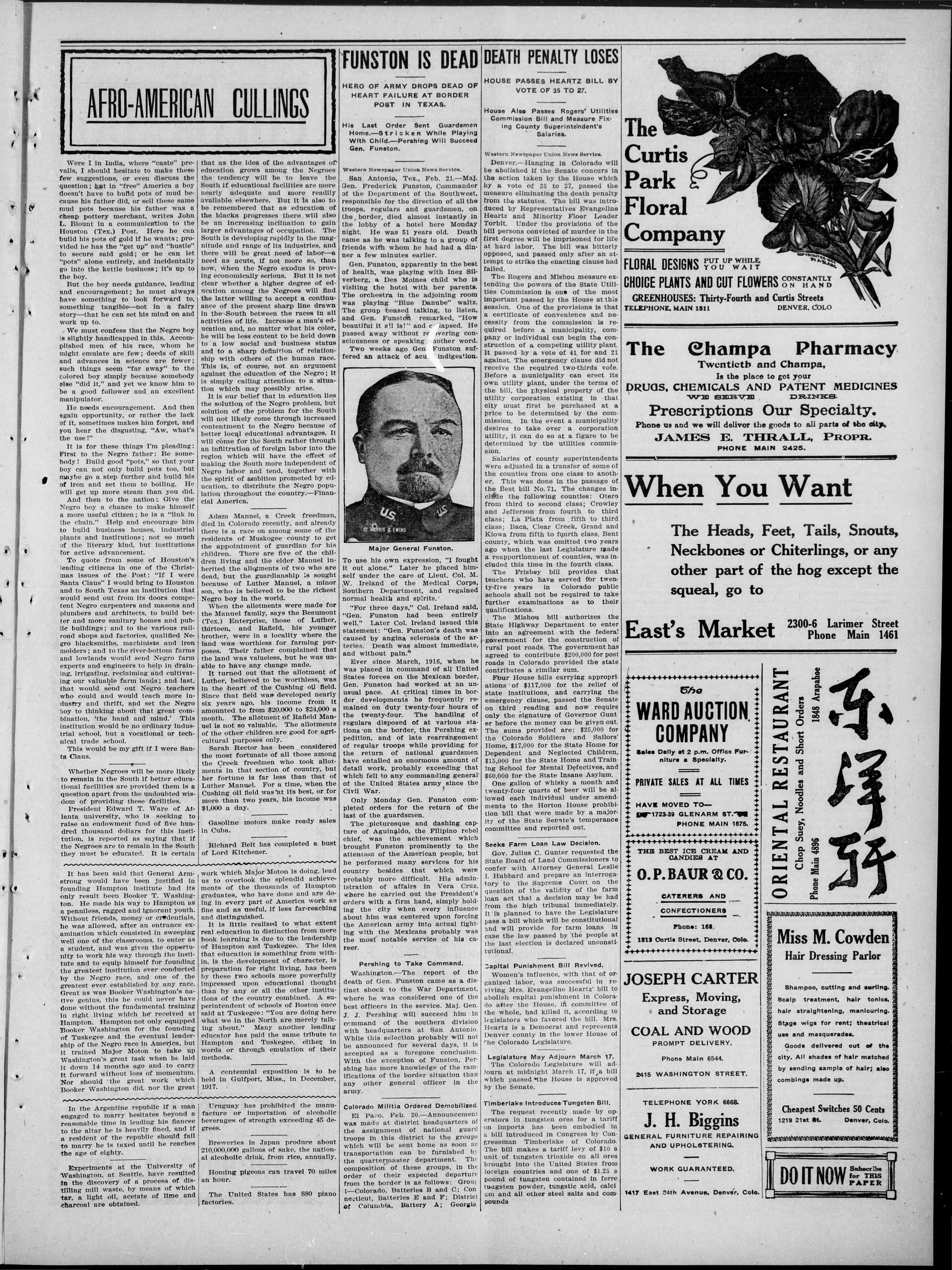
FUNSTON IS DEAD
HERO OF ARMY DROPS DEAD OF HEART FAILURE AT BORDER POST IN TEXAS.
His Last Order Sent Guardsmen Home.—Stricken While Playing With Child.—Pershing Will Succeed Gen. Funston.
San Antonio, Tex., Feb. 21.—Maj. Gen. Frederick Funston, Commander of the Department of the Southwest, responsible for the direction of all the troops, regulars and guardsmen, on the border, died almost instantly in the lobby of a hotel here Monday night. He was 51 years old. Death came as he was talking to a group of friends with whom he had had a dinner a few minutes earlier.
Gen. Funston, apparently in the best of health, was playing with Inez Silverberg, a Des Moines child who is visiting the hotel with her parents. The orchestra in the adjoining room was playing "Blue Danube" waltz. The group ceased talking, to listen, and Gen. Funston remarked, "How beautiful it all is!" and collapsed. He passed away without revering consciousness or speaking another word. Two weeks ago Gen Funston suffered
U.S.
C HARRIS & EWING
Major General Funston.
To use his own expression, "I fought it out alone." Later he placed himself under the care of Lieut. Col. M. W. Ireland of the Medical Corps, Southern Department, and regained normal health and spirits.
"For three days," Col. Ireland said, "Gen. Funston had been entirely well." Later Col. Ireland issued this statement: "Gen. Funston's death was caused by angina sclerosis of the arteries. Death was almost immediate, and without pain."
Ever since March, 1916, when he was placed in command of all United States forces on the Mexican border, Gen. Funston had worked at an unusual pace. At critical times in border developments he frequently remained on duty twenty-four hours of the twenty-four. The handling of regulars disposed of at various stations on the border, the Pershing expedition, and of late rearrangement of regular troops while providing for the return of national guardsmen have entailed an enormous amount of detail work, probably exceeding that which fell to any commanding general of the United States army since the Civil War.
Only Monday Gen. Funston completed orders for the return of the last of the guardsmen.
The picturesque and dashing capture of Aguinaldo, the Filipino rebel chief, was the achievement which brought Funston prominently to the attention of the American people, but he performed many services for his country besides that which were probably more difficult. His administration of affairs in Vera Cruz, where he carried out the President's orders with a firm hand, simply holding the city when every influence about him was centered upon forcing the American army into actual fighting with the Mexicans probably was the most notable service of his career.
Pershing to Take Command.
Washington.—The report of the death of Gen. Funston came as a distinct shock to the War Department, where he was considered one of the best officers in the service. Maj. Gen. J. J. Pershing will succeed him in command of the southern division with headquarters at San Antonio. While this selection probably will not be announced for several days, it is accepted as a foregone conclusion. With the exception of Funston, Pershing has more knowledge of the ramifications of the border situation than any other general officer in the army.
Colorado Militia Ordered Demobilized
El Paso, Feb. 20.—Announcement was made at district headquarters of the assignment of national guard troops in this district to the groups which will be sent home as soon as transportation can be furnished by the quartermaster department. The composition of these groups, in the order of their expected departure from the border is as follows: Group 1—Colorado, Batteries B and C; Connecticut, Batteries E and F; District of Columbia, Battery A; Georgia
DEATH PENALTY LOSES
HOUSE PASSES HEARTZ BILL BY
VOTE OF 35 TO 27.
House Also Passes Rogers' Utilities
Commission Bill and Measure Fix-
ing County Superintendent's
Salaries.
Western Newspaper Union News Service.
Denver.—Hanging in Colorado will be abolished if the Senate concurs in the action taken by the House which by a vote of 35 to 27, passed the measure eliminating the death penalty from the statutes. The bill was introduced by Representatives Evangeline Heartz and Minority Floor Leader Torbit. Under the provisions of the bill persons convicted of murder in the first degree will be imprisoned for life at hard labor. The bill was bitterly opposed, and passed only after an attempt to strike the enacting clause had failed.
The Rogers and Mishou measure extending the powers of the State Utilities Commission is one of the most important passed by the House at this session. One of the provisions is that a certificate of convenience and necessity from the commission is required before a municipality, company or individual can begin the construction of a competing utility plant. It passed by a vote of 41 for and 21 against. The emergency clause did not receive the required two-thirds vote. Before a municipality can erect its own utility plant, under the terms of the bill, the physical property of the utility corporation existing in that city must first be purchased at a price to be determined by the commission. In the event a municipality desires to take over a corporation utility, it can do so at a figure to be determined by the utilities commission.
Salaries of county superintendents were adjusted in a transfer of some of the counties from one class to another. This was done in the passage of the Best bill No.71. The changes include the following counties: Otero from third to second class; Crowley and Jefferson from fourth to third class; La Plata from fifth to third class; Baca, Clear Creek, Grand and Kiowa from fifth to fourth class. Bent county, which was omitted two years ago when the last Legislature made a reapportionment of counties, was included this time in the fourth class. The Frisbey bill provides that teachers who have served for twenty-five years in Colorado public schools shall not be required to take further examinations as to their qualifications.
The Mishou bill authorizes the State Highway Department to enter into an agreement with the federal government for the construction of rural post roads. The government has agreed to contribute $200,000 for post roads in Colorado provided the state contributes a similar sum.
Four House bills carrying appropriations of $117,000 for the relief of state institutions, and carrying the emergency clause, passed the Senate on third reading and now require only the signature of Governor Gunter before the money can be given out. The sums provided are: $25,000 for the Colorado Soldiers and Sailors' Home, $17,000 for the State Home for Dependent and Neglected Children, $15,000 for the State Home and Training School for Mental Defectives, and $60,000 for the State Insane Asylum.
One gallon of whisky a month and twenty-four quarts of beer will be allowed each individual under amendments to the Horton House prohibition bill that were made by a majority of the State Senate's temperance committee and reported out.
Seeks Farm Loan Law Decision.
Gov. Julius C. Gunter requested the State Board of Land Commissioners to confer with Attorney General Leslie I. Hubbard and prepare an interrogatory to the Supreme Court on the question of the validity of the farm act that a decision may be had from the high tribunal immediately. It is planned to have the Legislature pass a bill which will be constitutional and will provide for farm loans in case the law passed by the people at the last election is declared unconstitutional.
Capital Punishment Bill Revived.
Women's influence, with that of organized labor, was successful in reviving Mrs. Evangeline Heartz' bill to abolish capital punishment in Colorado after the House, in committee of the whole, had killed it, according to legislators who favored the bill. Mrs. Heartz is a Democrat and represents Denver county in the lower House of the Colorado Legislature.
Legislature May Adjourn March 17.
The Colorado Legislature will adjourn at midnight March 17, if a bill which passed the House is approved by the Senate.
The request recently made by operators in tungsten ores for a tariff on imports has been embodied in a bill introduced in Congress by Congressman Timberlake of Colorado. The bill makes a tariff levy of $10 a unit of tungsten trioxide on all ores brought into the United States from foreign countries and one of $1.25 a pound of tungsten contained in ferro tungsten powder, tungstic acid, calcium and all other steel salts and compounds
The Curtis Park Floral Company
FLORAL DESIGNS PUT UP WHILE YOU WAIT
CHOICE PLANTS AND CUT FLOWERS CONSTANTLY ON HAND
GREENHOUSES: Thirty-Fourth and Curtis Streets
TELEPHONE, MAIN 1511 DENVER, COLO
The Champa Pharmacy
The Champa Pharmacy
Twentieth and Champa,
Is the place to get your
DRUGS, CHEMICALS AND PATENT MEDICINES
WE SERVE DRINKS.
Prescriptions Our Specialty.
Phone us and we will deliver the goods to all parts of the city.
JAMES E. THRALL, PROPR.
PHONE MAIN 2425.
When You Want
The Heads, Feet, Tails, Snouts, Neckbones or Chiterlings, or any other part of the hog except the squeal, go to
East's Market
The
WARD AUCTION
COMPANY
Sales Daily at 2 p.m. Office Furniture a Specialty.
PRIVATE SALES AT ALL TIMES
HAVE MOVED TO—
1723-39 GLENARM ST.
PHONE MAIN 1675.
THE BEST ICE CREAM AND
CANDIES AT
O.P. BAUR & CO.
CATERERS AND
CONFECTIONERS
Phone: 168.
1513 Curtis Street, Denver, Colo.
JOSEPH CARTER
Express, Moving,
and Storage
COAL AND WOOD
PROMPT DELIVERY.
Phone Main 6544.
2415 WASHINGTON STREET.
TELEPHONE YORK 6668.
J. H. Biggins
GENERAL FURNITURE REPAIRING
AND UPHOLSTERING.
WORK GUARANTEED.
1417 East 24th Avenue, Denver, Colo.
2300-6 Larimer Street Phone Main 1461
Phone Main 4896 1848 Arapahoe
不详歼
Miss M. Cowden Hair Dressing Parlor
Shampoo, cutting and curling. Scalp treatment, hair tonics, hair straightening, manicuring. Stage wigs for rent; theatrical use and masquerades. Goods delivered out of the city. All shades of hair matched by sending sample of hair; also combings made up.
Cheapest Switches 50 Cents
1219 21st St. Denver, Colo
DO IT NOW Subscribe for THIS PAPER
THE COLORADO STATESMAN
COLORADO SHALL BE FREE
TRACK COUNTRY PARTY
reading notices, ten lines or less, 10 cents per line. Each additional line over ten lines, 5 cents per line. Display advertising 50 cents per inch.
Communications to receive attention must be newsy, upon important subjects, plainly written only upon one side of the paper, must reach us Tuesdays, if possible, anyway not later than Wednesdays, and bear the signature of the author. No manuscript returned, unless stamps are sent for postage. All communications of a personating nature that are not complimentary, will be withheld from the columns of this paper.
Remittances should be made by Express Money Order, Postoffice Money Order, Registered Letter or Bank Draft. Postage stamps will be received the same as cash for the fractional part of a dollar. Only 1c and 2c stamps taken.
BUSINESS OUTLOOK IN DENVER.
ACCORDING to a report compiled by the moving and storage companies, 977 families moved into the city during 1916, while 869 moved away, showing a net increase of 108 families. This was brought to the knowledge of the Home Ownership Committee of the Real Estate Exchange which is instituting a campaign for "a home for every Denverite." It is also intimated that every habitable residence is occupied in the city, and despite the building activity, the demand for homes will far exceed the supply by spring. Then comes a demand for business property on Broadway close to the main business streets. Office buildings recently erected are quickly tenanted, and the agents find no difficulty in filling their buildings. The merchants with one accord declare that prosperity unprecedented has marked and is still marking their order of business; the banks in their reports proclaim more deposits from the people and the banking business on the highest plane in its history; the average business man in the various phases of commercial enterprise indorses the fact of good business, and these form positive indications that the shiftless portion of our citizens will have to make room for people of backbone who do business wherever they go and contribute to the stability of government, the improvement of a city and the general success of a community. Somebody ventures to assert, "this is due to prohibition"; another with emphasis declares, "the war." We are inclined to support the idea of prohibition, as although the export and import trade of our country has been alarming in the way of increase, yet we cannot touch for Colorado's gain that way, but we do know and are sure that from the proofs given us by all the business agencies in Denver and other parts of the state, the purchasing and saving ability of the public is by far greater than formerly, and they say without a doubt—PROHIBITION IS RESPONSIBLE. If this is so then let us advocate, one and all, BONE-DRY COLORADO, which will yield greater interests as we have passed the experimental stage of the game. Kansas has passed her "Bone-Dry" law, and the Senate and Congress of the nation have stamped their approval on the prohibitory clause in interstate commerce and the importation in dry states, and the benefits anticipated will be shared by Colorado, if we have prohibition in its driest form. THE COLORADO STATESMAN then urges the people of our race to get busy, and combine for business, so that they can have a share in this prosperity that is sweeping the land. The four per cent interest is good, but can we launch out to get eight and twelve as the other fellow? Rally subscriptions of large sums with our names emblazoned on the church roll and registered in Heaven may be in order; expensive and elaborate celebrations and banquets by individuals and organizations soothing to the taste; but will we also remember that if we would pool and erect office buildings, apartment houses, and engage in various forms of business as the other side, we would enjoy life as the Creator would have us, and Heaven would resound with the joy thereof. Our professionals would not suffer such indignities, our leaders exposed to the temptations that result in compromise, or our people asa whole consigned to the role of insignificance. Give this a serious thought and see if we cannot be equal to a link in this great chain—PROSPERITY.
PURE CHARACTER AN ANTIDOTE TO RACE PREJUDICE.
"I WOULD RATHER either of my daughters kept company with the blackest Negro in St. Louis, if he had a pure character, than the whitest white who was a scorner of religion and immoral." This startling statement by Rev. George L. Hale, pastor of the Euclid Avenue Baptist Church (white) shocked the fashionable West End congregation as if a thunderbolt had fallen on the sacred edifice, trying to demolish everything in its wake. In prescribing "don'ts" for the marrying girl at a meeting of the members of Eis church, this reverend gentleman, filled with the spirit of the doctrine he has been inculcating on his flock for years, felt it a duty incumbent on him to apply Christianity in a practical manner, as to arouse in his auditors the truism of the religion they are proud to be followers of. Only last month a popular Episcopal prelate of the South in the person of Bishop Gallor of Memphis, Tenn., reubked the best white people in a sermon delivered to the Calvary Church congregation for not taking a bold stand for practical Christianity by their quiescent approval of the lawlessness of the "low-browed white people" in their mob and lynch rule.
We quote these two cases because they are recent, but we have in mind a number of similar ones which lead us to conclude that the time is approaching when man will no longer be measured by the standards of color or race, but his stature must be PURENESS OF CHARACTER and its concomitant features. It is gratifying to note that this religion of the CHRIST that some of his ambassadors and other representatives tried to teach had divisions and sub-divisions, especially on the color and race questions, is taking such a practical form, that men are not afraid of the fashion and wealth of their congregations to tell them of the basic principles of their religion—"the fatherhood of God and the brotherhood of man"; "Love one another"; "No man can love God Whom he hath not seen and hate his brother whom he hath seen"; and other worthy instructions which ought to lower the bars of prejudice; more than that—BREAK THEM DOWN.
Nearly all of our religious denominations in this country have had controversies on church unity as to race and color—some refusing to raise to the bishopric men of color, others refusing affiliation with branches of the same faith on account of race, and other minor causes which hold up their religion to the unbeliever as a class or special institution, which in its invitation to enter makes no discrimination until it gets its followers so ingratiated that they cannot depart, even in the face of conditions contrary to the fundamentals of their doctrine. But this Baptist minister reviewing the whole situation, and possibly after years of self-examination, arrived at a conclusion that compels him to express unclothed and unhampered that A PURE CHARACTER takes first place in his heart, his home, his life, and the same should be the religious as well as general conviction of the people among whom he disseminates this truth. What grander lesson can be taught any people, we ask, than proof of good character, purity of living, uprightness of action are the standards by which they are measured, and if the members of our race, with all the opposition confronting us, will only realize that it takes the character of which this divine speaks to eradicate this prejudice from the dominant racial factor in this country, then we should strive to obtain this all-desirable quality that will not only impress them with the religious view, but offer such an unanswerable argument to their actions towards us as to merit the treatment of the fellowship of American citizens in one common brotherhood? May the words of Rev. George Hale and Bishop Gailor be like the seeds that fell on good soil, yielding a manifold result.
World Citizenship Forced Upon People of United States by New Conditions
World Citizenship Forced Upon People of United States by New Conditions
Citizenship now has a new definition. Unprecedented events have revolutionized our civic standards.
America once stood indifferent to the proceedings of the nations across the sea. The great Atlantic barrier shielded an adolescent country in large measure from the frenzies of the French revolution and the ambitions of Napoleon. To beware of "entangling alliances" was the warning of Washington.
Later, when Europe again grew restive and the western hemisphere became a promised land, the Monroe Doctrine halted a growing menace. But Europe still seemed far away and world politics never moved America's citizenship. The statesman of the day was confined to domestic problems. The voter, the plain citizen, was interested in nothing further than national affairs. Wars were fought, but even these brought no realization of international matters to the average American.
Citizenship now requires a broad grasp of the world's affairs, as an essential qualification. You and I do not belong to the nth ward, Posey township, or the state of Pennsylvania. We are American citizens, and we are also world citizens, neighbors of troubled friends across the way. We must therefore accept our international duty and familiarize ourselves with the conditions and purposes of our neighbors' moves. It cannot profit a man permanently for his neighbor's house to burn down. Likewise the conflagration across the way will affect us in the future more than in the past. If we are to cope with the situation our citizenship must be internationally trained.
Now citizenship means service. Service includes responsibility, obligation, duty, sacrifice. To serve as a citizen is interpreted as the acceptance of responsibility for the nation's character, the obligation to carry out the nation's purpose, the realization of a duty to be expressed in fidelity, and the willingness at all times to make such sacrifices as may be necessary in the interest of the nation's maintenance and development.
Concretely expressed, this kind of citizenship means the intelligent exercise of the franchise, a consistent effort toward sound and honest living within the spirit of the law, and universal service for military or any other national co-operative purpose. This is real privilege, a new freedom, betokening a universal democratic citizenship.
Enforced Competition Must Give Way to Co-operation Properly Safeguarded
In the European war we see the final fight between the waning competitive system and the coming co-operative era. This issue has been decided, and co-operation won, whatever may be the military outcome of the war, for the individualistic nations, even England included, had to adopt the co-operative organization of their national organism to survive.
Against the terrible efficiency of the co-operative industrial organization of the Europe after the war, our country will have no chance; but, hopelessly outclassed, will sink to second rank as an industrial nation unless we also accept industrial co-operation as the guiding light.
This means recognition of the corporation as industry's most efficient tool. It means that we must cease to legislate against industrial cooperation, stop to attempt the resurrection of a dead era, that of competition, by man-made laws, which violate the economic laws of nature, but must assist and encourage co-operation and consolidation of corporations into organizations controlling all industries, while at the same time providing such safeguards which, without in the least interfering with the industrial productive efficiency of co-operation, protect the public against any possible abuse of corporate power.
Furthermore, we must bring about the co-operation of the worker with the industries by eliminating the three great fears which now hang over the majority of human beings: the fear of unemployment, the fear of sickness, and the fear of old age, by providing an effective unemployment, sickness and old-age insurance.
That is, we must forever outlaw the attitude of Cain's question: "Am I my brother's keeper?" and realize that every one of us in modern society is indeed responsible for the well-being of every other member of our nation.
Then the social condition of the masses of our people will be superior to that in any other nation, then the masses will have an interest in the maintenance of our nation, and without preparedness parades and other vain attempts of creating a sham patriotism, we will again find all the citizens of our nation as patriotic as they were in the days of old. Patriotism means the realization that your own nation is superior to any other, and this can exist only when based on economic facts.
Civilization of United States Menaced by Abnormal Growth of Divorce Evil
Civilization of United States Menaced by Abnormal Growth of Divorce Evil
What is the reason for the abnormal increase in divorce? Undoubtedly it is because of the universal condition of social unrest that maintains today in this country and throughout the world. This condition of social unrest engenders a situation where we find people ignoring the fixed customs of society and flouting the conventions that bind together a stable civilization.
Just these conditions—starting with the overthrow of the home and spreading like a conflagration to the uprooting of human society—brought about the collapse of the great civilizations. Go back over history. Read between the lines of the rise and fall of Babylon, of Athens, of Rome. And now what of the United States? We face a critical situation; we must solve these sociological problems or go down as the other civilizations have done.
What shall we do? Well, in divorce we must take a leaf from Denmark. There it requires two years to get a divorce. A couple desiring permanent separation must apply first to the church where they were wedded. The pastor or priest considers the case for a year. Then the legal authorities conduct an inquiry for a year. Finally the government must sanction the remarriage of divorced persons.
In states where divorce is so easy we can enact laws that will make it more difficult to secure a divorce. That would be a beginning.
```markdown
```
THE COLORADO STATESMAN
---
The Mouth-Piece of the People of Colorado and the Entire West
---
A RELIABLE chronicle of their doings and progress; a faithful mirror of their wants, their hopes, their best aspirations.
THE COLORADO STATESMAN
Unequaled as an advertising medium for the business of professional men and women.
An excellent family journal speaking to and for many thousand colored citizens. TWO DOLLARS A YEAR
THE GREAT ORGAN OF THE LABORING MASSES
Mr. William A. Smith, father of Mrs. J. D. D. Rivers, continues very sick.
Chester Connel, our faithful friend and popular citizen, suffered a relapse this week.
Mr. Charles Hill of Kansas City, Kan., arrived in the city last week, and intends to permanently reside here.
THE COLORED CHILDREN'S NURSERY.
We visited the COLORED WAN'S HOME and CHILDREN'S NURSERY at 2357 Clarkson street. Thursday last and to our pleasure and agreeable surprise saw four tots under the capable and moth guidance of Mrs. Clara Franklin, tron of the Home. There can b
Paul W. Walker, an old employe in the dining car service of the Colorado Southern, spent his monthly vacation with his family during the past week.
Mrs. Julia Larkins and daughter, Bertha, left this week for Kansas City, Kan., where they will remain indefinitely.
All-Star Negro recital; People's Presbyterian; Thursday night, March 22. Admission 25 cents.
A. E. Bell was an interesting caller at this office Wednesday. Mr. Bell expects to leave soon for his ranch at Dearfield, Colo. He reports the prospects good for a bumper crop this year.
The Good Weight Grocery Co., 2549 Washington Street, have their Grand Opening today, Feb. 24th. A new and complete line of staple and fancy groceries awaits your inspection. A souvenir will be given to every visitor today. W. T. Fletcher and J. W. Williams, proprietors.
Charlie George, brother of Lewis and Lawrence George, deceased, died Thursday, Feb. 15, at Oakland, California. We offer our deepest sympathy to the surviving relatives, who have lost these three members of the family within a comparatively short time.
We are compelled to notify subscribers who are in arrears for a year and more, that unless some payment of their indebtedness is made be tween now and March 1, 1917, they will be struck off our mailing list after this issue. You need the news. We need the money to give you the news. Let the action be mutual by your paying up.
James Gist, head waiter of the Denver Athletic Club, the members of whom are among the most representative business men and professionals of the West, is giving every satisfaction by the courteous treatment and good service given members and guests by himself and staff. Mr. Gist also employs a number of extra waiters for the numerous entertainments given at this exclusive club, and in his endeavors to secure men who are well fitted for the work, he has the approval and indorsement of the manager, Mr. Bott, who is always willing to employ colored waiters if they will guarantee the satisfaction necessary to maintain the job.
Mr. and Mrs. Arthur Blair, formerly of Memphis, Tenn., and now of 740 Logan street, have decided on an indefinite stay in Denver. Mr. Blair is a qualified mechanical chauffeur, who reached the stage of proficiency in Memphis and on the best recommendations secured employment with Mrs. Walter Cheesman, widow of the late pioneer and wealthy property owner of Denver, and donor of the Cheeseman park to the city. It please us to see members of the race qualify to such professional standards, as this helps to suppress the idea entertained by many that we were created for things menial and menial services. Further success is the best wish of the Colorado Statesman to our new citizens.
A community choir, under auspices of People's Presbyterian church choir, renders the last of winter musicales of distinctively Negro compositions Thursday night, March 22, at People's church. Twenty-five cents.
ATTORNEY W. B. TOWNSEND RE
COVERS $500 INSURANCE
FOR MRS. KATIE REED.
After a long drawn out litigation extending over a period of many months, Attorney Townsend succeeded in recovering a life insurance policy of $500 from the defendants in the case of Reed versus The Bankers' International Life Insurance Co.
Oxdensen and Folk Dance given by Pride of Denver Tabernacle 521 at Old Colony Hall, Thursday, March 29. Willie Knight, manager. Morrison's orchestra. Admission, 25 cents.
THE COLORED CHILDREN'S DAY
NURSERY.
We visited the COLORED WOMAN'S HOME and CHILDREN'S DAY NURSERY at 2357 Clarkson street on Thursday last and to our pleasurable and agreeable surprise saw fourteen tots under the capable and motherly guidance of Mrs. Clara Franklin, matron of the Home. There can be no greater effort, nor better meritorious service, than lending a helping hand to this most worthy cause, and our ministers of religion, advocates of race pride, sisters of mercy can find some little corner in this institution for serviceable action. The Colorado Statesman heartily supports this venture among our people and hopes a large and substantial backing from the entire members of our race, who will be served sooner or later by this necessary and valuable addition to our institutions in Denver.
Twenty-five cents admits you to the program of all Negro compositions at People's Presbyterian church Thursday night, March 22.
DEATHS
Rainwater, Louis, departed this life Feb. 12, at 517 28th street, aged 38 years. He leaves to mourn his death a wife and little daughter. Funeral services were conducted by Rev. P. J. Price from Cammel & Company Parors, Tuesday, Feb. 20. Interment at Riverside.
FUNERAL NOTICE DOUGLASS
UNDERTAKING CO.
Frederick Donald Anderson, aged 34 devoted son of Mr. and Mrs. J. M. Atkinson; brother of Mrs. E. M. Reeves departed this life Feb. 15th, 3 a. m. Funeral services were held Sunday Feb. 18th, 2 p. m., from residence 2230 Curtis street. Rev. C. A. Williams officiated, assisted by Rev Ward. Interment in family plot at Riverside by Tramway.
Word was received in this city Tuesday that Mrs. Unity Hall died in Chicago Monday of acute heart disease from which she had been a sufferer for many years. Mrs. Hall left here last year to make her home in Chicago with her sons Charles and Lloyd. She was an old resident of Denver and an active member of the Shorter's A. M. E. Church. She is survived by her two sons, residents of Chicago, and in Denver by a brother, Jordan White a sister, Mrs. Fannie Wood, several nieces and nephews, and sincerely mourned by a large circle of friends. The body of the deceased was brought to this city Friday by her sons. Funeral services will be held at Shorter's A. M. E. Church tomorrow afternoon (Sun.) at 2 o'clock; interment at Fairmount cemetery, Douglass Undertaking Co. in charge.
Y. M. C. A. NOTES.
The boys' work committee, which met last Saturday evening, considered some matters which will reound greatly to the welfare of that department of our work and the efficiency of the branch. A thorough reorganization of the work of the department is planned, and will soon be carried through, especially the athletic department.
Weather conditions spoiled an otherwise splendid and attractive program last Sunday afternoon, the occasion being the first annual celebration of Lincoln and Douglass by the association. The addresses were of a very high order, and remarkably well-rendered. Mr. Thomas Campbell spoke on the subject, "One Hundred Years Ago," pointing out the fact that at that time the Negro in this country was not only a slave, but it was a crime to teach him to read and write; and even if he escaped into a free state, he could, if caught, be returned to his master. "Frederick Douglas" was the subject of a very interesting paper by Dr. Westbrook, in which he pointed out the fact that no one was ever born whose outlook seemed darker and whose future seemed more hopeless, but few ever rose to higher fame. The oration of Mr. George W. Gross on "Abraham Lincoln" was in keeping with his reputation as an orator. He said that Lincoln not only proved the hope of the Negro and of the nation, but he has also been enshrined in the hearts of mankind everywhere; for even in the European trenches today men of all nations were praying to God that a second Lincoln might arise to lead them out of distress and sorrow. Miss Nelsine Howard read Longfellow's "Slave In the Dismal Swamp," while Mrs. Florence Smith recited Walt Whitman's tragic poem, "O Captain, My Captain!" accompanied by Miss Dimple Gatewood. Old time slave songs were rendered by a mixed quartet; also Mr. Yacob Reid sang, accompanied by Mrs. De Frantz. A beautiful flag processional by four young boys elicited great applause. The Revs. Ward, Reynolds and Sawyer also participated, and Mr. L. H. Lightner presided.
Instead of the meeting next Sunday afternoon, the Y. M, and the Y. W. C. A., will join the churches and other organizations in the great mass meeting to be held in the afternoon at the Zion Baptist church.
THE NEW WAY SHOE REPAIRING
C. C. DENNIS, Prop.
Satisfaction Guaranteed.
Phone Main 3737.
1855 Champa St. Denver, Colo.
CELEBRATE THEIR WEDDING ANNIVERSARY.
Mr. and Mrs. John Wimms, old residents of Denver, celebrated their forty-fourth wedding anniversary last Sunday by inviting just a few of their friends to partake of a handsomely appointed dinner. As a culinary artist, Mrs. Wimms has few equals and no superiors. The menu offered consisted of all those palatable viands calculated to tickle the palate and satisfy the longings of the most fastidious epicure. Those who partook of the hospitality of the host and hostess were: Rev. A. C. Williams, Rev. W. B. Nichols, U. G. Brown and wife, Mrs. David Turner, D. Letcher and wife, Mrs. Harry Polk, Mrs. E. T. Price, F. D. McPherson and wife, Roy Brown and wife and a Statesman reporter.
Here's hoping that Mr. and Mrs. Wimms may be spared to celebrate many more anniversaries of unalloyed wedded bliss.
SCHOLTZ DRUG COMPANY.
The main store and central office of the Scholtz Drug Co., situated at the corner of Sixteenth and Curtis streets, are open to the public once more in a new attire on the first floor of the America Theater building. Fresh drugs, the latest toilet articles, stationery of the finest manufacture, and a soda fountain of the latest design (Denver made) with fixtures also local, present a spectacle that cannot help to magnetize the attention of the passer-by. This firm, one of the oldest in business in our city, needs no introduction, as their testimonials are in the quality of the goods they offer for sale. The heads, Messrs. E. L. and W. E. Scholtz, who have been with the business since its inception, and have labored hard to bring it to its present standard, will be well repaid for their efforts by the cheerful response of the public, who have heartily supported them all these years, and who, in giving them credit for being among the real builders of the city of Denver, will increase their patronage so as to further insure the stability of the drug business in the West and a perpetual memory of the Scholtz Drug Company.
PEOPLE'S PRESBYTERIAN.
East Twenty-third Avenue and Washington Street, J. A. Thos. Hazell, S. T. B., Pastor.
Sermon topics Sunday, Feb. 25th: 11 a. m. "Come and See." 5 p. m. "His Face." Special sermons, with special music appropriate for this season of the year, can be heard every Lord's Day at 11 o'clock and 5 o'clock p. m.; also every Wednesday night at the People's church. The music sung last Sabbath will not be forgotten soon. Sunday coming will be equally as good if not better. The public is cordially invited. Prospective members are earnestly urged to make their desires known either to the Presbyter-in-charge or to any of the elders of the church.
The Presbyterial year 1916-1917 closes March 31st. Dellinquent members will do well to govern themselves accordingly. The Moderator Rev. John Abner Marquis, D. D., L. L. D., of the 128th General Assembly of the Presbyterian Church, U. S. A., will address Presbyterians of this region tomorrow at the Central Presbyterian Church. Monday night at 6:30 o'clock the Presbytery of Denver will entertain the moderator at dinner at the Auditorium hotel. The eldership of Presbytery is welcome to this banquet.
The Fayetteville Coffin and Casket Company of Fayetteville, North Carolina, is capitalized for $50,000, a large part of which has already been paid in. This corporation is composed of successful colored undertakers of North Carolina.
Oxdansen and Folk Dance given by Pride of Denver Tabernacle 521 at Old Colony Hall, Thursday, March 29. Willie Knight, manager. Morrison's orchestra. Admission, 25 cents.
Ingenious Lucinda.
"Lueinda tells me," says brother Claude, "that when a girl has washed her hair there are various ways in which she may dry same. She may sit with her back at a window through which the sun is shining; if the weather is balmy she may go up on the roof and sit in the sun there; if she has an electric blower designed for such purposes she may use that. Finally, this being, I imagine, a comparatively recent discovery. If the house or apartment is provided with a modern gas range having an elevated oven she can light the gas in said oven open its door and stand in front of that."
JOHN HENRY
Washington and the Telephone
Can you imagine "the Father of his Country" using a telephone?
Can you imagine "the Father of his Country" using a telephone?
Can you fancy his friends calling him by telephone on February 22nd to wish him "many happy returns of the day?"
How greatly comprehensive telephone service would have multiplied Washington's ability at the head of the Continental Army! How it would have simplified his duties as the chief executive of our new-born Nation!
The telephone is still young, but it serves the public to an extent that would have been beyond the conception of Washington's day and generation.
So intimately has the telephone won its way into the very lives of the people of today, that a general cessation of the service would be nothing less than a national calamity.
By the way, has it been noticed that while every other commodity has been steadily raising in price, and while the cost of materials required in the furnishing of telephone service is constantly increasing, telephone rates in general have remained the same?
Gradually the margin between our total revenues and our operating costs has narrowed until the lines are too close for comfort.
Washington was a servant of the public; but he was never confronted with the problem of conducting a public service with a fixed rate of income, and trying to make this balance with steadily increasing costs.
The Mountain States Telephone and Telegraph Co.
DIRECTORY
Pride of Denver Tubercle 521—Meets 2nd and 4th Tuesday of each month at 2540 Washington St.
Oliver Royal House of S. M. T.—Meets 2nd Monday of each month at 2540 Washington St.
FOR RENT.
FOR RENT—A 5-room frame house,
320 24th St. Apply at 1824 Curtis
St., Room 25.
FOR RENT—5-room modern brick,
close in; also 3 partly furnished
front rooms. Apply at this office, 1824
Curtis St. Room 25. Key 1837 Ogden
St. Anderson, Agent.
FOR RENT—Nicely furnished rooms,
strictly modern; prices reasonable.
Rooms for light housekeeping for man
and wife. 2443 Tremont Place, Denver.
Fern Hall, 2711 Welton, R. L. Phynix.
Manager, Phone Main 2860.
No More Bank Account.
Mother—"You and John should start right by opening a little bank account." Newly Married Daughter—"No; John used to have one, but I guess it is an awful bother and the bank doesn't appreciate it anyway. He says it was continually after him to put in more money."—Puck.
The Corporal's Watch.
A corporal in the Life Guards of Frederick the Great, courageous but full of vanity, was too poor to purchase a watch; so he hung a bullet on the end of a chain. The king, knowing his foible and inclined to rally him, one day said:
"Corporal, it is six o'clock by my watch; what time is it by yours?"
"Sire," said the man, drawing the bullet from his fob, "my watch marks neither five nor six o'clock; but tells me every moment that it is my duty to die for your majesty."
The king was much affected. "Here, my man," said he, "take this watch of mine, that you may be able to tell the hour also."
Cor. 17th and Curtis, Tel. Main 7416,
Up Stairs Suite 3, 4 and 5.
Res. 822 32 St., Tel. Main 8397.
Dr. Thomas E. McClain, Dentist
PYORRHEA SPECIALIST.
Sundays and Nights by Appointment.
Office Hrs. 9 a.m. to 12 m., 2 to 6 p.m.
DENVER, COLO.
THE FINAL PRICE
$11
For $15 to $22 Fancy Suits and Overcoats
THIS is the final price concessions of the winter season on men's and young men's fancy suits and overcoats. As a result of our annual inventory, just completed, we have added broken lines of the higher priced suits and overcoats to our $11 assortments. Don't delay in making your selections--the prices never will be lower--so come early, while the field for selection is the widest.
THE MAY CO.
IF WE PAY EACH OTHER ALL GAIN
Europe Faces Huge Shake-Up in Finance and Politics When War Ends.
TROUBLE AHEAD FOR AMERICA
This Country Will Have to Pay Debts and Conduct Business More Efficiently—Purpose of Pay-Up Week Explained.
All of the nations in Europe are bound to reorganize their whole business world, their social world, and probably their political world. The immense debts that have been piled up will compel each of the nations to do business in the most efficient of all possible ways, going, perhaps, to an extreme of state control of all commerce and industry. And this organization of business intercourse will continue for many years. The weight of business competition, manufacturing, transportation, selling and buying will be directed chiefly against America because of our immense national wealth and largely because of our proverbial wastefulness and slipshod business organization.
From manufacturer to wholesaler, from wholesaler to jobber, from jobber to retailer, and between retailer and customer there is bound to come a closer and more compact relation. Open book accounts will give place to trade acceptances, credits which can be discounted for their full value, and keep active in open channels the money heretofore tied up in open book accounts. This change is already being earnestly advocated by national business associations as one of the first and most necessary steps in the mobilization of American business.
Rough for Retailers.
This change will fall hardest, perhaps, upon retail merchants. These persons are the only ones in the whole chain of business relations who transact business with acquaintances and neighbors and friends, and who are approached in business from the personal side. Credits will have to be extended to consumers for longer or shorter periods of time, but a new element must be recognized as having come in and new relations between merchants and bankers and consumers will have to be worked out.
Viewed from the social side retail trade has a new and vital importance, a place in the scheme of community organization which cannot safely be sacrificed. Much blatant nonsense has been published about abstract middlemen. Concrete business men and business women in most communities pay more taxes in proportion to ability and wealth, pay more generously to promote all public improvements, and give more time and energy to welfare projects for the benefit of the whole community than do any other class of citizens.
Need Better Service.
Much better facilities have need to be provided at trade centers for the sale of farm and local products, and much better service to the whole trade territory must be worked out to supply to all consumers all their needs at prices as low as can be had elsewhere. This is all a matter of local correlation between producer-consumers and consumers and the distributors of goods and service. It will not be worked out in a day nor a month nor a single year, but pressure from abroad will compel quite radical changes in domestic relations and habits.
Clearing up all outstanding and unsecured accounts is one of the very first indispensable steps to putting American business on a secure and stable foundation. A push week embodies a fine idea, putting a general sentiment behind a good work and popularizing a clearer notion of business duties resting upon all citizens. The Americans must bear the brunt of world competition for half a century or more after the most revolutionary war in history. From the humblest consumer to the chief capitalists of the nation compact business organization ought to be maintained with cheerful insistence.
Where Nuts Are Shelled.
One of the types of places inspected by the Illinois factory inspection department has been the homes in which nuts are shelled for the market. This was done in co-operation with the state food commission.
Here's Pay-Up Lesson for the Kids at Home.
Always Pay Bills Regularly, Because
It's Best to Do So—Stingy Folks
Usually Become Rusty Through
Money Doesn't.
If you don't pay too much for it,
Laddie, money is a good thing to
get. Some folks forget that money
costs anybody anything and they try
to get something for nothing—which
never happens. It costs sweat and
brains and—but you sit down at the
table there and write down as many
things as you can think of that folks
pay for money, health, chum life with
children, the spirit of play—and things
like that.
If you don't pay too much for it, Laddle, money is a good thing to keep. Some folks forget that keeping money costs somebody something all the time it is kept doing nothing. Money doesn't get rusty by being kept, even if some jokers say it does. No, money doesn't get rusty, but folks do who get the habit of making it act rusty. Their joints get rusty, their friendships get rusty, their generous feelings get rusty, and sometimes their bills get terribly rusty—the bills they owe other folks. Some of them—the folks—say they must keep all the money they can get so that they can have a good time some other time. But O! Getting the habit of keeping all of one's money is a very costly habit to get—it is almost as costly as the habit of keeping all of other folk's money one can get hold of.
If you don't pay too much for it, Lassie, money is a good thing to spend. The kind of stuff you're made of is going to come to the top plainest and surest by the way you use money, by what you have to show for it when you have spent it. The best teacher in the world said that the best way to use money is to buy friends with it, so that when the money fails you will have friends to take you into their homes. Lots of good people think the teacher was talking through his hat. He wasn't no matter what they think.
Some people have to spend money before they get it, but of course they have to borrow it from someone else who will let them take it and spend it. Sometimes they give a note which says they will get back some other money by a certain time and give it back to the man who lets them take his money and spend it; and they pay him for the use of his money. That's business. Sometimes they borrow stuff that a man has paid money for and say, "Charge it." And he charges it. And then when he wants very much to use the money he paid for the goods and asks the folks who borrowed the goods to let him have his money, some of the folks sometimes get very angry and smite him with hard words and tell him to go to Helena, Arkansas, or some other seaport, and keep on using the other man's money when he ought to have it to use in his business. Nobody calls that business. You will learn when you are older what some folks do call it. It is not nice for little children to say such words.
Very many people who like to do business have agreed to set a time when everyone who has borrowed books or umbrellas or groceries or cows or furniture or china eggs, and said, "Charge it," will come together and have a great picnic—everybody will pay all his bills so everybody else can pay all of his bills, and everybody will start in business all over again. It will be the jolliest picnic most of the folks have ever gone to. Do you like to go to picnics? Well, so does everybody. You may now go and wash your neck and ears.
PROSPERITY
The best monument to the memory of men is not a marble shaft over their remains, but a thriving community which treasures memories of their active life. Cheerful citizens who are always finding good enterprises to be promoted and encouraging others to "come on" and get under the load of actual work—these citizens prosper, make prosperity, keep it moving and passing on to the last infant born as well as to the last grandparent living.
Best Explanation:
After-all, is there any better explanation of the cause of high prices than the unanimity of judgment among certain thrifty gentlemen that they need the money?
ROAD WORK FOR CONVICTS URGED
Uncle Sam Goes on Record in Favor of Much-Discussed System.
PRISONERS' HEALTH FACTOR
Government Highway and Health Experts See Big Benefit to Men So Employed, as Well As to the Public.
Uncle Sam has gone on record as an advocate of the employment of convict labor on the public roads.
J. E. Pennybacker and H. S. Fairbanks of the office of public roads of the department of agriculture and Dr. W. F. Draper of the public health service recently collaborated on a bulletin which set forth the ideas of the government experts on the subject.
"This may sound like an old story," said Mr. Pennybacker, chief of the division of road economics, in discussing the interest taken by his office in the subject, "and it is fundamentally, but until recently its most important and promising angles have been lost to sight.
"Employing convicts on open-air work is by no means a radical departure from established methods—from long-established methods, I may say. There are numerous references in history to the employment of prisoners on the public works of the ancient kingdoms and almost invariably these works were performed in the open air. In fact, the practice of indoor labor is of comparatively modern origin, and dates back no further than the development of the workhouse in the sixteenth century, while the penitentiary, as it is now known, is a product of the nineteenth century.
"In America perhaps the earliest record of the employment of prisoners on public works is to be found in an enactment of the Virginia colonial assembly of 1658. I might trace the history of convict labor throughout the ensuing years to the present and the facts would prove that outdoor labor of many forms has been widely agitated for convicts at all times in the life of this country.
Objections Are Overcome.
Objections Are Overcome.
"So you see we are not setting forth an original idea. Yet, when we recommend the utilization of prison labor to maintain and improve the road systems of the country, we do say that if road work by convict labor is undertaken with proper attention to all of its possibilities, the results will succeed in quelling the many objections that economists and criminologists are raising everywhere. Our scheme has, of course, its objectionable features, but a full consideration of its advantages and drawbacks seem to show that such employment might be provided for at least a part of the prisoners in all the states with good results.
"I think that the advantage which carries the greatest force is that road work is undoubtedly more healthful than any form of employment provided in a prison shop. Hard manual labor, in close touch with fresh air and sunshine, is universally recognized as most beneficial, while continuous dwelling within doors is a most unnatural life and can exert no marked good effect upon any of the states' prisoners. Prison statistics show that a majority of prison inmates are of the laboring class and their habits of life kept them out of doors. This being the case, outdoor work would materially fit them to take their place in the world at their release and resume their former occupation.
Free Labor Not Affected.
Free Labor Not Affected.
"Prison officials favor road work for the reason that it removes the convict as far as possible from competition with free labor, and this is a most important point. No matter what form of employment is adopted for prisoners, unless it be entirely unproductive, it is true that the interests of free labor are affected to a greater or less extent, and this, obviously, is not a fair condition to impose upon the law-abiding citizen body. But road work, being performed in the interests of the public only, enriches no private employer to the injury of the free laborer, nor is its product placed on sale in competition with that of free labor. What is more, the convict is not depriving the free laborer of work, since much of the road work performed by convicts could not be undertaken at all, for financial reasons, if it were necessary to employ free labor.
"As now practiced in a number of states, work with the road camp is reserved as a reward for prisoners who have proved their merit and good intention in confinement. By doing away with all marks of degradation, such as stripes and chains and shaven heads, and by granting a degree of freedom as the ability to use it is manifested, the publicity of the convict's position on the roads is transformed from a mark of disgrace to an acknowledgment of the confidence of his keepers. Such practice in self-restraint and proper living under the guidance of the camp fits him to live a life of similar circumspection after his discharge. All prison officials who have followed this system declare that this is the actual effect on prisoners who have been road workers. As a useful factor in penal discipline, its merit is being all too tardily conceded."
Uncle Sam's Apple Expert Makes Concentrated Cider.
No Manufacturer Will Market It for None Can Get Exclusive Use of the Formula.
With the problem of finding a way to utilize the vast percentage of waste in the annual apple crop of the land, one-fourth of which is lost in the orchards, H. C. Gore, chemist in charge of Uncle Sam's fruit and vegetable utilization laboratory, discovered that this great apple loss was not so much due to lack of cold storage and marketing conditions as to a lack of knowledge on the part of the farmers as to what to do with the culls and apples for retail sale that would not them any profit.
Cider-making, though neither difficult nor expensive, did not give the solution, for it is so perishable, so bulky, and the price it brings too low to make it profitable. So, also, cider may be made into vinegar, but there is a limitation to that market.
All sorts of experiments were made toward finding a method of keeping cider, but they did not result satisfactorily. Finally a barrel of frozen cider gave the key. It was observed that when the cider was allowed to freeze naturally, the ice formed in a nearly solid mass around the outer sides of the barrel, leaving in the center a concentrated nonfrozen liquid which possessed all of the flavor, but which contained much less water. The outer ice proved to be mostly water, with very little of sugar. Analysis of the concentrated cider proved that it contained sufficient proportions of the acid and sugar to preserve it, and the chemist believed that at last had been found a means to keep cider for the market after its usual season was past.
Laboratory experiments duplicating nature's freezing finally established the fact that concentrated cider would keep much longer than in its original condition and in cold storage would keep indefinitely. Delicious as this new kind of cider is, it is not being adopted commercially, for the simple reason that no manufacturer is willing to put it on the market, though all who have sampled it admit its superiority to many of the soft drinks which now are popular at the soda fountains. The reason is that Uncle Sam will not give the formula exclusively to any one bottler. The leading drink purveyors insist that commercial success in marketing a new drink depends chiefly upon the manufacturer having the exclusive secret and patented recipe which will give his brand a monopoly.
However, being always paternal, Uncle Sam has gone still further in his efforts to teach the apple raisers the full value of their crops, for he has had his chemists compile and issue a bulletin with all of the methods, directions, cost and even recipes for the utilization of cider made in this new way, and then teaching ways of making splendid apple sirup that is marketable. The same bulletin gives recipes for a number of dishes in which the sirup forms part.
Seek Heirs of Men Who Died in Uncle Sam's Army
The endeavor of the European nations to locate the relatives of men who have fallen in battle while serving the various foreign legions bears an interesting comparison to similar efforts now being undertaken by Uncle Sam to trace the relatives or heirs of men in the American service who have died, some of whom have left valuable property.
The United States Marine corps issued a bulletin containing the names of Sergt. Albert Jolly of Melbourne, Australia; Corporal Thomas Brophy of Dublin, Ireland, and Private Owen Woods (former address unknown), in a further effort to locate their heels or next of kin. These men, who have been dead over ten years, left effects of considerable value, and numerous inquiries during that period have failed to locate their rightful heirs.
```markdown
```
Government Buys Old Trees. Some of the biggest trees in the Sequoia national park have remained in the hands of private owners until recently. Congress appropriated $50,000 to purchase the trees and the land on which they stood, but $20,000 more was required to settle other claims. The $20,000 has been provided by the National Geographic society for this purpose, and the entire tract will become the property of the government. Some of the trees thus acquired are believed to be 4,000 years old.
Argentina Buying Automobiles.
Argentina Buying Automobiles. Big shipments of automobiles from the United States to Argentina in 1916 were reported by Uncle Sam. The total imports into the South American republic during the year amounted to 4,676 machines. The greater part of the cars imported into Argentina are of comparatively small type, designed particularly for country use. Small cars are becoming popular among farmers, who find them of great service, it is said, in facilitating rural business.
Uncle Sam's Taxidermists Adopt New Methods.
Specimens in National Museum Mounted on "Manikins" of Re-Enforced Plaster Made for Purpose.
It is very doubtful if many of the 300,000 or more people who visit the animal exhibits at the National museum annually realize the great amount of work put on each animal in the mounting by the modern taxidermists of this branch of the government. The larger animals are mounted on so-called "mannikins" of re-enforced plaster, and are not, as is quite generally supposed, simply stuffed with excelsior or sawdust. The expert taxidermists employed by the museum are more in the nature of sculptors than anything else. They are said to have been the pioneers in this kind of work, and at this time complete their work by constructing lifesized hollow plaster figures, which are not only light and durable, but also far more realistic than those produced with sawdust and excelsior.
The mounting of one of these larger animals is commenced by a thorough cleaning and tanning of the skin, after which the skull and other bones available are turned over to the expert. Bones not being available, he studies photographs, measures the skin, relies on casts or like methods. Following this preliminary study, he begins a full-sized clay model. Some of the taxidermists of the museum believe in utilizing certain bones, particularly the skull and leg bones, in building up a framework for a model, while others measure the bones and make the framework from iron rods and pieces of board. A rough framework having been constructed, the taxidermist now assumes the role of a sculptor and fills in the framework with clay.
When a clay model has been completed a mold is made around it which is cast of plaster of paris and constructed in several sections, each one re-enforced with rods to keep it from warping or falling apart. When the case is "set" the pext step is the making of the manikin on the inside of the mold.
In the manufacture of figures of smooth-haired animals requiring a smooth exterior heavy sheeting is employed, in some of the long-haired animals, such as the bear, coarse burlap is used. After the necessary plaster has been applied the various pieces are fitted together. As the assembling proceeds braces of wood are placed within the re-enforcement.
In connection with this mounting work it is interesting to note that all of the skins are poisoned, to keep out insects. When this part of the work is finished, all the cuts and seams are sewed together, and the hoofs or claws, as the case may be, are modeled or filled out with clay where they join the legs. Glass eyes are also set into their sockets with clay, so that they may be manipulated and fixed in the proper line of vision.
After drying out, the hair is carefully combed and brushed, especially over the seams. Certain parts of the nose, mouth, eyelids and hoofs are retouched with wax and colored or stained to match.
First Airplane Owner to Enter Army as a Private
Establishing a precedent by being the first aviator and owner of an airplane to enlist as a private in his country's military service, Charles E. Hays, cartoonist, reporter and birdman, joined the flying squad of the United States marines at the aeronautic station at Pensacola, Fla.
The youthful aviator, who rejected the temptation to go abroad, in belief that his country has the first demand for his services, was eager to demonstrate his skill as a flyer, and expected to win rapid promotion in the "soldiers of the sea."
SHOWS POWER OF PUBLICITY
Uncle Sam, by Educational Campaign, Creates Demand for Grayfish Tenfold Greater Than Supply.
Uncle Sam has given a demonstration of the power of publicity. A year or more ago the department of commerce undertook to create a market for the grayfish by means of a campaign of education carried on through the newspapers of the country. At that time there was no demand for this fish, which was not regarded as of any value as food. Now Secretary Redford announces that the packers of grayfish estimate that the present demand is tenfold the available supply.
The acidity with which the retail trade and the public have absorbed the original pack has stimulated wide interest among packers, and the bureau of fisheries is receiving inquiries from cannery men from New England to Florida and from Alaska to Oregon. A number of these inquirers are making experiments to test their methods, and some of them have expressed their intention to pack the fish in commercial quantities as soon as arrangements can be made.
Taking Care of Uncle Sam's Cash Is Task of Considerable Magnitude.
HAS CUSTODY OF BILLIONS
Signing of Warrants for $83,000,000
Mere Matter of Daily Routine for
Custodian of Government's
Vast Funds.
"Good heavens! Governor, that
draft you are signing is for $83,000,
000!" was the startled exclamation
that amused clear-eyed John Burke,
treasurer of the United States, not so
very long ago. It came from an old-
home friend of the former governor
of North Dakota, who was listening
as he validated in an almost routine
way a series of treasury warrants
placed before him.
That warrant was to pay pensions
or something like that; exactly what
it was the treasurer had forgotten. It
was only an incident in a day's work
of the head of the greatest bank and
clearing house combined in the world
the treasury of the United States.
In his keeping are placed all the money and securities, great and small, down to two-thirds of a cent. The national income from taxes, direct and indirect, goes into the strong boxes, and nothing comes therefrom without his "O. K." Of course, he cannot attend to everything personally, but upon him rests the responsibility for the safekeeping of the $1,426,422,-051.48 2-3 in cash and securities for which he gave his receipt when he took office in 1913, and which has since been largely increased.
The largest warrant he ever signed was something over $145,000,000, to cancel some government bonds. Perhaps the succeeding item was for a dollar or less; but no matter how small the amount, it had received exactly the same attention in audit, entries, examinations, checks, balancing and signatures as the larger draft, and there was no reasonable possibility of error in either amount. There is not a penny unaccounted for or a failure to strike a balance.
Tells of Great System.
A young man, but a veteran in the service, trained under four treasurers of the United States, Frank J. F. Thiel, the deputy assistant treasurer, who has the faculty of doing several things at the same time, told with no little pride the story of this banking system.
"The treasurer, besides receiving and disbursing the public moneys deposited in the treasury, subtreasuries and bank depositories, is redemption agent for all banknotes; trustee for bonds held by the government; is custodian of revenues and trust funds consisting of $2,222,837,625 in gold and $496,133,503 in silver; pays the interest on the national debt, and attends to various other important duties.
"That people may understand the magnitude of our banking, clearing and redemption business, I will state that it received during the past fiscal year the national income of nearly $780,000,000, and paid out nearly $725,000,000—the heaviest items being $164,000,000 for the military establishment, $155,000,000 for the navy, $159,000,000 for pensions, and $73,000,000 for the maintenance of the treasury department.
"Besides this it had the accounts of transactions amounting to $58,000,000 in the public debt funds, and the payment of the interest on the public debt, which is now $971,529,590.
"It is the duty of the treasury bank to redeem all unserviceable bills and to supply the country with coins and bills of the denominations needed for current use," he continued. "Thus, where the price of bread was advanced from a nickel to 6 cents there was a large local demand for pennies. Movies create a call for nickels and dimes. The holiday season is invariably accompanied with requests for gold pieces and new bills for Christmas.
"Any one can go to the treasury or subtreasuries and request new money for old or an exchange of bills for some other denomination; but most of these requests come through banks which need different bills or coins for their own purposes, or who are redeeming bills no longer fit for circulation.
Notes in Eleven Denominations
Notes in Eleven Denominations.
"The treasury issues notes in 11 denominations, from $1 to $10,000, of the various kinds of money which the country uses—silver certificates, gold certificates, treasury, legal tender, federal reserve and federal reserve bank-notes—no two of which, by the way, have exactly the same properties.
"These notes are engraved on special paper made by a private firm by its secret process. Sheets made from this paper are sent to the bureau of engraving and printing, where they are engraved, numbered, counted and packed at the rate of 1,250,000 a day, and a cost of about a cent and a third apiece. Thence they are sent to the treasury, where they are placed in the vaults and become an added responsibility for the treasurer, who maintains a reserve stock of $400,000,000 to $500,000,000, from which to meet the daily demands of subtreasuries and 25,000 banks throughout the country."
RUSH NEEDED LAWS
CONGRESSMEN PASS MEASURES
TO PROTECT OUR INSTITU-
TIONS DURING WAR.
NILL CURB SPY ACTIVITIES
Legislation Proved Necessary by Experience of European Countries Now Is Being Placed on Statute Books of the United States.
By GEORGE CLINTON.
Washington.—When the first suggestion was made that an extra session of congress might be necessary, the reason given was that the amount of the business which was in sight was so great that it seemed virtually impossible that everything necessary could be done before March 4, and an extra session avoided.
Since the first word concerning fear of the necessity of an extraordinary meeting of congress was uttered, the business in sight has increased at least threefold. The result has been that the lawmakers have been working at top speed not only to get out of the way the ordinary appropriation bills and such other legislation as the majority wishes to enact into law, but to formulate and pass bills and extra appropriations made necessary by the break of diplomatic relations with Germany and by the prospect of war with that power.
There never have been on the statute books of the United States laws adequate to the meeting of certain war situations. The experience of some of the countries abroad with spies and with alien subjects who remained in one or the other of the warring nations after war began, *first brought the United States lawmakers to a realizing sense of what might happen in this country if we should become a party to the conflict raging abroad.
The spy question and the subject of possible damage to our forts, ships and ammunition plants and other necessary defense and offense institutions never in the past seemed to be matters necessitating serious consideration by congress. It is true enough that the army and navy authorities frequently called attention to seeming evils which they thought should be corrected, but comparatively little attention was paid to the suggestions.
Some of the "War Measures."
Now things have changed. Congress is at work, or has finished work, on a dozen measures intended to safeguard the interest of this country in war time. The house and senate committees have framed and reported for passage any number of emergency measures. While the legislation is intended to meet the seeming emergency, it will remain on the statute books to be of service for all time hereafter.
Among what might be called war measures which have been passed or on their way to passage are the following:
Punishing conspiracies to destroy property in a country with which the United States is at peace.
Regulating issuance of passports and punishing alteration, transfer and forgery thereof.
Requiring sworn statements in addition to the manifest.
Punishing willful or attempted injury to any vessel engaged in foreign commerce.
Empowering the president better to enforce and maintain neutrality.
Providing for the issuance of search warrants.
Punishing the revealing of the secrets of national defense.
Punishing counterfeiting the seal of the United States or of the executive departments.
Regulating conduct of vessels in either American ports or waters in time of actual or threatened war or insurrection.
Punishing impersonation of foreign officials accredited to this country.
Punishing willful making of untrue statements in order to influence acts or conduct of foreign governments.
Regulating conduct and movements of interned soldiers and sailors.
Authorizing seizure, detention and condemnation of arms and munitions ready for export.
Huge Appropriation Bills.
Congress has had before it in the form of emergency and regular appropriations, proposals to authorize the expenditure of nearly $1,000,000,000 on defense measures. The regular naval appropriation bill carried about $351,000,000, and this was almost doubled when the appropriations for emergency uses were added.
The army bill as it was reported originally from the house committee on military affairs carried a recommendation for a large sum to be expended, not only to maintain the existing establishment, but to increase its scope and its usefulness. To the original appropriation have been added $250,000 for the development of anti-aircraft guns to defend arsenals and $200,000 for ammunition for these guns. The total army appropriation bill amounts to about $250,000,000.
Chance for Extra Session.
Concerning the possibility or probability of an extra session of congress in this country shall be at war, it has been said that an extra session does not necessarily follow because a nation is engaged in hostilities. The chances are, however, that congress will be called together in extraordinary session if war shall come.
William McKinley was president in 1898 when the battleship Maine was blown up in Havana harbor and when
in the latter part of April, 1898, congress declared war against Spain. Mr. McKinley resisted this step to the utmost and worked as hard as President Wilson has been working to avoid the beginning of hostilities. The United States was wholly unprepared for war in 1898, but as it happened she was to face a power whose navy was not anything like as good as her own. Some of the eastern cities along the coast were much concerned when the Spanish war broke out lest they be bombarded. There was not the remotest chance of it, and today if war should come there is comparatively small chance that there will be any great naval fights in American waters.
The Spanish war was less than twenty years ago, but as one reads the names of the members of the two houses of congress who were in office at that time he reads largely a list of the dead or the retired. There are some men in the present congress, however, who had a voice in declaring war against Spain, but their number is small.
Most of Them Dead or Retired
Most of Them Dead or Retired
Thomas B. Reed of Maine was speaker of the house of representatives when the Spanish trouble broke. In the house at that time were Nelson Dingley of Maine, author of the Dingley tariff bill; Jonathan P. Dolliver of Iowa; William H. Moody of Massachusetts, later to become secretary of the navy, attorney general and a justice of the Supreme court; Charles A. Boutelle of Massachusetts, who was chairman of the committee on naval affairs, and John A. T. Hull of Iowa, chairman of the house committee on military affairs.
Joseph G. Cannon of Illinois, who still is in the house of representatives, was in the Spanish war days chairman of the committee on appropriations, and it was under his committee rule that congress in twenty minutes voted to place $50,000,000 in cash in the hands of President McKinley for the prosecution of the war. Of course it cost this country much more than that before the conflict was over.
In the senate at that time Nelson W. Aldrich was chairman of the committee on finance, and Cushman K. Davis of Minnesota was chairman of the committee on foreign relations. On this latter committee at that time were Frye of Maine, Cullom of Illinois, Lodge of Massachusetts, Clark of Wyoming and Foraker of Ohio. Lodge is still a member of the committee and Clark is still in the senate. Eugene Hale of Maine, who is still living but is out of congress and a confirmed invalid, was at the head of the senate committee on naval affairs, while Gen. Joseph Hawley of Connecticut was the chairman of the military affairs committee.
Like a City in War Time.
All sorts of rumors of outrages against government property and of attempts to obtain knowledge of military and naval movements have been circulated in Washington for days. No matter how substantial these rumors may seem to be, no newspaper man writes concerning them. It is realized that it is a dangerous thing and a most hurtful thing to cast suspicion upon any naturalized citizen or any unnaturalized one without proof positive that something besides mere suspicion attaches. The effect of spreading suspicion, the officials know, would be to arouse resentment and perhaps actually to make enemies of men of a class which desires to be friendly.
Washington is like a city in the midst of war time except for the absence of marching troops. It ought to be understood that no one in Washington, whether he be of the army or of the navy, or of any other service, wants war. When a word is written which seemingly is a war word it should be studied carefully. The situation has been that officials here believe war was inevitable. No one here wanted war. He simply feared that it must come.
Military officers seem to think that it may be necessary one day and perhaps immediately to raise an army of 500,000 men. This number they may get if the need comes, but the great necessity will be for men who have had sufficient training to act as instructors. It is an easy enough thing to say that the regular army's rank and file can be drawn upon for drill masters and for teachers of the more advanced forms of military duty, but every man in the regular army may be needed for instant garrison service if not for instant fighting service.
Civilians May Be Instructors. There are in the United States thousands of men in civil life who have seen service in the regular army. A public appeal will be made to those men to come forward to serve their country in its stress time. The Plattsburg and the Fort, Sheridan camp men, or those of them who have shown sufficient training, will be asked to take places as instructors in the primary departments of army service within the camps of the volunteers if the country must raise an army.
The whole visible supply of men sufficiently trained to do instruction work will not be equal to the emergency. Men can be trained in three months' time to a point of ability to serve fairly satisfactorily in the ranks, but they cannot be trained unless there are men to train them. So it will be asserted that our neglect of preparedness measures may prove our undoing, or if undoing be averted, may add months to the time necessary to give us a force of men adequate in numbers and sufficiently trained to meet the necessities of a case.
Reports from all over the country indicate that the recruiting campaign to secure enlisted men for the navy is proceeding satisfactorily.
THE KITCHEN CABINET
There are so many things-best things-that can only come when youth is past that it may well happen to many of us to find ourselves happier and happier to the last.-Elliot.
WINTER FRUITS.
At this season of the year when canned fruit is disappearing as well as the jams and jellies, we are forced to think about dried fruits. In preparing dried fruit it is well to remember that it needs a good soaking to restore the moisture lost by
as the jams and jellies, we are forced to think about dried fruits. In preparing dried fruit it is well to remember that it needs a good soaking to restore the moisture lost by drying. No amount of cooking will soften the fruit as soaking overnight will do. Dates and figs are so rich in sugar that they do not need soaking as a rule.
A most delicious marmalade may be made of the fresh orange, grapefruit, and lemon, using one of each sliced as fine as possible, discarding the seeds. Cover the sliced fruit with three quarts of cold water and let it stand overnight, or better 24 hours. Then simmer for an hour and a half and again let stand overnight. The next day add five pounds of light brown sugar and cook slowly until the fruit is clear. Turn into glasses and cover as for ordinary jelly.
Spiced Prunes.—Soak a pound of large prunes overnight in water to cover. In the morning stew in the same water until soft, adding a two-inch stick of cinnamon, the grated rind of a lemon, six cloves; while the fruit is still hot add a half a cupful each of vinegar and sugar. Chill before serving.
Prune and Apple Roly-Poly.—Roll out a rich pastry very thin, heap on it two cupfuls of finely chopped apples and a cupful of drained, stoned, and slightly chopped, stewed prunes. Roll up and place in a deep saucepan; cover with boiling water, a cupful of brown sugar and two tablespoonfuls of butter. Bake one hour and serve with whipped cream and the sauce in which it was cooked.
Cranberries are also delicious, spiced as one does other fruit. To three quartes of berries use three and a half pounds of brown sugar, two cupfuls of vinegar, a tablespoonful of allspice, a teaspoonful of cloves and a three-inch stick of cinnamon. The vinegar, if very acid, should be diluted. The spices may be removed before putting in the glasses if desired.
Who learns and learns, but acts not what he knows, is one who plows and plows, but never sows.
"Tis wise to be sure, but otherwise to be too sure."
SOME GOOD DISHES.
Slice brown bread in wafer thin slices, dot with bits of butter and sprinkle with a grating of lemon rind. Place in the oven to become piping hot. If the bread is the kind steamed in baking powder cans the slices are more attractive. They may be cut with a biscuit cutter.
Bread
Mavelous Muffins. Beat two eggs very light, add one tablespoonful of sugar, one teaspoonful of butter, softened; one cupful of pastry flour, two teaspoonfuls of cream tartar and a teaspoonful of soda, sifted with the flour. Add a cupful of sweet milk, beat well and bake in buttered gem pans that have been heated hot. Bake in a quick oven.
Chicken and Chestnut Salad.—Mix half a cupful of diced chicken with a half cupful of celery and a half cupful of boiled chestnuts, cut in slices; add two tablespoonfuls of finely chopped green pepper, salt, paprika and a dash of red pepper. Marinate with French dressing and serve with mayonnaise dressing.
Sweet Potato on Toast—To two cupfuls of hot mashed sweet potato add four tablespoonfuls of sugar, two tablespoonfuls of butter and a half cupful of milk, with two beaten eggs and a dash of salt. Mix to a smooth paste. Cut bread in thin slices and spread with the paste; lay close together in a buttered pan and sprinkle with cinnamon and sugar. Bake in a hot oven and serve when golden brown.
Veal With Sour Cream Gravy.—Prepare a piece of veal for roast, cut strips of salt pork and lay over the roast. Baste frequently with sour cream, cooking slowly until the meat is well done. Thicken the gravity with flour and butter cooked together. The sour cream gives a delicous flavor.
Walnut Sausage.—Mix half a cupful of boiled rice, half a cupful of stale bread crumbs, and a cupful of ground walnut meats; add one tablespoonful of olive oil, one egg, salt, pepper and sage to taste. Shape in small cakes and cook lightly.
Stuffed Heart.—Fill the well-washed heart with seasoned dressing or mashed potatoes, cover with strips of pork fat and a little water, to which all sorts of seasonings are added. Serve with a border of cooked rice.
French Toast.—Bread dipped in egg and fried in hot butter, served with stewed prunes makes a delicious combination for breakfast.
ALLIED TROOPS ISOLATE GREECE
Do You Know That一
FRENCH AND ITALIAN SOLDIERS
EFFECT A JUNCTION OF
BATTLE LINES.
AMERICANS RELEASED
DISPATCHES EXPLAIN HOLDING OF YARROWDALE CREW WAS DUE TO FALSE RUMORS.
Western Newspaper Union News Service.
London, Feb. 23.—A Reuter dispatch from Saloniki says that the entente allies cut postal communication between Athens and the central powers when they established contact between the French and Italian troops, and cleared the enemy forces from the road between Goritza in southern Albania and Leskoviye. The central powers are now restricted to wireless and airplanes communication.
IS PREPARED TO DO ALL KINDS OF
Paris, Feb. 23.—The Geneva correspondent of the Havas Agency sends the following dispatch received there from the Wolff Bureau in Berlin:
"It is learned that the crews of the merchant ships brought to Germany aboard the British steamer Yarrowdale have been released, though it is said, by reason of the present circumstances the American sailors might have been treated as prisoners of war. After the rupture of relations with the United States, news reached Germany that German ships had been seized and their crews interned. That news gave rise to the idea that it might be prudent not to liberate the American sailors until official information was received as to the real situation. Information now has been received officially that German ships in American ports have not been seized and that their crews have not been interned."
Commercial, Fraternal, Church, Book and Stationery Jobs A SPECIALTY
Berne, Feb. 23.—Austria's reply to the United States, defining her position in the submarine war, is known in Berlin, according to the Frankfurter Zeitung, which predicts that a breach of relations between Washington and Vienna is inevitable.
Ball and Concert Programs, Bill and Letter Heads, Calling Cards, Wedding Cards, Envelopes and Everything in the Printing Line Turned Out in the Neatest and Best Style Promptly on Short Notice.
The Germans in Belgium near Roodepoort and in France east of Vermelles and south of Neuve Chapelle made thrusts with raiding parties against the entente lines, but according to both Paris and London, they were repulsed with losses. Berlin reports that near Armentieres the British entered German positions, but later were driven out, leaving 200 dead in the trenches. Spirited artillery activity continues in the Verdun sector at Cote du Polve.
The repulse of small Russian attacks in the Lake Narocz region of Russia, successful raids by the Germans in Galicia, near Zlochoff, where 250 Russians were taken prisoner, and small attacks in the wooded Carpathians, with the advantage resting with the Austro-Germans are reported by Berlin. In the latter region, however, Petrograd claims a repulse by the Russians of the Teutonic allies near Dornawatra.
We Have Supplied Our Office with New Job Press & Type of Up-to-Date Style and Our Work Will Be on a Par with the Very Best.
Considerable artillery activity continues on the Macedonian front, where trench raiding operations also are being carried out.
Food Rioters Break Into Stores.
Boston, Mass.—A food disturbance occurred in the West End district when a large crowd of men, women and children invaded a grocery and provision store and carried away some of its stock.
Give Us a Trial and We Will Give You Satisfaction
Washington. — The latest reports from London and Paris show that vessels of an aggregate tonnage of more than 21,000 have been sent to the bottom by submarines or mines. The vessels sunk were four British steamers and a trawler, one Russian, one Swedish, one Dutch and one Norwegian steamer. Sinking by a German submarine of the Swedish steamer Skogland, which had five Americans on board, after the crew had been given ten minutes to take to their boats,
Prices as Reasonable as Those of Any Job Office in Denver
Washington.—The army appropriation bill was passed by the House without a dissenting vote, after Chairman Dent and his pork-pacificist followers had effectively blocked efforts to make a necessary increase in the general staff of the army and to provide universal military training. The measure carries $250,000,000, an increase of $3,000,000, over the amount recommended by the committee, and a decrease of $70,000,000 under the amount asked by the War Department.
5.000 at de Baca Funeral.
East Las Vegas.—Business was suspended in Las Vegas during the funeral of E. C. de Baca, governor of New Mexico. Governor Lindsey and five former governors, Messrs. Geo. Curry, W. C. McDonald, L. B. Prince, H. W. Hagerman and M. A. Otero, acted as pallbearers, and the funeral was attended by many members of the Legislature and state officials. A crowd estimated at 5,000 people filled the Church of Our Lady of Sorrows, where the funeral service was held.
DROPS NOBLE TASK
AMERICA CAN'T LONGER KEEP WATCH OVER WELFARE OF PRISONERS OF WAR.
HAS DONE THE WORK WELL
With Prospect of Other Neutrals Following Its Lead, What Nation Will Guard the Interests of Those Unfortunates?
Bv GEORGE CLINTON.
Washington.—In the stress of events accompanying and following the breaking off of diplomatic relations between the United States and Germany, has anyone thought of what the severing of the bonds between the two countries means to hundreds of thousands, perhaps millions of prisoners of war? It is within my knowledge that the German government has been not only satisfied but gratified at the manner in which the wants of the German prisoners in Great Britain and in France have been safeguarded by the Americans connected with our country's embassies in the two countries whose duties included the oversight of the men taken on the field of battle, later to enter the camplike prisons of France and of England.
America, until Saturday, had in her charge the welfare of perhaps a million prisoners of war in Russia, of another 500,000 in France, of 60,000 in the British isles and of hundreds of thousands in the German empire.
Not only did the members of the American embassies in these countries keep watch over the welfare of the prisoners in the permanent camps of the different countries, but on occasion they traveled to the different fighting fronts there to observe the treatment which was accorded prisoners, newly taken in battle, while they were on their guarded way to the temporary internment camps at the rear of the lines.
Who Will Care for Them?
Today all is changed. Diplomatic relations between the United States and Germany have been broken and the United States must give over its alleviating work of seeing to it that humane treatment is given to the prisoners within the territories of the warring countries. The United States' representatives could not interfere but they could make reports upon conditions and the knowledge that these reports were to be made in many instances has made the lot of the prisoners easier to bear.
It is believed in Washington that several of the neutral governments are likely to follow the lead of the United States in severing diplomatic relations with Germany. If this shall be the case what is to be the fate of the prisoners?
It is perfectly conceivable that within a few days or a few weeks there may be no neutral country still having diplomatic relations with Germany which has the force, the equipment and the temperament to do for the prisoners of war what kindly Americanism has done for them.
It is the intention of all countries to be kindly to prisoners of war, but methods are different and on occasion the equation of the individual enters into the matter and unless there be constant vigil, abuses may prevail.
Must Be Friendly With All.
Must be Friendly With All.
The oversight of the prisoners in nearly all the warring countries must be given into the hands of some neutral nation which still has diplomatic relations with Germany. The thing works both ways. A country may be in full diplomatic intercourse with the allies and yet not with Germany, or in full accord with Germany but not with the allies. The embassy which has charge of the prisoners must be in friendly diplomatic relations with all the warring countries.
Germany may turn over the care of her prisoners to a nation which is in diplomatic intercourse with her today but which may not be tomorrow. There may be a succession of breakings away from diplomatic ties within a short time. It will be difficult for the warring countries to arrange permanently for the care of the lives and the health of their prisoners in hand.
Conditions in Washington.
Washington in a war scare time is perhaps the most humanly interesting place on this continent. The fact that attempts are made to suppress excitement in White House, state department, capitol and on the streets makes the situation even the more pulsing.
There is nothing like tenseness to accentuate the evident gravity and tragedy of things. On the day that the German note came declaring that submarine warfare would go on after a manner of conduct decided upon by the extremists of the naval warfare propagandists of the empire, the whole aspect of things in the capital of the nation changed. "There had been an evident relaxation of feeling and an evident uplifting of the spirits of men who believed that peace was at hand. This condition came following the president's address to the senate. Then in the passing of a minute conditions changed, and while an attempt was made to maintain calmness, excitement and apprehension were as evident as the sun.
Congress responds quickly to the conditions attending a supposed national crisis. When the president was reading his peace notes or addressing the senate on subjects akin to peace, members of the two houses felt at liberty, because the problem in a sense was purely one of domestic concern, to say
whatever they chose concerning the supposed intention of the administration.
Partisan Spirit Disappears.
Partisan Spirit Disappears. When the note came from the other side, however, and America was told that neutral ships were to be sunk without warning provided they came within the limits of certain prohibited sea zones, the whole demeanor of congress changed. The Democratic leader of the house rose in his seat and said he believed it was unnecessary to ask that at this hour all partisan considerations be given over and that the house no longer be considered as divided into party groups, but as forming only one group, and that group an all-American one.
In the senate two days prior to the receipt of the note from Germany, Senator Henry Cabot Lodge of Massachusetts, one of the sharpest critics of the administration's attitude toward the League to Enforce Peace and the general subject of America's relations with the other great powers of the world, had announced his intention of addressing the senate on the matter at a certain hour and day.
The day and the hour arrived for the Lodge speech, but only a few hours earlier had come the startling ukase of the German naval authorities, backed, of course, by the German government. There were those who thought Senator Lodge might forego his speech, but apparently he considered there was no necessity for so doing, but when he did rise to address the senate he said he wanted it understood that in this hour of tension and possible peril no word should pass his lips which might embarrass the administration in the discharge of its duty to the American people.
Only by indirection was the acute situation touched upon by any member of congress throughout the debate on the day when no man knew what an hour might bring forth.
Two Great Buildings Planned.
In the national capital almost unquestionably there will be erected before long two huge buildings which perhaps more than any of the other national structures will be at the immediate personal service of the people. A year or so ago congress made an appropriation for the purchase of some land at a prominent corner of the city on the south side of Pennsylvania avenue. It is expected that partly by government aid and partly by general contributions there will be erected on this site a great building to be known as the George Washington Memorial hall.
As in the case of a good many other things of which sentiment is the basis, the influence of woman is responsible for this project of a memorial to the Father of his Country. It is intended that this structure shall be for the use of American organizations who desire to hold services or conventions in the city of Washington to which they wish shall be given a national significance.
Washington has no great convention hall worthy of the name. There is a market building which has in its second story a great barnlike hall where occasionally big meetings are held. Its acoustic properties are of the worst. Once in a while a lecture is given in the place by some American whom thousands of persons wish to hear. One noted American faced an audience on one occasion which completely filled the huge hall. Before he was half through his address his audience had dwindled to a few persons, who were near the platform, for not a word that was spoken could be heard by those back of the middle of the hall.
Must Be a Worthy Structure.
It is expected that the George Washington Memorial hall will be of rare and commanding beauty. Before it can be erected the plans must be approved by the national fine arts commission, which is a board of censorship for all buildings, monuments and memorials of different kinds which are to be erected in the city of Washington. More than this the building must be entirely worthy of companionship with the other buildings which from time to time are being erected in the capital.
The United States Chamber of Commerce, which has just been holding a convention in Washington, has been memorialized by the organizations of Washington's citizens who represent the different states of the Union to bend its influence in the interest of a permanent exhibit of state products and industrial resources to be established and maintained in the national capital.
State Exhibits Building Wanted.
It is expected that this subject of what might be called a states building will be discussed at the convention of the governors of the states which has been called by the Federation of Citizens' associations of Washington and which will meet here the day following inauguration day. It is expected that congress will be asked to furnish the money to buy the site for this great building. It is probable that the structure itself will be erected by funds contributed by the states which enter into the project and which expect to benefit thereby.
The car shops of one of the leading railroad companies of this country turn out a box car every six minutes.
FRANK S. REED,
License Embalmer & Director
Lady Assistant
Polite Service
to All
Parlors, 2745 Welton Street
HAIR GROWER A Wonderful Hair Dressing and Grower
THE STAR HA
THE STAR HAIR GROWER
A Wonderful Hair Dressing and Grower.
One Thousand Agents Wanted. Good Money Made. We want Agents in every city and village to sell THE STAR HAIR GROWER. This is a wonderful preparation. Can you help us grow your hair? Sells for 25 cents per box—One 25-cent box will prove its value. Any person that will use a 25-cent box will be convinced. No matter what has failed to grow your hair, just give THE STAR HAIR GROWER a trial and be convinced. Send 25 cents for a full size box. If you want to grow your hair, we will send you a full supply that you can begin work at once; also agent's terms.
Send all money by Money Order to
EVANSTON, ILL. GREENSBORO, N.C.
NOTE. Persons living in the same
guest room days earlier if they
will order from THE STAR HAIR GROWER
MFR., P. O. BOX 812, GREENSBORO, N.C.
THINK
Giant Bach-Ben
and Tail
Lankford and McCain
STRICTLY FIRST-CI
Cleaning, Pressing, Dyeing
JOIN OUR MONTHLY PRESS
506 Eighteenth Street
THINK
h-Benz Cleaners
d Tailors
and McCain, Proprietors
LY FIRST-CLASS WORK
lssing, Dyeing and Remodelling
HLY PRESSING CLUB—$1.50
Phone Main 7376
PORO SCALP
TREATMENT
Giant Bach-Benz Cleaners and Tailors
Lankford and McCain, Proprietors
STRICTLY FIRST-CLASS WORK
Cleaning, Pressing, Dyeing and Remodelling
JOIN OUR MONTHLY PRESSING CLUB-$1.50
506 Eighteenth Street Phone Main 7376
Braids and Transformations made to order and from combings.
MRS. SARAH FRANKLIN,
Phone Champa 4113.
2449 Court Pl Denver, Colo
The Good Grocer W. T. FLETCHER AND J. W.
The Good Weight Grocery
W. T. FLETCHER AND J. W. WILLIAMS, Proprietors.
RETAIL STAPLE AND FANCY GROCERIES. CORN FED MEATS. MOTOR DELIVERY TO ANY PART OF THE CITY.
2549 Washington St. Denver, Colo. Baxter Bldg. J. W. WILLIAMS, Manager
The Right Kind of Reading Matter
The home news; the doings of the people in this town; the gossip of our own community, that's the first kind of reading matter you want. It is more important, more interesting to you than that given by the paper or magazine from the outside world. It is the first reading matter you should buy. Each issue of this paper gives to you just what you will consider
The Right Kind of Reading Matter
J. R. CONTEE
Pres. and Mgr.
A
```markdown
```
---
INCORPORATED AND BONDED
NOTARY PUBLIC
K 7992
director.
street Denver, Colorado
UNIVERSITY
T
Style Tendencies in Spring Coats
Manufacturers and costumers are about to disclose to us their new models in spring coats. They have been getting ready for the advance spring fashion shows, where their garments will be exhibited, to vie with many others, in bidding for the favor of buyers. Buyers back their Judgment with orders, and their appreciation is expressed in terms of money, so we shall know very soon to what style tendencies they pin their faith.
Except for tourist and sports coats very few new models have been shown, so far. Judging from these, pockets, collars and girdles are going to be featured in new developments. Coats will probably be less wide and will hang straight. Rumor has it that collars and pockets are to be larger than ever and that we may have a choice as to length in our outer garments for the new season.
The privilege of looking behind the
Old and New in Coiffures
THE NEW YORKER
THE STATUE OF MARY C. BURTON
No one tendency in hairdressing has seized the popular imagination for some time. This being the case, women have gone on doing their hair in any one of the several accepted styles, and each has followed the particular mode that pleases her best. The Bobby coiffure, of which one development is shown in the picture, has as many adherents as any. It has distinction and neatness to recommend it, but it is not always becoming.
Neatness is the imperative requirement in all the styles. Waved hair, too, is a necessity in the coiffure of today, whether it be simple or elaborate. No loose ends or straying locks are tolerated. Ends are disposed of—if they are in evidence anywhere—in smooth and carefully placed curls.
For evening wear, nearly all the approved coiffures are dressed high on the head. Rather large jeweled combs are their favorite decoration. But if one is the possessor of an old-fashioned comb of silver or gold filagree, or of coral or cameo, it may replace more modern conceptions, with much satisfaction to its wearer.
A very bewitching and original coiffure has appeared recently. It is a youthful affair, in common with the Bobby." The hair is waved for it, parted at one side and brought down quite low over the forehead. It pursues its soft and waving way over the ears, to the nape of the neck, where it
scenes—that is, into the workrooms of those who are creating the new styles, might bring to view a coat like that shown in the picture. It is made of a smooth, soft cloth and has a girdle that goes all round the waist (which is something new in girdles) and hangs in long ends at the front. The coat hangs straight and is moderately fine. The front is arranged in a long panel by means of one deep plait at each side.
The collar has an inlay of silk in a contrasting color, and this contrast is worked into the girdle. The pocket is very large and emphasized by stitching in narrow stripes. No one could overlook the cuffs, and this type of cuff is very promising, having appeared on several new models.
Let us hope that coats for spring will be as becoming as those of the present season, which are enticing enough to almost make one regret the passing of winter.
THE
is turned under and pinned close to the head. The hair on the crown is arranged in a cluster of curls. These curls, instead of hanging down after the usual manner of curls, turn upward and are pinned to place on the crown. But their soft ends are free to nod a coquettish "good evening" above the top of the wearer's head.
Julia Bottomley
Saving Material.
When, in cutting out a blouse or other garment from silk, there has been enough material allowed to give a certain amount of leeway in placing the pieces of the pattern on the silk, arranging to keep those pieces as much as possible toward one definite side of the breadth will often result in giving one a very available long, straight strip of silk, enough for a Windsor tie or a bag, when lack of forethought would leave, of the same amount of goods, nothing but small cut pieces, of comparatively little use to the needlewoman.
A pretty finish for the neck of a frock is to cut it round and trim with a band of fur.
Neck Finish.