Colorado Statesman
Saturday, March 3, 1917
Denver, Colorado
Page text (machine-generated)
Recognized by Denver Civic & Commercial Ass'n As An Advertising Medium of the First Class
THE COLORADO STATESMAN
THE JOURNAL OF THE WEST.
LABOR SHALL BE FREE
RAGE COUNTRY PARTY
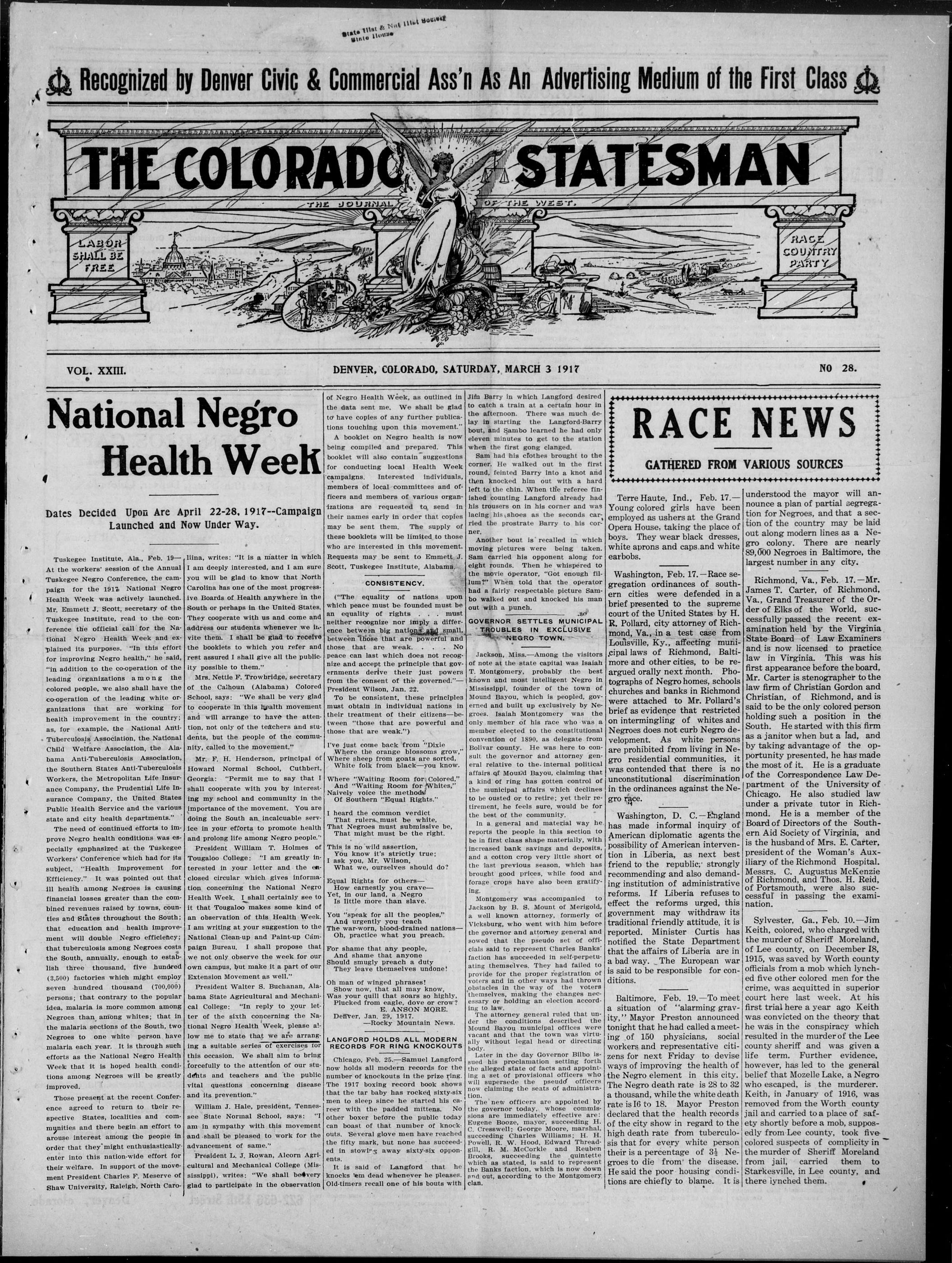
National Negro Health Week
Dates Decided Upon Are April 22-28, 1917--Campaign Launched and Now Under Way.
VOL. XXIII.
National Health
Dates Decided Upon Are A
Launched and
---
Tuskegee Institute, Ala., Feb. 19 At the workers' session of the Annual Tuskegee Negro Conference, the campaign for the 1917 National Negro Health Week was actively launched. Mr. Emmett J. Scott, secretary of the Tuskegee Institute, read to the conference the official call for the National Negro Health Week and explained its purposes. "In this effort for improving Negro health," he said, "in addition to the co-operation of the leading organizations among the colored people, we also shall have the co-operation of the leading white organizations that are working for health improvement in the country; as, for example, the National Anti-Tuberculosis Association, the National Child Welfare Association, the Alabama Anti-Tuberculosis Association, the Southern States Anti-Tuberculosis Workers, the Metropolitan Life Insurance Company, the Prudential Life Insurance Company, the United States Public Health Service and the various state and city health departments."
The need of continued efforts to improve Negro health conditions was especially emphasized at the Tuskegee Workers' Conference which had for its subject, "Health Improvement for Efficiency." It was pointed out that ill health among Negroes is causing financial losses greater than the combined revenues raised by towns, counties and States throughout the South; that education and health improvement will double Negro efficiency; that tuberculosis among Negroes costs the South, annually, enough to establish three thousand, five hundred (3,500) factories which might employ seven hundred thousand (700,000) persons; that contrary to the popular idea, malaria is more common among Negroes than among whites; that in the malaria sections of the South, two Negroes to one white person have malaria each year. It is through such efforts as the National Negro Health Week that it is hoped health conditions among Negroes will be greatly improved.
Those present at the recent Conference agreed to return to their respective States, localities and communities and there begin an effort to arouse interest among the people in order that they might enthusiastically enter into this nation-wide effort for their welfare. In support of the movement President Charles F. Meserve of Shaw University, Raleigh, North Caro-
illina, writes: "It is a matter in which I am deeply interested, and I am sure you will be glad to know that North Carolina has one of the most progressive Boards of Health anywhere in the South or perhaps in the United States. They cooperate with us and come and address our students whenever we invite them. I shall be glad to receive the booklets to which you refer and rest assured I shall give all the publicity possible to them."
Mrs. Nettle F. Trowbridge, secretary of the Calhoun (Alabama) Colored School, says: "We shall be very glad to cooperate in this health movement and will arrange to have the attention, not only of the teachers and students, but the people of the community, called to the movement."
Mr. F. H. Henderson, principal of Howard Normal School, Cuthbert, Georgia: "Permit me to say that I shall cooperate with you by interesting my school and community in the importance of the movement. You are doing the South an incalculable service in your efforts to promote health and prolong life among Negro people." President William T. Holmes of Tougaloo College: "I am greatly interested in your letter and the enclosed circular which gives information concerning the National Negro Health Week. I shall certainly see to it that Tougaloo makes some kind of an observation of this Health Week. I am writing at your suggestion to the National Clean-up and Paint-up Campaign Bureau. I shall propose that we not only observe the week for our own campus, but make it a part of our Extension Movement as well."
President Walter S. Buchanan, Alabama State Agricultural and Mechanical College: "In reply to your letter of the sixth concerning the National Negro Health Week, please allow me to state that we are arranging a suitable series of exercises for this occasion. We shall aim to bring forcefully to the attention of our students and teachers and the public vital questions concerning disease and its prevention."
William J. Hale, president, Tennessee State Normal School, says: "I am in sympathy with this movement and shall be pleased to work for the advancement of same."
President L. J. Rowan, Alcorn Agricultural and Mechanical College (Mississippi), writes: "We shall be very glad to participate in the observation
State Hist & Nat Hist Houses
State House
Commercial Ass'
ADO
E JOURNAL
DENVER, COLORADO, SAT
of Negro Health Week, as outlined in the data sent me. We shall be glad to have copies of any further publications touching upon this movement." A booklet on Negro health is now being compiled and prepared. This booklet will also contain suggestions for conducting local Health Week campaigns. Interested individuals, members of local committees and officers and members of various organizations are requested to send in their names early in order that copies may be sent them. The supply of these booklets will be limited to those who are interested in this movement. Requests may be sent to Emmett J. Scott, Tuskegee Institute, Alabama.
CONSISTENCY.
("The equality of nations upon which peace must be founded must be an equality of rights . . . must neither recognize nor imply a difference between big nations and small, between those that are powerful and those that are weak. . . . No peace can last which does not recognize and accept the principle that governments derive their just powers from the consent of the governed."—President Wilson, Jan. 22.
To be consistent, these principles must obtain in individual nations in their treatment of their citizens—between "those that are powerful and those that are weak.")
I've just come back from "Dixie Where the orange blossoms grow," Where sheep from goats are sorted, White folk from black—you know.
Where "Waiting Room for Colored," And "Waiting Room for Whites," Naively voice the methods Of Southern "Equal Rights."
I heard the common verdict That rulers must be white, That Negroes must submissive be, That might must be the right.
This is no wild assertion,
You know it's strictly true;
I ask you, Mr. Wilson,
What we, ourselves should do?
Equal Rights for others—
How earnestly you crave—
Yet, in our land, a Negro
Is little more than slave.
You "speak for all the peoples,"
And urgently you teach
The war-worn, blood-drained nations—
Oh, practice what you preach.
For shame that any people,
And shame that anyone
Should smugly preach a duty
They leave themselves undone!
Oh man of winged phrases!
Show now, that all may know,
Was your quill that soars so highly,
Plucked from eagle, dove or crow?
E. ANSON MQRE.
Denver, Jan. 29, 1917.
—Rocky Mountain News.
LANGFORD HOLDS ALL MODERN RECORDS FOR RING KNOCKOUTS
Chicago, Feb. 25.—Samuel Langford now holds all modern records for the number of knockouts in the prize ring. The 1917 boxing record book shows that the tar baby has rocked sixty-six men to sleep since he started his career with the padded mittens. No other boxer before the public today can boast of that number of knockouts. Several glove men have reached the fifty mark, but none has succeeded in stowing away sixty-six opponents.
It is said of Langford that he knocks em dead whenever he pleases. Old-timers recall one of his bouts with
Jim Barry in which Langford desired to catch a train at a certain hour in the afternoon. There was much delay in starting the Langford-Barry bout, and Sambo learned he had only eleven minutes to get to the station when the first gong clanged.
Sam had his clothes brought to the corner. He walked out in the first round, feinted Barry into a knot and then knocked him out with a hard left to the chin. When the referee finished counting Langford already had his trousers on in his corner and was lacing his shoes as the seconds carried the prostrate Barry to his corner.
Another bout is recalled in which moving pictures were being taken. Sam carried his opponent along for eight rounds. Then he whispered to the movie operator, "Got enough fillum?" When told that the operator had a fairly respectable picture Sambo walked out and knocked his man out with a punch.
Jackson, Miss.—Among the visitors of note at the state capital was Isaiah T. Montgomery, probably the best known and most intelligent Negro in Mississippi, founder of the town of Mound Bayou, which is peopled, governed and built up exclusively by Negroes. Isaiah Montgomery was the only member of his race who was a member elected to the constitutional convention of 1890, as delegate from Bolivar county. He was here to consult the governor and attorney general relative to the internal political affairs of Mound Bayou, claiming that a kind of ring has gotten control of the municipal affairs which declines to be ousted or to retire; yet their retirement, he feels sure, would be for the best of the community.
In a general and material way he reports the people in this section to be in first class shape materially, with increased bank savings and deposits, and a cotton crop very little short of the last previous season, which has brought good prices, while food and forage crops have also been gratifying.
Montgomery was accompanied to Jackson by B. S. Mount of Merigold, a well known attorney, formerly of Vicksburg, who went with him before the governor and attorney general and sowed that the pseudo set of officials said to represent Charles Banks' faction has succeeded in self-perpetuating themselves. They had failed to provide for the proper registration of voters and in other ways had thrown obstacles in the way of the voters themselves, making the changes necessary or holding an election according to law.
The attorney general ruled that under the conditions described the Mound Bayon municipal offices were vacant and that the town was virtually without legal head or directing body.
Later in the day Governor Bilbo issued his proclamation setting forth the alleged state of facts and appointing a set of provisional officers who will supersede the pseudo officers now claiming the seats of administration.
The new officers are appointed by the governor today, whose commissions are immediately effective are: Eugene Booze, mayor, succeeding H. C. Cresswell; George Moore, marshal, succeeding Charles Williams; H. H. Powell, R. W. Hood, Edward Threadgill, R. M. McCorkle and Reuben Brooks, succeeding the quintette which as stated, is said to represent the Banks faction, which is now down and out, according to the Montgomery clan.
RACE NEWS
GATHERED FROM VARIOUS SOURCES
Terre Haute, Ind., Feb. 17. Young colored girls have been employed as ushers at the Grand Opera House, taking the place of boys. They wear black dresses, white aprons and caps and white earbobs.
Washington, Feb. 17. —Race segregation ordinances of southern cities were defended in a brief presented to the supreme court of the United States by H. R. Pollard, city attorney of Richmond, Va., in a test case from Louisville, Ky., affecting municipal laws of Richmond, Baltimore and other cities, to be reargued orally next month. Photographs of Negro homes, schools churches and banks in Richmond were attached to Mr. Pollard's brief as evidence that restricted on intermingling of whites and Negroes does not curb Negro development. As white persons are prohibited from living in Negro residential communities, it was contended that there is no unconstitutional discrimination in the ordinances against the Negro race.
Washington, D. C.—England has made informal inquiry of American diplomatic agents the possibility of American intervention in Liberia, as next best friend to the republic; strongly recommending and also demanding institution of administrative reforms. If Liberia refuses to effect the reforms urged, this government may withdraw its traditional friendly attitude, it is reported. Minister Curtis has notified the State Department that the affairs of Liberia are in a bad way. The European war is said to be responsible for conditions.
Baltimore, Feb. 19.—To meet a situation of "alarming gravity," Mayor Preston announced tonight that he had called a meeting of 150 physicians, social workers and representative citizens for next Friday to devise ways of improving the health of the Negro element in this city. The Negro death rate is 28 to 32 a thousand, while the white death rate is 16 to 18. Mayor Preston declared that the health records of the city show in regard to the high death rate from tuberculosis that for every white person their is a percentage of $3\frac{1}{2}$ Negroes to die from the disease. He said the poor housing conditions are chiefly to blame. It is
NO 28.
understood the mayor will announce a plan of partial segregation for Negroes, and that a section of the country may be laid out along modern lines as a Negro colony. There are nearly 89,000 Negroes in Baltimore, the largest number in any city.
Richmond, Va., Feb. 17.—Mr. James T. Carter, of Richmond, Va., Grand Treasurer of the Order of Elks of the World, successfully passed the recent examination held by the Virginia State Board of Law Examiners and is now licensed to practice law in Virginia. This was his first appearance before the board, Mr. Carter is stenographer to the law firm of Christian Gordon and Christian, of Richmond, and is said to be the only colored person holding such a position in the South. He started with this firm as a janitor when but a lad, and by taking advantage of the opportunity presented, he has made the most of it. He is a graduate of the Correspondence Law Department of the University of Chicago. He also studied law under a private tutor in Richmond. He is a member of the Board of Directors of the Southern Aid Society of Virginia, and is the husband of Mrs. E. Carter, president of the Woman's Auxiliary of the Richmond Hospital. Messrs. C. Augustus McKenzie of Richmond, and Thos. H. Reid, of Portsmouth, were also successful in passing the examination.
Sylvester, Ga., Feb. 10.—Jim Keith, colored, who charged with the murder of Sheriff Moreland, of Lee county, on December 18, 1915, was saved by Worth county officials from a mob which lynched five other colored men for the crime, was acquitted in superior court here last week. At his first trial here a year ago Keith was convicted on the theory that he was in the conspiracy which resulted in the murder of the Lee county sheriff and was given a life term. Further evidence, however, has led to the general belief that Mozelle Lake, a Negro who escaped, is the murderer. Keith, in January of 1916, was removed from the Worth county jail and carried to a place of safety shortly before a mob, supposedly from Lee county, took five-colored suspects of complicity in the murder of Sheriff Moreland from jail, carried them to Starkesville, in Lee county, and there lynched them.
LATEST NEWS EPITOMIZED
FROM TELEGRAPHIC REPORTS THAT COVER THE WEEK'S EVENTS.
OF MOST INTEREST
KEEPING THE READER POSTED ON MOST IMPORTANT CURRENT TOPICS.
Western Newspaper Union News Service.
ABOUT THE WAR
Russ report gas attacks by Germans near Smorgon.
Austrians wipe out Italian garrison near Vertoila.
French repulse German surprise attack near Vailly.
British in west front drive push forward both north and south of the Ancre region.
In Mesopotamia the British have captured from the Turks the entire line from Sannaiyat to Kut-El-Amara.
The Fifth Ohio infantry left El Paso, Tex., for Fort Wayne, Mich., to be mustered out of the federal service.
The British have captured Pys, Serre, Miraumont and Petit Miraumont in a great offensive on western front.
The sinking of the British transport steamer A-19 was announced by the admiralty. The announcement says that returning German submarines report the sinking of eleven more steamships, two sailing vessels and eight trawlers.
German naval and military leaders in Berlin estimated that the total tonnage sunk during February would not exceed 500,000 and expressed satisfaction with the achievements of the submarines. The announcement was made by the German admiralty that 1,000 troops bound for Saloniki parished when the Italian transport Minas was sunk Feb. 17.
Over a front of eleven miles, from the region of Gommecourt, north of the Ancre river, to the district of Gueude court, south of the river, the British have pushed forward their lines to a depth of two miles, according to the British official communication. The maneuver has served to throw forward the right and left wings of the British in an enveloping move toward Bapaume, the German stronghold in this region. Bombardments and raiding operations are still in progress on the greater part of the remainder of the front in France and Belgium and in the Russian and Austro-Italian theaters.
WESTERN
Governor John B. Kendrick of Wyoming has resigned to become U. S. senator.
Three Spanish steamers sailed from Galveston for the war zone, carrying cotton.
Because he preferred to see his three children dead than hungry, Frank Stader, 35, at Chicago shot and killed them as they slept, and then killed himself.
Importation of sugar beet seed for the coming season exceeds any previous year by 50 per cent, 175,000 bags having been brought into the United States for this year's planting.
The Idaho Senate adopted a memorial to Congress, asking the submission of an amendment to the federal constitution to prohibit the manufacture of intoxicating liquors in the United States.
WASHINGTON
A bill granting a pension of $100 a month to the widow of the late Maj. Gen. Frederick Funston was passed by the Senate.
Senator Jacob H. Gallinger of New Hampshire, the Republican Senate leader, is confined to his home here with grip. Senator Gallinger is in his eightieth year.
Complete arrangements for the withdrawal of American diplomatic and consular officers from Austria-Hungary have been made by Ambassador Penfield on instructions from the State Department.
A meeting of the foreign relations committee reported to the Senate a resolution giving authority to the President to furnish arms, ammunition and gunners to American ships whose owners ask protection from German submarines.
The sinking of the Laconia with the loss of American lives is looked upon by the American government as a clear-cut violation of American rights, according to an authoritative expression of opinion obtained after a conference between President Wilson and Secretary Lansing. No further investigation is considered necessary.
Guns and mounts sufficient to arm any reasonable number of American merchants ships are now stored at navy yards, it was stated officially at the Navy Department following President Wilson's appearance before Congress to ask authority to provide weapons and men should the need arise.
Ambassador Willard at Madrid cabled Feb. 26 that the Spanish foreign office had notified him that seventy-two American sailors taken on the prize ship Yarrowdale into Germany had been released by Germauy Feb. 16.
FOREIGN
The storm of indignation in Holland over the German attack on seven Dutch ships is unabated.
Sixty-five wounded Russians homeward bound from Germany, were killed in a railroad wreck near Holmsleden, in northern Sweden.
Thomas Coffey, a negro member of the crew of Baltimore, lost his life when the Laconia went down, Consul Frost cabled the State Department.
The Frankfurter Zeitung learns from Budapest that all journals in Hungary will cease publication in a few days owing to the fact that they have no paper.
"Vive l'Amerique" and "Vive Wilson!" were shouted by thousands when Capt. Allen Tucker and the crew of the American steamer Orleans stepped off the gangplank of the steamer at Bordeaux.
England's "win-the-war" loan subscriptions totaled £1,312,950,000 (approximately $7,564,750,000) of new money, Chancellor of the Exchequer Bonar Law announced in the House of Commons.
The bishop of London proposes to close all but eight churches in the city of London until the end of the war in order to set free the clergymen to act as chaplains for troops in active service or for volunteers under the national service scheme.
Merchant shipping aggregating 4,998,800 tons belonging to entente and neutral nations has been destroyed or condemned as prizes by the central powers since the beginning of the war, it was officially announced in Berlin. Apparently this total covers a period up to the end of January, 1917, only. Germany's peace conditions are based on "reparation for all wrongs suffered and guarantees for the existence in the future of a strong Germany." Imperial Chancellor von Bethmann Hollweg so outlined them in a speech before the Reichstag. "There is only one necessity of the day," he declared. "It dominates all questions of policy, both foreign and domestic—it is to fight and gain a victory."
Twenty-six Americans, six of whom were cabin passengers and twenty members of the crew were on board the Cunard liner Laconia, from New York, Feb. 18, for Liverpool, with seventy-five passengers and a crew of 240, when the vessel was sunk by a German submarine. Three casualties, one unidentified, have been reported. Fifty survivors were landed at Bantry Head and 267 at Queenstown. Mrs. Mary E. Hoy and daughter of Chicago are supposed to have been drowned.
SPORTING NEWS
Fred McMullin, Sox third baseman, who has been a holdout, sent in his signed contract to President Comiskey. Frank Taberski, world's champion at pocket billiards, defeated Louis Kreuter, challenger, 450 to 399, at Youngstown, Ohio. Walley Schang, catcher, signed his contract with the Philadelphia American league baseball team. He was the last of the big three holdouts, Strunk and Bush having signed. Colorado's fifth annual state bowling tournament came to an end in Denver. The affair closed with the sweepstakes, which Fred Wolf won, averaging better than 199 pins per game.
GENERAL
The Delaware Senate rejected the woman suffrage amendment, 8 to 6.
The funeral services of Mrs. Mathew H. Maury, sister of Mrs. Woodrow Wilson, who died at Roanoke, Va., were held at the home. Mrs. Wilson did not attend the funeral leaving to the illness of her mother in Washington.
A campaign to raise $5,000,000 a month for Armenian refugees, through subscriptions in every city and town in the country, was launched in New York at the annual meeting of the American committee for Armenian and Syrian relief.
Gov. Simon Bamberger signed the joint resolution passed by the Legislature to submit to the Utah electorate in 1918 the question of state-wide prohibition by constitutional amendment. Statutory prohibition, effective Aug. 1, 1917, has already been provided for by the present Legislature.
John Grier Hibben, president of Princeton University, speaking in a church in New York, criticised the United States for what he termed its lack of "international conscience" in failing to join the entente allies against Germany, and declared America's entrance into the war was a "solemn obligation."
A petition for the appointment of a lunacy commission to determine the sanity of Harry K. Thaw, confined in a hospital at Philadelphia as the result of self-inflicted wounds when he was about to be arrested on a New York indictment charging him with assault of 19-year-old Frederick Gump, Jr., of Kansas City, Mo., was filed in Common Pleas Court by counsel on behalf of Thaw's mother. More than 42,000 miles of motion picture films were exported from the United States during 1916. Richard F. Cleveland, son of the late president of the United States, recently started anew the movement to abolish the upper class system at Princeton.
Sugar valued at $100,000 was destroyed by fire on board the British steamship Baysura, which was being loaded with cargo for the entente allies at a Brooklyn, N. Y., pier. The vessel suffered damage estimated at $10,000.
COLORADO STATE NEWS
Western Newspaper Union News Service.
DATES FOR COMING EVENTS.
March 1-2—Midwinter Ski Carnival at
Steamboat Springs.
March 20—Auto Show at Denver.
Sept. 17-22—Colorado State Fair at Pu-
eblo.
Hogs sold on the Denver market at
$12.20 per cwt.
Mining activities in the Silverton
district are increasing every day.
Battery C, Colorado field artillery,
was disbanded at El Paso, Tex.
Feb. 26.
Improvements costing $200,000 will
be made at the Loveland sugar fac-
factory before next season's run.
The city of Trinidad has received
an aerial truck for use of its fire de-
partment, purchased at a cost of
$2,200.
The city of Loveland will hold a bond election April 3 to decide upon the issuing of bonds for the erection of a new electric light plant.
Marjorie Twillerwig, 17, of Denver made an unsuccessful attempt at suicide, taking fifteen grains of bichloride of mercury. She will recover.
The campaign for a fund of $60,000 with which to build the new Beth ha Madrosh Hagodol synagogue in Denver was started by orthodox Jews of Denver.
The Welsh Cymrodorion Society of Denver will give its annual concert in observance of St. David's day at El Jebel Temple in Denver, Saturday, March 3.
Gottlieb Kuenster, 81, is in a critical condition at the Denver county hospital, the result of an injury to his head, received when he was knocked down by a tramway car.
Three members will be elected to the Denver School Board in May, instead of one, as the result of the passage in the Senate of a bill increasing the members from five to seven.
The State Land Board has arranged for the sale of 28,000 acres of desirable tracts, some of which contain improvements, at the next monthly sale to be held at the capitol March 7.
Even though the law which provides for farm loans is declared unconstitutional by the Supreme Court, a new law will probably be passed by the Legislature to comply with the ruling of the Supreme Court.
Negotiations were opened at Fort Collins by New York city officials, now working to alleviate the food shortage there, with Colorado potato growers with a view of furnishing the metropolis with part of the state output.
Not the least of the many surprises planned for the homecoming of Colorado's soldier boys was the recognition given the officers and men by the state. Each is to be presented with a service badge for Mexican border duty.
Hobnailed shoes, worn by James L. Anthony, an employé of the steel mill, are blamed for his death at Pueblo, when he was killed by a current of 2,300 volts of electricity which passed through his body. Anthony was killed instantly.
Patrolmen John L. Dowd, Carl Wilson and Clyde O. Lanam were formally charged by Chief of Police Hamilton Armstrong of Denver with accepting monthly bribes from a bootlegger, for giving him the privilege of selling whisky unmolested.
Mr. and Mrs. Paul Revere Fanning, prominent Denver society people and well known in musical and sojal circles, whose marriage Sept. 6 was an event of the autumn season, were killed in the Pennsylvania railroad wreck in Mount Union, Pa. The first step in what is said may be a general shakeup of the police department at Pueblo, following complaints of citizens on the frequency of crimes, was taken when the City Council suspended Capt. Jack Sinclair, in charge of the night shift of police.
New indictments and warrants will be issued against members of the so-called "revel ring" as the result of a signed confession made in Denver by Dorothy LeClair, 17, who admits she participated in the numerous escapades upon which informations were directed to Philip Friederich, Allen Barth, John Joslin and Elmer Wilfley by the district attorneys of Denver and Arapahoe counties.
Georgetown and upper Clear Creek can boast of a very decided improvement in mining during the latter part of 1916 and during the new year. A few years ago Georgetown was looked upon as a high-grade silver district with a small per cent of lead. Now Georgetown can boast of producing the highest and richest gold ores in the state, to which must be added a very material product in zinc and copper.
The five-story frame dwelling at 416 East First street, Pueblo, erected fifty years ago and long known as the Smelter hotel, was recently sold by the owners—the American Smelting and Refining Company—to V. G. Hyatt, who will wreck the present building and build a modern structure in its place.
While saluting his partner in the midst of a quadrille at a dance given at Salina, C. M. Sutherland, aged 60, suddenly dropped to the floor and died ten minutes later. Heart failure was the cause.
FARMERS' ASK $8 BEETS
NORTHERN COLORADO GROWERS MEET AT STERLING.
Make Tentative Plans for Organization of Union to Be Known as Beet Growers' Association.
Western Newspaper Union News Service.
Sterling, Colo.—Fifty farmers of the Sterling district held a meeting here to lay plans for a formal demand on the Great Western Sugar Company for $8 beets. It was strongly intimated that unless the company complied with their demands, they would stop growing the crop.
The company now pays a sliding scale for the commodity. The price is said to average about $6. Farmers here believe the movement will spread over the entire northern part of the state. It was planned at the meeting to invite all farmers growing beets to join in the protest.
Tentative plans were made for the organization of a union to be known as the Great Western Beet Growers' Association. Another meeting will be held to discuss plans of the campaign. There are about 25,000 acres of beets grown in this district each year.
Slides Throw Train From Track.
Crested Butte. — Two snowslides ran here and struck passing trains on railroads. An extra on the Denver & Rio Grande, sent out with a flanger to clear the tracks of accumulated snow, was struck with a slide one-half mile below town, carried from the track and turned over. The train consisted of a day coach and baggage car, and there was one passenger aboard. He was uninjured. Conductor Twitchell was stunned and bruised, but recovered from his injuries within a few minutes.
Irrigated Land at $250 An Acre. Loveland.—What is believed to be the highest price yet recorded for so large a tract of farm land in Larimer county was made when the C. O. Culver farm of 183 acres was sold to Chris Thompson for $45,750, an even $250 an acre. The land lies on the Lincoln highway, a short distance south of Fort Collins, has exceptionally good improvements, and is regarded as among the most fertile in the Poudre valley.
Will Visit Idaho Springs.
Denver,—Governor Julius C. Gunter, Mayor Robert W. Speer, members of the Twenty-first Legislature and members of the State Highway Commission, will be guests on March 3 of the officials of Idaho Springs and the Midland Trail Association of that city. The trip will be made by automobile over Lookout mountain, returning by the Bear Creek road in the city's foothills park system.
President Invited to Cody Funeral.
President invited to Cody F. Denner.—Telegrams have been sent by the directors of the William F. Cody Memorial Association inviting President Wilson, Secretary of War Baker, Maj. M. C. McAlpine of the United States Boy Scout organization and Col. Theodore Roosevelt to attend the burial ceremonies for Buffalo Bill on Decoration day.
Americans Leaving German Empire.
Cripple Creek.—Americans no longer feel safe in Germany, according to a letter received here from Henry Yountz, who succeeded in reaching Berlin a new days before the new submarine edict became effective. The letter states there is a general exodus of Americans from the German empire.
Woman Injured When Roof Collapses
Trinidad.—Caught in the collapse of their home, which had been unroofed by the wind, Mrs. Victor Gurule sustained injuries which may cause her death. The woman and a little girl of 3 years and a girl of 6, were buried in the wreckage of the house and were extricated by members of the fire department.
Colorado Guards Welcomed Home.
Denver.—The people of Denver gave the first contingent of the Colorado National Guard returning from the border, comprising officers and 160 men of Battery B, including three United States army officers, a big reception when it reached Denver.
Woman Killed in Auto Accident.
Trinidad.-Mrs. Nestorita Carello,
a well-known Italian resident of Morley,
was killed, and six others injured,
one seriously, when an automobile
plunged over a twenty-foot embankment
one mile north of Morley.
Miner's Leg Broken.
Cripple Creek—Charles G. Fight master received a broken leg and internal injuries here when he fell seventy-five feet in the shaft at the Vindicator mine.
To Pay for Articles Stolen.
Lamar.—Unusual sentences were given to six high school boys, who were convicted of having been engaged in a number of robberies and petty thieving in Lamar and nearby towns, when County Judge J. C. Horn passed judgment. Until the boys have, through their own efforts, earned enough money to reimburse those who have lost through their depredations, they are to be confined in the county jail on suspended reformatory sentences.
NOTHING DOWN AND 17 CTS. A DAY
BUYS A PIANO. SALE NOW ON.
THE PIANO EXCHANGE
H. A. TRIGGS, Manager
211 Charles Block. Cor. 15th and Curtis Streets. Phone Champa 3742.
Night and Day Cafe
919 19th street, between Champa and Curtis. Merchants' Lunch every day from 11:30 a. m. to 3:30 p. m., 20c. Short orders at all hours. Give us a trial. Phone Main 6699.
Can be rented very reasonable by Societies, Lodges and Organizations. The Hall is suitable for Entertainments, Dances and Athletic Exhibitions.
2132 ARAPAHOE ST.
BOLDEN
and LUN
924 19th St
OLDEN BROS. CA
and LUNCH ROOM
1924 19th Street, Denver, Colorado
924 19th Street, Denver, Colorado
DINNER
11:30 to 2 p.m.
All Kinds of Sandwiches
Bolden Bro
Baths,
FIRST
R. B. BOLDEN,
Weather
TELEPH
Est
PIONEER HA
WE MAKE
PRACTICE
RENOVATORS, BLEAC
Of Gents' and Ladies
1624 Cham
Golden Bros. Barber Sh
Baths, Electric Massage
FIRST CLASS SERVICE
. BOLDEN, Mgr. 926 19th St. D
atherhead Hat
TELEPHONE MAIN 3203
Bolden Bros. Barber Shop
Baths, Electric Massage
FIRST CLASS SERVICE
R. B. BOLDEN, Mgr. 926 19th St. Denver
Weatherhead Hat Co. TELEPHONE MAIN 3203
Established 1876
PIONEER HATTERS OF THE WEST
WE MAKE OLD HATS NEW
PRACTICAL HATTERS
VATORS, BLEACHERS DYERS AND FINE
RENOVATORS, BLEACHERS DYERS AND FINISHERS Of Gents' and Ladies' Hats of Every Description 1624 Champa St., Denver, Colo.
JOHN I
Meats, Fancy a
1864 O
Corner Nineteenth.
The MARK
C. E. SMITH, M
Wholesale and Retail Staple
The MARKET COMPANY
C. E. SMITH, Manager, Res. Phone South 1608
Wholesale and Retail Staple and Fancy Groceries, Fish and Oysters Hotels and Restaurants Our Specialty. Fresh and Cured Eastern Corn Fed Meats Fruits, Vegetables, Poultry and Game.
Telephones Main 4302, 4303, 4304, 4305 622-636 15th Street Denver, olorado
PHONE MAIN 3028
Corner Nineteenth.
ers taken over phone.
ER HALL
ties, Lodges and Or-
for Entertainment,
VED.
IONE MAIN 2449
S. CAFE
ROOM
Colorado
Short Orders at All Hours
er Shop
VINE
```markdown
```
1
PRESIDENT ASKS POWER TO GUARD RIGHTS OF U.S.
Declares Diplomatic Means Have Failed to Safeguard American Interests.
FORCEDTOARMEDNEUTRALITY
Requests Congress to Grant Power to Arm American Merchant Vessels and to Use Armed Forces of the Nation to Defend Rights of United States Citizens.
Washington, Feb. 27.—President Wilson delivered an address before a joint session of congress yesterday. He declared that diplomatic means had failed to safeguard American interests and that all that is left now is to adopt an attitude of armed neutrality. He specifically asked that he be given authority to arm American merchant vessels.
The president's address was as follows:
"Gentlemen of the Congress:
Gentlemen of the Congress.
I have again asked the privilege of addressing you because we are moving through critical times during which it seems to me to be my duty to keep in close touch with the houses of congress, so that neither counsel nor action shall run at cross-purposes between us.
"On the third of February I officially informed you of the sudden and unexpected action of the imperial German government in declaring its intention to disregard the promises it had made to this government in April last and undertake immediate submarine operations against all commerce, whether belligerents or neutrals, that should seek to approach Great Britain and Ireland, the Atlantic coasts of Europe, or the harbors of the eastern Mediterranean, and to conduct those operations without regard to the established restrictions of international practice, without regard to any considerations of humanity even which might interfere with their object. That policy was forthwith put into practice. It has now been in active execution for nearly four weeks.
All Commerce Suffering.
"Its practical results are not yet fully disclosed. The commerce of other neutral nations is suffering severely, but not, perhaps, very much more severely than it was already suffering before the first of February, when the new policy of the imperial government was put into operation. We have asked the co-operation of other neutral governments to prevent these depredations, but so far none of them has thought it wise to join us in any common course of action.
"Our own commerce has suffered, is suffering, rather in apprehension than in fact, rather because so many of our ships are timidly keeping to their home ports than because American ships have sunk.
"Two American vessels have been sunk, the Housatonic and the Lyman M. Law."
"The case of the Housatonic, which was carrying foodstuffs to a London firm, was essentially like the case of the Frye, in which, it will be recalled, the German government admitted its liability for damages, and the lives of the crew, as in the case of the Frye, were safeguarded with reasonable care. "The case of the Law, which was carrying lemon-box staves to Palermo, disclosed a ruthlessness of method which deserves grave condemnation, but was accompanied by no circumstances which might not have been expected at any time in connection with the use of the submarine against merchantmen as the German government has used it.
"In summing up, therefore, the situation we find ourselves in with regard to the actual conduct of the German submarine warfare against commerce and its effects upon our own ships and people is substantially the same that it was when I addressed you on the third of February, except for the tying up of our shipping in our own ports because of the unwillingness of our shipowners to risk their vessels at sea without insurance or adequate protection, and the very serious congestion of our commerce which has resulted, a congestion which is growing rapidly more and more serious every day.
"This in itself might presently accomplish, in effect, what the new German submarine orders were meant to accomplish, so far as we are concerned.
"We can only say, therefore, that the overt act which I have ventured to hope the German commanders would in fact avoid has not occurred.
Some Alarming Signs.
"But while this is happily true, it must be admitted that there have been certain additional indications and expressions of purpose on the part of the German press and the German authorities which have increased rather than lessened the impression that, if our ships and our people are spared it will be because of fortunate circumstances or because the commanders of the German submarines which they may happen to encounter exercise an unexpected discretion and restraint rather than because of the instructions under which those commanders are acting.
"It would be foolish to deny that the
ORIGINAL IN POOR CONDITION
situation is fraught with the gravest possibilities and dangers. No thoughtful man can fail to see that the necessity of definite action may come at any time, if we are in fact, and not in word, merely, ready to defend our elementary rights as a neutral nation. It would be most imprudent to be unprepared.
"I cannot in such circumstances be unmindful of the fact that the expiration term of the present congress is immediately at hand by constitutional limitation, and that it would in all likelihood require an unusual length of time to assemble and organize the congress which is to succeed it. "I feel that I ought, in view of that fact, to obtain from you full and immediate assurance of the authority which I may need at any moment to exercise. "No doubt I already possess that authority without special warrant of law by the plain implication of my constitutional duties and powers; but I prefer, in the present circumstances, not to act upon general implication. I wish to feel that the authority and the power of the congress are behind me in whatever it may become necessary for me to do.
Must Act Together
"We are jointly the servants of the people and must act together and in their spirit, so far as we can divine and interpret it. No one doubts that it is our duty to do so.
"We must defend our commerce and the lives of the people in the midst of the present trying circumstances, with discretion but with clear and steadfast purpose. Only the method and the extent remain to be chosen upon the occasion, if occasion should indeed arise.
"Since it has unhappily proved impossible to safeguard our neutral rights by diplomatic means against the unwarranted infringements they are suffering at the hands of Germany, there may be no recourse but to armed neutrality, which we shall know how to maintain and for which there is abundant American precedent.
Hopes to Avoid War.
"It is devoutly to be hoped that it will not be necessary to put armed force anywhere into action. The American people do not desire it, and our desire is not different from thelrs. I am sure that they will understand the spirit in which I am acting, the purpose I hold nearest my heart and would wish to exhibit in everything I do.
"I am anxious at the people of the nations at war also should understand and not mistrust us. I hope that I need give no further proofs and assurances than I have already given throughout nearly three years of anxious patience that I am the friend of peace and mean to preserve it for America so long as I am able.
"I am not now proposing or contemplating war or any steps that need lead to it. I merely request that you will accord me by your own vote and definite bestowal the means and authority to safeguard in practice the right of a great people who are at peace and who are desirous of exercising none but the rights of peace to follow the pursuits of peace in quietness and good will—rights recognized time out of mind by all the civilized nations of the world.
War Only for Willful Act.
"No course of my choosing or of theirs will lead to war. War can come only by the willful acts and aggressions of others.
"I believe that the people will be willing to trust me to act with restraint, with prudence and in the true spirit of anity and good faith that they have themselves displayed throughout these trying months, and it is in that belief that I request that you will authorize me to supply our merchant ships with defensive arms should that become necessary, and with the means of using them, and to employ any other instrumentalities or methods that may be necessary and adequate to protect our ships and our people in their legitimate and peaceful pursuits on the seas.
"I request also that you will grant me at the same time, along with the powers I ask, a sufficient credit to enable me to provide adequate means of protection where they are lacking, including adequate insurance against the present war risks.
Speaks for Human Rights.
"I have spoken of our commerce and of the legitimate errands of our people on the seas, but you will not be misled as to my main thought, the thought that lies beneath these phrases and gives them dignity and weight. It is not of material interests merely that we are thinking. It is, rather, of fundamental human rights, chief of all the right of life itself.
"I am thinking not only of rights of Americans to go and come about their proper business by way of the sea, but also of something much deeper, much more fundamental than that. I am thinking of those rights of humanity without which there is no civilization. My theme is of those great principles of compassion and of protection which mankind has sought to throw about human lives, the lives of noncombatants, the lives of men who are peacefully at work keeping the industrial processes of the world quick and vital, the lives of women and children and of those who supply the labor which ministers to their sustenance.
"We are speaking of no selfish material rights, but of rights which our hearts support and whose foundation is that righteous passion for justice upon which all law, all structures alike of family, of state and of mankind may rest, as upon the ultimate base of our existence and our liberty.
"I cannot imagine a man with American principles at his heart hesitating to defend these things."
PLOT TO UNITE JAPAN-MEXICO
Kaiser Promised Texas, New Mexico and Arizona to Gen. Carranza.
TEUTONSTO INVADEU.S.
Mexico's Provisional President
Told to Ask Mikado to
Betray His Allies.
Western Newspaper Union News Service.
Washington, March 1.—The Associated Press is enabled to reveal, that Germany, in planning unrestricted submarine warfare and counting its consequences proposed an alliance with Mexico and Japan to make war on the United States, if this country should not remain neutral. Japan, through Mexican mediation, was to be urged to abandon her allies and join in the attack on the United States.
Mexico, for her reward, was to receive general financial support from Germany, reconquer Texas, New Mexico and Arizona—lost provinces—and share in the victorious peace terms Germany contemplated. Details were left to German Minister von Eckhardt in Mexico City who, by instructions signed by German Foreign Minister Zimmermann at Berlin, Jan. 19, 1917, was directed to propose the alliance with Mexico to Gen. Carranza, and suggest that Mexico seeks to bring Japan into the plot.
These instructions were transmitted to von Eckhardt through Count von Bernstorff, former German ambassador, now on his way home to Germany under a safe conduct obtained from his enemies by the country against which he was plotting war.
Germany pictured to Mexico, by broad intimation, England and the entente allies defeated; Germany and her allies triumphant and in world domination by the instrument of unrestricted warfare.
A copy of Zimmerman's instructions to von Eckhardt, sent through von Bernstorff, is in possession of the United States government. It follows:
German Instructions.
"Berlin, Jan. 19, 1917.—On the first of February we intend to begin sub marine warfare unrestricted. In spite of this, it is our intention to endeavor to keep neutral the United States of America.
"If this attempt is not successful, we propose an alliance on the following basis with Mexico:
"That we shall make war together and together make peace. We shall give general financial support and it is understood that Mexico is to reconquer the lost territory in New Mexico, Texas and Arizona. The details are left to you for settlement.
"You are instructed to inform the President of Mexico of the above in the greatest confidence as soon as it is certain that there will be an outbreak of war with the United States; and suggest that the President of Mexico on his own initiative should communicate with Japan, suggesting adherence at once to this plan; at the same time, offer to mediate between Germany and Japan.
"Please call to the attention of the President of Mexico that the employment of ruthless submarine warfare now promises to compel England to make peace in a few months.
This document has been in the hands of this government since President Wilson broke off diplomatic relations with Germany. It has been kept secret, while the President has been asking Congress for full authority and while Congress has been hesitating.
It was in the President's hands while Chancellor von Bethmann-Hollweg was declaring that the United States had placed an interpretation on the submarine declaration "never intended by Germany" and that Germany had promoted and honored friendly relations with the United States "as an heirloom from Frederick the Great."
Of itself, if there were no other, it is considered a sufficient answer to the German chancellor's plaint that the United States "brusquely" broke off relations without giving "authentic" reasons for its actions.
The document supplies the missing link to many separate chains of circumstances, which until now have seemed to lead to no definite point.
It sheds new light upon the frequently reported but undefinable movements of the Mexican government to couple its situation with the friction between the United States and Japan.
It adds another chapter to the celebrated report of Jules Cambon, French ambassador in Berlin before the war, of Germany's worldwide plans for stirring strife on every continent where they might aid her in the struggle for world-domination which she dreamed was close at hand.
It adds a climax to the operations of Count von Bernstorff and the German embassy in this country, which have been colored with passport frauds, charges of dynamite plots and intrigue, the full extent of which has never been published.
BRITISH SLAY 20,000 TURKS
ENGLISH SOLDIERS DRIVE FOES
AFTER CAPTURING 5,000
PRISONERS.
WAR SUPPLIES TAKEN
BRITISH FOOD BLOCKADE SUC
CESS ANNOUNCED BY LORD
ROBERT CECIL.
London, March 2.—The remnants of the Turkish force retreating from Kut-El-Amara have been shattered completely, according to information given out in the House of Commons. The Turks, it was said, would reach Bagdad only as a disorderly mob. It was announced that more than 2,500 prisoners had been taken by the British since Feb. 24 and that since the commencement of the offensive of Dec. 30 some 5,000 Turkish prisoners had been taken. The total Turkish casualties in killed and wounded was estimated by Gen. Maude at more than 20,000.
Paris.—The Germans already have fallen back behind Bapaume and the fall of that town is imminent, according to information from the front which has reached military circles here. The new German line is said to run along the road from Bapaume to Peronne and some distance in the rear of the former town.
During their retirement the Germans have systematically destroyed their dugouts and provision depots and rendered their trenches useless.
London.—The government has reason to believe said Lord Robert Cecil, minister of blockade, in the House of Commons, that there is a serious shortage of foodstuffs and of certain very important materials in enemy countries.
Queenstown. — The British bark Galgorm Castle has been sunk by a German submarine. The survivors include two Americans, Harry Merret of Beaver Falls, Pa., and Harry Richardson of Boston. They were thirteen hours in the boats. One boat is missing, and it is feared it has been swamped. This boat also contained two Americans, named Jackson and David Walker.
Paris. —The sinking of the following vessels was announced officially here Thursday:
Clan Farquhar, British steamship, 5,853 tons gross, Feb. 26.
Galgorm Castle, British ceiling
Galgorm Castle, British sailing ship, 1,596 tons, Feb. 27.
Marie Joseph, French schooner of Fecamp, 192 tons, Feb. 28.
Sjostad, Norwegian steamship, 155 tons, Feb. 28.
House Votes Hundred Million Dollars.
Washington.—Aroused by the disclosure of Germany's plot to unite Japan and Mexico with her in a war upon the United States, and then convinced by official evidence of its authenticity, Congress Thursday abandoned the delays and obstructions which have checked President Wilson's efforts to be clothed with express authority to deal with the submarine menace. The House, after a ten-hour debate and by an overwhelming majority, passed a bill to empower the President to arm merchant ships and providing for a $100,000,000 bond issue.
Guardsmen at Fort Russell.
Cheyenne, Wyo., March 2.—Colorado's guardsmen arrived in Cheyenne tired but happy. They were given quarters in the barracks at Fort Russell and the checking of property to be turned in to the federal government began. In about a week they will be mustered out, along with the Wyoming troops, who are expected to arrive from Deming, N. M., in the meantime. A monster celebration in honor of the troopers of both states is being planned by citizens of Cheyenne.
Japanese Embassy Issues Statement.
Washington. — Pledging continued friendship to the United States and continuance of its relations with the allies, the Japanese embassy issued a formal statement, declaring that "under no circumstance" would the Japanese government entertain such an "invitation" as Germany attempted to send to Tokio.
Nine Mexicans Executed.
Douglas, Ariz.—Nine men, all said to have been Mexicans, were executed in Agua Prieta.
Mexico and Japan Exonerated.
Washington, March 2.—In regard to the German plot, Secretary Lansing authorized this statement:
"We do not believe that Japan has had any knowledge of this or that she would consider any proposition made by an enemy."
As to Mexico the secretary said: "We have confidence that Mexico would not be a party to any such agreement, in view of the friendly relations existing between this government and the de facto government of Mexico."
CONDITION
The Curtis Park Floral Company
FLORAL DESIGNS PUT UP WHILE YOU WAIT
CHOICE PLANTS AND CUT FLOWERS CONSTANTLY ON HAND
GREENHOUSES: Thirty-Fourth and Curtis Streets
TELEPHONE, MAIN 1511 DENVER, COLO
The Champa Pharmacy
Twentieth and Champa,
Is the place to get your
DRUGS, CHEMICALS AND PATENT MEDICINES
WE SERVE DRINKS.
Prescriptions Our Specialty.
Phone us and we will deliver the goods to all parts of the city.
JAMES E. THRALL, PROPR.
PHONE MAIN 2425.
When You Want
The Heads, Feet, Tails, Snouts, Neckbones or Chiterlings, or any other part of the hog except the squeal, go to
East's Market
The WARD AUCTION COMPANY
Sales Daily at 2 p.m. Office Furniture a Specialty.
PRIVATE SALES AT ALL TIMES
HAVE MOVED TO—
1723-39 GLENARM ST.
PHONE MAIN 1675.
THE BEST ICE CREAM AND CANDIES AT
O.P. BAUR & CO.
CATERERS AND
CONFECTIONERS
Phone: 168.
1512 Curtis Street, Denver, Colo.
JOSEPH CARTER
Express, Moving,
and Storage
COAL AND WOOD
PROMPT DELIVERY.
Phone Main 6544.
2415 WASHINGTON STREET.
TELEPHONE YORK 6668.
J. H. Biggins
GENERAL FURNITURE REPAIRING
AND UPHOLSTERING.
WORK GUARANTEED.
1417 East 24th Avenue, Denver, Colo.
2300-6 Larimer Street Phone Main 1461
ORIENTAL RESTAURANT
Chop Suey, Noodles and Short Orders
Phone Main 4896
1848 Arapahoe
乐绎轩
Miss M. Cowden Hair Dressing Parlor
Shampoo, cutting and curling. Scalp treatment, hair tonics, hair straightening, manicuring. Stage wigs for rent; theatrical use and masquerades. Goods delivered out of the city. All shades of hair matched by sending sample of hair; also combings made up.
Cheapest Switches 50 Cents
1219 21st St. Denver, Colo.
DO IT NOW Subscribe
for THIS
PAPER
THE COLORADO STATESMAN
LADYSON SHALL BE FREE
HASS COUNTRY PARTY
One Year ..... $ 2.00
Six Months ..... 1.00
Three Months ..... .60
PAYABLE IN ADVANCE.
Reading notices, ten lines or less, 10 cents per line. Each additional line over ten lines, 5 cents per line. Display advertising 50 cents per inch.
Communications to receive attention must be newsy, upon important subjects, plainly written only upon one side of the paper, must reach us Tuesday, if possible, anyway not later than Wednesdays, and bear the signature of the author. No manuscript returned, unless stamps are sent for postage. All communications of a personating nature that are not complimentary will be withheld from the columns of this paper.
Remittances should be made by Express Money Order, Postoffice Money Order, Registered Letter or Bank Draft. Postage stamps will be received the same as cash for the fractional part of a dollar. Only 1c and 2c stamps taken.
PRESIDENT WILSON'S APPEAL TO CONGRESS.
In approaching Congress with the request that he be given power to order "armed neutrality" for the purpose of protecting the lives of United States citizens and American ships, President Wilson, realizing that the time has come for the American Nation to assert its action in no uncertain tones, has characterized the sinking of the Laconla—with the loss of two American women, Mrs. Mary Hoy and Miss Elizabeth Hoy—as an "overt act," the ship having been sunk at night without warning. This in conjunction with the failure to release Americans taken to Germany on board the Yarrowdale as prisoners, also the address of the imperial German chancellor is accepted in administrative circles as a direct challenge to our country.
The text of the bill drafted to carry out President Wilson's policy of "armed neutrality" follows:
"Be It Enacted by the Senate and House of Representatives of the United States of America in Congress assembled:
It is clearly shown in the foregoing bill that a necessity for giving the President that power which will enable him to act without interruption or embarrassment in this, one of the greatest crises ever faced by this nation. As we have stated before, this is no time for parleying with partisan politics or "pace-at-any-price" propagandists. The majority of the people of the United States have no desire for war; but they are with the chief magistrate of the republic and his advisers in upholding the dignity of our nation and compelling the respect of belligerents to the rights and privileges of the citizens of this country on the seas. The Colorado Statesman, believing in the motto of "ever faithful," is at heart with the present policy and stands as a supporter of a righteous cause.
ALARMING PROFITS IN BUSINESS.
From the reports of the various business agencies, firms, corporations, etc., in Colorado, shareholders and other investors have every reason to rejoice, as every phase of business showed extraordinary gains at the end of the calendar year, December 31, 1916.
The Mountain States Telephone and Telegraph Company, the Denver Gas and Electric Company, the Colorado Fuel and Iron Company, the Tramway Company, the Mid-West Oil Company, the numerous real estate and investment companies, our dry goods firms, our groceries and meat markets, and every other line of business, have given out to the public statements of large profits for the year past, proving that the West still offers to business men an outstretched arm, welcoming them to a place where any legitimate industry is entertained and where the insurance of success will in turn allow them to contribute to the growth and advancement of a city, state and people.
The small business man also comes in for his share, and, though not in the least trying to be a competitor, he finds himself in this wave of prosperity, not stopping to ponder over the greatness or the largeness of the business that surrounds him, but laying hold of every lesson taught him and seizing every opportunity to force his way to the heights which his superiors have attained.
In this overwhelming success we play a part, and the more serious consideration we give to it the more profitable to us, as the establishment of a foundation to shape the future of our posterity and safeguard the business stability of our race will be assured in spite of any odds or disadvantages we may be now undergoing. Study the situation carefully and see if by our patronage of the business and professional men and women of the race we could attempt to place them in this large profit-sharing market which is actually forcing itself on the world at the present time.
We have doctors, lawyers, chemists, newspaper men, grocers, hotel proprietors, café and restaurant keepers, musicians, hair and scalp specialists, caterers, tailors and cleaners, undertakers and a number of other forms of business. We also have a population in Denver and the State of Colorado that, with a resolution to offer more support than hitherto, we would be able to join in the great rejoicing of the profits of present-day business. Supercity numerically makes quite a difference and calls for no comparison, but there is no reason for not having success equivalent to the other side from a proportionate standpoint if we engage in the common, practical methods of support, backing and assistance set us as permanent examples by the great beneficiaries of the motto: "Serve Yourselves First!" We are not venturing the idea that we can stand alone now; but we do say that if every man and every woman that is unfortunate to be of the color that makes him and her the object of scorn and the object of denouncement and rejection by the race that rules today, would turn to upbuilding, by fostering industries among us, and giving their unstinted and loyal support to our respective business agencies, etc., we would join the great throng of profit-sharers, command more respect, and have our entire civic rights and privileges by being able to measure up to the standard of A REAL BUSINESS PEOPLE.
One of Duties of the Government Is to Fit Its People to Earn a Living
By REPRESENTATIVE GEORGE HUDDLESTON of Alabama
It is the highest duty of governments to concern themselves with the education which will fit their people for citizenship. Such education no less includes the ability to earn a livelihood than the knowledge of letters which gives the individual a larger outlook on life. Man's first necessity is for bread. That he must have. It is a mockery to take up the child's time with a training which leaves him at its end unable to earn a living. A minimum of necessaries of food, clothing and shelter is essential to peace, good order, and the public welfare. Every interest of public health, economics and spirituality is bound up with the well-being of the humblest member of society.
Education needs to be practical and for a certain and definite purpose. College men are often scoffed at as being unfitted for any useful vocation, as having been taught a smattering of many things with a thorough knowledge of nothing. Education as a whole is less popular with the masses because of the general impression that it is based on faulty principles. There is much ground for this criticism. Too close have we adhered to the idea that education is designed to make "a scholar and a gentleman" instead of a useful man. Too closely have we followed the old ideal of seeking by our schools to duplicate the type of the English country squire, an amiable, accomplished, brave and high-minded parasite on society.
I have often feared that certain sections of America have followed the old ideals in education more closely even than the people of the Old World. We have been more conservative even than they. Too much are our boys encouraged to enter the professions. More brains is frequently required in business and industry than in professional life, and the rewards are greater. Frequently a high-class and useful mechanic is spoiled in the making of an indifferent physician or lawyer. Ridicule is sometimes heaped on professional men that they are more poorly paid than a good mechanic; but this is not a matter for sneers nor even for comment, for often the mechanic is the more useful citizen, and frequently expends more talent and energy in his work than the professional man in his calling. Even our trade schools are devoted too much to teaching theory instead of practice and to fitting men for superintendence and the higher branches of industry.
The vocational education that I contend for is that which fits the youth of the land to make its way in the world, that teaches horse sense and good judgment as applied to the business of earning a living. Such training should produce better mechanics, better-kept homes, better farmers and more fruitful fields. By it the workingman will increase his output and must be secured in a larger wage and shorter hours of labor for a day's work. By it the yield of the farm will be enhanced so that the cost of living will be reduced, farm incomes multiplied and reflected in better farm dwellings, more of the comforts of life, rural life made more attractive, and the farming population increased.
Railroad Securities Not Tempting to Investors Under Present Conditions
There seems to be a popular impression that there is an inexhaustible reservoir of private funds available to the railroads upon demand for whatever purposes they may have in mind, and that the function of the public is simply to regulate their use. Unfortunately for all interests, this is not the fact. A railroad is not like a camel. It cannot live upon its own humps nor sustain itself from within. It needs a constant supply of fresh sustenance from without in order to reach its normal growth and perform its normal functions.
Investments in railway securities are made by bankers and individuals on exactly the same basis they are made in other securities, and if railway offerings fail to measure up in competition with other offerings, they lose just that degree of popularity. The investor must be tempted, either by profit or by stability of income. He finds neither of these assured to his satisfaction in the railroad business under existing conditions.
It is true that there is some financing from time to time, but it is practically all by way of increased debt. There should be more and more financing by sale of stock or credit will inevitably be more and more impaired.
In other industries melon-cutting is again in fashion, and any number of industrial concerns are earning 40 or 50 per cent, or even more, on their common stock. It is true that the railroads have just had the most prosperous year in their history, but the net earnings, after deducting taxes, hire of equipment and rentals, is only about six per cent upon the value of the property devoted to public use.
War Price a Nation Pays for Luxuries That the Modern Civilization Demands
Without any foreign trade, the United States would need only a little navy; without a navy, the United States could not long have any foreign trade. The people of the United States could all live on little farms, if they wished, and have no commerce and no navy; but if they want luxuries and fine clothes, beautiful homes, electric lights, and all the rest, they must have a commerce; and they must have a navy to protect the commerce from the sea highwaymen.
It may be that luxuries of all kinds are an evil; I am inclined to believe they are. It may be that the savage of Samoa is happier than the millionaire of New York. I think he is. It may be that all our artificial civilization is a mistake and that we were in a happier state when we lived nearer the simple things of nature; and that is my personal belief.
But the people of the United States do not wish to live like the Samoan savage; they want all the luxuries they can get, and the women want them more eagerly than the men do.
This brings into effect the fourteenth commandment, that you must pay for what you get.
Now the only way thus far found in the history of the world to pay for luxuries is to live in big cities, maintain a complicated social system, lead an artificial existence and prosecute an aggressive foreign commerce.
These are just the activities that bring on wars, and necessitate the maintenance of navies.
The bottom cause of war is the competitive pursuit of luxury.
```markdown
```
THE COLORADO STATESMAN
---
The Mouth-Piece of the People of Colorado and the Entire West
---
A RELIABLE chronicle of their doings and progress; a faithful mirror of their wants, their hopes, their best aspirations.
THE COLORADO STATESMAN
Unequaled as an advertising medium for the business of professional men and women.
An excellent family journal speaking to and for many thousand colored citizens. TWO DOLLARS A YEAR
THE GREAT ORGAN OF THE LABORING MASSES
FAHE-CO ~ SS o_O
The young child of Roy Nelson is
quite {ll at Mercy hospital,
©. Herndon of 833 Broadway ts con-
fined to bed for the past two weeks.
W. B. Franklin, resident on Park
Hill and employé of the Mint, is re-
ported ill.
Mrs. John Wimms was numbered
among the sick this week but at pres:
ent writing she is out of danger.
Charles and Lloyd Hall returned to
Chicago Thursday after their sad mis-
sion to Denver, attending the last
rites over their devoted mother, who
was laid to rest last Sunday. A noble
character has gone.
A. C. Williamson of 2946 Stout
street is on the road to recovery af-
ter suffering for’ several months with
spinal troubles. He is being treated
by a chiropratic physician and enter-
tains bright hopes for complete recov.
ery.
William T. Fields of the Dearfield
Colony visited the elty last Saturday,
remaining for three days. He reports
prosperity along all lines for the col-
onists and thinks there is no safer
investment than taking up a claim in
this colony,
Mrs, Pearl Rose of 726 East Twenty-
fifth avenue, left last Sunday for
Springfield, Mo., having been sum-
moned by telegram on the death of
her mother, Mrs. Horn, Mrs. Horn
visited with her daughter in Denver
some time ago and was in apparently
good health prior to her death, She
leaves a number of relatives and
friends to mourn her loss.
Cupid’s dart pierced the heart of
Mrs, Williams of Washington, D. C.,
when she quietly rode to Cheyenne,
‘Wyo., two weeks ago, in company with
our popular citizen, Richard Cowden,
and there united in conjugal bliss. Mr.
and Mrs. Cowden are at home to their
friends at 2544 Clarkson street. The
Colorado Statesman wishes -them ev-
ery happiness in the new life.
Mrs, L. Knight-Oliver left for. Chi-
cago, Ill., Sunday night, to be present
at the funeral of Mrs, Modjeska Mc-
Adow, her niece, and sister of Billy
Knight, Mrs; McAdow died in Cali-
fornia last Saturday.
Mr, and Mrs. J. W. Levell of 2546
South Broadway entertained a few
friends at a dinner party Saturday
evening, Feb. 24, in honor of the (2)
birthday of Mrs. Levell. The house was
beautifully decorated in sweet peas
and tea roses, as was also the dining
room table, and this, together with the
damask linen and glittering silver-
ware, made the scene one greatly ad-
mired, while the menu was the best the
market,affords, to whoch all did ample
justice. ‘Mrs. Levell received many
beautiful presents as a token of the
high esteem in which she is held, and
after wishing her many happy returns
of the day the guests departed at a
wee hour for their respective homes.
MARGARET WASHINGTON CLUB
ENTERTAINS.,
The Margaret Washington Social
Art and Literary club entertained
their husbands and about thirty
friends Friday evening at the home
of Mrs. E. L, Pollard, 1413 East
Pwenty-fourth avenue. ‘This being
their regular literary day, the follow
ing program was rendered:
Song, “All Hail the Power of Jesus
Name,” “club; quotations, club and
friends; instrumental solo, Miss Lu
cille Polk; recitation, Mrs. Herbert
Witt; vocal solo, Master Frederic
Polk; paper, “Woman,” Miss Ethel
Fitehue; instrumental music, Mr
Cromwell; reading, Mrs, Harry Polk;
yocal solo, Mrs. Mallard; recitation
Mrs. C. B. Charleston; instrumental
music, Mr. Ed Lampkins; recitation,
Master Harry Polk; paper, Mrs. E. L.
Pollard.
Everyone present enjoyed the in.
teresting talk on “Club Women’s Loy
alty” by the president of the City
Federation, Mrs. Theta Miller, afte
which Mrs. J. L. Burnett gave ¢
splendid talk on the organization o!
the M. W, C. and the great amount
of charity that it is doing. Followint
the program a social hour was en
4oved.
A community choir, under auspices
of People’s Presbyterian church choir,
renders the last of winter musicales
of distinctively Negro compositions
‘Thursday night, March 22, at People’s
church, Twenty-five cents.
WILLIAM A. SMITH LAID TO REST.
William A, Smith, fathey of Mrs.
Joseph D. D. Rivers, departed this life
Monday afternoon, Feb. 26, after sever-
al years of ill health, He was a resi-
dent of Denver for thirty years and
was respected by all he came in con-
tact with, Funeral services were held
from the Douglass Undertaking Par-
lors Wednesday last, Rey. A. M. Ward
officiating. The pallbearers were H. C.
Radcliffe, Edward Clarke, A. J. Mur
rell, and A. A. Haly, all old friends
and lifelong acquaintances of the de-
ceased. The floral offerings were
peautiful. He leaves to mourn his loss
two daughters, Mrs. Rivers of Denver,
Mrs. Margaret Stafford of Kalamazoo,
‘Mich, and a son, B, F. Smith of Kan-
sas City, Kan, Interment at River-
side.
CARD OF THANKS.
We take this opportunity to thank
our friends sincerely for their acts of
kindness and beautiful floral offerings
during the illness and death of our
beloved father and relative, William
A. Smith.
MR. and ks. JOS. D. D. RIVERS.
MR. and MRS. WM. GREENWOOD.
A, T. LEWIS & SON DRY GOODS
COMPANY.
The Dry Goods Company of A. T.
Lewis and Son lead the way with the
magnificent display of Spring Fasb-
ions. On Thursday and Friday last, in
the exhibition of evening gowns, dance
frocks, evening wraps and coats of the
famous Harry Collins’ creation, living
models were presented to the public
and the general opinion gave to the
Lewis firm the commendation that it
justly deserves. Patrons of this fash:
jonable store of the West will find it
a puzzle to select from the newest and
most beautiful collection of spring
goods that have recently arrived as
every garment, hat, etc., is a yonder
in itself,
All-Star Negro recital; People’s
Presbyterian; Thursday night, March
22, Admission 25 cents.
» THE DEARFIELD HOTEL.
This new hosteiry, which opens to-
day under the management of P. P.
Person, situated at 2130 Arapahoe
street, within easy reach of the Union
depot and in the heart of the business
section of the city,.is offering some-
thing modern and up-to-date: for our
people, Visitors coming to the city
will find it a home for the family
circle, employés in the city a comfort-
able and desirable lodging premises,
with ‘the best home-cooked meals
served day and night by employés of
the utmost civility. Tie rates are
moderate, and Mr. Person simply re-
quests the public to visit this hotel
and be convinced that he desires to
give the people of Denver a real ho-
tel, with its accommodation and con-
veniences to out class any in the west.
Arrangements for parties, etc., can
be made on application to the man-
ager.
JOSLIN’S FASHION SHOW.
It is generally said “Joslin knows
how to keep patrons,” and this is veri-
fied by the marvelous attractions that
the firm presents for every season of
the year. This week in the “Fashion
Show,” Denver girl models exhibited
the latest style clothing in tailored
suits, sport styles, and other fashions
that have surely come to stay. A
large crowd of visitors witnessed the
show and many wardrobes were re-
plenished in fashionable toggery for
the spring and summer seasons.
“See Joslin and then get sporty,” is
the motto adopted by the large pat-
ronage that this firm has worked
hard to maintain for several years,
CAMPBELL CHAPEL AFRICAN
M. E. CHURCH. %
Twenty-third and Lawrence streets.
A.M. Ward, minister. Phone Main
5474. Residence, 1218 Twenty-third
street.
Sunday school, 9:45 a, m., Virgil N.
Wolfskill, superintendent.
Preaching, 11 a. m, and 7:45 p. m.
Allen C. B. league, 6:45 p. m.
Class meeting Sunday, 12:30 p. m.
Prayer and class meeting, Wednes-
day, 8 Pp. m. :
‘The public is invited to attend these
services,
Interesting eervices were held last
Sunday. Brother C. M. Miller preached
very acceptably at 11 a. m. and the
pastor preached upon “The Steps of
Salvation” at the evening service
when there were two accessions to
‘our membership. One of these ac
cepted Christ as his Savior and con
‘fessed Him in this service.
Twenty-five cents admits you to the
program of all Negro compositions at
People’s Presbyterian church Thurs
day night, March 22.
THE NEW WAY SHOE REPAIRING
Cc. C. DENNIS, Prop.
Satisfaction Guaranteed. al
feenchei pe ccs). Cala <eal
tous, Look! Look!! LookM!!
B)-.-Y
Cpe ees
gee T E DEARFIELD HOTEL
Sees 2120 Arapahoe Street.
i Best Accomodations and
PD Up-to-date Furniture
Spacious and well Ventilated Rooms,
Meals at all hours. At your service day and night. We also
send out meals on orders. Rooms can be rented by day, week
or month at very moderate prices. ‘
Services Guaranteed by the Most Civil Employes.
Call and be Convinced. *
Phone Main 5011. P. P. PERSON, Manager.
CHURCH of the HOLYeREDEEMER.
22nd Ave. and Humboldt St.
Rev, Henry B, Brown, B. D., Vicar.
SUNDAY,’ MARCH 4,
9:45 a. m,—Sunday School.
11:15 a, m.—Choral Celebration of
the Holy Bucharist.
7:45 p. m.—Choral Solemn Eyen-
song. Rev. Father Gray of Emanuel
Chureh will preach, ~
‘The Lenten services have begun and
‘Tuesday and Thursday afternoons at
4:30 o'clock regular devotional sery-
ices will be held. Friday afternodn
and evening, Confirmation classes;
also address on the Catechism at §
o'clock.
Oxdansen and Folk Dance given by
Pride of Denver Tabernacle 521 at Old
Colony Hall, Thursday, March 29.
Willie Knight, manager. © Morrison’s
orchestra, Admission, 25 cents.
PEOPLE’S PRESBYTERIAN.
East Twenty-third avenue and
Washington street. Pastor, J. A.
‘Thos-Hazell, 8. T. B.
Sermon topics Sunday, ‘March 4—
11a. m., “A Bible Outeast;” 5 p. m.,
“The Outcast Saved.” : :
‘The class for church membership
continues to grow.’ Last Sabbath there
were two accessions to the class.
Tuesday night, three more. After the
preaching of the Word last Sabbath
morning Mr. Hampton Cowan made
a public profession of his faith in
Jesus as his Savior.
There is a special gospel message
to the unsaved every Sabbath day
and Wednesday night until Baster.
Sunday ‘after next at 5 o'clock con-
firmation services will take place. It
is hoped that all persons having un-
der advisement the matter of depos-
iting their membership with the Peo-
ple’s church will avail themselves of
the opportunity at once,
‘The force of personal workers in
the church is doing most effective
work. We hope a larger number of
yolunteers will be forthcoming soon.
We are compelled to notify sub.
scribers who are in arrears for a year
and more, that unless some payment
of their indebtedness is made’ be
tween now and March 1, 1917, they
will be struck off our mailing list aft.
ter this issue. You need the news.
We need the money to give you the
news. Let the action be mutual by
your paying up.
Oxdansen and Folk Dance given by
Pride of Denver Tabernacle 521 at Old
Colony Hall, Thursday, March 29.
Willie Knight, manager. Morrison's
orchestra, Admission, 25 cents.
Hatred for Wrongs.
Why should we tet our hearts grow
hard in hatred of any because of real
or fancied wrongs? If it is a real
wrong someone has done us, he has
hurt himself more than he can hurt
us. If we are just, we shall fiad many
things we think wrongs only fancied
ones, or things that really do not mat-
ter. Remember the things that should
make you glad. If the world looks
dark, look within and see if you your-
self are casting a shadow on your sun-
shine,
— ——
Pride of Denver Tabernacle 521—Meets
‘Qnd and 4th Tuesday of each month
at 2540 Washington St.
Oliver Royal Houne of S. M. T—Meets
2nd Monday of each month at 2540
‘Washington St.
‘OR RENT.
FOR RENT—A 6-room frame house,
320 24th St. Apply at 1824 Curtis
St, Room 25,
FOR RENT—5-room modern brick,
close in; also 3 partly furnished
front rooms. Apply at this office, 1824
Curtis St, Room 25, Key 1837 Ogden
St. Anderson, Agent.
FOR RENT—Nicely furnished rooms,
strictly modern; prices reasonable.
Rooms for light housekeeping for man
and wife. 2443 Tremont Place, Denver.
Cor. 17th and Curtis, ‘Tel. Main 7416,
Up Stairs Suite 3, 4 and 5.
Res, 822 32d St, Tel. Main 8397.
Dr. Thomas E. McClain, Dentist
PYORRHEA SPECIALIST,
Sundays and Nights by Appointment.
Office Hrs. 9a.m, to.12 m,, 2 to 6 p.m.
DENVER, COLO.
| The Joslin Dry Goods Co.
There’s Very Good Reason for
Buying Th Stocki NO
| Buying gs NOW
—In, the first place there are many of the various grades that surely will not last a
great; while—and it will then be a question, not of what one wants, but of what one
can get.
—Secondly, these are here ‘at lowest possible prices. The next in all probability.will
be more!
CHILDREN’S STOCKINGS WOMEN'S STOCKINGS
a ss —Novelty Fiber Boot Hose in white with two
—Very good grade Black Cat Stockings for . clgekinge—alao too ee
: Boys and Girls—pair 30e and 5c. PLMNIGSEEEE with fancy etiipes of vince
) Another splendid wearing Stocking for | 5¢ a pair. : ‘
| childreri, in black, white or tan, at 19¢ a | sizes, In black and white, at 2 cna all
pair—2 pairs for 35c. a 40c a Pair—3 Pairs for $1.10
; ’
Our Advance Sale of Women’s and
| I : re ‘ .
Children’s Knit Underwear
—A very important saJe, due to the fact that all the underwear offered in the sal
was purchased before the very material price advances that have taken place lately
on all knit goods.
—In fact, the underwear in this sale is offered at last year’s prices.
Women's 3-Piece Cotton | Women’s Union Suits | Women’s Silk Top Teddy
Union Suits —Lace knee, tight knee | Bears
and shell knee; all | —Sizes’34, 36 and 38;
—Band top shell, um | sizes; each -+-s+++++-986 | price each .......-.8186
brella and tight knee; Womens Very High Sein eae eitted
sizes, 34, 36, 38, 40, 42 and Grade Merdde Union eats
44. ‘Same priee for all Suits Gran aS te eaTa
seed —Band top; all sizes; et :
sizes; eine fees a P| Drieo each .....-.~.. 00
| extra size, cach ....$1.00 | Boys’ Cross Bar Muslin
55 Cc ‘Women’s Merode Vests | Union Suits
Sines 34 to 245 tines —Sizes 6 to 16 years;
Beachy 255, )U Goce ete petal tiencnges oe Re tte
The Store of : e The_ Store of
‘ Service THE DRY Service
GOODS
< co.
Hard to Decide.
Mrs. Newcom—"Before we were mar-
ried you said that my slightest wish
should be your law.” Mr. Newcom—
“Exactly, my love; bat you have so
[many various and well-developed
wishes that I am as yet unable to de-
‘cide as to which is the slightest."
Pittsburgh Post.
It Is Up to You.
Lek is of your own making. Luck
means rising at six in the morning,
living on $1 a @ay if you make $2,
minding your own business and not
meddling with other people’s, Luck
means the hards}ips and privations
which you have not hesitated to en:
dure; the long nights you have de-
voted to work. Luck means the sp-
pointments you have never failed ta
keep; the trains you have never fail-
ed to entch. Luck means trusting in
God ayd your own resources—o relig.
jon whose motto is: “Kelp yourself
and heaven will help you.” Luck
comes to them whg help themselves
and know how to wait—Max O’Rell
Fern Hall, 2711 Welton, R. L. Phy.
nix, Manager, Phone Main 2860,
Mme. T. D. PERKINS
. SCIENTIFIC SCALP SPECIALIST
4630 W. 35th Avenue, Denver, Colo.
Madam T. D. Perkins, of Denver, Colo., who has spent many years in
study of the scalp, is now interesting women all over the globe in the care
of.the hair and scalp. No matter how dark your skin is, Madam Perkins’
matchless scalp preparations and scientific method of treatment for culti-
yating, beautifying and growing the hair will grow your hair if there is no
physical ailment to prevent. Her treatments have been successful where
all others have failed, Have you written her? If not, and you want ‘hair
like her own,-write her to-day. Be sure to enclose a 4-cent stamp antl
write your name and address very plain if you expect a reply. Don't write
unless you mean business.
Sy "Se
ran Serer, a
ee F THIS TELLS THE STORY... ee
ps COPYRIGHTED =1.910. : ee:
WOMEN, STOP, WAIT. LISTEN. READ!
If a Woman have long hair, it is a Glory to Her: 1 Cor., 11-15.
Every Woman Can Have that Glory If She Wishes It.
falling hair or break Nacam "ers ing off,’ cures split
ends, removes dandruff and scalp scurf, causes the hair to grow long, no
matter how short; soft, no mattcr how harsh; thick, no matter how thin;
straight from the bulbs, no matter how kinky. First treatment will show
Wonderful.improvement. Do not wait if you are interested in your hair.
I give treatments all over the United States by mail. Write me at once.
I send booklet concerning the care of the hair, and testimonials of those
taking my treatments when a, 4-cent stamp is enclosed. I do not have
agents, I need a personal history of your hair and scalp and your physical
condition.
+ All mail promptly answered when a 4-cent stamp is enclosed. I am
the only woman of the race growing hair today who can show the public
the real length my hair was when I first began treating it. Send for book-
let if you mean business. You can secure these preparations only from
tne. None like them made in the world. The T. D. P. Scigntifie Scalp
Preparation, Madam Perkins, sole agent.
This is for you.
but soft, long, beau
not be ‘put on the
Do you want this
write for particulars
Kins, the Scientific
Denver, Colo, who
world with her won
hair,
My own hair ts
ment. With these
grew 17 inches in
mained one length
years. What I did
doing for hundreds
do for you with my
Scalp Preparations.
Pn
en
ye ppg.
ee ae
F oe
No more ironed hair,
tiful hair that need
dresser on retiring.
kind of hair? If so,
to Madam TT. D. Per-
Scalp Specialist of
is astonishing the
deyful art of growing
we
my best advertise-
treatments my hair
two years. It had re-
(four inches) for 15
for my hair 1 am
of others, and will
Matchless’ Scientific
My treatment stops
UncleSam'sAnnual "TeaParty" Keeps Beverage up to Standard
International Film Service
Anthony J. Schindler, an expert of the tea-testing bureau of the port of New York, testing and classifying a sample of tea by his senses of taste and smell, at Uncle Sam's annual "tea party."
Anthony J. Schindler, an expert of the tea-testing bureau of the port of New York, testing and classifying a sample of tea by his senses of taste and smell, at Uncle Sam's annual "tea party."
Uncle Sam's annual "tea party," as it is popularly termed in treasury department circles, but which is officially known as the yearly meeting of the United States board of tea experts, was held recently at the Federal Public stores in New York.
This board, which was created under the tea act of March 2, 1897, annually tests and inspects sufficient quantities of the imported leaf to reach a final determination as to the standards to be used in the succeeding 12-month period. Tea importers all over the country submit samples of their importations and from these the experts set the standards.
Hundreds of white china teacups are set on the gas ranges in the rooms of the New York official tea examiner.
In them specified quantities of the samples are boiled until in the judgment of the watching experts they are ready for test. They are then sampled by smell, taste and appearance for artificial coloring and any other matter that might injure the public health.
The high standard of purity maintained for the safety of the American tea drinkers is shown by the official report of the government's supervising tea expert. Out of the 109,536,52 pounds examined in all the ports of the country only 1,614 per cent was rejected on account of being below the standard. Of this 1,612 per cent on no count of being of "inferior quality, hence below standard, and 0.00197 for artificial coloring.
WOMEN MAY WEAR FISHSKIN FROCKS
Uncle Sam's Experts Believe That This Is Not at All Unlikely.
TO BE CHEAP AND DURABLE
Creatures of the Sea May Be Called Upon to Aid in Combatting High Cost of Cloth and Leather.
Women's frocks of fishskin. A weird idea, truly.
Yet, if experiments now being made under the direction of Uncle Sam through the department of commerce prove as successful as is expected, gowns of such material may before long become fashionable.
They will be a novelty; they will be handsome and becoming. What more likely, it is asked, than that the makers of the styles will accept the notion and do what they can to popularize it?
Government experts declare that the skins of many species of fishes, properly tanned and otherwise prepared, would afford durable and beautiful stuffs for dresses. Those of sharks would furnish an exquisite leather for ladies' shoes.
Along the Yukon river, in Alaska, the native women use salmon skins for clothing. After removing the scales, the skins are stripped off in as big pieces as possible, dried, and worked with a scraper until pliable. When finished they are very soft, tough and durable, resembling kid.
Dresses described as quite beautiful are made from fishskins by women in the Amur river region of Siberia—the fabric ornamented with cut-out pieces dyed in various colors, sewn on, and arranged in fanciful pattern. A month's labor may be required to produce such a gown, each woman trying to outdo her neighbors in the tasteful decoration of her costume. All of the cutting out is done with a knife (scissors being unknown to those primitive people), and the sewing is accomplished with a sort of thread made of fishskin.
Cheap and Durable.
With the help of processes of civilized invention, American manufacturers, it is believed, could turn out fishskin cloths adaptable to a great variety of purposes. Their cheapness and durability would recommend them strongly to most women; and their attractiveness to the eye, where the more expensive qualities were concerned, would quickly obtain for them the flavor of fashion.
The skins of the anaconda, largest of all the American tropical serpents, are now utilized for motor coats, which, flexible and soft, and preserving indefinitely their scaly luster, are guaranteed never to wear out. Such garments—only four skins are required to make a coat—are described
In them specified quantities of the samples are boiled until in the judgment of the watching experts they are ready for test. They are then sampled by smell, taste and appearance for artificial coloring and any other matter that might injure the public health. The high standard of purity maintained for the safety of the American tea drinkers is shown by the official report of the government's supervising tea expert. Out of the 109,536,526 pounds examined in all the ports of the country only 1.614_per cent was rejected on account of being below the standard. Of this 1.612 per cent on account of being of "inferior quality," hence below standard, and 0.00197 for artificial coloring.
as "warmer than any fur." If snake skins are available for a purpose, why not fishskins?
Not thick enough for motor coats? It all depends upon the kind of fish. Consider eelskin for example. Everybody knows how thick and tough it is. But has it ever occurred to anybody to think of its possible utilization for clothing? Properly tanned and prepared, it would at least afford an excellent leather, absolutely waterproof. Up to the present time the animals of the land, wild or domesticated, have been relied upon to furnish clothing for mankind. The creatures of the sea (if seals be excepted) have been almost wholly neglected. Nobody seems to have thought of the oceans as a source of materials for the purpose. And yet, if all the land animals ceased to exist tomorrow, the marine fishes could easily supply the needs of the human race for garments including hats and shoes.
Shoes May Cost $20.
The price of clothing, like that or other necessaries, is rapidly going up. Month by month, the everyday housewife finds herself obliged to pay more for dress goods, for stockings, for everything she has to buy in order that she and her children may be properly clad. A manufacturer of boots recently made the startling prediction that before long a pair of good shoes would cost $20.
But this will not happen if the fishes of the sea are called upon to contribute leather. The fisheries bureau says that most excellent shoes durable and waterproof, can be made from the hides of sharks. And sharks of species available for the purpose are almost unimaginably plentiful. They can be easily caught, and their skins delivered to tanners, in numbers unlimited.
Shark-Skin Leather No Novelty.
Shark-skin leather is no new thing though uses for it have hitherto beer somewhat restricted. Under the name of "shagreen," it has long been employed as a material for covering instrument cases, for sword hilts and for certain other purposes demanding great durability. Such being the fact its availability for shoes—especially in view of its waterproof quality—is deemed obvious.
To say that a leather famine is in prospect is to describe the present situation by no means too strongly. Manufacturers of shoes, harness and all sorts of leather goods are looking anxiously in all directions for new sources of possible supply. Consumption is increasing, and—relatively, at all events—the number of hides produced is steadily diminishing.
Land animals are insufficient in number. We must, therefore, look to the sea, which (if the view of the fisheries bureau is to be accepted) offers inexhaustible supplies.
A company has been newly organized (with government approval) to hunt the white whale for leather. This small species of cetacean, when full-grown, is 30 feet long and weighs about 1,000 pounds. Leather made from its hide is durable, strong and pliable. It is known today in the market as "porpoise leather," but it has never been utilized to any important extent. The above-mentioned company proposes it as a material for the tops of women's shoes.
GUARDING AGAINST FISH EXTINCTION
Uncle Sam Tries Artificial Propagation to Make Up for Heavy Drain.
LOBSTERS GROWING SCARCER
United States Bureau of Fisheries Considering Measures to Be Taken to Prevent Their Disappearance.
The United States fisheries have been increasing their work materially from year to year. They have followed important lines which have led to the most practical ends.
It is only after consulting reports relative to salt and fresh water fish that one appreciates the fact that a complete list of these fish would crowd a number of printed pages. This gives some slight idea of one portion of the work over which Uncle Sam has jurisdiction.
The bureau of fisheries claims that the seaboard of no foreign land excels that of the United States in either the abundance or variety of its migratory fish. Among the best known of these are shad, alewives, perch, smelt, striped bass and the salmon of the Pacific. The herring, whitefish, basses, buffalo-fish, catfish, carp, suckers, the perch of the great lakes and the dainty darting trout, whose capture demands such a skillful angler, all belong to the strictly fresh water class. Each species of both classes are receiving care and attention from the bureau.
After many observations it was determined that in the East the menhaden, which belongs to the herring family, quantitatively far outclassed all other fish. The menhaden is more valuable for its oil and as a fertilizer than as a food commodity.
In the year 1915 the bureau concluded to make a special investigation concerning the menhaden alone and found that the billion-odd fish caught yielded over 6,500,000 gallons of oil and 90,000 tons of fertilizer. The whole was valued at something like $3,500,000.
If the individuals of that menhaden catch were strung lengthwise so as to form a straight line they would girdle the globe six times where its girth is largest. Furthermore it has been estimated that the combined weight of the men, women and children of Greater New York would not equal the weight of these billion fish.
Lobsters Becoming Scarce.
Of the numerous crustacea, crab, prawn, shrimp and lobster, the lobster is indisputably the most important and most valuable. It is so brimming with nourishment that the bureau of fisheries regrets that it cannot be made a substantial article of diet rather than a rare luxury. Lobster fishing affords a comfortable living among many New England families. But these fishers of lobster from time to time complain that the lobster is not so easily to be bead as formerly.
The bureau corroborates this statement and concludes that the supply of lobsters is slowly but none the less steadily diminishing. This decrease is due largely to the highly indiscriminate fishing that has been done and, until recently, no one has pressed the importance of the future lobster supply. It seems to have been taken for granted that there would always be enough lobsters to go round. This question has the serious consideration of Uncle Sam.
The fish wealth of Alaska is inestimable. The rapid development of Alaskan fisheries has been marvelous; myriads of salmon were the original impetus to these great fisheries. Since the time that Alaska formally passed into Uncle Sam's hands this country has realized approximately $300,000,-000 from Alaska's fish products. Prior to the Alaska purchase the Atlantic coast was regarded as the prize fishing ground for hallibut. Since that time the eastern coast as a hallibut fishing ground has been compelled to give way to Alaska.
Uncle Sam caught 400,000,000 pounds of salmon in 1915. Had he loaded these salmon into freight cars, 10,000 cars would have been required, and this novel train would have reached 100 miles.
All sorts and kinds of fish have been taken from the waters of the country in such vast quantities that in order to compensate it has been necessary for Uncle Sam to experiment with artificial propagation. Both states and private concerns have lent their co-operation, and this work has seen a remarkable growth. Twenty of the states support their own fisheries. In Alaska and 32 states egg gathering and hatching were systematically carried on. Much of their work eventually reached every state in the Union.
June 30, 1916, ended the most successful year in fish culture in the United States. Under Uncle Sam's able supervision 5,000,000,000 fish eggs were hatched. When they have attained a certain state of development they are distributed in the streams, lakes, etc., of the country.
If these waters are public the federal government makes its own decision as to where to put certain kinds or fish, or state fisheries request certain distributions
PRINTING COST LARGE
Uncle Sam Spends About $6,- 500,000 a Year for Work.
Congressmen Will Be Called Upon to Pay More for Distribution of Their Speeches.
Uncle Sam's government is spending considerable money each year, perhaps even more than most people think, for printing. The latest available figures from the government printing office show that during the past year just about $6,500,000 was expended for public printing and binding and for the maintenance of the government print shop. In addition to this, no doubt, there were some other printing and binding bills.
It is interesting to note that the total disbursements and outstanding obligations chargeable against the 1916 appropriations were $6,530,054.12. It is interesting to know also in this connection that, according to officials of the office, although the overhead expenses increased in 1916 over 1915, $74,351.33, this included an increase of $83,329.71 in production machinery and equipment drawn from stores of various divisions, and a slight increase in leave and holiday pay, and therefore the expenses of non-productive divisions actually decreased about $11,000.
The cost of private orders placed by members of congress and others during the year amounted to $81,885.38. The collections for such work are turned into the treasury as a credit to miscellaneous receipts, as required by law. The cost for these orders represented an expenditure out of the regular appropriation for printing and binding which was not chargeable to any allotment, and for which no reimbursement is made to the government printing office.
Officials of the office who are in touch with the routine of the printery say that the daily average number of employees on the roll decreased in 1916 under 1915, 66, and the daily average number of employees actually working decreased 43. The total cost of operation, in spite of the war prices, increased less than 1 per cent, and charges for computed product decreased less than 1 per cent, exceeding the cost of operation by 4 per cent, as compared with 5 per cent in 1915. The records show that for the third consecutive year every productive division of the government printing office operated without loss.
The scale of prices applied to work produced during the year carried an actual reduction of $2\frac{1}{2}$ per cent over the one in effect in 1915. It is thought probable, owing to the cost of materials and supplies entering into printing and binding having advanced so greatly, that at a later date an increase will have to be made, as in everything else, for some classes of work.
Members of congress who were wont to distribute their speeches widely among their constituents will be called upon to help bear the increased cost of things, for it is said that the stocks used in printing these speeches have increased approximately 100 per cent.
Fresh Eggs Have Rival; New Kind Makes Debut
Introducing—The pulverized egg.
Pleased to meet you, Mr. Pulverized Egg.
The pulverized egg hails from Tsingtau, China; is being exploited by wealthy Japanese capitalists, and is designed especially for the American market, although an attempt will be made to develop the Japanese and European markets as well, according to Consul Willys R; Peck, stationed at Tsingtau, who has sent particulars to the department of commerce here.
The new concern is known as the Tsingtau Egg Powder factory, and will have a capacity of 803,000 pounds of dried yolk and 341,000 pounds of albumen a year.
MAY EXCLUDE ALIEN TREES
Uncle Sam Likely to Quarantine Against Nursery Products That Are Spreading Disease.
The United States may soon quarantine itself against all nursery products from Europe and elsewhere—trees, shrubs, bulbs, everything—until 100 European tree and plant diseases and pests that are rapidly destroying American forests and crops are under some control.
The danger of the situation to the country, in case of a future war, was explained by Charles Lathrop Park, president of the American Forestry association.
"The great war in Europe has increased the importance of the economic value of the forest. Germany has ever been in the lead in the practice of dealing scientifically with these matters. One of the interesting mysteries is the source from which the central powers obtain nitro-cellulose necessary in the manufacture of smokeless powder. This is ordinarily made from cotton. We have information which would indicate the nitro-cellulose now used by Germany is made from wood."
Interesting Relics in Collection of China Shown in the White House
THE CABINET
Section of Cabinet in Which Famous White House China Is Exhibited.
There is now a room in the White House devoted to the display of interesting bits of china which have come down from previous administrations. As Uncle Sam gives to each First Lady of the Land the privilege of ordering china for her regime, these relics are of peculiar interest in reflecting the taste of former mistresses of the White House.
Mrs. McKinley began the work of tracing the history of the various pieces of china during her last year in the White House. The work was carried on by Mrs. Roosevelt, who first gathered the china into a collection for an exhibit for visitors. Mrs. Wilson conceived the idea of setting aside a room for the exhibit and this has been done.
some years ago by Mrs. Harry Reed of Lowell, Mass., is placed directly below the silhouette. These two items constitute the President John Adair exhibit at present, but as some of Mr Adams' lovely Sevres, which was the first china used in the White House is still in existence it is expected that the patriotic descendants of the second chief executive will add some to the china to the collection.
On the first shelf at the left of the Washingtoniana is the well-known Jefferson blue and white Cantoneau porcelain, which was presented to the White House by the late T. Jefferson Coolidge of Boston. Next to it is the Madison china, which includes two of the dinner plates of the state set and a huge coffee cup and saucer with
Mrs. Washington's famous Cincinnati dinner set is represented in the collection, as well as the delicate Adams service, Dolly Madison's blue and gold set and bits from the administrations of Polk, Jackson, Tyler and Taylor, including "Dandy Van's" gold knives which created a furore in congress. There are specimens from the Lincoln and Hayes collections, as well as bits from later administrations.
The room which is to be used for the collection is directly at the south of the main stairway in the ground floor corridor. To prepare it for the new cabinets the walls and ceilings were tinted a deep cream color and the woodwork was painted ivory white. Eventually the four walls of the room will be lined with the cabinets, but as yet only one has been put in. It extends the full length of the west side of the apartment from the south wall to the door leading into the diplomatic waiting room.
The cabinet is Georgian in style and in perfect harmony with the architecture of the mansion. The woodwork is hard pine. The long glass doors are divided into colonial panels and the shelves are lined with ecru velvet, which gives a good background for the china as well as for the silver and glass. A simple carving decorates the pediment on which is lettered in silver the legend, "China Used by the Presidents." The relics are arranged in chronological order as far as possible, according to the presidential administrations. Two open sections mark the center of the cabinet and the relics are placed from this center to the right and to the left.
On the upper shelf of the center section are some of the oldest pieces of silver in the mansion. They include the Von Tuyll coffee and hot water pots, and one of the Von Tuyll round bread trays, besides some flat pieces, President James Monroe purchased the set of silver to which these pieces of silver belonged originally from a departing Russian envoy, Baron von Tuyll, in 1823. The old chests bearing the baron's name are still preserved in the White House storerooms, and each of the pieces of plate they originally contained is engraved with his coat of arms.
Washington Relics Shown.
The Washington relics are arranged in the same section with the old silver. The Cincinnati plate, presented to the collection by Miss Mary Custis Lee, who is the last living Martha Washington descendant of her generation, has the place of honor, while near it are the blue and white platter and plate which were given by the Misses Thompson of New Jersey and which were a part of a dinner set which was used by Washington in the first president's house in New York.
On the cabinet wall at the back of the glassware hangs a silhouette of Abigail Adams, and it is of interest to note that this is the only picture of the first mistress of the White House which the executive mansion contains. The John Adams goblet, presented
some years ago by Mrs. Harry Rende of Lowell, Mass., is placed directly below the silhouette. These two items constitute the President John Adams exhibit at present, but as some of Mrs. Adams' lovely Sevres, which was the first china used in the White House, is still in existence it is expected that the patriotic descendants of the second chief executive will add some of the china to the collection.
On the first shelf at the left of the Washingtoniana is the well-known Jeffersoniana and the white Cantonese porcelain, which was presented to the White House by the late T. Jefferson Coolidge of Boston. Next to it is the Madison china, which includes two of the dinner plates of the state set and a huge coffee cup and saucer with a tea plate of the famous blue and gold set which is attributed popularly to Dolly Madison. On the shelf below is the china and glass of Presidents Monroe, John Quincy Adams, Van Buren and John Tyler, while the two lower shelves contain relics of Presidents Jackson, Polk and Taylor.
AIDS BOYS AND GIRLS
AIDS BOYS AND GIRLS
Uncle Sam Develops Initiative Through Juvenile Clubs.
Experts of States' Relations Service of Department of Agriculture Tell of Results.
How the initiative of boys and girls in all sections of the country is being developed through the juvenile agricultural club work fostered by Uncle Sam through the department of agriculture, in co-operation with the state agricultural colleges, and how interest in this work is spreading among adults as well as children, is told by experts of the states' relations service of the department.
For example, three schoolboys in the state of Washington who were given the use of an acre of land for five years in return for clearing it not only made a profit from a potato crop the first year, but with the logs from the clearing built a substantial clubhouse on the school grounds and furnished it.
Again, four girls in another portion of the same state, having only rocky land available on which to grow their gardens, removed four wagonloads of stones and now have thriving plots. The experts have received reports from both West Virginia and Idaho of the development of business ability in young boys. In West Virginia a small boy began operations with one hen. With the proceeds from the sale of chickens raised he bought a pig. After fattening the pig he sold it and bought a calf, which he raised to a cow. With the proceeds from the sale of the cow the boy has taken up the regular business of cattle raising on a small scale. Further, in Idaho a young club member, through raising a few pigs and calves, obtained enough capital to engage in the regular business of buying and selling hides.
In the northwest girl club members have shown their business ability by taking orders from nearby lumber camps to furnish canned goods from their home-canning club supply. The civic value of the club work has recently been recognized by the mayor of a certain western city, who gave free water for irrigating garden plots on vacant city lots.
39,098,239 Free Bulletins
Free distribution of 39,098,239 bulletins, pamphlets, circulars, reports and documents by the department of agriculture was made last year and the government's superintendent of documents sold $22,277 worth of the department's publications.
WASHINGTON GOSSIP
Uncle Sam Searching for German Submarine Base
WASHINGTON.—A systematic investigation has been started by American government officials for the purpose of finding out where the German submarines believed to be operating off the coast of South America are obtaining their supply of fuel oil and provisions.
Naval experts who have been consulted have expressed the conviction that the only possible sources of the oil supply are in the oil fields of Tampaco, Mexico, or in the United States. American or other neutral tank ships are suspected of being the medium through which oil is conveyed to the submarines. Naval officers are also convinced that one or more German submarine bases are being maintained on some out-of-the-way island
In the Carribean sea. It is known that German internal oil deposits near Tampico, where the principal British It is realized, however, that these German-owned fleet to the German submarines unless ships could be oil supply, and it is realized also that the only facilities it be those afforded by American or neutral ships, the merchant vessels available for the purpose.
While all ships taking on oil at any port are superspapers for a definite port or destination, it is suspense are stopping at some secret base and there depositing Mexican port authorities of easy conscience, it is so for a consideration, to "short" cargoes whereas in this suspicion may be clearing with full cargoes. In this the vessels could dispose of part of their oil en route discrepancy between the amount of the cargo cert departure and the amount deposited at the final port.
Equestrian Indian Statue for M
AT LAST the national capital may have one equestrian for which is suggested in the Smithsonian group sonian buildings and the New National museum, if Franklin Steele, Jr., a Washington authority on sculpture is carried out.
In the Carribean sea. It is known that German interests control considerable oil deposits near Tampico, where the principal British supply is also located. It is realized, however, that these German-owned fields would be of no use to the German submarines unless ships could be obtained to transport the supply, and it is realized also that the only facilities for transporting it would be those afforded by American or neutral ships, there being no German merchant vessels available for the purpose.
at German interests control considerable principal British supply is also located. German-owned fields would be of no use ups could be obtained to transport the only facilities for transporting it would neutral ships, there being no German purpose. Any port are supposed to get clearance on, it is suspected that some of these there depositing some of their oil cargo, science, it is suspected, are certifying, es whereas in fact the vessels under cargoes. In this way, it is pointed out, their oil en route without there being a the cargo certified to at the point of the final port of destination.
ue for National Capital
have one equestrian Indian statue, a site Smithsonian grounds between the Smith- nal museum, if the proposal made by
While all ships taking on oil at any port are supposed to get clearance papers for a definite port or destination, it is suspected that some of these are stopping at some secret base and there depositing some of their oil cargo. Mexican port authorities of easy conscience, it is suspected, are certifying, for a consideration, to "short" cargoes whereas in fact the vessels under suspicion may be clearing with full cargoes. In this way, it is pointed out, the vessels could dispose of part of their oil en route without there being a discrepancy between the amount of the cargo certified to at the point of departure and the amount deposited at the final port of destination.
Equestrian Indian Statue for National Capital
Equestrian Indian Statue for National Capital
AT LAST the national capital may have one equestrian Indian statue, a site for which is suggested in the Smithsonian grounds between the Smithsonian buildings and the New National museum, if the proposal made by Franklin Steele, Jr., a Washington au-
A
Sioux." The proposal for having this mark is thus outlined by Mr. Steele, as to the city it would add greatly to our public, meet with the approval of the fine locate, if we are fortunate enough to see the Smithsonian institution, where it the New National museum, standing, as statue of the Indian scout represents an disposed of there should be an effort on add this fine work of art to other orna-
Always Picks Newlyweds
Newlyweds," would be an excellent of Policeman C. E. Dalrymple, one of the doors of the executive offices of the
they cried out, "Lakota," meaning "the Sioux." The proposal for having this statue placed in some Washington park is thus outlined by Mr. Steele, as follows:
they cried out, "Lakota," meaning "the Sioux." The statue placed in some Washington park is thus out follows:
"If this statue could be acquired by the city it will ornamental features and would, no doubt, meet with arts commission. An ideal place to locate, if we a secure it, would be in the grounds of the Smithsonian could stand out boldly between it and the New Nation it does, ten feet high. Evidently this statue of the Inaborigine of early days.
"Before the statue in question is disposed of then the part of the people of this city to add this fine we mentations of beautiful Washington."
White House Policeman Always F
"DOPING Them Right, or Spotting Newlyweds," title for one chapter in the life of Policeman C. uniformed officers who stand guard at the doors of the White House.
"If this statue could be acquired by the city it would add greatly to our ornamental features and would, no doubt, meet with the approval of the fine arts commission. An ideal place to locate, if we are fortunate enough to secure it, would be in the grounds of the Smithsonian institution, where it could stand out boldly between it and the New National museum, standing, as it does, ten feet high. Evidently this statue of the Indian scout represents an aborigine of early days.
"Before the statue in question is disposed of there should be an effort on the part of the people of this city to add this fine work of art to other ornamentations of beautiful Washington."
White House Policeman Always Picks Newlyweds
White House Policeman Always Picks Newlyweds
"DOPING Them Right, or Spotting Newlyweds," would be an excellent title for one chapter in the life of Policeman C. E. Dalrymple, one of the uniformed officers who stand guard at the doors of the executive offices of the
White House, and who probably has welcomed more newly married couples than any other individual in Washington ever has seen.
Dalrymple has been on duty at the White House since 1903. It is said that nine out of every ten bridal couples that come to Washington on their honeymoon visit the White House. As Dalrymple is on duty in the daytime, he "catches" them all.
His 13 years of duty at the executive offices has made him an adept
utive offices he in "spotting" the newly weds the moment they are grounds. If he is on the inside, the moment they move inside the storm doors Dalrymple gets their number. He says there are no fixed rules for "spotting" the "You just simply know it. It must be intuition rarely ever get by without being recognized.
moment they enter the White House moment they mount the steps and come their number. or "spotting" the honeymooners. must be intuition," he said. "But they organized.
in "spotting" the newly weds the moment they enter the White House grounds. If he is on the inside, the moment they mount the steps and come inside the storm doors Dalrymple gets their number.
He says there are no fixed rules for "spotting" the honeymooners.
He says there are no fixed rules for "spotting" the honeymooners. "You just simply know it. It must be intuition," he said. "But they rarely ever get by without being recognized.
"What is my formula? That's a hard question.
"You see that couple strolling down this way?" the policeman asked, as he pointed to a young fellow and girl headed toward the executive offices some distance away. The man was holding the girl's arm, and they were looking into each other's faces as they strolled along.
"You see that couple strolling down this way?" the pointed to a young fellow and girl headed toward the distance away. The man was holding the girl's arm into each other's faces as they strolled along.
"They are not married," Dalrymple explained. persons in the White House grounds now, and they newly wed is self-conscious, and while proud of the always is trying to conceal it. He wouldn't dare catch in crowded grounds like these. Neither would catch eyes while in company. They think that such an act as just married.
"Even if they did not say a word, seven times you be able to spot a recently married pair by their cloth a girl with gray shoes, stockings, dress and hat to last dollar that she's a bride. But few women that ever have complete costumes, each garment and piece detail, unless they are part of their trousseau."
Crack in New Quarter Makes It S
in this way?" the policeman asked, as he
addued toward the executive offices some
at the girl's arm, and they were looking
along.
He explained. "There are many other
now, and they know it. The average
is proud of the fact that he is married,
couldn't dare catch the arm of his bride
other would each gaze into the other's
that such an act would easily label them
seven times out of each ten you would
or by their clothing. Whenever you see
us and hat to match, you can bet your
women that come to the White House
ment and piece matching the other in
usseau."
Makes It Seem Counterfeit
"They are not married," Dalrymple explained. "There are many other persons in the White House grounds now, and they know it. The average newly wed is self-conscious, and while proud of the fact that he is married, always is trying to conceal it. He wouldn't dare catch the arm of his bride in crowded grounds like these. Neither would each gaze into the other's eyes while in company. They think that such an act would easily label them as just married.
"Even if they did not say a word, seven times out of each ten you would be able to spot a recently married pair by their clothing. Whenever you see a girl with gray shoes, stockings, dress and hat to match, you can bet your last dollar that she's a bride. But few women that come to the White House ever have complete costumes, each garment and piece matching the other in detail, unless they are part of their trousseau."
Crack in New Quarter Makes It Seem Counterfeit
deadened the sound when the piece of or wooden surface, so worried some it to President Wilson and asked that
I'LL BET IT'S COUNTERFEIT
"How do you know it is not genuine?" he asked.
"Because it does not 'ring' when tossed on a ta-
ten to one that it's genuine, and I haven't seen answer.
He took the new coin, placed it under a magni-
crack on the edge, which the glass developed into a b
secret service man inserted the point of a knife blade.
"The coin is genuine," he said. "It has not been
counterfeited yet."
The new 25-cent piece was returned to the Dart
with the information that the money was perfectly g
tossed on a table," was the reply. And I haven't seen it," was the expert's under a magnifying glass, and a tiny developed into a huge gap, was seen. The of a knife blade and further opened it. It has not been out long enough to be used to the Dark Harbor, Me., resident, was perfectly good.
"Because it does not 'ring' when tossed on a table," was the reply. "Ten to one that it's genuine, and I haven't seen it," was the expert's answer.
He took the new coin, placed it under a magnifying glass, and a tiny crack on the edge, which the glass developed into a huge gap, was seen. The secret service man inserted the point of a knife blade and further opened it. "The coin is genuine," he said. "It has not been out long enough to be counterfitted yet."
The new 25-cent piece was returned to the Dark Harbor, Me., resident, with the information that the money was perfectly good.
!
This statue is "The Scout," the work of Cyrus E. Dallin, standing about ten feet high. For this statue Mr. Dallin received a gold medal at the Panama-Pacific exposition. It is temporarily located in Kansas City, having been recently cast in bronze. A Sioux brave is shown on his pony, and so impressive is the work and so true to type that when a number of Sioux Indians saw the effigy
NOW SWEET-
HEART ANGEL-
PEACH —DON'T
HOLD MY ARM
OR THEY'LL
THINK WE
ARE
MARRIED-
W21.
A CRACK in the edge of a coin which metal was dropped on a marble honest resident of Maine that he sent the money experts of the government examine it and see where the trouble lies.
It was one of the new "two-bit" pieces. The Maine resident thought it was counterfeit, and when the coin was tested by the amateurs at the White House executive offices, they, too, agreed with him.
One of the secret service men attached to the executive mansion was told of the existence of the alleged rumour piece of money.
STATE NEEDS $500,000
COLORADO INCOME REPORTED
LESS THAN IN PAST.
Resumé of the Work Done in the First Fifty-three Days of the Twenty- first General Assembly.
Denver. — Appropriations for the state biennial period to be made by the Legislature are of such proportions and so numerous that the House committee on appropriations, headed by Chairman A. P. Ardourel, is wondering where something like $500,000 is coming from to meet actual state necessities.
According to figures submitted to the committees by State Auditor Leckenby there will be available for the purposes of the long appropriation bill about $2,694,000. The amount is estimated as necessary to conduct the government and maintain the penal institutions. The long bill of the last Legislature approximated $3,200,000.
Two years ago the estimated revenue from the State Inheritance Department was placed at $300,000. In reality the income from that source was $2,850,000, which acted as a boon to the over-estimated appropriations of the Twentieth Assembly.
With virtually half of the recognized legislative period gone, the House completed the fifty-third day of the session with a credit of having passed fifty-three bills. Incidentally, the members killed ten House bills and passed one Senate measure.
Included in bills sent the Senate is the Horton liquor bill regulating the importation of liquor shipped into Colorado, the Heartz bill repealing capital punishment, the levy bills for the erection of buildings to cost $6,500,000 at the state educational institutions within the next ten years and the Canon bill providing ways for the reclamation of 1,000,000 acres of valuable seep lands in the state.
Bills for the financial upkeep of state institutions between the period of Dec. 1, 1916, and April 1, 1917, were passed in favor of the reformatory, soldiers and sailors' home, state home for dependent children, penitentiary, capitol, state industrial school for boys, industrial workshop for the blind and the state asylum.
The Ardourel short appropriation bill, providing for the expenses of the Legislature and the executive and judicial offices were passed after the Senate delayed the measure and the two branches of the Assembly locked horns on the matter of appropriations for the attorney general's office. The Anderson bill gives Denver a public defender, who will see that defendants in a criminal case too poor to engage a lawyer will be given a fair hearing in court. Protection of Colorado's water rights is provided for in a $50,000 appropriation in the Best bill. The Downing bill provides for the pensioning of the blind. The Denver school board will have seven members instead of five, following the election in May. Provision was made in the Rogers bill.
The Rogers bill extending the powers of the State Public Utilities Commission authorizes that body to regulate and appraise public utilities. Traffic in peyote is forbidden in Colorado in the passage of the Crowley bill. The Colgate bill establishes an eight-hour workday for employés of penal institutions, while the Mishou bill pensions firemen in volunteer and paid services. The removal of Colorado soldiers who died in the civil war, from unmarked graves in New Mexico to a fitting burial place in Colorado, is provided for in the Studzinski bill.
The Laube bill provides for the sale of irrigation districts by stockholders. Increases in the salaries of county superintendents and the state brand inspectors is authorized in the passage respectively of House bills by Speaker Boon Best and Representative Gill.
The Du Praw bill provides for a two-year term for officials in incorporated towns instead of one year, as at present.
The Wilson bill authorizes towns to create funds to advertise attractions.
Four songs, offered by composers to take the place of the present state official song, were killed by the House, with six other bills.
Senator Staley's bill for an appropriation for a state institution is the only bill so far which has passed the house.
Declares Tramway Loop Unnecessary.
Declares Tramway Loop Unnecessary.
In its answer filed with the State Public Utilities Commission, the Denver Union Terminal Railway Company declared the proposed loop to be built at the Union station by the Tramway company is unnecessary and impracticable.
Industrial Commission Confirmed
After a deadlock of twenty-one and a half days the state Senate rejected the appointments of Joel Grantham of Conejos county, John F. Pearson of Gunnison county and D. C. Burns of Denver for members of the State Industrial Commission and then immediately confirmed the new list of appointees presented by Governor Julius C. Gunter, including Hiram E. Hilts of Denver, A. Newton Parrish of Lamar and George W. Densmore of Alamosa.
The KITCHEN CABINET
Make yourselves nests of pleasant thoughts.
Bright fancies, satisfied memories, noble histories, faithful sayings, treasure houses of precious and restful thoughts, which care cannot disturb, nor pain make gloomy, nor poverty take away from us—house, built without hands for our souls to live in.—John Ruskin.
SEASONABLE DISHES.
In many small places it is next to impossible to get any variety of fresh meat. Lamb and mutton are high and so are other meats, but the housekeeper who plans her meals is able to make a small piece of meat furnish the meal by cooking it in cas
mutton are high and so are other meats, but the housekeeper who plans her meals is able to make a small piece of meat furnish the meal by cooking it en caserole with vegetables. A pound of mutton 'browned, then dredged with flour, water and a quart of shredded carrots added with a small chopped onion and allowed to stew for two or three hours makes a most satisfying dish.
Lima Beans With Roast Pork.—Soak lima beans overnight, then cook in salted water until tender; add bits of cold roast pork, using some of the fat, and pour into a casserole; add a little of the gravy left from the roast, one small, finely shredded onion, then cover and simmer until the mixture is well blended.
Bavarian Veal Chops—Place in a saucepan, six loin chops with a sliced onion, six slices of carrot, two cloves, a few peppercorns, two tablespoonfuls of butter and enough boiling water to cover. Cook slowly until the meat is tender. Drain, season well, roll in flour and saute in pork fat until, brown. Serve with the vegetable, finely chopped, in a brown sauce with cooked macaroni.
Red Cabbage.—Wash and shred fine one head of red cabbage. Put in a deep skillet a spoonful of drippings and a shredded onion, when the onion is a light brown, add the cabbage, stir well and add boiling water to cover. Cook one hour, then add three thinly sliced apples and a pinch of salt, let boil ten minutes; then stir in a level tablespoonful of flour, blended with three tablespoonfuls of vinegar. Boil up and serve hot.
Swedish Fish Soup.—Make a stock by cooking the head, tail, fins and any bones of a white fish like cod, haddock or hallibut, in cold water to cover. Add a slice each of onion and carrot, a piece of bay leaf and a few pepper cornns. Cook slowly for one hour, then strain and thicken with two tablespoonfuls of flour and butter cooked together, using one quart of stock, season to taste with salt, paprika and add just before serving, a pint of milk. Garnish with a few peas or chopped parsley.
There are nettles everywhere.
But smooth green grasses are more common still;
The blue of heaven is larger than the cloud.
In most families any large amount of dry bread on hand shows bad management, for toast of various kinds may be made, supper dishes, puddings and the crumbs are used in too many ways to take space to mention.
```markdown
```
A half loaf of bread may be dipped in cold water and heated in the oven a few moments, making it almost like fresh bread. French
toast, fried toast, cheese sandwiches fried are all appetizing dishes which may be prepared from stale or slightly dry bread.
Supper Dish.—Spread four or five slices of bread with butter, lay them in the bottom of a buttered baking dish, sprinkle with a half cupful of grated or finely cut cheese, pour over a pint of milk, two eggs, well beaten and mixed; a little salt and a dash of paprika. Bake until the custard is set, then serve hot.
A delicious pudding may be made using bread in the same way and pouring over it canned fruit of any kind or finely chopped rhubarb, mixed with sugar. Bake until the fruit is well soaked into the bread and serve with cream and sugar.
Queen of Puddings.—Beat four egg yolks with a cupful of sugar, add a quart of milk, a pint of bread crumbs and a pinch of salt. Bake until firm, then spread over the top a layer of crushed berries, with sugar or jelly or preserved or canned fruit drained of its juice. Over this put the meringue made of the beaten whites mixed with two tablespoonfuls of sugar. Brown and serve cold with a sauce made from the canned fruit used or with cream.
Bread buttered and cut in small squares and placed butter side up on the top of any escalloped dish adds to its appearance as well as its food value. These small squares may be browned in the oven and served with soup. Finger-sized pieces, buttered and browned and served with salad are also an addition to it.
Not one crumb of bread should be wasted; even the chickens may be fed a cheaper food. Nellie Maxwell
Do You Know That—
The COLORADO STATESMAN
IS PREPARED TO DO ALL KINDS OF
JOB PRINTING
Commercial, Fraternal, Church, Book and Stationery Jobs A SPECIALTY
Ball and Concert Programs, Bill and Letter Heads, Calling Cards, Wedding Cards, Envelopes and Everything in the Printing Line Turned Out in the Neatest and Best Style Promptly on Short Notice.
We Have Supplied Our Office with New Job Press & Type of Up-to-Date Style and Our Work Will Be on a Par with the Very Best.
Give Us a Trial and We Will Give You Satisfaction
Prices as Reasonable as Those of Any Job Office in Denver
An Equipment for Easter
Q
A hat, a coat, and a bag, each evidently made to keep the others company, provide an equipment for spring that is above criticism. Silk jersey, suede, and woolen, in fascinating colors, present their several lures, and panne velvet is among the possibilities that engage the attention of fashionables when they consider spring coats. It seems that we may choose coats in any length we see fit, but that a preference is already evident for half and three-quarter length garments. Even the motorcont, which has been long and broad and big in every way, is rumored to the shrinking in all directions—except the collar.
The coat shown in the picture is of silk jersey in Talbot rose. It has a square cape collar, overlaid with a collar of crepe. It is plain and straight-hanging and has a wide girdle of the
Dainty Dress W
Just by way of varying the styles in little maid's thin, white dresses a few models have been presented having double skirts. Most of the dresses made in this way are short-walsted, with half or three-quarter-length sleeves. Overskirts are about as long as the skirt under them, and their fullness is disposed in plaits, as a rule, although shirrings and smockings are well considered.
Batiste seems to be the favorite material for little girls' dresses, but any of the fine sheer cotton fabrics answer the purpose. The finest weaves are chosen in order that laundering will have them unchanged. Cheaper grades, in sheer cottons, thicken up and lose their crispness and daintiness from tubbing.
The little dress shown in the picture is a pretty model, with double skirt, for the tiny haid of three years or so. It has a baby waist, with elbow-length sleeves and round neck, and fastens in the back with very small pearl buttons. Embroidered chiffon organdie and narrow val insertion and edging are the time-honored means for embellishing nearly all these dainty "dress-up" frocks. Bands of embroidered organdie are set in, between, groups of fine tucks, at the front and back of the waist. There is a narrow frill of lace about the neck and at the edge of the bands that confine the sleeves.
The underskirt is straight about the
same material. It fastens at the front with covered buttons.
The hat of gray silk figures with little rose-colored flower sprays and faced with rose-colored braid is trimmed with a fan of plaited silk at the front. A narrow band of black velvet ribbon is tied in a small bow below the fan. The bag employs the same silk as the hat, with plain gray silk, and is suspended by cords covered with the plain silk. It is a simple but very clever design, and is lined with rose-colored silk.
This matching up of hat, coat, and bag is more a matter of color than of materials. The hat may be of straw and silk, the bag of silk, and the coat of any material you choose. If in doubt on this point you may select wool jersey with the certainty that it is impossible to have anything more chic.
with Double Skirt
bottom, with a row of insertion and edging for a finish. The overdress is scalloped at the bottom and finished in the same way as the underskirt. Two rows of insertion are set in it and it is plaited about the waist where it is set to the bodice.
Julia Bottomly
Interesting Skirts.
In view of the American woman's invariable objection to drapery in her suits, and in deference to the desire for something extremely simple and in one piece, the tailored skirt for spring, while having broken lines, will express drapery in very limited degree.
Thus, instead of being gored and seamed, so as to assume the barrel shape, the new "tonneau" skirts of tailored type are often cut in two circular portions; an upper part, extending from the hip to the knee, and a lower part, from hem to knee, these circular pieces being joined in a seam at their widest spread. The result is a very interesting new skirt, narrow at waist and hem and wide at the knee (or point of joining), and, therefore, of barrel type. There will be a difference of at least a yard in the width of this type of skirt through the center and at hem and waist.
THE STAR HA
TAR HAIR GROWER A Wonderful Hair Dressing and Grower
THE STAR HAIR GROWER
A Wonderful Hair Dressing and Grower.
One Thousand Agents Wanted. Good Money
Made. We want Agents in every city
and village to sell THE STAR HAIR GROWER.
This is a wonderful preparation. We can
use them without a without irras
Iras or 15-cent box. One-25-cent box
will prove its value. Any person that will
use a 25-cent box will be convinced. No matter
what has failed to grow your hair, just
give THE STAR HAIR GROWER a trial and
be convinced. Send 25 cents for a fair
box. Send 25 cents for a fair box.
We will send $1 and send $1
we will send you a full supply that
we begin work at once; also agent's terms.
Send all money by Money Order to
EVANSTON, ILL. GREENSBORO, N.C.
NOTE.—Persons living in the South can
get their goods from the STAR HAIR GROWER
MER. P. O. BOX 812, GREENSBORO, N.C.
THINK
Bach-Benz Cleaners
and Tailors
inkford and McCain, Proprietors
PRICTLY FIRST-CLASS WORK
ing, Pressing, Dyeing and Remodelling
MONTHLY PRESSING CLUB—$1.50
Street Phone Main 7376
PEARL BARBER SHOP
THINK
Giant Bach-Bo
and T
Lankford and McG
STRICTLY FIRST
Cleaning, Pressing, Dye
JOIN OUR MONTHLY PR
506 Eighteenth Street
THE PEARL B
1021 19
First-Class Tonsorial Artists in
Tobacco. We solicit your patronage
THE PEARL BARBER SHOP
1021 19th Street
First-Class Tonsorial Artists in attendance. Best line of Cigars and Tobacco. We solicit your patronage. First-Class work guaranteed.
The Good
Gro
W. T. FLETCHER AND J.
RETAIL STAPLE AND
CORN FED MEATS. IN
ANY PART OF THE CL
Good Weight
Grocery
CHER AND J. W. WILLIAMS, Proprietors.
L STAPLE AND FANCY GROCERIES.
FED MEATS. MOTOR DELIVERY TO
RT OF THE CITY.
The Good Weight Grocery
W. T. FLETCHER AND J. W. WILLIAMS, Proprietors.
RETAIL STAPLE AND FANCY GROCERIES. CORN FED MEATS. MOTOR DELIVERY TO ANY PART OF THE CITY.
PHONE CHAMPA 3022.
2549 Washington St. Denver,
Baxter Bldg. J. W. WILLIAMS, M
The Right Kind of
hington St. Denver, Colo J. W. WILLIAMS, Manager
2549 Washington St. Denver, Colo. Baxter Bldg. J. W. WILLIAMS, Manager
The home news; the doings of the people in this town; the gossip of our own community, that's the first kind of reading matter you want. It is more important, more interesting to you than that given by the paper or magazine from the outside world. It is the first reading matter you should buy. Each issue of this paper gives to you just what you will consider
The Right Kind of Reading Matter
1910
Residence
Phone
York 7992
THE WORLD'S FINEST HAIRDRESSER
HARRY JONES, Prop.
A. B.
INCORPOR
PORATED
AND
BONDED.
NOTARY
PUBLIC
FRANK S. REED,
Licensed Embalmer and
Director.
Parlors, 2745 Welton Street.
PHONE MAIN 6123—Day or Night.
RESIDENCE PHONE YORK 7992.
Denver, Colorado.
DENVER, COLO.
A
#
Ten Minute Classics
Famous Tales and Legends Told in Brief Form
Sultan Saladin and Nathan the Jew
By J. W. MULLER
In Asia Minor today, as in the Crusades seven and a half centuries ago, the three great religions of the world are inextricably knit into the fortunes of war. Today's story is from Lessing's celebrated drama, "Nathan the Wise."
After Sultan Saladin occupied Jerusalem, he heard of a rich man who was much beloved in the city. He was a Jew, and all men called him Nathan the Wise.
"Send him here!" commanded the Moslem ruler. When Nathan appeared, he said: "Nathan, since thou art so wise, tell me: What belief, what law, appeals to thee as the best?"
"Sultan," replied Nathan cautiously, "I am a Jew."
"And I a Moslem," responded Saladin. "The Christian is midway between us. Of these three religions, only one can be the true one. Speak, then! Let me hear the reasons for holding to thine own faith!"
"Saladin," said Nathan, "permit that I tell thee a tale. In a time so long ago that it is gray, there lived a man in the East who owned a ring of priceless worth. The stone was opal, playing in a hundred lovely tints; and the jewel had the secret power of making its wearer beloved of God and men.
"When the owner's last day arrived, he gave the sacred ring to his best beloved son and decreed that thus it should be handed down through the generations—always to the best beloved, who was to be the ruler of the house.
"So this ring passed at last to a man who had three sons. He loved them so well that his heart could not distinguish between them. Each was as dear as the other. It was impossible for him to select one as the best beloved. At last he sent for a goldsmith and commanded him to make two other rings exactly like the original. The goldsmith succeeded. When the father held the three rings in his hand, he himself could not decide which was genuine.
"He waited until he knew that his race was run. Then he called each son to him privately, and privately gave him one of the rings." Nathan the Wise stopped and said no more.
"Is this the end?" asked Salah at last.
"That which follows was inevitable," answered Nathan. "Hardly had the father passed, before each son presented his ring and demanded lordship of the house. They compared, they pondered, they disputed. It was in vain. They could not demonstrate which was the true ring. It was vain—" he paused again and gazed at the sultan serenely—"almost as vain, oh Saladin, as to demonstrate the true belief."
"What!" exclaimed Saladin. "Dost thou offer that as an answer to my question?"
"Nay, nay!" replied Nathan. "The tale shall but win pardon for me if I venture not to distinguish between the rings which the father had made with the intention that they should not be distinguisherable."
"The rings!" Saladin frowned. "Play not thou with me! The religions are readily distinguisherable!"
"Outwardly," answered Nathan "but not as to their authority. Are they not all based on history that has been handed down to us? And must we not accept all history on faith? Whose good faith shall we trust? Surely the good faith of those who have given us proofs of daily love! Can I believe my father's less than yours? Can I demand of thee that thou shalt discredit thine own father's so that mine shall not stand contradicted? And is it not even so with the Christians?" "The man is right!" muttered Sala-
"The man is right!" muttered Saladin.
"Let us return to the three rings again," continued Nathan. "The sons appealed to a learned judge. Each swore that he had received the ring straight from his father's hand, and each swore that rather than believe that such a loving father could have deceived him, he must accuse his brothers of falsehood.
"Hold!" cried the judge. "You testify that the true ring has the power of making its wearer beloved of God and men! Therein, then, lies the root of our decision! Which one of you is loved the best by the other two? Speak!"
"The brothers," continued Nathan, "could not reply. "Then each of you loves himself the best!" said the judge. If so, not one of your rings is genuine. Perhaps the true ring was lost and your father had three rings made to replace the one!"
"Good! Good!" said Saladin.
Nathan proceeded. "The judge said: If you will take counsel from me instead of a verdict, it is this: Go, and let each believe his ring to be genuine. It may be that your father wished to abolish the tyranny of a single ring from his house. Certain it is that he oved each of you alike and would not favor one against the others. Strive then to bring out the virtue of the true ring, if one of you has it. Strive to
"Good! Good!" said Saladin.
bring out its power by living in gentleness, in loving tolerance, in the sanctity of good deeds, and with faith in God. And I command your children's children to appear before this court—in a thousand times a thousand years. Then there will sit in this judgment seat a man wiser than I. He will render the verdict!"
Saladin bowed his head and murmured the name of God.
"Saladin," said Nathan the Wise, "if thou art this wiser man—"
"What! I? I, the dust, the nothing?" The Moslem seized the Jew's hand. "The thousand times a thousand years of thy judge are not yet. The judgment seat is not mine. Go! Go, Nathan, but be my friend!"
Germany esteems the drama, "Nathan the Wise," properly among its best literary riches. Its author, Gotthold Ephraim Lessing (1729-1781) was a great poet, a great philosopher and a man of wide and profound general knowledge, like Goethe. His views of life are critical but hopeful and noble, and his writings have affected deeply the creative thought of the whole world. His poems are known in Germany from the kaiser's palace to the wood-cutter's hut.
HOLDING UP PRECIOUS LETTER
African Blacks Fail to Realize What Missive Means to the Exiled, Homesick White Man.
It is a pioneer custom in Africa, east and west, that the white man's local letter is franked from town to town. The black man to whom the white man gives his letter carries it to the headman of the next settlement, who carries it in turn to his brother headman down the trail; and so from hand to hand by day and by night, with a glance from any passing white man, the letter goes forward. Such a letter—carried as the custom is, in a split rod from which there hung, like a flag, a bit of turkey red—changed hands that night before my tent. And now I write it in a white man's book that the postmen loitered.
To stand and chat there in the moonlight with the exile's letter in your hands—how could you do that, you two old heartless headmen? I watched you from my little green tent. It is remembered of you that you so delayed, while in some lonely hamlet under that same moon a white man sickened for a letter. And when one gave the forked stick to the other, it was then too late. If indeed, as you would say, you spoke no more than five words of gossip one to the other, those words were five too many. It is remembered of you, and a thousand nights since when I have waited for the mail, if it were a moonlight night, I have told myself with an extreme self-pity and a bitterness, "The carrier is gossiping in some clearing." I have seen in my heart that man with the load of mail upon his back, standing for hours by a friend of his, laughing and asking news one of the other. This conjured vision of two black men holding up the mail is the sad issue of an imagination infected beyond cleansing. You see, I saw them do it.—Jean Kenyon Mackenzie, in the Atlantic.
Feeding Babies in Pondoland
If a Pondo baby lives through the first year of his life, nothing short of an earthquake or a submarine can jeopardize his future. Consider, for example, the way he is fed.
His mother lays him flat on his back on her lap. With one hand she makes a funnel over his mouth and with the other holds a gourd containing about a quart of thick, sour milk, called "amasa." This she proceeds to pour down the screaming child despite his sputters, kicks and chokings. Not until the last drop has passed through her hand does she release him.
A frequent result of this forced feeding is a convulsion, and the mother, frantic with fear, dispatches a messenger for the medicine man. If he is a proper medicine man he has carefully quizzed the messenger on the way over, and knows just what is expected of him.
Without even a cursory glance at the sick child, he calls for a large dish and into this pours a little more than a pint of water. Powdered roots, bark, bones, claws and sometimes pieces of hair are mixed with the water and the mother is then ordered to give all of this splendid medicine to the baby instanter. The doctor then departs for some distant place, leaving no immediate address.—A. M. Anderson, in World Outlook.
A little boy came home, the other day to tell some sad news,
"And so your teacher's dead?" asked his mother, horrified at the lad's announcement.
"Yes," he replied, thoughtfully,
"but that isn't much use while the school's still there, is it?"
```markdown
```
Not Much Use.