Colorado Statesman
Saturday, May 19, 1917
Denver, Colorado
Page text (machine-generated)
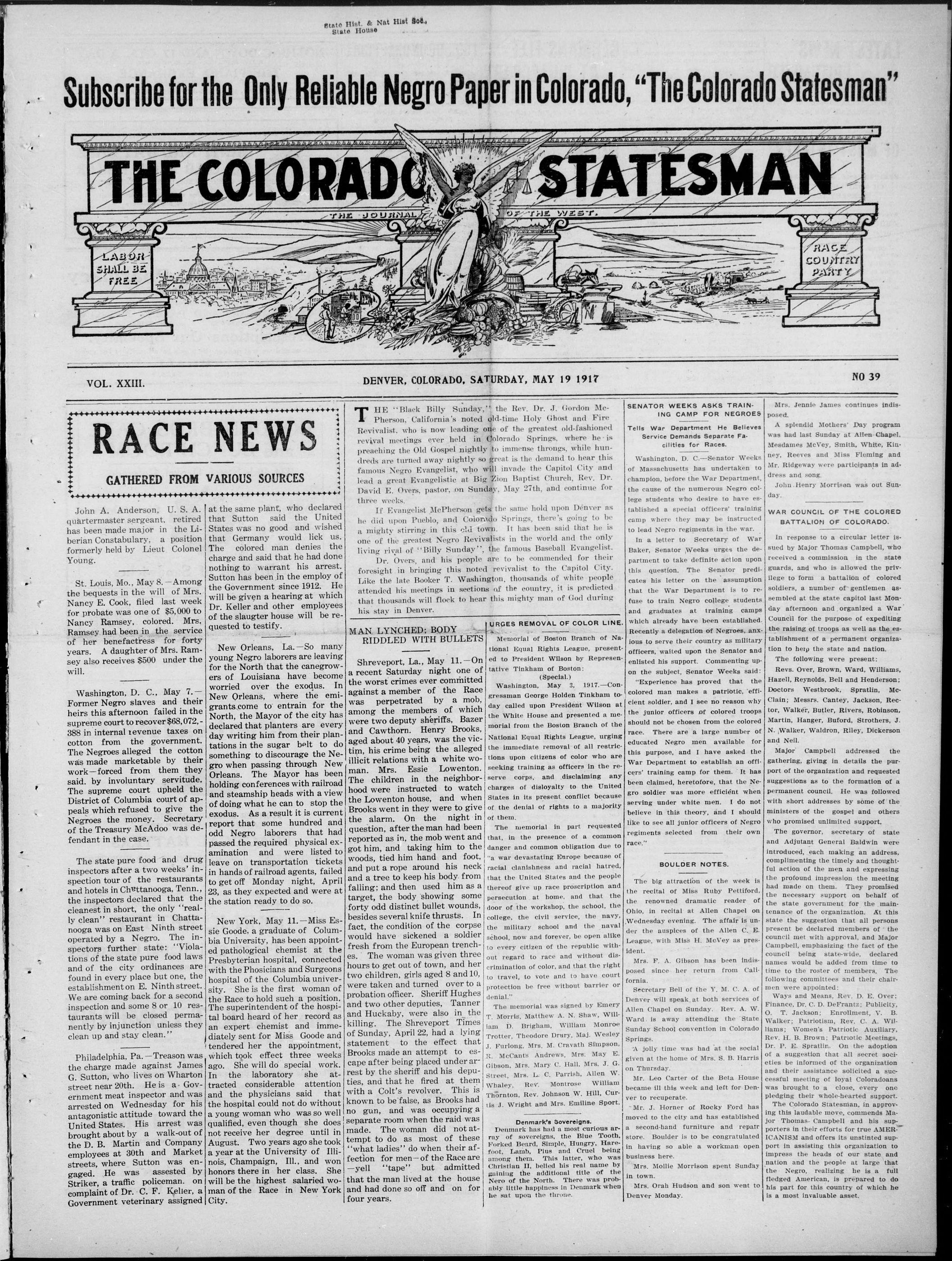
Subscribe for the Only Reliable Negro Paper in Colorado, "The Colorado Statesman"
THE COLORADO STATESMAN
THE JOURNAL OF THE WEST.
LABOR SHALL BE FREE
RACE COUNTRY PARTY
RACE NEWS
GATHERED FROM VARIOUS SOURCES
VOL. XXIII.
RACE
GATHERED FROM
John A. Anderson, U. S. A. quartermaster sergeant, retired has been made major in the Liberian Constabulary, a position formerly held by Lieut Colonel Young.
St. Louis, Mo., May 8. - Among the bequests in the will of Mrs. Nancy E. Cook, filed last week for probate was one of $5,000 to Nancy Ramsey, colored. Mrs. Ramsey had been in the service of her benefactress for forty years. A daughter of Mrs. Ramsey also receives $500 under the will.
Washington, D. C., May 7. - Former Negro slaves and their heirs this afternoon failed in the supreme court to recover $68,072, 388 in internal revenue taxes on cotton from the government. The Negroes alleged the cotton was made marketable by their work—forced from them they said. by involuntary servitude. The supreme court upheld the District of Columbia court of appeals which refused to give the Negroes the money. Secretary of the Treasury McAdoo was defendant in the case.
The state pure food and drug inspectors after a two weeks' inspection tour of the restaurants and hotels in Chettuanooga, Tenn., the inspectors declared that the cleanest in short, the only "really clean" restaurant in Chattanooga was on East Ninth street operated by a Negro. The inspectors further state: "Violations of the state pure food laws and of the city ordinances are found in every place but one, the establishment on E. Ninth street. We are coming back for a second inspection and some 8 or 10 restaurants will be closed permanently by injunction unless they clean up and stay clean."
Philadelphia, Pa.—Treason was the charge made against James G. Sutton, who lives on Wharton street near 20th. He is a Government meat inspector and was arrested on Wednesday for his antagonistic attitude toward the United States. His arrest was brought about by a walk-out of the D. B. Martin and Company employees at 30th and Market streets, where Sutton was engaged. He was assested by Striker, a traffic policeman. on complaint of Dr. C. F. Keller, a Government veterinary assigned
at the same plant, who declared that Sutton said the United States was no good and wished that Germany would lick us. The colored man denies the charge and said that he had done nothing to warrant his arrest. Sutton has been in the employ of the Government since 1912. He will be given a hearing at which Dr. Keller and other employees of the slaughter house will be requested to testify.
New Orleans, La.—So many young Negro laborers are leaving for the North that the canegrowers of Louisiana have become worried over the exodus. In New Orleans, where the emigrants come to entrain for the North, the Mayor of the city has declared that planters are every day writing him from their plantations in the sugar belt to do something to discourage the Negro when passing through New Orleans. The Mayor has been holding conferences with railroad and steamship heads with a view of doing what he can to stop the exodus. As a result it is current report that some hundred and odd Negro laborers that had passed the required physical examination and were listed to leave on transportation tickets in hands of railroad agents, failed to get off Monday night, April 23, as they expected and were at the station ready to do so.
New York, May 11.—Miss Essie Goode, a graduate of Columbia University, has been appointed pathological chemist at the Presbyterian hospital, connected with the Phosicians and Surgeons hospital of the Columbia university. She is the first woman of the Race to hold such a position. The superintendent of the hospital board heard of her record as an expert chemist and immediately sent for Miss Goode and tendered her the appointment, which took effect three weeks ago. She will do special work. In the laboratory she attracted considerable attention and the physicians said that the hospital could not do without a young woman who was so well qualified, even though she does not receive her degree until in August. Two years ago she took a year at the University of Illinois, Champaign, Ill., and won honors there in her class. She will be the highest salaried woman of the Race in New York City.
THE "Black Billy Sunday," the Rev. Dr. J. Gordon McPherson, California's noted old-time Holy Ghost and Fire Revivalist, who is now leading one of the greatest old-fashioned revival meetings ever held in Colorado Springs, where he is preaching the Old Gospel nightly to immense throngs, while hundreds are turned away nightly so great is the demand to hear this famous Negro Evangelist, who will invade the Capitol City and lead a great Evangelistic at Big Zion Baptist Church, Rev. Dr. David E. Overs, pastor, on Sunday, May 27th, and continue for three weeks.
If Evangelist McPherson gets the same hold upon Denver as he did upon Pueblo, and Colorado Springs, there's going to be a mighty stirring in this old town. It has been said that he is one of the greatest Negro Revivalists in the world and the only living rival of "Billy Sunday", the famous Baseball Evangelist.
Dr. Overs, and his people are to be commended for their foresight in bringing this noted revivalist to the Capitol City. Like the late Booker T. Washington, thousands of white people attended his meetings in sections of the country, it is predicted that thousands will flock to hear this mighty man of God during his stay in Denver.
state Hist. & Nat Hist Soc.
State House
RADO
THE JOURNAL
DENVER, COLORADO, SAN
THE "Black Billy Sunday" Pherson, California's noted Revivalist, who is now leading revival meetings ever held in preaching the Old Gospel nightly dreds are turned away nightly so famous Negro Evangelist, who lead a great Evangelistic at Bid David E. Overs, pastor, on Sun three weeks.
If Evangelist McPherson got he did upon Pueblo, and Color a mighty stirring in this old to one of the greatest Negro Revival living rival of "Billy Sunday".
Dr. Overs, and his people foresight in bringing this note. Like the late Booker T. Washin attended his meetings in section that thousands will flock to hear his stay in Denver.
MAN LYNCHED; BODY RIDDLED WITH BULLETS
Shreveport, La., May 11.—On a recent Saturday night one of the worst crimes ever committed against a member of the Race was perpetrated by a mob, among the members of which were two deputy sheriffs, Bazer and Cawthorn. Henry Brooks, aged about 40 years, was the victim, his crime being the alleged illicit relations with a white woman. Mrs. Essie Lowenton. The children in the neighborhood were instructed to watch the Lowenton house, and when Brooks went in they were to give the alarm. On the night in question, after the man had been reported as in, the mob went and got him, and taking him to the woods, tied him hand and foot, and put a rope around his neck and a tree to keep his body from falling; and then used him as a target, the body showing some forty odd distinct bullet wounds, besides several knife thrusts. In fact, the condition of the corpse would have sickened a soldier fresh from the European trenches. The woman was given three hours to get out of town, and her two children, girls aged 8 and 10, were taken and turned over to a probation officer. Sheriff Hughes and two other deputies, Tanner and Huckaby, were also in the killing. The Shreveport Times of Sunday, April 22, had a lying statement to the effect that Brooks made an attempt to escape after being placed under arrest by the sheriff and his deputies, and that he fired at them with a Colt's revolver. This is known to be false, as Brooks had no gun, and was occupying a separate room when the raid was made. The woman did not attempt to do as most of these "what ladies" do when their affection for men—of the Race are—yell "tape" but admitted that the man lived at the house and had done so off and on for four years.
---
URGES REMOVAL OF COLOR LINE
Memorial of Boston Branch of National Equal Rights League, presented to President Wilson by Representative Tinkham of Boston:
(Special.)
Washington, May 3, 1917.—Congressman George Holden Tinkham today called upon President Wilson at the White House and presented a memorial from the Boston Branch of the National Equal Rights League, urging the immediate removal of all restrictions upon citizens of color who are seeking training as officers in the reserve corps, and disclaiming any charges of disloyalty to the United States in its present conflict because of the denial of rights to a majority of them.
The memorial in part requested that, in the presence of a common danger and common obligation due to "a war devastating Europe because of racial clanishness and racial hatred, that the United States and the people thereof give up race proscription and persecution at home, and that the door of the workshop, the school, the college, the civil service, the navy, the military school and the naval school, now and forever, be open alike to every citizen of the republic without regard to race and without discrimination of color, and that the right to travel, to vote and to have court protection be free without barrier or denial."
The memorial was signed by Emery T. Morris, Matthew A. N. Shaw, William D. Brigham, William Monroe Trotter, Theodore Drury, Maj. Wesley J. Furlong, Mrs. M. Cravath Simpson, R. McCants Andrews, Mrs. May E. Gibson, Mrs. Mary C. Hall, Mrs. J. G. Street, Mrs. L. C. Parrish, Allen W. Whaley, Rev. Montrose William Thornton, Rev. Johnson W, Hill, Curtis J. Wright and Mrs. Emiline Sport.
Denmark's Sovereigns.
Denmark has had a most curious array of sovereigns, the Blue Tooth, Forked Beard, Simple, Hungry, Harefoot, Lamb, Pius and Cruel being among them. This latter, who was Christian II, belled his real name by gaining the additional title of the Nero of the North. There was probably little happiness in Denmark when he sat upon the throne.
SENATOR WEEKS ASKS TRAIN- ING CAMP FOR NEGROES
Washington, D. C.—Senator Weeks of Massachusetts has undertaken to champion, before the War Department, the cause of the numerous Negro college students who desire to have established a special officers' training camp where they may be instructed to lead Negro regiments in the war.
In a letter to Secretary of War Baker, Senator Weeks urges the department to take definite action upon this question. The Senator predicates his letter on the assumption that the War Department is to refuse to train Negro college students and graduates at training camps which already have been established. Recently a delegation of Negroes, anxious to serve their country as military officers, waited upon the Senator and enlisted his support. Commenting upon the subject, Senator Weeks said:
"Experience has proved that the colored man makes a patriotic, efficient soldier, and I see no reason why the junior officers of colored troops should not be chosen from the colored race. There are a large number of educated Negro men available for this purpose, and I have asked the War Department to establish an officers' training camp for them. It has been claimed, heretofore, that the Negro soldier was more efficient when serving under white men. I do not believe in this theory, and I should like to see all junior officers of Negro regiments selected from their own race."
BOULDER NOTES.
The big attraction of the week is the recital of Miss Ruby Pettiford, the renowned dramatic reader of Ohio, in recital at Allen Chapel on Wednesday evening. The affair is under the auspices of the Allen C. E. League, with Miss H. McVey as president.
Mrs. F. A. Gibson has been indisposed since her return from California.
Secretary Bell of the Y. M. C. A. of Denver will speak at both services of Allen Chapel on Sunday. Rev. A. W. Ward. is away attending the State Sunday School convention in Colorado Springs.
A jolly time was had at the social given at the home of Mrs. S. B. Harris on Thursday.
Mr. Leo Carter of the Beta House became ill this week and left for Denver to recuperate.
Mr. J. Horner of Rocky Ford has moved to the city and has established a second-hand furniture and repair store. Boulder is to be congratulated in having so able a workman open business here.
Mrs. Mollie Morrison spent Sunday in town.
Mrs. Orah Hudson and son went to Denver Monday.
NO 39
Mrs. Jennie James continues indisposed.
A splendid Mothers' Day program was had last Sunday at Allen Chapel, Mesdames McVey, Smith, White, Kinney, Reeves and Miss Fleming and Mr. Ridgeway were participants in address and song.
John Henry Morrison was out Sunday.
WAR COUNCIL OF THE COLORED BATTALION OF COLORADO.
In response to a circular letter issued by Major Thomas Campbell, who received a commission in the state guards, and who is allowed the privilege to form a battalion of colored soldiers, a number of gentlemen assembled at the state capitol last Monday afternoon and organized a War Council for the purpose of expediting the raising of troops as well as the establishment of a permanent organization to help the state and nation.
Revs. Over, Brown, Ward, Williams, Hazell, Reynolds, Bell and Henderson; Doctors Westbrook, Spratlin, McClain; Messrs. Cantey, Jackson, Rector, Walker, Butler, Rivers, Robinson, Martin, Hanger, Buford, Strothers, J. N. Walker, Waldron, Riley, Dickerson and Neil.
Major Campbell addressed the gathering, giving in details the purport of the organization and requested suggestions as to the formation of a permanent council. He was followed with short addresses by some of the ministers of the gospel and others who promised unlimited support.
The governor, secretary of state and Adjutant General Baldwin were introduced, each making an address, complimenting the timely and thoughtful action of the men and expressing the profound impression the meeting had made on them. They promised the necessary support on behalf of the state government for the maintenance of the organization. At this state the suggestion that all persons present be declared members of the council met with approval, and Major Campbell, emphasizing the fact of the council being state-wide, declared names would be added from time to time to the roster of members. The following committees and their chairmen were appointed:
Ways and Means, Rev. D. E. Over; Finance, Dr. C. D. DeFrantz; Publicity, O. T. Jackson; Enrollment, V. B. Walker; Patriotism, Rev. C. A. Williams; Women's Patriotic Auxiliary, Rev. H. B. Brown; Patriotic Meetings, Dr. P. E. Spratlin. On the adoption of a suggestion that all secret societies be informed of the organization and their assistance solicited a successful meeting of loyal Coloradoans was brought to a close, every one pledging their whole-hearted support. The Colorado Statesman, in approving this laudable move, commends Major Thomas-Campbell and his supporters in their efforts for true AMERICANISM and offers its unstinted support in assisting this organization to impress the heads of our state and nation and the people at large that the Negro, realizing he is a full fledged American, is prepared to do his part for this country of which he is a most invaluable asset.
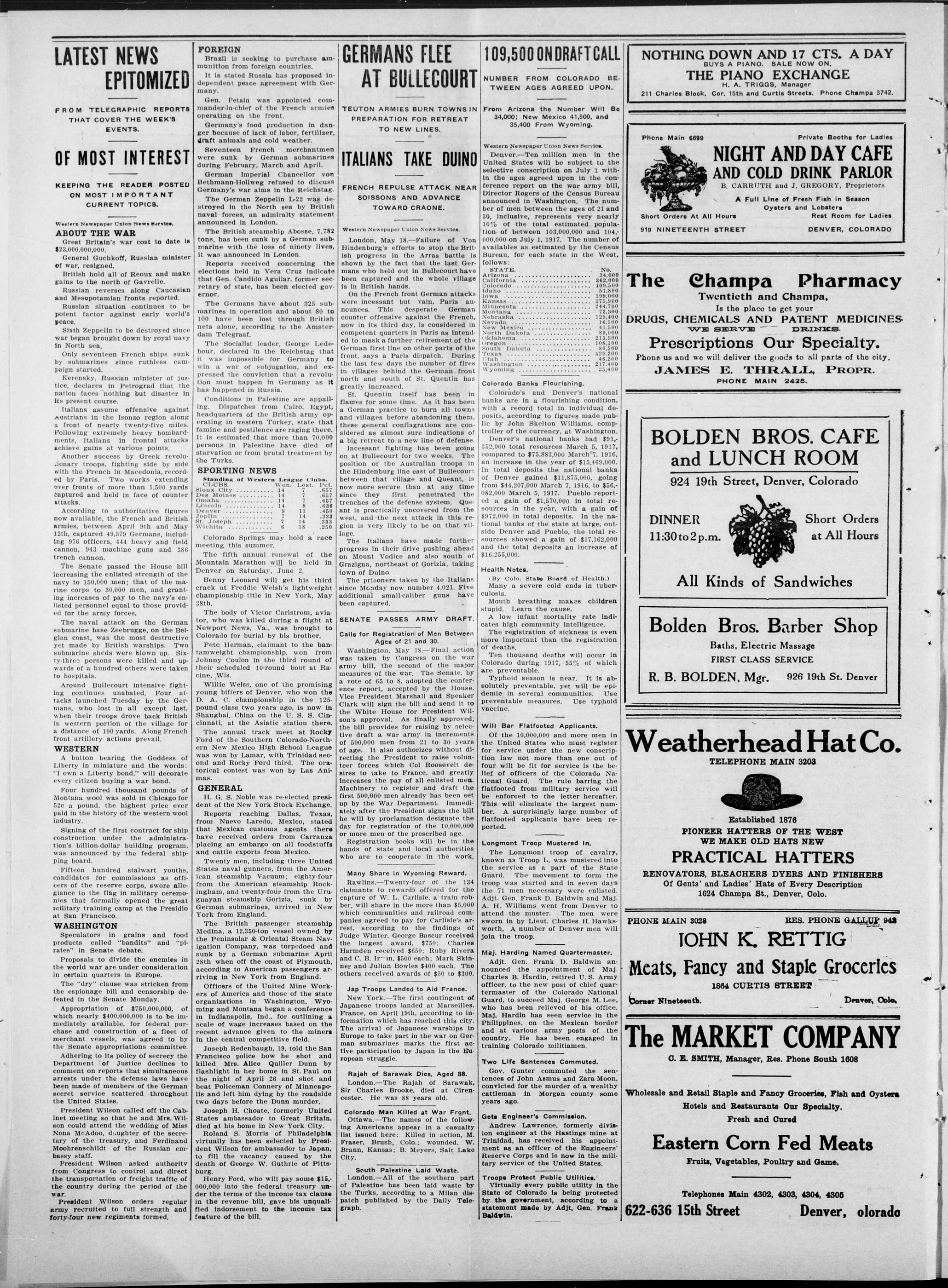
LATEST NEWS EPITOMIZED
FROM TELEGRAPHIC REPORTS THAT COVER THE WEEK'S EVENTS.
OF MOST INTEREST
KEEPING THE READER POSTED
ON MOST IMPORTANT
CURRENT TOPICS.
ABOUT THE WAR
Great Britain's war cost to date is $23,000,000,000.
General Guchkoff, Russian minister of war, resigned.
British hold all of Reoux and make gains to the north of Gavrelle.
Russian reverses along Caucasian and Mesopotamian fronts reported.
Russian situation continues to be potent factor against early world's peace.
Sixth Zeppelln to be destroyed since war began brought down by royal navy in North sea.
Only seventeen French ships sunk by submarines since ruthless campaign started.
Kerensky, Russian minister of justice, declares in Petrograd that the nation faces nothing but disaster in its present course.
Italians assume offensive against Austrians in the Isonzo region along a front of nearly twenty-five miles. Following extremely heavy bombardments, Italians in frontal attacks achieve gains at various points.
Another success by Greek revolutionary troops, fighting side by side with the French in Macedonia, recorded by Paris. Two works extending over fronts of more than 1,500 yards captured and held in face of counter attacks.
According to authoritative figures now available, the French and British armies, between April 9th and May 12th, captured 49,579 Germans, including 976 officers, 444 heavy and field cannon, 943 machine guns and 386 trench cannon.
The Senate passed the House bill increasing the enlisted strength of the navy to 150,000 men; that of the marine corps to 30,000 men, and granting increases of pay to the navy's enlisted personnel equal to those provided for the army forces.
The naval attack on the German submarine base Zeebrugg, on the Belgian coast, was the most destructive yet made by British warships. Two submarine sheds were blown up. Sixty-three persons were killed and upwards of a hundred others were taken to hospitals.
Around Bullecourt intensive fighting continues unabated. Four attacks launched Tuesday by the Germans, who lost in all except last, when their troops drove back British in western portion of the village for a distance of 100 yards. Along French front artillery actions prevail.
WESTERN
A button bearing the Goddess of Liberty in miniature and the words: "I own a Liberty bond," will decorate every citizen buying a war bond.
Four hundred thousand pounds of Montana wool was sold in Chicago for 52c a pound, the highest price ever paid in the history of the western wool industry.
Signing of the first contract for ship construction under the administration's billion-dollar building program, was announced by the federal shipping board.
Fifteen hundred stalwart youths, candidates for commissions as officers of the reserve corps, swore allegiance to the flag in military ceremonies that formally opened the great military training camp at the Presidio at San Francisco.
WASHINGTON
Speculators in grains and food products called "bandits" and "pirates" in Senate debate. Proposals to divide the enemies in the world war are under consideration in certain quarters in Europe. The "dry" clause was stricken from the espionage bill and censorship defeated in the Senate Monday. Appropriation of $750,000,000, of which nearly $400,000,000 is to be immediately available, for federal purchase and construction of a fleet of merchant vessels, was agreed to by the Senate appropriations committee. Adhering to its policy of secrecy the Department of Justice declines to comment on reports that simultaneous arrests under the defense laws have been made of members of the German secret service scattered throughout the United States.
President Wilson called off the Cabinet meeting so that he and Mrs. Wilson could attend the wedding of Miss Nona McAdoo, daughter of the secretary of the treasury, and Ferdinand Moohrenschildt of the Russian embassy staff.
President Wilson asked authority from Congress to control and direct the transportation of freight traffic of the country during the period of the war.
President Wilson orders regular army recruited to full strength and forty-four new regiments formed.
FOREIGN
Brazil is seeking to purchase ammunition from foreign countries. It is stated Russia has proposed independent peace agreement with Germany. Gen. Petain was appointed commander-in-chief of the French armies operating on the front. Germany's food production in danger because of lack of labor, fertilizer, draft animals and cold weather. Seventeen French merchantmen were sunk by German submarines during February, March and April. German Imperial Chancellor von Bethmighi-Hollweg refused to discuss Germany's war alms in the Reichstag. The German Zeppelin L-22 was destroyed in the North sea by British naval forces, an admiralty statement announced in London.
The British steamship Abosse, 7,782 tons, has been sunk by a German submarine with the loss of ninety lives, it was announced in London.
Reports received concerning the elections held in Vera Cruz indicate that Gen. Candido Aguilar, former secretary of state, has been elected governor.
The Germans have about 325 submarines in operation and about 80 to 100 have been lost through British nets alone, according to the Amsterdam Telegraaf.
The Socialist leader, George Ledebour, declared in the Reichstag that it was impossible for Germany to win a war of subjugation, and expressed the conviction that a revolution must happen in Germany as it has happened in Russia.
Conditions in Palestine are appalling. Dispatches from Cairo, Egypt, headquarters of the British army operating in western Turkey, state that famine and pestilence are raging there. It is estimated that more than 70,000 persons in Palestine have died of starvation or from brutal treatment by the Turks.
SPORTING NEWS
Standing of Western League Clubs.
CLUBS. Won. Lost. Pct.
Sloux City 14 7 .657
Des Moines 14 7 .657
Omaha 14 7 .657
Lincoln 14 8 .658
Denver 9 11 .450
Joplin 7 14 .333
St. Joseph 7 14 .333
Wichita 6 18 .250
Colorado Springs may hold a race
meeting this summer.
The fifth annual renewal of the
Mountain Marathon will be held in
Denver on Saturday, June 2.
Benny Leonard will get his third
crack at Freddie Welsh's lightweight
championship title in New York, May
28th.
The body of Victor Carlstrom, aviator, who was killed during a flight at
Newport News, Va., was brought to
Colorado for burial by his brother.
Pete Herman, claimant to the bantamweight championship, won from Johnny Coulon in the third round of their scheduled 10-round bout at Racine, Wis.
Willie Welss, one of the promising young biffers of Denver, who won the D. A. C. championship in the 125-pound class two years ago, is now in Shanghai, China on the U. S. S. Cincinnati, at the Asiatic station there.
The annual track meet at Rocky Ford of the Southern Colorado-Northern New Mexico High School League was won by Lamar, with Trinidad and Rocky Ford third. The oratorical contest was won by Las Animas.
GENERAL
H. G. S. Noble was re-elected president of the New York Stock Exchange.
dent of the New York Stock Exchange.
Reports reaching Dallas, Texas,
from Nuevo Laredo, Mexico, stated
that Mexican customs agents there
have received orders from Carranza
placing an embargo on all foodstuffs
and cattle exports from Mexico.
Twenty men, including three United
States naval gunners, from the American steamship Vacuum; eighty-four from the American steamship Rockingham, and twenty-four from the Uruguayan steamship Gorizia, sunk by German submarines, arrived in New York from England.
The British passenger steamship Medina, a 12,350-ton vessel owned by the Peninsular & Oriental Steam Navigation Company, was torpedoed and sunk by a German submarine April 28th when off the coast of Plymouth, according to American passengers arriving in New York from England.
Officers of the United Mine Workers of America and those of the state organizations in Washington, Wyoming and Montana began a conference in Indianapolis, Ind., for outlining a scale of wage increases based on the recent advance given to the miners in the central competitive field.
Joseph Redenbaugh, 19, told the San Francisco police how he shot and killed Mrs. Alice Quiller Dunn by flashlight in her home in St. Paul on the night of April 26 and shot and beat Policeman Connery of Minneapolis and left him dying by the roadside two days before the Dunn murder.
Joseph H. Choate, formerly United States ambassador to Great Britain, died at his home in New York City.
Roland S. Morris of Philadelphia virtually has been selected by President Wilson for ambassador to Japan, to fill the vacancy caused by the death of George W. Guthrie of Pittsburg.
Henry Ford, who will pay some $15,000,000 into the federal treasury under the terms of the income tax clause in the revenue bill, gave his unqualified indorsement to the income tax feature of the bill.
GERMANS FLEE AT BULLECOURT
TEUTON ARMIES BURN TOWNS IN PREPARATION FOR RETREAT TO NEW LINES.
ITALIANS TAKE DUINO
FRENCH REPULSE ATTACK NEAR
SOISSONS AND ADVANCE
TOWARD CRAONE.
Western Newspaper Union News Service.
London, May 18.—Failure of Von Hindenburg's efforts to stop the British progress in the Arras battle is shown by the fact that the last Germans who held out in Bullecourt have been captured and the whole village is in British hands.
On the French front German attacks were incessant but vain, Paris announces. This desperate German counter offensive against the French, now in its third day, is considered in competent quarters in Paris as intended to mask a further retirement of the German first line on other parts of the front, says a Paris dispatch. During the last few days the number of fires in villages behind the German front north and south of St. Quentin has greatly increased.
St. Quentin itself has been in flames for some time. As it has been a German practice to burn all towns and villages before abandoning them, these general conflagrations are considered as almost sure indications of a big retreat to a new line of defense. Incessant fighting has been going on at Bullecourt for two weeks. The position of the Australian troops in the Hindenburg line east of Bullecourt between that village and Queant, is now more secure than at any time since they first penetrated the trenches of the defense system. Queant is practically uncovered from the west, and the next attack in this region is very likely to be on that village.
The Italians have made further progress in their drive pushing ahead on Mount Vodice and also south of Grazigna, northeast of Gorizia, taking town of Dulno. The prisoners taken by the Italians since Monday now number 4,021. Five additional small-caliber guns have been captured.
SENATE PASSES ARMY DRAFT
Calls for Registration of Men Between Ages of 21 and 30.
Washington, May 18.—Final action was taken by Congress on the war army bill, the second of the major measures of the war. The Senate, by a vote of 65 to 8, adopted the conference report, accepted by the House. Vice President Marshall and Speaker Clark will sign the bill and send it to the White House for President Wilson's approval. As finally approved, the bill provides for raising by selective draft a war army in increments of 500,000 men from 21 to 30 years of age. It also authorizes without directing the President to raise volunteer forces which Col Roosevelt desires to take to France, and greatly increases the pay of all enlisted men. Machinery to register and draft the first 500,000 men already has been set up by the War Department. Immediately after the President signs the bill he will by proclamation designate the day for registration of the 10,000,000 or more men of the prescribed age.
Registration books will be in the hands of state and local authorities who are to cooperate in the work,
Many Share in Wyoming Reward.
Rawlins.—Twenty-four of the 134 claimants to rewards offered for the capture of W. L. Carlisle, a train robber, will share in the more than $5,000 which communities and railroad companies agreed to pay for Carlisle's arrest, according to the findings of Judge Winter. George Bascur received the largest award, $750; Charles Harmden received $650; Ruby Rivera and C. B. Ir'in, $500 each; Mark Skinner and Julian Bowles $400 each. The others received awards of $50 to $300.
New York.—The first contingent of Japanese troops landed at Marseille, France, on April 19th, according to information which has reached this city. The arrival of Japanese warships in Europe to take part in the war on German submarines marks the first active participation by Japan in the European struggle.
London.—The Rajah of Sarawak,
Sir Charles Brooke, died at Cirencester.
He was 88 years old.
Colorado Man Killed at War Front.
Ottawa.—The names of the following Americans appear in a casualty list issued here: Killed in action, M. Fraser, Brush, Colo.; wounded, W. Brann, Kansas; B. Meyers, Salt Lake City.
South Palestine Laid Waste
London.—All of the southern part of Palestine has been laid waste by the Turks, according to a Milan dispatch published by the Daily Telegraph.
109,500 ON DRAFT CALL
NUMBER FROM COLORADO BETWEEN AGES AGREED UPON.
From Arizona the Number Will Be 34,000; New Mexico 41,500, and 35,400 From Wyoming.
Western Newspaper Union News Service.
Denver.—Ten million men in the United States will be subject to the selective conscription on July 1 within the ages agreed upon in the conference report on the war army bill, Director Rogers of the Census Bureau announced in Washington. The number of men between the ages of 21 and 30, inclusive, represents very nearly 10% of the total estimated population of between 103,000,000 and 104,000,000 on July 1, 1917. The number of available as estimated by the Census Bureau, for each state in the West, follows:
STATE.
Arizona No.
California 34,000
Colorado 362,000
Idaho 109,500
Iowa 51,800
Kansas 199,000
Minnesota 244,700
Montana 73,300
Nebraska 129,400
Nevada 16,500
New Mexico 41,500
North Dakota 89,000
Oklahoma 213,500
Oregon 108,100
South Dakota 80,500
Texas 420,200
Utah 46,200
Washington 217,400
Wyoming 35,400
Colorado Banks Flourishing.
Colorado's and Denver's national banks are in a flourishing condition, with a record total in individual deposits, according to figures made public by John Skelton Williams, controller of the currency, at Washington. Denver's national banks had $91,352,000 total resources March 5, 1917, compared to $75,883,000 March 7, 1916, an increase in the year of $15,469,000. In total deposits the national banks of Denver gained $11,875,000, going from $44,207,000 March 7, 1916, to $56,082,000 March 5, 1917. Pueblo reported a gain of $1,570,000 in total resources in the year, with a gain of $972,000 in total deposits. In the national banks of the state at large, outside Denver and Pueblo, the total resources showed a gain of $17,162,000 and the total deposits an increase of $16,255,000.
Health Notes
(By Colo. State Board of Health.)
Many a severe cold ends in tuberculosis.
Mouth breathing makes children stupid. Learn the cause.
A low infant mortality rate indicates high community intelligence.
The registration of sickness is even more important than the registration of deaths.
Ten thousand deaths will occur in Colorado during 1917, 55% of which are preventable.
Typhoid season is near. It is absolutely preventable, yet will be epidemic in several communities. Use preventable measures. Use typhoid vaccine.
Will Bar Flatfooted Applicants.
Of the 10,000,000 and more men in the United States who must register for service under the new conscription law not more than one out of four will be fit for service is the belief of officers of the Colorado National Guard. The rule barring the flatfooted from military service will be enforced to the letter hereafter. This will eliminate the largest number. A surprisingly large number of flatfooted applicants have been reported.
Longmont Troop Mustered In.
The Longmont troop of cavalry, known as Troop L, was mustered into the service as a part of the State Guard. The movement to form the troop was started and in seven days the 71 men necessary were enlisted. Adjt. Gen. Frank D. Baldwin and Maj. A. H. Williams went from Denver to attend the muster. The men were sworn in by Lieut. Charles H. Hawksworth. A number of Denver men will join the troop.
Maj. Harding Named Quartermaster.
Adjt. Gen. Frank D. Baldwin announced the appointment of Maj Charles B. Hardin, retired U. S. Army officer, to the new post of chief quartermaster of the Colorado National Guard, to succeed Maj. George M. Lee, who has been relieved of his office. Maj. Hardin has seen service in the Philippines, on the Mexican border and at various army posts of the country. He has been engaged in training Colorado militiamen.
Two Life Sentences Commuted.
Gov. Gunter commuted the sentences of John Asmus and Zara Moon, convicted for the murder of a wealthy cattleman in Morgan county some years ago.
Gets Engineer's Commission.
Andrew Lawrence, formerly division engineer at the Hastings mine at Trinidad, has received his appointment as an officer of the Engineers' Reserve Corps and is now in the military service of the United States.
Troops Protect Public Utilities.
Virtually every public utility in the State of Colorado is being protected by the government, according to a statement made by Adjt, Gen. Frank Baldwin.
NOTHING DOWN AND 17 CTS. A DAY
BUYS A PIANO. SALE NOW ON.
THE PIANO EXCHANGE
H. A. TRIGGS, Manager
211 Charles Block, Cor. 15th and Curtis Streets. Phone Champa 3742.
Short Orders At All Hours
919 NINETEENTH STREET
The Cham
Twentieth
Is the p
DRUGS, CHEMICALS
WE SERV
Prescription
Phone us and we will deliver
JAMES E. T
PHONE
BOLDEN
and LUN
924 19th Stree
Champa Pharm
Twentieth and Champa,
Is the place to get your
CHEMICALS AND PATENT ME
WE SERVE DRINKS.
Descriptions Our Special
and we will deliver the goods to all parts of
JAMES E. THRALL, PRO
PHONE MAIN 2426.
OLDEN BROS. CAFE
and LUNCH ROOM
1924 19th Street, Denver, Colorado
The Champa Pharmacy
Twentieth and Champa.
Is the place to get your
DRUGS, CHEMICALS AND PATENT MEDICINES
WE SERVE DRINKS.
Prescriptions Our Specialty.
Phone us and we will deliver the goods to all parts of the city.
JAMES E. THRALL, PROPR.
PHONE MAIN 2425.
DINNER
11:30 to 2 p.m.
All Kinds of Sandwiches
Bolden Bro
Baths, E
FIRST C
R. B. BOLDEN,
Weatherh
TELEPH
Golden Bros. Barber Sh
Baths, Electric Massage
FIRST CLASS SERVICE
L. BOLDEN, Mgr. 926 19th St. D
atherhead Hat
TELEPHONE MAIN 3203
R. B. BOLDEN, Mgr. 926 19th St. Denver
Weatherhead Hat Co. TELEPHONE MAIN 3203
Established 1876 PIONEER HATTERS OF THE WEST WE MAKE OLD HATS NEW
PRACTICA
RENOVATORS, BLEACE
Of Gents' and Ladies
1624 Champ
PHONE MAIN 3028
JOHN K
Meats, Fancy and
1864 CU
PRACTICAL HATTERS
ATORS, BLEACHERS DYERS AND FINI
Gents' and Ladies' Hats of Every Descripti
1624 Champa St., Denver, Colo.
RENOVATORS, BLEACHERS DYERS AND FINISHERS
Of Gents' and Ladies' Hats of Every Description
1624 Champa St., Denver, Colo.
JOHN K. RETTIG
Fancy and Staple Grocery
1864 CURTIS STREET
eighteenth. De
MARKET COMP
E. SMITH, Manager, Res. Phone South 160
and Retail Staple and Fancy Groceries, Fish and
Hotels and Restaurants Our Specialty.
Fresh and Cured
Eastern Corn Fed Mea
The MARKET
C. E. SMITH, Manas
Wholesale and Retail Staple a
Hotels and Rest
Fresh
Eastern Co
The MARKET COMPANY
C. E. SMITH, Manager, Res. Phone South 1608
Wholesale and Retail Staple and Fancy Groceries, Fish and Oystera Hotels and Restaurants Our Specialty. Fresh and Cured
Eastern Corn Fed Meats
Fruits, Vegetables, Poultry and Game.
Telephones Main 4302, 4303, 4304, 430
622-636 15th Street Denver
Telephones Main 4302, 4303, 4304, 4305
15th Street Denver,
Telephones Main 4302, 4303, 4304, 4305 622-636 15th Street Denver, olorado
VINEGAR
Corner Nineteenth.
Short Orders at All Hours
Barber Shop
Massage
SERVICE
926 19th St. Denver
d Hat Co.
LIN 3203
HATTERS
BUYERS AND FINISHERS
of Every Description
Denver, Colo.
RES. PHONE GALLUP 942
ETTIG
Staple Groceries
STREET
COMPANY
Phone South 1608
Groceries, Fish and Oysters
Our Specialty.
Fed Meats
303, 4304, 4305
Denver, olorado
Vine
Denver, Colo.
COLORADO
STATE NEWS
Western Newspaper Union News Service.
COMING EVENTS.
June 16—Annual Strawberry Festival
and Carnival at Glenwood Springs.
June 21-22—Christian Endeavor
Convention at Salida.
Aug. 1—National Convention of African Race at Denver.
Sept. 17-22—Colorado State Fair at Pueblo.
Penrose is to have a W. O. W. camp.
A case of anthrax was reported at Manzanola.
Prospects are reported good for higher prices for tungsten ore.
Over fifty citizens of Canon City have financed potato planters.
Society of the Red Cross started at Ridgway with a membership of 34.
William A. Maxwell has been re-appointed receiver of the Denver land office.
Mrs. Daniel Danielson, prominent Vineland resident, killed in automobile accident.
Olney is to have a fire truck with a thousand feet of hose and two chemical tanks.
Clear Creek mines in the Idaho Springs district are being reopened by many lessees.
Senator Shafroth introduced in the Senate a bill appropriating $150,000 for a federal building at Montrose.
News stands have been ordered off the streets of Pueblo and hereafter newsboys will handle daily papers.
Henry Hoffman, 55, was instantly killed by falling 100 feet in the Gildbug claim of the Last Dollar mine at Cripple Creek.
Over forty university students and Boulder men have received orders to report at Fort Riley, Kan., at the officers' training camp.
The lists of applicants for admission to the training camp at Fort Riley were closed by order of the War Department at Washington.
Members of the Cigarmakers' Union of Denver, who struck for an increase in wages of $2 per 1,000, compromised on an increase of $1 per 1,000.
Six Sunday automobile accidents, in which sixteen persons participated—of which number seven were injured—one probably fatally—kept the Denver police busy.
As a result of a proclamation issued by Governor Gunter, Sunday, May 20th, has been designated as Young Men's Christian Association War Work Sunday.
Joseph Ward, Denver railroad man, left for St. Louis, where he will join the division of engineers which is being recruited by the government to be sent to France.
The Patriotic League of Clifton has adopted resolutions calling on Congress and the President to stop the manufacture of liquor and to prohibit traffic in it during the war.
Jack S. Means of Denver, a graduate of the University of Colorado, has been designated for a commission as second lieutenant in the engineering corps, United States army.
Full military burial honors were accorded the body of Eugene O. Pratt, member of Company C of the Colorado National Guard, who was killed in the Hastings mine disaster.
Dwight L. Skinner, son of United States Revenue Collector Mark Skinner, and a freshman at Colorado College, was one of the successful applicants for the student training camp at Fort Riley.
Peter De Soto, long known as the "king of the bootleggers" in Larimer county, was sentenced to death in the District Court at Fort Collins on a conviction of having killed his son-law July 25th.
Maj. Charles B. Hardin, United States army, retired, was appointed by Adjt. Gen. Frank D. Baldwin to the new post of chief quartermaster of the Colorado National Guard. He succeeds Maj. George M. Loe.
Members of organized labor in Denver who answer their country's call will be kept on the rolls of their unions as active workers in good standing. Their dues will be suspended during their period of enlistment.
The business interests of Denver will give hearty support to the G. A. R. and the several other patriotic organizations in plans to make Memorial Day of 1917 an effective event in arousing support of the nation's war undertakings.
Denver officialdom, bankers and other business men, as well as the general public, are awaiting only positive announcement of details of his trip to prepare a stirring patriotic welcome to Secretary of the Treasury William G. McAdoo on his visit to Denver, scheduled, according to dispatches from Washington for May 23.
On Monday a joint meeting of the governor's war council, the ways and means committee, the State Editorial Association and the ways and means committees of each county in the state was held in the assembly room at the state house to plan effective work during the war crisis. Patrolman George McWilliams, of Denver, a veteran of the Spanish-American War and the Philippine Rebellion, in which he served as first sergeant of Company K, First Colorado infantry, has passed his examination for a captaincy in the army.
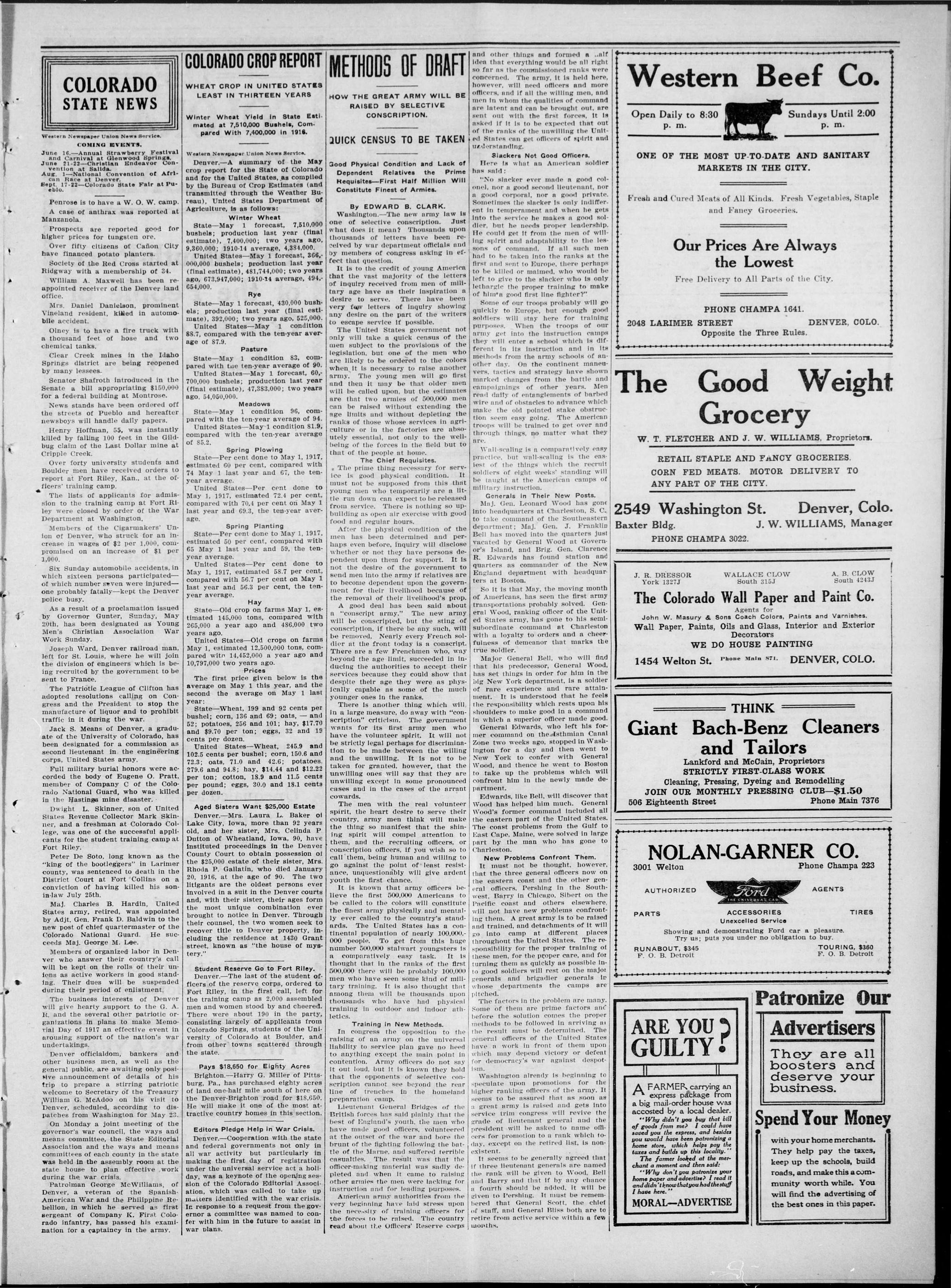
COLORADO CROP REPORT
WHEAT CROP IN UNITED STATES LEAST IN THIRTEEN YEARS
Winter Wheat Yield in State Estimated at 7,510,000 Bushels, Compared With 7,400,000 in 1916.
Western Newspaper Union News Service.
Denver.—A summary of the May crop report for the State of Colorado and for the United States, as compiled by the Bureau of Crop Estimates (and transmitted through the Weather Bureau), United States Department of Agriculture, is as follows:
Winter Wheat
State—May 1 forecast, 7,510,000 bushels; production last year (final estimate), 7,400,000; two years ago, 9,360,000; 1910-14 average, 4,384,000.
United States—May 1 forecast, 366,000,000 bushels; production last year (final estimate), 481,744,000; two years ago, 673,947,000; 1910-14 average, 494,654,000.
Rye
State—May 1 forecast, 430,000 bushels; production last year (final estimate), 392,000; two years ago, 525,000. United States—May 1 condition 88.7, compared with the ten-year average of 87.9.
Pasture
State—May 1 condition 83, compared with the ten-year average of 90. United States—May 1 forecast, 60, 700,000 bushels; production last year (final estimate), 47,383,000; two years ago, 54,050,000.
Meadows
State—May 1 condition 96, compared with the ten-year average of 94. United States—May-1 condition 81.9, compared with the ten-year average of 85.2
Spring Plowing
State—Per cent done to May 1, 1917, estimated 60 per cent, compared with 74 May 1 last year and 67, the ten-year average. United States—Per cent done to May 1, 1917, estimated 72.4 per cent, compared with 70.4 per cent on May 1 last year and 69.3, the ten-year average.
Spring Planting
State—Per cent done to May 1, 1917, estimated 50 per cent, compared with 65 May 1 last year and 59, the ten-year average. United States—Per cent done to May 1, 1917, estimated 58.7 per cent, compared with 56.7 per cent on May 1 last year and 56.3 per cent, the ten-year average.
Hay
State—Old crop on farms May 1, estimated 145,000 tons, compared with 265,000 a year ago and 486,000 two years ago. United States—Old crops on farms May 1, estimated 12,500,000 tons, compared with 14,452,000 a year ago and 10,797,000 two years ago.
Prices
The first price given below is the average on May 1 this year, and the second the average on May 1 last year;
State—Wheat, 199 and 92 cents per bushel; corn, 136 and 69; oats, — and 52; potatoes, 256 and 101; hay, $17.70 and $9.70 per ton; eggs, 32 and 19 cents per dozen.
United States—Wheat, 245.9 and 102.5 cents per bushel; corn, 150.6 and 72.3; oats, 71.0 and 42.6; potatoes, 279.6 and 94.8; hay, $14.44 and $12.22 per ton; cotton, 18.9 and 11.5 cents per pound; eggs, 30.0 and 18.1 cents per dozen.
Aged Sisters Want $25,000 Estate
Denver.—Mrs. Laura L. Baker of Lake City, Iowa, more than 92 years old, and her sister, Mrs. Celinda P. Dutton of Wheatland, Iowa, 90, have instituted proceedings in the Denver County Court to obtain possession of the $25,000 estate of their sister, Mrs. Rhoda P. Gallatin, who died January 20, 1916, at the age of 90. The two litigants are the oldest persons ever involved in a suit in the Denver courts and, with their sister, their ages form the most unique combination ever brought to notice in Denver. Through their counsel, the two women seek to recover title to Denver property, including the residence at 1430 Grant street, known as "the house of mystery."
Student Reserve Go to Fort Riley.
Denver.—The last of the student officers of the reserve corps, ordered to Fort Riley, in the first call, left for the training camp as 2,000 assembled men and women stood by and cheered. There were about 190 in the party, consisting largely of applicants from Colorado Springs, students of the University of Colorado at Boulder, and from other towns scattered through the state.
Pays $18,650 for Eighty Acres
Brighton.—Harry G. Miller of Pittsburg, Pa., has purchased eighty acres of land one-half mile south of here on the Denver-Brighton road for $18,650. He will make it one of the most attractive country homes in this section.
Editors Pledge Help in War Crisis.
Editors Pleasure Help in War Crises.
Denver.—Cooperation with the state and federal governments not only in all war activity but particularly in making the first day of registration under the universal service act a holiday, was a keynote of the opening session of the Colorado Editorial Association, which was called to take up matters identified with the war crisis. In response to a request from the governor a committee was named to confer with him in the future to assist in war plans.
HOW THE GREAT ARMY WILL BE
RAISED BY SELECTIVE
CONSCRIPTION.
QUICK CENSUS TO BE TAKEN
Good Physical Condition and Lack of Dependent Relatives the Primer Requisites—First Half Million Will Constitute Finest of Armies.
By EDWARD B. CLARK.
Washington.—The new army law is one of selective conscription. Just what does it mean? Thousands upon thousands of letters have been received by war department officials and by members of congress asking in effect that question.
It is to the credit of young America that the vast majority of the letters of inquiry received from men of military age have as their inspiration a desire to serve. There have been very few letters of inquiry showing any desire on the part of the writers to escape service if possible.
The United States government not only will take a quick census of the men subject to the provisions of the legislation, but one of the men who are likely to be ordered to the colors when it is necessary to raise another army. The young men will go first and then it may be that older men will be called upon, but the estimates are that two armies of 500,000 men can be raised without extending the age limits and without depleting the ranks of those whose services in agriculture or in the factories are absolutely essential, not only to the wellbeing of the forces in the field but to that of the people at home.
The Chief Requisites
The Chief Requisites.
The prime thing necessary for service is good physical condition. It must not be supposed from this that young men who temporarily are a little run down can expect to be released from service. There is nothing so upbuilding as open air exercise with good food and regular hours.
After the physical condition of the men has been determined and perhaps even before, inquiry will disclose whether or not they have persons dependent upon them for support. It is not the desire of the government to send men into the army if relatives are to become dependent upon the government for their livelihood because of the removal of their livelihood's prop.
A good deal has been said about a "conscript army." The new army will be conscripted, but the sting of conscription, if there be any such, will be removed. Nearly every French soldier at the front today is a conscript. There are a few Frenchmen who, way beyond the age limit, succeeded in inducing the authorities to accept their services because they could show that despite their age they were as physically capable as some of the much younger ones in the ranks.
There is another thing which will in a large measure, do away with "conscription" criticism. The government wants for its first army men who have the volunteer spirit. It will not be strictly legal perhaps for discrimination to be made between the willing and the unwilling. It is not to be taken for granted, however, that the unwilling ones will say that they are unwilling except in some pronounced cases and in the cases of the arrant cowards.
The men with the real volunteer spirit, the heart desire to serve their country, army men think will make the thing so manifest that the shining spirit will compel attention to them, and the recruiting officers, or conscription officers, if you wish so to call them, being human and willing to go against the point of least resistance, unquestionably will give ardent youth the first chance.
It is known that army officers believe the first 500,000 Americans to be called to the colors will constitute the finest army physically and mentally ever called to the country's standards. The United States has a continental population of nearly 100,000,000 people. To get from this huge number 500,000 stalwart youngsters is a comparatively easy task. It is thought that in the ranks of the first 500,000 there will be probably 100,000 men who have seen some kind of military training. It is also thought that among them will be thousands upon thousands who have had physical training in outdoor and indoor athletics.
Training in New Methods.
In congress the opposition to the raising of an army on the universal liability to service plan gave no heed to anything except the main point in contention. Army officers do not say it out loud, but it is known they hold that the opponents of selective conscription cannot see beyond the rear line of trenches in the homeland preparation camp.
Lieutenant General Bridges of the British forces has said plainly that the best of England's youth, the men who have made good officers, volunteered at the outset of the war and bore the brunt of the fighting following the battle of the Marne, and suffered terrible casualties. The result was that the officer-making material was sadly depleted and when it came to raising other armies the men were lacking for instruction and for leading purposes.
American army authorities from the very beginning have laid stress upon the necessity of training officers for the forces to be raised. The country read about the Officers' Reserve corps
and other things and formed a half idea that everything would be all right so far as the commissioned ranks were concerned. The army, it is held here, however, will need officers and more officers, and if all the willing men, and men in whom the qualities of command are latent and can be brought out, are sent out with the first forces, it is asked if it is to be expected that out of the ranks of the unwilling the United States can get officers of spirit and uzderstanding.
Slackers Not Good Officers.
Here is what an American soldier has said:
"No slacker ever made a good colonel, nor a good second lieutenant, nor a good corporal, nor a good private. Sometimes the slacker is only indifferent in temperament and when he gets into the service he makes a good soldier, but he needs proper leadership. He could get it from the men of willing spirit and adaptability to the lessons of command. If all such men had to be taken into the ranks at the first and sent to Europe, there perhaps to be killed or malmed, who would be left to give to the slacker who is only lethargic the proper training to make of him*a good first line fighter?"
Some of our troops probably will go quickly to Europe, but enough good soldiers will stay here for training purposes. When the troops of our army get into the instruction camps they will enter a school which is different in its instruction and in its methods from the army schools of another day. On the continent maneuvers, tactics and strategy have shown marked changes from the battle and campaignings of other years. Men read daily of entanglements of barbed wire and of obstacles to advance which make the old pointed stake obstruction seem easy going. The American troops will be trained to get over and through things, no matter what they are.
Wall-scaling is a comparatively easy practice, but wall-scaling is the easiest of the things which the recruit soldiers of eight weeks' standing will be taught at the American camps of military instruction.
Generals in Their New Posts.
Maj. Gen. Leonard Wood has gone into headquarters at Charleston, S. C. to take command of the Southeastern department; Maj. Gen. J. Franklin Bell has moved into the quarters just vacated by General Wood at Governor's Island, and Brig. Gen. Clarence R. Edwards has found station and quarters as commander of the New England department with headquarters at Boston.
So it is that May, the moving month of Americans, has seen the first army transportations probably solved. General Wood, ranking officer of the United States army, has gone to his semisubordinate command at Charleston with a loyalty to orders and a cheerfulness of demeanor that marks the true soldier.
Major General Bell, who will find that his predecessor, General Wood, has set things in order for him in the big New York department, is a soldier of rare experience and rare attainment. It is understood that he feels the responsibility which rests upon his shoulders to make good in a command in which a superior officer made good.
General Edwards, who left his former command on the Asthmian Canal Zone two weeks ago, stopped in Washington for a day and then went to New York to confer with General Wood, and thence he went to Boston to take up the problems which will confront him in the newly made department.
Edwards, like Bell, will discover that Wood has helped him much. General Wood's former command included all the eastern part of the United States. The const problems from the Gulf to East Cape, Maine, were solved in large part by the man who has gone to Charleston.
New Problems Confront Them.
It must not be thought, however, that the three general officers now on the eastern coast and the other general officers. Pershing in the Southwest, Barry in Chicago, Sibert on the Pacific coast and others elsewhere, will not have new problems confronting them. A great army is to be raised and trained, and detachments of it will go into camp at different places throughout the United States. The responsibility for the proper training of these men, for the proper care, and for turning them as quickly as possible into good soldiers will rest on the major generals and brigadier generals in whose departments the camps are pitched.
The factors in the problem are many. Some of them are prime factors and before the solution comes the proper methods to be followed in arriving at the result must be determined. The general officers of the United States have a work in front of them upon which may depend victory or defeat for democracy's war against despotism. Washington already is beginning to speculate upon promotions for the higher ranking officers of the army. It seems to be assured that as soon as a great army is raised and gets into service trim congress will revive the grade of lieutenant general and the president will be asked to name officers for promotion to a rank which today, except on the retired list, is non-existent.
It seems to be generally agreed that if three lieutenant generals are named the rank will be given to Wood, Bell and Barry and that if by any chance a fourth should be added, it will be given to Pershing. It must be remembered that General Scott, the chief of staff, and General Bliss both are to retire from active service within a few months.
Western Beef Co.
Open Daily to 8:30 p. m.
ONE OF THE MOST UP
MARKETS
Fresh and Cured Meats of All
and Fane
OF THE MOST UP-TO-DATE AND SAN MARKETS IN THE CITY.
Cured Meats of All Kinds. Fresh Vegetal and Fancy Groceries.
ONE OF THE MOST UP-TO-DATE AND SANITARY MARKETS IN THE CITY.
Fresh and Cured Meats of All Kinds. Fresh Vegetables, Staple and Fancy Groceries.
Our Prices Are Always the Lowest Free Delivery to All Parts of the City.
PHONE C
2048 LARIMER STREET
Opposite th
The Good
Gro
W. T. FLETCHER AND J
RETAIL STAPLE AND
CORN FED MEATS.
ANY PART OF THE C
2549 Washington St.
Baxter Bldg.
PHONE CHAMPA 3022
J. R. DRESSOR
York 1327J
WALL
Sof
The Colorado Wall
Age
John W. Masury & Sons Coat
Wall Paper, Paints, Oils and
Deco
WE DO HOU
1454 Welton St. Phone
THE
Giant Bach-h
and T
Lankford and M
STRICTLY FIRE
Cleaning, Pressing, I
JOIN OUR MONTHLY
506 Eighteenth Street
NOLAN-G
3001 Welton
PHONE CHAMPA 1641.
IMER STREET DENVER
Opposite the Three Rules.
Good Wee
Grocery
TETCHER AND J. W. WILLIAMS, Pro-
DETAIL STAPLE AND FANCY GROCERIE
N FED MEATS. MOTOR DELIVERY
PART OF THE CITY.
Washington St. Denver
g. J. W. WILLIAMS
NE CHAMPA 3022.
PRESSOR WALLACE CLOW A
27J South 315J S
Colorado Wall Paper and Pain
Agents for
Masury & Sons Coach Colors, Paints and V
paper, Paints, Oils and Glass, Interior and
Decorators
WE DO HOUSE PAINTING
Velton St. Phone Main 871. DENVER,
THINK
It Bach-Benz Clean
and Tailors
Lankford and McCain, Proprietors
STRICTLY FIRST-CLASS WORK
cleaning, Pressing, Dyeing and Remodellin
OUR MONTHLY PRESSING CLUB—S
seventh Street Phone
OLAN-GARNER C
Linton Phone Ch
PHONE CHAMPA 1641.
2048 LARIMER STREET DENVER, COLO.
Opposite the Three Rules.
The Good Weight Grocery
W. T. FLETCHER AND J. W. WILLIAMS, Proprietors.
RETAIL STAPLE AND FANCY GROCERIES.
CORN FED MEATS. MOTOR DELIVERY TO
ANY PART OF THE CITY.
2549 Washington St. Denver, Colo.
Baxter Bldg. J. W. WILLIAMS, Manager
PHONE CHAMPA 3022.
J. R. DRESSOR WALLACE CLOW A. B. CLOW
York 1327J South 315J South 4243J
The Colorado Wall Paper and Paint Co.
Agents for
John W. Masury & Sons Coach Colors, Paints and Varnishes.
Wall Paper, Paints, Oils and Glass, Interior and Exterior
Decorators
WE DO HOUSE PAINTING
1454 Welton St. Phone Main 871. DENVER, COLO.
THINK
Giant Bach-Benz Cleaners and Tailors
Lankford and McCain, Proprietors
STRICTLY FIRST-CLASS WORK
Cleaning, Pressing, Dyeing and Remodelling
JOIN OUR MONTHLY PRESSING CLUB-$1.50
506 Eighteenth Street Phone Main 7376
Ford
THE UNIVERSAL CAR
PARTS ACCE
Unexcel
Showing and demonstrat
Try us; puts you un
RUNABOUT, $345
F. O. B. Detroit
ACCESSORIES
Unexcelled Service
nowing and demonstrating Ford car a pleasure.
Try us; puts you under no obligation to buy.
UT, $345 TOUR
Detroit F. O.
ARE YOU
GUILTY?
A FARMER carrying an express package from a big mail-order house was accosted by a local dealer.
"Why didn't you buy that bill of goods from me? I could have saved you the express, and besides you would have been patronizing a home store, which helps pay the taxes and builds up this locality."
The farmer looked at the merchant a moment and then said:
"Why don't you patronize your home paper and advertise? I read it and didn't know that you had the stuff I have here."
MORAL—ADVERTISE
---
---
```markdown
```
Sundays Until 2:00 p. m.
TO-DATE AND SANITARY IN THE CITY.
Kinds. Fresh Vegetables, Staple Groceries.
AMPA 1641.
DENVER, COLO.
Three Rules.
d Weight
cery
W. WILLIAMS, Proprietors.
FANCY GROCERIES.
MOTOR DELIVERY TO
TY.
St. Denver, Colo.
J. W. WILLIAMS, Manager
CE CLOW
South 315J
A. B. CLOW
South 4243J
Paper and Paint Co.
ants for
In Colors, Paints and Varnishes.
Glass, Interior and Exterior
ators
GE PAINTING
in 871. DENVER, COLO.
INK
Benz Cleaners
Tailors
Cain, Proprietors
T-CLASS WORK
Veneing and Remodelling
PRESSING CLUB—$1.50
Phone Main 7376
ARNER CO.
Phone Champa 223
SORIES TIRES
Brd Service
wing Ford car a pleasure.
or no obligation to buy.
TOURING, $360
F. O. B. Detroit
Patronize Our
Advertisers They are all boosters and deserve your business.
Spend Your Money
with your home merchants. They help pay the taxes, keep up the schools, build roads, and make this a community worth while. You will find the advertising of the best ones in this paper.
THE COLORADO STATESMAN
THE COURANT OF THE YEAR
LAUGH
HAS DE
FREE
HAS
COVINI
SANTY
Communications to receive attention must be newsy, upon important subjects, plainly written only upon one side of the paper, must reach us Tuesdays, if possible, anyway not later than Wednesdays, and bear the signature of the author. No manuscript returned, unless stamps are sent for postage. All communications of a personating nature that are not complimentary will be withheld from the columns of this paper.
Entered as second-class matter at the postoffice in the City of Denver, Colo.
Reading notices, ten lines or less, 10 cents per line. Each additional line over ten lines, 5 cents per line. Display advertising, 50 cents per inch.
Remittances should be made by Express Money Order, Postoffice Money Order, Registered Letter or Bank Draft. Postage stamps will be received the same as cash for the fractional part of a dollar. Only 1c and 2c stamps taken.
No discounts allowed on less than three months' contract. Cash must accompany all orders from parties unknown to us. Further particulars on application.
RECOGNIZED BY DENVER CIVIC AND COMMERCIAL ASSOCIATION
AS AN ADVERTISING MEDIUM OF THE FIRST CLASS.
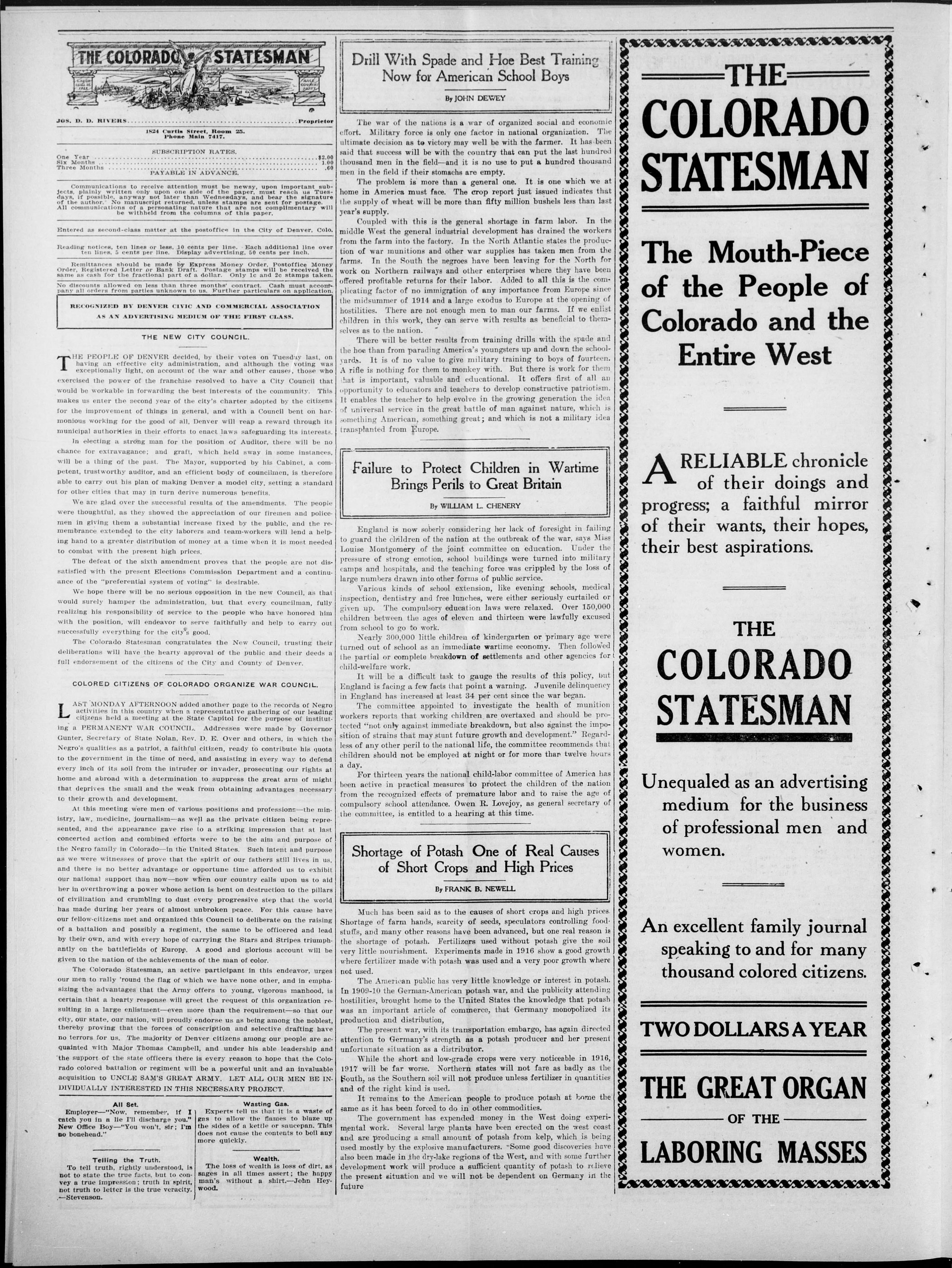
THE NEW CITY COUNCIL
THE PEOPLE OF DENVER decided, by their votes on Tuesday last, on having an effective city administration, and although the voting was exceptionally light, on account of the war and other causes, those who exercised the power of the franchise resolved to have a City Council that would be workable in forwarding the best interests of the community. This makes us enter the second year of the city's charter adopted by the citizens for the improvement of things in general, and with a Council bent on harmonious working for the good of all, Denver will reap a reward through its municipal authorities in their efforts to enact laws safeguarding its interests.
In electing a strong man for the position of Auditor, there will be no chance for extravagance; and graft, which held sway in some instances, will be a thing of the past. The Mayor, supported by his Cabinet, a competent, trustworthy auditor, and an efficient body of councilmen, is therefore able to carry out his plan of making Denver a model city, setting a standard for other cities that may in turn derive numerous benefits.
We are glad over the successful results of the amendments. The people were thoughtful, as they showed the appreciation of our firemen and policemen in giving them a substantial increase fixed by the public, and the remembrance extended to the city laborers and team-workers will lend a helping hand to a greater distribution of money at a time when it is most needed to combat with the present high prices.
The defeat of the sixth amendment proves that the people are not dissatisfied with the present Elections Commission Department and a continuance of the "preferential system of voting" is desirable.
We hope there will be no serious opposition in the new Council, as that would surely hamper the administration, but that every councilman, fully realizing his responsibility of service to the people who have honored him with the position, will endeavor to serve faithfully and help to carry out successfully everything for the city's good.
The Colorado Statesman congratulates the New Council, trusting their deliberations will have the hearty approval of the public and their deeds a full endorsement of the citizens of the City and County of Denver.
COLORED CITIZENS OF COLORADO ORGANIZE WAR COUNCIL.
LAST MONDAY AFTERNOON added another page to the records of Negro activities in this country when a representative gathering of our leading citizens held a meeting at the State Capitol for the purpose of instituting a PERMANENT WAR COUNCIL. Addresses were made by Governor Gunter, Secretary of State Nolan, Rev. D. E. Over and others, in which the Negro's qualities as a patriot, a faithful citizen, ready to contribute his quota to the government in the time of need, and assisting in every way to defend every inch of its soil from the intruder or invader, prosecuting our rights at home and abroad with a determination to suppress the great arm of might that deprives the small and the weak from obtaining advantages necessary to their growth and development.
At this meeting were men of various positions and professions—the ministry, law, medicine, journalism—as well as the private citizen being represented, and the appearance gave rise to a striking impression that at last concerted action and combined efforts were to be the aim and purpose of the Negro family in Colorado—in the United States. Such intent and purpose as we were witnesses of prove that the spirit of our fathers still lives in us, and there is no better advantage or opportune time afforded us to exhibit our national support than now—now when our country calls upon us to aid her in overthrowing a power whose action is bent on destruction to the pillars of civilization and crumbling to dust every progressive step that the world has made during her years of almost unbroken peace. For this cause have our fellow-citizens met and organized this Council to deliberate on the raising of a battalion and possibly a regiment, the same to be officered and lead by their own, and with every hope of carrying the Stars and Stripes triumphantly on the battlefields of Europe. A good and glorious account will be given to the nation of the achievements of the man of color.
The Colorado Statesman, an active participant in this endeavor, urges our men to rally 'round the flag of which we have none other, and in emphasizing the advantages that the Army offers to young, vigorous manhood, is certain that a hearty response will greet the request of this organization resulting in a large enlistment—even more than the requirement—so that our city, our state, our nation, will proudly endorse us as being among the noblest, thereby proving that the forces of conscription and selective drafting have no terrors for us. The majority of Denver citizens among our people are acquainted with Major Thomas Campbell, and under his able leadership and the support of the state officers there is every reason to hope that the Colorado colored battalion or regiment will be a powerful unit and an invaluable acquisition to UNCLE SAM'S GREAT ARMY. LET ALL OUR MEN BE INDIVIDUALLY INTERESTED IN THIS NECESSARY PROJECT.
All Set.
Employer—"Now, remember, if I catch you in a lie I'll discharge you." New Office Boy—"You won't, sir; I'm no bonehead."
Wasting Gas.
Experts tell us that it is a waste of gas to allow the flames to blaze up the sides of a kettle or saucepan. This does not cause the contents to boll any more quickly.
Employer—"Now, remember, if I catch you in a lie I'll discharge you." New Office Boy—"You won't, sir; I'm no bonehead."
Telling the Truth.
The loss of wealth is loss of dirt, as
sages in all times assert; the happy
man's without a shirt.—John Hey-
wood.
To tell truth, rightly understood, is not to state the true facts, but to convey a true impression; truth in spirit, not truth to letter is the true veracity. —Stevenson.
Drill With Spade and Hoe Best Training Now for American School Boys
By JOHN DEWEY
The war of the nations is a war of organized social and economic effort. Military force is only one factor in national organization. The ultimate decision as to victory may well be with the farmer. It has been said that success will be with the country that can put the last hundred thousand men in the field—and it is no use to put a hundred thousand men in the field if their stomachs are empty.
The problem is more than a general one. It is one which we at home in America must face. The crop report just issued indicates that the supply of wheat will be more than fifty million bushels less than last year's supply.
Coupled with this is the general shortage in farm labor. In the middle West the general industrial development has drained the workers from the farm into the factory. In the North Atlantic states the production of war munitions and other war supplies has taken men from the farms. In the South the negroes have been leaving for the North for work on Northern railways and other enterprises where they have been offered profitable returns for their labor. Added to all this is the complicating factor of no immigration of any importance from Europe since the midsummer of 1914 and a large exodus to Europe at the opening of hostilities. There are not enough men to man our farms. If we enlist children in this work, they can serve with results as beneficial to themselves as to the nation.
There will be better results from training drills with the spade and the hoe than from parading America's youngsters up and down the school-yards. It is of no value to give military training to boys of fourteen. A rifle is nothing for them to monkey with. But there is work for them that is important, valuable and educational. It offers first of all an opportunity to educators and teachers to develop constructive patriotism. It enables the teacher to help evolve in the growing generation the idea of universal service in the great battle of man against nature, which is something American, something great; and which is not a military idea transplanted from Europe.
Failure to Protect Children in Wartime Brings Perils to Great Britain
By WILLIAM L. CHENERY
England is now soberly considering her lack of foresight in failing to guard the children of the nation at the outbreak of the war, says Miss Louise Montgomery of the joint committee on education. Under the pressure of strong emotion, school buildings were turned into military camps and hospitals, and the teaching force was crippled by the loss of large numbers drawn into other forms of public service.
Various kinds of school extension, like evening schools, medical inspection, dentistry and free lunches, were either seriously curtailed or given up. The compulsory education laws were relaxed. Over 150,000 children between the ages of eleven and thirteen were lawfully excused from school to go to work.
Nearly 300,000 little children of kindergarten or primary age were turned out of school as an immediate wartime economy. Then followed the partial or complete breakdown of settlements and other agencies for child-welfare work.
It will be a difficult task to gauge the results of this policy, but England is facing a few facts that point a warning. Juvenile delinquency in England has increased at least 34 per cent since the war began.
The committee appointed to investigate the health of munition workers reports that working children are overtaxed and should be protected "not only against immediate breakdown, but also against the imposition of strains that may stunt future growth and development." Regardless of any other peril to the national life, the committee recommends that children should not be employed at night or for more than twelve hours a day.
For thirteen years the national child-labor committee of America has been active in practical measures to protect the children of the nation from the recognized effects of premature labor and to raise the age of compulsory school attendance. Owen R. Lovejoy, as general secretary of the committee, is entitled to a hearing at this time.
Shortage of Potash One of Real Causes of Short Crops and High Prices
By FRANK B. NEWELL
Much has been said as to the causes of short crops and high prices. Shortage of farm hands, scarcity of seeds, speculators controlling food-stuffs, and many other reasons have been advanced, but one real reason is the shortage of potash. Fertilizers used without potash give the soil very little nourishment. Experiments made in 1916 show a good growth where fertilizer made with potash was used and a very poor growth where not used.
The American public has very little knowledge or interest in potash. In 1909-10 the German-American potash war, and the publicity attending hostilities, brought home to the United States the knowledge that potash was an important article of commerce, that Germany monopolized its production and distribution.
The present war, with its transportation embargo, has again directed attention to Germany's strength as a potash producer and her present unfortunate situation as a distributor.
While the short and low-grade crops were very noticeable in 1916, 1917 will be far worse. Northern states will not fare as badly as the South, as the Southern soil will not produce unless fertilizer in quantities and of the right kind is used.
It remains to the American people to produce potash at home the same as it has been forced to do in other commodities.
The government has expended money in the West doing experimental work. Several large plants have been erected on the west coast and are producing a small amount of potash from kelp, which is being used mostly by the explosive manufacturers. Some good discoveries have also been made in the dry-lake regions of the West, and with some further development work will produce a sufficient quantity of potash to relieve the present situation and we will not be dependent on Germany in the future
---
COLORADO STATESMAN
---
The Mouth-Piece of the People of Colorado and the Entire West
---
ARELIABLE chronicle of their doings and progress; a faithful mirror of their wants, their hopes, their best aspirations.
THE
COLORADO
STATESMAN
Unequaled as an advertising medium for the business of professional men and women.
An excellent family journal speaking to and for many thousand colored citizens. TWO DOLLARS A YEAR
THE GREAT ORGAN OF THE
LABORING MASSES
KEEP off the date of June 21st. Damon Lodge No. 5 K. of P. entertainment at Fern Hall.
Elder J. S. Christian of the Church of God arrived in the city Thursday from Canada, and will remain in the city a few weeks.
CAMPBELL CHAPEL AFRICAN E. CHURCH.
23rd and Lawrence Streets.
A. M. Ward, Minister.
Phone Main 5474. Res., 1218 23rd
Sunday School, 9:45; V. N. W skill, superintendent.
The friends of Mrs. John King, formerly Miss Geraldine Overton of this city, will be sorry to learn of the death of her husband, who died in Los Angeles, Calif., Sunday, May 6.
John A. Reed, formerly of this city, died in Glasgow, Mont., May 15th. Mr. Reed was a Denver boy and his many friends will be sorry to learn of his sad demise.
When you visit Manitou this summer don't fail to stop at the Middle West, E. J. Davis, proprietor, where every accommodation will be given you. The hotel will be open from June 1st to Sept. 15th.
Corporal William White Camp No. 4, U. S. Spanish War Veterans, extends a cordial invitation to everyone to attend their annual dance, Wednesday night, May 30, 1917, Denver Auditorium. Admission, 50 cents. Good music, good order, good time, our motto.
Congratulations to Mr. and Mrs. James M. Ward of 921 Twenty-seventh street, who were married last Wednesday evening. We wish them every happiness in their marriage life. Mrs. Ward was formerly Miss Estella Crosby.
ODD FELLOWS ANNUAL SERVICE
The Odd Fellows Annual Thanksgiving service at Central Baptist church last Sunday was a very forcible reminder to Odd Fellows of the principles of the Grand United Order and an expression to the public of the purpose and meaning of BROTHERLY LOVE and UNITY. Weather conditions were all that could be desired and a large attendance was present
Mrs. E. C. Waldron, one of the staunch members of the Household of Ruth, the feminine branch of the order, occupied the position of Mistress of Ceremonies, and filled same with credit to the order and herself. Rev. P. J. Price preached the sermon, while Mrs. Minnie Williams, in a vocal solo, and Mr. Chas. Muse in an able address, represented the talent possessed by this fraternal society. A fairly large offering was taken up, the same given over to charitable purposes, another expression of Odd Fellows' generosity.
REESE BROS. AFRICANDERS COM
ING TO DENVER.
After an absence of ten years Reese Brothers have returned to Denver bringing with them their big act known throughout the country as Reese Brothers Africanders. The act has appeared in all the big eastern cities, and at present is finishing a trans-continental tour which began in New York City nineteen months ago. They have just left the Pacific Coast, where they were a big hit, playing successfully in Vancouver, Seattle, Portland, Spokane and the smaller towns en route.
Reese Brothers will be remembered by all old Denverites as it was here they started in show business in 1889. They have been featured with all the leading colored shows, five years with Williams and Walker, as an extra attraction, besides having played the Orpheum and Keith circuits for many years at the time when a colored act was a novelty in a big time vaudeville house.
It was while finishing a tour of the Orpheum circuit that they were married to the Misses Lizzie Hamilton and Jessie Nickens, to whom they have been wedded thirteen years.
Jessie Nickens Reese, who as Jessie Nickens was a popular society girl and known throughout the state as a singer, is one of the features of the act.
Lizzie Hamilton Reese has returned to the act after an absence of a few years and is also a well-known Denver girl. Reese Brothers and Company will appear at the Plaza Theater for three days commencing with matinee May 24th, being impossible to accept any longer engagement on account of former contracts carrying them through this state and New Mexico.
CAMPBELL CHAPEL AFRICAN M
E. CHURCH.
Phone Main 5474. Res., 1218 23rd St.
Sunday School, 9:45; V. N. Wolfskill, superintendent.
Preaching 11 a. m. and 8 p. m.
Class meeting, 12:30 p. m.
Allen C. E. League, 7 p. m., Charles Hegwood, president.
Prayer meeting Wednesday, 8 p. m.
Class meeting, Friday, 8 p. m.
Mothers' Day was fittingly observed with special program at the services of last Sunday, with large and appreciative congregations.
The Spanish-American War veterans will have their annual sermon at Campbell Chapel, Sunday, May 27th at 8 p. m.
Arrangements are completed for the coming of Miss Ruby C. Pettiford, dramatic reader, who will make her first appearance in Denver at Campbell Chapel, May 22nd. The fifth annual trolley ride for Campbell Chapel occurs on the evening of May 28th. Admiral Givens and the Navy forces will serve dinner in the dining room of the church, May 30th beginning at noon.
PEOPLE'S PRESBYTERIAN
East Twenty-third avenue and Washington streets.
Pastor, J. A. Thos.-Hazell, S. T. B.
Sermon topics Sunday, May 20th:
11 a. m., "Thoughts From the Ascension Scene"; 5:30 p. m., "Scene of the Last Adieu."
Both discourses tomorrow are to commemorate the Ascension of our Lord. Special music will be sung on these occasions. Last Sabbath, in honor of Mothers' Day, Miss D. Gatewood favored the audience with a beautiful solo, "A Prayer." The choir sang "Te Deum Laudamus."
Music Tomorrow, 11 a. m.
Carol 550—"God Is Gone Up"......
Arthur H, Brown
Solo—"Selected". Mr. W. A. Gatewood Hymn 265—"Lift Up Your Heads,
Rejoice".....Sir John Stainer
Hymn 406—"Lift Up Your Heads,
Ye Gates of Brass".....Presbyter
Hymn 494—"Lift Up Your Heads,
Ye Mighty Gates".....Sefton
5:30 p. m.
Anthem—"Lift Up Your Heads"...
.....H. E. Nichol
Recitative and Chorus — "Who
Shall Ascend Into the Hill of
the Lord?".....A. H. Brown
Treble Recitative ...
.....Miss Galena Andrews
Alto Recitative.....Miss Mabel Cole
Tenor Recitative.....Mr. W. Brickler
Bass Recitative.....Mr. C. Norris
Offertory Selection. Miss D. Gatewood
Sunday week, 11 a. m., baptism;
5:30 p. m., confirmation, Monday 21st.
Presbytery of Denver, Auditorium
hotel, to receive Dr. Boyle as pastor
of Central Presbyterian.
Douglas Undertaking Co.
FUNERAL NOTICE.
Mrs. Emma E. Woods, age 74, devoted mother of Mrs. Leatha Boytins, residence 2719 California Street, departed this life Monday, May 14th. Funeral services were held Thursday, 2 p. m., from Zion Baptist Church, under auspices of Boykin Tabernacle. Rev. Over, officiating, Interment Fairmount.
And Heroes Are So Few.
Often the boy who needs a hero to follow is the one who may be the worst fellow in the community if the need be not supplied. For a boy must have his hero.—For, Worth Star-Telegram.
Too Numerous.
The seven ages of man have been expertly defined by Shakespeare, but even he, in all his wisdom, would never take such liberties with the ages of woman. —Exchange.
The Balanced Life.
Every man knows when he is feeling his best. That is the time when he has had enough of work and of play. Feeling fit is a sign that you are leading the balanced life.
We All Know Then.
"I know a lot of people," says the Philosopher of Folly, "who are so religions that they hate anybody that belongs to an, church but theirs."—Cleveland Plain Dealer.
Handy Substitute.
Helter—"Have you a book called 'How to Acquire a Good Carriage'?" Clerk—"No, sir, but here is 'Seven Ways to Obtain an Automobile.'"
Sale! 140 Garments for Women and Misses
61 Woolen Suits. .
37 Woolen Coats. .
90 Serge Dresses. .
52 Silk Dresses. .
$10
Each is a garment worthy of consideration. Suits are practical and good looking; dresses are suitable for afternoon and street wear; coats are stylish and serviceable.
A list of materials and colors will give you an idea of the desirability of each garment:
Materials are whipcord, poplin, serges and mixtures. Colors are black, navy blue, brown, leather, gray and various mixtures and pin stripes.
Materials are serge, poplin serge velour check. Colors, plaid, tan, gray, black and navy blue.
A.T. Lewis & Son
The Lewis Store
Sale! 1
Wor
61 W
37 W
90 Se
52 Si
Each is a garment w
dresses are suitable for aft
A list of materials and
SUITS
Materials are whipcord, po
mixtures. Colors are black, na
leather, gray and various m
stripes.
COATS
Materials are serge, popli
check. Colors, plaid, tan, g
navy blue.
SUITS
COATS
DENVER
Evolution of Windows.
Toward the twelfth and thirteenth centuries the mullioned windows, made up of small elliptical or diamond-shaped pieces of glass, were used for ordinary dwelling houses, remaining in vogue, more or less, until in the eighteenth century we reached the style of window familiar to us in the early Victorian era—the rectangular opening fitted with wooden framework and squares, filled in with glass panes and depending for their architectural effect on the molded jambs and the lintel friezes and cornices over the window top—many examples of which are still to be found in the old quarters of New York.
To Be Good Patriot.
To be a good patriot, a man must consider his countrymen as God's creatures, and himself as accountable for his acting toward them.—Bishop Berkeley.
The Ideal Army.
Some men think fast, and then act; others act and think afterward, if at all. One type is deliberative, the other impulsive. The army of cool-headed officers and hot-headed soldiers makes a magnificent military machine.—American Magazine.
His Ambition.
"I'll be glad when I get big enough to wash my own face," said little Bobby, as his mother finished the operation. "Why so, dear?" she asked. "Cause then I won't wash it," he replied.
No Use For Them.
Richard, aged four, accompanied by his mother, was watching a regiment of soldiers, headed by its band, marching by. "Mamma," he asked, "what's the use of all them soldiers that don't make musc?"
Out of Reach.
"Every cloud may have a silver linin'," said Uncle Eben; "but de facilities ain' all perusided fur climbin' up an lookin' at dat side o' de cloud." —Washington Star.
Perils of Modern Life.
Mr. Beetle—"I hear Mrs. Apple Worm's life is despaired of." Miss June Bug—"Yes, poor dear! She contracted double pneumonia when they were living in cold storage." —Judge.
The Joys of Vacation.
Parent—"No, I ain't Bill! And the climes isn't been ringin' and you ain't gonna cut no eight o'clock. Jest tumble out and git dressed and cut that kindlin' wood in the shed afore noon."—Orange Peel.
DIRECTORY
Fern Hall, 2711 Welton, R. L. Phynix, Manager, Phone Main 2860.
Oliver Royal House of S. M. T.—Meets 2nd Monday of each month at 2540 Washington St.
Pride of Denver Tabernacle 521—Meets 2nd and 4th Tuesday of each month at 2540 Washington St.
FOR RENT.
FOR RENT—Nicely furnished rooms, strictly modern; prices reasonable. Rooms for light housekeeping for man and wife. 2443 Tremont Place, Denver.
Materials are serge, wool crepe, poplin, taffeta, crepe de chine and combinations of taffeta and crepe de chine and Georgette crepe and crepe de chine. Colors are black, navy blue, gold, tan, pink, apple green, white, gray, Copenhagen blue and rose.
Such garments are rare at the sale price of $10 each.
Michaelson's Banner BARGAIN SALE
$100,000 Worth of New, Fresh Seasonable and Reliable Merchandise Reduced for the Occasion
Smoke Submarine, Ford, Judge Good, Kaiserhoff or El Omica Cigars
PHONE SOUTH 4405 W
308 KITTREDGE BUILDING DENVER, COLORADO
The Right Kind of Reading Matter
The home news; the doings of the people in this town; the gossip of our own community, that's the first kind of reading matter you want. It is more important, more interesting to you than that given by the paper or magazine from the outside world. It is the first reading matter you should buy. Each issue of this paper gives to you just what you will consider
The Right Kind of Reading Matter
Phone Main 1289
40 Garmen and M
Second Floor—Lewis'
Solen Suits . . .
Solen Coats . . .
e Dresses . . .
Dresses . . .
y of consideration. Suits and
boon and street wear; coats and
ors will give you an idea of t
, serges and
blue, brown,
res and pin
erge velour
, black and
Materials
taffeta, crepe
taffeta and
crepe and cr
navy blue,
white, gray,
Such garm
of $10 each.
Lewis
NEW YORK
Michaels
BARGA
$100,000 Worth of
and Reliable Me
for the
This is an annual affair,
during which all profits are
eliminated, for the purpose of
adding new customers—through
old and new profit to the extent
of a 25 or 33 per cent saving.
The purchase of $5,000 worth of
men's fine straw hats worth up
to $2.50, to be sold at $1.35 each,
is one feature of the sale—the
purchase of the Men's Shoes
from the Regent store on 16th
street is another feature of the
Michaelson's
HENRY
WHOLES
Smoke Submarine, Ford, Judge
The Lewis Store
ents for
isses
1.0
practical and good looking;
stylish and serviceable.
resirability of each garment:
DRESSES
serge, wool crepe, poplin,
chine and combinations of
pe de chine and Georgette
de chine. Colors are black,
al, tan, pink, apple green,
enhagen blue and rose.
are rare at the sale price
Son
PARIS
n's Banner
N SALE
ew, Fresh Seasonable
handise Reduced
Occasion
PARIS
sale—$4.65 a pair for shoes worth $7.50 and $8. But throughout the store, cut prices for this particular event, whether it is a bottle of Jet Oil that you buy for 5c instead of 10c, or a box of Shinola Shoe Polleh for 5c instead of 10c, or a pair of shoes, or Men's Clothing, or Furnishings, or Women's Apparel, you will find a uniform saving throughout the entire stock this week.
Cor. 15th & Larimer Sts.
CHOEN
E CIGARS
I, Kaiserhoff or El Omica Cigars
New Methods of Obtaining Nitrates Most Important.
Getting Supply From Air Not Only Big Factor in Nation's Defense But
The National Geographic society discussing the question of the nitrate supply of the world points out that as a result of the scientific experiments that have been going on for the past two or three years, processes for securing nitrogen from the air, as well as others for securing it from our coal deposits, promise to give us an absolute independence of any other nation in the world for nitrate supplies in the future. The bulletin says:
The much-discussed issue of a future nitrogen supply seems to have been solved by scientists here and abroad since the outbreak of the war in Europe. Heretofore the world has had to depend mainly upon the nitrate beds of Chile for the nitrogen. Many processes for extracting nitrogen from the air where it is to be found in superabundant quantities, since it constitutes about three-fourths of all of our atmosphere, have been developed, but most of them have proved so expensive as to be prohibitive except in times of emergency. Recently, however, there has been discovered and put in use a new process that is said to reduce the horsepower required to extract a given amount of nitrogen to one twelfth of the former proportion. The result of this will probably be that in the years to come the world will find a cheaper source of nitrogen right at hand in the air than has ever been found in the nitrate beds of Chile.
It has also been found that through the cooking process big supplies of nitrogen can be extracted from coal. Engineers now estimate that if we were to coke twice as much coal as we have in the past, which would still be less than 5 per cent of our total coal output, the nitrogen that we could secure therefrom would be more than enough to meet all of our needs as a nation, either in peace or in war. In the coking of coal a substance is recovered which is called by the chemist "benzol." The expenses of recovery are not excessively great, and just at the time when our government was announcing that there was no real nitrate deposit anywhere in sight in the United States of really important value, the descriptions of the Haber process of extraction from the air and of the processes for recovery from coal have been most timely.
Not only will the new processes of extracting a bountiful supply of nitrogen from the air and from coal be an advantage to us in the matter of defending our country, and in putting it upon an independent basis from a world standpoint, but it will be an immense advantage to us in our agriculture. The most expensive element that we have to put into the soil to farm profitably is nitrogen. We ordinarily buy it in the shape of nitrate, green bone, or decomposed animal matter, and the farmer's fertilizer bill is always heavy if he wants to produce large crops. A cheap source of nitrogen, such as we might expect from a system of cheap filtration from the air, will enable the American farmer, large as his crops may have been in the past, to produce two bushels of grain where formerly he produced one, and to help feed a rapidly expanding world population.
Great Secret Lost
At Delhi, in India, stands an ancient iron monument which, though exposed to all weatheres, never rusts or decays. Yet it has no protective covering. Here is a secret which would be simply invaluable to the world, which had been discovered by some Indian artificer of old and most unfortunately lost. At a meeting of steel and iron men in London, the chairman said that they could face the future with complacency if they could rediscover the secret. To shipowners alone it would mean a yearly saving of millions. Rust is the great enemy of the steel ship and she has constantly to go into dock to have her hull coated with an anticorrosive solution.—Los Angeles Times.
White Bread.
The experiment has been tried. A dog cannot live longer than 13 days on a diet of white bread. Neither can a man. A dog or a man can live definitely and fairly well on a diet of whole wheat bread alone. It is not the best possible diet for continuous service; but it is better than a continuous diet of white bread. All you folks who gorge yourselves on white bread and imagine you are feeding yourselves are, as a matter of fact, starving yourselves. More persons who eat much die of starvation than persons who get nothing to eat at all.
Job for Some Women.
Smith—Do you think that working at high explosives is a fit occupation for women?
Brown—Certainly I do.
Smith—Well, would you let your wife undertake it?
Brown—No; but I'd encourage her mother to go into it!
What One Is.
"Pop, what is an egotist?" asked Sammle, who doesn't seem to know anything.
"An egotist, my boy, is a man who sees in himself a composite of all the virtues he sees in everybody else."
HARRIS & EWING
The manual training class of Technical high school, a part of the public school system of Washington, D. C., is learning to make shells for the United States navy in order to demonstrate the usefulness of the schools of the country to Uncle Sam as an aid in carrying on war. The navy department is co-operating in the experiment. C. W. Hecox, shown at the right of the picture, was in the Washington navy yard for 15 years and now is in charge of the school's machine shop. He is teaching the class how to make the first shells. All the special machinery required was made in the school shop.
Uncle Sam Plans Cantonments to Cost About $40,000,000.
Huge One-Story Buildings Will Be Laid Out Along the General Lines of a Bungalow.
Until they go to the trenches, soldiers of Uncle Sam's huge new army will live in cantonments, or huge one-story buildings, laid out along the general plans of a sublimated one-room bungalow, if plans prepared by the army quartermasters are followed.
A series of sample buildings, designed to do away with the use of tents in concentration camps, will shortly be erected at Fort Myer.
The buildings will be of simplest design, and will be grouped for brigade headquarters, regiments, battalions and companies. Each company will have one or two barrack buildings, 112 feet long, and a mess building 87 feet long. A "layout" for a company will consist of quarters for officers, lavatories, bathhouses, barracks, mess building and kitchen.
The officers' quarters for a regiment will be 74 feet long, with a kitchen and messroom at one end, offices at the other, and sleeping rooms for six officers in between. The buildings may be portable.
It has been estimated that construction of such buildings for an emergency force of 43,000 officers and 1,034,270 men, after deducting accommodations now available for 70,000 officers and men, will cost $40,290,000.
Temporary hospitals have also been planned at a cost of $2,014,540; water and sewer systems at a cost of $2,490,000; electric lighting systems at a cost of $604,000, and the construction of roads costing $2,490,000.
BAUXITE OUTPUT SHOWS GAIN
Production of Aluminum Ore in Uni-
ed States Increased 43 Per Cent
in 1916 Over 1915.
The production of bauxite, the ore
of aluminum, in 1916 was 425,359 long-
tons, which had a value of $2,297,825,
an increase of 43 per cent in quantity
and 52 per cent in value over 1915, acco-
ding to Uncle Sam's figures.
This is a notable increase for the whole United States, but the most striking figures are those for Georgia and Alabama. In 1915 the production of bauxite in these two states was 25,008 long tons. The output was increased to 46,410 long tons in 1916, a gain of 86 per cent. A large part of this increase is due to the operation of new and old mines in central Georgia. The production in Arkansas and Tennessee was increased from 272,033 long tons in 1915 to 378,949 long tons in 1916, a gain of 39 per cent. This increase can be attributed to the great development of the well-known deposits in Arkansas.
There has been much activity in Georgia and Alabama, where many newly found deposits were brought nearly to a producing stage in 1916. Advices received by the United States geological survey indicate that a number of old deposits in these states will be reopened, owing to the increased value of the ore and to the fact that it is used by many new enterprises.
Smoked Fresh-Water Fish.
For the past two years Uncle Sam's bureau of fisheries has been smoking fresh-water fish at the station at Fairport, Mich. The experiments have yielded interesting results. The bowfin, or grindle, hitherto considered almost worthless, has been found to be excellent when properly smoked. Of those who have tried samples of smoked bowfin, all speak of the unusual texture and flavor of the meat, and some consider it the best of all smoked fish. The bowfin is abundant in the Great Lakes and in sluggish waters from Minnesota and New York to Florida and Texas. In the Mississippi basin it is generally known as dogfish.
Defensive Forces Must Have Well-Trained Experts.
Officials Believe Uncle Sam Should Maintain Special Service School to Develop Technical Men.
Officials of the war department have for a long time suggested that Uncle Sam should maintain a special service school devoted exclusively to the engineer corps of the army. Had this been established it would at this time be of the greatest assistance in training men for this very expert work, it is declared.
Various branches of the service have these schools to supplement with postgraduate courses the fundamental training given to officers at West Point. The army war college is, of course, one of these and devotes its teaching force to the study of the principles of strategy and military policy. The service schools seek to specialize in their particular branches of the service, and the rapidity with which new implements of war are developing and their highly scientific character make it increasingly important, say the war department experts, that special study should be given to such subjects as precision in indirect artillery fire, the use of the machine gun, the modern uses of cavalry and military aviation.
It is said by the experts of the department that the engineer corps of the army for many years comprised a large part of the most eminent engineering talent in the country. Its officers are still, it is said, men of great distinction and ability, but the science of engineering in its various aspects has become fundamental to the entire industrial life of the nation. The civil, electrical and chemical engineer is to be found in every great industry, and the rewards offered in civil life to the engineer, it is pointed out, are now attractive in the highest degree. It is very necessary, the experts say, that the army should be continuously supplied with well-trained engineers.
It is pointed out that even the peace-time occupations of the war department and of the army rest in a high degree upon the engineer force, and the great problems of river and harbor improvement and development for the promotion of navigation and for the conservation of the water power of the country are in the hands of that corps. Of course, in war times the engineer, as bridge-builder, road-maker, builder of fortifications and a variety of other construction enterprises, is essential to military success. But the science of engineering, like all other sciences nowadays, is rapidly developing. Every new application of scientific principles to industry affects the engineer, and it is of the highest importance, say the officials, that the engineer corps of the army should continue to contain a progressive, highly trained body of men
WOULD SELL AUTOS TO CHINA
Uncle Sam Is Sending Special Agent to Investigate Markets for Motor-cars in Orient.
Uncle Sam believes that there should be an increasing demand for American-made automobiles in China and other countries in the far East, and for the purpose of investigating possible markets for this product in the Orient he has appointed Tom O. Jones of Indianapolis as a special agent of the bureau of foreign and domestic commerce. He will undertake an extensive study of the foreign markets for American motor vehicles not only in China but in the East Indies, Africa, Australia and other countries.
The new special agent has been connected with the export end of the American automobile business for a number of years and has had the benefit of a previous trip to the far East in the interest of a well-known automobile concern.
PLAN TO MOBILIZE NATION'S EXPERTS
Officials Take Census of Engineers, Chemists and Others.
USE MEN WHERE NEEDED
Uncle Sam Will Profit by Experience in Europe Where Many Skilled Workers Were Sent Into the Trenches.
Profiting by the experience of the European combatants in the great war in which it is claimed large numbers of the best engineers, chemists, and metallurgists were killed in the trenches before their value behind the lines and in the munition shops had been realized. Uncle Sam's department of the interior through its bureau of mines, at the request of the Council of National Defense, began a preparedness census of the thousands of expert technical men of the country. Twenty-five thousand letters to the mining engineers, chemists, metal-mining companies, and coal-mining companies were sent out requesting, as a matter of patriotism, that the recipients state their qualifications and experience, how and where in case of emergency they could. In their opinion, be of most service to their country and in what branches of the industry they consider themselves most proficient.
In this movement the department had the co-operation of the American Institute of Mining Engineers and the American Chemical society, the letters to the mining engineers being signed jointly by Van H. Manning, director of the bureau of mines, and Philip N. Moore of St. Louis, Mo., president of the Institute of Engineers; and the letter to the 10,000 chemists being signed by the director of the bureau and Julius Stieglitz of Chicago, president of the Chemical society.
According to Director Manning, the responses will be tabulated in such a manner that, if the time comes when the military authorities need certain highly specialized experts for the industrial plants engaged in the manufacture of war material, a list containing the names of the most eminent men in their line in the country will be at once available, and it will be possible immediately to engage their services as they had previously expressed their willingness to serve their country.
Trained Men Are Demanded.
Trained Men Are Demanded.
"Warfare today is one of materials transformed in the shortest possible time into terrible weapons of destruction and defense," said Director Manning. "It requires an unlimited number of trained technical men who know at once how to fashion these engines out of the raw materials. In fact so predominating is the need for expert technical assistance that the war in Europe has been termed an engineers' war, a chemist's war. In this country we have the technical talent, men of vast practical experience and men who have already supplied such materials as are needed in warfare. There is no question of the expert ability of the nation that gave to the world the armored battleship, the submarine, the machine gun, the airship, the telephone, and other epoch-making inventions. And there is no doubt as to the ability of the technical men to develop what other devices may be needed if the emergency comes.
"Fortunately for us, this country has unlimited supplies of the mineral and other resources necessary for modern warfare. There would be no shortage of materials to harass us and divert our attention from the real tasks in hand. In respect to efficient technical ability and to natural resources, this country is far better equipped than any of the countries now at war.
"What we have to do now is to be sure that we do not repeat the mistakes and blunders of some of the countries now at war. When the European conflict broke out, France in particular assembled her available manhood in the trenches, forgetting in the moment of national calamity that experts in various industrial lines would be directly needed in the industries that prepare the material for war. When she discovered her error, many men who would have been of vastly greater service to their country in the industries had been killed. This, I understood—and it was not confined to France—was a most serious handicap to the allies in their prosecution of the war, as materials lagged behind at critical times until a new expert force had been created.
Ready to Mobilize Experts.
Ready to mobilize Experts.
"With this preparedness census of the technical men, this country will be ready to mobilize experts in any one of the fifty different lines at the points where needed without delay. As an instance, in the manufacture of artillery and guns of all description, the steel is hardened by the use of special alloys. At the request of the war department, we would be prepared to assemble at once the recognized experts in alloys and send them to their places of duty. Or if the war department needed tunnel builders, explosive experts, men who know about dike and levee building, the construction or the erection of machinery, or the manufacture of metals from the ores, the most representative in the United States could be procured at once.
WAGES LOSE IN RACE
Fail to Keep Up With the Advance in Food Prices.
Uncle Sam's Figures Show High Cost of Living Cut Worker's Pay 16 Per Cent in Nine Years.
If a dollar's worth of food, bought in 1907, weighed the market basket down ten pounds, in 1916 that dollar purchased only a trifle more than seven pounds. The retail prices of food jumped 39 per cent in 1916, as compared with 1907, according to the investigations of the bureau of labor statistics in Uncle Sam's department of labor.
Despite an average increase of 19 per cent in wages per hour in the same period, and a reduction in hours worked of 4 per cent, the rising cost of foods has operated to cut the pay of the American workingman about 15 per cent expressed in terms of food his wages will buy. A workingman who made three dollars a day in 1907, working ten hours, in 1916 worked nine hours and 36 minutes a day and drew $3.48 for it; but it cost him $4.17 to buy the same quantity of food his $3 would cover in 1907; so he really was 60 cents worse off.
The bureau of labor statistics gathers figures from 48 leading cities of the United States, on union scales of wages, and from 46 cities on food prices. In these cities live about one-fifth (twenty million) of the nation's people. The wage returns come from 11 groups of organized workers. These figures are taken from two bulletins, giving scales of wages and hours of labor, and retail prices of food. Index numbers, percentages showing proportionate rates of increase or reduction, are shown for each year.
A vital fact should be considered, however, says a report of the bureau. "Those figures do not account for idle time. Until recently the department could not get satisfactory figures on this point. But it is a matter of common knowledge that jobs now are chasing men. In 1907 there were no jobs to dodge. The land was crowded with idle men. At a conference of workers held at the department of commerce and labor in 1909 to discuss the problem of unemployment, Samuel Gompers, president of the American Federation of Labor, stated that "since October, 1907, nearly 2,000,000 workers were out of jobs," who had been working steadily prior to that time. Other estimates placed the number of men then idle at from three to four millions. Nowadays every man who wants work can find it, and that is a very important fact.
"To make the difference in living costs plainer, take the experience of Denny O'Neill. Denny worked on the railroad in 1907 for $1.40 a day of ten hours. Denny is a steady man and he kept his work right along. He got $8.40 a week in 1907. Denny's pay now—on the averages found by the department of labor, is $9.75 a week. He works about twenty-odd minutes less each day than he did. In 1907 Denny paid five dollars a week for food. So Denny's living was actually cut during these nine years of rising wages. He loses 60 cents a week, not counting rent, which has not changed for Denny, nor counting clothes, which cost him more.
"The averages of food and of pay qualified by reductions in hours worked rose at about the same rate from 1912 to 1915, so that during that time wages would pay for about even quantities of food each year. Actually, workers enjoyed better conditions in 1915 than in 1912, because they had more and steadier work. But war losses got into the equation in 1916 and pushed up food prices faster than wages.
"Cards of Honor" to Mark Homes of Marines.
By providing "cards of honor" for display outside every house in the United States which has a man serving his country as a "Soldier of the Sea," the U. S. Marine Corps has kept to its slogan "First in Action." These cards bear the following announcement in letters of scarlet: "A man from this house is serving in the United States Marine Corps." The men who are accepted for service in "the first line of defense" receive copies which are turned over to their relatives or the friends with whom they resided.
GAIN IN PHOSPHATE OUTPUT
Production in United States, Which Was Nearly Cut in Half in 1915, Showed Increase in 1916.
The production of rock phosphate in the United States, which was curtailed in 1914 and nearly cut in half in 1915, made a partial recovery in 1916. According to figures just compiled by Uclean Sam's geological survey, from reports received from all active producers in the country, the total quantity of phosphate rock sold in the United States in 1916 was 1,982,385 long tons, valued at $5,896,993, as compared with 1,835,667 long tons, valued at $5,413,449, in 1915.
The quantity of domestic rock phosphate exported in 1916 was 242,989 long tons, valued at $1,150,026, only 9,000 tons less than in 1915, but only about one-fifth of the quantity exported in 1918.
KEEP GOOD ROAD GOOD
This Is Advice of Uncle Sam's Highway Experts.
Maintenance, Often Neglected, Most Important Task When Construction Is Completed, It Is Urged.
Officials of Uncle Sam's office of public roads and rural engineering are calling the attention of public officials throughout the United States to keeping good roads good.
This, they say, is the most important task in connection with an improved highway system, once the construction work is completed. In this country in the past this task usually has been neglected, the improved roads in many instances being allowed to deteriorate until they became almost impassable, when they were, at heavy cost, rebuilt. That states and counties are now coming to recognize the need of careful and thoroughgoing maintenance, however, is indicated by studies of county road systems in different sections of the country recently made by experts of the office of good roads.
While some of the counties in which intensive studies were made were found to have no provisions for maintenance and others were found to pay for upkeep of the roads out of bond-issue funds, thus creating a debt that would outlive the temporary improvement by many years, two counties in widely separated states were found in which maintenance conditions were practically all that could be desired, according to the officials who made this study. In Mississippi, it was found, there is a state law requiring that a special annual tax of at least 1 mill shall be levied for the upkeep of all roads constructed by means of bond issues, the fund to be kept separate from all other funds and to be used for maintenance only. Instead of the deterioration taking place on the roads of some of the counties in other states on which examinations were made, it was found that in certain counties in Mississippi roads built several years ago and maintained from the special fund have actually improved since their completion.
The roads in a certain county in the state of New York, it was found, are maintained with a contribution of 50 per cent by the state and under indirect state supervision. As a result of this system, say the experts, the roads have been kept up to their condition on completion. While provisions for maintenance were on the whole not satisfactory in the counties of the other states in which studies were made, this condition since has been remedied in Virginia by the passage of a state law providing that an annual tax of not less than 3 per cent of the amount of bonds issued shall be levied to provide a maintenance fund for bond-built roads.
The existence of a regulation tending to lessen damage to roads and so to reduce maintenance costs was revealed by the studies in one of the Virginia counties, where the county supervisors had passed an ordinance placing a relatively low limit on loads that may be hauled in wagons fitted with narrow tires and a considerably higher limit on loads for wide-tired wagons. As a result, it is said by experts making the study, most of the wagons using the roads of the county have been fitted with tires ranging from 3 to 6 inches wide.
Scion of Francis Scott
Key "Soldier of Sea."
Following in the footsteps of his illustrious ancestor, Francis Deuber, a direct descendant of Francis Scott Key, the author of "The Star Spangled Banner," is now serving his country in the arm of the national defense which boasts that it is always "First to Fight"—the Marine Corps.
Private Deuber's mother is a great-granddaughter of the author of our national anthem, on the maternal side. Deuber's resemblance to his renowned ancestor is said to be so noticeable that many of those who have seen the original Francis Scott Key picture have commented upon the remarkable likeness.
AMERICANS GO TO FAR EAST
Tourists, Cut Off From Europe by War, are Flocking to the Orient in Large Numbers.
American tourists, barred from the greater part of Europe on account of the war, are flocking to the far East, according to Uncle Sam's consul general at Hongkong, China. The tourist travel to the far East, as well as that to Europe, stopped at the beginning of the war, but it has been revived. Hotel reservations at Hongkong and in all the principal Oriental cities are reported to be heavier than at any time in the past four years.
Some of this increased passenger traffic is of a commercial sort, says Uncle Sam's representative, but the great bulk of it is of people traveling for health, recreation, or instruction. Most of the travelers are making the round trip from the west coast of the United States to Hongkong by way of Japan and the Philippines, returning via North China.
Uncle Sam's Experts Try to Find Greater Uses for Lumber By-Products.
PAPER TAKES BIGGEST SHARE
Annual Consumption of Pulp in United States More Than 3,000,000 Tons— Some Other Industries at Standstill.
Experts of Uncle Sam's Bureau of foreign and domestic commerce, who were to have made a study of the utilization of the by-products of the lumber industry in Europe, but who were prevented by the war, have recently made such an investigation in the United States, with a view to taking up the foreign situation at some later date.
It is said that the annual production of lumber in this country exceeds 4,000,000,000 cubic feet. The quantity of wood taken from the forests by the various wood-utilization industries is, however, it is said, much greater than this, and it was with a view to pointing out to the manufacturers of the country how this extra wood could be utilized that the investigation was made by the bureau.
The principal industries in the United States engaged in the utilization of wood for the manufacture of by-products are wood distillation, pulp manufacture and tannin extract manufacturers. Minor processes, such as the manufacture of ethyl alcohol, producer gas, oxalic acid, plastics and needle oils are also in limited use.
Distillation Industry Inactive. It was found that wood distillation, using hardwood for its raw material, annually produces products valued at a sum exceeding $10,000,000. This industry at present, it is said, is stagnated as the result of inactive markets for the products. Even in normal times the margin of profit is small and overproduction frequently occurs, according to those officials who made this study. Soft wood distillation is said to be in an even more unsatisfactory condition. Its markets are uncertain and unsteady. Technical improvements in manufacture, the standardizing of its products and the co-operation of operators are essential to the establishment of this industry on a firmer basis, according to statements of the officials.
Steam distillation and extraction as an industry competes with the navalstores industry, which produces resin and turpentine valued at a sum exceeding $25,000,000 annually. Technical improvements in the extraction process, it is believed, involving a more economical recovery of solvent and the utilization of the extracted chips for more valuable purposes than fuel, appear imperative to the ultimate success of this industry, which at present, it is said, is at a complete standstill. The majority of operators, the experts found, are not optimistic regarding the future expansion of the industry on its present basis.
The annual consumption of tannin extract is valued at over $10,000,000, of which nearly one-half has been imported either as wood for extraction or as extract. The demand for extract by tanneries instead of bark seems, the expert says, to be steadily growing. Operators are not a unit, it was found, as to the future of the industry, but at the present time the industry is, as a whole, in a thriving condition. The annual consumption of wood pulp, used in the manufacture of paper and paper products, in the United States is more than 3,000,000 tons, of which one-fifth has been, up to this time, imported. The whole wood-pulp industry produces annually an output valued at over $80,000,000. Considerable interest is manifested by the sulphite pulp makers in the possible utilization of the sulphite waste liquor for the recovery of sulphur or other profitable utilization.
U. S. AID IS LEARNED FARMER
Man Who Is in Charge of Uncle Sam's Plant Exhibits Has Given 30 Years' Service to Government.
Frank Lamson-Scribner, who has charge of all of Uncle Sam's agricultural exhibits, is regarded as one of the most learned agriculturists in the country. He is sixty-six years old and has been connected with the government for more than 30 years.
Mr. Lamson-Scribner was in charge of the government's plant exhibit at the St. Louis world's fair and also at the San Francisco exposition, and the government sent him with exhibits to Italy, Canada, and Argentina.
Mr. Lamson-Scribner was born in Cambridge, Mass., April 19, 1851, of parents named Lamson. He was adopted by a family named Scribner, and was brought up in Maine. He was graduated from the Maine State College of Agriculture, and then taught school. He was associated with Girard college for eight years, and entered the government service in 1886. Except for six years which he spent building the agricultural station at the University of Tennessee, he has been connected ever since with the government agricultural work. He is a member of learned societies and has been honored by France for his work in agriculture.
OPERATIONS UNDER SELECTIVE DRAFT
Measures for Raising of Military Forces, as Agreed Upon by Congress.
AGE LIMIT, 21 TO 30 YEARS
Male Citizens, and Those Who Have Declared Their Intention to Become Citizens, of That Age, Liable to Draft—Classes That Are Excused.
Washington.—The selective draft under which the new United States army will be raised will be applied under the following provisions of the army bill:
"That the enlisted men required to raise and maintain the organizations of the regular army and to complete and maintain the organizations embodying the members of the National Guard drafted into the service of the United States, at the maximum legal strength as by this act provided, shall be raised by voluntary enlistment, or if and whenever the president decides that they cannot effectually be so raised or maintained, then by selective draft; and all other forces hereby authorized shall be raised and maintained by selective draft exclusively; but this provision shall not prevent the transfer to any force of training cadres from other forces.
Age Limits Are Fixed.
"Such draft as herein provided shall be based upon liability to military service of all male citizens or male persons not alien enemies who have declared their intention to become citizens, between the ages of twenty-one and thirty years, both inclusive, and shall take place and be maintained under such regulations as the president may prescribe not inconsistent with the terms of this act.
"Quotas for the several states, territories and the District of Columbia, or subdivisions thereof, shall be determined in proportion to the population thereof and credit shall be given to any state, territory, district, or subdivision thereof for the number of men who were in the military service of the United States as members of the National Guard on April 1, 1917, or who have since said date entered the military service of the United States from any such state, territory, district, or subdivision, either as members of the regular army or the National Guard
Provides for Military Law.
"All persons drafted into the service of the United States and all officers herein provided for shall, from the date of said draft or acceptance, be subject to the laws and regulations governing the regular army, except as to promotions, so far as such laws and regulations are applicable to persons whose permanent retention in the military service on the active or retired list is not contemplated by existing law, and those drafted shall be required to serve for the period of the existing emergency unless sooner discharged, provided that the president is authorized to raise and maintain by voluntary enlistment or draft, as herein provided, special and technical troops, as he may deem necessary, and to employ them into organizations and to officer them as provided in the third paragraph of section 1 and section 9 of this act.
"Organizations of the force herein provided for, except the regular army, shall, as far as the interests of the service permit, be composed of men who come, and of officers who are appointed from, the same state or locality."
No person liable to military service will be permitted to escape therefrom by furnishing a substitute or the payment of money, and the payment of bounties for recruits is prohibited.
Men Who Are Exempt.
The persons who will be exempted from military service are thus designated by this provision of the bill:
"That the vice president of the United States, the officers, legislative, executive, and judicial, of the United States and of the several states, territories, and the District of Columbia, regular or duly ordained ministers of religion, students who at the time of the approval of this act are preparing for the ministry in recognized theological or divinity schools, and all persons in the naval service of the United States shall be exempt from the selective draft herein prescribed.
"Nothing in this act contained shall be construed to require or compel another person to serve in any of the forces herein provided for who is found to be a member of any well-recognized religious sect or organization at present organized and existing and whose existing creed or principles forbid its members to participate in war in any form and whose religious convictions are against war or participation therein in accordance with the creed or principles of said religious organization; but no person so exempted shall be exempted from service in any capacity that the president shall declare to be noncombatant.
Certain Classes to Be Excused
Certain Classes to Be Excused.
"The president is hereby authorized to exclude or discharge from sald selective draft and from the draft under the second paragraph of section 1 hereof, or to draft for partial military service only from those liable to draft as in this act provided, persons of the following classes: County and municipal
DETAILS OF NEW CONSCRIPTION LAW
Washington, May 10.—[Special.]—
Outstanding features of the universal service law as drafted by the senate and house conferees.
Ages of Draft, 21 to 30 inclusive.
Ages of Volunteers, 18 to 40 inclusive.
Number subject to draft..11,000,000
To be Obtained by Draft or Volunteers:
Number to be drawn by se-
lective conscription .....1,000,000
[Up two drafts, 500,000 each.]
[In two drafts 600,000 each.]
Regular army ..... 300,000
National Guard ..... 625,000
Special and technical troops 76,000
Total strength provided.....2,001,000
Term of Service: Period of Emergency.
Exemptions:
Federal and state officers.
Ministers of religion and theological students.
Members of religious sects opposed to war.
Liable to Exemption:
County and municipal officers.
Customhouse clerks, mail employees.
Employees of armories, arsenals and navy yards. Persons engaged in industries, including agriculture.
Those supporting dependents.
The physically and morally deficient.
Method for Draft:
Proclamation by the president for registration.
Immediate registration by those of draft age.
Selection from register of men for service.
Dispatch of men drafted to nearest training camp.
Provision for Pay:
Second-class private .....$25
First-class private .....31
First-class private .....31
Corporal .....32
Sergeant of the line.....$36 and 42
Quartermaster and hospital sergeants .....46
First sergeant .....50
Safeguards Thrown Around the Army:
Prohibition.
Suppression of the social evil.
officers, customhouse clerks, persons employed by the United States in the transmission of the mails, artificers and workmen employed in the armories, arsenals and navy yards of the United States, and such other persons employed in the service of the United States as the president may designate; pilots, mariners actually employed in the sea service of any citizen or merchant within the United States; persons engaged in industries, including agriculture, found to be necessary to the maintenance of the military establishment or the effective operation of the military forces or the maintenance of national interest during the emergency; those in a status with respect to persons depend upon them for support which renders their exclusion or discharge advisable; and those found to be physically or morally deficient.
"No exemption or exclusion shall continue when a cause therefor no longer exists: Provided, that notwithstanding the exemptions enumerated herein, each state, territory and the District of Columbia shall be required to supply its quota in the proportion that its population bears to the total population of the United States."
How Exemptions Are Determined.
The machinery created for determining of exemptions is thus described by the bill:
"The president is hereby authorized, in his discretion, to create and establish throughout the several states and subdivisions thereof and in the territories and the District of Columbia local boards, and where, in his discretion, practicable and desirable, there shall be created and established one such board in each county or similar subdivision in each state, and one for approximately each 30,000 of population in each city of 30,000 population or over, according to the last census taken or estimates furnished by the bureau of census of the department of commerce. Such boards shall be appointed by the president and shall consist of three or more members, none of whom shall be connected with the military establishment, to be chosen from among the local authorities of such subdivisions or from other citizens residing in the subdivision or area in which the respective boards will have jurisdiction under the rules and regulations prescribed by the president.
Powers of Exempting Boards.
"Such boards shall have power within their respective jurisdictions to hear and determine, subject to review as hereinafter provided, all questions of exemption under this act, and all questions of or claims for including or discharging individuals or classes of individuals from the selective draft, which shall be made under rules and regulations prescribed by the president, except any and every question or claim for including or excluding or discharging persons or classes of persons from the selective draft under the provisions of this act authorizing the president to exclude or discharge from the selective draft 'persons engaged in industries, including agriculture, found to be necessary to the maintenance of the military establishment, or the effective operation of the military forces, or the maintenance of national interest during the emergency.'
Additional Boards Provided. "The president is hereby authorized to establish additional boards, one in each federal judicial district of the United States, consisting of such number of citizens, not connected with the
military establishment, as the president may determine, who shall be appointed by the president.
"Such district boards shall review on appeal and affirm, modify or reverse any decision of any local board having jurisdiction in the area in which any such district board has jurisdiction under the rules and regulations prescribed by the president. Such district boards shall have exclusive original jurisdiction within their respective areas to hear and determine all questions or claims for including or excluding or discharging persons or classes or persons from the selective draft, under the provisions of this act, not included within the original jurisdiction of such local boards.
"The decisions of such district boards shall be final except that in accordance with such rules and regulations as the president may prescribe, he may affirm, modify, or reverse any such decision."
All persons subject to registration must have attained their twenty-first but not their thirty-first birthday, and such persons as fall to register will be subject to imprisonment for not more than one year. Persons temporarily absent from their legal residence may register by mail under presidential regulations.
Provisions for Volunteers.
The providers governing voluntary enlistment in the regular army and National Guard follow:
"That the qualifications and conditions for voluntary enlistment as herein provided shall be the same as those prescribed by existing law for enlistments in the regular army, except that recruits must be between the ages of eighteen and forty, both inclusive, at the time of their enlistment, and such enlistment, and such enlistments, shall be for the period of the emergency unless sooner discharged.
Plan Grouping by States.
"Provided, That all persons enlisted or drafted under any of the provisions of this act shall as far as practicable be grouped into units by states and the political subdivisions of the same; provided, further, that all persons who have enlisted since April 1, 1917, either in the regular army or in the National Guard, and all persons who have enlisted in the National Guard since June 3, 1916, upon their application, shall be discharged upon the termination of the existing emergency.
"The president may provide for the discharge of any or all enlisted men whose status with respect to dependents renders such discharge advisable, and he may also authorize the employment on any active duty of retired enlisted men of the regular army, either with their rank on the retired list or in higher enlisted grades, and such retired enlisted men shall receive the full pay and allowances of the grades in which they are actively employed." Provision for Increased Pay. The army pay increases are set forth in the following provisions:
in the following provisions:
"That all officers and enlisted men of the forces herein provided for other than the regular army shall be in all respects on the same footing as to pay, allowances, and pensions as officers and enlisted men of corresponding grades and length of service in the regular army; and commencing June 1, 1917, and continuing until the termination of the emergency, all enlisted men of the army of the United States in active service whose base pay does not exceed $24 per month shall receive an increase of $10 per month; those whose base pay is $24, an increase of $8 per month; those whose base pay is $30, $36, or $40, an increase of $6 per month, and those whose base pay is $45 or more, an increase of $5 per month; provided that the increases of pay herein authorized shall not enter into the compilation of continuous service pay."
President's Powers Broadened.
An entirely new provision of the bill as drafted is:
"That the president is authorized to increase or decrease the number of organizations prescribed for the typical brigades, divisions, or army corps of the regular army, and to prescribe such new and different organizations and personnel for army corps, divisions, brigades, regiments, battalions, squadrons, companies, troops, and batteries as the efficiency of the service may require; provided further that the number of organizations in a regiment shall not be increased nor shall the number of regiments be decreased.
The president will officer the regular army and National Guard under existing law, and for the conscript force he is empowered:
"To provide the necessary officers line and staff, for said force and for organizations of the other forces hereby authorized, or by combining organizations of said other forces, by ordering members of the officers' reserve corps to temporary duty in accordance with the provisions of section 38 of the national defense act approved June 3, 1916; by appointment from the regular army, the officers' reserve corps from those duly qualified and registered pursuant to section 23 of the act of congress approved January 21, 1903 (thirty-second statutes at large, page 775), from the members of the National Guard drafted into the service of the United States who have been graduated from educational institutions at which military instruction is compulsory or from those who have had honorable service in the regular army, the National Guard, or the volunteer forces or from the country at large; by assigning retired officers of the regular army to active duty with such force with their rank on the retired list and the full pay and allowances of their grade; or by the appointment of retired officers and enlisted men, active or retired, of the regular army as commissioned officers in such forces."
THE KITCHEN CABINET
THE KITCHEN CABINET The one requisite to good health, good looks, sweet temper, prosperity in business and general success in life is sleep.
-Gall Hamilton.
Mayonnaise dressing may be varied by adding different chopped vegetables,
stirring them into
the dressing before
adding the whipped
cream. A fourth
of a cupful of pim-
mentos washed
and put through
a sieve with a wood-
en spoon; add to a
cupful of mayon-
the dressing before adding the whipped cream. A fourth of a cupful of pimentos washed and put through a sieve with a wooden spoon; add to a cupful of mayonnaise dressing and serve it with fish.
Louis Salad.—Cut canned or fresh pineapple in strips an inch long and a fourth of an inch wide and thick; cut two apples in the same manner and squeeze over them the juice of half a lemon. Cut heart stalks of celery in the same way and have an equal quantity of each ingredient. Mix with mayonnaise and serve in heart leaves of lettuce.
Mayonnaise with chopped pickle and capers with some onion and parsley is another good fish sauce.
Onions Stuffed With Rice.—Parboll the onions, rinse in cold water and remove the centers. Fill with rice that has been cooked tender in broth or milk and water; season with salt, curry powder and tomato catchup. Cover with a buttered paper, add broth to the dish and let the onions cook until tender. Use the liquid in the dish to make a sauce to serve with the onions.
Chocolate Pie.—Scald two cupfuls of milk, mix together a half-cupful of sugar and a fourth of a cupful of cornstarch and a pinch of salt; stir into the hot milk, cook 15 minutes, then add two squares of melted chocolate; beat the yolks of two eggs, add a fourth of a cupful of sugar to them, and turn into the mixture. Fill a baked shell with the chocolate mixture and cover with a meringue made of the whites of the eggs, two tablespoonfuls of sugar and a half-teaspoonful of vanilla. Set in the oven until it has browned to a pale amber shade.
Cheese sauce prepared by making a white sauce, using two tablespoonfuls of butter and two of flour; cook together, then add a cupful of rich milk, and when smooth and free from lumps, add a half-cupful of grated cheese. Serve this with poached eggs, after seasoning well.
He who has a thousand friends has not one friend to spare.
And he who has one enemy will meet him everywhere.
- Emerson.
A DAY OF DATES.
Dates are so well liked and are not costly fruit, which should make them
when should make more commonly used. A few stuffed dates, stuffed with peanuts or any other nut meats well liked, then rolled in sugar, will furnish a most wholesome and economical dessert and one which need not be refused to
few stuffed dates, stuffed with peanuts or any other nut meats well liked, then rolled in sugar, will furnish a most wholesome and economical dessert and one which need not be refused to the small people.
Cream Dates.—Spread a cupful of dates which has been stoned, washed, dried and cut in quarters on a plate and sprinkle with lemon juice. Prepare two cupfuls of sweetened whipped cream, fold in the beaten whites of two eggs and stir in the dates. Pile lightly in a glass dish and keep very cold until time to serve. Serve with a delicate nut cake or a sponge cake.
Date Blanc Mange.—Flavor a quart of thin custard with vanilla, stir in two cupfuls of chopped dates, pour into a mold, and set on ice. When cold, turn out and cover with whipped cream, or stifly beaten whites of two eggs, sweetened.
Date Bread.—Make a sponge with a quart of lukewarm water, half a compressed yeastcake, a teaspoonful of salt, $1\frac{1}{2}$ ½ cups of flour, set to rise in a warm place. When light and spongy, add a half-eupful each of sugar and molasses and sufficient flour to make a dough. Work in four tablespoonfuls of chopped dates, knead and set to rise again. When light, mold into loaves, and when well risen bake three-quarters of an hour in a moderate oven.
A most delicious mixture for cream puffs is made by filling them with chopped dates mixed with sweetened and flavored whipped cream.
Bread, buttered and placed in a baking dish, sprinkled with chopped dates and over all is poured a custard; bake and serve cold.
Date Gems.—Sift together five cupfuls of flour and two teaspoonfuls of baking powder, a teaspoonful of cinnamon and two teaspoonfuls of butter over the fire in a saucepan, when the butter is soft, stir and beat for ten minutes, adding one cupful of milk. Add the dry ingredients and a half-cupful of well-floured dates. Bake in buttered gem pans.
Quality Frosting. — Mix together three-fourths of a cupful of granulated sugar and five-eighths of a cupful of brown sugar, add a fourth of a cupful of water and boll until it threads, then pour over an egg-white beaten stiff; flavor with vanilla and heat until it is stiff. Warm over hot water and spread.
Nellie Maxwell
FLORAL DESIGNS PUT UP WHILE YOU WAIT
CHOICE PLANTS AND CUT FLOWERS CONSTANTLY ON HAND
GREENHOUSES: Thirty-Fourth and Curtis Streets
TELEPHONE, MAIN 1511 DENVER, COLO
Curtis Park Floral Company
FLORAL DESIGNS PUT UP WHILE YOU WAIT
CHOICE PLANTS AND CUT FLOW
GREENHOUSES: Thirty-Fourth a
TELEPHONE, MAIN 1511
The
WARD AUCTION
COMPANY
Sales Daily at 2 p.m. Office Furniture a Specialty.
PRIVATE SALES AT ALL TIMES
HAVE MOVED TO—
1723-39 GLENARM ST.
PHONE MAIN 1675.
THE BEST ICE CREAM AND CANDIES AT
O. P. BAUR @ CO.
CATERERS AND
CONFECTIONERS
Phone: 168
1512 Curtis Street, Denver, Colo.
Phone: 168
JOSEPH CARTER
Express, Moving,
and Storage
COAL AND WOOD
PROMPT DELIVERY.
Phone Main 6544.
2415 WASHINGTON STREET.
TELEPHONE YORK 3228.
GENERAL FURNITURE REPAIRING AND UPHOLSTERING.
WORK GUARANTEED.
Save Pennies— Waste Dollars
Some users of printing save pennies by getting inferior work and lose dollars through lack of advertising value in the work they get. Printers as a rule charge very reasonable prices, for none of them get rich although nearly all of them work hard.
Moral: Give your printing to a good printer and save money.
Our Printing Is Unexcelled
PRINTING Of All Kinds not the cheap kind but the good kind done here.
Phone Champa 113 1848 Arapahoe
乐绎行
Miss M. Cowden
Hair Dressing Parlor
Shampoo, cutting and curling. Scalp treatment, hair tonics, hair straightening, manicuring. Stage wigs for rent; theatrical use and masquerades. Goods delivered out of the city. All shades of hair matched by sending sample of hair; also combings made up.
Cheapest Switches 50 Cents
1223 21st St. Denver, Colo.
DO IT NOW Subscribe for THIS PAPER
PRINTERS' INK
HAS been responsible for thousands of business successes throughout the country. Everybody in town may know you but they don't know what you have to sell.
Advertising Will Help You
We Are
Always Ready
to serve you with good printing. No matter what
the nature of the job may
be we are ready to do it
at a price that will be
Satisfactory
J. R. CONTEE, Pres. and Mgr. Phone Main 6123—Day or Night. Residence Phone York 7992
FRANK S. REED,
Licensed Embalmer and Director
Lady Assistant. Polite Service
to all.
Parlors, 2745 Welton Street.
DENVER, COLORADO. HAIR GROWER A Wonderful Hair Dressing and Grower
THE STAR HAIR GROWER
A
A Wonderful Hair Dressing and Grower.
One Thousand Agents Wanted. Good Money Made. We want Agents in every city where we see hair growers. GER. This is a wonderful preparation. Can be used with or without straightening irons Sells for 25 cents per box—One 25-cent box will prove its value. Any person that will use a 25-cent box will be convinced. No matter what has hair grow your hair, just use a 25-cent box. We will be convinced. Send 25 cents for a full size box. If you wish to be an agent, send $1 and we will send you a full supply that you can begin work at once; also agent's terms. Send all money by Money Order to
THE STAR HAIR. GROWER, Mfr.
Northern Branch: Southern Branch:
1113 St. K.
BREENBORO, N.C.
EVANSTON, ILL. GREENSBORO, N.C.
NOTE. Persons living in the South can
get their goods three days earlier. If they
will order from THE STAR HAIR GROWER
MFR., P. O. BOX 812, GREENSBORO, N.C.
Firing Line!
On the Fi
On the Firing Line!
We have been in line for 3,000 pairs of Women's fine $4.00 and $5.00 Shoes for Thirty Days We finally landed the deal, and will place them on sale Monday morning at our regular price— $2.50
```markdown
```
SHOE REPAIRING
IS, Prop.
eed.
THE NEW WAY SHOE
C. C. DENNIS, F
Satisfaction Guaranteed.
Phone Main 3737.
THE NEW WAY SHOE REPAIRING
C. C. DENNIS, Prop.
Satisfaction Guaranteed.
Phone Main 3737.
1855 Champa St. Denver, Colo.
THE
BL·JAMES
M.& M. CO.
PAINTS, OILS, VARNISHES, GLASS.
PAINTING, GRAINING, GLAZING, PAPER HANGING,
DECORATING AND HARD WOOD FINISHING
WALL
PAPER
1517-23 ARAPAHOE ST. DENVER
ARTISTS
MATERIALS
F
1
Don't miss this opportunity to get you a pair of the latest styles and best values we have ever offered.
AND YOU SAVE A DOLLAR
Henning's
$2.50 Shoe Store
820 and 822 15th St., Denver
Fads And Fancies
of
Fashion
Wartime makes us pause to think twice before indulging ourselves in new furbelows. We have looked to them heretofore, to provide that variety which is the spice of apparel, but now a sense of economy and fitness make some retrenchment the order of the day. But far be it from the American woman to allow her appearance to become favorless for lack of something new.
Her resource lies in and on her own head. Now is the time to experiment
L
I
L
MAGIC LIES IN COIFFURES.
with coiffures and blossom out in a new hair dress every once in a while. Few women realize what magic lies in the coiffure and how wholly the appearance may be changed by changing its style. Now that every woman is expected to do her bit by making herself useful in some direction she will have occasion to think up the best way of doing her hair for work and for play. We are about to get into thoroughly modern and up-to-date gardening clothes and to do real gardening and with khaki for other sorts of service.
A pretty coiffure is pictured above and it is a simple arrangement of the hair which is waved all round the head and parted at one side. It is parted at one side, either left or right
K
A
J
(whichever is more becoming), and brought down over the ears and forehead. Small invisible pins fasten it to place at the sides. The ends are coiled in small, soft, flat coils and pinned close to the head—one coil at each side of the back. They do not interfere with its contour.
When midsummer comes women take to simple decorative ideas on their hats and gowns and get away from many furbelows. The sheer dresses that claim those who have a waist and tied in a b
An amateur in the ing could hardly have undertaking to copy t and it would be a suc soft and sheer mater to summer time. The dispensed with and of lace worn instead.
---
cultivated sense of clothes must be about as cool and crisp looking as an icicle. Or they must be of soft, fascinating fabrics that look no more burdensome than a cloud, like the dress of white crepe shown in the picture. If you know of a sweet girl graduate that hasn't settled upon the style of her frock for the great day, or a bride who is casting about for something beyond criticism for her bridesmaids, call her attention to this pretty model for a midsummer gown. It might be
J
made of any thin, white or pale-colored material. Although it has only wide tucks for adornment it is interesting from the viewpoint of clever construction and it is youthful looking. The skirt is made with a panel having four wide tucks at the front placed on its upper half. On the remainder of the skirt the tucks are on the lower half. In the bodice a vest of satin fastens along a diagonal opening at the front with little satin-covered buttons. The rest of the blouse is of georgette, with shirred shoulder seams and the fullness at the front is gathered into small bead tassels. The long sleeves are finished with a row of satin-covered buttons along the outside seam. A girdle of wide, soft satin ribbon is wrapped twice about the
Q
waist and tied in a knot at one side.
An amateur in the art of dressmaking could hardly have any trouble in undertaking to copy this simple dress, and it would be a success in any of the soft and sheer materials that belong to summer time. The vest might be dispensed with and an underbodice of lace worn instead.
Julia Bottomley
FOR
GOOD THINGS TO EAT
... GO TO...
OTTO SHATZ
Fancy Meats and Groceries
Get Our Prices Before Buying
OUR BEST EFFORTS WILL BE TO PLEASE
Phones: Main 1003, 1004, 1005 1201-07 Welton Street
Madam T. D. Perkins, of Denver, Colo., who has spent many years in study of the scalp, is now interesting women all over the globe in the care of the hair and scalp. No matter how dark your skin is, Madam Perkins matchless scalp preparations and scientific method of treatment for cultivating, beautifying and growing the hair will grow your hair if there is no physical aliment to prevent. Her treatments have been successful where all others have failed. Have you written her? If not, and you want hair like her own, write her to-day. Be sure to enclose a 4-cent stamp and write your name and address very plain if you expect a reply. Don't write unless you mean business.
THIS TELLS THE STORY.
COPYRIGHTED - 1910.
A
Madam Perkins Before Treatment
and scalp scurf, causes the
it, no matter how harsh; thick
its, no matter how kinky. Fir
it. Do not wait if you are in
over the United States by ma-
maging the care of the hair, and
when a 4-cent stamp is en-
tional history of your hair and s
answered when a 4-cent sta-
race growing hair to-day wh
w was when I first began treat-
ness. You can secure these
made in the world. The T.
Perkins, sole agent.
Mini B
1025 Sixteenth Street
MINI SH
ends, removes dandruff and so matter how short; soft, no matter straight from the bulbs, no matter wonderful improvement. Do me I give treatments all over the I send booklet concerning the taking my treatments when a agents. I need a personal history condition.
All mail promptly answer the only woman of the race gren the real length my hair was when if you mean business. You me. None like them made in Preparation, Madam Perkins, so
THE Perin
1025 2
PERIN
ends, removes dandruff and scalp scurf, causes the hair to grow long, no matter how short; soft, no matter how harsh; thick, no matter how thin; straight from the bulbs, no matter how kinky. First treatment will show wonderful improvement. Do not wait if you are interested in your hair. I give treatments all over the United States by mail. Write me at once. I send booklet concerning the care of the hair, and testimonials of those taking my treatments when a 4-cent stamp is enclosed. I do not have agents. I need a personal history of your hair and scalp and your physical condition.
All mail promptly answered when a 4-cent stamp is enclosed. I am the only woman of the race growing hair to-day who can show the public the real length my hair was when I first began treating it. Send for booklet if you mean business. You can secure these preparations only from me. None like them made in the world. The T. D. P. Scientific Scalp Preparation, Madam Perkins, sole agent.
PERINI SHOES
THE WORLD'S FIRST WOOLEN BOOTS
---
---
This is for you
but soft, long, beau
not be put on the
Do you want this
write for particulars
kins, the Scientific
Denver, Colo., who
world with her won
hair.
My own hair is
ment. With these
grew 17 inches in
mained one length
years. What I did
doing for hundreds
do for you with my
Scalp Preparations,
falling hair or break
scurf, causes the hair to grow long, no
or how harsh; thick, no matter how thin;
or how kinky. First treatment will show
wait if you are interested in your hair.
United States by mail. Write me at once.
One of the hair, and testimonials of those
cent stamp is enclosed. I do not have
of your hair and scalp and your physical
when a 4-cent stamp is enclosed. I am
ing hair to-day who can show the public.
I first began treating it. Send for book-
can secure these preparations only from
the world. The T. D. P. Scientific Scalp
agent.
Bros.
co.
十六teenth Street
I SHOES
Are Praised Enthusiastically by the Women Who Inspect Them
Despite the increased cost of production and leather we have maintained our always high standard of value-giving.
Words won't prove this, but the shoes will.
You'll Find Satisfaction in Perini Shoes
No more ironed hair,
ful hair that need
dresser on retiring,
kind of hair? If so,
to Madam T. D. Per
Scalp Specialist of
is astonishing the
derful art of growing
my best adver-
treatments my hair
two years. It had re-
(four inches) for 15
for my hair I am
of others, and will
Matchless Scientific
My treatment stops