Colorado Statesman
Saturday, June 9, 1917
Denver, Colorado
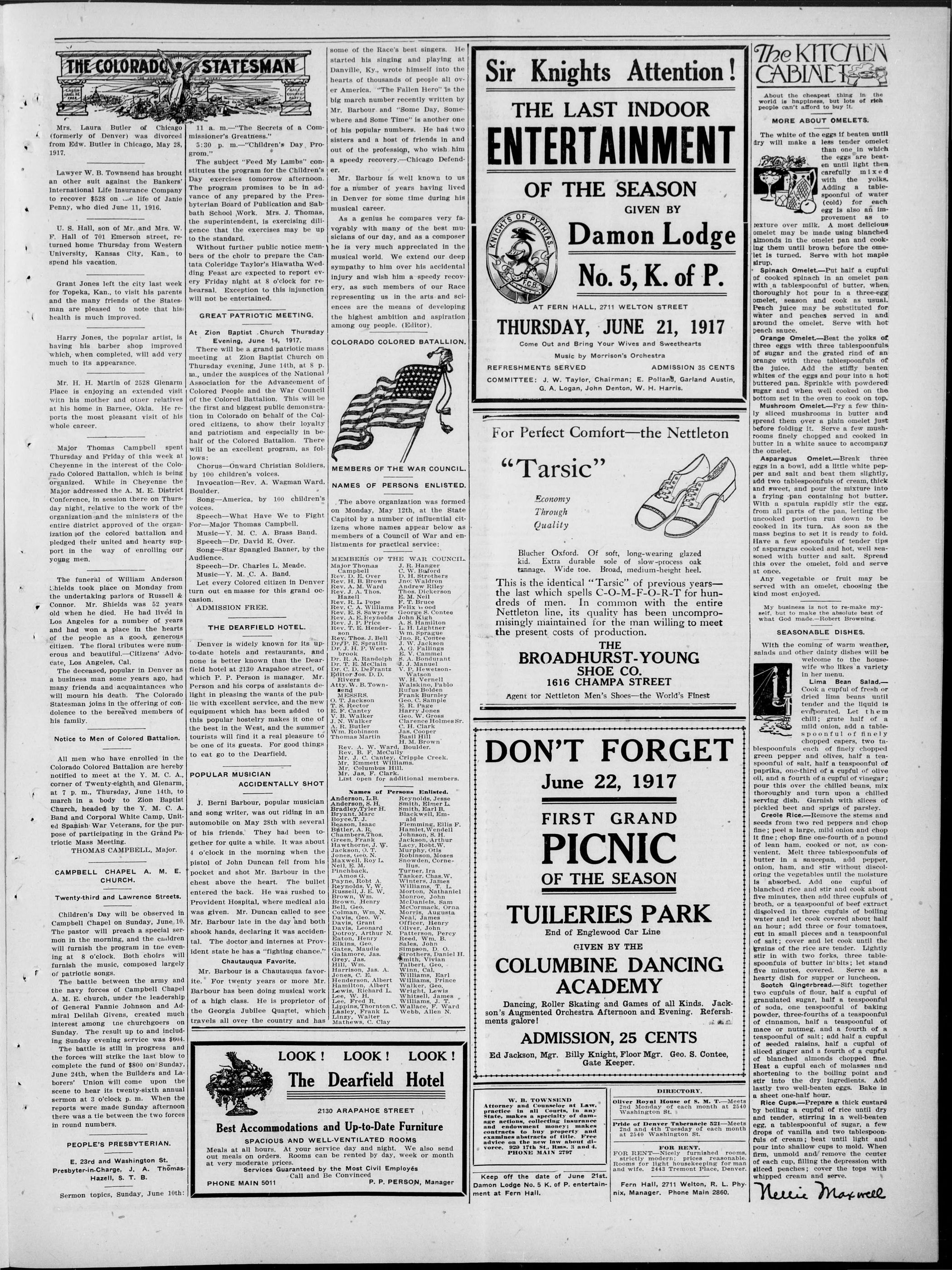
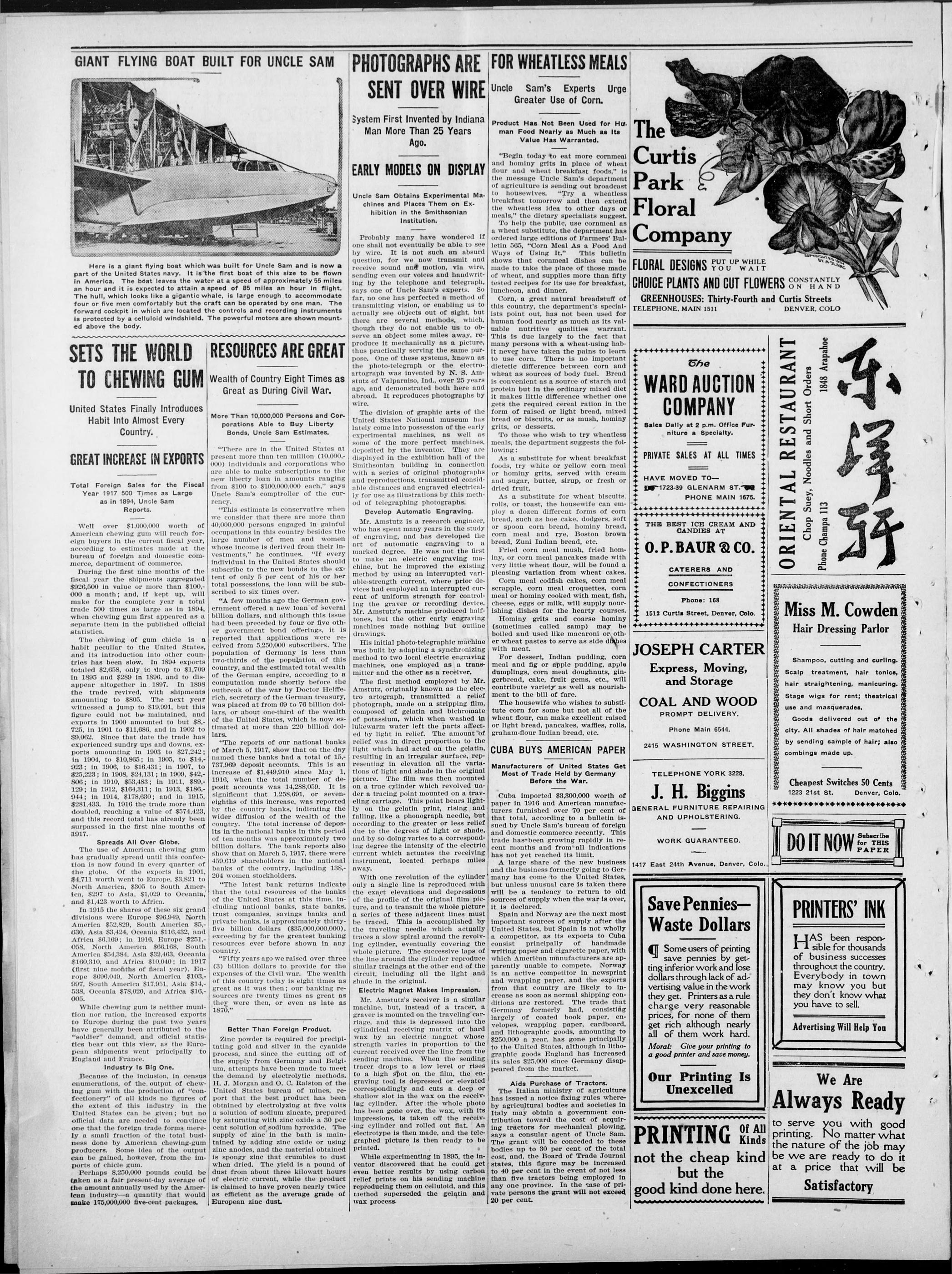
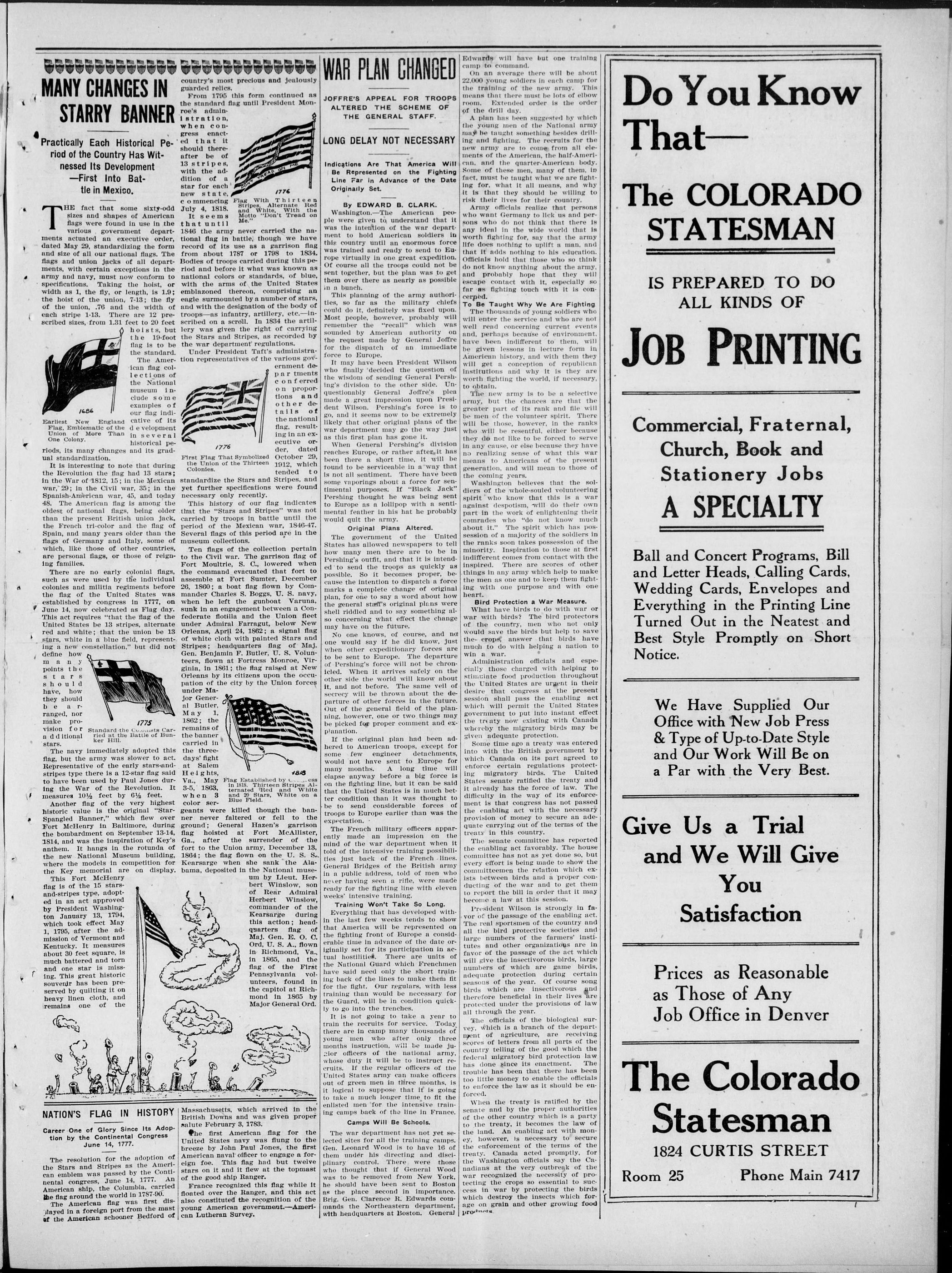
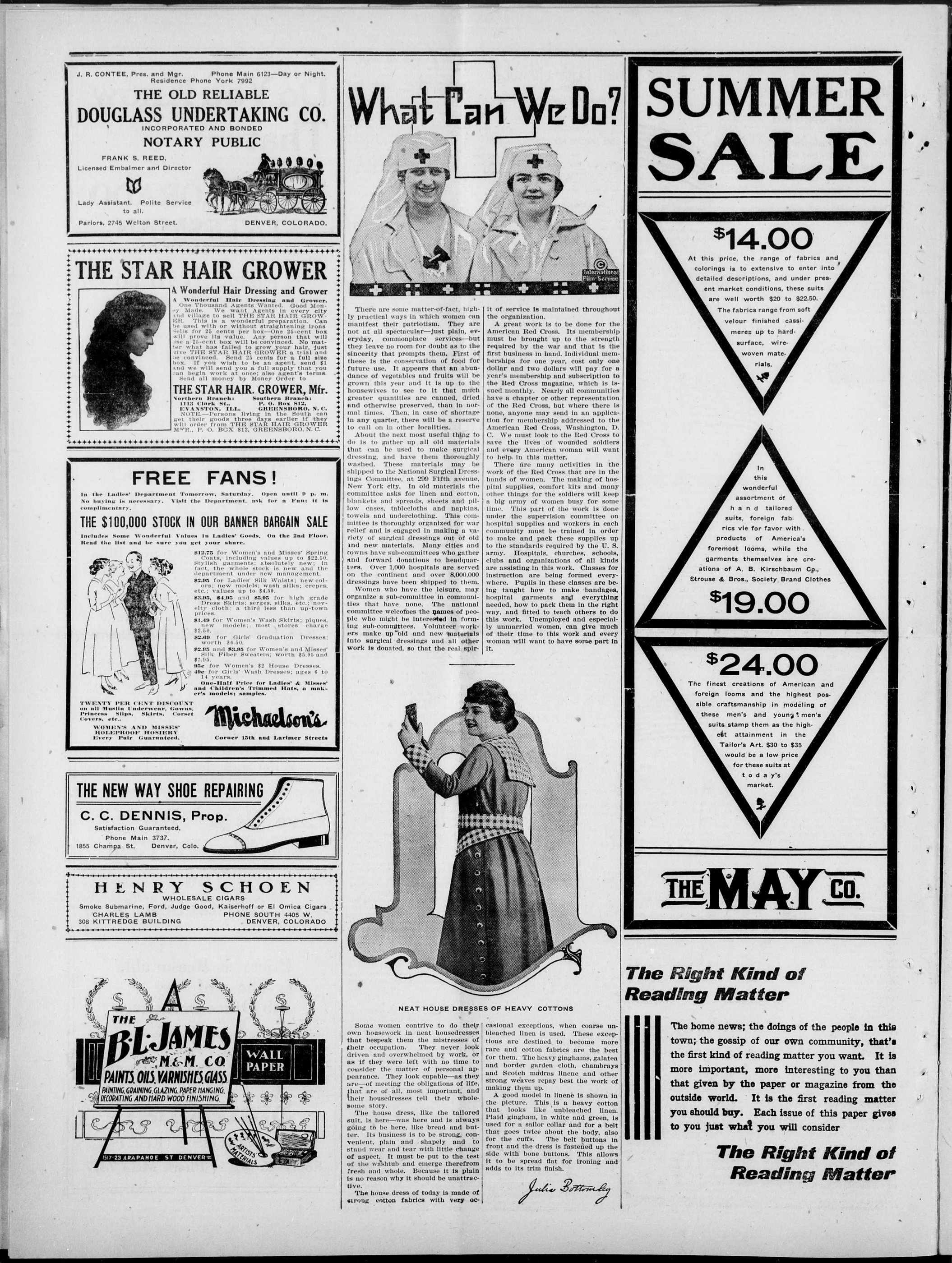
Page text (machine-generated)
Subscribe for the Only Reliable Negro Paper in Colorado, "The Colorado Statesman"
THE COLORADO STATESMAN
THE JOURNAL OF THE WEST.
LABOR SHALL BE FREE
RAGE COUNTRY PARTY
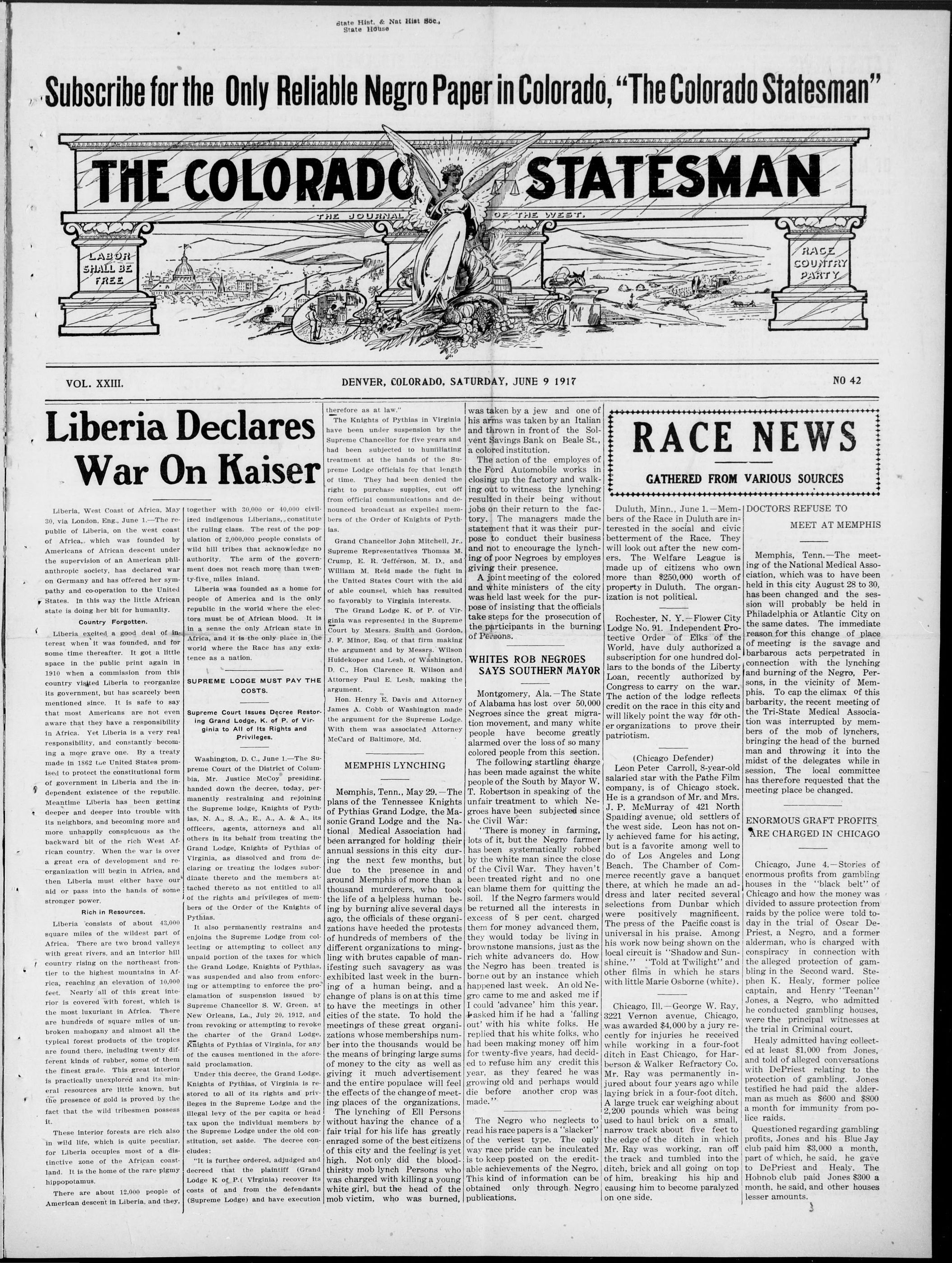
Liberia Declares War On Kaiser
VOL. XXIII.
Liberia
War O
Liberia, West Coast of Africa, May 30, via London, Eng., June 1.—The republic of Liberia, on the west coast of Africa, which was founded by Americans of African descent under the supervision of an American philanthropic society, has declared war on Germany and has offered her sympathy and co-operation to the United States. In this way the little African state is doing her bit for humanity.
Country Forgotten.
Liberia excited a good deal of interest when it was founded, and for some time thereafter. It got a little space in the public print again in 1910 when a commission from this country visited Liberia to reorganize its government, but has scarcely been mentioned since. It is safe to say that most Americans are not even aware that they have a responsibility in Africa. Yet Liberia is a very real responsibility, and constantly becoming a more grave one. By a treaty made in 1862 the United States promised to protect the constitutional form of government in Liberia and the independent existence of the republic. Meantime Liberia has been getting deeper and deeper into trouble with its neighbors, and becoming more and more unhappily conspicuous as the backward bit of the rich West African country. When the war is over a great era of development and reorganization will begin in Africa, and then Liberia must either have our aid or pass into the hands of some stronger power.
Rich in Resources.
Liberia consists of about 43,000 square miles of the wildest part of Africa. There are two broad valleys with great rivers, and an interior hill country rising on the northeast frontier to the highest mountains in Africa, reaching an elevation of 10,000 feet. Nearly all of this great interior is covered with forest, which is the most luxuriant in Africa. There are hundreds of square miles of unbroken mahogany and almost all the typical forest products of the tropics are found there, including twenty different kinds of rubber, some of them the finest grade. This great interior is practically unexplored and its mineral resources are little known, but the presence of gold is proved by the fact that the wild tribesmen possess it.
These interior forests are rich also in wild life, which is quite peculiar, for Liberia occupies most of a distinctive zone of the African coastland. It is the home of the rare pigmy hippopotamus.
There are about 12,000 people of American descent in Liberia, and they,
together with 30,000 or 40,000 civilized indigenous Liberians, constitute the ruling class. The rest of the population of 2,000,000 people consists of wild hill tribes that acknowledge no authority. The arm of the government does not reach more than twenty-five, miles inland. Liberia was founded as a home for people of America and is the only republic in the world where the electors must be of African blood. It is in a sense the only African state in Africa, and it is the only place in the world where the Race has any existence as a nation.
SUPREME LODGE MUST PAY THE COSTS.
Supreme Court Issues Decree Restoring Grand Lodge, K. of P. of Virginia to All of Its Rights and Privileges.
Washington, D. C., June 1.—The Supreme Court of the District of Columbia, Mr. Justice McCoy presiding, handed down the decree, today, permanently restraining and rejoining the Supreme lodge, Knights of Pythias, N. A., S. A., E., A., A. & A., its officers, agents, attorneys and all others in its behalf from treating the Grand Lodge, Knights of Pythias of Virginia, as dissolved and from declaring or treating the lodges subordinate thereto and the members attached thereto as not entitled to all of the rights and privileges of members of the Order of the Knights of Pythias.
It also permanently restrains and enjoins the Supreme Lodge from collecting or attempting to collect any unpaid portion of the taxes for which the Grand Lodge, Knights of Pythias, was suspended and also from enforcing or attempting to enforce the proclamation of suspension issued by Supreme Chancellor S. W. Green, at New Orleans, La., July 20, 1912, and from revoking or attempting to revoke the charter of the Grand Lodge, Knights of Pythias of Virginia, for any of the causes mentioned in the aforesaid proclamation.
Under this decree, the Grand Lodge, Knights of Pythias, of Virginia is restored to all of its rights and privileges in the Supreme Lodge and the illegal levy of the per capita or head tax upon the individual members by the Supreme Lodge under the old constitution, set aside. The decree concludes:
"It is further ordered, adjudged and decreed that the plaintiff (Grand Lodge K of P.( Virginia) recover its costs of and from the defendants (Supreme Lodge) and have execution
State Hist. & Nat Hist Soc.
State House
table Negro Pa
ADO
THE JOURNAL
DENVER, COLORADO, SA
therefore as at law."
The Knights of Pythias in Virginia have been under suspension by the Supreme Chancellor for five years and had been subjected to humiliating treatment at the hands of the Supreme Lodge officials for that length of time. They had been denied the right to purchase supplies, cut off from official communications and denounced broadcast as expelled members of the Order of Knights of Pythias.
Grand Chancellor John Mitchell, Jr., Supreme Representatives Thomas M. Crump, E. R. Jefferson, M. D., and William M. Reid made the fight in the United States Court with the aid of able counsel, which has resulted so favorably to Virginia interests.
The Grand Lodge K. of P. of Virginia was represented in the Supreme Court by Messrs. Smith and Gordon, J. F. Minor, Esq. of that firm making the argument and by Messrs. Wilson Huldekoper and Lesh, of Washington, D. C., Hon Clarence R. Wilson and Attorney Paul E. Lesh, making the argument.
Hon. Henry E. Davis and Attorney James A. Cobb of Washington made the argument for the Supreme Lodge. With them was associated Attorney McCard of Baltimore, Md.
MEMPHIS LYNCHING
Memphis, Tenn., May 29. — The plans of the Tennessee Knights of Pythias Grand Lodge, the Masonic Grand Lodge and the National Medical Association had been arranged for holding their annual sessions in this city during the next few months, but due to the presence in and around Memphis of more than a thousand murderers, who took the life of a helpless human being by burning alive several days ago, the officials of these organizations have heeded the protests of hundreds of members of the different organizations to mingling with brutes capable of manifesting such savagery as was exhibited last week in the burning of a human being, and a change of plans is on at this time to have the meetings in other cities of the state. To hold the meetings of these great organizations whose memberships number into the thousands would be the means of bringing large sums of money to the city as well as giving it much advertisement and the entire populace will feel the effects of the change of meeting places of the organizations.
The lynching of Ell Persons without having the chance of a fair trial for his life has greatly enraged some of the best citizens of this city and the feeling is yet high. Not only did the blood-thirsty mob lynch Persons who was charged with killing a young white girl, but the head of the mob victim, who was burned,
was taken by a jew and one of his arms was taken by an Italian and thrown in front of the Solvent Savings Bank on Beale St., a colored institution. The action of the employes of the Ford Automobile works in closing up the factory and walking out to witness the lynching resulted in their being without jobs on their return to the factory. The managers made the statement that it was their purpose to conduct their business and not to encourage the lynching of poor Negroes by employes giving their presence. A joint meeting of the colored and white ministers of the city was held last week for the purpose of insisting that the officials take steps for the prosecution of the participants in the burning of Persons.
WHITES ROB NEGROES SAYS SOUTHERN MAYOR
Montgomery, Ala. -The State of Alabama has lost over 50,000 Negroes since the great migration movement, and many white people have become greatly alarmed over the loss of so many colored people from this section. The following startling charge has been made against the white people of the South by Mayor W. T. Robertson in speaking of the unfair treatment to which Negroes have been subjected since the Civil War:
"There is money in farming, lots of it, but the Negro farmer has been systematically robbed by the white man since the close of the Civil War. They haven't been treated right and no one can blame them for quitting the soil. If the Negro farmers would be returned all the interests in excess of 8 per cent. charged them for money advanced them, they would today be living in brownstone mansions, just as the rich white advancers do. How the Negro has been treated is borne out by an instance which happened last week. An old Negro came to me and asked me if I could 'advance' him this year. I asked him if he had a 'falling out' with his white folks. He replied that his white folks, who had been making money off him for twenty-five years, had decided to refuse him any credit this year, as they feared he was growing old and perhaps would die before another crop was made."
The Negro who neglects to read his race papers is a "slacker" of the veriest type. The only way race pride can be inculcated is to keep posted on the editable achievements of the Negro. This kind of information can be obtained only through Negro publications.
RACE NEWS
GATHERED FROM VARIOUS SOURCES
Duluth, Minn., June 1.—Members of the Race in Duluth are interested in the social and civic betterment of the Race. They will look out after the new comers. The Welfare League is made up of citizens who own more than $250,000 worth of property in Duluth. The organization is not political.
Rochester, N. Y.—Flower City Lodge No. 91. Independent Protective Order of Elks of the World, have duly authorized a subscription for one hundred dollars to the bonds of the Liberty Loan, recently authorized by Congress to carry on the war. The action of the lodge reflects credit on the race in this city and will likely point the way for other organizations to prove their patriotism.
(Chicago Defender)
Leon Peter Carroll, 8-year-old salaried star with the Pathe Film company, is of Chicago stock. He is a grandson of Mr. and Mrs. J. P. McMurray of 421 North Spalding avenue; old settlers of the west side. Leon has not only achieved fame for his acting, but is a favorite among well to do of Los Angeles and Long Beach. The Chamber of Commerce recently gave a banquet there, at which he made an address and later recited several selections from Dunbar which were positively magnificent. The press of the Pacific coast is universal in his praise. Among his work now being shown on the local circuit is "Shadow and Sunshine." "Told at Twilight" and other films in which he stars with little Marie Osborne (white).
Chicago, Ill. — George W. Ray, 3221 Vernon avenue, Chicago, was awarded $4,000 by a jury recently for injuries he received while working in a four-foot ditch in East Chicago, for Harberson & Walker Refractory Co. Mr. Ray was permanently injured about four years ago while laying brick in a four-foot ditch. A large truck car weighing about 2,200 pounds which was being used to haul brick on a small, narrow track about five feet to the edge of the ditch in which Mr. Ray was working, ran off the track and tumbled into the ditch, brick and all going on top of him, breaking his hip and causing him to become paralyzed on one side.
NO 42
MEET AT MEMPHIS
Memphis, Tenn.—The meeting of the National Medical Association, which was to have been held in this city August 28 to 30, has been changed and the session will probably be held in Philadelphia or Atlantic City on the same dates. The immediate reason for this change of place of meeting is the savage and barbarous acts perpetrated in connection with the lynching and burning of the Negro, Persons, in the vicinity of Memphis. To cap the climax of this barbarity, the recent meeting of the Tri-State Medical Association was interrupted by members of the mob of lynchers, bringing the head of the burned man and throwing it into the midst of the delegates while in session. The local committee has therefore requested that the meeting place be changed.
ENORMOUS GRAFT PROFITS ARE CHARGED IN CHICAGO
Chicago, June 4.—Stories of enormous profits from gambling houses in the "black belt" of Chicago and how the money was divided to assure protection from raids by the police were told today in the trial of Oscar DePriest, a Negro, and a former alderman, who is charged with conspiracy in connection with the alleged protection of gambling in the Second ward. Stephen K. Healy, former police captain, and Henry "Teenan" Jones, a Negro, who admitted he conducted gambling houses, were the principal witnesses at the trial in Criminal court.
Healy admitted having collected at least $1,000 from Jones, and told of alleged conversations with DePriest relating to the protection of gambling. Jones testified he had paid the alderman as much as $600 and $800 a month for immunity from police raids.
Questioned regarding gambling profits, Jones and his Blue Jay club paid him $3,000 a month, part of which, he said, he gave to DePriest and Healy. The Hobnob club paid Jones $300 a month, he said, and other houses lesser amounts.
LATEST NEWS EPITOMIZED
FROM TELEGRAPHIC REPORTS THAT COVER THE WEEK'S EVENTS.
OF MOST INTEREST
KEEPING THE READER POSTED ON MOST IMPORTANT CURRENT TOPICS.
ABOUT THE WAR
British airmen drop tons of bombs upon Zeebrugge, Ostend and Bruges. Germany is seeking to obtain island near United States for submarine pase. Russians near Kovel and in the Carpathian mountains defeat the Germans. An Austrian torpedo boat was torpedoed and sunk by a hostile submarine in the northern Adriatic. Closer union of Central powers is made under organization of "Federation of central European empires." French official statement declares that the Germans lost more than 52,000 prisoners during the French and British drives against German lines.
Unusual activity is shown by aviators and several desperate air battles have been fought, the French in two days bringing down six German airplanes and one captive balloon.
London papers figure that 713 aeroplanes were shot down on the western front in May, of which 442 were German and 271 British and French. The total air losses in April were estimated at 709.
According to information received by the Norwegian Legation at London, forty-nine Norwegian steamships with a gross tonnage of 75,397, were sunk in May. Twenty-five lives were lost.
The French steamship Yarra, 4,163 tons gross, was torpedoed and sunk in the Mediterranean on May 29. Of the 690 persons on board thirty-six are missing, including eight Arabian firemen.
A combined land and sea engagement was fought off the West Flanders coast. British warships bombarded the German base of Ostend, the admiralty announced. At the same time British cruisers and destroyers engaged a German fleet at long range, sinking a torpedo boat.
Germans gained a foothold in advanced trenches near Moulin de Lafaux. French artillery fire checked German efforts against hill 304, Germans suffering heavy losses. Increased artillery firing in the Ypres sector in Belgium. London and Berlin comment on activity of heavy guns in that region. British capture during May 3,412 Germans and one large German gun. In April the British took more than 19,000 prisoners and 257 large guns and howitzers.
WESTERN
About 100,000 registered in Colorado. Chicago's Liberty army headed for the colors 300,000 strong. The Brotherhood of Locomotive Engineers has subscribed for $500,000 of Liberty Loan bonds. Early indications point to a registration of 25,000 in Wyoming while the estimated quota was only 18,200. The Carranza government has issued an embargo on all foodstuffs and cattle from being shipped from Mexico to the United States. The largest purchase of Liberty Loan bonds in Chicago thus far made was recorded when the Fields subscribed for $4,500,000 worth of the war securities.
The Chicago Board of Trade directors fixed a maximum price for corn as was done with wheat several weeks ago. The price fixed was $1.65 on all contracts of corn for future delivery.
A nation-wide search for Lloyd Keet the 14-months-old boy kidnapped from his parents' home at Springfield, Mo., was begun. Pictures of the child have been sent to all parts of the country by his father.
WASHINGTON
Secretary Lane outlined reasons for war with Germany.
Italian war mission indefinitely postpones tour of United States.
Business conditions throughout the United States reported excellent.
Contracts have been awarded to an American firm for the construction of a two-squadron aviation field in France, where American army flyers will receive final preparation before taking their place at the front.
Regular army recruiting established a new daily record June 5 when 4,201 men were obtained as against an average daily figure of 1,500 since Apr. 1.
"This nation was kept united for the great world-purpose it was meant to serve," President Wilson told the United Confederate Veterans at their convention.
Secretary McAdoo left for New York, the first stop on his second speaking tour in behalf of the Liberty loan, which will include the Eastern, Middlewestern and Southern citi-
FOREIGN
Vice president of China presented his resignation.
Zeppelin route from Hamburg to Constantinople is planned.
Gen. Michael V. Alexleff, commander-in-chief of Russian armies resigned.
Austrians made a furious attack on the Italians, gaining ground, but were driven back with heavy losses by a counter attack.
Eleven provinces of China, including the province of Chi Li, in which Peking is situated, no longer recognize the authority of the Peking government.
Marshal Joffre has been designated by the minister of war to continue his work, begun in Washington, of assisting to organize American participation in the war.
China is now in the hands of a dictator, and a provisional government of militarists has been formed, President Li Yuan Hung is held virtually a prisoner at Peking and is expected to resign forthwith. Italy's offensive in the Isonzo battles of the last nineteen days has cost her 160,000 in killed and wounded and 20,000 in prisoners taken by the Austrian forces, an official statement from Vienna asserted. Details of the heroic action which recently won a citation in the orders of the day for George Struby, an American college man from Denver, are revealed in the official war office citation published in Paris.
A program for the general dismemberment of Russia was put forward at a meeting at Essen of the newly formed Rhenish-Westphallian branch of the independent committee for a German peace, the organization of the Pan-Germans.
The Council of Soldiers' and Workmen's delegates at Petrograd sent a long statement to the Socialist parties and central federations of trade unions of the world repeating its appeal of March 28th to the peoples of the world to unite in resolute actions in favor of peace.
By a vote of 453 to 55 the Chamber of Deputies, in secret session at Paris, has adopted a resolution declaring peace conditions must include the liberation of territories occupied by Germany, the return of Alsace-Lorraine to France and just reparation for damage done in the invaded regions.
SPORTING NEWS
Standing of Western League Clubs.
CLUBS— Won. Lost Pct.
Des Moines 25 15 .625
Jincoln 24 17 .585
Shinjuku City 22 18 .560
Omaha 22 19 .537
Joplin 22 19 .526
Denver 18 18 .500
St. Joseph 13 23 .361
Wichita 12 28 .300
Officials of the Women's Western Golf Association decided to set apart the week of June 24th for Red Cross play.
The 4-year-old Transvaal-Ethel Simpson colt King Corin, owned by E. L. Baker & Co. of Lexington, Ky., won the fifth renewal of the Kentucky handicap at Douglas park at Louisville by a neck from John W. Schorr's 3-year-old Broomstick colt Cudgel. Half a length back was Andrew Miller's Roamer, which made his third try for the event.
Final tribute of this country to the memory of James Leslie (Les) Darcy, the pilligist, who died in Memphis, was paid at San Francisco when the body was escorted through the principal thoroughfare to a steamer to sail for Australia. The casket was draped with the colors of the United States and Australia, and there were many flowers from various parts of the country.
GENERAL
Maximum price on corn is placed by Chicago Board of Trade. By an order of the general staff of the army issued at Havana the 25,000 militiamen enlisted for service in putting down the recent revolution are to be mustered out. The Russian bark Imberhorne of 1,958 tons gross, from Mobile, Ala., March 18, for Greenock, Scotland, was sunk by a German submarine on May 1st, off the west coast of Ireland. Tornadoes, high wind and heavy rains through portions of Kansas and Missouri Tuesday night caused ten deaths and injury to many persons. Much property and crop damage resulted.
Prohibition for the period of the war was advocated in New York at a meeting held under the auspices of the American Medical Association's Committee on the treatment of alcoholism and narcotic addiction.
Without a semblance of disorder and with every evidence of willingness to serve, approximately 600,000 of New York's sons went to 2,123 registration places and inscribed their names upon the nation's roll of honor.
Brazil was forced to break her neutrality because Germany was virtually declaring war on all Latin-America, according to a formal note of explanation forwarded all nations except the central powers by the foreign minister.
That the whole Western hemisphere will be directly engaged in the war before another year passes was the statement made by John Barrett, director of the Pan-American Union, in a speech on the Liberty loan before a mass meeting of Baltimore churches. The police announced in New York they had information that the head of the German wireless system came to this country, made plans regarding outfits and other details through which information was to be conveyed to Berlin, and then departed, probably for Mexico.
June 16—Annual Strawberry Festival and Carnival at Glenwood Springs.
June 21-22 Christian Endeavor Convention at Salida.
June 18-25—Red Cross Week.
Aug. 1—National Convention of African Race at Denver.
Sept. 17-22—Colorado State Fair at Pueblo.
Nearly 25,000 registered in Denver.
At Colorado Springs 1,760 registered.
Supreme Court ordered that Lawson be given new trial
Pueblo chapter, American Red Cross, reports 5,721 members.
Vineland residents protest against bad roads and threaten recall.
Pueblo women plan service to be rendered during present war.
You can volunteer, although registered, at any time before the draft selection.
Reports show that Colorado's crops are in good condition except being delayed by cool weather.
The Masons had charge of the burial of Col. W. F. Cody (Buffalo Bill) on Lookout Mountain on Sunday.
Two carloads of high-grade ore have been taken out of the new strike in the Doctor mine, Gunnison county.
Patriotism and order marked registration day in Colorado, when 100,000 young men enrolled for selective service.
A company is being organized at Las Animas for the purpose of building an alfalfa meal mill at Melina station.
The labor shortage in Colorado is becoming acute in all lines of industry and will be intensified when conscription goes into effect.
The Methodist Church of Barnum makes the claim of being the first church organization in Denver to arrange for the purchase of a Liberty bond.
The decision of the District Court, convicting Dr. Noble O. Hamilton, a Denver physician, of performing a criminal operation, was affirmed by the Supreme Court.
Colorado has raised $40,000 of the $50,000 fixed as the quota for the state in the Y. M. C. A. campaign to obtain $3,000,000 to aid the civilian welfare work to be done for soldiers.
Resolutions repudiating the action of a committee purporting to act for them in a demand for an increase of wages was adopted at a meeting of the Denver Tramway Brotherhood, attended by 450 employés of the company.
Manager R. W. Coates of the Fanny Rawlings mine at Leadville reports that high-grade gold ore is still being extracted from the rich vein that was encountered in the property two weeks ago and that two shipments have been made.
Enrollments in the Fifth National Service School of the Women's Section of the Navy League at Denver, under the direction of Mrs. Alexander Sharpe, have been pouring in. The enrollment books close June 18th. Nearly a hundred have joined.
A guard will be stationed at the grave of Buffalo Bill until the monument in his honor is raised on Lookout mountain. Night and day a force of police will be maintained to prevent curio and memento seekers from committing acts of vandalism.
The United States Civil Service Commission has announced an examination to be held at Pueblo on July 14th, as a result of which it is expected to make certification to fill a contemplated vacancy in the position of fourth-class postmaster at Beulah. That all the Masonic lodges of Denver, together with those of Golden, Arvada and Littleton, will unite on June 21st in celebrating the 200th anniversary of the founding of the grand lodge of England, was announced by the Masonic Officers' Association, which has arrangements for the celebration in charge.
The Denver & Rio Grande tracks at Seventeenth and Wynkoop streets in Denver, used by the company for switching purposes, must be torn up in compliance with city ordinance No. 34, to give way to a loop to be built by the Denver Tramway Company. That was the decision of the Colorado Supreme Court.
On confession of error by the attorney general, two of Colorado's famous murder cases were reversed by Supreme Court decisions. The action of the court practically releases John R. Lawson, charged with slaying John Nimmo in 1914. The other man who was convicted of murder during the trouble in the southern Colorado coal fields was Louis Zancannelli, who was accused of slaying a detective hired by a coal company. Zancannelli's case was reversed because the attorney general confessed errors.
That the late Mrs. Mary Luthe signed away her $30,000 estate under the direction of the "spirits" of her dead father and mother, and that she made Mrs. Mary E. Holland and Etta Dunfee, through whom she received messages purporting to come from her parents, the chief beneficiaries under her will, to the exclusion of relatives, are among the charges contained in a caveat to the will filed in the County Court in Denver.
John R. Lawson has accepted a position as labor agent for a mining company.
ENLISTING STOCKMEN
WILL RETAIN GRAZING PREFERENCES ON NATIONAL FORESTS.
All Who Join Army and Navy Should File Release Statement During Term of Service.
Western Newspaper Union News Service.
Denver.—In response to an inquiry from the National Woolgrowers' Association the Forest Service announced through the local office that stockgrowers having national forest grazing preferences will be permitted, if they onlist in the army or navy, to retain their preferences without the use of the range during the period of enlistment. Those wishing to avail themselves of this privilege will file a statement similar to that now required of state and federal employees who wish to discontinue use of the range during their term of service without losing their preferences. Use of the range in their absence will be provided for by issuing temporary permits to others, with the understanding, it is said, that the privilege of use terminates when the former permittee returns. Preference privileges temporarily surrendered are subject to any general changes affecting range use which may be made during the absence of the holders.
State Inspectors Find Spuds In Silo.
There are 3,750,000 pounds of old potatoes in storage in Denver, Secretary of State Noland announced following investigation of the potato situation by inspectors of his office. The prices on these old potatoes has been forced down by the arrival of new potatoes from California. The secretary of state said that there are 125 cars of old potatoes in storage in this city. The cars average 300 sacks and the sacks contain 100 pounds each. "Farmers at Greeley are indignant because 25 carloads of potatoes, which were bought from the growers there last fall at $1.90 per 100 pounds, are being held in silo," said the secretary of state. "Those potatoes still are in storage in the silo, and will be thrown away." The 25 carloads at Greeley represent 750,000 pounds, which will be wasted. Secretary Noland will make investigations to find out if potatoes have been held at other points in the state in similar manner on orders of dealers. The arrival of the new potatoes brought down the price of the old 25 and 50 cents. Old potatoes are selling at prices ranging from $5.50 to $5.75 per 100 pounds. A year ago at this time the prices ranged from $2.75 to $3.00. Two years ago they ranged from 90 cents to $1.10 per 100 pounds.
Commission Urges Miners' Bonuses.
Increases in wages in the form of bonuses to metal miners in the Telluride district have been recommended by the State Industrial Commission following an investigation of conditions in the district on complaint of a number of miners. The increases will probably be accepted by the operators and will affect 1,200 men. The commission recommended that men receiving $3.00 a day be given a bonus? 30 cents a day; that men receiving $3.20 or more a day be given a bonus of 20 cents a day, and that semi-monthly pay-days be established.
Appoints Legislative Committee.
Governor Gunter has appointed as a legislative committee to consider ways and means to finance Colorado's part in the war program and to consult with him as to the advisability of a special session of the Legislature, the following legislative committee: Henry F. May, Charles W. Waterman, William H. Malone, Benjamin C. Griffith, Prof. Arnold J. Lien, Harold Kountz and William E. Sweet.
Miller and O'Connor Pardoned.
Unconditional pardons were given to Walter Miller and Roy O'Connor, convicts having long sentences to serve, by Governor Gunter, for capturing Harry Grant and Robert Henry, short-timers. The latter recently escaped from a road camp.
Million Trout in Gunnison Streams
Since the first of May 800,000 eastern brook trout from the Pitkin hatchery and 200,000 from the Cedaredge hatchery, ranking from $1 \frac{1}{4}$ to 2 inches in length, have been planted in the streams tributary to the Gunnison river.
Railroads Ask Rate Increase.
The railroads of Colorado have requested permission to make a blanket increase of 15 per cent applying to all freight rates in the state, effective July 1.
Women Give $596 Voluntary Taxes.
A total of $596 has now been contributed to the state military fund by women of the state in payment of the women's voluntary poll tax.
Nickerson Is Major of Artillery.
Captain Henry C. Nickerson was promoted to be major of the First battalion of Colorado field artillery. B. J. Kempter was appointed adjutant in the First battalion of the Second regiment by Maj. J. C. Overmyer. Company I, which was brought from Fort Morgan to the armory in Denver, was sent out for guard duty. The company was inspected at the armory by Adjt. Gen. Frank D. Baldwin and pronounced in fine condition, both as to training and equipment.
Western Beef Co.
ONE OF THE MOST UP-TO-DATE AND SANITARY MARKETS IN THE CITY.
Fresh and Cured Meats of All Kinds. Fresh Vegetables, Staple and Fancy Groceries.
PHONE CHAMPA 1641.
2048 LARIMER STREET DENVER, COLO.
Opposite the Three Rules.
The Good Weight Grocery
W. T. FLETCHER AND J. W. WILLIAMS, Proprietors.
RETAIL STAPLE AND FANCY GROCERIES.
CORN FED MEATS. MOTOR DELIVERY TO
ANY PART OF THE CITY.
2549 Washington St. Denver, Colo.
Baxter Bldg. J. W. WILLIAMS, Manager
PHONE CHAMPA 3022.
John W. Masury & Sons Coach Colors, Paints and Varnishes.
Wall Paper, Paints, Oils and Glass, Interior and Exterior
Decorators
WE DO HOUSE PAINTING
1454 Welton St. Phone Main 871. DENVER, COLO.
Lankford and McCain, Proprietors
STRICTLY FIRST-CLASS WORK
Cleaning, Pressing, Dyeing and Remodelling
JOIN OUR MONTHLY PRESSING CLUB-$1.50
506 Eighteenth Street Phone Main 7376
Showing and demonstrating Ford car a pleasure.
Try us; puts you under no obligation to buy.
RUNABOUT, $345
F. O. B. Detroit
TOURING, $360
F. O. B. Detroit
Open Daily to 8:30 p. m.
ONE OF THE MOST USED MARKET
Fresh and Cured Meats of A and Fa
Our Price the Free Delivery th
PHONE
2048 LARIMER STREET
Opposite
The Good Gre
W. T. FLETCHER AND
RETAIL STAPLE CORN FED MEATS ANY PART OF THE
549 Washington Exter Bldg.
PHONE CHAMPA 30
J. R. DRESSOR
York 1327J
The Colorado W
John W. Masury & Sons
Wall Paper, Paints, Oils
WE DO H
1454 Welton St.
The Giant Bach and
Lankford and STRICTLY F Cleaning, Pressing JOIN OUR MONTHLY 506 Eighteenth Street
NOLAN-O
3001 Welton
AUTHORIZED
PARTS AG
Une
Showing and demo
Try us; puts you
RUNABOUT, $345
F. O. B. Detroit
ARE YOU GUILTY?
A FARMER carrying an express package from a big mail-order house was accosted by a local dealer.
"Why didn't you buy that bill of goods from you? I could have saved you the express, and besides you would have been patronizing a home store, which helps pay the taxes and builds up this locality."
The former looked at the merchant a moment and then said:
"Why don't you patronize your home paper and advertise? I read it and didn't know that you had thestuff I have here."
MORAL—ADVERTISE
Sundays Until 2:00 p. m.
O-DATE AND SANITARY
FOR THE CITY.
Bands. Fresh Vegetables, Staple
Groceries.
Are Always
Lowest
Parts of the City.
AMPA 1641.
DENVER, COLO.
Three Rules.
Red Weight
Grocery
W. WILLIAMS, Proprietors.
FANCY GROCERIES.
MOTOR DELIVERY TO
CITY.
St. Denver, Colo.
J. W. WILLIAMS, Manager
CE CLOW
315J
A. B. CLOW
South 4243J
Paper and Paint Co.
S for
Colors, Paints and Varnishes.
Glass, Interior and Exterior
Artists.
PAINTING
In 871.
DENVER, COLO.
INK
Benz Cleaners
Tailors
Cain, Proprietors
T-CLASS WORK
Being and Remodelling
PRESSING CLUB—$1.50
Phone Main 7376
RNER CO.
Phone Champa 223
AGENTS
SORIES
TIRES
Good Service
Bring Ford car a pleasure.
For no obligation to buy.
TOURING, $360
F. O. B. Detroit
Patronize Our
Advertisers They are all boosters and deserve your business.
Spend Your Money
with your home merchants. They help pay the taxes, keep up the schools, build roads, and make this a community worth while. You will find the advertising of the best ones in this paper.
REPORTS INDICATE THAT NUMBER OF YOUNG MEN ENROLLED EXCEEDS 10,000,000.
SECOND STEP IN DRAFT
REGULATIONS FOR CHOOSING REGISTRANTS FOR ACTIVE SERVICE BEING DRAWN.
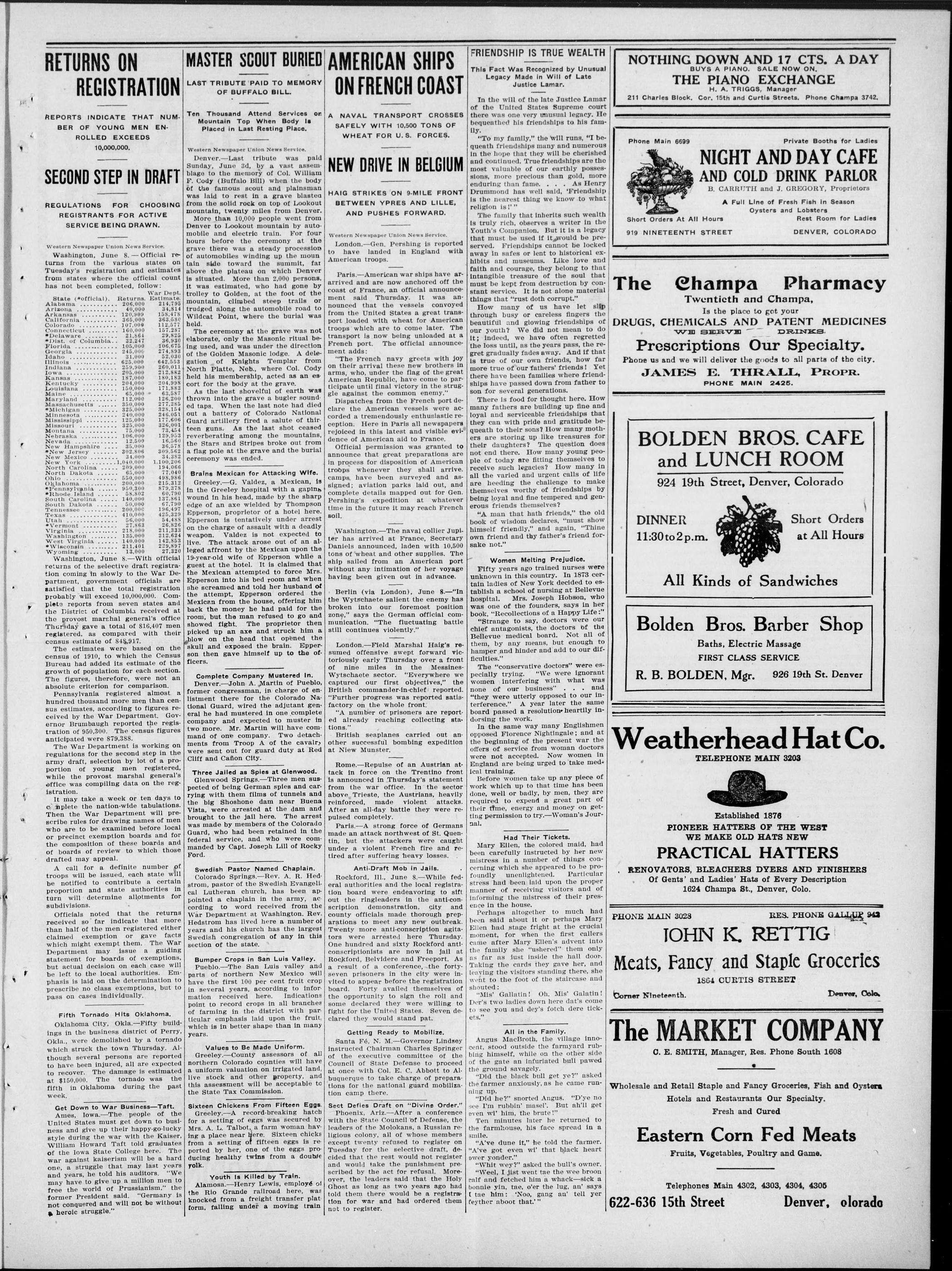
Washington, June 8. — Official returns from the various states on Tuesday's registration and estimates from states where the official count has not been completed, follow:
State (*official). Returns. War Dept. Estimate.
Alabama 206,000 214,795
Alabama 490,000 490,000
Arkansas 120,900 158,478
California 365,000 363,580
Colorado 107,800 112,577
Connecticut 160,000 157,287
*Delaware 21,864 29,825
State of Columbia 23,647 36,867
Florida 105,000 106,675
Georgia 245,000 274,833
Idaho 31,000 52,030
Illinois 625,000 642,553
Indiana 259,000 260,011
Iowa 209,000 218,044
Kansas 187,000 189,183
Kentucky 204,000 204,984
Louisiana 150,000 171,883
Maine 65,000 63,587
Maryland 112,000 126,200
Massachusetts 355,000 216,750
Michigan 350,000 328,154
Minnesota 240,000 240,154
Mississippi 125,000 177,606
Missouri 325,000 326,001
Montana 75,000 73,454
Nebraska 100,000 100,000
Nevada 12,560 16,560
New Hampshire 35,000 36,578
*New Jersey 302,806 309,562
New Mexico 34,000 34,382
New York 1,040,000 1,100,206
North Carolina 209,000 184,066
North Dakota 60,000 70,000
Ohio 550,000 498,986
Oklahoma 200,000 215,312
*Pennsylvania 950,300 879,278
*Rhode Island 58,802 60,790
South Carolina 140,000 167,574
South Dakota 67,574
Tennessee 200,000 196,497
Texas 410,000 425,329
Utah 56,000 54,488
*Vermont 27,863 26,826
Virginia 215,000 214,795
Washington 135,000 212,624
West Virginia 140,000 142,853
*Wisconsin 211,401 229,897
Wyoming 13,000 27,320
Washington, June 8.—With official returns of the selective draft registration coming in slowly to the War Department, government officials are satisfied that the total registration probably will exceed 10,000,000. Complete reports from seven states and the District of Columbia received at the provost marshal general's office Thursday gave a total of 816,407 men registered, as compared with their census estimate of 848,917. The estimates were based on the census of 1910, to which the Census Bureau had added its estimate of the growth of population for each section. The figures, therefore, were not an absolute criterion for comparison.
Pennsylvania registered almost a hundred thousand more men than census estimates, according to figures received by the War Department. Governor Brumbaugh reported the registration of 950,300. The census figures anticipated were 879,388. The War Department is working on regulations for the second step in the army draft, selection by lot of a proportion of young men registered, while the provost marshal general's office was compiling data on the registration.
```markdown
```
It may take a week or ten days to complete the nation-wide tabulations. Then the War Department will prescribe rules for drawing names of men who are to be examined before local or precinct exemption boards and for the composition of these boards and of boards of review to which those drafted may appeal.
A call for a definite number of troops will be issued, each state will be notified to contribute a certain proportion and state authorities in turn will determine allotments for subdivisions.
Officials noted that the returns received so far indicate that more than half of the men registered either claimed exemption or gave facts which might exempt them. The War Department may issue a guiding statement for boards of exemptions, but actual decision on each case will be left to the local authorities. Emphasis is laid on the determination to prescribe no class exemptions, but to pass on cases individually.
Fifth Tornado Hits Oklahoma.
Oklahoma City, Okla.—Fifty buildings in the business district of Perry, Okla., were demolished by a tornado which struck the town Thursday. Although several persons are reported to have been injured, all are expected to recover. The damage is estimated at $150,000. The tornado was the fifth in Oklahoma during the past week.
Get Down to War Business—Taft. Ames, Iowa.—The people of the United States must get down to business and give up their happy-go-lucky style during the war with the Kaiser, William Howard Taft told graduates of the Iowa State College here. The war against kaiserism will be a hard one, a struggle that may last years and years, he told his auditors. "We may have to give up a million men to free the world of Prussianism," the former President said. "Germany is not conquered and will not be without a heroic struggle."
MASTER SCOUT BURIED
LAST TRIBUTE PAID TO MEMORY OF BUFFALO BILL.
Ten Thousand Attend Services on Mountain Top When Body Is Placed in Last Resting Place.
Western Newspaper Union News Service.
Denver.—Last tribute was paid Sunday, June 3d, by a vast assemblage to the memory of Col. William F. Cody (Buffalo Bill) when the body of the famous scout and plainsman was laid to rest in a grave blasted from the solid rock on top of Lookout mountain, twenty miles from Denver. More than 10,000 people went from Denver to Lookout mountain by automobile and electric train. For four hours before the ceremony at the grave there was a steady procession of automobiles winding up the mountain side toward the summit, far above the plateau on which Denver is situated. More than 2,000 persons, it was estimated, who had gone by trolley to Golden, at the foot of the mountain, climbed steep trails or trudged along the automobile road to Wildcat Point, where the burial was held.
The ceremony at the grave was not elaborate, only the Masonic ritual being used, and was under the direction of the Golden Masonic lodge. A delegation of Knights Templar from North Platte, Neb., where Col. Cody held his membership, acted as an escort for the body at the grave. As the last shovelful of earth was thrown into the grave a bugler sounded taps. When the last note had died out a battery of Colorado National Guard artillery fired a salute of thirteen guns. As the last shot ceased reverberating among the mountains, the Stars and Stripes broke out from a flag pole at the grave and the burial ceremony was ended.
Brains Mexican for Attacking Wife.
Greeley.—G. Valdez, a Mexican, is in the Greeley hospital with a gaping wound in his head, made by the sharp edge of an axe wielded by Thompson Epperson, proprietor of a hotel here. Epperson is tentatively under arrest on the charge of assault with a deadly weapon. Valdez is not expected to live. The attack arose out of an alleged affront by the Mexican upon the 19-year-old wife of Epperson while a guest at the hotel. It is claimed that the Mexican attempted to force Mrs. Epperson into his bed room and when she screamed and told her husband of the attempt, Epperson ordered the Mexican from the house, offering him back the money he had paid for the room, but the man refused to go and showed fight. The proprietor then picked up an axe and struck him a blow on the head that opened the skull and exposed the brain. Epperson then gave himself up to the officers.
Complete Company Mustered in. Denver.—John A. Martin in Pueblo, former congressman, in charge of enlistment there for the Colorado National Guard, wired the adjutant general he had mustered in one complete company and expected to muster in two more. Mr. Martin will have command of one company. Two detachments from Troop A of the cavalry, were sent out for guard duty at Red Cliff and Cañon City.
Three Jailed as Spies at Glenwood.
Glenwood Springs.—The men suspected of being German spies and carrying with them films of tunnels and the big Shoshone dam near Buena Vista, were arrested at the dam and brought to the jail here. The arrest was made by members of the Colorado Guard, who had been retained in the federal service, and who were commanded by Capt. Joseph Lill of Rocky Ford.
Swedish Pastor Named Chaplain.
Colorado Springs.—Rev. A. R. Hedstrom, pastor of the Swedish Evangelical Lutheran church, has been app pointed a chaplain in the army, according to word received from the War Department at Washington. Rev Hedstrom has lived here a number of years and his church has the largest Swedish congregation of any in this section of the state.
Bumper Crops in San Luis Valley. Pueblo.—The San Luis valley and parts of northern New Mexico will have the first 100 per cent fruit crop in several years, according to information received here. Indications point to record crops in all branches of farming in the district with particular emphasis laid upon the fruit, which is in better shape than in many years.
Values to Be Made Uniform.
Greeley.—County assessors of all northern Colorado counties will have a uniform valuation on irrigated land, live stock and other property, and this assessment will be acceptable to the State Tax Commission.
Sixteen Chickens From Fifteen Eggs
Greeley.—A record-breaking hatch for a setting of eggs was secured by Mrs. A. L. Talbot, a farm woman having a place near here. Sixteen chicks from a setting of fifteen eggs is reported by her, one of the eggs producing healthy twins from a double volk.
Youth Is Killed by Train.
Alamosa.—Henry Lewis, employé of the Rio Grande railroad here, was knocked from a freight transfer plat form, falling under a moving train
AMERICAN SHIPS ON FRENCH COAST
A NAVAL TRANSPORT CROSSES
SAFELY WITH 10,500 TONS OF
WHEAT FOR U.S. FORCES.
NEW DRIVE IN BELGIUM
HAIG STRIKES ON 9-MILE FRONT
BETWEEN YPRES AND LILLE,
AND PUSHES FORWARD.
Western Newspaper Union News Service.
London.—Gen. Pershing is reported to have landed in England with American troops.
Paris.—American war ships have arrived and are now anchored off the coast of France, an official announcement said Thursday. It was announced that the vessels conveyed from the United States a great transport loaded with wheat for American troops which are to come later. The transport is now being unloaded at a French port. The official announcement adds:
"The French navy greets with joy on their arrival these new brothers in arms, who, under the flag of the great American Republic, have come to participate until final victory in the struggle against the common enemy."
Dispatches from the French port declare the American vessels were accorded a tremendously enthusiastic reception. Here in Paris all newspapers rejoiced in this latest and visible evidence of American aid to France. Official permission was granted to announce that great preparations are in process for disposition of American troops whenever they shall arrive. camps have been surveyed and assigned; aviation parks laid out, and complete details mapped out for Gen. Pershing's expedition at whatever time in the future it may reach French soil.
Washington.—The naval collier Jupiter has arrived at France, Secretary Daniels announced, laden with 10,500 tons of wheat and other supplies. The ship sailed from an American port without any intimation of her voyage having been given out in advance.
Berlin (via London), June 8.—"In the Wytchaete salient the enemy has broken into our foremost position zone," says the German official communication. "The fluctuating battle still continues violently."
London.—Field Marshal Haig's resumed offensive swept forward victoriously early Thursday over a front of nine miles in the Messines-Wytchaete sector. "Everywhere we captured our first objectives," the British commander-in-chief reported. "Further progress was reported satisfactory on the whole front."
"A number of prisoners are reported already reaching collecting stations."
British seaplanes carried out another successful bombing expedition at Niew Munster.
Rome.—Repulse of an Austrian attack in force on the Trentino front is announced in Thursday's statement from the war office. In the sector above Trieste, the Austrians, heavily reinforced, made violent attacks. After an all-day battle they were repulsed completely.
Paris.—A strong force of Germans made an attack northwest of St. Quentin, but the attackers were caught under a violent French fire and retired after suffering heavy losses.
Anti-Draft Mob in Jails.
Rockford, Ill., June 8.—While federal authorities and the local registration board were endeavoring to sift out the ringleaders in the anti-conscription demonstration, city and county officials made thorough preparations to meet any new outbreak. Twenty more anti-conscription agitators were arrested here Thursday. One hundred and sixty Rockford anti-conscriptionists are now in jail at Rockford, Belvidere and Freeport. As a result of a conference, the forty-seven prisoners in the city were invited to appear before the registration board. Forty availed themselves of the opportunity to sign the roll and some declared they were willing to fight for the United States. Seven declared they would stand pat.
Getting Ready to Mobilize.
Santa Fé, N. M.—Governor Lindsey instructed Chairman Charles Springer of the executive committee of the Council of State Defense to proceed at once with Col. E. C. Abbott to Albuquerque to take charge of preparations for the national guard mobilization camp there.
Sect Defies Draft on "Divine Order." Phoenix, Ariz.—After a conference with the State Council of Defense, the leaders of the Molokans, a Russian religious colony, all of whose members except twenty refused to register on Tuesday for the selective draft, decided that the rest would not register and would take the punishment prescribed by the act for refusal. Moreover, the leaders said that the Holy Ghost as long as two years ago had told them there would be a registration for war and had ordered them not to register.
FRIENDSHIP IS TRUE WEALTH
This Fact Was Recognized by Unusual Legacy Made in Will of Late Justice Lamar.
In the will of the late Justice Lamar of the United States Supreme court there was one very unusual legacy. He bequeathed his friendships to his family.
"To my family," the will runs, "I bequeathed friendships many and numerous in the hope that they will be cherished and continued. True friendships are the most valuable of our earthly possessions, more precious than gold, more enduring than fame. . . . As Henry Drummond has well said, 'Friendship is the nearest thing we know to what religion is!'"
The family that inherits such wealth is truly rich, observes a writer in the Youth's Companion. But it is a legacy that must be used if it would be preserved. Friendships cannot be locked away in safes or lent to historical exhibits and museums. Like love and faith and courage, they belong to that intangible treasure of the soul that must be kept from destruction by constant service. It is not alone material things that "rust doth corrupt."
How many of us have let slip through busy or careless fingers the beautiful and glowing friendships of our youth? We did not mean to do it; indeed, we have often regretted the loss until, as the years pass, the regret gradually fades away. And if that is true of our own friends, how far more true of our fathers' friends! Yet there have been families where friendships have passed down from father to son for several generations.
There is food for thought here. How many fathers are building up fine and loyal and serviceable friendships that they can with pride and gratitude bequeath to their sons? How many mothers are storing up like treasures for their daughters? The question does not end there. How many young people of today are fitting themselves to receive such legacies? How many in all the varied and urgent calls of life are heeding the challenge to make themselves worthy of friendships by being loyal and fine tempered and generous friends themselves?
"A man that hath friends," the old book of wisdom declares, "must show himself friendly," and again, "Thine own friend and thy father's friend forsake not."
Women Melting Prejudice.
Fifty years ago trained nurses were unknown in this country. In 1873 certain ladies of New York decided to establish a school of nursing at Bellevue hospital. Mrs. Joseph Hobson, who was one of the founders, says in her book, "Recollections of a Happy Life:" "Strange to say, doctors were our chief antagonists, the doctors of the Bellevue medical board. Not all of them, by any means, but enough to hamper and hinder and add to our difficulties."
The "conservative doctors" were especially trying. "We were ignorant women interfering with what was none of our business" . . . and "they were utterly opposed to our interference." A year later the same board passed a resolution heartily indorsing the work.
In the same way many Englishmen opposed Florence Nightingale; and at the beginning of the present war the offers of service from woman doctors were not accepted. Now women in England are being urged to take medical training. Before women take up any piece of work which up to that time has been done, well or badly, by men, they are required to expend a great part of their time, energy and money on getting permission to try.—Woman's Journal.
Had Their Tickets.
Mary Ellen, the colored maid, had been carefully instructed by her new mistress in a number of things concerning which she appeared to be profoundly unenlightened. Particular stress had been laid upon the proper manner of receiving visitors and of informing the mistress of their presence in the house.
Perhaps altogether to much had been said about it or perhaps Mary Ellen had stage fright at the crucial moment, for when the first callers came after Mary Ellen's advent into the family she "ushered" them only as far as just inside the hall door. Taking the cards they gave her, and leaving the visitors standing there, she went to the foot of the staircase and shouted:
"Mis' Gallatin! Oh, Mis' Galatin! Der's two ladies down here dat's come to see you and dey's fotch dere tickets."
All in the Family.
Angus MacBroth, the village innocent, stood outside the farmyard rubbing himself, while on the other side of the gate an infuriated bull pawed the ground savagely.
"Whit wey??" asked the bull's owner,
"Weel, I jist went tue the wee broon
calf and fetched him a whack—sick a
bonnie yin, tue, o'er the lug, an' says
I tae him: 'Noo, gang an' tell yer
feyther aboot that.'"
NOTHING DOWN AND 17 CTS. A DAY
BUYS A PIANO. SALE NOW ON.
THE PIANO EXCHANGE
H. A. TRIGGS, Manager
211 Charles Block. Cor. 15th and Curtis Streets. Phone Champa 3742.
The Cha
Tween
Is
DRUGS, CHEMICAL
WE S
Prescript
Phone us and we will
JAMES
BOLDE
and L
924 19th
Twentieth and Champa,
Is the place to get your
DRUGS, CHEMICALS AND PATENT MEDICINES
WE SERVE DRINKS.
Prescriptions Our Specialty.
Phone us and we will deliver the goods to all parts of the city.
JAMES E. THRALL, PROPR.
PHONE MAIN 2425.
DINNER
11:30 to 2 p.m.
All Kinds of Sandwiches
Bolden
Ba
FI
R. B. BOLDE
Weather
TE
PIONEER
WE IN
PRACT
RENOVATORS, BL
Of Gents' and
1624 C
PHONE MAIN 3028
JOHN
Meats, Fancy
Golden Bros. Barber Sh
Baths, Electric Massage
FIRST CLASS SERVICE
L. BOLDEN, Mgr. 926 19th St. D
atherhead Hat
TELEPHONE MAIN 3203
Bolden Bros. Barber Shop
Baths, Electric Massage
FIRST CLASS SERVICE
R. B. BOLDEN, Mgr. 926 19th St. Denver
Weatherhead Hat Co. TELEPHONE MAIN 3203
Established 1876
PIONEER HATTERS OF THE WEST
WE MAKE OLD HATS NEW
PRACTICAL HATTERS
RENOVATORS, BLEACHERS DYERS AND FINISHERS
Of Gents' and Ladies' Hats of Every Description
1624 Champa St., Denver, Colo.
Meats, Fancy and Staple Groceries 1864 CURTIS STREET
The MAR
C. E. SMITH,
Wholesale and Retail Sta
Hotels and
The MARKET COMPANY
C. E. SMITH, Manager, Res. Phone South 1608
Wholesale and Retail Staple and Fancy Groceries, Fish and Oysters Hotels and Restaurants Our Specialty. Fresh and Cured
Eastern Corn Fed Meats
Telephones Main 4302, 4303, 4304, 4305
622-636 15th Street Denver, olorado
Phone Main 6699
Corner Nineteenth.
Short Orders at All Hours
ber Shop
age
CE
19th St. Denver
Hat Co
203
E WEST
NEW
TTERS
AND FINISHERS
Description
Colo.
PHONE GALLUP 942
TIG
Me Groceries
COMPANY
e South 1608
VINE
```markdown
```
Denver, Cola
THE COLORADO STATESMAN
CLASH HOME OF FIRE
RACE COUNTRY PARTY
JOS. D. D. RIVERS.....Proprietor
1824 Curtis Street, Room 25.
Phone Main 7417.
SUBSCRIPTION RATES.
One Year ..... $2.00
Six Months ..... 1.00
Three Months ..... .60
PAYABLE IN ADVANCE.
Entered as second-class matter at the postoffice in the City of Denver, Colo.
Reading notices, ten lines or less, 10 cents per line. Each additional line over ten lines, 5 cents per line. Display advertising, 50 cents per inch.
Remittances should be made by Express Money Order, Postoffice Money Order, Registered Letter or Bank Draft. Postage stamps will be received the same as cash for the fractional part of a dollar. Only 1c and 2c stamps taken.
Communications to receive attention 'must be newsy, upon important subjects, plainly written only upon one side of the paper, must reach us Tuesdays, if possible, anyway not later than Wednesday, and bear the signature of the author. No manuscript returned, unless stamps are sent for postage. All communications of a personating nature that are not complimentary will be withheld from the columns of this paper.
REDUCE THE HIGH COST OF LIVING.
THE COLORADO STATESMAN is pleased to note the activity of our people in the development of the backyard vegetable gardens and offer its encouragement to those who seize the opportunity to help in reducing the high cost of living. Those who have not started yet are not too late. Remember, some kind of vegetables can be produced between now and autumn, and the space CANNOT BE TOO SMALL for a trial. We have seen quite a few as we make our daily rounds, and we hope to see more the end of the month. Small beginnings generally make large endings.
THE AGE OF RELIGIOUS PROGRESS.
IN spite of war, disasters by storm and fire, famine and disease, the religious ardor of the people of the world is reaching a stage creating alarm to the agnostic, skeptic and doubter of the present day, as the great increase of followers of the Christian religion is strengthening the foundations of a doctrine which will live to the end of time.
Incidents occurring within the last three years with the effectiveness of the revivalists throughout the country have helped to maintain the high standards and ideals of the church, and pulpit and pew acting in concert as never before have resolved to work out the most ennobling propositions for the benefit of the human family. The prejudice from a racial standpoint in the church is gradually dissipating; the denominational differences which formed one of the greatest impediments in the life of the church is greatly diminishing, and the interchange of Christian fellowship is asserting itself wonderfully in the help being afforded smaller and weaker congregations by the help of the strong. This gives us inspiration to push on to the goal of success, and receive the commendation from Him Who knowing our struggles with life's vicissitudes will afford us every help to accomplish the task set before us in becoming a better people, a better nation and a sharer of the rewards that await the peoples of the earth whose very existence lies in the hope of a day of equality to all humanity.
AN APPEAL TO COLORADO'S GENEROSITY.
THE RESULT of death and destruction has followed the tornadoes and fires sweeping over a number of states during the past two weeks, and Illinois, Missouri, Georgia, Kansas, Kentucky and Michigan have suffered terribly in loss of lives and property, the former into hundreds of people and the latter millions of dollars. Appeal has been made from some of these states for immediate aid, and Colorado, in her usual spirit of liberality, should not be slow in offering her quota to relieve the distress which is prevailing among the injured and the homeless. When we think upon our good fortune in escaping such acts of Nature which sometimes hover around and about us, victimizing our sister states adjacent to us, we cannot but be thankful to the Ruler of all things Who safeguards us from such perils and dangers; and no better way of expressing our gratitude can be shown than our bearing of a portion of the burden resting so heavily on the shoulders of the unfortunate of those parts of the country.
Citizens of all classes and conditions and races have suffered, and we earnestly request the people of Colorado to do their share in contributing to this wholesome service which demands the attention of every sympathetic mind and heart. As is generally said, the acts of God and Nature owe no respect to persons or things, and these events coming at a time when the nation's responsibilities are increasing, offer a test to the righteousness of our faith and the principle of our true American spirit. We urge, therefore, that a keen interest be taken, and that promptly in offering our best efforts to the relief of the needy, as joy generally comes to those who find some work to do in alleviating the sufferings of humanity, especially under such uncontrollable circumstances. Remember, it is theirs today, and we do not know what may come with the morrow, so let us help bountifully and speedily.
THE NEGRO AND NATIONAL REGISTRATION DAY.
TUESDAY, JUNE 5TH, the day when all male members of the nation, citizens or aliens, between the ages of 21 to 31 were by presidential proclamation ordered to register at places designated in their various cities and towns, it is estimated that, although the returns did not come up to the expectation of the government, more than 10,000,000 names were enrolled, and among them the people of African descent, bona fide citizens of this country, who, realizing their deep-rooted position, responded to the government's order with cheerful obedience. Not having complete returns from all the cities, we cannot give the percentage of Negro registration, but we will quote the capital city of the nation, Washington, and our city of Denver, furnishing enough proof to satisfy the curious as to the Negro's position in the national grave situation confronting us as well as to show he does not belong to the disreputable army of SLACKERS.
In Washington, District of Columbia, the total registration was: White, 20,643; Colored, 16,491; and after deducting 13,224 and 6,564, respectively, for legislative, judicial or executive officers, disabled persons, dependent relatives, etc., we have white, 7,419, and Colored, 9,927, a showing worthy of commendation. In Denver, 442 persons of the race were registered, while many beyond the age limit are volunteering for service. It may also be mentioned that a number of young men of Denver presented themselves for examination to enter the training camp at Fort Des Moines, and in a comparatively short time we will, in conjunction with other cities have further representation of commissions in the United States army.
It can clearly be seen, then, that with all the buffets, scourgings and other cruelties received at the hands of some of our fellow Americans, the American Negro is still loyal, faithful to the end, as by these qualities he intends now and in the years to come to work out his own salvation, demanding full and impartial justice, equal advantages and civic liberties for the support and sustenance he gives to his country and his flag during the perilous period she is passing through.
Negro courage, bravery, loyalty, devotion to service and love of country, never lacking in the history of the U. S. A., will reassert itself with the pride of its noble ancestry whose achievements have won the recognition of the world in spite of the most adverse circumstances.
Conscription of Inheritances One Means of Meeting War Cost
Conscription of Inheritances One Means of Meeting War Cost
By THE RT. REV. CHARLES H. BRENT Protestant Episcopal Bishop of the Philippines
In the practical consideration of "ways and means" at the present time the question of inheritance conscription should be taken up in detail.
C HARRIS & TWING
The younger generation would be deprived of the individual wealth of their fathers, but they would be beginning their lives with equal opportunities in a country of better opportunity, not weighted down by an enormous debt and financial burden.
The idea of the abolition of inheritance is not new. It has been suggested many times, to be accomplished either by the imposition of very high inheritance taxes or the prohibition of legacies over a certain fixed sum. I am not urging it as my solution of the present situation, but I consider it worthy of the gravest consideration.
According to the charter of our liberties, all men are born free and equal. Of course, they are not all born equal. Some are allowed to start their careers with a tremendous handicap. I have, in the fairly recent past, spoken in a great many boys' schools. For the most part the students were rich boys. And I have always taken the position that it was a most unfortunate thing for a boy to have his own checkbook, unless he had first learned to earn his own bread. In nine cases out of ten it is an evil result of inheritance. What it does is to debase the value of youth. The boy depends on his checkbook instead of himself.
The idea of such abolition of large inheritance is the very antithesis of socialism. Socialism tends to decrease the freedom of the individual. The principle of making it impossible for any youth to inherit a large fortune is a principle of individualism; it would act to increase the freedom of the individual. In drawing nearer to actual equality, it would offer to the young man more opportunity of individual development and individual value. It would make the individual more important to the state because of his own innate value. It would proceed on a principle of individual democracy instead of on a principle of socialism. It would mean equality of opportunity, and that is the basis of democracy, the basis of our nation—what we are fighting for. In the present time of need it would release an immense amount of money, and free the country from a great future burden.
Why Anglo-Saxon Countries, Other Than America, Have Fewest Felons
By H. A. FORSTER of New York
Among the enlightened nations the United States leads the world in manumitting murderers and enlarging felons, while Anglo-Saxon countries not under the American flag have the least percentage of murderers and felons. This extraordinary and deplorable phenomenon is not due to obscure causes.
If Americans wish to remove this reproach, they have only to study the criminal procedure of Anglo-Saxon countries. The vital features in which the English, Australian and Canadian criminal procedure differs from that of the majority of American criminal courts are the following:
The British, Scottish, Canadian, Australian, South African or Indian trial judge is a strong judge, not a mere moderator. He gives the jury the benefit of his experience and skill by advising them in difficult cases respecting the weight and effect of the evidence, what he believes the evidence has shown, but he also informs the jury that they are the sole judges of the facts, and are at liberty to disregard his advice. The distinctive features of Anglo-Saxon jury trials is a strong and experienced trial judge aiding and advising the jury, but leaving the ultimate decision of all disputed questions of fact to the jury, instead of acting as a weak and opinionless moderator, as the trial judge must do in three-fourths of our states. In Canada the judge may try most criminal cases without a jury where a jury is waived by defendant.
No trial by newspaper, no publicity bureau work is allowed while any action, whether criminal or civil, is pending; only a true and fair report of evidence and court proceedings is allowed to be published pendente lite; sweatbox and third-degree are unknown alike among the police and public prosecutors. Trial by newspaper and publicity bureau work pendente lite are suppressed by vigorous enforcement of the common-law practice in relation to contempt of court.
World-Neighborhood Problem of Today Similar to That of Individuals
The problem of living is the problem of a man's right to life, liberty and the pursuit of happiness. It claims the right of a man to enjoy the fruit of his labors. It affirms that no able-bodied man shall be allowed, as Lincoln said, to eat bread by the sweat of another man's brow.
It declares that difference in capacity, which yields difference in achievements and in rewards, must not interfere with democracy's equality of opportunity for all and special privileges for none. It requires that as slavery is a dishonor and a degradation to humanity, every man shall be allowed to be master of his own life and be helped to make that self-mastership intelligent, just and free.
And the individual problem of living is involved in the social problem of living together.
The social problem may be simple enough when the neighborhood is small, the individuals few, their interests plain, and their rights unassailed. But that problem becomes infinitely complex as life widens its horizons, deepens its needs, heightens its aspirations and becomes more keenly sensitive to its own destiny.
And this is the world-neighborhood problem today, the problem of the individual nation maintaining the strength and fullness and freedom of its own life in just relations with the rights of other nations in the same world community; the problem of one race preserving its identity and its ideals in the same world order with other races and their distinctions and their ideals; the problem of one people, strong and masterful, securing and enlarging their place in the sun without shutting the needed sunshine out of the life and history of other peoples, who also have aspirations and obligations in the same world neighborhood.
This is today the problem of the world.
```markdown
```
THE COLORADO STATESMAN
---
The Mouth-Piece of the People of Colorado and the Entire West
---
ARELIABLE chronicle of their doings and progress; a faithful mirror of their wants, their hopes, their best aspirations.
THE
COLORADO
STATESMAN
Unequaled as an advertising medium for the business of professional men and women.
An excellent family journal speaking to and for many thousand colored citizens. TWO DOLLARS A YEAR
THE GREAT ORGAN OF THE LABORING MASSES
Mrs. Laura Butler of Chicago (formerly of Denver) was divorced from Edw. Butler in Chicago, May 28, 1917.
Lawyer W. B. Townsend has brought an other suit against the Bankers' International Life Insurance Company to recover $528 on the life of Janie Penny, who died June 11, 1916.
11 a. m.—"The Secrets of a Commissioner's Greatness."
5:30 p. m.—"Children's Day, I grom."
The subject "Feed My Lambs" constitutes the program for the Children's Day exercises tomorrow afternoon. The program promises to be in advance of any prepared by the Pbyterian Board of Publication and S
U. S. Hall, son of Mr. and Mrs. W. F. Hall of 701 Emerson street, returned home Thursday from Western University, Kansas City, Kan., to spend his vacation.
Grant Jones left the city last week for Topeka, Kan., to visit his parents and the many friends of the Statesman are pleased to note that his health is much improved.
Harry Jones, the popular artist, is having his barber shop improved which, when completed, will add very much to its appearance.
Mr. H. H. Martin of 2528 Glenarm Place is enjoying an extended visit with his mother and otner relatives at his home in Barnee, Okla. He reports the most pleasant visit of his whole career.
Major Thomas Campbell spent Thursday and Friday of this week at Cheyenne in the interest of the Colorado Colored Battalion, which is being organized. While in Cheyenne the Major addressed the A. M. E. District Conference, in session there on Thursday night, relative to the work of the organization and the ministers of the entire district approved of the organization of the colored battalion and pledged their united and hearty support in the way of enrolling our young men.
The funeral of William Anderson Shields took place on Monday from the undertaking parlors of Russell & Connor. Mr. Shields was 52 years old when he died. He had lived in Los Angeles for a number of years and had won a place in the hearts of the people as a good, generous citizen. The floral tributes were numerous and beautiful—Citizens' Advocate, Los Angeles, Cal.
The deceased, popular in Denver as a business man some years ago, had many friends and acquaintances who will mourn his death. The Colorado Statesman joins in the offering of condolence to the bereaved members of his family.
Notice to Men of Colored Battalion.
All men who have enrolled in the Colorado Colored Battalion are hereby notified to meet at the Y. M. C. A., corner of Twenty-eighth and Glenarm, at 7 p. m., Thursday, June 14th, to march in a body to Zion Baptist Church, headed by the Y. M. C. A. Band and Corporal White Camp, United Spanish War Veterans, for the purpose of participating in the Grand Patriotic Mass Meeting.
THOMAS CAMPBELL, Major.
CAMPBELL CHAPEL A. M. E.
CHURCH.
Twenty-third and Lawrence Streets.
Children's Day will be observed in Campbell Chapel on Sunday, June. 10. The pastor will preach a special sermon in the morning, and the children will furnish the program in the evening at 8 o'clock. Both choirs will furnish the music, composed largely of patriotic songs.
The battle between the army and the navy forces of Campbell Chapel A. M. E. church, under the leadership of General Fannie Johnson and Admiral Delilah Givens, created much interest among the churchgoers on Sunday. The result up to and including Sunday evening service was $604.
The battle is still in progress and the forces will strike the last blow to complete the fund of $800 on Sunday, June 24th, when the Builders and Laborers' Union will come upon the scene to hear its twenty-sixth annual sermon at 3 o'clock p. m. When the reports were made Sunday afternoon there was a tie between the two forces in round numbers.
PEOPLE'S PRESBYTERIAN.
E. 23rd and Washington St.
Presbyter-in-Charge, J. A. Thomas-
Hazell, S. T. B.
Sermon topics, Sunday, June 10th:
LOOK! LOOK! LOOK! The Dearfield Hotel
Best Accommodations and Up-to-Date Furniture
Meals at all hours. At your service day and night. We also send out meals on orders. Rooms can be rented by day, week or month at very moderate prices.
11 a. m.—"The Secrets of a Commissioner's Greatness."
5:30 p. m.—"Children's Day, Program."
The subject "Feed My Lambs" constitutes the program for the Children's Day exercises tomorrow afternoon. The program promises to be in advance of any prepared by the Presbyterian Board of Publication and Sabbath School Work. Mrs. J. Thomas, the superintendent, is exercising diligence that the exercises may be up to the standard.
Without further public notice members of the choir to prepare the Cantata Coleridge Taylor's Hiawatha Wedding Feast are expected to report every Friday night at 8 o'clock for rehearsal. Exception to this injunction will not be entertained.
GREAT PATRIOTIC MEETING.
At Zion Baptist. Church Thursday
Evening. June 14, 1917.
There will be a grand patriotic mass meeting at Zion Baptist Church on Thursday evening, June 14th, at 8 p.m., under the auspices of the National Association for the Advancement of Colored People and the War Council of the Colored Battalion. This will be the first and biggest public demonstration in Colorado on behalf of the Colored citizens, to show their loyalty and patriotism and especially in behalf of the Colored Battalion. There will be an excellent program, as follows:
Chorus—Onward Christian Soldiers, by 100 children's voices.
Invocation—Rev. A. Wagman Ward, Boulder.
Song—America, by 100 children's voices.
Speech—What Have We to Fight
For—Major Thomas Campbell.
Music—Y. M. C. A. Brass Band.
Speech—Dr. David E. Over.
Song—Star Spangled Banner, by the
Audience.
Speech—Dr. Charles L. Meade.
Music—Y. M. C. A. Band.
Let every Colored citizen in Denver
turn out en masse for this grand occasion.
ADMISSION FREE.
THE DEARFIELD HOTEL
Denver is widely known for its upto-date hotels and restaurants, and none is better known than the Dearfield hotel at 2130 Arapahoe street, of which P. P. Person is manager. Mr. Person and his corps of assistants delight in pleasing the wants of the public with excellent service, and the new equipment which has been added to this popular hostelry makes it one of the best in the West, and the summer tourists will find it a real pleasure to be one of its guests. For good things to eat go to the Dearfield.
POPULAR MUSICIAN
ACCIDENTALLY SHOT
J. Berni Barbour, popular musician and song writer, was out riding in an automobile on May 28th with several of his friends. They had been together for quite a while. It was about 4 o'clock in the morning when the pistol of John Duncan fell from his pocket and shot Mr. Barbour in the chest above the heart. The bullet entered the back. He was rushed to Provident Hospital, where medical aid was given. Mr. Duncan called to see Mr. Barbour late in the day and both shook hands, declaring it was accidental. The doctor and internes at Provident state he has a "fighting chance."
Chautauqua Favorite.
Mr. Barbour is a Chautauqua favorite. For twenty years or more Mr. Barbour has been doing musical work of a high class. He is proprietor of the Georgia Jubilee Quartet, which travels all over the country and has
LOOK!
The
21
Best Accommodations a
SPACIOUS AND WEL
Meals at all hours. At your serv
out meals on orders. Rooms can
at very moderate prices.
Services Guaranteed by
Call and B
PHONE MAIN 5011
---
some of the Race's best singers. He started his singing and playing at Danville, Ky., wrote himself into the hearts of thousands of people all over America. "The Fallen Hero" is the big march number recently written by Mr. Barbour and "Some Day, Somewhere and Some Time" is another one of his popular numbers. He has two sisters and a host of friends in and out of the profession, who wish him a speedy recovery.—Chicago Defender.
Mr. Barbour is well known to us for a number of years having lived in Denver for some time during his musical career.
As a genius he compares very favorably with many of the best musicians of our day, and as a composer he is very much appreciated in the musical world. We extend our deep sympathy to him over his accidental injury and wish him a speedy recovery, as such members of our Race representing us in the arts and sciences are the means of developing the highest ambition and aspiration among our people. (Editor). COLORADO COLORED BATALLION.
1
NAMES OF PERSONS ENLISTED. The above organization was formed on Monday, May 12th, at the State Capitol by a number of influential citizens whose names appear below as members of a Council of War and enlistments for practical service:
MEMBERS OF THE WAR COUNCIL
Major Thomas
Campbell
Rev. D. E. Over
Rev. H. B. Brown
Rev. H. T. Hard
Rev. J. A. Thos.
Hazell
Rev. R. L. Pope
Rev. C. A. Williams
Rev. A. S. Sawyer
Rev. A. E. Reynolds
Rev. J. P. Price
Rev. T. E. Henderson
Rev. Phos. J. Bell
Dr. P. E. Spratlin
Dr. J. H. P. West-
brook
Dr. P. E. Randolph
Dr. T. E. McClain
Dr. C. D. DeFrantz
Editor J. D. D.
Rivers
At A. N. B. Town-
end
MESSRS,
O. T. Jackson
T. S. Rector
E. P. Fryer
V. B. Walker
J. N. Walker
A. R. Butler
Wm. Robinson
Thomas Martin
J. R. Hanger
C. W. Bufford
D. H. Strothers
Jno. Waldron
Andrew Thos.
Thos. Dickerson
E. M. Nell
F. T. Bruce
Felix wood
Contee
John Kigh
A. S. Hamilton
L. W. Lightner
L. w. Sprague
J. P. Contee
J. W. Jackson
A. G. Fallings
E. V. Cammel
J. J. Murant
D. J. Murant
V. P. Hewetson-
Watson
W. H. Vernell
W. Hewetson-
Rufus Bolden
Frank Burnley
Geo. C. Sample
E. R. Page
H. E. Page
Geo. W. Gross
Clarence Holmes Sr.
C. H. Clark
Jas. Cooper
Eugene
H. M. Brown
Rev. A. W. Ward, Boulder.
Rev. B. F. McCully
Mr. J. Cantey, Cripple Creek.
M. C. Mitchell Williams.
Mr. Columnus Hill.
Mr. Jas. F. Clark.
List open for additional members
Names of Persons Enlisted.
Anderson, L.B.
Anderson, S.H.
Bryant, H.H.
Bryant, Marc.
Boyce, T.J.
Beason, Isaac
Butler, B. H.
Cameron, Thos.
Green, Frank
Hawthorne, J. W.
Jackson, O. T.
Mones, Roy L.
Neil, E. M.
Pinchback,
Amos G.
Amos G.
Brown, A. T.
Reynolds, V. W.
Russell, J. E. W.
Brown, Wm.
Brown, Henry
Brown, Henry
Colman, Wm. N.
Davis, Geo. W.
Davis, Grant
Davis, Leonard
Davis, Hurry N.
Eaton, Henry
Elinko, Geo.
Gates, Maudie
Galamore, Jas.
Galamore, Jas.
Hill, Wm.
Harrison, Jas. A.
Jones, C. E.
Henderson, Albert
Hamilton, Jas.
Richard L. Lee.
Lee, W. H.
Lee, Fred R.
Lippins, Thornton C.
Frank L. Lee.
Linzy, W. H.
Mathews, C. Clay
Reynolds, Jesse
Smith, Elmer L.
Smith, Harley
Blackwell, Email
Flemming, Ellis F.
Hamlet, J. H.
S. H.
Jackson, Arthur
Lacy, Robt.W.
Murphy, Otis
Rouinson, Moses
Snowen, Corne-lus.
Turner, Ira
Tasker, Chas.W.
Williams, J. A.
Williams, L. M.
Morton, Nathaniel
Monroe, John
McDaniels, Sam
Morris, Augusta
Neal, James
Officer, Henry
Oliver, John
Mercy
Reed, Wm. B.
Sales, John
Simpson, D. O.
Strothers, Daniel B.
Tulbert, Geo.
Winn, Cal.
Williams, Earl
Williams, Prince
Williams, W. C.
Wright, Lewis
Whitsell, James
Williams, J. T.
Wallace, F. Ward
Webb, Allen N.
Mathews, C. Clay
LOOK! LOOK!
Dearfield Hotel
30 ARAPAHOE STREET
and Up-to-Date Furniture
L-VENTILATED ROOMS
vice day and night. We also send
be rented by day, week or month
the Most Civil Employés
THE LAST INDOOR ENTERTAINMENT
THURSDAY, JUNE 21, 1917
For Perfect Comfort—the Nettleton
Blucher Oxford. Of soft, long-wearing glazed kid. Extra durable sole of slow-process oak tannage. Wide toe. Broad, medium-height heel.
This is the identical "Tarsic" of previous years—the last which spells C-O-M-F-O-R-T for hundreds of men. In common with the entire Nettleton line, its quality has been uncompromisingly maintained for the man willing to meet the present costs of production.
THE
BROADHURST-YOUNG
SHOE CO.
1616 CHAMPA STREET
Agent for Nettleton Men's Shoes—the World's Finest
DON'T FORGET June 22,1917
Dancing, Roller Skating and Games of all Kinds. Jackson's Augmented Orchestra Afternoon and Evening. Refershments galore!
Ed Jackson, Mgr. Billy Knight, Floor Mgr. Geo. S. Contee, Gate Keeper.
KNIGHTS OF PYTHIAS.
F.C.B.
THURSDAY, J.
Come Out and Bring You
Music by Morr
REFRESHMENTS SERVED
COMMITTEE: J. W. Taylor, Cha
G. A. Logan, John L.
For Perfect Comfo
“Tarsic”
Economy
Through
Quality
Blucher Oxford. Of s
kid. Extra durable s
tannage. Wide toe. B
This is the identical “Tarsic”
the last which spells C-
dreds of men. In co
Nettleton line, its qual
misingly maintained for
the present costs of pro
THE
BROADHUR
SHOP
1616 CHAM
Agent for Nettleton Men’s
DON’T I
June 2
FIRST
PIC
OF THE
TUILERI
End of Englew
GIVEN
COLUMBINE
ACAID
Dancing, Roller Skating a
son’s Augmented Orchestra Af
ments galore!
ADMISSION
Ed Jackson, Mgr. Billy Knig
Gate
Economy Through Quality
W. B. TOWNSEND
Attorney at Law
practice in all Courts, in any
State, makes a specialty of damage
actions, collecting insurance
claims, and negotiating contracts
to buy property and
examines abstracts of title. Free
advice on the law about divorce,
PHONE 209 714-7571, Rm 552 and 4.
MAINE HAIN 2797
Keep off the date of June 21st. Damon Lodge No. 5 K. of P. entertainment at Fern Hall.
soft, long-wearing glazed
table of slow-process oak
road, medium-height heel.
"Music" of previous years—
O-M-F-O-R-T for hun-
mmon with the entire
city has been uncompro-
the man willing to meet
production.
THE
FIRST-YOUNG
E CO.
PA STREET
Shoes—the World's Finest
FORGET
2, 1917
GRAND
NIC
SEASON
ES PARK
Good Car Line
BY THE
DANCING
ADEMY
and Games of all Kinds. Jack-
ternoon and Evening. Refersh-
, 25 CENTS
at, Floor Mgr. Geo. S. Contee,
keeper.
DIRECTORY.
Oliver Royal House of S. M. T.—Meets 2nd Monday of each month at 2540 Washington St.
Pride of Denver Tabernacle 521—Meets 2nd and 4th Tuesday of each month at 2540 Washington St.
FOR RENT.
FOR RENT—Nicely furnished rooms strictly modern; prices reasonable. Rooms for light housekeeping for man and wife. 2443 Tremont Place, Denver.
Fern Hall, 2711 Welton, R. L. Phynix, Manager. Phone Main 2860.
About the cheapest thing in the world is happiness, but lots of rich people can't afford to buy it.
MORE ABOUT OMELETS.
The white of the eggs if beaten until dry will make a less tender omelet
eggs if beaten until less tender omelet than one in which the eggs are beaten until light then carefully mixed with the yolks. Adding a tablespoonful of water (cold) for each egg is also an improvement as to
the eggs are beaten until light then carefully mixed with the yolks. Adding a tablespoonful of water (cold) for each egg is also an improvement as to texture over milk. A most delicious omelet may be made using blanched almonds in the omelet pan and cooking them until brown before the omelet is turned. Serve with hot maple strup.
Spinach Omelet.—Put half a cupful of cooked spinach in an omelet pan with a tablespoonful of butter, when thoroughly hot pour in a three-egg omelet, season and cook as usual. Peach juice may be substituted for water and peaches served in and around the omelet. Serve with hot peach sauce.
Orange Omelet.—Beat the yolks of three eggs with three tablespoonfuls of sugar and the grated rind of an orange with three tablespoonfuls of the juice. Add the stifly beaten whites of the eggs and pour into a hot buttered pan. Sprinkle with powdered sugar and when well cooked on the bottom set in the oven to cook on top.
Mushroom Omelet.—Fry a few thinly sliced mushrooms in butter and spread them over a plain omelet just before folding it. Serve a few mushrooms finely chopped and cooked in butter in a white sauce to accompany the omelet.
Asparagus Omelet—Break three eggs in a bowl, add a little white pepper and salt and beat them slightly, add two tablespoonfuls of cream, thick and sweet, and pour the mixture into a frying pan containing hot butter. With a spatula rapidly stir the egg, from all parts of the pan, letting the uncooked portion run down to be cooked in its turn. As soon as the mass begins to set it is ready to fold. Have a few spoonfuls of tender tips of asparagus cooked and hot, well seasoned with butter and salt. Spread this over the omelet, fold and serve at once.
Any vegetable or fruit may be served with an omelet, choosing the kind most enjoyed.
My business is not to re-make myself, but to make the absolute best of what God made.—Robert Browning.
SEASONABLE DISHES.
With the coming of warm weather, salads and other dainty dishes will be welcome to the housewife who likes a variety in her menu.
ii
Lima Bean Salad. Cook a cupful of fresh on dried lima beans until tender and the liquid is evaporated. Let them chill; grate half of a mild onion, add a tablespoonful of finely chopped capers, two tablespoonfuls each of finely chopped green pepper and olives, half a teaspoonful of salt, half a teaspoonful of paprika, one-third of a cupful of olive oil, and a fourth of a cupful of vinegar; pour this over the chilled beans, mix thoroughly and turn upon a chilled serving dish. Garnish with slices of pickled beet and sprigs of parsley.
Creole Rice.—Remove the stems and seeds from two red peppers and chop fine; peel a large, mild onion and chop it fine; chop fine one-fourth of a pound of lean ham, cooked or not, as convenient. Melt three tablespoonfuls of butter in a saucepan, add pepper, onion, ham, and stir without discoloring the vegetables until the moisture is absorbed. Add one cupful of blanched rice and stir and cook about five minutes, then add three cupfuls of broth, or a teaspoonful of beef extract dissolved in three cupfuls of boiling water and let cook covered about half an hour; add three or four tomatoes, cut in small pieces and a teaspoonful of salt; cover and let cook until the grains of the rice are tender. Lightly stir in with two forks, three tablespoonfuls of butter in bits; let stand five minutes, covered. Serve as a hearty dish for supper or luncheon.
Scotch Gingerbread—Sift together two cupfuls of flour, half a cupful of granulated sugar, half a teaspoonful of soda, one teaspoonful of baking powder, three-fourths of a teaspoonful of clnamon, half a teaspoonful of mace or nutmeg, and a fourth of a teaspoonful of salt; add half a cupful of seeded raisins, half a cupful of sliced ginger and a fourth of a cupful of blanched almonds chopped fine. Heat a cupful each of molasses and shortening to the boiling point and stir into the dry ingredients. Add lastly two well-beaten eggs. Bake in a sheet one-half hour.
Rice Cups.—Prepare a thick custard by boiling a cupful of rice until dry and tender, stirring in a well-beaten egg, a tablespoonful of sugar, a few drops of vanilla and two tablespoonfuls of cream; beat until light and pour into shallow cups to mold. When firm, unmold and remove the center of each cup, filling the depression with sliced peaches; cover the tops with whipped cream and serve.
A
Here is a giant flying boat which was built for Uncle Sam and is now a part of the United States navy. It is the first boat of this size to be flown in America. The boat leaves the water at a speed of approximately 55 miles an hour and it is expected to attain a speed of 85 miles an hour in flight. The hull, which looks like a gigantic whale, is large enough to accommodate four or five men comfortably but the craft can be operated by one man. The forward cockpit in which are located the controls and recording instruments is protected by a celluloid windshield. The powerful motors are shown mounted above the body.
SETS THE WORLD TO CHEWING GUM
United States Finally Introduces Habit Into Almost Every Country.
GREAT INCREASE IN EXPORTS
Total Foreign Sales for the Fiscal Year 1917 500 Tjmes as Large as in 1894, Uncle Sam
Well over $1,000,000 worth of American chewing gum will reach foreign buyers in the current fiscal year, according to estimates made at the bureau of foreign and domestic commerce, department of commerce. During the first nine months of the fiscal year the shipments aggregated $926,500 in value or more than $100,000 a month; and, if kept up, will make for the complete year a total trade 500 times as large as in 1894, when chewing gum first appeared as a separate item in the published official statistics.
The chewing of gum chicle is a habit peculiar to the United States, and its introduction into other countries has been slow. In 1894 exports totaled $2,658, only to drop to $1,709 in 1895 and $289 in 1896, and to disappear altogether in 1897. In 1898 the trade revived, with shipments amounting to $805. The next year witnessed a jump to $19,991, but this figure could not be maintained, and exports in 1900 amounted to but $8,725, in 1901 to $11,686, and in 1902 to $9,062. Since that date the trade has experienced sundry ups and downs, exports amounting in 1903 to $27,242; in 1904 to $10,865; in 1905, to $14,923; in 1906, to $16,431; in 1907, to $25,223; in 1908, $24,131; in 1909, $42,806; in 1910, $53,483; in 1911, $89,129; in 1912, $164,311; in 1913, $186,944; in 1914, $178,630; and in 1915, $281,433. In 1916 the trade more than doubled, reaching a value of $574,423, and this record total has already been surpassed in the first nine months of 1917.
Spreads All Over Globe.
The use of American chewing gum has gradually spread until this confection is now found in every quarter of the globe. Of the exports in 1901, $4,711 worth went to Europe, $3,821 to North America, $305 to South America, $297 to Asia, $1,029 to Oceania, and $1,423 worth to Africa.
In 1915 the shares of these six grand divisions were Europe $96,949, North America $52,829, South America $5,630, Asia $3,424, Oceania $116,432, and Africa $6,169; in 1916, Europe $251,058, North America $66,168, South America $54,384, Asia $24,463, Oceania $160,310, and Africa $10,040; in 1917 (first nine months of fiscal year), Europe $696,040, North America $103,997, South America $17,951, Asia $14,538, Oceania $78,020, and Africa $16,005.
While chewing gum is neither mutilion nor ration, the increased exports to Europe during the past two years have generally been attributed to the "soldier" demand, and official statistics bear out this view, as the European shipments went principally to England and France.
Industry Is Big One.
Because of the inclusion, in census enumerations, of the output of chewing gum with the production of "confectionery" of all kinds no figures of the extent of this industry in the United States can be given; but no official data are needed to convince one that the foreign trade forms merely a small fraction of the total business done by American chewing-gum producers. Some idea of the output can be gained, however, from the imports of chicle gum. Perhaps 8,250,000 pounds could be taken as a fair present-day average of the amount annually used by the American industry—a quantity that would make 175,000,000 five-cent packages.
RESOURCES ARE GREAT
Wealth of Country Eight Times as Great as During Civil War.
More Than 10,000,000 Persons and Corporations Able to Buy Liberty Bonds, Uncle Sam Estimates.
"There are in the United States at present more than ten million (10,000,000) individuals and corporations who are able to make subscriptions to the new liberty loan in amounts ranging from $100 to $100,000,000 each," says Uncle Sam's comptroller of the currency.
"This estimate is conservative when we consider that there are more than 40,000,000 persons engaged in gainful occupations in this country besides the large number of men and women whose income is derived from their investments," he continues. "If every individual in the United States should subscribe to the new bonds to the extent of only 5 per cent of his or her total possessions, the loan will be subscribed to six times over.
"A few months ago the German government offered a new loan of several billion dollars, and although this issue had been preceded by four or five other government bond offerings, it is reported that applications were received from 5,250,000 subscribers. The population of Germany is less than two-thirds of the population of this country, and the estimated total wealth of the German empire, according to a computation made shortly before the outbreak of the war by Doctor Helferich, secretary of the German treasury, was placed at from 69 to 76 billion dollars, or about one-third of the wealth of the United States, which is now estimated at more than 220 billion dollars.
"The reports of our national banks of March 5, 1917, show that on the day named these banks had a total of 15,737,969 deposit accounts. This is an increase of $1,449,910 since May 1, 1916, when the total number of deposit accounts was 14,288,059. It is significant that 1,258,691, or seven-eighths of this increase, was reported by the country banks, indicating the wider diffusion of the wealth of the country. The total increase of deposits in the national banks in this period of ten months was approximately two billion dollars. The bank reports also show that on March 5, 1917, there were 459,619 shareholders in the national banks of the country, Including 138,204 women stockholders.
"The latest bank returns indicate that the total resources of the banks of the United States at this time, including national banks, state banks, trust companies, savings banks and private banks, is approximately thirty-five billion dollars ($35,000,000,000), exceeding by far the greatest banking resources ever before shown in any country.
"Fifty years ago we raised over three (3) billion dollars to provide for the expenses of the Civil war. The wealth of this country today is eight times as great as it was then; our banking resources are twenty times as great as they were then, or even as late as 1870."
Better Than Foreign Product.
Zinc powder is required for precipitating gold and silver in the cyanide process, and since the cutting off of the supply from Germany and Belgium, attempts have been made to meet the demand by electrolytic methods. H. J. Morgan and O. C. Ralston of the United States bureau of mines, report that the best product has been obtained by electrolyzing at five volts a solution of sodium zincate, prepared by saturating with zinc oxide a 30 per cent solution of sodium hydroxide. The supply of zinc in the bath is maintained by adding zinc oxide or using zinc anodes, and the material obtained is spongy zinc that crumbles to dust when dried. The yield is a pound of dust from about three kilowatt hours of electric current, while the product is claimed to have proven nearly twice as efficient as the average grade of European zinc dust.
PHOTOGRAPHS ARE SENT OVER WIRE
System First Invented by Indiana Man More Than 25 Years Ago.
EARLY MODELS ON DISPLAY
Uncle Sam Obtains Experimental Machines and Places Them on Exhibition in the Smithsonian Institution.
Probably many have wondered if one shall not eventually be able to see by wire. It is not such an absurd question, for we now transmit and receive sound and motion, via wire, sending even our voices and handwriting by the telephone and telegraph, says one of Uncle Sam's experts. So far, no one has perfected a method of transmitting vision, or enabling us to actually see objects out of sight, but there are several methods, which, though they do not enable us to observe an object some miles away, reproduce it mechanically as a picture, thus practically serving the same purpose. One of these systems, known as the photo-telegraph or the electroartograph was invented by N. S. Amstutz of Valparaiso, Ind., over 25 years ago, and demonstrated both here and abroad. It reproduces photographs by wire.
The division of graphic arts of the United States National museum has lately come into possession of the early experimental machines, as well as some of the more perfect machines, deposited by the inventor. They are displayed in the exhibition hall of the Smithsonian building in connection with a series of original photographs and reproductions, transmitted considerable distances and engraved electrically for use as illustrations by this method of telegraphing photographs.
Develop Automatic Engraving.
Mr. Amstutz is a research engineer, who has spent many years in the study of engraving, and has developed the art of automatic engraving to a marked degree. He was not the first to make an electric engraving machine, but he improved the existing method by using an interrupted variable-strength current, where prior devices had employed an interrupted current of uniform strength for controlling the graver or recording device. Mr. Amstutz's machine produced half-tones, but the other early engraving machines made nothing but outline drawings.
His initial photo-telegraphic machine was built by adapting a synchronizing method to two local electric engraving machines, one employed as a transmitter and the other as a receiver.
The first method employed by Mr. Amstutz, originally known as the electro artograph, transmitted a relief photograph, made on a stripping film, composed of gelatin and bichromate of potassium, which when washed in lukewarm water left the parts affected by light in relief. The amount of relief was in direct proportion to the light which had acted on the gelatin, resulting in an irregular surface, representing in elevation all the variations of light and shade in the original picture. The film was then mounted on a true cylinder which revolved under a tracing point mounted on a traveling carriage. This point bears lightly on the gelatin print, rising and falling, like a phonograph needle, but according to the greater or less relief due to the degrees of light or shade, and by so doing varies to a corresponding degree the intensity of the electric current which actuates the receiving instrument, located perhaps miles away.
With one revolution of the cylinder only a single line is reproduced with the exact elevations and depressions of the profile of the original film picture, and to transmit the whole picture a series of these adjacent lines must be traced. This is accomplished by the traveling needle which actually traces a slow spiral around the revolving cylinder, eventually covering the whole picture. The successive laps of the line around the cylinder reproduce similar tracings at the other end of the circuit, including all the light and shade in the original.
Electric Magnet Makes Impression.
Mr. Amstutz's receiver is a similar machine, but, instead of a tracer, a graver is mounted on the traveling carriage, and this is depressed into the cylindrical receiving matrix of hard wax by an electric magnet whose strength varies in proportion to the current received over the line from the sending machine. When the sending tracer drops to a low level or rises to a high spot on the film, the engraving tool is depressed or elevated correspondingly and cuts a deep or shallow slot in the wax on the receiving cylinder. After the whole photo has been gone over, the wax, with its impressions, is taken off the receiving cylinder and rolled out flat. An electrotype is then made, and the telegraphed picture is then ready to be printed.
While experimenting in 1895, the inventor discovered that he could get even better results by using carbon relief prints on his sending machine reproducing them on celluloid, and this method superseded the gelatin and wax process.
FOR WHEATLESS MEALS
Uncle Sam's Experts Urge Greater Use of Corn.
Product Has Not Been Used for Human Food Nearly as Much as Its Value Has Warranted.
"Begin today to eat more cornmeal and hominy grits in place of wheat flour and wheat breakfast foods," is the message Uncle Sam's department of agriculture is sending out broadcast to housewives. "Try a wheatless breakfast tomorrow and then extend the wheatless idea to other days or meals," the dietary specialists suggest. To help the public, use cornmeal as a wheat substitute, the department has ordered large editions of Farmers' Bulletin 565, "Corn Meal As a Food And Ways of Using It." This bulletin shows that cornmeal dishes can be made to take the place of those made of wheat, and supplies more than fifty tested recipes for its use for breakfast, luncheon, and dinner.
Corn, a great natural breadstuff of this country, the department's specialists point out, has not been used for human food nearly as much as its valuable nutritive qualities warrant. This is due largely to the fact that many persons with a wheat-using habit never have taken the pains to learn to use corn. There is no important dietetic difference between corn and wheat as sources of body fuel. Bread is convenient as a source of starch and protein but in the ordinary mixed diet it makes little difference whether one gets the required cereal ration in the form of raised or light bread, mixed bread or biscuits, or as mush, hominy grits, or desserts.
To those who wish to try wheatless meals, the department suggests the following:
As a substitute for wheat breakfast foods, try white or yellow corn meal or hominy grits, served with cream and sugar, butter, sirup, or fresh or dried fruit.
As a substitute for wheat biscuits, rolls, or toast, the housewife can employ a dozen different forms of corn bread, such as hoe cake, dodgers, soft or spoon corn bread, hominy bread, corn meal and rye, Boston brown bread, Zunl Indian bread, etc.
Fried corn meal mush, fried hominy, or corn meal pancakes made with very little wheat flour, will be found a pleasing variation from wheat cakes.
Corn meal codfish cakes, corn meal scrapple, corn meal croquettes, corn meal or hominy cooked with meat, fish, cheese, eggs or milk, will supply nourishing dishes for the hearty courses.
Hominy grits and coarse hominy (sometimes called samp) may be boiled and used like macaroni or other wheat pastes to serve as side dishes with meat.
For dessert, Indian pudding, corn meal and fig or apple pudding, apple dumplings, corn meal doughnuts, gingerbread, cake, fruit gems, etc., will contribute variety as well as nourishment to the bill of fare.
The housewife who wishes to substitute corn for some but not all of the wheat flour, can make excellent raised or light bread, pancakes, waffles, rolls, graham-flour Indian bread, etc.
CUBA BUYS AMERICAN PAPER
Manufacturers of United States Get Most of Trade Held by Germany Before the War.
Cuba Imported $3,300,000 worth of paper in 1916 and American manufacturers furnished over 70 per cent of that total, according to a bulletin issued by Uncle Sam's bureau of foreign and domestic commerce recently. This trade has been growing rapidly in recent months and from all indications has not yet reached its limit.
A large share of the new business and the business formerly going to Germany has come to the United States, but unless unusual care is taken there will be a tendency to return to old sources of supply when the war is over, it is declared.
Spain and Norway are the next most important sources of supply after the United States, but Spain is not wholly a competitor, as its exports to Cuba consist principally of handmade writing paper and cigarette paper, with which American manufacturers are apparently unable to compete. Norway is an active competitor in newsprint and wrapping paper, and the exports from that country are likely to increase as soon as normal shipping conditions are restored. The trade that Germany formerly had, consisting largely of coated book paper, envelopes, wrapping paper, cardboard, and lithographic goods, amounting to $250,000 a year, has gone principally to the United States, although in lithographic goods England has increased its sales $25,000 since Germany disappeared from the market.
Aids Purchase of Tractors.
Aids Purchase of Tractors. The Italian ministry of agriculture has issued a notice fixing rules whereby agricultural bodies and societies in Italy may obtain a government contribution toward the cost of acquiring tractors for mechanical plowing, says a consular agent of Uncle Sam. The grant will be conceded to these bodies up to 30 per cent of the total cost, and, the Board of Trade Journal states, this figure may be increased to 40 per cent in the event of not less than five tractors being employed in any one province. In the case of private persons the grant will not exceed 20 per cent.
The Curtis Park Floral Company
FLORAL DESIGNS PUT UP WHILE YOU WAIT
CHOICE PLANTS AND CUT FLOWERS CONSTANTLY ON HAND
GREENHOUSES: Thirty-Fourth and Curtis Streets
TELEPHONE, MAIN 1511 DENVER, COLO
The
WARD AUCTION
COMPANY
Sales Daily at 2 p.m. Office Furniture a Specialty.
PRIVATE SALES AT ALL TIMES
HAVE MOVED TO—
1723-39 GLENARM ST.
PHONE MAIN 1675.
THE BEST ICE CREAM AND CANDIES AT
O.P. BAUR & CO.
CATERERS AND
CONFECTIONERS
Phone: 168
1512 Curtis Street, Denver, Colo.
JOSEPH CARTER
Express, Moving,
and Storage
COAL AND WOOD
PROMPT DELIVERY.
Phone Main 6544.
2415 WASHINGTON STREET.
TELEPHONE YORK 3228.
J. H. Biggins
GENERAL FURNITURE REPAIRING
AND UPHOLSTERING.
WORK GUARANTEED.
1417 East 24th Avenue, Denver, Colo.
Save Pennies—
Waste Dollars
Some users of printing save pennies by getting inferior work and lose dollars through lack of advertising value in the work they get. Printers as a rule charge very reasonable prices, for none of them get rich although nearly all of them work hard. Moral: Give your printing to a good printer and save money.
Our Printing Is Unexcelled PRINTING Of All Kinds not the cheap kind
Miss M. Cowden Hair Dressing Parlor
Shampoo, cutting and curling. Scalp treatment, hair tonics, hair straightening, manicuring. Stage wigs for rent; theatrical use and masquerades. Goods delivered out of the city. All shades of hair matched by sending sample of hair; also combings made up.
Cheapest Switches 50 Cents
1223 21st St. Denver, Colo
```markdown
```
MANY CHANGES IN STARRY BANNER
Practically Each Historical Period of the Country Has Witnessed Its Development
—First Into Battle in Mexico.
THE fact that some sixty-odd sizes and shapes of American flags were found in use in the
various government departments actuated an executive order, dated May 29, standardizing the form and size of all our national flags. The flags and union jacks of all departments, with certain exceptions in the army and navy, must now conform to specifications. Taking the hoist, or width as 1, the fly, or length, is 1.9; the hoist of the union, 7-13; the fly of the union, .76 and the width of each stripe 1-13. There are 12 prescribed sizes, from 1.31 feet to 20 feet
1686
The American flag collections of the National museum include some examples of our flag indicative of its development in several historical pe and its grad-
Earliest New England Flag, Emblematic of the Union of More Than One Colony.
It is interesting to note that during the Revolution the flag had 13 stars; in the War of 1812, 15; in the Mexican war, 29; in the Civil war, 35; in the Spanish-American war, 45, and today 48. The American flag is among the oldest of national flags, being older than the present British union jack, the French tri-color and the flag of Spain, and many years older than the flags of Germany and Italy, some of which, like those of other countries, are personal flags, or those of reigning families.
There are no early colonial flags, such as were used by the individual colonies and militia regiments before the flag of the United States was established by congress in 1777, on June 14, now celebrated as Flag day. This act requires "that the flag of the United States be 13 stripes, alternate red and white; that the union be 13 stars, white in a blue field, representing a new constellation," but did not define how m a n y points the s t a r s h o u l d have, how they should b e a r ranged, nor make
denise how
m a n y
points the
t s a r s
s h o u l d
have, how
they should
be a r r a n g e d, nor
make provision
for a add t i t i o n
stars.
make provision for Standard the Coordinates Carried at the Battle of Bunker Hill.
The navy immediately adopted this flag, but the army was slower to act. Representative of the early stars-and-stripes type there is a 12-star flag said to have been used by Paul Jones during the War of the Revolution. It measures $10\frac{1}{2}$ feet by $6\frac{1}{2}$ feet.
Another flag of the very highest historic value is the original "Star-Spangled Banner," which flew over Fort McHenry in Baltimore, during the bombardment on September 13-14, 1814, and was the inspiration of Key's anthem. It hangs in the rotunda of the new National Museum building, where the models in competition for the Key memorial are on display.
This Fort McHenry flag is of the 15 stars and stripes type, adopted in an act approved by President Washington January 13, 1794, which took effect May 1, 1795, after the admission of Vermont and Kentucky. It measures about 30 feet square, is much battered and torn and one star is missing. This great historic souvenir has been preserved by quilting it on heavy linen cloth, and remains one of the
NATION'S FLAG IN HISTORY
Career One of Glory Since Its Adoption by the Continental Congress June 14, 1777.
The resolution for the adoption of the Stars and Stripes as the American emblem was passed by the Continental congress, June 14, 1777. An American ship, the Columbia, carried the flag around the world in 1787-90.
The American flag was first displayed in a foreign port from the mast of the American schooner Bedford of
---
country's most precious and jealously guarded relics. From 1795 this form continued as the standard flag until President Mon-
From 1795 the standard roe's administration, when congress enacted that it should thereafter be of 13 stripes, with the addition of a star for each new state, commencing July 4, 1818. It seems
DON'T TREAD ON ME
1776
Flag With Thirteen
Stripes, Alternate Rows
and White. With the
Motto "Don't Tread
on Me."
1846 the army never carried the national flag in battle, though we have record of its use as a garrison flag from about 1787 or 1798 to 1834. Bodies of troops carried during this period and before it what was known as national colors or standards, of blue, with the arms of the United States emblazoned thereon, comprising an eagle surmounted by a number of stars, and with the designation of the body of troops—as infantry, artillery, etc.—inscribed on a scroll. In 1834 the artillery was given the right of carrying the Stars and Stripes, as recorded by the war department regulations. Under President Taft's administration representatives of the various gov-
ernment departments conferred on proportions and other details of the national flag, resulting in an executive order, dated October 29, 1912, which tended to
1776
First Flag That Symbolized the Union of the Thirteen Colonies.
standardize the Stars and Stripes and yet further specifications were found necessary only recently.
This history of our flag indicates that the "Stars and Stripes" was not carried by troops in battle until the period of the Mexican war, 1846-47. Several flags of this period are in the museum collections.
Ten flags of the collection pertain to the Civil war. The garrison flag of Fort Moultrie, S. C., lowered when the command evacuated that fort to assemble at Fort Sumter, December 26, 1860; a bont flag flown by Commander Charles S. Boggs, U. S. navy, when he left the gunboat Varuna, sunk in an engagement between a Confederate flotilla and the Union fleet under Admiral Farragut, below New Orleans, April 24, 1862; a signal flag of white cloth with painted Stars and Stripes; headquarters flag of Maj. Gen. Benjamin F. Butler, U. S. Volunteers, flown at Fortress Monroe, Virginia, in 1861; the flag raised at New Orleans by its citizens upon the occupation of the city by the Union forces
under Major
General
Butler.
May 1,
1862; the remains
of the banner
carried in
the three-
days' fight
at Salem
Heights,
Va., May
3-5, 1863
when 3
color ser-
General Butler, May 1, 1862; the remains of the banner carried in the three-days' fight at Salem Heights, Va., May 3-5, 1863, when 3 color sergeants were killed though the banner never faltered or fell to the ground; General Hazen's garrison flag hoisted at Fort McAllister, Ga., after the surrender of the fort to the Union army, December 13, 1864; the flag flown on the U. S. S. Kearsarge when she sank the Alabama, deposited in the National muse-
um by Lleut. Herbert Winslow, son of Rear Admiral Herbert Winslow, commander of the Kearsarge during this action; headquarters flag of Maj. Gen. E. O. C. Ord, U. S. A., flown in Richmond, Va., in 1865, and the flag of the First Pennsylvania volunteers, found in the capitol at Richmond in 1865 by Major General Ord.
Massachusetts, which arrived in the British Downs and was given proper salute February 3, 1783.
The first American flag for the United States navy was flung to the breeze by John Paul Jones, the first American naval officer to engage a foreign foe. This flag had but twelve stars on it and it flew at the topmast of the good ship Ranger.
France recognized this flag while it floated over the Ranger, and this act also constituted the recognition of the young American government.—American Lutheran Survey.
WAR PLAN CHANGED
JOFFRE'S APPEAL FOR TROOPS ALTERED THE SCHEME OF THE GENERAL STAFF.
LONG DELAY NOT NECESSARY
Indications Are That America Will Be Represented on the Fighting Line Far in Advance of the Date Originally Set.
By EDWARD B. CLARK.
Washington.—The American people were given to understand that it was the intention of the war department to hold American soldiers in this country until an enormous force was trained and ready to send to Europe virtually in one great expedition. Of course all the troops could not be sent together, but the plan was to get them over there as nearly as possible in a bunch.
This planning of the army authorities, so far as the military chiefs could do it, definitely was fixed upon. Most people, however, probably will remember the "recall" which was sounded by American authority on the request made by General Joffre for the dispatch of an immediate force to Europe.
It may have been President Wilson who finally decided the question of the wisdom of sending General Pershing's division to the other side. Unquestionably General Joffre's plea made a great impression upon President Wilson. Pershing's force is to go, and it seems now to be extremely likely that other original plans of the war department may go the way just as this first plan has gone it.
When General Pershing's division reaches Europe, or rather after it has been there a short time, it will be found to be serviceable in a way that is not all sentiment. There have been some vaporous about a force for sentimental purposes. If "Black Jack" Pershing thought he was being sent to Europe as a lollipop with a sentimental feather in his hat he probably would quit the army.
Original Plans Altered.
The government of the United States has allowed newspapers to tell how many men there are to be in Pershing's outfit, and that it is intended to send the troops as quickly as possible. So it becomes proper, because the intention to dispatch a force marks a complete change of original plan, for one to say a word about how the general staff's original plans were shell riddled and to say something also concerning what effect the change may have on the future.
No one knows, of course, and no one would say if he did know, just when other expeditionary forces are to be sent to Europe. The departure of Pershing's force will not be chronicled. When it arrives safely on the other side the world will know about it, and not before. The same veil of secrecy will be thrown about the departure of other forces in the future. Out of the general field of the planning, however, one or two things may be picked for proper comment and explanation.
If the original plan had been adhered to American troops, except for some few engineer detachments, would not have sent to Europe for many months. A long time will elapse anyway before a big force is on the fighting line, but it can be said that the United States is in much better condition than it was thought to be to send considerable forces of troops to Europe earlier than was the expectation.
The French military officers apparently made an impression on the mind of the war department when it told of the intensive training possibilities just back of the French lines. General Bridges of the British army in a public address, told of men who never having seen a rifle, were made ready for the fighting line with eleven weeks' intensive training.
Training Won't Take So Long.
Everything that has developed within the last few weeks tends to show that America will be represented on the fighting front of Europe a considerable time in advance of the date originally set for its participation in actual hostilities. There are units of the National Guard which Frenchmen have said need only the short training back of the lines to make them fit for the fight. Our regulars, with less training than would be necessary for the Guard, will be in condition quickly to go into the trenches.
It is not going to take a year to train the recruits for service. Today there are in camp many thousands of young men who after only three months instruction, will be made junior officers of the national army, whose duty it will be to instruct recruits. If the regular officers of the United States army can make officers out of green men in three months, is it logical to suppose that if it is going to take a much longer time, to fit the enlisted men for the intensive training camps back of the line in France.
Camps Will Be Schools.
The war department has not yet selected sites for all the training camps, Gen. Leonard Wood is to have 16 of them under his directing and disciplinary control. There were those who thought that if General Wood was to be removed from New York, he should have been sent to Boston as the place second in importance. Brig. Gen. Clarence R. Edwards commands the Northeastern department, with headquarters at Boston. General
Edwards will have but one training camp to command.
On an average there will be about 22,000 young soldiers in each camp for the training of the new army. This means that there must be lots of elbow room. Extended order is the order of the drill day.
Do You Know That—
A plan has been suggested by which the young men of the National army may be taught something besides drilling and fighting. The recruits for the new army are to come from all elements of the American, the half-American, and the quarter-American body. Some of these men, many of them, in fact, must be taught what we are fighting for, what it all means, and why it is that they should be willing to risk their lives for their country.
The COLORADO STATESMAN
Army officials realize that persons who want Germany to lick us and persons who do not think that there is any ideal in the wide world that is worth fighting for, say that the army life does nothing to uplift a man, and that it adds nothing to his education. Officials hold that those who so think do not know anything about the army, and probably hope that they will escape contact with it, especially so far as fighting touch with it is concerned.
IS PREPARED TO DO ALL KINDS OF
To Be Taught Why We Are Fighting The thousands of young soldiers who will enter the service and who are not well read concerning current events and, perhaps because of environment, have been indifferent to them, will be given lessons in lecture form in American history, and with them they will get a conception of republican institutions and why it is they are worth fighting the world, if necessary, to obtain.
JOB PRINTING
The new army is to be a selective army, but the chances are that the greater part of its rank and file will be men of the volunteer spirit. There will be those, however, in the ranks who will be resentful, either because they do not like to be forced to serve in any cause, or else because they have no realizing sense of what this war means to Americans of the present generation, and will mean to those of the coming years.
Commercial, Fraternal, Church, Book and Stationery Jobs A SPECIALTY
Washington believes that the soldiers of the whole-souled volunteering spirit who know that this is a war against despotism, will do their own part in the work of enlightening their comrades who "do not know much about it." The spirit which has possession of a majority of the soldiers in the ranks soon takes possession of the minority. Inspiration to those at first indifferent comes from contact with the inspired. There are scores of other things in any army which help to make the men as one and to keep them fighting with one purpose and with one heart.
Ball and Concert Programs, Bill and Letter Heads, Calling Cards, Wedding Cards, Envelopes and Everything in the Printing Line Turned Out in the Neatest and Best Style Promptly on Short Notice.
Bird Protection a War Measure.
Bird Protection a War Measure.
What have birds to do with war or war with birds? The bird protectors of the country, men who not only would save the birds but help to save the crops, answer that birds have much to do with helping a nation to win a war.
Administration officials and especially those charged with helping to stimulate food production throughout the United States are urgent in their desire that congress at the present session shall pass the enabling act which will permit the United States government to put into instant effect the treaty now existing with Canada whereby the migratory birds may be given adequate protection.
We Have Supplied Our Office with New Job Press & Type of Up-to-Date Style and Our Work Will Be on a Par with the Very Best.
Some time ago a treaty was entered into with the British government by which Canada on its part agreed to enforce certain regulations protecting migratory birds. The United States senate ratified the treaty and it already has the force of law. The difficulty in the way of its enforcement is that congress has not passed the enabling act with the necessary provision of money to secure an adequate carrying out of the terms of the treaty in this country.
Give Us a Trial and We Will Give You Satisfaction
The senate committee has reported the enabling act favorably. The house committee has not as yet done so, but every effort is being made to show the committeemen the refutation which exists between birds and a proper conducting of the war and to get them to report the bill in order that it may become a law at this session.
President Wilson is strongly in favor of the passage of the enabling act. The real sportsmen of the country and all the bird protective societies and large numbers of the farmers' institutes and other organizations are in favor of the passage of the act which will give the insectivorous birds, large numbers of which are game birds, adequate protection during certain seasons of the year. Of course song birds which are insectivorous and therefore beneficial in their lives are protected under the provisions of law all through the year.
Prices as Reasonable as Those of Any Job Office in Denver
The officials of the biological survey, which is a branch of the department of agriculture, are receiving scores of letters from all parts of the country telling of the good which the federal migratory bird protection law has done since its enactment. The trouble has been that there has been too little money to enable the officials to enforce the law as it should be enforced.
When the treaty is ratified by the senate and by the proper authorities of the other country which is a party to the treaty, it becomes the law of the land. An enabling act with money, however, is necessary to secure the enforcement of the terms of the treaty. Canada acted promptly, for the Washington officials say the Canadians at the very outbreak of the war recognized the necessity of protecting the crops so essential to success in war by protecting the birds which destroy the insects which forage on grain and other growing food products.
"J. R.CONTEE, Pres. and Mar. Phone Main 6129—Day or Night.
| THE OLD RELIABLE
DOUGLASS UNDERTAKING CO.
’ INCORPORATED AND BONDED
NOTARY PUBLIC
FRANK S, REED, * y
Licensed Embalmer and Director fe» ose’
is pent 2K OM
Lacy Assistant, poite service & TOLD
Parlors, 2745 Welton Street. DENVER, COLORADO.
ee ry eM ie ee WOW Ne ERIN Cole igRae MaRS YUL NPR OE FUNGRY OMT Ne ANOLON CNY
a A Wonderful Hair Dressing and Grower
¢ BD | \ Wonterrul Hate Dressing and Grower.
i One Thousand Agente Wanted. Good ston
y Made. We want “Agents In every city
ud village to sell THE STAR HAIR GROW
Oy list. “thls is a’ wonderful ‘preparation. Can
ME) |e used with or without straightening. trons
“< sis" for'8o "gente per hox-~One.26-cent. box
ue) se a'3s-cent box wiil be convinced. ‘No mat-
er hat haw fatled to grow. your hair, Just
live THE STAT? HAIR GROWBH a trial -and
ve. convinced,” Send 25 cents for & full size
tox "it you’ wish to bean agent, send. $1
(nd we will send you a full supply” that. you
Send“ alt money by Money Order. to
>
; ; THE STAR HAIR. GROWER, Mfr.
: Northern Hranch: Southern Branch:
ae Tit Clark str TOs ox Siz,
t in EVANSTON, TLE. GiRENSBORO, N.C.
Renate NOTE-Persora “living inthe South can
MRR get their goods. three days earlier if. they
ee Will order from THE STAR HAIR GROWER
i Men, PO. BOX #12, GREENSBORO, NC.
FREE FANS!
THE $100,000 STOCK IN OUR BANNER BARGAIN SALE
oy Eons ee enna octet
Fei Ap ees Gee en pears
(RSMO See mentee naar
\J AG Bs eRe
ey || Hi for, grazers ash seta: plane
| (| ¥e Seam, for {Graduation Drees
UV MAG|/ |) Saree ceaeh Weseearannan
Vak eM | Bre for Women’s $2 House Dresses
WRU 20 7 obit cana oe
Sameer mee “iN chaclsows
Seer r elects <.) \Pceeeearitb eariaie sheet
THE NEW WAY SHOE eA
Cc. C. DENNIS, Prop. y
ni ee
Per eee eee re ne tet eT ene
HENRY SCHOEN |
WHOLESALE CIGARS
Smoke Submarine, Ford, Judge Good, Kaiserhoff or El Omica Cigars _ |
CHARLES LAMB PHONE SOUTH 4405 W.
308 KITTREDGE BUILDING DENVER, COLORADO |
iss cei git ara gig gata te hn eee sue pviub deb taneaeasaceote tae pee bbs
Py Ar Sy yr
(srtAs tiffs
{ 2 ARS Dy 2
Nh, | THE S2- Moca gv
= JAMES prec,
HW see - ARN oa
| RASA paPER | |
ILE PAINTS, OILS, VARNISHES CASS, Leseaaaa
co} PAINTING, GRAINING.GLAZING. PAPER HANGING.
~ Dif DECORATING AND HARD WOOD FINISHING. Pye] PS
_p_ly
What Can We Dao!
foie) Sige
(eee | ome 5
alec
i \ ot Ne ie ae Be ee
it of service 1s maintained throughout
the organization.
A great work is to be done for the
American Red Cross. Its membership
must be brought up to the strength
‘required by the war and that ts the
first business in hand. Individual mem-
berships for one year, cost only one
dollar and two dollars will pay for a
year's membership and subscription to
the Red Cross magazine, which is {s-
sued monthly. Nearly all communities
have @ chapter or other representation
of the Red Cross, but where there is
hone, anyone may send in an applica-
tion for membership addressed to the
American Red Cross, Washington, D.
©. We must look to the Red Cross to
save the lives of wounded soldiers
and every American woman will want
to help. in this matter.
There fre many activities in the
work of the Red Gross that are in the
hands of women. ‘The making of hos-
pital supplies, comfort kits and many
other things for the soldiers will keep
a big army of women busy for some
time. ‘Phis part of the work is done
under the supervislon committee on
hospital supplies and workers in each
community must be trained in order
to make and pack these supplies up
to the standards required by the U. S.
army. Hospitals, churches, schools,
clubs and organizations of all kinds
are assisting In this work. Classes for
instruction are being formed every-
where. Pupils in these classes are be-
ing taught how to make bandages,
hospital garments ang eversthing
needed, how to pack them in the right
way, and fitted to teach others to do
this work. Unemployed and especial-
ly unmarried women, can giye much |
of their time to this work and every
woman will want to have some part in |
it.
‘There are some matter-of-fact, high-
ly practical ways in which women can
manifest their patriotism. ‘They are
not at all spectacular—Just plain, ev-
eryday, commonplace — services—but
they leave no room for doubt as to the
sincerity that prompts them, First of
these 18 the conservation of food for
future use. It appears that an abun-
dance of vegetables and fruits will be
grown this year and it is up to the
housewives to see to it that much
greater quantities are canned, dried
find otherwise preserved, than in nor-
mal times. ‘Then, in case of shortage
in any quarter, there will be a reserve
to call on in other localities.
About the next most useful thing to
do is to gather up all old materials
that can be used to make surgical
dressing, and have them thoroughly
washed. These materials may be
shipped to the National Surgical Dress-
ings Committee, at 299 Fifth avenue,
New York elty. In old materials the
committee asks for linen and cotton,
blankets and spreads, sheets and_pil-
low cases, tablecloths and napkins,
towels and underclothing. ‘This com-
mittee is thoroughly organized for war
relief and is engaged in making a va-
riety of surgical dressings out of old
and new materials. Many cities and
towns have sub-committees who gather
and forward donations to headquar-
ters. Over 1,000 hospitals are served
on the continent and over 8,000,000
dressings have been shipped to them.
Women who have the leisure, may
organize a sub-committee in communi-
ties that have none. The national
committee welcomes the names of peo-
ple who might be interested in form-
tng sub-committees. Volunteer work-
ers make up"old and new qnatertals
{nto surgical dressings and all other
work 1s donated, so that the real spir-
p La —~ a
ei _ fx 4
Se ee ce
OON’NB > BF JAS Se
. mer)
mes _
. ree << _
. at
_ - ay
mM eo cor
ai S| : E 3 BY
eS J
NEAT HOUSE DRESSES OF HEAVY COTTONS
Some women contrive to do their] casional exceptions, wher
own hoasework in neat housedresses | bleached linen is used. '
that bespeak them the mistresses of| tions are destined to. b
thetr occupation. They neyer 100K] rare and cotton fabrics ;
driven and overwhelmed by work, oF | tor them, ‘The heavy gingh
as if they were left with no time to| 514 horder garden cloth
consider the matter of personal ap- 3 See Some
pearance. ‘They look capable—as they | #84 Scotch madras Mnen
tere—of meeting the obligations of life, | Sons weaves repay best
jase are of all, most important, and| ™#king them up.
heir housedresses tell their whole-| 4 00d model in linene
eenevericet the picture. This Is a t
The house dress, lke the tailored | that looks like unblea
suit, is here—was here and is always| Plaid gingham, in white ¢
going to be here, like bread and but-| Used for a sailor collar a1
ter. Its business Is to be strong, con-| that goes twice about th
venient, plain and shapely and to| fF the cuffs. The bel
stand wear and tear with little change | front and the dress is fas
of aspect, It must be put to the test | Side with bone buttons.
of the washtub and emerge therefrom | !t to be spread flat for
fresh and whole. Because it is plain | *4ds to its trim finish.
ts no reason why it should be unattrac-
tive. : &
‘The house dress of today is made of Z
siroug cotton fabrics with very oc-
casional exceptions, when coarse un-
bleached linen is used. These excep-
tions are destined to become more
rare and cotton fabrics are the best
for them. ‘The heavy ginghams, galatea
and border garden cloth, chambrays
and Scotch midras linene and other
strong weaves repay best the work of
making them up.
A good model in Iinené is shown in
the picture. This Is a heavy cotton
that looks like ‘unbleached linen,
Plaid gingham, in white and green, is
used for a sailor collar and for a belt
that goes twice about the body, also
for the cuffs. The belt buttons in
front and the dress is fastened up the
side with bone buttons. This allows
it to be spread flat for ironing and
adds to its trim finish.
*14.00
.
At this price, the range of fabrics and
colorings is to extensive to enter into”
detailed descriptions, and under pres-
ent market conditions, these suits
are well worth $20 to $22.50.
The fabrics range from soft
velour finished cassi:
meres up to hard-
surface, wire-
woven mate-
rials.
w
i
In
this 4
wonderful
assortment of
hand _ tailored
suits, foreign fab.
rics vie for favor with
products of America’s
foremost looms, while the
garments themselves are cre-
ations of A. B. Kirschbaum Co.,
Strouse & Bros, Society Brand Clothes
*19.00
.
$24.00
.
The finest creations of American and
foreign looms and the highest pos-
sible craftsmanship in modéling of
these men’s and young % men's
suits stamp them as the high:
eét attainment in the
Tailor’s Art. $30 to $35
would be a low price
for these suits at
today's
market.
£
uu E> "
THE CO.
Eee, ei . a,
ee ee
The Right Kind of
Reading Matter
‘The home news; the doings of the people in this
town; the gossip of our own community, that’s
the first kind of reading matter you want. It is
more important, more interesting to you than
that given by the paper or magazine from the
outside world. It is the first reading matter
you should buy. Each issue of this paper gives
to you just what you will consider
The Right Kind of
Reading Matter