Colorado Statesman
Saturday, June 30, 1917
Denver, Colorado
Page text (machine-generated)
Subscribe for the Only Reliable Negro Paper in Colorado, "The Colorado Statesman"
THE COLORADO STATESMAN
THE JOURNAL OF THE WEST.
LABOR SHALL BE FREE
RACE COUNTRY PARTY
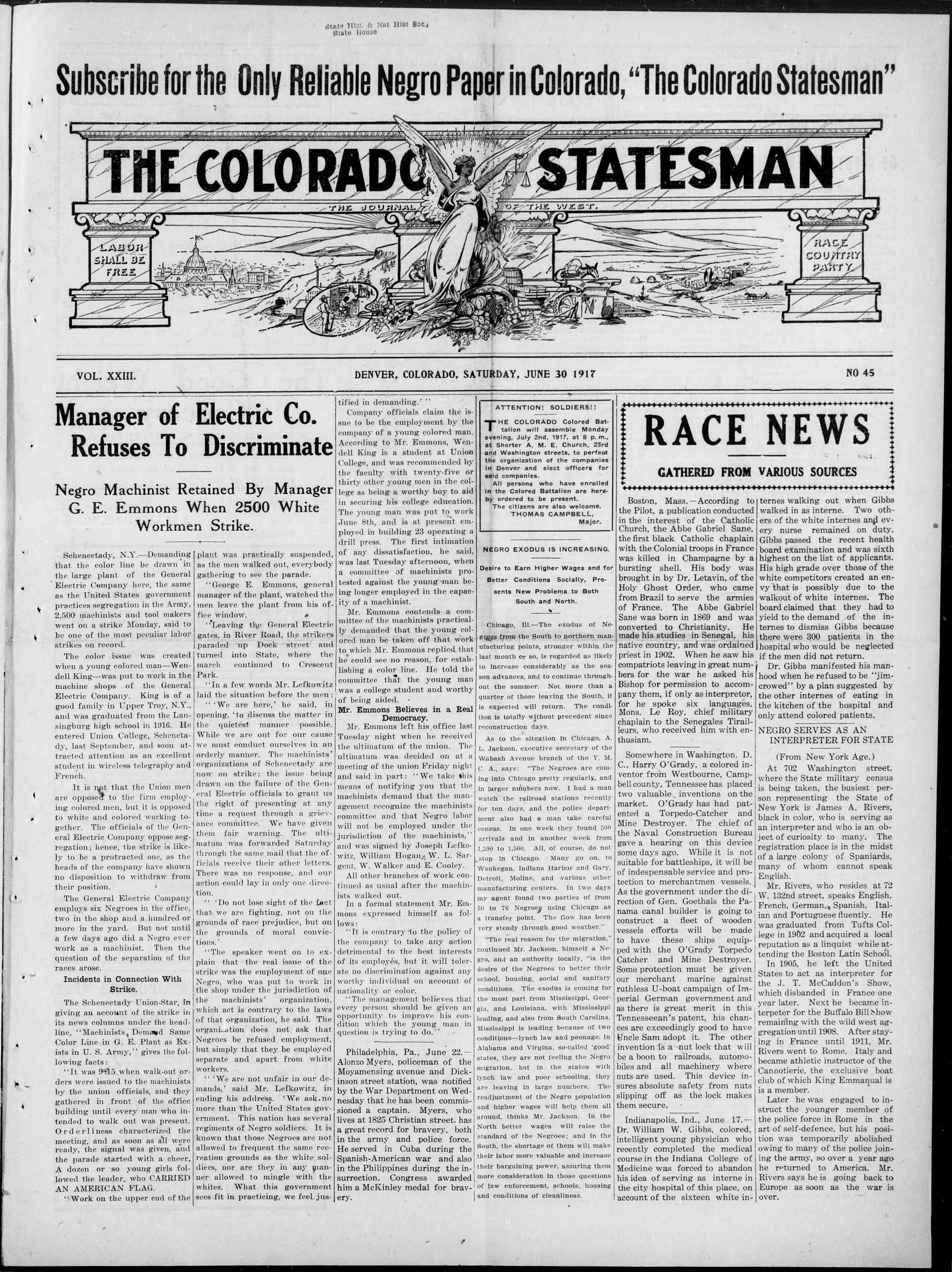
Manager of Electric Co. Refuses To Discriminate
Negro Machinist Retained By Manager G. E. Emmons When 2500 White Workmen Strike.
VOL. XXIII.
Manager of
Refuses To
Negro Machinist Re
G. E. Emmons W
Workme
Schenectady, N.Y.—Demanding that the color line be drawn in the large plant of the General Electric Company here, the same as the United States government practices segregation in the Army, 2,500 machinists and tool makers went on a strike Monday, said to be one of the most peculiar labor strikes on record.
The color issue was created when a young colored man—Wendell King—was put to work in the machine shops of the General Electric Company. King is of a good family in Upper Troy, N.Y., and was graduated from the Lansingburg high school in 1916. He entered Union College, Schenectady, last September, and soon attracted attention as an excellent student in wireless telegraphy and French.
It is not that the Union men are opposed to the firm employing colored men, but it is opposed to white and colored working together. The officials of the General Electric Company oppose segregation; hence, the strike is likely to be a protracted one, as the heads of the company have shown no disposition to withdraw from their position.
The General Electric Company employs six Negroes in the office, two in the shop and a hundred or more in the yard. But not until a few days ago did a Negro ever work as a machinist. Then the question of the separation of the races arose.
Incidents in Connection With Strike.
The Schenectady Union-Star, in giving an account of the strike in its news columns under the headline, "Machinists Demand Same Color Line in G. E. Plant as Exists in U. S. Army," gives the following facts:
"It was 9:15 when walk-out orders were issued to the machinists by the union officials, and they gathered in front of the office building until every man who intended to walk out was present. Orderliness characterized the meeting, and as soon as all were ready, the signal was given, and the parade started with a cheer. A dozen or so young girls followed the leader, who CARRIED AN AMERICAN FLAG.
"Work on the upper end of the
plant was practically suspended, as the men walked out, everybody gathering to see the parade.
"George E. Emmons, general manager of the plant, watched the men leave the plant from his office window.
"Leaving the General Electric gates, in River Road, the strikers paraded up Dock street and turned into State, where the march continued to Crescent Park.
"In a few words Mr. Lefkowitz laid the situation before the men: 'We are here,' he said, in opening, 'to discuss the matter in the quietest manner possible. While we are out for our cause we must conduct ourselves in an orderly manner. The machinists' organizations of Schenectady are now on strike; the issue being drawn on the failure of the General Electric officials to grant us the right of presenting at any time a request through a grievance committee. We have given them fair warning. The ultimatum was forwarded Saturday through the same mail that the officials receive their other letters. There was no response, and our action could lay in only one direction. 'Do not lose sight of the fact that we are fighting, not on the grounds of race prejudice, but on the grounds of moral convictions.'
"The speaker went on to explain that the real issue of the strike was the employment of one Negro, who was put to work in the shop under the jurisdiction of the machinists' organization, which act is contrary to the laws of that organization, he said. The organization does not ask that Negroes be refused employment, but simply that they be employed separate and apart from white workers.
"We are not unfair in our demands,' said Mr. Lefkowitz, in ending his address. 'We ask no more than the United States government. This nation has several regiments of Negro soldiers. It is known that those Negroes are not allowed to frequent the same recreation grounds as the white soldiers, nor are they in any manner allowed to mingle with the whites. What this government sees fit in practicing, we feel jus-
DENVER, COLORADO, SATURDAY, JUNE 30 1917
DENVER, COLORADO, SATURDAY, JUNE 30 1917
State Hist. & Nat Hist Soc.
State House
iable Negro Pa
RADO
THE JOURNAL
DENVER, COLORADO, SA
tified in demanding.' "
Company officials claim the issue to be the employment by the company of a young colored man. According to Mr. Emmons, Wendell King is a student at Union College, and was recommended by the faculty with twenty-five or thirty other young men in the college as being a worthy boy to aid in securing his college education. The young man was put to work June 8th, and is at present employed in building 23 operating a drill press. The first intimation of any dissatisfaction, he said, was last Tuesday afternoon, when a committee of machinists protested against the young man being longer employed in the capacity of a machinist.
Mr. Emmons contends a committee of the machinists practically demanded that the young colored man be taken off that work to which Mr. Emmons replied that he could see no reason, for establishing a color line. He told the committee that the young man was a college student and worthy of being aided.
Mr. Emmons Believes in a Real Democracy.
Mr. Emmons left his office last Tuesday night when he received the ultimatum of the union. The ultimatum was decided on at a meeting of the union Friday night and said in part: "We take this means of notifying you that the machinists demand that the management recognize the machinists committee and that Negro labor will not be employed under the jurisdiction of the machinists," and was signed by Joseph Lefkowitz, William Hogan, W. L. Sargent, W. Walker and E. Cooley. All other branches of work continued as usual after the machinists walked out. In a formal statement Mr. Emmons expressed himself as follows:
"It is contrary to the policy of the company to take any action detrimental to the best interests of its employés, but it will tolerate no discrimination against any worthy individual on account of nationality or color.
"The management believes that every person should be given an opportunity to improve his condition which the young man in question is trying to do."
Philadelphia, Pa., June 22.—Alonzo Myers, policeman of the Moyamensing avenue and Dickinson street station, was notified by the War Department on Wednesday that he has been commissioned a captain. Myers, who lives at 1825 Christian street, has a great record for bravery, both in the army and police force. He served in Cuba during the Spanish-American war and also in the Philippines during the insurrection. Congress awarded him a McKinley medal for bravery.
THE COLORADO Colored Battalion will assemble Monday evening, July 2nd, 1917, at 8 p.m., at shorter A. M. E. Church, 23rd and Washington streets, to perfect the organization of the companies in Denver and elect officers for said companies.
All persons who have enrolled in the Colored Battalion are hereby ordered to be present.
The citizens are also welcome.
THOMAS CAMPBELL,
Major.
NEGRO EXODUS IS INCREASING.
Chicago, Ill.-The exodus of Negroes from the South to northern manufacturing points, stronger within the last month or so, is regarded as likely to increase considerably as the season advances, and to continue through out the summer. Not more than a quarter of those leaving the South, it is expected will return. The condition is totally without precedent since reconstruction days.
As to the situation in Chicago, A. L. Jackson, executive secretary of the Wabash Avenue branch of the Y. M. C. A., says: "The Negroes are coming into Chicago pretty regularly, and in larger numbers now. I had a man watch the railroad stations recently for ten days, and the police department also had a man take careful census. In one week they found 500 arrivals and in another week from 1,200 to 1,500. All, of course, do not stop in Chicago. Many go on, to Waukegan, Indiana Harbor and Gary, Detroit, Moline, and various other manufacturing centers. In two days my agent found two parties of from 50 to 76 Negroes using Chicago as a transfer point. The flow has been very steady through good weather."
"The real reason for the migration," continued Mr. Jackson, himself a Negro, and an authority locally, "is the desire of the Negroes to better their school, housing, social and sanitary conditions. The exodus is coming for the most part from Mississippi, Georgia, and Louisiana, with Mississippi leading, and also from South Carolina. Mississippi is leading because of two conditions—lynch law and peonage. In Alabama and Virgina, so-called 'good' states, they are not feeling the Negro migration, but in the states with lynch law and poor schooling, they are leaving in large numbers. The readjustment of the Negro population and higher wages will help them all around, thinks Mr. Jackson. In the North better wages will raise the standard of the Negroes; and in the South, the shortage of them will make their labor more valuable and increase their bargaining power, assuring them more consideration in those questions of law enforcement, schools, housing and conditions of cleanliness.
RACE NEWS
GATHERED FROM VARIOUS SOURCES
Boston, Mass.—According to the Pilot, a publication conducted in the interest of the Catholic Church, the Abbe Gabriel Sane, the first black Catholic chaplain with the Colonial troops in France was killed in Champagne by a bursting shell. His body was brought in by Dr. Letavin, of the Holy Ghost Order, who came from Brazil to serve the armies of France. The Abbe Gabriel Sane was born in 1869 and was converted to Christianity. He made his studies in Senegal, his native country, and was ordained priest in 1902. When he saw his compatriots leaving in great numbers for the war he asked his Bishop for permission to accompany them, if only as interpretor, for he spoke six languages. Mons. Le Roy, chief military chaplain to the Senegales Tirailleurs, who received him with enthusiasm.
Somewhere in Washington. D. C., Harry O'Grady, a colored inventor from Westbourne, Campbell county, Tennessee has placed two valuable inventions on the market. O'Grady has had patented a Torpedo-Catcher and Mine Destroyer. The chief of the Naval Construction Bureau gave a hearing on this device some days ago. While it is not suitable for battleships, it will be of indespensable service and protection to merchantmen vessels. As the government under the direction of Gen. Goethals the Panama canal builder is going to construct a fleet of wooden vessels efforts will be made to have these ships equipped with the O'Grady Torpedo Catcher and Mine Destroyer. Some protection must be given our merchant marine against ruthless U-boat campaign of Imperial German government and as there is great merit in this Tennesseeean's patent, his chances are exceedingly good to have Uncle Sam adopt it. The other invention is a nut lock that will be a boon to railroads, automobiles and all machinery where nuts are used. This device insures absolute safety from nuts slipping off as the lock makes them secure.
Indianapolis, Ind., June 17. Dr. William W. Gibbs, colored, intelligent young physician who recently completed the medical course in the Indiana College of Medicine was forced to abandon his idea of serving as interne in the city hospital of this place, on account of the sixteen white in-
NO 45
ternes walking out when Gibbs walked in as interne. Two others of the white internes and every nurse remained on duty. Gibbs passed the recent health board examination and was sixth highest on the list of applicants. His high grade over those of the white competitors created an envy that is possibly due to the walkout of white internes. The board claimed that they had to yield to the demand of the internes to dismiss Gibbs because there were 300 patients in the hospital who would be neglected if the men did not return. Dr. Gibbs manifested his manhood when he refused to be "jimcrowed" by a plan suggested by the other internes of eating in the kitchen of the hospital and only attend colored patients.
INTERPRETER FOR STATE
(From New York Age.)
At 702 Washington street, where the State military census is being taken, the busiest person representing the State of New York is James A. Rivers, black in color, who is serving as an interpreter and who is an object of curiosity to many. The registration place is in the midst of a large colony of Spaniards, many of whom cannot speak English. Mr. Rivers, who resides at 72 W. 132nd street, speaks English, French, German, Spanish, Italian and Portuguese fluently. He was graduated from Tufts College in 1902 and acquired a local reputation as a linquist while attending the Boston Latin School.
In 1905, he left the United States to act as interpreter for the J. T. McCaddon's Show, which disbanded in France one year later. Next he became interpreter for the Buffalo Bill Show remaining with the wild west aggregation until 1908. After staying in France until 1911, Mr. Rivers went to Rome, Italy and became athletic instructor of the Cannotierie, the exclusive boat club of which King Emmanual is a member.
Later he was engaged to instruct the younger member of the police force in Rome in the art of self-defence, but his position was temporarily abolished owing to many of the police joining the army, so over a year ago he returned to America. Mr. Rivers says he is going back to Europe as soon as the war is over.
LATEST NEWS EPITOMIZED
FROM TELEGRAPHIC REPORTS THAT COVER THE WEEK'S EVENTS.
OF MOST INTEREST
KEEPING THE READER POSTED
ON MOST IMPORTANT
CURRENT TOPICS.
ABOUT THE WAR
Russia's faith is repledged to help the allies win against Germany.
French with smashing blows compel crown prince to give up most of gains.
The Italians drove the Austrians back at Mont Settsass with heavy losses.
Germany has imposed a fine of 250,000,000 francs on the occupied territory of Rumania.
Russia has formed "storming battalions;" composed of men who want to lead in the fighting.
Discovery of the German plot to destroy Norwegian steamers by explosives has appalled the whole nation.
Norway is on the brink of war and only awaits the signal from the United States to join the cause of the entente allies.
It is believed Venizelos, former Greek premier and staunch supporter of the entente, will form a new Greek cabinet.
East of Epehy a German raiding party was repulsed by the British. The Germans left their dead in wire entanglements.
Infantry activity between Soissons and Rheims has given way to artillery duels. Teuton guns continue slow demolition of city of Rheims.
American liner escapes torpedo in Atlantic by narrow margin of twenty feet. Another South American neutral steamer sunk by diver off Gibraltar.
Lively fighting continues between Russians and Austro-Germans south-west of Lutsk, in Volynia, and between the Stripa and Dneister rivers in Gallicia.
Austrians take initiative away from Italians in Asiago plateau sector, the object being Monte Origara. Late reports say Italians are holding back the Austrians.
La Coulette, suburb of Lens, captured by Canadians, as allies are heming in that great French coal center from all sides. Germans fire homes of town in preparation for their last stand.
Officers of a British steamer which arrived at an Atlantic port reported having sunk an attacking German submarine. The British vessel sent a shell into the U-boat's magazine, causing an explosion which parted the underwater boat about amidships. Each end sank separately. The British steamer was uninjured.
WESTERN
Colorado people contributed $1,250,000 for the Red Cross fund. Wyoming raised $170,000.
At Fort Snelling, Minn., sentries found sixty sticks of dynamite hidden in a beer case on the reservation.
The Kansas potato acreage is unusually large, 61,500 acres being under cultivation. The condition is 68.36 per cent.
The thirty-ninth annual encampment of the Department of Colorado and Wyoming, Grand Army of the Republic, will be held in Colorado Springs in June, 1918, according to word from Longmont, where the thirty-eighth encampment was held.
Denver, and especially through passengers on the Denver & Rio Grande Railroad, indirectly felt the effect of the Utah flood. Because of the uncertainty of travel over the Rio Grande, the railroad company decided to divert all passengers destined for Utah or coast points over the Union Pacific and Santa Fé roads.
WASHINGTON
The Belgian diplomatic mission has tentatively arranged a trip through the United States extending to the Pacific coast.
The nation's contributions to the Red Cross in response to the call for a $100,000,000 war fund were estimated at $114,000,000 Tuesday night by Henry P. Davidson, chairman of the Red Cross war council.
Contracts for 200,000 windproof shirts at $2.52 each, have been awarded by the Navy Department.
The shirts are part of a special uniform to be furnished American sailors on submarines, submarine chasers, destroyers and other craft on which the men are greatly exposed.
Wilson's request for food control bills before harvest likely to be obeyed.
Members of the Italian and Russian commissions pay homage to Washington's memory.
Mistreatment of Serbian bishops and clergy by Bulgarians was reported by the Serbian legation. Commissioner Fort of the Federal Trade Commission warned the operators it was certain the government would take over the mines unless they did something soon to lower prices.
FOREIGN
The Spanish situation is believed to be very grave.
American admiral is received in Brazilian port.
Germany to take over control of all crops harvested.
Several disasters in German munition plants are reported.
Winston Churchill demands more aggressive British naval policy.
The Root mission left Moscow for Petrograd with a distinct sense of encouragement.
One man killed and a score injured was the toll in Monday's conflict between Sinn Feiners and the police at Cork.
A dispatch to the London Times from Athens says French troops entered Athens and occupied several points in the city.
The London Daily Express learns that Brig. Gen. J. E. B. Seely, exminister of war, was accidentally wounded in France.
A counter-revolution by Russian women is threatened unless Russia continues in the war against Germany with all her might.
All provinces which declared their independence of the present Peking government have now ceased their warlike preparations.
Word was received at Ottawa from W. J. Hanna, Canada's food controller, that he was returning to organize the dominion's policy in cooperation with Herbert C. Hoover.
The son of former Premier Sturmer, arrested at Kief for drunkenness, committed suicide at Vrotjl after brooding over his disgrace, according to word received at Petrograd.
A small contingent of the United States flying corps arrived in England wearing civilian clothes with blue silk armlets bearing white letters "United States flying corps."
The British commission, headed by Lord Newton, has arrived at The Hague to discuss with German delegates headed by Gen. Friedrich the question of war prisoners of both countries.
An invitation to the American squadron expected in Uruguay waters to spend the Fourth of July as the republic's guests was tendered in a telegram to the admiral by the people and authorities of Montevidio, Uruguay.
The British steamship Ortolan, a vessel of 2,145 tons gross, owned by the General Steam Navigation Company of London, was torpedoed and sunk by a German submarine June 14th, and three members of her crew lost their lives.
In spite of the disorders at Sebastopol and anarchist threats at Petrograd, there are indications of a marked improvement in the situation with a growing support of the government and a growing animosity against the forces which made for disintegration in the army.
SPORTING NEWS
Standing of Western League Clubs.
CLUBS. Won. Lost. Pct.
Des Moines 37 26 5.87
Lincoln 36 27 5.71
Omaha 36 28 5.57
Joplin 34 27 5.57
Sloux City 33 29 5.52
Denver 28 33 4.59
St. Joseph 24 37 3.98
Wichita 20 42 3.23
Jimmy Hanlon of Denver outfought Harry Donahu of Peoria in a 10-round boxing bout in New York.
Baseball will occupy a prominent place in the activities of the United States troops in France, it was announced in New York by the National War Work Council of the Y. M. C. A. International Committee.
While other leagues are crying about hard times and considering the advisability of closing down for the remainder of the season, if not permanently, E. W. Dickerson, president of the Western League, comes through with a proposal to extend the playing year because of the exceptional crowds which six out of the eight towns on the circuit are drawing.
GENERAL
At New York the 7-cent beer jolted Broadway.
Dyes brought over on Deutschland will be used in coloring soldiers' uniforms.
James Richard Gray, president and publisher of the Atlanta Journal, died of apoplexy.
Because he went to Juarez to get a glass of beer on Sunday, George Lange, a German musician, may be detained in the Fort Bliss prison camp until the end of the war.
The sum of $473,000 was contributed at Baltimore toward a $1,000,000 fund to equip an industrial army to go to Palestine and make ready for its occupation by Zionists.
Damage estimated at more than $1,000,000 has been done, two miles of railroad washed out and several thousand acres of rich land laid waste and a number of towns are in danger as the result of a torrent which carried out the Price River Irrigation Company's dam, twelve miles from Fairview, Utah, Sunday afternoon.
Jesse Williamson, IL, well known socially and prominent as an oarsman and all-round athlete at Philadelphia, pleaded guilty to stealing upward of $600,000 in securities from clients of the Pennsylvania Company for Insurance on Lives and Granting Annuities.
Salvation Army to co-operate with police to stop white slavery in New York City.
The United States cruiser Olympia, Admiral Dewey's flagship at the battle of Manila Bay, ran aground in the fog off Block Island, R, L
Western Newspaper Union News Service.
COMING EVENTS.
July 10.—Good Roads meeting on summit of Pilke's Peak.
Awarding ceremony of Afrika
Denver contributed $658,444 to the Red Cross fund.
Broken pipe line cripples Cañon City water supply.
The man who enlisted in the National Guard is enlisted in the regular army.
Approximately 1,000 acres have been planted to potatoes in Moffat county.
The new cheese factory at La Junta has a capacity of 15,000 pounds of milk per day.
The new Denver and Salt Lake Railroad station at Hayden is nearing completion.
Denver formally invited the Belgian commission to the United States to pay Colorado a visit.
Work of paving the main street of Littleton has been completed and it is again open to traffic.
Men who registered for military service at Trinidad will be provided with distinctive arm bands.
Contracts have been awarded for the construction of twenty new silos in the vicinity of Ordway.
Weld county, asked for $48,000 for the American Red Cross fund, responded by contributing $70,000.
At a reorganization meeting of the Denver Civil Service Commission Albion K. Vickery was elected president.
The Christian church at Ault has started the erection of an addition that will double the seating capacity of the auditorium.
More than 300 persons appeared in the county recorder's office in Denver, Monday, to obtain permits to have liquor shipped in to them.
The first cutting of alalfa in the Arkansas Valley shows a better quality of hay than has been harvested in that district in many years. The Great Western Sugar Company has granted the employés at all of its factories advanced wages amounting to approximately 10 per cent. A resolution calling for the enforcement of the child labor law during the war was passed unanimously by the Denver Trades and Labor Assembly. A coroner's jury in Denver brought in a verdict that "William Bruno fired the shot which killed his wife last Sunday night with felonious intent. John and Rex Nisley, aged 8 and 5, respectively, were swept from their horse and drowned while trying to reach an island in Platte creek, near Grand Junction.
All employés of the city of Denver receiving less than $1,800 a year will receive an increase amounting to not more than 15 per cent of their present wages after July 1st.
Five persons were injured, two of them seriously, when the car of Welsy Frasier, driven by Will O'Driscoll, ran into a culvert six miles west of Montrose and turned over.
Members of the Colorado National Guard and the enlisted reserve corps paraded the downtown streets of Denver by way of opening the National Guard recruiting program.
Practically every man who has had previous military training in Denver is applying for the second training camp at Fort Riley which opens Aug. 27th, according to Charles R. Dudley.
The State Agricultural College at Fort Collins put a force of workers in the field to give demonstrations throughout the state on the proper methods of canning fruits and vegetables.
The Trinidad Chamber of Commerce is recruiting a volunteer company of automobile owners to aid in the transportation of troops, ammunition or supplies in the event of an emergency.
The offer of the presidency of the State School of Mines at Golden has been declined by Prof. Milo S. Ketchum of the University of Colorado. Prof. Ketchum will remain as dean of the engineering school at Boulder.
According to a provision passed by the last General Assembly that a woman be appointed a member of the board of control of the State Soldiers and Sailors' home at Monte Vista, Governor Gunter named Mrs. Lora M. Gindners of Monte Vista to the position.
Daughters of the American Revolution, true to their traditions, are beginning the self-appointed task of enrolling themselves into a citizen army for "service on industrial, economic, agricultural and all patriotic lines," that they may be of definite service as a body in the world war.
A rich discovery at depth for the Ironclad Hill section has been made by the Cripple Creek Deep Leasing Company on the property of the Jerry Johnson Gold Mining Company.
Capt. C. H. Doke of the First Colorado Infantry received orders from the War Department in Washington to proceed immediately to enlist 500 men for the medical reserve corps. Trainmen employed by the Denver City Tramway Company have voted to accept the company's offer of an increase of 3 cents an hour. About 900 men are affected by the raise in pay.
G.A.R. ELECTS OFFICERS
G.A.R. ELECTS OFFICERS
ALLIED ORGANIZATIONS CHOOSE OFFICIALS FOR YEAR.
State Encampment Votes to Support the President in Present War With Germany.
Western Newspaper Union News Service.
Longmont, Colo.—The Grand Army and allied organizations passed resolutions supporting the President in the present war with Germany. The only other important business of the closing day was the election of officers.
The results:
Grand Army—William H. Comstock of Denver; department commander; William Butler of Longmont, senior vice commander; George Young of Evans, junior vice commander; C. E. Husted of Denver, chaplain; William H. Roberson of Denver, medical director. On the council of administration are F. O. Burdick of Boulder, C. A. Brooks of Denver, D. W. Brown of Pueblo, O. S. Reed of Pueblo and C. M. Bills of Denver. Delegates to the national encampment, M. S. Crawford, J. H. Williamson, A. A. Beach, J. F. Humphrey, John Jewell and William Green.
Women's Relief Corps—Mrs. Julia E. Killam of Denver, department president; Mrs. Belle Abbott of Longmont, senior vice president; Mrs. Ella Cookie of Fort Collins, junior vice president; Mrs. Marion White of Montrose, treasurer.
Ladies of the G. A. R.—Mrs. Lulu Hatch of Denver, department president; Mrs. Nabor of Florence, senior vice president; Mrs. Mary V. Collier of Aspen, junior vice president; Mrs. Ella Gandy of Colorado Springs, chaplain; Mrs. Josephine Bills of Denver, treasurer.
Daughters of Veterans—Ida A. Durant of Denver, department president; Blanche Anderson of Colorado Springs, senior vice president; Beatrice St. Clair of Fort Collins, junior vice president; Helen Greenacre of Fort Collins, treasurer; Mrs. Sarah Sells of Denver, chaplain; Alice Webber of Boulder, inspector.
Convicted Couple's Wedding Blocked.
Conflicted Couples Wedding Blocked. Pueblo.—That "true love never runs smoothly," was again proven when Judge C. S. Essex of the District Court, refused to officiate at the marriage of Thomas Kimbro and Mrs. Keith James, whom he had sentenced to serve from six to twelve years in the state penitentiary but one hour before. Kimbro and the woman who is to serve an equal sentence in the state prison for beating Roy Snyder into insensibility and afterwards robbing him of all the money he had while in a rooming house conducted by the James woman, appeared in the court room with the necessary marriage license issued to them.
Man Killed When Engine Overturns
Man Killed When Engine Overturns.
Grand Valley.—Charles Gibbs, an engineer, was killed and William Farmer, fireman, and J. W. Smith, brakeman, were badly scalded when an engine attached to a work train of the Denver & Rio Grande overturned at Una, a point midway between Grand Valley and De Beque.
Five freight cars followed the engine into a ditch. The accident was caused by the track having been undermined by floods.
President of Dentists
Glenwood Springs.—W. P. Smedley of Denver was elected president of the Colorado State Dental Association by the convention here. His father, William Smedley of Denver, was reelected treasurer. He has been treasurer for thirty years and was the first president of the association.
Uncompahgre Damaging Ranches.
Montrose.—The Uncompahgre river made a new rich water mark Sunday and the overflow included in its inundation many crops which had previously escaped. The damage is considerable. Ranchers all along the valley have suffered to some extent by the high water this year.
Rock Slide Tears Out Pipe Line
Cafon City.—A. rockslide in the Royal Gorge, carried away about 100 feet of the city water works pipe line and as a consequence the city was short of water. Special notices were sent out to water users to cease all lawn sprinkling and irrigating until the line is repaired.
Charged with Shortage.
Denver.—John F. Murray, chief cashier in the office of the city treasurer, was arrested by the police following the discovery of an alleged shortage in his accounts. It was said the amount involved was about $4,000.
Boulder.—Nick Ruer, 25, a Russian miner, was instantly killed by a fall of rock at the Industrial mine, near Superior.
Miner's Wife Kills Herself in Tent. Boulder.—Evan Austin, superintendent of the Good Friday mine at Sugar Loaf, went into the tent where his wife had been sleeping and found she had shot herself through the heart.
Miner Killed by Inhaling Gas.
Victor.—B. T. Kerr, a miner, was killed by inhaling carbon dioxide gas in a prospect hole on Bull Hill. His body was discovered by a searching party.
Western Beef Co.
ONE OF THE MOST UP-TO-DATE AND SANITARY MARKETS IN THE CITY.
Fresh and Cured Meats of All Kinds. Fresh Vegetables, Staple and Fancy Groceries.
PHONE CHAMPA 1641.
2048 LARIMER STREET DENVER, COLO.
Opposite the Three Rules.
The Good Weight Grocery
W. T. FLETCHER AND J. W. WILLIAMS, Proprietors.
RETAIL STAPLE AND FANCY GROCERIES.
CORN FED MEATS. MOTOR DELIVERY TO
ANY PART OF THE CITY.
2549 Washington St. Denver, Colo.
Baxter Bldg. J. W. WILLIAMS, Manager
PHONE CHAMPA 3022.
J. R. DRESSOR WALLACE CLOW A. B. CLOW
York 1297 South 315J South 424JJ
John W. Masury & Sons Coach Colors, Paints and Varnishes. Wall Paper, Paints, Oils and Glass, Interior and Exterior Decorators WE DO HOUSE PAINTING 1454 Welton St. Phone Main 871. DENVER, COLO.
THINK
Giant Bach-Benz Cleaners and Tailors
Lankford and McCain, Proprietors
STRICTLY FIRST-CLASS WORK
Cleaning, Pressing, Dyeing and Remodelling
JOIN OUR MONTHLY PRESSING CLUB—$1.50
506 Eighteenth Street Phone Main 7376
Open Daily to 8:30 p. m.
```markdown
```
TO-DATE AND SANITARY
IN THE CITY.
Minds. Fresh Vegetables, Staple
Groceries.
Are Always
Lowest
All Parts of the City.
AMPA 1641.
DENVER, COLO.
Three Rules.
Hard Weight
Grocery
W. WILLIAMS, Proprietors.
FANCY GROCERIES.
MOTOR DELIVERY TO
CITY.
St. Denver, Colo.
J. W. WILLIAMS, Manager
CE CLOW
315J
A. B. CLOW
South 4243J
Paper and Paint Co.
s for
Colors, Paints and Varnishes.
Glass, Interior and Exterior
ators
PAINTING
in 871. DENVER, COLO.
INK
Benz Cleaners
Tailors
Cain, Proprietors
T-CLASS WORK
Meeting and Remodelling
PRESSING CLUB—$1.50
Phone Main 7376
RNER CO.
Phone Champa 223
MOST UP-TO-DATE A
MARKETS IN THE CITY
Seats of All Kinds. Fresh
and Fancy Groceries.
Prices Are Alive
the Lowest
Delivery to All Parts of the
PHONE CHAMPA 1641.
STREET
Opposite the Three Rules
Good W
Grocery
BER AND J. W. WILLIAMS
STAPLE AND FANCY GRE
MEATS. MOTOR DE
OF THE CITY.
Bington St. I
J. W. WILLIAMS
CHAMPA 3022.
WALLACE CLOW
South 315J
Do Wall Paper and
Agents for
& Sons Coach Colors, Paint
ants, Oils and Glass, Inter
Decorators
DO HOUSE PAINTING
St. Phone Main 871. DE
THINK
Beach-Benz
and Tailors
Ford and McCain, Propr
UCTLY FIRST-CLASS W
Pressing, Dyeing and RAI
MONTHLY PRESSING O
reet
N-GARNER
Ford
THE UNIVERSAL CAR
ACCESSORIES
Unexcelled Service
and demonstrating Ford car
inputs you under no obligation
SORIES TIRES
D Service
wing Ford car a pleasure.
or no obligation to buy.
TOURING, $360
F. O. B. Detroit
Patronize Our
BUY?
Adv
They
boost
dese
business
lying an
e from
se was
Advertisers They are all boosters and deserve your business.
Spend Your Money
with your home merchants. They help pay the taxes, keep up the schools, build roads, and make this a community worth while. You will find the advertising of the best ones in this paper.
---
---
Sundays Until 2:00
p. m.
Government's Big Establishment Turns Out Vast Amount of Work.
WAR IS CAUSE OF INCREASE
Press Room Produces 240,000,000 Copies of Posters, Pamphlets and Other Publications in One Month
War-time work at Uncle Sam's printing office has reached large proportions, establishing during one month a record never before equaled in the history of the office, according to Public Printer Cornellus Ford. The preparedness and war situation demanded rush delivery on a vast number of orders covering every conceivable class of printing and binding, these orders varying in quantity from 1,000 to 25,000,000 copies each. In order to handle this extra work, in addition to the ordinary current work for congress and the various departments and bureaus of the government, the working forces were augmented to some extent as rapidly as possible, and all divisions put on what is practically a continuous 24-hour run, divided into several shifts.
Registration Printing Heavy.
The law requiring registration in connection with military duty called for very large quantities of job printing. All of this work was prepared for posting in the government printing office, and forwarded direct to the mailing tables in the city post office. The principal items concerned in this work were 25,000,000 registration cards, together with 18,000,000 copies of certificates of registration, a certain number of each being mailed to the sheriff of each county in the United States; other blanks, vouchers, telegrams, instructions, etc., in connection with registration totaled approximately 4,000,000 copies.
The Liberty bond issue required large quantities of rush work. One million copies of Liberty bond posters, printed in two colors, were delivered within the space of a few days. Four million copies were printed of what is known as the "Boy Scouts" poster. This poster was printed in two colors, and was prepared for mailing by members of various Boy Scout troops. Ten million copies were printed of circulars, applications, etc.
Approximately 5,000,000 wire-stitched pamphlets, varying in size from 8 to 250 pages each, on matters concerning preparedness and war were printed.
The output of the bindery during the month was extremely heavy. In addition to many millions of copies of miscellaneous work, there were 750,000 bound books delivered, among which were: "Handy Book for Enlisted Men," 10,000; "Soldiers' Deposit Book," 20,000; "Manual of Interior Guard Duty," 100,000; "Provisional Drill and Service Regulation," 20,000; "Manual for Courts-Martial," 100,000; "Small Arms Firing Manual," 100,000; "Health Record for Officers," 25,000; "Drill Regulations and Service Manual," 30,000; "Army Regulations," 30,000; "Rules of Land Warfare," 26,000; "The Army Horseshoer," 10,000; "Army Horse in Accident and Disease," 6,000; "Infantry Drill Regulations," 90,000.
Other Departments Supplied.
The agriculture department was supplied with many millions of posters, bulletins, etc., concerning food conservation and farming. In addition to the printing and binding in connection with the preparation and prosecution of war, the regular current work, unusually heavy at this time by reason of increased activities and the creation of new bureaus, was produced for the departments and congress, amounting to, approximately, $600,000. This work included a daily edition of 32,000 copies of the Congressional Record, 123,000,000 postal cards and 14,000,000 money order blanks.
The pressroom handled 18,000 forms and produced 240,000,000 copies; the pamphlet bindery folded 25,000,000 sheets; the total cost of paper used during the month was $282,000, averaging about $11,000 per day, as against about $4,000 per day during the same month last year, and the wages paid amounted to $400,000. The public printer says:
"All employees in the government printing office have shown an efficient and patriotic spirit in responding cheerfully to the extremely heavy demand made on them by the long hours and hard work necessary at this time, and great credit is due them for the splendid showing made by the office. It is my firm belief that the present organization and working forces are the best in the history of the government printing office.
"Notwithstanding all the long hours and rush of work, the employees found time to subscribe, approximately, $100,- 000 for Liberty Loan bonds."
Lime Output Increased.
Lime manufactured and sold in the United States in 1915 amounted to 3,589,699 tons, valued at $14,336,756. This was an increase of 208,771 tons, or 6 per cent over that of 1914, and nearly equaled the record output of 3,505,300 tons in 1913, Uncle Sam reports.
"HOW OLD ARE YOU?"
Question of Vital Interest in This Country Now.
Uncle Sam's Census Experts Point Out How War Has Emphasized Importance of Birth Registration.
How old are you?
Never in the history of this country has this question been of such vital interest to so many people as it is today.
Never before has the United States government been so deeply interested in knowing the exact ages of the young men of the land.
Officials of Uncle Sam's census bureau believe that in view of these facts, the public mind has never before been so ready to grasp the great importance of complete birth registration. Officials of the bureau in a statement on this subject say:
"In ordinary times, as the years go by and problem after problem is taken up and settled, our civilization grows; and the more rapidly these problems are taken up and settled the more rapidly this civilization grows.
"In ordinary times the continual demands upon our attention, first by one problem and then by another, easily explain the temporary sidetracking in so many states of the problem of complete birth registration. It is not because the people believe birth registration unimportant, but the problem has simply been crowded to one side until a more favorable day.
"When the story is told of the American arrested in London as a German spy, unable to obtain a birth certificate because his birth had never been recorded and because the doctor had died, the people grasp the point and agree that births should be registered; but as the story relates to somebody far away, somebody unknown, and probably never heard of before, the point is soon forgotten and no wave of strong public opinion is ever really started. So, too, the statements that birth records are needed to prove men of voting age, to establish old-age pensions and pensions for children of soldiers, to establish rights of inheritance, to determine how efficiently the states are protecting the health of the children, and to determine who is entitled to the protection of our flag, these statements are too apt to be treated as old axioms which call for no immediate reform.
"The need for complete birth registration is recognized, but the inertia of the people still prevails.
"Thus, in ordinary times, the problems of civilization are settled slowly, but not so in time of war or after great catastrophies.
"The city devastated by fire is so rebuilt as to guard against a second conflagration.
"The terrible loss of life which follows overloading an excursion steamer soon results in more stringent laws and in greater safety for future travelers.
"And today the war call for the registration of our young men brings home the need of birth records to every community and to almost every family in the United States.
"Can you prove that you are under twenty-one or over thirty-one, or must you forever be suspected of having falsified your age?"
"Perhaps a fond mother, to save her son from the horrors of the trenches, may swear that he is below the age limit; perhaps years later proof will be found that this man should have registered; imagine his chagrin at not having done his part in the war.
"Perhaps there are slackers who, in the absence of birth records, may be able to shirk registration.
"Surely, the need of complete birth registration is evident to all.
"May we not hope that the call for the registration of all men between the ages of twenty-one and thirty-one will awaken the people from their lethargy and lead at once to this forward step in our civilization—the registration of every birth?"
Treating of Poles.
According to information compiled recently by the government forest service, 102 treating plants, operating throughout the United States, report a total of 125,639 poles treated in 1915. This is estimated to be about one-half the actual number subjected to treatment, since a large number given brush treatment are not reported. The principal preservative used was creosote oil, and the average absorption was about 11 pounds per cubic foot. About 85 per cent of the poles treated were yellow pine, while western red cedar and Douglas fir largely made up the remainder.
Unable to Fight, Convict Would Buy Liberty Bonds
A letter came to Uncle Sam from a prisoner in the Connecticut state penitentiary asking where and how to place a subscription for $1,500 worth of Liberty bonds. "As I am unable in my present position to be of service to my country in the manner in which I prefer," he wrote, "I should very much like to purchase two Liberty Loan bonds, one of $1,000 and one of $500, and help out a little in that way."
BRAZIL REVOKES NEUTRAL DECREE
NATION COULD NOT REMAIN IN DIFFERENT AFTER AMERICA BEGAN WORLD FIGHT.
HOLLAND MAY FIGHT
WILHELMINA DECLARES DANGERS THREATEN WHILE GREAT WAR RAGES.
Western Newspaper Union News Service.
Rio Janeiro, June 29.—Brazil has revoked her decree of neutrality in the war between the entente allies and Germany.
The Brazilian government, by act of Congress, late in May, authorized the revocation of Brazil's neutrality in the war between Germany and the United States. In notifying the Brazilian legation of the sanction of the revocation, Nilo Pecanba, the foreign minister, in a note, said Brazil up to that time had refrained from taking sides in the European conflict but that the republic could not remain indifferent from the moment the United States found itself involved in a struggle for the rights of the people, and when Germany meted out indiscriminately to Brazil the most brutal treatment.
A dispatch from Rio Janeiro June 9 said diplomatic exchanges with representatives of the entente powers were in progress and that political results might be expected shortly. It was added that war ships of the entente would be permitted to visit Brazilian ports without adhering to time limits imposed by neutrality.
The Hague.—In a speech from the throne at the opening of the extraordinary session of Parliament, Queen Wilhelmina, referring to the almost unanimous declaration of the dissolved States General in favor of a revision of the provisions of the constitution dealing with suffrage and education, said:
"It is for the States General to decide whether the work thus begun shall be completed. No other measures will be submitted to you.
"Thus you will be able to devote your full attention to the questions arising from the war and preparations for the vigorous development of our country after the conclusion of peace. "Our relations with foreign powers are favorable. There are many reasons for gratitude, but let us not forget that so long as the war wages, dangers threaten the country and the people may again be called upon to use their utmost strength for liberty and independence. That God may guard them is my earnest prayer."
To Cut Bread Cost in Two.
Washington.—"We will reduce the 9-cent loaf of bread to 5 cents." This was the declaration made by the National Association of Bakers after a conference with Herbert C. Hoover, food administrator. This organization of country-wide affiliation also voted a war chest of $100,000 and expects through its 250 agencies to cut the cost of bread almost in two. To obtain this result the bakers have arranged to eliminate waste. One of the first steps will be to standardize the loaf. There will be no more "fancy" breads and there will be no more returns.
Potato Prices Drop in Chicago.
Chicago.—Wholesale prices of potatoes here dropped 40c to 65c a bushel, to the lowest level this year. Sales were made at $2.40 and $2.65.
Wyoming Women to Register July 17.
Wyoming Women to Register July 17. Cheyenne—In a proclamation by Acting Governor Frank L. Houx Thursday, July 17th, was designated registration day for the women of Wyoming, at which time all women of the state are called upon to register at their voting precincts, "for war service of such character and extent as circumstances shall permit." It is estimated that between 25,000 and 30,000 women will register. The proclamation places the management of the registration directly under the women's department of the Wyoming Council of Defense.
D. & R. G. Plood Loss $1,000,000
Salt Lake.—With prospects that damage to its main line in the Utah flood district, loss of business and claims which generally follow railroad tieups of this character will result in money losses of over $1,000,000, the Denver & Rio Grande railroad is concentrating its entire construction force on the points between Colton and Helper, Utah, in an effort to open up the main line of the road and restore conditions to normal.
Canadians Capture New Trench.
Canadian Army Headquarters in France, June 29. Under a protecting concentration of artillery fire Canadian troops stormed and captured the German front line trench before Avion, a suburb of Lens.
Agree in Drop on Coal Prices.
Washington.—Ar immediate general reduction of $1.00 to $1.50 a ton in the price of coal at the mine was agreed upon by representatives of the coal operators.
CONSERVATION OF FOOD
PLANS BEING OUTLINED FOR DENVER CAMPAIGN.
Business Men, Railroads, Farmers and Housekeepers Will All Aid In Work.
Western Newspaper Union News Service.
Denver.—With the arrival or David W. Thomas to take over the secre-aryship of the livestock and agricultural bureau of the Denver Civic and Commercial Association, the monster drive began to enlist the business men, the railroads, the farmers and the housewives of the state in the conservation of food.
Tentative plans already are being made for the first of the series of fruit, berry and vegetable weeks which will aid in concentrating the attention of the housewives upon the need for preserving all the perishable goods possible for the winter.
The first will probably be cherry week, sometime after July 10th. The weeks will correspond as nearly as possible with the time of season when the goods are the most plentiful.
Plans for a monster conference of members of the Civic Association, women's organizations and railroad representatives are being made. W. H. Kerr, chief of the federal market and rural organization branch in Denver, will be present and an attempt is being made to obtain federal experts from Washington. Mrs. Lucius Hallett probably will be present to speak on canning and the woman's part in the drive to conserve the food resources of the state. Mr. Thomas will be formally introduced to the members of the Civic Association at that time and the plans for the campaign, which will have a far-reaching benefit upon the economics of the state the coming year, will be definitely formulated.
Fuller Named Reserve Examiner.
Maj. A. M. Fuller of Fort Logan has been appointed by the commanding general of the Central department in Chicago as examining officer for Colorado applicants for the second officers' reserve training camp, to begin in Fort Riley, Kan., Aug. 27. Examinations will be conducted by Maj. Fuller from July 15 to Aug. 10. Only men more than the draft age will be eligible for this second camp, it is stated.
Mobilize Guard About July 5.
Adjt. Gen. Baldwin received a telegram from the War Department saying that inspection would be made at once of the seven companies of the Second regiment of the Colorado national guard for admission into federal service. Gen. Baldwin states that all units of the guard are in excellent shape for recognition for federal service and that the guard will be mobilized about July 5, probably at Morrison.
Women Begin Military Training.
Women who are to command the units at the Fifth National Service School of the women's branch of the Navy League, have begun military training at Denver. The school is to be held at Loretto Heights, and the prospective "commissioned officers" of the organizations which will be formed at it are engaging in military drills under the direction of regular army sergeants.
Udlock Granted Parole by Governor.
A parole has been granted by the governor, on approval of the State Board of Pardons, to E. E. Udlock of Grand Junction, who was a widely known prohibitionist, churchman and Y. M. C. A. worker before his conviction in 1915 on charges of embezzlement and grand larceny.
Craft Bill for Food Protection.
Attorney General Leslie E. Hubbard and District Attorney William E. Foley met at the attorney general's office and mapped out legislation for the special session of the Legislature that will enable them to handle the 'food situation in Colorado.
Refused Trip at States Expense.
The State Auditing Board refused to honor the requisition of Mrs. Mary C. C. Bradford, state superintendent, who is asking the state to pay her expenses to Seattle, Wash., July 10, where she will go as a delegate to the National Education Association.
Agent for State Factories Selected.
Carl Hinton, assistant secretary of the manufacturers' bureau of the Denver Civic Association, has been selected to represent the organization at Washington in a campaign to place Colorado's war goods upon the counter at the national capital.
Ninety Enlisted for Marine Corps.
Colorado filled its quota of ninety men in the marine corps, according to Capt. C. J. E. Guggenheim.
Woman Gives Fruit Crop.
Mrs. John McDonough has given to the Woman's State Auxiliary to the National Guard a ten-acre tract of land on which are growing plums, cherries, peaches and apples, in order that the boys of the militia may have their fill of fruit as fast as it ripens. Details will be sent to pick the fruit. The orchard is located at West Forty-sixth and Perry streets, Denver. Whatever fruit is left will be canned and preserved for distribution among the soldiers later.
NOTHING DOWN AND 17 CTS. A DAY
BUYS A PIANO. SALE NOW ON.
THE PIANO EXCHANGE
H. A. TRIGGS, Manager
211 Charles Block. Cor. 15th and Curtis Streets. Phone Champa 3742.
The Cha
Twer
Is
DRUGS, CHEMICAL
WE S
Prescript
Phone us and we will
JAMES
BOLDE
and L
924 19th
The Champa Pharmacy
Twentieth and Champa,
Is the place to get your
DRUGS, CHEMICALS AND PATENT MEDICINES
WE SERVE DRINKS.
Prescriptions Our Specialty.
Phone us and we will deliver the goods to all parts of the city.
JAMES E. THRALL, PROPR.
PHONE MAIN 2425.
DINNER
11:30 to 2 p.m.
All Kinds of Sandwiches
Bolden
Ba
FI
R. B. BOLDE
Weathe
TE
PIONEER
WE IN
PRACT
RENOVATORS, BL
Of Gents' and
1624 C
Golden Bros. Barber Sh
Baths, Electric Massage
FIRST CLASS SERVICE
E. BOLDEN, Mgr. 926 19th St. D
fatherhead Hat
TELEPHONE MAIN 3203
Bolden Bros. Barber Shop
Baths, Electric Massage
FIRST CLASS SERVICE
R. B. BOLDEN, Mgr. 926 19th St. Denver
Weatherhead Hat Co. TELEPHONE MAIN 3203
Established 1876
PIONEER HATTERS OF THE WEST
WE MAKE OLD HATS NEW
PRACTICAL HATTERS
ATORS, BLEACHERS DYERS AND FINIS
Gents' and Ladies' Hats of Every Descriptio
1624 Champa St., Denver, Colo.
Established 1876
PIONEER HATTERS OF THE WEST
WE MAKE OLD HATS NEW
PRACTICAL HATTERS
RENOVATORS, BLEACHERS DYERS AND FINISHERS
Of Gents' and Ladies' Hats of Every Description
1624 Champa St., Denver, Colo.
JOHN K. RETTIG Fancy and Staple Groc 1864 CURTIS STREET
JOHN Meats, Fancy 180
Meats, Fancy and Staple Groceries 1864 CURTIS STREET
The MAR
C. E. SMITH,
Wholesale and Retail Sta
Hotels and
The MARKET COMPANY
C. E. SMITH, Manager, Res. Phone South 1608
Wholesale and Retail Staple and Fancy Groceries, Fish and Oysters Hotels and Restaurants Our Specialty. Fresh and Cured Eastern Corn Fed Meats Fruits, Vegetables, Poultry and Game.
Telephones Main 4302, 4303, 4304, 4305
622-636 15th Street Denver, olorado
Fruit Bowl
PHONE MAIN 3028
Corner Nineteenth
Short Orders at All Hours
Barber Shop
Massage
SERVICE
926 19th St. Denver
Bad Hat Co.
MAIN 3203
1876
OF THE WEST
HATS NEW
HATTERS
HATTERS AND FINISHERS
Of Every Description
Denver, Colo.
RES. PHONE GALLUP 942
ETTIG
taple Groceries
STREET
Denver, Colo
COMPANY
Phone South 1608
VINE
```markdown
```
Denver, Cola
THE COLORADO STATESMAN
THE COUNTY OF COLORADO
LADEN SHALL BE FREE
HASE COVINI PARTY
Entered as second-class matter at the postoffice in the City of Denver, Colo.
JULY FOURTH, 1917, A FORCIBLE REMINDER.
BEFORE our next publication the celebration of Fourth of July shall have passed, and, therefore, we take this opportunity of reminding the citizens of this country that a deep thought and a grave concern should engage the heart and mind of every worshipper at the altar of liberty, the guiding star of a nation who fought its way to freedom nearly a century and a half ago, and who today is engaged in a similar action to assist suffering humanity in throwing off the shackles of autocracy, which oppresses the weak and makes stronger the strong. While there will be some of the usual enjoyment in picnics, display of fireworks, etc., let us spend a few quiet moments in dedicating ourselves anew to the land where freedom's right is gradually overcoming might, and now another challenge confronts us, let the spirit of the former years that planted this democracy be resurrected in us, and clothing ourselves in the garb of righteousness, aid our country in every way to insure victory against the foe that now assails us. To the NEGRO members of this city and state we request you to go with us, leaving the thing frivolus far behind, and get down to that seriousness which is engaging the very recesses of the average heart in America. The way may be long, the task gigantic, and if we must share the burden for the protection of our firesides, for the assurance of a safe existence, for the removing of the bars so that our posterity may breathe the pure American atmosphere as anyone else, we must face our obligatory duties and render such service to the best of our ability, being a component part of this great Republic.
"Back to the dust from whence we sprung," is a forcible reminder given us by the terrible onslaught on the battlefield, but in doing our part, whether we go "unwept and unsung," let it never be said of us, "We went unhonored."
With the peals of the liberty bell reverberating from hill and dale, from valley and nook and crag when the victory is won, let us who survive this conflict of conflicts rejoice in the fact that we got in the game, played our part, and appreciate the message sent from the deep-toned sounds, and those, who laying down their lives on the altar of sacrifice for the noble cause of humanity's liberation from thraldom, will, as it were, send a message from the spirit-world telling of their approval and appreciation of remembrance for heroic deeds and patriotic services. With these impressions we leave our readers to grasp this opportunity for service to themselves, their country and the great human family by celebrating next Wednesday, July 4, with the largest day's enlistment for service in some capacity where the country's needs will be supplied.
The Colorado Statesman wishes an enjoyable day to the citizens of Colorado and the U. S. A.
FOOD SAVING DAY
that has been striking the people of Colorado. We large on the work of conserving food for our well soon be greatly modified and finally succeed of the public to the request of Herbert H. United States, who has made an urgent appeal and the press of this country to preach an the subject of FOOD CONSERVATION. Today a community with the timely assistance and the reducing the high cost of living by adhering to experts in the government who have made such representations to Congress as we applied to the plans of the food speculator, a maintenance of prices of necessities to the state, and putting a stop to the hoarding of food profits. We urge the people of Denver to be some place of worship TOMORROW, Sunday. It apen an address will be made bearing on the designated as FOOD SAVING DAY, and the ministers of the large number of churches, interests and the nation's in this particular. United action as our government is being put whose selfish purposes make them lose more concerted efforts of the whole community that presents itself will give such a morally our wants and those who are with us in necessary that the interest to be manifested of such a nature as to cause every house purpose and motto the slogan, SAVE THE W. With this rooted and grounded in us we we our government to combat with this menace measures. We realize the fact that our price of food as compared with that of not the producer must be looked after as he present extensive operations, but with the price Hoover for conserving the food, matters will satisfaction to producer and consumer and blot consonance speculator and commission agent Statesman hopes for an attendance in or documented in their history, and may the words a judgment in the pew that will give rise to and American spirit which stands ready to suppress RESISTANCE.
THE alarm that has been striking the people of Colorado as well as the country-at-large on the work of conserving food for ourselves and our Allies will soon be greatly modified and finally suppressed by the hearty response of the public to the request of Herbert Hoover, food controller of the United States, who has made an urgent appeal to every minister of religion and the press of this country to preach and comment editorially upon the subject of FOOD CONSERVATION. Today we endeavor to impress the community with the timely assistance and great advantage to ourselves in reducing the high cost of living by adhering to the suggestions and advices of experts in the government who have carefully studied the situation, making such representations to Congress as will cause the axe to be quickly applied to the plans of the food speculator during the war, thereby insuring a maintenance of prices of necessities to the consumer at a reasonable rate, and putting a stop to the hoarding of food stuffs for the purpose of extra profits. We urge the people of Denver to make a special effort to attend some place of worship TOMORROW, Sunday, July First, as from every pulpit an address will be made bearing on the food question, this day being designated as FOOD SAVING DAY, and the information to be given by the ministers of the large number of churches in our city will serve our best interests and the nation's in this particular. Remember, this is the time for united action as our government is being put to an extraordinary test by those whose selfish purposes make them lose sight of principles, and therefore concerted efforts of the whole community in removing every obstruction that presents itself will give such a moral support as to adequately supply our wants and those who are with us in this great world struggle.
It is then necessary that the interest to be manifested in tomorrow's will be of such a nature as to cause every household in Denver to have for its purpose and motto the slogan, SAVE THE WASTE AND WIN THE WAR, and with this rooted and grounded in us we will give considerable support to our government to combat with this menace without resorting to any drastic measures. We realize the fact that our being in war interferes with the price of food as compared with that of normal times, and we also feel that the producer must be looked after as he is bearing the brunt of the present extensive operations, but with the present plans submitted by Mr. Hoover for conserving the food, matters will be so adjusted as to bring satisfaction to producer and consumer and blot out forever the evil of the unconscionable speculator and commission agent.
The Colorado Statesman hopes for an attendance in our churches tomorrow unprecedented in their history, and may the words from pulpit and rostrum find lodgment in the pew that will give rise to another demonstration of the true American spirit which stands ready to suppress the WRONG THAT NEEDS RESISTANCE.
G. E. EMMONS AND REAL DEMOCRACY.
G. E. Emmons of the General Electric Company furnishes the definition for a REAL AMERICAN RACY when, in his capacity as manager of a negro machinist, refused to accede to the肄ists for segregation of the man of color, unism and the possession of the pride of Univ. right of his manhood and told them he could s
MANAGER G. E. Emmons of the General Electric Company, Schenectady, N. Y., furnishes the definition for a REAL AMERICAN AND REAL DEMOCRACY when, in his capacity as manager of an electric company, he employed a Negro machinist, refused to accede to the demand of 2,500 white machinists for segregation of the man of color, and in the spirit of true Americanism and the possession of the pride of Universal Democracy rose to the height of his manhood and told them he could see no reason for establishing a color line in his firm, that the young man was worthy of the position, and his company would tolerate no discrimination against any worthy individual on account of nationality or color. Further, the management believes that every person should be given an opportunity to improve his condition, which the young man in question is trying to do. In spite of the inconvenience of a strike by the walking out of these men the work continues to a certain degree, and the action of Mr. Emmons will be commended by all Americans who realize that peace within our land, the preservation of the principles of our government and a righteous dispensation of justice in the field of labor or otherwise are the foundation stones of our nation, and any tampering by individuals or organizations, especially at this time, may contribute to a woeful termination.
The carrying of an American flag by the leader of the strikers and the contention that they are justified in their demands for segregation, quoting the action of the government with the Negro regiments of the U. S. Army in disallowing them to mingle with the whites, go to show how eager these apparent Americans are to find loop-holes and the significance they attach to the flag of liberty waving over the land of the free, and this strikes the note of warning to the heads of our government of the destructive influence that it offers in its ordinances of separation of employes on account of race or color.
Negro fellowmen, let us be thankful for men of the Emmon's type, who will give deserving members of the race an opportunity to take their place in the world's advancement, and who, living up to the ideals of American democracy, will help to demolish such barriers of race prejudice, making it impossible for the success of such absurd demands. Sooner or later men like Lefkowitz (mark the name), the leader of the strikers, must either accept the new freedom and remain on the planet earth, or be so incensed at the equality of the human family as to pack his trunk, purchase an airship and start with his followers on the discovery of a planet where being of one class there will be no demands for separation and disumon, finally ending their days in a blissful order of their own.
MORE EMMONS IN AMERICA; MORE REPRESENTATION OF REAL DEMOCRACY.
CAMPBELL CHAPEL, A. M. E.
CHURCH
23rd & Lawrence, A. M. Ward, Min.
Phone Main 5474. Res. 1218 23rd St.
Sunday School, 9:45 a. m.
Preaching, 11 a. m. and 8 p. m.
Celebration of Holy Communion, 8 p. m.
Allen C. E. League meeting, 7 p. m.
Prayer and class meeting, Wednesday, 8 p. m.
Sunday was a high day in Zion with the pastor and membership of the Campbell Chapel African M. E. church. It was gleaning day for the $800 rally and they passed the mark, reaching $804.60, which will enable the pastor and trustees to meet the challenge of Dr. B. F. Watson, secretary and treasurer of the Church Extension Department of the African M. E. church, located at Washington, D. C., in the offer to give $1,034.43 interest due upon a loan of twelve years standing on condition that a stated amount be paid upon the principal. This will enable the church to pay $1,839.00 on its indebtedness of $5,600, as shown at the beginning of this conference year. This will leave a bonded indebtedness of $3,700, July 1, 1917. Other donations are yet to come in which will increase this rally fund.
The 26th annual sermon of the Building Labors' International Protective Union of America, held at Campbell Chapel A. M. E. church Sunday, was largely attended by both members and friends. The membership in this city is about 200. It raises and expands about $2,500 annually. About 45 percent of the membership own homes in Denver. Solos were rendered by Mrs. Lola Franklin and Miss Myra Glenn, Rev. A. M. Ward delivered an interesting sermon upon "The Dignity of Labor." Others who took part were President Edward Johnson, Messrs E. Hoddle, R. M. Grigsby and the chaplain.
Miss Rubie C. Pettiford of Sabina, Ohio, on her return trip from the coast, gave her second recital to a representative and enthusiastic audience at Campbell Chapel Thursday evening. Her renditions were excellent. She brought down the house in "Gwine to Marry Jim," and "A Pleasant Half Hour on the Beach." The ushers were in charge and a delightful time was had.
Sunday. July 1st.
11 a. m.—"The Two Sacraments of O. T. Coyt."
5 p. m.—"Prayer and Meditation."
5:30 p. m.—"Celebration of the Holy Communion."
Under the auspices of the choir with Mr. Wilfred Brickler as president, a most enjoyable time was spent at the residence of Mrs. M. E. Morrison, 834 Fox street, last Thursday night. A number of friends of the organization manifested their interest by their presence. The lawn social given was a means to replenish the exchequer of this most important auxiliary of the church.
The Sabbath School is preparing its program for the Flower Service and Drill to be held about the middle of the ensuing month. The performance will be patriotic. Each state of the Union will be represented by its flower. "Forget-Me-Not," being the national flower.
All the resident communicants in good and regular standing are urged to observe the Eucharistic Feast of the Church tomorrow at eventide.
Y. M. C. A. NOTES.
The baseball game scheduled for last Saturday afternoon between our team and the team of the Simpson M. E. church Sunday School did not come off, the Sunday School boys backing down at the last moment. "Hiney's team" was in good shape, and would have doubtless pulled off a splendid game. Efforts are being made for a game on the Fourth, but the plans are not yet definite.
The first championship game of croquet was played last Tuesday between King and Sims, two red-hot antagonists. The players had blood in their eyes the moment they walked out on the court, and one noticing them could have seen that a battle royal was about to be pulled off. And it was so; for seldom has a fiercer battle been witnessed. The players took "life and death" shots—shots that only desperate men would have risked. And their work was effective, for rarely did they miss. Seeing that he was about to be beaten, Sims drew King out game by game, hoping that his fortunes would change. But they grew worse, for when the game closed the score stood King 12, Sims 8.
A meeting of special importance will be held next Sunday afternoon. Miss Nelsine Howard will be the speaker. Her subject will be "What the Colored Women of Colorado Are Doing Along the Lines of Social Uplift as Revealed by the Late State Federation." Suitable musical features will be rendered. Everybody will be welcome. The meeting will begin promptly at 4 o'clock.
NOTICE.
The Women's Union Rescue Mission has moved to Thirty-eighth and Blake streets. All women are invited to come and help rescue the fallen. Services every Sunday at 3 p.m. MRS. OLIVE ELLIOTT, Leader.
In Real Japan.
In Japan if one will leave the hotel and the tourist office and the cocktail drinkers and go out into the real native quarters, there are enough things to interest anyone. One old man passes with his load of crickets, which sing in hot weather and are kept in cages like so many canaries. These gentle creatures make a noise like a squeaky axle, and one hid under the hood of a 12-cylinder car would subject the most careful chauffeur to scorn. They are caught with bird lime and make nice little pets, cheap to buy and not requiring gasoline for the upkeep.
MAJ. CAMPBELL RETURNS FROM TRIP OUT IN STATE—REPORTS GREAT SUCCESS.
Major Campbell, who has been absent from the city for the past ten days working in Colorado Springs and Pueblo, and other cities in the interest of the Colored Battalion has returned and reports that the colored citizens in Colorado Springs and Pueblo are full of patriotism and have assured the Major that their cities will surely come up with the quota of men for the battalion. Pueblo is practically sure to furnish a full company.
The committee at work in Pueblo consists of the following citizens:
Messrs, Cates, Hill, Jones, McClure and others.
The committee at Colorado Springs. Messrs. Bess, Banks and Fisher, have assured that Colorado Springs will at least present a company of the minimum strength. Major Campbell will in all probability begin to call in the men in the next few days to perfect the organisation of the two companies that are to be made up in Denver.
DOUGLAS UNDERTAKING CO.
Edward Hudson, age 45, residence 21171/2 Larimer street, departed this life Wednesday, June 20, 1917. Any person acquainted with relatives of deceased please inform the above establishment of their locations.
$5.95 For Women's Newest Novelty Boots
in white kid, nubuck, in two-tone effects, with leather Louis heels, such as other stores sell for $8 and $9 a pair—if you trade at Michaelson's, 15th and Larimer Streets.
"Love at First Sight."
Men and women differ in susceptibility to love at first sight. As a rule, man is the more susceptible. But with him there is a very mollifying circumstance—he recuperates with marvelous rapidity. In fact, so great are his convalescent powers in recovering from Cupid's glancing arrow he is known to have forgotten all about it within an hour's time. And yet, while within the magnetic zone of attraction he was bound body and soul.
Bedroom Wall Protection.
While visiting a friend I discovered her way of preventing the beds from scratching the walls when moving them. Tacked to the baseboard at the head of each bed was a strip of picture molding a trifle longer than the width of the bed and painted to correspond to the woodwork. The casters rolled against the molding, and there was no danger of injury to the wallpaper. Washington Post.
Fern Hall, 2711 Welton, R. L. Phynix, Manager. Phone Main 2860.
Use for Raffia Palm
Word comes from Madagascar that it has been discovered there that the Raffia palm offers an excellent substitute for the carnauba wax, which largely enters into the manufacture of shoe polish and wood-finishing pastes, and if this proves true it will greatly relieve an industrial situation which has become very acute recently owing to the greatly increased demand for wax. The demand has largely been supplied by Japan and China heretofore. Raffia has largely been made use of as a source of twine for agricultural purposes, and also for kindergarten and decorative purposes, and the wax is made from the residue of the leaves after the fibrous strands have been stripped off. The wax substitute has about the same meeting point as the genuine wax and resembles it in many other particulars. It is particularly suited for use in the manufacture of shoes and wood polishes.
Gladness Life's Tonic
If you want to get the worth of the bargain in life cultivate gladness. The one who mopes does not enjoy himself, and surely no one enjoys him. —Exchange.
Not Strong on Work
"Some men treats du country an' deir families de same way," said Uncle Eben. "Dey loves loves, but du doesn't care much 'bout workin' for em."
Had Enough.
"Oh, curse these organ recitals," cried the student, as the zoology lecturer reached for another cat.—Froth.
Style in Emotion.
"Now some scientific sharp says there are styles in emotions." "I believe it. I know some women who always wear their dignity ruffled."
Women Playing as Big a Part in Great World War as Are the Men
The European war today is as much a woman's war as a man's war. The women are playing just as great a part in the struggle for humanity as are the men. There is no doubt the ambitions of male rulers were more responsible than the women for the precipitation of the conflict. There is no doubt if that ideal democracy in which women's influence is duly recognized had prevailed all over Europe before the war, as it will when the war is over, the world would never have seen this titanic combat of rulers and peoples. There is, on the other hand, no question
The European war today is as much a woman's war as a man's war. The women are playing just as great a part in the struggle for humanity as are the men. There is no doubt the ambitions of male rulers were more responsible than the women for the precipitation of the conflict. There is no doubt if that ideal democracy in which women's influence is duly recognized had prevailed all over Europe before the war, as it will when the war is over, the world would never have seen this titanic combat of rulers and peoples. There is, on the other hand, no question whatever that today the women in every country at war are fighting the battles back of the line just as bravely, loyally and faithfully as are the men in the long lines of front trenches and across the deadly reaches of "No Man's Land."
Now that the United States has taken up the gantlet of war thrown down by the central powers, victory or defeat for the United States will depend as much upon the women as upon the men. This is no exaggeration. It is an undeniable truth. The more and the sooner the country appreciates this fact, the surer and the sooner will the conflict end successfully for our land and flag. Knowing, therefore, the capability and adaptability of our women, and ever holding in memory the wonderful self-sacrifice of our grandmothers, our mothers and our sisters, in former wars, let us draw conclusions from the recent experiments and achievements of British and French women and make practical recommendations for the women, young, middle aged and old, of America.
The first quality required of a woman, as of a man, for competent national service is loyalty.
The second is efficiency in every action or duty, in behavior and character—an efficiency which makes one in every waking moment do everything she has to do the best she knows how.
The third quality expected is the ability to pick and perform unselfishly the work to which one is best suited, and which one can actually do best, without regard to personal preference, pride, social ambition, or bodily comfort, but with due regard, of course, to one's physical strength and health.
The fourth quality is that of practicing economy and avoiding extravagance in all things.
Duty of Every Young Man to Take Part In Practical Politics of Nation
By WILL H. HAYS, Chairman of Republican State Committee of Indiana
To the young men of America I appeal for a larger interest in the politics of the country.
The young men of today are the burden bearers of tomorrow. On the shoulders of the young voters will very soon rest governmental problems measured only by the vastness of the country's future.
These difficulties must be met. This evolution is inevitable.
To the young men of America I appeal. Become interested in politics. What we need more than all else in this country is an increased participation by the good citizens of the country in the actual politics of the nation. To which party you may now be inclined is of less importance than that you seek for the truth, and, finding it, act and then act continually.
From his earliest manhood until his death, Abraham Lincoln actively participated in the politics of the country. At no time in his incomparable career did he think he was either too busy or too good to take part in the practical politics of his community. He believed this to be his duty; otherwise he would not have done it. Thus acted the greatest character not divine that ever trod the earth—and what a condemnation is his conduct of those smug individuals who today sit with their hands folded and expect governmental affairs to be right, while they do nothing whatever to make them so!
Things do not happen in this country—they are brought about; and I have no use for the man who is either "too busy" or "too good" to interest himself in politics.
Study the histories of the great parties; see what they have accomplished in the past and what they promise for the future, and then, in every instance, make up your mind and act accordingly. And let us be certain that we "join ourselves to no party that does not follow the flag and keep step to the music of the Union."
Producers Victims of Gambling System Dignified by Name of Speculation
Anything done in the name of business so hypnotizes the American people that they become very polite, and thus it has come about that we have dignified gambling by calling it speculation.
The difference between legitimate business and this gambling which we call speculation is that in an honest business transaction both parties to the deal are benefited, whereas in the speculative transaction one man must lose that another may win.
In the long run the producers whose products are the counters in the gambling game are the big losers, though they may never have had any part in the gambling.
For fourteen years we have been publishing this truth, but never have we been able to get a hearing. The cotton farmers of the South have in the last 49 years been robbed of fully eight thousand millions of dollars by the speculation in cotton. In the same period the wheat farmers have been mulcted in an equally large sum by the speculation in wheat.
We can see now where some of the wealth produced in the country has gone. It has taken this frightful war, with all its calamities and sufferings to open the eyes of the people to the evils of speculation. And even now they only see it because the food gamblers are making everybody pay the losses that they may pile up unearned millions.
Now the people are talking about lampposts for food speculators. Even that drastic remedy would be merely treating a symptom. The disease must be eradicated. We must abolish speculation in all our products.
THE COLORADO STATESMAN
THE JUVENILE THE VIRTUE
LABOR
SMALL BE
FREE
BLACK
COUNTRY
PARTY
We are asking our subscribers not to take offense at the bills we send them, as the debts are of long standing and the law compels us to file an accurate statement of our income. Your early settlement will be greatly appreciated.
John F. Owens left this week for Los Angeles, Cal., to remain several weeks.
Walter Huntley left for Estes Park last Monday to serve with the Stanley Hotels Company as waiter for the season.
H. M. Jones, 1198 Grant street, arrived home last week from Marshall, Texas, whither he had gone to look after the estate of his father, who departed this life the 29th ultimo.
Wm. Turner of Thermopolis, Wyo., arrived in the city Monday for a short stay with friends. He reports everything wide awake in the oil field districts of Wyoming.
Miss Ruth Jackson of Los Angeles, Cal., daughter of J. W. Jackson, of this city, was married last Saturday to Mr. William M. Watson, one of the enterprising young men of the Angel city. The Colorado Statesman extends congratulations and wish the happy couple a smooth journey through life.
Mrs. Alvin Wright of 1140 Lincoln street, entertained Tuesday night in honor of her husband, it being his 28th anniversary. The decorations were carried out in red and white and covers were laid for eleven. Artistic little favors at each plate helped to form the table decorations. The evening was enjoyably spent by those present.
Ben Hazzard returned to the city last week from New York, after a successful business trip in the interests of oil stock. Mr. Hazzard, being the only colored broker in Colorado, the public will find it to their advantage when they read what he has to say of his achievements in the business through the columns of the Colorado Statesman. Men of the rave like Hazzard set a standard for our people worthy of emulation.
The Colorado Statesman delights to go with you to the mountain parks and summer resorts. We mail to any part of the United States free of cost. One dollar for six months. The most up-to-date news and recent happenings in the country, also a publication of everything desirable to the welfare of citizens, tourists and employés will find in it a pleasant pastime. Send your order in now.
Claude Robinson left this week with a large crew of waiters for service with the Stanley Hotels Company, Estes Park, under Manager Alfred Lamborn. This manager recognizing the ability of service among our people will find in his head waiter and staff an efficient body of men, who, specializing in this sphere of labor, will guarantee the best attention to patrons of this hostelry of the Rocky Mountain region, which holds its own among the famous and leading of the country. With Mr. Robinson, who has gained distinction as former head waiter of the Denver Athletic Club, and the Stockmen's Club for years, and the popular noble gent, Curtis Harris, who is known by the seasonable guests of the hotel, assisted by their respective crews, there is every reason to hope a successful season for both management and servitors.
Columbine Dancing Academy, under the management of Edward Jackson, Billy Knight and George S. Contee, opened the season's first picnic at Golden last week Friday, when a large attendance greeted their efforts. Jackson's Augmented Orchestra furnished the music in their usual satisfying manner and the delight of the frolickers was expressed in the wish that the management would have a repetition of this event.
William Freeman of Fort Worth, Texas, arrived in the city last Sunday with the hope of acquiring lands with the prospecting idea in view.
Mr. Freeman is very much impressed with the Colorado sceneries and expresses the hope of permanency
ORIGINAL IN POOR CONDITION
of residence, as well as to induce other investors to try Colorado. We wish the gentleman every success in his intended action.
Fred S. Burton, representing the Capitol Petroleum Company and the Securities Finance and Investment Company, 329 Foster building, Denver, is a recent arrival in our city. Mr. Burton comes highly recommended as a practical and well experienced business man, and the confidence of his employers won through his fair and square dealing with the people he approaches, merits a large support and a greater development of the business.
The stocks he handles are being sold at small rates and purchasers and investors are advised to get in on the ground floor as the demand causes leaps and bounds in the near future in prices.
CHAPLAIN GLADDEN VISITS
DENVER.
Chaplain W. W. E. Gladden, whose name is almost a household acquaintance in Denver, and other cities of Colorado, is spending a few days in Denver with the hope of improving his health.
The chaplain was a pleasant caller at our office and spoke with emphasis of the advantages to be gained in the army, also the rules governing promotion of commissioned officers—there being no difference in the mental and physical test, the same applying to all candidates.
This soldier having done so much for our race in the institution of reforms which recognition on merit has been given the army, is also instrumental in improving conditions in different parts of the world where our people are located.
We wish the chaplain a longer career of usefulness.
PATRIOTIC COLORED WOMEN OF DENVER ORGANIZE FOR
The patriotic colored women of Denver have organized a Colored Woman's Patriotic League Auxiliary to the Colored War Council and the following officers were elected:
Mrs. Mary Holmes, president; Mrs. C. A. Williams, secretary; Mrs. M. E. Morrison, treasurer.
The ladies met at the Colored Woman's Club building last Friday, June 22nd, and transacted business of importance toward assisting the organization of the colored battalion.
At the organization of the Men's War Council of the Colored Battalion a few weeks ago, Father Henry B. Brown was appointed as chairman of the committee to organize a patriotic league of the women as an auxiliary to the War Council. He and his comrades have worked faithfully and diligently and now the women are organized and are at work.
At their meeting last Friday afternoon they appointed an executive board and at their next meeting Friday, July 6th, at the Woman's Club building, at 2: 30 p. m., other important committees will be named.
It should be the duty of every patriotic colored woman in Denver to attend this meeting to help to make it a success in order that the colored battalion may be realized and organized in this state. All patriotic colored women are cordially invited to become members.
THE LADIES' DEPARTMENT,
Second Floor—at
MICHAELSON'S
COR. 15TH & LARIMER STS.
is now holding a
1/3 OFF
Waist Sale
ALL GOODS
NEW STYLES... 78c up
PATRIOTIC PARADE TODAY.
Federal and state troops, National Guard, Colored Battalion, Lodge Drill Teams, Boy Scouts, Women's Drill Organizations will march through the city's streets today affording Denver the last opportunity to see the military units in parade, as the time for their departure to mobilization points is near.
This demonstration will help to increase enlistment and the soldier spirit evidenced on this occasion will offer a very valuable incentive to those who are hesitating to serve their country. Let everyone turn out to witness this great pageant.
MEMBERS OF THE WAR COUNCIL.
NAMES OF PERSONS ENLISTED.
The above organization was formed on Monday, May 12th, at the State Capitol by a number of influential citizens whose names appear below as members of a Council of War and enlistments for practical service:
MEMBERS OF THE WAR COUNCIL.
Major Thomas
Campbell
Rev. D. E. Over
Rev. H. B. Brown
Rev. A. M. Ward
Rev. T. Thos.
Hazell
Rev. R. L. Pope
Rev. C. A. Williams
Rev. E. S. Sawyer
Rev. A. E. Reynolds
Rev. R. Ice
Rev. T. E. Henderson
Rev. Thos. J. Bell
Dr. P. E. Spratlin
Dr. J. H. P. West-
brown
Dr. R. A. Randolph
Dr. T. E. McClain
Dr. C. D. DeFrantz
Editor Jos. D. D.
Rivers
Atty. V. B. Town-
mend
MESSRS.
O. T. Jackson
T. S. Rector
E. F. Canley
R. V. Cox
J. N. Walker
A. R. Butler
Wm. Robinson
Thomas Martin
Rev. A. W. Ward. Boulder.
Rev. J. K. Over
Mr. J. C. Canley. Cripple Creek.
Mr. Emmett Williams.
Mr. Columbus Hill.
Mr. Jas. F. Clark.
List open for additional members.
Names of Persons Enlisted.
Anderson, L.B. Reynolds, Jesse
Anderson, S.H. Smith, Elmer L.
Bradley, Tyler H. Smith, Earl B.
Boyce, T.J. Baird, Well, Emal
Beason, Isaac Flemming, Ellis F.
Chambers, Thos. Hamlet, Wendell
Green, Frank Johnson, S.H.
Green, W. Johnson, Hur
Jones, Geo, Lacy, Robw, T.
Maxwell, Roy L. Murphy, Otis
Neil, E.M. Robinson, Moses
Pinchback, Snowden, Corne
Amos G.
Payne, Robt A.
Reynolds, W.
Russell, J.E. W.
Brown, Wm.
Brown, Henry
Bell, Geo.
Colman, Wm. N.
Ravindra, W.
Davis, Grant
Davis, Leonard
Dotroy, Arthur N.
Eaton, Henry
Elkins, Geo.
Rates, Audie
Galamore, Jas.
Grey, Jas.
Hill, Wm.
Harrison, Jas. A.
Jones, C. E.
Henderson, Albert
Hamilton, Albert
Lewis, Richard L.
Lee, W. H.
Lee, Fred R.
Lippins, Thornton C.
Lindzy, Walter
Mathews, C. Clay
Anderson, Robt.
Allen, C. J.
Buchanan, Travis
Butler, Cecil
Baxter, Levern
Bogar, J. A.
Bush, Ernest
Culpepper, Henry
Curtis, John W.
Thessarன், Wm.
Gross, James
George, Earl L.
Howard, O. A.
Harris, Jas. C.
Harris, Albert
Kings, Lee
King, Lee
Lewis, Jos. A.
Lenoir, Leon J.
Moore, Edw. V. B.
Butler, B. F.
Collins, Albert
Renford, Louis
Smith, Geo. H.
Lius.
Turner, Ira
T�, Chris, Chas. W.
Winters, James
Williams, T. L.
Morton, Nathaniel
Monroe, John
McDaniels, Sam
Morris, O. M.
Morris, Augusta
Neal, James
Officer, Henry
Oliver, John
Patterson, Percy
Raven, Wm. B.
Sales, John
Simpson, D. O.
Strothers, Daniel H.
Smith, Vivian
Talbert, Geo.
Winters, J. C.
Williams, Earl
Williams, Prince
Walker, Geo.
Wright, Alvin
Whitell, James
Winters, W. T.
Wallace, F. Ward
Webb, Allen N.
Sanders, Joe
Scott, J. L.
Simmes, C. E.
T. W. W. T.
Talbert, Harry
Whitell, James
Williams, J. T.
Wallace, E. Ward
Webb, Allen
Williams, Ollie
Younger, J. G.
Cooper, R.
Taylor, Luther
Horton, Harry
Stanscom, Clarence
Williams, Earl
Lewis, William
Gross, Tom
Pullam, Felix
Linzy, William
Johnson, Jeff
Russell, James
Baker, Hallard
Pueblo, Colo.
Richard Lee Biffle
Fred C. Thomp-
son
Graham A. A. Hender-
son
Edward Patton
Will Carrington
Alfred Trailer
Willee White
Walter Milton
Milton Portwood
Charles Duff
Virnor Snow
Wilson David-
son
Arthur Seymour
Ross
James Mayfield
James Ellison
Oliver Shottis
Isiah Render
Walter Stuver
James Ellison
Jerline Daneville
Oliver S. Thomas-
les Lewis
Alvin Tennor
Frank Wahlen
Harry Davis
A C Johnston
St. R. Brown
R R Edmondson
Lutton Hudson
John L. Hudson
Leston Douglas
William Leveles
Walter Jones
Burt Jackson
St. R. Hudson
Rolly Young
Geo. Milduton
Wm. C. Long
C. Greenway
Clay Hill
J. H. Hill
L. E. Lewis
Jesse Williams
James Williams
Charlie Wink
Joseph Johnson
Charles Bank
Geral Mitchell
Mathel McDowell
Mathel McDowell
Zellie McKinnig
Louis McKinnig
Bennie Maloney
PROSPERITY AND INDEPENDENCE
Is in store for those who get into the oil game tight. Small investors are making fortunes. Do you know that thousands of colored people in Oklahoma and the South have become wealthy and independent by investing in oil? Do you know that more fortunes will be made this year than ever before as the demand for oil is increasing at an incredible rate? Do you know that more people will be made comfortable and happy this year by investing in oil than ever before? Will you be one of them? You can join the Capitol Petroleum Company now at two cents per share and be on the ground floor. Call or write to Fred S. Burton, in care Dunbar Hotel, 1835 Arapahoe street, Denver, Colo.
A man in a suit and hat is greeting another man in a uniform. They are standing in front of a door with a sign that reads "Welcome." In the background, there is a car parked in a garage.
The Nation's Needs First
The illustration shows a military officer hurrying to the telephone for important military business and a civilian cheerfully according him the right of way. This typifies the attitude of the nation and it also typifies the attitude of the Bell System.
The nation is at war and it is necessary that private interests shall be subordinated to the Government's need for telephone service.
When war was declared, the whole Bell System was immediately placed at the disposal of the Government.
During these weeks of military preparedness the Government has had the service of the most comprehensive and efficient telephone system in the world.
As our military strength grows, and we become larger participants in the great war, the demands of the Government upon our service will continue to increase, and must always be met.
An extraordinary increase in telephone traffic, due to the unprecedented commercial and industrial activity incident to the war, must be adequately provided for.
We ask you to cooperate in this patriotic service, and to bear cheerfully any unavoidable inconvenience or delay in your telephone service.
The Mountain States Telephone and Telegraph Co.
WILLIAM SANDERLIN
PAYS THE LAST TOLL
William Sanderlin, popular Denverite, son of a western pioneer and late city employé, joined the ranks of the Great Majority last Tuesday when he paid the last toll to the agent Death, who enacts from every being on this earth the full measure of his existence.
In his former capacity as employé at the court house, Mr. Sanderlin, generally called "Billy," became very popular as he came in touch with all classes of the community and in his general, painstaking manner in giving necessary information to the public of the different departments and their heads, he was virtually an information bureau of what may be termed the city officialdom. In politics he played an important part and his prophecies and predictions in many instances were fulfilled. Gaining the best and highest respects of his employers, change of city administration did not affect his position, as his frindes were numerous and those who did not agree with him offered no opposition.
He is survived by two daughters, Mrs. Eugene Montgomery and Miss Minnie Sanderlin, and other relatives who were very devoted to him; also a son-in-law, Eugene Montgomery, employe of the Daniels & Fisher Stores Company. A host of friends and acquaintances join the Colorado Statesman in mourning over his death, offering their deepest sympathy to the bereaved family in this event which severs a link in the chain of old and new Denver.
Funeral services were held last Thursday from Miller's Undertaking Parlors with interment at Riverside.
R. I. P.
People Marvel at the FOOTWEAR
VALUES OFFERED AT MICHAELSON'S COR. 15TH & LARIMER STS.
Always Better for Less. Here's a Chance to Get All the Style, Without Spending All Your Money.
FOR RENT—One house at 2358 Tremont Place, 320 and 322 Twenty-fourth street. Apply at 1824 Curtis street, room 25.
MASON'S CELEBRATE ST. JOHN THE BAPTIST'S DAY
Sunday, 24th inst., with a summer's sun shining in its strength, the Masonic Fraternity of this city, consisting of Rocky Mountain Lodge No. 1 and Centennial Lodge No. 4, with their Auxiliaries, Queen of Sheba Court No. 8, H. of J. Lone Star Chapter No. 15, O. E. S., and Evergreen Chapter No. 36, O. E. S., celebrated their annual commemoration of St. John the Baptist's Day at Shorter A. M. E. church. Brother J. M. Anderson, Worshipful Master of Rocky Mountain Lodge, acted as Master of Ceremonies and conducted the proceedings in the usual creditable manner pertaining to Masons. The proclamation was read by Brother William Sprague, Grand Secretary, and a paper by Mrs. Naomi Lowe of Lone Star Chapter. Then came a violin solo by Brother George Morrison in his usual brilliant style, and the Masonic oration by Dr. J. H. P. Westbrook delivered in a masterly, eloquent manner refreshed the members with beautiful reminiscences of the order, while a profound impression was made on the audience in relating the principles and virtues of the Order of Free and Accepted Masons. Rev. C. A. Williams, pastor of the church, preached the sermon, and Mrs. Senora Finley Langton of Evergreen Chapter sang a solo, her sweet-toned voice being heard to advantage.
The choir, with Mrs. Gertrude Ross at the organ rendered several anthems and selections, the proceedings closing with the singing of "God Be With You 'Till We Meet Again," by the choir and congregation, and the pronouncing of the benediction, thus marking another milestone along the journey of Denver Masonic life.
PUPILS OF MISS BEATRICE
THRASHLEY IN PIANO RECITAL
Tuesday evening last another exhibition of what results from competent tuition as well as particular interest and reciprocal action between teacher and pupil, was given at the Bethlehem Baptist church, when classes 2 and 3 of Miss Thrashley's piano pupils favored a large audience with a rendition that was commendable from every angle. Our following of this musical instructor for a number of years causes us to give a public approval of her good work, and her careful training, and patience with the young have indelibly stamped her on the hearts of our parents as a thorough representative of the race in this particular and a very valuable acquisition to musical America. Parents and guardians in their appreciation of Miss Thrashley's efforts always assist in the encouragement offered to their children, and as the motto of this teacher is to find out what is in the hidden depths of the human soul, she delights in her work and specializes in promoting the best interests of her pupils—abundant success to teacher and pupils.
FOR RENT.
FOR RENT—Nicely furnished rooms,
strictly modern; prices reasonable.
Rooms for light housekeeping for man
and wife. 2443 Tremont Place, Denver.
W. B. TOWNSEND
Attorney and Counselor at Law,
practice in all Courts, in any
State, makes a specialty of damage
actions, collecting insurance
and endowment money; makes
contracts to buy property and
examines abstracts of Free
advice law about divorce.
929 17th St, Rms. 3 and 4.
PHONE MAIN 2797
BOULDER NOTES.
Prof. Wm. Dawley of Lincoln High School in Kansas City, Mrs. Elson and daughter and Miss Jackson of Oklahoma, and Miss Inez Williams of Fort Scott, Kansas, and Miss Loucille Buchanan of Denver are the attendants at summer school of the university this season.
Mr. and Mrs. Oscar White and Mrs. S. B. Harris entertained with dinners last week for Rev. R. L. Pope, and Rev. and Mrs. A. W. Ward.
Messrs. Wilson, Austin, Childress, Thompson and Rucker have gone to Estes Park for the summer.
Sunday marks the beginning of the big drive and rally of Allen Chapel. The "regulars," under the generalship of Mrs. Mary White, with Captains White and H. Stevens, will engage the "recruits" under the generalship of Mrs. Lydia Stevens with Captain Gibson and Evans. The closing struggle will be on Sunday, July 29th.
Mesdames Blair, Berry, Young, Madison and several others were visitors in Boulder Sunday, and worshipped at Allen Chapel.
Mr. and Mrs. George Reeves have remodeled their beautiful home.
Mr. and Mrs. J. Baskette of Missouri, are expected in the city this week.
Charlene Wharton is recovering from an attack of tonsilitis.
Mrs. Mary White spent Sunday in Denver with her son.
Denver with her son.
Mr. and Mrs. R. Alexander have moved to 2139 Goss.
Mrs. S. B. Harris entertained Miss Inez Williams at dinner Sunday.
Mr. Delino Ward plans to return home to Washington, D. C., this week.
Mrs. Jennie James and Mrs. Lee Morrison left Wednesday for Seattle and Portland.
DIRECTORY
Oliver Roynl House of S. M. T.—Meets 2nd Monday of each month at 2540 Washington St.
Pride of Denver Tabernacle 521—Meets 2nd and 4th Tuesday of each month at 2540 Washington St.
The $1.35 Straw
HAT SALE AT
MICHAELSON'S
COR. 15TH & LARIMER STS.
Is Creating Quite a Sensation.
It is a Countermanded Stock Made for a Sixteenth Street Merchant. Values Actually UP TO $3.00
JAPANESE BECOMING AMERICANIZED SO FAR AS MEN'S CLOTHING IS CONCERNED
The Japanese are becoming Americanized in one respect at least—they are rapidly abandoning their oriental style of clothing and adopting American fashions. The Japanese business man of today outdoes his American cousin in the purchase of natty and stylish clothing and he is not backward in spending his money in order to get the best.
These facts are brought out by Stanhope Sams, one of Uncle Sam's special commercial agents, in a report on the ready-made clothing industry in Japan.
At least one in every four or five male Japanese is now wearing Western clothing, according to this report. This means from 4,000,000 to 6,000,000 persons, and the number is rapidly increasing. At the time the war started at least two countries—England and Germany—were selling a large amount of ready-made clothing in Japan at prices much in excess of the Japanese-made products. This fact is cited to show that there is a good market in Japan for the better class of American wearing apparel.
The Japanese like to dress well and in strict conformity with the best prevailing fashions, Uncle Sam's agent says. They are not economical in the sense that they will wear old or inferior clothes. They wish always to make a natty appearance, with good lines in their coats and trousers and they especially like the former well cut and with a somewhat military look. In no other country, it is declared, will the young men or the business men of standing spend more in proportion to their income for the purpose of making a smart appearance.
Alaska Has Successful Co-Operative Marketing System.
Uncle Sam's Engineering Commission Evolves Plan to Bring Grower and Buyer Together.
Uncle Sam has made a trial of a co-operative marketing system in the far northern territory of Alaska, and it is said that it has proved a great success. The system was evolved by the land and industrial department of the Alaskan engineering commission. As a result, it is declared that the farmers of Alaska have no difficulty in marketing their produce, as markets are assured in advance for every particle of food that can be raised. At the beginning of the season, there is sent to each farmer a blank form, containing a list of questions for him to answer. First, he is asked for a description of his land and for a statement showing the acreage under cultivation.
Then follows a long list of products, both farm and stock, with blank spaces where the farmer fills in his report on the crops he expects to raise. Here he states how much of the crop he will sell, when it will be ready for market, and how much he expects to get per pound, per bushel or per ton.
In addition, other questions are asked. How far is your farm from water transportation? How far is it from the line of the government railroad? How far from the nearest town where your produce can be sold? How can you get your produce to market? Have you any prospect of being able to market all you can produce, if so, where? What are your crop prospects this year? Will the crops in your vicinity be early or late? Are you in need of a road to enable you to haul your produce to market; if so, state how many miles of such road, and to what point it should be built?
Corresponding information is asked from merchants and dealers. They are sent lists of supplies, and after the name of the product they fill in the quantity desired, the place and date of delivery, and the average price now paid for goods delivered at the store. Through this system, the grower is assured of a market and the dealer knows he will have something to sell.
GROWTH IN COPPER OUTPUT
Smelter Production in 1916 Shows Increase of 39 per cent and Value Is Nearly Doubled.
The smelter production of primary copper in the United States in 1916 was 1,928,000,000 pounds, compared with 1,388,000,000 pounds in 1915, an increase of 30 per cent. The total value of the output in 1916 at an average price of 24.6 cents a pound is $474,288,000, compared with $242,900,-000 for 1915, reports Uncle Sam's geological survey.
The total production of new refined copper in 1916 was 2,259,009,000 pounds, an increase of 625,000,000 pounds from the output in 1915.
The apparent consumption of refined new copper in the United States in 1916 was 1,429,755,266 pounds. In 1915 it was 1,043,461,982 pounds. If to the 1,429,755,266 pounds of new refined copper is added the 594,423,807 pounds of secondary copper and copper in alloys produced during the year, it is found that a total of about 2,024,000,000 pounds of new and old copper was available for domestic consumption.
Wood Oil Tree.
The department of agriculture has experimented successfully with the cultivation in this country of the wood oil tree. If domestic planters would raise these trees the large American markets for the oil could be supplied by several Southern states. The oil now comes from China.
No National Flower.
The United States has no national flower, but efforts have been made to have the goldenrod adopted. This flower is abundant through an enormous area of the continent.
Live Stock More Value on Farm Than Figures Indicate.
Uncle Sam's Investigators Find That Besides Direct Income Other Factors Must Be Considered.
That cattle in most cases add to the farm income in the corn belt is indicated by the results of a recent investigation conducted by experts of Uncle Sam's department of agriculture, as part of a comprehensive study of the meat situation, in which its specialists have been engaged for some time. The results have shown that the direct profit from the raising of calves, the average seems to establish, is usually small, but the investigators point out that there are other factors which make the practice more advantageous than would appear at first sight.
Among these advantages, it is pointed out, are the fact that live stock on the farm produces a home, market and means of utilization of farm roughage, some of which might be wasted if not fed, and the use of pastures which could not be employed profitably in any other way. Live stock also affords a ready home market for certain other crops, which at times would have to be hauled considerable distances to be sold. Finally, the experts say, the presence of live stock on the farms gives productive employment throughout the year to labor which at certain seasons might otherwise be idle. Live stock also gives some interest on capital invested on equipment, which would produce nothing if not utilized at all seasons. The fertilizing value of manure also must be considered, the officials say.
When these factors are taken into consideration, even though there appears to be little or no profit as shown by cost figures, it is believed that in most instances the farm income is greater because of cattle having been kept on the farm. The keeping of live stock, therefore, say the investigators, is to be recommended on farms having large quantities of cheap roughage available or having land which can be best utilized as pasture.
THREE BIG COTTON STATES
Texas, Georgia and Arkansas Produced Nearly Three-Fifths of the Total of the Crop of 1916.
Although cotton is grown in 18 states, the combined product of three —Texas, Georgia and Arkansas, the only states which produced more than a million bales in 1916—represented nearly three-fifths of the total crop of that year, according to Uncle Sam's figures. Texas alone reported 3,725,700 bales, or nearly one-third of the total crop; Georgia's output was 1,820,939 bales, or somewhat less than one-sixth of the total; and that of Arkansas was 1,134,033 bales, or nearly one-tenth of the total.
Six counties reported the ginning of more than 100,000 bales each from the growth of 1916. Williamson county, Texas, with 124,732 bales, was in the lead, closely followed by Ellis county, in the same state, with 124,349 bales.
The crop of 1916—11,449,930 equivalent 500-pound bales—showed a slight increase as compared with the preceding year, but with that exception was the smallest since 1909. The crop of 1916 exceeded that of 1915 by about 258,000 bales, but fell below that of 1914—the largest ever grown—by 4,685,000 bales, or 29 per cent.
Despite the marked falling off in the crops of the last two years as compared with that of 1914, the output of linters continues to show, a pronounced increase. The high prices obtained in recent years for this fiber, which is used extensively in the manufacture of guncotton and smokeless powder, have so stimulated the production of linters that the yield per ton of seed treated is now considerably more than double that of a few years ago.
Chile Wants American Stores.
Uncle Sam's consul general at Valparaiso, Chile, reports that there is an opportunity in that country for the introduction of American department stores
Little Known Plant Menace to Men and Domestic Animals.
Uncle Sam's Specialists Issue Warning Against Poisonous Roots Not Generally Recognized.
Many deaths, both of human beings and domestic animals, are caused every year by cicuta, or water hemlock, a poisonous plant. It is the most violently poisonous of temperate region plants, yet it is not generally recognized. Learn to know it and look out for it is a warning issued by specialists of Uncle Sam's department of agriculture who have published a circular which describes this plant and gives remedies, though cases among domestic animals must be considered as practically hopeless so far as treatment is concerned.
Clecuta is widely distributed. Unfortunately, it resembles a number of harmless plants and is not easily recognizable. It belongs to the same family as carrots and parsnips. It has a number of popular names, of which the most common is "cowbane," or "water hemlock." In the mountain regions of the West it is frequently called "parsnip" or "wild parsnip." Other names, less common, are "snakeroot," "snakewood," "beaver poison," "muskrat weed," "spotted hemlock," and "spotted parsley."
The plant grows in wet places and is especially common in some parts of the West along irrigating ditches. It has a thickened rootstock with roots which sometimes take the form of a group of tubers. The cicuta is most readily distinguished from plants of similar appearance growing under the same conditions by the transverse chambers in the rootstock. These can be seen by making a longitudinal section.
Only the root of cicuta is poisonous. Cases of poisoning are more frequent in the spring, partly because the roots are more likely to be noticed at that time and partly because they appear to be more poisonous then than later in the season.
In cases of the poisoning of human beings the recognized treatment is to give an efficient emetic, followed by a cathartic. Some form of opium may be given to control the convulsions when they are violent. If free vomiting is promptly produced, the patient is likely to recover.
So far as live stock is concerned, about all that can be done must be in the way of prevention. If the land is plowed where the plant grows, care should be taken that no roots are left where stock can get at them. Where the plants grow in great abundance, as they frequently do along irrigating ditches, it is desirable to dig them out. When this is done the roots should not be left on the surface, but should be destroyed. It is seldom that stock are poisoned when grazing, unless they graze along ditches, where the plants sometimes grow almost in the water with very little soil and can easily be pulled up.
Perhaps there is no way to prevent some cases of poisoning of children, it is declared. Something might be accomplished, however, if parents and teachers would attempt to make clear to children the danger of eating strange roots.
WILL COMBAT FOOD INSECTS
New Branch of the Department of Agriculture Is Cre-
Another forward step in Uncle Sam's campaign to conserve the nation's food as a war measure is the creation of a new branch of the department of agriculture which will be devoted exclusively to control of insects infesting stored food products. Dr. E. A. Back of the department's bureau of entomology heads the new office. This change will permit Dr. F. H. Chittenden, in charge of the department's food insect work, to devote all his time to pests of truck crops, a work of great importance now.
French Lessons Part of Marines' War Training
"Ray-vay-yay mwha kler dee-nay ser-ah pray," is the proper way to tell a Frenchman to wake up when dinner is ready, according to a little "Frence in one lesson" that has been distributed among the United States marines who are going to France.
Every sea-soldier on the firing line will be supplied with a handy little pocket dictionary that contains about a thousand practical words and phrases, together with the phonetical pronunciation, according to Hannelbal, Charlemagne, or whoever it was that originated the French language. It is just the size to fit handily into the breast-pocket of a uniform.
Doubtless the little pollu will lend a hand to his American comrade when it comes to a particularly knotty problem. Should the sea-soldier become peeved at the intricacies of the language, he may say: "Ock-oo-pay"—just like that. It means, "Busy."
COLORS OF MOST FLAGS ARE SAME
Uncle Sam Has No Monopoly on the Use of the Red, White and Blue.
EACH HUE HAS SIGNIFICANCE
American Standard Said to Be an Evolution and Combination of Designs Long Antedating the Revolutionary Period.
The principal colors in the flags of all nations today are red, white and blue in diverse combinations. Here and there green is shown, but red, white and blue are the colors of nineteen out of twenty-five national flags and are the colors of practically all the flags of the nations of Europe.
The significance of national colors goes back to the days of heraldry and many of the devices displayed on flags are either heraldic designs or have been derived from such designs. Red stands for courage and military fortitude, blue symbolizes loyalty and truth and white stands for peace and sincerity. In the Italian, Irish, Brazilian and Mexican flags green is one of the colors, and in heraldry this color signified hope and joy. Black, which appears in the German flag in combination with red and white, stands for constancy.
Standard of Minute Men.
A historian has written that the farmers in the battle of Lexington carried the "cornet" or standard of the Three County troop. That banner was devised for a troop of cavalry raised in the counties of Essex, Suffolk and Middlesex, Massachusetts, in 1659. The office of color bearer of this troop became an inheritance in the Page family of the Bay colony. The flag was carried in King Philip's war in 1676. When the Minute Men were organized, Nathaniel Page, III of Bedford, Mass., took the old flag out for use at drill. When the midnight alarm was sent out Captain Page snatched up the old flag and carried it to Concord, where "it waved above the smoke of that battle."
This flag is preserved in the public library at Bedford, Mass. It is of maroon or crimson damask silk, and on it is an outstretched arm with an uplifted sword in the hand. The arm, hand and sword are worked in silver. On the flag are three circular figures, which it is thought were put there to represent cannon balls. The words "Vince et Moriture" (Conquer or Die) are on a gold scroll. The design of the American flag may be said to be an evolution and combination of colors and designs long antedating the American Revolution. The flags that were carried by military organizations in the colonies before the outbreak of the Revolution were not British flags, but organization flags.
Inspired by Union Jack.
The British ensign or Union Jack was the inspiration of the American flag. The Union Jack is a combination of the English red cross of St. George on a white field, the Scotch white cross of St. Andrew on a blue field and the Irish red cross of St. Patrick. The combination of the English and Scotch flags was agreed on in 1606, soon after the union of England and Scotland under James I.
The word "Jack," as applied to the British flag is supposed to be a corruption of "Jack," which was the common abbreviation of "Jacobus," the Latin fo. James. The introduction onto the flag of the cross of St. Patrick came later. England's Union Jack traces its origin to those remote times when knights rode in the lists and the red cross of St. George on its white field goes back to the Crusades and the Hundred Years' war with France—a war that calls to mind such stirring names as Crecy, Agincourt and Poltiers.
The American flag carried in the battle of Bunker Hill had on it the cross of St. George and a pine tree, the symbol of Massachusetts. It is written by historians of the American flag that when the first flag to represent the united colonies was devised, as many horizontal stripes of red and white were introduced as there were colonies, and as at that date the colonies were not independent, but merely in revolt of the denial by the English government of "their rights as Englishmen," the ensign of England, the superimposed crosses of St. George, St. Andrew and St. Patrick, was retained by the Americans in the upper staff corner of the flag.
WOULD REDUCE FIRE RISKS
Insurance Companies Start Campaign for Greater Precautions With Backing of Uncle Sam.
Fire insurance companies have undertaken to obtain the backing of state councils of defense in a war measure campaign to reduce fire risks by educating property owners concerning the importance of cleanliness and orderliness in homes, industrial plants, and grain, food and cotton storages.
Director Gifford of the council of national defense sent to state councils the offer of the national board of fire underwriters to do this work, with a recommendation that the offer be accepted.
The Curtis Park Floral Company
FLORAL DESIGNS PUT UP WHILE YOU WAIT
CHOICE PLANTS AND CUT FLOWERS CONSTANTLY ON HAND
GREENHOUSES: Thirty-Fourth and Curtis Streets
TELEPHONE, MAIN 1511 DENVER, COLO
JOSEPH CARTER
Express, Moving,
and Storage
COAL AND WOOD
PROMPT DELIVERY.
Phone Main 6544.
2415 WASHINGTON STREET.
TELEPHONE YORK 3228.
J. H. Biggins
GENERAL FURNITURE REPAIRING
AND UPHOLSTERING.
WORK GUARANTEED.
1417 East 24th Avenue, Denver, Colo.
Save Pennies—
Waste Dollars
Some users of printing save pennies by getting inferior work and lose dollars through lack of advertising value in the work they get. Printers as a rule charge very reasonable prices, for none of them get rich although nearly all of them work hard. Morat: Give your printing to a good printer and save money.
Our Printing Is Unexcelled
Miss M. Cowden Hair Dressing Parlor
Shampoo, cutting and curling. Scalp treatment, hair tonics, hair straightening, manicuring. Stage wigs for rent; theatrical use and masquerades. Goods delivered out of the city. All shades of hair matched by sending sample of hair; also combings made up.
Cheapest Switches 50 Cents
1223 21st St. Denver, Colo.
DO IT NOW Subscribe for THIS PAPER
PRINTERS' INK
HAS been responsible for thousands of business successes throughout the country. Everybody in town may know you but they don't know what you have to sell.
Advertising Will Help You
We Are
Always Ready
to serve you with good printing. No matter what the nature of the job may be we are ready to do it at a price that will be Satisfactory
```markdown
```
---
FUNERAL OF TURKISH CROWN PRINCE
FLAG MADE ACCORDING TO ACT OF CONGRESS
Starry emblem of our country rich in history and honor :: And the grand old banner will soon be making more history and receiving greater honor on the battlefields of Northern France and Belgium
HOUGH as yet the baby of nations, Uncle Sam has many flags of which he has reason to be proud. Most of them are in the possession of the government, but a few are owned by individuals or army posts.
T
One of them, now kept at the state house at Annapolis, Md., was carried by the Maryland troops during the war of the American Revolution, and is made in accordance with the act of congress, June 14, 1777. It is positively known to have been the regimental flag of the Third Maryland regiment, commanded by Col. John Eager Howard, at the battle of Cowpens, S. C., in January, 1778, in which fight it was held by William Bachelor. Bachelor was sent home to Baltimore wounded and took his flag with him.
After Bachelor's death in March, 1781, the flag remained in his family, and when the British invaded Maryland in 1814 this same flag was carried by William, Bachelor's son, in the battle of North Point, as a banner for the Twenty-seventh Maryland regiment. This William Bachelor died in 1885. The flag, in 1907, was presented to the state of Maryland and has since then reposed in its capital building at Annapolis.
Another famous banner is the battle flag of Commandant Oliver Hazard Perry, the same which flew successively on the masts of his flagships, the Niagara and the Lawrence, in the battle of Lake Erie, September, 1813. This flag had been made at Perry's express command, but at the suggestion of Purser Hambleton, he added the words it bore, "Don't give up the ship," the last uttered by Captain Lawrence, killed in the fight in June, 1813, between the English and American forces. These words have erroneously been attributed to Perry, but are, in fact, an adoption of Lawrence's sentence to Perry's flag. The banner is a bunting of one solid color bearing its famous motto in large letters across its face, and is now kept at the United States Naval academy at Annapolis.
A British Trophy.
In the same chamber at the academy is a gorgeous royal British standard which was captured from the parliament house when the capital of Canada fell, in 1813, into American hands. It is a magnificent ensign with five quarterings, all in radiant tones, the heraldic blazonry being such as was used in the time of George III. In one corner is a red lion poised in air, to denote Scotland; in another is the golden harp of Ireland; two other quarters contain three golden rampant lions for England, while in the central quartering is a combination of the arms of Saxony, Hanover, Brunswick and Luneburg, with some emblems of the Holy Roman empire.
In the National museum in Washington is the real Star Spangled Banner, the same flag which floated over Fort McHenry in September, 1814, when it was attacked by the British, and the one around which Key wrote his immortal poem. Being 86 by 26 feet, it will hang from the second story of a building to the first floor. In spite of time it is well preserved, and the stars and stripes which "gleamed through the perilous fight" are still plainly to be seen.
Mexican trophies are to be seen at the Naval academy. These flags are all unique in design, bearing the Mexican condor standing on a cactus, with a snake in its mouth. There are several of this war, one of them being the flag captured by Gen. Winfield Scott and Commodore Matthew Perry at the fall of Vera Cruz in 1847.
In the antechamber to the rooms of the secretary of war, in Washington, is the famous flag which flew over Fort Sumter in April, 1861, when it was fired on by the Confederate batteries. This was the shot which opened the great war between the states.
The flag of the Merrimac is now owned by the family of the late Capt. Beverly Littlepage, formerly of Washington.
Another flag of the Merrimac is in the posses-
The following account of the funeral cortege of the Turkish crown prince is given by Alexander Brody, who saw the coronery:
On the scarlet covered coffin in which the body of Jussuf Izzeddin, the crown prince of Turkey, who had killed himself in his harem, was carried to the grave lay his fez, or "kalbag," in token of his military career.
his military
The coffin was made of wood, for metal is too
scarce even for a prince, and it was borne by the
eunuchs of the royal household. Jussuf had been
kind to his servants although stern with their
peers.
peers.
A gigantic negro with the eyes of a faithful hound constantly smoothed the red cloth lest a wrinkle might dishonor the seeminess of the occasion, and he kept constant watch on the pallbearers. The 500 burly negro eunuchs were as one in their grief. Following them were the chamberlains and attendants of the household, with red caps on their black heads.
The coffin was gently laid on the Mussala tasay, a prayer stone, fragments of an old Greek column dating back to the days of the victorious emperors. The holy prayer was chanted: "Bliss Illah l'rahman, ethamd ve Illahi, rebli ul alemin" ("In the name of God, the merciful and gracious"). Then the holy men approached, dervishes of all ranks, nevlews and raputis, the monks who impose punishment on themselves by imposing camel's-hair bushies two feet high on their heads. The fanatical death song is heartrending. The green cloth about the heads of some indicates that they have arrived
FAMOUS AMERICAN FLAGS
```markdown
```
FIRST U.S. FLAG TO BE RAISED IN CUBA
sion of Mr. C. F. Gunther of Chicago; this was the
first one raised, but was shot away. The flag
owned by the Littlepages is the second one run up.
Regan's Flag.
In the rooms of the Stevenson Post at Roxbury, Mass., is preserved one of the strangest banners the world has ever seen. In a tobacco factory in Richmond, in Civil war times, many Federal soldiers were prisoners, among them a Timothy J. Regan. Regan conceived the idea of making a flag of Federal Stars and Stripes even in the close confinement of their prison. There were about 20 men and they secretly got together the material.
A flannel shirt made the blue ground, a shirt of white cotton furnished the white stars, and goods were bought sufficient to make the red and white stripes. In hiding, they worked at their task till at last it was finished. It was thrown to the wind at once in a place which was sheltered from the view of the guards, then torn into strips and divided among the men. After the war, Regan, by persistent effort, managed to get together all the pieces and had them sewn into a flag, which is now at Roxbury.
The flag of the Maine, the ship whose sinking precipitated the Spanish-American war is 1898, is kept at Annapolis. Near by the banners captured by Dewey at Manila from the Spanish, as well as trophies of the battle of Santiago. The banner which floated over the North pole, raised there April 6, 1909, by Commander Robert E. Peary, now lies for safekeeping in the vaults of a safe deposit company in Washington. It was made by Mrs. Peary, the stars being worked in silk embroidery. It was flown in the wind on the shores of the Polar sea for more than a fourth of its circumference. The bits of white with which it is dotted indicate the fragments which the explorer left with records at different places in his journey. Some were deposited at Cape Morris K. Jessup, the farthest northern point of land on earth; one was left at Cape Thomas Hubbard, another at the starting point of the dash for the pole—Cape Columbia—five bits are in the ice of "Peary's Farthest North," in 1906, and one is yet in the eternal stillness of the North pole itself.
Oldest Flag in Museum.
The oldest flag in the National museum, at Washington, is the first United States flag of which there is authentic record. This is the banner of John Paul Jones. On the very day the law was enacted establishing a national flag for the United States of America, June 4, 1777, congress appointed John Paul Jones to be commander of the Ranger. History does not relate, with authority, the exact date of the making of the Ranger's flag, but it must have been very soon after the congressional enactment, because the war department states that "The ship Ranger, bearing the Stars and Stripes and commanded by Capt. Paul Jones, arrived at a French port about December 1, 1777, and her flag received, on February 14, 1778, the first salute ever paid to an American flag by foreign naval vessels."
Later, Paul Jones set his loved ensign high above the Bon Homme Richard and it waved triumphant over many a fierce encounter with the foes of the new country. The most notable of these was when it came in contact with the British ship Serapis in 1779 and went down. Commodor Jones rescued his precious "starry flag" and hoisted it over the captured Serapis, bringing it home covered with honor.
The museum authorities believe this to be the
at sainthood through a visit to the tomb of the prophet at Mecca.
After the dervishes came the members of "Union and Progress," the Young Turks, in Parisian dress. Some of the faces were milk white; now and then one saw a gray head among them.
In the eyes of the dervishes burned the fire of the past; in the Young Turks that of the future. Which one is approaching his last hour in the Ozman lands?
The head of a more conservative Turk cane in view, that of the new heir to the sultan's throne, Vahdeddin, of Persian type, long, narrow-nosed features resembling Abdul Hamid's.
One may only conjecture concerning this representative of royalty, grown up in the shade of the harem walls, in constant companionship of women of the Orient, who never divulge anything about their lords and masters. The new crown prince is long past middle age. Behind him rode Prince Medsid, aged and worn; in fact, the whole royal family has left youth behind.
A group of Arabs came next. The rays of the cold spring sunlight threw pale gold over the fancy costumes of these men of the desert.
A prominent merchant whispered: "They are the Arabs, of the faith, yet they do not obey Allah because he is merciful, but because they fear him, and not without reason. I fear that we cannot trust them in this holy war, at least some of them. They value money too high, especially silver, although they have no contempt for gold."
New York Herald.
**
THE FAMOUS "STARRY FLAG" OF JOHN PAUL JONES
first American flag that came into existence after the enactment of congress. As evidence of the theory they point to the 12 stars instead, of 13. Had this flag had an official predecessor the mistake in the number of stars would hardly have occurred.
This historic standard, kept intact by long and loving care, shows its age in much-frayed edges and worn patches. The 12 stars, arranged in three parallel perpendicular rows, still stand out stanchily on their unstable foundation, for the blue field and the 13 red and white stripes have grown pathetically threadbare.
The National museum contains a collection of remnants of flags that participated in naval engagements from the time of the Revolutionary war to the war with Mexico; also those of foreign vessels of war captured by the navy during those periods. This display of fragments is quite interesting. It was collected by Peter Force of Washington, and presented by him to the library of congress, which transferred it to the National museum.
Among these remnants is a piece of the British flag of La Guerriere, used during her encounter with the Constitution, and of the Java, worsted by the same indomitable American, as well as a fragment of the flag of the Algerine brig Zoura, captured under Decatur.
A division of the museum's flag collection relates to the Civil war, and the most interesting of these is the garrison flag of Fort Moultrie, in Charleston harbor, South Carolina. This flag was lowered December 26, 1860, when Maj. J. Robert Andersan. First United States artillery, moved his forces to Fort Sumter. The flag was secured by his second in command, Capt. Abner Doubleday, and remained in his possession until presented to the Smithsonian institution at Washington.
In the National museum also is the United States flag raised in New Orleans by the volunteer flag committee after the occupation in 1862. This was the first Federal flag raised by citizens of any of the Confederate states after the commencement of hostilities. Here, too, is the flag of the United States ship Kearsarge, in use at the time of the surrender of the Confederate cruiser Alabama, also the first United States flag raised in Richmond after the surrender. This was used as headquarters flag by Gen. E. O. C. Ord. U. S. A., when he took possession of the city.
The history of our war with Spain is illustrated at the National museum by a series of flags of picturesque interest. There is here the Spanish garrison flag used at Fort San Cristobal, San Juan, Porto Rico, during the entire war, and floated over the fort during the bombardment by the American fleet. May 12, 1898. There is, too, the flag lowered from the customhouse at the plaza, Ponce, Porto Rico, when it surrendered to the United States. The yellow stripe in this flag was painted red to give it a chance to escape identification. Another flag here was taken from the trenches before Santiago, and still another is a guildon used by Spanish infantry at Porto Rico. The museum is also custodian of the pennant flown by Admiral Schley on the Brooklyn during the battle of Santiago.
The United States Marine corps has a number of flags of vital import. It is proud of its trophies, and well it may be, for it was the foremost in winning them. The Marine corps possesses the first American flag under fire in Cuba. This flag was raised by the Marine battalion at Guantanamo, the tenth of June, 1898, and flew during the hundred hours of continuous fighting by the marines at that point. After its use in this engagement it was hauled down and sent to headquarters at Washington.
Another noteworthy flag belonging to the corps is the signal flag used by Sergeant Quick at the battle of Cuzco. During the engagement the fleet stationed in the bay, while firing on the enemy, was seriously endangering the unseen marines on land, who already had the Spaniards surrounded. A volunteer was requested to go out and signal to the fleet to stop firing. Sergeant Quick immediately responded, and in full view of the enemy stood and wig-wagged the Dolphin to stop firing. The signal flag was rent in several places, but the sergeant escaped injury. For this act he received a medal and honorable mention.
Among some later flags to come into possession of the Marine corps is the large United States flag used by the marines during the siege of the legation in Peking at the time of the Boxer riots. It may be recalled that the guard of the Oregon served in Peking. This was their post flag and was planted on the Tartar city wall, where it was jealously guarded. Later it was hoisted on the rulns of the Imperial Chien Men as a signal to the allied forces, and it has the honor of being the first signal the latter had that their friends were still living. The flag shows its hard usage at the hands of its enemies, being torn in several places by volleys of shot and shell assailing it.
Another Chinese memento possessed by the Marine corps is a large imperial flag captured on the walls of Tientsin by the marines when they attacked the city. This is a large pennant-shaped affair of turkey red, with enigmatical Chinese characters in its center.
Do You Know That—
IS PREPARED TO DO ALL KINDS OF JOB PRINTING
JOB PRINTING
Commercial, Fraternal, Church, Book and Stationery Jobs A SPECIALTY
Ball and Concert Programs, Bill and Letter Heads, Calling Cards, Wedding Cards, Envelopes and Everything in the Printing Line Turned Out in the Neatest and Best Style Promptly on Short Notice.
We Have Supplied Our Office with New Job Press & Type of Up-to-Date Style and Our Work Will Be on a Par with the Very Best.
Give Us a Trial and We Will Give You Satisfaction
Prices as Reasonable as Those of Any Job Office in Denver
The Colorado Statesman
J. R. CONTEE, Pres. and Mgr. Phone Main 6123—Day or Night. Residence Phone York 7992
华美剧院
Lady Assistant. Polite Service to all.
DENVER, COLORADO. HAIR GROWER A Wonderful Hair Dressing and Grower
Parlors, 2745 Welton Street. THE STAR HAIR
THE STAR HAIR GROWER
THE STAR HAIR GROWER
A
A Wonderful Hair Dressing and Grower
One Thousand Agents Wanted. Good Money
and village to sell THE STAR HAIR GROWER
ER used with or without straightening irons
Sells for 25 cents per box. One-25 cent box
will prove its value. Any person that will
use a 25-cent box will be convinced. No matter
what has failed to grow your hair, just
give THE STAR HAIR GROWER a trial and
be convinced. Send 25 cents for a full size
box. We will grow you a full size box
and we will send you a full supply that
you can begin work at once; also agent's terms.
Send all money by Money Order to
THE STAR HAIR. GROWER, Mfr.
Northern Branch: Southern Branch:
1113 Clark St. P. O. Box 812.
EVANSTON, ILL. GREENSBORO, N.C.
NOTE: Persons living in the South can
get their goods three days earlier if they
will order from THE STAR HAIR GROWER
MFR. P. O. BOX 812, GREENSBORO, N.C.
Comfort—the Nettleton
For Perfect Comfort
For Perfect Comfort—the Nettleton
MICHAEL
"Tarsic"
Economy
Through
Quality
Blucher Oxford. Of soft, lo-
kid. Extra durable sole of
tannage. Wide toe. Broad, m
This is the identical "Tarsic" of
the last which spells C-O-M
dreds of men. In common
Nettleton line, its quality has
misingly maintained for the m
the present costs of producTi
THE
BROADHURST
SHOE CO
1616 CHAMPA S
Agent for Nettleton Men's Shoes
THE NEW WAY SHOE REPA
Economy Through Quality
d. Of soft, long-wearing glazed
rurable sole of slow-process oak
toe. Broad, medium-height heel.
local "Tarsic" of previous years—
pells C-O-M-F-O-R-T for hun-
In common with the entire
ts quality has been uncompro-
ned for the man willing to meet
s of production.
THE
DHURST-YOUNG
SHOE CO.
CHAMPA STREET
on Men's Shoes—the World's Finest
SHOE REPAIRING
Blucher Oxford. Of soft, long-wearing glazed kid. Extra durable sole of slow-process oak tannage. Wide toe. Broad, medium-height heel. This is the identical "Tarsic" of previous years the last which spells C-O-M-F-O-R-T for hundreds of men. In common with the entire Nettleton line, its quality has been uncompromisingly maintained for the man willing to meet the present costs of production.
Agent for Nettleton Men's Shoes—the World's Finest
THE NEW WAY SHOE REPAIRING
C. C. DENNIS, Prop.
Satisfaction Guaranteed.
Phone Main 3737.
1855 Champa St. Denver, Colo.
HENRY SC
WHOLESALE CIG
Smoke Submarine, Ford, Judge Good, Ka
CHARLES LAMP
Y SCHOEN
WHOLESALE CIGARS
Judge Good, Kaiserhoff or El Omica Cigars
PHONE SOUTH 4405 W.
ING
DENVER, COLORADO
HENRY SCHOEN
Smoke Submarine, Ford, Judge Good, Kaiserhoff or El Omica Cigars
CHARLES LAMB PHONE SOUTH 4405 W.
308 KITTREDGE BUILDING DENVER, COLORADO
The Right Kind of Reading Matter
The home news; the doings of the people in this town; the gossip of our own community, that's the first kind of reading matter you want. It is more important, more interesting to you than that given by the paper or magazine from the outside world. It is the first reading matter you should buy. Each issue of this paper gives to you just what you will consider
The Right Kind of Reading Matter
In the Play of Summer Styles.
Organdie is the gay and spirited soubrette in the play of summer/styles. It bobs up everywhere, with all sorts of summer frocks, as a part of their make-up or in accessories worn with them. In the weave called swiss organdie it is more sheer than ever and disports itself in all the new and lovely shades of colors that grace the joys of laddsummer. It is used in bands and borders on frocks made of other saver fabrics, in petticoats and in colors and cuffs, in frills and in vestes. It is of much service in separate collars, like those illustrated here. Along with jabots, collars of this kind amplify the summer wardrobe, saving the day, with their crisp daintiness, for the overworked wool or silk frock that serves many purposes. Pretty accessories of this kind help out the tourist immensely and are the easiest of all belongings to carry along on a journey.
What Can We Do
What Can We Do?
---
Auxiliaries of the Red Cross.
The American Red Cross is engaged in so many humanitarian and philanthropic activities that its work must of necessity be departmentized and each department thoroughly organized for the sake of efficiency. A chapter of the Red Cross, in any locality, represents all of the Red Cross activities. Under its supervision different committees are organized for the different kinds of work to be done, each committee devoted to one particular object or class of work. In communities where no chapter exists Red Cross committees may be formed, by special authority of the director general of civilian relief, for special Red Cross activities. These committees are called auxiliaries.
Several auxiliaries may be formed in the same community, to take care of the several different classes of work to be done. Where a chapter exists auxiliaries must be formed with the consent of the chapter, and they will be a part of the chapter and subordinate to it.
The Red Cross is the only society authorized by the government of the United States to render aid to its land and naval forces in time of war. Therefore women who wish to help should first join the American Red Cross and
The collars shown in the picture are selections from a display of epaulet collars made of volle or organdle. We cannot forget the war and don't try to, and therefore, even the most fragile of our belongings reflect the martial thoughts that are in the air. These are the last presented styles and are lengthened at the shoulder so that they fall over the top of the arm like the fringe on an officer's epaulet. Two of the models are edged with fillet lace and ornamented with set-in medallions of lace. The third collar is embroidered with eyelet work and sprays of foliage. None of them presents any difficulties to the average needlewoman, and lace, volle and organdle are scattered abroad in all dry goods stores. When made by hand they bring stiff prices in the shops, but few of them are made in this way. Machine-made collars are plentiful, effective and inexpensive.
+
next enroll with the auxiliary that is doing the sort of work they wish to do. In the present emergency the American Red Cross faces a gigantic task for the benefit of our own soldiers and sailors, in addition to the tremendous work it has already done, and is doing, for the countries at war in Europe. It must provide a system of hospitals, equipped with medical and hospital supplies, surgeons, trained nurses and nurses' assistants for both field and base hospitals. It must make some provision for dependents of soldiers and sailors, and for the injured after they are dismissed from hospitals. It must gather and systematize volunteer work throughout the country, and is doing so at this moment, so as to be thoroughly prepared for the demands of war.
Thousands of women are looking for some practical way by which they may express their loyalty to their country and their wish o help in the work of the war. The avenue open to them will be found through Red Cross activities and will be discussed in future articles.
Julia Bottomally
---
Have You
Attended
Denver's Biggest
Millinery Sale
Lyman Is Quitting the
General Wholesale Business
The most exquisite stock of fine Millinery includ-ing the latest and smartest Pattern Hats from New York's most prominent designers sacrificed at a fraction of their wholesale prices.
Values from $7.50 to $15 Going in this Big Sale at .. .
$3 to 6
Untrimmed Midsummer
Hemps.....39c Sailors
Liseres.....95c Sports
Imitation 1.75 Street
Milans..... Hats ..... 3.50
Afnd Hundreds
o Others Almost
Given Away
We are going into the
Trimmed Hat Man-
ufacturing Business.
JUST AROUND THE CORNER FROM THE-
ON ARAPAHOE ST.
CARSON'S ANNUAL JUNE SALE OF DINNERWARE and GLASSWARE
Taking into consideration the scarcity of all classes of china and glassware all over the United States, and also the certainty of higher prices prevailing later on, this sale is a wonderful opportunity to secure gifts for the prospective June bride or graduate at very low prices. We are also making a special display of small dinner sets, suitable for summer cottage and apartment use. The prices quoted are made possible by our purchasing power as large wholesale as well as retail merchants.
The most exquisite stock of fine Millinery including the latest and smartest Pattern Hats from New York's most prominent designers sacrificed at a fraction of their wholesale prices.
1.75
2.95
3.50
39c
95c
1.75
Afnd Hundredso Others Almost Given Away
We are going into the Trimmed Hat Manufacturing Business.
DINNERWARE and GLASSWARE
Taking into consideration the scarcity of all classes of china and glassware all over the United States, and also the certainty of higher prices prevailing later on, this side of the table will be the latter the prospective June bride or graduate at very low prices. We are also making a special display of small dinner sets, suitable for summer cottage and apartment use. The prices quoted are made possible by our purchasing power as large wholesale as well as
One Table of Fancy China
$1.75 Imported Stein; sale price $75e
$2.25 Cracker Jar; sale price $75e
$1.50 Cup and Saucer; sale price $75e
$37.50 10-piece French China Dinner Set,
very neat floral spray design, half matt
gold handle; sale price $30
$6.00 42-piece Cottage Set, decorated in a
nifty Dutch blue windmill and ship bor-
der design; sale price ... $5.00
$15.55 96-piece White and Gold Porcelain
Dinner Set, band and hairline design;
sale price ... $13.75
Electric Portable Table Lamps, 25 Per Cent. Discount.
Choice of two enamel designs in water glasses;
special, 5¢ each. Quantity limited, one dozen to a
customer; none sold to dealers.
Our Immense Stock of Beautiful Genuine
Cut Glass, 15 Per Cent. Discount.
Choice of one needle-etch and one banded design
Water Tumbler; special, 6¢ each. Quantity limited,
one dozen to a customer; none sold to dealers.
Glass Butter Boxes, to hold one pound of butter,
special, each ... 17¢
High-grade Water Bottle and Glass, suitable for
porch or bedroom. Special, complete ... 19¢
Colonial Syrup Jug, 8-oz. size, removable screw
cap. Special, each ... 39¢
3-pln High-grade Optic Glass Jug. Special, each ... 49¢
CARSONS
734-36 15TH STREET, AT STOUT
THE PEARL BARBER SHOP
1021 19th Street
Electric Portable Table Lamps, 25 Per Cent. Discount.
Choice of two enamel designs in water glasses;
special, 5e each. Quantity limited, one dozen to a
customer; none sold to dealers.
Choice of one needle-etch and one banded design
Water Tumbler; special. 6e each. Quantity limited.
one dozen to a customer; none sold to dealers.
Glass Butter Boxes, to hold one pound of butter.
*see instructions*
CARSONS
THE PEARL BARBER SHOP
1021 19th Street
First-Class Tonsorial Artists in attendance.
We solicit your patronage. First-Class work guaranteed
HARRY JONES, Prop.
DENVER, COLO
LOOK! LOOK LOOK!
The Dearfield Hotel
Fruit Bowl
LOOK! LOOK LOOK! The Dearfield Hotel
2130 ARAPAHOE STREET
Best Accommodations and Up-to-Date Furniture
SPACIOUS AND WELL-VENTILATED ROOMS Meals at all hours. At your service day and night. We also send out meals on orders. Rooms can be rented by day, week or month at very moderate prices. Services Guaranteed by the Most Civil Employés Call and Be Convinced
Meals at all hours. At your service day and night. We also send out meals on orders. Rooms can be rented by day, week or month at very moderate prices.
Services Guaranteed by the Most Civil Employés
Call and Be Convinced
PHONE MAIN 5011 P. P. PERSON Manager
P. P. PERSON, Manager
Ancient Glass Specimen.
Doomed to Uncertainty.
In the British museum is a small molded lion's head, believed to be the oldest specimen of pure glass with anything like a date. It bears the name of an Egyptian monarch of the eleventh dynasty.
Helen—"Did Florence marry her 'ideal?'" Gertrude—"The poor girl will never know." Helen—"Why?" Gertrude—"Her ideal is a man who would not marry again even if his wife should die."—Judge.
Wanted to Blow It Out.
When the Fox Naps.
A novel corn cure was tried by a girl in Hawarden (Scotland) recently. She was suspected of having stolen a quantity of high explosive, and when on trial explained that she took it to cure a corn.
A novel corn cure was tried by a girl in Hawarden (Scotland) recently. She was suspected of having stolen a quantity of high explosive, and when on trial explained that she took it to cure a corn.
The fox nearly always takes his nap during the day in the open fields, along the slides of the ridges or under the mountain, where he can look down upon the busy farms beneath and hear their many sounds.