Colorado Statesman
Saturday, August 4, 1917
Denver, Colorado
Page text (machine-generated)
Subscribe for the Only Reliable Negro Paper in Colorado, "The Colorado Statesman"
THE COLORADO STATESMAN
THE JOURNAL OF THE WEST.
LABOR SHALL BE FREE
RACE COUNTRY PARTY
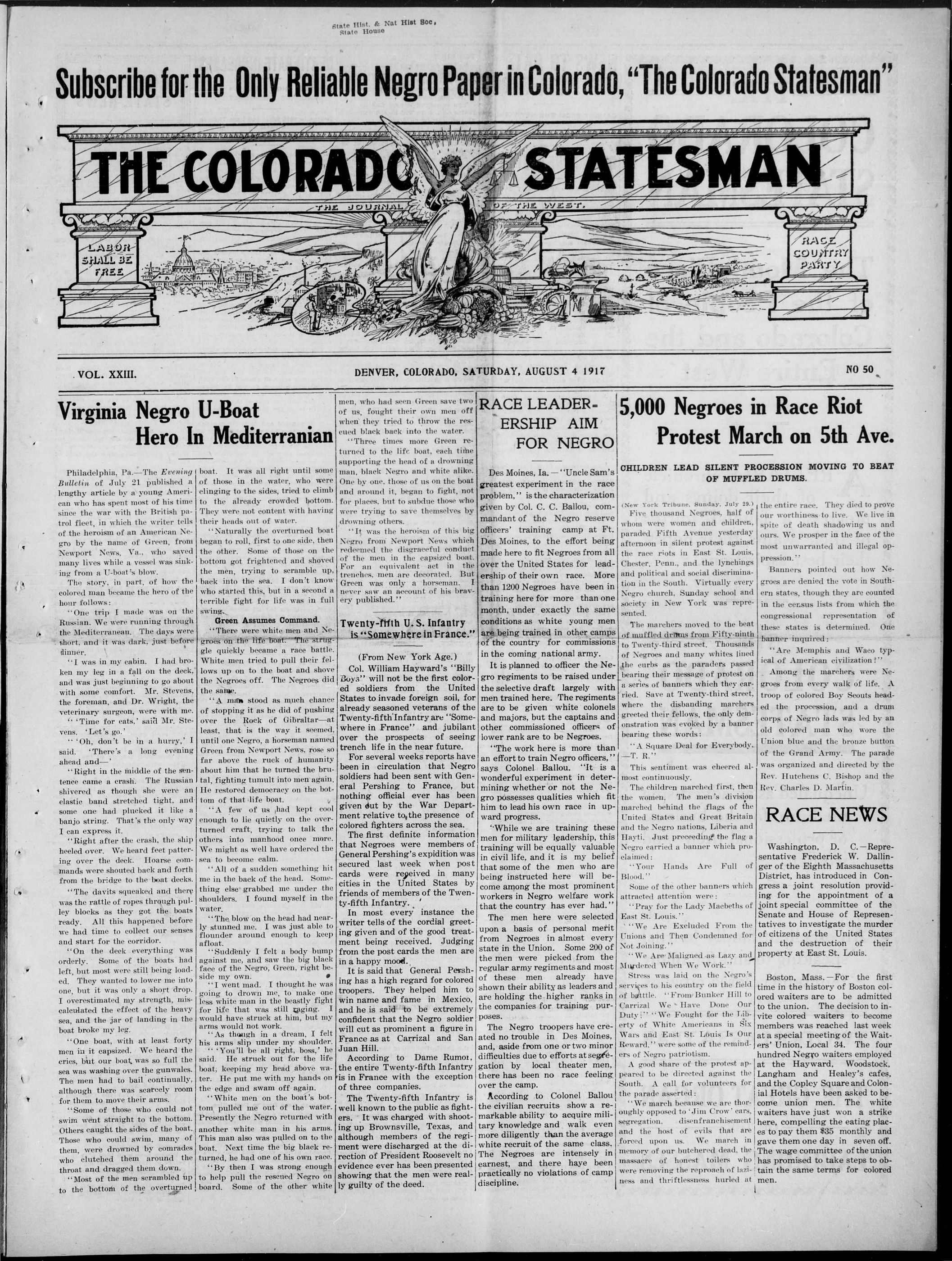
Virginia Negro U-Boat Hero In Mediterranian
VOL. XXIII.
Philadelphia, Pa.—The Evening Bulletin of July 21 published a lengthy article by a young American who has spent most of his time since the war with the British patrol fleet, in which the writer tells of the heroism of an American Negro by the name of Green, from Newport News, Va., who saved many lives while a vessel was sinking from a U-boat's blow.
The story, in part, of how the colored man became the hero of the hour follows:
"One trip I made was on the Russian. We were running through the Mediterranean. The days were short, and it was dark, just before dinner.
"I was in my cabin. I had broken my leg in a fall on the deck, and was just beginning to go about with some comfort. Mr. Stevens, the foreman, and Dr. Wright, the veterinary surgeon, were with me.
"Time for eats,' said Mr. Stevens. 'Let's go.'
"Oh, don't be in a hurry," I said. 'There's a long evening ahead and—'
"Right in the middle of the sentence came a crash. The Russian shivered as though she were an elastic band stretched tight, and some one had plucked it like a banjo string. That's the only way I can express it.
"Right after the crash, the ship heeled over. We heard feet patterning over the deck. Hoarse commands were shouted back and forth from the bridge to the boat decks.
"The davits squeaked and there was the rattle of ropes through pulley blocks as they got the boats ready. All this happened before we had time to collect our senses and start for the corridor.
"On the deck everything was orderly. Some of the boats had left, but most were still being loaded. They wanted to lower me into one, but it was only a short drop. I overestimated my strength, miscalculated the effect of the heavy sea, and the jar of landing in the boat broke my leg.
"One boat, with at least forty men in it capsized. We heard the cries, but our boat was so full the sea was washing over the gunwales. The men had to bail continually, although there was scarcely room for them to move their arms.
"Some of those who could not swim went straight to the bottom. Others caught the sides of the boat. Those who could swim, many of them, were drowned by comrades who clutched them around the throat and dragged them down.
"Most of the men scrambled up to the bottom of the overturned
boat. It was all right until some of those in the water, who were clinging to the sides, tried to climb to the already crowded bottom. They were not content with having their heads out of water.
"Naturally the overturned boat began to roll, first to one side, then the other. Some of those on the bottom got frightened and shoved the men, trying to scramble up, back into the sea. I don't know who started this, but in a second a terrible fight for life was in full swing.
Green Assumes Command.
"There were white men and Negroes on the life boat. The struggle quickly became a race battle. White men tried to pull their fellows up on to the boat and shove the Negroes off. The Negroes did the same.
"A man stood as much chance of stopping it as he did of pushing over the Rock of Gibraltar—at least, that is the way it seemed, until one Negro, a horseman named Green from Newport News, rose so far above the ruck of humanity about him that he turned the brutal, fighting tumult into men again. He restored democracy on the bottom of that life boat.
"A few of us had kept cool enough to lie quietly on the overturned craft, trying to talk the others into manhood once more. We might as well have ordered the sea to become calm.
"All of a sudden something hit me in the back of the head. Something else grabbed me under the shoulders. I found myself in the water.
"The blow on the head had nearly stunned me. I was just able to flounder around enough to keep afloat.
"Suddenly I felt a body bump against me, and saw the big black face of the Negro, Green, right beside my own.
"I went mad. I thought he was going to drown me, to make one less white man in the beastly fight for life that was still raging. I would have struck at him, but my arms would not work.
"As though in a dream, I felt his arms slip under my shoulder.
"You'll be all right, boss,' he said. He struck out for the life boat; keeping my head above water. He put me with my hands on the edge and swam off again.
"White men on the boat's bottom pulled me out of the water. Presently the Negro returned with another white man in his arms. This man also was pulled on to the boat. Next time the big black returned, he had one of his own race.
"By then I was strong enough to help pull the rescued Negro on board. Some of the other white
DENVER, COLORADO, SATURDAY, AUGUST 4 1917
DENVER, COLORADO, SATURDAY, AUGUST 4 1917
State Hist. & Nat Hist Soc.
State House
table Negro Pap
ADO
DE JOURNAL
DENVER, COLORADO, SA
men, who had seen Green save two of us, fought their own men off when they tried to throw the rescued black back into the water.
"Three times more Green returned to the life boat, each time supporting the head of a drowning man, black Negro and white alike. One by one, those of us on the boat and around it, began to fight, not for places, but to subdue those who were trying to save themselves by drowning others.
"It was the heroism of this big Negro from Newport News which redeemed the disgracetiful conduct of the men in the capsized boat. For an equivalent act in the trenches, men are decorated. But Green was only a horseman. I never saw an account of his bravery published."
Twenty-fifth U. S. Infantry is "Somewhere in France."
(From New York Age.)
Col. William Hayward's "Billy Boys" will not be the first colored soldiers from the United States to invade foreign soil, for already seasoned veterans of the Twenty-fifth Infantry are "Somewhere in France" and jubilant over the prospects of seeing trench life in the near future. For several weeks reports have been in circulation that Negro soldiers had been sent with General Pershing to France, but nothing official ever has been given out by the War Department relative to the presence of colored fighters across the sea. The first definite information that Negroes were members of General Pershing's expedition was secured last week when post cards were received in many cities in the United States by friends of members of the Twenty-fifth Infantry.
In most every instance the writer tells of the cordial greeting given and of the good treatment being received. Judging from the post cards the men are in a happy mood.
It is said that General Pershing has a high regard for colored troopers. They helped him to win name and fame in Mexico, and he is said to be extremely confident that the Negro soldier will cut as prominent a figure in France as at Carrizal and San Juan Hill.
According to Dame Rumor, the entire Twenty-fifth Infantry is in France with the exception of three companies.
The Twenty-fifth Infantry is well known to the public as fighters. It was charged with shooting up Brownsville, Texas, and although members of the regiment were discharged at the direction of President Roosevelt no evidence ever has been presented showing that the men were really guilty of the deed.
RACE LEADER- ERSHIP AIM FOR NEGRO
Des Moines, Ia. — "Uncle Sam's greatest experiment in the race problem," is the characterization given by Col. C. C. Ballou, commandant of the Negro reserve officers' training camp at Ft. Des Moines, to the effort being made here to fit Negroes from all over the United States for leadership of their own race. More than 1200 Negroes have been in training here for more than one month, under exactly the same conditions as white young men are being trained in other camps of the country for commissions in the coming national army.
It is planned to officer the Negro regiments to be raised under the selective draft largely with men trained here. The regiments are to be given white colonels and majors, but the captains and other commissioned officers of lower rank are to be Negroes.
"The work here is more than an effort to train Negro officers," says Colonel Ballou. "It is a wonderful experiment in determining whether or not the Negro possesses qualities which fit him to lead his own race in upward progress.
"While we are training these men for military leadership, this training will be equally valuable in civil life, and it is my belief that some of the men who are being instructed here will become among the most prominent workers in Negro welfare work that the country has ever had."
The men here were selected upon a basis of personal merit from Negroes in almost every state in the Union. Some 200 of the men were picked from the regular army regiments and most of these men already have shown their ability as leaders and are holding the higher ranks in the companies for training purposes. The Negro troopers have created no trouble in Des Moines, and, aside from one or two minor difficulties due to efforts at segregation by local theater men, there has been no race feeling over the camp.
According to Colonel Ballou the civilian recruits show a remarkable ability to acquire military knowledge and walk even more diligently than the average white recruit of the same class. The Negroes are intensely in earnest, and there haye been practically no violations of camp discipline.
5,000 Negroes in Race Riot Protest March on 5th Ave.
CHILDREN LEAD SILENT PROCESSION MOVING TO BEAT OF MUFFLED DRUMS.
(Fnew York Tribune, Sunday, July 29.) Five thousand Negroes, half of whom were women and children, paraded Fifth Avenue yesterday afternoon in silent protest against the race riots in East St. Louis, Chester, Penn., and the lynchings and political and social discrimination in the South. Virtually every Negro church, Sunday school and society in New York was represented.
The marchers moved to the beat of muffled drums from Fifty-ninth to Twenty-third street. Thousands of Negroes and many whites lined the curbs as the paraders passed bearing their message of protest on a series of banners which they carried. Save at Twenty-third street, where the disbanding marchers greeted their fellows, the only demonstration was evoked by a banner bearing these words:
"A Square Deal for Everybody.—T. R."
This sentiment was cheered almost continuously.
The children marched first, then the women. The men's division marched behind the flags of the United States and Great Britain and the Negro nations, Liberia and Hayti. Just preceeding the flag a Negro carried a banner which proclaimed:
"Your Hands Are Full of Blood."
Some of the other banners which attracted attention were:
"Pray for the Lady Macbeths of East St. Louis."
"We Are Excluded From the Unions and Then Condemned for Not Joining."
"We Are Aligned as Lazy and Murdered When We Work."
Stress was laid on the Negro's services to his country on the field of buttle. "From Bunker Hill to Carrizal We Have Done Our Duty;" "We Fought for the Liberty of White Americans in Six Wars and East St. Louis Is Our Reward," were some of the reminders of Negro patriotism.
A good share of the protest appeared to be directed against the South. A call for volunteers for the parade asserted:
"We march because we are thoroughly opposed to 'Jim Crow' cars, segregation, disenfranchisement and the host of evils that are forced upon us. We march in memory of our butchered dead, the massacre of honest toilers who were removing the reproach of laziness and thriftlessness hurled at
NO 50
the entire race. They died to prove our worthiness to live. We live in spite of death shadowing us and ours. We prosper in the face of the most unwarranted and illegal oppression." Banners pointed out how Negroes are denied the vote in Southern states, though they are counted in the census lists from which the congressional representation of these states is determined. One banner inquired:
"Are Memphis and Waco typical of American civilization?" Among the marchers were Negroes from every walk of life. A troop of colored Boy Scouts headed the procession, and a drum corps of Negro lads was led by an old colored man who wore the Union blue and the bronze button of the Grand Army. The parade was organized and directed by the Rev. Hutchens C. Bishop and the Rev. Charles D. Martin.
RACE NEWS
Washington, D. C.—Representative Frederick W. Dallinger of the Eighth Massachusetts District, has introduced in Congress a joint resolution providing for the appointment of a joint special committee of the Senate and House of Representatives to investigate the murder of citizens of the United States and the destruction of their property at East St. Louis.
Boston, Mass.—For the first time in the history of Boston colored waiters are to be admitted to the union. The decision to invite colored waiters to become members was reached last week at a special meeting of the Waiters' Union, Local 34. The four hundred Negro waiters employed at the Hayward, Woodstock, Langham and Healey's cafes, and the Copley Square and Colonial Hotels have been asked to become union men. The white waiters have just won a strike here, compelling the eating places to pay them $35 monthly and gave them one day in seven off. The wage committee of the union has promised to take steps to obtain the same terms for colored men.
---
CAUGHT FROM THE NETWORK OF WIRES ROUND ABOUT THE WORLD.
COLORADO STATESMAN
DURING THE PAST WEEK
RECORD OF IMPORTANT EVENTS
CONDENSED FOR BUSY
Western Newspaper Union News Service.
ABOUT THE WAR
Another contingent of American troops arrive in Europe.
The Mouth-Piece of the People of Colorado and the Entire West
Russians have fallen back over 100 miles on portion of front.
Kutty, in the Carpathians, has been captured by the Teutons. German and Russian women face each other on Galician battlefield. Hard training is developing great efficiency in American troops in France. Rumanians report the capture of several villages in the valleys of Casin and Putna. The American bark Carmela was sunk by a submarine. The crew was landed safely. American destroyers routed two submarines in a clash in European waters, after one had sunk a merchantman. A German submarine sank five Dutch fishing vessels eighteen miles from the Dutch coast between Scheveningen and Ymuiden.
Violent artillery duels continue on the Aisne and Verdun regions of the French front, while German surprise attacks at various points were repulsed.
The Russians, in a severe bayonet fight on the east banks of the River Zbrocz, repulsed an Austro-German attack which was intended to force a passage across the river.
A RELIABLE chronicle of their doings and progress; a faithful mirror of their wants, their hopes, their best aspirations.
British casualties in all theaters of military operations published in the newspapers during the month of July total 71,832 officers and men. The officers killed, wounded or missing total 2,503, while the men number 69,329. Loyal Russians have returned to the army in Galicia, stopped the flight and are holding an important height on the river Zbrozc after a violent battle. On several sectors the Russian retreat has been halted, and the Slavs are opening up new attacks.
The great assault of the allies, for which the big guns have been preparing for three weeks, resulted in the capture July 31 of three first line German trenches by the British and the capture of two by the French. Paris and London statements tell of enormous losses by the Teutons, whose defenses were completely crushed over a wide front in Flanders. In addition to capturing ten or more towns, 3,500 Germans were taken prisoner and hundreds upon hundreds were left dead on the battlefield.
THE COLORADO STATESMAN
Potato production may not reach estimated figure, says Lou D. Sweet.
Seattle and Tacoma's street car strike was virtually ended at a conference. General Harrison Gray Otis, president and general manager of the Los Angeles Times, died at the home of his son-in-law, Harry Chandler, in Los Angeles.
Unequaled as an advertising medium for the business of professional men and women.
A submarine controlled entirely by wireless that swims on the surface or under water, dives and emerges, fires cannon balls and torpedoes, apparently at its own volition, is the invention of Robert Morton of Los Angeles.
C. W. Woodman, state labor commissioner of Texas, was arrested in connection with the indictments returned against certain state officials. Woodman is charged on eight counts with perjury in connection with certain expense accounts.
Enter the military girl. Braided and buttoned a la militaire, the fullest of fall frocks will be made to harmonize with "the spirit of 1917," according to the styles being prepared for the annual fashion show to be held in Chicago the week of Aug. 8.
WASHINGTON
An excellent family journal speaking to and for many thousand colored citizens.
The second class of 755,700 men registered under the draft will be called up for examination in August.
Shortage of Germans of military age for office work and continued deportation of Belgians are reported as prevailing in the city of Ghent, Belgium.
To stimulate interest in the nationwide canning campaign the National Emergency Food Garden Commission announced that it will give $5,000 in prizes for the best canned vegetables shown at town exhibits and at county and state fairs in September and October.
TWODOLLARSAYEAR
America's foreign trade in 1917 reached the unprecedented total of $8,953,000,000 of which $6,294,000,000 was exports and $2,659,000,000 imports.
The most intense hot wave of the year continued Tuesday in the central Mississippi valley, the Middle Atlantic states, New England and the lower lake region.
The first step toward financing the second installment of the Liberty loan was taken by the treasury with the offering of $300,000,000 in treasury certificates of indebtedness.
FOREIGN
Balfour defines war alms of Allies.
At Buenos Aires a slight earthquake was felt.
Germany begins fourth year of war by talking "peace."
The Petrograd Bourse Gazette estimates that there will be 850 delegates at the Moscow conference.
The British cruiser Ariadne, of 11,000 tons, was torpedoed and sunk, according to an official statement issued by the British admiralty.
"The German authorities at Liege, Belgium, arrested, tried and sentenced to death within three days an influential Liege merchant named Cronert, his wife and their two daughters, aged 20 and 14 years, on the unproved charge of espionage," according to an Amsterdam report.
Capt. Joseph E. Bernier, the Arctic explorer, who started on an expedition in July last year to attempt to rescue Vilhjalmur Stefansson, who was reported lost in the Arctic regions, is returning on his ship. The Guide, according to reports at Quebec from the north shore of the St. Lawrence.
Russia's women soldiers have pledged themselves to take their own lives rather than become German war prisoners. Each woman soldier carries a ration of cyanide of potassium to be swallowed in event of capture. The members of the women regiments, now constantly increasing, agreed that death was to be preferred to the fate they would probably meet at the hands of the Germans.
The State Department at Washington looks upon the utterances of Dr. Georg Michaelis, the German imperial chancellor, and Count Czernin, the Austro-Hungarian foreign minister, with considerable suspicion, and as a game to split the allies. The central powers calculated to revive the peace discussion and to force the entente powers and America to state their irreducible peace terms.
According to a Reuter dispatch from Zurich, Mathias Erzberger, one of the leaders of the clerical center in the German reichstag, who has just arrived there, declared to the Zuricher Nachrichten: "If I could talk with Lloyd George (the British premier) or Mr. Balfour (British foreign secretary) we could in a few hours reach an understanding which would enable official peace negotiations to commence."
SPORTING NEWS
Standing of Western League Clubs.
CLUBS. W. L. Pct.
Wichita 7 2 .778
Hutchinson 6 3 .667
Joplin 5 4 .556
Sloug City 5 4 .556
Denver 3 6 .333
Lincoln 3 6 .333
Des Moines 3 6 .333
Omaha 2 7 .222
Gay Crusader won the derby at London. Dansellon was second and Dark Legend third.
Charles Garland, the Pittsburg star, won from Glen Morris, formerly of Los Angeles, in a first round match in the western patriotic tennis tournament at Chicago, 6-0, 6-1.
The Canadian racing season of 1917 ended with the close of the Kenilworth meet. The dominion government recently passed a law that no racing would be allowed after Aug. 1, in response to public advocacy of shutting down the racetracks until after the war.
Following are the new world's Wild West champions, winning their titles at Cheyenne's Frontier Day celebration: Rough riding, Samuel Brownell, Wyoming; rough riding (women), Mrs. Edward Wright, New Mexico; steer bulldogging, Edward Eddie, Oklahoma; steer roping, John Murrah, New Mexico; relay race (women), Ruth Parton, Washington; trick and fancy riding, Harry Walters, Colorado; trick and fancy roping, Samuel Garrett, Oklahoma.
GENERAL
Another "slacker" rush for marriage licenses began in New York, 351 being issued.
In response to America's need of an increased food supply during the war, sugar growers of Haiti will send to this country 90,000,000 pounds of their product during the next crop season.
Lieut. Gen. Vladimir H. Roop and others of the military section of the Russian commission were the guests of Brigadier General Bell at a division review of the troops at Fort Bliss, Tex.
During an address in which he is alleged to have called President Wilson "King Wilson" and "a hypocrite," Irving S. Abrams invited "any government detectives present to step forward." One did. Abrams is held in $2,000 bonds in Chicago.
In a speech at Madison Barracks, N. Y., before 1,700 members of the officers' reserve corps, Secretary of State Lansing, emphasizing the peril of German imperialism to the United States and the world, declared his belief that the German people would not cast off the yoke of autocracy, "until the physical might of the united democracies of the world has destroyed forever the evil ambitions of the military rulers of Germany." That, he added, is the only way to restore the peace of the world.
Miners, harvest hands and lumbermen of the middle west threaten to go on a sympathetic strike unless deported I. W. W. members are returned to their homes in the Warren district of Arizona. A telegram voicing the intention of a walkout of more than 250,000 men was sent from Chicago to President Wilson by W. D. Haywood, secretary of the Industrial Workers of the World.
An advance of 1 cent a quart, making the price of milk $12½ cents, will cost the consumers $7,300,000 a year in New York.
DEATH RATE INCREASES
FIGURES SHOW MILLION COLO- RADOANS ARE HEALTHY.
Deaths in 1916 Were 500 Less Than in 1915—Stork Bests Grim Reaper —Forty-eight Twins.
Western Newspaper Union News Service.
Denver.—Not the least of Colorado's assets is the healthfulness of her 1,000,000 people. Deaths for 1916, the report of which has just been compiled by Miss Marie E. Egger, statistician of the State Board of Health, show a decrease of 500 over 1915, and establish the enviable record of mortality of ten deaths for every 1,000 persons. This, according to comparative records for other states, is exceptionally low.
Total deaths in 1916 numbered 10, 107, as against 10,602 for the previous year. The total births in 1916, on the other hand, were 14,753, more than offsetting the death rate.
That the stork has bested the grim reaper in the first three months of 1917, at least, is seen from additional statistics furnished. During that period 3,646 births were reported over the state, as against 3,109 deaths. Included in the births were forty-eight twins.
The 1916 mortality statement shows that 535 more men died than women, the figures being as follows: Males, 5,821; females, 4,286. The heaviest toll in any score of years in the span of life was between 60 and 80, where 2,227 deaths are recorded, showing that the many citizens of the commonwealth reach the three score and ten limit.
Five hundred and forty-six persons died after they had reached the age of 80, while 1,591 babies under 1 year were included in the mortality toll. The exact ages of 452 persons could not be ascertained by the authorities. There was only one death from smallpox in the state during the twelve-month period, only one death from infantile paralysis and only one death from malaria. There were but three deaths from typhus fever, three from spotted fever (tick bite) and three from pellagra. Seven persons died of lockjaw. There were 753 deaths from violence as follows: Suicides, 120; accidents, 567; homicide, 66. This is a decided decrease over the previous year—suicides, 164; accidents, 702; homicides, 93.
Appendicitis rolled up 172 deaths in 1916, as against 153 for 1915. Diphtherla claimed 34 people and typhoid fever 109. Tuberculosis led all other diseases in claiming 1,561 deaths, while organic heart disease brought a toll of 1,044 Jeaths. Bright's disease claimed 710 people, while nervous diseases registered 952 deaths.
Banks to Help State Pay Guards.
Representatives of the banking interests of Denver and the Denver Clearing House Association held a conference with Gov. Gunter and an agreement was reached in which the banks will supply money for the payment of the National Guard troops and other expenditures connected with the guard incident to the mobilization and guard service throughout the state up to Aug. 5, when the guard is taken over by the federal government. The money, totaling $325,000, is to be advanced without discount and secured by the issuance of certificates of indebtedness which it is expected will be taken up by an action of the special session of the Legislature. The action taken by the Denver banks was communicated by telephone to banks in Colorado Springs, Pueblo and Trinidad, and the money to be advanced has been divided up with the understanding that the banks of Denver will give $200,000, Pueblo $50,000, Colorado Springs, $50,000, and Trinidad $25,000.
Guard Mothers Enlarge Duties.
The Woman's State Auxiliary of the National Guard of Colorado is endeavoring to organize a mothers' club or mothers' division for every troop unit. The Denver mothers are making an effort to have the organization firmly established all over the state. Branches have been formed in Boulder and several other towns.
Mrs. Lee Wage Board's Secretary.
- The completion of the organization of the Colorado minimum wage and labor commission was made known by the announcement of the appointment of Mrs. Gertrude A. Lee as secretary of the commission by the tSate Industrial Commission which administers the wage commission.
Body of Col. Evans Sent East.
The body of Col. E. W. Evans, U. S. A., who was found dead in his room in a Pueblo hotel, was sent to his home at Newport, N. Y. Maj. James A. Force of the First cavalry regiment, C. N. G., accompanied the body.
Women Take Part in Festivities
The Woman's State Auxiliary to the Colorado National Guard took a prominent part in the Colorado Day festivities held under the auspices of the patriotic organizations under the leadership of the Sons and daughters of Colorado. Many of the members were in the parade, and they had a tent at City Park where refreshments were served the guardsmen. About 25,000 sandwiches were made for the occasion.
COLORADO STATE NEWS
Aug. 6-16—State Federation of Labor meeting at Boulder.
Aug. 16—Spot at Oak Creek.
Aug. 25—Pickle Day at Platteville.
Aug. 28-30—Annual Convention. P.
inform
A
Grand Lodge, including Uniform
Rank, Pythian Sisters and Knights
of Khorassan, at Colorado Springs.
Sept. 4-7. -Frontier Days' celebration
Sept. 4-7--Arkansas Valley Fair at Rocky Ford.
Sept. 6-8.—Firemen's State Convention at Colorado Springs.
Sept. 17-22.—Colorado State Fair at Pueblo.
Over 60,000 acres of beans are being cultivated in Weld county.
The Legislature appropriated $10 each for Colorado soldier boys.
Wyatt Boger of Burlington chosen on state fair board in place of Spencer Penrose.
Over $11,000 in prizes will be offered at Fort Morgan's Frontier Show, Sept. 4-7.
Eighteen autos alleged to have been stolen by a man arrested at Pueblo are recovered.
First exemption board call summons fifty-two Denver men to report in District No. 5.
Officers' reserve men have been called to report at Fort Snelling, Minn., Aug. 26. There are 813 applicants in Colorado. "Colorado will be the next field for I. W. W.s and their work," asserted Charles H. Moyer, president of the Western Federation of Miners. George R. Broad, son of Richard J. Broad, Jr., of Golden, has been appointed an assistant paymaster in the United States navy with the rank of ensign. The net receipts from the national forests under the Denver jurisdiction for the fiscal year ending June 30, 1917, show an increase of $29,600 over those of the preceding year.
Nearly all of the women of Leadville and many from outside the city were in attendance at a big meeting which organized a women's advisory council for good work in war time.
J. M. Taylor has been elected captain of the Denver Grand Army Veteran Military Company. R. H. McGill has been named as first Ileutenant and R. M. McElrose second lieutenant.
A family named East, from Indiana, camping on the Rio Grande river above Creede, had a little daughter, aged 5 years, who fell into the river and was drowned. The body was recovered.
It is reported that during the last month the Tomboy company of Telluride, which is an English-owned corporation, paid $75,330, or 24 per cent, in spite of the English tax of 30 per cent for war purposes.
The old mine near Lake City in which Walter Mendenhall made the recent sensational strike, giving fabulous assays, is owned by Mrs. F. E. Williams of San Diego, and is under lease to Mendenhall.
A score or more of the Indians who have been working in the vicinity of Lamar during the summer are eager to join Company D, but they have not yet succeeded because of the failure of the Indian agent to grant the necessary permission.
Fifty-four members of the headquarters and supply section of the engineer train, Colorado National Guard, formerly known as Truck Supply Company No. 1, mobilized at Colorado Springs, preparatory to going into camp near Golden.
Agents of the United States Department of Justice, after a conference with United States District Attorney Tedrow, decided to charge Mrs. Anna Smith of Louisville and Hugh McLeod with bringing intoxicants into the state in violation of the Reed law.
Driven to despondency through her inability to obtain work, Mrs. Kitty Evans, 52, attempted to drown herself in an irrigating ditch near the Nine-Mile house, on the Brighton road north of Denver, and would have been successful had it not been for the timely arrival of W. E. Crouse.
M. L. Baldwin, proprietor of a hotel at Idledale, was seriously injured, and Alvin Laub of Memphis, Tenn., suffered a fracture of the collarbone when an automobile in which they were riding plunged over an embankment two miles east of Morrison and tumbled a distance of forty feet.
Echoes of the factional fight in the German Evangelical Lutheran church of Windsor, which occurred last March, were heard in the District Court at Greeley in the case of the Rev. William Wilk, discharged pastor, against trustees and members of the church. Mr. Wilk is suing for $40,000 damages on charges of false arrest, false imprisonment and malicious prosecution.
Possibilities that the Colorado National Guard now encamped at the Colorado State Fair Grounds, might interfere with the holding of the 1917 exhibition Sept. 17 to 22, have been removed with an announcement from Governor Gunter that troops would be removed during August.
Papers have been filed with the secretary of state incorporating the Book Cliff Oil Shale Company, capitalized at $750,000, divided into $250,000 8 per cent preferred stock and $500,000 common shares, both having a par value of $1 a share
NOTHING DOWN AND 17 CTS. A DAY BUYS A PIANO. SALE NOW ON. THE PIANO EXCHANGE H. A. TRIGGS, Manager 211 Charles Block. Cor. 15th and Curtis Streets. Phone Champa 3742.
Short Orders At All Hours
919 NINETEENTH STREET
The Chase
Twenty
Is
RUGS, CHEMICAL
WE SEE
Prescripti
Phone us and we will
JAMES B
BOLDEY
and L
924 19th
The Champa Pharmacy
Twentieth and Champa,
Is the place to get your
DRUGS, CHEMICALS AND PATENT MEDICINES
WE SERVE DRINKS.
Prescriptions Our Specialty.
Phone us and we will deliver the goods to all parts of the city.
JAMES E. THRALL, PROPR.
PHONE MAIN 2425.
924 19th Street, Denver, Colorado
DINNER
11:30 to 2 p.m.
All Kinds of Sandwiches
Bolden Bros. Barber Sh
Baths, Electric Massage
FIRST CLASS SERVICE
R. B. BOLDEN, Mgr. 926 19th St. D
Weatherhead Hat
TELEPHONE MAIN 3203
Golden Bros. Barber Sh
Baths, Electric Massage
FIRST CLASS SERVICE
. BOLDEN, Mgr. 926 19th St. D
atherhead Hat
TELEPHONE MAIN 3203
Bolden Bros. Barber Shop
Baths, Electric Massage
FIRST CLASS SERVICE
R. B. BOLDEN, Mgr. 926 19th St. Denver
Weatherhead Hat Co.
TELEPHONE MAIN 3203
Established 1876
PIONEER HATTERS OF THE WEST
WE MAKE OLD HATS NEW
PRACTICAL HATTERS
RENOVATORS, BLEACHERS DYERS AND FIL
Of Gents' and Ladies' Hats of Every Descrip
1624 Champa St., Denver, Colo.
HONE MAIN 3028 RES. PHONE
JOHN K. RETTIG
PRACTICAL HATTERS VATORS, BLEACHERS DYERS AND FINE Gents' and Ladies' Hats of Every Descripti 1624 Champa St., Denver, Colo.
RENOVATORS, BLEACHERS DYERS AND FINISHERS Of Gents' and Ladies' Hats of Every Description 1624 Champa St., Denver, Colo.
Meats, Fancy and Staple Groceries 1864 CURTIS STREET
The MARKET COMPANY
C. E. SMITH, Manager, Res. Phone South 1608
Wholesale and Retail Staple and Fancy Groceries, Fish and Oysters Hotels and Restaurants Our Specialty. Fresh and Cured Eastern Corn Fed Meats Fruits, Vegetables, Poultry and Game.
Telephones Main 4302, 4303, 4304, 4305
622-636 15th Street Denver, olorado
Fruit Bowl
Short Orders at All Hours
per Shop
age
CE
19th St. Denver
Hat C
203
BUTTERS
AND FINISHERS
ery Description
Colo
VINE
```markdown
```
JOINT PLAN TO CONTROL SHIPPING
AMERICAN BOARD MOVES TO COMMANDEER CHARTERS OF SHIPS AS FIRST STEP.
EMBARGO PUT ON IRON
DR. NANSEN DECLARES NORWAY MUST GET FOOD FROM U. S. OR FACE STARVATION.
Western Newspaper Union News Service.
Washington.—Plans for taking over for operation all American ocean-going merchant ships soon will be announced by the Shipping Board. Charters will be requisitioned under a recent act of Congress authorizing the President to commandeer tonnage for government uses.
The program is preliminary to putting into operation an agreement between the American and British governments for joint control of the world's shipping. It will give the Shipping Board control of ocean freight rates charged by American ships and a rate basis being worked out will be used for building an international rate schedule.
The plan is to commandeer charters and wherever advisable let the ship itself be operated by its owner under a government charter. In this way the government will direct operations and specify services in which ships shall ply and, at the same time, avoid expenditure of the vast sum of money that would be required if the hulls themselves were taken over.
President Wilson forbade export of any iron and steel plate, pig iron, iron and steel scrap and steel billets from this country except such as the allies need for "actual war purposes." Other iron and steel products are allowed to be freely licensed, but only to the allies.
Norway, facing starvation if the United States cuts off exports of food, is ready to release a million tons of her shipping in return for the privilege of importing food—principally from the United States.
Dr. Fritjof Nansen, head of the Norwegian mission to the United States, declared unreservedly that Norway faced privation if the United States enforced an export embargo against her. Norway also would give a guarantee that none of the food imported would reach Germany.
ALLIES REPULSE COUNTER BLOW
German Losses Enormous in Effort to Regain Ground at Ypres.
London, Aug. 3.—Enormous losses are sustained by the Germans in a series of counter attacks launched in an effort to regain some of the ground taken by the allies in the battle of Flanders. Especially violent were the German assaults around Ypres and St. Julien.
British parties raided the enemy trenches northeast of Gouzeacourt and inflicted many casualties. The French are keeping up their terrific bombardment on the Meuse and in the region of Allemont.
Petrograd reports the loss of a half dozen villages and many positions on the banks of the river Zbrocz on the Galician frontier and along the Dnelster. The Russian Carpathian army is in retreat.
Gen. Dimitrieff, the former "Little Napoleon of Bulgaria," has resigned as commander of the Russian army on the Riga front, and Gen. Parsky will succeed him.
The Duma has issued a statement blaming the "cowardly" riffleff of the army for the Slav collapse and appealing to the people to save the nation.
Miners Refuse Concessions. Miami, Ariz.—Striking miners of the International Union of Mine, Mill and Smelter Workers and allied crafts at a mass meeting here Thursday afternoon voted to refuse concessions offered by the mine operators of the Globe-Miami district. Judge McBride explained the offer of the operators to receive the grievance committee of the men at least once a month and to allow them to inspect the company hospital. The men demanded recognition of their union.
Two Die at Same Spot.
Sterling.—At the spot where D. A. Caddy fell dead, a victim of lightning stroke, a few days ago, H. W. Eaton, father-in-law of Caddy, died at almost the same hour. Death was due to apoplexy. Eaton, aged 79, was in the yard with his daughter, the widow of Caddy. The daughter turned toward the house to go about her household duties when she heard a cry from her father, and, turning, saw him fall.
Postpone Prohibition Vote.
Washington.—Although convinced that action could be forced in the House at once on the Sheppard national prohibition resolution which was passed by the Senate, the dry forces decided to await the December session before passing the measure.
Denver Dentist Named for Navy.
Washington.—Secretary Daniels recommended for probationary appointment as dental surgeon in the navy, Robert S. Maxwell, Denver.
ASSIGNS DRAFT QUOTAS
MASTER LISTS AND REGULA-
TIONS SENT OUT.
Exemption Board Machinery Set in
Motion by Governor Gunter for
State's Conscription.
Denver.—The machinery of the selective and exemption boards for the drafting of Colorado's quota of the national army has been set in motion, according to a statement issued by Provost Marshal John Evans. The master lists and regulations have been sent out as received from Washington and Gov. Julius C. Gunter has made assignment to the seventy-five exemption boards throughout the state the quota expected to be raised by the respective counties. The State Utilities Board has received a letter from the special committee on national defense at Washington outlining a number of suggestions to the railroad companies of the state regarding the carrying out of the draft regulations affecting railroad employés subject to draft. It is suggested the railroads make a complete list of all those who can be spared from active railroad service whose places can be taken by inexperienced men or by women. Lists and affidavits are also requested to be furnished showing those whom the railroad companies think should be relieved from war duty as their services being necessary for the operation of troop and supply trains and other duties assisting the public defense act of the nation.
"There is some considerable conjecture," said Judge Advocate Frank West, "as to the percentages that will be shown by the first reports of the local boards of the probable rejection to be expected among the hundred thousand registrants of Colorado for physical reasons or for dependents. A probable rejection of one in every four is figured on account of physical disability. In some localities his will greatly vary.
"It is rather difficult to figure on the proposition of dependents or how many are to be excused as to industrial claims and peculiar results will be brought out in some districts. According to close reasoners the lowest rejection figures will come from the wealthy districts of the large cities or communities of the state, where men of good incomes live.
"It is figured that the sons of such men have had better food, care and surroundings than the miners, factory hands or Beet field workers, and the former should necessarily be in better physical condition."
Ship $40,000 "High-Grade" Ore. Chripple Creek. Forty thousand dollars' worth of ore that was recovered from the band of high-graders convicted in Cheyenne July 3 as the result of their operations in this gold field was sent from here to the Pueblo smelter, consigned to the Mine Owners' Association. The ore was taken from the offices of Tony Cuaz, who confessed to government investigators before the trial; Charles Daniels and Daniel McLeod, all in Cripple Creek, and Frank Cochrane in Victor.
Attorney Killed in Spill of Auto. Grand Junction.—Charles Lee Watson, a prominent attorney, was thrown from his automobile and instantly killed at a curve about twenty-five miles south of Grand Junction. His wife and baby, Mr. and Mrs. Fred Coe and their baby, all of Grand Junction, who were riding with him in the automobile at the time, received only slight bruises. The party had been on a fishing excursion and were returning to Grand Junction.
Mine Minimum May Be Raised.
Denver.—The situation in the Lead-
ville gold camp took an unexpected
turn Tuesday night, when a meeting
of the mine operators was called for
the purpose of considering a propo-
sition of voluntarily increasing the min-
imum wage scale to $4 a day.
Hillard and Jones Ousted.
Denver.—At the recall election
Tuesday, Hillard was recalled as
school director by a vote of 11,479 to
5,163, and Jones by 10,828 to 5,506.
They are succeeded as members of
the school board by F. H. Cowell and
Mrs. W. S. Lail.
C. C. C. to Pay Dividend Sept. 1.
Colorado Springs. — The Cripple
Creek Central Railway Company has
issued notices of dividends payable
Sept. 1 to stockholders of record Aug.
15. Dividend No. 47 is for 1 per cent
and No. 31 for $1½ per cent.
Colorado Senate Votes to Adjourn.
Denver, Aug. 1.—The Senate yester-
day adopted the Schermerhorn resol-
tion to adjourn sine die at 6 o'clock
Saturday night. The vote stood 28 to
5. The House will consider the resol-
tion later.
Postoffice Safe Blown at Pierce.
Pierce.—The postoffice safe in the general store of John E. Schaefer was blown open and looted. The thieves took about $55, but so far as can be learned no stamps were taken. A considerable amount of currency was overlooked. The door of the safe was blown off and considerable damage was done to the storeroom. The thieves first broke into a blacksmith shop, where they obtained tools. They left behind them several feet of fuse.
Western Beef Co.
Open Daily to 8:30 p. m.
ONE OF THE MOST UP
MARKETS
Fresh and Cured Meats of All
and Fancy
OF THE MOST UP-TO-DATE AND SAL MARKETS IN THE CITY.
Cured Meats of All Kinds. Fresh Vegetal and Fancy Groceries.
ONE OF THE MOST UP-TO-DATE AND SANITARY MARKETS IN THE CITY.
Fresh and Cured Meats of All Kinds. Fresh Vegetables, Staple and Fancy Groceries.
Our Prices Are Always the Lowest Free Delivery to All Parts of the City.
PHONE CHE
2048 LARIMER STREET
Opposite the
The Good
Gro
W. T. FLETCHER AND J.
RETAIL STAPLE AND
CORN FED MEATS.
ANY PART OF THE C
2549 Washington
Baxter Bldg.
PHONE CHAMPA 3022
J. R. DRESSOR
York 1327J
WALLA
Sov
The Colorado Wall
Age
John W. Masury & Sons Coa
Wall Paper, Paints, Oils and
Deco
WE DO HOU
1454 Welton St. Phone M
THE
Giant Bach-H
and T
Lankford and M
STRICTLY FIRE
Cleaning, Pressing, D
JOIN OUR MONTHLY
506 Eighteenth Street
NOLAN-GA
3001 Welton
PHONE CHAMPA 1641.
IMER STREET DENVER
Opposite the Three Rules.
Good Wee
Grocery
TETCHER AND J. W. WILLIAMS, Pro-
DITAIL STAPLE AND FANCY GROCERIE
N FED MEATS. MOTOR DELIVERY
ANY PART OF THE CITY.
Washington St. Denver
g. J. W. WILLIAMS
ONE CHAMPA 3022.
PRESSOR WALLACE CLOW
27J South 315J
Colorado Wall Paper and Paint
Agents for
V. Masury & Sons Coach Colors, Paints and V-
paper, Paints, Oils and Glass, Interior and
Decorators
WE DO HOUSE PAINTING
Velton St. Phone Main 871. DENVER
THINK
It Bach-Benz Clean
and Tailors
Lankford and McGain, Proprietors
STRICTLY FIRST-CLASS WORK
Meaning, Pressing, Dyeing and Remodelling
OUR MONTHLY PRESSING CLUB—S
eventh Street Phone
DLAN-GARNER C
Linton Phone Ch
PHONE CHAMPA 1641.
2048 LARIMER STREET DENVER, COLO.
Opposite the Three Rules.
The Good Weight Grocery
W. T. FLETCHER AND J. W. WILLIAMS, Proprietors.
RETAIL STAPLE AND FANCY GROCERIES.
CORN FED MEATS. MOTOR DELIVERY TO
ANY PART OF THE CITY.
2549 Washington St. Denver, Colo.
Baxter Bldg. J. W. WILLIAMS, Manager
PHONE CHAMPA 3022.
J. R. DRESSOR WALLACE CLOW A. B. CLOW York 1327J South 315J South 4243J The Colorado Wall Paper and Paint Co. Agents for John W. Masury & Sons Coach Colors, Paints and Varnishes. Wall Paper, Paints, Oils and Glass, Interior and Exterior Decorators WE DO HOUSE PAINTING 1454 Welton St. Phone Main 871. DENVER, COLO.
THINK
Giant Bach-Benz Cleaners and Tailors
Lankford and McCain, Proprietors
STRICTLY FIRST-CLASS WORK
Cleaning, Pressing, Dyeing and Remodelling
JOIN OUR MONTHLY PRESSING CLUB—$1.50
506 Eighteenth Street Phone Main 7376
NOLAN-GARNER CO.
3001 Welton Phone Champa 223
AUTHORIZED Ford
THE UNIVERSAL CAR AGENTS
PARTS ACCESSORIES TIRES
Unexcelled Service
Showing and demonstrating Ford car a pleasure.
Try us; puts you under no obligation to buy.
RUNABOUT, $345 TOURING, $360
F. O. B. Detroit F. O. B. Detroit
ACCESSORIES
Unexcelled Service
knowing and demonstrating Ford car a pleasure.
Try us; puts you under no obligation to buy.
JT, $345
TOUR
Detroit
F. O.
ARE YOU GUILTY?
A FARMER carrying an express package from a big mail-order house was accosted by a local dealer.
"Why didn't you buy that bill of goods from me? I could have saved you the express, and besides you would have been patronizing a home store, which helps pay the taxes and builds up this locality."
The farmer looked at the merchant a moment and then said:
"Why don't you patronize your home paper and advertisise? I read it and didn't know that you had the stuff I have here."
MORAL—ADVERTISE
---
---
Sundays Until 2:00 p. m.
DATE AND SANITARY
THE CITY.
Is. Fresh Vegetables, Staple
proceries.
NPA 1641.
DENVER, COLO.
Free Rules.
Weigh
ery
WILLIAMS, Proprietors.
FRANCY GROCERIES.
STORER DELIVERY TO
Denver, Colo.
W. WILLIAMS, Manage
CLOW
15J
A. B. CLOW
South 4243J
Paper and Paint Co.
Color
Colors, Paints and Varnishes.
Glass, Interior and Exterior
Painting
871. DENVER, COLO.
K
Benz Cleaners
Milors
Main, Proprietors
GLASS WORK
Ging and Remodelling
BISSING CLUB—$1.50
Phone Main 7376
RNER CO.
Phone Champa 223
RIES TIRES
Service
Ford car a pleasure.
O obligation to buy.
TOURING, $360
F. O. B. Detroit
Patronize Our
Advertisers
They are all
boosters and
deserve your
business.
pend Your Money
with your home merchants. They help pay the taxes, keep up the schools, build roads, and make this a community worth while. You will find the advertising of the best ones in this paper.
```markdown
```
THE COLORADO STATESMAN
FOR THE SUNDAY, JULY 11, 1914
KABUN
SMALL DE
FREE
BACK
COUNTRY
DARTY
Entered as second-class matter at the postoffice in the City of Denver, Colo.
JOS. D. D. RIVERS.....Proprietor
Reading notices, ten lines or less, 10 cents per line. Each additional line over ten lines, 5 cents per line. Display advertising, 50 cents per inch.
Remittances should be made by Express Money Order, Postoffice Money Order, Registered Letter or Bank Draft. Postage stamps will be received the same as cash for the fractional part of a dollar. Only 1c and 2c stamps taken.
No discounts allowed on less than three months' contract. Cash must accompany all orders from parties unknown to us. Further particulars on application.
Communications to receive attention must be newy, upon important subjects, plainly written only upon one side of the paper, must reach us Tuesday, if possible overnight, or later than Wednesday, and bear the signature of the author. No manuscript returned, unless stamps are sent for postage.
All communications of a personating nature that are not complimentary will be withheld from the columns of this paper.
INTELLIGENT PROTEST MUST SURELY BE REWARDED.
NO ONE reading the article from the New York Tribune published on the front page of this issue can help from being deeply touched with the depth of intelligence, the keen foresight and the great passive resistance so ably displayed by our fellow-Negroes in the commercial metropolis of the United States, and we give thanks and offer our sincere and grateful appreciation to the LEADERSHIP that resulted in the silent protest of 5,000 Negroes—a protest that must sink deeply into the hearts of tried and true AMERICAN MANHOOD that is contributing today to a dissemination of a democracy that will bring about the universal fraternity of the human family, an event so long and anxiously awaited by the members of Christendom.
Men of the order of the Revs. Hutchens C. Bishop and Charles D. Martin, who organized and directed the parade in which 5,000 Negroes participated, and which was carried out so successfully as to win the commendation and approbation instead of the denunciation of the major population; men like these can be looked upon as the Moses and Joshua of our race, and they set a great standard and glorious example for us to follow in adopting plans and methods to obtain an equality of civil right, and national freedom in this land of the free. Forcible reminders as these will have a great moral effect on those who are vested with the power or the authority to set these wrongs right, and we hope that the very near future has in store for us the remedy which will be a panacea for all the ills and advantages we are now undergoing.
Intelligent leaders with that discretion which is not easily passed up tend an inspiration to their followers, who in turn reflect the achievements of good leadership by the success attending their efforts, and the readiness to follow such noble characters as the men who fostered this movement insures an almost immeasurable success for us and our posterity.
The Colorado Statesman admires the courageous action of these New Yorkers, and trusts that the lesson taught the people of color of this country will find a ready and cheerful response in numerous other protests that will eliminate for all time the unfair and burdensome yoke unjustly thrust upon us. THE PASSIVE RESISTANCE, backed up by manly courage and the spirit of hope, will accomplish the desired effect.
HEROISM AN INNATE QUALITY IN THE NEGRO.
WHAT IS TRUE of the Virginia Negro hero in the U-boat incident as published in this issue of our paper, is more the rule than the exception, for if we were to venture to insert the various heroic deeds of the people of this race in this country (to say nothing of the world at large) we would have to increase our size by the addition of many pages. This incident, with its twofold purpose, proves beyond a doubt that human nature is not qualified by color or any of those things which some would have us believe, as when these trying ordeals present themselves, or when human nature is confronted with tests as in this perilous adventure, there is always a similarity of action, whether of good or ill, and the man of distinguished courage, moral or physical, comes in for praise, honor and reward if the deed be good, and the opposite if it be bad. The unique form of this incident compels us to bring before our readers the following which proves the utter fallacy of this claim of superiority on account of the accident of a white appearance which happened to fall the other way instead of our side. In reading the article carefully there is complete evidence of human nature exhibiting itself in its superlative, in obedience to the law of SELF-PRESERVATION. Men of black and white skins fought for safety, and in the act there was no time for entertainment of the humane or sympathetic part of man, as the writer, an eye-witness, states:
"White men tried to pull their fellows up on to the boat and shove the Negroes off. The Negroes did the same. A man stood as much chance of stopping it as he did of pushing over the rock of Gibraltar—at least, that is the way it seemed, until one NEGRO, a horseman, rose so far above the ruck of humanity about him that he turned the brutal, fighting tumult into men again. HE RESTORED DEMQCRACY ON THE BOTTOM OF THAT LIFE-BOAT."
Here, in this terrible fight for life between men of different colors (and what is termed different races comes a man of color who with fearlessness and courage, natural qualities in his existence, takes hold of the situation, restores order, saves lives, and above all demonstrates that his kind and his color even under such extreme circumstances could forget the hardships and sufferings he was undergoing, could forget the measure of ill-treatment meted out to him by the dominating racial power, would not take advantage of the law of retaliation or abide the Mosaic ritual of "an eye for an eye," but showed his spirit of democracy in his unitary action and method, saving white, saving black, from the angry deep that in a moment later would envelop them.
"Neither do men put a candle under a bushel"—the words of Holy Writ—gave further evidence of its truism when white men fought their fellow white men in their attempt to throw one of Green's (the Negro rescuer) black survivors back into the water. This Negro carried on his rescue work for some time, until safety was finally assured the survivors.
The writer, from the fulness of his soul, the largeness of his heart and the God-created human oneness of all men permeating his thoughts, could not keep from concluding thus:
"It was the heroism of this big Negro from Newport News which redeemed the disgraceful conduct of the men in the capsized boat. For an equivalent act in the trenches, men are decorated. But Gren was only a horseman. I never even saw an account of his bravery published."
But, Negroes, the lack of publication does not worry us. This writing from this white man who was rescued is a testimony indisputable to the superior qualities possessed by the black man—an endorsement of his ability to exercise the franchise—a living eyewitness, subscriber and proof as to his cool-headedness under life and death circumstances and hence we are glad that we have bought another real friend with the only price we pay to secure fair play—HELP UNDER EXTREME CIRCUMSTANCES AND RESCUE FROM PERIL. Green is not a black hero, but a thorough tested and tried representative of the HUMAN RACE, of which they must be proud, and Virginia especially would not be doing justice to herself if her senators and congressmen did not recommend this action of extraordinary bravery to the government of the United States of America and the people of Newport News to the Carnegie Institution of Awards for such actions.
Fellow Negroes, take heart! Lose no time over worrying with the thing insignificant, but learning the lesson, profiting by the standards of GREEN THE HORSEMAN, THE BARS MUST BE LET DOWN AND THE WAY OF INGREES OPENED TO OUR RACE. We are getting friends and supporters; therefore, let us plan to keep them.
Transforming Power of Just War Demonstrated on College Campus
Transforming Power of Just War Demonstrated on College Campus
No one who has lived on a college campus since the declaration of war with Germany can doubt the transforming power of a commanding cause. As if by a magic touch, all the fine promise of young manhood has been suddenly matured in the splendid beginnings of its power.
PETER H.
I believe that the cause to which our nation has committed itself is a just cause. It is a war against war, to bring to an end the misery of the struggle abroad and inaugurate the new era of permanent peace. We feel our position justified, because the issues at stake are not merely those of democracy and liberty, but the very fundamental principles upon which democracy must rest and liberty find its justification—the elemental distinctions between right and wrong, good and evil, justice and injustice.
Tree Disease Threatens Vast Loss to Nation's Timber Resources
Tree Disease Threatens Vast Loss to Nation's Timber Resources
An enemy from Germany—the white pine blister disease—has invaded the United States, occupied all of New England and driven into Canada; it has thrust forward across the New York state line despite the most vigorous efforts to check it. Columbia and Essex counties are now virtually in its hands, and all the remainder of the state is threatened. The disease has been discovered and defeated in New Jersey and Pennsylvania, but has made a strong advance out West and occupied territory along the southern state line between Wisconsin and Minnesota. Ohio has been invaded.
But this is not all. The progress of the disease has been astonishingly rapid wherever it has been allowed to gain a foothold. The great Northwest and the rich Pacific coast are now threatened, while an advance southward and westward toward the Mississippi is almost certain.
What is this foe? What is this invasion, and what does it mean to the man in the street?
The white pine blister disease is a wood canker which kills our famous white pine trees and would doubtless also kill our valuable sugar pines and all five-leaved pines to which it might spread. It is sometimes called the white pine rust from the rusty appearance of the "blisters." Eight or ten years ago the disease was unknown in this country. It came secretly, no one knows exactly how or when, and it worked secretly until it was established. Then it spread. In some places it was stamped out, in others no headway was made against it, and it has continued to spread, spread, spread, till in less than a decade it has become a great national menace.
The white pine blister disease not only threatens to wipe out hundreds of millions of dollars' worth of valuable pine trees; it also threatens the currant and gooseberry bushes of the regions where it has obtained a hold. The disease, which is a fungus growth, cannot travel from pine tree to pine tree. It goes from a pine to a currant or gooseberry bush, develops there, and leaves the currant bush to attack another pine, which, once infected with the disease, faces death.
What Will United States Do to Meet Wartime Tuberculosis Problem?
One of the tragic conditions in Europe at the present time is the unusual prevalence of tuberculosis among the soldiers and the civil population; and one of the signal mistakes on the part of the warring nations was that none of them foresaw or made preparations for this calamity. It could have been prevented to a large extent by the exclusion of tuberculous persons from the army through more careful examinations of recruits and by protecting persons with tuberculous tendencies from the tremendous physical and mental stress of modern warfare. It could have been ameliorated by the provision of hospital and sanatorium facilities, the development of an extensive dispensary and visiting-nurse service, the creation of farm colonies and by keeping intact, instead of dissipating, the existing agencies for fighting this important modern war disease.
With these things neglected, tuberculosis now actually threatens to decimate France. Its ravages in Belgium are horrible. Austria-Hungary, Russia, Italy and Germany are feeling the acute sting of the white plague, and England, although better prepared than all the rest, is finding tuberculosis an enormous wartime problem.
France is now struggling under the burden of a half-million of her people crippled by the wounds of battle and another half-million suffering from active tuberculosis. Of her soldiers, 100,000 have been returned actively tubercular, and France, now working frantically, hopes to have 15,000 sanatorium beds by the end of the year to care for these consumptives. Belgium has seen her actively tuberculous population increased between 100 and 200 per cent in the past two years.
What will the United States, with facilities for the care of tuberculosis hopelessly inadequate in times of peace—what will the United States do to meet her wartime tuberculosis problem?
Present Hour Is the Greatest in History For Women of the World
By MRS. RAYMOND ROBINS President of National Women's Trade Union League of America
Wonderful as this hour is for democracy and labor, it is the greatest hour in history for the women of the world.
After centuries of discrimination women are coming into the labor and festival of life on equal terms with men. Woman's labor in the field feeds the soldiers on the firing line. Woman's labor in factories and mills feeds the cannon in the trenches. Woman's labor in shops and stores feeds the homes of Europe.
Canada, Russia, America, and even England will have an enfranchised womanhood when this war is over.
AGRICULTURE TRANSPORTATION PETROLEUM $\textcircled{2}$ $\textcircled{3}$ UNCLE SAMS THIRD GREATEST INDUSTRY
The 1917 statistics of American Business places petroleum third on the list of Uncle Sam's great industries. Everywhere petroleum is making history in mankind's twentieth century achievements.
In every line of commercial activity—on the farm, in the city, on the sea—petroleum is performing vital functions in the development of modern civilization.
THE CAPITOL PETROLEUM COMPANY
Not What We "EXPECT TO DO," but What We "ARE DOING"
We are Now Drilling Well No.1
in Nowata County, Oklahoma. (Extracts from our Geologist's report on this tract): "This property is within the Eastern Oil Belt that extends through Kansas and Oklahoma, and is just north of the famous Cherokee Shallow Pool, and east of the Forman Pool in Oklahoma. The Coffeyville Pool in Kansas is on the north. The principal producing sands in the State of Oklahoma are the "Bartlesville Sand," the "Tucker Sand" and the "Burgess Sand." These sands should be reached on this property at depths ranging from 600 feet to 900 feet. Some of the wells to the south of this property have shown an initial production of as much as 200 barrels from these sands. The property is located in a section of known and proven oil value, and the history of the oil production of this territory is a matter of common knowledge.
WELL NO. 2. Drilling will be started August 10th on our 597-acre tract in Bourbon County, Kansas. The Doherty holdings join us on one side and the Tulsa Supply Co. on another. There are 49 producing oil wells and 3 producing gas wells within a radius of eight miles. The pipe line of the Kansas Natural Gas Company passes near by, and they have agreed to connect in at their own expense and pay us the highest market price for the gas if we get gas. The big refinery of the Eastern Kansas Refining Co. is just ten miles west. In fact, there will be no trouble at all to find a market right at the source of production.
Mr. McGee, our Field Manager, is not only a Geologist, but also a practical oil operator, who has had years of experience in these fields, and has been instrumental in opening up some of the best oil and gas wells in this territory.
THE 2C ALLOTMENT IS DECREASING FASTER EACH DAY. UNLESS YOU SEND IN YOUR ORDER AT ONCE YOU MAY BE TOO LATE.
Now 2 Cents
WHILE THE ALLOTMENT LASTS.
Make Checks Payable to
The Capitol Petroleum Co.
or to
The Securities Finance & Investment Co.
General Fiscal Agents
329 Foster Bldg., Denver, Colo.
And mail same to Fred S. Burton, 1837 Arapahoe Street,
Denver, Colo.
SECURITIES FINANCE & INVESTMENT CO.,
329 Foster Building, Denver, Colo.
Enclosed find $...to apply as (part) (whole)
payment on...shares of stock in THE CAPITOL
PETROLEUM CO.
Name.....
Address....
THE COLORADO STATESMAN
Robert Watkins, an employé of the D. & R. G. left today for Chicago to spend his vacation.
Mrs. J. Lighter of Kansas City is in the city for the summer and stopping at 3329 Williams St.
first runner in the tonsorial art, has acquired the services of Fred Williams of Salt Lake City, Utah, who besides being a barber, is a specialist on the care and keeping of the hair. Mr. Williams intends to remain permanently in Denver and this a
Keep off of the date of August 23rd.
The big Mid-Harvest dance at Fern
Hall. Billy Knight, mgr.
Miss Thelma Thomas and Misses
Ray of Dallas, Texas, spent a few days
in Colorado Springs this week.
The picnic given by the Masons last
Wednesday drew a big crowd and a
good time was had by all.
Mrs. May and daughter arrived in
this city to attend the funeral of their
son and brother Louis, who departed
this life Friday of last week.
Mrs. Fannie Williams left Thursday for her home in Arkansas City, Kansas, after several weeks' visit with her son and daughter, Mr. and Mrs. Alvin Wright.
Walter Irby of 4415 Twenty-ninth street is improving steadily from his recent accident, which confined him to his bed. We hope a speedy recovery and a restoration to his former health.
Keep off the date August 15. Masonic Grand Lodge Entertainment.
The convention of secret societies to be held in Denver this month are the Masonic Grand Lodge of Colorado and Jurisdiction, August 13th to 15th; Order of American Woodmen, August 13th to 18th.
Mrs. Walker of Kansas City, Mo., is visiting with her mother, Mrs. Passmore, at Edgewater. During her stay in the city she will also be entertained by her friend, Mrs. Mary Brown, 2801 Curtis street, in honor of old acquaintance sake.
J. J. Rice of Fort Worth, Tex., is spending the summer with his cousin, J. Woolridge, at 26th and California streets. He reports conditions, favorable and prosperous among our people in this part of the country.
Sherman Keene of Eaton, Colo., is enjoying his usual annual vacation, arriving in Denver this week after enjoying Frontier Celebration in Cheyenne, Wyo. Being a former Denverite, Mr. Keene is having numerous entertainments among the friends of long standing.
William Darwell of Alliance, Nebraska, arrived in the city recently and will remain indefinitely. Mr. Darnell is quite an athlete, having carried off many honors among amateurs of our sister state. He is the guest of Mr. and Mrs. Barnett of Humboldt street and Twenty-fifth avenue.
Dr. Harvey, one of the leading physicians and highly respected citizens of Lawrence, Kan., is spending the summer with friends. He paid a glowing tribute to the memory of the late William B. Townsend, attorney-at-law, with whom he was associated for years, and whose loss to the community he mourned.
Anyone having matter of interest for the M. W. G. Lodge which will convene in Denver, Aug. 12th to 15th, will do well to have it filed with the Committee on Information with headquarters at 2540 Washington Street.
J. R. CONTEE, Chairman.
C. H. Flemming of Edmonson, Arkansas, is the house guest of Mr. and Mrs. Calvin Clark, 2228 Downing street. Mr. Flemming is delighted with the climatic conditions of Colorado and expresses satisfaction over his acquaintanceship with Denver citizens. He hopes to remain until autumn.
Ben Hooper of 2443 Tremont place, chauffeur and automobile mechanic, is gradually recovering from his accident of a few days ago, when he, in company with a party, got severely hurt in a smash up. Hooper, who is drafted for the army, hopes to recover shortly, and will be in line to assist in Uncle Sam's victory over his foes.
Bolden Bros., in their determination to maintain the reputation of their firm and to increase their prestige of
first runner in the tonsorial art, have acquired the services of Fred Williams of Salt Lake City, Utah, who, besides being a barber, is a specialist on the care and keeping of the hair. Mr. Williams intends to remain permanently in Denver and this acquisition to the staff should enhance the patronage of this long established and reliable firm.
Miss Bell d'Autremont, 1624 Clarkson St., presented Miss Cleo Irene Hobson in a private piano recital at the above number last night. The guests comprised some of Denver's best musical critics, all of whom paid the young lady a high compliment for her touch and tecnic in the rendition of the difficult numbers on the program.
Second Lieut. Eugene M. Neil of Company A of the Colored Battalion, formerly an employee of the State Insurance Department, was tendered the congratulations of his fellow employees on his appointment to the Colorado National Guard in the form of a handsome watch and copies of resolutions for his faithful services and best wishes for his military career.
A young man with a very promising future, popular in Denver circles, the Colorado Statesman wishes him every success in his new sphere, knowing he will give every satisfaction.
MEN'S GREATER MEETING.
Shorter church presented something new to the public last Sunday when the minister and laymen took charge of the proceedings for the entire day. This was a work of service demonstrating how much can and ought to be done by the masculine portion of a church congregation. The choir was composed of men, while Hewetson Watson and Chas. Clark were organist and director respectively.
PAUL MASSINGALE'S CASE.
The case of Paul Massingale, youth of seventeen, charged with assault to do grievous bodily injury on Joseph M. Nelson, member of the National Guards, was heard before Magistrate Bray, who remanded him for the criminal division of the District Court and fixed his bonds at $1,500.
In spite of evidence clearly showing imminent danger, which forced the youth to defend himself, the court decided that the case should go to a jury. Attorney Frank R. Taggart, experienced and erudite lawyer, and one of the best criminal defense attorneys in the West, is putting forth every effort to insure his client's acquittal, and as was stated before all lovers of race pride must prepare now to help in raising the necessary funds to carry the matter to a successful issue. Public opinion is in favor of the youth as from the facts brought out the soldier was grossly indiscreet. Lawyer George Ross is also associated with the case as junior counsel.
COLORADO DAY.
Wednesday was a red letter day in Colorado's annals, being the forty-first anniversary of the state's admission into the Union. The military display was exceptional, a spectacle being presented that was unprecedented in military circles, as recruits and rookies mingled with experienced men and made a fine showing. Our boys were well represented, being led by Major Campbell and Chaplain D. E. Over. Old Colorado linked with the new as there were the representatives of fifty-niners as well as infants of today. Numerous bands, boy scouts, etc., added to the celebration which was concluded at the city park with addresses by the governor and other officials, and a number of games and athletic events and flag-raising materially catered to an extraordinary day's enjoyment.
The Masonic Grand Lodge of Colorado and Jurisdiction will hold their meeting at Old Colony hall, 28th Ave. and Downing St., Aug. 13th to 15th inclusive. Headquarters of Information Committee will be held at 2540 Washington St. J. R. CONTEE,
GOOD TIME TO TAKE NOTICE.
All business people should have cards of their respective business to represent them at the Masons and Woodman's headquarters during their convention in August. We print cards at short notice.
For Rent—Five furnished rooms,
1837 Ogden St. Call after 7 p. m.
Colorado Colored Battalion
Colorado Colored Battalion
This organization being an established fact, the men having gone into camp at the Rifle Range near Golden, having gotten their uniforms and other equipments, the resolution is to measure up and prove again as in bygone times that the Negro is every inch a soldier. The determination to work and study, study and work, to achieve the degree of efficiency cannot but result in praises for our boys as their forefathers received from General Jackson in 1812'14, from General Grant in 1863'65, and later years themselves in 1898 by Col. Theodore Roosevelt, and but yesterday by Col. Evans at Carrizal and Parral. Therefore we join the public in wishing the battalion unlimited success, and each of us in our own way and by individual effort can influence some youth for the recruiting service or some of the gentler sex for Red Cross work.
Major Campbell, Capt. Fallings, Lieut. Lee, Second Lieut. Neil are all known to us, and this combination with the present support of the men comprising Companies A, B, C, will surely give an account of this battalion that will cause from the chief executive of the state to the humblest citizen to be proud of Colorado products.
Long live this auxiliary of the National Guards, and may they win laurels and share the rewards for their attention to duty in this time of peril when the honor, the life, the dignity and democracy of their country are at stake and when their true, faithful, loyal and self-sacrificing service can goad this nation on to victory. Let this be an inspiration for others and an incentive for
RECRUITS! MORE RECRUITS!!
The following are the non-commissioned officers appointed by the officers of the battalion:
Sergeants: Prince Williams, William Brown, James Simpson, Earl Williams, Alvin Wright; corporals: C. W. Tasker, Fred Kinney, Arthur Jackson, Lloyd Robinson.
Visitors during the week: Joseph Williams, William Reed, Mr. and Mrs. Clarence Holmes, Mrs. Irving Williams and Rev. D. E. Over.
The public is cordially requested to visit our young men and help to make camp life pleasant for them. Remember, they are our protectors.
LOUIS MAY JOINS THE GREAT
MAJORITY.
A youth of little more than 26 years, Louis May, son of Mr. and Mrs. May of Nebraska, and son-in-law of Mr. and Mrs. Victor Walker of Denver, departed this life Friday, July 27th, in answer to the roll call in the ranks of the Great Majority. Popular in the community, beloved by his wife, parents and other relatives, generous to a fault, he gained an enviable reputation, and his sudden flight from this time to eternity's creates a shock that can hardly be overcome. Earlier in life he had quite a scholastic career and as an all-round athlete distinguished himself on several occasions for the schools he had the honor to represent. It can be truly said of him that he was happiest after he succeeded in making others happy. Surrounded by a number of youthful associates he made an impression as a man of stirling qualities, and commanded the respect and admiration of many business men with whom he dealt as one with a brilliant future. In the midst of this successful career he was seized with an illness which proved fatal in the space of five days. Funeral services were held from his late residence, 2829 Lafayette street, on Monday last, when the very impressive ceremony performed by Father Brown of the Church of the Redeemer, the large attendance of friends, and the numerous, choice and beautiful floral offerings bore evidence to the close of a life that ceased to adorn the home, the business life and the community. He is gone not to receive the reward of treasures laid up on earth, but to receive the "Well done, thou good and faithful servant, enter into the joy of the Lord." Interment Fairmount cemetery by automobile. Douglas Company in charge.
The Colorado Statesman offers its heartfelt sympathy to the grief-stricken wife, the bereaved mother, sister and other relatives, leaving them to the consoling influence of the Mighty Healer of all wounds during our existence here on earth.
DOUGLAS UNDERTAKING CO.'S
EUNERAL NOTICES.
Mr. Louis Robt. May, residence 2829 Lafayette St., departed this life Friday, July 27th, at 10 a. m. Funeral services were held from residence Monday, July 29th, at 2 p.m. Father Brown of the Church of the Redeemer, officiated.
Interment in family plot at Fairmont.
Mr. Isaac Johnson, age 49, brother-in-law of Mrs. Minnie Robinson, 2524 Franklin St., departed this life Friday, July 27th, 1830 Arapahoe St. Remains were shipped July 31st to Mrs. Rachael Johnson, wife, residing at Rockville, Maryland, for interment.
FOR RENT—One house at 2358 Tremont Place, 320 and 322 Twenty-fourth street. Apply at 1824 Curtis street, room 25.
We are asking our subscribers not to take offense at the bills we send them, as the debts are of long standing and the law compels us to file an accurate statement of our income. Your early settlement will be greatly appreciated.
AFRICAN M. E. CHURCH.
Campbell Chapel, 23rd and Lawrence
Sts—A. M. Ward, Minister.
Educational day will be observed in Campbell Chapel with special program on Sunday, August 12. Interesting services were held at Campbell Chapel on last Sunday. Mrs. Victoria Clay-Haley, the national organizer of the National Association of Colored Women, delivered an able and inspiring address to a large and enthusiastic audience in the evening. The Woman's Mite Missionary Society had a good meeting at 7:45 p. m. Wednesday, when Mrs. Haley again delighted a large gathering with a missionary talk. The receipts of the meeting were $9 for the cause.
Mrs. Victoria Clay-Haley hails from St. Louis, Missouri, and has been a factor in her city and state as educator and Christian worker. Her influence through the National Association of Colored Women has been felt throughout the country. t was on motion of Mrs. Haley that the National Association of Colored Women decided to lift the mortgage upon the home of the late Hon. Frederick Douglass at Anacostia, Washington, D. C. This home is to be the headquarters of the National Association of Colored Women's Clubs. Mrs. Haley is the guest of Rev. and Mrs. A. M. Ward, and will be glad to see her many friends.
BOULDER NOTES.
The rally at Allen Chapel on Sunday was a glowing success; $193 of the $200 was turned in on that day. The "Regulars" under Mrs. Mary White led the "Recruits" under Mrs. Lydia Stevens. "The Scouts" under the pastor, however, proved to be the best single company. The effort will be completed on this Sunday.
Our students at the university summer school made an excellent record this summer. Mesdames Ellison and Jackson were given places of honor in the exhibit of the art department on last Tuesday. Mrs. Jackson served as one of the four directors out of a class of 45.
The biggest attraction of the Chautauqua has come and gone in the person of the Williams Jubilee Singers, who appeared on Sunday afternoon and evening and Tuesday evening.
The Slabtown convention was presented at Second Baptist Church on Friday by Mesdames Baskette and Ray.
Mr. Lingham has a sister visiting him for the present.
Messrs. Henry Stevens, White, Lee Morrison, Anthony Morrison and Miss Ida Harris attended Frontier Days at Cheyenne.
Mr. John Allen has gone to Estes Park for a while.
Mesdames Gray, Jackson, Woodward and Miss Randall are among the newcomers at Chautauqua. Mrs. Nellie Clay returned to the city Friday, after a visit.
Washington, D. C. -The new examining board has declared Lieut. Col. Charles Young physically fit for service, and the Adjutant General of the War Department has recommended that he be promoted to the rank of Colonel. Lieut. Col. Young has been ordered to report to the Governor of Ohio to take charge of the colored troops which are to be drafted in that State.
Fern Hall, 2711 Welton, R. L. Phynix, Manager, Phone Main 2860.
Men Make the Nation.
"A nation might be rich in minerals and soil, in natural beauties, in its commerce, but unless it is rich in men, an essential ingredient of national wealth is missing. Great men in a nation are its fertilizing qualities. The world without them would be either a desert or a morass."—Premier David Lloyd George.
The Fine Art of Visiting
"Visiting is an art," says an editorial in the June Woman's Home Companion. "To make people feel at home in their own house when you are there is the highest point of human conduct."
Failed in Himself.
When you meet a howler who blames his environment, his generation, his fellows, his country, you find a man who has failed in himself.
Pone Barometers.
It is a fortunate thing that bone barometers are going out of style. The people who have always felt everything in their bones were forever feeling many things that nobody wanted them to feel. It never rained on a holiday, the washerwoman never failed to come, the bugs never ate the roses, company never appeared unexpectedly, nothing unpleasant ever happened without the person who had bones declaring that she had known it all the time, that she had felt it in her bones. If the bone barometers could have been trained to predict sunshine and good crops they would have been very good things to have and would never have gone out of style, but a bone barometer was always falling. And at last it has fallen almost out of sight.—Indianapolis News.
Mid-Harvest DANCE
2711 WELTON STREET
Three Hand
THE HALL WILL BE
TATE A MINIATURE
FIELD. COME OUT I
GENTLEMEN, PUT ON
LADIES, PUT ON YOU
FREE Handsome Prize
THE HALL WILL BE DECORATED TO
BE A MINIATURE WHEAT AND O
D. COME OUT LOOKING YOUR WO
TLEMEN, PUT ON YOUR LINEN DUST
TES, PUT ON YOUR CALICO GOWNS.
Three Handsome Prizes
THE HALL WILL BE DECORATED TO IMI TATE A MINIATURE WHEAT AND CORN FIELD. COME OUT LOOKING YOUR WORST. GENTLEMEN, PUT ON YOUR LINEN DUSTERS. LADIES, PUT ON YOUR CALICO GOWNS. Full Orchestra
BILLY KNIGHT, Mgr.
Admission
BUY MILO
(Fully paid an
At 2
Best Properties
Best Oil State: Oklahoma.
4 wells already drilled
Flifth well now drilled
before you read this
to be drilled on this
admission - - - 29
BUY MILO OIL COMPANY'S STOCK
(Fully paid and non-assessable)
At 2 CENTS A SHARE
Before the Advance
Best Properties Best Prosperity
Oil State: Oklahoma. Best men behind the enterprise
wells already drilled on our Chelsea Lease No. Fifth well now drilling. Should be in the oil before you read this notice. Twenty more ways to be drilled on this lease without delay.
Admission - - - 25c
wells already drilled on our Chelsea Lease No. 1. Fifth well now drilling. Should be in the oil sand before you read this notice. Twenty more wells to be drilled on this lease without delay.
We have secured an additional 100 acres in the western Chelsea Lease of the Westport mansion pending for valuable lenses in the Bartlesville and Mid-Continent fields of Oklahoma.
To Correct An Error
Owing to the enthusiasm of
dent to the swift development
were made that stock would
share on August 1, which
time we will continue to s
in the near future; the con-
tirely the sale of stock, as
much more favorably than
office and get particulars of
Oil Company—not a stock
money-maker for all who
F. R. KNIGHT, Secy.
504 Colorado Bldg.,
TELEPHONE
g to the enthusiasm of our advertising man
to the swift development of our plans, statement
made that stock would be advanced to 5 cen-
tury on August 1, which is a mistake. For a line
we will continue to sell at 2 cents a share.
near future; the company is apt to withdraw
the sale of stock, as developments are progres-
more favorably than anticipated. Come to the
and get particulars or write immediately—a
company—not a stock-selling proposition. A
maker for all who heed this sincere ad
F. R. KNIGHT, Secy. O. T. BOULTON, Pres.
Colorado Bldg., Denver, Co.
TELEPHONE MAIN 1682
Owing to the enthusiasm of our advertising man incident to the swift development of our plans, statements evenmade that stock will sell at 2 cents a share on August 1, which is a mistake. For a limited time we will continue to sell at 2 cents a share. Buy in the near future; the company is apt to withdraw entirely the sale of stock, as developments are progressing in the antiplateau Game of office and get particulars or write immediately—a real Oil Company—not a stock-selling proposition. A big money-maker for all who heed this sincere advice.
F. R. KNIGHT, Secy. O. T. BOULTON, Pres.
504 Colorado Bldg., Denver, Colo.
TELEPHONE MAIN 1682
FRANK R. TAGGART
announces that he has removed his law offices to 621 and 622 Cooper Bldg. Telephone Main 8036.
Coal Found Early in Canada.
According to First Things in Canada, compiled by the late George Johnson, dominion statistician, the first recorded mention of coal in Nova Scotia was in 1654. "Coal was gathered in Nova Scotia at a very early date without mining, mention being made of it in 1721. Coal was shipped to France from Cape Breton in 1743, as stated in a letter from M. Duchambon to the French minister."
Ready to Make Up.
Russell, who had not behaved himself on the street car, had been told by his mother that he would get a good spanking as soon as they got home. Just before entering the house Russell said, "Mamma, don't you think we better make up before we go in?"
Rats Carry Infantile Paralysis.
There have been many facts disclosed to prove that infantile paralysis is transferred from rats and mice to humans. The line of transfer is usually the flea, but as well the contamination may occur by the rodents being among and over the food of the household or storehouse.
---
Wilsome Prizes
DECORATED TO IMI-
WHEAT AND CORN
COOKING YOUR WORST.
YOUR LINEN DUSTERS.
OR CALICO GOWNS.
OIL COMPANY'S STOCK
(non-assessable)
CENTS
A SHARE
Before the Advance
Best Prospects
best men behind the enterprise.
on our Chelsen Lease No. 1.
g. Should be in the oil sand notice. Twenty more wells lease without delay.
Our advertising man inci-
ment of our plans, statements
be advanced to 5 cents a
mistake. For a limited
all at 2 cents a share. Buy
company is apt to withdraw en-
velopments are progressing
anticipated. Come to the ofi-
write immediately—a real
selling proposition. A big
heed this sincere advice.
O. T. BOULTON, Pres.
Denver, Colo.
MAIN 1682
SUMMONS IN DIVORCE.
STATE OF COLORADO.
City and County of Denver, Iss.
In the County Court.
Effie McArdle, Plaintiff,
Thomas McArdle, Defendant.
The People of the State of Colorado, to
the Defendant above named, Greeting:
You are hereby required to appear in an action brought against you by above named plaintiff in the Court of Appeals of the State of Denver, State of Colorado, and answer the complaint therein within thirty days after the service hereof if you are served within this state, or within thirty days after the state, hereof if served personally outside the State of Colorado, or, if served by publication, within fifty days from the date of the last publication, from the date will be the same as though you were present.
This is an action brought to obtain a decree of divorce on the ground of desertion for more than one year last past, and such other and further reef as may seem to the Court and equitable from the complaint a copy of which is hereunto attached, and the evidence adduced upon the trial. Witness, Thomas L. Bonfils, Clerk of the County Court, in and for the said City and County of Denver, at this office in Denver, this 6th day of July, A. D. 1917, and the seal of said Court hereunto affixed. THOMAS L. BONFILS. (Seal) Clerk of the County Court. By IDA L. KEMP. Deputy.
DIRECTORY
Oliver Royal House of S. M. T.—Meets 2nd Monday of each month at 2540 Washington St.
Pride of Denver Tabernacle 521—Meets 2nd and 4th Tuesday of each month at 2540 Washington St.
Dr. Spratlin's office is now at his residence, 2230 Clarkson street. Phone York 123.
PRINCIPAL EVENTS IN THIRD YEAR OF THE WAR
Aug. 1, 1916.—Merchantman U-boat Deutschland leaves Baltimore homeward bound on first trip. Somme battle continues. Russians in heavy battle after crossing Stokhod river.
August 2.—Russians within ten miles of Kovel.
August 3.—French recapture part of Fleury, near Verdun. Sir Roger Casement hanged in London for participation in Irish revolt.
August 4.—French take Thiaumont, near Verdun.
August 5.—British overwhelm Turks at Romani, near Suez canal.
August 6.—Russians cross rivers Sereth and Graberka and take six villages from Austrians.
August 8.—Italians take Gorizia bridgehead and capture 10,000 prisoners. Russian General Letchitzky takes two towns and many villages.
August 9.—Gorizia falls to Italians in great offensive. Austrians near Stanislau withdraw on wide front.
August 10.—Russians take Stanislau.
August 11.—Allies seize Doiran in Balkan drive.
August 13.—Austrians evacuate line of the Strypa river.
August 14.—Russians capture Tustobaby.
August 15.—Russians take Jablonitza, near Carpathian pass.
August 16.—Allies take three miles of trenches near the Somme. Announced Russians have taken 358,000 prisoners since June 4, 1916, when drive began.
August 18.—Russians advance three miles into Hungary.
August 20.—British advance on 11-mile front at Thiepval, near Somme river. Allies attack on 150-mile front in Balkans. Two British light cruisers and one or two German U-boats sunk in North Sen battle.
August 22.—Announced big Russian contingent has landed at Saloniki.
August 23.—The Deutschland reaches Bremen.
August 24.—Russians recapture Mush, Armenia.
August 27.—Roumania declares war on Teutons and invades Transylvania. Italy formally declares war on Germany.
August 29.—Kaiser makes Von Hindenburg chief of staff of all German armies in place of Von Falkenhayn.
August 31.—Roumanians cross Danube and occupy Rustchuk, Bulgaria. Austrians fall back in Transylvania.
September 2.—Roumanians, far in Transylvania, take Hermannstadt, Zeppelins raid London and one is brought down in flames.
September 3.—Allies take three villages on Somme, Roumanians capture Orsova, Austria, Germans and Bulgars invade the Dobrudja.
September 4.—French take five more villages on Somme; allies' prisoners in two days, 6,000.
September 6.—Teutons take Danube city of Turtukal and 20,000 Roumanians.
September 8.—Roumanians and Russians drive foe back a little in Dobrudja.
September 10.—Teutons take Roumanian fortress of Sillistria.
September 11.—British drive across Struma river in Balkans.
September 12.—Allies capture three-mile line on Somme. Roumanians overwhelmed in Dobrudja.
September 15.—British take German Somme positions on six-mile front. Use "tanks" for first time in warfare.
September 18.—Allies take Florina, Macedonia.
September 19.—Serbs fight their way back onto their own soil.
September 21.—Russians and Roumanians announce they have thrown back the invaders in Dobrudja.
September 22.—Announced allies took 55,800 prisoners in Somme battle between July 1 and September 18.
September 23.—Roumanians in Dobrudja driven back in disorder. Zeppelins invade England; one burned, another captured.
September 25.—Allies advance along 15-mile front on Somme. Venizelos leaves Athens to lead revolt against King Constantine.
September 26.—Allies take Combles and Thiepval in Somme battle.
September 30.—Von Falkenhayn
routes Roumanians at Hermannstadt,
Transylvania.
October 1.—A Roumanian army
crossed the Danube.
October 2.—Another Zeppelin shot
down near London.
October 4.—Mackensen drives Roumanian invaders of Bulgaria back toward Danube.
October 5.—Roumanians flee across
the Danube. Serbs cross Cerna river
in drive on Monastir.
October 7.—German submarine U-53
visits Newport, R. I., on mysterious
mission. Sinks five ships off Narrarguett Light night of October 7-8.
October 8.—Roumanians driven back to Transylvania frontier.
October 10.—Roumanians in rout flee through mountain passes.
October 11.—Greece turns over her fleet to France on allies' demand. Italians, resuming Carso drive, take 5,000 prisoners.
October 22.—Roumanians in Dobrudia retreat hastily.
October 24.---French take 3,500 prisoners at Verdun.
October 25.—Roumanian city of Cernavoda falls. Defenders blow up great bridge across Danube.
October 26.—Light craft clash in English channel. Six British drift-net boats, a transport and a destroyer and one German destroyer sunk.
November 1.—Deutschland reaches New London, Conn., on second trans-Atlantic trip with cargo worth $10,000,000. U-53 arrives in a German port.
November 2.—Germans evacuate Fort Vaux, at Verdun. Italians take 4,731 in new offensive.
November 3.—Italians take 3,495 more prisoners.
November 5.—Central powers proclaim kingdom of Poland. Italians announce, have taken 40,365 Austrians since fall of Gorizia.
November 9.—Teutons driven back twelve miles in Dobruja.
November 15.—England announces food controller will be appointed.
November 17.—News received of wholesale deportations of Belgians for forced labor in Germany.
November 19.—Allies take Monastir, Macedonia.
November 21.—Emperor Francis Joseph of Austria dies and Charles Francis becomes ruler. Teutons take Cralova in drive on western Roumania.
November 23.—Russian dreadnaught Imperatrice Maria sunk by internal explosion; 200 killed.
November 24.—Teutons capture Turnu-Severlin and Orsova from Roumanians.
November 25.—Teutons cross Alt river and sweep rapidly through Roumania.
November 26.—Venizelos party declares war on Germany and Bulgaria. Teutons invading Roumania from north and south form junction.
November 27.—Teutons take Alex-
andria, Roumania. Zeppelins raid
England; two downed by gunfire.
November 29.—Beatty replaces Jell-
coe in command of British fleet.
December 2.—French and Greeks
clash in Athens streets. Teutons win
great battle for Bucharest.
December 8. — Twenty-seven thousand Roumanians surrender.
December 10.—Deutschland arrives home.
December 12.—Germany announces she is ready for peace parleys.
December 14.—Russia officially rebuffs German peace offer.
December 15.—French under Nivelle take 9,000 prisoners on seven-mile front at Verdun. Nivelle then leaves to become commander in chief of all France's home armies. Buzcu and all Wallachia lost to Roumanians.
December 18.—Russian troops take over whole Roumanian front.
December 19.—Lloyd George tells commons Germans must make restitution and reparation to get peace.
December 20.—Wilson sends notes to both sides in war asking their alms.
December 24.—Switzerland officially indorses Wilson's plea for statement of war alms.
December 25.—Teutons take 9,000 Russians in Roumania.
December 26.—Germany replies to Wilson, suggesting peace conference, but not stating own war aims or terms of peace.
December 30.—Allies in reply to German peace proposal call offer empty and insincere and refuse conference.
December 31.—King Constantine of Greece thanks President Wilson for his note to the belligerents.
January 4, 1917.—British transport Icernia sunk by U-boat in Mediterranean; 150 lost.
January 5.—House of representatives rules committee begins investigation of Wall street "leak" of Wilson peace note news.
January 6.—Russians retreat across Sereth river in Roumania.
January 11.—Allies in reply to Wilson note outline aims, but refuse to parley with an unbeaten Germany.
January 17.—Learn German raider Moewe has sunk 21 ships and seized three others in South Atlantic. Entente, in supplementary note to Wilson, amplifies war aims.
January 19.—British steamer Yarrowdale, Moewe's prize, reaches a German port with 469 prisoners.
January 22.—Wilson makes his "peace without victory" address in senate, demanding United States enter world league at close of war.
January 24.—After initial successes, Russians are forced back near Riga.
January 25.—Mine sinks British auxiliary cruiser Laurentic off Irish coast.
January 31.—Germany declares ruthless submarine war, revoking all pledges to the United States.
February 3.—United States severs diplomatic relations with Germany, President Wilson in address to senate outlines crisis. United States seizes interned German warships.
February 4.—Wilson asks neutrals to break with Germany, United States reserve fleet ordered in service.
February 5.—Announced American seaman was killed when German submarine shelled lifeboat of British steamer Eavestone.
February 6.—Learned Germany is holding United States Ambassador Gerard.
February 7.—British liner California, one American aboard, sunk, unwarned, off Ireland; 41 lives lost. Spain calls new U-boat decree unlawful.
February 8.—Germany tries to get Ambassador Gerard to sign a paper reaffirming Prussian treaties with the United States, but he refuses.
February 10.—Gerard finally allowed to leave Berlin.
Germany has asked parley with United States through Swiss minister at Washington and been snubbed. Germany masses five army corps to overawe Holland.
February 13.—British hem in Turks at Kut-el-Amara, Mesopotamia.
February 15.—Germany releases American Yarrowdale prisoners.
February 17.—Learn German embassy gave orders for crippling of German merchantmen here before publication of ruthless warfare note.
February 20.—Austria backs Germany in ruthless warfare. Food riots in New York, probably stirred, up by German agents.
February 22.—Germany torpedoes seven Dutch ships leaving Falmouth in violation of her pledge.
February 26.—President asks congress for authority to arm American merchantcraft. British capture Kutel-Amara.
February 28.—Germany's plot to ally Mexico and Japan with her against the United States and her promise of three American states to Mexico revealed.
March 1.—President Wilson confirms story of German attempt to incite Mexico and Japan. Tokyo denounces plot. House passes bill to arm ships, 403 to 13.
March 3.—Russians take Hamadan, Persia, from Turks.
March 4.—President Wilson denounces "willful men" in senate who fillbustered against armed ship bill, killing it by ending of administration term. British take over 25-mile Somme front from French. President takes oath of office for second term.
March 6.—President's advisers tell him he has power to arm ships without action of congress.
March 7.—Berlin admits sending intercepted Zimmermann note to Mexico.
March 9.—President calls extra congress session for April 16.
March 11.—British capture Bagdad, Russian revolution starts. Petrograd troops desert government.
March 12.—German U-boat shells and sinks United States merchant ship Algonquin without warning.
March 14.—China breaks diplomatic relations with Germany.
March 15.—Czar abdicates.
March 16.—Grand Duke Michael of Russia renounces throne, bringing Romanoff dynasty to an end. Duma in control.
March 17.—Germans begin big retreat on west front. Announced vote of Russian people will decide form of government.
March 18.—News received of sinking of American ships City of Memphis, Illinois and Vigilancia by U-boats; 22 men missing.
March 21.—Wilson calls on congress to meet April 2 instead of April 16. Twenty lost when United States tanker Healdton, bound for Holland, is sunk by U-boat in North sea.
March 25.—President orders partial mobilization of National Guard to protect property from German plotters. Navy ordered to get ready.
March 27.—Fifteen thousand more National Guardsmen called out.
April 3.—Wilson asks declaration of state of war by congress. Germans drive Russians across Stokhod river, taking a large number of prisoners.
April 4.—Senate passes war resolution, 82 to 6.
April 5.—House passes war resolution 373 to 50.
April 6.—President signs congress resolution and proclaims state of war. Government takes over German liners.
April 7.—Cuba declares war on Germany.
April 9.—Austria-Hungary breaks diplomatic relations with United States. British storm Vimy Ridge, taking 6,000 prisoners on first day of battle. Wilson joins fight to raise new armies by universal service principle.
April 10.—British prisoners at Vimy reach 11,000. Brazil breaks diplomatic relations with Germany, British advance 50 miles beyond Bagdad.
April 11.—Herbert C. Hoover, accepts offer to direct food supplies of United States.
April 13.—British cut into Hindenburg line. President defines war zone off const.
April 14.—House passes seven billion war loan bill.
April 15.—Wilson calls on nation to support him in war.
April 16.—French in 25-mile offensive toward the "Ladies Board" and in Champagne take 10,000 prisoners first day.
April 17.—Big war credit passes senate. German wounded die when U-boats sink British hospital ships Donegal and Lanfrano without warning.
April 18.—French prisoners in new offensive total 17,000.
April 19.—Fight is started for prohibition during war. American freighter Mongolia sinks a U-boat—the first American victory of the war.
April 20.—In confused night battle of destroyers in English Channel British and German vessels lock, and crews fight with cutlasses.
April 25.—U-boats slink 64 British vessels in week, it is announced, causing alarm in Britain. Wilson tells Balfour United States will not make a separate peace. United States makes first foreign war loan—$200,000,000 to Great Britain.
April 28.—House votes conscription army bill, 397 to 24, and senate, 81 to
8. Guatemala breaks off relations with Germany.
April 29.—Petain chosen to lead French armies in place of Nivelle. Joffre asks United States army in France without delay.
May 2.—Announce first Liberty Loan bond issue will be $2,000,000,000. Secretary of State Lansing warns U-boat sinkings are serious.
May 2.—Russians abandon Mush, Armenia, to the Turks.
May 6.-French in second battle of the Aisne take 6,100 prisoners.
May 7.-Orders given to raise 11,000 engineers here for work in France.
May 10.-Critical situation in Russia and civil war is feared.
May 14.-Great Britain turns over to United States 1,024,500 tons of shipping building for her here.
May 15.-New Italian offensive begins.
May 16.-Announced squadron of American destroyers is assisting the British; U-boat losses sink to 26 in week.
May 18.-President proclaims conscription law, calling on 10,000,000 men, aged twenty-one to thirty-one years, to register June 5. Italians announce 6,432 prisoners.
May 25.-Italy launches renewed Corso offensive, taking 9,000 prisoners first day. German airplanes kill 76 persons in Dover and Folkestone.
May 26.—Germany announces she will sink hospital ships without warning unless they obey certain strict rules about the courses they take. Announced Italy has captured 22,414 Austrians since May 14.
June 3.—General Chang Hsun named dictator by royalists of China.
June 5.—United States registers for the army draft without disorder. General Brusilloff made head of Russian armies.
June 7.—British blow up Messines ridge; explosion heard in London; 5,000 prisoners taken on first day of offensive.
June 8.—General Pershing, commander of American expedition, arrives in England. Secretary of War Baker plans for 100,000 American airplanes. One hundred American aviators arrive in France.
June 9.—Wilson tells Russia what United States is fighting for. Japan offended by United States note urging China to maintain order.
June 11.—Lord Northcliffe, famous publisher, arrives to co-ordinate British missions in United States.
June 12.—King Constantine of Greece abdicates in favor of his second son, Alexander, at command of the allies.
June 13.—In greatest air raid so far on London, 153 are killed and 430 injured. Pershing reaches Paris. Eilhu Root and American mission in Petrograd.
June 15.—Liberty loan oversubscribed. Great Britain frees all the irish rebels.
June 17.—Doctor Ivers, who wrote Germany's official reply to the Belgian atrocity charges, is sentenced to nine months' imprisonment in Berlin for extorting $30,000 from the mother of a soldier by threats; evidence shows he is a chronic drunkard and morphine fiend. Duma demands immediate offensive by Russian troops.
June 19.—United States Admiral Sims put in command of allied fleet off Ireland.
June 22.—Announced Liberty loan subscriptions total $3,035,226,850.
June 25.—American Red Cross campaign closes, with subscriptions over the hundred million dollars sought.
June 26.—Official Mesopotamian report scores British civil and military leaders. Canadians within one mile of Lens, great French coal center.
June 28.—Brazil joins in war by annulling her decree of neutrality between the entente nations and Germany.
June 29.—Greece breaks diplomatic relations with the central powers.
June 30.—Russians begin big offensive in Galicia. War Minister Kerensky leads attack. Haig gains mile on four-mile front before Lens.
July 1.—Washington announces United States is ready to equip army of 2,000,000.
July 2.—Russian prisoners counted in her offensive number 10,273. Chinese empire re-established.
July 3.—Government tells of two submarine attacks on transports bearing Pershing's men; one U-boat sunk. Russia announces 6,000 more prisoners. Germans make vain five-mile offensive at Verdun.
July 4.—Eleven killed in German air raid on Harwich.
July 5.—Republicans and monarchists battle 35 miles from Peking.
July 6.—Leaders of German spy system in United States arrested.
July 7.—Twenty-two German Gotha airplanes, mounting four guns each, raid London, killing 43 and injuring 197.
July 8.—Wilson orders export embargo on food, fuel and many other things to prevent supplies reaching Germany. British foreign office states German crops this summer will not be above 40 per cent of normal. United States shipping board states expects to build 5,000,000 to 6,000,000 tons in 18 months, instead of the 2,500,000 to 3,000,000 originally aimed at.
July 9.—British dreadnaught Vanguard blown up; all but two aboard killed.
July 10.—Germans in sudden drive along seacoast beat British back to Yser river and capture 1,250 men. Crisis over electoral reforms and war aims in Germany. Russians take Halliz, Galicia.
July 11.—Russians seize town of Kalusz.
July 12.—Widespread labor disorders in West caused by Industrial Workers of the World; German agents suspected. Chang Hsun, leader of Chinese monarchists, files to Dutch legation in Peking.
July 13.—British bring down 30 German airplanes on west front in biggest air battle so far.
July 14.—Chancellor Bethmann-Hollweg resigned and Dr. G. E. Michaels succeeded him. Germans took French posts south of Courcy. House passed $640,000,000 aviation bill.
July 15.—French took important hills positions from Germans south of Relms.
July 16.—Russians took Lodzlany from Austrians, but evacuated Kalusz.
July 17. — French took German trenches near Melancourt. Three members of Russian cabinet resigned; riots in Petrograd suppressed. Shake-up in British cabinet.
July 18.—Increased activity on Roumanian front. Russians took part of Novica.
July 19.—Great German attack between Craneonne and Hurtebise partly successful. Chancellor Michaelis declared for submarine warfare. Russians driven back in Vilna region. Teutons make advances in Galicia.
July 20.—Draft for American National army held. Premier Lvoff of Russia succeeded by Kerensky. Germany called 2,000,000 of her youngest men to the colors.
July 21.—Senate passed food control and aviation bills. Russians in disorderly retreat, burning villages.
July 22.—German aviators raided England, killing 11 in coast towns, but were driven away from London. Slam declared state of war with Germany and Austria-Hungary.
July 23.—Kerensky given absolute powers as dictator of Russia. Germans lost heavily in attacks along the Chemin des Dames.
July 24.—Goethals, Denman and White out of shipping board; Rear Admiral, Capps, E. N. Hurley and Balmbridge Colby succeeded them. McAdoo asked congress for $5,000,000,000 more for war. Russians evacuated Stanislau, their whole line perilled. French defeated Germans on Craonne front.
July 25—Division of traitous Russian troops blown to pieces by own artillery as part of General Korniloff's measures to restore order. Lenine, Russian pacifist agitator, captured after greatest man hunt Russia ever knew.
100 MOST IMPORTANT EVENTS IN GREAT WAR
100 MOST IMPORTANT EVENTS IN GREAT WAR
June 28, 1914.—Archduke Ferdinand, heir presumptive to Austria's throne, and wife assassinated at Serajavo, Bosnia, by Slav student, Princip, giving the pretext for war.
July 23.—Austria delivers famous ultimatum to Serbia, charging assassination plot was hatched on Serb soil.
July 28.—Serbia having agreed to all Austria demands save one, Austria declares war.
August 1.—Germany declares war on Russia.
August 3.—Germany declares war on France and invades Belgium.
August 21-24—Battle of Mons-Charleroi; Germans victorious.
August 23.—Japan at war with Germany.
August 27.—Germans burn Louvain, Belgium.
August 20.—Russians crushed in battle near Tannenburg, Prussia.
September 5-10.—Germans turned back by French and British in the battle of the Marne.
October 9.—Germans capture Antwerp.
October 21-31.—First battle of Ypres.
October 30.—Russia declares war on Turkey.
November 1.—Germans sink Admiral Cradlock's British fleet off Chill.
November 10-12.—Second battle at Ypres.
December 1.—German General De Wet captured, ending South African revolt.
December 5.—Serbians defeat Austrians.
January 24, 1915.—Naval battle in North sea; German cruiser Bluecher sunk. February 8.—Russians suffer second great defeat in East Prussia.
March 22.—Russians take Przemysl, Galicia after long siege.
April 22.—Gas first used in war by Germans at Ypres.
April 25.—Allies land at Dardanelles.
May 4.—Beginning of great German offensive against Russia.
May 7.—Lusitania sunk unwarned by U-boat; 1,000 die, of whom more than 100 are Americans.
May 22.—Italy declares war on Austria.
June 2.—Teutons retake Przemysl.
August 5.—Germans capture Warsaw.
September 1.—Germany promises United States to sink no more liners without warning.
September 8.—Czar succeeds Grand Duke Nicholas in command of Russian armies.
Pinsk—high tide in invasion of Russia.
September 24-25.—Allies in drive in France capture 25,000.
October 5.—Allies land at Saloniki.
October 9.—Germans occupy Belgrade.
October 10.—Bulgaria attacks Serbia.
December 9.—Germany announces Serbia is entirely conquered.
December 19.—Allies evacuate Gallipoll.
February 14, 1916.—Russians capture Erzerum, Turkey.
April 18.—Russians take Trebizond,
Turkey.
April 24.—Irish revolt in Dublin.
April 28.—British besieged in Kut-el-
Amara, Mesopotamia, surrender.
May 30.—Battle of Jutland; 14 Briti-
lish and 18 German warships sunk.
June 17.—Russians retake Czernowitz, capital of Bukowina, in great offensive.
June 20.—Arabs rebel from Turkey, capture Mecca; new kingdom established.
June 27.—British and French in great drive in west.
July 9.—Submarine merchantman Deutschland reaches Baltimore.
July 27.—Russians retake Brody, northern Galicia.
August 9.—Italians take Gorizla.
July 10.—Russians take Stanislau, Galicia.
August 28.—Roumania enters war on side of the entente, and invades Transylvania.
September 6.—Germany begins great squeeze on Roumania.
November 10.—First great air battle of world's history; 67 British, French and German airplanes brought down.
December 5.—Teutons take Bucharest.
December 11.—Germany openly proffers peace to her enemies.
December 21.—President Wilson asks both sides to define their war aims.
January 22.—Wilson asking "peace without victory," demands United States enter world league at close of war.
January 31.—Germany declares ruthless submarine warfare on all ships, whatever nationality, in the war zones.
February 3.—United States severs diplomatic relations with Germany.
February 26.—President asks congress for authority to arm all American vessels.
February 26.—British capture Kutel-Amara.
February 28.—Zimmermann note suggesting alliance of Mexico and Japan with Germany against United States made public.
March 11.—British capture Bagdad.
March 11.—Russian revolution starts.
March 15.—Czar abdicates.
declare a state of war with Germany.
April 6.—President signs congress resolution proclaiming war.
April 7.—Cuba declares war on Germany.
April 9.—Austria-Hungary breaks diplomatic relations with United States.
April 9.—British storm Vimy Ridge.
April 10.—Brazil breaks diplomatic relations with Germany.
April 16.—French in great offensive near Aisne river.
April 19.—American freighter Mongolia sinks a submarine, this being the first American victory of the war.
April 28.—Both houses of congress pass selective draft army bill.
May 15.—Big Italian offensive in Carso begins.
June 3.—Chinese royalists name Chang Esun dictator; Germans assist plot.
June 5.—Americans register for army draft without disorder.
June 7.—British blow up Messines ridge; explosion heard in London.
June 8.—General Pershing reaches England.
June 12.—King Constantine of Greece abdicates; nation prepares to join allies.
June 13.—153 killed, 430 injured in London by German airplane raid.
June 15.—United States Liberty Loan with billion oversubscription.
June 27.—Announce arrival of first American army in France.
June 28.—Brazil joins in war.
June 30.—Russians begin big offensive in Göhcia led by War Minister Kerensky in person.
July 2.—Chinese empire declared reestablished; republicans prepare to resist.
July 7.—Twenty-two German airplanes of immense new type kill 43, injure 197, in London.
July 8.—Wilson orders export embargo.
July 13.—In biggest air battle so far British claim downing of 30 German planes on west front.
July 14.—Von Bethmigh-Hollweg, German imperial chancellor, resigns and the kaiser appoints Dr. Georg Michaelis in his place.
July 19.—Russians in Galicia mutiny and are routed by Germans.
July 20.—Draft for American National army held.
July 20.—Premier Lvoff of Russia resigns and Kerensky succeeds him.
July 21.—United States senate passes food control and $640,000,000 aviation bills.
The KITCHEN CABINET
People who get fussy about their digestion and assume a personal charge of their nerves, have "nerves" and are apt to have no digestion. Your mental attitude controls your body. Happiness is health.
SOME DAINTY COCONUT DISHES.
The fresh coconut is so delicious when carefully peeled and grated, so much superior to the dried article, that it should be used more freely when it is in season and may be bought for eight to ten cents.
Bread
Coconut Soup. Put two quarts of
good white stock into a saucepan, add a half teaspoonful of salt, one blade of mace, two bay leaves and half a cupful of finely chopped coconut; simmer gently for one and a half hours, then strain and reheat, adding six tablespoonfuls of rice flour mixed with a little of the cooled stock, add two cupfuls of thin cream and serve hot.
A half cupful of grated coconut added to a cream pie or to a simple custard, either cup custard or a pie, makes a pleasing change.
Coconut Croquettes.—Put a quart of milk in a double boiler, stir in a cupful of farina, a teaspoonful of salt, and cook, stirring until thick and well cooked. Add a cupful of chopped coconut, one teaspoonful of butter, three tablespoonfuls of sugar and a half teaspoonful of almond extract. Remove from the fire and let stand over hot water 15 minutes. Pour into a buttered pan to mold. When chilled cut in slices, roll in plenty of fine bread crumbs and fry in hot fat. Drain and serve with a sweet sauce.
Coconut Souffle.—Beat four eggs until light, add six tablespoonfuls of flour, a teaspoonful of baking powder, six table spoonfuls of sugar, one teaspoonful of orange extract, one cupful of finely chopped coconut and two cupfuls of milk. Mix carefully and turn into a buttered fireproof dish as soon as it is set, sprinkle with another cupful of grated coconut and two tablespoonfuls of sugar. Serve hot.
Coconut Filling for Layer Cake.—Beat the whites of three eggs until stiff, add enough confectioners' sugar to make it of the consistency to spread, flavor with a little rose extract and sprinkle it thickly with fresh grated coconut.
Fondant stirred thick with coconut, flavored and made into balls, is a very nice confection.
Every man's home is his castle; 'the progress of the ideal of' plain living and high thinking will make a man's home a shrine.
A home should be neither so pretentious nor elegant that it draws one's attention from its owner.
A FEW APPETIZING SALADS.
Salads well combined, well seasoned, and well garnished are always a great addition to any menu. Vegetable Salad.—Mix together well chilled, cooked string beans, thinly sliced, cucumbers, and shredded lettuce. For the dressing use three tablespoonfuls of olive oil, one tablespoon-
Vegetable Salad.—Mix together well chilled, cooked string beans, thinly sliced, cucumbers, and shredded lettuce. For the dressing use three tablespoonfuls of olive oil, one tablespoonful of lemon juice, salt, mustard, paprika and red pepper in small quantities, beat with an egg beater and place on ice to chill. Pour over the vegetables just as they are served. Cold cooked carrots, cut in shoe strings, cold string beans, with a few capers and mayonnaise dressing served on lettuce is another good mixture.
Orange Jelly Salad.—Dissolve one tablespoonful of gelatin in one-third of a cupful of strained orange juice, and stir over the fire until well heated. Have ready half a cupful of nut meats coarsely chopped. Peel three oranges, divide into sections and cut each section into half. When the jelly is ready to mold, pour a little of it into the wet molds, add some of the nuts, and orange sections, then more jelly until the molds are full. When ready to serve, turn out on crisp lettuce leaves and top with a spoonful of whipped cream.
Pineapple Salad.—Arrange slices of canned pineapple on individual plates, place a whole marshmallow in the center with small pieces of marshmallow scattered over the pineapple, then put a few cherries around it, and on top of the marshmallow a nut meat. Over the top pour a rich mayonnaise dressing. To make the mayonnaise, put yolk of an egg into a cold bowl, add a fourth of a teaspoonful of salt, a dash of red pepper, a fourth of a teaspoonful of mustard, beat until thick, then add a half teaspoonful of powdered sugar and a teaspoonful of lemon juice, beat well, then add a little at a time the olive oil, when it is thick, thin with more lemon juice or vinegar, adding more oil until two tablespoonfuls of lemon juice or vinegar and three-fourths of a cupful of oil are used.
Oatmeal cookies to be entirely wholesome should have the oatmeal well browned in the oven before combining it with the other ingredients and if it is the coarse large flakes it should be ground through the meat grinder before browning. An oatmeal cooky baked from twelve to fifteen minutes is not well enough cooked as it is impossible to cook oatmetl sufficiently in that length of time.
Nellie Maxwell
FAMOUS SEA NAMES REVIVED
Rechristening of Seized German Vessels Recalls Ships That Brought Glory to Merchant Marine.
The shipping board has adopted the suggestion that the sailing vessels among the German refugee ships which the government took over as a war measure be given names from the list of famous vessels of the clipper ship era. These ships, barks and schooners were seized on the Pacific coast. Five of them, now put in service, are renamed Northern Light, Red Jacket, Game Cock, Flying Cloud and Dreadnaught.
Those old ships made the American merchant marine famous in the period preceding the Civil war. The German vessels are probably nothing like them in appearance, and could not match such winged witches as the Red Jacket, Flying Cloud and others in a race around the Horn, or between New York and Liverpool. However, flying the American flag, commanded by American skippers and manned by American crews—for the most part, very likely, not directly descended from the old Yankee stock that ruled the seas in the clipper days—the Steinbek, Dalbek, Vinner, Ottawa and Kurt will try to live up to their new names
It is too bad if, as appears from the spelling in the dispatch from Washington, the shipping board has followed the navy department in spelling "dreadnaught" with an "a" instead of an "o." Secretary Daniels made that change soon after he became the civil lord of the fleet. In the common meaning, the dictionary may prefer "dreadnaught" to "dreadnought" though both are perfectly good usage. But there is no warrant at all for the former spelling in the only sense in which a secretary of the navy has official use for the term.
The British battleship, the originality of which gave the name to this type of naval architecture, was the Dreadnought, and except by our navy department that is always the spelling when the type is referred to. As for the famous old clipper ship her name, emphatically, was Dreadnought. In a free country anybody may spell to suit himself. But to call that German ship "Dreadnaught" is not renaming her for the historic American clipper. It is simply confirming orthographical dictum.—Providence Journal.
Influence of the Times
Literary modes are like the modes of fashion. True, literature represents the great issues occupying the minds of the people. Not always, however, does it so represent the interests of the age; for example, the romanticism of the period following the French revolution and periods of the same kind in ancient times, says the Columbia State. The Greek thought produced Aristotle, but Aristotle had something to do with it himself. The followers of Aristotle followed the example of a great man. Such fashions have at all times been characteristic of literature. Or take the present age. Is the literature of the age dictated by a zeitgeist? Only vaguely can one assert that it is so. With the war, however, there came in new interests and dangers which have affected man. The condition was made by man and one assertion by someone brings down another so that while, figuratively, the times may be said to be speaking, the men are simply following a fashion. If zeitgeist is important in determining thought, the spirit surely was for disarmament and peace, for such was the spirit of leaders of thought. However, other individuals thinking otherwise had larger followings and the political power to wield that influence, and the war was the result.
He Refused a Peerage.
David Alfred Thomas, the man who has charge of British munitions purchases in the United States and Canada, under Lloyd-George, is sixty-one years old. He has refused a peerage, has fought for an eight-hour working day for British miners, long before the matter became a political question, and is one of the few men of high finance that is beloved by his workmen. "D. A.," as he is known in England, is one of the largest coal operators in the world. A few years ago he organized the Cambrian coal combine, one of the most powerful combinations in Britain. He was born at Monmouthshire, in Wales, March 26, 1856, the son of a wealthy colliery owner. He was educated at Cambridge, where he won academic honors. He began work with a pick in the mines and was a clerk in his father's office. He entered parliament representing a large mining constituency, and served for 20 years.
Law Regulating Germs.
New York state has a new law regulating the possession of disease germs by scientists and experimenters. All laboratories and experimenters must take out a state permit before propagating, possessing, handling or dealing in any germs of deadly alliments. The purpose is to prevent germs falling into the hands of persons likely to use them for malicious or murderous purposes, and to keep track of all such media of disease in the state.
Practical Enough.
"I certainly got a shock yesterday," confided the broker to a friend. "A young man telegraphed me from Maine that he had married my youngest daughter." "Great heavens!" returned the other. "Well, all you can hope for now is that he may turn out to be a practical business man." "Oh." interrupted father, "I guess he's practical enough. He sent his message 'collect.'"
DRYING IN THE SUN
Have All Fruits and Vegetables Properly Prepared.
SIMPLE APPARATUS FOR WORK
Bright, Hot Sunny Days Are Best, and Close Watch Should Be Kept That Rain or Dew Does Not Hit Product—Avoid Insects.
(From FARMERS' BULLETIN 841, United States, for Agriculture.)
States Department of Agriculture. The drying of fruits and vegetables in the sun is a simple process if they have been prepared properly. In its simplest form such drying consists in spreading the freshly prepared slices or pieces on sheets of paper, or, if there is danger of the product's sticking, spreading on old pieces of muslin held down with stones. Bright, hot, sunny days are chosen for this work, and a close watch is kept to see that no rain or dew wets the product. If files and other insects are abundant, a mosquito bar is thrown over the product. Once or twice a day the slices are stirred or turned over with the hand and the thin ones which dry first are taken out. Sun drying has much to recommend it, since it requires no expenditure of fuel and there is little danger of the product becoming overheated. Dust, however, gathers on the product, and, unless it is protected carefully, files, and especially certain insects which habitually attack dried fruits, will lay their eggs upon it. These eggs later will hatch out, and the worms, or larvae, will riddle the dried fruits or vegetables, rendering them unfit for the table.
Trays of Uniform Size.
Fruits and vegetables, when dried in the sun, generally are spread on large trays of uniform size, so constructed that they can be stacked one on top of the other and protected from rain by means of a cover made of oilcloth, canvas or roofing paper.
A very cheap tray can be made of strips of lumber three-fourths of an inch thick and two inches wide, which form the sides and ends, and lath, which is nailed on to form the bottom. Spaces one-eighth inch wide should be left between the laths for ventilation, and the traps can be raised off the ground by placing them on poles or an improvised trestle. As laths are four
Metal-Covered Cabinet Type of Homemade Drier.
feet long, these lath trays are most economical of material when made four feet in length. Better but more expensive trays can be made by substituting galvanized-wire screen, one-eighth or one-fourth inch mesh, for the laths, in which case the most economical size would depend upon the width of the wire screen obtainable.
A cheap and very satisfactory drier for use over the kitchen stove can be made by any handy boy or carpenter from a small amount of small-mesh galvanized-wire netting and a number of laths or strips of wood about one half inch thick and two inches wide. The screen may be tacked directly on the framework to make the drying shelves, or the framework can be made to support separate trays. By using two laths nailed together, the framework can be stiffened and larger trays made if desirable. This form or any of the lighter makes of driers can be suspended from the ceiling over the kitchen range or over the oil, gasoline or gas stove, and it will utilize the hot air which rises during the cooking hour. It can be raised out of the way or swung to one side by a crane made of lath when the stove is required for cooking purposes, and lowered or swung back to utilize the heat which otherwise would be wasted when the top of the stove is not in use.
Another homemade cookstove drier can be used on a wood or coal range or a kerosene stove can be made easily and cheaply. Dimensions: Base 24 by 16 inches; height 36 inches. A base six inches high is made of galvanized sheet iron. This base slightly flares toward the bottom and has two small openings for ventilation in each of the four sides. On the base rests a boxlike frame made of 1 or $1\frac{1}{2}$-inch strips of wood. The two sides are braced with $1\frac{1}{4}$-inch strips which serve as cleats on which the trays in the drier rest. These are placed at intervals of three inches. The frame is covered with tin or galvanized sheet iron which is tacked to the wooden strips of the frame. Thin strips of wood may be used instead of tin or sheet iron. The door is fitted on small hinges and fastened with a thumb latch. It opens wide, so that the trays can be removed easily. The bottom of the drier is made of a piece of perforated galvanized sheet iron. Two inches above the bottom is placed a solid sheet of
galvanized iron which is three inches less in length and width than the bottom. This sheet rests on two wires fastened to the sides of the drier. This prevents the direct heat from coming in contact with the product and serves as a radiator to spread the heat more evenly.
The first tray is placed three inches above the radiator. The trays rest on the cleats three inches apart. A drier of the given dimensions will hold eight trays. The frame of the tray is made of one-inch strips on which is tacked galvanized screen wire, which forms the bottom of the tray. The tray is 21 by 15 inches, making it three inches less in depth than the drier. The lowest tray, when placed in the drier, is pushed to the back, leaving the three-inch space in front. The next tray is placed even with the front, leaving a
de
Homemade Drier, Made of Lath and Wire Netting.
Homemade Drier, Made of Lath and Wire Netting.
three-inch space in the back. The other trays alternate in the same way. This permits the current of heated air to pass around and over the trays. A ventilator opening, about two inches wide and six inches long, is left in the top of the drier, through which the moist air may pass away.
This principle of construction is followed so that currents of air will pass over the product as well as up through it, gathering the moisture and passing away. The movement of the current of air induces a more rapid and uniform drying. The upper trays can be shifted to the lower part of the drier, and the lower trays to the upper part as drying proceeds, so as to dry the products uniformly throughout.
Another Home Drier.
Still another home drier is the cookstove oven. Bits of food, leftovers, especially sweet corn, can be dried on plates in a very slow oven or on the back of the cookstove and saved for winter use. If the oven is very warm, the door should be left ajar and the temperature of the oven often noted. Trays for use in the oven can be made from a convenient-sized galvanized wire screen by bending up the edges one or two inches. Cookstove driers on the market are of two types. One type consists of a series of trays upon which the material to be dried is spread. These trays are placed in a framework one above the other, forming a compartment through which the heated air rises, carrying off the moisture. The second type consists of a shallow flat metal box filled with water and designed so that one end can rest on the back of the stove
Drying Fruits and Vegetables on Homemade Racks by Forcing Alr at Room Temperature Across Them.
and the other on a leg reaching to the floor. It also may be supported over a lamp.
The use of an electric fan in facilitating drying is feasible for those who already own a fan. It has been found that many sliced vegetables and fruits placed in long trays three by one foot and stacked in two tiers, end to end, before an electric fan can be dried to the requisite dryness within twenty-four hours. Some require much less time. For instance, sliced string beans and shredded sweet potatoes will dry before a fan running at a moderate speed within a few hours. In many cities the electric fan will cost not more than one-fourth of a cent an hour to run. The fan should be placed close to the stack of trays, and they should not be filled so full that the air cannot pass freely through them. The fan method has a marked advantage in that the product keeps cool owing to evaporation while it is being dried, thus tending to retain the color and eliminate spoilage.
The
Curtis
Park
Floral
Company
FLORAL DESIGNS PUT UP WHILE
YOU WAIT
CHOICE PLANTS AND CUT FLOWERS CONSTANTLY
ON HAND
GREENHOUSES: Thirty-Fourth and Curtis Streets
TELEPHONE, MAIN 1511
DENVER, COLO
The
WARD AUCTION
COMPANY
Sales Daily at 2 p.m. Office Furniture a Specialty.
PRIVATE SALES AT ALL TIMES
HAVE MOVED TO—
1723-39 GLENARM ST.
PHONE MAIN 1675.
THE BEST ICE CREAM AND CANDIES AT
O.P. BAUR & CO.
CATERERS AND
CONFECTIONERS
Phone: 168
1512 Curtis Street, Denver, Colo.
JOSEPH CARTER
Express, Moving,
and Storage
COAL AND WOOD
PROMPT DELIVERY.
Phone Main 6544.
2415 WASHINGTON STREET.
TELEPHONE YORK 3228.
GENERAL FURNITURE REPAIRING
AND UPHOLSTERING.
WORK GUARANTEED.
1417 East 24th Avenue, Denver, Colo.
Save Pennies Waste Dollars
Some users of printing save pennies by getting inferior work and lose dollars through lack of advertising value in the work they get. Printers as a rule charge very reasonable prices, for none of them get rich although nearly all of them work hard. Moral: Give your printing to a good printer and save money.
Our Printing Is Unexcelled PRINTING Of All Kinds not the cheap kind
Miss M. Cowden Hair Dressing Parlor
Shampoo, cutting and curling. Scalp treatment, hair tonics, hair straightening, manicuring. Stage wigs for rent; theatrical use and masquerades. Goods delivered out of the city. All shades of hair matched by sending sample of hair; also combings made up.
Cheapest Switches 50 Cents
1223 21st St. Denver, Colo.
DO IT NOW Subscribe for THIS PAPER
PRINTERS' INK
HAS been responsible for thousands of business successes throughout the country. Everybody in town may know you but they don't know what you have to sell.
Advertising Will Help You
We Are
Always Ready
to serve you with good
printing. No matter what
the nature of the job may
be we are ready to do it
at a price that will be
Satisfactory
J. R. CONTEE, Pres. and Mgr. Phone Main 6123—Day or Night. Residence Phone York 7992
Lady Assistant. Pojite Service to all.
Parlors, 2745 Welton Street. DENVER, COLORADO.
THESTAR HAIR GROWER
A Wonderful Hair Dressing and Grower
Parlors, 2745 Welton Street.
THESTAR HAIR GROWER
THESTAR HAIR GROWER
A Wonderful Hair Dressing and Grower.
One Thousand Agents Wanted. Good Money Made. We want Agents in every city and village to sell THE STAR HAIR GROWER. This is a wonderful preparation and selling iron sels for 25 cents per box—One 25-cent box will prove its value. Any person that will use a 25-cent box will be convinced. No matter what has failed to grow your hair, just give THE STAR HAIR GROWER a trial and be convinced. Will send 25 cents for a full size box. We will send you a full supply that we will send you a full supply that you can begin work at once; also agent's terms.
Send all money by Money Order to
EVANSTON, ILL. GREENSBORO, N.C.
NOTE. - Persons living in the South can
will order from THE STAR HAIR GROWER
M'R., P. O. BOX 812, GREENSBORO, N.C.
LOOK! LOOK! LOOK! The Dearfield Hotel
COMMODATIONS and Up-to-Date Furniture
CIVICIOUS AND WELL-VENTILATED ROOMS
Hours. At your service day and night. We also send
orders. Rooms can be rented by day, week or month
date prices.
Prices Guaranteed by the Most Civil Employés
Call and Be Convinced
5011 P. P. PERSON, Manager
E PEARL BARBER SHOP
Best Accommodations a
SPACIOUS AND WEL
Meals at all hours. At your se-
out meals on orders. Rooms can
at very moderate prices.
Services Guaranteed by
Call and I
Meals at all hours. At your service day and night. We also send out meals on orders. Rooms can be rented by day, week or month at very moderate prices.
THE PEARL
1021 19
1021 19th Street
First-Class Tonsorial Artists in attendance.
Publicit your patronage. First-Class work guaranteed.
Prop. DENVER, CO.
WAY SHOE REPAIRING
ENNIS, Prop.
in Guaranteed.
Main 3737.
t. Denver, Colo.
HENRY SCHOEN
WHOLESALE CIGARS
line, Ford, Judge Good, Kaiserhoff or El Omica Cigars
LAMB
THE BUILDING
PHONE SOUTH 4405 W.
DENVER, COLORADO
OWN THE COST OF
ING BY TRADING AT THE
STORE THAT UNDERSELLS
Many Frugal Shoppers Who Go to Michael-
n's, Corner 15th and Larimer Streets.
We solicit your patronage. First-Class work guaranteed.
THE NEW WAY SHOE
C. C. DENNIS, F.
Satisfaction Guaranteed.
Phone Main 3737.
1855 Champa St. Denver, Colorado
HENRY
WHOLESA
Smoke Submarine, Ford, Judge C.
CHARLES LAMB
308 KITTREDGE BUILDING
CUT DOWN THE CO
LIVING BY THE
STORE
Follow the Many Frugal St
son's, Corner 15th
THE NEW WAY SHOE REPAIRING
C. C. DENNIS, Prop.
Satisfaction Guaranteed.
Phone Main 3737.
1855 Champa St. Denver, Colo.
Smoke Submarine, Ford, Judge Good, Kaiserhoff or El Omica Cigars
CHARLES LAMB PHONE SOUTH 4405 W.
308 KITTREDGE BUILDING DENVER, COLORADO
CUT DOWN THE COST OF LIVING BY TRADING AT THE STORE THAT UNDERSELLS
Follow the Many Frugal Shoppers Who Go to Michaelson's, Corner 15th and Larimer Streets.
If you are from out-of-town, and come to Denver to do shopping, you can save the cost of your trip and you can save more. Just now Michaelson Bros. are closing out their low shoes and all their summer footwear, and there is a chance to buy footwear for the family at lower prices than your home dealer pays the maker. The Men's Suit Sale is on, and $7.50 will buy a good Kool Cloth Suit, Palm Beach and such other cool materials as mohair and pin stripe and so forth; $11 buys Men's and Young Men's All-Wool Suits that would cost the dealer today much more at wholesale. Boys' Wash Suits for 65c, Men's $1 Union Suits for 48c, Men's $3 Straw Hats for $1.35, and much more that should make this store your shopping place. The second floor is devoted to women's goods, Women's and Misses' Suits, Coats, Dresses, Waists—and sale or no sale, rest assured you can always save much money here.
---
---
A
Fruit Bowl
PHONE MAIN 5011
HARRY JONES, Prop.
DENVER, COLORADO.
HAIR GROWER
Wonderful Hair Dressing and Grower
ET
furniture
MMS
We also send
week or month
boyés
ASSON, Manager
2130 ARAPAHOE STREET
DENVER, COLO
EN
Omica Cigars
H 4405 W.
, COLORADO
THE
ERSELLS
o Michael-
css.
stripe and so forth; $11 buys Men's and Young Men's All-Wool Suits that would cost the dealer today much more at wholesale. Boys' Wash Suits for 65c, Men's $1 Union Suits for 48c, Men's $3 Straw Hats for $1.35, and much more that should make this store your shopping place. The second floor is devoted to women's goods, Women's and Misses' Suits, Coats, Dresses, Waists—and sale or no sale, rest assured you can always save much money here.
---
THE MISSING MRS. BENNETT AND MRS. BENNETT
FAVORITES FOR BLOUSES FOR MIDSUMMER
II
NEW STYLES ADAPTED TO STOUT FIGURES.
The shops continue to display blouses—tailored and otherwise made—for late summer wear. Tailored models are of crepe de chine and other wash silks, while georgette crepe holds its own first place for dressy wear. The lingerie blouses of fine white volle, trimmed with narrow filet, cluny or lingerie lace, and further ornamented with fine touches—used sparingly—gains ground as midsummer nears. This is a favorite, worn with white wash skirts and with other separate skirts for the street and sports. It lauders to perfection, and the silk blouses do almost as well, with careful washing.
A blouse of white pussy willow taffeta is one of the few tailored models which is not uncompromisingly plain. It has a very simple pattern on the front wrought in small white and blue beads. Except for this it is entirely plain, relying for its style upon a wide sailor collar and deep pointed cuffs turned back at the wrists. In the blouse of georgette narrow revers at the front widen into a collar that is deep at the back and edged with narrow filet lace. Fine tucks, in two groups, extend from the shoulder seams to the line of the bust and a dainty pattern in silk embroidery finishes the decoration. The sleeves are gathered into deep plain cuffs and all seams are hemstitched. Among new arrivals there are a few blouses that fasten in the back. They are provided with high collars and ja-
NEW STYLES ADAPTE
lots and are a boon to the too-slender woman. But blouses like those pictured, with open throats, are worn with separate high collars and jabots. The stout, matronly figure has a dignity and style of its own, and, in the clothes which modern methods make for it, beauty of line as well. There is a system of careful designing, one by specialists in the work, that has resulted in a new order of things. These specialists adapt the new styles to the figures of stout women, but hold them to the "svelt" line, and if a new style is incompatible with the svelt-line, it is the style that is sacrificed, and not the line.
The stout woman must begin at the beginning by having a corset that fits and shapes up her figure. Their, if she adopts scientifically designed" clothes, and has them perfectly executed, no one will ever couple "ungainly" with her figure, for it will have good lines and style. But in the new designing nothing is left to chance; every line, every button, every drapery—everything is a matter of study.
There are two good examples of successful costuming of the stout figure, shown in the picture. In one of them, of plain satin and satin-striped crepe georgette, the designer takes advantage of the newly arrived box-plaited skirt to emphasize long, straight lines in the costume. The plaits are narrow and thoroughly pressed and the skirt is set on to a bodice of satin with long front and plaits at each side of it. It fastens with a row of small satin-covered buttons set close together. In the over drape of striped crepe the satin stripe overlays the crepe stripe. The belt of plain satin slips through slashes in the straight hanging drape and dips to lengthen the waistline at the front. The upper part of the sleeves, of the striped crepe, falls over a deep, close-fitting cuff of satin. Length of skirt is to be determined by becomingness and not sacrificed to styles that shorten the figure.
This is noticeable in the suit shown with a plain skirt cut ankle length. The long lines' of the coat are almost
TO STOUT FIGURES.
unbroken, even the needlework decoration at the bottom is not extended across the front. The waistline is managed with a narrow belt that dips to lengthen it, and this is emphasized by the row of bone buttons that fasten the coat.
Julia Bottomly
A tonic made from five grains each of powdered alum and sulphate of zinc, with a gill of boiled and cooled water, is excellent.
Choice of the House
THE WORLD'S FIRST WORLD WAR
$15.00
$35 - $40 - $45
Fancy Summer Suits
$2250
North-West Oil & Refining Co. Drilling Has Started
Active drilling on our Powder River holdings is under way. A vigorous development campaign has started. Producing wells and big profits will quickly follow.
BIG PROFITS SUB-LEASING
We hold nearly 8,000 acres in Powder River Dome and Salt Creek field. With such large acreage we will make big profits from sub-leasing and lease selling, as well as producing. In fact, we have already closed some valuable sub-leasing contracts. These sub-lessees must drill for oil within a reasonable time and must pay us one-eighth of oil they produce as royalties.
MAKE MONEY WITH US.
Stock is now selling for 37½ cents, but with drilling under way it is bound to advance. Next price will be $1 per share. -175 per cent advance. A good big well will cause the price to jump to $3 or $4 over night.
Don't wait for this to happen, for then your chance will be gone forever. Better buy a block of Northwest now while you can still get a dollar's worth for 37½ cents.
Order Now or Write for Information
1026-G FOSTER BUILDING
Worth While.
They tell us that not a sound has ever ceased to vibrate through space; that not a ripple has ever been lost upon the ocean. Much more is it true that not a true thought, not a pure resolve, not a loving act has ever gone forth in vain.—Exchange.
Stock is now selling for 37½
cents, but with drilling under
way it's bound to advance. Next
price will be $1 per share—175
per cent advance. A good, big
well will cause the price to jump
to $3 or $4 over night.
Don't wait for this to happen,
for then your chance will be
given. You will be able to
block of Northwest now while
you can still get a dollar's worth
for 37½ cents.
"Idleness is the badge of gentry and the bane of body and mind, the nurse of naughtiness, the stepmother of discipline; the chief author of all mischief, one of the seven deadly sins, the cushion upon which the devil chiefly reposes."—Robert Burton.
DENVER, COLORADO
Idleness.