Colorado Statesman
Saturday, August 11, 1917
Denver, Colorado
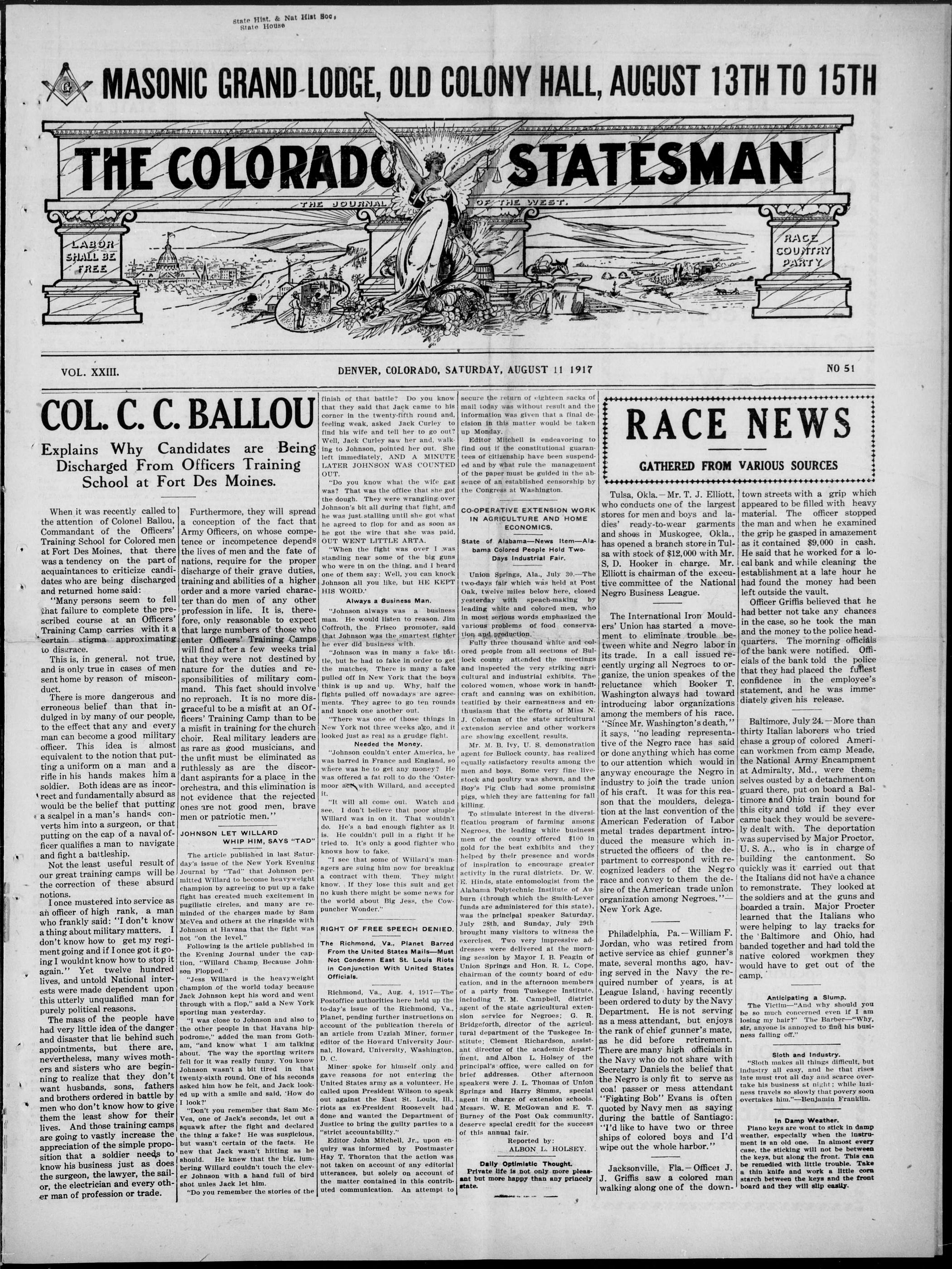
Page text (machine-generated)
MASONIC GRAND LODGE, OLD COLONY HALL, AUGUST 13TH TO 15TH
THE COLORADO STATESMAN
THE JOURNAL OF THE WEST.
LABOR SHALL BE FREE
RACE COUNTRY PARTY
COL.C.C.BALLOU
VOL. XXIII.
COL. C. C.
Explains Why Can Discharged From School at Fort
When it was recently called to the attention of Colonel Ballou, Commandant of the Officers' Training School for Colored men at Fort Des Moines, that there was a tendency on the part of acquaintances to criticize candidates who are being discharged and returned home said:
"Many persons seem to fell that failure to complete the prescribed course at an Officers' Training Camp carries with it a certain stigma approximating to disrace. This is, in general, not true, and is only true in cases of men sent home by reason of misconduct. There is more dangerous and erroneous belief than that indulged in by many of our people, to the effect that any and every man can become a good military officer. This idea is almost equivalent to the notion that putting a uniform on a man and a rifle in his hands makes him a soldier. Both ideas are as incorrect and fundamentally absurd as would be the belief that putting a scalpel in a man's hands converts him into a surgeon, or that putting on the cap of a naval officer qualifies a man to navigate and fight a battleship.
Not the least useful result of our great training camps will be the correction of these absurd notions. I once mustered into service as an officer of high rank, a man who frankly said: "I don't know a thing about military matters. I don't know how to get my regiment going and if I once got it going I wouldn't know how to stop it again." Yet twelve hundred lives, and untold National interests were made dependent upon this utterly unqualified man for purely political reasons.
The mass of the people have had very little idea of the danger and disaster that lie behind such appointments, but there are, nevertheless, many wives mothers and sisters who are beginning to realize that they don't want husbands, sons, fathers and brothers ordered in battle by men who don't know how to give them the least show for their lives. And those training camps are going to vastly increase the appreciation of the simple proposition that a soldier needs to know his business just as does the surgeon, the lawyer, the sailor, the electrician and every other man of profession or trade.
state Hist. & Nat Hist Boc
State House
NIC GRAND LON
COLORA
. BALLOU
Candidates are Being Officers Training Art Des Moines.
Furthermore, they will spread a conception of the fact that Army Officers, on whose competence or incompetence depends the lives of men and the fate of nations, require for the proper discharge of their grave duties, training and abilities of a higher order and a more varied character than do men of any other profession in life. It is, therefore, only reasonable to expect that large numbers of those who enter Officers' Training Camps will find after a few weeks trial that they were not destined by nature for the duties and responsibilities of military command. This fact should involve no reproach. It is no more disgraceful to be a misfit at an Officers' Training Camp than to be a misfit in training for the church choir. Real military leaders are as rare as good musicians, and the unfit must be eliminated as ruthlessly as are the discordant aspirants for a place in the orchestra, and this elimination is not evidence that the rejected ones are not good men, brave men or patriotic men."
JOHNSON LET WILLARD
WHIT HIM, SAYS "TAD"
The article published in last Saturday's issue of the New York Evening Journal by "Tad" that Johnson permitted Willard to become heavyweight champion by agreeing to put up a fake fight has created much excitement in pugilistic circles, and many are reminded of the charges made by Sam MVea and others at the ringside with Johnson at Havana that the fight was not "on the level."
Following is the article published in the Evening Journal under the caption, "Willard Champ Because Johnson Flopped."
"Jess Willard is the heavyweight champion of the world today because Jack Johnson kept his word and went through with a flop," said a New York sporting man yesterday.
"I was close to Johnson and also to the other people in that Havana hippodrome," added the man from Gotham, "and know what I am talking about. The way the sporting writers fell for it was really funny. You know Johnson wasn't a bit tired in that twenty-sixth round. One of his seconds asked him how he felt, and Jack looked up with a smile and said, 'How do I look?'
"Don't you remember that Sam McVea, one of Jack's seconds, let out a squawk after the fight and declared the thing a fake? He was suspicious, but wasn't certain of the facts. He new that Jack wasn't hitting as he should. He knew that the big, lumbering Willard couldn't touch the clever Johnson with a hand full of bird shot unles Jack let him.
"Do you remember the stories of the uted
DENVER, COLORADO, SATURDAY, AUGUST 11 1917
finish of that battle? Do you know that they said that Jack came to his corner in the twenty-fifth round and, feeling weak, asked Jack Curley to find his wife and tell her to go out? Well, Jack Curley saw her and, walking to Johnson, pointed her out. She left immediately, AND A MINUTE LATER JOHNSON WAS COUNTED OUT.
"Do you know what the wife gag was? That was the office that she got the dough. They were wrangling over Johnson's bit all during that fight, and he was just stalling until she got what he agreed to flop for and as soon as he got the wire that she was paid, OUT WENT LITTLE ARTA.
"When the fight was over I was standing near some of the big guns who were in on the thing, and I heard one of them say: Well, you can knock Johnson all you like, but HE KEPT HIS WORD."
Always a Business Man.
"Johnson always was a business man. He would listen to reason. Jim Coffroth, the Frisco promoter, said that Johnson was the smartest fighter he ever did business with.
"Johnson was in many a fake battle, but he had to fake in order to get the matches. There is many a fake pulled off in New York that the boys think is up and up. Why, half the fights pulled off nowadays are agreements. They agree to go ten rounds and knock one another out.
"There was one of those things in New York not three weeks ago, and it looked just as real as a grudge fight.
Needed the Money.
"Johnson couldn't enter America, he was barred in France and England, so where was he to get any money? He was offered a fat roll to do the 'Ostermoor act' with Willard, and accepted it.
"It will all come out. Watch and see. I don't believe that poor simple Willard was in on it. That wouldn't do. He's a bad enough fighter as it is. He couldn't pull in a fight if he tried to. It's only a good fighter who knows how to fake.
"I see that some of Willard's managers are suing him now for breaking a contract with them. They might know. If they lose this suit and get no kush there might be some news for the world about Big Jess, the Cow-puncher Wonder."
RIGHT OF FREE SPEECH DENIED
The Richmond, Va., Planet Barred From the United States Mails—Must Not Condemn East St. Louis Riots in Conjunction With United States Officials.
Richmond, Va., Aug. 4, 1917—The Postoffice authorities here held up the to-day's issue of the Richmond, Va., Planet, pending further instructions on account of the publication therein of an article from Uzziah Miner, former editor of the Howard University Journal, Howard, University, Washington, D. C.
Miner spoke for himself only and gave reasons for not entering the United States army as a volunteer. He called upon President Wilson to speak out against the East St. Louis, Ill., riots as ex-President Roosevelt had done and wanted the Department of Justice to bring the guilty parties to a "strict accountability."
Editor John Mitchell, Jr., upon enquiry was informed by Postmaster Hay T. Thornton that the action was not taken on account of any editorial utterances, but solely on account of the matter contained in this contributed communication. An attempt to
secure the return of eighteen sacks of mail today was without result and the information was given that a final decision in this matter would be taken up Monday. Editor Mitchell is endeavoring to find out if the constitutional guarantees of citizenship have been suspended and by what rule the management of the paper must be guided in the absence of an established censorship by the Congress at Washington.
CO-OPERATIVE EXTENSION WORK IN AGRICULTURE AND HOME ECONOMICS.
State of Alabama—News Item—Alabama Colored People Hold Two-Days Industrial Fair.
Union Springs, Ala., July 30.—The two-days fair which was held at Post Oak, twelve miles below here, closed yesterday with speech-making by leading white and colored men, who in most serious words emphasized the various problems of food conservation and production.
Fully three thousand white and colored people from all sections of Bullock county attended the meetings and inspected the very striking agricultural and industrial exhibits. The colored women, whose work in handcraft and canning was on exhibition, testified by their earnestness and enthusiasm that the efforts of Miss N. J. Coleman of the state agricultural extension service and other workers are showing excellent results.
Mr. M. B. Ivy, U. S. demonstration agent for Bullock county, has realized equally satisfactory results among the men and boys. Some very fine livestock and poultry was shown, and the Boy's Pig Club had some promising pigs, which they are fattening for fall killing.
To stimulate interest in the diversification program of farming among Negroes, the leading white business men of the county offered $100 in gold for the best exhibits and they helped by their presence and words of inspiration to encourage greater activity in the rural districts. Dr. W. E. Hinds, state entomologist from the Alabama Polytechnic Institute of Auburn (through which the Smith-Lever funds are administered for this state), was the principal speaker Saturday, July 28th, and Sunday, July 29th brought many visitors to witness the exercises. Two very impressive addresses were delivered at the morning session by Mayor I. B. Feagin of Union Springs and Hon. R. L. Cope, chairman of the county board of education, and in the afternoon members of a party from Tuskegee Institute, including T. M. Campbell, district agent of the state agricultural extension service for Negroes; G. R. Bridgeforth, director of the agricultural department of the Tuskegee Institute; Clement Richardson, assistant director of the academic department, and Albon L. Holsey of the principal's office, were called on for brief addresses. Other afternoon speakers were J. L. Thomas of Union Springs and Harry Simms, special agent in charge of extension schools. Messrs. W. E. McGowan and E. T. Burney of the Post Oak community, deserve special credit for the success of this annual fair.
Daily Optimistic Thought.
Private life is not only more pleasant but more happy than any princely state.
RACE NEWS
Tulsa, Okla. Mr. T. J. Elliott, who conducts one of the largest stores for men and boys and ladies' ready-to-wear garments and shoes in Muskogee, Okla., has opened a branch store in Tulsa with stock of $12,000 with Mr. S, D. Hooker in charge. Mr. Elliott is chairman of the executive committee of the National Negro Business League. town streets with a grip which appeared to be filled with heavy material. The officer stopped the man and when he examined the grip he gasped in amazement as it contained $9,000 in cash. He said that he worked for a local bank and while cleaning the establishment at a late hour he had found the money had been left outside the vault.
The International Iron Moulders' Union has started a movement to eliminate trouble between white and Negro labor in its trade. In a call issued recently urging all Negroes to organize, the union speakes of the reluctance which Booker T. Washington always had toward introducing labor organizations among the members of his race. "Since Mr. Washington's death," it says, "no leading representative of the Negro race has said or done anything which has come to our attention which would in anyway encourage the Negro in industry to join the trade union of his craft. It was for this reason that the moulders, delegation at the last convention of the American Federation of Labor metal trades department introduced the measure which instructed the officers of the department to correspond with recognized leaders of the Negro race and convey to them the desire of the American trade union organization among Negroes."—New York Age.
Philadelphia, Pa.—William F. Jordan, who was retired from active service as chief gunner's mate, several months ago, having served in the Navy the required number of years, is at League Island, having recently been ordered to duty by the Navy Department. He is not serving as a mess attendant, but enjoys the rank of chief gunner's mate, as he did before retirement. There are many high officials in the Navy who do not share with Secretary Daniels the belief that the Negro is only fit to serve as coal passer or mess attendant "Fighting Bob" Evans is often quoted by Navy men as saying during the battle of Santiago: "I'd like to have two or three ships of colored boys and I'd wipe out the whole harbor."
Jacksonville, Fla.—Office1 J. J. Griffis saw a colored man walking along one of the down-
NO 51
town streets with a grip which appeared to be filled with heavy material. The officer stopped the man and when he examined the grip he gasped in amazement as it contained $9,000 in cash. He said that he worked for a local bank and while cleaning the establishment at a late hour he had found the money had been left outside the vault. Officer Griffis believed that he had better not take any chances in the case, so he took the man and the money to the police headquarters. The morning officials of the bank were notified. Officials of the bank told the police that they had placed the fullest confidence in the employee's statement, and he was immediately given his release.
Baltimore, July 24.—More than thirty Italian laborers who tried chase a group of colored American workmen from camp Meade, the National Army Encampment at Admiralty, Md., were themselves ousted by a detachment on guard there, put on board a Baltimore and Ohio train bound for this city and told if they ever came back they would be severely dealt with. The deportation was supervised by Major Proctor, U. S. A., who is in charge of building the cantonment. So quickly was it carried out that the Italians did not have a chance to demonstrate. They looked at the soldiers and at the guns and boarded a train. Major Procter learned that the Italians who were helping to lay tracks for the 'Baltimore and Ohio, had banded together and had told the native colored workmen they would have to get out of the camp.
Anticipating a Slump.
The Victim—"And why should you be so much concerned even if I am losing my hair?" The Barber—"Why, sir, anyone is annoyed to find his business falling off."
Sloth and Industry.
"Sloth makes all things difficult, but industry all easy, and he that rises late must trot all day and scarce overtake his business at night; while laziness travels so slowly that poverty soon overtakes him."—Benjamin Franklin.
In Damp Weather.
Piano keys are wont to stick in damp weather, especially when the instrument is an old one. In almost every case, the sticking will not be between the keys, but along the front. This can be remedied with little trouble. Take a thin knife and work a little corn starch between the keys and the front board and they will slip easily.
NEWS TO DATE IN PARAGRAPHS
---
COLORADO STATESMAN
CAUGHT FROM THE NETWORK OF WIRES ROUND ABOUT THE WORLD.
DURING THE PAST WEEK
RECORD OF IMPORTANT EVENTS
CONDENSED FOR BUSY
PEOPLE.
Western Newspaper Union News Service.
ABOUT THE WAR
Russians give battle to advancing
Austro-Germans.
The Mouth-Piece of the People of Colorado and the Entire West
Leader of retreating Russian army is ordered shot.
Germans and Turks planning attempt to recapture Bagdad.
Kerensky will save Russia is belief of Russian political leaders.
Premier Kerensky has completed the formation of his new Russian Cabinet.
Liberia, the negro republic on the coast of Africa, has declared war on Germany.
Canada's war expenditures are now about $850,000 a day, the total to July 20 being $623,000,000.
Northeast of Ypres, after intense bombardment, the British re-established themselves in the town of St. Julien.
The Berrim papers still look upon the Cabinet changes with lukewarm enthusiasm, and say the shakeup will bring no real relief.
Having driven the Russians out of most of Galicia and Bukowina, the Austro-Germans have begun an assault in Moldavia, hoping to gain Bessarabia.
A RELIABLE chronicle of their doings and progress; a faithful mirror of their wants, their hopes, their best aspirations.
The German crown prince failed again to win territory from Gen. Petain's forces on the southern front in France. In the Champagne the French have penetrated the German lines at three points.
In an offensive near Balan, east of Czernowitz, the Russians were winners and captured 500 prisoners and three machine guns. In Bukowina the Russians are still fleeing, and the enemy has taken several towns.
The Liberal press of Germany says there is no hope for reforms because of the shakeup in the cabinet. Dr. von Kuehlemann, the new foreign secretary, is said to oppose ruthless submarine warfare.
Canadian outposts around Lens have established new lines in a group of houses within a few yards of the enemy's front line. Advances were made through the German curtain fire by the daring Canadians.
THE COLORADO STATESMAN
J. W. Lambert of St. Louis committed suicide. Under President Wilson's order, the Oklahoma National Guard automatically became units of the federal forces. An investigation into the cost of flour was begun at Minneapolis under supervision of the Federal Trade Commission. The condition of former President William H. Taft, who became ill at Clay Center, Kan., was announced by his physicians as improving.
Unequaled as an advertising medium for the business of professional men and women.
The Loyalty League of America was organized in Phoenix, Ariz. The avowed purpose of it, as set forth in the constitution, is "to exterminate the I. W. W."
Three hundred Slavonians, many of whom are American citizens, voted to return to work, at a meeting held at Miami, Ariz, in response to a call issued by J. D. Pavich, a leader of the Slavonian colony. Pavich is also a miner.
With the arrest of more than fifty draft resisters, including two chief agitators of the Working Class Union, officers in Hughes, Seminole and Pontotoc counties, Okla., settled down to a tireless combing of the hills for stragglers who, starved out, slowly are giving up.
An excellent family journal speaking to and for many thousand colored citizens.
WASHINGTON
Friendly aliens may join U. S. army declares Gen. Crowder. Crews of seven sunken vessels brought to American port. Time is not yet ripe for discussions of peace, declares President Wilson.
of peace, declares President Wilson. The Senate war revenue measure as drawn will raise a total of $2,006,970,000. Speaker Champ Clark says that America needs, among other things, a real national anthem with a punch.
TWODOLLARSAYEAR
Provision to protect harvesting from shortage of hands due to the mobilization of the national army has been made by the government in regulations to district exemption boards. With the national prohibition promised or threatened, members of Congress who hunt sources of revenue have been looking into America's soft drink bill and they have discovered that the people of this country pay $174,000,000 annually for ice cream, soda water and other soft drinks. Resources of the national banks at the last call, Figure 20, reached the highest figures ever recorded, Controller Williams announced, totaling $16,151,000,000, or $2,224,000,000 more than June 30, 1916.
FOREIGN
Today the American dollar is worth $1.50 silver in Chinese coin.
Former president of China refuses to accept position again.
Argentine government sends final note to Germany demanding satisfaction.
Sir Richard McBride, former premier of British Columbia, died in London.
Cardinal Gasparii is expected to resign his post as papal secretary of state.
Secretary Zimmermann and nine other members of the German Cabinet have resigned their portfolios.
The women's war relief corps in France has been organized under the authority of the American Red Cross.
The date of the International Socialist conference to be held in Stockholm has been definitely fixed for Sept. 9.
Count Adam Tarnowski von Tarnow, former Austro-Hungarian ambassador to the United States, has been appointed minister to Sweden.
According to the Weser-Zeitung of Bremen, the German system of food distribution is about to be entirely reorganized under Herr von Waldow.
Acting President Feng Kwo-Chang has approved the unanimous decision reached at a special meeting of the Chinese Cabinet to declare war on Germany and Austria-Hungary.
To mark the beginning of the fourth year of the war, an impressive intercessional service was held in London in Westminster Abbey. King George attended, accompanied by numerous members of his household.
Neutrals desiring to leave Germany are advised to file applications four weeks in advance, as police permits cannot be issued until the military authorities have acted. Three thousand such applications are on file in Berlin. King Alexander took the oath of office amid great pomp and ceremony at Athens. Preceded by a troop of soldiers, the king in a carriage drawn by four horses, proceeded from the palace to the hall of the chamber of deputies through streets lined with cheering citizens.
On the third anniversary of Great Britain's entrance into the war, Field Marshal Sir Douglas Haig, commander of the British armies on the western front, issued a special order of the day, filled with the spirit of confidence in ultimate victory and complete faith in the people of the empire and in its forces which have in the battle in Flanders added another link to their steadily growing chain of successes over the Germans.
**SPORTING NEWS**
**Standing of Western League Clubs.**
CLUBS. Won. Lost. Pct.
Wichita 12 4 7.758
Hutchinson 10 6 6.625
Omaha 9 7 5.663
Joplin 9 7 5.663
Stouf, City 7 9 4.437
Lincoln 7 9 4.437
Denver 6 10 3.755
Des Moines 4 12 2.250
California is experiencing the most successful trotting and pacing season in its history. This is the unqualified statement of Joseph Waddell, secretary of the California Fair and Racing circuit.
Annette Meyer defeated Adelaide Plvan in the finals of the junior women's singles, thereby winning the championship at the city patriotic tennis tournament at City park in Denver. The scores were 6-3 and 6-1.
Every effort will be made to have every institution in the Rocky Mountain conference represented on the football field this fall, according to a statement made at Denver by C. H. Wingender, secretary of the conference.
GENERAL
The earnings of 187 principal railroad lines for May were $92,079,580, as against $90,931,759 for the same month in 1916.
Gold from Canada for British account to the amount of $6,400,000 was received and deposited at the Philadelphia mint.
Hans von Teubinger, commanded the U-boat that killed his own fiancee, Minna Larsen, according to Lars Larsen, Swedish skipper, in New York.
The $1,000,000 fund being raised by the Knights of Columbus for the relief and recreation of Catholic soldiers and sailors has been greatly over-subscribed.
Ten thousand blue jackets stationed at the Great Lakes naval training station weigh an aggregate of seventy-five tons more than they did one month ago.
Confidence that the United States "will not cause any unnecessary hardship to neutrals" in its food restriction policy was expressed by Herman Lagercrantz, head of the Swedish commission.
Kingdon Gould of Lakewood, N. J., railroad official and eldest son of George Jay Gould, capitalist, has filed at Toms River, N. J., a claim of exemption from enforced military duty on the plea of dependents for support.
Mrs. John Pope, wife of a business man of Bell county, Ky., killed Miss Roxie Brock, 20, member of a wealthy family, at Miss Brock's home at Pineville because, she alleged, Pope, husband of the woman, pald Miss Brock undue attention.
United States District Attorney W. P. McGinnis announced at Muskogee, Okla., that the men arrested on charges of resisting the draft in connection with the Oklahoma uprising will be tried for treason and that the death penalty will be asked by the government.
GUARD JOINS U.S. ARMY
NAME UNCHANGED UNDER NEW
FEDERALIZED SERVICE.
Approximately 2,900 Colorado National
Guards Now Under Command
of Maj. Gen. Barry.
Western Newspaper Union News Service
Denver.—The entire Colorado National Guard automatically passed from the state service into the federal service Aug. 4, and now the guardsmen are part of Uncle Sam's regular war organization. Approximately 2,900 of them now are under the command of Maj. Gen. T. H. Barry, commander of the central department of the army, with headquarters in Chicago. Adj. Gen. Frank D. Baldwin of Colorado no longer has control of any of the units.
The title of "National Guard of Colorado" will be retained, the federalized militia now being known as a distinct unit of the new "National Guard section" of the United States army. The other two branches of the American armed land forces are to be known as the "regular army" and the "federal army," the latter being the new selective draft army.
The most interesting appointment as regards the Colorado troops to be made soon is that of brigadier general. Col. Bulkeley Wells, it is stated, will probably be placed in command at Camp Baldwin at Overland park, and for the present the commands of each unit in the federalized Colorado National Guard will report to Maj. Gen. Barry.
After the troops are ordered to proceed to the federal cantonment at Linda Vista, on the Pacific coast, the command will pass from the central department to the commanding officer of the western department.
Adj. Gen. Baldwin and his entire staff will remain in the service of the state as the nucleus for the new home guard, authorized by the state Legislature. The staff includes the state adjutant, the judge advocate, the inspector general, the entire ordinance department and the quartermaster corps.
Quartermaster's Supply Depot.
Gov. Julius C. Gunter received a letter from Secretary Alva B. Adams of the special commission sent to Washington to make an effort to get for Colorado the establishment by the government of a quartermasters' supply depot and purchasing department in the state and other government branches of army service. The communication stated that there was a strong possibility that a surgeon's camp or hospital would be maintained in Colorado and that Secretary of War Baker had told the committee that the government was anxious to purchase supplies in every part of the country and that a quartermaster's depot would undoubtedly be located in Denver.
Colorado Gives Each Soldier $10.
As a fitting tribute to the Colorado soldier boys about to leave for the front, legislators sitting in extraordinary session voted to give each one of the 4,004 men in the federal service Aug. 5, a $10 gold piece. The suggestion came from Senator William R. Eaton of Denver, and met with no opposition. Accordingly, an additional appropriation of $40,040 was voted by the Senate for this purpose.
Thousands See Flags Presented.
Fire, rain and winds failed to mar the celebration at Camp J. C. Gunter, when thousands of Puebloans and visitors from all parts of Colorado were present to witness the soldiers' field meet, military drills and the presentation of thre flags to the Second Regiment infantry of the Colorado National Guard and hear the presentation address.
Officers' Reserve Men to Report.
A number of Denver applicants for the officers' training school of this department, which will be held at Fort Snelling, Minn., have received notices to report to the commanding officers of the post the morning of Sunday, Aug. 26. There are 813 applicants in Colorado, many of whom will not be called.
Negro Battalions get Uniforms.
The two negro battalions of the Colorado National Guard, mobilized at the Rifle Range near Golden, have been furnished with their new uniforms and are being put into condition for guard service of the various public utilities throughout the state.
Practical Lessons in Agriculture.
Courses in agriculture will be taught in the country schools next year, according to plans worked out by Mrs. Mary C. C. Bradford, state superintendent, who has outlined work for all the elementary schools in the state.
District Board Prepares Draft List.
Preparing lists for the 40,000 men in thirty-seven counties of Colorado who have been summoned by draft to be examined for military service is the task of the seven clerks in the office of the district board of appeals, in the federal building at Pueblo.
Grasshoppers Attack Denver Gardens.
The annual late summer and fall drive against grasshoppers is on, the Denver war garden sectors being the most hotly contested points.
Western Newspaper Union News Service.
COMING EVENTS.
Aug. 13-14. — Trap Shoot at Oak Creek.
Aug. 25. — Pitkle Day at Platteville.
Aug. 28. Sept. 1. — Prowers County Fair at Lamar.
Aug. 30. — Annual Convention K. P. Grand Lodge, including Uniform Rank, Pythian Sisters and Knights of Khorassan, at Colorado Springs.
Sept. 4. — Frontier Days' celebration.
Denver Elks won the drill team prize of $400 at Boston. The Denver "peach week" idea is to be spread throughout the state. Thousands witness flag presentations at Camp Gunter at Pueblo. Dr. Bertha S. Park, 39, of Denver ended her life in a Chicago hotel. Pueblo is gfiven two tracts of land in forest reserve for municipal parks.
The dates for the Sedgwick county fair have been set for Sept. 6-7-8 at Julesberg.
Jay Warren Edgar, 32 years old, committed suicide at his home in Denver by shooting.
The remains of Mrs. Susan Brennan, 106, were laid to rest in the Walden cemetery.
Governor Gunter addressed the first day's session of State Federation of Labor at Boulder.
The annual flower day for the benefit of the Craig colony in Denver has been set for Wednesday, Aug. 15.
At a mass meeting of the women of Rio Grande county, held in Monte Vista, a Woman's advisory council to the governor was organized.
Arrangements for moving 800 cars of cattle and sheep, which are fattening on the grass of North Park, to market have been completed.
The Second regiment of the Colorado National Guard, of which Col. Jesse G. Northcutt is commander, was mustered into federal service at Pueblo.
Because he permitted his head to be used as a rest for the barrel of a small rifle which another boy was attempting to fire, Joe Tezak was killed at Pueblo.
Joseph T. Byrne has been granted a captain's commission in the quartermaster section, officers' reserve corps of the United States army, it was announced in Denver.
In a special train of seven coaches the Denver members of the officers' training camp at Fort Riley will start for home Aug. 15, arriving in Denver the following morning.
The annual meeting of the Supreme Council of the Fraternal Aid Union, an organization having 100,000 members and a gain in assets of $1,250,000 in 1917, was held in Denver.
Dr. W. H. Sharpley, manager of health in Denver, issued his death report for July, showing the total number of deaths for the month at 228, compared with 224 for July of last year.
"Fruit outlook good; local damage to peaches by hall and to alfalfa and oats by grasshoppers," says the national weather and crop bulletin for the week ending July 31 in the section devoted to Colorado.
Adjutant General Baldwin has started to work on the details of forming the Third regiment of the Colorado National Guard, which will take the place of the troops on guard service throughout the state.
There promises now to be an abundance of wild fruits and berries in the mountains this year. Reports indicate that huckleberries, raspberries, black currants and cherries are more plentiful than in any year for a decade.
John C. Teller, 67, builder of the $350,000 Teller reservoir, owner of the famous Teller ranch near Pueblo, and one of the most widely known business men in Pueblo and Colorado, died at his home in Denver after a paralytic stroke.
Jamestown is enjoying a boom such as has not been experienced since the early days of the camp, according to County Commissioner Greenwood, who visited the district. There is not a vacant house in the town, and it is difficult to secure accommodations of any kind.
Working in a quiet but effective way, a group of Pueblo investors has been securing title to a large deposit of alunite from which it is believed that potash can be commercially extracted and is preparing for extensive operation should the tests now being made prove satisfactory.
Tripping on her high heeled shoes, while climbing above the snow line at Mt. Pinchot, Miss Beulah Frost, aged 19 years, of Sterling plunged a half mile down the mountain side to her death. Homer Thomson, son of G. H. Thomson, superintendent of the Estes Park fish hatchery, fell with her to the bottom of Fall River caffon, but escaped without permanent injuries, although terribly bruised and cut.
Man arrested at Cafion City for treasonable remarks.
U.S. GRAIN CROPS WAR LEGISLATURE ENDS
PRODUCTION THIS YEAR WILL
SHOW BIG GAIN OVER THE
YIELDS IN 1916.
Government Crop Report Shows Corn
Prospects Materially Improved
and Indicate a Yield of
3,191,000,000 Bushels.
Western Newspaper Union News Service.
Washington.—The largest crop of
corn ever grown in the United States
is in prospect for the coming harvest.
The Department of Agriculture's Aug
ust crop report showed corn pros
pects improved to the extent of 67,
000,000 bushels during July, indica-
ting a total production of 3,191,000,000
bushels.
Wheat, however, shows a decrease of 25,000,000 bushels. Spring wheat had a bad month and prospects decreased 40,000,000 bushels, but winter wheat returns indicated 15,000,000 bushels more than forecast in July. Wheat production—winter wheat and spring wheat combined, now is forecast at 653,000,000 bushels. With more than 343,000 square miles planted to the important food crops, not taking into account the vastly-increased number of home gardens, the United States has more than one-ninth of its entire area growing in food crops. Bumper crops of corn and oats and record crops of barley, rye, white and sweet potatoes, tobacco and hay, show the response of the farmers of the country to President Wilson's appeal made in April last to produce larger crops this year for war use. Other details of the report follow:
WINTER WHEAT—Preliminary estimate of yield 15.1 bushels per acre, compared with 13.8 last year and 16.3 the 1911-15 average.
SPRING WHEAT—Condition 68.7 per cent. of a normal, compared with 83.6 last month, 63.4 last year and 76.9 the ten-year average. Indicated acre yield 12.4 bushels, compared with 8.8 last year and 14.0 the 1911-15 average.
ALL WHEAT—Indicated yield 14.0 bushels per acre, compared with 12.1 last year and 15.4 the 1911-15 average.
CORN—Condition 78.8 per cent. of a normal, compared with 81.1 last month, 75.3 last year and 78.4 the ten-year average. Indicated yield, 26.4 bushels per acre, compared with 24.4 last year and 26.0 the 1911-15 average.
OATS—Condition 87.2 per cent, of a normal, compared with 89.4 last month, 81.5 last year and 80.2 the tenyear average. Indicated yield 34.7 bushels per acre, compared with 30.1 last year and 31.7 the 1911-15 average.
OATS—Remaining on farms Aug.1, estimated at about 47,771,000 bushels, compared with 113,728,000 last year, and 64,928,000, the average Aug. 1 stocks 1911-15.
RYE—Preliminary estimate of the yield 14.9 bushels per acre, compared with 15.3 last year and 16.5 the 1911-15 average.
BUCKWHEAT—Area planted 965, 000 acres, compared with 845,000 acres last year. Condition 92.2 per cent of a normal, compared with 87.8 last year and 88.2 the ten-year average. Indicated yield 20.6 bushels per acre, compared with 14.0 last year and 20.4 the 1911-15 average.
WHITE POTATOES—Condition 87.9 per cent of a normal, compared with 90.1 last month, 80.8 last year and 81.3 the ten-year average. Indicated yield 107.5 bushels per acre, compared with 80.4 last year and 98.3 the 1911-15 average.
HAY—Condition 84.6 the eight-year average. Indicated yield 1.48 tons, compared with 1.53 last year and 1.31 the 1911-15 average.
SWEET POTATOES — Condition 84.8 per cent of a normal, compared with 81.9 last month, 85.9 last year and 84.2 the ten-year average. Indicated yield 95.6 bushels per acre, compared with 91.7 last year and 95.4 the 1911-15 average.
TOBACCO—Condition 88.1 per cent of a normal, compared with 86.8 last month, 84.4 last year and 79.0 the ten-year average. Indicated yield 895.4 pounds per acre, compared with 815.0 last year and 788.6 the 1911-15 average.
FLAX—Condition 60.6 per cent of a normal, compared with 84.0 last month, 84.0 last year and 81.6 the ten-year average. Indicated yield 35.7 bushels per acre, compared with 9.6 last year and 8.6 the 1911-15 average.
RICE—Condition 85.0 per cent of a normal, compared with 85.1 last month, 92.2 last year and 88.8 the ten-year average. Indicated yield 35.7 bushels per acre, compared with 47.0 last year and 33.8 the 1911-15 average.
SUGAR BEETS—Condition 90.3 per cent of a normal, compared with 92.4 last month, 86.4 last year and 89.3 the ten-year average. Indicated yield 10.66 tons per acre, compared with 9.36 last year and 10.86 the 1911-15 average.
ACREAGES—Above crops, excluding apples and peaches, total 337,716,000 acres, compared with 327,352,000 last year and 326,650,000 in 1915.
Condition of spring wheat and corn on Aug. 1, by important states follows:
SPRING WHEAT—Minnesota 87, North Dakota 55, South Dakota 82.
CORN—Ohio 87, Indiana 84, Illinois 87, Iowa 87, Missouri 87, Nebraska 74, Kansas 33.
Governor Gunter addressed the first day's session of State Federation of Labor at Boulder.
STATE CONSTABULARY MEASURE
PASSED BY ASSEMBLY.
Special Session Passed Bonds and Other War Revenue Bills to Raise $3,250,000.
Denver.—Passage of the Mayer constabulary bill, final consideration of which had deadlocked for two days the Senate and House, brought to a close at 6 o'clock Aug. 4 the special session of the Colorado Legislature. In the eighteen days of the session bonds and other war revenue measures to raise $3,250,000 were passed, and expenditures amounting to $2,722,000 authorized. The balance of $528,000 is to be used for interest on bonds and other purposes. Conferences on the constabulary bill reported an agreement Saturday and the recommendations which they submitted were approved by both houses, thereby breaking the deadlock.
The bill received 39 votes in the House and 21 in the Senate. It was enacted with the votes of the Republicans in both houses; seven Democrats in the House and five Democrats in the Senate.
Of the measures asked for by the governor in his special message, all were enacted save the one providing for the regulation and control of foods and the one permitting state banks to come under the supervision of the federal reserve banks. The bill providing for the regulation and control of foods was killed in the House and the bill providing for a two-dollar poll tax also was killed.
The Legislature enacted the bond issue bill providing for a $2,500,000 bond issue; the mill levy bill, providing a one-half mill levy an all property, the tax to be used for war purposes; what is known as the certificate of indebtedness bill, which provides the $60,000 which pays for the mobilization of the National Guard a year ago; the co-operation bill giving the governor the right to co-operate with the federal government on all matters; the corporation tax bill providing for a flat tax of ten cents on every one thousand dollars incorporation with a minimum tax of $10; the constabulary bill, which creates the state constabulary; what is known as the National Guard bill, appropriating $78,000 to reorganize the National guard after the present guard has been mustered into federal service; the war council appropriation bill, appropriating $60,000 to pay the expenses of the war council, the extra session expense bill, appropriating $50,000 to pay the expenses of the special session; the soldiers' and sailors' home bill appropriating $50,000 additional to make room in the soldiers' and sailors' home for those in Colorado who may be injured in the French trenches; what is known as the National Guard appropriation, appropriating $480,000 to pay for the mobilization of the National Guard this year, the food destruction bill, which is intended to prevent the destruction of food with the view of increasing prices on that which is left.
The appropriations are all supposed to be paid out of the funds raised by the mill levy bill.
With one or two exceptions Gov. J. C. Gunter's war program was carried forward as recommended in his message, and he sent a congratulatory message to both houses in the closing hours for successful legislation accomplished.
Columbus, Mo. — Missouri's corn crop, estimated at 230,000,000 bushels, will be about 90,000,000 bushels in excess of that of last year, according to the monthly crop report.
America Faces Hardship and Suffering, Is Warning of Statesman.
A Pacific Port.-"Liberty, founded on hardship and sacrifice, can be preserved only by sacrifice and suffering. Eternal struggle is the price of liberty," declared Elbuh Root, head of the diplomatic mission to Russia, at a luncheon attended by more than 2,000, tendered the former secretary of state and his associates on their return to the United States.
"The first and greatest test is not between the troops of Germany and those of our country." Mr. Root said, "but between the great and noble qualities of the American nature and those degenerating tendencies which come with luxury and tend to kill men's capacity for sacrifice."
The address of Mr. Root and others who spoke dealt vigorously and feelingly on the tremendous scope of the task which the United States faces and the need for casting aside petty differences for united action against America's foe. They were unanimous in declaring that Russia, in bitter travail, would arise, strong and free.
To Act as Mediators at Gallup.
President Wilson has ordered Verner Z. Reed and former Chief Justice Musser of Denver and ex-Congressman Seldomridge of Colorado Springs to go to Gallup, N.M., to act as mediators in the settlement of disputes between miners and operators in that district. There is a strong sentiment among the miners that unless disputes are properly settled the miners will go out in a body, 450,009 strong, according to the statement of James F. Moran.
LABOR BOARD TO HANDLE DISPUTES
POWER TO SETTLE WALKOUTS
TO BE DELEGATED TO NINE
MEN, THREE OF LABOR.
NATION - WIDE THREAT
UNION LEADERS READY TO CALL OUT EVERY MAN AT WORK ON GOVERNMENT CONTRACTS.
New York, Aug. 10.—Threats that every union man engaged on government work would strike within a few days unless demands of the carpenters' union for a closed shop on government contracts are met were made by spokesmen for the union at a conference here with representatives of the war and navy departments and contractors. The union leaders declared if a strike were called more than 50,000 men would quit work. According to union leaders carpenter work on thirty army contponents, two port terminals, several aviation camps and the New York navy yard is affected. It was said about 3,000 carpenters already are on strike at army cantonments near New York.
The carpenters demand the immediate discharge of all non-union carpenters from federal work or the cancellation by the government of contracts with all firms employing such labor.
At present it was said only eastern territory is involved in the specific discussions but union leaders said they would make a nation-wide affair of it unless their demands are met.
Washington.—Creation of a labor adjustment commission to have final jurisdiction during the war over labor disputes in plants having contracts with the government has been determined by the Council of National Defense. Members of the commission have not yet been selected. There will be nine—three representing the government, three employers and three labor.
Name 193 for Training Camp.
Denver.—Maj. A. M. Fuller, Colorado examining officer for the second series of reserve officers' training camps, announced the names of the 193 successful candidates out of 815 applicants from this state. The examining board had been continuouslyifting out the list since the applications closed on July 15. In addition to the 193 men chosen, nineteen alternates were named and assigned to numbers in their order. The 193 selected men must report to the commanding officer at Fort Sheridan, Ill., Aug. 27. If any fail to do so, alternates will be summoned in their order to complete the quota, being given until Sept. 5 to report.
Bishop Schuler May Succeed Matz. Denver. — Speculation was rife among the priesthood of the Denver Diocese of the Catholic church as to a successor to Bishop Matz. It was strongly intimated that Bishop A. J. Schuler, formerly president of Sacred Heart college, but made bishop of El Paso, June 18, 1915, would be the Rome appointee.
Colorado Man Given Commission.
Washington.—Among those to receive commissions at the officers' training camp at Fort Benjamin Harrison, Ind., is John W. Dowd, Red Cliff, Colo., second lieutenant.
Governor Takes Charge in Bisbee.
Bisbee, Ariz.—Thomas E. Campbell, governor of Arizona, arrived in Bisbee from his office in Phoenix and will remain in the Warren district "until the officers of Cochise county promise to keep within the law, or unless the situation is otherwise cleared up in its entirety." Gov. Campbell is known to have stated to several local men that the alleged deportations must cease and that everyone must be granted his constitutional rights.
Michaelis Pledges Prussian Reform.
Copenhagen.—The Prussian franchise reform bill is to be introduced in the diet in the immediate future. Chancellor Michaelis informed Herr Hirsch, one of the handful of Socialists in the diet, according to Berlin advices.
Washington.—Complete regulations governing the mobilization of the national army and covering the period until the full force of 687,000 is in camp were issued by Provost Marshal Gen. Crowder.
French Make Gain in Flanders. London.—Another gain of ground by French troops on the Flanders front, northwest of Bixchoote is reported in Thursday's official statement on the Franco-Belgian front operations.
American Steamship Burned at Sea. Washington.—The American steamship Navajo has been burned at sea. The entire crew and naval armed guard were rescued and have been landed at a port, the name of which is not given.
HOGLE INSPECTS GUARD
SECOND REGIMENT ACCEPTED FOR WAR SERVICE.
Strength of Contingent to Be Brought to Standard at Once and Vacancies Filled.
Denver.—Official notification was received from the War Department by Adjutant General Baldwin that the Second regiment, C. N. G., had been accepted for the federal service and a reported shortness of war strength would be immediately brought up to standard.
In reference to the rejection of Capt. Ivan W. Rockhill and First Lleut. Augustus T. Ungfed of Company K of Antonito on account of being under 21 years of age, Gen. Baldwin said that the vacancies would be filled by regular promotions.
Col. Hogle, who it was reported would head the state constabulary, has been assigned to make a tour of the state to make an inspection of the various home guard units to the end that they may all work co-ordinately along the same lines.
The home guard is to do duty only in the respective counties as a permanent posse under the direction of the sherriff and when necessary will receive aid from the National Guard. In reference to the appointment of a superintendent of the Department of State Safety, Governor Gunter said that it was a most important position to fill, that no one had been decided upon for the appointment and that the matter would be taken up upon the governor's return from the southern part of the state. Several names have been mentioned in connection with the appointment of superintendent of the State Department of Safety, among which are Chief of Police Hamilton Armstrong, former Sheriff George C. Birdsall of El Paso county; former Adjt. Gen, Sherman Bell and others.
It is agreed in official circles at the capitol that several have been eliminated in the consideration of the appointment and that a man acceptable to the labor interests of the state as well as the industrial interests will receive the job.
Two Die at Same Spot.
Sterling.—At the spot where D. A. Caddy fell dead, a victim of lightning stroke, a few days ago, H. W. Eaton, father-in-law of Caddy, died at almost the same hour. Death was due to apoplexy. Eaton, aged 79, was in the yard with his daughter, the widow of Caddy. The daughter turned toward the house to go about her household duties when she heard a cry from her father, and, turning, saw him fall.
Champion Woman Rider Killed.
Denver.—Yielding to the request of her husband, after being urged on by the plaudits of a large crowd in the grandstand at Union park to participate in the women's broncho busting contest, after she had refused to take part, Mrs. Margaret Wright, 23 years old, champion woman broncho rider of the world, received a fractured skull and internal injuries from which she died at the County hospital.
Self-inflicted Wound Proves Fatal.
Pueblo—Charles Grund died at a local hospital from a self-inflicted bullet wound, Grund came from Deadwood, S. D., to effect a reconciliation with his wife, from whom he was separated. Mrs. Grund refused to return to her husband, and he shot her and then himself. Mrs. Grund is still in the hospital but will recover.
Girl Crushed as Rock Slides.
Loveland—Miss Eula Frost, 19, daughter of F. E. Frost, of Sterling, was instantly killed and Homer Thompson, her companion, was badly injured by a rock slide in the Fall River canyon, fifteen miles northwest of Estes Park.
Two Boys Shot at Longmont.
Longmont.—They did not know the revolver was loaded, and as a result Harry Wilmore, 12, and Tazwell Turner, 13, are in the Longmont hospital, suffering from gunshot wounds with probably fatal results for the latter.
Gilbert Wesson's Burned Body Found.
Meeker.—The body of Gilbert Wesson, pioneer of the county, with hands and feet burned off, was found in the ruins of his cabin about fifteen miles northeast of Meeker.
Boy Killed by Lightning.
Fort Morgan.—George Lohner, 18, was struck by lightning southwest of Fort Morgan and killed. Four companions were stunned by the same bolt.
Fort Morgan Beet Worker Killed.
Fort Morgan.—Gollfried Schick, a beet worker, was killed when he fell off a stack of hay on which he was working on a farm south of town.
Work in Harvest Fields.
Greeley.—Business men of Greeley have pledged themselves to release as many of their employés as possible for work in the orchards during the fruit season so that the entire crop of peaches and pears can be harvested.
Boy Killed by Playmate. Pueblo.—Joe Prevoc, 4-year-old Austrian, was killed by the accidental discharge of a .22-caliber rifle with which companion was playing.
NOTHING DOWN AND 17 CTS. A DAY
BUYS A PIANO. SALE NOW ON.
THE PIANO EXCHANGE
H. A. TRIGGS, Manager
211 Charles Block. Cor. 15th and Curtis Streets. Phone Champa 3742.
Short Orders At All H
919 NINETEENTH ST
The Cha
Twenty
Is
DRUGS, CHEMICAL
WE S
Prescript
Phone us and we will
JAMES
BOLDE
and L
924 19th
The Champa Pharmacy
Twentieth and Champa,
Is the place to get your
DRUGS, CHEMICALS AND PATENT MEDICINES
WE SERVE DRINKS.
Prescriptions Our Specialty.
Phone us and we will deliver the goods to all parts of the city.
JAMES E. THRALL, PROPR.
PHONE MAIN 2426.
DINNER
11:30 to 2 p.m.
All Kinds of Sandwiches
Bolden
Bath
FI
R. B. BOLDE
Weathe
TE
PIONEER
WE IN
PRACT
RENOVATORS, BL
Of Gents' and
1624
Golden Bros. Barber Sh
Baths, Electric Massage
FIRST CLASS SERVICE
. BOLDEN, Mgr. 926 19th St. D
atherhead Hat
TELEPHONE MAIN 3203
Bolden Bros. Barber Shop
Baths, Electric Massage
FIRST CLASS SERVICE
R. B. BOLDEN, Mgr. 926 19th St. Denver
Weatherhead Hat Co. TELEPHONE MAIN 3203
Established 1876
PIONEER HATTERS OF THE WEST
WE MAKE OLD HATS NEW
PRACTICAL HATTERS
ATORS, BLEACHERS DYERS AND FINI
Gents' and Ladies' Hats of Every Descripti
1624 Champa St., Denver, Colo.
Established 1876
PIONEER HATTERS OF THE WEST
WE MAKE OLD HATS NEW
PRACTICAL HATTERS
RENOVATORS, BLEACHERS DYERS AND FINISHERS
Of Gents' and Ladies' Hats of Every Description
1624 Champa St., Denver, Colo.
JOHN K. RETTIG Fancy and Staple Groo 1864 CURTIS STREET
JOHN Meats, Fancy 186
Meats, Fancy and Staple Groceries 1864 CURTIS STREET
The MAR
C. E. SMITH,
Wholesale and Retail St
Hotels an
The MARKET COMPANY
C. E. SMITH, Manager, Res. Phone South 1608
Wholesale and Retail Staple and Fancy Groceries, Fish and Oysters Hotels and Restaurants Our Specialty. Fresh and Cured Eastern Corn Fed Meats Fruits, Vegetables, Poultry and Game.
Telephones Main 4302, 4303, 4304, 4305
622-636 15th Street Denver, olorado
VINEGAR
PHONE MAIN 3028
Corner Nineteenth.
Short Orders at All Hours
Barber Shop
Massage
SERVICE
926 19th St. Denver
Bad Hat Co.
MAIN 3203
876
OF THE WEST
HATS NEW
HATTERS
DEVICES AND FINISHERS
Of Every Description
Denver, Colo.
RES. PHONE GALLUP 922
ETTIG
taple Groceries
TREET
Denver, Colo.
COMPANY
Phone South 1608
VINE
---
Denver, Cola.
COLORADC\ 27% STATESW AN
a oy IR ESE NS eC% Z a
eased 4 feta finl en ey
oer Pere oY Eat Se
Ycxysn] ee 7 _—7—= Paced
hers eA Da a eee
Spey re at NA I gs See a ieee
ee a ee ee
= : Beg Ee =
SUBSCRIPTION RATES.
BAWABA IN ADVANCE:
EO 5 gt oe EAEABER SRR So aap ae
Erteied as second-class metter at the postoffice tn the Clty of Denver, Colo,
a a ta ea ae i
Faas asm RARRN SET
COTE canes oe ee
1824 urtla Street, Room 20.
Phone Main 7417.
Reading notices, ten lines or less, 10 cents per line, Bach additional line over
torinee, Koeonts per lide. Display edvertisidy’ 60 cents per inch:
Remittances should be made by Uxprese Money Order, Postottice Money
Cee ee eee aa Pata teataee atisoee will be rastved the
ee eee eter otionat part of a dollar Only ie and 20 stampa taken,
No discounts allowed on lesa than three months’ contract Cash must ascom:|
pany all orders from parties unknown to us. Further particulars on application.
Dany allio ders erp Oar Asi nnineyes £2, UG ar teg eraegre ee eeu
Communications to receive attention must be newsy, upon important, sub-
Fee et eee tree ae enti cet the paper meet, reach ys Taes:
See ea eee ey eae este Weansedeye” aad ‘wear the signature
Sar AC pean blas na ny Se tet ot aanises enzo ave eect (ar vontaae
SA ee eee ee ee carte aet ature that ape. not complimencary. will
Be SES Beers aT asiucane of thts pape
Piste tari oie aes oe a
TOO EASILY CONTENTED.
HE progress of the world indicates that contentment is one of the great-
T est afflictions that can beset mankind. If contentment were an asset
that could never be disturbed this assertion might not be regarded as
true, but as progress brings power and power ever seeks its own increase, a
contented people, and therefore a non-progressive people, is sure, in time, to
become the prey and the serf of the restless elements of humanity. That dis-
content which makes a people strive ceaselessly for greater power is not an
attribute of unhappiness, as unhappiness is measured in the minds of men,
for the knowledge of increasing power is a greater source of happiness than
the knowledge of temporary, but precarious peace and plenty.
‘The assurance of security and the inherent power of self-protection is the
greatest asset of happiness that a people can attain, and this condition of
self-sufficiency can only be miaintained by ceaseless effort and striving.
‘The unequalled power of the Caucasian races has grown out of this un-
remitting effort for self-security and improvement. It has carried them to
the nominal mastery of the world, and made all meek and contented races
their subjects or their prey. It is asserted in the individual the same as in
the collective race, and is reflected in the pride, the self-assumption and the
authority over others which the power of their kind makes them to feel to
be their heritage and their right. The development of a similar power in
other races is the only thing that preserves the autonomy of those races and
gives them respect and independent character and standing in the world.
‘The Negro remains the only great race on earth that is content, In the
depth of barbarity there is no ground for censure, but the Negro in civiliza
tion is far too easily satisfied. The liberty for which he strives is not of
that insatiable character which yearns for self-reliance and independent
power. He has not yet caught the spirit of unrest, though of all freemen his
lot is the hardest, Individually he is too content with peace and little.
‘Those who direct the activities of this groping race, ought to endeavor to
make more and more keen the discontent and unrest which its real progress
depends.
RAISING THE STANDARD.
HE general standard of the American Negro is lower than it should be,
ae because it is lower than it need be. It is lower than it need be because
the Negro entertains a misconception of the fundamental sources of
success and happiness. The Negro is too impatient of solid racial effort, and
endeavors to leap over the hard tedious, formative period of permanent ra-
cial development and to attain the higher and easier stations of life at a
single bound. Racial advancement, of course, rests upon the effort of the
individual, but individual effort is better shaped to the general needs of the
people than to the selfish aims and desires of the individual alone. By that
we mean that an individual Negro may so shape his course as to win per-
sonal success without bringing much credit to his race, and that is just what
many Negroes are doing, ‘The ever-present example of the white man, which
should be highly beneficial, is often injurious, because we are inclined to skip
over that part of it which represents hardship and patient sacrifice, to at-
tain the higher forms of happiness which he has slowly earned. We may
sometimes shrewdly take advantage of the white man’s conditions and rise
to the apparent level of his social or commercial prosperity, but when we do
80, We leave our race behind. When we jump from he ox cart to the auto-
mobile we jeave the race in the ox cart. This is thought to be within the
range of ligitimate personal privilege, but it usually calls for a big sacrifice
of what might be, and ought to be turned into a racial asset. The incidentally
successful Negro seldom turns his success to the benefit of his race, but
selfishly endeavors to get away from his own. A glance over the lists of
our rich individuals will reveal the truth of this assertion in a majority of
cases, especially in the North, and too often in the South.
‘The trouble lies in the fact that we do not shape our energies so as to
gain success and wealth out of our own conditions, but we believe those con-
ditions too slow and barren, rely upon some relation or deal in which the
white man is concerned, Hence, wher we succeed, we think we owe our
race nothing, and usually live accordingly. ‘The short-sighted aversion of
our educated and intelligent men and women to devoting themselves to pure
and absolute racial enterprise in their fundamental and necessary forms of
development, is at the bottom of all this. Great individual successes and a
corresponding and inseparable degree of racial improvement are thereby
Jost.
KKK CAc Kec ec cae c cae aca ccc aca ea ae acea eae een ea aa agg aggre
BOULDER NOTES.
The daughter of Rey. and Mrs.
Manse, Mrs, Shields of Topeka, is vis:
iting here for the summer.
Mr. Emanuel has returned from a
trip to Nebraska. He reports the
crops in excellent condition.
Allen Chapel did herself proud in
her recent rally; $218 were reported
in cash. Mrs, White with the Regu-
lars received the Methodist Encyclo-
pedia for raising the largest amount.
The Mite Missionary Society held
its annual mite boy opening and pro-
gram on Thursday night. A neat sum
was realized.
‘The lawn fete at Allen Chapel par-
sonage next Wednesday under direc:
tion of F. A. Gibson promises to be a
grand affair.
Miss Hettie Duyin entertained at a
beefstead fry on Friday.
The summer school visitors left for
their hofmes on Saturday.
Messrs, Greer and Cowell are new
arrivals in town.
Rey, A. M. Ward passed through the
city on Thursday.
The Mutual Literary Society is be
ginning to take on new life.
Mrs, Savage of Memphis, Tenn., has
‘returned to the city.
Mrs, Orah Hudson spent Tuesday in
Greeley.
Mr, Scroggins is recovering from his
recent attack of heart trouble.
:
Task Confronting Country Not
Confined to the Army and Navy
By Jedge E. H. Gary, Chairman Boord of Disectors, U, 8, Steel Corporation
. CD ‘The task which confronts the country is not c
Cos fined to the army and navy, although they will
vee entitled to the larger part of the credit and glory
‘ : we succeed. They offer their bodies as a sacrifice, a
ue they must have the undivided, unqualified support
all outside their ranks’ ‘The time, money and pray
of all civilians must be given for their soldiers. T}
if bear the brunt; they are the shield for our safety.
pi ad of us are fighting in self-defense. This is our land a
it the flag is ours, ‘The administrators of the country, fr
each of us. Life would not be worth living if our flag were to be perma-
nently furled; if our country were subjugated by an alien enemy, espe-
cially such a one as we now defend ourselves against.
‘The pecuniary burdens to be imposed upon us will be very great. We
knew in advance such would bé the case. We must pay the enormous cost
of mobilizing, equipping, supplying and moving our own armies, and we
must advance money and provide suppliés to our allies in accordance with
their necessities and our resources. We could not decline if we were dis-
posed, for they are now fighting our battles and we are, with them, under
the whole burden.’ We must never falter nor retrace our steps. Wherever
or whenever the end is we must press forward with all our strength,
might, minds and souls. The more vigorously we proceed within the
limits of intelligence the sooner will the end be reached.
Some of us are complaining or‘criticizing because of the enormous
taxes that are likely to be imposed. We are apt to consider ourselves as
opposed by the legislative or executive departments of the government,
as if they were partisans, seeking to punish or at least unfairly treat the
private individual. We do ourselves an injustice by harboring such
thoughts. We can rightfully claim that the burden of taxation be equi-
tably distributed; that all the people, after exempting the necessities of
life, shall be compelled to contribute, and that there shall be no waste or
extravagance in making expenditures. If possible taxes ought to be 80
levied and distributed as to avoid clogging the channels of business pros-
perity. All this we may properly demand. Equitable distribution is
fair and reasonable, and it makes all peculiarly interested in the subject,
including both the collection and the expenditure of the taxes levied.
Less than this would tend to create classes—the worse thing for any
country. :
Now is the time to unite the whole country in a common cause. The
soldiers are on a level as they ought to be. All others should be on a level.
Classes should be obliterated and also politics, localities and religious dif-
ferences, during war times at least. Opportunity should be open to all;
governmental burdens should be borne by-all. With such an adminis
tration of governmental affairs we should be satisfied, hdwever severe
the drafts which are made upon us or upon the larger interests which we
represent.
I believe in universal military training and service because it is a
good thing for our young men: (1) It is good physical training; it takes
the kinks out of the stoop-shouldered and puts red blood into the anemic.
(2) It teaches young men to obey. We are suffering from lack of disci-
pline. Young men do not know how to obey because they have not been
made to obey. ‘The schools are without effective discipline and the average
home has little or none. A large percentage of our lawbreakers are young
men from fifteen to twenty-one or twenty-two. Better for our young men
te know how to carry a rifle than a cigarette; to send a lead ball to the
center of the bull’s eye than to push ivory balls into the pockets of a
billiard table; to love the red-blooded service of the camp rather than
the anemic entertainment of cabarets. (3) Physical training and disci-
pline breed efficiency for business. The time a young man may lose from
his early business life will be more than compensated by his increased
ability to do things.
‘That these are not theoretical assumptions Germany proves conclu-
sively. When I first began going to Germany thirty years ago I decried
German military methods. For the last ten years I have felt otherwise.
In Germany a law is made to be obeyed, not broken. “Das ist verboten”
is no idle sign. Military discipline is largely responsible for this respect
for law. Germany estimates that her industrial and commercial effi-
ciency has been increased 164% per cent through the military training of
her young men,
I believe in universal military training and service and a sane /pre-
paredness because it is the only way to avoid war. Only mighty provo-
cation leads a nation to attack another if that other is as strong or stronger
than itself. Had England, France and Russia been as well prepared as
Germany there would haye been no European war.
Knowledge of Food Values Necessary to
Proper Economy in the Home
Before she starts her economics the housewife should know where
and how to begin, 60 that she will not proceed about her economizing
unwisely. While saving the food supply, she can do a whole lot of harm
to her family and give absolutely no aid to the government if she has
no knowledge of food values. Every woman should know just what foods
the government lacks and what to substitute without damage to the diet
of her family.
Because our women have adopted war menus, that does not mean they
cannot serve just as appetizing atid attractive meals as formerly. This is
one of the things they are taught at the cooking schools. For the average
housewife I think that the saving of fats will be the most difficult prob-
lem, and I want to warn her that fats are very necassary to the individual
‘and that substitutes for them are few. For the protection of her family,
she must study such things before she rushes blindly to the aid of her
country.
‘The task which confronts the country is not con-
fined to the army and navy, although they will be
entitled to the larger part of the credit and glory if
we succeed. They offer their bodies as a sacrifice, and
they must have the undivided, unqualified support of
all outside their ranks: The time, money and prayers
of all civilians ‘must be given for their soldiers. ‘They
bear the brunt; they are the shield for our safety. All
of us are fighting in self-defense. ‘This is our land and
the flag is ours. ‘The administrators of the country, from
| Rae OO ene ieee men mecie
Universal Military Training Produces
Efficiency and Respect for Law
By R.A. White
By Mrs. Irving Brock of New York
mnANCDOPTATION
yy. = rE Pl
Ge | soricuLTuR ETROLEUN
Zab ‘
Ve Sag Oe
Gree 3 4 KY ae
(Se eae eh, Ee
00 pate eS -~ i ERR
| CNT PRS teased ki, Z Bose)
. : i oe LS. KU
| ay tg op a ise
im. sayin eine PU fesl! a
y Te ee
| a Cia
0 ) GS) owas
4 »
7 H be XG}
« ANY ai) a <6,
\it wn
\ 17
\incresaned THe GREATESTINDUSTY
Wt
The 1917 statistics of American Business places petroleum
third on the list of Uncle Sam’s great industries. Everywhere
petroleum is making history in mankind's twentieth century
achievements.
In every line of commercial activity—on the farm, in the
city, on the sea—petroleum is performing vital functions in
the development of modern civilization.
cis
Not Only What We “EXPECT
” es
TO DO,” but What We “ARE
DOING”
We are Now Drilling
WELL NO. 1 is now being drilled on our 700-acre tract
in Nowata County, Oklahoma. (Extracts from our Geologist’s
report on this tract): ‘This property is within the Eastern
Oil Belt that extends through Kansas and Oklahoma,’ and
is just north of the famous Cherokee Shallow Pool, and
east of the Forman Pool in Oklahoma, The Coffeyville Pool
in Kansas is on the north. The principal producing sands
in the State of Oklahoma are the ‘Bartlesville Sand,’’ the
“Pucker Sand’ and the ‘‘Burgess Sand.” These sands should
be reached on this property at depths ranging from 600 feet
to 900 feet. Some of the wells to the south of this property
have shown an initial production of as much as 200 barrels
from these sands. The property is located in a section of
known and proven oil value, and the history of the oil pro-
duetion of this territory is a matter 6f common knowledge.
WELL NO. 2. Drilling will be started August 10th on
our 597-aere tract in Bourbon County, Kansas. The Doherty
holdings join us on one side and the Tulsa Supply Co. on
another. “There are 49 producing oil wells and 3 producing
yas wells within a radius of eight miles. The pipe line of the
Kansas Natural Gas Company passes near by, and they have
agreed to connect in at their own expense and pay us the high-
est market price for the gas if we get gas. The big refinery of |
the Eastern Kansas Refining Co. is just ten miles west. In
fact, there will be no trouble at all to find a market right at
the source of production.
Mr. McGee, our Field Manager, is not only a Geologist,
but also a practical oil operator, who has had years of expe.
rience in these fields, and has been instrumental in opening
ups some of the best oil and gas wells in this territory.
THE 2C ALLOTMENT IS DECREASING FASTER EACH
DAY. UNLESS YOU SEND IN YOUR ORDER AT ONCE
YOU MAY BE TOO LATE.
Mrs. Martha Hall of Boulder was a visitor in the city Sunday.
The mother of Mr. Lee Blagburn is visiting in the city.
John Owens arrived home last Thursday from a visit to Los Angeles. He reports all the Denver people who are now residing in Los Angeles, doing nicely.
the Reverend's better half. pleased was the pastor with his agreeable surprise that he surrendered superior clerical position for the evening in obedience to the many things that were provided for his Congratulations from The Statesman for this and many more years.
Christian Science Committee on Publication for the State of Colorado
805 Symes Bldg., Denver, Colo.
Mr. and Mrs. George Nichols of Chicago were the guests of their sister, Mrs. Jennie Coleman, this week. They were entertained at dinner Monday by Mrs. Jennie DeShatio.
Clark Craig, our popular townsman, and railway employé, is suffering from an attack of asthma. We wish him a speedy recovery.
Mrs. W. A. Martin, formerly Mrs. Cora Love, arrived from Chicago this week and is the guest of her brother Fred Armstrong, popular Denver gent.
Keep off of the date of August 23rd.
The big Mid-Harvest dance at Fern
Hall. Billy Knight, mgr.
Mrs. J. D. Colbert of Atchison, Kan.,
is visiting with her sister, Mrs. Clark
Craig, 2939 High street, for the season.
Mrs. Craig being a genial hostess a round of entertainments is anticipated during the visit.
J. S. Sadler of Dallas, Texas, is so pleased with Denver environments that he resolves on an indefinite stay and will bring his family here with the idea of permanent residence. Mr. Sadler is an employé of the Colorado & Southern Railway.
Mrs. James De Priest of Salina, Kan., passed through the city this week, en route to Colorado Springs as a delegate to the Eastern Star Convention. At the close of the convention she will return to Denver as the guest of Mrs. H. F. Smith.
Mr. and Mrs. R. L. Bruce of Alexandria, Louisiana, are recent additions to our Denver residents. They are at present with Mrs. William Baker of 2549 Clarkson street before taking up a residence of their own. We welcome them to our city and hope they will be worthy contributors to Denver's progressive citizenry.
Keep off the date August 15. Masonic Grand Lodge Entertainment.
Seen Gibson's remodeled residence with the latest bungalow porch? Why Mr. and Mrs. Gibson have just carried their artistic taste into effect by improving their home at 3230 Gilpin street and in spite of war clouds intend to live the years of their youth again. These well known and highly respected Denverites are always giving us a surprise in things delightful. The Statesman wishes them every success.
Mr. and Mrs. J. D. Simms of 1729 Humboldt street have added to their valuable assets a beautiful five passenger touring car, which is pronounced a beauty by persons who have seen it. We are proud of such citizens as Mr. and Mrs. Simms, who by perseverance, thrift and economy have built themselves up to the position of not only possessing an automobile, but also a fine two-story brick residence, the furnishings of which appeal to the most fantastic. More of success be yours is our wish.
Miss Ailene Campbell of 2835 Stout street is enjoying a month's vacation during which time she will visit Kansas City, St. Louis and Springfield, Missouri; also Wichita, Kansas. Miss Campbell is the charming daughter of William G. Campbell, employé of the Denver mint for several years; also first cousin of Major Campbell of the Colorado Colored Battalion. She is very popular among the younger society buds and her many friends hope she will spend a delightful time among relations and social circles.
Rev. T. E. Henderson of 1216 Thirty-third street was given a birthday party last Monday evening by Mrs. T. E. Henderson in honor of his thirty (guess) birthday. The house was beautifully decorated with a variety of summer flowers, and the artistic arrangement of the home for the occasion reflected the highest credit on
the Reverend's better half. So pleased was the pastor with his agreeable surprise that he surrendered his superior clerical position for the evening in obedience to the many good things that were provided for him. Congratulations from The Statesman for this and many more years. Christian Science Committee on Publication for the State of Colorado.
Editor The Colorado Statesman.
An otherwise commendable article in a recent issue of The Statesman erred greatly in its assertion that "Christian Scientists have a theory that—if you are real sick and believe that you are real well, real well you are and not sick."
In "Science and Health with Key to the Scriptures," Mrs. Eddy writes on page 83, "Nothing is more antagonistic to Christian Science than a blind belief without understanding, for such a belief hides truth and builds on error." A belief that one is real well when one is real sick is certainly "a blind belief," and one trusting therein is bound to fall into the ditch of disappointment and despair, from which he can be lifted only by the spiritual understanding afforded by Christian Science.
When Christ Jesus said "if ye continue in my word—ye shall know the truth, and the truth shall make you free," he plainly pointed us, not to mere belief, but to that scientific understanding which enabled him to heat and save from every enslaving condition. When the Master declared that one whom he healed had been bound by Satan, defined by him as a llar and father of lies, he therein showed the illegitimate and false source and nature of disease. Hence his scientific advice that freedom is to be realized through knowing the truth about God and His creation.
Many people in all walks of life acknowledge with joy that Christian Science has advanced them beyond the shifting sands of belief on to the solid foundation of spiritual understanding, and has enabled them to prove their position by the overcoming of sin and the healing of sickness as was promised by Jesus.
We do not hold ourselves responsible for articles sent us by correspondents while they are in keeping with the legal requirements, and beg to say to our Christian Science friends that we believe their form of religion comes in for appreciation like any other. EDITOR.
ATTENTION MASONS!
ALL MEMBERS
OF ROCKY
M.T. LODGE
NO. 1 AND
CENTENNIAL
LODGE NO.
4, ARE RE-
QUESTED TO
ALL MEMBERS
OF ROCKY
MT. LODGE
NO. 1 AND
CENTENNIAL
LODGE NO.
4, ARE RE
QUESTED TO
MEET AT 2630 WELTON ST., ON
SUNDAY, AUG. 12, 7 P. M., TO ESCO
CORT THE VISITING BROTHERS
AND DELEGATES TO SHORTER A.
M. E. CHURCH FOR MEMORIAL
SERVICE.
FUNERAL NOTICE DOUGLAS UND
DERTAKING CO.
Everett Eugene Reynolds, devoted husband of Mrs. Amizin Reynolds; beloved son of Rev. and Mrs. A. E Reynolds, departed this life August 7th at Grand Junction, Colo. Funeral services to be held Sunday, August 12th, 2:30 p. m., from Bethlehem Baptist church. Interment Riverside cemetery. Friends invited.
CARD OF THANKS.
To the many friends and sympathizers who of their kindness offered us such valuable help during the illness and death of our beloved husband, son and brother, through their contribution of beautiful floral offerings, we tender our sincere appreciation, as their actions lent such a consolation in our bereavement.
MRS. LOUIS MAY,
MRS. MARTIE MAY,
MRS. MABEL WILLIAMS AND FAMILY.
CAMPBELL CHAPEL A. M. E.
CHURCH.
Twenty-third and Lawrence Streets.
General Educational Day will be observed at Campbell Chapel on Sunday. Rev. A. M. Ward will fill his pulpit and deliver the educational sermon at 11 a. m., and President R. R. Wright, Sr., of Georgia will be the speaker at 8 p. m. The senior and junior choirs will render special music. Everybody is invited.
We are asking our subscribers not to take offense at the bills we send them, as the debts are of long standing and the law compels us to file an accurate statement of our income. Your early settlement will be greatly appreciated.
Y. M. C. A. NOTES.
We have had several visitors to the building during the past week. The majority of them are persons from other states who are spending brief vacations in the city. It was good to see some of the "Y" boys in the parade last week. We wish more of them had enlisted, and trust that some of them will yet do so. Plans and programs are being arranged for the work in the fall and winter. It is hoped that the work along all lines will open up well. The Boys Saturday Morning Bible-Story Club will not hold any more meetings during the summer. They have made a good record, and will take up the story at the point where they left off when the work opens up in the fall.
Members of the Croquet Club got in another good series last Saturday afternoon. As on the Saturday before, King and Cherry played against Sims and Bell. Aside from a "whitewash," which King suffered in the second game, there was very little sensational about the game. King declared it was the first "whitewashing" he had had in twenty years. At the close of the series the score stood 3 to 1 in favor of Sims and Bell. Another game is scheduled for Saturday afternoon at 3:30 o'clock.
Superstition Still Lives.
Old actors believe the witches' song in Macbeth to possess the power of casting evil spells and the majority of them dislike to play in the piece. Some of the creatures met with at sea are considered unlucky. If a shark is seen following a ship for days, it is thought that someone on board is doomed to die shortly. The birds known as Mother Carey's chickens, when they perch upon the rigging of a vessel, are believed to be messengers of a storm. Dolphins or porpoises seen in a calm are unfavorable omens. The naming of a warship after stinging or venomous things is considered unlucky. In Newfoundland the superstitious say that if a ship has a starboard list it is a sign of a quick passage; a port list. It is a sign of a long passage. The throwing overboard during a calm of old clothes too bad to wear, which have been saved for the purpose, is supposed to bring a wind.
Animal Trainers Win Fortunes.
Animal Trainers Win Fortunes.
Since the beginning of time mankind has been amused by attributing human faculties to animals, and wherever one of the lower creatures has shown signs of intelligence, public curiosity has run high. We have long been familiar with the elephant which stands on a ball and does similar feats; but the first elephant to accomplish these things was a seven-days' wonder. One of the most unique novelties ever offered to the public was the first batch of trained seals, brought out by Captain Woodward. Their ability to play musical instruments, throw a ball about, and so on, captured the fancy of the nation and made their owner rich. Another novelty of this kind brought wealth to Leoni Clarke, who taught a cat to go up in a balloon and descend by a parachute.
"Sweet Smelling Nails."
According to Sir George Watt, the name "clove" denotes its resemblance to a nail (clovus). There seems no doubt, he says, that the Chinese procured the clove from its island home the Moluccas, or Spice islands, for several centuries before it reached Europe; there are records that point to this traffic as early as 260 B. C. The clove was not regarded by the inhabitants of the Spice islands as of any value until the Chinese desired to be supplied with "little sweet-smelling nails." In that circumstance alone lay the interest taken by the people of the Moluccas in the plant, and "nail" or "clove" became its name in most countries.
Where Do They Go?
"Where do all the pins go?" used to be a favorite speculative query, until people grew tired of guessing without coming to any conclusion. The inquiry might be widened to take in every movable object that can, by any possibility, be lost. What has become of the enormous stock of precious stones undoubtedly possessed by the rulers of the ancient world? Where are the treasures of the ancient world—the wonderful wealth of Solomon, for instance? These things have not become disintegrated; they are lost, and must, therefore, be in some crack or cranny of the earth's surface.
Japan's First Written Language
Japan's First Written Language. There appears to have been no written language in Japan till Chinese characters were introduced into Japan from Korea in the reign of the Emperor Ojin, A. D. 285. The inconvenience caused by Chinese characters led afterwards to the invention of katakana and hiragana, the Japanese syllabary, which contributed much towards improving the national language.
Mid-Harvest DANCE
Thursday Evening August 23,1917 FERN HALL
2711 WELTON STREET
Three Hand
THE HALL WILL BE
TATE A MINIATURE
FIELD. COME OUT L
GENTLEMEN, PUT ON
LADIES, PUT ON YOUR
Three Handsomes Pro
HALL WILL BE DECORATED TO
BE A MINIATURE WHEAT AND O
COME OUT LOOKING YOUR WO
TLEMEN, PUT ON YOUR LINEN DUST
ES, PUT ON YOUR CALICO GOWNS.
Three Handsomes Prize
THE HALL WILL BE DECORATED TO IMI TATE A MINIATURE WHEAT AND CORN FIELD. COME OUT LOOKING YOUR WORST. GENTLEMEN, PUT ON YOUR LINEN DUSTERS. LADIES, PUT ON YOUR CALICO GOWNS. Full Orchestra
BILLY KNIGHT, Mgr.
Admission - - - 2
BUY MILO OIL COMPANY'S STO
dmission - - - 25
JY MILO OIL COMPANY'S STOO
Admission - - - 25c
BUY MILO OIL COMPANY'S STOCK
(Fully paid and non-assessable)
At 2
Best Properties
Best Oil State: Oklahoma.
4 wells already drilled
Fifth well now drilling
before you read this
to be drilled on this lo
At 2 CENTS A SHARE
Before the Advance
Best Properties Best Prospect
Oil State: Oklahoma. Best men behind the enterprise
wells already drilled on our Chelsen Lease No.
Fifth well now drilling. Should be in the oil
before you read this notice. Twenty more w
to be drilled on this lease without delay.
Best Properties Best Prospects
Best Oil State: Oklahoma. Best men behind the enterprise.
4 wells already drilled on our Chelsen Lease No. 1. Fifth well now drilling. Should be in the oil sand before you read this notice. Twenty more wells to be drilled on this lease without delay.
We have secured an additional 100 acres in the celebrated Chelsen field. Negotiations pending for valuable leases in the Bartlesville and Mid-Continent fields of Oklahoma.
To Correct An Error
Owing to the enthusiasm of dent to the swift development were made that stock would share on August 1, which I time we will continue to see in the near future; the company tirely the sale of stock, as much more favorably than a fice and get particulars on Oil Company—not a stock-money-maker for all who
F. R. KNIGHT, Secy.
504 Colorado Bldg.,
TELEPHONE
g to the enthusiasm of our advertising man
to the swift development of our plans, statem
made that stock would be advanced to 5 cem
on August 1, which is a mistake. For a lin
we will continue to sell at 2 cents a share,
near future; the company is apt to withdraw
the sale of stock as developments are progres
more favorably than anticipated. Come to the
and get particulars or write immediately—a
company—not a stock-selling proposition. A
y-maker for all who heed this sincere ad
F. R. KNIGHT, Secy. O. T. BOULTON, Pres.
Colorado Bldg., Denver, C
TELEPHONE MAIN 1682
Owing to the enthusiasm of our advertising man incident to the swift development of our plans, statements were made that stock would be needed to cents a share on August 1, which is a mistake. For a limited time we will continue to sell at 2 cents a share. Buy in the near future; the company is apt to withdraw entirely the sale of stock, as developments are progressing for our unitantlion. Cameron of office and get particulars or write immediately—a real Oil Company—not a stock-selling proposition. A big money-maker for all who heed this sincere advice.
F. R. KNIGHT, Secy. O. T. BOULTON, Pres.
504 Colorado Bldg., Denver, Colo.
TELEPHONE MAIN 1682
SUMMONS IN DIVORCE.
STATE OF COLORADO,
City and County of Denver, ss.
In the County of Court.
Effie McArdle, Plaintiff,
vs.
Thomas McArdle, Defendant.
The People of the State of Colorado, to
the Defendant above named, Greeting:
You are hereby required to appear
in an action brought against you by
the above named person in the
County of the City and County of
Denver, State of Colorado, and answer
the complaint therein within
thirty days after the service hereof
if there were days after or
within sixty days after the service
hereof if served personally outside
the State of Colorado, or,
if served by publication, with fifty
days after publication, of the last
publication, or trial will be had the
same as though you were present.
This is an action brought to obtain a decree of divorce on the ground of deserter from the Court and such other and further relief as may seem to the Court just and equitable from the complaint, a copy of which is hereunto attested, and the evidence adduced upon the trial. Witness, Thomas L. Bonfills, Clerk of the County Court, in and for the said City and County of Denver, at this office in Denver this 6th day of March 1819, the seal of said Court hereto affixed.
THOMAS L. BONFILS.
(Seal) Clerk of the County Court
By IDA L. KEMP.
Deputy
FRANK R. TAGGART
announces that he has removed his law offices to 621 and 622 Cooper Bldg. Telephone Main 8036.
---
somes Prize
DECORATED TO IMI-
WHEAT AND CORN
LOOKING YOUR WORST.
YOUR LINEN DUSTERS.
CALICO GOWNS.
n - - - 25c OIL COMPANY'S STOCK
CENTS
A SHARE
before the Advance
Best Prospects
best men behind the enterprise.
on our Chelsen Lease No. 1.
t. Should be in the oil sand notice. Twenty more wells
use without delay.
our advertising man inci-
lent of our plans, statements
to be advanced to 5 cents a
mistake. For a limited
all at 2 cents a share. Buy
any is apt to withdraw co-
developments are progressing
anticipated. Come to the o-
write immediately—a real
selling proposition. A big
heed this sincere advice.
O. T. BOULTON, Pres.
Denver, Colo.
MAIN 1682
FOR RENT—One house at 2358 Tre-
mont Place, 320 and 322 Twenty-
fourth street. Apply at 1824 Curtis
street, room 25.
For Rent—Five furnished rooms,
1837 Ogden St. Call after 7 p. m.
For Rent — Five-room furnished
house with piano, 1837 Ogden street.
Call after 7 p. m.
Model Fish Market.
There is a model fish market in Copehagen, built by the municipality. With the exception of the large varieties, like cod and halibut, all the fish are kept alive in tessellated tanks with running water.
Way to Conserve Food.
Many persons eat too much, say the diet specialists—here's a way to conserve our food supply and health at the same time—stuffing oneself at the table should be a dying tradition. Exchange.
DIRECTORY
Oliver Royal House of S. M. T.—Meets 2nd Monday of each month at 2540 Washington St.
Pride of Denver Tabernacle 521—Meets 2nd and 4th Tuesday of each month at 2540 Washington St.
Dr. Spratlin's office is now at his residence, 2230 Clarkson street. Phone York 123.
Maimed Soldier Goes Home and Learns to Do Things.
Designs and Manufactures Apparatus Which Enable Him Almost to Ignore His Mutilation.
One French farm is being cultivated by a former soldier who lost both hands in the war. Jean Baptiste Ledrans is the man who has overcome this handicap. When war was declared Ledrans was a young handy mechanic, accustomed to repairing plows and reapers. At the call to arms he rejoined his battery as a cavalry sergeant. He distinguished himself by manning a bomb mortar and advancing with the infantry to the attack of a strong redoubt. This exploit earned him the rank of underlieutenant.
After fighting safely through many battles, Ledrans was wounded near Arras and upon his recovery was transferred to the infantry, says a correspondent of the Chicago News. In his new position the young underofficer, because of his mechanical ability, was assigned to the grenade section, where he soon became proficient. Finally he became an instructor.
It was while instructing some young soldiers, about to leave for the front, that Ledrans received his terrible wounds. A new recruit produced an experimental grenade from his pocket and gave it to Ledrans. The instructor began his lesson, releasing the fuselighter which, unfortunately, was connected with a loaded grenade, and not one as used in practice. The grenade exploded, killing six men and wounding several others. Ledrans was wounded in five places; a rib broken, right eye put out, one eardrum pierced and his two hands carried away. This was in 1916. In spite of his injuries, Ledrans' fiancee remained faithful, and two months later received a letter written by her future husband. In January, 1917, they were married and Ledrans is now cultivating his father-in-law's farm.
Putting his ingenuity to practical use, the former soldier has been able to design and build apparatus which enable him almost to ignore his mutilation. He can hitch up and drive a horse, driving by sitting on the loop of the lines and guiding with his arranged forearms. He can load and unload the wagon, care for the horse and manage a team as well. The whip passes through a ring in the right arm equipment.
By means of a special harness Ledrans can work in the fields as well as anyone. A steel plate strapped on the body, and supplemented with leather for the arms, support the interchangeable tools which are needed to perform various operations of farm work. On the left arm is carried a ring through which the handle of the rake or shovel slides like through the hand. The right arm is equipped with a socket and set screws in which the tools can be placed and fixed. There is a complete assortment of farm tools and special hooks.
The farm work done, the brave soldier takes off his "working arms," and his wife adjusts a pair of elastic gloves which accommodate the smaller articles of daily use. With these gloves Ledrans can write, shave, eat and dress himself. He drinks by taking the cup between the two elastic gloves. Combing his hair, brushing his teeth and adjusting his collar become simple operations to this injured man, who has solved, for himself, one of the great problems of the war.
Novel Recruiting Signs.
In a recruiting station in lower Broadway in New York is a device to show passersby how they look in uniform. It is a figure in khaki, stuffed with excelsior and set up to stand at "attention." Between the collar and cap is placed an oval shaving mirror, the size and general shape of your face. By peering into it you will see yourself clad in good, honest khaki. Except for a wholesome tan and in more determined expression, that is the way you would look in uniform. On the figure is hung this placard: "Our hat's in the ring. Come in and put one on." Another poster urges the necessity of enlisting. It reads: "Come across, or Germany will." Still another contains this blithe call to arms: "What Burns said in 1782 is good for 1917; Oh, why the deuce should I repine, and be an ill forboder? Am twenty-three and 5 feet 9—I'll go and be a sodger."
Nowhere, perhaps, is the effect of the war upon Japan more patent than in her great naval yards at Yokosuka nowhere does the strength and magnitude of her ambitions find more cogent demonstration. The possessors of an island empire, the statesmen of Japan have not been slow to recognize the value of a strong navy and a powerful and numerous mercantile marine. Under a system of shipbuilding and ship running bounties, the merchant shipping has made huge strides; and the advocates of state aid, in return under certain circumstances for state control, may point confidently to the successful transportation of troops in time of war in justification of their policy.
To Be Kent Mum
To Be Kept Mum.
"That was a homely woman I saw you with last night."
"Don't tell my wife."
"She didn't know about it, eh?"
"Oh. yes; she was the woman."
LEADING EXPERTS IN SIGNAL CORPS
Uncle Sam Has Enlisted Men of National Reputation for War Service.
GREAT ENGINEERS ENROLLED
Telegraph and Telephone Chiefs, Balloonists, Educators, Scientists and Aviators Are On Active Duty.
So many men of national reputation in various fields have been enrolled for war service by Uncle Sam that there is a saying in the Signal corps that "Who's Who in America," has supplanted the army register.
The Signal corps, more than any other branch of the army, has drawn to it men of national reputation, leaders in their fields. In keeping with the government policy of getting the best men available, the Signal corps is enjoying the advice and services of distinguished telephone and telegraph engineers, radio and cable experts, balloonists, educators, scientists and aviators.
To begin with, there is John J. Carty, chief engineer of the American Telephone & Telegraph company, widely regarded as the foremost telephone engineer of the world. He is a major in the Signal Officers' Reserve corps and has been assigned to active duty.
Maj. Frank B. Jewett is the chief engineer of the Western Electric company. He is a great electrical engineer, an authority on long-distance and radio telephony, and a noted designer.
Telegraph Companies Represented.
George M. Yorke, commissioned as major, is vice president of the Western Union Telegraph company. Maj. Charles P. Bruch holds a corresponding position with the Postal Telegraph company.
Then there is Maj. Charles R. Forbes, a well-known engineer. He gave up the positions of superintendent of public works of the territory of Hawaii, chairman of the public utilities commission, and chairman of the harbor board to enter upon active duty as an officer of the Signal Officers' Reserve corps. Prof. Hiram Bingham, member of the Yale faculty, a noted explorer, historian, and educator, is now Maj. Hiram Bingham. He is in charge of the division of military aeronautics schools of the aviation section of the Signal corps.
Other Experts on Duty.
Other experts on active duty as captains are Clinton C. Edgar, an authority on construction matters; Claude Mitchell, supervising head of the telegraph lines of a number of Texas railroad lines; and Terry W. Allen, a prominent independent telephone operator of the Southeast.
The roster of those commissioned in the aviation section is a long one and includes many well-known men.
R. C. Bolling in peace times is solicitor for the United States Steel corporation. He is now a major of the Signal corps and in France with the American aero squadron. He organized the first National Guard aero company at Mineola, L. I., and has long been a student of aeronautics.
Maj. Robert Glendenning is a Philadelphia banker who started the aviation school at Essington, Pa., now used as a station for one of the aero reserve squadrons.
Orville Wright, the well-known American airplane pioneer, has been commissioned as a major, but has not been called into active service. Henry Souther, a prominent consulting engineer, has received his major's commission and is in charge of the aircraft engineering division of the Signal corps. He is a well-known auto destigner.
Captain Baldwin a Major.
"Capt." Thomas S. Baldwin, manufacturer of balloons and airships, who built the first government airship in 1908, has been commissioned a major, but is not in active service.
Frank C. Page of Doubleday, Page & Co., a son of the American ambassador to Great Britain, is attached to the school of military aeronautics division.
Quentin Roosevelt, a son of the expresident, is an officer aviator.
William A. Larned, a former amateur tennis champion, is attached to the personnel division.
Lieut. Seth Low, a son of the former mayor of New York city, and Cord Meyer of Brooklyn, one of the early sportsman-fliers of a Wright machine, are now flying in the aviation section of the Signal Officers' Reserve corps.
Stephen Philbin, the former Yale half-back; S. Bonsar Brooks, well-known Baltimorean; and Thomas Hitchcock, celebrated New York steeplechase man, are flying.
Burclay H. Warburton, son-in-law of John Wanamaker, former Philadelphia newspaper publisher, Spanish war veternan, is now in the aviation section.
Charles J. Glidden, originator of the Glidden tour for automobiles, an old-time balloonist, has been commissioned, as has A. B. Lambert, president of the Lambert Pharmaceutical company of St. Louis, pioneer balloonist and one of the first sportsmen to fly an airplane. Glidden was the first to tour around the world in an automobile.
GET MILITARY TITLES
Red Cross Agents in War Theater to Be Commissioned.
Uncle Sam Will Give Workers the Right to Wear Uniform of the United States Army.
Use of military titles, rank and uniform by representatives of the American Red Cross actually in foreign countries constituting the theater of active war is to be authorized by Uncle Sam, according to an announcement by the war department.
With the declaration of war by congress the government automatically accepted the co-operation and assistance of the American National Red Cross in the prosecution of the struggle, the Red Cross to work with land and naval forces of the United States and to extend its humanitarian services to the armies and to the civilian populations of countries now at war with Germany.
To facilitate their work, Red Cross officials, other than those incorporated in the Army Medical corps, are to have an assimilated military rank appropriate to their title in the scheme of Red Cross organization.
Officials will be given commissions, warranted employees will be given non-commissioned warrants, and laborers, cooks and privates will receive certificates of identity as enlisted men. These commissions, warrants and certificates of identity confer no military authority, however. The holder incurs no military obligation, nor does he receive any right to pay or allowances of his similar grade in the United States army. Right to an assimilated military rank carries with it the privilege of wearing the uniform of the United States army or some uniform to be prescribed by the Red Cross and approved by the secretary of war.
The purpose of conferring military rank is to indicate to members of the land and naval forces that the Red Cross workers enjoy the confidence of the president as commander in chief of the army and of the American National Red Cross and that the authorities bespeak for them the co-operation, courtesy and respect due to persons designated for such important duties. Appropriate insignia of title and assimilated rank with distinctive marks are provided. Titles with assimilated rank for appropriate duties are prescribed as follows:
Chairman of war council to have assimilated rank of major general; war councilor and vice chairman of executive committee to be brigadier general; director general, in charge of civilian and military relief, colonel; assistant director general (commissioner to theater of war or bureau head), lieutenant colonel; director (bureau chief, Red Cross representative at headquarters, camps, base hospitals, supply depots, etc.), major; assistant director (Red Cross representative with any lesser army detachment), captain; assistant director (storekeeper, adjutant or quartermaster, aide), first lieutenant.
Other assimilated ranks are as follows:
Secretary (clerical work), sergeant major; and at base hospitals, corresponding army grades for Red Cross sergeants, hospital sergeants, sergeants (first class), sergeants, corporals, cooks, privates (first class), privates, and laborers.
The Greek cross in red enamel 's the predominating mark of the insignia prescribed for the several assimilated ranks.
Marines "First to Fight" and Also "First to Eat"
Over five thousand loaves of "bread like mother used to make" are produced daily by the Marine corps bakers in their giant bakery at the recruit depot at Port Royal, S. C. This amount is required for feeding the recruits undergoing the "two-in-one" Marine corps course of intensive training for modern warfare. "First to Fight" also means "First to Eat," say the marines, and they believe their "chow" is fully as important as their military education.
NEW MIGRATORY BIRD RULES
Agriculture Department Seeks to Modify the Season on Water Fowl in Certain Sections.
Modification of the federal migratory bird regulations prescribing a daily closed season on all migratory game and insectivorous birds from sunset to half an hour before sunrise, instead of from sunset to sunrise, is proposed by the department of agriculture, and, if approved by President Wilson, will be put into effect.
Another change proposed would make an open season for waterfowl from September 16 to December 31, inclusive, in Pennsylvania, Wisconsin, Minnesota, North Dakota, Montana, Wyoming, Colorado, Nevada, Idaho and parts of Oregon and Washington lying east of the summit of the Cascade mountains.
These changes are designed to unify the season on waterfowl in the northern zone, and, in most instances, are made to conform with the open season under state laws.
MOBILIZATION OF WORKERS STUDIED
Uncle Sam's Experts Investigate Methods Used in European Countries.
COMPULSION IS DIFFICULT
Great Britain Decided That Labor Could Be Managed Best During War on Basis of Agreement and Volunteering.
Before the entrance of the United States into the great European conflict experts of Uncle Sam's department of labor had been watching the labor conditions in European countries, and now, since this country is actually involved in the war, the results noted are of especial value, inasmuch as in many instances the United States can follow the steps of its allies in working out the industrial situation.
It was found during the course of the investigative work that a primary problem confronting Great Britain was to determine whether compulsion should be attempted, in an effort to mobilize its labor forces for war purposes, and, if so, to what extent. For the purposes of rapid and effective mobilization the use of some form of compulsion, exercised by a central directing authority, suggested itself as having many advantages. In practice, however, the problem proved more complicated than it might appear on the surface.
Defends on National Policy.
To a large extent, so it was found, the success of compulsion depends upon the social conditions and immediate history of a people. If a nation has been schooled to the idea of universal military compulsion, either as a set national policy or as a result of the needs of national defense, and if there exists machinery to deal with the distribution of men not only for military purposes, but also for industrial purposes, then some of the difficulties in the way of compulsory labor mobilization are removed. Thus it appears that the principal continental belligerents have, generally speaking, adopted compulsion both for military and for civilian purposes.
Even so, the experience of these countries, in so far as information is available, would seem to Indicate, say Uncle Sam's experts, that civil compulsion is by no means an easy thing to maintain over a long period and is, in any case, a difficult thing to administer. As illustrating the latter point, it is pointed out that the strain of industrial compulsion is undoubtedly beginning to make itself felt in Germany. While credence need not be given to exaggerated reports of industrial unrest, the labor experts say, and while full allowance must be made for conditions which obtain in that country, it is still apparent that the system of martial law in civil life tends in the long run to exhaust the patience and to militate against the most successful output of a people, even though they have been long accustomed to obedience and authority.
Difficulties in Way.
As to the difficulty of administration, however well France and Germany may have utilized their resources in man power in the early stages of the war, it seems to be admitted that the mistakes made by both of these countries were considerable. In other words, that desire of placing every man at his right post has by no means been achieved by the continental powers. Indeed, so our own experts say, the difficulties of the effort to do this on a large scale have been shown to be overwhelmed by the experience of Germany in its attempt to control labor under the auxiliary service act.
It would appear, therefore, from all available information regarding experience in the present war, that compulsion of labor generally is by no means the complete solution of wartime problems in any country, say the government experts. It may be safely said that the industrial organization is so complex and reacts in so many thousand unexpected ways that no central organization can be built up in time of stress which would make the best possible use of each individual unit. The experts believe that this is particularly true of a country like Great Britain, where the idea of compulsory service, even for purposes of national defense, was entirely alien. With this in mind, the British government, confronted by the immediate question, decided at the outbreak of the war that it was only upon a basis of agreement and by volunteering that the labor of the country could be managed.
Huge Phosphate Reserves.
Idaho, Utah, Wyoming and Montana possess vast deposits of high-grade phosphate rock. Although the phosphate areas are by no means completely surveyed, the amount of phosphate in the known deposits, as estimated by the United States geological survey, department of the interior, is nearly five and one-half billion tons. An idea of the immensity of this tonnage may be obtained by comparing it with last year's production in the United States of 1,980,000 tons.
Those who have carefully investigated the quantity of straw wasted by the farmers of the United States claim that $65,000,000 worth of it is ourned each year.
AIR STUDY ON GROUND
New Type of Flying School Is Established by Uncle Sam.
Future Aviators Spend Months Obtaining Theoretic Instruction Before Operating Airplane. Maj. Hiram Bingham of the aviation division of the United States army, is the father of the new type of ground school for aviators which has been in operation on college campuses throughout the country. At these schools embryo aviators spend several months on the ground obtaining preliminary instruction before they take to the air.
The course of training adopted in these schools has the enthusiastic endorsement of experienced foreign aviators who have seen the work. English and French filers are thoroughly alive to the importance of theoretical instruction as the first step toward learning to fly. Many of the most serious mistakes made by foreign flotillas at the early part of the present war were due to minimizing the importance of absolute technique in aerial fighting. As the war progressed, the art of code signalling from the air was developed, with the same rapidity that was required in every form of attack and defense. So perfect became the communication between the aviators and the batteries that fire control from the air has now become an exact science.
Most of the aerial observation in modern battles is taken from a height of about 7,000 feet, and the study of accuracy from this height comprises one of the most important—and certainly one of the most popular—courses given in our ground schools. The idea is to give the student perched at the top of a ladder the picture of the Belgian battle ground as it would appear to one looking down from a height of 7,000 feet. The student's perch is 16 feet from the ground, and the picture covers a surface of 16 square feet and has been drawn from aviation photography. The cadet works with the key of a radio outfit, which for convenience gives forth visible electric flashes governed by the standard code. The instructor stands at a switchboard from which at will he can flash little electric lights on any part of the map. Taking note of these imaginary explosions, the young aviator ticks off instructions to the "batteries."
It is the idea in modern air fighting that the aviator shall be something far more useful than a mere flying man. The ordinary aviator bears the same relation to an air fighter that a chauffeur bears to the driver of an armored motor car. Before he can even think of fighting the military aviator must know his machine and be as familiar with all the tricks of riding it as the old-fashioned dispatch rider was with his horse.
The up-to-date pilot must know how to groom his machine and to attend to every detail of its inner workings. He must be expert to the point where his machine is only secondary and he can give all his attention to his military problem. In the experience of England it has been found that former officers of cavalry and artillery often make the best aviation officers, as an able cavalryman is an expert at reconnaissance and artillerymen are trained in all the subtle tricks of gunfire.
Poison Gases Produced From Venezuela Plants
While carrying on botanical explorations in Venezuela, Dr. J. N. Rose, associate curator of plants in the National museum, secured specimens of sabadilla, a Venezuelan plant of the lily family, from the seeds of which are produced some of the asphyxiating and tear-producing gases used by the Germans in the present war. It is said that the dust from the seeds in the field irritates the eyes, throat, and especially the nose so much that the native laborers are obliged to wear masks. Another plant of the same genus grows wild in Texas and some botanists believe that should a need for sabadilla arise in this country, it could easily be cultivated in Texas and other Southern states.
---
MOTOR FEES VARY GREATLY
States Lack Uniform Basis for Registration and License Charges, Reports Uncle Sam.
It cost motor vehicle owners in the United States in 1916 an average of $7.36 per car for registration and license fees, according to figures compiled by the office of public roads. United States department of agriculture. New Hampshire secured in 1916 a gross revenue of $19.67 and Vermont $19.02 for every motorcar, while Minnesota, where the registration is for a three-year period, received only about 50 cents annually for each car. In South Carolina and Texas no annual registration fees were required.
No well-developed and definite basis exists for determining the fees to which different cars shall be subject. In some states the fee is based on the net weight of the vehicle; in others the carrying capacity, the horse power, or some combination of these factors is used. Requirements for registration or licensing of chauffeurs, owner operators, and dealers vary widely.
Western Beef Co.
```markdown
```
ONE OF THE MOST UP-REST MARKETS IN
Fresh and Cured Meats of All Brands and Fancy
Our Prices are the Latest
Free Delivery to All
PHONE CHAMPA
2048 LARIMER STREET
Opposite the
The Good Grocery
W. T. FLETCHER AND J.
RETAIL STAPLE AND CORN FED MEATS.
ANY PART OF THE CITY
2549 Washington St.
Baxter Bldg.
PHONE CHAMPA 3022.
J. R. DRESSOR
York 1327J
WALLA
Southern
The Colorado Wall
Agent
John W. Masury & Sons Coat
Wall Paper, Paints, Oils and Deco
WE DO HOURS
1454 Welton St.
Phone M
THE GIANT BACH-HAND and T
Lankford and M.
STRICTLY FIRM
Cleaning, Pressing, Drying
JOIN OUR MONTHLY STREET
506 Eighteenth Street
NOLAN-GA
3001 Welton
AUTHORIZED
PARTS ACCEPTED
Unexcellent
Showing and demonstration
Try us; puts you under
RUNABOUT, $345
F. O. B. Detroit
NOT UP-TO-DATE
MARKETS IN THE
of All Kinds.
Fancy Grocer
Prices Are
the Lowest
try to All Parts
NINE CHAMPA
SET
site the Three
Good
Process
AND J. W. W.
LE AND FAN
ATS. MOTOR
THE CITY.
Boston St.
J. W.
A 3022.
WALLACE CLG
South 315J
Wall Paper
Agents for
Jones Coach Colors
Dils and Glass,
Decorators
HOUSE PAP
Phone Main 871.
= THINK
Ch-Benz
d Tail
and McCain,
FIRST-CLAS
using, Dyeing a
HILLY PRESSEN
-GARN
Ford
THE UNIVERSAL CAR
ACCESSORIES
Unexcelled Servi
monstrating For
you under no ob
ONE OF THE MOST UP-TO-DATE AND SANITARY MARKETS IN THE CITY.
Fresh and Cured Meats of All Kinds. Fresh Vegetables, Staple and Fancy Groceries.
PHONE CHAMPA 1641.
2048 LARIMER STREET DENVER, COLO.
Opposite the Three Rules.
The Good Weight Grocery
W. T. FLETCHER AND J. W. WILLIAMS, Proprietors.
RETAIL STAPLE AND FANCY GROCERIES.
CORN FED MEATS. MOTOR DELIVERY TO
ANY PART OF THE CITY.
2549 Washington St. Denver, Colo.
Baxter Bldg. J. W. WILLIAMS, Manager
PHONE CHAMPA 3022
Agents for
John W. Masury & Sons Coach Colors, Paints and Varnishes.
Wall Paper, Paints, Oils and Glass, Interior and Exterior
Decorators
WE DO HOUSE PAINTING
1454 Welton St. Phone Main 871. DENVER, COLO.
Lankford and McCain, Proprietors
STRICTLY FIRST-CLASS WORK
Cleaning, Pressing, Dyeing and Remodelling
JOIN OUR MONTHLY PRESSING CLUB-$1.50
506 Eighteenth Street Phone Main 7376
NOLAN-GARNER CO.
3001 Welton
Phone Champa 223
ARE YOU GUILTY?
A FARMER carrying an express package from a big mail-order house was accosted by a local dealer.
"Why didn't you buy that bill of goods from me? I could have saved you the express, and besides you would have been patronizing a home store, which helps pay the taxes and builds up this locality."
The farmer looked at the merchant a moment and then said:
"Why don't you patronize your home paper and advertise? I read it and didn't know that you had the stuff I have here."
MORAL—ADVERTISE
---
100
Open Daily to 8:30 p. m.
Sundays Until 2:00 p. m.
DATE AND SANITARY
THE CITY.
S. Fresh Vegetables, Staple
Proceries.
Always
Invest
Parts of the City.
PA 1641.
DENVER, COLO.
Free Rules.
Weigh
ery
WILLIAMS, Proprietors.
FRANCY GROCERIES.
FOR DELIVERY TO
Denver, Colo.
W. WILLIAMS, Manage
CLOW
5J
A. B. CLOW
South 4243J
Paper and Paint Co.
For
Colors, Paints and Varnishes.
Class, Interior and Exterior
PAINTING
771. DENVER, COLO.
K
Zinz Cleaners
Milors
In, Proprietors
CLASS WORK
Ging and Remodelling
PASSING CLUB—$1.50
Phone Main 7376
ARNER CO.
Phone Champa 223
AGENTS
TIRES
Service
Ford car a pleasure.
Obligation to buy.
TOURING, $360
F. O. B. Detroit
Patronize Our
Advertisers
They are all boosters and deserve your business. Pend Your Money with your home merchants. They help pay the taxes, keep up the schools, build roads, and make this a community worth while. You will find the advertising of the best ones in this paper.
---
Three Ways Applicable in Making Dried Products.
SHRED OR CUT INTO SLICES
When Artificial Heat Is to Be Used, Freshly Cut Fruits and Vegetables Should Be Exposed First to Gentle Heat.
(From FARMERS' BULLETIN 841, United States Department of Agriculture.)
Three main ways of drying are applicable in the home manufacture of dried fruits and vegetables, namely, sun drying, drying by artificial heat, and drying by air blast. These, of course, may be combined. In general, most fruits or vegetables, to be dried quickly, must first be shredded or cut into slices, because many are too large to dry quickly or are covered with a skin, the purpose of which is to prevent drying out. When freshly cut fruits or vegetables are to be dried by means of artificial heat, they should be exposed first to gentle heat and later to the higher temperatures. If the air applied at the outset is of too high a temperature, the cut surfaces of the sliced fruits or vegetables become hard, or scorched, covering the juicy interior so that it will not dry out. Generally it is not desirable that the air temperature in drying should go above 140 degrees to 150 degrees Fahrenheit, and it is better to keep it well below this point. Insects and insect eggs are killed by exposure to heat of this temperature.
Degree of Heat
It is important to know the degree of heat in the drier, and this cannot be determined very accurately except by using a thermometer. Inexpensive oven thermometers can be found on the market, or an ordinary chemical
These Potato Strings Have Been Cooked, Passed Through Meat Grinder Used in Ordinary Homes.
thermometer can be suspended in the drier. If a thermometer is not used, the greatest care should be given to the regulation of the heat. The temperature in the drier rises rather quickly and the product may scorch unless close attention is given. The reason sun drying is popularly believed to give fruits and vegetables a sweeter flavor lies probably in the fact that in the sun they never are scorched, whereas in the oven or over a stove scorching is likely to occur unless careful attention is given them.
Drying of certain products can be completed in some driers within two or three hours. The time required for drying vegetables varies. However, it can be determined easily by a little experience on the part of the person doing the drying. The material should be stirred or turned several times during the drying in order to secure a uniform product.
5
The ability to judge accurately as to when fruit has reached the proper condition for removal from drier can be gained only by experience. When sufficiently dried it should be so dry that it is impossible to press water out of the freshly cut ends of the pieces, and will not show any of the natural grain of the fruit on being broken, and yet not so dry that it will snap or crackle. It should be leathery and pliable.
Evaporation of Moisture.
When freshly cut fruits or vegetables are spread out they immediately begin to evaporate moisture into the air around them, and if in a closed
Dried Snap Beans Which Were Sliced Before Drying.
box will very soon saturate the air with moisture. This will slow down the rate of drying and lead to the formation of molds. If a current of dry air is blown over them continually, the water in them will evaporate steadily until they are dry and crisp. Certain products, especially raspberries, should not be dried hard, because if too much moisture is removed from them they will not resume their original form when soaked in water. On the other hand, the material must be dried sufficiently or it will not keep, but will mold. Too great stress cannot be laid upon this point. This does not mean that the product must be baked or scorched, but simply that it
must be dried uniformly through and through.
It will be found advisable also to "condition" practically all dried vegetables and fruits. This is best done in a small way by phacing the material in boxes and pouring it from one box into another once a day for three or four days, so as to mix it thoroughly and give to the whole mass an even degree of moisture. If the material is found to be too moist, it should be returned to the drying trays for a short drying.
Directions for Drying.
Many of the products for which directions are given here may be dried either with or without preliminary blanching. In such cases both methods are described. Alternative methods are designated by letters.
Sweet Corn.
Only very young and tender corn should be used for drying, and it should be prepared at once after gathering.
(a) Cook in boiling water two to five minutes, long enough to set the milk. Cut the kernels from the cob
Dried Green Peas.
with a sharp knife, taking care not to cut off pieces of the cob. Spread thinly on trays, and place in position to dry. Stir occasionally until dry. (b) Boil or steam on the cob eight to ten minutes to set the milk. To improve flavor a teaspoonful of salt to a gallon of water may be used. Drain well and cut corn from cob, using a very sharp and flexible knife. Cut grains fine, only half way down to the cob, and scrape out the remainder of grain, being careful not to scrape off any of the chaff next to the cob. Dry from three to four hours at 110 degrees to 145 degrees Fahrenheit. When field corn is used, good, plump roasting-ear stage is the proper degree of ripeness. A pound of dried corn per dozen ears is an average yield.
(c) The corn may be dried in the sun. Dry in oven ten to fifteen minutes, and finish drying in the sun. Sun drying, of course, is not satisfactory in moist weather. Pack in cartons or boxes for a few days to "condition."
Lima Beans.
Lima beans can be shelled from the pod and dried. If gathered before maturity when young and tender, wash and blanch from five to ten minutes. Length of time for blanching depends upon size and maturity of beans. Re-
THE CHEESE WORKER
Sliced Beets in Tray, Ready for Drying. move surface moisture and dry from three to three and one-half hours at same temperature as string beans.
Peppers.
(a) Peppers may be dried by splitting on one side, removing seed, drying in the air, and finishing the drying in the drier at 140 degrees Fahrenheit. A more satisfactory method is to place peppers in biscuit pan in oven and heat until skin blisters, or to steam peppers until skin softens, peel, split in half, take out seed, and dry at 110 degrees to 140 degrees Fahrenheit. In drying thick-fleshed peppers like the pimento, do not increase heat too quickly, but dry slowly and evenly.
(b) Small varieties of red peppers may be spread in the sun until wilted and the drying finished in the drier, or they may be dried entirely in the sun.
(c) Peppers often are dried whole. If they are large they can be strung on stout thread; if small, the whole plant can be hung up to dry.
Spinach that is in prime condition of greens should be prepared by careful washing and removing the leaves from the roots. Spread the leaves on trays to dry thoroughly. Slicing will greatly facilitate drying.
Parsley should be treated in the same way as spinach.
Herbs.
Celery tops, parsley, mint, sage, and herbs of all kinds need not be blanched, but should be washed well and dried in the sun or in the drier. These are good for flavoring soups, purées, gravies, omelets, etc.
THE KITCHEN CABINET Be true to the best that is in your soul, And follow your high ideal, And so, as the beautiful seasons roll, You shall see your dreams grow real. Mary Sangster.
GOOD THINGS FOR THE TABLE.
A delicacy for luncheon or tea is small, round crisp crackers, covered with cottage cheese with a marischino cherry in the middle. Cake may be used instead of the cracker, cutting it with a biscuit cutter.
C
Mock Chicken.
Take two pounds of round steak, cut rather thin, a quarter of a pound of bacon and one onion. Cut steak into pieces about five inches long and three wide, salt and pepper and lay strips of the bacon lengthwise on the steak. Slice a little onion on top of the bacon, roll and skewer with toothpicks. Put butter or any sweet fat into a spider and brown the steak rolls in it, then add boiling water and simmer until tender. Make a gravy from the liquor in the frying pan.
Chicken a la King.—Melt four tablespoonfuls of butter in a chafing dish, add half a green pepper chopped fine and cook for three or four minutes. Add two tablespoonfuls of flour, a half teaspoonful of salt, cook until smooth, then add a plint of cream and stir until the sauce thickens. Set over hot water, add a cupful of button mushrooms, cut in halves and two cupfuls of cooked chicken cut in cubes. Serve on toast.
Green Gage Sherbet.—Take a quart of green gage plums, stew and put through a sieve, add the juice of two lemons, one and a half cupfuls of sugar, and two tablespoonfuls of softened gelatin. Cook the sugar with half a cupful of water until a thick strup is formed, add the other ingredients, chill, then freeze. Serve on plates bordered with green.
Honey Rolls.—Dissolve a yeast cake in a cupful of warm milk, add a half cupful of butter or other fat, a tablespoonful of sugar and a teaspoonful of salt. Stir in a well beaten egg, add three cupfuls of flour. Knead and roll out about a half inch thick spread with raisins, chopped nuts and a cupful of strained honey. Let rise and bake in a moderate oven.
Tomato and Asparagus Salad.—Cut firm, ripe tomatoes into half-inch slices and stamp out the center of each with a very small biscuit cutter; thrust through this ring three or four well-blanched stalks of cooked asparagus, arrange on lettuce leaves, with some cooked chestnuts cut in slices placed on the small center. Garnish with olives and serve with the following dressing: Beat together a half cupful of olive oil, the juice of half a lemon, and half an orange, a teaspoonful of Worcestershire sauce, a fourth of a teaspoonful of mustard, three sprigs of parsley finely minced, salt and paprika to taste. When thick and creamy pour over the salads and serve at once.
SEASONABLE IDEAS.
The spicing and preserving season has already begun, but be sure to add a few quarts of spiced blackberries
COOKING
Spiced Blackberries. Put seven pounds of blackberries in a preserving kettle with three pounds of sugar and a pint of cider vinegar. Tie in a cheesecloth bag, two teaspoonfuls each of cloves, cinnamon, allspice and nutmeg. Put the spices in with the vinegar and sugar and let stand two or three hours, then boil about ten minutes, add the berries and cook until well scalded, skim the berries into the jar, cook down the sirup to half the quantity, pour over the berries and seal.
Cherry Preserves.—Pick morello cherries when fully ripe, remove the stems, but do not pit, prick each one to prevent bursting. For each pound of cherries allow a pound and a half of loaf sugar. Roll part of the sugar and sprinkle over the cherries and let them stand over night. In the morning dissolve the rest of the sugar in half a pint of currant juice, put into a preserving kettle over a slow fire, add the cherries and simmer until they are tender but not broken. Take out carefully and put in glass jars, boil the sirup until thick, pour over the cherries and seal.
Green Beans in Salt Brine.—Take fresh beans, string and cut for table use, dry with a cloth and place on a layer of salt in a crock, cover with another layer of salt and repeat until the crock is nearly full. Press with a potato masher until enough juice has been extracted to form a brine to cover the beans. Cover with a plate and weight to keep the beans under the brine. Cover the jar and keep in a cool place. They must be soaked before using.
Small berries like currants, black berries, blue berries and raspberries may all be satisfactorily dried by placing them on trays in the sun or drying them around the stove, or using both methods. The fruit should be dry enough to leave no stain when pinched between the fingers. Store in waxed bags or tight receptacles and keep in a dry, cool place.
Nellie Maxwell
JOYS OF HONEYMOON
As a Couple Grows Old, the Memory Helps to Brighten the Journey the Rest of the Way.
Honeymoons have been the fashion so long their origin seems enshrouded in the mists of antiquity.
Just who ever started the first honeymoon is not known, but its inception was without doubt a happy one.
June being the accepted month for weddings, naturally it is the time when most honeymoons are taken.
It is the grand climax of the weddings. The bride has been looking forward to it for months, maybe for years.
After the ceremony (under which the poor little bride has almost broken down through the nervous strain and the bridegroom has felt about as lively and important as the only male in the audience of a national suffragette meeting); after the congratulatory expressions from friends and relatives; after the wedding supper; after the rice and old shoes have been thrown—comes the wedding trip.
On the train comes the pretense of fooling conductor, passengers and porter; that they are really not a newly married couple must be assumed.
That stunt has been pulled by everybody who ever got married and yet nobody ever got away with it.
Anybody can spot a bride and bridegroom anywhere and any time.
They show it as plainly as if they wore a tag upon which in large letters was printed the words. "We Are Newly Married—Have a Heart."
Honeymoons are the happiest times of the married state. Can't you look back across the years and see yourself when you had the heavy role in that little drama of your life? Can't you see again the sweet little star who played opposite you, so timidly, so trustingly, as she kept one eye on her suitcase and the other on your pocket-book?
Ah, Time, you are a heartless old thief. You steal away our years of dew-kissed happiness; you rub out the rose bloom of youth and you rub in the wrinkles, but you can't reach the human heart, you old crook—thank God you can't touch that, or you would age that too.
The heart may remain young forever, for we are only as old as we feel. All you can do is whiten the hair and rumple the skin, bend the back and make slow the step, but when a couple love each other, their hearts often turn back to the honeymoon days and it helps brighten the journey the rest of the way.
Here's to the honeymoon—may it never wane—Florida Times-Union.
High Finance.
Here is an incident that a man tells as having occurred in a Kansas town. He was in a ticket office and watched the proceedings. A man came to the window and asked for a ticket to Kansas City, inquiring the price.
"Two twenty-five," said the agent.
The man dug into a well worn pocketbook and fished out a bank note for $2. It was all the money he had.
"How soon does this train go?" he inquired.
"In 15 minutes," replied the agent.
The man hurried away. Soon he was back with three silver dollars, with which he bought a ticket.
"Pardon my curiosity," said the ticket seller, "but how did you get the money? It isn't a loan, for I see you have disposed of the $2 bill."
"That's all right," said the man. "No, I didn't borrow it. I went to a pawnshop and soaked the bill for $1.50. Then as I started back here I met an old acquaintance to whom I sold the pawn ticket for $1.50. I then had $3, and he had the pawn ticket for which the $2 bill stands as security."
"Wall Street" in the Films.
Wall street is the most popular instrument we have for ruining heroes quickly or elevating them to sudden wealth.
In many films the "street" is introduced in some way or another either to increase the fortunes of the lucky hero or to encompass the ruin of the village bank cashier. The habitue of the street is always represented as wearing a luxurious fur-lined coat and silk hat. For some fancied insult or family quarrel, one broker will determine on the ruin of another. Brokers are always deadly enemies of each other in the picture, and when engaged in "ruining" some enemy are always shown in their shirt sleeves with a half dozen telephones at hand; men are running in and out of the office with handfuls of stock certificates embellished with large seals; and, last, but not least, the ticker inexorably grinds out yards and yards of ruin.—Wall Street Journal.
Why Our Eyes Sparkle.
If you should watch very closely the eyes of a merry person when you see them sparkle, you would probably notice that the eyelids move up and down more often under such conditions than ordinarily and if you know what moving the eyelids up and down in front of the pupil of the eye does you will have your answer, says the Book of Wonders.
Every time the eyelid comes down it releases a little tear, which spreads over the eyeball and washes it clean and bright. It does this every time the eyelid comes down. Now, there is something about being merry which has the effect of making the eyelids dance up and down, and thus every time the lid comes down the ball of the eye is washed clean and bright and gives it the appearance of sparkling, as we say—Brooklyn Eagle.
The Curtis Park Floral Company
FLORAL DESIGNS PUT UP WHILE YOU WAIT
CHOICE PLANTS AND CUT FLOW
GREENHOUSES: Thirty-Fourth a
TELEPHONE, MAIN 1511
The
WARD AUCTION
COMPANY
Sales Daily at 2 p.m. Office Furniture a Specialty.
PRIVATE SALES AT ALL TIMES
HAVE MOVED TO—
1723-39 GLENARM ST.
PHONE MAIN 1675.
THE BEST ICE CREAM AND
CANDIES AT
O.P.BAUR @ CO.
CATERERS AND
CONFECTIONERS
Phone: 168
1512 Curtis Street, Denver, Colo.
JOSEPH CARTER
Express, Moving,
and Storage
Phone: 168
COAL AND WOOD
PROMPT DELIVERY.
Phone Main 6544.
2415 WASHINGTON STREET.
TELEPHONE YORK 3228.
GENERAL FURNITURE REPAIRING
AND UPHOLSTERING.
WORK GUARANTEED.
1417 East 24th Avenue, Denver, Colo.
Save Pennies—
Waste Dollars
Some users of printing save pennies by getting inferior work and lose dollars through lack of advertising value in the work they get. Printers as a rule charge very reasonable prices, for none of them get rich although nearly all of them work hard. Moral: Give your printing to a good printer and save money.
Our Printing Is Unexcelled
PRINTING Of All Kinds
not the cheap kind
but the
good kind done here.
Phone Champa 113 1848 Arapahoe
乐绎轩
Miss M. Cowden Hair Dressing Parlor
Shampoo, cutting and curling. Scalp treatment, hair tonics, hair straightening, manicuring. Stage wigs for rent; theatrical use and masquerades. Goods delivered out of the city. All shades of hair matched by sending sample of hair; also combings made up.
Cheapest Switches 50 Cents
1223 21st St. Denver, Colo
DO IT NOW Subscribe for THIS PAPER
PRINTERS' INK
HAS been responsible for thousands of business successes throughout the country. Everybody in town may know you but they don't know what you have to sell.
Advertising Will Help You
We Are
Always Ready
to serve you with good printing. No matter what
the nature of the job may
be we are ready to do it
at a price that will be
Satisfactory
ANK S. REED,
Cumbalmer and Director
Instant. Polite Service
to all.
45 Welton Street.
DENVER, COLORADO.
ESTAR HAIR GROWER
A Wonderful Hair Dressing and Grower
```markdown
```
A Wonderful Hair Dressing and Grower.
One Thousand Agents Wanted. Good Money Made. We want Agents in every city and village to sell THE STAR HAIR GROWER. This is a wonderful preparation. Can you sell it for $25 per box or sell for 25 cents per box—One 25-cent box will prove its value. Any person that will use a 25-cent box will be convinced. No matter what has failed to grow your hair, just give THE STAR HAIR GROWER a trial and be convinced. Send 25 cents for a full size box we will send you. Send 25 cents for a small box we will send you a full supply that you can begin work at once; also agent's terms. Send all money by Money Order to
EVANSTON, ILL. GREENSBORO, N.C.
NOTE.—Persons living in the South can
get their goods three days earlier if they
will order from THE STAR HAIR GROWER
MFR., P. O. BCX 812, GREENSBORO, N.C.
LOOK! LOOK! LOOK!
The Dearfield Hotel
2130 ARAPAHOE STREET
SPACIOUS AND WELL-VENTILATED ROOMS
Meals at all hours. At your service day and night. We also send out meals on orders. Rooms can be rented by day, week or month at very moderate prices.
Meals at all hours. At your service day and out meals on orders. Rooms can be rented by at very moderate prices. Services Guaranteed by the Most Civ Call and Be Convinced
ail hours. At your service day and night. We also send on orders. Rooms can be rented by day, week or month moderate prices.
Services Guaranteed by the Most Civil Employés
Call and Be Convinced
MAIN 5011
P. P. PERSON, Manager
NEW WAY SHOE REPAIRING
THE NEW WAY SHOE REPAIRING C. C. DENNIS, Prop.
Satisfaction Guaranteed.
Phone Main 3737.
1855 Champa St. Denver, Colo.
HENRY SCH
WHOLESALE CIGARS
Smoke Submarine, Ford, Judge Good, Kaiserho
CHARLES LAMB
308 KITTREDGE BUILDING
FACTION Guaranteed.
Phone Main 3737.
Copa St. Denver, Colo.
HENRY SCHOEN
WHOLESALE CIGARS
Submarine, Ford, Judge Good, Kaiserhoff or El Omica Cigars
PILES LAMB
REDGE BUILDING
PHONE SOUTH 4405 W.
DENVER, COLORADO
The Right Kind of Reading Matter
The home news; the doings of town; the gossip of our own the first kind of reading matter more important, more interest that given by the paper or the outside world. It is the first you should buy. Each issue to you just what you will o
The home news; the doings of the people in this town; the gossip of our own community, that's the first kind of reading matter you want. It is more important, more interesting to you than that given by the paper or magazine from the outside world. It is the first reading matter you should buy. Each issue of this paper gives to you just what you will consider
The home news; the doings of the people in this town; the gossip of our own community, that's the first kind of reading matter you want. It is more important, more interesting to you than that given by the paper or magazine from the outside world. It is the first reading matter you should buy. Each issue of this paper gives to you just what you will consider
The Right Kind of Reading Matter
Pone Barometer
According to First Things in Canada, compiled by the late George Johnson, dominion statistician, the first recorded mention of coal in Nova Scotia was in 1654. "Coal was gathered in Nova Scotia at a very early date without mining, mention being made of it in 1721. Coal was shipped to France from Cape Breton in 1743, as stated in a letter from M. Duchambon to the French minister."
It is a fortunate thing that bone barometers are going out of style. The people who have always felt everything in their bones were forever feeling many things that nobody wanted them to feel. It never rained on a holiday, the washerwoman never failed to come, the bugs never ate the roses, company never appeared unexpectedly, nothing unpleasant ever happened without the person who had bones declaring that she had known it all the time, that she had felt it in her bones. If the bone barometers could have been trained to predict sunshine and good crops they would have been very good things to have and would never have gone out of style, but a bone barometer was always falling. And at last it has fallen almost out of sight—Indianapolis News.
"Idleness is the badge of gentry and the bane of body and mind, the nurse of naughtiness, the stepmother of discipline; the chief author of all mischief, one of the seven deadly sins, the cushion upon which the devil chiefly reposes."—Robert Burton.
---
---
BEST
PHONE MAIN 5011
---
Coal Found Early in Canada.
Idleness.
Fads And Fancies
Of
Fashion
Sensibly Equipped for Housework.
There are trouserettes and trouser-ettes, and here is the latest arrival among them. In the shops pretty salesgirls go about their work in the wash dress section, arrayed in "service suits." These are of khaki or galatea cloth designed with an eye to style, as well as convenience. Admiring eyes follow them and there is no doubting the fact that feminine taste has turned trouserward, in clothes that are intended for outdoor and indoor work and for outings, mountain-climbing, camping and fishing.
The particular uniform shown in the picture is for wear at housework or in the garden. It is made in galatea cloth and in lighter weight cottons, like percales, madras and plain gingham.
It is designed on the simplest lines possible, but with a little details in the fit it really pretty. Thus as it should, the waged and the trouser skirt about the hip at the bottom and ankles.
There is a pocket two of them in the convenience common girl of today. The with a band at the w are that they button back and out of the required. If they do There is no use reun times when styles so looking invite hou things as convenient themselves.
THE FASHION OF THE TWENTIETH CENTURY
THE FASHION OF THE TIME
Suits for Beach and Water Sports.
To swim or not to swim, that is the question to be settled by the summer girl when she contemplates buying something for wear at the beach. If she can content herself with the sands and splashing about close to shore, she may decide on a suit that is pretty to look at but not entirely practical for swimming. Beach clothes and things for water sports are so varied this year that becomingness is a thing to insist upon.
supported by wires o of the water. Many are made of rubberize are as fanciful as the practical cloth bath black and gold-colore are worn with this d The girl in the jers to swim in. It trouserettes and a waist in one, all very and finished. Bands fist all the
One of the prettiest of the 1917 models in beach suits is pictured here. It is made of black taffeta silk, with full ruffled skirt and loose blouse. It has the odd, Chinese collar which holds its place in summer styles after having outlasted the winter and exerted an influence on incoming styles. The short, puffed sleeves are finished with two narrow ruffles. All ruffles are piped with gold-colored silk. The soft cap, with frill about the face, is also made of black taffeta with yellow piping. It has a sprightly bow of silk at the front which must be
possible, but with many attentions to little details in the finishing that make it really pretty. The sailor blouse sets as it should, the waist is well managed and the trousers fit as well as a skirt about the hips. They turn up at the bottom and button about the ankles.
There is a pocket in the blouse and two of them in the trousers, which convenience commends this suit to the girl of today. The sleeves are long, with a band at the wrist. The chances are that they button and can be turned back and out of the way when this is required. If they don't they ought to. There is no use remaining behind the times when styles so sensible and good-looking invite housewives to make things as convenient as possible for themselves.
10
supported by wires or else kept clear of the water. Many of the new caps are made of rubberized cloth and they are as fanciful as the silk caps. Very practical cloth bathing slippers in black and gold-colored silk stockings are worn with this dress.
The girl in the jersey suit bought it to swim in. It has close-fitting trouserettes and a scant skirt and waist in one, all very cleverly shaped and finished. Bands of white jersey finish all the edges. A row of flat buttons on each shoulder may serve to fasten the coat, but the chances are that they are merely a pretense. This kind of coat will slip on over the head.
There is a small, rubber-lined pocket in the trouser-leg, made for carrying a powder puff, mirror and handkerchief. These things must be so well incased in rubber that water can't get at them. The sandals are of black cloth dotted with white.
Julia Bottomly
"ALL ABOARD"
RIFLE RANGE,
MONDAY, AUG., 13, '17
FOR THE
benefit of the Colored Battalion
All funds will be given to the Boys exclusively for Athletic Implements. Let everyone Boost and tell their friends about this Grand Occasion as these Boys need everybody's encouragement.
Benefit of the Colored Battalion
All funds will be given to the Boys exclusively for Athletic Implements. Let everyone Boost and tell their friends about this Grand Occasion as these Boys need everybody encouragement.
Music will be Donated By
PROF. MORRISON'S ORCHEST
There will be Good Tramway Service for all and plenty of Autos for those that wish to motor up. Refreshments will be served on the grounds.
First Car will Leave 14th and Arapahoe at 8 p. m. on Golden Line and every half hour thereafter. For particulars Phone Geo. Morrison, Main 2707.
F. MORRISON'S ORCHE
here will be 'Good Tramway Service for all city of Autos for those that wish to motor mp. Inchments will be served on the grounds.
First Car will Leave 14th and Arapahoe at 8 p. Golden Line and every half hour thereafter. Viculars Phone Geo. Morrison, Main 2707.
PROF. MORRISON'S ORCHESTRA
There will be Good Tramway Service for all and plenty of Autos for those that wish to motor mp. Refreshments will be served on the grounds. First Car will Leave 14th and Arapahoe at 8 p. m. on Golden Line and every half hour thereafter. For particulars Phone Geo. Morrison, Main 2707. Denver Intermountain R. R.
Admission 25c "B
NOW IS THE
North-West Of
Drilling H
Active drilling on our Powde orous development campaign has profits will quickly follow.
vision 25c "Boost," Everybody
NOW IS THE TIME TO BUY
North-West Oil & Refining O
Drilling Has Started
We drilling on our Powder River holdings is under way
Development campaign has started. Producing wells
will quickly follow.
Admission 25c "Boost," Everybody Boost"
Active drilling on our Powder River holdings is under way. A vigorous development campaign has started. Producing wells and big profits will quickly follow.
BIG PROFITS SUB-LEASING
We hold nearly 8,000 acres in Powder River Dome and Salt Creek field. With such large acreage we will make big profits from sub-leasing and lease selling, as well as producing. In fact, we have already closed some valuable sub-leasing contracts. These sub-leesees must drill for oil within a reasonable time and must pay us one-eighth of oil they produce as royalties.
MAKE MONEY WITH US.
Stock is now selling for 37½ cents, but with drilling under way it's bound to advance. Next price will be $1 per share—175 per cent advance. A good big well will cause the price to jump to $3 or $4 over night.
Don't wait for this to happen, for then your chance will be gone forever. Better, buy a block of Northwest now while you can still get a dollar's worth for 37½ cents.
Order Now or Write for Information
1026-G FOSTER BUILDING
---
Michaelson's
Corner Fifteenth and Larimer Streets
CLOSING OUT SALE
OF ALL
SUMMER SHOES
At a Tremendous Reduction
At The
$1.35 for Men's, Women's
Sandals, regulars
$1.95 for Women's Pleated Slippers, regulars
$2.95 for Men's Blacklin soles; regulars
$1.00 for Children's and Jane Slippers, regular $2.00 values.
$1.00 for Misses' and Slippers, all sizes
49c for Boys' and Girls' fords, regular 75c v
4c for bottle Jet Oil Polish.
The Women of the Nation
We Are Accredited Agents,
Mail Orders Promptly Filled
of Men's Adler's Co
THE PEARL
1021
Tremendous Reduction—Better Lay in a Shop At These Prices.
85 for Men's, Women's, Boys' and Girls' Ba-
Sandals, regular $2.00.
95 for Women's Patent Leather Mary Jane
Strap Slippers, regular $3.50.
95 for Men's Black, Tan Oxford, leather and
lin soles; regular $4 and $5.
00 for Children's and Misses' Patent Leather;
Jane Slippers, sizes 6 to 2; white and black
or $2.00 values.
00 for Misses' and Children's White Poplin
Slippers, all sizes; regular $2.00 values.
for Boys' and Girls' Black and White Tenni-
fords, regular 75c value.
or bottle
et Oil Polish.
2c for box of Bixby'-
Bullfrog Polish.
Women of the Nation Are Wearing Red Cross S
are Accredited Agents. Inspect the New Fall S
Orders Promptly Filled. Our Summer Clothing
of Men's Adler's Collegian Suits Is Now On.
THE PEARL BARBER SHOP
At a Tremendous Reduction—Better Lay in a Supply At These Prices.
$1.35 for Men's, Women's, Boys' and Girls' Barefoot Sandals, regular $2.00.
$1.95 for Women's Patent Leather Mary Janes and Strap Slippers, regular $3.50.
$2.95 for Men's Black, Tan Oxford, leather and Neolin soles; regular $4 and $5.
$1.00 for Children's and Misses' Patent Leather Mary Jane Slippers, sizes 6 to 2; white and black soles; regular $2.00 values.
$1.00 for Misses' and Children's White Poplin Strap Slippers, all sizes; regular $2.00 values.
49c for Boys' and Girls' Black and White Tennis Ox-fords, regular 75c value.
4c for bottle Jet Oil Polish.
2c for box of Bixby's Tan Bullfrog Polish.
The Women of the Nation Are Wearing Red Cross Shoes. We Are Accredited Agents. Inspect the New Fall Styles. Mail Orders Promptly Filled. Our Summer Clothing Sale of Men's Adler's Collegian Suits Is Now On.
THE PEARL BARBER SHOP
1021 19th Street
First-Class Tonsorial Artists in attendance.
We solicit your patronage. First-Class work guaranty
ONES, Prop. DENT
We solicit your patronage. First-Class work guaranteed.
HARRY JONES, Prop.
N'S ORCHESTRA
Away Service for all and
at wish to motor mp. Re-
n the grounds.
and Arapahoe at 8 p. m.
half hour thereafter. For
son, Main 2707.
t," Everybody Boost"
ME TO BUY
& Refining Co.
s Started
Other holdings is under way. A vig-
started. Producing wells and big
MAKE MONEY WITH US.
Stock is now selling for 37% cents, but with drilling under way it's bound to advance. Next price will be $1 per share—175 per cent advance. A good, big well will cause the price to jump to $3 or $4 over night. Don't wait for this to happen, for then your chance will be good. Better, but a block of Northwest now while you can still get a dollar's worth for 37% cents.
DENVER, COLORADO
Better Lay in a Supply Prices.
Boys' and Girls' Barefoot
Leather Mary Janes and
Sar $3.50.
Oxfords, leather and Neo-
and $5.
Misses' Patent Leather Mary
to 2; white and black soles;
Children's White Poplin Strap
regular $2.00 values.
Back and White Tennis Ox-
2c for box of Bixby's Tan
Bullfrog Polish.
Wearing Red Cross Shoes.
Inspect the New Fall Styles.
Our Summer Clothing Sale
Suits Is Now On.
BARBER SHOP
Street
---
DENVER, COLO