Colorado Statesman
Saturday, August 25, 1917
Denver, Colorado
Page text (machine-generated)
Subscribe for the Only Reliable Negro Paper in Colorado, "The Colorado Statesman"
THE COLORADO STATESMAN
THE JOURNAL OF THE WEST.
LABOR SHALL BE FREE
RAGE COUNTRY PARTY
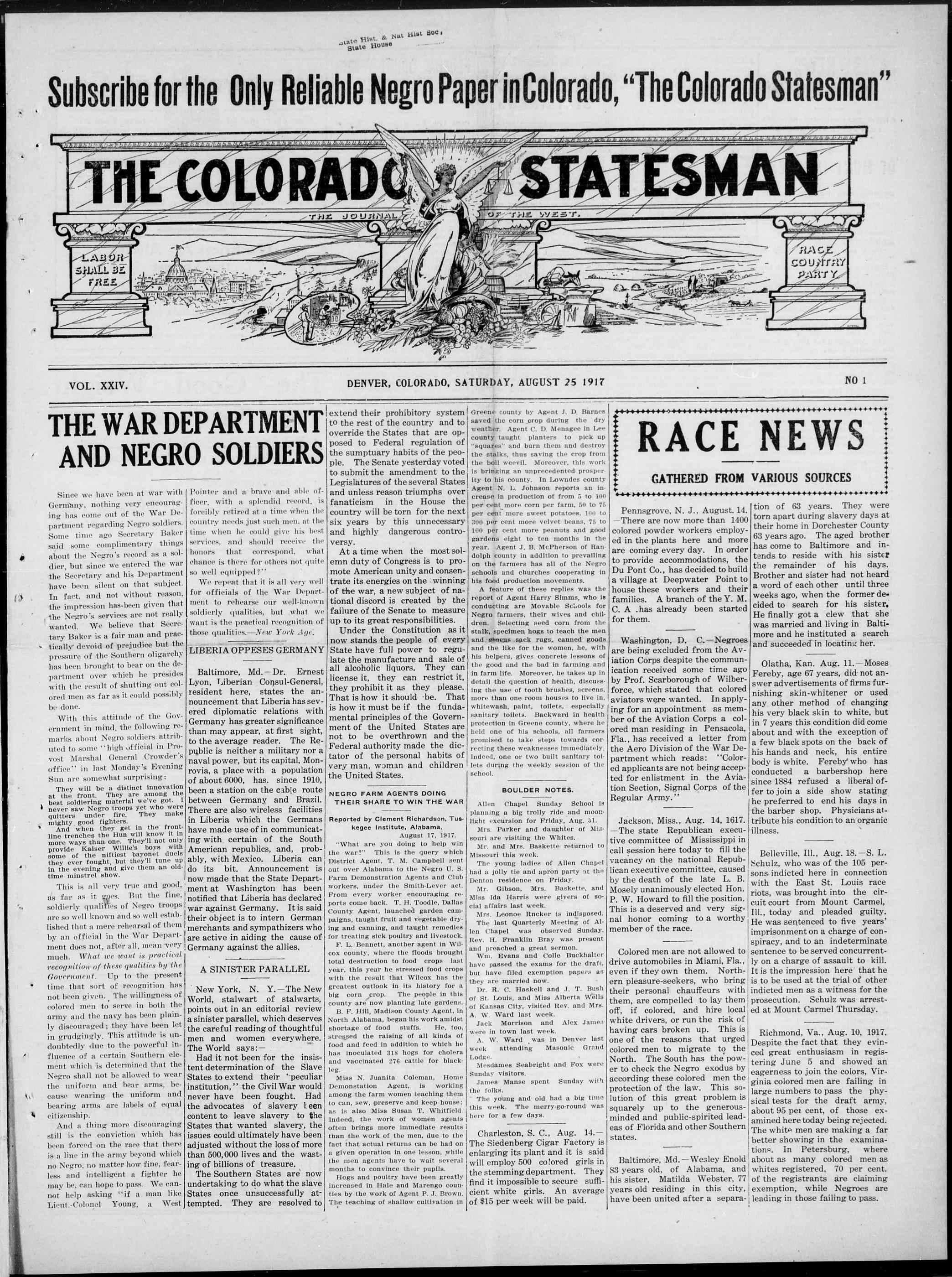
THE WAR DEPARTMENT AND NEGRO SOLDIERS
VOL. XXIV.
Since we have been at war with Germany, nothing very encouraging has come out of the War Department regarding Negro soldiers. Some time ago Secretary Baker said some complimentary things about the Negro's record as a soldier, but since we entered the war the Secretary and his Department have been silent on that subject. In fact, and not without reason, the impression has been given that the Negro's services are not really wanted. We believe that Secretary Baker is a fair man and practically devoid of prejudice but the pressure of the Southern oligarchy has been brought to bear on the department over which he presides with the result of shutting out colored men as far as it could possibly be done.
With this attitude of the Government in mind, the following remarks about Negro soldiers attributed to some "high official in Provost Marshal General Crowder's office" in last Monday's Evening Sun are somewhat surprising:
They will be a distinct innovation at the front. They are among the best soldiering material we've got. I never saw Negro troops yet who were quitters under fire. They make mighty good fighters.
And when they get in the frontline trenches the Hun will know it in more ways than one. They'll not only provide Kaiser Willie's boys with some of the niftiest bayonet duels they ever fought, but they'll tune up in the evening and give them an old-time minstrel show.
This is all very true and good, as far as it goes. But the fine, soldierly qualities of Negro troops are so well known and so well established that a mere rehearsal of them by an official in the War Department does not, after all, mean very much. What we want is practical recognition of these qualities by the Government. Up to the present time that sort of recognition has not been given. The willingness of colored men to serve in both the army and the navy has been plainly discouraged; they have been let in grudgingly. This attitude is undoubtedly due to the powerful influence of a certain Southern element which is determined that the Negro shall not be allowed to wear the uniform and bear arms, because wearing the uniform and bearing arms are labels of equal citizenship.
And a thing more discouraging still is the conviction which has been forced on the race that there is a line in the army beyond which no Negro, no matter how fine, fearless and intelligent a fighter he may be, can hope to pass. We cannot help asking "if a man like Lieut-Colonel Young, a West
Pointer and a brave and able officer, with a splendid record, is forcibly retired at a time when the country needs just such men, at the time when he could give his best services, and should receive the honors that correspond, what chance is there for others not quite so well equipped?"
We repeat that it is all very well for officials of the War Department to rehearse our well-known soldierly qualities, but what we want is the practical recognition of those qualities.—New York Age.
LIBERIA OPPESES GERMANY
Baltimore, Md.—Dr. Ernest Lyon, Liberian Consul-General, resident here, states the announcement that Liberia has severed diplomatic relations with Germany has greater significance than may appear, at first sight, to the average reader. The Republic is neither a military nor a naval power, but its capital, Monrovia, a place with a population of about 6000, has. since 1910, been a station on the cable route between Germany and Brazil. There are also wireless facilities in Liberia which the Germans have made use of in communicating with certain of the South American republics, and, probably, with Mexico. Liberia can do its bit. Announcement is now made that the State Department at Washington has been notified that Liberia has declared war against Germany. It is said their object is to intern German merchants and sympathizers who are active in aiding the cause of Germany against the allies.
A SINISTER PARALLEL
New York, N. Y.—The New World, stalwart of stalwarts, points out in an editorial review a sinister parallel, which deserves the careful reading of thoughtful men and women everywhere. The World says:— Had it not been for the insistent determination of the Slave States to extend their "peculiar institution," the Civil War would never have been fought. Had the advocates of slavery been content to leave slavery to the States that wanted slavery, the issues could ultimately have been adjusted without the loss of more than 500,000 lives and the wasting of billions of treasure. The Southern States are now undertaking to do what the slave States once unsuccessfully attempted. They are resolved to
DENVER, COLORADO, SATURDAY, AUGUST 25 1917
State Hist. & Nat Hist Soc
State House
able Negro Pa
ADO
E JOURNAL
DENVER, COLORADO, SA
extend their prohibitory system to the rest of the country and to override the States that are opposed to Federal regulation of the sumptuary habits of the people. The Senate yesterday voted to submit the amendment to the Legislatures of the several States and unless reason triumphs over fanaticism in the House the country will be torn for the next six years by this unnecessary and highly dangerous controversy. At a time when the most solemn duty of Congress is to promote American unity and concentrate its energies on the winning of the war, a new subject of national discord is created by the failure of the Senate to measure up to its great responsibilities.
Under the Constitution as it now stands the people of every State have full power to regulate the manufacture and sale of all alcoholic liquors. They can license it, they can restrict it, they prohibit it as they please. That is how it should be. That is how it must be if the fundamental principles of the Government of the United States are not to be overthrown and the Federal authority made the dictator of the personal habits of very man, woman and children the United States.
NEGRO FARM AGENTS DOING
THEIR SHARE TO WIN THE WAR
Reported by Clement Richardson, Tuskegee Institute, Alabama.
August 17, 1917.
"What are you doing to help win the war?" This is the query which District Agent, T. M. Campbell sent out over Alabama to the Negro U. S. Farm Demonstration Agents and Club workers, under the Smith-Lever act. From every worker encouraging reports come back. T. H. Toodle, Dallas County Agent, launched garden campaigns, taught fruit and vegetable drying and canning, and taught remedies for treating sick poultry and livestock. F. L. Bennett, another agent in Wilcox county, where the floods brought total destruction to food crops last year, this year he stressed food crops with the result that Wilcox has the greatest outlook in its history for a big corn crop. The people in this county are now planting late gardens. B. F. Hill, Madison County Agent, in North Alabama, began his work amidst shortage of food stuffs. He, too, stressed the raising of all kinds of food and feed in addition to which he has inoculated 318 hogs for cholera and vaccinated 276 cattle for black-leg.
Miss N. Juanita Coleman, Home Demonstation Agent, is working among the farm women teaching them to can, sew, preserve and keep house; as is also Miss Susan T. Whitfield. Indeed, the work of women agents often brings more immediate results than the work of the men, due to the fact that actual returns can be had on a given operation in one lesson, while the men agents have to wait several months to convince their pupils. Hogs and poultry have been greatly increased in Hale and Marengo counties by the work of Agent P. J. Brown. The teaching of shallow cultivation in
Greene county by Agent J. D. Barnes saved the corn crop during the dry weather. Agent C. D. Menagee in Lee county taught planters to pick up "squares" and burn them and destroy the stalks, thus saving the crop from the boll weevil. Moreover, this work is bringing an unprecedented prosperity to his county. In Lowndes county Agent N. L. Johnson reports an increase in production of from 5 to 100 per cent more corn per farm, 50 to 75 per cent more sweet potatoes, 100 to 300 per cent more velvet beans, 75 to 100 per cent more peanuts and good gardens eight to ten months in the year. Agent J. B. McPherson of Randolph county in addition to prevailing on the farmers has all of the Negro schools and churches cooperating in his food production movements.
A feature of these replies was the report of Agent Harry Simms, who is conducting are Movable Schools for Negro farmers, their wives and children. Selecting seed corn from the stalk, specimen hogs to teach the men and groom sack rugs, canned goods and the like for the women, he, with his helpers, gives concrete lessons of the good and the bad in farming and in farm life. Moreover, he takes up in detail the question of health, discussing the use of tooth brushes, screens, more than one room houses to live in, whitewash, paint, toilets, especially sanitary toilets. Backward in health protection in Greene county, where he held one of his schools, all farmers promised to take steps towards correcting these weaknesses immediately. Indeed, one or two built sanitary toilets during the weekly session of the school.
BOULDER NOTES
Allen Chapel Sunday School is planning a big trolly ride and moonlight excursion for Friday, Aug. 31. Mrs. Parker and daughter of Missouri are visiting the Whites. Mr. and Mrs. Baskette returned to Missouri this week. The young ladies of Allen Chapel had a jolly tie and apron party at the Denton residence on Friday. Mr. Gibson, Mrs. Baskette, and Miss Ida Harris were givers of social affairs last week. Mrs. Leonee Rncker is indisposed. The last Quarterly Meeting of Allen Chapel was observed Sunday. Rev. H. Franklin Bray was present and preached a great sermon. Wm. Evans and Colle Buckhalter have passed the exams for the draft, but have filed exemption papers as they are married now. Dr. R. C. Haskell and J. T. Bush of St. Louis, and Miss Alberta Wells of Kansas City, visited Rev. and Mrs. A. W. Ward last week. Jack Morrison and Alex James were in town last week. A. W. Ward was in Denver last week attending Masonic Grand Lodge.
Mesdames Seabright and Fox were Sunday visitors.
James Manse spent Sunday with the folks.
The young and old had a big time this week. The merry-go-round was here for a few days.
Charleston, S. C., Aug. 14.—The Siedenberg Cigar Factory is enlarging its plant and it is said will employ 500 colored girls in the stemming department. They find it impossible to secure sufficient white girls. An average of $15 per week will be paid.
RACE NEWS
GATHERED FROM VARIOUS SOURCES
Pennsgrove, N. J., August. 14. There are now more than 1400 colored powder workers employed in the plants here and more are coming every day. In order to provide accommodations, the Du Pont Co., has decided to build a village at Deepwater Point to house these workers and their families. A branch of the Y. M. C. A. has already been started for them.
Washington, D. C.—Negroes are being excluded from the Aviation Corps despite the communication received some time ago by Prof. Scarborough of Wilberforce, which stated that colored aviators were wanted. In applying for an appointment as member of the Aviation Corps a colored man residing in Pensacola, Fla., has received a letter from the Aero Division of the War Department which reads: "Colored applicants are not being accepted for enlistment in the Aviation Section, Signal Corps of the Regular Army."
Jackson, Miss., Aug. 14, 1617. The state Republican executive committee of Mississippi in call session here today to fill the vacancy on the national Republican executive committee, caused by the death of the late L. B. Mosely unanimously elected Hon. P. W. Howard to fill the position. This is a deserved and very signal honor coming to a worthy member of the race.
Colored men are not allowed to drive automobiles in Miami, Fla., even if they own them. Northern pleasure-seekers, who bring their personal chauffeurs with them, are compelled to lay them off, if colored, and hire local white drivers, or run the risk of having cars broken up. This is one of the reasons that urged colored men to migrate to the North. The South has the power to check the Negro exodus by according these colored men the protection of the law. This solution of this great problem is squarely up to the generous-minded and public-spirited lead-eas of Florida and other Southern states.
Baltimore, Md.—Wesley Enold 83 years old, of Alabama, and his sister, Matilda Webster, 77 years old residing in this city, have been united after a separa-
NO 1
tion of 63 years. They were torn apart during slavery days at their home in Dorchester County 63 years ago. The aged brother has come to Baltimore and intends to reside with his sister the remainder of his days. Brother and sister had not heard a word of each other until three weeks ago, when the former decided to search for his sister. He finally got a clew that she was married and living in Baltimore and he instituted a search and succeeded in locating her.
Olatha, Kan. Aug. 11.—Moses Fereby, age 67 years, did not answer advertisements of firms furnishing skin-whitener or used any other method of changing his very black skin to white, but in 7 years this condition did come about and with the exception of a few black spots on the back of his hands and neck, his entire body is white. Fereby who has conducted a barbershop here since 1884 refused a liberal offer to join a side show stating he preferred to end his days in the barber shop. Physicians attribute his condition to an organic illness.
Belleville, Ill., Aug. 18.—S. L. Schulz, who was of the 105 persons indicted here in connection with the East St. Louis race riots, was brought into the circuit court from Mount Carmel, Ill., today and pleaded guilty. He was sentenced to five years' imprisonment on a charge of conspiracy, and to an indeterminate sentence to be served concurrently on a charge of assault to kill. It is the impression here that he is to be used at the trial of other indicted men as a witness for the prosecution. Schulz was arrested at Mount Carmel Thursday.
Richmond, Va., Aug. 10, 1917. Despite the fact that they evinced great enthusiasm in registering June 5 and showed an eagerness to join the colors, Virginia colored men are failing in large numbers to pass the physical tests for the draft army, about 95 per cent, of those examined here today being rejected. The white men are making a far better showing in the examinations. In Petersburg, where about as many colored men as whites registered, 70 per cent. of the registrants are claiming exemption, while Negroes are leading in those failing to pass.
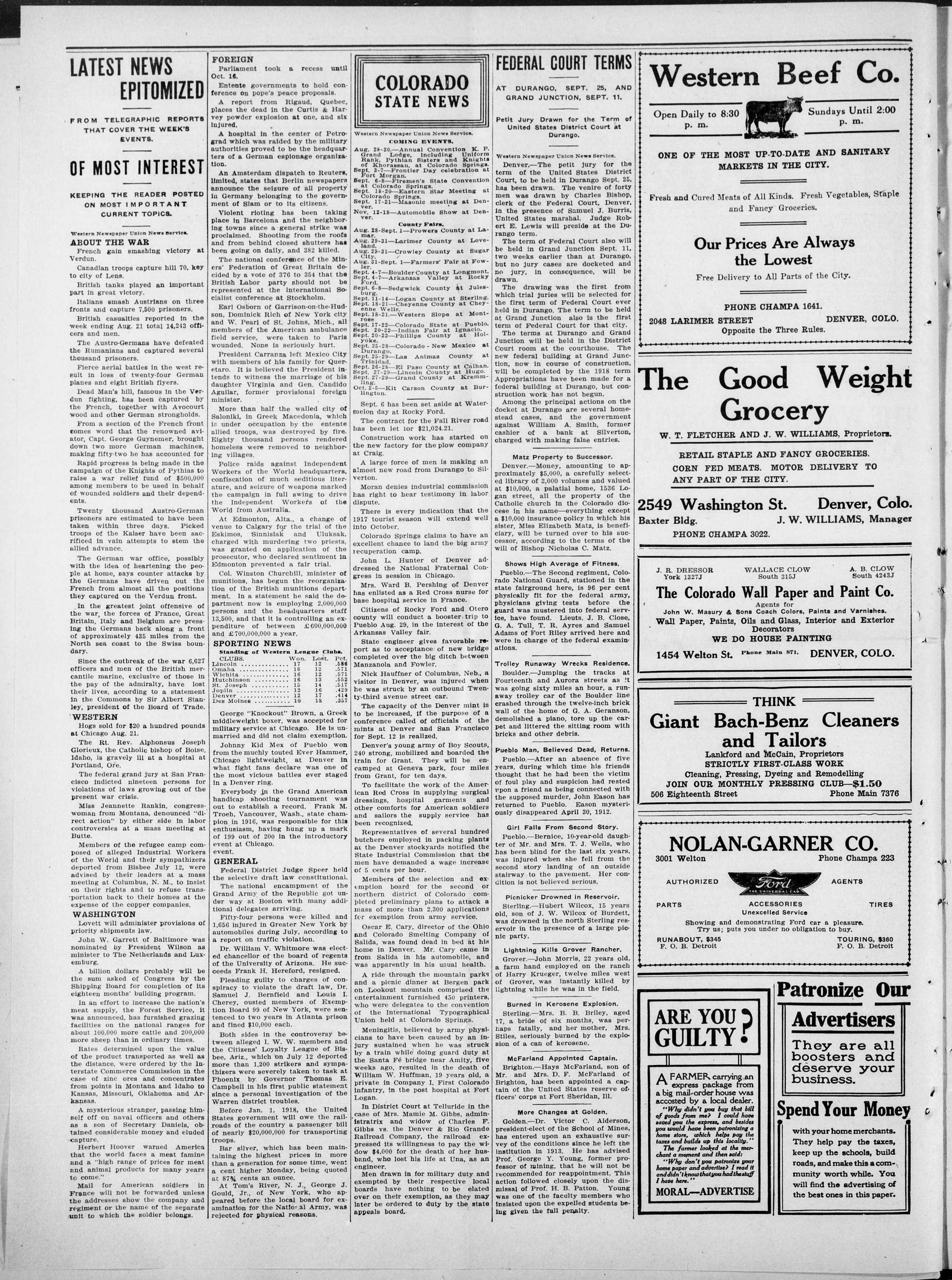
LATEST NEWS EPITOMIZED
FROM TELEGRAPHIC REPORTS
THAT COVER THE WEEK'S
EVENTS.
OF MOST INTEREST
OF MOST INTEREST
KEEPING THE READER POSTED
ON MOST IMPORTANT
CURRENT TOPICS.
Western Newspaper Union News Service.
ABOUT THE WAR
French gain smashing victory at Verdun.
Canadian troops capture hill 70, key to city of Lens.
British tanks played an important part in great victory.
Italians smash Austrians on three fronts and capture 7,500 prisoners.
British casualties reported in the week ending Aug. 21 total 14,243 officers and men.
The Austro-Germans have defeated the Rumanians and captured several thousand prisoners.
Fierce aerial battles in the west result in loss of twenty-four German planes and eight British flyers.
Dead Man's hill, famous in the Verdun fighting, has been captured by the French, together with Avocourt wood and other German strongholds.
From a section of the French front comes word that the renowned aviator, Capt. George Guynemer, brought down two more German machines, making fifty-two he has accounted for Rapid progress is being made in the campaign of the Knights of Pythias to raise a war relief fund of $500,000 among members to be used in behalf of wounded soldiers and their dependents.
Twenty thousand Austro-German prisoners are estimated to have been taken within three days. Picked troops of the Kaiser have been sacrificed in vain attempts to stem the allied advance.
The German war office, possibly with the idea of heartening the people at home, says counter attacks by the Germans have driven out the French from almost all the positions they captured on the Verdun front.
In the greatest joint offensive of the war, the forces of France, Great Britain, Italy and Belgium are pressing the Germans back along a front of approximately 435 miles from the North sea coast to the Swiss boundary.
Since the outbreak of the war 6,627 officers and men of the British mercantile marine, exclusive of those in the pay of the admiralty, have lost their lives, according to a statement in the Commons by Sir Albert Stanley, president of the Board of Trade.
'WESTERN
Hogs sold for $20 a hundred pounds at Chicago Aug. 21.
The Rt. Rev. Alphonsus Joseph Glorieux, the Catholic bishop of Boise, Idaho, is gravely ill at a hospital at Portland, Ore.
The federal grand jury at San Francisco indicted nineteen persons for violations of laws growing out of the present war crisis.
Miss Jeannette Rankin, congresswoman from Montana, denounced "direct action" by either side in labor controversies at a mass meeting at Butte.
Members of the refugee camp composed of alleged Industrial Workers of the World and their sympathizers deported from Bisbee July 12, were advised by their leaders at a mass meeting at Columbus, N. M., to insist on their rights and to refuse transportation back to their homes at the expense of the copper companies.
WASHINGTON
Lovett will administer provisions of priority shipments law.
John W. Garrett of Baltimore was nominated by President Wilson as minister to The Netherlands and Luxemburg.
A billion dollars probably will be the sum asked of Congress by the Shipping Board for completion of its eighteen months' building program.
In an effort to increase the nation's meat supply, the Forest Service, it was announced, has furnished grazing facilities on the national ranges for about 100,000 more cattle and 200,000 more sheep than in ordinary times.
Rates determined upon the value of the product transported as well as the distance, were ordered by the Interstate Commerce Commission in the case of zinc ores and concentrates from points in Montana and Idaho to Kansas, Missouri, Oklahoma and Arkansas.
A mysterious stranger, passing himself off on naval officers and others as a son of Secretary Daniels, obtained considerable money and eluded capture.
Herbert Hoover warned America that the world faces a meat famine and a "high range of prices for meat and animal products for many years to come."
Mail for American soldiers in France will not be forwarded unless the addresses show the company and regiment or the name of the separate unit to which the soldier belongs.
FOREIGN
Parliament took a recess until Oct. 16.
Entente governments to hold conference on pope's peace proposals.
A report from Rigaud, Quebec, places the dead in the Curtis & Harvey powder explosion at one, and six injured.
A hospital in the center of Petrograd which was raided by the military authorities proved to be the headquarters of a German espionage organization.
An Amsterdam dispatch to Reuters, limited, states that Berlin newspapers announce the seizure of all property in Germany belonging to the government of Siam or to its citizens.
Violent rioting has been taking place in Barcelona and the neighboring towns since a general strike was proclaimed. Shooting from the roofs and from behind closed shutters has been going on daily, and 382 killed. The national conference of the Miners' Federation of Great Britain decided by a vote of 376 to 354 that the British Labor party should not be represented at the international Socialist conference at Stockholm. Earl Osborn of Garrison-on-the-Hudson, Dominick Rich of New York city and W. Pearl of St. Johns, Mich., all members of the American ambulance field service, were taken to Paris wounded. None is seriously hurt.
President Carranza left Mexico City with members of his family for Queretaro. It is believed the President intends to witness the marriage of his daughter Virginia and Gen. Candido Aguilar, former provisional foreign minister.
More than half the walled city of Saloniki, in Greek Macedonia, which is under occupation by the entente allied troops, was destroyed by fire. Eighty thousand persons rendered homeless were removed to neighboring villages.
Police raids against Independent Workers of the World headquarters, confiscation of much seditious literature, and seizure of weapons marked the campaign in full swing to drive the Independent Workers of the World from Australia.
At Edmonton, Alta., a change of venue to Calgary for the trial of the Eskimos, Sinnislak and Uluksak, charged with murdering two priests, was granted on application of the prosecutor, who declared sentiment in Edmonton prevented a fair trial.
Col. Winston Churchill, minister of munitions, has begun the reorganization of the British munitions department. In a statement he said the department now is employing 2,000,000 persons and the headquarters staff 13,500, and that it is controlling an expenditure of between £600,000,000 and £700,000,000 a year.
SPORTING NEWS
Standing of Western League Clubs.
CLUBS. Won. Lost. Pct.
Lincoln 17 12 .586
Omaha 16 12 .571
Wichita 16 12 .571
Hutchinson 16 13 .552
Joseph 15 14 .517
Joplin 12 16 .429
Denver 12 17 .414
Des Moines 10 18 .357
George "Knockout" Brown, a Greek middleweight boxer, was accepted for military service at Chicago. He is unmarried and did not claim exemption.
Johnny Kid Mex of Pueblo won from the muchly touted Ever Hammer, Chicago lightweight, at Denver in what fight fans declare was one of the most vicious battles ever staged in a Denver ring.
Everybody in the Grand American handicap shooting tournament was out to establish a record. Frank M. Troeb, Vancouver, Wash., state champion in 1916, was responsible for this enthusiasm, having hung up a mark of 199 out of 200 in the introductory event at Chicago.
GENERAL
Federal District Judge Speer held the selective draft law constitutional. The national encampment of the Grand Army of the Republic got under way at Boston with many additional delegates arriving. Fifty-four persons were killed and 1,655 injured in Greater New York by automobiles during July, according to a report on traffic violation. Dr. William V. Whitmore was elected chancellor of the board of regents of the University of Arizona. He succeeds Frank H. Hereford, resigned. Pleading guilty to charges of conspiracy to violate the draft law, Dr. Samuel J. Bernfield and Louis I. Cherey, ousted members of Exemption Board 99 of New York, were sentenced to two years in Atlanta prison and fined $10,000 each.
Both sides in the controversy between alleged I. W. W. members and the Citizens' Loyalty League of Bisbee, Ariz., which on July 12 deported more than 1,200 strikers and sympathizers were severely taken to task at Phoenix by Governor Thomas E. Campbell in his first public statement since a personal investigation of the Warren district troubles.
Before Jan. 1, 1918, the United States government will owe the railroads of the country a passenger bill of nearly $20,000,000 for transporting troops.
Bar silver, which has been maintaining the highest prices in more than a generation for some time, went a cent higher Monday, being quoted at 87% cents an ounce.
At Tom's River, N. J., George J. Gould, Jr., of New York, who appeared before the local board for examination for the National Army, was rejected for physical reasons.
COLORADO
STATE NEWS
Western Newspaper Union News Service.
COMING EVENTS.
Aug. 28-30—Annual Convention K. P.
Grand Lodge, including Uniform
Rank, Dybbank Sisters and Knights
of Khorassan, at Colorado Springs.
Sept. 3-7—Frontier Day celebration at
Fort Morgan.
Sept. 6-8—Firemen's State Convention
at Colorado Springs.
State Fair Meeting at
Aug. 28-Sept. 1—Prowers County at Lamar.
Aug. 29-31—Larimer County at Loveland.
Aug. 29-31—Crowley County at Sugar City.
Aug. 1-Sept. 1—Farmers' Fair at Fowler.
Sept. 4-7—Boulder County at Longmont.
Sept. 7-14—Arkansas Valley at Rocky
Mountain.
Sept. 6-8—Sedgwick County at Julesburg.
Sept. 11-14—Logan County at Sterling.
Sept. 18-21—Cheyenne County at Cheyenne-Wells.
Sept. 18-21—Western Slope at Montrose.
Sept. 17-22—Colorado State at Pueblo
Sept. 20-22—Indian Fair at Ignacio.
Sept. 20-22—Phillips County at Holly
yoke.
Sept. 25-28—Colorado - New Mexico at
Durango.
Sept. 25-29—Las Animas County at Trinidad.
Sept. 26-28—El Paso County at Calhoun.
Sept. 27-29—Lincoln County at Hugo.
Sept. 27-29—Grand County at Kremm-
ling.
Oct. 2-5—Kit Carson County at Burlington.
Sept. 6 has been set aside at Water-
melon day at Rocky Ford.
The contract for the Fall River road
has been let 10r $21,024.21.
Construction work has started on
the new factory for the plow company
at Craig.
A large force of men is making an
almost new road from Durango to Sil-
verton.
Moran denies industrial commission
has right to hear testimony in labor
dispute.
There is every indication that the
1917 tourist season will extend well
into October.
Colorado Springs claims to have an excellent chance to land the big army recuperation camp.
John L. Hunter of Denver addressed the National Fraternal Congress in session in Chicago.
Mrs. Ward B. Pershing of Denver has enlisted as a Red Cross nurse for base hospital service in France.
Citizens of Rocky Ford and Otero county will conduct a booster-trip to Pueblo Aug. 29, in the interest of the Arkansas Valley fair.
State engineer gives favorable report as to acceptance of new bridge completed over the big ditch between Manzanola and Fowler.
Nick Hauffner of Columbus, Neb., a visitor in Denver, was injured when he was struck by an outbound Twenty-third avenue street car.
The capacity of the Denver mint is to be increased, if the purpose of a conference called of officials of the mints at Denver and San Francisco for Sept. 12 is realized. Denver's young army of Boy Scouts, 240 strong, mobilized and boarded the train for Grant. They will be encamped at Geneva park, four miles from Grant, for ten days. To facilitate the work of the American Red Cross in supplying surgical dressings, hospital garments and other comforts for American soldiers and sailors the supply service has been recognized. Representatives of several hundred butchers employed in packing plants at the Denver stockyards notified the State Industrial Commission that the men have demanded a wage increase of 5 cents per hour.
Members of the selection and exemption board for the second or northern district of Colorado completed preliminary plans to attack a mass of more than 2,300 applications for exemption from army service. Oscar E. Cary, director of the Ohio and Colorado Smelting Company of Salida, was found dead in bed at his home in Denver. Mr. Cary came in from Salida in his automobile, and was apparently in his usual health. A ride through the mountain parks and a picnic dinner at Bergen park on Lookout mountain comprised the entertainment furnished 450 printers, who were delegates to the convention of the International Typographical Union held at Colorado Springs.
Meningitis, believed by army physicians to have been caused by an injury sustained when he was struck by a train while doing guard duty at the Santa Fé bridge near Amity, five weeks ago, resulted in the death of William W. Huffman, 19 years old, a private in Company I. First Colorado infantry, in the post hospital at Fort Logan.
In District Court at Telluride in the case of Mrs. Mamie M. Gibbs, administratrix and widow of Charles F. Gibbs vs. the Denver & Rio Grande Railroad Company, the railroad expressed its willingness to pay the widow $4,000 for the death of her husband, who lost his life at Una, as an engineer.
Men drawn in for military duty and exempted by their respective local boards have nothing to be elated over on their exemption, as they may inter be ordered to duty by the state appeals board.
FEDERAL COURT TERMS
AT DURANGO, SEPT. 25, AND GRAND JUNCTION, SEPT. 11.
Petit Jury Drawn for the Term of United States District Court at Durango.
Western Newspaper Union News Service.
Denver.—The petit jury for the term of the United States District Court, to be held in Durango Sept. 25, has been drawn. The venire of forty men was drawn by Charles Bishop, clerk of the Federal Court, Denver, in the presence of Samuel J. Burris, United States marshal. Judge Robert E. Lewis will preside at the Durango term.
The term of Federal Court also will be held in Grand Junction Sept. 11, two weeks earlier than at Durango, but no jury cases are docketed and no jury, in consequence, will be drawn.
The drawing was the first from which trial juries will be selected for the first term of Federal Court ever held in Durango. The term to be held at Grand Junction also is the first term of Federal Court for that city. The terms at Durango and Grand Junction will be held in the District Court room at the courthouse. The new federal building at Grand Junction, now in course of construction, will be completed by the 1918 term Appropriations have been made for a federal building at Durango, but construction work has not begun. Among the principal actions on the docket at Durango are several home-stead cases, and the government against William A. Smith, former cashier of a bank at Silverton, charged with making false entries.
Matz Property to Successor.
Denver.—Money, amounting to approximately $5,000, a carefully selected library of 3,000 volumes and valued at $10,000, a palatial home, 1536 Logan street, all the property of the Catholic church in the Colorado diocese in his name—everything except a $10,000 insurance policy in which his sister, Miss Elizabeth Matz, is beneficiary, will be turned over to his successor, according to the terms of the will of Bishop Nicholas C. Matz.
Shows High Average of Fitness.
Pueblo.—The Second regiment, Colorado National Guard, stationed in the state fairground here, is 96 per cent physically fit for the federal army, physicians giving tests before the guard was mustered into federal service, have found. Lieuts. J. B. Close, G. A. Tull, T. R. Ayres and Samuel Adams of Fort Riley arrived here and were in charge of the federal examinations.
Trolley Runaway Wrecks Residence.
Boulder.—Jumping the tracks at Fourteenth and Aurora streets as it was going sixty miles an hour, a runaway trolley car of the Boulder line crashed through the twelve-inch brick wall of the home of G. A. Geranson, demolished a plano, tore up the carpet and littered the sitting room with bricks and other debris.
Pueblo Man, Believed Dead, Returns.
Pueblo Man, Believed Dead, Returns.
Pueblo.—After an absence of five years, during which time his friends thought that he had been the victim of foul play and suspicion had rested upon a friend as being connected with the supposed murder, John Eason has returned to Pueblo. Eason mysteriously disappeared April 30, 1912.
Girl Falls From Second Story.
Pueblo.-Bernice, 10-year-old daughter of Mr. and Mrs. T. J. Wells, who has been blind for the last six years, was injured when she fell from the second story landing of an outside stairway to the pavement. Her condition is not believed serious.
Picnicker Drowned in Reservoir.
Sterling.—Hubert Wilcox, 15 years old, son of J. W. Wilcox of Burdett, was drowned in the north Sterling reservoir in the presence of a large picnic party.
Lightning Kills Grover Rancher.
Grover.—John Morris, 22 years old, a farm hand employed on the ranch of Harry Krueger, twelve miles west of Grover, was instantly killed by lightning while he was in the field.
Burned In Kerosene Explosion.
Sterling.—Mrs. B. B. Brilley, aged 17, a bride of six months, was perhaps fatally, and her mother, Mrs. Stiles, seriously burned by the explosion of a can of kerosene.
McFarland Appointed Captain.
Brighton.—Hays McFarland, son of Mr. and Mrs. D. F. McFarland of Brighton, has been appointed a captain of the United States reserve officers' corps at Fort Sheridan, Ill.
More Changes at Golden.
Golden.—Dr. Victor C. Alderson, president-elect of the School of Mines, has entered upon an exhaustive survey of the conditions since he left the institution in 1913. He has advised Prof. George Y. Young, former professor of mining, that he will not be recommended for reappointment. This action followed closely upon the dismissal of Prof. H. B. Patton. Young was one of the faculty members who insisted upon the expelled students being given the full penalty.
Western Beef Co.
ONE OF THE MOST UP TO
MARKETS
Fresh and Cured Meats of All
and Fancy
Our Prices
the
Free Delivery to
PHONE C
2048 LARIMER STREET
Opposite the
The Good
Gro
W. T. FLETCHER AND J
RETAIL STAPLE AND
CORN FED MEATS.
ANY PART OF THE C
2549 Washington
Baxter Bldg.
PHONE CHAMPA 3022
J. R. DRESSOR
York 1327J
WALL
So
The Colorado Wall
John W. Masury & Sons Co
Wall Paper, Paints, Oils and
Dec
WE DO HOU
1454 Welton St. Phone
THE
Giant Bach-
and T
Lankford and M
STRICTLY FIRE
Cleaning, Pressing,
JOIN OUR MONTHLY
506 Eighteenth Street
NOLAN-G
3001 Welton
MOST UP-TO-DATE A
MARKETS IN THE CITY
Seats of All Kinds. Fresh
and Fancy Groceries.
Prices Are Always
the Lowest
Delivery to All Parts of the
PHONE CHAMPA 1641.
STREET
Apposite the Three Rules
Good W
Grocery
ER AND J. W. WILLIAMS
STAPLE AND FANCY G
MEATS. MOTOR DE
OF THE CITY.
Bington St. I
J. W. WILLIAMS
CHAMPA 3022.
WALLACE CLOW
South 315J
Do Wall Paper and
Agents for
& Sons Coach Colors, Pain
tals, Oils and Glass, Inter
Decorators
DO HOUSE PAINTING
St. Phone Main 871. DE
THINK
Beach-Benz Co
and Tailors
Ford and McCain, Propr
JECTLY FIRST-GLASS W
Pressing, Dyeing and Re
MONTHLY PRESSING O
eet
IN-GARNER
ONE OF THE MOST UP-TO-DATE AND SANITARY MARKETS IN THE CITY.
Fresh and Cured Meats of All Kinds. Fresh Vegetables, Staple and Fancy Groceries.
PHONE CHAMPA 1641.
2048 LARIMER STREET DENVER, COLO.
Opposite the Three Rules.
The Good Weight Grocery
W. T. FLETCHER AND J. W. WILLIAMS, Proprietors.
RETAIL STAPLE AND FANCY GROCERIES.
CORN FED MEATS. MOTOR DELIVERY TO
ANY PART OF THE CITY.
2549 Washington St. Denver, Colo.
Baxter Bldg. J. W. WILLIAMS, Manager
PHONE CHAMPA 3022.
J. R. DRESSOR
York 1327J
WALLACE CLOW
South 315J
A. B. CLOW
South 4243J
Agents for
John W. Masury & Sons Coach Colors, Paints and Varnishes.
Wall Paper, Paints, Oils and Glass, Interior and Exterior
Decorators
WE DO HOUSE PAINTING
1454 Welton St. Phone Main 871. DENVER, COLO.
THINK
Giant Bach-Benz Cleaners and Tailors
Lankford and McCain, Proprietors
STRICTLY FIRST-CLASS WORK
Cleaning, Pressing, Dyeing and Remodelling
JOIN OUR MONTHLY PRESSING CLUB—$1.50
506 Eighteenth Street Phone Main 7376
NOLAN-GARNER CO.
Ford
THE UNIVERSAL CAR
PARTS ACCE
Unexce
Showing and demonstr
Try us; puts you un
RUNABOUT, $345
F. O. B. Detroit
ACCESSORIES
Unexcelled Service
and demonstrating Ford cars
puts you under no obligation
ARE YOU GUILTY?
A FARMER carrying an express package from a big mail-order house was accosted by a local dealer.
"Why didn't you buy that bill of goods from me? I could have saved you the express, and besides you would have been patronizing a home store, which helps pay the taxes and builds up this locality."
The farmer looked at the merchant a moment and then said:
"Why don't you patronize your home paper and advertise? I read it and didn't know that you had the stuff I have here."
MORAL—ADVERTISE
---
---
Open Daily to 8:30 p. m.
NO-DATE AND SANITARY
IN THE CITY.
Minds. Fresh Vegetables, Staple
Groceries.
Are Always
Lowest
All Parts of the City.
AMPA 1641.
DENVER, COLO.
Three Rules.
Hard Weight
Grocery
W. WILLIAMS, Proprietors.
FANCY GROCERIES.
MOTOR DELIVERY TO
CITY.
St. Denver, Colo.
J. W. WILLIAMS, Manager
DE CLOW
a 315J
A. B. CLOW
South 4243J
Paper and Paint Co.
Sizes for
Colors, Paints and Varnishes.
Glass, Interior and Exterior
Decorators
PAINTING
in 871. DENVER, COLO.
INK
Benz Cleaners
Tailors
Cain, Proprietors
T-CLASS WORK
Meeting and Remodelling
PRESSING CLUB—$1.50
Phone Main 7376
ARNER CO.
Phone Champa 223
SORIES TIRES
Bld Service
wing Ford car a pleasure.
r no obligation to buy.
TOURING, $360
F. O. B. Detroit
Patronize Our
Advertisers They are all boosters and deserve your business.
Spend Your Money
with your home merchants. They help pay the taxes, keep up the schools, build roads, and make this a community worth while. You will find the advertising of the best ones in this paper.
```markdown
```
Sundays Until 2:00 p. m.
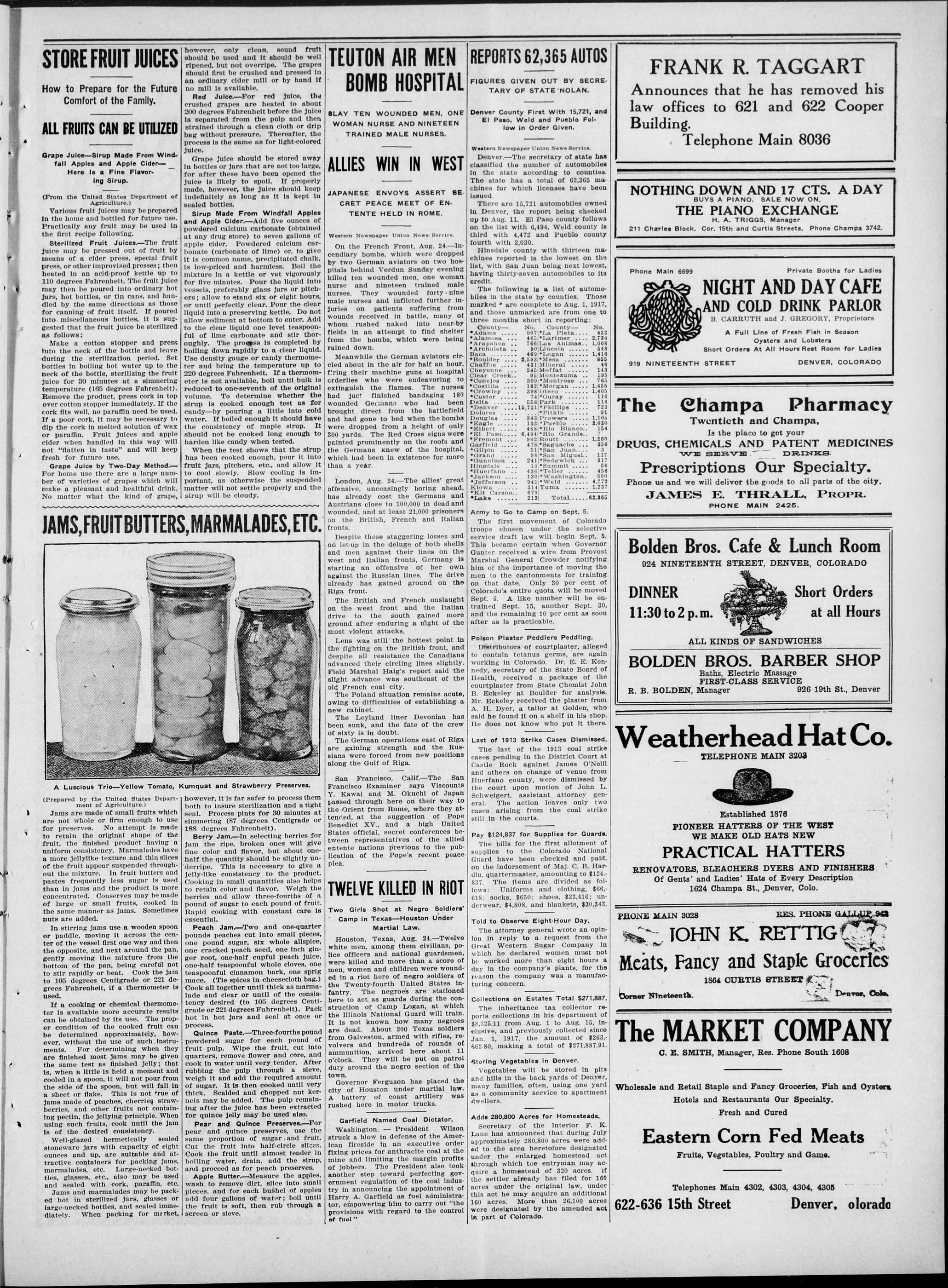
JAMS,FRUITBUTTERS,MARMALADES,ETC.
```markdown
```
A Luscious Trio—Yellow Tomato, Kumquat and Strawberry Preserves.
How to Prepare for the Future Comfort of the Family.
ALL FRUITS CAN BE UTILIZED
Grape Juice—Sirup Made From Windfall Apples and Apple Cider—Here Is a Fine Flavoring Sirup.
(From the United States Department of Agriculture.)
Various fruit juices may be prepared in the home and bottled for future use. Practically any fruit may be used in the first recipe following.
Sterilized Fruit Juices.—The fruit juice may be pressed out of fruit by means of a cider press, special fruit press, or other improvised presses; then heated in an acid-proof kettle up to 110 degrees Fahrenheit. The fruit juice may then be poured into ordinary hot jars, hot bottles, or tin cans, and handled by the same directions as those for canning of fruit itself. If poured into miscellaneous bottles, it is suggested that the fruit juice be sterilized as follows:
Make a cotton stopper and press into the neck of the bottle and leave during the sterilization period. Set bottles in boiling hot water up to the neck of the bottle, sterilizing the fruit juice for 30 minutes at a simmering temperature (165 degrees Fahrenheit). Remove the product, press cork in top over cotton stopper immediately. If the cork fits well, no paraffin need be used. If a poor cork, it may be necessary to dip the cork in melted solution of wax or paraffin. Fruit juices and apple cider when handled in this way will not "flatten in taste" and will keep fresh for future use.
Grape Juice by Two-Day Method.—For home use there are a large number of varieties of grapes which will make a pleasant and healthful drink. No matter what the kind of grape,
JAMS, FRUIT BUTTERS
A Luscious Trio—Yellow Tomato,
(Prepared by the United States Department of Agriculture.)
Jams are made of small fruits which are not whole or firm enough to use for preserves. No attempt is made to retain the original shape of the fruit, the finished product having a uniform consistency. Marmalades have a more jellylike texture and thin slices of the fruit appear suspended throughout the mixture. In fruit butters and pastes frequently less sugar is used than in jams and the product is more concentrated. Conserves may be made of large or small fruits, cooked in the same manner as jams. Sometimes nuts are added.
In stirring jams use a wooden spoon or paddle, moving it across the center of the vessel first one way and then the opposite, and next around the pan, gently moving the mixture from the bottom of the pan, being careful not to stir rapidly or beat. Cook the jam to 105 degrees Centigrade or 221 degrees Fahrenheit, if a thermometer is used.
If a cooking or chemical thermometer is available more accurate results can be obtained by its use. The proper condition of the cooked fruit can be determined approximately, however, without the use of such instruments. For determining when they are finished most jams may be given the same test as finished jelly; that is, when a little is held a moment and cooled in a spoon, it will not pour from the side of the spoon, but will fall in a sheet or flake. This is not true of jams made of peaches, cherries strawberries, and other fruits not containing pectin, the jellying principle. When using such fruits, cook until the jam is of the desired consistency.
Well-glazed hermetically sealed stoneware jars with capacity of eight ounces and up, are suitable and attractive containers for packing jams, marmalades, etc. Large-necked bottles, glasses, etc., also may be used and sealed with cork, paraffin, etc. Jams and marmalades may be packed hot in sterilized jars, glasses or large-necked bottles, and sealed immediately. When packing for market,
however, only clean, sound fruit should be used and it should be well ripened, but not overripe. The grapes should first be crushed and pressed in an ordinary cider mill or by hand if no mill is available.
Red Juice.—For red juice, the crushed grapes are heated to about 200 degrees Fahrenheit before the juice is separated from the pulp and then strained through a clean cloth or drip bag without pressure. Thereafter, the process is the same as for light-colored juice.
Grape juice should be stored away in bottles or jars that are not too large, for after these have been opened the juice is likely to spoil. If properly made, however, the juice should keep indefinitely as long as it is kept in sealed bottles.
Sirup Made From Windfall Apples and Apple Cider.—Add five ounces of powdered calcium carbonate (obtained at any drug store) to seven gallons of apple cider. Powdered calcium carbonate (carbonate of lime) or, to give it is common name, precipitated chalk, is low-priced and harmless. Boll the mixture in a kettle or vat vigorously for five minutes. Pour the liquid into vessels, preferably glass jars or pitchers; allow to stand six or eight hours, or until perfectly clear. Pour the clear liquid into a preserving kettle. Do not allow sediment at bottom to enter. Add to the clear liquid one level teaspoonful of lime carbonate and stir thoroughly. The process is completed by boiling down rapidly to a clear liquid. Use density gauge or candy thermometer and bring the temperature up to 220 degrees Fahrenheit. If a thermometer is not available, boil until bulk is reduced to one-seventh of the original volume. To determine whether the sirup is cooked enough test as for candy—by pouring a little into cold water. If boiled enough it should have the consistency of maple sirup. It should not be cooked long enough to harden like candy when tested.
When the test shows that the stirup has been cooked enough, pour it into fruit jars, pitchers, etc., and allow it to cool slowly. Slow cooling is important, as otherwise the suspended matter will not settle properly and the stirup will be cloudy.
S, MARMALADES, ETC.
Kumquat and Strawberry Preserves.
however, it is far safer to process them both to insure sterilization and a tight seal. Process pints for 30 minutes at simmering (87 degrees Centigrade or 188 degrees Fahrenheit).
Berry Jam.—In selecting berries for jam the ripe, broken ones will give fine color and flavor, but about one-half the quantity should be slightly underripe. This is necessary to give a jelly-like consistency to the product. Cooking in small quantities also helps to retain color and flavor. Weigh the berries and allow three-fourths of a pound of sugar to each pound of fruit. Rapid cooking with constant care is essential.
Peach Jam.—Two and one-quarter pounds peaches cut into small pieces, one pound sugar, six whole allspice, one cracked peach seed, one inch ginger root, one-half cupful peach juice, one-half teaspoonful whole cloves, one teaspoonful cinnamon bark, one sprig mace. (Tle spices in cheesecloth bag). Cook all together until thick as marmalade and clear or until the consistency desired (to 105 degrees Centigrade or 221 degrees Fahrenheit). Pack hot in hot jars and seal at once or process.
Quince Paste.—Three-fourths pound powdered sugar for each pound of fruit pulp. Wipe the fruit, cut into quarters, remove flower and core, and cook in water until very tender. After rubbing the pulp through a sieve, weigh it and add the required amount of sugar. It is then cooked until very thick. Scalded and chopped nut kernels may be added. The pulp remaining after the juice has been extracted for quince jelly may be used also.
Pear and Quince Preserves.—For pear and quince preserves, use the same proportion of sugar and fruit. Cut the fruit into half-circle slices. Cook the fruit until almost tender in boiling water, drain, add the srup, and proceed as for peach preserves.
Apple Butter. Measure the apples, wash to remove dirt, slice into small pieces, and for each bushel of apples add four gallons of water; boll until the fruit is soft, then rub through a screen or sieve.
TEUTON AIR MEN BOMB HOSPITAL
BLAY TEN WOUNDED MEN, ONE WOMAN NURSE AND NINETEEN TRAINED MALE NURSES.
ALLIES WIN IN WEST
JAPANESE ENVOYS ASSERT 6E
CRET PEACE MEET OF EN-
TENTE HELD IN ROME.
Western Newspaper Union News Service.
On the French Front, Aug. 24.—Incendiary bombs, which were dropped by two German aviators on two hospitals behind Verdun Sunday evening killed ten wounded men, one woman nurse and nineteen trained male nurses. They wounded forty-nine male nurses and inflicted further injuries on patients suffering from wounds received in battle, many of whom rushed naked into near-by fields in an attempt to find shelter from the bombs, which were being rained down.
Meanwhile the German aviators circled about in the air for half an hour, firing their machine guns at hospital crderlies who were endeavoring to extinguish the flames. The nurses had just finished bandaging 180 wounded Germans who had been brought direct from the battlefield and had gone to bed when the bombs were dropped from a height of only 300 yards. The Red Cross signs were painted prominently on the roofs and the Germans knew of the hospital, which had been in existence for more than a year.
London, Aug. 24.—The allies' great offensive, unceasingly boring ahead, has already cost the Germans and Austrians close to 100,000 in dead and wounded, and at least 21,000 prisoners on the British, French and Italian fronts.
Despite these staggering losses and no let-up in the deluge of both shells and men against their lines on the west and Italian fronts, Germany is starting an offensive of her own against the Russian lines. The drive already has gained ground on the Riga front.
The British and French onslaught on the west front and the Italian drive to the south gained more ground after enduring a night of the most violent attacks.
Lens was still the hottest point in the fighting on the British front, and despite all resistance the Canadians advanced their circling lines slightly. Field Marshal Haig's report said the slight advance was southeast of the old French coal city.
The Poland situation remains acute, owing to difficulties of establishing a new cabinet.
The Leyland liner Devonian has been sunk, and the fate of the crew of sixty is in doubt. The German operations east of Riga are gaining strength and the Russians were forced from new positions along the Gulf of Riga.
San Francisco, Calif.—The San Francisco Examiner says Viscounts Y. Kawai and M. Okuchi of Japan passed through here on their way to the Orient from Rome, where they attended, at the suggestion of Pope Benedict XV., and a high United States official, secret conferences between representatives of the allied entente nations previous to the publication of the Pope's recent peace plea.
TWELVE KILLED IN RIOT
TWELVE KILLED IN RIOT
Two Girls Shot at Negro Soldiers' Camp in Texas—Houston Under Martial Law.
Houston, Texas, Aug. 24.—Twelve white men, among them civilians, police officers and national guardsmen, were killed and more than a score of men, women and children were wounded in a riot here of negro soldiers of the Twenty-fourth United States infantry. The negroes are stationed here to act as guards during the construction of Camp Logan, at which the Illinois National Guard will train. It is not known how many negroes are dead. About 200 Texas soldiers from Galveston, armed with rifles, revolvers and hundreds of rounds of ammunition, arrived here about 11 o'clock. They will be put on patrol duty around the negro section of the town.
Governor Ferguson has placed the city of Houston under martial law. A battery of coast artillery was rushed here in motor trucks.
Garfield Named Coal Dictator.
Washington. — President Wilson struck a blow in defense of the American fireside in an executive order fixing prices for anthracite coal at the mine and limiting the margin profits of jobbers. The President also took another step toward perfecting government regulation of the coal industry in announcing the appointment of Harry A. Garfield as fuel administrator, empowering him to carry out "the provisions with regard to the control of fuel."
REPORTS 62,365 AUTOS
REPORTS 62,365 AUTOS
FIGURES GIVEN OUT BY SECRETARY OF STATE'NOLAN.
Denver County First With 15,721, and El Paso, Weld and Pueblo Follow in Order Given.
Western Newspaper Union News Service.
Denver.—The secretary of state has classified the number of automobiles in the state according to counties. The state has a total of 62,365 machines for which licenses have been issued.
There are 15,721 automobiles owned in Denver, the report being checked up to Aug. 11. El Paso county follows on the list with 6,494. Weld county is third with 4,472 and Pueblo county fourth with 3,030.
Hinsdale county with thirteen machines reported is the lowest on the list, with San Juan being next lowest, having thirty-seven automobiles to its credit.
The following is a list of automobiles in the state by counties. Those marked * are complete to Aug. 1, 1917, and those unmarked are from one to three months short in reporting:
County..... No. County..... No.
*Adams..... 907 *La Plata..... 422
*Alamosa..... 465 *Larimer..... 2,734
*Arapahoe..... 766 *Las Animas..... 1,098
*Enchuleta..... 654 *Lacoo..... 1,088
*Bacon..... 489 *Logan..... 1,416
*Boulder..... 2,593 *Mesa..... 855
Chaffee..... 431 Mineral..... 46
Cheyenne..... 245 Moffat..... 143
Clear Creek..... 95 Montezuma..... 195
Conosco..... 95 Montrose..... 748
Cotilla..... 162 Montrose..... 1,455
Crowley..... 398 Otero..... 1,405
*Custer..... 74 Ouray..... 116
Delta..... 558 Park..... 116
*Denver..... 15,721 *Phillips..... 723
Dolores..... 1043 *Philip..... 123
Downtown..... 133 Prowers..... 1,105
*Eagle..... 133 Pueblo..... 3,030
*Elbert..... 488 *Rio Blanco..... 154
*El Paso..... 6,494 *Rio Grande..... 7
Fremont..... 942 Routt..... 1,200
Garfield..... 457 *Sagrique..... 1,350
*Hilbrun..... 51 *Sir Juan..... 3
*Grand..... 98 *San Miguel..... 117
*Gunnison..... 241 *Sedgwick..... 137
Hinsdale..... 13 Summit..... 56
*Huerfano..... 436 *Teller..... 456
Jackson..... 130 *Washington..... 838
*Jalisco..... 914 *Wells..... 4,772
Kiowa..... 344 Yuma..... 1,237
*Kit Carson..... 679
*Lake..... 213 Total..... 62,365
Army to Go to Camp on Sept. 5.
The first movement of Colorado troops chosen under the selective service draft law will begin Sept. 5. This became certain when Governor Gunter received a wire from Provost Marshal General Crowder notifying him of the importance of moving the men to the cantonments for training on that date. Only 30 per cent of Colorado's entire quota will be moved Sept. 5. A like number will be entrained Sept. 15, another Sept. 30, and the remaining 10 per cent as soon after as is practicable.
Poison Plaster Peddlers Peddling.
Distributors of courtplaster, alleged to contain tetanus germs, are again working in Colorado. Dr. E. E. Kennedy, secretary of the State Board of Health, received a package of the courtplaster from State Chemist John B. Eckeley at Boulder for analysis. Mr. Eckeley received the plaster from A. H. Dyer, a tailor at Golden, who said he found it on a shelf in his shop. He does not know who put it there.
Last of 1913 Strike Cases Dismissed.
The last of the 1913 coal strike cases pending in the District Court at Castle Rock against James O'Neill and others on change of venue from Huerfano county, were dismissed by the court upon motion of John L. Schweigert, assistant attorney general. The action leaves only two cases arising from the coal strike still in the courts.
Pay $124,837 for Supplies for Guards.
The bills for the first allotment of supplies to the Colorado National Guard have been checked and paid, on the indorsement of Maj. C. B. Hardin, quartermaster, amounting to $124,837. The items are divided as follows: Uniforms and clothing, $66,618; socks, $650; shoes, $23,416; underwear, $4,808, and blankets, $30,343.
Told to Observe Eight-Hour Day.
The attorney general wrote an opinion in reply to a request from the Great Western Sugar Company in which he declared women must not be worked more than eight hours a day in the company's plants, for the reason the company was a manufacturing concern.
Collections on Estates Total $271,887.
The inheritance tax collector reports collections in his department of $8,325.11 from Aug. 1 to Aug. 15, inclusive, and previously collected since Jan. 1, 1917, the amount of $263,562.80, making a total of $271,887.91.
Storing Vegetables in Denver.
Vegetables will be stored in pits and hills in the back yards of Denver, many families, often, using one yard as a community service to apartment dwellers.
Adds 280,800 Acres for Homesteads.
Secretary of the Interior F. K. Lane has announced that during July approximately 280,800 acres were added to the area heretofore designated under the enlarged homestead act through which the entryman may acquire a homestead of 320 acres. If the settler already has filed for 160 acres under the original law, under this act he may acquire an additional 160 acres. More than 26,100 acres were designated by the amended act in part of Colorado.
Announces that he has removed his law offices to 621 and 622 Cooper Building. Telephone Main 8036
NOTHING DO
BUYS
THE H
211 Charles Block. Cor
ING DOWN AND 17 CTS.
BUYS A PIANO. SALE NOW ON.
THE PIANO EXCHANGE
H. A. TRIGGS, Manager
Block, Cor, 15th and Curtis Streets. Phone
n 6699 Private Booth
NIGHT AND DAY
AND COLD DRINK P
B. CARRUTH and J. GREGORY, B
A Full Line of Fresh Fish in S
Oysters and Lobsters
Short Orders At All Hours Rest Room
TEENTH STREET DENVER,
Champa Pharma
Twentieth and Champa,
Is the place to get your
CHEMICALS AND PATENT M
WE SERVE DRINKS.
Descriptions Our Special
and we will deliver the goods to all parts
MES E. THRALL, PR
PHONE MAIN 2425.
In Bros. Cafe & Lunch
INNETEENTH STREET, DENVER, COL
NOTHING DOWN AND 17 CTS. A DAY
BUYS A PIANO. SALE NOW ON.
THE PIANO EXCHANGE
H. A. TRIGGS, Manager
211 Charles Block. Cor. 15th and Curtis Streets. Phone Champa 3742.
919 NINETEENTH ST
The Cha
Twenty
Is
DRUGS, CHEMICAL
WE S
Prescripti
Phone us and we will
JAMES
Bolden Bros
924 NINETEENTH
The Champa Pharmacy
Twentieth and Champa,
Is the place to get your
DRUGS, CHEMICALS AND PATENT MEDICINES
WE SERVE DRINKS.
Prescriptions Our Specialty.
Phone us and we will deliver the goods to all parts of the city.
JAMES E. THRALL, PROPR.
PHONE MAIN 2425.
Bolden Bros. Cafe & Lunch Room 924 NINETEENTH STREET, DENVER, COLORADO
DINNER
11:30 to 2 p.m.
ALL R
BOLDEN B
Bath
FIR
R. B. BOLDEN, Man
Weathe
ALL KINDS OF SANDWICHES
DEN BROS. BARBER
Baths, Electric Massage
FIRST-CLASS SERVICE
DEN, Manager 926 19th S
atherhead Ha
TELEPHONE MAIN 3203
BOLDEN BROS. BARBER SHOP
Baths, Electric Massage
FIRST-CLASS SERVICE
R. B. BOLDEN, Manager 926 19th St., Denver
Weatherhead Hat Co. TELEPHONE MAIN 3203
Established 1876
PIONEER HATTERS OF THE WEST
WE MAKE OLD HATS NEW
PRACTICE
RENOVATORS, BL
Of Gents' and
1624
PRACTICAL HATTERS
ATORS, BLEACHERS DYERS AND FINE
Gents' and Ladies' Hats of Every Descrip
1624 Champa St., Denver, Colo.
RENOVATORS, BLEACHERS DYERS AND FINISHERS Of Gents' and Ladies' Hats of Every Description 1624 Champa St., Denver, Colo.
JOHN K. RETTIGER
Fancy and Staple Gro
1864 CURTIS STREET
seventh.
Meats, Fancy
The MAR
C. E. SMITH,
Wholesale and Retail Sta
Hotels and
The MARKET COMPANY
C. E. SMITH, Manager, Res. Phone South 1608
Wholesale and Retail Staple and Fancy Groceries, Fish and Oysters Hotels and Restaurants Our Specialty. Fresh and Cured Eastern Corn Fed Meats Fruits, Vegetables, Poultry and Game.
Telephones Main 4302, 4303, 4304, 4305 622-636 15th Street Denver, olorado
PHONE MAIN 8099
PHONE MAIN 3028
Corner Nineteenth.
NO 17 CTS. A DAY
WE NOW ON.
EXCHANGE
Manager
Streets. Phone Champa 3742.
Private Booths for Ladies
AND DAY CAFE
FOR DRINK PARLOR
J. GREGORY, Proprietors
of Fresh Fish in Season
Lobsters and Lobsters
Hours Rest Room for Ladies
DENVER, COLORADO
Pharmacy
Champa,
not your
PATENT MEDICINES
DRINKS.
Our Specialty.
needs to all parts of the city.
ALL, PROPR.
22425.
& Lunch Room
DENVER, COLORADO
A Full Line of Fresh Fish in Season
Oysters and Lobsters
Short Orders At All Hours Rest Room for Ladies
STREET DENVER, COLORADO
Short Orders at all Hours
BARBER SHOP
Massage
SERVICE
926 19th St., Denver
d Hat Co.
IN 3203
HATTERS
VERS AND FINISHERS
Of Every Description
Denver, Colo.
RES. PHONE GALLUP 942
STAPLE Groceries
STREET
Denver, Cola
COMPANY
Phone South 1608
Fruit Bowl
---
454
CF wee sath As AARON LDAAD AL ASESDAAAAMAAT MARA “AAG, GUMRGLIN RUAnABAMAER ona ene anggenronnnraryaninans say
a ea ae
E COLORADUN 274 STATESMAN.
ES ve PANS |
Sn ae Fant ey
ao ge Ft fas Sexe
Fearon] eel 71] Urey Pur]
Li tal Pe ere
‘net | pierre AAD Go ae sf
Sy Bak ey Soc | ie I ee ee <4
el aa Eas ee Seid
LE SCRE Sra
SUBSCRIPTION RATES.
Ome Vea ccccscccccereeee « etteetteensenseeseresesnseeseessesests sete es s$as00
PAVABUD IN ADVANCE!
Ertered as second-class mictter at the postoffice in the City of Denver, Golo,
TS24 Curtin Street, Room 25.
Phone Main 7417.
Reading notices, ten nes or less, 10 cents per line. Each additiona) line over
fen lines, & cents per line. Display advertising, 60 cents per inch.
Remittances should be made by Express Money Order, Pontottice Money
orack Rutinerea Letter or Bank Bratt. Bostage stampa will be received the
Creer erat he eucClonal part of a dollars Only te and Ze atampe taken,
Gommunleationa to reccive attention tust be Hewsy, upon important «ab:
Re Giutneld trom the columns of this paper. )
ALARM OVER NEGRO EXODUS, |
HY ALL THIS ALARM over the exodus of our people from the South?
W Is this without a precedent? What about the migration of the people
of Palestine to the rich and fertile soil and vast grain-producing coun-
try of Egypt thousands of years ago? What of the migration into India, into
South Africa, our America and various other parts of the world? Have we
read that in some cases it was in search of wealth and improving conditions;
in others escaping home oppression when inducements for betterment were
offered; the desire to grow strong in intellect so as to share in leadership,
responsibility, and become as independent as the other fellow or the other
srace?
Negroes of the West, especially of Colorado, be not misquoted by the
talks of a few irresponsible people (white and black), who are making their
diurnal and nocturnal rounds endeavoring to attempt to scare with their re-
marks about the riffraff, the worthless, the criminal Negro of the South,
who, starting on his crusade of destruction, is invading the West and will
eventually deprive us of privileges and advantages we now enjoy. Give
them the answer, which is evidenced by the ninety-eight per cent. of the
Negroes here, who have been coming to this part of the country from 1860
—fifty-seven years ago—and have lived such upright and honorable lives as
to become resident taxpayers, business men and women possessing fine
homes, beautiful church buildings, lofty institutions for training, and above
all, a recognized producer, an organizer, a constructor and a contributor to
good government, the peace and harmony of which he is the very embodiment.
Parasites no longer given an opportunity to victimize, vampires no
chance to prey, vultures no carrion on which to feed, drones who have been
compelled to remain on the exterior of the hive are alarmed, afraid of
their fellow American citizens who are not MIGRATING, but shifting resi-
dences, crossing a bridge, fording a stream, or engaging the iron horse to
convey them a few miles. Yes! They are alarmed, as they say their places
of employment will be jeopardized, wages will be reduced and the innumer-
able stupefying expressions they venture to offer.
But the real backbone Denverite and Coloradoan, with arms outstretched,
bid them WELCOME!—and in that greeting rejoice that the echo of the
impressions we have made and the maintenance of the prestige already es-
tablished will sound and resound in this western land, that our race, too, pos:
sesses men—strong men, valiant men, real men,
THE COLORADO STATESMAN, a connecting link in the chain of the
Old and New Denver, welcome those of our race that are here and hope for
multiplication of our people in this so-called “exodus,” as among those
who are coming will be found stalwart Americans who can hold their own
and measure up to the high ideals of American manhood and pass success-
fully the examination of the most critical,
Let our best citizens meet and greet these new comers, and in introdue-
ing them to the proper and acceptd channels of things spiritual and tem-
poral, the HIDEOUSNESS of the term SOUTH will be lost in the beauty
and grandeur of the name WEST which our people's integrity will manfully
uphold.
Again we say WELCOME!—as we are assured of your achievements that
will help materially our Great COMMONWEALTH OF THE WEST—COLO-
RADO,
A WORD 1S ENOUGH FOR A WISE MAN.
© IS AN ACT, Under the heading, “Red Cross Worker Ousted for De-
S tense of Negroes,” the following appeared in the Rocky Mountain News,
a daily of Denver, on Tuesday last:
St. Louis, Aug. 20.—Announcement was made today by the Red Cross
that Miss Mary Pulliam no longer is in charge of its relief work among Ne-
groes in East St. Louis, She resigned. She recently was quoted by Louis
Ross, overseer of the poor at East St. Louis, as saying: “I hope to see the day
when the Negroes will come back to East St. Louis and give you white peo-
ple what you gave them, This alleged remark led to demands for her re-
moval. Miss Pulliam would not confirm or deny the remark publicly.
‘This is another case where an overweening practical sympathy does al-
most incalculable harm by forgetting a word—DISCRETION,
We admire the outspoken people of this country, who having the courage
of their convictions come out and express themselves fearlessly and freely
upon irregularities or prejudice in high places, whether official circles or
otherwise when acts are committed by a certain element who care not for
law, ete., but we can not appreciate any sentiment or act appearing to be on
the Negroes’ behalf when there is the slightest phase of LAWLESSNESS in
it. We are opposed to mob rule being, met with mob ruie, for its suppression
as the result remains unlawful, and to the thoughtless mind or shallow think-
er and expression as this lady is quoted as using, lending an incentive to the
character of unlawful retaliation, meeting brute force with brute force, would
bring about a state of affairs too sad to attempt its description, Burned,
murdered, lynched and all the other atrocities our race has suffered, could
not make the right thinker, the law-abider, feel or see into the justification
of the mob that perpetrated that dark and dastard deed recently in the
state of Montana, and therefore in the spirit of obedience to law, respect to
human rights and the entertainment of the hope of an adjustment of these
unfortunate happenings. Some day we cannot appreciate and must not fail
to denounce anyone, friend or sympathizer, who will preach such a doctrine,
or throw out broadcast such a statement as to resurrect the Mosaic “eye for
an eye, ete.” Possibly Miss Pulliam was filled to overflowing, and at a mo-
ment, losing her intellectual equilibrium, gave way to this expression which
if resolved to a fact would leave us in a helpless condition, cause prejudice to
arise during the intended investigation of the East St: Louis riot and ulti-
mately bring about laws possibly amending the state or federal constitu:
tion making THE BURDENS ON US HEAVIER.
‘The passionate appeal, the sudden inflammatory speech at a moment
when control is lost may retard our progress so many degrees, whereas the
wise, cool, deliberative act may not only insure the desired effect but be
the forerunner of a support for all time for those who adhere to the good old
saying—VERBUM SAT.
‘This incident proves that the Negro is not more susceptible to these
“flying off moments” than any other race, but there are certain things com-
mon to humanity, and with expressions and acts like this we may be likened
to the mirror reflecting the image and likeness of the person who is standing
before it. a
f We need help and can use. all the sympathy that can be offered for ob-
‘taining our legal rights, but do not let our momentary thoughts get the bet-
ter of our judgment.
Feudalism Is Making Last Stand
Against Democracy in Great War
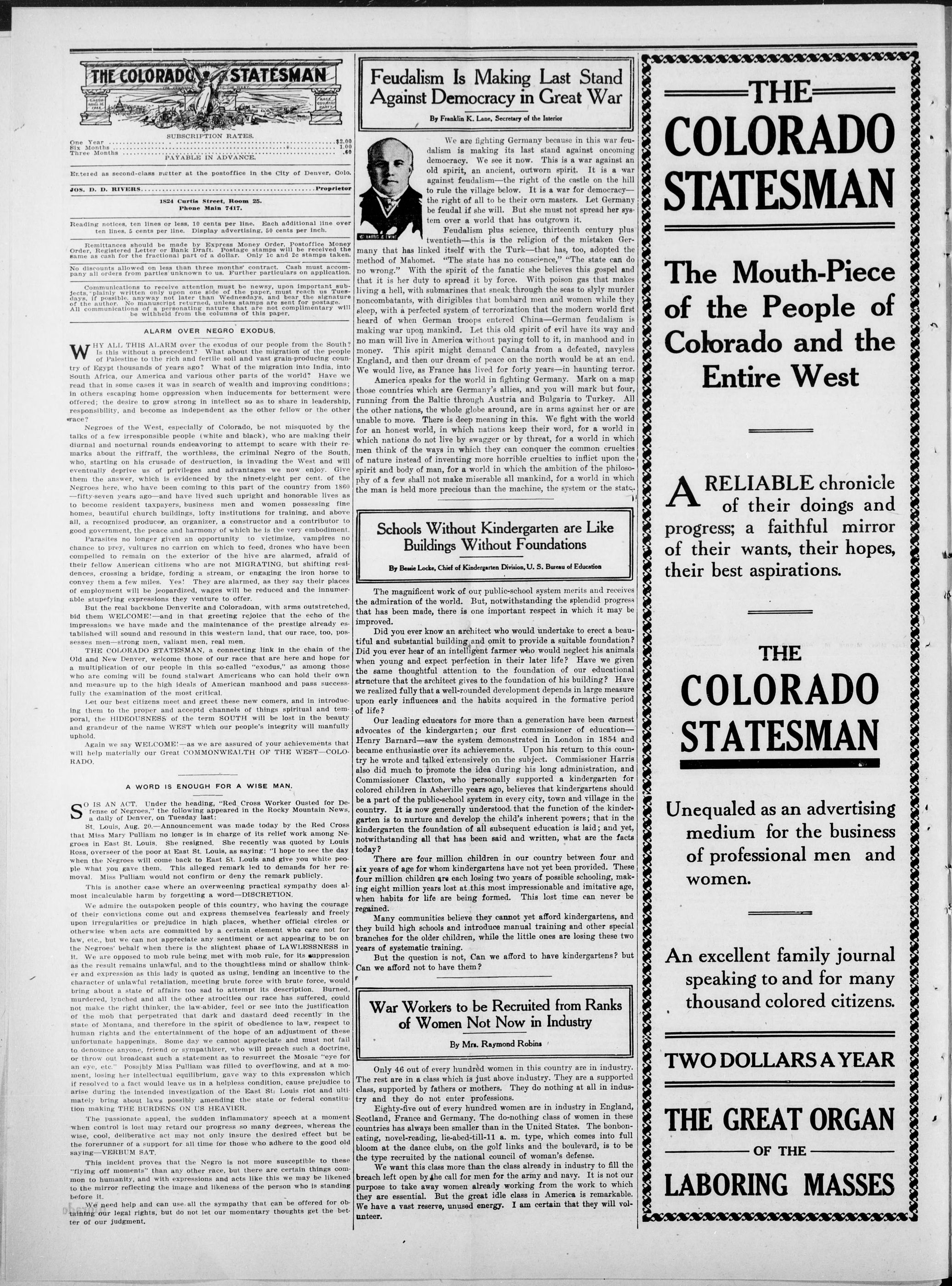
J By Franklin K. Lane, Secretary of the Interior
We are fighting Germany because in this war feu-
dalism is making its last stand against oncoming
democracy. We see it now. This is a war against an
% old spirit, an ancient, outworn spirit. It is a war
4 against feudalism—the right of the castle on the hill
be to rule the village below. It is a war for democracy—
the right of all to be their own masters. Let Germany
Vi be feudal if she will. But she must not spread her sys
tem over a world that has outgrown it.
yy) Feudalism plus science, thirteenth century plus
EA twentieth—this is the religion of the mistaken Ger-
many that has linked itself with the Turk—that has, too, adopted the
method of Mahomet. “The state has no conscience,” “The state can do
no wrong.” With the spirit of the fanatic she believes this gospel and
‘that it is her duty to spread it by force. With poison gas that makes
living a hell, with submarines that sneak through the seas to slyly murder
noncombatants, with dirigibles that bombard men and women while they
sleep, with a perfected system of terrorization that the modern world first
heard of when German troops entered China—German feudalism is
making war upon mankind. Let this old spirit of evil have its way and
no man will live in America without paying toll to it, in manhood and in
money. ‘This spirit might demand Canada from a defeated, navyless
England, and then our dream of peace on the north would be at an end.
We would live, as France has lived for forty years—in haunting terror.
America speaks for the world in fighting Germany. Mark on a map
those countries which are Germany’s allies, and you will mark but four,
running from the Baltic through Austria and Bulgaria to Turkey. All
the other nations, the whole globe around, are in arms against her or are
unable to move. There is deep meaning in this. We fight with the world
for an honest world, in which nations keep their word, for a world in
which nations do not live by swagger or by threat, for a world in which
men think of the ways in which they can conquer the common cruelties
of nature instead of inventing more horrible cruelties to inflict upon the
spirit and body of man, for a world in which the ambition of the philoso-
phy of a few shall not make miserable all mankind, for a world in which
the man is held more precious than the machine, the system or the state.
Schools Without Kindergarten are Like
Buildings Without Foundations
By Bessie Locke, Chief of Kindergarten Division, U. S. Bureau of Education
‘The magnificent work of our public-school system merits and receives:
the admiration of the world. But, notwithstanding the splendid progress
that has been made, there is one important respect in which it may be|
improved. |
Did you ever know an architect who would undertake to erect a beau-
tiful and substantial building and omit to provide a suitable foundation?
Did you ever hear of an intelligent farmer who would neglect his animals
when young and expect perfection in their later life? Have we given
the same thoughtful attention to the foundation of our educational
structure that the architect gives to the foundation of his building? Have
we realized fully that a well-rounded development depends in large measure
upon early influences and the habits acquired in the formative period
of life?
Our leading educators for more than a generation have been earnest!
advocates of the kindergarten; our first commissioner of education—
Henry Barnard—saw the system demonstrated in London in 1854 and
became enthusiastic over its achievements. Upon his return to this coun-
try he wrote and talked ‘extensively on the subject. Commissioner Harris’
also did much to promote the idea during his long administration, and
Commissioner Claxton, who personally supported a kindergarten for
colored children in Asheville years ago, believes that kindergartens should |
be a part of the public-school system in every city, town and village in the
country. It is now generally understood, that the function of the kinder-
garten is to nurture and develop the child’s inherent powers; that in the|
Kindergarten the foundation of all subsequent education is laid; and yet,
notwithstanding all that has been said and written, what are the facts
today?
‘There are four million children in our country between four and
six years of age for whom kindergartens have not yet been provided. These
four million children gre each losing two years of possible schooling, mak-
ing eight million years lost at this most impressionable and imitative age,
when habits for life are being formed. This lost time can never be
regained.
Many communities believe they cannot yet afford kindergartens, and
they build high schools and introduce manual training and other special
branches for the older children, while the little ones are losing these two
years of systematic training.
But the question is not, Can we afford to have kindergartens? but
Can we afford not to have them?
War Workers to be Recruited from Ranks
of Women Not Now in Industry
By Mrs. Raymond Robins /
Only 46 out of every hundréd women in this country are in industry.
‘The rest are in a class which is just above industry. They are a supported
class, supported by fathers or mothers. ‘They do nothing at all in indus-
try and they do not enter professions.
Bighty-five out of every hundred women are in industry in England,
Scotland, France and Germany. The do-nothing class of women in these
countries has always been smaller than in the United States. The bonbon-
cating, novel-reading, lie-abed-till-11 a. m. type, which comes into full
bloom at the dance clubs, on the golf links and the boulevard, is to be
the type recruited by the national council of woman’s defense.
‘We want this class more than the class already in industry to fill the
breach left open by ghe call for men for the army and navy. It is not our
purpose to take away women already working from the work to which
they are essential. But the great idle class in America is remarkable.
We have a vast reserve, unused energy. I am certain that they will vol-
unteer.
| ———THE——
COLORADO
STATESMAN
The Mouth-Piece
of the People of
Colorado and the
Entire West
A RELIABLE chronicle
of their doings and
progress; a faithful mirror
of their wants, their hopes,
their best aspirations.
THE
R
| COLORADO
a
| STATESMAN
Die ra
} Unequaled as an advertising
medium for the business
; of professional men and
women.
R
|
: An excellent family journal
speaking to and for many
; _ thousand colored citizens.
Pa ce aaa
SS
TWO DOLLARS A YEAR
, ————CCS—_—_———______====[=[=====
R
,
| THE GREAT ORGAN
, eT ee
: LABORING MASSES 3
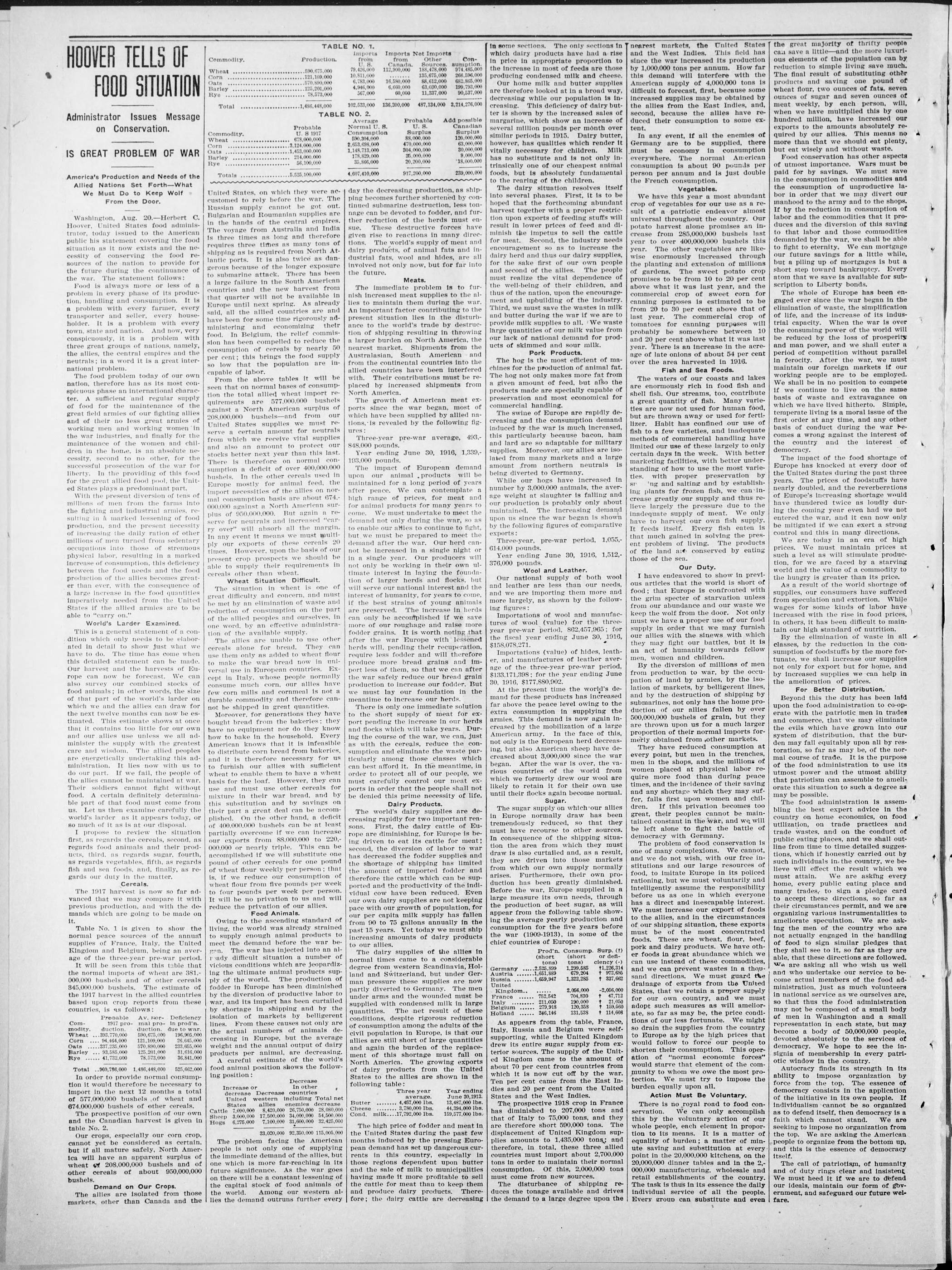
HOOVER TELLS OF FOOD SITUATION
Administrator Issues Message on Conservation.
America's Production and Needs of the Allied Nations Set Forth-What We Must Do to Keep Wolf From the Door.
Washington, Aug. 20.—Herbert C. Hoover, United States food administrator, today issued to the American public his statement covering the food situation as it now exists and the necessity of conserving the food resources of the nation to provide for the future during the continuance of the war. The statement follows:
Food is always more or less of a problem in every phase of its production, handling and consumption. It is a problem with every farmer, every transporter and seller, every householder. It is a problem with every town, state and nation. And now, very conspicuously, it is a problem with three great groups of nations, namely, the allies, the central empires and the neutrals; in a word it is a great international problem.
The food problem today of our own nation, therefore has as its most conspicuous phase an international character. A sufficient and regular supply of food for the maintenance of the great field armies of our fighting allies and of their no less great armies of working men and working women in the war industries, and finally for the maintenance of the women and children in the home, is an absolute necessity, second to no other, for the successful prosecution of the war for liberty. In the providing of this food for the great allied food pool, the United States plays a predominant part.
With the present diversion of tens of millions of men from the farms into the fighting and industrial armies, resulting in a marked lessening of food production, and the present necessity of increasing the daily ration of other millions of men turned from sedentary occupations into those of strenuous physical labor, resulting in a marked increase of consumption, this deficiency between the food needs and the food production of the allies becomes greater than ever, with the consequence of a large increase in the food quantities imperatively needed from the United States if the allied armies are to be able to "carry on."
World's Larder Examined
This is a general statement of a condition which only needs to be elaborated in detail to show just what we have to do. The time has come when this detailed statement can be made. Our harvest and the harvests of Europe can now be forecast. We can also survey our combined stocks of food animals; in other words, the size of that part of the world's larder on which we and the allies can draw for the next twelve months can now be estimated. This estimate shows at once that it contains too little for our own and our allies use unless we all administer the supply with the greatest care and wisdom. The allied peoples are energetically undertaking this administration. It lies now with us to do our part. If we fail, the people of the allies cannot be maintained at war. Their soldiers cannot fight without food. A certain definitely determinable part of that food must come from us. Let us then examine carefully the world's larder as it appears today, or so much of it as is at our disposal.
I propose to review the situation first, as regards the cereals, second, as regards food animals and their products, third, as regards sugar, fourth, as regards vegetables, fifth, as regards fish and sea foods, and, finally, as regards our duty in the matter.
Cereals
The 1917 harvest is now so far advanced that we may compare it with previous production, and with the demands which are going to be made on it.
Table No. 1 is given to show the normal peace sources of the annual supplies of France, Italy, the United Kingdom and Belgium, being an average of the three-year pre-war period. It will be seen from this table that the normal imports of wheat are 381,000,000 bushels and of other cereals 345,000,000 bushels. The estimate of the 1917 harvest in the allied countries based upon crop reports from these countries, is as follows:
| Com- modity | Prevable 1917 pro- modity | Av. nor- mial pro- modity | Deficiency duction | due to war. |
| :--- | :--- | :--- | :--- | :--- |
| Wheat | 393,770,000 | 590,675,000 | 196,906,000 | |
| Corn | 94,464,000 | 121,106,000 | 26,645,000 | |
| Oats | 337,235,000 | 570,890,000 | 233,655,000 | |
| Barley | 93,585,000 | 125,201,000 | 31,616,000 | |
| Rye | 41,732,000 | 78,573,000 | 36,841,000 | |
Total .....960,180,000 1,488,448,000 562,626,000
In order to provide normal consumption it would therefore be necessary to import in the next 12 months a total of 577,000,000 bushels of wheat and 674,000,000 bushels of other cereals.
The prospective position of our own and the Canadian harvest is given in table No. 2.
Our crops, especially our corn crop, cannot yet be considered as certain, but if all mature safely, North America will have an apparent surplus of wheat 208,000,000 bushels and of other cereals of about 950,000,000 bushels.
Demand on Our Crops.
The allies are isolated from those markets, other than Canada and the
United States, on which they were accustomed to rely before the war. The Russian supply cannot be got out. Bulgarian and Roumanian supplies are in the hands of the central empires. The voyage from Australia and India is three times as long and therefore requires three times as many tons of shipping as is required from North Atlantic ports. It is also twice as dangerous because of the longer exposure to submarine attack. There has been a large failure in the South American countries and the new harvest from that quarter will not be available in Europe until next spring. As already said, all the allied countries are and have been for some time rigorously administering and economizing their food. In Belgium, the relief commission has been compelled to reduce the consumption of cereals by nearly 50 per cent; this brings the food supply so low that the population are incapable of labor.
From the above tables it will be seen that on normal bases of consumption the total allied wheat import requirements are 577,000,000 bushels against a North American surplus of 208,000,000 bushels—and from our United States supplies we must reserve a certain amount for neutrals from which we receive vital supplies and also an amount to protect our stocks better next year than this last. There is therefore on normal consumption a deficit of over 400,000,000 bushels. In the other cereals used in Europe mostly for animal feed, the import necessities of the allies on normal consumption basis are about 674,000,000 against a North American surplus of 950,000,000. But again a reserve for neutrals and increased "carry over" will absorb all the margin. In any event it means we must multiply our exports of these cereals 20 times. However, upon the basis of our present crop prospects we should be able to supply their requirements in cereals other than wheat.
Wheat Situation Difficult.
Wheat Situation Difficult.
The situation in wheat is one of great difficulty and concern, and must be met by an elimination of waste and reduction of consumption on the part of the allied peoples and ourselves, in one word, by an effective administration of the available supply.
The allies are unable to use other cereals alone for bread. They can use them only as added to wheat flour to make the war bread now in universal use in European countries. Except in Italy, whose people normally consume much corn, our allies have few corn mills and cornmeal is not a durable commodity and therefore cannot be shipped in great quantities.
Moreover, for generations they have bought bread from the bakeries; they have no equipment nor do they know how to bake in the household. Every American knows that it is inflexible to distribute corn bread from bakeries, and it is therefore necessary for us to furnish our allies with sufficient wheat to enable them to have a wheat basis for the loaf. However, they can use and must use other cereals for mixture in their war bread, and by this substitution and by savings on their part a great deal can be accomplished. On the other hand, a deficit of 400,000,000 bushels can be at least partially overcome if we can increase our exports from 88,000,000 to 220,000,000 or nearly triple. This can be accomplished if we will substitute one pound of other cereals for one pound of wheat flour weekly per person; that is, if we reduce our consumption of wheat flour from five pounds per week to four pounds per week per person. It will be no privation to us and will reduce the privation of our allies.
Food Animals.
Owing to the ascending standard of living, the world was already strained to supply enough animal products to meet the demand before the war began. The war has injected into an already difficult situation a number of vicious conditions which are jeopardizing the ultimate animal products supply of the world. The production of fodder in Europe has been diminished by the diversion of productive labor to war, and its import has been curtailed by shortage in shipping and by the isolation of markets by belligerent lines. From these causes not only are the actual numbers of animals decreasing in Europe, but the average weight and the annual output of dairy products per animal, are decreasing. A careful estimate of the world's food animal position shows the following position:
Increase or decrease United States Decrease western allies Decrease in other countries including Total net enemies decrease Cattle 7,600,000 8,420,000 28,750,000 28,080,000 Sheep 3,000,000 17,500,000 34,000,000 54,500,000 Hogs 6,275,000 7,100,000 31,600,000 32,425,000 The problem facing the American people is not only one of supplying the immediate demand of the allies, but one which is more far-reaching in its future significance. As the war goes on there will be a constant lessening of the capital stock of food animals of the world. Among our western allies the demand outruns further every
day the decreasing production, as shipping becomes further shortened by continued submarine destruction, less tonnage can be devoted to fodder, and further reduction of the herds must ensue. These destructive forces have given rise to reactions in many directions. The world's supply of meat and dairy products, of animal fats and industrial fats, wool and hides, are all involved not only now, but for far into the future.
Meats.
The immediate problem is to furnish increased meat supplies to the allies to maintain them during the war. An important factor contributing to the present situation lies in the disturbance to the world's trade by destruction of shipping resulting in throwing a larger burden on North America, the nearest market. Shipments from the Australasian, South American and from the continental countries into the allied countries have been interfered with. Their contributions must be replaced by increased shipments from North America.
The growth of American meat exports since the war began, most of which have been supplied by allied nations, is revealed by the following figures:
Three-year pre-war average, 493., 848,000 pounds.
Year ending June 30, 1916, 1,339., 193,000 pounds.
The impact of European demand upon our animal products will be maintained for a long period of years after peace. We can contemplate a high range of prices, for meat and for animal products for many years to come. We must undertake to meet the demand not only during the war, so as to enable our allies to continue to fight, but we must be prepared to meet the demand after the war. Our herd cannot be increased in a single night or in a single year. Our producers will not only be working in their own ultimate interest in laying the foundation of larger herds and flocks, but will serve our national interest and the interest of humanity, for years to come, if the best strains of young animals are preserved. The increase in herds can only be accomplished if we save more of our roughage and raise more fodder grains. It is worth noting that after the war Europe with lessened herds will, pending their recuperation, require less fodder and will therefore produce more bread grains and import less of them, so that we can after the war safely reduce our bread grain production to increase our fodder. But we must lay our foundation in the meantime to increase our herds.
There is only one immediate solution to the short supply of meat for export pending the increase in our herds and flocks which will take years. During the course of the war, we can, just as with the cereals, reduce the consumption and eliminate the waste particularly among those classes which can best afford it. In the meantime, in order to protect all of our people, we must carefully control our meat exports in order that the people shall not be denied this prime necessity of life.
Dairy Products.
The world's dairy supplies are decreasing rapidly for two important reasons. First, the dairy cattle of Europe are diminishing, for Europe is being driven to eat its cattle for meat; second, the diversion of labor to war has decreased the fodder supplies and the shortage of shipping has limited the amount of imported fodder and therefore the cattle which can be supported and the productivity of the individual cow have been reduced. Even our own dairy supplies are not keeping pace with our growth of population, for our per capita milk supply has fallen from 90 to 75 gallons annually in the past 15 years. Yet today we must ship increasing amounts of dairy products to our allies.
The dairy supplies of the allies in normal times came to a considerable degree from western Scandinavia, Holland and Switzerland, but under German pressure these supplies are now partly diverted to Germany. The men under arms and the wounded must be supplied with condensed milk in large quantities. The net result of these conditions, despite rigorous reduction of consumption among the adults of the civil population in Europe, is that our allies are still short of large quantities and again the burden of the replacement of this shortage must fall on North America. The growing exports of dairy products from the United States to the allies are shown in the following table:
Three year average. Year ending June 30,1913
Butter ..... 4,457,000 lbs. 13,487,000 lbs.
Cheese ..... 3,780,000 lbs. 44,394,000 lbs.
Cond. milk.....17,792,000 lbs. 159,577,000 lbs.
The high price of fodder and meat in the United States during the past few months induced by the pressing European demand has set up dangerous currents in this country, especially in those regions dependent upon butter and the sale of milk to municipalities having made it more profitable to sell the cattle for meat than to keep them and produce dairy products. Therefore; the dairy cattle are decreasing
in some sections. The only sections in which dairy products have had a rise in price in appropriate proportion to the increase in most of feeds are those producing condensed milk and cheese. Our home milk and butter supplies are therefore looked at in a broad way, decreasing while our population is increasing. This deficiency of dairy butter is shown by the increased sales of margarine, which show an increase of several million pounds per month over similar periods in 1915. Dairy butter, however, has qualities which render it vitally necessary for children. Milk has no substitute and is not only intrinsically one of our cheapest animal foods, but is absolutely fundamental to the rearing of the children.
The dairy situation resolves itself into several phases. First, it is to be hoped that the forthcoming abundant harvest together with a proper restriction upon exports of feeding stuffs will result in lower prices of feed and diminish the impetus to sell the cattle for meat. Second, the industry needs encouragement so as to increase the dairy herd and thus our dairy supplies, for the sake first of our own people and second of the allies. The people must realize the vital dependence of the well-being of their children, and thus of the nation, upon the encouragement and upbuilding of the industry. Third, we must save the wastes in milk and butter during the war if we are to provide milk supplies to all. We waste large quantities of our milk value from our lack of national demand for products of skimmed and sour milk.
Pork Products.
The hog is the most efficient of machines for the production of animal fat. The hog not only makes more fat from a given amount of feed, but also the products made are specially capable of preservation and most economical for commercial handling.
The swine of Europe are rapidly decreasing and the consumption demand induced by the war is much increased, this particularly because bacon, ham and lard are so adaptable for military supplies. Moreover, our allies are isolated from many markets and a large amount from northern neutrals is being diverted to Germany.
While our hogs have increased in number by 3,000,000 animals, the average weight at slaughter is falling and our production is probably only about maintained. The increasing demand upon us since the war began is shown by the following figures of comparative exports:
Three-year, pre-war period, 1,055. 614,000 pounds.
Year ending June 30, 1916, 1,512,
376,000 bounds.
Wool and Leather.
Our national supply of both wool and leather are less than our needs, and we are importing them more and more largely, as shown by the following figures:
Importations of wool and manufactures of wool (value) for the three-year pre-war period, 862,457,965; for the fiscal year ending June 30, 1916, $158,078,271.
Importations (value) of hides, leather, and manufactures of leather average of the three-year pre-war period, $133,171,398; for the year ending June 30, 1916, $177,880,902.
At the present time the world's demand for these products has increased far above the peace level owing to the extra consumption in supplying the armies. This demand is now again increased by the mobilization of a large American army. In the face of this, not only is the European herd decreasing, but also American sheep have decreased about 3,000,000 since the war began. After the war is over, the various countries of the world from which we formerly drew our wool are likely to retain it for their own use until their flocks again become normal.
Sugar.
The sugar supply on which our allies in Europe normally draw has been tremendously reduced, so that they must have recourse to other sources. In consequence of the shipping situation the area from which they must draw is also curtailed and, as a result, they are driven into those markets from which our own supply normally arises. Furthermore, their own production has been greatly diminished. Before the war, Europe supplied in a large measure its own needs, through the production of beet sugar, as will appear from the following table showing the average yearly production and consumption for the five years before the war (1900-1913), in some of the chief countries of Europe:
Prod' n. (short tons) Consump. (short tons) Surp. (↑ or deflucency (-) Germany ..... 2,525,899 1,299,585 ↑1,286,314 Austria ..... 1,651,889 679,204 ↑ 972,866 Russia ..... 1,659,947 1,322,285 ↑ 337,662 United Kingdom. ..... 2,066,000 -2,056,000 France ..... 752,542 704,830 ↑ 47,712 Italy ..... 211,050 190,000 ↑ 21,050 Belgium ..... 279,918 120,358 ↑ 159,600 Holland ..... 246,146 131,538 ↑ 114,608 As appears from the table, France, Italy, Russia and Belgium were self-supporting, while the United Kingdom drew its entire sugar supply from exterior sources. The supply of the United Kingdom came to the amount of about 70 per cent from countries from which it is now cut off by the war. Ten per cent came from the East Indies and 20 per cent from the United States and the West Indies.
The prospective 1918 crop in France has diminished to 207,000 tons and that of Italy to 75,000 tons, and they are therefore short 590,000 tons. The displacement of United Kingdom supplies amounts to 1,435,000 tons; and therefore, in total, these three allied countries must import about 2,700,000 tons in order to maintain their normal consumption. Of this, 2,000,000 tons must come from new sources.
The disturbance of shipping reduces the tonage available and drives the demand to a large degree upon the
nearest markets, the United States and the West Indies. This field has since the war increased its production by 1,000,000 tons per annum. How far this demand will interfere with the American supply of 4,000,000 tons is difficult to forecast, first, because some increased supplies may be obtained by the allies from the East Indies, and, second, because the allies have reduced their consumption to some extent. In any event, if all the enemies of Germany are to be supplied, there must be economy in consumption everywhere. The normal American consumption is about 90 pounds per person per annum and is just double the French consumption.
Vegetables.
We have this year a most abundant crop of vegetables for our use as a result of a patriotic endeavor almost universal throughout the country. Our potato harvest alone promises an increase from 285,000,000 bushels last year to over 400,000,000 bushels this year. The other vegetables are likewise enormously increased through the planting and extension of millions of gardens. The sweet potato crop promises to be from 10 to 20 per cent above what it was last year, and the commercial crop of sweet corn for canning purposes is estimated to be from 20 to 30 per cent above that of last year. The commercial crop of tomatoes for canning purposes will probably be somewhere between 10 and 20 per cent above what it was last year. There is an increase in the acreage of late onions of about 54 per cent over the area harvested in 1916.
Fish and Sea Foods.
The waters of our coasts and lakes are enormously rich in food fish and shell fish. Our streams, too, contribute a great quantity of fish. Many varieties are now not used for human food, but are thrown away or used for fertilizer. Habit has confined our use of fish to a few varieties, and inadequate methods of commercial handling have limited our use of these largely to only certain days in the week. With better marketing facilities, with better understanding of how to use the most varieties, with proper preservation by spraying and salting and by establishing plants for frozen fish, we can increase greatly our supply and thus relieve largely the pressure due to the inadequate supply of meat. We only have to harvest our own fish supply. It feeds itself. Every fish eaten is that much gained in solving the present problem of living. The products of the land are conserved by eating those of the sea.
Our Duty.
I have endeavored to show in previous articles that the world is short of food; that Europe is confronted with the grim specter of starvation unless from our abundance and our waste we keep the wolf from the door. Not only must we have a proper use of our food supply in order that we may furnish our allies with the sinews with which they may fight our battles, but it is an act of humanity towards fellow men, women and children.
By the diversion of millions of men from production to war, by the occupation of land by armies, by the isolation of markets, by belligerent lines, and by the destruction of shipping by submarines, not only has the home production of our allies fallen by over 500,000,000 bushels of grain, but they are thrown upon us for a much larger proportion of their normal imports formerly obtained from other markets.
They have reduced consumption at every point, but men in the trenches, men in the shops, and the millions of women placed at physical labor require more food than during peace times, and the incidence of their saving and any shortage which they may suffer, falls first upon women and children. If this privation becomes too great, their peoples cannot be maintained constant in the war, and we will be left alone to fight the battle of democracy with Germany.
The problem of food conservation is one of many complexions. We cannot, and we do not wish, with our free institutions and our large resources of food, to imitate Europe in its policed rationing, but we must voluntarily and intelligently assume the responsibility before us as one in which everyone has a direct and inescapable interest. We must increase our export of foods to the allies, and in the circumstances of our shipping situation, these exports must be of the most concentrated foods. These are wheat, flour, beef, pork and dairy products. We have other foods in great abundance which we can use instead of these commodities, and we can prevent wastes in a thousand directions. We must guard the drainage of exports from the United States, that we retain a proper supply for our own country, and we must adopt such measures as will ameliorate, so far as may be, the price conditions of our less fortunate. We might so drain the supplies from the country to Europe as by the high prices that would follow to force our people to shorten their consumption. This operation of "normal economic forces" would starve that element of the community to whom we owe the most protection. We must try to impose the burden equally upon all.
Action Must Be Voluntary.
There is no royal road to food conservation. We can only accomplish this by the voluntary action of our whole people, each element in proportion to its means. It is a matter of equality of burden; a matter of minute saving and substitution at every point in the 20,000,000 kitchens, on the 20,000,000 dinner tables and in the 2,000,000 manufacturing, wholesale and retail establishments of the country. The task is thus in its essence the daily individual service of all the people. Every group can substitute and even
the great majority of thrifty people can save a little—and the more luxurious elements of the population can by reduction to simple living save much. The final result of substituting other products and saving one pound of wheat flour, two ounces of fats, seven ounces of sugar and seven ounces of meat weekly, by each person, will, when we have multiplied this by one hundred million, have increased our exports to the amounts absolutely required by our allies. This means no more than that we should eat plenty, but eat wisely and without waste.
Food conservation has other aspects of utmost importance. Wars must be paid for by savings. We must save in the consumption in commodities and the consumption of unproductive labor in order that we may divert our manhood to the army and to the shops. If by the reduction in consumption of labor and the commodities that it produces and the diversion of this saving to that labor and those commodities demanded by the war, we shall be able to fight to eternity. We can mortgage our future savings for a little while, but a piling up of mortgages is but a short step toward bankruptcy. Every atom that we save is available for subscription to Liberty bonds.
The whole of Europe has been engaged ever since the war began in the elimination of waste, the simplification of life, and the increase of its industrial capacity. When the war is over the consuming power of the world will be reduced by the loss of prosperity and man power, and we shall enter a period of competition without parallel in ferocity. After the war, we must maintain our foreign markets if our working people are to be employed. We shall be in no position to compete if we continue to live on the same basis of waste and extravagance on which we have lived hitherto. Simple, temperate living is a moral issue of the first order at any time, and any other basis of conduct during the war becomes a wrong against the interest of the country and the interest of democracy.
The impact of the food shortage of Europe has knocked at every door of the United States during the past three years. The prices of foodstuffs have nearly doubled, and the reverberations of Europe's increasing shortage would have thundered twice as loudly during the coming year even had we not entered the war, and it can now only be mitigated if we can exert a strong control and this in many directions.
We are today in an era of high prices. We must maintain prices at such a level as will stimulate production, for we are faced by a starving world and the value of a commodity to the hungry is greater than its price.
As a result of the world shortage of supplies, our consumers have suffered from speculation and extortion. While wages for some kinds of labor have increased with the rise in food prices, in others, it has been difficult to maintain our high standard of nutrition.
By the elimination of waste in all classes, by the reduction in the consumption of foodstuffs by the more fortunate, we shall increase our supplies not only for export but for home, and by increased supplies we can help in the amelioration of prices.
For Better Distribution.
Beyond this the duty has been laid upon the food administration to co-operate with the patriotic men in trades and commerce, that we may eliminate the evils which have grown into our system of distribution, that the burden may fall equitably upon all by restoration, so far as may be, of the normal course of trade. It is the purpose of the food administration to use its utmost power and the utmost ability that patriotism can assemble to ameliorate this situation to such a degree as may be possible.
The food administration is assembling the best expert advice in the country on home economics, on food utilization, on trade practices and trade wastes, and on the conduct of public eating places, and we shall outline from time to time detailed suggestions, which if honestly carried out by such individuals in the country, we believe will effect the result which we must attain. We are asking every home, every public eating place and many trades, to sign a pledge card to accept these directions, so far as their circumstances permit, and we are organizing various instrumentalities to ameliorate speculation. We are asking the men of the country who are not actually engaged in the handling of food to sign similar pledges that they shall see to it, so far as they are able, that these directions are followed. We are asking all who wish us well and who undertake our service to become actual members of the food administration, just as much volunteers in national service as we ourselves are, so that thus the food administration may not be composed of a small body of men in Washington and a small representation in each state, but may become a body of 50,000,000 people, devoted absolutely to the services of democracy. We hope to see the insignia of membership in every patriotic window in the country.
Autocracy finds its strength in its ability to impose organization by force from the top. The essence of democracy consists in the application of the initiative in its own people. If individualism cannot be so organized as to defend itself, then democracy is a faith which cannot stand. We are seeking to impose no organization from the top. We are asking the American people to organize from the bottom up, and this is the essence of democracy itself.
The call of patriotism, of humanity and of duty rings clear and insistent. We must heed it if we are to defend our ideals, maintain our form of government, and safeguard our future welfare.
THE KITCHEN CABINET
THE KITCHEN CABB
By the laws of the Family Circle 'tis written in letters of brass
smooth then pour this into the cheese and butter. Beat vigorously with an egg beater and serve on hot toast or crackers.
That only a colonel from Chatham can manage the Railways of State Because of the gold of his breeks, for the subjects wherein he must pass:
True love, is love that gives and takes.
Not true love, is seeking eyes, like needle points.
Because in all matters that deal not with Railways his knowledge is great.
But, loving kindly, ever looks them down
-Kipling.
A love that shall be new and fresh each hour. B R L o w n l a r
SAVE YOUR FATS.
A teaspoonful or a tablespoonful of fat wasted from the meat platter or
GOOD GREEN THINGS.
the bacon pan will keep a small family in fats for use in various foods and save buying fat. Each fat, like bacon, chicken, ham, lamb or pork if kept in separate receptacles may be
Radishes most commonly eaten raw especially of the larger sorts are most
Shrimp
pulatable cooked like turnips. The tops when very tender are used for greens. The young and tender seed poofs of some varieties of radishes are pickled like capers and make a most inexpensive subsititute
```markdown
```
used in numerous ways, when a mixture would not be palatable and would not keep as well. It is wisdom and economy to have several fat jars so that each may be kept by itself. Where the family have bacon every day or very often for breakfast, if the fat is never allowed to scorch and is poured through a small square of cheese cloth in a sieve, which removes all specks, it may be used for almost everything that lard would be used for.
for them.
A good combination to can for winter which is especially formed for the child is Swiss chard, or spinach, a few carrots, onions and a stalk or two of celery all blanched and packed into a can, then cooked under water at the boiling point for two hours. This mixture may be used as a flavor for soup broth or with milk, after pressing the pulp through a sieve so that the vegetables are finely divided. This soup mixture has high mineral content and is recommended by dieticians as a good beginning to encourage the liking for vegetables in small people.
Chicken fat if carefully rendered will take the place of butter in cakes and cookies, biscuits and various other dishes. Chicken fat makes delicious salad dressing, using it in place of olive oil. Ham fat may be used in making beans or when cooking greens; the smoky flavor is especially well liked for such dishes.
In all soup making, it should be remembered that vegetables are necessary to keep the bodily health up to the standard. They are rich in mineral matters, vegetable acids, and growth determinants of which we are learning more each day, without which the body processes are not carried on properly. Since soups may be presented in such a variety of flavors, are so generally relished, and make such palatable combinations, using buttered bread as an accompaniment, they are valuable additions to the diet.
Lamb and beef fats carefully strained are used for deep frying, and also in other ways as needed. The fat cups should be carefully emptied and begun anew every two or three weeks. Pie crust made from bacon fat is just as tasty as that made with lard. The smoked fats may be used in spice cakes or highly seasoned foods so that the flavor is not at all objectable.
Mixed Vegetable Soup.—Take three quarts of boiling water and add the following vegetables: One quart of shredded cabbage, one pint of sliced potato, a half pint each of diced carrot, turnip, onion, two tomatoes, two tablespoonfuls of minced ceryl, two tablespoonfuls of chopped green pepper and two of drippings, boil for ten minutes, then simmer gently for an hour, except the tomatoes and potatoo's. The tomatoes and potatoes should then be added and all cooked slowly another hour.
The habit of carefully conserving even small amounts of fat will, in a short time, convince the most skeptical that much fat is needlessly wasted in every home, which could be used to save unnecessary buying of fats for cooking. When fats pass beyond the redeemable stage they may be saved and make a very good soap for use in dish washing, so that not even a teaspoonful need be wasted. Blueberries blackberries, cherries and in fact almost every fruit except strawberries may be successfully dried. Have the berries but one layer thick, stir them often and keep them protected from the files.
Oh, give me a rosebud sweet,
A rosebud pink or red;
I would rather have just one today
Than millions when I'm dead.
Heard
Use enameled ware for the refrigerator dishes and avoid breakage. They are easily kept clean and can be purchased in various shapes.
SEASONABLE DISHES.
The following uncooked chili sauce is as good as a salad in winter and
True love is but a humble, low born thing,
And hath its food served up in earthen ware;
It is a thing to walk with hand in hand.
PINEAPPLE
Uncooked Chili Sauce.-Chop a peck of ripe tomatoes, add two cupfuls of chopped onion, the same of chopped celery, add two cupfuls of
SUMMER DISHES.
Scoop out with a French cutter, pink balls of ripe watermelon, dispose
sugar, a half cupful of salt, four ounces of white mustard seed, a teaspoonful of powdered mace, a teaspoonful each of black pepper and powdered cinnamon, four chopped green peppers and three pints of good vinegar. An inferior vinegar will ruin any pickle. Mix well and put into sterilized jars and seal air-tight. Turn upside down over night to be sure that there is no leak.
on white heart leaves of lettuce and cover with French dressing. Watermelon balls may be served as first course in sherbet cups with a fruit supruep poured over them, being as dainty to eat as pretty to look at.
lettuce and cover with French dressing. Watermelon balls may be served as first course in sherbet cups with a fruit sirup poured over them, being as dainty to eat as pretty to look at. Sliced oranges served on lettuce with French dressing make a salad which is not common but is most appetizing. Serve with French dressing as an accompaniment to cold sliced meat for a Sunday night supper.
Ripe Grape Pie.—Mix a cupful of seeded grapes with a cupful of sugar, then add a tablespoonful of flour and butter well blended and one beaten egg. Beat well and bake in two crusts.
Jelled Veal.—Wipe a knuckle of veal with a damp cloth, cut the meat in pieces and simmer gently for two hours in water. Peel and slice two onions, add them together with a bay leaf, a blade of mace, a half teaspoonful of allspice, six peppercorns and four cloves, cook an hour longer. Take out the meat, remove the bones. Cook the liquor until it is reduced to one quart, add a half cupful of vinegar, salt and pepper, and strain over the meat. Serve garnished with parsley and lemon slices.
Hot Dutch Salad.—Boil two quarts of potatoes in their jackets, then peel and slice them in a buttered baking dish. Melt a half cupful of sweet bacon fat, add a chopped onion, two cupfuls of water, and cook until the onion is tender. Add two beaten eggs, salt and pepper to taste; cook until smooth and thick. Pour over the potatoes, cover in the oven for ten minutes. Serve hot.
Victoria Green Peppers.—Sonk a cupful of split green peas in lukewarm water for two hours, then drain. Remove the seeds and white veins from four green peppers, cut in strips, then in dice. Put them in a saucepan, cover with cold water, bring to the boiling point and boil eight minutes, then drain. Chop one onion and a clove of garlic and fry them in three tablespoonfuls of olive oil or melted butter until a golden brown. Add a cupful of chopped celery, the peppers, peas, seasoning of salt, pepper, a teaspoonful of sugar, half a can of tomato paste, and sufficient water to cover; simmer until the peas are tender. The sauce should be thick, like gravy. Serve with Parmesan cheese.
Cream Slaw.—This recipe may be divided for a small family as the quantity is too large for the everyday group. Chop a gallon of cabbage very fine and sprinkle with a tablespoonful of salt, a tablespoonful each of mustard and pepper. Put a pint of vinegar in a saucepan and when boiling stir in two eggs beaten and mixed with a teaspoon of flour and a pint of sour cream, cook until well boiled but not long enough to curdle the egg and pour boiling hot over the cabbage.
Famous Welsh Rabbit.—Cut a half pound of mild cheese into small pieces, put into a saucepan with four tablespoonfuls of butter, and place it on the back of the stove to melt slowly. In another saucepan scald a pint of milk, and pour it over a beaten egg, add two tablespoonfuls of flour; salt and red pepper to taste. Cook until
Nellie Maxwell
BENZELMAN
WAS PRISONER IN A CROCK
Boy's Plight Analogous to That of Many Whose Heads Are Stuck Fast in Worries.
An earthenware crock which a boy, playing policeman, had put on his head as a helmet, slipped down and stuck fast. The boy made a record resignation from the police force, and his muffled howls attracted prompt attention.
His alarmed mother tugged at the crock until the boy's face was sorely bruised; then excited neighbors took turns until his neck was painfully twisted.
Meanwhile the howling boy was suffering terrifying visions of lifelong imprisonment, as secure as in a dungeon, and of his head from year to year growing larger and tighter in the crock. The poor boy's trouble shut him in from all the rest of the world with an ingrowing imagination. But that is only what anyone's trouble of any sort is apt to do for one, observes the Christian Herald.
The mother, the father, who had been sent for, and a half hundred neighbors, who had invited themselves under the delusion that curiosity is sympathy, finally settled down to solemn conclave and decided that, since the crock had slipped on it must be possible for it to be slipped off again, but that only a skillful surgeon could perform the delicate operation.
A delegation was on its way with the boy to a surgeon's office, when a resourceful motorman, seeing the situation, smashed the crock with his controller handle.
Thus, by the simplest of processes, the boy's trouble was suddenly ended. And it is by equally simple and direct processes that most of the troubles of most of us may be ended.
With our heads stuck fast in worries, we rack our brains over a thousand roundabout ways of slipping them off—and the harder we tug at them the more they hurt—but we overlook the simple expedient of smashing the crock.
Like the lad, we see terrifying visions of the future; we suffer our feelings to be cruelly lacerated and our bodies to be twisted and torn in mental anguish and despair; we run here and there for sympathy and advice and help; and it does not occur to us how easy it is just to break the crock.
Most of the crocks that seem to slip down over our heads are merely imaginary, anyway. They require no street car controller handles to smash them. All they call for is a mental controller handle.
Did it ever occur to you that most of our troubles come, as this lad's did, through trying to appear what we aren't?
Soap.
Soap is excellent as a means of getting the face clean or correcting coarse language in the young, but it has its drawbacks. It cannot always be depended upon. A cake of soap that has been in the family long enough to seem tame and harmless will sometimes run amuck in the bathroom and lead one to the brink of nervous breakdown. Starting from a given point a cake of soap, if slightly provoked, will dash about, leaping from place to place in wild flight till the pursuer swoons in exhaustion. The cake of soap peeks out from a safe place under the tub to snicker maliciously. If you recover and have the spirit to resume the chase you will have a gay time in bagging the soap, even though you have it cornered. The soap is clever. It will not make a move till you have seized it, and then it will slip a few inches away. After several of your grabs the soap will estimate neatly with a quick eye just the length of your arm and then it will settle down a few inches beyond your reach. In this case your only move is to get a long stick and have the soap out with a few sweeps. If you are only human you will probably beat it to death with any blunt instrument at hand. And then go and get another piece of soap—Illinois State Register.
Light a Fire Without Matches.
How to light a fire without matches is an important part of the training given to United States Marines at Port Royal, S. C. The primitive flint and steel, used long ago by our forefathers, and the old "wooden friction" method borrowed from the Indians have been revived, so that the sea soldiers may dispense with matches when dampness renders them useless.
United States Marines in the tropics can start a fire almost instantly by using a hollow piece of bamboo. This is done by slitting the bamboo, stuffing it with dry moss, and drawing a stick to and fro across it as a violinist uses his bow. These resourceful world-wide soldiers are expected to find a substitute for the useful bamboo in France.
Siberia's Resources Unrivaled.
Siberia is believed to be destined one day to become the richest country in the world, for it has a natural wealth so diversified and as yet almost untouched, that it has no rival in the old world. Before the war Siberia was producing from 1,000,000 to 1,300,000 tons of flour a year. As a grazing country it has no limits, and it exports large quantities of leather, tallow and butter. Its forests are almost inexhaustible, and it supplies furs to all the world. Its mineral wealth can only be guessed at, for the greater part of the country has never been prospected. But there are several enormous deposits of oil.
STORE THE POTATO
ARRANGEMENTS FOR CONSERVI-
ING THE COUNTRY'S SUPPLY.
Government Officials Tell of the Facilities That Have Been Provided —Complete Plan of Action Has Been Mapped Out.
Washington,—Means of conserving the nation's potato supply in the most effective manner have been worked out by food administration officials. They have issued the following statement:
Unusual facilities for financing storage are offered American potato growers as a result of war conditions. The federal reserve system is at their disposal, and farmers who store their 1917 potato crop in approved local warehouses, may obtain, upon their storage receipts, 90-day loans from member banks of the reserve system at a rate not to exceed 6 per cent. Mr. Lou D. Sweet, potato expert with the food administration, was instrumental in bringing this matter to the reserve board's attenton.
New England growers have started a movement to take advantage of this ruling to help them solve their marketing problem. The prospect which the growers of this group of states face is that of handling 45,000,000 bushels of potatoes—one-tenth of the entire United States crop—without causing an overstocked market and the resulting loss of all profit on the crop.
The growers communicated with local authorities in their respective states, who in turn laid the situation before the food administration. A conference between the growers, local authorities and experts from the food administration was held recently at Boston, Mass. A plan of action was mapped out at this meeting which includes the following:
1. Marketing of only one-third of the crop at harvest time; another third in 90 days, or placing in storage and later distributed as demand affords opportunity; the remaining third to be stored by the grower and marketed throughout the year.
2. All potatoes to be graded with care, taking out culls, cuts, cracks and any that are bruised. It was recommended that a wire screen grader be used—one and seven-eighths-inch mesh for oblong tubers and two-inch mesh for round ones. Graded stock then to be placed in good two-bushel sacks—one hundred and fifteen pounds to the sack—and the sacks sewed tightly so as to prevent shucking and bruising.
3. Increasing the load in each railroad car from the normal 30,000 pounds. That these cars can be unloaded within 24 to 36 hours of their arrival at destination.
4. That municipalities and other bodies provide storage for as large quantities as possible at the peak of the harvest.
"A storage house," said Lou D. Dweet, who attended this meeting, "such as will conform to the requirements laid down by the Federal Reserve board, does not call for a specially constructed house. There are innumerable buildings, which, if properly cleaned, ventilation provided, and managed so as to maintain a temperature of about 35 degrees, will answer admirably for this purpose.
"This year the United States planted its potato crop from the poorest quality of seed that ever went into the ground, and naturally the harvest will be potatoes of poor quality. Strict grading, careful packing, commonsense storage, and careful shipping are necessary to insure just returns to the growers who have responded to the president's call for increased production of potatoes."
SHE HAD WAYWARD DAUGHTER
Neighbor Was Surprised When She Found Cause of Severe Rebuke Administered by Mother.
A lady living in a large apartment house relates the following:
"I had occasion one day to visit the apartment of a neighbor. Such grave and earnest tones of remonstrance reached my ears, as I approached my friend's room, that I hesitated about intruding. I found her winsome young daughter with her, and the mother had evidently been rebuking her, for the girl's face was flushed, and there were tears in her eyes.
"Come in," said my friend. "I have finished what I was saying to Jenny, and I hope she will remember my wishes."
"Ah, these children—these children," thought I to myself.
"I have just been telling her," continued my friend, "that she must not wear her evening gloves when she goes shopping in the morning. In the first place, it is not genteel; and in the second place, it is extravagant."
Her evening gloves! And yet, I assure you, her tone and expression, and the impression made on the child, would have beffited a serious wrong-doing—one that had issues in time and eternity.
Buy Outright, Is War Plan.
Washington.—Secretary of Commerce Redfield announced that the conference representing all interested departments of this government has completed its study of war contracts.
Where conditions of manufacture are particularly involved the conference recommends a contract in which a specified sum is awarded as the profit on each article, instead of making the profit a percentage of the cost. This recommendation will do away with the tendency to increase costs to increase profits.
FLORAL DESIGNS PUT UP WHILE YOU WAIT
CHOICE PLANTS AND CUT FLOWERS CONSTANTLY ON HAND
GREENHOUSES: Thirty-Fourth and Curtis Streets
TELEPHONE, MAIN 1511 DENVER, COLO
Sales Daily at 2 p.m. Office Furniture a Specialty.
PRIVATE SALES AT ALL TIMES
HAVE MOVED TO--
1723-39 GLENARM ST.
PHONE MAIN 1675.
THE BEST ICE CREAM AND
CANDIES AT
O.P.BAUR @ CO.
CATERERS AND
CONFECTIONERS
Phone: 163
1512 Curtis Street, Denver, Colo.
JOSEPH CARTER
Express, Moving,
and Storage
COAL AND WOOD
PROMPT DELIVERY.
Phone Main 6544.
2415 WASHINGTON STREET.
TELEPHONE YORK 3228.
GENERAL FURNITURE REPAIRING AND UPHOLSTERING.
WORK GUARANTEED.
1417 East 24th Avenue, Denver, Colo.
Save Pennies Waste Dollars
Some users of printing save pennies by getting inferior work and lose dollars through lack of advertising value in the work they get. Printers as a rule charge very reasonable prices, for none of them get rich although nearly all of them work hard.
Moral: Give your printing to a good printer and save money.
Our Printing Is Unexcelled
PRINTING Of All Kinds not the cheap kind but the good kind done here.
Phone Champa 113 1848 Arapahoe
乐绎玕
ORIENTAL RESTAURANT Chop Suey, Noodles and Short Orders Phone Champa 113 1848 Arapahoe
Miss M. Cowden Hair Dressing Parlor
Shampoo, cutting and curling. Scalp treatment, hair tonics, hair straightening, manicuring. Stage wigs for rent; theatrical use and masquerades. Goods delivered out of the city. All shades of hair matched by sending sample of hair; also combings made up.
Cheapest Switches 50 Cents
1223 21st St. Denver, Colo
HAS been responsible for thousands of business successes throughout the country. Everybody in town may know you but they don't know what you have to sell.
to serve you with good printing. No matter what the nature of the job may be we are ready to do it at a price that will be Satisfactory
RANK S. REED,
Embalmer and Director
Assistant. Polite Service
to all.
2745 Welton Street.
DENVER, COLORADO.
ESTAR HAIR GROWER
A Wonderful Hair Dressing and Grower
THESTAR HAIR GROWER
A
A Wonderful Hair Dressing and Grower.
One Thousand Agents Wanted. Good Money Made. We want Agents in every city and village to sell THE STAR HAIR GROWER. This is a wondert price for a very strong, straightening irons sells for 25 cents per box. One 25-cent box will prove its value. Any person that will use a 25-cent box will be convinced. No matter what has failed to grow your hair, just give THE STAR HAIR GROWER a trial and be convinced. Send 25 cents for each trial, send $1 and we will send you a full supply that you can begin work at once; also agent's terms. Send all money by Money Order to
THE STAR HAIR. GROWER, Mfr.
Northern Branch: 1113 Clark St. EVANSTON, ILL.
Southern Branch: P. O. Box 812 GREENSBORO, N.C.
NOTE—Persons living in the South can get their goods three days earlier if they will order from THE STAR HAIR GROWER MFR. P. O. BOX 812, GREENSBORO, N.C.
NEW WAY SHOE REPAIRING
D. DENNIS, Prop.
Safaction Guaranteed.
Phone Main 3737.
Empa St. Denver, Colo.
HENRY SCHOEN
WHOLESALE CIGARS
Submarine, Ford, Judge Good, Kaiserhoff or El Omica Cigars
RLES LAMB
PHONE SOUTH 4405 W.
REDGE BUILDING
DENVER, COLORADO
Active Development of North-West Holdings
The plan for development of North-West's large Powder Riverauge has been outlined and already put under way. On such a sale has development work been planned, the expenditure will run into six figures. This will mean oil—and lots of it—has develop-ure past few weeks in Powder River Dome have practically proven
THE NEW WAY SHOE REPAIRING
C. C. DENNIS, Prop.
Satisfaction Guaranteed.
Phone Main 3737.
1855 Champa St. Denver, Colo.
HENRY SCH
WHOLESALE CIGARS
Smoke Submarine, Ford, Judge Good, Kaiserhof
CHARLES LAMB
308 KITTREDGE BUILDING
Active Development
North-West He
An active plan for development of North-West's Dome accentage has been outlined and already put large scale has development work been planned, the well up into six figures. This will mean oil—and mentions the past few weeks in Powder River Dome our land.
THE NEW WAY SHOE REPAIRING
C. C. DENNIS, Prop.
Satisfaction Guaranteed.
Phone Main 3737.
1855 Champa St. Denver, Colo.
Smoke Submarine, Ford, Judge Good, Kaiserhoff or El Omica Cigars
CHARLES LAMB PHONE SOUTH 4405 W.
308 KITTREDGE BUILDING DENVER, COLORADO
Active Development of North-West Holdings
An active plan for development of North-West's large Powder River Dome acreage has been outlined and already put under way. On such a large scale has development work been planned, the expenditure will run well up into six figures. This will mean oil—and lots of it—has developments the past few weeks in Powder River Dome have practically proven our land.
WELL ON SECTION 16
NEARING WELLS, ADDS.
The well now drilling on our section 16, in Powder River Dome, is progressing nicely. There has already been some indications or oil, but it is expected to be trapped in a depth of about 1,600 feet. This well is expected to be a big producer; may even be a gusher.
BIG COMPANY AFTER
OIL IN A BIG WAY.
North-West is a big company with leases on about 6,000 acres in Powder River Dome, Salt Creek and Lost Cabin Dome. The trapped oil is expected to successfully direct the affairs, the plan of operation is sound and should bring big financial returns; its future is very bright indeed.
STOCK NOW. 37.5%—NEXT
STOCK NOW 37½¢—NEXT
PRICE $1—175% ADVANCE.
Stock is now selling at 37½¢ a
share. With the extensive plan
of development in operation,
it will be sure to show.
Next price will positively be $1
—175% advance. It's a good,
sound buy and a block of North-
West may add materially to your
future happiness.
Three wells are to be spudded in on our section 36. Materials are already on the ground, drilling contracts let, actual work will commence at once. The 400-barrel well of Tisdale Co. brought in a few days ago on property adjoining section 36, gives us every reason in the world to expect big quantities of oil.
PROMPTNESS PAYS PROFIT
Sign and Mail Coupon—N
The North-West Oil & Refining Co., 102S-P Foster Bldg., Denver, Colo.
Gentlemen—I hereby subscribe for shares of stock of the North-West Oil & Refining Co., at 37½c each, full paid and non-assessable. I herewith enclose $... full (or part) payment. Balance, if any, to be paid in four equal monthly payments.
Name
Address
PROMPTNESS PAYS PROFITS
Sign and Mail Coupon—Now
West Oil & Refining Co.
Master Bldg., Denver, Colo.
I hereby subscribe for
shares of stock of the
Oil & Refining Co. at 37½c
paid and non-assessable. I
close $... full
payment. Balance, if any, to
four equal monthly pay-
Call or Write for Information.
NORTH-WEST OIL
AND REFINING CO.
102S-P Foster Bldg.
DENVER, COLORADO.
The Right Kind of Reading Matter
The home news; the doings of the people in this town; the gossip of our own community, that's the first kind of reading matter you want. It is more important, more interesting to you than that given by the paper or magazine from the outside world. It is the first reading matter you should buy. Each issue of this paper gives to you just what you will consider
The Right Kind of Reading Matter
---
---
North-West is a big company with leases on about 6,000 acres in Powder River Dome, Salt Creek and post Cain Dome. One of its key to successfully direct the affairs, the plan of operation is sound and should bring big financial should its future is very bright, indeed.
CHEVROLET
The first of the new fall suits and the last of those for summer invite comparison in the picture above. It will be seen that they have several points in common but that the fall model shows departures in the direction of greater length in coats, in the matter of trimming and in trim, definite lines, that give the figure a smart, well-set-up look. The coat is length and h longer coats w winter. The over the hips a picture which is e els, and this f portion of the tions. Large p
The fall suit is made of gaberdine in dark blue with black silk braid and bone buttons used on the coat for decoration. The skirt in this suit, as in nearly all the new models for fall, is plain, finished with a hem and cut about ankle length. The rule for length is six or eight inches above the floor, so the day of the very short skirt appears to have departed. It is not so definitely relegated to the past as the long skirt for street wear. That is a folly to which women are not likely to return.
Q
THE FASHION WEEK
Style and Character in Capes.
There are capes and capes; not so many of them, but a variety as to size and design and a promise of capes made of fur and fur fabrics when winter comes. Small capes rule the modes in summer furs and lead up to the larger capes and mantels that are prominent in the August fur showings. Small capes finish many of the coats in new suits for fall and a novelty has appeared in a one-piece frock with a long, detachable cape made of the same material as the gown.
Whatever may be the fate of the cape in the race for popular favor, it is a garment of character and good style at all times. A handsome example appears in the long cape of fancy plush which fits into the needs of its wearer in almost any season. Developed in taupe-colored silk plush, lined with white satin, and with a wide white satin collar, it is an overgarment equal to gracing any occasion. The model pictured is cut to hang straight at the front and fall from the shoulders and back.
The introduction of white in the collar and lining adapts this particular cape to late summer and early fall wear, but its usefulness is not hinted to serve it. It makes a presentable
---
The coat is almost three-quarter length and heralds the advent of longer coats with suits for fall and winter. The insert of rows of braid over the hips also reflects a style feature which is evidenced in many models, and this is the emphasis of this portion of the new coats with decorations. Large pockets still play an important part in coat schemes along with wide cape collars, surmounted by smaller collars and a careful use of buttons. In the last regard the new suits are an improvement upon spring designs in which designers went to such lengths in the prodigal use of buttons that handsome suits were really cheapened by them.
New models in tailored suits are rarely without decoration of some sort. Broad fur, fur fabrics, velvet and buttons are all used on them, but with much moderation.
L
evening wrap for any time of the year. It fastens at the front with three very large buttons, and slits at each side, finished with wide bands, provide openings for the hands and arms. There is nothing quite so convenient as a cape for wear over fragile and elaborate evening gowns or dance frocks and the cape pictured, considered from this angle, is a great success.
Julia Bottomley
The woman who travels across the continent—or takes even an overnight journey—will revel in a new Pullman coat of thin pongee, designed for use as a negligee when trips are made from sleeping berth to dressing room, and for comfortable lounging all day in one's section. All-covering and loose enough to feel cool and comfortable, like a negligee, the garment is cut and finished to look like a smart coat. It would be quite presentable in the dining car, or on a station platform when one gets out a moment during a stop, to stretch muscles and breathe the fresh air.
LABOR DAY PICNIC
SEPTEMBER 3, 1917
AT TULLERIES PARK
TULLERIES PARK
Skating from 4 to 11 p. m. See the Big Sack, One Legged and Potato Races. Witness the Exciting Pie and Watermelon Contest at the Same Time.
Look for the Peanut Waffle, Hot, Sizzling Fried Fish with Korn Pone. Refreshments of all kinds will be served all day.
COMMITTEE--R. Frazier, Jas. F. Clark, E. R. Page.
Morrison's Full Orchestra.
Admission 25 C
THE PEARL BARBER SHOP
1021 19th Street
First-Class Tonsorial Artists in attendance.
First-Class Tonsorial Artists in attendance. We solicit your patronage. First-Class work guaranteed.
SOMETHING DOING EVERY HOUR IN
MILO
TELEGRAM RECEIVED FROM THE PRESIDENT. O.
BOULTON, NOW ON THE MILO CHELSEA
FIELD, OKLAHOMA
Chelsea, Okla., Aug. 22, 1917.
The Milo Oil Company, 221 Colorado Bldg., Denver, Colo.
Milo Number One down one hundred seventy feet tonight.
No accident will be shot Friday. Milo Number Two drilled today. This should come in in ten days. Delay owing black of water for boilers. Plenty now. Be ready to raise price of stock.
O. T. BOULTON.
Just as soon as Well No. 1 comes in stock goes to 5 or cents per share; now 2 cents. Fully paid, non-assessable.
TEST CALL!
GET YOUR ORDER IN NOW
DELAYS ARE FATAL!
The Opportunity to Buy MILO at 2 CENTS Will Soon
Disappear Forever
The Milo Oil Company
T. BOULTON, President
F. R. KNIGHT, Secreta
221 Colorado Building, Denver, Colo.
Phone Champa 4125.
A Wonderful Sale of Boy's Clothing
HARRY JONES, Prop.
SOMETHING
M
TELEGRAM RECR
BOULTON,
The Milo Oil Company
Milo Number O
If no accident will
started today. This
to lack of water for
price of stock.
Just as soon as
cents per share; no
LAST CALL!
The Opportunity
The Milo
O. T. BOULTON, I
221 Co
MILO
TELEGRAM RECEIVED FROM THE PRESIDENT. O. T.
BOULTON, NOW ON THE MILO CHELSEA
FIELD, OKLAHOMA
Chelsea, Okla., Aug. 22, 1917.
The Milo Oil Company, 221 Colorado Bldg., Denver, Colo.;
Milo Number One down one hundred seventy feet tonight.
If no accident will be shot Friday. Milo Number Two drill
started today. This should come in in ten days. Delay owing
to lack of water for boilers. Plenty now. Be ready to raise
price of stock.
O. T. BOULTON.
Just as soon as Well No. 1 comes in stock goes to 5 or 10
cents per share; now 2 cents. Fully paid, non-assessable.
LAST CALL!
GET YOUR ORDER IN NOW!
O. T. BOULTON, President F. R. KNIGHT, Secretary 221 Colorado Building, Denver, Colo. Phone Champa 4125.
A cash purchase at before-the-war prices. The best makes from the best makers—a money-saving event. $2.95 instead of $4.00 for Boys' Suits, sizes 6 to 18 years. $5.95 for Boys' Two-Pant Suits, hand-tailored; values up to $10. 50c for Boys' Wash Suits, sizes 2½ to 8 years; regular $1.00 values. And hundreds of other special value Boys' and Girls' Footwear—surprising bargains.
Michaelson's
CORNER 15TH AND LARIMER STS.
$5.95 for Boys' Two-Pant Suits, hand-tailored; values up to $10.
59c for Boys' Wash Suits, sizes 2 1/2 to 8 years; regular $1.00 values. And hundreds of other special value Boys' and Girls' Footwear—surprising bargains.
Michaelson's
CORNER-15TH AND LARIMER STS.
Admission
```markdown
```
1021 19th Street