Colorado Statesman
Saturday, September 8, 1917
Denver, Colorado
Page text (machine-generated)
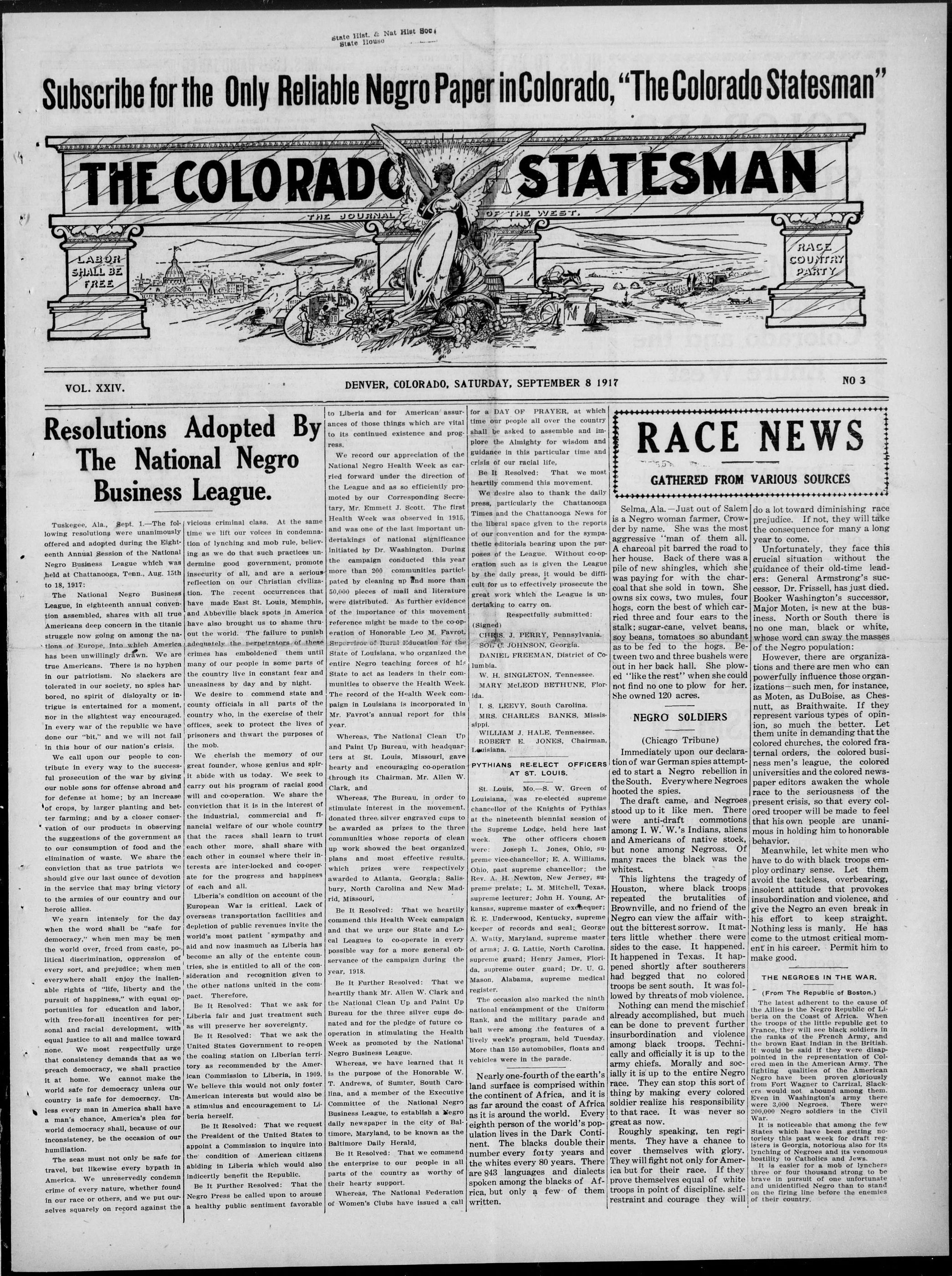
Subscribe for the Only Reliable Negro Paper in Colorado, "The Colorado Statesman"
THE COLORADO STATESMAN
THE JOURNAL OF THE WEST.
LABOR SHALL BE FREE
RACE COUNTRY PARTY
Resolutions Adopted By The National Negro Business League.
VOL. XXIV.
Resolutions
The Native
Business
Tuskegee, Ala., Sept. 1.—The following resolutions were unanimously offered and adopted during the Eighteenth Annual Session of the National Negro Business League which was held at Chattanooga, Tenn., Aug. 15th to 18. 1917.
The National Negro Business League, in eighteenth annual convention assembled, shares with all true Americans deep concern in the titanic struggle now going on among the nations of Europe, into which America has been unwillingly drawn. We are true Americans. There is no hyphen in our patriotism. No slackers are tolerated in our society, no spies harbored, no spirit of disloyalty or intrigue is entertained for a moment, nor in the slightest way encouraged. In every war of the republic we have done our "bit," and we will not fail in this hour of our nation's crisis.
We call upon our people to contribute in every way to the successful prosecution of the war by giving our noble sons for offense abroad and for defense at home; by an increase of crops, by larger planting and better farming; and by a closer conservation of our products in observing the suggestions of the government as to our consumption of food and the elimination of waste. We share the conviction that as true patriots we should give our last ounce of devotion in the service that may bring victory to the armies of our country and our heroic allies.
We yearn intensely for the day when the word shall be "safe for democracy," when men may be men the world over, freed from caste, political discrimination, oppression of every sort, and prejudice; when men everywhere shall enjoy the inalienable rights of "life, liberty and the pursuit of happiness," with equal opportunities for education and labor, with free-for-all incentives for personal and racial development, with equal justice to all and malice toward none. We most respectfully urge that consistency demands that as we preach democracy, we shall practice it at home. We cannot make the world safe for democracy unless our country is safe for democracy. Unless every man in America shall have a man's chance, America's plea for world democracy shall, because of our inconsistency, be the occasion of our humiliation.
The seas must not only be safe for travel, but likewise every bypath in America. We unreservedly condemn crime of every nature, whether found in our race or others, and we put ourselves squarely on record against the
vicious criminal class. At the same time we lift our voices in condemnation of lynching and mob rule, believing as we do that such practices undermine good government, promote insecurity of all, and are a serious reflection on our Christian civilization. The recent occurrences that have made East St. Louis, Memphis, and Abbeville black spots in America have also brought us to shame throut the world. The failure to punish adequately the perpetrators of these crimes has emboldened them until many of our people in some parts of the country live in constant fear and uneasiness by day and by night. We desire to commend state and county officials in all parts of the country who, in the exercise of their offices, seek to protect the lives of prisoners and thwart the purposes of the mob.
We cherish the memory of our great founder, whose genius and spirit abide with us today. We seek to carry out his program of racial good will and co-operation. We share the conviction that it is in the interest of the industrial, commercial and financial welfare of our whole country that the races shall learn to trust each other more, shall share with each other in counsel where their interests are inter-locked and co-operate for the progress and happiness of each and all.
Liberia's condition on account of the European War is critical. Lack of overseas transportation facilities and depletion of public revenues invite the world's most patient sympathy and aid and now inasmuch as Liberia has become an ally of the entente countries, she is entitled to all of the consideration and recognition given to the other nations united in the compact. Therefore.
Be It Resolved: That we ask for Liberia fair and just treatment such as will preserve her sovereignty.
Be It Resolved: That we ask the United States Government to re-open the coaling station on Liberian territory as recommended by the American Commission to Liberia, in 1909. We believe this would not only foster American interests but would also be a stimulus and encouragement to Liberia herself.
Be It Resolved: That we request the President of the United States to appoint a Commission to inquire into the condition of American citizens abiding in Liberia which would also indicently benefit the Republic.
Be It Further Resolved: That the Negro Press be called upon to arouse a healthy public sentiment favorable
State Hist. & Nat Hist Boc
State House
table Negro Pa
ADO
E JOURNAL
DENVER, COLORADO, SA
to Liberia and for American assurances of those things which are vital to its continued existence and progress.
We record our appreciation of the National Negro Health Week as carried forward under the direction of the League and as so efficiently promoted by our Corresponding Secretary, Mr. Emmett J. Scott. The first Health Week was observed in 1915, and was one of the last important undertakings of national significance initiated by Dr. Washington. During the campaign conducted this year more than 200 communities participated by cleaning up and more than 50,000 pieces of mail and literature were distributed. As further evidence of the importance of this movement reference might be made to the co-operation of Honorable Leo M. Favrot, Supervisor of Rural Education for the State of Louisiana, who organized the entire Negro teaching forces of his State to act as leaders in their communities to observe the Health Week. The record of the Health Week campaign in Louisiana is incorporated in Mr. Favrot's annual report for this year.
Whereas, The National Clean Up and Paint Up Bureau, with headquarters at St. Louis, Missouri, gave hearty and encouraging co-operation through its Chairman, Mr. Allen W. Clark, and Whereas, The Bureau, in order to stimulate interest in the movement, donated three silver engraved cups to be awarded as prizes to the three communities whose reports of clean up work showed the best organized plans and most effective results, which prizes were respectively awarded to Atlanta, Georgia; Salisbury, North Carolina and New Madrid, Missouri.
Be It Resolved: That we heartily commend this Health Week campaign and that we urge our State and Local Leagues to co-operate in every possible way for a more general observance of the campaign during the year, 1918.
Be It Further Resolved: That we heartily thank Mr. Allen W. Clark and the National Clean Up and Paint Up Bureau for the three silver cups donated and for the pledge of future cooperation in stimulating the Health Week as promoted by the National Negro Business League.
Whereas, we have learned that it is the purpose of the Honorable W. T. Andrews, of Sumter, South Carolina, and a member of the Executive Committee of the National Negro Business League, to establish a Negro daily newspaper in the city of Baltimore, Maryland, to be known as the Baltimore Daily Herald.
Be It Resolved: That we commend the enterprise to our people in all parts of the country as worthy of their hearty support.
Whereas, The National Federation of Women's Clubs have issued a call
---
for a DAY OF PRAYER, at which time our people all over the country shall be asked to assemble and implore the Almighty for wisdom and guidance in this particular time and crisis of our racial life. Be It Resolved: That we most heartily commend this movement.
We desire also to thank the daily press, particularly the Chattanooga Times and the Chattanooga News for the liberal space given to the reports of our convention and for the sympathetic editorials bearing upon the purposes of the League. Without co-operation such as is given the League by the daily press, it would be difficult for us to effectively prosecute the great work which the League is undertaking to carry on.
Respectfully submitted:
(Signed)
CHRIS. J. PERRY, Pennsylvania.
SOL C. JOHNSON, Georgia.
DANIEL FREEMAN, District of Columbia.
W. H. SINGLETON, Tennessee.
MARY McLEOD BETHUNE, Florida.
I. S. LEEVY, South Carolina.
MRS. CHARLES BANKS, Mississippi.
WILLIAM J. HALE, Tennessee.
ROBERT E. JONES, Chairman, Louisiana.
PYTHIANS RE-ELECT OFFICERS AT ST. LOUIS.
St. Louis, Mo.—S. W. Green of Louisiana, was re-elected supreme chancellor of the Knights of Pythias at the nineteenth biennial session of the Supreme Lodge, held here last week. The other officers chosen were: Joseph L. Jones, Ohio, supreme vice-chancellor; E. A. Williams, Ohio, past supreme chancellor; the Rev. A. H. Newton, New Jersey, supreme prelate; L. M. Mitchell, Texas, supreme lecturer; John H. Young, Arkansas, supreme master of exchequer; E. E. Underwood, Kentucky, supreme keeper of records and seal; George A. Watty, Maryland, supreme master of arms; J. G. Lattle, North Carolina, supreme guard; Henry James, Florida, supreme outer guard; Dr. U. G. Mason, Alabama, supreme medical register.
The occasion also marked the ninth national encampment of the Uniform Rank, and the military parade and ball were among the features of a lively week's program, held Tuesday. More than 150 automobiles, floats and vehicles were in the parade.
Nearly one-fourth of the earth's land surface is comprised within the continent of Africa, and it is as far around the coast of Africa as it is around the world. Every eighth person of the world's population lives in the Dark Continent. The blacks double their number every forty years and the whites every 80 years. There are 843 languages and dialects spoken among the blacks of Africa, but only a few of them written.
RACE NEWS
Selma, Ala. —Just out of Salem is a Negro woman farmer, Crowder by name. She was the most aggressive "man of them all. A charcoal pit barred the road to her house. Back of there was a pile of new shingles, which she was paying for with the charcoal that she sold in town. She owns six cows, two mules, four hogs, corn the best of which carried three and four ears to the stalk; sugar-cane, velvet beans, soy beans, tomatoes so abundant as to be fed to the hogs. Between two and three bushels were out in her back hall. She plowed "like the rest" when she could not find no one to plow for her. She owned 120 acres.
do a lot toward diminishing race prejudice. If not, they will take the consequence for many a long year to come.
Unfortunately, they face this crucial situation without the guidance of their old-time leaders: General Armstrong's successor, Dr. Frissell, has just died. Booker Washington's successor, Major Moten, is new at the business. North or South there is no one man, black or white, whose word can sway the masses of the Negro population:
However, there are organizations and there are men who can powerfully influence those organizations—such men, for instance, as Moten, as DuBoise, as Ches-
NEGRO SOLDIERS
(Chicago Tribune)
Immediately upon our declaration of war German spies attempted to start a Negro rebellion in the South. Everywhere Negroes hooted the spies.
The draft came, and Negroes stood up to it like men. There were anti-draft commotions among I. W. W.'s Indians, aliens and Americans of native stock, but none among Negross. Of many races the black was the whitest.
This lightens the tragedy of Houston, where black troops repeated the brutalities of Brownville, and no friend of the Negro can view the affair without the bitterest sorrow. It matters little whether there were sides to the case. It happened. It happened in Texas. It happened shortly after southerers had begged that no colored troops be sent south. It was followed by threats of mob violence.
Nothing can mend the mischief already accomplished, but much can be done to prevent further insurbordination and violence among black troops. Technically and officially it is up to the army chiefs. Morally and socially it is up to the entire Negro race. They can stop this sort of thing by making every colored soldier realize his responsibility to that race. It was never so great as now. Roughly speaking, ten regiments. They have a chance to cover themselves with glory. They will fight not only for America but for their race. If they prove themselves equal of white troops in point of discipline, self-restraint and courage they will
NO 3
do a lot toward diminishing race prejudice. If not, they will take the consequence for many a long year to come.
Unfortunately, they face this crucial situation without the guidance of their old-time leaders: General Armstrong's successor, Dr. Frissell, has just died. Booker Washington's successor, Major Moten, is new at the business. North or South there is no one man, black or white, whose word can sway the masses of the Negro population:
However, there are organizations and there are men who can powerfully influence those organizations—such men, for instance, as Moten, as DuBoise, as Chesnutt, as Braithwaite. If they represent various types of opinion, so much the better. Let them unite in demanding that the colored churches, the colored fraternal orders, the colored business men's league, the colored universities and the colored newspaper editors awaken the whole race to the seriousness of the present crisis, so that every colored trooper will be made to feel that his own people are unanimous in holding him to honorable behavior.
Meanwhile, let white men who have to do with black troops employ ordinary sense. Let them avoid the tackless, overbearing, insolent attitude that provokes insubordination and violence, and give the Negro an even break in his effort to keep straight. Nothing less is manly. He has come to the utmost critical moment in his career. Permit him to make good.
THE NEGROES IN THE WAR.
(From The Republic of Boston.)
The latest adherent to the cause of the Allies is the Negro Republic of Liberia on the Coast of Africa. When the troops of the little republic get to France, they will see black soldiers in the ranks of the French Army, and the brown East Indian in the British. It would be said if they were disappointed in the representation of Colored men in the American Army. The fighting qualities of the American Negro have been proven gloriously from Fort Wagner to Carrizal. Slackers would not abound among them. Even in Washington's army there were 3,000 Negroes. There were 200,000 Negro soldiers in the Civil War.
It is noticeable that among the few States which have been getting notoriety this past week for draft registers is Georgia, notorious also for its lynching of Negroes and its venomous hostility to Catholics and Jews.
It is easier for a mob of lynchers three or four thousand strong to be brave in pursuit of one unfortunate and unidentified Negro than to stand on the firing line before the enemies of their country.
---
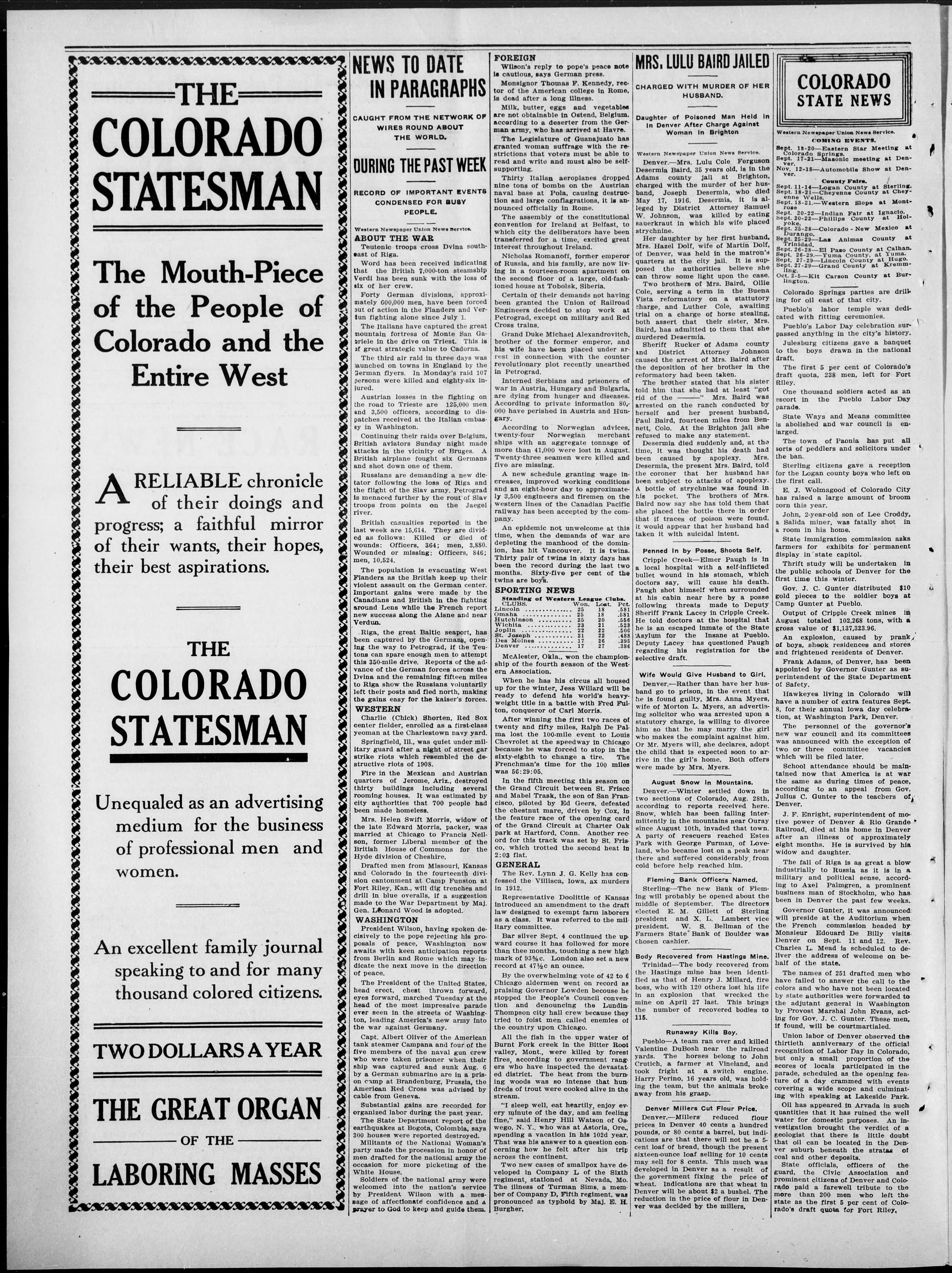
CAUGHT FROM THE NETWORK OF WIRES ROUND ABOUT THE WORLD.
COLORADO STATESMAN
DURING THE PAST WEEK
RECORD OF IMPORTANT EVENTS CONDENSED FOR BUSY
Western Newspaper Union News Service.
ABOUT THE WAR
Teutonic troops cross Dvina south-
east of Riga.
The Mouth-Piece of the People of Colorado and the Entire West
Word has been received indicating that the British 7,000-ton steamship Verdi has been sunk with the loss of six of her crew.
Forty German divisions, approximately 600,000 men, have been forced out of action in the Flanders and Verfun fighting alone since July 1.
The Italians have captured the great mountain fortress of Monte San Gabriele in the drive on Triest. This is of great strategic value to Cadorna.
The third air raid in three days was launched on towns in England by the German flyers. In Monday's raid 107 persons were killed and eighty-six injured.
Austrian losses in the fighting on the road to Trieste are 125,000 men and 3,500 officers, according to dispatches received at the Italian embassy in Washington.
Continuing their raids over Belgium, British aviators Sunday night made attacks in the vicinity of Bruges. A British airplane fought six Germans and shot down one of them.
ARELIABLE chronicle of their doings and progress; a faithful mirror of their wants, their hopes, their best aspirations.
Russians are demanding a new dictator following the loss of Riga and the flight of the Slav army. Petrograd is menaced further by the rout of Slav troops from points on the Jaegel river.
British casualties reported in the last week are 15,614. They are divided as follows: Killed or died of wounds: Officers, 364; men, 3,880. Wounded or missing: Officers, 846; men, 10,524.
The population is evacuating West Flanders as the British keep up their violent assault on the German center. Important gains were made by the Canadians and British in the fighting around Lens while the French report new success along the Aisne and near Verdun.
Riga, the great Baltic seaport, has been captured by the Germang, opening the way to Petrograd, if the Teutons can spare enough men to attempt this 350-mile drive. Reports of the advance of the German forces across the Dvina and the remaining fifteen miles to Riga show the Russians voluntarily left their posts and fled north, making the gains easy for the kaiser's forces. WESTERN
THE COLORADO STATESMAN
Charlie (Chick) Shorten, Red Sox center fielder, enrolled as a first-class yeoman at the Charlestown navy yard. Springfield, Ill., was quiet under military guard after a night of street car strike riots which resembled the destructive riots of 1908. Fire in the Mexican and Austrian quarters of Jerome, Ariz., destroyed thirty buildings including several rooming houses. It was estimated by city authorities that 700 people had been made homeless.
Unequaled as an advertising medium for the business of professional men and women.
Mrs. Helen Swift Morris, widow of the late Edward Morris, packer, was married at Chicago to Francis Nellson, former Liberal member of the British House of Commons for the Hyde division of Cheshire.
Drafted men from Missouri, Kansas and Colorado in the fourteenth division cantonment at Camp Funston at Fort Riley, Kan., will dig trenches and drill in blue overalls, if a suggestion made to the War Department by Maj. Gen. Leonard Wood is adopted.
WASHINGTON
President Wilson, having spoken decisively to the pope rejecting his proposals of peace, Washington now awaits with keen anticipation reports from Berlin and Rome which may indicate the next move in the direction of peace.
An excellent family journal speaking to and for many thousand colored citizens.
The President of the United States, head erect, chest thrown forward, eyes forward, marched Tuesday at the head of the most impressive parade ever seen in the streets of Washington, leading America's new army into the war against Germany.
Capt. Albert Oliver of the American tank steamer Campana and four of the five members of the naval gun crew who were taken prisoner when their ship was captured and sunk Aug. 6 by a German submarine are in a prison camp at Brandenburg, Prussia, the American Red Cross was advised by cable from Geneva.
TWODOLLARSAYEAR
Substantial gains are recorded for organized labor during the past year. The State Department report of the earthquakes at Bogota, Colombia, says 300 houses were reported destroyed. Militants of the National Woman's party made the procession in honor of men drafted for the national army the occasion for more picketing of the White House. Soldiers of the national army were welcomed into the nation's service by President Wilson with a message of affectionate confidence and a prayer to God to keep and guide them.
FOREIGN
Wilson's reply to pope's peace note is cautious, says German press.
Monsignor Thomas F. Kennedy, rector of the American college in Rome, is dead after a long illness.
Milk, butter, eggs and vegetables are not obtainable in Ostend, Belgium, according to a deserter from the German army, who has arrived at Havre.
The Legislature of Guanajuato has granted woman suffrage with the restrictions that voters must be able to read and write and must also be self-supporting.
Thirty Italian aeroplanes dropped nine tons of bombs on the Austrian naval base at Pola, causing destruction and large conflagrations, it is announced officially in Rome.
The assembly of the constitutional convention for Ireland at Belfast, to which city the deliberators have been transferred for a time, excited great interest throughout Ireland.
Nicholas Romanoff, former emperor of Russia, and his family, are now living in a fourteen-room apartment on the second floor of a large, old-fashioned house at Tobolsk, Siberia.
Certain of their demands not having been granted the Union of Railroad Engineers decided to stop work at Petrograd, except on military and Red Cross trains.
Grand Duke Michael Alexandrovitch, brother of the former emperor, and his wife have been placed under arrest in connection with the counter revolutionary plot recently unearthed in Petrograd.
Interned Serbians and prisoners of war in Austria, Hungary and Bulgaria, are dying from hunger and diseases. According to private information 80,000 have perished in Austria and Hungary.
According to Norwegian advices, twenty-four Norwegian merchant ships with an aggregate tonnage of more than 41,000 were lost in August. Twenty-three seamen were killed and five are missing.
A new schedule granting wage increases, improved working conditions and an eight-hour day to approximately 3,500 engineers and firemen on the western lines of the Canadian Pacific railway has been accepted by the company.
an epidemic not unwelcome at this time, when the demands of war are depleting the manhood of the dominion, has hit Vancouver. It is twins. Thirty pair of twins in sixty days has been the record during the last two months. Sixty-five per cent of the twins are boys.
SPORTING NEWS
Standing of Western League Clubs.
CLUBS. Won. Lost. Pct.
Lincoln 25 18 .581
Omaha 25 18 .581
Hutchinson 25 20 .556
Wichita 23 21 .522
Joplin 22 22 .500
St. Joseph 21 22 .488
Des Moines 17 26 .395
Denver 17 27 .386
McAlerest, Okla., won the championship of the fourth season of the Western Association.
When he has his circus all housed up for the winter, Jess Willard will be ready to defend his world's heavyweight title in a battle with Fred Fulton, conqueror of Carl Morris.
After winning the first two races of twenty and fifty miles, Ralph De Palma lost the 100-mile event to Louis Chevrolet at the speedway in Chicago because he was forced to stop in the sixty-eighth to change a tire. The Frenchman's time for the 100 miles was 55:29:05.
In the fifth meeting this season on the Grand Circuit between St. Frisco and Mabel Trask, the son of San Francisco, piloted by Ed Geers, defeated the chestnut mare, driven by Cox, in the feature race of the opening card of the Grand Circuit at Charter Oak park at Hartford, Conn. Another record for this track was set by St. Frisco, which trotted the second heat in 2:03 flat.
**GENERAL**
The Rev. Lynn J. G. Kelly has confessed the Villisca, Iowa, ax murders in 1912.
Representative Doolittle of Kansas introduced an amendment to the draft law designed to exempt farm laborers as a class. It was referred to the military committee.
Bar silver Sept, 4 continued the upward course it has followed for more than the months, touching a new high mark of 93% c. London also set a new record at 47% c an ounce.
By the overwhelming vote of 42 to 6 Chicago aldermen went on record as praising Governor Lowden because he stopped the People's Council convention and denouncing the Lundin-Thompson city hall crew because they tried to foist men called enemies of the country upon Chicago.
All the fish in the upper water of Burnt Fork creek in the Bitter Root valley, Mont, were killed by forest fires, according to government rangers who have inspected the devastated district. The heat from the burning woods was so intense that hundreds of trout were cooked alive in the stream.
"I sleep well, eat heartily, enjoy every minute of the day, and am feeling fine," said Henry Hill Watson of Oswego, N. Y., who was at Astoria, Ore, spending a vacation in his 102d year. That was his answer to a question concerning how he felt after his trip across the continent.
Two new cases of smallpox have developed in Company L of the Sixth regiment, stationed at Nevada, Mo. The illness of Turman Sims, a member of Company D, Fifth regiment, was pronounced as typhoid by Maj. E. H. Burgher.
CHARGED WITH MURDER OF HER
HUSBAND.
Daughter of Poisoned Man Held In In Denver After Charge Against Woman In Brighton
Western Newspaper Union News Service.
Denver.—Mrs. Lulu Cole Ferguson Desermia Baird, 35 years old, is in the Adams county jail at Brighton, charged with the murder of her husband, Joseph Desermia, who died May 17, 1916. Desermia, it is alleged by District Attorney Samuel W. Johnson, was killed by eating sauerkraut in which his wife placed strychnine.
Her daughter by her first husband, Mrs. Hazel Dolf, wife of Martin Dolf, of Denver, was held in the matron's quarters at the city jail. It is supposed the authorities believe she can throw some light upon the case.
Two brothers of Mrs. Baird, Ollie Cole, serving a term in the Buena Vista reformatory on a statutory charge, and Luther Cole, awaiting trial on a charge of horse stealing, both assert that their sister, Mrs. Baird, has admitted to them that she murdered Desermia.
Sheriff Rucker of Adams county and District Attorney Johnson caused the arrest of Mrs. Baird after the deposition of her brother in the reformatory had been taken.
The brother stated that his sister told him that she had at least "got rid of the ____" Mrs. Baird was arrested on the ranch conducted by herself and her present husband, Paul Baird, fourteen miles from Bennett, Colo. At the Brighton jail she refused to make any statement.
Desermia died suddenly and, at the time, it was thought his death had been caused by apoplexy. Mrs. Desermia, the present Mrs. Baird, told the coroner that her husband has been subject to attacks of apoplexy. A bottle of strychnine was found in his pocket. The brothers of Mrs. Baird now say she has told them that she placed the bottle there in order that if traces of poison were found, it would appear that her husband had taken it with sulcidal intent.
Penned In by Posse. Shoots Self.
Cripple Creek—Elmer Paugh is in a local hospital with a self-inflicted bullet wound in his stomach, which doctors say, will cause his death. Paugh shot himself when surrounded at his cabin near here by a posse following threats made to Deputy Sheriff Frank Lacey in Cripple Creek. He told doctors at the hospital that he is an escaped inmate of the State Asylum for the Insane at Pueblo. Deputy Lacey has questioned Paugh regarding his registration for the selective draft.
Wife Would Give Husband to Girl.
Wife Would Give Husband to Girl.
Denver.—Rather than have her husband go to prison, in the event that he is found guilty, Mrs. Anna Myers, wife of Morton L. Myers, an advertising solicitor who was arrested upon a statutory charge, is willing to divorce him so that he may marry the girl who makes the complaint against him. Or Mr. Myers will, she declares, adopt the child that is expected soon to arrive in the girl's home. Both offers were made by Mrs. Myers.
August Snow in Mountains.
Denver.—Winter settled down in two sections of Colorado, Aug. 28th, according to reports received here. Snow, which has been falling intermittently in the mountains near Ouray since August 10th, invaded that town. A party of rescuers reached Estes Park with George Furman, of Loveland, who became lost on a peak near there and suffered considerably, from cold before help reached him.
Fleming Bank Officers Named.
Sterling—The new Bank of Fleming will probably be opened about the middle of September. The directors elected E. M. Gillett of Sterling president and X. L. Lambert vice president. W. S. Bellman of the Farmers State Bank of Boulder was chosen cashier.
Body Recovered from Hastings Mine.
Body Recovered from Hastings Mine.
Trinidad—The body recovered from the Hastings mine has been identified as that of Henry J. Millard, fire boss, who with 120 others lost his life in an explosion that wrecked the mine on April 27 last. This brings the number of recovered bodies to 115.
Runaway Kills Boy.
Pueblo—A team ran over and killed Valentine DuBosh near the railroad yards. The horses belong to John Crutich, a farmer at Vineland, and took fright at a switch engine. Harry Perino, 16 years old, was holding the team, but the animals broke away from his grasp.
Denver Millers Cut Flour Price.
Denver.—Millers reduced flour prices in Denver 40 cents a hundred pounds, or 80 cents a barrel, but indications are that there will not be a 5-cent loaf of bread, though the present sixteen-ounce loaf selling for 10 cents may sell for 8 cents. This much was developed in Denver as a result of the government fixing the price of wheat. Indications are that wheat in Denver will be about $2 a bushel. The reduction in the price of flour in Denver was decided by the millers.
COLORADO
STATE NEWS
Western Newspaper Union News Service.
COMING EVENTS.
Sept. 18-20—Eastern Star Meeting at
Colorado Springs.
Sept. 17-21—Masonic meeting at Denver.
Nov. 12-18—Automobile Show at Denver.
County Fairs.
Sept. 11-14—Logan County at Sterling.
Sept. 18-21—Cheyenne County at Cheyenne Wells.
Sept. 18-21—Western Slope at Montrose.
Sept. 20-22—Indian Fair at Ignacio.
Sept. 20-22—Phillips County at Holvoke.
Sept. 26-28 - El Paso County at Calhoun.
Sept. 26-29 - Yuma County, at Yuma.
Sept. 27-29 - Lincoln County at Huge.
Sept. 27-29 - Grand County at Kremnin-ink.
Oct. 2-5- Kit Carson County at Burlington.
Colorado Springs parties are drilling for oil east of that city.
Pueblo's labor temple was dedicated with fitting ceremonies.
Pueblo's Labor Day celebration surpassed anything in the city's history.
The first 5 per cent of Colorado's draft quota, 238 men, left for Fort Riley.
One thousand soldiers acted as an escort in the Pueblo Labor Day parade.
State Ways and Means committee is abolished and war council is enlarged.
Sterling citizens gave a reception for the Logan county boys who left on the first call.
E. J. Wolmagood of Colorado City has raised a large amount of broom corn this year.
John, 2-year-old son of Lee Croddy, a Salida miner, was fatally shot in a room in his home.
State immigration commission asks farmers for exhibits for permanent display in 'state capitol.
Thrift study will be undertaken in the public schools of Denver for the first time this winter.
Gov. J. C. Gunter distributed $10 gold pieces to the soldier boys at Camp Gunter at Pueblo.
Output of Cripple Creek mines in August totaled 102,268 tons, with a gross value of $1,137,323.96.
An explosion, caused by prank of boys, shook residences and stores and frightened residents of Denver.
Frank Adams, of Denver, has been appointed by Governor Gunter as superintendent of the State Department of Safety.
Hawkeyes living in Colorado will have a number of extra features Sept. 8, for their annual Iowa day celebration, at Washington Park, Denver.
The personnel of the governor's new war council and its committees was announced with the exception of two or three committee vacancies which will be filed later.
School attendance should be maintained now that America is at war the same as during times of peace, according to an appeal from Gov. Julius C. Gunter to the teachers of Denver.
J. F. Enright, superintendent of motive power of Denver & Rio Grande Railroad, died at his home in Denver after an illness of approximately eight months. He is survived by his widow and daughter.
The fall of Riga is as great a blow industrially to Russia as it is in a military and political sense, according to Axel Palmgren, a prominent business man of Stockholm, who has been in Denver the past few weeks.
Governor Gunter, it was announced will preside at the Auditorium when the French commission headed by Monsieur Edouard De Billy visits Denver on Sept. 11 and 12. Rev. Charles L. Mead is scheduled to deliver the address of welcome on behalf of the state.
The names of 251 drafted men who have failed to answer the call to the colors and who have not been located by state authorities were forwarded to the adjutant general in Washington by Provost Marshal John Evans, acting for Gov. J. C. Gunter. These men, if found, will be courtmartialed.
Union labor of Denver observed the thirtieth anniversary of the official recognition of Labor Day in Colorado, but only a small proportion of the scores of locals participated in the parade, scheduled as the opening feature of a day crammed with events covering a wide scope and culminating with speaking at Lakeside Park.
Oil has appeared in Arvada in such quantities that it has ruined the well water for domestic purposes. An investigation brought the verdict of a geologist that there is little doubt that oil can be located in the Denver suburb beneath the stratas of coal and other deposits. State officials, officers of the guard, the Civic Association and prominent citizens of Denver and Colorado paid a farewell tribute to the more than 200 men who left the state as the first 5 per cent of Colorado's draft quota for Fort Riley.
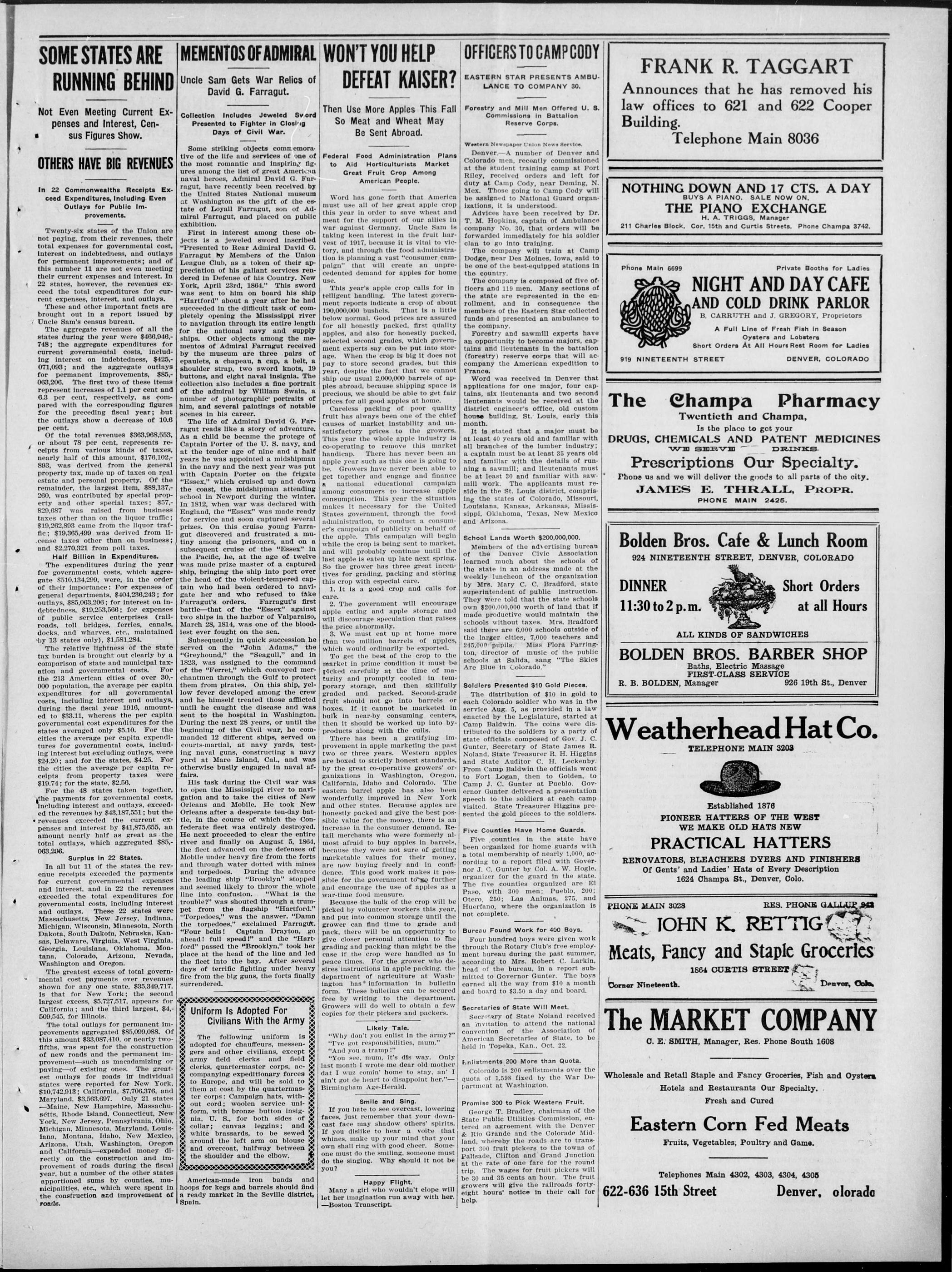
SOME STATES ARE RUNNING BEHIND
Not Even Meeting Current Expenses and Interest, Census Figures Show.
OTHERS HAVE BIG REVENUES
In 22 Commonwealth Receipts Exceed Expenditures, Including Even Outlays for Public Improvements.
Twenty-six states of the Union are not paying, from their revenues, their total expenses for governmental cost, interest on indebtedness, and outlays for permanent improvements; and of this number 11 are not even meeting their current expenses and interest. In 22 states, however, the revenues exceed the total expenditures for current expenses, interest, and outlays.
These and other important facts are brought out in a report issued by Uncle Sam's census bureau.
The aggregate revenues of all the states during the year were $466,946,748; the aggregate expenditures for current governmental costs, including interest on indebtedness, $425,071,093; and the aggregate outlays for permanent improvements, $85,063,206. The first two of these items represent increases of 1.1 per cent and 6.3 per cent, respectively, as compared with the corresponding figures for the preceding fiscal year; but the outlays show a decrease of 10.6 per cent.
Of the total revenues $363,968,553, or about 78 per cent, represents receipts from various kinds of taxes, nearly half of this amount, $176,102,893, was derived from the general property tax, made up of taxes on real estate and personal property. Of the remainder, the largest item, $88,137,260, was contributed by special property and other special taxes; $57,829,687 was raised from business taxes other than on the liquor traffic; $19,262,893 came from the liquor traffic; $19,365,499 was derived from license taxes other than on business; and $2,270,321 from poll taxes.
Half Billion in Expenditures.
The expenditures during the year for governmental costs, which aggregate $510,134,209, were, in the order of their importance: For expenses of general departments, $404,236,243; for outlays, $85,063,206; for interest on indebtedness, $19,253,566; for expenses of public service enterprises (railroads, toll bridges, ferries, canals, docks, and wharves, etc., maintained by 13 states only), $1,581,284.
The relative lightness of the state tax burden is brought out clearly by a comparison of state and municipal taxation and governmental costs. For the 213 American cities of over 30,000 population, the average per capita expenditures for all governmental costs, including interest and outlays, during the fiscal year 1916, amounted to $33.11, whereas the per capita governmental cost expenditures for the states averaged only $5.10. For the cities the average per capita expenditures for governmental costs, including interest but excluding outlays, were $24.20; and for the states, $4.25. For the cities the average per capita receipts from property taxes were $19.74; for the state, $2.56.
For the 48 states taken together, the payments for governmental costs, including interest and outlays, exceeded the revenues by $43,187,551; but the revenues exceeded the current expenses and interest by $41,875,655, an amount nearly half as great as the total outlays, which aggregated $85,063,206.
Surplus in 22 States.
In all but 11 of the states the revenue receipts exceeded the payments for current governmental expenses and interest, and in 22 the revenues exceeded the total expenditures for governmental costs, including interest and outlays. These 22 states were Massachusetts, New Jersey, Indiana, Michigan, Wisconsin, Minnesota, North Dakota, South Dakota, Nebraska, Kansas, Delaware, Virginia, West Virginia, Georgia, Louisiana, Oklahoma, Montana, Colorado, Arizona, Nevada, Washington and Oregon.
The greatest excess of total governmental cost payments over revenues shown for any one state, $35,349,717, is that for New York; the second largest excess, $5,727,517, appears for California; and the third largest, $4,509,545, for Illinois.
The total outlays for permanent improvements aggregated $85,099,088. Of this amount $33,087,410, or nearly two-fifths, was spent for the construction of new roads and the permanent improvement—such as macadamizing or paving—of existing ones. The greatest outlays for roads in individual states were reported for New York, $10,742,913; California, $7,706,376, and Maryland, $3,563,697. Only 21 states—Maine, New Hampshire, Massachusetts, Rhode Island, Connecticut, New York, New Jersey, Pennsylvania, Ohio, Michigan, Minnesota, Maryland, Louisiana, Montana, Idaho, New Mexico, Arizona, Utah, Washington, Oregon and California—expended money directly on the construction and improvement of roads during the fiscal year, but a number of the other states apportioned sums by counties, municipalities, etc., which were spent in the construction and improvement of roads.
Uncle Sam Gets War Relics of David G. Farragut.
Collection Includes Jeweled Sword Presented to Fighter in Closing Days of Civil War.
Some striking objects commemorative of the life and services of one of the most romantic and inspiring figures among the list of great American naval heroes, Admiral David G. Farragut, have recently been received by the United States National museum at Washington as the gift of the estate of Loyall Farragut, son of Admiral Farragut, and placed on public exhibition.
First in interest among these objects is a jeweled sword inscribed "Presented to Rear Admiral David G. Farragut by Members of the Union League Club, as a token of their appreciation of his gallant services rendered in Defense of his Country. New York, April 23rd, 1864." This sword was sent to him on board his ship "Hartford" about a year after he had succeeded in the difficult task of completely opening the Mississippi river to navigation through its entire length for the national navy and supply ships. Other objects among the mementos of Admiral Farragut received by the museum are three pairs of epaulets, a chapeau, a cap, a belt, a shoulder strap, two sword knots, 19 buttons, and eight naval insignia. The collection also includes a fine portrait of the admiral by William Swain, a number of photographic portraits of him, and several paintings of notable scenes in his career.
The life of Admiral David G. Farragut reads like a story of adventure. As a child he became the protege of Captain Porter of the U. S. navy, and at the tender age of nine and a half years he was appointed a midshipman in the navy and the next year was put with Captain Porter on the frigate "Essex" which cruised up and down the coast, the midshipman attending school in Newport during the winter. In 1812, when war was declared with England, the "Essex" was made ready for service and soon captured several prizes. On this cruise young Farragut discovered and frustrated a mutiny among the prisoners, and on a subsequent cruise of the "Essex" in the Pacific, he, at the age of twelve was made prize master of a captured ship, bringing the ship into port over the head of the violent-tempered captain who had been ordered to navigate her and who refused to take Farragut's orders. Farragut's first battle—that of the "Essex" against two ships in the harbor of Valparaiso, March 28, 1814, was one of the bloodiest ever fought on the sea.
Subsequently in quick succession he served on the "John Adams," the "Greyhound," the "Seagull," and in 1823, was assigned to the command of the "Ferret," which conveyed merchantmen through the Gulf to protect them from pirates. On this ship, yellow fever developed among the crew and he himself treated those afflicted until he caught the disease and was sent to the hospital in Washington. During the next 28 years, or until the beginning of the Civil war, he commanded 12 different ships, served on courts-martial, at navy yards, testing naval guns, constructing a navy yard at Mare Island, Cal., and was otherwise busily engaged in naval affairs.
His task during the Civil war was to open the Mississippi river to navigation and to take the cities of New Orleans and Mobile. He took New Orleans after a desperate ten-day battle, in the course of which the Confederate fleet was entirely destroyed. He next proceeded to clear the entire river and finally on August 5, 1864, the fleet advanced on the defenses of Mobile under heavy fire from the forts and through water dotted with mines and torpedoes. During the advance the leading ship "Brooklyn" stopped and seemed likely to throw the whole line into confusion. "What is the trouble?" was shouted through a trumpet from the flagship "Hartford." "Torpedoes," was the answer. "Damn the torpedoes," exclaimed Farragut. "Four bells! Captain Drayton, go ahead! full speed!" and the "Hartford" passed the "Brooklyn," took her place at the head of the line and led the fleet into the bay. After several days of terrific fighting under heavy fire from the big guns, the forts finally surrendered.
Uniform Is Adopted For Civilians With the Army
The following uniform is adopted for chauffeurs, messengers and other civilians, except army field clerks and field clerks, quartermaster corps, accompanying expeditionary forces to Europe, and will be sold to them at cost by the quartermaster corps: Campaign hats, without cord; woolen service uniform, with bronze button insignia, U. S., for both sides of collar; canvas leggins; and white brassards, to be sewed around the left arm on blouse and overcoat, halfway between the shoulder and the elbow.
American-made iron bands and hoops for kegs and barrels should find a ready market in the Seville district, Spain.
Then Use More Apples This Fall So Meat and Wheat May Be Sent Abroad.
Federal Food Administration Plans to Aid Horticulturists Market Great Fruit Crop Among American People.
Word has gone forth that America must use all of her great apple crop this year in order to save wheat and meat for the support of our allies in war against Germany. Uncle Sam is taking keen interest in the fruit harvest of 1917, because it is vital to victory, and through the food administration is planning a vast "consumer campaign" that will create an unprecedented demand for apples for home use.
This year's apple crop calls for in intelligent handling. The latest government reports indicate a crop of about 190,000,000 bushels. That is a little below normal. Good prices are assured for all honestly packed, first quality apples, and also for honestly packed, selected second grades, which government experts say can be put into storage. When the crop is big it does not pay to store second grades, but this year, despite the fact that we cannot ship our usual 2,000,000 barrels of apples abroad, because shipping space is precious, we should be able to get fair prices for all good apples at home.
Careless packing of poor quality fruit has always been one of the chief causes of market instability and unsatisfactory prices to the growers. This year the whole apple industry is co-operating to remove this market handicap. There has never been an apple year such as this one is going to be. Growers have never been able to get together and engage and finance national educational campaign among consumers to increase apple consumption. This year the situation makes it necessary for the United States government, through the food administration, to conduct a consumer's campaign of publicity on behalf of the apple. This campaign will begin while the crop is being sent to market, and will probably continue until the last apple is eaten up late next spring. So the grower has three great incentives for grading, packing and storing this crop with especial care.
1. It is a good crop and calls for care.
2. The government will encourage apple eating and apple storage and will discourage speculation that raises the price abnormally.
3. We must eat up at home more than two million barrels of apples, which would ordinarily be exported.
To get the best of the crop to the market in prime condition it must be picked carefully at the time of maturity and promptly cooled in temporary storage, and then skillfully graded and packed. Second-grade fruit should not go into barrels or boxes. If it cannot be marketed in bulk in near-by consuming centers, then it should be worked up into by-products along with the culls.
There has been a gratifying improvement in apple marketing the past two or three years. Western apples are boxed to strictly honest standards, by the great co-operative growers' organizations in Washington, Oregon, California, Idaho and Colorado. The eastern barrel apple has also been wonderfully improved in New York and other states. Because apples are honestly packed and give the best possible value for the money, there is an increase in the consumer demand. Retail merchants who were formerly almost afraid to buy apples in barrels, because they were not sure of getting marketable values for their money, are now buying freely and in confidence. This good work makes it possible for the government to go further and encourage the use of apples as a war-time food measure.
Because the bulk of the crop will be picked by volunteer workers this year, and put into common storage until the grower can find time to grade and pack, there will be an opportunity to give closer personal attention to the grading and packing than might be the case if the crop were handled as in peace times. For the grower who desires instructions in apple packing, the department of agriculture at Washington has* information in bulletin form. These bulletins can be secured free by writing to the department. Growers will do well to obtain a few copies for their pickers and packers.
Likely Tale.
"Why don't you enlist in the army?"
"I've got responsibilities, mum."
"And you a tramp!"
"You see, mum, it's dis way. Only last month I wrote me dear old mother dat I wuz comin' home to stay, an' I ain't got de heart to disappoint her."—Birmingham Age-Herald.
Smile and Sing.
If you hate to see overcast, lowering faces, just remember that your downcast face may shadow others' spirits. If you dislike to hear a voice that whines, make up your mind that your own shall ring with good cheer. Someone must do the smiling, someone must do the singing. Why should it not be you?
Happy Flight.
Many a girl who wouldn't elope will let her imagination run away with her. Boston Transcript.
OFFICERSTOCAMPCODY
EASTERN STAR PRESENTS AMBU
LANCE TO COMPANY 30.
Forestry and Mill Men Offered U. S.
Commissions in Battalion
Reserve Corps.
Western Newspaper Union News Service
Denver.—A number of Denver and Colorado men, recently commissioned at the student training camp at Fort Riley, received orders and left for duty at Camp Cody, near Deming, N. Mex. Those going to Camp Cody will be assigned to National Guard organizations, it is understood. Advices have been received by Dr. T. M. Hopkins, captain of Ambulance company No. 30, that orders will be forwarded immediately for his soldier clan to go into training. The company will train at Camp Dodge, near Des Moines, Iowa, said to be one of the best-equipped stations in the country. The company is composed of five officers and 119 men. Many sections of the state are represented in the enrollment, and in consequence the members of the Eastern Star collected funds and presented an ambulance to the company.
Forestry and sawmill experts have an opportunity to become majors, captains and lieutenants in the battalion (forestry) reserve corps that will accompany the American expedition to France. Word was received in Denver that applications for one major, four captains, six lieutenants and two second lieutenants would be received at the district engineer's office, old custom house building, St. Louis, early this month.
It is stated that a major must be at least 40 years old and familiar with all branches of the lumber industry; a captain must be at least 35 years old and familiar with the details of running a sawmill; and lieutenants must be at least 30 and familiar with sawmill work. The applicants must reside in the St. Louis district, comprising the states of Colorado, Missouri, Louisiana, Kansas, Arkansas, Mississippi, Oklahoma, Texas, New Mexico and Arizona.
School Lands Worth $200,000,000.
Members of the advertising bureau of the Denver Civic Association learned much about the schools of the state in an address made at the weekly luncheon of the organization by Mrs. Mary C. C. Bradford, state superintendent of public instruction. They were told that the state schools own $200,000,000 worth of land that if made productive would maintain the schools without taxes. Mrs. Bradford said there are 6,000 schools outside of the larger cities, 7,000 teachers and 245,000 pupils. Miss Flora Farrington, director of music of the public schools at Salida, sang "The Skies Are Blue in Colorado."
Soldiers Presented $10 Gold Pieces.
The distribution of $10 in gold to each Colorado soldier who was in the service Aug. 5, as provided in a law enacted by the Legislature, started at Camp Baldwin. The coins were distributed to the soldiers by a party of state officials composed of Gov. J. C. Gunter, Secretary of State James R. Noland, State Treasurer R. H. Higgins and State Auditor C. H. Leckenby. From Camp Baldwin the officials went to Fort Logan, then to Golden, to Camp J. C. Gunter at Pueblo. Governor Gunter delivered a presentation speech to the soldiers at each camp visited. State Treasurer Higgins presented the gold pieces to the soldiers.
Five Counties Have Home Guards.
Five counties in the state have been organized for home guards with a total membership of nearly 1,000, according to a report filed with Governor J. C. Gunter by Col. A. W. Hogle, organizer for the guard in the state. The five counties organized are El Paso, with 300 men; Pueblo, 200; Otero, 250; Las Animas, 275, and Huerfano, where the organization is not complete.
Bureau Found Work for 400 Boys.
Four hundred boys were given work through the Rotary Club's free employment bureau during the past summer, according to Mrs. Robert C. Larkin, head of the bureau, in a report submitted to Governor Gunter. The boys earned all the way from $10 a month and board to $3.50 a day and board.
Secretary of State Noland received an invitation to attend the national convention of the Association of American Secretaries of State, to be held in Topeka, Kan., Oct. 22.
Colorado is 200 enlistments over the quota of 1,598 fixed by the War Department at Washington.
Promise 300 to Pick Western Fruit.
Promise 300 to Pick Western Fruit.
George T. Bradley, chairman of the State Public Utilities Commission, entered an agreement with the Denver & Rio Grande and the Colorado Midland, whereby the roads are to transport 300 fruit pickers to the towns of Pallsade, Clifton and Grand Junction at the rate of one fare for the round trip. The wages for fruit pickers will be 30 and 35 cents an hour. The fruit growers will give the railroads forty-eight hours' notice in their call for help.
Announces that he has removed his law offices to 621 and 622 Cooper Building. Telephone Main 8036
NOTHING DO
BUYS
THE I
211 Charles Block. Cor
Phone Main 6699
NG DOWN AND 17 CTS.
BUYS A PIANO. SALE NOW ON.
THE PIANO EXCHANGE
H. A. TRIGGS, Manager
Lock. Cor. 15th and Curtis Streets. Phone
5699 Private Boot
NIGHT AND DAY
AND COLD DRINK B
B. CARRUTH and J. GREGORY,
A Full Line of Fresh Fish In
Oysters and Lobsters
Short Orders At All Hours Rest Ro
NTH STREET DENVER
Champa Phar
Twentieth and Champa,
Is the place to get your
CHEMICALS AND PATENT M
WE SERVE DRINKS.
Scriptions Our Special
we will deliver the goods to all parts
JES E. THRALL, PR
PHONE MAIN 2425.
Bros. Cafe & Lunch
ETEENTH STREET, DENVER, COL
NOTHING DOWN AND 17 CTS. A DAY
BUYS A PIANO. SALE NOW ON.
THE PIANO EXCHANGE
H. A. TRIGGS, Manager
211 Charles Block. Cor. 15th and Curtis Streets. Phone Champa 3742.
919 NINETEENTH ST
The Cha
Twent
Is
DRUGS, CHEMICA
WE S
Prescript
Phone us and we will
JAMES
Bolden Bros
924 NINETEENTH
The Champa Pharmacy
Twentieth and Champa,
Is the place to get your
DRUGS, CHEMICALS AND PATENT MEDICINES
WE SERVE DRINKS.
Prescriptions Our Specialty.
Phone us and we will deliver the goods to all parts of the city.
JAMES E. THRALL, PROPR.
PHONE MAIN 2425.
Bolden Bros. Cafe & Lunch Room 924 NINETEENTH STREET, DENVER, COLORADO
DINNER 11:30 to 2 p.m.
ALL K
BOLDEN B
Battl
FIR
R. B. BOLDEN, Man
Weathe
TER
PIONEER
WE M
PRACT
RENOVATORS, BL
Of Gents' and I
1624 C
ALL KINDS OF SANDWICHES
EN BROS. BARBER
Baths, Electric Massage
FIRST-CLASS SERVICE
EN, Manager 926 19th
therhead Ha
TELEPHONE MAIN 3203
BOLDEN BROS. BARBER SHOP
Baths, Electric Massage
FIRST-CLASS SERVICE
R. B. BOLDEN, Manager 926 19th St., Denver
Weatherhead Hat Co. TELEPHONE MAIN 3203
Established 1876
ONEER HATTERS OF THE WEST
WE MAKE OLD HATS NEW
PRACTICAL HATTER
ORS, BLEACHERS DYERS AND FIL
Hats' and Ladies' Hats of Every Descrip
1624 Champa St., Denver, Colo.
Established 1876
PIONEER HATTERS OF THE WEST
WE MAKE OLD HATS NEW
PRACTICAL HATTERS
RENOVATORS, BLEACHERS DYERS AND FINISHERS
Of Gents' and Ladies' Hats of Every Description
1624 Champa St., Denver, Colo.
JOHN K. RETTIG
Fancy and Staple Gr
1864 CURTIS STREET
th.
Meats, Fancy 186
The MAR
C. E. SMITH,
Wholesale and Retail Sta
Hotels and
The MARKET COMPANY
C. E. SMITH, Manager, Res. Phone South 1608
Wholesale and Retall Staple and Fancy Groceries, Fish and Oysters Hotels and Restaurants Our Specialty. Fresh and Cured
Eastern Corn Fed Meats
Telephones Main 4302, 4303, 4304, 4305
622-636 15th Street Denver. olorado
C
PHONE MAIN 3028
Corner Nineteenth.
D 17 CTS. A DAY
SALE NOW ON.
EXCHANGE
Manager
Streets. Phone Champa 3742.
Private Booths for Ladies
AND DAY CAFE
DRINK PARLOR
And J. GREGORY, Proprietors
of Fresh Fish in Season
Lobsters and Lobsters
All Hours Rest Room for Ladies
DENVER, COLORADO
Pharmacy
Champa,
got your
PATENT MEDICINES
DRINKS.
Our Specialty.
foods to all parts of the city.
ALL, PROPR.
2425.
& Lunch Room
DENVER, COLORADO
NIGHT AND DAY CAFE
AND COLD DRINK PARLOR
B. CARRUTH and J. GREGORY, Proprietors
A Full Line of Fresh Fish in Season
Oysters and Lobsters
Short Orders At All Hours Rest Room for Ladies
STREET DENVER, COLORADO
Short Orders at all Hours
ANDWICHES
BARBER SHOP
Massage
SERVICE
926 19th St., Denver
Bad Hat Co.
LIN 3203
876
OF THE WEST
HATS NEW
HATTERS
HATTERS AND FINISHERS
Of Every Description
Denver, Colo.
RES. PHONE GALLUP 942
STREET Denver, Cola COMPANY Phone South 1608
Fruit Bowl
```markdown
```
101
11
THE COLORADO STATESMAN
CABON
BLADE
IN
FREED
HACE
COUNTRY
PARTY
SUBSCRIPTION RATES.
One Year $2.00
Six Months $1.00
Three Months $0.60
PAYABLE IN ADVANCE.
Entered as second-class matter at the postoffice in the City of Denver, Colo.
Reading notices, ten lines or less, 10 cents per line. Each additional line over ten lines, 5 cents per line. Display advertising, 50 cents per inch.
Remittances should be made by Express Money Order, Postoffice Money Order, Registered Letter or Bank Draft. Postage stamps will be received the same as cash for the fractional part of a dollar. Only 1c and 2c stamps taken.
No discounts allowed on less than three months' contract. Cash must accompany all orders from parties unknown to us. Further particulars on application.
Communications to receive attention must be newsy, upon important subjects, plainly written only upon one side of the paper, must reach us Tuesday, if possible, anyway, until the Wednesday for the signature of the author. No manuscript returned, unless stamps are sent for postage. All communications of a personating nature that are not complimentary will be withheld from the columns of this paper.
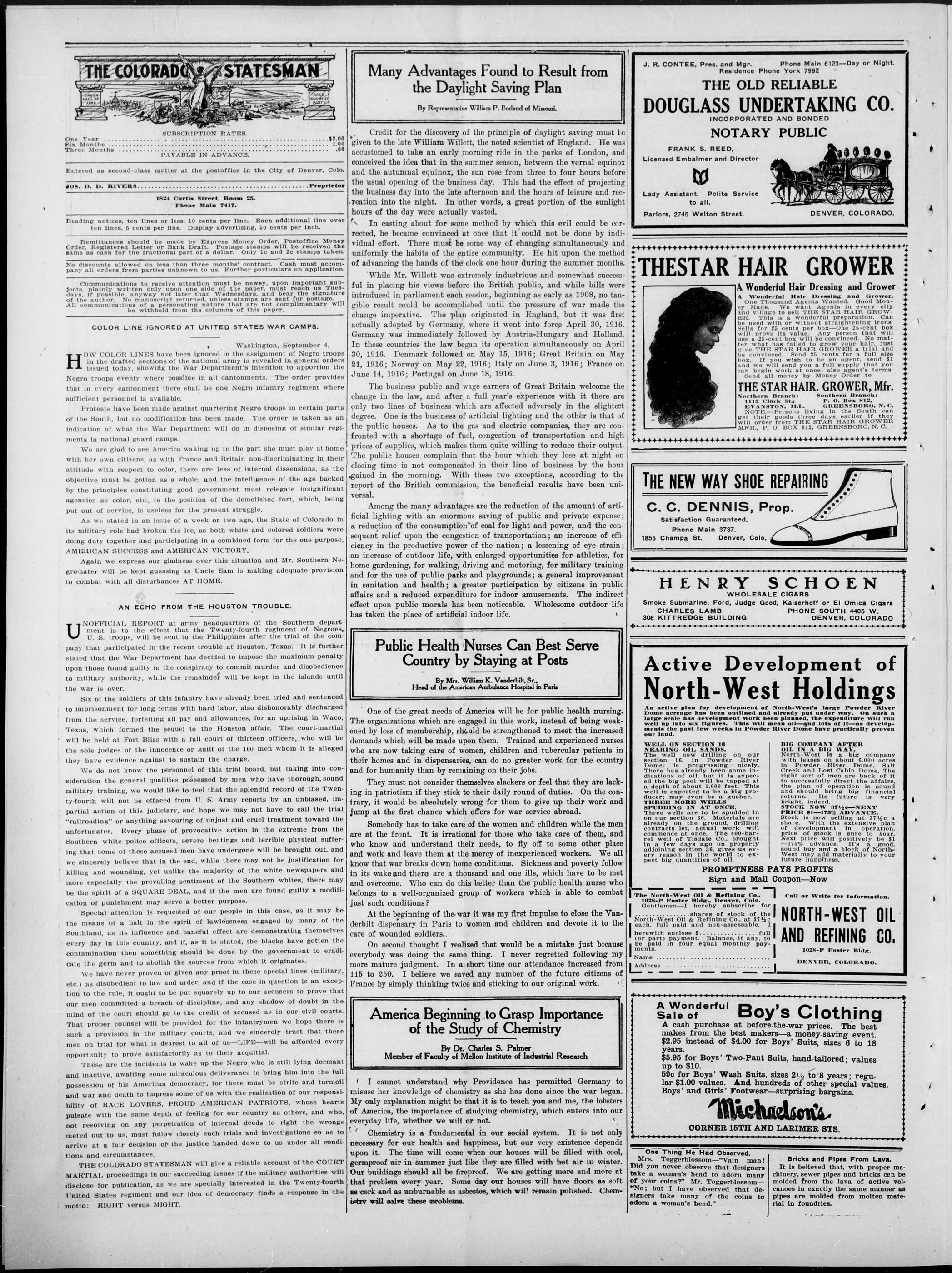
COLOR LINE IGNORED AT UNITED STATES WAR CAMPS.
HOW COLOR LINES have been ignored in the assignment of Negro troops in the drafted sections of the national army is revealed in general orders issued today, showing the War Department's intention to apportion the Negro troops evenly where possible in all cantonments. The order provides that in every cantonment there shall be one Negro infantry regiment where sufficient personnel is available.
Protests have been made against quartering Negro troops in certain parts of the South, but no modification has been made. The order is taken as an indication of what the War Department will do in disposing of similar regiments in national guard camps.
We are glad to see America waking up to the part she must play at home with her own citizens, as with France and Britain non-discriminating in their attitude with respect to color, there are less of internal dissensions, as the objective must be gotten as a whole, and the intelligence of the age backed by the principles constituting good government must relegate insignificant agencies as color, etc., to the position of the demolished fort, which, being put out of service, is useless for the present struggle.
As we stated in an issue of a week or two ago, the State of Colorado in its military role had broken the ice, as both white and colored soldiers were doing duty together and participating in a combined form for the one purpose, AMERICAN SUCCESS and AMERICAN VICTORY.
Again we express our gladness over this situation and Mr. Southern Negro-hater will be kept guessing as Uncle Sam is making adequate provision to combat with all disturbances AT HOME.
AN ECHO FROM THE HOUSTON TROUBLE.
NOOFFICIAL REPORT at army headquarters of the Southern department is to the effect that the Twenty-fourth regiment of Negroes, U. S. troops, will be sent to the Philippines after the trial of the company that participated in the recent trouble at Houston, Texas. It is further stated that the War Department has decided to impose the maximum penalty upon those found guilty in the conspiracy to commit murder and disobedience to military authority, while the remainder will be kept in the islands until the war is over.
Six of the soldiers of this infantry have already been tried and sentenced to imprisonment for long terms with hard labor, also dishonorably discharged from the service, forfeiting all pay and allowances, for an uprising in Waco, Texas, which formed the sequel to the Houston affair. The court-martial will be held at Fort Bliss with a full court of thirteen officers, who will be the sole judges of the innocence or guilt of the 160 men whom it is alleged they have evidence against to sustain the charge.
We do not know the personnel of this trial board, but taking into consideration the general qualities possessed by men who have thorough, sound military training, we would like to feel that the splendid record of the Twenty-fourth will not be effaced from U. S. Army reports by an unbiased, impartial action of this judiciary, and hope we may not have to call the trial "railroading" or anything savouring of unjust and cruel treatment toward the unfortunates. Every phase of provocative action in the extreme from the Southern white police officers, severe beatings and terrible physical suffering that some of these accused men have undergone will be brought out, and we sincerely believe that in the end, while there may not be justification for killing and wounding, yet unlike the majority of the white newspapers and more especially the prevailing sentiment of the Southern whites, there may be the spirit of a SQUARE DEAL, and if the men are found guilty a modification of punishment may serve a better purpose.
Special attention is requested of our people in this case, as it may be the means of a halt in the spirit of lawlessness engaged by many of the Southland, as its influence and baneful effect are demonstrating themselves every day in this country, and if, as it is stated, the blacks have gotten the contamination then something should be done by the government to eradicate the germ and to abolish the sources from which it originates.
We have never proven or given any proof in these special lines (military, etc.) as disobedient to law and order, and if the case in question is an exception to the rule, it ought to be put squarely up to our accusers to prove that our men committed a breach of discipline, and any shadow of doubt in the mind of the court should go to the credit of accused as in our civil courts. That proper counsel will be provided for the infantrymen we hope there is such a provision in the military courts, and we sincerely trust that these men on trial for what is dearest to all of us—LIFE—will be afforded every opportunity to prove satisfactorily as to their acquittal.
These are the incidents to wake up the Negro who is still lying dormant and inactive, awaiting some miraculous deliverance to bring him into the full possession of his American democracy, for there must be strife and turmoil and war and death to impress some of us with the realization of our responsibility of RACE LOVERS, PROUD AMERICAN PATRIOTS, whose hearts pulsate with the same depth of feeling for our country as others, and who, not resolving on any perpetration of internal deeds to right the wrongs meted out to us, must follow closely such trials and investigations so as to arrive at a fair decision of the justice handed down to us under all conditions and circumstances.
THE COLORADO STATESMAN will give a reliable account of the COURT MARTIAL proceedings in our succeeding issues if the military authorities will disclose for publication, as we are specially interested in the Twenty-fourth United States regiment and our idea of democracy finds a response in the motto: RIGHT versus MIGHT.
Many Advantages Found to Result from the Daylight Saving Plan
By Representative William P. Borland of Missouri.
Credit for the discovery of the principle of daylight saving must be given to the late William Willett, the noted scientist of England. He was accustomed to take an early morning ride in the parks of London, and conceived the idea that in the summer season, between the vernal equinox and the autumnal equinox, the sun rose from three to four hours before the usual opening of the business day. This had the effect of projecting the business day into the late afternoon and the hours of leisure and recreation into the night. In other words, a great portion of the sunlight hours of the day were actually wasted.
In casting about for some method by which this evil could be corrected, he became convinced at once that it could not be done by individual effort. There must be some way of changing simultaneously and uniformly the habits of the entire community. He hit upon the method of advancing the hands of the clock one hour during the summer months.
While Mr. Willett was extremely industrious and somewhat successful in placing his views before the British public, and while bills were introduced in parliament each session, beginning as early as 1908, no tangible result could be accomplished until the pressure of war made the change imperative. The plan originated in England, but it was first actually adopted by Germany, where it went into force April 30, 1916. Germany was immediately followed by Austria-Hungary and Holland. In these countries the law began its operation simultaneously on April 30, 1916. Denmark followed on May 15, 1916; Great Britain on May 21, 1916; Norway on May 22, 1916; Italy on June 3, 1916; France on June 14, 1916; Portugal on June 18, 1916.
The business public and wage earners of Great Britain welcome the change in the law, and after a full year's experience with it there are only two lines of business which are affected adversely in the slightest degree. One is the business of artificial lighting and the other is that of the public houses. As to the gas and electric companies, they are confronted with a shortage of fuel, congestion of transportation and high prices of supplies, which makes them quite willing to reduce their output. The public houses complain that the hour which they lose at night on closing time is not compensated in their line of business by the hour gained in the morning. With these two exceptions, according to the report of the British commission, the beneficial results have been universal.
Among the many advantages are the reduction of the amount of artificial lighting with an enormous saving of public and private expense; a reduction of the consumption of coal for light and power, and the consequent relief upon the congestion of transportation; an increase of efficiency in the productive power of the nation; a lessening of eye strain; an increase of outdoor life, with enlarged opportunities for athletics, for home gardening, for walking, driving and motoring, for military training and for the use of public parks and playgrounds; a general improvement in sanitation and health; a greater participation by citizens in public affairs and a reduced expenditure for indoor amusements. The indirect effect upon public morals has been noticeable. Wholesome outdoor life has taken the place of artificial indoor life.
Public Health Nurses Can Best Serve Country by Staying at Posts
By Mrs. William K. Vanderbilt, Sr. Head of the American Ambulance Hospital in Paris
One of the great needs of America will be for public health nursing. The organizations which are engaged in this work, instead of being weakened by loss of membership, should be strengthened to meet the increased demands which will be made upon them. Trained and experienced nurses who are now taking care of women, children and tubercular patients in their homes and in dispensaries, can do no greater work for the country and for humanity than by remaining on their jobs.
They must not consider themselves slackers or feel that they are lacking in patriotism if they stick to their daily round of duties. On the contrary, it would be absolutely wrong for them to give up their work and jump at the first chance which offers for war service abroad.
Somebody has to take care of the women and children while the men are at the front. It is irrational for those who take care of them, and who know and understand their needs, to fly off to some other place and work and leave them at the mercy of inexperienced workers. We all know that war breaks down home conditions. Sickness and poverty follow in its wake and there are a thousand and one ills, which have to be met and overcome. Who can do this better than the public health nurse who belongs to a well-organized group of workers which is able to combat just such conditions?
At the beginning of the war it was my first impulse to close the Vanderbilt dispensary in Paris to women and children and devote it to the care of wounded soldiers.
On second thought I realized that would be a mistake just because everybody was doing the same thing. I never regretted following my more mature judgment. In a short time our attendance increased from 115 to 250. I believe we saved any number of the future citizens of France by simply thinking twice and sticking to our original work.
America Beginning to Grasp Importance of the Study of Chemistry
By Dr. Charles S. Palmer Member of Faculty of Mellon Institute of Industrial Research
I cannot understand why Providence has permitted Germany to misuse her knowledge of chemistry as she has done since the war began. My only explanation might be that it is to teach you and me, the lobsters of America, the importance of studying chemistry, which enters into our everyday life, whether we will or not.
Chemistry is a fundamental in our social system. It is not only necessary for our health and happiness, but our very existence depends upon it. The time will come when our houses will be filled with cool, germproof air in summer just like they are filled with hot air in winter. Our buildings should all be fireproof. We are getting more and more at that problem every year. Some day our houses will have floors as soft as cork and as unburnable as asbestos, which will remain polished. Chemistry will solve these problems.
F
FRANK S. REED,
Licensed Embalmer and Director
Lady Assistant. Polite Service to all.
Parlors, 2745 Welton Street.
THESTAR HAIR GROWER
A
A Wonderful Hair Dressing and Grower.
One Thousand Agents Wanted. Good Money Made. We want Agents in every city and village to sell THE STAR HAIR GROWER. This is a wonderful preparation. Can you sell for 25 cents per box? Sells for 25 cents per box—One 25-cent box will prove its value. Any person that will use a 25-cent box will be convinced. No matter what has failed to grow your hair, just give THE STAR HAIR GROWER a trial and be convinced. Send 25 cents for a full size shirt. You will be able to buy and we will send you all supply that you can begin work at once; also agent's terms.
Send all money by Money Order to
113 Clark, G., LL.
GREENBORO, N.C.
NOTE--Persons living in the South can
get their goods three days can stay
in the STATE GROWER
MFR, P. O. BCX 812, GREENBORO, N.C.
THE NEW WAY SHOE REPAIRING
C. C. DENNIS, Prop.
Satisfaction Guaranteed.
Phone Main 3737.
1855 Champa St. Denver, Colo.
Smoke Submarine, Ford, Judge Good, Kaiserhoff or El Omica Cigars
CHARLES LAMB PHONE SOUTH 4405 W.
308 KITTREDGE BUILDING DENVER, COLORADO
Active Development of North-West Holdings
An active plan for development of North-West's large Powder River Dome acreage has been outlined and already put under way. On such a large scale has development work been planned, the expenditure will run well up into six figures. This will mean oil—and lots of it—as develop-ment the past few weeks in Powder River Dome have practically proven our land.
WELL ON SECTION 16
MONTANA, WY.
The well now drilling on our section 16, in Powder River Dome, is progressing nicely. There has already been some indications of oil, but it is expect-ved at a depth of about 1,600 feet. This well is expected to be a big pro-ducer; may even be a gusher.
BIG COMPANY AFTER
MONTANA, WY.
North-West is a big company with leases on about 6,000 acres in Powder River Dome, Salt Creek and Lost Cabin Dome. The right sort of men are back of it to the plan of operation, the plan of operation is sound and should bring big financial returns. Its future is very bright, indeed.
North-West is a big company with leases on about 6,000 acres in Powder River Dome, Salt Creek and Lost Cabin Dome. The right sort of men are back of it the management of the plan of operation is sound and should bring big financial returns. Its future is very bright, indeed.
STOCK NOW 37½c—NEXT 37½c
$77% AVANCE. Stock is now selling at 37½c a share. With the extensive plan of development in operation, price of stock is sure to soar. Next price will positively be $15½c advance. It is a good, sound buy and a bloom North-West may add materially to your future happiness.
Three wells are to be spudded in on our section 36. Materials are already on the ground, drilling holes let water commence at once. The 400-barrel well of Tisdale Co., brought in a few days ago on property in the county, sees 86 inches us every reason in the world to expect big quantities of oil.
A cash purchase at before-the-war prices. The best makes from the best makers—a money-saving event. $2.95 instead of $4.00 for Boys' Suits, sizes 6 to 18 years.
CORNER 15TH AND LARIMER STS
One Thing He Had Observed.
Mrs. Toggerblossom—"Vain man!
Did you never observe that designers
take a woman's head to adorn many
of your coins?" Mr. Toggerblossom—
"No; but I have observed that
designers take many of the coins to
adorn a woman's head."
Bricks and Pipes From Lava. It is believed that, with proper machinery, sewer pipes and bricks can be molded from the lava of active volcanoes in exactly the same manner as pipes are molded from molten material in foundries.
THE COLORADO STATESMAN
LABOR SUMMER TIME
RACE COURTIN PART
Dr. J. H. P. Westbrook will be the speaker at the Rifle Range tomorrow afternoon at 3 o'clock.
ous of the Negroes in the Sunflower state, and there are many openings in automobile mechanics throughout t
T. H. Williams, head waiter of the Denver Club, is off on his annual vacation.
Clarence Holmes sprained his ankle last week and was confined to his home several days.
Mrs. J. H. Warden of Henderson, Ky., is visiting her daughter, Mrs. Robert Roy of 3032 Columbine street.
Mrs. Mary Seymour, sister of Mrs. Jesse Thrower and Mme. Parson, both of Chicago, are visiting Mrs. Thrower at 2542 Lafayette street.
Mrs. Laura Harris of Chicago arrived in the city Monday to visit with her mother, Mrs. Parker of 1034 29th street.
Mrs. A. B. Montgomery of Albuquerque, N. M., arrived in the city Tuesday and is spending a few days with Mrs. T. O. Mason.
Mr. and Mrs. Chas. R. Threet wish to announce the marriage of their daughter, Miss Della Threet, to Mr. John W. Sailes of Pueblo, Colo.
Mrs. Jennie DeShattio will leave next Wednesday for an extensive visit to Topeka, Kansas City, Chicago, Detroit and Buffalo, New York.
Mrs. J. M. Johns left lase Thursday for Bartleville, Okla., where she will spend several weeks visiting her mother and sister. Her mother will accompany her back to Denver.
Jesse Wilson returned home last Friday from a most delightful seven weeks' trip, visiting a niece in St. Louis, a brother in Terre Haute, Ind., a sister in Evansville, Ind., and several relatives in Louisville, Ky.
Attorney E. P. Blakemore of Wichita, Kans., was an interesting caller at this office Thursday. Mr. Blakemore is very favorably impressed with our city and anticipates locating here permanently.
Mrs. Jenette Riley of Los Angeles, Cal., passed through the city this week en route to Kansas City and New York. While here she was the guest of Mrs. S. H. Hobson of 2352 Glenarm place.
Mrs. W. M. Gibson of 2320 Gilpin Street, met with a very painful accident last Sunday morning when she missed her step and fell headlong down the cellar of her home. Besides a deep cut in her head she was badly bruised. At present she is gradually improving.
William Frost who acted for Owen G. Caswell, headwaiter, during his vacation from the O. P. Baur Catering and Confectionery Co., has given every satisfaction, as the heads of the firm express, and so pleased are they with his services that there is a possibility of his becoming permanent assistant.
Albert Greenway, chauffeur, in the employment of Mr. A. G. Prey, 1717 East 7th Avenue, suffered a broken collarbone in an automobile collision at Tenth Avenue and Corona Street last Wednesday morning. The car was completely wrecked, having struck a Packard touring car driven by A. S. Miller of the Shirley Hotel.
The Colorado Statesman offers its sympathy and hopes a speedy recovery.
Mrs. S. E. Williams of Muskogee, Okla., but visiting in Akron, Colo., is enjoying life in Denver for a few days as the guest of Mrs. Ben Givens, 2515 Curtis Street. Mrs. Williams, is the wife of former science teacher of the Manual Training High School, Muskogee, who resigned recently and is now in training at Fort Des Moines for a commission in Uncle Sam's mighty army.
Mr. and Mrs. Walter Pritchett and Mr. and Mrs. Wm. Laschapelle returned Monday from a three weeks' trip to Topeka, Kansas City, Pleasanton and Great Bend, Kan. They made the trip by automobile and enjoyed many outings at the various places. They report conditions very prosper-
ous of the Negroes in the Sunflower state, and there are many openings for automobile mechanics throughout the state, and especially is this true at Garden City, Kan.
Miss Albritton, California's Nightingale opens the season of musical engagements, People's Presbyterian, Tuesday night, Sept. 11. Admission, 25 cents.
A GRAND MILITARY DRILL and Reception will be given at the Denver Auditorium, Thursday evening, Sept. 20, for the benefit of the Colorado Colored Battalion. Drill contest between the Patriotic Women's Drill Team and the First Platoon of "A" Company. Music by the Queen City Brass Band and Morrison' Famous Jazz Orchestra. Admission 50c. A good time for everybody who attends.
The War Council of the Colored Battalion is especially requested to meet Sunday afternoon at 3 o'clock at Shorter A. M. E. Church Business of importance
MAJ. THOS. CAMPBELL.
I. M. Ledbetter, employed at the Burnham shops, was shot and killed by a fellow worker shortly after midnight Wednesday. Ledbetter and John L. Little had been working together at night for the last two months, cleaning out ashes of locomotive pits. They had had several arguments during the last two weeks, and last night, according to Little, after a heated argument, Ledbetter hit him with a shovel. Little says he drew a revolver and fired four shots at the other man, one of which penetrated his brain, killing him instantly.
PROGRESSIVE WHIST PARTY.
A most delightful progressive whist party was given last Thursday afternoon by Mrs. W. R. Herndon at her residence, 2542 Gaylord, to a number of her friends. Sweet peas and other flowers of the season were prettily arranged and scattered through the rooms. After the game, delicious refreshments carried out in the national colors were daintily served. Among the guests were Mesdames Leona Bar bee, Chas. Britton, Chas. Beaseley, Edith Brummel, G. Contee, Thos. Campbell, D. Derry, David Douglass, L. H. Lightner, Chas. Muse, Stella Maddox, A. G. Fallings, Jessie Jones, Cora Jackson, Harry Johnson, Gleed, Frank Gaines, Wm. Graham, W. B. Townsend, Wm. Parks, Georgia K. Smith, Sledge, McCaloway. Misses Mosella Joseph, Julia Walton, Diette Williams and others.
ROYALLY ENTERTAINED.
A committee of U. B. F. & S. M. T. under the leadership of Mrs. Burnett gathered at the beautiful home of the latter on Friday, Aug. 31, to meet Mr. and Mrs. E. V. Cammel, our S. G. M. of Colorado and Jurisdiction. Eighty-five guests called to meet them. A short but to the point program was rendered. A token of appreciation presented him by the committee. The house was beautifully decorated in purple and white, being the color scheme. Light refreshments were served. At a late hour the guests departed, declaring the committee ideal entertainers.
ELKS' OUTING A HUGE SUCCESS.
"Say as you please, but the Elks certainly put one over," was the general phraseology expressed by the great throng of people who attended the Labor Day picnic at Tulleries last Monday under the auspices of the I. B. P. O. E. of W.
The committee of management perfected such' arrangements as to merit the commendation of all who found pleasure in attending. This organization working quietly and unassumingly does a fair portion of charitable work in the city and deserve much support from our people.
Morrison's Orchestra in its usual brilliancy discoursed the latest in songs and dances.
DOUGLASS UNDERTAKING CO.
Funeral Notice.
Mr. James McCornell, 45 years, late of 716 29th street, beloved husband of Mrs. Cassie McCornell, St. Louis, Mo. departed this life Saturday, Sept. 1, 1917. Funeral services was held Wednesday, Sept 5, a.m. from Douglass Chapel. Interment Riverside. Rev. Sawyer officiated.
CARD OF THANKS
We wish to thank our many friends for their service and sympathy during the illness and death of our beloved mother and grandmother, Mrs. Harriet Molson, also for their beautiful floral offerings.
ELIZABETH L. GEORGE.
HARRY L. McCLAIN.
MASONS HONOR CHESTER A.
FRANKLIN.
Former Denverite and High Official of the Craft.
The Masons ever mindful of their obligation and their true fraternal spirit of loyalty entertained Chester A. Franklin, a former Denverite and newspaper proprietor at a banquet at the Barnes Hotel, 2716 Welton Street last Saturday evening. The usual greetings and kindred ties were exchanged and the brethren who were associated with the distinguished visitor did ample justice in concert with their guest to the sumptuous repast. The best wishes for a longer career of usefulness to the Masonic Order and the community of Kansas, with bright future business prospects were accorded Mr. Franklin with the usual bon voyage on his return trip.
PEOPLE'S PRESBYTERIAN.
E. 23rd Ave and Washington Street
Presbyter: J. A. Thos-Hazell, S. T. B. Preaching at both services tomor row by the Presbyter-in-Charge. Everybody is cordially invited.
CAMPBELL CHAPEL, AFRICAN
M. E. CHURCH.
Twenty-third and Lawrence Streets.
A. M. Ward, minister.
Sunday, Sept. 9, is Annual Conference Rally day. Rev. A. M. Ward will occupy his pulpit at 11 a. m.
Class meeting, 12:30 o'clock.
Allen Christian Endeavor League, 7 p. m.
Prof. H. L. Billups of Marshall, Tex., vice supreme commander of the American Woodmen, will deliver an address upon "The Mastery" at 8 p. m.
A splendid gathering of members and friends enjoyed a good time and barbecue dinner at Campbell Church grounds on Labor Day. The gross receipts were $85. The net proceeds about $41.
Many have expressed themselves as wanting to assist Mrs. Masingale in behalf of her son, whose trial comes up Sept. 1st, will oblige her by giving same to their pastor or notifying her at 1485 South Cherokee.
MRS. S. F. MASINGALE.
PAPER SLACKERS, will you kindly take up the slack of your subscription and help us to pull? We have been carrying you since summer before last and now comes your turn. He who gives promptly gives twice as much.
STATE OF COLORADO.
City and County of Denver. iss.
In the District Court.
No. 64808.
Sadie Rolling, Plaintiff,
vs.
Harry Rolling, Defendant.
Harry Rolling, Defendant.
The People of the State of Colorado to Defendant above named, Greeting:
You are hereby required to appear in an action brought against you by the above named plaintiff by this Court and County of Denver, State of Colorado, and answer the complaint therein within thirty days after the service hereof if you are served within this state; or within fifty days after the service hereof outside the State of Colorado; or, if served by publication, within fifty-five days from the date of the last publication; or trial will be had the same as though you were present.
Due to action brought to obtain a decree of divorce on the grounds of desertion and non-support; costs of suit, and such other and further relief as may seem to the Court, the plaintiff, a copy of which is hereunto attached, and the evidence adduced upon the trial.
Witness, J. Sherman Brown, Clerk of our said Court, with the seal thereof hereunto affixed, at office, in the City of Denver, this 21st day of July, A. D.
J. SHERMAN BROWN,
Clerk.
By C. E. FINLEY,
Deputy Clerk.
STATE OF COLORADO. }
City and County of Denver. ss.
In the County Court.
Effie McArdle, Plaintiff.
vs.
Thomas McArdle, Defendant.
The People of the State of Colorado.to
the Defendant above named, Greet-
You are hereby required to appear in an action brought against you by the above named plaintiff in County Court and County Service State of Colorado, and answer the complaint therein within thirty days after the service thereof if you are served within thirty days after the service thereof if served personally outside the State of Colorado, or if served by publication, within five days after the date of the last service, or trial will be bead the same as though you were present.
This is an action brought to obtain a decree of divorce on the ground of desertion for more than one year last past, and such other and further relief as may seem to be necessary and equitable from the complaint, a copy of which is hereunto attached, and the evidence adduced upon the
Witness, Thomas L. Bonfilis, Clerk of the County Court, in and for the said City and County of Denver, at this office and in County of May July, A.D. 1917, and the seal of said Court hereunto affixed.
THOMAS L. BONFILS.
(Seal) Clerk of the County Court.
By IDA L. KEMP.
Deputy.
A man isn't necessarily a crank because he is always striving for something
THE PEARL B
1021 19
1021 19th Street
First-Class Tonsorial Artists in attendance. We solicit your patronage. First-Class work guaranteed.
---
NOTICE.
SUMMONS.
Sadie Rolling, Plaintiff,
Turn Over.
HARRY JONES, Prop.
The Mountain States Telephone and Telegraph Company
It is the testing to trace the evolution of the modern collar from those ancient ruffs that filled all the space between chin and chest with a mass of white ruffs. In the seventeenth century the ruffs gave place to the wide collar of lace or plain linen that rolled out over the coat. Under King James II, in the seventeenth century, the coat, which had been for a hundred years evolving from the loose tunic, became well established, but it was much longer than that worn today and was buttoned down the front to the knees, and along with this coat caffe into fashion the large cravat with laced ends. The frilled shirt front and the white cravat tied in a great bow at the chin, followed. This gave way, early in the last century, to the shirt with rolling collar attached.
DIRECTORY.
Oliver Royal House of S. M. T.—Meets
2nd Monday of each month at 2540
Washington St.
Pride of Denver Tabernacle 521—Meets
2nd and 4th Tuesday of each month
at 2540 Washington St.
How Lobster Gets Food.
The lobster gets his food by following the suggestions of his long antennae, which sort over the articles in his immediate vicinity and inform him which are edible and which are not. He cannot see much and relles upon his sense of touch for dietetic information. He loves to fight, even in his wild state, not so much, it is thought, from cannibalism as from pure "meanness."
The Price of Freedom
These are the times that try men's souls. The summer soldier and the sunshine patriot, will, in this crisis, shrink from the service of their country, but he that stands it now deserves the love and thanks of man and woman. Tyranny, like hell, is not easily conquered; yet we have this consolation with us, that the hinder the conflict, the more glorious the triumph. What we obtain too cheaply, we esteem too lightly; it is dearness only that gives everything its value. Heaven knows how to put a proper price upon its goods; and it would be strange indeed if so celestial an article as freedom should not be highly rated.—Tom Palne's Crisis.
You Can Help Others
Good will and cheerfulness and stanch loyalty to the right, help without our ever knowing it. For when the heart is full of happiness it cannot be concealed any more than the fragrance of a flower, and kindness manifests itself as certainly as the warmth of a fire. Without trying to do so, without being conscious that we are of service, we help others by what we are.
BARBER SHOP
h Street
---
A Panorama of Telephone Activity
A bird's-eye view of this country today would show a panorama of countless military and industrial activities. Here the smoke of a thousand stocks obscures the view of arsenal steel and
Here the smoke of a thousand stacks obscures the view of arsenal, steel and iron works and innumerable factories.
There the sun's rays flash upon thousands of glittering bayonets and rise and set on many new and strange looking cities—the mobilization camps of the armies of the Republic, or gild the wings of swift aeroplanes gliding to and fro in bird-like flight over broad aviation fields. The National Capitol would be seen, from which all these vast enterprises are directed and co-ordinated, with hundreds of telephone lines radiating from it to all parts of the country, and linking it to each military and industrial center. A veritable maze of other telephone pole lines, covering the whole country with a net-work of wires, would be visible, connecting city, town, camp, fortification, navy yards, military headquarters, coast-guard stations, and lighthouses.
Everywhere busy groups of telephone workers would be disclosed erecting poles and stringing wires to meet new and extraordinary demands for service. All this telephone activity is but a part of the vast work the Bell System is doing.
Join us in this patriotic service, by remembering that the more careful you are to make only telephone calls that are necessary and to confine your talks as much as possible, to the less busy hours of the day, the better we can meet the needs of the Nation.
DENVER, COLO
Second Well Brought In for MILO
FLOWING FORTY BARRELS WITHOUT BEING SHOT
5 cents per share NOW
5 cents per share NOW
But Watch Milo Stock Advance to $1 by New Year's Day. HERE IS WHY:
Drilling will commence on our Mid-Continent lease, where the Transhooter 20,000-barrel well is located, on September 15th.
IT IS MANIFESTLY IMPOSSIBLE TO KEEP "MILO" STOCK DOWN WITH THE WELLS COMING IN RAPIDLY. THE STOCK MUST SIMPLY ADVANCE TO $1.00 AS MILO PRODUCTION INCREASES. BUY NOW AT 5 CENTS AND PROFIT BY THE BIG ADVANCE THAT IS COMING.
MILO SLOGAN—$1 PER SHARE BY NEW YEAR'S DAY.
O. T. BOULTON, President. F. R. KNIGHT, Sec'y.
PHONE CHAMPA 4125—221 COLORADO BLDG., DENVER, COLO.
The Capitol Petroleum Co.,
The Securities Finance & Investment Co. 329 FOSTER BUILDING, DENVER, COLO.
SECURITIES FINANCE & INVESTMENT CO.,
329 Foster Building, Denver, Colorado.
WELL NO. 1
Came in August 25 on Abrams lease. Production estimated 130 barrels per day; 100,000 cubic feet of gas.
WELL NO. 3
Is due now at any time. Drill will probably reach the sands within a day'or two.
WELL NO.2
Came in last Saturday on Douglas lease with 20 barrels production. Now flowing 40 barrels per day.
WELL NO. 4
Has just been started on Douglas lease and should be in within ten days.
High Necks Here
Will Share Honors With Collarless Models This Winter.
Women Are Not Expected to Receive Throat-Swathing Apparel With Great Enthusiasm.
A very determined effort is being made to popularize high-necked frocks and blouses for the coming fall and winter. How well women will co-operate with the fashion designers in this respect remains to be seen. It must be admitted that for several seasons the comfortable and almost uniformly becoming collarless frocks and blouses have held sway regardless of rise or fall of the mercury, and it seems safe to predict that the most that can be hoped for neck swathing
1
High-Necked Blouse of Velvet.
apparel is that it may be permitted to share honors with the collarless models.
However, the high-necked items of apparel are here and undoubtedly some women will elect to wear them, says the Washington Star.
The sketch presented herewith illustrates a very smart little tailored blouse, made of brocaded velvet, and featuring a decidedly high collar. The blouse buttons its entire length, not even the collar itself being exempt.
For becomingness' sake a curved opening is admitted at the front of the collar, with a fold of white georgette, chiffon or other sheer material peeping out.
HIGH COLLAR BOON TO MANY
Readily Accepted by Woman With Neck So Long That It Makes Her Lack Style.
The girl or woman with the neck so long that it seems to separate her head from her body too much and makes her lack style and a smart ensemble can do no better than to thankfully turn to the new high-necked blouses, dresses and coats. There are plenty of new and fashionable models already worn by well-garbed women.
In a beige jersey dress there is a high-stock beige collar which encircles the neck and buttons in two straps one side of the collar in front. The blouse part of this dress is slashed out in a long, narrow U-shaped piece, showing the white lawn gulpe, to which is attached winged points that fall over the beige stock.
In an older woman's one-piece dress the dress top is cut to cross surplice without draping. Above the pointed neck opening shows a chemisette of white plique with an attached standing collar at the sides and back. This collar folds over at the top about an inch. The skirt attached to the top falls in alternate box and side plaits. It is one of those new coat dresses which have the half-loose easy fit of a long coat.
A dull leather belt pulls it in. Lot to define the waist, but as in a coat, at almost hip length. Such a coat is much more becoming to a matron, because of the easy way corsets are cut in / tusse days to give comfort to the body.
FASHION'S FANCIES
Pique and even gingham waistcoats are extremely popular, and often the hat has a touch of the same material to carry out the color scheme. Hats of sheer organdie and little else but a bow or a flower are very smart for afternoon wear with a ungerie frock. Nothing is more necessary than the parasol. The costume without one is not quite complete. Every size, shape and form of parasol is to be seen, from the tiny midget to the voluminous, full-grown affair. Veils are leading lights on the millinery stage just now. Most of them of white or black lace are worn thrown back from the face, but covering the top and back of the hat
Velvet and velveteen are being featured extensively in tailored blouses developed for fall and winter, and a good many military touches crop out in the arrangement of sleeves and collars. Occasionally an epaulet of heavy braid in self-color will appear on either shoulder, and again these shoulder pieces will be developed in contrasting color.
An extreme novelty that is worth mentioning, though probably not to be recommended as a leading style note, is the use of the chamois as a trimming for georgette blouses. Bands of chamois' in contrasting color are used to trim collar, cuffs, vestee, etc., of georgette blouses, and frequently small chamois-covered buttons fasten the garment.
Chenille embroidery is making a strong effort to rival bead embroidery as a waist trimming, due no doubt, to the excessive prices now charged for beads. The Chenille is very effective; but not so dainty as beads, and there is always a doubt as to whether Chenille embroidery will wear well. It must be laid on in a very loose stitch to be effective.
USE OF CUFF PINS REVIVED
Well-Dressed Woman Takes Pains to Keep the Sleeves of Her Frocks Neat at the Wrists.
Now that long sleeves are in fashion the fastidiously dressed woman finds it necessary to take pains to keep the sleeves of her frocks neat at the wrists. In light frocks this shows the soil more quickly than any other part. With the coming fashion for separate cuffs of washable material, the problem really solves itself so far as dark frocks are concerned. With a washi frock, of course, the only thing to do is to consign the whole frock to the tub when the cuffs look soled or mussed up, unless they can be washed and pressed without disturbing the rest of the frock.
When separate cuffs are worn with a dark frock, pins to keep them in place are quite permissible. Sometimes cuffs are made with buttons that insure their neat appearance. But more often either pins or basting is depended on to keep them in place. All sorts of little pins at any price one wishes to pay are sold for cuffs. Small enamelled pins in colors harmonizing with your frocks are always a good choice, and the various kinds of silver and gold pins are also always worth while. For such a purely useful purpose as keeping the cuffs neat the more elaborate jeweled pins are not especially suitable.
Charm of Crepes.
There is a prediction that crepes of many sorts will be decidedly fashionable next year. And for that all women are thankful. They have all learned of the charm of crepes of various sorts in the last few seasons, georgette and other crepe fabrics have been in such wide vogue. Perhaps one of the chief charms about crepe is that it clings and falls in such soft and attractive folds and lines. Moreover, it is eminently practical, for it does not show wrinkles.
HATS FOR THE MATRON
MRS. HENRY HARRISON
The most difficult problem that faces the milliner is solved when she is able to produce hats that will suit her up-to-date patrons who have reached or passed middle age. Experience makes the matron the most exacting and discriminating of all those who demand much in the matter of becomingness in headwear, and specialists devote their time and talents to meeting this demand.
Two of the rich and brilliant hats with which middle age will face the coming winter are shown here. At the top a handsome tailored model presents the tall crown and graceful, carefully managed brim lines that characterize the season's styles. Below, a draped velvet turban provides a background for a feather wreath of wonderful coloring made of natural plumage.
Surplus in North America, 400, 000,000 Bushels Less Than Amount Required.
MUST UTILIZE OTHER CEREALS
Uncle Sam's Food Administration Declares Situation Can Be Met Only by Reduction in Consumption.
Uncle Sam's food administration has issued the following statement: The United States and Canada have a deficit for this year of over 400,000,000 bushels in the amount required from North America for the allied nations and neutrals of Europe, on a basis of normal wheat consumption there, as shown by figures for a three-year pre-war period.
The normal requirements of France, Italy, the United Kingdom, and Belgium, for the pre-war period, averaged 381,000,000 bushels of wheat, and of the other cereals 345,000,000 bushels. To this should be added the estimated deficiency due to war in their grain production for this year of 525, 662,000 bushels, of which 196,905,000 are wheat, making it necessary for these countries to import in the next 12 months a total of 577,000,000 bushels of wheat and 674,000,000 bushels of other cereals if normal consumption requirements are to be met.
The estimated wheat surplus for 1917 of the United States is 88,000,000 bushels, to which be added the probable surplus of 120,000,000 bushels for Canada. Of other cereals the United States will have an estimated surplus this year in excess of 829,000,000 bushels; and Canada a surplus of 119,000,000 bushels, or a total of about 950,000,000 bushels.
Deficit 400,000,000 Bushels.
Therefore, on the normal basis of consumption the total allied wheat import requirements are 577,000,000 bushels against a North American surplus of 208,000,000 bushels, or 369,000,000 bushels in excess of the supply. From our United States supply we must reserve a certain amount for neutrals from which we receive vital supplies, and also an amount to better protect our stocks next year than this last. There is, therefore, a deficit of 400,000,000 bushels in the amount necessary for normal consumption and necessary reserves. While this situation is one of great difficulty and concern it must be met, and met by elimination of waste and reduction in wheat consumption.
In the other cereals, used in Europe mostly for animal feed, the import necessities of the allies on normal consumption basis are about 674,000,000, against a North American surplus of 950,000,000. The necessary reserve for neutrals and increased "carry over" will absorb all the margin. However, upon the basis of our present crop prospects we should be able to supply their requirements in cereals other than wheat.
Our crops, especially our corn crop, cannot yet be considered as certain, but if all mature safely, North America will have an apparent surplus of wheat of 208,000,000 bushels and of other cereals of about 950,000,000 bushels.
Allies Are Isolated.
The allies are isolated from those markets, other than Canada and the United States, on which they were accustomed to rely before the war. The Russian supply cannot be got out. Bulgarian and Roumanian supplies are in the hands of the central empires. The voyage from Australia and India is three times as long and therefore requires three times as many tons of shipping as is required from North Atlantic ports. It is also twice as dangerous because of the longer exposure to submarine attack. There has been a large failure in the South American countries and the new harvest from that quarter will not be available in Europe until next spring.
The allies are unable to use other cereals alone for bread. They can use them only as added to wheat flour to make the war bread now in universal use in European countries. Except in Italy, whose people normally consume much corn, our allies have few corn mills and cornmeal is not a durable commodity and therefore cannot be shipped in great quantities. Moreover, for generations they have bought bread from bakeries; they have no equipment nor do they know how to bake in the household. Every American knows that it is infeasible to distribute corn bread from bakeries, and it is therefore necessary for us to furnish our allies with sufficient wheat to enable them to have a wheat basis for the loaf. However, they can use and must use other cereals for mixture in their war bread, and by this substitution and by savings on their part a great deal can be accomplished. On the other hand, a deficit of 400,000,000 bushels can be at least partially overcome if we can increase our exports from 88,000,000 to 220,000,000, or nearly triple. This can be accomplished if we will substitute one pound of other cereals for one pound of wheat flour weekly per person; that is, if we reduce our consumption of wheat flour from five pounds per week to four pounds per week per person. It will be no privation to us and will reduce the privation of our allies.
NEW AID FOR FARMERS
Activities of Uncle Sam Under New Law.
Work of Government in Co-operation With Producers to Be Enlarged In Many Ways.
Activities of Uncle Sam along the line of co-operation with the farmers of the United States in the increase of production are to be extended in a large number of ways under the provisions of the new food production measure enacted by congress.
Here are some of the things to be done by Uncle Sam under the new law:
Eleven million three hundred and forty-six thousand four hundred dollars to be used in stimulating production, for protecting and conserving foods, and for a survey of the country's food resources.
Staff of county agents to be increased until at least one agent will be stationed in practically every agricultural county in the United States that will co-operate with the department and the state agricultural college.
Women county agents for demonstration work in home economics to be increased in rural counties, and similar agents to be placed in towns and cities for the first time. Farm-help service to be extended in co-operation with United States department of labor to assist in bringing farmers and farm laborers together. Country-wide survey to be made of foods on farms, in storage, in shops and in homes. Estimates of family consumption of food to be made. Extension of crop estimating to crops not hitherto reported and to include special inquiries to gather information on extraordinary farm conditions. Hog and poultry production to be stimulated as far as practicable.
Increased production and conservation of dairy foods to be encouraged. Animal diseases to be combated on larger scale. Further steps to be taken to destroy animal pests and predatory animals which injure crops and kill live stock. Work for the control of plant diseases to be extended. Survey of seed supplies and needs to be made and results published so that farmers will be assisted in obtaining a sufficient supply of good seed. Seed to be purchased and sold to farmers by the department if necessary in restricted areas. Demonstrations to be carried out in the proper handling, packing, shipping and marketing of perishable fruits and vegetables to decrease spoilage.
News service for various farm products to be extended so that producers and consumers can be better informed as to the supply and demand and can sell and buy with less expense, less spoilage and less lost motion.
"Soldiers of the Sea" Can Get Along Without Matches
Port Royal, S. C.—How to light a fire without matches is an important part of the training given to Uncle Sam's marines. The primitive flint and steel, used long ago by our forefathers, and the old "wood-friction" method borrowed from the Indians, have been revived, so that the sea soldiers may dispense with matches when dampness renders them useless, United States marines in the tropics can start a fire almost instantly by using a hollow piece of bamboo. This is done by slitting the bamboo, stuffing it with dry moss, and drawing a stick to and fro across it as a violinist uses his bow. These resourceful, world-wide soldiers are expecting to find a substitute for the bamboo in France.
TO BUY PAPER-PULP PLANTS
Australia and India Seeks Plans and Specifications From Uncle Sam's Experts.
Communications have been received by Uncle Sam's forest products laboratory from the Technological museum of New South Wales, at Sydney, Australia, and from the forest research institute, of India, asking for plans and specifications and estimates of cost of experimental paper-pulp plants.
Richard T. Baker, curator of the museum at Sydney, states that an investigation of the pulping qualities of Australian hardwoods has been undertaken, and he desires to communicate with manufacturers of needed machinery.
William Raitt of the forest research institute and college of India, states that the branch of the service that he represents is contemplating a large extension of its practical work and that the installing of a plant for the production of paper pulp is among the projects undertaken. He desires illustrations and descriptive matter on the subject and invites estimates from manufacturers. The raw material to be used comprises bamboo and Savannah grasses digested by the soda method. The institute also intends to fit up small plants for the treatment of resins, gums, etc., cracking of oils, tanning extraction, and timber creosoting.
Western Beef Co.
Open Daily to 8:30 p. m.
ONE OF THE MOST UP
MARKETS
Fresh and Cured Meats of All
and Fano
OF THE MOST UP-TO-DATE AND SAL MARKETS IN THE CITY.
Cured Meats of All Kinds. Fresh Vegetal and Fancy Groceries.
ONE OF THE MOST UP-TO-DATE AND SANITARY MARKETS IN THE CITY.
Fresh and Cured Meats of All Kinds. Fresh Vegetables, Staple and Fancy Groceries.
Our Prices Are Always the Lowest Free Delivery to All Parts of the City.
PHONE C
2048 LARIMER STREET
Opposite th
The Good
Gro
W. T. FLETCHER AND J
RETAIL STAPLE AND
CORN FED MEATS.
ANY PART OF THE C
2549 Washington
Baxter Bldg.
PHONE CHAMPA 3022
J. R. DRESSOR
York 1327J
WALL
Sor
The Colorado Wall
Age
John W. Masury & Sons Coat
Wall Paper, Paints, Oils and
Deco
WE DO HOU
1454 Welton St. Phone M
THE
Giant Bach-h
and T
Lankford and M
STRICTLY FIRE
Cleaning, Pressing, I
JOIN OUR MONTHLY
506 Eighteenth Street
NOLAN-GA
3001 Welton
PHONE CHAMPA 1641.
MER STREET DENVER
Opposite the Three Rules.
Good Wear
Grocery
LETCHER AND J. W. WILLIAMS, Pro-
DITAIL STAPLE AND FANCY GROCERIE
IN FED MEATS. MOTOR DELIVERY
PART OF THE CITY.
Washington St. Denver
Y. J. W. WILLIAMS
NE CHAMPA 3022.
SSOR WALLACE CLOW A.
27J South 315J S
Colorado Wall Paper and Paint
Agents for
Masury & Sons Coach Colors, Paints and V
aper, Paints, Oils and Glass, Interior and
Decorators
WE DO HOUSE PAINTING
Velton St. Phone Main 871. DENVER,
THINK
It Bach-Benz Clean
and Tailors
Lankford and McCain, Proprietors
STRICTLY FIRST-CLASS WORK
cleaning, Pressing, Dyeing and Remodelling
OUR MONTHLY PRESSING CLUB—S
enth Street Phone
DLAN-GARNER C
Linton Phone Cha
PHONE CHAMPA 1641.
2048 LARIMER STREET DENVER, COLO.
Opposite the Three Rules.
The Good Weight Grocery
W. T. FLETCHER AND J. W. WILLIAMS, Proprietors.
RETAIL STAPLE AND FANCY GROCERIES.
CORN FED MEATS. MOTOR DELIVERY TO
ANY PART OF THE CITY.
2549 Washington St. Denver, Colo.
Baxter Bldg. J. W. WILLIAMS, Manager
PHONE CHAMPA 3022
J. R. DRESSOR WALLACE CLOW A. B. CLOW
York 1327J South 315J South 4243J
John W. Masury & Sons Coach Colors, Paints and Varnishes.
Wall Paper, Paints, Oils and Glass, Interior and Exterior
Decorators
WE DO HOUSE PAINTING
1454 Welton St. Phone Main 871. DENVER, COLO.
Giant Bach-Benz Cleaners and Tailors
Lankford and McCain, Proprietors
STRICTLY FIRST-CLASS WORK
Cleaning, Pressing, Dyeing and Remodelling
JOIN OUR MONTHLY PRESSING CLUB-$1.50
506 Eighteenth Street Phone Main 7376
NOLAN-GARNER CO.
3001 Welton Phone Champa 223
AUTHORIZED Ford THE UNIVERSAL CAR AGENTS
PARTS ACCESSORIES TIRES
Unexcelled Service
Showing and demonstrating Ford car a pleasure.
Try us; puts you under no obligation to buy.
RUNABOUT, $345 TOURING, $360
F. O. B. Detroit F. O. B. Detroit
ACCESSORIES
Unexcelled Service
allowing and demonstrating Ford car a pleasure.
Try us; puts you under no obligation to buy.
UT, $345
TOUR
Detroit
F. O.
ARE YOU GUILTY?
A FARMER carrying an express package from a big mail-order house was accosted by a local dealer.
"Why didn't you buy that bill of goods from me? I could have saved you the express, and besides you would have been patronizing a home store, which helps pay the taxes and builds up this locality."
The farmer looked at the merchant a moment and then said:
"Why don't you patronize your home paper and advertise? I read it and didn't know that you had the stuff I have here."
MORAL—ADVERTISE
---
---
#
Sundays Until 2:00
p. m.
TO-DATE AND SANITARY
IN THE CITY.
Kinds. Fresh Vegetables, Staple
Groceries.
AMPA 1641.
DENVER, COLO.
Three Rules.
Hard Weight
Grocery
W. WILLIAMS, Proprietors.
FANCY GROCERIES.
MOTOR DELIVERY TO
CITY.
St. Denver, Colo.
J. W. WILLIAMS, Manage
CE CLOW
315J
A. B. CLOW
South 4243J
Paper and Paint Co.
for
Colors, Paints and Varnishes.
Glass, Interior and Exterior
ators
E PAINTING
871.
DENVER, COLO.
INK
Benz Cleaners
Tailors
Cain, Proprietors
T-CLASS WORK
Creing and Remodelling
PRESSING CLUB—$1.50
Phone Main 7376
ARNER CO.
Phone Champa 223
SORIES TIRES
D Service
ing Ford car a pleasure.
or no obligation to buy.
TOURING, $360
F. O. B. Detroit
Patronize Our
Advertisers
They are all boosters and deserve your business.
Spend Your Money
with your home merchants. They help pay the taxes, keep up the schools, build roads, and make this a community worth while. You will find the advertising of the best ones in this paper.
```markdown
```
This Sunflower Would Have Been Larger If All the Buds Had Been Cut Off As Soon as They Appeared.
WORK AMONG THE FLOWERS
By LIMA R. ROSE.
The rex begonia may be propagated by slashing the leaf several times across the ribs with a sharp knife, and laying it flat on the cutting box. If necessary, pin it down with toothplicks. The leaves will rot wherever the leaf has been slashed, and soon new plants will appear.
Perennials sown in the summer should have developed into good thrifty plants by this time. Plant where they are to bloom next summer, or pot for the window.
Late in September pot the primroses and cineraria seedlings grown in frames. Do not allow them to become pot-bound until they are ready to flower.
If the mignonette is your favorite flower, September is a good time to insure a good supply for the holidays.
Sow three or four seeds in thumb pots, and plunge them in a box of sand. Sow only the seeds of the large, flowering kind and thin to one plant in a pot. Repot when the pot is full of roots until the plant is established in five-inch pots.
Secure all the fallen leaves you can, for they are invaluable about the garden. Use them as a mulch and protection for the flower beds and individual plants and shrubs; bank pits, sold frames and hot beds with them. Pile them in a corner of the garden or bury them and make leaf mold. Store them near the chicken house, to be used for the scratching shed.
Give transplanted flowers plenty of time to recoup. Do not water them too much, or the soil will become sour and further retard the growth of the plant. Do not place in too warm a window, for until the growth starts they want to be in a shady place.
If a plant looks sickly, do not at once begin to stimulate it with liquid fertilizer. Do not repot it until the growth starts. Amateurs are liable to give too large pots.
Wandering jew, climbing nasturtiums, German ivy, ground pine and forget-me-nots will grow very satisfactorily if the branches are cut and placed in water. They make novel show plants for the winter garden.
A trailing vine that is easy to raise is the weeping pantana.
```markdown
```
```markdown
```
The Beautiful Easter Lily, or Madonna Lily.
WINTÉR RHUBARB
The crimson winter rhubarb has a most delicious flavor and is so far superior to the old common or garden variety that there is no comparison. It is less acid, and is literally ever-bearing and at its best late in the fall when all other fruits and vegetables are scarce.
TRAINING TOMATOES
Tomatoes may be trained to stakes or trellises to good advantage. Keep the branches thinned to just the number needed for fruit.
ABOUT LILIES
By E. VAN BENTHUYSEN.
If ordered early in September, illy bulbs will reach you any time from the latter part of the month until November; and it is well to have the bed prepared in advance. Prepare the bed now, and as the season advances cover it with six inches of litter of any kind, and then if the bulbs do not come too late, the ground will be in condition to receive them when they do come.
Again cover the ground with a litter, and in the early spring remove it. Lilies like a well-drained, moist soil, deep and well-worked over with fine, well-decayed manure.
When the bulbs are set in the ground a handful of sand should be placed around each bulb and through this the root will reach the rich soil.
In my garden I would have all the "illies of the field" as well as those of the garden. But those of special notice where space and purse are limited, are the pure white madonna illy, which blossoms in May or June; the Canada illy, which is found in our fields and is bright crimson in color, with dark spots, and blossoms in June or July; the coral illy which comes to us in May; the longiflorum multiflorum, another pure white beauty. Then we have the speciosum, white with a green band running through the center; blood-red and white, the latter heavily spotted with darker crimson. The golden banded Japanese illy is one of the handsomest and comes just when we need it most, in late summertime.
```markdown
```
---
THE KITCHEN CABINET
THE KITCHEN CABINET
This world's no blot for us,
Nor blank: it means intensely and it
means good;
To find the meaning is my meat and
drink.
-Browning.
OUT OF DOORS. DISHES.
For the nature lover there is no pleasure equal to a meal prepared and eaten out of doors. If one has the habit, an equipment is a great convenience, getting just the lightest, most essential and most compactly packed. Potatoes and corn may be roasted in the woods and they never taste better, if one can wait until they are cooked. The potatoes
one has the habit, an equipment is a great convenience, getting just the lightest, most essential and most compactly packed. Potatoes and corn may be roasted in the woods and they never taste better, if one can wait until they are cooked. The potatoes should be buried in hot ashes fully half an hour before anything else is started. If one does not care to bother, to cook, or will forgo that pleasure almost everything from hot coffee to ice cream may be carried now in the bottles and receptacles made to conserve the temperature.
Paper plates and cups will do away with weight in carriage, and work in caring for them, as they may be burned before camp is broken, and much time is saved for more profitable amusement. A heavy square of sheet iron is a most useful camp utensil, it may be used on which to set the various dishes while cooking over the coals or may be used as a toaster, broiler of steaks or as a griddle for cakes, in fact, its repertoire has not yet been exhausted.
Long sharp sticks will be needed to roast frankfurters, or for boiling bacon, as every member of the camp has some especial duty to perform the preparation for the meal is shared. To be a good camper, one must not be afraid of work and the normal person finds something of the primitive man in himself when he gets into the woods, conventionality is forgotten, and the pleniciner has the excitement and fun of making fire and preparing a meal like a true savage. Eggs may be cooked in hot water or fried after the bacon in the frying pan, and if cold boiled potatoes are at hand they may be also fried. One can eat and digest fried food in the woods, exercising and tramping, when it would cause serious trouble at other times.
Red hot coals should be ready for broiling meat. Apples, peanuts, potatoes and corn all take kindly to a roasting.
After all is over, the fire burning up all rubbish, is carefully buried so that no danger of fire will result from the day's pleasure.
All things are possible, except perhaps losing an opportunity you never had.
MEATLESS DISHES.
Macaroni is one of the foodstuffs of which the average cook does not avail
of the foodstuffs of cook does not avail herself nearly so much as she might do, to an economical advantage.
```markdown
```
As macaroni is lacking in fat, the addition of cheese or rich sauces supply that element, making it a moss
acceptable food.
To properly cook, it should be dropped into rapidly boiling salted water and continue boiling until the macaroni is tender. Drain and plunge it into cold water to prevent its sticking together, and then it may be dressed in various ways for the table.
Nut Loaf.—Mix together a pint of soft bread crumbs, two tablespoonfuls of melted butter, a half cupful of milk, salt, pepper and poultry dressing, a half cupful of nuts, two beaten eggs, all well mixed and formed into a loaf. Bake in a shallow pan about a half hour. Serve with tomato sauce.
Rice and Cheese Timbale.—Heat a cupful of milk and add a cupful of boiled rice, one tablespoonful of butter, a half cupful of cheese finely minced, a half teaspoonful of salt and a fourth of a teaspoonful of pepper with one egg beaten light. Pour into buttered custard cups, set in a pan of hot water and bake one-half hour.
Corn Chowder.—Put two tablespoonfuls of butter in a saucepan, add an onion, sliced, and cook for five minutes, then add two cupfuls of sweet corn, four cupfuls of diced potatoes and two cupfuls of boiling water. Let cook twenty minutes and add a quart of milk, salt, pepper and more butter if needed. Pour over soda crackers in a dish. Serve hot.
Bean Fricassee.—Boil a pound of marrow fat beans until tender, then drain, add a tablespoonful of butter, a cupful of milk or cream, and let it stew for a few minutes. Then season with mushroom catsup, a little vinegar and minced parsley. Serve at once.
Meat Substitute.—Wash a cupful of rice and in plenty of boiling salted water until tender. Remove the seeds and membrane from a green pepper and chop it fine, add it to the rice with a small onion, chopped, a pint of tomatoes and a half cupful of sweet bacon fat with salt and pepper to taste.
Nellie Maxwell
Keep Their Shape.
"Although the eggs of different species of birds vary greatly in shape the yolks always are spherical." "Yes, the shape seems to be one thing that cold storage can't change."
ALL I.W.W. DENS IN U. S. RAIDED
GRAND JURIES TO GET FACT AND INDICT MEMBERS FOR SEDITION.
FIND SOURCE OF FUNDS
FIND SOURCE OF FUNDS
MASS OF DOCUMENTS SEIZED
SHOW GREAT ACTIVITIES OF
PRO-GERMANS.
Western Newspaper Union News Service.
Washington. — The United States
government is in possession of facts
showing the source of the financial
support of the Industrial Workers at
the World and other anti-war propagandists, and of activities of a seditious nature.
This was the main object of Wednesday's series of nation-wide raids upon the headquarters of the various radical organizations. All bank books, ledgers and account records with other intimate papers were seized. The seizures, the Department of Justice announced, were in connection with federal grand jury investigations in Chicago. Thursday experts closely scrutinized them to learn the source of the money which has been spent so liberally on fomenting disorders throughout the country. The result, officials say, will show the ramifications of the pro-German plots throughout the United States. Federal officials admitted they had found a black bag in the home of "Big Bill" Haywood of the I.W.W. organization, which contains the secrets of the "Workers of the World," and which invites a number of indictments.
Mailing lists of the American Socialist, and of Solidarity, the official organ of the Industrial Workers of the World, have been seized. In announcing this, federal agents who raided Socialist and I.W.W. headquarters said many of the subscribers of these papers would be placed under surveillance.
Wednesday's raids are the curtainraisers to more extensive operations against the enemies of the country. Very few arrests were made. This was by the direct orders of the attorney general. He will not be satisfied with prosecutions under minor statutes which would call for slight punishment of the advocates of treason.
Chicago. — Four raiding parties dashed away from the federal building Thursday night and in a few minutes four more places had been seized under federal warrants in the government's campaign to suppress seditious and treasonable agitation, as follows: Chicago Arbeiter Zeitung, a German language Socialist publication nicknamed "The Flaming Torch." The Radical Bookstore where radical publications of many kinds are sold, long under surveillance. The Social Demokraten, a Scandinavian language Socialist newspaper, said to have been very outspoken. The Radnicka-Traza, a radical publication.
Five Billions for War Needs.
Washington.—The House appropriations committee submitted the largest appropriation bill in the history of the nation, totaling $4,810,979,370.29. A short time after the bill was presented Secretary of the Navy Daniels sent to the House estimates for a destroyer program of $225,000,000 to be added to the measure, making its total $5,035,979,370.29. Of this amount, by far the greater part is to be used in the conduct of the war.
ITALIANS PUSH TOWARD TRIEST.
Big German Fleet Nears Navy Bases on Finland Gulf.
London, Sept. 7.—Gen. Cadorna is keeping up his drive on Triest and has won important positions northeast of Gorizia and on the Carso plateau. The Austrians are putting up a stiff resistance.
The fight for Monte San Gabriele has proved one of the most stubborn in the campaign. Several times the Italians won the great mountain fort but were driven out by furious Austrian assaults.
A German fleet is reported to be moving in the Gulf of Finland, and attacks on the Russian naval bases of Reval and Kronstadt, near Petrograd, are anticipated.
The Russian flight from Riga continues, the Germans winning new ground near the coast and in the Uxkull district. The Russians have crossed the River Melup.
There has been a lull in the fighting on the western front. Artillery duels are the chief operations in Flanders and on the French front in the Alsine district.
Will Fix Retail Prices of Coal.
Washington.—Establishment of retail coal prices for all communities with the assistance of local committees is the next step of the fuel administration, according to Dr. H. A. Garfield, administrator. The cooperation of operators, miners, jobbers, retailers and consumers will be enlisted to obtain the maximum efficiency of the industry. The government aims to stimulate production to the highest possible point with prices fair both to producers and consumers.
The
Curtis
Park
Floral
Company
FLORAL DESIGNS PUT UP WHILE
YOU WAIT
CHOICE PLANTS AND CUT FLOWERS CONSTANTLY
FLORAL DESIGNS PUT UP WHILE YOU WAIT
CHOICE PLANTS AND CUT FLOWERS CONSTANTLY ON HAND
GREENHOUSES: Thirty-Fourth and Curtis Streets
TELEPHONE, MAIN 1511 DENVER, COLO
The
WARD AUCTION
COMPANY
Sales Daily at 2 p.m. Office Furniture a Specialty.
PRIVATE SALES AT ALL TIMES
HAVE MOVED TO
1723-39 GLENARM ST.
PHONE MAIN 1675.
THE BEST ICE CREAM AND
CANDIES AT
O.P. BAUR & CO.
CATERERS AND
CONFECTIONERS
Phone: 168
1512 Curtis Street, Denver, Colo.
JOSEPH CARTER
Express, Moving,
and Storage
COAL AND WOOD
PROMPT DELIVERY.
Phone Main 6544.
2415 WASHINGTON STREET.
TELEPHONE YORK 3228.
GENERAL FURNITURE REPAIRING
AND UPHOLSTERING.
WORK GUARANTEED.
1417 East 24th Avenue, Denver, Colo.
Save Pennies Waste Dollars
Some users of printing save pennies by getting inferior work and lose dollars through lack of advertising value in the work they get. Printers as a rule charge very reasonable prices, for none of them get rich although nearly all of them work hard.
Morat: Give your printing to a good printer and save money.
Our Printing Is Unexcelled
PRINTING Of All Kinds not the cheap kind but the good kind done here.
1848 Arapahoe
Phone Champa 113
乐绎轩
ORIENTAL RESTAURANT Chop Suey, Noodles and Short Orders
Miss M. Cowden Hair Dressing Parlor
Shampoo, cutting and curling. Scalp treatment, hair tonics, hair straightening, manicuring. Stage wigs for rent; theatrical use and masquerades. Goods delivered out of the city. All shades of hair matched by sending sample of hair; also combings made up.
Cheapest Switches 50 Cents
1223 21st St. Denver, Colo.
DO IT NOW Subscribe for THIS PAPER
HAS been responsible for thousands of business successes throughout the country. Everybody in town may know you but they don't know what you have to sell.
to serve you with good printing. No matter what the nature of the job may be we are ready to do it at a price that will be Satisfactory
E
```markdown
```
Drill Contest Between the Patriotic Women's Drill Team Uniformed Rank of K. P., Aetna Co. No.1, and the First Platoon of "A" Company
Music by Queen City Brass Band and Morrison's Famous Jazz Orchestra Admission 50c.