Colorado Statesman
Saturday, September 29, 1917
Denver, Colorado
Page text (machine-generated)
Subscribe for the Only Reliable Negro Paper in Colorado, "The Colorado Statesman"
THE COLORADO STATESMAN
THE JOURNAL OF THE WEST.
LABOR SHALL BE FREE
RACE COUNTRY PARTY
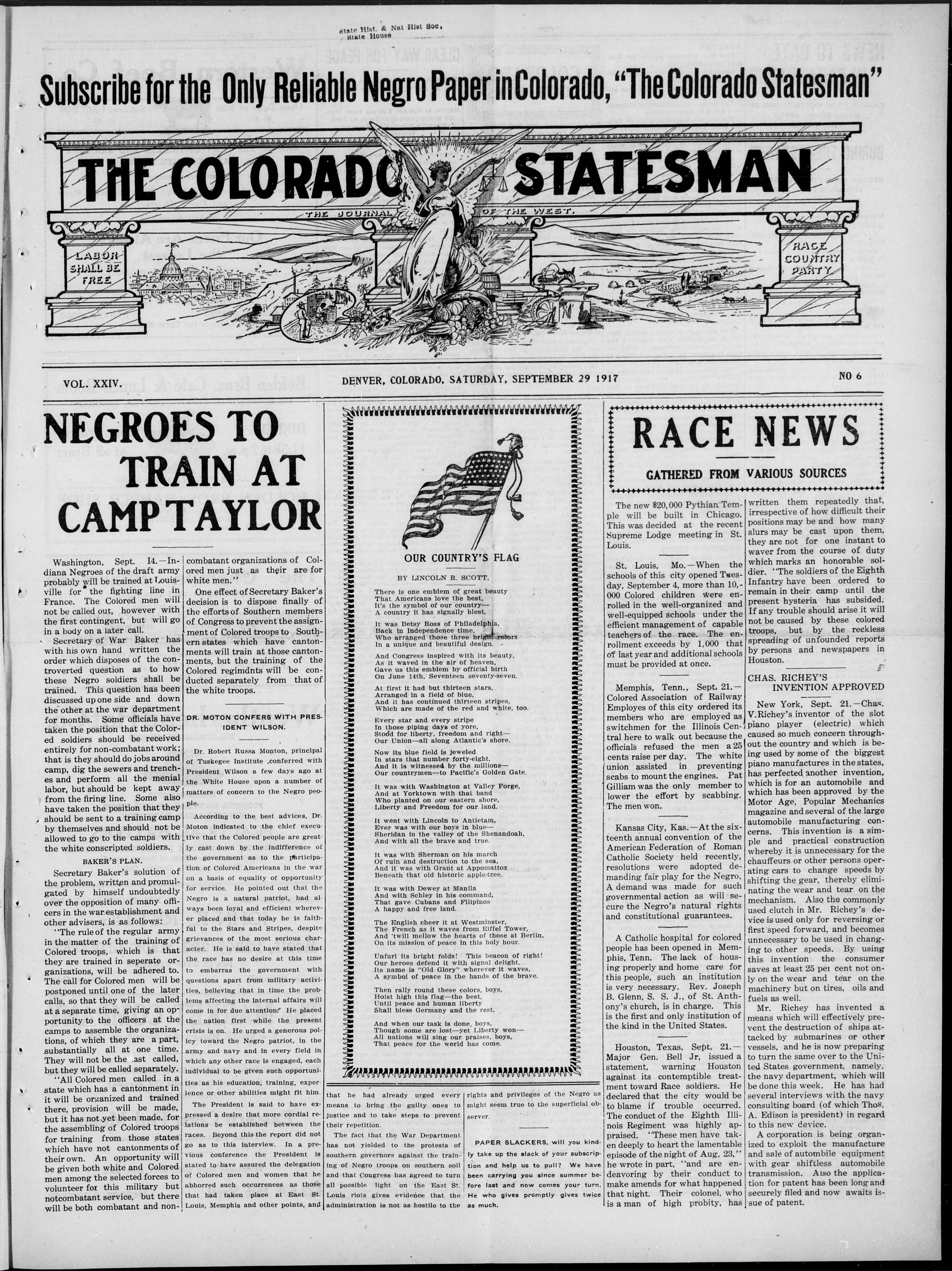
NEGROES TO TRAIN AT CAMP TAYLOR
VOL. XXIV.
NEGROES
TRA
CAMP T
Washington, Sept. I4.—Indiana Negroes of the draft army probably will be trained at Louisville for the fighting line in France. The Colored men will not be called out, however with the first contingent, but will go in a body on a later call.
Secretary of War Baker has with his own hand written the order which disposes of the controverted question as to how these Negro soldiers shall be trained. This question has been discussed upon one side and down the other at the war department for months. Some officials have taken the position that the Colored soldiers should be received entirely for non-combatant work; that is they should do jobs around camp, dig the sewers and trenches and perform all the menial labor, but should be kept away from the firing line. Some also have taken the position that they should be sent to a training camp by themselves and should not be allowed to go to the camps with the white conscripted soldiers.
BAKER'S PLAN.
Secretary Baker's solution of the problem, written and promulgated by himself undoubtedly over the opposition of many officers in the war establishment and other advisers, is as follows:
"The rule of the regular army in the matter of the training of Colored troops, which is that they are trained in seperate organizations, will be adhered to. The call for Colored men will be postponed until one of the later calls, so that they will be called at a separate time, giving an opportunity to the officers at the camps to assemble the organizations, of which they are a part, substantially all at one time. They will not be the ast called, but they will be called separately.
"All Colored men called in a state which has a cantonment in it will be organized and trained there, provision will be made, but it has not yet been made, for the assembling of Colored troops for training from those states which have not cantonments of their own. An opportunity will be given both white and Colored men among the selected forces to volunteer for this military but notcombatant service, but there will be both combatant and non-
combatant organizations of Colored men just as their are for white men." One effect of Secretary Baker's decision is to dispose finally of the efforts of Southern members of Congress to prevent the assignment of Colored troops to Southern states which have cantonments will train at those cantonments, but the training of the Colored regimdnts will be conducted separately from that of the white troops.
DR. MOTON CONFERS WITH PRES- IDENT WILSON.
Dr. Robert Russa Monton, principal of Tuskegee Institute ,conferred with President Wilson a few days ago at the White House upon a number of matters of concern to the Negro people.
According to the best advices, Dr. Moton indicated to the chief executive that the Colored people are greatly cast down by the indifference of the government as to the participation of Colored Americans in the war on a basis of equality of opportunity for service. He pointed out that the Negro is a natural patriot, had always been loyal and efficient wherever placed and that today he is faithful to the Stars and Stripes, despite grievances of the most serious character. He is said to have stated that the race has no desire at this time to embarrass the government with questions apart from military activities, believing that in time the problems affecting the internal affairs will come in for due attention. He placed the nation first while the present crisis is on. He urged a generous policy toward the Negro patriot, in the army and navy and in every field in which any other race is engaged, each individual to be given such opportunities as his education, training, experience or other abilities might fit him.
The President is said to have expressed a desire that more cordial relations be established between the races. Beyond this the report did not go as to this interview. In a previous conference the President is stated to have assured the delegation of Colored men and women that he abhorred such occurrences as those that had taken place at East St. Louis, Memphis and other points, and
table Negro Paper in Colo
ADC S
THE JOURNAL
OF THE W
DENVER, COLORADO, SATURDAY, SEPTE
OUR COUNTRY'S FLAG
There is one emblem of great beauty
That Americans love the best,
It's the symbol of our country—
A country it has signally blest.
It was Betsy Ross of Philadelphia,
Back in Independence time,
Who arranged those three bright colors
In a unique and beautiful design.
And Congress inspired with its beauty,
As it waved in the air of heaven,
Gave us this emblem by official birth
On June 14th, Seventeen seventy-seven.
At first it had but thirteen stars,
Arranged in a field of blue,
And it has continued thirteen stripes,
Which are made of the red and white, too.
Every star and every stripe
In those piping days of yore,
Stood for liberty, freedom and right—
Our Union—all along Atlantic's shore.
Now its blue field is jeweled
In stars that number forty-eight,
And it is witnessed by the millions—
Our countrymen—to Pacific's Golden Gate.
It was with Washington at Valley Forge,
And at Yorktown with that band
Who planted on our eastern shore,
Liberty and Freedom for our land.
It went with Lincoln to Antietam,
Ever was with our boys in blue—
Sheridan in the valley of the Shenandoah,
And with all the brave and true.
It was with Sherman on his march Of ruin and destruction to the sea, And it was with Grant at Appomattox Beneath that old historic apple-tree.
nila
command,
philippos
It was with Dewey at Manila
And with Schley in his command,
That gave Cubans and Filipinos
A happy and free land.
The English cheer it at Westminster,
The French as it waves from Eiffel Tower,
And 'twill mellow the hearts of those at Berlin,
On its mission of peace in this holy hour.
Unfurl its bright folds! This beacon of right!
Our heroes defend it with signal delight.
Its name is "Old Glory" wherever it waves,
A symbol of peace in the hands of the brave.
Then rally round these colors, boys,
Hoist high this flag—the best,
Until peace and human liberty
Shall bless Germany and the rest.
Then rally round these colors, boys,
Hoist high this flag—the best,
Until peace and human liberty
Shall bless Germany and the rest.
And when our task is done, boys,
Though some are lost—yet Liberty won—
All nations will sing our praises, boys,
That peace for the world has come.
---
---
rights and privileges of the Negro as might seem true to the superficial observer.
has not yielded to the protests of southern governors against the training of Negro troops on southern soil and that Congress has agreed to turn all possible light on the East St. Louis riots gives evidence that the administration is not as hostile to the
PAPER SLACKERS, will you kindly take up the slack of your subscription and help us to pull? We have been carrying you since summer before last and now comes your turn. He who gives promptly gives twice as much.
---
state Hist. & Nat Hist Soc.
State House
BY LINCOLN R. SCOTT
that he had already urged every means to bring the guilty ones to justice and to take steps to prevent their repetition.
The fact that the War Department has not yielded to the protests of southern governors against the training of Negro troops on southern soil and that Congress has agreed to turn all possible light on the East St. Louis riots gives evidence that the administration is not as hostile to the
RACE NEWS
GATHERED FROM VARIOUS SOURCES
The new $20,000 Pythian Temple will be built in Chicago. This was decided at the recent Supreme Lodge meeting in St. Louis.
St. Louis, Mo.—When the schools of this city opened Tuesday, September 4, more than 10,000 Colored children were enrolled in the well-organized and well-equipped schools under the efficient management of capable teachers of the race. The enrollment exceeds by 1,000 that of last year and additional schools must be provided at once.
Memphis, Tenn., Sept. 21. Colored Association of Railway Employees of this city ordered its members who are employed as switchmen for the Illinois Central here to walk out because the officials refused the men a 25 cents raise per day. The white union assisted in preventing scabs to mount the engines. Pat Gilliam was the only member to lower the effort by scabbing. The men won.
Kansas City, Kas.—At the sixteenth annual convention of the American Federation of Roman Catholic Society held recently, resolutions were adopted demanding fair play for the Negro. A demand was made for such governmental action as will secure the Negro's natural rights and constitutional guarantees.
A Catholic hospital for colored people has been opened in Memphis, Tenn. The lack of housing properly and home care for this people, such an institution is very necessary. Rev. Joseph B. Glenn, S. S. J., of St. Anthony's church, is in charge. This is the first and only institution of the kind in the United States.
Houston, Texas. Sept. 21.—Major Gen. Bell Jr, issued a statement, warning Houston against its contemptible treatment toward Race soldiers. He declared that the city would be to blame if trouble occurred. The conduct of the Eighth Illinois Regiment was highly appraised. "These men have taken deeply to heart the lamentable episode of the night of Aug. 23," he wrote in part, "and are endeavoring by their conduct to make amends for what happened that night. Their colonel, who is a man of high probity, has
NO 6
written them repeatedly that, irrespective of how difficult their positions may be and how many slurs may be cast upon them, they are not for one instant to waver from the course of duty which marks an honorable soldier. "The soldiers of the Eighth Infantry have been ordered to remain in their camp until the present hysteria has subsided. If any trouble should arise it will not be caused by these colored troops, but by the reckless spreading of unfounded reports by persons and newspapers in Houston.
CHAS, RICHEY'S
New York, Sept. 21.—Chas. V.Richey's inventor of the slot piano player (electric) which caused so much concern throughout the country and which is being used by some of the biggest piano manufactures in the states, has perfected another invention, which is for an automobile and which has been approved by the Motor Age, Popular Mechanics magazine and several of the large automobile manufacturing concerns. This invention is a simple and practical construction whereby it is unnecessary for the chauffeurs or other persons operating cars to change speeds by shifting the gear, thereby eliminating the wear and tear on the mechanism. Also the commonly used clutch in Mr. Richey's device is used only for reversing or first speed forward, and becomes unnecessary to be used in changing to other speeds. By using this invention the consumer saves at least 25 per cent not only on the wear and tear on the machinery but on tires, oils and fuels as well.
Mr. Richey has invented a means which will effectively prevent the destruction of ships attacked by submarines or other vessels, and he is now preparing to turn the same over to the United States government, namely, the navy department, which will be done this week. He has had several interviews with the navy consulting board (of which Thos. A. Edison is president) in regard to this new device. A corporation is being organized to exploit the manufacture and sale of automobile equipment with gear shiftless automobile transmission. Also the application for patent has been long and securely filed and now awaits issue of patent.
NEWS TO DATE IN PARAGRAPHS
CAUGHT FROM THE NETWORK OF WIRES ROUND ABOUT THE WORLD.
DURING THE PAST WEEK
RECORD OF IMPORTANT EVENTS
CONDENSED FOR BUSY
PEOPLE
England not waiting on American support.
Some of American forces under fire in France.
British destroyer sunk near home; all but fifty are lost.
Argentine mobilizes her navy and military forces are active.
Five steamships and two destroyers sunk by German U-boats.
German columns were decimated in the battle of Menin road.
Korniloff rebellion controversy proves sensation at Petrograd.
Turkey demands that peace must not change her territory.
Another Austro-German attack has been repulsed by the Italians near Trent.
American soldiers will be literally armed to the teeth when sent to the trenches against the Germans.
At Buenos Aires the Chamber of Deputies voted in favor of a rupture with Germany. The vote was 53 to 18. The Italians have repulsed attacks on the Balnsizza plateau and the Russians blocked an attempted advance on the Riga front. Total casualties of all British ranks in all the war theaters for the week ending Sept. 25 are reported officially to have been 23,035. Crown Prince Rupprecht's army made repeated assaults on the British in Flanders and succeeded in gaining a foothold, from which they were later driven with heavy losses. On the Riga-Dvinsk sector the Russians continue their efforts to drive the Germans back toward the Dvina. Petrograd reports the capture of German positions near Silseme.
Capt. George Guynemer, the noted French flyer, and Lieut. Vosse, the German accredited with forty-two encounters, are believed to have been killed in the recent fighting.
North of Ypres the German assaults have increased, but Paris reports all attacks have failed. The Germans used liquid fire in attempt to repel the French, but were unsuccessful.
London was raided by airplanes twice Tuesday night, making the third assault on the capital in two days. In the raid Monday night fifteen persons were killed and seventy injured.
WESTERN
Fifty men fought a forest fire ten miles east of Deadwood, S. D.
Spokane, Wash., coal dealers reduced coal 50 to 75 cents a ton.
Revolution of over two million persons financed by forty-eight organizations.
Prediction of attempt by Germany to conquer the world made to Admiral Dewey fifteen years ago.
The Wyoming State Fair, held at Douglas, was by far the most successful exhibition yet held by the state of Wyoming.
Military necessity will be cause of many regiments of state troops losing their identity in the reorganization of the divisions.
Two men were killed at Richmond, Cal., in an explosion which tore out the forward works and superstructure of the Standard Oil tanker J. A. Moffett as she lay at her pier.
WASHINGTON
House orders committee on suffrage formed.
Secretary Lane started on a Liberty bond campaign.
The $11,500,000,000 war bond measure is a law. President Wilson has signed the bill.
Flat embargo on American gold exports to Spain has been put into effect by the United States government.
Without a rollcall and after brief debate the Senate passed the $8,000,000,000 war deficiency appropriation bill.
Germany will be convicted further before the world on charges of high-handed intrigues against the peace of other nations.
Uniform steel prices for the American government, the public and the allies, which represent reductions of from 40 to 70 per cent in present market quotations were approved by President Wilson.
The Federal Reserve Board has taken preliminary steps to abolish long-time credits in this country during the period of the war, to conserve the financial resources of the country in a more liquid condition.
A plea for concerted efforts to obtain a maximum production of coal during the war was made by Dr. H. A. Garfield, the fuel administrator, at the opening of a conference of central field operators and miners to discuss a proposed wage increase.
United States government sets uniform price on steel.
FOREIGN
New food economy scheme for England announced.
Sweden protests to Germany regarding Argentine affair.
The world's wheat crop is over billion and a half bushels.
The vatican is optimistic of ultimate success in its peace efforts.
For the week ending Sept. 10 British army casualties totaled 27,164.
The food controller has fixed the price of bread in London at 20 cents for a four-pound loaf.
Baron Napoleon Gourgard of Paris will take to the altar as his bride Miss Eva Buckingham Gebhard of New York and Paris.
Nine persons were killed and much property damage was caused at Port Antonio in the hurricane which struck the island of Jamaica.
The Siamese government, according to a dispatch from Bankok to Reuters, has called for volunteers who may be sent to the western front.
Half a score of Mexico City newspapers were ordered to cease publication on the ground that their further issuance was contrary to public morality.
Gen. Douckonline, chief of staff to the commander on the western front, has been appointed chief of staff to the commander-in-chief of the Russian armies.
The shortage of print paper in Berlin is so serious that many of the city's important newspapers were unable to appear Saturday, according to Berlin advices.
The German military authorities at Bruges, Belgium, are conscripting forcibly all the men and boys of that district between 14 and 60 to work in munitions factories and shipyards.
Ten thousand Polish-Americans who will be part of the United States army, are to go into training at once at Niagara camp near Niagara-on-the-Lake, it was announced at Toronto, Ont. The American army Young Men's Christian Association has leased the Hotel Richmond, just off the main boulevard in Paris, and it will be opened Oct. 1 as a combination officers' club house and hotel.
SPORTING NEWS
Capt. James Prentice of the balloon school at Fort Omaha suffered a broken arm when trying to land at Soldiers, Iowa, after a flight with three students.
Pete Herman signed articles for a twenty-round bout at New Orleans, La., Nov. 12 with Frankie Burns of Jersey City. Herman will receive $6,000, win, lose or draw.
Capt. Lauriat, one of the most daring Italian aviators, who twice has been decorated with military medals for valor, accompanied by an observer, made the first Italy-to-England flight, repeating the feat in 1910 of the late George Chavez in crossing the Alps. Capt. Lauriat covered 700 English miles in 722 minutes.
GENERAL
Strike conferees at Frisco reach tentative wage agreement.
At Clarksville, Tex., one bale of long staple cotton was sold by B. G. Lewis, farmer, for 40 cents a pound.
Gaston Bullock Means was arrested at Concord, N. H., formally charged with the murder of Mrs. Maud A. King.
The price of silver made another 2c advance Sept. 21, going to $1.08½ an ounce, a gain of 9c in a week, making the high mark since 1890.
Bakers of New York announced that the price of a fourteen-ounce loaf of bread would be 8 cents if the price of flour is fixed at $11 a barrel.
William A. Holman, premier of New South Wales, speaking at a luncheon in Boston, urged autonomy for Ireland as well as for Belgium and Serbia.
Nearly 600 Harvard seniors out of a class of 700 have joined their country's colors, it was learned at Cambridge, Mass., when about 100 were on hand for enrollment.
The defense in the case of Gaston B. Means, charged with the murder of Mrs. Maude A. King, consented to having Means bound over to the grand jury at Concord, N. H.
Kansas, Arizona and Nebraska won sweepstakes in exhibits of cereals, fruits and vegetables, respectively, at the International Soil Products Exposition at Peoria, Ill. Saskatchewan was third in the exhibit of vegetables. In county exhibits Filmore county, Nebraska, was first and Des Moines county, Iowa, second.
Following the finding of poison in one or two water holes in cattle ranges, cattlemen are having water holes closely guarded near El Paso, Tex. It is believed the poison found was the result of a German plot to kill thousands of cattle that might otherwise be used for food for soldiers of America and her allies.
Without having placed the Rev. Lyn Kelly on the witness stand to tell to the jury the story of the ax murders in his own words, the defense Saturday rested its case in the famous trial at Red Oak, Ia., in which Kelly is charged with being the Villisca axman.
About 2,100 union longshoremen, on strike at New Orleans voted to return to work. The longshoremen's wages were increased from 40 to 50 cents an hour for week days; 60 to 75 for overtime and from 80 cents to $1 for Sunday work.
Western Newspaper Union News Service.
COMING EVENTS.
Oct. 17.—Annual convention of Red Cross, at Denver.
Oct. 15-20.—Annual meeting. Grand
Nov. 12-18—Automobile Show at Denver.
Lake county has a home guard
Third son of Puebloan to join army presented fith gold medal.
The county treasury of Otero county netted $800 in booze fines in two days.
Construction work has started on the new factory for the plow company at Craig.
It is estimated that 10,000 people visited the Switzerland Trail above Boulder in August.
The Arvada creamery has been turning out about 750 pounds of Log Cabin butter daily.
The Colorado troops stationed at Fort Logan will go to the army camp at Linda Vista, Cal.
Superintendent Adams fixed the age limit for enlistment in the constabulary from 25 to 45 years.
All Colorado infantrymen stationed at Fort Logan will leave for Linda Vista, Cal., according to reports at the post.
"Save for the Second Liberty Loan Bond" is the motto placed on the envelopes of the Pueblo Commerce Club.
Residents of Twenty Mile Park in Routt county are considering the matter of organizing a company to sink an oil well.
An oil drilling outfit from Rangely has arrived at Stinking Gulch, Moffat county, and will be used in sinking a well at once.
Shipments of high-grade ore from the Royal Flush mine, east of Columbine, near Steamboat Springs, are being made.
On nomination of Chancellor H. A. Buchtel, Dr. Wilber Dwight Engle has been elected vice chancellor of the University of Denver.
Funeral services for James F. Burns, wealthy mine operator, who died at his home in Colorado Springs, were held from the family residence.
Experiments with South American corn at the state farm at Avondale this year have resulted in successfully growing a wonderful fodder crop.
W. P. Hobbs of Delta county received $615 for the wheat crop on his 5½ acres of land, or an average of $114 per acre at $3.15 per hundred.
Kit Carson county has a Bean Club. The county is offering prizes to the boys and girls delivering to market the most beans, quality considered, from one acre.
A new drill schedule which went into effect at Camp Baldwin establishes a more varied arrangement of drilling exercises and makes the work of the troops less fatiguing.
Prosperity has smiled on the dryland farmers of the Kendrick neighborhood, fifty miles southeast of Pueblo, according to ex-Governor James B. Orman of the land office.
The first exhibition of the winter season of the Colorado Springs Art Society will be held in October when the famous Panama canal pictures of Jonas Die will be displayed.
Judge Cooper of the District Court of Cañon City, assisting Judge Butler of the Denver District Court, took up the controversy over the presidency of the School of Mines at Golden.
A wage claim for $11,000 was filed by forty-five miners, employed by the McDonough Mining Company at Monarch, ten miles from Salida, with State Labor Commissioner Morrissey. Members of the Denver chapter of the American Red Cross—15,000 strong—are expected to attend the annual convention of that organization to be held at the Auditorium, Wednesday evening, Oct. 17. Three persons were hurt in a collision of automobiles at the corner of Thirty-fifth avenue and Walnut street in Denver. John Anderson and wife and their grandchild, John Harvey, were taken to the county hospital.
The American Association of University Professors wired Dr. O. C. Lester of the University of Colorado faculty his appointment as representative of the association to look into conditions at the Colorado School of Mines at Golden.
Robert Semple, former Denver boy, now a member of the hospital corps attached to the Twelfth regiment United States engineers in France, is in a French hospital recovering from wounds suffered through the explosion of a German hand grenade, according to a letter received in Denver.
Exactly four months to a day since he was held by a coroner's jury for firing the fatal shots that sent Edward C. Green, his superior officer in the city's employ, to the grave, William R. (Buck) Seay, one time foreman in the city highway department, went on trial for murder in the West Side Court in Denver.
The first auxiliary to the Denver chapter of the Red Cross to be formed in the high schools was organized by the girls at the South Side high school. It will be known as the Domestic Art Club.
CLEAR WAY FOR PEACE
GERMANY AND AUSTRIA READY FOR SETTLEMENT OF WAR.
Replies to Vatican Express Hope That All Belligerents Will Come to View Pontiff's Proposal as Basis for Negotiations.
Western Newspaper Union News Service.
Amsterdam.—The German government, in its reply to the peace note of Pope Benedict, a copy of which has been received here, "cherishes a lively desire" that the appeal may meet with success. Emperor William, the German note says, has been following the efforts of the pope toward peace for a considerable time with high respect.
The reply adds that the effort of the pope to pave the way to an understanding might most surely be reckoned to have a sympathetic reception from the whole-hearted support of the German Emperor, since he has regarded it as his principal and most sacred task to preserve the blessings of peace for the German people and the world.
The text of the reply reads:
"Herr Cardinal: Your eminence has been good enough, together with your letter of Aug. 2, to transmit to the Kaiser and King, my most gracious master, the note of his holiness, the pope, in which his holiness, filled with grief at the devastations of the world war, makes an emphatic peace appeal to the heads of the belligerent peoples. The Kaiser-King has designed to acquaint me with your eminence's letter and to intrust the reply to me.
"His majesty has been following for a considerable time with high respect and sincere gratitude his holiness' efforts in a spirit of true impartiality to alleviate as far as possible the sufferings of the war and to hasten the end of hostilities.
"The Kaiser sees in the latest step of his holiness fresh proof of his noble and humane feelings and cherishes a lively desire that for the benefit of the entire world the papal appeal may meet with success.
"The effort of Pope Benedict is to pave the way to an understanding amongst all peoples and might more surely reckon on a sympathetic reception and the whole-hearted support from his majesty, seeing that the Kaiser, since taking over the government, has regarded it as his principal and most sacred task to preserve the blessings of peace for the German people and the world.
"In his first speech from the throne at the opening of the German Reichstag on June 25, 1888, the Kaiser promised that his love of the German army and his position toward it should never lead him into temptation to cut short the benefits of peace unless war were a necessity, forced on us by an attack on the empire or its allies.
"The German army should safeguard peace for us and should peace, nevertheless, be broken, it would be in a position to win it with honor. The Kaiser has, by his acts, fulfilled the promise he then made in twenty-six years of happy life, despite provocations and temptations.
"In the crisis, which led to the present world conflagration, his majesty's efforts were up to the last moment directed towards settling the conflict by peaceful means. After the war had broken out, against his wish and desire, the Kaiser, in conjunction with his high allies, was the first solemnly to declare his readiness to enter into peace negotiations. The German people supported his majesty in his keen desire for peace.
"Germany sought within her national frontier the free development of her spiritual and material possessions, and outside the imperial territory unhindered competition, with nations enjoying equal rights and equal esteem.
"The free play of forces in the world in peaceable wrestling with one another would lead to the highest perfecting of the noble human possessions. Disastrous concatenations of events in the year 1914 absolutely broke off all hopeful course of development and transformed Europe into a bloody battle arena."
Amsterdam. — Peace would come from the recent proposals of Pope Benedict if the belligerent nations would enter into negotiations in the sense of the pontiff's suggestions, Emperor Charles of Austria-Hungary says in his reply to the Vatican note. The Emperor sees in the pope's peace plan a suitable basis for starting negotiations toward a just and lasting peace, and expresses the hope that the nations opposing his own may be animated by the same idea.
The Austrian emperor admits that the future arrangement of the world must be based on the elimination of armed force and on the rule of international justice and legality.
Austria-Hungary's ruler received the pontiff's note with a thankful heart and with an expression of hope that the pontiff's efforts may lead to the realization of the emperor's desire for a lasting and honorable peace for all parties.
Freedom of the seas is one of the peace hopes of Emperor Charles in order that heavy material burdens could be taken from the nations of the earth and new sources of prosperity opened to them.
Washington.-It was intimated, in official quarters, that there will be an intermediate draft of from 200,000 to 250,000 men made through the provost marshal general's office before the second 500,000 call is issued.
Gen. Alexieff Quits Russian Staff.
Petrograd.-The resignation of Gen. Alexieff as chief of the general staff has been followed by the appointment in his place of M. Tcheremsoff, whose predilections are highly democratic.
Western Beef Co.
Open Daily to 8:30 p. m.
ONE OF THE MOST
MARKET
Fresh and Cured Meats of
and I
Our Price
the
Free Delivery
PHONE
2048 LARIMER STREET
Opposite
Bolden Bros. C
924 NINETEENTH ST
DINNER
11:30 to 2 p.m.
ALL KIND
BOLDEN BRO
Baths, I
FIRST-6
R. B. BOLDEN, Manager
The Cham
Twentic
Is the
DRUGS, CHEMICALS
WE SERVE
Prescription
Phone us and we will deliver
JAMES E.
PHONE
Weather
TELEP
OF THE MOST UP-TO-DATE AND SALE MARKETS IN THE CITY.
Cured Meats of All Kinds. Fresh Vegetables and Fancy Groceries.
Our Prices Are Always the Lowest
Free Delivery to All Parts of the City.
PHONE CHAMPA 1641.
IMER STREET DENVER
Opposite the Three Rules.
In Bros. Cafe & Lunch
INETEENTH STREET, DENVER, COLUMBIA
ONE OF THE MOST UP-TO-DATE AND SANITARY MARKETS IN THE CITY.
Fresh and Cured Meats of All Kinds. Fresh Vegetables, Staple and Fancy Groceries.
PHONE CHAMPA 1641.
2048 LARIMER STREET DENVER, COLO.
Opposite the Three Rules.
ALL KINDS OF SANDWICHES
DEN BROS. BARBER
Baths, Electric Massage
FIRST-CLASS SERVICE
DEN, Manager 926 19th
Champa Phar
Twentieth and Champa,
Is the place to get your
CHEMICALS AND PATENT M
WE SERVE DRINKS.
Scriptions Our Speci
and we will deliver the goods to all parts
JAMES E. THRALL, PR
PHONE MAIN 2425.
atherhead Ha
TELEPHONE MAIN 3203
The Champa Pharmacy
Twentieth and Champa,
Is the place to get your
DRUGS, CHEMICALS AND PATENT MEDICINES
WE SERVE DRINKS.
Prescriptions Our Specialty.
Phone us and we will deliver the goods to all parts of the city.
JAMES E. THRALL, PROPR.
PHONE MAIN 2425.
Weatherhead Hat Co. TELEPHONE MAIN 3203
Established 1876
PIONEER HATTERS OF THE WEST
WE MAKE OLD HATS NEW
PRACTICAL HATTER
RENOVATORS, BLEACHERS DYERS AND FIRE
Of Gents' and Ladies' Hats of Every Descrip
1624 Champa St., Denver, Colo.
PRACTICAL HATTERS
ATORS, BLEACHERS DYERS AND FIL
Gents' and Ladies' Hats of Every Descrip
1624 Champa St., Denver, Colo.
RENOVATORS, BLEACHERS DYERS AND FINISHERS Of Gents' and Ladies' Hats of Every Description 1624 Champa St., Denver, Colo.
JOHN K. RETTIGER
Fancy and Staple Grocery
1864 CURTIS STREET
seventh.
MARKET COMP
E. SMITH, Manager, Res. Phone South 1
d Retail Staple and Fancy Groceries, Fish
Hotels and Restaurants Our Specialty.
Fresh and Cured
Eastern Corn Fed Me
Meats, Fancy 1864 OY
Meats, Fancy and Staple Groceries 1864 OURTIS STREET
The MARK
C. E. SMITH, M
Wholesale and Retail Staple
Hotels and Re
Fred
Eastern C
The MARKET COMPANY
C. E. SMITH, Manager, Res. Phone South 1608
Wholesale and Retail Staple and Fancy Groceries, Fish and Oysters Hotels and Restaurants Our Specialty. Fresh and Cured
Eastern Corn Fed Meats
Fruits, Vegetables, Poultry and Game.
Telephones Main 4302, 4303, 4304, 4305
622-636 15th Street Denver,
```markdown
```
PHONE MAIN 3028
Corner Nineteenth.
Sundays Until 2:00
p. m.
DATE AND SANITARY
THE CITY.
Fresh Vegetables, Staple
饼食es.
Always
west
arts of the City.
PA 1641.
DENVER, COLO.
ee Rules.
& Lunch Room
DENVER, COLORADO
Short Orders at all Hours
ANDWICHES
BARBER SHOP
Massage
SERVICE
926 19th St., Denver
Pharmacy
Champa,
got your
PATENT MEDICINES
DRINKS.
Our Specialty.
Good to all parts of the city.
ALL, PROPR.
2425.
Bad Hat Co.
MAIN 3203
HATTERS
BUYERS AND FINISHERS
of Every Description
Denver, Colo.
RES. PHONE GALLUP 943
ETTIG
Staple Groceries
STREET
COMPANY
Phone South 1608
Groceries, Fish and Oysters
Our Specialty.
Fed Meats
Denver, Colorado
```markdown
```
Fruit Bowl
```markdown
```
Denver, Cola
~-ASTOUNDS NATION
( - a es
Revelations by Secretary — of
State Lansing Bring Storm
of Denunciation.
BERNSTORFF WAS PAYMASTER
Ambassador's Request for $50,000 Re-
garded as Indicating That Money
Had Been Used Before for
Same Purpose.
the diplomatic corps have not yet re-
covered from their amazement at the
astounding revelations made by Sec-
retary of State Lansing of the plans
of Count von Bernstorf, former Ger-
man ambassador to the United States,
, to expend $50,000 in an effort to influ-
ence congress and prevent this coun-
try from going to war with Germany.
‘The revelation of this plot, follow-
Ing the disclosures of other cases of
German duplicity in its diplomatic re-
lations with the United States and
other countries, had the effect of
sweeping away such antiwar propa-
ganda as may still have been alive in
the national capital and giving more
convincing evidence of the hostile acts
which forced the United States into
the war.
How Plot Was Revealed.
Here is the statement of Secretary
Lansing:
“The secretary of state issues the
following statement from Ambassador
Bernstorff to the Berlin foreign office,
dated January 22, 1917:
“‘T request authority to pay out up
to $50,000 (fifty thousand dollars), in
order, as on former occasions, to influ-
ence congress through the organiza-
tion you know of which can perhaps
prevent war.
“I am beginning in the meantime
to act accordingly.
“‘Tn the above circumstances, a pub-
le official German declaration In fa-
vor of Ireland is highly desirable in
order to gain the support of Irish in-
fluence here.’"
Capital Stunned by Revelations.
‘The publication of this letter ap-
parentiy revealing the fact that Bern-
storft had previously “influenced
congress through the organization you
know of,” actually stunned the eap-
itol.
On the floor of the house, congress:
amen were denounced as “suspicious.”
It was openly stated by some that they
believed their collea;ues had received
Serman money.
According to Representative Tom
Heflin, Alabama, he believes he could
name 13 or 14 men in the two houses
of congress who have acted suspl-
clously.
Fess of Ohio and Howard of Geor-
gia both declared the German propa-
ganda worked directly, with money
changing hands and reaching govern-
ment officials,
Additional startling revelations. of
the free use of money by the Ger-
man government to sustain the Ger-
man propaganda in the United States
will follow Lansing’s expose.
‘These revelations, it was indicated,
will corroborate the indictment of
the German embassy as the disburs-
ing bureau for propaganda. Certain
Irish-American agitators in the coun-
stry who have allied themselves with
hostile German-Americans may expect
to be the. next objects of the govern-
ment’s attack.
Convicts Count Bernstorff.
‘The shower of indictments of Ger-
man clandestine pre-war activities in
this country is relied upon by the
state department to set at rest all
doubt remaining in any quarters that
the German government officially
through Count von Bernstorft con-
spired flagrantly, as asserted in Presi-
dent Wilson’s war proclamation, to di-
vide the American people on the ts-
sues of the war. It {s believed by the
state departinent that public opinion,
after digesting the contents of the
series of exposes, may be depended
upon to deal effectively with those
who became the catspaws of the Ger-
man embassy.
‘The message was decoded by Scot-
land Yards experts after vain at-
tempts by Americans.
Expulsion wrght have been Von
Bernstorff’s fa’ / as remotely as 1915 If
the state department had then known
fs much about the secrets of the Ger-
man code as it knows today.
Other Shots to Follow.
One by one the exhibits In the evt-
dence in the case, it was said at the
state department, will be given to the
public.
‘Phat Americans in high public post-
tions lent themselves to the German
embassy's plan to split congress on
the question of war, further decoded
messages in the possession of the gov-
ernment are expected to demonstrate
conclusively.
‘More than one of these well-known
persons has been under public sus-
‘pleion, but proof of thelr complicity
with the German government has not
come forth, It is known that evi-
dence of the most damaging and con-
vineing character has finally been
obtained by the agents of the govern-
ment, ©
Vice President Marshall made a
clear-cut statement of his views to-
ward German propaganda, following
tice of and necessity for this war.
It proves that the German government
was seeking all along to split us into
factions, by corrupt means of neces:
sary, possibly hoping in time to win
the war in Europe and then humiliate
and subjugate us. He who Is not
whole-heartedly for the war runs a
grave risk of being suspected of get-
ting a part of the fifty thousand dol-
lars, This is an honest congress, and
all its members will resent this insult
to Its Intelligence and honor.”
Whether the state department {s In
possession of other evidence indicating
the ambassador's activities has not
been revealed, but the extraordinary
disclosures’ already made have fixed
the bellef that agents of the United
States government have collected and
compiled the entire story of German
duplicity and intrigue and that addl-
tlonal chapters will be added.
Knew Plan of “Ruthlessness.”
‘The reference to averting war is tak-
en as an indication that Ambassador
Bernstorff had prior knowledge of his
government's Intention to proclaim. a
merelless widespread submarine war-
fare and that he was equally confident
that the United States government
could not be easily placated by mere
promises. The German announcement
of its intention to expand {ts subma-
rine activities was not made public un-
til January 31, when the world was
startled not only by the determination
to remove all restrictions, but by the
statement that It would become effec-
tive on the following day. Three days
later the United States government
had expressed its disapproval by sever-
Ing relations with Germany.
That the German ambassador knew
of his government's intention was as-
sumed by some officials, although at
the same time he denied prior knowl-
edge and those in close touch with the
embassy were given to understand that
he did not approve the course and
worked to obtain modification.
‘Small Amount for Bribe.
It has not been assumed that the am-
bassador actually attempted to bribe
or personally influence any member of
congress, and doubt that such was his
purpose is supported to some extent by
the comparatively small ariount of
money he asked, Fifty thousand dol-
lars, it was pointed out, would go but a
short way toward buying the influence
of any congressman. Judiciously ex-
pended, however, it might do much in
compensating paid agents, such as are
now known to have belonged to the
elaborate machine Bernstorft had so
carefully built up for the production
of propaganda and for purposes of
espionage.
Search Anti-War List. :
As soon as news of the Bernstorft
message reached the capitol members
began a hasty search of the files to find
the names of the men who voted
against war. While there was no as-
sertion from anyone that anyone of
these members was influenced by Ger-
man propaganda or money, yet It was
pointed out that if such influence was
exerted, and if it had any effect, the
names of those affected would be
shown in the lists of those who op-
posed the war resolution.
“] was forced to the concluston some
time ago,” Representative Heflin said,
in discussing the revelations, “that Ger-
many thought we were a cowardly peo-
ple and afraid to fight, but I did not
know that we were a corrupt people
and would betray our country for Ger-
man gold.
“The telegram sent by Count von
Bernstorff is an admission of the fact
that Germany had a corruption fund in
the United States for the purpose of
carrying on German propaganda.
“If members have acted in suspl-
cious fushion by the introduction of res-
olutions or bills or by speeches in con-
gress or out of congress, that leads to
the conviction that they are not loyal
to this government at this time, they
ought to be investigated, and, if found
guilty, they ought to be expelled from
the floor of this house and from the
floor of the senate of the United
States.”
Propaganda Still Lives.
Senator Husting was one of the first
to make a declaration after the state
department had made Its spectacular
disclosure.
“although Bernstorff 1s gone,” he
said, “the spirit of Bernstorft still
lives, and I trust the department of
justice and the secret service will go
to the bottom of this thing and that
the organization which has been built
up in this country through the éfforts
of the German government will be
rooted out and utterly eliminated.
“Phis is highly interesting informa-
tion, but Iam not surprised. I myself
have an order for $5,000 to be paid to
a certain publication signed by Bern-
storf?.
SECRETARY McADOO ANNOUNCES
DETAILS OF BOND CAMPAIGN
OPENING OCTOBER FIRST.
WILL CALL FOR §$3,000,000,000 BUT
THE GOVERNMENT MAY
TAKE LARGER SUM.
‘Western Newspaper Union News Service.
Washington, Sept, 28.—Secretary
McAdoo announced the details of the
second Liberty loan which will be of-
fered to the public Oct. 1. The chief
features are:
Amount—$3,000,000,000 or more, the
excess not to exceed one-half of the
amount of oversubscription.
‘Terms of Bonds—Maturity, 25 years;
redeemable at the option of the sec-
retary of the treasury in 10 years.
Denominations of Bonds—$50 and
roultiples of $50,
Interest Rate—4%, payable semi-an-
nually on Nov. 15 and May 16.
Terms of Payment—2% upon appli:
cation and 18% Nov. 15; 40% Dec. 14
and 40% Jan. 15, 1918,
‘The privilege of converting bonds of
this issue into bonds of any succeed-
ing issue bearing a higher interest
rate than 4% during the period of the
war is extended, and through an ar-
rangement under which bonds will be
printed with only four coupons in-
stead of fifty (to be exchanged at the
end of two years for the bonds con-
taining the full number of coupons),
deliveries will be prompt. In this
manner the issue of interim certifi
cates will be avoided.
INQUIRE INTO $50,000 FUND.
Five “Named” by Heflin for Probe of
Bernstorff’s Plet to Influence
U. 8. Congress.
Washington, Sept. 28.—A compre-
hensive investigation of all ramifica-
tions of the Bernstorff plot to influ-
ence Congress against deglaring war
on Germany is not a certainty, as the
result of the session of the rules com-
mittee, at which Representative Hef-
lin of Alabama named five members of
the national legislature whose attitude
toward the American cause he ques-
tioned.
To finance the campaign to influ-
ence members against war, Von Berns-
torff asked authority of his govern-
ment to expend $50,000 and notified
Berlin that he was proceeding with the
scheme,
Heflin did not accuse any officials
of receiving German money, but insist-
e4 upon an investigation of the activi-
ties of the men he named.
‘The officials he mentioned are Rob-
ert M. La Follette, senator from Wis-
consin; Patrick D. Norton, representa-
tive from North Dakota; John M. Baer,
representative from North Dakota;
William E. Mason, representative at
large from Illinois; Fred A. Britten,
representative from the Ninth Illinois
district.
La Follette, Mason and Britten vot-
ed against and Norton for the declara-
tion of war on Germany. Baer was
not a member of the House when war
was declared.
Governors Approve Service Plan.
Washington—Thirty-eight out _of
forty governors have approved the
suggestion of Provost Marshal Gen-
eral Crowder that the 7,000,000 reg-
istered men not called’in the first
draft be examined immediately for
military service.
BRITISH NEAR FLANDERS PLAIN
Haig Shatters Counters in His Furl-
ous Advance Through German
‘Ranke.
London, Sept. 28.—Field Marshal
Haig announces he has gained every
objective of his great offensive in
Flanders, and that he is now in full
command of the territory he has
taken, The little ridge at Zonnebeke
where the struggle is now centered
is all that separates the British from
the plains of Flanders. Repeated Ger.
man counters were repulsed and
heavy losses were sustained by the
Germans, who are exerting every en-
ergy to stop the rapid gains which
threaten to cut off the Ostend naval
base.
‘The entire Bainsizza plateau is now
under control of the Italians, The Ca:
dorna forces are consolidating their
positions, and the principal offensive
fs by airplanes over the Austrian
lines.
‘The French have repelled new Ger-
man assaults in the Chemin des
Dames section, and report heavy
losses among the Germans,
Holland Feeds Germans; Gets Coal.
New York.—Passengers arriving at
an Atlantic port on the Duteh liner
Hollandia of the Holland Lloyd lines
seid that Holland recently had been
supplying cattle to Germany in ex-
change for coal in order to feed a war
weary people.
Stearns Colorado Food Dictator.
‘Washington.—Thomas B. Stearns of
Denver was appointed state food ad:
ministrator for Colorado after having
declined the place.
COLORADO SENDS HALF OF HER
QUOTA TO ARMY CAMP.
More Than 2,400 Recruits for New
National Forces Have Entrained
for Camp Funston.
Western Newspaper Union News Service,
Denver—A handshake and a cor-
dial, personal “goodbye” from both
Governor Gunter and Mayor R. W.
Speer was the portion of each mem-
ber of the third and final contingent
of the second draft quota from Colo-
rado here just before the men boarded
a train for Camp Funston, at Fort
Riley, Kan, There were 142 men from
Denver and 225 from Weld and Adams
counties in the contingent.
Denver gave the drafted men such a
farewell as rarely has been seen be-
fore, excelling in enthusiasm anything
here in recent years. Sandwiched be-
tween military bands, the drafted men
paraded the streets from the munict-
pal auditorium, where they were
guests at a monster celebration, to the
passenger station, A cheering crowd
Mned their way, while outside the sta-
tion was a throng of friends and rela-
tivés who crowded about the “lucky
ones” for farewells.
Colorado recruits for National Army
sent to training camps:
First 5 per cent from Denver..... 18
First 5 per cent from Colorado... 241
Second quota, 40 per cent:
From Denver. ......sseceeeeeeeee, 144
From Colorado .....eseeeeeeee + 2165
Total sent from Denver........ 162
Total sent from state..........2,406
Recruits to be sent later.
With Oct. 3 increment of 40 per
cent:
From Denver ......essseceseeeee, 144
From Colorado... .eeseeeeeere + o2s165
With increment of 15 per cent about
Oct, 15:
From Denver ....scseseeeeseneee 54
From Colorado ......seseseeeees 728
‘Total to go trom Denver....... 198
Total to go frou Colorado.. ...2,868
Grand total of 100 per cent, gone
and yet to go:
From Denver ...sseereceeeeeeee 360
From Colorado .......+seeee+++5,294
Grove Is Captain of Constabulary.
‘The first captain in the state con-
stabulary was appointed by Supt.
Frank Adams, He is Winfield Scott
Grove of Denver, formerly a major in
the Philippines as a member of the
First Colorado volunteer infantry in
the Spanish-American war. His record
includes service in the Thirty-sixth U.
S infantry and the metropolitan po-
lice of Manila, besides his constabu-
lary service, during which he was
twice wounded.
Will Hunt Men Who Sell Booze.
Harry Tedrow, United States dis-
trict attorney, after a conference with
Leslie E. Hubbard, attorney general,
and Hamilton Armstrong, chief of po-
lice, announced that from today on a
ruthless campaign will be waged to
suppress bootleggers who have been
selling liquors to soldiers. ‘Tedrow 1s-
sued orders to James Melrose, acting
chief of the bureau of investigation of
the Department of Justice, to throw
his entire force into this line of work.
Colorado Revenue Meets Expenses.
Revenues of Colorado more than pxy
state expenses, according to a report
issued by the Federal Census Bureau.
‘This state is one of the twenty-two in
the union that are breaking even on
the balance sheet of governmental
costs and receipts. The per capita re-
ceipts of Colorado are $4.16 and the
expenditures $4.10.
‘Add 49,000 Acres to Homestead Area.
Denver federal land officials wera
advised by Washington that Secretary
of the Interior Lane had within the
lest sixty days added 49,000 acres in
Colorado to the area heretofore desig-
nated under the enlarged homestead
act, which entitles the entryman to
320 acres. a
Lieut, Shafroth Weds Miss Hagerman.
Lieut. Morrison Shafroth, Second son
of Senator John F, Shatroth, was mar-
ried to Miss Abby Staunton Hager-
man, daughter of Frank Hagerman ot
Kansas City. The ceremony was per-
formed at the summer home of the
bride's parents at Osterville, Mass.
Col. Smith Commands Camp Baldwin.
Under an order issued at regimental
headquarters Col. H. D, Smith of the
First Colorado cavalry has assumed
command at Camp Baldwin, taking the
place that had been held by Lieut.
Col. W. K, Linderfelt.
Rains Beneficial to Crops.
Beneficial rains tended to offset the
effect of cold weather and consider-
able improvement in Colorado crops
is recorded in the weather and crop
report issued by the Department of
Agriculture.
Must Pay Damage Claims Promptly.
In answer to a complaint that one
or more industrial firms of the state
have sought to evade the payment of
damages awarded to employés injured
under the workmen's compensation
act and have expressed the intention
to have the matter of damages adjust:
ed by the courts, Attorney General
Hubbard announced that all insurance
companies and employers must pay to
the person injured the award granted
by the Industrial.Commission immedi
ately after the award ts made
| SH .
7 i, a N i =
The Sao Sy ae Pd
Park ° J @e M3 —
Floral ‘Gara a
Company ag" eas 7
FLORAL DESIGNS F"ystG v AI
CHOIGE PLANTS AND GUT FLOWERS S=osEaySes, “AN
_REEROUSES Tis. snd Cases” NY
The Good Weight
‘W. T. FLETCHER AND J. W. WILLIAMS, Proprietors. ~]
RETAIL STAPLE AND FANCY GROCERIES.
CORN FED MEATS. MOTOR DELIVERY TO
ANY PART OF THE CITY.
2549 Washington St. Denver, Colo.
Baxter Bldg. J. W. WILLIAMS, Manager
PHONE CHAMPA 3022.
Phone Main 6699 Private Booths for Ladies
Sai NIGHT AND DAY CAFE
OU
gS AND COLD DRINK PARLOR
ONS) B, CARRUTH and J, GREGORY, Proprietors
SRN <= A Full Line of Fresh Fish in Season
Seo Oysters and Lobsters
GSA Short Orders At All Hours Rest Room for Ladies
919 NINETEENTH STREET DENVER, COLORADO
SEHt +t + +++ tT rotors tas +4
Ghe 5
3
3
WARD AUCTION :
3
;
: COMPANY ;
: ;
; ;
Sales Dally at 2 p.m. Office Fur.
t niture a Specialty. z
yee
¢ PRIVATE SALES AT ALL TIMES +
¢ mii as ;
t = ;
t HAVE MOVED TO— 3
{ gw-1723-39 GLENARM sT.-wa +
¢ PHONE MAIN 1678. ;
Leste teteseesesreseseosees
THE BEST ICH CREAM AND
t OANDIES AT
:
t CATERERS AND
¢ eee eee
+ CONFECTIONERS
se eae
$ Phone: 168.
¢ 1512 Curtis Street, Denver, Cole.
Fe abe gee ae aa ee eee gn
JOSEPH CARTER
Express, Moving,
and Storage
COAL AND WOOD
PROMPT DELIVERY.
Phone Main 6544,
2415 WASHINGTON STREET.
DON’T FORGET
US
When you need any-
thing in the line of
neat and attractive
Printing.
a4;
Sie ga
<i s
ma
Mas
bx] &
ma 8
3
=z
En
ag
mi 2 &
3
Oink
| Miss M. Cowd
Miss M. Cowden!
Hair Dressing Parlor
% Shampoo, cutting and eurling.
$ Scalp treatment, hair tonics,
§) hair straightening, manicuring.
B stage) wige for rents) theatrical
Suse and masquerades.
S Goods delivered out of the
% city. All shades of hair matched
# by sending sample of hair; also
S combings made up.
$ Cheapest Switches 50 Cents
1223 2tet St. Denver, Colo,
Phone Champa 3977
KOKOKDKD KD KG KD KD KO KOKO KOKO
Dom NOW z= |
A. J. Riley left Thursday for Durango, Colo.
Col. A. L. Rice arrived in the city Wednesday to remain permanently.
Pete Nelson left Friday night for Reno, Nevada, his wife will join him in a few weeks.
Knight's birthday, which blending with the occasion, gave a treat to the patrons in the form of free dainty refreshments.
Prof. Morgan Jackson's quintette of musicians gave freedom of action to lovers of the terpsichorean art, and so delightful were the popular air that even stiffened muscles of spectators became flexible, sending the
Miss Minnie Hoe of Topeka, is the house guest of her aunt, Miss Lucy Morgan. Her stay is indefinite.
Carry Fox of Kansas City, Mo., who has been visiting his mother and sisters for ten days, returned home Friday.
Mrs. Powell, sister of Mrs. L. C. Connell, after spending several weeks in the city, will return to Kansas City, Mo., this week.
D. C. Dowdy of 2515 Curtis street, who was suffering from a severe cold, is very much improved under the skillful treatment of Dr. Justina Ford.
The many friends of Frank Burnley of 2234 Clarkson street, will be sorry to learn that he is confined to his bed. All wish for him a speedy recovery.
Mrs. Rev. P. M. Maxfield and Mrs. John Dow of Rock Springs, Wyo., spent the past week in the city at 729 Elati street, as house guests of Mrs. L. C. Connell.
Attorney E. P. Blackmore left Tuesday for Wichita, Kan., to attend to some legal matters and will return the latter part of next month to remain.
Walter E. Huntley returned recently from Estes Park, looking a picture of health, and is loud in praises of the mountain parks as a summer resort.
Miss Arula Cole of 2546 Clarkson street, well-known resident, left yesterday for Texas points, where she will spend the fall and winter seasons.
W. O. Miller of Waco, Texas, is a recent arrival in the city and will make this his future home. He is stopping with his sister at 2852 Glen-arm Place.
Messrs. Clifford Watson and James Wyche are recent arrivals from Kansas City, Mo. They report things on the progressive scale, and attributing same to the world's present struggle, aver that this war must end in Negro deliverance.
Joseph Greer arrived last Saturday from Springfield, Mo., and was the happiest man in Denver for the time being on the reunion of his wife and children, who preceded him by a few months. Mr. Greer is hoping to reside permanently in Denver. The family resides with Mrs. Pearl Rose, a sister of Mrs. Greer, at 726 East Twenty-fifth avenue.
Mrs. George Robert Anderson entertained a few friends at supper, Sunday at the residence of Mr. and Mrs. Clayton Myers, of 1254 Ogden street. Plates were laid for Mr. and Mrs. Hiram Gash, Mr. and Mrs. Jessie Brown, Mr. and Mrs. Fred O'Neil, Mr. and Mrs. Jessie T. Thrower, Mr. and Mrs. Clayton Myers, Mesdames Ella Edwards, Dora Lovitt, Mary Seymour, Mildred Court and Messrs. Luther Walton and Chas. Muse. The house was very tastefully decorated with American Beauty roses. After the repast the guests were conveyed to their respective homes in automobiles furnished by the hostess.
SMART SET CLUB ENTERTAINS.
The famous Smart Set Club in its determination to "set the pace" just sent things a-hummin' when it gave the first dance of the season last Wednesday evening at the popular Fern Hall Dance Academy, Twenty-seventh and Welton streets. The usual large gathering of the Smart Set followers regaled in the season's best attire were in evidence, and a number of Denver's society buds and matrons, interspersed with the khaki uniform of our colored Sammies, lent a beautiful aspect, in conjunction with the choice decorations, to the event. A particular feature was the celebration of William
---
Knight's birthday, which blending with the occasion, gave a treat to the patrons in the form of free dainty refreshments.
Prof. Morgan Jackson's quintette of musicians gave freedom of action to lovers of the terpsichorean art, and so delightful were the popular airs that even stiffened muscles of spectators became flexible, sending them whirling and twirling over the specially prepared floor.
Commendation on every hand was offered the management for providing such a treat the first of the season, and Mr. Knight, president of the club, merits congratulations for his efforts in keeping up a high standard of entertainment which his organization offers annually.
Mme. Davis, Neff College of Oratory, Philadelphia, at People's Presbyterian, Tuesday night, Oct. 9. Admission. 25 cents.
MUSICAL
The Margaret Washington Literary, Art and Charity Club entertained its friends at a musical at Old Colony Hall, which was beautifully decorated with palms, cut flowers and the national colors. The ladies had a booth for their art work and after the musical program was rendered prizes of cut glass and hand-painted china were given for the best work. The club ladies' husbands most delightfully served during the evening.
FUNERAL NOTICES.
By the Douglas Undertaking Company
Mrs. Florence Lacey, 39 years, beloved mother of Harvey Lacey and sister of Mrs. Cora Smith, 2222 South Sherman, departed this life Sept. 20th. Funeral services were held, Sunday, Sept. 23rd, at Central Baptist church. Rev. Price officiated. Interment at Riverside.
Mary Robinson died Sept. 24th, at her residence, 2446 Lawrence street. Funeral notice later.
NEGRO GUARD AT RESERVOIR
FATALLY WOUNDS ITALIAN.
Boulder, Colo., Sept. 26.—Tony Gentile, a worker on a threshing gang, died at the hospital here this afternoon from a gunshot wound inflicted by a Negro guard last evening at the Western Light and Power company's reservoir near Louisville.
Gentile, who was an Italian with an imperfect understanding of English, was walking thru the fields as a short cut to town. Cliff Alsop and Henry Tabbs, Negro guards, were on duty at the reservoir. When they saw Gentile approaching they hailed him. But he kept on, and after the third hail one of the guards fired. Gentile was shot through the abdomen, the bullet making a deep gash.
The coroner here has decided upon holding an inquest. The shot, it is stated, was fired by Alsop.
Negro home guards were placed at the reservoir Monday, when company C of Boulder was withdrawn. There has been some feeling at Louisville over the placing of Negroes at the reservoir, and it has grown in intensity since the shooting. Neither of the Negro guards has been arrested.
Mme. Davis as elocutionist and pianiste, People's Presbyterian, Oct. 9. Admission, 25 cents.
TAYLOR-BELL WEDDING.
Clarence C. Taylor, formerly of Leavenworth, Kan., and now of Hugo, Colo., and Miss Edna Pauline Bell, a Denverite, and one of our charming society buds, marked the climax of a pretty romance when they were made man and wife at the home of the bride's parents, Mr. and Mrs. John I. Butler, 2445 Glenarm place, last Wednesday evening in the presence of a large number of friends and well-wishers. The ceremony was performed by the Rev. C. A. Williams of Shorter church, beginning at 8:15 p. m. Miss Mabel Cole, a singer of unusual ability, sang "O Promise Me," when immediately following, the bride on the arm of her father, descended the stairway preceded by little Miss Geraldine Sparaldo carrying a basket of flowers and who filled the position of flower girl with every satisfaction. The strains of Mendelsohn's "Wedding March," played by Miss Mabel Buford, announced the approach of the lady who had lost all charms for the single life. Then followed Miss Dlette Williams, the bridesmaid, whose charming appearance came in for attraction and whose support to the bride was all that could be desired. The bridegroom, escorted by Neal Elliston, his best man, took up his position under a large bell of white floral design, and there by the side of his intended better half, responded very audibly to the sentences as they were read by the minister in an impressive manner. The ceremony, witnessed by old friends of the bride's family and the youthful society associates of the bride, was very touching, as the solemnity of matrimony was given due weight, and with the usual emphasis of the Rev. Williams, a striking reminder seemed to lay hold on the witnesses of the event. The bride carried a large bouquet of baby white roses and was dressed in white net-
ting over white silk, waist encircled by broad pink silk sash, with cream-colored veil falling in a long train. Her slippers were of white satin. The bridesmaid was beautifully attired in white netting over white charmeuse set off by silver beading with dainty slippers.
After the ceremony a reception was held and a musical program, to which Prof. George Morrison and Master Atwell Rose contributed with violin solos; Mrs. Pearl Rose a vocal solo, and Miss Cleo Hobson at the plano gave a delightful entertainment to the guests. The decorations of pink and white roses in festoons were numerous and artistic, reflecting much credit on the decorator, Mrs. Americus Hughes. Dainty refreshments in the color of the decorations were served, and amidst the congratulations of those present a happy event in the lives of Mr. and Mrs. Clarence Taylor has begun which is attended with every happiness.
The happy couple will spend the honeymoon in Hugo, Colo., where Mr. Taylor is employed by the Union Pacific Railway Company, and will be at home to their friends at a date to be announced. The Colorado Statesman wishes them a peaceful sailing on the matrimonial sea of life and a perpetuity of conjugal bliss in their experience of the two-fold life.
Successful Session Of Colorado Annual Conference At Boulder, Colo.
Successful Session Of Colorado Annual Conference At Boulder, Colo.
The closing of the thirty-first session of the Colorado annual conference at Boulder last Sunday afternoon marked an important event in the history of African Methodism in the middle west. The attendance was full throughout the sessions, the reports showed marked progress, both material and spiritual, and the entertainment was all that could have been expected in a city whose colored population was many times greater than that of Boulder. Rev. A. Wayman Ward and his congregation proved themselves royal hosts, for aside from the usual courtesies shown on such occasions, the Commercial club of Boulder was induced to give the conference an auto sight-seeing trip including all the points of interest in the city. Bishop H. B. Parks was in the finest spirit and he presided over the deliberations in such an impartial and fatherly manner as to ingratiate himself more deeply in the hearts of his brethren. The dollar report from the conference showed an increase of $159.50 of which the Rocky Mountain district under the leadership of Rev. R. L. Pope, came in for $118.50. Despite the fact that Rev. J. P. Howard of the Albuquerque district had been confined to his bed for three months, the reports from this division were above the average. The Woman's Mite Missionary Society reported $616.50 and a drive was begun to report $1000.00 at the next session of the conference, at Campbell Chapel, Denver. This society elected the following officers for the ensuing year: Mrs. Janie M. Pope, president; Mrs. Lizzie Watson, first vice president; Mrs. W. T. Thornton, second vice president; Mrs. Ruth Washington, recording secretary; Mrs. Pauline Dow, assistant; Mrs. Mattie P. King, cor. secretary; Mrs. C. A. Williams, treasurer; Mesdames J. P. Watson, B. H. Moore, Tillman; B. F. McCully and A. M. Ward, executive board.
The following appointments were announced:
Rocky Mountain district, Rev. Robert L. Pope, presiding elder; Shorter Chapel, Rev. C. A. Williams; Campbell Chapel, Rev. A. M. Ward; Payne Chapel, Colo., Springs, Rev. A. Wayman Ward; St. John, Pueblo, Rev. R. Harbert; St. Paul, Pueblo, Rev. W. Prince; Salt Lake City U., Rev. D. R. Jones; Cheyenne, Wyo., Rev. N. Helt; Sheridan, Wyo., Rev. C. H. Henderson; Boulder, Rev. J. N. Endicott; Crawford-Alliance, Neb., Rev. B. H Moore; Grand Junction, Rev. W. H Mance; Ogden, Utah, Rev. H. L Marque; Cripple Creek, Rev. T. B. J. Barclay; Casper, Wyo., Rev. J. O. Minor; Leadville, Rev. S. E. Turner; Deerfield, Rev. B. F. McCully; Ward Mission, Rev. K. B. Byrd; Laramie, Wyo. Miss Mary Ramsey; Thermopolis Wyo., Rev. A. J. Hathaway; Glenwood Springs, to be supplied. Rock Springs to be supplied; Albuquerque district to be supplied; Phoenix, Ariz., Rev. R H Herring; Albuquerque, N. M., Rev G. G. Alexander; Tucson, Ariz., W. E Washington; Trinidad, Rev. H. M Collins; La Junta, Rev. John Adams; Raton-Las Vegas-Koehler, Rev. E Ramsey; Walsenburg-Rouse, Rev W T. Thornton; Globe, Ariz., Rev G. R Kirby; Prescott, Ariz., Rev W. L. Baker; Douglas, Ariz., Rev. P. M Rickman; Santa Fe, N. M., Rev T. E Williams; Gallup, Ariz., Rev S. M McGinnez; Alamoosa, Mrs. P. M. Max field; Clifton, Ariz., to be supplied; Durango-Silverton, to be supplied; Hayden, Ariz., to be supplied.
TOM PARSONS, FORMER DENVER
CITIZEN, SUCCUMBS TO IN-
JURIES IN RAILROAD
WRECK.
Thomas Parsons, who resided in Denver for several years, died Tuesday, September 18, from injuries received in a wreck over the Great Northern railroad, near Boulder, Nev. Mr. Parsons was very popular, having made quite a number of friends and acquaintances, the result of his genial disposition and interest in the welfare of others, always in readiness to offer the helping hand where necessity gave an opportunity.
He filled various positions which brought him in contact with some of the leading business men of this and other cities, and was never slow to make representations that would be advantageous to his race, thereby gaining the popular good feeling of his fellow men, by whom he was generally called "Tom."
Joslin's
PROFIT-SHARING
Sale
The Most Economic Event
of the Entire Season
Begins
Monday October 1ST
THIS Store's Great Aim is to serve the Public. The most
careful and determined work, in preparing for this an-
nual event, has placed us in a position to offer you pronounced
economies in every department of the store.
Please Note the fact, that in our Profit-Sharing
Sale we are offering FRESH, NEW, DESIR-
ABLE merchandise ONLY.
Every article was bought for this Season's
selling.
THE Joslin
DRY
GOODS
CO.
CAPITOL PETROLEUM COMPANY
FIRST ISSUE OF STOCK 2 Cents Per Share AS SOON AS THIS ALLOTMENT IS SOLD OUT, UNTIL FURTHER NOTICE,
No More of this Stock Will Be Sold at Any Price
No use to wire unless you wire the money, as no reservations will be made until payment is received.
We would advise you to send in your order without delay, but further information and maps will be furnished free upon request.
5 Payments, or 5% Off for All Cash
SECURITIES FINANCE & INVESTMENT CO.,
329 Foster Building, Denver, Colorado.
Enclosed find $.....to apply as (part) (whole)
payment on.....shares of stock in THE CAPITOL PETROLEUM COMPANY.
Address .....
He leaves a wife and mother in Santa Fé, N. Mex., a sister in East Las Vegas, and two brothers—Charles J. and George F. Parsons—of this city, to mourn his death. THE COLO. RADO STATESMAN offers deepest sympathy to the b this period of g the deceased for o commends them to Who promises to in this, her sad lo
sympathy to the bereaved relatives in this period of grief, having known the deceased for many years, and recommends them to the Arch Consoler Who promises to comfort the widow in this, her sad loss.
THE CAPITOL PETROLEUM COMPANY
The Securities Finance&Inv. Co.
Fiscal Agents
329 Foster Bldg., Denver, Colo.
MAKE CHECKS PAYABLE TO
OR TO
Oliver Royal House of S. M. T.—Meets
2nd Monday of each month at 2540
Washington St.
Pride of Denver Tavernacle 521—Meets
2nd and 4th Tuesday of each month
at 2540 Washington St.
DASTARDLY WORK OF GERMAN SPIES DISCLOSED BY SEIZED DOCUMENTS
That Emissaries of the Kaiser Struck Many Foul Blows Proved by Papers Made Public by the Government.
EX-GERMAN AMBASSADOR IS DEEPLY INVOLVED IN PLOT
Washington.—Just how Germany smaefully abused and exploited" the protection of the United States by secreting in the German legation at Bucharest, after the American government had taken charge of Germany's affairs at the Roumanian capital, quantities of powerful explosives for bomb plots and deadly microbes, with instructions for their use in destroying horses and cattle, was revealed on Sunday by Secretary Lansing.
It was another of the series of Mr. Lansing's disclosures of German intrigue, made public without comment in the same manner as the Von Luxburg telegrams, which brought Argentina to the verge of war with Germany, the Von Eckhardt letter from Mexico City and the Von Bernstorff telegram asking the German foreign office for authorization to spend $50,000 to influence congress.
Bomb Story From Legation
The latest story is told in a report to the state department from William Whiting Andrews, secretary of the legation at Bucharest, and a letter from Foreign Minister Porombaru of Roumania. Parcels and boxes taken into the German consulate at Bucharest with display of great precaution aroused the suspicions of the Roumanian government. On August 27, 1916, the evening prior to the date of Roumania's declaration of war, some of these cases were taken to the German legation, located in a different building from the consulate.
Convinced that the boxes were not taken away from the legation by the German diplomatic mission on its departure from Bucharest, the Roumanian authorities later ordered the police to find and examine their contents. The police communicated with American Minister Vopiclea, then in charge of German interests, who reluctantly assigned Secretary Andrews to observe the search. The boxes were found buried in the garden of the German legation.
PROVES GERMAN INTRIGUES.
An amazing report of German intrigue and propaganda against the interests of the United States is presented herewith. These disclosures are made by the committee of public information, an official bureau of the government.
Some of these cases have been made public before. The indictment drawn up by the Washington authorities sets them forth in glaring_sequence. They began in the autumn of 1914.
The report by the committee of public information is given herewith.
Washington.—Within a few days a German newspaper published in this country employed as the headline to an article denling with a rumor of German-American disaffection in this country the derisive legend, "Lieb" Washington, magst rubig sein."
This is, of course, a parody on the refrain of "Die Wacht am Rhein," the German national hymns:
"Lieb Vaterland, magst ruhig seln." "Lover fatherland, be restful (or undisturbed)." In the parody it carries a sneer comhensible only to one who understands the German mode of speech and thought.
Typifies Propaganda.
Of itself the instance is slight. But it typifies a certain important phase of the German propaganda which subtly but persistently seeks to present Germany's course in America in the most favorable light, even to the extent of defending the improper activities of the Teutonic diplomatic representatives before their passports were given them. Because of this continuing propaganda certain documents in the possession of the department of justice now assumes peculiar importance, in that they prove undeniably the intimate relations between the accredited representatives of the kaiser in the United States and plotters against the laws and the security of this country, whose enterprise did not fall short of projected wholesale destruction of life and property.
Such of these documents as were essential to legal proceedings brought against the Germans have been published. Others are here made public for the first time. They form a curious if disjointed, chapter in the diplomatic history of the war.
In the fall of 1914, when the German plots against Canada were fomenting in this country, there was established. The Germans, in the face presided ever by a big, suave man of Teutonic Aspect named Wolf von Igel. There were two peculiar features about this office. One was that it was
WORK OF GERMAN PLOTTERS
In the fall of 1914, shortly after the outbreak of the war, the German embassy established a publicity department at 60 Wall street, under the direction of Wolf von Igel. About two years later this office was raided and documentary proof obtained that Von Igel was the chief spy and plotter of a vast system maintained in the United States under Ambassador von Bernstorff's general direction. Paul Koenig, pretending to conduct
frequented during two years of singularly quiet and unbusinesslike existence chiefly by Germans who had nothing whatsoever to do with advertising, in other was a large safe, bearing the insignia of the German imperial government. One morning in April, 1916, government secret service men visited this same Wall street office while Von Igei was preparing a mass of papers which he had taken from the safe for traumas in the German embassy in Washington.
Find Lists of Spies.
When the papers were examined by the department of justice the reason for Von Igel's determined fight became apparent. Here, in the form of letters, telegrams, notations, checks, receipts, ledgers, cashbooks, cipher codes, lists of names, imprints and handwritten words were found indications—in some instances of the vague nature, in others of the most damning conclusiveness—that the German imperial government, through its representatives in a then friendly nation, was concerned with it.
Violation of the laws of the United States.
Destruction of lives and property in merchant vessels on the high seas. Irish revolutionary plots against Great Britain.
Fomenting ill feeling against the United States in Mexico. Subformation of American writers and lecturers.
Financing of propaganda.
Maintenance of a spy system under the guise of a commercial investigation bureau.
Subsidizing of a bureau for the purpose of stirring up labor troubles in munition plants.
The bomb industry and other related activities.
Koenig-Von Papen Commerce Bureau.
Perhaps the most illuminating single document in the collection is a letter of July 1915, reproduced as it appeared upon the stationery of the "Bureau of Investigation." This innocent, pretending agency was at the outset the secret service of the Hamburg-American Steamship company. Under Paul Koenig, its manager, it became an adjunct to the German diplomatic secret service. "XXX" is the secret designation of Koenig, who is now under investigation in connection with this "diplomatic" work, and is interned at Oaklethorne.
The person represented by the figure "7.000" is Captain von Papen, former military attache of the German embassy and the practical executive of its underground system. The document describes the subterfuges of "XXX" (Koenig) so that he might not be identified by the mysterious — when they met. "XXX" states that money was to be drawn for the payment of $150 to the unnamed person, under peculiar precautions, through "Check No. 146 on the Riggs National bank." Washington, July 16, p. yank to sigged — amount $150. No reason was given as to why the payment was made "says the report.
Bombs in Coal
Several days after the payment, the recipient called at the "passenger office of the — line" and made a statement which is thus embodied in the XXX report.
My name is —— I have an office at the —— building, but I do not care to state my local address. I intend to cause serious damage to vessels of the allies leaving ports of the United States by placing bombs, which I am making myself, on board. These bombs resemble ordinary lumps of coal, and I am planning to have them concealed in the tank to be laden on steamers of the allies.
Finally XXX states that "the caller" brought with him a sample bomb, "such as has been described to you by the subscriber," and asks for the instructions.
The document is lettered at the foot, "O. R. to 7000" indicating that the secret agent known as "O. R." had transmitted it to Von Papen.
Check Is Traced.
Now for the proof, direct and unescapable. Check 146 on the Riggs National bank has been traced and added to the secret service collection. It is payable to Koenig and signed by Von Papen. Therefore Von Papen stands convicted, on the evidence of a report claimed as an official document by the Germans, of paying money to a plotter designate to blow up merchant ships sailing from a report of New York. The person who made this report be known to department of justice officials.
Compare these documents with the following authorized statement from Berlin, transmitted by wireless for publication in the New York Times in December, 1915:
"The German government has, naturally, never knowingly accepted the support of any person, group of persons, society or organization seeking to promote the cause of Germany in the United States by illegal acts, by counsel or vengeance by intravention of law or by any means whatever that could offend the American people in the pride of their own authority."
Destruction was not by any means the sole interest of Koenig's energetic bureau. It concerned itself also with spy enterprises. To Koenig wrote Otto West in Warrior of the Hour Glass, at 303 or 303) Fifth avenue, recommending a relative of his who, according to his description, must be an interesting and somewhat formidable figure. Mr. West's description, somewhat curtailed, follows: He is a grandson of the late Oberhorn von Schleitz of Berlin by the present Militar Oberpfarer Strauss of Potsdam, nephew of the late Admiral von Schleitz, the late General von Mantey, etc. This gentleman changed his name some twenty odd years ago to an American name, and none of his associates suspects his German birth or antecedents.
the secret service of the Hamburg-American Steamship company from a New York office, was discovered to be in reality one of the directors of the German spy system in the United States. He is now interned at Fort Oglethorpe. In Von Bernstorff's code he was known as "XXX."
In a report by Koenig to his boss, Captain von Papen of the German embassy, Koenig describes an agent who has made bombs to resemble lumps of coal to be placed on board merchantmen sailing from New York,
He is an international journalist of great repute, for years at the head of a newspaper organization in England. "He has a personal reason to be very bitter against England, because two years ago he was appointed to be written about June 1, 1915, which would make the date referred to the early summer of 1913) a certain attack was made against him over commercial matters in Great Britain, and it was only by appeal to the United States that he was corrupted of his corpus before the lord chief justice of England that he escaped successfully. . . . He was in England and France at the outbreak of the war; he has access to the great sources of British and French official information. He wants to work in Europe and serve secretly for Germany."
Here's a Pseudo Labor Agency.
Here is a Pseudo Labor Agency.
Closely related to and to some extent under the German and Austro-Hungarian labor information and relief bureau, with central headquarters at 136 Liberty street, New York city, and branches in Cleveland, Detroit, Bridgeport, Pittsburgh, Philadelphia and Chicago. The head of this enterprise was Hans Lieber, who it took its familiarly accepted name of the "Liebau Employment agency."
That the Austro-Hungarian embassy had taken official cognizance of the bureau is disclosed in the letter written by the ambassador to the Austro-Hungarian minister for foreign affairs which was appointed by the James F. J. Archibald by the British authorities August 30, 1915.
After Ammunition Plants.
In this letter the ambassador stated: "It is my impression that we can disorganize and hold up for months, if not entirely prevent, the manufacture of weapons in West, which, in the opinion of the German military attache, is of importance and amply outweighs the comparatively small expenditure of money involved; but even if the strikes do not come off it is probable that we should extort, by force, favorable conditions of honour for our poor, downbroken fellow countrymen.
"So far as German workmen are found in the skilled hands, means of leaving will be provided immediately for them. Besides this, a private German employment office has been established which provides employment for persons who have voluntarily given up work and are already working well. We shall also join in, and the widest support is assured us."
The following representations on behalf of the bureau's efficiency were made, under date of March 24, 1916, in a letter to the German ambassador, Von Bernstorff.
Engineers and persons in the better class of positions, and who had means of their own, were persuaded by the propaganda of the bureau to leave war material factories."
Cause of Strikes
The report comments with unconcealed amusement upon the fact that munitions concerns innocently wrote the bureau for workmen (which, of course, were not furnished) and continues in reviewing later conditions in the munitions industry.
"The commercial employment bureaus of the country have no supply of unemployment materials, turburbances and suspensions which are material factories have had to suffer and which it was not always possible to remove quickly, but which, on the contrary, often led to long strikes, may be attributed to the energetic propaganda of the employment bureau."
Von Igel's close connection with the enterprise is indicated by a number of other facts. He was appointed in connection to the effect that H. Sanson had established a Liebau branch office in Detroit, an entry of $60 paid to Dr. Max Niven of Chicago in February, 1913, for the baby fund and an inquiry addressed by a researcher at Yale University asking whether the Bosch magneto works manufactured fuses for shells, the bureau having evidently been applied to for workmen for the Bosch plant. The reply, in the negative, that the company was "neverally known for its friendly attitude for the Germans."
John Devoy and "Irish Revolution."
Several lines of communication between the German diplomatic service which had involved the capture are indicated in the captured documents. John Devoy of New York city, now editor of the Gaelic American, a violent anti-British paper, was one of the active agents of this connection. Significant entries appear here and German embassy to munitions in German embassy at Washington and the German consulate at New York; mention of a secret code to be employed in communicating with him and of a "cipher Devoy"; also a notation, the details of which remain undiscovered, concerning the motion to re manufacture hand grenades."
Devoy it was who acted, for a time at least, as go-between for the German secret service dealings with Sir Roger Casement, executed by the British for treason. There are several references to money and messages for Sir Roger Casement, more than R.C.C. and one record of a check for $1,000 for Casement evidently handled by Devoy.
Letters to Bernstorff.
Devoy's intimate connection with the German cause is disclosed in two letters to Ambassador von Bernstorff, the texts of which follow:
New York, April 8, 1916.
The following communication from confidential man John Devoy was duly transmitted:
"Letter dated March 22, delayed by censor, seems conclusive that first messenger arrived safe with proposal to send supplies and that cable was suppressed. Second and that safe. Third, with change of plans, due about April 15."
John Devoy further requests that the following telegram be dispatched to Sir Roger Casement:
"No letter now possible. All funds sent home. Sister and M.'s family well." Should Sir Roger be absent or ill, then J. D. requests that the telegram be delivered to John Monteth.
K. N. St. To His Excellency, the Imperial Ambassador, Count von Bernstorff, Washington, D. C.
"New York, April 15, 1916.
"Herewith inclosed a — report received by us today from John Devoy. Kindly order further steps to be taken.
The important parts of the report were there today per telegram. (S. copy) To the Imperial Ambassador, Count Von Bernstorff, Washington, D. C."
As to *arrest of Roger Casement*. In view of the involvement of these prominent Irish-American leaders in the Casement plot and its German ramifications, it is little to be wondered at that
for the purpose of blowing them up while at sea.
Dr. Max Niven of Chicago is shown as receiving $60 for the labor fund in connection with establishing a branch of German and Austro-Hungarian labor information and relief bureau in Detroit.
The German embassy maintained confidential relations with the Irish revolutionary movement, through John Devoy of New York (formerly of Chicago), editor of the Gaelic American. Through Devoy at least one check for
they should have endeavored to shoulder upon the American government the responsibility for the arrest of Casement. The Gaelle-American, Devoy's paper, and the sympathetic German-American press charged this government with having, on the strength of information obtained from the seized Von Igel papers, advised the British government of the revolutionary plot and Casement's part therein. The department of state and the department of justice promptly refuted the charges. When the Von Igel papers were seized in New York the district attorney and his assistants busied themselves in a central Government investigation of the incidents which they had obtained against Von Igel, and overlooked for the time being the great mass of other evidence which pointed incriminatingly to others.
Want Cobalan Senator.
Department of justice officials admit that the papers relating to Casement were sent to Washington the night before Casement's arrest was reported, but they were not received by the attorney general until the afternoon of the day upon which the British authorities picked up the Irish leader, and were not until seven o'clock that evening. Meanwhile, Casement had spent several hours in an Irish prison.
It is not improbable that the signature at the bottom of the extraordinary message which follows is in the "cipher Devoy" referred to in the Von Igel papers. New York governor Andrew Daniel F. Cohalan has long been prominent in Irish-American circles, though he has never been directly identified with violent action.
That Judge Cohalan, however, is held in high favor by the pro-German element of this country is evidenced by the fact that Vlereck's Weekly, in making selections recently for the most important offices in this country, puts him forth for the position of United States senator from New York.
"Help Is Necessary."
The communication as translated into Von Igel's record is typewritten, line for line, below a cipher, except for the signature, which remains untranslated from the original cipher figures. It is dated New York, April 17, 1916, numbered 335-16, and inscribed at the top "Very Secret." New York, April 17, 1916. "Journe Cohorte reviens à la transmission of the following remarks:
"The revolution in Ireland can only be successful if supported from Germany, otherwise England will be able to suppress it, even though it be only after hard struggles. Therefore help is necessary. This should consist primarily of aerial attacks in England and with Irish revolution. Then if possible, a landing of troops, arms, and ammunition in Ireland and possibly some officers from Zeppelins. This would enable the Irish ports to be closed against England and the establishment of stations for submarines on the Irish coast and the cutting off of the supply of food for England. The services of revolution may therefore decide the war.
"He asks that a telegram to this effect be sent to Berlin."
"To His Excellency
Code Message to Moebius.
Along this same line is a code message by wireless to Banker Moe Miobius, Oberwalstrasse, Berlin, which is interesting chiefly as showing the code method of important communications required by the international institutions in this country. The code translation was found with the copy of the message among Von Igel's papers. The original is a German dispatch which, being translated into English, sounds like an innocent business transaction-viz. "National Germania Insurance contract certainly promised. Executor is evidently satisfied with proposition. Necessary steps have been taken." "HENRY NEUMAN." Not so innocent and harmless as it looks, for what the message really meant. "Irish agree to proposition. The necessary steps have been taken."
Plots Involve Trouble in Canada.
Canada was also the object of solitious interest on the part of Germany's representatives in America, as was startlingly proven in the plot to blow up the Welland canal. Another lesser but not unpromising enterprise against Canada was foregone by Von Igel because the volunteer plotter was too old, "though he has the best of good will" because of the known connection with the Gaelic-American and the Indian revolutionists.
Information carefully and extensively set forth in the secret documents of the German officialdom was sometimes wide of the facts. For example, a lengthy memorandum of March 1, 1916, transmitted by the secret agent, Captain Boehm, dealing with the Mexican crisis, appears to have been largely the work of some fervid and projective imagination.
The memorandum purports to outline President Wilson's expected message to congress. It predicts that the president will attribute Mexico's anti-American activities direct to German money and incitement; that he will call upon congress (the prophet even attempts to paraphrase the language to be employed in the message); that congress will indorse the president's stand, following which upward of 150 German spies and agents provocateurs were to be arrested and the ambassadors of the central powers to receive their passports.
Captain Boehm Leaves.
For all this, Captain Boehm's authority is thus indicated over his own signature.
"The following memorandum was just given to me by an acquaintance returning from Washington. The 'acquaintance' is a skillful journalist who has good connections. I cannot vouch for his reliability, but I know that he hates the present administration and fights it. His informant is a former secretary of the embassy at Rome now in Washington."
Captain Boehm himself was too loose of tongue for the good of his service. it would appear from a report of the German military information bureau dated March 21, 1916. Captain Boehm decided to leave after reports received here were submitted to him to the effect that members of the press were informed as to his personality and the purpose of his being here. Too great confidence in the members of the American Truth society . . . was probably the cause of his becoming quickly known here."
So the notorious American Truth society, which so strenuously denied its pro-German associations, figures as indirectly linked up with Germany's secret
$1,000 was sent to Sir Roger Casement. Daniel F. Cohalan, supreme court justice of New York, is shown in a Von Igel cipher message as urging German support for the Irish revolution.
George Sylvester Viereck, editor of The Fatherland, a rabid pro-German weekly published in New York city, is noted in the German records as sending inquiries as to bombs and picnic acid. Viereck is still conducting his paper, having changed its name to Viereck's Weekly since the United States entered the war.
representatives. This society is still extant, and Jeremiah A. O'Leary, its moving spirit, is now the editor of Bull, recently shut out of the mails for publishing seditious matter.
Enter Viereck: George Sylvester.
Many inventors, some of them obviously cranks, are represented either by correspondence or notation as having plans involving the use of sundry devices of destruction. One entry of the sort merits special attention because of the notoriety of the individual involved. Here it is, translated from the German record of correspondence:
"In 15.1915. Sender, G. S. Viereck, Contents, inquiry as to bombs;2 supply offer. Told to send further details."
Possibly the further details are indicated in another entry of four months later.
"Sender. Viereck. Contents, offer of picric acid."
Picric acid is a constituent of many high explosives. Mr. Viereck is something of a high explosive himself, having been editor of the virulently pro-German week's Weekly, of New York, now changed in title (but not in purpose) to Viereck's Weekly.
Just what interest Dr. L. A. Dessar of 25 Broad street, New York city, had in German aerial warfare is a matter for speculation.
In the Von Igel archives appears a letter from R. L. Scoville of Sewickley, Pa., and the Seminole congregation Doctor Dessar, evidently forwarded the letter where he thought it would do the most good, viz., to Von Igel.
The following curious entry appears in Von Igel's records:
Journalists, lecturers, and publishers were liberally employed by Von Igel and his associates for the purposes of German propaganda. Among those thus painted with the stigma of dishonorable professions and are two magazine editors and war correspondents, James F. J. Archibald, now in Washington, and Edwin Emerson, said to be in Africa.
"Pure War Expenses."
Edward Emerson $1,000
Fair Play (Mr. Braun) 2,000
Fair Play (Mr. Braun) 1,000
Marcus Braun 1,000
J. Archibald 5,000
Concerning the identity of the last entry there might be room for doubt but for a signed receipt from J. F. J. Archibald acknowledging the sum of $5,000 from the German embassy for propaganda work. What return Archibald ever made in service is not clear, except that he must correspondence which he contracted with New York newspapers was so obviously prejudiced on the side of the central powers that they declined to accept it.
That Emerson also overdid the cause to which he sold his pen and his professional honor (the record indicates that he was paid $1,000 for "traveling expenses") is suggested by the fact that he was expelled, or alleged to have been expelled, from Berlin for a violent attack upon Ambassador Gerard. Emerson has had a picturesque career in many cities, and he was expelled to a New York newspaper a picturesque but imaginative account of his own death in the far East under painful and interesting conditions. He was born in Dresden, of American parents, and is now travelling under American passport obtained by false representations.
Fair Play Well Paid
"Fair Play," that misnamed organ of Teutonic inspiration appears to have been subsidized quite disproportionately to its value, since it received in all 44,500 in the course of a few months in 1915. Marcus Braun, who appears as its editor, is known as a political leader among the Hungarians of lower Second avenue, in New York, and has been variously connected with the fringes of fellow Hungarian He. He is supposed himself to be a Hungarian. His associate in Fair Play was one J. P. Bryan. Even with such liberal support "Fair Play" did not fill the bill, for in January, 1916, a letter was written by F. Schroeder, a German newspaper correspondent in Tokio, to the German diplomatic representatives lamenting the lack of a genuinely influential weekly in New York devoted to Teutonic inter- and integrating the two Bohemian might be the right man to conduct such a publication.
Viereck and Others.
Frequent hints of George Sylvester Vliecke's journalistic activities appear and there are a few notations of "Pearson: Subject, Press," which may refer to Pearson's Magazine, of which the editor, Frank Harris, is strongly pro-German, or may indicate a secret agent named Pearson, who is the subject of one entry. The lecture platform is represented by Ray Beveridge, the California artist and sister of Kuehne Beveridge, the prominent sculptor. In one entry Privy Councillor Albert acknowledges receipt of $3,000 from the embassy to finance Miss Beveridge's lecture tour. German war pictures were also to be furnished, the lesson was to be comprised in topics allied to Red Cross work.
Other figures of more vague import drift into light here and there in the Von Igel papers or the bureau of investigation reports. Col. E. G. Woodford, an old British hater, appears to have received sundry sums of money from the bureau, the following letters found in the Von Igel papers refer to Colonel Woodford:
Holland a Way Station.
It has long been an open secret that Holland is merely a way station for shipments of contraband into Germany. Here is official confirmation from the Von Igel records, which would seem to indicate a suspicious and confidential relation between the Holland commission and the German minister accredited to this country, or possibly a belief by the Germans that they could not successfully get the munitions to their own country. The message in code, with interlinear translation, is entered as "A 2493" and headed "German Embassy, Washington, D. C. April 6, 1916." It runs as follows: "Telegram from Berlin by secret roundabout way for Carl Heysen: Contraband to Holland 300,000 chests (cartridges) and 200 tons powder. Please get in touch with Holland commission. Sender, war minister, foreign office, in representation. HATZFELDT." While chiefly concerned with military affairs in Europe, the representatives of a supposedly friendly nation were keeping an interested watch on our own activities in the Axis Ace of code operations in April 11, 1916, signed 1132936729 46919. addressed Von Igel to this effect.
"Herewith respectfully send an extract regarding the troops stationed in California and the armament of the coast fortifications."
James F. J. Archibald, the magazine writer, in whose possession the British government discovered official correspondence between Von Bernstorff and Berlin, is shown in one of the papers sized to have acknowledged receipt of $5,000. Edwin Emerson, another writer, got $1,000 from Von Igel. Ray Beveridge, a California artist, and sister of Kuehne Beveridge, the sculptor, is shown to have received $3.,000 of German propaganda money.
There is wit in using a proverb.
The KITCHEN CABINET
Faint heart is forerunner of sadness;
Despondency robs us of health.
The man who is chock-full of gladness
Is the man who makes most of life's wealth.
THE LUSCIOUS MELON
Watermelon and canteloupes, when really good, need no dressing up to
improve their flavor for that is impossible; but a tasteless melon need not be wasted, making delicious pickles and preserves. Never place ice in a melon to chill it as it destroys the fine flavor, especially of a musk
```markdown
```
melon. Chill them by placing them near the ice. A most delicious melon may be ruined to the eater by being served unchilled. When serving an insipid cantaloupe for breakfast a sprinkling of nutmeg and a dash of lemon juice will improve it. Tasteless melons may be diced and dressed with a French dressing, then served as a salad, or diced and treated with a thin sirup of lemon or orange juice, they make a good fresh fruit. When using a salad dressing for cantaloupes an addition of red pepper and more salt than is usual will improve the dressing, and lemon juice rather than vinegar should always be used as the sharper acid of the lemon is needed for this fruit.
Cantaloupe Cocktail.—Cut the melon in balls with a potato scoop and fill the serving glasses, add a few seeded white grapes peeled, a little sliced plneapple and a slice or two of peaches. Cover the whole within a thin sirup using a little strawberry or cherry juice for flavor and serve with a cherry or strawberry on top.
Melons With Ice Cream.—Scoop out halves of cantaloupe until only the green rind is left, these may be left from the cocktails and well-chilled, refill the melon molds with ice cream, Caramel may be used for color and decorate the cream with chocolate-dipped almonds to resemble seeds or bits of candied ginger may be cut in the form of seeds, making a favorite flavor combination. The sirup from preserved ginger is also a most delicious addition.
Melon Basket.For a child's party a pretty basket made of a melon and filled with the rich, red, juicy balls looks too pretty to eat. The balls may be shaped in various ways. As only the red heart of the melon can be used for this two melons will be needed for there will be some waste.
SOME GOOD DISHES.
Lima beans, fresh or dried, make most substantial dishes served in various ways.
Lima Beans a la Poulette. — Shell sufficient young lima beans to make a pint, cover with boiling salted water and cook until tender. Pour off
Lima Beans a la Poulette. — Shell sufficient young lima beans to make a pint, cover with boiling salted water and cook until tender. Pour off all but a half cupful of the water and add one cupful of rich milk. Mix a little cold milk with a tablespoonful of flour and stir into the milk; cook five minutes, add salt and pepper to taste, a few drops of onion sauce, two beaten eggs, one teaspoonful of butter and the same amount of chopped parsley.
Vegetable Soup.—Cut into half-inch dice sufficient carrot and turnip to measure one-third of a cupful each; cut one-half cupful of celery into pieces, dice one and a half cupfuls of potato, and slice one-half of an onion. Put three tablespoonfuls of butter in a stewpan, add the vegetables, cover and cook 15 minutes. Add a quart of water and cook for an hour. Season with salt and pepper and serve with a garnish of parsley.
Steamed Brown Bread.—Take two cupfuls of yellow cornmeal, one cupful of rye, one cupful of flour, two cupfuls of sour milk, one cupful of molasses, one-half teaspoonful of salt, one teaspoonful of soda, mix well and pour into greased baking powder cans to steam for two hours.
Veal Hash.—Chop a piece of cooked veal fine. To a pint of the chopped meat allow a teaspoonful of onion juice, a teaspoonful of salt, one third of a teaspoonful of paprika, one teaspoonful of worcestershire sauce, and a tablespoonful of tomato catup. Melt a tablespoonful of drippings in a frying pan, moisten the meat with gravy, add seasonings and spread in the pan. Spread over the top one teaspoonful of the drippings and cook slowly for 15 minutes; it should be moist. Heap the hash on buttered toast and place a poached egg on each.
Peach Trifle.—Boll together for five minutes a cupful of sugar and one cupful of water with the stones from a quart of peaches. Allow the stones to stand in the sirup for ten minutes. Skim them out and lay in the peeled peaches, stewing until tender. Line a dish with cake soaked in any fruit, add the peaches and cover with whipped cream sweetened and flavored with almond.
Nellie Maxwell
To Get Rid of Ants.
Make a sirup, using two tablespoonfuls of sugar, two tablespoonfuls powdered borax and one quart boiling water. Saturate a sponge with this mixture and lay it' where the ants are thickest. When it is filled with ants, blunge into boiling water.
GERMAN TRADE
GOT IMPETUS HERE
Declaration of Independence
Gave Teutons Foothold in
United States,
COMMERCE CONFLICT SEEN
Uncle Sam’s Experts Show Details of
Organization With Which Amerl-
can Merchants Must
Compete.
‘The cosmopolitan point of view that
has been acquired by the German trad-
er is emphasized in a report which
has been issued by Uncle Sam's Bu-
reau of Foreign and Domestle Com-
merce, on “German Foreign-Trade Or-
ganization.” ‘The facts in ‘Teutonic
commercial history that are presented
in this volume show how thorough are
the methods that have been employed
for more than half a century and how
earnestly that nation is preparing to
reach ont into the world markets as
soon as the war is ended.
“In looking to the future,” states the
bureau, “the United States has many
of the same problems as Germany and
the other warring nations. Like the
German exporters, the American ex-
porters have to face a period of sharp
business competition in foreign coun-
tries, such as probably has never be-
fore been met. In Germany the indi-
vidual business man, all the local and
great national associations of business
men, and the government departments
fare even now strenuously occupied
with the problems that must be worked
out. The American business men’s as-
sociations and the government depart-
ments are alive to the importance of
these matters, and upon thelr individ-
ual and co-operative efforts through
the coming critical years will depend
in a large measure the nation’s future
in international commerce.”
Systematic Organization.
‘The analysis of central European
methods that is given embraces impor-
tant details of the systematic organ-
ization of commercial education, the
promotion of trade by the German set-
tlements in foreign countries, the bank-
ing and shipping facilities, trade-pro-
moting agencies and trade associa-
Yions, and painstaking cultivation of
foreign markets. It is added, however,
that “the report is intended not to
show the American business man that
he should necessarily follow German
methods, but to present the facts of
German forelgn-trade organization, s0
that he may decide which of the meth-
ods successful in Germany could be
utilized to advantage under American
conditions.”
The author of the report is Chaun-
cey D. Snow, assistant chief of the bu-
reau of foreign and domestic com-
merce, who was in Germany at the
time that the war broke out inyesti-
gating industrial conditions in that
country. He has made use of original
material based upon personal contact
with the organization and methods of
commerce in Germany and other coun-
tries, but for the most part his purpose
was to bring together in one volume
material on German trade and industry
which the bureau had already pub-
lished in various special reports, with
some new and pertinent statistics.
“The German export trade to over-
sea countries,” it is pointed out, “was
insignificant until about the middle of
the elghteenth century, principally for
the reason that the countries with colo-
nfal possessions maintained stringent
laws prohibiting foreigners to trade
with the colonies and excluding for-
eign flags from their ports. ‘The colo-
nies were forced to sell their products
to the motherland. Owing to their fa-
vorable position the Hansa cities of
Germany, chief of them Hamburg, nev-
ertheless did ~ flourishing business in
distributing colonial products as mid-
diemen, gathering them from English,
Dutch, French and Spanish ports.”
Got Impetus From United States.
It is of particular interest that the
history given discloses the fact that
one of the turning points in the growth
of this foreign-trade organization with
which the United States must compete
in the future was actually furnishd by
this country, for “the Declaration of
Independence of the United States,”
says the bureau, “gave a tremendous
impetus to the merchants of Hamburg,
Bremen and Lubock. For the first
time German traders had an oppor-
tunity to establish branches of thelr
business houses in an oversea country;
and it is very clear that this policy of
gaining foothold in oversea lands by
establishing branch houses has been
‘one of the most secure foundations of
(German success in the export trade.”
In its forecast of the future the bu-
reau states that whatever may be the
outcome of the war in Europe Germany
is going to make as active a canvass
for the export trade as its resources
and financial condition at the end of
the war will allow.
Army Uniform Protected.
Acting on reports that letter carriers
at a certain place have been wearing
hats similar to those prescribed for
‘use by the army, the post office depart-
ment issued an order forbidding the
wearing of a uniform by employees of
the service any part of which is siml-
lar to s distinctive part of that pre-
scribed for the army, navy or marine
corps.
DAIRY PROFITS GROW
Result of Organization of Cow-
Testing Associations.
Uncle Sam's Experts Believe This Is
Greatest Factor in Upbuliding
of the Industry.
Increase of from $10 to $15, and in
some cases much higher in the annual
profits from each dairy cow, have re-
sulted from the organization of co-
‘operative cow-testing associations in
the United States, according to experts
of the dairy division of the department
of agriculture. The expense of mem-
bership in these associations, on the
other hand, has been only about $1.50
per cow per year. The organizations
therefore have been very profitable,
say the experts, who have been in
close touch with this movement.
Because of the great and obvious
economic advantages arising from the
associations, Uncle Sam’s dairy spe-
clalists believe that the organizations
are one of the most important factors
for the upbuilding and development of
the dairy industry in this country.
Such an organization generally consists
of 26 farmers, ving within a radius
of a few miles, who co-operate to hire
an expert tester to keep accurate ac-
counts of the amounts and cost of feed
consumed by each cow in the associa-
tion, the quantity of milk produced by
each and its richness in butterfat.
‘These statistics usually reveal the fact
that some cows are not producing
enough to pay for their keep, while
others are highly profitable, Acting
on this information, the owner of the
cows disposes of the least desirable of
his animals and makes up his herd ex-
clusively of those that produce a con-
siderable profit.
‘The membership of the association 1s
placed at 26, so that the tester can
make a complete round each month,
devoting one day to each member, and
that he may keep his records on a
monthly basis. It has been found by
careful experiments that the averages
based on monthly tests do not vary
more than 2 per cent from the produe-
tion, as shown by daily observations.
Since the tester {s an expert and can
make the necessary tests and computa-
tions rapidly, and since he can be de-
pended on to make his observations in-
dependently of pressure of work on the
individual farm, the owners of dairy
cows find {t cheaper and more satisfac-
tory in many cases to have their test-
ing done through the association than
to undertake to do it themselves.
Experts of the dairy division say that
there are now nearly 350 cow-testing
associations in this country, 135 having
‘been added during the past year. These
associations are said to have an aggre-
gate membership of 8,800 farmers,
owning approximately 150,000 cows.
The cow-testing association originated
in Denmark in 1895 and the first or-
ganization in this country was formed
in Michigan In 1906. Because of the
value of the associations to the dairy
industry of the United States the de-
partment of agriculture is stimulating
interest in them and is assisting farm-
ers in thelr organization.
MARK WAR VICTIMS’ GRAVES
This Will Be Duty of New Service Or-
ganized by Uncle Sam for Duty
In France.
American soldiers who give their
lives to the cause in which the nation
has enlisted will not Me forgotten on
foreign soil if the careful preparations
of the general staff can prevent it.
Relatives of the men who go to the
front in France may rest assured that
every effoft will be made to locate and
register the graves of the men killed in
action or who die of disease.
Army orders direct that a graves
registration service, quartermaster
corps, be organized for the duration of
the war. The first unit will be com-
manded by a captain, aided by a sec-
ond leutenant and will include 49 en-
listed men of different grades. The
duties of service are not prescribed be-
yond the name which itself discloses
the mission.
pawnenwnntwaaweesee sen ony
¢ Hoover to Assist Farmers 4
$ In the Raising of Sheep §
“Baa-baa, black sheep, have
you any wool?”
“Yes, sir; yes, sir! Mr, Hoov-
er insists that it is my patriotic
duty to increase my customary
‘three bags full’ at least 50 per
cent, besides raising a family of
woolly little lambkins to do their
respective bits.”
Some such revision may be
made of the old rhyme, for the
food administration 1s encour-
aging the raising and breeding
of sheep, and will help small
farmers to get flocks started in
a minimum amount of time. In
conjunction with the department
of agriculture, the food adminis-
tration will encourage the use of
grazing lands now lying idle,
and when a shortage of grass is
threatened in the Southwest will
work to have the flocks trans-
ferred to Central and Southern
states,
Sheep, it is pointed out, can
find sustenance where the grass
is too short for cattle grazing,
and they are now in great de-
mand, both to clothe the armies
and feed the people of the allied
nations.
WILL FEED PRISONERS
Red Cross to Care for Uncle
Sam’s Men in Germany,
Speedy Relief Made Necessary by Fact
That Rations Given Captives by
Teutons Are Inadequate.
‘The American Red Cross has perfect-
ed plans for Americans who may be
captured and held in German prison
camps, A prisoner's relief committee
has been organized at Berne, Switz-
erland, under the supervision of Ellis
L, Dresel of the American legation. Mr.
Dresel served from the outbreak of
the war in 1914 up to our recall of Mr.
Gerard as an attache of the American
embassy at Berlin, where his duties
Included rellef work for men of the
entente nationalities in German prison
camps.
There are now comparatively few
American prisoners in Germany. Most
of these are civilians taken off Amer-
{ean merchantmen that have been sunk
by submarines, More recent arrivals
in the prison camps had served as gun
crews on merchant ships,
Speedy provision for their relief and
for those who may be taken prisoners
4s necessitated by the German policy
of giving prisoners food totally inade-
quate to keep them in good health.
A recent cable from Paris tells of
French soldier just back from a Ger-
man prison camp and tn the last stage
of tuberculosis, ‘This soldier was one
of a battalion of a thousand young
and healthy men captured in a body,
early in the war. More than 50 per
cent of the number are now dead, or
have been returned to France, via
Switzerland, as incurables.
Malnutrition, no less than unsanitary
conditions, produces these results. Brit-
ish, Canadian, and Australian prison-
ers of war in Germany now depend ex-
clusively upon food shipped to them
from London and generally give the
prison camp rations to prisoners of
other countries, who are, as a rule,
less well provided. Bread is already
being dispatched from Berne to the
Americans in Germany, and cae
ments have also been made for trans-
mitting letters and money from their
families and friends in this country.
‘Thus far bread only has been sup-
plied by the Berne committee of the
American Red Cross, Assorted food
parcels and clothing will also be for-
warded. In the meantime the Central
Prisoners of War committee of London
is acting on behalf of American pris-
oners in Germany, sending them such
foods as the committee regularly dis-
patch to British and colonial prison-
ers,
By arrangement with Germany these
food parcels are sent to the prisoners
three times a fortnight. Each of the
parcels which supplement the bread,
also regularly supplied, contains ten
pounds of meat, butter, sugar, jam,
coffee or tea, salt, rice, and dried
fruit. The American Red Cross is
forwarding to Berne stocks of the
same foodstuffs, ax well as cheese,
evaporated milk, codfish, and mixed
biscuit. Tinned goods cannot be sent
to prisoners, for Germany has made
over the tin containers as hand gren-
ades,
WILL AID DIRECT MARKETING
Uncle Sam's Fleid Agents Will Endeav-
or to Foster Dealings Between
Producer and Consumer.
Renewed efforts through a staff of
field agents to bring about an increase
in direct marketing by use of the par-
cel post, express, and similar agencles
will be made by the bureau of Markets
of the United States department of ag-
riculture with funds made available in
the recently enacted food production
law. Agents will be placed in several
large cities throughout the country to
awaken interest in direct marketing
among customers. At the same time
the agents will work through the post-
masters of small towns in their terri-
tory to interest producers in furnish-
ing supplies.
‘This will be the first intensive field
work in behalf of parcel post market-
ing that the bureau of markets has
been in a position to carry on. It is
expected to result in the formation of
carefully selected lists of producers
who may be depended on to supply va-
rious products directly to consumers.
Crops Worth Millions Are
Saved From the Squirrels
More than $1,000,000 worth of
crops were saved from ground
squirrels in North Dakota this
year as a result of a campaign
conducted by the department of
agriculture in co-operation with
state authorities.
Similar savings may be ef-
fected elsewhere in the vast
area infested by these animals,”
according to a department state-
ment.
‘The squirrels on 7,000,000
acres in North Dakota were
killed by means of poison at a
cost of about five cents an acre.
Nearly 20,000 farmers assisted
in the work,
Similar work has been started
in Montana, Idaho and Oregon
and interest is being developed
in Nevada and California in or-
ganizing like campaigns of ex-
termination,
MILITARY NATUR:
FAKIR IN DEMAND
Uncle Sam Needs Men Whose
Chief Duty It Will Be to Fool
the Germans.
CAMOUFLAGE NEW WAR ART
Companies Are Being Organized by
War Department to Provide Veil
of ey Wee: Mili.
—_—_—_—_—_———
IS PREPARED TO DO
ALL KINDS OF
Commercial, Fraternal,
Church, Book and
Stationery Jobs
———SSS===jRnu==
Ball and Concert Programs, Bill
and Letter Heads, Calling Cards,
Wedding Cards, Envelopes and
Everything in the Printing Line
Turned Out in the Neatest and
Best Style Promptly on Short
Notice.
We Have Supplied Our
Office with New Job Press
& Type of Up-to-Date Style
and Our Work Will Be on
a Par with the Very Best.
Give Us a Trial
and We Will Give
You
Satisfaction
Prices as Reasonable
as Those of Any
Job Office in Denver
The Colorado
American camouflage companies are
being organized for service in France,
In official English, the camoufleur
“practices the art of military conceal
ment,” but a more literal translation
of the French music-hall phrase, for
that is what it is, proves him to be a
“fakir.”
‘The camoufleur is to the modern sol-
dier what the handiest bush was te
the American Indian. Fighting from
cover first developed from that savage
wartare and now has developed to &
point where specialists in all manner
of devices for concealing the where
abouts and designs of our troops from
the eyes of the enemy are grouped to-
gether in military units.
Need Ingenious Men.
‘Therefore, the chief engineers in the
war department are looking for handy
and ingenious men who are ready tc
fight one minute and practice thelr
trade the next. Wherever a machine
is set up, or a trench ts taken and re
versed, or a battery of artillery goer
into action, or a new road is opened
or a new bridge Is built, or a snipe)
climbs an old building, or an officer
creeps out into an advanced post tc
hear and to observe, there must go the
camouflage man to spread his best im
itation of the magic veil of invisibility
Tronworkers, sheet-metal workers, car
penters, cabinetmakers, stage carpen
ters, property men, plaster molders
photographers, scene painters, anc
sign painters will make up this fore
of emergency magicians. There is it
store for them plenty of excitemen!
and no end of opportunity to use thelr
wits,
Stories are told of how they have
set up dummy cannon that recoiled anc
flashed a puff of smoke uufler the eyer
of hostile airplanes while the genuine
rifles fired from their concealed pit:
some hundreds of yards away. Olc
boots lying out beyond the trench para
pet and broken stakes from destroye¢
barbed-wire entanglements have con
cealed periscopes for weeks, A papier
mache steel-lined counterfeit of a dea¢
horse or a shell-blasted tree trunk
haye proven excellent observing posts
Airplane sheds have looked like wheat
fields and railroad trains like working:
men's cottages.
Paint River Over Bridge.
But the military nature fakir hac
his heartiest reason for laughter when
‘it came to painting a river over a
‘bridge, That happened once when »
vital river crossing near an important
town was shelled every day by the
Germans with such success that the
engineers could scarcely make it safe
for even a few hours of travel at night
So a new bridge was built and rested
peacefully daytimes under a river
painted canvas that could be rolled
back at night, while the former bridge
needed only to be patched up from
time to time to act as a decoy for the
persistent German shell fire.
‘Though the work has long been or
ganized abroad, in this land it is only
beginning, so that wherever ingenious
young men are looking for special en-
tertainment in the war of fooling Ger-
mans, they are urged to waste no time
in getting in touch with the Chief of
Engineers, War Department, Wash-
ington, D. C.
LEADS ALL IN CANNED GOODS
American Industry Greatest in World
and Promises to Show Great
Expansion After War.
The American canning industry is
the largest in the world, and the de-
velopment of an increased export trade
depends to a great degree upon the ed-
ucation of the people in foreign coun-
tries to the variety and wholesomeness
of American canued foods, As a step
toward acquainting foreign peoples
with the American canned foods avall-
able for export, the processes of can-
ning, system of grading, and methods
of packing, Uncle Sam's bureau of for-
eign and domestic commerce has {s-
sued a bulletin providing this infor-
mation,
Undoubtedly, as a result of the war,
American products have become much
more widely known abroad, and on the
conclusion of hostilities the normal
field will be found to have ‘greatly
broadened, It is expected.
‘The bulletin, which has a large num-
ber of illustrations designed to show:
the exact sizes of the different grades
of canned products and the process of
canning, has separate sections devoted
to the preparation of raw material,
brining, blanching, siruping, exhaust-
ing, closing, processing and cooling.
‘There are also chapters on food in-
spection and complete tables are in
cluded giving the number of cans te
the case, the net and gross weight of
cans, and the size of the case In whicl
they are packed. These w«-bts an
measures are given in both the usu:
and metric units.
THE WYOMING
PEERLESS
OIL COMPANY
WYOMING OIL
WYOMING OIL
Get the honest, unadulterated facts about Wyoming Oil investments. THE OIL BULLETIN prints the latest news from the oil fields and reports most recent developments in Grass Creek, Elk Basin, Midwest, Merritt, Glen Rock, Big Five, Elkhorn, Hall, United Petroleum, Midway, Midland, American, Out West Petroleum, Apex, Petroleum Oilfields, and most other active companies. If you want to get a new and true view of Wyoming Oil development and investments, read THE OIL BULLETIN regularly.
FREE (Just to Get Acquainted) FREE
Without placing you under the slightest obligation will send you THE OIL BULLETIN for Three Months absolutely FREE. Just send your name to the following address:
September issue ready for mailing; edition limited.
422 FIRST NATIONAL BANK BUILDING, DENVER, COLO.
1021 19th Street First Class Tonsorial Artists in attendance.
FRANK R.
Announces that his
law offices to 622
Building.
Telephone
THE
Giant Bach-H
and T
Lankford and M
STRICTLY FIRST
Cleaning, Pressing, D
JOIN OUR MONTHLY
506 Eighteenth Street
We solicit your patronage. First-Class work guaranteed.
HARRY JONES, Prop. DENVER, COLO
Announces that he has removed his law offices to 621 and 622 Cooper Building.
Mrs. Mabel Z. De Frantz met the members of the choral society last Thursday evening in the second rehearsal of the "Messiah" cancata since the summer recess. Quite a number were present, and a good beginning was made. From now on rehearsals will be held every Thursday evening at the Y. M. C. A. building, beginning at 7:45 o'clock.
Very pleasant visits were had this week from Mr. Fox, a member of the "Y" in Kansas City. He has been here on a visit to his mother and friends; also from Mr. Daniel W. Tibbs of Chicago, a former member of the New York City "Y."
The sub-committee from the Committee of Management, appointed at a special meeting to outline the work for the membership and campaign which will be held the latter part of October, met last week, and named the captains for the campaign. At the regular meeting of the Committee of Management next Tuesday evening the work will be taken up in full detail, and the formation of teams will begin at once.
The regular Sunday afternoon meetings for men will open for the fall next, Sunday afternoon, September 30th, at 4 o'clock. Secretary Thos. J. Bell and Mr. L. H. Lightner will be the regular speakers, the former speaking on "What I Saw While in the East," and the latter on "What I Saw on the Border." The Rev. J. B. Isaacs, recent pastor of the A. M. E. church in Colorado Springs, will also speak. Music specially prepared will be rendered by Mrs. Minnie Hayes and Mr. W. H. Moore. The meeting will be held at the Y. M. C. A. building. Everybody will be welcome.
Rev. J. B. St. Felix Isaccs of Colorado Springs, our new pastor at Port
First-Class work guaranteed.
DENVER, COLO
TAGGART
He has removed his
l and 622 Cooper
Main 8036
INK
Benz Cleaners
Tailors
McCain, Proprietors
T-CLASS WORK
Lveing and Remodelling
PRESSING CLUB—$1.50
Phone Main 7376
land, Oregon, will deliver the sermon at Campbell Chapel Sunday at 11 a.m., and Rev. Mr. Miller at 8 p. m. Rev. A. M. Ward, who has been returned to the pastorate for this conference year, is off on vacation visiting the Kansas and the Southwest Missouri conferences. He will return and fill this pulpit the first Sunday in October.
PEOPLE'S PRESBYTERIAN.
Presbyter, J. A. Thos., Hazell, S. T. B. Sermon, Topic: Sunday Sept. 30th, 11 a. m. "The Sanctuary, Its Place and Purpose." 5:30 p. m. "Excerpts from a Great Man's Last Speech."
Communicants are hereby reminded that a week from tomorrow the communion of the Lord's Supper will be celebrated at the evening service. It is urged and hoped that all will avail themselves for this "feast" of the church.
Beginning Sunday Oct. 7th, the time for evening services will be changed from 5:30 o'clock to 5 o'clock. Members and friends are called upon to note the change of time.
We are once more reminding the public of the advent to our fair city, Oct. 9th of Mme. Lillian Jeter Davis, (Neff College of Oratory), Phil. In repertoire at People's Presbyterian church. Mrs. Davis is a planiste of rare ability. Don't fail to hear her at this time else you miss something that you may never regain. Then remember the time for commencement be 8:30 o'clock promptly. The majority of patrons to our church activities are to be complimented for their promptitude in attendance. Let everybody be on time.
OCTOBER 8, 1920
If October's brides take advantage of the great liberty in the choice of styles, for their wedding gowns this year, they will be wonderfully garbed. It appears that they may be quite independent of the current modes and make excursions into the past in order to garb themselves and their attendants in the styles of other days and other lands. All that is required of the wedding procession is that it shall be picturesque and dignified. There is no getting away from that last condition; no frivolous and light-blinded suggestion must appear in the bride's apparel.
If she chooses the modes of the hour she is fortunate, also, for she finds them beautifully adapted to the wedding gown. There are the straight-line dresses and those that show a little definition of the waistline; all simple and dignified. And the vogue for full draperies in soft, rich satins plays into the hands of the designer of wedding gowns. Just how well this style can be managed is shown in the gown pictured.
For Her Hours of Ease
1
L
The comfortable and reliable kimona, undisturbed by brilliant rivals in lounging robes and negligees, appears in greater force than ever, secure of a place in every wardrobe. Japan is sending a lot of them in pretty colorings and with attractive embroideries, and selling at very moderate prices. Some of these are made of thin silks, interlined, but most of them are of cotton crepes. /The printed silks are very interesting.
Among the American cottons flannelette is the most popular choice for kimonas and house jackets made for real comfort. The newest arrivals among them are finished with ruffles of narrow ribbon, and proclaim their allegiance to the cause of pockets by adopting one or two. Most of them also bear the signs of the times in a narrow belt made of the same material as the kimona. But this is one of the garments that has no good reason for changing and therefore the kimonas of today are much like those of many yesterday.
In the picture a cheery and good-looking example of the Japanese silk kimona has set-in sleeves and a wide collar edged with a frill of satin ribbon. Three points of lace at the front of the collar are set on at each side. The sleeves are three-quarter length with turned-back cuffs edged with ribbon frills, and the pockets are finished 'in the same way. A narrow sash,
This model has the regulation long sleeve, partly of satin and partly of crepe georgette, but it has not the regulation high neck. A little chemisette of crepe with a V opening at the front, makes pretty amends for the absence of a higher collar. It is hardly discernible in the picture. The train is long and straight and the veil is longer, falling in two lengths from the puffs across the back of the head. The ends of the veil are bordered with fine val lace and the shorter length is something over half the length of the figure. A very narrow girdle and a double strand of pearl beads dispose of the finish at the waistline, and a long strand of pearls is worn about the neck.
Orange flower buds make a band about the forehead, with clusters of buds and blossoms arranged in the vell at the back. Altogether this is a costume that will never look less beautiful in years to come than it does today—and the bride will always be able to point with pride to her picture.
Q
made of the silk, tells the rest of the story of this unpretentious garment that contrives to be fascinating because of its simplicity and the real beauty of the silk. It would make a lovely gift for the girl going away to school—or anyone else inclined kimonaward in her hours of ease.
Julia Bottomley
A breakfast daintily served is the surest index of a perfect day. One woman, who determined to give her hubby a cheerful sendoff every morning, bought blue willowware for the breakfast china. Then she used blue and white as her color scheme for the dining room. She made napkins of white linen, rolled their hem; and blanket-stitched them in blue. They were related at once to the china. Then she bought two blue and white runners and spread these over the breakfast table. A blue bowl, which held a place in the center of the table, always contained white flowers of some sort. This was one woman's way to make a husband happy.
A novel window seat, which contains a storage space for clothing, can be extended to form a single bed.
---
J. R. CONTEE, Pres. and Mgr. Phone Main 6123—Day or Night. Residence Phone York 7992
Lady Assistant. Polite Service to all.
DENVER, COLORADO. R HAIR GROWER A Wonderful Hair Dressing and Grower
THE STAR HAII
THE STAR HAIR GROWER
THE STAR HAIR GROWER
A Wonderful Hair Dressing and Grower.
One Thousand Agents Wanted. Good Money
Made. We want Agents in every city
and village to sell THE STAR HAIR GROWER
used with a powerful prettifying iron.
Sells for 25 cents per box—One 25-cent box
will prove its value. Any person that will
use a 25-cent box will be convinced. No matter
what has failed to grow your hair, just
give THE STAR HAIR GROWER a trial and
be convinced. Send 25 cents for a full size
hair. Send 25 cents for a full supply.
and we will send you a full supply that you
can begin work at once; also agent's terms.
Send all money by Money Order to
EVANSTON, ILL. GREENSBORO, N.C.
NOTE—Persons living in the South can get
will order from THE STAR HAIR GROWER
MFR, P. O. BOX 812, GREENSBORO, N.C.
THE NEW WAY SHOE REP
SHOE REPAIRING
THE NEW WAY SHOE REPAIRING
C. C. DENNIS, Prop.
Satisfaction Guaranteed.
Phone Main 3737.
1855 Champa St. Denver, Colo.
ed.
er, Colo.
Smoke Submarine, Ford, Judge Good, Kaiserhoff or El Omica Cigars
CHARLES LAMB PHONE SOUTH 4405 W.
308 KITTREDGE BUILDING DENVER, COLORADO
HURRY
Telegraph, telephone, send messenger, write or or call at office—just so you get a bunch of our special offer.
One Cent a Share
$10 to $500 worth to each purchaser—no more, no less; $100 invested now may be fortune for you.
TELEPHONE MAIN 7218
Throughout the establishment, men's, women's boys' and girls' clothing, footwear, hats, furnishings, all at special sale prices, during the celebration. Surprising values in every department.
FRANK S. REED,
Licensed Embalmer and Director
Parlors, 2745 Welton Street.
A
O