Colorado Statesman
Saturday, October 6, 1917
Denver, Colorado
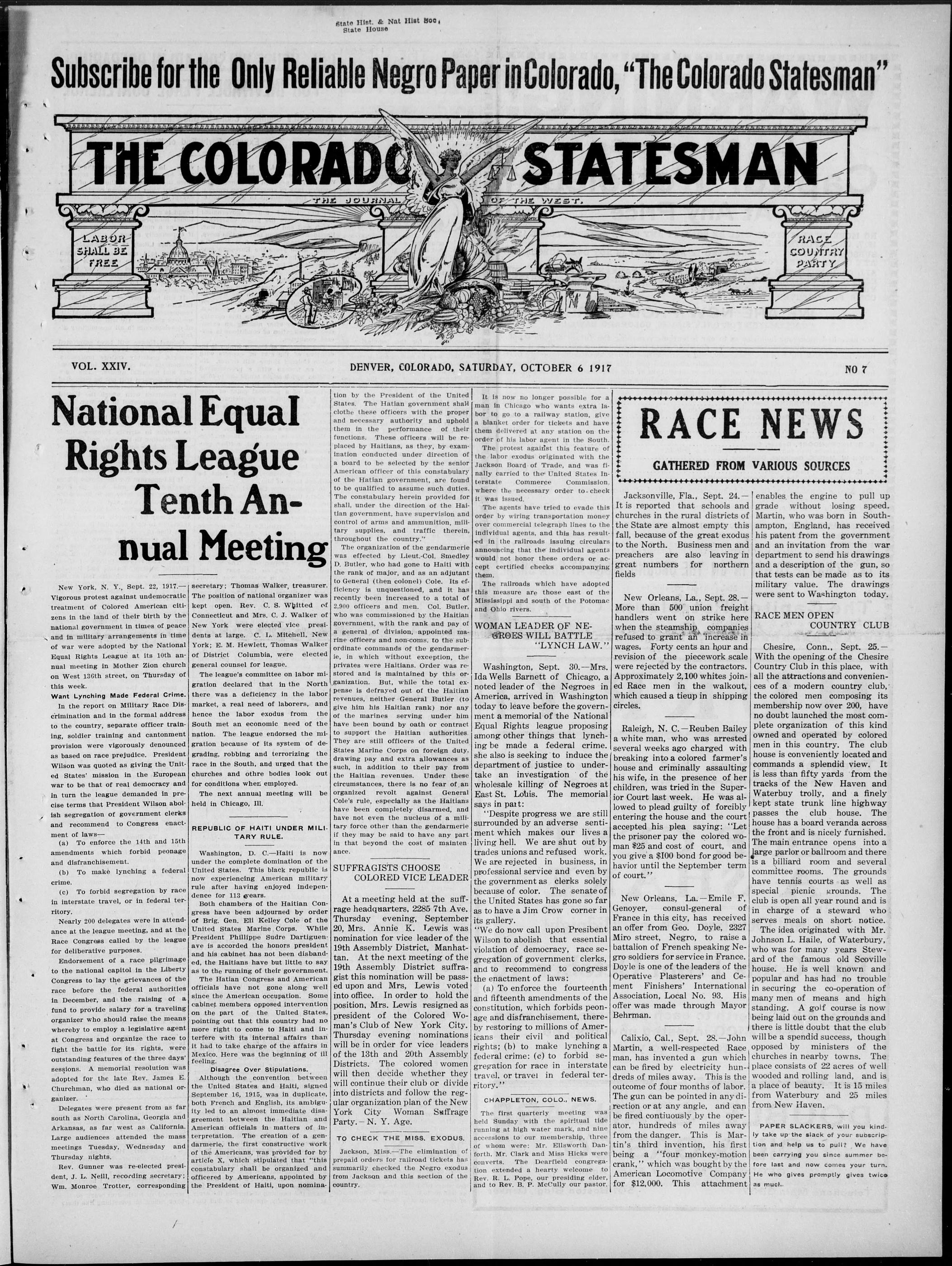
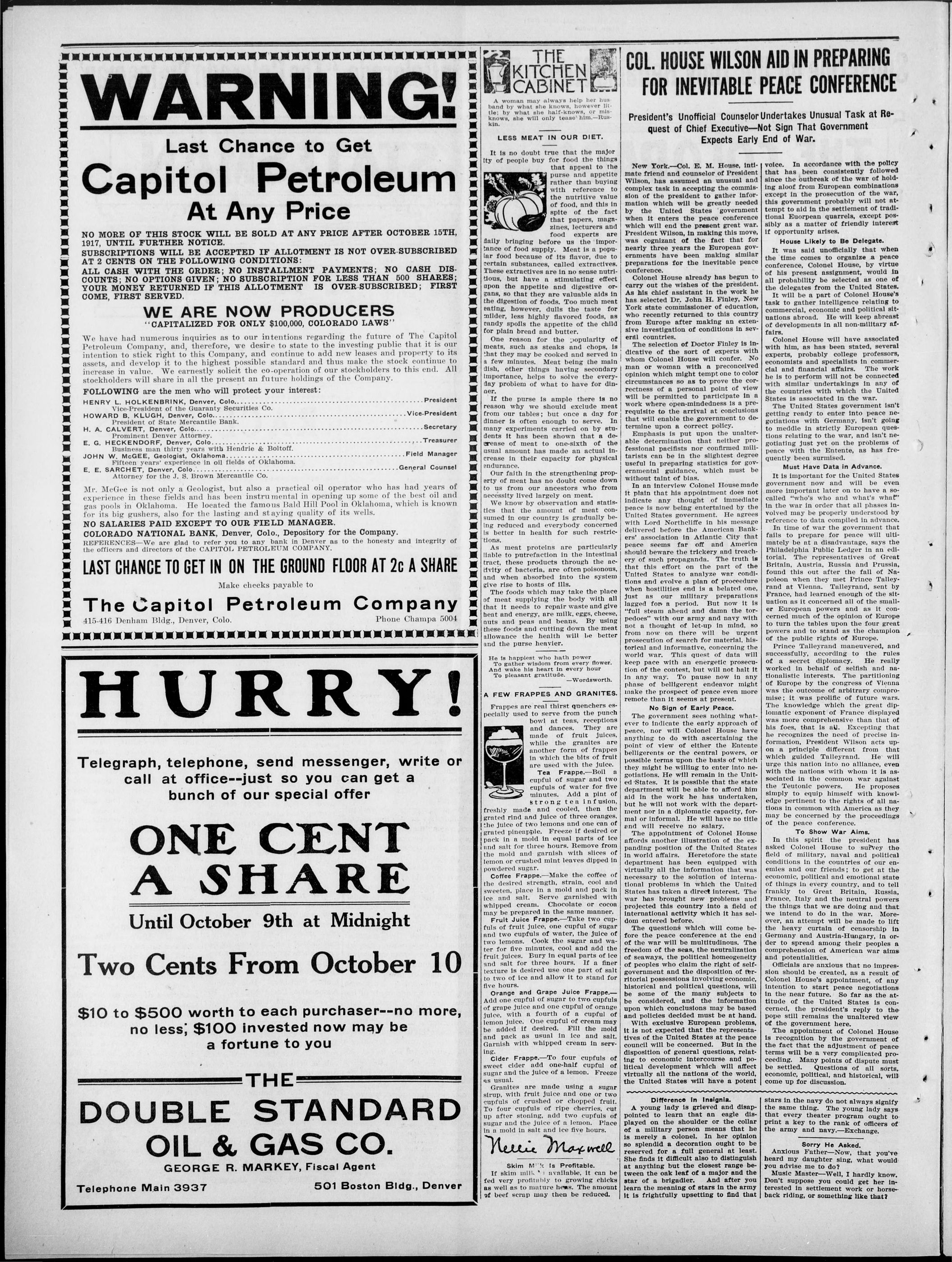
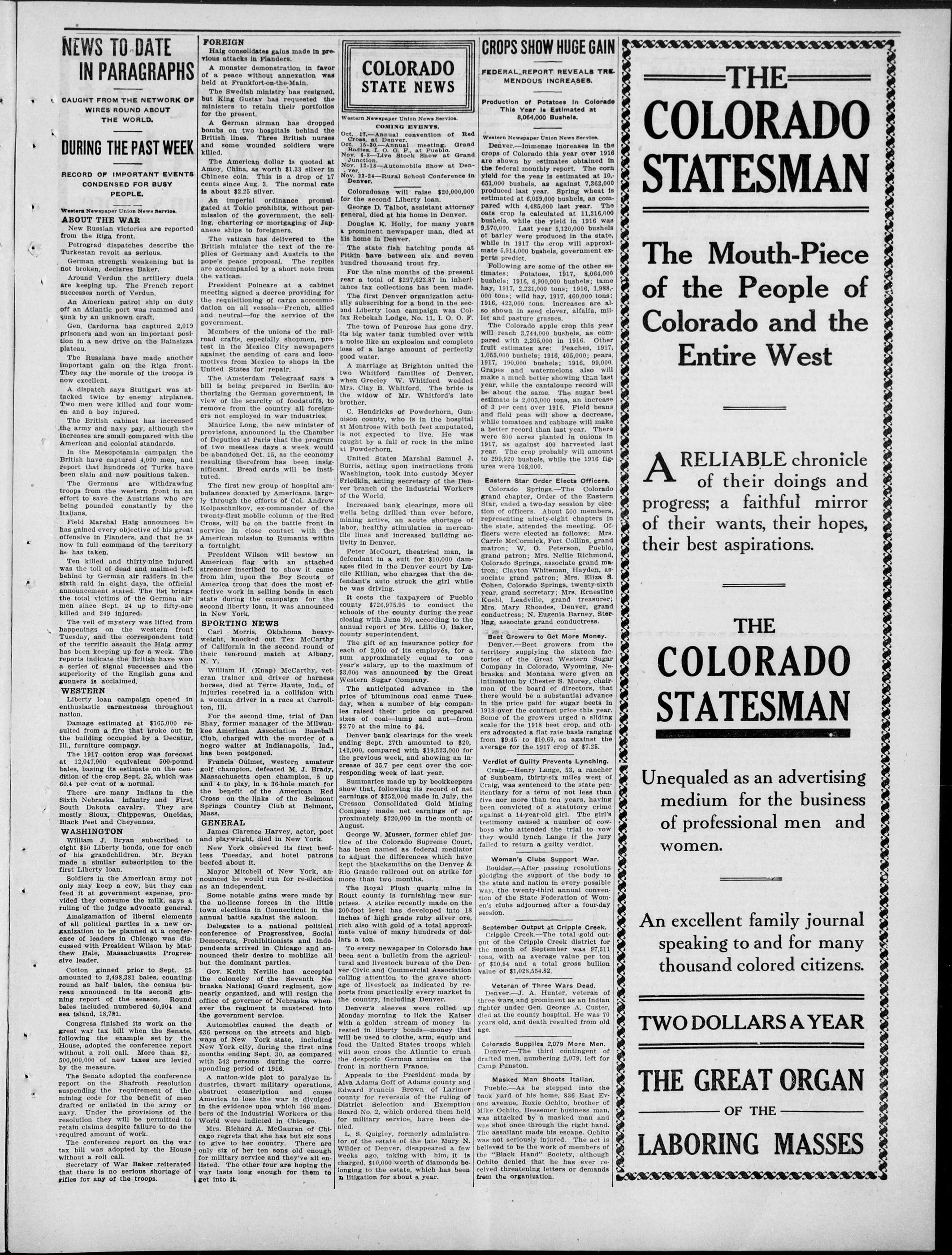
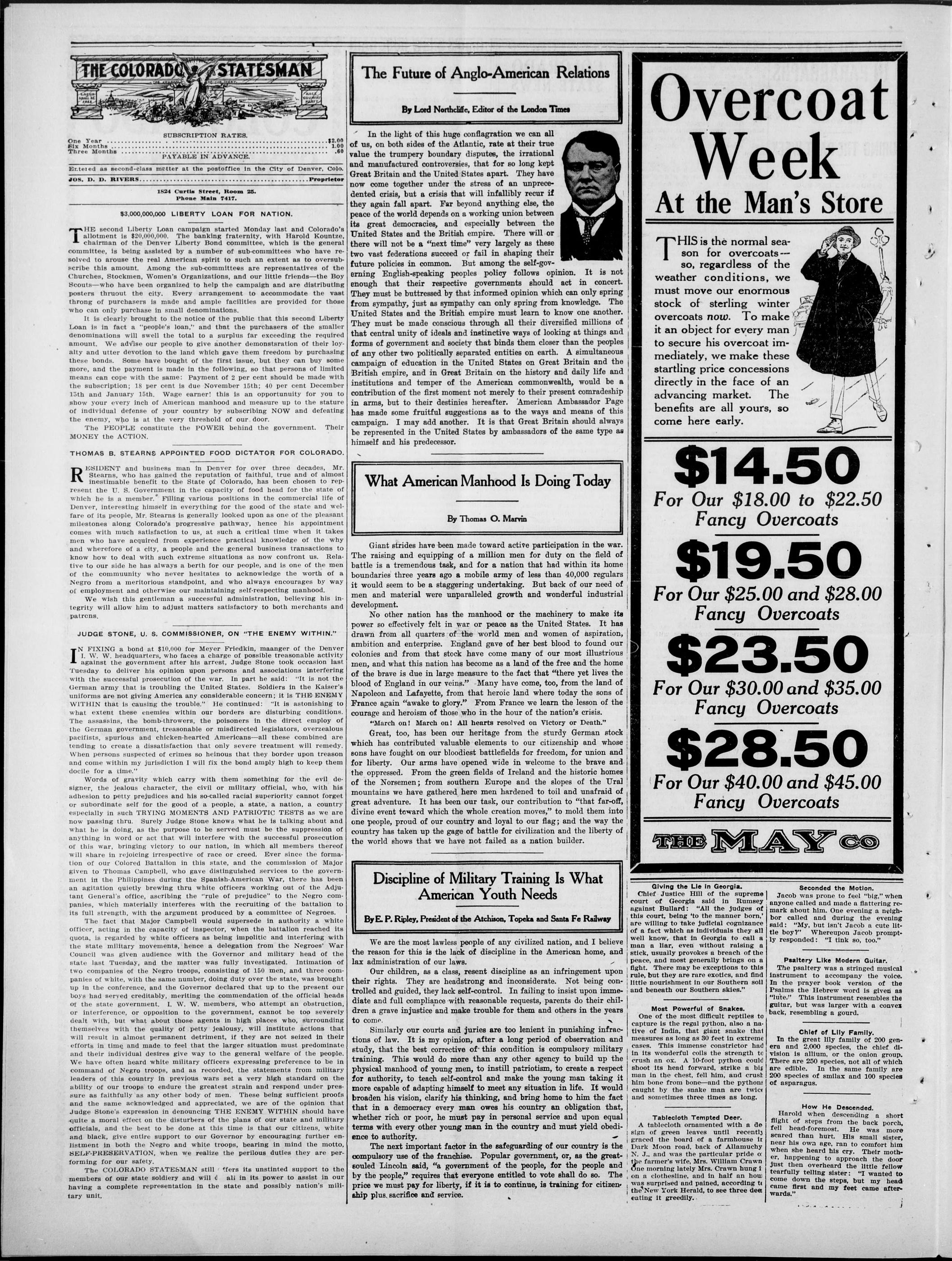
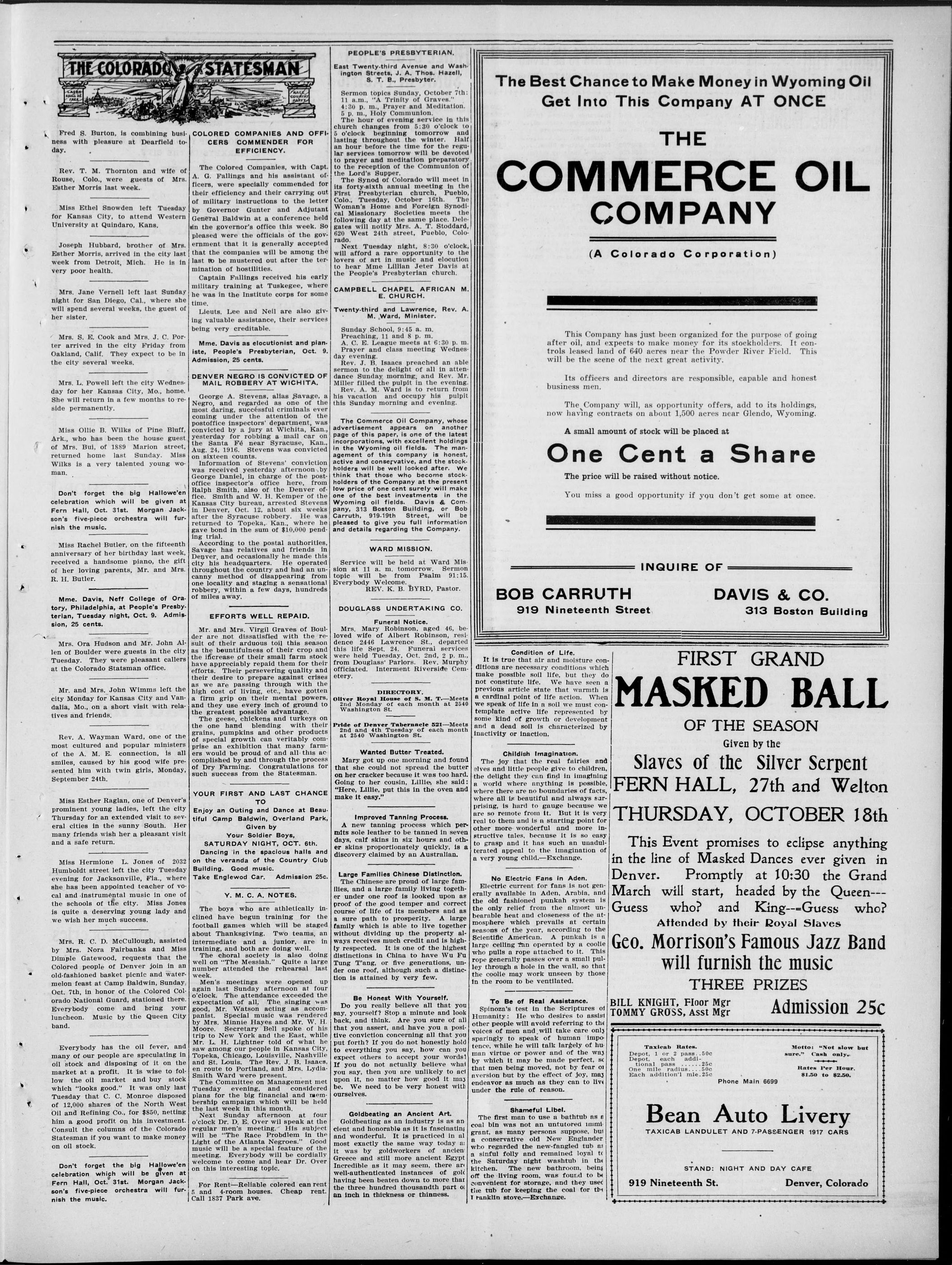
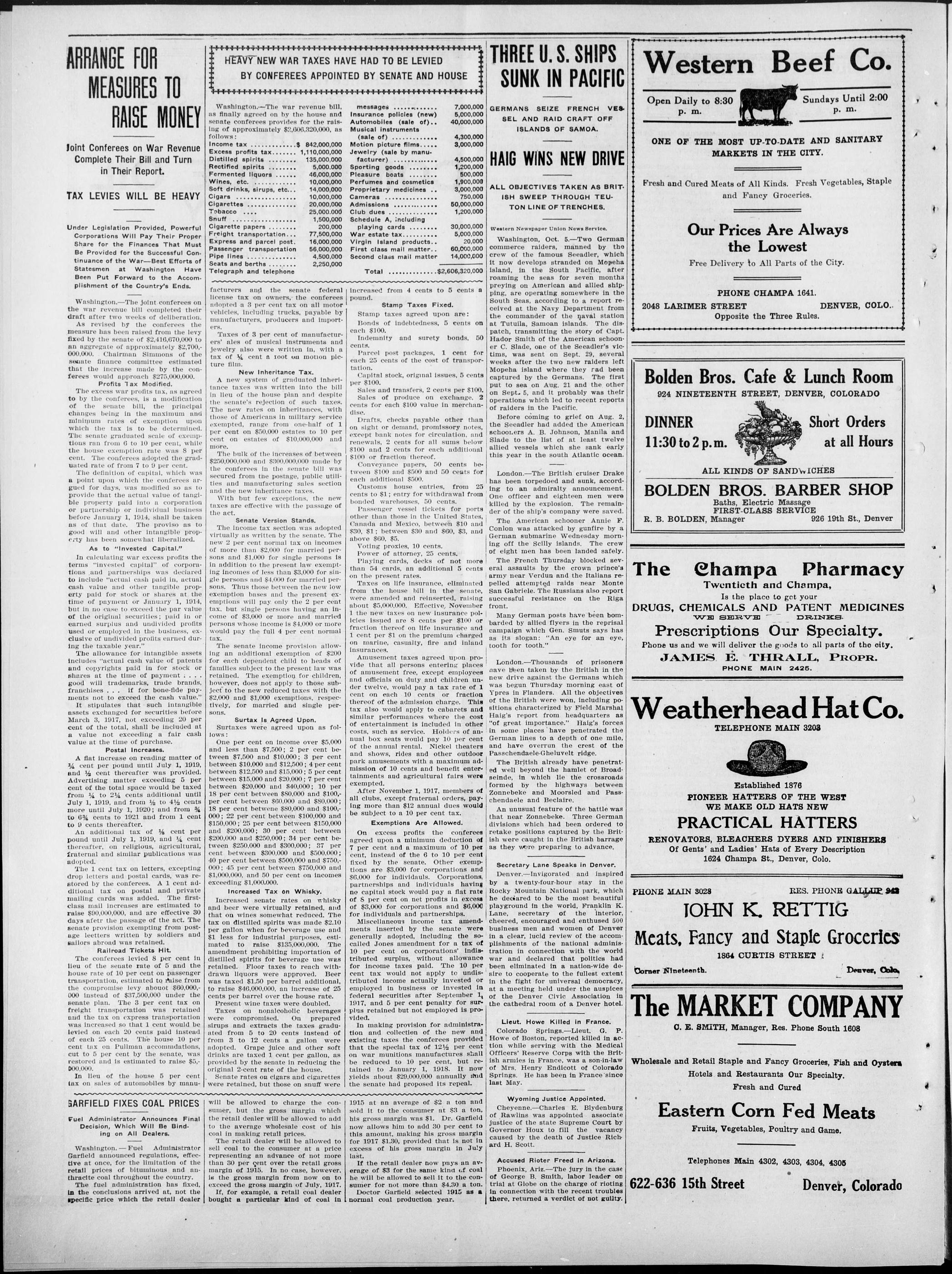
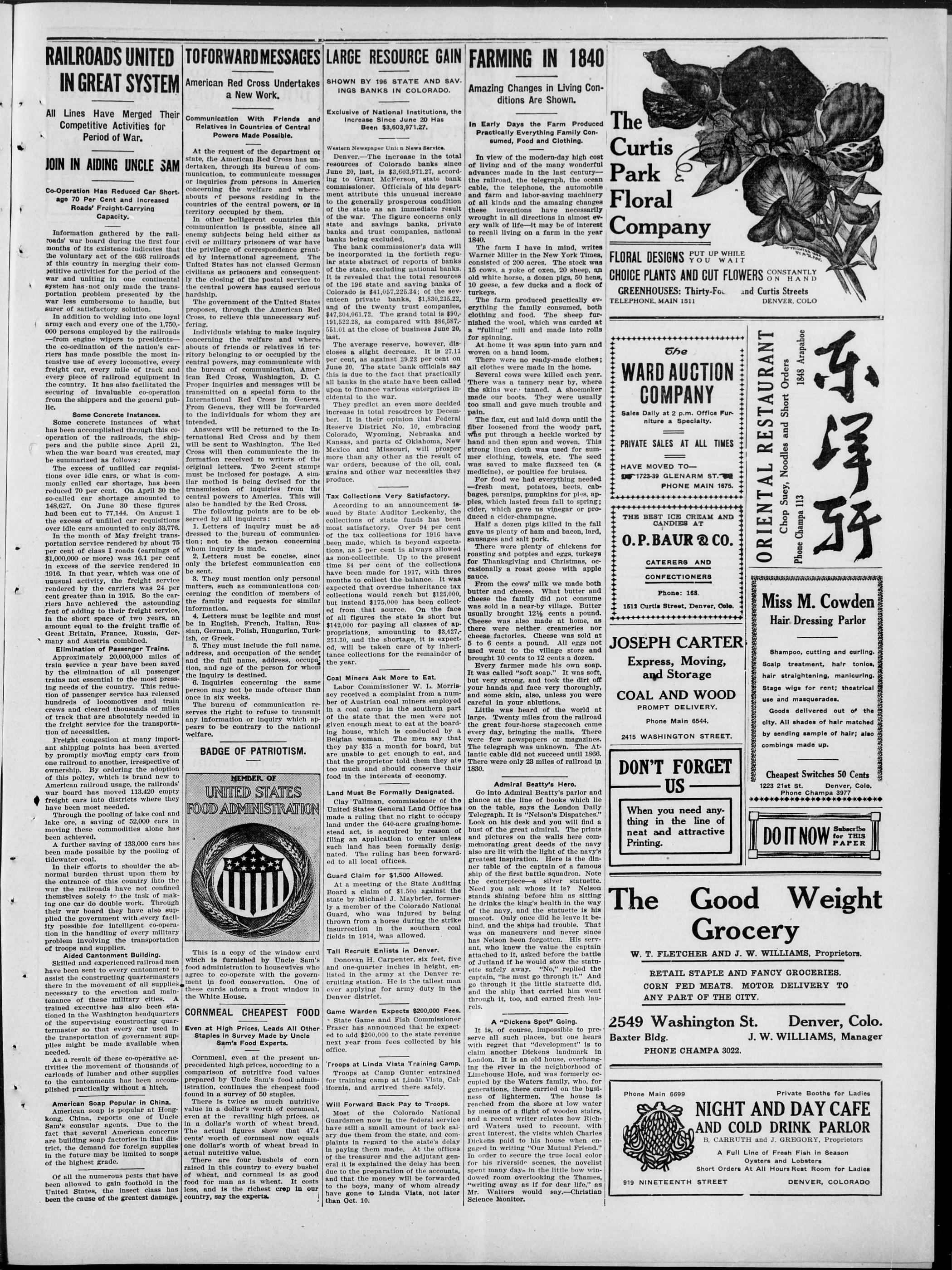
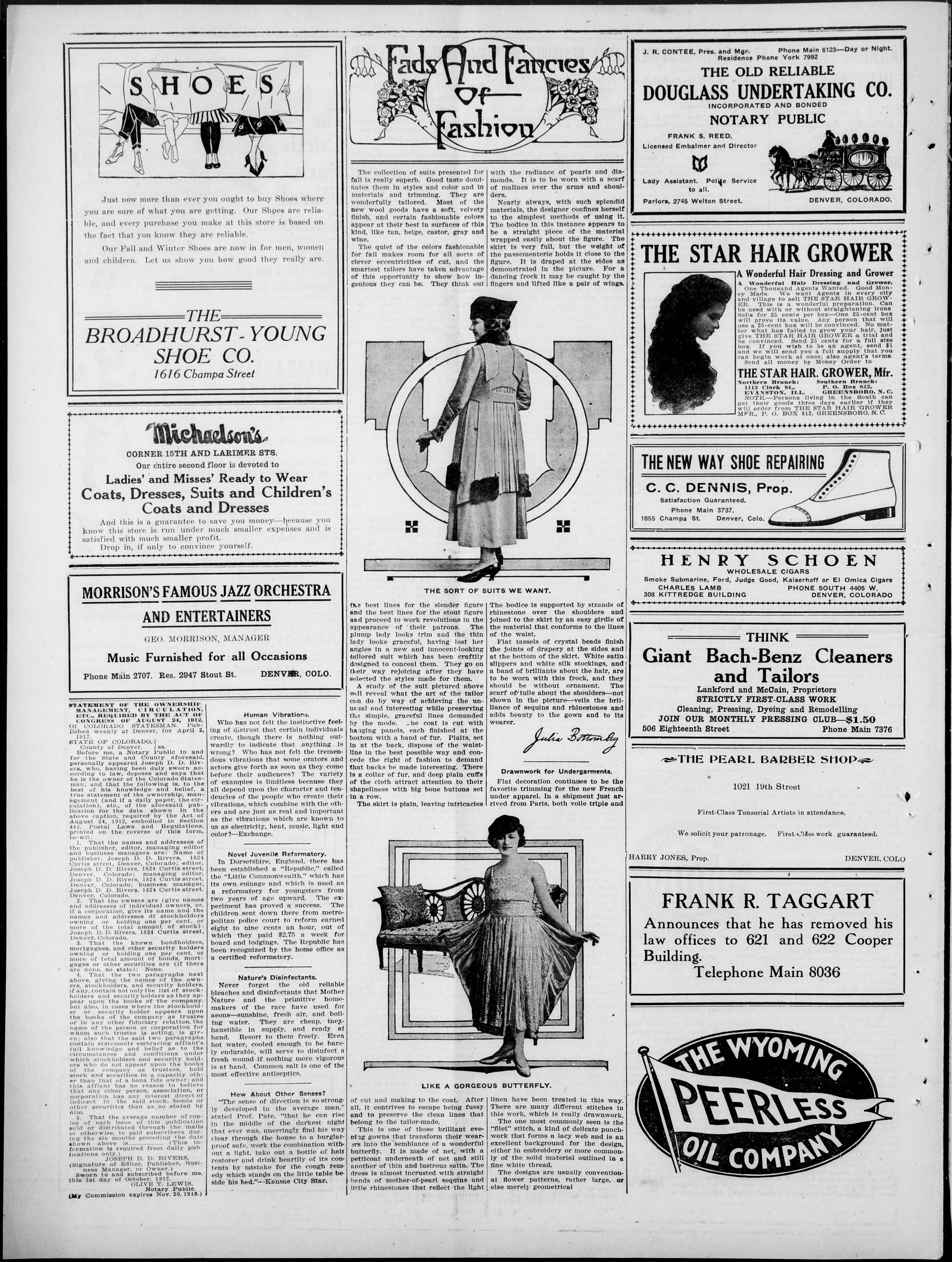
Page text (machine-generated)
Subscribe for the Only Reliable Negro Paper in Colorado, "The Colorado Statesman"
THE COLORADO STATESMAN
THE JOURNAL OF THE WEST.
LABOR SHALL BE FREE
RACE COUNTRY PARTY
National Equal Rights League Tenth Annual Meeting
VOL. XXIV. National Rights I Tenual
New York, N. Y., Sept. 22, 1917.—Vigorous protest against undemocratic treatment of Colored American citizens in the land of their birth by the national government in times of peace and in military arrangements in time of war were adopted by the National Equal Rights League at its 10th annual meeting in Mother Zion church on West 136th street, on Thursday of this week.
Want Lynching Made Federal Crime.
In the report on Military Race Discrimination and in the formal address to the country, separate officer training, soldier training and cantonment provision were vigorously denounced as based on race prejudice. President Wilson was quoted as giving the United States' mission in the European war to be that of real democracy and in turn the league demanded in precise terms that President Wilson abolish segregation of government clerks and recommend to Congress enactment of laws.
(a) To enforce the 14th and 15th amendments which forbid peonage and disfranchisement.
(b) To make lynching a federal crime.
(c) To forbid segregation by race in interstate travel, or in federal territory.
Nearly 200 delegates were in attendance at the league meeting, and at the Race Congress called by the league for deliberative purposes.
Endorsement of a race pilgrimage to the national capitol in the Liberty Congress to lay the grievances of the race before the federal authorities in December, and the raising of a fund to provide salary for a traveling organizer who should raise the means whereby to employ a legislative agent at Congress and organize the race to fight the battle for its rights, were outstanding features of the three days' sessions. A memorial resolution was adopted for the late Rev. James E. Churchman, who died as national organizer.
Delegates were present from as far south as North Carolina, Georgia and Arkansas, as far west as California. Large audiences attended the mass meetings Tuesday, Wednesday and Thursday nights.
Rev. Gunner was re-elected president, J. L. Neill, recording secretary; Wm. Monroe Trotter, corresponding
secretary; Thomas Walker, treasurer. The position of national organizer was kept open. Rev. C. S. Whitited of Connecticut and Mrs. C. J. Walker of New York were elected vice presidents at large. C. L. Mitchell, New York; E. M. Hewlett, Thomas Walker of District Columbia, were elected general counsel for league.
The league's committee on labor migration declared that in the North there was a deficiency in the labor market, a real need of laborers, and hence the labor exodus from the South met an economic need of the nation. The league endorsed the migration because of its system of degrading, robbing and terrorizing the race in the South, and urged that the churches and other bodies look out for conditions when employed.
The next annual meeting will be held in Chicago, Ill.
REPUBLIC OF HAITI UNDER MILITARY RULE.
Washington, D. C.—Haiti is now under the complete domination of the United States. This black republic is now experiencing American military rule after having enjoyed independence for 113 years.
Both chambers of the Haitian Congress have been adjourned by order of Brig. Gen. Eli Kelley Cole of the United States Marine Corps. While President Phillippe Sudre Dartiguenave is accorded the honors president and his cabinet has not been disbanded, the Haitians have but little to say as to the running of their government.
The Haitian Congress and American officials have not gone along well since the American occupation. Some cabinet members opposed intervention on the part of the United States, pointing out that this country had no more right to come to Haiti and interfere with its internal affairs than it had to take charge of the affairs in Mexico. Here was the beginning of ill feeling.
Disagree Over Stipulations.
Disagree Over Stipulations.
Although the convention between the United States and Haiti, signed September 16, 1915, was in duplicate, both French and English, its ambiguity led to an almost immediate disagreement between the Haitian and American officials in matters of interpretation. The creation of a gendarmerie, the first constructive work of the Americans, was provided for by article X, which stipulated that "this constabulary shall be organized and officered by Americans, appointed by the President of Haiti, upon nomina-
DENVER, COLORADO, SATURDAY, OCTOBER 6 1917
State Hist. & Nat Hist Soc.
State House
able Negro Pa
ADC
E JOURNAL
DENVER, COLORADO, SA
tion by the President of the United States. The Haitian government shall clothe these officers with the proper and necessary authority and uphold them in the performance of their functions. These officers will be replaced by Haitians, as they, by examination conducted under direction of a board to be selected by the senior American officer of this constabulary of the Haitian government, are found to be qualified to assume such duties. The constabulary herein provided for shall, under the direction of the Haitian government, have supervision and control of arms and ammunition, military supplies, and traffic therein, throughout the country."
The organization of the gendarmerie was effected by Lieut.-Col. Smedley D. Butler, who had gone to Haiti with the rank of major, and as an adjutant to General (then colonel) Cole. Its efficiency is unquestioned, and it has recently been increased to a total of 2,900 officers and men. Col. Butler, who was commissioned by the Haitian government, with the rank and pay of a general of division, appointed marine officers and non-coms, to the subordinate commands of the gendarmerie, in which without exception, the privates were Haitians. Order was restored and is maintained by this organization. But, while the total expense is defrayed out of the Haitian revenues, neither General Butler (to give him his Haitian rank) nor any of the marines serving under him have been bound by oath or contract to support the Haitian authorities. They are still officers of the United States Marine Corps on foreign duty, drawing pay and extra allowances as such, in addition to their pay from the Haitian revenues. Under these circumstances, there is no fear of an organized revolt against General Cole's rule, especially as the Haitians have been completely disarmed, and have not even the nucleus of a military force other than the gendarmerie if they may be said to have any part in that beyond the cost of maintenance.
SUFFRAGISTS CHOOSE COLORED VICE LEADER
At a meeting held at the suffrage headquarters, 2285 7th Ave. Thursday evening, September 20, Mrs. Annie K. Lewis was nomination for vice leader of the 19th Assembly District, Manhattan. At the next meeting of the 19th Assembly District suffragist this nomination will be passed upon and Mrs. Lewis voted into office. In order to hold the position, Mrs. Lewis resigned as president of the Colored Woman's Club of New York City. Thursday evening nominations will be in order for vice leaders of the 13th and 20th Assembly Districts. The colored women will then decide whether they will continue their club or divide into districts and follow the regular organization plan of the New York City Woman Suffrage Party. - N. Y. Age.
TO CHECK THE MISS. EXODUS.
Jackson, Miss.—The elimination of prepaid orders for railroad tickets has summarily checked the Negro exodus from Jackson and this section of the country.
It is now no longer possible for a man in Chicago who wants extra labor to go to a railway station, give a blanket order for tickets and have them delivered at any station on the order of his labor agent in the South.
The protest against this feature of the labor exodus originated with the Jackson Board of Trade, and was finally carried to the United States Interstate Commerce Commission, where the necessary order to check it was issued.
The agents have tried to evade this order by wiring transportation money over commercial telegraph lines to the individual agents, and this has resulted in the railroads issuing circulars announcing that the individual agents would not honor these orders or accept certified checks accompanying them.
The railroads which have adopted this measure are those east of the Mississippi and south of the Potomac and Ohio rivers.
WOMAN LEADER OF NE
GROES WILL BATTLE
"LYNCH LAW."
Washington, Sept. 30.—Mrs. Ida Wells Barnett of Chicago, a noted leader of the Negroes in America, arrived in Washington today to leave before the government a memorial of the National Equal Rights league proposing among other things that lynching be made a federal crime. she also is seeking to induce the department of justice to undertake an investigation of the wholesale killing of Negroes at East St. Louis. The memorial says in part:
"Despite progress we are still surrounded by an adverse sentiment which makes our lives a living hell. We are shut out by trades unions and refused work. We are rejected in business, in professional service and even by the government as clerks solely because of color. The senate of the United States has gone so far as to have a Jim Crow corner in its gallery.
"We do now call upon President Wilson to abolish that essential violation of democracy, race segregation of government clerks, and to recommend to congress the enactment of laws: (a) To enforce the fourteenth and fifteenth amendments of the constitution, which forbids peonage and disfranchisement, thereby restoring to millions of Americans their civil and political rights; (b) to make lynching a federal crime; (c) to forbid segregation for race in interstate travel, or travel in federal territory."
CHAPPLETON, COLO., NEWS.
The first quarterly meeting was held Sunday with the spiritual tide running at high water mark, and nine accessions to our membership, three of whom were: Mr. Ellsworth Danforth, Mr. Clark and Miss Hicks were converts. The Dearfield congregation extended a hearty welcome to Rev. R. L. Pope, our presiding elder, and to Rev. B. P. McCullay our pastor.
RACE NEWS
Jacksonville, Fla., Sept. 24. It is reported that schools and churches in the rural districts of the State are almost empty this fall, because of the great exodus to the North. Business men and preachers are also leaving in great numbers for northern fields.
New Orleans, La., Sept. 28. More than 500 union freight handlers went on strike here when the steamship companies refused to grant an increase in wages. Forty cents an hour and revision of the piecework scale were rejected by the contractors. Approximately 2,100 whites joined Race men in the walkout, which caused a tieup in shipping circles.
enables the engine to pull up grade without losing speed. Martin, who was born in Southampton, England, has received his patent from the government and an invitation from the war department to send his drawings and a description of the gun, so that tests can be made as to its military value. The drawings were sent to Washington today.
RACE MEN OPEN
COUNTRY CLUB
Chesire, Conn., Sept. 25. With the opening of the Chesire Country Club in this place, with all the attractions and conveniences of a modern country club, the colored men composing its membership now over 200, have
Raleigh, N. C.—Reuben Bailey a white man, who was arrested several weeks ago charged with breaking into a colored farmer's house and criminally assaulting his wife, in the presence of her children, was tried in the Superior Court last week. He was allowed to plead guilty of forcibly entering the house and the court accepted his plea saying: "Let the prisoner pay the colored woman $25 and cost of court, and you give a $100 bond for good behavior until the September term of court."
New Orleans, La.—Emile F, Genoyer, consul-general of France in this city, has received an offer from Geo. Doyle, 2327 Miro street, Negro, to raise a battalion of French speaking Negro soldiers for service in France. Doyle is one of the leaders of the Operative Plasterers' and Cement Finishers' International Association, Local No. 93. His offer was made through Mayor Behrman.
Calixio, Cal., Sept. 28.—John Martin, a well-respected Race man, has invented a gun which can be fired by electricity hundreds of miles away. This is the outcome of four months of labor. The gun can be pointed in any direction or at any angle, and can be fired contiuously by the operator, hundreds of miles away from the danger. This is Martin's third invention, his first being a "four monkey-motion crank," which was bought by the American Locomotive Company for $12,000. This attachment
7 NO 7
enables the engine to pull up grade without losing speed. Martin, who was born in Southampton, England, has received his patent from the government and an invitation from the war department to send his drawings and a description of the gun, so that tests can be made as to its military value. The drawings were sent to Washington today.
Chesire, Conn., Sept. 25. With the opening of the Chesire Country Club in this place, with all the attractions and conveniences of a modern country club, the colored men composing its membership now over 200, have no doubt launched the most complete organization of this kind owned and operated by colored men in this country. The club house is conveniently located and commands a splendid view. It is less than fifty yards from the tracks of the New Haven and Waterbuy trolly, and a finely kept state trunk line highway passes the club house. The house has a board veranda across the front and is nicely furnished. The main entrance opens into a large parlor or ballroom and there is a billiard room and several committee rooms. The grounds have tennis courts as well as special picnic grounds. The club is open all year round and is in charge of a steward who serves meals on short notice.
The idea originated with Mr. Johnson L. Haile, of Waterbury, who was for many years Steward of the famous old Scoville house. He is well known and popular and has had no trouble in securing the co-operation of many men of means and high standing. A golf course is now being laid out on the grounds and there is little doubt that the club will be a spendid success, though opposed by ministers of the churches in nearby towns. The place consists of 22 acres of well wooded and rolling land, and is a place of beauty. It is 15 miles from Waterbury and 25 miles from New Haven.
PAPER SLACKERS, will you kindly take up the slack of your subscription and help us to pull? We have been carrying you since summer before last and now comes your turn. He who gives promptly gives twice as much.
Last Chance to Get Capitol Petroleum At Any Price
NO MORE OF THIS STOCK WILL BE SOLD AT ANY PRICE AFTER OCTOBER 15TH, 1917, UNTIL FURTHER NOTICE.
SUBSCRIPTIONS WILL BE ACCEPTED IF ALLOTMENT IS NOT OVER-SUBSCRIBED AT 2 CENTS ON THE FOLLOWING CONDITIONS:
ALL CASH WITH THE ORDER; NO INSTALLMENT PAYMENTS; NO CASH DISCOUNTS; NO OPTIONS GIVEN; NO SUBSCRIPTION FOR LESS THAN 500 SHARES; YOUR MONEY RETURNED IF THIS ALLOTMENT IS OVER-SUBSCRIBED; FIRST COME, FIRST SERVED.
WE ARE NOW PRODUCERS
"CAPITALIZED FOR ONLY $100,000, COLORADO LAWS"
We have had numerous inquiries as to our intentions regarding the future of The Capitol Petroleum Company, and, therefore, we desire to state to the investing public that it is our intention to stick right to this Company, and continue to add new leases and property to its assets, and develop it to the highest possible standard and thus make the stock continue to increase in value. We earnestly solicit the co-operation of our stockholders to this end. All stockholders will share in all the present future holdings of the Company.
FOLLOWING are the men who will protect your interest:
HENRY L. HOLKENBRINK, Denver, Colo....President
Vice-President of the Guaranty Securities Co.
HOWARD B. KLUGH, Denver, Colo....Vice-President
President of State Mercantile Bank.
H. A. CALVERT, Denver, Colo....Secretary
Prominent Denver Attorney.
E. G. HECKENDORF, Denver, Colo....Treasurer
Business man thirty years with Hendrie & Boltoff.
JOHN W. McGEE, Geologist, Oklahoma....Field Manager
Fifteen years' experience in oil fields of Oklahoma.
E. E. SARCHET, Denver, Colo....General Counsel
Attorney for the J. S. Brown Mercantile Co.
Mr. McGee is not only a Geologist, but also a practical oil operator who has had years of experience in these fields and has been instrumental in opening up some of the best oil and gas pools in Oklahoma. He located the famous Bald Hill Pool in Oklahoma, which is known for its big gushers, also for the lasting and staying quality of its wells. NO SALARIES PAID EXCEPT TO OUR FIELD MANAGER. COLORADO NATIONAL BANK. Denver. Colo.. Depository for the Company.
COLORADO NATIONAL BANK, Denver, Colo., Depository for the Company. REFERENCES—We are glad to refer you to any bank in Denver as to the honesty and integrity of the officers and directors of the CAPITOL PETROLEUM COMPANY.
LAST CHANCE TO GET IN ON THE GROUND FLOOR AT 2c A SHARE
The Capitol Petroleum Company
415-416 Denham Bldg., Denver, Colo. Phone Champa 5004
HURRY!
Telegraph, telephone, send messenger, write or call at office--just so you can get a bunch of our special offer
ONE CENT A SHARE Until October 9th at Midnight
Two Cents From October 10
$10 to $500 worth to each purchaser--no more, no less; $100 invested now may be a fortune to you
Telephone Main 3937
Make checks payable to
501 Boston Bldg., Denver
THE KITCHEN CABINET
A woman may always help her husband by what she knows, however little; by what she half-knows, or misknows, she will only tease' him.—Ruskin.
LESS MEAT IN OUR DIET.
It is no doubt true that the majority of people buy for food the things
that appeal to the purse and appetite rather than buying with reference to the nutritive value of food, and this in spite of the fact that papers, magazines, lecturers and food experts are
purse and appetite rather than buying with reference to the nutritive value of food, and this in spite of the fact that papers, magazines, lecturers and food experts are daily bringing before us the importance of food supply. Meat is a popular food because of its flavor, due to certain substances, called extractives. These extractives are in no sense nutritious, but have a stimulating effect upon the appetite and digestive organs, so that they are valuable aids in the digestion of foods. Too much meat eating, however, dulls the taste for milder, less highly flavored foods, as candy spoils the appetite of the child for plain bread and butter.
One reason for the popularity of meats, such as steaks and chops, is that they may be cooked and served in a few minutes. Meat being the main dish, other things having secondary importance, helps to solve the everyday problem of what to have for dinner.
If the purse is ample there is no reason why we should exclude meat from our tables; but once a day for dinner is often enough to serve. In many experiments carried on by students it has been shown that a decrease of meat to one-sixth of the usual amount has made an actual increase in their capacity for physical endurance.
Our faith in the strengthening property of meat has no doubt come down to us from our ancestors who from necessity lived largely on meat.
We know by observation and statistics that the amount of meat consumed in our country is gradually being reduced and everybody concerned is better in health for such restrictions.
As meat proteins are particularly liable to putrefaction in the intestinal tract, these products through the activity of bacteria, are often poisonous, and when absorbed into the system give rise to hosts of lills.
The foods which may take the place of meat supplying the body with all that it needs to repair waste and give heat and energy, are milk, eggs, cheese, nuts and peas and beans. By using these foods and cutting down the meat allowance the health will be better and the purse heavier.
He is happiest who hath power
To gather wisdom from every flower.
And wake his heart in every hour
To pleasant gratitude.
A FEW FRAPPES AND GRANITES.
Frappes are real thirst quenchers especially used to serve from the punch bowl at teas, receptions and dances. They are made of fruit juices, while the granites are another form of frappes in which the bits of fruit are used with the juice.
COFFEE
Tea Frappe.—Boll a cupful of sugar and two cupfuls of water for five minutes. Add a pint of strong tea infusion, freshly made and cooled, then the grated rind and juice of three oranges, the juice of two lemons and one can of grated pineapple. Freeze if desired or pack in a mold in equal parts of ice and salt for three hours. Remove from the mold and garnish with slices of lemon or crushed mint leaves dipped in powdered sugar. Coffee Frappe.—Make the coffee of the desired strength, strain, cool and sweeten, place in a mold and pack in ice and salt. Serve garnished with whipped cream. Chocolate or cocoa may be prepared in the same manner.
Fruit Juice Frappe.—Take two cupfuls of fruit juice, one cupful of sugar and two cupfuls of water, the juice of two lemons. Cook the sugar and water for five minutes, cool and add the fruit juices. Bury in equal parts of ice and salt for three hours. If a finer texture is desired use one part of salt to two of ice and allow it to stand for five hours.
Orange and Grape Juice Frappe.—Add one cupful of sugar to two cupfuls of grape juice and one cupful of orange juice, with a fourth of a cupful of lemon juice. One cupful of cream may be added if desired. Fill the mold and pack as usual in ice and salt. Garnish with whipped cream in serving.
Clder Frappe.—To four cupfuls of sweet cider add one-half cupful of sugar and the juice of a lemon. Freeze as usual.
Granites are made using a sugar
sirup, with fruit juice and one or two
cupfuls of crushed or chopped fruit.
To four cupfuls of ripe cherries, cut
up after stoning, add two cupfuls of
sugar and the juice of a lemon. Place
in a mold in salt and ice five hours.
Nellie Maxwell
Skim Milk Is Profitable.
If skim milk is available, it can be
fed very profitably to growing chicks
as well as to mature heens. The amount
of beef scrap may then be reduced.
COL. HOUSE WILSON AID IN PREPARING FOR INEVITABLE PEACE CONFERENCE
President's Unofficial Counselor Undertakes Unusual Task at Request of Chief Executive—Not Sign That Government Expects Early End of War.
New York.-Col. E. M. House, intimate friend and counselor of President Wilson, has assumed an unusual and complex task in accepting the commission of the president to gather information which will be greatly needed by the United States government when it enters the peace conference which will end the present great war. President Wilson, in making this move, was cognizant of the fact that for nearly three years the European governments have been making similar preparations for the inevitable peace conference. Colonel House already has begun to carry out the wishes of the president. As his chief assistant in the work he has selected Dr. John H. Finley, New York state commissioner of education, who recently returned to this country from Europe after making an extensive investigation of conditions in several countries.
The selection of Doctor Finley is indicative of the sort of experts with whom Colonel House will confer. No man or woman with a preconceived opinion which might tempt one to color circumstances so as to prove the correctness of a personal point of view will be permitted to participate in a work where open-mindedness is a prerequisite to the arrival at conclusions that will enable the government to determine upon a correct policy. Emphasis is put upon the unalterable determination that neither professional pacifists nor confirmed militarists can be in the slightest degree useful in preparing statistics for governmental guidance, which must be without talent of bias.
In an interview Colonel House made it plain that his appointment does not indicate any thought of immediate peace is now being entertained by the United States government. He agrees with Lord Northcliffe in his message delivered before the American Bankers' association in Atlantic City that peace seems far off and America should beware the trickery and treachery of such propaganda. The truth is that this effort on the part of the United States to analyze war conditions and evolve a plan of procedure when hostilities end is a belated one, just as our military preparations lagged for a period. But now it is "full steam ahead and damn the torpedoes" with our army and navy with not a thought of let-up in mind, so from now on there will be urgent prosecution of search for material, historical and informative, concerning the world war. This quest of data will keep pace with an energetic prosecution of the contest, but will not halt it in any way. To pause now in any phase of belligerent endeavor might make the prospect of peace even more remote than it seems at present.
No Sign of Early Peace.
The government sees nothing whatever to indicate the early approach of peace, nor will Colonel House have anything to do with ascertaining the point of view of either the Entente belligerents or the central powers, or possible terms upon the basis of which they might be willing to enter into negotiations. He will remain in the United States. It is possible that the state department will be able to afford him aid in the work he has undertaken, but he will not work with the department nor in a diplomatic capacity, formal or informal. He will have no title and will receive no salary.
The appointment of Colonel House affords another illustration of the expanding position of the United States in world affairs. Heretofore the state department has been equipped with virtually all the information that was necessary to the solution of international problems in which the United States has taken a direct interest. The war has brought new problems and projected this country into a field of international activity which it has seldom entered before.
The questions which will come before the peace conference at the end of the war will be multitudinous. The freedom of the seas, the neutralization of seaways, the political homeogeneity of peoples who claim the right of self-government and the disposition of territorial possessions involving economic, historical and political questions, will be some of the many subjects to be considered, and the information upon which conclusions may be based and policies decided must be at hand. With exclusive European problems, it is not expected that the representatives of the United States at the peace council will be concerned. But in the disposition of general questions, relating to economic intercourse and political development which will affect virtually all the nations of the world, the United States will have a potent
A young lady is grieved and disappointed to learn that an eagle displayed on the shoulder or the collar of a military person means that he is merely a colonel. In her opinion so splendid a decoration ought to be reserved for a full general at least. She finds it difficult also to distinguish at anything but the closest range between the oak leaf of a major and the star of a brigadier. And after you learn the meaning of stars in the army it is frightfully upsetting to find that
voice. In accordance with the policy that has been consistently followed since the outbreak of the war of holding aloof from European combinations except in the prosecution of the war, this government probably will not attempt to aid in the settlement of traditional European quarrels, except possibly as a matter of friendly interest if opportunity arises.
House Likely to Be Delegate.
It was said unofficially that when the time comes to organize a peace conference, Colonel House, by virtue of his present assignment, would in all probability be selected as one of the delegates from the United States. It will be a part of Colonel House's task to gather intelligence relating to commercial, economic and political situations abroad. He will keep abreast of developments in all non-military affairs. Colonel House will have associated with him, as has been stated, several experts, probably college professors, economists and specialists in commercial and financial affairs. The work he is to perform will not be connected with similar undertakings in any of the countries with which the United States is associated in the war.
The United States government isn't getting ready to enter into peace negotiations with Germany, isn't going to meddle in strictly European questions relating to the war, and isn't negotiating just yet on the problems of peace with the Entente, as has frequently been surmised.
Must Have Data in Advance.
It is important for the United States government now and will be even more important later on to have a so-called "who's who and what's what" in the war in order that all phases involved may be properly understood by reference to data compiled in advance. In time of war the government that fails to prepare for peace will ultimately be at a disadvantage, says the Philadelphia Public Ledger in an editorial. The representatives of Great Britain, Austria, Russia and Prussia, found this out after the fall of Napoleon when they met Prince Talleyrand at Vienna. Talleyrand, sent by France, had learned enough of the situation as it concerned all of the smaller European powers and as it concerned much of the opinion of Europe to turn the tables upon the four great powers and to stand as the champion of the public rights of Europe.
Prince Talleyrand maneuvered, and successfully, according to the rules of a secret diplomacy. He really worked in behalf of selfish and nationalistic interests. The partitioning of Europe by the congress of Vienna was the outcome of arbitrary compromise; it was prolific of future wars. The knowledge which the great diplomatic exponent of France displayed was more comprehensive than that of his foes, that is all. Excepting that he recognizes the need of precise information, President Wilson acts upon a principle different from that which guided Talleyrand. He will urge this nation into no alliance, even with the nations with whom it is associated in the common war against the Teutonic powers. He proposes simply to equip himself with knowledge pertinent to the rights of all nations in common with America as they may be concerned by the proceedings of the peace conference.
To Show War Aims.
In this spirit the president has asked Colonel House to survey the field of military, naval and political conditions in the countries of our enemies and our friends; to get at the economic, political and emotional state of things in every country, and to tell frankly to Great Britain, Russia, France, Italy and the neutral powers the things that we are doing and that we intend to do in the war. Moreover, an attempt will be made to lift the heavy curtain of censorship in Germany and Austria-Hungary, in order to spread among their peoples a comprehension of American war alms and potentialities.
Officials are anxious that no impression should be created, as a result of Colonel House's appointment, of any intention to start peace negotiations in the near future. So far as the attitude of the United States is concerned, the president's reply to the pope still remains the unaltered view of the government here.
The appointment of Colonel House is recognition by the government of the fact that the adjustment of peace terms will be a very complicated proceeding. Many points of dispute must be settled. Questions of all sorts, economic, political, and historical, will come up for discussion.
stars in the navy do not always signify the same thing. The young lady says that every theater program ought to print a key to the rank of officers of the army and navy.—Exchange.
Sorry He Asked.
Anxious Father—Now, that you've heard my daughter sing, what would you advise me to do?
Music Master—Well, I hardly know. Don't suppose you could get her interested in settlement work or horseback riding, or something like that?
THE COLORADO STATESMAN
LARGE HAND IN FACE
RACE COUNTRY PARTY
SUBSCRIPTION RATES.
One Year ..... $2.00
Six Months ..... 1.00
Three Months ..... .60
PAYABLE IN ADVANCE.
Entered as second-class matter at the postoffice in the City of Denver, Colo.
JOS. D. D. RIVERS ..... Proprietor
1824 Curtis Street, Room 25.
Phone Main 7417.
$3,000,000,000 LIBERTY LOAN FOR NATION.
THE second Liberty Loan campaign started Monday last and Colorado's allotment is $20,000,000. The banking fraternity, with Harold Kountze, chairman of the Denver Liberty Bond committee, which is the general committee, is being assisted by a number of sub-committees who have resolved to arouse the real American spirit to such an extent as to oversubscribe this amount. Among the sub-committees are representatives of the Churches, Stockmen, Women's Organizations, and our little friends—the Boy Scouts—who have been organized to help the campaign and are distributing posters thruout the city. Every arrangement to accommodate the vast throng of purchasers is made and ample facilities are provided for those who can only purchase in small denominations.
It is clearly brought to the notice of the public that this second Liberty Loan is in fact a "people's loan," and that the purchasers of the smaller denominations will swell the total to a surplus far exceeding the required amount. We advise our people to give another demonstration of their loyalty and utter devotion to the land which gave them freedom by purchasing these bonds. Some have bought of the first issue, but they can buy some more, and the payment is made in the following, so that persons of limited means can cope with the same: Payment of 2 per cent should be made with the subscription; 18 per cent is due November 15th; 40 per cent December 15th and January 15th. Wage carrier! this is an opportunity for you to show your every inch of American manhood and measure up to the stature of individual defense of your country by subscribing NOW and defeating the enemy, who is at the very threshold of our door.
The PEOPLE constitute the POWER behind the government. Their MONEY the ACTION.
THOMAS B. STEARNS APPOINTED FOOD DICTATOR FOR COLORADO.
RESIDENT and business man in Denver for over three decades, Mr. Stearns, who has gained the reputation of faithful, true and of almost inestimable benefit to the State of Colorado, has been chosen to represent the U. S. Government in the capacity of food head for the state of which he is a member. Filling various positions in the commercial life of Denver, interesting himself in everything for the good of the state and welfare of its people, Mr. Stearns is generally looked upon as one of the pleasant milestones along Colorado's progressive pathway, hence his appointment comes with much satisfaction to us, at such a critical time when it takes men who have acquired from experience practical knowledge of the why and whereof of a city, a people and the general business transactions to know how to deal with such extreme situations as now confront us. Relative to our side he has always a berth for our people, and is one of the men of the community who never hesitates to acknowledge the worth of a Negro from a meritorious standpoint, and who always encourages by way of employment and otherwise our maintaining self-respecting manhood.
We wish this gentleman a successful administration, believing his integrity will allow him to adjust matters satisfactory to both merchants and patrons.
JUDGE STONE, U. S. COMMISSIONER, ON "THE ENEMY WITHIN."
IN FIXING a bond at $10,000 for Meyer Friedkin, maanger of the Denver I. W. W. headquarters, who faces a charge of possible treasonable activity against the government after his arrest, Judge Stone took occasion last Tuesday to deliver his opinion upon persons and associations interfering with the successful prosecution of the war. In part he said: "It is not the German army that is troubling the United States. Soldiers in the Kaiser's uniforms are not giving America any considerable concern; it is THE ENEMY WITHIN that is causing the trouble." He continued: "It is astonishing to what extent these enemies within our borders are disturbing conditions. The assassins, the bomb-throwers, the poisoners in the direct employ of the German government, treasonable or misdirected legislators, overzealous pacifists, spurious and chicken-hearted Americans—all these combined are tending to create a dissatisfaction that only severe treatment will remedy. When persons suspected of crimes so heinous that they border upon treason and come within my jurisdiction I will fix the bond amply high to keep them docile for a time."
Words of gravity which carry with them something for the evil designer, the jealous character, the civil or military official, who, with his adhesion to petty prejudices and his so-called racial superiority cannot forget or subordinate self for the good of a people, a state, a nation, a country especially in such TRYING MOMENTS AND PATRIOTIC TESTS as we are now passing thru. Surely Judge Stone knows what he is talking about and what he is doing, as the purpose to be served must be the suppression of anything in word or act that will interfere with the successful prosecution of this war, bringing victory to our nation, in which all members thereof will share in rejoicing irrespective of race or creed. Ever since the formation of our Colored Battalion in this state, and the commission of Major given to Thomas Campbell, who gave distinguished services to the government in the Philippines during the Spanish-American War, there has been an agitation quietly brewing thru white officers working out of the Adjutant General's office, ascribing the "rule of prejudice" to the Negro companies, which materially interferes with the recruiting of the battalion to its full strength, with the argument produced by a committee of Negroes.
The fact that Major Campbell would supersede in authority a white officer, acting in the capacity of inspector, when the battalion reached its quota, is regarded by white officers as being impolitic and interfering with the state military movements, hence a delegation from the Negroes' War Council was given audience with the Governor and military head of the state last Tuesday, and the matter was fully investigated. Intimation of two companies of the Negro troops, consisting of 150 men, and three companies of white, with the same number, doing duty over the state, was brought up in the conference, and the Governor declared that up to the present our boys had served creditably, meriting the commendation of the official heads of the state government. I. W. W. members, who attempt an obstruction, or interference, or opposition to the government, cannot be too severely dealt with, but what about those agents in high places who, surrounding themselves with the quality of petty jealousy, will institute actions that will result in almost permanent detriment, if they are not seized in their efforts in time and made to feel that the larger situation must predominate and their individual desires give way to the general welfare of the people. We have often heard white military officers expressing preference to be in command of Negro troops, and as recorded, the statements from military leaders of this country in previous wars set a very high standard on the ability of our troops to endure the greatest strain and respond under pressure as faithfully as any other body of men. These being sufficient proofs and the same acknowledged and appreciated, we are of the opinion that Judge Stone's expression in denouncing THE ENEMY WITHIN should have quite a moral effect on the disturbers of the plans of our state and military officials, and the best to be done at this time is that our citizens, white and black, give entire support to our Governor by encouraging further enlistment in both the Negro and white troops, bearing in mind the motto, SELF-PRESERVATION, when we realize the perilous duties they are performing for our safety.
The COLORADO STATESMAN still offers its unstinted support to the members of our state soldiery and will all in its power to assist in our having a complete representation in the state and possibly nation's military unit.
The Future of Anglo-American Relations
By Lord Northcliffe, Editor of the London Times
PETER H. BURKE
In the light of this huge conflagration we can all of us, on both sides of the Atlantic, rate at their true value the trumpery boundary disputes, the irrational and manufactured controversies, that for so long kept Great Britain and the United States apart. They have now come together under the stress of an unprecedented crisis, but a crisis that will infallibly recur if they again fall apart. Far beyond anything else, the peace of the world depends on a working union between its great democracies, and especially between the United States and the British empire. There will or there will not be a "next time" very largely as these two vast federations succeed or fail in shaping their future policies in common. But among the self-gov-
erning English-speaking peoples policy follows opinion. It is not enough that their respective governments should act in concert. They must be buttressed by that informed opinion which can only spring from sympathy, just as sympathy can only spring from knowledge. The United States and the British empire must learn to know one another. They must be made conscious through all their diversified millions of that central unity of ideals and instinctive ways of looking at things and forms of government and society that binds them closer than the peoples of any other two politically separated entities on earth. A simultaneous campaign of education in the United States on Great Britain and the British empire, and in Great Britain on the history and daily life and institutions and temper of the American commonwealth, would be a contribution of the first moment not merely to their present comradeship in arms, but to their destinies hereafter. American Ambassador Page has made some fruitful suggestions as to the ways and means of this campaign. I may add another. It is that Great Britain should always be represented in the United States by ambassadors of the same type as himself and his predecessor.
What American Manhood Is Doing Today
By Thomas O. Marvin
Giant strides have been made toward active participation in the war. The raising and equipping of a million men for duty on the field of battle is a tremendous task, and for a nation that had within its home boundaries three years ago a mobile army of less than 40,000 regulars it would seem to be a staggering undertaking. But back of our need of men and material were unparalleled growth and wonderful industrial development.
No other nation has the manhood or the machinery to make its power so effectively felt in war or peace as the United States. It has drawn from all quarters of the world men and women of aspiration, ambition and enterprise. England gave of her best blood to found our colonies and from that stock have come many of our most illustrious men, and what this nation has become as a land of the free and the home of the brave is due in large measure to the fact that "there yet lives the blood of England in our veins." Many have come, too, from the land of Napoleon and Lafayette, from that heroic land where today the sons of France again "awake to glory." From France we learn the lesson of the courage and heroism of those who in the hour of the nation's crisis.
"March on! March on! All hearts resolved on Victory or Death."
Great, too, has been our heritage from the sturdy German stock which has contributed valuable elements to our citizenship and whose sons have fought on our bloodiest battlefields for freedom, for union and for liberty. Our arms have opened wide in welcome to the brave and the oppressed. From the green fields of Ireland and the historic homes of the Norsemen; from southern Europe and the slopes of the Ural mountains we have gathered here hardened to toil and unafraid of great adventure. It has been our task, our contribution to "that far-off, divine event toward which the whole creation moves," to mold them into one people, proud of our country and loyal to our flag; and the way the country has taken up the gage of battle for civilization and the liberty of the world shows that we have not failed as a nation builder.
Discipline of Military Training Is What American Youth Needs
Discipline of Military Training Is What American Youth Needs
By E. P. Ripley, President of the Atchison, Topeka and Santa Fe Railway
We are the most lawless people of any civilized nation, and I believe the reason for this is the lack of discipline in the American home, and lax administration of our laws.
Our children, as a class, resent discipline as an infringement upon their rights. They are headstrong and inconsiderate. Not being controlled and guided, they lack self-control. In failing to insist upon immediate and full compliance with reasonable requests, parents do their children a grave injustice and make trouble for them and others in the years to come.
Similarly our courts and juries are too lenient in punishing infractions of law. It is my opinion, after a long period of observation and study, that the best corrective of this condition is compulsory military training. This would do more than any other agency to build up the physical manhood of young men, to instill patriotism, to create a respect for authority, to teach self-control and make the young man taking it more capable of adapting himself to meet any situation in life. It would broaden his vision, clarify his thinking, and bring home to him the fact that in a democracy every man owes his country an obligation that, whether rich or poor, he must pay in personal service and upon equal terms with every other young man in the country and must yield obedience to authority.
The next important factor in the safeguarding of our country is the compulsory use of the franchise. Popular government, or, as the great-souled Lincoln said, "a government of the people, for the people and by the people," requires that everyone entitled to vote shall do so. The price we must pay for liberty, if it is to continue, is training for citizenship plus sacrifice and service.
Overcoat Week At the Man's Store
A man in a black coat and hat walks down a street.
THIS is the normal season for overcoats so, regardless of the weather conditions, we must move our enormous stock of sterling winter overcoats now. To make it an object for every man to secure his overcoat immediately, we make these startling price concessions directly in the face of an advancing market. The benefits are all yours, so come here early.
$14.50
For Our $18.00 to $22.50
Fancy Overcoats
$19.50
For Our $25.00 and $28.00
Fancy Overcoats
$23.50
For Our $30.00 and $35.00
Fancy Overcoats
$28.50
For Our $40.00 and $45.00
Fancy Overcoats
THE MAY CO
Giving the Lie in Georgia.
Seconded the Motion.
Chief Justice Hill of the supreme court of Georgia said in Rumsey against Bullard: "All the judges of this court, being 'to the manner born,' are willing to take judicial cognizance of a fact which as individuals they all well know, that in Georgia to call a man a liar, even without raising a stick, usually provokes a breach of the peace, and most generally brings on a fight. There may be exceptions to this rule, but they are rare exotics, and find little nourishment in our Southern soil and beneath our Southern skies."
Jacob was prone to feel "big." when anyone called and made a flattering remark about him. One evening a neighbor called and during the evening said: "My, but isn't Jacob a cute little boy?" Whereupon Jacob promptly responded: "I tink so, too."
Psaltery Like Modern Guitar.
Psaltery Like Modern Guitar.
The psaltery was a string musical instrument to accompany the voice. In the prayer book version of the Psalms the Hebrew word is given as "lute." This instrument resembles the guitar, but was larger with a convex back, resembling a gourd.
Most Powerful of Snakes.
One of the most difficult reptiles to capture is the regal python, also a native of India, that giant snake that measures as long as 30 feet in extreme cases. This immense constrictor had in its wonderful colls the strength to crush an ox. A 10-foot python could shoot its head forward, strike a big man in the chest, fell him, and crush him bone from bone—and the python caught by the snake man are twice and sometimes three times as long.
Chief of Lily Family
In the great lily family of 200 genera and 2,000 species, the chief division is allium, or the onion group. There are 250 species, not all of which are edible. In the same family are 200 species of smilax and 100 species of asparagus.
How He Descended
Harold when descending a short flight of steps from the back porch, fell head-formost. He was more scared than hurt. His small sister, near his own age, ran to comfort him when he heard his cry. Their mother, happening to approach the door just then overheard the little fellow tearfully telling sister: "I wanted to come down the steps, but my head came first and my feet came afterwards."
Tablecloth Tempted Deer.
A tablecloth ornamented with a design of green leaves until recently graced the board of a farmhouse in Dark Moon road, back of Allamuchy N. J., and was the particular pride of the farmer's wife, Mrs. William Crawn One morning lately Mrs. Crawn hung on a clothesline, and in half an hour was surprised and pained, according to the New York Herald, to see three deer eating it greedily.
Fred S. Burton, is combining business with pleasure at Dearfield today.
Rev. T. M. Thornton and wife of Rouse, Colo., were guests of Mrs. Esther Morris last week.
Miss Ethel Snowden left Tuesday for Kansas City, to attend Western University at Quindaro, Kans.
Joseph Hubbard, brother of Mrs. Esther Morris, arrived in the city last week from Detroit, Mich. He is in very poor health.
COLORED COMPANIES AND OFFICERS COMMENDER FOR EFFICIENCY.
The Colored Companies, with C.A. G. Fallings and his assistant officers, were specially commended for their efficiency and their carrying out of military instructions to the left by Governor Gunter and Adjutant General Baldwin at a conference held in the governor's office this week. pleased were the officials of the government that it is generally accepted that the companies will be among the last to be mustered out after the termination of hostilities.
Mrs. Jane Vernell left last Sunday night for San Diego, Cal., where she will spend several weeks, the guest of her sister.
Mrs. S. E. Cook and Mrs. J. C. Porter arrived in the city Friday from Oakland, Calif. They expect to be in the city several weeks.
Mrs. L. Powell left the city Wednesday for her Kansas City, Mo., home. She will return in a few months to reside permanently.
Miss Ollie B. Wilks of Pine Bluff, Ark., who has been the house guest of Mrs. Bui, of 1889 Marion street, returned home last Sunday. Miss Wilks is a very talented young woman.
Don't forget the big Hallowe'en celebration which will be given at Fern Hall, Oct. 31st. Morgan Jackson's five-piece orchestra will furnish the music.
Miss Rachel Butler, on the fifteenth anniversary of her birthday last week, received a handsome piano, the gift of her loving parents, Mr. and Mrs. R. H. Butler.
Mme. Davis, Neff College of Oratory, Philadelphia, at People's Presbyterian, Tuesday night, Oct. 9. Admission, 25 cents.
Mrs. Ora Hudson and Mr. John Allen of Boulder were guests in the city Tuesday. They were pleasant callers at the Colorado Statsman office.
Mr. and Mrs. John Wimms left the city Monday for Kansas City and Vandalia, Mo., on a short visit with relatives and friends.
Rev. A. Wayman Ward, one of the most cultured and popular ministers of the A. M. E. connection, is all smiles, caused by his good wife presented him with twin girls, Monday, September 24th.
Miss Esther Raglan, one of Denver's prominent young ladies, left the city Thursday for an extended visit to several cities in the sunny South. Her many friends wish her a pleasant visit and a safe return.
Miss Hermione L. Jones of 2032 Humboldt street left the city Tuesday evening for Jacksonville, Fla., where she has been appointed teacher of vocal and instrumental music in one of the schools of the city. Miss Jones is quite a deserving young lady and we wish her much success.
Mrs. R. C. D. McCullough, assisted by Mrs. Nora Fairbanks and Miss Dimple Gatewood, requests that the Colored people of Denver join in an old-fashioned basket picnic and watermelon feast at Camp Baldwin, Sunday, Oct. 7th, in honor of the Colored Colorado National Guard, stationed there. Everybody come and bring your luncheon. Music by the Queen City band.
Everybody has the oil fever, and many of our people are speculating in oil stock and disposing of it on the market at a profit. It is wise to follow the oil market and buy stock which "looks good." It was only last Tuesday that C. C. Monroe disposed of 12,000 shares of the North West Oil and Refining Co., for $850, netting him a good profit on his investment. Consult the columns of the Colorado Statesman if you want to make money on oil stock.
Don't forget the big Hallowe'en celebration which will be given at Fern Hall, Oct. 31st. Morgan Jackson's five-piece orchestra will furnish the music.
---
COMPANIES AND OFFI
COMMENDER FOR
EFFICIENCY.
The Colored Companies, with Capt. A. G. Fallings and his assistant officers, were specially commended for their efficiency and their carrying out of military instructions to the letter by Governor Gunter and Adjutant General Baldwin at a conference held in the governor's office this week. So pleased were the officials of the government that it is generally accepted that the companies will be among the last to be mustered out after the termination of hostilities.
Captain Fallings received his early military training at Tuskegee, where he was in the Institute corps for some time.
Lieuts. Lee and Neil are also giving valuable assistance, their services being very creditable.
Mme. Davis as elocutionist and pianiste, People's Presbyterian, Oct. 9. Admission, 25 cents.
DENVER NEGRO IS CONVICTED OF
MAIL ROBBERY AT WICHITA.
George A. Stevens, allas Savage, a Negro, and regarded as one of the most daring, successful criminals ever coming under the attention of the postoffice inspectors' department, was convicted by a jury at Wichita, Kan., yesterday for robbing a mail car on the Santa Fé near Syracuse, Kan., Aug. 24, 1916. Stevens was convicted on sixteen counts.
Information of Stevens' conviction was received yesterday afternoon. by George Daniel, in charge of the postoffice inspector's office here, from Ralph Smith, also of the Denver office. Smith and W. H. Kemper of the Kansas City bureau, arrested Stevens in Denver, Oct. 12, about six weeks after the Syracuse robbery. He was returned to Topeka, Kan., where he gave bond in the sum of $10,000 pending trial.
According to the postal authorities, Savage has relatives and friends in Denver, and occasionally he made this city his headquarters. He operated throughout the country and had an uncanny method of disappearing from one locality and staging a sensational robbery, within a few days, hundreds of miles away.
EFFORTS WELL REPAID.
Mr. and Mrs. Virgil Graves of Boulder are not dissatisfied with the result of their arduous toil this season as the bountifulness of their crop and the increase of their small farm stock have appreciably repaid them for their efforts. Their persevering quality and their desire to prepare against crises as we are passing through with the high cost of living, etc., have gotten a firm grip on their mental powers, and they use every inch of ground to the greatest possible advantage. The geese, chickens and turkeys on the one hand blending with their grains, pumpkins and other products of special growth can veritably comprise an exhibition that many farmers would be proud of and all this accomplished by and through the process of Dry Farming. Congratulations for such success from the Statesman.
YOUR FIRST AND LAST CHANCE TO
Enjoy an Outing and Dance at Beautiful Camp Baldwin, Overland Park,
SATURDAY NIGHT, OCT. 6th. Dancing in the spacious halls and on the veranda of the Country Club Building. Good music.
Take Englewod Car. Admission 25c.
Y. M. C. A. NOTES.
The boys who are athletically inclined have begun training for the football games which will be staged about Thanksgiving. Two teams, an intermediate and a junior, are in training, and both are doing well. The choral society is also doing well on "The Messiah." Quite a large number attended the rehearsal last week. Men's meetings were opened up again last Sunday afternoon at four o'clock. The attendance exceeded the expectation of all. The singing was good, Mr. Watson acting as accompanist. Special music was rendered by Mrs. Minnie Hayes and Mr. W. H. Moore. Secretary Bell spoke of his trip to New York and the East, while Mr. L. H. Lightner told of what he saw among our people in Kansas City, Topeka, Chicago, Louisville, Nashville and St. Louis. The Rev. J. B. Isaacs, en route to Portland, and Mrs. Lydia-Smith Ward were present. The Committee on Management met Tuesday evening, and considered plans for the big financial and membership campaign which will be held the last week in this month. Next Sunday afternoon at four o'clock Dr. D. E. Over will speak at the regular men's meeting. His subject will be "The Race Probdlem in the Light of the Atlanta Negroes." Good music will be a special feature of the meeting. Everybody will be cordially welcome to come and hear Dr. Over on this interesting topic.
For Rent—Reliable colored can rent 5 and 4-room houses. Cheap rent. Call 1837 Park ave.
PEOPLE'S PRESBYTERIAN.
East Twenty-third Avenue and Washington Streets, J. A. Thos. Hazell, S. T. B., Presbyter.
Sermon topics Sunday, October 7th: 11 a.m., "A Trinity of Graves."
4:30 p. m., Prayer and Meditation.
5 p. m., Holy Communion.
The hour of evening service in this church changes from 5:30 o'clock to 5 o'clock beginning tomorrow and lasting throughout the winter. Half an hour before the time for the regular services tomorrow will be devoted to prayer and meditation preparatory to the reception of the Communion of the Lord's Supper.
The Synod of Colorado will meet in its forty-sixth annual meeting in the First Presbyterian church, Pueblo, Colo., Tuesday, October 16th. The Woman's Home and Foreign Synodical Missionary Societies meets the following day at the same place. Delegates will notify Mrs. A. T. Stoddard, 620 West 24th street, Pueblo, Colorado.
Next Tuesday night, 8:30 o'clock, will afford a rare opportunity to the lovers of art in music and elocution to hear Mme Lillian Jeter Davis at the People's Presbyterian church.
CAMPBELL CHAPEL AFRICAN M E. CHURCH.
Twenty-third and Lawrence, Rev. A. M. Ward, Minister.
Sunday School, 9:45 a. m.
Preaching, 11 and 8 p. m.
A. C. E. League meets at 6:30 p. m.
Prayer and class meeting Wednesday evening.
Rev. J. B. Isaacs preached an able sermon to the delight of all in attendance Sunday morning, and Rev. Mr. Miller filled the pulpit in the evening.
Rev. A. M. Ward is to return from his vacation and occupy his pulpit this Sunday morning and evening.
The Commerce Oil Company, whose advertisement appears on another page of this paper, is one of the latest incorporations, with excellent holdings in the Wyoming oil fields. The management of this company is honest, active and conservative, and the stockholders will be well looked after. We think that those who become stockholders of the Company at the present low price of one cent surely will make one of the best investments in the Wyoming oil fields. Davis & Company, 313 Boston Building, or Bob Carruth, 919-19th Street, will be pleased to give you full information and details regarding the Company.
WARD MISSION.
Service will be held at Ward Mission at 11 a. m. tomorrow. Sermon topic will be from Psalm 91:15 Everybody Welcome. REV. K. B. BYRD, Pastor.
DOUGLASS UNDERTAKING CO
Funeral Notice
Mrs. Mary Robinson, aged 46, beloved wife of Albert Robinson, residence 2446 Lawrence St., departed this life Sept. 24. Funeral services were held Tuesday, Oct. 2nd, 2 p. m., from Douglass' Parlors. Rev. Murphy officiated. Interment Riverside Cemetery.
DIRECTORY
Oliver Royal House of S. M. T.—Meets
2nd Monday of each month at 2540
Washington St.
Pride of Denver Tabernacle 521—Meets
2nd and 4th Tuesday of each month
at 2540 Washington St.
Wanted Butter Treated.
Mary got up one morning and found that she could not spread the butter on her cracker because it was too hard. Going to her cousin, Lillie, she said "Here, Lillie, put this in the oven and make it easy."
Improved Tanning Process.
A new tanning process which permits sole leather to be tanned in seven days, calf skins in six hours and other skins proportionately quickly, is a discovery claimed by an Australian.
Large Families Chinese Distinction.
The Chinese are proud of large families, and a large family living together under one roof is looked upon as proof of the good temper and correct course of life of its members and as a sure path to prosperity. A large family which is able to live together without dividing up the property always receives much credit and is highly respected. It is one of the highest distinctions in China to have Wu Fu Tung Tang, or five generations, under one roof, although such a distinction is attained by very few.
Be Honest With Yourself.
Do you really believe all that you say, yourself? Stop a minute and look back, and think. Are you sure of all that you assert, and have you a positive conviction concerning all that you put forth? If you do not honestly hold to everything you say, how can you expect others to accept your words! If you do not actually believe what you say, then you are unlikely to act upon it, no matter how good it may be. We need to be very honest with ourselves.
Goldbeating an Ancient Art.
Goldbeating as an industry is as ancient and honorable as it is fascinating and wonderful. It is practiced in all most exactly the same way today as it was by goldworkers of ancient Greece and still more ancient Egypt. Incredible as it may seem, there are well-authenticated instances of gold having been beaten down to more than the three hundred thousand part or an inch in thickness or thinness.
COMMERCE OIL COMPANY
A small amount of stock will be placed at
The price will be raised without notice.
You miss a good opportunity if you
INQUIRE OF
You miss a good opportunity if you don
You miss a good opportunity if you don't get some at once.
BOB CARRUTH
919 Nineteenth Street
It is true that air and moisture conditions are necessary conditions which make possible soil life, but they do not constitute life. We have seen a previous article state that warmth is a cardinal point of life action. When we speak of life in a soil we must contemplate active life represented by some kind of growth or development and a dead soil is characterized by inactivity or inaction.
conditions which
but they do
have seen a
warmth is
rection. When
we must con-
presented by
development
characterized by
ACTION.
fairies and
e to children,
in imagining
is possible,
caries of facts,
and always sarc-
because we
but it is very
ing point for
and more in-
it is so easy
an unadul-
magination of
change.
Aden.
is not gen-
Arabia, and
h system is
almost un-
cess of the at-
at certain
ordering to the
punkah is a
by a coolie
to it. This
a small pul-
wall, so that
seen by those
ted.
MASKH
OF THE
G
Slaves of the
FERN HALL
THURSDAY,
This Event prom
in the line of Mask
Denver. Prompt
March will start,
Guess who? an
Attended by
Geo. Morrison's
will furn
THRE
MASKED BALL
OF THE SEASON Given by the Slaves of the Silver Serpent FERN HALL, 27th and Welton THURSDAY, OCTOBER 18th
The joy that the real fairies and elves and little people give to children, the delight they can find in imagining a world where anything is possible, where there are no boundaries of facts, where all is beautiful and always surprising, is hard to gauge because we are so remote from it. But it is very real to them and is a starting point for other more wonderful and more instructive tales, because it is so easy to grasp and it has such an unadulterated appeal to the imagination of a very young child—Exchange.
This Event promises to eclipse anything in the line of Masked Dances ever given in Denver. Promptly at 10:30 the Grand March will start, headed by the Queen--- Guess who? and King---Guess who?
Electric current for fans is not generally available in Aden, Arabia, and the old fashioned punkah system is the only relief from the almost unbearable heat and closeness of the atmosphere which prevails at certain seasons of the year, according to the Scientific American. A punkah is a large ceiling fan operated by a coolie who pulls a rope attached to it. This rope generally passes over a small pulley through a hole in the wall, so that the coolie may work unseen by those in the room to be ventilated.
Geo. Morrison's Famous Jazz Band will furnish the music THREE PRIZES BILL KNIGHT, Floor Mgr TOMMY GROSS, Asst Mgr Admission 25c
To Be or Hear Assistance.
Spinoza's test in the Scriptures of Humanity: He who desires to assist other people will avoid referring to the voices of men and, will take care only sparingly to speak of human importance, while he will talk largely of human virtue or power and of the way by which it may be made perfect, so that men being moved, not by fear or aversion but by the effect of joy, may endearment as much as they can to live under the rule of reason.
Taxicab Rates.
Depot, 1 or 2 pass. .50c
Depot, each addi-
tional pass .....25c
One mile radius...50c
Each addition'1 mle.25c
Taxicab Rates.
Depot, 1 or 2 pass...50c
Depot, each addi-
tional pass ...25c
One mile radius...50c
Each addition'1 mile.25c
Motto: "Not slow but
sure." Cash only.
Rates Per Hour.
$1.50 to $2.50.
Phone Main 6699
Bean Auto Livery
TAXICAB LANDULET AND 7-PASSENGER 1917 CARS
STAND: NIGHT AND DAY CAFE
919 Nineteenth St. Denver, Colorado
The first man to use a bathtub as a coal bin was not an unfortuored immigrant, as many persons suppose, but a conservative old New Englander who regarded the new-fangled tub as a sinful folly and remained loyal to the Saturday night washtub in the kitchen. The new bathroom, being off the living room, was found to be convenient for storage, and they used the tub for keeping the coal for the Franklin stove.—Exchange.
Condition of Life
Childish Imagination.
No Electric Fans in Aden.
To Be of Real Assistance.
Shameful Libel.
INQUIRE OF
DAVIS & CO
et 313 Boston E
FIRST GRAND
SKED BA
OF THE SEASON
Given by the
s of the Silver Se
HALL, 27th and
SDAY, OCTOBE
event promises to eclipse
of Masked Dances ever
Promptly at 10:30
will start, headed by the
who? and King---Gue
ended by their Royal Slav
Herrison's Famous Jail
will furnish the music
THREE PRIZES
Rates.
2 pass...50c
addi-
.....25c
dius...50c
11 mle.25c
Motto: "T
sure." Cash
Rates P
$1.50 t
Phone Main 6699
BALL
SEASON
the
Silver Serpent
both and Welton
OCTOBER 18th
to eclipse anything
nces ever given in
10:30 the Grand
d by the Queen---
ing---Guess who!
Royal Slaves
amous Jazz Band
the music
RIZES
Admission 25c
Motto: "Not slow but sure." Cash only.
Rates Per Hour
ARRANGE FOR MEASURES TO RAISE MONEY
Joint Conferees on War Revenue Complete Their Bill and Turn in Their Report.
TAX LEVIES WILL BE HEAVY
Under Legislation Provided, Powerful Corporations Will Pay Their Proper Share for the Finances That Must Be Provided for the Successful Continuance of the War—Best Efforts of Statesmen at Washington Have Been Put Forward to the Accomplishment of the Country's Ends.
Washington.—The joint conferees on the war revenue bill completed their draft after two weeks of deliberation. As revised by the conferees the measure has been raised from the levy fixed by the senate of $2,416,670,000 to an aggregate of approximately $2,700,000,000. Chairman Simmons of the senate finance committee estimated that the increase made by the conferees would approach $275,000,000.
Profits Tax Modified.
The excess war profits tax, as agreed to by the conferees, is a modification of the senate bill, the principal changes being in the maximum and minimum rates of exemption upon which the tax is to be determined. The senate graduated scale of exemptions ran from 6 to 10 per cent, while the house exemption rate was 8 per cent. The conferees adopted the graduated rate of from 7 to 9 per cent. The definition of capital, which was a point upon which the conferees argued for days, was modified so as to provide that the actual value of tangible property paid into a corporation or partnership or individual business before January 1, 1914, shall be taken as of that date. The proviso as to good will and other intangible property has been somewhat liberalized.
As to "Invested Capital."
In calculating war excess profits the terms "invested capital" of corporations and partnerships was declared to include "actual cash paid in, actual cash value and other tangible property paid for stock or shares at the time of payment or January 1, 1914, but in no case to exceed the par value of the original securities; paid in or earned surplus and undived profits used or employed in the business, exclusive of undived profits earned during the taxable year."
The allowance for intangible assets includes "actual cash value of patents and copyrights paid in for stock or shares at the time of payment . . . good will trademarks, trade brands, franchises . . . if for bone-fide payments not to exceed the cash value."
It stipulates that such intangible assets exchanged for securities before March 3, 1917, not exceeding 20 per cent of the total, shall be included at a value not exceeding a fair cash value at the time of purchase.
Postal Increases.
A flat increase on reading matter of $ \frac{1}{4} $ cent per pound until July 1, 1919, and $ \frac{1}{2} $ cent thereafter was provided. Advertising matter exceeding 5 per cent of the total space would be taxed from $ \frac{1}{4} $ to $ 2 \frac{1}{4} $ cents additional until July 1, 1919, and from $ \frac{1}{2} $ to $ 4 \frac{1}{2} $ cents more until July 1, 1920; and from $ \frac{1}{4} $ to $ 6 \frac{1}{4} $ cents to 1921 and from 1 cent to 9 cents thereafter.
An additional tax of $ \frac{1}{8} $ cent per pound until July 1, 1919, and $ \frac{1}{4} $ cent thereafter, on religious, agricultural, fraternal and similar publications was adopted.
The 1 cent tax on letters, excepting drop letters and postal cards, was restored by the conferees. A 1 cent additional tax on postal and private mailing cards was added. The first-class mail increases are estimated to raise $90,000,000, and are effective 30 days aftr the passage of the act. The senate provision exempting from postage leetters written by soldiers and sailors abroad was retained.
Railroad Tickets Hit.
The conferees levied 8 per cent in lieu of the senate rate of 5 and the house rate of 10 per cent on passenger transportation, estimated to raise from the compromise levy aboubt $60,000,000 instead of $37,500,000 under the senate plan. The 3 per cent tax on freight transportation was retained and the tax on express transportation was increased so that 1 cent would be levied on each 20 cents paid instead of each 25 cents. The house 10 per cent tax on Pullman accommodations, cut to 5 per cent by the senate, was restored and is estimated to raise $5,000,000.
In lieu of the house 5 per cent tax on sales of automobiles by manu-
BARFIELD FIXES COAL PRICES
Fuel Administrator Announces Final Decision, Which Will Be Binding on All Dealers.
Washington. — Fuel Administrator Garfield announced regulations, effective at once, for the limitation of the retail prices of bituminous and anthracite coal throughout the country.
The fuel administration has fixed, in the conclusions arrived at, not the specific price which the retail dealer
HEAVY NEW WAR TAXES HAVE HAD TO BE LEVIED BY CONFEREES APPOINTED BY SENATE AND HOUSE
Washington.--The war revenue bill,
as finally agreed on by the house and
senate conferees provides for the rais-
ing of approximately $2,606,320,000, as follows:
Income tax.....$ 842,000,000
Excess profits tax.....1,110,000,000
Distilled spirits.....135,000,000
Rectified spirits.....5,000,000
F fermented liquors.....46,000,000
Wines, etc.....10,000,000
Soft drinks, sirups, etc.....14,000,000
Cigars.....10,000,000
Cigarettes.....20,000,000
Tobacco.....25,000,000
Snuff.....1,500,000
Cigarette papers.....200,000
Freight transportation.....77,500,000
Express and parcel post.....16,000,000
Passenger transportation.....56,000,000
Pipe lines.....4,500,000
Seats and berths.....2,250,000
Income tax ..... 5
Excess profits tax ..... 5
Distilled spirits ..... 5
Rectified spirits ..... 5
Fermented liquors ..... 5
Wines, etc. ..... 5
Soft drinks, sirups, etc. ..... 5
Cigars ..... 5
Cigarettes ..... 5
Tobacco ..... 5
Snuff ..... 5
Cigarette papers ..... 5
Freight transportation ..... 5
Express and parcel post. ..... 5
Passenger transportation ..... 5
Pipe lines ..... 5
Seats and berths ..... 5
Telegraph and telephone ..... 5
facturers and the senate federal license tax on owners; the confeerees adopted a 3 per cent tax on all motor vehicles, including trucks, payable by manufacturers, producers and importers. Taxes of 3 per cent of manufacturers' ales of musical instruments and jewelry also were written in, with a tax of $ \frac{1}{4} $ cent a root on motion picture film.
New Inheritance Tax
A new system of graduated inheritance taxes was written into the bill in lieu of the house plan and despite the senate's rejection of such taxes. The new rates on inheritances, with those of Americans in military service exempted, range from one-half of 1 per cent on $50,000 estates to 10 per cent on estates of $10,000,000 and more.
The bulk of the increases of between $250,000,000 and $300,000,000 made by the confeees in the senate bill was secured from the postage, public utilities and manufacturing sales section and the new inheritance taxes.
With but few exceptions, the new taxes are effective with the passage of the act.
Senate Version Stands.
The income tax section was adopted virtually as written by the senate. The new 2 per cent normal tax on incomes of more than $2,000 for married persons and $1,000 for single persons is in addition to the present law exempting incomes of less than $3,000 for single persons and $4,000 for married persons. Thus those between the new low exemption bases and the present exemptions will pay only the 2 per cent tax, but single persons having an income of $3,000 or more and married persons whose income is $4,000 or more would pay the full 4 per cent normal tax.
The senate income provision allowing an additional exemption of $200 for each dependent child to heads of families subject to the present law was retained. The exemption for children, however, does not apply to those subject to the new reduced taxes with the $2,000 and $1,000 exemptions, respectively, for married and single persons.
Surtax Is Agreed Upon.
Surtaxes were agreed upon as follows:
One per cent on income over $5,000 and less than $7,500; 2 per cent between $7,500 and $10,000; 3 per cent between $10,000 and $12,500; 4 per cent between $12,500 and $15,000; 5 per cent between $15,000 and $20,000; 7 per cent between $20,000 and $40,000; 10 per 18 per cent between $80,000 and $100-per cent between $60,000 and $80,000; 18 per cent between $80,000 and $100-000; 22 per cent between $100,000 and $150,000; 25 per cent between $150,000 and $200,000; 30 per cent between $200,000 and $250,000; 34 per cent between $250,000 and $300,000; 37 per cent between $300,000 and $500,000; 40 per cent between $500,000 and $750-000; 45 per cent between $750,000 and $1,000,000, and 50 per cent on incomes exceeding $1,000,000.
Increased Tax on Whisky.
Increased senate rates on whisky and beer were virtually retained, and that on wines somewhat reduced. The tax on distilled spirits was made $2.10 per gallon when for beverage use and $1 less for industrial purposes, estimated to raise $135,000,000. The amendment prohibiting importation of distilled spirits for beverage use was retained. Floor taxes to reach withdrawn liquors were approved. Beer was taxed $1.50 per barrel additional, to raise $46,000,000, an increase of 25 cents per barrel over the house rate. Present wine taxes were doubled. Taxes on nonalcoholic beverages were compromised. On prepared sirups and extracts the taxes graduated from 5 to 20 cents instead of from 3 to 12 cents a gallon were adopted. Grape juice and other soft drinks are taxed 1 cent per gallon, as provided by the senate in reducing the original 2-cent rate of the house.
Senate rates on cigars and cigarettes were retained, but those on snuff were will be allowed to charge the consumer, but the gross margin which the retail dealer will be allowed to add to the average wholesale cost of his coal in making retail prices. The retail dealer will be allowed to sell coal to the consumer at a price representing an advance of not more than 30 per cent over the retail gross margin of 1915. In no case, however, is the gross margin from now on to exceed the gross margin of July, 1917. If, for example, a retail coal dealer bought a particular kind of coal in
7,000,000
5,000,000
40,000,000
messages .....
Insurance policies (new)
Automobiles (sale of) .....
Musical instruments
4,300,000
3,000,000
(sale of) .....
Motion picture films....
Jewelry (sale by manu-
4,500,000
1,200,000
500,000
1,900,000
3,000,000
750,000
50,000,000
1,200,000
facturer) .....
Sporting goods .....
Pleasure boats .....
Perfumes and cosmetics
Proprietary medicines .....
Cameras .....
Admissions .....
Club dues .....
Schedule A, including
30,000,000
5,000,000
20,000
60,000,000
14,000,000
playing cards ..... 30,000,000
War estate tax..... 5,000,000
Virgin Island products.. 20,000
First class mail matter.. 60,000,000
Second class mail matter 14,000,000
Total .....$2,606,320,000
increased from 4 cents to 5 cents a pound.
Stamp Taxes Fixed.
Stamp taxes agreed upon are:
Bonds of indebtedness, 5 cents on
each $100.
Indemnity and surety bonds, 50
cents.
Parcel post packages, 1 cent for
each 25 cents of the cost of transportation.
Capital stock, original issues, 5 cents
per $100.
Sales and transfers, 2 cents per $100.
Sales of produce on exchange, 2 cents for each $100 value in merchandise.
Drafts, checks payable other than on sight or demand, promissory notes, except bank notes for circulation, and renewals, 2 cents for all sums below $100 and 2 cents for each additional $100 or fraction thereof.
Conveyance papers, 50 cents between $100 and $500 and 50 cents for each additional $500.
Customs house entries, from 25 cents to $1; entry for withdrawal from bonded warehouses, 50 cents.
Passenger vessel tickets for ports other than those in the United States, Canada and Mexico, between $10 and $30, $1; between $30 and $60, $3, and above $60, $5.
Voting proxies, 10 cents.
Power of attorney, 25 cents.
Playing cards, decks of not more than 54 cards, an additional 5 cents on the present rates. Taxes on life insurance, eliminated from the house bill in the senate, were amended and reinserted, raising about $5,000,000. Effective, November 1 the new taxes on new insurance policies issued are 8 cents per $100 or fraction thereof on life insurance and 1 cent per $1 on the premium charged on marine, casualty, fire and inland insurances.
Amusement taxes agreed upon provide that all persons entering places of amusement free, except employees and officials on duty and children under twelve, would pay a tax rate of 1 cent on each 10 cents or fraction thereof of the admission charge. This tax also would apply to cabbets and similar performances where the cost of entertainment is included in other costs, such as service. Holders of annual box seats would pay 10 per cent of the annual rental. Nickel theaters and shows, rides and other outdoor park amusements with a maximum admission of 10 cents and benefit entertainments and agricultural fairs were exempted.
After November 1, 1917, members of all clubs, except fraternal orders, paying more than $12 annual dues would be subject to a 10 per cent tax.
Exemptions Are Allowed.
On excess profits the conferences agreed upon a minimum deduction of 7 per cent and a maximum of 10 per cent, instead of the 6 to 10 per cent fixed by the senate. Other exemptions are $3,000 for corporations and $6,000 for individuals. Corporations, partnerships and individuals having no capital stock would pay a flat rate of 5 per cent on net profits in excess of $3,000 for corporations and $6,000 for individuals and partnerships.
Miscellaneous income tax amendments inserted by the senate were generally adopted, including the so-called Jones amendment for a tax of 10 per cent on corporations' indistributed surplus, without allowance for income taxes paid. The 10 per cent tax would not apply to undistributed income actually invested or employed in business or invested in federal securities after September 1, 1917, and 5 per cent penalty for surplus retained but not employed is provided.
In making provision for administration and collection of the new and existing taxes the conferees provided that the special tax of $12½ per cent on war munitions manufactures shall be reduced to 10 per cent, but retained to January 1, 1918. It now yields about $29,000,000 annually and the senate had proposed its repeal.
1915 at an average of $2 a ton and sold it to the consumer at $3 a ton, his gross margin was $1. Dr. Garfield now allows him to add 30 per cent to this amount, making his gross margin for 1917 $1.30, provided that is not in excess of his gross margin in July last. If the retail dealer now pays an average of $3 for the same kind of coal he will be allowed to sell it to the consumer for not more than $4.30 a ton. Doctor Garfield selected 1915 as a normal coal production year.
THREE U. S. SHIPS SUNK IN PACIFIC
GERMANS SEIZE FRENCH VES
SEL AND RAID CRAFT OFF
ISLANDS OF SAMOA.
HAIG WINS NEW DRIVE
ALL OBJECTIVES TAKEN AS BRIT-
ISH SWEEP THROUGH TEU-
TON LINE OF TRENCHES.
Western Newspaper Union News Service.
Washington, Oct. 5.—Two German commerce raiders, manned by the crew of the famous Seeadler, which it now develops stranded on Mopea island, in the South Pacific, after roaming the seas for seven months preying on American and allied shipping, are operating somewhere in the South Seas, according to a report received at the Navy Department from the commander of the naval station at Tutuilla, Samoan islands. The dispatch, transmitting the story of Capt. Hador Smith of the American schooner C. Slade, one of the Seeadler's victims, was sent on Sept. 29, several weeks after the two new raiders left Mopea island where they rad been captured by the Germans. The first put to sea on Aug. 21 and the other on Sept. 5, and it probably was their operations which led to recent reports of raiders in the Pacific.
Before coming to grief on Aug. 2, the Seeadler had added the American schoolers A. B. Johnson, Manila and Slade to the list of at least twelve allied vessels which she sank early this year in the south Atlantic ocean.
London.—The British cruiser Drake has been torpedoed and sunk, according to an admiralty announcement. One officer and eighteen men were killed by the explosion. The remainder of the ship's company were saved.
The American schooner Annie F. Conlon was attacked by gunfire by a German submarine Wednesday morning off the Scilly Islands. The crew of eight men has been landed safely.
The French Thursday blocked several assaults by the crown prince's army near Verdun and the Italians repelled attempted raids near Monte San Gabriele. The Russians also report successful resistance on the Riga front.
Many German posts have been bombarded by allied flyers in the reprisal campaign which Gen. Smuts says has as its slogan: "An eye for an eye, tooth for tooth."
London.—Thousands of prisoners have been taken by the British in the new drive against the Germans which was begun Thursday morning east of Ypres in Flanders. All the objectives of the British were won, including positions characterized by Field Marshal Haig's report from headquarters as "of great importance." Haig's forces in some places have penetrated the German lines to a depth of one mile, and have overrun the crest of the Passchendaele-Gheluvelt ridge.
The British already have penetrated well beyond the hamlet of Broadseinde, in which lie the crossroads formed by the highways between Zonnebeke and Moorsled and Passchendaele and Beclaire.
An unusual feature of the battle was that near Zonnebeke. Three German divisions which had been ordered to retake positions captured by the British were caught in the British barrage as they were preparing to advance.
Secretary Lane Speaks in Denver.
Denver.—Invigorated and inspired by a twenty-four-hour stay in the Rocky Mountain National park, which he declared to be the most beautiful playground in the world, Franklin K. Lane, secretary of the interior, cheered, encouraged and enthused 500 business men and women of Denver in a clear, lucid review of the accomplishments of the national administration in connection with the world war and declared that politics had been eliminated in a nation-wide desire to cooperate to the fullest extent in the fight for universal democracy, at a meeting held under the auspices of the Denver Civic Association in the cathedral room of a Denver hotel.
Lieut. Howe Killed in France.
Colorado Springs.—Lieut. G. P. Howe of Boston, reported killed in action while serving with the Medical Officers' Reserve Corps with the British armies in France, was a son-in-law of Mrs. Henry Endicott of Colorado Springs. He has been in France since last May.
Wyoming Justice Appointed
Cheyenne.—Charles E. Blydenburg of Rawlins was appointed associate justice of the state Supreme Court by Governor Houx to fill the vacancy caused by the death of Justice Richard H. Scott.
Accused Rioter Freed in Arizona.
Phoenix, Ariz.—The jury in the case of George B. Smith, labor leader on trial at Globe on the charge of rioting in connection with the recent troubles there, returned a verdict of not guilty.
Western Beef Co.
Open Daily to 8:30 p. m.
ONE OF THE MOST
MARK
Fresh and Cured Meats
and
OF THE MOST UP-TO-DATE AND SAL MARKETS IN THE CITY.
Cured Meats of All Kinds. Fresh Vegetal and Fancy Groceries.
ONE OF THE MOST UP-TO-DATE AND SANITARY MARKETS IN THE CITY.
Fresh and Cured Meats of All Kinds. Fresh Vegetables, Staple and Fancy Groceries.
Our Prices Are Always the Lowest Free Delivery to All Parts of the City.
PHC
2048 LARIMER STREET
Oppo
Bolden Bros.
924 NINETEENTH
PHONE CHAMPA 1641.
IMER STREET DENVER
Opposite the Three Rules.
In Bros. Cafe & Lunch
INNETEENTH STREET, DENVER, COLO
PHONE CHAMPA 1641.
2048 LARIMER STREET DENVER, COLO..
Opposite the Three Rules.
Bolden Bros. Cafe & Lunch Room 924 NINETEENTH STREET, DENVER, COLORADO
DINNER
11:30 to 2 p.m.
ALL KING
BOLDEN BRE
Baths
FIRST
R. B. BOLDEN, Manage
The Chant
Twenty
Is it
DRUGS, CHEMICALS
WE SEE
Prescription
Phone us and we will do
JAMES E.
PH
Weather
TELL
ALL KINDS OF SANDWICHES
DEN BROS. BARBER
Baths, Electric Massage
FIRST-CLASS SERVICE
DEN, Manager 926 19th S
Champa Pharma
Twentieth and Champa,
Is the place to get your
CHEMICALS AND PATENT M
WE SERVE DRINKS.
Descriptions Our Special
and we will deliver the goods to all parts of
MES E. THRALL, PR
PHONE MAIN 2425.
atherhead Ha
TELEPHONE MAIN 3203
BOLDEN BROS. BARBER SHOP Baths, Electric Massage FIRST-CLASS SERVICE R. B. BOLDEN, Manager 926 19th St., Denver
The Champa Pharmacy
Twentieth and Champa,
Is the place to get your
DRUGS, CHEMICALS AND PATENT MEDICINES
WE SERVE DRINKS.
Prescriptions Our Specialty.
Phone us and we will deliver the goods to all parts of the city.
JAMES E. THRALL, PROPR.
PHONE MAIN 2425.
Weatherhead Hat Co. TELEPHONE MAIN 3208
Established 1876
PIONEER HATTERS OF THE WEST
WE MAKE OLD HATS NEW
PRACTICE
RENOVATORS, BLEED
Of Gents' and L
1624 Ch
PHONE MAIN 3028
JOHN
Meats, Fancy
1864
PRACTICAL HATTERS
ATORS, BLEACHERS DYERS AND FINE
Gents' and Ladies' Hats of Every Descrip
1624 Champa St., Denver, Colo.
RENOVATORS, BLEACHERS DYERS AND FINISHERS Of Gents' and Ladies' Hats of Every Description 1624 Champa St., Denver, Colo.
JOHN K. RETTIGER
Fancy and Staple Gro
1864 CURTIS STREET
seventh.
MARKET COMP
E. SMITH, Manager, Res. Phone South 10
d Retail Staple and Fancy Groceries, Fish
Hotels and Restaurants Our Specialty.
Fresh and Cured
Eastern Corn Fed Me
Meats, Fancy and Staple Groceries 1864 CURTIS STREET
The MARK
C. E. SMITH,
Wholesale and Retail Stap
Hotels and
Eastern
The MARKET COMPANY
C. E. SMITH, Manager, Res. Phone South 1608
Wholesale and Retail Staple and Fancy Groceries, Fish and Oystera Hotels and Restaurants Our Specialty. Fresh and Cured
Eastern Corn Fed Meats
Fruits, Vegetables, Poultry and Game.
Telephones Main 4302, 4303, 4304, 4305
622-636 15th Street
15th Street Denver,
Corner Nineteenth.
Sundays Until 2:00
p. m.
ATE AND SANITARY
ATE CITY.
Fresh Vegetables, Staple
fecesies.
A 1641.
DENVER, COLO..
e Rules.
& Lunch Room
DENVER, COLORADO
Short Orders
at all Hours
BARBER SHOP
Massage
SERVICE
926 19th St., Denver
Pharmacy
Champa,
get your
PATENT MEDICINES
DRINKS.
Our Specialty.
bends to all parts of the city.
ALL, PROPR.
2425.
Bad Hat Co.
MIN 3203
HATTERS
VERS AND FINISHERS
of Every Description
Denver, Colo.
RES. PHONE GALLUP 942
ETTIG
Staple Groceries
STREET
Denver, Colo.
COMPANY
Phone South 1608
Groceries, Fish and Oysters
Our Specialty.
red
Fed Meats
Denver, Colorado
```markdown
```
VINEGAR
```markdown
```
All Lines Have Merged Their Competitive Activities for Period of War.
JOIN IN AIDING UNCLE SAM
Co-Operation Has Reduced Car Shortage 70 Per Cent and Increased Roads' Freight-Carrying
Information gathered by the railroads' war board during the first four months of its existence indicates that the voluntary act of the 693 railroads of this country in merging their competitive activities for the period of the war and uniting in one continental system has not only made the transportation problem presented by the war less cumbersome to handle, but surer of satisfactory solution.
In addition to welding into one loyal army each and every one of the 1,750,000 persons employed by the railroads—from engine wipers to presidents—the co-ordination of the nation's carriers has made possible the most intensive use of every locomotive, every freight car, every mile of track and every piece of railroad equipment in the country. It has also facilitated the securing of invaluable co-operation from the shippers and the general public.
Some Concrete Instances.
Some concrete instances of what has been accomplished through this cooperation of the railroads, the shippers and the public since April 21, when the war board was created, may be summarized as follows:
The excess of unfilled car requisitions over idle cars, or what is commonly called car shortage, has been reduced 70 per cent. On April 30 the so-called car shortage amounted to 148,627. On June 30 these figures had been cut to 77,144. On August 1 the excess of unfilled car requisitions over idle cars amounted to only 33,776.
In the month of May freight transportation service rendered by about 75 per cent of class I roads (earnings of $1,000,000 or more) was 16.1 per cent in excess of the service rendered in 1916. In that year, which was one of unusual activity, the freight service rendered by the carriers was 24 per cent greater than in 1915. So the carriers have achieved the astounding feat of adding to their freight service, in the short space of two years, an amount equal to the freight traffic of Great Britain, France, Russia, Germany and Austria combined.
Elimination of Passenger Trains.
Approximately 20,000,000 miles of train service a year have been saved by the elimination of all passenger trains not essential to the most pressing needs of the country. This reduction of passenger service has released hundreds of locomotives and train crews and cleared thousands of miles of track that are absolutely needed in the freight service for the transportation of necessities. Freight congestion at many important shipping points has been averted by promptly moving empty cars from one railroad to another, irrespective of ownership. By ordering the adoption of this policy, which is brand new to American railroad usage, the railroads' war board has moved 113,420 empty freight cars into districts where they have been most needed.
Through the pooling of lake coal and lake ore, a saving of 52,000 cars in moving these commodities alone has been achieved.
A further saving of 133,000 cars has been made possible by the pooling of tidewater coal.
In their efforts to shoulder the abnormal burden thrust upon them by the entrance of this country into the war the railroads have not confined themselves solely to the task of making one car do double work. Through their war board they have also supplied the government with every facility possible for intelligent co-operation in the handling of every military problem involving the transportation of troops and supplies.
Aided Cantonment Building.
Skilled and experienced railroad men have been sent to every cantonment to assist the constructing quartermasters there in the movement of all supplies necessary to the erection and maintenance of these military cities. A trained executive has also been stationed in the Washington headquarters of the supervising constructing quartermaster so that every car used in the transportation of government supplies might be made available when needed.
As a result of these co-operative activities the movement of thousands of carloads of lumber and other supplies to the cantonments has been accomplished practically without a hitch.
American Soap Popular in China.
American soap is popular at Hongkong, China, reports one of Uncle Sam's consular agents. Due to the fact that several American concerns are building soap factories in that district, the demand for foreign supplies in the future may be limited to soaps of the highest grade.
Of all the numerous pests that have been allowed to gain foothold in the United States, the insect class has been the cause of the greatest damage.
American Red Cross Undertakes a New Work.
Communication With Friends and Relatives in Countries of Central Powers Made Possible.
At the request of the department or state, the American Red Cross has undertaken, through its bureau of communication, to communicate messages or inquiries from persons in America concerning the welfare and whereabouts of persons residing in the countries of the central powers, or in territory occupied by them.
In other belligerent countries this communication is possible, since all enemy subjects being held either as civil or military prisoners of war have the privilege of correspondence granted by international agreement. The United States has not classed German civilians as prisoners and consequently the closing of the postal service to the central powers has caused serious hardship.
The government of the United States proposes, through the American Red Cross, to relieve this unnecessary suffering.
Individuals wishing to make inquiry concerning the welfare and whereabouts of friends or relatives in territory belonging to or occupied by the central powers, may communicate with the bureau of communication, American Red Cross, Washington, D. C. Proper inquiries and messages will be transmitted on a special form to the International Red Cross in Geneva. From Geneva, they will be forwarded to the individuals for whom they are intended.
Answers will be returned to the International Red Cross and by them will be sent to Washington. The Red Cross will then communicate the information received to writers of the original letters. Two 2-cent stamps must be inclosed for postage. A similar method is being devised for the transmission of inquiries from the central powers to America. This will also be handled by the Red Cross.
The following points are to be observed by all inquirers:
1. Letters of inquiry must be addressed to the bureau of communication; not to the person concerning whom inquiry is made.
2. Letters must be concise, since only the briefest communication can be sent.
3. They must mention only personal matters, such as communications concerning the condition of members of the family and requests for similar information.
4. Letters must be legible and must be in English, French, Italian, Russian, German, Polish, Hungarian, Turkish, or Greek.
5. They must include the full name, address, and occupation of the sender and the full name, address, occupation, and age of the person for whom the inquiry is destined.
6. Inquiries concerning the same person may not be made oftener than once in six weeks. The bureau of communication reserves the right to refuse to transmit any information or inquiry which appears to be contrary to the national welfare.
BADGE OF PATRIOTISM.
MEMBER OF
UNITED STATES
FOOD ADMINISTRATION
This is a copy of the window card which is furnished by Uncle Sam's food administration to housewives who agree to co-operate with the government in food conservation. One of these cards adorn a front window in the White House.
CORNMEAL CHEAPEST FOOD
Even at High Prices, Leads All Other Staples in Survey Made by Uncle Sam's Food Experts.
Cornmeal, even at the present unprecedented high prices, according to a comparison of nutritive food values prepared by Uncle Sam's food administration, continues the cheapest food found in a survey of 50 staples.
There is twice as much nutritive value in a dollar's worth of cornmeal, even at the revailing high prices, as in a dollar's worth of wheat bread. The actual figures show that 47.4 cents' worth of cornmeal now equals one dollar's worth of wheat bread in actual nutritive value.
There are four bushels of corn raised in this country to every bushel of wheat, and cornmeal is as good food for man as is wheat. It costs less, and is the richest crop in our country, say the experts.
LARGE RESOURCE GAIN
SHOWN BY 196 STATE AND SAV-
INGS BANKS IN COLORADO.
Exclusive of National Institutions, the Increase Since June 20 Has Been $3,603,971.27.
Western Newspaper Union News Service.
Denver.—The increase in the total resources of Colorado banks since June 20, last, is $3,603,971.27, according to Grant McFerson, state bank commissioner. Officials of his department attribute this unusual increase to the generally prosperous condition of the state as an immediate result of the war. The figure concerns only state and savings banks, private banks and trust companies, national banks being excluded.
The bank commissioner's data will be incorporated in the fortiest regular state abstract of reports of banks of the state, excluding national banks. It is revealed that the total resources of the 196 state and saving banks of Colorado is $41,057,225.34; of the seventeen private banks, $1,830,235.22, and of the twenty trust companies, $47,304,061.72. The grand total is $90,191,522.28, as compared with $86,587,-551.01 at the close of business June 20, last.
The average reserve, however, discloses a slight decrease. It is 27.11 per cent, as against 29.23 per cent on June 20. The state bank officials say this is due to the fact that practically all banks in the state have been called upon to finance various enterprises incidental to the war.
They predict an even more decided increase in total resources by December. It is their opinion that Federal Reserve District No. 10, embracing Colorado, Wyoming, Nebraska and Kansas, and parts of Oklahoma, New Mexico and Missouri, will prosper more than any other as the result of war orders, because of the oil, coal, grains and other war necessities they produce.
Tax Collections Very Satisfactory.
According to an announcement issued by State Auditor Leckenby, the collections of state funds has been most satisfactory. Over 94 per cent of the tax collections for 1916 have been made, which is beyond expectations, as 5 per cent is always allowed as non-collectible. Up to the present time 84 per cent of the collections have been made for 1917, with three months to collect the balance. It was expected that overdue inheritance tax collections would reach but $125,000, but instead $175,000 has been collected from that source. On the face of all figures the state is short but $142,000 for paying all classes of appropriations, amounting to $3,427,251.30, and the shortage, it is expected, will be taken care of by inheritance collections for the remainder of the year.
Coal Miners Ask More to Eat.
Labor Commissioner W. L. Morrissey received a complaint from a number of Austrian coal miners employed in a coal camp in the southern part of the state that the men were not given enough meat to eat at the boarding house, which is conducted by a Belgian woman. The men say that they pay $35 a month for board, but are unable to get enough to eat, and that the proprietor told them they ate too much and should conserve their food in the interests of economy.
Land Must Be Formally Designated.
Clay Tallman, commissioner of the United States General Land Office has made a ruling that no right to occupy land under the 640-acre grazing-homestead act, is acquired by reason of filing an application to enter unless such land has been formally designated. The ruling has been forwarded to all local offices.
Guard Claim for $1,500 Allowed
At a meeting of the State Auditing Board a claim of $1,500 against the state by Michael J. Maybrier, formerly a member of the Colorado National Guard, who was injured by being thrown from a horse during the strike insurrection in the southern coal fields in 1914, was allowed.
Tall Recruit Enlists in Denver.
Donovan H. Carpenter, six feet, five and one-quarter inches in height, enlisted in the army at the Denver recruiting station. He is the tallest man ever applying for army duty in the Denver district.
Game Warden Expects $200,000 Fees.
State Game and Fish Commissioner Fraser has announced that he expected to add $200,000 to the state revenue next year from fees collected by his office.
Troops at Linda Vista Training Camp,
Troops at Camp Gunter entrained for training camp at Linda Vista, California, and arrived there safely.
Will Forward Back Pay to Troops.
Most of the Colorado National Guardsmen now in the federal service have still a small amount of back salary due them from the state, and complaints in regard to the state's delay in paying them made. At the offices of the treasurer and the adjutant general it is explained the delay has been due to the preparation of the accounts, and that the money will be forwarded to the boys, many of whom already have gone to Linda Vista, not later than Oct. 10.
FARMING IN 1840
Amazing Changes in Living Conditions Are Shown.
In Early Days the Farm Produced Practically Everything Family Consumed, Food and Clothing.
In view of the modern-day high cost of living and of the many wonderful advances made in the last century—the railroad, the telegraph, the ocean cable, the telephone, the automobile and farm and labor-saving machinery of all kinds and the amazing changes these inventions have necessarily wrought in all directions in almost every walk of life—it may be of interest to recall living on a farm in the year 1840.
The farm I have in mind, writes Warner Miller in the New York Times, consisted of 200 acres. The stock was 15 cows, a yoke of oxen, 20 sheep, an old white horse, a dozen pigs, 50 hens, 10 geese, a few ducks and a flock of turkeys.
The farm produced practically everything the family consumed, both clothing and food. The sheep furnished the wool, which was carded at a "fulling" mill and made into rolls for spinning.
At home it was spun into yarn and woven on a hand loom.
There were no ready-made clothes; all clothes were made in the home.
Several cows were killed each year.
There was a tannery near by, where the skins were tanned. A shoemaker made our boots. They were usually too small and gave much trouble and pain.
The flax, cut and laid down until the fiber loosened from the woody part, was put through a heckle worked by hand and then spun and woven. This strong linen cloth was used for summer clothing, towels, etc. The seed was saved to make flaxseed tea (a medicine), or poultice for bruises.
For food we had everything needed —fresh meat, potatoes, beets, cabbages, parsnips, pumpkins for pies, apples, which lasted from fall to spring; cider, which gave us vinegar or produced a cider-champagne.
Half a dozen pigs killed in the fall gave us plenty of ham and bacon, lard, sausages and salt pork.
There were plenty of chickens for roasting and potpies and eggs, turkeys for Thanksgiving and Christmas, occasionally a roast goose with apple sauce.
From the cows' milk we made both butter and cheese. What butter and cheese the family did not consume was sold in a near-by village. Butter usually brought $12\frac{1}{2}$ cents a pound. Cheese was also made at home, as there were neither creameries nor cheese factories. Cheese was sold at 5 to 6 cents a pound. All eggs not used went to the village store and brought 10 cents to 12 cents a dozen. Every farmer made his own soap. It was called "soft soap." It was soft, but very strong, and took the dirt off your hands and face very thoroughly, and some skin, also, unless you were careful in your abultions.
Little was heard of the world at large. Twenty miles from the railroad the great four-horse stagecoach came every day, bringing the mails. There were few newspapers or magazines. The telegraph was unknown. The Atlantic cable did not succeed until 1806. There were only 23 miles of railroad in 1830.
Admiral Beatty's Hero.
Go into Admiral Beatty's parlor and glance at the line of books which lie on the table, says the London Daily Telegraph. It is "Nelson's Dispatches." Look on his desk and you will find a bust of the great admiral. The prints and pictures on the walls here commemorating great deeds of the navy also are lit with the light of the navy's greatest inspiration. Here is the dinner table of the captain of a famous ship of the first battle squadron. Note the centerpiece—a silver statue. Need you ask whose it is? Nelson stands shining before him as sitting he drinks the king's health in the way of the navy, and the statue is his mascot. Only once did he leave it behind, and the ships had trouble. That was on maneuvers and never since has Nelson been forgotten. His servant, who knew the value the captain attached to it, asked before the battle of Jutland if he would stow the statute safely away. "No," replied the captain, "he must go through it." And go through it the little statuette did, and the ship that carried him went through it, too, and earned fresh laurels.
A "Dickens Spot" Going.
It is, of course, impossible to preserve all such places, but one hears with regret that "development" is to claim another Dickens landmark in London. It is an old house, overhanging the river in the neighborhood of Limehouse Hole, and was formerly occupied by the Waters family, who, for generations, there carried on the business of lighttermen. The house is reached from the shore at low water by means of a flight of wooden stairs, and a recent writer relates how Richard Waters used to recount, with great interest, the visits which Charles Dickens paid to his house when engaged in writing "Our Mutual Friend." In order to secure the true local color for his riverside scenes, the novelist spent many days in the little bow windowed room overlooking the Thames, "writing away as if for dear life," as Mr. Walters would say.—Christian Science Monitor.
The
Curtis
Park
Floral
Company
FLORAL DESIGNS PUT UP WHILE
YOU WAIT
CHOICE PLANTS AND CUT FLOWERS CONSTANTLY
ON HAND
GREENHOUSES: Thirty-Four and Curtis Streets
TELEPHONE, MAIN 1511
DENVER, COLO
The Good Weight Grocery
W. T. FLETCHER AND J. W. WILLIAMS, Proprietors.
RETAIL STAPLE AND FANCY GROCERIES.
CORN FED MEATS. MOTOR DELIVERY TO
ANY PART OF THE CITY.
2549 Washington St. Denver, Colo.
Baxter Bldg. J. W. WILLIAMS, Manager
PHONE CHAMPA 3022.
Sales Daily at 2 p.m. Office Furniture a Specialty.
PRIVATE SALES AT ALL TIMES
HAVE MOVED TO—
1723-39 GLENARM ST.
PHONE MAIN 1675.
THE BEST ICE CREAM AND CANDIES AT O.P.BAUR & CO.
CONFECTIONERS
Phone: 163.
1512 Curtis Street, Denver, Cole.
JOSEPH CARTER
Express, Moving, and Storage COAL AND WOOD PROMPT DELIVERY.
2415 WASHINGTON STREET.
DON'T FORGET
When you need anything in the line of neat and attractive Printing.
The Good Groo
W. T. FLETCHER AND J.
RETAIL STAPLE AND
CORN FED MEATS. I
ANY PART OF THE CL
2549 Washington S
Baxter Bldg.
PHONE CHAMPA 3022.
NIGHT
AND CO
B. CARRUT
A Full
Short Orders
919 NINETEENTH STREET
Phone Champa 113 1848 Arapahoe
乐洋轩
ORIENTAL RESTAURANT Chop Suey, Noodles and Short Orders Phone Clears 112
Shampoo, cutting and curling. Scalp treatment, hair tonics, hair straightening, manicuring. Stage wigs for rent; theatrical use and masquerades. Goods delivered out of the city. All shades of hair matched by sending sample of hair; also combings made up.
Cheapest Switches 50 Cents
1223 21st St. Denver, Colo.
Phone Champa 3977
DO IT NOW Subscribe
for THIS
PAPER
SHOES
Just now more than ever you ought to buy Shoes where you are sure of what you are getting. Our Shoes are reliable, and every purchase you make at this store is based on the fact that you know they are reliable.
Our Fall and Winter Shoes are now in for men, women and children. Let us show you how good they really are.
CORNER 15TH AND LARIMER STS. Our entire second floor is devoted to Ladies' and Misses' Ready to Wear Coats, Dresses, Suits and Children's Coats and Dresses And this is a guarantee to save you money—because you know this store is run under much smaller expenses and is satisfied with much smaller profit.
GEO, MORRISON, MANAGER
STATEMENT OF THE OWNERSHIP
MANAGEMENT, CIRCULATION,
ETC., REQUIRED BY THE ACT OF
CONGRESS OF AUGUST 24, 1912,
OF COLORADO STATESMAN. Pub-
lished weekly at Denver, for April
1917.
STATE OF COLORADO,}
County of Denver. jss.
Before me, a Notary Public in and
for the State and County aforesaid,
pursuant to the laws of the State,
who, having been duly sworn
according to law, deposes and says that
he is the owner of the Colorado Statesman;
and that the following is, to the
best of his knowledge and belief, a
true statement of the ownership, man-
agement, and operation of the
circulation), etc., of the aforesaid
publication for the date shown in the
above caption, required by the Act
of August 24, 1912, embodied in Section
443. Postal Laws and Regulations,
printed on the reverse of this form,
4. That the two paragraphs next above, giving the names of the owners, stockholders, and security holders, if any, contain not only the names of the trustees but also the security holders as they appear upon the books of the company, but also, in cases where the stockholder or security holder appears upon the books of the company as trustee, the name of the person or corporation for whom such trustee is acting, is given; also that the said two paragraphs contain statements embracing affiant's circumstances, the circumstances, and conditions under which stockholders and security holders who do not appear upon the books of the company as trustees, hold stock and securities in a capita, and this affiant has no reason to believe that any other person, association, or corporation has any interest direct or indirect in the said stock, bonds or other securities than as so stated by
5. That the average number of copies of each issue of this publication sold or distributed through the mails or otherwise, to paid subscribers during the six months preceding shown above is..... This information is required from daily publications only.
JOSEPH D. D. RIVERS,
(Signature of Editor, Publisher, Business Manager, or Owner.)
S sworn to and subscribed before me this 1st day of October 1917.
OLIVE T. LEWIS,
Notary Public.
(My Commission expires Nov. 30, 1919.)
STATE OF COLORADO,
for all Occasions
Bout St. DENVER, COLO.
Human Vibration.
Who has not felt the instinctive feeling of distrust that certain individuals create, though there is nothing outwardly to indicate that anything is wrong? Who has not felt the tremendous vibrations that some orators and actors give forth as soon as they come before their audiences? The variety of examples is limitless because they all depend upon the character and tendencies of the people who create their vibrations, which combine with the others and are just as real and important as the vibrations which are known to us as electricity, heat, music, light and color?—Exchange.
Novel Juvenile Reformatory.
In Dorsetshire, England, there has been established a "Republic," called the "Little Commonwealth," which has its own coinage and which is used as a reformatory for youngsters from two years of age upward. The experiment has proved a success. The children sent down there from metropolitan police court to reform earned eight to nine cents an hour, out of which they paid $2.75 a week for board and lodgings. The Republic has been recognized by the home office as a certified reformatory.
Nature's Disinfectants.
Never forget the old reliable bleaches and disinfectants that Mother Nature and the primitive homemakers of the race have used for neons—sunshine, fresh air, and boiling water. They are cheap, inexhaustible in supply, and ready at hand. Resort to them freely. Even hot water, cooled enough to be barely endurable, will serve to disinfect a fresh wound if nothing more vigorous is at hand. Common salt is one of the most effective antiseptics.
How About Other Senses?
"The sense of direction is so strongly developed in the average man," stated Prof. Pate, "that he can rise in the middle of the darkest night that ever was, unerringly find his way clear through the house to a burglar-proof safe, work the combination without a light, take out a bottle of hair restorer and drink heartily of its contents by mistake for the cough remedy which stands on the little table beside his bed."—Kansas City Star.
Fads And Fancies
Of
Fashion
The collection of suits presented for fall is really superb. Good taste dominates them in styles and color and in materials and trimming. They are wonderfully tailored. Most of the new wool goods have a soft, velvety finish, and certain fashionable colors appear at their best in surfaces of this kind, like tan, beige, castor, gray and wine.
The quiet of the colors fashionable for fall makes room for all sorts of clever eccentricities of cut, and the smartest tailors have taken advantage of this opportunity to show how ingenious they can be. They think out
O
I
T
THE SORT OF SUITS WE WANT.
the best lines for the slender figure and the best lines for the stout figure and proceed to work revolutions in the appearance of their patrons. The plump lady looks trim and the thin lady looks graceful, having lost her angles in a new and innocent-looking tufted suit which has been craftily designed to conceal them. They go on their way rejoicing after they have selected the styles made for them.
A study of the suit pictured above will reveal what the art of the tailor can do by way of achieving the unusual and interesting while preserving the simple, graceful lines demanded by the mode. The coat is cut with hanging panels, each finished at the bottom with a band of fur. Plaits, set in at the back, dispose of the waistline in the best possible way and concede the right of fashion to demand that backs be made interesting. There is a collar of fur, and deep plain cuffs of the cloth attract attention to their shapelliness with big bone buttons set in a row. The skirt is plain, leaving intricacies
I
THE FASHION WEEKLY
THE FASHION OF THE TIME
LIKE A GORGEOUS BUTTERFLY.
of cut and making to the coat. After all, it contrives to escape being fussy and to preserve the clean lines that belong to the tailor-made.
This is one of those brilliant evening gowns that transform their wearers into the semblance of a wonderful butterfly. It is made of net, with a petticoat underneath of net and still another of thin and lustrous satin. The dress is almost incrusted with straight bands of mother-of-pearl sequins and little rhinestones that reflect the light
1.
with the radiance of pearls and diamonds. It is to be worn with a scarf of malines over the arms and shoulders.
Nearly always, with such splendid materials, the designer confines herself to the simplest methods of using it. The bodice in this instance appears to be a straight piece of the material wrapped easily about the figure. The skirt is very full, but the weight of the passementerie holds it close to the figure. It is draped at the sides as demonstrated in the picture. For a dancing frock it may be caught by the fingers and lifted like a pair of wings.
J
The bodice is supported by strands of rhinestone over the shoulders and joined to the skirt by an easy girdle of the material that conforms to the lines of the waist.
Flat tassels of crystal beads finish the joints of drapery at the sides and at the bottom of the skirt. White satin slippers and white silk stockings, and a band of brilliants about the hair, are to be worn with this frock, and they should be without ornament. The scarf of tulle about the shoulders—not shown in the picture—vells the brilliance of sequins and rhinestones and adds beauty to the gown and to its wearer.
Julia Bottomley
Flat decoration continues to be the favorite trimming for the new French under apparel. In a shipment just arrived from Paris, both volle triple and
A
linen have been treated in this way. There are many different stitches in this work, which is really drawnwork. The one most commonly seen is the "filet" stitch, a kind of delicate punchwork that forms a lacy web and is an excellent background for the design, either in embroidery or more commonly of the solid material outlined in a fine white thread. The designs are usually conventional flower patterns, rather large, or else merely geometrical
J. R. CONTEE, Pres. and Mgr. Phone Main 6123—Day or Night. Residence Phone York 7992
FRANK S. REED,
Licensed Embalmer and Director
Lady Assistant. Police Service to all.
DENVER, COLORADO.
R HAIR GROWER
A Wonderful Hair Dressing and Grower
Parlors, 2745 Welton Street. THE STAR HAIR
STAR HAIR GRO A Wonderful Hair Dressing
THE STAR HAIR GROWER
A
A Wonderful Hair Dressing and Grower.
One Thousand Agents Wanted. Good Money
Made. We want Agents in every city
and village to sell THE STAR HAIR GROWER.
This is a wonderful preparation. Can
be used with or without straightening iron,
or with 25 cent box. The 25 cent box
will prove its value. Any person that will
use a 25-cent box will be convinced. No matter
what has failed to grow your hair, just
give THE STAR HAIR GROWER a trial and
be convinced. Send 25 cents for a full size
box. If you wish to be an agent, sell
your hair at once. If you wish that you
can begin work at once; also agent's terms.
Send all money by Money Order to
THE STAR HAIR, GROWER, Mfr.
1113 Chirk St. P. O. Box 812,
EVANSTON, ILL. GREENSBORO, N.C.
NOTE.—Persons living in the South can
get their goods three days earlier if they
will order from THE STAR HAIR GROWER
MER. P. O. Box 812. GREENSBORO, N.C.
THE NEW WAY SHOE REPA
WAY SHOE REPAIRING
SHOE REPAIRING
THE NEW WAY SHOE REPAIRING
C. C. DENNIS, Prop.
LY SCHOEN
HOLESALE CIGARS
Judge Good, Kaiserhoff or El Omica Cigars
PHONE SOUTH 4405 W.
DENVER, COLORADO
= THINK
Ch-Benz Cleaners
and Tailors
and McCain, Proprietors
LY FIRST-CLASS WORK
Losing, Dyeing and Remodelling
LY PRESSING CLUB—$1.50
Phone Main 7376
ARL BARBER SHOP
Satisfaction Guaranteed.
Phone Main 3737.
1855 Champa St. Denver, Colo.
HENRY SC
WHOLESALE CIG
Smoke Submarine, Ford, Judge Good, Ka
CHARLES LAMB
308 KITTREDGE BUILDING
THINK
Giant Bach-Bent
and Tail
Lankford and McCain,
STRICTLY FIRST-CLA
Cleaning, Pressing, Dyeing and
JOIN OUR MONTHLY PRESS
506 Eighteenth Street
THE PEARL BAR
HENRY SCHOOL
WHOLESALE CIGARS
Marine, Ford, Judge Good, Kaiserhoff or El C
S LAMB
PHONE SOUTH
DAGE BUILDING
DENVER,
THINK
Bach-Benz Clea
and Tailors
Lankford and McCain, Proprietors
STRICTLY FIRST-CLASS WORK
Tanning, Pressing, Dyeing and Remodell
OUR MONTHLY PRESSING CLUB—
North Street
Phone
THE PEARL BARBER SHO
Smoke Submarine, Ford, Judge Good, Kaiserhoff or El Omica Cigars
CHARLES LAMB
PHONE SOUTH 4405 W.
308 KITTREDGE BUILDING
DENVER, COLORADO
Giant Bach-Benz Cleaners and Tailors
Lankford and McCain, Proprietors
STRICTLY FIRST-CLASS WORK
Cleaning, Pressing, Dyeing and Remodelling
JOIN OUR MONTHLY PRESSING CLUB-$1.50
506 Eighteenth Street Phone Main 7376
THE PEARL BARBER SHOP
1021 19th Street
First-Class Tonsorial Artists in attendance.
We solicit your patronage. First-Class work gu
solicit your patronage. First-Class work gu Prop. ANK R. TAGGA nces that he has remov ices to 621 and 622 g.
atronage. First-Class work guaranteed.
We solicit your patronage. First-Class work guaranteed.
FRANK R. TA Announces that he ha law offices to 621 an Building.
R. TAGGART that he has removed his 621 and 622 Cooper
FRANK R. TAGGART
Announces that he has removed his law offices to 621 and 622 Cooper Building. Telephone Main 8036
THE WYON
HE WYOMING
NYOMING
THE WYOMING
PEERLESS
OIL COMPANY
HARRY JONES, Prop.
DENVER, COLORADO.
AIR GROWER
Powerful Hair Dressing and Grower
E N
Omica Cigars
4405 W.
COLORADO
cleaners
Selling
$1.50
The Main 7376
OP
guaranteed.
RT ved his Cooper