Colorado Statesman
Saturday, January 19, 1918
Denver, Colorado
Page text (machine-generated)
Subscribe for the Only Reliable Negro Paper in Colorado, "The Colorado Statesman"
THE COLORADO STATESMAN
THE JOURNAL OF THE WEST.
LABOR SHALL BE FREE
RAGE
COUNTRY
PARTY
THE WORLD AND
Address at the Meeti
ganization Society
Decembe
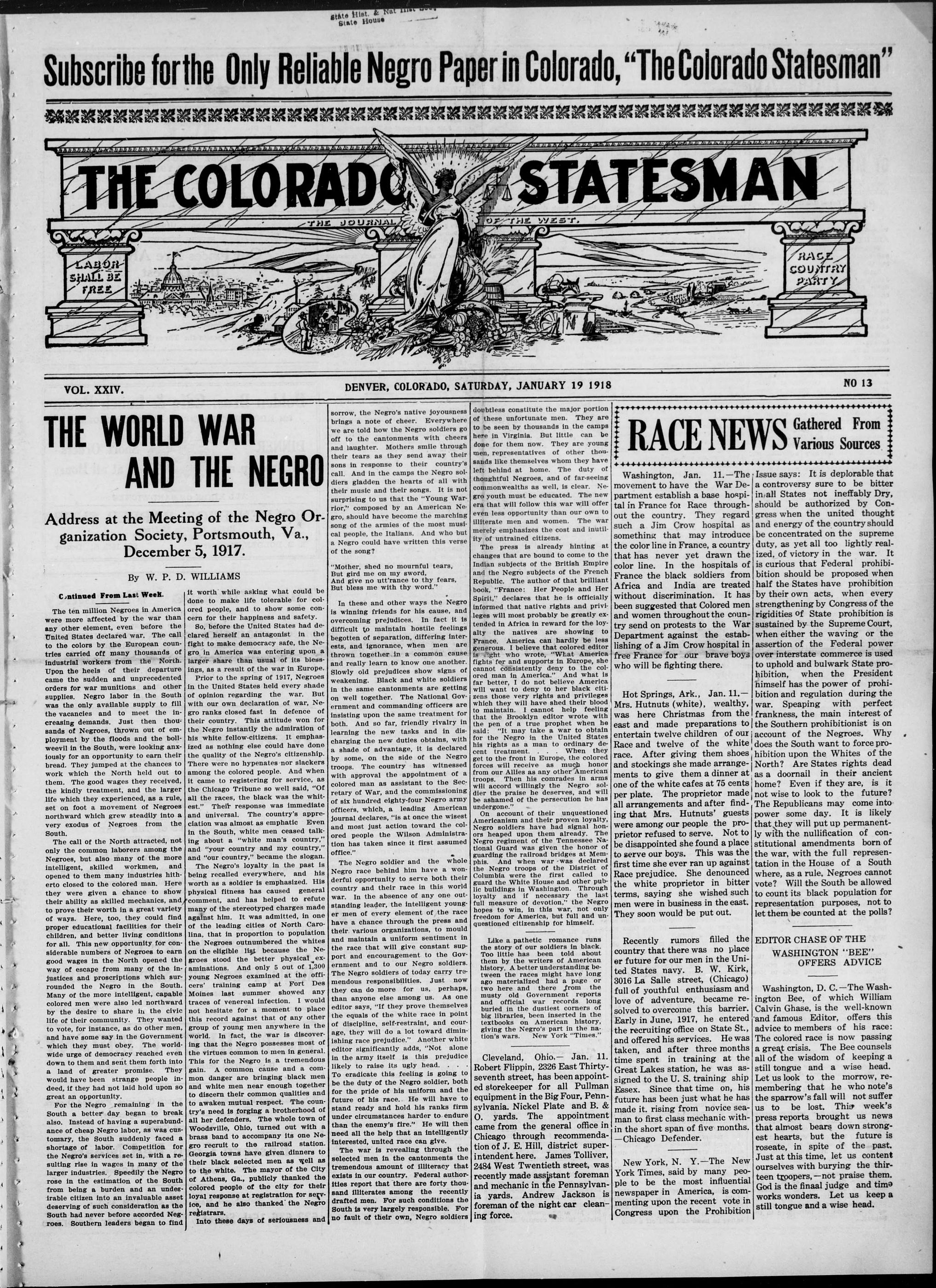
THE WORLD WAR AND THE NEGRO
Address at the Meeting of the Negro Organization Society, Portsmouth, Va., December 5, 1917. By W. P. D. WILLIAMS
Continued From Last Week
The ten million Negroes in America were more affected by the war than any other element, even before the United States declared war. The call to the colors by the European countries carried off many thousands of industrial workers from the North. Upon the heels of their departure came the sudden and unprecedented orders for war munitions and other supplies. Negro labor in the South was the only available supply to fill the vacancies and to meet the increasing demands. Just then thousands of Negroes, thrown out of employment by the floods and the bollweevil in the South, were looking anxiously for an opportunity to earn their bread. They jumped at the chances to work which the North held out to them. The good wages they received, the kindly treatment, and the larger life which they experienced, as a rule, set on foot a movement of Negroes northward which grew steadily into a very exodus of Negroes from the South.
The call of the North attracted, not only the common laborers among the Negroes, but also many of the more intelligent, skilled workmen, and opened to them many industries hitherto closed to the colored man. Here they were given a chance to show their ability as skilled mechanics, and to prove their worth in a great variety of ways. Here, too, they could find proper educational facilities for their children, and better living conditions for all. This new opportunity for considerable numbers of Negroes to earn good wages in the North opened the way of escape from many of the injustices and proscriptions which surrounded the Negro in the South. Many of the more intelligent, capable colored men were also led northward by the desire to share in the civic life of their community. They wanted to vote, for instance, as do other men, and have some say in the Government which they must obey. The worldwide urge of democracy reached even down to them and sent them forth into a land of greater promise. They would have been strange people indeed, if they had not laid hold upon so great an opportunity.
For the Negro remaining in the South a better day began to break also. Instead of having a superabundance of cheap Negro labor, as was customary, the South suddenly faced a shortage of labor. Competition for the Negro's services set in, with a resulting rise in wages in many of the larger industries. Speedily the Negro rose in the estimation of the South from being a burden and an undesirable citizen into an invaluable asset deserving of such consideration as the South had never before accorded Negroes. Southern leaders began to find
VOL. XXIV.
it worth while asking what could be done to make life tolerable for colored people, and to show some concern for their happiness and safety.
So, before the United States had declared herself an antagonist in the fight to make democracy safe, the Negro in America was entering upon a larger share than usual of its blessings, as a result of the war in Europe. Prior to the spring of 1917, Negroes in the United States held every shade of opinion regarding the war. But with our own declaration of war, Negro ranks closed fast in defence of their country. This attitude won for the Negro instantly the admiration of his white fellow-citizens. It emphasized as nothing else could have done the quality of the Negro's citizenship. There were no hypenates nor slackers among the colored people. And when it came to registering for service, as the Chicago Tribune so well said, "Of all the races, the black was the whitest." Their response was immediate and universal. The country's appreciation was almost as emphatic. Even in the South, white men ceased talking about a "white man's country," and "your country and my country," and "our country," became the slogan.
The Negro's loyalty in the past is being recalled everywhere, and his worth as a soldier is emphasized. His physical fitness has caused general comment, and has helped to refute many of the stereotyped charges made against him. It was admitted, in one of the leading cities of North Carolina, that in proportion to population the Negroes outnumbered the whites on the eligible list because the Negroes stood the better physical examinations. And only 5 out of 1,300 young Negroes examined at the officers' training camp at Fort Des Moines last summer showed any traces of venereal infection. I would not hesitate for a moment to place this record against that of any other group of young men anywhere in the world. In fact, the war is discovering that the Negro possesses most of the virtues common to men in general. This for the Negro is a tremendous gain. A common cause and a common danger are bringing black men and white men near enough together to discern their common qualities and to awaken mutual respect. The country's need is forging a brotherhood of all her defenders. The whole town of Woodsville, Ohio, turned out with a brass band to accompany its one Negro recruit to the railroad station. Georgia towns have given dinners to their black selected men as well as to the white. The mayor of the City of Athens, Ga., publicly thanked the colored people of the city for their loyal response at registration for service, and he also thanked the Negro registrars.
Into these days of seriousness and
DENVER, COLORADO, SATURDAY, JANUARY 19 1918
DENVER, COLORADO, SATURDAY, JANUARY 19 1918
state Hist. & Nat Hist Body
State House
able Negro Pa
ADO
E JOURNAL
DENVER, COLORADO, SAT
sorrow, the Negro's native joyousness brings a note of cheer. Everywhere we are told how the Negro soldiers go off to the cantonments with cheers and laughter. Mothers smile through their tears as they send away their sons in response to their country's call. And in the camps the Negro soldiers gladden the hearts of all with their music and their songs. It is not surprising to us that the "Young Warrior," composed by an American Negro, should have become the marching song of the armies of the most musical people, the Italians. And who but a Negro could have written this verse of the song?
"Mother, shed no mournful tears, But gird me on my sword, And give no uttrance to thy fears, But bless me with thy word."
In these and other ways the Negro is winning friends for his cause, and overcoming prejudices. In fact it is difficult to maintain hostile feelings begotten of separation, differing interests, and ignorance, when men are thrown together in a common cause and really learn to know one another. Slowly old prejudices show signs of weakening. Black and white soldiers in the same cantonments are getting on well together. The National Government and commanding officers are insisting upon the same treatment for both. And so far, friendly rivalry in learning the new tasks and in discharging the new duties obtains, with a shade of advantage, it is declared by some, on the side of the Negro troops. The country has witnessed with approval the appointment of a colored man as assistant to the Secretary of War, and the commissioning of six hundred eighty-four Negro army officers, which, a leading American journal declares, "is at once the wisest and most just action toward the colored people the Wilson Administration has taken since it first assumed office."
The Negro soldier and the whole Negro race behind him have a wonderful opportunity to serve both their country and their race in this world war. In the absence of any one outstanding leader, the intelligent younger men of every element of the race have a chance through the press and their various organizations, to mould and maintain a uniform sentiment in the race that will give constant support and encouragement to the Government and to our Negro soldiers. The Negro soldiers of today carry tremendous responsibilities. Just now they can do more for us, perhaps, than anyone else among us. As one editor says, "If they prove themselves the equals of the white race in point of discipline, self-restraint, and courage, they will do a lot toward diminishing race prejudice." Another white editor significantly adds, "Not alone in the army itself is this prejudice likely to raise its ugly head. . . . To eradicate this feeling is going to be the duty of the Negro soldier, both for the pride of his uniform and the future of his race. He will have to stand ready and hold his ranks firm under circumstances harder to endure than the enemy's fire." He will then need all the help that an intelligently interested, united race can give.
The war is revealing through the selected men in the cantonments the tremendous amount of illiteracy that exists in our country. Federal authorities report that there are forty thousand illiterates among the recently drafted men. For such conditions the South is very largely responsible. For no fault of their own, Negro soldiers
doubtless constitute the major portion of these unfortunate men. They are to be seen by thousands in the camps here in Virginia. But little can be done for them now. They are young men, representatives of other thousands like themselves whom they have left behind at home. The duty of thoughtful Negroes, and of far-seeing commonwealths as well, is clear. Negro youth must be educated. The new era that will follow this war will offer even less opportunity than our own to illiterate men and women. The war merely emphasizes the cost and inutility of untrained citizens.
The press is already hinting at changes that are bound to come to the Indian subjects of the British Empire and the Negro subjects of the French Republic. The author of that brilliant book, "France: Her People and Her Spirit," declares that he is officially informed that native rights and privileges will most probably be greatly extended in Africa in reward for the loyalty the natives are showing to France. America can hardly be less generous. I believe that colored editor is right who wrote, "What America fights for and supports in Europe, she cannot consistently deny to the colored man in America." And what is far better, I do not believe America will want to deny to her black citizens those very rights and privileges which they will have shed their blood to maintain. I cannot help feeling that the Brooklyn editor wrote with the pen of a true prophet when he said: "It may take a war to obtain for the Negro in the United States his rights as a man to ordinary decent treatment. . . . When they get to the front in Europe, the colored forces will receive as much honor from our Allies as any other American troops. Then his comrades in arms will accord willingly the Negro soldier the praise he deserves, and will be ashamed of the persecution he has undergone."
On account of their unquestioned Americanism and their proven loyalty, Negro soldiers have had signal honors heaped upon them already. The Negro regiment of the Tennessee National Guard was given the honor of guarding the railroad bridges at Memphis. And when war -was declared the Negro troops of the District of Columbia were the first called to guard the White House and other public buildings in Washington. Through loyalty and if necessary the last full measure of devotion," the Negro hopes to win, in this war, not only freedom for America, but full and unquestioned citizenship for himself.
Like a pathetic romance runs the story of our soldiers in black. Too little has been told about them by the writers of American history. A better understanding between the races might have long ago materialized had a page or two here and there from the musty old Government reports and official war records long buried in the dustiest corners of big libraries, been inserted in the textbooks on American history, giving the Negro's part in the nation's wars. New York "Times."
Cleveland, Ohio.— Jan. 11. Robert Flippin, 2326 East Thirty-seventh street, has been appointed storekeeper for all Pullman equipment in the Big Four, Pennsylvania. Nickel Plate and B. & O. yards. The appointment came from the general office in Chicago through recommendation of J. E. Hill, district superintendent here. James Tolliver, 2484 West Twentieth street, was recently made assistant foreman and mechanic in the Pennsylvania yards. Andrew Jackson is foreman of the night car cleaning force.
RACENEWS Gathered From Various Sources
Washington, Jan. 11. The movement to have the War Department establish a base hospital in France for Race throughout the country. They regard such a Jim Crow hospital as something that may introduce the color line in France, a country that has never yet drawn the color line. In the hospitals of France the black soldiers from Africa and India are treated without discrimination. It has been suggested that Colored men and women throughout the country send on protests to the War Department against the establishing of a Jim Crow hospital in free France for our brave boys who will be fighting there.
Hot Springs, Ark., Jan. 11.—Mrs. Hutnuts (white), wealthy, was here Christmas from the east and made preparations to entertain twelve children of our Race and twelve of the white race. After giving them shoes and stockings she made arrangements to give them a dinner at one of the white cafes at 75 cents per plate. The proprietor made all arrangements and after finding that Mrs. Hutnuts' guests were among our people the proprietor refused to serve. Not to be disappointed she found a place to serve our boys. This was the first time she ever ran up against Race prejudice. She denounced the white proprietor in bitter terms, saying she wished such men were in business in the east. They soon would be put out.
Recently rumors filled the country that there was no place er future for our men in the United States navy. B. W. Kirk, 3016 La Salle street, (Chicago) full of youthful enthusiasm and love of adventure, became resolved to overcome this barrier. Early in June, 1917, he entered the recruiting office on State St., and offered his services. He was taken, and after three months time spent in training at the Great Lakes station, he was assigned to the U. S. training ship Essex. Since that time on, his future has been just what he has made it. rising from novice seaman to first class mechanic within the short span of five months. —Chicago Defender.
New York, N. Y.—The New York Times, said by many people to be the most influential newspaper in America, is commenting upon the recent vote in Congress upon the Prohibition
NO 13
Issue says: It is deplorable that a controversy sure to be bitter in all States not ineffably Dry, should be authorized by Congress when the united thought and energy of the country should be concentrated on the supreme duty, as yet all too lightly realized, of victory in the war. It is curious that Federal prohibition should be proposed when half the States have prohibition by their own acts, when every strengthening by Congress of the rigidities of State prohibition is sustained by the Supreme Court, when either the waving or the assertion of the Federal power over interstate commerce is used to uphold and bulwark State prohibition, when the President himself has the power of prohibition and regulation during the war. Speaping with perfect frankness, the main interest of the Southern prohibitionist is on account of the Negroes. Why does the South want to force prohibition upon the Whites of the North? Are States rights dead as a doornail in their ancient home? Even if they are, is it not wise to look to the future? The Republicans may come into power some day. It is likely that they will put up permanently with the nullification of constitutional amendments born of the war, with the full representation in the House of a South where, as a rule, Negroes cannot vote? Will the South be allowed to count its black population for representation purposes, not to let them be counted at the polls?
EDITOR CHASE OF THE WASHINGTON "BEE" OFFERS ADVICE
Washington, D. C.—The Washington Bee, of which William Calvin Ghase, is the well-known and famous Editor, offers this advice to members of his race: The colored race is now passing a great crisis. The Bee counsels all of the wisdom of keeping a still tongue and a wise head. Let us look to the morrow, remembering that he who note's the sparrow's fall will not suffer us to be lost. This week's press reports brought us news that almost bears down strongest hearts, but the future is roseate, in spite of the past. Just at this time, let us content ourselves with burying the thirteen troopers,—not praise them. God is the finala judge and time works wonders. Let us keep a still tongue and a wise head.
FOREIGN
Mrs. Algernon Brinsley Sheridan, daughter of Lord Lothrop Motley, the famous historian, died in London. According to telegrams from Berlin Count von Hertling, the German imperial chancellor, is ill and probably will resign shortly, says an exchange telegraph dispatch. Former Premier Joseph Caillaux, who has been under investigation by the authorities in connection with the German propaganda in France, was placed under arrest in Paris. The British Food Ministry announces that it intends to make compulsory the employment of a certain percentage of potatoes in breadmaking. This is for the purpose of saving cereal foods.
The document which caused the arrest of M. Caillaux, former French premier, according to the Temps, showed that he had been directly or indirectly in communication with a representative of an enemy power. A dispatch to the London Times from Odessa describes disorders at Sebastopol in which sixty-two naval officers were killed, as two days of butchering in which the horrors of Kronstadt were re-enacted. Control of the destinies of the German empire, press accounts from neutral countries agree, is passing into the hands of the militarists or the leaders who want to hold what has been gained by might and the sword.
German newspapers, in referring to the Anglo-American measures against submarines indicate that the employment of the depth charge has been greatly increased and perfected since American destroyers arrived in European waters.
A meeting of the Fatherland party at Mannheim was frustrated by the independent socialists, the Amsterdam Kolnische Volks Zeitung says. After hours of pandemonium the meeting which was attended by about 3,000 persons was dispersed.
The British Labor party, in a message to the Russian people, announced that the British people accepted the Russian principle of self-determination of peoples and no annexations for the British empire, particularly in the Middle East, Africa and India.
Ten army officers, including Gen Leocadio Parra, out of forty-five arrested in connection with a plot to kill Gen. Alfredo Novo, commander of the military district in the state of Mexico, and Augustin Millan, governor of that state, were executed at Toluca, the state capital, about forty miles from Mexico City.
Food rioting in Vienna on New Year Day is described in a dispatch received from Switzerland. When the authorities announced that 500 Serbian pigs would be put on sale at seventy-five cents a pound, more than 20,000 people assembled outside the market, most of them remaining throuout the New Year Eve intense cold for the chance to buy.
**SPORT**
"Ted" Lewis, welterweight title holder, and Soldier Bartfield fought a 12-round draw at Columbus, Ohio.
Horse racing on ice, one of the popular winter sports in the Northern states, came into Cleveland, Ohio, with all the trimmings.
Chuck Schneider, halfback of the School of Mines football and captain-elect of the 1918 squad passed examination in Denver for the aviation corps.
Ultimus, a stallion by Commando, brought $26,000 at the sale of race horses when the Wickliffe stud of J. W. Corrigan was disposed of at auction at Lexington, Ky.
Had some one exploded a bomb under the Cubs' grandstand in Chicago it could scarcely have jolted things in President Weeghman's office more than did a flash of news coming from Lincoln, Neb., which stated that Grover Cleveland Alexander, the great pitcher, has been drafted and placed in Class 1 for United States army service.
GENERAL
America must accept no peace except "the peace of overwhelming victory," Theodore Roosevelt said in an address at a dinner of the Ohio society in New York. Efforts of German interests to obtain foothold in the Tampico oil fields of Mexico were disclosed by the arrest at Tucson, Ariz., of Charles Frederick Von Petersdorff, city engineer of Tucson. At Indiananopis, Ind., all theaters, saloons, poolrooms and places not absolutely necessary where heat and light are used were ordered closed immediately until further notice by Dr. Henry Jameson, federal fuel administrator for Indianapolis.
Dissolution "of the partnership of the Kaiser and God—a partnership which God does not seem to know about"—will be one of the things the United States will accomplish in the war, Senator William S. Kenyon of Iowa declared in addressing members of the Republican club of New York city at a luncheon.
G. W. Anderson, vice president of the Brotherhood of Railway Trainmen; G. V. McLaughlin, vice president of the Brotherhood of Locomotive Firemen and Enginemen, and A. Kennedy, assistant grand chief of the Brotherhood of Locomotive Engineers, declare that they are for the United States.
Charles R. Crane, head of the American mission to Russia, in an address at St. Louis told how Ambassador Francis stood at the door of the American embassy in Petrograd with a revolver in hand and held off a mob
LATEST NEWS EPITOMIZED
FROM TELEGRAPHIC REPORTS THAT COVER THE WEEK'S EVENTS.
OF MOST INTEREST
OF MOST INTEREST
KEEPING THE READER POSTED
ON MOST IMPORTANT
CURRENT TOPICS.
WESTERN Newspaper Union News service.
ABOUT THE WAR
Twenty-seven British, two Italian
and one French ship were sunk
during the past week.
Paris reports that the period of
Jan. 1 to 10 French pilots brought
down fifteen German airplanes and
one captive balloon.
Canadians again have raided German
trenches north of Lens, blowing
up their dugouts and taking prisoners
and a machine gun.
Warning of the possibility of a final
breach in the Russo-German negotiations is the outstanding feature of the
current news from Petrograd.
From 420,000 to 450,000 troops must be raised at once in England, Sir Auckland Geddes, minister of national service, told the House of Commons in London.
Another attack from the sea has been made by German war craft on an English coast town. Yarmouth was bombarded Monday night, three persons being killed and ten injured.
Cold weather and snows are still retarding the infantry activities on the battle front, where no fighting of moment is taking place, except in the nature of small patrol engagements and artillery duels. Notwithstanding the fact that similar conditions prevailed last week, the British casualties for the seven days ending Monday were 24,979, as compared with 18,998 the previous week and 9,951 the week before.
The London Daily News correspondent at Petrograd sends the following: "The final rupture of negotiations at Brest-Litovsk may be expected at any moment, if, as seems probable, the German militarists continue to impose their policy on their delegates." The correspondent says a dispatch from Kuban reports that the Turks have broken the armistice by landing 20,000 troops between Trebizond and Lize and that a submarine has sunk a Russian transport.
The Italians have again attacked the Austro-German front in the Monte Asolone region and made goodly gains of ground. They have added materially to their bridgehead east of Cape Sile, pushing back the enemy from several trenches, which were held by the Italians in spite of furious counter attacks. In the hill region the Austro-Germans offered strong resistance, but the Italians, in addition to inflicting extremely heavy casualties, captured eight officers and 283 men.
WESTERN
Kentucky is the second state in the United States to ratify the national prohibition amendment.
Capt. "Bill" McDonald, noted Texas ranger and personal friend and bodyguard of several presidents, died at Wichita Falls, Tex.
Midst the graves of seven of her nine husbands, Mrs. Emma Cameron Van Sickle, 89, was buried in the front yard of her home near McGregor, Iowa.
Before the San Francisco fire of 1906, Mrs. Caroline Wenban's fortune was $4,000,000. A month ago she died and her will filed at San Francisco shows but $44.46 in actual assets left.
Three persons were killed and about twenty injured when Union Pacific passenger train No. 132, bound from Beloit, Kan., to Solomon, Kan., was wrecked about one mile east of Beloit.
WASHINGTON
Many of the American soldiers in France will pay an income tax this Secretary McAdoo ordered priority shipments of fuel and food to New York. Daniel Willard, chairman of the War Industries Board, tendered his resignation to President Wilson. Eleven hundred ships have been armed by the navy against submarine attack since last March, it was revealed in the report of the House naval investigation sub-committee. As a result of continuing revelations of spying on American soil, feeling grew increasingly intense that summary punishment should now be meted out to those apprehended. Many argued this will be the only means of effectively checking enemy activity.
Residents of five western states may eat all the beef they want on meatless days, but no other meats, under a ruling by the Food Administration designed to meet a peculiar situation in California, Washington, Oregon, Nevada and Arizona. That persons conducting public eating places, manufacturers, carriers, producers, distributors or other persons who fail to obey the President's orders shall be fined up to $5,000 and imprisoned up to six years, is provided in the food bill introduced in the Senate.
SPORT
COLORADO
STATE NEWS
Western Newspaper Union News Service.
COMING EVENTS.
Jan. 22-23—Conference of food officials at Denver.
Jan. 19-26—Live stock show at Denver.
Jan. 29—Kansas Club banquet in Denver.
Feb. 22-23—Annual Winter Sports Carnival at Steamboat Springs.
Jan. 22-24—Annual meeting Colorado Metal Mining Association at State Capitol building in Denver.
Pueblo bank deposits show nearly five million increase during 1917.
The Manzanola High school building was damaged by fire.
Former Governor Ammons suggests that Coloradoans have a pinto bean day.
Striking Denver elevator pilots were given a raise from $10 to $15 per week.
Denver "went over the top" in its Red Cross drive—securing over 70,000 members.
Colorado Springs has passed the $50,000 mark in the sales of war savings stamps.
The Denver branch of the federal reserve bank of Kansas City has been formally opened.
Denver's new municipal organ, now being installed in the Auditorium will be finished Feb. 1.
Jan. 1 found the Colorado Springs banking institutions with a total of $14,494,142 on deposit.
Mrs. Dorothy Webb Leavitt will be one of the expert horsewomen in the show at Denver, Jan. 19-26.
* The oil section of the Colorado chapter of the American Mining Congress met in Denver and organized.
The mineral output of Custer county for the year past is given at $169,000 in gold, silver, copper, lead and spelter.
The Colorado Stock Growers' Association will hold its forty-fourth annual meeting Jan. 22 and 23 in Denver.
Three hundred and fifty delegates, representing 13,000 grangers of Colorado, opened the forty-fourth annual convention of the Colorado Grange at Denver.
On the banqueting table of the Uncompahgre Cattle and Horse Growers' Association at Montrose were placed 300 pounds of roast turkey, 150 pounds of beef and 75 pounds of hams.
Women of Denver are registering for war service with such determination that the 10,000 cards allotted to the city as the opening drive in the week's campaign already have been exhausted.
George Kenneth Thomas, son of Senator Charles S. Thomas of Denver, received a telegram to start immediately for Columbus, Ohio, to join the United States signal corps, in which he recently enlisted.
The farmers of Crowley county last season received $220,000 from the sale of alfalfa hay which was sold to the alfalfa meal mills at Ordway and Crowley. This amount is from the sale of approximately 11,000 tons of hay.
A telegram was received in Denver by attaches of the labor commissioner's office containing information of the death at Bloomington, Ill., of Mrs. John Morrissey, 85 years of age, mother of William L. Morrissey, state labor commissioner.
A telegram was received in Denver from Congressman E. T. Taylor by Governor Gunter, conveying the information that Herbert C. Hoover, national food administrator, will not be able to visit Denver during the National Western Livestock show.
Denver was one of the twenty-nine cities in a list of 173 of the largest in the United States to show a gain in building permits for 1917 over 1916. There were 2,350 permits for buildings whose cost totaled $4,292,000, a gain of 6 per cent over 1916.
Ernest A. Wright, according to Thera K. Wright of Denver, had at least forty-one women "on the string." She named but one—Margaret McCoy—but volunteered to furnish the court with the names of others, if necessary. She was awarded a divorce on the ground of misconduct.
Jack Garrett Scott, 22 years old, the youngest deputy United States marshal in the Colorado district, tendered his resignation to United States Marshal Samuel J. Burria and left for a naval training station near San Pedro, Cal., where he has been ordered to report by the navy department.
The American farmer has done more for his share of the war than has been done by any other class. President Charles A. Lory of the Colorado Agricultural College told delegates to the ninth annual convention of the Colorado Farmers' and Farm Women's Congress at Fort Collins. During the tourist season, beginning May 1 and ending Oct. 31, 1917, a total of approximately 853.307 persons visited national forests of Colorado, according to an annual report issued by W. I. Hutchinson of the United States forestry department for the Rocky mountain district.
Maj. M. C. Harrington, commander of the quartermaster's corps at Fort Logan, has received orders to go at once to Kansas City to become purchasing officer for all of the forage for all army posts of the United States in this country and France.
WESTERN STOCK SHOW
TWELFTH ANNUAL EXHIBIT AT
DENVER JAN. 19-26.
Economic Methods Will Be Taught at
Fair by Federal and State Food
Administration Chiefs.
Western Newspaper Union News Service.
Denver.—The Hotel Men's Association here held a meeting and resolved not to raise their rates during the twelfth annual National Western Stock and Horse Show, to be opened in the $250,000 amphitheater at the Denver stock yards Jan. 19 and continue until Jan. 26. The city leaders are preparing for the greatest attendance ever known at a western cattle exposition. Many federal and state food administration chiefs will have booths at the fair and teach economic farming and home methods. Brilliant arrays of society folk will make the horse show rival similar occasions in New York and Chicago. Mrs. Loula Long Combs, of Kansas City, and Mrs. Lynde Selden, of New York, famous horsewomen and show exhibitors, will attend the Denver exposition with many high-stepping horses and ponies. More than 1,500 fancy fowls have been entered for the big poultry show prizes, in a special department of the exposition. As the Denver fair is educational and helpful to food production, the federal government has decreed that the admission tickets shall be exempt from war tax.
Farmers Affirm Fealty to Flag.
Fort Collins—"Win the war" was the slogan at the Farmers' and Farm Woman's congress at its ninth annual session here. The first meeting was largely devoted to patriotic addresses and to reports of committees concerning the support given by Colorado farmers to the Red Cross, the war Y. M. C. A. and other war work. David Halls of Mancos, president of the congress, declared in the opening speech that if there are any farmers less conscious of the country's needs than they should be, it is those who do not read the papers and that the publicity committee of the government has failed to reach them. J. H. Sanborn spoke on the necessity of raising more chickens. The state, he said, consumes $6,000,000 worth of poultry and eggs in a year, and produces only $2,000,000 worth. Mr. Sanborn sald he found that the farmers are doing their part in the war by increasing their production of crops and livestock. "Plant sugar beets," advised Dr. Charles A. Lory, president of the Agricultural college.
Apartments Temples of Race Suicide.
Apartments Temples of Race Suicide. Denver.—"Women cannot be mothers and stenographers, typists or clerks at the same time. One or other have to be sacrificed, and the pity of it is they are sacrificing the very purpose of their existence—motherhood. The man who marries a woman with the understanding that she is to continue to be a wage-earner in factory, store or office has a distorted idea of marriage. If his salary cannot suffice her, let him remain unmarried." So said the Rev. Hugh L. McMenamin in his sermon at the Cathedral of the Immaculate Conception. A week ago Father McMenamin warned his parishioners against race suicide and took occasion to warn them also against "the terrible sins involved in artificial birth control," saying that "no circumstance could excuse this crime."
Longmont Officer Arrives In France.
Longmont—Postmaster T. T. Donovan is in receipt of a cablegram from his son, Lieut. John Donovan, telling of the latter's safe arrival in France. Young Donovan, former star football player and once captain of the State university eleven, received his commission at Fort Sheridan. After receiving his commission he came to Longmont for a visit with relatives. His visit was cut short, however, by orders to proceed at once to the eastern coast. Nothing further was heard from him until the receipt of the cablegram from France.
Find Rich Ore at Great Depth.
Cripple Creek—What is regarded as the most significant discovery of the new year in the Cripple Creek district is that at the Portland mine, where a vein of ore twenty-five feet wide, averaging $50 a ton, has been encountered. The finding of this large body of ore at a depth of 2,000 feet, say mining men, demonstrates that there is a second stratum of ore in the district mines, and a resumption of sinking shafts to a lower depth is anticipated.
Denver Engineer on Sinking Ship.
Denver. — Roy Odette, a Denver youth and graduate of Manual Training High School, was second engineer of the American merchant ship Texan, reported sinking somewhere in the Atlantic.
Failed Bank Pays Dividend.
Pueblo—Another dividend of 5 per cent was declared by the receiver, H. H. Seldomridge, of the defunct Mercantile National bank. This makes a total of 75 per cent in the dividends declared to the depositors, and another is probable soon.
Four Bables Burned to Death.
Trinidad.—Four children, ranging in age from 2 to 5 years, were burned to death in a small frame house at Hastings, a coal mining camp.
Western Beef Co.
Open Daily to 8:30 p. m.
ONE OF THE MOST
MARKET
Fresh Oysters, Chitterl
Neck Bones, Sp
Fresh and Cured Meats
and
Our Pr
t
Free Deliver
PHC
2048 LARIMER STREET
Oppoe
Bolden Bros.
924 NINETEENTH
THE MOST UP-TO-DATE AND SAL
MARKETS IN THE CITY.
Purs, Chitterlings, Pig Tails, Snouts, Ears,
R Bones, Spare Ribs, Received Fresh D
Furred Meats of All Kinds. Fresh Vegeta
and Fancy Groceries.
Our Prices Are Always
the Lowest
Free Delivery to All Parts of the City.
PHONE CHAMPA 1641.
MER STREET DENV
Opposite the Three Rules.
Bros. Cafe & Lunch
NETEENTH STREET, DENVER, CO
ONE OF THE MOST UP-TO-DATE AND SANITARY MARKETS IN THE CITY.
Fresh Oysters, Chitterlings, Pig Tails, Snouts, Ears, Pigs Feet, Neck Bones, Spare Ribs, Received Fresh Daily. Fresh and Cured Meats of All Kinds. Fresh Vegetables, Staple and Fancy Groceries.
PHONE CHAMPA 1641.
2048 LARIMER STREET DENVER, COLO.
Opposite the Three Rules.
DINNER
11:30 to 2 p.m.
ALL KING
BOLDEN BLD
Baths
FIRST
R. B. BOLDEN, Manage
The Cham
Twenty
Is
DRUGS, CHEMICALS
WE SEE
Prescripti
Phone us and we will do
JAMES B
Weather
TEL
PIONEER
WE M
PRACTICE
RENOVATORS, BLE
Of Gents' and L
1624 CH
HOME MAIN 3028
JOHN
Meats, Fancy
1864
Corner Nineteenth.
The MARK
G. E. SMITH, H
wholesale and Retail Stap
Hotels and
Eastern
ALL KINDS OF SANDWICHES
EN BROS. BARBER
Baths, Electric Massage
FIRST-CLASS SERVICE
DEN, Manager 926 19th
Champa Pharma
Twentieth and Champa,
Is the place to get your
CHEMICALS AND PATENT M
WE SERVE DRINKS
Scriptions Our Spec
and we will deliver the goods to all parts
JAMES E. THRALL, P
PHONE MAIN 2425.
atherhead Ha
TELEPHONE MAIN 3203
BOLDEN BROS. BARBER SHOP
Baths, Electric Massage
FIRST-CLASS SERVICE
R. B. BOLDEN, Manager 926 19th St., Denver
Twentieth and Champa,
Is the place to get your
DRUGS, CHEMICALS AND PATENT MEDICINES
WE SERVE DRINKS.
Prescriptions Our Specialty.
Phone us and we will deliver the goods to all parts of the city.
JAMES E. THRALL, PROPR.
PHONE MAIN 2426.
Weatherhead Hat Co. TELEPHONE MAIN 3203
Established 1876
PIONEER HATTERS OF THE WEST
WE MAKE OLD HATS NEW
PRACTICAL HATTERS
MOTORS, BLEACHERS DYERS AND FIX
ENTS' and Ladies' Hats of Every Descr
1624 Champa St., Denver, Colo.
N 8028 RES. PHONE
JOHN K. RETTIG
Fancy and Staple Gr
1864 OURTIS STREET
enth.
MARKET COMM
E. SMITH, Manager, Res. Phone South
Retail Staple and Fancy Groceries, Fi
Hotels and Restaurants Our Specialty
Fresh and Cured
Eastern Corn Fed Me
Established 1876
PIONEER HATTERS OF THE WEST
WE MAKE OLD HATS NEW
PRACTICAL HATTERS
RENOVATORS, BLEACHERS DYERS AND FINISHERS
Of Gents' and Ladies' Hats of Every Description
1624 Champa St., Denver, Colo.
PHONE MAIN 8028 RES. PHONE GALLUP 942 JOHN K. RETTIG Meats, Fancy and Staple Grocerles 1864 CURTIS STREET Corner Nineteenth. Denver, Cola
The MARKET COMPANY
C. E. SMITH, Manager, Res. Phone South 1608
Wholesale and Retail Staple and Fancy Groceries, Fish and Oysters Hotels and Restaurants Our Specialty. Fresh and Cured
Eastern Corn Fed Meats
Fruits, Vegetables, Poultry and Game.
Telephones 22-636 15th Street
Telephones Main 4302, 4303, 4304, 4305
5th Street Denver
Sundays Until 2:00
p. m.
E AND SANITARY
CITY.
Snouts, Ears, Pigs Feet,
Red Fresh Daily.
Fresh Vegetables, Staple
Lies.
Always
st
of the City.
1641.
DENVER, COLO.
Rules.
Lunch Room
DENVER, COLORADO
Short Orders at all Hours
BERBER SHOP
page
VICE
926 19th St., Denver
Pharmacy
nampa,
your
PATENT MEDICINE
DRINKS.
Specialty.
to all parts of the city.
LL, PROPR.
225.
Red Hat Co.
3203
THE WEST
NEW
ATTERS
ERS AND FINISHERS
Every Description
er, Colo.
ES. PHONE GALLUP 945
TTIG
Apple Groceries
SEET
Denver, Colo.
COMPANY
phone South 1608
proceries, Fish and Oysters
or Specialty.
ed Meats
3,4304,4305
Denver, Colorado
```markdown
```
Fruit Bowl
```markdown
```
AMERICAN SUGAR SENT TO FRANCE
American Price Rigidly Regulated by United States Food Administration.
CONSUMERS HERE PAY 9c.
Sugar Cost 35 Cents a Pound During Civil War—Refiners' Profits Now Curtalled.
Sugar is selling today throughout America at from 8½ to 9 cents a pound to the consumer, even though there is a world shortage which has reduced this nation's sugar allotment to 70 per cent of normal.
Through the efforts of the United States food administration the sugar market has been regulated as far as the producer, refiner and wholesaler is concerned. The food administration has no power to regulate retail prices except by public opinion. Even though more than 85,000 tons of sugar have been shipped to France in the last four months the retail grocer's sugar price is around 8 to $8½ cents. He should sell this sugar at 8½ to 9 cents, the food administration believes, and asks the American housewife to pay no more than this amount.
Last August when the food administration was organized the price of sugar rose suddenly to 11 cents a pound. During the Civil War sugar cost the consumer 35 cents a pound. By regulation of the sugar market and reducing the price to 8½ and 9 cents and keeping it from advancing to 20 cents the food administration has saved the American public at least $180,000,000 in four months, according to a statement made by Herbert Hoover the other day.
"It is our stern duty to feed the allies, to maintain their health and strength at any cost to ourselves," Mr. Hoover declared. "There has not been, nor will be as we see it, enough sugar for even their present meagre and depressing ration unless they send ships to remote markets for it. If we in our greed and gluttony force them either to further reduce their ration or to send these ships we will have done damage to our abilities to win this war.
"If we send the ships to Java for 250,000 tons of sugar next year we will have necessitated the employment of eleven extra ships for one year. These ships—if used in transporting troops—would take 150,000 to 200,000 men to France."
Reason for World Shortage.
As Mr. Hoover pointed out, the United States, Canada and England were sugar importing countries before the war, while France and Italy were very nearly self supporting. The main sources of the world's sugar supply was Germany and neighboring powers, the West Indies and the East Indies. German sugar is no longer available, as it is used entirely in Germany, which also absorbs sugar of surrounding countries.
England can no longer buy 1,400,000 long tons of sugar each year from Germany. The French sugar production has dropped from 750,000 to 210,000 tons. The Italian production has fallen from 210,000 tons to 75,000 tons. Thus three countries were thrown upon East and West Indian sources for 1,925,000 tons annually to maintain their normal consumption.
Because of the world's shipping shortage the allied nations started drawing on the West Indies for sugar; East Indian sugar took three times the number of ships, since the distance was three times as great. Suddenly the west was called on to furnish and did furnish 1,420,000 tons of sugar to Europe when 300,000 tons a year was the pre-war demand. The allies had drawn from Java 400,000 tons before the shipping situation became acute.
"In spite of these shipments," Mr. Hoover stated the other day, "the English government in August reduced the household sugar ration to a basis of 24 pounds per annum per capita. And in September the French government reduced their household ration to 13-2-10 pounds a year, or a bit over 1 pound of sugar a month. Even this meagre ration could not be filled by the French government it was found early in the fall. America was then asked for 100,000 tons of sugar and succeeded in sending 85,000 tons by December 1. The French request was granted because the American household consumption was then at least 55 pounds per person, and it was considered the duty of maintaining the French morale made our course clear."
Today the sugar situation may be summarized by stating that if America will reduce its sugar consumption 10 to 15 per cent, this nation will be able to send 200,000 more soldiers to France.
Sugar today sells at seaboard refineries at $7.25 a hundred pounds. The wholesale grocer has agreed to limit his profit to 25 cents a hundred plus freight, and the retail grocer is supposed to take no more than 50 cents a hundred pounds profit. This regulation was made by the food administration, which now asks the housewife to reduce sugar consumption as much as possible, using other sweeteners, and also reminds her that she should pay no more than 9 cents a pound for sugar.
Control of Cane Refiners' Profits.
"Immediately upon the establishment of the food administration," Mr.
Hoover said, "an examination was made of the costs and profits of refining and it was finally determined that the spread between the cost of raw and the sale of refined cane sugar should be limited to $1.30 per hundred pounds. The pre-war differential had averaged about 85 cents and increased costs were found to have been imposed by the war in increased cost of refining, losses, cost of bags, labor, insurance, interest and other things, rather more than cover the difference. After prolonged negotiations the refiners were placed under agreement establishing these limits on October 1, and anything over this amount to be agreed extortionate under the law.
"In the course of these investigations it was found by canvass of the Cuban producers that their sugar had, during the first nine months of the past year, sold for an average of about $4.24 per hundred f. o. b. Cuba, to which duty and freight added to the refiners' cost amount to about $5.66 per hundred. The average sale price of granulated by various refineries, according to our investigation, was about $7.50 per hundred, or a differential of $1.84
"In reducing the differential to $1.30 there was a saving to the public of 54 cents per hundred. Had such a differential been in use from the 1st of January, 1917, the public would have saved in the first nine months of the year about $24,800,000."
Next Year.
With a view to more efficient organization of the trade in imported sugars next year two committees have been formed by the food administration : 1. A committee comprising representatives of all of the elements of American cane refining groups. The principal duty of this committee is to divide the sugar imports pro rata to their various capacities and see that absolute justice is done to every refiner.
2. A committee comprising three representatives of the English, French and Italian governments; two representatives of the American refiners, with a member of the food administration. Only two of the committee have arrived from Europe, but they represent the allied governments. The duties of this committee are to determine the most economical sources from a transport point of view of all the allies to arrange transport at uniform rates, to distribute the foreign sugar between the United States and allies, subject to the approval of the American, English, French and Italian governments.
This committee, while holding strong views as to the price to be paid for Cuban sugar, has not had the final voice. This voice has rested in the governments concerned, together with the Cuban government, and I wish to state emphatically that all of the gentlemen concerned as good commercial men have endenvowed with the utmost patience and skill to secure a lower price, and their persistence has reduced Cuban demands by 15 cents per hundred. The price agreed upon is about $4.40 per hundred pounds, f. o. b. Cuba, or equal to about $6 duty paid New York.
"This price should eventuate," Mr. Hoover said, "to about $7.30 per hundred for refined sugar from the refiners at seaboard points or should place sugar in the hands of the consumer at from $8½ to 9 cents per pound, depending upon locality and conditions of trade, or at from 1 to 2 cents below the prices of August last and from one-half to a cent per pound cheaper than today.
"There is now an elimination of speculation, extortionate profits, and in the refining alone the American people will save over $25,000,000 of the refining charges last year. A part of these savings goes to the Cuban, Hawaiian, Porto Rican and Lousianian producer and part to the consumer.
"Appeals to prejudice against the food administration have been made because the Cuban price is 34 cents above that of 1917. It is said in effect that the Cubans are at our mercy; that we could get sugar a cent lower. We made exhaustive study of the cost of producing sugar in Cuba last year through our own agents in Cuba, and we find it averages $3.30, while many producers are at a higher level. We found that an average profit of at least a cent per pound was necessary in order to maintain and stimulate production or that a minimum price of $4.37 was necessary, and even this would stifle some producers.
"The price ultimately agreed was 23 cents above these figures, or about one-fifth of a cent per pound to the American consumer, and more than this amount has been saved by our reduction in refiners' profits. If we wish to stifle production in Cuba we could take that course just at the time of all times in our history when we want production for ourselves and the allies. Further than that, the state department will assure you that such a course would produce disturbances in Cuba and destroy even our present supplies, but beyond all these material reasons is one of human justice. This great country has no right by the might of its position to strangle Cuba.
"Therefore there is no imposition upon the American public. Charges have been made before this committee that Mr. Rolph endearved to benefit the California refinery of which he was manager by this 34 cent increase in Cuban price. Mr. Rolph did not fix the price. It does raise the price to the Hawaiian farmer about that amount. It does not raise the profit of the California refinery, because their charge for refining is, like all other refiners, limited to $1.30 per hundred pounds, plus the freight differential on the established custom of the trade.
"Mr. Rolph has not one penny of interest in that refinery."
TEUTONS REJECT DEMANDOFSLAVS
BREST-LITOVSK COUNCIL WILL NOT STOP THE WAR, SAY GERMANS.
MILLION TROOPS MOVED
PEACE NEGOTIATIONS USED AS CLOAK TO HIDE STRENGTHENING OF WESTERN FRONT.
Western Newspaper Union News Service.
London, Jan. 18.—The Central powers have flatly rejected Russian demands for withdrawal of Teutonic armies from occupied portions of Russia, according to wireless dispatches from Berlin.
On Monday, according to these messages, the Central powers' delegates at Brest-Litovsk made a lengthy reply asserting that Germany and Austria-Hungary "do not intend incorporating the occupied territories into their respective countries," but adding that "withdrawal of Central powers' armies is impossible as long as the war lasts."
"However," the statement added, "we would endeavor to reduce the number of occupying troops."
"The Central powers agree in the principle that the people should vote on broad lines on the basis of citizenship, but a referendum appears to be impractical. A vote taken by an elected representative body seems sufficient. The Central powers can go no farther." The statement also asserted that the Teutons were "willing in a benevolent spirit to examine the question of return of refugees," which was insisted upon by the Russians.
In some quarters in Germany it is believed the crown councils had more to do with plans for military operations on the western front. German newspapers have heralded a strong attack on this front and it has been declared that the Germans had brought more than 1,000,000 men to France from the eastern front.
London.—A pitched battle has occurred in the streets of Odessa between Ukrainian and Bolshevik troops, according to a dispatch received in Petrograd and forwarded by Reuter's Limited. The Ukrainians held the theater building and posted machine guns in nearby streets. The shooting soon spread throughout the city. The chief of the Bolshevik troops was wounded mortally.
FIVE-DAY BAN ON FUEL SIGNED.
Protest Wired President Wilson Declares Disaster Will Follow Move.
New York, Jan. 18.—Protest against the coal order was wired to President Wilson by the National Association of Manufacturers, declaring that the order carried "possibilities for appalling disaster to our country," and the additions to the burdens already being carried by the country's industries "will inevitably result in a breakdown."
The majority of the 700,000 union employés in the New York district will be affected by the Fuel Administration order, according to Ernest Bohm, secretary of the Central Federated Union of the American Federation of Labor.
"It is up to the employers," he said, "to see that labor is paid during the enforced holidays. We have done and are doing our bit. The employers must do theirs."
ITALIANS HURL BACK HUNS.
Desperate Blow Made to Regain Lost Ground Repulsed With Heavy Losses.
Rome, Jan. 18.—The Austrians made a desperate and prolonged attempt to recapture the positions taken on Monday by the Italians east of Capo Sile on the lower Plaive front. The war of office announces that the Austrians were repulsed, leaving 119 prisoners in the hands of the Italians. The battleground was covered with enemy dead and with more than 500 rifles.
An official communication says that the Italian shipping losses last week were two steamers of more than 1,500 tons sunk.
Italian Headquarters in Northern Italy.—The enemy has received another bloody repulse on the Lower Plave, on the sector nearest Venice. Here his attack was thrown back after four hours of desperate fighting. The enemy suffered heavy losses, the ground being strewn with his dead. The Italians captured 150 prisoners and a large quantity of guns and war material.
Labor Hard Hit, Says Gompers. Washington. — Samuel Gompers, president of the American Federation of Labor, in a statement, declared that the workers of the nation will be the greatest sufferers from the fuel restriction order, but that they will "maintain their loyal stand despite their suffering and sacrifices which they may be called upon to bear."
Swiss Formally Recognize Finland. Berne.—The Swiss Government has acknowledged formally the sovereignty and independence of Finland.
GLOSE FACTORIES TO CONSERVE COAL
GLOSE FACTORIES TO CONSERVE COAL
TEXT OF FUEL ADMINISTRATOR GARFIELD'S ORDER TO RELIEVE COAL SHORTAGE.
Food Plants Are Excepted in Edict to Close Factories for Five Days—Munitions and Ship-Making to Suspend, at Least in Part.
Western Newspaper Union News Services.
Washington, Jan. 17.—The text of Fuel Administrator Garfield's coal order had not been completed at a late hour last night. An abstract given out by the Fuel Administration follows:
1—Until further order of the United States fuel administrator all persons selling fuel in whatever capacity shall give preference to orders for necessary requirements.
A—Of railroads;
B—Of domestic consumers, hospitals, charitable institutions and army and navy cantonments;
C—Of public utilities, telephones and telegraph plants;
D—Of ships and vessels for bunker purposes;
E—Of the United States for strictly governmental purposes; not including orders from or for factories or plants working on contracts for the United States;
F—Of municipal, county or state governments for necessary public uses;
G—Of manufacturers of perishable food or of food for necessary immediate consumption.
The order further provides that on Jan. 18, 19, 20, 21 and 22, 1918, no fuel shall be delivered to any person, firm, association or corporation for any uses or requirements not included in the foregoing list until the requirements included in the list shall have been first delivered.
2—On Jan. 18, 19, 20, 21 and 22, 1918, and also on each and every Monday beginning Jan. 28, 1918, and continuing up to and including March 25, 1918, no manufacturing plant shall burn fuel or use power derived from fuel for any purpose except:
A—Such plants as from their nature must be continuously operated seven days each week, to avoid serious injury to the plant itself or its contents.
B—Manufacturers of perishable foods.
C—Manufacturers of food not perishable and not in immediate demand who may burn fuel to such extent as is authorized by the fuel administrator of the state in which such plant is located or by his representative authorized therefor upon application by the United States food administrator.
D—Printers or publishers of daily papers may burn fuel as usual excepting on every Monday from Jan. 21 to March 25, 1918, inclusive, on which days they may burn fuel to such extent as is necessary to issue such editions as such papers customarily issue on important national legal holidays and where such papers do not issue any editions on a holiday, they are permitted to issue one edition on the said Mondays.
E—Printing establishments may burn fuel on Jan. 18, 19, 20 and 22 to such extent as is necessary to issue current numbers of magazines and other publications periodically issued.
3—On each Monday beginning Jan. 21, 1918, and continuing up to and including Monday, March 25, 1918, no fuel shall be burned except to such extent as is essential to prevent injury to property from freezing, for the purpose of supplying heat for:
A—Any business or professional offices, except offices used by the United States, state, county or municipal government, transportation companies, or which are occupied by banks and trust companies or by physicians or dentists;
B—Wholesale or retail stores, or any other stores, business houses or buildings whatever, except that for the purpose of selling food only, for which purposes stores may maintain necessary heat until 12 o'clock noon; and for the purpose of selling drugs and medical supplies only, stores may maintain necessary heat throughout the day and evening;
C—Theaters, moving picture houses, bowling alleys, billiard rooms, private or public dance halls, or any other place of amusement.
On the above specified Mondays, no fuel shall be burned for the purpose of heating rooms or buildings in which liquor is sold on those days.
No fuel shall be burned on any of the foregoing specified Mondays for the purpose of supplying power for the movement of surface, elevated, subway or suburban cars or trains in excess of the amount used on the Sundays previous thereto.
The order provides that nothing in this order shall be held to forbid the burning of fuel to heat rooms or such portions of buildings as are used in connection with the production or distribution of fuel.
The state fuel administrators are authorized by the order to issue orders on special applications for relief, where necessary, to prevent injury to health or destruction or injury to property by fire or freezing. The order is effective in all of the territory of the United States east of the Mississippi river.
FLORAL DESIGNS PUT UP WHILE YOU WAIT
CHOICE PLANTS AND CUT FLOWERS CONSTANTLY ON HAND
GREENHOUSES: Thirty-Fou and Curtis Streets
TELEPHONE, MAIN 1511 DENVER, COLO
The Good Weight Grocery
W. T. FLETCHER AND J. W. WILLIAMS, Proprietors.
RETAIL STAPLE AND FANCY GROCERIES.
CORN FED MEATS. MOTOR DELIVERY TO
ANY PART OF THE CITY.
2549 Washington St. Denver, Colo.
Baxter Bldg. J. W. WILLIAMS, Manager
PHONE CHAMPA 3022.
HAVE MOVED TO—
1723-39 GLENARM ST.
PHONE MAIN 1675.
THE BEST ICE CREAM AND
CANDIES AT
O.P. BAUR & CO.
CATERERS AND
CONFECTIONERS
Phone: 168.
1512 Curtis Street, Denver, Colo.
JOSEPH CARTER
Express, Moving, and Storage COAL AND WOOD PROMPT DELIVERY.
2415 WASHINGTON STREET.
DON'T FORGET US When you need anything in the line of neat and attractive Printing.
The Good
Gro
W. T. FLETCHER AND J.
RETAIL STAPLE AND
CORN FED MEATS.
ANY PART OF THE C
2549 Washington S
Baxter Bldg.
PHONE CHAMPA 3022.
NIGHT
AND CO
B. CARRUT
· A Full
Short Ordera
919 NINETEENTH STREET
1848 Arapahoe
Phone Champa 113
乐泽轩
ORIENTAL RESTAURANT Chop Suey, Noodles and Short Orders Phone Champa 113 1848 Arapahos
Shampoo, cutting and curling. Scalp treatment, hair tonics, hair straightening, manicuring. Stage wigs for rent; theatrical use and masquerades. Goods delivered out of the city. All shades of hair matched by sending sample of hair; also combings made up.
Cheapest Switches 50 Cents
1223 21st St. Denver, Colo.
Phone Champa 3977
DO IT NOW Subscribe for THIS PAPER
FOOD SHORTAGE IN FRANCE GROWING
DENMARK AND SWITZERLAND ARE FACING A REDUCTION OF WHEAT RATIONS.
WAR INSURANCE IS POPULAR
Applications Near the Three Billion Mark-All Adult German Alien Enemies in United States Must Register.
(From Committee on Public Information.)
Washington.-According to the food administration, shortage of wheat in France is becoming more and more alarming each week. the minister of general revictualing indicated recently that a further reduction of 20 per cent in the bread ration would soon become imperative.
Denmark is now looking forward to a reduction of wheat rations. Final figures for the cereal harvest show a total of about 62,000,000 bushels, which is 20,000,000 bushels less than in 1916 and about 10,000,000 less than was estimated in the summer, when the population was put on bread rations. The authorities are already considering a further reduction in the allowed consumption. The food situation in Switzerland is rapidly falling to the danger line. A ration that is far below the consumption in many of the countries at war has already been ordered. Under the new regulations the Swiss may have only a pound and a half of sugar per person per month. The bread ration has been fixed at about half a pound a day, and the butter ration at one-fifth of a pound a month.
Applications for war-risk insurance by men of the army and navy have nearly reached the $3,000,000,000 mark, and continue to come in at a rate of about $60,000,000 a day. The average amount applied for per man is $8,630, the average having increased steadily since the act went into effect, October 6.
For persons who joined the colors before October 15, 1917, the last day for applying for government insurance is February 12, 1918. Intensive efforts are being made by commanding officers to have all their men take insurance before that date.
The maximum amount which may be taken by any man is $10,000.
Among the regulations for the registration of German alien enemies in the United States during the first week of February, are the following:
All German males of the age of fourteen years and upward are required to register. Notice of time and place of registration will be given by publication in newspapers.
The affidavit of each registrant must be accompanied by four unmounted photographs, signed across the face so as not to obscure the features, and the finger prints of each registrant shall be taken.
Between 10 and 15 days after registration each alien enemy must again appear before his registration officer to obtain a registration card, which will bear his name and his left thumb print. This card must be carried by the registrant for future identification. An alien enemy who changes his place of residence to another place within the same registration district must at once report the change to the registration officer. No alien enemy shall move out of the district without a permit. Application for a permit must be made upon a form furnished by the department of justice, giving full particulars as to date, reason for change, and intended place of residence.
To increase France's crops and to lighten the burden of toll on her old men, women and children 1,500 farm tractors will go to that country from the United States. The first hundred are already on the way, and the whole number will be in France by March in time for the spring plowing. Deck space was provided for the first shipment on a naval transport. Schools of instruction will be organized. The acreage sown to crops in the uninvaded portion of France in 1917 was about 10,000,000 acres less than in 1913, or 24.4 per cent. The increased production through the use of tractors this year is expected to greatly improve the food situation.
According to records of the selective service, country boys do not show much physical superiority over those of the cities. For purpose of comparison selection was made of cities of 40,000 to 500,000 population, and a corresponding set of counties of the same total size. In the physical examinations 28.47 per cent of the city boys were rejected, as against 27.96 per cent of the country boys.
Theaters and restaurants in Denmark close at 10 p. m. to save lights. To save kerosene, which is sold at a price regulated by the government at 72 cents a gallon, greenland whale oil is being tried for lighting. It is estimated 200,000 acetylene lamps are now in process of manufacture.
The distillation of all kinds of alcohol except for industrial uses is prohibited. A large part of the available alcohol will be needed for use in the new incandescent lamps. It is estimated that 2,000 tons of grain will be saved by the new regulations.
The committete on public information has made the following translation of a story appearing in the October 15, 1917, issue of the Leipziger Volkszeitung:
"A sample of the fashion after which bloated landlords treat the wives of soldiers has been brought to our attention from Upper Langenau in Siliesia. One of the hired men of Doctor Mueller's agricultural estate has been for a long time at the front. His wife, who had worked alongside her husband before the war after the usual custom, remained in the ranks of the field hands and accordingly retained her farm cottage. October 1 this woman got the following letter:
"The undersigned bailiff of the estate hereby gives you notice as of this date to the field service for January 1, 1918. On that day you are to give up your house. The work which you are doing on the farm does not compensate the farm for the loss which accrues to it through the continued support of your family. Look out for yourself away from this farm, your house is needed for other use.''
"The woman communicated the notice to her husband with these words: 'I must tell you my distress, soon I shall not be able to see the paper for my tears. What shall I do? Winter is at the door and the cottage is full of little children.'"
"Thus the bailiff of the estate of a bloated landlord turns a family with eight children out of doors in midwinter while the man is at the front. Comment takes care of itself."
War credits extended to foreign governments since the United States entered the war total $4,236,400,000. Of this Great Britain received $2,045,000,000; France, $1,285,000,000; Italy, $500,000,000; Russia, $325,000,000; Belgium, $77,400,000; Serbia, $4,000,000.
It is estimated that 50,000 different articles are needed in modern warfare. The clothing equipment of but one infantryman for service in France includes the following:
Bedsack, three wool blankets, waist belt, two pairs wool breeches, two wool service coats, hat cord, three pairs summer drawers, three pairs winter drawers, pair wool gloves, service hat, extra shoe laces, two pairs canvas leggins, two flannel shirts, two pairs of shoes, five pairs wool stockings, four identification tags, summer undershirts, four winter undershirts, overcoat, five shelter tent pins, shelter tent pole, poncho, shelter tent.
Listed as "eating utensils" the infantryman receives food to be carried in his haversack during field service, canteen and canteen cover, cup, knife, fork, spoon, meat can, haversack, pack carrier, first aid kit and pouch.
His "fighting equipment" consists of rifle, bayonet, bayonet scabbard, cartridge belt and 100 cartridges, steel helmet, gas mask, and trench tool.
To help increase the pork supply the department of agriculture has released to motion picture theaters, through one of the large companies, a film showing the work of the boys' pig clubs which the department is organizing in all parts of the country. The film shows methods of instructing farm boys who have joined the agricultural clubs how to raise better pigs and the methods used by club members in carving out instructions.
The first pig club was organized in Louisiana in 1910. Now approximately 45,000 members are enrolled throughout the country. Clubs in several states are planning to send carloads of fat hogs to fairs and stock shows, after which they are to be marketed co-operatively.
Other moving pictures being used to show the importance of increased food production show activities in the national forests, important sources of timber and water supply.
Athletic work in army camps and cantonments is in the hands of 32 trained organizers and coaches. They are civilian aids on the staffs of commanding officers, and their salaries are paid by the government.
Particular attention has been given to boxing, as it assists men in bayonet fighting. A committee of best-known boxers worked out plans, and moving pictures to teach boxing have been made. Baseballs, bats, basketball, and soccer balls, boxing gloves, and other equipment are supplied each company, in part, from a government appropriation.
Boys' and girls' clubs in Northern and Western states pledged for war service in gardening, canning, poultry raising, and other emergency enterprises have more than 800,000 members.
A fireproof solution for treating airplane fabrics is a thing which may be realized in the near future, experiments in a private plant having already developed a comparatively successful solution.
The manufacture and consumption of pastry regarded as a luxury in France has been entirely suppressed, except on Sundays and holidays.
Government barges have been placed in service on the upper Mississippi, and through government assistance a new fleet is to be built for this service. Sugar is being moved by barge from Louisiana plantations to New Orleans.
The winter of 1916-17 was the most disastrous the range stockmen of the West have ever known. The lamb crop for the entire West was 15 to 20 per cent below the average, and the calf crop was considerably below normal.
COPPER HAS SLIGHT INCREASE
OVER PREVIOUS YEAR.
Geological Survey Gives Figures on Gold, Silver, Lead, Copper and Zinc Production in 1917.
Western Newspaper Union News Service.
Washington.—The mine output of gold, silver, copper, lead and zinc in Colorado for eleven months of 1917, and the estimated output for December, according to data compiled by Charles W. Henderson, of the United States Geological Survey, Department of the Interior, amount to about $16, 020,000 in gold, 7,327,000 ounces of silver, 67,500,000 pounds of recoverable lead, 8,700,000 pounds of copper, and 114,000,000 pounds of recoverable zinc, having a total value of nearly $40,600,000, compared with $19,153,821 in gold, 7,656,544 ounces of silver, 70,914,087 pounds of lead, 8,624,081 pounds of copper, and 134,285,463 pounds of zinc, having a total value of $49,200,675 in 1916. This estimate shows a decrease of $3,133,000 in gold, 330,000 ounces of silver, and 3,400,000 pounds of lead. The production of copper showed a slight increase, but that of zinc showed a decrease of about 20,000,000 pounds. With the increased average prices for silver and lead there was an increase of $926,000 for silver and $1,317,000 for lead. The decrease in the value of zinc was nearly $8,000,000.
The lead smelters in the state, at Globe, Leadville, Pueblo, Durango and Salida, were operated about as in 1916, the ore coming from Arizona, Canada, Colorado, Idaho, South Dakota and other states, and including a large quantity of zinc residues from Kansas and Oklahoma smelters. The flotation plant installed in 1916 at the Durango smelter to remove the zinc from the zinc-lead sulphide ores of the San Juan, region continued to be operated during 1917. The copper matting plants at Ouray and Vulcan were idle. The United States Zinc Co.'s magnetic wet-concentration mill and zinc smelter at Pueblo were actively operated on zinc ores from Colorado and other western states. The Western Chemical Co.'s acid plant and magnetis-separation wet-concentration mill at Denver and the Empire Zinc Co.'s 200-ton magnetic-separation plant at Cañon City were operated steadily, both treating chiefly Leadville lead-zinc sulphide ores. The River Smelting & Refining Co.'s plant at Florence continued to treat zinc-lead-copper sulphide ores from several counties in Colorado, part of the product being forwarded to this company's electrolytic zinc plant at Keokuk, Iowa. The Western zinc-oxide plant at Leadville was operated steadily on zinc carbonate ores. Copper ore and cyanide precipitates were shipped from Colorado to the smelter at Omaha, and some copper and lead ores were shipped to plants in Utah.
As predicted in the six months' review of operations in Colorado, the production from Cripple Creek was less than in 1916, but the production during the last six months of 1917 was somewhat larger than during the first six months, and the total production of Cripple Creek for the year was $101,549,000, a decrease of $1,570,-000. During the year the Roosevelt tunnel was continued so as to end at the Portland mine, not at the Golden Cycle-Vindicator mine, as originally intended. A crosscut was also started toward the Cresson mine. The Portland Co. abandoned its plan of using the flotation process in its Independence mill, at Vindicator, and continued to use the cyanide process with considerably increased capacity. The Vindicator Co. continued its experiments with the flotation process.
Scholars Buy Thrift Stamps.
Denver.—According to figures compiled by C. M. Schenck, treasurer of the school board, the school children of Denver have subscribed through the opportunities offered by the educational institutions to $32,500 worth of war savings and thrift stamps. In addition to this amount they have subscribed through banks and other agencies so that a conservative estimate, according to directors of the city campaign, would place the amount for which school children have subscribed at $50,000 worth.
Reserve Bank Ready for Business. Denver. With all necessary modifications in building arrangements completed, principal fixtures installed and furniture equipment about finished, the new branch of the Kansas City Federal Reserve Bank in process of establishment here on the second floor of the building formerly occupied by the Intre tate Trust Company, Sixteenth and Lawrence streets, is practically in readiness for business and word is expected from Kansas City any day authorizing the formal opening of the bank.
Praises Prairie Squirrel Meal.
Denver.—Fricassee of prairie dog, or prairie squirrel, as it is claimed it should be called, has been recommended to the Colorado division of the United States Food Administration as a nutritious and delicious dish by George J. Bancroft of South Denver, who is enthusiastic in his praise of the food value of the little animals. Mr. Bancroft, who has eaten prairie squirrel meat with enjoyment, states that it is wholesome and tender and makes excellent soup.
The Golden Cycle cyanidation mill, at Colorado City, and the Portland cyanidation mill, at Colorado Springs and Victor, were operated steadily. The yield from the small cyanide plants of the Cripple Creek district was not so large as usual and the shipments of smelting ore directly to smelters fell off considerably.
Lake County, chiefly Leadville, but including also the Lackawanna Gulch, Sugar Loaf, St. Kevin and the Wortman lode districts and the Arkansas River dredge district, produced $1,208,000 in gold, 2,240,000 ounces of silver, 20,000,000 pounds of lead, 2,177,000 pounds of copper, and 59,500,000 pounds of zinc, having a total value of $10,700,000, against $1,720,440 in gold, 2,931,281 ounces of silver, 2,621,675 pounds of copper, 21,719,392 pounds of lead, and 76,785,567 pounds of zinc, having a total value of $16,082,059, in 1916. Shipments of manganese-iron ore, manganese-silver fluxing ore, lead carbonate, and zinc carbonate ores continued in increasing quantities from the Downtown district, unwatered in 1916. Some zinc carbonate and zinc sulphide ores were shipped from the Fryer Hill district, also unwatered in 1916, and considerable iron-sulphide ores were shipped from the unwatered Carbonate Hill district. The output of zinc carbonate from the Leadville district decreased heavily. The output of zinc carbonate was 68,500 tons of 19.6 per cent, as compared with 85,513 tons of 21.52 per cent. in 1916. The zinc sulphide smelting and concentrating ore was 130,000 tons of 21.7 per cent, against 147,295 tons of 20.96 per cent in 1916. The Derry Ranch dredge, below Malta, continued operations during the year.
The San Juan region of Dolores,
La Plata, Ouray, San Juan and San
Miguel counties produced $2,588,000 in
gold, 2,556,000 ounces of silver, 20,
824,000 pounds of lead, 3,745,000
pounds of copper and 6,700,000 pounds
of zinc, valued in all at $8,100,000,
against $3,041,275 in gold, 2,224,311
ounces of silver, 16,345,768 pounds of
lead, 3,072,199 pounds of copper, and
5,364,209 pounds of zinc, with a total
value of $7,107,294 in 1916. The San
Miguel County mills maintained their
production of gold, which was about
$2,000,000, and increased their production
of silver to over 1,000,000 ounces,
but considerable quantities of the ore
treated in these mills came from operations in Ouray county along the strike of the veins.
Boulder, Gilpin and Clear Creek counties produced $808,000 in gold, 956,000 ounces of silver, 1,240,000 pounds of copper, 6,336,000 pounds of lead, and 3,300,000 pounds of zinc, as compared with $1,001,489 in gold, 881,518 ounces of silver, 1,243,756 pounds of copper, 5,681,392 pounds of lead and 2,572,575 pounds of zinc in 1916. Boulder county produced $50,000 less gold and 12,000 less silver, also less copper and lead. Clear Creek county increased its output of silver, lead, copper and zinc, but decreased considerably its output of gold. The production of gold in Gilpin county there was an increase in the output of lead, and for the first time in years there was an output of zinc.
In Chaffee county the output of gold, lead, copper and zinc fell off, but the output of silver increased. The output of Pitkin county (Aspen) was 649,000 ounces of silver and 13,633,000 pounds of lead, an increase of 71,000 ounces of silver, but a decrease of nearly 4,000,000 pounds of lead. The output of zinc from this county, however, increased approximately 300,000 pounds.
The production of Creede (Mineral county) fell off considerably, as did that of Gunnison county.
Mining was very active at Red Cliff, Eagle county, though the yield of zinc was somewhat less than in 1916. Some shipments were made from the Brush Creek district.
The output from both lode and placer mines in Park county decreased.
Summit county produced $623,000 in gold, 157,000 ounces of silver, 620,000 pounds of lead, 30,000 pounds of copper, and 19,000,000 pounds of zinc, as compared with $673,891 in gold, 120,207 ounces of silver, 14,581 pounds of copper, 1,688,637 pounds of lead, and 13,940,948 pounds of zinc in 1916. The output from the mines of Custer county was the largest for several years, and there was also a considerably increased production from the Kerber Creek district of Saguache county.
COLORADO NEWS NOTES.
Owing to the scarcity of water for mining purposes the Buckhorn Gold Mining Company near Loveland had to shut down temporarily and will probably not resume operations until spring.
W. O. Richardson of Liberal, Colo., a member of the 164th depot brigade, 89th divisional national army, was killed at Camp Funston, Kan., by a passenger train. Richardson was guarding a crossing and was giving his attention to a freight train when he was struck by the passenger locomotive.
Three cents a share from the Portland Company for this month. The amount distributed is $90,000 and brings the total sum paid in dividends by the Portland Gold Mining Company to the sum of $11,047,080.
Gen. John C. Kennedy, a resident of Denver for forty years, died at the family residence following an illness of two months. He was prominently identified with the military affairs of the state, having served as adjutant general under Gov. J. L. Routt, having had the rank of brigadier general in the Army. He was 76 years old.
GEO. MORRISON, MANAGER
Music Furnished for all Occ
Phone Main 2707. Res. 2947 Stout St. DE
Music Furnished for all Occasions
Main 2707. Res. 2947 Stout St. DENVER
Music Furnished for all Occasions
Phone Main 2707. Res. 2947 Stout St. DENVER, COLO.
I. GIBSON SMITH
and Manufacturer of Artistic
Screens, Dressing Tables, Mirrors
and Novelties
1638 Tremont Street.
MAIN 4843 DENVER, CO
FOR
mas Presents Jes I. Ha
ches--Diamonds
Jewelry
Manufactur
PHONE MAIN 4843
FOR
Christmas Presents
Watches--Diamonds
Jewelry
Repairing a Specialty
42S 10TH STREET
DENVER, COLO.
Phone Main 3012.
FRANK R. T.
Announces that he
law offices to 621
Building.
Telephone M
When You
The Heads, Feet,
Neckbones or
any other part of
the squeal, go to
East's Mar
2300-6 Lari
FRANK R. TAGGARD
announces that he has removed
offices to 621 and 622 C
ing.
Telephone Main 8036
When You Wear
the Heads, Feet Tails, Snow
ckbones or Chitlerings,
any other part of the hog exce
squeal, go to
Lost's Market
2300-6 Larimer Street
FRANK R. TAGGART Announces that he has removed his law offices to 621 and 622 Cooper Building. Telephone Main 8036
When You Want
The Heads, Feet Tails, Snouts Neckbones or Chitlerings, or any other part of the hog except the squeal, go to
```markdown
```
The McElhinney T
PHONE MAIN 5599
Night and Day
S06 15th St., Two Doors From Store
Free Delivery—Shipping
Notice: Open evenings until
NOT
In order to get acquainted ag
friends, we are going to give away
FF
with this ad. a valuable premium
Let this INFORMATION, for the b
the owner of the
NIGHT AND DAY
I am printing this
Now I have been run
CANTILE CO. for three years, an
co-operation of your trade, which
Now I am going to go after your
fore by giving you the advantage
meat and grocery buying. We bu
middleman's profit. We can save
order. SO GIVE US A TRIAL.
MEATS.
McElhinney Tile & Marble
NE MAIN 5599 427 SEVENTEENTH
NIGHT and Day Mercantile
High St., Two Doors From Stout St. Phones Chan
Free Delivery—Shipping Orders a Speciality.
Notice: Open evenings until 12 o'clock. All day St
NOTICE
order to get acquainted again with our old custom
we are going to give away
FREE
this ad, a valuable premium worth dollars to you.
IS INFORMATION, for the benefit of the people wh
ner of the
NIGHT AND DAY MERCANTILE
printing this
Now I have been running the NIGHT AND
LE CO. for three years, and my whole success wa
lation of your trade, which we wish to thank you
am going to go after your business stronger than
giving you the advantage of my many years of
and grocery buying. We buy direct in carload lots
man's profit. We can save you from 20 to 30 per
SO GIVE US A TRIAL.
MEATS
GROCERY
The McElhinney Tile & Marble Co.
PHONE MAIN 5599 427 SEVENTEENTH ST.
Night and Day Mercantile Co.
806 15th St., Two Doors From Stout St. Phones Champa 3018-3673.
Free Delivery—Shipping Orders a Speciality.
Notice: Open evenings until 12 o'clock. All day Sundays.
NOTICE
In order to get acquainted again with our old customers and their
friends, we are going to give away
FREE
with this ad. a valuable premium worth dollars to you.
Let this INFORMATION, for the benefit of the people who don't know
the owner of the
NIGHT AND DAY MERCANTILE CO.
I am printing this
Now I have been running the NIGHT AND DAY MERCANTILE CO. for three years, and my whole success was through the co-operation of your trade, which we wish to thank you one and all.
Now I am going to go after your business stronger than I ever did before by giving you the advantage of my many years of experience of meat and grocery buying. We buy direct in carload lots and save the middleman's profit. We can save you from 20 to 30 per cent on your order. SO GIVE US A TRIAL.
Small Eastern Hams.....26¹⁶
Dixie Brand Bacon, lb.....37¹⁶
Fresh Neck Bones, lb.....9¹⁶
Hog Chitterlers, lb.....5¹⁶
We handle Fresh Pig Talls, Pig's
Feet, Spare Ribs, Miltz, Kidneys,
Snouts, Ears, Brains and all other
offal.
Dressed Rabbitts, Chickens, Turkeys and Ducks.
Best Creamery Butter, lb.......45c
Fresh Oysters, pt.......30c
We carry a full line of Fresh Veg
Your co-operation of purchasing g
sell you right along from 20 to 2
The end of fresh vegetables and fruits of all
cooperation of purchasing goods from us will enable
u right along from 20 to 28 per cent less than an
Your co-operation of purchasing goods from us will enable us to under-sell you right along from 20 to 25 per cent less than any other store.
MEATS.
for all Occasions
Out St. DENVER, COLO.
nt Street.
DENVER, COLORADO.
Jes I. Hansen
Manufacturing
Watchmaker and
Jeweler
TAGGART he has removed his and 622 Cooper Main 8036
ou Want
t Tails, Snouts
Chitlerings, or
the hog except
mer Street
A FIREPLACE
Makes the home feel comfortable these cool days. Beautifies the home and cuts your fuel bill. A large display of Grates, Andirons, Fire Sets and Fire Screens awaits your inspection here.
Tile & Marble Co.
427 SEVENTEENTH ST.
My Mercantile Co.
About St. Phones Champa 301S-3673.
Sending Orders a Specialty.
Call 12 o'clock. All day Sundays.
JUSTICE
grain with our old customers and their
day
FREE
worth dollars to you.
benefit of the people who don't know
MERCANTILE CO.
running the NIGHT AND DAY MER-
and my whole success was through the
we wish to thank you one and all.
business stronger than I ever did be-
of my many years of experience of
day direct in carload lots and save the
you from 20 to 30 per cent on your
GROCERIES.
SUGAR, 13 lbs. for.....$1.00
With every $3.00 purchase.
Macaroni and Spaghetti, pkg.....5c
Rex. 5c sacks Salt; 3 for.....10c
Large cans Milk, each.....11c
Water White Soap, 6 bars for 25c
Fresh Eggs, doz.....40c
Swift's Laundry Soap, 3 bars.....10c
15c cans Milk for, each.....11c
Small cans Milk for, each.....6c
10c grade Toilet Paper, roll.....5c
getables and Fruits of all kinds.
goods from us will enable us to under-
35 per cent less than any other store.
Phone Main
1461
When Adam delved and Eve span Who was then the gentleman?
A FEW LEFTOVERS AND OTHER THINGS.
A most appetizing dish of hash may be made using the boiled vegetables from a boiled dinner with some of the meat all chopped fine and mixed with a little of the liquor from the kettle which should always be saved for this purpose. Have a hot frying pan well greased with drippings, then turn in the chopped mixture. Add the liquor, cover and let
with some of the meat all chopped fine and mixed with a little of the liquor from the kettle which should always be saved for this purpose. Have a hot frying pan well greased with drippings, then turn in the chopped mixture. Add the liquor, cover and let stand on the back of the stove to simmer until hot and of the right consistency to serve.
Cheese Rolls.—Slice a rather fresh loaf of bread very thin, removing the crusts. Cream together a small jar of pimento cheese or, if made at home, adding the pimentos to a rich cheese, soften with a little cream or butter if needed, add a half cupful of finely chopped nut meats and spread the slices with this. Roll up and skewer with tooth picks. Put into a hot oven to toast. Serve with salad, or tea.
Scrambled Rice With Bacon.—Fry until crisp twelve slices of bacon, pour off half the fat and put the bacon aside in a warm place. Mix together three beaten eggs, three cupfuls of rice well cooked and salt and pepper to taste. Pour it into the hot bacon fat left in the pan and scramble. Heap in a mound on hot platter with the bacon around the rice.
Hash Cakes.—Take a pint of well-seasoned mashed potatoes and mix with one onion finely chopped and a half cupful or more of finely minced ham. Form into cakes and brown in bacon fat. The cakes may be rolled in barley flour or cornmeal, which gives them a fine crust and also adds to their nutriment.
When the salad dressing has extracted the juices from the vegetable, making it too watery for a dainty salad, just break up a few small salty crackers and stir into the salad to absorb the excess of liquid.
Cabbage Omelet.—Take two cupfuls of hot cooked cabbage, add a table-spoonful of drippings, and a fourth of a cupful of cream, then add two eggs well beaten; mix and pour into a well-greased frying pan and cook until delicately brown on the under side. Put into the oven to cook on top, then fold and turn on a hot platter.
White Bread.—Take a pint of boiling water, two tablespoonfuls of condensed milk, two tablespoonfuls of fat, one and one-half teaspoonfuls of salt, a tablespoonful of sugar, one-half cupful of home-made yeast and three cupfuls of flour. Prepare and bake as usual. This makes two loaves.
Tables should be like pictures to the sight—
Some dishes cast in shade,
Some spread in light.
MEATLESS DISHES FOR MEAT-
LESS DAYS.
Savory Irish Fritters—Soak a pound of stale crusts of bread in cold water, squeeze dry and chop. Peel and boil six or eight white onions in salted water until tender, chop fine and add to the bread crumbs. Season well to taste with salt and pep-
chop. Peel and boil six or eight white onions in salted water until tender, chop fine and add to the bread crumbs. Season well to taste with salt and peper, add a tablespoonful of chopped parsley, a quarter of a teaspoonful of thyme rubbed fine and a dash of celery salt. Form into small cakes, roll in cormeal and fry in hot fat.
Fish Pudding With Rice.—Boll a cupful of well-washed rice for ten minutes in salted water. Take a pound of codfish, whitefish or halibut and brown in hot fat, long enough to make it tender to flake. Peel and chop, one onion, fry until brown. Grease a mold on汁 fill with layers of rice, fish and onion, seasoning with salt and pepper, having the first and last layers of the rice. Steam for forty-five minutes and serve with any fish sauce.
· Rice With Scrambled Eggs.—Take a quarter of a cupful of rice, add two or three tablespoonfuls of sweet drippings and stir until a light brown in a frying pan over the fire. Then add a pint of potato water, cover and cook until the rice is tender, season well with salt and pepper and stir in three or four eggs lightly beaten, add a little milk if needed for moisture and you will have a dish of eggs for five persons.
Chinese Fish Balls.—Boll two pounds of fresh fish in salted water for twenty minutes, then carefully remove. Reject all skin and bones; put a pint of the stock in a small saucepan, rub together two tablespoonfuls of butter and four tablespoonfuls of flour; add this to the stock and stir constantly until smooth, add the yolks of two eggs and take from the fire; add two tablespoonfuls of finely chopped parsley, salt and red pepper, a tablespoonful of grated onion, and a grating of putmeg. Mix well, and then stir carefully into the fish. Do not stir until the fish is broken. Turn the mixture out to cool, and when cold, form into balls, dip in egg and crumbs and fry in smoking hot fat. Pour over a well-seasoned tomato sauce when serving.
HELP INVALID SOLDIER
HEALTH CONFERENCE CALLED BY STATE BOARD.
Meeting Will Be Held at the State Capitol Building on Thursday, Jan. 24.
Western Newspaper Union News Service.
Denver.—Steps to establish an educational bureau in connection with the Colorado Health Board are to be advanced at a conference at the capitol called for Jan. 24. The object of the bureau is to comply with the request of the War Department in caring for tuberculous soldiers who have been sent home. To date the Army and Navy Departments have sent back 175 soldiers.
The conference will be held between members of the health board, Dr. Erlo E. Kennedy, secretary; city and county health officers, county commissioners and officers of the local medical societies throughout the state.
The presence in the city of county commissioners and other officials to attend the National Western Stock Show has assured Secretary Kennedy of a large attendance at the conference.
The health board at its last meeting passed a resolution urging Governor Gunter to appropriate $15,000 from the war funds to aid in the establishment of the bureau and to render medical assistance.
The proposed bureau is based on the recommendations of the War Department and indorsed by the health board as follows:
1. Establishment of a bureau for tubercular and social diseases by state health departments.
2. Provision in principal cities for the suppression of social evils and the isolation and treatment of individuals in public institutions.
3. Commitment to institutions of diseased persons for industrial training.
4. Compulsory and systematic treatment of all infected persons when necessary for the protection of health.
5. Establish in principal cities social disease clinics.
6. Posting certain placards in various places.
7. Lectures and educational exhibits by health board.
8. Elimination of advertising specialties of men's diseases and sale of disease nostrums.
An especial appeal to Colorado for the adoption of the foregoing program has been made by the United States Public Health Service; the War and Navy Departments; Rupert Blue, sergeant-general of the health service, and Dr. Franklin Martin, chairman of the advisory committee of the Council of National Defense at Washington.
No Registered Man Eligible to Enlist.
Many men of draft age have misinterpreted the conditions of army enlistment at the present time. Maj. C. N. Barney said, "No registered man is eligible for voluntary enlistment in the regular army, except medical, dental, veterinary and engineering students who are already enlisted in the reserve corps, to be withheld from the draft, and men who have been passed by the examining board to be aviation cadets." Voluntary induction into military service; through the draft law, into the ordnance, quartermaster and aviation sections, has been closed since Jan. 1, according to a telegram received by Maj. W. A. Spangler of the provost marshal's staff.
Naturalization of Thousands Invalid
The first papers in naturalization granted several thousand foreign-born residents of Colorado and perhaps 500,000 such residents of other states previous to Sept. 27, 1906, when the present naturalization law went into effect, are invalid, through a decision of the United States Supreme Court, according to a bulletin received by Paul Lee Ellerbe, Colorado agent of naturalization of the Department of Labor. Mr. Ellerbe notified clerks to all naturalization courts to refuse to complete the naturalization of foreign-born residents who took out their first papers before this date.
Muster In First Company State Guard
The first company of fifty of the State Department of Safety was mustered in by Supt. Frank Adams, and members of the department so far accepted are from all parts of the state. The men of the first company have been selected with special care. Representatives from many walks of life are among them, and they were required to stand a rigid physical examination before being sworn in.
Approve State War Bond Purchase.
The State Land Board unanimously approved the purchase by State Treasurer Higgins of state war bonds to the amount of $465,000 with cash in the state school fund.
Would Force Germans to Help.
Legislation to compel Germans who are profiting by the war to contribute something to the government has been suggested by Edward D. Foster, Colorado commissioner of immigration to the Congressional delegation in Washington. He sent letters to the two senators and four congressmen, urging their consideration of a plan whereby the earning capacity of German citizens may be drafted in lieu of their services, until the close of the war.
ORIGINAL IN FOOR CONDITION
Germany Cannot Be Given Chance to Repeat Crime Against World. DANGEROUS MOMENT AHEAD
Americans Must Guard Against Day When Teutons, Beaten, Offer Peace on Basis of Status Quo Ante.
By J. FRANK DAVIS.
Perhaps the most dangerous moment for America in all this war will be the moment when Germany, admitting she cannot win, offers to make peace on the basis of the status quo ante—to go back to where things were before she set forth so blithely upon her great adventure.
Already her newspapers talk of such a peace. The reichstag "no annexations and no indemnities" resolution is a "feeler" for it. The war lords allow this talk to be made, although they have not officially sanctioned the proposition.
The day will come when they will, however, and that will be a dangerous day for America.
From what we see quoted from German newspapers it is quite clear that the people of Germany think they have only to offer to go back to where they were before the war to gain peace. When they say "no annexations and no indemnities" they mean no annexations by Germany and no indemnities to be collected by Germany, because it has not even entered the head of one man in ten in all Germany that they may be forced to make reparation.
Germans Still Deceived.
Also Germany does not understand that any mere promise on her part not to attack her neighbors will not be taken. The Germans as a whole still are deceived into thinking their rulers did not start the war. They do not appreciate that their promise not to offend again would be a worthless promise. They do not know that their nation is morally bankrupt; that the word of its overlords is no longer of the slightest value in the councils of civilization.
When they get ready to admit that they cannot win and to offer to return to the status quo they will expect their enemies to accept those terms—in effect a peace made in Germany. And we must be prepared for a considerable movement in the United States advocating the acceptance of such an offer.
The hyphenates and the pacifists and the cowards and all the other copperheads will be for it. "What more is there that we should fight for?" they will shout. "Why should we take sides in any European quarrel over territory or Indemnities? Let the Germans return Belgium and northern France, and let the British and the Italians give back the former German colonies and the territory taken from Austria. And let us all get together—Germany to do her share, of course—and rebuild the towns in France and Belgium that have been destroyed. Let us be generous."
May Gain Following.
If only the traitors and the pacifists were for such a plan we should have no more to worry about than we now have to trouble us in the activities of I. W. W. and peace councils and disloyal pro-German newspapers. But they may gain an additional following among lack-brained folk who now are not with them. We Americans are a sentimental people. We like to think about punishing criminals, but we seldom like to punish them. We will not repeal our laws against capital punishment, but we hate to convict them.
The cry that will go up from all the German propagandists when the offer of a status quo peace is made will be a loud one, and thousands of Americans who are loyal enough at heart, but loose-thinking, may be attracted by it. Germany, in that hour, may be depended upon to use every tool at her command in this country to throw up dust, to obscure the issue, to influence Americans toward a peace that shall leave the world as much in peril as it was prior to August, 1914.
Would Be German Victory.
If they can get a great number of people in the United States to agree that Germany ought not to be put where she cannot repeat her crime against civilization, the war will have been in vain. If the Germans are able to cease fighting, unpunished, and go back home to prepare for the next war, with Mittel-Europa in their hands, it will have been a German victory, even though not such a victory as Germany expected when she began the conflict.
Nobody expects to annihilate Germany. Nobody wants to see her annihilated. Nobody wants to crush her, except as a military menace. But she must keep the peace hereafter, and to make sure that she does so her power to repeat her offense must be destroyed. And—most important of all—the German people must have learned that the militaristic policy of their war lords does not pay.
Watch and guard against the day when Germany offers to call it a draw. It would be a black day for the world if America's influence were then to be thrown into the scale in favor of such a peace.
1
2
3
CANADIAN OFFICIAL PHOTO
BRITISH OFFICIAL PHOTO
CANADIAN OFFICIAL PHOTO
1—Allied officers on the firing line at Lens, Maj. Prince Amerashot of Siam being the one in the light cont. 2—British howitzers in Flanders that continually hammer the German lines. 3—Camp Mills, Long Island, after being ravaged by a severe wind and snow storm.
NEWS REVIEW OF THE PAST WEEK
PRESIDENT WILSON'S LUCID STATEMENT OF AMERICA'S WAR AIMS AND PEACE TERMS.
PUTS THE ONUS ON GERMANY
PUTS THE ONUS ON GERMANY
Bolsheviki Make Peace With Bulgaria and Resume Negotiations at Brest-Litovsk—Snow-Stops Teutons in Italy—Secretary Baker's Elaborate Defense.
Bv EDWARD W. PICKARD.
President Wilson's statement of the war aims of America, following and almost identical with that of Premier Lloyd George, placed fairly before the people of the central powers the choice between a reasonable peace and a continuance of the war until they are forced to accept the terms offered them by victorious foes. Moreover, the choice of the German government must soon be made, for according to credible reports from Europe the statements of the president and the premier have brought close to a crisis the political dissension in the Fatherland and have served to unmask the pan-Germans, who demand, with threats, that the kaiser shall align himself with them for a "strong peace." The socialists stand as firmly as ever for a democratic peace, and if Wilhelm sides against them, he and the Prussian militarists will have' before them the impossible task of making good with decisive military victories over the armed forces of Great Britain, France and the United States. If they fail, as fail they must, it is easy to predict a sweeping revolution in Germany, but between now and that event must intervene a long period of bloody fighting. The pan-Germans have no idea of yielding tamely, especially if they are supported by the emperor, which seems likely.
In the main Mr. Wilson's address coincided with that of Mr. Lloyd George so far as the essentials of peace are concerned. He was a little more insistent on some points, a little less on others; and he spoke more at length about Russia, expressing the deep sympathy of America for the struggling people of that country and encouraging the bolshevik to stand firm against the terms of German conquest.
All through the program set forth by the president, runs, as he said, the principle of justice to all peoples and all nationalities, and their right to live on equal terms of liberty and safety with one another, whether they be strong or weak.
Just one of the peace essentials as stated by Mr. Wilson met with some criticism in the United States, and that from certain Republican leaders. This was the section calling for the "establishment of an equality of trade conditions among all the nations consenting to the peace and associating themselves for its maintenance." If that means the elimination of all tariffs, a world free trade, say the Republican statesmen, they cannot assent to it. All who were quoted concerning the message declared it most timely, for they believe with the president that the moral climax of the war has come. The German press generally condemns President Wilson's peace alms as it did those of Lloyd George, most of the papers calling his program utterly impossible, especially as regards Alsace-Lorraine, the internal affairs of Austria-Hungary and the partition of Turkey.
Peace Conference Resumed.
Peace Conference Resumed.
Apparently backing water, the Russian delegates, headed by Trotzky himself, returned to Brest-Litovsk on Tuesday and resumed the peace negotiations with the central powers. Before departing from Petrograd the bolshevikl foreign minister expressed his deep suspicion of the motives of the entente allies, declaring they wanted Germany to make an advantageous separate peace with Russia so Germany would be more willing to surrender what the allies want in the west. Incidentally, Trotzky repeated the story that 25,000 German troops in
the Kovno district had deserted because they were about to be moved to the west front. M. Radek, one of the Russian delegates, asserted Monday that the Russians were strengthening the front and would send home every soldier who was not willing to fight. He asserted they wanted no help from the allies or America because their strength lay in their weakness; that the country for many miles was destitute, and that while the Germans could drive them back it would do them no good and they would not want to have millions of starving people on their hands. Conditions in Petrograd are becoming more desperate daily. The city is full of crime, disorder and dirt, and the people have little food and coal. Very severe winter weather is adding to the distress there.
Break-Up of Russia Continues.
The bolsheviki seem content, for the present, to permit the breaking up of Russia into separate nationalities. A kind of a truce has been patched up with the Ukrainians, and the many other new "governments" apparently are not molested. Lithuania is the latest to declare itself independent. Finland is well on the way to independence, having been recognized by Germany, Sweden and France, and its representatives being well received by other governments.
The Cossacks of the south were having a harder time; official dispatches from Petrograd reporting that they had been defeated and put to flight by the bolsheviki forces.
The Bulgarian parliament was informed by Premier Radoslavoff that a peace compact had been formed between Bulgaria and Russia, with the consent of the other central powers. On the other hand, the bolsheviki government rejected the separate peace proposals made by Turkey, asking the latter to participate in the general conference. Col. William B. Thompson, who commanded the American Red Cross mission to Russia, has just returned to this country and has much good to say of the bolsheviki government. He is convinced its leaders are honest and sincere and not in the pay of the Germans, and he believes the movement they have set on foot may result in a world peace.
Fighting of the Week.
A number of attacks in force and continuous activity of the artillery marked the week along the west front, but there was no great battle and no serious attempt to break through the lines by either side. The sector selected by the German high command for the expected big offensive was not revealed, but the belief grows that it will be in Belgium and that the main objective of the kalser will be the capture of Calais. Possession of this port of course, would be of inestimable value to Germany, both in the submarine campaign and in threatening England with direct attack, as well as interrupting the short route between England and France.
In Italy the weather and possibly shortage of ammunition brought almost to a standstill the attempts of the Austro-Germans to break through into the Venetian plains. Heavy snows fell in the Alps and threatened to shut off communication between the Trentino and the fighting line, and the weather was stormy all the way from the mountains to the Adriatic.
Vice Admiral Sims reported the torpedoing of the American steamship Harry Luckenbach, nine members of the crew being missing. The British admiralty announced that the hospital ship Rewa was torpedoed and sunk in the Bristol channel. She was full of wounded soldiers, but all of them were safely landed, though three Lascars of the crew were lost. This new brutal crime of the Germans afforded the London Times opportunity for mild criticism of President Wilson's high idealism, the paper asking: "Is any peace thinkable with the authors and supporters of a system by which such crimes are coldly sanctioned as legitimate acts of war?" The Rewa was displaying all the lights and markings required by The Hague convention and was not within the so-called barred zone, but such facts no longer mean anything to the Germans, if indeed they ever did.
Baker Dereos Himself.
The investigation of war preparations by the senate committee reached the stage on Thursday where the presence of Secretary Baker was required.
His continuance in the cabinet position he holds has been the object of attack, both in the committee and in the country generally, and with full knowledge of that fact he appeared with a long and detailed statement of the war department's doings that served as an elaborate defense of it and of himself as its head. Summing up the department's chief accomplishments, Mr. Baker said a large army is in the field and in training, enlisted and selected without serious dislocation of the country's industries; its subsistence is above criticism, its clothing supply is now substantially complete; arms of the most modern kind have been provided by manufacture or purchased for the soldiers in France and will be available for every man who can be got to France in 1918; a substantial army is already on French soil and ready for active service, and lines of communication and supply and vast storage and other facilities are in process of construction there! great programs for the manufacture of additional equipment and new instruments of war have been formulated.
The American army now in the field or in training, Mr. Baker said, numbered nearly a million and a half, and he added: "No army of similar size in the history of the world has ever been raised, equipped or trained so quickly. No such provision has ever been made for the comfort, health and general well-being of an army."
The secretary did not undertake to deny that weak places in the department's organization had been discovered, but maintained that the reorganization of bureaus and the creation of the war council had brought strength and efficiency." he said. "The initial rush needs are substantially supplied. The technical corps have been expanded and reorganized upon industrial and efficient lines."
Despite Mr. Baker's defense, the sentiment in congress for a separate cabinet department of munitions seems to be growing stronger and the Republican members set a day to consider the adoption of a resolution favoring such action.
Problems of Labor and Fuel.
Problems of Labor and Fuel.
Secretary of Labor Wilson asserts there is an amply supply of labor in the country, but the problem is one of proper adjustment. Therefore the government has set in motion the machinery for the mobilization and distribution of an army of about 3,000,000 workers for agriculture, shipbuilding and war contract plants. A network of interrelated labor exchanges will be established to recruit workers and transfer them from one section to another according to the demands. John B. Densmore of Montana was selected to be national director of this service. More insistent and more immediately painful than the labor problem is the matter of fuel. The coal shortage, blamed by some authorities on the selfish greed of the operators, became so pronounced last week, especially in the east, that many industries were forced to close their doors and many more went on part time.
In the house of representatives there was sharp criticism of the federal fuel administration, and one congressman declared that if the government could not control prices it should take over the mines. Fuel Administrator Garfield on Thursday announced the appointment of Mark L. Requa of Oakland, Cal., to take charge of the oil industry of the country, and it was understood the government would take over the control of fuel oil as it has of coal. Distribution of the oil will come first and later the question of price regulation will be taken up. One most desirable result of this move will be to assure the navy an adequate supply of oil, which is the fuel of most of the recently built vessels.
If the women of America win the right to vote, as seems probable, the suffragists will have to thank the man whom they have scolded, abused and plucked for a long time. The Susan B. Anthony amendment was approved by the house Thursday by only the bare two-thirds majority required, and it is fair to assume that it would not have carried if President Wilson had not given it hearty and unexpected endorsement. Fifteen Southern Democrats who voted against national suffrage two years ago voted for it this time. Of the 274 votes in favor of the amendment, 165 were cast by Republicans. The resolution now goes to the senate, where the cause must prove several converts to carry it through.
The MOST of the BEST for the Least ALWAYS
---
at the
A. Bradshaw
1443-1447 STOUT
Yarns of All Kinds
Yarns of All Kinds For Soldiers' Knitting Corsets, Ladies' Furnishings and a Full Line of Winter Underwear
Westinghouse Elec
THE CAHN-
Main 3117 2
ELECTRIC SU
OPEN EVI
Japanese Co
MAKE ART
Beautiful Japan
Any Foreign Toy in
Japanese Toys are part
tion at very reasonable
We cordially invite
store before buying Ch
S. B.
Phone Main 8530
2009-11 LARIMER ST.
IMPORTERS OF JAPAN
THE STAR
estinghouse Electric Irons, 6-lb., Guaranteed, $3.00.
THE CAHN-FORSTER ELECTRIC CO.
117 201-209 15th St. Champa 1022
ELECTRIC SUPPLIES. MOTOR REPAIRING.
OPEN EVENINGS. MAIL ORDERS.
Japanese Goods, Arts, Curios
MAKE ARTISTIC CHRISTMAS GIFTS
Beautiful Japanese Silk Kimonas Woven in Japan.
JAPANESE TOYS
Foreign Toy instantly appeals to the American Child. The Toys are particularly appealing. We have a very large sale every reasonable prices.
cordially invite ladies and gentlemen to come and visit our before buying Christmas goods. It will be worth your while.
S. BAN COMPANY
Phone Main 8530
LARIMER ST.
B. Kashino, Mgr.
DENVER, COLORADO
PORTERS OF JAPANESE GOODS OF ALL DESCRIPTIONS.
E STAR HAIR GROWER
A Wonderful Hair Dressing and Grower
Westinghouse Electric Irons, 6-lb., Guaranteed, $3.00.
THE CAHN-FORSTER ELECTRIC CO.
Main 3117 201-209 15th St. Champa 1022
ELECTRIC SUPPLIES. MOTOR REPAIRING.
OPEN EVENINGS. MAIL ORDERS.
Japanese Goods, Arts, Curios
Any Foreign Toy instantly appeals to the American Child. The Japanese Toys are particularly appealing. We have a very large selection we can provide to children. We cordially invite ladies and gentlemen to come and visit our store before buying Christmas goods. It will be worth your while.
B. Kashino, Mgr.
B. Kashino, Mgr.
2000-11 LARIMA DENVER, DENVER, DENVER.
IMPORTERS OF JAPANESE GOODS OF ALL DESCRIPTIONS.
THE STAR HAIR GROWER
THE STAR HAIR GROWER
A
THE NEW WAY S
C. C. DENNE
Satisfaction Guarantee
Phone Main 3737
1855 Champa St. Denver
NEW WAY SHOE REPAIRING
S. DENNIS, Prop.
Safaction Guaranteed.
Phone Main 3737.
Tampa St. Denver, Colo.
THE NEW WAY SHOE REPAIRING
C. C. DENNIS, Prop.
Satisfaction Guaranteed.
Phone Main 3737.
1855 Champa St. Denver, Colo.
Taxicab Rates.
Depot, 1 or 2 pass...50c
Depot, each addi-
tional pass...25c
One mile radius...25c
Each addition'l mile.25c
Bean
TAXICAB LANDU
STANDS
919 Nineteenth S
Phone Main 6699
Bean Auto Livery
HEATED TAXICAB.
TAXICAB LANDULET AND 7-PASSENGER 1918 LATE
MODEL CARS.
STAND: NIGHT AND DAY CAFE
Nineteenth St. Denver, Colorado
HEATED TAXICAB.
TAXICAB LANDULET AND 7-PASSENGER 1918 LATE
MODEL CARS.
at the
A Wonderful Hair Dressing and Grower.
One Thousand Agents Wanted. Good Money Made. We want Agents in every city and village to sell THE STAR HAIR GROWER and a wonderful preparation. Can be used with a few items, like from Sells for 25 cents per box—One 25-cent box will prove its value. Any person that will use a 25-cent box will be convinced. No matter what has failed to grow your hair, just give THE STAR HAIR GROWER a trial and be convinced. Send 25 cents for a full size agent. We will be an agent; send $1 and we will send you a gift that you can begin work at once; also agent's terms.
Send all money by Money Order to
RVANSTON, ILL. GREENSBORO, N.C.
NOEE.-Persons living in the South can get
will order from THE STAR HAIR GROWER
MFR, P. Q. BOX 812. GREENSBORO, N.C.
Motto: "Not slow but sure." Cash only.
Rates Per Hour.
$1.50 to $2.50.
What
Can We
Do?
Trench Coats Occupy Fashion's Salient.
T
The Work of School Children and Youtha
Above is the picture of a lad wearing a knitted sweater, helmet and long-wristed mites of the regulation sort made for the soldiers. He has joined the ranks of knitters for the Red Cross and will occupy himself, during his spare time from school duties, with this and other work that he is able to do for the benefit of our fighting men. When the spring comes it is planned to give thousands of youths from fifteen to twenty-one, work in the fields and gardens. In the meantime boys big and little are knitting, making trench torches, canvassing for yearly members of the Red Cross and proving themselves "men among men" in war work.
Helmets, mitts and scarfs are usually knitted, but women who are unfamiliar with knitting and accustomed to the crochet hook, may make equally good ones. A clever method of joining the knitted sweater (when it is finished) along the sides has been introduced by some resourceful mind ately. Yarn in a contrasting color is
Trench Coats Occup
Just as we came to the conclusion that there would be no new departure in styles for the midwinter coat, the "trench coat" breezed in and made an instantaneous success with the younger set. Its name bespoke an interest in it and the coat repays this interest. It is only in details of finishing that it differs from many other of the winter's successful models. It is the sort of comfortable, practical affair that commends itself for general wear, to the active young woman who goes everywhere. But it has a style of its own with a snappy military flavor.
Even though it reaches to the shooters, the trench coat contrives to be trim looking with its wide flat box plait down the front. The belt, of the material, slips through upturned flaps at each side, which are fastened down with big bone buttons. The deep cuffs, that are of uneven width, overlap at the edges and an important button stands guard on each of these. The collar is of the snuggling variety that has won the devotion of the fashionable. It is immensely becoming and comfortable. This garment may be developed in any of the plain, soft coatings that have made this a most successful coat season.
Content to bear comparison with the trench coat, another popular model presents itself in the picture. It also has several interesting points to be considered with yoke and sleeves cut in one, double collar and huge buttons. The collar of cloth amounts to a small cape and the collar of fur is planned so that it may be brought up
used for sewing the straight edges together so that these stitches and no others may be cut, in case it is necessary to open the seams to take the sweater off, when its wearer is wounded. This saves the swenter for future use. But however carefully all these garments are made they will wear out and we must all stick to our knitting for some time to come.
Another item of comfort for the soldiers, that disappears like snow under the sun, is the needed trench torch. Millions of these have already been made by school children and millions more must be made. Then there are the caps, bootees and other garments school girls are making successfully. In planning the work of the school children for 1918 it must be given variety.
Boys and girls did some efficient work in selling bonds for the second Liberty loan and not many of them will return quite empty handed if they take up work in the campaign for new members to the Red Cross. Some of them seem to have such an especial aptitude for this work, grown-ups hate to turn down the young enthusiasts.
by Fashion's Salient.
about the throat and chin in the approved manner when its wearer decides to cuddle down into it. The deep cuffs and belt are of cloth like the coat, the latter fastened with two of the large buttons, making assurance doubly sure. These two very sensible models probably finish the story of coats for this winter—in a season of excellent styles they play a creditable part.
Julia Bottomley
A Unique Camisole.
White or light-colored Italian silk stockings, worn at the heels or toes, may be used for a "dainty camisole" by removing the feet and cutting the upper parts along the back seam. Use lace three inches wide for the top of the camisole, also to join the two pieces of silk together in the back. Ribbon for shoulder straps, adds to make it very attractive.
Changeable Velvet.
Lovely handbags are now made of dark changeable velvet—purple and black, blue and green and other combinations of dark shades. The velvet is mounted on silver frames.
Evening scarfs of printed net are also spangled with tiny dots and worn as are the plain marine scarfs, pinned to the collure.
DOUGLASS UNDERTAKING CO.
INCORPORATED AND BONDED
NOTARY PUBLIC
FRANK S. REED,
Licensed Embalmer and Director
Lady Assistant. Polite Service
to all.
Parlors, 2745 Welton Street.
DENVER, COLORADO.
Parlors, 2745 Welton Street. DENVER, COL
REDUCTION OF THE
COST OF LIVING
Slightly worn Clothes and
bought and sold.
See us first and you are sure
satisfied. Latest in Suits from $5
Shoes at prices to meet the s
pocketbook.
G. W. DAVIS and G. C. SAN
Second-Hand Dealers
1834 ARAPAHOE STREET
Phone Champa 2571.
HENRY WHOLE
Smoke Submarine, Ford, Judge
CHARLES LAMB
308 KITTREDGE BUILDING
Bigger and B
HENRY SCHOEN
WHOLESALE CIGARS
Submarine, Ford, Judge Good, Kaiserhoff or El Omica
ARLES LAMB
PHONE SOUTH 4408
TREDGE BUILDING
DENVER, COLI
HENRY SCHOEN
Smoke Submarine, Ford, Judge Good, Kalserhoff or El Omica Cigare
CHARLES LAMB PHONE SOUTH 4405 W.
308 KITTREDGE BUILDING DENVER, COLORADO
Bigger and Better Than Ever
TWELFTH ANNUAL National Wester Stock Show
National Western Stock Show
National Western Stock Show
Open for inspection Sunday.
Open all the week from 8 a.m. to 10 p.m.
Horse Show every evening at 8 o'clock.
Admission 50 Cents
Reserved Seats at Horse Show, 50 cents.
No W
Every citizen of De
least once o
Today
5c
Per
Share
The Eag
Announce the Advance in Pr
per share on March 1st.
Since the Company have cons
for active drilling operations
No War Tax
Every citizen of Denver should try to attend
least once during the week.
May
15
P
Sh
The Eagle Oil C
since the Advance in Price of their Stock from 5c
are on March 1st.
The Company have constructed their derrick prepa-
live drilling operations in
Every citizen of Denver should try to attend at least once during the week.
Today
5c
Per
Share
March1
15c
Per
Share
The Eagle Oil Co.
Announce the Advance in Price of their Stock from 5c to 15c per share on March 1st. Since the Company have constructed their derrick preparatory for active drilling operations in
WELD COUNTY, COLORADO
their property has greatly in recently examined our drill open up a NEW OIL FIELL ing district in the Western S
property has greatly increased in value, and expertly examined our drilling site contend we are going to a NEW OIL FIELD which will rival any oil p district in the Western States.
their property has greatly increased in value, and experts who recently examined our drilling site contend we are going to open up a NEW OIL FIELD which will rival any oil producing district in the Western States.
Today
5 Cents
Per Share
Eagle Oil is a winner. Write for oil map; it's free.
Address EAGLE OIL CO.
215-216 Ideal Bldg., Denver, Colorado
March 1
15 Cents
Per Share
---
Today
5 Cents
Per
Share
actor
vice
DENVER, COLORADO.
REDUCTION OF THE HIGH COST OF LIVING
See us first and you are sure to be satisfied. Latest in Suits from $5.00 up. Shoes at prices to meet the smallest pocketbook.
Second-Hand Dealers
1834 ARAPAHOE STREET.
Phone Champa 2571.
Y SCHOEN
HOLESALE CIGARS
Judge Good, Kaiserhoff or El Omica Cigars
PHONE SOUTH 4405 W.
DENVER, COLORADO
Better Than Ever
al Western k Show
War Tax
If Denver should try to attend at
ce during the week.
March1
15c
Per
Share
Eagle Oil Co.
in Price of their Stock from 5c to 15c
constructed their derrick preparatory
tions in
ry increased in value, and experts who grilling site contend we are going to ELD which will rival any oil producrn States.
---
March 1
15 Cents
Per
Share