Colorado Statesman
Saturday, January 26, 1918
Denver, Colorado
Page text (machine-generated)
Subscribe for the Only Reliable Negro Paper in Colorado, "The Colorado Statesman"
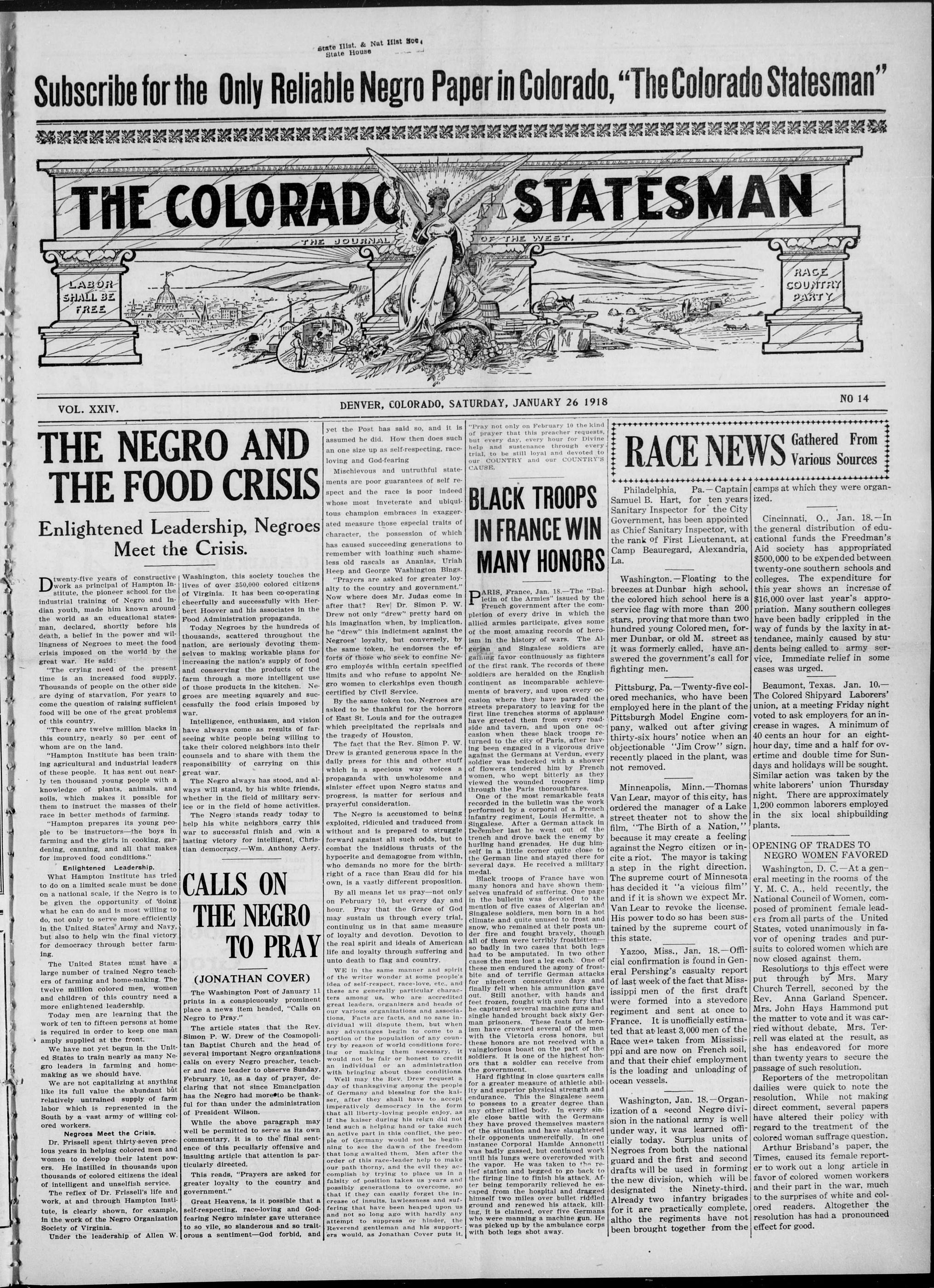
THE COLORADO STATESMAN
THE JOURNAL OF THE WEST.
LABOR SHALL BE FREE
RAGE COUNTRY PARTY
THE NEGRO AND THE FOOD CRISIS
Enlightened Leadership, Negroes Meet the Crisis.
VOL. XXIV.
THE NEG
THE FOO
Enlightened Lea
Meet th
twenty-five years of constructive
work as principal of Hampton In-
stitute, the pioneer school for the
industrial training of Negro and Indi-
nian youth, made him known around
the world as an educational states-
man, declared, shortly before his
death, a belief in the power and will-
liness of Negroes to meet the food
crisis imposed on the world by the
great war. He said:
"The crying need of the present time is an increased food supply. Thousands of people on the other side are dying of starvation. For years to come the question of raising sufficient food will be one of the great problems of this country.
"There are twelve million blacks in this country, nearly 80 per cent of whom are on the land.
"Hampton Institute has been training agricultural and industrial leaders of these people. It has sent out nearly ten thousand young people with a knowledge of plants, animals, and soils, which makes it possible for them to instruct the masses of their race in better methods of farming.
"Hampton prepares its young people to be instructors—the boys in farming and the girls in cooking, gardening, canning, and all that makes for improved food conditions."
What Hampton Institute has tried to do on a limited scale must be done on a national scale, if the Negro is to be given the opportunity of doing what he can do and is most willing to do, not only to serve more efficiently in the United States Army and Navy, but also to help win the final victory for democracy through better farming.
The United States must have a large number of trained Negro teachers of farming and home-making. The twelve million colored men, women and children of this country need a more enlightened leadership.
Today men are learning that the work of ten to fifteen persons at home is required in order to keep one man amply supplied at the front.
We have not yet begun in the United States to train nearly as many Negro leaders in farming and home-making as we should have.
We are not capitalizing at anything like its full value the abundant but relatively untrained supply of farm labor which is represented in the South by a vast army of willing colored workers.
Negroes Meet the Crisis.
Dr. Frissell spent thirty-seven precious years in helping colored men and women to develop their latent powers. He instilled in thousands upon thousands of colored citizens the ideal of intelligent and unselfish service.
The reflex of Dr. Frissell's life and work, at and through Hampton Institute, is clearly shown, for example, in the work of the Negro Organization Society of Virginia.
Under the leadership of Allen W.
Washington, this society touches the lives of over 350,000 colored citizens of Virginia. It has been co-operating cheerfully and successfully with Herbert Hoover and his associates in the Food Administration propaganda.
Today Negroes by the hundreds of thousands, scattered throughout the nation, are seriously devoting themselves to making workable plans for increasing the nation's supply of food and conserving the products of the farm through a more intelligent use of those products in the kitchen. Negroes are meeting squarely and successfully the food crisis imposed by war.
Intelligence, enthusiasm, and vision have always come as results of farseeing white people being willing to take their colored neighbors into their counsels and to share with them the responsibility of carrying on this great war.
The Negro always has stood, and always will stand, by his white friends, whether in the field of military service or in the field of home activities. The Negro stands ready today to help his white neighbors carry this war to successful finish and win a lasting victory for intelligent, Christian democracy.—Wm. Anthony Aery.
CALLS ON THE NEGRO TO PRAY
(JONATHAN COVER)
The Washington Post of January 11 prints in a conspicuously prominent place a news item headed, "Calls on Negro to Pray."
The article states that the Rev. Simon P. W. Drew of the Cosmopolitan Baptist Church and the head of several important Negro organizations calls on every Negro preacher, teacher and race leader to observe Sunday, February 10, as a day of prayer, declaring that not since Emancipation has the Negro had more to be thankful for than under the administration of President Wilson.
While the above paragraph may well be permitted to serve as its own commentary, it is to the final sentence of this peculiarly offensive and insulting article that attention is particularly directed.
This reads, "Prayers are asked for greater loyalty to the country and government."
Great Heavens, is it possible that a self-respecting, race-loving and God-fearing Negro minister gave utterance to so vile, so slanderous and so traitorous a sentiment—God forbid, and
DENVER, COLORADO, SATURDAY, JANUARY 26 1918
State Hist. & Nat Hist Soc
State House
able Negro Pa
ADO
THE JOURNAL
DENVER, COLORADO, SAN
yet the Post has said so, and it is assumed he did. How then does such an one size up as self-respecting, race-loving and God-fearing
Mischievous and untruthful statements are poor guarantees of self respect and the race is poor indeed whose most inveterate and ubiquitous champion embraces in exaggerated measure those especial traits of character, the possession of which has caused succeeding generations to remember with loathing such shameless old rascals as Ananias, Uriah Heep and George Washington Bings.
"Prayers are asked for greater loyalty to the country and government." Now where does Mr. Judas come in after that? Rev| Dr. Simon P. W. Drew not only "drew" pretty hard on his imagination when, by implication, he "drew" this indictment against the Negroes' loyalty, but conversely, by the same token, he endorses the efforts of those who seek to confine Negro employés within certain specified limits and who refuse to appoint Negro women to clerkships even though certified by Civil Service.
By the same token too, Negroes are asked to be thankful for the horrors of East St. Louis and for the outrages which precipitated the reprisals and the tragedy of Houston.
The fact that the Rev. Simon P. W. Drew is granted generous space in the daily press for this and other stuff which in a specious way voices a propaganda with unwholesome and sinister effect upon Negro status and progress, is matter for serious and prayerful consideration.
The Negro is accustomed to being exploited, ridiculed and traduced from without and is prepared to struggle forward against all such odds, but to combat the insidious thrusts of the hypocrite and demagogue from within, who demands no more for the birthright of a race than Esau did for his own, is a vastly different proposition.
By all means let us pray—not only on February 10, but every day and hour. Pray that the Grace of God may sustain us through every trial, continuing us in that same measure of loyalty and devotion. Devotion to the real spirit and ideals of American life and loyalty through suffering and unto death to flag and country.
WE in the same manner and spirit of the writer wonder at some people's idea of self-respect, race-love, etc, and these are generally particular characters among us, who are accredited great leaders, organizers and heads of our various organizations and associations. Facts are facts, and no sane individual will dispute them, but when any advantages begin to come to a portion of the population of any country by reason of world conditions forcing or making them necessary, it would not be fair or honest to credit an individual or an administration with bringing about those conditions. Well may the Rev. Drew request a day of thanksgiving among the people of Germany and blessing for the kaiser, after they shall have to accept imperatively democracy in the form that all liberty-loving people enjoy, as if the kaiser during his reign did not lend such a helping hand or take such an active part in this conflict, the people of Germany would not be beginning to see the dawn of the freedom that long awaited them. Men after the order of this race-leader help to make our path thorny, and the evil they accomplish by trying to place us in a falsity of position takes us years and possibly generations to overcome, so that if they can easily forget the increase of insults, lawlessness and suffering that have been heaped upon us and not so long ago with hardly any attempt to suppress or hinder, the Reverend gentleman and his supporters would, as Jonathan Cover puts it,
---
"Pray not only on February 10 the kind of prayer that this preacher requests, but every day, every hour for Divine help and sustenance through every trial, to be still loyal and devoted to our COUNTRY and our COUNTRY'S CAUSE.
BLACK TROOPS IN FRANCE WIN MANY HONORS
PARIS, France, Jan. 18.—The "Bulletin of the Armies" issued by the French government after the completion of every drive in which the allied armies participate, gives some of the most amazing records of heroism in the history of wars. The Algerian and Singalese soldiers are gaining favor continuously as fighters of the first rank. The records of these soldiers are heralded on the English continent as incomparable achievements of bravery, and upon every occasion where they have paraded the streets preparatory to leaving for the first line trenches storms of applause have greeted them from every roadside and tavern, and upon one occasion when these black troops returned to the city of Paris, after having been engaged in a vigorous drive against the Germans at Verdun, every soldier was bedecked with a shower of flowers tendered him by French women, who wept bitterly as they viewed the wounded troopers limp through the Paris thoroughfares.
One of the most remarkable feats recorded in the bulletin was the work performed by a corporal of a French infantry regiment, Louis Hermitte, a Singalese. After a German attack in December last he went out of the trench and drove back the enemy by hurling hand grenades. He dug himself in a little corner quite close to the German line and stayed there for several days. He received a military medal.
Black troops of France have won many honors and have shown themselves unafraid of suffering. One page in the bulletin was devoted to the mention of five cases of Algerian and Singalese soldiers, men born in a hot climate and quite unused to frost and snow, who remained at their posts under fire and fought bravely, though all of them were terribly frostbitten—so badly in two cases that both legs had to be amputated. In two other cases the men lost a leg each. One of these men endured the agony of frostbite and of terrific German attacks for nineteen consecutive days and finally fell when his ammunition gave out. Still another, with hands and feet frozen, fought with such fury that he captured several machine guns and single handed brought back sixty German prisoners. These feats of heroism have crowned several of the men with the Victoria cross honors, but these honors are not received with a vainglorious boast on the part of the soldiers. It is one of the highest honors that a soldier can receive from the government.
Hard fighting in close quarters calls for a greater measure of athletic ability and superior physical strength and endurance. This the Singalese seem to possess to a greater degree than any other allied body. In every single close battle with the Germans they have proved themselves masters of the situation and have slaughtered their opponents unmercifully. In one instance Corporal Hamide Anonetti was badly gassed, but continued work until his lungs were overcrowded with the vapor. He was taken to the relief station and begged to go back to the firing line to finish his attack. After being temporarily relieved he escaped from the hospital and dragged himself two miles over bullet riddled ground and renewed his attack, killing, it is claimed, over five Germans who were manning a machine gun. He was picked up by the ambulance corps with both legs shot away.
RACE NEWS Gathered From Various Sources
Philadelphia, Pa.—Captain Samuel B. Hart, for ten years Sanitary Inspector for the City Government, has been appointed as Chief Sanitary Inspector, with the rank of First Lieutenant, at Camp Beauregard, Alexandria, La.
Washington.—Floating to the breezes at Dunbar high school, the colored high school here is a service flag with more than 200 stars, proving that more than two hundred young Colored men, former Dunbar, or old M. street as it was formerly called, have answered the government's call for fighting men.
Pittsburg, Pa. — Twenty-five colored mechanics, who have been employed here in the plant of the Pittsburgh Model Engine company, walked out after giving thirty-six hours' notice when an objectionable "Jim Crow" sign recently placed in the plant, was not removed.
Minneapolis, Minn. — Thomas Van Lear, mayor of this city, has ordered the manager of a Lake street theater not to show the film, "The Birth of a Nation," because it may create a feeling against the Negro citizen or incite a riot. The mayor is taking a step in the right direction. The supreme court of Minnesota has decided it "a vicious film" and if it is shown we expect Mr. Van Lear to revoke the license. His power to do so has been sustained by the supreme court of this state.
Yazoo, Miss., Jan. 18.—Official confirmation is found in General Pershing's casualty report of last week of the fact that Mississippi men of the first draft were formed into a stevedore regiment and sent at once to France. It is unofficially estimated that at least 3,000 men of the Race were taken from Mississippi and are now on French soil, and that their chief employment is the loading and unloading of ocean vessels.
Washington, Jan. 18.—Organization of a second Negre division in the national army is well under way, it was learned officially today. Surplus units of Negroes from both the national guard and the first and second drafts will be used in forming the new division, which will be designated the Ninety-third. Already two infantry brigades for it are practically complete, altho the regiments have not been brought together from the
NO 14
camps at which they were organized.
Cincinnati, O., Jan. 18.—In the general distribution of educational funds the Freedman's Aid society has appropriated $500,000 to be expended between twenty-one southern schools and colleges. The expenditure for this year shows an increase of $16,000 over last year's appropriation. Many southern colleges have been badly crippled in the way of funds by the laxity in attendance, mainly caused by students being called to army service, Immediate relief in some cases was urged.
Beaumont, Texas. Jan. 10. The Colored Shipyard Laborers' union, at a meeting Friday night voted to ask employers for an increase in wages. A minimum of 40 cents an hour for an eighth hour day, time and a half for overtime and double time for Sundays and holidays will be sought. Similar action was taken by the white laborers' union Thursday night. There are approximately 1,200 common laborers employed in the six local shipbuilding plants.
OPENING OF TRADES TO
Washington, D. C. At a general meeting in the rooms of the Y. M. C. A., held recently, the National Council of Women, composed of prominent female leaders from all parts of the United States, voted unanimously in favor of opening trades and pursuits to colored women which are now closed against them. Resolutions to this effect were put through by Mrs. Mary Church Terrell, seconed by the Rev. Anna Garland Spencer. Mrs. John Hays Hammond put the matter to vote and it was carried without debate. Mrs. Terrell was elated at the result, as she has endeavored for more than twenty years to secure the passage of such resolution.
Reporters of the metropolitan dailies were quick to note the resolution. While not making direct comment, several papers have altered their policy with regard to the treatment of the colored woman suffrage question. Arthur Brisband's paper, the Times, caused its female reporter to work out a long article in favor of colored women workers and their part in the war, much to the surprises of white and colored readers. Altogether the resolution has had a pronounced effect for good.
FOREIGN
The Ukraine has practically concluded a separate peace with Germany.
The province of Quebec is to have absolute prohibition beginning May 1, 1919.
Sir Edward Carson, minister without portfolio in the British war cabinet, has resigned.
Manuel Aguirre Beolanga, it was announced at Mexico City, has been appointed minister of the interior, of which department he has been undersecretary.
The aviation department of the French army has been reorganized and there has been created an air board of which the minister of munitions is president.
Three student aviators in training with the Royal Flying Corps at Toronto, Canada, one of them an American, were killed as a result of accidents to their machines while in the air.
A. I. Shingaroff, minister of finance in the Kerensky cabinet, and Prof. F. F. Kokoshkine, state comptroller under Kerensky, were murdered in their beds in the marine hospital at Petrograd.
Two members without portfolio of the Danish Cabinet, J. C. Christensen and M. Rottboer, have resigned in order that they may be free to take part in the Parliamentary elections in April.
The American gunboat Monacacy was fired upon by the Chinese fifty miles above Yochow, on the Yang-Tse-Kiang. A sailor named O'Brien was killed and two other sailors were wounded. At St. Thomas, American Virgin Islands, the anniversary of the ratification of the treaty by which the Virgin Islands were ceded by Denmark to the United States was enthusiastically celebrated. Demonstrations demanding better distribution of food were held at Brighton, at Etith, in Kent, and at other places in England, while men, women and children stood in queues, in many cases in vain, for a Sunday roast, margarine, butter or tea.
The Lokal Anzeiger of Berlin says that unless Leon Trotzky, the Bolshevik foreign minister, accepts the demands of the central powers when he returns to Brest-Litovsk on Jan. 29, the central powers will break off peace negotiations.
The value of the German mark has fallen sharply on neutral exchanges in the last few days, reflecting loss of confidence in neutral countries regarding the outcome of the peace negotiations at Brest-Litovsk and the present condition of internal affairs in Germany.
**SPORT**
An arrangement for the payment of the war tax on baseball admissions was made at a conference of major league representatives with Daniel C. Roper, commissioner of internal revenue at Washington.
Ragna Omtvedt, professional ski champion, has set a new record for the slide at Cary, Ill., in preparation for the national championship. He jumped 170 feet, bettering the mark he established there several years ago by five feet. Elmer Q. Oliphant of Linton, Ind., one of Purdue University's leading alumni celebrities is to marry Miss Barbara Benedict of New York City. Oliphant now is at West Point. At Purdue he won fame in football, baseball, basketball and track.
GENERAL
Chicago's sugar supply is practically exhausted because of the recent snow blockade of railroads and the imperative necessity for moving coal first.
Gov. Moses Alexander has invited the governors of the western states to meet in Boise this winter for the purpose of discussing the prohibition amendment to the Federal constitution.
Every brewery in Missouri must stop work two days each week, according to an order issued by State Fuel Director Crissley, which provides there shall be no brewing nor bottling of beer "nor other beverages" these days.
Military authorities are holding a cavalryman in connection with the reported disappearance of a diamond ring from the hand of John W. Jewell, one of the men killed the night of Jan. 11, when Capt. Lewis Whisler robbed the Army bank at Camp Funston, Kan.
With five boats valued at more than $150,000 sunk and shipping and docks between Memphis, Tenn., and Cairo, Ill., generally endangered, conditions along the Mississippi River north of Memphis, Jan. 22, were reported the most serious in years, due to accumulation of ice at half a dozen points.
At the second day's session of the fifty-fourth annual convention of the National Wool Growers' Association at Salt Lake $6,000 was raised for the American Red Cross by the sale on the convention floor of a blooded ram donated for this purpose by the Wyoming Wool Growers' Association.
Max Breitung of New York is held at detective headquarters in Chicago on request from Washington that he be detained. Breitung was indicted more than two years ago in New York on a charge of having complicity in plots to blow up munitions and has been at liberty under $35,000 bonds.
Federal Judge Hale at Boston dismissed a bill in equity filed by Arthur S. Cummings and James E. Upstone of New Hampshire, seeking the appointment of a receiver for the Supreme Council, Royal Arcanum.
NEWS TO DATE IN PARAGRAPHS
CAUGHT FROM THE NETWORK OF WIRES ROUND ABOUT THE WORLD.
DURING THE PAST WEEK
RECORD OF IMPORTANT EVENTS
CONDENSED FOR BUSY
PEOPLE.
ABOUT THE WAR
Sir Edward Carson, minister without portfolio in the British war cabinet, has resigned.
Turkey's navy has been practically wiped out by the loss of the big cruisers Sultan Seim and Midullu.
One Turkish cruiser sunk and one beached and two British monitors sunk in battle at entrance to Dardanelles.
Germany has massed more than a quarter of a million fresh troops in Belgium for an offensive, it was stated here by competent military observers.
French repulse raid near Loivre and French patrols take prisoners north of St. Milhiel, six German airplanes destroyed by the French and two raids repulsed by them.
British airmen hurl explosive on big steel plant at Thionville and railway sidings across Rhine are dynamited and 200 bombs dropped into enemy trenches near Courtral and Roulers. Destruction of two enemy fighting airplanes and the capture of a big bombing flyer with its crew was described in an official dispatch received at the Belgian legation at Washington. British repulse German raid southeast of Graincourt and take prisoners in own raid on Germans east of Hargicourt. British bring down eight enemy airplanes. Four British machines are missing. British casualties reported in the week ending Jan. 21 were 17,043, divided as follows: Killed or died of wounds: Officers, 76; men, 2,277. Wounded or missing: Officers, 213; men, 14,477.
One hundred and sixty thousand Turkish troops—more than 50 per cent of General Falkenhayn's reorganized Turkish army—deserted during the recent journey from Constantinople to Palestine, official dispatches stated.
Darkness beclouds the situation in Austria-Hungary. An Amsterdam dispatch says that owing to the vigorous censorship there was no news and that the German papers, at Austria's request, were printing no news from Vienna. On the Amsterdam bourse there were rumors of renewed labor riots in Vienna, and Austrian shares fell heavily.
WESTERN
President Carranza has approved the bill imposing a 50-cent tax on immigrants into Mexico.
While passing over Topeka, Kan., a large meteor exploded with a loud report, scattering a shower of glowing fragments. The meteor was traveling in an easterly direction.
With a renewed appeal to American housewives for food conservation, the food administration will issue a new food card asking for the one meatless day, two porkless days and two wheatless days each week.
WASHINGTON
President Wilson has enlisted the Boy Scouts of America as dispatch bearers.
Farm products of the United States reached the unprecedented value of $19,443,849,381 last year, an increase of more than $6,000,000,000 over 1916 and almost $9,000,000,000 more than in 1915.
The thirty German ships seized by Brazil when it entered the war have been chartered by the French government for war purposes. The vessels represent an aggregate of about 120,000 gross tons.
Morale of the German army is on the ebb, Capt. Richard Haigh, in charge of the British tank in this country, told the Senate Military Committee in reciting personal experience of "going over the top" five times.
Peremptory directions to many large individual concerns to cease widespread advertising for help which was thought to be unsettling the labor supply and working hardships on individuals who answered the advertisements, have been sent out by the Department of Labor.
An urgent recommendation that an embargo be declared for a few days on acceptance by the railroads of any freight except coal and food was submitted to Director General McAdoo Tuesday night by the fuel administration. This action is imperative, Administrator Garfield said.
The Holland-American liner Nieuw Amsterdam, being detained at Rotterdam with 2,000 passengers, including the new Dutch minister to the United States, Augustus Phillips, is held because Germany has warned Holland she will not permit the liner to sail unless the Dutch government agrees that the ship shall at once return to Holland.
John F. Nugent, Democrat, of Boise, was appointed by Governor Alexander United States senator from Idaho to fill the vacancy caused by the death of Senator Brady.
SPORT
COLORADO
STATE NEWS
Western Newspaper Union News Service.
COMING EVENTS.
Jan. 29—Kansas Club banquet in Denver.
Feb. 22-23—Annual Winter Sports Car-
nival at Steamboat Springs.
Jan. 22-24—Annual meeting Colorado
Metal Mining Association at State
Capitol building in Denver.
Springfield is planning for a broom
factory.
Maybell people are agitating the
building of a community hall.
A large company of home guards has been organized at Flagler.
The new Masonic Temple at Las Animas has been formally dedicated.
Rural mail carriers have petitioned Congress for an increase in salaries.
R. C. Harris has received the appointment as postmaster at Great Divide.
Snow fences have been erected on the Lincoln highway, four miles north of Loveland.
A rich vein of silver ore has been uncovered in the Conger Chief mine at Caribou.
Ike Stevenson of Egnar, San Miguel county, is drilling for oil on his property in that district.
A rich tungsten deposit has been opened on the eastern slope of Mt. Hayden, near Ouray.
Extensive shipments of carnotite ore are being made from the Gateway country, Paradox valley.
January 30 has been set aside as "Tag-Your-Shovel Day" by the federal Fuel Administration.
The first oil drilling in thirty years is being done in Weld county ten miles east of Greeley.
The county commissioners of Weld county have arranged for an agricultural agent for the coming year.
It is alleged that the road houses on the Sand creek trail between Denver and Brighton are now closed.
The payroll of the steel works at Pueblo for the month of December nearly touched the $600,000 mark.
The farmers in the vicinity of Trull, near Steamboat Springs, will build and place in operation a flour mill.
W. O. Peterson, formerly a homesteader near Two Buttes, was killed at Camp Funston by a railroad train.
To date the Federal Farm Loan Bank of the Wichita district, including Colorado, has issued $8,000,000 to farmers.
The Colorado Editorial Association held a two-day session in Denver, and members attended a banquet and the stock show.
E. L. Staats is financing the construction of a road to the property of the George K. Mining Company in Paradise gulch, Gunnison county.
It is reported that a strike of fine black copper ore has recently been made in the workings of the Congress mine at Red Mountain, near Silverton.
Dewey C. Bailey, manager of excise and safety for the city of Denver, was appointed explosive licensor, according to announcement made at Washington.
"Pay as you go," will be the slogan at all Weld county garages on and after Feb. 1, according to the present sentiments of automobile dealers and repair men.
The Blake Mining Company organized with a capitalization of $80,000, filed its articles of incorporation at Leadville, intending to operate in Lake county.
The Brighton Sugar Factory ground 24,522 tons of beets during its less than one month of operation. The sugar output for the campaign was 61,575 sacks.
In the matter of dividends the Wellington Mines Company of Breckenidge, an important producer of lead and zinc concentrates, paid $200,000 during 1917 on a capital of $1,000,000.
More than fifty of the largest metal mine producers of Colorado gathered at the capitol in annual session and discussed some of the most important questions brought about by the war. One of the big issues is silver, and another is excess profit war tax.
J. A. Barclay of Grand Junction, was elected president of the Colorado Editorial Association at the meeting in Denver. Monday. C. F. Wadsworth was named vice-president, and Alva A. Swain re-elected secretary-treasurer. The editors were the guests of the State Council of Defense at a banquet Monday night, at which Governor Gunter praised the work done by the members of the press; and Tuesday the editors and their wives visited the stock show and the National Film Company's place at Englewood.
After entertaining the Colorado Editorial Association at breakfast, the Colorado Stockgrowers' Association began its forty-fourth annual convention in Denver, being welcomed by Governor Gunter and J. A. Marsh in behalf of Denver. Judge Henry Hunter of Trinidad responded for the stockgrowers.
Bristling with facts, figures and enthusiasm over the packing industry in general, and Denver's part, in it in particular, Louis F. Swift, president of Swift & Co., Chicago, arrived in Denver to attend the stock show
WILL INCREASE CROPS
FARMERS' CONGRESS CLOSES MEETING AT FORT COLLINS.
Resolutions Urge Branch of Commissary for Colorado and State Control of Coal Lands.
Western Newspaper Union News Service.
Fort Collins, Colo.—The Farmers' and Farm Women's Congress finished its session here, and adopted resolutions calling upon the government to establish in Colorado a branch of the purchasing bureau of the commissary department, so that farmers of the state may dispose of the increased crops grown at government request. The resolution stated that the farm production of 1917 was 35 per cent greater than in 1916, and that this was directly due to the request for greater crops to help in winning the war. The resolutions also demand state control of the coal lands within Colorado, both to increase the production here to an equality with the demand and that the state may save money by mining its own fuel.
Farmers are asked to make efforts to further increase crops and to hold their lands for the soldiers until they return from war.
An appeal is made for the residents of Colorado to consume more home grown products and to use those that will not be required for the soldiers.
The congress also called attention to the scarcity of farm employés in the service of the state. The resolution states that there are 700 persons employed at the capitol, of whom 170 come from Colorado Springs and Pueblo, and all the others from Denver. It urges that the proper proportion of places be given farmers, who pay one third of the taxes to support the state government.
The following were elected officers of the congress: President, M. C. Dougherty of Greeley; first vice president, George McCarroll of Denver; second vice president, Ed Clawson of Carbondale; secretary and treasurer, H. T. French of the Agricultural College. The executive committee: Denver division, John Gratton of Denver; plains division, J. G. Evans of Wray; northern division, R. M. Haythorne of Eaton; western division, Dr. W. K. Porter of Delta; southwest division, David Halls of Mancos; San Luis valley division, N. T. Lightner of Monte Vista; northwest division, George Bushyager of Craig; new plains division, J. W. Adams of Cheyenne Wells; Arkansas valley division, H. W. Bowman of Trinidad.
Miss Lewis Wins Florence Fleck Cup. Denver. — There was a brilliant gathering of society again in evidence when the stockmen's and farmers' night was celebrated at the horse show at the stockyards stadium. An excellent program was offered, ranging from gaited saddle horses to tandems and women riders. Light hunters were included as were hackney horses in pairs. Miss Lewis won the Florence Fleck horse show cup, and Maple Grove team won the grange team contest.
Find Red Cross Ear of Corn.
Sterling—Nature's approval of the Red Cross work was given in an ear of corn on the farm of W. D. Armour in what is known as the Kelly country, eighteen miles east of Sterling. Mr. Armour found an ear of white corn on one side of which, directly in the center, is a perfect red cross made up of five kernels. Mr. Armour did not have any red corn on his place. The peculiar specimen is attracting considerable attention.
Beach Killed in Airplane Collision.
Fort Collins.—News of the accidental death of Lieut. George Beach, only son of Mr. and Mrs. Thomas Beach of Fort Collins, was received in a telegram from the War Department. Lieutenant Beach was killed in an aeroplane collision in the air at a practice field in northern Italy.
Colorado Springs—Loyalty to the government in the prosecution of the war was expressed in turn by the several speakers at the convention of the Colorado Retail Grocers and Butchers Association in this city. About 100 delegates from all parts of the state are present.
Resigns as Explosive Licensor.
Denver—C. A. Lammers, city and county clerk of Denver, asked the Federal Bureau of Mines to relieve him from the duty of issuing permits for the shipment of explosives. This action was the result of attacks on Lammers' loyalty.
Wiggins.—Mace Mitchell of Wiggins very narrowly escaped death when his auto and Burlington passenger train No. 3 collided at the Wiggins crossing. The car was partly demolished and, Mitchell badly bruised.
Williams Named on Utilities Board.
Denver.—Leroy J. Williams of Central City, former state senator and member of the House of Representatives, was appointed a member of the state public utilities commission to fill the vacancy created by the resignation of M. H. Aylesworth. He will serve until January, 1921, provided the Senate confirms his appointment when the Twenty-second General Assembly meets. J. T. Duce of Boulder was appointed chief clerk in the Bureau of Mines.
FLORAL DESIGNS PUT UP WHILE YOU WAIT
CHOICE PLANTS AND CUT FLOWERS CONSTANTLY ON HAND
GREENHOUSES: Thirty-Four and Curtis Streets
TELEPHONE, MAIN 1511 DENVER, COLO
The Good Weight Grocery
W. T. FLETCHER AND J. W. WILLIAMS, Proprietors.
RETAIL STAPLE AND FANCY GROCERIES.
CORN FED MEATS. MOTOR DELIVERY TO
ANY PART OF THE CITY.
2549 Washington St. Denver, Colo.
Baxter Bldg. J. W. WILLIAMS, Manager
PHONE CHAMPA 3022.
The
WARD AUCTION
COMPANY
Sales Daily at 2 p.m. Office Fur-
niture a Specialty.
PRIVATE SALES AT ALL TIMES
HAVE MOVED TO—
1723-39 GLENARM ST.
PHONE MAIN 1675.
THE BEST ICE CREAM AND
CANDIES AT
O.P. BAUR & CO.
CATERERS AND
CONFECTIONERS
Phone: 168.
1512 Curtis Street, Denver, Colo.
JOSEPH CARTER
Express, Moving,
and Storage
COAL AND WOOD
PROMPT DELIVERY.
Phone Main 6544.
2415 WASHINGTON STREET.
DON'T FORGET US When you need anything in the line of neat and attractive Printing.
The Good
Gro
W. T. FLETCHER AND J.
RETAIL STAPLE AND
CORN FED MEATS.
ANY PART OF THE C
2549 Washington S
Baxter Bldg.
PHONE CHAMPA 3022.
Phone Main 6699
NIGHT
AND CO
B. CARRUT
A Full
Short Orders
919 NINETEENTH STREET
Miss M. Cowden Hair Dressing Parlor
Shampoo, cutting and curling. Scalp treatment, hair tonics, hair straightening, manicuring. Stage wigs for rent; theatrical use and masquerades. Goods delivered out of the city. All shades of hair matched by sending sample of hair; also combings made up.
Cheapest Switches 50 Cents
1223 21st St. Denver, Cole.
Phone Champa 3977
DO IT NOW Subscribe
for THIS
PAPER
1-wheat use more corn
2-meat use more fish & beans
3-fats use just enough
4-sugar use syrups
and serve the cause of freedom U.S. FOOD ADMINISTRATION
FACE the FACTS
LET us face the facts. The war situation is critical. Unless the Allies fight as they never yet have fought, defeat threatens. Hungry men cannot fight at their best; nor hungry nations. France, England, and Italy are going hungry unless we feed them.
Wheat Savings—They must have wheat. It is the best food to fight on. It is the easiest to ship. We alone can spare it to them. By saving just a little less than a quarter of what we ate last year—we can support those who are fighting our battles. And we can do it without stinting ourselves. We have only to substitute another food just as good.
The Corn of Plenty—Corn is that food. There's a surplus of it. Providence has been generous in the hour of our need. It has given us corn in such bounty as was never known before. Tons of corn. Trainloads of corn. Five hundred million bushels over and above our regular needs. All we have to do is to learn to appreciate it. Was ever patriotic duty made so easy? And so clear?
America's Own Food—Corn! It is the true American food. The Indians, hardiest of races, lived on it. Our forefathers adopted the diet and conquered a continent. For a great section of our country it has blong een the staff of life. How well the South fought on it, history tells. Now it can help America win a world war.
Learn Something—Corn! It isn't one food. It's a dozen. It's a cereal. It's a vegetable. It's a bread. It's a dessert. It's nutritious; more food value in it, dollar for dollar, than meat or eggs or most other vegetables. It's good to eat; how good you don't know until you've had corn-bread properly cooked. Best of all, it's plentiful and it's patriotic.
Corn's Infinite Variety—How much do you know about corn? About how good it is? About the many delicious ways of cooking it? And what you miss by not knowing more about it? Here are a few of its uses:
There are at least fifty ways to use corn meal to make good dishes for dinner, supper, lunch or breakfast. Here are some suggestions:
HOT BREADS
Boston brown bread.
Hoecake.
Muffins.
Biscuits.
Griddle cakes.
Waffles.
DESSERTS
Corn-meal molasses cake.
Apple corn bread.
Dumplings.
Gingerbread.
Fruit gems.
HEARTY DISHES
Corn-meal croquettes. Corn-meal fish balls.
Meat and corn-meal dumplings.
Italian polenta. Tamales.
The recipes are in Farmers' Bulletin 565, "Corn Meal as a Food and Ways of Using It," free from the Department of Agriculture.
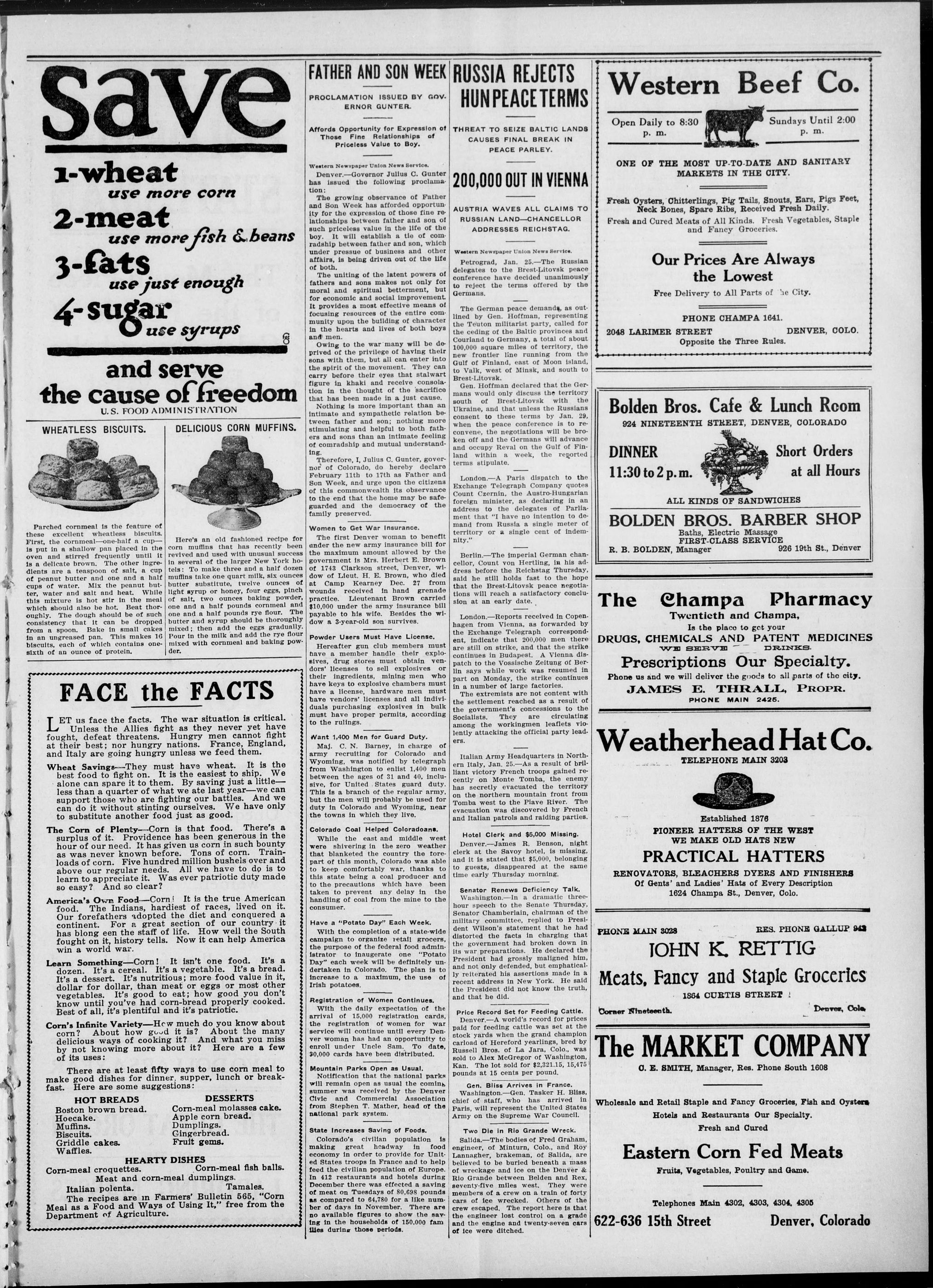
WHEATLESS BISCUITS.
Parched cornmeal is the feature of these excellent wheatless biscuits. First, the cornmeal—one-half a cup—is put in a shallow pan placed in the oven and stirred frequently until it is a delicate brown. The other ingredients are a teaspoon of salt, a cup of peanut butter and one and a half cups of water. Mix the peanut butter, water and salt and heat. While this mixture is hot stir in the meal which should also be hot. Beat thoroughly. The dough should be of such consistency that it can be dropped from a spoon. Bake in small cakes in an ungreased pan. This makes 16 biscuits, each of which contains one-sixth of an ounce of protein.
DELICIOUS CORN MUFFINS.
Here's an old fashioned recipe for corn muffins that has recently been revived and used with unusual success in several of the larger New York hotels: To make three and a half dozen muffins take one quart milk, six ounces butter substitute, twelve ounces of light syrup or honey, four eggs, plinch of salt, two ounces baking powder, one and a half pounds cornmeal and one and a half pounds rye flour. The butter and syrup should be thoroughly mixed; then add the eggs gradually. Pour in the milk and add the rye flour mixed with cornmeal and baking powder.
FATHER AND SON WEEK
PROCLAMATION ISSUED BY GOV. ERNOR GUNTER.
Affords Opportunity for Expression of Those Fine Relationships of Priceless Value to Boy.
Western Newspaper Union News Service.
Denver.—Governor Julius C. Gunter has issued the following proclamation:
The growing observance of Father and Son Week has afforded opportunity for the expression of those fine relationships between father and son of such priceless value in the life of the boy. It will establish a tie of comradship between father and son, which under pressue of business and other affairs, is being driven out of the life of both.
The uniting of the latent powers of fathers and sons makes not only for moral and spiritual betterment, but for economic and social improvement. It provides a most effective means of focusing resources of the entire community upon the building of character in the hearts and lives of both boys and men.
Owing to the war many will be deprived of the privilege of having their sons with them, but all can enter into the spirit of the movement. They can carry before their eyes that stalwart figure in khaki and receive consolation in the thought of the sacrifice that has been made in a just cause.
Nothing is more important than an intimate and sympathetic relation between father and son; nothing more stimulating and helpful to both fathers and sons than an intimate feeling of comradship and mutual understanding.
Therefore, I, Julius C. Gunter, governor of Colorado, do hereby declare February 11th to 17th as Father and Son Week, and urge upon the citizens of this commonwealth its observance to the end that the home may be safeguarded and the democracy of the family preserved.
Women to Get War Insurance.
The first Denver woman to benefit under the new army insurance bill for the maximum amount allowed by the government is Mrs. Herbert E. Brown of 1743 Clarkson street, Denver, window of Lieut. H. E. Brown, who died at Camp Kearney Dec. 27 from wounds received in hand grenade practice. Lieutenant Brown carried $10,000 under the army insurance bill payable to his wife. Besides the window a 3-year-old son survives.
Powder Users Must Have License.
Hereafter gun club members must have a member handle their explosives, drug stores must obtain vendors' licenses to sell explosives or their ingredients, mining men who have keys to explosive chambers must have a license, hardware men must have vendors' licenses and all individuals purchasing explosives in bulk must have proper permits, according to the rulings.
Want 1.400 Men for Guard Duty.
Maj. C. N. Barney, in charge of army recruiting for Colorado and Wyoming, was notified by telegraph from Washington to enlist 1,400 men between the ages of 31 and 40, inclusive, for United States guard duty. This is a branch of the regular army, but the men will probably be used for duty in Colorado and Wyoming, near the towns in which they live.
Colorado Coal Helped Coloradoans.
While the east and middle west were shivering in the zero weather that blanketed the country the forepart of this month, Colorado was able to keep comfortably war, thanks to this state being a coal producer and to the precautions which have been taken to prevent any delay in the handling of coal from the mine to the consumer.
Have a "Potato Day" Each Week.
With the completion of a state-wide campaign to organize retail grocers, the purpose of the federal food administrator to inaugerate one "Potato Day" each week will be definitely undertaken in Colorado. The plan is to increase to a maximum, the use of Irish potatoes.
Registration of Women Continues.
With the daily expectation of the arrival of 15,000 registration cards, the registration of women for war service will continue until every Denver woman has had an opportunity to enroll under Uncle Sam. To date, 30,000 cards have been distributed.
Mountain Parks Open as Usual.
Notification that the national parks will remain open as usual the comin summer was received by the Denver Civic and Commercial Association from Stephen T. Mather, head of the national park system.
State Increases Saving of Foods.
Colorado's civilian population is making great headway in food economy in order to provide for United States troops in France and to help feed the civilian population of Europe. In 412 restaurants and hotels during December there was effected a saving of meat on Tuesdays of 80,698 pounds as compared to 64,780 for a like number of days in November. There are no available figures to show the saving in the households of 150,000 fam ilies during those periods.
RUSSIA REJECTS HUNPEACETERMS
THREAT TO SEIZE BALTIC LANDS CAUSES FINAL BREAK IN PEACE PARLEY.
200,000 OUT IN VIENNA
AUSTRIA WAVES ALL CLAIMS TO
RUSSIAN LAND—CHANCELLOR
ADDRESSES REICHSTAG.
Western Newspaper Union News Service.
Petrograd, Jan. 25.—The Russian delegates to the Brest-Litovsk peace conference have decided unanimously to reject the terms offered by the Germans.
The German peace demands, as outlined by Gen. Hoffman, representing the Teuton militarist party, called for the ceding of the Baltic provinces and Courland to Germany, a total of about 100,000 square miles of territory, the new frontier line running from the Gulf of Finland, east of Moon island, to Valk, west of Minsk, and south to Brest-Litovsk.
Gen. Hoffman declared that the Germans would only discuss the territory south of Brest-Litovsk with the Ukraine, and that unless the Russians consent to these terms by Jan. 29, when the peace conference is to reconvene, the negotiations will be broken off and the Germans will advance and occupy Reval on the Gulf of Finland within a week, the reported terms stipulate.
London.—A Paris dispatch to the Exchange Telegraph Company quotes Count Czernin, the Austro-Hungarian foreign minister, as declaring in an address to the delegates of Parliament that "I have no intention to demand from Russia a single meter of territory or a single cent of indemnity."
Berlin.—The imperial German chancellor, Count von Hertling, in his address before the Reichstag Thursday, said he still holds fast to the hope that the Brest-Litovsk peace negotiations will reach a satisfactory conclusion at an early date.
London.—Reports received in Copenhagen from Vienna, as forwarded by the Exchange Telegraph correspondent, indicate that 200,000 men there are still on strike, and that the strike continues in Budapest. A Vienna dispatch to the Vossische Zeitung of Berlin says while work was resumed in part on Monday, the strike continues in a number of large factories.
The extremists are not content with the settlement reached as a result of the government's concessions to the Socialists. They are circulating among the workingmen leaflets violently attacking the official party leaders.
Italian Army Headquarters in Northern Italy, Jan. 25. As a result of brilliant victory French troops gained recently on Monte Tomba, the enemy has secretly evacuated the territory on the northern mountain front from Tomba west to the Piave River. The evacuation was discovered by French and Italian patrols and raiding parties.
Hotel Clerk and $5,000 Missing.
Denver.—James R. Benson, night clerk at the Savoy hotel, is missing, and it is stated that $5,000, belonging to guests, disappeared at the same time early Thursday morning.
Senator Renews Deficiency Talk. Washington.—In a dramatic three-hour speech to the Senate Thursday, Senator Chamberlain, chairman of the military committee, replied to President Wilson's statement that he had distorted the facts in charging that the government had broken down in its war preparations. He declared the President had grossly maligned him, and not only defended, but emphatically reiterated his assertions made in a recent address in New York. He said the President did not know the truth, and that he did.
Price Record Set for Feeding Cattle. Denver.—A world's record for prices paid for feeding cattle was set at the stock yards when the grand champion carload of Hereford yearlings, bred by Russell Bros. of La Jara, Colo., was sold to Alex McGregor of Washington, Kan. The lot sold for $2,321.15, 15,475 pounds at 15 cents per pound.
Gen. Bliss Arrives in France. Washington—Gen. Tasker H. Bliss, chief of staff, who has arrived in Paris, will represent the United States Army on the Supreme War Council.
Two Die in Rio Grande Wreck
Salida.—The bodies of Fred Graham, engineer, of Minturn, Colo., and Roy Lannagher, brakeman, of Salida, are believed to be buried beneath a mass of wreckage and ice on the Denver & Rio Grande between Belden and Rex, seventy-five miles west. They were members of a crew on a train of forty cars of ice wrecked. Others of the crew escaped. The report here is that the engineer lost control on a grade and the engine and twenty-seven cars of ice were ditched.
Western Beef Co.
Open Daily to 8:30 p. m.
ONE OF THE MOST
MARK
Fresh Oysters, Chitterl
Neck Bones, Sp
Fresh and Cured Meats
and
OF THE MOST UP-TO-DATE AND SAN MARKETS IN THE CITY.
aters, Chitterlings, Pig Tails, Snouts, Ears, Rock Bones, Spare Ribs, Received Fresh Dairy.
Cured Meats of All Kinds. Fresh Vegetable and Fancy Groceries.
ONE OF THE MOST UP-TO-DATE AND SANITARY MARKETS IN THE CITY.
Fresh Oysters, Chitterlings, Pig Tails, Snouts, Ears, Pigs Feet, Neck Bones, Spare Ribs, Received Fresh Daily. Fresh and Cured Meats of All Kinds. Fresh Vegetables, Staple and Fancy Groceries.
Our Prices Are Always the Lowest Free Delivery to All Parts of the City.
PHC
2048 LARIMER STREET
Oppo
Bolden Bros.
924 NINETEENTH
PHONE CHAMPA 1641.
IMER STREET DENVER
Opposite the Three Rules.
In Bros. Cafe & Lunch
INETEENTH STREET, DENVER, COLO
PHONE CHAMPA 1641.
2048 LARIMER STREET DENVER, COLO.
Opposite the Three Rules.
Bolden Bros. Cafe & Lunch Room 924 NINETEENTH STREET, DENVER, COLORADO
DINNER
11:30 to 2 p.m.
ALL KIN
BOLDEN BRE
Baths
FIRST
R. B. BOLDEN, Manage
The Chas
Twenty
Is it
DRUGS, CHEMICAL
WE SEE
Prescription
Phone us and we will do
JAMES E
PH
Weather
TEL
ALL KINDS OF SANDWICHES
DEN BROS. BARBER S
Baths, Electric Massage
FIRST-CLASS SERVICE
DEN, Manager 926 19th S
Champa Phar-
Twentieth and Champa,
Is the place to get your
CHEMICALS AND PATENT M
WE SERVE DRINKS.
Descriptions Our Special
and we will deliver the goods to all parts o
MES E. THRALL, PR
PHONE MAIN 2426.
atherhead Haf
TELEPHONE MAIN 3203
BOLDEN BROS. BARBER SHOP
Baths, Electric Massage
FIRST-CLASS SERVICE
R. B. BOLDEN, Manager 926 19th St., Denver
The Champa Pharmacy
Twentieth and Champa,
Is the place to get your
DRUGS, CHEMICALS AND PATENT MEDICINES
WE SERVE DRINKS.
Prescriptions Our Specialty.
Phone us and we will deliver the goods to all parts of the city.
JAMES E. THRALL, PROPR.
PHONE MAIN 2426.
Established 1876
PIONEER HATTERS OF THE WEST
WE MAKE OLD HATS NEW
PRACTICE
RENOVATORS, BLEED
Of Gents' and L
1624 Ch
PHONE MAIN 3028
JOHN
Meats, Fancy
1864
PRACTICAL HATTERS
ATORS, BLEACHERS DYERS AND FIN
Gents' and Ladies' Hats of Every Descrip
1624 Champa St., Denver, Colo.
RENOVATORS, BLEACHERS DYERS AND FINISHERS Of Gents' and Ladies' Hats of Every Description 1624 Champa St., Denver, Colo.
JOHN K. RETTIGER
Fancy and Staple Gro
1864 CURTIS STREET
seventh.
MARKET COMP
E. SMITH, Manager, Res. Phone South 16
d Retail Staple and Fancy Groceries, Fish
Hotels and Restaurants Our Specialty.
Fresh and Cured
Eastern Corn Fed Me
Meats, Fancy and Staple Groceries 1864 CURTIS STREET
The MARK
C. E. SMITH, N
Wholesale and Retail Stap
Hotels and
Eastern
The MARKET COMPANY
C. E. SMITH, Manager, Res. Phone South 1608
Wholesale and Retail Staple and Fancy Groceries, Fish and Oystera Hotels and Restaurants Our Specialty. Fresh and Cured
Eastern Corn Fed Meats
Fruits, Vegetables, Poultry and Game.
Telephones 622-636 15th Street
Telephones Main 4302, 4303, 4304, 4305
15th Street Denver,
Telephones Main 4302, 4303, 4304, 4305 622-636 15th Street Denver, Colorado
Corner Nineteenth.
Sundays Until 2:00 p. m.
ATE AND SANITARY
CITY.
Sns, Snouts, Ears, Pigs Feet,
received Fresh Daily.
Fresh Vegetables, Staple
Jeceries.
A 1641.
DENVER, COLO.
e Rules.
& Lunch Room
DENVER, COLORADO
Short Orders
at all Hours
BARBER SHOP
Massage
SERVICE
926 19th St., Denver
Pharmacy
Champa,
get your
PATENT MEDICINES
DRINKS.
Our Specialty.
bends to all parts of the city.
ALL, PROPR.
2426.
Bad Hat Co.
MAIN 3203
HATTERS
DEVICES AND FINISHERS
of Every Description
Denver, Colo.
RES. PHONE GALLUP 942
ETTIG
Staple Groceries
STREET
Denver, Cola
COMPANY
Phone South 1608
Groceries, Fish and Oysters
Our Specialty.
red
Fed Meats
303, 4304, 4305
Denver, Colorado
```markdown
```
Fruit Bowl
BEST BUY
THE COLORADO STATESMAN
LABOR SHOULD BE FIRE
RACE COUNTRY PARTY
SUBSCRIPTION RATES.
One Year ..... $2.00
Six Months ..... 1.00
Three Months ..... 60
Entered as second-class matter at the postoffice in the City of Denver, Colo.
JOS. D. D. RIVERS.....Proprietor
1824 Curtis Street, Room 25.
Phone Main 7417.
Reading notices, ten lines or less, 10 cents per line. Each additional line over ten lines, 5 cents per line. Display advertising, 50 cents per inch.
Remittances should be made by Express Money Order, Postoffice Money Order, Registered Letter or Bank Draft. Postage stamps will be received the same as cash for the fractional part of a dollar. Only 1c and 2c stamps taken.
No discounts allowed on less than three months' contract. Cash must accompany all orders from parties unknown to us. Further particulars on application.
Communications to receive attention must be newsy, upon important subjects, plainly written only upon one side of the paper, must reach us Tuesday, if possible, anyway not later than Wednesdays, and bear the signature of the author. No manuscript returned, unless stamps are sent for postage. All communications of a personaging nature that are not complimentary will be withheld from the columns of this paper.
NATIONAL WESTERN STOCK SHOW PROVES HUGE SUCCESS
IT IS NOT surprising to us that the great efforts put forward by the association responsible for this particular interesting annual event in Denver met with such a huge success, as the West is determined to take her place sooner or later in the highest Honor Division for stock raising that this country can produce. We cannot help from taking a little pride and saying WONDERFUL COLORADO! From mining to agriculture, to the stock industry, and our visitors who never fail to encourage us have said another word this time—"Better than the previous shows and a pace set for the Central and Eastern Shows." We missed very much our favorite exhibitor, Tom Bass, with his high school and other well-trained animals, but what with railway congestion and other unavoidable causes, he was compelled to be absent. He was kindly remembered by the youths, grownups and elderly ones as his former coming was always hailed with delight. The exhibition of horses, cattle, etc., was undoubtedly the best we have had in our twelve years, and the temptation in the large purses offered for driving and riding events gave a new spirit and an extra vim to the competitors. Many Colorado owners were successful in obtaining prizes, also the out-of-town participants. Record attendance at each performance, and although the weather started off a little cool, yet his kindness for a very pleasant week was not omitted. Today closes the show, when there will be a crowded amphitheater and another page in the history of the STOCKMEN'S Association will be adorned with the success attending their endeavors to prove the resources of Colorado and the WESTERN WELCOME that awaits every visitor to our Centennial state.
SENATOR CHAMBERLAIN REPLIES TO PRESIDENT'S REBUKE.
recently in New York, charging him with an astonishing and absor-
BURNING with a patriotism that made Senator Chamberlain of
Oregon, in his speech of last Thursday to the Senate, replying
to President Wilson's remarks relative to the senator's speech
lutely unjustifiable distortion of the truth," in reference to the inefficiency of the heads of the war department, exclaim, "this isn't a question of personalities. This is not a question between the president and myself. It's a question of AMERICA and every man ought to make it his whole purpose to see that AMERICA is saved." The senator being chairman of the military committee is in receipt of facts which prove to him the inefficiency of war heads, and declares that if it costs him his political life, he has determined upon giving the public the whole situation and let them be the judges. A speech that will go on record, coming at a time like this, helps to prove the value of democracy, and when cold, stern facts are presented to us we should accept them and correct the evil. Britain, France, Italy and our other associates in war corrected their incompetency, and more than that, sent over their delegates to warn us against committing the mistakes they made during the early stage of the war, the same being very costly, but in spite of this, according to the senator, we are groping in the dark as neither our commander-in-chief or his representative know the truth about conditions existing in the army at home and abroad. The following excerpts from Senator Chamberlain's speech must give us the gravest concern as if improvements are not gotten quickly under way, a large percentage of the flower of our army may perish at home, before being serviceable to their country and flag. After relating or citing deaths by the thousands from disease caused by cramped conditions, and indignant over the challenge to his veracity—the first time in his career of over 25 years' service to the state of Oregon, the senator said: "Men at Camp Bowie were packed together like sardines and despite frequent warnings, disastrous epidemics broke out in December with 8,000 men passing the hospitals. Men died without proper nursing because of inefficiency of the system. I challenge you to read the record." He asserted with emphasis, "I felt it my duty to tell the country something I might not have told it under ordinary circumstances. I do it as a man who loves his country best of all and who would willingly give his life for it. I do it fearlessly as an American citizen who desires to help and not to hinder. If the administration had wanted to be fair to the American people, why didn't the distinguished secretary of war, and I have the highest regard for him, let the people know, so that the people could assist in getting ready for this terrible calamity that confronts not only America, but the whole world?" He concluded, "Let's let the sunlight in on these things and never fear that the American people will not follow the president into the thick of the fray wherever their duty calls them." This sounds like the cry from Macedonia, "Come and help us." Can we forget party spirit politically? Must we lay aside racial differences and things obstructive to the development of all the people? We must. That these things exist no one would venture to deny after hearing or reading such a speech and only an American who, filled with real democracy, will boldly come forward and tell us such truths as to spur us on to procuring a remedy that will make our sons and fathers go into the game with a firm belief in the protection afforded them under the banner of the stars and stripes. No more time for words. Let the president and his secretary of war wake up and tackle the unfortunate conditions RIGHT NOW.
CHEYENNE, WYO., NEWS.
The revival meeting that has been in progress for the past three weeks at the Allen chapel A. M. E. Church, closed Sunday night with great success. There were three services Sunday. At 11 a. m. preaching by Pastor Jeltz; 3 p. m., there was a good old-fashioned praise meeting conducted by Rev. J. T. Muse, pastor of the Baptist Mission at Eaton, Colo. At 8 p. m. the evangelist pastor, Rev. N. H. Jeltz, preached a powerful sermon, subject, "It is Finished." Appeals were made to sinners to get right with God. There were thirteen who came forward, out of this number eleven enlisted for the Kingdom of God; two out of the eleven went to the Baptist Church; total saved or added to the church during the meetings about 17.
There were good services at the Second Baptist Church both morning and evening. Rev. W. H. Hudson preached Sunday night. Rev. J. T. Muse, acting pastor, preached at the morning service. Rev. Hudson is a splendid speaker. He has improved greatly in the past eighteen months that he has been out of the city. During these eighteen months he has put in about four months in the training school in Kansas.
The Second Baptist Church has a real good Sunday school and B. Y.P. U. Each auxiliary has been successful in securing wide-awake leaders and teachers for these societies.
Word has just been received from Rev. C. O. Smith, pastor of the Second Baptist Church, that he will be here Sunday, January 27th, to take charge of his church.
Rev. Smith has been in Kansas visiting his family for five weeks
Rev. G. S. Stacker, 917 West 19th street, has purchased a horse and wagon and is doing a thriving grocery and coal business.
Mr. Ruben Smith, one of our best young men, has recently returned from Blackdom, N. M., where he has been visiting his parents, relatives and friends. His brother, Austria Smith, accompanied him back.
The ladies of the Search Club spent the afternoon last Thursday at the State Capital engaged in the Red Cross work.
Grandma Maggie Carter, 1709 Snyder street, has just received back pay for one year on increased pension, and will receive from now on $25 per month in the place of $12. Grandma says she is 90 years old.
Mrs. Belle Brown underwent an operation recently at the St. John's hospital, and is reported to be getting along fine.
Mrs. Jeltz has been quite ill the past few days, but is better at this writing.
Mrs. W. E. Wright has been quite sick in the past week with the grip, but is able to get out again.
For news subscribe for the Colorado Statesman, the best paper in the West.
PEOPLE'S PRESBYTERIAN.
East 23d Ave. and Washington St Presbyter, J. A. Thos.-Hazell, S. T. B. Sermon topics Sunday, January 27th: 11 a. m., "Primary Charge to the Apostolic College;" 5 p. m., "The Serpent-Doved Teacher."
Next Tuesday night at 8:30 o'clock at People's Presbyterian Church Miss Mabel Cole will be formally introduced to the citizens of Denver as a specialist in the College of Voice Culture. For some years past vocal experts detected something of the extraordinary in this young lady's singing, both in the Colorado and Denver Conservatories of Music. Competent judges predict her to develope into one of the most wonderful contraltoists ever appearing before an audience of music lovers. Her strength and quality of tones are easily noted in a chorus of 25 voices. Her expressions baptise the emotions of the pew with the dew of pathos and the fire of excitement. To encourage her some of the leading contributors to successful musicales will be participants on the program free of charge. We appeal to every race lover to spend 25 cents in this testimonial on behalf of Miss Cole.
Drinking Water at Meals.
The notion that drinking water at meals interferes with digestion, by "diluting the gastric juices," has been utterly exploded, notes a health optimist. On the contrary, one should drink plenty of water at menis; it helps digestion. But it is best that the water should be at the temperature of the air, or cooled with a very little ice in summer. Another exploded idea is that the drinking of water at meals tends to make one fat. It is absolutely preposterous. The fact, indeed, is quite opposite, insmuch as whatever encourages digestion is bound to discourage an unwholesome accumulation of fatty tissue. Lest it be imagined that these are only one man's opinions, it should be explained that they are fully indorsed by the experts of the government bureau of nutrition.
Severe Test.
Perhaps no test of one's poise and manual dexterity is more difficult for a man of sedentary and intellectual pursuits than the effort to pick up seven or eight newly released watermelon seeds from the tablecloth with his left hand without arousing so much as a passing suspicion in his wife's breast that they're there at all.—Ohio State Journal.
Strict Regulation.
Freeman was visiting at his grandpa's home, and as he was a mischievous little chap, was constantly being told, "Don't do this," and "Don't do that." Finally, with a look of disgust on his face, he climbed up into a chair and asked, seriously, "What can a felia do in this house, anyway?"
```markdown
```
THE COLORADO STATESMAN
First of the American Heroes to Storm No Man's Land.
News of United States' Declaration of War on Germany Signal for Bound Over the Top.
It was night in the trenches of France, and the Canadian contingent lay watchful for the foe, on duty at the listening posts, and night patrols crept stealthily about in No Man's Land. Their bayonets were rubbed with lamp black so that the sudden bursting of a star bomb would not betray their presence.
In this particular Canadian section, writes Henry James Buxton, were one hundred or more stalwarts from the United States—men who went over the international boundary into Canada so they could enlist. These Americans were together in one section of the trench.
The Mouth-Piece of the People of Colorado and the Entire West
One of these was Private "Scotty" Anderson, farmer, telegraph operator, who had tapped the key from Boston to Frisco.
Scotty was long, lean and lank, with arms like bean poles. But his muscles were steel, and his courage without a blemish. Said Scotty to his pal, Jack Murdock:
"This is too slow for me; why can't we go over the top once in a while, and take a slam at the Boches?"
"Time apparently ain't ripe," replied Murdock.
"Ripe," snorted Scotty disgustedly; "we'd soon make the Boches ripe if we got at 'em with our bayonets."
Just then a sergeant hurried into the trench from a communicating passage.
"Boy's," he cried excitedly, "the United States has declared war with Germany."
Scotty was on his feet with a whoop. He grabbed the sergeant and said: "Say that again." The sergeant repeated the message.
ARELIABLE chronicle of their doings and progress; a faithful mirror of their wants, their hopes, their best aspirations.
Scotty grabbed an American flag with one hand and seized his gun with the other.
"Come on, Yanks," he yelled, "over the top for us; we've got to celebrate this!"
With a whoop 100 Americans followed Scotty over the top. The sergeant yelled something about orders, but he was brushed aside.
Yelling, the Americans rushed over No Man's Land, and leaped into the German first line trench. The onslaught was so sudden that the Germans were taken by surprise. A score or more were shot down before they were aware what had happened, and nearly a score more surrendered. The Americans returned to their own trench with their prisoners and they were greeted as heroes by their Canadian comrades.
THE COLORADO STATESMAN
"We had to do something to celebrate the entrance of Uncle Sam on the job," Scotty explained to a superior.
Logging in the Northwest.
In some of the high altitudes in the lumbering districts of the Northwest, logging trains are employed to bring big loads of cut timber from the forests to the mill. The snow, in a way, helps this situation, for it permits the use of an ingenious caterpillar tractor steam engine of great power. It is, practically speaking, a locomotive of the cog-wheel type and the front trucks are sleigh runners, which are steered by a man sitting in front, his hands on the steering wheel. The "engineer" concerns himself with the same duties as though he were running on a track, while the fireman has to keep steam up. Specially devised sleighs, as wide as the locomotive itself, are used to carry the logs, and the trackless engine is of such power that it can drag eight and more truckloads of this character at a time.
Unequaled as an advertising medium for the business of professional men and women.
Why He Quit.
A new confectionery store opened its doors in the north part of the city recently, states the Indianapolis News. The proprietor hired a skilled candy maker. His troubles started early. The candy maker went on a big spree, and in a few days the stock in the store ran low. The proprietor went out on a hunt for the candy maker and finally found him and straightened him up so he could work again.
An excellent family journal speaking to and for many thousand colored citizens.
But when he was ready for work the sugar famine was on with all of its terrors, and no sugar was obtainable. This condition continued for several days, and when he finally got a sugar supply the candy maker was absent again. The proprietor closed the doors, sold the remaining stock and store fixtures at auction and retired from the candy business.
TWODOLLARSAYEAR
Popularity for the Sunflower.
Popularity for the Sunflower.
The sunflower is probably destined to play and important part in the economic affairs of the United States as a substitute for linseed, states the Christian Science Monitor. A member of the National Paint, Oil and Varnish association recently read a report which declared that the cultivation of the sunflower for this purpose can be made to yield a gross return to the farmer of from $30 to $36 an acre. Everything in these days seems to be working out to the profit of Kansas. Cannot something be done with the jimson weed, so as to please Missouri?
Casting Finest Statuary,
The world's finest bronze statuary is cast in sand found in France that contains about 80 per cent silica and 20 per cent alumina.
Mrs. E. V. Cammel is visiting her brother in Orchard, Colo.
Sanford Brown is in the city this week, shaking hands with his many old friends.
Miss Mabel Cole, contraltoist, People's Presbyterian Church, Tuesday night, Jan. 29th. Admission 25 cents.
ZACKERY-ANDREWS WEDDING
A pretty little wedding was celebrated last Wednesday a week ago at home of Mr. and Mrs. S. A. McG when their daughter, Jessie Ale, became the wife of Gilbert E. Zackery. The ceremony was formed by the Rev. C. A. William the presence of a few intimate fri
Alfred Framan of Engine company, No. 3, who has been ill for the past week was able to return to work last Tuesday.
Mr. and Mrs. Morris Campbell are in the city from their ranch at Valley, Colo., and will remain in the city about two months before returning back to their ranch.
Mrs. Geo. W. Gross left Tuesday for a lengthy visit in Los Angeles and other coast cities. She was the guest of Dr. and Mrs. T. E. McClain at dinner, and of Mr. and Mrs. John W. Carrie, Jr., also prior to her departure.
Church of The Redeemer (St. Petetua Guild). Entertainment at Old Colony Hall, Thursday, February 7th. Morrison's Orchestra. Remember the date.
Mr. Sam Callohan, one of the wealthiest and most progressive citizens of Boley, Oklahoma, is in the city on a business trip. While here he was the guest of Walter Pritchett. Mr. Callohan is a brother of Louis Callohan of Dearfield.
Professor and Mrs. George Morrison are the proud parents of a daughter, who peeped into the light of day last Saturday, January 19th. The little lady weighed twelve pounds, and already father George, in setting them up to the boys, is beginning to determine the kind of career his "wargirl" must have. Mother and daughter are doing nicely, and the many friends of our noted musician join with the COLORADO STATESMAN in offering congratulations.
On Thursday night, next the Rt. Rev. Irving R. Johnson, bishop of the diocese of Colorado, will address the Denver branch of the National Association for the Advancement of Colored People. Bishop Johnson is rightfully held one of the ablest speakers before the American public today, and as the meeting is free to the public. Denver's best should give him a great ovation. A splendid musical program will be rendered in connection. The N. A. A. C. P. never does things by halves, so let everybody turn out.
Recital, complimentary to Miss Mabel Cole, People's Presbyterian, Tuesday night, Jan. 29. Admission 25 cents.
Billy Knight again! This time with his assistant, Bob Carruth, of the popular Night and Day Cafe, in a testimonial in honor of the Colored Troupe playing at the Tabor Grand this week. As usual, Billy had a large crowd of pleasure-seekers who were immensely satisfied, as Prof. Morgan Jackson's orchestra catered in artistic style to the latest steps, poses and graces of the dancers, who tripped over the specially prepared Fern Hall floor with the greatest ease. There was fun and frolic and the presence of the Sammies, of whom there were nearly twenty, added to the gayety. Every one is asking what has Billy Knight to attract the crowd? He says, advertise and give the public what you promise.
MISS MABEL COLE MERITS OUR
SUPPORT.
We are great admirers of artists and would-be artists visiting our city from time to time, never failing to give them the fullest support we can, but whenever it comes to an appreciation of local talent, how often do we pass them by only to lose sight of them when another community gets hold of them and by their encouragement pushes them on the road of success. In presenting Miss Cole in Recital Tuesday evening, January 29th, there is no hesitation in corroborating the fact that she possesses a voice of rare quality and the public, especially music lovers, will be amply rewarded in patronizing this event which will demonstrate the ability possessed by our people. The People's Presbyterian Church offers this singer to the public, as an original Denver product, schooled and trained here. Hear her for yourself and see if our opinions agree.
FOR RENT—5-room frame house at 2360 Tremont Place. Apply at 1824 Curtis street. Room 25.
ZACKERY-ANDREWS WEDDING
A pretty little wedding was celebrated last Wednesday a week ago at the home of Mr. and Mrs. S. A. McGuire, when their daughter, Jessie Alexina, became the wife of Gilbert Ebley Zackery. The ceremony was performed by the Rev. C. A. Williams in the presence of a few intimate friends and thus two young people of popular and highly respected families in the community were united in a responsibility over which their friends offer congratulations. THE COLORADO STATESMAN extends its best wishes for a very successful career for Mr. and Mrs. Zackery, who are well known to us, the former being a faithful employe of Denver Athletic Club and the latter a leading musician of our city. At home to their friends and acquaintances after January 30th, 1634 East Thirty-fourth avenue.
NEGRO COMMERCIAL ASSOCIATION OPENS DOOR FOR CO- OPERATION.
Zion Baptist Church had a large representative gathering last week Friday evening when in response to an invitation of the Negro Commercial Association, a number of citizens of both sexes expressed their sympathy in being present in spite of the very inclement weather. Rev. D. E. Over presided and after outlining the purport of the organization called on Mr. George Gross, popular citizen and eloquent speaker, to address the audience. In his usual impressive way Mr. Gross, in enjoying the rapt attention of his auditors and showing the necessity for such an organization in Colorado among the people of Color, urged their unconditional support. Mrs. Jessie Carter, a hair culturist of our city and resident of many years enjoying a large circle of friends and patronage, gave some interesting information on "Our People in Business,"—the same lending an inspiration to those in business as well as a great boost for the association's campaign for membership. Governor Gunter in a few chosen remarks complimented us for our progress as a race, made special mention of the integrity and other soldierly qualities of our colored Sammies, and wished every success to the association. The president of the Interstate Bank and Trust Company, Mr. C. N. Briggs, gave practical talks on the qualities necessary to success and emphasized that management and real management was a great essential to permanency. Information was given as to Negro contribution to the Red Cross, in the sum of $25,000 by over 1,000 subscribers. After an appeal by the chairman many persons subscribed their names to the roster of membership. THE COLORADO STATESMAN sees in this organization a power for good in this city and state.
Woman War Leader.
Winema, otherwise known as Toby Riddle, is probably the only North American woman who ever led warriors into battle. In the war between the Modocs and the Pitt River (California) Indians many years ago, this dauntless Indian maid, who had previously received the title of Kaitchkona Winema (sub-chief) when she fearlessly guided her canoe through the rushing waters of Link River and saved the lives of two children, assumed command of the Modocs when that band's leader was shot down. Mounted on her war horse, she rushed to the head of her Indian column and led a brilliant cavalry charge which resulted in a complete victory over the Pitt River tribe.
Michaelson's
Corner of 15th and Larimer Sts.
JANUARY CLEARANCESALE
If all the people knew what some people know, this store big as it is, wouldn't begin to accommodate the numbers that would demand Michaelson merchandise. Men's Clothing, always a fourth less than you can buy it elsewhere and now subjected to a 10 per cent discount, and this includes Adler's Collegian make. In the Ladies Department, a third to a half off. Footwear for the family—ask those who trade here, they'll tell you how much better they always do here than elsewhere.
And so on throughout the establishment.
BRUTON'S CRAZY CORNER.
Written by C. M. Bruton, playwright.
"Hello, Mr. So and So. I am so glad to see you!" Says a little, teasing, dark-eyed brown. I happened to be standing nearby, so naturally I overheard the conversation that passed each of their lips.
"When did you arrive?" says he.
"Yesterday morning," says she.
"Where did you come from, B. B.?" "From Pueblo county," says she.
"Kindly answer a question for me. When is this terrible war going to end?" "Impossible to tell, Kind Friend. If you don't mind asking (points to me), ask him." So she did.
Once more in life I had a very heavy and serious burden on my mind, but after several hours of hard study, I gave her my answer.
"This great and most terrible war will end the first chance I get to shake hands with my friend, Kaiser Wilhelm."
Speed King arrived in Cañon last week. The boy with the "for-get-met-not" smile. The brown skins are certainly enjoying a treat this week. Before I go too far, I must let my readers know who Speed King is. He is a Brown Skin lad, about five feet ten inches tall, his business is to entertain the ladies. He travels for the Huggum & Kissum Co., out of Denver. He is so fast he can talk to his Salt Lake City girl over the phone, wire to his teasing Kansas City girl, write to his Denver Jane and hug my two best girl friends all the same time. Going some, isn't it?
I say nothing indifferent.
Mr. S. P.—In answer to your question, you wanted to know the difference between a coward and a hero. Here goes:
A coward is a man of woe.
Who is afraid to go fight the fo-
man is a man of might.
Who has, and is, always willing to
fight.
light.
A coward lives a life of lives, galore,
The hero goes, "maybe," to return no
more.
Mr. McD.—You wanted to know how
to save a girl from the arms of the
invincible Mr. B. K.'s Troubadours:
Go to any reliable hardware store.
Secure a one-inch chain and two Yale
locks. Make a special trip to the girl's
house. Upon arriving, make good use
of the hardware you bought, or kiss
the sweet snowbird goodbye. Refuse
the directions and it is peaches to the
road house inn for her.
Keep your eye on the Crazy Corner
for Fun and Nonsense.
FUNERAL NOTICE.
of The Douglass Undertaking Co.
of The Douglass Undertaking Co.
Thomas Minnie, aged 62, beloved
husband of Mrs. Rosetta Minnie, of
1345 Logan street, departed this life
Thursday, January 17. Services were
held Friday, January 18th, 2:30 p. m.,
at the Douglass chapel, Rev. C. A. Williams officiating. Interment Fairmount.
James Stephens, 26 years, devoted
husband of Mrs. Arcelia Stephens,
2944 California street, departed this life January 21st. Remains were
shipped to Sedalia, Mo., January 23d
at 1 p. m., accompanied by Mrs. Stephens and sister, Mrs. Charles Martin.
of this city.
Clarence Everly, formerly of Hot Springs, Ark., died Thursday morning
at County hospital. Funeral notice later.
DEATH OF AN OLD PIONEER.
Mr. R. W. Watson was born in Marrago county, Alabama, March 10th, 1854, died January 19th, 1918. His parents he knew little about, as he was separated from them in early boyhood. At the age of 19 years he was married to Lucinda J. Simmons, December 29th, 1870. In 1872 he came to Colorado and remained three years working at Central City in the Teller House. He then returned to Alabama and brought his wife and three children to Denver. He has since made this his home. After they were here five years more children were born to this happy couple. He was converted at the age of 20 years, and has lived a consistent Christian ever since.
"He has fought a good fight; he has finished his course; he has kept the faith." He leaves a loving wife, four daughters, one son, ten grandchildren, one daughter-in-law, three sons-in-law, and a host of friends. Funeral services were held Thursday, Jan. 24th, at 2 p. m. at Central Baptist church, Rev. P. J. Price officiating. Interment Riverside cemetery. Douglas Undertaking Company in charge.
EATON, COLO., NEWS.
Mr. E. Coburn is visiting in Cheyenne this week.
Mr. Geo. Reed has returned after a two days' visit in Cheyenne.
Mrs. Annie Reed is expecting to leave for Birmingham, Ala., in a few weeks, where she will visit with her mother, whom she has not seen for over fifteen years.
The ladies of the Baptist Mission and Volunteer Workers are planning for a big program and turn out in March.
The sugar factory has closed down now for the season, the men who haven't been able to attend church on account of their regular work we hone to have them out Sunday.
Pastor J. T. Muse announced his subjects for Sunday, January 27th: At 11 a. m., "Here Am I: Send Me." At 3:30 p. m., "Rock of Ages."
UNSAMSUNG
Uncle Sam Must Be Served First
The high development of telephone efficiency in this country gave the United States, when it entered the war, a superiority over all other nations for quick communication.
The nation's capital and the various military headquarters are linked with all the great industrial centers of the country by the long-distance lines of the Bell Telephone System.
Thousands of miles of special telephone wires have been turned over to the government for its exclusive use.
Right of way is given to government telephone calls over all lines.
Right of way is given to government telephone calls over all lines.
In its prosecution of the war our government has the effective co-operation of the Bell Telephone System, which reaches 70,000 communities and extends to every military camp in the United States.
One man in every ten from the maintenance and construction forces of this company is now in the telephone signal corps of the army or in some other branch of the military service.
Not only have our men answered their country's call, but the telephone operators are "doing their bit" also. These faithful young women realize the tremendous dependence the nation places on rapid communication in this crisis, and are accepting cheerfully the heavy responsibilities thrust upon them.
In spite of the war and what it has meant to this company in the increased number of telephone messages to handle, the enlistment of so many of our trained employees, the shortage of equipment, and the high cost of telephone materials—
In spite of all these obstacles, we are meeting the needs of the public for telephone service in a remarkably successful way.
The Mountain States Telephone & Telegraph Company
EAGLE
The Challenge
We believe we have one of the best oil investments ever offered. We challenge your investigation. Write today for full information.
We want you to thoroughly understand this oil offering before you buy stock in any company.
FREE TO YOU
Oil maps, full information, References, etc.
Bald Eagle Oil & Refining Co.
413-414 Denham Building
DENVER, COLO.
Shoes
We have an accumulation of 550 pairs of small sizes in Women's Shoes, ranging from $2\frac{1}{2}$ to $4\frac{1}{2}$, and C widths. These shoes are worth from $3.50 to $4.50 and we are going to close them out at
as long as they last. As long as we
are not in the office, we will be
there will be no refunds or exchanges.
Studying Plant Life in India. In order to encourage arboriculture and the study of plant life the government of India has offered a series of valuable prizes to be awarded to those who are most successful in various lines in connection with the growth of trees and shrubs on government land.
GRAND
PATRIOTIC
BALL
NOTHING
PREVIOUS
WILL BE GIVEN BY
MOUNTAIN LODGE OF ELKS,
NO. 39 I. B. P. O. E. of W.
FRIDAY EVENING,
FEBRUARY 22, 1918.
(WASHINGTON,S BIRTHDAY)
OLD COLONY HALL,
(28th Ave. and Downing St)
Refreshments Served
Music by Prof. Morrison's Orchestra
Dancing Until Midnight
Committee:—Duke Conway, Chairman; Jas. F. Clark, W. E. Stanley.
W. E. Stanley
Officers:—W. Evans, Duke Conway, E. R. Page, J. W. Levell, J. R. Contee, A. Hughes, E. Cammel, Dr. J. H. P. Westbrook, R. Frazier, T. Lewis, W. Stanley, J. F. Clark, E. Jackson, M. Robinson.
Y. M. C. A. NOTES.
Fifty-five men—more than the room would comfortably accommodate—attended the new members' social last Thursday evening. It was perhaps the pleasantest affair which has been held since the opening of the branch. Mrs. Wm. E. Parks supervised the serving of the refreshments, the abundance of which had been made possible by the donations of Mrs. Jones and Mrs. Hayes of the Star office. The principal feature of the program was an old-fashioned debate on "Fire and Water," by William M. Hill and George C. King. The judges were forced to decide the contest in a three-round bout with the gloves, which was declared by "Referee" Parks to be a draw.
The quest for members is still being vigorously carried on by Secretary Bell, who secured a hundred pledges for January, and which he is now collecting, having also at this time secured over fifty pledges for February. One hundred each for the next two months will be necessary to bring the
membership to 300 by April 10th, which is the goal the secretary has set and which, he says, must be reached. Secretary Bell says it is encouraging how the young men have responded to the appeal which has been brought to them. A social will be held for the members of the Band on Friday evening. It will be a uniformed affair, and a pleasant time is anticipated. An interesting program is prepared for the meeting on Sunday afternoon. A special address and appeal to men will be made by the Rev. T. S. Sampson, who is conducting a series of meetings at Scott M. E. Church. The program will begin promptly at four o'clock, the meeting closing at five. All men will be welcome.
FOR RENT — Neatly furnished rooms, permanent and transient, with privilege of kitchen and other conveniences. Well heated. Curtis and Lawrence street cars pass the door; 2346 Curtis street. MRS. KATHERINE EDWARDS.
TRADESMEN NEEDED IN SIGNAL CORPS
WILL BE ACCEPTED, ALTHOUGH REGISTERED, IF QUALIFIED ALONG CERTAIN LINES.
More Than Half a Million Already Furnished Soldiers and Sailors by American Library Association—What the Hat Cord Denotes.
(From Committee on Public Information.) Washington.—Men qualified along certain lines, although registered under the selective-service law, may be inducted into the land division of the Signal Corps, which is in need of men for the following duties:
Chauffeurs, motorcycle drivers, and gas engine repairmen for duty in field and telegraph battalions; telegraphers, both wire and radio; telephone men, including switchboard operators, telephone repairmen, and men skilled in testing and repairing telephone lines; telephone and telegraph linemen; photographers, still and moving; homing-pigeon men; radio men who are familiar with installing radio apparatus; men qualified as cooks, clerks, stenographers, blacksmiths, meteorologists, cobblers, cable men, etc.
Men inducted for this division, unless otherwise requested by the chief signal officer of the army, are sent to Fort Leavenworth, Kan.
More than half a million books already have been furnished soldiers and sailors in training camps and in France by the American Library Association War Service, and the flow is steadily increasing, according to the director of this work.
A campaign for funds inaugurated by the association last autumn netted more than $1,500,000 and real results in the tangible shape of books and comfortable libraries are being felt by the soldiers and sailors. The Carnegie corporation gave $320,000 for the erection of camp libraries. Nearly all camps now have libraries and in the others the buildings are in course of construction. The reading rooms each accommodate 250 men.
For the men in France the association has organized distributing stations at all points of embarkation, where books are assorted for shipment abroad. Soon every soldier who steps on a transport will carry a book with him, which he and his companions will read on the way across, after which it will be forwarded to the men back of the trenches. No attempt will be made to establish libraries in France, but the association will have representatives there to supervise the work of distribution.
Just as the sleeve chevrons and bars, stars and eagles on the shoulder proclaims ranking officers, the hat cord denotes the branch of service each private has entered.
Light blue signifies infantry; scarlet, artillery; yellow, cavalry; buff, quartermasters corps; scarlet and white, engineers' corps; orange and white, signal corps; scarlet and black, ordnance; black and white, field clerk; maroon, medical corps; black and gold, officers; silver and black, adjutant general's clerk; green, instructor home guards; green and white, home guards. These cords are worn only on service hats.
Cadet aviators wear as hat bands inch and a half white ribbons and on coat collars insignia representing the aviation branch of the Signal corps, propeller blades.
There were 1,428,650 enlisted men and 110,865 officers in the United States army at the opening of 1918, more than one and a half times as large as any force ever before mobilized by this nation, according to a statement by Secretary of War Baker.
During the war with Spain the army of the United States at its maximum strength aggregated 272,000 men and officers. The army in the field and in training now is practically six times as great as the maximum number under arms in the Spanish-American war.
About 45,000 officers were commissioned from civil life in the two series of training camps, nearly eight times as many as the number of officers in the regular army April 1, 1917.
---
Postmasters are directed not to accept for shipment to members of expeditionary forces packages containing matches, cigar lighters, or solidified alcohol, including the preparation called "Sterno" or canned heat. It is not deemed safe to admit these articles to malls for foreign countries or for United States naval vessels, including marines on shore in other countries.
一
Contractors working on orders for the navy are required to provide watchmen and devices to protect their plants and property and the work in progress against esplonage, acts of war and of enemy allens. Upon request they must report the citizenship, country of birth, or allen status of all employees.
A second training camp will be held at Porto Rico, starting February 1. The attendance of 400 will be selected from citizens and residents of Porto Rico.
The committee on public information has made the following translation of an article appearing in the Bremen Buerger-Zeltung:
"A soldier's wife who had gathered wood in the common forest of Waldkirch, near Freiburg in Breisgau, was sentenced for the offense in the following terms:
"Mrs. Clara Ganter, on June 13, 1917, has removed from the common forest of Waldkirch, Sec. I 23, one fagot of dry fir twigs of the value of 10 pfenning. In punishment thereof she is sentenced to a fine of 1 mark and one day's imprisonment.'
"The husband of the culprit has been for three years at the front, she herself has four small children to support in the direst poverty. Similar reports of punishment should be reported in greater numbers. Our bureaucracy understands how to employ this period of shortage of wood and coal on a large scale for the benefit of the treasury."
In a bulletin on the employment of women in the storage and warehousing depots of the United States army is the following:
"The census of 1910 reported that of every 100 men and boys ten years of age and over, only 19 were not gainfully employed. This group of 19 included old men not able to work, children too young to work, the sick and handicapped, and men in schools and colleges.
"Assuming that 500,000 of the number called by the selective-service law have had some form of gainful employment, we may estimate that one out of every 60 men in the industries and professions of the country has been called into military service, while another in every 60 has voluntarily joined the forces of the army or navy. Thus, about 3 per cent of the gainfully employed men have been taken out of their occupations."
The largest shoe factories in Italy have started manufacturing the national standard shoes, using leather supplied by the ministry of industry, commerce, and labor. The standard types were established by the central shoe committee in Rome, but every factory is making little modifications, according to its means and system of manufacturing.
The government is organizing systems of sale of shoes to the public. They provide for the opening of stores in the principal Italian cities, to be engaged exclusively in the sale of national shoes and to be controlled by the government authorities. It is likely that buyers will have to obtain cards.
The private shoe stores will be supplied with an adequate number of shoes and will be granted a reasonable commission.
The army and navy commission on training camp activities, in addition to the work being done in army camps and cantonments, now has its representatives in every training station of the navy and at every place where enlisted men are preparing for sea service.
There are 86 clubs for sailors at camps and in adjacent cities. There are reading and writing rooms, assembly halls, and some of the cities have arrangements for athletics, swimming pools, and gymnasiums. In the 18 camps there are given each week 92 entertainments ranging from professional performances, lectures, and exhibitions, to club nights and weekly dances.
More than 60,000 books have been furnished ships and stations by the American Library association. The Y. M. C. A. has 42 buildings and tents in the various camps.
According to the bureau of labor statistics of the department of labor. In the year from November 15, 1916, to November 15, 1917, prices of food as a whole advanced 23 per cent. Potatoes is the only article that shows a decline in price. Cornmeal advanced 87 per cent; bacon, 62 per cent; pork chops, 48 per cent; beans, 39 per cent; salmon, 38 per cent; milk, 33 per cent; and lard, 27 per cent.
Food as a whole was 48 per cent higher on November 15, 1917, than on November 15, 1913, and 46 per cent higher than on November 15, 1914.
During this four-year period cornmeal advanced 127 per cent; flour, 100 per cent; lard, 104 per cent; bacon, 77 per cent; sugar, 75 per cent; and potatoes, 72 per cent. No article declined in price.
Examination of the records of 10,000 men passed for military service by local boards and then rejected by camp surgeons show that nearly 22 per cent of the final rejections were caused by defective eyes.
Teeth were responsible for 8.50 per cent; hernia, 7.47 per cent; ear, 5.94 per cent; heart disease, 5.87 per cent; tuberculosis, 5.37 per cent.
Attempts to evade military duty by deception regarding physical condition were very few.
The year of 1917 established new high production records for corn, oats, rye, white and sweet potatoes, tobacco, beans, and onions.
Arrangements have been made for some relaxation of the restrictions on the export of foodstuffs to Cuba, whose people are greatly dependent upon the United States for their food supply. Among the exports which may be licensed in limited quantities are condensed milk, butter and cheese, pork products, beef and beef products, and dried fruits.
The 16 cantonments built for the training of soldiers cost $134,000,000, with a net profit to contractors of 2.98 per cent.
OUR BIGGEST YEAR IN FOREIGN TRADE
European Conflict Responsible for America's Unprecedented Business.
ASSUMES A NEW PHASE
Uncle Sam's Participation in Hostilities Creates Slogan of "Win the War Rather Than Win Profits."
"The event of transcending importance to the foreign trade of the country during 1917 was the entrance of the United States into the war," declares Burwell S. Cutler in his first annual report as chief of the bureau of foreign and domestic commerce of Uncle Sam's department of commerce.
"From the beginning of the war to the time of our entrance into it," continues Mr. Cutler, "the business of the American manufacturer and exporter was to make the most of new opportunities in the markets of nonbelligerent countries, to take wise and needful steps in preparation for trade after the war, and to sell munitions and supplies to the belligerents.
"These were legitimate activities. They were vital to the industrial life of the nation. But when we entered the war, the perspective changed. Trade with our war associates assumed a new, a different, a much greater significance in our eyes. It became primarily a means of winning the war rather than of winning profits. It became a link between the greatest storehouse in the world and the European nations with whom we had cast our lot in the world struggle.
Prospects for Future.
"Our attitude toward the markets in nonbelligerent countries has also changed as a matter of course. Trade with them must now be conducted with a careful and patriotic deference to the successful prosecution of the war. Preparations that we make to hold our place in those markets and to expand our opportunities must be made for the time being with strict reference to policies which govern our political relations. However, it is confidently expected that our trade with South America, the far East, South Africa, and with Australia will not be too seriously interfered with and that we may reap in the future the benefits of having cultivated those markets so assiduously and intelligently during the past few years.
"Important as it is that we hold our own advantage in these and other markets we must not lose sight of the fact that all such advantages are likely to disappear if we do not come out of the war victoriously."
Greatest Foreign Trade.
The report reviews in an exhaustive manner the foreign trade of the country during the fiscal year ended June 30, 1917, which it refers to as "our greatest year in foreign trade." The statistics are arranged to show the growth of trade month by month since 1913, so that the effect of the war may be easily traced.
Unusual activities of the bureau during the year resulted from the entrance of the United States into the war, these activities including the organization of a staff for licensing exports, work in connection with the tinplate conservation campaign, the collection of information concerning foreign embargo legislation, the facilitation of exports of raw materials from Russia, the protection of American trade-marks in foreign countries, and numerous others, all of which were carried on by the regular bureau staff, except the export license work, for which volunteer work was accepted from the outside.
At the beginning of the fiscal year there were 13 travelling special agents in the employ of the bureau, while at the close of the year this staff had been doubled. The information collected by these agents helps American manufacturers to extend their trade now and is also aimed to help them prepare for trade after the war.
UNCLE SAM'S RECORD CROPS
Country's Farm Products Are Worth $21,000,000,000 More Than in Any Previous Year.
Many crops have exceeded the production of other years, while the value of the country's farm products, with a total estimated unofficially at $21,000,-000,000, far exceeds any other year in history, according to the final estimates of production of the principal fram crops recently announced by Uncle Sam's department of agriculture.
The production estimates are: Corn,
3,159,494,000 bushels; winter wheat,
418,070,000 bushels; spring wheat, 232-
758,000 bushels; all wheat, 650,828,000
bushels; oats, 1,587,286,000 bushels;
barley, 208,975,000 bushels; rye, 60,145,000
bushels; buckwheat, 17,460,000
bushels; beans, 15,701,000 bushels;
kafras, 75,866,000 bushels; onion, 13-
544,000 bushels; cabbage, 502,700 tons;
hops, 27,778,000 pounds; cranberries,
245,000 barrels; apples, 58,203,000
barrels; peaches, 45,066,000 barrels; pears,
13,281,000 bushels; oranges, 12,822,000
boxes fluxseed, 8,473,000 bushels, rice
36,278,000 bushels; potatoes, 442,536-
000 bushels; sweet potatoes, 87,141,000
bushels; hay, tame, 79,528,000 tons;
hay, wild, 15,402,000 tons; tobacco, 1-
166,451,000 pounds; sugar beets, 6-
237,000 tons.
LOANS TO OUR ALLIES
Most of the Money Remains Here for War Materials.
Secretary of the Treasury Explains How and Why, and the Benefits Uncle Sam Derives.
The loans made by the United States to the governments at war with Germany are arranged by the secretary of Uncle Sam's treasury and submitted to the president and made with his approval.
The secretary states that his judgment in making these loans is determined largely by the monthly requirements of the applicants. The different powers, through their duly authorized representatives, make their representations as to their necessities for carrying on the war, and after discussion the various amounts are arrived at.
These loans, says the secretary, are essential for our own protection, not only for our protection in a military way, but for our economic protection and welfare. The production of the United States has been speeded up and greatly stimulated. We are producing more than our own needs, and our own economic protection and welfare demand that we sell much of our products to our allies. To accomplish this we must extend these credits to enable them to buy our products.
Their commercial salvation is an essential part of their effectiveness in the war, and their commercial well-being demands that their export trade be maintained in a considerable measure. They must keep their civil population engaged to the extent necessary to sustain their industrial and economic existence. It is sound economic policy on our part to assist them in maintaining their industrial life and economic welfare.
Very little of the money loaned to our allies, the secretary states, goes out of the United States. Most of it is spent right here for war materials and foodstuffs. The money we are advancing is not a contribution; it is a loan, on which they will pay interest and which ultimately will be repaid in full. Our allies are looked upon by us as solvent peoples, without ready money but with perfectly good credit.
Their expenditures of this money in this country are supervised by us. Their purchases are made with the advice and assistance of our war industries board. This system not only protects the borrowing ally but prevents competitive bidding against the other allies and the United States itself, and obtains for the borrower the same prices, the same terms, and the same treatment our own government demands in making its own purchases.
When one remembers that the loans made to our allies enable them to do the fighting that otherwise the American army would have to do at much expense, not only of men but of money, money which would not be returned to us and lives that could never be restored, the wisdom of our policy in financing our allies is plain to everyone. It is not only a duty to them that we are performing in lending them part of our great wealth; it is a great duty we are performing to our soldiers and sailors and our nation in making our allies powerful and effective, thus lessening the work and danger and suffering for our own men and in bringing the war to an earlier close.
.....
President Wilson Favors Testaments for Soldiers
A message from President Wilson indorsing the campaign of the American Bible society to raise a fund of $100,000 to supply testaments to men in Uncle Sam's army and navy was read recently by request of the federal council of churches. The president wrote:
"This is an object which I am sure all Christian people will want to see accomplished. I hope that it may be accomplished. I hope that it may be, for the sake of the men who are going to the front. They will need the support of the only book from which they can get it."
The nation-wide campaign also was indorsed by Col. Theodore Roosevelt as a worthy effort to "put the church behind Pershing and the American army abroad."
.....
Nonessential Industries.
Assurances that for the present at least nonessential industries would not be disturbed were given recently at a conference of Uncle Sam's new war service committees which have been appointed to co-operate with the council of national defense. The object was touched on by Daniel Willard, chairman of the war industries board; Dr. H. A. Garfield, fuel administrator, and W. S. Gifford, director of the council of national defense. Mr. Willard pointed out that some industries are and will be more essential than others in the winning of the war. Doctor Garfield said that a list had been presented to him of between 500 and 600 industries, in one of which $1,000,000-000 was invested, and which were called nonessential industries. The committees which met in conference represent all the different industries in the country, one committee being appointed for each class of industry.
MORRISON'S FAMOUS JAZZ ORCHESTRA
AND ENTERTAINERS
GEO. MORRISON, MANAGER
Music Furnished for all Occ
Phone Main 2707. Res. 2947 Stout St.
Music Furnished for all Occasions
Main 2707. Res. 2947 Stout St. DENVER
Music Furnished for all Occasions
Phone Main 2707. Res. 2947 Stout St. DENVER, COLO.
I. GIBSON SMITH Art Dealer
and Manufacturer of Artistic
Screens, Dressing Tables, Mirrors
and Novelties
1638 Tremont Street.
MAIN 4843 DENVER, CO
PHONE MAIN 4843
Watches--Diamonds
Jewelry
Repairing a Specialty
428 16TH STREET
DENVER, COLO.
Phone Main 3012.
FRANK R. T Announces that he law offices to 621 Building.
RANK R. TAGGAR announces that he has remove offices to 621 and 622 C ing.
FRANK R. TAGGART
Announces that he has removed his law offices to 621 and 622 Cooper Building. Telephone Main 8036
When You
The Heads, Feet
Neckbones or
any other part of
the squeal, go to
East's Mar
2300-6 Lari
When You Wear
the Heads, Feet Tails, Snow
rackbones or Chitlerings,
any other part of the hog exc
e squeal, go to
Lest's Market Phone
12300-6 Larimer Street
When You Want
The Heads, Feet Tails, Snouts Neckbones or Chitlerings, or any other part of the hog except the squeal, go to
A
Night and Day
806 15th St., Two Doors From Store
Free Delivery—Shipping
Notice: Open evenings until
NOT
In order to get acquainted again
friends, we are going to give away
FF
with this ad. a valuable premium
Let this INFORMATION, for the b
the owner of the
NIGHT AND DAY
I am printing this
Now I have been run
CANTILE CO. for three years, an
co-operation of your trade, which
Now I am going to go after your
fore by giving you the advantage
meat and grocery buying. We bu
middleman's profit. We can save
order. SO GIVE US A TRIAL.
MEATS
McElhinney Tile & Marble
ONE MAIN 5599 427 SEVENTEENTH
Night and Day Mercantile
High St., Two Doors From Stout St. Phones Char-
Free Delivery—Shipping Orders a Speciality.
Notice: Open evenings. All day Su
NOTICE
order to get acquainted again with our old custo-
we are going to give away
FREE
this ad. a valuable premium worth dollars to you.
is INFORMATION, for the benefit of the people wi-
ner of the
NIGHT AND DAY MERCANTILE
printing this
Now I have been running the NIGHT AND
LE CO. for three years, and my whole success was
ration of your trade, which we wish to thank you
am going to go after your business stronger than
giving you the advantage of my many years of
and grocery buying. We buy direct in carload lots
man's profit. We can save you from 20 to 30 per
SO GIVE US A TRIAL.
MEATS
GROCERY
The McElhinney Tile & Marble Co. PHONE MAIN 5599 427 SEVENTEENTH ST.
Night and Day Mercantile Co.
Night and Day Mercantile Co.
806 15th St., Two Doors From Stout St. Phones Champa 3018-3673.
Free Delivery—Shipping Orders a Specialty.
Notice: Open evenings until 12 o'clock. All day Sundays.
NOTICE
In order to get acquainted again with our old customers and their
friends, we are going to give away
Now I have been running the NIGHT AND DAY MERCANTLE CO. for three years, and my whole success was through the co-operation of your trade, which we wish to thank you one and all. Now I am going to go after your business stronger than I ever did before, by giving you the advantage of experience of meat and grocery buying. We buy direct in carload lots and save the middleman's profit. We can save you from 20 to 30 per cent on your order. SO GIVE US A TRIAL.
MEATS.
Small Eastern Hams. 26%c
Dixie Brand Bacon, lb. 37%c
Fresh Neck Bones, lb. 9c
Hog Chitterlings, lb. 5%c
We handle Fresh Pig Tails, Pig's Feet, Spare Ribs, Miltz, Kidneys, Snouts, Ears, Brains and all other offal.
GROCERIES.
SUGAR, 13 lbs. for. $1.00
With every $3.00 purchase.
Macaroni and Spaghetti, pkg. 5c
Reg. 50 sacks salt; 3 for. 10c
Large cans Milk, each. 11c
Water White Soap, 6 bars for 26c
Fresh Eggs, doz. 40c
Swifties, 10 lbs.
Dressed Rabbitts, Chickens, Turkeys and Ducks.
Best Creamery Butter, lb....45c
Fresh Oysters, pt....30c
We carry a full line of Fresh Veg
Your co-operation of purchasing g
sell you right along from 20 to 2
FIRM AND THE 82 PERCENTAGE OF FRUITS OF ALCOHOL CO-OPERATION OF PURCHASING GOODS FROM US WILL ENABLE UR RIGHT ALONG FROM 20 TO 26 PER CENT LESS THAN AMOUNT
Your co-operation of purchasing goods from us will enable us to under-sell you right along from 20 to 25 per cent less than any other store.
MEATS.
for all Occasions
out St. DENVER, COLO.
DENVER, COLORADO.
Jes I. Hansen
Manufacturing
Watchmaker and
Jeweler
TAGGART
he has removed his
and 622 Cooper
ou Want
et Tails, Snouts
Chitlerings, or
the hog except
imer Street
A FIREPLACE
Makes the home feel comfortable these cool days. Beautifies the home and cuts your fuel bill. A large display of Grates, Androns, Fire Sets and Fire Screens awaits your inspection here.
Tile & Marble Co.
427 SEVENTEENTH ST.
Mercantile Co.
About St. Phones Champa 3018-3073,
Shipping Orders a Specialty.
All 12 o'clock. All day Sundays.
NOTICE
again with our old customers and their
day
REE
worth dollars to you.
benefit of the people who don't know
MERCANTILE CO.
unning the NIGHT AND DAY MER-
and my whole success was through the
which we wish to thank you one and all.
business stronger than I ever did be-
e of my many years of experience of
buy direct in carload lots and save the
e you from 20 to 30 per cent on your
GROCERIES.
SUGAR, 13 lbs, for..... $1.00
With every $3.00 purchase.
Macaroni and Spaghetti, pkg... 5c
Reg, 5c sacks Salt; 3 for..... 10c
Large cans Milk, each..... 11c
Water White Soap, 6 bars for 25c
Fresh Eggs, doz..... 40c
Swift's Laundry Soap, 3 bars. 10c
15c cans Milk for, each..... 11c
Small cans Milk for, each..... 6c
10c grade Toilet Paper, roll..... 5c
vegetables and Fruits of all kinds.
goods from us will enable us to under-
25 per cent less than any other store.
FREE
```markdown
```
Phone Main
1461
GROCERIES.
WIN WAR IN AIR, PLEA OF EXPERTS
British Authorities Are Impressed by Aviation Program of the United States.
WOULD RAID GERMAN TOWNS
Construction of Giant Fleets of Airplanes Regarded as Best Means or Bringing Conflict to End.
By JOHN LLOYD BALDERSTON. (Copyright, 1917, by the McClure Newspaper Syndicate.)
London.—One morning not long ago, I stood on the Thames embankment and looked upwards at the most wonderful sight that this venerable capital has ever beheld. The whole sky seemed filled with almost motionless black insects, as though somebody in the upper regions had let down a canopy of dragon flies. There was a continuous thudding of distant guns, varied by sharp explosions from those nearer, and the deeper rumble of the exploding bombs, as much noise altogether as during a sharp "strafe" on the battle front in France.
It all seemed like a revelation of a new and more terrible warfare. The German machines, whose black crosses I could see plainly with my glasses, scattered to escape the bursting black balls of shrapnel, after coming like a flock of ducks in triangle formation, but then they seemed to ignore the puny efforts of the little men on the ground to harm them, as a proud eagle soaring above a mountain top would disdain a boy in the valley below popping at him with a squirrel gun.
Some of my impressions were quite false. It is now known that the raiders were Gotha planes nearly three times as large as the ordinary airplane, 78 feet long and 40 wide, and their enormous size fooled all lay onlookers as to their height. I thought them not more than 7,000 feet up, and guesses of 2,000 and 3,000 feet were common. They never came lower than 13,000 feet, and most of the time were three miles high, and traveling at 70 to 80 miles an hour, though to the surprised and indignant crowds below they seemed almost standing still.
What Future May Bring.
What Future May Bring.
But one fact stands out clear. If 22 airplanes, each capable of carrying 144 bombs, can come to London and get back to Belgium with a loss of one-seventh of their number, there is no reason why 220 planes and later 2,200 cannot at some future time repeat the journey. The bombs used in the raids of today on cities by the Germans are comparatively harmless; they are not intended for killing people in streets, or for firing wooden houses, but for work against defenses, ammunition dumps, guns, where a maximum exploding power in a limited space is needed.
There are other bombs that can and will be made, bombs scattering blazing pieces of metal for hundreds of yards, bombs whirling shrapnel that will kill any living thing not under cover for a great distance from the bursting point.
Standing behind me was a woman, perhaps a little hysterical. She looked for sometime at the sky full of enemies, whose apparently insolvent deliberation so angered the crowds. There were some British airmen up by this time, but those she could not distinguish from the German. She exclaimed angrily, "Where are all those airplanes the Americans said they were going to send over here?" Everybody laughed, but the question set me thinking, and this story is the result. England has been informed by cable that Washington proposes to build 22,625 airplanes and send them to Europe. Nothing since the registration of ten million Americans for the army has so impressed opinion in London.
One great lesson taught by recent air raids is that academic debate about the ethics of killing women and children under the name of "reprisals" must stop. The air situation has grown too serious. When bombarding German communications and German billlets in the rear of the lines French gunners know they often kill French civilians, but they cannot stop shooting.
Hitherto it has been said that to drop bombs on German towns will not stop the Germans from raiding British and French cities, and will inflict a moral stigma on the allied arms. The experts now consider that the time has come to put in a word, and they say, "The question of killing women and children has nothing to do with the matter. The Germans began this form of fighting. They are forcing us to keep airplanes and anti-aircraft guns at home. To make an effective defense we must tie up here many times as much fighting material as they send on their raids. We are not compelled, for strictly military reasons, to force them to keep many air squadrons in Germany so that some of them can reach any one of the hundred places that our squadrons may choose to raid, and to arm each of their hundreds of vulnerable points with guns.
Unless we do this, their raiding policy will give them an enormous military advantage. If we begin raiding ourselves, the advantage they gain by tieing up our men, planes and guns in England will be counter-balanced by the men, planes and guns we can make them tie up in Germany. And when
American planes begin to arrive in shiplonds, we can bring greater pressure to bear on their home territory than they can on ours, and so influence the situation at the front to our great profit.
Cold Military Logic.
This line of argument may not be palatable. But I have no hesitation in predicting that it will and must prevail, for it is cold military logic.
Three interesting points of view on the air situation have been obtained for American readers from the peer who stands for aviation interests in the House of Lords, Col. Lord Montague of Beaulieu, from the secretary of the Parliamentary Air committee, Major Burgoyne, and from a lay authority, C. G. Grey. On these fundamentals they all agree.
Long Montagu of Beaulieu, one of the first men in England to take up aviation seriously, was scouted at for demanding, in an interview two years ago, that the British government build 10,000 airplanes and win the war in the air in 1917. He now has his revenge upon his critics. Lord Montagu still believes that an airplane offensive is the way to victory, and consented to give his views on the air situation.
"The entry of America into the war," he said, "important for a variety of reasons, is doubly important as regards the possibility of air development. Reckoning that you must have five machines on the ground for everyone in the air, it is not difficult to gauge the point where America's aerial assistance would begin to exercise a dominating sway on the conflict. If next year the Americans can produce 25,000 airplanes and keep 5,000 in the air, the war will very soon be over. There is some prospect of this help being forthcoming, for the latest reports speak of an American program of 23,000 machines."
Quickest Way to Victory.
Lord Montagu emphasized the opinion that he has often expressed since the beginning of the war, that an aerial offensive is the quickest if not the only way to victory. "While appreciating to the full the achievements of our gallant troops on the western front," he said, "yet I may be excused for pointing out that, in view of the terrible obstacles that have to be overcome, our progress, in the geographical sense, is and must necessarily be slow, and that, since we are bound to assume that the Germans will fight every inch on the ground back to the Rhine, no early result of the war by that means can be hoped for.
"Fighting our way to the Rhine in this fashion suggests that the war must be prolonged into 1918 and possibly into 1919, and the military advisers of the allies are consequently under the necessity of asking themselves if there is not a quicker road to victory.
"If we cannot break through in a short space of time we can at least get over. There are no trenches and machine-gun positions in the air. My suggestion, then, is that our progress towards victory should be accelerated by a continuous and vigorous air offensive on a large scale. If there were a regular system of aerial attacks on the munitions-producing towns of Westphalia, and also on the bridges of the Rhine, not only would there follow tremendous destruction of the German factories and, as a corollary, diminution of German supplies, but also grave interference with their transport communications.
Opportunity Is Here.
"Such a result would have an immense, and, what is very vital, an almost immediate effect upon the power of Germany to continue the struggle. The opportunity is here if we have the energy, the wit, and the determination to take it. But while we look with confidence to America's great aid in helping to solve the problem of aerial construction and finding the requisite industrial and machine power, in an eminent degree it is also the task of England.
"While I am not in favor of reprisals as such, it is evident that if Germany is able to attack London and other cities in the United Kingdom she automatically compels us to keep airplanes and guns here for the protection of those cities, and, by immobilizing these units so far as the actual fighting zone is concerned, she achieves a definite military object.
"Frankly, there seems to me to be no reason why we should not reply in some way and compel the Germans for the protection of their own towns to keep at home squadrons of airplanes and batteries of anti-aircraft guns. It is not for me to suggest to those in supreme command, either in the army or in the air services, how and when this could be done, but in my opinion the bombing of the German lines, communications and factories should be carried out on a much bigger scale than at present, and to do this properly far larger air forces than we command today are necessary.
Reprisals on Strategic Points. "Where so-called reprisals have a definite military value, as would be the case if we compelled the Germans to keep at home numerous air squadrons, they cannot be ignored, but these reprisals should take place as far as possible on military strategic points, such as the munition centers and communication bridges. Man-power is already declining and will shortly decline at a more rapid rate. What is the only alternative? More air power." Maj. Alan H. Burgoyne, M. P., secretary of the Parliamentary Air committee, agreed with Lord Montagu in his attitude towards reprisals and the aerials offensive. Major Burgoyne gave his views on the understanding that they are his own and not necessarily those of the air committee. "I do not like the term reprisals," he
said. "Because the Germans killed women and children in the promiscuous explosions resulting from their raids, no sane folk will advocate that we should go to Germany with the deliberate intention of slaying their women and children.
"But if fate had ordained that Berlin should be situated where Bruges now is, and if, in that newly-placed Berlin, were to be found factories constructing bombs, small arms, and airplanes, barracks with men under arms, docks, offices from which war-like operations were controlled, should we for fear of killing women and children give up our right under every tenet of international law to bring victory a little nearer through the destruction of these places? Of course not.
"The German war on the western front is being waged south and west of the Rhine. Everything that comes from the heart of Germany to maintain that warfare must come across the Rhine on bridges. What, I ask you, would be the dislocation in organization and strategic preparation if, by the employment of untold flights of bombing airplanes adequately protected by single-seater fighters of the latest type, we could shatter every means of communication across the Rhine? With America in the field, I can envisage 25,000 airplanes ready for use at a given moment. This would mean an output by no means beyond the capacity of British and American resources.
"Then, with the collective offensive power thus gathered together, it would be strange if we could not, in one fell swoop, strike one mighty blow towards the final victory, and maybe shatter at the same time, irrevocably and definite, the already wavering hopes of our dastard enemy. We could do this even though the Germans, as could scarcely be avoided, knew full well of the preparations we were making."
Lack of Airplanes Brings Attacks.
Lack of Airplanes Brings Attacks.
C. G. Gray, editor of the "Aeroplane," a law expert whose technical knowledge is greater than that of the parliamentary dignitaries I have quoted, agreed emphatically with what they had said. "Our army is in France," he declared, "because it is better to attack the enemy there than it is to stop at home and let him attack us here.
"If we had had as big an army in 1914 as we have now, we should now be invading Germany instead of fighting in France, or more probably the war would have been over a year or two ago. If we had as big an air fleet now as we shall have in a year, or perhaps even in six months, we should be dropping bombs by the ton in Germany, and the end of the war would be near at hand.
"In 1913 the Navy league plastered London with a demand for $5,000,000 for airplanes, and we who worked that agitation were ridiculed for the hugeness of our demands. Today I could name a dozen aircraft firms each of which has orders in hand for more than the million pounds which four years ago was regarded as impossible for our whole aeronautical grant.
Demand Grand Air Fleets.
"Our present demands, doubtless regarded as absurd by hidebound officials, are that we shall have an air fleet over land which will go over the German army and will carry war into the enemy's country. And we demand an air fleet over the sea that will make it impossible for a German submarine to show its periscope within a hundred miles of our coasts—most torpeding is done within the 100-mile limit, remember. Such fleets are regarded as impracticable today.
"Nevertheless, there are plenty of untapped sources of supply for more and more airplanes in this country, if the making of minor parts is farmed out to small firms, and if the system of production is reorganized and accelerated. Also there is a huge output to be had from America, if our new ally will consent to accept ready-made designs from Europe, and will not insist on waiting to do her own experimenting.
"Given that huge air fleet which we require, the rest is fairly plain sailing. By systematically bombing all the aero-dromes in Flanders from which German airplanes start for England, we can force back their starting places farther and farther till they are so far east that they cannot reach the English coast. After that we can devote our air fleet seriously to stopping the war.
Would Shake Morale of People
Would shake morals or pops?
"At present we send a few bombing machines across the German lines and blow up an ammunition dump, which deprives a short portion of the enemy's fighting line of some of its ammunition, and at the same time provides more work and wages for munition workers in Germany. If, of this, we could afford to send a number of much bigger bombing machines into Germany, and could drop many tons of bombs on the munition works, we should stop work and wages, we should cause distress and discontent among the munition workers, and we should shake the morale and the resources of German people to the very core.
"With our modern long-distance bombing airplanes, Essen, Krefeld, Mannhelm, Frankfort, and dozens of other big munition centers are well within our reach. The great Breybach basin, which from Saarbruck, Saarburg, and such towns supplies a very high percentage of Germany's best raw material for steel, is only an hour's flying from the French lines.
"The stoppage of supplies from these reachable centers alone would so weaken and embarrass the German army that its retreat to the Rhine must quickly ensue; and after that, with the aid of a fleet of airplanes such as I have described, we might reasonably look for an early and satisfactory peace."
THE KITCHEN CABINET Every right action and true thought sets the seal of its beauty on person and face--Ruskin. The world is mine oyster, which I with sword will open--Shakespeare.
THINGS THAT HELP.
When washing crepe waists they will keep their freshness if dipped in a rinse water of very thin starch and dried over a coat hanger.
C
One woman who has much flat ironing to do economizes her strength by using a large kitchen table, spreading towels bed linen and such flat pieces which may be ironed while the more particular ironing is being done. The ironing sheet should of course be placed over these pieces, then with a little extra folding and a press or two they are ready for clothes bars. When travelling, small boxes or pieces of pasteboard will keep waists and small articles from getting rumpled. These may be labeled, saving the opening of wrong boxes.
To removed hot-water marks from a japanned tray, try rubbing with a little sweet oil. After the marks have all disappeared, polish the tray with a little dry flour and a soft duster.
Equal parts of ammonia and turpentine will take paint out of clothing even if well dried. Saturate the spot two or three times and then wash in soapsuds.
Window shades that have become cracked may be repainted with an oil paint, using care to keep them flat. Dry thoroughly and turn to give the other side of the shade a coat. Window shades are going up in price as the other household articles, so if we can renew them by such treatment it will be an economy.
When cleaning mopboards, protect the walls from careless spotting with a large piece of pasteboard, held against the wall during the process of cleaning. In these days of sugar conservation, the children will be made happy with animal crackers, dipped in various colored frostings, or a fondant may be used. A cheap and effective mixture for chapped hands is a thick paste made of lard and flour well mixed and rubbed into the hands at night. It will be well to wear gloves to protect the bedding from the fat. Never throw water on burning oil, it only scatters it. Smolder it with anything nearest at hand, sand, earth, or even with flour.
A brush and a can of paint and varnish will do wonders in a home, to make things look better and give them a new lease of life.
The secret of success in life is for a man or woman to be ready for his opportunity when it comes.—Disraeli.
SOME GOOD PLAIN DISHES.
Shred cabbage with a sharp knife cutting it as fine as possible, it will be
more delicate than if chopped. For cold slaw add thick sour cream, a little sugar, salt and a dash of vinegar if the cream is not too sour. Sweet cream and vinegar may sour cream.
than if chopped. For cold slaw add thick sour cream, a little sugar, salt and a dash of vinegar if the cream is not too sour. Sweet cream and vinegar may sour cream.
Codfish With Egg Sauce.—Soak large pieces of boneless codfish over night in cold water, then simmer slowly in the morning after draining from the first water. To a rich white sauce add one or two hard cooked eggs sliced and carefully stirred in just before pouring the sauce over the cooked fish.
To save butter for cake making, seasoning of vegetables and for various uses where butter seems indispensable try this combination: One pound each of lard and suet melted, the suet of course tried out and mixed with the lard, then add a pound of butter, mix well and use as butter. The butter flavors the mixture so well, that more lard and suet may be used with a pound of butter, with good results. Ham Mousse.—Put sufficient cold broiled ham through the food chopper. Stir into two cupfuls of the ham a tablespoonful of gelatine dissolved in a little water then add a half cupful of boiling water. Season with pepper and mustard then add half a cupful of heavy cream whipped stiff. Turn into molds and set in the ice chest to harden. Serve with a mayonnaise dressing and with hot boiled cabbage and boiled rice.
Transparent Pudding.—Cook a cupful of pearl taploca in sufficient water to cover and until it is transparent. Stir in a quarter of a cupful of sugar, the grated rind and juice of a lemon, when the sugar is dissolved turn into a glass serving dish. When cold serve with powdered sugar and cream.
A good mixture of fats for use in place of butter except for the table is a pound of suet, a pound of lard and a pound of butter. Try out the suet, strain it and stir in the lard and butter. The butter will flavor the three pounds of fat sufficiently to make it nearly as good as butter.
Cranberry Pudding.—Sift together two cupfuls of flour, a pinch of salt, and three teaspoonfuls of baking powder. Add sufficient milk to make a batter pudding, stir in a cupful of sweetened and strained cranberry jelly and steam for an hour and a half. Serve with a hard sauce.
Nerliie Maxwell
The HOME BEAUTIFUL Flowers and Shrubbery Their Care and Cultivation
THE GARDENER
Remember the Youngster Likes to Help, Let Him Have a Corner of His Own and Let Him Plan and Plant It.
THE MUSEUM
An Effective Planting of Spruce and Fir Which Forms an Attractive Hedge in Winter.
Bv W. R. GILBERT.
Onlons can never have too rich a soil for their requirements. Parsnips can, and all we want for the latter is a deeply tilled plot in fairly good earth, to which no fresh manure has recently been added.
This, given fairly dry weather conditions, should be made ready as early as possible, as the sooner the seeds are got in, with safety, the better the chances will be for their developing into shapely, usable roots of good size.
As a matter of fact, we never see parsnips too big, provided the roots are clean and shapely, but undersized specimens with possible prongs to their bodies are hardly worth the digging.
Most of the pronging, possibly all of it, arises from the prepared oil. If white sand can be had to incorporate with the soil, it should be freely used.
In digging, two spits at least are necessary, and if the grower chooses to go another foot he will be repaid for his trouble.
After digging a dry day and dry soil should be given for working the whole with a digging fork; after that some little consolidation of the surface will be necessary to prevent sinking into hollows during the process of sowing.
For this the surface must be sufficiently dry to prevent all suspicion of clinging to the feet, and if you cannot have those happy conditions just at the time wanted, you must wait for them.
Drills about two inches in depth should be drawn for the seeds, and as we want really food roots, the drills may well be drawn 18 inches apart.
In these the seeds should be sown thinly, and the error of putting in 50 seeds where but one is wanted should not be so common. Allowance must, of course, be made for failures, but two seeds should never touch, or there is trouble for the thinner, who, in pulling one is apt to pull both.
Those who glory in the big onion have the ground fattened up for its delectation long beforehand, but personally I do not care for the Gollaths of this vegetable, medium sized good keepers being all that is necessary.
Even these, however, are not above seeking the good things of plant life and using them when found.
The onion is a deeper rooting subject than many are aware of and although all we want is above ground, to get that good the roots go down into it, so deep tillage in this case is desirable.
If the ground is well worked, under dry conditions, it can be thoroughly
firmed, and it can hardly be too firm or too much consolidated for onions prior to sowing. The drills may be drawn as for parsnips, but closer together, one foot apart being ample, and after sowing with a thoroughly dry surface the roller may be brought into requisition, or falling that, well walked and finally smoothed over with the back of a rake.
PLANT TREES AND SHRUBBERY
If you are planning to plant ornamental trees and shrubs plant in groups, always leaving an open space for grass.
Cut-leaved birch is a favorite tree for planting on the home grounds. It is pyramidal in shape, with drooping branches.
The Japanese maples are very beautiful small trees in bush form with vivid coloring of cut leaves.
Many shrubs are more beautiful in foliage than in flower and some of them carry their fruits through the winter in bright colors.
In setting trees or shrubs make a hole wide enough so that the roots can be spread out, avoiding twisting and crowding as much as possible. Work the soil in about the roots, leaving no space, and packing firmly.
Avoid planting trees between the house and the street in such a manner as to hide the view from the windows and doors. To obstruct the outlook is very annoying to those confined to the house. Trees and shrubbery should be placed so as to form a background or setting for the dwelling.-E. V. B.
DO NOT PLANT TOO DEEP
The picture shows that if plants are set too deep in the ground they cannot get up through the ground. The figures on the side represent inches. When planted very deep some seeds rot. Always follow the directions on the seed packets, for the seedman knows what he knows by experience.
The MOST of the BEST for the Least ALWAYS at the
at the
at the
at the
A. Bradshaw 1443-1447 STOUT
Yarns
For Soil
Corsets, L
and
Wint
THE STAR
Yarns of All Kinds
For Soldiers' Knitting
Corsets, Ladies' Furnishing
and a Full Line of
Winter Underwear
STAR HAIR GROW
A Wonderful Hair Dressing and
of All Kinds
Soldiers' Knitting
Ladies' Furnishings
d a Full Line of
inter Underwear
R HAIR GROWER
A Wonderful Hair Dressing and Grower
For Soldiers' Knitting Corsets, Ladies' Furnishings and a Full Line of Winter Underwear
THE STAR HAIR GROWER
A
A Wonderful Hair Dressing and Grower.
One Thousand Agents Want to Make You Eyed Made. We want Agents in every city and village to sell THE STAR HAIR GROWER. This is a wonderful preparation. Can be used with or without straightening irons Sells for 25 cents per box—One 25-cent box will cost $1.00; One 25-cent box will be convinced. No matter what has failed to grow your hair, just give THE STAR HAIR GROWER a trial and be convinced. Send 25 cents for a full size wig. We wish to be an agent, send $1 and we will send you a wig. You can begin work at once; also agent's terms.
Send all money by Money Order to
THE STAR HAIR GROWER, Mfr.
Northern Branch, Southern Branch
EVANSTON, ILL. GREENSBORO, N.C.
NOTE—Persons living in the South can get
will order from THE STAR HAIR GROWER
MFR, P. O. BOX 812, GREENSBORO, N.C.
THE NEW WAY S
C. C. DENNIS
Satisfaction Guarantee
Phone Main 3737.
1855 Champa St. Denver
NEW WAY SHOE REPAIRING
DENNIS, Prop.
Action Guaranteed.
One Main 3737.
Da St. Denver, Colo.
SHOE REPAIRING
IS, Prop.
eed.
er, Colo.
THE NEW WAY SHOE REPAIRING
Motto: "Not slow but
sure." Cash only.
Rates Per Hour.
$1.50 to $2.50.
Taxicab Rates.
Depot, 1 or 2 pass...50c
Depot, each addi-
tional pass .....25c
One mile radius.....50c
Each addition'l mle.25c
Bean A
TAXICAB LANDUL
Phone Main 6699
Sean Auto Liver
HEATED TAXICAB.
TAXICAB LANDULET AND 7-PASSENGER 1918 LA
MODEL CARS.
Phone Main 6699
Auto Livery
HEATED TAXICAB.
LET AND 7-PASSENGER 1918 LATE
MODEL CARS.
HEATED TAXICAB.
TAXICAB LANDULET AND 7-PASSENGER 1918 LATE
MODEL CARS.
STAND: NIGHT AND DAY CAFE
Denver, Colorado
919 Nineteenth St.
Kind of Matter
The Right Reading M
Right Kind of ling Matter
The Right Kind of Reading Matter
The home news; the doings of the people in this town; the gossip of our own community, that's the first kind of reading matter you want. It is more important, more interesting to you than that given by the paper or magazine from the outside world. It is the first reading matter you should buy. Each issue of this paper gives to you just what you will consider
The Right Kind of Reading Matter
L
Turning to Furs for Warmth.
No matter how much money she may have if there is no coal the Parisienne cannot buy it; so they say that Paris has turned to furs for warmth. There is every chance of comfort out of doors muffled up in furs to the ears, as against next to none in a fireless indoors. Even bed and lounge coverings and lounge pillows are reported to be made of felts. Everywhere the cheaper felts prove a more than satisfactory substitute for wool, which is scarce.
In the face of all these considerations furriers have distinguished themselves by providing handsome garments from the inexpensive skins. Coats with wide collars, deep cuffs and borders that extend up to the knees or higher, make a silk garment warm and save wool in mid-winter coats. No one inquires too closely into the origin of furs that look well and cost little; they are just as fashionable as sables or ermine.
100%
T
Sweaters for All the Family.
The manufacturers of knitted garments, specializing in the particular line of work, bring out new styles in sweaters, sweater coats, bathing suits, and all other garments shaped to the figures in the machines that make them, with the return of each spring and fall season. Sweaters and sweater coats probably furnish the bulk of their business. No member of the up-to-date family undertakes to face the winter, or the summer either, without a sweater. Even the baby toddles out clad in knitted garments from head to foot.
It usually falls to the lot of mothers to select and buy all these garments, hence she is interested in the styles for boys and young men, as well as in those for girls and women. A sweater for the schoolboy with cap to match is shown in the picture. It is a familiar model sure to please the youth, especially if it can be had in his "school colors." It is a sweater-coat, buttoning down the front, provided with rolling collar and patch pockets. In moderate weather it is worn without a coat over it.
At the right is a machine-knit khakit-colored sweater, the stitches close and the garment firm and well fitted. It opens only part way down the front and has the neck finished with a band that sets close and smooth. Cuffs set
The coat shown in the picture is as good a model for general wear and smart style as one could wish. Its deep collar may be turned so that it will engulf the face almost to the eyes and still protect the shoulders and chest. The very deep cuffs suggest warmth and provide it. The front laps across from right to left and is held in place by a very wide belt in addition to other fastenings. Fullness is furnished the skirt by plaits at each side—a feature that is especially wanted in a coat that is to serve the purposes of both street and motor wear. Among the late arrivals in winter coats there are some very handsome satin models with very wide patterns in needlework or embroidery about the bottom. Sometimes this extends across the front and is supplemented by a wide band of fur across the back. This is something quite new and it is attractive.
T
tight to the wrist. This is a warm, comfortable garment, easily worn under a coat. It has one patch pocket. Since hand knitting has really become a fashionable pastime, many women are knitting sweaters and sweater-coats for themselves, as well as for the soldiers. New styles for spring are already presented, and they include coat and slip-over models, coats with wide sailor collars and knit-length skirts plaited at the slides and back, are fastened along the front with very large buttons. They have knitted sashes ending in wool fringe, that loop over the front and hang to the bottom of the garment.
The hand-knit sweater is an expensive affair as compared to machineknit garments. The cost of labor makes it so. This is where the opportunity lies for women who can knit and make their own sweaters.
Knitted silk sweter-coats for spring have already been launched. One of the new models looks like a Norfolk jacket. It fastens at the front with buttons and has a belt that dips at the front, made of the knitted silk. This fastens under a small buckle.
Julia Bottomley
FRANK S. REED,
Licensed Embalmer and Director
Lady Assistant. Polite Service
to all.
Parlors, 2745 Welton Street:
2745 Welton Street: DENVER
H
HENRY
WHOLE
Smoke Submarine, Ford, Judge
CHARLES LAMB
308 KITTREDGE BUILDING
Bigger and B
HENRY SCHOOL
WHOLESALE CIGARS
submarine, Ford, Judge Good, Kaiserhoff or El
ARLES LAMB
REDGE BUILDING
PHONE SOUTH
DENVER
HENRY SCHOEN
Smoke Submarine, Ford, Judge Good, Kaiserhoff or El Omica Cigars
CHARLES LAMB PHONE SOUTH 4405 W.
308 KITTREDGE BUILDING DENVER, COLORADO
Bigger and Better Than Ever
TWELFTH ANNUAL
National
Stock
Open for inspection
Open all the week
Horse Show every day
Admission
National Wester
Stock Show
Open for inspection Sunday.
Open all the week from 8 a. m. to 10 p.
Horse Show every evening at 8 o'clock.
Admission 50 Cen
National Western Stock Show
Open for inspection Sunday.
Open all the week from 8 a. m. to 10 p. m.
Horse Show every evening at 8 o'clock.
Reserved Seats at Horse Show, 50 cents.
No War Tax
Every citizen of De
least once
Today
5c
Per
Share
The Eagle
Announce the Advance in P
per share on March 1st.
Since the Company have con
for active drilling operation
WELD COUR
their property has greatly in
recently examined our drill
open up a NEW OIL FIELL
ing district in the Western S
Every citizen of Denver should try to a
least once during the week.
The Eagle Oil
Since the Advance in Price of their Stock fro
e on March 1st.
The Company have constructed their derrick
we drilling operations in
WELD COUNTY, COLORADO
Property has greatly increased in value, and
examined our drilling site contend we a
a NEW OIL FIELD which will rival any
dict in the Western States.
Eagle Oil is a winner. Write
for oil map; it's free.
Every citizen of Denver should try to attend at least once during the week.
Today
5c
Per
Share
March1
15c
Per
Share
The Eagle Oil Co.
Announce the Advance in Price of their Stock from 5c to 15c per share on March 1st. Since the Company have constructed their derrick preparatory for active drilling operations in WELD COUNTY, COLORADO their property has greatly increased in value, and experts who recently examined our drilling site contend we are going to open up a NEW OIL FIELD which will rival any oil producing district in the Western States.
Address EAGLE OIL CO.
215-216 Ideal Bldg., Denver,
Colorado
---
---
Today 5 Cents Per Share
DENVER, COLORADO.
REDUCTION OF THE HIGH COST OF LIVING
See us first and you are sure to be satisfied. Latest in Suits from $5.00 up. Shoes at prices to meet the smallest pocketbook.
Second-Hand Dealers
1834 ARAPAHO STREET.
Phone Champa 2571.
BY SCHOEN
HOLESALE CIGARS
Judge Good, Kaiserhoff or El Omica Cigars
PHONE SOUTH 4405 W.
DENVER, COLORADO
Better Than Ever
National Western
Clock Show
Station Sunday.
week from 8 a. m. to 10 p. m.
every evening at 8 o'clock.
Section 50 Cents
If Denver should try to attend at
once during the week.
March 1
15c
Per
Share
Eagle Oil Co.
in Price of their Stock from 5c to 15c
constructed their derrick preparatory
tions in
COUNTY, COLORADO
ly increased in value, and experts who
drilling site contend we are going to
ELD which will rival any oil produc-
rn States.
---
March 1 15 Cents Per Share