Colorado Statesman
Saturday, March 2, 1918
Denver, Colorado
Page text (machine-generated)
Subscribe for the Only Reliable Negro Paper in Colorado, "The Colorado Statesman"
THE COLORADO STATESMAN
THE JOURNAL OF THE WEST.
LABOR SHALL BE FREE
RAGE COUNTRY PARTY
DELEGATION OF N. Y. BRANCH OF N. A. A. C. P. WAIT ON PRESIDENT
VOL. XXIV.
DELEGATION
BRANCH OF
P. WAIT ON
February 20, 1918.
PRESIDENT Wilson on Tuesday afternoon received a delegation of four members of the New York branch of the National Association for the Advancement of Colored People by special appointment. The delegation placed before the President a petition signed by twelve thousand citizens of New York in which the President was asked to extend executive clemency to the five Negro soldiers of the Twenty-fourth Infantry, now under sentence of death by verdict of the court martial which tried the Houston riot cases, and requesting the President to cause to be laid before him a review of the cases of the forty-one soldiers of the same regiment who were sentenced to life imprisonment by the first court martial. The delegation consisted of James Weldon Johnson, field secretary of the National Association for the Advancement of Colored People; Rev. George Frazier Miller, rector of St. Augustine's church, Brooklyn; Rev. Frank M. Hyder, pastor of St. James Presbyterian church, New York City, and Rev. F. A. Cullen, president of the New York branch. Mr. Johnson, who acted as spokesman of the delegation, said:
"We came as a delegation from the New York branch of the National Association for the Advancement of Colored People, representing the 1,200 signers to this petition which we have the honor to lay before you. And we come not only as the representatives of those who signed this petition, but we come representing the sentiments and aspirations and sorrows, too, of the great mass of the Negro population of the United States.
"We respectfully and earnestly request and urge that your extend executive clemency to the five Negro soldiers of the Twenty-fourth Infantry now under sentence of death by court martial. And, understanding that the cases of the men of the same regiment who were sentenced to life imprisonment by the first court martial are to be reviewed, we also request and urge that you cause this review to be laid before you and that executive clemency be shown also to them.
"We feel that the history of this particular regiment and the splendid record for bravery and loyalty of our Negro soldiery in every crisis of the nation give us the right to make this request. And we make it not only in the name of their loyalty, but also in the name of the unquestioned loyalty to the nation of twelve million Negroes—a loyalty which today places them side by side with the original American stocks that landed at Plymouth and Jamestown.
"The hanging of thirteen men without the opportunity of appeal to the secretary of war or to their commander-in-chief, the President of the United States, was a punishment so drastic and so unusual in the history of the nation that the execution of additional members of the Twenty-fourth Infantry would, to the colored
people of the country, savor of vengeance rather than justice.
"It is neither our purpose nor is this the occasion to argue whether this attitude of mind on the part of colored people is justified or not. As representatives of the race we desire only to testify that it does not exist. This state of mind has been intensified by the significant fact that although white persons were involved in the Houston affair and the regiment to which the colored men belong was officered entirely by white men, none but colored men, so far as we have been able to learn, have been prosecuted or condemned.
"We desire also respectfully to call to your attention the fact that there were mitigating circumstances for the action of these men of the Twenty-fourth Infantry. Not by any premeditated design and without cause did these men do what they did at Houston, but by a long series of humiliating and harrassing incidents, culminating in the brutal assault on Corporal Baltimore, they were goaded to sudden and frenzied action. This is borne out by the long record for orderly and soldierly conduct on the part of the regiment throughout its whole history up to that time.
"And to the end that you extend the clemency which we ask, we lay before you this petition signed by white as well as colored citizens of New York; one of the signers being a white man, president of a New York bank, 72 years of age and a native of Lexington, Ky.
"And now, Mr. President, we would not let this opportunity pass without mentioning the terrible outrages against our people that have taken place in the last three-quarters of a year; outrages that are not only unspeakable wrongs against them, but blots upon the fair name of our common country. We mention the riots of East St. Louis, in which the colored people bore the brunt of both the cruelty of the mob and the processes of law. And we especially mention the savage burnings that have taken place in the single state of Tennessee within nine months; the burnings at Memphis, Tenn., at Dyersburg, Tenn., and only last week at Estill Springs, Tenn., where a Negro charged with the killing of two men was tortured with red hot irons, then saturated with oil and burned to death before a crowd of American men, women and children. And we ask that you, who have spoken so nobly to the whole world for the cause of humanity, speak against these specific wrongs. We realize that your high position and the tremendous moral influence which you wield in the world will give a word from you greater force than could come from any other source. Our people are intently listening and praying that you may find it in your heart to speak that word."
The President received the delegation very cordially and granted them
DENVER, COLORADO, SATURDAY, MARCH 2 1918
State Hist. & Nat Hist loc
State House
ifiable Negro Pa
RADO
THE JOURNAL
DENVER, COLORADO, SA
an audience lasting half an hour. He assured them, in effect, that he would carefully examine the record in the case of the condemned men and would give the whole matter his sympathetic attention. A surprising incident of the interview was that the President declared he had not heard anything about the Estill Springs burning. He asked the committee to state the facts for him, which the committee did. The President expressed the opinion that he could hardly believe it true that such a thing had happened. The delegation assured him that not only was it true in the case of Estill Springs but that similar incidents had happened at Memphis, Tenn., and Dyersburg, Tenn., also.
THE MOTE IN OUR OWN EYE
THE Nation is girding up its loins, marshaling its forces and mobilizing men and material for a supreme effort to bring the Kaiser to his knees; win the war for the allies and make secure for all time the rights and privileges of mankind throughout the world. No nation has ever assumed a more noble task and it is difficult to imagine an equipment more potential or more admirably fitted for this tremendous undertaking. The widest latitude has been delegated the executive to build, out of the world of material at hand, an industrial and financial organization that is designed to furnish the power for an allied war-machine, the like of which even the great Napoleon never dreamed and to whose colossal force, the combined energies of all American wars can but indifferently approach.
Knowing our America, as we do, its resources and achievements; its possibilities and probable destiny, it is not difficult to visualize it as some o'er topping giant—some mighty Goliath among the nations of the earth, about whose feet the world contented plays, careful always to conciliate its friendship and jealous of the right to share its privileges, its prosperity and its responsibilities.
Thus, when this unequalled war burst in all its hideous power. When this America, struggling to steer a course away from the maelstrom of seething strife, but powerless to resist its suction, accepted the gauge of battle for right and justice—at that moment the dial of time pointed its imperious finger to the dethronement of caste and proscription; the establishment and enforcement of equity among nations and equality of privilege for the men of every color, race and creed.
The record of the great Amer-
ican republic, in so far as it touches the affairs of foreign peoples is admirable in all respects and shows indeed a noble championship. Always has she spoken in thunder tones and even seas and mountains have formed no barrier to her efforts to strengthen and encourage the weak; to nourish and protect the helpless and to stay the threatening arm of despotic cruelty and unjust aggression.
Conceding all praise for this world-wide benevolence, is it not possible that a still graver duty—a more serious obligation has been persistently neglected here at home?
Would not a correction of the wrongs and injustices from which ten million Americans suffer, afford a safer and surer foundation upon which to build the larger effort for the peace and happiness of the rest of mankind?
Is it possible to see clearly the beam in our brothers eye across the water, while the mote of discrimination and prejudice so completely fills our own over here?
PROCLAMATION.
REWARD.
WHEREAS, the county and prosecuting attorney in and for the county of Sweetwater, State of Wyoming, did, on the 6th day of February, 1918, make application to the acting governor of the state of Wyoming for the offering of a reward for the arrest and conviction of each person who committed the crime of lynching one Wade Hamilton, a Negro, in the town of Rock Springs, Stillwater county, Wyoming, on December 11th, 1917.
Now, therefore, I Frank L. Houx, acting governor of the state of Wyoming, by virtue of authority vested in me by Chapter 417, Compiled Statutes of Wyoming, 1910, do hereby offer a reward of FIVE HUNDRED DOLLARS, ($500.00) for the arrest and condition of each of the unknown persons referred to above.
It is believed that there were three persons connected with this crime, that they were males, and that their ages are unknown. Their general appearances are unknown except that they were whites. These persons released from jail and lynched one Wade Hamilton, and at the present time are fugitives from justice and are unknown. The crime with which they are charged is that of murder.
In witness whereof, I have hereunto set my hand and caused the great seal of the state of Wyoming to be affixed.
Done at Cheyenne this 18th day of February, A. D. 1918.
FRANK L. HOUX,
(Seal.) Acting Governor.
By the Acting Governor,
FRANK L. HOUX,
(Seal.) Secretary of State.
Dallas, Texas, Feb. 8. —Oscar B. Polk has successfully passed the acquired examination and has been assigned to the U. S. Naval Station at Key West, Fla., as an aviation machinist. He took his trial flight under the tutorship of Pilot G. I. White, the son of Stanford White of the famous Thaw-White case.
RACE NEWS Gathered From Various Sources
Dayton, O.—Bryon Alexander, 17 Colored, of 107 Gard avenue, has been named by Congressman Warren Gard as the appointee to West Point Military academy. Young Alexander, who graduated last year from Stivers, passed the preliminary test held in Dayton with the highest honor. He is the son of Mr. and Mrs. Forster Alexander.
New Orleans, La.—A campaign to form an organization of young Negro women similar to the Young Women's Christian Association, and to open a home here for Negro working girls who are traveling alone has been started. Frances Joseph Gaudet, head of the Colored Industrial Home and School, is leading the movement.
Boston, Mass., Feb. 22.—Richard Johnson, inmate of the Lynn City Home, died Monday at the age of 100. He was born a slave on a plantation at New Orleans, La., Jan. 10, 1818, and when 9 years old was rold for $40 at the slave block in the mart in that city. He was also traded for a mule during the civil war in order that he might serve as a waiter in a southern camp. He was captured by the Union troops at Ft. Jackson, La., and in 1862 enlisted with other slaves in the Second Louisiana regiment, was wounded and sent to a federal hospital, and upon discharge he re-enlisted in the Tbirty-ninth Massachusetts regiment and served until the close of the war.
St. Louis, Mo., Feb. 19.—Mayor Mollman was dismissed from the last charge growing out of the East St. Louis riots of last summer, a few days ago, though it is charged he was largely responsible for the riot as he failed utterly to do his part in upholding the law. Three police officers, "Con" Mechan, Cornelius Hickey and Albert L. Wilson, after pleading guilty of rioting were fined $50 and costs by Judge Bernreuter at Belleville, Ill., and it is reported will be reinstated on the force. Justice is still a howling farce in Southern Illinois.
On December 3rd, it was reported that the British had driven the last of the German forces out of German East Africa into the Portuguese territory. Thus Germany has lost its last colonial possessions. The Sudan Times reports that one hundred eighty-five thousand slaves were found by the British on the German
NO 19
East African Protectorate. The anti-slavery and Aborigines Protection Society of England has issued an appeal to the British Secretary of State for the colonies to proclaim freedom. The appeal states that a resolution was submitted to the German Reichstag on March 19, 1914, asking for the emancipation of these slaves on January 1, 1920. The system of enforced labor was admitted, but the resolution for their freedom was resisted on account of the compensatory owners. It is time that all system of contract labor, enforced and other forms of compulsory service, which involves practical slavery should be abolished throughout the earth.
Washington, Feb. 26.—Sepation of Negro Labor problems from the other activities of the department of labor was asked today by Assistant Secretary Post by a delegation including Emmet Scott, the Negro special assistant to the secretary of war; Eugene Jones, secretary of the Negro Urban league; James H. Dillard, president of Hampton institute, and John J. Shillady, secretary of the National Association for the Advancement of Colored People. A new bureau, headed by a Negro and someone else conversant with Negro problems, was suggested.
Terre Haute, Ind., Feb. 22. The Indiana State Normal school has officially announced that the wireless telegraphy classes, under the supervision of Prof Loubach, will enroll students regardless of race. Heretofore color has played an important part in the enrollment of students, and Prof. Loubach is accredited with having said that he would only instruct white students. Miss Evangelin H. Harris, teacher in the Booker Washington Graded School, and Mrs Fred H. Evans, superintendent of the Day Nursery, wrote the War Department concerning the discrimination, and the institution was notified by that source that they would either have to remove the color line or dismiss plans to carry on the wireless instructions. Prof. Loubach announced that he was willing to accept all races after being warned by the War Department.
Rural Residents Decrease.
Every time in the last half century that a census has been taken it has shown an increase in the percentage of urban dwellers in England and Wales and a decrease in the proportion of rural residents.
HUNS DENY ARMISTICE
TEUTONS REFUSE TO ATTACK
THE RUSSIAN FORCES.
Pskov Changes Hands Several Times
As Resistance Is Begun on
Big Front.
Western Newspaper Union News Service.
London, Feb. 27.—A dispatch to the Exchange Telegraph from Petrograd reports that there has been a disagreement in the Council of Workmen's and Soldiers' delegates regarding the evacuation of Petrograd, and that the retirement of Leon Trotzky, the Bolshevik foreign minister, is imminent.
Petrograd.—"Germany has formally refused to grant an armistice and German detachments continue to advance," says an official statement. "Resistance thus becomes the principal task of the revolution. Russia's greatest strength lies in her wide territories and the government can, and, if need be will, retreat. If the threat against Petrograd increases, the government will remove to Moscow or another city."
London, Feb. 26.—Pskov, 175 miles southwest of Petrograd, has been recaptured by the Bolshevkii, and street fighting is going on there, according to an Exchange Telegraph dispatch from Petrograd dated Monday. The Red Guards are resisting the German advance everywhere. The capture of Pskov by the Germans was announced in the official statement issued Monday night at Berlin. A Petrograd dispatch to the Exchange Telegraph Company, dated Monday, says: "That resistance to the German advance is growing is shown by the reports of fighting which continues in the vicinity of Pskov. This town has changed hands several times. The German detachments which first entered Pskov were small, but they have since been reinforced.
"There is a general belief that the Germans are moving forward hastily because supplies of ammunition worth 400,000,000 rubles are concentrated in the neighborhood of Pskov."
Late advices say that the soviet armies are now everywhere resisting the invaders. At Narva the garrison and workmen have formed an army of 10,000 and gone to Reval. There are similar reports from Walk. Great activity is manifested at Bolshevik headquarters in Petrograd and arms and ammunition are being distributed.
A report that 20,000 German soldiers refused to attack the Russians in the new campaign was given out by the Bolshevik telegraph agency. Polish troops in some instances are said to have fled.
The German invaders are reported near to Petrograd.
Hertling's Talk Is Called Trick. Washington—Congress was not much impressed with the possibilities for peace as a result of Chancellor von Hertling's acceptance of four of President Wilson's general principles as a basis for negotiation. While some members of both houses saw in the German chancellor's latest utterance an indication of a German desire for peace and a few thought it might possibly lead to something tangible, the majority were inclined to the view that the new German declaration would not bring the war nearer to a close.
St. John's, N. F., Feb. 26.—Boat crews from the Newfoundland steamer Prospero, braving the breakers which are battering the wreck of the Red Cross liner Florizel on the ledges north of Cape Race yesterday took off forty-four survivors, all that were left alive of the ship's company of 135. The death list stands at ninety-two. Of the rescued, seventeen are passengers. Only two of the twelve women on board, and none of the four children were saved.
Frank Walsh on U. S. Labor Board.
Washington.—Frank P. Walsh of Kansas City, formerly chairman of the federal industrial relations commission, was selected by labor as its representative in public interest on the board framing a national labor policy for the government. Employers already have selected former President Taft to represent the public interest for them. It is planned to have Mr. Walsh and Mr. Taft act as chairmen of the joint board, alternating daily.
Balfour Sounds Militarism's End.
London.—Foreign Secretary Balfour
replying to the speech of Count von
Hertling, the German imperial chancellor,
regarding the doctrine of the bal-
ance of power, said that until German
militarism had become a thing of the
past and there was in existence a hall,
or court, armed with executive powers
making the week as safe as the strong
it would never be possible to ignore
the principles underlying the struggle
for the balance of power.
Francis to Leave Petrograd.
London. — American Ambassador
Francis is turning over the duties of
the Petrograd embassy to the Norwegi
ian minister, according to an Exc
change Telegraph dispatch received
Tuesday.
Washington. — Former President William Howard Taft was selected by the employers as their representative of the public on the labor planning board.
GULF OF FINLAND
REVAL
DAGO
MOON
OSELI
GULF OF RIGA
BALTIC SEA
GULF OF FINLAND
LSTHONIA
LIVONIA
PISKOV
VALK
DVINSK
SMOLENSK
COURLAND
VILNA
MINSK
DANZIG
GERMANY
VISTULA
WARSAW
LODZ
BRESLAU
CRACOW
LEMBERG
RUSSIA
BREST LITOVSK
KIEV
AUSTRIA-HUNGARY
PETROGRAD
MILES
0 50 100 200 300
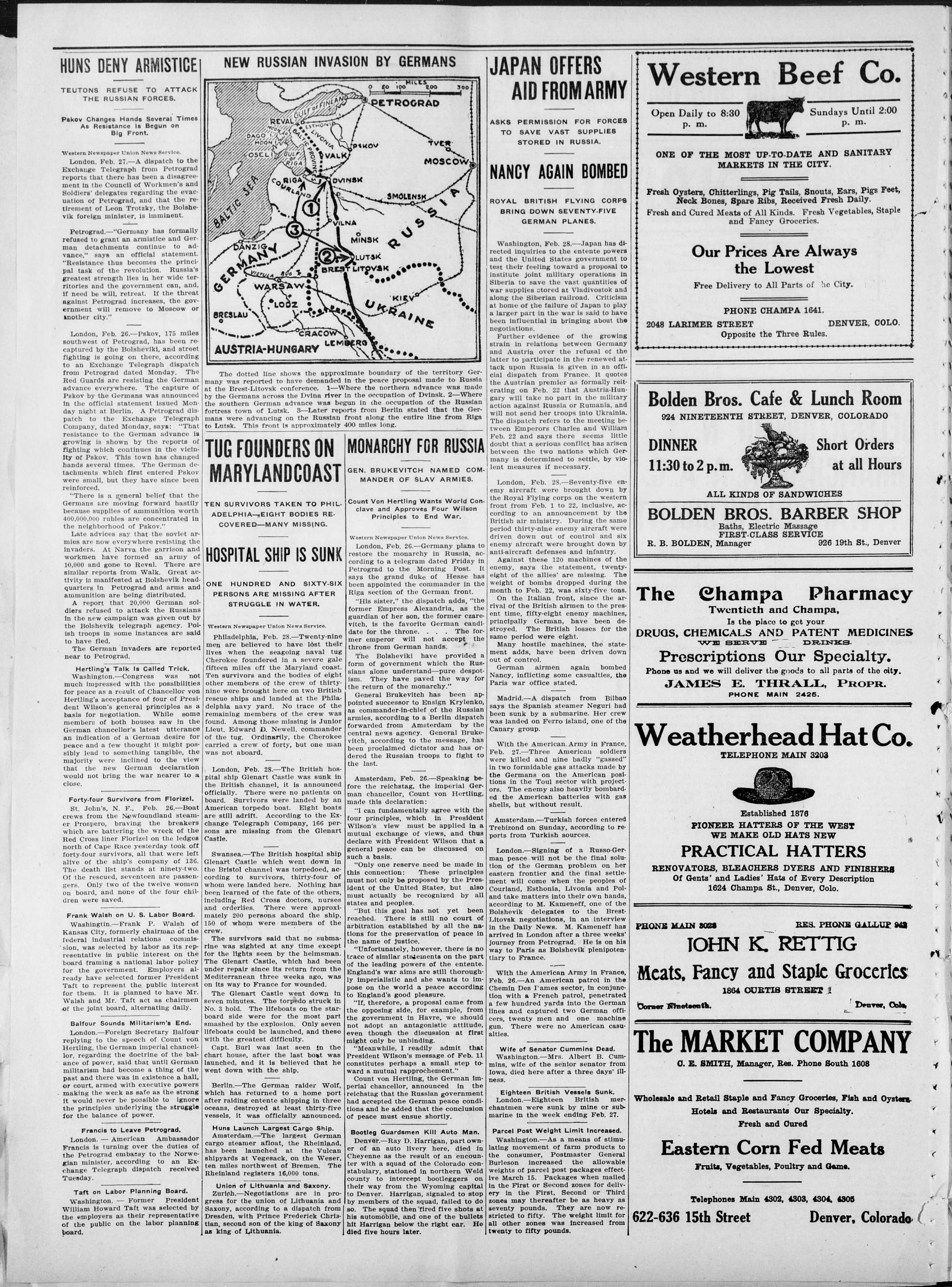
The dotted line shows the approximate boundary of the territory Germany was reported to have demanded in the peace proposal made to Russia at the Brest-Litovsk conference. 1—Where the northern advance was made by the Germans across the Dvina river in the occupation of Dvinsk. 2—Where the southern German advance was begun in the occupation of the Russian fortress town of Lutsk. 3—Later reports from Berlin stated that the Germans were advancing on the Russian front along the entire line from Riga to Lutsk. This front is approximately 400 miles long.
TUG FOUNDERS ON MARYLANDCOAST
TEN SURVIVORS TAKEN TO PHIL
ADELPHIA—EIGHT BODIES RE-
COVERED—MANY MISSING.
HOSPITAL SHIP IS SUNK
ONE HUNDRED AND SIXTY-SIX PERSONS ARE MISSING AFTER STRUGGLE IN WATER.
Western Newspaper Union News Service.
Philadelphia, Feb. 28.—Twenty-nine men are believed to have lost their lives when the seagoing naval tug Cherokee foundered in a severe gale fifteen miles off the Maryland coast. Ten survivors and the bodies of eight other members of the crew of thirty-nine were brought here on two British rescue ships and landed at the Philadelphia navy yard. No trace of the remaining members of the crew was found. Among those missing is Junior Leut. Edward D. Newell, commander of the tug. Ordinarily, the Cherokee carried a crew of forty, but one man was not aboard.
London, Feb. 28.—The British hospital ship Glenart Castle was sunk in the British channel, it is announced officially. There were no patients on board. Survivors were landed by an American torpedo boat. Eight boats are still adrift. According to the Exchange Telegraph Company, 166 persons are missing from the Glenart Castle.
Swansea.—The British hospital ship Glenart Castle which went down in the Bristol channel was torpeded, according to survivors, thirty-four of whom were landed here. Nothing has been learned of the fate of the others, including Red Cross doctors, nurses and orderlies. There were approximately 200 persons aboard the ship, 150 of whom were members of the crew.
The survivors said that no submarine was sighted at any time except for the lights seen by the helmsman. The Glenart Castle, which had been under repair since its return from the Mediterranean three weeks ago, was on its way to France for wounded.
The Glenart Castle went down in seven minutes. The torpedo struck in No. 3 hold. The lifeboats on the starboard side were for the most part smashed by the explosion. Only seven lifeboats could be launched, and these with the greatest difficulty.
Capt. Burl was last seen in the chart house, after the last boat was launched, and it is believed that he went down with the ship.
Berlin.—The German raider Wolf, which has returned to a home port after raiding entente shipping in three oceans, destroyed at least thirty-five vessels, it was officially announced.
Huns Launch Largest Cargo Ship.
Amsterdam.—The largest German cargo steamer afloat, the Rheinland, has been launched at the Vulcan shipyards at Vegesack, on the Weser, ten miles northwest of Bremen. The Rheinland registers 16,000 tons.
Union of Lithuania and Saxony.
Zurich.—Negotiations are in progress for the union of Lithuania and Saxony, according to a dispatch from Dresden, with Prince Frederick Christian, second son of the king of Saxony as king of Lithuania.
MONARCHY FOR RUSSIA
MONARCHY FOR RUSSIA
GEN. BRUKEVITCH NAMED COMMANDER OF SLAV ARMIES.
Count Von Hertling Wants World Conclave and Approves Four Wilson Principles to End War.
Western Newspaper Union News Service.
London, Feb. 26.—Germany plans to restore the monarchy in Russia, according to a telegram dated Friday in Petrograd to the Morning Post. It says the grand duke of Hesse has been appointed the commander in the Riga section of the German front.
"His sister," the dispatch adds, "the former Empress Alexandria, as the guardian of her son, the former czarevitch, is the favorite German candidate for the throne. . . . The former emperor will not accept the throne from German hands.
The Bolsheviki have provided a form of government which the Russians alone understand—pure despotism. They have paved the way for the return of the monarchy."
General Brukevitch has been appointed successor to Ensign Krylenko, as commander-in-chief of the Russian armies, according to a Berlin dispatch forwarded from Amsterdam by the central news agency. General Brukevitch, according to the message, has been proclaimed dictator and has ordered the Russian troops to fight to the last.
Amsterdam, Feb. 26.—Speaking before the reichstag, the imperial German chancellor, Count von Hertling, made this declaration:
"I can fundamentally agree with the four principles, which in President Wilson's view must be applied in a mutual exchange of views, and thus declare with President Wilson that a general peace can be discussed on such a basis.
"Only one reserve need be made in this connection: These principles must not only be proposed by the President of the United States, but also must actually be recognized by all states and peoples.
"But this goal has not yet been reached. There is still no court of arbitration established by all the nations for the preservation of peace in the name of justice.
"Unfortunately, however, there is no trace of similar statements on the part of the leading powers of the entente. England's war aims are still thoroughly imperialistic and she wants to impose on the world a peace according to England's good pleasure.
"If, therefore, a proposal came from the opposing side, for example, from the government in Havre, we should not adopt an antagonistic attitude, even though the discussion at first might only be unbinding.
"Meanwhile, I readily admit that President Wilson's message of Feb. 11 constitutes perhaps a small step toward a mutual rapprochement."
Count von Hertling, the German imperial chancellor, announced in the reichstag that the Russian government had accepted the German peace conditions and he added that the conclusion of peace must ensue shortly.
Bootleg Guardsmen Kill Auto Man.
Bootleg Guardsmen Kill Auto Man.
Denver.—Ray D. Harrigan, part owner of an auto livery here, died in Cheyenne as the result of an encounter with a squad of the Colorado constabulary, stationed in northern Weld county to intercept bootleggers on their way from the Wyoming capital to Denver. Harrigan, signaled to stop by members of the squad, failed to do so. The squad then fired five shots at his automobile, and one of the bullets hit Harrigan below the right ear. He died five hours later.
JAPAN OFFERS AID FROM ARMY
ASKS PERMISSION FOR FORCES
TO SAVE VAST SUPPLIES
STORED IN RUSSIA.
NANCY AGAIN BOMBED
ROYAL BRITISH FLYING CORPS BRING DOWN SEVENTY-FIVE GERMAN PLANES.
Washington, Feb. 28.—Japan has directed inquiries to the entente powers and the United States government to test their feeling toward a proposal to institute joint military operations in Siberia to save the vast quantities of war supplies stored at Vladivostok and along the Siberian railroad. Criticism at home of the failure of Japan to play a larger part in the war is said to have been influential in bringing about the negotiations.
Further evidence of the growing strain in relations between Germany and Austria over the refusal of the latter to participate in the renewed attack upon Russia is given in an official dispatch from France. It quotes the Austrian premier as formally reiterating on Feb. 22 that Austria-Hungary will take no part in the military action against Russia or Rumania, and will not send her troops into Ukraine. The dispatch refers to the meeting between Emperors Charles and William Feb. 22 and says there seems little doubt that a serious conflict has arisen between the two nations which Germany is determined to settle, by violent measures if necessary.
London, Feb. 28.—Seventy-five enemy aircraft were brought down by the Royal Flying corps on the western front from Feb. 1 to 22, inclusive, according to an announcement by the British air ministry. During the same period thirty-nine enemy aircraft were driven down out of control and six enemy aircraft were brought down by anti-aircraft defenses and infantry. Against these 120 machines of the enemy, says the statement, twenty-eight of the allies' are missing. The weight of bombs dropped during the month to Feb. 22, was sixty-five tons. On the Italian front, since the arrival of the British airmen to the present time, fifty-eight enemy machines, principally German, have been destroyed. The British losses for the same period were eight.
Many hostile machines, the statement adds, have been driven down out of control. German airmen again bombed Nancy, inflicting some casualties, the Paris war office stated.
Madrid.—A dispatch from Bilbao says the Spanish steamer Neguri had been sunk by a submarine. Her crew was landed on Ferro island, one of the Canary group.
With the American. Army in France, Feb. 27.—Three American soldiers were killed and nine badly "gassed" in two formidable gas attacks made by the Germans on the American positions in the Toul sector with projectors. The enemy also heavily bombarded the American batteries with gas shells, but without result.
Amsterdam.—Turkish forces entered Trebizond on Sunday, according to reports from Turkish sources.
London.—Signing of a Russo-German peace will not be the final solution of the German problem on her eastern frontier and the final settlement will come when the peoples of Courland, Esthonia, Livonia and Poland take matters into their own hands, according to M. Kameneff, one of the Bolshevik delegates to the Brest-Litovsk negotiations, in an interview in the Daily News. M. Kameneff has arrived in London after a three weeks' journey from Petrograd. He is on his way to Paris as Bolshevik plenipotentiary to France.
With the American Army in France, Feb. 26.—An American patrol in the Chemin Des Fames sector, in conjunction with a French patrol, penetrated a few hundred yards into the German lines and captured two German officers, twenty men and one machine gun. There were no American casualties.
Wife of Senator Cummins Dead. Washington.—Mrs. Albert B. Cummins, wife of the senior senator from Iowa, died here after a three days' illness.
Eighteen British Vessels Sunk. London.—Eighteen British merchants were sunk by mine or submarine in the week ending Feb. 27.
Parcel Post Weight Limit Increased.
Washington.—As a means of stimulating movement of farm products to the consumer, Postmaster General Burleson increased the allowable weights of parcel post packages effective March 15. Packages when mailed in the First or Second zones for delivery in the First, Second or Third zones may thereafter be as heavy as seventy pounds. They are now restricted to fifty. The weight limit for all other zones was increased from twenty to fifty pounds.
Western Beef Co.
Open Daily to 8:30 p. m.
ONE OF THE MOST
MARKET
Fresh Oysters, Chitterb
Neck Bones, Sp
Fresh and Cured Meats
and
Our Pr
t
Free Delive
PHO
2048 LARIMER STREET
Oppo
Bolden Bros.
924 NINETEENTH
OF THE MOST UP-TO-DATE AND SALE MARKETS IN THE CITY.
aters, Chitterlings, Pig Tails, Snouts, Ears, Rock Bones, Spare Ribs, Received Fresh Dried Cured Meats of All Kinds. Fresh Vegetables and Fancy Groceries.
Our Prices Are Always the Lowest
Free Delivery to All Parts of the City.
PHONE CHAMPA 1641.
IMER STREET DENVER
Opposite the Three Rules.
In Bros. Cafe & Lunch
INNETEENTH STREET, DENVER, COLUMBIA
ONE OF THE MOST UP-TO-DATE AND SANITARY MARKETS IN THE CITY.
Fresh Oysters, Chitterlings, Pig Tails, Snouts, Ears, Pigs Feet, Neck Bones, Spare Ribs, Received Fresh Daily. Fresh and Cured Meats of All Kinds. Fresh Vegetables, Staple and Fancy Groceries.
PHONE CHAMPA 1641.
2048 LARIMER STREET DENVER, COLO.
Opposite the Three Rules.
DINNER
11:30 to 2 p.m.
ALL KINDS OF SANDWICHES
BOLDEN BR
Baths
FIRST
R. B. BOLDEN, Manage
The Char
Twenty
Is the
DRUGS, CHEMICAL
WE SEE
Prescripti
Phone us and we will do
JAMES E
PH
Weather
TEL
PIONEER B
WE MA
PRACTI
RENOVATORS, BLE
Of Gents' and L
1624 Ch
PHONE MAIN 3028
JOHN
Meats, Fancy
1864
DEN BROS. BARBER
Baths, Electric Massage
FIRST-CLASS SERVICE
DEN, Manager 926 19th
Champa Phar-
Twentieth and Champa,
Is the place to get your
CHEMICALS AND PATENT M
WE SERVE DRINKS.
Scriptions Our Special
and we will deliver the goods to all parts
JAMES E. THRALL, PR
PHONE MAIN 2425.
atherhead Ha
TELEPHONE MAIN 3203
BOLDEN BROS. BARBER SHOP Baths, Electric Massage FIRST-CLASS SERVICE R. B. BOLDEN, Manager 926 19th St., Denver
The Champa Pharmacy
Twentieth and Champa,
Is the place to get your
DRUGS, CHEMICALS AND PATENT MEDICINES
WE SERVE DRINKS.
Prescriptions Our Specialty.
Phone us and we will deliver the goods to all parts of the city.
JAMES E. THRALL, PROPR.
PHONE MAIN 2425.
Weatherhead Hat Co. TELEPHONE MAIN 3203
Established 1876
PIONEER HATTERS OF THE WEST
WE MAKE OLD HATS NEW
PRACTICAL HATTERS
ATORS, BLEACHERS DYERS AND FIX
Gents' and Ladies' Hats of Every Descrip
1624 Champa St., Denver, Colo.
Established 1876
PIONEER HATTERS OF THE WEST
WE MAKE OLD HATS NEW
PRACTICAL HATTERS
RENOVATORS, BLEACHERS DYERS AND FINISHERS
Of Gents' and Ladies' Hats of Every Description
1624 Champa St., Denver, Colo.
JOHN K. RETTIGER
Fancy and Staple Gro
1864 OURTIS STREET
seventh.
MARKET COMF
E. SMITH, Manager, Res. Phone South 1
d Retail Staple and Fancy Groceries, Fish
Hotels and Restaurants Our Specialty.
Fresh and Cured
Eastern Corn Fed Me
Fruits, Vegetables, Poultry and Game.
Meats, Fancy and Staple Groceries 1864 OURTIS STREET
The MARK
C. E. SMITH, M
Wholesale and Retail Staple
Hotels and
Eastern
Fruits, Veg
The MARKET COMPANY
C. E. SMITH, Manager, Res. Phone South 1608
Wholesale and Retail Staple and Fancy Groceries, Fish and Oysters Hotels and Restaurants Our Specialty. Fresh and Cured Eastern Corn Fed Meats Fruits, Vegetables, Poultry and Game.
Telephones Main 4302, 4303, 4304, 4305
622-636 15th Street
15th Street Denver.
Corner Nineteenth.
Sundays Until 2:00
p. m.
DATE AND SANITARY
THE CITY.
Ins, Snouts, Ears, Pigs Feet,
received Fresh Daily.
Fresh Vegetables, Staple
Foodies.
Always
West
Arts of the City.
PA 1641.
DENVER, COLO.
See Rules.
& Lunch Room
DENVER, COLORADO
Short Orders at all Hours
BARBER SHOP
Massage
SERVICE
926 19th St., Denver
Pharmacy
Champa,
got your
PATENT MEDICINES
DRINKS.
Our Specialty.
foods to all parts of the city.
ALL, PROPR.
2425.
Bad Hat Co.
AIN 3203
1876
OF THE WEST
HATS NEW
HATTERS
VERS AND FINISHERS
of Every Description
Denver, Colo.
RES. PHONE GALLUP 942 ETTIG taple Groceries TREET
COMPANY
Phone South 1608
7 Groceries, Fish and Oysters
Our Specialty.
Fed Meats
Entry and Game.
Denver, Colorado
```markdown
```
VINEYARD
人
Denver, Cola
ASK BIG ACREAGE OF SPRING WHEAT
Government Calls on Farmer to Increase Food Supply.
SOUTH SHOULD FEED ITSELF
Agricultural Program for 1918 Urges Necessity for Producing Large Supply of Foods and Feedstuff to Feed America and Its Allies.
Washington, D. C.—The planting of an increased acreage to spring wheat and the production of an increased supply of other food products and of live stock, especially hogs, is recommended in a supplementary food production program issued by the United States department of agriculture.
This program re-emphasizes and amplifies the food-production program for 1918 issued by the department in August, 1917, and other suggestions made in the fall and the first of this year regarding increased pork production and increased production of foodstuffs in the South. Taken in connection with the recommendations previously made, it suggests in full the proposals which the department thinks it desirable to offer with a view to secure enough meat and dairy products, cereals, sugar and other staple and perishable foods, wool and cotton for the nation, its armies, and the allies. It gives suggestions for the approaching spring operations, based upon the latest available information as to the condition of the fall-planted crops of winter wheat and rye and as to the number of meat and dairy animals reported for 1917. They represent the best thought of the specialists of the department who have had the benefit of advice from agricultural leaders throughout the country.
Our Best Efforts Required.
"Notwithstanding an increased production of staple crops in the United States in 1917, there is need for more food," the program states. "Taking into account our own needs, the needs of the nations associated with us in this war, and the needs of friendly neutral nations, our best efforts will be required to provide enough food in 1918. Whether the war continues or not, the demands on this country, because of the increasing population and the needs of Europe will be great. An especially strong demand will be made on this country for meats and live stock. In 1917, notwithstanding the many difficulties encountered, the farmers planted the largest acreages in the history of the nation, harvested record crops of most things except wheat, and succeeded in greatly increasing the number of live stock."
"The situation is such that chief emphasis should be given to the production of the great staple food products, with special stress on wheat and hogs, the leading war foods."
The South is urged to provide food for its own people and feed for its live stock and then to plant as much cotton as can well be cultivated and harvested. To raisers of hogs and beef animals the world need for meats and fats is made clear. Farmers are urged to join with the men on the ranges in providing sheep whose wool is needed to equip soldiers.
The program discusses the farm labor problem, points out the lines of effort for relief, and outlines the activities of the federal and state agencies to furnish assistance.
Spring Wheat
In dealing with the question of spring wheat, the program states: The acreage of spring wheat should be increased in order to make certain that we shall have an adequate supply of wheat for our own uses and to meet the needs of the allies.
"While the area of winter wheat sown in 1917 was the largest on record, the condition of the crop, as reported on December 1, was the lowest ever recorded, indicating a probable production of only 540,000,000 bushels. Whether the actual production will be greater or less than the estimate will depend upon conditions prevailing between now and the time of harvest. If there were planted to spring wheat in the United States this year an acreage equal to the sum of the record planting in each spring wheat state within the last ten years, there would be sown approximately 23,300,000 acres. If there should be planted an acreage equal to the sum of the record planting for each state within the last five years there would be sown approximately 21,000,000 acres. The record planting for any year was 20,381,000, in 1911. The acreage for 1917 was 18,511,000.
"The department of agriculture has carefully studied all these records and other data in connection with the present war conditions and needs, and believes that it will be possible this year to secure an acreage in excess of the record acreage which was planted in 1911. It is believed that increased
Reached His Capacity.
The first floor of the home was reached at the rear by climbing a flight of stairs. One evening the family came from town with a good many parcels, which the father, mother and son, Eugene, proceeded to carry into the house. Eugene going up the steps first. As they neared the top step the father said, forgetting momentarily that the youngster's arms were full, too, "Open the screen door, son," to which the youngster replied: "I can't papa, I'm all used."
acreages can be secured in states and sections where spring-wheat production is known to be reasonably promising, and that such increases can be made without upsetting farm plans. It is hoped that many farmers, especially in the northern part of the corn belt, will find it possible to plant five to ten acres additional in wheat. In some cases they will plant more. In a number of states in the eastern and central portions of the country where spring wheat has not been grown in recent years, the crop is now being re-established and it is recommended that this movement be encouraged. To a small extent the acreage in oats, if necessary, could be reduced in the interest of wheat. Likewise, a very small portion of the acreage which normally would be planted to corn in the northern part of the corn belt might be sown to spring wheat.
If the acreage of spring wheat indicated for some of the states cannot be planted, the barley acreage, which is known to grow better in some localities, might be increased. The use of barley for food is increasing in this country and it is a welcome food in Europe.
Summary of Other Recommendations.
Following is a summary of other important recommendations regarding cereals, meat, poultry, and perishables. Hogs. The number of hogs should be increased by at least 15 per cent during the year 1918.
Sugar. Effort should be made to maintain the acreage of sugar cane and sugar beets, and to increase these areas in so far as these crops are well established or are necessary to sound agricultural practice.
Production of satisfactory substitutes for sugar, including sorghum, corn and cane sirup, maple products and honey can and should be increased.
Dairy Products. The supply of dairy products should be maintained to meet the needs of this country and to help supply the increasing demands of the allies.
Poultry. Poultry production should be increased greatly, especially in back yards and on farms where waste material is available and the purchase of expensive grains and other material is not required.
Corn. An acreage of corn approximately equal to that of 1917 should be planted, with possible slight reductions in certain sections to free areas for spring wheat.
Oats, Barley, Rice, Buckwheat and Flaxseed. The area in oats should be maintained, especially in regions and on soils which are not so well adapted to other grains, but with a small reduction to provide for increasing the wheat acreage. Barley production should be increased in regions where it grows best, especially in the northern edge of the corn belt and in sections north and west of the belt; and rice, buckwheat and flaxseed production should be maintained and, if possible, increased. Potatoes. The normal acreage of Irish and sweet potatoes should be maintained in 1918, notwithstanding the large crops in 1917. Hay, Foxtail and Pastures. Wherever feasible, the area devoted to hay, forage and silage crops should be increased and these products should be used to a greater extent in place of grains and other concentrates.
Beef Animals. The number of beef animals should be maintained and, in areas where it is clearly the best range and farm practice, should be increased. Beans, Peas and Peanuts. The production of beans and peas should be increased in regions to which they are adapted, because of their high food value, keeping qualities, and availability for domestic or export trade. Soy beans and peanuts should be increased in order to supplement beans and peas as human food, as a source of much needed oil, and as animal feeds. Perishables. (a) Market gardens near large consuming centers should be increased so as to meet, as nearly as possible, the needs of the community, and in order to obviate the necessity of transporting such products from distant points. It is important to do all that is possible to relieve the strain upon transportation facilities.
(b) The planting of home gardens, especially for family needs and for preserving food for future use, again should be emphasized.
(c) The commercial production of perishables generally should be increased above normal wherever it is reasonably clear that transportation and marketing facilities will be available.
What Was In Him.
"Children," said the teacher while instructing the class in composition, "you should not attempt any flights of fancy, but simply be yourselves and write what is in you. Do not imitate any other person's writings or draw inspiration from outside sources."
As a result of this advice Johnny Wise turned in the following composition:
"We should not attempt any flutes of fancy, but rite what is in us. In me thare is my stummick, lungs, hart, liver, two apples, one piece of pie, one stick lemon candy and my dinner."—Baltimore Bulletin.
Work is the glory and delight of life, and the only acceptable excuse for being in this world, and the object of all practical investigations of the principle of fatigue and recovery is to find out, not what is the least possible amount of work that a human being can get along on, but what is the greatest amount that he can do without decreasing his working capacity. Such is the gospel of work, which those who are not of the elect may regard as hard doctrine.—Exchange.
COLORADO STATE NEWS
Western Newspaper Union News Service.
Potato growers representing 3,000 carloads awaiting shipment, met at Greeley and formulated appeals to the food and general authorities of the United States for more refrigerator cars to move the crop. The need is for 300 cars a day, whereas the number on hand is fifteen per day.
A transaction which has cost the city and county of Denver more than $200,000 without benefit to the taxpayers was completed by the issuing of a voucher for $11,250 in favor of the Federal Ballot Machine Company. Lieutenant Commander Robert M. Dutton, U. S. navy, retired, died at Colorado Springs from tuberculosis contracted in Belgium while an aid of Herbert C. Hoover in administering the Belgium relief commission.
"It is absolutely necessary that every effort possible be made to conserve food staples unless we are to fall in our part in the world war," said Thomas B. Stearns, federal administrator for Colorado.
City Council of La Junta has adopted a resolution declaring forfeited the city street franchise of the gas company unless it immediately begins to pay into the city treasury 2 per cent of its receipts.
Provost Marshal John Evans fixed the time for the departure of the Denver contingent of the last 15 per cent of the first draft for Fort Riley. The men will leave on the evening of March 4.
C. A. Weinberg, a prominent merchant of Loveland, died suddenly of heart failure while driving a party of singers from the First Presbyterian church to hold a service in Masonville.
Thomas B. Stearns, federal food administrator, received a wire from the national administrator prohibiting malters from purchasing barley and other grains for malting.
Senator Penrose of Colorado Springs has invited prominent astronomers from all parts of the country to view the eclipse of the sun from the top of Pike's Peak on June 8.
H. R. Brown, 81, a pioneer of Colorado, one of the oldest and best known citizens of Arvada, died at the home of his sister, Mrs. Caroline T. McMillan, in Berkeley.
Forty miners at the Monument Valley Coal Company at Strong went on strike because a watchman at the plant was denied a wage increase of $1.40 a day.
George Stidger, 58 years old, former district attorney, prominent Mason, Republican and lawyer, died suddenly of heart failure in his office in Denver.
Mrs. Helen Ring Robinson, ex-senator of Colorado, has been appointed state chairman of the woman's committee on the next Liberty loan drive. Malcolm A. Fraser was made manager of the United States food exposition to be held in Denver's Auditorium during the week beginning April 6. Colorado has sent its second contribution of structural ironworkers to San Francisco to help in the shipbuilding yards for Uncle Sam. Notice has been issued by the federal food administrator that all bakers will be required to use 20 per cent substitutes in bread and rolls. Clarene Hoyt, aged 72, who invented a spanking machine for punishing convicts while warden of a Colorado penitentiary, died at Golden.
The master mechanics' department of the Denver & Rio Grande railroad shops have been moved from Barnum, near Denver, to Pueblo.
A plan to "more suitably handle the loafers to town" is being worked out by the Adams county council of defense.
Guy Wallick, son of Pinkney Wallick of Denver, has been promoted to a captaincy in the field artillery.
The Sunday free concerts in the Denver Auditorium on the new municipal organ will begin March 24.
Bonds have been voted for the building of school houses at Sugar City and Manzanola.
A new line company has begun negotiations at Volcano near Steamboat Springs.
Methodists of Holly have let a contract to build a new church at a cost of $7,000.
The Brewster coal mine is to be reopened to supply citizens in that locality.
Five miles of the road between Montrose and Olathe have been graveled.
The school board at Lamar is planning an addition to the high school.
Citizens of Fleming have authorized the issuance of $15,000 school bonds.
Stock growers have had response to their urgent appeal in a telegram from Herbert C. Hoover, national food administrator, removing until April 5th the inhibition against mutton and lamb on meatless Tuesdays. This will not apply to the voluntary order concerning meatless meals.
Enough patriotic song books have been bought by the Women's Club at Silverton to accommodate the audience at any patriotic meeting in the city, Mrs. May B. Hodges has reported to the State Council of Defense
COLORADO NEWS NOTES.
Denver district stands seventeenth in the number of army recruits secured by postmasters of the second, third and fourth class. A premium of $5 is paid for each applicant sent to the recruiting stations by the rural postmasters; and 423 men have been enlisted in the Denver office through this means.
More than 750 Pueblo skilled mechanics have applied for civil service jobs in the shipbuilding yards of the United States, and several hundred of those applying have already been accepted and sent to the various ship yards where the government is building ships to carry supplies to the armies of the allies.
Dr. Charles A. Lory has reported to Governor Gunter that Rio Grande, Boulder and Weld counties are ready to pay their share of the expenses in employing home demonstration experts to help housewives in solving food and home economy problems. Interest in this work is also being shown by Montrose and La Plata counties.
There is little scarcity of farm labor in Colorado at present and in some communities there are surpluses of labor, Dr. Charles A. Lory has reported to Governor Gunter and the State Council of Defense after the receipt of the reports from the county agricultural agents. Of course all farming counties expect shortages later.
Withdrawal from the United Mine Workers and formation of a new union was favored by northern Colorado coal miners at a meeting at Frederick attended by representatives of local unions in Lafayette, Firestone, Frederick, Puritan and Louisville. This action was taken as a protest against the alleged frauds in connection with the January election.
Colorado saved in January 87,268 pounds of meat against 80,689 pounds in December; 54,703 pounds of wheat flour against 48,907 pounds in December and 27,555 pounds of sugar against 22,169 pounds in December, according to the figures of Elmer E. Lucas, chairman of the hotel and restaurant division of the Colorado federal food administration.
The secretary of the interior has authorized the disposal of a part of the lands on the Grand Valley and Uncompahgre irrigation projects of Colorado, throwing open to settlers 5,000 acres of the Grand Valley project and 7,000 acres of the Uncompahgre project. The lands thus opened to entry are divided into farm units ranging in size from forty to eighty acres. A motion for a new trial was filed in Denver in the United States District Court by the Rev. Charles W. Huffman, recently convicted on a charge of violation of the Mann white slave act, which grew out of his arrest last spring in Denver in the company of Miss Gladys Overlander of New Palestine, Ohio. Huffman had been pastor of the United Brethren church there.
Joseph S. Jaffa, Colorado director of the U. S. Boy's Working Reserve, is completing his plans for the enrollment for farm work of all boys between the ages of 16 and 21 years. Agents have been named in all counties. The boys may enroll at any time, although the week March 18 to 23 will be specially devoted to give city boys a little training. When boys are wanted on the farms the reserve will supply the farmers' needs.
Governor Gunter has announced the appointment of the following additional committees of the publicity department of the State Council of Defense: Granges—C. W. Swaye, lecturer of the state grange, Denver. Farmers' unions—J. M. Collins, president of the Farmers' union, Eaton. Libraries—Chalmers Hadley, Denver; Charlotte A. Baker, Fort Collins, Patriotic societies—E. V. Dunkle. Speakers—Malcolm Lindsey. Organized labor—Clint C. Houston.
On the ground that recent criticisms of him in his private capacity as a miller might embarrass Gov. Julius C. Gunter and the State Council of Defense and might interfere with the council's work, J. K. Mullen tendered his resignation both as chairman and member at the last meeting. The council recommended to the governor that the resignation be rejected and that Chairman Mullen be asked to withdraw his resignation, an action in which the governor concurred.
Governor Gunter has appointed a special committee to make recommendations for relief of conditions in the southwestern section of the state, chiefly La Plata, Montezuma and Montrose counties, following a report made to the State Council of Defense by John Morris, master of the State Grange. The conditions arise out of the peculiar situation of those counties with respect to freight charges and food production. Producers there cannot obtain sufficient for their products while consumers must pay unusually high prices because of high freight rates due to long hauls. Regarding wheat and flour prices, the situation is particularly serious.
Adams county farmers report that wheat conditions are better than they have been for several years. Each cold snap has been preceded by a good fall of snow which has protected it from the cold. Farmers are very optimistic over their wheat outlook. The Denver office of the United States food administration has received contracts for the purchase of 15,000,000 pounds of pinto beans, which was only a partial return on the canvass being conducted in all the bean-growing counties of the state.
FLORAL DESIGNS PUT UP WHILE YOU WAIT
CHOICE PLANTS AND CUT FLOWERS CONSTANTLY ON HAND
GREENHOUSES: Thirty-Fourth and Curtis Streets
TELEPHONE, MAIN 1511
DENVER, COLO
919 NINETEENTH STREET MORRISON'S FAMOUS
MORRISON'S FAMOUS JAZZ ORCHESTRA
AND ENTERTAINERS
GEO. MORRISON, MANAGER
Music Furnished for
Phone Main 2707. Res. 2947 Store
When You
The Heads, Feet,
Neckbones or
any other part of
the squeal, go to
East's Man
2300-6 Lari
Night and Day
806 15th St, Two Doors From Store
Free Delivery—Shipping
Notice: Open evenings until
NOT
In order to get acquainted again
friends, we are going to give away
FF
with this ad. a valuable premium
Let this INFORMATION, for the b
the owner of the
NIGHT AND DAY
I am printing this. I am the man
Company seven years ago at 2038
couple of doors up to a larger st
four years. Now I have been run
CANTILE CO. for three years, an
co-operation of your trade, which
Now I am going to go after your
fore or giving you the advantage
meat and grocery buying. We bu
middleman's profit. We can save
order. SO GIVE US A TRIAL
MEATS.
Furnished for all Occasion
707. Res. 2947 Stout St. DE
When You Wish
Heads, Feet Tails,
Bones or Chitlerin
other part of the hog
neal, go to
7's Market
300-6 Larimer St
and Day Mercantile
Two Doors From Stout St. Phone
Free Delivery—Shipping Orders a Spot
Open evenings until 12 o'clock. All
NOTICE
to get acquainted again with our old
are going to give away
Phone Main 2707. Res. 2947 Stout St. DENVER, COLO.
When You Want
The Heads, Feet Tails, Snouts Neckbones or Chitlerings, or any other part of the hog except the squeal, go to
Night and Day Mercantile Co.
Night and Day Mercantile Co.
806 15th St, Two Doors From Stout St.
Free Delivery—Shipping Orders a Specialty.
Notice: Open evenings until 12 o'clock. All day Sundays.
NOTICE
In order to get acquainted again with our old customers and their friends, we are going to give away
FREE
with this ad, a valuable premium worth dollars to you.
Let this INFORMATION, for the benefit of the people who don't know the owner of the
NIGHT AND DAY MERCANTILE CO.
I am printing this. I am the man who opened up the Western Market Company seven years ago at 2038 Larimer Street. I then moved a couple of doors up to a larger store, at 2038 Larimer and am it for four years. Now I have been turning the NIGHT AND DAY MERCANTILE CO. for three years, and my whole success was through the co-operation of your trade, which we wish to thank you one and all.
Now I am going to go after your business stronger than I ever did before by grocery buying. We buy direct of many years of experience of meat and grocery buying. We buy in carload lots and save the middleman's profit. We can save you from 20 to 30 per cent on your order. SO GIVE US A TRIAL.
MEATS.
GROCERIES.
Let this INFORMATION, for the benefit of the people who don't know the owner of the
NIGHT AND DAY MERCANTILE CO.
I am printing this. I am the man who opened up the Western Market Company seven years ago at 2038 Larimer Street. I then moved a couple of doors up to a larger store, at 2048 Larimer, and ran it for four years. Now I have been running the NIGHT AND DAY MERCANTILE CO. for three years, and my whole success was through the co-operation of your trade, which we wish to thank you one and all. Now I am going to co-affirm the advantage that I have given to driving on the advantage of my many years of experience meat and grocery buying. We buy direct in carload lots and save the middleman's profit. We can save you from 20 to 30 per cent on your order. SO GIVE US A TRIAL.
MEATS.
Small Eastern Hams.....26¹⁶¹
Dixie Bacon Bacon, lb.....37¹⁶¹
Fresh Neck Bones, lb.....9¹⁶
Hog Chitterlings, lb.....5¹⁶¹
We handle Fresh Pig Tails, Pig's
Feet, Spare Ribs, Miltz, Kidneys,
Snouts, Ears, Brains and all other
offal.
Dressed Rabbitts, Chickens, Turkey's and Ducks.
Best Creamery Butter, lb....45c
Fresh Oysters, pt....30c
We carry a full line of Fresh Veg
Your co-operation of purchasing g
sell you right along from 20 to 2
Taxicab Rates.
Depot, 1 or 2 pass...50c
Depot, each addi-
tional pass.....25c
One mile radius.....50c
Each addition'l mile.25c
Phone Mail
full line of Fresh Vegetables and Fruits
collection of purchasing goods from us will
t along from 20 to 25 per cent less th
Rates.
Motto:
Mass...50c sure." C
addi-
...25c
us...50c Rates
mle...50c $1.5
We carry out operation of purchasing goods from us will enable us to undersell you, right along from 20 to 25 per cent less than any other store.
Taxicab Rates.
Depot, 1 or 2 pass...50c
Depot, each addl.
tional pass...25c
One mile radius...50c
Each addition'l mile.25c
Motto: "Not slow but sure." Cash only.
Rates Per Hour.
$1.50 to $2.50.
Phone Main 6699
Bean Auto Livery
HEATED TAXICAB.
TAXICAB LANDULET AND 7-PASSENGER 1918 LATE
MODEL CARS.
STAND: NIGHT AND DAY CAFE
919 Nineteenth St. Denver, Colorado
Phone Main 6699
For all Occasions
St. St. DENVER, COLO.
You Want
Tails, Snouts
Chitlerings, or
the hog except
Market Phone Main
1461
Inner Street
Mercantile Co.
St. St. Phones Champa 3018-3673
ing Orders a Specialty.
122 o'clock. All day Sundays.
ICE
in with our old customers and their
EE
north dollars to you.
nefit of the people who don't know
MERCANTILE CO.
Who opened up the Western Market
Lartner Street, I then moved
at 2048 Lartner, and ran it for
ing the NIGHT AND DAY MER-
my whole success was through the
we wish to thank you one and all,
business stronger than I ever did be-
of my many years of experience of
direct in carload lots and save the
you from 20 to 30 per cent on your
SUGAR, 13 lbs. for.....$1.00
With every $3.00 purchase.
Macaroni and Spaghetti, pkg.....5c
Reg. 5c sacks Salt; 3 for.....10c
Large cans Milk, each.....11c
Water White Soap, 6 bars for 25c
Fresh Eggs, doz.....40c
Swift's Laundry Soap, 3 bars.....10c
15c cans Milk for, each.....11c
Small cans Milk for, each.....6c
10c grade Toilet Paper, roll.....5c
tables and Fruits of all kinds.
ods from us will enable us to under-
per cent less than any other store.
Motto: "Not slow but
sure." Cash only.
Rates Per Hour.
$1.50 to $2.50.
FREE
GROCERIES.
THE COLORADO STATESMAN
LEAGUE
IMAGE
IN
FAIL
BACK
COUNTRY
PARTY
SUBSCRIPTION RATES.
One Year ..... $2.00
Six Months ..... 1.00
Three Months ..... .60
PAYABLE IN ADVANCE.
s.
-class matter at the postoffice in the City
JOS. D. D. RIVERS.....Proprietor
Entered as second-class matter at the postoffice in the City of Denver, Colo.
1824 Curtis Street, Room 25.
Phone Main 7417.
Reading notices, ten lines or less, 10 cents per line. Each additional line over ten lines, 5 cents per line. Display advertising, 50 cents per inch.
Remittances should be made by Express Money Order, Postoffice Money Order, Registered Letter or Bank Draft. Postage stamps will be received the same as cash for the fractional part of a dollar. Only 1c and 2c stamps taken.
No discounts allowed on less than three months' contract. Cash must accompany all orders from parties unknown to us. Further particulars on application.
Communications to receive attention must be newsy, upon important subjects, plainly written only upon one side of the paper, must reach us Tuesday of the author. No manuscript returned, unless stamps are sent for postage days, if possible, anyway not later than Wednesdays, and bear the signature. All communications of a personating nature that are not complimentary will be withheld from the columns of this paper.
Reading notices, ten lines or less, 10 cents per line. Each additional line over ten lines, 5 cents per line. Display advertising, 50 cents per inch.
Remittances should be made by Express Money Order, Postoffice Money Order, Registered Letter or Bank Draft. Postage stamps will be received the same as cash for the fractional part of a dollar. Only 1c and 2c stamps taken.
No discounts allowed on less than three months' contract. Cash must accompany all orders from parties unknown to us. Further particulars on application.
Communications to receive attention must be newsy, upon important subjects, plainly written only upon one side of the paper, must reach us Tuesday of the author. No manuscript required, unless stamps for postage days, if possible, anyway not later than Wednesday, and bear the signature. All communications of a personating nature that are not complimentary will be withheld from the columns of this paper.
CLEAN UP FOR SPRING.
that the medical world backs up the express special advices—"Clean up your system for that yourself in good shape," finds an answer to engage in to clean the house, the furniture. A few days more and we enter the season to awake with a joyousness that throws that seem to beset us in the dreary months should act in advance of the reminder of their annual visits through their representation our spring garb by "cleaning up." We have from visitors to our city, and we might say room for improvement, and if we would achieve from each one assigning himself of getting into the crevices and corners would start at once for the all-desirable age of old could not help from expressing it!" when he beheld the beauty, the gown, the tabernacle, and we can in these days resolve to adhere to the laws which guideressors of long life and comfort.
All comments will surpass the previous year in the general cleanliness of home and
AMERICAN PATRIOT AND HIS DEMOCRACY
E, noted American orator, poet and author of Democracy" to the people of Ding, in the city Auditorium, paid a glowwash and in summarizing named George Vation, Abraham Lincoln, the savior, Wood, his severe denunciation of the Kaiser, an asm told such plain truths about the avowal him and his qualities, in arousing him to impressing him with the seriousness of his to not only lick the Kaiser, but to make him and remove for all time the present nature and elsewhere, that we were compelled to the above subject. First, it is necessary to bring to the general acceptance as given by the words "patriot" and "democracy" is devoted to his native country and its element by the people collectively, a form of some power is vested in the people collectively political or social equality. Let us pause if the average American patriot with a royality has at heart the essence of this Ding to teach the world in the present crisis his living up to the plain, simple, unmissable doctrine, this truth that must bring to the living truth by the might of America in his speech recently on "Internationalize the living truth by the might of America times when we are forced to wonder democracy extend themselves to this element belong, and we shudder and tremble at lawlessness and atrocities and outraging agency, which gives out vauntingly DEMOCRACY! and yet compels us to dread dregs. We are patriotic; we cannot end of ours, but how can our hearts pulsate side of democracy, how can we believe in them as Violette and others when in our our senators, our congressmen, our clergy thorn in the nation's flesh, their quiescence that our race is not included in the blesses of other races? Presurrection in the minds of his posterity, his mortification, to alleviate this burden, victim, and restore us to the joy, the free people of a democracy enjoy? The time whether incidentally or accidentally, the from this race to which we belong, not by the same spirit which now stirs the out from memory the evil agent which the power and will of one being who clergy and who feels he is administering punishment will the House of the Hohenzollers fall autocrat, whether in kingly garb, or prizes now indulge in by their meaning of the an illumination of thought that will be obliterated until man in this country plying A REAL PATRIOT AND A MEMBER which knows NO CLASS, CREED NOR COURT.
ABSOLUTELY necessary," says the student of cleanliness, and his argument that the medical world backs up the expression, "Clean up," in their special advices—"Clean up your system for spring," "Purify your blood and put yourself in good shape," finds an answer in the readiness that people engage in to clean the house, the furniture, the premises as a whole, etc. A few days more and we enter the season of spring when everything seems to awake with a joyousness that throws aside the dull cares and actions that seem to beset us in the dreary months of winter, and it is then that we should act in advance of the reminder of our city authorities, who pay their annual visits through their representatives, to advise the denning of our spring garb by "cleaning up." We have gotten praise here and there from visitors to our city, and we might say, WELL MERITED, but there is room for improvement, and if we would only realize the benefits to be achieved from each one assigning himself or herself the pleasurable duty of getting into the crevices and corners—also polishing the surfaces—we would start at once for the all-desirable end.
The psalmist of old could not help from expressing, "How amiable are thy dwellings!" when he beheld the beauty, the grandeur and the cleanliness of the tabernacle, and we can in these days hear similar exclamations if we resolve to adhere to the laws which guide our health and make us the possessors of long life and comfort.
We hope 1918 comments will surpass the previous years, and this will be the banner year in the general cleanliness of home and city.
THE AMERICAN PATRIOT AND HIS DEMOCRACY.
DR. VIOLETTE, noted American orator, poet and author, in his address on the "Evolution of Democracy" to the people of Denver last week, Friday evening, in the city Auditorium, paid a glowing tribute to the American patriot, and in summarizing named George Washington, the founder of our nation, Abraham Lincoln, the savior, Woodrow Wilson, the teacher; and after his severe denunciation of the Kaiser, and all things pertaining to Kaiserism told such plain truths about the average American in his definition of him and his qualities, in arousing him to WAR CONSCIOUSNESS and impressing him with the seriousness of the gigantic task upon his shoulders to not only lick the Kaiser, but to make the world safe for DEMOCRACY and remove for all time the present menace—AUTOCRACY in Germany and elsewhere, that we were compelled to think and then write upon the above subject. First, it is necessary to give the plain meanings according to the general acceptance as given by the lexicographer, Noah Webster, of the words "patriot" and "democracy." PATRIOT—one who loves and is devoted to his native country and its welfare. DEMOCRACY—government by the people collectively, a form of government in which the supreme power is vested in the people collectively by elected representatives; political or social equality. Let us pause for a moment and ask ourselves if the average American patriot with all his Christianity, with all his loyalty has at heart the essence of this DEMOCRACY that he is endeavoring to teach the world in the present crisis, and if we are satisfied that he is living up to the plain, simple, unmistakable meaning of this word, this doctrine, this truth that must bring man back to the grand united order of COMMON BROTHERHOOD, then in the words of Gurdon R. Miller in his speech recently on "Internationality and Rotary"—Right shall be made the living truth by the might of America in this just cause. There are times when we are forced to wonder whether all this patriotism and democracy extend themselves to this element of the population to which we belong, and we shudder and tremble at the thought of the ever-increasing lawlessness and atrocities instituted by the members of this great civilizing agency, which gives out vauntingly to the world—DEMOCRACY! DEMOCRACY! and yet compels us to drink from the cup of woe, its bitterest dregs. We are patriotic; we cannot help from loving this beautiful land of ours, but how can our hearts pulsate cheerfully with the spirit and pride of democracy, how can we believe in the sincerity of representative men as Violette and others when in our petitions to our chief magistrate, our senators, our congressmen, our clergymen, to remove this stigma, this thorn in the nation's flesh, their quiescent action proves beyond a doubt that our race is not included in the blessings that democracy brings to other races in this and other countries? Can the spirit of Lincoln not find resurrection in the minds of his posterity today to remove this anguish, this mortification, to alleviate this burden which preys like a vampire on its victim, and restore us to the joy, the freedom, the comfort and pleasures that people of a democracy enjoy? The time is ripe, fellow Americans, when whether incidentally or accidentally, the mental shackles will be removed from this race to which we belong, not by request, not by favor or gift, but by the same spirit which now stirs the heart of man the world over to blot out from memory the evil agent which subjugates a people, a nation, to the power and will of one being who claims lineage with the Divine Being, and who feels he is administering punishment for wrongdoing. Not only will the House of the Hohenzellerns fall and be wiped out, but every other autocrat, whether in kingly garb, or priestly robe, and the mockery that men now indulge in by their meaning of the term democracy will lose itself in an illumination of thought that will be handed down the ages never to be obliterated until man in this country practices what he preaches, becoming A REAL PATRIOT AND A MEMBER OF THE REAL DEMOCRACY which knows NO CLASS, CREED NOR COLOR.
THE CREED OF THE DENVER ROTARY CLUB.
(Tune—Battle Hymn of The Republic.)
MINE eyes have seen a vision
When man shall live with
When service each for all a
The Creed of Rotary.
Then wars shall cease and smilin
And profit found in serving best
And men shall work as brothers
For that is Rotary.
Ive seen a vision of a better day to be, shall live with fellow man in love and cease each for all and all for each their creed and of Rotary.
cease and smiling peace throughout the in serving best shall be a common gain, work as brothers from the Mountains to the is Rotary.
MINE eyes have seen a vision of a better day to be.
When man shall live with fellow man in love and charity,
When service each for all and all for each their creed shall be
The Creed of Rotary.
Then wars shall cease and smiling peace throughout the world shall reign.
And profit found in serving best shall be a common gain.
And men shall work as brothers from the Mountains to the Main,
For that is Rotary.
Chorus: Glory, glory, Colorado
And Denver Rotary.
WHY BLAME ME AND MINE?
OAKLAND, Cal., Feb. 22.—The crowd that gathered at the million dollar City Auditorium Monday night, Feb. 11, to see and hear Roscoe Conkling Simmons embraced the whole Race population of Oakland and all the white people who are determined to go to Heaven.
Long before the hour set for the address the Auditorium was crowded. Col. Simmons came up from Los Angeles and his day was taken up in shaking hands with the multitude that came to call on him. But when he arose that night he was the young lion of his tribe. His voice was as clear as a bell and his words fell like commandments of authority.
The Ever Ready
The orator was introduced by Dean Hunt of the University of California, who referred to him as "the spokesman for his country no less than for his people."
"Why Blame Me?"
"The dean," thundered Roscoe, "the dean complains because more Americans are not in the war. A complaint just in its purpose. But let me ask the dean, Why complain to me and mine? And yet I will answer him for my twelve of the hundred millions to whom his remarks are addressed.
"Look at me. Note my condition in life. Observe me from head to foot. Then read my record and examine my title. See how my hands are crossed and tied. Look upon my neck and scan the scars there. Measure the chains I wear. Listen in the night and hear the hoofs of horses and the whisperings of men bent against my life. My eyes, steeped in fear, note that they dance with joy at words of kindness and cheer.
"I send this message, through you, back to the mighty people who rule this land, and to whom I have never been false. If you will stop the mob, if you will command my oppressors to let go, if you will loose my hands and feet, I will give my country five out of five men for the cause, and I will guarantee every man to match the stoutest soldier among the Huns!" Sheriff Leads Applause. The uproar and applause that followed was led by the sheriff of Alameda county. For two hours the orator and leader kept that audience on pins with his knowledge of history, with his wit and eloquence.
The University of California extended him a special invitation to visit the institution. In the fall he will most likely speak in the famous Greek theater.
The visit of Roscoe Conkling Simmons to California has done more for his people and this country than a newspaper report can tell. He had more fuss made over him than any visitor since Booker T. Washington was out here.
BRILLIANT LEADER OF RACE OBEYS THE SUMMONS.
President Hightower T. Kealing Dies After Several Months' Illness.
President H. T. Kealing, one of the most thoroughly educated men of our Race, the president of Western University, Quindaro, Kansas, noted author, orator and lecturer, died at his home adjoining the university grounds Monday afternoon, February 24, 1918. President Kealing was born 1859 at Austin, Texas; educated in the public schools of Austin, Straight University, New Orleans, La., and Tabor College in Iowa. He was converted and joined the church in New Orleans in 1875, where he served as superintendent of the Sunday school and served in Texas assistant to pastors and secretary of presiding elders. He was principal of Paul Quinn College 1881-1883, vice principal at Prairie View Normal school 1883-1886. He was principal of the Grammar school and organized the Colored High School at his old home town, Austin, Texas, in 1887. He was supervisor of all colored schools in that city 1890-1892; president of Paul Quinn College 1892-1896, in 1896 he was elected editor of the A. M. E. Review serving till 1912. In 1910 he was elected president of Western University which position he held until death. He has been a member of the General Conference of the African M. E. church since 1884 and was a member of the Ecumenical conference in London, England, in 1901, and elected spokesman of the A. M. E. church delegation and made one of the principal addresses.
He was twice married: first to Miss Selina Sancier of New Orleans in 1887 and 2nd to Miss Celia G. Shaw of Austin, Texas, in 1891.
President Kealing was an ordained elder in the A. M. E. church and received his A.M. degree, Ph.D. and LL.D. from Tabor College, Morris Brown College and Wilberforce University respectively. He was a member of the National Educational Association, American Academy of Social and Political Science; the National Negro Business League and the National Association for the Advancement of Colored People. At the General Conference he received votes for the bishopric.
President Kealing is survived by his widow, their six children, five girls and one boy, and a host of friends who mourn their loss. The funeral was held Thursday at 10 a. m. in Kansas City.
OUST RUSSIANS, HOPE OF JAPAN
THE COLORADO STATESMAN
ALLIES REQUEST TOKIO GOVERN
MENT TO GUARD TRANS-
SIBERIAN RAILROAD.
HALT DRIVE IN RUSSIA
NEW CALL TO ARMS ISSUED BY SLAVS WHEN TEUTONS KEEP UP ADVANCE.
Western Newspaper Union News Service.
Washington, March 1.—Japan intends not only to intervene in Siberia for the protection of Japanese and ente interests from Germany and the Bolshevik, but to oust the Russians from their sphere of influence in northern Manchuria, according to information obtained from official sources. Great Britain and France have requested the Japanese government to take measures to guard the Transsiberian railway from Vladivostok to the borders of Transbalkalia, where it quits Manchurian territory.
The Mouth-Piece of the People of Colorado and the Entire West
Japan regards Russia's collapse and surrender to Japan's enemies as involving the forfeiture by Russia of the latter's sphere in northern Manchuria. It is understood that China also entertains this view and is prepared to assist in the expulsion of Russia from Chinese territory.
London.—A Petrograd dispatch to the Exchange Telegraph Company under date of Feb. 27 says it is reported from Luga that the German detachments which entered that town a day or two ago, are leaving. The Russians, moving to meet them, have turned toward the main railway and occupied three small stations within twelve miles of Pskov. Large Russian detachments are concentrating near Pskov. The railway men are forming partisan detachments along the line.
ARELIABLE chronicle of their doings and progress; a faithful mirror of their wants, their hopes, their best aspirations.
From Smolensk comes the report that the Germans have met with strong resistance within sixteen versts (10.7 miles) from Orsha and were forced to retire. The Germans have been trying to cross the Beresina river and consolidate the ground in order to begin operations in the direction of Orsha and Gomel. Red Guards concentrated at Kroupi station prevented the Germans from advancing in the direction of Orsha.
Direct information from Novo Selie says that the Germans have received orders to make no further advance and the German cavalry patrols which appeared at Novo Selie have retired.
THE COLORADO STATESMAN
According to the Bolshevik headquarters in Petrograd, fighting proceeded all Wednesday morning for possession of Pskov and a message from Luga says it is definitely in Russian possession.
The council of people's commissaries, according to a Reuter dispatch from Petrograd, has issued another call to arms, in the course of which it is declared the German invaders are arresting the workmen's and soldiers' councils, shooting captured Red guards and arming German and Austrian prisoners in the Ukraine.
The proclamation asserts that the troops at the front have now pulled themselves together and are resisting the invasion. It concludes:
"May the blood spilled in this unequal struggle fall on the heads of the German Socialists, who are allowing the German workmen to be ranked among the Cains and Judases."
Unequaled as an advertising medium for the business of professional men and women.
No Italian Ships Sunk Last Week. Rome.—Italian shipping was immune from German submarines and mines in the week ended Feb. 23.
Curtain of Fire Halts Germans. With the American Army in France, March 1.—A strong German attack following a heavy barrage fire against the American trenches in the Chemin des Dames sector was repulsed with losses to the attackers. The well-placed American machine guns sent streams of bullets into the advancing enemy and as the German barrage fire lifted the American artillery quickly laid down a curtain of fire, the Germans retiring without a single prisoner. There were no American casualties. Five French soldiers were wounded.
An excellent family journal speaking to and for many thousand colored citizens.
Railroad Bill Passed by House. Washington.—The bill to govern federal operation of railroads was passed by the House by a vote of 337 to 6. The Senate previously had passed the bill which now goes to conference. The House bill provides for the return of the roads to their owners two years after the war ends, instead of in eighteen months, as the Senate draft proposed, and the House measure vests final rate-fixing authority in the President, while the Senate would leave this power in the Interstate Commerce Commission.
TWODOLLARSAYEAR
U. S. Protests Murders on Line.
El Paso, Tex.-Repeated attacks on United States border patrols during the last month and activities of Mexican snipers, resulting in the death of fifteen persons within a month, resulted in a conference during which Maj. Gen. George W. Reed, in command of the American troops at El Paso, entered a strong protest with Mexican Consul General Andres Garcia. Brisk fighting between Villistas and Carranza troops near the Durango line is reported.
THE COLORADO STATESMAN
Mrs. A. R. Robinson, 740 Marion street, who met with an accident a few weeks ago, by spraining her ankle, has fully recovered.
Information has reached us that B. Company of the Colored Battallon, state troops, has been mustered out of service. Capt. Cates, it is said, will be used for some other service.
dorssement in the community b who come in contact with him or work and the Colorado Statesman proud to recommend him to the ture support and consideration o public for the magnificent work doing. The Y. M. C. A. (colore now a powerful agency and in tion for good in the city of De and state of Colorado. Long m live and let its influence be felt.
Egbert Williams, one of our popular young men, is very ill at his residence, 1635 East Twenty-second avenue. We wish him a speedy recovery.
Floyd Carson, who is in charge of the Stein room at the Denver Athletic club, is making good. Headwaiter Wade says he has a very valuable assistant in him and hopes he will continue to give satisfactory services.
Mr. and Mrs. Thomas Gross are the proud parents of a beautiful baby girl who saw her first sunlight last Wednesday morning, February 27th. Mother and daughter are doing well. Dr. Huff physician in charge.
Mrs. Lizzie Ratley, who is the guest of her daughter, Mrs. Nichols, at Lincoln, Nebraska, sends word that she is enjoying life and the Nebraskan situation. She hopes to be there for a few weeks longer.
Claude Robinson has resigned his position at the Denver Athletic club and is now serving with the Hardesty family, proprietors of the Hardesty Manufacturing Co. of this city. Mr. Robinson is generally known to give perfect satisfaction in whatever sphere he occupies and we wish him every success.
The concert held at Campbell A. M. E. church last Thursday evening under the directorship of Brownie C. Allen, son of the Presiding Elder of the Albuquerque District was something out of the ordinary as the fine rendition coupled with the exhibition of what can be achieved by our local talent under competent leadership merited special commendation from those who were fortunate enough to be present. Mrs. Clark Craig, the organist of the church and one of our highly respected and popular musicians, was accompanist, and in her usual way materially supported the voices. Rev. Ward must be congratulated on having secured such services as Mr. Allen, Mrs. Clark Craig and the entire contributors to the program gave and Campbell church is proving she is to be reckoned with as so in the musical world.
DEDICATION OF MUNICIPAL ORGAN.
The dedicatory concerts of the municipal organ will be held at the City Auditorium Thursday and Friday evenings, March 21 and 22. Evan Williams, the famous American tenor, will be the soloist the first night and Miss Margaret Wilson, daughter of President Wilson, the second night. Admission ranging from 25 cents to $2.00 will be charged for these concerts for the purpose of liquidating the expenses of ornamenting the front of the organ. Sunday concerts free to the public will be held after. Mr. Clarence Reynolds, famous world organist, is employed for these entertainments. All music lovers should avail themselves of these opportunities, which will help to cultivate their taste and love for the divine art.
SECRETARY THOS. BELL Y. M. C.
A. STAYS WITH US.
It might not have been generally known even to the majority of members of the Young Men's Christian Association that Mr. Thomas H. Bell, secretary of the Denver Colored Department was about to be taken from us to fill the position of Social Secretary among the soldiers at Camp Dodge.
Fortunately for us the Board of Directors of the General Y. M. C. A., William E. Sweet, president, felt that it would work a serious injury possibly to the local work if Mr. Bell were to leave at this time as his two years of arduous work had just begun to show marked progress, and so with the determination to keep him a substantial increase to his salary was ordered with fairly large apportionments for his social and religious program for the year. This proof of the approval by the directors of the special efforts of this young man to bring the Y. M. C. A. to a standard of more than passing recognition finds in-
dorsement in the community by all who come in contact with him or his work and the Colorado Statesman is proud to recommend him to the future support and consideration of the public for the magnificent work he is doing. The Y. M. C. A. (colored) is now a powerful agency and institution for good in the city of Denver and state of Colorado. Long may it live and let its influence be felt.
OWL OIL COMPANY OFFERS GREAT ADVANTAGE TO PUBLIC.
O. W. Lovan, president and general sales agent of the Owl Oil Company, who has just returned from the oil fields of Oklahoma, brings encouraging news to stockholders in this company, and from his experience in the results of the shallow field and small production which costs less to develop and therefore creates larger gains, he feels that the public will obtain a great advantage by investing therein. Requiring less than $5,000 to develop, its leases of 360 acres, and extending for a period of twenty years, the company is offering 100,000 shares for a short time at 5 cents per share and the public would do itself very creditable service in grasping this opportunity which is limited, and which affords the largest profits for the smallest investments. Call at 504 Colorado Building where every courtesy and intelligent information will be given you by the officers of this company.
NOTICE
The Fraternal Order of Ancient Sons and Daughters of Jerusalem, cordially invites the public to attend their anniversary Monday evening, March 14, 1918. All members are specially requested to be present. Resfreshments and intellectual treat to all. Elks' Hall, Washington Street. LULA DRAIN, M. E., Queen. LELA REYNOLDS, M. E., Scribe.
PEOPLE'S PRESBYTERIAN.
PEOPLE'S PRESBYTERIAN.
E. 23d Ave. and Washington street.
Presbyter: J. A. Thos.-Hazel, S. T. B.
Presbyter: J. A. Thos.-Hazel, S. T. B.
Sermon topics: Sunday, March 3,
1918. 11 a. m. "THE THIRD TEMP-
TATION." 5 p. m., "HIS EARLY
MINISTRY."
During Lent special services are be-
ing conducted every Wednesday night
in the Chapel and every Sunday in
the church. Holy Week the services
will be observed every night. On the
night of Good Friday the choir, assis-
ted by some of the best voices of the
city will render STAINER'S CRUCI-
FIXION. The public is invited.
CHURCH OF THE HOLY REDEEM-
ER, TWENTY-SECOND AVE. AND
HUMBOLDT STREET—REV. HEN-
RY B. BROWN, B.D., VICAR—
THIRD SUNDAY AFTER LENT.
7:00 a. m., Celebration of the Holy
Eucharist.
9:45 a.m., Sunday School.
9:45 a. m., Sunday School.
11:15 a. m., Choral Solemn Celebration with Sermon.
7:45 p. m., Choral Solemn Matins with Sermon—Special preacher, Rev. S. R. S. Gray, M.A.
Tuesdays and Thursdays 4:4:30 p. m. devotional exercises are held. Fridays, 8:00 p. m., Litany and Lecture on "The Creeds." Saturday, 7:00 a. m., Holy Eucharist. Lent invites you to gain an insight into the secret of noble living. Accept this invitation with all your heart. The public is cordially invited to these special services.
EAGLE OIL COMPANY MAKES GREAT ADVANCES IN WELD COUNTY.
The Eagle Oil Company have created quite a sensation among its stockholders owing to the development of its holdings in Weld county, and now that satisfaction is seen by the smiles on the faces of the fortunate investors, by Treasury Stock advancing from 5 cents to 15 cents per share, it is wisdom to get in right now are the stock further increases. Weld county has been proven to possess oil in almost incalculable quantities and persons interested in oil should send at once to 215-216 Ideal Building for our oil map which we mail free to show the vast resources of this company. Buy Eagle Oil Stock and insure an investment beneficial for a lifetime.
WANTED
Respectable working woman or girl for a good home, perfectly modern; terms reasonable. Man and wife would be accepted. Two car lines. For information apply at this office. Main 7417.
FOR RENT—5-room frame house at 2360 Tremont Place. Apply at 1824 Curtis street. Room 25.
DOUGLASS UNDERTAKING CO.
Funeral Notice.
Ben Humes, age 65, late of 1432 Elati street, departed this life Wednesday, February 20; cause cerebral hemorrhage. Funeral service was held Sunday 2 p. m., from Douglass chapel. Father O'Ryan of St. Leo's Catholic church officiated. Interment Mt. Olivet cemetery. Scott Boswell, age 79, beloved father of Elijah Boswell, residence 394 South Cherokee street, departed this life Sunday, February 24th, cause gastric carcinoma. Remains were shipped Monday, Feb. 25 to Boulder, Colo., accompanied by son, Elijah Boswell for interment. Garland J. Stockman, formerly of Camden, Ark., departed this life, Feb. 26th. Remains were shipped to Camden, Ark. Wednesday.
Wm. Crosby, aged 40, beloved husband of Stella Crosby, departed this life Feb. 28 at residence, 921 27th St. Funeral services Sunday at 2 p. m. from Scott M. E. church, under the auspices of Smith Lodge K. of P., No. 15. Rev. Sawyer officiating. Interment Riverside.
CAMPBELL CHAPEL AFRICAN M
E. CHURCH.
Twenty-third and Lawrence streets, Phone Main 5474. A. M. Ward, minister. All members are asked to give a special offering on Sunday to meet the present demands of the trustees department of the church.
Holy communion will be celebrated Sunday at the evening service.
Preparations have begun with the Sunday school children for Easter Sunday exercises.
The second quarterly conference of Campbell Chapel was held by Presiding Elder R. L. Pope Wednesday evening. The reports showed the following receipts by the trustees $406.00; by the stewards department, $336.00; and $79.50 by the auxiliaries of the church. The total receipts for the quarter were $815.50. The reports showed further that there were 7 conversions, 4 baptisms and thirty members added to the church.
Mr. Browning C. Allen, son of Presiding Elder and Mrs. J. H. Allen was unanimously voted license to preach. The license of Brothers I. H. Harper, K. B. Byrd and R. E. Ewing were renewed for another year.
Brothers J. E. Mosley and John Donaldson were confirmed as stewards.
CHEYENNE, WYO. NEWS.
A PERFECT MAN
Mr. R. Smith, one of our drafted young men was examined last week for the United States Army. The examining physician stated that he was one of the most perfect men that he had examined for some time; not as much as a corn on his feet. How many more young men like this man? Rev. Mance and family of Boulder, Colo., have taken up residence in Cheyenne.
Mrs. Ollie Redd received the sad intelligence on Friday last of the death of the wife of her brother, Sam Hopkins, of Oakland, Calif. Mrs. Redd and her mother, Mrs. S. Hopkins, left Saturday to attend the funeral.
Mr. William Valintine, who has been in Denver and Pueblo, Colo., for the past few days, has returned.
Mrs. Pauline Shelven, who underwent a serious operation at St. John's Hospital Tuesday last, is reported to be getting along nicely.
Mrs. Belle Brown, who has been in the hospital for some time; her condition is very serious.
Mrs. James Randle is on the sick list this week.
Rev. J. T. Muse made the trip alone Sunday to Eaton, Colo., where he is in charge of the Bethel Baptist church, on the account of the illness of his wife.
Rev. W. H. Hudson preached at the Second Baptist church Sunday night.
Mrs. Charles Rhone entertained Mrs. Johnson of Grand Island, Neb., and Mrs. A. Palmer of this city for afternoon tea Sunday.
The reception last week in honor of the members of the Western Star Masonic lodge, No. 6, by Mr. and Mrs. George Randall, 721 W. 27th Street. Those present; Mr. Alfort Palmer, Mr. Will Benjamin, Rev. N. H. Jeltz, Mr. W. M. Redd, Mr. George Ballanger, Mr. C. Morries, Mr. S. L. Willis, Mr. J. A. Jones, Mr. C. Toliver, Corporal Taylor of Fort Russel, Arthur Noves; Mesdames George Ballanger, Alfort Palmer and Miss Julia Sherley. A short talk was made by Rev. N. H. Jeltz on the subject, "The Progress of the Race." Everyone that attended reported a pleasant time. Mr. Randall just recently rode the Masonic goat and he is now showing his appreciation to the Brethren for not letting the goat run off and hurt him. Good for you, Mr. Randall.
If you want a good newsy paper and a reliable one, subscribe for the Colorado Statesman.
EATON, COLO., NEWS.
A good sized audience listened to an able sermon Sunday afternoon by Rev. J. T. Muse, there being three persons who asked the prayer of the Christian people.
We are very sorry that Mrs. Muse was unable to be with us Sunday, having had some dentistry work done. She was greatly missed.
Little Eugene Smith having been sick for several days has recovered.
Mr. and Mrs. George Reed enter tained Rev. Muse at dinner Sunday.
Mrs. Finley has almost entirely regained her health and was able to attend both services Sunday.
Mr. James Smith has been on the sick list.
Spring is fast approaching and all the men have found employment on the various rances. More men are needed as several boys have joined the colors in the fight to make the world safe for democracy.
Mrs. Cora Briggs was a Greeley visitor Saturday.
Mr. Sam Smith has returned to work after an enforced idleness of two months on account of poor health.
Bruton's Crazy Corner
Written by C. M. Bruton, Playwright.
He's here! Yes indeed. Nothing previous or indifferent. Who said so? I did. The whirlwind has arrived; the big bunch of joy for the ladies; the gloom destroyer for the little brownies; the Cañon boys suddenly take a very severe headache. The Sammies politely give the whirlwind room its sad, but its true; yes the Salt Lake Kid has arrived. A certain Cañon boy made a grab for his girl, only to find her by his side, the Salt Lake invincible, smiles and says, don't worry, Chapple, I won't entertain her for a week vet. Welcome F. Y.
I was very much amused the other day while standing on a certain corner listening to a very odd conversation. One of the boys was sawing up some wood, when a milk man happened along. The milk man says to the boy sawing wood, "What are you doing, Jim, sawing wood?" Jim, hesitated for a moment, then he says, "No Bll, I am milking a cow." It wasn't long before a grocery man came around the house and says, "Jim, how's the folks?" Jim hesitated a long time, then he says, "I don't play that Joe." A certain colored gentleman in Cañon City is going to put a cement floor in his hen house. When asked why he's going to such expense, he said: "The mites were carrying away the hens and he had to give them some protection." Watch for that funny series story to be run in the columns of this paper, entitled, "Watch Your Step," written by Colorado's Negro playwright.
CANON CITY, COLORADO, NEWS.
Bv C. M. B.
Mr. Frank Yieser of Salt Lake, Utah, is a pleasant visitor in our city. He has been drafted in the federal service.
Mr. Fred Span was the first Cañon City boy to be examined for war service.
The Friendship Club held its weekly meeting at the residence of Mrs. Arthur Walker. They report another interesting meeting. Several of the members have completed their first ristlets. After a two-course luncheon they departed for their homes, all happy.
The Arkansas Light & Power Co. has erected a very neat little house, which is electric heated and lighted, for our Colorado guards. Twelve of the best disciplined boys will occupy it. They will also guard the power company's interest.
The detachment of guards that were stationed at Glenwood Springs has been moved to Cañon City.
The colored Sammies that are in the hospital are all getting along nicely. We hope the boys the best of luck. The Willing Workers Club will hold their meeting at the home of Mrs. Traylors this week. They were entertained nicely by Messrs. Wilson and Render last week.
TWO THOUSAND MEN OF TENNES
SEE MARCH TO STATE CAP-
ITOL.
Nashville, Tenn., Feb. 20. — Two thousand men representing brain, intellect and voting power, of Tennessee, formed parade and marched to state capitol today, and presented grievances brought about by outrages recent lynchings and burnings in Tennessee. Addresses were made to the governor in the legislative hall at state capitol, after a committee had been sent to Estill Springs, the scene of the recent burning and lynching, and brought back the facts, J. C. Napier, ex-exporter of U. S. treasury; Dr. W. S. Ellington, editorial secretary National Baptist Publishing Board, and Rev. J. H. Grant, representing International Alliance, spoke. Governor Thomas C. Rye responded, declaring the governor was without authority, but would exercise the fact in his hands to suppress further lynching and violence. No such demand has been made before in history.
Hours: 11 to 12 a. m. Phone
3 to 5 p. m. York 6191J
Anything you have in the line of wearing apparel for sale. See Davis & Sample, second-hand dealers, 1834 Arapahoe street.
For Rent—Neatly furnished and un-furnished rooms, permanent and transient; privilege of kitchen and other convenience; terms reasonable; Curtis and Lawrence street, car passes the door; 2346 Curtis street. Mrs. Katherine Edwards.
Canadian Honored.
At Balaklava, Canada was represented by Lieut. Alexander Dunn of Toronto, an officer of the Light Brigade. He was the first native of Canada to receive the Victoria Cross. At Waterloo Capt. Alexander McNab, the first Canadian to hold a commission in the British regular army, was among the heroic dead of that historic battlefield.
Business and Collections.
Small Gordon is the son of a physician and is fond of being with his father when he types his monthly statements. Meeting him one morning on his way to the mail box with a handful of envelopes, a neighbor called to him: "How is business, Gordon?" To which he replied: "Business is good, but killections is poor." 5, 10, 20 or 50-acre tracts in new colored colony. BEST TITLE, easy terms. Prices, $50 to $130 an acre, according to location. Ten miles from state capitol, two miles from car line. Call Horace Haskins at noon hour, or 7 p. m. on Fridays. Phone Englewood 293 R. 1. HORACE HASKINS.
Last Grand Masked Ball of the Season
5--Handsor
FREE CHITTERLINGS
FREE CAKE AN
MORGAN JACKSON'S SIX
EVERYBODY WELCOME
ADMISSION
WM. KNIG
Only a Few
The withdrawal of these
sions on "Union Label O
phenomenal value giving
wonderful opportunities f
you seize them.
--Handsome Prizes--
SHITTERLINGS FREE ICE
FREE CAKE AND SANDWICHES
JAN JACKSON'S SIX-PIECE JAZZ ORCHID
YBODY WELCOME—A GOOD TIME ASS
MISSION . . .
WM. KNIGHT, Manager
Only a Few Days M
The withdrawal of these extraordinary price con-
tents on "Union Label Clothes" will close the m
onomenal value giving event in our history. The
wonderful opportunities for savings are yours now
a seize them.
dsome Prizes--5
GGS FREE ICE CREAM
BAKE AND SANDWICHES
ON'S SIX-PIECE JAZZ ORCHESTRA
WELCOME—A GOOD TIME ASSURED
ON - - - 30c
M. KNIGHT, Manager
Few Days More
of these extraordinary price conces-
Label Clothes" will close the most
giving event in our history. These
unities for savings are yours now if
EVERYBODY WELCOME—A GOOD TIME ASSURED
Only a Few Days More
The withdrawal of these extraordinary price concessions on "Union Label Clothes" will close the most phenomenal value giving event in our history. These wonderful opportunities for savings are yours now if you seize them.
$15 to $22 Suits and Overcoats $11.00
$30 to $35 Suits and Overcoats $23.00
MAY CO.
HAIR GROWER
A Wonderful Hair Dressing and Grower
THE M
THE STAR H
THE MAY CO
STAR HAIR GROW
THE MAY CO.
THE STAR HAIR GROWER
A
A Wonderful Hair Dressing and Grower.
One Thousand Agents Wanted. Good Money Made. We want Agents in every city and village to sell THE STAR HAIR GROWER. This is a wonderful preparation. Can you sell it for $25 per box? Sells for 25 cents per box—One 25-cent box will prove its value. Any person that will use a 25-cent box will be convinced. No matter what has failed to grow your hair, just give THE STAR HAIR GROWER a trial and be convinced. Send 25 cents for a full size box. We will send you a full supply that you can begin work at once; also agent's terms. Send all money by Money Order to
EVANSTON, ILL. GREENSBORO, N.C.
NOTE—Persons living in the South can
get their goods from the STAR HAIR GROWER
THE STAR HAIR GROWER
MER. P. O. BOX 812, GREENSBORO, N.C.
NOTICE OF STOCKHOLDERS'
MEETING.
Notice is hereby given that the deferred and assumed payment of the赋役 of the Fletcher and Williams Grocery Company will be held at the place of business of the Company, No 2549 Washington Street, Denver, Colorado, on Tuesday, March 26, 1918, 3:00 p. m., for the purpose of transacting the following business and passing upon the following amendments to the Act of Incorporation of the Company:
(1) The election of a Board of Directors for the ensuing year.
(2) To amend the Articles of Incorporation by increasing the number of
Directors from three to five; and
(3) To change the name and objects of a Company as to authorize the Company to carry on a general mercantile business; and
(4) To change the par value of the capital stock of the Company from $10 per share to $5 per share.
THE WALTER AND WILLIAMS GROCERY CO.
By WALTER H. PRITCHETTE.
(Corporate Seal) Secretary.
Three Classes of Soap.
While there are many kinds of soaps, it is said that those commonly used may be divided into three classes. The first class comprises fine white soaps and scented soaps, the second class, the coarse household soaps, and the third class the soft soaps.
Earliest American White Settlement
The most ancient white settlement in the United States, while once thought to be St. Augustine in Florida, which was founded in 1565, is now thought to be Tucson, Ariz. which is said to have received a charter in the year 1552.
---
---
$25 to $28 Suits and Overcoats $17.00
$40 to $45 Suits and Overcoats $27.00
The expression "to go into a scrape" referred at one time to any one who fell into a deer-run in the forest. When deer run wild in the forest they frequently cut deep gullies among the trees, due to their constant running backward and forward over the same ground. The cuts so made in the forest were known as "deer scrapes," and it sometimes happened that a woodman fell into them, to his great danger.
Origin of Biscuits
Biscuits are said to have been invented by chance in the year 1550 in France. It was the accidental result of an order given by King Henri to produce a cake that could not be secured anywhere else in the kingdom. The little son of a village baker baked the cake for which his father had made the dough, twice instead of once. This is also the origin of the name of "bis cuits," which translated means baked twice.
Phone Main 8036
Res. Phone York 3751J
FRANK D. TAGGART
Attorney at Law—Notary Public
621-622 Cooper Building
Denver, Colorado
See Davis & Sample when you
have any second-hand clothing to
dispose of. Best prices paid. Phone
Champa 2571, 1834 Arapahoe street.
The Housewife and the War
(Special Information Service, United States Department of Agriculture.) WHEN MEAT TAKES A HOLIDAY.
MILK
Meat and Other Foods You Can Eat for Protein—Cheese, Beans, Milk Eggs, Bread.
OLD FOODS TAKE PLACE OF MEATS
Eat Substitutes Occasionally and You Save Fighting Material for Army.
VALUE OF COTTAGE CHEESE
One-Third Cupful Equals One-Fourth
Pound of Sirloin Steak in Protein
—Cupful of Baked Beans Is
Another Equivalent.
INSTEAD OF MEAT.
Cheese. Beans.
Milk. Peas.
Eggs. Cereals.
Why not use them oftener? There are numerous good ways of cooking them. They give you the body-building material for which you eat meat largely—protein—and a lot of it.
```markdown
```
Meat is only one of the foods which furnish that body-building material, protein. Cheese, milk, eggs, beans, peas, cereals, and nuts contain it in plentiful amounts. Take cottage cheese, for example. It is richer in protein than meat. You can eat a third of a cupful of it with relish, and this third of a cupful will give you as much of the protein as a quarter of a pound of siriolou steak—a good, generous serving. Or if you like baked beans eat a cupful to get the same amount of protein. The child to grow must have food that furnishes this kind of body-building material. You need it, too. Even if you are grown up you must have it to renew parts of your body used up by work and exercise.
Eat meat substitutes occasionally, and you save a fighting material. Peas, beans, peanuts, and cereals are cheaper than meats and good to eat. They should be used, but eat some milk or cheese besides. Here are some suggestions:
Kidney Bean Stew.
$1 \frac{1}{2}$ cupfuls dried 2 tablespoonfuls kidney or other flour. beans. 1 onion. 2 cupfuls canned 1 tablespoonful tomatoes. salt. $ \frac{1}{2} $ cupful rice.
Wash the beans, put in covered kettle, and soak overnight in two quarts of cold water. Cook the beans slowly in the water in which they soaked. If necessary, add more water to cover and continue the cooking until they are nearly tender, usually about two hours. Wash the rice, cut up the onion and add with the tomatoes to the beans. Cook until rice is tender—about 30 minutes. Mix the flour with a little cold water and stir in carefully to thicken. A small piece of salt pork cut up in cubes and added to the beans at the beginning of the cooking gives a pleasant flavor to the dish.
This stew will make a whole meal in itself, with bread and butter and fruit for desert, to serve five or six people.
**Pea Souffle.**
1 tablespoonfuls flour. 2 eggs.
2 tablespoonfuls fat. 1/4 teaspoonful peper.
1 cupful skim milk. Few drops of onion
1 cupful mashed juice.
cooked peas (any kind)
Make a white sauce from flour, fat and milk, as in preceding recipe. Mash the cooked peas to pulp. Beat white and yolks of eggs separately. Mix vegetable pulp, seasonings, sauce and well-beaten yolks. Fold in stiffly-beaten whites, put in greased baking dish and bake in slow oven until firm. Lima beans, split peas, cowpeas, or fresh or canned green peas may be used.
Cheese, milk, eggs, and meat give
---
body-building material in a little better form than the plant foods do.
Boll rice. Make white sauce by mixing flour in melted fat and mixing with milk. Stir over fire until it thickens. Mix rice, peanuts and seasoning with sauce, place in greased baking dish and bake for 20 minutes.
Calcutta Rice.
2 cupfuls rice. ½ pound cheese.
2 cupfuls tomatoes. 1 tablespoonful salt.
Peppers and celery or onions may be added if desired.
Boll rice. Mix it with tomatoes, grated cheese and seasonings, and pour into baking dish. Bake half an hour.
If peppers or celery are used, cut up and boll with the rice.
All of these four dishes except the pea souffle have as much building material, protein, as a pound and a quarter of solid meat. The pea souffle furnishes only about half as much protein, but is very good instead of meat at a lighter meal.
Nuts are concentrated foods, too. Twenty single peanuts are about the same as the inch cube of cheese. Remember that nuts are good food. Chew them thoroughly or grind them up for a cooked dish and eat them as an important part of your meal.
More Uses for Toast.
Saving stale bread by making it into toast is an economy. In many families, toast is served only for breakfast, luncheon, or supper, but the custom which many high-grade restaurants have adopted of serving thin, crisp, hot toast with the more substantial meals might well be followed at home. Such dishes as chopped meat with gravy, creamed chicken or fish, poached eggs, melted cheese, cooked asparagus, Swiss chard, baked tomatoes, etc., are served very commonly on toast. Cream or milk toast (that is, toast with a cream sauce or milk gravy, perhaps flavored with a very little chipped beef, salt fish, or other savory) may be used at the main dish at breakfast, luncheon, or supper. Slices of toast may also be dipped in water or milk and beaten egg and lightly browned on a hot greased pan. It may be used at breakfast, and has the advantage of making the eggs "go further" than if used in a separate dish, or it may be served with cinnamon and sugar, sirup, or any sweet sauce for dessert.
6 slices bread. 1 cupful milk, skim
1 egg. milk or water.
¾ teaspoonful salt.
Beat the egg, and add the liquid and
salt. Let the bread soak in the mi-
xture until slightly soft. Then fry to
a light brown on a hot, well-greased
pan or griddle. More eggs may be
used if available.
There's a great deal of food in a little piece of it. Don't eat it at the end of a meal when you have already had enough. You wouldn't eat a piece of meat then. An inch cube of American cheese contains a third more protein than a piece of lean meat of the same size. Cheese is excellent food if eaten at the right time. Get from the United States Department of Agriculture the Farmers' Bulletin on cheese, No. 497, to learn how to use it in many ways.
Citric Acid From Cull Lemons.
The production of citric acid on a commercial scale from cull lemons has been solved by the United States Department of Agriculture. Citric acid prepared in this way has been sold at a price several cents above the market. Orange pulp for the manufacture of marmalade has been prepared and methods for preparing citrus peel for the market, developed by the United States Bureau of Chemistry.
HEAVY SALES OF SAVINGS STAMPS
TREASURY RECEIPTS FROM THIS
SOURCE ARE RUNNING ABOUT
$11,000,000 A WEEK.
WAR CREDITS BOARD WORK
When and Why It Authorizes Advance Payments to Contractors—New Committee Will Mobilize Colleges for the Training of Troops.
(From Committee on Public Information.)
Washington. — Treasury receipts from the sale of War-Savings stamps are running at the rate of $11,000,000 a week. Savings bank deposits in the last few years have been increasing at the rate of $700,000 a business day. Treasury receipts show the American people are putting their small savings at the service of the nation through War Savings stamps at a rate far in excess of prewar savings bank accumulations.
Two billion dollars of war-savings securities will be issued. If these are all sold this year the treasury will receive about $1,680,000,000, and at the end of five years the government will repay the loan together with $320,000,000 in interest.
A statement prepared by the war credits board includes the following explanation of its functions and activities:
"When a concern that has a contract with the war department for supplies has shown the board that it needs financial assistance and has been able to comply with the act by giving adequate security, the board has approved an advance payment and the money has been received; in many instances where the case was urgent the money has been paid over to the contractor the same day the application has been filed. However, the board does not act in any sense as a bank. It is only when the manufacturer has reached a point where financial assistance is needed, in addition to his banking lines, that application for advance payment for his goods is considered favorably by the board."
Between the time of its creation in November and January 24 the board approved advances to contractors totaling $145,511,000.
It is estimated that within the next six months 75,000 to 100,000 men will be given intensive military training in schools and colleges. They will be drawn from the armed forces of the nation, men now in training camps or about to be called, and registrants under the selective service law.
With a view to mobilizing the educational institutions of the country for this special training there has been created in the war department a "committee on education and special training." It will encourage and arrange for the technical education of men needed by the several branches of the army.
A "War Cyclopedia," providing the public with information on the great war in the form of a handbook, is the latest publication issued by the committee on public information.
The salient facts of the war are briefly stated in alphabetical form in 300 pages. The cyclopEDIA also contains a chronology of outstanding events ranging from the murder at Serajevo of the Archduke Francis Ferdinand, June 28, 1914, to the British national labor conference's approval of President Wilson's war aims, December 29, 1917. The volume may be obtained by addressing the Committee of Public Information, 10 Jackson place, Washington, D. C., and inclosing 25 cents to cover cost of printing.
While figures are not yet available on the proportionate number of $1 and $5 smillege books being purchased for use by men at the camps and cantonments, the commission on training camp activities, in charge of the sale, states that there has been unexpected demand for the larger books. Smillege books selling for $1 contain 20 coupons good for admission to camp entertainments; books selling for $5 contain 100 coupons.
From two to five coupons are required for admission to Liberty theaters at the camps, although many of the productions are of the class which command $2 prices in metropolitan houses.
Plans for the aerial mail route between Washington, Philadelphia and New York contemplate the use of machines capable of carrying 300 pounds of mail a distance of 200 miles without stop. A special postage rate would be charged not exceeding 25 cents an ounce.
In reply to inquiries regarding the possibility of redistilling seized spirits for alcohol the war department has announced that the small amount of alcohol recovered, the cost of transportation, recooperage and redistillation would make the cost to the government greater than it is now paying. The average yield from confiscated liquor would not exceed 5 per cent of alcohol.
The war department now permits women to qualify as inspectors of small arms, according to an announcement by the civil service commission.
After an inspection trip to a base hospital, Secretary of War Baker made the following reply to an inquiry concerning hospital conditions:
"With Surgeon General Gorgas and Doctor Hornsby I made this morning a personal inspection of the entire base hospital at Camp Meade. The hospital is very large, fully equipped with scientific laboratories and facilities, has an adequate number of trained nurses under the supervision of a skilled superintendent; its medical and surgical staffs are made up of competent men filled with enthusiasm for their work. The hospital throughout is clean and well cared for; there was an abundance of clean linen, a plentiful supply of well-prepared and appetizing food, and every evidence of considerate attention to the patients was manifest. I talked with a large number of the patients, none of whom knew who I was, and found them cheerful and without a single complaint as to their treatment or comfort. Doctor Hornsby told me at the conclusion of our inspection that the base hospitals in the cantonments throughout the country were substantially like the one we visited this morning. It was a most reassuring visit. I have long been interested in hospitals, and if I were to have a personal illness which required hospital treatment I should be perfectly content to be sick in the base hospital at Camp Meade, satisfied that I would receive the attention necessary and under comfortable conditions."
In England priority must be given to the manufacture of war-time boots over all but government work. The boots must be made of classes of leather and to specifications approved by the director of raw materials; the manufacturer must stamp on the upper his registered number and on the sole the retail price, together with the words "war time."
The following are examples of styles and prices per pair: Men's heavy shoes, $4.50; city clerks' shoes, $4.87 to $6.39; women's stout shoes, $3.16 to $4.20; women's first-grade glace shoes, $3.83 to $5.96; boys' shoes, $2 up; girls' shoes, $1.87 up. Altogether there will be 39 types of wartime boots. The heels of women's shoes are not higher than $1\%$ inches, but it is understood that wartime shoes represent in all particulars the manufacturers' ideas of what the public desires.
一
Small stocks of corn in the hands of dealers in New England and other Eastern and Southern states, with the exception of Delaware, Maryland and Virginia, where surpluses were produced, are indicated by reports to the department of agriculture. Actual available supplies in the Southeastern states are said to be greater than ever before, although the amount of corn in the hands of distributors and other dealers is much below normal. Most districts in the Southeastern states have sufficient supplies for local needs, while dealers in many places, especially Mississippi, Alabama, Georgia and Florida have shipped large quantities of corn to the larger markets.
一
No commodities may now be exported from the United States nor imported, without license. According to a statement by the war trade board the military and tonnage situations have made increasingly apparent the necessity of instituting a complete and thorough-going control of all exports and imports.
Licenses for the export or import of coin, bullion, currency, evidences of debt of ownership of property and transfers of credit will be issued by the treasury department; licenses for all other exports and imports, including merchandise, bunkers, ships' supplies, etc., will be issued by the war trade board.
The director of athletics at one army camp has arranged a program as a means of determining the relative athletic caliber of the companies in the division. Each man is required to pass in eight of the following tests to obtain a positive mark for his unit:
Jump 8 feet from a standing position; chin 10 times; clear a bar at 4 feet 2 inches; throw a 12-pound shot 33 feet; climb a 20-foot rope in 15 seconds; dash 50 yards in 7 seconds; run a mile in 6 minutes; lift a 60-pound weight over the head with one hand; sit up from a supine position with a 50-pound weight suspended from the back of the head.
There is no standard recipe for "victory bread," the only requirement being that it must contain not more than 80 per cent of wheat flour, the remaining 20 per cent being composed of corn meal or corn flour, rice, potato flour, or other cereals recommended by the food administration. "Victory" plies and doughnuts, which contain not less than one-third nonwheat flour, may be sold on wheatless days if the same recipes are used throughout the week.
The limit of time for filing income tax returns has been extended to April 1.
In order to assure prompt and accurate identification, the war department has adopted a system of numbering enlisted men of the army. The system provides for one series of numbers, without alphabetical prefix, for all enlisted men. The number assigned to a soldier will become a part of his official designation, and will never be changed nor assigned to another man. It will be entered on identification tags.
The annual expenditure of the United States for candy is approximately $400,000,000.
GREAT DRIVE FOR SHIPYARD HELP
Call for 250,000 Volunteers to Aid in Speeding the New Merchant Fleet.
TO BE READY WHEN CALLED
Reserve Organization Formed to Complete Gigantic Program to Win War—Good Pay and Living Conditions.
The United States Shipyard Volunteers o. the Public-Service Reserve, a reserve organization of American mechanics, skilled workers in many lines of trade, has been formed to bring to completion the gigantic shipbuilding program necessary to win the war. Two hundred and fifty thousand workmen are to be enrolled and they will stand ready, when called to go to the shipyards and speed America's merchant fleet to completion.
An appeal for volunteers has been made by the department of labor, the council of national defense, the shipping board, the 20,000 four-minute men, governors of the various states, organized labor and business men. The aim is to fill all the present and future needs of the government's shipyards. Pay of volunteers will be in accordance with the prevailing wage in the shipyards at the time they are called. Construction of houses for the workers is being pushed with energy, and the necessary homes will be ready when the men are called.
Preliminaries Are Arranged.
All preliminary work, such as the building of shipyards and shipways, construction of housing facilities, preparation and transportation of material, and the training of workmen, is being rushed to completion. Thus the organization of the shipyard volunteers is being hastened with energy and enthusiasm. Volunteers are requested to go to the nearest enrollment agent of the public service reserve or state council of defense and sign up. Should there be no enrolling agent in the vicinity, they are asked to write to Edward N. Hurley, chairman of the United States shipping board, Washington.
Cards are issued to all applicants, bearing statements of the purpose of the shipyard volunteers, classifying them according to trades and asking signers to respond when called. Buttons will be given to volunteers bearing the inscription, "U. S. Shipyard Volunteers." This button is to be an honorary recognition of the wearer's willingness to sacrifice personal desires for public need. In addition, the worker will receive a certificate signed by Chairman Hurley, which reads: "This is to certify (name of volunteer) of (city, state), has enrolled in the United States Shipyard Volunteers of Public Service Reserve to aid the nation in its imperative needs for merchant ships with which to overcome the submarine menace and maintain our forces at the front."
Quota of Each State.
Each state has been assigned a quota, based upon the population and industries. The quota is as follows:
Maine ... 2,972 New Jersey ... 11,348
New Hamp... 1,698 Pennsylvania ... 12,771
Vermont ... 1,390 Ohio ... 19,802
Massachusetts14,321 Indiana ... 10,847
Rhode Island ... 2,355 Illinois ... 12,683
Connecticut ... 4,788 New Jersey ... 11,734
New York ... 9,556 Wisconsin ... 9,611
Missouri ... 8,531 Alabama ... 8,994
Iowa ... 8,531 Mississippi ... 7,488
Missouri ... 11,812 Arkansas ... 6,022
North Dakota ... 2,584 Louisiana ... 7,064
South Dakota ... 2,393 Oklahoma ... 8,492
Nebraska ... 4,400 Texas ... 17,023
Kansas ... 6,330 Montana ... 1,583
Delaware ... 811 Idaho ... 1,621
Maryland ... 6,250 Wyoming ... 618
Dist. of Col... 1,390 Colorado ... 8,324
Virginia ... 8,453 New Mexico ... 1,488
West Virginia ... 5,232 Arizona ... 1,680
N. Carolina ... 9,244 N. Ohio ... 1,660
S. Carolina ... 6,253 Nevada ... 3,964
Georgia ... 11,001 Washington ... 6,906
Florida ... 3,435 Oregon ... 3,204
Kentucky ... 8,260 California ... 11,314
Tennessee ... 7,852
Trades Needed in Shipbuilding.
The department of labor has provided the following list showing the kind of trades most needed in shipbuilding, and a special appeal is addressed to men in those occupations to enroll in the United States Shipyard volunteers:
Acetylene and electrical welders, asbestos workers, blacksmiths, angle-smiths, drop-forge men, flange turners, furnace men, boilermakers, riveters, reamers, carpenters, ship carpenters, dock builders, chippers and calkers, electrical workers, electricians, wiresmen, crane operators, foundry workers, laborers (all kinds), loftsmen, template makers, machinists and machine hands (all sorts), helpers, painters, plumbers and pipe fitters, sheet metal workers, copper-smiths, shipfitters, structural iron workers, erectors, bolters up, cementers and crane men.
Life's Inspirations.
There is no greater joy than the feeling that some act of ours has inspired another to be brave and strong. One of the beautiful things about right doing is that it is an inspiration to others. No life is a real success which has not scattered inspiration along the way.
Just Human Nature.
Another reason why a man is a man is because he would rather lose $50 in a speculation than 50 cents through a hole in his pocket.—Dallas News.
Sales Daily at 2 p.m. Office Furniture a Specialty.
PRIVATE SALES AT ALL TIMES
HAVE MOVED TO—
1723-39 GLENARM ST.
PHONE MAIN 1675.
THE BEST ICE CREAM AND
CANDIES AT
O.P. BAUR & CO.
CATERERS AND
CONFECTIONERS
Phone: 168
1512 Curtis Street, Denver, Colo.
JOSEPH CARTER
Express, Moving,
and Storage
COAL AND WOOD
PROMPT DELIVERY.
Phone Main 6544.
2415 WASHINGTON STREET.
Phone Champa 113 1848 Arapahoe
乐泽轩
Miss M. Cowden Hair Dressing Parlor
Shampoo, cutting and curling. Scalp treatment, hair tonlos, hair straightening, manicuring. Stage wigs for rent; theatrical use and masquerades. Goods delivered out of the city. All shades of hair matched by sending sample of hair; also combings made up.
Cheapest Switches 50 Cents
1223 21st St. Denver, Colo
Phones: 6077
Phone Champa 3977
Don't Take It For Granted
that just because you are in business, everybody is aware of the fact. Your goods may be the finest in the market but they will remain on your shelves unless the people are told about them.
ADVERTISE
if you want to move your merchandise. Reach the buyers in their homes through the columns of THIS PAPER and on every dollar expended you'll reap a handsome dividend.
THE Merchants who advertise in this paper will give you best values for your money.
UncleSam's Food Lessons
A WHOLE DINNER IN ONE-DISH.
Everybody Will Like the One-Dish Dinner.
A dish hot and savory—good for work or play—that is why the father and the children will like it.
Easy to cook and serve—that is one reason why you will like it. Only one dish to cook, few plates to wash, steps saved.
Good, nourishing food—you can feel sure that you are feeding your family right if you give them this dinner. It contains all their bodies need to help them work and grow strong.
This dinner helps you do your part for your country. You can save wheat and meat to ship abroad. Our soldiers and the allies need them more than we do.
Try These One-Dish Dinners.
Each of these dinners contains sufficient for a family of five.
Fish Chowder.
Rabbit, fowl, or any meat may be used instead of the fish, or tomatoes instead of milk. Carrots may be omitted.
One and one-half pounds fish (fresh, salt, or canned).
Nine potatoes, peeled and cut in small pieces.
One onion, sliced.
Two cups carrots cut in pieces.
Three tablespoonfuls flour.
Cut pork in small pieces and fry with the chopped onion for five minutes. Put pork, onions, carrots, and potatoes in kettle and cover with boiling water. Cook until vegetables are tender. Mix three tablespoonfuls of flour with one-half cupful of the cold milk and stir in the liquid in the pot to thicken. Add the rest of the milk and until vegetables are tender. Mix three tablespoonfuls of flour with half-cupful of the cold milk and stir in the liquid in the pot to thicken. All the rest of the fish, which has been removed from the bone and cut in small pieces. Cook until the fish is tender, about ten minutes. Serve hot. You can omit salt pork and use a tablespoon of other fat.
Dried Peas With Rice and Tomatoes.
One and one-half cupfuls rice.
Two cupfuls dried peas.
Six onions.
One tablespoonful salt.
One-fourth teaspoonful pepper.
Two cupfuls tomato (fresh or canned).
Soak peas overnight in two quarts of water. Cook until tender in water in which they soaked. Add rice, onions, tomato and seasonings and cook 20 minutes.
Potted Hominy and Beef.
Hominy is excellent to use as part of a one-dish dinner, if you have a fire in your stove so that you can cook it for a long time, or use a fireless cooker. Heat one and one-half quarts of water to boiling; add one teaspoonful of salt and two cupfuls of hominy which has been soaked overnight. Cook in a double boiler for four hours or in the fireless cooker overnight. This makes five cupfuls. This recipe may be increased and enough cooked in different ways for several meals. Hominy is excellent combined with dried, canned, or fresh fish, or meat and vegetable left-overs may be used. Here is one combination:
Five cupfuls cooked hominy.
Four potatoes.
Two cupfuls carrots.
One teaspoonful salt.
One-fourth pound dried beef.
Two cupfuls milk.
Two tablespoonfuls fat.
Melt the fat, stir in the flour, add the cold milk, and mix well. Cook until it thickens. Cut the potatoes and carrots in dice, mix all the materials in a baking dish, and bake for one hour. These dishes supply all five kinds of food. Each is enough for the whole dinner for a family of five. Eat them with bread and with fruit or jam for dessert. Then you will have all the five kinds of food your body needs. These five kinds are shown on the next page.
The Five Food Groups.
1. Vegetables or fruits.
2. Milk, or cheese, or eggs, or fish, or meat, or beans.
3. Cereal: Corn, rice, oats, rye, or wheat.
4. Sirup or sugar.
5. Fat: Such as drippings, oleomargarine, oil, butter.
Choose something from each of these five groups every day.
More One-Dish Meals.
There are some more recipes for dishes of this kind in other United States food leaflets.
"Instead of Meat" (leaflet No. 8) tells what foods are good to use when you don't buy meat, and how to make some meatless one-dish meals.
"Make a Little Meat Go a Long Way" (leaflet No. 5) will help you to cut down your meat bills. The savory stews and meat pies show how you can give your family a good one-dish meal by using a little meat in various combinations.
You can make up other recipes for yourself by combining foods from most of the five groups. Pass them on to your neighbor.
DO YOU KNOW OATMEAL?
Of course, you know it is a good breakfast food, but it is even better fixed up for dinner or supper. It makes—
Excellent puddings.
Wholesome bread and cookies.
Anthonise m'ead 'after coffee
and a cold day.
Ranched dinner dish. In place of meat.
Baked dinner dish in place of meat.
To cook oatmeal, stir slowly two and one-half cupfuls of rolled oats into five cupfuls of boiling water which has in it two and one-half teaspoonfuls of salt. Cook for one hour or over night in a double boiler or fireless cooker. This will serve five people. If you want it for two meals, cook twice the amount to save time and fuel.
Delicious Oatmeal Puddings.
Do you know that oatmeal makes delicious puddings and other good things?
Try one when you have a light dinner or supper.
Oatmeal Betty.
Two cupfuls oatmeal.
Four apples cut up small.
One-half cupful raisins.
One-half cupful sugar.
One-fourth teaspoonful chili sauce
Mix and bake, for one-half hour.
Serve hot or cold. Any dried or fresh fruits, dates, or ground peanuts may be used instead of apples. Either will serve five people.
Scotch Soup.
With bread and dessert it is enough for lunch or supper.
Two and one-half quarts water, one and one-quarter cupfuls rolled outs.
Five potatoes cut in small pieces.
Two onions, sliced, two tablespoonfuls flour.
Two tablespoonfuls fat.
Boll the water and add the oatmeal, potato, and onion, one-half tablespoonful of salt and one-half teaspoonful pepper. Cook for one-half hour. Brown the flour with the fat and add to the soup. Cook until thick. One cupful of tomato adds to the flavor. Serves five people.
Oatmeal Bread
is delicious with all meals—try it.
One cupful milk or water, one teaspoonful salt.
Two and one-half cupfuls wheat flour.
One cupful rolled oats.
Scald the liquid, add salt and pour over the oats, cool half an hour, add the yeast mixed with one-quarter cupful lukwarm water, and the flour. Knead and let rise until double the size. Knead again and let rise in the pan until the size is doubled. Bake in a moderate oven for 50 minutes. Makes one loaf weighing one and one-quarter pounds.
Spiced Oatmeal Cakes.
The whole family will like these, and they are easily made.
One and one-half cupfuls flour.
One-half cupful cooked oatmeal, one-quarter cupful sugar.
One-quarter cupful raisins, one-quarter teaspoonful soda.
One-half teaspoonful baking powder.
One-half teaspoonful cinnamon.
Three tablespoonfuls fat, one-quarter cupful molasses.
Heat the molasses and fat to boiling. Mix with all the other materials.
Bake in muffin pans for 30 minutes.
This makes 12 cakes.
Especially crisp and good as well as cheap are:
Scotch Oat Crackers.
Two cupfuls rolled oats.
One-quarter cupful milk, one-quarter cupful molasses.
One and one-half tablespoonfuls fat.
One-quarter teaspoonful soda.
One teaspoonful salt.
Grind or crush the oats and mix with the other materials. Roll out in a thin sheet and cut in squares. Bake for 20 minutes in a moderate oven. Makes three dozen crackers.
Instead of meat, cook this appetizing dish for your family:
Baked Oatmeal and Nuts.
Two cupfuls cooked oatmeal.
One cupful crushed peanuts.
One-half cupful milk.
One teaspoonful vinegar.
One-quarter teaspoonful pepper.
Two and one-half teaspoonful salt.
Mix together and bake in a greased pan 15 minutes. This is enough for five people.
Oatmeal is a good, inexpensive, nutritious food.
Making Excuses.
He is only a bum. He has been a member of the down-and-out club for years. He began by making excuses. And he is making excuses still for his parasitism on society. If the world had given him a chance as it has given other men, he declares, he would have accomplished things. But the world has never given him a chance, and he sees no prospect now for a future of any consequence. This excuse he offers, despite the fact that the country is calling for men and women as never before in its history.
Few men appreciate the harm that comes to their careers from making excuses. They are wont to attribute their failure to hard luck. Luck at times breaks against men and their undertakings. But if those who have failed will look back honestly into their careers, they will see that they themselves are to blame for their failures. The excuses they offer are mere salves to their own egotism and lack of perseverance.
"Father of Fishes."
Probably the most famous of our fish culturists—by reason of his long service and remarkable success—was Seth Green, familiarly known as the "Father of Fishes." His experiments began in 1864, and he discovered the so-called "dry method" of impregnation so extensively used in later-day practical trout culture. His early work was done in the Caledonia creek hatchery. The artificial propagation of shad in the Connecticut river was successfully attempted by Seth Green in 1867.—W. W. Wood, in the American Angler.
THE KITCHEN CABINET
A waiter may give service thoughtfully
He may be accurate, and neat and
quick;
But when one caters too blamed much
me
I feel disposed to tip him with a
brick.
RICE A VALUABLE FOOD.
Plain boiled rice well cooked is digested and begins to be assimilated
rapidly boiling water which has been salted, and allowed to cook until every grain stands out by itself, is tender and yet not mushy. Now take a cupful of cooked rice, put a layer of it in a well-buttered dish, then cover with a small layer of chopped chicken, giblets or any minced meat, with a broth or white sauce well seasoned and added with each layer. Bake until thoroughly hot and serve as a main dish or as a substitute for meat. Tomatoes, with onion and a little chopped beef and rice, prepared in this way is another good dish.
Swedish Rice.—Boll a cupful of rice until tender in salted water. Drain and dry in the oven. Stir into it two tablespoonfuls of sweet fat, the yolks of two eggs well beaten, a teaspoonful of onion juice and salt and pepper to taste. Stir over the fire in a dish set in hot water, using a fork to stir with. Turn into a round bowl to mold, then unmold on a platter and heat in the oven. Serve with drawn butter sauce.
Rice With Eggs.—Take a quarter of a cupful of washed and drained rice, add a tablespoonful of sweet fat and stir until a light yellow over the heat. Add broth, potato or any other vegetable water, and cook covered until the rice is tender, then season well and stir in two or three fresh eggs; stir until cooked, then serve at once. This dish tastes like scrambled eggs, but a very few eggs need be used to serve five. Milk may take the place of the broth in cooking the rice. Skim milk may be used in many such dishes to advantage.
Economics changes man's activities. As you change a man's activities you change his way of living, as you change his environment you change his food and present and injunction do not perceptably affect man; but food, water, air, clothing, shelter, pictures, books, music, will and do affect him.
A FEW SOUPS AND SALADS
Soups are economical and will be found most sustaining, the variety can-
Crack the bones, cut up the giblets and with the meat put all into three quarts of water with a bunch of herbs and a pinch of allspice. Remove the bones, thicken the gravy, season well and serve hot. Other combinations of meat may be used with the giblets and a smaller amount will make a good soup for a family of four.
Purice of Vegetables.—Cut a turnip, a carrot and a potato in thin slices; add to them a few celery tops, a bay leaf, a cupful of tomato and two quarts of liquid in which beef has been cooked. Simmer gently for one hour; press through a fine sieve; return the mixture to the heat, add a tablespoonful of fat rubbed with two tablespoonfuls of flour, stir until it reaches the boiling point; add a grated onion, a tablespoonful of salt and a saltspoonful of pepper. Serve hot with croutons. This will serve six people at a small cost if the vegetables have been grown at home, more if they must be purchased.
Waldorf Salad.—Cut the tops from the blossom end of nice red apples, scoop out the centers with a sharp-edged teaspoon. Cut the apple in cubes and mix with an equal quantity of cut-up celery, mix with highly seasoned mayonnaise, squeeze a little lemon juice over the apples to keep them from discoloring before adding the dressing. Fill the cups, set in nests of watercress, and serve. French dressing may be preferred to mayonnaise, depending upon the kind of a meal with which it is served.
Neele Maxwell
Storax, a species of resinous gum used in medicine, is now being produced in this country from the sweet gum tree of the South.
The foundation of the wealth of the Biscayan provinces of Spain lies in the large deposits of high-grade iron ores for which the section is famous. These deposits have been immensely profitable, with the result that Bilbao, which is the center of the industry, is reputed to be the wealthiest city of its size in Europe.
THE KITCHEN CAB There's a voice in the breeze, there's a sign in the sun
That whispers of winter's farewell; There's a mist o'er the lake, there's a call of the bird
There's the echoing tones of a bell.
VARIOUS SAUCES.
An appropriate sauce is a most valuable accompaniment to any meat or
sauce is a most valu- to any meat or croquette, adding just the touch of seasoning which the dish needs to make it tasty.
```markdown
```
Horseradish Sauce. — This is good with fish and various meats. Take four tablespoonfuls of fresh horseradish which has been grated and standing in vinegar. Add salt, a dash of cayenne and four tablespoonfuls of whipped cream. Sauce for Croquettes or Cecils. — Melt a tablespoonful of butter, add a half cupful of stock and the same amount of milk, mix this with the flour, stir until well cooked, add a beaten egg yolk, a half teaspoonful of salt and a dash of pepper, strain and it will be ready to use. Do not heat after the egg is added.
Hollandaise Sauce.—Melt a tablespoonful of flour, a pint of the liquor in which fish was boiled, the yolks of two eggs and lastly the juice of a lemon, a teaspoonful of onion juice. Just before serving add a tablespoonful of chopped parsley.
Wow Sauce.—This is especially good with corned beef. Chop fine two tablespoonfuls of parsley and rub it to a paste on a plate with a spatula, adding a few drops of vinegar until it is like paste, then add three pickled walnuts, chopped fine, three gerkins chopped fine, four olives, also chopped, and add to a sauce made from a pint of good stock thickened with the usual tablespoonful of butter and flour. Add a tablespoonful of vinegar, a tablespoonful of mushroom ketchup and let it simmer ten minutes. Strain if desired and pour into the sauce boat.
Imitation Worcestershire Sauce.—Salt a calf's liver in brine strong enough to hold up an egg. Let the liver stay in the brine four days. Take it out dry, rub with salt and let stand in a cool place a week. Then put the liver through the meat chopper many times until very fine, mash six cloves of garlic, grate one large onion, add a quarter of a teaspoonful of mace, five mashed anchovies, twelve whole cloves and a quart of vinegar. Let stand over night, add cayenne, strain and bottle.
There's a song in my heart though my hands to their task.
A welcome—a welcome to spring
A VARIETY OF GOOD THINGS.
Try making worcestershire at home. Put half an ounce of cayenne into a quart of the best vinegar. Peel and bruise three cloves of garlic, mash fine five anchovies; bruise 12 whole cloves and two blades of mace; mix all well and shake thor-
vinegar. Peel and bruise three cloves of garlic, mash fine five anchovies; bruise 12 whole cloves and two blades of mace; mix all well and shake thoroughly, cover tightly and let stand for a day or two. Then rub through a sieve, add two grains of powdered asafetida and put the mixture in a bottle well-corked; let stand for ten days, then bottle and seal.
Salt Codfish, Creole Style.—Sonak a pound of salt cod in cold water, bring to the boiling point and then remove the fish. Put into a large saucepan two tablespoonfuls of suet, add two finely-chopped onions, shake and cook over the fire; add a cupful of rice that has been partly cooked, the cod, a quart of tomato, salt and pepper to taste. Cook until the rice is tender, add a tablespoonful of butter and serve with croutons.
Boiled.Tongue.—Buy a tongue which has been corned but a few days in the solution. Put on to boil and cook carefully until tender. Add a bay leaf, a clove of garlic, a small onion and a few cloves. When the tongue is cooked remove it from the stove and let it cool in its own liquor.
Fricassee of Fish.—Take a good-sized bass, carefully remove the skin, after cleaning the fish. Bone the fish and chop it fine. Cover all the bones and rough pieces with cold water—a pint or less will be sufficient—after it has cooked an hour. Beat three tablespoonfuls of butter to a cream, add a cupful of soft breadcrumbs to the pint of strained fish stock, stir, add butter which has been mixed with the yolk of an egg, two tablespoonfuls of chopped parsley and pepper and salt to taste and a half tablespoonful of parmesan cheese. Add two tablespoonfuls of flour; add fish and form into balls. Brown in a hot pan with a little butter, add some fish stock, cover and simmer for 20 minutes. Serve cold with any desired sauce.
A small amount of boiled rice added to gems, muffins or griddle cakes improves them. Plain boiled rice dressed as mashed potato will serve as a vegetable with steak. Rice made into cakes and fried, or into croquettes and served with a sauce are well-liked dishes.
BOW TIE
Do You Know That—
The COLORADO STATESMAN
in one hour while many of the other cereals need three and four hours.
奶油
Savory Rice—This dish may be varied in countless ways. First have the rice well cooked; it should be well washed and drowned into
IS PREPARED TO DO ALL KINDS OF
JOB PRINTING
Commercial, Fraternal, Church, Book and Stationery Jobs A SPECIALTY
Ball and Concert Programs, Bill and Letter Heads, Calling Cards, Wedding Cards, Envelopes and Everything in the Printing Line Turned Out in the Neatest and Best Style Promptly on Short Notice.
We Have Supplied Our Office with New Job Press & Type of Up-to-Date Style and Our Work Will Be on a Par with the Very Best.
#
Giblet Soup.—Use the feet, neck, pinions and giblets of three fowls with one pound of finely cut bits of veal and a half a pound of ham.
Give Us a Trial and We Will Give You Satisfaction
Prices as Reasonable as Those of Any Job Office in Denver
What Well Dressed Women Will Wear
1
CONSIDER THE TAILORED SUIT FOR SPRING.
The time has come—it is here this minute—to consider the tailored suit for spring. It is an agreeable duty because the season has in store some happy surprises for us in novel trimming ideas and in ingenious combinations of cloth and silk. Designers have been asked to conserve wool and have responded in a way to reflect honor on themselves by furnishing models that use little cloth but are so cleverly designed, with such attention to good lines and so much originality in finish. that we may give thanks for the necessity which mothered such fine inventions. Make up your mind to have a sprightly suit for spring; because this year's suit has characteristics all its own.
in plaits or folds or tucks that will take up material lately needed and they are and a half to two yards
Aprons have always being; they are of so many proclaims so plainly that tended for real, use in suchivities or are merely detrivial. But times have oaprons, and now the most and useful of them are look well, to possess styress. Necessity and have given the apron a bowe have "service aprons" low aprons," shapely and by women who are doing themselves and others w
Among them are to be mentioned the introduction of vests which are made of silk, brocade, crepe, pique and of plain fabrics handsomely embroidered. Somewhere at the front—the sides of the coat may barely meet, or just fail to, they are held together by one or two link buttons. In other models fronts are cut away like a man's dress coat leaving an expanse of handsome waist coat to entice the eye. White cloth collars and cuffs, with collars lengthened into revers are another feature that add to the attractiveness of spring suits and they belong to an attractive class which includes suits with collars, revers and cuffs of figured or plain silk.
Narrow braid and small buttons appear in coats not otherwise decorated.
The library is a quiet place where books are kept and where people can read and study. It is a place of learning and knowledge.
W
and ingenious cutting redeems the plainest suits from being uninteresting. A suit of this character is shown in the picture, of serge bound with silk braid. Its lines are trim and graceful, the coat original in cut and of medium length; many are shorter and few longer. The fronts just meet at the waistline fastening with a link button there.
Skirts might be disposed of very briefly by describing them merely as plain. They do not indulge themselves
there are many ing them, if o they are to b such moderate tion whether t doing the wor depends upon spare and wh with it.
in plaits or folds or tucks or anything that will take up material not absolutely needed and they are from one and a half to two yards wide. Aprons have always been interesting; they are of so many kinds and proclaim so plainly that they are intended for real, use in substantial activities or are merely decorative and trivial. But times have changed with aprons, and now the most wear-resisting and useful of them are required to look well, to possess style as well as strength. Necessity and patriotism have given the apron a boost, and now we have "service aprons" and "bungalow aprons," shapely and neat, worn by women who are doing things for themselves and others which others used to do for them.
Some of the bungalow aprons made of plain percale or chambray in all the light colors, pink, lavender, tan, malze, blue, green and rose, with collars and cuffs of flowered cretonnes, ought to be rechristened, they are so gay and pretty. They deserve to be called bungalow frocks at least—and perhaps that is exactly what they are. A service apron for every-day house wear is shown in the picture, made of plaid percale with plain white cuffs and collars. It has long sleeves. Many of the good-looking aprons for housework are made of plain percale or chambray, with plaid collars, pockets, cuffs and belts. Usually the sleeves are three-quarter length. They are designed to be easily laundered, and
J
there are many good patterns for making them, if one has the time. But they are to be had ready made at such moderate prices that it is a question whether there is any economy in doing the work at home or not. It depends upon the time one has to spare and what can best be done with it.
---
Julia Bottomley
(Copyright, 1918, by the McClure Newspaper Syndicate.)
From the railroad a faint path stretched upward to a cabin high on the mountain above Horseshoe Bend. The same path continued downward to a cluster of houses, broadened into a narrow road, and came to a full stop before a rough porch, upon which several men were seated in varying degrees of comfort.
They were listening to one of their number. He was reading, with a trace of impatience—as if compelling himself to be neighborly when his desire was to hasten away—the market reports, the sporting page and the stock market. But what interested him, the war news, apparently did not hold their attention. They turned deaf ears to news from the front, but were absorbed in the Army and Navy ball game that had taken place the day before in Philadelphia.
With a sigh of relief, Willy Warren at last folded his paper, wished them good-day and, walking rapidly away, was soon lost to view upon the higher path. As he disappeared from sight the chair of Uncle Johnny Peyton came down on its front legs with a thud, and the old man said, addressing no one in particular:
"Pears like Billy's mighty low in his mind. He's in a heap of trouble I'm thinking."
"What sort of trouble, Uncle John?" a girl asked casually, as she came through the door of the post office and general store.
"Now, Miss Ma'y, y'know he's 'listed an' don't know what'll become o' his leedle gal. He's feared he'll have to go 'fore he kin place her."
"I had not heard; but things right themselves in time, and this will be straightened out."
"Maybe, Miss Ma'y, maybe. But y'know Billy's got no one, leastwise down hyar. There's an old aunt in Loway, an' I guess he's writ to her, but hain't seen fit to answer, so I reckin she's dead. Course, we-alls 'lluk after her, but he's riz her diffrunt. She's a pretty leedle gal.
"Billy don't b'long hyar, y'know. He jest come. Something the matter with him. Never hearn tell of his wife. Jest came with that gal an' she was a baby. Hired that cabin up yonder an' didn' make freen's till the fever tuk we-alls, then he come down an' tuk kyar of Jim," nodding toward a mountaineer sitting on the steps, "then he kuk hold o' me. Reckin we'd both be in the boneyard if he hadn'."
"So he made friends, after all," said the girl. "I think the child will be taken care of, Uncle Johnny."
"Sure. But that's not the p'int, Miss Ma'y. She's riz diffrunt." His voice took on a wheedling tone. "I jest wonder if you couldn't think up some way to help Billy? He sartinly needs it!"
"That would be unwarrantable interference, Uncle Johnny. I scarefey know Mr. Warren."
"Don't take no stock in sich talk," said Uncle Johnny, reaching for his twist of tobacco and cutting off a piece of goodly size. "When it comes to doin' things, an' thinkin' up things, Miss Ma'y, you're right smart. You didn' know we-uns when you come to the mountains, but you now has us trained to eat from your hand—almost."
She threw back her head and laughed heartily. "'Almost' is well put, Uncle Johnny; but I do not see how I can help you in this."
"Twon't hurt to think erout it, anyhow, an' p'haps you'll see light," was his concluding comment, as, with a glance toward the faintly outlined path she turned from the group and walked away.
She had been in the mountain three years—at first for her health, then because it claimed her. She had heard all about Billy Warren, had occasionally met him, but save for the merest courtesy no word had passed between them. For some reason he had not impressed her pleasantly. This was probably due to the fact that he had made no effort to know better one who had made friends with all the mountain people.
But the talk of old John Peyton, or some subconscious sense of trouble in the man himself as he stood silently beside her that morning, waiting for his mail, influenced her in the direction of her walk that afternoon. Yet she was not aware that she had been so influenced until she found herself watching a child dabbling bare feet in the rushing water of a tiny stream the while she hushed a corncob doll to sleep.
There was no fear in the child's eyes as she raised them to the woman beside her. Instead there was a whispered "hush; you'll wake her. She's been real sick and is just going to sleep."
Mary Hilton dropped upon the ground, and in an equally low voice asked what was wrong.
"Daddy's says it's a case of mumps or menstrues, he's not sure which; but she's been so awfuly cross and has tired me so, he says there is no living with either of us."
"Betty, to whom are you talking?" The voice came from the shadow of the cabin.
"A pretty lady, honey?"
"A pretty lady, honey?"
"Don't tell me fairy tales, child;
pretty ladies don't climb the mountain."
"She looks real, daddy. Shall I pinch her and find out?"
"I wouldn't. I'll come and find out for myself. There was a rustle of leaves, and Mary Hilton raised her eyes to Billy Warren's face.
She did not move, and the child, with steadily advancing fingers, again asked: "Shall I pinch her, daddy?"
He did not reply. Instead he drew his hand across his eyes as if uncertain as to the reality. When he did speak his voice was sadly unsteady.
"Thank God! Hereafter I shall always believe in prayer."
Mary looked at him thoughtfully.
"You have been praying, and I am an answer to your prayer? In what way, especially?"
"You have come."
"You wanted me?"
"Yes."
"Then why did you not come to me?"
"I want help. I could not ask for it unless as a last resort. Offered, it is different."
"And you think I will offer it?"
"Judging from your goodness to the mountain people. You give comfort to them."
"That is different. They are poor. In my humble way, I give help where it is needed. Years ago I took a course of training in an eastern hospital. It has stood me in good stead in my life here. But my work does not approach yours. You are a physician?"
"An army surgeon, retired on account of ill health, which I have regained on the mountain. You know what that means at this time. I am ordered to Fort Oglethorpe by the 15th. That leaves me but two days, and I feared I would have to ask for that which I hope will be offered."
"And that is?"
His gesture toward the child was eloquent. "I am all she has."
"If I do this thing, do you surrender her entirely, or will you claim her upon your return?"
His eyes held hers with an expression quickly veiled. "I will not return."
"I do not quite understand," she replied slowly. "We are strangers. You must have friends who would gladly do this for you."
"Yes, but I would choose you from all the world."
There was a certain controlled emotion in his voice that affected her strangely, and she rose to her feet.
"Again I say that I do not understand."
"That is natural." He walked the length of the level in front of the cabin and back. "Upon the eve of a great upheaval a man can allow himself a certain latitude of expression, especially when he knows it can do no harm," he said gravely. "I do not expect to return. Because I am convinced of this, I can say to you what under other circumstances would be little short of impudence, for, as you say, we are strangers. But I began to care for you when you first came to the mountain. I want you to know this, and to believe it. I could not let you know before. My wife—I do not wish to speak of her. He is dead, and I offer you not affront when I tell you that I love you. It is because of this I wish to leave Betty in your care."
With troubled eyes Mary looked toward the child. "I did not imagine this."
"How could you? My effort has been to keep you from knowing. Will you do this for me, now that you do know? It will be my comfort when my time comes, 'over there.'" He turned from her, looking out into the limitless space. "It will be my comfort," he repeated.
"Why are you so sure you will not return?"
"There would be no incentive, with Betty cared for."
Then it was that Mary surprised herself by saying deliberately. "Mr. Warren, if I told you that my interest—"
"Interest! I would want something more than interest," he interrupted.
"Would that not do for the present?"
"No. It must be something more definite."
For long she hesitated, then said steadily. "I think it is more than interest. I am not sure. But if an overwhelming anxiety for your safe return is an evidence of a deeper feeling, it is yours."
He took her hand, raising it to his lips. "In that case, Mary Hilton, God willing. I will return to you and Betty."
Goat Milk Is Valuable.
Milk from the goat has probably been used for food purposes ever since the advent of the first "Mrs. Gotee," and the chances are that it will until time is no more. In Europe the milk goat is one of the most popular of domestic animals, and more and more its popularity is growing in this country. What thoroughbreds we have are kept on feather mattresses, almost, and fed the best and choicest that the market affords. We are just beginning to see what the "baa baa" can really do and what it is actually worth.
The Irish "Long Car."
There was a time—and it was only as long ago as the last century, too—when the Irish traveled about their country on odd little cars. They were called "long cars" and they were not very different, really from the "outside cars" which are still commonly used in Ireland. But the outside car carries no more than two persons or seats, while the long car carried sometimes as many as sixteen passengers in all. The luggage was piled up in the middle.
J. R. CONTEE, Pres, and Mgr. Phone Main 6123—Day or Night. Residence Phone York 7992
A RACE ENTERPRISE Just the Place for You to Feel at Home AWAY FROM THE NOISE OF THE CITY Idlewild Hotel
```markdown
```
33rd Street and Wabash Avenue CHICAGO ILL. South Side Elevated, Indiana Avenue or State St. Cars take you within a block of the hotel. 20 Minutes to Principal Theatres All rooms have hot, and cold running water, Telephone, electric lights, steam heat and elevator service day and night
RATES PER DAY : $1.00 TO $3.00
RATES PER WEEK : $3.50 TO $12.00
20 ROOMS WITH PRIVATE BATHS
PHONES: Douglas 4676 and 4677; Automatic 74-302
THE NEW WAY SHOE REPAIRING
The Right Kind of Reading Matter
The Right Kind of Reading Matter
The home news; the doings of the people in this town; the gossip of our own community, that's the first kind of reading matter you want. It is more important, more interesting to you than that given by the paper or magazine from the outside world. It is the first reading matter you should buy. Each issue of this paper gives to you just what you will consider
The Right Kind of Reading Matter
FRANK S. REED,
Licensed Embalmer and Director
Lady Assistant. Polite Service
to all.
Parlors, 2745 Welton Street.
RE
Sh
boug
Se
sati
Sh
pock
G.
A RACE H
DENVER, COLORADO.
REDUCTION OF THE HIGH COST OF LIVING
See us first and you are sure to be satisfied. Latest in Suits from $5.00 up. Shoes at prices to meet the smallest pocketbook.