Colorado Statesman
Saturday, March 30, 1918
Denver, Colorado

Page text (machine-generated)
Subscribe for the Only Reliable Negro Paper in Colorado, "The Colorado Statesman"
THE COLORADO STATESMAN
THE JOURNAL OF THE WEST.
LABOR SHALL BE FREE
RACE COUNTRY PARTY
White Ministers to Fight Mob Law in the South
Lynching Denounced as Worse Than Cowardice by the Rev. James L. Vance of Nashville, Tenn.
VOL. XXIV.
White Minist
Mob Law
Lynching Denoun
Cowardice by
L. Vance of N
PROMINENT ministers of the South have concluded that the pulpit must play an important part in stamping out of mob law, and the Rev. James L. Vance, pastor of the First Presbyterian church, recently preached a sermon denouncing lynching which has attracted widespread attention, such influential Southern papers as the Atlanta Constitution being among those to applaud his utterances. "Mobs, as a rule, are cowardly. It takes no courage to burn a Negro at the stake. It requires no manhood to hide in a crowd and shoot a gun into the roasting flesh of a helpless and dying wretch. It calls for no chivalry to wear a mask and ride in the darkness to hunt down and hang a frightened fugitive. | Brave men fight in the open. It is yellow to strike below the belt or hit when your foe is down. Mobs are yellow. They are bloodthirsty when there is no danger. The courage is not the courage of a soldier, but the bravado of a bandit or the daring of an assassin.
"It is a surrender to hate and the passion for revenge. Reason is set aside, and hate is in control—blind, merciless hate, that would feed on the sufferings of its victim, that would dip its hands in his blood and feast its eyes on the tortures it inflicts. We are fighting such an exhibition of brutality on the part of the Germans. We are at war with Germany, not merely because we are unwilling to surrender the freedom of the seas, not only because we believe in the right of free people to govern themselves, but because Germany has outlawed its self by its resort to brutality.
"We are fighting the thing which runs bayonets in the bodies of little children and hoists them in the air as a joke, which tosses men into the flames of a burning building and calls that 'war!' We are saying that sort of thing shall not rule this world as long as America has power to hit. Now, shall we tolerate and practice at home this savage spirit against which we fight in Europe? Granted that an unspeakable crime has been committed, are we to drop to the level of the criminal and commit a second crime to punish the first? Mobs are worse than cowardly. They are lawbreakers and should be so regarded."
The Remedy.
"What is the remedy?" he asked. "First, the speedy trial of offenders. "Next, mobs should be punished. But it is not enough to punish. Mobs should be prevented. They can be prevented by the courageous action of officials. There are instances of where one brave man has done the thing. He may take his life in his hands, but he would better lose his life than his honor. There is not much danger, however, of his losing his life at the hands of the mob, for the foe he faces is not heroic.
"Mobs can be prevented by the co-
operation of good citizens, by cultivating a sentiment in the state against lynching, by refusing to speak of it in any but the strongest terms of condemnation. Good citizens should band themselves together in a Law and Order League to see to it that the majesty of the law is respected. When the citizens say that mob violence must stop, it will.
"Let us see to it that we have had our last lynching in this state. Let us not be maudlin in our attitude to crime, but let us not be criminal in our punishment of crime. Let us say to the world and to each other that we are far enough from the jungle to dispose of offenders in an orderly and lawful way. Let us prove that we are brave enough to be patient, and sane enough to respect the restraints we have ourselves created."
Cannot Condone Mob Violence.
In commanding the utterances of the Rev. Dr. Vance, the Atlanta Constitution says:
"In a sermon filled to its last word with patriotism, humane sentiment, and hatred of crime, and with respect for the law and the orderly institutions through which to inflict punishment for the commission of crime. Rev. James L. Vance, pastor of the First Presbyterian church, of Nashville, Tenn., one of the leading ministers of the South, last night denounced mobs as being 'cowardly,' the mob violence as being worse than cowardice.
"Every law-abiding, self-respecting citizen of the South will concur with every thought and word contained in that splendid discourse, extracts from which appear in a news dispatch elsewhere upon this page.
"In mob violence and the spirit of the mob there is nothing that a law-abiding citizen can condone; nor that is not repulsive and abhorrent.
"The mob is cowardly, just as the pack is cowardly, and it is with men as with wild beasts: only the cowardly species hunt in packs.
"Not only that, but mob law is barbaric and criminal as well, and the mob spirit is eternally in direct conflict with law and order and the institutions of civilized government.
"If we are going to have mob rule, we may as well abolish our courts. But we are not going to abolish our courts; and, therefore, we have got to abolish the mob, and Mr. Vance shows how that can be done."
DENVER, COLORADO, SATURDAY, MARCH 30 1918
State Illist. & Nat Illist Nose
State House
Table Negro Paper
RADO
THE JOURNAL
DENVER, COLORADO, SA
TREATMENT OF NEGRO BLACK EST PAGE IN OUR NATIONAL HISTORY, SO SAYS MRS. HOWARD GOULD
GREAT many Americans were painfully shocked not long ago to find a Negro so surprisingly audacious as to run for Congress from the city of New York, the great center of influence in wealth and politics of the western continent. They were, for the most part confined to that large body of citizens found in all branches of civil life, who look with scorn upon all plans and movements that promise assistance in the rise of the Negro to a plane of civic and political equality.
The sensation was doubtless greatest in the House of Representatives where there are gathered many brave and patriotic gentlemen who felt, apprehensively, very much as did those elder statesmen back in the '70s, when Menard and Elliott; Smalls and Rainey and all those other variously colored gentlemen furnished a pleasing variety to the color scheme of the House.
There is, however, an element of more than passing interest in the recent candidacy of the Rev. Reverdy Ransom for congressman from the Twenty-first district of New York, and although he was defeated, he has earned the thanks of Negroes generally and those of New York in particular for the courageous, honorable and in every way praiseworthy run that he made.
The significant element in connection with this notable episode is the support of the representative of a class, that has hitherto taken but little active interest in the Negro, except to contribute through various charitable channels toward his comfort and education. The advocacy of Mrs. Howard Gould of this Negro candidate was not undertaken as a fad or fashion to "put one over" her wealthy friends, but was the result of a deep and serious conviction of the wrongs heaped upon the Negro and a settled purpose to contribute her strongest possible influence in bringing him into his own as a rightful co-partner in the responsibilities and privileges which adhere of right to a sovereign American citizen.
In speaking of her attitude on this question, Mrs. Gould said to a reporter of the New York World: "I want to see the Negro in America get simple justice and an opportunity to develop all his possibilities for good and useful citizenship. To my mind the blackest page in our national history is our treatment of our citizens of African descent. It sickens me to the soul to read frightful accounts of Negro lynchings in the South for supposed offenses which a white man might commit with impunity."
In this interview, too, Mrs. Gould, who is a Southern woman and is familiar with every phase of the race problem in that section, had the courage to speak truthfully and candidly of another angle of the subject. She said: "I have found there are more white men ready to break down race lines and cohabit with black women than there are black women desirous of living with white men."
While these are facts known by almost everyone, they are at the same time admitted by few white people, principally, in most instances, because
---
of a lack of moral courage or a sufficiently strong incentive. The manifold ways in which prejudice and discrimination are to be observed in our American life are however, never so pronounced or obnoxious as under the protecting wings of our own civil government. Especially is this so in these strenuous war times, when the pulse of every American is quickened and every energy tense, for service and sacrifice. Negroes, as always in every crisis are doing their full duty, both with men and money, and yet the government, through its accredited officers, hesitates not in the exercise of the rankest discrimination in the appointment of civil employes. Appointments of women and girls are being made by the hundreds without regard to civil service; advertisements attractively phrased appear in daily papers and are posted conspicuously about the surrounding country, but when our race girls and women apply with the best of credentials and a thorough equipment, they are told there is no vacancy.
It seems natural to suppose that a national crisis that may mean life or death to the Republic would soften the asperities of race, if it did not obliterate them, and it is strange indeed to realize the effect here has seemed to have been to intensify the same.
PEOPLE'S PRESBYTERIAN.
East Twenty-third avenue and Washington street. Presbyter, J. A. Thos.-Hazell, S. T. B.
Services on Easter Day.
6 a. m., "Easter Carols and Holy Communion."
9:30 a. m., "New Life for the Nations."
11 a. m., sermon topic, "The First Easter."
5 p. m., "Great Musical Program."
We beg to announce that the "DAY-LIGHT SAVING PLAN" will not affect the services of this church until the first Sabbath of April.
In connection with the forenoon services on Easter day the Sacrament of Baptism will be administered to both children and adults. Confirmation services will take place in April.
Last Monday night Mr. Zenom Brickler was ordained Deacon, Mrs. Goldie Hughes, Deaconess and Mr. Don Reeves installed Elder for a term of three years.
Palm Sunday services were all that one could have desired. Sermons were appropriate. The church was beautifully decorated with palms and flowers manufactured by Mrs. Goldie Hughes. Palms were distributed to the worshippers. The decorations of Easter Sunday will be a feature. The public is cordially invited to all the exercises on Easter day.
The preaching during Holy Week by Presbyters of the Presbytery of Denver have been exceedingly helpful to members of the church. Sous have been born in the Kingdom. Others have been reclaimed. An awakened consciousness of each person's responsibility as a member of the Body of Christ has been gained.
The annual meeting of the Presbytery of Denver convenes in the First Presbyterian church, Aurora, on the 16th day of April next.
Louisville, Ky.,—The "Jim Crow" street car ordinance introduced in the Board of Alderman by one R. S. Hill. Republican, was defeated last Tuesday night by a vote of 11 to 0. The author of the ordinance sat silent during the proceedings and did not vote.
RACE NEWS Gathered From Various Sources
Greensboro, N. C., March 22. With fourteen sons in the army, George Borden of this city holds the record in America for furnishing material for Uncle Sam. He has been married three times, has thirty-five children and on four occasions was the father of quadruplets, also believed to be a world's record. Mr. Borden is enjoying the best of health and blushingly boasts that he is "doing his bit."
Philadelphia, Pa.—With the passing of George Williams the Detective Bureau lost an authority on local race criminology. The late sleuth not only knew all of the Lombard and South street district, but every race criminal who placed his foot inside of the city limits. Withal, Williams was popular with both races. His place in the sun is about to be taken by a protege. The new member of the Sherlock Holmes Club is Tommy Coleman, a policeman attached to the Twenty-third District, Nineteenth and Oxford streets.
Philadelphia, Pa.—It was a lucky day for Mahomet Abdullah when he was wounded three times at the battle of the Marne. Long since honorably discharged from the French army, and now a worker at Hog Island, he was arrested Saturday night at Second and South streets. The officer said that Abdullah had drank too much. Abdullah admitted it, but before the magistrate he displayed the scar of battle. The magistrate's heart softened. "Three times wounded at the Marne?" said the magistrate. "Yes, three times," the prisoner replied. And Mahomet Abdullah, hero of the Marne, was discharged.
Louisville, Ky., March 22. Miss Venetta Brown, 488 S. 19th street. was brutally assaulted Sunday, March 10, by a white motorman on a West Walnut street car. Miss Brown, is confined to her bed suffering from bruises sustained in the attack. She is under the care of Dr. Richard W. Oliver. The motorman man became angered when Miss Brown stepped on a white man's foot. He proceeded to call her vulgar names and finally knocked her down when she resented his insults. Suit has been filed against the railway company.
NO 23
Most of the white goods used in our navy are manufactured in the Charleston navy-yard. Formerly about 900 or a 1,000 white women were employed in this work. The urgent needs of more garments led to the employment of 500 colored women. There probably will be more than 2,000 women in the government factories in Charleston before this year closes. Much of the labor in the veneer and box plant at Brunswick, Ga, is of Negro women. And don't imagine that these women are not faily well paid. The best handler of shrimp, a woman of about 50 years, earns about $3 a day. But she's a wizard when it comes to taking head and tail and all the outer works of a shrimp away from what's inside of him, and, strange as it may seem, she accomplishes the job in but one movement of her hand.
Birmingham, Ala., March 22. —Chas King inherited oil land worth $50,000 some time ago and went there to look after it. He was of draft age. A tracer was sent for him and the chief of police of Muskogee. Okla., returned with him last week. He was no slacker. He did not know that he was called until the police informed him. When it was found that King was worth $50,-000 the white people of this city were dumfounded. He receives a royalty of $500 a month. It was decided that he be sent to Muskogee, where he now lives, and report to Camp Funston. The father claims the boy is not of draft age, and the authorities say if an error has been committed it would be corrected.
Lyons France, Feb. 1. —The Fifteenth (Colored) Regiment of New York, one of the units of the American army now in France, was recently in Lyons. No regiment received a greater welcome than did this crack regiment. The entire city turned out to greet it, the officials of the city extending the welcome. When its band under the leadership of a colored man, James Europe, swung down the streets of Lyon, followed by the regiment, the people of Lyons were treated to music that simply charmed them, and all Lyons now declares that it is the greatest band that ever visited here. In the Fifteenth Regiment are several Colored men who are natives of Ohio.
REDS CAPTURE ODESSA
BOLSHEVIKI RISE IN ARMS AGAINST GERMAN INVASION.
Break Follows Teuton Effort to Seize Wheat in Ukraine—Peasants Kill German Soldiers at Nevel.
Western Newspaper Union News Service.
Moscow, March 28.—Official reports say that Nikolayev Kherson and Znamenka, all southern Ukrainian cities, have been recaptured from the Austrians by Red Guards and armed civilians. (The recapture of Kherson and Nikolayev was reported in press dispatches from Petrograd.) The population of Kherson organized and expelled the invaders. A heavy artillery bombardment is reported in connection with the recapture of Nikolayev. Demands not set forth by the Germans in the peace treaty with Ukraine are creating disorder there. The latest of these demands is that Ukraine surrender 85 per cent of its grain and all the sugar from its 114 refineries except that needed for local consumption. The Ukrainian Rada has protested against this.
Peasants at Neval, fifty-four miles north of Vitebsk, organized to resist the German food requisitions. They are reported to have killed eighty German soldiers.
German troops are constantly moving eastward through Kiev. Breadstuffs are being exported from Kiev in large quantities, and consequently there is an acute shortage.
The German commander at Kiev requested the bankers there to float a loan of 10,000,000 rubles. The bankers declined to do so.
WAR COSTS UNDER ESTIMATES.
Coming Liberty Loan to Be $3,000,000,000 and Pay 4½ Per Cent.
Washington. — The third Liberty Loan will total $3,000,000,000 and pay 4½ per cent. Secretary of the Treasury McAdoo announced after a conference with Chairman Claude Kitchin of the House ways and means committee.
The new bonds will be non-convertible, but bonds of the first and second Liberty Loans may be converted into the new 4½ per cent securities.
Authority to issue $4,500,000,000 in bonds in addition to the $3,666,000,000 already authorized and unissued is proposed in new loan legislation, so that the total amount may be issued is $8,166,000,000.
McAdoo's decision came as a distinct surprise, the amount and the interest rate both falling below expectations.
Huns Use Two Mystery Guns.
Paris, March 26.—Twenty-four shells reached Paris on Saturday and twenty-seven Sunday. The interval between shots was reduced from fifteen or twenty minutes on Saturday to an average of nine minutes Sunday. On two occasions there was an interval of only one or two minutes. Shells fell at 9:15 and 9:16 o'clock and at 9:45 and 9:47. This was accepted as confirming the theory that at least two guns were firing. The time of flight of the shells is estimated at ten minutes at the least; the curve traversed at 120 miles, and the maximum height attained at fifteen miles.
King George Sends Message to Haig.
London, March 26.—King George sent the following message to Field Marshal Haig: "I can assure you that the fortitude, courage and self-sacrifice with which the troops under your command continue so heroically to resist greatly superior numbers are realized by me and my people. The empire stands calm and confident in its soldiers. May God bless them and give them strength in this time of trial."
America Must Send 2,500,000 Men.
Washington. — America must have an army of 5,000,000 men, half of whom must be sent at once to the western battle front of Europe. This is the message which Maj. Gen. Leonard Wood brought from France to the military affairs committee of the Senate and delivered to that committee in executive session.
Teuton Warship Cut in Halves.
London.—In the engagement between allied and enemy destroyer squadrons off Dunkirk, the British destroyer Botha cut a German warship in half and took a leading part in the fight, although her main steam pipe had been severed by a stray shell.
Son Chosen to Succeed Redmond.
London.—Capt. William Redmond succeeds his father, John Redmond, the former Nationalist leader in Parliament.
Independence, Kan.—The Prairie Oil and Gas Company raised the price of crude oil from $2 to $2.25 a barrel.
Coloradoans Urge Equal Suffrage Vote
Washington.—"Rush immediate passage of federal suffrage amendment," wired many citizens of Colorado Springs to Senator Shafroth, who introduced their telegram in the Senate and put it in the Congressional Record.
British Forces Cross River Jordan,
London.—The British in Palestine have forced a passage of the River Jordan, bridged the stream and established themselves on the east bank.
Saudemont
Epinoy
Abancourt
Bantigny
Eswars
Thun
Baralle
Sauchy
MARQUION
Sancourt
Tilloy
Naves
Sains
Sailly
Neuville
CAMBRAI
Raillencourt
Pt.Fontaine
Muevres
Bourlon
Fontaine
Proville
Estournel
Anneux
Graincourt
Canting
Noyelles
Forenville
Hermes
Rumilly
Masnieres
Seranvillers
Havrincourt
Rubecourt
Grevencoeur
Les Rues
Esnes
Trescaut
Villers
Banteux
Bantouzelle
Walincourt
Metz
GOUZEAUCOURT
La Vacquerie
Gonnelleu
Malincourt
Fins
Villers
Honnecourt
Villers
Outreaux
Hendrecourt
La Terriere
Aubencheul
Epehy
Vendhuil
LE CATELET
Gouy
0 1 2 3 4 5
MILES
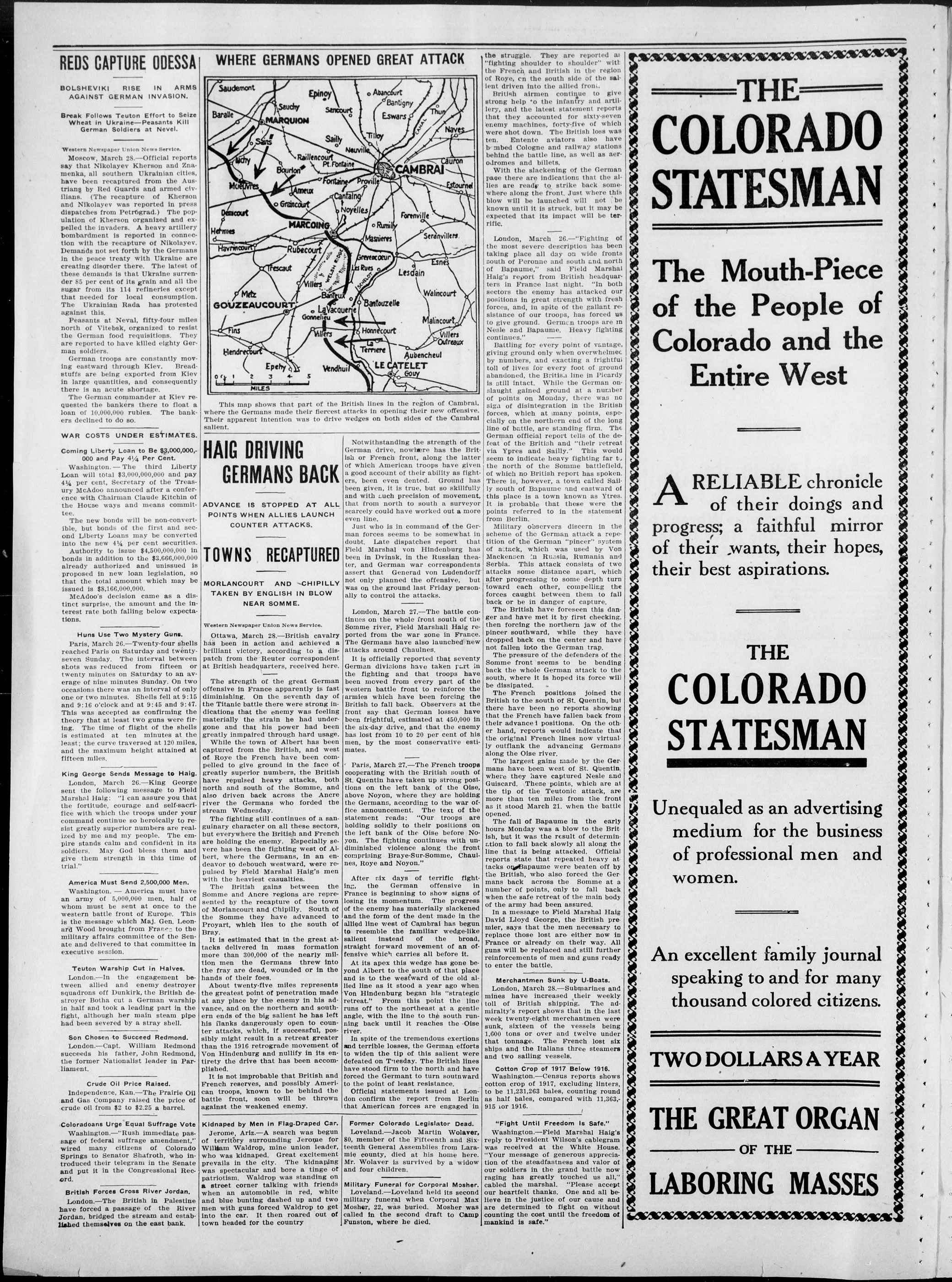
This map shows that part of the British lines in the region of Cambrai, where the Germans made their fiercest attacks in opening their new offensive. Their apparent intention was to drive wedges on both sides of the Cambrai salient.
HAIG DRIVING GERMANS BACK
ADVANCE IS STOPPED AT ALL POINTS WHEN ALLIES LAUNCH COUNTER ATTACKS.
TOWNS RECAPTURED
MORLANCOURT AND CHIPILLY
TAKEN BY ENGLISH IN BLOW
NEAR SOMME.
Western Newspaper Union News Service.
Ottawa, March 28.—British cavalry has been in action and achieved a brilliant victory, according to a dispatch from the Reuter correspondent at British headquarters, received here.
The strength of the great German offensive in France apparently is fast diminishing. On the seventh day of the Titanic battle there were strong indications that the enemy was feeling materially the strain he had undergone and that his power had been greatly impaired through hard usage.
While the town of Albert has been captured from the British, and west of Roye the French have been compelled to give ground in the face of greatly superior numbers, the British have repulsed heavy attacks, both north and south of the Somme, and also driven back across the Ancre river the Germans who forded the stream Wednesday.
The fighting still continues of a sanguinary character on all these sectors, but everywhere the British and French are holding the enemy. Especially severe has been the fighting west of Albert, where the Germans, in an endeavor to debouch westward, were repulsed by Field Marshal Halg's men with the heaviest casualties.
The British gains between the Somme and Ancre regions are represented by the recapture of the town of Morlancourt and Chipilly. South of the Somme they have advanced to Proyart, which lies to the south of Bray. It is estimated that in the great attacks delivered in mass formation more than 300,000 of the nearly million men the Germans threw into the fray are dead, wounded or in the hands of their foes.
About twenty-five miles represents the greatest point of penetration made at any place by the enemy in his advance, and on the northern and southern ends of the big salient he has left his flanks dangerously open to counter attacks, which, if successful, possibly might result in a retreat greater than the 1916 retrograde movement of Von Hindenburg and nullify in its entirety the drive that has been accomplished.
It is not improbable that British and French reserves, and possibly American troops, known to be behind the battle front, soon will be thrown against the weakened enemy.
Kidnaped by Men in Flag-Draped Car.
Kidnaped by Men in Flag-Draped Cars
Jerome, Ariz. A search was begun of territory surrounding Jerome for William Waldrop, mine union leader, who was kidnaped. Great excitement prevails in the city. The kidnaping was spectacular and bore a tinge of patriotism. Waldrop was standing on a street corner talking with friends when an automobile in red, white and blue bunting dashed up and two men with guns forced Waldrop to get into the car. It then roared out of town headed for the country
Notwithstanding the strength of the German drive, nowhere has the British or French front, along the latter of which American troops have given a good account of their ability as fighters, been even dented. Ground has been given, it is true, but so skillfully and with such precision of movement, that from north to south a surveyor scarcely could have worked out a more even line.
Just who is in command of the German forces seems to be somewhat in doubt. Late dispatches report that Field Marshal von Hindenburg has been in Dvinsk, in the Russian theater, and German war correspondents assert that Generad von Ludendorff not only planned the offensive, but was on the ground last Friday personally to control the attacks.
London, March 27.—The battle continues on the whole front south of the Somme river, Field Marshall Haig reported from the war zone in France. The Germans have also launched new attacks around Chaulnes.
It is officially reported that seventy German divisions have taken part in the fighting and that troops have been moved from every part of the western battle front to reinforce the armies which have been forcing the British to fall back. Observers at the front say that German losses have been frightful, estimated at 450,000 in the six-day drive, and that the enemy has lost from 10 to 20 per cent of his men, by the most conservative estimates.
Paris, March 27.—The French troops cooperating with the British south of St. Quentin have taken up strong positions on the left bank of the Oise, above Noyon, where they are holding the Germans, according to the war ofice announcement. The text of the statement reads: "Our troops are holding solidly to their positions on the left bank of the Oise before Noyon. The fighting continues with undiminished violence along the front comprising Braye-Sur-Somme, Chaulnes, Roye and Noyon."
After six days of terrific fighting, the German offensive in France is beginning to show signs of losing its momentum. The progress of the enemy has materially slackened and the form of the dent made in the allied line west of Cambral has begun to resemble the familiar wedge-like salient instead of the broad, straight forward movement of an offensive which carries all before it.
At its apex this wedge has gone beyond Albert to the south of that place and is to the westward of the old allied line as it stood a year ago when Von Hindenburg began his "strategic retreat." From this point the line runs off to the northeast at a gentle angle, with the line to the south running back until it reaches the -Oise river.
In spite of the tremendous exertions and terrible losses, the German efforts to widen the tip of this salient were defeated on Tuesday. The British lines have stood firm to the north and have forced the Germant to turn southward to the point of least resistance.
Official statements issued at London confirm the report from Berlin that American forces are engaged in
Former Colorado Legislator Dead.
Loveland.—Jacob Martin Wolaver,
80, member of the Fifteenth and Sixteenth General Assemblies from Laramie county, died at his home here.
Mr. Wolaver is survived by a widow and four children.
Military Funeral for Corporal Mosher. Loveland.—Loveland held its second military funeral when Corporal Max Mosher, 22, was buried. Mosher was called in the second draft to Camp Funston, where he died.
---
the struggle. They are reported as "fighting shoulder to shoulder" with the French and British in the region of Roye, cn the south side of the salient driven into the allied front.
THE COLORADO STATESMAN
British airmen continue to give strong help to the infantry and artillery, and the latest statement reports that they accounted for sixty-seven enemy machines, forty-five of which were shot down. The British loss was ten. Entente aviators also have bombed Cologne and railway stations behind the battle line, as well as aerodromes and billets.
With the slackening of the German page there are indications that the allies are ready to strike back somewhere along the front. Just where this blow will be launched will not be known until it is struck, but it may be expected that its impact will be terrific.
London, March 26.—"Fighting of the most severe description has been taking place all day on wide fronts south of Peronne and south and north of Bapaume," said Field Marshal Haig's report from British headquarters in France last night. "In both sectors the enemy has attacked our positions in great strength with fresh forces, and, in spite of the gallant resistance of our troops, has forced us to give ground. German troops are in Nesle and Bapaume. Heavy fighting continues."
The Mouth-Piece of the People of Colorado and the Entire West
Battling for every point of vantage giving ground only when overwhelmed by numbers, and exacting a frightful toll of lives for every foot of ground abandoned, the Britian line in Picardy is still intact. While the German onslaught gained ground at a number of points on Monday, there was no sign of disintegration in the British forces, which at many points, especially on the northern end of the long line of battle, are standing firm. The German official report tells of the defeat of the British and "their retreat via Ypres and Salilly." This would seem to indicate heavy fighting far t. the north of the Somme battlefield, of which no British report has spoken. There is, however, a town called Salilly south of Bapaume and eastward of this place is a town known as Ytress. It is probable that these were the points referred to in the statement from Berlin.
ARELIABLE chronicle of their doings and progress; a faithful mirror of their wants, their hopes, their best aspirations.
Military observers discern in the scheme of the German attack a repetition of the German "pincer" system of attack, which was used by Von Mackensen in Russia, Rumania and Serbia. This attack consists of two attacks some distance apart, which after progressing to some depth turn toward each other, compelling the forces caught between them to fall back or be in danger of capture. The British have foreseen this danger and have met it by first checking, then forcing the northern jaw of the pincer southward, while they have dropped back on the center and have not fallen into the German trap.
THE COLORADO STATESMAN
The pressure of the defenders of the Somme front seems to be bending back the whole German attack to the south, where it is hoped its force will be dissipated. The French positions joined the British to the south of St. Quentin, but there have been no reports showing that the French have fallen back from their advance positions. On the other hand, reports would indicate that the original French lines now virtually outflank the advancing Germans along the Oise river. The largest gains made by the Germans have been west of St. Quentin, where they have captured Nesle and Guiscard. These points, which are at the tip of the Teutonic attack, are more than ten miles from the front as it stood March 21, when the battle opened.
Unequaled as an advertising medium for the business of professional men and women.
The fall of Bapaume in the early hours Monday was a blow to the British, but it was the result of determination to fall back slowly all along the line that is being attacked. Official reports state that repeated heavy atacks on Bapaume were beaten off by the British, who also forced the Germans back across the Somme at a number of points, only to fall back when the safe retreat of the main body of the army had been assured.
In a message to Field Marshal Haig David Lloyd George, the British premier, says that the men necessary to replace those lost are either now in France or already on their way. All guns will be replaced and still further reinforcements of men and guns ready to enter the battle.
An excellent family journal speaking to and for many thousand colored citizens.
Merchantmen Sunk by U-Boats
London, March 28.—Submarines and mines have increased their weekly toll of British shipping. The admiralty's report shows that in the last week twenty-eight merchantmen were sunk, sixteen of the vessels being 1,600 tons or over and twelve under that tonnage. The French lost six ships and the Italians three steamers and two sailing vessels.
TWODOLLARSAYEAR
Washington.—Census reports shows cotton crop of 1917, excluding linters, to be 11,231,263 bales, counting round as half bales, compared with 11,363,915 or 1916.
"Eight Until Freedom Is Safe."
Washington.—FIELD Marshal Haig's reply to President Wilson's cablegram was received at the White House. "Your message of generous appreciation of the steadfastness and valor of our soldiers in the grand battle now raging has greatly touched us all," cabled the marshal. "Please accept our heartfelt thanks. One and all believe in the justice of our cause and are determined to fight on without counting the cost until the freedom of mankind is safe."
Pithy News Notes
From All Parts of
Colorado
Western Newspaper Union News Service.
Work has been commenced in improving the Lightner road, out of Durango.
A test oil well being sunk at Model mining camp, Trinidad district is now 750 feet deep.
A shortage of seed for the planting of cane, corn and barley is threatened in Weld county.
The Greeley city council appropriated $2,900 for the construction of three concrete bridges.
Benjamin Sutton, 21, was killed in the Wellington mine, two and a half miles from Breckenridge.
County patriotic councils are to be formed by the Patriotic League of the State Council of Defense.
Yust Bot has sold his 80-acre ranch southeast of Berthoud to C. O. Lucas for a consideration of $12,000.
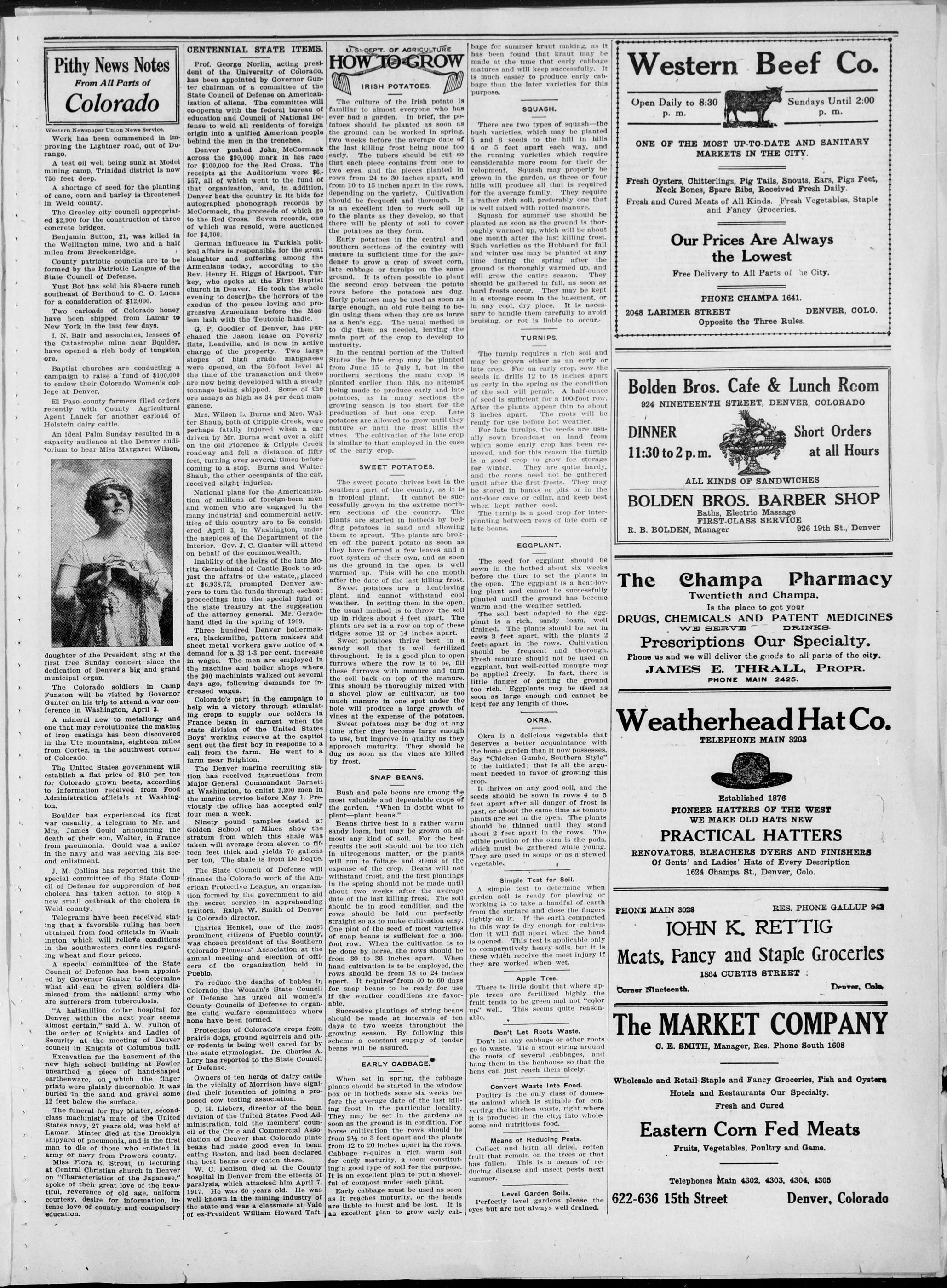
Two carloads of Colorado honey have been shipped from Lamar to New York in the last few days. I. N. Bair and associates, lessees of the Catastrophe mine near Boulder, have opened a rich body of tungsten ore. Baptist churches are conducting a campaign to raise a fund of $100,000 to endow their Colorado Women's college at Denver. El Paso county farmers filed orders recently with County Agricultural Agent Lauck for another carload of Holstein dairy cattle. An ideal Palm Sunday resulted in a capacity audience at the Denver auditorium to hear Miss Margaret Wilson,
THEATRE
daughter of the President, sing at the first free Sunday concert since the dedication of Denver's big and grand municipal organ.
The Colorado soldiers in Camp Funston will be visited by Governor Gunter on his trip to attend a war conference in Washington, April 3.
A mineral new to metallurgy and one that may revolutionize the making of iron castings has been discovered in the Ute mountains, eighteen miles from Cortez, in the southwest corner of Colorado.
The United States government will establish a flat price of $10 per ton for Colorado grown beets, according to information received from Food Administration officials at Washington.
Boulder has experienced its first war casualty, a telegram to Mr. and Mrs. James Gould announcing the death of their son, Walter, in France from pneumonia. Gould was a sailor in the navy and was serving his second enlistment.
J. M. Collins has reported that the special committee of the State Council of Defense for suppression of hog cholera has taken action to stop a new small outbreak of the cholera in Weld county.
Telegrams have been received stating that a favorable ruling has been obtained from food officials in Washington which will relieve conditions in the southwestern counties regarding wheat and flour prices.
A special committee of the State Council of Defense has been appointed by Governor Gunter to determine what aid can be given soldiers dismissed from the national army who are sufferers from tuberculosis.
"A half-million dollar hospital for Denver within the next year seems almost certain," said A. W. Fulton of the order of Knights and Ladies of Security at the meeting of Denver council in Knights of Columbus hall.
Excavation for the basement of the new high school building at Fowler unearthed a piece of hand-shaped earthenware, on which the finger prints were plainly discernable. It was buried in the sand and gravel some 12 feet below the surface.
The funeral for Ray Minter, second-class machinist's mate of the United States navy, 27 years old, was held at Lamar. Minter died at the Brooklyn shipyard of pneumonia, and is the first man to die of those who enlisted in army or navy from Prowers county.
Miss Flora E. Strout, in lecturing at Central Christian church in Denver on "Characteristics of the Japanese," spoke of their great love of the beautiful, reverence of old age, uniform courtesy, desire for information, intense love of country and compulsory education.
CENTENNIAL STATE ITEMS.
Prof. George Norlin, acting president of the University of Colorado, has been appointed by Governor Gunter chairman of a committee of the State Council of Defense on Americanization of aliens. The committee will co-operate with the federal bureau of education and Council of National Defense to weld all residents of foreign origin into a unified American people behind the men in the trenches.
Denver pushed John, McCormack across the $90,000 mark in his race for $100,000 for the Red Cross. The receipts at the Auditorium were $6,557, all of which went to the fund of that organization, and, in addition, Denver beat the country in its bids for autographed phonograph records by McCormack, the proceeds of which go to the Red Cross. Seven records, one of which was resold, were auctioned for $4,100.
German influence in Turkish political affairs is responsible for the great slaughter and suffering among the Armenians today, according to the Rev. Henry H. Riggs of Harpoot, Turkey, who spoke at the First Baptist church in Denver. He took the whole evening to describe the horrors of the exodus of the peace loving and progressive Armenians before the Moslem lash with the Teutonic handle.
G. P, Goodier of Denver, has purchased the Jason lease on Poverty flats, Leadville, and is now in active charge of the property. Two large stopes of high grade manganese were opened on the 50-foot level at the time of the transaction and these are now being developed with a steady tonnage being shipped. Some of the ore assays as high as 34 per cent manganese.
Mrs. Wilson L. Burns and Mrs. Walter Shaub, both of Cripple Creek, were perhaps fatally injured when a car driven by Mr. Burns went over a cliff on the old Florence and Cripple Creek roadway and fell a distance of fifty feet, turning over several times before coming to a stop. Burns and Walter Shaub, the other occupants of the car, received slight injuries.
National plans for the Americanization of millions of foreign-born men and women who are engaged in the many industrial and commercial activities of this country are to be considered April 3, in Washington, under the auspices of the Department of the Interior. Gov. J. C. Gunter will attend on behalf of the commonwealth.
Inability of the heirs of the late Moritz Geradehand of Castle Rock to adjust the affairs of the estate $_{e}$ placed at $6,938.72, prompted Denver lawyers to turn the funds through escheat proceedings into the special fund of the state treasury at the suggestion of the attorney general. Mr. Geradehand died in the spring of 1909.
Three hundred Denver boilermakers, blacksmiths, pattern makers and sheet metal workers gave notice of a demand for a 33 1-3 per cent. increase in wages. The men are employed in the machine and boiler shops where the 300 machinists walked out several days ago, following demands for increased wages.
Colorado's part in the campaign to help win a victory through stimulating crops to supply our soldiers in France began in earnest when the state division of the United States Boys' working reserve at the capitol sent out the first boy in response to a call from the farm. He went to a farm near Brighton.
The Denver marine recruiting station has received instructions from Major General Commandant Barnett at Washington, to enlist 2,200 men in the marine service before May 1. Previously the office has accepted only four men a week.
Ninety pound samples tested at Golden School of Mines show the stratum from which this shale was taken will average from eleven to fifteen feet thick and yields 70 gallons per ton. The shale is from De Beque.
The State Council of Defense will finance the Colorado work of the American Protective League, an organization formed by the government to aid the secret service in apprehending traitors. Ralph W. Smith of Denver is Colorado director.
Charles Henkel, one of the most prominent citizens of Pueblo county, was chosen president of the Southern Colorado Pioneers' Association at the annual meeting and election of officers of the organization held in Pueblo.
To reduce the deaths of babies in Colorado the Woman's State Council of Defense has urged all women's County Councils of Defense to organize child welfare committees where none have been formed.
Protection of Colorado's crops from prairie dogs, ground squirrels and other rodents is being well cared for by the state etymologist. Dr. Charles A. Lory has reported to the State Council of Defense.
Owners of ten herds of dairy cattle in the vicinity of Morrison have signified their intention of joining a proposed cow testing association.
O. H. Liebers, director of the bean division of the United States Food Administration, told the members' council of the Civic and Commercial Association of Denver that Colorado pinto beans had made good even in bean eating Boston, and had been declared the best beans ever eaten there.
W. C. Denison died at the County hospital in Denver from the effects of paralysis, which attacked him April 7, 1917. He was 60 years old. He was well known in the mining industry of the state and was a classmate at Yale of ex-President William Howard Taft.
U.S. DEPT. OF AGRICULTURE
HOW TO GROW
IRISH POTATOES.
The culture of the Irish potato is familiar to almost everyone who has ever had a garden. In brief, the potatoes should be planted as soon as the ground can be worked in spring, two weeks before the average date of the last killing frost being none too early. The tubers should be cut so that each piece contains from one to two eyes, and the pieces planted in rows from 24 to 30 inches apart, and from 10 to 15 inches apart in the rows, depending on the variety. Cultivation should be frequent and thorough. It is an excellent idea to work soil up to the plants as they develop, so that there will be plenty of soil to cover the potatoes as they form.
Early potatoes in the central and southern sections of the country will mature in sufficient time for the gardener to grow a crop of sweet corn, late cabbage or turnips on the same ground. It is often possible to plant the second crop between the potato rows before the potatoes are dug. Early potatoes may be used as soon as large enough, an old rule being to begin using them when they are as large as a hen's egg. The usual method is to dig them as needed, leaving the main part of the crop to develop to maturity.
In the central portion of the United States the late crop may be planted from June 15 to July 1, but in the northern sections the main crop is planted earlier than this, no attempt being made to produce early and late potatoes, as in many sections the growing season is too short for the production of but one crop. Late potatoes are allowed to grow until they mature or until the frost kills the vines. The cultivation of the late crop is similar to that employed in the case of the early crop.
SWEET POTATOES.
The sweet potato thrives best in the southern part of the country, as it is a tropical plant. It cannot be successfully grown in the extreme northern sections of the country. The plants are started in hotbeds by bedding potatoes in sand and allowing them to sprout. The plants are broken off the parent potato as soon as they have formed a few leaves and a root system of their own, and as soon as the ground in the open is well warmed up. This will be one month after the date of the last killing frost. Sweet potatoes are a heat-loving plant, and cannot withstand cool weather. In setting them in the open, the usual method is to throw the soil up in ridges about 4 feet apart. The plants are set in a row on top of these ridges some 12 or 14 inches apart.
Sweet potatoes thrive best in a sandy soil that is well fertilized throughout. It is a good plan to open furrows where the row is to be, fill these furrows with manure and turn the soil back on top of the manure. This should be thoroughly mixed with a shovel plow or cultivator, as too much manure in one spot under the hole will produce a large growth of vines at the expense of the potatoes. Sweet potatoes may be dug at any time after they become large enough to use, but improve in quality as they approach maturity. They should be dug as soon as the vines are killed by frost.
SNAP BEANS
Bush and pole beans are among the most valuable and dependable crops of the garden. "When in doubt what to plant—plant beans."
Beans thrive best in a rather warm sandy loam, but may be grown on almost any kind of soil. For the best results the soil should not be too rich in nitrogenous matter, or the plants will run to foliage and stems at the expense of the crop. Beans will not withstand frost, and the first plantings in the spring should not be made until about two weeks after the average date of the last killing frost. The soil should be in good condition and the rows should be laid out perfectly straight so as to make cultivation easy. One pint of the seed of most varieties of snap beans is sufficient for a 100-foot row. When the cultivation is to be done by horse, the rows should be from 30 to 36 inches apart. When hand cultivation is to be employed, the rows should be from 18 to 24 inches apart. It requires from 40 to 60 days for snap beans to be ready for use if the weather conditions are favorable.
Successive plantings of string beans should be made at intervals of ten days to two weeks throughout the growing season. By following this scheme a constant supply of tender beans will be assured.
EARLY CABBAGE.
When set in spring, the cabbage plants should be started in the window box or in hotbeds some six weeks before the average date of the last killing frost in the particular locality. They may be set in the gardens as soon as the ground is in condition. For horse cultivation the rows should be from $2\frac{1}{2}$ to 3 feet apart and the plants from 12 to 20 inches apart in the rows. Cabbage requires a rich warm soil for early maturity, a soam constituting a good type of soil for the purpose. It is an excellent plan to put a shovelful of compost under each plant. Early cabbage must be used as soon as it reaches maturity, or the heads are liable to burst and be lost. It is an excellent plan to grow early cab-
bage for summer kruat making, as it has been found that kruat may be made at the time that early cabbage matures and will keep successfully. It is much easier to produce early cabbage than the later varieties for this purpose.
SQUASH.
There are two types of squash—the bush varieties, which may be planted 5 and 6 seeds to the hill in hills 4 or 5 feet apart each way, and the running varieties which require considerable more room for their development. Squash may properly be grown in the garden, as three or four hills will produce all that is required for the average family. They require a rather rich soil, preferably one that is well mixed with rotted manure.
Squash for summer use should be planted as soon as the ground is thoroughly warmed up, which will be about one month after the last killing frost. Such varieties as the Hubbard for fall and winter use may be planted at any time during the spring after the ground is thoroughly warmed up, and will grow the entire season. They should be gathered in fall, as soon as hard frosts occur. They may be kept in a storage room in the basement, or in any cool, dry place. It is necessary to handle them carefully to avoid bruising, or rot is liable to occur.
TURNIPS.
The turnip requires a rich soil and may be grown either as an early or late crop. For an early crop, sow the seeds in drills 12 to 18 inches apart as early in the spring as the condition of the soil will permit. A half-ounce of seed is sufficient for a 100-foot row. After the plants appear thin to about 3 inches apart. The roots will be ready for use before hot weather. For late turnips, the seeds are usually sown broadcast on land from which some early crop has been removed, and for this reason the turnip is a good crop to grow for storage for winter. They are quite hardy, and the roots need not be gathered until after the first frosts. They may be stored in banks or pits or in the out-door cave or cellar, and keep best when kept rather cool. The turnip is a good crop for interplanting between rows of late corn or late beans.
EGGPLANT.
The seed for eggplant should be sown in the hotbed about six weeks before the time to set the plants in the open. The eggplant is a heat-loving plant and cannot be successfully planted until the ground has become warm and the weather settled.
The soil best adapted to the eggplant is a rich, sandy loam, well drained. The plants should be set in rows 3 feet apart, with the plants 2 feet apart in the rows. Cultivation should be frequent and thorough. Fresh manure should not be used on eggplant, but well-rotted manure may be applied freely. In fact, there is little danger of getting the ground too rich. Eggplants may be used as soon as large enough and cannot be kept for any length of time.
OKRA.
Okra is a delicious vegetable that deserves a better acquaintance with the home garden than it now possesses. Say "Chicken Gumbo, Southern Style" to the initiated; that is all the argument needed in favor of growing this crop.
It thrives on any good soil, and the seeds should be sown in rows 4 to 5 feet apart after all danger of frost is past, or about the same time as tomato plants are set in the open. The plants should be thinned until they stand about 2 feet apart in the rows. The edible portion of the okra is the pods, which must be gathered while young. They are used in soups or as a stewed vegetable.
Simple Test for Soil.
A simple test to determine when garden soil is ready for plowing or working is to take a handful of earth from the surface and close the fingers tightly on it. If the earth compacted in this way is dry enough for cultivation it will fall apart when the hand is opened. This test is applicable only to comparatively heavy soils, but it is these which receive the most injury if they are worked when wet.
Apple Tree.
There is little doubt that where apple trees are fertilized highly the fruit tends to be green and not "color up" well. This seems quite reasonable.
Don't Let Roots Waste.
Don't let any cabbage or other roots go to waste. Tie a stout string around the roots of several cabbages, and hang them in the henhouse so that the hens can just reach them nicely.
Poultry is the only class of domestic animal which is suitable for converting the kitchen waste, right where it is produced in the city into wholesome and nutritious food.
Means of Reducing Pests.
Collect and burn all dried, rotten fruit that remain on the trees or that has fallen. This is a means of reducing disease and insect pests next summer.
Level Garden Soils.
Perfectly level gardens please the eyes but are not always well drained.
Western Beef Co.
Open Daily to 8:30 p. m.
ONE OF THE MOST
MARKET
Fresh Oysters, Chitterbill
Neck Bones, Spin
Fresh and Cured Meats
and
Our Pre
th
Free Deliver
PHONE
2048 LARIMER STREET
Oppo
Bolden Bros.
924 NINETEENTH
DINNER
11:30 to 2 p.m.
ALL KIDS
BOLDEN BR
Baths
FIRST
R. B. BOLDEN, Manage
The Chance
Twenty
Is the
DRUGS, CHEMICALS
WE SEE
Prescription
Phone us and we will do
JAMES E.
PHONE
Weather
TELLE
PIONEER BRO
WE MAKE
PRACTICE
RENOVATORS, BLEED
Of Gents' and Lads
1624 Ch
OF THE MOST UP-TO-DATE AND S
MARKETS IN THE CITY.
Lers, Chitterlings, Pig Tails, Snouts, Ear
ek Bones, Spare Ribs, Received Fresh Me
Cured Meats of All Kinds. Fresh Veget
and Fancy Groceries.
Our Prices Are Alway
the Lowest
Free Delivery to All Parts of the City
PHONE CHAMPA 1641.
OMER STREET DENVER
Opposite the Three Rules.
In Bros. Cafe & Lunch
NETEENTH STREET, DENVER, CO
ONE OF THE MOST UP-TO-DATE AND SANITARY MARKETS IN THE CITY.
Fresh Oysters, Chitterlings, Pig Tails, Snouts, Ears, Pigs Feet, Neck Bones, Spare Ribs, Received Fresh Daily. Fresh and Cured Meats of All Kinds. Fresh Vegetables, Staple and Fancy Groceries.
PHONE CHAMPA 1641.
2048 LARIMER STREET DENVER, COLO.
Opposite the Three Rules.
ALL KINDS OF SANDWICHES
DEN BROS. BARBERY
Baths, Electric Massage
FIRST-CLASS SERVICE
DEN, Manager 926 19t
Champa Phas
Twentieth and Champa,
Is the place to get your
CHEMICALS AND PATENT
WE SERVE DRINKS
Descriptions Our Special
and we will deliver the goods to all pars
MES E. THRALL, P
PHONE MAIN 2425.
fatherhead Ha
TELEPHONE MAIN 3203
BOLDEN BROS. BARBER SHOP
Baths, Electric Massage
FIRST-CLASS SERVICE
R. B. BOLDEN, Manager 926 19th St., Denver
The Champa Pharmacy
Twentieth and Champa,
Is the place to get your
DRUGS, CHEMICALS AND PATENT MEDICINES
WE SERVE DRINKS.
Prescriptions Our Specialty.
Phone us and we will deliver the goods to all parts of the city.
JAMES E. THRALL, PROPR.
PHONE MAIN 2425.
Weatherhead Hat Co. TELEPHONE MAIN 3203
Established 1876
PIONEER HATTERS OF THE WEST
WE MAKE OLD HATS NEW
PRACTICAL HATTERS
MOTORS, BLEACHERS DYERS AND F
Gents' and Ladies' Hats of Every Descr
1624 Champa St., Denver, Colo.
RENOVATORS, BLEACHERS DYERS AND FINISHERS Of Gents' and Ladies' Hats of Every Description 1624 Champa St., Denver, Colo.
JOHN K. RETTIG
Fancy and Staple Gr
1864 CURTIS STREET
eenth.
MARKET COM
E. SMITH, Manager, Res. Phone South
Retail Staple and Fancy Groceries, Fi
Hotels and Restaurants Our Specialty
Fresh and Cured
Eastern Corn Fed M
JOHN Meats, Fancy 1864
Meats, Fancy and Staple Groceries 1864 CURTIS STREET
The MARIE
C. E. SMITH, M
Wholesale and Retail Stap
Hotels and
Eastern
The MARKET COMPANY
C. E. SMITH, Manager, Res. Phone South 1608
Wholesale and Retail Staple and Fancy Groceries, Fish and Oysters Hotels and Restaurants Our Specialty. Fresh and Cured
Eastern Corn Fed Meats
Fruits, Vegetables, Poultry and Game.
Telephones
622-636 15th Street
Telephones Main 4302, 4303, 4304, 4305
5th Street Denver
Telephones Main 4302, 4303, 4304, 4305 622-636 15th Street Denver, Colorado
PHONE MAIN 3028
Corner Nineteenth.
Sundays Until 2:00 p. m.
DATE AND SANITARY
THE CITY.
Isls, Snouts, Ears, Pigs Feet,
Received Fresh Daily.
Fresh Vegetables, Staple
Occeries.
E Always
west
Parts of the City.
PA 1641.
DENVER, COLO.
ee Rules.
& Lunch Room
DENVER, COLORADO
Short Orders at all Hours
BENDWICHES
HARBER SHOP
Massage
SERVICE
926 19th St., Denver
Pharmacy
Champa,
get your
PATENT MEDICINE
DRINKS.
Our Specialty.
foods to all parts of the city.
ALL, PROPR.
2425.
Bad Hat Co.
MAIN 3203
1876
OF THE WEST
HATS NEW
HATTERS
DEVERS AND FINISHERS
of Every Description
Denver, Colo.
```markdown
```
RES. PHONE GALLUP 942
ETTIG
taple Groceries
TREET
COMPANY
Phone South 1608
Groceries, Fish and Oysters
Our Specialty.
Fed Meats
303, 4304, 4305
Denver, Colorado
```markdown
```
Fruit Bowl
Denver, Cola
THE COLORADO STATESMAN
CABON TABLES IN FREE
CABON TABLES IN COUNTRY PARTY
SUBSCRIPTION RATES.
One Year ..... $2.00
Six Months ..... 1.00
Three Months ..... .60
PAYABLE IN ADVANCE
Entered as second-class matter at the postoffice in the City of Denver, Colo.
1824 Curtis Street, Room 25.
Phone Main 7417.
Reading notices, ten lines or less, 10 centen lines, 5 cents per line. Dispise
Remittances should be made by B. Order, Registered Letter or Bank Draft, same as cash for the fractional part of the
No discounts allowed on less than three pany all orders from parties unknown to the
Communications to receive attention jects, plainly written only upon one side of the author. No manuscript returned days, if possible, anyway not later than. All communications of a personating must be withheld from the
EASTER AND THE PRIDE
SOON the anniversary of the deaf States and Germany will confine us still in the conflict. CHRIST, a Leader Who, when to His followers the proof of and set a standard of joy that who "the resurrection of the dead"—shoot for an unlimited time. Peace, the m and even though war, in all its dreast at this Eastertide an evidence of the cause of RIGHT now establishes the whether the struggle is of short dur manently enjoy this peace.
In wishing pleasant memories citizens for Eastertide, THE COLOUR tiring effort and zeal for the cause the glories of Eastertide which survive the dark hour that our nation is patriotiously, as the world will choose the tion through RIGHT than the path leading to death and hell. O! Kings and minds, purging us from all hum in this supreme struggle so govern Easter may be reflected in the success
on lines or less, 10 cents per line. Each and every cents per line. Display advertising, 50 cents.
should be made by Express Money Order, Letter or Bank Draft. Postage stamps were the fractional part of a dollar. Only 10 and 20 cents on less than three months' contract. From parties unknown to us. Further particular us to receive attention must be neway, upon often upon one side of the paper, upon manuscript returned, unless stamps are so manyway not later than Wednesdays, and as of a personating nature that are not on the withheld from the columns of this paper.
ATER AND THE PRESENT WORLD CRIME
anniversary of the declaration of war between Germany will come round, and this will in the conflict. Easter with its remembrance Leader Who, when He was being mounted, powers the proof of His power over death of joy that whoever believed in the death of the dead"—should have habitation at time. Peace, the motto of this abode, is war, in all its dreadfulness, faces the sea, an evidence of the great confidence of man, now establishes the thought that this jiggle is of short duration or not, until this peace.
pleasant memories to our subscribers, the伯特ide, THE COLORADO STATESMAN, zeal for the cause of suffering humans, esteride which survive the CROSS OF OCEAN that our nation is passing through we will world will choose the path that leads to right than the path which resurrects to hell. O! King of Kings! live forever us from all human ills, subjecting us to struggle so govern and guide our nation reflected in the success of our RIGHTEOUS.
Reading notices, ten lines or less, 10 cents per line. Each additional line over ten lines, 5 cents per line. Display advertising, 50 cents per inch.
Remittances should be made by Express Money Order, Postoffice Money Order, Registered Letter or Bank Draft. Postage stamps will be received the same as cash for the fractional part of a dollar. Only 1c and 2c stamps taken.
No discounts allowed on less than three months' contract. Cash must accompany all orders from parties unknown to us. Further particulars on application.
Communications to receive attention must be neway, upon important subjects, plainly written only upon one side of the paper, must reach us Tusso of the author. No manuscript returned, unless stamps are sent for postage, days, if possible, anyway not later than Wednesdays, and bear the signature. All communications of a personating nature that are not complimentary will be withheld from the columns of this paper.
EASTER AND THE PRESENT WORLD CRISIS.
SOON the anniversary of the declaration of war between the United States and Germany will come round, and this second Eastertide finds us still in the conflict. Easter with its reminder of a living CHRIST, a Leader Who, when He was being mourned as dead, gave to His followers the proof of His power over death and the grave, and set a standard of joy that whoever believed in the wonderful fact—"the resurrection of the dead"—should have habitation in a land of bliss for an unlimited time. Peace, the motto of this abode, must be on earth, and even though war, in all its dreadfulness, faces the sons of earth, yet at this Eastertide an evidence of the great confidence of the people in the cause of RIGHT now establishes the thought that this must be fought whether the struggle is of short duration or not, until the world can permanently enjoy this peace.
In wishing pleasant memories to our subscribers, friends and other citizens for Eastertide, THE COLORADO STATESMAN, firm in its untiring effort and zeal for the cause of suffering humanity, points you to the glories of Eastertide which survive the CROSS OF CALVARY, and in the dark hour that our nation is passing through we will come out victoriously, as the world will choose the path which resurrects the hideous past, leading to death and hell. O! King of Kings! live forever in our hearts and minds, purging us from all human ills, subjecting us to Thy will, and in this supreme struggle so govern and guide our nation that the joy of Easter may be reflected in the success of our RIGHTEOUS CAUSE.
THE HOPEFUL VS. THE HOPELESS
LET us not live as men with the GOOD OLD BOOK, the Bible, more of us as indications pollination of Christianity and its rise up in the mysterious and far applied by the ambassadors of the GOOD and propagating its truisms for near—the believer in God, the man who his neighbor as himself, and keeping. This is the definition given us, and in bringing about a practical application in the world today are co-evangelists, pulpiteers, etc., to come entanglements that they put around in out in the open and telling the rarer superiority to other races that their the creative intention of man to his and barbarity, as is being demonstrated. It is, then, with the deepest coison as the part the pulpit must play the clergy of the Presbyterian denomination margin of racial prejudice, one of Rev. James L. Vance of the First. It is fearless in his denouncement of theness, the activities of the same increase twelve-month period from last Marriages, our counsels, our offerings of not in vain, but having fallen on ferr exhibiting itself.
This is the second member of our heart burning with love for his fellow loyalty to his God and unswerving with faithfulness in the prosecution of himself, his associate an Episcopal spoken in this manner some time a congregation of the part they shouldIONAL destroyer—THE MOB—but our crime if they remained passive, quiet the pillars of our nation—DEMOCRAI.
How coincidental! Coming at the in his efforts to bring the world to their commemoration of the day we came justified in the hope we now men of other denominations to shed the class, of losing the association of proving practically the oneness of unifying power; "let their light so ward will be greater than their sacriety.
Fellow thinkers, let us not feel less one, but, on the other hand, be men of the type of Rev. Vance, who ship when the time comes, will receive servant," he being among those who mouths speak. Read the front-page full" of the inspiration that brings HOPELESS, but the HOPEFUL, of which feels itself a vital, aliquot part. REUS SEE TO IT THAT WE HAVE HSTATE OF TENNESSEE." Hope, to
at live as men without hope"—words of GOLD BOOK, the Bible, which must be read as indications point to the fact that the Christianity and its doctrinal teaching is a mysterious and far-away idea, but is be- passadors of the GOD-MAN who have birtles truisms for nearly two thousand years. God, the man who helps the fatherless of himself, and keeping himself unspotted, motion given us, and while some try to me- mat a practical application of this long- world today are compelling Christian m- ateers, etc., to come out from the myst- that they put around this plain and simple men and telling the race that vaunts itself over races that their civilization must off- fction of man to his fellow-man, or the man is being demonstrated by our foe in this with the deepest concern we comment on the pulpit must play, and when at last a Presbyterian denomination that, alike, racial prejudice, one of their strong men, Vance of the First Presbyterian Church, denouncement of the mob rule and the use of the same increasing at an alarming period from last March, we begin to feel us, our offerings of hope to our people is having fallen on fertile soil, a production of second member of the white clergy in with love for his fellow-man, and patriotic good and unswerving devotion to the cause in the prosecution of its propaganda, hodgepodge manner some time ago, when he not on the part they should take in the eradic- THE MOB—but emphasized the logic maintained passive, quiescent, not caring with nation—DEMOCRACY, TRUTH AND RENAL! Coming at this time—the time we bring the world to a realization of the station of the day when through His re- of the hope we now entertain, we appeal nominations to shed their coat of fear, the the association of the so-called class, ally the oneness of Christianity, its un- "let their light so shine among men," o'r later than their sacrifice. ers, let us not feel that the task of reform of the other hand, be strong in the hope of Rev. Vance, who in giving an account comes, will receive "the well done, going among those who from the fullness of Read the front-page article in this issu-iration that brings hope, cheer and co- the HOPEFUL, of whom the COLORAL, aliquot part. Remember the words "that WE HAVE HAD OUR LAST LYNNESSEE." Hope, therefore, hope!
LET us not live as men without hope"—words of comfort in the GOOD OLD BOOK, the Bible, which must be read and digested by more of us as indications point to the fact that the correct interpretation of Christianity and its doctrinal teaching is no longer wrapped up in the mysterious and far-away idea, but is being practically applied by the ambassadors of the GOD-MAN who have been promulgating and propagating its truisms for nearly two thousand years. The Christian—the believer in God, the man who helps the fatherless and widow, loving his neighbor as himself, and keeping himself unspotted from the world. This is the definition given us, and while some try to make it so difficult in bringing about a practical application of this long-established truth, conditions in the world today are compelling Christian ministers, leaders, evangelists, pulpiteers, etc., to come out from the mystic role, from the entanglements that they put around this plain and simple doctrine, launching out in the open and telling the race that vauntus itself on its traditional superiority to other races that their civilization must offer better proofs of the creative intention of man to his fellow-man, or the return to savagery and barbarity, as is being demonstrated by our foe in this war, is imminent.
It is, then, with the deepest concern we comment on such a conclusion as the part the pulpit must play, and when at last from the ranks of the clergy of the Presbyterian denation that, alike the others, have their margin of racial prejudice, one of their strong men, in the person of Rev. James L. Vance of the First Presbyterian Church, Nashville, Tenn., is fearless in his denouncement of the mob rule and the spirit of lawlessness, the activities of the same increasing at an alarming rate within the twelve-month period from last March, we begin to feel that our suggestions, our counsels, our offerings of hope to our people in this country are not in vain, but having fallen on fertile soil, a production of good fruit is exhibiting itself.
This is the second member of the white clergy in the South whose heart burning with love for his fellow-man, and patriotism to his country, loyalty to his God and unswerving devotion to the cause of Christianity with faithfulness in the prosecution of its propaganda, has boldly declared himself, his associate an Episcopal bishop of Memphis, Tenn., having spoken in this manner some time ago, when he not only impressed his congregation of the part they should take in the eradication of this national destroyer—THE MOB—but emphasized the logical association in crime if they remained passive, quiescent, not caring what may result to the pillars of our nation—DEMOCRACY, TRUTH AND RIGHT.
How coincidental! Coming at this time—the time when the Christian in his efforts to bring the world to a realization of the perfect Leader by their commemoration of the day when through His resurrection we became justified in the hope we now entertain, we appeal to other clergymen of other denominations to shed their coat of fear, the cloak of ruffling the class, of losing the association of the so-called class, and by their works proving practically the oneness of Christianity, its unitary method, its unifying power; "let their light so shine among men," etc., and their reward will be greater than their sacrifice.
Fellow thinkers, let us not feel that the task of reformation is a hopeless one, but, on the other hand, be strong in the hope and have faith in men of the type of Rev. Vance, who in giving an account of his stewardship when the time comes, will receive "the well done, good and faithful servant," he being among those who from the fullness of their hearts their mouths speak. Read the front-page article in this issue and get "chock full" of the inspiration that brings hope, cheer and comfort not to the HOPELESS, but the HOPEFUL, of whom the COLORADO STATESMAN feels itself a vital, aliquot part. Remember the words of Vance: "LET US SEE TO IT THAT WE HAVE HAD OUR LAST LYNCHING IN THE STATE OF TENNESSEE." Hope, therefore, hope!
---
A. M. Ward, minister, 1218 Twenty-third street.
Our Easter Sunday services promise to eclipse all past occasions of its kind and the order will be as follows:
10:45 a. m., Pastor Ward will preach upon "The Resurrection."
3 p. m., the Sunday school will render its Easter Jubilee program. The baptism of infants.
7:30 p. m., the Senior choir, under direction of Mrs. Craig, will render its Easter program. Miss Marene Green will give a reading and Mr. Browning
---
---
ments per line. Each additional line overlay advertising, 50 cents per inch.
Express Money Order, Postoffice Money. Postage stamps will be received the a dollar. Only 1c and 2c stamps taken.
The months' contract. Cash must accompany. Further particulars on application.
On must be newsy, upon important subdue of the paper, must reach us Tuesday unless stamps are sent for postage. On Wednesday, and bear the signature feature that are not complimentary will columns of this paper.
NESENT WORLD CRISIS.
Declaration of war between the United States round, and this second Easteride Easter with its reminder of a living He was being mourned as dead, gave His power over death and the grave, ever believed in the wonderful fact—old have habitation in a land of blissotto of this abode, must be on earth,fulness, faces the sons of earth, yet great confidence of the people in the life thought that this must be fought nation or not, until the world can per-
to our subscribers, friends and other RADO STATESMAN, firm in its unoff suffering humanity, points you to love the CROSS OF CALVARY, and passing through we will come out vice path that leads to a higher civilization which resurrects the hideous past, of Kings! live forever in our hearts anills, subjecting us to Thy will, and and guide our nation that the joy of us of our RIGHTEOUS CAUSE.
about hope"—words of comfort in the life, which must be read and digested by but to the fact that the correct interpretive orthotel teaching is no longer wrapped away idea, but is being practically applied—MAN who have been promulgating it two thousand years. The Christian helps the fatherless and widow, loving himself unspotted from the world, while some try to make it so difficultiation of this long-established truth, compelling Christian ministers, leaders, out from the mystic role, from this plain and simple doctrine, launch-that vaunts itself on its traditional civilization must offer better proofs of Yellow-man, or the return to savagery led by our foe in this war, is imminent, incern we comment on such a conclu- and when at last from the ranks of emination that, alike the others, have of their strong men, in the person Presbyterian Church, Nashville, Tenn., the mob rule and the spirit of lawlessness at an alarming rate within the h, we begin to feel that our suggestshope to our people in this country are little soil, a production of good fruit is the white clergy in the South whose new-man, and patriotism to his country, devotion to the cause of Christianity of its propaganda, has boldly declared a bishop of Memphis, Tenn., having ago, when he not only impressed his take in the eradication of this namphasized the logical association in scent, not caring what may result to CY, TRUTH AND RIGHT.
this time—the time when the Christian a realization of the perfect Leader by men through His resurrection we be entertain, we appeal to other clergy-their coat of fear, the cloak of puffing the so-called class, and by their works Christianity, its unitary method, its hine among men," etc., and their refice.
that the task of reformation is a hope-strong in the hope and have faith in giving an account of his steward-ve "the well done, good and faithful from the fullness of their hearts their article in this issue and get "chock hope, cheer and comfort not to the whom the COLORADO STATESMAN member the words of Vance: "LET AD OUR LAST LYNCHING IN THE therefore, hope!
C. Allen will deliver the address of the evening. Mr. W. R. Allen, the violinist, will accompany the singers throughout the day.
REV. MAGUINEZ TO CONDUCT MEETING AT CAMPBELL CHAPEL.
The Rev. S. R. Maguinez will conduct a two weeks' pentecostal meeting at Campbell Chapel A. M. E. church, beginning Sunday April 7, closing, April 21, with the third quarterly meeting. Those interested in soul-saving are invited to answer the Macedonian cry.
CHEYENNE WYOMING NEWS.
THE whole "Dam" family is sick. Are you acquainted with this family? There must be an epidemic of grip in Cheyenne. Mr. William Christian, who was reported on the sick list last week, is able to walk out on the streets again, but the family is sick now. Mrs. Wm. Christian and her mother, Mrs. P. Anderson; Rev. Muse and his family, Mrs. Muse; Mr. C. Dickerson, and his family, wife, daughter and son; Mr. A. Palmer, Mr. Austra Smith, Mr. Charles Johnson, Mr. James Randle, and wife; Mrs. George Ballanger, Mrs. E. Nolan and Mrs. E. West. The doctor has announced that Mrs. West's condition is critical, having a severe case of pneumonia.
Many of the above named people are very sick in bed while others are able to be around. The reporter is sick but is trying his best to be well by Easter.
Mrs. Belle M. William and Mr. Geo. W. Nelson were united in marriage Monday evening. Rev. C. O. Smith, pastor of the Second Baptist Church, officiated.
Mr. Frank Rodgers of Chicago, returning from California, was in the city a few days this week, having an appointment at the Atlas. He is a ventriloquist. It is said by those that attended the Atlas that he was fine. While he was here he visited his old school mate, Mrs. William Christahn, 2618 Evans.
Rev. and Mrs. J. T. Muse, who have a charge in Eaton, Colo., say that their people there are arranging for one of the best Easter programs known in the history of the Baptist Mission. Mrs. M. C. Johnson, being able assisted by Miss E. Penn, Mrs. Walter Dabney and others, are sparing no pains or time in arranging for the occasion. Mr. Muse, boosted his congregation. He says he has as good working people in Eaton of both Christians and sinners that can be found in any congregation.
Mr. and Mrs. Charles Robinson departed Monday, March 25th, for Lincoln, Neb., Chicago, Detroit, New York and Philadelphia. They are expecting to make their tour in thirty days. The A. M. E. church is planning for an excellent program for Easter. Pastor Jeltz preached two able sermons Sunday, which stirred the hearts of both men and women. The Second Baptist Church is doing good work. Rev. Dr. C. O. Smith, pastor, has got things on a move. He has assumed a certain amount of the Laymen Million Dollar drive and is cutting it right and left; beside his Mission apportionment for this year.
The social given by the Women's Missionary Circle at the Second Baptist church, Tuesday evening, March 19, 1918, proved the success of the season.
Cheyenne's home talent placed a very interesting program to a packed house, and the many participants in the program received high applause. The freeing of the dove of peace, by Mrs. Bessie McCombs, during the song she rendered, held the house spell-bound for a moment, then, the applause that followed, made the church tremble under the strain.
The Gambler's Wife, a recitation by Mrs. Bessie Stone, was interesting in as much as such events as the recitation demonstrated, are current. Many other parts received as high applause. The program in part was as follows:
Welcome Address, by Mrs. G. W. Maxey.
The Quartet, Miss Lena Bolden, Mrs. Bessie McCombs, Messrs. Lewis and J. McCormack.
Baby Jewel's First Love Letter, by Deacon McCombs.
Regret, by Master Clarence Grant.
Soprano solo, by Miss Lena Bolden.
A Word For Mother, by Master Julius Brown.
Two Paths, (Trio): (Evil) Deacon Rodgers, (Innocence) Miss Estella Grant, (Good) Mrs. Vandorff.
Solo, by Master J. McCormack.
Selection, by Miss Hackley.
Solo, by Miss Etwood Trautman.
The Volunteer Organist, by Mrs. Tuddy Dyer, Monday.
Life's Common Way, by Mrs. Ida Anderson.
Baritone solo, by Mr. Jackson Lewis, Jr.
The Gambler's Wife, by Mrs. Bessie Stone.
Plea for A Picture, by Mrs. Francis Lennie.
Soprano solo, by Mrs. Bessie McCombs.
Take up the Collection, by Miss Irma Dyer.
Suffer Little Children, by Miss Nora Brown.
I Just Came Out, by Miss Emma Jean Stone.
A Vagrant, by Mrs. Ada Mosebly and Mr. Jackson Lewis, Jr.
The quartet, Some Eats.
Mrs. Ada Mosebly, the president of the Mission Circle, should be complimented in her excellent work.
Corpl. Long, paymaster's clerk, of Fort D. A Russell, U. S. A., deserved great credit for his able assistance in the making up of the program.
The Sewing Circle, and auxiliary of the Women's Mission Circle, contemplates an Easter Social Monday evening, April 1st, 1918.
BRITISH BEAT OFF FOES AT ARRAS
HAIG FRONT OF 55 MILES IS
SCENE OF MOST FEROCIOUS
ALL-DAY STRUGGLE.
FRENCH PUSH FORWARD
IMPORTANT POINTS CHANGE
HANDS SEVERAL TIMES AS
FOE TRIES TO WIDEN ARC.
Western Newspaper Union News Service.
London, March 29.—After an all-day battle north and south of the Scarpe, with Arras as the chief center, the British forces have beaten off the Germans, with heavy losses to the enemy, according to the report from Field Marshal Haig. The text of the statement follows:
"Heavy fighting occurred during the day along the whole British line from southeast of the Somme to northeast of Arras, a battle front of some fifty-five miles.
"This morning, after an intense enemy bombardment and covered by a cloud of smoke, the enemy opened a fresh attack in great strength on a wide front south and north of the Scarpe. At the same time a series of partial attacks was delivered by him along our line southward of the Somme.
"In the new sector of battle, east of Arras, the enemy succeeded in forcing his way through our outpost line and hard fighting has been proceeding all day in our battle positions. Here all the enemy's assaults have been repulsed with heavy loss to him.
"Fierce fighting is still taking place south of the Scarne.
"At Boyelles, Moyenneville, Abainville, Bucquoy and Puisleux, our troops also have been repeatedly attacked and have beaten off a number of determined assaults. At Derenancourt the enemy succeeded in forcing his way for the second time into the village, but was driven out once more by our counter attack, with the loss of many killed or taken prisoner.
"South of the Somme, our troops have been fiercely engaged all day in the neighborhood of Arvilliers, Vomly and Hamel. Different localities have changed hands frequently in bitter fighting, but our positions have been maintained. Heavy fighting continues in this sector also."
Paris, March 29.—On the front from Lassigny to Noyon our troops have advanced over a line about ten kilometers long to a depth of two kilometers, says the war office statement issued last night. The repulse of the Germans in villages further west also is announced.
The statement reads; "Continuing to attack with strong forces in the region of Montdidier during the whole morning, the enemy attempted to enlarge his gains west and south of this town, but, with magnificent elan, our troops counter attacked with the bayonet and drove the Germans out of the villages of Courtemanche, Mesnil-St. Georges and Assayvillers, which we held solidly. On the Somme sector we are holding our line solidly.
French regiments fought hand to hand with the enemy and inflicted heavy losses. Finally the French fell back to the heights immediately to the west of Montdidier.
Premier Clemenceau has declared that the moment is near when the allied reserve force will be thrown into the fight.
Americans have been in the fighting and have acquitted themselves nobly. The Berlin report says: "The victorious troops of the German crown prince have penetrated into the enemy positions to a depth of sixty kilometers in an uninterrupted attack from St. Quentin across the Somme. They pushed forward yesterday as far as Pierrepont and took possession of Montdidier."
Washington, March 29. In a statement last night Maj. Gen. March, acting chief of staff, assured the American people that there was no cause for alarm in the advances made by the Germans in the great battle now raging in Picardy, and expressed complete confidence in triumph of the allied arms. Gen. March said: "Whatever may be the present ground held by the Germans; whatever sacrifice of men the situation must entail, the allies will see it through and will win."
London.—The continuance of fierce air fighting in the battle area is shown by the report of aerial operations, which says that on Wednesday twenty-four German machines were brought down.
Market Wheat May 1 and 15.
Washington. — Following charges that German farmers in this country are holding wheat, the Food Administration set May 1 and 15 as the dates upon which residue wheat should be marketed.
Turks Wiped Out in Mesopotamia.
London.—The entire Turkish force in the Hit area in Mesopotamia has been captured or destroyed by the British, the war office announced. Three thousand prisoners were taken.
GREAT PRE Easter Sale
OPEN SATURDAY UNTIL 9 P.M.
NIGHT AND DAY MERCANTILECO.
806 15th St., Two Doors from Stout St. Phones Chnampa 3018-3673.
Free Delivery—Shipping Orders a Specialty.
Notice: Open evenings until 12 o'clock. All day Sundays.
I have been running the NIGHT AND DAY MERCANTILE CO. for three years, and my whole success was through the cooperation of your trade, which we wish to thank you one and all. Now I am going to go after your business stronger than I ever did before by giving you the advantage of my many years of experience of meat and grocery buying. We buy direct in carload lots and save the middleman's profit. We can save you from 20 to 30 per cent on your order. SO GIVE US A TRIAL.
We carry a full line of Fresh Vegetables and Fruits of all kinds. Your co-operation of purchasing goods from us will enable us to undersell you right along from 20 to 25 per cent less than any other store.
DESPITE an unprecedented highpriced clothing market, where men's and young men's wearing apparel is quoted at fabulous advances, we are holding this Annual Value-Giving Event as usual. Most fortunate contracts and our immense buying power give us many trade advantages which we are ready to share with you in this Great Pre-Easter Sale.
$18.00 to $22.50
NEW SPRING
SUITS
$1450
$25.00 to $28.00
NEW SPRING
SUITS
$1950
WOMEN'S DRESS BOOTS FOR EASTER—We feature now two new Easter arrivals in colored boots, shown in both the mouse gray and medium gray kid; both styles have cloth tops to match, 9 inches high, in the lace style, and both have a slender Louie heel, rather high—a very dainty dress boot specially priced at.....$10.85
OPEN SATURDAY
A
.50
G
$30.00 to $35.00
NEW SPRING
SUITS
0
$2450
.00
G
$40.00 to $45.00
NEW SPRING
SUITS
0 $2850
NEW ARRIVALS FOREASTER—Smart, small tongue pumps with a neat buckle to match. These are made on a new narrow toe model; have the light handturned soles and Louie covered heels. They are shown in both black kid and white wash kid—a very handsome and tailored looking pump at the special price of..... $5.85
RDAY UNTIL 9 P. M. MAY CO.
THE COLORADO STATESMAN
Y. M. C. A. Glee Club first public appearance, Shorter Church, April 14th.
Mr. and Mrs. Leonard Anderson, popular residents of this city, left last Thursday for Los Angeles and other California points on a two months' visit.
KNIGHTS OF PYTHIAS ORGANIZATION ACCLAIMED INSTITUTION FOR PUBLIC GOOD.
The earth revolving o imaginary axis gives us suits that we appreciate enjoy and so in the rota action of Pythianism,
BARNES HOTEL, 2716 Welton Street, EASTER SUNDAY, Turkey Dinner from 1 p. m. to 7 p. m., 40c.
James Cooper, employé at the Colorado National Bank, received the sad news of the death of his sister, Mrs. Albert, at Los Angeles, California, death resulting from ptomaine poison last Thursday. Mr. Cooper's mother is also very seriously ill. He left on the same day for the Pacific coast.
The Rev. Wallers of Little Rock, Ark., will hold revival services at Mount Pleasant Baptist church Twenty-second and Arapahoe streets, beginning Sunday, April 7. The pastor, Rev. C. Miller, extends a cordial invitation to the public.
Sergeant Robert Long, ex-soldier of Uncle Sam's army where he saw service for thirty years, left last Saturday for Quindaro, Kan., on a visit to relatives and friends. The sergeant, having earned a well-merited vacation from his employers at the Country Club, is determined to use it to the best advantage.
Emmanuel Lewis, former Denver citizen, spent a few days here en route to California and Arizona points from Telluride, Colorado. Mr. Lewis speaks with admiration of the rapid growth of Denver in the interval of five years. While in the city he met many of his friends and acquaintances of long standing with whom he exchanged Denver's greetings.
Mrs. Richard Frazier, wife of our popular townsman, is gradually improving after undergoing an operation at St. Anthony's Hospital Thursday of last week. Mrs. Frazier, who is a resident of Denver for several years and who has a large circle of friends and well-wishers, has their sympathy, and the Colorado Statesman joins in wishing her a speedy restoration to health
Dr. W. K. Dameron who from his many years of successful practice in this city has won the title, "the old reliable," is now located at 1031 Seventeenth street, corner of Arapahoe and Seventeenth, and in presenting to the people of Denver the greatest innovation in Dentistry guarantees the best treatment for patients at astonishingly moderate prices. A call will convince you and make you send the good news far and wide.
WILL H. HAYS, REPUBLICAN
LEADER HERE APRIL 4.
It has been asserted with more than passing emphasis that representatives of Republican party politics have given and are still giving every assistance to the present administration. This is what every loyal citizen should do, and it strengthens and makes solid PARTY INTERESTS when we prove that we can measure up to things of greater importance faithfully without embarrassment to the government. Mr. Hays will be here Thursday, April 4 as the chairman of the Republican Party National Committee. A reception will be given him at the Brown Palace. Republicans, prepare to greet him.
COLORED AMERICAN MERCANTILE COMPANY.
This corporation will open its doors for business on or soon after Monday, April 1, when its shelves, replete with a variety of staple and fancy groceries, will attract the attention of the public. A staff of the most courteous clerks, civil attendants, etc. will insure your trade with this firm, the only one of its kind among us in the West. "Good goods for your good money" is the motto of the business.
DAYLIGHT SAVING PLAN.
On Sunday morning, 2 o'clock, the time of day will be set one hour ahead, making the former early riser and the general late riser enter into competition. It is wisdom therefore to set your clocks and watches an hour fast at midnight. This saving plan will be found to be very beneficial and all good and loyal citizens should help to foster this public advantage.
KNIGHTS OF PYTHIAS ORGANIZATION ACCLAIMED INSTITUTION FOR PUBLIC GOOD.
The earth revolving on its imaginary axis gives us results that we appreciate and enjoy and so in the rotatory action of Pythianism, the
FEDERAL GUARDIAN OF PATRIOTIC
JIT
In accordance with their custom, last Sunday was celebrated their anniversary—the same taking the form of attendance at worship in the Central Baptist Church, where they marched in procession, being met by the Court of Calanthe, the feminine phase of the order. The building was packed to standing room, and under the leadership of Floyd T. Smith, who acted as master of ceremonies, a program of very interesting features, profoundly impressing the audience, and placing another jewell in the crown of the order, was successfully carried out, each participant measuring up to the standard of appreciation from the large and critical audience.
Dr. Samuel A. Huff, the orator of the occasion, gave an agreeable surprise to his many friends and associates when he delivered a masterly address, with such eloquence and volatility that took his hearers back to the time of his early scholastic career, possibly ere he had an idea of
P.
DR. S. A. HUFF, Orator of the Day. the medical profession. He was (to use the expression) "at home" on his subject, which presented the order of Knights of Pythias from its initial stage through its middle era, down to the present time, and without any of the usual affecting role, the Doctor was proclaimed an able orator, equivalent to his skill as a physician. The Morrison's orchestra, in the selection rendered, again proved itself one of the leading in the West and came in for much comment.
The Thanksgiving offering, which amounted to a pretty large sum, was divided among the various offices and organizations of the church—pastor, choir and church board—and the proceedings were brought to a close with the usual good wishes of the Knights and Ladies, and a pronounced assurance of every assistance to be afforded the government in the present struggle.
DEATHS AND FUNERALS.
Sims. The funeral of Mr. Andrew Sims, the beloved son of Mrs. Amy Bussy, and brother of Mrs. Tablele Han and Mrs. Williams, late of 2515 Clarkson Street, and who departed this life Monday, March 25th, at the age of 83 years, the funeral services were held from Shorter Chapel, Wednesday, March 27th, Rev. C. A. Williams officiating. Interment Fairmount, Cammel & Co. in charge.
Lewis, Mrs. Caroline Lewis, the beloved mother of Mrs. Georgia Letcher of 2031 Marion St., departed this life Monday March 25, at the age of 83 years, the funeral services were held from Shorter Chapel, Wednesday, March 27th, Rev. C. A. Williams officiating. Interment Fairmount, Cammel & Co. in charge.
DOUGLAS UNDERTAKING CO.
Funeral Notices
Christopher, B. Caleb, beloved son of Mrs. Hattie Christopher, Chicago, III. departed this life March 18. Remains was shipped Friday, March 22, to his mother.
Thompson, Moses, died March 25. Services were held Sunday, March 24, 11 a.m., at Douglass Undertaking Co. chapel under auspices of Building Labor Union No. 1. Rev. Miller officiated. Interment, Riverside.
Roland, Charlott, beloved wife of J. M. Roland, 3037 Welton, passed away March 22. Services were held Wednesday, March 27, 11:30 a.m., Scott M. E. Church. Rev. Ward officiated. Interment, Fairmount cemetery.
Richardson, Minerva J., 87 years, beloved mother of Harry Jones, Mary Patton, Colorado Springs; S. E. Quiner of Elko, Nev.; A. P. and J. F. Richardson of 2054 Arapahoe street, departed this life March 23. Funeral services were held Tuesday, March 26, 2 p. m., shorters A. M. E. Church, Rev. C. A. Williams officiated. Interment family plot, Riverside.
MASONS'
When Mr. Boone, the Famous Jazz Soloist will Sing all the Latest Songs. This Entertainment will be a Cheerful Revue
COMMITTEE—E. C. Tumlin, Henry McCain, Robert Davis; Dr. T. E. McClain. Dr. J. H. P. Westbrook, Wiltiam Russ, Chairman.
OIL-O-GRAM FREE
Covering activity Big Muddy
Field, Wyoming; meritorious oil
companies; map of Big Muddy
Field mailed free on request.
OIL-O-GRAM
414 Denham Bidg., Denver, Colo.
CHURCH OF THE HOLY RE-
DEEMER.
Twenty-second Ave. and Humboldt
Street. The Rev. Henry B. Brown,
D.D., Vicar.
(Time stated is NEW TIME.)
6 a. m. Low Celebration of The Holy
Eucharist.
11:15 a. m. CHORAL SOLEMN
EUCHARIST. Music by N. H. Monk,
Key of C.
Processional Hymn, "Welcome Happy Morning," A. S. Sullivan. Introit Psalm, 16, "Preserve Me O God," T. Kelway. Shorter Kyrie, Monk (abvn), Sequence Hymn, "Come Ye Faithful Raise the Strain," A. S. Sullivan. Gloria Tibi, Monk. Gracia Christe, Monk. Credo (Nicea), Monk. Sermon, Subject: "Christ Our Passover," The Vicara. OFFERTORY ANTHEM, "Christ Our Passover," Chappel. Sursum Corda, Monk. Sanctus, Monk. Benedictus Qui Venit, Monk. Agnus Dei, Monk. Gloria in Excelsis, Monk. Nunc Dimittis, Gregorian. Seven, fold AMEN, J., Trainer. Recessionals "Our Fathers' God to Thee," "America," "Christ Is Risen, He hath Burst His Bonds in Twain," A. S. Sullivan. CAROLS.
And How Far They Don't Go.
That time-worn expression about hard dollars is all bunk. Anyone knows how easy they are to break.
Phone Main 8036
Res. Phone York 5774W
FRANK D. TAGGART
Attorney at Law—Notary Public
621-622 Cooper Building
Denver, Colorado
MA
ANN
EASTER ENT
All Dressed Up and
"The Great Sa
—A
Manitou Hall, 1
MONDAY,
When Mr. Boone, the Famous
Latest Songs. This Entertain
Morgan Jackson's
Admission
COMMITTEE—E. C. Tur
Davis; Dr. T. E. McClain. Dr.
Russ, Chairman.
Rose, Lucius, infant of Mr. and Mrs.
Andrew Rose of 2848 Welton street,
departed this life March 23. Services were held Thursday, 2 p. m., from hesidence. Interment, Fairmount.
Williams, George H., baby of Mr. and Mrs. George Williams, 429 Twenty-fourth street, joined the, great beyond, March 24. Services were held Thursday, 10:20 a. m., at the Douglass Chapel. Interment, Riverside.
Lymon, Albert, of 523 Twenty-sixth street, passed away Sunday, March 24. Funeral notice later.
Brown, Clarence A., devoted husband of Mrs. Ella Brown of 2561 Clarkson street, departed this life Tuesday, March 26. Funeral Sunday, 2 p. m., March 31st, Scott M. E. church, under auspices Knights Pythias.
Borrow, Richard, 23 years, late of Cleveland, Ohio, passed away March 23rd. Funeral notice later.
IN MEMORIAM
In loving remembrance of our dear husband and father, William Slade, who departed this life one year ago, March 27. Gone but not forgotten. FLORENCE SLADE, CLARA AND BEATRICE MONTGOMERY,
NOTICE.
Oliver Royal House No. 2, will meet at Mrs. E. V. Cammel's 2418 Welton street, the first Monday night in April by order of Mrs. L. Oliver.
$4,000,000 Royalties.
Years ago a man introduced to the world a thin copper strip for protecting shoe tips and received $4,000,000 in royalties.
"GIRLS'STYLE SHOP"
K. K.
Special
A Reduced
—To close out a number offering some very exotic
—In the lot are Smart R. & G. and Thomson C styles. Of course, not low price . . .
SONS'
ANNUAL
ENTERTAINMENT
1 Some Place to Go
"Haraband Event"
AT-
1747 Arap., St.,
APRIL 1st,
s Jazz Soloist will Sing all the moment will be a Cheerful Revue
Full Jazz Orchestra
35 Cents
mlin, Henry McCain, Robert
J. H. P. Westbrook, Wiltiam
Special Val
Brok
A Reduced Price Sale for
—To close out a number of odd styles,
offering some very exceptional values
—In the lot are Smart Set, Nemo, Mm
R. & G. and Thomson Glove-Fitting C
styles. Of course, not all sizes of any
low price . . .
Corset Sh
Special Values in Corsets
A Reduced Price Sale for Friday and Saturday
—To close out a number of odd styles and sizes, the "Corset Shop" is offering some very exceptional values.
—In the lot are Smart Set, Nemo, Mme. Lyra, Warner, American Lady, R. & G. and Thomson Glove-Fitting Corsets; both front and back lace styles. Of course, not all sizes of any style. That's the reason for the low price.
DONS'
TAINMENT
pace to Go
and Event"
Arap., St.,
RIL 1st,
obist will Sing all the
be a Cheerful Revue
Jazz Orchestra
nts
Harry McCain, Robert
Westbrook, Wiltiam
Grand
and
Of all
the most e
the City of
of approvai
the past da
tion the ev
SPECI
chestra.
Decorat
decorated by
Jess Smith
WILL
HULD
TRUM
ADMISSION
HAWES HATS
World famed for superiority—all the leading styles, all the leading shades, in all proportions.
No $5.00 Agency Hat will give you more service or satisfaction.....$3.50
SALE of the Irving Hat Co. stock of Fifteenth St. Charles Building, which store is now for rent—equal to any and better than many hats shown at $2.50; choice.....$1.65
Michaelson's
The Big Store
CORNER 15TH & LARIMER STS.
chaelson's
The Big Store
15TH & LARIMER STS.
Had a Right to Be Peeved.
"Bilings missed an important engagement the other day because of the transportation situation and now he thinks he's got a good case against the railroad." "Did they annul his train?" "No—they ran it on time."—Buffalo Express.
Cautious Speculator.
It is announced that the eggs of the crocodile are good to eat. But will crocodiles quit laying as soon as the price of eggs goes up the way hens do? We must know this before we order a flock.—Cleveland Plain Dealer.
---
Values in
Broken Lines
Price Sale for Friday and Saturday
of odd styles and sizes, the "Conventional values.
Set, Nemo, Mme. Lyra, Warner, A
Love-Fitting Corsets; both front and all sizes of any style. That's the
Corset Shop, Fourth Floor.
Joslin DRY GOODS CO. Grand East and Dance
Grand Easter Reception and Dance
Of all Easter Dances, this Day the most elaborate and costly p the City of Denver. The public h of approval on every entertainment the past dancing season, which in tion the event of events.
SPECIAL FEATURE—Morg chestra.
Decorations—Palms, Easter I decorated lavishly. Free ice crea Jess Smith Catering Co.
RECEPTION
Of all Easter Dances, this Dance and Reception promises to be the most elaborate and costly public entertainment ever given in the City of Denver. The public has patronized and put their stamp of approval on every entertainment given by the SMART SET CLUB the past dancing season, which in turn promises to make this reception the event of events.
SPECIAL FEATURE—Morgan Jackson's Seven-Piece Jazz Orchestra.
Decorations—Palms, Easter Lilies; flowers for every lady; hall decorated lavishly. Free ice cream and luncheon served by Mrs. Jess Smith Catering Co.
ADMISSION, 30 CENTS
The C.W.L.
Where Style
in Millinery R
We are now retailing
our large wholesale house
12,000 square feet of
everything beautiful in
New York
Sport Hats
Everything in Mat
Mill
Untrimmed Hats, Flow
ments in Japanese, Chin
Lym
Just Around the Corn
Arapahe
Are There Such?
We care not who sings the nation's new popular songs as long as our apartment has sound-proof walls.—Indianapolis News.
Where Style and Elegance in Millinery Reign Supreme
12,000 square feet of floor space filled with everything beautiful in millinery.
```markdown
```
WILLIAM KNIGHT
HULLETT MAXWELL
TRUMAN RUSS
APRIL 3, 1918
Dance and Reception promises to be public entertainment ever given in which patronized and put their stamp present given by the SMART SET CLUB in turn promises to make this recep-organ Jackson's Seven-Piece Jazz Or-er Lilies; flowers for every lady; hall cream and luncheon served by Mrs.
N COMMITTEE
THOMAS GROSS
McALBERT BANKS
HARRY GREEN
BILLY KNIGHT, FLOOR MGR.
Lyman Co.
e and Elegance
Reign Supreme
ing at wholesale prices in
house.
of floor space filled with
in millinery.
k Model Hats
Auto Hats
materials for the Home
Milliner
flowers, Fancy Beaded Orna-
inese and Indian Designs.
man's
erner From the Tower on
shoe Street
"Dar's gotter be some waste," said Uncle Eben, "'ficiency er no 'ficiency. You could run a locomotive foh years wif de mule-power dat has been used up in kickin'."
Dawn of
Easter
EASTER SUNDAY NEW YEAR'S DAY
Originally Marked the Beginning of the Twelve Months—Spring Festivals in Vogue Long Before the Time of Christianity.
By REV. ARTHUR HOLT.
EASTER Sunday was formerly equivalent to New Year's day; though not the first day of the
year it was the day on which the opening of the year was celebrated. Historically the Christian Easter is simply a continuation of the Jewish Passover, which was celebrated on the 14th day of the first month of the Jewish year—that is, on the day of the first full moon next following the day of the equinox. It has been questioned whether any special observance of this day was practiced or enjoined by the apostles and the early Church Fathers; yet the words of St. Paul (I Cor. 5:7-8) seem to sanction if they do not recommend an observance of some sort and foreshadow the thought which came finally to underlie it: "For even Christ our passover is sacrificed for us. Therefore let us keep the feast, not with old leaven, neither with the leaven of malice and wickedness, but with the unleavened bread of sincerity and truth." According to the Jewish tradition, the Passover commemorated the passing of the Angel of Death over the houses of the Israelites in Egypt, the doorposts and lintels of which had been sprinkled with the blood of the paschal lamb. The Christians, in adopting the festival, gave it a new significance. For them the Savior became the true Paschal Lamb, and the new festival commemorated His resurrection on the third day following the Crucifixion.
The proper day for celebrating Easter was one of the questions which the Council of Nice (A. D. 325) was called upon to decide. By the Eastern Christians it was at that time celebrated on the same day as the Jewish Passover, without regard to the day of the week on which it might fall. Among the Western Christians, who held that the crucifixion occurred on a Friday and the resurrection on a Sunday, there had arisen a custom of celebrating Easter on the first Sunday following the 14th of the first month, and to this custom was given the official sanction of the council. Furthermore, the rule then established for fixing upon the proper Sunday was designed partly to prevent the possibility of Easter ever falling on the same day as the Passover, but the rule has failed on several occasions to prevent this coincidence, and at rare intervals the two festivals came together.
Changes in Calendar.
The old Roman year, like the Jewish year, began in March, when the sun entered the constellation Arles. When the
calendar was reformed under Julius Caesar, the year was made to begin on the first day of January. After the adoption of Christianity in Europe, the date of the beginning of the year was changed to March in most countries, so that Easter became recognized as a New Year's day. The reform of the calendar by Pope Gregory, in 1582, again changed the day on which the year began, although in England it continued to begin on the 25th of March until the adoption of the "new style" there in 1752.
Christianity found Spring festivals already in vogue in heathen Europe, and to these oldtime festivals many of the customs and superstitious rites still connected with Easter are clearly traceable. The name Easter, given to the day by the Teutonic nations—the Roman nations have retained the old Hebrew name, pascha, under modified forms, as the Jour de Paques, of the French—is derived by Bede from Eoster or Ostara, the name of an old Anglo-Saxon goddess, in whose honor a Spring festival was celebrated. Grimm was unable to find any mention of a deity of this name among the ancient Germans, but from the fact that the month of April still bears the name ostermonat (in Old High German ostarmanoth), he did not doubt that such a goddess, probably "the divinity of the radiant dawn," had been known among them. The old Oster festival was clearly of a solar character, a celebration in honor of the birth or the rejuvenation of the sun of the new year. This is made evident, aside from the known character of similar festivals in other parts of the world, by
The Easter Hare
There are several versions of the connection of the hare with Easter, but the hare custom is exclusively pagan in origin and has nothing to do with the Christian festival. In the East, the hare played a part in the mythical life and adventures of Buddha. In fact, several hare myths come out of India, the great reservoir of religious symbolism.
many of the observances which it bequeathed to Easter. Thus it was formerly a custom all through the north of Germany, on the night of Easter Sunday or the third night following, to kindle bonfires on all the heights, affording a magnificent spectacle, when these fires were to be seen here and there over miles of country. This custom had become simply a mode of merrymaking, but it is held with plausibility that originally the bonfire was symbolical of the new fire that was to warm the earth and quicken it into renewed life after the cold embrace of winter.
Ancient Popular Belief.
Another indication of the ancient solar character of this festival is an old popular belief, said to survive still in Brandenburg and Saxony, that the sun at the moment of rising on the morning of Easter gives three joyful leaps, that he dances with youthful joy. This curious belief was not confined to Germany. In the middle districts of Ireland, according to Brand, it was customary, after spending Easter eve in merrymaking and carousing—watching the pot boil, the contents of which were to break the long Lenten fast, yet must not be touched before the crowing of the cock—for the whole company of revelers to go out just at daybreak to see the rising sun take his three Easter leaps. Sir Thomas Browne, writing of popular errors, mentions thus quantily the existence of this belief in England: "We shall not, I hope, disparage the resurrection of our Redeemer, if we say that the sun doth not dance on Easter day; and though I would willingly assent unto any sympathetic exultation, yet we cannot conceive therein more than a tropical (figurative) expression." Perhaps there is no more striking illustration than this of the power of an inherited belief to live on in spite of the testimony of all experience against it. In some places, apparently as an alternative for giving up the belief wholly, it was held that in order to witness these three leaps one must look, not at the sun itself, but at the reflection of it in a pool of clear water. As a last resort, to save the belief, the sun might be made to dance. Brand could recall that when he was a boy he had seen "a vessel full of water set in the open air, in which the reflected sun seemed to dance, from the tremulous motion of the water." If the mountain will not come to Mahomet, then Mahomet must go to the mountain.
Among the customs handed down through long ages and accepted by the Church were those of Easter eggs and the Easter tale which the preacher told from the pulpit, in lieu of a sermon, connecting it with Christian reminiscences. Later still there were in Germany dramatic shows, named Osterspiele, executed by twelve performers, one of whom, apparently, was the leader, and represented Summer beating Winter out of the land. The dances and sports prevalent at this season in Germany among the youths and maidens appear sometimes to have been marked with something of the looseness characteristic of the floral games in Italy.
LILIES OF EASTER
In Every Variety May Be Found a Symbol of the Faith of the Christian.
EVERYWHERE they are blooming, lilies in the fields of life. But there needs no symbolism for welcome of the lilies at this season of the year. The lilies are opening their petals and looking out upon the spring sunshine and the fields of green. And those
EVERYWHERE they are blooming, illies in the fields of life. But there needs no symbolism for welcome of the illies at this season of the year. The illies are opening their petals and looking out upon the spring sunshine and the fields of green. And those that do not belong to the out-of-doors are found in prodigal lavishment at the florists' and these have been carried to the churches for the feast of the illies that is styled Easter day. Somewhere all these illies had their original habitat. And now they are widely cultivated.
There is the lily of the annunciation in its spotless white and heart of gold. There is the Easter lily, that curves back its petals so that the golden center may gleam like the light from the heart of the star. There are the lilies-of-the-valley that exhale their precious perfume in a wealth of odor that exhilarates and intoxicates. There is the lilium auratum, the gold-banded lily that appears to be the crown of grace for the beneficiaries of the resurrection. There, too, is the red-spotted lily that seems to emblemize the crucifixion. Is it not this lily of which it is said that it grew at the foot of the cross and received some drops of the blood that trickled therefrom? Then there is the tiger lily, with its sploches of vivid color, that seems to set forth the passions of humankind that the resurrection rebukes. In the gardens of the Southland are already blooming the brown-spotted garden lilies, and they seem to tell of the common life and its trials and afflictions and humble circumstance. They, too, are lilies fit for the open tomb of Easter day.
But the lily that stands cold, exotic and passionless, the calla lily, is not to be lost sight of. For refinement and culture and the type of life that is preserved from much of the outward harshness of existence needs to be symbolized today and the calla lily is its symbol. But faith is likewise present in that red lily found in warm windows, the amaryllis. It seems to carry the warmth and intensity of faith with it. So life is replete with lilies and the day sees their unfolding at the tomb in celebration of the renewal of all life with the coming of spring, including human life.
```markdown
```
A
EASTER.
Life has loveliness to sell,
All beautiful and splendid things,
Blue waves whitened on a cliff,
Soaring fire that sways and sings,
And children's faces looking up,
Holding wonder like a cup.
Life has loveliness to sell,
Music like a curve of gold,
Scent of vine trees in the rain,
Eyes that love you, arms that hold,
And for your spirit's still delight,
Holy thoughts that star the night.
Spend all you have for loveliness.
Buy it and never count the cost,
For one white singing hour of peace
Creature of a virtue if life well lost.
And for a breath of ecstasy
Give all you have been, or could be.
-Sara Teasdale in Poetry: A Magazine of Verse.
Palm's Significance.
The palm so connected with the triumphal entry of our Lord into Jerusalem is the staff St. Christopher used when as Offero he unawares bore Christ Himself on his shoulder in his work of carrying the weak and small across a raging river. St. Clara, founder of the Poor Clares, when she made her vows, received from St. Francis a palm, which in those days was especially a mark of hollness with the Crusaders
SATISFIED CUSTOMERS
SATISFIED CUSTOMERS
Means that those who come back to us again and again to buy after they've made their first purchase at our store always receive satisfactory service.
They know that whatever we sell them is thoroughly reliable.
They know we do not ask more than fair profit on our sales.
They know they can rely on our advice—truth is our stand-by.
They know that carefulness, honesty, courteousy, cleanliness and promptness characterize us.
John W. Masury & Sons Coach Colors, Paints and Varnishes WALL PAPER, PAINTS, OILS AND GLASS, INTERIOR AND EXTERIOR DECORATORS
The
Curtis
Park
Floral
Company
FLORAL DESIGNS PUT UP WHILE
YOU WAIT
CHOICE PLANTS AND CUT FLOWERS CONSTANTLY
ON HAND
GREENHOUSES: Thirty-Fourth and Curtis Streets
TELEPHONE, MAIN 1511 DENVER, COLO
MORRISON'S FAMOUS JAZZ ORCHESTRA
Music Furnished for all Occasions
Phone Main 2707. Res. 2947 Stout St. DENVER, COLO.
When You Want
The Heads, Feet Tails, Snouts Neckbones or Chitlerings, or any other part of the hog except the squeal go to
East's Market Phone Main 1461
2300-6 Larimer Street
Taxicab Rates.
Depot, 1 or 2 pass...50c
Depot, each addi-
tional pass ...25c
One mile radius...50c
Each addition'l mile.25c
Motto: "Not slow but
sure." Cash only.
Rates Per Hour.
$1.50 to $2.50.
Phone Main 6699
Bean Auto Livery
HEATED TAXICAB.
TAXICAB LANDULET AND 7-PASSENGER 1918 LATE
MODEL CARS.
STAND: NIGHT AND DAY CAFE
919 Nineteenth St.
Denver, Colorado
COFFEE
AND ENTERTAINERS
GEO. MORRISON, MANAGER
The Housewife and the War
(Special Information Service, United States Department of Agriculture.) FULL DINNER PAILS FOR SCHOOL KIDDIES.
THE CLASSROOM
If Any of the Family Is Entitled to Immunity From Food Regulations It Is the Growing Child Who Eats a Meal Away From Home Each School Day.
LUNCH HOUR FOR SCHOOL KIDDIES
Government Food Specialists Discuss Various Foods for Children.
SUGGESTED BILLS OF FARE
Skimping Meals for Youngsters Is Not a Necessary War Measure and Is Inadvisable—Metal Boxes Most Favored.
The school lunch has always had its problems for the mother who is eager to provide a wholesome noon repast for her school kiddies. Almost always the school lunch is a hurriedly arranged item among the mother's early morning duties, and it is sometimes difficult to give this meal the attention it deserves.
War's food conservation problems have not helped in the matter of school-lunch preparation, but if any of the family is entitled to some immunity to food regulations, it is the growing child who eats one of his meals away from home each school day. In the opinion of the food experts of the United States department of agriculture, skimping meals for the youngsters is not a necessary war measure and is inadvisable. The food specialists have discussed in a publication of the department of agriculture the foods that should make up the school lunch, the preparation and packing of lunches, and serving lunches partly or wholly prepared at schools. Some suggested bills of fare for the basket lunch are given in another column.
Number of Foods Carried.
The number of foods that can be easily carried has been enlarged of late by the possibility of using paraffin paper and parchment paper, in which moist foods can be wrapped so as to prevent them from sticking to other foods. Paper cups, jelly glasses and so on, are also a help, for in them sliced raw fruits, stewed fruits, custards, cottage cheese and other half-solid foods can be carried.
The quality of the bread used in the basket lunch is especially important because it is commonly served in the form of sandwiches and is, therefore, to be considered not only as a food in itself but also as a means of keeping other much-needed foods in good and appetizing condition, or of serving them in attractive ways.
Variety in breads, too, is more important at this than at other meals because of the danger of monotony. Wheat bread, whole-wheat bread, corn rye, or oatmeal breads; nut, raisin, and date breads; beaten biscuit, rolls, crisp baking-powder biscuit, or soda biscuit, and toast, zwieback and crackers may be used in turn to give variety. Rolls hollowed out can be made to hold a large amount of sandwich filling, which is an advantage at times.
Advantage of Boxes.
Many kinds of lunch boxes, pails, and baskets are now on the market. The chief advantage of most boxes and pails is that they are made of metal and can, therefore, be easily cleaned and scaled to keep them in safe condition. Some boxes have the advantage over pails that they can be folded when empty and strapped with the school books. Baskets are ventilated and for this reason suitable for carrying moist foods which are likely to spoil. There is no reason, however, why small holes cannot be punched in metal boxes or pails to let in the air. Baskets can, of course, be washed or scaled but not so easily as metal
containers, and they should be frequently cleansed. There should, in fact, be no part of any food container that cannot be cleaned. For this reason the simplest boxes and baskets are often better than the more elaborate ones with compartments in which to keep dishes, knives, forks and spoons. With the increase in automobile travel, well-constructed boxes and baskets which can be easily cleaned have come on the market with compartments for keeping food hot or cold and for holding liquids. These are, of course, suitable only for children who ride back and forth, and particularly suitable where several lunches are put up in one household.
SOME BILLS OF FARE
FOR A SCHOOL LUNCH
1. Sandwiches with sliced, tender meat for filling; baked apple, cookies or a few lumps of sugar.
2. Slices of meat loaf or bean loaf; bread and butter sandwiches; stewed fruit; small frosted cake.
3. Crisp rolls, hollowed out and filled with chopped meat or fish, moistened and seasoned, or mixed with salad dressing; orange; apple; a mixture of sliced fruits, or berries; cake.
4. Lettuce or celery sandwiches; cup custard; jelly sandwiches.
5. Cottage cheese and chopped green-pepper sandwiches or a pot of cream cheese with bread-and-butter sandwiches; peanut sandwiches; fruit; cake.
6. Hard-bolled eggs; crisp baking-powder biscuits; celery or radishes; brown-sugar or maple-sugar sandwiches.
7. Bottle of milk; thin corn bread and butter; dates; apple.
8. Raisin or nut bread with butter; cheese; orange; maple sugar.
9. Baked bean and lettuce sandwiches; apple sauce; sweet chocolate.
Gas Kills Greenhouse Pests.
Hydrocyanic-acid gas is the best weapon to use against insects infesting the foliage of ornamental plants in greenhouses. It is cheaper and more effective than any other means and it is successful against nearly all insects. It is explained in a new publication of the United States department of agriculture, "Fumigation of Ornamental Greenhouse Plants With Hydrocyanic-Acid Gas," that in greenhouses containing a large variety of plants slight injury may result to the tender growths of some plants even when the fumigation is properly done. This injury is not permanent, however, and such plants will show new vigorous growth in a short time. In fact, the growth of many plants is stimulated by this gas. Cyanide is a very poisonous substance and extreme care must be used in its handling.
Mashed Potato Dishes.
Most housekeepers know how delicious mashed potatoes can be made by beating them until light with hot milk, butter or other good fat, and salt and pepper, four tablespoonfuls of hot milk and one teaspoonful of the fat for every medium-sized potato. To make the mashed potatoes a little "different," they can be turned into a potato souffle by adding the beaten white of eggs (two eggs to six medium-sized potatoes), piling lightly in a baking dish and baking in the oven till brown. Grated cheese added to this souffle is good.
Won't Boil Over.
A fruit pie will not boll over if the sugar is put under the fruit.
SHOE PRICES CUT IN TWO COUNTRIES
ENGLAND AND ITALY BENEFIT BY STANDARDIZATION AND CONTROL OF, PROFITS.
GOODS ARE ALL OF LEATHER
Agricultural Department Estimates Show Range of War Emergency Work—Vast Amount of Food Sent by America to Allies.
(From the Committee on Public Information.)
Washington.—There has already been a drop in the prices charged by retailers for footwear in England in view of the government's action in placing on the market standardized shoes made at controlled rates of profit, according to a report to the United States department of commerce.
At a recent exhibition of "wartime" boots 39 samples were shown, ranging from heavy boots for carters and laborers to shoes for ordinary street use, and children's shoes. Prices range from $2.06 to $6.38 a pair. The shoes are made entirely of leather and the retailer's price is stamped on the sole.
Italian shoe factories are manufacturing standardized shoes, using leather furnished by the government, which controls the system of sales to the public.
In England the manufacture of standard cloth for men's suits has made rapid progress, 24 patterns being included in the first goods shown. As now planned, provision is made for 750,000 to 1,000,000 suits ready for delivery from June to August. The project may later include production of certain classes of cloth for woman's wear.
Of the total of nearly $20,000,000 asked for war emergency activities by the department of agriculture it is proposed to use $8,000,000 for the purchase and sale of seed to farmers for cash at cost; $6,100,000 for the development of the co-operative agricultural extension work in co-operation with the state agricultural colleges; $1,269,655 for combating animal diseases, stimulating the production of live stock, and encouraging the conservation and utilization of meat, poultry, dairy and other animal products; $911,300 for the prevention, control, and eradication of insects and plant diseases, and the conservation and utilization of plant products; $2,368,958 for extending and enlarging the market news service of the bureau of markets, preventing waste of food in storage, in transit or held for sale, giving advice concerning the market movement or distribution of perishable products, making inspections and certifications regarding the condition of perishable agricultural products, and gathering information in connection with the demand for and the production, supply, distribution and utilization of food; and $1,080,980 for dealing with the farm-labor problem, enlarging the informational work of the department, printing and distributing emergency leaflets, posters and other publications, and extending the work of the bureau of chemistry, the bureau of entomology, and the bureau of biological survey.
Statistics compiled by the food administration show that the grand total of all food exported to the four allies—the United Kingdom, France, Italy and Russia—from July 1, 1914, to January 1, 1918, would furnish complete yearly rations for 57,100,933 adult persons, with a surplus of protein capable of supplying this portion of the diet for 22,194,570 additional men.
Since the beginning of the war the United States has averaged to supply the allies with food enough each year to support 16,314,552 persons, and with an excess of both protein and fats sufficient for several millions more.
The total exports of wheat and wheat flour to the three principal allies, Russia getting but a very small per cent of the whole, were equivalent to about 384,000,000 bushels, or an average of about 110,000,000 bushels a year. Of this total amount the United Kingdom got 145,348,000 bushels of wheat and 8,512,000 barrels of wheat flour; France got 79,798,000 bushels of wheat and 5,462,000 barrels of wheat flour; Italy's 87,136,000 bushels of wheat and 1,895,000 barrels of wheat flour. Russia received only 130,000 bushels of wheat and 25,000 barrels of wheat flour.
The toal exports of pork products were nearly 2,000,000,000 pounds, a yearly average of about 570,000,000 pounds. The total sugar exports were over 2,269,000,000 pounds, a yearly average of about 648,000,000. Of corn there was exported 23,322,000 bushels; oats, 207,981,000; rye, 3,407,000.
Reports based on figures from the department of agricultural show that January 1, 1918, the number of meat animals in the United States was greater by more than 6,000,000 head than it was January 1, 1917. The number of inspections for slaughter indicate a decrease in consumption.
The summary shows the total number of cattle in the United States January 1, 1918, was 66,830,000, an increase of 1,247,000 head over the same day the year before. Hogs increased 3,781,000 head, or 5.7 per cent. The increase in sheep was 1,284,000 head.
Of the 3,082,949 persons called under the selective service act, 252,294, or 8.18 per cent, mailed to appear for examination, according to a statement issued by the provost marshal general. This number, however, included men who had previously enlisted or been commissioned and had failed to notify their boards, some who had died, and many who were transferred to other boards but by mistake had been carried on the books of their local boards —estimated at 100,000.
Many of the remaining 150,000 were aliens, a number of whom left the country to enlist in their own armies.
The statement estimates the number of real "slackers" at not more than 50,000, or an average of less than ten for each local board.
Translations of editorial comment in the German press, made public by the committee on public information, include the following from the Berliner Tageblatt:
"The terms of the ultimatum to Russia will please even the most unrelenting advocates of violence. It would be interesting to hear Hertling, who accepted Wilson's second principle that people are not to be bartered about from sovereign to sovereign, explain just what differences exist between the political methods of the past and those of today. It may be conceded that today the German reichstag is informed of coming changes, but not until the matter has been settled without it. We all hope this policy will bring peace and prosperity, but we cannot conceal our anxiety at the birth of these new states."
Soldiers, sailors or their beneficiaries under the soldiers' and sailors' insurance law need not employ attorneys or claim agents to collect the insurance, according to the treasury department. Circulars have lately been sent out by claim agents and attorneys offering to assist persons entitled to the benefits of this insurance in collecting their claims.
The procedure for the presentation and collection of insurance claims is simple. Blanks may be secured from the bureau of war-risk insurance at Washington. The name of the person in service who was killed or injured, and the relationship which he bore to the person making the claim, should be given.
Germany's war leaders are using the submarine to prevent fulfillment of America's agreements to feed and relieve European neutrals, according to a statement by the war trade board. It says:
"A mass of cumulative evidence and indications in the possession of the war trade board shows that Germany is employing the submarine menace to prevent neighbor neutrals receiving any food or favors at the hands of the United States and its associates in the war, and to coerce these neutrals through starvation and political and economic dependence upon Germany, quite as much as to strike at the communications of its opponents—Germany's ostensible aim in proclaiming the ruthless submarine campaign.
"Further indications tend to show that the submarines are being used along similar dog-in-the-manger lines, to destroy neutral shipping without regard to its employment."
Persons who send mail to members of the expeditionary forces are particularly requested, in a statement issued by the post office department, to use ink only in writing the addresses. Every piece of mail matter should also bear the name and address of the sender.
Heavy paper, canvas, or cloth should be used for wrapping packages. When canvas or cloth is used the address should be written on a shipping tag, with the name and address of the sender on the reverse side.
Given names should be written in full, instead of initials. The title of the addressee and the full name of the unit or organization to which he is assigned should be added, it being sufficient in the way of further address to use the words "American Expeditionary Forces."
Over $41,000 in 5-cent Smileage coupons has come in from the big camps to headquarters at the commission on training camp activities in Washington. These coupons represent admissions to theatrical events at the camps. Soldiers from the smaller towns received their books early, because of the prompt response of these places when Smileage books were placed on sale, and in many cases have used them up.
An investigation for the purpose of improving methods for prevention and control of communicable diseases, especially near army camps, is being made by the United States public health service. The work will relate largely to the standardization and preparation of serums.
The first serum to be studied will be that used in cerebro-spinal meningitis, which has lately been prevalent in camps.
Although bakers who use less than three barrels of flour and meal a month are not required to secure food administration licenses, a recent rule gives them the right to come under license.
The new submarine fighters which are being built at the Ford plant will be known as "Eagles" and will constitute the Eagle class of boats.
The sale of British and Irish wool to persons other than those authorized by the government has been forbidden.
The KITCHEN CABINET
The true, strong and sound mind is the mind that can embrace equally great things and small—Johnson.
Spare your breath to cool your porridge—Cervantes.
FOR MEATLESS DAY.
The following soy bean loaf is very high in nutritive value and low in cost.
Take one cupful of soy beans, one half cupful of kidney beans, one cupful of rice, one cupful of brown bread crumbs, one half cupful each of chopped carrots and celery. one ta-
of soy beans, one half cupful of kidney beans, one cupful of rice, one cupful of brown bread crumbs, one half cupful each of chopped carrots and celery, one tablespoonful of chopped onion, a half cupful of flour, one egg, four tablespoonfuls of butter, one cupful of liquid, two teaspoonfuls of salt, one fourth of a teaspoonful of pepper and a tablespoonful of finely minced parsley. Soak the beans over night and cook until soft. Chop the beans and vegetables and make a sauce of the fat, flour and liquid. Combine. Add egg and seasonings. Pack in a pan and steam until the vegetables are well cooked. Finish baking in the oven. Serve with
Tomato Sauce.—Take a half cupful of condensed tomato, one cupful of water, two tablespoonfuls of butter and the same of flour. Heat the tomato and add it to the flour and butter, which have been cooked together and seasoned with a teaspoonful of salt. Stir and cook slowly for five minutes; add a few dashes of red pepper and serve.
Walnut Croquettes.—Mix together and form into croquettes the following: One cupful of walnut meats finely chopped, a cupful of mashed potato, a teaspoonful of salt, one egg slightly beaten, one cupful of soft bread crumbs and the yolks of three eggs; mix well and shape. Fry as usual and serve with tomato sauce.
Curried Chestnuts.—Shell and blanch one pound of chestnuts and stew them in stock until tender. Melt two tablespoonfuls of butter, add one teaspoonful of sugar, and a sliced onion, one chopped apple, one tablespoonful of curry and one teaspoonful of sweet chutney; molisten with one cupful of stock and cook until the apple is soft, then rub through a sieve and squeeze a little lemon juice over it, simmer until the nuts have absorbed the flavor. Serve hot.
Who can enjoy alone,
Or all enjoying, what contentment find?
-Milton.
INVITING DISHES.
The following will make a most nourishing meat substitute for a main dish:
Brown Vegetable Stew.
—Take one pound of shoulder of beef, one half cupful of barley flour, one cupful of canned corn or half a cupful of dried corn, one cupful of soaked soy
Brown Vegetable Stew.
—Take one pound of shoulder of beef, one-half cupful of barley flour, one cupful of canned corn or half a cupful of dried corn, one cupful of soaked soy beans, one cupful of tomato, four cupfuls of water, six potatoes, cut in half inch cubes, six onions, three carrots, two turnips diced, one tablespoonful of salt, a teaspoonful of peppercorns, a half a bay leaf, a half cupful of celery. Roll the meat in flour and brown in fat. Add the seasonings and beans which have been par-boiled in water to which one-fourth of a teaspoonful of soda has been added. Cook three to four hours. An hour before serving add the vegetables and cook until tender.
Scalloped Corn and Soy Beans.—Take two cupfuls each of yellow soy beans and canned corn, a cupful of tomato, one egg, a teaspoonful of salt, an eighth of a teaspoonful of pepper, a tablespoonful of catsup, a small onion, two cupfuls of bread crumbs, well oiled. Soak the beans over night and cook until tender in water in which a little soda has been added. Put through a potato ricer; add corn, seasonings, egg and tomato. Place in a well oiled casserole, cover with the crumbs and bake one-half hour or until the crumbs are brown.
Potato Pancakes.—Take four grated potatoes, one cupful of flour, a teaspoonful of salt, two eggs and a half cupful of milk. Drain the potatoes if desired or add less milk, beat the eggs and mix well with the other ingredients. Fry as usual, spreading them with a spoon as thin as possible. It is wise to try a test cake to see if the mixture is of the right consistency. Too much flour will make them unpalatable.
Bread Crumb Griddle Cakes.—Use one and a half cupfuls of bread rumbs, the same amount of milk, two tablespoonfuls of fat, a half cupful of tablespoonful of sugar, a half teaspoonful of salt, four teaspoonfuls of baking powder and two well beaten eggs. Mix and cook the same as any griddle cake. Any kind of bread crumbs may be used.
Nellie Maxwell
Monkeys cleverly trapped. Monkey hunters walk about in boots, which they take off in sight of the monkeys and plaster the insoles with gum. The imitative animals, when the coast is clear, come down from the trees and put on the boots. Thus they are trapped, for they can no longer climb.
Sales Daily at 2 p.m. Office Furniture a Specialty.
PRIVATE SALES AT ALL TIMES
HAVE MOVED TO—
1723-39 GLENARM ST.
PHONE MAIN 1675.
THE BEST ICE CREAM AND
CANDIES AT
O.P. BAUR & CO.
CATERERS AND
CONFECTIONERS
Phone: 168
1512 Curtis Street, Denver, Colo.
JOSEPH CARTER
Express, Moving,
and Storage
COAL AND WOOD
PROMPT DELIVERY.
Phone Main 6544.
2415 WASHINGTON STREET.
Phone Champa 113 1848 Arapahoe
乐洋轩
Miss M. Cowden
Hair Dressing Parlor
Shampoo, cutting and curling.
Scalp treatment, hair tonics,
hair straightening, manicuring.
Stage wigs for rent; theatrical
use and masquerades.
* Goods delivered out of the
city. All shades of hair matched
by sending sample of hair; also
combings made up.
Cheapest Switches 50 Cents
1223 21st St. Denver, Colo.
Rhona Chama 3977
Phone Champa 3977
Don't Take It For Granted
that just because you are in business, everybody is aware of the fact. Your goods may be the finest in the market but they will remain on your shelves unless the people are told about them.
ADVERTISE
if you want to move your merchandise. Reach the buyers in their homes through the columns of THIS PAPER and on every dollar expended you'll reap a handsome dividend.
THE Merchants who advertise in this paper will give you best values for your money.
THE DENVER DRY GOODS CO.
New Spring Coats and Suits
Late Style Interpretations in Moderately Priced Attire
The New Styles Are Shown in Lavish Array in the Basement Section
COATS—Charming modes of all-wool serge, poplin, velour, Delhi, burella and fine checks, $10.00, $12.75, $16.75, $18.75, $23.75 and $28.75.
SUITS—Developed in serge, poplin, fancy checks and silver tones, $15.00 to $22.75.
Women's and Misses' Dresses
DRESSES—In silk, satin and serge. Styles that will be accorded a popular vogue. Shown in the colorings of the new season, $10.00, $12.75, $16.75, $18.75 and $23.75.
Children's and Junior's Coats
A fine selection of youthful styles in the desired materials and colors, $4.95 to $16.75.
Modish Styles in Women's Easter Neckwear 19c, 29c, 35c, 59c equaint new neckwear styles are indeed fetching active varieties at tempting prices.
The quaint new neckwear styles are indeed fetching. Here are attractive varieties at tempting prices.
At 19c Six fascinating styles of lawns.
At 29c Dainty embroidered Swiss collars, noval small shapes.
At 59c Sailor and Cape Neckwear of silk airline cloth.
At 35c Choice of twenty-two creations in dainty collars trimmed with Venise, Valenciennes and torchon laces. Large and small shapes in clever designs.
Women's Union Suits
In Our Basement Store
SUMMER UNION SUITS—Nicely finished, well proportioned garments, lisle finish, light weight yarn, all low V neck, sleeveless and tight knee.
Regular sizes, per suit.....42c
Extra sizes, per suit.....48c
WOMEN'S STOCKINGS IN OUR BASEMENT STORE
Thursday we will place on special sale 100 dozen fast black, light weight, fine gauge, lisle finish, seamless stockings with reinforced foot and double top; sizes 8½ to 10.
3 pairs for 50c; per pair, 17c.
All Silk Georgette
Baser
40-inch width, beautiful
adapted for making waists, dress
Flesh, sky, ivory, old rose,
Copenhagen, tan, wisteria, navy
Men's Blue Che
All Silk Georgette Crepe $1.94 yd.
nch width, beautiful quality, firm weave georget for making waists, dresses, etc. h, sky, ivory, old rose, silver and steel gray, brown, gen, tan, wisteria, navy and black. n's Blue Cheviot Work Sh 79c
40-inch width, beautiful quality, firm weave georgette crepe adapted for making waists, dresses, etc.
Flesh, sky, ivory, old rose, silver and steel gray, brown, maise, Copenhagen, tan, wisteria, navy and black.
Men's Blue Cheviot Work Shirts 79c
In Our Basement Store
We still have a fairly good supply of Blue Cheviot Work Shirts, bought a year ago before price advances. While this stock lasts we will offer these splendid Shirts at the very special price of ..... 79c
We still have a fairly good su
bought a year ago before price
will offer these splendid Shirts
price of . . . .
Avoid Price Advances and S
have a fairly good supply of Blue Cheviot Wor
year ago before price advances. While this stock
these splendid Shirts at the very special
.....
Price Advances and Supply Future Requirements
Avoid Price Advances and Supply Future Requirements Now
NEW YORK
RIBBON STORE
New Spring Clothes
for Women
Dresses Coats Blouses
Sweaters Skirts
Neckwear
Prices Most Reasonable
Cor. 16th & Arapahoe
THE NEW WAY SHOE REPAIRING
C. C. DENNIS, Prop.
Satisfaction Guaranteed.
Phone Main 3737.
1855 Champa St. Denver, Colo.
At 35c—Choice of twenty-two creations in dainty collars trimmed with Venise, Valenciennes and torchon laces. Large and small shapes in clever designs.
Begement Store
Basement
Basement Store.
Fads And Fancies Of Fashion
THE MUSEUM OF THE WEST
Spring Coats of Silk and Wool.
So long as they must economize in wool, designers appear to have made up their minds to do it gracefully. When they accomplish such a combination as appears in the coat for spring, shown above, we are inclined to be thankful for the necessity that mothers such lovely invention. Rich satin and peach-skin velour vleve with each other in it and the satin in a heavy soft quality cannot outclass the velour. The velour in fact is used as if for decorating the coat, but is an important part of the garment in which the two materials are nicely balanced. The body of the coat is made of the satin and is cut full. The lower part is of the velour set on in a very wide band machine stitched along the top. A shirred cape collar of satin at the back has its length doubled by a wide band of the velour. The cuffs are made of it and the belt is bordered with it also.
The belt is wide but the softness of the satin allows it to crush so that it slips through slides of satin at the sides of the coat ties at the front and
THE FASHION WEEK
THE FASHION OF THE TWENTIETH CENTURY
Foulards and Satins for Spring.
hangs in long ends. Altogether the design accords with the new departure in the combination of silk and wool by presenting equally new features in its style. Velour is made in lightweights that make this beautiful fabric practical for spring and summer coats. A fashion authority who is a keen and experienced buyer says that women are demanding sheen in their apparel this spring. From top to toe, from hat to shoes, the call is for lustrous surfaces on which the light plays and dances. All the displays bear out his assertion. In millinery, besides the gleam of ribbons and satins, there are all sorts of glazed fruits and flowers, lacquered wings and quills, varalished straws and ribbons. Even the
---
modest violet flaunts a shiny surface and looks as if it had been candied and ribbons are given an extra coat of polish.
In such a season foulard and satin for dresses follow as the night the day They are here in all their brightness and interesting variety of patterns Figured foulards make the most simple designs in dresses appear less simple than they are.
The polka dot has returned along with foulards. It invites our attention in the dress shown at the left of the picture above, where white polks dots, in groups of three, spangle a surface of flag blue. This youthful model has a vestee of white wash satin at the front of the bodice and a cascade of short flounces at the back of the skirt. There is a girdle of the silk about the waist that surprises us with a little dip at the front, in the manner of a decade ago. Not much foulard is needed in a dress modeled on such simple lines; it is an unpretentious and pretty frock. In the dress at the right of the pic
1
ture a much more liberal use of material is required to carry out the ideas of the designer. A tunic, with very full drapery, is ornamented with hand embroidery in a design that includes outlines of flowers, follage and birds. It has a surplice bodice with undersleeves of georgette crepe finished with a narrow band of metallic ribbon at the front and at the edge of a narrow peplum. The georgette sleeves are finished at the wrist in the same way. This is a quiet but rich looking frock in which its owner can dress up to the requirements of any occasion in these days of much latitude in dress.
Julia Bottomley
---
J. R. CONTEE, Pres. and Mgr. Phone Main 6123—Day or Night. Residence Phone York 7992
Perini Bros. CO.
Are You in Readiness for EASTER
Have You Selected You Accessories for This Occasion?
This store has made special preparations to meet your Easter needs. Vast stocks of just the things that women desire to complete their wardrobes are here in a broad and varied profusion. Thousands of articles have been assembled here for your selection. You will find enjoyment in doing your Easter shopping in a store like this, where the substantial character of every piece of merchandise in our immense stocks proclaims the care and thought which has gone into its selection.
THE STAR HAIR GROWER
A Wonderful Hair Dressing and Grower
A Wonderful Hair: Dressing and Grower.
One Thousand Agents with Good Hair
Made. We want Agents in every city
and village to sell THE STAR HAIR GROWER.
This is a wonderful preparation. Can
use for hair extensions. Sells for 25 cents per box—One 25 cent box will prove its value. Any person that will use a 25-cent box will be convinced. No mat-
tress will be required. Hair just
gives THE STAR HAIR GROWER a full
be convinced. Send 25 cents for a full size
box. If you wish to be an agent, send $1
and give us a supply that you can
begin work at once; also send terms.
Send all money by Money Order to
EVANSTON, ILL. **GREENSBORO, N.C.**
NOTE—Persons living in the South can get a free room from THE STAR GROWER MFR, P. O. BOX 812, GREENSBORO, N.C.
FRANK S. REED,
Licensed Embalmer and Director
Lady Assistant. Polite Service to all.
Parlors, 2745 Welton Street.
1
THE Perin 1025 Sixt
Have You Selected You A
This store has made special prep
Vast stocks of just the things the
wardrobes are here in a broad a
articles have been assembled her
enjoyment in doing your Easter
the substantial character of ever
mense stocks proclaims the care
its selection.
Silk Parasols
Novelty Jewelry
Shoes and Pumps
Art China
Handkerchiefs
Kid Gloves
Silk Hosiery
Cottrell
CLOTHING CO.
STEIN-BLOCH SMART CLOTHES
Mask Block
621-627 Sixteenth St
THE STAR HA
A
---
O
REDUCTION OF THE HIGH COST OF LIVING
Slightly worn Clothes and Shoes bought and sold.
See us first and you are sure to be satisfied. Latest in Suits from $5.00 up.
Shoes at prices to meet the smallest pocketbook.
G. W DAVIS and G. C. SAMPLE
Second-Hand Dealers
1834 ARAPAHOE STREET.
Phone Champa 2571.
Fancy Hosiery
Fancy Neckwear
Leather Novelties
Hand Bags and Purses
Hair Ornaments
Corsets
Silk Underwear
Your New Easter Suit
Better begin thinking about it right away. Easter is early this year and of course you'll want your suit in plenty of time.
Styleplus Clothes $21 and $25
Styleplus Clothes $21 and $25
Styleplus Clothes satisfy every longing of the best dressers. The styles and patterns are exclusive. Besides, you get exceptional quality and expert tailoring. And the price will completely satisfy your sense of wise economy. Our Styleplus Clothes for spring are all here now. We're proud of them. They prove we are valuegivers. You can come here, pay popular prices and be sure of getting stylish, reliable clothes.
HOLEPROOF HOSE FOR
MEN, WOMEN AND
CHILDREN