Colorado Statesman
Saturday, April 6, 1918
Denver, Colorado
Page text (machine-generated)
Subscribe for the Only Reliable Negro Paper in Colorado, "The Colorado Statesman"
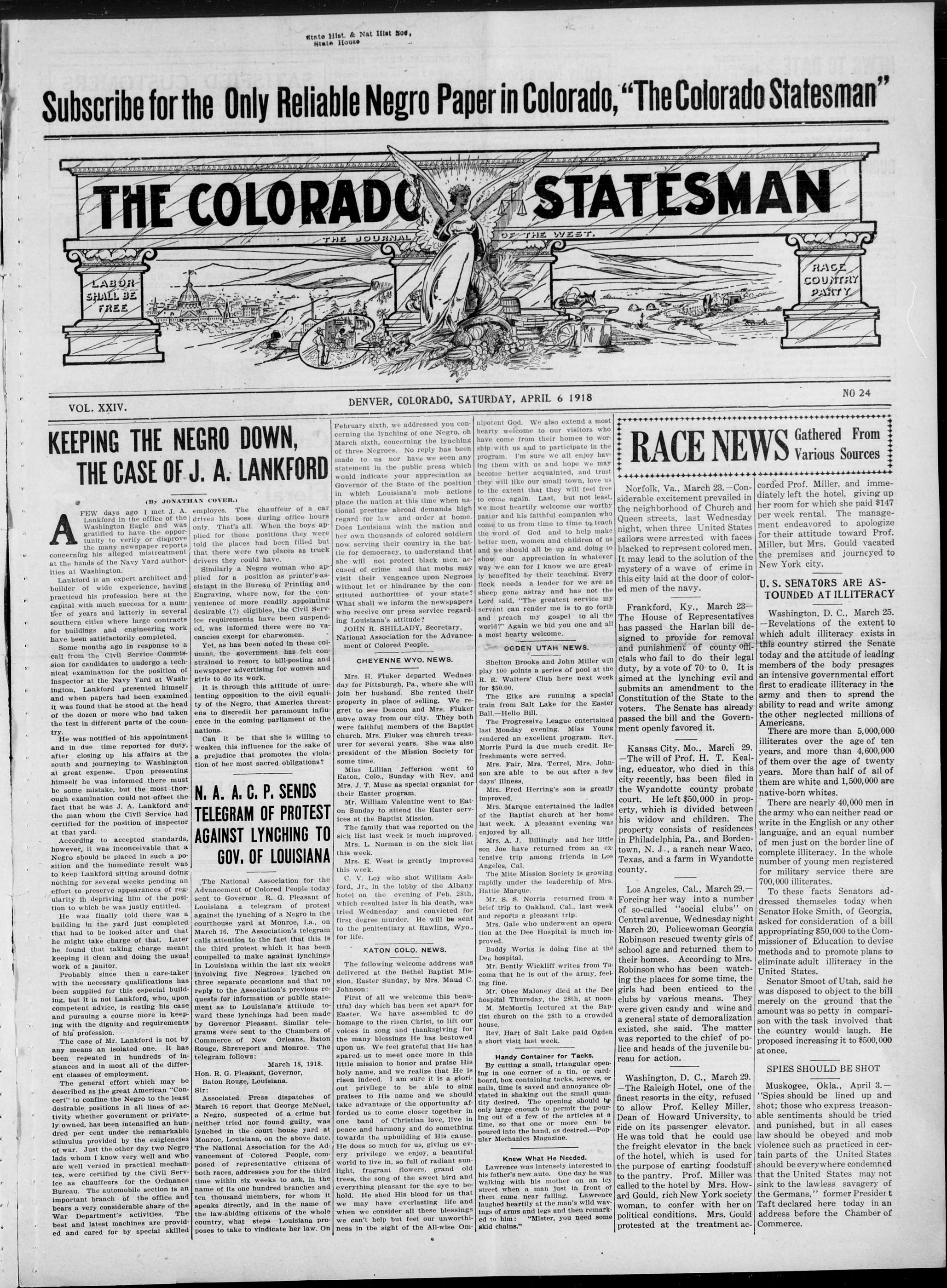
THE COLORADO STATESMAN
THE JOURNAL OF THE WEST.
LABOR SHALL BE FREE
RACE COUNTRY PARTY
KEEPING THE NEGRO DOWN THE CASE OF J. A. LANKFORD
(By JONATHAN COVER.)
FEW days ago I met J. A. Lankford in the office of the Washington Eagle and was gratified to have the opportunity to verify or disprove the many newspaper reports concerning his alleged mistreatment at the hands of the Navy Yard authorities at Washington. Lankford is an expert architect and builder of wide experience, having practiced his profession here at the capital with much success for a number of years and latterly in several southern cities where large contracts for buildings and engineering work have been satisfactorily completed. Some months ago in response to a call from the Civil Service Commission for candidates to undergo a technical examination for the position of inspector at the Navy Yard at Washington, Lankford presented himself and when papers had been examined it was found that he stood at the head of the dozen or more who had taken the test in different parts of the country.
He was notified of his appointment and in due time reported for duty, after closing up his affairs at the south and journeying to Washington at great expense. Upon presenting himself he was informed there must be some mistake, but the most thorough examination could not offset the fact that he was J. A. Lankford and the man whom the Civil Service had certified for the position of inspector at that yard.
According to accepted standards, however, it was inconceivable that a Negro should be placed in such a position and the immediate result was to keep Lankford sitting around doing nothing for several weeks pending an effort to preserve appearances of regularity in depriving him of the position to which he was justly entitled.
He was finally told there was a building in the yard just completed that had to be looked after and that he might take charge of that. Later he found that taking charge meant keeping it clean and doing the usual work of a janitor.
Probably since then a care-taker with the necessary qualifications has been supplied for this especial building, but it is not Lankford, who, upon competent advice, is resting his case and pursuing a course more in keeping with the dignity and requirements of his profession.
The case of Mr. Lankford is not by any means an isolated one. It has been repeated in hundreds of instances and in most all of the different classes of employment.
The general effort which may be described as the great American "Concert" to confine the Negro to the least desirable positions in all lines of activity whether government or privately owned, has been intensified an hundred per cent under the remarkable stimulus provided by the exigencies of war. Just the other day two Negro lads whom I know very well and who are well versed in practical mechanics, were certified by the Civil Service as chauffeurs for the Ordnance Bureau. The automobile section is an important branch of the office and bears a very considerable share of the War Department's activities. The best and latest machines are provided and cared for by special skilled
VOL. XXIV.
employes. The chauffeur of a car drives his boss during office hours only. That's all. When the boys applied for those positions they were told the places had been filled but that there were two places as truck drivers they could have.
Similarly a Negro woman who applied for a position as printer's assistant in the Bureau of Printing and Engraving, where now, for the convenience of more readily appointing desirable (?) eligibles, the Civil Service requirements have been suspended, was informed there were no vacancies except for charwomen.
Yet, as has been noted in these columns, the government has felt constrained to resort to bill-posting and newspaper advertising for women and girls to do its work.
It is through this attitude of unrelenting opposition to the civil equality of the Negro, that America threatens to discredit her paramount influence in the coming parliament of the nations.
Can it be that she is willing to weaken this influence for the sake of a prejudice that promotes the violation of her most sacred obligations?
N. A. A. C. P. SENDS TELEGRAM OF PROTEST AGAINST LYNCHING TO GOV. OF LOUISIANA
The National Association for the Advancement of Colored People today sent to Governor R. G. Pleasant of Louisiana a telegram of protest against the lynching of a Negro in the courthouse yard at Monroe, La., on March 16. The Association's telegram calls attention to the fact that this is the third protest which it has been compelled to make against lynchings in Louisiana within the last six weeks involving five Negroes lynched on three separate occasions and that no reply to the Association's previous requests for information or public statement as to Louisiana's attitude toward these lynchings had been made by Governor Pleasant. Similar telegrams were sent to the Chambers of Commerce of New Orleans, Baton Rouge, Shreveport and Monroe. The telegram follows:
Baton Rouge, Louisiana.
Sir:
Associated Press dispatches of March 16 report that George McNeel, a Negro, suspected of a crime but neither tried nor found guilty, was lynched in the court house yard at Monroe, Louisiana, on the above date. The National Association for the Advancement of Colored People, composed of representative citizens of both races, addresses you for the third time within six weeks to ask, in the name of its one hundred branches and ten thousand members, for whom it speaks directly, and in the name of the law-abiding citizens of the whole country, what steps Louisiana proposes to take to vindicate her law. On
March 18, 1918.
DENVER, COLORADO, SATURDAY, APRIL 6 1918
state Hist. & Nat Hist Soc.
State House
liable Negro Pap
RADO
THE JOURNAL
DENVER, COLORADO, SAT
February sixth, we addressed you concerning the lynching of one Negro, on March sixth, concerning the lynching of three Negroes. No reply has been made to us nor have we seen any statement in the public press which would indicate your appreciation as Governor of the State of the position in which Louisiana's mob actions place the nation at this time when national prestige abroad demands high regard for law and order at home. Does Louisiana wish the nation and her own thousands of colored soldiers now serving their country in the battle for democracy, to understand that she will not protect black men accused of crime and that mobs may visit their vengeance upon Negroes without let or hindrance by the constituted authorities of your state? What shall we inform the newspapers who receive our press service regarding Louisiana's attitude?
JOHN R. SHILLADY, Secretary, National Association for the Advancement of Colored People.
CHEYENNE WYO. NEWS.
Mrs. H. Fluker departed Wednesday for Pittsburgh, Pa., where she will join her husband. She rented their property in place of selling. We regret to see Deacon and Mrs. Fluker move away from our city. They both were faithful members of the Baptist church. Mrs. Fluker was church treasurer for several years. She was also president of the Mission Society for some time.
Miss Lillian Jefferson went to Eaton, Colo., Sunday with Rev. and Mrs. J. T. Muse as special organist for their Easter program.
Mr. William Valentine went to Eaton Sunday to attend the Easter services at the Baptist Mission.
The family that was reported on the sick list last week is much improved.
Mrs. L. Norman is on the sick list this week.
Mrs. E. West is greatly improved this week.
C. V. Loy who shot William Ashford, Jr., in the lobby of the Albany hotel on the evening of Feb. 28th, which resulted later in his death, was tried Wednesday and convicted for first degree murder. He will be sent to the penitentiary at Rawlins, Wyo., for life.
AATON COLO. NEWS.
The following welcome address was delivered at the Bethel Baptist Mission, Easter Sunday, by Mrs. Maud C. Johnson:
First of all we welcome this beautiful day which has been set apart for Easter. We have assembled to do homage to the risen Christ, to lift our voices in song and thanksgiving for the many blessings He has bestowed upon us. We feel grateful that He has spared us to meet once more in this little mission to honor and praise His holy name, and we realize that He is risen indeed. I am sure it is a glorious privilege to be able to sing praises to His name and we should take advantage of the opportunity afforded us to come closer together in one band of Christian love, live in peace and harmony and do something towards the upbuilding of His cause. He does so much for us, giving us every privilege we enjoy, a beautiful world to live in, so full of radiant sunlight, fragrant flowers, grand old trees, the song of the sweet bird and everything pleasant for the eye to behold. He shed His blood for us that we may have everlasting life and when we consider all these blessings we can't help but feel our unworthiness in the sight of the All-wise Om-
---
nipotent God. We also extend a most hearty welcome to our visitors who have come from their homes to worship with us and to participate in the program. I'm sure we all enjoy having them with us and hope we may become better acquainted, and trust they will like our small town, love us to the extent that they will feel free to come again. Last, but not least, we most heartily welcome our worthy pastor and his faithful companion who come to us from time to time to teach the word of God and to help make better men, women and children of us and we should all be up and doing to show our appreciation in whatever way we can for I know we are greatly benefited by their teaching. Every flock needs a leader for we are as sheep gone astray and has not the Lord said, "The greatest service my servant can render me is to go forth and preach my gospel to all the world?" Again we bid you one and all a most hearty welcome.
OGDEN UTAH NEWS.
Shelton Brooks and John Miller will play 100 points a series of pool at the R. R. Waiters' Club here next week for $50.00.
The Elks are running a special train from Salt Lake for the Easter Ball.—Hello Bill.
The Progressive League entertained last Monday evening. Miss Young rendered an excellent program. Rev. Morris Purd is due much credit. Refreshments were served.
Mrs. Fair, Mrs. Terrel, Mrs. Johnson are able to be out after a few days' illness.
Mrs. Fred Herring's son is greatly improved.
Mrs. Marque entertained the ladies of the Baptist church at her home last week. A pleasant evening was enjoyed by all.
Mrs. A. J. Billingly and her little son Joe have returned from an extensive trip among friends in Los Angeles, Cal.
The Mite Mission Society is growing rapidly under the leadership of Mrs. Hattie Marque.
Mr. S. S. Norris returned from a brief trip to Oakland, Cal., last week and reports a pleasant trip.
Mrs. Gale who underwent an operation at the Dee Hospital is much improved.
Buddy Works is doing fine at the Dee hospital.
Mr. Bently Wickliff writes from Tascoma that he is out of the army, feeling fine.
Mr. Obee Maloney died at the Dee hospital Thursday, the 28th, at noon.
M. McMortin lectured at the Baptist church on the 28th to a crowded house.
Rev. Hart of Salt Lake paid Ogden a short visit last week.
Handy Container for Tacks.
By cutting a small, triangular opening in one corner of a tin, or cardboard, box containing tacks, screws, or nails, time is saved and annoyance obviated in shaking out the small quantity desired. The opening should only large enough to permit the pouring out of a few of the articles at a time, so that one or more can be poured into the hand, as desired.—Popular Mechanics Magazine.
Knew What He Needed
Lawrence was intensely interested in his father's new auto. One day he was walking with his mother on an icy street when a man just in front of them came near falling. Lawrence laughed heartily at the man's wild wavings of arms and legs and then remarked to him: "Mister, you need some skid chains."
RACENEWS Gathered From Various Sources
Norfolk, Va., March 23. Considerable excitement prevailed in the neighborhood of Church and Queen streets, last Wednesday night, when three United States sailors were arrested with faces blacked to represent colored men. It may lead to the solution of the mystery of a wave of crime in this city laid at the door of colored men of the navy.
Frankford, Ky., March 23 The House of Representatives has passed the Harlan bill designed to provide for removal and punishment of county officials who fail to do their legal duty, by a vote of 70 to 0. It is aimed at the lynching evil and submits an amendment to the Constitution of the State to the voters. The Senate has already passed the bill and the Government openly favored it.
Kansas City. Mo., March 29. The will of Prof. H. T. Kealing, educator, who died in this city recently, has been filed in the Wyandotte county probate court. He left $50,000 in property, which is divided between his widow and children. The property consists of residences in Philadelphia, Pa., and Bordentown, N. J., a ranch near Waco, Texas, and a farm in Wyandotte county.
Los Angeles, Cal., March 29. Forcing her way into a number of so-called "social clubs" on Central avenue, Wednesday night March 20, Policewoman Georgia Robinson rescued twenty girls of school age and returned them to their homes. According to Mrs. Robinson who has been watching the places for some time, the girls had been enticed to the clubs by various means. They were given candy and wine and a general state of demoralization existed, she said. The matter was reported to the chief of police and heads of the juvenile bureau for action.
Washington, D. C., March 29. The Raleigh Hotel, one of the finest resorts in the city, refused to allow Prof. Kelley Miller, Dean of Howard University, to ride on its passenger elevator. He was told that he could use the freight elevator in the back of the hotel, which is used for the purpose of carting foodstuff to the pantry. Prof. Miller was called to the hotel by Mrs. Howard Gould, rich New York society woman, to confer with her on political conditions. Mrs. Could protested at the treatment ac
NO 24
corded Prof. Miller, and immediately left the hotel, giving up her room for which she paid $147 per week rental. The management endeavored to apologize for their attitude toward Prof. Miller, but Mrs. Gould vacated the premises and journeyed to New York city.
U. S. SENATORS ARE ASTOUNDED AT ILLITERACY
Washington, D. C., March 25. Revelations of the extent to which adult illiteracy exists in this country stirred the Senate today and the attitude of leading members of the body presages an intensive governmental effort first to eradicate illiteracy in the army and then to spread the ability to read and write among the other neglected millions of Americans. There are more than 5,000,000 illiterates over the age of ten years, and more than 4,600,000 of them over the age of twenty years. More than half of all of them are white and 1,500,000 are native-born whites.
There are nearly 40,000 men in the army who can neither read or write in the English or any other language, and an equal number of men just on the border line of complete illiteracy. In the whole number of young men registered for military service there are 700,000 illiterates.
To these facts Senators addressed themseles today when Senator Hoke Smith, of Georgia, asked for consideration of a bill appropriating $50,000 to the Commissioner of Education to devise methods and to promote plans to eliminate adult illiteracy in the United States.
Senator Smoot of Utah, said he was disposed to object to the bill merely on the ground that the amount was so petty in comparison with the task involved that the country would laugh. He proposed increasing it to $500,000 at once.
SPIES SHOULD BE SHOT
Muskogee, Okla., April 3. "Spies should be lined up and shot; those who express treasonable sentiments should be tried and punished, but in all cases law should be obeyed and mob violence such as practiced in certain parts of the United States should be everywhere condemned that the United States may not sink to the lawless savagery of the Germans," former President Taft declared here today in an address before the Chamber of Commerce.
FOREIGN
Benito Caeiro, a Portuguese engineer, is said by the Seculo to have invented a gun which will throw a shell ninety miles.
An American patrol which captured four German prisoners has been cited in French orders of the day and will receive the French war cross.
Mile. Germaine Franciere, auxiliary nurse at the American ambulance at Neuilly, was one of those killed in the Paris church which was struck by a German shell on Good Friday.
The bombardment of Paris by long range German guns was resumed Monday. Four persons were killed and nine injured by the bombardment, according to the official announcement.
The amount of tonnage to be turned over to the United States by Japan under the arrangement made by the Japanese shipping commission is estimated by the Tokio press at about 250,000.
Great masses of enemy troops continue to concentrate in the region of Albert, according to the Reuter correspondent at British headquarters. Fighting is in progress toward Villers-Bretonneux, to the north of Hangard.
A woman named Rosinia Flutter, who appeared at Chertsey, England, recently, was stated to be the mother of twenty-five children, including five pairs of twins. She summoned a single munition worker for alleged assault. She admitted an infatuation for him.
A big drive is on at Manila for men who will offer themselves in any capacity to the Philippines militia. The passage by the United States Congress of the bill which would permit the President to call into federal service a division of 27,000 Filipinos, has put new activity into the men at the head of the Philippine National guard. The American secretary of war, Newton D. Baker, accompanied by the members of his staff, arrived at the Italian headquarters. He was joined by Ambassador Thomas Page, who came from Rome, and Maj. Gen. Eben Swift, the head of the American military mission to Italy. The party proceeded to the supreme command, where a handsome villa was placed at the disposal of the American war secretary.
"I am delighted at General Pershing's prompt and effective action in placing all the American troops and facilities at the disposal of the allies in the present situation," said Secretary of War Baker, in a statement given out at headquarters in France. "It will meet with hearty approval in the United States, where the people desire their expeditionary forces to be of the utmost service in the common cause," the secretary added.
**SPORT**
Jack Dempsey, heavyweight boxer, signed to meet Bob Devere of Camp Funston, April 8, at St. Louis. Dempsey canceled his match with Tom Cowler for that date.
W. S. Chapman, 72 years old, is in Chicago, having completed a 15,000-mile walk. Chapman started from Baltimore, Md., March 9, 1916, on his long hike to win a wager of $3,500 put up by a club of New York.
Tedford Cann, 20-year-old champion swimmer of New York university, now in the United States navy, who was awarded the congressional medal of honor February 9 for saving the U. S. May, has been commissioned an ensign by Secretary Daniels.
The Pacific Coast league baseball season opened with a prospect of ideal playing weather in all three California cities where six teams met for initial honors. In each of the cities—San Francisco, Los Angeles and Sacramento—a parade of citizens, headed by the teams, preceded the games.
Capt. Henry L. Ransom of the Texas State rangers, was shot and instantly killed in a hotel at Sweetwater, Texas.
To further demonstrate what women of the United States are doing to help prosecute the war, nine young women chaffees, attired in military uniforms left Lansing, Mich., each driving an army truck with government supplies for Atlanta, Ga.
Municipal elections were held in many Montana cities and on the face of returns John Dryburg, nonpartisan, was elected mayor of Helena. The Democrats carried every ward in Butte and elected eight aldermen. In Bozeman three Democrats and one Republican were elected councilmen; H. T. Wilkinson was elected mayor of Missoula; J. E. Toteman mayor of Hamilton and Robert Pauline mayor of Kalispell.
President Wilson has not changed his attitude concerning a negotiated peace with the central powers, as expressed in his Flag day address, his reply to Pope Benedict and his message to Congress on the declaration of war with Austria, according to a letter he has written to Bishop Theodore S. Henderson of the Methodist Episcopal church, made public in New York by the National War Council of the Church.
The Nebraska State Senate having voted to decline to consider the question of ratifying the national prohibition amendment at the present special session of the Legislature, there apparently is little chance for the measure's consideration by the legislators until the regular legislative meeting next January.
Second Lieut. Byron Jackson, Jr., of San Francisco, Cal., was instantly killed at Call field at Wichita Falls, Tex., when the machine in which he was flying crashed to earth out of control, from a height of 600 feet.
NEWS TO DATE IN PARAGRAPHS
CAUGHT FROM THE NETWORK OF WIRES ROUND ABOUT THE WORLD.
DURING THE PAST WEEK
RECORD OF IMPORTANT EVENTS
CONDENSED FOR BUSY
PEOPLE.
Western Newspaper Union News Service.
ABOUT THE WAR
Fierce fighting has broken out in
the districts of Batoum, Kars and Ard-
ahm, in the Caucasus.
One of the German long range guns
bombarding Paris burst, according to
prisoners captured on the French
front, five of the gun crew being
killed.
The muddy roads in France were
jammed with Americans on the move.
In some cases they were marching in
double lines, taking up the road from
side to side.
The entire Turkish force in the Hit area in Mesopotamia has been captured or destroyed by the British, the London war office announces. Three thousand prisoners were taken.
The beginning of April, a month whose dates are written large on the pages of American history, finds the soldiers of the United States hastening to take their place in the zone of fiercest fighting.
With the passing of the thirteenth day of the new battle of the Somme there came increasing evidence that the great German machine with which it was intended to crush the allied line has almost utterly spent itself.
The Germans continued their desperate efforts Monday to open a road toward Amiens, their objective since the starting of the battle, but they made little if any progress. In fact, the entente troops were able to recapture the town of Hangard-en-Santerre. The British Tuesday improved their position by an attack south of Hangard, and later repulsed two German counter attacks which essayed to restore the situation. According to prisoners, the 20th8 German division has suffered losses of 70 per cent since the beginning of the offensive. The Twentieth division lost 50 per cent. The Eighty-eighth division lost 30 per cent the first day and 40 per cent in an attack on Mezières March 29.
A daring attempt by the Germans to cross the Oise and form a bridgehead permitting future advances was easily frustrated by the French on Monday. One of the famous storm battalions succeeded in getting over near Chauny but never returned. It was almost entirely annihilated. There remained only about 100 unwounded men, whom the French took prisoner. Nearly all the bridges crossing the Oise have been destroyed, and the French hold strong positions on the southern bank, while all fords are covered by artillery.
WESTERN
On the face of early returns, Lenroot carried Wisconsin by twelve to fifteen thousand.
The Republican municipal ticket, hended by E. P. Davies for mayor, was elected at Santa Fe, N. M.
P. Corpstein was re-elected mayor of Phoenix, Ariz., by a majority of probably 175 in a total vote of more than 5,600.
Every Socialist candidate in Tuesday's councilmanic election at Chicago was defeated, according to virtually complete returns.
James Cowgill, Democrat, was elected mayor of Kansas City.
Three persons were killed, several were injured and a number of houses demolished by a tornado which struck New Florence, Mo., eighty-five miles west of St. Louis. Three were killed and twelve injured at Hunterville, Mo.
WASHINGTON
American trade is being stripped to the bone to provide tonnage for speeding troops abroad.
Credits to the allies in the last year were raised to more than $5,000,000,000 by a loan of $200,000,000 to Great Britain.
The House concurred in a Senate resolution requesting the President to designate a day of prayer for American arms.
More than 200,000 applications for war risk insurance had been filed by officers and men of the naval service on March 31.
Markings for American aeroplanes adopted by the Signal corps, call for a red, white and blue bullseye of three concentric circles on the wings and vertical red- white and blue stripes on the rudders.
Creation of a requirements division which will establish priority of delivery of raw and manufactured war materials was announced by the War Industries Board. The Eightieth brigade started on a ten-day hike, the most extensive field meneuver scheduled since the Fortieth division has been stationed at Camp Kearny at San Diego, Calif. A report to the State Department from American Consul General Murphy at Sofia declared that no Bulgarian troops were moved to the western front for the big German offensive.
SPORT
Pithy News Notes
From All Parts of
Colorado
Western Newspaper Union News Service.
Eight new county women's Councils of Defense have recently been organized.
The state fish commissioner has directed that 100,000 trout fry be placed in the creeks above La Veta.
A test oil well being sunk at the Model mining camp in the Trinidad district reached a depth of 750 feet.
Five special classes in agriculture have been organized by the Logan women's Council of Defense this year.
Ten thousand dollars has been subscribed towards the erection of an alfalfa mill and mixing plant at Platteville.
Mrs. E. D. Smith of Durango is chairman of the newly formed La Plata county women's Council of Defense.
The largest consignment of trout fry ever received for the Pike's Peak streams arrived last week, 72,000 baby trout.
Plans for a proposed $25,000 municipal auditorium have been drawn for the approval of City Engineer Getty of Montrose.
Twenty-two young men from Cañon City are known to be now in France. Three of them are second lieutenants, one is a major.
Acting President Norlin of the University of Colorado has been made a member of the State Council of Defense by Governor Gunter.
County commissioners of Larimer county have opened bids and awarded contracts for nine bridges to be constructed at once, involving a cost of $10,000.
The sun shone in Denver 75 per cent of the possible sunshine time, during the month of March. There were 280 hours of real sunshine out of the 371 possible hours.
Miss Marion Crandall, sister of Mrs. Richard M. Greene of Pueblo, was killed in France by the explosion of a German shell near a Red Cross field hospital camp.
The Denver tourist and publicity bureau received a telegram from the Chicago, headquarters stating that Mrs. Emma Tollman East is in a hospital at Sheboygan, Wis.
Colorado's apportionment of the third Liberty Loan will be $20,312,900, which is $2,559,400 less than the amount of the subscriptions to the second loan in the state.
Rowland K. Goddard, United States secret service agent, seized 1,600 iron crosses in Denver that read "To hel-mit der United States," but as a camouflage could be construed to mean "To hel-mit der kaiser."
As the result of the success of the war garden movement in Denver last year the State Agricultural College faculty has decided to hold an "extension course" on gardens in Denver, from April 8 to 13, inclusive.
One thousand cards to register women for war service have been asked for by the Clear Creek county women's Council of Defense which has just been formed by Mrs. James Underhill of Idaho Springs as chairman.
The Ouray Consolidated Reduction Company has closed a deal which adds a third reduction mill to the machinery that will be manned and started this spring in the campaign to work the rich dumps in that mining camp. According to the official examination of the books of the treasurer's office for the past twenty years, Julius H. Clark, who was deputy state treasurer for a fifth of a century, was short $50,911.50 at the time of his death.
Eighteen months in the federal prison at Leavenworth, Kan., was the sentence given to Charlie W. Huffman, formerly pastor of a church at New Palestine, Ohio, by Judge Robert E. Lewis in the Denver Federal Court. Huffman was convicted a few weeks ago of violating the Mann slave act. He brought Gladys Oberlander, an 18-year-old parishioner of his, to Denver an dived with her as his wife.
The will of Maj. William Cooke Daniels, who died in Buenos Tires, Argentina, March 18, was presented for probate in the Denver County Court. The will names but three legatees. Cicily Banner Cooke Daniels, wife of Major Daniels, now residing in Switzerland, receives one-half of the estate; Florence Martin, daughter of the late Sir James Martin, chief justice of New South Wales, who has lived in his family and been his wife's friend for many years, being now with Mrs. Daniels in Switzerland, receives one-fourth, and Charles MacAllister Willcox, manager of the Daniels & Fisher Stores Company in Denver, who also receives one-fourth. The estate is valued at $765,000.
The amount of flour which can be purchased by each family has been limited again by the United States Food Administration. Denver grocers have received instructions that not more than twenty-five pounds of wheat flour can be sold to a single customer residing in Denver, while the maximum allowed to rural farmers is fifty pounds.
Ten county women's food production committees that will urge increases of poultry, pigs and bees have recently been formed by the Colorado Woman's Council of Defense.
CENTENNIAL STATE ITEMS
Benjamin J. Salmon, head in Denver of the single taxers, was sentenced by Judge Robert E. Lewis in the United States Court to serve nine months in the county jail. "And I think you're getting off pretty easy," remarked Judge Lewis after sentence was pronounced. Salmon was convicted Feb. 12 of refusing to fill out and return his questionnaire.
Emmett Knight, well known Colorado Springs mechanic, who enlisted in the aero branch of the signal corps, is in military hospital at San Antonio, suffering from a broken ankle, caused by the fall of an observation balloon. Knight's escape is declared to be miraculous as the big gas bag fell 3,250 feet.
Her coffin draped with the tricolor and her body buried in a cemetery containing 6,000 French soldiers, Miss Marion G. Crandell, a sister of Mrs. George L. McCord of Denver, rests in French soil, honored by the entire French army as a brave soldier who fell at her post of duty.
Colorado's county Councils of Defense have been urged by the State Council of Defense to form community councils as they find it possible in accordance with national recommendation. It is expected that the school houses will often be the centers of the community councils.
The National Association of Colored Women will convene in Denver July 8 to 13, according to Mrs. Isabel Stewart, one of the Denver representatives of the organization. The convention, it is stated, will mark the greatest gathering of negro women in the history of the country. $^{10}$ The funeral of Lieut. Raymond J. McPhee, who was buried with full military honors due his rank, was held in Denver. Business and professional men, soldiers and others thronged the Immaculate Conception cathedral, where requiem high mass was sung. $^{11}$ The Denver Federation for Charity and Philanthropy secured during the month of March 410 new subscriptions amounting to $2,682.50. The total number of subscriptions to date is 4,696. The total amount subscribed towards the $85,000 year's budget is $79,082.50.
Shot as she sat in a chair in her home on the main street of Erie, Mrs. Frances Alva, 42 years old, died an hour later. Frank Alva, husband of the woman, is accused of firing the shots, after an ineffectual effort to smooth over family troubles.
Caught in a blizzard on the state highway between Raton, N. M., and Trinidad, Roe McMullin of Auburn, Wash., an automobile tourist, was frozen to death, his body being found in a snowbank near where his automobile was blocked by drifts.
Colorado and Denver added to their "bit" when eight cars of the pick of the young manhood of the state and city rolled out of the Denver Union station bound for Camp Funston. Approximately 200 men were on the train.
Carefully worded soldier letters from Funston indicate that many men have been departing for the Atlantic coast in the last month. It is said a considerable number are on the way east from San Diego also. Casualty lists given out from Canadian army headquarters at Ottawa, contain the name of Frank Romans, 21, a Denver boy, among those who have been returned to England after having been in enemy hands. A farewell demonstration for A. L. Hampton, who enlisted in army Y. M. C. A. work in France and for the twenty-six drafted men who left for Camp Funston Saturday, was held in the Pueblo city Y. M. C. A.
During the year that America has been preparing its national army to war on Germany, 4,212 men who volunteered in Colorado have been accepted, according to an announcement by the War Department.
E. E. Drach of Glenwood Springs, former state banking commissioner, is not entitled to draw pay for the period from May 6, 1915, until July 5, 1916, according to a decision rendered by the Supreme Court.
Edgar Smith, who for years was clerk of District Court at Colorado Springs, and went away with Battery C, was found dead in a suburb of San Antonio, lying in a park, with a bottle of poison near by.
All records for liquor permits issued by Charles A. Lammers, county clerk and recorder of Denver county, were broken in March. Last month there were 5,858 permits issued to bring liquor into Denver.
Fred Schlada, an Austrian, said to be pro-German in his utterances, was taken to the center of the business section of Ouray and forced to get down on his knees and kiss the American flag.
Forty-four Denver firms engaged reservations at the United States Food exposition at the Auditorium under the management of the Denver Manufacturers' Association.
Fifteen thousand people filled the Denver Auditorium to attend the patriotic mass meeting and organ recital. The speakers were Miss Kathleen Burke, the only woman the British have allowed to visit their western front trenches, and Dr. Robert M. McElroy.
District Judge Haslett P. Burke of Sterling, presiding over the Thirteenth Judicial District, cannot be recalled under petitions filed with the secretary of state by residents of the district in November, 1916, according to a decision rendered by Supreme Court.
SATISFIED CUSTOMERS
SATISFIED CUSTOMERS
Means that those who come back to us again and again to buy after they've made their first purchase at our store always receive satisfactory service.
They know that whatever we sell them is thoroughly reliable.
They know we do not ask more than fair profit on our sales.
They know they can rely on our advice—truth is our stand-by.
They know that carefulness, honesty, courteousy, cleanliness and promptness characterize us.
THE ATLAS DRUG COMPANY
2701 WELTON STREET PHONE MAIN 875
John W. Masury & Sons Coach Colors, Paints and Varnishes WALL PAPER, PAINTS, OILS AND GLASS, INTERIOR AND EXTERIOR DECORATORS
The Curtis Park Floral Company
FLORAL DESIGNS PUT UP WHILE YOU WAIT
CHOICE PLANTS AND CUT FLOWERS CONSTANTLY ON HAND
GREENHOUSES: Thirty-Fourth and Curtis Streets
TELEPHONE, MAIN 1511 DENVER, COLO
MORRISON'S
MORRISON'S FAMOUS JAZZ ORCHESTRA
AND ENTERTAINERS
GEO. MORRISON, MANAGER
Music Furniture
Phone Main 2707. Res
When
The Heads
Neckbones
any other p
the squeal
East's M
2300-
Music Furnished for all Occasions
Phone Main 2707. Res. 2947 Stout St. DENVER, COLO.
When You Want
The Heads, Feet Tails, Snouts Neckbones or Chitlerings, or any other part of the hog except the squeal go to
Taxicab Rates.
Depot, 1 or 2 pass...50c
Depot, each addi-
tional pass.....25c
One mile radius.....50c
Each addition'1 mle.25c
Bean
TAXICAB LANDU
HEATED TAXICAB.
TAXICAB LANDULET AND 7-PASSENGER 1918 LATE
MODEL CARS.
Phone Main 6099
Occasions
DENVER, COLO
Want
nails, Snouts
tierings, or
hog except
Street
Motto: "Not slow but sure." Cash only.
Rates Per Hour.
$1.50 to $2.50.
Livery
Phone Main
1461
TO HELP YOU
"HELP FEED YOURSELF"
U.S. DEPT. OF AGRICULTURE
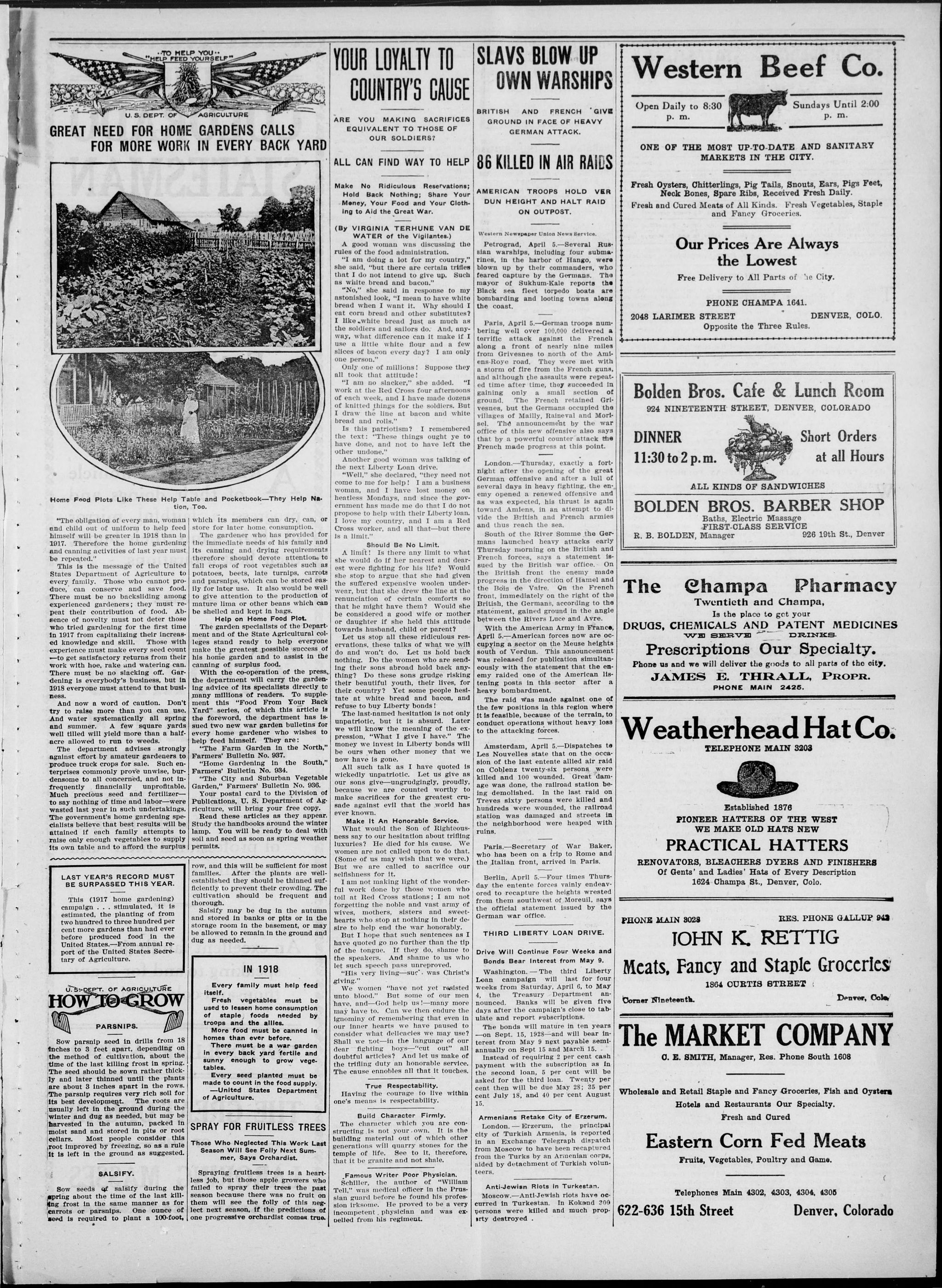
GREAT NEED FOR HOME GARDENS CALLS
FOR MORE WORK IN EVERY BACK YARD
GARDEN
Home Food Plots Like These Help Table and Pocketbook—They Help Nation, Too.
"The obligation of every man, woman and child out of uniform to help feed himself will be greater in 1918 than in 1917. Therefore the home gardening and canning activities of last year must be repented." which its members can dry, can, or store for later home consumption.
The gardener who has provided for the immediate needs of his family and its canning and drying requirement therefore should devote attention
This is the message of the United States Department of Agriculture to every family. Those who cannot produce, can conserve and save food. There must be no backsliding among experienced gardeners; they must repeat their contribution of food. Absence of novelty must not deter those who tried gardening for the first time in 1917 from capitalizing their increased knowledge and skill. Those with experience must make every seed count — to get satisfactory returns from their work with hoe, rake and watering can. There must be no slacking off. Gardening is everybody's business, but in 1918 everyone must attend to that business.
And now a word of caution. Don't try to raise more than you can use. And water systematically all spring and summer. A few square yards well tilted will yield more than a half-acre allowed to run to weeds.
The department advises strongly against effort by amateur gardeners to produce truck crops for sale. Such enterprises commonly prove unwise, burdensome to all concerned, and not infrequently financially unprofitable. Much precious seed and fertilizer—to say nothing of time and labor—were wasted last year in such undertakings. The government's home gardening specialists believe that best results will be attained if each family attempts to raise only enough vegetables to supply its own table and to afford the surplus
LAST YEAR'S RECORD MUST
BE SURPASSED THIS YEAR.
This (1917 home gardening) campaign . . . stimulated, it is estimated, the planting of from two hundred to three hundred per cent more gardens than had ever before produced food in the United States.—From annual report of the United States Secretary of Agriculture.
U.S. DEPT. OF AGRICULTURE
HOW TO GROW
PARSNIPS.
Sow parsnip seed in drills from 18 inches to 3 feet apart, depending on the method of cultivation, about the time of the last killing frost in spring. The seed should be sown rather thickly and later thinned until the plants are about 3 inches apart in the rows. The parsnip requires very rich soil for its best development. The roots are usually left in the ground during the winter and dug as needed, but may be harvested in the autumn, packed in moist sand and stored in pits or root cellars. Most people consider this root improved by freezing, so as a rule it is left in the ground as suggested.
SALSIFY.
Sow seeds of salify during the spring about the time of the last killing frost in the same manner as for carrots or parsnips. One ounce of seed is required to plant a 100-foot,
which its members can dry, can, or store for later home consumption. The gardener who has provided for the immediate needs of his family and its canning and drying requirements therefore should devote attention to fall crops of root vegetables such as potatoes, beets, late turnips, carrots and parsnips, which can be stored easily for later use. It also would be well to give attention to the production of mature lima or other beans which can be shelled and kept in bags. Help on Home Food Plot. The garden specialists of the Department and of the State Agricultural colleges stand ready to help everyone make the greatest possible success of his home garden and to assist in the canning of surplus food.
With the co-operation of the press, the department will carry the gardening advice of its specialists directly to many millions of readers. To supplement this "Food From Your Back Yard" series, of which this article is the foreword, the department has issued two new war garden bulletins for every home gardener who wishes to help feed himself. They are: "The Farm Garden in the North," Farmers' Bulletin No. 937. "Home Gardening in the South," Farmers' Bulletin No. 934.
"The City and Suburban Vegetable Garden." Farmers' Bulletin No. 936.
Garden, Farmers Bulletin No. 500.
Your postal card to the Division of Publications, U. S. Department of Agriculture, will bring your free copy.
Read these articles as they appear.
Study the handbooks around the winter lamp. You will be ready to deal with soil and seed as soon as spring weather permits.
row, and this will be sufficient for most families. After the plants are well-established they should be thinned sufficiently to prevent their crowding. The cultivation should be frequent and thorough.
Salsify may be dug in the autumn and stored in banks or pits or in the storage room in the basement, or may be allowed to remain in the ground and dug as needed.
IN 1918
Every family must help feed itself.
Fresh vegetables must be used to lessen home consumption of staple foods needed by troops and the allies.
More food must be canned in homes than ever before.
There must be a war garden in every back yard fertile and sunny enough to grow vegetables.
Every seed planted must be made to count in the food supply.
United States Department of Agriculture.
SPRAY FOR FRUITLESS TREES
Those Who Neglected This Work Last Season Will See Folly Next Summer, Says Orchardist.
Spraying fruitless trees is a heartless job, but those apple growers who failed to spray their trees the past season because there was no fruit on them will see the folly of this neglect next season, if the predictions of one progressive orchardist come true.
YOUR LOYALTY TO COUNTRY'S CAUSE
ARE YOU MAKING SACRIFICES
EQUIVALENT TO THOSE OF
OUR SOLDIERS?
ALL CAN FIND WAY TO HELP
Make No Ridiculous Reservations;
Hold Back Nothing; Share Your
Money, Your Food and Your Clothing to Aid the Great War.
(By VIRGINIA TERHUNE VAN DE WATER of the Vigilantes.)
A good woman was discussing the rules of the food administration.
"I am doing a lot for my country," she said, "but there are certain trifles that I do not intend to give up. Such as white bread and bacon."
"No," she said in response to my astonished look, "I mean to have white bread when I want it. Why should I eat corn bread and other substitutes? I like white bread just as much as the soldiers and sailors do. And, anyway, what difference can it make if I use a little white flour and a few slices of bacon every day? I am only one person."
Only one of millions! Suppose they all took that attitude!
"I am no slacker," she added. "I work at the Red Cross four afternoons of each week, and I have made dozens of knitted things for the soldiers. But I draw the line at bacon and white bread and rolls."
Is this patriotism? I remembered the text: "These things ought ye to have done, and not to have left the other undone."
Another good woman was talking of the next Liberty Loan drive.
"Well," she declared, "they need not come to me for help! I am a business woman, and I have lost money on heatless Mondays, and since the government has made me do that I do not propose to help with their Liberty loan. I love my country, and I am a Red Cross worker, and all that—but there is a limit."
Should Be No Limit.
A limit! Is there any limit to what she would do if her nearest and dearest were fighting for his life? Would she stop to argue that she had given the suffered expensive woolen underwear, but that she drew the line at the renunciation of certain comforts so that he might have them? Would she be considered a good wife or mother or daughter if she held this attitude towards husband, child or parent? Let us stop all these ridiculous reservations, these talks of what we will do and won't do. Let us hold back nothing. Do the women who are sending their sons abroad hold back anything? Do these sons grudge risking their beautiful youth, their lives, for their country? Yet some people hesitate at white bread and bacon, and refuse to buy Liberty bonds!
The last-named hesitation is not only unpatriotic, but it is absurd. Later we will know the meaning of the expression, "What I give I have." The money we invest in Liberty bonds will be ours when other money that we now have is gone.
All such talk as I have quoted is wickedly unpatriotic. Let us give as our sons give—ungrudgingly, proudly, because we are counted worthy to make sacrifices for the greatest crusade against evil that the world has ever known.
Make It An Honorable Service.
What would the Son of Righteousness say to our hesitation about trifling luxuries? He died for his cause. We women are not called upon to do that. (Some of us may wish that we were.) But we are called to sacrifice our selfishness for it.
I am not making light of the wonderful work done by those women who toll at Red Cross stations; I am not forgetting the noble and vast army of wives, mothers, sisters and sweet-hearts who stop at nothing in their desire to help end the war honorably.
But I hope that such sentences as I have quoted go no further than the tip of the tongue. If they do, shame to the speakers. And shame to us who let such speech pass unreproved.
"His very living—suc". was Christ's giving."
We women "have not yet resisted unto blood." But some of our men have, and—God help us!—many more may have to. Can we then endure the ignominy of remembering that even in our inner hearts we have paused to consider what delicacies we may use? Shall we not—in the language of our dear fighting boys—"cut out" all doubtful articles? And let us make of the trifling duty an honorable service. The cause ennobles all that it touches.
True Respectability.
Having the courage to live within one's means is respectability.
Build Character Firmly.
The character which you are constructing is not your own. It is the building material out of which other generations will quarry stones for the temple of life. See to it, therefore, that it be granite and not shale.
Famous Wrter Poor Physician. Schiller, the author of "William Tell," was medical officer in the Prussian guard before he found his profession irksome. He proved to be a very incompetent physician and was expelled from his regiment.
SLAVS BLOW UP OWN WARSHIPS
BRITISH AND FRENCH GIVE
GROUND IN FACE OF HEAVY
GERMAN ATTACK.
86 KILLED IN AIR RAIDS
AMERICAN TROOPS HOLD VER DUN HEIGHT AND HALT RAID ON OUTPOST.
Western Newspaper Union News Service.
Petrograd, April 5.—Several Russian warships, including four submarines, in the harbor of Hango, were blown up by their commanders, who feared capture by the Germans. The mayor of Sukhum-Kale reports the Black sea fleet torpedo boats are bombarding and looting towns along the coast.
Paris, April 5.—German troops numbering well over 100,000 delivered a terrific attack against the French along a front of nearly nine miles from Grivesnes to north of the Amiens-Roye road. They were met with a storm of fire from the French guns, and although the assaults were repeated time after time, they succeeded in gaining only a small section of ground. The French retained Grivesnes, but the Germans occupied the villages of Mailly, Raineval and Morsel. The announcement by the war office of this new offensive also says that by a powerful counter attack the French made progress at this point.
London.—Thursday, exactly a fortnight after the opening of the great German offensive and after a lull of several days in heavy fighting, the enemy opened a renewed offensive and as was expected, his thrust is again toward Amlens, in an attempt to divide the British and French armies and thus reach the sea.
South of the River Somme the Germans launched heavy attacks early Thursday morning on the British and French forces, says a statement issued by the British war office. On the British front the enemy made progress in the direction of Hamel and the Bois de Valre. On the French front, immediately on the right of the British, the Germans, according to the statement, gained ground in the angle between the Rivers Luce and Avre.
With the American Army in France, April 5.—American forces now are occupying a sector on the Meuse heights south of Verdun. This announcement was released for publication simultaneously with the statement that the enemy raided one of the American listening posts in this sector after a heavy bombardment. The raid was made against one of the few positions in this region where it is feasible, because of the terrain, to conduct operations without heavy loss to the attacking forces.
Amsterdam, April 5.—Dispatches to Les Nouvelles state that on the occasion of the last entente allied air raid on Coblenz twenty-six persons were killed and 100 wounded. Great damage was done, the railroad station being demolished. In the last raid on Treves sixty persons were killed and hundreds were wounded, the railroad station was damaged and streets in the neighborhood were heaped with ruins.
Paris.—Secretary of War Baker, who has been on a trip to Rome and the Italian front, arrived in Paris.
Berlin, April 5.—Four times Thursday the entente forces vainly endeared to recapture the heights wrested from them southwest of Moreuil, says the official statement issued by the German war office.
THIRD LIBERTY LOAN DRIVE.
Drive Will Continue Four Weeks and Bonds Bear Interest from May 9.
Washington.—The third Liberty Loan campaign will last for four weeks from Saturday, April 6, to May 4, the Treasury Department announced. Banks will be given five days after the campaign's close to tabulate and report subscriptions.
The bonds will mature in ten years—on Sept. 15, 1928—and will bear interest from May 9 next payable semiannually on Sept 15 and March 15.
Instead of requiring 2 per cent cash payment with the subscription as in the second loan, 5 per cent will be asked for the third loan. Twenty per cent then will be due May 28; 35 per cent July 18, and 40 per cent August 15.
Armenians Retake City of Erzerum. London.—Erzerum, the principal city of Turkish Armenia, is reported in an Exchange Telegraph dispatch from Moscow to have been recaptured from the Turks by an Armenian corps, aided by detachment of Turkish volunteers.
Anti-Jewish Riots in Turkestan. Moscow.—Anti-Jewish riots have occurred in Turkestan. In Kokand 300 persons were killed and much property destroyed.
Western Beef Co.
Open Daily to 8:30 p. m.
ONE OF THE MOST
MARKET
Fresh Oysters, Chitterbush
Neck Bones, Spin
Fresh and Cured Meats
Our Price
Free Deliver
PHC
2048 LARIMER STREET
Oppo
Bolden Bros.
924 NINETEENTH
DINNER
11:30 to 2 p.m.
ALL KIDS
BOLDEN BROS.
Baths
FIRST
R. B. BOLDEN, Manage
The Charm
Twenty
Is it
DRUGS, CHEMICALS
WE SEE
Prescription
Phone us and we will call
JAMES H
Weather
TEL
PIONEER
WE M
PRACTICE
RENOVATORS, BLEED
Of Gents' and L
1624 CH
OF THE MOST UP-TO-DATE AND SALV
MARKETS IN THE CITY.
Haters, Chitterlings, Pig Tails, Snouts, Ears,
Bone Bones, Spare Ribs, Received Fresh Dairy
Cured Meats of All Kinds. Fresh Vegeta-
and Fancy Groceries.
Our Prices Are Always
the Lowest
Free Delivery to All Parts of the City.
PHONE CHAMPA 1641.
IMER STREET DENVER
Opposite the Three Rules.
In Bros. Cafe & Lunch
INETEENTH STREET, DENVER, COL
R 2 p.m. Short
at a
ALL KINDS OF SANDWICHES
DEN BROS. BARBER
Baths, Electric Massage
FIRST-CLASS SERVICE
OLDEN, Manager 926 19th
Champa Phar-
Twentieth and Champa,
Is the place to get your
CHEMICALS AND PATENT M
WE SERVE DRINKS.
Descriptions Our Spec
and we will deliver the goods to all parts
JAMES E. THRALL, PH
PHONE MAIN 2425.
atherhead Ha
TELEPHONE MAIN 3203
ONE OF THE MOST UP-TO-DATE AND SANITARY MARKETS IN THE CITY.
Fresh Oysters, Chitterlings, Pig Tails, Snouts, Ears, Pigs Feet, Neck Bones, Spare Ribs, Received Fresh Daily. Fresh and Cured Meats of All Kinds. Fresh Vegetables, Staple and Fancy Groceries.
PHONE CHAMPA 1641.
2048 LARIMER STREET DENVER, COLO.
Opposite the Three Rules.
Bolden Bros. Cafe & Lunch Room
924 NINETEENTH STREET, DENVER, COLORADO
DINNER
11:30 to 2 p.m.
Short Orders
at all Hours
ALL KINDS OF SANDWICHES
BOLDEN BROS. BARBER SHOP
Baths, Electric Massage
FIRST-CLASS SERVICE
R. B. BOLDEN, Manager
926 19th St., Denver
The Champa Pharmacy
Twentieth and Champa,
Is the place to get your
DRUGS, CHEMICALS AND PATENT MEDICINES
WE SERVE DRINKS.
Prescriptions Our Specialty.
Phone us and we will deliver the goods to all parts of the city.
JAMES E. THRALL, PROPR.
PHONE MAIN 2425.
Weatherhead Hat Co. TELEPHONE MAIN 3203
Established 1876
PIONEER HATTERS OF THE WEST
WE MAKE OLD HATS NEW
PRACTICAL HATTERS
ATORS, BLEACHERS DYERS AND FI
Gents' and Ladies' Hats of Every Descrip
1624 Champa St., Denver, Colo.
RENOVATORS, BLEACHERS DYERS AND FINISHERS Of Gents' and Ladies' Hats of Every Description 1624 Champa St., Denver, Colo.
JOHN K. RETTIGER
Fancy and Staple Grocery
1864 CURTIS STREET
eenth.
MARKET COMPANY
E. SMITH, Manager, Res. Phone South 1
d Retail Staple and Fancy Groceries, Fish
Hotels and Restaurants Our Specialty.
Fresh and Cured
Eastern Corn Fed Me
JOHN Meats, Fancy 1864
The MARK
C. E. SMITH,
Wholesale and Retail Stap
Hotels and
Eastern
The MARKET COMPANY
C. E. SMITH, Manager, Res. Phone South 1608
Wholesale and Retail Staple and Fancy Groceries, Fish and Oysters Hotels and Restaurants Our Specialty. Fresh and Cured
Eastern Corn Fed Meats
Fruits, Vegetables, Poultry and Game.
Telephones Main 4302, 4303, 4304, 4305
622-636 15th Street
15th Street Denver,
PHONE MAIN 8028
Corner Nineteenth.
Sundays Until 2:00 p. m.
DATE AND SANITARY
THE CITY.
Sns, Snouts, Ears, Pigs Feet,
Received Fresh Daily.
Fresh Vegetables, Staple
Jerries.
Always
Best
Parts of the City.
A 1641.
DENVER, COLO.
Rules.
& Lunch Room
DENVER, COLORADO
Short Orders
at all Hours
SANDWICHES
ARBER SHOP
Massage
SERVICE
926 19th St., Denver
Pharmacy
Champa,
get your
PATENT MEDICINES
DRINKS.
Our Specialty.
Foods to all parts of the city.
ALL, PROPR.
2425.
Bad Hat Co.
MAIN 3203
1876
OF THE WEST
ATS NEW
HATTERS
VERS AND FINISHERS
Of Every Description
Denver, Colo.
RES. PHONE GALLUP 943 ETTIG staple Groceries STREET
COMPANY
Phone South 1608
Groceries, Fish and Oysters
Our Specialty.
red
Fed Meats
Denver, Colorado
C
```markdown
```
Denver, Cola
THE COLORADO STATESMAN
LAND IS
BULL BE
FREE
BACK
GOVERNMENT
PARTY
Reading notices, ten lines or less, 10 cents per line. Each additional line over ten lines, 5 cents per line. Display advertising, 50 cents per inch.
Remittances should be made by Express Money Order, Postoffice Money Order, Registered Letter or Bank Draft. Postage stamps will be received the same as cash for the fractional part of a dollar. Only 1c and 2c stamps taken.
No discounts allowed on less than three months' contract. Cash must accompany all orders from parties unknown to us. Further particulars on application.
THE REAL REPUBLICAN.
member of the Republican party has not half-Democrat, half-Republican game, but is bound to land between "the devil and through supporting the present administration, to be unmindful of their political faith and bring their part in various forms and feature national and state candidates, and was contact the political phase of the situation at the recent campaign at Wisconsin for U.S. Pressman, Lenroot, won with a plurality, Democrat, although the latter was back president. In Denver, especially among those seem to lure them and generally the commercial politicians. We therefore warn the party to beware of this NON-PARTISAN prefix is the subterfuge, and their act is the order of Democrats. Get-together can most resolve "to beard the lion in his lair, of our own to the deep. JUSTICE and of grand qualities are the essentials of our kind of the mental lash.
PULICAN NATIONAL CHAIRMAN, PRUDENT. Hays, newly elected chairman of the committee, in response to a request for a given him at the Brown Palace hotel land large gathering of his mission to Denver Party Loan and to meet working members reception hall rang out with applause, and an prudent leader. Though small in state appearance, he proved "the good things going to the adage, by his cogent argument, devolved on us for the success of the go to the front," said he, "but our most country can produce—are fighting our WITH VICTORY. Let us therefore succeed, which will lessen the toll of American of which absolutely rests on our shoulds of the Republican party the necessities as in the past, and although we have yet this issue extends beyond party, it will to accomplish her mission to the work institution if we delay in giving now." Denver citizens paid their respects and seen head of our party. The COLORADO STATE with the Republican chairman, offered of successful leadership and hope that they mightly restored to the place where it be
THE real member of the Republican party has not to play the non-partisan, half-Democrat, half-Republican game, because as the saying goes, he is bound to land between "the devil and the deep sea." Republicans, though supporting the present administration with every loyalty, must not be unmindful of their political faith as our Democratic citizens are playing their part in various forms and features. Already they are getting their national and state candidates, and war or no war they resolve to keep intact the political phase of the situation. A striking example affords in the recent campaign at Wisconsin for U. S. senator. The Republican congressman, Lenroot, won with a plurality of 10,000 over Joseph E. Davies, Democrat, although the latter was backed by the president and vice president. In Denver, especially among our people, the fleshpots of politics seem to lure them and generally they become the victims of the commercial politicians. We therefore warn our co-workers of the Republican party to beware of this NON-PARTISAN GANG, as we discovered that the prefix is the subterfuge, and their activities prove them everything in the order of Democrats. Get-together conferences should begin, and we must resolve "to beard the lion in his lair," even if we have to consign some of our own to the deep. JUSTICE and TRUTH must prevail. These two grand qualities are the essentials of our PARTY. Come with us and be rid of the mental lash.
HAYS. REPUBLICAN NATIONAL CHAIRMAN. PRUDENT LEADER.
WHEN Will H. Hays, newly elected chairman of the National Republican Committee, in response to a request for a few words at the reception given him at the Brown Palace hotel last Thursday evening, informed the large gathering of his mission to Denver in the interest of the Third Liberty Loan and to meet working members of the Republican party, the reception hall rang out with applause, and immediately he was proclaimed a prudent leader. Though small in stature and comparatively young in appearance, he proved "the good things wrapped in small parcels," according to the adage, by his cogent argument and logical reasoning of the duty devolved on us for the success of this Third Liberty Loan.
"We cannot go to the front," said he, "but our men—the best and bravest that our country can produce—are fighting our battles to insure a lasting PEACE WITH VICTORY. Let us therefore subscribe largely to this Liberty Loan, which will lessen the toll of American life in this conflict, the burden of which absolutely rests on our shoulders." He urged upon the members of the Republican party the necessity of giving every loyal support now as in the past, and although we have our political creed, party, etc., yet this issue extends beyond party, it being the strengthening of America to accomplish her mission to the world or the destruction of her great institution if we delay in giving now."
Prominent Denver citizens paid their respects and seemed to be pleased with this new head of our party. The COLORADO STATESMAN being very much impressed with the Republican chairman, offers its best wishes for a long career of successful leadership and hope that the REPUBLICAN PARTY may be rightly restored to the place where it belongs during his administration.
AMERICA AROUSED TO WAR DUTY.
eighteen days have served us food for the the partial successes of the enemy in thanks to the British, French and the por the present, and we hope for all time. it begun, the Kaiser having only used anger battle is yet to come. Be that as serve? A greater vigilance of our secre
THE past fourteen days have served us food for thought and deepest concern in the partial successes of the enemy in his new drive in France. Thanks to the British, French and the portion of our troops halting him for the present, and we hope for all time. But we are told Germany has just begun, the Kaiser having only used half of his divisions and the bigger battle is yet to come. Be that as it may, but what purpose does it serve? A greater vigilance of our secret service agency; more drastic measures to be meted out to spies and opposers of our country, flag and nation; the suppression and eradication of mob violence which is attempting, by the increase percentage of its victims, to cast a blot on our civilization and impair our fighting for world freedom, and finally arouse all America to the fact of her tremendous task to defeat the enemy at home and abroad. Says Floyd Gibbons in endeavouring to impress the pacifist and the other American who is looking forward to peace and a speedy termination without victory:
"America's task, and almost her immediate task, has increased manifold. Now more than ever does the successful prosecution of the war depend upon her. Today she stands among the allies as the only one that remains unscathed in the contest. More than ever America's weight and strength must be brought forward quickly or the war will be indefinitely prolonged or ignominiously concluded."
Former President Taft, the ever wise and cautious jurist, in an addressing the Chamber of Commerce, Muskogee, Okla., emphatically asserted:
"Spies should be lined up and shot, those who express treasonable sentiments should be tried and punished, but in all cases law should be obeyed and mob violence, such as practised in certain parts of the United States, should be everywhere condemned that we may not sink to the lawless savagery of the Germans. 'Rush troops to France,' is the cry of our wounded that returned home recently from France. 'WIN NOW AND AVOID SQRROW.'"
And here is where the stoutest American heart apprehends the fate that will befall us if we do not arouse ourselves to a keen realization of the part we must necessarily play, and throwing ourselves wholly into the game secure and make permanent an international peace, a correction of the ills at home, the demolition of the great wall of prejudice that separates us into factions and even causes us to impede governmental actions, and in the end a wonder-working harmonious inter-relationship which will stand conspicuously as a pattern for other peoples and nations to emulate.
Denver arises to the occasion, so does Colorado, as in the general enlistment we have shown more than ordinary activity; in the draft system a large per cent is admissible, and when we give a hearty send-off to Battery B, part of the 148th Artillery, recently sailed for France, a number of men of our own race, sailing also in other branches of the military, we can faithfully and consciously say the West started early, is continuing, and will not cease until its part in COMPLETE VICTORY OF OUR ARMS is played. Fellow colored citizens, we have established ourselves from the wars of the Revolution to the present time as a national support that never gives way. Undaunted we go forward in the protection and preservation of our home. Let nothing dissuade us, but with the hereditary influence of our forefathers in their dogged persistency and unquestioned patriotic devotion to country let us take the part necessary for our recognition in this history-making period of the world, and when things shall resume their normal, we will be among those who gave the infallible proof of AMERICANS WHO WERE AROUSED TO THEIR DUTY and who carried out their part to the full extent meriting the proud and coveted honor of AMERICAN CITIZENSHIP.
GERMANS SUFFER TERRIFIC LOSSES
First Week of Great Battle Described in Detail.
HEROISM OF THE BRITISH
Retiring Slowly to the Somme, They Exact Awful Payment for Every Foot Gained by the Kaiser's Hordes.
London.—Detalls of the first week of the great battle in France show that, while the fighting has been more severe than in any previous offensive, there has been no cause for pessimism.
The German losses have been terrific, probably 250,000 casualties having been suffered by the kaiser's hosts. At such cost they won less than one-third of the ground on which they had counted. The morale of the British troops has been perfect throughout and they have fought magnificently.
Million Germans in Action.
These facts stand out:
It is known that at least 1,000,000 Germans were engaged on the whole front of attack. In the Somme area not less than 52 army divisions were identified. The British line suffered its most severe buffeting in this stretch, but was firm everywhere.
The Germans believed that a loss of 500,000 would be a cheap price for success in the west, but with a loss already of 250,000 there is no prospect of their attaining the victory they seek.
They regained all the ground lost in the Cambrai battle and have taken back sections of the territory taken from them in the Somme offensive of last year.
The fighting was not by any means a continual German advance. The British counter-attacked heavily and fought for every foot of ground.
Details of the Fighting.
In one battle on the extreme left the Germans employed not less than nine divisions in an effort to break through. For three days the three British divisions held them at bay. Finally, under weight of numbers, the British retired behind the line marked by the ruined villages of Bullecourt, East Noguell and Croiselles.
The next morning the Germans renewed the attack, striking northward from Fontainelles and Croiselles and westward from Cherissy. They drove in mass formation, wave after wave, toward the heights between Henln-sur-Cojeul to Henln hill.
Two hours of drum fire, in which gas and high-explosive shells were mingled, preceded the infantry attack. From eight o'clock in the morning until noon continuous waves of gray-clad troops stormed the heights.
British machine guns posted on the ridge swept down line after line of Germans. By three o'clock in the afternoon the Teutons had succeeded in pressing past Henlin hill on both sides and threatened to cut off the machine gunners posted on the crests. Not until then did the latter retire and rejoin the main British force. Similar fighting was going on at the same time on the right wing. Tremendous pressure was brought to bear around St. Leger, Vaux and Vrau-court. It lasted all day. At times under the German blows the British line sagged heavily, but at no point did it give way.
Desperate Defense of Vaultx.
A bitter battle was fought for possession of Vaulx, but British machine gunners posted in the ruins of the village held the Germans at bay. A ruined factory served as a fortress despite the shelling to which it was subjected.
Not until late in the afternoon was it impossible for the British to hold the town longer. Even then the retreat only went for a thousand yards. The British rear guard fought every step of the way, and, returning to the main body, a counter-attack was launched against the Germans in possession of Vaulx and the village was regained.
The fighting continued all night. Finally Vaulx had to be abandoned before heavy night attacks, but only because German forces had pushed past further up the line and were driving to the attack of Mory.
Another bitter struggle was fought around Croiselles. At Mory Scottish and English troops inflicted tremendous losses on the Germans.
Sunday Battle South of Peronne.
The fighting Sunday was tremendous. All day long heavy forces of Germans endeavored to force a crossing of the Somine south of Peronne, while further along the line they concentrated their efforts against Bapaume.
Repeatedly German engineers attempted to throw pontoon bridges across the river. On the near-by heights British field guns firing prac-
The sagacious old New York Herald says there is no gallantry in politics. Oh, yes, there is, but when the politicians begin to act with gallantry the chances are they are getting ready to bambooze you or slit you in the back.—Houston Post.
Handicap in Struggle.
Some think more of the game, and some think more of the prize; but whoever loves either one too much will not win the other.
---
tically at point range smashed every effort. On some occasions British infantry, counter-attacking, dashed into the water to fight the Germans.
THE COLORADO STATESMAN
With the object of capturing Urvillers and Essigny, southwest of St. Quentin, the Germans employed at least six divisions, or 72,000 men of storming troops, the 50th, 45th (reserves), 11th, 88th, 187th and 288th, in the proportion of one division to every British battalion. The average width of each attack was 2,000 yards. Ten Tanks Wreak Havoc Amid Foes. Passing through Urvillers, there was a bloody struggle in a chalk quarry, where many German dead now lie. After the Germans had come some way forward ten British tanks drove into them and shattered some of their battalions with their machine-gun fire, dispersing groups of the advancing units.
The British fought many rear guard actions and made numerous counterattacks in the neighborhood of Rolsel, falling back to the line of the Somme only when new masses of Germans passed through those battalions which, they had not met and beaten.
The Mouth-Piece of the People of Colorado and the Entire West
Between Gozeaucourt and Epephy occurred a most desperate struggle. The Germans attacked in overwhelming strength. Their previous bombardment had had little effect and the British troops had suffered but slightly. The weather was misty, and; screened by this mist, the Germans were on top of the British before the latter were aware of it. In dense formation they came on, offering excellent targets. Ground was yielded by the British only under pressure of overwhelming numbers.
Herocl Deeds of the British.
Fighting Saturday between Arras and Bapaume for possession of the heights between the Coejeul and Sensee rlvers was especially bitter. Out numbered eight to one, the British troops clung to their positions to the last.
In Gauche wood, where Scots and South Africans were placed, another terrific struggle ensued. The Germans several times managed to reach the wood but were repeatedly thrown back. Their losses in killed were especially heavy, as they came on in mass formation. Attempt after attempt was frustrated.
RELIABLE chronicle of their doings and progress; a faithful mirror of their wants, their hopes, their best aspirations.
From a height below Gauche wood known as Chapel hill to Epephy three German divisions and parts of a fourth were thrown against the British. At one point the enemy was actually among the British advance posts before he was discovered. The fog thoroughly screened him. Waves of Germans flowed past the farm and around it, but in the farm itself the Lefcesters held out, fighting and refusing to surrender until every man was killed or so severely wounded he could fight no more.
The British showed the greatest strength between Bapaume and Perone and above Bapaume as far as Arras. The Germans, however, concerned with the southern flank, at the Franco-British junction point, concentrated their most terrific blows against the Perone-Ham-Chauny line, relying on the necessity of an automatic British withdrawal in the north if their line was bent or broken in the south.
THE COLORADO STATESMAN
Bapaume was an obstacle on the northern side, to capture which they sacrificed thousands of their best troops. Rivers of blood were shed for the town's possession in a combat that lasted almost all night, until the British finally yielded the ruins, after having exacted a fearful price.
Kaiser Orders Jubilation.
The kaiser was with Field Marshal von Hindenburg in Peronne surveying the bloody fields where thousands of his best fighting men were killed or malmed before the British finally withdrew. The emperor ordered a general jubilation throughout the empire, rockets and flags and a holiday for the children being the chief symbols of celebration. He conferred a gold in laid iron cross on Hindenburg.
Unequaled as an advertising medium for the business of professional men and women.
Withelm also sent dispatches to the empress telling of the progress made by his armies.
Too Many Prunes.
Portland, Ore.—Prune growers say that before the war closed the market, the chief buyers of Northwestern and California prunes was Hamburg, Germany. Now, with that market closed, the growers are trying to find other markets to take care of the big surplus of their crop that boarding house residents will not eat.
An excellent family journal speaking to and for many thousand colored citizens.
War on Magpies.
War on magpies.
Denver, Colo.—Colorado has declared war on the magple.
Walter B. Fraser, state game and fish commissioner, is directing the campaign. He terms the magple "the Hun of the bird world," declaring they serve no useful purpose, and apparently are bent on only one mission—disturbing the peace.
TWODOLLARSAYEAR
Soldiers Become Loggers.
Raymond, Wash.—Several companies of experienced engineers of the regular army are working side by side in the Washington forests with "Loyal Leglon" loggers, getting out spruce for airplane construction.
THE GREAT ORGAN OF THE
Telegraphing.
In overhead telegraph systems, under practical conditions, it is found that about 400 miles is the greatest length of aerial wire that can be operated by means of double current Rey-Morse apparatus. The highest permissible voltage in use is 120.
Birds of Nebraska.
Although 400 different species of birds have their home in Nebraska, it is said that no more than 200 are to be found in any one locality.
THE COLORADO STATESMAN
Y. M. C. A. Glee Club, first public appearance Shorter Church April 14, 8 p. m.
Mr. and Mrs. Morris Campbell left Thursday for their ranch near Valley, Colo., for the summer.
Colored People will lay aside its first togs for one night and give monster Mardigras party at Old Cory Hall, Thursday night, April 13. This association has fully justified claim upon public confidence a should be greeted by a packed house when the begins. If you are
Mrs. Grace Hewetson-Watson, of 2854 Arapahoe street, is recovering from a severe attack of tonsilitis. We wish her a speedy restoration to health.
Clifford Neubly, of 1828 Downing street, son-in-law of our popular townman, Samuel Brannum, is gradually improving from an attack of pneumonia. We wish him a speedy recovery.
Mrs. E. P. Blakemore, wife of Attorney Blakemore, will leave in a few days for the Southern clime. She hopes to visit Wichita, Kansas City and other important points.
Rev. P. R. Washington, field editor of the Boley Oklahoma News, was in the city a few days last week. He was a pleasant caller at our office last Friday.
Mrs. Burt Moore of 3001 Lafayette street, wife of our popular townman, left recently for Kansas City, Oklahoma City and San Antonio visiting relatives and frineds. She will be away for the spring season.
Ralph Garvin of 1019 Bannock street, returned home Monday of last week from Salina, Kansas, where he was called to attend the bedside of his mother, but arrived only a few hours after she had died. Mr. Garvin has the sympathy of his many friends.
Born to Mr. and Mrs. V. T. James, 2526 Clarkson street, a bouncing nine-pound boy on Thursday, 4th inst. Mother and son are keeping well. Mr. and Mrs. James are the nephew and niece of our popular resident, J. B. Chisolm. You ought to see the smiles on Uncle Jerry's physiog.
LeRoy Perkins, a leading member of the younger element and very popular in church and Y. M. C. A. circles, left this week for Camp Funston in answer to a call as one of the physical directors of the Y. M. C. A. work. He will be very much missed in Denver as he was a "live wire" in the above mentioned institutions. A successful career for this very promising character is our wish.
Purely Local talent to be heard at Shorter Church April 14, 8 p. m., in the Y. M. C. A. Glee Club.
Mrs. E. W. Turner of 2349 Arapahoe Street, would like to board and room a boy six years old, best of care taken of him. She also has three lots suitable for gardens for rent cheap, water furnished.
Mr. and Mrs. J. L. Wilkinson have purchased a fine five-room brick house 2550 Glenarm Place, elegantly furnished and all modern. Their home is very comfortable and desirable and will surely add increased happiness along the milestones of their domestic life.
Mountain Lodge of Elks No. 39, I. B. P. O. E. of W., will hold their Memorial Services at Scott M. E. Church, 26th and Clarkson Streets, Sunday night, April 14, at 8 o'clock. The public and visiting Elks are invited.
THE COLORED AMERICAN MERCANTILE COMPANY opened to the public last Thursday and from all appearances the support from race lovers was all that could be desired. If our people would think of it always as the initial opening a large measure of success would be insured and the same may form an incentive for business in other directions. Follow with success and the company will always try to please.
The Masons' Entertainment was in the usual order of success. The patronage generally attendant with Masonic functions was in evidence and Easter fun and frolic makers enjoyed themselves immensely. Prof. Jackson's orchestra and Mr. Boone, the great Jazz entertainer, delighted the patrons and the compliments of the guests were showered upon the management for their successful order of action.
The Denver Branch of the National Association for the Advancement of
---
Colored People will lay aside its fighting togs for one night and give a monster Mardigras party at Old Colony Hall, Thursday night, April 11th. This association has fully justified its claim upon public confidence and should be greeted by a packed house when the fun begins. If you are not a member be a booster. Every dollar raised goes to forward some race principle.
THE PEOPLE VS. CLAUDE DE PRIEST.
An appeal taken by the defendant from the Juvenile Court, city and county of Denver was upheld, judgment of the lower court being reversed, in the decision of the Supreme Court handed down last Monday by Chief Justice Hill. De Priest is a son of one of our leading respectable families and a member of the Fire Department of this city.
WILLIAM F. SUTTON HONORED BY FRIENDS WITH A FAREWELL BANQUET.
On Tuesday evening of this week Mr. William F. Sutton, who voluntarily enlisted in the service of his country, and left for Camp Funston Wednesday evening, was tendered a farewell banquet by his friends and associates at the Barnes Hotel. The banquet table was beautifully decorated with red and white carnations and flags, with small button-hole colors at each guest plate.
The menu as prepared by Mrs. Barnes was delicious and in keeping with the wartimes of the country, and reflected great credit upon the management and skill of Mrs. Barnes in arranging such a satisfactory menu in these strenuous times. The young ladies' Y. W. C. A. Quartet, Mesdames Jennie Hicks-Le Noir, Ada Clemons, Misses Cole and Jackson, were present and rendered several choice and beautifully harmonious farewell selections that touched the heart of Mr. Sutton and all the guests present.
Toasts were delivered by Major Thos. Campbell, Dr. E. T. McClaim and Mr. O'Neill. The toastmaster, Mr. J. M. Coates then called upon Mr. Sutton for a response and he spoke eloquently and feelingly of his departure, but that duty called him and he must respond to the call.
Mr. Sutton goes to Camp Funston where he joins the Ordnance Department, the 317 Ammunition Train, 92nd Division. The COLORADO STATESMAN congratulates Mr. Sutton upon his courage and manhood in voluntarily enlisting in the service of his country. We wish him health and success.
MERIT WILL TELL
Congratulations to Mr. W. H. Graham who has by his musical compositions proven that as an artist he is not white-washed but the genuine article, for not only has he taken third place among more than a thousand competitors for composing a March for the American Army, but by the demand for this and other pieces he has compelled the acceptance of merit which offers no room for charity or sympathy. Mr. Graham resides at 2809 Welton street and is in the employment of Uncle Sam for fifteen years as a railway mail clerk, but finds a little time to give us proof of the endowments that Heaven and Nature have blessed him with. Another victory for our race. See that his compositions are in every home. Posterity must have a standard to follow if VILE PREJUDICE must be obliterated.
Attorney Blakemore scored again in the appeal of the Swenson Auto Co. from the judgment giving his client $100. This time the County Court also decided in favor of Blakemore and the plaintiff Jones, with costs amounting to $175. Counsel for appellant company could not help from commending his opponent for theh professional way he handled his case. We are beginning to feel that we have a fearless champion of our cause with a legal character whose erudition is gradually attracting attention.
Something He Didn't Understand.
Little George said the other day at table: "Now when I sit in my chair my feet won't touch the floor, but when I walk around they touch the floor, just as well as anybody's."—Woman's Home Companion.
22-k. Gold Crowns, $5—Bridge Work
DR. W. K. DAMERON
ALBANY DENTAL PARLORS
17TH AND ARAPAHOE
Telephone Main 6424
Modern Painless Dental Work at Reasonable Prices
SCOTT M. E. CHURCH GETS NEW
PASTOR.
The Rev. T. S. McMorris, D. D., is the new incumbent at Scott Methodist Episcopal church, Twenty-Sixth Avenue and Clarkson street. He comes from the pastorate of Ninth street M. E. church, Kansas City, Kan., where he served for four years with a large congregation. He has a wife and daughter. His record of 33 years in the ministry is an evidence of his successful career, and the various positions held by him from time to time, among them being member of the Board of Church Examiners for twenty-five years, and his wide and varied experiences in the field augur a bright and prospective future for Scott's church. THE COLORADO STATESMAN welcomes this addition to our religious work in Denver and hope his sphere of usefulness will extend beyond the confines of his church into the community at large, and lend his good influence for the cause of Christ and the uplifting of humanity. Again we welcome you to Colorado.
FUNERAL NOTICE, DOUGLASS UND DERTAKING CO.
Albert Lyman, beloved brother of Mrs. Lula Pegram, 523 Twenty-sixth street, departed this life March 24th. Funeral services were held Sunday, March 31, 2:30 p. m. from the Douglass Undertaking Chapel. Rev. Pricet assisted by Central's choir, officiated. Interment Riverside.
Richard Borrow, late of Cleveland, Ohio, devoted son of Autrey Borrow, Lafayette, Ala., departed this life March 23. Remains were shipped March 29th to Opelika, Ala.
Mrs. Sarah Buffet, 48 years, beloved wife of William Buffet, 1026 So, Galapago street, departed this life March 29th. Funeral services were held Sunday, March 31st, 2 p. m., from Shorter's A. M. E. church, Rev. Williams officiating. Interment Fairmount.
Harold Wilson, infant of Mr. and Mrs. H. M. Lindsey, 8 Sheeda Road, Globeville, departed this life Saturday, March 30. Funeral notice later.
James H. Franklin, a resident of this city for several years, and well known in Church and fraternal circles departed this life Thursday last at 3 p. m., after a week's illness of pneumonia at his late residence, 2737 California street. Funeral arrangements later.
PEOPLE'S PRESBYTERIAN.
E. 23rd Avenue and Washington street. Presbyter: J. A. Thos.-Hazell, S. T. B.
April 7, 11 a. m.—"Preaching."
5:30 p. m.—"Post-Easter Program."
The services of the Sabbath beginning tomorrow until the end of October will be changed from 5 o'clock to 5:30 p. m., according to the present time. Members and friends are requested to observe the change.
The People's Presbyterian Church closed its Presbyterial year last Sabbath in a better condition in every respect than it has ever been for the past 9 years. The Lenten period was productive of a real revival of the Christian religion in the hearts of the members and worshippers. Substantial fruits of this season of fasting and sacrifice were harvested on Palm Sunday, Holy Week and Good Friday night. Easter climaxed the conservative yet substantial and aggressive "Drive" engaged by the congregation for the past few weeks. Attendance at all these religious exercises was marked by the intelligence of the community, the liberal monetary sacrifice made. The GOOD FRIDAY Light services "THE CRUCIELYON" was indeed a worshipful engagement by the large House present.
CAMPBELL CHAPEL AFRICAN
M. E. CHURCH.
Twenty-third and Lawrence. A. M. Ward, Minister, 1218 Twenty-third street. Phone M 5474.
The Rev. S. R. Magninez will conduct a two weeks' revival meeting at Campbell Chapel beginning Sunday, April 7, continuing nightly and through Sundy the 14th, closing with the third quarterly meeting April 21. All people are invited.
We had a glorious Easter Day at Campbell Chapel last Sunday. The four men and young women added to the church membership were all converts. The pastor preached in the morning upon "The Risen Christ." The junior choir furnished good music. At 3 p. m. the Sunday school rendered its jubilee program under direction of Mrs. Lydia Smith-Ward with Mrs. Myrtle Moore and Miss Stella Ried as organist and pianist respectively. The young folks all did credit to themselves. The Sunday school collection ran over forty dollars. The Sunday school processional was led by Supt. Older Jackson.
The evening program was in charge of Mrs. Ida Craig, organist of the church, consisted largely of music. Mrs. Eugene Moore read the A. M. E. bishop's appeal. Mrs. Lydia Smith Ward paper on the Origin of Easter. The principal address of the evening, a real sermon, was delivered by Mr. Browning C. Allen. The choir rendered excellent Easter music in quartet, choruses and solos, the latter by Miss Rosa Brown and Mr. B. C. Allen who closed his address with a prayer in solo.
The church was prettily decorated with white, purple and green prevailing colors, Mr. W. R. Allen was chairman of the decorating committee. Mr. Nelson Brown furnished lovely palms and ferns. A handsome pulpit scarf, the gift of Mrs. Mary Logan, Mrs. Sarah Byrd and the artist R. Brown, was presented.
Beginning with Sunday the A. C. E. league will meet from 7 to 8 p. m. Preaching at 8 p. m.
Your Choice? bonds or bondage? Will you lend your money and be free or hoard it now and pay it out in Tribute when Liberty is lost?
Words of Famous Americans Seem to Show They Foresaw the Liberty Loan.
George Washington—"It is an old maxim that the surest way to make a good peace is to be prepared for war."
Thomas Jefferson—"Weakness provokes insult and injury, while a condition to punish it often prevents it."
Benjamin Franklin—"We must indeed all hang together or, most assuredly, we will all hang separately."
James Monroe—"A defenseless position and a distinguished love of peace are the surest invitations to war."
Andrew Jackson—"We shall more certainly preserve peace when it is well understood that we are prepared for war."
Robert Morris—"The enemy will ask for peace only when we are in a position vigorously to prosecute war."
Liberty Loans of Other Days.
Robert Morris, Superintendent of Finance in the American Revolution, in a circular to the governors of the states on October 19, 1781, wrote:
"It is not by the brilliant successes of war, the splendor of conquest or the shouts of victory that a wise ministry are to be affected. The superiority of national resources is the sure ground on which to hope for success, and that superior resource, steadily and perseveringly applied, must eventually attain its object.
"It is possible that we are near the close of this war, and perhaps we are only in the middle of it. But if the war should continue, we have to blame ourselves; for were these resources called into action which we really possess, the foreign enemies would soon lose all hope and abandon their enterprise.
"If we do our duty now the war will soon be brought to a close; if not, it may last for many years, and what will then be its termination it is not in our wisdom to foresee. The enemy will ask for peace only when we are in a condition vigorously to prosecute the war.
"It is necessary that we should be in condition to prosecute the war with ease before we can expect to lay down our arms with security, before we can treat of peace honorably, and before we can conclude it with advantage.
"Between opposition and submission there is no middle line. The idea of submission is, and ever ought to be, rejected with disdain. Opposition, therefore, becomes a matter of necessity, and that opposition involves expense."
"It remains only to provide men and money, and to make that provision as early as possible, for the old adage that 'he who gives early doubles thereby his gift,' can never be more applicable than on the present occasion. For whatever may be the different opinions of different men, all must agree that the only way to secure peace is to be prepared for war."
Our Fathers' Influence.
As if to conclude the argument that we, of today, should heed the wisdom of our forefathers, that other great American, Abraham Lincoln, said: "I do not mean to say we are bound to follow implicitly in whatever our fathers did. To do so would be to discard all the lights of current experience—to reject all progress, all improvement. What I do say is that if we would supplant the opinions and policy of our fathers in any case, we should do so upon evidence so conclusive, and argument so clear that even their great authority, fairly considered and welghed, cannot stand." With these words of great Americans fresh in the mind who can say that the subscribing, and moreover, the over-subscribing of the Third Liberty Loan is not the most important thing in all America today.
(Mr. Waters, an agricultural authority, formerly president of the Kansas State Agricultural College and at present editor of the Kansas City Weekly Star, was in Europe when the World War began.) No class of men in this country should be more interested in the success of the war than the farmers. The spirit of the farmer is and always has been the essence of democracy, and this war is being fought, as the President has so fittingly stated, to make the world safe for democracy. No undemocratic civilization has ever given the farmer a square deal. A world unsafe for democracy is a world unsafe for the farmer. With his interests thus at stake, the farmer may well invest, to the limit of his financial ability, in the Liberty Bonds which the government issues to help insure success
making his land produce its full measure of crops, as a service to the nation. It is true that he has given and is giving his sons to fight in the great cause. But these alone are not enough. If every man would do his best in whatever industry he is engaged in, or even if every man could enlist for actual combatant service, there would still be the need for money. The example of Russia shows the hopelessness of carrying on war without money. The citizens of the United States all the citizens—must get back of the United States with every financial resource they possess.
Aside from the fact that they represent patriotic service, Liberty Bonds are the surest investment in the world. The credit of the United States—better and greater than the credit of any other enterprise on earth—guarantees the interest on these bonds and guarantees the payment of the principal upon maturity. They are the one investment that drouth, lack of labor, financial panic, or any other contingency can in no wise affect.
The farmers have at all times been wise investors; they have also been loyal, whole-hearted patriots. Because of these facts the country is counting on the farmer. I am confident it is not counting in vain.
BOND V8. BILL.
Which would you rather have, a $100 Liberty Bond or a $100 bill? Quick, now! Answer right up. "The $100 bill?" You're wrong again. Sure, you could spend it. But that isn't the point. A bond will save it. A Liberty Bond bears interest; a bfll does not. Currency or money in the bank is taxable; the Liberty Bond is subject only to inheritance tax and surplus war profits tax. It escapes state, county and city tax. If you lose a registered $100 Liberty Bond its value is insured to you; while, if you lose a bill, "Good Night!"
LANDING
to the kaiser
by Lending your Cash to
Uncle Sam.
Every Liberty Bond youbuy
hits the Hun a blow.
THIRD LIBERTY LOAN
Best Investment in the World
NOTICE OF STOCKHOLDERS' ANNUAL MEETING.
Denver, Coorado, April 6, 1918.
To the Stockholders of the Western
Loan and Investment Association:
You are hereby notified that the annual meeting of the stockholders of the Western Loan and Investment Association with behalf Tuesday 21, 1918, at the hour of 8 o'clock p.m. of said day, at room 25. Western Newspaper Union building, 1824 Curtis Street, Denver, Colorado for the election of a director of said association and for the transaction of any and all other business which may properly come before said Association.
JOSFH D. D. RIVERS, Vice President.
J. R. CONTEE, Secretary.
STATE OF COLORADO,
Insurance Department.
SYNOPSIS FOR EMPLOYMENT FOR 1917
AND COPY OF CERTIFICATE
OF AUTHORITY.
THE CAPITAL LIFE INSURANCE
COMPANY OF COLORADO,
DENVER, COLO.
Assets ..... $2,486,865.83
Liabilities ..... 2,225,984.32
Capital ..... 100,000.00
Surplus ..... 160,881.51
STATE OF COLORADO,
Insurance Department.
CERTIFICATE OF AUTHORITY FOR
THE YEAR ENDING FEBRU-
Office of Commissioner of Insurance.
It is hereby certified that THE CAPITOL LIFE INSURANCE COMPANY OF COLORADO a corporation organized under the Colorado whose principal office is located at Denver, has complied with the requirements of the laws of this State applicable to said company, and the compliance of the laws of this State business as an insurance company in accordance with its Charter or Articles of Incorporation, within the State of Colorado, subject to the provisions and requirements of the law, until the date of the twenty-fourth year, in year of our Lord one thousand nine hundred and nineteen.
In testimony whereof, I.C.W. Fairchild of the Commissioner of Insurance of the State of Colorado, have hereunto set my hand and affixed my seal of office, at the City of Denver, this first day of March, A. D. 1918.
(Seal) C. W. FAIRCHILD,
Commissioner of Insurance.
STATE OF COLORADO,
Insurance Department.
SYNOPSIS OF STATEMENT FOR 1917
AND COPY OF CERTIFICATE
OF AUTHORITY.
NATIONAL SURFITY COMPANY, NEW
YORK
YORK, N. T.
Assets ..... $14,089,864.54
Liabilities ..... 5,670,779.38
Capital ..... 4,000,000.00
Surplus ..... 4,429,085.15
STATE OF COLORADO,
Insurance Department.
CERTIFICATE OF AUTHORITY FOR THE YEAR ENDING FEBRUARY 28TH, 1919.
Office of Commissioner of Insurance, is hereby certified, that the National State Insurance Corporation organized under the laws of New York, whose principal office is located at New York, has complied with the requirements of the laws of this State applicable to said company, and the laws of the State as the corporation act business as an insurance company in accordance with its Charter or Articles of Incorporation, within the State of Colorado, subject to the provisions and requirements of the law, the year of our Lord one thousand nine hundred and nineteen.
In testimony whereof, I, C. W. Fairchild, Commissioner of Insurance of the State of Colorado, have hereunto the seal of office, at the City of Denver, this first day of March, A. D. 1918.
(Seal) C. W. FAIRCHILD,
Commissioner of Insurance.
STATE OF COLORADO,
Insurance Department.
SYNOPSIS OF STATEMENT FOR 1917
AND COUNT OF CERTIFICATE
OF AUTHORITY.
THE UNION HEALTH AND ACCI-
DENT COMPANY, DENVER,
COLO.
Assets $170,140.57
Liabilities 13,411.64
Capital 100,000.00
Surplus 56,728.93
STATE OF COLORADO,
Insurance Department.
CERTIFICATE OF AUTHORITY FOR
THE YEAR ENDING FEBRU-
RARY.
Office of Commissioner of Insurance.
It is hereby certified, that The Union Health and Accident Company, a corporation organized under the laws of the State of Colorado, has appointed at Denver, has complied with the requirements of the laws of this State applicable to said company, and the transactions they may make in transact business as an insurance company in accordance with its Charter or Articles of Incorporation, within the State of Colorado, subject to the provisions of the law, until the last day of February, in the year of our Lord one thousand nine hundred and nineteen.
In testimony whereof, I. C. W. Fairchild, Associate, Insurance of the State of Colorado, have hereunto set my hand and affixed my seal of office, at the City of Denver, this first day of March, A. W. 1913.
(Seal) C. W. MIRCHILD.
Commissioner of Insurance.
True economy prompts buying
buying clothes of quality, but
you may as well buy quality
garments from the store that
furnishes best values, the store
which is not in the high rent
district, but which nevertheless
has the agency for one of the
world's best
ADLER COLLEGIAN
CLOTHES FOR MEN—
$25 and up
We have likewise the agency for
HAWES HATS, $3.50
Which are pronounced in style
and quality equal to any of the
$5.00 Agency hats, and we be-
ieve that you will agree with
this general opinion, why not
save the dollar fifty.
Michaelson's
The Big Store
CORNER 15TH & LARIMER STS.
OIL-O-GRAM FREE
Covering activity Big Muddy
Field, Wyoming, meritorious oil
companies; map of Big Muddy
Field mailed free on request.
OIL-O-GRAM
414 Denham Bldg. Denver, Colo.
Phone Main 8036
Res. Phone York 5774W
FRANK D. TAGGART
Attorney at Law—Notary Public
205-206 Cooper Building
Denver, Colorado
WASHINGTON CITY
SIDELIGHTS
Chicken Thief Had Consideration for His Captor
WASHINGTON.—Cliff Lanham, chairman of local exemption board No. 5, had an exciting experience the other night, and the thoughts of the participants therein are herew presented for future examination by psychoanalysts. Lanham was slumbering peacefully that morning. Awakened he listened with that intentness one usually manifests on such occasions. His keen ear detected sounds out in the shed in his back yard.
Jumping out of bed, Cliff grabbed his trusty 32 howitzer and made downstairs for the kitchen door.
It was one of the cold nights, but Cliff plunged forth, regardless, Pajamas and bare feet make for speed. He was into the shed before the thief was aware.
"Hands up!" cried Lanham, addressing his remarks to the dusky figure seen in the dusky shed.
But the dusky figure started to flee instead.
So Lanham let go his revolver and grappled with the intruder.
Lanham soon had the fellow at his mercy and haled him out into the light of the moon.
"Hands up!" cried Lanham, addressing his remarks to the dusky figure seen in the dusky shed.
But the dusky figure started to flee instead.
So Lanham let go his revolver and grappled with the intruder.
Lanham soon had the fellow at his mercy and haled him out into the light of the moon.
"Now you come along with me," said Lanham. And he marched the chicken thief out of the alley to the corner of Thinteenth and G streets so call for a patrol wagon. While standing there on the corner, Lanham the time just one big thought. Finally he gave that thought voice. "Are you asked the negro. The captive shifted nervously. "No, boss, I is. There was another long silence. Now we investigate the train of thought of the "Say, boss," that individual said, turning to La "Well?" answered Lanham. "What do you want The colored man looked down at the pavement yo' feet cold?"
After All, What Was There for the
A BIG real estate man—"big" stands for business who was behind in her rent. He was welcoming and given an exceedingly rich promise of payment all but the
of out of the back yard and down the G streets southeast, where he 'put in a later, Lanham says, he kept thinking all "Are you registered in the draft?" he so, boss, I is too young," he replied.
thought of the colored man. turning to Lanham. do you want? the pavement. And then: "Boss, aln't
are for the "Jedge" to Do?
for business—called on an old tenant was welcomed with affable apologies of payment. "I has the rent, jedge
And he marched the chicken thief out of the back yard and down the alley to the corner of Thinteenth and G streets southeast, where he 'put in a call for a patrol wagon.
While standing there on the corner, Lanham says, he kept thinking all the time just one big thought.
Finally he gave that thought voice. "Are you registered in the draft?" he asked the negro.
The captive shifted nervously. "No, boss, I is too young," he replied.
There was another long silence.
Now we investigate the train of thought of the colored man.
"Say, boss," that individual said, turning to Lanham.
"Well?" answered Lanham. "What do you want?"
The colored man looked down at the pavement. And then: "Boss, aln't yo' feet cold?"
After All, What Was There for the "Jedge" to Do?
After All, What Was There for the "Jedge" to Do?
BIG real estate man—"big" stands for business—called on an old tenant who was behind in her rent. He was welcomed with affable apologies and given an exceedingly rich promise of payment. "I has the rent, jedge,
all but the las' dollah, an' as soon as I c'n riz it I'm a-comin' righter 'roun—I cert'n y is."
"Look here, aunty. I don't want to see you turned out in weather like this. I know how good you used to be to that old man of yours after he got crippled up—and what a lot of honest hard work you have done in your time—I wish I had as clean a record. Suppose I give you that dollar. Will you come to the office and pay up?"
Aunty was beamingly sure. So the
e—and went his way. The next morn-
She was among those absent the day
in the morning after that a righteously
by that rent?"
cert'n'y is curus for you to come heah
t' yoh office wif my rent money—I got
—
i cert'n'y did gimme that dollah—an' it
didn't had it when that ooam comer
dollah I owed her for my ree-gale-yer
Sisters of the Gallilean Fishmen an' rid
s, any way you wants to, but when you
pupple silk ap'n boun' 'roun' wif white
longs to pays sick bene-fits an' 'sesses
ave a chu'ch suvvice wif fo' hacks free
no'nors calls for. But I got mah wash
me madam pays me I cert'n'y am gwine
—
ge" did, but as the old tenant kept her
might guess.
With Shopping Expedition
gloves. The customer next wore finery
urb. Both had umbrellas that fratern-
ysmal canyon that divides mercerized
"jedge" gave her the money—Lord love—and went ing the old lady failed to show up. She was an after. And the day after that. And on the mornin wrathful "jedge" repeated his visit.
"Thought you were coming to pay that rent?"
"Why, good mawmin', jedge! It cert'n'y is cu jes' as I was a steddyin' ti comer roun' t' yoh office it all t'guther cepn' the las' dollah——"
"Didn't I give you that dollar?"
"Deed you did, jedge, honey. You cert'n'y did come in mouty handy, too—iflin I hadn't had it stawmpin' in on me to pay her the las' dollah I owe I couldn't a-turned aut yesty with the Sisters of th in a hack. You c'n go to pahior socials, any way y rides to buryin's you got to weah a pupile silk an' a collah to match. The sley I b'longs to pay you eve'y time you dies, so you c'n have a church an' a wreaf of any kinder flowers yo' mo'ners calls money comin' to me'tnight, an' iffin the madam pu take that dollah an' pay mah rent——"
It isn't in the story what the "jedge" did, but chip of a house up in Blank alley one might guess.
Peculiar Thrill Went With She
A WOMAN in a raincoat was buying gloves. The which implied a chauffeat at the curb. Both lized, side by side, regardless of the abysmal cany rubber from seal—and both were buying gloves.
"jedge" gave her the money—Lord love—and went his way. The next morning the old lady failed to show up. She was among those absent the day after. And the day after that. And on the morning after that a righteously wrathful "jedge" repeated his visit.
"Thought you were coming to pay that rent?"
"Why, good mawmin', jedge! It cert'n'y is curus for you to come heah jes' as I was a steddyin' ti comer roun' t' yoh office wif my rent money—I got it all t'gather cepn' the las' dolall_____
"Didn't I give you that dollar?"
"Deed you did, jedge, honey. You cert'n'y did gimme that dollah—an' it come in mouty handy, too—iffin I hadn't had it when that oman comer stawmpin' in on me to pay her the las' dolall I owed her for my ree-gale-yer I couldn't a-turned aut yesty with the Sisters of the Gallilean Fishmen an' rid in a hack. You c'n go to pahlor socials, any way you wants to, but when you rides to buryin's you got to weath a pupule silk ap'n boun' 'roun' wif white an' a collah to match. The s'lety I b'longs to pays sick bene-fits an' 'sesses you eve'y time you dies, so you c'n have a ch'ch suvice wif fo' hacks free an' a wreaf of any kinder flowers yo' mo'ners calls for. But I got mah wash money comin' to me t'night, an' ifflin the madam pays me I cert'n'y am gwine take that dollah an' pay mah rent_____
It isn't in the story what the "jedge" did, but as the old tenant kept her chip of a house up in Blank alley one might guess.
Peculiar Thrill Went With Shopping Expedition
A WOMAN in a raincoat was buying gloves. The customer next wore finery which implied a chauffeur at the curb. Both had umbrellas that fraternized, side by side, regardless of the abysmal canyon that divides mercerized rubber from seal—and both were buying gloves.
?
ed up her sloppy loot, waded back to length to avoid the circumstantial-evil-law calls being caught in the act, and walker. Her swag in the wrong cache had goneedom along. And that was all therehome excitedly elated because for thetime in touch with crime.
That of Washington Rabbit
covered by the janitor of a Washingtonne of the discovery should be sent toer I leave to the reader to decide. This
of dramatic fiction. So Raincoat fished up her s
the store with the stuff held at arm-length to av
dence appearance of what a soulless law calls be
went into executive session with a floor walker.
But the loot-lady who had planted her swag in
into the unknown and carried her freedom along
was to it, except that Raincoat went home excite
first time in all her decades she had come in touch
Remarkable Appetite Is That of W
A NEW use for coal has been discovered by the
apartment house. Whether notice of the di
Secretary McAdoo or to Herbert Hoover I leave to
colored man
of dramatic fiction. So Raincoat fished up her sloppy loot, waded back to the store with the stuff held at arm-length to avoid the circumstantial-evidence appearance of what a soulless law calls being caught in the act, and went into executive session with a floor walker.
But the loot-lady who had planted her swag in the wrong cache had gone into the unknown and carried her freedom along. And that was all there was to it, except that Raincoat went home excitedly elated because for the first time in all her decades she had come in touch with crime.
Remarkable Appetite Is That of Washington Rabbit
A NEW use for coal has been discovered by the janitor of a Washington apartment house. Whether notice of the discovery should be sent to Secretary McAdoo or to Herbert Hoover I leave to the reader to decide. This colored man feeds soft coal to his rabbit.
He became the possessor of a fat rabbit, and, having no other place to keep the little cousin to the kangaroo, decided to house the animal in the furnace room. Of course he gave it plenty to eat, and a tin cup of water to drink, but that rabbit developed a taste for coal that was amazing, the janitor tells me.
Sounds like a nature fake, I'll admit, but I saw that rabbit, and it sure
did look as if it were eating the coal, and enjoying in the world, too. But, irrespective of the coal in it playing with fire, and is liable to meet its fate and You see, the furnace is warm, and the rabbit draft door, every now and then, to investigate thing Little does it know that any moment a cruel co I told the janitor about it; but he said: "Deed, boss, dat rabbit eats fire, he do."
and enjoying it. It is the dirtiest rabbit
the coal in its little inside, it is literally
it its fate any day.
and the rabbit wanders in through the
estigate things.
but a cruel coal may drop upon its back.
said:
he do."
did look as if it were eating the coal, and enjoying it. It is the dirtiest rabbit in the world, too. But, irrespective of the coal in its little inside, it is literally playing with fire, and is liable to meet its fate any day.
You see, the furnace is warm, and the rabbit wanders in through the draft door, every now and then, to investigate things. Little does it know that any moment a cruel coal may drop upon its back. I told the janitor about it; but he said: Good here, dot rabbit cats fire he do."
analysts. Lanham was slumbering peacefully that morning. Awakened he listened with that intentness one usually manifests on such occasions. His keen ear detected sounds out in the shed in his back yard.
Jumping out of bed, Cliff grabbed his trusty 32 howitzer and made downstairs for the kitchen door.
It was one of the cold nights, but Cliff plunged forth, regardless, Pajamas and bare feet make for speed. He was into the shed before the thief was aware.
IT AM CURUS JEDGE
When her package was tucked under from the weather, Raincoat went outside, raised her gloria, and— Down showered gloves, silk stockings, a nifty neckpiece and a silver-meshed bag. You might suppose a showdown like that would have raised a mob, but there wasn't an Argus-eye in sight— thanks to the storm and to the fact that this is a true happening instead
Jal
AMERICAN RIFLE IS BETTER THAN HUN'S
QUICKER FIRING, EASIER SIGHTING AND GREATER ACCURACY CLAIMED FOR WEAPON.
BIG SUM FOR MOBILE CANNON
Bureau of Ordnance Program Calls for $2,000,000,000 Expenditure By Gun Division—Employment Service Plans to Supply Farm Workers.
(From Committee on Public Information.)
(From Committee on Public Information. Washington—American troops are armed with a faster firing and more accurate rifle than used by the Germans, according to our expert designers, manufacturers, and marksmans, says a statement by the bureau of ordnance. One military critic and writer claims the German Mauser does not permit the most skilled user to get more than 50 per cent of the firing speed of the modified Enfield adopted for the United States service. The superiority claimed for the American weapon is supported on three counts: Quicker firing as a result of bolt-handled design, easier and quicker sighting as a result of sight design, greater accuracy of bullet flight resulting from bullet design and greater mechanical accuracy of chamber and bore.
A summary of the work of the gun division of the bureau of ordnance shows it has been necessary to equip 16 large plants for manufacture of mobile artillery cannon. The total program of the gun division calls for an expenditure of nearly $2,000,000,000.
The major projects have included:
Construction of smokeless powder plants in face of the necessity of doubling the present output. These are now under way.
Expenditure of approximately $40,000,000 for plant facilities to manufacture artillery cannon, with an estimate that $300,000,000 will be spent for cannon alone within two years after the beginning of the war.
Preparations for the erection of plants to extract toluol from the illuminating gas being furnished cities by private gas companies.
Conservation of the supply of ammonium nitrate and acids and construction at government expense of a plant for the fixation of nitrogen and its final conversion into ammonium nitrate.
Construction, now undertaken, of a gas filling plant to cost approximately $1,500,000 and five large shell filling plants with a total cost of $25,000,000.
A special farm-service division is being established in most of the 100 offices of the United States employment service as one of the plans for meeting the labor requirements of the farmers. Special field agents are being sent into districts where acute farm-labor shortage exists or where unusually large numbers will be needed.
A weekly bulletin will be issued in which opportunities for farm employment and the needs of certain districts will be listed. Posters announcing the location of federal and state employment offices are being hung in post offices, railway stations, and other public places. All third and fourth class post offices, of which there are 55,000, are now authorized farm-labor employment offices. During the harvest season in certain states temporary offices will be opened in a number of cities for the purpose of furnishing accurate information as to where harvest funds are needed. A weekly report of farm-labor conditions is being sent to the main office Washington by all the branch offices and by many state employment offices.
The use of gas as a substitute for gasoline for motor traction is increasing in England. According to a report to the United States department of commerce about 4,500 commercial vehicles have already been equipped to run on coal gas, with an estimated saving of gasoline of 3,000,000 gallons a year.
Over 20 large companies are manufacturing airplanes, 15 are producing engines, and more than 400 are producing spare parts, accessories, and supplies.
Naval training camps have a capacity of 102,000 in summer, 94,000 men in winter.
In 16 cantonments 650,000,000 feet of lumber were used.
Paymaster general of the navy drew checks for more than $30,000,000 in one day—February 23—for munitions; total advertised purchases for the navy for 1915 were $19,000,000.
During February, with 23 business days, $13,878,811 were loaned to farmers by the federal land banks, according to a statement of the farm loan board. This is $2,091,294 more than the January total.
On March 1 the total amount of mortgage loans placed since the establishment of the federal land banks is $64,532,343, covering 28,495 loans.
Since the declaration of war 1,591 employees of the department of commerce have entered military and naval services.
The following statements are from the official review of the first year of war, made public by the committee on public information.
The total estimated expense of the United States government in the first year of war, without loans to the allies, is $12,067,278,679.07.
During the first year of war the United States army has increased in actual strength from 9,524 officers and 202,510 enlisted men to 123,801 officers and 1,528,924 enlisted men. Strength of the navy today is nearly 21,000 officers and 330,000 enlisted men; strength a year ago was 4,792 officers and 77,946 enlisted men. The total number of persons now in the naval establishment exceeds 425,000.
The first contingent of the expeditionary forces landed safely at a French port 88 days after war was declared. American troops went on the line for their baptism of fire 187 days after war was declared.
Nearly 73,000 mechanics and other civilian employees are working at navy yards and stations.
More than 700 privately owned vessels have been purchased or chartered by the navy.
Some 300 woolen mills are working on army contracts.
Over 20,000,000 pairs of shoes have been ordered for the army.
Treasury department floated $6,616,532,000 subscriptions to Liberty bonds.
Loans to a total of $3,882,900,000 had been made to co-belligerent nations to end of 1917.
Total weight of steel thrown by a single broadside from the Pennsylvania today is 17,508 pounds; maximum broadside of largest ship during Spanish-American war was 5,600 pounds. Two weeks after war was declared contracts had been made covering the requirements of an army of 1,000,000 men, this material comprising 8,700,000 items. More than 11,000 manufacturers bid for navy business.
Total deaths in the army from April 6, 1917, to March 14, 1918, for all causes was reported by the Adjutant General's office to be 1,191. Of this number, 132 were reported as killed in action and 237 died or were lost at sea. The total number wounded in action was 404. Thirty-five men have been reported as missing; 28 of them are said to have been captured. Casualties in the navy and marine corps from April 6 to December 31, 1917, include 5 naval officers and 139 enlisted men, killed or died from wounds. No officers were reported as wounded in action, but 10 enlisted men were so reported.
Government now operates 260,000 miles of railway, employing 1,000,600 men and representing investment of $17,500,000.
Bonds, certificates of Indebtedness, war-savings certificates, and thrift stamps are issued by the treasury up to March 12 totaled $8,560,802,052.96.
The United States government had loaned to foreign governments associated in the war on March 12, 1918, $4,436,329,750.
To March 12 the war-risk insurance bureau had issued policies for a total of $12,465,116,500 to the armed forces.
Allotments and allowances to soldiers' and sailors' dependents paid by the government in February amounted to $19,976,543.
The ordnance department manufactures about 100,000 items. One type of gun with its carriage has 7,990 parts, exclusive of accessories.
For training troops in cantonments 1,000,000,000 rounds of ammunition have been bought.
The navy has developed an Americcon mine believed to combine all the good points of various types of mines, and is manufacturing them in quantitles.
Army medical training schools have been created with capacity of 21,000 officers and men—15,000 enlisted men and 6,000 officers already trained and graduated.
Naval communication service operates all radio service; 5,000 youths are studying radiotelegraphy at two naval schools.
Medical officers numbering 1,675 are members of the medical department of the navy. Navy maintains 12,000 hospital beds and 5,000 are being added.
Of 63,203 candidates for officers' commissions at two officers' training camps 44,578 were successful; a third series is now in progress with 18,000 attendance.
During the year the latest type of naval 16-inch gun was completed for our new battleships; it throws a projectile weighing 2,100 pounds.
When war was declared, 123 naval vessels were building or authorized, and contracts have been placed since that time for 949 vessels.
Before the war a total of $1,500,000 had been appropriated for air service. Congress has made $691,000,000 available for aircraft production in first year of war.
There are now 180 firms employed in Germany in the manufacture of whole wood soles for new footwear with an output of 400,000 pairs weekly. Beechwood has been chiefly used, but any hardwood with the exception of oak, will serve equally well.
As a provision to maintain the supply of gas in districts where it is urgently needed for national work an order has been issued under which the use of gas manufactured or supplied by any specific undertaking may be prohibited in motor vehicles other than those used by the undertaking itself.
The Australian wheat crop for the season of 1917-18 is estimated at 114,020,000 bushels, compared with last year's yield of 152,565,000. The 25 per cent decrease is a result of reduced acreage and unfavorable conditions.
Old Tudor Architecture of Town of Stratford-on-Avon Has Been Wonderfully Restored.
Americans, who in prewar days, delighted in visiting "Shakespeare's country," would find many changes there now.
Quietly and unostentatiously through the unwearying efforts of Marle Corelli, the novelist, and a few who support her artistic tastes, these last three and a half years have disclosed the ancient mysteries of Stratford. Old houses, with plastered walls, which were eyesores to the visitors and residents alike, have been stripped of their outward ugliness, to reveal the quiet picturesque Tudor architecture of Shakespeare's time. Wherever it has been possible the early appearance of the buildings has been restored, and the effect has been a transformation and the restoration of the place as Shakespeare knew it.
The ancient "Sword of State" which hangs in Shakespeare's birthplace was removed from its scabbard in August, 1914, as an official notice that England was at war and the people say tradition forbids them to shenethe the old sword, carried by Shakespeare's father when he was high bailiff in 1568-9, until England is argain at peace.
Once at least, since war was declared, Shakespeare's old home has given expression to its feeling of gratitude to Americans for the tributes they have been privileged to pay to it from time to time. That was when the United States entered the war. President Wilson's memorable message to the congress was proclaimed aloud. Many of the townfolk had almost despaired of the momentous event, and it appears there were only two American flags in Stratford at the time. One was a great banner owned by Miss Marie Corelli and the other waving from the house of John Harvard's mother. Both were promptly hurled out into the breeze of the "garden spot of England," and thus America had again come into the hearts of Shakespeare's people.
War as a Leveler.
With parents, lmousines, chauffeurs, a new recruit arrived at the training camp, was registered, and assigned quarters. The chauffeur caught up the luggage. The officer held up a restraining hand. "Mr. So-and-So is now in the United States service; he will attend to his own luggage and find his own quarters." And thus, with no more aid or ceremony than a brick-layer would have received, the son of a man who could have bought the camp and all its appurtenances entered the American army. Not wealth, but what a man proves himself to be, places him as a soldier. Men start on the same level, save when they have had special training.
The work of the war in breaking down class distinctions and occasioning the mingling of classes on more democratic terms has often been noted abroad. The English assistant has learned that Tommy Atkins possesses those virtues of honor, loyalty, courage, chivalry supposed to be instinctive through heredity in those of long and well bred descent. The great wind of the revolution blew a good deal of flunkeyism out of France; the war is removing its vestiges.—Detroit Free Press.
Sugar Beet Pulp for Cattle.
The desert cattle ranchers of Arizona and New Mexico have learned that to raise cattle is one business and to fatten them is another. For this reason they ship their cattle to California, where sugar beet pulp is obtained in abundance. One factory is located near the fields where the beets are grown. The cattle are turned into this field after the beets are harvested. Under the fence is placed a trough which projects outside of the fence just enough to allow the beet pulp to be thrown into it from the cars. The cars run on tracks from the factory to the field and follow the fences around the corral. More space is thus obtained for the beef cattle to feed, and there is but little waste of fodder. In these war days the cattlemen are learning to conserve stock food, as the cattle themselves are conserved for our use—Popular Science Monthly.
War and the Churches
One hears much nowadays about the growing reunion of the churches which the war has brought about. But a dual service which recently took place is probably unique. Not far behind the lines two services were held simultaneously in the village church—the one being the usual Roman Catholic service attended by the inhabitants—while the other was a Protestant one for a battalion of Australians "resting" in the vicinity. The proceedings opened by the singing of a hymn by the Australians to music supplied by their own band. Then the French cure addressed his flock, after which it was the turn of the Protestants—and so on—each congregation taking it in turn until the service was concluded.—London Chronicle.
New Light on Anarchism
It was at our last meeting in Tiffts that the indomitable optimist threw new light on his anarchism.
"Kropotkin, Reclus and myself were sitting together in London once, discussing our theories. We were taking a great deal of satisfaction in the thought that we were anarchists, who recognized no rights of coercive government.
"But," he added with a smile, "I said to them: "There is one government before which we gladly bow and whose petty oppressions we willingly endure. You forget our wives."—Marynard Owen Williams, in Christian Herald.
Sales Daily at 2 p.m. Office Furniture a Specialty.
PRIVATE SALES AT ALL TIMES
HAVE MOVED TO
1723-39 GLENARM ST.
PHONE MAIN 1675.
THE BEST ICE CREAM AND
CANDIES AT
O.P. BAUR & CO.
CATERERS AND
CONFECTIONERS
Phone: 168
1512 Curtis Street, Denver, Colo.
Phone: 168
JOSEPH CARTER
Express, Moving,
and Storage
COAL AND WOOD
PROMPT DELIVERY.
Phone Main 6544.
2415 WASHINGTON STREET.
ORIENTAL RESTAURANT
Chop Suey, Noodles and Short Orders
Phone Champa 113
1848 Arapahoe
不浮弙
Miss M. Cowden Hair Dressing Parlor
Shampoo, cutting and curling. Scalp treatment, hair tonics, hair straightening, manicuring. Stage wigs for rent; theatrical use and masquerades. Goods delivered out of the city. All shades of hair matched by sending sample of hair; also combings made up.
Cheapest Switches 50 Cents
1223 21st St. Denver, Colo
Phone Champa 3977
Don't Take It For Granted
that just because you are in business, everybody is aware of the fact. Your goods may be the finest in the market but they will remain on your shelves unless the people are told about them.
ADVERTISE
if you want to move your merchandise. Resch the buyers in their homes through the columns of THIS PAPER and on every dollar expended you'll reap a handsome dividend.
THE Merchants who advertise in this paper will give you best values for your money.
The Housewife and the War
(Special Information Service, United States Department of Agriculture.)
SPRING WHEATLESS DRIVE IN THE KITCHEN
THE WORKING WOMAN
Do You Start Your Bread in the Kitchen or in the Field?—Think of Your European Sisters in Arms With Their Increased War Duties and Wheat Saving Will Not Be Irksome.
WHEAT SAVING IS URGENT SERVICE
Potatoes in Storage Will Surely Waste Unless Used More Freely.
MAKE SUPERIOR SUBSTITUTE
War-Helping Housewife Is Constantly on Lookout for New Recipes for Bread and Cakes Requiring Less White Flour.
Every war-helping housewife, now that greater efforts must be made to save wheat, is on the lookout for new recipes for breads and cakes that require less white flour or none at all. Perhaps these recipes will help her solve the problem of the wheatless meals. Many good quick breads can be made from other flours or meals and, if used often, constitute a great saving of wheat flour.
Try this buckwheat breakfast cake. All measurements in this and the following recipes are level:
Buckwheat Breakfast Cake.
2 cupfuls buckwheat 2 cupfuls sour milk.
flour 1 teaspoonful soda.
1/4 cupful shortening 1/4 teaspoonful salt.
¾ cupful shortening. ½ teaspoonful salt.
Mix and bake in a flat pan so that
the "cake" is about one and one-half
inches thick when done. Cut in squares
and serve hot like corn bread.
Here is a good muffin made from
cornmeal and rye:
1 cupful milk. $\frac{1}{2}$ teaspoonful salt.
1 egg. 2 tablespoonfuls mo-
2 tablespoonfuls of lasses and $\frac{1}{2}$ cupful
shortening. raisins (if desired).
Mix dry ingredients and add to liquid. Mix well and bake in greased muffin molds thirty to thirty-five minutes. These muffins are very good without the molasses and raisins.
If desired, an amount of grated raw potato equal to the amount of mashed potato called for may be used, but the resulting bread is darker and has a more marked potato flavor than when cooked potatoes are used.
Try this recipe for tea biscuits. Notice that the liquid is less than is the case when all flour is used, because of the water the mashed potato contains:
**Potato Biscuit.**
2 cupfuls sifted 3 tablespoonfuls of flour.
1 teaspoonful salt. 1 cupful mashed potion.
3 teaspoonfuls bak- tato.
ing powder. Liquid sufficient to
Sift together twice the flour, salt and baking powder. Cut or rub into this the cold shortening. In the same way rub into this flour mixture the mashed potato. Finally, add just enough cold liquid to make the mass cling together. Do not knead. Place on floured board, roll until one-half inch thick, and cut into rounds. Place these in lightly floured biscuit tins and bake fifteen to twenty minutes in a moderately hot oven. Bake all potato breads more slowly than those made with flour alone.
It is not necessary to go without cakes entirely these days in order to save wheat. The three recipes below use no white flour.
Cornmeal Cookies.
¼ cupful fat. 2 cupfuls cornmeal
¼ cupful of corn (white).
sipup. ½ teaspoonful soda.
¼ cupful molasses. 1 cupful flour.
1 egg. 1 teaspoonful cinnamon.
1 teaspoonful salt.
6 tablespoonfuls of sour milk.
Combine the melted fat, sipup, molasses, beaten egg, and sour milk. Sift together the cornmeal, soda and flour. Add the liquid ingredient to the dry ingredients. Drop from a teaspoon into a greased pan and bake fifteen minutes in a moderate oven. One-half cupful chopped raisins or nuts impresses these cakes. This recipe makes
fifty-five to sixty cookies two inches
in diameter.
Buckwheat Spice Cake.
%4 cupful milk 2 teaspoonfuls baking powder
3 tablespoonfuls fat.
1 egg.
1 cupful of milk 1 teaspoonful clna-mon.
1 cupful buckwheat ¼ teaspoonful cloves, flour.
1 teaspoonful vanilla.
Mix like an ordinary cake. Bake in moderate oven in a loaf or in muffin tins.
Gingerbread.
½ cupful molasses. 1 teaspoonful baking soda.
½ cupful sugar. soda.
1 cupful sour milk. 1 cupful of graham flour.
2 teaspoonful clin- flour.
1 cupful buckwheat ¼ teaspoonful gin- flour.
ger.
2 tablespoonfuls of teaspoonful cloves melted butter.
¼ teaspoonful nut-meg.
Mix in order given. Bake in shallow pan twenty minutes in moderate oven.
POTATOES INSTEAD OF
WHEAT.
Use of potatoes to save wheat is demanded by the present situation because greater quantities of wheat must be conserved for the use of the American forces and the allied armies in Europe, and also because an unusually large supply of potatoes remains in the hands of the growers. Great quantities of these will go to waste unless they are used even more freely and in a greater variety of ways than is customary in American families.
With the basic price of wheat fixed at as present, flour is $13.70 a barrel, or 7 cents a pound. If, then, potatoes can be obtained at $1.20 a bushel, which is 2 cents a pound, it is an economy as well as a war service to use potatoes as a substitute for flour in bread making. Even at 3 cents a pound the potatoes cost no more than flour.
Ways to use potatoes in place of flour for various uses, particularly in bread making, are shown by carefully worked out recipes in publications of the United States department of agriculture. Some of these recipes are given here.
Potato Breads—Try them.
That we can use potato with flour is not surprising, for the food substance potato supplies most abundantly is starch, and it is largely because of the starch they contain that the world uses cereal grains as breadstuffs. It will very often be found, with a little experimenting, that one-third to one-half of the flour in some favorite recipe can be replaced with mashed potato.
If potato is used for bread making allowance must be made for the large amount of water in it and less additional liquid used for this reason.
Potato Bread.
1 cupful mashed po-2 to 4 tablespoonfuls tato.
2½ cupsoonful salt. cake dry yeast, or ½¾ cupsoonful flour 1-6 to ½ cup com-(more if necessary) pressed yeast.
4 tablespoonfuls wa-
Short process: Mix the salt with the mashed potatoes which are free from lumps and cooled until lukewarm. Add one-sixth to one-half cake compressed yeast softened in four tablespoonfuls of warm water, or two to four teaspoonfuls of liquid yeast, or one-half cake dry yeast. When liquid yeast is used no additional water must be added. Blend with this potato and yeast mixture one cupful flour. Stir until smooth, cover, and set to rise. When this sponge is light and soft, knead in enough flour to make a rather stiff but elastic dough. Be sure that it is stiffer than ordinary dough. Cover and let rise again until very light. Knead down, mold, and place in lightly greased pan. Let rise in pan until as high as ordinary white bread, then bake at least one hour in a moderately hot oven. Bake very thoroughly. This makes one loaf.
---
The KITCHEN CABINET
table. If you are fortunate enough to live near a running brook where water-cress grows, you have one of the best early spring greens as well as one of the best blood tonics.
There is an idea abroad among moral people that they should make their neighbors good. One person I have to make good: myself.
MORE GOOD THINGS FOR SICK.
Vegetables which are tender and delicate such as asparagus tips, ten-
flower and various other combinations which will occur to those who must prepare dainty foods or food for the sick. Asparagus or green onions cooked until tender then served on toast with butter or a white sauce is good. A grating of nutmeg is a stimulating seasoning to add to any dish, unless the patient objects to the flavor.
Glazed Sweetbreads.—Parboll the heart sweetbread, drain and remove all connecting tissue, then place in a ramkein. Dissolve a teaspoonful of beef extract in two teaspoonfuls of boiling water, season with salt and paprika and pour over the sweetbread. Cook in a hot oven basting often. When glazed over transfer to a hot dish, surround with seasoned hot peas and serve at once. Cabbage, when it is allowed is very nice shredded very fine, crisped in cold water and served after drying well, with French dressing. This salad is especially good to follow the sweetbread.
As English sparrows are so numerous, this year of conservation would be a good time to put four and twenty into a ple. They may be skinned feathers and all, it takes but a few minutes to prepare them and one broiled in paper is excellent for a tidbit for the invalid. If there seems to be any objection to the bird itself, why tell them all the details. The sparrow is a grain eating bird and there should be absolutely no more objection to them to the squab or pigeon.
A simple salad such as head lettuce with French dressing may often be served, chopped celery, shredded lettuce, cottage cheese, as well as water cress are all good at times.
Flaked Eggs.—Break two eggs into a bowl and beat just long enough to mix well, put one-fourth of a cupful of milk in a small pan and when scalding stir in the eggs and cook until the white is in flakes. Season with salt and turn over buttered toast that has been softened in hot milk Serve very hot, garnish with parsley
Our yesterday are the blocks with which we build
Foundations for the structure of today.
Hominy with cream and sugar ma'ces a most substantial dish, and one which may be either served as a breakfast dish or as a dessert.
Hominy may be easily prepared at home, using hardwood ashes for the lye, boiling the corn in lye water until the hulls are softened so that they may be rubbed off. A large dish may be prepared at one time, keep ing it in a cool place, or it may be canned for use in summer if desired.
Potted Hominy and Meat—Chicken is especially good in combination with corn and the following will be found to be a most satisfying dish: If the fresh hominy is used it needs no soaking or cooking, but for the dried hominy take two cupfuls, soak it over night and cook in a double boiler or fireless cooker for four hours, or until tender. Melt two tablespoonfuls of fat, add two tablespoonfuls of flour, and when well mixed add two cupfuls of milk; cook until thick. Add four diced potatoes, two cupfuls of diced carrots, a teaspoonful of salt and a cupful of any cooked or dried meat. Mix all together and bake for one hour.
Rice, Peas and Tomatoes. — Soak two cupfuls of dried peas in two quarts of water. Cook until tender in water in which they soaked. Add one and one-half cupfuls of cooked rice, six silced onions, a tablespoonful of salt, a quarter of a teaspoonful of pepper, two cupfuls of stewed tomatoes and cook 20 minutes. Dried fruits well soaked and cooked until tender will need little or no sugar to make them palatable.
Fish en Casserole.—Remove skin and bone from pickerel, or the carp makes good eating served in this way. Place in a casserole, cover with any good vegetable water and a tablespoonful of vinegar. Add three slices of onion, a bay leaf, three pepper corns, three slices of lemon, a teaspoonful each of sugar and salt. Cover and bake until the fish is tender. Remove the fish and thicken the broth, then serve in the dish in which it was baked.
Nerice Maxwell
I will this day try to live a simple, sincere and serene life; exercising economy in expenditure, carefulness in conversation, diligence in appointed service, fidelity to every trust and a childlike faith in God.—John Vincent.
GOOD EATING.
When rabbits are easily obtained, as they are in many sections of our country, they are common and not expensive, making a most wholesome meat to add variety and save the shipable meats for our army.
CHEF'S TABLE
Larded Rabbit Baked in Milk
Spread over the dressed rabbit thin slices of salt pork. Set in the oven and brown, basting often with milk, dredge with flour and after well browned lower the heat, cooking for an hour longer. When perfectly tender, remove the rabbit and make a gravy with the milk and liquor in the pan. Season well, although the meat should have been seasoned during its cooking. Serve with rice croquettes and currant jelly. The jelly may be placed in a small hollow in the croquette and they may be used as a garnish to the platter of rabbit.
Hasenpfeffer Rabbit. — Divide the rabbit in serving sized pieces, including the liver and heart, carefully wash and drain. Try out some fat salt pork and add two sliced onions to the fat, when yellow, add two tablespoonfuls of flour, mix well and add a quart of veal broth, a teaspoonful of salt, a bit of bay leaf, a half teaspoonful of peppercorns, four cloves and the rabbit. Cover and let simmer until the rabbit is tender. Add a tablespoonful of butter, a half cupful of fruit juice or the juice of an orange, two lumps of sugar and a handful of raisins. Cook until well seasoned, the sauce should be spicy, both sweet and sour and not too thick. Cardinal Pears.—Cook canned pears in a little sirup with a half a glass of currant jelly. Cool and serve on oblong pieces of sponge cake, cover the pear with the thickened sirup and top with whipped cream. Sprinkle with almonds shredded.
Ripe olives may be better enjoyed if soaked in olive oil overnight to which a clove of garlic has been added. Dip fresh parsley into a cupful of hot water in which an eighth of a teaspoonful of soda has been added. It makes the parsley more brilliant, then chop fine with a sharp knife and sprinkle over the dish to be garnished.
We ought to acquaint ourselves with the beautiful, we must keep ourselves thoroughly unselfish. We must not make it our own, but communicate it; indeed, to make a sacrifice of it to those who are dear and precious to us. -Goethe.
SPRINGTIME FOODS
It is necessary to have a system of housecleaning when the early spring
greens appear, for the sluggish body often overfed, needs the rejuvenating of fresh mineral filled foods to prepare us for the work of the summer. Billionous and various
the sluggish body often overfed, needs the rejuvenating of fresh mineral filled foods to prepare us for the work of the summer. Billiousness and various kindred ills may be completely routed by a careful diet of vegetables and a free use of fruits. Nature provides us in the spring just the foods we need, without resorting to the time-honored sulphur and molasses treatment, through which many of us have suffered.
The dandelion contains taraxicum, the tonic which is in so many spring medicines. This acts directly on the liver, stimulating it to healthy action. The lack of exercise in winter is one of the worst features of our living, for exercise is life to the body. The liver from inactivity and plenty of food becomes clogged and does not do its work, hence billeousness and various other annoying ills. The liver is one of the most important organs in the body and must be kept free to work its process of elimination. When clogged the whole machinery of the body is out of order.
How much pleasanter it is to eat a dish of crisp, fresh greens than to take unpleasant-tasting medicine. The use of good olive oil on salads makes them more valuable, as the oil is a food, it is healing to inflamed tissues, it lubricates the tissues and stimulates the action of the liver.
Cowslips are another early vegetable which may be found in almost any neighborhood, the exercise used in going for, and bringing them home is not the least of their value. Spinach, Swiss chard, pepper grass and lettuce should be found in every garden.
Fresh fruit, dried fruit and green vegetables are the best of spring medicines.
Those who do not like olive oil may have been turned against it by being served with a rancid oil or one of inferior quality. Oil should be sweet, nutty and of a most appetizing odor and taste.
Early radishes may be raised long before the garden crop is ready by putting a few seeds into a hotbed, or a large flower urn, cover with glass for a while, and with plenty of water the radishes will soon be ready for the
Do You Know That一
der green onions, cauliflower and various other combinations which will occur to those who must prepare dainty foods or food for the sick.
IS PREPARED TO DO ALL KINDS OF
Asparagus or green onions cooked until tender then served on toast with butter or a white sauce is good. A grating of nutmeg is a stimu-
JOB PRINTING
Commercial, Fraternal, Church, Book and Stationery Jobs A SPECIALTY
Ball and Concert Programs, Bill and Letter Heads, Calling Cards, Wedding Cards, Envelopes and Everything in the Printing Line Turned Out in the Neatest and Best Style Promptly on Short Notice.
We Have Supplied Our Office with New Job Press & Type of Up-to-Date Style and Our Work Will Be on a Par with the Very Best.
may be either served as a breakfast dish or as a dessert. Hominy may be easily prepared at home, using hardwood ashes for the lye, bolling the corn in lye water until the hulls are softened so that they may be rubbed off. A large dish may be prepared at one time, keep-
Give Us a Trial and We Will Give You Satisfaction
Prices as Reasonable as Those of Any Job Office in Denver
What Well Dressed Women Will Wear
THE WOOL COAT
FOR MOTOR AND GENERAL WEAR
Coats for general wear—it almost goes without saying—should be weatherproof; but weatherproof garments have to be that and much more to meet the approval of the sophisticated woman of today. She requires crisp style and substantial quality in them and cheerful colors.
Two rainproof coats that declare themselves ready to meet the most critical eye are pictured above. The only departure they make from the rules that govern in the season's coat styles, appear in the matter of length. Nearly all coats are several inches shorter than the frock worn under them, but the rainproof coat is privileged to be an inch or so longer.
ments that manufa nearly like hand-knit not always easy to do them. There is more machine-knitted swat stitches exactly all them are finished with.
Leaving out the sweater coats of silk and are worn with spor wise, that are an smart woman's war many styles in the sweaters for real sphe these are shown in one for the "flapper" one for the grownu of wool, closely knitted
The coat at the left is a smart example of the military style and nothing will be quite so appropriate for a coat for all weathers. It has big patch pockets on body and skirt, a convertible collar and narrow, loose belt of the fabric. It fastens with a fly, to the left of the front and is equal to protecting the gown under it perfectly. It is of a fabric resembling covert cloth, in every way to be recommended.
The story of the coat at the right is told so completely in the picture that
TENNIS
TENNIS
IN THE WAKE OF SPORTS
there is almost nothing to say about it. It also is made in double-breasted style fastening to the left with bone buttons and is a good style for any of the usual waterproofed wool materials like serge, twill, covert cloth, etc. To add to our comfort milliners have added rainproof materials to their stocks and even the most fragile fabrics are made impervious to moisture. But to wear with rainproof coats, small tailored hats made of millinery patent leather or of satin or lacquered braids look their capable part. A satin hat with silk cord and tassel is shown with the military coat in the picture and in style and utility they are two of a kind.
There are sweaters—and sweaters, in greater variety of design and texture and color than ever before and in almost universal demand. Silk, fiber silk and wool are the yarns used for the handsome machine-knitted gar-
---
ments that manufacturers make so nearly like hand-knitted ones that it is not always easy to distinguish between them. There is more precision in the machine-knitted sweaters, all the stitches exactly allike, but many of them are finished with hand knitting.
Leaving out the sweaters and sweater coats of silk and silk fiber which are worn with sport skirts or otherwise, that are an essential of the smart woman's wardrobe, there are many styles in the very practical sweaters for real sports wear. Two of these are shown in the illustration—one for the "flapper"—at the right and one for the grownup. These are both of wool, closely knitted and are classed as fitted slip-overs. The sweater for the little girl has collar and cuffs of angora wool and is a good general utility model, while the other proclaims itself an ideal garment for all sorts of sports.
A very clever model in a loosely knitted, heavy coat sweater, designed to provide warmth when it is needed, has a small square cape collar that may be turned up over the head and buttoned so that it forms a hood. It also buttons up close about the throat and has two comfortable-looking pock-
A
ets. The sports woman who has it among her belongings will be fortified against any weather emergency. The loosely fitting, sleeveless, silk slip-over is coming in for much consideration as a novelty for midsummer wear. It is shown in vivid tones of green, in rose and in blue shades. It is not so altogether practical as the regulation sweater coat, buttoned at the front and provided with sleeves, but it is amazingly smart. Among the sweater coats there are loosely knit models with plaited skirts and knitted sashes, finished with fringe that are very handsome for mature women.
Julia Bottomly
Thirty women wearing khaki trousers are working as pipefitters in a New Jersey chemical plant.
---
"GO ON OR GO UNDER"
By Rosa L. Hammond
(Mr. Hammond was a member of a party of fourteen who went to Europe in October and returned about December 1. Of this number ten were members of Congress, nine were guests of the British, French, and Belgian Governments much of the time and were escorted by representatives of these Governments up and down the battle lines and were shown monde officiel of the French. We had a weekly Tribune of Fremont, Neb., and is filling many public speaking engagements at the present time.)
Premier Lloyd George never coined a truer epigram than that "We must go on or go under."
How the war is "going on" can be understood, even in part, only by those who have been near to it, which privilege I recently had. That it is the most colossal tragedy in human history is proved by a glance at any phase of it.
America's part in the struggle is being performed because America cannot avoid it. Autocracy is running amuck and we stand in its road. Either it stalks trumpant over all that we have been taught to hold sacred and dear or we and those with us slay the dragon from whose red jaws blood is dripping. We and it cannot live in the world together.
I have seen England, France and Belgium battling with the bear. Now my own country is sending its men into the fray and the effort and the sacrifices that are being made abroad will soon be witnessed here. We may not see here the actual fighting. Let us hope not. But we cannot escape the other appalling features.
England is vindicating her traditions and her ideals. She is not fighting for territorial expansion. This is by no means as vital or essential to her as is proof of the binding nature of her compacts. The preservation of Belgian neutrality drew her into the struggle. For this her soldiers are battling and her great navy is steamed up ready for the master stroke; for this her women are working in field and factory and are pouring out their merciful ministrations in innumerable hospitals.
France is making the great sacrifice. Paris, which sets the styles for the world, is wearing black as a symbol of sorrow, and the world is adopting it, for all the world is mourning. But Paris and France, though in tears, are not without hope. They are looking eagerly forward to victory, when the invading Huns are driven from French soil and the lost provinces of Aisace and Lorraine will be restored to their rightful owners. The coming of the American troops has given them new courage. With unexamined bravery they are holding the line until the strength of America can be hurled against the foe. The republic still echoes with the wild acclaim given to General Pershing and his expeditionary force. It will be a mighty task for the United States to measure up to French expectations.
Riding as I recently did up and down the whole battle front in France and Flanders, I saw much of the suffering France has her heroically endured. Her ruined cities and towns, her devastated territory, her dead soldiers, her outraged women, her tortured children, all cry out for vengeance. Every reported atrocity of the German army is true, and very much more. I got much evidence from eye witnesses of unspeakable barbarities. All the waters of the seven seas can never wash away the foul stains.
In Belgium, at a reception given by King Albert, I asked Ambassador Brand Whitlock what word could be taken back to the people of America. He said: "It is difficult to put it in a word, but this is to be said of the Germans; they disregard every sentiment of honor and integrity, everything we hold sacred and dear. They have violated with utter impunity every agreement I have ever made with them." The conclusion from this and a flood of other like testimony is that "we must go on or go under." No compromise or settlement with the Hohenzollerns will be more than "a scrap of paper." The United States has one supreme duty at this hour. That is to furnish the money and the man power to defeat the arch enemy of liberty and of the peace of the world.
THE WOMAN ON THE DOLLAR. It is generally conceded that women speak their minds freely. The woman on every American dollar that goes toward buying Liberty Bonds will be able to talk eloquently to the whole world.
SAVE
Liberty
in AMERICA
buy
now
LIBERTY BONDS
Be a Stockholder in Your
Own Government!!
buy
LIBERTY
BONDS
Third Liberty Loan
By William Allen White
(Mr. White, editor, author and King of the war and all of its many angles while on an extended visit to the various battle lines of the Allied armies.)
Back of the German lines every ounce of food is conserved, and distributed with fairly equitable precision; every yard of cloth is numbered and is entered into the war strength of the empire. Every pennyweight of German coal is handled with scientific care, and the one end and aim of all this autocratic control of food and clothing and heat is the winning of the war. There is no other purpose in the German mind. Every German mark is a German soldier; every grain of gold is doing its full share to work out that indomitable purpose.
Here in America we must realize that the war will not be won on any front, but in our own hearts. This is a clash of civilizations. We must develop in our hearts a democratic purpose as strong and as carefully directed as this autocratic purpose of Germany. We, too, must make soldiers of our corn stalks, make defenders of our wool and cotton and silk, make every pound of coal an American pound, and we must make bullets of our pennies. If we fail to develop this democratic purpose in the eye to eye, knee to knee, hand to hand, struggle on the front, which, after all, only reflects the strength of our conviction, then our civilization will go down. To fail to support our soldiers with ammunition, with food, with clothing, with coal, will weaken them for the great conflict at the great moment, and that weakening will come from our hearts at home. It will come if we are slow with our financial support of the men. The Liberty Loan furnishes us with the only way we home-stayers can practically show our purpose. Our patriotism will be measured by our performance toward the Liberty Loan. What we lend to our country in this time of need will measure our love of the freedom our fathers bought. It is at stake. The autocratic purpose of Germany, fron willed and yet unbroken, almed at world conquest is threatening us. What is freedom wor- to you? It is worth what you lend to your government in this hour of its awful need.
Your Choice? bonds or bondage? Will you lend your money and be free or hoard it now and pay it out in Tribute when Liberty is lost?
IS AMERICA AWAKE?
As much as has been said and written in America about the World-War in Europe, it is doubtful if America is yet awake.
A man who returned from Europe six months ago, said, "The farmers of America are feeding to their cattle today better food than millions of people in Germany and Austria have had at times. These people whose governments are fighting us are subsisting on cow beets and straw bread. All Europe is short-rationed and hungry.
This is our war from now on. What happens in Europe is America's deepest concern. There is not enough food in the world. Either our soldiers must skimp their rations or we must skimp ours; either they must do without some necessities or we must do without some of our luxuries.
Which shall it be?
Count on the Tomorrows. What will your business be worth if we should lose the war tomorrow? What would you give for a farm in Russia today? What would you give for a farm in America if conditions were such as they are in Russia today? Help produce, help conserve, and help fight by buying Liberty Bonds, for "he also飞ghts who helps a fighter fight."
J. R. CONTEE, Pres. and Mgr. Phone Main 6123—Day or Night.
Residence Phone York 7992
THE OLD RELIABLE
DOUGLASS UNDERTAKING CO.
INCORPORATED AND BONDED
NOTARY PUBLIC
FRANK S. REED,
Licensed Embalmer and Director
Lady Assistant. Polite Service
to all.
Parlors, 2745 Welton Street.
DENVER, COLORADO.
The V. V. Hair Goods and Millinery Store
Hats Made, Trimmed or Remodeled to Order
Mrs. G. W. Anderson, Prop.
Phone 8698 Toilet Articles
2727 WELTON DENVER, COLO.
Straightening and Drying Comb
NIGHT A MERCAR
806 15th St., Two Doors from Store
Free Delivery—Sh
Notice: Open evenings un
Meats--
I have been running the CO. for three years, and my operation of your trade, which Now I am going to go after you before by giving you the advance of meat and grocery buying. We the middleman's profit. We carry a full line of Free
Your co-operation of purc to undersell you right along from your order. SO GIVE US A
THE NEW WAY SHOE R
C. C. DENNIS, Pr.
Satisfaction Guaranteed.
Phone Main 3737.
1855 Champa St. Denver, Colo.
THE STAR HA
IT AND DAY
CANTILECOL
days from Stout St. Phones Champa 3018-3
delivery—Shipping Orders a Specialty.
evenings until 12 o'clock. All day Sundays.
Bats--Groceries
Running the NIGHT AND DAY MERCANTILE
and my whole success was through the
ade, which we wish to thank you one and
go after your business stronger than I ever
the advantage of my many years of experien
buying. We buy direct in carload lots and sa
fit. We can save you from 20 to 30 per c
GIVE US A TRIAL.
line of Fresh Vegetables and Fruits of all kin
ion of purchasing goods from us will enable
at along from 20 to 25 per cent less than a
SHOE REPAIRING
IS, Prop.
eed.
er, Colo.
HAIR GROWER
NIGHT AND DAY MERCANTILECO.
806 15th St., Two Doors from Stout St. Phones Champa 3018-3673
Free Delivery—Shipping Orders a Specialty.
Notice: Open evenings until 12 o'clock. All day Sundays.
I have been running the NIGHT AND DAY MERCANTILE CO. for three years, and my whole success was through the cooperation of your trade, which we wish to thank you one and all. Now I am going to go after your business stronger than I ever did before by giving you the advantage of my many years of experience of meat and grocery buying. We buy direct in carload lots and save the middleman's profit. We can save you from 20 to 30 per cent on your order. SO GIVE US A TRIAL.
We carry a full line of Fresh Vegetables and Fruits of all kinds. Your co-operation of purchasing goods from us will enable us to undersell you right along from 20 to 25 per cent less than any other store.
THE NEW WAY SHOE REPAIRING
C. C. DENNIS, Prop.
Satisfaction Guaranteed.
Phone Main 3737.
1855 Champa St. Denver, Colo.
THE STAR HAIR GROWER
A Wonderful Hair Dressing and Grower
A Wonderful Hair Hairding and Grower.
One Thousand Agents Wanted. Good Money Made. We want Agents in every city and village to sell the STAR HAIR GROWER. It is a wonderful preparation. Can used with either hair dye or dyeing Sells for 25 cents per box—One 25-cent box will prove its value. Any person that will use a 25-cent box will be convinced. No matter what the agent gives THE STAR HAIR GROWER a trial and be convinced. Send 25 cents for a full size box. If you wish to be an agent, send $1 and we will send you a full supply that you can begin work at once; also agent's terms. Send all money by Money Order to
THE STAR HAIR GROWER, Mfr.
Northern Branch: Southern Branch:
1131 Clark St.,
P. O. Box 112,
EVANSTON, ILL.,
GREENSBORO, N.C.
NOTE—Persons living in the South can get the agent's assistance. This will order from THE STAR HAIR GROWER MFR. P. O. BOX $12, GREENSBORO, N.C.
Kind of matter
The Right Kim
Reading Matt
The home news; the
town; the gossip of
The Right Kind of Reading Matter
The home news; the doings of the people in this town; the gossip of our own community, that's the first kind of reading matter you want. It is more important, more interesting to you than that given by the paper or magazine from the outside world. It is the first reading matter you should buy. Each issue of this paper gives to you just what you will consider
The Right Kind of Reading Matter
A
```markdown
```