Colorado Statesman
Saturday, April 20, 1918
Denver, Colorado
Page text (machine-generated)
Subscribe for the Only Reliable Negro Paper in Colorado, "The Colorado Statesman"
THE COLORADO STATESMAN
THE JOURNAL OF THE WEST.
LABOR SHALL BE FREE
RACE COUNTRY PARTY
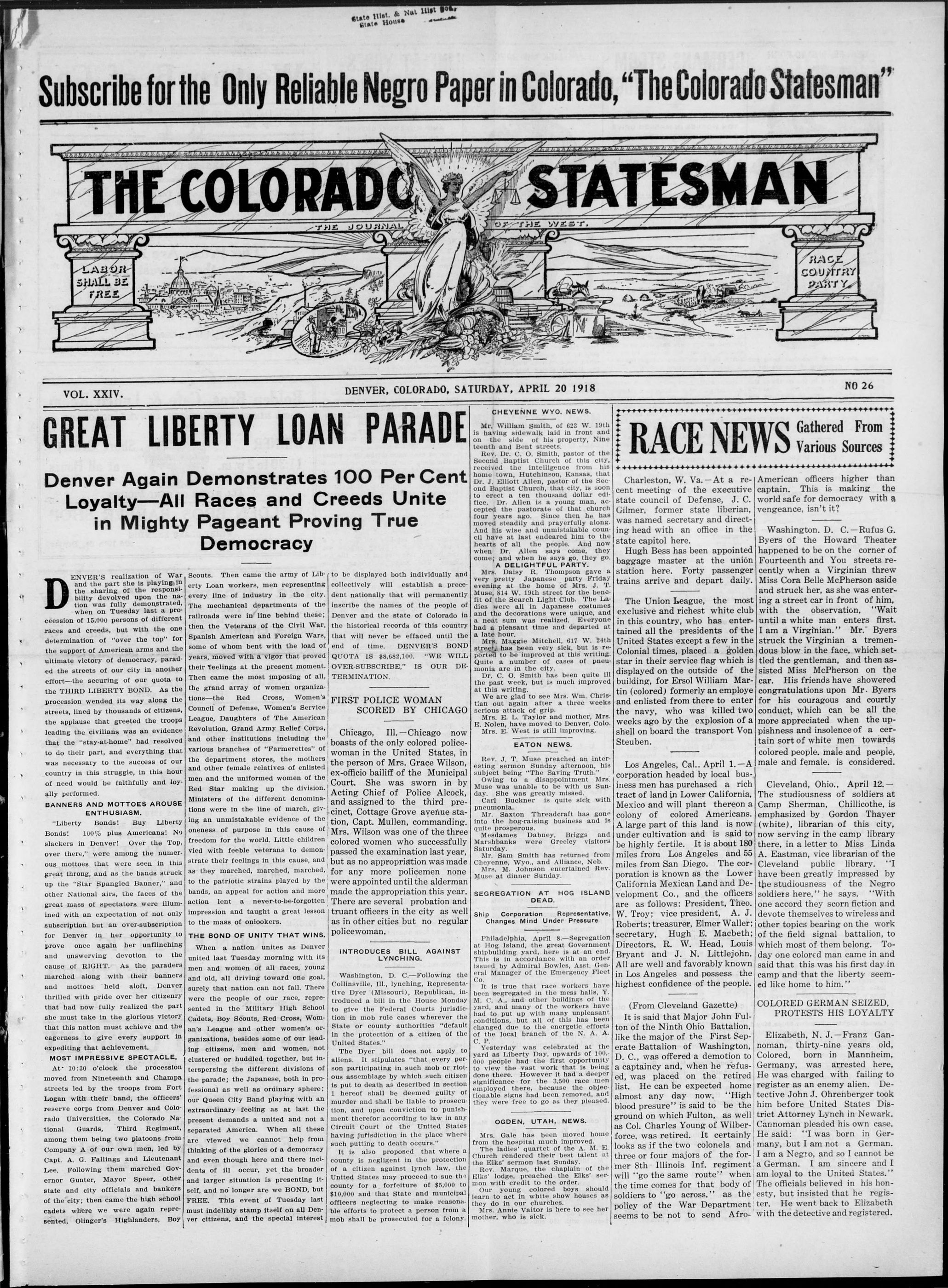
GREAT LIBERTY LOAN PARADE
Denver Again Demonstrates 100 Per Cent Loyalty-All Races and Creeds Unite in Mighty Pageant Proving True Democracy
VOL. XXIV.
GREAT LIBR
Denver Again
Loyalty—All
in Mighty
D
ENVER'S realization of War
and the part she is playing in
the sharing of the responsi-
bility devolved upon the na-
tion was fully demonstrated,
when on Tuesday last a pro-
tion was fully demonstrated, when on Tuesday last a proce ssion of 15,000 persons of different races and creeds, but with the one determination of "over the top" for the support of American arms and the ultimate victory of democracy, paraded the streets of our city in another effort—the securing of our quota to the THIRD LIBERTY BOND. As the procession wended its way along the streets, lined by thousands of citizens, the applause that greeted the troops leading the civilians was an evidence that the "stay-at-home" had resolved to do their part, and everything that was necessary to the success of our country in this struggle, in this hour of need would be faithfully and loyally performed.
BANNERS AND MOTTOES AROUSE
ENTHUSIAM.
"Liberty Bonds! Buy Liberty Bonds! 100% plus Americans! No slackers in Denver! Over the Top, over there," were among the numerous mottoes that were seen in this great throng, and as the bands struck up the "Star Spangled Banner," and other National airs, the faces of the great mass of spectators were illumined with an expectation of not only subscription but an over-subscription for Denver in her opportunity to prove once again her unflinching and unswerving devotion to the cause of RIGHT. As the paraders marched along with their banners and mottoes held aloft, Denver thrilled with pride over her citizenry that had now fully realized the part she must take in the glorious victory that this nation must achieve and the eagerness to give every support in expediting that achievement.
MOST IMPRESSIVE SPECTACLE.
At* 10:30 o'clock the procession moved from Nineteenth and Champa streets led by the troops from Fort Logan with their band, the officers' reserve corps from Denver and Colorado Universities, the Colorado National Guards, Third Regiment, among them being two platoons from Company A of our own men, led by Capt. A. G. Fallings and Lieutenant Lee. Following them marched Governor Gunter, Mayor Speer, other state and city officials and bankers of the city; then came the high school cadets where we were again represented, Olinger's Highlanders, Boy
Scouts. Then came the army of Liberty Loan workers, men representing every line of industry in the city. The mechanical departments of the railroads were in line behind these; then the Veterans of the Civil War, Spanish American and Foreign Wars, some of whom bent with the load of years, moved with a vigor that proved their feelings at the present moment. Then came the most imposing of all, the grand array of women organizations—the Red Cross, Women's Council of Defense, Women's Service League, Daughters of The American Revolution, Grand Army Relief Corps, and other institutions including the various branches of "Farmerettes" of the department stores, the mothers and other female relatives of enlisted men and the uniformed women of the Red Star making up the division. Ministers of the different denominations were in the line of march, giving an unmistakable evidence of the oneness of purpose in this cause of freedom for the world. Little children vied with feeble veterans to demonstrate their feelings in this cause, and as they marched, marched, marched, to the patriotic strains played by the bands, an appeal for action and more action lent a never-to-be-forgotten impression and taught a great lesson to the mass of onlookers.
THE BOND OF UNITY THAT WINS.
THE BOND OF UNITY THAT WINS.
When a nation unites as Denver united last Tuesday morning with its men and women of all races, young and old, all driving toward one goal, surely that nation can not fail. There were the people of our race, represented in the Military High School Cadets, Boy Scouts, Red Cross, Woman's League and other women's organizations, besides some of our leading citizens, men and women, not clustered or huddled together, but interspersing the different divisions of the parade; the Japanese, both in professional as well as ordinary sphere; our Queen City Band playing with an extraordinary feeling as at last the present demands a united and not a separated America. When all these are viewed we cannot help from thinking of the glories of a democracy and even though here and there incidents of ill occur, yet the broader and larger situation is presenting itself, and no longer are we BOND, but FREE. This event of Tuesday last must indelibly stamp itself on all Denver citizens, and the special interest
DENVER, COLORADO, SATURDAY, APRIL 20 1918
State Hist. & Nat Hist Gov
State House
ble Negro Pa
ADO
THE JOURNAL
DENVER, COLORADO, SA
N PARADE
100 Per Cent
reeds Unite
ving True
to be displayed both individually and collectively will establish a precedent nationally that will permanently inscribe the names of the people of Denver and the state of Colorado in the historical records of this country that will never be effaced until the end of time. DENVER'S BOND QUOTA IS $8,682,100. "WE WILL OVER-SUBSCRIBE," IS OUR DETERMINATION.
FIRST POLICE WOMAN
SCORED BY CHICAGO
Chicago, Ill.—Chicago now boasts of the only colored policewoman in the United States, in the person of Mrs. Grace Wilson, ex-officio bailiff of the Municipal Court. She was sworn in by Acting Chief of Police Alcock, and assigned to the third precinct, Cottage Grove avenue station, Capt. Mullen, commanding. Mrs. Wilson was one of the three colored women who successfully passed the examination last year, but as no appropriation was made for any more policemen none were appointed until the alderman made the appropriation this year. There are several probation and truant officers in the city as well as in other cities but no regular policewoman.
INTRODUCES BILL AGAINST LYNCHING.
Washington, D. C.—Following the Collinsville, Ill., lynching, Representative Dyer (Missouri), Republican, introduced a bill in the House Monday to give the Federal Courts jurisdiction in mob rule cases wherever the State or county authorities "default in the protection of a citizen of the United States."
The Dyer bill does not apply to aliens. It stipulates "that every person participating in such mob or riotous assemblage by which such citizen is put to death as described in section 1 hereof shall be deemed guilty of murder and shall be liable to prosecution, and upon conviction to punishment therefor according to law in any Circuit Court of the United States having jurisdiction in the place where such putting to death occurs."
It is also proposed that where a county is negligent in the protection of a citizen against lynch law, the United States may proceed to sue the county for a forfeiture of $5,000 to $10,000 and that State and municipal officers neglecting to make reasonable efforts to protect a person from a mob shall be prosecuted for a felony.
---
CHEYENNE WYO. NEWS.
Mr. William Smith, of 623 W. 19th is having sidewalk laid in front and on the side of his property, Nineteenth and Bent streets.
Rev. Dr. C. O. Smith, pastor of the Second Baptist Church of this city, received the intelligence from his home town, Hutchinson, Kansas, that Dr. J. Elliott Allen, pastor of the Second Baptist Church, that city, is soon to erect a ten thousand dollar edifice. Dr. Allen is a young man, accepted the pastorate of that church four years ago. Since then he has moved steadily and prayerfully along. And his wise and unmistakable council have at last endeared him to the hearts of all the people. And now when Dr. Allen says come, they come; and when he says go, they go.
A DELIGHTFUL PARTY.
Mrs. Daisy R. Thompson gave a very pretty Japanese party Friday evening at the home of Mrs. J. T. Muse, 814 W. 19th street for the benefit of the Search Light Club. The Ladies were all in Japanese costumes and the decorations were unique, and a neat sum was realized. Everyone had a pleasant time and departed at a late hour.
Mrs. Maggie Mitchell, 617 W. 24th street, has been very sick, but is reported to be improved at this writing. Quite a number of cases of pneumonia are in the city.
Dr. C. O. Smith has been quite ill the past week, but is much improved at this writing.
We are glad to see Mrs. Wm. Chris tian out again after a three weeks serious attack of grip.
Mrs. E. L. Taylor and mother, Mrs. E. Nolen, have moved to Denver, Colo. Mrs. E. West is still improving.
EATON NEWS.
Rev. J. T. Muse preached an interesting sermon Sunday afternoon, his subject being "The Saving Truth." Owing to a disappointment Mrs. Muse was unable to be with us Sunday. She was greatly missed. Carl Buckner is quite sick with pneumonia. Mr. Saxton Threadcraft has gone into the hog-raising business and is quite prosperous. Mesdames Dabney, Briggs and Marshbanks were Greeley visitors Saturday.
Mr. Sam Smith has returned from Cheyenne, Wyo., and Alliance, Neb.
Mrs. M. Johnson entertained Rev. Muse at dinner Sunday.
SEGREGATION AT HOG ISLAND
DEAD.
Ship Corporation Representative Changes Mind Under Pressure
Philadelphia, April 8.—Segregation at Hog Island, the great Government shipbuilding yard, here is at an end. This is in accordance with an order issued by Admiral Bowles, Asst. General Manager of the Emergency Fleet Co.
It is true that race workers have been segregated in the mess halls, Y. M. C. A., and other buildings of the yard, and many of the workers have had to put up with many unpleasant conditions, but all of this has been changed due to the energetic efforts of the local branch of the N. A. A. C. P.
Yesterday was celebrated at the yard as Liberty Day, upwards of 100,000 people had the first opportunity to view the vast work that is being done there. However it had a deeper significance for the 3,500 race men employed there, because the objectionable signs had been removed, and they were free to go as they pleased.
OGDEN. UTAH. NEWS.
Mrs. Gale has been moved home from the hospital much improved. The ladies' quartet of the A. M. E. Church rendered their best talent at the Elks' sermon last Sunday.
Rev. Marque, the chaplain of the Elks' lodge, preached the Elks' sermon with credit to the order.
Our young colored boys should learn to act in white show houses as they do in our churches.
Mrs. Annie Vaitor is here to see her mother, who is sick.
RACENEWS Gathered From Various Sources
Charleston, W. Va. - At a recent meeting of the executive state council of Defense, J. C. Gilmer, former state liberian, was named secretary and directing head with an office in the state capitol here.
Hugh Bess has been appointed baggage master at the union station here. Forty passenger trains arrive and depart daily.
American officers higher than captain. This is making the world safe for democracy with a vengeance, isn't it?
Washington. D. C. - Rufus G. Byers of the Howard Theater happened to be on the corner of Fourteenth and You streets recently when a Virginian threw Miss Cora Belle McPherson aside
The Union League, the most exclusive and richest white club in this country, who has entertained all the presidents of the United States except a few in the Colonial times, placed a golden star in their service flag which is displayed on the outside of the building, for Ersol William Martin (colored) formerly an employee and enlisted from there to enter the navy, who was killed two weeks ago by the explosion of a shell on board the transport Von Steuben.
Los Angeles, Cal.. April 1. —A corporation headed by local business men has purchased a rich tract of land in Lower California, Mexico and will plant thereon a colony of colored Americans. A large part of this land is now under cultivation and is said to be highly fertile. It is about 180 miles from Los Angeles and 55 miles from San Diego. The corporation is known as the Lower California Mexican Land and Development Co., and the officers are as follows: President, Theo, W. Troy; vice president, A. J. Roberts; treasurer, Elmer Waller; secretary, Hugh E. Macbeth; Directors, R. W. Head, Louis Bryant and J. N. Littlejohn. All are well and favorably known in Los Angeles and possess the highest confidence of the people.
(From Cleveland Gazette)
(From Cleveland Gazette)
It is said that Major John Fulton of the Ninth Ohio Battalion, like the major of the First Separate Battalion of Washington, D. C., was offered a demotion to a captaincy and, when he refused, was placed on the retired list. He can be expected home almost any day now, "High blood presure" is said to be the ground on which Fulton, as well as Col. Charles Young of Wilberforce, was retired. It certainly looks as if the two colonels and three or four majors of the former 8th Illinois Inf. regiment will "go the same route" when the time comes for that body of soldiers to "go across," as the policy of the War Department seems to be not to send Afro-
NO 26
American officers higher than captain. This is making the world safe for democracy with a vengeance, isn't it?
Washington. D. C.—Rufus G. Byers of the Howard Theater happened to be on the corner of Fourteenth and You streets recently when a Virginian threw Miss Cora Belle McPherson aside and struck her, as she was entering a street car in front of him, with the observation, "Wait until a white man enters first. I am a Virginian." Mr. Byers struck the Virginian a tremendous blow in the face, which settled the gentleman, and then assisted Miss McPherson on the car. His friends have showered congratulations upon Mr. Byers for his courageous and courtly conduct, which can be all the more appreciated when the uppishness and insolence of a certain sort of white men towards colored people, male and people, male and female. is considered.
Cleveland, Ohio., April 12. The studiousness of soldiers at Camp Sherman, Chillicothe, is emphasized by Gordon Thayer (white), librarian of this city, now serving in the camp library there, in a letter to Miss Linda A. Eastman, vice librarian of the Cleveland public library. "I have been greatly impressed by the studiousness of the Negro soldiers here," he says. "With one accord they scorn fiction and devote themselves to wireless and other topics bearing on the work of the field signal battalion, to which most of them belong. Today one colored man came in and said that this was his first day in camp and that the liberty seemed like home to him."
COLORED GERMAN SEIZED,
PROTESTS HIS LOYALTY
Elizabeth, N. J.—Franz Gannoman, thirty-nine years old, Colored, born in Mannheim, Germany, was arrested here, He was charged with failing to register as an enemy alien. Detective John J. Ohrenberger took him before United States District Attorney Lynch in Newark. Cannoman pleaded his own case. He said: "I was born in Germany, but I am not a German. I am a Negro, and so I cannot be a German. I am sincere and I am loyal to the United States." The officials believed in his honesty, but insisted that he register. He went back to Elizabeth with the detective and registered.
---
Pithy News Notes
From All Parts of
Colorado
Western Newspaper Union News Service.
Routt county's Home Guards now has an enrollment of 200.
The cornerstone for the new M. E. church at Montrose has been laid.
The greatest parade in Denver's history inaugurated the third Liberty loan campaign.
The Eastern Colorado Livestock Association is making a vigorous campaign to increase its membership.
The annual farmers' picnic for Logan county will be held this year on June 26. Last year there were some 1,800 people in attendance.
Salt Creek Petroleum Company, which lost the well it has been drilling near Selbert, reports that its second well now is down 300 feet.
Mrs. Ellen L. Dyer, aged 65, died at Colorado Springs from injuries received when she was struck by an automobile driven by C. R. Arnold.
William Giles, aged 20, of Fort Morgan, was badly injured when a motorcycle on which he was riding skidded. He was going at a high rate of speed.
A large centrifugal pump of better than 1,000 gallons per minute capacity was received at Brandon to be used on one of the irrigation plants on the seed farm near town.
The farm labor problem is one of distribution of men, not of supply of men. Secretaries Houston and Wilson both assured Dr. Charles A. Lory of this fact in Washington.
Reports of the county agricultural agents made to the State Council of Defense show good conditions in most of the farming counties and that the recent rains and snows have helped immensely.
James Drury for thirty-five years employed as doorman at the Union station, died at his home in Denver of bronchitis. Mr. Drury was born in Ireland in 1842 and has lived in Denver since 1874.
The Robert E. Lee chapter of the Daughters of the Confederacy at Denver have just completed raising a fund of $600 with which to endow a bed in the American hospital No. 1, the first militarized hospital in France.
John Thomas Dennis, mentioned as being on the collier Cyclops, now overdue at an Atlantic port, is the stepson of E. G. Dennis of Montrose and Olathe. He was about 22 years of age and enlisted since the war began.
Three more counties have obtained agricultural agents. W. F. Droga will work in Otero, D. C. Bascom in Larfimer and G. P. Newson in Montezuma. There are movements under way in Phillips and Saguache counties for agents.
The body of Otto Grant, Yellow Jacket miner, credited with being the first snowslide victim in the Ouray district three months ago, was found by Charley Urick, 500 feet below Curved point on the Grizzly Bear trail, a mile away from where it was believed he went over. The body was covered with snow, one leg was broken and the head badly smashed. The body was raised to the trail with ropes.
Every federal forest service employ in the state of Colorado is now a potential spy hunter and guardian of government, state and private property near or in federal forests, according to an order promulgated from Washington and which bore its first fruit when the Denver forestry officials received word from a ranger that a grocer on the Western slope was disregarding the Food Administration mandates.
The Denver Board of Education recommended about 1,200 teachers and other employees for appointment to positions in the schools of Denver, effective Sept 1, 1918. The board further recommended that the minimum elementary salary be $780 a year, and that the maximum elementara salary be fixed for the year 1918-19 at $1,260, and that each teacher's salary included in this recommendation designated at $1,200 or less be increased $60 a year.
The State Council of Defense has advised the Sedgwick County Council of Defense that there is no authority for interference with the activities of legally formed organizations such as the Non-Partisan league so long as they conduct their operations in legal manner. The Sedgwick council was fearful that organization of the Non-Partisan league would interfere with war activities in the county and declared that disloyal remarks had been made by one organizer. The State Council advised that disloyal remarks are individual affairs and should be reported to the United States district attorney for investigation and prosecution.
At the close of the first week of the Third Liberty Loan campaign the sixty-two counties of the state outside of Denver have put themselves "over the top" of the first half of their combined quota of $11,630,800, but, unsatisfied with reaching a minimum only, the state Liberty Loan army will march out to garner in millions more in an effort to beat any sum that Denver may raise.
Two trees good for this country which have never been given much chance are the sycamore and the walnut.
CENTENNIAL STATE ITEMS.
During his recent trip to Washington Governor Gunter was assured Colorado will be reimbursed for its expenditures in training and equipping the federalized National Guard. He found that Colorado had already started most of the activities urged at the Americanization conference. In a visit to the federal transportation directors the governor impressed upon them the importance of aid for the Moffat road. President Wilson and many other high officials praised Colorado's war accomplishments and the loyalty of her people, in talking with the governor.
Statistics compiled by the Colorado Immigration Board indicate that Colorado has passed the 1,000,000 mark in population. The exact total is 1,022,600. This is an increase of nearly 28 per cent since 1910, against an increase of 48 per cent between 1900 and 1910. The increase in some of the agricultural counties has been close to 100 per cent, according to Edward D. Foster, immigration commissioner.
One hundred and forty-nine Denver men will be sent to Fort Logan with 547 others from various counties of the state during the five-day period beginning May 10 for training as a part of the second draft call, according to orders issued by Provost Marshal John Evans. Colorado's quota is a part of the 49,843 registrants that are being sent to forts for training with regular army units there.
The Rev. H. A. Schmidt, pastor of the Evangelical Lutheran church of the Missouri synod at Greeley, was placed in jail as a protection from citi-zens, who threatened to lynch him. The cause is ascribed to reported utterances in his pulpit when he is said to have denounced the American Red Cross and to have advised against buying bonds in the third Liberty loan.
Six persons were injured when passenger train No. 3, running between Denver and Trinidad on the Colorado & Southern railroad, crashed into the rear end of a standing switch train near the crossing at West Third avenue and Archer place in Denver. Plowing through three freight cars the engine and tender turned over in the ditch alongside the tracks.
The city of Denver has won its fight for the land separating the grave of Buffalo Bill, on Lookout mountain, from the main highway, and the jury fixed the price for the two acres at $2,150 instead of $100,000, as originally asked. The land wanted by the city was 2.65 acres, but Adolph Coors gave the city his sixty-five one-hundredths of an acre.
In recognition of the Colorado Masons who have entered the service of their country a patriotic demonstration will be held in the Denver Auditorium on the evening of April 25 under the auspices of the Denver Association of Masonic Officers. The presentation of the service flag will be a feature of the program.
Esther Marguerite, daughter of Mr. and Mrs. H. A. Hansen, is the youngest owner of a Liberty bond in Teller county. She was born on the morning of April 15 and her father, a well-known miner, visited the Bank of Victor an dpurchased a bond of $100 in the name of his daughter on the same day.
Following days of brooding over groundless accusations that he was a German spy, E. A. Hess, a baker, born in Germany and naturalized in the United States twenty-one years ago, shot himself at Fort Collins. Hess bought $200 worth of Liberty bonds. He already had $500 worth of earlier issues.
Larimer county is over the quota on $717,000 with a subscription of $725,000 for third Liberty Loan bonds. Of this, $500,000 came from Fort Collins. Larimer county expects to go to $1,600,000.
One hundred and twenty-one farm labor exchanges have been established in Colorado.
Raymond Edwin Vollmar, who was drowned while in the United States naval service, was buried at Platteville, his former home. He is the son of Charlees L. Vollmar of Denver, and besides his parents is survived by three brothers and two sisters, all residents of Denver.
Full military honors were accorded James Chester Hawkins, member of base hospital No. 29, who died at Camp Cody, N. M., when funeral services are held for him at the Cathedral of the Immaculate Conception in Denver.
Red Rock Oil & Gas Company, drilling twenty-five miles south of Rocky Ford, has a hole down some 1,200 feet and a few days ago ran into a strata of salt water, which is locally considered one of the best indications of oil.
The Colorado Highway Commission will begin the publication June 1 of a monthly service bulletin in magazine style for the enlightenment of the public as to where the revenues from that department are being expended.
The new call for 50,000 more troops May 1 and 10 will take 696 Colorado ans.
Dr. E. E. Cole, principal of the school at Appleton, near Grand Junction, who was given a coat of grease and feathers and ordered to leave the country within thirty-six hours, was exonerated at a mass meeting of citizens, held at the Appleton school house.
Maurice Hamalain, a blacksmith, who disappeared from Telluride two weeks ago, has returned and is making an effort to identify members of a band of seven supposed I. W. W. who, he says, forced him from town at the point of guns
WOMEN MUST HELP RAISE WAR FUNDS Lovers of Home and Country Called to the Colors.
ALL CAN BUY LIBERTY BONDS
Wives, Sisters, Mothers, Sweethearts Never Before Called Upon to Play Such a Vastly Important Part —Lend Your Money.
(By DOBOTHY DIX.)
Buy a Liberty bond, ladies. No matter how many you have bought before, stretch a point and buy another.
You can't shoulder a gun and go off and fight for your country, as the men are doing. You can't put on a nurse's uniform and go and nurse wounded soldiers or drive an ambulance or work in a munition factory, as many other women are doing, but you can do your bit by backing up these other men and women, who are risking their lives to defend you with your money.
Without guns and munitions, without food and clothes, without hospital supplies, the army in France is just so many sheep led to the slaughter; if we let them die for the lack of the things that money buys, their blood is on our heads, and our crime against them will be blacker than the Boches, because they trusted us.
It takes money, money, money and yet more money to carry on war, and this war is to be the war of the longest pocketbook. It is the last ton of bombs, the last load of shrapnel, and the last big gun that will thunder out victory. Therefore, if we want to win this war, we must find more money, and it is particularly up to us women, who can fight with our hands, to fight with our dollars, and pour them like water at Uncle Sam's feet.
Women's Greatest Sacrifices.
In no war in all history have women been called upon to play such a tremendous part as in this war. Never before have women had to give so many of their husbands and sons and brothers to be cannon fodder. Never have women before gone into the trenches and fought side by side with men. Never have they gone into factories to make munitions of war with their own hands. Never have they had to take upon their shoulders the heavy burdens of hard physical labor that men laid down when they went forth to battle. And never before did their country call on women to make such sacrifices as they are called on to make now.
It is because this war touches women more nearly in every way than any other war has ever done, because more women's hearts have been broken by it, more women impoverished and made homeless, more mothers have seen their babes bain before their eyes, more mothers have beheld their young daughters ravished, that women must use their utmost effort to put an end to war.
Women must see to it that there is never another war to lay waste to the world and drench it with women's tears, and this can only be accomplished by our winning this war.
And to do that we must have money,
So, let every woman who has some
loved one at the front buy a Liberty
bond. Let every woman who has a
earthstone that she would keep safe
buy a Liberty bond. Let every woman
who has a babe that she loves, or
a young daughter whose purity she
would guard, buy a Liberty bond.
Reasons Are Numerous.
Let every woman who has a particle of sympathy in her soul for the forlorn women and children of Belgium and France buy a Liberty bond. Let every woman who believes in justice, and freedom, and right buy a Liberty bond. Let every woman who hates war and craves for peace buy a Liberty bond.
The trip that you had planned, the new frock you were going to get, how pitifully small is the sacrifice of these for the sake of those who are sacrificing their lives to protect you and yours.
Buy all the Liberty bonds you can, and then go in debt for some more, so shall you prove yourself a worthy daughter of Uncle Sam.
This is a time when money talks and tells the kind of a patriot you are. The woman who hasn't a bunch of Liberty bonds if she's rich, or who isn't paying on a Liberty bond if she's poor, is a traitor to her country and should hang her head in shame every time she passes a man in khaki or feels the fold of the red, white, and blue floating over her unworthy head.
The Badge of Citizenship.
The Liberty Bond button is no longer a mark of liberality or even of patriotism; it is the badge of citizenship. Are you wearing one?
War and the Weather.
The Almighty makes the weather, not man, and if the weather doesn't suit us, we have to wait. The farmer knows what a day's rain will do in the way of upsetting plans. One can't plow in the mud and a cutting of hay or wheat may be damaged or ruined by one night's downpour. The war department, too, is up against the weather in France. Three inches rainfall may make the country impassable for half a million men and horses and motortrucks and ruin the chances of victory or bring defeat.
HURL HUNS BACK ON ENTIRE LINE
BRITISH HOLD POSITIONS AND
TEUTONS SUFFER HEAVY
LOSSES IN BATTLE.
FRENCH GAIN AT AMIENS
130,000 GERMAN TROOPS FAIL IN
ATTEMPT TO CROSS LA
BASSEE CANAL.
Western Newspaper Union News Service.
With the British Army in France April 19.—Ten divisions of German troops were driving Thursday furiously against the British defenses between Givenchy-les-La Bassee and St. Venant in an attempt to effect a crossing of La Bassee canal. The British were holding well and inflicting heavy casualties on the enemy. Coincidentally with this pretentious assault, the Germans surged forward further north and again began hammering at the approaches of Kemmeel and the neighboring high ground.
Reinforced by French troops, the allied line is holding hard against further incursions by the Germans from the region of La Bassee to the north of Ypres. Everywhere the Germans have struck the line in an endeavor to press back the defenders they have been repulsed with heavy losses, and have succeeded nowhere in gaining further ground.
Attacks of an extraordinary violent nature are being thrown by the Germans on the ten-mile front between Givenchy and Robecq, where an endeavor is being made to cross the La Bassee canal and bend southward the salient which now outflanks the important railroad town of Bethune. A division of troops to each mile is being used by the Germans on this sector, but the British at last accounts were holding well and inflicting heavy losses on the enemy.
If successful, the new attack of the Germans would jeopardize the entire Arras sector, which includes the famous French coaling region about Lens and the equally famous Vimy ridge, where the Canadians are holding forth.
Following the usual custom prior to the launching of an attack, the Germans throut Wednesday night literally rained shells of all calibers between Givency and Robecq, the firing by daybreak having reached the intensity of drumfire. Large quantities of gas shells were intermingled with the high-powered missiles.
During Thursday, midway between Baillieu and Ypres, the Germans vigorously attacked the British positions south of Kemmel, which the British had recaptured from them Wednesday, but were unable to gain any advantage in the face of the strong defense.
Considerable fighting has developed along the front in northern Flanders between Langemarck and Kippe, held by the Belgians.
East of Amiens, along the Avre river, the French have made successful attacks against the Germans on several sectors, capturing the greater part of the Senecat wood and also advancing their line east and west of the stream.
President Designates Liberty Day.
Washington.—President Wilson issued a proclamation naming Friday, April 26, as Liberty Day, and asking the people to assemble and pledge anew their financial support to sustain the nation's cause.
Fight Until Berlin Is Surrounded.
Globe, Ariz., April 19.—"We won't stop this war until the battle line is bent far enough east to Put Berlin in the center of a circle formed by American troops," declared William G. McAdoo, secretary of the treasury, in a short speech here in behalf of the third Liberty loan. The secretary departed for Phoenix, where he spoke on Thursday night.
Senate Passes Pittman Silver Bill.
Senate Passes Pittman Silver Bill.
Washington—The administration
silver bill, introduced by Senator Pittman of Nevada, providing for the withdrawal from the treasury of $350,000,000 in silver dollars to be melted into bullion to meet foreign trade balances,
was passed by the Senate.
Washington.—Proposed increase of the government guaranteed price of wheat to $2.50 was defeated in the House, which rejected by a vote of 167 to 98 the Senate amendment to the agricultural appropriation bill making the change.
Senator Stone Buried in Nevada, Mo.
Nevada, Mo.—The funeral of Senator William J. Stone was held here.
Knights Templar and other fraternal organizations escorted the remains to the church, where services were held.
The funeral train arrived from Jefferson City, where the body lay in state.
Commons Passes Man-Power Bill.
London.—All the remaining stages of the man-power bill were concluded Thursday and the royal assent was given the measure.
SATISFIED CUSTOMERS
SATISFIED CUSTOMERS
Means that those who come back to us again and again to buy after they've made their first purchase at our store always receive satisfactory service.
factory service.
They know that whatever we sell them is thoroughly reliable.
They know we do not ask more than fair profit on our sales.
They know they can rely on our advice—truth is our stand-by.
They know that carefulness, honesty, courteous, cleanliness and promptness characterize us.
John W. Masury & Sons Coach Colors, Paints and Varnishes WALL PAPER, PAINTS, OILS AND GLASS, INTERIOR AND EXTERIOR DECORATORS
The
Curtis
Park
Floral
Company
FLORAL DESIGNS PUT UP WHILE
YOU WAIT
CHOICE PLANTS AND CUT FLOWERS CONSTANTLY
ON HAND
GREENHOUSES: Thirty-Fourth and Curtis Streets
TELEPHONE, MAIN 1511
DENVER, COLO
MORRISON'S
MORRISON'S FAMOUS JAZZ ORCHESTRA
AND ENTERTAINERS
GEO. MORRISON, MANAGER
Music Furniture
Phone Main 2707. Re
When
The Head
Neckbones
any other p
the squeal
East's L
2300-
Music Furnished for all Occasions Phone Main 2707. Res. 2947 Stout St. DENVER, COLO.
The Heads, Feet Tails, Snouts Neckbones or Chitlerings, or any other part of the hog except the squeal go to
Taxicab Rates.
Depot, 1 or 2 pass...50c
Depot, each addi-
tional pass.....25c
One mile radius...50c
Each addition'l mile.25c
Bean
TAXICAB LANDU
HEATED TAXICAB.
TAXICAB LANDULET AND 7-PASSENGER 1918 LATE
MODEL CARS.
Phone Main 6699
THE COLORADO STATESMAN
THE COLORADO STATESMAN
LANDOR SHALL BE FREE
BACK COUNTRY DAY
1824 Curtis Street, Room 25.
Phone Main 7417.
Entered as second-class matter at the postoffice in the City of Denver, Colo.
SUBSCRIPTION RATES.
One Year ..... $2.00
Six Months ..... 1.00
Three Months ..... .60
PAYABLE IN ADVANCE.
Reading notices, ten lines or less, 10 cents per line. Each additional line over ten lines, 5 cents per line. Display advertising, 50 cents per inch.
Remittances should be made by Express Money Order, Postoffice Money Order, Registered Letter or Bank Draft. Postage stamps will be received the same as cash for the fractional part of a dollar. Only 1c and 2c stamps taken.
Reading notices, ten lines or less, 10 cents per line. Each additional line over ten lines, 5 cents per line. Display advertising, 50 cents per inch.
Remittances should be made by Express Money Order, Postoffice Money Order, Registered Letter or Bank Draft. Postage stamps will be received the same as cash for the fractional part of a dollar. Only 1c and 2c stamps taken.
"EVERY LITTLE BIT HELPS."
s, and we are glad to publish any love the falsity and biased opinion offering the THORN instead of and nothing less. From The Dedored troopers of Company A, no sat looks light-heartedly upon life, moved steadily eastward up Sixteen banner read, and no division in me than these colored boys, man freed from slavery by a nation four "The Home Guard, four compational Guardsmen. Their banner They needed no flag bearing to stand. Their hearts beat too true " THE COLORADO STATESM Denver expresses appreciation of mp Funston to hearts in removing L
So the saying goes, and we are glad to publish anything from our dailies that help to prove the falsity and biased opinions of our opponents who are always offering the THORN instead of the MYRTLE whenever we act the man and nothing less. From The Denver Evening Times, April 16: "The Colored troopers of Company A, no smiles on the faces of the men of a race that looks light-heartedly upon life, turned the corner of Arapahoe street and moved steadily eastward up Sixteenth. 'American 100 Per Cent Plus,' their banner read, and no division in the great parade received a finer welcome than these colored boys, many of whose ancestors fifty years ago were freed from slavery by a nation founded upon freedom." The Denver Post: "The Home Guard, four companies in all, followed. Then the Colored National Guardsmen. Their banner said they were '100 per cent Americans.' They needed no flag bearing this legend to tell the populace where they stand. Their hearts beat too true to doubt their honor and their efficiency." THE COLORADO STATESMAN on behalf of the Colored citizens of Denver expresses appreciation of this "bit," and will send the same to Camp Funston to aid in removing BALLOU'S DISCRIMINATION."
THIRD LIBERTY LOAN.
the second week of the activity of
for the rally of the third Liberty
to an over-subscription of the
pan. Denver started last Tuesda
less, of her quota of $8,682,100 sh
TODAY closes the second week of the activities of this state and others of the Union for the rally of the third Liberty Loan, and every indication points to an over-subscription of the $3,000,000,000—the amount set for the loan. Denver started last Tuesday and up to the time we were going to press, of her quota of $8,682,100 she has subscribed over half and the state nearly two-thirds of their amount. These bonds bear interest at four and a quarter per cent from May 9, interest payable September 15 and March 15, and will mature in 1928. The government in facilitating purchasers of bonds offers the following terms: Five per cent must be paid on application, twenty per cent on May 28, thirty-five per cent on July 18 and forty per cent on August 15. For the benefit of purchasers of bonds in small denominations our local banks have agreed to sell on the installment plan, payments being made weekly. Of course, if you have the money then buy the bond and pay in full, this being the best way, as you share in the interest from the start. We have done our part with the first and second loans and the Secretary of the Treasury is gratified. But this is from the national standpoint. As a race let us try again and measure up to the extent of our financial ability, investing everything we have in surplus funds, and in cases where we can engage in a bit of sacrifice, let us do so, and help our government, that must be absolutely the means of supply for the men at the front. Some of our organizations did their part in the last loan, others can follow, and when we shall have done our best we will get the stamp of approval of good citizenship from the source which generally appreciates and does not condemn. BUY LIBERTY BONDS AND WIN THE WAR.
MAJOR GENERAL BALLOU STAUNCH ADVOCATE OF THE DEMOC RACY THAT MOCKS.
FURLOUGHS ARE TO HELP FARM WORK WAR DEPARTMENT INTENDS TO LET ENLISTED MEN GO HOME TO SOW AND HARVEST.
HOW TO MAKE APPLICATION
Many Drafted Men Have Been Excused Under Vocation Provisions—Trade Tests Used to Secure Skilled Workers for Army.
(From Committee on Public Information.)
Washington.—For the purpose of augmenting agricultural production it is the intention of the war department to grant furloughs to enlisted men to enable them to engage in farming during the present season. Commanding officers may grant such furloughs within prescribed rules whenever it appears they will contribute to increased farm production.
Furloughs may be given by commanding officers of posts, camps, cantonments, divisions, and departments. They will be for short periods, largely for seeding and harvesting time. They will not be granted to enlisted men of or above the grade of first sergeant, nor in an organization that has been ordered to move or is in transit from points of mobilization or training to a port of embarkation. All furloughs granted will be recalled and the men ordered to their organizations when they have received preparatory orders for duty overseas. Furloughs granted for farm work will be without pay and allowances, except that enough pay will be retained in each case to meet allotments in force on the day of the order, warrisk insurance, and pledges on Liberty bonds.
For specially qualified experts in agriculture furloughs may be granted by the secretary of war upon application by the secretary of agriculture, providing such furloughs are voluntarily accepted by the persons for whom application is made.
Individual applications for furloughs submitted by relatives will be on a form to be furnished by local draft boards. Two sections are to be made out and presented to the local board, which can complete the form.
If the furlough is granted the application will be filed by the commanding officer and a certificate furnished the soldier. If not granted, the application will be returned with reasons for disapproval.
If the soldier initiated the application he will give the name of the person for whom he desires to work, from whom will be ascertained the need for farm service.
Furloughs may be granted en bloc to men who are willing to accept them, upon requests of farmers, when time consumed in travelling from the post to the place of labor will not exceed 24 hours. In making these applications farmers will use a form of the provost marshal general's office, also going to the local board. Under provisions of the selective-service law making specified vocations a ground for exemption or discharge, apart from the "necessary industries" dealt with by the district boards, 67,716 men were excused from military duty. Of the men exempted, 1,665 were federal or state officers; ministers, 3,976; divinity students, 3,144; in the military and naval service, 47,822.
County and municipal officials numbering 889 were discharged; customhouse clerks, 171; mull employees, 1,476; arsenal workmen, 2,358; federal employees designated by the president, 1,777; pilots, 1,772; mariners, 2,666.
The alien property custodian has been given power to sell, at private sale without advertisement, enemy-owned live stock, feed or food stuffs, hides and other animal products, agricultural products, fertilizers, chemicals, drugs, essential oils, lumber, cotton, tobacco, furniture, books, glass and china ware, wearing apparel, jewelry, precious stones, pictures, ornaments, bric-a-brac, objects of art, raw or finished textile materials, trunks, boxes, partially or completely manufactured metals, fabrics, rubber and rubber products, and all kinds of merchandise, in lots having a market value of not more than $10,000.
Such sales may be held at places and under conditions prescribed by the alien property custodian.
Federal reserve banks are to rediscount notes secured by farm tractors, according to the department of agriculture. Instructions have been issued to all federal reserve banks authorizing them to rediscount tractor paper presented by any member bank, provided it has maturity not exceeding six months and the tractors are purchased for agricultural purposes.
In Oklahoma, county councils of defense are securing pledges from automobile owners to furnish transportation to speakers for community councils. The pledge provides that the chairman of the county council may hire a car at the expense of any signer who falls to furnish transportation at the time promised.
Investigations by the department of agriculture in 15 states show that of a total of 6,836,492 sheep, 34,683 were killed by dogs in one year and were paid for by the counties.
```markdown
```
To increase the accuracy of selecting skilled workers among the enlisted men a system of trade tests has been developed. Exact and comprehensive definitions of the more than 600 different trades represented in the military organization have been brought together in a 300-page book "Trade Specifications." Tables have been prepared showing the detailed needs of each unit for skilled and semiskilled workers. Work has been done in refining methods of selecting and training men for special duties in the navy, special service regarding selection of aviators, assistance to provost marshal general on the questionnaire, and assistance rendered the surgeon general for general intelligence tests for enlisted men and officers.
THE COLORADO STATESMAN
The war-service exchange of the committee on classification of personnel answers inquiries of persons desiring to serve the army. It informs the department of labor of the needs which the war department has for men.
The Mouth-Piece of the People of Colorado and the Entire West
The committee on public information has made public editorial comment in the German press on the revelations in the Relchstag main committee in connection with investigations of the Daimler Motor Works. It was shown that the Daimler company was earning 173 per cent, profit per annum, the company's sworn statement placing the profits at 11 per cent, and while the company was earning 400,000,000 marks monthly in excess of its peace-time profits it had threatened to reduce output unless higher prices were paid. The Berlinner Tageblatt (Liberal), said:
"Energetic action of the authorities and the Reichstag is demanded. Such enterprises as the Daimler firm are not compelled to submit books for inspection, while every little trader selling vegetables must show his profits. We demand government confiscation of illegal profits and, if necessary, state control." Vorwaerts (Government Socialist), said:
A RELIABLE chronicle of their doings and progress; a faithful mirror of their wants, their hopes, their best aspirations.
"The Raimler revelations will hardly occasion the same surprise in financial circles as among the masses. The Dalmler company's purpose was not to deceive the financial world, but the authorities, so that its real profits might be kept from the public's knowledge. The company reckoned upon the commercial ignorance of the government and this experience shows that such reliance is usually justified."
Attention of fertilizer manufacturers and dealers has again been called to the necessity of taking out federal licenses.
All fertilizer manufacturers, including mixers, even though their output may be small, are required to take out licenses. Agents and dealers doing exclusively a retail business, whose gross sales do not amount to more than $100,000 a year, are not required to take out licenses or to make applications for blanks. However, any retail dealer or agent whose gross sales amount to more than $100,000 and who does not apply for a license, is liable under the provisions of the act of congress providing for the governmental control of the industry. Application for license should be made to the law department, license division, United States food administration, Washington, D. C.
American soldiers and sailors in German prison camps prior to April 12, 1918, will not be deprived of their rights to war-risk insurance because of inability to make personal application, provided such application is made in their behalf.
Unequaled as an advertising medium for the business of professional men and women.
According to a statement by the secretary of the treasury, applications for insurance may be made in behalf of such prisoners by persons within the permitted class of beneficiaries under the military and naval insurance law. This class includes wife, child, parent, brother, or sister. Application should be made to the bureau of warrisk insurance, at Washington, D. C.
The health of troops in the United States continues very good, according to a recent report to the surgeon general of the army by the division of field sanitation. Admission, noneffective and death rates are somewhat higher than last report, due chiefly to prevalence of influenza and bronchitis with complicating pneumonia, in many of our northern camps.
An excellent family journal speaking to and for many thousand colored citizens.
National Guard camps, as a group, continue with remarkably low rates. Very few new cases of measles and meningitis have occurred. National army camps continue to have high sick rates as compared with camps of other groups, though the rates are lower than last report. Scattering cases of measles are reported from all camps.
TWODOLLARSAYEAR
Field and garden seed are unconditionally exempted from all embargoes, according to the department of agriculture. Instructions are issued to all railroads to do everything possible to expedite the movement of seed.
THE GREAT ORGAN OF THE
Over 200,000 applications for insurance by officers and enlisted men of the naval service had been filed by March 31. The average amount of insurance on each policy was about $7,300, making a total of more than $1,500,000,000. Payments on war-risk allotments are now about $1,000,000 a month.
Wednesday, April 3, was a peak day in sales of war savings stamps, when $4,120,082 was recorded at the treasury for the day's receipts from stamp sales.
THE COLORADO STATESMAN
J. H. Mitchell of 2115 Champa street has an attack of pneumonia.
Wesley Frierson, popular Denver citizen and special agent of the Manhattan Life Insurance Co., has been seized with an acute attack of appendicitis.
Y. M. C. A. GLEE CLUB.
The initial effort of the Glee met with unusual success in spite the very inclement weather that vailed in the afternoon, after ha a cloudless sky in the forenoon Sunday. Shorter Church had a f lage and now appreciative go
Mrs. Birdie Lewis, wife of Cornellius Lewis of Twenty-first avenue and Lafayette street, is gradually improving from an operation performed at St. Luke's hospital last Wednesday. We wish her a speedy recovery.
Mrs. W. H. Green of Colorado Springs arrived in the city to attend the funeral of Mrs. Bettie Skillern, mother of our popular townsman, Nathan J. Skillern. She will remain for a few days as the guest of Mr. and Mrs. N. G. Skillern.
Bishop Irving Johnson of the Episcopal Diocese will address the members of the National Association for the Advancement of Colored People on Monday, April 29th, at 8 p.m. Every race lover should make a special effort to be present at the Woman's Club Home, 24th Avenue and Clarkson street to hear this powerful and practical speaker.
THE BIRTHDAY SOCIAL under the auspices of Household of Ruth No. 376, assisted by other branches of the Grand United Order of Odd Fellows, was a decided success. Tuesday, April 16th, the day of the event, will be ever memorable among the members of this order for the marked success that attended their efforts, and the committee of management must be congratulated for their zeal and untiring efforts in bringing about this result as only RUTHITES can do.
Mr. T. S. Williams and his orchestra had a very successful special season at Loveland recently, being in vaudeville at the Novelty Theater. Miss Helen Minnis and Master Atwell Rose, pianist and violinist respectively, are members of the orchestra, and the "Loveland Reporter," a newsy publication, in its tri-weekly edition, comments on the orchestra giving music with so much "Jazz" in it that you can't keep your feet still.
CAPT. A. G. FALLINGS and Lieut. Lee came in for much commendation on the splendid showing their platoons made in the Liberty Loan parade. These officers also speak highly of Sergts. Robinson, Tasker and the men in general on their progress in military activities and their deportment, which add materially to camp life and the prestige that they are endeavoring to establish in the community. The Colorado Statesman still encourages them.
Congratulations to our fellow editor, Robt. L. Vann of the Pittsburg Courier, who has been recently appointed assistant city attorney. We wish him every success in this very responsible position. Denver colored politicians, here's a lesson for you. Aim high and achieve a representative public position. Anybody can handle the mop and the broom, be a watchman or janitor, but remember you cannot be met in conference with officials on any question for the good of the people, as after using you to insure their election to office, they tell you it's beneath their dignity to confer with MENIALS. Do like Pittsburg, Chicago, Philadelphia, New York and other cities.
THE MOUNTAIN LODGE OF ELKS NO. 39, I. B. P. O. E. OF W. held their Memorial Services last Sunday evening at Scott M. E. Church. In spite of the inclement weather there was a pretty large attendance and the program was successfully carried out. Dr. J. H. P. Westbrook was the orator who offered the eulogy on departed brethren, and in his usual touching and impressive manner paid a tribute to those who have reached the Great Beyond. The Rev. T. S. McMorris, D.D., gave some timely remarks emphasizing character, the same being essentially necessary to the stability of the organization. In their usual order of benevolence the Elks gave monetary offerings to the various auxiliaries of the church, including the pastor and organist. This organization in a quiet and unostentatious manner does quite a lot of good in the community, their motto being—"breathing the fragrance of the flowers before life's course is run, and remembrances when the body can enjoy them." Another successful year is the wish of the COLORADO STATESMAN.
Y. M. C. A. GLEE CLUB.
The initial effort of the Glee Club met with unusual success in spite of the very inclement weather that prevailed in the afternoon, after having a cloudless sky in the forenoon last Sunday. Shorter Church had a fairly large and very appreciative congregation to witness the event, and the general opinion of the rendition of the program which substituted the regular evening service, was of the nature to give inspiration to this new organization in our city to work for permanent success. All the members, including Hewetson-Watson, the director, and Valaurez Spratlin, the organist, acquitted themselves in a manner meriting the admiration of those in attendance, and the COLORADO STATESMAN hopes that this is the beginning of a greater good in our community.
Y. M. C. A. NOTES.
Every good day that passes tends to kindle in the breast of the croquet lovers a desire to get out and "tap the ball." Members of the club will soon get together and put the ground in order for the present season. A number of names for membership in the club has already been handed in.
On account of the great hall, rain and electrical storm last Sunday afternoon it was impossible to have any meeting of the men.
The Glee Club is under great obligations to the public for the hearty support given the club at its initial appearance at Shorter Church last Sunday evening; and that, too, in spite of the very heavy storm which had passed over just an hour before. At the regular weekly meeting of the club on Wednesday evening three new members joined the club. There were twenty present. Everybody was happy and glad. A checker club was organized Tuesday evening, with nine members. The officers of the club mean to develop the game by creating new life into the ranks.
The address which was to have been delivered by the Rev. T. S. McMorris of Scott Church last Sunday afternoon will be given next Sunday instead. All will be welcome.
DOUGLASS UNDERTAKING CO.
FUNERAL NOTICES
Cleota Clark, 9 years, beloved daughter of Mr. and Mrs. Henry W. Clark, residence 3435 Humboldt st., departed this life Saturday, April 13th. Funeral service was held Wednesday, April 17th, 2:30 p. m. from Douglass Chapel. Rev. D. E. Over officiated. Interment Riverside.
Mary Elizabeth Skillern, 70 years, beloved mother of Mr. and Mrs. Nathan J. Skillern, 1904 E. 29th Avenue, departed this life Sunday, April 14th. Funeral services were held Wednesday, April 17th, 1 p. m. from Douglass Chapel. Father Brown officiated.
Interment in family plot at Riverside.
Hattie Maddox, 38 years. Beloved daughter of Sarah Maddox, Emporia, Kansas, departed this life April 8th. Funeral services were held Friday, 2 p. m. from Douglass Chapel, Rev. A. M. Ward officiated. Interment Riverside.
CARD OF THANKS.
We offer our sincere gratitude to our many friends and acquaintances for their acts of kindness during the illness and death of our mother, Mrs. Bettie Skillern, late of 1904 East 29th Ave., and the many floral offerings received. Our thanks to the Denver National Bank for the numerous and beautiful flowers sent by them are also included.
NATHAN J. SKILLERN
ANNA M. SKILLERN.
CARD OF THANKS.
With deepest affection we extend our sincere gratitude to our many friends and acquaintances for their kindness, sympathy and floral offerings during the illness and death of my beloved husband and our friend, George Duncan, late of 2731 California street. To the Cammel & Co., undertakers of this city, we offer our appreciation for the efficient manner in which they did their part.
MRS. GEORGE DUNCAN,
MRS. MATTIE BROWN,
"Douliam."
Bedlam is another example of the English fashion of telescoping words, and comes from Bethlehem. The priory of St. Mary of Bethlehem in London was converted into a hospital for the insane in 1402 and in the course of time the name was shortened to Bellam, a word that came to be a synonym for madhouse. To open the door and let the inmates escape would be "Bedlam let loose," and frequently the phrase is used to describe intolerable clatter and racket.
Buy a
Liberty Bond
and save
American
Liberty
SCOTT M. E. CHURCH
Twenty-sixth Ave. and Clarkson St.
Rev. T. S. McMorris, D.D., Pastor.
The Revival Services continue. Rev. Darius is endearing himself to the hearts of the people and in his way of making the doctrine of Christianity so plain that a child can grasp it, he is doing very good work for the community. He is assisted by the pastor of the church.
9:45 a. m.—Sunday School.
11 a. m.—Morning Service with sermon.
7 p. m.—Young People's Society Christian Endeavor.
8 p. m.—Evening Service with sermon.
PEOPLE'S PRESBYTERIAN.
E, 23RD AVE. & WASHINGTON ST.
PRESBYTER: J. A. THOS.-HAZELL,
S. T. B.
Sunday the 7th and 14th. Rev. Thos.Bell and Dr. Randolph respectively occupied the pulpit of the People's church and preached to the edification of the congregation. We thank these brethren for the service rendered. The Presbyterial year just closed has been one of the most eventful in the history of the People's Church. There has been a heightening of the spiritual tone of the congregation in a marked way. During the year the membership raised three thousand dollars short of less than fifty dollars. The benevolences by the People's church for the year offered a challenge to the other Churches of Presbytery. Dr. F. E. Bancroft, chairman of the commission having charge of the People's Church, commended the Presbyter and congregation most extravagantly.
The Presbyter of Denver at its annual convention last Tuesday in the First Presbyterian Church of Aurora specially considered the need of the work at Dearfield. The name of the church was changed from the Union Church of Dearfield to the Chapelton Presbyterian Church of Dearfield. Recommendation for a manse valuing $900 for the Presbyter, Rev. O. J. McLeod was unanimously approved. The reorganization of the work was supported by Presbytery with Elders Eli Burrell and Wm. T. Fields composing the session. J. A. Thos-Hazell, J. J. Houston and Eli Burrell, trustees. Realizing the financial needs of that work the salary of the minister, Rev. O. J. McLeod, was increased by Presbytery to the sum of $100.
The Women's Department of the work of Presbytery observed their sessions at the Mt. View Boulevard Presbyterian Church, Park Hill, Tuesday. Representations from the People's church were as follows: Mesdames M. E. Morrison, M. Greer, F. Manson for the Missionary Society; Mesdames Goldie and Lilly Hughes, Misses J. A. Wilson and Jennie Harris for the Hazell Chapter of the Westminster Guild.
CAMPBELL CHAPEL, AFRICAN M
E. CHURCH.
Twenty-third and Lawrence Streets—
A. M. Ward, Minister.
The third quarterly meeting will be held in Campbell Chapel on Sunday, April 21. Presiding Elder R. L. Pope will preach at 11 a. m. Holy communion at 3 p. m., with the sermon by the Rev. McMorris of Scotts M. E. Church and at 8 o'clock p. m. the Rev. Mary E. Wilson, an ordained preacher from Indianapolis, Ind., will preach.
During the past two weeks the Rev. S. R. Maguinez has rendered us splendid service as a gospel preacher at the revival services in progress nightly at Campbell Chapel. So much interest has been stirred up that we will continue these meetings nightly for another week with the Rev. Mary E. Willin in charge. Rev. and Mrs. S. R. Maguinez made many friends among the rank and file of our church. Like her husband she rendered us good service. She played the role of pianist.
During the revival season at Campbell Chapel, A. M. E. Church, Rev, and Mrs. S. R. Maguinez of Trinidad have been the guests of Rev, and Mrs. A. M. Ward. They left Friday night for their post of duty.
WANTED
Good Colored Girl to go out city; wages $1.50 per day. Apply at this office. Colorado Statesman, Room 25, 1824 Curtis St.
Flve O'clock Tea Fiend.
Alice Hyson is dreadfully absent-minded. And she goes to church so seldom that last Sunday when the contribution plate was passed she said to the usher: "Not any more, thank you." —Boston Transcript.
Honor Flag of Third Liberty Loan
"PLANT FOR VICTORY"
IS HOOVER'S WAR CRY
TO SUGAR BEET MEN
Colorado is up to bat again. This time the state is facing a shortage in the production of sugar beets, and unless she hits the ball by planting a larger sugar beet acreage than ever before Victory will swing in the balance with Defeat.
The price paid the growers last year for sugar beets was $7.25 a ton. This year a federal food commission composed of representative growers and manufacturers made a flat rate of $10 a ton. This rate was decided upon, not to increase the price of sugar to the consumer or to enrich the grower, but to encourage the planting of sugar beets and decrease the danger of a sugar shortage in 1919.
The importance of increasing Colorado's sugar beet production during the coming year was emphasized by a telegram received by the Colorado Food Administration April 11, from Herbert Hoover, federal food administrator.
The telegram read in part:
"At the request of the sugar beet growers, the Food Administration, through the inquiry of various commissions undertook to use its best of flices to secure a price for beets which would return a fair profit to growers throughout the beet regions.
"The factories having agreed to pay the prices recommended and upon a basis much higher than was before received by the growers, and in accord with the demands of the majority of growers I do trust that the growers will support the nation's sugar supply by enlarged planting.
"Our shortage of shipping and the necessities of the allies make larger demands upon our domestic sugar next year than ever before and the maintenance of our own industry is primary not only to the well-being of the growers but the nation as a whole."
The fact that the land owners in beet sections receive one-fourth of the gross proceeds of the beet crop, which on the basis of a sixteen-ton yield would mean $40 per acre, is counted on to influence landbords to continue to raise beets.
Huge Surplus Crop of Potatoes to Be Eaten "Potato Week'
Huge Surplus Crop of Potatoes to Be Eaten "Potato Week'
With 70,000,000 pounds of potatoe in Colorado in danger of being wasted because of lack of demand, the U. S Food Administration has set aside the week of April 21 to 27 as "Potato Week."
The depressing shortage of wheat makes "Potato Week" particularly timely, because potatoees have been recognized by eminent food authorities as practically equivalent to wheat in food values. One medium sized potato contains as much nourishment as one large slice of wheat bread.
Belgium and Italy are starving France and England standing off the German with blood are crying to America for bread. And every potatoe eaten means that much more wheat which can be shipped overseas to feed those who have given all except life to stop the invader.
Arrangements are being made with retail grocers to put potatoes on the market at the lowest possible price and householders are urged to lay in as large a supply as possible, and serve them at at least two meals a day.
All over Colorado, clubs are serving "Potato" luncheons; domestic science classes are having "Potato" lessons; conservation classes are giving "Potato" demonstrations. Everything, in short, which will encourage consumers to help save this tremendous 70,000,000 pound potato surplus is being done.
Pinto Bean Leaves For Allied Armies
The first shipment of pinto beans to America's allies rolled out of Colorado, last Thursday night, and with its going the first glimpse of the great European export market was given to Colorado pinto growers.
Fifty carloads—4,000,000 pounds of beans were ordered from Colorado by allied governments for immediate use overseas, and O. H. Liebers, head of the bean division of the Colorado Food Administration, announces that this order is merely preliminary to those which will undoubtedly follow.
The British government has already placed large army orders for canned pinto beans.
"If Colorado is going to come up to the demands which these first orders indicate will be made upon her during the coming year the 1917 bean acreage must be greatly increased," Bean Commissioner Liebers has announced and added that there was absolutely no danger of Colorado having an over production of pinto beans.
CONSERVATION EXPERT
TO GIVE FOOD ADVICE
Miss Sarah Stone of the Colorado Food Administration announces that she will answer any question concerning food or supply conservation recipes to any housewife who will write to her at 504 Interstate Trust building, Denver.
Much paper and printer's ink has been used in telling why America must save, but too little has been said concerning the "How of Saving." Miss Stone has recently been secured by the Food Administration to answer that question.
OIL-O-GRAM FREE
Covering activity Big Muddy Field, Wyoming, meritorious 611 companies; map of Big Muddy Field mailed free on request.
OIL-O-CRAM
414 Denham Bldg., Denver, Colo.
A Novel Treatment.
Wherever there is a bay window one invariably associates it with a window seat. A departure from this is a broad window shelf to hold here and there a potted plant, or a book or two. The one drawback to this feature is that one is too apt to clutter it with bric-a-brac. If the broad expanse of shelves is kept clear this treatment is both restful and decorative.
Not Quite So Uppish.
The fact is, we may during the current year change our whole attitude toward Ben Davis apples and carrots. With cow liver for breakfast yesterday and a rosette outlook for another dose of rabbit stew tomorrow, the things we once despised are now losing much of their hatefulness.—Houston Post.
Music's Effects.
Children, the young and the vigorous are more resistant or find more pleasure in noises than do the older and less healthy. Martial music to incite action, courage and animal spirits approaches that mild bedlam of the average boy. The rhapsodies of love and effete civilization require soft, soothing, gentle and calm melodies. The supersensitive ears of such quiet, far-from-bold natures are made ill by the rugged sounds of conquering heroes.—Exchange.
Lights and the Color Scheme
Lights and the Color Scheme.
Did you ever wish that you could get electric light bulbs to match the color scheme of your room? If so, you may be glad to know, if you have not already discovered the trick for yourself, that you may color them at home to suit your own taste. It is very simple. Just buy some water-color paints, a soft brush, and set to work. You may paint them any shade that you desire, and get a lovely effect of softened light through the painted glass. For instance, if your living room is done in shades of brown and yellow, you can get a beautiful sunshiny light through bulbs painted a delicate yellow—Christian Science Monitor.
To Be Remembered.
Frugality is good, if liberality be joined with it. The first is leaving off superfluous expenses; the last bestowing them to the benefit of others that need. The first without the last begins covetousness; the last without the first begins prodigality; both together make an excellent temper.—William Penn.
Phone Main 8036
Res. Phone York 5774W
FRANK D. TAGGART
Attorney at Law—Notary Public
205-206 Cooper Building
Denver, Colorado
22-k. Gold Crowns, $5—Bridge Work
DR. W. K. DAMERON
ALBANY DENTAL PARLORS
17TH AND ARAPAHOE
Telephone Main 6424
Modern Painless Dental Work at
Reasonable Prices
Classy Spring
Shoes
for
Smart Dressers
Just take a look at these new, high top, narrow toes we have just got in for spring.
There is nothing any newer on the market, and there is nothing any snappier. And we are back of every pair that goes out of our doors. A big line of all styles for men at $3.85; solid throughout.
HENNING'S
Family Shoe Store
820 and 822 Fifteenth St.
Curtis M. Harris
Prof. Kelly Miller BOOKS
NOTICE OF STOCKHOLDERS'
ANNUAL MEETING.
Denver, Colorado, April 6, 1918.
To the stockholders of the Western Loan and Investment Association.
You are hereby notified that the annual meeting of the stockholders of the Western Loan and Investment Association will be held on Tuesday, May 21, 1918, at the hour of 6 o'clock in the morning of the Western Newspaper Union building, 1824 Curtis Street, Denver, Colorado, for the election of officers and directors of said association and for the transaction of any and all business which may properly come before said Association.
JOSEPH D. D. RIVERS, Vice President.
J. R. CONTEE, Secretary.
STATE OF COLORADO.
Insurance Department.
SYNOPSIS OF ENGINEMENT FOR 1917
AND COPY OF CERTIFICATE OF AUTHORITY.
THE CAPITAL LIFE INSURANCE
COMPANY OF COLORADO.
Assets
Liabilities
Capital
Surplus
State OF COLORADO,
Insurance Department.
CERTIFICATE OF AUTHORITY FOR
THE YEAR ENDING FEBKU
Office of Commissioner of Insurance.
It is hereby certified that THE CAPITOL LIFE INSURANCE COMPANY OF COLORADO, a corporation or an organization under the laws of Colorado, is printed in Office of the� at Denver, has complied with the requirements of the laws of this State applicable to said company, and the company hereby authorized to the loss and business of insurance company in accordance with its Charter of Articles of Incorporation, within the State of Colorado, subject to the provisions and requirements of law, until the last day of February, in the year of our Lord one thousand nine hundred and nineteen.
In testimony whereof, I.C.W. Fairchild, the commoner of insurance of the State of Colorado, have herenuto set my hand and affixed my seal of office, at the City of Denver, this first day of March, A.D. 1918.
(Seal) Commissioner of Insurance
STATE OF COLORADO
Insurance Department.
SYNOPSIS OF STATEMENT FOR 1917
AND COPY OF CERTIFICATE
OF AUTHORITY.
NATIONAL SURTEY COMPANY, NEW
YORK, N. Y.
Assets $14,099,864.54
Liabilities 5,670,799.39
Capital 4,000,000.00
Surplus 4,429,085.15
OF COLORADO
STATE OF COLORADO
Insurance Department.
CERTIFICATE OF AUTHORITY FOR
THE YEAR ENDING FEBRUARY
25TH
The Office of Commissioner of Insurance.
It is hereby certified, that the National Surety Company, a corporation
organized under the laws of New York,
has compiled with the requirements of the laws of this State
applicable to said company, and the company is hereby authorized to trans-
mission insurance company in accordance with its Charter or Articles of Incorporation, within the State of Colorado, subject to the provisions and requirements of the law,
the year end of the year in, in year of our Lord one thousand nine hundred and nineteen.
In testimony whereof, I, C. W. Fairchild,
Commissioner of Insurance
the State of Colorado, have done have accrued set my hand and affixed my seal of office, at the City of Denver, this first day of March, A. D. 1918.
(Seal)
Commissioner of Insurance
STATE OF COLORADO,
Insurance Department.
SYNOPSIS OF STATEMENT FOR 1917
AND COPY OF CERTIFICATE
OF AUTHORITY.
THE UNION HEALTH AND ACCIDENT COMPANY, DENVER,
COLO.
Assets
Liabilities $170,140.57
Capital $13,411.64
Surplus $100,000.00
STATE OF COLORADO, $56,728.53
Insurance Department.
CERTIFICATE OF AUTHORITY FOR THE YEAR ENDING FEBRUARY 28TH, 1919.
Office of Commissioner of Insurance.
It is hereby certified, that The Union Health and Accident Company, a corporation organized under the laws of Colorado, whose principal office is located at Denver, has complied with the requirements of the laws of this State applicable to said company, and the company is hereby authorized to transact business as an insurance company in accordance with its Charter for Articles of Incorporation, with the State of Colorado, subject to the provisions and requirements of the law, until the last day of February, in the year of our Lord one thousand
In testimony whereof, I. C. W. Fairchild, Commissioner of Insurance of the State of Colorado, have hereunto set my hand and affixed my seal of office, at the City of Denver, this first day of March, A. D. 1918.
C. W. FAIRCHILD.
Commissioner of Insurance
GENTLEMEN—
YOUR CLOTHES.
True economy prompts buying
buying clothes of quality, but
you may as well buy quality
garments from the store that
furnishes best values, the store
which is not in the high rent
district, but which nevertheless
has the agency for one of the
world's best
ADLER COLLEGIAN
CLOTHES FOR MEN—
$25 and up
We have likewise the agency for
HAWES HATS, $3.50
Which are pronounced in style
and quality equal to any of the
$5.00 Agency hats, and we be-
lieve that you will agree with
this general opinion, why not
save the dollar fifty.
Michaelson's
The Big Store
CORNER 15TH & LARIMER STS.
The Disgrace of Democracy. Open Letter to Pres. Woodrow Wilson.
Education of the Negro Prior to 1860.
1
2
3
Photo by Western Newspaper Union
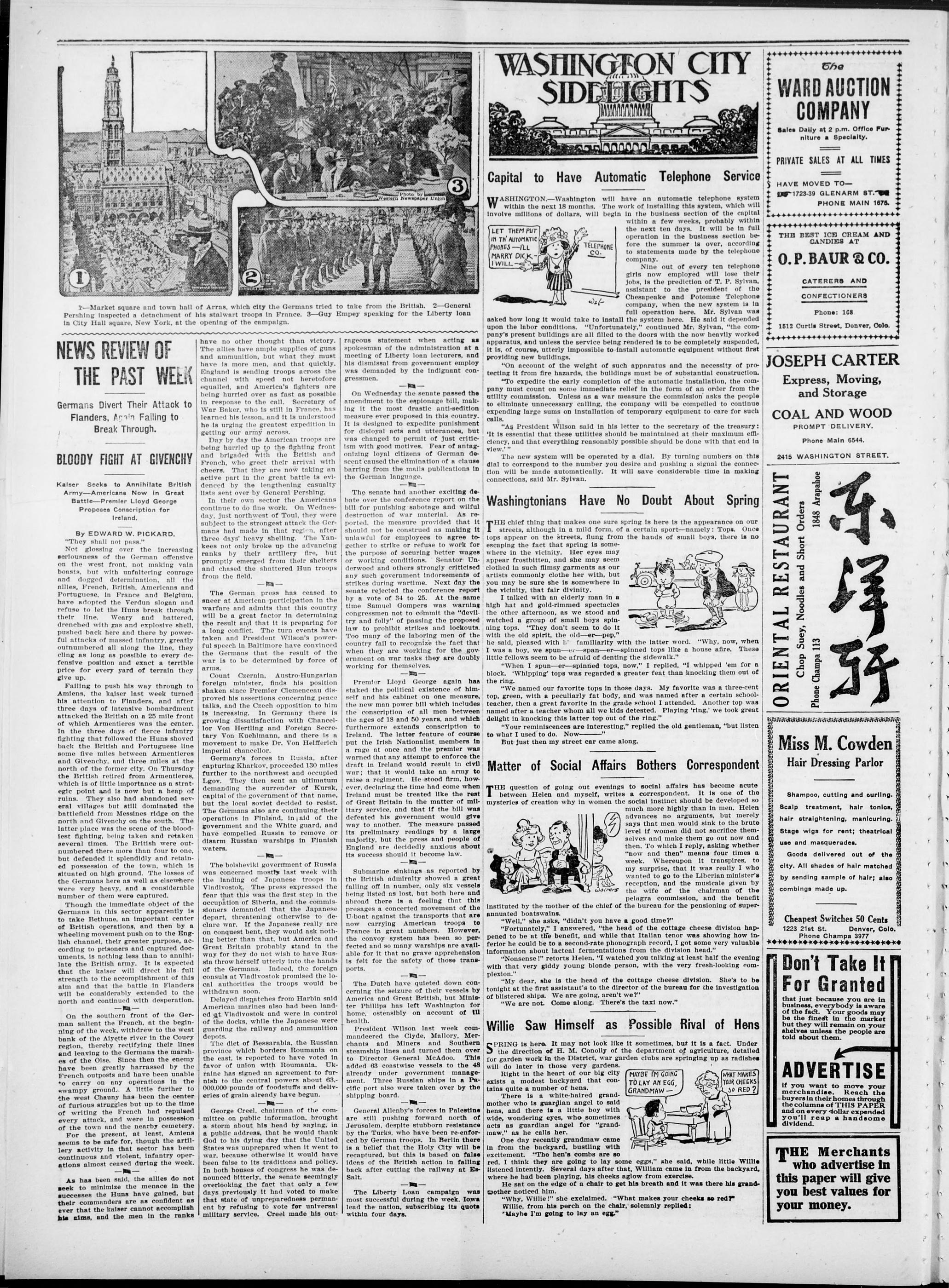
1—Market square and town hall of Arras, which city the Germans tried to take from the British. 2—General Pershing inspected a detachment of his stalwart troops in France. 3—Guy Empey speaking for the Liberty loan in City Hall square, New York, at the opening of the campaign.
NEWS REVIEW OF THE PAST WEEK
Germans Divert Their Attack to Flanders, Again Failing to Break Through.
BLOODY FIGHT AT GIVENCHY
Kalser Seeks to Annihilate British
Army—Americans Now in Great
Battle—Premier Lloyd George
Proposes Conscription for
Ireland.
By EDWARD W. PICKARD.
"They shall not pass."
Not glossing over the increasing seriousness of the German offensive on the west front, not making vain boasts, but with unfaltering courage and dogged determination, all the allies, French, British, Americans and Portuguese, in France and Belgium, have adopted the Verdun slogan and refuse to let the Huns break through their line. Weary and battered, drenched with gas and explosive shell, pushed back here and there by powerful attacks of massed infantry, greatly outnumbered all along the line, they cling as long as possible to every defensive position and exact a terrible price for every yard of terrain they give up.
Failing to push his way through to Amlens, the kalser last week turned his attention to Flanders, and after three days of intensive bombardment attacked the British on a 25 mile front of which Armentieres was the center. In the three days of fierce infantry fighting that followed the Huns shoved back the British and Portuguese line some five miles between Armentieres and Givenchy, and three miles at the north of the former city. On Thursday the British retired from Armentieres, which is of little importance as a strategic point and is now but a heap of ruins. They also had abandoned several villages but still dominated the battlefield from Messines ridge on the north and Givenchy on the south. The latter place was the scene of the bloodiest fighting, being taken and retaken several times. The British were outnumbered there more than four to one, but defended it splendidly and retained possession of the town, which is situated on high ground. The losses of the Germans here as well as elsewhere were very heavy, and a considerable number of them were captured.
Though the immediate object of the Germans in this sector apparently is to take Bethune, an important center of British operations, and then by a wheeling movement push on to the English channel, their greater purpose, according to prisoners and captured documents, is nothing less than to annihilate the British army. It is expected that the kaiser will direct his full strength to the accomplishment of this aim and that the battle in Flanders will be considerably extended to the north and continued with desperation.
---
On the southern front of the German salient the French, at the beginning of the week, withdrew to the west bank of the Alyette river in the Coucy region, thereby rectifying their lines and leaving to the Germans the marshes of the Oise. Since then the enemy have been greatly harrassed by the French outposts and have been unable to carry on any operations in the swampy ground. A little further to the west Chauny has been the center of furious struggles but up to the time of writing the French had repulsed every attack, and were in possession of the town and the nearby cemetery. For the present, at least, Amlens seems to be safe for, though the artillery activity in that sector has been continuous and violent, infantry operations almost ceased during the week.
As has been said, the allies do not seek to minimize the menace in the successes the Huns have gained, but their commanders are as confident as ever that the kalser cannot accomplish his aims, and the men in the ranks
have no other thought than victory. The allies have ample supplies of guns and ammunition, but what they must have is more men, and that quickly. England is sending troops across the channel with speed not heretofore equalled, and America's fighters are being hurried over as fast as possible in response to the call. Secretary of War Baker, who is still in France, has learned his lesson, and it is understood he is urging the greatest expedition in getting our army across. Day by day the American troops are being hurried up to the fighting front and brigaded with the British and French, who greet their arrival with cheers. That they are now taking an active part in the great battle is evidenced by the lengthening casualty lists sent over by General Pershing.
In their own sector the Americans continue to do fine work. On Wednesday, just northwest of Toul, they were subject to the strongest attack the Germans had made in that region, after three days' heavy shelling. The Yankees not only broke up the advancing ranks by their artillery fire, but promptly emerged from their shelters and chased the shattered Hun troops from the field.
一
The German press has ceased to sneer at American participation in the warfare and admits that this country will be a great factor in determining the result and that it is preparing for a long conflict. The turn events have taken and President Wilson's powerful speech in Baltimore have convinced the Germans that the result of the war is to be determined by force of arms.
Count Czernin, Austro-Hungarian foreign minister, finds his position shaken since Premier Clemenceau disproved his assertions concerning peace talks, and the Czech opposition to him is increasing. In Germany there is growing dissatisfaction with Chancellor Von Hertling and Foreign Secretary Von Kuehlmann, and there is a movement to make Dr. Von Helfferich imperial chancellor.
Germany's forces in Russia, after capturing Kharkov, proceeded 130 miles further to the northwest and occupied Lgov. They then sent an ultimatum demanding the surrender of Kursk, capital of the government of that name, but the local soviet decided to resist. The Germans also are continuing their operations in Finland, in aid of the government and the White guard, and have compelled Russia to remove or disarm Russian warships in Finnish waters.
---
The bolshevik government of Russia was concerned mostly last week with the landing of Japanese troops in Vladivostok. The press expressed the fear that this was the first step in the occupation of Silberin, and the commissioners demanded that the Japanese depart, threatening otherwise to declare war. If the Japanese really are on conquest bent, they would ask nothing better than that, but America and Great Britain probably stand in the way for they do not wish to have Russia throw herself utterly into the hands of the Germans. Indeed, the foreign consuls at Vladivostok promised the local authorities the troops would be withdrawn soon.
Delayed dispatches from Harbin said American marines also had been landed at Vladivostok and were in control of the docks, while the Japanese were guarding the railway and ammunition depots.
The diet of Bessarabia, the Russian province which borders Roumania on the east, is reported to have voted in favor of union with Roumania. Ukraine has signed an agreement to furnish to the central powers about 63,000,000 pounds of foodstuffs and deliveries of grain already have begun.
---
George Creel, chairman of the committee on public information, brought a storm about his head by saying, in a public address, that he would thank God to his dying day that the United States was unprepared when it went to war, because otherwise it would have been false to its traditions and policy. In both houses of congress he was denounced bitterly, the senate seemingly overlooking the fact that only a few days previously it had voted to make that state of unpreparedness permanent by refusing to vote for universal military service. Creel made his out-
rageous statement when acting as spokesman of the administration at a meeting of Liberty loan lecturers, and his dismissal from government employ was demanded by the indignant congressmen.
---
On Wednesday the senate passed the amendment to the esplonage bill, making it the most drastic anti-sedition measure ever proposed in this country. It is designed to expedite punishment for disloyal acts and utterances, but was changed to permit of just criticism with good motives. Fear of antagonizing loyal citizens of German descent caused the elimination of a clause barring from the mails publications in the German language.
---
The senate had another exciting debate over the conference report on the bill for punishing sabotage and wilful destruction of war material. As reported, the measure provided that it should not be construed as making it unlawful for employees to agree together to strike or refuse to work for the purpose of securing better wages or working conditions. Senator Underwood and others strongly criticised any such government indorsements of strikes during wartime. Next day the senate rejected the conference report by a vote of 34 to 25. At the same time Samuel Gompers was warning congressmen not to commit the "devilry and folly" of passing the proposed law to prohibit strikes and lockouts. Too many of the laboring men of the country full to recognize the fact that when they are working for the government on war tasks they are doubly working for themselves.
---
Premier Lloyd George again has staked the political existence of himself and his cabinet on one measure, the new man power bill which includes the conscription of all men between the ages of 18 and 50 years, and which furthermore extends conscription to Ireland. The latter feature of course put the Irish Nationalist members in a rage at once and the premier was warned that any attempt to enforce the draft in Ireland would result in civil war; that it would take an army to raise a regiment. He stood firm, however, declaring the time had come when Ireland must be treated like the rest of Great Britain in the matter of military service, and that if the bill was defeated his government would give way to another. The measure passed its preliminary readings by a large majority, but the press and people of England are decidedly anxious about its success should it become law.
---
Submarine sinkings as reported by the British admiralty showed a great falling off in number, only six vessels being listed as lost, but both here and abroad there is a feeling that this presages a concerted movement of the U-boat against the transports that are now carrying American troops to France in great numbers. However, the convoy system has been so perfected and so many warships are available for it that no grave apprehension is felt for the safety of those transports.
---
The Dutch have quieted down concerning the seizure of their vessels by America and Great British, but Minister Phillips has left Washington for home, ostensibly on account of ill health. President Wilson last week commandered the Clyde, Mallory, Merchants and Miners and Southern steamship lines and turned them over to Director General McAdoo. This added 63 coastwise vessels to the 48 already under government management. Three Russian ships in a Pacific port also were taken over by the shipping board.
---
General Allenby's forces in Palestine are still pushing forward north of Jerusalem, despite stubborn resistance by the Turks, who have been re-enforced by German troops. In Berlin there is a belief that the Holy City will be recaptured, but this is based on false ideas of the British action in falling back after cutting the railway at Es Salt.
The Liberty Loan campaign was most successful during the week. Iowa lead the nation, subscribing its quota within four days.
WASHINGTON CITY
SIDELIGHTS
Capital to Have Automatic Telephone Service
WASHINGTON.—Washington will have an automatic telephone system within the next 18 months. The work of installing this system, which will involve millions of dollars, will begin in the business section of the capital within a few weeks, probably within the next ten days. It will be in full operation in the business section before the summer is over, according to statements made by the telephone company.
Nine out of every ten telephone girls now employed will lose their jobs, is the prediction of T. P. Sylvan, assistant to the president of the Chesapeake and Potomac Telephone company, when the new system is in full operation here. Mr. Sylvan was
asked how long it would take to install the system he upon the labor conditions. "Unfortunately," continue pany's present buildings are all filled to the doors with apparatus, and unless the service being rendered is to it is, of course, utterly impossible to install automatic providing new buildings.
"On account of the weight of such apparatus and tecting it from fire hazards, the buildings must be of"
"To expedite the early completion of the automan pany must count on some immediate relief in the for utility commission. Unless as a war measure the com to eliminate unnecessary calling, the company will be expending large sums on installation of temporary equ calls.
"As President Wilson said in his letter to the se 'It is essential that these utilities should be maintained clenicy, and that everything reasonably possible should view.'"
The new system will be operated by a dial. By dial to correspond to the number you desire and pus tion will be made automatically. It will save consi connections, said Mr. Sylvan.
Washingtonians Have No Doubt
THE chief thing that makes one sure spring is here i streets, although in a mild form, of a certain spon
at the system here. He said it depended
titely," continued Mr. Sylvan, "the com-
mence the doors with the now heavily worked
rendered is to be completely suspended,
stall automatic equipment without first
such apparatus and the necessity of pro-
gms must be of substantial construction.
of the automatic installation, the com-
mence in the form of an order from the
measure the commission asks the people
company will be compelled to continue
temporary equipment to care for such
better to the secretary of the treasury:
and be maintained at their maximum effi-
possible should be done with that end in
buy a dial. By turning numbers on this
desire and pushing a signal the connec-
will save considerable time in making
No Doubt About Spring
spring is here is the appearance on our
a certain sport—namely: Tops. Once
the hands of small boys, there is no
asked how long it would take to install the system here. He said it depended upon the labor conditions. "Unfortunately," continued Mr. Sylvan, "the company's present buildings are all filled to the doors with the now heavily worked apparatus, and unless the service being rendered is to be completely suspended, it is, of course, utterly impossible to install automatic equipment without first providing new buildings.
"On account of the weight of such apparatus and the necessity of protecting it from fire hazards, the buildings must be of substantial construction.
"To expedite the early completion of the automatic installation, the company must count on some immediate relief in the form of an order from the utility commission. Unless as a war measure the commission asks the people to eliminate unnecessary calling, the company will be compelled to continue expending large sums on installation of temporary equipment to care for such calls.
"As President Wilson said in his letter to the secretary of the treasury: It is essential that these utilities should be maintained at their maximum efficiency, and that everything reasonably possible should be done with that end in view."
The new system will be operated by a dial. By turning numbers on this dial to correspond to the number you desire and pushing a signal the connection will be made automatically. It will save considerable time in making connections, said Mr. Sylvan.
Washingtonians Have No Doubt About Spring
THE chief thing that makes one sure spring is here is the appearance on our streets, although in a mild form, of a certain sport—namely: Tops. Once tops appear on the streets, flung from the hauds of small boys, there is no escaping the fact that spring is somewhere in the vicinity. Her eyes may appear frostbitten, and she may seem clothed in such filmsy garments as our artists commonly clothe her with, but you may be sure she is somewhere in the vicinity, that fair divinity.
I talked with an elderly man in a high hat and gold-rimmed spectacles the other afternoon, as we stood and watched a group of small boys spinning tops. "They don't seem to do it
With the latter word. "Why, now, when spinned tops like a house afire. These g the sidewalk."
"now," I replied, "I whipped 'em for a greater feat than knocking them out of those days. My favorite was a three-cent band was named after a certain school-made school I attended. Another top was detested. Playing 'ring,' we took great of the ring."
"replied the old gentleman, "but listen long.
Bothers Correspondent
to social affairs has become acute as a correspondent. It is one of the social instinct should be developed so
he said, pleased with his familiarity with the latter word. "Why, now, when I was a boy, we spun—er—span—er—spinned tops like a house afire. These little fellows seem to be afraid of denting the sidewalk."
he said, pleased with his familiarity with the latter w i was a boy, we spun—er—span—er—spinned tops ill little fellows seem to be afraid of denting the sidewalk.
"When I spun—er—spinned tops, now," I replied block. 'Whipping' tops was regarded a greater feat th e ring.
"We named our favorite tops in those days. My f t top, green, with a peculiarly fat body, and was named teacher, then a great favorite in the grade school I att named after a teacher whom all we kids detested. Play delight in knocking this latter top out of the ring."
"Your reminiscences are interesting," replied the o t to what I used to do. Now——"
"When I spun—er—spinned tops, now," I replied, "I whipped 'em for a block. 'Whipping' tops was regarded a greater feat than knocking them out of the ring.
"We named our favorite tops in those days. My favorite was a three-cent top, green, with a peculiarly fat body, and was named after a certain school-teacher, then a great favorite in the grade school I attended. Another top was named after a teacher whom all we kids detested. Playing 'ring,' we took great delight in knocking this latter top out of the ring."
"Your reminiscences are interesting," replied the old gentleman, "but listen to what I used to do. Now——"
But just then my street car came along.
Matter of Social Affairs Bothers Correspondent
THE question of going out evenings to social affairs has become acute between Helen and myself, writes a correspondent. It is one of the mysteries of creation why in women the social instinct should be developed so much more highly than in men. Helen
Matter of Social Affairs Bothers Correspondent
THE question of going out evenings to social affairs has become acute between Helen and myself, writes a correspondent. It is one of the mysteries of creation why in women the social instinct should be developed so much more highly than in men. Helen advances no arguments, but merely says that men would sink to the brute level if women did not sacrifice themselves and make them go out now and then. To which I reply, asking whether "now and then" means four times a week. Whereupon it transpires, to my surprise, that it was really I who wanted to go to the Liberian minister's reception, and the muscale given by the wife of the chairman of the pelagra commission, and the benefit instituted by the mother of the chief of the bureau for the pensioning of super-annuated boatswalms.
"Well," she asks, "didn't you have a good time?"
"Fortunately," I answered, "the head of the cott pened to be at the benefit, and while that Italian ter ferlor he could be to a second-rate phonograph record, information about lacteal fermentations from the div "Nonsense!" retorts Helen. "I watched you talking with that very giddy young blonde person, with the plexion."
"My dear, she is the head of the cottage chees tonight at the first assistant's to the director of the bun of blistered ships. We are going, aren't we?"
"We are not. Come along. There's the taxi now.
Willie Saw Himself as Possible
SPRING is here. It may not look like it sometimes, the direction of H. M. Conolly of the department for garden work in the District, war garden clubs are will do later in those very gardens.
head of the cottage cheese division hap-
that Italian tenor was showing how in-
tograph record, I got some very valuable
s from the division head."
fled you talking at least half the evening
person, with the very fresh-looking com-
a cottage cheese division. She's to be
vector of the bureau for the investigation
we?"
is the taxi now."
Possible Rival of Hens
be it sometimes, but it is a fact. Under
the department of agriculture, detailed
arden clubs are springing up as radishes
"Fortunately," I answered, "the head of the cottage cheese division happened to be at the benefit, and while that Italian tenor was showing how inferior he could be to a second-rate phonograph record, I got some very valuable information about lacteal fermentations from the division head."
"Nonsense!" retorts Helen. "I watched you talking at least half the evening with that very giddy young blonde person, with the very fresh-looking complexion."
"My dear, she is the head of the cottage cheese division. She's to be tonight at the first assistant's to the director of the bureau for the investigation of blistered ships. We are going, aren't we?"
"We are not. Come along. There's the taxi now."
Willie Saw Himself as Possible Rival of Hens
Willie Saw Himself as Possible Rival of Hens
SPRING is here. It may not look like it sometimes, but it is a fact. Under the direction of H. M. Conolly of the department of agriculture, detailed for garden work in the District, war garden clubs are springing up as radishes will do later in those very gardens.
Right in the heart of our big city exists a modest backyard that contains quite a number of hens.
There is a white-haired grandmother who is guardian angel to sald hens, and there is a little boy with wide, wondering eyes, who sometimes acts as guardian angel for "grandmaw," as he calls her.
One day recently grandmaw came in from the backyard, bustling with
some eggs," she said, while little Willie
hat, William came in from the backyard,
anglow from exercise.
It his breath and it was there his grand-
What makes your cheeks so red?"
or, solemnly replied:
red, I think they are going to lay some eggs," she said, while little Willie listened intently. Several days after that, William came in from the backyard, where he had been playing, his cheeks aglow from exercise.
red, I think they are going to lay some eggs," she listened intently. Several days after that, William can where he had been playing, his cheeks aglow from exertion. He sat on the edge of a chair to get his breath and another noticed him.
"Why, Willie!" she exclaimed. "What makes you Willie, from his perch on the chair, solemnly repents." Maybe I'm going to lay an egg."
He sat on the edge of a chair to get his breath and it was there his grandmother noticed him.
"Why, Willie!" she exclaimed. "What makes your cheeks so red?" Willie, from his perch on the chair, solemnly replied: "Maybe I'm going to lay an egg."
LET THEM PUT
IN TH' AUTOMATIC
PHONES—ILL
MARRY DICK
I WILL
TELEPHONE
CO.
walt
---
tops appear on the streets, flung from escaping the fact that spring is somewhere in the vicinity. Her eyes may appear frostbitten, and she may seem clothed in such filmsy garments as our artists commonly clothe her with, but you may be sure she is somewhere in the vicinity, that fair divinity.
I talked with an elderly man in a high hat and gold-rimmed spectacles the other afternoon, as we stood and watched a group of small boys spinning tops. "They don't seem to do it with the old spirit, the old—er—pep."
But just then my street car came along.
S
will do later in those very gardens.
Right in the heart of our big city exists a modest backyard that contains quite a number of hens.
There is a white-haired grandmother who is guardian angel to sald hens, and there is a little boy with wide, wondering eyes, who sometimes acts as guardian angel for "grandmaw," as he calls her.
One day recently grandma came in from the backyard, bustling with excitement. "The hen's combs are so
Sales Daily at 2 p.m. Office Furniture a Specialty.
PRIVATE SALES AT ALL TIMES
HAVE MOVED TO-
1723-39 GLENARM ST.
PHONE MAIN 1675.
THE BEST ICE CREAM AND
CANDIES AT
CATERERS AND
CONFECTIONERS
Phone: 108
1512 Curtis Street, Denver, Colo.
JOSEPH CARTER Express, Moving, and Storage COAL AND WOOD PROMPT DELIVERY.
2415 WASHINGTON STREET.
Phone Champa 113 1848 Arapahoe
乐绎轩
Miss M. Cowden
Hair Dressing Parlor
Shampoo, cutting and curling.
Scalp treatment, hair tonlos,
hair straightening, manicuring.
Stage wigs for rent; theatrical
use and masquerades.
Goods delivered out of the
city. All shades of hair matched
by sending sample of hair; also
combings made up.
Cheapest Switches 50 Cents
1223 21st St. Denver, Colo.
Phone Champa 3977
Don't Take It
For Granted
that just because you are in
business, everybody is aware
of the fact. Your goods may
be the finest in the market
but they will remain on your
shelves unless the people are
told about them.
ADVERTISE
if you want to move your merchandise. Reach the buyers in their homes through the columns of THIS PAPER on every dollar expended you reap a handsome dylindet
THE Merchants who advertise in this paper will give you best values for your money.
The Housewife and the War
ee a eS ES
‘@pecial Information Service, United States Department ef Agriculture.)
SPRING GREENS—GOOD TO EAT, GOOD FOR BODY
eee
a
co
hs He HS ay
Cs ee WY Pits \ Ot
fe Bie: aS
LAN: Wee kw. 8
pints ey) Peek
iD ee ee)
HAR okie cet Seay 7
( Poe Ea See Se
DN a tema of 2/4
Qe Oe ear aga meer P feat.
ee ON ee aah Sl ee |
ar aoe ie cere ie rd le, 2S
oak as og Baiiaietet es
CORE EB Ee ees
i gee Water |
Re a eee ER pti eee at Re
ee ONS 2 erm
5 eee re nr ee My Wiimote
ee = Tee ee ee Tear
iy Takes Half a Bushel of Spinach to Make a Pint of Food, but That Pint
Has Valuable Iron and Mineral Salts Which Human Bodies Need.
GREENS GOOD T0
MAKE RED BLOOD
Housewife Should Not Overlook
Dandelion, Lamb’s-Quarter
b or Wild Mustard.
IRON NEEDED FOR THE BoDY
¢
[eles of Various Venetabies Euriish
Another Useful Substance Not Yet
| Named—Cream of Dandelion
Soup Recipe.
It 1s springtime! Don’t neglect to
wive your family some good old-fash-
foned greens. If you live in a large
city, you may have to depend upon the
greens- which some country woman
brings to market or upon spinach or
kale, which can usually be bought even
in winter. If you live in the country,
perhaps your instinct has already told
you that the tender green leaves of
the dandelion, lamb’s-quarter, wild
mustard, or whatever variety of greens
your locality affords are waiting for
someone to gather them for food.
People from primitive times to this
have manifested a craving for green
food as winter passes and springtime
approaches. Probably this craving
arises from a real need of our bodies
for the materials which such, foods
furnish. e
Iron Is Essential.
What is the particular use of suci
foods to our bodies? All green leavet
contain in combination with.the greet.
coloring matter more or less iron. It
we are to have rich, red blood we
must furnish this fron to our bodles.
Dandelion greens are one of the very
good sources of iron, contalain:, more
than many other sorts of greer. leaves.
It we serve greens with hard-boiled
‘egg for garnish, we have a dish very
rich in fron, for the egg yolk con-
tributes its share.
Besides the tron and other mineral
salts, the leaf vegetables contain a
very important substance which the
body must have for normal growth and
development. This substance, recently
discovered and for which a name has
not yet been given, is also found in
butterfat and some other antmal fats,
but net in every food.
Greens have a place of real worth
In the diet and should be used In every
household not only in springtime but
late into the summer and, when pro-
curable, in the winter also. The
tender beet tops, celery tops, radish
tops, onion tops, and turnip tops
should not be discarded, but served as
greens. A little space in the garden
devoted to spinach, New Zealand spin-
ach, or French chard will supply the
family with summer greens and also
should afford some material for can-
ning for use during the winter months.
Lettuce leaves, which are some-
times cooked for greens, and spinach,
both being mild flavored and contain
ing much water, require no water for
cooking in addition to that which clings
to the leaves from washing. Other
stronger-flavored greens are usually
cooked in a small amount of water.
Greens should be cooked until tender,
but not overcooked. A tiny bit of
baking soda added to the water they
are cooked in will help the greens to
retain their color.
In the country where meat fs cured
at home, it used to be the custom to
keep the jowl of the hog for the espe-
cial purpose of cooking it with greens
in the spring. If the jow! {s not at hand,
‘a small piece of salt pork or the rind
from smoked bacon gives richness and
flavor when cooked with greens.
Children should be encouraged to
‘eat greens, as they especially need the
fron and the growth-promoting sub-
stance which greens furnish. Some-
times they object to the slightly bitter
‘Yaste which some greens have, but if
made into milk soups, the flavor is
diluted 20 that {t is not noticeable.
Such soups make a desirable lunch
or supper dish for the entire family.
Cream of Dandelion Soup.
1 quart milk (skim or 2 tablespoonfuls fat
whole). 1 teaspoonful salt
2 tablespoonfuls flour
1 cupful dandelion leaves that have been
thoroughly cooked.
Stir flour into melted fat and mix
with cold milk, Put the thoroughly
cooked dandellon leaves through a
sieve or chop them fine and add to the
milk, Stir until thickened.
Rice a La South Carolina.
No food, regardless of its merits, will
appeal to the consumer unless {t can
be made into an attractive dish. In
this country rice usually comes to the
table as an uninyiting, glutinous mass,
except in certain secthons of the South-
ern states, where it is served with each
grain distinct and separate, making a
very tempting and appetizing dish. A
platter heaped with loose, flaky ker-
nels of rice {s not only pleasing to the
eye, but satisfying to the apetite. It
{s yery probable that the attractive ap-
penrance of this dish on the South
Carolina table has had much to do
with the popularity and usefulness of
rice in that state.
In seeking information on the art of
cooking rice, no mistake ts made in re-
ferring to South Carolina, where the
true value of this cereal has been ap-
preciated for over two centuries. A
Carolina housewife would advise the
using of one pint of rice, after thor-
ough washing, which she considers tm-
portant, “to a quart and a pint of wa-
ter,” and a teaspoonful of common
salt. “This is to be boiled over a quick
fire for ten minutes, stirring occasion-
ally. Then pour off all or nearly all
the water; cover the vessel and put
over a yery slow fire, and allow it to
steam for 15 minutes at least, stirring
occasionally. The rice will be soft or
grainy, according to the quantity of
water left on it when put to steam, and
the length of time allowed in the
steaming. The larger the quantity of
water and the shorter the steaming,
the softer will be the rice.”
Of course, other methods are used in
boiling rice or at least modifications of
the recipe given, but 1t must be re-
membered that the results should not
be a glutinous mass and that success
depends upon the proper amount of
water used and the length of time in
steaming.
Protect Food In Lunches.
‘The precautions which must be
taken to keep lunches clean and safe
differ with circumstances. In dusty
seasons they should be wrapped par
tleularly well. In hot weather the use
of soft, molst foods in which molds
and bacteria are most lkely to grow
rapidly should be avoided. Although
chopped meat molstened with a dress-
ing of some kind makes a good sand-
wich filling, such foods are less desir-
able in hot weather than slices of ment,
peanut butter, or other foods less Ita-
ble to spoll.
FAULT LOTTO
% USE ALITTLE VINEGAR &
x IN CLEANING GREENS §
% AM greens must be picked %
% over carefully and carefully x
% washed. This 1s sometimes a x
% long process, for a large quan- i
% tity 1s required to make a dish %
% of the cooked greens. It takes 1%
'{ about a half bushel of spinach
tj to make a Iittle more than 9
% pint when cooked. A half cup- x
% ful of vinegar in the water In %
‘i which the greens are allowed to k
% stand before washing 1s of ad-
{vantage as It kills the small in- 5
% sects that are sometimes hard (¢
% to distinguish from the leaves :
% themselves. a
When buying cooking utensils
choose those with round corners, in-
stead of square, whenever possible.
‘They are easier to keep clean.
Aprons made of crossbar pattern can
be easily mended without the patch
ghowing. @
GARDEN JOGS
Are your flats filled with fer-
tile forcing soll?
The new handle for the spad-
ing fork? Did you think of It?
Those wood ashes from the
fireplace? Are you saving them
for the potash they contain?
UTS» QeP'T. OF AGRICULTURE
HOW_TOGROW
ASPARAGUS. D
This crop ts one of the most endur-
Ing and satisfactory vegetables. It
can be grown on almost any well
drained soll, but will do best on a deep
sandy loam. There Is little possibil-
ity of having the ground too rich, and
Uberal applications of partly rotted
barnyard manure should be made be-
fore the plants are set. The seeds of
asparagus may be sown during the
spring in rows where the plants are to
remain, and the seedlings thinned to
stand 14 feet apart in rows.
It is usually more satisfactory to
purchase two-year-old roots, a8 con-
siderable time is saved In this way.
As the asparagus bed is a permanent
feature of the garden, it should be lo-
cated accordingly. Before setting the
plants the soil should be loosened very
deeply, elther by subsoil plowing or by
deep spading. It is a good plan to re-
move the’top soil and spade manure
Into the subsoil to a depth of 14 or 16
inches, The plants may be set in
rows for horse cultivation or In beds.
If in rows they should be set 14 Inches
apart, with the rows 8% feet apart.
If In beds, one foot apart each way Is
the proper distance to set the plants.
In setting the plants the crowns should
be covered 4 or 5 inches deep.
In the Nortn the plants should re-
celve a mulch of 4 or 5 inches of ma-
nure In winter. In the South the
mulch is not necessary, hut the plants
should receive a cont of manure or an
application of fertilizer, preferably in
autumn,
No shoots should be removed during
the first year the plants are set in the
permanent bed, and the period of cut-
ting should be short during the second
year,
LIMA BEANS.
Lima beans should not be planted
until the ground fs thoroughly warmed
up, as they are a heat-loving crop and
the seed will rot if planted when the
ground is cold. Most gardeners pre-
fer the pole varieties, as they yleld
better than the bush varieties and are
superior to the bush varleties in many,
other respects. One marked advan-
tage of the pole beans is that they may
be planted around the fence, utilizing
the fence as a support for the vines.
In this manner a crop of beans can
be secured with the use of a minimum
amount of spacing.
When planted in rows in the gar
den, pole lima beans are usually plant-
ed in hills 3 to 4 feet apart and sup-
ported on poles or a string and wire
trellis.
‘The bush Iimas are usually drilled
in rows some 8% feet apart for horse
cultivation, or slightly closer for hand
cultivation, The lima beans are a full
season crop, that is, they occupy the
ground for the entire growing season,
and a sufficlent amount should be
planted to provide for the needs of the
family for the entire season. Any sur-
plus not used green may be allowed to
ary on the vines, picked and stored
for winter use.
Lima beans constitute one of the
most satisfactory crops for growing
for winter's use, as the only care ne-
cessary to save them Is to pick the ripe
pods, dry them thoroughly and shell
the beans. In the northern portion of
the country where lima beans do not
thrive, pole beans of the Lazy Wife
variety will give satisfaction.
RADISHES.
‘The radish is quite hardy and inay
be grown throughout the winter In the
middle section of the United States. In
many portions of the South it Is pos-
sible to grow it in the open ground
throughout the winter. For the home
garden the seed should be sown in the
open ground about the time of the last
killing frost. ‘The seed should be sown
in drills at a convenient distance for
cultivation, usually about 18 inches.
To be of good quality, radishes must
Ye grown quickly in rich soil, and be
used as soon as of sufficient size. Suc-
cessive plantings should be made every
few days until the weather becomes
warm. ‘They will not withstand hot
weather and are sulted to early spring
and late autumn planting.
There are autumn varieties of rad-
Ishes which may be grown late in the
season and stored for winter use the
same as beets or turnips. A few of
these will add variety to the winter
supply of vegetables.
BRUSSELS SPROUTS.
Brussels sprouts are closely related
to cabbage and cauliflower, and may
be grown In very much the same man-
ner. ‘Tbe seed may be started in the
window box or in the hotbed and
transplanted to the garden when the
ground Is in condition to work.
Instead of a single head, Brussels
sprouts produce a large number of
amall heads, these heads being fornr-
ed in the axils of the leaves. If the
heads become too crowded, the, leaves
should be broken off so as to give the
heads more ‘room. However, a few
leaves should always be left in the
top of the stem where the new heads
Do You Know
" é F
That—
The COLORADO
—_—X—X—S—————————_—_—
IS PREPARED TO DO ©
ALL KINDS OF
Commercial, Fraternal,
Church, Book and
Stationery Jobs
= ———ooSSSSSS==S=
Ball and Concert Programs, Bill
and Letter Heads, Calling Cards,
Wedding Cards, Envelopes and
Everything in the Printing Line
Turned Out in the Neatest and
Best Style Promptly on Short
Notice.
We Have Supplied Our
Office with New Job Press
& Type of Up-to-Date Style
and Our Work Will Be on
a Par with the Very Best.
———_————SSSsssss
Give Us a Trial
and We Will Give
You
are being formed. Lrusseis sprouts
are more hardy than cabbage ind in
many sections may be planted in the
fall. They should be set in rows 30
to 26 Inches apart if for horse cultl-
vation. The plunts should be set from
20 to 24 Inches apart in the rows.
Brussels sprouts may be stored for
winter use In much the same way n#
cabbuge. ‘The best method Is to tuke
up the plants, pack them closely to-
gether In a trench, covering them with
straw or other litter to protect them
from freezing and thawing.
KOHL-RABI.
‘The edible portion of the kohi-rabl
Is the thickened stem, It Ix closely re-
lated to cabbage and cauliflower. It
should be started in the hotbed or win-
dow box and set in the open ground
about the time of the last frost, ‘The
method of plunting and the cultivation
is similar to that practiced for cab-
bage. It can be planted in the open
at the sume time, Eurly sowings are
made, and if thinned to 4 to 6 inches
apart the plants will soon grow to
edible size under favorable weather
conditions, This plant should receive
much more consideration than usually
is given It. It is really » poor man’s
cauliflower,
COLLARDS.
The culture and uses of collards are
the same as for cabbage. ‘The plants
should be started in very early spring
and set out as soon as the ground Is
in condition. They withstand the heat
better than cabbage and are much
used in the southern portion of the
country. Collards do not form a true
head, hut instead a loose rosette of
leaves, which, when blanched, are
very tender and of delicate flavor.
No southern garden is complete
without this plant. Too often, how-
ever, it has constituted the sum total
in the shape of garden supplies. Use
it, but don't abuse ft.
PARSLEY.
The seeds of parsley should be
sonked for a few hours before plunt-
ing to insure germination. ‘They are
slow in germinating and should be
handled very carefully, After one or
two transplantings they should be set
In the open ground in rows 12 to 18
inches apart and 3 to 4 inches apart
in the rows as early as the soil can be
put in condition. A small area devoted
to this crop will be suilictent for the
average family.
It is used a8 a garnishing and for
flavoring soups. Keep a little of it
growing at all times. It gives a pleas
ing touch to many dainty dishes.
PEPPERS.
Plant the seeds of peppers in the
hotbed about six weeks to two months
before time to set them In the open
ground. They should be transplanted
at least once and should not be set tn
the open until the ground is thorough-
ly warm. When grown in the garden
the large bull-nosed types should be
placed in rows 8 feet apart with the
plants from 15 to 17 inches apart In
rows. Frequent shallow cultivation
should be given, and the plants will
continue to bear until frost kills them.
IN YOUR HOME GARDEN
“Dig deep, manure well, work
often.” Thus Pliny the Elder,
nearly 2,000 years ago, summed
up gardening. His advice 1s
good today.
Enthusiasm must be backed
by solld purpose—enough of it
to surmount obstucles and sur-
vive disappointments.
‘The best insurance against ac-
eldents in gardening is knowing
how to garden.
Give Us a Trial
and We Will Give
You
Satisfaction
Prices as Reasonable
as Those of Any
Job Office in Denver
The Colorado
Statesman —
1824 CURTIS STREET
Room 25 Phone Main 7417
PROFITABLE USE OF MANURE
Garden and Orchard Will Take Good
Care of All Fertilizer Pro-
duced on Farm,
Save and apply all of the barnyard
manure that Is ‘produced on your
farm. The garden and the orchard
are Mke prospective candidates—they
are “in a receptive mood.” It Is dif.
ficult to get garden land too rich. In
case there seems to be more nitrogen
from heavy applications of manure
than the other constituents, apply acid
phosphate and hardwood ashes to bal-
ance the fertility constituents.
Find Amount of Seed Needed.
Aim to make every seed count. Re-
member the supply of some of the
more important varieties of garden
seed is limited, and in order that all
may obtain enough to meet their needs,
everyone should co-operate to make
what fs used produce a maximum crop.
Broadcasting Manure.
Manure for broadcasting ontop of
the plowed ground should be well rot-
ted and fine, After spreading mix it
well with the harrow before drilling
in the seeds.
Grown in Greenhouse.
Swiss chard {s sometimes grown In
the greenhouse to advantage. Beets
may be started under the greenhouse
bench if there Is light enough to pre-
vent their becoming spindling.
Place for Permanent Crops.
Berry bushes, rhubarb, asparagus
‘and such garden stuff that {s perma-
nently established should be grouped
on one side of the garden and extend
in rows the full length of the garden,
French Fashions Feature Economy
New York.—There is some exceedingly good feature about the French gowns that are beginning to arrive in America, which will not cause disapproval over here. That is the striking similarity between afternoon and evening costumery, according to a fashion writer.
It was once said, in a slightly contemptuous manner, that in certain sections of this country the women wore gulmpes in their ball gowns for afternoon occasions and that no one was capable of such an economical combination but the American woman, or at least, no other woman who moved in fashionable circles.
It has long been the opinion of the French, whenever they were sufficiently lenient to be interested in the American type of dressing, that we never knew the exact shade of difference that existed between an afternoon gown and all other kinds of gowns. The French women have often said, in their polite manner, that they could not understand why the American was lacking in that finer feeling which automatically governs the choice of clothes.
Did Not Always Change.
Now, whether or not the American lacked the finer feeling or whether she was conscious that custom produced fashions, she continued to dress at ten o'clock in the morning in the clothes that she would wear until seven o'clock in the evening. In truth, she did not always change for dinner or the theater. She went on through the entire routine of the day with its diversified interests, its business appointments, its marketing, shopping and restaurant lunching, its afternoon teas, weddings, card parties, home dinners and the play in a coat and skirt that should only be worn, as the French put it, in a public mob.
The American woman has always held up to herself, and very earnestly, that she was too busy a woman to change her clothes several times during the day. Let the women of the European nations do what they would, she thought, in a social atmosphere that was fostered by generations of leisure and inactivity. Her own environment, she said, called for a different adjustment of clothes and life. So, as a rule, she presented a somber appearance at all those social festivities that were intended to make women gay as birds of paradise.
However, this manner of dressing has changed. For several years a woman has not depended on her tailored suit to do the work for every hour of the day.
This transition to better dressing has come about through the domination of the one-piece frock. As soon as the American could be divorced, or rather, wedged away from her lifelong friend, the tailored suit, she found that the one-piece frock had its attractions. She was willing to accept it in tailored style, but she began to play with it a bit and make it suitable for her leisure time. No sooner had she ac-
Sketch from Paris shows short dolman of bordeaux gaberdine trimmed with bands of old blue. There is a deep collar of blue.
quired this wisdom than the top coat of fur or heavy material came in to further her manner of dressing. She found that thin frocks were still available for winter wear in the open, if she was securely buttoned up from chin to shoe top in a warm garment.
She found that the chiffon gown which she wore at eleven o'clock in the morning was quite suitable for an afternoon dance, a cup of tea or a game of cards at five in the afternoon.
This rather pleased her, so she bought coats, and more coats, just as she bought sweaters, and more sweaters in the summer.
She also realized that the separate
blouse was an excellent garment under a coat, but not for social affairs when the coat was removed.
Three years ago, she ceased to remove her jacket in all public places, and one year ago, she substituted the loose, Russian blouse for the tucked-in muslin shirt the moment she entered the house.
In this connection, France strikes a vibrant, resounding note on the anvil of fashion in giving approval to the afternoon gown that will serve for the evening. This is not a whim on her part. It is a fashion born through necessity. This is the best part of
THE FASHION OF THE TWENTIETH CENTURY
The Turkish trousered skirt for evening is introduced on the Paris stage by Mile. Vana in this gown of silver tissue with a shoulder cape of silver tulle. The hem is turned up at the bottom and clings to the ankles.
the clothes of the last three years; they are the results of demand and supply, not the creatures of caprice. France sends the narrow silhouette to help us in the conservation of wool. She sends us embroidery of wooden beads and fringes of twine in order to give work to those who need it and to substitute a cheap form of ornamentation for an expensive one.
She sends us all the common, everyday fabrics as gingham, cotton, volle, canvas and sacking. She teaches us to be economical and go to the attic, through her use of old laces of every kind. She sends us high puttees and cloth-top shoes in order that we may do with little leather.
She makes fashionable American Indian embroideries so that we may go right into our own West and find pieces of material and inspiration that will build us new gowns without much cost.
She sends us piece-meal gowns which are made from two, three and four odds and ends of material skillfully combined to produce a harmonious whole, but, mark you, to also provide a way to use up short pieces of fabric which we have in the house or can purchase in the shops.
She sends us the thin crepe de chine petticoat and the plaid volle blouse to save laundry and soap and flour. She uses small bouquets and large, single flowers for trimming instead of expensive buckles and other costly trifles. She knows these flowers can be made at home or re-dipped in a good dye after they have seen service in other days. She shows us a multiplicity of tea gowns made of sterner stuff than we have been accustomed to accord to negliges. Those indoor frocks are to be substituted for the serviceable cloth frock for the street and the evening frock for a gay occasion. They are intended to save clothes.
Gown for Afternoon and Evening.
Now, as a crowning effort of conservation and economy, she sends us the new afternoon gown which is worn in the evening. It is made of thin material, it has transparent sleeves, long or short, and it has a half-decolletage. It has indefinite variety, often it blazes with color, again it is subdued to black and white combined, and it can be worn for every indoor occasion from four in the afternoon until midnight.
Such a frock saves the buying of many shoes. It is a stroke of that illuminating inspiration that the French have when they put their minds to economy. There is nothing drab or mournful about French economy; they raise the sordid thing to a pedestal and make it desirable for even those who do not stare economy daily in the face.
(Copyright, 1918, by the McClure Newspaper Syndicate.)
Colors Match Scenery.
Evidently with "the most popular word" in mind, camouflage, the South has decided that the new colors shall be nature colors. Palm green, pine green, polnsettia red, cyclamen red, hibiscus pink, grapefruit yellow, orange, coconut brown and the various shades of sand are some of them.
AUNT MARY WAS ODD
Strange Way in Which She Aided Her Favorite, Hot-Headed Nephew
BV FRANK FILSON.
"A present from Aunt Mary!" said young Mrs. Strang as the oddly-wrapped parcel was handed to her by the postman. "I just know that it's something odd, George."
It must be odd, because Aunt Mary was odd. She was a queer little old spinster, with the kindest heart and the crankiest manners that ever went into a combination. But though she had quarreled with almost all her relatives and then made up with them, and alternately cut them out of her will and then put their names back into multitudinous codicils, she had always kept the warmest spot in her heart for George Strang, her handsome artist nephew.
She had, indeed, supported him during that period which comes to every artist, when he was struggling for fame and existence in a large city against the wishes and despite the disgust of his own family. And now that he had married pretty Lucy Bentwick and was in comfortable, if not affluent circumstances, she had sent him a wedding gift.
"A china vase!" exclaimed George Strang in disgust as he eyed the queer-looking object in his hand.
It was, indeed, the most repulsive looking vase that he had ever seen. It was rotund and highly decorated with painted pink roses, and upon it was printed in small, black letters: "You may break you may shatter
"You may speak, you may snatter
the scent of the pages you will.
But the scent of the pages will cling
the vase if you will,
"But the scent of the roses will cling
to it still."
"Blank!" said George. It was not
"blank," that he said, but it sounded
like that, because Lucy promptly
closed his mouth with her hand.
"She might have sent me something
that we could keep on our mantel," said George Strang ruefully, looking upon the object with a shudder.
"Fancy a thing like that in our liv-
M. H.
"A China Vase."
ing room, Lucy! Why, it will spoil the entire aspect of the place. And I bet," he added, "that she sent the thing on purpose to get up a quarrel with me and then accuse me of quarrelling with her. She'll drop in on us unexpectedly and see that the thing isn't on view."
"But it must be on view, George, dear," said Mary. "You know how quarrelsome the old dear is. If she does drop in and doesn't see it she'll cut you out of her will and then—O, George, be a little prudent!"
But George refused point-blank to have the thing in their living room. "She knows it's horrible, Lucy," he said, "and if she wants to quarrel with me let her have her way."
Which was precisely what she did have. For a few days later Aunt Mary did come up to town from Bayard's Bridge and did drop in unexpectedly, and the mantel was bare save for two antique Pompeian vases.
"Well, my dear," said the old lady, taking in the situation instantly, "I must say that I admire those ornaments upon your mantel greatly. I fear my own poor efforts to please you and George must have been singularly unsuccessful—" And then she stopped. For Lucy had run into her bedroom when the old lady was announced to get the china vase; but she had not had time to place it upon the mantel and stood guiltily hiding it beneath her apron.
"You may tell George," she continued, "that since he has seen fit to quarrel with me, who always supposed that he cared for me—since my endeavors to make his home happy and beautiful are so unappreciated, I shall waste no further time on him. And, incidentally, I shall bestow my money where it will be likely to promote greater service."
And with these words she stalked out of the apartment, leaving Lucy in tears.
She told George of the happening when he returned from his studio.
"Give me that infernal vase," he shouted. "I'm going to break it to pieces and send her the fragments by parcel post. Old tyrant! Does she think she is going to doom us to a life of artistic misery?"
But Lucy hid the vase from him.
"You know, dear," she said, "Aunt Mary will take you back into favor
again if only you give her time to forget. She is very fond of you really." "She wanted to see how far she could go," said George Strang gloomily. "It was a test. She couldn't really have like that vase. Well, let her do her worst." And Aunt Mary did her worst speedily, for she took it into her crabbed old mind to have a sudden seizure a week later and die. But she had had time to carry her threat into effect. "To my nephew George," the will read, "I had intended to leave the bulk of my property. But inasmuch as his love for me could not survive a little trial that I made of it, I bequeath to him instead the china vase which is now in his wife's possession."
Yet, after all, it seemed that Aunt Mary had had singularly little to leave. For what she did leave to her dozen nephews and nieces amounted to exactly ninety-seven dollars and eighteen cents aplece.
"George," said Lucy in tears, when they got home from the funeral, "if Aunt Mary has any knowledge of what is happening now, don't you think it would please her if we kept the vase on our mantel after all?"
"I tell you what we'll do," said George. "We'll put it on the mantel each anniversary of her death as a peace offering. The rest of the year please keep it out of my sight."
"Yes, dear," said Lucy. "Suppose we keep it there just for today, to show we have no hard feeling."
She brought it out of its place of concealment and deposited it beside the Pompeian jars. George looked at it—then suddenly, overcome by passion, he dashed it to the floor. The vase broke into a thousand pieces.
"George!" exclaimed his wife wretchedly. "How could you have the heart to do that? Dear Aunt Mary! Why—there's paper inside!"
There was indeed, for the vase was hollow, and on the floor lay a long, thin, folded package.
"Bills!" shouted George Strang, as he unfolded it. And he shook out, one after another, nine bills of the value of a thousand dollars apiece.
"Look! There's a letter!" said Lucy Strang, picking up a piece of paper covered with Aunt Mary's queer, crabbed bieneglyphics.
"My dear, hot-headed nephew," George read aloud. "Forgive a cranky old woman who loves you with all her heart. I know how you will hate this vase. If you are hypocrite enough to keep it, or unkind enough to give it away, you will never read this note. But if you are honest enough to follow your impulse and shatter it you will be glad and forgive your loving old aunt."
"Dear old Aunt Mary!" said George Strang. "Lucy, dear, I'm going to have the old thing glued together and keep it in memory of her."
"Not—not—" began Lucy.
"Yes, dear, upon the living room mantel." (Copyright, 1913, by W. G. Chapman.)
FOR THOSE IN HIGH PLACES
Imminent Cost of Imperial Porphyry Put It Beyond Reach of All But the Very Rich.
All students of the sculpture and architecture of the Imperial Roman age are familiar with the magnificent purple stone known as imperial porphyry, but it is probable that but few of the students know of the immense difficulties that were encountered in the procuring of the stone so much esteemed in that age of luxury. Weigall, who personally visited the region whence this stone emanated, reached the conclusion that the great distances between the quarries and the places where the stone was used must have given the price a "boost," so that the porphyry was beyond all except the rulers of the earth.
It appears that the quarries from which this porphyry was obtained are situated in the eastern Egyptian desert, that region known as Gebel Dukhan, "The Hills of Smoke." The desert is about 27 miles from the Red seo, opposite the southern end of the peninsula of Sinal.
The quarries extended here and there into the hillside without any resemblance of regularity. The blocks of porphyry were pried from out of the rock wherever the work could be most easily done. They were transported down the Nile, and, in fact Rome, in the rough. This purple porphyry was not known to the ancient Egyptians. Some Roman prospectors must have scoured the desert to find it. The barren coast of that region was harborless. Each block of porphyry must, therefore, have been carried across the desert to Kench, on the Nile, and thence shipped by river barge to the sea. Then it became necessary to transship it to the great Mediterranean galleys, and thus conveyed across the treacherous waters to the port of Rome.
There is no other place in the world where this porphyry is to be found, and when the quarries ceased to be worked, some time previous to the seventh century, the use of that stone had to cease also, nor has it since been procurable.
Perils of the Bystander.
Novel legal decisions? Oh, yes they're still being made—no end to 'em, in fact. Why, just the other day two women appeared before a Chicago judge laying claim to a bulldog. The judge was kindhearted. He didn't want to give each woman half of the dog, having some consideration, you see, for the feelings of the dog. So he gave the entire animal to a third woman, who was merely an innocent bystander. This instance serves to emphasize the extreme peril in which the innocent bystander always stands. Yet others will persist in playing the L B. role.
. Hair Goods and linery Store
The V. V. Ha Milliner
The V. V. Hair Goods and Millinery Store
Hats Made, Trimmed or Remodeled to Order
Mrs. G. W. Anderson, Prop.
Phone 8698 Toilet Articles
2727 WELTON DENVER, COLO.
Straightening and Drying Comb
NIGHT MERCAR
806 15th St., Two Doors from Store
Free Delivery—Sh
Notice: Open evenings un
Meats--
I have been running the CO. for three years, and my operation of your trade, which Now I am going to go after you before by giving you the advantage of meat and grocery buying. We the middleman's profit. We carry on your order. SO GIVE US
We carry a full line of Free
Your co-operation of purc to undersell you right along f other store.
THE NEW WAY SHOE P
C. C. DENNIS, Pr
Satisfaction Guaranteed.
Phone Main 3737.
1855 Champa St. Denver, Colo.
THE STAR HA
NIGHT AND DAY MERCANTILE CO.
Ships from Stout St. Phones Champa 3018-3
delivery—Shipping Orders a Specialty.
Evenings until 12 o'clock. All day Sundays.
Groceries
Running the NIGHT AND DAY MERCANTILE
and my whole success was through the
ade, which we wish to thank you one and
go after your business stronger than I ever
the advantage of my many years of experien
buying. We buy direct in carload lots and s
fit. We can save you from 20 to 30 per c
GIVE US A TRIAL.
Line of Fresh Vegetables and Fruits of all kind
of purchasing goods from us will enable
along from 20 to 25 per cent less than a
SHOE REPAIRING
IS, Prop.
Seed.
ver, Colo.
HAIR GROWER
A Wonderful Hair Dressing and Grower
NIGHT AND DAY MERCANTILECO.
806 15th St., Two Doors from Stout St. Phones Chmpa 3018-3673.
Free Delivery—Shipping Orders a Specialty.
Notice: Open evenings until 12 o'clock. All day Sundays.
Meats--Groceries
I have been running the NIGHT AND DAY MERCANTILE CO. for three years, and my whole success was through the cooperation of your trade, which we wish to thank you one and all. Now I am going to go after your business stronger than I ever did before by giving you the advantage of my many years of experience of meat and grocery buying. We buy direct in carload lots and save the middleman's profit. We can save you from 20 to 30 per cent on your order. SO GIVE US A TRIAL.
We carry a full line of Fresh Vegetables and Fruits of all kinds. Your co-operation of purchasing goods from us will enable us to undersell you right along from 20 to 25 per cent less than any other store.
THE NEW WAY SHOE REPAIRING
C. C. DENNIS, Prop.
Satisfaction Guaranteed.
Phone Main 3737.
1855 Champa St. Denver, Colo.
THE STAR HAIR GROWER
A Wonderful Hair Dressing and Grower.
One Thousand Agents Wanted. Good Money Made. We want Agents in every city and village to sell THE STAR HAIR GROWER. This is a wonderful preparation. Can be used with or without straightening irons Sells for 25 cents per box—One 25-cent box will prove its value. Any person that will use a 25-cent box will be convinced. No matter what has failed to grow your hair, just give THE STAR HAIR GROWER a trial and be convinced. Send 25 cents for a full size box. If you wish to be an agent, send $1 and we will send you a full supply that you can begin work at once; also agent's terms.
Send all money by Money Order to
THE STAR HAIR GROWER, Mfr.
GREENSBORO, N. C. BOX 812
AMES
THE
B.L.JAM
THE
B.L. JAMES
M. & M. CO.
PAINTS, OILS, VARNISHES GLASS
PAINTING, GRAINING, GLAZING, PAPER HANGING,
DECORATING AND HARD WOOD FINISHING.
WALL
PAPER
1517-23 ARAPAHOE ST DENVER
ARTISTS
MATERIALS
FRANK S. REED,
Licensed Embalmer and Director
Lady Assistant. Polite Service to all.
Parlors, 2745 Welton Street.
```markdown
```
TOMB RIDE
.