Colorado Statesman
Saturday, June 1, 1918
Denver, Colorado
Page text (machine-generated)
Subscribe for the Only Reliable Negro Paper in Colorado, "The Colorado Statesman"
THE COLORADO STATESMAN
THE JOURNAL OF THE WEST.
LABOR SHALL BE FREE
RAGE COUNTRY PARTY
NEGRO SOL
FRENCH WA
Privates Henry John
Roberts Win Di
American
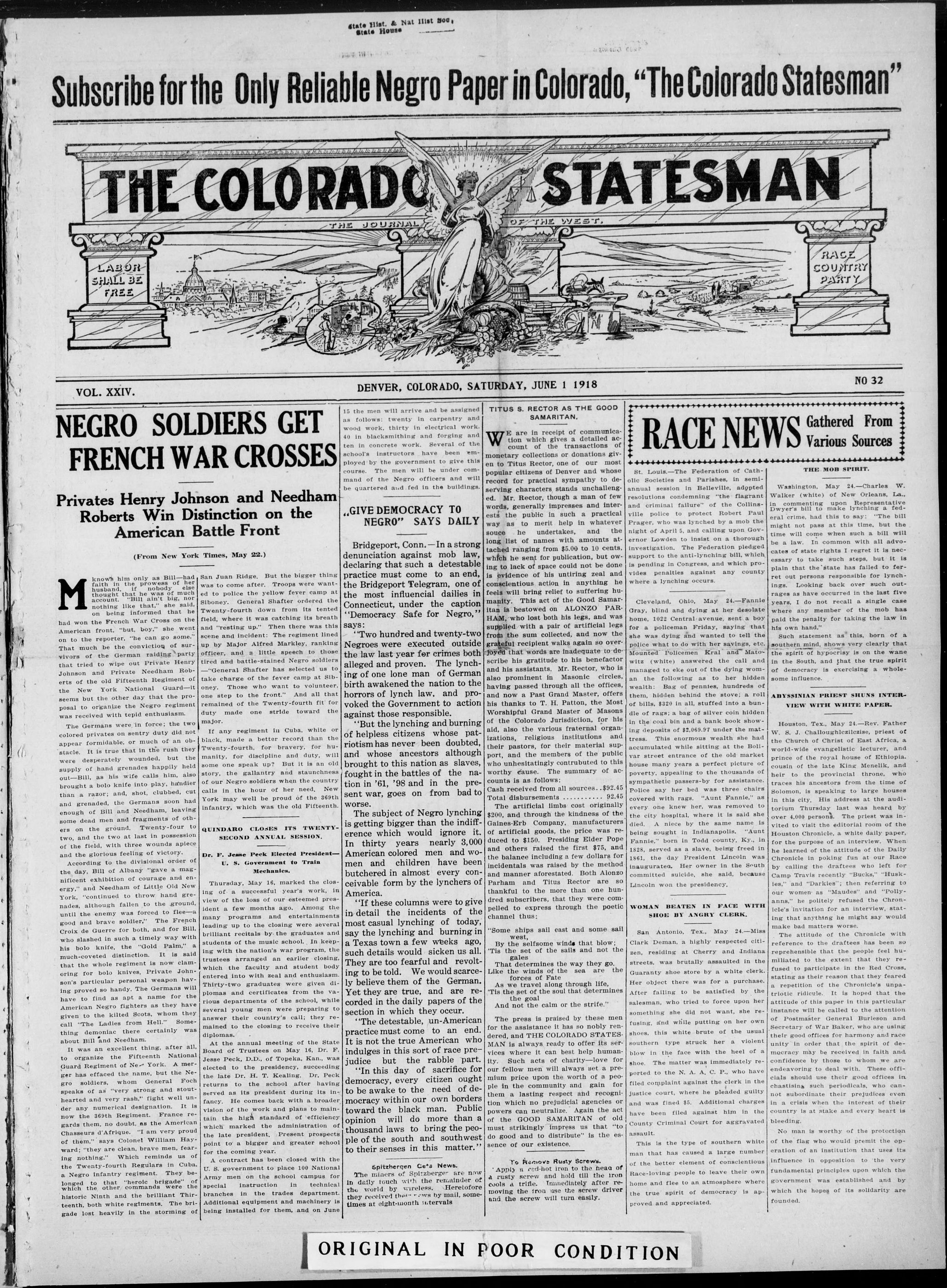
NEGRO SOLDIERS GET FRENCH WAR CROSSES
Privates Henry Johnson and Needham Roberts Win Distinction on the American Battle Front
(From New York Times, May 22.)
knows him only as Bill—had faith in the prowess of her husband, if nobody, else thought that he was of much account. "Bill ain't big, nor nothing like that," she said, on being informed that he had won the French War Cross on the American front, "but, boy," she went on to the reporter, "he can go some." That much be the conviction of survivors of the German raiding party that tried to wipe out Private Henry Johnson and Private Needham Roberts of the old Fifteenth Regiment of the New York National Guard—it seems but the other day that the proposal to organize the Negro regiment was received with tepid enthusiasm.
The Germans were in force; the two colored privates on sentry duty did not appear formidable, or much of an obstacle. It is true that in the rush they were desperately wounded, but the supply of hand grenades happily held out—Bill, as his wife calls him, also brought a bolo knife into play, handler than a razor; and, shot, clubbed, cut and grenaded, the Germans soon had enough of Bill and Needham, leaving some dead men and fragments of others on the ground. Twenty-four to two, and the two at last in possession of the field, with three wounds apiece and the glorious feeling of victory.
According to the divisional order of the day, Bill of Albany "gave a magnificent exhibition of courage and energy," and Needham of Little Old New York, "continued to throw hand grenades, although fallen to the ground, until the enemy was forced to flee—a good and brave soldier." The French Croix de Guerre for both, and for Bill, who slashed in such a timely way with his bolo knife, the "Gold Palm," a much-coveted distinction. It is said that the whole regiment is now clamoring for bolo knives, Private Johnson's particular personal weapon having proved so handy. The Germans will have to find as apt a name for the American Negro fighters as they have given to the kilted Scots, whom they call "The Ladies from Hell." Something demoniac there certainly was about Bill and Needham.
It was an excellent thing, after all, to organize the Fifteenth National Guard Regiment of New York. A merger has effaced the name, but the Negro soldiers, whom General Foch speaks of as "very strong and stout-hearted and very rash," fight well under any numerical designation. It is now the 369th Regiment. France regards them, no doubt, as the American Chasseurs d'Afrique. "I am very proud of them," says Colonel William Hayward; "they are clean, brave men, fearing nothing." Which reminds us of the Twenty-fourth Regulars in Cuba, a Negro infantry regiment. They belonged to that "heroic brigade" of which the other commands were the historic Ninth and the brilliant Thirteenth, both white regiments. The brigade lost heavily in the storming of
```markdown
```
VOL. XXIV.
San Juan Ridge. But the bigger thing was to come after. Troops were wanted to police the yellow fever camp at Siboney. General Shafter ordered the Twenty-fourth down from its tented field, where it was catching its breath and "resting up." Then there was this scene and incident: The regiment lined up by Major Alfred Markley, ranking officer, and a little speech to those tired and battle-stained Negro soldiers — "General Shafter has selected us to take charge of the fever camp at Siboney. Those who want to volunteer, one step to the front." And all that remained of the Twenty-fourth fit for duty made one stride toward the major.
If any regiment in Cuba, white or black, made a better record than the Twenty-fourth, for bravery, for humanity, for discipline and duty, will some one speak up? But it is an old story, the gallantry and staunchness of our Negro soldiers when the country calls in the hour of her need. New York may well be proud of the 369th infantry, which was the old Fifteenth.
QUINDARO CLOSES ITS TWENTY- SECOND ANNUAL SESSION.
Dr. F. Jesse Peck Elected President— U. S. Government to Train Mechanics.
Thursday, May 16, marked the closing of a successful year's work, in view of the loss of our esteemed president a few months ago. Among the many programs and entertainments leading up to the closing were several brilliant recitals by the graduates and students of the music school. In keeping with the nation's war program, the trustees arranged an earlier closing, which the faculty and student body entered into with zeal and enthusiasm. Thirty-two graduates were given diplomas and certificates from the various departments of the school, while several young men were preparing to answer their country's call; they remained to the closing to receive their diplomas.
At the annual meeting of the State Board of Trustees on May 16, Dr. F. Jesse Peck, D.D., of Topeka, Kan., was elected to the presidency, succeeding the late Dr. H. T. Kealing. Dr. Peck returns to the school after having served as its president during its infancy. He comes back with a broader vision of the work and plans to maintain the high standard of efficiency which marked the administration of the late president. Present prospects point to a bigger and greater school for the coming year.
A contract has been closed with the U. S. government to place 100 National Army men on the school campus for special instruction in technical branches in the trades department. Additional equipment and machinery is being installed for them, and on June
DENVER, COLORADO, SATURDAY, JUNE 1 1918
DENVER, COLORADO, SATURDAY, JUNE 1 1918
ORIGINAL IN POOR CONDITION
state Hist. & Nat Hist Soc.
state House
ble Negro Pap
ADO
THE JOURNAL
DENVER, COLORADO, SAT
15 the men will arrive and be assigned as follows: twenty in carpentry and wood work, thirty in electrical work. 40 in blacksmithing and forging and ten in concrete work. Several of the school's instructors have been employed by the government to give this course. The men will be under command of the Negro officers and will be quartered and fed in the buildings.
GIVE DEMOCRACY TO NEGRO" SAYS DAILY
Bridgeport, Conn. — In a strong denunciation against mob law, declaring that such a detestable practice must come to an end, the Bridgeport Telegram, one of the most influential dailies in Connecticut, under the caption "Democracy Safe for Negro," says:
"Two hundred and twenty-two Negroes were executed outside the law last year for crimes both alleged and proven. The lynching of one lone man of German birth awakened the nation to the horrors of lynch law, and provoked the Government to action against those responsible.
"But the lynching and burning of helpless citizens whose patriotism has never been doubted, and whose ancestors although brought to this nation as slaves, fought in the battles of the nation in '61, '98 and in the present war, goes on from bad to worse.
The subject of Negro lynching is getting bigger than the indifference which would ignore it. In thirty years nearly 3,000 American colored men and women and children have been butchered in almost every conceivable form by the lynchers of America.
'If these columns were to give in detail the incidents of the most casual lynching of today, say the lynching and burning in a Texas town a few weeks ago, such details would sicken us all. They are too fearful and revolting to be told. We would scarcely believe them of the German. Yet they are true, and are recorded in the daily papers of the section in which they occur.
"The detestable, un-American practice must come to an end. It is not the true American who indulges in this sort of race prejudice but the rabble part.
"In this day of sacrifice for democracy, every citizen ought to be awake to the need of democracy within our own borders toward the black man. Public opinion will do more than a thousand laws to bring the people of the south and southwest to their senses in this matter."
Spitzhergen Cets News.
The miners of Spitzberger are now in daily touch with the remainder of the world by wireless. Heretofore they received their news by mail, sometimes at eight-month intervals.
TITUS S. RECTOR AS THE GOOD
SAMARITAN.
WE are in receipt of communication which gives a detailed account of the transactions of monetary collections or donations given to Titus Rector, one of our most popular citizens of Denver and whose record for practical sympathy to deserving characters stands unchallenged. Mr. Rector, though a man of few words, generally impresses and interests the public in such a practical way as to merit help in whatever souce he undertakes, and the long list of names with amounts attached ranging from $5.00 to 10 cents, which he sent for publication, but owing to lack of space could not be done is evidence of his untiring zeal and conscientious action in anything he feels will bring relief to suffering humanity. This act of the Good Samaritan is bestowed on ALONZO PARHAM, who lost both his legs, and was supplied with a pair of artificial legs from the sum collected, and now the grateful recipient walks again so overjoyed that words are inadequate to describe his gratitude to his benefactor and his assistants. Mr. Rector, who is also prominent in Masonic circles, having passed through all the offices, and now a Past Grand Master, offers his thanks to T. H. Patton, the Most Worshipful Grand Master of Masons of the Colorado Jurisdiction, for his aid, also the various fraternal organizations, religious institutions and their pastors, for their material support, and the members of the public who unhesitatingly contributed to this worthy cause. The summary of accounts is as follows:
Cash received from all sources. $92.45
Total disbursements ..... 92.45
The artificial limbs cost originally
$200, and through the kindness of the
Gaines-Erb Company, manufacturers
of artificial goods, the price was
reduced to $150. Presiding Elder Pope
and others raised the first $75, and
the balance including a few dollars for
incidentals was raised by the method
and manner aforestated. Both Alonzo
Parham and Titus Rector are so
thankful to the more than one hundred
subscribers, that they were compelled
to express through the poetic
channel thus:
"Some ships sail east and some sail
west,
By the selfsome winds that blow;
Tis the set of the sails and not the
gales.
That determines the way they go. Like the winds of the sea are the forces of Fate
forces of Fate
As we travel along through life,
Tis the set of the soul that determines
the goal
And not the calm or the strife."
The press is praised by these men for the assistance it has so nobly rendered, and THE COLORADO STATESMAN is always ready to offer its services where it can best help humanity. Such acts of charity—love for our fellow men will always set a premium price upon the worth of a people in the community and gain for them a lasting respect and recognition which no prejudicial agencies or powers can neutralize. Again the act of the GOOD SAMARITAN of old must strikingly impress us that "to do good and to distribute" is the essence of our existence.
To Remove Rusty Screws.
Apply a red-hot iron to the head of a rusty screw and hold till the iron cools a trifle. Immediately after removing the iron use the screw driver and the screw will turn easily.
RACE NEWS Gathered From Various Sources
St. Louis.-The Federation of Catholic Societies and Parishes, in semiannual session in Belleville, adopted resolutions condemning "the flagrant and criminal failure" of the Collinsville police to protect Robert Paul Prager, who was lynched by a mob the night of April 5, and calling upon Governor Lowden to insist on a thorough investigation. The Federation pledged support to the anti-lynching bill, which is pending in Congress, and which provides penalties against any county where a lynching occurs.
Cleveland, Ohio, May 24.—Fannie Gray, blind and dying at her desolate home, 1022 Central avenue, sent a boy for a policeman Friday, saying that she was dying and wanted to tell the police what to do with her savings, etc. Mounted Policemen Kral and Matowitz (white) answered the call and managed to eke out of the dying woman the following as to her hidden wealth: Bag of pennies, hundreds of them, hidden behind the stove; a roll of bills, $320 in all, stuffed into a bundle of rags; a bag of silver coin hidden in the coal bin and a bank book showing deposits of $2,069.97 under the mattress. This enormous wealth she had accumulated while sitting at the Bolivar street entrance of the old market house many years a perfect picture of poverty, appealing to the thousands of sympathetic passers-by for assistance. Police say her bed was three chairs covered with rags. "Aunt Fannie," as every one knew her, was removed to the city hospital, where it is said she died. A niece by the same name is being sought in Indianapolis. "Aunt Fannie," born in Todd county, Ky., in 1828, served as a slave, being freed in 1861, the day President Lincoln was inaugurated. Her owner in the South committed suicide, she said, because Lincoln won the presidency.
WOMAN BEATEN IN FACE WITH
SHOE BY ANGRY CLERK.
San Antonio, Tex., May 24.—Miss Clark Deman, a highly respected citizen, residing at Cherry and Indiana streets, was brutally assaulted in the Guaranty shoe store by a white clerk. Her object there was for a purchase. After failing to be satisfied by the salesman, who tried to force upon her something she did not want, she refusing, and while putting on her own shoes, this white brute of the usual southern type struck her a violent blow in the face with the heel of a shoe. The matter was immediately reported to the N. A. A. C. P., who have filed complaint against the clerk in the justice court, where he pleaded guilty and was fined $5. Additional charges have been filed against him in the County Criminal Court for aggravated assault.
This is the type of southern white man that has caused a large number of the better element of conscientious Race-loving people to leave their own home and flee to an atmosphere where the true spirit of democracy is approved and appreciated.
NO 32
Washington, May 24.—Charles W. Walker (white) of New Orleans, La., in commenting upon Representative Dwyer's bill to make lynching a federal crime, had this to say: "The bill might not pass at this time, but the time will come when such a bill will be a law. In common with all advocates of state rights I regret it is necessary to take such steps, but it is plain that the 'state has failed to ferret out persons responsible for lynchings. Looking back over such outrages as have occurred in the last five years, I do not recall a single case where any member of the mob has paid the penalty for taking the law in his own hand."
Such statement as this, born of a southern mind, shows very clearly that the spirit of hypocrisy is on the wane in the South, and that the true spirit of democracy is exercising a wholesome influence.
ABYSSIANIAN PRIEST SHUNS INTERVIEW WITH WHITE PAPER.
Houston, Tex., May 24.—Rev. Father W. S. J. Challoughlcizcilzise, priest of the Church of Christ of East Africa, a world-wide evangelistic lecturer, and prince of the royal house of Ethiopia, cousin of the late King Menelik, and heir to the provincial throne, who traces his ancestors from the time of Solomon, is speaking to large houses in this city. His address at the auditorium Thursday last was heard by over 4,000 persons. The priest was invited to visit the editorial room of the Houston Chronicle, a white daily paper, for the purpose of an interview. When he learned of the attitude of the Daily Chronicle in poking fun at our Race by calling the draftees who left for Camp Travis recently "Bucks," "Huskies," and "Darkles"; then referring to our women as "Maudes" and "Polly-anns," he politely refused the Chronicle's invitation for an interview, stating that anything he might say would make bad matters worse.
The attitude of the Chronicle with reference to the draftees has been so reprehensible that the people feel humiliated to the extent that they refused to participate in the Red Cross, stating as their reason that they feared a repetition of the Chronicle's unpatriotic ridicule. It is hoped that the attitude of this paper in this particular instance will be called to the attention of Postmaster General Burleson and Secretary of War Baker, who are using their good offices for harmony and race unity in order that the spirit of democracy may be received in faith and confidence by those to whom we are endeavoring to deal with. These officials should use their good offices in chastising such periodicals, who cannot subordinate their prejudices even in a crisis when the interest of their country is at stake and every heart is bleeding.
No man is worthy of the protection of the flag who would premit the operation of an institution that uses its influence in opposition to the very fundamental principles upon which the government was established and by which the hopes of its solidarity are founded.
FOREIGN
The butter ration was increased in London from four to five ounces weekly.
"We must retain Belgium economically, politically, and militarily," said Admiral von Tirpitz, former German minister of marine, in an address at Dusseldorf.
Travelers arriving at Zurich from Germany declared that discontented Bulgarian soldiers attacked Emperor Charles' train after it had left Constantinople.
Former Ukrainian Minister of Agriculture Kovowski has absconded from Ukraine with 5,000,000 rubles of Germany's money, said a dispatch received at Zurich.
Fifteen German airplanes have been destroyed by British aviators and three others driven down out of control, according to the British official communication on aviation, issued May 28.
Major Baracca, the leading Italian ace, has brought down his thirty-second adversary, according to a dispatch from the Italian front to the Paris Temps. He shot down the leading airplane of an enemy squadron.
The accuracy of the American artillery fire on the Picardy front is proved by information that eight out of ten German batteries which have been active in bombing the American positions have been destroyed by the American artillerymen since their entry into this sector. Aerial photographs show that direct hits were obtained in most instances.
Aged French women in the villages in the rear of the American sector in Picardy have asked and received permission to take care of one or more graves of American soldiers. This tribute is all the more impressive because it comes from peasant women, most of whom have been robbed of their husbands and sons by the war and have had a hard time to sustain themselves.
A mysterious epidemic is sweeping the whole of Spain, the London Express learns from its Madrid correspondent. It is estimated 40 per cent of the population is affected by the disease, which is paralyzing the country's industries. King Alfonso is confined to his bed. It is feared he has fallen a victim to the plague. The disease is described as similar to influenza, the it differs in that victims are seized by sudden fits.
Fred Duncan of Littleton, a well known long-distance runner, has entered the Denver-Littleton marathon to be held June 8.
John J. Fitzgerald, former handball champion of Colorado and the west, died at Pueblo from injuries received in a fall. For many years Fitzgerald conducted a small place on California street near Cherry creek in Denver where he maintained a handball court, and where the players of the West made headquarters.
Trompe La Morte, a French-bred 3 year-old chestnut colt, by Verwood Marsa, owned by J. E. Widener of Philadelphia, won the Metropolitan handicap over the Belmont park race track in New York in 1:38 2-5. Old Koenig ran second and Priscilla Mulens third. Omar Khayyam, the favorite, ran sixth. The result was unlooked for, as it was believed that Omar Khayyam, valued at $200,000 by his owner a few days ago, with Roam er and Old Koenig, would divide the honors and money between them. The stake had a guaranteed value of $5,000.
GENERAL
The Athletic Carnival at Broadway Park in Denver for the benefit of the Red Cross was attended by 8,000 people and $5,000 realized for the worthy fund.
Warren S. Stone, grand chief of the Brotherhood of Engineers, was reelected by acclamation for a term of six years by the delegates at the Cleveland, Ohio, session of the biennial convention.
Ten steel vessels, totaling 63,486 tons, were completed for the shipping board in the week ending May 25. There were eighteen launchings during the week of a total tonnage of 109,700.
The Red Cross second war fund Saturday passed the $100,000,000 minimum total mark, and telegrams announcing subscriptions continued to flow into national headquarters at a rate that swamped the compilers.
Final figures on the second American Red Cross $100,000,000 war mercy fund still incomplete, but on the face of latest returns the fund was over-subscribed $48,833,367. Figures yet to be received were expected to carry the total to $150,000,000.
The British military cross has been awarded to eleven American officers and four men. Most of the officers took part in the defense of the Luce valley during the great German attack in March, being incorporated in the improvised army of Major General Carey, which held back the Germans for six days after they had broken thru the British line in the region of St. Quentin.
Field Marshal Haig, telegraphing his congratulations to Queen Mary upon her birthday, expressed the confidence that before the queen's next birthday the hopes for the successful termination of the war will have been realized. The queen, thanking the British generalissimo, re-echoed his hope.
Orders for 8,000 three- to five-ton motor trucks have been placed with fifteen automobile manufacturers the War Department announced. This is in addition to 10,000 similar trucks now being delivered.
NEWS TO DATE IN PARAGRAPHS
CAUGHT FROM THE NETWORK OF WIRES ROUND ABOUT THE WORLD.
DURING THE PAST WEEK
RECORD OF IMPORTANT EVENTS
CONDENSED FOR BUSY
The German long-range bombardment of Paris was resumed May 27.
On the Locre-Voormezeele front the French troops repulsed the enemy with great loss.
The Germans have seized and taken into Swinemunde the Dutch steamship Jantje and sailing vessels Maria, Jacoba and Gerzine.
In a battle a mile above the ground, an American pursuit plane shot down an enemy biplane about Essey, within the German lines on the Toul front.
The Germans have succeeded in shifting the concrete laden cruiser Vindictive, sunk in the harbor of Ostend on May 10 by British raiding forces.
The Germans Monday forced passage of the Aisne river west of the British sector, compelling the left of the British line to fall back, the London war office announced.
In the aerial activity the American airmen are taking an increasing part, and it now develops that in the Toul sector held by the American army an exclusively American pursuit squadron is operating with marked success.
When the battle of Flanders died down Monday night the situation on the right and center of the front attacked remained virtually as before. The heaviest fighting occurred opposite Ouderdem, where the French took two woods near Dickebusch.
Heavy counter attacks by the French troops stopped the German advance on the heights of Neuville-Sur Margival and Vregny, northeast of Soissons, and other heights dominating the valley of the Vesle river, according to the Paris war office statement.
Strong German attacks developed early Monday morning against the British and French positions between Rheims and Soissons, the London war office announces. The attacks were preceded by a heavy bombardment, The Germans also attacked Monday morning in Flanders between Locre and Voormezeele, on the northern side of the salient.
Southwest of Ypres the enemy received hard usage at the hands of the British and French east of Dickebusch lake, where Monday the Germans in an attack had gained ground. The British and French succeeded Tuesday in completely nullifying the enemy's maneuver. In the Italian theater the Italians are keeping up their offensive against the Austrians. At Capo Sile, near the Adriatic coast, the Italians penetrated the enemy lines more than 750 yards.
WESTERN
Three were killed and one seriously injured when a Fort Worth & Denver northbound freight train ran into a washout six miles south of Memphis, Tex.
Thomas P. Harte, a young Douglas, Ariz., attorney, was found six miles east of Tombstone with a bullet wound in his right temple, from the effect of which, two hours later, he died.
The third earthquake shock felt in Santa Fe, N. M., since 1874 occurred at 5:30 o'clock Tuesday morning, May 28, and was heavy enough to shake plaster off walls of houses.
WASHINGTON
American troops in Picardy attacked Tuesday morning on a front of one and a quarter miles, captured the village of Cantigny, took 200 prisoners and inflicted severe losses in killed and wounded on the enemy, says General Pershing's communique made public at the War Department. The American casualties were relatively small.
To meet wage increases just announced and higher cost of coal and other supplies this year Director General McAdoo ordered railroad freight rates in the United States raised 25 per cent, and passenger fares increased to 3 cents a mile from the present basis of about $2½ cents. It is estimated that the program will bring between $800,000,000 and $900,000,000 more revenues to the railroads within the next year. It represents by far the biggest rate increase in the history of railroads.
One union express company for the United States was created by agreement between Director General McAdoo and the Adams, American, Wells-Fargo and Southern Express companies, whose transportation business will be merged July 1 under a new private corporation with capital of more than $30,000,000, to be known probably, as the Federal Express Company. Director General McAdoo announced that soldiers would be carried on the American railroads for the duration of the far at the rate of 1 cent a mile.
SPORT
Answering the call of conservation county food administrators from all parts of Colorado, gathered in Denver at the Brown Palace hotel May 9.
Thomas B. Stearns, federal food administrator for Colorado, presided.
E. F. Cullen, personal field representative of Herbert Hoover, attended the meeting.
Ideas presented by the conference representatives follow:
Adams—H. G. Tiffany—"When we found out that some of the people were not patriotic, a plain invitation was issued to them to become patriotic. A rope was carried, not as a threat, but as a reminder."
Alamosa—D. A. Norton—"We have 950 families enrolled under the pledge card system and all of our merchants are working together.
Arapahoe—J. E. Mitchell—"I have utilized the shorthand and typewriting classes in the high schools to help get out circulars and rulings."
Baca—F. L. Harris—"There is a larger wheat area by five times than ever before and it looks fine."
Bent—L. E. Thompson—"The farmers don't seem to understand the food regulations. There's lots of wheat in Bent."
Chaffee—W. L. Philbin—"By a system in our retail stores telephone orders that come in one day are not delivered until the next. It works fine."
Crowley—John H. Cowden—"When ever I have anyone I can't reach I call on the people who can best afford to spend money for gasoline."
Custer—B. C. Briggs—"We have a large German settlement, but the members all claim to be patriotic. If they are not it is from ignorance."
Delta—George Stephan—"I have been compelled to fine three merchants during the past three months. I turned it, over to Red Cross."
Douglas—W. L. Fales—"I want people to have confidence in this Administration. I want them to fear it."
Eagle—T. J. Dice—"Our merchants have been very satisfactory."
Elbert—C. B. Corkett—"Elbert county has had very few violations of food laws."
El Paso—E. A. Swenson—"We have an Advisory Council of nine merchants. We have a speakers bureau and a Motor staff who work together."
Fremont—Guy U. Hardy—"The only food complaints that we have are from our Italians and Syrians, who run stores. They do not know what is expected of them."
Garfield — Ed. McLearn—"We are having some difficulty in getting people to buy substitutes at the high price."
Gilpin—B. E. Seymour—"We got in 450 pledge cards and had four refusals."
Grand—Lew Wallace—"The people complain of the price of substitutes. They think the Food Administration should take care of this matter."
Gunnison—E. L. Sargent—"The Normal School is co-operating in every way possible. Two hours a week are devoted to Food Administration work. Huerfano—George Blickhahn—"We have boosted increase in acreage until the wheat area will be much larger than last year." Jackson—W. H. Winscom—"Our county is difficult to get around in. Some of the farmers in reporting their flour have written, 'If you want it come and get it.'" Kit Carson—Wyat Boger—"We are boosting state fairs as a war measure." Lake—Joseph Clarke—"Our population is from every part of the world except China. They keep food regulations." Las Animas—George Mason—"On the start of the flour rulings, we had bootleggers in flour, delivering to the foreigners. I fined one and now the merchants are working fine."
Lincoln—Ed. Riekenburg — "We're organized; crops are fine and the farmers are marketing their grain and the people report their flour."
Mesa—D. B. Wright—"Our people have been eating peeled potatoes, but we will eat them skins and all if necessary."
Moffat—W. H. Tucker—"Much of the time we had no substitutes and had to use flour. Once we had substitutes and no flour."
Morgan—James Hurley—"There is only one way to handle flour—let the Government take the flour if they need it—take all of it, then all the people would be good."
Montrose—Dr. Samuel H. Bell—We produce wool enough to supply our own clothing and some for soldiers."
Otero—J. L. Weaver—"We carry out to the letter every rule of the food administration."
Ouray—William Rathmell—"I feel safe to say that the Food Administration can count on the Ouray county."
Pitkin—L. A. W. Brown—"A merchant's inventory of flour and sugar keeps consumers from getting more than allowed."
Prowera—Ray Strain—"Our people are very patriotic. Send instructions and they will be carried out."
Pueblo—John F. Vall—"The substitute flour rule got us into trouble. We had a meeting and made the purchase of substitutes necessary for both retailer and consumer."
Routt—S. I. Hoklas—"People as a rule are willing to comply with regulations which they understand."
Saguache—Frank H. Means—"We are having very little trouble."
San Juan—H. E. Curran—The Food Administration is very thorough and compact. I am it. We have no serious problems."
Sedgwick—George S. Kinsman—"Our people feel that if Uncle Sam needs flour we can eat corn meal."
Summit—George Robinson—"There is no question about the patriotism of Summit county."
Washington-J. F. Johnson—"Washington ships more eggs than any other county and I have only had two people ask me for the privilege of serving wheat to chicks."
Counties not reporting were Archuleta, Boulder, Cheyenne, Conejos, Costilla, Jefferson, Kiowa, La Plata, Larimer, Logan, Montezuma, Park, Phillips, Teller, Weld and San Miguel. Clear Creek Yuma and Hinadada."
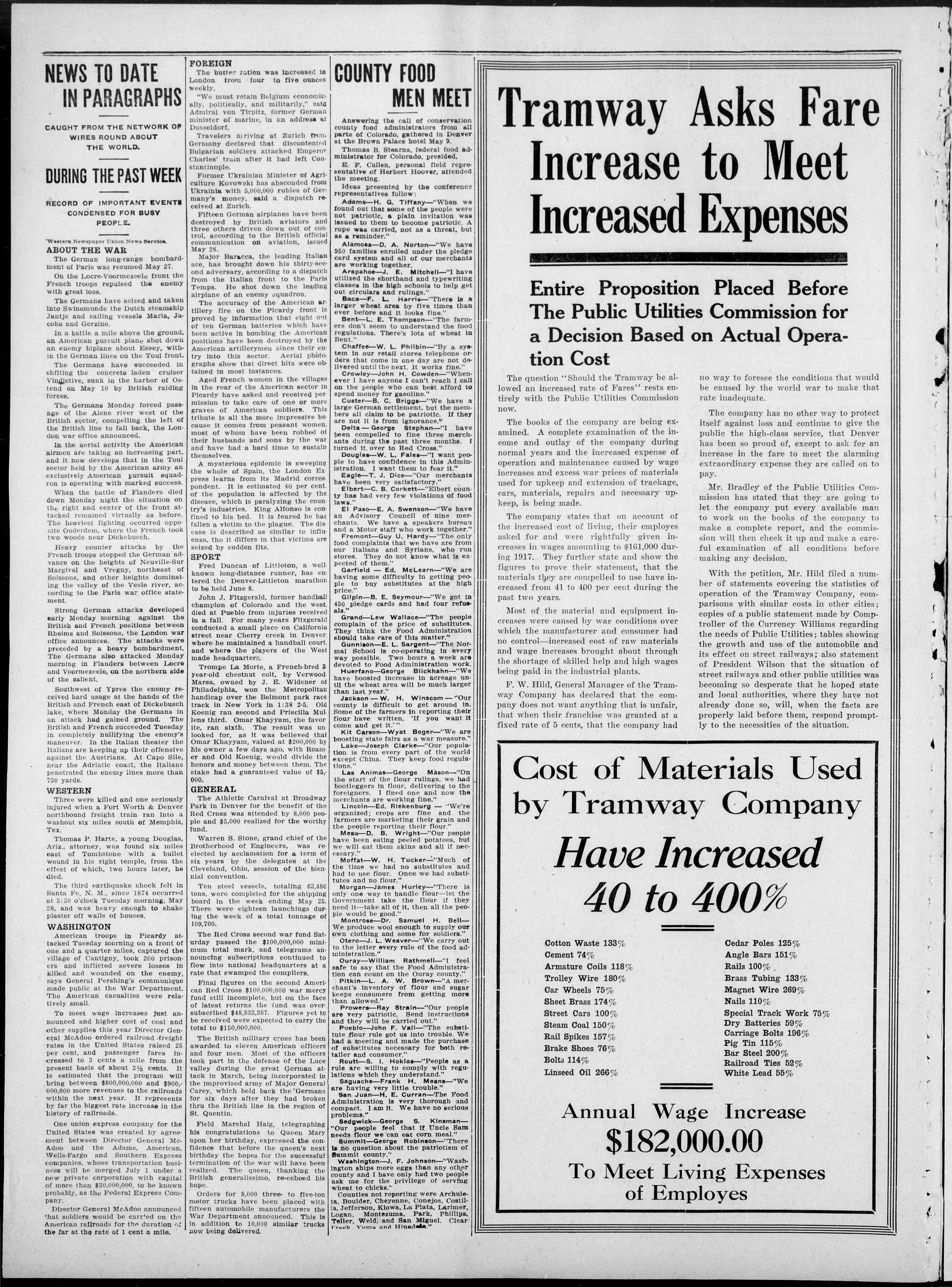
Tramway Asks Fare Increase to Meet Increased Expenses
Entire Proposition Placed Before The Public Utilities Commission for a Decision Based on Actual Operation Cost
Cost of Materials Used by Tramway Company Have Increased 40 to 400%
The question "Should the Tramway be allowed an increased rate of Fares" rests entirely with the Public Utilities Commission now.
The books of the company are being examined. A complete examination of the income and outlay of the company during normal years and the increased expense of operation and maintenance caused by wage increases and excess war prices of materials used for upkeep and extension of trackage, cars, materials, repairs and necessary upkeep, is being made.
The company states that on account of the increased cost of living, their employees asked for and were rightfully given increases in wages amounting to $161,000 during 1917. They further state and show the figures to prove their statement, that the materials they are compelled to use have increased from 41 to 400 per cent during the past two years.
Most of the material and equipment increases were caused by war conditions over which the manufacturer and consumer had no control—increased cost of raw materials and wage increases brought about through the shortage of skilled help and high wages being paid in the industrial plants.
F. W. Hild, General Manager of the Tramway Company has declared that the company does not want anything that is unfair, that when their franchise was granted at a fixed rate of 5 cents, that the company had
Cotton Waste 133%
Cement 74%
Armature Coils 118%
Trolley Wire 180%
Car Wheels 75%
Sheet Brass 174%
Street Cars 100%
Steam Coal 150%
Rail Spikes 157%
Brake Shoes 76%
Bolts 114%
Linseed Oil 266%
no way to foresee the conditions that would be caused by the world war to make that rate inadequate.
The company has no other way to protect itself against loss and continue to give the public the high-class service, that Denver has been so proud of, except to ask for an increase in the fare to meet the alarming extraordinary expense they are called on to pay.
Mr. Bradley of the Public Utilities Commission has stated that they are going to let the company put every available man to work on the books of the company to make a complete report, and the commission will then check it up and make a careful examination of all conditions before making any decision.
With the petition, Mr. Hild filed a number of statements covering the statistics of operation of the Tramway Company, comparisons with similar costs in other cities; copies of a public statement made by Comptroller of the Currency Williams regarding the needs of Public Utilities; tables showing the growth and use of the automobile and its effect on street railways; also statement of President Wilson that the situation of street railways and other public utilities was becoming so desperate that he hoped state and local authorities, where they have not already done so, will, when the facts are properly laid before them, respond promptly to the necessities of the situation.
Cedar Poles 125%
Angle Bars 151%
Rails 100%
Brass Tubing 133%
Magnet Wire 269%
Nails 110%
Special Track Work 75%
Dry Batteries 59%
Carriage Bolts 196%
Pig Tin 115%
Bar Steel 200%
Railroad Ties 52%
White Lead 55%
Pithy News Notes From All Parts of Colorado
Western Newspaper Union News Service.
COMING EVENTS.
July 8-13—Meeting National Association of Colored Women in Denver.
July 16—Republican State Convention at Colorado Springs.
Sept. 23-28—Colorado State Fair at Pueblo.
Allison Stocker of Denver is a candidate for governor.
Drilling for oil at Ayer, south of La Junta, has been resumed.
Hayden, Routt county, has dedicated a new railroad station.
Lester J. Barkhausen of Denver has reported at Fort Logan for service in the army.
A string of 471 lambs, averaging 77 pounds, sold on the Denver market at $19.15 per cwt.
First operations of the season in canning were begun at Cañon City, starting on spinach.
H. R. Welter of Denver has been appointed assistant secretary of the State Council of Defense. Potato and onion sacks are becoming extremely scarce and high prices are being charged for them. Two knitted quilts that sixteen Denver school girls had made, netted the Red Cross $750 at an auction. At the close of the Red Cross campaign it was announced that Coloradoans had contributed $1,353,433. Grand Junction is building a "Great White Way," and new ornamental light posts have been erected there.
Harry Smith, who was severely injured in an explosion at a mine at Silver Plume, died at a Denver hospital.
The Four-Minute Men of Colorado addressed almost a half million people during their Third Liberty Loan drive.
Rev. E. W. D. Garmon of Pueblo has been assigned the pastorate of the Mount Zion Baptist church, colored, at La Junta.
The new Phantom canon road out of Cañon City is having three new bridges built ranging in length from 150 to 180 feet.
A vast crowd gathered in the Auditorium in Denver, Sunday, to pay tribute to the memory of the city builder, Robert W. Speer.
Adams county is arranging to spend $10,000 on constructing bridges at Kiowa and Clear creek, and improving the Brighton road.
Rev. E. H. Babcock, a homesteader on North fork, near Craig, has assumed the pastorate of the Congregational church at Maybell.
Colorado shippers have made quick response to an appeal by State Oll Inspector Duce for prompt unloading of tank cars and oil barrels.
Instructions for the registration of all German alien females in this federal district were received by United States Marshal Samuel J. Burris.
At Fort Collins, the stores all closed in order that all might join in bidding Godspeed to forty-three draft men who left for Camp Cody at Deming, N. M.
Wolf Park coal mine, south of Cañon City, has just been equipped with the biggest electric hoist in the state. The machine weighs 122,000 pounds, and can lift a ton of coal every minute.
Horace N. Hawkins succeeds J. A. Burnett as Denver councilman. When W. F. R. Mills succeeded the late Robert W. Speer as mayor, he named Councilman Burnett manager of improvements and parks.
Senator John F. Shafroth has taken up with Secretary of War Baker the demands of Fort Logan for new buildings and a heavy appropriation for improvements, made necessary for its larger use as a receiving base.
The "golden fleece" sheared from the White House sheep and sent to the governor by President and Mrs. Wilson to be auctioned off for the benefit of the Colorado Second Red Cross War Fund campaign, arrived in Denver and $340 has already been bid for it.
The total eclipse of the sun which will occur the afternoon of June 8, is attracting professors and astronomers from all parts of the country. A number have already arrived and have stationed themselves in the mountains and at other advantageous points for observation.
All cases of anthrax or other contagious disease among cattle must be reported to Charles G. Lamb, state veterinarian at the capitol building as soon as detected in compliance with a new order issued in an effort to check the spread of any infection that might tend to cause loss of livestock.
A Denver & Rio Grande freight train was wrecked in the Royal Gorge and seventeen freight cars are reported to have been turned over into the river.
The Colorado Springs Light, Heat and Power Company was granted permission to increase gas and electric light rates by the Colorado Public Utilities Commission.
The Red Cross campaign closed at Longmont with a whirlwind campaign through the city. The total given in the drive is $22,000 and the town's quota was $13,000.
According to figures given out at the Denver land office, Colorado leads in homestead entries made during the past month. There were designated for entry in tracts of 320 acres 100,192 acres in Colorado; Washington was second with 81,917 acres taken up, while Montana is third with 79,862 acres designated. Wyoming furnished eighty acres. The total during the month for the seven states is 434,539 acres—hence Colorado lands taken up constitutes one-fourth of the total. In classification work under the stock raising act resulting in designation for entry in tracts of 640 acres, Colorado stood second in a group of four states. In Colorado 447,620 acres were taken up.
Magdelen Hartman, 17, a member of the junior class at East Denver high school and daughter of Mr. and Mrs. B. A. Hartman, probably will be crippled for life as the result of injuries received on the Fourteenth street viaduct when a motor truck carrying a party of high school students returning from a beefstead "fry" in Bear Creek canon was "sideswiped" by another truck, and both her legs fractured. Ellen Sharp, 16, daughter of Mrs. Ellen B. Sharp; Gerald Aymer, 18, president of the senior class of the Denver Manual Training high school, also were injured, but less seriously.
Governor Gunter has appointed a committee headed by Engineer John E. Field of the State Land Board to bring about more efficient use of irrigation waters as a means of increasing food production. State Engineer McCune and Prof. E. B. House, of the Agricultural College, are the other members. They have made nine suggestions for better use of water and have asked that conferences between water officials and consumers be held in the different irrigation districts.
After, it is alleged, he had declared Ben. J. Salmon of Denver did right in refusing to go to war, and remarking that he considered Fort Collins residents fools for being so patriotic, a man giving his name as George Rogers, Denver piano salesman, was struck on the jaw by Elmer I. Cooke, sheriff of Larimer county, begged to fight, and finally escorted to the Fort Collins depot and forced to leave town.
In Telluride mine district the bonus system has been discontinued and the flat scale is now paid by the Tomboy, Smuggler, Belmont, Humboldt, Liberty and Primos companies, as follows: Machine men in drifts, $4.75; machine men in stopes, $4.50; timber men, $4.50; timber men helpers, trammers, shovelers, track men and miscellaneous mine labor, $4. Board at company houses continues to be $1 per day.
The official call for the Republican state assembly, to be held on the morning of July 16 in Colorado Springs, was sent to county chairmen and others by John F. Vivian, chairman, and L. E. Girard, secretary, of the Republican state central committee. The apportionment of delegates from the various counties is 913, according to the call.
The University of Colorado is building an engineering shops building to be able to house and train drafted men for the army after school opens again next September. Two hundred and fifty drafted men are now being trained at the university. Among the survivors of the Moldavia, which was torpedoed in the English channel is Charles Ross of Denver. Ross is a corporal in company B, Fifty-eighth infantry. Fifty-six members of Ross' company lost their lives when the vessel went down. The largest contingent of men that has left Fort Morgan since the departure of Company I, entrained for Camp Cody, near Deming, N. M. There were forty-five boys, and a large crowd assembled at the station to pay them tribute.
At the semi-annual meeting of the State Board of Agriculture, held at the Agricultural College at Fort Collins, the resignation of Mrs. J. B. Belford was accepted, and J. S. Calkins of the Westminster district was elected to succeed her.
The executive committee of the State Council of Defense will keep in constant touch with the state manufacturers to aid them in transferring their work from non-essential industries to essential war work.
Lee Smith, convicted at a recent term of the District Court for an assault on Mary Pelc, an Austrian girl who is crippled, was sentenced by Judge J. Ed Rizer of Pueblo to the state penitentiary for life.
"There never was a brighter outlook for fruit in Pueblo county than right now; in fact the prospects were never nearly so bright before," said County Horticulturist J. N. Salter after a tour of the entire fruit raising localities of the county.
Denver will vote on a proposition to issue $13,970,000 bonds to buy the water works.
Increased crop production this year already is making heavy demands upon reservoirs and irrigation ditches for water to mature the grains and fruit and the pooling of the interests of water users to prevent shortage is being suggested by a state committee on water conservation.
The employés of the Great Western Sugar Company at Fort Morgan gave the Red Cross nearly seven times the amount asked of them. The allotment was $272.50, and the men subscribed $1,605.50. The factory at this point eighteen stars on its service flag.
NEWWARTAXLAWS
ASKED BY PRESIDENT WILSON IN ADDRESS BEFORE JOINT SESSION OF CONGRESS.
TO LEVY TAXES AT ONCE
Would Place Burden of Struggle on Large Incomes, War Profits and Luxuries, and Declares America's Great Opportunity Is at Hand.
Western Newspaper Union News Service.
Washington, May 28. — President Wilson personally took charge of the war tax legislation Monday, and appearing unexpectedly before a joint session of Congress, declared it was necessary to proceed immediately with new war tax laws.
The President's address in full follows:
"Gentlemen of the Congress:
"Gentlemen of the Congress:
"It is with unaffected reluctance that I come to ask you to prolong your session long enough to provide more adequate resources for the treasury for the conduct of the war. I have reason to appreciate as fully as you do how arduous the session has been. Your labors have been severe and protracted.
"You have passed a long series of measures which required the debate of many doubtful questions of judgment and many exceedingly difficult questions of principle as well as of practice. The summer is upon us in which labor and counsel are twice arduous and are constantly apt to be impaired by lassitude and fatigue.
"The elections are at hand, and we ought as soon as possible to go and render an intimate account of our trusteeship to the people who delegated us to act for them in the welgity and anxious matters that crowd upon us in these days of critical choice and action.
Must Do Our Duty.
"But we dare not go to the elections until we have done our duty to the full. These are days when duty stands stark and naked and even with closed eyes we know it is there. Excuses are unavailing. We have either done our duty or we have not. The fact will be as gross and plain as the duty itself. In such a case lassitude and fatigue seem negligible enough. The facts are tonic and suffice to freshen the labor.
"And the facts are these; Additional revenues must manifestly be provided for. It would be a most unsound policy to raise too large a proportion of them by loan, and it is evident that the four billions now provided for by taxation will not of themselves sustain the greatly enlarged budget to which we must immediately look forward.
"We cannot in fairness wait until the end of the fiscal year is at hand to appraise our people of the taxes they must pay on their earnings of the present calendar year, whose accounts and expenditures will then be closed. We cannot get increased taxes unless the country knows what they are to be and practices the necessary economy to make them available.
"Definiteness, early definiteness as to what its tasks are to be is absolutely necessary for the successful administration of the treasury; it cannot frame fair and workable regulations in haste; and it must frame its regulations in haste if it is not to know its exact task until the very eve of its performance. The present tax laws are marred, moreover, by inequities which ought to be remedied. Indisputable facts, every one; and we cannot alter or blink them. To state them is argument enough.
Warns Against Speculation and Waste.
"And yet perhaps you will permit me to dwell for a moment upon the situation they disclose. Enormous loans freely spent in the stimulation of industry of almost every sort produce inflations and extravagances which presently make the whole economic structure questionable and insecure and the very basis of credit is cut away. Only fair, equitably distributed taxation of the widest incidence and drawing chiefly from the sources which would be likely to demoralize credit by their very abundance, can prevent inflation and keep our industrial system free of speculation and waste.
"We shall naturally turn, therefore, I suppose, to war profits and incomes and luxuries for the additional taxes. But the war profits and incomes upon which the increased taxes will be levled will be the profits and incomes of the calendar year 1918. It would be manifestly unfair to wait until the early months of 1919 to say what they are to be. It might be difficult, I should imagine to run the mill with water that had already gone over the wheel.
"Moreover taxes of that sort will not be paid until the June of next year and the treasury must anticipate them. It must use the money they are to produce before it is due. It must sell short time certificates of indebtedness.
"In the autumn, a much larger sale of long time bonds must be effected than has yet been attempted. What are the bankers to think of the certificates if they do not certainly know where the money is to come from which is to take them up? And how are investors to approach the purchase of bonds with any sort of confidence or knowledge of their own affairs if they do not know what taxes they are to pay and what economies and adjustments of their business they must effect? I cannot assure the country of a successful administration of the treasury in 1918 if the question of further taxation is to be left unacceded until 1919.
We Are at Peak and Crisis of the War.
"The consideration that dominates
every other now and makes every other seem trivial and negligible, is the winning of the war. We are not only in the midst of the war; we are at the very peak and crisis of it. Hundreds of thousands of our men, carrying our hearts with them and our fortunes are in the field and ships are crowding faster and faster to the ports of France and England with regiment after regiment, thousand after thousand, to join them until the enemy shall be beaten and brought to a reckoning with mankind.
"There can be no pause or intermission. The great enterprise must on the contrary be pushed with greater and greater energy. The volume of our might must steadily and rapidly be augmented until there can be no question of resisting it. If that is to be accomplished, gentlemen, money must sustain it to the utmost.
"Our financial program must no more be left in doubt or suffered to lag than our ordinance program or our ship program or our munitions program or our program for making millions of men ready. These others are not programs, indeed, but mere plans upon paper, unless there is to be an unquestionable supply of money.
"That is the situation and it is the situation which creates the duty, no choice or preference of ours. There is only one way to meet that duty. We must meet it without selfishness or fear of consequence. Politics is adjourned.
War Record to Be Best Indorsement.
"The elections will go to those who think least of it; to those who go to the constituencies without explanation or excuses, with a plain record of duty faithfully and disinterestedly performed.
"I, for one, am always confident that the people of this country will give a just verdict upon the service of the men who act for them when the facts are such that no man can disguise or conceal them. There is no danger of deceit now. An intense and pitiless light beats upon every man and every action in this tragic plot of war that is now upon the stage.
"If lobbyists hurry to Washington to attempt to turn what you do in the matter of taxation to their protection or advantage, the light will beat also upon them. There is abundant fuel for the light in the records of the treasury with regard to profits of every sort. The profiteering that cannot be got at by the restraints of conscience and love of country can be got at by taxation. There is such profiteering now, and the information with regard to it is available and indisputable.
"I am advising you to act upon this matter of taxation now, gentlemen, not because I do not know that you can see and interpret the facts and the duty they impose just as well and with as clear a perception of the obligations involved as I can, but because there is a certain solemn satisfaction in sharing with you the responsibilities of such a time. The world never stood in such case before. Men never before had so clear or so moving a vision of duty. I know that you will begrudge the work to be done here by us no more than the men begrudge us theirs who lie in the trenches and sally forth to their death. There is a stimulating comradehip knitting us all together.
"And this task to which I invite your immediate consideration will be performed under favorable influences if we will look to what the country is thinking and expecting and care nothing at all for what is being said and believed in the lobbies of Washington hotels, where the atmosphere seems to make it possible to believe what is believed nowhere else. Beeple Ready to Bear Burden Bravely.
People Ready to Bear Burden Bravery.
"Have you not felt the spirit of the nation rise and its thought become a single and common thought since these eventful days came in which we have been sending our boys to the other side? I think you must read that thought, as I do, to mean this, that the people of this country are not only united in the resolute purpose to win this war, but are ready and willing to bear any burden and undergo any sacrifice that it may be necessary for them to bear in order to win it.
"We need not be afraid to tax them if we lay taxes justly. They know that the war must be paid for and that it is they who must pay for it, and if the burden is justly distributed and the sacrifice made a common sacrifice from which none escape who can bear it at all, they will carry it cheerfully and with a sort of solemn pride. I have always been proud to be an American, and was never more proud than now, when all that we have said and all that we have foreseen about our people is coming true.
"The great days have come when the only thing that they ask for or admire is duty, greatly and adequately done; when the only wish for America is that she may share the freedom she enjoys; when a great, compelling sympathy wells up in their hearts for men everywhere who suffer and are oppressed, and when they see at last the high uses for which their wealth has been piled up and their mighty power accumulated and, counting neither blood nor treasure, now that the final day of opportunity has come, rejoice to spend and to be spent through a long night of suffering and terror in order that they and men everywhere may see the dawn of a day of righteousness and justice and peace.
"Shall we grow weary when they bid us act?"
When he concluded his address the President unexpectedly made a brief extemporaneous statement, in which he said that just as he was leaving the White House for the Capitol, he had heard that the new German drive apparently had just begun and that it added to the solemnity of his conception of the country's duty.
Chicago.—Predictions of a "bountie corn crop," and urging of better quality of corn were made by speakers at the meeting here of the American Corn Millers' Federation, which is starting a nation-wide propaganda for the use of corn as a substitute for wheat
Western Beef Co.
Open Daily to 8:30 p. m.
ONE OF THE MOST
MARKET
Fresh Oysters, Chitterb
Neck Bones, Sp
Fresh and Cured Meats
and
Our Pr
t
Free Deliver
PHC
2048 LARIMER STRE
Oppo
Bolden Bros.
924 NINETEENTH
OF THE MOST UP-TO-DATE AND SALF MARKETS IN THE CITY.
Lers, Chitterlings, Pig Tails, Snouts, Ears, Skok Bones, Spare Ribs, Received Fresh Dairy, Cured Meats of All Kinds. Fresh Vegetable and Fancy Groceries.
Our Prices Are Always the Lowest
Free Delivery to All Parts of the City.
PHONE CHAMPA 1641.
IMER STREET DENVER
Opposite the Three Rules.
In Bros. Cafe & Lunch
INNETEENTH STREET, DENVER, COLO
ONE OF THE MOST UP-TO-DATE AND SANITARY MARKETS IN THE CITY.
Fresh Oysters, Chitterlings, Pig Tails, Snouts, Ears, Pigs Feet, Neck Bones, Spare Ribs, Received Fresh Daily. Fresh and Cured Meats of All Kinds. Fresh Vegetables, Staple and Fancy Groceries.
PHONE CHAMPA 1641.
2048 LARIMER STREET DENVER, COLO.
Opposite the Three Rules.
DINNER
11:30 to 2 p.m.
ALL KIN
BOLDEN BR
Baths
FIRST
R. B. BOLDEN, Manage
The Charm
Twenty
Is it
DRUGS, CHEMICAL
WE SEE
Prescription
Phone us and we will do
JAMES E
PH
Weather
TEL
ALL KINDS OF SANDWICHES
DEN BROS. BARBER
Baths, Electric Massage
FIRST-CLASS SERVICE
DEN, Manager 926 19th S
Champa Pharma
Twentieth and Champa,
Is the place to get your
CHEMICALS AND PATENT M
WE SERVE DRINKS.
Descriptions Our Special
and we will deliver the goods to all parts
JAMES E. THRALL, PR
PHONE MAIN 2425.
fatherhead Ha
TELEPHONE MAIN 3203
BOLDEN BROS. BARBER SHOP
Baths, Electric Massage
FIRST-CLASS SERVICE
R. B. BOLDEN, Manager 926 19th St., Denver
The Champa Pharmacy
Twentieth and Champa,
Is the place to get your
DRUGS, CHEMICALS AND PATENT MEDICINES
WE SERVE DRINKS.
Prescriptions Our Specialty.
Phone us and we will deliver the goods to all parts of the city.
JAMES E. THRALL, PROPR.
PHONE MAIN 2425.
Weatherhead Hat Co. TELEPHONE MAIN 3203
Established 1876
PIONEER HATTERS OF THE WEST
WE MAKE OLD HATS NEW
PRACTICE
RENOVATORS, BLEED
Of Gents' and L
1624 Ch
PRACTICAL HATTERS
ATORS, BLEACHERS DYERS AND FIN
Gents' and Ladies' Hats of Every Descrip
1624 Champa St., Denver, Colo.
RENOVATORS, BLEACHERS DYERS AND FINISHERS Of Gents' and Ladies' Hats of Every Description 1624 Champa St., Denver, Colo.
JOHN K. RETTIGER
Fancy and Staple Gro
1864 CURTIS STREET
seventh.
JOHN Meats, Fancy 1864
The MARK
C. E. SMITH,
Wholesale and Retail Stap
Hotels and
The MARKET COMPANY
C. E. SMITH, Manager, Res. Phone South 1608
Wholesale and Retail Staple and Fancy Groceries, Fish and Oysters Hotels and Restaurants Our Specialty. Fresh and Cured Eastern Corn Fed Meats Fruits, Vegetables, Poultry and Game.
Telephones Main 4302, 4303, 4304, 4305
622-636 15th Street Denver, Colorado
PHONE MAIN 3028
Corner Nineteenth.
Sundays Until 2:00 p. m.
ATE AND SANITARY
THE CITY.
Us, Snouts, Ears, Pigs Feet,
Received Fresh Daily.
Fresh Vegetables, Staple
Vegetables.
e Always
nest
arts of the City.
A 1641.
DENVER, COLO.
ee Rules.
& Lunch Room
DENVER, COLORADO
Short Orders at all Hours
BARBER SHOP
Massage
SERVICE
926 19th St., Denver
Pharmacy
Champa,
got your
PATENT MEDICINES
DRINKS.
Our Specialty.
goods to all parts of the city.
ALL, PROPR.
2425.
Bad Hat Co.
MAIN 3203
HATTERS
BUYERS AND FINISHERS
of Every Description
Conver, Colo.
RES. PHONE GALLUP 242
ETTIG
Staple Groceries
STREET !
COMPANY
Phone South 1608
Groceries, Fish and Oysters
Our Specialty.
red
```markdown
```
VINEGAR
```markdown
```
Denver, Cola
---
1
THE COLORADO STATESMAN
LAUGH SHOULD BE FAIR.
RACE COURTIFIC DAYS.
JOS. D. D. RIVERS.......Proprietor
1824 Curtis Street, Room 25.
Phone Main 7417.
matter at the postoffice in the
SUBSCRIPTION RATES.
PAYABLE IN ADVANCE.
us or less, 10 cents per line. Ea-
per line. Display advertising, 60
be made by Express Money Or
or Bank Draft. Postage stamp
functional part of a dollar. Only 10
less than three months' contract
is unknown to us. Further par-
ceive attention must be newsy.
only upon one side of the newspaper.
script returned, unless stamps are
not later than Wednesdays, so
a personating nature that are not
held from the columns of this
Entered as second-class matter at the postoffice in the City of Denver, Colo.
SUBSCRIPTION RATES.
One Year ..... $2.00
Six Months ..... 1.00
Three Months ..... .40
PAYABLE IN ADVANCE.
Reading notices, ten lines or less, 10 cents per line. Each additional line over ten lines, 5 cents per line. Display advertising, 50 cents per inch.
Remittances should be made by Express Money Order, Postoffice Money Order, Registered Letter or Bank Draft. Postage stamps will be received the same as cash for the fractional part of a dollar. Only 1c and 2c stamps taken.
No discounts allowed on less than three months' contract. Cash must accompany all orders from parties unknown to us. Further particulars on application.
Communications to receive attention must be newsy, upon important subjects, plainly written only upon one side of the paper, must reach us Tuesday of the author. No manuscript returned, unless stamps are sent for postage, if possible, anyway not later than Wednesdays, and bear the signature. All communications of a personating nature that are not complimentary will be withheld from the columns of this paper.
THE LYNCHERS.
soldiers are dying in France in the element in the South, by contending Negroes, is lending webs, who question the sincerity of freedom. Days four colored men and one order of a white farmer, have been. True to the spirit of mob war, without any form of trial, and without custody of officials, who either are the rioters' lust for blood, is tied to an automobile and drags them of the South is a difficult tangles from a distance; but the whites, if they are of ordinal sort that lynching presents the terror not only affords an oppoort the justice of her cause, but itignant sons of Georgia itself, who freed in France. At a time when the valor of two Negro servant patrol saved a portion of that in Georgia men and women because they are of the same race well as the good name of Cork outrage. Repetitions of the state.—Denver Times.
Appearing last Saturday in the city of our dallies, to use the expressly, by correspondence, and white correspondence, and their words above, "THE LAWLESS of this nation's enemies, who the side of liberty and freedom, when questions come before the issues affecting DEMOCRACY," Congressional action in making the stateMAN in its urgent and unusual requests for assistance free, and while conveying the thunder Denver Times, is determined, of its mental reservoir is exhaled of this damnable, savage-like, but to prevail and which to all ant treason, embarrassing the govwar, and such other charges as offer sentiments detrimental to NCHING AND LAWLESSNESS, within our borders, that are alliation, occur with such frequency democracy and liberty of the people.
STOPPED AND MUST BE STOPPED WAR or anything of BLOODY WAR in the Indian, the White Man, the these NEGRO CITIZENS, whose this country from her inceptive equal to any of a different race, Negroes! and let our voices be his other races, weld ourselves into broken until we remove the shackle, co-ordinate and consolidate, intelligently to our best advantage.
WHILE American soldiers are dying in France in the battle for democracy the lawless element in the South, by continuing to practice its pastime of murdering Negroes, is lending weight to the arguments of this nation's enemies, who question the sincerity of America's stand on the side of liberty and freedom.
In the last few days four colored men and one woman, suspected of complicity in the murder of a white farmer, have been put to death by citizens of Valdosta, Ga. True to the spirit of mob rule, the men and the woman were slain without any form of trial, and except in one instance were taken from the custody of officials, who either were helpless against or sympathetic toward the rioters' lust for blood. The body of the last victim of lynch law was tied to an automobile and dragged thru the streets of the town.
The Negro problem of the South is a difficult one, and not easy to understand in all its angles from a distance; but the most ardent champions of the cause of the whites, if they are of ordinary intelligence, will hardly venture to assert that lynching presents the solution of the difficulty. The Valdosta horror not only affords an opportunity for the enemies of America to sneer at the justice of her cause, but it must bring a feeling of shame to those valiant sons of Georgia itself, white as well as black, who are fighting for freedom in France. At a time when dispatches from General Pershing praise the valor of two Negro sentries, who by outbattling an entire German patrol saved a portion of the American front line, the information that in Georgia men and women are being murdered without trial simply because they are of the same color does not make good reading.
The industries as well as the good name of Georgia suffered as a result of the Leo Frank outrage. Repetitions of the Valdosta horror will mean a greater shame for the state.—Denver Times.
THE above article, appearing last Saturday in the editorial column of the Denver Times, one of our dailies, to use the expression, "has hit the nail on the head," and if, with all the representations made by the leaders of our race, personally, by correspondence, through the press, and other agencies, backed up by white representatives and their news journals, these go unheeded, then in the words above, "THE LAWLESS ELEMENT IN THE SOUTH, by continuing to practice its pastime of murdering Negroes, is lending weight to the arguments of this nation's enemies, who question the sincerity of America's stand on the side of liberty and freedom," our nation will find itself in a predicament when questions come before the PEACE TRIBUNAL in the adjustment of the issues affecting DEMOCRACY and WORLD FREEDOM. The clamour for Congressional action in making this lawlessness an offense against the federal government is receiving favorable indorsement, and the COLORADO STATESMAN in its urgent and unceasing appeals to the national government, in its requests for assistance from the better class of American white citizens, and while conveying the thanks of the people of its race to the editor of the Denver Times, is determined to continue agitating, fighting, till the last cell of its mental reservoir is exhausted, to help to bring about the reformation of this damnable, savage-like, barbarous and inhuman action which is allowed to prevail and which to all appearances no effort is made to stop. Sedition, treason, embarrassing the government in its successful prosecution of the war, and such other charges are made against those who insult our flag or offer sentiments detrimental to our government; but acts in the order of LYNCHING AND LAWLESSNESS, which give to the world the proof of the wrong within our borders, that are allowed to go unpunished, and no attempt at abolition, occur with such frequency that it makes us feel the genuineness of our democracy and liberty of the people of our country can easily be challenged.
BUT IT CAN BE STOPPED AND MUST BE STOPPED; and it needs no recurrence of the CIVIL WAR or anything of BLOODY DEED, but the same authority that protects the Indian, the White Man, the Mexican, Japanese and Chinese, can protect these NEGRO CITIZENS, whose citizenship is unquestioned and whose aid to this country from her inception to the present time has been comparatively equal to any of a different race or color. THE FIGHT IS ON!!!
Wake up, Fellow-Negroes! and let our voices be heard, our language be understood, and like other races, weld ourselves into a chain, the links of which will stand unbroken until we remove the shackles which make us mentally unfit to co-operate, co-ordinate and consolidate. The opportunity presents itself. Use it intelligently to our best advantage.
MEMORIAL DAY OF 1918.
has been commemorated annually maintained its significance in 1911 on the mind and in the heart lightly, and who also demol to the real intent of this comity or a larger percentage of reactions by mingling SORROWtant and serious an event indered how the heart bowed o of those we meet at the ceme reminiscences of the loss of t way to the "trimming of the t
THIS day, which has been commemorated annually for more than fifty years, not only maintained its significance in 1918, but established a greater impression on the mind and in the heart of those who continued to treat the DAY lightly, and who also demonstrated either a lack of understanding as to the real intent of this commemoration, or who, overstocked with frivolity or a larger percentage of pleasure would exhibit the most inconsistent actions by mingling SORROW and MIRTH in the celebration of so important and serious an event in our nation's history. We have always wondered how the heart bowed down with sorrow as depicted on the faces of those we meet at, the cemeteries during the day (the result of vivid reminiscences of the loss of loved ones) could so quickly change or give way to the "tripping of the fantastic" on the ballroom floor on the evening of this same day, and while we are accredited with being more of imitators than originators, yet we could not commend indulgence of sport or pastime by our people who felt that MEMORIAL or DECORATION DAY would not be fittingly celebrated unless with the finishing touch of the DANCE or BALL. But this, our second year in war, when statistical reports from the front place our casualties in the total of 6,020 killed, wounded and missing up to May 20, 1918; when during the interval of Memorial Day 1917 to 1918, right here in Denver many of those nearest and dearest to us in the family circle, in civic life, in governmental sphere, etc., have passed into the GREAT BEYOND; when almost beyond our conception the human family is being rapidly reduced by the armaments of war, comes the request of our President, and the announcement of our Chief Executive of Colorado that this Memorial Day be a day of PRAYER AND WORSHIP, surely a realization of the most striking nature bore on us, and we in the obligation to ourselves, the respect we entertain for the memory of our departed ones and fellow citizens, conscientiously carried out this announcement and granted this request. A number of the churches held services last Thursday, and very forcible and impressive were the delectable discourses presented by our religious leaders, emphasizing the memory and achievements of our honored dead and offering the apostle's encouragement, "Not to be as men without hope." THE COLORADO STATESMAN is pleased to be able to state that to the best of its knowledge, the negro population of Denver in their sincerity carried out the day in accordance with the request of the government, and as far as we could observe, our brothers of the other side did the same. At last a standard is being set where the American people are beginning to act in common, focus their action in the same channel, and direct their thoughts to the one goal by which all will be measured irrespective of strings and latches—TRUE AMERICANISM.
FIGHT OR GET BUSY
SWEEPING EDICT TO IDLERS TO MAKE NATION EFFICIENT IN WAR.
IS TO BE IN EFFECT JULY 1
Order Takes Registrants Out of Deferred Class—Ball Players, Golfers, Clerks, Bartenders, and Others, Must Find "Useful" Employment.
* THESE ARE HIT BY ORDER TO
FIGHT OR WORK.
Idiers.
Gambiers.
Bucket shop employees.
Race track attendants.
Clairvoyants and the like.
Professional golfers.
Professional baseball players (probably).
Elevator operators at clubs and stores.
Club and hotel doormen.
Waiters in hotels and clubs.
Ushers in theaters.
Attendants at sports.
Personal therapeutic service.
Clerks in stores.
Specially Exempt.
Actors.
Bulletin.
Washington, May 23. — General Crowder's new "work-or-fight" regulations may require professional baseball players either to engage in some useful occupation or to join the army. Baseball players, as well as jockeys, professional golfers and other professional sportsmen, General Crowder said today, will be affected by the regulations if strictly enforced. General Crowder said he did not desire to make specific rulings at this time and would make rulings only when cases came to him from local boards after July 1.
Bulletin.
Washington, May 23.—Theatrical performers have been excepted from the new draft regulations at the direction of Secretary Baker, who is said to feel that the people cannot do without all amusement in war time and that other amusements could be dispensed with more readily.
Washington, May 23.—Habitual idlers, ball players, gamblers, bartenders, and many others are included in an edict issued today by Provost Marshal General Crowder, providing that every man of draft age must work or fight after July 1, under a drastic amendment to the selective service regulations. All draft registrants engaged in what are held to be nonuseful occupations are to be haled before local boards and given their choice of a new job or the army.
Gamblers, race track and bucket shop attendants and fortune tellers head the list, but those who will be reached by the new regulation also include waiters and bartenders, theater ushers and attendants, passenger elevator operators and other attendants of clubs, hotels, stores, etc., domestics and clerks in stores.
Deferred classification granted on account of dependents will be disregarded entirely in applying the rule. A man may be at the bottom of class 1, or even in class 4, but if he fails within the regulation and refuses to take useful employment he will be given a new number in class 1 that will send him into the military service forthwith. Local boards are authorized to use discretion only where they find that enforced change of employment would result in disproportionate hardship upon his dependents.
May Solve the Labor Problem.
The statement of the provost marshal general's office is as follows:
"Provost Marshal General Crowder today announced an amendment to the selective service regulations which deals with the great question of compelling men not engaged in a useful occupation immediately to apply themselves to some form of labor, contributing to the general good. The idler, too, will find himself confronted with the alternative of finding suitable employment or entering the army.
"This regulation provides that after July 1, any registrant who is found by a local board to be a habitual idler or not engaged in some useful occupation shall be summoned before the board, given a chance to explain and, in the absence of a satisfactory explanation, to be inducted into the military service of the United States.
"Any local board will be authorized to take action, whether it has an original jurisdiction of the registrant or not; in other words, any man loafing around a poolroom in Chicago may be held to answer to a Chicago board even though he may have registered in New York and lived there most of his life.
"The regulations which apply to idle registrants will be deemed to apply also to gamblers of all description and employees and attendants of bucketshops and race tracks, fortune tellers, clairvoyants, palmists and the like, who for the purpose of the regulations shall be considered as idlers.
Work Must Be Respected.
Any painter will tell you that the sketch he begins carelessly, with a slovenly scamping of paints, ends by disgusting him and is frequently left unfinished. Any embroiderer will admit the same experience. Work to be a pleasure must be respected. It must be approached as a dignified and an honorable affair.
For every ton of hay in the field, 500 tons of water have been used to bring it to maturity.
```markdown
```
"The new regulation will also affect the following classes:
" (n) Persons engaged in the serving of food and drink, or either, in public places, including hotels and social clubs.
THE COLORADO STATESMAN
"(b) Passenger elevator operators and attendants, doormen, footmen and other attendants of clubs, hotels, stores, apartment houses, office buildings and bathhouses.
"(c) Persons, including ushers and other attendants, engaged and occupied in, and in connection with, games, sports and amusements, excepting actual performers in legitimate concerts, operas or theatrical performance.
"(d) Persons employed in domestic service.
"(e) Sales clerks and other clerks employed in stores and other mercantile establishments.
"Men who are engaged as above or who are idlers will not be permitted to seek relief because of the fact that they have drawn a later order number or because they have been placed in class II, III or IV on the grounds of dependency. The fact that he is not usefully employed will outweigh both of the above conditions.
The Mouth-Piece of the People of Colorado and the Entire West
To Extend Nonuseful List.
To Extend Nonuser List.
"It is expected that the list of nonuseful occupations will be extended from time to time as necessity will require so as to include persons in other employments.
"Temporary absences from regular employment not to exceed one week unless such temporary absences are habitual and frequent, shall not be considered as idleness. Regular vacations will not be considered as absences in this connection.
"The regulation further provides that where such a change of employment would compel the night employment of women under circumstances which a board might deem unsuitable for such employment of women the board may take such circumstances into consideration in making its decision."
General Crowder Explains Plan.
Explaining the new regulation and the necessity for it, General Crowder said:
ARELIABLE chronicle of their doings and progress; a faithful mirror of their wants, their hopes, their best aspirations.
"The war has so far disorganized the normal adjustment of industrial man power as to prevent the enormous industrial output and national organization necessary to success.
"There is a popular demand for organization of man power, but no direct draft could be imposed at present.
"Steps to prohibit idleness and non-effective occupation will be welcomed by our people.
"We shall give the idlers and men not effectively employed the choice between military service and effective employment. Every man, in the draft age at least, must work or fight.
"This is not alone a war or military maneuver. It is a deadly contest of industries and mechanics.
THE COLORADO STATESMAN
"Germany must not be thought of as merely possessing an army, we must think of her as being an army—an army in which every factory and loom in the empire is a recognized part in a complete machine running night and day at terrific speed. We must make of ourselves the same sort of effective machine.
"It is not enough to ask what would happen if every man in the nation turned his hand to effective work. We must make ourselves effective. We must organize for the future. We must make vast withdrawals for the army and immediately close up the ranks of industry behind the gap with an accelerating production of every useful thing in necessary measure. How is this to be done?"
Unequaled as an advertising medium for the business of professional men and women.
"The answer is plain. The first step toward the solution of the difficulty is to prohibit engagement by able-bodied men in the field of hurtful employment, idleness or ineffectual employment, and thus induce and persuade the vast wasted excess into useful fields.
"The very situation we are now considering, however, offers great possibilities in improvement of the draft as well as great possibilities for the composition of the labor situation by effective administration of the draft. Considering the selective service law, we see two principal causes of detriment of the call to military service—exemption and the order numbers assigned by lot.
An excellent family journal speaking to and for many thousand colored citizens.
"The exemptions themselves fail into two conspicuous categories—dependency and industrial employment. One protects domestic relations, the other the economic interests of the nation. Between the two there is an inevitable hiatus, for it is demonstrably true that thousands, if not millions, of dependency exemptions have no effect of industrial protection whatever. "One of the unanswerable criticisms of the draft has been that it takes men from the farms and from all useful employments and marches them past crowds of idlers and loafers to the army. The remedy is simple—to couple the industrial basis with other grounds for exemption and to require that any man pleading exemption on any ground shall also show that he is contributing effectively to the industrial welfare of the nation."
TWODOLLARSAYEAR
Man's Component Parts
Man is the most complex machinism in the cosmos. There enter into his constitution eighteen or more simple bodies, namely hydrogen, oxygen, nitrogen, carbon, sulphur, fluorin, chlorin, bromine, iodine, phosphorus, arsenic, silicon, sodium, calcium, magnesium, iron and manganese, aluminum and boron and vanadium.
Stones marking the Mason and Dixon line bear the Penn and Baltimore family coats of arms.
THE COLORADO STATESMAN
COLUMN SHALL BE 1948
MASS COUNTY PRINT
---
Miss Sallie Harris is on the sick list this week.
Sandy Davis, who has been ill for the past four weeks, is able to be up.
Mrs. Bertha Lewis is now convalescent, and is moving around the house.
Walter Cooper, an employé at the postoffice, is enjoying his annual vacation.
The Giant Cleaners, 506 18th St., H. L. McClain, proprietor, have purchased a Sanitary Hoffman Steam Presser.
Mrs. Cynthia Clark and grand-daughter, "Clover," will leave in a few days to visit her daughter in South Dakota.
Ulysses Stewart Hall, son of Mr. and Mrs. W. F. Hall of 167 Columbine St., has returned from Western University, Quindaro, Kan., after graduating from the state industrial department.
Fonzo Dickerson, while not quite out of danger, is making rapid progress towards recovery to the delight of his many friends and the alleviation of the anxiety of his relatives.
A DONKEY SOCIAL will be given Saturday, June 15, at the residence of Mrs. B. F. Givens, 2515 Curtis street, under the auspices of Peace Tabernacle No. 566. Prizes of special value will be given for contest. Admission free. Good program rendered. Refreshments served.
Mrs. B. Moore of 3001 Lafayette St. arrived home Friday of last week from San Antonio, Texas, where she has been for several weeks visiting relatives and friends. She was accompanied home by her sister, Miss Ulah Norwood, who will make this her future home.
The Sisters of the Mysterious Ten and The United Brothers of Friendship celebrated their Annual Thanksgiving Service last Sunday at Central Baptist church. The event was of particular interest and the public received another impression of the principles and good works embodied in this fraternal society. The program was successfully carried out, reflecting the highest credit on the Committee of Management.
Williams Dixie Jazz Band was at Rice and Rice Cafe Sunday night after a very successful trip to Cheyenne. Mr. John Baker, who made all arrangements for the band in Cheyenne, was found to be a very pleasing gentleman, who spared no pains in making it pleasant for all the members.
Spanish War Veterans at Campbell church last Sunday evening, in their annual service preceding Memorial Day, made quite an impression on the well-filled church, which endears one to the members of this organization who stand for something in the community. Their presence is a reminder of what our boys did and are doing and general interest in their welfare, we think, is merited.
Elliott Temple No. 15, S. M. T., entertained their Most Worthy Princess, the Deputy Grand Organizer, Mrs. Olive Elliott, and her guests were Mr. E. V. Cammel, Grand Master, and wife, and Mr. J. Jones, Past Deputy Grand Master and wife. Covers were laid for twelve. The Temple presented the Worthy Princess with a $25 check for her royal faithfulness.
The pupils of Miss Beatrice Thrashley in the junior grades, gave an exhibition at Bethlehem Baptist church in the form of a musical recital, last Tuesday evening. Quite a large attendance greeted the youngsters, and the general rendition was very pleasing to the parents and friends. Memory test, touch and technique were the conspicuous features in this program which was well executed. Again we commend Miss Thrashley for her successful work with the young.
Ralph Anderson, faithful employé of W. A. Hover and Co., wholesale druggists, is at work again after an illness of three weeks. "Ralph," as he is generally called, was missed by the staff, he being accredited a conscientious
employé and is always on the job. Mr. Anderson is a resident of Denver for several years and owns a beautiful home at 2421 Ogden, where Mrs. Anderson is helping to do war work and aid in anything she can to give cheer to the boys who are going "over there."
George W. Cooper was graduated last week from the Fort Collins Agricultural College with the degree of Doctor of Veterinary Medicine. Mr. Cooper, a Denver product, entered college shortly after his graduation from the East Denver High School about three years ago, and his determination to qualify as a veterinary doctor had its fulfillment in his recent success. Congratulations and a wish for abundant success are the best we can offer at this time. Mr. Cooper's parents are residents of this city for many years.
The Maple Leaf Club in its entertainment on next Thursday, June 6th will furnish something new and delightful in the form of summer entertainment for Denveras. With one of the best orchestras in the city and a committee of management hard at work there will be added attractions that will bring laurels to the Maple Leaf Club, giving it a fame second to none.
HOME GARDENS OFFER GREAT
HELP.
In our tramp, tramp thru the city last Sunday we came in contact with some of the most beautiful home gardens it has ever been our pleasant experience to view. Far out in South Denver we observed the gardens of Mr. and Mrs. J. T. Hammond, 1625 South Lincoln, and Mr. and Mrs. Clark, 1115 South Logan, both of which lent such a charming aspect that the eye could not refrain from feasting thereon. Then leaving this point and traversing the intersections we came upon Robt. Grigsby's specially cultivated garden in Harmon, thence to the eastern end of the city, where Mr. and Mrs. R. L. Norman of 3058 High street wondered us with a spectacle of floral and vegetable objects of culture, which we think among the finest in the city. Mr. and Mrs. J. L. Burnett of 3412 Columbine street and Mr. and Mrs. D. J. Stubbs of 2910 Downing avenue are among the possessors of specially attractive gardens. These and many others of our people must be congratulated on their efforts which were, prior to the war, having been an annual engagement of theirs for several years.
It would be a good idea for some of our city officials to visit some of these residences in making their rounds and get the proof of the ability of our people to produce the best and most that MOTHER EARTH can yield, even in small areas. Deserving of commendation they are and we trust the appreciation of the community of the efforts of our people will give them the inspiration to continue their good work.
MEMORIAL DAY PARADE GAVE EVIDENCE OF UNITED DENVER
NATURE lent an ideal day to paraders and spectators last Thursday as a gentle breeze seemed to neutralize the effect of the piercing rays of the sun of the preceding days as well as the hot day that threatened, and a large number of Veterans of '61 mingling with those of '98, and the men of '18 consisting of the troops from Fort Logan, presented a spectacle that impressed the public of the importance of Memorial Day and the solemnity that ought to be attached to it.
A platoon of mounted police and marshals of the Civil and Spanish War Veterans led the parade, followed by the Military Band and National guardsmen. Then came the Welsh Band, Spanish American War Veterans under the command of Walter Vernell. Veterans of the Indian and foreign wars were in line, followed by automobiles draped with the flags of our allied nations in war, Olinger's Highlanders, high school cadets, Boy Scouts and a detachment from the U.S. Navy Recruiting station. A car carrying several of Olinger's Highlanders and labeled "Veterans of Future Wars" impressed spectators as to our preparation for future events that may demand our attention. At noon church bells throut the city began to toll in memory of those who have given their lives for their country, while the whole city stood at attention. We were represented in the parade by W. Robinson (mounted). Wm. Dickerson and others of the Civil War, a number of Spanish War veterans, high school cadets and boy scouts under direction of William Parks. It was clearly a demonstration of DENVER IN UNITY and we can begin to feel that the true spirit of what the world must accept as the essence of American success is establishing itself in a greater degree among us.
HOUSEHOLD OF RUTH ENTERTAINS ODD FELLOWS.
Last Wednesday evening the brothers of the Grand United Order of Odd Fellows were delightfully entertained at Old Colony Hall by the Feminine portion of the lodge. A well rendered program and dainty refreshments reminded those present of the value of the Household to the Order, and a greater impression of their service to the community and humanity in general was established on the minds of those who were privileged to be present. These worthy members of the Household deserve the commendation of the brethren, and the hope is that they may be spared longer for greater usefulness.
DENVER TRAMWAY COMPANY
DETERMINES TO DELIGHT PUBLIC
IN their endeavors to cater to the Denver public by insuring the comfort and safe traveling of those who are not fortunate to have their private means of conveyance, the Denver Tramway Company having completed the loop at the Union depot, equipped its cars with the latest of everything to the convenience of the passenger, opening central entrances on the Seventeenth street cars, and other things, the statement is verified that no expense is spared in the company doing its best at all times and under all circumstances, whether favorable or unfavorable.
General Manager F. W. Hild and J. C. Davidson, publicity agent, have been untiring in their efforts to please and with the constant attention to patrons and the immediate action of taking care of all complaints, an efficient service is being built up second to none in the country. The public therefore in the performance of their duty will furnish a satisfactory response to the appeal that is being made to them, and the adjustment of the matter at issue ought to be taken by both sides as the best to be done under present conditions. The people of Denver are not blind to justice and fair play, and it is hoped that every reasonable allowance between them and the Tramway Company will be entered into, proving our willingness to reason and be reasoned with. The extension of our lines and other physical improvements will most surely receive the commendation deserved. Remember, we cannot afford the loss of the POOR MAN'S AUTOMOBILE. It is too dear to us.
FIRST NATIONAL BANK OPENS
SAVINGS DEPARTMENT—A WELCOME TO SMALL DEPOSITORS.
THIS, the oldest reliable banking institution whose solidity like
institution whose solidity like the granite rocks of Colorado is unquestioned, and whose firmness stands unchallenged in the annals of national banks of the United States and the world at large, in appreciation of the patronage extended it for over half a century, comes forward and presents to the people of Denver a SAVINGS DEPARTMENT, where the humblest, poorest, and those in position otherwise, can lay aside from $1 and upwards, and receive their deposits with a 4 per cent addition now and the years to come. The COLORADO STATESMAN—a living evidence of the gilt-edge security in this bank and the safeguarding of investments of depositors, after an experience of 35 years of continuous business transaction with them, is specially glad to recommend to its large circle of subscribers and readers an institution whose motto is that of the people—"SAFETY FIRST"—as through storm or calm, dull business or bright business, the interest of the public comes first and receives their immediate attention. Quite a number of the business men of our race can certify to the promptness, regular business attitude and civility of the officers and clerks of this bank, and the prestige established in the West and other parts of this country is a proof of the real foundation and fundamental principle upon which it is constructed and guided. This Savings Deposit Department we hope therefore will find appreciation by the patronage of a large number of our people, and the mutual interests resulting from having a practical proof of the substantial business engaged in by the FIRST NATIONAL BANK OF DENVER, situated at the northwest corner of Seventeenth and Stout streets, in its modern and up-to-date home—one of the leading in the country.
REPUBLICAN STATE ASSEMBLY.
THE call from headquarters of the Republican State Central Committee for delegates to the Assembly to be held at Colorado Springs, Colo., on Tuesday, July 16th, 1918, is issued, when the purpose of placing in nomination candidates for the various offices to be voted upon at the Primary election, Tuesday, September 10th, 1918, will be carried out. All Republican electors of the state, and all other electors without regard to past political affiliations who believe in the principles of the Republican party and endorse its policies, are cordially invited to participate in the selection of delegates to said Assembly. This announcement coming from John F. Vivian, chairman of the committee, is welcomed at this time, as Republicans are bent on systematic work as well as the kind of team work that counts and stands for what will bring unanimous action and solidarity in the party. But a word here to those who are qualified to select delegates to represent them at the Assembly would not be out of tune with the situation, and if we endeavor to select the best men for this event of July 16th, it seems to follow that they in turn will select the best for the primaries. "No favorites!" should be the slogan, but only MERIT, PURE MERIT, should be the standard. This is the position of the COLORADO STATESMAN.
The First National Bank
DENVER BOYS JOIN U. S. NAVY.
The following young men of our city responded to Uncle Sam's call for men for the navy and left this week for Hampton Roads, Virginia, where they will be assigned to the steward's department: George Williams, Leroy Jackson, Amos Pinchback. Their friends and well wishers gave them a good send-off with a "God-speed" and "safe return." We are again showing loyalty in every particular.
THE ROCKY MOUNTAIN DISTRICT CONFERENCE AND SUNDAY SCHOOL CONVENTION.
Will open next Tuesday evening at Shorter Chapel, A. M. E. Church, and will continue through Friday night. The programs provide for sessions of district conference' in the forenoons and sectional meetings in charge of experienced Sunday school and C. E. League workers demonstrating modern methods in the afternoons. The delegation will comprise representatives from Utah, Wyoming, Nebraska and Colorado. The officers are Rev. R. L. Pope, presiding elder; Mrs. L. M. Gudgel, district Sunday school superinfendent; Mrs. Fannie Brown, district Sunday school superintendent primary department; Royal C. Brown, district president A. C. E. League; Rev. C. A. Williams, pastor.
LENA, BELOVED DAUGHTER OF MR. AND MRS. WILLIAMS BARNES. PASSES AWAY.
- Miss Lena Barnes, daughter of Mr. and Mrs. William Barnes of 2938 Glenarm place, and one of the members of the younger social set of our city, passed from this life last Tuesday, to the astonishment of her many friends, after an illness of a comparatively short time. She was very popular and was a member of the Order of Eastern Star, No. 36, as well as many other organizations, being also a member of Shorter church. Her parents, who are well known and highly respected in the community, are residents of Denver for many years, her father being a Spanish war veteran, and member of fraternal societies. Funeral services will be held tomorrow, 2 p. m., from Shorter church, under the auspices of Evergreen Chapter, Order of Eastern Star and interment at Fairmount cemetery, directed by the Douglass Undertaking Co.
She leaves to mourn her loss a mother, father and four brothers, and a host of friends who greatly lament her death. THE COLORADO STATESMAN offers its deepest sympathy to the bereaved family in this hour of trial, commending them to the consolation of Him Who gives and Him Who takes. May her soul rest in peace.
DOUGLASS UNDERTAKING CO.
FUNERAL NOTICES.
Jack Stovel, 75 years, beloved husband of Mrs. Matilda Stovel of 3125 Walnut street, who departed this life May 24th. Funeral services were held Tuesday, May 28th, 2 p. m., from the Douglass Undertaking Co. chapel, Rev. Perkins officiating. Interment, Riverside cemetery.
John T. Burdette. Funeral services were held May 31st, 2 p. m. from the Douglass Chapel. Remains were interred in Riverside.
Miss Lena Serena Barnes, beloved daughter of Mr. and Mrs. William Barnes of 2938 Glenarm Place, passed away Tuesday, May 28th. Funeral services will be Sunday, 2 p. m., June 2, Shorter A. M. E. Church under auspices of Evergreen Chapter No. 36, O. E. S. Interment, Fairmount cemetery.
DEATHS AND FUNERALS.
Cammel and Company.
Thomas—Floyd H. Thomas, who departed this life Thursday, May 23rd, at 2238 Larimer street. Funeral services from Cammel & Co. Chapel Sunday at 9:30 a. m.; private. Interment Riverside. Rev. A. M. Ward will officiate.
Epperson—Baby Epperson, the infant son of Mr. and Mrs. Fred Epperson of 414 Filmore street, who departed this life Friday, May 24th. Services from Cammel & Co. Chapel Monday, May 27th. Interment Riverside.
Caldwell—Baby Caldwell, the infant of Mr. and Mrs. Wilbur Caldwell was buried at Riverside Monday, May 27th.
Clark—Rowema. M. Clark, the three-year-old daughter of Mr. and Mrs. Wm. J. Clark of 257 Jackson street, departed this life Tuesday, May 28th. Funeral services were held from the residence Friday, May 31st, at 2:30 p. m., Rev. D. E. Overofficiating. Interment Fairmount.
Cooper—Thomas R. Cooper, the 13 months old baby boy of Mr. and Mrs. H. T. Cooper, departed this life Wednesday, May 29th. Funeral notice later.
Hunter—Mrs. Eliza Hunter, the beloved mother of Mrs. Jessie Thomas, departed this life Wednesday, May 29th, at her late residence, 4433 Elizabeth street. Funeral notice later.
Nicely modern furnished rooms for rent at 2230 Curtis street.
Dr. S. A. Huff, Office Phone is York 2313. If not reached at office or Home, York 8374J. Call Atlas Drug Co., Main 875.
FOR SALE—Piano in good condition; satisfaction guaranteed; cash, $35. Apply G. Turner, 1022 29th St.
FOR RENT—Nicely furnished or unfurnished rooms. Apply 2242 Ogden street.
Left Mother Gasping.
Edgar, seven years old, ran into his home the other day and informed his mother that Harold, next door, was at that moment getting licking, his mother having caught him smoking "That's one thing you don't have to be licked for, isn't it, Edgar?" said his mother proudly. "You don't smoke, do you?" "Naw, I should say not," replied Edgar. "Why, gee, ma, I ain't smoked for more'n two years."—Kansas City Star.
How Caesar Made Name Immortal.
How Caesar Made Name Himfortar.
Arithmetic was so snarled up in 45
B. C. that Julius Caesar set to work
reforming the calendar. He decreed
that every year whose date number
was exactly divisible by four should
contain 366 days and all the other
years 365 days. Incidentally he shifted
New Year's from March to January,
and named July after himself, by
which delicate compliment he makes
us write his name for 31 days every
year.
Few Really Think.
When a man is strong physically, hard physical work is a joy. When he is weak, it is a painful ordeal. The same applies to a man who is either strong or weak mentally, and has to do hard mental work. By mental exercise you may strengthen the brain, as by physical exercise you strengthen the muscles. Not one person in a thousand thinks—that is to say, thinks hard. They only think they think.
Growing Arbutus Indoors.
Growing Arbutus Trees.
Hitherto it has not been found practicable to tame the wild mayflower or trailing arbutus, but discovery has recently been made of the fact that it will grow luxuriantly in pots if supplied with soil composed of half-rotted oak leaves mixed with 10 per cent of sand and a liberal quantity of small, broken bits of old flowerpots for drainage.
ELLIOTT TEMPLE No. 15, S. M. T., meets 2nd and 4th Tuesday nights in every month. 3122 Larimer St.
MRS. OLIVE ELLIOTT, W. P.
MRS. JESSIE WIMS. Secretary.
Japanese Rice Production
Twelve thousand square miles—7, 680,000 acres—constitute the rice land of Japan which feeds a nation of about 50,000,000 people on an average of a pound a day for each person.
Holderless Pen
A European inventor has devised a metal blank with four clamps which carries a pen at the end. This device clamped around the forefinger is said to make writing much easier than when a penholder is used.
Natural.
Jever notice that when a girl is pretty men expect her to be silly? And then she goes and acts up to expectations.—Memphis Commercial Appeal.
To Remove Rusty Screws.
Apply a red-hot iron to the head of a rusty screw and hold till the iron tools a trifle. Immediately after removing the iron use the screw driver and the screw will turn easily.
Michaelson's
The Big Store
CORNER 15TH & LARIMER STS.
Adler
Collegian
Clothes
I
In these days when everything costs more you should be particular in getting the best your money will buy.
ADLER COLLEGIAN CLOTHES best accomplish this—no more stylish—no better made at any price—and we are agents for these superior garments. Drop in if only to inspect and to try on.
Classy Spring
Shoes
for
Smart Dressers
Just take a look at these new, high top, narrow toes we have just got in for spring.
There is nothing any newer on the market, and there is nothing any snappier. And we are back of every pair that goes out of our doors. A big line of all styles for men at $3.85; solid throughout.
HENNING'S
Family Shoe Store
820 and 822 Fifteenth St.
TO HELP YOU
HELP FEED YOURSELF
U.S. DEPT. OF
AGRICULTURE
HOME GARDEN SHOULD PRODUCE SURPLUS FOR WINTER STORAGE
Boys Gathering the Product of Their Work, and They Are Pleased.
A half-acre garden, if cared for properly, will produce far more vegetables than the average family can consume during the maturing period of the crops. Only a small portion of a garden of this size should be devoted to those vegetables that must be used as soon as they reach maturity. It is advisable to devote the major portion of the space to those crops which if not needed at once may be kept for winter use. In fact, if the space is available the garden should be planned with the definite purpose of growing crops for storage for winter use.
Late beets, late cabbage, carrots, celery, onions, parsnips, late potatoes, sweet potatoes, salsify, and late turnips may be stored in their natural condition and if possible should be grown to the extent of the family needs for storage for winter use.
Work Garden All Season.
It is possible in nearly all sections of the country to grow late beets, late cabbage, late potatoes and turnips on ground that has already produced a crop of lettuce, radishes, beans, early peas, early potatoes, or some crop requiring a relatively short period for its maturity. Gardeners are inclined to neglect the opportunities for crop production in the garden after the first of the season has passed and frequently space is allowed to lie idle that should be producing a crop of late potatoes, cabbage or turnips. In sections where the season is short it is possible to plant the late crops between the rows of early crops before the early
GOOD SUCCESSION OF CROPS
Garden Should Be Kept Busy All Season—Plan Given for Grouping Various Vegetables.
(Prepared by the United States Department of Agriculture.)
All the ground in the garden should be kept fully occupied all the season. As soon as one crop is removed, something else should take its place. The following grouping of vegetables will serve to indicate which ones may precede or follow others.
Crops Occupying the Ground All the
Parsimps
Early Crops Which May Be Followed
by Others.
Beans, bush Peas
Beets Potatoes, early
Cabbage, early Polish
Carrots Spinach
Corn, early Turnips
Lettuce
Late Crops Which May Follow Others
Beets Corn, sweet
Brussels sprouts Kale
Cabbage, late Peas
Cauliflower Spinach
Cauliflower Turnips
In planning the garden all early-maturing crops should be grouped together, so that after removal the ground will be available as a unit for planting something else. It is not always necessary to wait until the crop is removed. Late cabbage or sweet corn may be planted between the rows of early potatoes some two or three weeks before the potatoes are harvested. Some dissimilar crop should follow the first crop occupying the ground, in order to help in the control of insects and diseases.
WITH THE LARK!
Gardening before breakfast starts any day right.
Those tomato stakes? Where are they? Expensive kindling.
Are you saving some finely sifted coal ashes to loosen that clayey spot?
Planting Castor Beans.
Planting Castor Beans A bushel of castor beans of the India variety will plant from 15 to 20 acres. The seed should be soaked in warm water for 12 to 24 hours before planting. Such treatment makes germination more rapid and certain.
Mining Soil Profitable.
Mining the soil can only be made profitable by the miner turning manufacturer and selling his product on the market nearest the consumer, and returning the waste to the soil.
crops are removed, thus gaining two or three weeks' time.
Late potatoes may be planted on ground from which early peas or string beans have been removed.
Late cabbage may be planted between the rows of early potatoes before this crop is mature. Turnips may be sown between the rows of late corn and late bush beans. Late beets may be planted between the rows of late beans and will grow long after frost has killed the beans.
Storage in the Home.
By utilizing every square foot of space in the garden a considerable quantity of vegetables may be grown for storage for winter use. If no storage facilities exist in the home all the crops suitable for keeping may be stored in outdoor banks or pits. However, it is not at all difficult to provide storage facilities in most homes, it being only necessary to make use of the cellar, the attic, a large closet, or other parts of the dwelling, depending upon the character of the product to be stored.
Beans, including the Limas, may be stored dry, and it is advisable to grow them to as great an extent as possible for winter use. Limas and other pole beans may be planted around the fence, it being possible in this way to produce considerable quantities of dried beans for winter use. The pods should be allowed to remain on the vines until dry enough to rattle, should then be gathered, spread on the attic floor or in some other dry place, and when dry, shelled and stored in bags.
COMING UP TO SCRATCH
Surely a uniform! Overalls.
A few yards of wire netting may mean peace with your chicken-loving neighbor.
If that doesn't work, try a gentle message to his wireless run.
Growing Specialties.
It will pay the home gardener to grow certain specialties of which he may be fond, and which may be troublesome or expensive to purchase. Okra is an example of this class, and little beds of parsley, chives or other herbs take up very little room and provide the housewife with additions for her table which are most welcome if they can be picked conveniently and at the right moment.
Plants which grow high and cause heavy shade should not be located where they will interfere with sun-loving small plants. It is well, also, to separate perennials, such as rhubarb and asparagus which are not cultivated, from plants which must be tilled.
The same kind of vegetables should not be grown twice, if this can be avoided, in the same part of the garden. If a radically different kind is grown, disease spores and insects, though present in the soil, probably will not attack the second crop.
Ready Market for Crops.
Early cabbage, cauliflower, celery, tomato and other garden plants should find a ready market this year. Florists in some of the towns and cities are using part of their houses for growing this kind of stock.
Depth for Planting Beans
Beans of any kind should not be planted any deeper than is necessary to secure good germination. This should never be more than 2 inches and on heavy soil it, should not be more than $ 1 \frac{1}{4} $ to $ 1 \frac{1}{2} $ inches.
Many Gardens Neglected
Many gardens which start very favorably in the spring gradually decline in productivity as the season advances, and become weed patches long before fall arrives.
Great Nitrogen User.
Corn is a great user of nitrogen, while potatoes and root crops need plenty of potassium. Has your soil enough of these?
Don't Experiment.
Do not experiment with crops about which you know nothing. There is no easy way of beating the crop production game.
FOCH RESERVES GO INTO ACTION
SOISSONS TAKEN BY FOE ON
WEST BUT FRENCH HOLD
RHEIMS ON EASTERN FRONT.
CHECK GERMAN HORDES
AMERICANS SMASH FIFTH COUN
TER ATTACK LAUNCHED BY
HUNS AGAINST CANTIGNY.
Western Newspaper Union News Service.
Paris, May 31.—"We have prevented enemy progress in the western outskirts of Soissons," says the official report from French headquarters.
General Foch's reserves have begun to come into action in the fight against the powerful German thrust southward from the Aisne and the enemy is finding his progress increasingly difficult in consequence.
Again the allied flanks are standing firm and while Soissons has been lost on the west, Rhelms is still holding out on the easterly edge of the battle front.
The chief progress of the Germans revealed in official reports was in the center of their advance, where some three miles additional ground have been covered from Loupeigne, twelve miles north of the Marne, to Fere-En-Tardenois.
The blunt edge of the German wedge is shown to run here from Fere-En-Tardenois about ten and a half miles directly east of Visilly, fifteen and a half miles southwest of Rhelms.
Along this line the Germans are about eighteen miles south of the Chemin-Des-Dames, giving them a penetration of approximately that distance at the beginning of the fifth day of their offensive.
Soissons fell to the Germans after a fierce fight in the streets of the city for several hours. The enemy advance to Soissons has not yet affected greatly the French line castward from Montdidier, from which the Germans apparently hope to bend back by their success on the Aisne. The curve in the battle line northwest of Rheims has been wiped out, and from Soissons eastward the line runs southeast and then cast into the Champagne. In the center of the forty-five-mile front, where the German progress has been greatest, the enemy forces are now near Loupeigne, four miles north of the River Oureq and twelve miles north of the Marne. The fighting is almost entirely on territory untouched by the war since 1914. Berlin, in its latest report, claims the number of prisoners has increased to 35,000.
With the Americans in Picardy, May 31.—The fifth successive counter attack against Cantigny was repulsed by the Americans with losses for the enemy.
This latest German assault appears to have been the heaviest the Teutons have yet essayed in their attempt to evict the overseas men from the village of Cantigny.
With the American Forces on the French Front.—German airmen Tuesday night deliberately dropped bombs on a hospital in which there were scores of American and hundreds of French sick and wounded. The hospital is in a town many miles in the rear of the front. A number of Americans were slightly injured by flying glass. One French nurse was killed and another injured, probably fatally. Several civilians died of wounds.
HEROES GRAVES DECORATED.
Washington.—A nation united paic solemn tribute on Memorial Day to its heroes of the past and its heroes of the present.
In prayer and fasting, following out its President's request, the country took grave need of the past and intense inventory of the present. The withered ranks of Civil War veterans, who went to tenderly place upon tombs of the fighters of other days a garland of memory, were joined by those of the present generation who honored the living heroes and the dead martyrs of today's contest with autocracy.
The lines of North and South, long since obliterated, cast no shadow on the observance of the national holiday. For the Northland and the Southland made it a unified and consecrated time, sacred to the men of '64, but even more sacred to the boys of 1918, who fight not alone to save a nation, but to save a world. President Wilson, following his own precepts, attended church, joining in prayers for victory to the cause of America and her allies.
Rockefeller Attends Sharp Unveiling.
Trinidad, Colo.—John D. Rockefeller, Jr., who has been inspecting the southern Colorado coal fields, stood with head uncovered in a crowd of 3,000 Greek, Polish and Slavic miners at Ludlow on Decoration day as a large silken American flag was drawn across the face of the huge granite shaft erected by the miners of the country to the memory of those persons who lost their lives in the labor troubles of four years ago. Accompanying him were Mrs. Rockefeller and Mr. and Mrs. McKenzie King.
The KITCHEN CABINET
In the cause of friendship, I would brave all dangers.—Dickens.
If your friend has got a heart,
There is something fine in him;
Cast away his darker part,
Cling to what's divine in him.
LET US EAT POTATOES.
Someone is originating a new way of serving potatoes almost every day.
They are the standby for all occasions and for all meals, this season. Because of the bountiful supply, patriotic women who wish to save wheat will be more generous with the po-
by for all occasions and for all meals, this season. Because of the bountiful supply, patriotic women who wish to save wheat will be more generous with the potato. Because of the high cost and scarcity of animal fats, deep frying is not so popular as formerly, neither is sauteeing, for both methods take fat. Vegetable fats are still on the list of admissible fats and they make most satisfactory ones to use in various ways; they are not very expensive and are common in the market. Corn oil, olive oil, and many of the cottonseed products are all good.
Potato Patties.—Select potatoes of uniform size, pare, cut off a slice then hollow out to make cups. Let stand in cold water till time to prepare, then wipe dry and fry in deep fat. The shell should cook tender in eight to ten minutes. Drain on tissue paper in the oven door; sprinkle inside with salt. Use these shells to hold creamed peas, sweetbreads or any other desired creamed dish. Creamed fish or chicken are especially good and the shell is eaten with its contents.
Yellowstone Potatoes.—Select large, smooth potatoes; scrub well and bake until done. Make two cuts in the form of a cross on the top of each; take up with a towel and crush to loosen the potato and let out the steam. Set on a hot napkin on a hot plate. Place a generous piece of butter in the opening and fleck with paprika.
Oak Hill Potatoes.—Cut five hard-cooked eggs and five cooked potatoes into slices a quarter of an inch in thickness. Make a sauce of four tablespoonfuls each of sweet fat and flour, half a teaspoonful of salt, a fourth of a teaspoonful of paprika, and two cupfuls of good milk. In the bottom put a layer of potatoes and cover each layer until all are used with a layer of the sauce. Cover the top with the sauce and finish the top with a cupful of buttered crumbs. Set in the oven to brown. Serve very hot.
The summer hath so many songs
That set my heart a singing,
Such gladness to her reign belongs,
For me joy bells are rhinging.
When robins carol clear and gay,
When brooklets dance along the way,
It's good to live—just live, I say,
With summer over the land.
—L. Mitchell.
GOOD THINGS FOR THE FAMILY.
A most satisfactory griddle cake may be prepared by using sour milk, soda, a beaten egg and corn flour to thicken. Add the soda, a half teaspoonful, to a cupful of sour milk, then add a beaten egg, a little salt and corn flour to make the batter of the consistency
corn flour to thicken. Add the soda, a half teaspoonful, to a cupful of sour milk, then add a beaten egg, a little salt and corn flour to make the batter of the consistency lked. A little baking powder sifted into the corn flour will improve the cakes.
Buttermilk Drops.—With a pint of buttermilk, add three eggs, a table-spoonful of fat, a teaspoonful of salt, and corn flour enough to make a batter, sifting a teaspoonful of baking powder to each cup, adding a small amount of soda if the buttermilk is at all sour. Bake in a hot oven.
Beet Piquante.—Take two cupfuls of boiled beets cut into cubes; two tablespoonfuls of butter, two of flour (barley) and one-half cupful of water in which the beets have been cooked, one-fourth cupful of vinegar, one-fourth cupful of cream, one teaspoonful of sugar, a half teaspoonful of salt. Melt the butter, add the flour, and when well mixed add the beet liquor and cream. Then add the vinegar slowly and cook until the flour tastes cooked. Add salt and pepper and then the beets. Serve hot.
Baked Bananas Belgium Style.—Remove the peel from six or eight small bananas, scrape each banana to remove all coarse fibers and lay them side by side in a baking dish suitable to serve them. Grate over them the rind of an orange and half a lemon; mix the juice of the half lemon, the orange and three-fourths of a cupful of sugar, pour this over the bananas and bake in a quick oven until soft throughout. Serve from the baking dish, one banana being a portion. This is a nice dish to serve with game or lamb, veal or fowl.
Use junket tablets for dessert. They are simple to use, make good, wholesome desserts, especially for the little people. When topped with sweetened whipped cream they are still more nutritious.
"You don't seem deeply interested in investigation."
"I am interested,' replied Senator Sorghum. "But I can't help regretting that the time and trouble used in the average investigation could not have been applied to averting the trouble in the first place."
SATISFIED CUSTOMERS
Means that those who come back to us again and again to buy after they've made their first purchase at our store always receive satisfactory service. They know that whatever we sell them is thoroughly reliable. They know we do not ask more than fair profit on our sales. They know they can rely on our advice—truth is our stand-by. They know that carefulness, honesty, courteousy, cleanliness and promptness characterize us.
John W. Masury & Sons Coach Colors, Paints and Varnishes WALL PAPER, PAINTS, OILS AND GLASS, INTERIOR AND EXTERIOR DECORATORS
The Curtis Park Floral Company
FLORAL DESIGNS PUT UP WHILE YOU WAIT
CHOICE PLANTS AND CUT FLOWERS CONSTANTLY ON HAND
GREENHOUSES: Thirty-Fourth and Curtis Streets
TELEPHONE, MAIN 1511 DENVER, COLO
MORRISON'S FAMOUS JAZZ ORCHESTRA
Music Furnished for all Occasions
Phone Main 2707. Res. 2947 Stout St. DENVER, COLO.
When You Want
The Heads, Feet Tails, Snouts Neckbones or Chitlerings, or any other part of the hog except the squeal go to
East's Market Phone Main 1461
2300-6 Larimer Street
Taxicab Rates.
Depot, 1 or 2 pass...50c
Depot, each addi.
tional pass ...25c
One mile radius...50c
Each addition'1 mile.25c
Motto: "Not slow but sure." Cash only.
Rates Per Hour.
$1.50 to $2.50.
Phone Main 6699
Bean Auto Livery
HEATED TAXICAB.
TAXICAB LANDULET AND 7-PASSENGER 1918 LATE
MODEL CARS.
STAND: NIGHT AND DAY CAFE
919 Nineteenth St. Denver, Colorado
S
AND ENTERTAINERS
GEO, MORRISON, MANAGER
The Housewife and the War
A woman is preparing a dish on a table with a bowl, a knife, and a spoon.
Stuffing Potatoes. One of the Attractive Ways of Preparing Them.
POTATO RECIPES FOR FAMILY USE
Millions of Bushels of Good Food Will Be Lost Unless Consumed Quickly.
MADE A DUTY AND PLEASURE
Some Menus Worked Out by Experts Without Allowing Them to Become Monotonous-Others Are Easily Obtainable.
Do you know that there are millions of bushels of potatoes in the United States in excess of the usual supply at this time of year, and that, unless people generally eat more potatoes than they ordinarily do, millions of bushels of good food will be lost at a time when nearly the whole world is suffering for food? Potatoes are bulky and heavy and cannot well be transported over seas. The United States must eat its own potatoes and release other foods for export.
Eating potatoes every day is a duty and eating potatoes every meal can be made a pleasure. Following are some recipes, worked out by the cooking experts of the United States department of agriculture, covering every meal for two days. Similar recipes, both economical and palatable, have been worked out covering every meal for a week.
Potato Omelet.
1 cupful mashed po-1 teaspoonful salt.
tato.
3 eggs.
¼ teaspoonful pep-3 teaspoonfuls of
pear.
cream or milk.
Wash eggs and separate the white
and yolks. Add the yolks to the potato
and beat until there are no lumps.
Season with onion juice, if desired,
and chopped parsley. Beat the whites
until stiff and fold into the potato
mixture. Put into a well-oiled frying
pan and bake in oven until brown.
Then turn and fold on hot platter.
Serve at once.
For lunch or supper:
Potato and Corn Chowder.
1 pint canned corn. 1 small onion chop-
8 cupfuls potato cut. ped.
in small pieces. ½ teaspoonful pep-
4 cupfuls skim milk. per.
2 ounces salt pork. ¾ tablespoonfuls of
cornstarch.
The salt pork should be cut into small pieces and cooked with the chopped onion until the onion is a golden brown. Add the potato and cook for ten minutes. Add the milk and corn and cook slowly in a double boiler. Add the flour mixed to a smooth paste with an equal amount of cold water. Add the pepper and additional salt if necessary. Cook until the mixture is creamy.
For dinner:
Browned Potatoes With Roast Beef.
Parboil potatoes for ten minutes.
Remove the skins and place the potatoes on a roasting rack with meat.
Bake them for about 40 minutes, or until the potatoes are tender, basting them occasionally with the juice in the pan.
Use the left-over potatoes to make potato cakes. They are very good served for breakfast with crisp slices of bacon. Brown them in the bacon fat.
Potato Cakes.
Season cold mashed or riced potatoes to taste with salt and pepper, and mix with a little milk. Add egg, if desired. Mold with the hands into small round cakes. Fry on both sides in well-greased skillet, frying pan, or griddle, and serve hot.
For supper or lunch: Potato soup can make the largest part of the meal.
Potato Soup.
Boll three medium-sized potatoes and when soft rub them through a sieve. Slice a small onion and scald this and a little chopped celery or one-
quarter teaspoonful celery salt in five cupfuls of skim milk. Remove the onion and add the milk slowly to the potatoes. Mix one and one-half tablespoonfuls corn starch, one and one-half teaspoonfuls salt, and a little cayenne pepper to a thin paste with two tablespoonfuls cold milk. Stir this mixture into the boiling soup. Continue to boll for one minute; strain and serve.
Stuffed Potatoes.
Bake potatoes in a hot oven for about 45 minutes, or until soft. Cut a slice from the side of each and scrape out the inside. Mash this and season with salt and pepper. Add enough hented milk to bring to the consistency of ordinary mashed potatoes. When partly cooled add egg. This may be left-over whites or yolks or whole eggs, well beaten. Add not more than one egg to six medium-sized potatoes. Refill the skins, brush with melted fat, and put back in the oven for 5 or 10 minutes. Serve hot.
STAY SLENDER
Body fat is stored-up energy.
Keep your energy in circulation
—not in storage. Don't be afraid
of potatoes. Eat plenty of them.
Use up the energy they give you
for your war work and stay
slender.
Eat Well. Work Hard.
Be Patriotic.
Write the United States de-
partment of agriculture for new
potato recipes.
---
Baking With Wheat Savers.
Wheat saving need not involve hardship. Nor is there danger of hunger for lack of bread. Abundant crops of other cereals are available to mix with wheat flour in making palatable and nutritious breads. If every housewife would use some substitute for wheat flour in whatever bread, biscuits, pastry, and so on she prepares, the necessary saving in wheat would be accomplished. In Farmers' Bulletin 955 of the department of agriculture complete directions are given for making bread, biscuits, muffins, cookies and various kinds of pastry in which wheat flour substitutes are used.
In yeast bread as much as 25 per cent flour or meal from other grains or from dried peas, beans, potatoes, nuts, and so on may well be used, the publication says, and as much as 50 per cent in "quick" or hot breads produces articles excellent in flavor and attractive in appearance. It is not necessary to use these substitutes always in the form of flour or meal. The use of boiled or baked potatoes, cornmeal mush, cooked rice, and so on, all produce breads which compare well with those made from the corresponding flours or meals. This enables the housewife to make good use of left-over food and to prevent waste.
Substitutes for Sugar.
Satisfactory substitutes for sugar may be used to a much larger extent. These include sorghum, corn and cane sirup, maple sugar and sirup, and honey. The maple sirup and sugar production can and should be increased in those areas in which maple trees are growing in sufficient numbers to warrant the expenditure of the necessary time and labor. Maple sirup and sugar are produced in 19 states, the annual output exceeding 14,000,000 pounds of sugar and 4,000,000 gallons of sirup. These figures can be increased. The production of sorghum sirup in 1917 exceeded that in 1916 by nearly 4,000,000 gallons. Sorghum sirup may be produced in nearly every state in the Union. An increased production of sorghum sirup will enable the public still further to conserve the sugar supply in the most available form for transportation to our soldiers.
Excellent succotash can be made with dried lima beans and dried corn.
ZONE SYSTEM FOR ARMY'S PURCHASES
TERRITORY HAS BEEN ALLOTTED TO EACH OF THIRTEEN GENERAL SUPPLY DEPOTS.
ORDNANCE EQUIPMENT READY
Every Soldier Leaving for France Has Been Fully Outfitted — American Merchants Take Over the Interests of German Fur Men.
(From Committee on Public Information.)
Washington.—A zone system for the apportionment of purchases throughout the United States and to facilitate distribution has been established by the quartermaster department. Territory has been allotted to each of 13 general supply depots. The general supply depot quartermasters are charged with the duty of ascertaining the manufacturing possibilities of their zones. On the basis of reports along this line forwarded to the acting quartermaster general, food and equipment for troops at the different camps will be purchased within the zone in which the camp is located.
Formerly nearly all of a particular class of supplies was purchased through a single general supply depot. Other articles were obtained through other supply depots. Manufacturers in sections distant from the particular supply depot buying their goods were at a disadvantage, and were unable to compete with rivals nearer the point. Under the new system most classes of supplies will be purchased through each of the 13 depots, and manufacturers will be able to transact their business through the depots nearest them.
Each general supply depot quartermaster besides ascertaining production facilities within his zone is instructed to recommend to the quartermaster general's office the employment of such producers as are in his judgment qualified to fulfill contracts. Each depot is expected to keep informed as to market conditions and spot goods located in that zone, and when shortages occur submit recommendations for purchase of articles which may be obtained within the zone. Purchases are to be made after advertisement by open competitive bidding when time will permit. In emergency cases competition is desired whenever possible. The record of bids received and awards made will be open to public inspection.
The army ordnance department has thus far met every demand imposed by the new program for overseas shipment of American troops, according to a statement by the department. Despite the great acceleration in the sending of American forces to France, no infantryman goes aboard ship without a United States model 1917 rifle (modified Enfield), bayonet, belt, haversack, pack carrier, bandoleers, bayonet scabbard, and full mess equipment. Tonnage is today a limiting factor in the shipment of ordnance material overseas, especially because of the present necessity of increasing the transport of infantry regiments.
Sufficient supplies of artillery—French 75-millimeters and 155-millimeters and American heavy railway artillery—are already in France to meet the present demand. Sufficient machine guns are also immediately available for American forces in France.
A Canadian order in council provides that no person, with the exception of manufacturers of flour, bakers, confectioners, wholesale or retail dealers, or persons living at a greater distance than two miles from a licensed dealer, shall hold or have in his possession or under his control more flour, made wholly or in part from wheat, than is sufficient for his ordinary requirements for a period not exceeding 15 days.
Anyone living at a distance greater than two miles and less than five miles from a licensed dealer may hold or control flour made wholly or in part from wheat up to an amount sufficient for his ordinary requirements for a period not exceeding 30 days. Anyone living more than five and less than ten miles from a licensed dealer may have sufficient for his ordinary requirements up to 60 days, while a person living more than ten miles from such a dealer may have sufficient for his ordinary requirements for a period up to 120 days. Any wholesale or any retail dealer licensed by the Canadian food board may not hold flour made wholly or in part from wheat in excess of a quantity sufficient for his ordinary trade requirements for a period exceeding 60 days.
The regulation regarding sugar parallels this save in the last clause. Manufacturers, wholesalers, or retailers may not have more sugar than is required for a period exceeding 45 days.
The Swiss federal government has by decree fixed the maximum price at which farmers may sell cattle for slaughter as well as the prices at which various qualities of butchers' meat may be retailed. Farmers may demand no more than 23 cents per pound for first-class fat beef cattle. The price applies to cattle sold on the farm. If sold in a city or other distant market cost of transportation may be added.
With the exception of sirloin and fillet cuts, retailers may ask no more than 40 cents per pound for beef.
Arrangements are being completed by which the interests of German fur men, amounting to several millions of dollars, will be purchased by American merchants and the money thus paid turned into the treasury.
Before the war broke in Europe, according to a statement issued by the alien property custodian, the trade of American furriers was practically nothing but a collecting and shipping agency for the Germans. Almost every pelt taken by American trappers went to Leipzig before it could be sold. Although London was the world's market, three-quarters of the fur shipped to London from America, Russia, and even China, went to Leipzig for dressing and dyeing.
The Leipzig dressers and dyers were recognized as the best in the world. Each year after the fur was prepared and German merchants had fixed the price, Americans were allowed to purchase as much as three-fifths of the year's output for manufacture into garments, but in so doing they were forced to pay the original cost, expense of dressing and dyeing, a big profit to the Germans, and a 30 per cent duty, before the furs were returned to America.
The war deprived Germany of the chance to purchase fur in London, and limited the supply from America—now also entirely cut off.
According to the Leipzig correspondent of a Christiania newspaper, the Leipzig spring fair showed exhibits of many substitutes and surrogates which have been placed on the market in Germany. Descriptions of some of these have been received by the United States chamber of commerce:
A surrogate for pepper is offered for sale which, judged only by its appearance, seems almost the same as real pepper. The color, odor and taste have been surprisingly well imitated.
A tea is shown to which the name of "German tea" has been given. It is prepared from any one or a combination of a great variety of plants, from strawberry leaves to linden blossoms. It is said to taste very much like genuine tea, but even a half dozen cups will not produce the stimulation caused by a single cup of real tea.
There are any number of surrogates for marmalades. Most of them are prepared from garden vegetables instead of from fruits, with a minimum amount of sugar.
Substitute soap is offered for sale, which is said to have been prepared from the oil in berries and from pumice stone. It lacks, however, the one main characteristic of soap, that of working up into a rich, creamy lather; otherwise it is very good. Substitutes are also to be had for laundry blueing.
Substitute bicycle tires are sometimes made of two concentric iron rings with small springs between them. They are very serviceable on asphalt pavements, but are not exactly as noiseless nor as easy riding as genuine rubber tires.
A large number of articles offered for sale had been prepared largely or entirely from paper—coarse working clothes for men and women, blouses, aprons, and other fabrics. There were paper belts which seemed capable of driving heavy loads.
Many artificial and substitute leather were noticed. Brass and copper articles were not seen, and attempts were made to place substitutes on the market in the form of plated wares.
A committee on public information representative in London says:
London has never heard of a baseball season before, but will get its chance this year when the American baseball league gets its schedule of games well underway. There are eight American and Canadian teams recruited from various organizations stationed in London, with games scheduled for each Saturday during the summer. The thousands of American soldiers who may pass through London, or be invalidated or stationed here, are in a fair way to be made to feel that England is the next best place to home and that English hearts are kept warm for them.
"Make England the Sammy's 'blighty,'" is the way the English press puts it in urging readers to entertain the American troops. "Blighty" is the war word for everything the soldier wants in intervals of his fighting work; the place where friends, recreation, and homelike comfort await him.
The Weekly Dispatch recently called for suggestions for a public entertainment to be offered American soldiers and an instant response made thousands of dollars available for amusements and entertainments. The idea that found greatest favor, however, was to throw open the homes of the nation to the Sammles.
An officer commanding an American squadron operating with the British fleet has reported on a late inspection and speaks in high terms of the present state of efficiency in which he finds both ships and men.
"Vessels show the most gratifying improvement in battery and fire control," he said. "Our ships are smart, spick and span, and have been recipients of many high compliments from British flag officers."
Prior to the war the treasury prepared approximately 150,000 checks annually for the payment of interest on registered bonds of all loans, the issue of these 150,000 checks being distributed through the year. In the May payment of interest on registered bonds of the second Liberty loan more than twice that number of checks were prepared.
More than 2,000,000 members of American fighting forces are now insured by the United States government.
DADDY'S EVENING FAIRY TALK BY MARY GRAHAM BONNER
"Good-by, good-by," called the trailing arbutus family. "It's getting a
y," called the trak.
"It's getting a bit too late for us.
We will be around next spring,
though."
J.J.
"Goodbye, good by," said the hepatica family. "We will miss you, but we're going ourselves soon. We're glad to have seen you. How lovely and pink you were this year."
The Hepatica Fam-
ily. lovely and pink
you were this
year."
"And how lovely and blue you
were!" said the trailing arbutus flow-
ers. "Some of you were the most
wonderful shades of lavender and purple and even pink and white."
"We like to have different colored frocks," they said. But then fearing that they might hurt the feelings of the trailing arbutus family they added: "We wouldn't care about it, though, if we had the lovely pink dresses you have!"
"Thank you, thank you," said the trailing arbutus family. "We're very grateful to you."
"Well, good-by," said the hepatica family.
"Good-by," said the arbutus fam-
ly.
"Next spring, next spring," added the hepatica family.
"Yes, next spring, next spring," said the arbutus family.
"And we'll come again, too," said the little wild violets. "We're early spring flowers, you know."
"Of course you are, dear little violets," said the arbutus and hepatica families together. "Next spring, then, little wild violets."
"Next spring," the violets whispered very softly.
Now down in a marsh some other flowers were talking.
"Why are you called the deadly nightshade?" asked the marsh marigold.
"Because I am supposed to be poisonous, but I really think it's rather unfair to call me that. It makes me out to be like the poison ivy."
"You're not at all like the poison ivy, are you?" asked the iris.
"No, indeed, Sir Iris," said the deadly nightshade, who was called in these parts Mr. Nightshade. "I'm not in the least like poison ivy. Old boy Poison Ivy is a very great rascal. He always poisons girls and boys and ladies and gentlemen. I hardly ever do, and then I don't mean to. There is something about me that they say is poisonous.
"I suppose years ago some member of our family must have been very mean or horrid and made poisonous as a punishment, for few people pick us now. And that is sad. We're admired from afar, but not taken home to enjoy."
"I suppose they don't dare pick you," said Miss Marsh Marigold.
"And I don't urge them to," said Mr. Nightshade. "You see, I can't tell myself just how poisonous I'll be."
"Have you always been a vine?" asked Sir Iris.
"Always," said Mr. Nightshade.
"You're different now from the way you will be later on, aren't you?" asked Miss Marsh Marigold.
"As, yes, that is one great comfort I have," said Mr. Nightshade. "In the spring and summer I have purple flowers and green leaves and in the autumn I have another suit."
"Your leaves turn into those gorgeous autumn colors, eh?" asked Miss Marsh Marigold.
"Yes, and more than that," said Mr. Nightshade proudly.
"Tell us," said the others,
"I have red berries, handsome red
berries—they're the decorations on my
costume!"
"Beautiful, handsome, most magnificent," said Sir Iris and Miss Marsh Marigold.
"But you're beautiful too," said Mr. Nightshade to Miss Marsh Marigold.
Instead of blushing red, she turned a little more golden in color than ever and said:
"Oh I'm so much obliged to you for being so kind and compli-
monary to me.
"But you're beautiful too." said Mr. Nightshade to Miss Marsh Marigold.
Instead of blushing red, she turned a little more golden in color than ever and said:
"Oh I'm so much obliged to you for being so kind and complimentary to me. I appreciate your words so much, for even though you may be poisonous, you wouldn't poison me, and you are a vine, while I belong to a marsh. It seems finer to be a vine."
"Oh, I don't know about that," said Sir Iris, who of course belongs to the marsh too.
"Well," said Mr. Nightshade, "I guess it amounts to this: We all can't have everything, and we all have a great deal. So the best thing is to think of what we have and not of what we haven't." And the flowers nodded their heads thinking that was a very wise suggestion.
Woman Nurses in Civil War.
Woman nurses employed by the federal government in the military hospitals during the Civil war were paid $12 a month and given their food.
Sales Daily at 2 p.m. Office Furniture a Specialty.
PRIVATE SALES AT ALL TIMES
HAVE MOVED TO—
1723-39 GLENARM ST.
PHONE MAIN 1675.
THE BEST ICE CREAM AND CANDIES AT
CATERERS AND
CONFECTIONERS
Phone: 168
1512 Curtis Street, Denver, Colo.
JOSEPH CARTER
Express, Moving,
and Storage
COAL AND WOOD
PROMPT DELIVERY.
Phone Main 6544.
2415 WASHINGTON STREET.
1848 Arapahoe
Phone Champa 113
东泽轩
Miss M. Cowden Hair Dressing Parlor
Miss M. Cowden Hair Dressing Parlor
Shampoo, cutting and curling.
Scalp treatment, hair tonics,
hair straightening, manicuring.
Stage wigs for rent; theatrical
use and masquerades.
Goods delivered out of the
city. All shades of hair matched
by sending sample of hair; also
combings made up.
Cheapest Switches 50 Cents
1223 21st St. Denver, Colo.
Phone Champa 3977
Don't Take It For Granted
that just because you are in business, everybody is aware of the fact. Your goods may be the finest in the market but they will remain on your shelves unless the people are told about them.
ADVERTISE
if you want to move your merchandise. Reach the buyers in their homes through the columns of THIS PAPER and on every dollar expended you'll reap a handsome dividend.
THE Merchants who advertise in this paper will give you best values for your money.
Grand Ball
Mountain Lodge
I. B. P.
Flag Day, Friday, J
Come one, come all, and
Everybody knows Bill. Com-
man and Floor Manager; Bur
Ball
Given by
Lodge of Elk
I. B. P. O. E. of W.
—ON—
Saturday, June 14th,
the all, and follow the
Bill. Committee — Edw
inger; Burt Moore and
Mountain Lodge of Elks, No. 39 I. B. P. O. E. of W.
Come one, come all, and follow the crowd of funmakers. Everybody knows Bill. Committee Edward Jackson, Chairman and Floor Manager; Burt Moore and Duke Conway.
TRIBUNE
TRIBUNE
THE BICYCLE THAT WILL DO ITS BIT.
For practically all the years of bicycling, the Tribune has been
bicycling, the Tribune has been one of the standard makes. You know what that word "standard" means when referring to anything that is expected to give the greatest amount of use, combined with the least expense and greatest satisfaction. The Tribune has well earned this standing among wheels, and you will hardly purchase without investigating the Tribune.
one of the standard makes. You
means when referring to anyhin-
est amount of use, combined with
isfaction. The Tribune has well
and you will hardly purchase w
Ride a TRIB
The TRIBUNE bicycle
venient, economic solution
iem.
TIRES AND REPAIRING
Sold on E
URDANK CYCLE
Agent
makes. You know what
to anything that is expe-
mbled with the least exp-
ence has well earned this s
purchase without investi-
gment.
TRIBUNE
NE bicycle is the simi-
cation solution of today's tra-
pairing
CATALOGUE
Sold on Easy Payments.
YCLE CO.
Agents for
Ride a TRIBUNE Bicycle
The TRIBUNE bicycle is the simple, logical, convenient, economic solution of today's transportation problem.
TIRES AND REPAIRING CATALOGUE ON REQUEST
Sold on Easy Payments
PHONE CHAMPA 2005
Curtis M. Harris
Prof. Kelly Miller BOOKS
RIAL REAL
LES, RENTA
INVESTMENT
INDUSTRIAL SALES and INVE
Kansas City Casualty
Company
W. J. HIGGINS
General Agent
ACCIDENT AND HEALTH INSURANCE
Also Life, Fire and Casualty
Insurance
221-222 Commonwealth Building
Cor, 15th and Stout Streets
Phone Champa 2085 Denver, Colo.
The BL JAN
JAMES M
COMPANY
The
B.L. JAMES M.&M.
COMPANY
DEALERS IN
PAINTS·OILS·GLASS
·VARNISHES·
·WALL-PAPERS·
·ARTISTS-MATERIALS·
ARAPAHOE NEAR FIFTEENTH
DENVER·COLORADO
Hail to the
1719 WELTON ST.
Agent for
Telephone York 4561
716 East 26 Avenue
```markdown
```
Given by
stage of Elks, No. 39
O. E. of W.
ON
June 14th, at Fern Hall
and follow the crowd of funmakers.
committee — Edward Jackson, Chair-
t Moore and Duke Conway.
```markdown
```
you know what that word "standard" ing that is expected to give the great- with the least expense and greatest sat- e earned this standing among wheels, without investigating the Tribune.
BUNE Bicycle
le is the simple, logical, con- of today's transportation prob-
CATALOGUE ON REQUEST
Easy Payments
CO. TRIBUNE
is for
BICYCLES
The Disgrace of Democracy.
Open Letter to Pres. Woodrow Wilson.
Out of the House of Bondage
Race Adjustment.
Education of the Negro Prior to
1860.
These books should be in every
Colored home.
ADDRESS 2914 CALIFORNIA ST.
DENVER, COLO.
W. H. PRITCHETTE Mgr.
L REALTY CO.
RENTALS
ESTMENTS
Phone Main 8036
Res. Phone York 5774W
FRANK D. TAGGART
Attorney at Law—Notary Public
205-206 Cooper Building
Denver, Colorado
22-k. Gold Crowns, $5—Bridge Work
DR. W. K. DAMERON
ALBANY DENTAL PARLORS
17TH AND ARAPAHOE
Telephone Main 6424
Modern Painless Dental Work at
Reasonable Prices
MES M.&M.
COMPANY
BICYCLES
DENVER, COLORADO
WHAT CAN WE + DO?
From Red Cross Briefs, published in Atlanta the following inspiring account of Red Cross work in France is taken:
General Pershing has just en on the army medical department accept 100,000 convalescent unifo made by American women and off
The national headquarters of the American Bed Cross in Washington has just received a report from Major Perkins, Red Cross commissioner to France, on the work of civil relief and restoration done in France during the month of February.
During this one month, substantial aid was given to over a hundred thousand French refugees, repatriates and other war sufferers. This number included about twenty thousand persons in the devastated areas, seven thousand five hundred repatriates in provinces and nearly six thousand undernourished Paris school children. More than twenty-two thousand people were given hospital care during this one month, including thousands of repatriate children at Evian, and about a thousand tuberculosis patients in Paris who were given supplementary rations daily.
Work is now being conducted by the Red Cross in 98 French cities and villages, not including the Friends' unit which has 21 relief stations, or the Smith College unit which works in 11 villages. Nine civilian hospitals with a total capacity of more than a thousand beds and 46 dispensaries give care to children, tuberculosis patients and refugees.
Grants of money to French organizations during the month totaled more than half a milion francs, and, in addition, large quantities of clothing, food and household goods were distributed.
The Red Cross now has a staff of 490 workers in France, 66 having been added during February.
The Last Suits of Summer
1
M
The last efforts of the designers in suits for this summer are eloquent of two influences. One of them is the adaptation of styles to silk fabrics—including several novel weaves—and the other proclaims the conservation of wool, carried to its limit, in suits of cloth for ordinary street wear. The result is a great difference in style between suits of silk and suits of wool. The wool suit must repress all ambitions in the direction of embellishments that use up cloth and must even curtail the length of coats and width of skirts. But the suits made of silk are under no such obligations. They may be as ample and elaborate as the designer's idols.
The maker of the little cloth suit pictured has accepted the inevitable gracefully and, it appears, has used something less than the allotted four yards of goods. But he has managed to put a lot of youthful style into it. The short coat has a plain, unshaped, body gathered into a wide belt, and a mere reminder of a skirt in the narrow peplum. There is a narrow shawl collar open to the belt and plain sleeves with no cuffs. Narrow silk braid bindings and bone buttons tell the brief story of finishing touches. Plain as the skirt is, it is cleverly draped and finished. Two tabs, bound with braid, are set on at the sides and each has a small, slit pocket in it.
Ponge can never lose the allegiance of women. The handsome model, for a dressy suit, is made of pongee in the natural color and petruses the work
---
General Pershing has just called on the army medical department to accept 100,000 convalescent uniforms made by American women and offered to the army. The general points out that the medical department is buying in the open market pajamas, operating gowns, bath robes and convalescent suits while the Red Cross stands ready to supply them. He tells the surgeon general at Washington that the work of the Red Cross is of immense value in keeping up the morale of the army, and that it also releases labor for use elsewhere.
Luncheon Favors.
Cut favors for a luncheon are little hats made of silk or ribbon. The brims are old-fashioned round pin pads and the crowns small stuffed pincushions fastened to them. Make them to harmonize with the color scheme of the luncheon, trim with tiny ribbon roses, and put a row of colored pins around the edge.—Woman's Home Companion.
The Tea-Hour Frocks
Tea-hour frocks for the most part are built from supple silk jerseys and soft satins. Some of the newest fancies heralding the happy days of spring are of the most ephemeral transparency. As adornment billowy frills of tulle dyed to match the negligee in coloring are much in favor.
Bright colored kid linings are a feature of some of the new gloves. Deep violet and rose and green, they are. Facings, they should more correctly be called. The colored part is turned back over the outside of white in a wide cuff.
1
of experts in every particular. The skirt has a panel at the front and back formed by plaits that are not pressed in and is cut to ankle length. It is simple enough; but there is nothing simple about the coat. It is the creation of a master designer who was able to carry out an elaborate inspiration. Its skirt is made in pointed panels of uneven length and large and small covered buttons serve to ornament it. The print and button ideas appear again in the cuffs. A suit like this gives its wearer the assurance of being well enough dressed whatever the demands may be.
Julius Bottomley
Quantities of delightful models, both imported and domestic, are developed in white—white wool, white silk, white linen and white cotton—and both the oyster white and ivory white are featured as well as the clear whites. In heavy crepy tissor of oyster white there are some admirable frocks and three-piece costumes, and the deep ivory whites are combined in especially felicitous ways with oldblue and Chinese blue.
Puffy Pockets.
White wash satin skirts have very full puffy pockets.
Kid Linings.
DOUGLASS UNDERTAKING CO.
INCORPORATED AND BONDED
NOTARY PUBLIC
FRANK S. REED,
Licensed Embalmer and Director
Lady Assistant. Polite Service
to all.
Licensed Embalmer and Director
Hair Goods andinery Store
The V. V. Hair C Millinery St
The V. V. Hair Goods and Millinery Store
Hats Made, Trimmed or Remodeled to Order
Mrs. G. W. Anderson, Prop.
Phone 8698 Toilet Articles
2727 WELTON DENVER, COLO.
---
RICE AND
The most up-to-date ICE CREAM CONFECTIONERY store in the city. We make a specialty of Light wiches, etc.
AND RICE
date ICE CREAM PARLOR and
ERY store in the city.
specialty of Light Lunches, Sand-
The most up-to-date ICE CREAM PARLOR and CONFECTIONERY store in the city.
We make a specialty of Light Lunches, Sandwiches, etc.
Orchestra every Sunday evening.
The Public Is Cordial
NIGHT AND MERCANTY
806 15th St., Two Doors from Stout St.
Free Delivery—Shipping Org.
Notice: Open evenings until 12 o'clock
Meats--Gro
I have been running the NIGHT CO. for three years, and my whole su-
per operation of your trade, which we wish.
Now I am going to go after your business
before by giving you the advantage of m
of meat and grocery buying. We buy di
the middleman's profit. We can save y
on your order. SO GIVE US A TRIAL.
We carry a full line of Fresh Vegeta
Your co-operation of purchasing go
to undersell you right along from 20 to
other store.
THE NEW WAY SHOE REPAIR
Is Cordially Invited
T AND DAY
CANTILECO
days from Stout St. Phones Champa 3018-3
delivery—Shipping Orders a Specialty.
evenings until 12 o'clock. All day Sundays.
Groceries
Running the NIGHT AND DAY MERCANTILE
and my whole success was through the
ade, which we wish to thank you one and
go after your business stronger than I ever
the advantage of my many years of experi-
buying. We buy direct in carload lots and s
fit. We can save you from 20 to 30 per c
GIVE US A TRIAL.
Line of Fresh Vegetables and Fruits of all kin-
ton of purchasing goods from us will enable
at along from 20 to 25 per cent less than a
SHOE REPAIRING
The Public Is Cordially Invited
NIGHT AND DAY MERCANTILECO.
806 15th St., Two Doors from Stout St. Phones Champa 3018-3673.
Free Delivery—Shipping Orders a Specialty.
Notice: Open evenings until 12 o'clock. All day Sundays.
Meats--Groceries
I have been running the NIGHT AND DAY MERCANTILE CO. for three years, and my whole success was through the cooperation of your trade, which we wish to thank you one and all. Now I am going to go after your business stronger than I ever did before by giving you the advantage of my many years of experience of meat and grocery buying. We buy direct in carload lots and save the middleman's profit. We can save you from 20 to 30 per cent on your order. SO GIVE US A TRIAL.
We carry a full line of Fresh Vegetables and Fruits of all kinds. Your co-operation of purchasing goods from us will enable us to undersell you right along from 20 to 25 per cent less than any other store.
C. C. DENNIS, Prop.
HAIR GROWER
THE STAR HAIR
THE STAR HAIR GROWER
A Wonderful Hair Dressing and Grower
A Wonderful Hair Dressing and Grower.
One Thousand Agents Wanted. Good Money Made. We want Agents in every city and village to sell THE STAR HAIR GROWER. This is a wonderful preparation. Can be used with or without straightening irons. Sells for 25 cents per box—One 25-cent box will prove its value. Any person that will use a 25-cent box will be convinced. No matter what has failed to grow your hair, just give THE STAR HAIR GROWER a trial and be convinced. Send 25 cents for a full size box. If you wish to be an agent, send $1 and we will send you a full supply that you can begin work at once; also agent's terms. Send all money by Money Order to
THE STAR HAIR GROWER, Mfr.
GREENSBORO, N. C. BOX 812
---
---
FRANK S. REED.
Lady Assistant. Polite Service to all. Parlors, 2745 Welton Street.
Straightening and Drying Comb,
Price $1.50.
2735 Welton Street
Satisfaction Guaranteed.
Phone Main 3737.
1855 Champa St. Denver, Colo.
A
DENVER, COLORADO.
```markdown
```
Phone Champa 243