Colorado Statesman
Saturday, June 8, 1918
Denver, Colorado
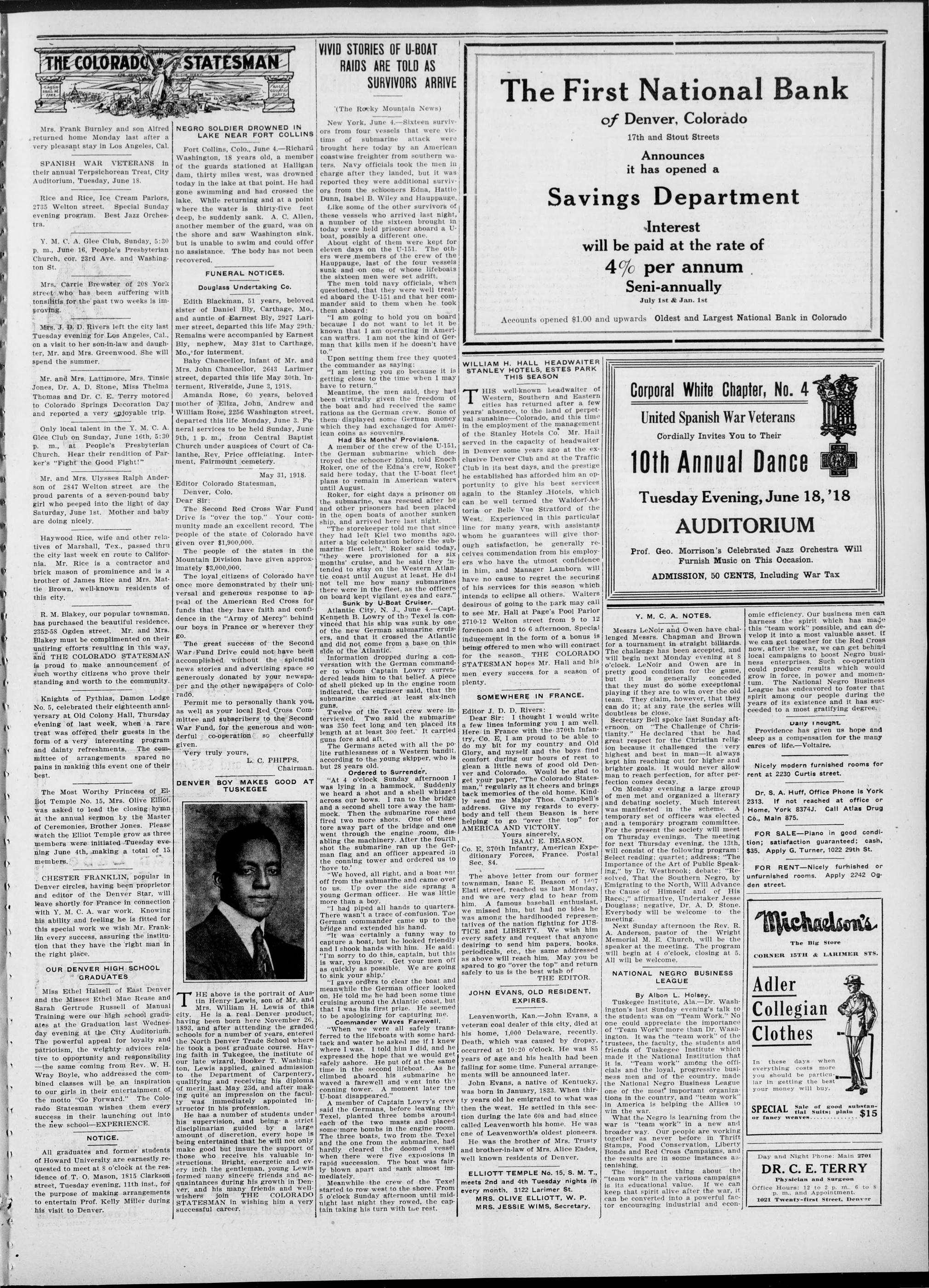
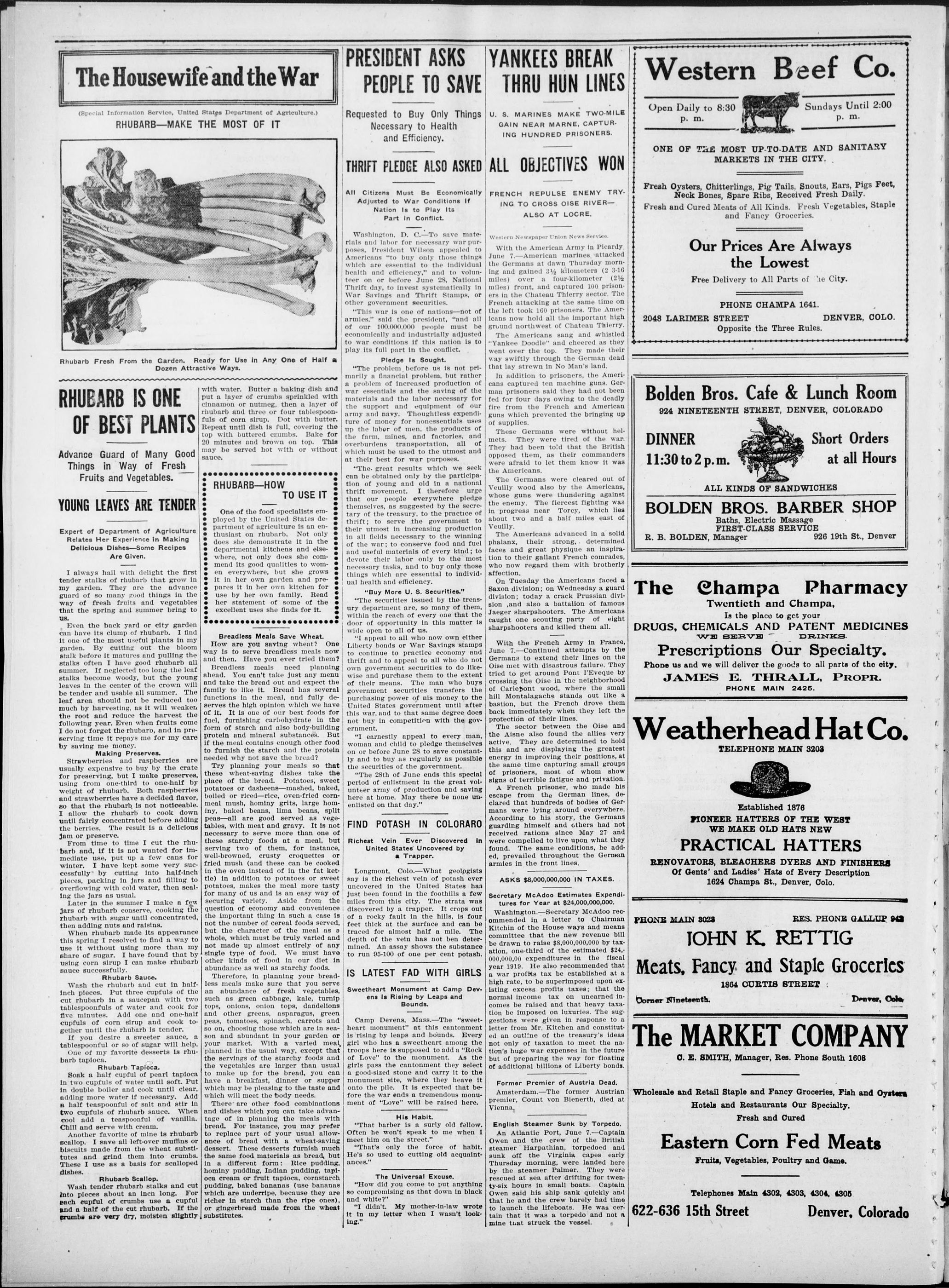
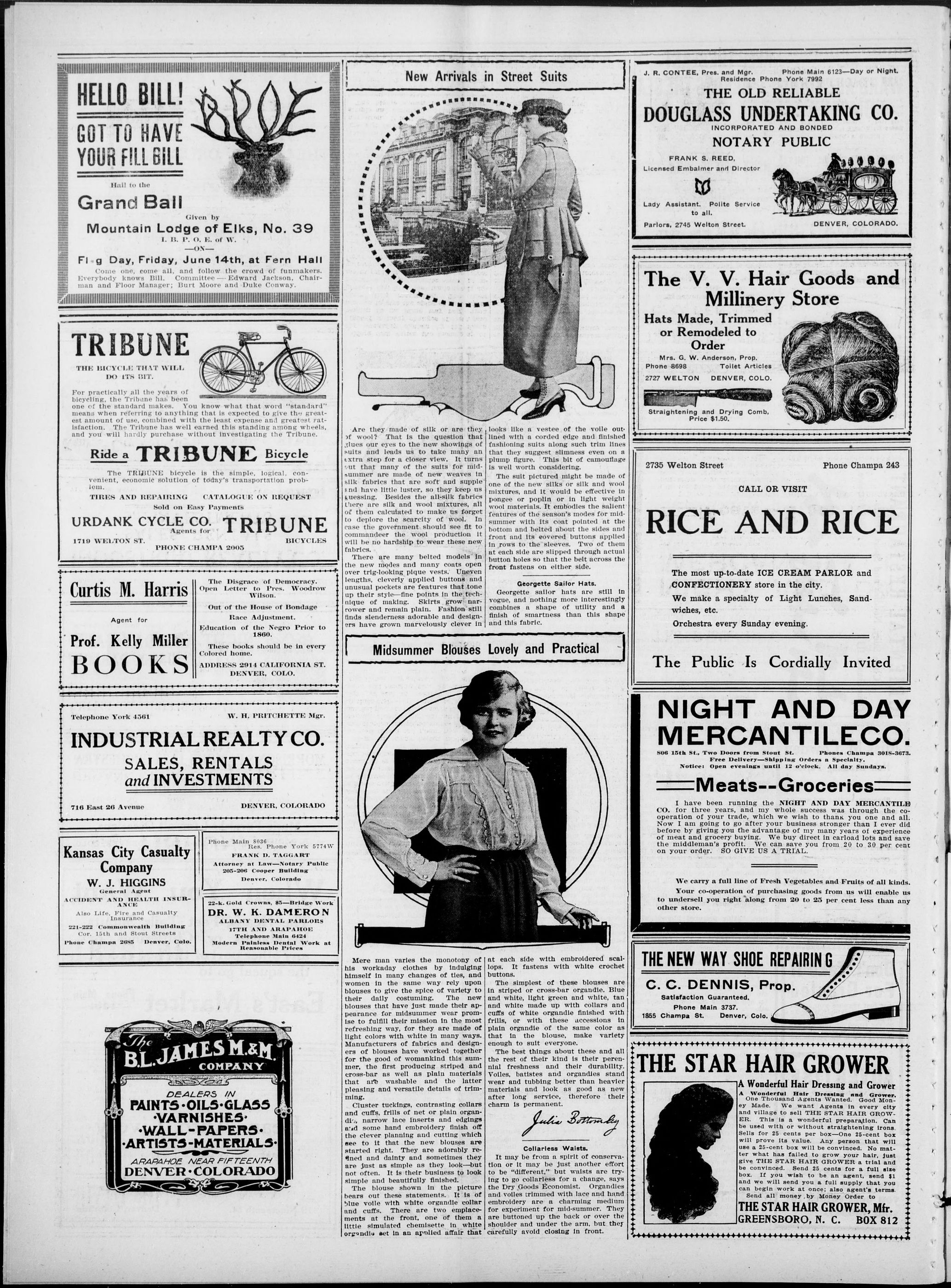
Page text (machine-generated)
Subscribe for the Only Reliable Negro Paper in Colorado, "The Colorado Statesman"
THE COLORADO STATESMAN
THE JOURNAL OF THE WEST.
LABOR SHALL BE FREE
RAGE COUNTRY PARTY
MEMORIAL DAY AT THE ARLINGTON NATIONAL CEMETERY
THE exercises incident to the observance of Memorial Day, although always interesting and inspiring, carried this year an unusual significance. This was doubtless due to the urgent call of the President for the people to assemble on this day in prayer and humility, beseeching Almighty God to preserve the nation thru its most serious crisis and to bring peace with victory to the allied cause.
Responding with a fervent patriotism to this appeal, there was to be noticed in all the ceremonies incident to the day, a gravity of speech and action seldom seen before.
This was especially noticeable at the foremost national shrine for the patriotism and devotion of the American people, the cemetery at Arlington.
A volley from the sounding ceremonie
The ch theatre, b ways of and solen one could decurrent from head throng.
Senator speaker a dress with "We have that is the flag, may fought to emblem of every An of the city
The atmosphere was heavy and the earth damp from recent rains, but the myriads of numbered headstones; the large and still larger and more stately shafts and imposing memorials and the immaculate marble amphitheatre now nearing completion, each and all were rendered fresher and more beautiful in contrast with the broad reaches of shaded lawn, the massive trees and clustering foliage.
Flowers! flowers! everywhere flowers! No superior and no subordinate here is known. General and private; admiral and humblest shipmate share alike in the wealth of fragrant tribute and affection and alike, too, in somber peacefulness await that final adjustment that lingers yet awhile beyond our mortal vision for all who live.
The first stated ceremony of the day took place at 10:30, about the Mast and Turret monument of the Maine Memorial, dedicated to the American sailor martyrs, who with heroic spirit gave their lives for their country in Havana harbor twenty-one years ago.
Under the auspices of the Army and Navy Union, these exercises furnished a unique and interesting precedent, in that they presented a woman orator, the first to speak in that historic presence.
Mrs. Katharine Gould, now famous for her insistence upon a breadth of view in all our American civic relations that shall include black as well as white, was the distinguished speaker and eloquently portrayed the heroism of the men who, thru tragic fate, became forever enshrined in the hearts of their countrymen. She exhorted her hearers to a lofty plane of unreserved Americanism, an Americanism that should bind heart to heart with bands of steel, thru which alone we may hope to realize the splendid ideals which were the dream and ambition of the fathers of the Republic.
The other speakers were Hon. Franklin F. Ellsworth, Hon. Clifton M. McArthur, congressmen respectively from Minnesota and Oregon and the Hon. Carlos Manuel de Caspedes, minister of Cuba, who presented greetings and sympathy from that Republic and caused to be placed beside the many beautiful decorations a handsomely wrought, six-foot floral anchor, done in bronze.
VOL. XXIV.
A volley fired by a detail of sailors from the S. S. Mayflower with the sounding of "Taps" concluded these ceremonies.
The chief observance at the amphitheatre, beginning at 1:30 o'clock, always of natural interest, was deeply and solemnly so on this occasion and one could hardly fail to sense the undercurrent of prayerful feeling leaping from heart to heart throut the vast throng.
Senator Curtis was here the chief speaker and concluded a stirring address with these significant words: "We have but one prayer today and that is that the Stars and Stripes, our flag, may always remain what you fought to make it; that is the true emblem of liberty and a protection to every American citizen in every part of the civilized world.
Taking it all in all, the soul-stirring prayers for aid and sustenance; the awesome silence which carried momentous thoughts to the outermost circle of listening ears; the cadences of martial airs, with "Tenting Tonight" and De Kovens "Processional," by selected voices and the first citizen of the Republic, the President, devoutly thoughtful and attentive thru it all, are the high lights in a wonderful picture that has no prototype and can only be made in America."
ANNUAL COMMENCEMENT
Tuskegee, Ala., May 23.—The day was bright and the crowds from far and near began to come early in wagons, buggies, automobiles. It was a typical Tuskegee Commencement crowd, which is always quiet, happy and eager. Soda water and ice cream cones, which were sold, partly for the benefit of the Red Cross, added to the pastime and good nature of the crowd and at noon the visitors were guests of the institute at an old fashioned dinner served in the open air.
Today's exercises were the last features of the thirty-seventh anniversary exercises which began Sunday, May 19th when Dr. Frank Willis Barnett, the fearless editor of Alabama Baptist, delivered the commencement sermon in the Institute chapel. Dr. Barnett took for his text, "God Is Love," and in the course of his remarks paid generous tribute to Dr. Washington, the founder of Tuskegee Institute, and to Dr. Moton, the present principal.
In his charge to the graduating class Dr. Barnett said:
"I want to say a word to the graduates: You have been at this Institute, and this Institute stands not only to give you the best there is in civic affairs, but to fit you to gain an honorable livelihood; but I know this institution wants to send each one of you out with the stamp of character in your lives. You have worked hard for your diplomas and yet I want to tell you your diploma is but a scrap of paper, even though it may carry the seal of this great institution, unless you bear in your own bodies the marks of the Savior, and my wish for you this afternoon is that if there be one
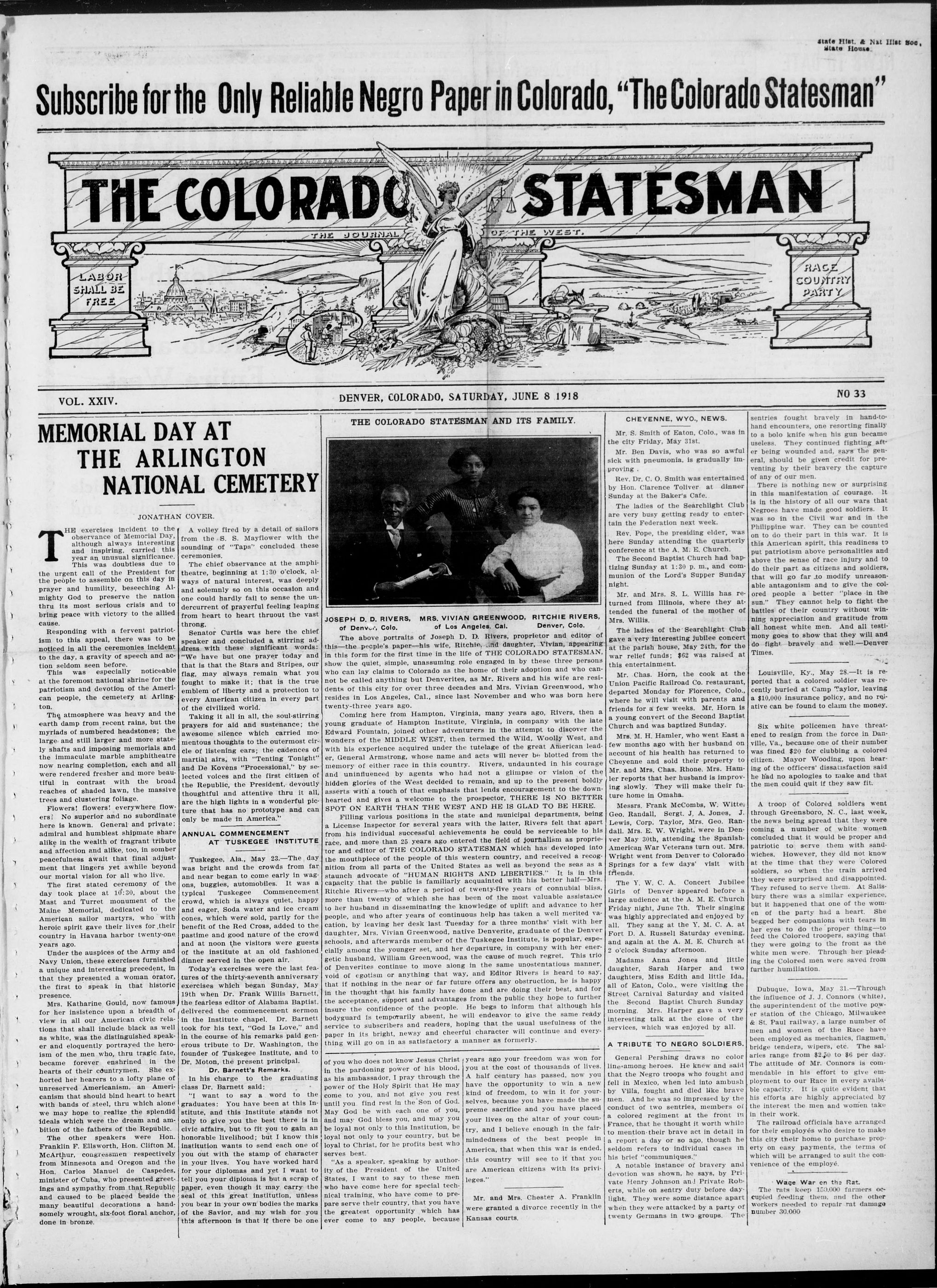
JOSEPH D. D. RIVERS, MRS. VIVIAN GREENWOOD, RITCHIE RIVERS, of Denver, Colo. of Los Angeles, Cal. Denver, Colo.
The above portraits of Joseph D. D. Rivers, proprietor and editor of this—the people's paper—his wife, Ritchie, and daughter, Vivian, appearing in this form for the first time in the life of THE COLORADO STATESMAN, show the quiet, simple, unassuming role engaged in by these three persons who can lay claims to Colorado as the home of their adoption and who cannot be called anything but Denverites, as Mr. Rivers and his wife are residents of this city for over three decades and Mrs. Vivian Greenwood, who resides in Los Angeles, Cal., since last November and who was born here twenty-three years ago.
Coming here from Hampton, Virginia, many years ago, Rivers, then a young graduate of Hampton Institute, Virginia, in company with the late Edward Fountain, joined other adventurers in the attempt to discover the wonders of the MIDDLE WEST, then termed the Wild, Woolly West, and with his experience acquired under the tutelage of the great American leader, General Armstrong, whose name and acts will never be blotted from the memory of either race in this country. Rivers, undaunted in his courage and uninfluenced by agents who had not a glimpse or vision of the hidden glories of the West decided to remain, and up to the present boldly asserts with a touch of that emphasis that lends encouragement to the downhearted and gives a welcome to the prospector, THERE IS NO BETTER SPOT ON EARTH THAN THE WEST AND HE IS GLAD TO BE HERE.
Filling various positions in the state and municipal departments, being a License Inspector for several years with the latter, Rivers felt that apart from his individual successful achievements he could be serviceable to his race, and more than 25 years ago entered the field of journalism as proprietor and editor of THE COLORADO STATESMAN which has developed into the mouthpiece of the people of this western country, and received a recognition from all parts of the United States as well as beyond the seas as a staunch advocate of "HUMAN RIGHTS AND LIBERTIES." It is in this capacity that the public is familiarly acquainted with his better half—Mrs. Ritchie Rivers—who after a period of twenty-five years of connubial bliss, more than twenty of which she has been of the most valuable assistance to her husband in disseminating the knowledge of uplift and advance to her people, and who after years of continuous help has taken a well merited vacation, by leaving her desk last Tuesday for a three months' visit with her daughter, Mrs. Vivian Greenwood, native Denverite, graduate of the Denver schools, and afterwards member of the Tuskegee Institute, is popular, especially among the younger set, and her departure, in company with her energetic husband, William Greenwood, was the cause of much regret. This trio of Denverites continue to move along in the same unostentatious manner, void of egotism or anything that way, and Editor Rivers is heard to say, that if nothing in the near or far future offers any obstruction, he is happy in the thought that his family have done and are doing their best, and for the acceptance, support and advantages from the public they hope to further insure the confidence of the people. He begs to inform that although his bodyguard is temporarily absent, he will endeavor to give the same ready service to subscribers and readers, hoping that the usual usefulness of the paper in its bright, newsy and cheerful character will continue and everything will go on in as satisfactory a manner as formerly.
of you who does not know Jesus Christ in the pardoning power of his blood, as his ambassador, I pray through the power of the Holy Spirit that He may come to you, and not give you rest until you find rest in the Son of God. May God be with each one of you, and may God bless you, and may you be loyal not only to this Institution, be loyal not only to your country, but be loyal to Christ, for he profits best who serves best.
"As a speaker, speaking by authority of the President of the United States, I want to say to these men who have come here for special technical training, who have come to prepare serve their country, that you have the greatest opportunity which has ever come to any people, because
years ago your freedom was won for you at the cost of thousands of lives. A half century has passed, now you have the opportunity to win a new kind of freedom, to win it for yourselves, because you have made the supreme sacrifice and you have placed your lives on the altar of your country, and I believe enough in the fair-mindedness of the best people in America, that when this war is ended, this country will see to it that you are American citizens with its privileges."
Mr. and Mrs. Chester A. Franklin were granted a divorce recently in the Kansas courts.
Mr. S. Smith of Eaton, Colo., was in the city Friday, May 31st.
Mr. Ben Davis, who was so awful sick with pneumonia, is gradually improving.
Rev. Dr. C. O. Smith was entertained by Hon. Clarence Toliver at dinner Sunday at the Baker's Cafe.
The ladies of the Searchlight Club are very busy getting ready to entertain the Federation next week.
Rev. Pope, the presiding elder, was here Sunday attending the quarterly conference at the A. M. E. Church.
The Second Baptist Church had baptizing Sunday at 1:30 p. m., and communion of the Lord's Supper Sunday night.
Mr. and Mrs. S. L. Willis has returned from Illinois, where they attended the funeral of the mother of Mrs. Willis.
The ladies of the Searchlight Club gave a very interesting jubilee concert at the parish house, May 24th, for the war relief funds; $62 was raised at this entertainment.
Mr. Chas. Horn, the cook at the Union Pacific Railroad Co. restaurant, departed Monday for Florence, Colo., where he will visit with parents and friends for a few weeks. Mr. Horn is a young convert of the Second Baptist Church and was baptized Sunday.
Mrs. M. H. Hamler, who went East a few months ago with her husband on account of his health has returned to Cheyenne and sold their property to Mr. and Mrs. Chas. Rhone. Mrs. Hamler reports that her husband is improving slowly. They will make their future home in Omaha.
Messrs. Frank McCombs, W. Witte; Geo. Randall, Sergt. J. A. Jones, J. Lewis, Corp. Taylor, Mrs. Geo. Randall. Mrs. E. W. Wright, were in Denver May 30th, attending the Spanish-American War Veterans turn out. Mrs. Wright went from Denver to Colorado Springs for a few days' visit with friends.
The Y. W. C. A. Concert Jubilee Girls of Denver appeared before a large audience at the A. M. E. Church Friday night, June 7th. Their singing was highly appreciated and enjoyed by all. They sang at the Y. M. C. A. at Fort D. A. Russell Saturday evening, and again at the A. M. E. Church at 2 o'clock Sunday afternoon.
Madams Anna Jones and little daughter, Sarah Harper and two daughters, Miss Edith and little Ida, all of Eaton, Colo., were visiting the Street Carnival Saturday and visited the Second Baptist Church Sunday morning. Mrs. Harper gave a very interesting talk at the close of the services, which was enjoyed by all.
A TRIBUTE TO NEGRO SOLDIERS.
General Pershing draws no color line among heroes. He knew and said that the Negro troops who fought and fell in Mexico, when led into ambush by Villa, fought and died like brave men. And he was so impressed by the conduct of two sentries, members of a colored regiment at the front in France, that he thought it worth while to mention their brave act in detail in a report a day or so ago, though he seldom refers to individual cases in his brief "communiques."
A notable instance of bravery and devotion was shown, he says, by Private Henry Johnson and Private Roberts, while on sentry duty before daylight. They were some distance apart when they were attacked by a party of twenty Germans in two groups. The
state Hist. & Nat Hist Soc.
state House.
No Statesman"
AN
RACE
COUNTRY
PARTY
NO 33
NO 33
sentries fought bravely in hand-to-hand encounters, one resorting finally to a bolo knife when his gun became useless. They continued fighting after being wounded and, says the general, should be given credit for preventing by their bravery the capture of any of our men.
There is nothing new or surprising in this manifestation of courage. It is in the history of all our wars that Negroes have made good soldiers. It was so in the Civil war and in the Philippine war. They can be counted on to do their part in this war. It is this American spirit, this readiness to put patriotism above personalities and above the sense of race injury and to do their part as citizens and soldiers, that will go far to modify unreasonable antagonism and to give the colored people a better "place in the sun." They cannot help to fight the battles of their country without winning appreciation and gratitude from all honest white men. And all testimony goes to show that they will and do fight bravely and well.—Denver Times.
Louisville, Ky., May 28.—It is reported that a colored soldier was recently buried at Camp Taylor, leaving a $10,000 insurance policy, and no relative can be found to claim the money.
Six white policemen have threatened to resign from the force in Danville, Va., because one of their number was fined $20 for clubbing a colored citizen. Mayor Wooding, upon hearing of the officers' dissatisfaction said he had no apologies to make and that the men could quit if they saw fit.
A troop of Colored soldiers went through Greensboro, N. C., last week, the news being spread that they were coming a number of white women concluded that it would be proper and patriotic to serve them with sandwiches. However, they did not know at the time that they were Colored soldiers, so when the train arrived they were surprised and disappointed. They refused to serve them. At Salisbury there was a similar experience, but it happened that one of the women of the party had a heart. She begged her companions with tears in her eyes to do the proper thing—to feed the Colored troopers, saying that they were going to the front as the white men were. Through her pleading the Colored men were saved from further humiliation.
Dubuque, Iowa, May 31.—Through the influence of J. J. Connors (white), the superintendent of the motive power station of the Chicago, Milwaukee & St. Paul railway, a large number of men and women of the Race have been employed as mechanics, flagmen, bridge tenders, wipers, etc. The salaries range from $2.50 to $6 per day. The attitude of Mr. Connors is commendable in his effort to give employment to our Race in every available capacity. It is quite evident that his efforts are highly appreciated by the interest the men and women take in their work.
The railroad officials have arranged for their employés who desire to make this city their home to purchase property on easy payments, the terms of which will be arranged to suit the convenience of the employé.
Wage War on the Bat.
The rats keep 150,000 farmers occupied feeding them, and the other workers needed to repair rat damage number 30,000
FOREIGN
Avilator Carter Landram Ovington of Louisville, Ky., and another aviator were killed during the first day of the present offensive.
Much damage was done by a violent explosion in a plant in which war materials were being manufactured at Baussens, in southern France.
Premier Clemenceau, after addressing the Chamber of Deputies in Paris, received a vote of confidence in the government of 377 against 110.
Capt. Archie Roosevelt, who was wounded in action in March, is making excellent progress. His arm has been removed from the sling and he walks several miles daily.
Between the Aisne and Ourcq rivers the Germans have captured Pernant, and to the south of that village the French have ceded a little terrain.
The discovery in Moscow and Petrograd of a large counter revolutionary plot which stretches throughout the whole of Russia, is announced in a Russian wireless message received in London.
The Germans in Their reprisals Paris on June 1 succeeded in passing over populous districts of the city and twenty-four persons were wounded by their bombs, the Havas agency says. Some damage was done to buildings.
Marcel de Mongoose, major in the French army, was killed in action near Soissons on May 27. He was a son of Madame Alexandre Ribot and a stepson of the ex-prenier. Madame Ribot was formerly Miss Mary Butch of Chicago.
The Germans in their reprisals against peasant disorders in the Ukraine drenched several villages near Klev with gas, according to a Petrograd dispatch to the Daily Express. Thus, adds the message, whole communities were asphyxiated. Four persons were killed, six seriously wounded and many slightly injured when ten British machines attacked the open town of Karlsruhe, according to the Wesen Zeitung of Bremen. Two of the British airmen were shot down, it is declared.
Twenty-eight aerial victories are now credited to Lieut. Georges Madon, the French aviator who early in the war landed by mistake on Swiss territory and was interned, but made his escape. The lieutenant recently recovered from a long illness and, returning to the front, began to wreak havoc among the German aeroplanes.
**SPORT**
Ralph De Palma was the winner of the 100-mile Harkness handicap automobile race at Sheepshead Bay speedway, New York.
J. L. K. Ross' Cudgel, ridden by Lyke, won the sixth running of the Kentucky handicap at Douglas park at Louisville by a length. The time was 2:03. The race was worth $12,000 to the winner. The distance was one and one-fourth miles.
Miss Fannie Durack, holder of many world's swimming records, and Miss Mina Wylie, also a noted Australian swimmer, arrived at San Francisco from the antipodes, accompanied by Miss Mary Durack, sister of the champion. The swimmers expressed surprise at news that an attempt had been made since they left Australia to prevent their competing in amateur events in their scheduled tour of the United States, and exhibited credentials signed by officials of the Amateurs' Swimming Union of Australia.
GENERAL
The police department issued an order that all display lights in New York at night are forbidden until further notice.
Thirty years ago at Lamar Texas yearling steers were quoted at $5 a head and 2-year-olds could be bought for $8.50.
Farmers throughout the southwest are "planting up to the limit of their ability to cultivate the ground and take care of the crops after they are in the ground."
Dr. Francis J. Fluno of Oakland, Cal., was installed as president of the First Church of Christ, Scientist, at the annual meeting of the mother church in Boston.
A two-hour work day, with a minimum wage of $6 a day was the ultimate aim of the I. W. W. in the Western mining centers. This was disclosed by government witnesses who testified at the trial of the I. W. W. leaders before Federal Judge Landis in Chicago.
The Western Union Telegraph Company has declined to submit to the jurisdiction of the national war labor board which sought to adjust the differences between the company and those of its employés who are members of the Commercial Telegraphers' Union of America.
The report of the Belgian official committee in London compliments the British for their hospitality to Belgian war refugees, of whom there are about 70,000 still in the United Kingdom. Of these 60,000 are living in the London area. Eighty per cent of all the Belgians in Great Britain are employed, 40,000 being engaged in munition work.
The lord lieutenant issued a proclamation at Dublin asking for 50,000 voluntary recruits, and thereafter, 2,000 to 3,000 monthly, to maintain the Irish divisions. The first call is to men 18 to 27 years of age, and special inducement is offered of legislation to insure that land shall be available for the men who fight for their country.
Benjamin Chester Chapin, moving picture actor and scenario writer, whose striking resemblance to Abraham Lincoln, gave him wide popularity, died in a sanitarium at Liberty, N. Y.
NEWS TO DATE IN PARAGRAPHS
CAUGHT FROM THE NETWORK OF
WIRES ROUND ABOUT
THE WORLD.
DURING THE PAST WEEK
RECORD OF IMPORTANT EVENTS
CONDENSED FOR BUSY
PEOPLE.
Western Newspaper Union News Service.
ABOUT THE WAR
Germans give up attempt to oust Americans from Cantigny.
Germany's submarine raid on shipping off the American coast has destroyed probably eleven vessels and 58 persons were lost.
The transport ship Leasowe Castle has been sunk by an enemy submarine the British admiralty announced. One hundred and one persons were drowned.
Owing to the terrible casualties inflicted upon it, the Prussian guards division has been withdrawn by the German high command from the battle. The German losses are becoming heavier daily.
On the front between Soissons and Chateau Thierry the Germans occupied Longpont, Corcy, Faverolles and Troesnes, but later were driven out of these places by energetic French counter attacks.
The aerial activity over the territory of the German advance is most intense and French airmen have dropped many tons of bombs on enemy targets in addition to bringing down nineteen German machines.
American troops co-operating with the French west of Chateau Thierry, north of the Marne, the nearest and most critical point to Paris reached by the enemy, have brilliantly checked the onrushing Germans, beaten off repeated attacks and inflicted severe losses, adding to the glory of American history.
From drives on wide fronts the German offensive in France has deteriorated into isolated attacks along the area between Soissons and Chateau Thierry and eastward on the Marne, in the general direction of Rheims. Although in these attacks the enemy is still using large effectives and great numbers of guns, he is being held almost everywhere from further progress and on various sectors compelled to assume the defensive against vicious blows delivered by the Americans, French and British troops.
The latest report received by the Navy Department indicate that the following vessels were sunk as a result of enemy submarine activity off the Atlantic coast: Schooner Edna, 325 tons; schooner Hattle Dunn, 436 tons; schooner Hauppauge, 1,500 tons; schooner Edward H. Cole, 1,791 tons; schooner Isabel B. Wiley, 776 tons; schooner Jacob M. Haskell, 1,778 tons; steamship Winnieconne, 1,869 tons; steamer Caroline, 5,039 tons; schooner Edward R. Baird, Jr., 279 tons; steamship Herbert L. Pratt, 7,200 tons, raised and towed to port; steamship Texel.
WESTERN
The contract for the Odd Fellows' Old Folks' home at Eureka Lake, near Manhattan, Kas., has been awarded on a bid of $133,000. The building will contain 150 guest rooms and will be completed before March 1, 1919. Nelson Morris, millionaire rookie at Camp Grant, was assigned to a supply train. The former head of a Chicago packing company will drive a motor truck to the Atlantic coast and probably will be sent overseas at once. Charles Warren Fairbanks, former vice president of the United States, died at his home in Indianapolis, Ind., June 4. Death was due to interstitial nephritis, which has been a chronic ailment with him, but not regarded serious until recently. All members of the former vice president's family, except Major Richard Fairbanks, who is in France, were at his bedside.
WASHINGTON
The cotton crop was in better condition May 25 than on that date in any of the last ten years excepting in 1911, the year of record production, the Department of Agriculture announced in its first cotton report of the season.
All those who were passengers and all the returning army officers and men on the transport President Lincoln were saved after she had been torpedoed. This confines the loss of life to the crew of the ship.
Rules for the enforcement of Provost Marshal General Crowder's "work or fight" regulations, call on all citizens to report to the nearest local draft board names of men within draft age who are habitually idle or who are employed non-productively.
Some naval officials hold that the Cyclops was sunk by a German submarine, which returned to its base, whether in Mexico or Europe.
The federal child labor law of 1916, forbidding interstate shipments of products of child labor, was declared unconstitutional and invalid by the United States Supreme Court. Women are not replacing men in industries as rapidly as expected, although 44,471 have been placed by the woman's division of the federal employment service, the Department of Labor announced.
Pithy News Notes From All Parts of Colorado
Western Newspaper Union News Service.
COMING EVENTS.
July 8-13—Meeting National Association of Colored Women in Denver.
July 16—Republican State Convention at Colorado Springs.
Aug. 22-24—Colorado State Firemen's Convention at Georgetown.
Sept. 23-28—Colorado State Fair at Pueblo.
A creamery has been started at Craig.
Fort Collins will soon have nearly a mile of concrete paving.
Most of the men in the mines at Rico struck for higher wages.
Commerce Club to strive to make Pueblo 100 per cent American.
Pueblo turned out in grand fashion to bid farewell to drafted men.
There are stated to be 400 milk producers now in Otero county.
The road through Red Rock park has been opened to the public.
Western Colorado seems to be sure of a fine crop of fruit this year.
The Methodist church at Oak Creek is being improved by the addition of a roomy gallery.
The Silver Bar mill at Westcliffe has been in operation making initial run on ore from the Bismuth mine.
The trial of William Campbell, who was accused by Mrs. Mary Griffith, at Oak Creek, resulted in his acquittal.
Dr. Livingston Farrand, president of the University of Colorado at Boulder, has returned from the war zone in France.
At the commencement exercises at the State School of Mines at Golden thirteen students were given their diplomas.
The tractors committee of the State Council of Defense has listed 2,256 tractors for information of the farmers.
In a telegram from Madame Schumann-Heink to Mayor W. F. R. Mills, she expresses her sorrow over the death of Robert W. Speer.
Colorado fanciers of Holsteins do not stop at distance or cost. A. O. Talbot of Montrose has shipped two dozen fine ones all the way from Arizona.
Nis Hanson, a Lake City junk dealer, who is registered as an alien enemy, is under arrest charged with stealing 3,500 pounds of giant powder from the Hidden Treasure mines magazine.
"America First" societies already have been formed at Pueblo among Slavonians, Croatians, Italians and Greeks by the Americanization committee of the State Council of Defense.
Nearly 400 persons have taken out fishing licenses in Lake county, although fishing at Leadville altitude will not be legal till June 15. Below that level the season opened May 25.
After forty years of married life and the rearing of a family of ten children, a cloud has darkened the home of Mr. and Mrs. Begio Perry, gardeners, living near Denver, and a divorce suit is pending.
Enough wheat is wasted through careless threshing and handling every season to feed an army of 10,000,000 men, according to Howard Crocker, an official of the Colorado State Food Administration.
Capt. Morrison Shafroth, en route to France, reached Washington to visit his mother and father a few days before embarking for the other side. Senator and Mrs. Shafroth entertained in honor of their soldier son. Reports of the county agricultural agents for the third week in May showed an increasing demand for farm help, good crop prospects generally throughout the state and adequate transportation facilities. Five men were killed, four others were badly injured, one perhaps fatally, and a dozen others were more or less shocked and burned at Campo, twenty-five miles south of Springfield, during a violent rain and electrical storm.
There will be no vacation in the school of medicine and the nurse's training school at the University of Colorado. Continuous classes will be held in order that doctors and nurses may be supplied to meet the army's needs as quickly as possible. The facilities for training nurses have been increased two-fold.
T. R. Malone and wife of Denver probably will die as a result of injuries received when the car in which they were riding with their three children was struck by a Burlington train. It was feared at first that the daughter would live but a short time, but it is now believed she will recover.
Machinists, blacksmiths, boilermakers, firemen and mechanics drafted for service in the United States were sent to Washington by the Denver division boards.
The Colorado Woman's Council of Defense has already distributed 125,000 cards for registration of women for war service and expects to distribute 25,000 more. John D. Rockefeller, Jr., and his party arrived in Colorado Springs for a social affair at a country house. Mr. Rockefeller has been touring the coal mining camps of southern Colorado.
CENTENNIAL STATE ITEMS.
---
Colorado has been called on to provide 1,706 men in June for the national army. Word to that effect was sent to local boards by Provost Marshal John Evans. There are two calls. One is for 1,500 men, the state's allotment toward the 280,000 ordered by Provost Marshal General Crowder. They will entrain for Camp Cody, Deming, N. M., during the five-day period beginning June 24. Eleven counties need supply no men. They are Costilla, Douglas, Jackson, Lake, Logan, Phillips, Pueblo (except Pueblo city District No. 1), San Juan, Sedgwick, Washington and Yuma counties. The other call is for 206 registrants who are grammar school graduates to take a special course in auto mechanics at the State Agricultural college in Fort Collins June 15.
THE COLORADO STATESMAN
Prof. G. E. Morton, chairman of the live stock committee of the State Council of Defense, has reported to Governor Gunter that the meat supply situation of Colorado is in good shape, that all classes of animals are being increased, that present prices are satisfactory and that close attention will have to be paid to the supply of feed stuffs for the animals. The proportion of forage crops to live stock is smaller than usual and rough feeds must be made to go farther by use of silos. A surplus of dairy products which it is hoped is temporary, has made dairymen uneasy and the low price for butter-fat is serious. Poultry is showing a big increase.
The Mouth-Piece of the People of Colorado and the Entire West
Through arrangements of the war camp community service board, Lieut. Pat O'Brien visited Fort Logan and told the officers and men of his experiences in absenting himself from a German prison train. Lieutenant O'Brien told the men that he felt that the fact that he always maintained his sense of humor was responsible for his being there to tell them about it, for no one could have passed through the seventy-two days of hardships; swimming rivers, living in trees during the day and traveling by night, on rations to be found in the fields if he had not kept the brighter side of the experience before him. That was to get on friendly soil.
RELIABLE chronicle of their doings and progress; a faithful mirror of their wants, their hopes, their best aspirations.
Unsuccessful after seven years of litigation to obtain the custody of her son, Gordon Hugh Craig, the 10-year-old son of Roy H. Craig of Denver, from whom she is divorced and to whom the custody of the boy was awarded by the courts of Georgia, Mrs. P. O. Pickrell, the wife of a wealthy broker in Omaha, was the subject of a nation-wide search on the part of police officials as the result of the disappearance of the boy while on his way home from the Wyman school in Denver. She was arrested on a train at Reno, Nev.
In its decisions the Colorado Supreme Court gave Pete Soto, sentenced from Larimer to pay the death penalty for killing his son-in-law, Ernesto Mondrano, a new lease on life pending another trial; held that George W. Schell of Denver committed bigamy when he married Helen Baber, and gave Nellie Engle Kelley of Colorado Springs $17,000 damages for personal injuries. The defendant in the latter case was the Colorado Springs Interurban Railway Company. Supporters of the Colorado Anti-Saloon league's bone-dry petition for a constitutional amendment to the liquor laws appeared at the office of Secretary of State James R. Noland and filed four volumes containing 33,356 signers. Under the constitution and the election provision 21,467 signatures are necessary.
Unequaled as an advertising medium for the business of professional men and women.
In a little, old-fashioned, yet neat and immaculate home at 828 South Logan street in Denver site an old, gray-haired man, Reuben Williams. In spite of his 95 years, he is happy, for June 4 his daughter, Mrs. J. D. Marshall, who is 68 years of age, and his son-in-law who is 74, celebrated their golden wedding anniversary. Federal farm help specialists in Nebraska will supply northeastern counties of Colorado with farm help this summer, federal officials in Wyoming will care for the North Park district of Colorado and Colorado officials will look after the needs of farmers around Farmington, N. M.
Louie Seeley pleaded guilty in the District Court at Boulder to the charge of murdering Fred E. Bill, postmaster and Moffat road station agent at Crescent, on the night of Feb. 16 last. In extenuation for the crime, Seeley declared he was temporarily insane at the time.
An excellent family journal speaking to and for many thousand colored citizens.
The seed committee of the State Council of Defense will begin a campaign in August urging farmers to gather their seed corn and dry it out before freezing weather. Properly dried seed corn germinates well no matter how cold it gets so long as it is kept dry.
TWODOLLARSAYEAR
A reception in honor of Miss Anna B. Dunham, national president of the National Alliance of the Daughters of Veterans, was held in Denver by Jane C. Denver tent and Ida McKinley tent of the Colorado department of the Daughters of Veterans.
Colorado cattlemen met at Pueblo and discussed the food situation with representatives of the government. That the price of meat is going higher every day with prospects for still further increases, was admitted, and it was also openly admitted by the cattlemen that the visible supply is far short of the future demands. Just what solution of the difficulty will finally be worked out remains a matter which will be largely for government decision, it was announced after the meeting by some of those who attended
The
ORIGINAL
FLAG
CHARLES
THOMSON
Secy of
Continental
Congress
---
The'FLAG SPEAKS
for Ralph N. Thomas
How the Nickel Has Shrunk
Oh, you who seem too deaf to bear
the mutterings around;
To wisdom's warning sound;
Give heir, before his call;
Your 'sit's call.
And keep the glory of your state.
Triumphant over all!
Oh, you who seem too dumb to speak,
Least you should go;
Give those who whore of those who whore
of dagers past pretension;
Show them how may?
What if your fower rage? =
And for Tradition's yesterday,
Preserve your heritage!
Oh, you who seem too blind to see
the world;
And you who pride of liberty;
When unprepared to fight;
When unbound to mind;
Your hope is Freedom's sod.
Nor strike the flag above your land
To any prince but --God!
The Buying Power of the Most Active Piece of United States Money Has Become Less Than 31/2 Cents During Past Few Years
"Old Glory" the Oldest of Ensigns
PROBABLY few Americans realize that when their country's flag is referred to as "Old Glory" the adjective is not merely an expression of reverence and affection, but is historically justified. Strange as it may seem, considering the comparative youth of the United States as a nation, the flag of the United States is the oldest truly national ensign in existence.
relief. The electric lines giving service to municipalities in the United States have been compelled to fight the continual rising cost of materials for repairs, extensions, new equipment and cost of service. The increased cost of all materials used by electric lines have increased on an average of from forty to four hundred per cent. In addition to this they have been justly compelled to increase the wages of their employés.
"When Hermann, the famous magician first walked out upon the American stage, took off his silk hat, said 'presto' and produced a live rabbit therefrom, his audience was simply amazed. They could hardly believe their own eyes. They soon found, however, that it was the same kind of a rabbit that their own little boy had in the back yard and that nature's course had not been interfered with. When he picked dollars, quarters, dimes and nickels from the air, some thought he sure was in league with the devil, but once more his audience found that things were not always as they seem."
While the name of the British "Union Jack" dates from the union of England and Scotland, in 1708, its design was changed in 1801, when the legislative union of Ireland with Great Britain was recorded, by adding the red cross of St. Patrick to the earlier combination of the crosses of St. George and St. Andrew. The design of the American flag has never been officially changed since its first adoption on June 14, 1777.
Among the principal materials and their increased cost are the following Cotton Waste, 133%, Cedar Poles 125%, Cement 74%, Angle Bars, 151%, Armature Coils 118%, Rails 100%, Trolley Wire 180%, Brass Tubing 133%, Car Wheels 75%, Magnet Wire 269%, Sheet Brass, 174%, Nails 110%, Street Cars 100%, Special Track Work 75%, Steam Coal 150%, Dry Batteries 59%, Rail Spikes 157%, Carriage Bolts 196%, Brake Shoes 76%, Pig Tin 115%, Bolts 114%, Bar Steel 200%, Linseed Oil 266%, Railroad Ties 52%, White Lead 55%.
This story was told at a conference between a prominent manufacturer and his employés, who were seeking an increase in wages to help them meet their ever increasing cost of living. The men used it to illustrate to the boss the point that although they had been given a ten per cent increase in wages during 1917, that the buying power of their wage had decreased twenty-five per cent, and that during 1918, they would really be working on a basis of a fifteen per cent reduction.
The continental congress on that day resolved that the national ensign should be one of 13 stripes, red and white alternately, with a "union" of blue, in which should be displayed 13 stars. These referred, of course, to the 13 colonies which had united in declaring their independence of British rule. No provision was then made for the recognition of future states in the flag. Probably they were not thought of.
In the judgment of men who have given the subject of conditions existing in the electric street railways of the United States, there are just two ways to save the street car lines from piling up on the rocks in a mad, scrambled wreck. To increase the revenues to meet the higher cost of operation and the needs for additional service, or cut expenses down to where the cost of running the street railways does not increase its income, which of course can only be done by cutting the service rendered to their patrons.
Investigation proved that the men were correct in their deduction. They had received a wage increase, but their living expenses had increased on account of extraordinary war conditions, until what seemed to some an increase, had really become a reduction, because the buying power of their nickels had become about three and one-half cents.
After the admission of Vermont and Kentucky flags appeared with 15 stars and stripes. They do not seem to have had any legislative sanction, though they are said to have been carried by some regiments in the War of 1812. As more states were admitted it was seen that it would not do to keep on increasing the stripes, and in 1818 congress made a definite rule, fixing the stripes at 13, with a star for each state.
Thinking people are commencing to find out that the vanishing buying power of a nickel is not a magical mystery, but an actual condition that must be met on a fair basis by the manufacturer and consumer and the employer and the employe, if we are going to have a healthy industrial condition in America.
If wages were reduced or even remained stationary as they are, a big proportion of the street railway employes would quit the cars, shops, track work and offices. This expectation is reasonable and consistent, and is one of the big reasons why President Wilson has said: "It is essential that these utilities should be maintained at their maximum efficiency and that everything reasonably possible should be done with that end in view. I hope that state and local authorities, where they have not already done so, will, when the facts are properly laid before them, respond promptly to the necessities of the situation."
The French tricolor is a dozen years younger than "Old Glory." What are usually sold as the German, Russian, Italian and Spanish flags are devices of the nineteenth century, created as "mercantile" flags or in an effort to find something that might be more "popular" than the "royal standard" and also less complicated and expensive. In fact, outside of the United States, France and Britain, the recognition of flags of nationality as something distinct from attachment to a "royal house" may be said to have been a thought of the last century.
The 1918 nickel with a buffalo on it looks just as good as the 1912 nickel with a "V" on it. It takes twenty of them to make a dollar, but lo and behold its buying power today is only three and one-half cents, compared to the same kind of a nickel in 1912.
The nickel today does not go as far, or buy as much. Five of them heretofore would buy two collars. Then three of them bought one collar. Today it takes four nickels to buy a collar. One nickel passed for a piece of pie one year ago. Now it takes two. The baker was glad to take one nickel for a loaf of bread. Now he insists on two. And so it goes. The five-cent cigar has gone to six or seven cents. The ten-cent cigar to two for a quarter. The popular nickel show has gone to ten and fifteen cents, plus war tax.
In this connection it may be noted that the United States also has the oldest national military school of continuous existence. The French military schools, the first that were "national" in any real sense, were suspended at times during the great revolution. But since its opening in 1802 West Point has seen no sun rise or set without the customary morning and evening salute to "Old Glory."
Denver's street railways have been running behind and showing serious deficits for the past few years. They took in big sums of money annually—but at the end of each year they found themselves no better off than at the start, because they had to pay out everything they took in and then some. The man running the peanut stand on the corner has more left, in proportion to his earnings, at the end of the year, than the street railway system. Sounds foolish until you think about it.
Made From English Bunting.
Every place you turn to "a nick has been put in the nickel" until on all sides it has become in fact, a nickel with an average purchasing power of only three and one-half cents.
The original flag was made in Philadelphia from bunting imported from England in 1776 just before the Declaration of Independence was promulgated.
Miles of old track should have been replaced with new and heavier rail long ago, but there has been no money for such expenditures. Increased revenues is the only answer if street car riders on the older lines are to ride over smooth, fast track. It takes money to maintain tracks, cars and power system in good condition to give good service, and if maintenance were to be trimmed to the quick there would unavoidably result the knocked-out cars, bad track, and slow operation that mean poor service and frequent delays because of some outworn equipment we would be "trying to get along with."
The laborer has been compelled to ask more for his hire. Price of raw materials have increased. The price of freight has increased from twenty-five per cent upwards. The increased cost to the manufacturer has compelled him to increase the finished products, all along the line, from twenty-five to four hundred per cent.
First Union Flag.
The first union flag was unfurled on the 1st of January, 1776, over the camp at Cambridge. It had 13 stripes of white and red and retained the English cross in one corner.
United States Naval Flag.
All industries and public utilities that are operating at a fixed rate are being compelled by force of circumstances to ask for
The Denver Tramway has gone as far as it can go without getting relief in some form. Now they must either increase revenue or decrease service. Which it shall be depends upon the answer of the Public Utilities Commission. There simply isn't any other way out. A careful investigation of all conditions entering into the request is being made by the Public Utilities Commission, and upon their decision depends the future of Denver's street railway lines.
The Union Jack of the United States, or the "American Jack," is the upper inside corner of the American flag—the white five-pointed stars, each denoting a state, on a blue field. It is distinctly a naval flag, and is without the "fly" or that part of the American flag composed of the alternate stripes of red and white. Our Union Jack is flown at the prow of every United States warship, while the insign or "stars and Stripes" is flown at the stern of each vessel.
First Fight Under Stars and Stripes
By BERNARD J. CIGRAND.
(Authority on American Heraldry.)
IF THE question were asked, What is the greatest sentence in our national existence? the reply would likely be the one taken from the Declaration of Independence: "We hold these truths self-evident, that all men are created equal." That was the essence of an ideal or a principle, but to give that statement living truth the following words stand out as the power of the nation:
"Saturday, June 14, 1777. Page 243. Records of the day:
"Resolved—That the Flag of the united states be 13 stripes alternate red and white, that the Union be 13 stars white in a blue field representing a new constellation."
Famous Committee In Charge.
The committee having the flag problem in charge consisted of George Washington, Robert Morris and George Ross. It is evident that the resolution, as originally penned by Charles Thomson, secretary of the continental congress, was not adopted, but that corrections were made. I have been unable to decipher just what the original reading matter was. Curiously, Secretary Thomson did not cross a single one of the 17 "t's" which occur in the sentence. The "t's" are all dotted, and a single comma is the extent of the punctuation of this great word picture—our flag. Strangely enough, he did not have the modern idea well in hand when he wrote the words United States, without capitalizing the name, while Flag and Union are made important items in the line.
The old German long "s" is in evidence, and the numerals 13 are figures and not spelled out. Thus brief and without comment is the history we have of the edict which gave us "Old Glory."
Honor for Fort Stanwix.
The first flag constructed as a military emblem, and carrying these heraldic ideals, appears to have been constructed in a rather unique manner. The first flag which was patterned after the resolution was adopted, and which saw actual fighting, must be credited to Fort Stanwix of New York. News of those days traveled slowly, and while the resolution was adopted by the continental congress on June 14, 1777, the improvised flag was not made until the latter part of July, and on the second day of August, 1777, it floated over the fort (Stanwix, later Fort Schuyler). Amid loudest cheers and military salutes it was emblazoned in the sky to remain the emblem of justice and liberty.
But you ask: "What was there unique about its construction?" Well, when the news came that the continental congress had finally decided upon a banner the fort was without a proper flag, and it was too late to depend upon congress to get one fashioned.
Problem for the Garrison.
Immediately the ingenuity of the colonial or continental garrison arranged to improvise a standard as decreed by congress. Henry B. Dawson of New York has left a description which had fallen into his hands in
1887, and it came from one of the soldiers of that garrison, and though more than a century has elapsed the narrative is ever new and deserves historic recognition. Through relatives of Mr. Dawson I am permitted to give the exact version of how this earlier military flag of stars and stripes was constructed.
The soldier who was among the flag producers was Col. Marinus Willett, and his story is in part supported by other members of the fort, as well as by a recently disclosed letter in England, in which the British soldier refers to a banner: "Over the Fort Stanwix built by us in 1758 and named after the brave General Stanwix, they (the continentalals) hoisted a flag of white and red stripes and on a canon of azure there were white stars."
How the Flag Was Made.
"But what of its unique construction?" you ask. Well, the garrison decided to form the national standard, but being away from stores, clothshops or homes, and being hemed in by the British, the task arose, how shall this emblem of unity be constructed? Here is where Colonel Willett's diary and narrative come to the surface with the facts, and read as follows: "The fort (Fort Stanwix) had never been supplied with a flag. The necessity of having one had, upon the arrival of the enemy, taxed the invention of the garrison a little; and a decent one was soon contrived. The white stripes were cut out of an ammunition shirt; the blue out of the camlet cloak taken from the enemy at Peekskill, while the red stripes were made of different pieces of stuff procured from one and another of the garrison."
Another witness of the garrison states in his letter home that "the blue ground for the stars was composed of a cloth cloak belonging to Capt. Abraham Swartwout of Dutchess county." The captain, hence, wore the camlet cloak taken from the British at Peekskill battle.
Victory Crowns Its Appearance.
The first battle under the improvised American flag was a great victory, and Col. Marinus Willett was among those who in a hand-to-hand fight captured five of the English colors and brought them proudly to the fort. These British flags, according to his diary, were run up on the fort flagpole, but the impromptu American banner floated from the highest point of the pole.
About 30 years ago a Mr. Haven read a paper before the New Jersey State Historical society, and in it he was reported as having read:
"From additional reports in circulation here, the first time that our national flag was used after the enactment concerning it by congress was by Gen. George Washington, in the hurried and critical stand made by him on the banks of the Assanpink, when he repulsed Cornwallis, January 2, 1777. As this conflict was the turning point, in connection with what succeeded at Princeton, of the struggle for independence, does not this signal baptism of the Stars and Stripes, with the hope and confidence regenerated by it, seem providential?"
This sounds good and reads equally well—but the cold, stubborn facts declare it absolutely wrong. The repelling of the British was, as he states, January 2, 1777; but our flag was not created or adopted by the continental congress until June 14, 1777, five months later.
The American flag has undergone a number of slight changes, but in principle it has ever remained as the forefathers heredidically built it on June 14, 1777.
THE COLORADO STATESMAN
THE ARRIVAL OF THE WEST
LAUGH
SHOULD BE
FREE
PLACE
COMMIT
PASTE
JOS. D. D. RIVERS.....Proprietor
Entered as second-class matter at the postoffice in the City of Denver, Colo.
SUBSCRIPTION RATES.
One Year ..... $2.00
Six Months ..... 1.00
Three Months ..... .40
PAYABLE IN ADVANCE.
Reading notices, ten lines or less, 10 cents per line. Each additional line over ten lines, 5 cents per line. Display advertising, 50 cents per inch.
Remittances should be made by Express Money Order, Postoffice Money Order. Registered Letter or Bank Draft. Postage stamps will be received the same as cash for the fractional part of a dollar. Only 1c and 2c stamps taken.
No discounts allowed on less than three months' contract. Cash must accompany all orders from parties unknown to us. Further particulars on application.
Communications to receive attention must be newsy, upon important subjects, plainly written only upon one side of the paper, must reach us Tuesday, if possible, anyway not later than Wednesday. All communications of a personating nature that are not complimentary will be withheld from the columns of this paper.
THE ENEMY AT OUR DOOR.
NOT so long ago a speaker in our city Auditorium told us that he was specially delegated by the government to visit Denver and certain other cities of the Union to address the people on the part we must play in this war, to arouse us to our responsibility and to bring nearer home to us and as practically as he could the necessity of united action and that at once as we might be more than alarmed from the action of the enemy within our shores. Some, in spite of subscription to Liberty Bonds, Red Cross and other help, were still lacking on the possibilities of "the enemy at our door," and while they were not unpatriotic, yet the personal interest—the thing which counts, which makes or originates the collective action—was lacking, hence they awaited some incident or event to bring them to a sense of duty. And now the same confronts them.
In the raid upon our coast this week by the German undersea boats, those of us who thought we were so far removed from the seat of war have been gripped suddenly with a feeling that no one else can describe. That U-Boats were sighted off our coast was the information given over a week prior to the disaster off New York, and today the enemy, jubilant over his success in still FOOLING his followers in the idea of his greatness, has done something that will strengthen the tie that binds American to American.
We are told that like his other plans, the enemy has his latest style of submarines on our eastern coast, then he may turn to our Gulf coast and attempt to obstruct our shipping of men and foodstuffs, etc., to our men "Over there," but thanks to his game now discovered, as while he pretends not to be aware of our fighting ability in Europe he has brought the test home to us and we will gladly respond. The child, the parent, the man, the woman need no further illustration, no declaration in speech, no reminder by an address as actions convey their own truths. We feel we are ready and will meet the U-Boats with a response very much to their discomfort. THE ENEMY WITHIN OUR BORDERS, proven by the continuous destruction of our industries, by acts of incendiarism explosions, etc.; THE ENEMY AT OUR DOOR, by his U-Boat action and the laying of mines for the purpose of paralyzing our shipping. The hour has come. The blow is struck. What will you do? Remember Wellington! "UP BOYS AND BE AT THEM!"
A GLIMPSE AT OUR AMERICAN GRADUATES.
RADUATION exercises of the schools throut the country marked the closing days of the month of May and the beginning of the current month, and each account seemed to present the spirit of friendly rivalry, the same vying with one another for the result of improvement of the youth educationally as well as the determination to inculcate the doctrine of patriotism AND LOYALTY for America
and things American—the same being necessary, especially at this time, to strengthen the morale of the people. In Denver we were fortunate to witness the Denver University exercises, also the high schools in combination, and the profound impression made on us as we watched the seriousness depicted on the faces of those who were the recipients of the certificate of merit, causes us to renew our efforts in the support of our nation towards victory in this all-terrible conflict which threatens and imperils the life of our American democracy, which, as our Chief Magistrate says, is "A menace to the world's civilization." Rev. W. H. Wray Boyle, in one of the most soul-stirring patriotic addresses we ever had the opportunity to hear, emphasized the responsibility attached to our citizenship in this particular crisis, and urged the young graduates of the city's high schools who listened to him with rapt attention, to put on the armor of 100 per cent Americanism, and realizing the opportune moment stand shoulder to shoulder in the cause of righteousness, the successful championing of which will restore the peace of the world and the destruction of the present autocratic power whose lust for universal greatness in the conquest of the world and its final subjugation would satisfy his dream of the years gone by. While congratulating ourselves on having such a speaker among us in the WEST, a communication comes to us of the Annual Commencement at Tuskegee Institute in the SOUTH LAND, where another great orator, in the person of Dr. Frank Willis Barnett, editor of The Alabama Baptist, after paying a tribute to the late illustrious Booker T. Washington, specially reminded the hundreds of graduates he was addressing of their loyalty to the institution, the country and to God, and further informing them that the greatest opportunity that has ever come to any people was theirs now, being permitted to share in winning a new kind of freedom for the world and its people, concluding his address with the following, which will live in the hearts of both graduates and spectators as one of the means of causing the "right about turn" in this country and among its people, which will necessarily result in the amelioration of existing conditions:
"Half a century has past," said the Dr. Barnett, "now you have the opportunity to win a new kind of freedom, to win it for yourselves, because you made the supreme sacrifice and you have placed your lives on the altar of your country, and I believe enough in the fair-mindedness of the best people in America, that when this war is ended, this country will see to it that you are American citizens with its privileges."
After carefully reviewing the words of cheer and encouragement proceeding from two representative Americans herein named, what greater pleasure can we find than that of our educational institutions and their accompanying advantages, and THE COLORADO STATESMAN, happy in the thought that there are many Boyles and Barnetts in this country who, throwing off the garb of quiescence and tranquillity, will come boldly and express themselves as to the high ideals of our American people that will place us beyond COLOR, CASTE OR CREED and finally prove the value of the education of the youth and the pleasures of knowledge which of necessity will make imperative A WHOLE, INVINCIBLE AND IMPREGNABLE IN THE WORLD'S HISTORY.
OUR AIR FIGHTERS PLAY A FAIR GAME
AVIATOR F. P. MAGOUN RELATES AN INSTANCE OF THEIR REAL SPORTSMANSHIP.
ONE FLYER'S LUCKY ESCAPE
American Infantryman Has Advantage Over the German in His Ammunition Equipment—Finger Prints of German Alien Females to Be Taken.
(From Committee on Public Information.)
Washington.—A committee on public information representative in London says:
There are no better sportsmen in the world than the allied airmen, and American aviators now fighting in Europe always play a fair game, as they learn it from the allies. F. P. Magoun, a former Harvard student, now a member of the Royal air force, recently wounded, tells how the lives of German observers escaping from balloons have been spared.
"We caught three Hun balloons above the allied grounds in a mist, which prevented their gunners seeing us," said he. "It was a clinch. You should have seen them hustle out their parachutes and abandon the balloons. As they came falling down through the air we circled about closely but, of course, didn't open fire, as that's against the rules of the game. As soon as they touched ground they took cover like rabbits."
Magoun is the only American in his squadron, having joined in February of last year. He has bagged five German planes. While carrying bombs for low attack in the recent offensive he received a bullet through his left arm, but managed to return to his own lines. Magoun tells of a companion in his squadron who had one of the luckiest escapes during the war. He was put out of action 1,000 feet in the air when a bullet perforated his gasoline tank. He was rendered unconscious by the fumes and his machine took a nose dive to earth, but he escaped without a scratch.
A section of the Royal air force operating in the Ypres salient has lost its only American member, who had been with the squadron only ten days when he went on a bombing raid at low elevation. He was hit by a machine-gun bullet and his plane fell in flames. He was taken prisoner.
The efforts of newspapers to promote good feeling between the people of England and the thousands of Americans received official backing when Sir Randolf Baker, member of parliament, offered to take charge of the American troops welfare department of the British government. His plans contemplate a continuous program of healthful recreation in every American rest camp and training camp in England. Special London theatrical companies will be sent out. An organization known as "Sammy's Blighty league" is being formed.
The American infantryman in the expeditionary forces carries 200 rounds of ammunition in the pockets of his light canvas webb belt and his bandoleers. The German soldier has only 120 rounds, and 30 of these are in his knapsack. To secure them at a critical moment he must lose valuable time.
The American webb belts, according to the war department, are far superior to the German leather bandoleers. They are not affected by prolonged rains nor torrid weather. The manufacture of these belts is one of the most intricate of the operations in the textile field. United States army belts are made almost entirely of cotton.
The exact weight of the 220 rounds carried by the American soldier in France is 12 pounds. With the Springfield rifle 23 aimed shots can be fired each minute. Firing from the hip 40 shots can be fired a minute. The new United States model 1917 (modified Enfield) does even better.
一
The registration of German alien females, to begin Monday, June 17, and end Wednesday, June 26, will be conducted in cities or municipalities having 5,000 population or over by the police officials. In communities having a population of less than 5,000 the registration will be handled by postmasters.
In general the plan of registration is the same as that followed in the registration in February of German alien males. Each person who must register will be required to register her finger prints. This method of identification is also used in the military and naval services of the United States.
Boy scout organizations are active in locating black walnut trees. Black walnut lumber is needed by the war department for use in making airplane propellers and gunstocks.
Enough heavy Browning machine guns for instruction purposes have been shipped to every National Guard training camp and National army cantonment in the country where troops are in training. Heavy Brownings for overseas training have been shipped.
Light Browning rifles sufficient in number to equip the machine-gun units of more than four army divisions have been manufactured, and overseas shipment of one half has begun. The other half of the output goes to army divisions in this country.
At every training camp in the country plans of the commission on training camp activities have been carried out to provide athletic facilities for the men. Baseball heads the list in popularity, and full equipment has been placed in the camps. More than 70,000 baseballs and 3,000 bats have been sent. At Camp Lewis, Washington, there are 16 baseball fields in use. Practically every company in each camp division throughout the country has its team and there are company, battalion, regimental and interregimental leagues.
Every form of track athletics occupies the attention of men training at the camps. As many as 800 men have taken part in divisional contests, and track meets have been witnessed by more than 20,000 spectators.
Where facilities permit, instruction in swimming is given. Men are first given land instruction and then sent into the water. Tennis courts have been built in every camp, one having 40 courts, and the sport is rapidly gaining in popularity. Through the generosity of golf clubs located near the camps, the demand for golf courses is partly being met. Polo matches are frequently held, and competition for places on the teams is keen.
There is a list of 137 occupations where the demand for men in the war department constantly exceeds the supply.
A pressing need exists in the army for men experienced in handling mules, and before all future needs are met a recruiting campaign may become necessary. No difficulty has been experienced in getting men who can buy and handle horses, but blacksmiths are scarce. There is a constant demand for butchers, and cooks are greatly needed. In several technical branches, particularly the engineers, men for the higher positions are plentiful, but the workers for the ranks are scarce. Experienced mechanics, especially those familiar with automobiles, are always in demand.
More interpreters than can be used have applied for positions with the war department, and applications for commissions as army chaplains are also in excess of the need. The excess totals thousands in each case. Clerks for general work are plentiful, but there is demand for specialists. At present there is a surplus of dentists and pharmacists.
Deliveries of the 8,000 motortruck recently ordered by the motor transport service of the war department are to be made between August 1 and December 1. These trucks, known as "Class B Standards," will have a capacity of from three to five tons, and will be distributed as needed through the various branches of the army. Ten thousand of these class B standardized trucks have previously been ordered and are now in process of manufacture and delivery.
Under a new agreement the army will handle all mail for the expeditionary forces after it leaves United States ports. The post office department will deliver the mail to military authorities at the port of embarkation in this country and receive it from them at a port in France for dispatch to the United States. The domestic money-order service to the troops will for the present at least, continue under the direction of the post office department in France.
The first Porto Rican laborers to reach the United States under government auspices will be at work upon government contracts within a month.
The employment service of the department of labor has already found employment for at least 100,000 of these men as common laborers on construction work at Norfolk, Newport News, Baltimore and vicinity. Arrangements are now being made by the department of labor to provide proper housing for these men.
Women between the ages of twenty-one and thirty-five who have had a high school education or its equivalent will be eligible for admission to the army school of nursing, arrangements for which were recently made by the war department. It is intended to start several schools in selected military hospitals. Unless otherwise specified, applications should be sent directly to the army school of nursing, office of the surgeon general of the army, Washington, D. C.
"Keeping Our Fighters Fit-For War and After," is the title of an official book issued by the commission on training camp activities, describing the athletics, mass singing, social life and other recreations of men in army and navy camps. The book tells of the theaters, the work of the Y. M. C. A., Knights of Columbus and other organizations associated with the commission in welfare work, and gives details of life in the camps.
The two picnic acid plants to be built at Little Rock, Ark., and Brunswick, Ga., contracts for which have been completed by the war department, will cost approximately $7,000,000.
Men of selective service age who leave the United States to evade military duty will have to stand trial on charges of violations of the selective service act when they return to the country, according to the department of justice, even though they do not return until after the war.
The department has at hand information from which complete lists may be prepared of all men who have left the country to avoid service, says a recent statement authorized by the attorney general.
"The Man's Store"
One Week Sale
Society Brand Clothes
Buy
Thrift Stamps
STYLE
HEADQUARTERS
Where
Society Brand
Clothes
are sold
The
World's
Finest
Clothing
Society Brand Clothes
A SALE OF SOCIETY BRAND CLOTHES marks an epoch in merchandising. We have just consummated the purchase of hundreds of suits, this season's surplus stock of the manufacturers of Society Brand Clothes—unquestionably the finest men's and young men's ready-to-wear apparel in the world, which enables us to offer them at prices which represent in many instances less than the actual cost to reproduce them today. We have arranged these suits in three groups, the assortment at each price station comprising a wonderful array of beautiful fabrics, colorings, and the snappiest of models "for young men and men who stay young." It is unnecessary to call your attention to the advantage of an early selection. All necessary alterations made free.
A SALE OF SOCIETY BRAND CLOTHES marks an epoch in merchandising. We have just consummated the purchase of hundreds of suits, this season's surplus stock of the manufacturers of Society Brand Clothes—unquestionably the finest men's and young men's ready-to-wear apparel in the world, which enables us to offer them at prices which represent in many instances less than the actual cost to reproduce them today. We have arranged these suits in three groups, the assortment at each price station comprising a wonderful array of beautiful fabrics, colorings, and the snappiest of models "for young men and men who stay young." It is unnecessary to call your attention to the advantage of an early selection. All necessary alterations made free.
Men's Union Label Straw Hats
Two little girls tried to tell aunty of something exciting that happened. Finally, rising to her full dignity, Mary said: "Susie, will you please let me tell this story? It isn't nice to be chipping in that way."
To Keep Pictures Straight.
Take small piece of adhesive tape,
moisten one end and attach to back of picture (near the top in center),
moisten other end and fasten to wall.
Picture will always hang absolutely straight after that.
---
A splendid assortment of Union Made Straw Hats that includes all the newest styles, shapes and braids, at the very special price of
-$3.00
PARCEL POST
AY CO
Laddle had been taught that when visiting he must never ask for anything to eat. One afternoon he was invited by a neighbor to visit her. He went alone, and on his return home his mother asked him if he had enjoyed the afternoon and said she hoped he had not asked for cookies. He replied: "Yes, I did, mamma, but I was werry polite."
Matter of Disposition.
"How do they fish for pearls, dad?"
"Well, some wives threaten and others nag."—Louisville Courier-Journal
THE COLORADO STATESMAN
Mrs. Frank Burnley and son Alfred returned home Monday last after a very pleasant stay in Los Angeles, Cal.
SPANISH WAR VETERANS in their annual Terpsichorean Treat, City Auditorium, Tuesday, June 18.
NEGRO SOLDIER DROWNED IN LAKE NEAR FORT COLL.
Fort Collins, Colo., June 4.—Ric Washington, 18 years old, a member of the guards stationed at Hall dam, thirty miles west, was drove today in the lake at that point. He
Rice and Rice, Ice Cream Parlors, 2735 Welton street. Special Sunday evening program. Best Jazz Orchestra.
Y. M. C. A. Glee Club, Sunday, 5:30 p. m., June 16, People's Presbyterian Church, cor. 23rd Ave. and Washington St.
Mrs. Carrie Brewster of 208 York street who has been suffering with tonsilitis for the past two weeks is improving.
Mrs. J. D. D. Rivers left the city last Tuesday evening for Los Angeles, Cal., on a visit to her son-in-law and daughter, Mr. and Mrs. Greenwood. She will spend the summer.
Mr. and Mrs. Lattimore, Mrs. Tinsie Jones, Dr. A. D. Stone, Miss Thelma Thomas and Dr. C. E. Terry motored to Colorado Springs Decoration Day and reported a very enjoyable trip.
Only local talent in the Y. M. C. A. Glee Club on Sunday, June 16th, 5:30 p. m., at People's Presbyterian Church. Hear their rendition of Parker's "Fight the Good Fight!"
Mr. and Mrs. Ulysses Ralph Anderson of 2847 Welton street are the proud parents of a seven-pound baby girl who peeped into the light of day Saturday, June 1st. Mother and baby are doing nicely.
Haywood Rice, wife and other relatives of Marshall, Tex., passed thru the city last week en route to California. Mr. Rice is a contractor and brick mason of prominence and is a brother of James Rice and Mrs. Mattie Brown, well-known residents of this city.
R. M. Blakey, our popular townsman, has purchased the beautiful residence, 2352-58 Ogden street. Mr. and Mrs. Blakey must be complimented on their untiring efforts resulting in this way, and THE COLORADO STATESMAN is proud to make announcement of such worthy citizens who prove their standing and worth to the community.
Knights of Pythias, Damon Lodge No. 5, celebrated their eighteenth anniversary at Old Colony Hall, Thursday evening of last week, when a rare treat was offered their guests in the form of a very interesting program and dainty refreshments. The committee of arrangements spared no pains in making this event one of their best.
The Most Worthy Princess of Elliot Temple No. 15, Mrs. Olive Elliot, was asked to lead the closing hymn at the annual sermon by the Master of Ceremonies, Brother Jones. Please watch the Elliot Temple grow as three members were initiated Tuesday evening June 4th, making a total of 15 members.
CHESTER FRANKLIN, popular in Denver circles, having been proprietor and editor of the Denver Star, will leave shortly for France in connection with Y. M. C. A. war work. Knowing his ability and feeling he is fitted for this special work we wish Mr. Franklin every success, assuring the institution that they have the right man in the right place.
OUR DENVER HIGH SCHOOL
GRADUATES
Miss Ethel Halsell of East Denver and the Misses Ethel Mae Rease and Sarah Gertrude Russell of Manual Training were our high school graduates at the Graduation last Wednesday evening at the City Auditorium. The powerful appeal for loyalty and patriotism, the weighty advices relative to opportunity and responsibility—the same coming from Rev. W. H Wray Boyle, who addressed the combined classes will be an inspiration to our girls in their entertainment of the motto "Go Forward." The Colorado Statesman wishes them every success in their launching out into the new school—EXPERIENCE.
NOTICE.
All graduates and former students of Howard University are earnest requested to meet at 8 o'clock at the residence of T. O. Mason, 1815 Clarkson street, Tuesday evening, 11th inst., for the purpose of making arrangements to entertain Prof. Kelly Miller during his visit to Denver.
NEGRO SOLDIER DROWNED IN LAKE NEAR FORT COLLINS
Fort Collins, Colo., June 4.—Richard Washington, 18 years old, a member of the guards stationed at Halligan dam, thirty miles west, was drowned today in the lake at that point. He had gone swimming and had crossed the lake. While returning and at a point where the water is thirty-five feet deep, he suddenly sank. A. C. Allen, another member of the guard, was on the shore and saw Washington sink, but is unable to swim and could offer no assistance. The body has not been recovered.
FUNERAL NOTICES.
Douglass Undertaking Co.
Edith Blackman, 51 years, beloved sister of Daniel Bly, Carthage, Mo., and auntie of Earnest Bly, 2927 Larimer street, departed this life May 29th. Remains were accompanied by Earnest Bly, nephew, May 31st to Carthage, Mo., for interment.
Baby Chancellor, infant of Mr. and Mrs. John Chancellor, 2643 Larimer street, departed this life May 30th. Interment, Riverside, June 3, 1918.
Amanda Rose, 60 years, beloved mother of Eliza, John, Andrew and William Rose, 2256 Washington street, departed this life Monday, June 3. Funeral services to be held Sunday, June 9th, 1 p. m., from Central Baptist Church under auspices of Court of Calanthe, Rev. Price officiating. Interment, Fairmount cemetery.
May 31, 1918.
Editor Colorado Statesman,
The Second Red Cross War Fund Drive is "over the top." Your community made an excellent record. The people of the state of Colorado have given over $1,900,000.
The people of the states in the Mountain Division have given approximately $3,000,000.
The loyal citizens of Colorado have once more demonstrated by their universal and generous response to appeal of the American Red Cross for funds that they have faith and confidence in the "Army of Mercy" behind our boys in France or wherever they go.
The great success of the Second War Fund Drive could not have been accomplished without the splendid news stories and advertising space so generously donated by your newspaper and the other newspapers of Colorado.
Permit me to personally thank you, as well as your local Red Cross Committee and subscribers to the Second War Fund, for the generous and wonderful co-operation so cheerfully given.
Very truly yours,
L. C. PHIPPS,
Chairman.
DENVER BOY MAKES GOOD AT TUSKEGEE
A.
THE above is the portrait of Austin Henry Lewis, son of Mr. and
Mrs. William H. Lewis of this city. He is a real Denver product, having been born here November 26, 1893, and after attending the graded schools for a number of years, entered the North Denver Trade School where he took a post graduate course. Having faith in Tukegee, the institute of our late wizard, Booker T. Washington, Lewis applied, gained admission to the Department of Carpentry, qualifying and receiving his diploma of merit last May 23d, and after making quite an impression on the faculty was immediately appointed instructor in his profession.
He has a number of students under his supervision, and being a strict disciplinarian guided by a large amount of discretion, every hope is being entertained that he will not only make good but insure the support of those who receive his valuable instructions. Bright, energetic and every inch the gentleman, young Lewis formed many sincere friends and acquaintances during his growth in Denver, and his many friends and well-wishers join THE COLORADO STESMAN in wishing him a very successful career.
VIVID STORIES OF U-BOAT RAIDS ARE TOLD AS SURVIVORS ARRIVE
'(The Rocky Mountain News)
New York, June 4.—Sixteen survivors from four vessels that were victims of submarine attack were brought here today by an American coastwise freighter from southern waters. Navy officials took the men in charge after they landed, but it was reported they were additional survivors from the schooners Edna, Hattie Dunn, Isabel B. Wiley and Hauppauge. Like some of the other survivors of these vessels who arrived last night, a number of the sixteen brought in today were held prisoner aboard a U-boat, possibly a different one.
About eight of them were kept for eleven days on the U-151. The others were members of the crew of the Hauppauge, last of the four vessels sunk and on one of whose lifeboats the sixteen men were set adrift.
The men told navy officials, when questioned, that they were well treated aboard the U-151 and that her commander said to them when he took them aboard:
"I am going to hold you on board because I do not want to let it be known that I am operating in American waters. I am not the kind of German that kills men if he doesn't have to."
Upon setting them free they quoted the commander as saying:
"I am letting you go because it is getting close to the time when I may have to return."
Meantime, the men said, they had been virtually given the freedom of the boat and had received the same rations as the German crew. Some of them displayed some German money which they had exchanged for American coins as souvenirs.
Had Six Months' Provisions.
A member of the crew of the U-151, the German submarine which destroyed the schooner Edna, told Enoch Roker, one of the Edna's crew, Roker said here today, that the U-boat fleet plans to remain in American waters until August.
Roker, for eight days a prisoner on the submarine, was rescued after he and other prisoners had been placed in the open boats of another sunken ship, and arrived here last night.
"The storekeeper told me that since they had left Kiel two months ago, after a big celebration before the submarine fleet left," Roker said today, "they were provisioned for a six months' cruise, and he said they intended to stay on the Western Atlantic coast until August at least. He did not tell me how many submarines there were in the fleet, as the officers on board kept vigilant eyes and ears."
Sunk by O-Boat Cruiser.
Atlantic City, N. J., June 4.—Capt. Kenneth B. Lowry of the Texel is convinced that his ship was sunk by one of the new German submarine cruisers, and that it crossed the Atlantic and did not come from a base on this side of the Atlantic.
Information dropped during a conversation with the German commander to whom Captain Lowry surrendered leads him to that belief. A piece of shell picked up in the engine room indicated, the engineer said, that the submarine carried at least six-inch guns.
Twelve of the Texel crew were interviewed. Two said the submarine was 350 feet long and ten placed its length at at least 300 feet. It carried guns fore and aft.
The Germans acted with all the polite ruthlessness of a Western bandit, according to the young skipper, who is but 28 years old.
"At 4 o'clock Sunday afternoon I was lying in a hammock. Suddenly we heard a shot and a shell whizzed across our bows. I ran to the bridge and a second shell tore away the hammock. Then the submarine rose and fired two more shots. One of these tore away part of the bridge and one went through the engine room, disabling the machinery. After the fourth shot the submarine ran up the German flag and an officer appeared in the conning tower and ordered us to 'hove to.' "We hoved, all right, and a boat put off from the submarine and came over to us. Up over the side sprang a young German officer. He was little more than a boy. "I had piped all hands to quarters. There wasn't a trace of confusion. The German commander came up to the bridge and extended his hand.
"It was certainly a funny way to capture a boat, but he looked friendly and I shook hands with him. He said: 'I'm sorry to do this, captain, but this is war, you know. Get your men off as quickly as possible. We are going to sink your ship.'
"I gave orders to clear the boat and meanwhile the German officer looked on. He told me he had been some time cruising around the Atlantic coast, but that I was his first prize. He seemed to be apologizing for capturing me.
Commander Waves Farewell.
"When we were all safely transferred to the lifeboats with some hardack and water he asked me if I knew where I was. I told him I did, and he expressed the hope that we would get safely ashore. He put off at the same time in the second lifeboat. As he climbed aboard his submarine he waved a farewell and went into the conning tower. A moment later the Uboat disappeared."
A member of Captain Lowry's crew said the Germans, before leaving the Texel, planted three bombs around each of the two masts and placed some more bombs in the engine room. The three boats, two from the Texel and the one from the submarine, had hardly cleared the doomed vessel when there were five expositions in rapid succession. The boat was fairly blown apart and sank almost immediately.
Meanwhile the crew of the Texel started to row west to the shore. From 5 o'clock Sunday afternoon until midnight last night they rowed, the captain taking his turn with the rest.
The First National Bank
of Denver, Colorado
17th and Stout Streets
Announces
it has opened a
Savings Department
Interest
will be paid at the rate of
4% per annum
Seni-annually
July 1st & Jan. 1st
Accounts opened $1.00 and upwards Oldest and Largest National Bank in Colorado
WILLIAM H. HALL HEADWAITER
STANLEY HOTELS, ESTES PARK
THIS SEASON
THIS well-known headwaiter of Western, Southern and Eastern cities has returned after a few years' absence, to the land of perpetual sunshine—Colorado, and this time in the employment of the management of the Stanley Hotels Co. Mr. Hall served in the capacity of headwaiter in Denver some years ago at the exclusive Denver Club and at the Traffic Club in its best days, and the prestige he established has afforded him an opportunity to give his best services again to the Stanley Hotels, which can be well termed the Waldorf-Astoria or Belle Vue Stratford of the West. Experienced in this particular line for many years, with assistants whom he guarantees will give thorough satisfaction, he generally receives commendation from his employers who have the utmost confidence in him, and Manager Lamborn will have no cause to regret the securing of his services for this season which intends to eclipse all others. Waiters desirous of going to the park may call to see Mr. Hall at Page's Pool Parlor 2710-12 Welton street from 9 to 12 forenoon and 2 to 6 afternoon. Special inducement in the form of a bonus is being offered to men who will contract for the season. THE COLORADO STATESMAN hopes Mr. Hall and his men every success for a season of plenty.
SOMEWHERE IN FRANCE.
Editor. I. D. D. Rivers;
Editor J. D. B. Rivers
Dear Sir: I thought I would write a few lines informing you I am well. Here in France with the 370th Infantry, Co. E, I am proud to be able to do my bit for my country and Old Glory, and myself and the boys find comfort during our hours of rest to glean a little news of good old Denver and Colorado. Would be glad to get your paper, "The Colorado Statesman," regularly as it cheers and brings back memories of the old home. Kindly send me Major Thos. Campbell's address. Give my regards to everybody and tell them Beason is here helping to go "over the top" for AMERICA AND VICTORY.
Yours sincerely,
ISAAC E. BEASON.
Co. E, 370th Infantry, American Expeditionary Forces, France. Postal Sec. 84.
The above letter from our former townsman, Isaac E. Beason of 1467 Elati street, reached us last Monday, and we are very glad to hear from him. A famous baseball enthusiast, we missed him, but had no idea he was among the hardihood representatives of the nation fighting for JUSTICE and LIBERTY. We wish him every safety and request that anyone desiring to send him papers, books, periodicals, etc., the same addressed as above will reach him. May you be spared to go "over the top" and return safely to us is the best wish of
THE EDITOR
JOHN EVANS, OLD RESIDENT
EXPIRES.
Leavenworth, Kan.—John Evans, a veteran coal dealer of this city, died at his home, 1,000 Delaware, recently. Death, which was caused by dropsy, occurred at 10:20 o'clock. He was 85 years of age and his health had been failing for some time. Funeral arrangements will be announced later.
John Evans, a native of Kentucky, was born in January, 1833. When thirty years old he emigrated to what was then the west. He settled in this section during the late 60s and had since called Leavenworth his home. He was one of Leavenworth's oldest pioneers. He was the brother of Mrs. Trusty and brother-in-law of Mrs. Alice Eades, well known residents of Denver.
ELLIOTT TEMPLE No. 15, S. M. T., meets 2nd and 4th Tuesday nights in every month. 3122 Larimer St.
MRS. OLIVE ELLIOTT, W. P.
MRS. JESSIE WIMS, Secretary.
Corporal White Chapter, No. 4
United Spanish War Veterans
Cordially Invites You to Their
10th Annual Dance
Tuesday Evening, June 18,'18
AUDITORIUM
Prof. Geo. Morrison's Celebrated Jazz Orchestra Will
Furnish Music on This Occasion.
ADMISSION, 50 CENTS, Including War Tax
Y. M. C. A. NOTES.
Messrs LeNoir and Owen have challenged Messrs. Chapman and Brown for a tournament in straight billiards. The challenge has been accepted, and will begin next Monday evening at 8 o'clock. LeNoir and Owen are in pretty good condition for the game, but it is generally conceded that they must do some exceptional playing if they are to win over the old team. They claim, however, that they can do it; at any rate the series will doubtless be close.
Secretary Bell spoke last Sunday afternoon on "The Challenge of Christianity." He declared that he had great respect for the Christian religion because it challenged the very highest and best in man—it always kept him reaching out for higher and brighter goals. It would never allow man to reach perfection, for after perfection comes decay.
On Monday evening a large group of men met and organized a literary and debating society. Much interest was manifested in the scheme. A temporary set of officers was elected and a temporary program committee. For the present the society will meet on Thursday evenings. The meeting for next Thursday evening, the 13th, will consist of the following program: Select reading; quartet; address; "The Importance of the Art of Public Speaking," by Dr. Westbrook; debate: "Resolved, That the Southern Negro, by Emigrating to the North, Will Advance the Cause of Himself and of His Race;," affirmative, Undertaker Jesse Douglass; negative, Dr. A. D. Stone. Everybody will be welcome to the meeting.
Next Sunday afternoon the Rev. R. A. Anderson, pastor of the Wright Memorial M. E. Church, will be the speaker at the meeting. The program will begin at 4 o'clock, closing at 5. All will be welcome.
NATIONAL NEGRO BUSINESS
LEAGUE
By Alison L. Horsey.
Tuskegee Institute, Ala.-Dr. Washington's last Sunday evening's talk to the students was on "Team Work." No one could appreciate the importance of "Team Work" more than Dr. Washington. It was the "team work" of the trustees, the faculty, the students and friends of Tuskegee Institute which made it the National Institution that it is. "Team work" among the officials and the loyal, progressive business men and of the country, made the National Negro Business League one of the most important organizations in the country, and "team work" in America is helping the Allies to win the war.
What the Negro is learning from the war is "team work" in a new and broader way. Our people are working together as never before in Thrift Stamps, Food Conservation, Liberty Bonds and Red Cross Campaigns, and the results are in some instances astonishing.
The important thing about the "team work" in the various campaigns is its educational value. If we can keep that spirit alive after the war, it can be converted into a powerful factor encouraging industrial and econ-
omic efficiency. Our business men can harness the spirit which has made this "team work" possible, and can develop it into a most valuable asset. If we can get together for the Red Cross now, after the war, we can get behind local campaigns to boost Negro business enterprises. Such co-operation could produce results which would grow in force, in power and momentum. The National Negro Business League has endeavored to foster that spirit among our people during the years of its existence and it has succeeded to a most gratifying degree.
Daily thought.
Providence has given us hope and sleep as a compensation for the many cares of life.—Voltaire.
Nicely modern furnished rooms for rent at 2230 Curtis street.
Dr. S. A. Huff, Office Phone is York
2313. If not reached at office or
Home, York 8374J. Call Atlas Drug
Co., Main 875.
FOR SALE—Piano in good condition;
satisfaction guaranteed; cash,
$35. Apply G. Turner, 1022 29th St.
FOR RENT—Nicely furnished or
unfurnished rooms. Apply 2242 Ogden
street.
Michaelson's
The Big Store
CORNER 15TH & LARIMER STS.
J
In these days when everything costs more you should be particular in getting the best your money will buy.
SPECIAL Sale of good substan- tial Suits; plain $15 or fancy wenves.
Day and Night Phone: Main 2701
DR. C. E. TERRY
Physician and Surgeon
Office Hours: 12 to 2 p. m., 6 to 8 p. m., and Appointment.
1021 Twenty-first Street, Denver
---
The Housewife and the War
(Special Information Service, United States Department of Agriculture.) RHUBARB—MAKE THE MOST OF IT
```markdown
```
Rhubarb Fresh From the Garden. Ready for Use in Any One of Half a Dozen Attractive Ways.
RHUBARB IS ONE OF BEST PLANTS
Advance Guard of Many Good Things in Way of Fresh Fruits and Vegetables.
YOUNG LEAVES ARE TENDER
Expert of Department of Agriculture Relates Her Experience in Making Delicious Dishes—Some Recipes Are Given.
I always hall with delight the first tender stalks of rhubarb that grow in my garden. They are the advance guard of so many good things in the way of fresh fruits and vegetables that the spring and summer bring to us.
Even the back yard or city garden can have its clump of rhubarb. I find it one of the most useful plants in my garden. By cutting out the bloom stalk before it matures and pulling the stalks often I have good rhubarb all summer. If neglected too long the leaf stalks become woody, but the young leaves in the center of the crown will be tender and usable all summer. The leaf area should not be reduced too much by harvesting, as it will weaken the root and reduce the harvest the following year. Even when fruits come I do not forget the rhubarb, and in preserving time it repays me for my care by saving me money.
Making Preserves.
Strawberries and raspberries are usually expensive to buy by the crate for preserving, but I make preserves, using from one-third to one-half by weight of rhubarb. Both raspberries and strawberries have a decided flavor, so that the rhubarb is not noticeable. I allow the rhubarb to cook down until fairly concentrated before adding the berries. The result is a delicious jam or preserve.
From time to time I cut the rhubarb and, if it is not wanted for immediate use, put up a few cans for winter. I have kept some very successfully by cutting into half-inch pieces, packing in jars and filling to overflowing with cold water, then sealing the jars as usual.
Later in the summer I make a few jars of rhubarb conserve, cooking the rhubarb with sugar until concentrated, then adding nuts and raisins.
When rhubarb made its appearance this spring I resolved to find a way to use it without using more than my share of sugar. I have found that by using corn sirup I can make rhubarb sance successfully.
Rhubarb Sauce
Wash the rhubarb and cut in half-inch pieces. Put three cupfuls of the cut rhubarb in a saucepan with two tablespoonfuls of water and cook for five minutes. Add one and one-half cupfuls of corn sipup and cook together until the rhubarb is tender. If you desire a sweeter sauce, a tablespoonful or so of sugar will help. One of my favorite desserts is rhubarb tapioca.
Rhubarb Tapioca
Soak a half cupful of pearl taploca in two cupfuls of water until soft. Put in double boiler and cook until clear, adding more water if necessary. Add a half teaspoonful of salt and stir in two cupfuls of rhubarb sauce. When cool add a teaspoonful of vanilla. Chill and serve with cream.
Another favorite of mine is rhubarb scallop. I save all left-over muffins or biscuits made from the wheat substitutes and grind them into crumbs. These I use as a basis for scalloped dishes.
Rhubarb Scallop.
Wash tender rhubarb stalks and cut into pieces about an inch long. For each cupful of crumbs use a cupful and a half of the cut rhubarb. If the crumbs are very dry, molten slightly
with water. Butter a baking dish and put a layer of crumbs sprinkled with cinnamon or nutmeg, then a layer of rubarb and three or four tablespoonfuls of corn sirup. Dot with butter. Repeat until dish is full, covering the top with buttered crumbs. Bake for 20 minutes and brown on top. This may be served hot with or without sauce.
RHUBARB—HOW
TO USE IT
One of the food specialists employed by the United States department of agriculture is an enthusiast on rubarb. Not only does she demonstrate it in the departmental kitchens and elsewhere, not only does she commend its good qualities to women everywhere, but she grows it in her own garden and prepares it in her own kitchen for use by her own family. Read her statement of some of the excellent uses she finds for it.
---
Breadless Meals Save Wheat. How are you saving wheat? One way is to serve breadless meals now and then. Have you ever tried them? Breadless meals need planning ahead. You can't take just any menu and take the bread out and expect the family to like it. Bread has several functions in the meal, and fully deserves the high opinion which we have of it. It is one of our best foods for fuel, furnishing carbohydrate in the form of starch and also body-building protein and mineral substances. But if the meal contains enough other food to furnish the starch and the protein needed why not save the bread?
Try planning your meals so that these wheat-saving dishes take the place of the bread. Potatoes, sweet potatoes or dashees—mashed, baked, boiled or riced—rice, oven-fried cornmeal mush, hominy grits, large hominy, baked beans, lima beans, split peas—all are good served as vegetables, with meat and gravy. It is not necessary to serve more than one of these starchy foods at a meal, but serving two of them, for instance, well-browned, crusty croquettes or fried mush (and these can be cooked in the oven instead of in the fat kettle) in addition to potatoes or sweet potatoes, makes the meal more tasty for many of us and is an easy way of securing variety. Aside from the question of economy and convenience the important thing in such a case is not the number of cereal foods served, but the character of the meal as a whole, which must be truly varied and not made up almost entirely of any single type of food. We must have other kinds of food in our diet in abundance as well as starchy foods.
Therefore, in planning your breadless meals make sure that you serve an abundance of fresh vegetables, such as green cabbage, kale, turnip tops, onions, onion tops, dandelions and other greens, asparagus, green peas, tomatoes, spinach, carrots and so on, choosing those which are in season and abundant in your garden or your market. With a varied meal planned in the usual way, except that the servings of the starchy foods and the vegetables are larger than usual to make up for the bread, you can have a breakfast, dinner or supper which may be pleasing to the taste and which will meet the body needs.
There are other food combinations and dishes which you can take advantage of in planning the meals with bread. For instance, you may prefer to replace part of your usual allowance of bread with a wheat-saving dessert. These desserts furnish much the same food materials as bread, but in a different form: Rice pudding, hominy pudding, Indian pudding, taploca cream or fruit taploca, cornstarch pudding, baked bananas (use bananas which are underripe, because they are richer in starch than the ripe ones), or gingerbread made from the wheat substitutes.
PRESIDENT ASKS PEOPLE TO SAVE
Requested to Buy Only Things Necessary to Health and Efficiency.
All Citizens Must Be Economically Adjusted to War Conditions If Nation Is to Play Its Part in Conflict.
Washington, D. C.—To save materials and labor for necessary war purposes, President Wilson appealed to Americans "to buy only those things which are essential to the individual health and efficiency," and to volunteer on or before June 28, National Thrift day, to invest systematically in War Savings and Thrift Stamps, or other government securities.
"This war is one of nations—not of armies," said the president, "and all of our 100,000,000 people must be economically and industrially adjusted to war conditions if this nation is to play its full part in the conflict.
Pledge Is Sought.
"The problem before us is not primarily a financial problem, but rather a problem of increased production of war essentials and the saving of the materials and the labor necessary for the support and equipment of our army and navy. Thoughtless expenditure of money for nonessentials uses up the labor of men, the products of the farm, mines, and factories, and overburdens transportation, all of which must be used to the utmost and at their best for war purposes.
"The great results which we seek can be obtained only by the participation of young and old in a national thrift movement. I therefore urge that our people everywhere pledge themselves, as suggested by the secretary of the treasury, to the practice of thrift; to serve the government to their utmost in increasing production in all fields necessary to the winning of the war; to conserve food and fuel and useful materials of every kind; to devote their labor only to the most necessary tasks, and to buy only those things which are essential to individual health and efficiency.
"Buy More U. S. Securities."
"The securities issued by the treasury department are, so many of them, within the reach of every one that the door of opportunity in this matter is wide open to all of us.
"I appeal to all who now own either Liberty bonds or War Savings stamps to continue to practice economy and thrift and to appeal to all who do not own government securities to do likewise and purchase them to the extent of their means. The man who buys government securities transfers the purchasing power of nis money to the United States government until after this war, and to that same degree does not buy in competition with the government.
"I earnestly appeal to every man, woman and child to pledge themselves on or before June 28 to save constantly and to buy as regularly as possible the securities of the government."
"The 28th of June ends this special period of enlistment in the great volunteer army of production and saving here at home. May there be none unenlisted on that day."
FIND POTASH IN COLORARO
Richest Vein Ever Discovered in United States Uncovered by a Trapper.
Longmont, Colo.—What geologists say is the richest vein of potash ever uncovered in the United States has just been found in the foothills a few miles from this city. The strata was discovered by a trapper. It crops out of a rocky fault in the hills, is four feet thick at the surface and can be traced for almost half a mile. The depth of the vein has not been determined. An assay shows the substance to run 95-100 of one per cent potash.
IS LATEST FAD WITH GIRLS
Sweetheart Monument at Camp Devens is Rising by Leaps and Bounds.
Camp Devens, Mass.—The "sweetheart monument" at this cantonment is rising by leaps and bounds. Every girl who has a sweetheart among the troops here is supposed to add a "Rock of Love" to the monument. As the girls pass the cantonment they select a good-sized stone and carry it to the monument site, where they heave it onto the pile. It is expected that before the war ends a tremendous monument of "Love" will be raised here.
His Habit
"That barber is a surly old fellow. Often he won't speak to me when I meet him on the street."
"That's only the force of habit. He's so used to cutting old acquaintances."
The Universal Excuse
"How did you come to put anything so compromising as that down in black and white?"
"I didn't. My mother-in-law wrote it in my letter when I wasn't looking."
YANKEES BREAK THRU HUN LINES
U. S. MARINES MAKE TWO-MILE GAIN NEAR MARNE, CAPTURING HUNDRED PRISONERS.
FRENCH REPULSE ENEMY TRY-
ING TO CROSS OISE RIVER—
ALSO AT LOCRE.
Western Newspaper Union News Service.
With the American Army in Picardy, June 7.—American marines attacked the Germans at dawn Thursday morning and gained 3½ kilometers (2 3-16 miles) over a four-kilometer (2½ miles) front, and captured 100 prisoners in the Chateau Thierry sector. The French attacking at the same time on the left took 160 prisoners. The Americans now hold all the important high ground northwest of Chateau Thierry. The Americans sang and whistled "Yankee Doodle" and cheered as they went over the top. They made their way swiftly through the German dead that lay strewn in No Man's land.
In addition to prisoners, the Americans captured ten machine guns. German prisoners said they had not been fed for four days owing to the deadly fire from the French and American guns which prevented the bringing up of supplies.
These Germans were without helmets. They were tired of the war. They had been told that the British opposed them, as their commanders were afraid to let them know it was the Americans.
The Germans were cleared out of Veuilly wood also by the Americans, whose guns were thundering against the enemy. The fiercest fighting was in progress near Torcy, which lies about two and a half miles east of Veuilly.
The Americans advanced in a solid phalanx, their strong, determined faces and great physique an inspiration to their gallant French comrades, who now regard them with brotherly affection.
On Tuesday the Americans faced a Saxon division; on Wednesday a guard division; today a crack Prussian division, and also a battalion of famous Jaeger sharpshooters. The Americans caught one scouting party of eight sharpshooters and killed them all.
With the French Army in France, June 7.—Continued attempts by the Germans to extend their lines on the Oise met with disastrous failure. They tried to get around Pont l'Eveque by crossing the Oise in the neighborhood of Carlepont wood, where the small hill Montalagache stands out like a bastion, but the French drove them back immediately when they left the protection of their lines.
The sector between the Oise and the Aisne also found the allies very active. They are determined to hold this and are displaying the greatest energy in improving their positions, at the same time capturing small groups of prisoners, most of whom show signs of terrible fatigue and privation.
A French prisoner, who made his escape from the German lines, declared that hundreds of bodies of Germans were lying around everywhere. According to his story, the Germans guarding himself and others had not received rations since May 27 and were compelled to live upon what they found. The same conditions, he added, prevailed throughout the German armies in the front lines.
ASKS $8,000,000,000 IN TAXES.
Secretary McAdoo Estimates Expenditures for Year at $24,000,000,000.
Washington.—Secretary McAdoo recommended in a letter to Chairman Kitchin of the House ways and means committee that the new revenue bill be drawn to raise $8,000,000,000 by taxation, one-third of the estimated $24,000,000,000 expenditures in the fiscal year 1919. He also recommended that a war profits tax be established at a high rate, to be superimposed upon existing excess profits taxes; that the normal income tax on unearned incomes be raised and that heavy taxation be imposed on luxuries. The suggestions were given in response to a letter from Mr. Kitchen and constituted an outline of the treasury's ideas not only of taxation to meet the nation's huge war expenses in the future but of preparing the way for floating of additional billions of Liberty bonds.
Former Premier of Austria Dead.
Amsterdam.—The former Austrian premier, Count von Bienerth, died at Vienna.
English Steamer Sunk by Torpedo.
An Atlantic Port, June 7.—Captain Owen and the crew of the British steamer Harpathian, torpedoed and sunk off the Virginia capes early Thursday morning, were landed here by the steamer Palmer. They were rescued at sea after drifting for twenty-six hours in small boats. Captain Owen said his ship sank quickly and that he and the crew barely had time to launch the lifeboats. He was certain that it was a torpedo and not a mine that struck the vessel.
Western Beef Co.
Open Daily to 8:30 p. m.
ONE OF THE MOST
MARKET
Fresh Oysters, Chitterl
Neck Bones, Sp
Fresh and Cured Meats
and
Our Pr
t
Free Deliver
PHC
2048 LARIMER STREET
Oppo
Bolden Bros.
924 NINETEENTH
THE MOST UP-TO-DATE AND SA
MARKETS IN THE CITY.
Pars, Chitterlings, Pig Tails, Snouts, Ears
and Bones, Spare Ribs, Received Fresh D
furred Meats of All Kinds. Fresh Vegeta
and Fancy Groceries.
Our Prices Are Always
the Lowest
Free Delivery to All Parts of the City.
PHONE CHAMPA 1641.
MER STREET DENVER
Opposite the Three Rules.
Bros. Cafe & Lunch
NETEENTH STREET, DENVER, COLORADO
ONE OF THE MOST UP-TO-DATE AND SANITARY MARKETS IN THE CITY.
Fresh Oysters, Chitterlings, Pig Tails, Snouts, Ears, Pigs Feet, Neck Bones, Spare Ribs, Received Fresh Daily. Fresh and Cured Meats of All Kinds. Fresh Vegetables, Staple and Fancy Groceries.
PHONE CHAMPA 1641.
2048 LARIMER STREET DENVER, COLO.
Opposite the Three Rules.
Bolden Bros. Cafe & Lunch Room 924 NINETEENTH STREET, DENVER, COLORADO
DINNER
11:30 to 2 p.m.
ALL KING
BOLDEN BE
Baths
FIRST
R. B. BOLDEN, Manage
The Charm
Twenty
Is it
DRUGS, CHEMICALS
WE SEE
Prescription
Phone us and we will do
JAMES E.
PH
Weather
TEL
PIONEER
WE M
PRACTICE
RENOVATORS, BLEED
Of Gents' and L
1624 CH
ALL KINDS OF SANDWICHES
EN BROS. BARBER
Baths, Electric Massage
FIRST-CLASS SERVICE
DEN, Manager 926 19th
Champa Pharma
Twentieth and Champa,
Is the place to get your
CHEMICALS AND PATENT M
WE SERVE DRINKS.
Scriptions Our Special
and we will deliver the goods to all parts
MES E. THRALL, Pr
PHONE MAIN 2425.
atherhead Ha
TELEPHONE MAIN 3203
BOLDEN BROS. BARBER SHOP Baths, Electric Massage FIRST-CLASS SERVICE R. B. BOLDEN, Manager 926 19th St., Denver
The Champa Pharmacy
Twentieth and Champa,
Is the place to get your
DRUGS, CHEMICALS AND PATENT MEDICINES
WE SERVE DRINKS.
Prescriptions Our Specialty.
Phone us and we will deliver the goods to all parts of the city.
JAMES E. THRALL, PROPR.
PHONE MAIN 2426.
Weatherhead Hat Co. TELEPHONE MAIN 3203
Established 1876
PIONEER HATTERS OF THE WEST
WE MAKE OLD HATS NEW
PRACTICAL HATTERS
MOTORS, BLEACHERS DYERS AND FIX
ENTS' and Ladies' Hats of Every Descri
1624 Champa St., Denver, Colo.
Established 1876
PIONEER HATTERS OF THE WEST
WE MAKE OLD HATS NEW
PRACTICAL HATTERS
RENOVATORS, BLEACHERS DYERS AND FINISHERS
Of Gents' and Ladies' Hats of Every Description
1624 Champa St., Denver, Colo.
JOHN K. RETTIG
Fancy and Staple Gr
1864 CURTIS STREET
enth.
MARKET COMM
E. SMITH, Manager, Res. Phone South
Retail Staple and Fancy Groceries, Fi
Hotels and Restaurants Our Specialty
Fresh and Cured
Eastern Corn Fed Me
JOHN Meats, Fancy 1864
The MARK
C. E. SMITH,
Wholesale and Retail Stap
Hotels and
Eastern
The MARKET COMPANY C. E. SMITH, Manager, Res. Phone South 1608
Wholesale and Retail Staple and Fancy Groceries, Fish and Oysters Hotels and Restaurants Our Specialty. Fresh and Cured
Eastern Corn Fed Meats
Fruits, Vegetables, Poultry and Game.
Telephones
622-636 15th Stree
Telephones Main 4302, 4303, 4304, 4305
5th Street Denver
Telephones Main 4302, 4303, 4304, 4305
622-636 15th Street Denver, Colorado
PHONE MAIN 3028
Corner Nineteenth.
Sundays Until 2:00 p. m.
ATE AND SANITARY
THE CITY.
S, Snouts, Ears, Pigs Feet,
Received Fresh Daily.
Fresh Vegetables, Staple
饼ies.
Always
Best
Parts of the City.
A 1641.
DENVER, COLO.
e Rules.
& Lunch Room
DENVER, COLORADO
Short Orders at all Hours
BARBER SHOP
Massage
SERVICE
926 19th St., Denver
Pharmacy
Champa,
get your
PATENT MEDICINES
DRINKS.
Our Specialty.
leds to all parts of the city.
ALL, PROPR.
2426.
Bad Hat Co.
MAIN 3203
876
OF THE WEST
HATS NEW
HATTERS
BUYERS AND FINISHERS
of Every Description
Denver, Colo.
RES. PHONE GALLUP 942
ETTIG
taple Groceries
TREET
COMPANY
Phone South 1608
Groceries, Fish and Oysters
Our Specialty.
Fed Meats
303, 4304, 4305
Denver, Colorado
```markdown
```
Fruit Bowl
```markdown
```
Denver, Cola
Sales Daily at 2 p.m. Office Furniture a Specialty.
PRIVATE SALES AT ALL TIMES
HAVE MOVED TO
1723-39 GLENARM ST.
PHONE MAIN 1675.
THE BEST ICE CREAM AND CANDIES AT
O.P. BAUR & CO.
CATERERS AND
CONFECTIONERS
Phone: 168.
1512 Curtis Street, Denver, Colo.
JOSEPH CARTER
Express, Moving,
and Storage
COAL AND WOOD
PROMPT DELIVERY.
Phorle Main 6544.
2415 WASHINGTON STREET.
ORIENTAL RESTAURANT
Chop Suey, Noodles and Short Orders.
Phone Champa 113
1848 Arapahoe
乐泽轩
ORIENTAL RESTAURANT Chop Suey, Noodles and Short Orders.
Miss M. Cowden Hair Dressing Parlor
Shampoo, cutting and curling. Scalp treatment, hair tonics, hair straightening, manicuring. Stage wigs for rent; theatrical use and masquerades. Goods delivered out of the city. All shades of hair matched by sending sample of hair; also combings made up.
Cheapest Switches 50 Cents
1223 21st St. Denver, Colo.
Phone Champa 3977
Don't Take It
For Granted
that just because you are in
business, everybody is aware
of the fact. Your goods may
be the finest in the market
but they will remain on your
shelves unless the people are
told about them.
ADVERTISE
if you want to move your merchandise. Reach the buyers in their homes through the columns of THIS PAPER and on every dollar expended you'll reap a handsome dividend.
THE Merchants who advertise in this paper will give you best values for your money.
KEEP THE BEAST ACROSS THE SEA
Prussian in War Has Neither Honor Nor Decency Nor Humanity.
INSIST GOD IS WITH THEM
Past History of Germany Shows Only Barbaric Tendencies and an Inherent Desire to Rule the World.
By JOHN REED SCOTT.
(From the Committee on Public Information, Washington, D. C.)
The American always makes the mistake of judging every other nation by the American standard. We do not allow for racial nor national traits and customs. Because an American wouldn't do something we fancy that no other nation would do it. It's against our conscience or against our laws—or we just don't do it. Therefore, we assume that it must be against the other nation's law or conscience—or it just won't do it.
And we have this peculiar idea, not by reason of any self-conceit or fancied national superiority, but because of our proneness to play square; to grant that the other nation is of the same mentality as ourselves and as ready and anxious as we to do the right thing.
What we, as a nation, aim at in our dealing with other nations is the ultimate right in a concrete form. And we are slow to realize—and quick to forget, when realized—that other nations either may not have the same policy (may even be robbers and brutes by natural instinct), may not have the national altruistic idea—that try to live by the Golden Rule, and, as a nation, be satisfied with what it has.
As a result, the American people, in the hundred and some few years of their national existence, have had a few fairly severe jolts. Now we are in the midst of the German affair; and an amazing number of our people refuse to realize what it means to us or to appreciate the menace to our national existence.
America, they know, wants no territory, no conquests; therefore, they ask why should Germany, if it win, want them? Why should America send troops to Europe to fight Europe's battles? Germany is in no danger from us, so why should we be in danger from Germany? We shall not do anything to Germany, even after we are victorious over her, so why should Germany, if she is victorious, do anything to us? Let Europe settle her own battles, they say; we, of another continent, are not concerned. If we let Germany alone, Germany will let us alone.
Estimating on American Basis.
It is quite likely that some Americans who now have such ideas will have changed those ideas by the time this article appears; but it is certain that others will still be deluding themselves by persisting in the old American habit of estimating others—even an enemy—on the American basis.
And with some enemies—even some savages—the estimate would not be far amiss, because they are not wholly lost to honor and decency and humanity. But the Prussian is not of them; in war he has neither honor nor decency nor humanity, as such qualities are understood by civilized nations. In war—particularly the present war—the Prussians have put aside even the temporary veneer that they had assumed to conceal from the rest of the world—a decent and human world, it is—the true nature of the Prussian brutes; and, because they had thought to win the world war and to establish right on the basis of might, they have dared to stand forth in the buff. The bully of Europe, having prepared himself with, as he thought, an invincible thoroughness, proceeded to carry out his long-nursed intentions and, by brute force and atrocity, impose his Imperial will on an amazed and helpless world and dragoon it to his kultur—a Prussian kultur, God save us!
I say Prussian because, as everyone knows, the central powers, as they are today, are dominated absolutely by and humbly subservient to Prussia.
And in that process of conquest and enslavement the Prussians have, for more than three years, inflicted on the helpless nations and peoples whom they overran such cruelties, such unspeakable atrocities, as history has never recorded. All the famous, or infamous, conquerors of the past are insignificant in comparison with the savage Prussian brute—the brute who has the cold effrontery to bid his soldiers march "onward with God" along his bloody way.
Assert God Is With Them.
Contemplate for a moment a nation which insists that God is with it in its flenish work, and then reflect how far back into the dimness of the past one must go to find a nation which had the effrontery to claim that it was simply God's chosen instrument to work his will! Contemplate the gentle one of Bethlehem—whom the Prussian professes to revere as God—wading in the blood of mankind! Contemplate Christ in a Prussian helmet, with a Prussian sword and Prussian manners! Contemplate
ORIGINAL IN POOR CONDITION
William Hobenzollern, Von Hindenburg, Von Ludendorff, Von Mackinsen as disciples of him of Gethsemane and Calvary!
One must go back to the darkest period of the dark ages to find similar effrontery—to Alaric and the rest who claimed, as William of Prussia claims in all his published felicitations to his armies, that they were doing the will of the Almighty, that they were marching "onward with God."
It must be a peculiar mentality that, in this day and generation, could have the arrogance to advance such a claim—and a queer, a very queer, people that has the mentality and docility to accept such rot—and actually believe it.
We Americans freely admit that we cannot follow the mental processes that would evolve such a claim or would use such methods in war; and yet there are those of us who persist in judging what the Prussians will do to us, if they win this war, by what we will do to them if we win it. Which necessarily must mean that as soon as the Prussian has won he will experience a change of heart, abandon his savage methods, and be converted to our terms of peace—that victorious he will forego the Prussian fruits of victory; will cease to march "onward with his God;" will put his God aside and be converted to the God of civilization, the God of the Golden Rule and the sermon on the Mount, the follower of the meek and lowly Jesus, him of the manger, of Gethsemane, of Calvary.
And these Americans have so much (?) on which to base their trust, so much to justify their belief that America has nothing to fear from Germany, because Germany has nothing to fear from her.
Dates Back to Ancient Rulers.
Go back to the Prussian national hero, Frederick the Great, "Old Fritz," as they fondly call him—as contemptible a bully and sneak and blackguard and liar as ever lived. Would he have turned back from an avowed purpose to "make America pay the cost of this war" if he were victorious? Did he ever turn aside from any purpose if he could effect it by force, by chiccery, by lies, by bluff, by dishonor, by any crime? History—at least Prussian history—gives him the title of "Great," but in the civilized sense there is nothing great about him except meanness of character and of action. He was, when compared with his contemporaries, a successful warrior, but he, like the present Hohenzollern, had for that time a marvelous army which was prepared to strike and struck. Magnanimity or any other of the attributes of greatness he had not at all, even the traditional kingly honor, which is assumed to be the heritage of a throne, was utterly wanting to him; and his chief claim to live in history is based on the fact that he robbed a woman; that without cause he made war on a helpless queen, Maria Theresa, and despoiled her of a province, and cynically boasted to all the world that he has caught her helpless and so stole what he desired. Moreover, he gloried in the infamy.
Bismarck, who ruled while his stupid sovereign reigned, deliberately forged—altered as he put it—a telegram of that king, and so forced France into war and robbed her of billions of money and two provinces. And William the infamous was simply running true to form and trying to outdo the shameful examples of his predecessors, when, absolutely ready, he forced the present war. Have we forgot that the toast for years at every Prussian officers' mess, drunk standing and with cheers, was: "To the day," meaning the day that Prussia would rule the world and the other nations were but her vassals.
Admit They Have No Honor.
One may well ask these trusting Americans how they can lull themselves into the fatuous security of trusting Prussia's intentions and honor, when Prussia herself says frankly she has no honor, no intentions but the exigency of the moment and the purpose of her government, that solemn treaties made have no blinding effect on her, are made only for the moment, are but a blind, under cover of which she can mobilize her forces—a ruse de guerre—and to be scrapped when the moment is ripe for action.
Would America, think you, be such a dastard?
Yet your trusting American still persists in his foolish notion that Prussia, in its dealing with America, will be actuated by American ideals—that Prussia thinks as a Prussian in Europe but as an American in America.
Gold help us if the actual testing of this supreme folly ever be brought to these shores.
Some years ago, on his first visit to this country, a Prussian of high, very high, military rank sailed up New York harbor in a dense fog. Suddenly the fog lifted and the towering buildings of the mighty city burst upon him. For a moment he was speechless—and when he spoke it was softly, with the covetness of anticipation:
"God," he said, "what a city to loot!"
Loot! It was the true Prussian, running true to type. Loot was his first thought on beholding for the first time the metropolis of the western hemisphere—and loot will be the Prussian's only thought if ever they land an army on these shores.
Is there no need, think you, for us to keep the Prussian in Europe?
Loot! Think you a mere crossing of the Atlantic would change the racial nature of this hideous beast?
"God, what a city to loot."
The KITCHEN CABINET
Set your pride in its proper place and never be ashamed of any honest calling.—Jean Ingelow.
Circumstances are beyond the control of man; but his conduct is in his own power.
DAINTY TABLE TRIFLES.
While strawberries are still too expensive for too frequent use, they may be used as a garnish or accessory, making a most tasty dish. A most delicious filling and icing for a cake may be made, using crushed fresh berries with a tea-spoonful of lemon
nish or accessory, making a most tasty dish. A most delicious filling and leing for a cake may be made, using crushed fresh berries with a teaspoonful of lemon juice added and thickened with confectioners' sugar. A few sliced berries may be used as a garnish for a gelatin dessert, for the sherbet cups of junket or for squares of angel cake with whipped cream and berries for dessert. A little sugar added to the roast or stew will add to the flavor and it will brown with a richer color. When the coffee cream has sourd add a little soda and a teaspoonful of sugar; beat until well blended and it will usually be unnoticed, unless the cream was too sour.
Rhubarb and Pear Salad.—Bake two cupfuls of rhubarb with a half a cupful of sugar added when nearly cooked. Let stand to chill. Mix together four tablespoonfuls of olive oil, two of lemon juice, a teaspoonful of sugar, salt and cayenne pepper to taste. Arrange the rhubarb, which should be tender but not broken, with six halves of canned pears on a bed of lettuce; pour over the dressing, sprinkle with chopped candied ginger and serve.
Frozen Prune Fluff.—Soak a pound of prunes overnight in three pints of water. In the morning add sugar to sweeten and the rind of half an orange; cook until the prunes are tender. Strain off the juice and remove the peel. Stone the prunes and rub them through a sieve; add the juice, a half-cupful of finely chopped walnut meats and two unbeaten egg whites, then freeze. Serve garnished with orange marmalade.
Amber Marmalade.—Put one grapefruit, one lemon and one orange, through the meat grinder; add ten cupfuls of water and let stand overnight, then cook until tender; let stand again overnight, add ten cupfuls of sugar and cook until thick. Put into glasses and seal as usual.
Care to our coffin adds a nail, no doubt.
An every grin so merry draws one out.
—Wolcot.
potatoes may be quickly using a rough piece of burlap to take off the skin. This is economy of time as well as of food. A whole recipe of drop cakes or cookies may be prepared and baked at one time if two baking sheets of sheet iron are used that fit the oven. This is a great saving of fuel if gas or kerosene or electricity is
That early potatoes may be quickly prepared by using a rough piece of burlap to take off the skin. This is economy of time as well as of food. A whole recipe of drop cakes or cookies may be prepared and baked at one time if two baking sheets of sheet iron are used that fit the oven. This is a great saving of fuel if gas or kerosene or electricity is used. Milk bottles should be carefully wiped before removing the cap for two reasons, the first because of cleanliness, the second because bits of glass are often chipped out of the bottle in transit and are unnoticed, even when they drop off into the milk when pouring it from the bottle.
Kindling may be carried very easily by using a piece of canvas with strong handles. Cut the cloth 45 by 27 inches.
Use wooden spoons in stirring foods. A hard rap of a metal spoon on the side of a granite dish will dislodge pieces of the lining of the dish; this gets into the food and is as dangerous as glass. A wooden spoon never becomes too hot to handle and is much easier on the hands in stirring.
Water drained from cooked rice or macaroni makes fine starch for laces or delicate dresses.
Brooms are too expensive these days to treat without consideration. They should always be hung or turned upside down, resting on the handle.
Grated potato used as a poultice over an inflamed eye will relieve it if left overnight.
A sauce dish of left-over preserves may be thickened with a little gelatin, with a grating of lemon or a bottle of lemon juice added, then served with whipped cream, making a dalty dessert and an economical one.
The dish of onions left from today's dinner may be put through a sleeve and served in tomorrow's meat sauce.
Nails and roughness in the heel of a shoe will rub and wear the hose. Pound down the nails and glue a piece of heavy cloth or chamois skin into each heel. This will save the feet and also the hose.
The wise buyer will purchase good sized eggs when possible, and when starting the poultry yard see that she has a strain of hens which produce large eggs. Small eggs should not demand the same price. Weighing eggs is a wise and economical method, and will in time discourage the production of small eggs. Neeleie Maxwell
SATISFIED CUSTOMERS
Means that those who come back to us again and again to buy after they've made their first purchase at our store always receive satisfactory service. They know that whatever we sell them is thoroughly reliable. They know we do not ask more than fair profit on our sales. They know they can rely on our advice—truth is our stand-by. They know that carefulness, honesty, courteous, cleanliness and promptness characterize us.
John W. Masury & Sons Coach Colors, Paints and Varnishes
WALL PAPER, PAINTS, OILS AND GLASS, INTERIOR
AND EXTERIOR DECORATORS
WE DO HOUSE PAINTING
1454 WELTON ST. Phone Main 871 Denver, Colo.
The Curtis Park Floral Company
FLORAL DESIGNS PUT UP WHILE YOU WAIT
CHOICE PLANTS AND CUT FLOWERS CONSTANTLY ON HAND
GREENHOUSES: Thirty-Fourth and Curtis Streets
TELEPHONE, MAIN 1511 DENVER, COLO
MORRISON'S FAMOUS JAZZ ORCHESTRA
Music Furnished for all Occasions
Phone Main 2707. Res. 2947 Stout St. DENVER, COLO.
When You Want
The Heads, Feet Tails, Snouts Neckbones or Chitlerings, or any other part of the hog except the squeal go to
Taxicab Rates.
Depot, 1 or 2 pass...50c
Depot, each addi-
tional pass...25c
One mile radius...50c
Each addition'l mile.25c
Motto: "Not slow but sure." Cash only.
Rates Per Hour.
$1.50 to $2.50.
Phone Main 6699
Bean Auto Livery
HEATED TAXICAB.
TAXICAB LANDULET AND 7-PASSENGER 1918 LATE
MODEL CARS.
STAND: NIGHT AND DAY CAFE
919 Nineteenth St. Denver, Colorado
COTTON WILLOW
A. B. CLOW
South 4243J
WALLACE CLOW
South 315J
RADO WALL PAPER AND PAINT CO.
AGENTS FOR
Bury & Sons Coach Colors, Paints and Varnishes,
PAINTS, OILS AND GLASS, INTERIOR
AND EXTERIOR DECORATORS
WE DO HOUSE PAINTING
N ST. Phone Main 871 Denver, Colo
ny
PUT UP WHILE
YOU WAIT
AND CUT FLOWERS CONSTANTLY
ON HAND
Thirty-Fourth and Curtis Streets
1511 DENVER, COLO
9 Private Booths for Ladies
NIGHT AND DAY CAFE
AND COLD DRINK PARLOR
B. CARRUTH and J. GREGORY, Proprietors
A Full Line of Fresh Fish in Season
Oysters and Lobsters
Short Orders At All Hours Rest Room for Ladies
TH STREET DENVER, COLORADO
N'S FAMOUS JAZZ ORCHESTRA
AND ENTERTAINERS
GEO. MORRISON, MANAGER Furnished for all Occasions 07. Res. 2947 Stout St. DENVER, COLO.
Grand Ball
Mountain Lodge
I. B. P.
Flg Day, Friday, J
Come one, come all, and
Everybody knows Bill. Com-
man and Floor Manager; Bur
Given by
Lodge of Elk
I. B. P. O. E. of W.
ON-
day, June 14th,
e all, and follow the o
ill. Committee — Edw
ager; Burt Moore and
Mountain Lodge of Elks, No. 39
I. B. P. O. E. of W.
ON
Flag Day, Friday, June 14th, at Fern Hall
Come one, come all, and follow the crowd of funmakers.
Everybody knows Bill. Committee — Edward Jackson, Chairman and Floor Manager; Burt Moore and Duke Conway.
TRIBUNE
TRIBUNE
THE BICYCLE THAT WILL DO ITS BIT.
For practically all the years of bicycling, the Tribune has been
bicycling, the Tribune has been one of the standard makes. You know what that word "standard" means when referring to anything that is expected to give the greatest amount of use, combined with the least expense and greatest satisfaction. The Tribune has well earned this standing among wheels, and you will hardly purchase without investigating the Tribune.
one of the standard makes. You means when referring to anything est amount of use, combined with isfaction. The Tribune has well and you will hardly purchase w
Ride a TRIB
The TRIBUNE bicycle venient, economic solution iem.
TIRES AND REPAIRING
Sold on E
URDANK CYCLE
Agent
lakes. You know what to anything that is expected, abined with the least exp. he has well earned this st. purchase without investi. TRIBUNE NE bicycle is the simple solution of today's trai. PAIRING CATALOGU Sold on Easy Payments. YCLE CO. Agents for
Ride a TRIBUNE Bicycle
The TRIBUNE bicycle is the simple, logical, convenient, economic solution of today's transportation problem.
TIRES AND REPAIRING CATALOGUE ON REQUEST
Sold on Easy Payments
PHONE CHAMPA 2005
Curtis M. Harris
Prof. Kelly Miller BOOKS
W. H.
MERIAL REAL
SALES, RENTA
INVESTMENT
INDUSTRIAL SALES, and INVE
INDUSTRIAL REALTY CO SALES, RENTALS and INVESTMENTS
Kansas City Casualty
Company
W. J. HIGGINS
General Agent
ACCIDENT AND HEALTH INSURANCE
JAMES M
COMPAN
The
B.L. JAMES M. & M.
COMPANY
DEALERS IN
PAINTS·OILS·GLASS
·VARNISHES·
·WALL-PAPERS·
·ARTISTS-MATERIALS·
ARAPAHOE NEAR FIFTEENTH
DENVER·COLORADO
Hail to the
1719 WELTON ST.
Agent for
Telephone York 4561
716 East 26 Avenue
```markdown
```
Given by
age of Elks, No. 39
O. E. of W.
ON-
June 14th, at Fern Hall
and follow the crowd of funmakers.
committee — Edward Jackson, Chair-
t Moore and Duke Conway.
BICYCLE
you know what that word "standard" ing that is expected to give the great- with the least expense and greatest sat- earned this standing among wheels, without investigating the Tribune.
BUNE Bicycle
le is the simple, logical, con- of today's transportation prob-
CATALOGUE ON REQUEST
Easy Payments
CO. TRIBUNE
ts for
BICYCLES
The Disgrace of Democracy.
Open Letter to Pres. Woodrow Wilson.
Out of the House of Bondage
Race Adjustment.
Education of the Negro Prior to
1860.
These books should be in every
Colored home.
ADDRESS 2914 CALIFORNIA ST.
DENVER, COLO.
W. H. PRITCHETTE Mgr.
L REALTY CO.
RENTALS
INVESTMENTS
Phone Main 8036
Res. Phone York 5774W
FRANK D. TAGGART
Attorney at Law—Notary Public
205-206 Cooper Building
Denver, Colorado
DR. W. K. DAMERON
ALBANY DENTAL PARLORS
17TH AND ARAPAHOE
Telephone Main 6424
Modern Painless Dental Work at
Reasonable Prices
MES M. & M.
COMPANY
DENVER, COLORADO
New Arrivals in Street Suits
1
THE ROYAL MUSEUM OF ART
THE NEW YORK CITY MUSEUM
Are they made of silk or are they of wool? That is the question that glues our eyes to the new showings of suits and leads us to take many an extra step for a closer view. It turns out that many of the suits for mid-summer are made of new weaves in silk fabrics that are soft and supple and have little luster, so they keep us guessing. Besides the all-silk fabrics there are silk and wool mixtures, all of them calculated to make us forget to deplore the scarcity of wool. In case the government should see fit to commandeer the wool production it will be no hardship to wear these new fabrics.
There are many belted models in the new modes and many coats open over trig-looking plque vests. Uneven lengths, cleverly applied buttons and unusual pockets are features that tone up their style—fine points in the technique of making. Skirts grow narrower and remain plain. Fashion still finds slenderness adorable and designers have grown marvelously clever in
Midsummer Blouses
Summer Blouses Lovely and Pra
Midsummer Blouses Lovely and Practical
A
Mere man varies the monotony of his workaday clothes by indulging himself in many changes of ties, and women in the same way rely upon blouses to give the spice of variety to their daily costuming. The new blouses that have just made their appearance for midsummer wear promise to fulfill their mission in the most refreshing way, for they are made of light colors with white in many ways. Manufacturers of fabrics and designers of blouses have worked together for the good of womankind this summer, the first producing striped and cross-bar as well as plain materials that are washable and the latter pleasing and versatile details of trimming.
Cluster tuckings, contrasting collars and cuffs, frills of net or plain organdic, narrow lace inserts and edgings and some hand embroidery finish off the clever planning and cutting which see to it that the new blouses are started right. They are adorably refined and dainty and sometimes they are just as simple as they look—but not often. It is their business to look simple and beautifully finished.
The blouse shown in the picture bears out these statements. It is of blue volle with white organdle collar and cuffs. There are two emplacements at the front, one of them a little simulated chemisette in white organdic set in an apolled affair that
---
1
looks like a vestee of the voile outlined with a corded edge and finished fashioning suits along such trim lines that they suggest slimness even on a plump figure. This bit of camouflage is well worth considering.
The suit pictured might be made of one of the new silks or silk and wool mixtures, and it would be effective in pongee or poplin or in light weight wool materials. It embodies the salient features of the season's modes for mid-summer with its coat pointed at the bottom and belted about the sides and front and its covered buttons applied in rows to the sleeves. Two of them at each side are slipped through actual button holes so that the belt across the front fastens on either side.
Georgette Sailor Hats.
Georgette sailor hats are still in vogue, and nothing more interestingly combines a shape of utility and a finish of smartness than this shape and this fabric.
Lovely and Practical
at each side with embroidered scallops. It fastens with white crochet buttons.
The simplest of these blouses are in striped or cross-bar organdie. Blue and white, light green and white, tan and white made up with collars and cuffs of white organdie finished with frills, or with these accessions in plain organdie of the same color as that in the blouse, make variety enough to suit everyone.
The best things about these and all the rest of their kind is their perennial freshness and their durability. Volles, batistes and organdies stand wear and tubbing better than heavier materials and look as good as new after long service, therefore their charm is permanent.
Julia Bottomley
Collarless Waists.
It may be from a spirit of conservation or it may be just another effort to be "different," but waists are trying to go collarless for a change, says the Dry Goods Economist. Organdies and volles trimmed with lace and hand embroidery are a charming medium for experiment for mid-summer. They are buttoned up the back or over the shoulder and under the arm, but they carefully avoid closing in front.
J. R. CONTEE, Pres. and Mgr. Phone Main 6123—Day or Night. Residence Phone York 7992 THE OLD RELIABLE
DOUGLASS UNDER
INCORPORATED AND
NOTARY PU
FRANK S. REED,
Licensed Embalmer and Director
Lady Assistant. Polite Service
to all.
Parlors, 2745 Welton Street.
The V. V. Hair
Millinery S
LASS UNDERTAKING CO.
INCORPORATED AND BONDED
NOTARY PUBLIC
Welton Street. DENVER, COLORADO. V. V. Hair Goods and Millinery Store
The V. V. Hair Goods and Millinery Store
Hats Made, Trimmed or Remodeled to Order
Mrs. G. W. Anderson, Prop.
Phone 8698 Toilet Articles
2727 WELTON DENVER, COLO.
Straightening and Drying Comb,
Price $1.50.
CALL OR VISIT
RICE AND
The most up-to-date ICE CREAM
CONFECTIONERY store in the
We make a specialty of Light
wiches, etc.
Orchestra every Sunday eveni
The Public Is Cor
NIGHT A
MERCANT
806 15th St., Two Doors from Stout St.
Free Delivery—Shipping
Notice: Open evenings until 12
ICE AND RICE
most up-to-date ICE CREAM PARLOR and
FECTIONERY store in the city.
make a specialty of Light Lunches, Sand-
es, etc.
estra every Sunday evening.
Public Is Cordially Invited
RIGHT AND DAY
ERCANTILECO
St., Two Doors from Stout St. Phones Champa 301S-36
Free Delivery—Shipping Orders a Specialty.
ce: Open evenings until 12 o'clock. All day Sundays.
RICE AND RICE
The most up-to-date ICE CREAM PARLOR and CONFECTIONERY store in the city.
We make a specialty of Light Lunches, Sandwiches, etc.
Orchestra every Sunday evening.
The Public Is Cordially Invited
NIGHT AND DAY MERCANTILECO.
806 15th St., Two Doors from Stout St. Phones Champa 3018-3673.
Free Delivery—Shipping Orders a Specialty.
Notice: Open evenings until 12 o'clock. All day Sundays.
Meats--Groceries
I have been running the NIG
CO. for three years, and my whole
operation of your trade, which we w
Now I am going to go after your bu
before by giving you the advantage o
of meat and grocery buying. We buy
the middleman's profit. We can save
on your order. SO GIVE US A TRI
We carry a full line of Fresh Veget
Your co-operation of purchasing
to undersell you right along from 2
other store.
THE NEW WAY SHOE REPA
have been running the NIGHT AND DAY MERCANTILE for three years, and my whole success was through the sale of your trade, which we wish to thank you one and a half years ago. We are going to go after your business stronger than I ever gave you the advantage of my many years of experience and grocery buying. We buy direct in carload lots and save the man's profit. We can save you from 20 to 30 per cent order. SO GIVE US A TRIAL.
carry a full line of Fresh Vegetables and Fruits of all kinds. We co-operation of purchasing goods from us will enable you right along from 20 to 25 per cent less than a mile.
WAY SHOE REPAIRING
I have been running the NIGHT AND DAY MERCANTILE CO. for three years, and my whole success was through the cooperation of your trade, which we wish to thank you one and all. Now I am going to go after your business stronger than I ever did before by giving you the advantage of my many years of experience of meat and grocery buying. We buy direct in carload lots and save the middleman's profit. We can save you from 20 to 30 per cent on your order. SO GIVE US A TRIAL.
We carry a full line of Fresh Vegetables and Fruits of all kinds. Your co-operation of purchasing goods from us will enable us to undersell you right along from 20 to 25 per cent less than any other store.
C. C. DENNIS, Prop.
Satisfaction Guaranteed.
Phone Main 3737.
1855 Champa St. Denver, Colo.
ion Guaranteed. Main 3737. St. Denver, Colo. STAR HAIR GROWER
THE STAR HAIR GROWER
THE STAR HAIR GROWER
A
A Wonderful Hair Dressing and Grower
A Wonderful Hair Dressing and Grower.
One Thousand Agents Wanted. Good Money
Made. We want Agents in every city
and village to sell THE STAR HAIR GROWER.
This is a wonderful preparation. Can be
used with or without straightening irons.
Sells for 25 cents per box—One 25-cent box
will prove its value. Any person that will
use a 25-cent box will be convinced. No matter
what has failed to grow your hair, just
give THE STAR HAIR GROWER a trial and
be convinced. Send 25 cents for a full size
box. If you wish to be an agent, send $1
and we will send you a full supply that
you can begin work at once; also agent's terms.
Send all money, by Money Order to
THE STAR HAIR GROWER, Mfr.
GREENSBORO, N. C. BOX 812
---
---
2735 Welton Street
TOMB RIDE
```markdown
```
Phone Champa 243