Colorado Statesman
Saturday, July 13, 1918
Denver, Colorado
Page text (machine-generated)
Subscribe for the Only Reliable Negro Paper in Colorado, "The Colorado Statesman"
THE COLORADO STATESMAN
THE JOURNAL OF THE WEST.
LABOR SHALL BE FREE
RACE COUNTRY PARTY
State Hist. & Nat Hist Sec.
State House
Subscribe for
THE
LABOR
SHALL BE
FREE
ribe for the
THE CO
IV.
NATIONAL ASSOCIATION
ED WOMEN HOC
Fennial Convention
Proves Great Su
THE NATIONAL A COLORED WOME Twelfth Biennial Conve Proves Gre
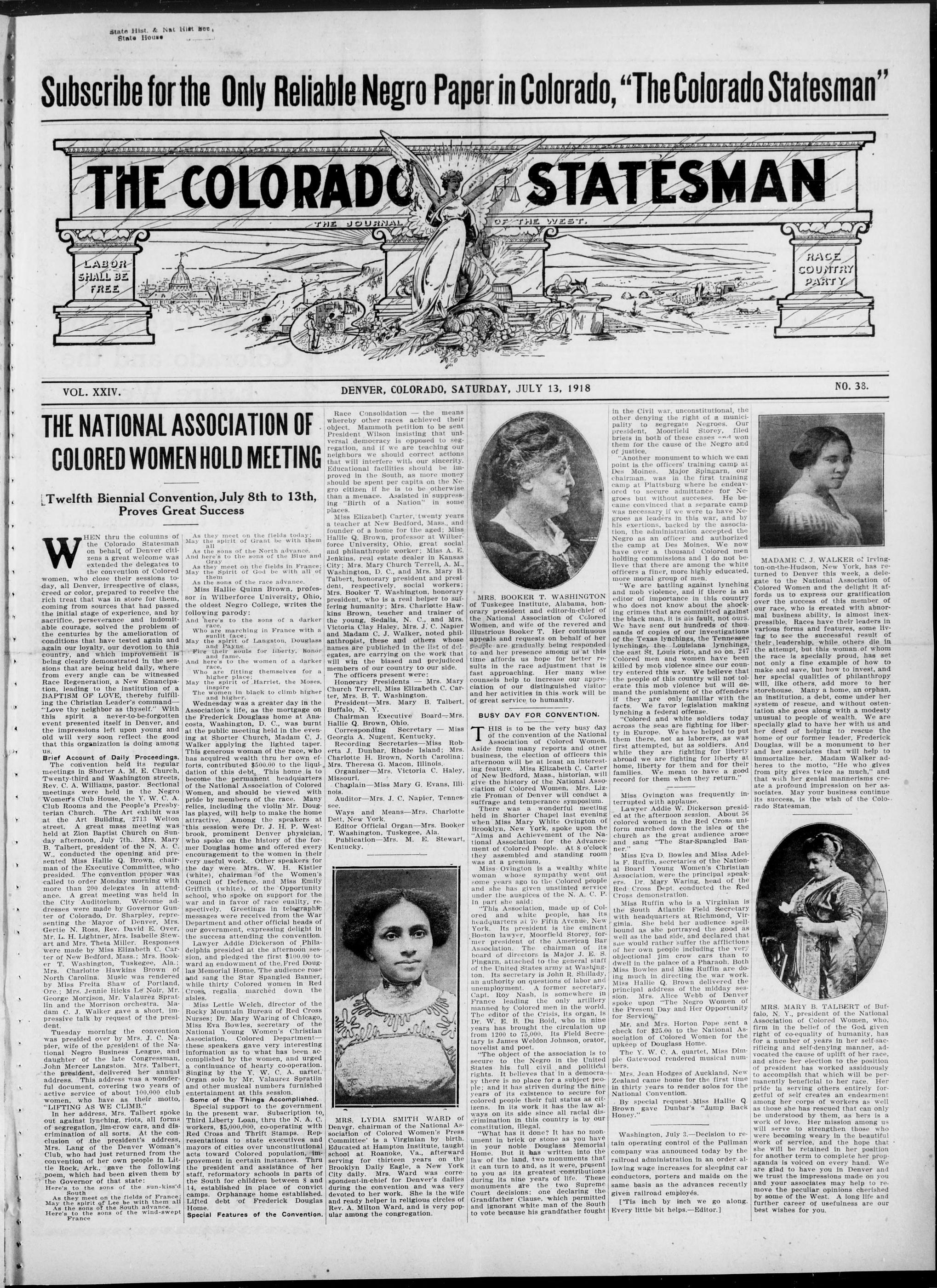
THE NATIONAL ASSOCIATION OF COLORED WOMEN HOLD MEETING
Twelfth Biennial Convention, July 8th to 13th, Proves Great Success
Twelfth Biennial Convention, July 8th to 13th, Proves Great Success
WHEN thru the columns of the Colorado Statesman on behalf of Denver citizens a great welcome was extended the delegates to the convention of Colored women, who close their sessions today, all Denver, irrespective of class, creed or color, prepared to receive the rich treat that was in store for them, coming from sources that had passed the initial stage of experience, and by sacrifice, perseverance and indomitable courage, solved the problem of the centuries by the amelioration of conditions that have tested again and again our loyalty, our devotion to this country, and which improvement is being clearly demonstrated in the sessions that are being held daily, where from every angle can be witnessed Race Regeneration, a New Emancipation, leading to the institution of a BAPTISM OF LOVE, thereby fulfilling the Christian Leader's command—"Love thy neighbor as thyself." With this spirit a never-to-be-forgotten event presented itself in Denver, and the impressions left upon young and old will very soon reflect the good that this organization is doing among us.
Brief Account of Daily Proceedings.
The convention held its regular meetings in Shorter A. M. E. Church, Twenty-third and Washington streets, Rev C. A. Williams, pastor. Sectional meetings were held in the Negro Women's Club House, the Y. W. C. A. Club Rooms and the People's Presbyterian Church. The Art exhibit was at the Art Building, 2713 Welton street. A great mass meeting was held at Zion Baptist Church on Sunday afternoon, July 7th. Mrs. Mary B. Talbert, president of the N. A. C. W., conducted the opening and presented Miss Hallie Q. Brown, chairman of the Executive Committee, who presided. The convention proper was called to order Monday morning with more than 200 delegates in attendance. A great meeting was held in the City Auditorium. Welcome addresses were made by Governor Gunter of Colorado, Dr. Sharpley, representing the Mayor of Denver, Mrs. Gertie N. Ross, Rev. David E. Over, Mr. L. H. Lightner, Mrs. Isabelle Stewart and Mrs. Theta Miller. Responses were made by Miss Elizabeth C. Carter of New Bedford, Mass.; Mrs. Booker T. Washington, Tuskegee, Ala.; Mrs. Charlotte Hawkins Brown of North Carolina. Music was rendered by Miss Freita Shaw of Portland, Ore.; Mrs. Jennie Hicks Le Noir, Mr. George Morrison, Mr. Valaure Spratlin and the Morrison orchestra. Madam C. J. Walker gave a short, impressive talk by request of the president.
Tuesday morning the convention was presided over by Mrs. J. C. Napier, wife of the president of the National Negro Business League, and daughter of the late Congressman, John Mercer Langston. Mrs. Talbert, the president, delivered her annual address. This address was a wonderful document, covering two years of active service of about 100,000 club women, who have as their motto, "LIFTING AS WE CLIMB." In her address, Mrs. Talbert spoke out against lynching, riots, all forms of segregation, jim-crow cars, and discrimination of all sorts. At the conclusion of the president's address, Mrs. Lang of the Denver Woman's Club, who had just returned from the convention of her own people in Little Rock, Ark., gave the following poem, which had been given them by the Governor of that state:
Here's to the sons of the sun-kiss'd South
South
As they meet on the fields of France;
May the spirit of Lee be with them all
As the sons of the South advance.
Here's to the sons of the wind-swept
France
---
VOL. XXIV.
As they meet on the fields today;
May the spirit of Grant be with them
all.
As the sons of the North advance.
And here's to the sons of the Blue and
As they meet on the fields in France. May the Spirit of God be with all of them. As the sons of the race advance. Miss Hallie Quinn Brown, professor in Wilberforce University, Ohio, the oldest Negro College, writes the following parody:
And here's to the sons of a darker race,
Who are marching in France with a sunlit face;
May the spirit of Langston, Douglass and Payne
Fire their souls for liberty, honor and fame.
And here's to the women of a darker race,
Who are fitting themselves for a higher place;
May the spirit of Harriet, the Moses, inspire;
The women in black to climb higher and higher.
Wednesday was a greater day in the Association's life, as the mortgage on the Frederick Douglass home at Anacosta, Washington, D. C., was burnt at the public meeting held in the evening at Shorter Church, Madam C. J. Walker applying the lighted taper. This generous woman of the race, who has acquired wealth thru her own efforts, contributed $500.00 to the liquidation of this debt. This home is to become the permanent headquarters of the National Association of Colored Women, and should be viewed with pride by members of the race. Many relics, including the violin' Mr. Douglas played, will help to make the home attractive. Among the speakers at this session were Dr. J. H. P. Westbrook, prominent Denver physician, who spoke on the history of the former Douglas home and offered every encouragement to the women in their very useful work. Other speakers for the day were Mrs. W. H. Kistler (white), chairman of the Women's Council of Defence, and Miss Emily Griffith (white), of the Opportunity school, who spoke on support for the war and in favor of race equality, respectively. Greetings in telegraphic messages were received from the War Department and other official heads of our government, expressing delight in the success attending the convention.
Lawyer Addie Dickerson of Philadelphia presided at the afternoon session, and pledged the first $100.00 toward an endowment of the Fred Douglas Memorial Home. The audience rose and sang the Star Spangled Banner, while thirty Colored women in Red Cross, regalia marched down the aisles.
Miss Lettie Welch, director of the Rocky Mountain Bureau of Red Cross Nurses; Dr. Mary Waring of Chicago, Miss Eva Bowles, secretary of the National Young Women's Christian Association, Colored Department—the speakers gave very interesting information as to what has been accomplished by the women, and urged a continuance of hearty co-operation. Singing by the Y. W. C. A. uartet, organ solo by Mr. Valaurez Sprattin and other musical numbers furnished entertainment at this session.
Some of the Things Accomplished.
Special support to the government in the present war. Subscription to Third Liberty Loan, thru the N. A. C. workers, $5,000,000, co-operating with Red Cross and Thrift Stamps. Representations to state executives and mayors of cities over unconstitutional acts toward Colored population, improvement in certain instances. Thru the president and assistance of her staff, reformatory schools in parts of the South for children between 8 and 14, established in place of convict camps. Orphanage home established. Lifted debt of Frederick Douglas Home.
Special Features of the Convention.
DENVER, COLORADO, SATURDAY, JULY 13, 1918
Race Consolidation — the means whereby other races achieved their object. Mammoth petition to be sent President Wilson insisting that universal democracy is opposed to segregation, and if we are teaching our neighbors we should correct actions that will interfere with our sincerity. Educational facilities should be improved in the South, as more money should be spent per capita on the Negro citizen if he is to be otherwise than a menace. Assisted in suppressing "Birth of a Nation" in some places.
Miss Elizabeth Carter, twenty years a teacher at New Bedford, Mass., and founder of a home for the aged; Miss Hallie Q. Brown, professor at Wilberforce University, Ohio, great social and philanthropic worker; Miss A. E. Jenkins, real estate dealer in Kansas City; Mrs. Mary Church Terrell, A. M., Washington, D. C., and Mrs. Mary B. Talbert, honorary president and president, respectively, social workers; Mrs. Booker T. Washington, honorary president, who is a real helper to suffering humanity; Mrs. Charlotte Hawkins Brown, teacher and trainer of the young, Sedalia, N. C., and Mrs. Victoria Clay Haley, Mrs. J. C. Napier and Madam Clay J. Walker, noted philanthropist, these and others whose names are published in the list of delegates, are carrying on the work that will win the biased and prejudiced members of our country to our side.
The officers present were:
The Secretary Presidents — Mrs. Mary Church Terrell, Miss Elizabeth C. Carter, Mrs. B. T. Washington.
President—Mrs. Mary B. Talbert, Buffalo, N. Y.
Chairman Executive Board—Mrs. Hallie Q. Brown, Ohio.
Corresponding Secretary — Miss Georgia A. Nugent, Kentucky.
Recording Secretaries—Miss Roberta J. Dunbar, Rhode Island; Mrs. Charlotte H. Brown, North Carolina; Mrs. Theresa G. Macon, Illinois.
Organizer—Mrs. Victoria C. Haley, Missouri.
Chaplain—Miss Mary G. Evans, Illinois.
Auditor—Mrs. J. C. Napier, Tennessee.
Ways and Means—Mrs. Charlotte Dett. New York.
Editor Official Organ—Mrs. Booker T. Washington, Tuskegee, Ala. Publication—Mrs. M. E. Stewart Kentucky.
M. B.
MRS. LYDIA SMITH WARD of Denver, chairman of the National Association of Colored Women's Press Committee' is a Virginian by birth. Educated at Hampton Institute, taught school at Roanoke, Va., afterward serving for thirteen years on the Brooklyn Daily Eagle, a New York City daily. Mrs. Ward was correspondent-in-chief for Denver's dailies during the convention and was very devoted to her work. She is the wife and ready helper in religious circles of Rev. A. Milton Ward, and is very popular among the congregation.
A. H. H.
MRS. BOOKER T. WASHINGTON of Tuskegee Institute, Alabama, honorary president and editor-in-chief of the National Association of Colored Women, and wife of the revered and illustrious Booker T. Her continuous appeals and requests on behalf of her people are gradually being responded to and her presence among us at this time affords us hope for better results in the race adjustment that is fast approaching. Her many wise counsels help to increase our appreciation of our distinguished visitor and her activities in this work will be of great service to humanity.
BUSY DAY FOR CONVENTION.
THIS is to be the very busy day of the convention of the National Association of Colored Women. Aside from many reports and other business, the election of officers this afternoon will be at least an interesting feature. Miss Elizabeth C. Carter of New Bedford, Mass., historian, will give the history of the National Association of Colored Women. Mrs. Lizzie Froman of Denver will conduct a suffrage and temperance symposium. There was a wonderful meeting held in Shorter Chapel last evening when Miss Mary White Ovington of Brooklyn, New York, spoke upon the "Aims and Achievement of the National Association for the Advancement of Colored People. At 8 o'clock they assembled and standing room was at a premium. Miss Ovington is a wealthy white woman whose sympathy went out some years ago to the Colored people and she has given unstinted service under the auspices of the N. A. C. P. In part she said:
"This Association, made up of Colored and white people, has its headquarters at 70 Fifth Avenue, New York. Its president is the eminent Boston lawyer, Moorfield Storey, former president of the Americap Bar Association. The chairman of its board of directors is Major J. E. S. Pingarng, attached to the general staff of the United States army at Washington. Its secretary is John R. Shillady, an authority on questions of labor and unemployment. A former secretary, Capt. Roy Nash, is somewhere in France leading the only artillery manned by Colored men in the world. The editor of the Crisis, its organ, is Dr. W. E. B. Du Boid, in nine years has brought the circulation up from 1200 to 75,000. Its Field Secretary is James Weldon Johnson, orator, novelist and poet.
"The object of the association is to secure to the Negro in the United States his full civil and political rights. It believes that in a democracy there is no place for a subject people; and it has striven during the nine years of its existence to secure for colored people their full status as citizens. In its work it has the law always on its side since all racial discrimination in this country is by our constitution, illegal.
"What has it done? It has no monument in brick or stone as you have in your noble Douglass Memorial Home. But it has written into the law of the land, two monuments that it can turn to and, as it were, present to you as its greatest contributions during its nine years of life. These monuments are the two Supreme Court decisions; one declaring the Grandfather Clause, which permitted and ignorant white man of the South to vote because his grandfather fought
In the Civil war, unconstitutional, the other denying the right of a municipality to segregate Negroes. Our president, Moorfield Storey, filed briefs in both of these cases and won them for the cause of the Negro and or justice.
"Another monument to which we can point is the officers' training camp at Des Moines. Major Spingarn, our chairman, was in the first training camp at Plattsburg where he endeavored to secure admittance for Negroes but without successes. He became convinced that a separate camp was necessary if we were to have Negroes as leaders in this war, and by his exertions, backed by the association, the administration accepted the Negro as an officer and authorized the camp at Des Moines. We now have over a thousand Colored men holding commissions and I do not believe that there are among the white officers a finer, more highly educated, more moral group of men.
"We are battling against lynching and mob violence, and if there is an editor of importance in this country who does not know about the shocking crimes that are committed against the black man, it is his fault, not ours. We have sent out hundreds of thousands of copies of our investigations of the Texas lynchings, the Tennessee lynchings, the Louisiana lynchings, the east St. Louis riots, and so on. 247 Colored men and women have been killed by mob violence since our country entered this war. We believe that the people of this country will not tolerate this mob violence but will demand the punishment of the offenders if they are only familiar with the facts. We favor legislation making lynching a federal offense.
"Colored and white soldiers today across the seas are fighting for liberty in Europe. We have helped to put them there, not as laborers, as was first attempted, but as soldiers. And while they are fighting for liberty abroad we are fighting for liberty at home, liberty for them and for their families. We mean to have a good record for them when they return."
Miss Ovington was frequently interrupted with applause.
Lawyer Addie W. Dickerson presided at the afternoon session. About 36 colored women in the Red Cross uniform marched down the isles of the church as the great audience arose and sang "The Star-Spangled Banner."
Miss Eva D. Bowles and Miss Adela F. Ruffin, secretaries of the National Board Young Women's Christian Association, were the principal speakers. Dr. Mary Waring, head of the Red Cross Dept. conducted the Red Cross demonstration.
Miss Ruffin who is a Virginian is the South Atlantic Field Secretary with headquarters at Richmond, Virginia. She held her audience spellbound as she portrayed the good as well as the bad side, and declared that she would rather suffer the afflictions of her own people including the very objectional jim crow cars than to dwell in the palace of a Pharaoh. Both Miss Bowles and Miss Ruffin are doing much in directing the war work. Miss Hallie Q. Brown delivered the principal address of the midday session. Mrs. Alice Webb of Denver spoke upon "The Negro Women of the Present Day and Her Opportunity for Service."
Mr. and Mrs. Horton Pope sent a check for $25.00 to the National Association of Colored Women for the upkeep of Douglass Home.
The Y. W. C. A. quartet, Miss Dimple Gatewood rendered musical numbers.
Mrs. Jean Hodges of Auckland, New Zealand came home for the first time in thirty years to render solos for the National Convention.
By special request Miss Hallie Q. Brown gave Dunbar's "Jump Back Honey."
Washington, July 3.—Decision to retain operating control of the Pullman company was announced today by the railroad administration in an order allowing wage increases for sleeping car conductors, porters and maids on the same basis as the advances recently given railroad employés.
[ "Tin inch by inch we go along, Every little bit helps. -Editor. ]
NO.38.
A. B.
MADAME C. J. WALKER of Irvington-on-the-Hudson, New York, has returned to Denver this week, a delegate to the National Association of Colored Women and the delight it affords us to express our gratification over the success of this member of our race, who is created with abnormal business ability, is almost inexpressible. Races have their leaders in various forms and features, some living to see the successful result of their leadership, while others die in the attempt, but this woman of whom the race is specially proud, has set not only a fine example of how to make and save, but how to invest, and her special qualities of philanthropy will, like others, add more to her storehouse. Many a home, an orphan, an institution, a debt, come under her system of rescue, and without ostentation she goes along with a modesty unusual to people of wealth. We are specially glad to have her with us and her deed of helping to rescue the home of our former leader, Frederick Douglas, will be a monument to her and her associates that will help to immortalize her. Madam Walker adheres to the motto, "He who gives from pity gives twice as much," and that with her genial mannerisms create a profound impression on her associates. May your business continue its success, is the wish of the Colorado Statesman.
A.
MRS. MARY B. TALBERT of Buffalo, N. Y., president of the National Association of Colored Women, who, firm in the belief of the God given right of co-equality of humanity, has for a number of years in her self-sacrificing and self-denying manner, advocated the cause of uplift of her race, and since her election to the position of president has worked assiduously to accomplish that which will be permanently beneficial to her race. Her pride in serving others entirely forgetful of self creates an endearment among her corps of workers as well as those she has rescued that can only be understood by them, as hers is a work of love. Her mission among us will serve to strengthen those who were becoming weary in the beautiful work of service, and the hope that she will be retained in her position for another term to complete her propaganda is voiced on every hand. We are glad to have you in Denver and we trust the impressions made on you and your associates may help to remove the peculiar opinions cherished by some of the West. A long life and further career of usefulness are our best wishes for you.
FOREIGN
Wires were blown down and other damage was done by a typhoon which struck the Philippines.
A thousand Chinese have been murdered in Chinese Turkestan by roving hordes of the Bolshevik, according to reports from that district.
An American sanitary commission, headed by A. K. Kendall, has arrived at Guayaquil, Ecuador, to co-operate in wiping out the yellow fever.
John Robert Clines, parliamentary secretary to the Control Department, has been appointed to succeed the late Viscount Rhondda as food controller in London.
Workman, Clark & Co., Belfast, Ireland shipbuilders, have achieved a world's record in completing an 8,000-ton standard ship in fifteen days after she was launched.
"All Germany and Austria-Hungary will now be subjected to food seizure, rationing and prohibition of free trading." Food Controller von Waldo announced in the German Reichstag. Berlin dispatches report that severe floods followed a sudden, heavy rainfall in many parts of Germany. Serious damage to crops and loss of property are reported from several districts. The food shortage in Austria is growing more acute, according to Herbert Mayer, secretary to Charles J. Vopika, American minister to Rumania. Mr. Mayer has just returned from Jassay, by way of Austria.
Martial law has been proclaimed in Moscow. Advices received at Basle, Switzerland, stated that the Russian social revolutionaries confessed the plot to murder Count von Mirbach, the German ambassador to Russia, in order to annul the Brest-Litovsk treaty.
A Canadian troopship that was in the fleet of boats where the British steamship Orissa was attacked and sunk off the Irish coast brought word that two submarines were sunk after the Orissa was torpedoed, according to disabled soldiers reaching Toronto, Ont.
**SPORT**
Syracuse will hold a dog show in conjunction with the New York state fair, Sept. 11 to 13.
In a ten-round no-decision bout at Kansas City, Mo., Eddie McGoorty, boxing instructor at Camp Grant, outboxed Hugh Walker of Kansas City.
With two jumps of 67 and 68 feet without a fall, S. Johnson of Tacoma won the ski championship of the Pacific Northwest in the contests on the heights of Alta Vista, Paradise valley, Ranier National park. There were fifteen contestants.
The 1918 Grand Circuit harness racing season opened with a five-day meeting at Cleveland, Ohio. Practically all of the trotting and pacing stars of the country are included among the 252 nominations to the twenty-two events. They will be driven by America's foremost reinsmen.
Up at ole Cheyenne the yip-yip of the cowboy and the hi-hi of the cowgirl are being heard again—and the one-time cow town is taking on once more the colorful atmosphere of the West that has passed. Preparations are nearing completion for the annual Frontier celebration—and they're proclaiming to the world that it will be bigger and better this year than ever before. Following the announcement that this year's show—which will be staged from July 22 to 27, opening with an auto road classic on the 22nd—will be for the benefit of war funds, the Red Cross, the Y. M. C. A., the Salvation army and the Knights of Columbus, comes word that the entries have surpassed all other years, and this will be the twenty-second time the famous frontier exposition has attracted thousands from over all the country.
GENERAL
Richard F. Cleveland, 20 years old, son of Grover Cleveland, has enlisted in the marine corps.
The telegraphers strike order was rescinded.
Basic prices on coke were established by the Fuel Administration at $4.50 to $6.50.
Worth Bagley Daniels, son of the secretary of the navy, entered the Annapolis Naval Academy as a midshipman.
Sixty-four million silver dollars have been melted into bullion by the United States treasury, most of which has been exported to India.
The Knights of Columbus will raise $50,000,000 in the development of war work in the next twelve months, it was announced in New York.
Control of the production and distribution of sulphur materials has been taken over by the War Industries Board with the approval of President Wilson.
Announcement that express company employés throughout the country will receive an increase in wages dating from July 1 was made in New York by George C. Taylor, president of the American Railway Express Company, which on July 1 took over the express business on all the railroads of the United States.
Maj. John Purrey Mitchel, former New York mayor, killed when he fell 600 feet from the airplane in which he was riding, dropped from the pilot's seat and plunged downward while his plane skimmed on without a pilot for nearly half a mile, according to statements by officers at Gerstner aviation field at Lake Charles, La.
Rev. Dr. Washington Gladden, nationally known Congregational minister and author of Columbus, Ohio, died following a second stroke of paralysis. Dr. Gladden was 82 years of age
NEWS TO DATE IN PARAGRAPHS
CAUGHT FROM THE NETWORK OP
WIRES ROUND ABOUT
THE WORLD.
DURING THE PAST WEEK
RECORD OF IMPORTANT EVENTS CONDENSED FOR BUSY
Western Newspaper Union News Service.
ABOUT THE WAR
Australians continue to crowd Germans eastward near Amiens.
Franco-Italian attack in Macedonia may be beginning of strong offensive.
Italian troops Monday advanced their front line in the region of Col. La Prible.
Inhabitants of north Russia province secede and announce intention to join entente.
Czecho-Slovak forces have taken Nikolaievsk, it was officially announced at Vladivostok.
Twenty Norwegian vessels aggregating 26,833 gross tons, were sunk during June.
French and Italian forces made advances in Albania, the Austrian war office admitted.
British casualties reported during the week ending June 6 reached an aggregate of 17,336.
In aerial fighting British and French airmen have accounted for twenty-five machines.
Assassins of German ambassador in Moscow not identified. Russian government expresses horror and indignation at crime.
Austrian troops Tuesday again attacked the Italian positions at Corone, between the Frenzela valley and the Brenta, and again met with a repulse.
With the help of the Americans northwest of Chateau-Thierry the allied line as a whole on this front already has been straightened and improved.
The Austrians lost 20,000 men, or half their troops engaged, during the fighting in the mountain region and on the Piave from July 2 to 6, the Rome war office announced.
While the fighting on the Macedonian and Albanian frontiers must remain a side issue, the progress of the French and Italians along the Albanian coast brings that theater of the war into consideration as important gains have been made.
French troops Tuesday morning attacked the German lines on a front of about two and a half miles west of Antheuil, on the front between Montdidier and the Oise, penetrating the enemy positions and realizing an advance of a mile at certain points.
WESTERN
At least 125 persons, most of them negroes, were killed and seventy-five injured in a head-on collision between two passenger trains on the Nashville, Chattanooga & St. Louis railway at Dutchman's bend, five miles from Nashville, Tenn.
An opportunity for four men for service in the Red Cross is offered through the mountain division. An associate field director, a warehouse supervisor, a stenographer and a chauffeur are needed at once, for service at Camp Cody, Deming, N. M.
One hundred and sixty suits, asking upward of $3,280,000, as the aggregate sum of damages, alleged to have been sustained through deportation from the Bisbee district July 12, 1917, were filed in the district court of Cochise county, in Tombstone, Ariz., in behalf of 160 I. W. W.'s.
Sylvia Johanna, a 6-months-old Holstein bull calf, sold for $106,000 at the Wisconsin state fair.
WASHINGTON
Preparations for action under the policy toward Russia approved by the United States are going forward steadily.
Coal rationing plan for next winter, with house temperatures limited to sixty-eight degrees, says Fuel Administration.
Commercial telegraphers strike indefinitely postponed as result of conference of union officials with Secretary Wilson.
A dispatch received at the State Department from the American legation at Teheran, Persia, states that on account of riots arising from the food shortage and other disturbances the city has been placed under martial law.
State draft executives were directed by Provost Marshall General Crowder to have local boards call up for physical examination immediately all new registrants under the selective draft law who have been placed in class one ready for call in August.
The United States army transport Henderson was afire at sea, but made an Atlantic port in safety. There was no loss of life.
An additional credit of $10,000,000 was granted to Italy by the Treasury Department, making a total of $660,000,000 for Italy and of $6,091,590,000 loaned to the allies to date.
Following the recent capture of three American engineers by bandits in China, a census of Chinese outlaws has been made, showing that in five provinces there are a total of 37,000 brigands.
SPORT
Pithy News Notes From All Parts of Colorado
Western Newspaper Union News Service.
COMING EVENTS.
July 16—Republican State Convention at Colorado Springs.
July 22—Democratic State Assembly in Denver.
Denver.
Aug. 22-24—Colorado State Firemen's
Convention at Georgetown.
Sept. 22-28—Colorado State Fair at
Pueblo.
Sept. 26-28—Lincoln County Fair at Hugo.
Ed Heitt, 23, a cripple, was arrested in Denver charged with grand larceny and passing fraudulent checks.
First and only concrete bridge in San Miguel county has been completed at Placerville and is a fine one.
Eighteen persons were taken into custody by the state constabulary in the wake of the July 4 celebrations.
The $3,500,000 coke plant at Pueblo burned its first grist of coke after two years in the process of construction.
The convention of the National Federation of Colored Women began in Denver Monday and will last through July 13.
Conferences on the farm wage problem were held at Greeley and Grand Junction by Secretary Thomas of the State Council of Defense.
In the city of Las Animas a girls' club has taken charge of the work of weighing and measuring babies in the child welfare work.
The State Council of Defense has suggested that boys can be used as sheep herders to meet a shortage now developing among herders.
Hannan W. Martin, formerly of Denver, is reported in the casualty list as severely wounded in action. He was with the 164th infantry.
Mrs. Edna O. Blades of Hugo has been selected chairman of the Lincoln county Women's Council of Defense which has just been organized.
Three initiated measures and two legislative measures for ratification will be presented to the voters for their consideration in the November election.
The county threshermen's committees are now busy throughout the state licensing threshermen in accordance with Governor Gunter's proclamation.
The dirt road over Monarch pass, last of the timberline trails to open, will soon be passable, the deep snow having sunk down rapidly in the past three weeks.
A $20,000 Red Cross building for Fort Logan has been authorized by the National Red Cross Society and the erection of the building is to begin at once.
Portland Gold Mining Company of Cripple Creek has declared its regular quarterly dividend of 3 per cent, amounting to $90,000, payable July 20 to stock of record July 10.
Earl W. Davis, reported injured in France, was shot through the leg about a month ago. A letter to his parents in Pueblo stated that the wound was not serious, as no 'bone was struck.
Approximately $9,000,000 in income and excess profits taxes was collected in the last few hours before the expiration of the ten days' grace, according to Mark A. Skinner, collector.
Denver has been selected as one of the cities of the country to co-operate with the Military Training Camps Association of the United States in securing men for specialized service.
Word that the five large express companies, which have been merged into one concern under federal jurisdiction, will be granted a 10 per cent increase in rates immediately was received by the Colorado Public Utilities Commission.
More nurses are needed and Colorado has been asked by national authorities to enlist 450 women who will enter hospitals for training as nurses. The Woman's State Council of Defense will assign a quota for each county to enlist. A nurses recruiting station will be held in Denver from July 29 to August 11.
Early applications for entrance to the boys' free training school in farm work at the State Agricultural college showed that many parts of the state would be represented as Governor Gunter desired. The school was opened with forty boys and sixty more will enter the school this week.
There will be vegetables on our tables next winter—not hothouse luxuries, nor even the costly food that canned goods must be in wartime, but peas and beans and many other things bought at their summer prices, and with color, flavor and nourishent unchanged. This is made possible by the community drier, the technical name of which is dehydration plant, just installed at Denver Thrift House by the Women's League for National Service.
On the anniversary of his arrival in France Michael Lynch, age 24, of Denver and Chicago, nephew of the Rev. Father D. T. O'Dwyer of St. Patrick's parish church, is reported killed in action in the casualty list. In the same list occurs the name of Leonard Stromberg, 27, a rancher of Wellington, dead of pneumonia, in France.
Instead of one, five camps of boy workers will probably be established at Fort Lupton by the U. S. Boys' Working Reserve for Colorado. It is expected that 125 boys will be employed by the canners.
CENTENNIAL STATE ITEMS.
---
A dispatch from San Francisco telling of the suicide of Col. James Wentworth Clinton; U. S. A., who recently returned from France, where he had been assigned to special duty with the French forces, writes a tragic "finish" to a romance that began in Denver twenty-one years ago. Colonel Clinton, whose army career ended with a bullet through his heart from his own revolver, began his military life as a trooper at Fort Logan in 1897, where he met and married Isabel Howell, daughter of Lieut. Daniel L. Howell, now Colonel Howell, commanding officer of the big Colorado army post.
THE COLORADO STATESMAN
Flaying Germany and her vassal states with stinging sarcasm, explaining the mistakes of the allies toward his country, describing her steadfastness and the heroism of her soldiers, and praising the United States, Lieut. Bruno Roselli, Italian army attaché of the Washington embassy of Italy and a representative of the committee on public information, brought a different phase of the war to 200 soldiers at the Fort Logan Y. M. C. A. hut.
The Mouth-Piece of the People of Colorado and the Entire West
J. M. Collins of Eaton has reported to the State Council of Defense that there is a slight improvement in the situation confronting the milk condensers of the state which have been unable to sell their products. A letter from the head of the canning division of the U. S. Food Administration says that the Loveland condensery was really a little favored, receiving orders for 16,111 cases when its allotment under the restrictions in force was 13,780 cases.
Before her daughter Elizabeth, who was on her way from New York to spend a vacation with her parents could reach Denver, Mrs. Charlotte Grace Selden Moffat, wife of Frederick G. Moffat, died at her home in Denver. Mrs. Moffat had been ill for a year and a half. Her husband is a nephew of the late David H. Moffat, builder of the Moffat railroad and a former recognized financial leader of the state.
ARELIABLE chronicle of their doings and progress; a faithful mirror of their wants, their hopes, their best aspirations.
Mystery surrounds the murder and the burial of the body of Mrs. Mattie Baker, a rooming house keeper at Pueblo. The body was found half buried in an arroyo near Eden and just off the Colorado Springs road. She had been murdered and her assailants apparently had used a blunt instrument of some sort because the forehead was crushed by the blow. The body was discovered by two Mexican section men.
Sixteen hundred acres of wheat, belonging to Summer brothers of Sterling, were pounded into the ground by a hailstorm that swept over the Graylin district, sixteen miles west of Sterling. The brothers had 2,180 acres in wheat, so have something of a crop left. H. C. Lewis lost sixty-two acres of crops and Joseph W. Sherer seventy acres. Many other farms were devastated by the storm.
THE COLORADO STATESMAN
Mrs. Eva Gove, 28 years old, of Denver, died at the county hospital from the effects of carbolic acid she had taken less than an hour before in her home. Brooding over the suffering of her 12-year-old son, Elmer Gove, who lays mangled on a white cot in another ward of the same hospital, and the death of another child, 3 years of age, only three months ago, caused her to swallow the poison, the police say.
"I am not allowed to tell you many things I would like to, but I assure you that the American army is meeting with great victories and with comparatively few losses of men to what the Germans are losing," wrote Jim Goodheart, Denver city chaplain, from Paris under date of June 8 in a letter addressed to the late Mayor Robert W. Speer.
Unequaled as an advertising medium for the business of professional men and women.
Colorado has furnished more and better aviators per capita than any other state. The number of men accepted has been slightly over 50 per cent, while the average for all other states is approximately 32 per cent, and but one Colorado man has failed at ground school.
As the quotas for military service continue to be called month after month, these inroads on the labor supply is causing serious results, from a purely mining point of view, and, unless offset by some other source than is now known, they will cause a material reduction in the output of the precious metals.
An excellent family journal speaking to and for many thousand colored citizens.
Corporal Leon H. Harlow of Rifle, has been cited by General Pershing for valor on the field of action in France. Here is the citation: "He left a sick cot and volunteered to fight. He repaired five breaks in a wire during a heavy artillery and machine gun fire and carried a message safely to the regimental commander." Denver's application for a reopening of the rate order granted the Mountain States Telephone and Telegraph Company June 14 was denied by the Colorado Public Utilities Commission.
TWODOLLARSAYEAR
A home oil company at Trinidad has obtained from the state geologist a report expressing great confidence in the existence of oil at a place east of Delhi, in north central Las Animas county.
THE GREAT ORGAN OF THE
All altitude records for aviators were broken by Stuart McKeown, a former Fort Collins boy. He went up 22,000 feet 200 feet higher than any previous record made.
The Star Tunnel and Mining Company. Georgetown, has started operations on the old Flagler group north Clear Creek. There are five patented claims.
LABORING MASSES
Daniel J. Ennis, of Denver, and Irus A. Bell, of Leadville, are two Colorado men reported wounded in battle in France.
WILL LOAD 52,000 SHELLS EACH DAY
GREAT GOVERNMENT PLANT IN NEW JERSEY TO START SHIPMENTS BEFORE LONG.
IS LARGEST IN THE WORLD
Three Others Like It Being Constructed—Medical Department Has Mobile Apparatus to Provide Pure Drinking Water in France.
<From Committee on Public Information.>
Washington.—Quantity if not capacity shipments will start soon from a new government shell-loading factory in New Jersey, one of four such government plants each of which is larger than any similar plant in the world.
When turning out 52,000 loaded shells a day under full operation the plant will use 2,000 tons of shells and explosives daily, the products of some 75 factories. More than 5,000 workmen will be required. Plans contemplate the employment of a large number of women. The marking of shells to designate size, load and range will require 250,000 operations each day.
The plant has a total area of approximately 2,500 acres. More than 100 buildings, with an aggregate floor space of 1,300,000 square feet, will provide storage for shells and parts and for material. A small city, with heating and lighting plants, water and sewage systems, hospitals, fire-fighting plant and restaurants, was built to house the employees. There is equipment to protect the health of those who work with poisonous gases, and a school for instruction in the loading of artillery ammunition with high explosives.
The operating plant consists of 13 shell-loading units, each independent of the other, with equipment for loading 13 sizes of shells, ranging from the recently developed 7-millimeter to 16 inches. On two sizes of shells the propelling charge also will be loaded, the shell and cartridge case being assembled at the plant. All other shells are assembled in France.
In the construction of the shell-loading units the problem was far greater than one of mere building. Immense fans have been installed to dispose of the poisonous fumes from the high explosives. When a unit is in operation the air in the loading room is changed every few minutes.
The American soldier in France gets pure drinking water from mobile water trains. The trains are under the jurisdiction of the army medical department. They are miniature waterworks, which chemically treat, filter and sterilize water, making it fit for consumption. What municipal waterworks do to insure healthful water to the people of a city these trains do for the soldiers.
A number of purification units with attached motor-tank trucks constitute a train. Each unit is a complete filtration plant, including laboratory. Arriving at a stream it sets hose into the water and pumps the water through a pressure tank. Before the water passes through a sand filter it is treated chemically to rid it of disease germs. The pure water is pumped into tanks mounted on trucks, which carry the water to the soldiers.
Each mobile water unit carries an expert chemist, bacteriologist and pumpman. There is a complete laboratory in the front of the machine for the testing of the water. Tests are made every two hours or more often when it is thought necessary. The water is lifted into the filter by a gasoline pump engine and a complete supply of extra pipes and tools are carried so that all repairs, either from accident or shell fire, can be made on the spot. The trucks are equipped with electric lights so that the work can be carried on at night. Many of the chemists and bacteriologists assigned to the mobile laboratories were formerly connected with municipal waterworks and filtration plants.
Every community will be combed for war workers. War industries are short nearly 400,000 common laborers and lack of workers in the coal-mining industry is imperiling all war production. There is also a serious shortage of skilled labor. One of the largest munition plants, turning out heavy caller guns, is short 2,000 machinists. The war plants of Connecticut and Maryland are undermanned 35,000 machinists. The United States employment service will begin an intensive recruiting of workers for war work from the nonessential industries. Employment offices will be increased and the force of local agents and travelling examiners will be enlarged and sent into every community that relief may be given before the ban against private labor recruiting goes into effect on August 1.
Nearly 2,000,000 girls and boys have volunteered for the United States garden army in the department of the interior. Their service flag bears a crossed rake and hoe with the letters U. S. S. G. in blue on a field of white with a red border. The enlistment entails a pledge on the part of the child to use efforts to increase food production by cultivating one or more crops under a garden supervisor or teacher chosen for this work and to make such reports as may be required. The success of the garden army plan is most gratifying.
Ensign Stephen Potter, United States Naval Reserve force, killed in action with German planes April 25 last, was the first American naval aviator to shoot down and destroy a German seaplanet, according to a navy department statement.
The report states that on March 19, 1918, a long-distance reconnaissance of the German const was made by large American flying boats operating from a British Royal Air force station. Ensign Potter was one of two American naval aviators accompanying this expedition and Potter was successful in shooting down a German seaplanet which attacked the reconnaissance formation. A second enemy seaplanet found safety in running away.
Potter's death reflects credit on his courage. He was killed in a fight with seven enemy single-seaters. He was second pilot to a British air force captain, who was with him when he shot down the German plane in March. Two British planes had flown to a point six miles from Hinder light, when two enemy planes headed toward them. The British planes closed on the nearest German and opened fire. Two more hostile planes then appeared overhead and attacked vigorously while three other enemy planes passed astern. The two British planes dived and speeded westward under continuous volleys from the rear. One of the Germans disappeared.
Of the seven Germans in action four were attacking Potter, who fell behind his companion and began to zigzag. Potter dodged, but was broadside to all the enemy machines and under their fire only 50 feet from the water. His companion, 250 feet above, saw Potter's machine burst into flame, come part of the way under control, then crash on the port wing tip. Potter was seen last on the surface of the water amid flames, which turned suddenly to a huge cloud of smoke. When the pall had cleared not even wreckage was visible and the circling enemy disappeared.
German timidity before American pistol fighters armed with American 45-calliber automatic pistols has brought about a change in the equipment of the American Expeditionary forces by the, war department and the ordnance department is rushing production of these weapons. About 3,000 are turned out daily and production is increasing. The impression exists that a shot from an American .45 takes a man out of action completely. Men hit from the smaller German pistols frequently continue in action effectively. The .45 calliber was adopted by the United States army in 1911. Despite the heavy increased demand for these pistols the ammunition branch of the ordnance department has effected a saving during the past two calendar months of nearly $2,000,000, mostly on small-arms ammunition.
The total savings by the ordnance department for these two months through salvage, waste prevention and the utilization or sale of discarded materials have aggregated $8,757,025. Cost of Vickers machine guns has been reduced $322.35 each; Colt machine guns, $284.16 each; Lewis machine guns, $22 each. Government rifles now cost $22 each, a reduction of $13 each.
Health of women workers in mutilation plants will be looked after by woman health officers who are to be trained under the direction of the women's division of the industrial service section of the army ordnance department.
An eight weeks' course of study for carefully selected woman health officers has opened at Mount Holyoke college, Massachusetts. The course is under the general direction of Dr. Kristine Mann, health supervisor of the women's branch of the ordinance department. The staff of lecturers and instructors includes well-known specialists in physiology and hygiene, physical education, factory organization and labor. Women taking the course are college graduates or of equivalent technical education. Almost all of them have had experience in dealing with working women. First requirement for admission to the course is perfect health and only those were selected who will inspire wholesome living among the munition workers.
The army has sufficient veterinarians, Surgeon General Gorgas announces. Examinations for commissions in the veterinary corps have closed. There is a waiting list of those eligible to commissions and until this list is exhausted there will be no more examinations. The corps has 1,700 officers and 10,000 enlisted men on active duty.
Veterinary graduates called by the draft will enter the army service as privates. Later they will be allowed to take examinations for veterinary officer commissions to fill vacancies. Men over the draft age and under forty may enlist as privates and secure an equal chance with selected men for commissions. One hundred men are graduated each month from the training school for commissioned veterinary officers on active duty at Camp Greenleaf, Chickamauga Park, Ga.
The department of labor reports adjustment of 30 industrial disputes during a recent week. This is a record. Eleven strikes and two threatened strikes were adjusted. Included in the strikes settled was that of machinists at the Curtiss Airplane company plant, Buffalo, where 300 men quit and 15,000 were affected indirectly.
The division headquarters at Camp Lee is within a stone's throw of the spot where the house stood that housed Grant and his staff during the siege of Petersburg.
CZECHS CONTROL WESTERN SIBERIA
BOLSHEVIK FORCES DEFEATED IN WHOLE REGION EAST OF THE URIAS.
FRENCH WIN AT CORCY
OPEN VIEW OF HUN MOVES AS SURED BY ADVANCES ON MARNE-AISNE LINES.
Western Newspaper Union News Service.
London, July 12. — Virtually all western Siberia is in control of the Czecho-Slovaks, according to a Reuter dispatch from Peking, dated July 10. The dispatch states that the Bolshevik have been overthrown in the whole region from Tobolsk, east of the Urals, to Semipalatinsk, 750 miles to the southeast, near Chinese frontier. The Transsiberian railway is under Czecho-Slovak control from Tcheliabinsk, in the Ural mountains at the junction of the branches of the road which lead to south and north Russia, to Krasnoyarsk, 1,300 miles east. The report confirms earlier dispatches to the effect that the Bolshevik at Irkutsk have been defeated by the Czecho-Slovaks. Germany is reported to have seized entire Russian navy, and to be adding warships to her own fleet.
French pressure along the line from the Marne to the Aisne, which began two weeks ago as a series of local attacks, has begun to realize results which are appreciable when viewed on the map. The town of Corcy and strong positions in that vicinity have been captured by the slow, methodical advance that has been the source of much annoyance to the enemy for several days. As a result of the assaults made by the French from Amblen, south of the Aisne, to the hills south of Corcy, their line has been advanced to high ground which lends itself to defensive operations and gives the French observation points from which they can see what is going on behind the German lines.
There has been some reason for believing that when the Germans resume their offensive on the western front they will attempt to break through between the Marne and Aisne in a dash straight for Paris. For this reason the operations which the French have carried out are of great importance.
South of Corcy the German line extends slightly to the westward, but it curves sharply eastward just before it reaches the Clignon river, northwest of Chateau Thierry.
From the Clignon southward to the Marne, American forces have been improving their positions in recent days and now have a strong line of positions running northward from Hill 204, west of Chateau Thierry, to the village of Corcy.
On the British front the Australians have been in action once more, penetrating German positions and capturing prisoners. On the rest of the lines held by the British there have been the usual artillery duels and patrol engagements.
French and Italian detachments are steadily pushing Austrian forces back along the western slopes of the mountains that parallel the coast of Albania. They are reported north of the important town of Berat, and have moved ahead in the hilly country to the east. Vienna admits the allied success in this quarter.
In the mountain sectors of the northern Italian front Austrian units which have approached the Italian positions have been driven back.
SUBMARINE MENACE ENDED.
Former Premier Asquith Pays High Tribute to President Wilson on Work in War.
London.—Praise of President Wilson's leadership in the war and his advocacy of a league of nations after the war was given by Herbert H. Asquith, former premier, in an address at the National Liberal Club. The occasion was a "hospitality dinner to American officers."
"The United States has had the very good fortune that in the supreme crisis of her national history the man whom she most needed for inspiration and guidance has always appeared. Thus came Washington and Lincoln. President Wilson has been the head of American government in times no less trying than any in its annals."
Vice Admiral Sims, commander of the American naval forces in the war zone, paid tribute to the cooperation of the British and American navies and declared: "The submarine menace is now at an end, for we are destroying them faster than the Germans can build them."
Floods Cause Damage at Springs.
Colorado Springs, Colo., July 12. Hundreds of war gardens were destroyed and many thousand dollars worth of property was damaged as a result of an electric storm accompanied by hail and rain which visited Colorado Springs and the Pike's Peak region Wednesday afternoon between 4 and 6 o'clock. A total of two inches of rain fell in less than two hours and the hall fell in a strip about a mile wide and extended from Manitou to East Colorado Springs.
WHEN AGE ARRIVES
Rules That One Man Promises He Will Observe.
Of Course There Is a Proviso, but the World Would Be Sweeter if They Were Kept Generally in Mind.
When I am old I will observe the following items (perhaps):
I will not try to act nor dress nor talk so as to make people think I am younger than I am.
I will not pretend to be young, nor be angry when called old, nor ashamed of my age.
I will not complain of being old.
I will not complain of being old.
I will not continually remind people of my old age to secure their sympathy, or to hear them say I am not old after all, or do not seem so.
I will not form the habit of indulging in reminiscences.
I will be particularly careful not to repeat the same anecdotes over and over.
I will not complain of the present and claim the past was much better.
If I am deaf, weak-eyed, lame or otherwise afflicted I will not advertise my infirmities, but avoid obtruding them upon the notice of others as much as possible.
I will not talk of myself, my works, or my achievements, even of my mistakes, any more than is necessary.
I will speak cheerfully or keep still.
I will never indulge in cynicism, never sneer at youth, and I will try always to appreciate what younger folks do.
I will be as little bored as I can, and never say I am bored, nor, if possible, act as if I were bored.
I will not give advice unless it is asked, and not often then.
I will not be irritable.
I will not be a nuisance nor an encumbrance, so far in me lies.
I will not be offended by neglect, but
I will remember the words of the sage:
"Those who come to see me do me honor; those who do not come to see me do me a favor."
I will be as little disagreeable as possible, and will never use my natural disagreeableness as a means of getting my way.
I will cultivate the friendship and companionship of young children, who alone understand old age.
I will learn to love to be alone. As Dsben says: "The freest soul is the soul that is alone."
I shall try to show the world that old age is spiritual opportunity and not physical calamity.
Forced to become a by-stander, I shall try to be a hopeful one.
I shall try to sweeten like the pear Doctor Holmes describes that mellows and becomes full flavored before it drops from the stem, and shall try not to sour and dry and rot.
I shall conceive my life's triumph to be to grow triumphantly, victoriously old.
In a word, I shall try to adjust myself to old age, as to all other facts of life.—Life.
Lucky Photographer.
It is not always that things turn out so happily for the rash person who ventures to take snapshots on the east coast of England, as they did in the case of a young lady in the following story: She was seen photographing on a point of the coast, and was promptly approached by a special, who informed her of the enormity of her offense, took her name and address, and removed her camera. She heard nothing more of the matter for some time, but one morning she was amazed at receiving a check running into three figures, and a letter from headquarters informing her that her photographs were not only very good, but resulted in the capture of an enemy submarine.
Confidence in the Cause.
Confidence in the Cause.
The champion optimist of America is private B——, now on active duty with his regiment somewhere in France. The regiment, after a turn in the trenches, was whiling away its time in a rest camp, and the officers were seeking to get the men to use some of their spare minutes in the study of French. The men did not take very kindly to the idea, and one of the officers sought to chide them for their lack of interest. Private B—— cut him off with the following query:
"What in h—— do I want to learn French for? They don't speak that in Berlin, do they?"
Pickling Olives.
A new method of pickling ripe olives which, it is claimed, will increase the capacities of the factories over 200 per cent has been discovered by the University of California. Heretofore it has taken 15 days to pickle ripe olives. By this new method it can be done in six days or less. The process is a result of four years of experiments.
His Opinion.
Willis—What do you think of this plan of turning all the clocks ahead an hour each day?
Gillis—Just another foxy scheme of the bankers to make a man's notes come due sooner, I think.—Judge.
Some Satisfaction.
"How did the shortage of gasoline affect you?"
"Well," replied Mr. Chuggins, "it was a kind of comfort to know offhand exactly why the old machine wouldn't run."—Washington Star.
Western Beef Co.
Open Daily to 8:30 p.m.
ONE OF THE MOST
MARK
Fresh Oysters, Chitterl
Neck Bones, Sp
Fresh and Cured Meats
Our Pr
OF THE MOST UP-TO-DATE AND SALV MARKETS IN THE CITY.
ters, Chitterlings, Pig Tails, Snouts, Ears, Rock Bones, Spare Ribs, Received Fresh Day.
Cured Meats of All Kinds. Fresh Vegetal and Fancy Groceries.
Our Prices Are Always the Lowest
ONE OF THE MOST UP-TO-DATE AND SANITARY MARKETS IN THE CITY.
Fresh Oysters, Chitterlings, Pig Tails, Snouts, Ears, Pigs Feet, Neck Bones, Spare Ribs, Received Fresh Daily. Fresh and Cured Meats of All Kinds. Fresh Vegetables, Staple and Fancy Groceries.
Free Delivery to All Parts of the City.
Bolden Bros.
924 NINETEENTH
DINNER
11:30 to 2 p.m.
ALL KIN
BOLDEN BR
Baths
FIRST
R. B. BOLDEN, Manage
The Chant
Twenty
Is the
DRUGS, CHEMICALS
WE SEE
Prescription
Phone us and we will do
JAMES E.
PH
Weather
TEL
PHONE CHAMPA 1641.
IMER STREET DENVER
Opposite the Three Rules.
In Bros. Cafe & Lunch
INTEEENTH STREET, DENVER, COLL
PHONE CHAMPA 1641.
2048 LARIMER STREET DENVER, COLO.
Opposite the Three Rules.
ALL KINDS OF SANDWICHES
DEN BROS. BARBER
Baths, Electric Massage
FIRST-CLASS SERVICE
DEN, Manager 926 19th S
Champa Phar
Twentieth and Champa,
Is the place to get your
CHEMICALS AND PATENT M
WE SERVE DRINKS.
Descriptions Our Special
and we will deliver the goods to all parts
MES E. THRALL, PR
PHONE MAIN 2425.
atherhead Ha
TELEPHONE MAIN 3203
BOLDEN BROS. BARBER SHOP
Baths, Electric Massage
FIRST-CLASS SERVICE
R. B. BOLDEN, Manager 926 19th St., Denver
The Champa Pharmacy
Twentieth and Champa,
Is the place to get your
DRUGS, CHEMICALS AND PATENT MEDICINES
WE SERVE DRINKS.
Prescriptions Our Specialty.
Phone us and we will deliver the goods to all parts of the city.
JAMES E. THRALL, PROPR.
PHONE MAIN 2425.
Weatherhead Hat Co. TELEPHONE MAIN 3203
Established 1876
PIONEER HATTERS OF THE WEST
WE MAKE OLD HATS NEW
PRACTICE
RENOVATORS, BLEED
Of Gents' and L
1624 Ch
PRACTICAL HATTERS
ATORS, BLEACHERS DYERS AND FIN
Gents' and Ladies' Hats of Every Descrip
1624 Champa St., Denver, Colo.
RENOVATORS, BLEACHERS DYERS AND FINISHERS Of Gents' and Ladies' Hats of Every Description 1624 Champa St., Denver, Colo.
JOHN K. RETTIGER
Fancy and Staple Gro
1864 CURTIS STREET
eenth.
MARKET COMP
E. SMITH, Manager, Res. Phone South 10
d Retail Staple and Fancy Groceries, Fish
Hotels and Restaurants Our Specialty.
Fresh and Cured
Eastern Corn Fed Me
JOHN Meats, Fancy 1864
Meats, Fancy and Staple Groceries 1864 CURTIS STREET
The MARK
O. E. SMITH, M
Wholesale and Retail Stap
Hotels and
Eastern
The MARKET COMPANY
C. E. SMITH, Manager, Res. Phone South 1608
Wholesale and Retail Staple and Fancy Groceries, Fish and Oystera Hotels and Restaurants Our Specialty. Fresh and Cured
Eastern Corn Fed Meats
Fruits, Vegetables, Poultry and Game.
Telephones
622-636 15th Street
Telephones Main 4302, 4303, 4304, 4305
15th Street Denver.
Telephones Main 4302, 4303, 4304, 4305 622-636 15th Street Denver, Colorado
PHONE MAIN 3028
Corner Nineteenth.
Sundays Until 2:00 p. m.
ATE AND SANITARY
THE CITY.
Is, Snouts, Ears, Pigs Feet,
received Fresh Daily.
Fresh Vegetables, Staple
fecesies.
e Always
vest
A 1641.
DENVER, COLO.
see Rules.
& Lunch Room
DENVER, COLORADO
Short Orders
at all Hours
ANDWICHES
BARBER SHOP
Massage
SERVICE
926 19th St., Denver
Pharmacy
Champa,
get your
PATENT MEDICINE
DRINKS.
Our Specialty.
goods to all parts of the city.
ALL, PROPR.
2426.
Bad Hat Co.
MAIN 3203
HATTERS
BUYERS AND FINISHERS
of Every Description
Denver, Colo.
RES. PHONE GALLUP 942
ETTIG
Staple Groceries
STREET
COMPANY
Phone South 1608
Groceries, Fish and Oysters
Our Specialty.
Fed Meats
303, 4304, 4305
Denver, Colorado
```markdown
```
Fruit Bowl
HAT
Denver, Cola
THE COLORADG\9 STATESMAN |
ey eee
Fin etd eee
7 TRAIT SN pr eT
al
Mrs, Mary Officer and bright little
son, Alvin, arrived here last Saturday
from Paxaco, Kan. to spend the sum:
mer with her mother and other rela-
tives at 1022 Twenty-ninth street,
Our dear young friend, Miss Cleo
Hobson, popular in musical and chureh
circles, is slowly recovering from, a
sharp attack of illness. She hopes to
take a trip to California as soon as
she is convalescent. We wish her a
speedy restoration to health,
Mrs. J. D. D. Rivers writes, inform.
ing us that her daughter, Mrs, Vivian
Greenwood, is on the road to com-
plete recovery after undergoing a crit
ical operation for appendicitis. . Mrs.
Rivers begs to be remembered to Den-
ver friends and says she is enjoying
the beauties of the El Dorado.
Fonzo Dickerson at last reports will
son be removed to his home, Twenty-
eighth avenue and Lafayette street,
after a number of weeks of suffering,
having been shot by a cowardly as-
sailant. His recovery is considered
marvelous by the medical authorities
of the County Hospital,
THE MARGARET WASIIINGTON
ART CLUB will entertain Mrs. Book-
er T, Washington and Mrs. Mary B.
Talbert’ at a specially appointed
luncheon next Monday ufternoon at
the beautiful home of Mrs. L. J. Bur-
nett, 3412 Columbine street, popular
matron of Denver. This | function
promises to be very delightful and the
prominent guests will be given an
idea of western hospitality.
Mrs. Jasper Williams of 2515 Curtis
street, fills a position on the staff of
compositors of the Bishop Publishing
Co., in the Barclay block, of this city.
Possessing good educational qualifica-
tions and being very ambitious, Mrs.
Williams is always endeavoring to re-
plenish her storehouse of knowledge,
hence her employers say*she is mak-
ing good, and so pleased are they that
she has been raised twice in her sal-
ary within the past six months. The
Colorado Statesman wishes this tal-
ented member of our community every
guneeea.,
LEWIS & SON DRY GOODS Co.
‘That the new addition to the Lewis
& Son store is attracting the atten-
tion of a large number of the people
is not to be wondered at, as the pro-
prietors, with their busy staff of work-
ers, foremost among whom are the
manager, advertising agent, Miss
Alyce Ham, and others, are doing
their utmost to prove that this great
commercial center is unequalled in
the West. The patronage increases
daily and the general opinion is that
a pace is being set by this firm of
several years’ standing in the com-
munity that will not be easily sur.
passed. More of success attendant
with the new trade is our wish,
ANNOUNCEMENT.
The Mme. C. J. Walker art of Hair
Dressing will be taught by Mme. V. V.
Maginley at 2555 Glenarm Place. Day
and evening classes, beginning July
15 to 22nd, Terms reasonable. Diploma
given. Phone Main 6087.
DEATHS AND FUNERALS.
(Cammel & Co.)
Towles.—Mr. George Towles, aged
49 years, late of 2408 Larimer street,
departed this life Friday, July 5.
Funeral services were held Tuesday,
July 9, from Cammel & Co.'s chapel.
Interment. Fairmont.
FUNERAL NOTICE.
(Douglass Undertaking Co.)
Barbee—Ethel, 35 years, beloved
wife of J. B. Barbee, Central City,
Colo, departed this life July 4 at Kan-
sas City, Mo. Remains received by
Douglass Undertaking Co., Saturday,
July 6, Funeral services were held
Sunday, July 7, 2 p. m., from Chureh
of the Redeemer, Father Brown offi-
ciated. Interment in family plot at
Fairmount cemetery.
NOTICE,
The national anniversary of the
U. B. F. will be celebrated on August
1 at Bethlehem Baptist Church. A
big time and patriotic speakers will
assure everyone an enjoyable time.
Everybody invited. Program will be-
gin promptly at 8 p. m.
4". BEAN AUTO LIVERY.
This auto livery has acquired such
a popularity among Denverites that
the proprietor has added a new Cole
Hight Passenger car for the benefit
of his patrons, who are sure to reap
everything advantageous to their com-
fort and pleasure. “Beanie,” as he is
popularly called, is accredited one of
our most careful and painstaking driv-
ers, and his instructions to those in
his’ employ insure the safety of pas:
sengers, who eagerly compete for
transportation in and out of town. The
Colorado Statesman wishes for this
firm a greater measure of success.
Call Main 6699, day and night, or se-
cure car at stand, Night and Day Cafe,
919 Nineteenth street.
CAMPBELL CHAPEL.
Twenty-third and Lawrence,
Rev. A. M. Ward, Pastor.
Mrs, Booker T. Washington of Tus-
kegee Institute and Miss Hallie Quinn
Brown of Wilberforee University,
Ohio, are to be the speakers at Camp-
bell A. M, EB. Church on Sunday, July
14, Miss Brown will speak at 11 a. m,
Mrs. Washington will speak at 8p. m.
Other delegates will be in attendance.
SHORTER A, M. E, CHURCH.
Twentyt-hird and Washington Streets.
Rev. C. A. Williams, Pastor.
P. . SUNGAY RSrviCes.
A number of the leading lights of
the National convention will appear in
religious topics at_all the services,
11 a. m.—Mrs. N. C, Buren of St.
Joseph, Mo., presiding. — Speakers,
Mrs. Mary B. Talbert of Buffalo, N,
Y.; Mrs. J. C. Napier of Nashville,
Tenn., wife of ex-Registrar of the
United States Treasury, and Madam
©, J, Walker of New York.
Afternoon.
Mrs. A. E. Jenkins of Kansas City,
Mo., presiding.
Mrs. Fannie R. Givens, founder of
National Historical Art League, will
present her work. Others of business
enterprise will speak.
Evening.
Mrs. Ruth L, Bennett of Chester,
Pa., presiding,
Mrs. Booker T. Washington of Tus-
kegee, Ala.; Mrs. Victoria Clay Haley
of St. Louis, Mo., national organizer,
and Mrs, Charlotte Hawkins Brown,
principal of Palmer Memorial Insti-
tute, Sedalia, N. C., speakers.
Special music at ail the services. At
11 a, m., Morrison’s full orchestra will
play, while Mrs. Martha Taylor Smith
of Omaha, Neb., and Miss Freita Shaw
of Portland, Ore., will sing. Miss
Dimp C. Gatewood of Denver will sing
a number at the evening service.
Evangelist Mary G. Evans will wor-
ship with us at the morning service.
All welcome. Come early to secure
seats,
NEGROES DECRY MOB VIOLENCE
Women's Convention Here Is Expect:
ed to Urge U. S. Law on Lynchings.
Lynchings were decried by the dele-
gates at the convention of the Nation-
al Association of Colored Women in
Shorter’s chapel Thursday night. Sev-
eral speakers touched on the subject.
Miss Mary White Ovington, the
chief speaker of the evening, told the
delegates that 247 Negro men have
been killed by mob violence since the
declaration of war. It is probable that
a resolution will be adopted asking
that lynching be made a federal of-
fense.
Miss Ovington also described the
change in attitude of the War Depart-
ment toward the black man; how at
first it was planned to send him to
Europe only as a laborer, but now he
has his own officers’ training camps
and complete Negro units under o..
cers of their own race in service in
France.
Tells of Red Cross.
Miss Hallie Q. Brown, at the morn-
ing session, spoke on another phase of
war work in which the race is enter-
ing into its own—the Red Cross. She
is an instructor in Wilberforce college
the oldest Negro school in America,
and has recently returned from Eu
rope. Later her charge that Negro
women had trouble in being admitted
to the Red Cross was refuted by Miss
Lettie M. Welch of the Mountain States
Bureau. Miss Brown told of twenty-
five young men, graduates of Wilber-
force, every one of whom earned his
commission, and one ranked highest
in the training camp in the final tests.
She is also a W. C. T. U. worker and
an equal suffrage advocate.
‘At the afternoon session thirty Ne-
gro women in Red Cross uniform were
present. It was at this meeting that
Miss Welch told of three Negro wom-
‘en, all of whom had applied here,
passing the examinations and being
accepted. Dr, Mary Waring of Chi-
cago also spoke. She emphasized the
point that her race is not seeking any
special legislation but merely a
“square deal.” Only women competent
are desired by the race to be made
nurses for the army.
No Negro Y. W. C. A.
There is no Negro branch of the
Young Women’s Christian association.
Miss Eva B. Bowles, who handles the
corresponding work for the race, ad-
dressed the convention on that sub-
ject.
She also advocated more confer-
ences on women’s work between the
two races, urging the selection of
trained women from the Negro race
as delegates at such meetings. The
training school for Negro women in
New York was described by the
speaker.
The attendance at each session has
shown an increase. It is probable that
several important resolutions will be
acted upon today, as the convention
will close soon. ‘It is possible that
further plans concerning the future
disposition of the Frederick Douglas
Memorial home also will be discussed.
It is to be used as a memorial of
the Mount Vernon type but there is
some talk of establishing an educa-
tional institution there,
Dr. S. A. Huff, Office Phone is York
2313. If not reached at office or
Home, York 8374J. Call Atlas Drug
Co., Main 875.
NOTICE OF EXECUTORS SALE OF
REAL ESTATE.
By virtue of an order issued out of
the County Court of the City and
County of Denver, Colorado, I am di-
rected to sell the following real es-
tate, Lot 24, Block 180, Clement's Ad-
dition to Denver. Known as No. 2231
Glenarm Place. Lots 22, 23 and 24,
Block 19, Deerfield, Weld Co., Colo.
Lots 45 and 46, Block 19, Deerfield,
Weld Co., Colo. Lots 41, 42, 43 and
44, Block 6, Kenwood Park, Arapahoe
Co., Colo., being part of the estate of
the late Francis T. Bruce., Said prop-
erty has been appraised at a very rea:
sonable value and will be sold at pri-
vate sale for cash, #
SAMUEL A, BONDURANT,
Executor.
No, 6 East 11th Avenue,
Phone Main 3433.
Founded in 1890—Now 53 Times Original Size
ee Ame
me ae NN RO 1S) a ; : i XE Taek
CB wat AU fee LB
p I WA ( Ve , N\ CARAS
nD oo may Ba! |
Ce t= Se
; | The Dresses Pictured Are in the Sale
This is news we should like to shout from the house-
tops—so unusual and so good it is.
The frocks have just arrrived and are thoroly charm-
ing— :
Summery frocks of white, tan, blue, pink, green and
lavender.
Some trimmed with real fillet; others hand embroid-
ered.
Some have ribbon girdles; others apron tie sashes.
Clearance Sale
"i ’
ies aoa ee ‘
FOR | —— I/
ey aw
—Moslinss;—
CHEYENNE (WYO.) NEWS.
‘A grand concert at the Second Bap-
tist Church, July 4th.
The concert given at the Second
Baptist Church on the evening of the
4th of July, by Mrs. Anna Dickson, Mrs.
Leah Norman, with Mrs. George War-
ren, instructor, was a grand success in
every way. Mrs: Warren and the two
ladies associated with her in working
up this concert have been given by
the general public what they justly
deserve—great credit for a unique en-
tertainment.
‘About $40.00 was raised, which the
church appreciated very much.
Deacon H. R. Rodgers, an employé
of the United States quartermaster’s
corps at Fort D. A, Russell, for the
past two years, has resigned and will
leave for his home in Monterey, Cal.,
July 10th, Deacon Rodgers, since unit
ing with the Second Baptist Church,
in Cheyenne, has so deported himself
as to become endeared to all who
‘know him, and in token of the high
esteem and love the church has for
him as a Christian gentleman, a grand
reception was given in his honor at
the Second Baptist Church Tuesday
night, July 9th. The deacon will cer-
tainly be missed.
Rey. N. H. Jeltz, who was called to
Hutchinson, Kan., on account of the
death of his little niece, a week or
ten days ago, has returned.
Mrs, D. Dewese, Mrs. George Bal-
langer, Mrs, 8. L. Willis and Mrs. J.
E, Smith are attending the National
Woman's Club meeting in Denver this
week.
Mr. James Beverly and Mrs, Fannie
Moss were united in marriage, Mon-
day evening, July 8th, Dr. C. O, Smith
officiated.
Chaplain Prioleau and family passed
thru Cheyenne Tuesday on their way
to Kansas City to visit their relatives.
ay
Oy el acer FC
ee At 1 80%
taker a aleanic
3 fe Cae =
7S
spas State
A Real Sense of
: Security
is felt by men and women who
carry their sayings accounts in the
Savings Department
of the Oldest National Bank in Colorado
To accommodate
Christmas Shoppers
we will on next December 20, pay 6
months interest to all who open savings
accounts on or before July 5th, 1918.
4% Interest Per Annum
Payable Semi-Annually
The First National Bank
ou
meaee ay. ae, ass
aes,
Lewis & Sons
Rice and Rice Ice Cream Parlors,
2735 Welton street, where the public
is given the most up-to-date service
and the best civil attendance, Full
jazz orchestra on Sunday evenings.
Curtis Harris specially engaged as
headwaiter, You know his courtesy.
Nicely modern furnished rooms for
rent at 2230 Curtis street.
- FOR RENT—Nicely furnished or
unfurnished rooms. Apply 2242 Og-
den street.
Phone Main 1289
ELLIOTT TEMPLE No. 15, S. M. T.,
meets 2nd and 4th Tuesday ‘nights in
every month. 3122 Larimer St.
MRS. OLIVE ELLIOTT, W. P.
MRS. JESSIE WIMS, Secretary,
Day and Night Phone: Main 2701;
Physician and Surgeon
Office Hours: 12 to 2 p.m. 6 to 8
p.m. and Appolsitmen
1021 Twenty-flest Street, Deiives
ees eee ee
The Housewife and the War
(Special Information Service, United States Department of Agriculture.)
A STOVE DRIER YOU CAN MAKE
```markdown
```
Suitable for Use on Any Kind of a Stove.
TIME TO PREPARE FOR DRYING FOOD
This Method of Conserving Requires No Sugar—Especially Important This Year.
EFFICIENT DRIER IS CHEAP
Currents of Heated Air Pass Over Product as Well as Up Through It Inducing More Rapid and Uniform Drying.
Special emphasis is placed this year by food conservation specialists on the importance of drying. This method requires no sugar, and as its advantages become better known is attaining wide popularity. Nearly every product of the soil can be dried and thus preserved for use months and even years later. Bulletins describing tested drying methods will be sent free on application to the United States department of agriculture.
Vegetables and fruits can be dried in an oven, in trays or racks over the kitchen stove, or in a specially constructed drier. There are small driers on the market which give satisfactory results. The smult cookstove driers or evaporators are small ovenlike structures usually made of galvanized sheet iron, or of wood and galvanized iron. They are of such size that they can be placed on the top of an ordinary gas, wood or coal range or kerosene stove.
A Homemade Drier.
A drier that can be used on a gas, wood or coal range or kerosene stove can be easily and cheaply made. The dimensions of the ones shown in the photograph are: base 24 by 16 inches; height, 36 inches (including the base). The drier can be made smaller if desired.
The base, 6 inches high, is made of galvanized sheet iron. It flares toward the bottom, and has two small openings for ventilation in each of the four sides. On the base rests a box-like frame made of 1 or $1\frac{1}{2}$-inch strips of wood. The two sides are braced with $1\frac{1}{4}$-inch strips which serve as cleats on which the trays in the drier rest. These are placed at intervals of 3 inches. The frame is covered with tin or galvanized sheet iron which is tacked to the wooden strips of the frame. Thin strips of wood may be used instead of tin or sheet iron. The door is fitted on small hinges and fastened with a thumb latch. It opens wide so that the trays can easily be removed. The bottom in the drier is made of a piece of perforated galvanized sheet iron. Two inches above the bottom is placed a solid sheet of galvanized iron, three inches less in length and width than the bottom. This sheet rests on two wires fastened to the sides of the drier. This prevents the direct heat from coming in contact with the product and serves as a radiator to spread the heat more evenly.
Will Hold Eight Trays.
The first tray is placed 3 inches above the radiator. The trays rest on the cleats 3 inches apart. A drier of the given dimensions will hold eight trays. The frame for the tray is made of 1-inch strips on which is tacked galvanized screen wire, which forms the bottom of the tray. The tray is 21 by 15 inches, making it 3 inches less in depth than the drier. The lowest tray when placed in the drier is pushed to the back, leaving the 3-inch space in front. The next tray is placed even with the front, leaving a 3-inch space in the back. The other trays alternate the same way. A ventilator opening
is left in the top of the drier through which the moist air may pass away. Air Current Hastens Drying. The principle of construction is that currents of heated air pass over the product as well as up through it, gathering the moisture and passing away. The current of air induces a more rapid and uniform drying. The upper trays can be shifted to the lower part of the drier and the lower trays to the upper part as drying proceeds, so as to dry products uniformly throughout.
---
Cleanliness is important in all forms of cookery, but important for several reasons in bread making. Bread almost always contains bacteria, and these are likely to produce in dough substances which spoil the flavor of the bread. Yeast has no flavor which survives the cooking, and the substances which it produces, carbon dioxide and alcohol, are driven off by the heat of the oven. Bacteria, on the other hand, are likely to produce sour or rancid substances which are not removed by baking.
---
Your Cleaning Closet.
A closet, cupboard or wardrobe in the kitchen is the best place for keeping the cleaning utensils. A backstair closet is also a good place. One end of a back porch may be inclosed and used for such a purpose. The closet should have plenty of hooks and racks for utensils and a shelf for cleaning materials.
The housekeeper should choose utensils according to her own needs and according to the requirements of her house. Those suggested below are inexpensive and will help to lighten the work of cleaning:
Bucket with wringer for mopping.
A piece of inch board 15 inches square with rollers makes a convenient platform on which to set the mop bucket, and permits it to be moved easily without lifting.
Wall mop made by tying a bag made of wool or cotton cloth over an ordinary broom.
A broom, with a hook screwed in the end of the handle by which it can be hung up.
A long-handled dustpan.
Several brushes for cleaning purposes.
Cheesecloth, worn silk and flannelette for dusters.
Dusters may be made by dipping pieces of cheesecloth in two quarts of warm water to which one-half cupful of kerosene has been added. These cloths should be kept away from the stove or lighted lamp, as they are inflammable.
A blackboard eraser covered with flannelette for stove polishing.
An oil floor mop to use on oiled or polished floors. Several makes can be found on the market, or one may be made of old stockings or any discarded woolen or flannelette material. The material is cut into one-inch strips and sewed across the middle to a foundation of heavy cloth. This is fastened to an old broom handle or used in a clamp mop handle. The mop is dipped into a solution made of one-half cupful melted paraffin and one cupful kerosene, and allowed to dry. To keep it moist, it is rolled tight and kept in a paper bag, away from stove or lamp.
A carpet sweeper or a vacuum cleaner should be used in the daily cleaning of the carpets and rugs. A vacuum cleaner operated by hand or electric power removes practically all the dust and dirt from carpets and rugs in a dustless manner.
The duck averages ten dozen eggs in about seven months' laying
HATRED OF HUNS GROWING IN U. S
BARRING OF GERMAN LANGUAGE
FROM DISTRICT OF COLUMBIA SCHOOLS A SIGN.
MAY EXTEND TO COMMERCE
Congressman Shallenberger Tells One Reason Why the Aviation Service Is So Attractive to Young Americans—McCumber's Slap at Cummins.
By ARTHUR W. DUNN.
Washington.—The first legislative action which indicates a growing and intense feeling against Germany and the Germans was shown when the senate inserted a provision in the District of Columbia appropriation bill providing that the German language should not hereafter be taught in the public schools of the national capital.
As time goes on it becomes evident that the Germans are taking a course which will create as strong a hatred of them in the United States as has been created in other countries with which Germany is at war. So far, however, the feeling against Germany has not reached the stage of legislative action to keep her away from any commercial interests after the war is over. But the activity of the U-boats on this side of the Atlantic has created talk in congress which may result in legislation of this kind.
Four senators who had announced their intention of retiring from the senate at the end of their terms next March have for one reason or another been compelled to reconsider their determination. Two of them, Nelson of Minnesota and Warren of Wyoming, are survivors of the Civil war. The death of Senator Borah's colleague induced the Idaho senator to reconsider his determination to quit public life. The political situation in New Mexico and the urgent demand of friends finally compelled Senator Fall of that state to reconsider his determination to leave the senate.
"I had arranged all the affairs for my future life," said Senator Fall, "and had fully determined to quit public life, but conditions have arisen which have made it practically impossible for me to do so." Generally speaking, personal friends of men insist upon their remaining in the senate, but it is always an advantage to the senate when experienced men continue in that body.
一
The war department has three or four times as many men training and ready to fly as are needed at the present time, on account of the lack of airplanes. Congressman Shallenberger of Nebraska, a member of the military committee, explained why it was that there are so many men anxious for service in the aviation corps. He said it was "tremendously attractive to young men. The aviator's service at the front is vastly different from that of other men in the army. Infantry and artillery are in the front of battle, in the trench and in the mud, and they have little opportunity to sleep on active service. The aviator and those in charge of the machines are miles in the rear, sometimes out of the sound of the big guns. They have their quarters in which to sleep. It is the most desirable service so far as personal comfort is concerned of any in the army."
But it is not alone the personal comfort; all that is left of romance in war belongs to aviation. Everybody has read enough of what war means either on land or sea under present conditions to know that the romance is taken out of it. The cavalry used to furnish some thrills, and the field artillery as well. Even the infantry at times, by long marches, climbing mountains and swift movements striking the enemy unawares, occasionally did things that furnished a thrill and a story. In these days there is nothing left but service in the air to make war picturesque or romantic. That is one reason why so many young men are attracted to it.
Those senators say something to each other once in a while. McCumber of North Dakota was opposing the resolution to limit debate in the senate, while Cummins of Iowa favored it. "The senator from Iowa," said McCumber, "spoke about two hours to convince the senate that no senator was justified in discussing a subject longer than an hour and a half." It is rather an interesting fact, also, that a number of the senators who belong to the long-winded class are those who were most earnestly in favor of cutting down the debate.
The ways and means committee of the house is not going to pass the next revenue bill with the criticism that the people interested in taxation have not been afforded a full opportunity to be heard. Not only has the committee granted hearings to all who presented themselves, but it has proceeded without restrictions, particularly with those who represented important interests. A year ago when the revenue bill was passed the ways and means committee rushed matters, while the senate committee on finance gave hearings of a somewhat restricted nature, and many people who were taxed complained bitterly that they did not have an opportunity to show the inequalities of the revenue legislation
It is also surmised that Chairman Nitchin and a number of house leaders are perfectly willing to give time now in order that the business of the house may be cleared up and so that there may be no interference with the revenue bill when it is brought in for consideration.
Success in the house of representatives is not always followed by success in the senate. In fact, a great deal of prominence in the house of representatives is rather a detriment to a man when transferred to the upper branch of congress, particularly if he continues to be active and assumes a position of leadership. This has been shown in the case of Senator Underwood of Alabama, who was all-powerful in the house, more powerful than the speaker, by reason of his position as chairman of the ways and means committee. When Underwood came to the senate he received his first setback by antagonizing Chairman Simmons of the finance committee on a revenue bill. Not even his prestige as the manager of several revenue bills in the house gave him any particular power in the senate and Simmons found it comparatively easy to win out. Underwood's second reverse came when he tried to amend the rules so as to limit debate. The negative vote was not due to the fact that Underwood was a comparatively new man in the senate, but there were a great many older senators, and quite a number who voted with him, who took a great deal of satisfaction in the result.
A rather remarkable occurrence happened in congress a few days ago, which has not attracted general notice. It was a speech by a Southern man, Congressman Pou of North Carolina, in which he extolled and praised the negro race. He alluded to the fact that the negroes of the South had subscribed $100,000 for Liberty bonds. He reverted to the days of the Civil war and said that the people then saw the negro "tested as few people have ever been tested in the history of the world."
Congressman Pou then went on to deny that there was any possibility of disloyalty among the negroes and asserted that the German propagandists who had gone among them would fall. "The negro race as a rule live in humble homes," said Pou. "As I stand here now I can see all over the South the vine-clad cabins of this kindly race. They have their faults, but disloyalty is not among them." He said that from the homes all over the South the young negro men were answering to their country's call, "Here; we are ready."
The United States senate is somewhat scary as to what is going to happen after the coming election. It is not so much a matter of political complexion of the senate as the personnel. Of course both political parties would like to have their side win and be in control, but above political control is the personal equation.
Not only is the senate threatened with Henry Ford from Michigan, but it is barely possible that two women senators may appear on the 4th of next March. Of course there is no objection to Henry Ford, save that the senate would much prefer profound statesmen, lawyers who could become great diplomats or constitutional exponents. The senate is composed mostly of lawyers, and it does not now take and never has taken kindly to the business man as a statesman. The senate was ready to turn the cold shoulder to Mark Hanna because he was the business man in politics.
As to the other phase of the question, it is quite possible that a number of senators will welcome the women when they come, but take the senate as a whole it is likely that the innovation of women senators is going to cause some consternation.
No one has yet been able to find a method for keeping senators in their seats during any kind of a debate. One of the arguments in favor of limiting debate in the senate was that it would make senators remain. Senator Sherman of Illinois insisted that no matter what the senate did it could not force senators to stay and listen to speeches in which they were not interested. The Illinois senator went into the subject at considerable length, analyzing the methods pursued not only in the congress of the United States, but in the parliament of Great Britain, and proved what every legislator knows, that comparatively few men remain in the chamber to transact the business of congress and parliament.
The critics of large appropriations have not been able to reduce expenditures. The fact is the larger the appropriation bills the quicker they pass. The time was when the sundry civil bill would occupy two or three weeks in the house. Carrying about $3,000,000,000. It passed this year in about the same number of days. Congress is certainly doing its duty in the matter of furnishing money for the government. The only appropriation that has been cut down was that for Creel's bureau of public information. The house trimmed about $1,000,000 from Creel's demand, but that makes no difference as Creel can get the money from the presidential emergency fund.
De Soto's Error.
May 24 is the anniversary of the landing of Ferdinand de Soto in Florida in 1539. He thought he was on the path to a fabled fountain, by bathing in which he could regain his lost youth. Instead he found only morasses and impassable swamps.
The
Curtis
Park
Floral
Company
FLORAL DESIGNS PUT UP WHILE
YOU WAIT
CHOICE PLANTS AND CUT FLOWERS CONSTANTLY
ON HAND
GREENHOUSES: Thirty-Fourth and Curtis Streets
TELEPHONE, MAIN 1511
DENVÈR, COLO
RICE
The most up-to-
CONFECTIONE
We make a spe-
wiches, etc.
Orchestra every
The Public
Phone Main 6699
at up-to-date ICE CREAM PARLON
CCTIONERY store in the city.
take a specialty of Light Luncheon
etc.
ra every Sunday evening.
Public Is Cordially
9 Private B
NIGHT AND DAY
AND COLD DRINKS
B. CARRUTH and J. GREGOR
A Full Line of Fresh Fish
Oysters and Lobst
Short Orders At All Hours Rest
TH STREET DENV
N'S FAMOUS JAZZ OR
AND ENTERTAINERS
. The most up-to-date ICE CREAM PARLOR and CONFECTIONERY store in the city.
We make a specialty of Light Lunches, Sandwiches, etc.
Orchestra every Sunday evening.
The Public Is Cordially Invited
919 NINETEENTH STR
MORRISON'S F
AND
MORRISON'S FAMOUS JAZZ ORCHESTRA
·GEO. MORRISON, MANAGER
Music Furniture
Phone Main 2707. Req.
Furnished for all Occasions
707. Res. 2947 Stout St. DE
Music Furnished for all Occasions Phone Main 2707. Res. 2947 Stout St. DENVER, COLO.
INDUSTRY SALE and IN
ESTRIAL REALTY
SALES, RENTALS
and INVESTMENTS
venue DENVI
Hair Dressing
AND SANITARY SCALP AND HAIR
GING, MANICURING, TOILET ART
INDUSTRIAL REALTY CO SALES, RENTALS and INVESTMENTS
Poro Hair
SCIENTIFIC AND SANITARY
MASSAGING, M
Mme.
2220 OGDEN STREET
Poro Hair Dressing Parlors
SCIENTIFIC AND SANITARY SCALP AND HAIR TREATMENT MASSAGING, MANICURING, TOILET ARTICLES
me. Lexie A. Brook
STREET PHONE
rates. Motto:
pass...50c sure." C
addl- 25c
us...50c Rate
Taxicab Rates.
Depot, 1 or 2 pass...50c
Depot, each addi-
tional pass...25c
One mile radius...50c
Each addition'l mile.25c
Motto: "Not slow but
sure." Cash only.
Rates Per Hour.*
$1.50 to $2.50.
Phone Main 6699
Bean Auto Livery
HEATED TAXICAB.
TAXICAB LANDULET AND 7-PASSENGER 1918 LATE
MODEL CARS.
STAND: NIGHT AND DAY CAFE
919 Nineteenth St.
Denver, Colorado
HEATED TAXICAB.
TAXICAB LANDULET AND 7-PASSENGER 1918 LATE
MODEL CARS.
2735 Welton Street
```markdown
```
Telephone York 4561
716 East 26 Avenue
IT
D RICE
AM PARLOR and
the city.
at Lunches, Sand-
ing.
Radially Invited
Private Booths for Ladies
D DAY CAFE
DRINK PARLOR
J. GREGORY, Proprietors
Fresh Fish in Season
and Lobsters
Hours Rest Room for Ladies
DENVER, COLORADO
AZZ ORCHESTRA
MAINERS
all Occasions
st. DENVER, COLO.
W. H. PRITCHETTE Mgr.
REALTY CO.
MENTS
DENVER, COLORADO
ing Parlors
AND HAIR TREATMENT
DOILET ARTICLES
y"
Brooks
PHONE YORK 5997W
Motto: "Not slow but sure." Cash only.
Rates Per Hour.
$1.50 to $2.50.
Livery
AB.
SENGER 1918 LATE
DAY CAFE
Denver, Colorado
CALL OR VISIT
Motto—"Efficiency"
Phone Champa 243
Sales Daily at 2 p.m. Office Furniture a Specialty.
PRIVATE SALES AT ALL TIMES
HAVE MOVED TO—
1723-39 GLENARM ST.
PHONE MAIN 1675.
THE BEST ICE CREAM AND CANDIES AT
O.P. BAUR & CO.
CATERERS AND
CONFECTIONERS
Phone: 168
JOSEPH CARTER Express, Moving, and Storage
COAL AND WOOD
PROMPT DELIVERY.
Phone Main 6544.
2415 WASHINGTON STREET.
Phone Champa 113 1848 Arapahoe
不渾弙
Miss M. Cowden Hair Dressing Parlor
Shampoo, cutting and curling. Scalp treatment, hair tonics, hair straightening, manicuring. Stage wigs for rent; theatrical use and masquerades. Goods delivered out of the city. All shades of hair matched by sending sample of hair; also combings made up.
Cheapest Switches 50 Cents
1223 21st St. Denver, Colo.
Bloch Champa 3977
Don't Take It For Granted
that just because you are in business, everybody is aware of the fact. Your goods may be the finest in the market but they will remain on your shelves unless the people are told about them.
ADVERTISE
if you want to move your merchandise. Reach the buyers in their homes through the columns of THIS PAPER and on every dollar expended you'll reap a handsome dividend.
THE Merchants who advertise in this paper will give you best values for your money.
A Suspicious Character
By WILLIAM HAMILTON OSBORNE
Of The Vigilantes
The other day in the city where I live there was a patriotic parade. It was announced that every patriot was expected to uncover when the Stars and Stripes swept by. During the parade everybody did it.
Standing on the curbstone was an unkempt individual, with straggly hair, and a wild, desperate eye, who kept looking about him uneasily, when the crowd pressed against him he hitched himself away, but he must have seen the hats come off as the colors swept down the thoroughfare. When the flag was only half a block away, this man lifted his hand but instead of removing his hat he drew it farther down upon his head. His action was noticed.
"Uncover!" yelled somebody in the crowd. The crowd, like a lot of children, forgot all about the flag passing, and turned its attention to the man who hadn't taken off his hat.
"Where is he—where is he?" people asked.
"Uncover there—uncover," cried stentorian voices.
The man turned about and his hand strayed to his hat again. It seemed as though he was about to remove it. But three men pressed close to him—threateningly.
"You take your hat off, do you hear!" they shouted at him.
He drew away from them and pulled it more firmly down upon his head.
"Take that hat off—or I'll knock it off," cried one of the three men.
The wild-eyed man shook his head and Kent drawing away.
"Uncover," cried the crowd, surging against the four principals, "make him uncover there."
"Slacker," yelled somebody.
"Traitor," cried somebody else.
The three men seized the offender and laid violent hands upon his hat.
The man clung to it desperately, throwing all his strength into his grasp. Then a police officer forced his way through the crowd.
"Officer," said one of the three men, "take this man in charge. We'll come with you. We'll make a complaint."
The officer seized the man by the arm.
"I will go—with you," gasped the man, "but not with them—not with them."
The three men followed the officer. The crowd trailed on behind, until they reached the nearest precinct station.
The culprit was led before the magistrate. As the man entered the courtroom, he took off his hat and bowed. The police officer stated his case—the three men made their complaint.
"Well," demanded the judge fiercely, "is this true?"
The offender bowed. "What they say is true," he admitted.
"Well," demanded the magistrate, impatiently, "what have you got to say for yourself?"
The man bowed. "Judge," he began, "I live all alone—and I am afraid of burglaries—"
The crowd that had trailed in laughed. The judge looked sternly at the man.
"Afraid of burglaries," sneered the magistrate. "Is that the reason you didn't take your hat off to the flag?"
"No," the man returned, "but I am afraid of pickpockets."
"What's that got to do with it?" demanded the court.
"This," returned the man, "at my room I hide away my securities. But I am afraid if I leave them there they will be stolen, so I put them in my pocket."
"What's that got to do with it?" snapped the magistrate.
"When I saw the crowd," went on the wild-eyed man, "I was afraid my pocket would be picked. So I stepped into a corner and took all my securities and put them in my hat. And then these three men—the three who look so much like pickpockets, they crowded close to me. And I took them to be pickpockets. And, though I saw the flag coming, I knew what would happen if I removed my hat. I knew these three men would snatch it from me, and take all I have."
The magistrate eyed the wild-eyed man with a cold eve.
"Good story," he said to the officer. "See what he's got in his hat."
The officer jerked the hat away from the offender and turned its contents out on the bench before the judge. The inside rim was stuffed with papers. Then he separated these papers and spread them out upon the desk. This is what he found:
One certificate of membership in the Red Cross.
One Red Cross receipt for a contribution of $100 marked "Thanks" across the bottom.
A letter from the man's boy at the front, saying that he had been pretty badly wounded and was not expected to live.
A newspaper clipping sent out by the war department, announcing his death.
A war department letter confirming it.
funeral notice, published three months later, announcing the death of the boy's mother here in town. Five unregistered Liberty loan bonds of the denomination of $100 each. The magistrate beckoned to the
three men. Silently he exhibited the contents of the hat to them.
"Now, gentlemen," said the magistrate, "is there any one of you patriots who invested five hundred dollars in the Liberty loan, or who is a member of the Red Cross, or who has contributed a hundred dollars to the Red Cross, or who has lost a boy at the front, or who has a boy at the front? That's what I'd like to know."
The three patriots looked at each other, looked at the judge, looked at the wild-eyed man, looked at the cop, and then, with a grand manner of pickpockets, softly and silently slunk away.
Moral: How easy it is to make a noise like a patriot! Also, you can't most always tell!
ABOARD THE TRANSPORT
By AUGUSTUS THOMAS
of the Vigilantes.
I haven't told our secret, dear,
Since my good-by to you:
But flowers and birds were singing it,
And flags and ribbons flinging it,
And golden sunshine bringing it
Down every breeze that blew.
The story still goes on by night
Though all the bunting's furled;
The tightening ropes are rattling it,
The speeding waves are prattling it
The whispering stars are tattling it
And telling all the world.
I know when we get where they fight
And beckoning death shall call.
Where bursting steel is shelling it,
And flaming guns are belling it,
And deadly hate is helling it,
Our love will last them all.
PHANTOMS
By WILLIAM HAMILTON OSBORNE of the Vigilantes.
In Seattle, Wash., during one of the Red Cross drives, I was one of an audience of 3,000 people that crowded a huge motion picture theater on a Saturday night. There was a special appeal made from the platform for immediate contributions. The result of this appeal was the immediate subscription of $30,000—or $10 a head, for every man, woman and child in the audience. As that large audience surged out into the brilliantly lighted street I noted that the street was occupied by a goodly company of soldiers, drawn up at attention, saluting the audience as it went by. There must have been 500 of them. I stepped to the curbstone and approached the commanding officer, who saluted as I came.
"Who," I queried, "are these men—what are they doing here?"
The officer smiled—his eyes flashed. "These," he said, "are the 500 members of the National army whose lives are going to be saved because your audience this evening contributed $30,000 to the Red Cross fund."
He finished speaking to me. He turned and gave an order. On the instant the 500 soldiers vanished into thin air. And then I realized that they weren't there—they hadn't been there at all, save in my imagination. They were phantoms.
But—were they phantoms? Do they exist? They were not in that street ranged up before that theater—are they anywhere? They are not phantoms—they do exist—and they are somewhere today either in the trenches or about to enter them. They may be in France—they may be here—but they are real, those 500 men whose lives will be saved by that audience who subscribed that evening their average of $10 apiece. How many men are there whose lives will not be saved because there's nobody to put up the cash? Are they phantoms, too? Let us hope they are.
HOW TO SAVE $1,000,000
By JULIET WILBOR TOMPKINS of the Vigilantes.
Of course, you bought an extra Liberty bond; that is, one more than you had expected to, or thought that you could afford. You bought it because the need was so rubbed into you that you could not hold back. Now sit down and calculate what it cost to sell you that extra bond. Put down all the items; printing, engraving, advertising, mailing, telephoning, shoe leather, man-power and office-room diverted from their normal earning—the bill is so big that you are appalled at having to pay it. For you do pay it. It has all got to come out if you, sooner or later, somewhere. There is no mysterious well-spring of money to meet such expenditures. The country pays.
Before the next Liberty loan campaign—and there will be a next, and a next, if we don't want to be annexed by Germany—suppose we face that enormous bill, size it up fairly, and decide that we can't afford it. Then let every citizen become his own bond-seller. All he has to do is to shout at himself what the sellers of bonds are shouting at him: that it's your money or your life, these days, and that those who, safe at home, give their money, have the easy end of the load. You have to lift yourself by your own bootstraps, that's all. Try it. It's an exhilarating exercise, and far more dignified than being holsted. In England and France, you know, they don't have to get up vaudeville shows to sell their war bonds. The Huns attend to all that—they give performances on the roof.
Asparagus waste now furnishes a good quality of cellulose, this having been accomplished through the discovery of a German scientist.
The KITCHEN CABINET
Do You Know That—
Blest be the tongue that speaks no ill.
Whose words are always true.
That keeps the law of kindness still
Whatever others do.
Blest be the hands that tell to aid
The great world's ceaseless need—
The hands that never are afraid
To do a kindly deed.
IN CHERRY TIME.
The COLORADO STATESMAN
The cherry pie is considered the sine qua non of pie excellence; and who could refuse a wedge of juicy lusciousness? Cherries, like many of our fruits, cannot be enjoyed to the full until one may pick and eat from the trees when the fruit is in its
wedge of inky lusciousness? Cherries, like many of our fruits, cannot be enjoyed to the full until one may pick and eat from the trees when the fruit is in its prime. Fine varieties are the wonderful Bing and Royal Ann which grow in perfection in southern Idaho where the trees are as large as an ordinary shade tree, carrying tons of the luscious fruit. An experience never to be forgotten is to ride under those trees, picking the great menty cherries, so solid that there is no danger of staining the gown, with all the lap can hold.
IS PREPARED TO DO ALL KINDS OF
JOB PRINTING
Spiced Cherries.—Cherries are spiced as any other fruit. Take seven pounds of the cherries to five pounds of sugar, three tablespoonfuls each of cinnamon and cloves tied in a cloth and cooked in a pint of vinegar. Cook all together an hour and a half very slowly. Remove the bag of spices if desired, before putting away.
Commercial, Fraternal, Church, Book and Stationery Jobs A SPECIALTY
Cherry Olives.—Get the rich, dark, well-flavored cherries. To a pint of the cherries left with the stems on add a cup each of water and vinegar; add a teaspoonful of salt and seal. They will be ready as an appetizer in two weeks.
Pickled Cherries.—Pit the desired quantity of cherries and cover over night with a good vinegar; in the morning drain and add an equal weight of sugar. Stir occasionally through the day, then set away in a cool cellar, covered with a cloth and plate. The vinegar may be sweetened and bottled for a summer drink.
Cherries canned fresh are delicious. Add equal measures of pitted cherries and sugar, stir until the sugar is dissolved, can in sterile jars, seal and keep in a cold place. If you have room in the ice chest a few pints may be used most acceptably all through the hot weather, as a garnish for pudding and ice.
Ball and Concert Programs, Bill and Letter Heads, Calling Cards, Wedding Cards, Envelopes and Everything in the Printing Line Turned Out in the Neatest and Best Style Promptly on Short Notice.
Tis everybody's business
In this old world of ours,
To root up all the weeds he finds
And make room for the flowers,
So that every little garden
No matter where it lies,
May door like that which God once
made,
And called it Paradise.
SUMMER DISHES.
When cooking peas wash the pods and boil them first, reserving the
We Have Supplied Our Office with New Job Press & Type of Up-to-Date Style and Our Work Will Be on a Par with the Very Best.
liquor to cook the peas.
This is a French method of conservation and gives the peas a much finer flavor. Add a teaspoonful of sugar to the water when cooking the peas and sometime, for a change of flavor, drop in a bunch of mint.
Spoon
Lettuce is so commonly served fresh and crisp or with a dressing of bacon fat that we must remind ourselves that it is both tasty and wholesome cooked as one does any vegetable. When lettuce gets a little old is the best time to turn it into greens. Dress it with butter, pork fat, or in any way to give it a good seasoning. It may be cooked until tender, then served with thin cream or milk, with seasonings as one does tender cabbage.
Give Us a Trial and We Will Give You Satisfaction
Cucumbers are another vegetable so commonly served uncooked that we forget how good they are cooked until tender and served with a butter sauce, seasoning with onion juice, salt and pepper.
Swiss chard is a vegetable which should find its way into every garden. When very young it may be used as a crisp salad, with French dressing, and when well grown as greens. Spinach is another most wholesome green which, when eaten freely in the spring and summer, will supply all the iron needed in most diets. In this season of the year when there is such a wealth of fruit and vegetables we should see that they are served every day upon our tables. For those who accuse the salad of giving them indigestion, let them look into the whole meal and especially the salad dressing. Mustard when used in even small quantities will cause stomach trouble. When using mustard the merest suggestion is sufficient. French dressing is easy to make and on the whole is the most wholesome of salad dressings. If your family do not like olive oil, teach them to like it, for it is quite worth whille.
Prices as Reasonable as Those of Any Job Office in Denver
To eat as many potatoes as possible and save the wheat let us have potato salad often and always put a cupful of mashed potato into any of the yeast breads as well as in baking powder biscuit.
Nut Potato Salad.—Mix a cupful of pecan ments, broken in blts with two cupfuls of riced potato. Sprinkle with salt and pepper, add onion juice and marinate with French dressing. Serve on watercress with a boiled dressing.