Colorado Statesman
Saturday, August 3, 1918
Denver, Colorado
Page text (machine-generated)
Subscribe for the Only Reliable Negro Paper in Colorado, "The Colorado Statesman"
THE COLORADO STATESMAN
THE JOURNAL OF THE WEST.
LABOR SHALL BE FREE
RACE COUNTRY PARTY
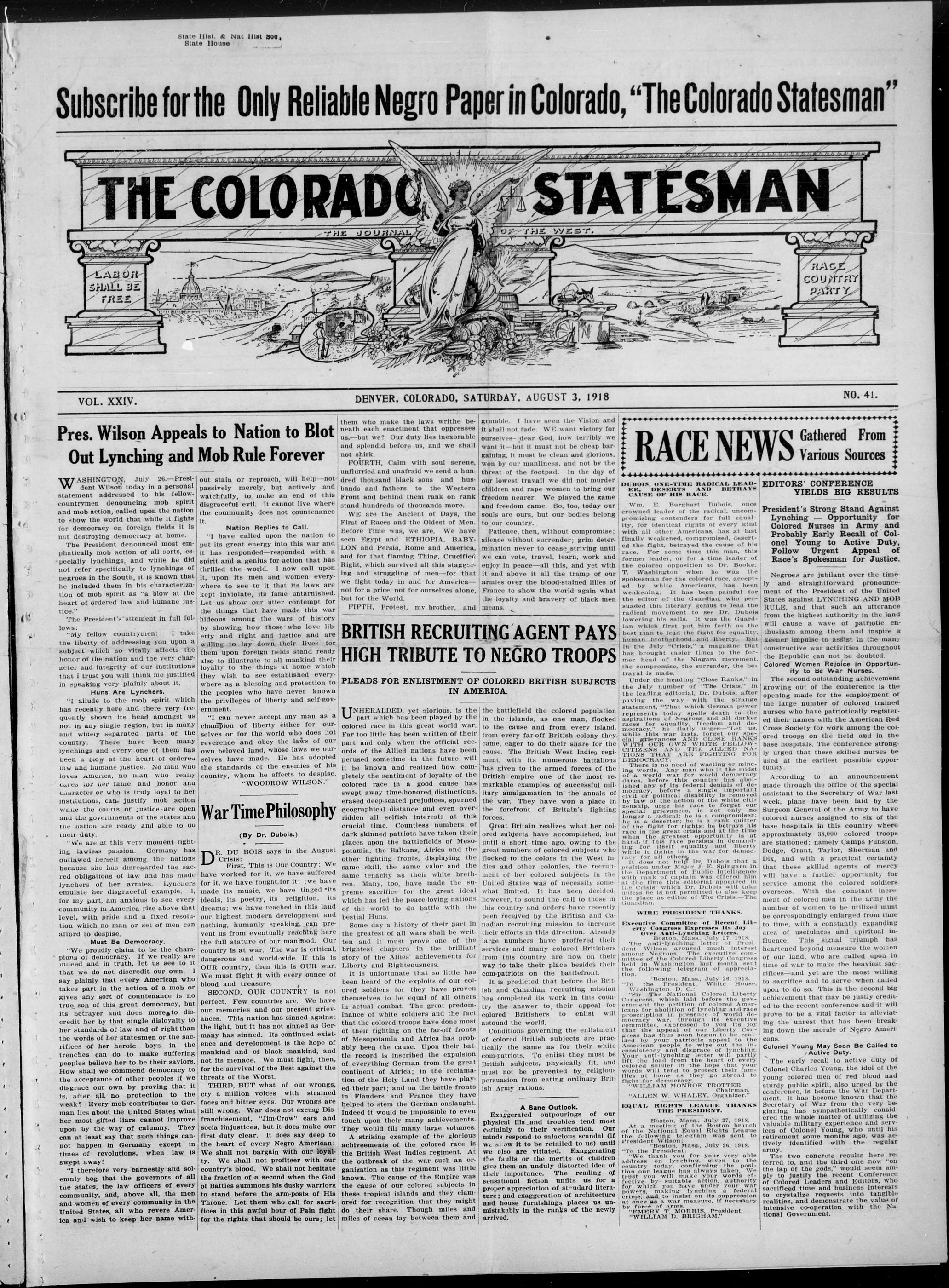
Pres. Wilson Appeals to Nation to Blot Out Lynching and Mob Rule Forever
VOL. XXIV.
WASHINGTON, July 26.—President Wilson today in a personal statement addressed to his fellow-countrymen denouncing mob spirit and mob action, called upon the nation to show the world that while it fights for democracy on foreign fields it is not destroying democracy at home.
The President denounced most emphatically mob action of all sorts, especially lynchings, and while he did not refer specifically to lynchings of negroes in the South, it is known that he included them in his characterization of mob spirit as "a blow at the heart of ordered law and humane justice."
The President's stetment in full follows:
"My fellow countrymen: I take the liberty of addressing you upon a subject which so vitally affects the honor of the nation and the very character and integrity of our institutions that I trust you will think me justified in speaking very plainly about it.
Huns Are Lynchers.
"I allude to the mob spirit which has recently here and there very frequently shown its head amongst us not in any single region, but in many and widely separated parts of the country. There have been many lynchings and every one of them has been a blow at the heart of ordered law and humane justice. No man who loves America, no man who really cares for her fame and honor and character or who is truly loyal to her institutions, can justify mob action while the courts of justice are open and the governments of the states and the nation are ready and able to do their duty.
"We are at this very moment fighting lawless passion. Germany has outlawed herself among the nations because she has disregarded the sacred obligations of law and has made lynchers of her armies. Lynchers emulate her disgraceful example. I, for my part, an anxious to see every community in America rise above that level, with pride and a fixed resolution which no man or set of men can afford to despise."
Must Be Democracy.
"We proudly claim to be the champions of democracy. If we really are indeed and in truth, let us see to it that we do not discredit our own. I say plainly that every American who takes part in the action of a mob or gives any sort of countenance is no true son of this great democracy, but its betrayer and does more to discredit her by that single disloyalty to her standards of law and of right than the words of her statesmen or the sacrifices of her heroic boys in the trenches can do to make suffering peoples believe her to be their saviors. How shall we commend democracy to the acceptance of other peoples if we disgrace our own by proving that it is, after all, no protection to the weak? Every mob contributes to German lies about the United States what her most gifted liars cannot improve upon by the way of calumny. They can at least say that such things cannot happen in Germany except in times of revolutions, when law is swept away!
"I therefore very earnestly and solemnly beg that the governors of all the states, the law officers of every community, and, above all, the men and women of every community in the United States, all who revere America and wish to keep her name with-
State Hist. & Nat Hist 500
State House
for the Only Relia
COLORA
peals to Nation to Blot
nd Mob Rule Forever
out stain or reproach, will help—not passively merely, but actively and watchfully, to make an end of this disgraceful evil. It cannot live where the community does not countenance
Nation Replies to Call.
"I have called upon the nation to put its great energy into this war and it has responded—responded with a spirit and a genius for action that has thrilled the world. I now call upon it, upon its men and women everywhere to see to it that its laws are kept inviolate, its fame untarnished. Let us show our utter contempt for the things that have made this war hideous among the wars of history by showing how those who love liberty and right and justice and are willing to lay down their lives for them upon foreign fields stand ready also to illustrate to all mankind their loyalty to the things at home which they wish to see established everywhere as a blessing and protection to the peoples who have never known the privileges of liberty and self-government.
"I can never accept any man as a champion of liberty either for ourselves or for the world who does not reverence and obey the laws of our own beloved land, whose laws we ourselves have made. He has adopted the standards of the enemies of his country, whom he affects to despise."
War Time Philosophy
(By Dr. Dubois.)
R. DU BOIS says in the August Crisis:
First, This is Our Country: We have worked for it, we have suffered for it, we have fought for it; we have made its music, we have tinged its ideals, its poetry, its religion, its dreams; we have reached in this land our highest modern development and nothing, humanly speaking, can prevent us from eventually reaching here the full stature of our manhood. Our country is at war. The war is critical, dangerous and world-wide. If this is OUR country, then this is OUR war. We must fight it with every ounce of blood and treasure.
SECOND, OUR COUNTRY is not perfect. Few countries are. We have our memories and our present grievances. This nation has sinned against the light, but it has not sinned as Germany has sinned. Its continued existence and development is the hope of mankind and of black mankind, and not its menace. We must fight, then, for the survival of the Best against the threats of the Worst.
that it
to the
to Ger-
what
what
prove
They
is can-
t in
law is
and sol-
of all
every
men
in the
Amer-
with-
THIRD, BUT what of our wrongs,
cry a million voices with strained
faces and bitter eyes. Our wrongs are
still wrong. War does not excuse Dis-
franchisement, "Jim-Crow" cars and
socia linjustices, but it does make our
first duty clear. It does say deep to
the heart of every Negro American:
We shall not bargain with our loyalty. We shall not profiteer with our
country's blood. We shall not hesitate
the fraction of a second when the God
of Battles summons his dusky warriors
to stand before the arm-posts of His
Throne. Let them who call for sacri-
fices in this awful hour of Pain fight
for the rights that should be ours; let
DENVER, COLORADO, SATURDAY, AUGUST 3, 1918
BRITISH RECRUITING AGENT PAYS HIGH TRIBUTE TO NEGRO TROOPS
PLEADS FOR ENLISTMENT OF COLORED BRITISH SUBJECTS IN AMERICA.
them who make the laws writhe beneath each enactment that oppresses us,—but we? Our duty lies inexorable and splendid before us, and we shall not shirk.
FOURTH, Calm with soul serene, unfurried and unafraid we send a hundred thousand black sons and husbands and fathers to the Western Front and behind them rank on rank stand hundreds of thousands more.
WE are the Ancient of Days, the First of Races and the Oldest of Men. Before Time was, we are. We have seen Egypt and ETHIOPIA, BABYLON and Persia, Rome and America, and for that flaming Thing, Crucified Right, which survived all this staggering and struggling of men—for that we fight today in and for America—not for a price, not for ourselves alone, but for the World.
FIFTH, Protest, my brother, and
UNHERALDED, yet glorious, is the part which has been played by the colored race in this great world war. Far too little has been written of their part and only when the official records of the Allied nations have been perused sometime in the future will it be known and realized how completely the sentiment of loyalty of the colored race in a good cause has swept away time-honored distinctions, erased deep-seated prejudices, spurned geographical distance and even overridden all selfish interests at this crucial time. Countless numbers of dark skinned patriots have taken their places upon the battlefields of Mesopotamia, the Balkans, Africa and the other fighting fronts, displaying the same skill, the same valor and the same tenacity as their white brethren. Many, too, have made the supreme sacrifice for the great ideal which has led the peace-loving nations of the world to do battle with the bestial Huns.
Some day a history of their part in the greatest of all wars shall be written and it must prove one of the brightest chapters in the brilliant story of the Allies' achievements for Liberty and Righteousness.
It is unfortunate that so little has been heard of the exploits of our colored soldiers for they have proven themselves to be equal of all others in actual combat. The great predominance of white soldiers and the fact that the colored troops have done most of their fighting on the far-off fronts of Mesopotamia and Africa has probably been the cause. Upon their battle record is inscribed the expulsion of everything German from the great continent of Africa; in the reclamation of the Holy Land they have played their part; and on the battle fronts in Flanders and France they have helped to stem the German onslaught. Indeed it would be impossible to even touch upon their many achievements. They would fill many large volumes. A striking example of the glorious achievements of the colored race is the British West Indies regiment. At the outbreak of the war such an organization as this regiment was little known. The cause of the Empire was the cause of our colored subjects in these tropical islands and they clamored for recognition that they might do their share. Though miles and miles of ocean lay between them and
grumble. I have seen the Vision and it shall not fade. WE want victory for ourselves—dear God, how terribly we want it—but it must not be cheap bargaining, it must be clean and glorious, won by our manliness, and not by the threat of the footpad. In the day of our lowest travail we did not murder children and rape women to bring our freedom nearer. We played the game and freedom came. So, too, today our souls are ours, but our bodies belong to our country.
Patience, then, without compromise; silence without surrender; grim determination never to cease striving until we can vote, travel, learn, work and enjoy in peace—all this, and yet with it and above it all the tramp of our armies over the blood-stained lilies of France to show the world again what the loyalty and bravery of black men means.
the battlefield the colored population in the islands, as one man, flocked to the cause and from every island, from every far-off British colony they came, eager to do their share for the cause. The British West Indies regiment, with its numerous battalions has given to the armed forces of the British empire one of the most remarkable examples of successful military amalgamation in the annals of the war. They have won a place in the forefront of Britain's fighting forces.
Great Britain realizes what her colored subjects have accomplished, but until a short time ago, owing to the great numbers of colored subjects who flocked to the colors in the West Indies and other colonies, the recruitment of her colored subjects in the United States was of necessity somewhat limited. It has been decided, however, to sound the call to those in this country and orders have recently been received by the British and Canadian recruiting mission to increase their efforts in this direction. Already large numbers have proffered their services and many colored Britishers from this country are now on their way to take their place besides their com-matriots on the battlefront.
It is predicted that before the British and Canadian recruiting mission has completed its work in this country the answer to, their appeal for colored Britishers to enlist will astound the world.
Conditions governing the enlistment of colored British subjects are practically the same as for their white com-patriots. To enlist they must be British subjects, physically fit, and must not be prevented by religious persuasion from eating ordinary British Army rations.
A. Sane Outlook.
Exaggerated outpourings of our physical ills and troubles tend most certainly to their verification. Our minds respond to salacious scandal (if we allow it to be retailed to us) until we also are vitiated. Exaggerating the faults or the merits of children give them an unduly distorted idea of their importance. The reading of sensational fiction units us for a proper appreciation of standard literature; and exaggeration of architecture and house furnishings places us unmistakably in the ranks of the newly arrived.
RACENEWS Gathered From Various Sources
DUBOIS, ONE-TIME RADICAL LEADER, DESERTS AND BETRAYS CAUSE OF HIS RACE.
Wm. E. Burghart Dubois, once crowned leader of the radical, uncompromising contenders for full equality, for identical rights of every kind with all other Americans, has at last finally weakened, compromised, deserted the fight, betrayed the cause of his race. For some time this man, this former leader, or for a time leader of the colored opposition to Dr. Booke; T. Washington when he was the spokesman for the colored race, accepted by white Americans, has been weakening. It has been painful for the editor of the Guardian, who persuaded this literary genius to lead the radical movement to see Dr. Dubois lowering his sails. It was the Guardian which first put him forth as the best man to lead the fight for equality, human brotherhood and liberty. But in the July "Crisis," a magazine that has brought easier times to the former head of the Niagara movement, the compromise, the surrender, the betrayal is made.
Under the heading "Close Ranks," in the July number of "The Crisis," in the leading editorial, Dr. Dubois, after paving the way with the strange statement, "That which German power represents today spells death to the aspirations of Negroes and all darker races for equality, freedom and democracy," he flatly urges—"Let us, while this war lasts, forget our age and our race. With OUR OWN WHITE FELLOW-CITIZENS AND THE ALLIED NATIONS THAT ARE FIGHTING FOR DEMOCRACY. We need of wasting or mincing words. Any man who in the midst of a world war for world democracy dares, before this country has abolished any of its federal denials of democracy, any of its political disability is removed by law or the action of the white citizenship, urge his race to forget our special grievances, is not only no longer a radical; he is a rank quitter of the fight for rights; he betrays his race in the great crisis and at the time when the greatest opportunity is at hand for the future peace and security for itself equally and liberty while it fights in the war for democracy for all others.
It does not help Dr. Dubois that a position under the Office of Public Intelligence with rank of captain was offered him at the time this editorial appeared in the Crisis, which Dr. Dubois will take unless he is not permitted to also keep him as editor of The Crisis.—The Canadian.
WIRE PRESIDENT THANKS.
Executive Committee of Recent Liberty
(Congress Expresses its Joy
in the Success of the
Boston, Mass., July 27, 1918.
The anti-lynching letter of President Wilson aroused much interest among Negroes. The executive committee of the Colored liberty Congress was asked that motion be the following telegram of appreciation.
"Boston, Mass., July 26, 1918.
To the President, White House, Washington, D.C.
"Sir—The National Colored Liberty Congress, which laid before the government the petition of colored Americans for abolition of lynching and race murder, the presentation of world democracy war, through its executive committee, expressed to you its joy that the appeal of our Liberty Congress has thus soon begun to be real American people to wipe out the inconsistency and disgrace of lynching.
Your anti-lynching letter will partly lift the load from the heart of every colored man, and we will tend to protect their families at home as they go abroad to fight for democracy.
"WILLIAM MONROE TROTTER.
Chairman:
"ALLEN W. WHALEY O'CONNOR."
EQUAL RIGHTS LEAGUE THANKS
THE PRESIDENT.
Boston, Mass., July 27, 1918.
At a meeting of the Boston branch of the National Equal Rights League the following telegram was sent to President Wilson:
"To President Wilson, Mass., July 26, 1918.
"To the President."
"We thank you for your very able address on lynching, given to the country today, confirming the positive impact of your work. We trust you will make your words effective by suitable action, authority for which you have under your war, your authority to a police crime, and to insist on its suppression at once as a war measure, if necessary by force of arms. "President, "WILLIAM D. MURRIGH. President, "WILLIAM D. MURRIGH.
NO. 41.
President's Strong Stand Against Lynching — Opportunity for Colored Nurses in Army and Probably Early Recall of Colonel Young to Active Duty, Follow Urgent Appeal of Race's Spokesman for Justice.
Negroes are jubilant over the timely and straightforward pronouncement of the President of the United States against LYNCHING AND MOB RULE, and that such an utterance from the highest authority in the land will cause a wave of patriotic enthusiasm among them and inspire a keener impulse to assist in the many constructive war activities throughout the Republic can not be doubted.
Colored Women Rejoice in Opportun-
Colored Women Rejoice in Opportunity to Be War Nurses.
The second outstanding achievement growing out of the conference is the opening made for the employment of the large number of colored trained nurses who have patriotically registered their names with the American Red Cross Society for work among the colored troops on the field and in the base hospitals. The conference strongly urged that these skilled nurses be used at the earliest possible opportunity.
According to an announcement made through the office of the special assistant to the Secretary of War last week, plans have been laid by the Surgeon General of the Army to have colored nurses assigned to six of the base hospitals in this country where approximately 38,000 colored troops are stationed; namely Camps Funston, Dodge, Grant, Taylor, Sherman and Dix, and with a practical certainty that these skilled agents of mercy will have a further opportunity for service among the colored soldiers overseas. With the constant increment of colored men in the army the number of women to be utilized must be correspondingly enlarged from time to time, with a constantly expanding area of usefulness and spiritual influence. This signal triumph has heartened beyond measure the women of our land, who are called upon in time of war to make the heaviest sacrifices—and yet are the most willing to sacrifice and to serve when called upon to do so. This is the second big achievement that may be justly credited to the recent conference and it will prove to be a vital factor in alleviating the unrest that has been breaking down the morale of Negro Americans.
Colonel Young May Soon Be Called to Active Duty.
The early recall to active duty of Colonel Charles Young, the idol of the young colored men of red blood and sturdy public spirit, also urged by the conference, is before the War Department. It has become known that the Secretary of War from the very ginning has sympathetically considered the whole matter of utilizing the valuable military experience and services of Colonel Young, who until his retirement some months ago, was actively identified with the regular army.
The two concrete results here referred to, and the third one now "on the lap of the gods," would seem amply to justify the recent Conference of Colored Leaders and Editors, who sacrificed time and business interests to crystalize requests into tangible realities, and demonstrate the value of intensive co-operation with the National Government.
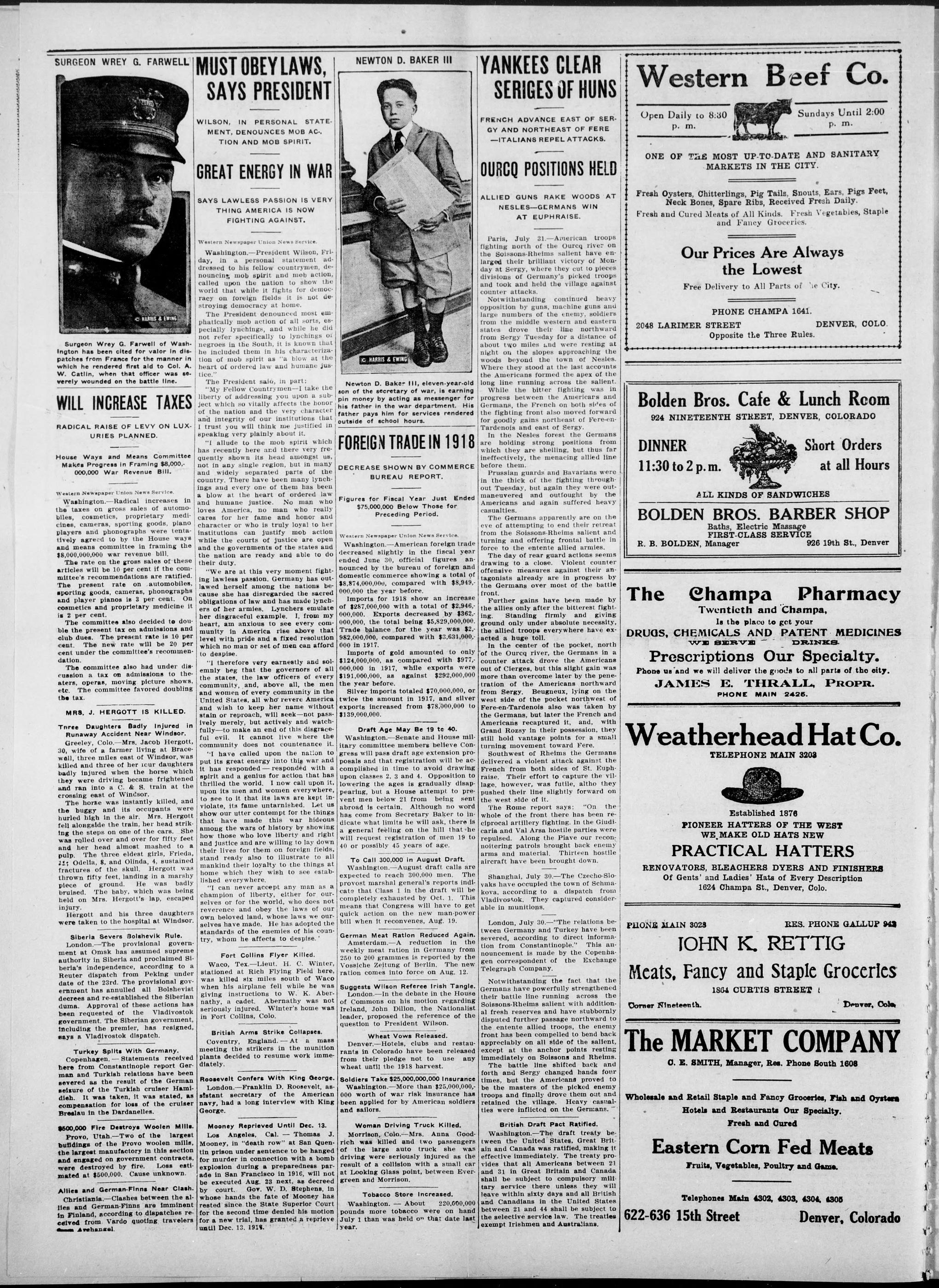
© HARILE & EWING
Surgeon Wrey G. Farwell of Washington has been cited for valor in dispatches from France for the manner in which he rendered first aid to Col. A. W. Catlin, when that officer was severely wounded on the battle line.
WILL INCREASE TAXES
RADICAL RAISE OF LEVY ON LUX
URIES PLANNED.
House Ways and Means Committee
Makes Progress in Framing $8,000,
000,000 War Revenue Bill.
Western Newspaper Union News Service.
Washington.—Radical increases in the taxes on gross sales of automobiles, cosmetics, proprietary medicines, cameras, sporting goods, plano players and phonographs were tentatively agreed to by the House ways and means committee in framing the $8,000,000,000 war revenue bill.
The rate on the gross sales of these articles will be 10 per cent if the committee's recommendations are ratified. The present rate on automobiles, sporting goods, cameras, phonographs and player pianos is 3 per cent. On cosmetics and proprietary medicine it is 2 per cent.
The committee also decided to double the present tax on admissions and club dues. The present rate is 10 per cent. The new rate will be 20 per cent under the committee's recommendation. The committee also had under discussion a tax on admissions to theaters, operas, moving picture shows, etc. The committee favored doubling the tax.
MR8. J. HERGOTT IS KILLED.
Three Daughters Badly Injured in Runaway Accident Near Windsor. Greeley, Colo—Mrs. Jacob Hergott, 30, wife of a farmer living at Bracewall, three miles east of Windsor, was killed and three of her four daughters badly injured when the horse which they were driving became frightened and ran into a C. & S. train at the crossing east of Windsor.
The horse was instantly killed, and the buggy and its occupants were hurled high in the air. Mrs. Hergott fell alongside the train, her head striking the steps on one of the cars. She was rolled over and over for fifty feet and her head almost mashed to a pulp. The three eldest girls, Frieda, 11; Odella, 8, and Olinda, 4, sustained fractures of the skull. Hergott was thrown fifty feet, landing in a marshy piece of ground. He was badly bruised. The baby, which was being held on Mrs. Hergott's lap, escaped injury. Hergott and his three daughters were taken to the hospital at Windsor.
Siberia Severs Bolshevsk Rule. London.-The provisional government at Omsk has assumed supreme authority in Siberia and proclaimed Siberia's independence, according to a Reuter dispatch from Peking under date of the 23rd. The provisional government has annulled all Bolshevist decrees and re-established the Siberian duma. Approval of these actions has been requested of the Vladivostok government. The Siberian government, including the premier, has resigned, says a Vladivostok dispatch.
Turkey Splits With Germany.
Copenhagen.—Statements received here from Constantinople report German and Turkish relations have been severed as the result of the German seizure of the Turkish cruiser Hamidieh. It was taken, it was stated, as compensation for loss of the cruiser Breslau in the Dardanelles.
$500,000 Fire Destroys Woolen Mills. Provo, Utah.—Two of the largest buildings of the Provo woolen mills, the largest manufactory in this section, and engaged on government contracts, were destroyed by fire. Loss estimated at $500,000. Cause unknown.
Allies and German-Finns Near Clash. Christiania.—Clashes between the allies and German-Finns are imminent in Finland, according to dispatches received from Vardo quoting travelers Arehangel.
MUST OBEY LAWS SAYS PRESIDENT
WILSON, IN PERSONAL STATEMENT, DENOUNCES MOB AC TION AND MOB SPIRIT.
GREAT ENERGY IN WAR
SAYS LAWLESS PASSION IS VERY THING AMERICA IS NOW FIGHTING AGAINST.
Western Newspaper Union News Service.
Washington.—President Wilson, Friday, in a personal statement addressed to his fellow countrymen, denouncing mob spirit and mob action, called upon the nation to show the world that while it fights for democracy on foreign fields it is not destroying democracy at home.
The President denounced most emphatically mob action of all sorts, especially lynchings, and while he did not refer specifically to lynchings of negroes in the South, it is known that he included them in his characterization of mob spirit as "a blow at the heart of ordered law and humane justice."
The President said, in part:
"My Fellow Countrymen—I take the liberty of addressing you upon a subject which so vitally affects the honor of the nation and the very character and integrity of our institutions that I trust you will think me justified in speaking very plainly about it.
"I allude to the mob spirit which has recently here and there very frequently shown its head amongst us, not in any single region, but in many and widely separated parts of the country. There have been many lynchings and every one of them has been a blow at the heart of ordered law and humane justice. No man who loves America, no man who really cares for her fame and honor and character or who is truly loyal to her institutions can justify mob action while the courts of justice are open and the governments of the states and the nation are ready and able to do their duty.
"We are at this very moment fighting lawless passion. Germany has outlawed herself among the nations because she has disregarded the sacred obligations of law and has made lynchers of her armies. Lynchers emulate her disgraceful example. I, from my heart, am anxious to see every community in America rise above that level with pride and a fixed resolution which no man or set of men can afford to despise.
"I therefore very earnestly and solemnly beg that the governors of all the states, the law officers of every community, and, above all, the men and women of every community in the United States, all who revere America and wish to keep her name without stain or reproach, will seek—not passively merely, but actively and watchfully—to make an end of this disgraceful evil. It cannot live where the community does not countenance it.
"I have called upon the nation to put its great energy into this war and it has responded — responded with a spirit and a genius for action that has thrilled the world. I now call upon it, upon its men and women everywhere, to see to it that its laws are kept inviolate, its fame untarnished. Let us show our utter contempt for the things that have made this war hideous among the wars of history by showing how those who love liberty and right and justice and are willing to lay down their lives for them on foreign fields, stand ready also to illustrate to all mankind their loyalty to the things at home which they wish to see established everywhere.
"I can never accept any man as a champion of liberty, either for ourselves or for the world, who does not reverence and obey the laws of our own beloved land, whose laws we ourselves have made. He has adopted the standards of the enemies of his country, whom he affects to despise."
Fort Collins Flyer Killed.
Waco, Tex.—Lieut. H. C. Winter, stationed at Rich Flying Field here, was killed six miles south of Waco when his airplane fell while he was giving instructions to W. K. Abernathy, a cadet. Abernathy was not seriously injured. Winter's home was in Fort Collins, Colo.
Coventry, England.—At a mass meeting the strikers in the munition plants decided to resume work immediately.
Roosevelt Confers With King George.
London.—Franklin D. Roosevelt, assistant secretary of the American navy, had a long interview with King George.
Los Angeles, Cal. — Thomas J. Mooney, in "death row" at San Quentin prison under sentence to be hanged for murder in connection with a bomb explosion during a preparedness parade in San Francisco in 1916, will not be executed Aug. 23 next, as decreed by court. Gov. W. D. Stephens, in whose hands the fate of Mooney has rested since the State Superior Court for the second time denied his motion for a new trial, has granted a reprieve until Dec. 13, 1918.
C. HARRIS & EWING
Newton D. Baker III, eleven-year-old son of the secretary of war, is earning pin money by acting as messenger for his father in the war department. His father pays him for services rendered outside of school hours.
FOREIGN TRADE IN 1918
FOREIGN TRADE IN 1918
DECREASE SHOWN BY COMMERCE
BUREAU REPORT.
Figures for Fiscal Year Just Ended
$75,000,000 Below Those for
Preceding Period.
Western Newspaper Union News Service.
Washington.—American foreign trade decreased slightly in the fiscal year ended June 30, official figures announced by the bureau of foreign and domestic commerce showing a total of $8,874,000,000, compared with $8,949,000,000 the year before.
Imports for 1918 show an increase of $287,000,000 with a total of $2,946,000,000.
Exports decreased by $362,000,000, the total being $5,829,000,000.
Trade balance for the year was $2,982,000,000, compared with $3,631,000,000 in 1917.
Imports of gold amounted to only $124,000,000, as compared with $977,000,000 in 1917, while exports were $191,000,000, as against $292,000,000 the year before.
Silver imports totaled $70,000,000, or twice the amount in 1917, and silver exports increased from $78,000,000 to $139,000,000.
Draft Age May Be 19 to 40.
Washington.—Senate and House military committee members believe Congress will pass draft age extension proposals and that registration will be accomplished in time to avoid drawing upon classes 2, 3 and 4. Opposition to lowering the ages is gradually disappearing, but a House attempt to prevent men below 21 from being sent abroad is certain. Although no word has come from Secretary Baker to indicate what limits he will ask, there is a general feeling on the hill that he will request registration of men 19 to 40 or possibly 45 years of age.
To Call 300.000 in August Draft.
Washington.—August draft calls are expected to reach 300,000 men. The provost marshal general's reports indicate that Class 1 in the draft will be completely exhausted by Oct. 1. This means that Congress will have to get quick action on the new man-power bill when it reconvenes, Aug. 19.
German Meat Ration Reduced Again. Amsterdam.—A reduction in the weekly meat ration in Germany from 250 to 200 grammes is reported by the Vossiche Zeitung of Berlin. The new ration comes into force on Aug. 12.
Suggests Wilson Referee Irish Tangle. London.—In the debate in the House of Commons on his motion regarding Ireland, John Dillon, the Nationalist leader, proposed the reference of the question to President Wilson.
Denver.—Hotels, clubs and restaurants in Colorado have been released from their pledge not to use any wheat until the 1918 harvest.
Soldiers Take $25,000,000,000 Insurance Washington.—More than $25,000,000,000 worth of war risk insurance has been applied for by American soldiers and sailors.
Woman Driving Truck Killed
Morrison, Colo.—Mrs. Anna Goodrich was killed and two passengers of the large auto truck she was driving were seriously injured as the result of a collision with a small car at Looking Glass point, between Evergreen and Morrison.
Washington. — About 220,000,000 pounds more tobacco were on hand July 1 than was held on that date last year.
YANKEES CLEAR SERIGES OF HUNS
FRENCH ADVANCE EAST OF SER
GY AND NORTHEAST OF FERE
- ITALIANS REPEL ATTACKS.
OURCQ POSITIONS HELD
ALLIED GUNS RAKE WOODS AT NESLES—GERMANS WIN AT EUPHRAISE.
Paris, July 31.—American troops fighting north of the Ourecq river on the Soissons-Rheims salient have enlarged their brilliant victory of Monday at Sergy, where they cut to pieces divisions of Germany's picked troops and took and held the village against counter attacks.
Notwithstanding continued heavy opposition by guns, machine guns and large numbers of the enemy, soldiers from the middle western and eastern states drove their line northward from Sergy Tuesday for a distance of about two miles and were resting at night on the slopes approaching the woods beyond the town of Nesles. Where they stood at the last accounts the Americans formed the apex of the long line running across the salient. While the bitter fighting was in progress between the Americans and Germans, the French on both sides of the fighting front also moved forward for goodly gains northeast of Fere-en-Tardenois and east of Sergy. In the Nesles forest the Germans are holding strong positions from which they are shelling, but thus far ineffectively, the menacing allied line before them.
Prussian guards and Bavarians were in the thick of the fighting throughout Tuesday, but again they were outmaneuvered and outfought by the Americans and again suffered heavy casualties. The Germans apparently are on the eve of attempting to end their retreat from the Soissons-Rheims salient and turning and offering frontal battle in force to the entente allied armies. The day of rear guard actions seems drawing to a close. Violent counter offensive measures against their antagonists already are in progress by the Germans over most of the battle front. Further gains have been made by the allies only after the bitterest fighting. Standing firmly and giving ground only under absolute necessity, the allied troops everywhere have exacted a huge toll.
In the center of the pocket, north of the Ourcq river, the Germans in a counter attack drove the Americans out of Clerges, but this slight gain was more than overcome later by the penetration of the Americans northward from Sergy. Beugneux, lying on the west side of the pocket northwest of Fere-en-Tardenois also was taken by the Germans, but later the French and Americans recaptured it, and, with Grand Rozsy in their possession, they still hold vantage points for a small turning movement toward Fere. Southwest of Rhelms the Germans delivered a violent attack against the French from both sides of St. Euphraise. Their effort to capture the village, however, was futile, altho they pushed their line slightly forward on the west side of it.
The Rome report says: "On the whole of the front there has been reciprocal artillery fighting. In the Giudicaria and Val Arsa hostile parties were repulsed. Along the Piave our reconnoitering patrols brought back enemy arms and material. Thirteen hostile aircraft have been brought down.
Shanghai, July 30.—The Czecho-Slovaks have occupied the town of Schmakova, according to a dispatch from Vladivostok. They captured considerable in munitions.
London, July 30.—"The relations between Germany and Turkey have been severed, according to direct information from Constantinople." This announcement is made by the Copenhagen correspondent of the Exchange Telegraph Company.
Notwithstanding the fact that the Germans have powerfully strengthened their battle line running across the Soissons-Rheims salient with additional fresh reserves and have stubbornly disputed further passage northward to the entente allied troops, the enemy front has been compelled to bend back appreciably on all side of the salient, except at the anchor points resting immediately on Soissons and Rheims. The battle line shifted back and forth and Sergy changed hands four times, but the Americans proved to be the masters of the picked enemy troops and finally drove them out and retained the village. Heavy casualties were inflicted on the Germans.
British Draft Pact Ratified.
Washington.—The draft treaty between the United States, Great Britain and Canada was ratified, making it effective immediately. The treaty provides that all Americans between 21 and 31 in Great Britain and Canada shall be subject to compulsory military service there unless they will leave within sixty days and all British and Canadians in the United States between 21 and 44 shall be subject to the selective service law. The treaties exempt Irishmen and Australians.
Western Beef Co.
Open Daily to 8:30 p. m.
ONE OF THE MOST
MARKET
Fresh Oysters, Chitterl
Neck Bones, Sp
Fresh and Cured Meats
and
Our Pr
t
Free Delive
PHC
2048 LARIMER STREET
Oppo
Bolden Bros.
924 NINETEENTH
OF THE MOST UP-TO-DATE AND SAN
MARKETS IN THE CITY.
Litters, Chitterlings, Pig Tails, Snouts, Ears,
Rock Bones, Spare Ribs, Received Fresh Dairy,
Cured Meats of All Kinds. Fresh Vegetable
and Fancy Groceries.
Our Prices Are Always
the Lowest
Free Delivery to All Parts of the City.
PHONE CHAMPA 1641.
IMER STREET DENVER
Opposite the Three Rules.
In Bros. Cafe & Lunch
INNETEENTH STREET, DENVER, COLO
ONE OF THE MOST UP-TO-DATE AND SANITARY MARKETS IN THE CITY.
Fresh Oysters, Chitterlings, Pig Tails, Snouts, Ears, Pigs Feet, Neck Bones, Spare Ribs, Received Fresh Daily. Fresh and Cured Meats of All Kinds. Fresh Vegetables, Staple and Fancy Groceries.
PHONE CHAMPA 1641.
2048 LARIMER STREET DENVER, COLO.
Opposite the Three Rules.
Bolden Bros. Cafe & Lunch Room 924 NINETEENTH STREET, DENVER, COLORADO
DINNER
11:30 to 2 p.m.
ALL KINDS OF SANDWICHES
BOLDEN BE
Baths
FIRST
R. B. BOLDEN, Manage
The Chas
Twenty
Is the
DRUGS, CHEMICAL
WE SEE
Prescription
Phone us and we will do
JAMES E
PH
Weather
TEL
DEN BROS. BARBER
Baths, Electric Massage
FIRST-CLASS SERVICE
DEN, Manager 926 19th S
Champa Phar-
Twentieth and Champa,
Is the place to get your
CHEMICALS AND PATENT M
WE SERVE DRINKS.
Descriptions Our Special
and we will deliver the goods to all parts of
MES E. THRALL, PR
PHONE MAIN 2426.
atherhead Ha-
TELEPHONE MAIN 3203
BOLDEN BROS. BARBER SHOP Baths, Electric Massage FIRST-CLASS SERVICE R. B. BOLDEN, Manager 926 19th St., Denver
Twentieth and Champa,
Is the place to get your
DRUGS, CHEMICALS AND PATENT MEDICINES
WE SERVE DRINKS.
Prescriptions Our Specialty.
Phone us and we will deliver the goods to all parts of the city.
JAMES E. THRALL, PROPR.
PHONE MAIN 2426.
Weatherhead Hat Co.
TELEPHONE MAIN 3203
Established 1876
PIONEER HATTERS OF THE WEST
WE MAKE OLD HATS NEW
PRACTICE
RENOVATORS, BLE
Of Gents' and L
1624 CH
PHONE MAIN 3028
JOHN
Meats. Fancy
1864
PRACTICAL HATTERS
ATORS, BLEACHERS DYERS AND FIL
Gents' and Ladies' Hats of Every Descrip
1624 Champa St., Denver, Colo.
RENOVATORS, BLEACHERS DYERS AND FINISHERS Of Gents' and Ladies' Hats of Every Description 1624 Champa St., Denver, Colo.
JOHN K. RETTIGER
Fancy and Staple Gro
1864 CURTIS STREET
eenth.
MARKET COMP
E. SMITH, Manager, Res. Phone South 10
d Retail Staple and Fancy Groceries, Fish
Hotels and Restaurants Our Specialty.
Fresh and Cured
Eastern Corn Fed Me
Meats, Fancy and Staple Groceries 1864 CURTIS STREET
The MARK
C. E. SMITH,
Wholesale and Retail Stap
Hotels and
Eastern
The MARKET COMPANY
C. E. SMITH, Manager, Res. Phone South 1608
Wholesale and Retail Staple and Fancy Groceries, Fish and Oysters Hotels and Restaurants Our Specialty. Fresh and Cured
Fruits, Vegetables, Poultry and Game.
Telephones 622-636 15th Stre
Telephones Main 4302, 4303, 4304, 4305
15th Street Denver,
Corner Nineteenth.
Sundays Until 2:00 p. m.
ATE AND SANITARY
THE CITY.
Us, Snouts, Ears, Pigs Feet,
Received Fresh Daily.
Fresh Vegetables, Staple
饼ies.
e Always
rest
arts of the City.
A 1641.
DENVER, COLO.
e Rules.
& Lunch Room
DENVER, COLORADO
Short Orders at all Hours
ARBER SHOP
Massage
SERVICE
926 19th St., Denver
Pharmacy
Champa.
get your
PATENT MEDICINES
DRINKS.
Our Specialty.
goods to all parts of the city.
ALL, PROPR.
2426.
Bad Hat Co.
MAIN 3203
HATTERS
DEVICES AND FINISHERS
of Every Description
Denver, Colo.
RES. PHONE GALLUP 942
ETTIG
taple Groceries
STREET
Denver, Cola
COMPANY
Phone South 1608
Groceries, Fish and Oysters
Our Specialty.
ured
Fed Meats
303, 4304, 4305
Denver, Colorado
```markdown
```
VINEGAR
```markdown
```
CAN FOOD AND PRESERVE THE NATION
ANY CLEAN VESSEL WITH TIGHT COVER MAY BE USED IN CANNING
Fruits and vegetables may be successfully canned with very simple and cheap appliances. Thousands of women, girls, and boys every year can fruits and vegetables successfully with homemade equipment—in fact, so successfully that many find a profitable outside market for their surplus home-canned products.
To can almost any fruit or vegetable or fruit juice—especially for home use—the conserver needs only:
(a) Good, sound fruits or vegetables freshly gathered.
(b) A large metal vessel, with tight-fitting cover, such as a wash boiler or big pall fitted with a false bottom of
First step—Get jars and tops, clean them, and have them ready for use.
Second step—Have new rubber rings ready to put the seal on your canned products.
Third step—Conveniently arrange canning outfit and other equipment.
A determination to save food and help your country, coupled with a plentiful supply of fresh vegetables and fruits, if carefully managed by safe and sanitary methods, will give results that are successful and satisfying.
Bulletins containing directions for canning, preserving, jelly making, drying and other conserving methods will be sent free on request to the U. S. Department of Agriculture, Washington, D. C.
laths or wire and partly filled with boiling water.
(c) Heat to keep the water boiling.
(d) Tight-sealing jars and rubber rings (or cans and a soldering outfit).
(e) A yard or so of cheesecloth.
(f) The ordinary enameled pans, china bowls, and other equipment found in every kitchen.
Even sugar is not essential. Fruits and berries can be canned in plain hot water, fruit juice or fruit shrups made from concentrated fruit juice.
The Hot-Water Bath.
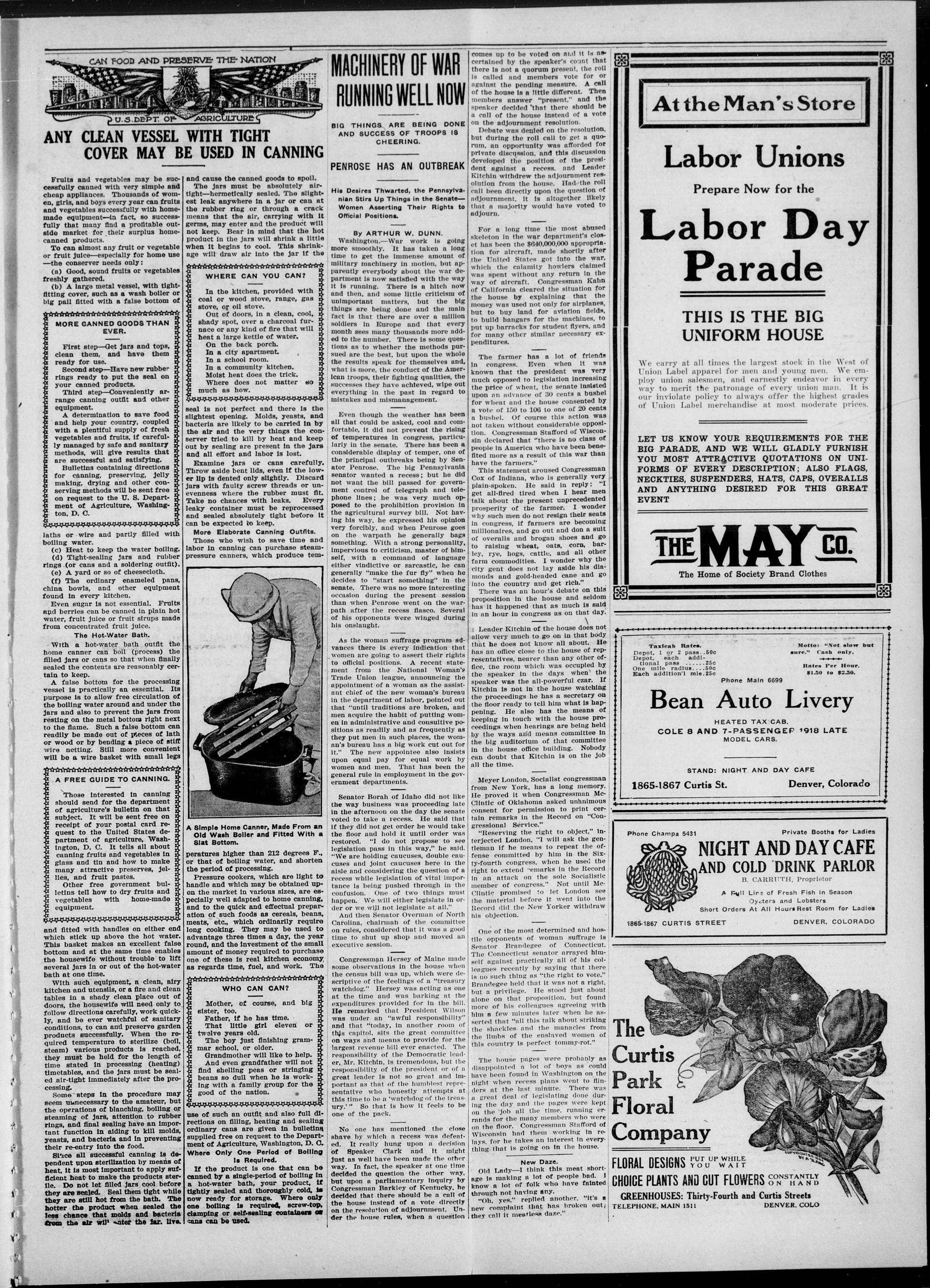
With a hot-water bath outfit the home canner can boil (process) the filled jars or cans so that when finally sealed the contents are reasonably certain to keep.
A false bottom for the processing vessel is practically an essential. Its purpose is to allow free circulation of the boiling water around and under the jars and also to prevent the jars from resting on the metal bottom right next to the flame. Such a false bottom can readily be made out of pieces of lath or wood or by bending a piece of stiff wire netting. Still more convenient will be a wire basket with small legs
Those interested in canning should send for the department of agriculture's bulletin on that subject. It will be sent free on receipt of your postal card request to the United States department of agriculture, Washington, D. C. It tells all about canning fruits and vegetables in glass and tin and how to make many attractive preserves, jellies, and fruit pastes. Other free government bulletins tell how to dry fruits and vegetables with home-made equipment.
and fitted with handles on either end which stick up above the hot water. This basket makes an excellent false bottom and at the same time enables the housewife without trouble to lift several jars in or out of the hot-water bath at one time. With such equipment, a clean, airy kitchen and utensils, or a fire and clean tables in a shady clean place out of doors, the housewife will need only to follow directions carefully, work quickly, and be ever watchful of sanitary conditions, to can and preserve garden products successfully. When the required temperature to sterilize (boll, steam) various products is reached, they must be held for the length of time stated in processing (heating) timetables, and the jars must be sealed air-tight immediately after the processing.
Some steps in the procedure may seem unnecessary to the amateur, but the operations of blanching, boiling or steaming of jars, attention to rubber rings, and final sealing have an important function in aiding to kill molds, yeasts, and bacteria and in preventing their re-entry into the food.
Since all successful canning is dependent upon sterilization by means of heat, it is most important to apply sufficient heat to make the products sterile. Do not let filled jars cool before they are sealed. Seal them tight while they are still hot from the bath. The hotter the product when sealed the less chance that molds and bacteria from the air will enter the jar. live.
and cause the canned goods to spoil. The jars must be absolutely airtight—hermetically sealed. The slightest leak anywhere in a jar or can at the rubber ring or through a crack means that the air, carrying with it germs, may enter and the product will not keep. Bear in mind that the hot product in the jars will shrink a little when it begins to cool. This shrinkage will draw air into the jar if the
In the kitchen, provided with coal or wood stove, range, gas stove, or oil stove. Out of doors, in a clean, cool, shady spot, over a charcoal furnace or any kind of fire that will heat a large kettle of water.
seal is not perfect and there is the slightest opening. Molds, yeasts, and bacteria are likely to be carried in by the air and the very things the conserver tried to kill by heat and keep out by sealing are present in the jars and all effort and labor is lost.
Examine jars or cans carefully. Throw aside bent lids, even if the lower lip is dented only slightly. Discard jars with faulty screw threads or unevenness where the rubber must fit. Take no chances with leaks. Every leaky container must be reprocessed and sealed absolutely tight before it can be expected to keep.
More Elaborate Canning Outfits.
Those who wish to save time and labor in canning can purchase steam-pressure canners, which produce tem-
A man is placing wooden sticks into a large pot.
A Simple Home Canner, Made From an Old Wash Boller and Fitted With a Slat Bottom.
peratures higher than 212 degrees F., or that of boiling water, and shorten the period of processing.
Pressure cookers, which are light to handle and which may be obtained upon the market in various sizes, are especially well adapted to home canning, and to the quick and effectual preparation of such foods as cereals, beans, meats, etc., which ordinarily require long cooking. They may be used to advantage three times a day, the year round, and the investment of the small amount of money required to purchase one of these is real kitchen economy as regards time, fuel, and work. The
Mother, of course, and big sister, too.
Father, if he has time.
That little girl eleven or twelve years old.
The boy just finishing grammar school, or older.
Grandmother will like to help. And even grandfather will not find shelling peas or stringing beans so dull when he is working with a family group for the good of the nation.
use of such an outfit and also full directions on filling, heating and sealing ordinary cans are given in bulletins supplied free on request to the Department of Agriculture, Washington, D. C. Where Only One Period of Boiling Is Required.
If the product is one that can be canned by a single-period of boiling in a hot-water bath, your product, if tightly sealed and thoroughly cold, is now ready for storage. Where only one boiling is required, screw-top, clamping or self-sealing containers or cans can be used.
MACHINERY OF WAR RUNNING WELL NOW BIG THINGS ARE BEING DONE AND SUCCESS OF TROOPS IS CHEERING.
PENROSE HAS AN OUTBREAK
His Desires Thwarted, the Pennsylvanian Stirs Up Things in the Senate—Women Asserting Their Rights to Official Positions.
Washington.—War work is going more smoothly. It has taken a long time to get the immense amount of military machinery in motion, but apparently everybody about the war department is now satisfied with the way it is running. There is a hitch now and then, and some little criticism of unimportant matters, but the big things are being done and the main fact is that there are over a million soldiers in Europe and that every month sees many thousands more added to the number. There is some questions as to whether the methods pursued are the best, but upon the whole the results speak for themselves and, what is more, the conduct of the American troops, their fighting qualities, the successes they have achieved, wipe out everything in the past in regard to mistakes and mismanagement.
Even though the weather has been all that could be asked, cool and comfortable, it did not prevent the rising of temperatures in congress, particularly in the senate. There has been a considerable display of temper, one of the principal outbreaks being by Senator Penrose. The big Pennsylvania senator wanted a recess; but he did not want the bill passed for government control of telegraph and telephone lines; he was very much opposed to the prohibition provision in the agricultural survey bill. Not having his way, he expressed his opinion very forcibly, and when Penrose goes on the warpath he generally bags something. With a strong personality, impervious to criticism, master of himself, with a command of language either vindictive or sarcastic, he can generally "make the fur fly" when he decides to "start something" in the senate. There was no more interesting occasion during the present session than when Penrose went on the warpath after the recess flasco. Several of his opponents were winged during his onslaught.
As the woman suffrage program advances there is every indication that women are going to assert their rights to official positions. A recent statement from the National Woman's Trade Union league, announcing the appointment of a woman as the assistant chief of the new woman's bureau in the department of labor, pointed out that "until traditions are broken, and men acquire the habit of putting women in administrative and consultive positions as readily and as frequently as they put men in such places, the woman's bureau has a big work cut out for it." The new appointee also insists upon equal pay for equal work by women and men. That has been the general rule in employment in the government departments.
Senator Borah of Idaho did not like the way business was proceeding late in the afternoon on the day the senate voted to take a recess. He said that if they did not get order he would take the floor and hold it until order was restored. "I do not propose to see legislation pass in this way," he said. "We are holding caucuses, double caucuses and joint caucuses here in the aisle and considering the question of a recess while legislation of vital importance is being pushed through in the confusion. One of two things must happen. We will either legislate in order or we will not legislate at all." And then Senator Overman of North Carolina, chairman of the committee on rules, considered that it was a good time to shut up shop and moved an executive session.
Congressman Hersey of Maine made some observations in the house when the census bill was up, which were descriptive of the feelings of a "treasury watchdog." Hersey was acting as one at the time and was barking at the expenditures provided for in the bill. He remarked that President Wilson was under an "awful responsibility" and that "today, in another room of this capitol, sits the great committee on ways and means to provide for the largest revenue bill ever enacted. The responsibility of the Democratic leader, Mr. Kitchin, is tremendous, but the responsibility of the president or of a great leader is not so great and important as that of the humbleest representative who honestly attempts at this time to be a 'watchdog of the treasury.'" So that is how it feels to be one of the pack.
No one has mentioned the close shave by which a recess was defeated. It really hung upon a decision of Speaker Clark and it might just as well have been made the other way. In fact, the speaker at one time decided the question the other way, but upon a parliamentary inquiry by Congressman Barkley of Kentucky, he decided that there should be a call of the house instead of a vote directly on the resolution of adjournment. Under the house rules, when a question
comes up to be voted on and it is ascertained by the speaker's count that there is not a quorum present, the roll is called and members vote for or against the pending measure. A call of the house is a little different. Then members answer "present," and the speaker decided that there should be a call of the house instead of a vote on the adjournment resolution. Debate was denied on the resolution, but during the roll call to get a quorum, an opportunity was afforded for private discussion, and this discussion developed the position of the president against a recess, and Leader Kitchin withdrew the adjournment resolution from the house. Had the roll call been directly upon the question of adjournment, it is altogether likely that a majority would have voted to adjourn.
For a long time the most abused skeleton in the war department's closet has been the $640,000,000 appropriation for aircraft, made shortly after the United States got into the war, which the calamity howlers claimed was spent without any return in the way of aircraft. Congressman Kahn of California cleared the situation for the house by explaining that the money was used not only for airplanes, but to buy land for aviation fields, to build hangars for the machines, to put up barracks for student flyers, and for many other similar necessary expenditures.
The farmer has a lot of friends in congress. Even when it was known that the president was very much opposed to legislation increasing the price of wheat, the senate insisted upon an advance of 30 cents a bushel for wheat and the house consented by a vote of 150 to 106 to one of 20 cents a bushel. Of course this action was not taken without considerable opposition. Congressman Stafford of Wisconsin declared that "there is no class of people in America who have been benefited more as a result of this war than have the farmers."
This statement aroused Congressman Cox of Indiana, who is generally very plain-spoken. He said in reply: "I get all-fired tired when I hear men talk about the present unprecedented prosperity of the farmer. I wonder why such men do not resign their seats in congress, if farmers are becoming millionaires, and go out and don a suit of overalls and brogan shoes and go to raising wheat, oats, corn, barley, rye, hogs, cattle, and all other farm commodities. I wonder why the city gent does not lay aside his diamonds and gold-headed cane and go into the country and get rich." There was an hour's debate on this proposition in the house and seldom has it happened that as much is said in an hour in congress as on that day.
Leader Kitchin of the house does not allow very much to go on in that body that he does not know all about. He has an office close to the house of representatives, nearer than any other office, the room which was occupied by the speaker in the days when the speaker was the all-powerful czar. If Kitchin is not in the house watching the proceedings he has a secretary on the floor ready to tell him what is happening. He also has the means of keeping in touch with the house proceedings when hearings are being held by the ways and means committee in the big auditorium of that committee in the house office building. Nobody can doubt that Kitchin is on the job all the time.
Meyer London, Socialist congressman from New York, has a long memory. He proved it when Congressman McClintic of Oklahoma asked unhimnious consent for permission to print certain remarks in the Record on "Congressional Service."
"Reserving the right to object," interjected London, "I will ask the gentleman if he means to repeat the offense committed by him in the Sixty-fourth congress, when he used the right to extend remarks in the Record in an attack on the sole Socialistic member of congress." Not until McClintic promised to let London see the material before it went into the Record did the New Yorker withdraw his objection.
One of the most determined and hostile opponents of woman suffrage is Senator Brandegee of Connecticut. The Connecticut senator arrayed himself against practically all of his colleagues recently by saying that there is no such thing as "the right to vote." Brandegee held that it was not a right, but a privilege. He stood just about alone on that proposition, but found more of his colleagues agreeing with him a few minutes later when he asserted that "all this talk about striking the shackles and the manacles from the limbs of the enslaved women of this country is perfect tomy-rot."
The house pages were probably as disappointed a lot of boys as could have been found In Washington on the night when recess plans went to finders at the last minute. There was a great deal of legislating done during the day and the pages were kept on the job all the time, running errands for the many members who were on the floor. Congressman Stafford of Wisconsin had them working in relays, for he takes an interest in everything that is going on in the house.
New Daze.
Old Lady—I think this meat shortage is making a lot of people bad. I know a lot of folk who have fainted through not having any.
"Oh, yes," replied another, "it's a new complaint that has broken out, they call it meatless daze."
Atthe Man's Store
abor D Parade
Labor Day Parade
THIS IS THE BIG UNIFORM HOUSE
We carry at all times the largest stock in the West of Union Label apparel for men and young men. We employ union salesmen, and earnestly endeavor in every way to merit the patronage of every union man. It is our inviolate policy to always offer the highest grades of Union Label merchandise at most moderate prices.
LET US KNOW YOUR REQUIREMENTS FOR THE BIG PARADE, AND WE WILL GLADLY FURNISH YOU MOST ATTRACTIVE QUOTATIONS ON UNIFORMS OF EVERY DESCRIPTION; ALSO FLAGS, NECKTIES, SUSPENDERS, HATS, CAPS, OVERALLS AND ANYTHING DESIRED FOR THIS GREAT EVENT
Taxicab Rates.
Depot, 1 or 2 pass...50c
Depot, each addl-
tional pass...25c
One mile radius...50c
Each addition'l mile.25c
Motto: "Not slow but
sure." Cash only.
Rates Per Hour.
$1.50 to $2.50.
Phone Main 6699
Bean Auto Livery
HEATED TAX:CAB.
COLE 8 AND 7-PASSENGER 1918 LATE
MODEL CARS.
STAND: NIGHT AND DAY CAFE
1865-1867 Curtis St. Denver, Colorado
The Curtis Park Floral Company
FLORAL DESIGNS PUT UP WHILE YOU WAIT
CHOICE PLANTS AND CUT FLOWERS CONSTANTLY ON HAND
GREENHOUSES: Thirty-Fourth and Curtis Streets
TELEPHONE, MAIN 1511 DENVER, COLO
```markdown
```
Prepare Now for the
THE COLORADO STATESMAN
THE COLORADO STATESMAN
LADY
HUGGIE
BE
FREE
BACK
COUNTRY
PARTY
Entered as second-class matter at the postoffice in the City of Denver, Col.
SUBSCRIPTION RATES
June Year: $2.00
Six Months: 1.00
Three Months: .60
PAYABLE IN ADVANCE.
Communications to receive attention must be newsy, upon important subjects, plainly written only upon one side of the paper, must reach us Tues of the author. No manuscript returned, unless stamps are sent for postage, days, if possible, anyway not later than Wednesdays, and bear the signature. All communications of a personating nature that are not complimentary will be withheld from the columns of this paper.
No discounts allowed on less than three months' contract. Cash must accompany all orders from parties unknown to us. Further particulars on application.
ten lines, 5 cents per line. Display advertising, 50 cents per inch.
Reading notices, ten lines or less, 10 cents per line. Each additional line over Remittances should be made by Express Money Order, Postoffice Money Order, Registered Letter or Bank Draft. Postage stamps will be received the same as cash for the fractional part of a dollar. Only 1c and 2c stamps taken.
OUR BOYS OFF FOR CAMP LEWIS.
IN RESPONSE to the order of the General Provost Marshal of the United States, 270 of our youths and men who were drafted from the number of registrants of last year, entrained for Camp Lewis yesterday, and after the series of special entertainments given by the churches, traternal organizations, Y. M. C. A. institutions and others, the men left in high spirits for their training camp, each resolving to treat the HUN to a little more of what we can do "Over There." A finer body of young men representing us in foreign parts and in this important event could never have been selected, and if the general gets a chance to see them ere their departure for France, he will surely be convinced of Uncle Sam's fighting machinery that he has in the West.
Word has come from the western battle front that the Negro soldier is proving himself a veteran, and holds his own with any of the long-trained, well-seasoned fighters. This we hope to hear about our Colorado soldiers, as we think them the equal of any, and after they shall have completed their training, the Illinois and New York regiments will find another competitor in the field for military honors. The cause, the service, the aftermath—these are the essentials that fire our men with that zeal that will guide them to victory and restore them to us, and those who are not yet called to go, or who are physically unfit for service, should make it a pleasant obligation to write the boys often, sending them reading matter, smokes, money and anything else that will make life cheerful. On behalf of our citizens THE COLORADO STATESMAN wishes you good-bye! Bon voyage! and register a HUN for every bullet, so that you go "over the top," and that quickly without any fear.
PRESIDENT WILSON'S LETTER TO THE NATION AGAINST LYNCHING.
THE letter of President Wilson dated July 26, 1918, in which he takes a firm stand for law and order, declaring in a frank, positive and unequivocal manner against LYNCHING and the MOB SPIRIT, ranks with the finest of the great state papers that have emanated from the White House, and it has electrified the entire country as it has seldom been thrilled before. This letter published in full in the present issue, on the front page, should be kept in the archives of every home as it will be in the nation's, and the members of our race in this country should sacredly guard it as a legacy to be handed down to posterity—the same being a clean-cut pronouncement of the Chief Executive of America in showing the cause of justice and right that we are now fighting for.
Truly, it has taken long to come, but with hearts uplifted, with voices raised, a song of triumph pours forth from 12,000,000 of people in conjunction with their sympathizers, in the great and grand familiar strain—"PRAISE GOD FROM WHOM ALL BLESSINGS FLOW," which will reecho throughout the world of nations and give the enemy the finishing touches to his defeat, as we go forward to espouse our country's cause, not with a forced feeling, nor a mocked patriotism, but with loyalty 100 per cent to protect the land of our birth, the land of freedom that is endeavoring to give to the world the true principles on which our nation will be successfully governed, the ideals for which it stands, and the standards it will establish for better relationship and oneness of purpose among the people who will have the fullest realization of the meaning of our national song—"My Country, 'Tis of Thee," etc.
The numerous and various representations made by our editors in their newspapers; the letters, petitions, telegrams sent from time to time to the Chief Magistrate of the land from all classes of citizens, have borne fruit, having at last found fertile soil for development and future growth; and while this pronouncement of the President may be only an appeal, we can rejoice in the fact that it will assert itself in the most emphatic form until righteousness abounds, and living becomes more than a passing role, proving by the mutual advantages to be gained that it is a stern reality never to be effaced until time loses itself.
Now that the test is put up to the LAWLESS and the leaders of MOB RULE, there may be, as is attendant with all reformation, a wave of the most atrocious crimes, and an appearance worse than before, but these will be of very short duration, as they will only form the closing chapter of a career of ruthlessness which like the devourier when he is cornered, attacks his opponents, and finding no chance of escape, turns upon himself and quickly passes out of existence. The better class of the white population will be more active and will be fearless in advocating America and things American, and only that element of the infernal region, whose foolhardiness and idle bigotry keep them mentally blinded, will attempt to stop the AVALANCHE OF PROGRESS that will seemingly crush everything in its wake.
It is not necessary to quote individually the advocates and influential characters that have brought this phase of success thus far, as every leader, every follower, organization, etc., resolved on an unceasing performance of this duty, looking anxiously forward to the time when an intimation of even partial success would be an incentive for greater efforts. This fearless action of the President, who, although surrounded by many who argued: "We had no rights to merit their respect," will long be remembered not so much from its political aspect, but the manly attitude which CONSCIENCE compelled him to take for RIGHT, LIBERTY AND JUSTICE when he included the following in his letter: "Let us show our utter contempt for the things that have made this war hideous among the wars of history by showing how those who love liberty and right and justice and are willing to lay down their lives for them upon foreign fields, stand ready also to illustrate to all mankind their loyalty to the things at home which they wish to see established everywhere as a blessing and protection to the peoples who have never known the privileges of liberty and self-government."
That this appeal may not fall on deaf ears, but speedily prove itself, to the delight of all liberty-loving Americans, enabling us to take our part in this universal democracy for which we are fighting, is the prayer above all others to which we say a very loud AMEN!
POLICIES OF THE WAR LABOR BOARD
RIGHT OF UNIONIZED WORKERS TO BARGAIN WITH EMPLOYERS IS UPHELD BY IT.
BETTER CONDITIONS SOUGHT
Great Storage Lumber Depot Opened at Gilmerton, Va.—Conservation of Kerosene is Urged—Allies' Bombing Planes Now Work in Squadrons.
(From Committee on Public Information)
Washington—The war labor policies board has made no rulings, it is announced, making it impossible to change rates of wages or working conditions in industry during the standardization of such pay and conditions for war work. The board does not seek to place restrictions on labor, but is striving to better conditions that will make for satisfaction and greater efficiency.
Enunciating its principles the war labor policies board is committed to the right of workers to organize into trade unions and to bargain collectively with their employers; continuance of existing union standards with the right of the workers to obtain better conditions, wages and hours under decisions of the national war labor board; equal pay for equal work, whether performed by men or by women; recognition of the basic eight-hour day where a law requires it but settlement of all questions of hours of work with due regard to government necessities and the welfare of the workers; maintenance of the maximum of production; due regard for labor standards, wages and other conditions in particular localities; the right of all workers to a living wage, insuring health and reasonable comforts.
Felix Frankfurter, chairman of the war labor policies board, makes this further explanation of the resolution of the board setting forth its principles: "Inasmuch as wage stability was recognized as the essential need by labor and by the government the purpose of the resolution was to prevent changes in the standards which had been created either through an adjustment board such as the labor wage adjustment board of the emergency fleet corporation, or the arsenal and navy yard standards, or the standards which govern the cantonment adjustment board, but under no circumstances was it intended to prevent the lifting of wage scales in specific instances up to the standards."
There were no aerial bombing organizations in the allied flying corps during the first year of the war. Practically all the work in the air was in the nature of observation. No pilots could be spared for anything else. Today probably 25 per cent of the aerial arms are bombing squadrons of 12 machines per squadron.
The first bombing was done by volunteer pilots who flew over the German lines and dropped three or four bombs, made from artillery shells, on concentration camps and cantonments. Showers of small steel arrows were spilled sometimes on convoys, troop trains and bodies of massed men. The Germans began day bombing of cities in 1915, and the allies bombarded Karlsruhe in reprisal later in the same year. Since then evolution in organized bombing developed rapidly and the French began night bombing, but this was not undertaken by the Germans until August, 1916.
At the present time large groups, including several squadrons of bombing machines, go over the lines from time to time and completely destroy their objective, be it a city or a camp, a column of troops or a trench system. Unfortunately the allies' air forces have to travel for many miles over hostile territory defended by anti-aircraft guns to attack Germa ncities, while the enemy can attack French cities by flying only a short distance beyond the allied lines.
The allies are developing large bombing planes which carry sufficient fuel for long excursions and armament to protect them when they are attacked by fighting airplanes. Bombing squadrons are escorted usually over the lines by fast fighting squadrons of 18 planes to a squadron, and then left to their own devices, for the fighters seldom carry sufficient fuel to permit them to accompany the bombers on the round trip.
The dropping of the bomb is similar to shooting a rifle. First you set your sights and wind gauge, you hold the rifle properly, and finally you pull the trigger at the proper moment. If your ammunition is standard your sights correct, you hit the target. So with bombing. If you set your sights correctly, fly your plane correctly over the objective and drop the bomb at the proper time you will hit the target. If the ammunition manufacturers gave you good bombs the objective will be destroyed.
The United States will be short of potash next year. Estimates for 1918 show an available supply of about 500,000 tons of potash salts, or only about half of the normal imports before the war. Commercial fertilizer concerns must bear the brunt of the shortage.
The army needs straw, says the bureau of markets, department of agriculture. Farmers are urged to bale the straw immediately after thrashing, and the bureau of markets will help to market it if asked.
---
The need of platinum in war industries and in the sciences is explained by Dr. Charles L. Parsons, chief chemist, bureau of mines, department of the interior, in an argument for discontinuance of the use of platinum in jewelry.
THE COLORADO STATESMAN
"The war cannot be won without platinum," says Doctor Parsons, "and it is equally essential in times of peace if our country is to excel Germany in the development of chemical science and industry. With the aid of platinum from one ordinary wedding ring about 100 pounds of nitric acid can be made every 24 hours. This 100 pounds of nitric acid converted into high explosives will send a number of three-inch shells against the Germans and help to bring the boys back home.
"Platinum rings, pins, cigarette cases, and mesh bags are not factors in winning this war—explosives are. I wonder if the purchasers and wearers of platinum jewelry know that explosives cannot be manufactured without the use of sulphuric and nitric acids; that the manufacture of these acids requires the use of supplies of platinum; that airplanes must have platinum for important instruments they need; that platinum is absolutely necessary in the manufacture of special pyrometers; that pyrometers are necessary in all steel treatments; and that no guns can be made without the use of pyrometers.
The Mouth-Piece of the People of Colorado and the Entire West
"There is a shortage in the supply of platinum. Russia has a corner on the world's supply, and Germany is in Russia. Our domestic production of platinum is negligible, while our military requirements are increasing at a rapid rate."
Many housewives have learned from sad experiences in loss of perishable foods that next to the ice is not the coldest place in the home refrigerator. To the housewife who has not had this experience the food administration gives this advice:
"Many put their butter and milk right next to the ice because they think this is the coldest place, but, as a matter of fact, the coldest place is at the bottom of the refrigerator. Hot air rises and air that is not being constantly purified by circulation around the blocks of ice soon is unfit to come into contact with the food. When the warm air in the refrigerator rises it carries with it impurities and moisture which are absorbed from the surface of the food and which if allowed to remain in the air spoil the food. The air which is warmed by passing over the food comes in contact with the ice, where the moisture is condensed upon the surface and the impurities are carried off by the melting ice. The air is thus dried, cooled and purified. The cooled air immediately descends to gather up more moisture and impurities and thus the process is repeated continually.
ARELIABLE chronicle of their doings and progress; a faithful mirror of their wants, their hopes, their best aspirations.
"It is advisable to allow heated food to cool off before placing it in the refrigerator. If put in when warm it raises the temperature of the refrigerator higher than it should go and melts ice unnecessarily. The trapdoor through which the melting passes out at the bottom of the refrigerator should be kept in place, because if it is broken or lost a constant stream of warm air is allowed to flow into the refrigerator."
THE COLORADO STATESMAN
The war department has opened a great storage lumber depot at Gllmerton, Va., to meet emergency demands of the army for lumber. Through its operation it is estimated that a yearly saving of approximately $250,000 will be effected.
Whenever army constructors in the past were required to buy additional lumber the purchases were made at yards in the immediate vicinity. The average increase in price for this material over the lumber originally purchased for the job would run from $9 to $12 per 1,000 feet. By purchasing in large quantities and charging only for yard maintenance the greater part of this excess price is expected to be saved to the government.
Unequaled as an advertising medium for the business of professional men and women.
A stock of from twelve to fifteen million feet of lumber will be carried, and it is estimated that the yearly turnover will amount to between fifty and sixty million feet. A fund of $500,000 has been set aside by the war department for use by the construction division of the army as necessary working capital for the yard.
The supply of kerosene will run short next winter and the government is urging every user to do his part toward making every gallon to do full war duty by giving forth its full measure of light and heat. Saving can be accomplished, it is said, only if care is given lamps, lanterns, heaters and stoves.
An excellent family journal speaking to and for many thousand colored citizens.
The director of oil conservation of the United States fuel administration issues these rules for fuel-oil saving: Keep all lamps and lanterns clean. Let the light out; don't confine it behind smoked and dirty chimneys. See that burners and wicks of all oil-burning devices are clean. Clean burners require less oil and give better lights.
TWODOLLARSAYEAR
Don't allow a lamp, lantern, heater or stove to burn a minute longer than is necessary. Don't light one you can do without. Don't use coal oil for cleaning purposes. Hot water will do the work.
Girls are helping in airplane production by spiling cables and in other ways, according to H. E. Miles, chairman of the section for industrial training for war emergency of the council of national defense.
Secretary Daniels has commended H. E. Allen, chief machinist's mate, and Harry Koppel and William H. Kane, seamen, United States naval reserve forces, for rescuing from drowning Assistant Lighthouse Keeper Austin Foss on June 16.
THE COLORADO STATESMAN
Bishop H. B. Parks will preach at Campbell Chapel, African M. E. Church, Twenty-third and Lawrence streets, Sunday, August 4, at 8 p. m.
Mrs. Charles Washington of Kansas City, Mo., is the guest of Mr. and Mrs. Jesse T. Thrower, 2542 Lafayette street.
Mrs. Harriet Kelley and Miss Mary G. Evans, after an enjoyable stay in the city, left for Omaha, Neb., last Monday.
Mr. and Mrs. Jesse Thrower, Fred O'Neil, Mrs. James C. Carr, Mr. and Mrs. Luther O'Neil of O'homa City, Mrs. Harriet Kelley of dianapolis were the members of jolly party who motored from De to Barker Dam between Tungsten Nederland, where they pitched to and encamped for a few days. They are loud in praises of the beautiful sceneries of Colorado and spoke complimentary of three of our so boys who were guarding the dam, who spared no pains in making
Miss Alyce Ham, the live-wire advertising agent of Lewis and Son Dry Goods Co., returned home after being much improved in health.
Mrs. Nellie Hamlet of Colorado Springs spent a few days in the city last week and was the guest of Miss Thelma Thomas of Court place.
Attorney F. L. Martin and wife of Wichita, Kan., spent a few days in Denver, en route to California. Mr. Martin is said to be quite an acquisition to the profession and has a large practice in the Sunflower State.
Mr. and Mrs. Harvey Green of Muskogee, Okla., are spending a few days in the city. Mr. Green is a business man of long standing in Oklahoma, being a dealer in horses and mules for several years.
Mrs. Jones of 229 W. Eleventh avenue returned from Omaha last Monday after several months absence, Hubby Jones is so proud that he is now walking on stilts and can't be touched by even old time chums.
P. T. Bullard, our famous road specialist, returned recently from an extensive trip in eastern and southeastern cities. He says war activities are greatly in evidence and you are made to realize "What is war?" by Uncle Sam's preparations.
Mrs. O. W. Glenn and daughter, Myra, have returned home after a long stay in Pittsburg, where the latter went to school. They are very popular in church and educational circles and we welcome their return to our city.
Mrs. David Douglas and two beautiful little daughters are enjoying the summer in St. Louis with relatives and friends. Dad Dave is determined to be a professional singer by the time they return, as he is now vocalizing on "My Wife's Gone to the Country."
Rev. T. H. Wiseman, pastor of Avery Chapel, Oklahoma City, Okla., delivered a great sermon to a large audience upon "The End of a Perfect Day," last Sunday evening.
Pastor A. M. Ward and the good people of Campbell Chapel are busy with preparations for the entertainment of the Colorado Annual Conference, which convenes Thursday a. m., Sept. 12, 1918.
D. Wellington Berry of Nashville,
Tenn., a newspaper correspondent for
some of the leading dailies of the
country, is resting for awhile in Denver.
Mr. Berry is also secretary of the
Nashville Board of Trade, an
institution where the brain and brawn
of our people prove our ability to
climb when we thus resolve. He is a
pleasing conversationalist and is very
well informed on present-day matters.
THOMAS MITCHELL, of Miami,
Ariz., who is en route home from the
South and East, was a very interesting
caller at this office Saturday.
Mr. Mitchell is with the Inspiration
Consolidated Copper and Smelter Co.
He has traveled extensively throut
this country and Europe and is well
versed on the makeup of the different
classes of people, as well as the
conditions in general.
Rev, S. C. Manuel, pastor of Union Baptist Church, Springfield, Ill., spent a few days in the city last week as the guest of Mr. and Mrs. F. W. Perkins, of 615 Twenty-eighth street. The Reverend was very much impressed with Denver scenery and regretted his stay would be short. Very good impressions of Springfield and our people were made on us, and all we can say is, carry on the good work and "let your light shine before men."
Rev, and Mrs. T. H. Wiseman, their daughter Katherine, three and one-half years old, and the mother of Mrs. Wiseman, Mrs. A. E. Jenkins, the latter a prominent business woman in Kansas City, Mo., left Denver after delightful visits to their many friends in Denver this week for Colorado Springs, Pueblo, etc. These friends were dinner guests at the home of Rev. and Mrs. A. M. Ward, and many others numbered among their choice friends.
Mrs. Samuel H. Hobson and talented daughter, Cleo, left last Sunday for Los Angeles for an indefinite stay. Miss Hobson's health having become poor during the last three months, her physician ordered a change of climate, which she hopes will be very beneficial to her. We join her many friends in wishing a complete restoration of health, as she is a very valuable asset to our educational and musical circles in Denver, and her absence will be felt in this particular as well as among the senior class of East Denver high school.
Grand concert in aid of Scott Church Rally August 22nd, Christ M. E. Church, Twenty-second avenue and Ogden street. Select voices supported by Prof Geo. Morrison, violinist, and Valanrey Spratlin, pipe organist.
Mr. and Mrs. Jesse Thrower, Mrs. Fred O'Neil, Mrs. James C. Canter, Mr. and Mrs. Luther O'Neil of Oklahoma City, Mrs. Harriet Kelley of Indianapolis were the members of a jolly party who motored from Denver to Barker Dam between Tungsten and Nederland, where they pitched tents and encamped for a few days. They are loud in praises of the beautiful sceneries of Colorado and spoke very complimentary of three of our soldier boys who were guarding the dam, and who spared no pains in making their camp-life very comfortable. The party returned last Saturday, declaring the trip very beneficial.
ANNOUNCEMENT.
Rt. Rev. H. B. Parks, D. D., Bishop of the Fifth Episcopal District of the A. M. E. Church, will preach at Shorter Chapel, Sunday morning, 11 o'clock. Bishop Parks is one of the greatest preachers of the A. M. E. Church and of the race. Denver should turn out en masse and hear the wonderful gospel prelate. The church will be packed. Come early and secure seats. All welcome.
ANNOUNCEMENT.
Mrs. F. R. Givens, national president of the Historical Art Gallery and League, will be in Denver this week. Pledges made for the development of this work, as was clearly understood by Denver contributors, must be sent to Mrs. David Over, 2356 Humboldt street. Your help now spells PERMANENCY.
Y. M. C. A. NOTES
The Y. M. C. A. feel proud of the privilege of being in and a part of the great citizens' patriotic meeting last Sunday afternoon, which met in Zion Baptist Church, to do honor to the young men who have been called to the colors. In obedience to the call the membership turned out almost to a man and marched in the great parade to the church, thus demonstrating the fact that they can "put a thing over" when they take a notion. Croquet is all the rage at the "Y" just now. Seldom does an evening pass which does not witness a large number of players on the court engaging in the exciting sport. The court is laid off and the game played absolutely according to the latest rules. Plans are now on foot for a regular tournament which may extend over quite a period of time.
Secretary Bell was again selected by the War Work Council of the Y. M. C. A, as a special escort for the drafted men who left for Camp Lewis yesterday afternoon. On account of the great distance and the excessive railroad rates now prevailing the secretary will accompany the men only a part of the way, perhaps thru the state of Wyoming, and will then return to Denver. Thru some error on the part of the program committee there will be no program at the "Y" tomorrow afternoon. On Sunday, the 11th, however, Secretary Bell will speak on "Seeing the Soldier Boys Off—How They Started and How I Left Them." Full arrangements for the meeting will be announced thru the notes of next week.
EATON: COLO., NEWS.
Miss Buckner, the daughter of Mr. and Mrs. William Buckner, has returned from Indianapolis, Ind., where she has been attending school.
Mrs. Annie Reed, who left here about three weeks ago to visit her mother in Alabama, writes that she arrived safely and found her aged mother well and rejoicing over her coming.
Pastor Muse and wife were here Sunday, filling their appointment, accompanied by Rev. W. H. Hudson of Cheyenne.
Rev. Hudson conducted both morning and afternoon services, the attendance was small in the morning, but the afternoon services were well attended.
Rev. Hudson preached an able sermon. Subject, "I Want to See Jesus." It was a spiritual sermon and enjoyed by all. The Sunday School was well attended. Miss Penn, the secretary of the school, reviewed the school on different questions, which brought about considerable discussion.
Mr. and Mrs. Fred Harper entertained Rev. W. H. Hudson and Rev. and Mrs. Muse for dinner, Sunday. Mrs. Findley, who has been quite sick for some time, is able to be out again.
NO MORE EXCHANGES.
The United States government, thrue the "War Industries Board, has issued the following:
"It is necessary that all newspapers which publish a daily and weekly edition put the following preliminary economies into effect July 15, 1918:
"Discontinue the acceptance of return of unsold copies.
"Discontinue the use of all sample or free promotion copies.
"Discontinue giving copies to anybody except for office working or where required by statute law in the case of official advertising.
"Discontinue giving free copies to advertisers except not more than one copy each for checking purposes.
"Discontinue the arbitrary forcing of copies on newsdealers (i. e., compelling them to buy more copies than they can legitimately sell in order to hold certain territory.)
"Discontinue the buying back of papers at either wholesale or retail locations or retailers or agents in order to secure preferential representation."
200 DRAFTED DENVER MEN GIVEN
ENTERTAINMENT GALORE —
GIFT BOXES, SMOKES, ETC.
—DEPARTED FOR CAMPS
YESTERDAY.
NEVER in the history of our people in Denver has there been such a lavish display of genuine hospitality as was shown to the boys who are leaving for "over there." Black and white, rich and poor, officials and other citizens, churches and other institutions, each vieing with the other to show their heartfelt action toward "our boys," who are going to represent us on the battlefield in foreign lands. Beginning at Zion Baptist Church, last Sunday, where the citizens congregated in so large a body that there was not standing room left, and led by the Y. M. C. A., the men, 200 strong, listened to short addresses from the Governor of the state, the Provost Marshal's representative, resident and visiting ministers of the gospel, Spanish-American war veterans and representatives of the Red Cross, Women's Service League and others. All the addresses were encouraging and offered the kind of inspiration that the soldier needs to take him "over the top" and make him "lick the enemy."
Entertainment followed entertainment—Shorter, Scott and Zion churches entertaining elaborately, the men drafted from their organizations. Columbine Music Academy, Spanish War veterans, Women's Service League, Red Cross, entertaining all the men, besides individual parties, one began to feel the spirit of joining the boys in their mission of national responsibility. "Never saw a better looking bunch of boys; they will make good soldiers; don't stain the flag; settle the Hun when you get there." These were among the many expressions of cheer and good will, and realizing that Colorado expects them to do their duty, the men resolve to champion their cause and the nation's by fighting as AMERICANS, forgetful of the prefix "black" or "colored." With a fond farewell from parents, wives, other relatives and sweethearts, the boys departed yesterday for Camp Lewis and other cantons with the wish of The Colorado Statesban for a safe return, and the good-by, God bless you! of the citizens of Denver.
"FOR THEY ARE JOLLY GOOD FELLOWS, AND SO SAY ALL OF US."
NEWS FROM ESTES PARK.
Bv H J D Sample
OUR government has again called three more of the colored men that were working at the Stanley hotel, Estes Park. This makes four men called in the month of July. The boys lost no time in getting ready to answer the call. Arthur Straus, who should have reported at an earlier date, had a narrow escape from prison. Had it not been for the presence of Mr. Alfred Lamborn, manager of the Stanley hotel, who vouched for him, his case might have been very serious. The other two boys, Willard K. Childress and Vivian Smith, were to report in Denver on the 25th inst. They had their baggage ready, bright and early Friday morning.
Before leaving to enter upon their duty, which will begin in Camp Lewis, Washington, and end "somewhere in France," a grand reception was given for them by the patriotic women of Estes Park.
Mrs. William B. Steward of 2535 Marion street, Denver, Colo., acted as hostess, assisted by the following ladies present: Mrs. Milton Allyn, Mrs. Sarah White of Denver, Mrs. Lulu Wilson - of Tallahasse, Okla.; Miss Catharine Watkins of Dayton, Ohio.
Thru the kindness of Mrs. Dr. C. B. Lyman of Denver, who has a beautiful summer home in the cliffs of Estes Park, a hearty welcome was extended to the party to use the cottage grounds.
Willard K. Childress and Vivian Smith were the guests of honor. Both young men are well known by the residents of Estes Park, having been here many times.
After the addresses of the evening, refreshments were served upon the beautiful grounds, amidst the large boulders, which were draped with oriental rugs and American flags that gave the mountainside a beautiful effect, just as the full moon was rising. The party then retired to the croquet grounds, where songs, music and dancing were enjoyed until midnight.
Before leaving for home a vote of thanks was extended to Dr. and Mrs. C. B. Lyman for their patriotic hospitality.
News comes to us at this writing of another one of our young men being called to the colors for duty, in the person of Marshal Coates. Mr. Coates is the popular chauffeur of Dr. C. B. Lyman of Denver. He was the recipient of many presents from his employer and other friends. Capt. Curtis Harris made his initial appearance last Sunday evening in his new uniform of blue blouse and white serge trousers, which gave him more of the appearance of an admiral than of a captain. So it has been decided to call him Admiral Harris instead of Captain Harris.
SUGAR SHORTAGE IS BROUGHT TO AMERICA BY CHANCES OF WAR
Since the pinch of the sugar shortage pressed in upon the sweets-loving American populace, every one who has had a part of his regular sugar rations cut down has asked, either himself or some one else "Why?" In the past France, Italy and the Low countries raised their own sugar. England received over one-half of her supply from the Teutonic Empires, imported largely from Java. One-half of America's sugar supply is obtained from Cuba, one-seventh from the sugar beet production of the United States, one-eighth from Hawaii, one-twentieth from Louisiana, and the rest from Porto Rico, and the Philippines.
Factories Destroyed.
Because of the destruction of the greater part of their factories, the production of both Italy and France has been cut down to one-third. The Central Powers—their regular source of supply—has been cut off. They must, therefore, depend almost entirely upon America. There is vast quantities of sugar stored in Java, but neither time nor ships can be spared while sugar can be obtained elsewhere by one-third the haul.
Why Save?
Why are Americans urged to save sugar?
They must meet the Allied shortage; they must release ships formerly used in the sugar trade to carry soldiers and supplies to Europe; they must make up the loss of beet sugar lands and factories captured or destroyed by the Germans in Northern France and Italy. Ships which would have kept up the flow of sugar have been sunk. Twenty-six thousand tons of sugar were lost recently in submarine raids upon America's Atlantic coast. Fifty thousand tons of sugar carrying shipping were transferred to meet the requirements of Belgian relief.
Civil War Price.
In spite of the shortage, sugar is selling all over the United States at 8½ cents to 10 cents a pound. During the Civil War, when no shortage threatened, sugar sold for 35 cents a pound owing to speculation which was rampant and which. In this war, has been checked by the United States Food Administration regulations. Therefore Americans are asked to save sugar because others need it; not to board it because hoarding is selfish, cowardly and unpatriotic and because the Food Control act provides fines of not more than $5,000 and imprisonment for hoarders.
Save sugar
COLORADOANS ARE ASKED TO SAVE SUGAR SO THAT:--
The people of England may have two pounds per person per month;;
The people of France 1½ pounds per person per month;
The people of Italy one pound per person per month.
These amounts are not guaranteed by the allied governments to their people, but they are the maximum amounts that will be furnished if supplies can be obtained.
LESS SUGAR IS ALLOTTED STATE FOR NEW MONTH
Skulking submarines, a great merchant fleet transformed into a gigantic ocean bridge over which America's khaki clad army has marched into the battlefield of Europe, have combined to put the people of the United States once more to the test. This time the nation faces a shortage of sugar. This time, instead of the national passion for flaky white wheat bread and fluffy cakes the national sweet tooth has to be combated and educated and made to sacrifice its share to the Altar of Liberty.
New allotment of sugar to consumers, according to recent dispatches from Washington., will be two pounds per person per month, instead of three pounds as formerly allowed. Colorado's entire sugar allotment for July was 4,482,000 pounds. In August the state will be allowed only 2,298,000 pounds of sugar which is a decrease of 1,484,000 pounds for this state alone.
According to present calculations housewives will be able to obtain canning sugar up to a limited extent depending entirely upon the supply. Food Administration officials urge all housewives to use discretion in their canning and avoid canning heavy jams and preserves which take much more sugar than the canned whole fruits. Officials also urge that wherever possible fruits and vegetables be dried instead of canned as this process takes no sugar whatever.
Never forget that the sugar situation is serious and every Coloradoan should bend every effort to the saving of sugar.
DENVER FIRMS CLOSED FOR FOOD VIOLATIONS
DENVER FIRMS CLOSED FOR FOOD VIOLATIONS
For violation of the milling regulations, the Keystone Milling and Warehouse Company, and J. D. Best and Company were ordered, by the United States Food Administration for Colorado, to suspend operation from July 23 to August 1, and were allowed to contribute $200 each to the American Red Cross. Both companies were found guilty of dealing with other- wholesalers and thereby creating a double profit, and of selling mill feeds and flour on a greater margin of profit than is allowed by the government.
The KITCHEN CABINET A moderate excess of tood is probably harmless if not actually beneficial. It is not safe to sail too near the wind in matters of diet.—Hutchenson.
ARE WE USING ECONOMY?
It is the little leaks in the household which seem so unimportant that they are not noticed, which are the cause of many bankrupt homes. Take a look into the bottom of the tea and coffee cup at the end of the meal, not to read your fortune (elas, many for-
Take a look into the bottom of the tea and coffee cup at the end of the meal, not to read your fortune (alas, many fortunes have been thus wasted by useless extravagance), but to note the sugar left undissolved in the cup. Children should early learn to stir well all foods that contain sugar, so that none is wasted.
Are the members of your family who take more food on the plate than they can eat leaving it to be wasted?
If so, they are worse than unpatriotic, for they neither love their country nor their fellow man.
Are you careless about waste in preparing vegetables, spoiling food in cooking, serving it so unpalatable in appearance or in seasoning that it is uneaten? Are you spending more than a third to a half of your income for food for your family?
Are you buying foods out of season and so satisfying the appetite for such foods that they are not appreciated when they appear in the home markets? This is a waste of labor, fuel in transportation, as fell as money.
Are you buying perishable foods in such quantities that they must spoil before being used?
Do you choose the choice cuts of meat rather than the cheaper and more nourishing cuts?
Are you using fish, fowl and perishable meats so that those for shipping may be saved for our soldiers?
Are you throwing away the vegetable waters in which they have been cooked, that are rich in iron as well as food?
Are you using more milk products, milk being one of our most valuable foods? Lessening the use of milk is false economy.
Are you using economy of labor, time and strength in household duties? These are fully as important as the saving of money; some of us think vastly more important.
To get the maximum comfort for one's family with the minimum labor is worthy of one's best thought and effort.
Old outing flannel makes fine cleaning cloths for floors, as they wring easily.
The thing that the world is asking;
How far must he bend to break?
How much he can give doesn't matter,
But only how much can he take?
WHAT TO DO IN AN EMERGENCY.
There should be posted in a conspicuous place in every home a list of common remedies for injuries or accidents. Time means life in many an accident. Lives are being lost daily because of a lack of knowing what to do and acting
dies for injuries or accidents. Time means life in many an accident. Lives are being lost daily because of a lack of knowing what to do and acting quickly. "Wisdom is what to do next, skill is knowing how to do it, and virtue is doing it," says David Starr Jordan.
A patient who is struck by lightning should be treated to cold water applications on the head and given the same treatment one gives a drowning person, artificial respiration. The lungs must be filled with air to get them back to breathing.
For sunstroke, loosen the clothing, lay the patient in a cool, shady place and apply ice water to the head. Keep the head elevated.
For fainting, lay the patient on his back with the head lowered, allow fresh air to circulate freely around him and sprinkle with cold water. Do not administer water or any stimulant to an unconscious person, as the muscles of swallowing are inactive and strangulation might result. Fire in one's clothing. Do not run—lie down and roll over in a rug or carpet, keeping the face protected. Fire in a building. Drop on the hands and knees and cover the head with wet woolen if possible; then crawl out, as the air is purest near the floor.
Suffocation from illuminating gas. Get patient into fresh air, place on his back and give a teaspoonful of spirits of aromatic ammonia in a glass of water at frequent intervals. This is a safe heart stimulant at any time. Give two to four drops of nux vomica every five or six hours to the asphyxiated patient. To stop bleeding. A handful of flour bound on the cut. Antidote for poison. For acid poisoning, soda and milk; these are found in every home. Send for the doctor at once; do not wait to run any risks with life. Vinegar is taken for any such poison as lye. Oils of all kinds are good. Mustard and water causes vomiting.
If ammonia is taken by accident, give new milk, olive oil, and bind ice on the throat. Strychnine demands a quick emetic of ipecac. This is also a good remedy to keep—a small bottle of ipecac. Neele Maxwell
ALL WOMEN interested in organized and systematic work of the Red Cross, please meet at Shorter's A. M. E. Church, Thursday, August 8, 1918; at 8:30 p. m. Business of importance.
The postponed "Breach of Promise Case" will be tried at Scott M. E. Church Tuesday, Aug. 6. Tickets for the former date will be accepted at trial. Mrs. C. D. Young Lugg will be the trial judge.
Cuckoo Superstition.
In some parts of England, when the first note of the cuckoo is heard in the woods, every village girl asks the question, "Cuckoo! Cuckoo! When shall I be married?" The bird, in answer, is supposed to sound as many notes as years will elapse before the happy event takes place.
Why Cat's Eyes Shine in Dark.
"What causes a cat's eyes to shine in the dark?" Many explanations have been offered in the past, but scientists now hold that invisible rays are transformed by some chemical action into visible rays at the instant of reflection of the eyes of the animal.
Just the Difference.
Irene asked her playmate, Rose, why she put an apron over her doll's new dress, and Rose replied that she put it on to keep the dress clean. Irene then exclaimed, "Why, I always put an apron on my doll to hide the dirt."
Man and Money.
A Fort Scott preacher, talking about riches last Sunday, told his people that it isn't a question of the amount of money a man has, but of the amount of man the money has.—Kansas City Star.
Use of Peltry in History.
In using peltry we walk backward in history. In what we moderns call the early history of Europe much that was lovely was done with peltry. And further back, when artificial heat was not known, when men and women lived in damp huts or palaces, when life was crude and raw and self-sacrificing in a way that we may never know, peltry was the true means of covering the body and making one's self not only beautiful, but comfortable.
Value Friendship.
Friendship is too precious, if it is real to be lightly thrown away. The time will come, no matter how many acquaintances you may have, when your heart will turn to that deeper relationship, and when nothing can take the place of that voice you know and the touch of that hand that has clasped yours so many times. But it you have deliberately given up that friendship, can you expect to call it back to you at your will?
Why He Felt Good.
Daughter—"Papa went off in great good humor this morning." Mother—"Mercy! That reminds me I forgot to ask him for any money."—Boston Transcript.
The Oughts and the Others.
"How you gettin' on wid youah rithmetic, Lou?" "Well, I done learned to add up de oughits, but de figgers bodder me."—Boston Transcript.
Saint Venerated Everywhere.
England was not the only nation that fought under the banner of St. George, nor was the Order of the Garter the only chivalric institution in his honor. Sicily, Arragon, Valenida, Genoa, Malta, Barcelona, looked to him as their guardian saint. A Venetian Order of St. George was created in 1200, a Spanish in 1317, an Austrian in 1470, a Genoese in 1472 and a Roman in 1492. Besides these there are three of more modern date—Bavaria in 1729, Russia in 1767 and Hanover in 1839.
Michaelson's
The Big Store
CORNER FIFTEENTH AND
LARIMER STREETS.
DENVER, COLORADO.
Expansion Sale
The demand for Michaleson's merchandise at Michaelson's prices is growing daily. These are the times when people can appreciate values—and so we are annexing the next door store on Fifteenth Street to give us more room for the display of merchandise and to handle more systematically our ever growing patronage.
MOTORTRUCKS USED TO MOVE FURNITURE OF THE EMERGENCY FLEET CORPORATION
THE STREETS OF NEW YORK
More than 100 big motortrucks operating in trains of 30 each were used to transfer the furniture and other effects of the Emergency fleet corporation from Washington to Philadelphia. The Washington quarters of the corporation were located in 20 different buildings, and six trains were required to take the employees alone by rail. The picture shows trucks being loaded at the main office in downtown Washington. The truck is the new standardized truck B. and this was its first hard test.
GOOD ADVICE ON AVOIDING FIRES
Professor Pratt Gives Hints to Owners and Drivers on Safety First.
PRECAUTIONS AGAINST FIRES
Principal Cause and One Which Occurs Most Frequently Is Backfiring—Gasoline in Drip Pan Another Source of Trouble.
Automobile fires, their causes and their prevention, is the general theme taken up by Prof. Clyde H. Pratt, president of the Cleveland Automobile school.
"Despite the many general campaigns of education of automobile owners and chauffeurs in precautions against fire, enough cases continue to occur to warrant a word of caution and an additional word of prevention," says Professor Pratt.
"While automobile fires do not always originate from causes considered to be within the control of the driver, the great majority are entirely unnecessary as well as preventable. The principal cause, of course, and the one which occurs most frequently, is backfiring. Although it is unnecessary to enumerate all the causes that lead up to backfiring, it is well to point out that the chief one is a mixture that is too lean when fed to the cylinders. Backfiring will almost invariably follow when this condition is present.
"When there is a back fire a sheet of flame bursts from the air intake of the carburetor, and if there is anything inflammable in that vicinity it is very apt to catch fire.
"Bearing always in mind that gasoline vaporizes very quickly, it is easy to understand that if there is gasoline in the drip pan there is almost sure to be a sufficient mixture about the carburetor to make trouble for the driver. The drip pan under the carburetor should be so arranged that the gasoline is drained off before it has time to vaporize.
"Under ordinary circumstances there should not be much gasoline there at any time. If it comes from a leak in the supply pipe or the carburetor connection it should be repaired at once; if it is from carburetor overflow, due to poor sentencing of the float valve, the carburetor should be cleaned.
"Under some conditions too fast running may be a cause for fire in the automobile. Great speed usually heats the exhaust pipe almost to a glow. If the pipe is close to woodwork, particularly where there is an accumulation of grease or dirt, there may be a fire. Keep the woodwork free from oil and grease at all times and thus prevent a possible blaze from this particular cause.
Oil and Grease Wasted.
"The exhaust pipe also heats when the engine is run with a greatly retarded spark. Here again oil would increase the menace. The economical operator will not allow oil or grease to be wasted in this way.
"Occasionally when the car is standing in the garage the supply line will leak a trifle. If under this condition the car is left standing in a closed garage all night, the vaporized accumulation on the floor would ignite from an open cutout when the engine is started.
"Sometimes the tank overflows when it is filled by an operator who is in a great hurry. Then in the further hurry to make a quick start the muffler cutout is opened and the driver finds that he is not due to leave the garage for some time to come, if ever, in that particular machine.
AVOID WASTE OF GASOLINE
Do Not Run Engine While Standing Still Unless Necessary—Make Use of Lean Mixture.
There are many ways to avoid gasoline waste. One is not to allow the engine to run idle, except when absolutely necessary. Another is to run your car on as lean a mixture as possible. The car may not accelerate as rapidly, and may cough a little when it is cold; but if you will be patient with it you will get much higher mileage. Every car has an economic speed, usually between 12 and 18 miles per hour. Try to drive at those speeds. Accelerate gradually, as this requires less gasoline than trying to reach top speed quickly. Anticipate your stops, close the throttle before you reach the stopping place, and coast to a standstill.
Keep your car running at top efficiency. This means keeping the motor free from carbon, as a carbonized motor consumes an excessive amount of fuel. Use a good grade of oil in the motor, and keep all moving parts well lubricated to reduce friction losses. Run the car on high as much as possible, as this is the economical speed. Keep the tires well inflated, as soft tires waste power. See that the brakes do not bind and cause friction when the car is running. Finally, use kerosene instead of gasoline for cleaning.-Milestones.
PROVIDE FOUR WHEEL DRIVE
Invention of Oklahoma Man Supplies Simple, Inexpensive and Efficient Mechanism.
In Illustrating and describing the invention of B. J. Collins of Lenora, Okla., the Scientific American says: The object of the invention is to provide a simple, inexpensive and efficient
DRIVE SHAFT
KEY
DRIVE SHAFT
SECTION AB
Plan View of Drive.
mechanism, for connecting the motor directly with the front wheels of motor vehicles to provide a four wheel drive. The spindles of the front wheels are connected to axle sections by universal joint connections and these axle sections are connected by a differential.
CAREFULLY INSPECT NEW CAR
Mot Safe to Assume That All Parts Have Been Properly Lubricated Before Shipping.
It is not safe to assume that all parts of the car that has just been delivered to the new owner have been properly lubricated. It sometimes happens that grease cups have been left unfilled when the car was shipped and that wheel bearings, universals, steering gears, etc., have been overlooked. It is always well to go carefully over the lubricating system of the new car and see that it has its due allotment of lubricant.
DO NOT USE FIBER WASHERS
Action of Gasoline Has Tendency to Make Engine Run Sluggishly—Lead Is Better.
Do not forget that fiber washers should never be used in the fuel line or in any part of the engine where the gasoline can get at it. The action of gasoline upon the fiber washer has a tendency to make the motor run sluggishly by forming a deposit of minute particles from the fiber. For this reason lead washers should always be used in the fuel line.
Cap'n Ben's Spy Glass
By JONATHAN BANG of The Vigilantes
Passing through the North station in Boston on my way home one evening last fall, I caught sight of a striking figure that I knew at once.
Taller than most men and slow in his movements, his clothes a combination of nautical and rustic, he stood out like a lone pine tree in a field. He was the ideal type of the old-fashioned New England shipmaster, with an eye as blue as the sky on a summer day. I recalled how I had first seen him at a little town down East where I was spending my summer vacation. He was standing out on the wharf looking out to sea through a large spyglass. We had got into conversation, he had taught me how to use the glass and I had learned how greatly he valued it and had carried it around the world with him on several voyages. Seeing him again now in the crowded station, I went up to him at once. "Why, Cap'n Ben," I exclaimed, "where in the world did you come from and what are you doing in Boston?"
"Oh, my daughter is married to a feller that works down in the market district and I've been up here makein' them a visit. I goin' back tonight on the train. I'd rather go down by boat, but they have pulled 'em all off on account of the war."
"Well, how is the old spyglass?" I said. "I presume you go down every little while and have a look around just as you did last summer."
Cap'n Ben paused a minute before he answered and then said, "There's quite a little yarn ter spin about that old glass since you last saw her. My train don't go for an hour and if you have the time and would like to hear it I'll spin it to yer."
"Well, Captain, a real yarn from a real sailor isn't to be heard every day. I think that we had better take one of these seats and you reel it off to me."
Old Man Did His Bit.
"Yer know," said Cap'n Ben after being seated, "I told yer last summer that I thought a powerful lot of that glass and I didn't think that she and I would ever part company, and now, by jingo, I've sold her, or just as good as sold her for a dollar."
"Why, Cap'n Ben," I exclaimed, "how did that happen?"
"Well, I'll tell you," resumed Cap'n Ben. "Ever since Uncle Sam went inter this war, I've felt meaner than a skunk that I wasn't in it. I wrote to Washington and to some kind of a shipping board here in Boston often'r my services, but they wrote back I was too old. I ain't but seventy-three at that, and then, too, they said that they wanted men who had experience in steam and as I'd been on a windjammer all the time I went to sea, they didn't seem ter have any place for me.
"Well, of course, like everybody else, I was reading in the papers as how the submarines were sinking vessels right and left and how our boys on the destroyers had gone over to help the English tern destroy that special breed of sea lice, and one day I saw a piece saying that the navy was mighty shy of marine glasses of all kinds. It seems that most of them had been made in Germany and we couldn't make them here fast enough because we had to have a lot of 'em right away quick, and this article said that if anybody had a spyglass or a pair of binoculars, if they would send them to the navy department they could use them to mighty good advantage; it said that Uncle Sam would pay a dollar for the use of them and return them after the war, but if they were lost the dollar was to be the purchase price of 'em. It seems that they had to give you the dollar, for there was some kind of a law that wouldn't let you give 'em to the government.
"Well, I got to thinking the thing over, and I concluded that if they wouldn't give me a show, here was a chance for the old glass to do her bit, and I sent her along. My name was engraved on it, had that done years ago, and in about a week I got a letter from this man Roosevelt who is assistant secretary of the navy, saying he had received it.
Glass Saved Thousands of Men.
"Of course I missed the old gal a good deal, but I didn't regret it for a minute, although I'll admit I didn't bank much on ever seeing her ag'in.
"Well, do you know about three weeks ago I got one of these letters from across that had been opened by the censor; I couldn't imagine who it was from, and I looked at it quite a while before I opened it, but when I did I sure got a good surprise. I've got the letter in my pocket and you can read it for yourself."
He took out a large, old-fashioned wallet from an inside coat pocket and took a letter from its spacious depths and handed it to me to read.
"Mr. Benj. F. Buck:
"Dear Sir—I have in my possession, aboard the U. S. torpedo destroyer J—, a spyglass on which your name is engraved. As I am aware that a great many patriotic citizens have contributed such articles to the U. S. navy. I take it for granted that you were one of that number. As this glass was only yesterday probably the means of saving the lives of several thousands of our boys on one of our transports, I thought it might interest you to be acquainted with the fact. Of course naval regulations are such that I cannot at present give you the
details of the affair, but after the war is over, I hope to meet you and tell you about it. I would like to say in addition how much we appreciate having such a fine glass aboard and we all feel sure that it will help us in the future as it did yesterday.
"Yours truly,
"J. R. E.,
"Commanding Destroyer J——"
"Thar," said Cap'n Ben, "isn't that the windup of quite a yarn? Just think of that old glass saving the lives of so many of our boys! Why, some of them boys on that transport might have been from our own village. Who knows? Do yer know if I hadn't sent them that glass I don't believe I could have looked the women who have sent their boys in the face again.
"Well, so long, Son; my train is in. I guess I must be gettin' aboard. Be sure and come and see us next summer."
MY LETTER TO HIM
Now this is the letter I write him,
While my heart is sick with dread:
"You are just where you should be, my
son,
Standing staunch, where your duty led.
"At home we are well and happy,
And cheerful, and proud of our boy,
In this war of the World—laddle—
A soldier son is a joy!
"Your father struts, just a little,
And 'sis' wears your pin all the while,
While I—well the star on your Service
Flag.
Brings to my lips a smile."
And I write the little nothings,
Of home, that are much, when away,
The funny things that have happened,
Throughout my homely day.
Then I go and sit by a window,
And look to the rising sun,
Where "over seas"—in the trenches—
He will fight till the victory's won!
Then—going back to my letter,
With tear-wet eyes I sign:
"With dear love from your mother
Who is glad her boy's in line!"
WHOSE BOOTS DO YOU BLACK?
By HARRISON RHODES of the Vinilantes.
The bootlack is one of our greatest national institutions. In Europe he is both rare and incompetent upon the public streets. Here, to sit in a comfortably padded chair on a sunny corner and watch the world go by while a strong and willing toller polishes your foot coverings till they reflect your handsome face in them is one of the American experiences which makes the average citizen feel, temporarily at least, like a god, at ease with the world and superior to it.
But what about it now? Just how are these strong and willing tollers, the bootlacks, helping to win the war against Germany? Isn't their job unnecessary? Wouldn't they, fighting in the front line, or working in the factories or tolling in the wheat fields, be helping America more than by polishing your shoes and mine?
Couldn't we, in fact, polish our own? People used to. There were things covered over with a square of gaudily colored Brussels carpet, which were called boot blacking boxes, usually in every home. And pater familias and the boys at least shined their own shoes. When they went on trips there was a compact traveling kit which they put into their bag. Perhaps the boots weren't done quite so well, perhaps they didn't reflect your handsome face. But which, to put it briefly, is more important, to have your boots polished for you or to whip the Germans?
Does this sound ludicrously trivial to you? It is true that all the boot-blacks in the country released for the real services of war time would be but a little part of our military or civilian army. But it cannot be said too often that nothing is too trivial nowadays to be worth paying attention to.
Think it over! Would you rather polish your own boots, or lick the Kaiser's when he gets here?
"THE SNAKY PEACE"—A FABLE
By EUGENE H. BLAKE of the Vigilantes.
A snake having invited a tame squirrel to play on the ground and enjoy the fallen acorns, swallowed the little animal half down before it knew what had happened.
But the squirrel catching its breath, twisted around and caught the snake's neck.
"The squirrel attacked me," the snake managed to say to a man who had come up with a stick to see what the trouble was.
"Let the man decide what is just," the squirrel offered, "and we will abide by it."
The snake objected: "I must, as things stand today, in the name of the Serpentine Power, decline this court as prejudiced."
The squirrel asked what the snake would agree to.
"An intimate meeting for discussion would be the way to remove the numerous intentional or unintentional misunderstandings. Let us crawl into this hollow log where we can't be annoyed by outsiders and I will cheerfully disgorge and return to the status quo ante."
Just as soon as the belligerents had got out of sight in the log and the snake could finish annexing the rest of the squirrel, its fangs darted out of a knot-hole and sank into the man's foot.
Back-fire: The world had better have a look in at the peace conference.
WASHINGTON CITY
SIDELIGHTS
District Red Cross Motor Corps Doing Good Work
District Red Cross Motor Corps Doing Good Work
WASHINGTON. Since the installation of the special telephone connection with the war department as many as 15 calls a day have been answered by the Red Cross motor corps of the District of Columbia. The District chapter
calls for the taking of convalescent soldiers at airings. Four cars are detailed each day for workers.
Recently a troop train was getting up st soldier had spent his entire rest time trying to phone. Just as he obtained the connection that was time to go aboard. The lad was distressed woman came to his rescue with, "Can't I give t "Sure," said the soldier. "My name is Jo marry me before I sail."
The unusual proposal was made in great ha The girl in Philadelphia declined, as far as the agreed to meet her hero before he sailed. The side of the train, by that time in motion, and man, who, leaning far out of the window, yelled don't worry; she'll marry me all right when she
Proof That One Can Be Miser
SHE was pink and white and a trifle coarse li and fortiness was harnessed into whatever use to compress their too, too solid etcetera in
calls for the taking of convalescent soldiers at Walter Reed hospital out for airings. Four cars are detailed each day for the service of the canteen workers.
Recently a troop train was getting up steam outside a canteen. One soldier had spent his entire rest time trying to get Philadelphia on the telephone. Just as he obtained the connection the sergeant announced that it was time to go aboard. The lad was distressed, and the ever-present motor woman came to his rescue with, "Can't I give the message for you?"
"Sure," said the soldier. "My name is John Smith, and I want her to marry me before I sail."
The unusual proposal was made in great haste by the Red Cross worker. The girl in Philadelphia declined, as far as the wedding was concerned, but agreed to meet her hero before he sailed. The motor woman rushed to the side of the train, by that time in motion, and delivered the message to the man, who, leaning far out of the window, yelled back "Thank you miss, and don't worry; she'll marry me all right when she sees me in uniform."
Proof That One Can Be Mistaken in Judgment
Proof That One Can Be Mistaken in Judgment
SHE was pink and white and a trifle coarse like a pork chop. Her fair, fat and fortiness was harnessed into whatever contraption it is that women use to compress their too, too solid etcetera into the state of mind they call
"I wouldn't think of paying such prices as cooks are asking these days of food to board."
The soap woman ended her experience with has satisfactorily solved a country-wide problem a fine bird for all her foolish-fine feathers held in "That's all right, if your husband likes be anywhere except in his own home. And the was house in turn for all he does for me, especially a put the deed in my name. I do every stitch of now I wouldn't know what to do with a girl in "And you do all the work in that big house all fiddled up this time of day? I should think dinner."
"Thursday is my day out the same as other after office and we go to a cafe for dinner and have to be rigged out in my best, because he like he can dress me."
And if you had been walking behind you w judging a pork chop for trying to look like a b It is so easy to find fault. Any mean-souled
Just What Made Shabby Woman
A WOMAN was crossing the cobbles of a street broken out in a rash of junk shops and cling tongues. The woman, herself, had the saffron another
prices as cooks are asking these days of food cost, so we broke up and went to boarding."
The soap woman ended her experience with the complacency of one who has satisfactorily solved a country-wide problem. But the woman who wasn't a fine bird for all her foolish-fine feathers held a different view.
"That's all right, if your husband likes boarding, but Jim couldn't live anywhere except in his own home. And the way I look at it, I ought to keep house in turn for all he does for me, especially as he thought enough of me to put the deed in my name. I do every stitch of my own work, and it's got so now I wouldn't know what to do with a girl in my kitchen."
"And you do all the work in that big house? Then what are you doing all fiddled up this time of day? I should think you would be home getting dinner."
"Thursday is my day out the same as other cooks. I always meet Jim after office and we go to a cafe for dinner and the movies afterward. And I have to be rigged out in my best, because he likes his friends to see how nice he can dress me."
And if you had been walking behind you would have felt cheap for misjudging a pork chop for trying to look like a bird in fine feathers. It is so easy to find fault. Any mean-souled thing can do it.
It is so easy to find fault. Any mean-souled thing can do it.
Just What Made Shabby Woman "Look Different"
Just What Made Shabby Woman "Look Different"
A WOMAN was crossing the cobbles of a street downtown. It was a street broken out in a rash of junk shops and clamorously chaty with foreign tongues. The woman, herself, had the saffron skin and glazed black hair of
residents on the heights of Vanity Fair, who may get somewhere to account for their being so far at sight of the foreign woman, and the one who open confession to the one who was in pale blu.
"If I could look like that I'd spend the satine and rusty lace. Must be the red flower that—got a picturesque walk, too."
But it was the shawl that put the saffron-for:
In the mantilla of the woman's country is Spain. The mystery of its grace cannot be lear must be taught in Spain.
And, by way of a first lesson, one must be b
Official's Office Boy Just a
HE IS such a hard-working soldier that the emphasize the many hours a day he puts in Donovan, director of the draft in the District, ha
residents on the heights of Vanity Fair, who must have been cross-cutting to get somewhere to account for their being so far from home. Both ejaculated at sight of the foreign woman, and the one who was in white china silk made open confession to the one who was in pale blue georgette.
"If I could look like that I'd spend the balance of my days in black satine and rusty lace. Must be the red flower that makes her look so different—got a picturesque walk, too."
But it was the shawl that put the saffron-faced one in a class to herself, for:
In the mantilla of the woman's country is folded the romantic history of Spain. The mystery of its grace cannot be learned from a fashion page. It must be taught in Spain.
And, by way of a first lesson, one must be born there.
Official's Office Boy Just a Mite Too Truthful
Official's Office Boy Just a Mite Too Truthful
HE IS such a hard-working soldier that the following story will serve to emphasize the many hours a day he puts in on his job. For Major Dan Donovan, director of the draft in the District, has made the sky his limit when
boy can tie to, all agree in saying. A boy should be truthful. Still, when a boy is a sort of confidential messenger to a major, he ought to use—er, tact. After this particular boy has been working some months longer than he now has weeks he will learn to say: "No, sir; the major is in a conference," or "No, sir; the major isn't here right now—he has just stepped out of the office."
boy can tie to, all agree in saying. A boy show boy is a sort of confidential messenger to a ma After this particular boy has been working som has weeks he will learn to say: "No, sir; the "No, sir; the major isn't here right now—he has He won't do as he did that other morning the telephone and asked for the major.
He won't do as he did that other morning, when someone called up on the telephone and asked for the major.
The bright-faced boy picked up the phone. "Hello?" he called. "Is Major Donovan there?" "No, sir," replied the truthful boy. "Major vet"
"No, sir," replied the truthful boy. "Major Donovan hasn't come to work vet."
A cowboy drives a car through a cloud of smoke. A dog runs ahead.
svelte, and she was dressed in all-over embroidery and a rose sweater ten years too young for her—or, to be entirely fair, make it nine.
And anybody with half an eye could tell that she was longing for the time to come to get home and put on something loose.
With her was a woman as plain as a bar of soap, who was saying this—allowing for the drawbacks of one who had to listen from behind:
A
It comes to working on the job of putting local registrants into camp. Day and night he may be found at work—early in the mornin' sending men to Camp Meade—late o' night inducting them into the service.
But one morning last week he must have overslept himself, because he failed to show up at the office as early as usual.
Now, there is in the office a boy—a bright-faced, truthful boy.
Truth is one of the finest things a
"Hello?" he called.
"Is Major Donovan there?"
of the Red Cross motor corps has been in existence since the United States entered the war. Mrs. J. Borden Harriman is the colonel commanding. The work of the corps falls, roughly, into two general divisions—ambulance work and transport service. Calls for transport service range from those for national headquarters, the Potomac division, and the District chapter to those for the civilian relief workers on their errands of mercy, oftentimes far into the country, or to
Dollers at Walter Reed hospital out for a day for the service of the canteen.
I bring up steam outside a canteen. One trying to get Philadelphia on the television the sergeant announced that it distressed, and the ever-present motor it I give the message for you?"
Time is John Smith, and I want her to a great haste by the Red Cross worker. Far as the wedding was concerned, but ended. The motor woman rushed to the lion, and delivered the message to the cow, yelled back "Thank you miss, and when she sees me in uniform."
The Mistaken in Judgment
coarse like a pork chop. Her fair, fat whatever contraption it is that women cetera into the state of mind they call
YOU DO?
DO EVERY STITCH OF MY OWN WORK—
of food cost, so we broke up and went
ence with the complacency of one who
he problem. But the woman who wasn't
ers held a different view.
I like boarding, but Jim couldn't live
and the way I look at it, I ought to keep
especially as he thought enough of me to
stitch of my own work, and it's got so
a girl in my kitchen."
big house? Then what are you doing
could think you would be home getting
me as other cooks. I always meet Jim
inner and the movies afterward. And I
use he likes his friends to see how nice
and you would have felt cheap for mis-
like a bird in fine feathers.
lean-souled thing can do it.
Woman "Look Different"
of a street downtown. It was a street
poss and clamorously chaty with foreign
a saffron skin and glazed black hair of
another land than ours. Her shabby frock was somber enough for chief mourning, except for its vivid flower on her breast—a red rag of a rose—and her head was Madonna-covered with a rusty lace shawl full of holes.
The traditional thousand of women might have crossed the street without attracting notice. This one was an exception. And it is the exception that counts.
For one thing, she caught the excited interest of a couple of obvious
r, who must have been cross-cutting to
ing so far from home. Both ejaculated
one who was in white china silk made
on pale blue georgette.
end the balance of my days in black
flower that makes her look so different
safron-faced one in a class to herself,
country is folded the romantic history of
not be learned from a fashion page. It
must be born there.
ist a Mite Too Truthful
that the following story will serve to
the puts in on his job. For Major Dan
district, has made the sky his limit when
NO, SIR, TH' MAJOR HASN'T COME TO WORK—
Doy should be truthful. Still, when a man to a major, he ought to use—er, tact. Taking some months longer than he now is sir; the major is in a conference," or—he has just stepped out of the office." In morning, when someone called up on the phone.
"Major Donovan hasn't come to work
The Housewife and the War
(Special Information Service, United States Department of Agriculture.) COMMUNITY WAR KITCHENS SPREAD
THE WOMEN'S CAFE
A New Food Conservation Center With an Audience; Note the Part Under the Table.
COMMUNITY WAR KITCHENS LIKED
Spring Up Around Country Like Mushrooms to Meet Sudden Need for Food.
AID IN CONSERVATION PLANS
Women Meet in Groups to Can and Dry and Learn Best Methods of Saving —Home Demonstration Agents Supervise.
War emergency kitchens of all sorts and descriptions have sprung up over the country like mushrooms to meet the sudden need for community food centers. They are places where definite information and instruction may be given to help women in their conservation problems, and where canning, drying and war cooking may be demonstrated and put into practice. The canning kitchen is the most common of the new community enterprises. Within a year it has passed the experimental stage and has become an established institution. Reports from 51 kitchens in widely scattered sections of the United States record the saving of 205,527 quarts of fruits and vegetables in 1917.
The kitchens have been organized and financed in various ways. Expenses have been taken care of by school boards, boards of trade, business men's associations, local committees of the council of national defense, loans from banks or from individuals, gifts from individuals and membership fees. Some of the kitchens are mainly educational, and to them the woman brings her own materials to can or dry under supervision. A few take care of surplus or donated products only. Another type combines both phases of the work, canning donated surplus as well as giving instruction and helping individuals. The most complete type, however, is the all-the-year kitchen—a real community center—which combines with the other features the sale of cooked foods and an exchange for the sale of home-made products.
Work in Grange Kitchen.
A Grange kitchen housed one canning center in a small New York village last summer. The equipment, which cost less than $100, included a drier, a sterilizer, an oil stove, a tin charcoal stove and capping and tipping irons. The whole community cooperated in making the center a success—a local firm allowed wholesale prices on tin cans, grocers donated surplus perishable products and the village children gathered much of the produce. During the rush season, peas and beans were sent to elderly women who could not leave home. They prepared the vegetables for canning and were glad to be able to give their services in this way.
City community canneries have handled large quantities of products from markets and school gardens. In Salt Lake City the canneries was placed in the market house. This made it possible for women to buy their fruit and vegetables in the market and can them at the center while still perfectly fresh.
A municipal kitchen was established in New Orleans, La., last August, where groups of housekeepers, bakers, hotel men and grocerymen made experiments in substitute breads and discussed methods of food conservation. From this idea war kitchens have been equipped in 78 of the southern cities, and women of small towns and county seats reading of the work being carried on in these centers are equipping kitchens in court houses, school houses and various public buildings. In Arkansas and Mississippi home-demonstration kitchens are at work in more than half the counties in each state.
While drying was something of an experiment last year, several community drying plants were established and this summer finds this branch enlarged. Many of the canning kitchens which had no drying facilities before have installed driers, and it is expected that the returns in dried products will show a large increase over those of last summer. Home-demonstration agents and leaders in boys' and girls' club work of the United States department of agriculture and the state agricultural colleges have been active in the work of these kitchens, in many cases supervising the enterprises and taking charge of the demonstrations.
Appeal to Foreign-Born.
Several kitchens for cooked food were started in cities last winter by urban home-demonstration agents. Most of them are located in the poorer sections, where they reach a large number of foreign-born people. Soup and simple-cooked foods are supplied at a nominal charge, to be eaten in the kitchen or carried home. Recipes of the dishes are distributed at the same time. Agents find this an unusually effective way of demonstrating to foreign-born residents. Milk stations are run in connection with some of the kitchens, and bottled milk is sold at cost.
With a more complete mobilization of women for food production and food preservation the demands for community kitchens have increased proportionately and new centers are being established continually, many under the expert direction of home-demonstration agents. In addition to the actual saving of food, the kitchens keep the conservation movement constantly before the public in a constructive way and relieve pressure of home work at a busy season. They provide trained supervision in the purchasing and preparation of food and demonstrate the newest methods and the advantages of efficient equipment. And best of all, they promote sociability, democracy and good fellowship and add new impetus to the co-operative life of the community.
ONE COMMUNITY CANNERY
SAVES 47,000 QUARTS.
After all home containers had been filled and tons of fresh foods had been trucked away to near-by towns, the community cannery in Gooding county, Idaho, saved 47,000 quarts of fruits and vegetables last summer. Only that part of the products which would have been wasted was taken to the cannery. This consisted of 13,300 quarts of Elberta peaches, 10,000 quarts of tomatoes, 9,000 quarts of apples, 5,000 quarts of corn, 2,000 quarts of string beans, 1,000 quarts of table beets, 1,000 quarts of plums, 1,000 quarts of apricots, 500 quarts of peas, 100 quarts of cherries, 100 quarts of pumpkins. Five thousand quarts of fresh beef, mutton, pork and chicken were also canned.
---
Apple Butter With Grape Juice. If a grape flavor is desired in apple butter it may be obtained by the use of grape juice. To each gallon of peeled and sliced apples, cooked into sauce and strained, one pint of grape juice, one cupful of brown sugar, and one-quarter of a teaspoonful of salt should be added. These should cook slowly and be stirred often for two hours or until of the desired thickness, then stir in one teaspoonful of cinnamon and pack hot in hot containers and sterilize as directed for other apple butter.
Using Preserved Eggs.
Fresh, clean eggs, properly preserved, can be used satisfactorily for all purposes in cooking, and for the table. When an egg preserved in water glass is to be boiled, a small hole should be made in the shell with a pin at the large end before placing it in the water.
ALLIES GAIN TWO MILES IN DASH
ROZOY HEIGHTS CAPTURED AND IMPORTANT TOWNS NEAR SERINGES SEIZED.
DESTROY UNITS OF HUNS
YANKEES AND FRENCH SWEEP
THROUGH MEUNIERE WOOD,
TAKING VITAL POSTS.
Western Newspaper Union News Service.
London, Aug. 2.—The allies Thursday delivered a new stroke over a ten-mile front between Buzancy, about four miles south of Solssons to Seringes, north of Fere-en-Tardenois. The result was a considerable advance and the wiping out of the elbow in the line to Oulchy-le-Chateau, according to advices to the Evening Standard.
With the American Army on the Aisne-Marne Front, Aug. 2. — The American troops pushed forward their lines at certain points Thursday on the center of the Rheims-Soissons salient, notwithstanding the resistance of the Germans, who did not give ground on some sectors until they actually had been shot from their positions. The Germans are desperately clinging to their strongholds at Nesles and in the Bols Meuniere, northeast of Roncheres, but the Americans have gained a hold on the northern edge of the Meuniere wood. The Nesles forest is under the range of the American heavy guns.
The American heavy artillery commands the village of Chamery, northeast of Sergy, the Americans having wrested the hill beyond the last named village from the Germans in a battle lasting for hours. The lines swayed back and forth many times, but the Americans eventually pushed the Germans back. This fighting was in the open, and the American infantrymen showed great courage.
To the north of Clerges the Americans also advanced their line. The fight began early Thursday for the possession of a farm from which the Americans swept away the Germans. North of Sergy the Americans crossed wheat fields that had been planted by French peasants, the crop of which had been partially garnered by the Germans. What remained of the wheat was recovered by the Americans.
There was much aerial activity throughout Thursday. The Germans sent out large numbers of aviators, who appeared to be determined to protect the forests from the allied airmen. There were numerous battles in the air.
The heights north of Grand Rozoy have fallen into the hands of the allies and at several points the allied troops have approached within five miles of the railroad leading to Bazoches, which is the only railroad that can be used by the Germans for maintaining communications.
DANIELS CALLS KAISER'S BLUFF.
Not One U. S. Transport Sunk on Way to France, Says Secretary. Washington.—The theory of the submarine as a determining factor in the war has been exploded, Secretary Daniels declared after reading the boast of the German emperor that German submarines are "tenaciously attacking and fighting the vital forces which are streaming overseas." Mr. Daniels pointed out that not a single American transport carrying troops to Europe had been sunk.
U. S. TROOPS TO AID SIBERIA.
Germany Prepares to Break Off Relations With Ukraine.
Washington.—The great program for allied aid for Russia is definitely under way. Quietly, without any official announcement to date, the United States, Japan and England have dispatched troops to Vladivostok, and more will arrive soon from colonial possessions near by.
London.—Germany is contemplating the recall of Ambassador von Mumm from the Ukraine and the handing of passports to the ambassador of the Ukraine in Berlin, pending the clearing up of the situation in Kiev. Serious riots are reported from the country districts in the Ukraine, according to a Viev dispatch to the Fremdenblatt of Hamburg.
Gen. von Falkenhausen, governor general of Belgium, was summoned to imperial headquarters by the kaiser, it was learned here. It is probable that this indicates he will be appointed to succeed the late Gen. von Elchhorn at Kiev.
Fourth Loan Drive Starts Sept. 28.
Washington.—Secretary McAdoo announced Wednesday that the fourth Liberty Loan campaign will commence Saturday, Sept. 28, and close Saturday, Oct. 19, a period of three weeks. the consensus of opinion is that the nation will be asked to subscribe $6,000,000,000. Each of the first of the three loans was raised in a period of approximately one month. The total value of Liberty Bonds sold in the previous campaigns was about $9,500,000,000.
COLORADO NEWS NOTES.
Mrs. Anna Goodrich, 25 years old, was killed and Arthur E. Grimes, 19, was perhaps fatally injured when a large touring truck in which they were riding hurtled from the Bear Creek road at Looking Glass turn, and plunged sixty feet into the chasm below. Exro Smith, 22, employed as a chore boy at Idiedale, the summer home of the Denver Motor Club, was arrested by authorities at Golden, and alleged to have forced the truck from the road over the precipice in an attempt to pass.
Orders received by Provost Marshal General Evans from Washington provide that "no further releases to the navy, marine corps or emergency fleet be granted to Class 1 registrants of June 5, 1917, or June 5, 1918." This action has been necessitated by the possibility of Class 1 being exhausted throughout the country, making it necessary, unless the registrants of that class are prevented from enlisting in other branches, to go into deferred classifications in order to fill the quotas.
Division of favoritism that split the vote in the Colorado Springs assembly of Republicans and gave William A. Drake of Fort Collins a greater number of votes as the prospective gubernatorial nominee than were cast for Charles A. Ballreich of Pueblo has brought requests to Chairman John F. Vivian of the state organization for the drafting of another candidate, this time by petition, to take the place of Drake, who failed to accept the designation because of his wife's health. The faculty of the School of Mines at Golden will be increased by the following: Leslie F. Paull, A.M., assistant professor of modern languages; James W. Lakin, chemist at the experimental plant; L. D. Roberts, assistant professor of chemistry. The head of the department of chemistry. Dr. Coolbaugh, was called to Washington on government service some time ago.
George Pauls, a Greek, arrested in Denver by United States Deputy Marshal McClelland and Postal Inspector C. W. Pfaffenberger, pleaded guilty to the charge of forging the name of Steve Dwyer on a postoffice order, drawn at the Phippsburg postoffice, before Wilbur F. Stone, United States commissioner.
Colorado is the first state in the Union to have a bona-fide dollar-a-year woman. Mrs. Mary C. C. Bradford has joined the dollar-a-year crowd now helping the government in winning the war when she was notified by the department of the Interior that she had been appointed special collaborator of education.
In response to a telegram from Governor Gunter on behalf of the women of Colorado, thanking him for instructing his boys to write home on Mother's day, Gen. John J. Pershing cabled to Governor Gunter thanking him and assuring him that the welfare of the men over there is the paramount question.
Harry Howard Foster, 3-year-old son of Mr. and Mrs. W. G. Foster, prominent society couple of Broadmoor, and the heir to several millions of dollars, was instantly killed at Colorado Springs when he was run over by a street car.
Samuel J. Burris, United States marshal, received notification of a $10 monthly increase in salaries to all civilians who have been in the employ of the government since June 30, 1917, and who now receive less than $2,500 annually.
The recent rains, generally distributed over the entire sugar beet district of Colorado, have done much to relieve the situation caused by the intense heat in June. As compared with last year at this time, the crop is from two to three weeks further advanced.
July, 1918, was the rainiest July since 1912, according to Frederick H. Brandenburg, chief of the weather bureau in Denver.
Thomas F. Foley, Denver, has been awarded the sharpshooter's medal in the marine corps at Fort Crockett, Tex. His record of 143 hits out of a possible 150, at 200, 300, 500 and 600-yard ranges, has never been surpassed at the fort.
Following the burning of a sawmill a few miles west of Fraser, two Austrians, Sam Gven and his younger brother, employed by the operating company, were given a roughly administered bath in a nearby creek.
Damage estimated at $100,000 was done to farm crops and war gardens in Longmont and vicinity by a hail storm. Several farmers lost almost their entire grain and vegetable crops. The Buena mill of Jamestown is being adapted for the handling of low-grade flourspar. It is planned to handle grades as low as 50 per cent in a volume of 100 tons daily. Provost Marshal John Evans has received orders from Washington to entrain 257 men of draft age for technical training at the Fort Collins Agricultural College Aug. 15. An estate valued by the appraisers at $130,000 was left by Mrs. Sarah E. Keener, who died July 5 in Denver.
Fort Collins farmers have developed a new wheat, a sort of war-time prodigy which promises to revolutionize crop yields in favored sections. It is as yet a trifle early to offer accurate estimates on the probable yield of this grain, but Tom Hale, on whose place east of that city some fifty-five acres are planted to the wheat, says he will be greatly disappointed if he does not realize an average of seventy-five bushels to the acre. And naturally the grain has been christened "Liberty Wheat" by those who have been watching its development.
COLORADO
STATE NEWS
Western Newspaper Union News Service.
COMING EVENTS.
Aug. 22-24—Colorado State Firemen's Convention at Georgetown.
Sept. 1—Fifty-sixth annual conference of Colorado M. E. Church at Delta.
Sept. 4-5-Shoe Dealers' Association meeting in Denver.
Sept. 19—Beaver Park fair at Penrose
Sept. 23-25—Colorado State Fair at
Penrose
Sept. 26-28—Lincoln County Fair at Hugo.
Hall did much damage to crops in Morgan county.
A hotel and alfalfa mill are under construction at Cook.
Fifteen blocks of cement sidewalk will be built at Sterling.
Colorado day, Aug. 1, was observed at Washington park in Denver.
A 243-foot well has been drilled on the Snyder ranch at Rock Creek.
Eight troops of Catholic Boy Scouts are in camp near Eldorado Springs.
The gold dredge at Breckenridge produced $40,000 in gold in one week.
The road over Grand Mesa to Alexander Lakes is practically completed.
The Big Urad mine at Empire is tipping 165 tons of molybdenum ore daily.
A car of vinegar was shipped to Grand Junction from the Morrisania ranch.
C. K. Monfort sold his eighty-acre farm six miles northwest of Greeley for $20,000.
The city of Greeley may build a $4,000 garage and purchase a $7,000 sprinkler and truck.
Full military honors were accorded Cadet John Francis Carney of Denver at the funeral and burial.
Mrs. H. E. Machol is collecting ore donations at Idaho Springs for the benefit of the Red Cross.
The United Workers of the Blind of Colorado held a picnic at Fernhill, in Jefferson county, Thursday.
Under an edict issued by Governor Gunter, all persons engaged in threshing cereals must obtain licenses.
Wm. Myers was convicted at Breckenridge of dynamiting fish, and was fined $100 and sentenced to six months in jail.
Baptist church of Salida has pledged $1,200 to the Colorado Women's college, which is a Baptist institution in Denver.
Interest has been aroused thruout the western slope by the report of an important gas and oil strike in the White river well.
The week's settlement prices for metals in Colorado ores show a loss of $1.95 per ton in the item of spelter, the market form of zinc.
An extension has been commenced on the local telephone system at Rice which will connect that place with Telluride and outside points.
Married forty years, Wilbur G. Morrow has filed suit for divorce in Denver District Court against Mrs. Ellen C. Morrow on the ground of desertion. Col. William Edgar Hughes, retired Denver business man, widely known stockman and a national authority on banking, died after a week's illness. Users of telephones in Denver will under a position taken by five justices of the Supreme Court, be obliged to pay the increased rates authorized by the Colorado Utilities Commission. Thomas B. Stearns, federal food administrator for Colorado, received a supplementary order from Washington releasing the housewives of Colorado from the voluntary pledges made by them to refrain from the use of wheat flour or products.
If the Arapahoe county council of defense has its way, there will not be any election of county officials next November—the present county officers continuing in office for the next four years.
The killing of Ernest Simpson by his brother-in-law, Bert Orin, a farmer northwest of Fort Morgan, was justified by a coroner's jury. The men quarreled over the sale of mortgaged property.
At a special election Aug. 6, Denver taxpayers will express their willingness or their unwillingness to pay the Denver Union Water Company $13,970,000 for the plant which supplies the city with water.
Display of flags of the allies and participation in programs of tribute to the soldiers of Colorado who are fighting in France were suggested to the citizens by Governor Gunter in his Colorado day proclamation.
Kinne Wyatt of Ault, son of Mrs. David Wyatt of Denver, was killed near Ault when a large machine which he was driving turned turtle. He is survived by a wife and child, who live in Ault, and his mother.
Bean Ougs, or beetles, or whatever you choose to call them—they are just as destructive by one name as another—are in full attack upon Denver's war gardens.
The death knell has been sounded for the wool sweater of bright color. That is the latest word from Washington to Denver officials of the mountain division of the Red Cross.
Capt. Myrlick Ray Wood, former sea captain on the Atlantic coast, died at St. Luke's hospital following an illness of five weeks. He was '86 years old and had lived in Denver for ten years.
Sales Daily at 2 p.m. Office Fur-
niture a Specialty.
PRIVATE SALES AT ALL TIMES
HAVE MOVED TO—
1723-39 GLENARM ST.
PHONE MAIN 1675
THE BEST ICE CREAM AND
CANDIES AT
O.P. BAUR & CO.
CATERERS AND
CONFECTIONERS
Phone: 168
1512 Curtis Street, Denver, Colo.
JOSEPH CARTER
Express, Moving,
and Storage
COAL AND WOOD
PROMPT DELIVERY.
Phone Main 6544.
2415 WASHINGTON STREET.
1848 Arapahoe
Phone Champa 113
乐泽轩
Miss M. Cowden Hair Dressing Parlor
Shampoo, cutting and curling. Scalp treatment, hair tonics, hair straightening, manicuring. Stage wigs for rent; theatrical use and masquerades. Goods delivered out of the city. All shades of hair matched by sending sample of hair; also combings made up.
Cheapest Switches 50 Cents
1223 21st St. Denver, Colo.
Phone Champa 3977
Don't Take It
For Granted
that just because you are in
business, everybody is aware
of the fact. Your goods may
be the finest in the market
but they will remain on your
shelves unless the people are
told about them.
ADVERTISE
If you want to move your merchandise. Reach the buyers in their homes through the columns of THIS PAPER and on every dollar expended heaps a handsome dividend.
THE Merchants who advertise in this paper will give you best values for your money.
2716 A Phone Champa |
pat s c ee
Welton Street galtit Rate, 2833
pre et
Oo ee eee QO
Teen ee
A Moxt Deslenble ore Three Regular. Meals
Pince to Eat ee = Day
BREAKFAST, 6:30 to 1o:30 ALM.
Short Orders.
DINNER, 12M. TO 2 BP. M.—30 CENTS,
J SUPPER, 6 TO 8 PL M.—30 CENTS,
SUNDAY e |
BREAKFAST, 7:30 TO 11:30 A.M, |
Short Orders. .
DINNER, 1 ‘PO 4 PL M.—40 CENTS,
‘TURKEY AND CHICKEN DINNERS EVERY SUNDAY—4toec, |
Sandwiches and tee Cream Will Be Served Until 10:30 P.M.
on Sundays. j
A Cordial Invitation Is Extended the Public. |
Pets OE: eS A ag is Ta Ea See Mien ee ook Bt vila” ad
-Poro Hair Dressing Parlors
| SCIENTIFIC AND SANITARY SCALED AND HAIR TREATMENT
MASSAGING, MANICURING, TOILET ARTICLES
| Motto—"Eficiency”
: Mme. Lexie A. Brooks
/ g200 OGDEN STREET PHONE YORK Shur W
Be Pe Bt Bt Bd Dt Bee it ae et Pe LB Be BE Be Be Be ee Bh Be OE Bee BB PR BOB BPP PD
INDUSTRIAL REALTY CO.
SALES, RENTALS -
and INVESTMENTS
MORRISON'S FAMOUS JAZZ ORCHESTRA
AND ENTERTAINERS
GEO. MORRISON, MANAGER
Music Furnished for all Occasions
Phone Main 2707. Res, 2047 Stout St. DENVER, COLO.
MERCANTILECO.
Meats--Groceries
I have been running the NIGHT AND DAY MERCANTILE
CO. for three years, and my whole success was through the co-
operation of your trade, which we wish to thann you one aud all,
Now I am going to go after your business stronger than I ev did
before by giving you the advantage of my many years ot experience
of saeat and grocery buying. We buy direct in carload luts and save
on your order. SO GIVE US A TRIAL.
We carry a full line of Fresh Vegetables and Pruits of all kinds.
to undersell you right along from 20 to 25 per cent less Chan any
othor store,
SEEM SL a EE RTE EL TT a a oe
THE NEW WAY SHOE REPAIRING JF |
Cc. C. DENNIS, Prop. Z
fase Ramen ec 7 Deiter cats 7
NOTICE OF EXECUTORS SALE OF
REAL ESTATE.
By virtue of an order issued out of
the County Court of the City and
County of Denver, Colorado, I am di-
rected to sell the following real es-
tate, Lot 24, Block 180, Glement’s Ad
dition to, Denver. Known as No. 2231
Glenarm Place, Lots 2%, 23 and 24,
Block 1%, Deerfield, Weld Co., Colo.
Lots 45 and 46, Block 19, Deerfield,
Weld Co., Colo. Lots 41, 42, 43 and
44, Block 6, Kenwood Park, Arapahoe
Co., Colo., being part of the estate of
the fate Francis T. Bruce. Said prop-
erty has been appraised at a very rea-
sonable value and will be sold at pri-
vate sale for cash,
SAMUEL A. BONDURANT,
Executor.
No, 6-Hast 11th Avenue.
Phone Main. 3423. .
Nicely modern furnished rooms for
rent at 2230 Curtis street.
FOR RENT — Nicely furnished
rooms at 709 E, 24th avenue. Mrs.
M. Oliver,
Dr. S, A. Huff, Office Phone Is York
2313. If not reached at office or
Home, York 8374J. Call Atias Drug
Co., Main 875.
FOR RENT—Nicely furnished or
unfurnished rooms. Apply 2242 Og-
den street.
FOLK RENT — Nicely _ furnished
rooms, all modern, 2447. Tremont
Place. Phone Champa 1856. Mrs.
John Perkins.
Day and Night Phone; Main #701
Physician and Surgeow,
Office Hours: 12 to 2 p.m. 6 to §
p.m, and Appointment,
1021 ‘Twenty-first Street, Denver
Concerning School Frocks for Fall
ee eS | |
nts § oT i
f 4 re h
Pt Ho ‘ts NN ie
SAI | Lk eas
|| || “SNe
CN 2 eee
Hand-Sewing cn Undermuslin
seger oT e
Wi bak: . : {
te a3
1 The ; 5
ie Oe my
Lites \ Br a f
ie ie NN ae
> Ye ig) es Vj ;
a b Pe 1 £ oi A |
All the long procession of maids,
vrom kindergarten tot to college girl,
will be fittingly clad this fall tn sim-
ple and substantial clothes. Whether
ft Is because of the war or for other
reasons, the new frocks for children
are unusually plain and they are the
forerunners of fail styles. It is un-
iikely that anything very different will
follow them for they are tastefully de-
signed. School outfits may be got un-
derway now with success assured since
all straws that show which way the
winds of fashion blow, point toward
aAmplicity of design as a dominant fea-
wire of coming styles.
Furthermore, it {s the part of pa-
triotism to make over and use again
all woolen clothes. Dresses that can-
not be remodeled for grown people will
serve In place of new goods for mak-
lag children's frocks and this con-
servation of woolen materials Is some-
thing to be proud of. At the right of
the picture above there Is a dark serge
frock for a girl of elght years or more
which has every requirement of a suc-
cessful school dress and suggests a
model for a mude-over dress, It has
a plain bodice and plaited skirt. It
is brightened with white brafd antl
has two very practical pockets, But
what will delight Its wearer more are
its soldierly touches in the shoulder
straps und narrow strap that extends
Women who sew well tind needle-
work among the pleasantest of occu-
pations during the long, warm days of
mldsummer. It is a good time in
which to make up undermustins and
gence the Sheer soft materials that are
used these days for underclothes with
hand sewing and fancy stitches. These
harmonize with the dainty fabrics
used better than machine work,
Only lightweight and sheer weaves
of cotton and silk concern the maker
of underwear in these times, ‘The
choice lies among soft, washable silks
and satins, including much crepe de
chine and other wash silks, and
batiste, cotton crepe and nainsook. In
silks, crepe de chine {s the favorite and
In cottons, batiste, Both these are
liked in ght pink and flesh color as
well as they are in white, and it ts
likely that the number of garments
made in pink exceeds that made in
white. The favorite finish for crepe
de chine {s Val or cluny lace, French
knots, hemstitching, fine tucks and a
little embroidery. Recently consider-
able filet has been used in night-
dresses.
‘The long-sleeved nightdress appears
to be a thing of the past. Of the two
models shown in the picture one has
very short kimono sleeves and the oth-
er is sleeveless. The gown at the left
‘e uf white batiste with a short yoke
from the belt over the right shoulder
to the belt agnin. Any of the dark
colors in wool dress goods will look
well made in this way.
‘The frock at the left is Successful in
either wool or cotton, It 1s pictured
made of plain chambray with bandings
and collar of white pique. Its new
features appear in the band on one
sleeve In the management of the col-
lar and fn the slit pocket at the right
side of the skirt.
Serge and Georgette.
Very effective are dresses of a com-
‘bination of navy blue serge and georg-
ette. A brand-new model in this
combination is made with a narrow
skirt and a sleeveless Jacket of the
serge, having a full-length panel in
the back. Georgette makes the sleeves
and fills In the front In a sort of apron
effect, and this section is beaded In
brilliant colors, a fringe of beads
ucross the front of the apron, which
reaches to the knees, repeatiag the
color of the embroldery motif.
In Dyeing Anything.
Remember, in dyeing anythit.g, that
to get the bese results ‘the things’ that
you dye must be free from dirt, Boll
them clean in a boiler of water and
then rinse them thoroughly in clear
cold water.
made of filet lace and swiss embroid-
ery, The body is hemstitched to a
piece of plain beading. The fullness
In the skirt {s arranged In tucks, very
fine and run in by hand and the skirt
also hemstitched to the beading. No
sort of undermuslins may be called
finished without a touch of color in
ribbon that is fashioned into rosettes
or bows and ends. Pink satin ribbon
is threaded through the beading in
this silp-over gown and tied in a
rosette with knotted loops and ends
at the front. Small bows of it are
perched on each sleeve.
Crepe de chine in flesh color with
fine Val edging and insertion makes
the simple gown shown on the seat-
ed figure. Parallel groups of very
narrow tucks in clusters of four shape
the garment above the walstline. The
neck and sleeves are finished with a
wide edging and a narrower insertion
is let in at the bust as shown tn the
picture. An envelope chemise te
match engages the attention of its
wearer. These garments of crepe de
chine are favored by many women be
cause they launder so easily. Cottor
crepes are liked on this account anc
do not require fronting.
J Somty
JR. CONTEE, Pres. and Mar. | Phone Matn 6123—Day or Night,
THE OLD RELIABLE
DOUGLASS UNDERTAKING CO. -
INCORPORATED AND BONDED
NOTARY PUBLIC
FRANK 8, REED, s
Licensed Embalmer and Director [. Xa ‘lon, .
i ry gee @y |
TOs Ra ee
Eady iAsritant.. Potts Bervioo Nf Ne Canty
Parlors, 2745 Welton Street. “DENVER, COLORADO.
The V. V. Hair Goods and
Millinery Store
Hats Made, Trimmed ee
or Remodeled to t NF >
Order f\ ae er N
| __ Mrs. G. W. Anderson, Prop. i ERS yeild
Phone 8698 Toilet Articles FSS a ‘
2727 WELTON DENVER, COLO. hag, 2 es
azn <%) Ty
NW Te)
Straightening and Drying Comb, SO Lae
|A Wonderful Hair Dressing and Grower
A Wonderful Hair Dressing and Grower.
One Thousand Agents Wanted. Good Mon
ey Made. We want Agents in every city
land village to sell THE STAR HAIR GROW-
@R. ‘This is a wonderful preparation. Can
* be used with or without straightening trons
B) [Sets for 25 cents per box—One 26-cent box
will Prove its value. Any person that will
é ase a 25-cent box will be convinced. No mat-
ter what has failed to grow your hair, Just
give THE STAR HATR GROWER a trial and
be convinced. Send 25 cents for a full size
box. If you wish to be an agent, send $1
b> land we will send you a full supply that you
na an begin work at once; also agent's terms.
os Send all money by Money Order to
wae THE STAR HAIR GROWER, Mfr.
& GREENSBORO, N. C. BOX 812
eh eee ar
aerate ea | Ha
Ae ea
| | I Re
=a aan
A Real Sense of
Security
is felt by men and women who
carry their savings accounts in the
Savings Department
of the Oldest National Bank in Colorado
To accommodate
Christmas Shoppers
we will on next December 20, pay 6
months interest to all who open savings
accounts on or before July 5th, 1918.
A% Interest Per Annum ;
Payable Semi-Annually
The First National Bank
X=,
ae C13 eee
ri
Kansas City Casualty
Company
W. J. HIGGINS
Bier secs
Recaiaeeee ets arse
ace
Kiss ite, ik aol conae
sued icasteeceaiwe tine
Sorvista aia eee cee
Phone Champm 2088. Denver, Col
Phone Main sog6
Res. Phone York 5774W
FRANK D. TAGGART
Attorney at Law—Notary Public
205-206 Cooper Bullding
Denver, Colorado
ee
————S
22-k, Gold Crowns, $5—Bridge Work
DR. W. K. DAMERON
ALBANY DENTAL PARLORS
17TH AND ARAPAHOE
‘Telephone Champa 2518
Modern Painless Dental Werk at
Reasonable Prices