Colorado Statesman
Saturday, September 14, 1918
Denver, Colorado
Page text (machine-generated)
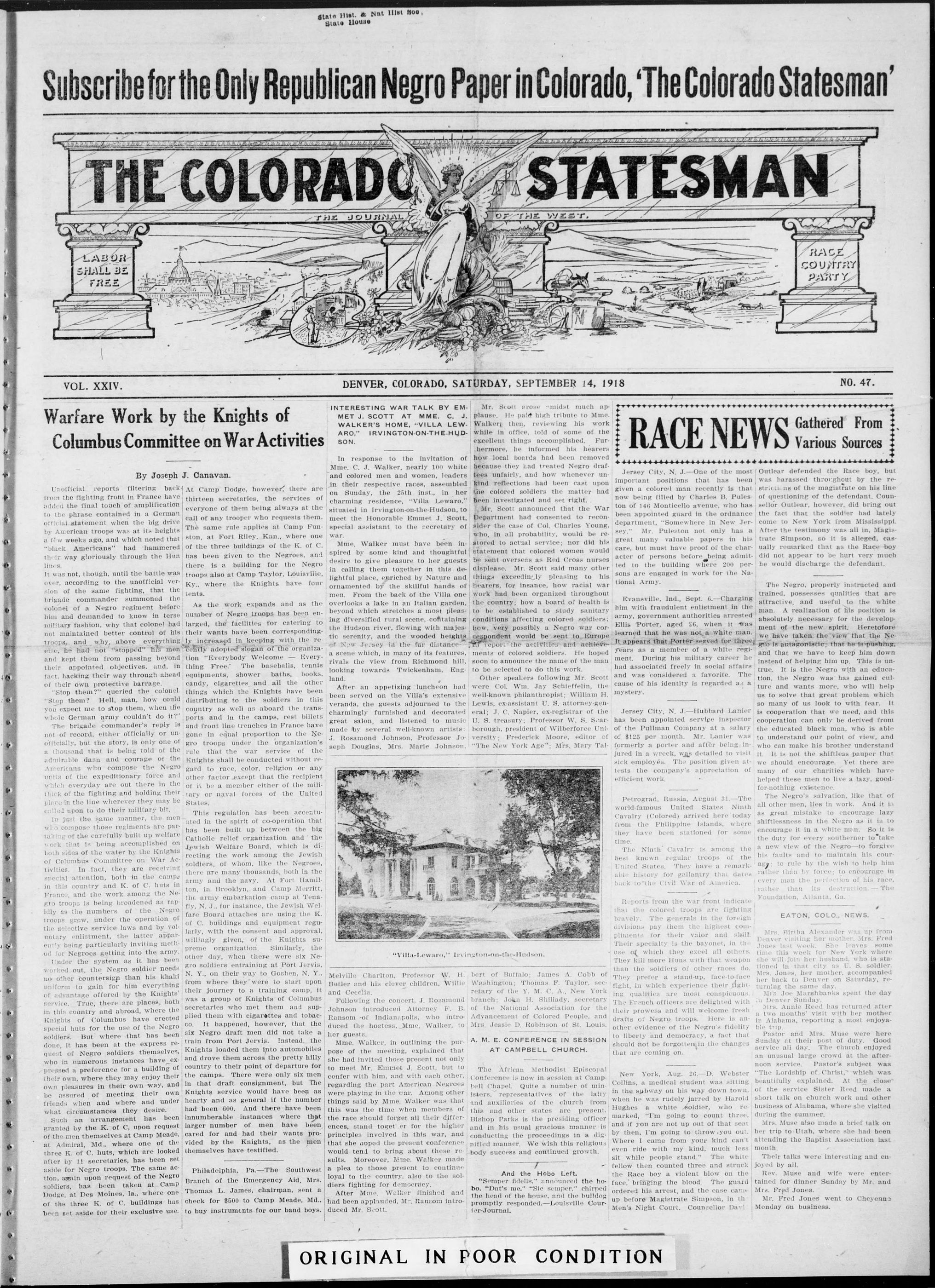
Subscribe for the Only Republican Negro Paper in Colorado, 'The Colorado Statesman'
THE COLORADO STATESMAN
THE JOURNAL OF THE WEST.
LABOR SHALL BE FREE
RAGE COUNTRY PARTY
Warfare Work by the Knights of Columbus Committee on War Activities
By Joseph J. Canavan.
Unofficial reports filtering back from the fighting front in France have added the final touch of amplification to the phrase contained in a German official statement when the big drive by American troops was at its heights a few weeks ago, and which noted that "black Americans" had hammered their way gloriously through the Hun lines. It was not, though, until the battle was over, according to the unofficial version of the same fighting, that the brigade commander summoned the colonel of a Negro regiment before him and demanded to know in tense military fashion, why that colonel had not maintained better control of his troops, and why, above everything else, he had not "stopped" his men and kept them from passing beyond their appointed objectives, and, in fact, hacking their way through ahead of their own protective barrage.
"Stop them?" queried the colonel. "Stop them? Hell, man, how could you expect me to stop them, when the whole German army couldn't do it?"
The brigade commander's reply is not of record, either officially or unofficially, but the story, is only one of a thousand that is being told of the admirable dasn and courage of the Americans who compose the Negro units of the expeditionary force and which everyday are out there in the thick of the fighting and holding their place in the line wherever they may be called upon to do their military bit.
In just the same manner, the men who compose those regiments are partaking of the carefully built up welfare work that is being accomplished on both sides of the water by the Knights of Columbus Committee on War Activities. In fact, they are receiving special attention, both in the camps in this country and K. of C. huts in France, and the work among the Negro troops is being broadened as rapidly as the numbers of the Negro troops grow, under the operation of the selective service laws and by voluntary enlistment, the latter apparently being particularly inviting method for Negroes getting into the army.
Under the system as it has been worked out, the Negro soldier needs no other countersign than his khaki uniform to gain for him everything of advantage offered by the Knights' service. True, there are places, both in this country and abroad, where the Knights of Columbus have erected special huts for the use of the Negro soldiers. But where that has been done, it has been at the express request of Negro soldiers themselves, who in numerous instances have expressed a preference for a building of their own, where they may enjoy their own pleasures in their own way, and be assured of meeting their own friends when and where and under what circumstances they desire.
Such an arrangement has been granted by the K. of C, upon request of the men themselves at Camp Meade, at Admiral, Md., where one of the three K. of C. huts, which are looked after by 11 secretaries, has been set aside for Negro troops. The same action, again upon request of the Negro soldiers, has been taken at Camp Dodge, at Des Moines, la., where one of the three K. of C. buildings has been set aside for their exclusive use.
VOL. XXIV.
At Camp Dodge, however, there are thirteen secretaries, the services of everyone of them being always at the call of any trooper who requests them. The same rule applies at Camp Funston, at Fort Riley, Kan., where one of the three buildings of the K. of C. has been given to the Negroes, and there is a building for the Negro troops also at Camp Taylor, Louisville, Ky., where the Knights have four tents.
As the work expands and as the number of Negro troops has been enlarged, the facilities for catering to their wants have been correspondingly increased in keeping with the recently adopted slogan of the organization "Everybody Welcome — Everything Free." The baseballs, tennis equipments, shower baths, books, candy, cigarettes and all the other things which the Knights have been distributing to the soldiers in this country as well as aboard the transports and in the camps, rest billets and front line trenches in France have gone in equal proportion to the Negro troops under the organization's rule that the war service of the Knights shall be conducted without regard to race, color, religion or any other factor except that the recipient of it be a member either of the military or naval forces of the United States.
This regulation has been accentuated in the spirit of co-operation that has been built up between the big Catholic relief organization and the Jewish Welfare Board, which is directing the work among the Jewish soldiers, of whom, like the Negroes, there are many thousands, both in the army and the navy. At Fort Hamilton, in Brooklyn, and Camp Merritt, the army embarkation camp at Tenafly, N. J., for instance, the Jewish Welfare Board attaches are using the K of C. buildings and equipment regularly, with the consent and approval, willingly given, of the Knights supreme organization. Similarly, the other day, when there were six Negro soldiers entraining at Port Jervis, N. Y., on their way to Goshen, N. Y., from where they were to start upon their journey to a training camp, it was a group of Knights of Columbus secretaries who met them and supplied them with cigarettes and tobacco. It happened, however, that the six Negro draft men did not take a train from Port Jervis. Instead, the Knights loaded them into automobiles and drove them across the pretty hilly country to their point of departure for the camps. There were only six men in that draft consignment, but the Knights service would have been as hearty and as general if the number had been 600. And there have been innumberable instances where that larger number of men have been cared for and had their wants provided by the Knights, as the men themselves have testified.
Philadelphia, Pa.—The Southwest Branch of the Emergency Aid, Mrs. Thomas L. James, chairman, sent a check for $500 to Camp Meade, Md. to buy instruments for our band boys
---
State Hist. & Nat Hist Soc,
State House
blican Negro Pa
RADO
THE JOURNAL
DENVER, COLORADO, SAT
DENVER, COLORADO, SATURDAY, SEPTEMBER 14, 1918
INTERESTING WAR TALK BY EMET J. SCOTT AT MME. C. J. WALKER'S HOME, "VILLA LEWARO," IRVINGTON-ON-THE-HUDSON.
In response to the invitation of Mme. C. J. Walker, nearly 100 white and colored men and women, leaders in their respective races, assembled on Sunday, the 25th inst., in her charming residence, "Villa Lewaro," situated in Irvington-on-the-Hudson, to meet the Honorable Emmet J. Scott, special assistant to the secretary of war.
Mme. Walker must have been inspired by some kind and thoughtful desire to give pleasure to her guests in calling them together in this delightful place, enriched by Nature and ornamented by the skillful hands of men. From the back of the Villa one overlooks a lake in an Italian garden, beyond which stretches a most pleasing diversified rural scene, containing the Hudson river, flowing with majestic serenity, and the wooded heights of New Jersey in the far distance—a scene which, in many of its features, rivals the view from Richmond hill, looking towards Twickenham, England.
After an appetizing luncheon had been served on the Villa's extensive veranda, the guests adjourned to the charmingly furnished and decorated great salon, and listened to music made by several well-known artists: J. Rosamond Johnson, Professor Joseph Douglas, Mrs. Marie Johnson.
he
ny
nt
li
ed
uat
ig
he
di
sh
es,
he
il
tt,
a
el
K.
u
al,
u
he
"Villa-Lewaro," Irvington-on-the-Hudson.
Melville Charlton, Professor W. H. Butler and his clever children, Willie and Cecelia.
Following the concert, J. Rosamond Johnson introduced Attorney F. B. Ransom of Indianapolis, who introduced the hostess, Mme. Walker, to her guests.
bert of Buffalo; James A. Cobb Washington; Thomas F. Taylor, secretary of the Y. M. C. A., New York branch; John H. Shillady, secretary of the National Association for the Advancement of Colored People, and Mrs. Jessie D. Robinson of St. Louis.
Mme. Walker, in outlining the purpose of the meeting, explained that she had invited those present not only to meet Mr. Emmet J. Scott, but to confer with him, and with each other, regarding the part American Negroes were playing in the war. Among other things said by Mme. Walker was that this was the time when members of the race should forget all their differences, stand together for the higher principles involved in this war, and that she noped the present conference would tend to bring about these results. Moreover, Mme. Walker made a plea to those present to continue loyal to the country, also to the soldiers fighting for democracy.
After Mme. Walker finished and had been applauded, Mr. Ransom introduced Mr. Scott.
ORIGINAL IN FOOR CONDITION
Mr. Scott arose midst much applause. He paid high tribute to Mme. Walker, then, reviewing his work while in office, told of some of the excellent things accomplished. Furthermore, he informed his hearers how local boards had been removed because they had treated Negro draftees unfairly, and how whenever unkind reflections had been cast upon the colored soldiers the matter had been investigated and set right.
Mr. Scott announced that the War Department had consented to reconsider the case of Col. Charles Young, who, in all probability, would be restored to actual service; nor did his statement that colored women would be sent overseas as Red Cross nurses displease. Mr. Scott said many other things exceedingly pleasing to his hearers, for insance, how racial war work had been organized throughout the country; how a board of health is to be established to study sanitary conditions affecting colored soldiers; how, very possibly a Negro war correspondent would be sent to Europe to report the activities and achievements of colored soldiers. He hoped soon to announce the name of the man to be selected to do this work.
Other speakers following Mr. Scott were Col. Wm. Jay Schleffelin, the well-known philanthropist; William H. Lewis, ex-assistant U. S. attorney-general; J. C. Napier, ex-registrar of the U. S. treasury; Professor W. S. Scarborough, president of Wilberforce University; Frederick Moore, editor of "The New York Age"; Mrs. Mary Tal
THE PARK
bert of Buffalo; James A. Cobb of Washington; Thomas F. Taylor, secretary of the Y. M. C. A., New York branch; John H. Shillady, secretary of the National Association for the Advancement of Colored People, and Mrs. Jessie D. Robinson of St. Louis.
A. M. E. CONFERENCE IN SESSION AT CAMPBELL CHURCH.
The African Methodist Episcopal Conference is now in session at Campbell Chapel. Quite a number of ministers, representatives of the laity and auxiliaries of the church from this and other states are present. Bishop Parks is the presiding officer and in his usual gracious manner is conducting the proceedings in a dignified manner. We wish this religious body success and continued growth.
And the Trobe Lords
"Semper fidells," announced the hobo. "Dut's me," "Sie semper," chirped the head of the house, and the bulldog promptly responded.—Louisville Courter-Journal.
RACE NEWS Gathered From Various Sources
Jersey City, N. J.—One of the most important positions that has been given a colored man recently is that now being filled by Charles B. Puleston of 146 Monticello avenue, who has been appointed guard in the ordnance department, "Somewhere in New Jersey." Mr. Puleston not only has a great many valuable papers in his care, but must have proof of the character of persons before being admitted to the building where 200 persons are engaged in work for the National Army.
Evansville, Ind., Sept. 6.—Charging him with fraudulent enlistment in the army, government authorities arrested Ellis Porter, aged 26, when it was learned that he was not a white man. It appears that Porter served for three years as a member of a white regiment. During his military career he had associated freely in social affairs and was considered a favorite. The cause of his identity is regarded as a mystery.
Outlear defended the Race boy, but was harassed throughout by the restrictions of the magistrate on his line of questioning of the defendant. Counsellor Outlear, however, did bring out the fact that the soldier had lately come to New York from Mississippi After the testimony was all in, Magis trate Simpson, so it is alleged, casually remarked that as the Race boy did not appear to be hurt very much he would discharge the defendant.
The Negro, properly instructed and trained, possesses qualities that are attractive, and useful to the white man. A realization of his position is absolutely necessary for the development of the new spirit. Heretofore we have taken the view that the Negro is antagonistic; that he is pushing, and that we have to keep him down instead of helping him up. This is untrue. It is the Negro with an education, the Negro has gained culture and wants more, who will help us to solve that great problem which
Jersey City, N. J.—Hubbard Lanier has been appointed service inspector of the Pullman Company at a salary of $125 per month. Mr. Lanier was formerly a porter and after being injured in a wreck, was detailed to visit sick employés. The position given attests the company's appreciation of efficient work.
Petrograd, Russia, August 31.—The world-famous United States Ninth Cavalry (Colored) arrived here today from the Philippine Islands, where they have been stationed for some time.
The Ninth Cavalry is among the best known regular troops of the United States. They have a remarkable history for gallantry that dates back to the Civil War of America.
Reports from the war front indicate that the colored troops are fighting bravely. The generals in the foreign divisions pay them the highest compliments for their valor and sluff. Their specialty is the bayonet, in the use of which they excel all others. They kill more Huns with that weapon than the soldiers of other races do. They prefer a stand-up, face-to-face fight, in which experience their fighting qualities are most conspicuous. The French officers are delighted with their prowess and will welcome fresh dratts of Negro troops. Here is another evidence of the Negro's fidelity to liberty and democracy, a fact that should not be forgotten in the changes that are coming on.
New York, Aug. 26.—D. Webster Collins, a medical student was sitting in the sipway on his way down town when he was rudely jarred by Harold Hughes a white soldier, who remarked, "I'm going to count three, and if you are not up out of that seat by then, I'm going to throw you out. Where I came from your kind can't even ride with my kind, much less sit while people stand." The white fellow then counted three and struck the Race boy a violent blow on the face, bringing the blood. The guard ordered his arrest, and the case came up before Magistrate Simpson, in the Men's Night Court. Counsellor Dayl
NO. 47.
Outlear defended the Race boy, but was harassed throughout by the restrictions of the magistrate on his line of questioning of the defendant. Counsellor Outlear, however, did bring out the fact that the soldier had lately come to New York from Mississippi. After the testimony was all in, Magistrate Simpson, so it is alleged, casually remarked that as the Race boy did not appear to be hurt very much he would discharge the defendant.
The Negro, properly instructed and trained, possesses qualities that are attractive, and useful to the white man. A realization of his position is absolutely necessary for the development of the new spirit. Heretofore we have taken the view that the Negro is antagonistic; that he is pushing, and that we have to keep him down instead of helping him up. This is untrue. It is the Negro with an education, the Negro was has gained culture and wants more, who will help us to solve that great problem which so many of us look to with fear. It is cooperation that we need, and this cooperation can only be derived from the educated black man, who is able to understand our point of view, and who can make his brother understand it. It is not the shiftless pauper that we should encourage. Yet there are many of our charities which have helped these men to live a lazy, good-for-nothing existence.
The Negro's salvation, like that of all other men, lies in work. And it is as great mistake to encourage lazy shiftlessness in the Negro as it is to encourage it in a white man. So it is the duty for every southerner to take a new view of the Negro—to forgive his faults and to maintain his courage; to rule by the wish to help him rather than by force; to encourage in every man the perfection of his race, rather than its destruction. — The Foundation, Atlanta, Ga.
EATON, COLO., NEWS.
Mrs. Birtha Alexander was up from Denver visiting her mother, Mrs. Fred Jones last week. She leaves some time this week for New York where she will join her husband, who is stationed in that city as U. S. soldier. Mrs. Jones, her mother, accompanied her back to Denver on Saturday, returning the same day.
Mrs Joe Marshbanks spent the day in Denver Sunday.
Mrs. Annie Reed has returned after a two months' visit with her mother in Alabama, reporting a most enjoyable trip.
Pastor and Mrs. Muse were here Sunday at their post of duty. Good service ali day. The church enjoyed an unusual large crowd at the afternoon service. Pastor's subject was "The Lordship of Christ," which was beautifully explained. At the close of the service Sister Reed made a short talk on church work and other business of Alabama, where she visited during the summer.
Mrs. Muse also made a brief talk on her trip to Utah, where she had been attending the Baptist Association last month.
Their talks were interesting and enjoyed by all.
Rev. Muse and wife were entertained for dinner Sunday by Mr. and Mrs. Fred Jones.
Mr. Fred Jones went to Cheyenne Monday on business.
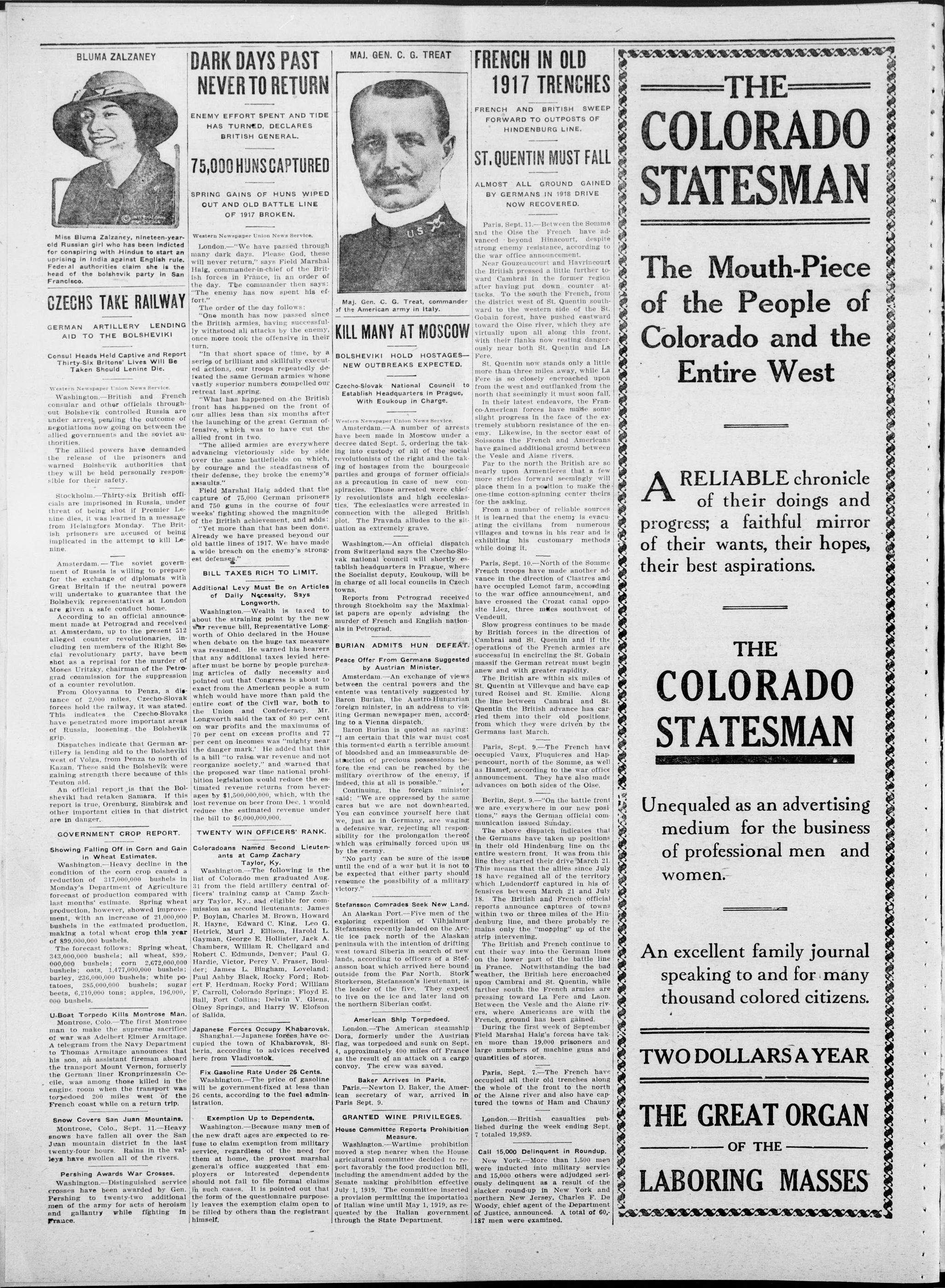
BLUMA ZALZANEY
Bes cn
=
a
eS ‘BO
me |,
ne ORE ee ae
fp Oh one tation rod
Mise Bluma Zalzaney, nineteen-year-
old Russian girl who has been indicted
for conspiring with Hindus to start an
uprising in India against English rule.
Federal authorities claim she is the
head of the bolshevik party in San
Francisco. ie
GERMAN ARTILLERY LENDING
AID TO THE BOLSHEVIK!
Consul Heads Held Captive and Report
Thirty-Six Britons’ Lives Will Be
Taken Should Lenine Die.
yah pats at ahah dg table ail alee aay
Washington—British and Freneh
consular and other officials through:
out Bolshevik controlled Russia are
under arrest pemuling the outcome of
negotiations now going on between the
allied governments and the soviet au:
thorities.
‘The allied powers have demanded
the release of the prisoners and
warned Bolshevik authorities that
they will be held personally respon-
sible for their safety.
Stockholm.—Thirty-six British offi-
cials are imprisoned In Russia, under
threat of being shot if Premier Le
uine dies, it was learned in a message
from Helsingfors Monday. The Brit-
ish prisoners ure accused of being
implicated in the attempt to kill Le-
nine.
Amsterdam. —The soviet govern:
ment of Russia is willing to prepare
for the exchange of diplomats with
Great Britain if the neutral powers
will undertake to guarantee that the
Bolshevik representatives at London
are given a safe conduct home.
According to an official announce
ment made at Petrograd and received
at Amsterdam, up to the present 514
alleged counter revolutionaries, in
cluding ten members of the Right So
clal revolutionary party, have beer
shot as a reprisal for the murder of
Moses Uritzky, chairman of the Petro
grad commission for the suppression
‘of a counter revolution.
From Olovyanna to Penza, a dis
tance of 2,000 miles, Czecho-Sloval
forces hold the railway, it was stated
This indicates the Czecho-Slovaks
haye penetrated more important areas
of Russia, loosening. the Bolshevik
grip.
Dispatches indicate that German ar
tillery is lending aid to the Bolshevik
west of Volga, from Penza to north ©
Kazan, These said the Bolshevik wer
xaining strength there because of thts
‘Teuton aid.
‘An official report is that the Bol
sheviki had retaken Samara, If thi
report is true, Orenburg, Simbirsk an¢
other important cities in that distrie
are in danger,
GOVERNMENT CROP REPORT.
Showing Falling Off in Corn and Gain
in Wheat Estimates.
Washington.—Heavy decline in the
condition of the corn crop caused a
reduction of 317,000,000 bushels in
Monday's Department of Agriculture
forecast of production compared with
last months’ estimate. Spring wheat
production, however, showed improve-
ment, With an increase of 21,000,000
bushels in the estimated production,
making a total wheat crop this year
‘of 899,000,000 bushels.
‘The forecast follows: Spring wheat,
343,000,000 bushels; all wheat, 899,
000,000 bushels; corn — 2,672,000,000
bushels; oats, 147,000,000 bushels;
barley, 236,000,000 bushels; white po-
tatoes, 385,000,000 bushels; sugar
beets, 6,210,000 tons; apples, 196,000,
000 bushels,
tBoat Torpedo Kills Montrose Man.
Montrose, Colo.—The first Montrose
man to make the supreme sacrifice
of war was Adelbert Elmer Armitage.
A telegram from the Navy Department
to Thomas Armitage announces that
his son, af assistant fireman aboard
the transport Mount Vernon, formerly
the German liner Kronprinzessin Ce-
cile, was among those killed in the
engive room when the transport was
toryedoed 200 miles west of the
French coast while on a return trip.
Snow Covers San Juan Mountains.
Montrose, Colo, Sept. 11.—Heavy
snows have fallen all over the San
Jvan mountain district in the last
twenty-four hours. Rains in the val-
Jeys have swollen all of the rivers.
Pershing Awards War Crosses.
‘Washington.—Distinguished service
crosses have been awarded by Gen.
Pershing to twenty-two additional
men of the army for acts of heroism
and gallantry while fighting in
France.
DARK DAYS PAST
NEVER T0 RETURN
75,000 HUNS GAPTURED
‘Weatern Newspaper Union News Service.
London.—“We have passed through
many dark days. Please God, these
will never return,” says Field Marshal
Haig, commander-in-chief of the Brit-
Ish forces in France, in an order of
the day. The commander then says:
“The enemy has now spent his ef-
fort.”
‘The order of the day follows:
“Qne month has now passed since
the British armies, having successful-
ly withstood ali attacks by the enemy,
once more took the offensive in their
turn,
“In that short space of time, by a
series of brilliant and skillfully execut:
ed actions, our troops repeatedly de-
feated the same German armies whose
vastly superior numbers compelled our
retreat last spring.
“What has happened on the British
front has happened on the front of
our allies less than six months after
the launching of the great German of-
fensive, which was to have cut the
allied front in two.
“The allied armies are everywhere
advancing victoriously side by side
over the same battlefields on which,
by courage and the steadfastness of
their defense, they broke the enemy’s
assaults.”
Field Marshal Haig added that the
capture of 75,000 German prisoners
and 750 guns in the course of four
weeks’ fighting showed the magnitude
of the British achievement, and adds:
“Yet more than that has been done.
Already we have pressed beyond our
old battle lines of 1917. We have made
a wide breach on the enemy's strong-
est defenses.”
BILL TAXES RICH TO LIMIT.
Additional Levy Must Be on Articles
cf Daily Nacessity, Says
Sanda he
Washington.—Wealth is taxed to
about the straining point by the new
war revenue bill, Representative Long-
worth of Ohio declared in the House
when debate on the huge tax measure
was resumed, He warned his hearers
that any additional taxes levied here-
after must be borne by people purchas-
ing articles of daily necessity and
pointed out that Congress is about to
exact from the American people a sum
which would have more than paid the
entire cost of the Civil war, both to
the Union and Confederacy, Mr.
Longworth said the tax of 80 per cent
on war profits and the maximums of
70 per cent on excess profits and 77
per cent on incomes was “mighty near
the danger mark.’ He added that this
is a bill “to raise war revenue and not
reorganize society,” and warned that
the proposed war time national prohi
bition legislation would reduce the es:
timated revenue returns from bever-
ages by $1,500,000,000, which, with the
lost revenue on beer from Dec. 1 would
reduce the estimated revenue under
the bill to $6,000,000,000.
TWENTY WIN OFFICERS! RANK.
Coloradoans Named Second Lieuten-
. ants at Camp Zachary
PeCieeigGe
Washington.—The following is the
list of Colorado men graduated Aug.
31 from the field artillery central of-
ficers’ training camp at Camp Zach-
ary Taylor, Ky., and eligible for com-
"mission as second lieutenants: James
P. Boylan, Charles M. Brown, Howard
'R. Hayne, Edward C. King, Leo G.
Hetrick, Murl J. Ellison, Harold 1.
Gayman, George B, Hollister, Jack A.
Chambers, William R. Cheligard and
Robert C, Edmunds, Denver; Paul G
Hardie, Victor, Perey V. Fraser, Boul-
der; James L. Bingham, Loveland;
Paul Ashby Black, Rocky Ford; Rob:
ert F, Herdman, Rocky Ford; William
F. Carroll, Colorado Springs; Floyd B.
Ball, Fort Collins; Delwin V. Glens,
Olney Springs, and Harry W, Elofson
of Salida,
Japanese Forces Occupy Khabarovsk.
Shanghai.—Japanese forges have oc-
cupied the town of Khabarovsk, SI-
beria, according to advices received
here from Vladivostok.
| Fix Gasoline Rate Under 26 Cents.
| Washington.—The price of gasoline
‘will be government-fixed at less than
26 cents, according to the fuel admin.
ees
Exemption Up to Dependents.
Washington.—Because many men of
the new dratt ages are expected to re:
fuse to claim exemption from military
service, regardless of the need for
them at home, the provost marshal
general's office suggested that em.
ployers or interested dependents
should not fail to file formal claims
ih such cases, It is pointed out that
the form of the questionnaire purpose-
ly leaves the exemption claim open to
be filled by others than the registrant
himself.
MAJ. GEN. C. G. TREAT
a e
| | ~ 2 :
Bose es ee
Maj. Gen. C. G. Treat, commander
of the American army in Italy.
\
BOLSHEVIKI HOLD HOSTAGES—
NEW OUTBREAKS EXPECTED.
Czecho-Slovak National Council to
Establish Headquarters in Prague,
| With Eoukoup in Charge.
‘Amsterdam.—A number of arrests
have been made in Moscow under a
‘decree dated Sept. 5, ordering the tak
ing into custody of all of the social
revolutionists of the right and the tak
ing of hostages from the bourgeosie
‘parties and groups of former officials
‘as a precaution in case of new con:
spiracies, ‘Those arrested were chief
ly revolutionists and high ecclesias
tles, The eclesiastics were arrested in
connection with the alleged British
plot. ‘The Pravada alludes to the sit
‘uation as extremely grave.
_ Washington.—An official dispatch
from Switzerland says the Czecho-Slo:
/vak national council will shortly es
‘tablish headquarters in Prague, where
the Socialist deputy, Eoukoup, will be
in charge of all local councils in Czech
towns,
Reports from Petrograd received
through Stockholm say the Maximal-
ist papers are openly advising — the
murder of French and English nation-
als in Petrograd.
BURIAN ADMITS HUN DEFEAT.
Peace Offer From Germans Suggested
‘by Aastra einivte
Amsterdam.—An exchange of views
between the central powers and the
entente was tentatively suggested by
Baron Burian, the Austro-Hungarian
foreign minister, in an address to vis-
iting German newspaper men, accord:
ing to a Vienna dispateh.
Baron Burian is quoted as saying:
“Lam certain that this war must cost
this tormented earth a terrible amount
of bloodshed and an immeasurable de:
stmction of precious possessions be:
fore the end can be reached by the
military overthrow of the enemy, if
indeed, this at all is possible.” ‘
Continuing, the foreign minister
said: “We are oppressed by the same
cares but we are not downhearted,
You can convince yourself here that
we, just as in Germany, are waging
a defensive war, rejecting all respon-
sibility for the prolongation thereof
which was criminally forced upon us
by the enemy.
“No party ean be sure of the issue
until the end of a war but it is not to
be expected that either party should
renounce the possibility of a military
victory.”
Stefansson Comrades Seek New Land.
An Alaskan Port.—Five men of the
exploring expedition of Vilhjalmur
Stefansson recently landed on the Arc-
tic ice pack north of the Alaskan
peninsula with the intention of drifting
west toward Siberia in search of new
lands, according to officers of a Stef-
ansson boat which arrived liere bound
outside from the Far North. Stork
Storkerson, Stefansson's lieutenant, is
the leader of the five. They expect
to live on the ice and later land on
the northern Siberian cost.
American Ship Torpedoed.
London.—The American steamship
Dora, formerly under the Austrian
flag, was torpedoed and sunk on Sept.
4, approximately 400 miles off France
as the result of an attack on a cargo
convoy. The crew was saved.
Baker Arrives in Paris,
Paris,—Newton D. Baker, the Amer-
fean secretary of war, arrived in
Paris Sept. 9.
GRANTED WINE PRIVILEGES,
House Committee Reports Prohibition
iMnesura:
Washington.—Wartime — prohibition
moved a step nearer when the House
agricultural committee decided to re-
port favorably the food production bill,
including the amendment added by the
Senate making prohibition effective
July 1, 1919, ‘The committee inserted
a provision permitting the importatioa
of Italian wine until May 1, 1919, as re-
quested by the Italian government
through the State Department.
FRENCH IN OLD
1917 TRENCHES
——THE—=
COLORADO
STATESMAN
FRENCH AND BRITISH SWEEP
| FORWARD TO OUTPOSTS OF
| HINDENBURG LINE.
ST. QUENTIN MUST FALL
ALMOST ALL GROUND GAINED
BY GERMANS IN 1918 DRIVE
| NOW RECOVERED.
, WV BSR Bases BAN
OO
; The Mouth-Piece
- of the People of
a.
; Colorado and the
_. Entire West
2
tenes
5
: A RELIABLE chronicle
: of their doings and
progress; a faithful mirror
» of their wants, their hopes,
their best aspirations.
> —
: THE
R
' COLORADO
4
STATESMAN
Mer a]
; Unequaled as an advertising
medium for the business
of professional men and
: women.
Beg oee
An excellent family journal
» speaking to and for.many
, thousand colored citizens.
d =
; TWODOLLARSA YEAR ©
SS
, :
, )
’ THE GREAT ORGAN ©
Paris, Sept. 11.—Between the Somme
and the Oise the French have ad
vanced - beyond Hinacourt, despite
strong enemy resistance, according to
the war office announcement.
Near Gouzeaucourt and Havrincourt
the British pressed a little further to-
ward Cambrai in the former region
after haying put down counter at-
tacks, To the south the French, from
the district west of St. Quentin south-
ward to the western side of the St.
Gobain forest, have pushed eastward
toward the Oise river, which they are
virtually upon all along this front,
With their flanks now resting danger-
ously near both St. Quentin and La
Fere. :
St. Quentin now stands only a little
sees than three miles away, while La
‘Fere is so closely encroached upon
trom the west and outflanked from the
north that seemingly it must soon fall,
In their latest endeavors, the Fran-
co-American forces have mite some
slight progress in the face of the ex-
tremely stubborn resistance of the en-
emy, Likewise, in the sector east of
Soissons the French and Americans
have gained additional ground between
the Vesle and Aisne rivers.
Far to the north the British are so
nearly upon Armentieres that a few
more strides forward seemingly will
‘place them in a position to make the
‘one-time cotton-spinning center theirs
for the asking.
| From a number of reliable sources
it is learned that the enemy is evacu-
ating the civilians from numerous
villages and towns in his rear and is
exhibiting his customary methods
while doing it.
Paris, Sept. 10.—North of the Somme
French troops have made another ad:
vance in the direction of Clastres and
have occupied Lomot farm, according
to the war office announcement, and
have crossed the Crozat canal oppo-
site Liez, three mies southwest of
Vendeutl,
_ Slow progress continues to be made
by British forces in the direction of
Cambrai and St. Quentin and if the
operations of the French armtes are
successful In encircling the St. Gobain
massif the German retreat must begin
anew and with greater rapidity.
The British are within six miles of
‘St. Quentin at Villevque and have cap
tured Roisel and St. Emilie, Along
the line between Cambrai and St
Quentin the British advance has car:
‘ried them into their old positions
trom’ which they were driven by: the
Germans last March.
Paris, Sept. 9—The French have
occupied Vaux, Fluquieres and Hap:
pencourt, north of the Somme, as well
as Hamet, according to the war office
announcement. They have also made
‘advances on both sides of the Oise,
| Bertin, Sept. 9.—"On the battle front
we are everywhere in our new post
tions,” says the German official com
munication issued Sunday.
The above dispatch indicates that
the Germans have taken up positions
in their old Hindenburg line on the
entire western front, It was from this
line they started their drive March 21
‘This means that the allies since July
18 have regained all of the territory
which Ludendorff captured in his of
fensives between March 21 and July
18, The British and French official
reports announce captures of towns
within two or three miles of the Hin
denburg line, and there probably re
mains only the “mopping” up of the
strip intervening.
‘The British and French continue to
cut their way into the German lines
on the lower part of the battle line
in France. Notwithstanding the bad
weather, the British here encroached
upon Cambrai and St. Quentin, while
farther south the French armies are
pressing toward La Fere and Laon.
Between the Vesle and the Aisne riv-
ers, where Americans are with the
French, ground has been gained.
During the first week of September
Field Marshal Haig’s forces have tak-
en more than 19,000 prisoners and
large numbers of machine guns and
quantities of stores.
Paris, Sept. 7.—The French have
occupied all their old trenches along
the whole of the front to the north
of the Aisne river and also have cap
tured the towns of Ham and Chauny
London.—British casualties _ pub:
lished during the week ending Sept
7 totaled 19,989.
Call 15,000 Delinquent in Roundup.
New York.—More than 1,500 men
were inducted into military service
and 15,000 others were adjudged ser!
ously delinquent as a result of the
slacker round-up in New York and
northern New Jersey, Charles F. De
Woody, chief agent of the Department
of Justice, announced. A total of 60,
187 men were examined,
By KATE DOUGLAS WIGGIN
Of The Vigilantes
Perhaps because my life has been very much occupied with children and their various needs and interests, the child always looms large in my horizon—the child—that "brings hope with it, and forward looking thoughts."
God knows how many war babies bring fear with them in place of hope, and the "forward-looking thoughts" must often be fraught with misgiving. One thing is certain, however, that though individual mothers here and there must of necessity have hearts laden with doubts of the immediate future, there never was a time when child life ought to be so carefully preserved, nourished, guarded, and guided.
This is pre-eminently woman's "part." Not her only one, for she is proving again and again her ability to take a man's work when needful, and do it with an unexpected strength and skill and staying power. There are few things left indeed, that she cannot do, and her activities might be practically boundless were it not for the fact that in the shuffle of the sexes men cannot perform similar feats of flexibility and become mothers!
What Women Are Doing.
A great many of our tasks are performed as they have always been, rather in the background, though we are more or less dragged into the limelight of responsibility nowadays. (I almost hope that we shall not like it so well that we shall never want to work in the quiet places again!) The bearing and rearing and saving of children, the conservation of this great life force that the dreary, blood-stained world needs for its hope, its comfort and refreshment, the literal staff on which the future is to lean, this is woman's most practical contribution to the service of humanity. Make munitions, drive cars, nurse, and succor the wounded, mother the soldier in the camps and canteens—all this must be done, but the child must be kept in mind at every turn. He has a right to be born, to be welcomed, to be loved and wished for, that homes and hearth fires may not vanish from the earth, and that men and women shall not lack the greatest driving force in the universe, fatherhood and motherhood—the love and care of children.
There may come a time when the service flags are taken down because there are no armies battling on the field, no gold stars needed to mark pa-
I. W. W.'s AND
"LIBERALS"
By GERTRUDE ATHERTON
Of The Vigilartes
It is a matter of great regret to me, as to many others, that the leaders of the Industrial Workers of the World were not peremptorily court-martialed and the worst of them as peremptorily shot. The only sort of lawyers that could be induced to defend such vermin will use every legal trick to get them off, and it will take juries of very high intelligence to remain cool and detached in the face of appeals for liberty, justice, the abominable capitalistic class that is responsible for this rebellion of the outraged proletariat, and all the rest of it.
No one will deny that the more ignorant and stupid of the working class have been shamelessly exploited by the great employers of this country. They have been enticed from Europe, or from the Atlantic seaboard, under false pretenses, herded like cattle, forced to live in foul conditions, and, instead of finding themselves with the steady job promised them, turned adrift after four months of more or less lucrative work. The capitalist has labored to increase his capital and that of his stockholders, and looked upon the ignorant scum of Europe or the failures among the native-born Americans as he would look upon so much machinery to increase production. Not one of the exploited has ever shown himself capable of rising in the world on his own merits beyond the position of agitator and hater-in-chief of a class to which he would give his eyes to belong.
Moreover, the manner in which the immigrant has been treated at our ports, even when belonging to the best of his kind, has long been a source of mortification to every thinking American, and enough to make anarchists of every one of these bewildered and miserable creatures.
But this spirit among the powerful and the successful toward the masses is as old as time, and human nature is proverbially short-sighted. In this country where the successful never rest and where success is the goal toward which every able man strives with all the energy of his being, haunted by the brevity of life; where legislation is lenient, and individualism rampant, this state of affairs has come about in the most natural manner in the world. It would be astonishing if it had not, human nature being what it is. Barring the intervention of this war methods would have grown worse
rental sacrifices, but if a new banner should one day be hung in windows here and there with a star meaning: "Unto us a child is born, unto us a son is given." it would be not a flag of sacrifice but still a flag of service and honor.
Let us save the children, then, even if the task be carried on humbly, patiently, unostentatiously. All we own, and wear, and are, all that is the outer husk of us, all that is the inner kernel, is being tested in these days. It is as if there were a universal "wash" and only the "fast colors" in life and character were coming out clear and true.
In all this the mothers and the fathers, the preachers and the teachers are a great factor. It is the children who are the seed corn of the future; it is the boys and girls of today that will have to endure the terrible reactions of this war and settle the problems that will vex us for years after peace is formally declared. Every man or woman who lends his money to the government in this crisis protects the future of his childreer; makes it more certain that America will never repudiate its debts, but pay them as it did after the Civil war, with a speed that gained the world's applause.
All Put Shoulders to Wheel.
All Put Shoulders to Wheel.
The children are a definite factor in all our campaigns nowadays. Boy Scouts, Junior Guards, Camp Fire Girls, school children, have all put their shoulders to the wheel and in being an active part of the movement have grown in wisdom and understanding, self-denial and right use of their slender powers. These are our own American children, for the most part sheltered, not always indeed from poverty, but at least from more terrible evils. Whenever I buy bonds or War Saving stamps or subscribe to the dozen and one causes forever knocking at the door, I long to give more and more because of the lives of women and children across the seas, innocent lives sacrificed to the relentless war god!—mothers, potential and actual—the mothers who would have replenished the standing armies of the world—and blameless little children who were the hope of the future.
Then let us work, sacrifice, give, in memory of their sufferings and the unspeakable anguish in which they groped and bled and starved to death. I do not speak of repaying slaughter with slaughter—vengeance is the Lord's part—I speak of giving as if we were laying a "sprig of rosemary for remembrance" on those hundreds of little pitiful, uncoffined bodies, that their more fortunate brothers and sisters may be saved, fed, clothed, sheltered and educated.
Whoever loves a child loves his country; whoever helps a child holds a stake in the future of his country; whoever saves a child sits on the seat with the builders of cities and the prophets of insting peace.
instead of better, and the result would have been a social upheaval. But the inevitable result of this war will be a pruning of capitalistic tyranny and a healthy invasion of socialism from the top, to say nothing of the general awakening and desire for the betterment of mankind, which will remove so many of the proletariat grievances that they will not have half a leg to stand on. It is a pity it could not come sooner, but history is history; our war did not come until it was due. Moreover, people, particularly when moderately successful, never rouse themselves to reform until they have received a severe jolt.
That, however, is for the future, and there is only one way to deal with the present problem; exterminate it. When a careless farmer has permitted his fields to be invaded by gophers, rats, rattlesnakes and other vermin, he cannot afford to sit down and reproach himself and invent excuses for the invaders; he makes a clean sweep and kills them off, sweeps away the formidable menace to his prosperity. Then, a wiser man, he takes measures to keep his fields and granaries free of vermin in the future, and watches unceasingly. But he exterminates first.
One Class Without Friends.
To reason with an I. W. W. would profit as much as to reason with a rattlesnake, charged with poison and waiting its opportunity to strike. In the first place, what brains these outlaws ever had not only have deteriorated with class hatred, but they never would have been I. W. W's, if they had had a shred of natural ability, or were not too lazy to work. They must be got rid of, root and branch. The leaders should either be executed or shut up in asylums for the criminally insane, and the rest either deported or punished.
As for the American Liberals who are trying to raise a fund to defend these outcasts, no censure is too harsh for them. They are either German agents, cowardly pacifists, or little groups of would be "intellectuals," who long to be thought academic, detached, remote from the vulgar passions that govern mankind in time of war. Well, that is the point. We happen to be at war. An attitude that no one would quarrel with in times of peace, for we are quite willing to let inadequately gifted men and women win a little prominence in whatever way they can, when all are living for themselves; they come under the head of menaces or pests when the entire country should be united in a single purpose. No doubt the government will get round to them in time, but if it does not there is an ever worse punishment in store for them, the contempt of their fellow citizens. They will be outlanders, forced to endure the society of one another to the last of their days. In other words, they will be boycotted. Perhaps they would prefer the word verboten.
HUN POETS FAIL ON WAR GUESSES
THINK IN TRUE KULTUR VEIN
Forecast Only Short and Merry War,
at End of Which Great German
Hosts Will Be Conquerors
of the World.
By EARL DERR BIGGERS.
(From the Committee on Public Information
Washington, D. C.)
tion, Washington, D.C.)
Speaking of Germans—as who is not these days?—a celebrated French poet, Jean Aicard, has hit upon a rather neat and happy figure of speech. In a long and eloquent poem about the war, after he has described how the German horde, coming "forward with God" as they put it, swept down on Paris, and has pictured them baffled and beaten by the miracle of the Marne, he further recalls how—"having prepared themselves in France a terrier's hole"—they
Intrenched themselves therein, defeated,
driven, hurried
Backed by France and scorned
Back by the sword of France and scorned by all the world
And then what happened? Let Al card tell it:
There, in their filthy holes, their natural habitat,
As lives the hunted boar, the crouching soldiers sat;
And, as a putrid pool exhales an evil smell,
smeir,
They poured their poisons forth straight
from the maw of hell,
Defiled the blue of heaven and made the
virgin air
A party to the crime they perpetrated
there.
The choking gas that rose, mephitic, from
their holes.
their holes,
Was very like the breath and odor of
their souls.
The odor of their souls! The present writer must confess that this simile strikes him as a remarkably fit and appropriate one.
Today we know only too well the odor of their souls, and we are determined to send our men over to those holes in France, to disinfect them with the only serviceable antiseptics—the bayonet and the bullet. Everything that keeps that odor strong in our nostrils will be of help in the salvation of our country, since it will keep us firm in our determination to do or die.
So one is inclined to feel that Prof. H. C. Grumbine of Clark university, who has recently translated into very readable English the war poetry of France and Germany, has done this country a patriotic service. Professor Grumbine knows that nowhere are the ideals of a nation more clearly revealed than in its literature, and he adds that literature in its purest form is poetry. So he has gone to the poets of the two countries to discover what was in their minds in the early days of the war. With an ardent desire to be fair, he has not chosen verses which prove any particular point for him, but has sought to confine himself to the leading and the representative bards. In Germany such men as Sudermann. Lissauer, and Herzog; in France, Boutrel and Aicard, the former a laureate and the latter a member of the French academy. And having translated the verses of these men he has drawn some logical and illuminating conclusions regarding the German god and the French god, the German soul and the soul of the French.
Grumbine's Deductions.
Grumbine's Deductions.
Let us glance on a moment over Professor Grumbine's shoulder at the translations he has made; then briefly let us consider his conclusions. If the matter strikes you, dear reader, as academic and—dread word—literary, be assured that it will not be treated here in either academic or literary fashion. Professor Grumbine opens the door for you, and you wander with him through that dark hinterland—the German mind; he leads you on to the heights where the French thinker sits.
When, much to the surprise of everybody in Germany, war was declared the German soldier immediately rushed to his locker, where everything was ready for him, including a canteen filled with fresh water. Simultaneously the German poet rushed to his fountain pen which—God and the kalser forgot nothing—was also filled, not with water, but with a venomous liquid that flowed red, like blood. This war has reminded us that it is not the man who fights in the field who is the true master of hate and bitterness; it is the highly educated and cultured thinker at home who screams loudest and foams most freely at the lips.
If the German poets had been for a moment at a loss as to what view to take of the war, of course the German government would have set them right. (There was that naive newspaper in Munich which at the start pleaded pathetically for the government to "take charge of public opinion.") One could fancy some such advertisement in the Berlin papers: "German poets will call at the Wilhelmstrasse between two and four on Thursday to secure their points of view on the war." However, it is improbable the German poets needed any instruction. They thought about the war just what the kalser wanted them to think, what he and his kind had been training the whole German nation, poets included, for 40 years, to think. They greeted the catastrophe with a mighty cry, a cry partly of hate for Germany's enemies, partly of joy that now at last Germany's hour had struck. Wrote
thus one enthusiastic German baro:
Hurrah! Hip, hurrah! Away with all
labor!
It is war! Bloody war! Get your rifle and grab it.
and saber!
This hip-hurrah greeting for bloody war was characteristic of most of the early war poetry. The poets, unfortunately, were not prophets. The blood which they viewed in prospect was to flow mostly from the bodies of the contemptible foe, Germany, marching with God, was invincible. A short war and a merry one, and at the end the great German hosts conquerors of the world! If they could have foreseen then the long and wery road ahead, the hip-hurrah note might have been mingled even more freely with the venom and hate the balked and beaten monster feels for those who stand in his way.
Where God Stands.
One looks in vain in this output of German poetry for a note of abhorrence of war, a question as to whether or not this is God's way for settling disputes. There is no question as to where God stands, he rides on the German shells, directs the Zeppelin, greets joyously the submarine, chuckles with delight that his chosen people have in their hands the weapons whereby to impose their will—which is his will—on the world. More of this peculiar German god anon. Through this weller of harsh German poetry runs only a roar of delight in German strength, a great satisfied sigh that now at last the world is to feel that strength.
Here and there, as though by way of afterthought, there is a bit of camouflage as to who started the war. Before going on to picture the downfall of the enemy one bard pauses to remark:
War! War! Awake! The French have crossed the Rhine,
And Cossacks swarm upon our eastern line.
These obvious lies are not dwelt on however. Probably not even the poet expected anybody to believe them. They were just thrown in as a sop to the diplomats at the Wilhelmstrasse. Public opinion, which had been taken charge of by the authorities, was "verboten" to forget these things. And it was added, in faint voice here and there: "We did not wish this war."
One is reminded, by way of aside, of the excellent Australian cartoon which pictured the kaiser sitting, head in hands, in the company of the crown prince. "I did not want this war." "No," says the crown prince in a lucid moment, "it was quite a different war you wanted, it wasn't, papa?"
But coming back to the poets, it may be said that while at rare intervals they remembered to make a note of the fact that the war was a complete and unpleasant surprise to Germany, their whole attitude was that now that it had come, they were delighted. They dreamed of blood, they sang of it. At last the weapons Germany had been fondling so long were to find a mark. Rudolf Herzog wrote a dainty little thing, urging the soldiers on—he was evidently somewhere in the rear himself—and the refrain of each verse ran:
What though the earth of hell be full, Our steel shall cleave the foeman's skull. Such was the picture that inspired the frenzied poets, the gentlemen of the pen. A soul-satisfying, delectable picture of German steel deep in the foeman's skull, while rich, delicious blood was everywhere.
England With the Allies.
England With the Allies.
While they were in the midst of gory composition, their eyes in a fine frenzy rolling, England entered the war on the side of the allies. This was distinctly verboten, and it upset the German plan horribly. England was to stand aside until Russia and France were annihilated, and then be wiped out in her turn. Anyone who has ever been in Germany knows the fury of a German whose system is upset. Immediately the mad poets grew madder yet, and the recipient of all their poisoned darts was poor old England.
The anger of a German when things are going as he wished is not a pretty thing, but the anger of the same man when things are going wrong is enough to make God tremble.
In this dark hour when all Germany was sputtering with a fury so terrible it seemed words could not be found to express it, Herr Ernst Lissauer came forward and earned the nation's gratitude by pening his famous "Hymn of Hate." In our country we are all familiar with this dainty little thing, which ends:
To, what care we for French or Russ?
It's a shot for a shot when they shoot at us.
We fight our battles with bronze and steel.
And when we stop we shall see you kneel!
It's you we hate with a lasting hate—
Nor will we abate one title of hate—
Hate by water and hate by land,
Hate of the head and hate of the hand.
Hate of artisan, hate of king.
Hate which seventy millions ring:
One love they know, one hate they know,
They know but one, one only foe:
England!
Little Erust, groping around in the madhouse, seems to have found words that pretty well express his meaning. In fact, he seems to have put across in fairly effective shape the idea that the Germans don't care much for the English, whichever way you look at it. But if he hated before, what must have been his fury at the reception his outbreak got in England? Instead of cowering in fear, a laugh went up from the British isles that was heard round the world. The Tommies in the trenches, treated to a German concert, shouted across: "Sing us a comic song—sing us the 'Ynn of Hyte.'" And it is recorded in Boyd Cable's "Between the Lines" that Cockney regiments, to while away idle hours, have been known to sing variations:
Hyte of the 'eart and byte of the 'and
Hyte of the 'eart and hyte of the 'and
'Oo do we hyte to bet the band:
Hingland!
Which is very cruel of them, and
entirely beyond the comprehension of the
raiding foe.
At the Man's Store
Most Substantial Savings
OFFERED IN OUR
GREAT STYLE SALE
Men's and Young
Men's
Union Label Suits
Autumn Suits
$25 to $28 Values
$1950
Autumn Suits
$30 to $35 Values
$2450
THE MAY CO.
The Home of Society Brand Clothes
Taxicab Rates.
Depot, 1 or 2 pass...50c
Depot, each addi-
tional pass...25c
One mile radius...50c
Each addition'1 mile.25c
Motto: "Not slow but sure." Cash only.
Rates Per Hour.
$1.50 to $2.50.
Phone Main 6699
Bean Auto Livery
HEATED TAX CAB.
COLE 8 AND 7-PASSENGER 1918 LATE
MODEL CARS.
STAND: NIGHT AND DAY CAFE
1865-1867 Curtis St. Denver, Colorado
A pine cone
FLORAL DESIGNS PUT UP WHILE YOU WAIT
CHOICE PLANTS AND CUT FLOWERS CONSTANTLY ON HAND
GREENHOUSES: Thirty-Fourth and Curtis Streets
TELEPHONE, MAIN 1511 DENVER, COLO
THE COLORADO STATESMAN
S. E. Hayden of Kansas City was a caller at our office, Wednesday.
Our friend Mac Rusan is much improved after his minor operation.
Miss Helen E. Hagan, Mus. B., presented by Y. M. C. A. Glee Club at Zion, Twenty-fourth and Ogden, Friday, Sept. 20th. Don't miss this treat.
Y. M. C. A. NOTES.
It was a large crowd that gathered last Sunday afternoon to hear Ladies' Day program, an event comes off about once every two months. This was the first for fall season, and it was thoroughly joyed by all. Special vocal select were rendered by Miss Naomi B.
Charles Robinson returned from his ranch at Parker, Colo. He reports everything in fine condition.
Miss Thelma Thomas, who underwent an operation for tonsilitis recently, was able to return home Monday from the hospital.
Mrs. Ora Spates of Los Angeles, California, stopped over for a few days with Mrs. E. L. Holloway on her way to Wyoming.
Ralph Gadvin, popular among the younger members of our community, returned from Estes Park last Thursday.
Rev. and Mrs. A. G. Elliott, accompanied by Mrs. Annie Brooks, returned home this week from Glenwood Springs after a very pleasant visit.
Mrs. Shores of Kansas City, Mo., is visiting in the city, and is the guest of Mrs. Lewis George, 2819 Glenarm place.
Eugene Hagan of Herculaneum, Mo., is here for a few days, enjoying Colorado scenery and Denver's hospitality. He is staying at Mrs. Perkins' 2447 Tremont place.
JOSEPH CARTER, our popular moving man, has purchased a new van with a great carrying capacity, and is now in a position to move or haul anything in and out of the city. Steadily Mr. Carter improves his business, and the public shows their appreciation for him by keeping him busy all the time. We wish him every success.
Miss Helen E. Hagan, Mus. B., Concert pianist at Zion Baptist Church, Friday, Sept. 20th, 8:15 p. m. The musical treat of the season.
Mrs. Bert Watkins, of 1941 Curtis street, returned to the city last Sunday evening, after visiting in Missouri and Kansas. She had an opportunity of meeting her son, who arrived from Camp Funston on furlough. Mrs. Watkins looks much improved in health and now Bert is all smiles.
Mrs. Joseph D. D. Rivers returned home last Monday from Los Angeles, California; where she enjoyed a very pleasant visit of three months with her son and daughter, Mr. and Mrs. Wm. R. Greenwood.
MISS CLEO HOBSON OF LOS AN
GELES WRITES ON THE
HAGAN RECITAL.
Editor Colorado Statesman:
Though I am not fully restored to health yet I could not resist the temptation of going to hear Miss Helen E. Hagan in her piano recital at the Zion A. M. E. Church, Sept. 3rd, and being a lover of music as well as a student in the art of piano playing, I feel it a duty to say, a word on this member of our race, who besides being a wonderful artist is a credit to the American nation. I have heard many artists of the piano, including such masters as Paderewski, Hoffman, etc., and in my humble opinion think Miss Hagan not only ranks with them, but merits everything of the press comments. Unaffected and apparently void of that nervousness which seems to attach to most performers, she goes about her work with comparative ease, and apart from her training evinces an original expression which finds great appreciation in her audience.
Denver musicians—teachers and pupils—should not fail to hear this pianist, as her performance will lend inspiration to intending artists, offer encouragement to musical aspirants, and strengthen the propaganda of universal democracy for which our country is now giving her best and most, as in her being selected as one of the four to entertain the men in France, Miss Hagan is helping to suppress and abolish the wrongs we have been subjected to as a race by her talent.
Thanking you, Editor.
Yours very truly,
CLEO HOBSON.
Los Angeles, Sept. 5.
---
It was a large crowd that gathered last Sunday afternoon to hear the Ladies' Day program, an event that comes off about once every three months. This was the first for the fall season, and it was thoroughly enjoyed by all. Special vocal selections were rendered by Miss Naomi Brown and Miss Hermionne Jones, the latter being accompanied by Mrs. DeFrantz-McKinley. If importance also was the presence of the Rev. Mr. Washington of Roger Williams College, Nashville, Tenn., and Prof. G. W. Henderson, president and founder of Henderson's Business College of Memphis, the only distinctive colored business school in the country. Prof. Henderson is one of the greatest stenographers and typists in the country, and has also been selected as one of the four-minute men to assist the government in mobilizing the man-power of the country. Several white friends of his, members of the Bahai movement, a kind of a moral and social cult of Oriental origin, to which Prof. Henderson belongs, were also present, and the Rev. C. A. Williams and Rev. T. S. McRorris.
The sound of mallet and ball has become a favorite one, and some good games have been played. With the return of Chairman L. H. Lightner it is expected some heavy games will be played. Sims was back on the grounds last week, and he and Adolphus Lightner won a hotly-contested game from King and Leslie Lightner. The two latter players also won from Adolphus Lightner and Buford early in the week, but Adolphus and Leslie also won from King and L. H. Lightner. Perhaps one of the most neatly played games was one in which Leslie Lightner and Bell severely beat Rev. Williams and Counsellor Blakemore Wednesday evening.
A large program will be rendered next Sunday afternoon. The Rev. A. Waymond Ward will be the principal speaker, with other men also attending the annual conference of the A. M. E. Church. Special vocal music by Mrs. Monroe Conner and Mrs. Beatrice Arnold. Ladies also will be welcome. Program begins at four o'clock.
Every music lover, pupil, parent and teacher, should hear Miss Helen E. Hagan, Mus. B. Yale, at Zion on Friday, Sept. 20th. She is a credit to her race and nation.
LOOK! IMPORTANT!
The Janitors' Protective Union No. 15,641 meets the first and third Thursday of each month at 401 Club building, 1731 Arapahoe street. In all cities with organizations janitors receive 40 per cent more wages than unorganized ones. A few years ago plumbers received $3 per day. Now they receive $7, and just so with all organized trades and common labor. Unorganized labor is in keen competition with each other for a meager existence. Come, join, and let us help each other.
Guaranteed Result for Growing and Beautifying the Hair
MME. JENNIE V. INGRAM
Hairgrower and Teacher of Mme. C J. Walker's Method of Growing Hair
I carry a Full Line of Her Goods
Phone York 1765 J 2355 Ogden St.
CHEYENNE, WYOMING, NEWS.
Pastor C. O. Smith, returning on the 3rd inst. from Ogden, Utah, where association with the Revs. G. W. Hart, A. J. Billingsley, W. H. Hudson, and others succeeded in organizing an association to be known as the Utah, Wyoming and Idaho Association. G. W. Hart of Salt Lake was elected moderator; A. J. Billingsley, Ogden, vice moderator; J. T. Muse, Cheyenne, recording secretary; C. O. Smith of Cheyenne, general superintendent of missions for the three states. It was said by old-timers that never was there such a spiritual awakening in the western mountain states as was witnessed at this meeting. On Monday, following the close of the association, Rev. C. O. Smith and A. J. Billingsley proceeded to Pocatello, Idaho, where they organized a missionary Baptist church and Sunday school. Prospects are bright for the Baptists in the west if the services of the right men as pastors can be secured, the harvest is ripe. While in Pocatello the gentlemen stopped at the popular Alberta hotel, Crothers and Summers, proprietors.
The Rev. N. H. Jeltz has left for the training camp in Kentucky, where he is to train for a chaplain. We wish every success for him in his new field and hope for him a safe return from France. Mrs. T. E. Edwards has been seriously ill for the past week, but at this writing she is much improved. Many Cheyennites are planning to go to Denver the last of this week to attend the annual conference which convenes there at Campbell Chapel.
NEWS FROM ESTES PARK.
Miss Jane Addams, noted friend of the people, who is spending the summer at Longs' Peak Inn, Eates Park, lunched on Labor Day at the Stanley Hotel with a party of friends from Chicago. For many years Miss Addams has been at the head of Hull House, Chicago, which she founded. This was the first settlement house of its kind in the United States, patterned in some respects after the famous Toynbee Hall in London, England. Miss Addams' active interest in the betterment of social conditions among the unfortunate of whatever race or creed gives her a world-wide reputation.
Mr. Mayes Roffle of Lawrence, Kan. who has been employed at the Stanley hotel, left for Fort Collins to be examined for the arry. He was 21 on August 19, and was notified August 24. Before leaving he paid for six months' subscription to The Colorado Statesman, to be sent to his mother, Mrs. Mollie Roffle, 771 Hickory street, Lawrence, Kan. Mr. Roffle expects to be sent to Camp Lewis, Washington.
Mrs. L. P. Cowden, formerly of Washington, D. C., and for several years matron at the Stanley hotel, Estes Park, has a son in France and is expecting her daughter to leave soon to take up the Red Cross work. Her little grandson, Sidney, 9 years old, will be left with Grandmother Cowden
Mr. L. W. Walker has been confined to his room for several days with rheumatism, but is at work again at this writing. Among the noted persons who visited the Stanley hotel this season was Dr. R. H. Jackson of Madison, Wis. Dr. Jackson is chief surgeon of the draft board and leaves a large private practice at home in order to serve his country. He has a brother in the service also, who has charge of the remount station in France.
Miss Williams of Chicago was also among the ladies of note to spend several weeks as guest of the Stanley hotel. Both Miss Williams and her sister are very much interested in women's suffrage among the colored women, and read the account of their convention, which was held in Denver last summer, with much interest in The Colorado Statesman.
Miss Williams has spent much time visiting Hampton University and other institutions of learning in the South, and speaks of them in the highest terms.
News of the promotion of Mr. Marshall Coats of Denver as corporal at Camp Lewis will be of interest to his many friends.* Mr. Coats was chaufeur for Dr. Lyman and among the last men drafted from Denver.
Your correspondent will leave Estes Park for Kansas City, via Denver on the 12th inst., after a much-needed recumbency. Mrs. M. E. Rhodes of St. Louis is on a touring trip with a prominent family from Oklahoma. She has visited Yellowstone Park, Colorado Springs and Estes Park. Mrs. Rhodes has a son in the army in France and a daughter in the Red Cross. Both are graduates from St. Louis high school.
Thrived Without Wheat.
American Indians thrived and grew tall and muscular without wheat; but we can't tell whether that is what made them red.—St. Louis Globe-Democrat.
No Chance to Quarrel
One day little Laura, who could not talk plainly, was playing with a little boy who could not speak English. When someone asked her how she got along with the little boy she rplied: "Oh, we gets along fine; he can't 'stand me and I can't 'stand him.'
Expansion Sale
The adjoining store room on Fifteenth Street is to be added to keep pace with the growing business.
20% Off On Women's RED CROSS SHOES
Lace and button shoes—
blacks and in all colors and all
styles.
This is a golden opportunity
to get the world's best foot-
wear at cut prices.
15TH AND LARIMER STS.
DENVER, COLO.
J.
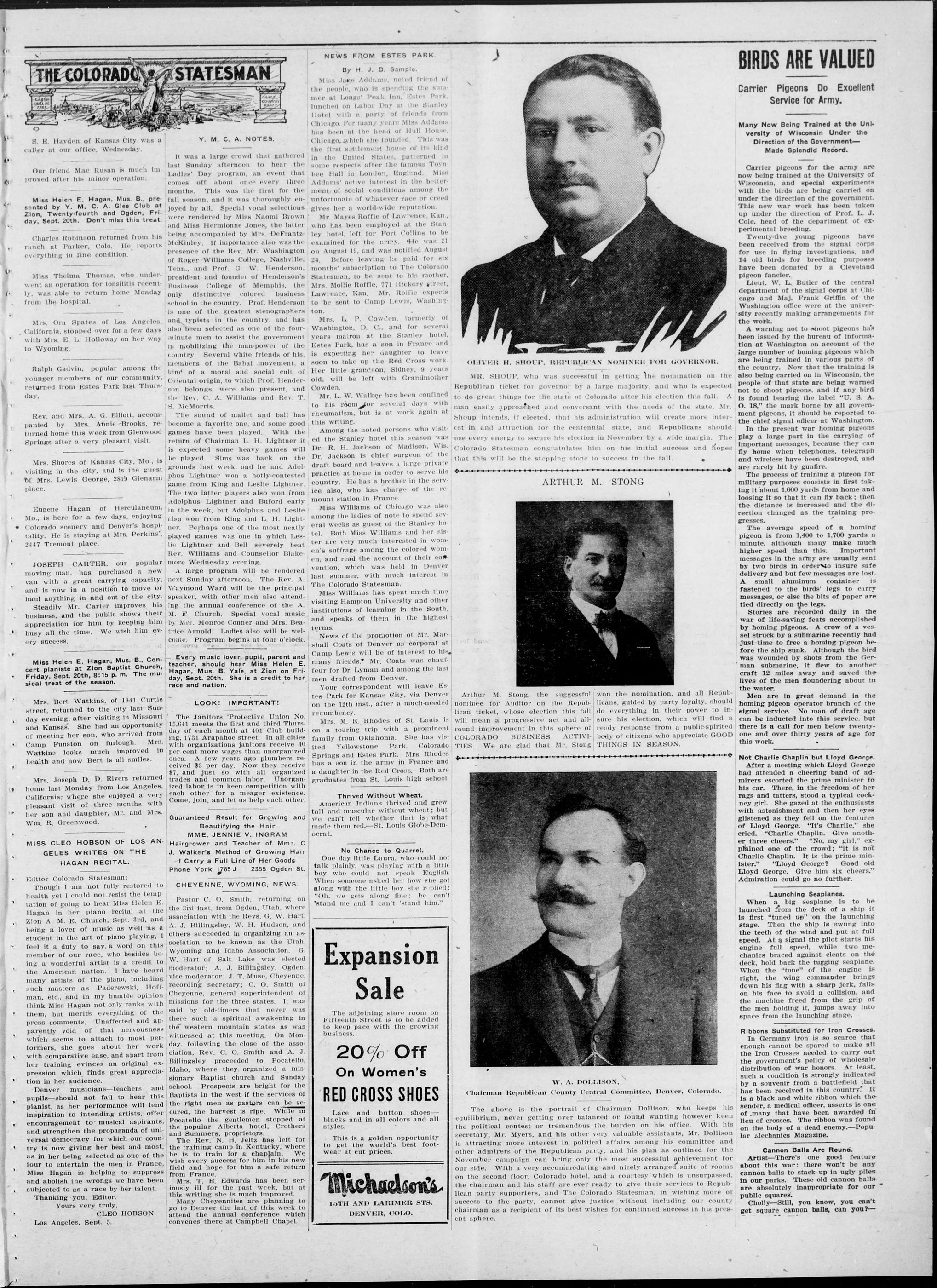
OLIVER H. SHOUP, REPUBLICAN NOMINEE FOR GOVERNOR.
MR. SHOUP, who was successful in getting the nomination on the Republican ticket for governor by a large majority, and who is expected to do great things for the state of Colorado after his election this fall. A man easily approached and conversant with the needs of the state, Mr. Shoup intends, if elected, that his administration will create more interest in and attraction for the centennial state, and Republicans should use every energy to secure his election in November by a wide margin. The Colorado Statesman congratulates him on his initial success and hopes that this will be the stepping stone to success in the fall.
ARTHUR M. STONG
[Image of a man in a suit with a bow tie].
Arthur M. Stong, the suggestful nominee for Auditor on the Republican ticket, whose election this fall will mean a progressive act and all round improvement in this sphere of COLORADO BUSINESS ACTIVITIES. We are glad that Mr. Stong won the nomination, and all Republicans, guided by party loyalty, should do everything in their power to insure his election, which will find a ready response from a public-spirited body of citizens who appreciate GOOD THINGS IN SEASON.
M. H.
Chairman Republican County Central Committee, Denver, Colorado.
The above is the portrait of Chairman Dollison, who keeps his equilibrium, never getting over balanced or found wanting however keen the political contest or tremendous the burden on his office. With his secretary, Mr. Myers, and his other very valuable assistants, Mr. Dollison is attracting more interest in political affairs among his committee and other admirers of the Republican party, and his plan as outlined for the November campaign can bring only the most successful achievement for our side. With a very accommodating and nicely arranged suite of rooms on the second floor, Colorado hotel, and a courtesy which is unsurpassed, the chairman and his staff are ever ready to give their services to Republican party supporters, and The Colorado Statesman, in wishing more of success to the party, cannot give justice without including our county chairman as a recipient of its best wishes for continued success in his present sphere.
won the nomination, and all Republicans, guided by party loyalty, should do everything in their power to insure his election, which will find a ready response from a public-spirited body of citizens who appreciate GOOD THINGS IN SEASON.
BIRDS ARE VALUED
Carrier Pigeons Do Excellent Service for Army.
Many Now Being Trained at the University of Wisconsin Under the Direction of the Government—Made Splendid Record.
Carrier pigeons for the army are now being trained at the University of Wisconsin, and special experiments with the birds are being carried on under the direction of the government. This new war work has been taken up under the direction of Prof. L. J. Cole, head of the department of experimental breeding.
Twenty-five young pigeons have been received from the signal corps for use in flying investigations, and 14 old birds for breeding purposes have been donated by a Cleveland pigeon fancier.
Lieut. W. L. Butler of the central department of the signal corps at Chicago and Maj. Frank Griffin of the Washington office were at the university recently making arrangements for the work.
A warning not to shoot pigeons has been issued by the bureau of information at Washington on account of the large number of homing pigeons which are being trained in various parts of the country. Now that the training is also being carried on in Wisconsin, the people of that state are being warned not to shoot pigeons, and if any bird is found bearing the label "U. S. A. O. 18," the mark borne by all government pigeons, it should be reported to the chief signal officer at Washington.
In the present war homing pigeons play a large part in the carrying of important messages, because they can fly home when telephones, telegraph and wireless have been destroyed, and are rarely hit by gunfire.
The process of training a pigeon for military purposes consists in first taking it about 1,000 yards from home and loosening it so that it can fly back; then the distance is increased and the direction changed as the training progresses.
The average speed of a homing pigeon is from 1,400 to 1,700 yards a minute, although many make much higher speed than this. Important messages in the army are usually sent by two birds in order to insure safe delivery and but few messages are lost. A small aluminum container is fastened to the birds' legs to carry messages, or else the bits of paper are tled directly on the legs.
Stories are recorded daily in the war of life-saving feats accomplished by homing pigeons. A crew of a vessel struck by a submarine recently had just time to free a homing pigeon before the ship sunk. Although the bird was wounded by shots from the German submarine, it flew to another craft 12 miles away and saved the lives of the men floundering about in the water.
Men are in great demand in the homing pigeon operator branch of the signal service. No man of draft age can be inducted into this service, but there is a call for men below twenty-one and over thirty years of age for this work.
Not Charlie Chaplin but Lloyd George.
After a meeting which Lloyd George had attended a cheering band of admirers escorted the prime minister to his car. There, in the freedom of her rags and tatters, stood a typical cockney girl. She gazed at the enthusiasts with astonishment and then her eyes glistened as they fell on the features of Lloyd George. "It's Charlie," she cried. "Charlie Chaplin. Give another three cheers." "No, my girl," exhained one of the crowd; "it is not Charlie Chaplin. It is the prime minister." "Lloyd George? Good old Lloyd George. Give him six cheers." Admiration could go no further.
Launching Seaplanes.
When a big seaplane is to be launched from the deck of a ship it is first "tuned up" on the launching stage. Then the ship is swung into the teeth of the wind and put at full speed. At a signal the pilot starts his engine full speed, while two mechanics braced against cleats on the deck, hold back the tugging seaplane. When the "tone" of the engine is right, the wing commander brings down his flag with a sharp jerk, falls on his face to avoid a collision, and the machine freed from the grip of the men holding it, jumps away into space from the launching stage.
Ribbons Substituted for Iron Crosses.
In Germany iron is so scarce that enough cannot be spared to make all the Iron Crosses needed to carry out the government's policy of wholesale distribution of war honors. At least, such a condition is strongly indicated by a souvenir from a battlefield that has been received in this country." It is a black and white ribbon which the sender, a medical officer, asserts is one of many that have been awarded in lieu of crosses. The ribbon was found on the body of a dead enemy.—Popular Mechanics Magazine.
Cannon Balls Are Round.
Artist—There's one good feature about this war: there won't be any cannon balls to stack up in ugly piles in our parks. These old cannon balls are absolutely inappropriate for our public squares. Cholly—Still, you know, you can't get square cannon balls, can you?—
Pithy News Notes From All Parts of Colorado
Western Newspaper Union News Service.
COMING EVENTS.
Sept. 17. — Adams county fair at
Brighton.
Sept. 19. — Beaver Park fair at Penrose.
Sept. 23. — Colorado State Fair at
College Park.
Sept. 26. — Lincoln County Fair at
Hugo.
Sept. 26-28—Grand County fair and face meeting.
Oct. 1—Fourth Red Cross home service institute at Denver.
A camp for tourists has been established at Monte Vista.
The Brunswick mine above James-town is being reopened.
It is reported that a hotel will be built at Lay, near Craig.
A Pueblo ordinance will prohibit the teaching of German in the public schools.
A Christian Science church edifice will be erected in Sterling at a cost of $7,000.
The Bessemer ditch syphon under the St. Charles river near Pueblo is being repaired.
Mrs. Frances Beebe of Silver Plume dropped dead from heart failure while preparing a meal.
A subway 177 feet long will be constructed under the railway tracks at Colorado Springs.
O. H. Doty of Pagoda will use a motor truck to haul the mail between Hayden and Pagoda.
Citizens of Estes Park are planning the erection of a large log fort as an advertising novelty.
Near Westcliffe the Passiflora Mining and Milling Company is sinking its Herman shaft to the 330-foot level.
A new flotation mill will soon be erected on the property of the Garfield Mining Company in Taylor Gulch near Salida.
An important strike has been made on the Golden Mining Company's property in the Upper Union District, near Empire.
Mr. and Mrs. David Johnston of Malia confirmed a report that the son, Harry F. Johnston, had been wounded in France.
Despondent because he had been discharged from the army, Frank E. Knight, 24, shot and killed himself in his room in Denver.
J. D. Hunter, a Texas man, paid a fine of $25 and costs of $12.95 in the justice court at Loveland for fishing without a license.
Miss Zorayda Lorimer, of Ordway, departed for New York and expects to sail for France, where she will do war work for the Red Cross.
About 225 ministers of the M. E church attended the annual conference at Delta. Bishop Thomas Nicholson, of Chicago, presided.
Seven labor boards to assist in the recruiting and distribution of labor have been appointed by the department of labor in Washington for Colorado.
In Custer county, which is aided in a mining sense by the better prices for copper, silver and lead, activity is more apparent than for several past years.
The Sand Hill Telephone Company which was organized a few months ago by farmers south of Hugo, has connected its line with the Mountain States Telephone Company.
The Rev. John L. Boyd, 78 died at the Denver County Hospital of a fractured skull received when he was struck and knocked down by a motor truck driven by Errol Johnson. The Denver & Salt Lake depot at Fraser was destroyed by fire. Twenty-six Colorado men received commissions as second lieutenants of field artillery at Camp Zachary Taylor, Kentucky, according to a list made public by the War Department. Stuart McKeown, the Fort Collins aviator who made such a good record in France and was reported missing since July 7, has been reported as a prisoner of war in Germany. The members of the Mining Engineers' Institute went to Pueblo from Colorado Springs to go through the steel works and coke oven plant at Minnequa, and attend a banquet.
Three thousand babies have been registered and between 7,000 and 8,000 are still to be registered, weighed and measured before Denver's part in the national baby census will be complete.
Saturday's casualty lists officially confirm the death of Daniel J. Allen, son of Mrs. Susan Leahmann, Arvada. He was killed by a bomb dropped from a Hun airplane while he and his chum were asleep in their tent. Allen was instantly killed, but the chum was unhurt.
Nine months after the resumption of work at the Lewis mine, Telluride district, the property has again been placed in the list of producers, with the mill running twenty-four hours a day and a production of twenty-five tons daily being maintained.
William Ross had both arms broken and sustained internal injuries and one of his wife's eyes was gouged out, one of her arms broken and she suffered internal injuries when a motorcycle in which they were riding collided with a telegraph pole between Sterling and Liff
CENTENNIAL STATE ITEMS
Sept. 6 was Mothers' Day at the frontier days celebration at Fort Morgan. Five women, who have each five sons in the service, were guests of the management. They were Mrs. Ella Book of Denver, Mrs. K. E. Watson of Fort Collins, Mrs. Charles Hurley of Fort Lupton, Mrs. L. N. Davis of Hoswell and Mrs. Patrick Fisher of Frederick. Other guests of honor were six Fort Morgan young men who are to depart soon for the army training camps.
The Colorado Educational Association will hold its annual meeting this year in three divisions. The western division will meet at Grand Junction on Nov. 5,-6, 7, 8 and 9; the southern division at Pueblo on Nov. 7, 8, and 9, and the eastern division at Denver on Nov. 7, 8 and 9. By this plan President J. A. Sexson has been able to increase the membership of the association more than 1,400 teachers. Experimental tests in treatment of manganese and potash bearing ores are in progress at the Portland Gold Mining Company's Colorado Springs mill, by G. H. Clevenger and E. R. Bryan of the United States Bureau of Mines, with the object of relieving the shortage of these necessary war materials, and the experts are accredited with making important discoveries.
Advices received by the Denver Civie and Commercial Association indicate that the pinto bean crop of last year in Colorado was even larger than the claim that was entered by statisticians and farmers. Instead of 90,000,000 pounds, it now appears, according to railroad reports, that the crop of 1917 was between 110,000,000 and 120,000,000 pounds.
Philip C. Talsey of Denver was a member of the personnel of the United States transport Mount Vernon, aboard which thirty-five men lost their lives when the ship was torpedoed Sept. 5, but his name is not listed among the casualties. Talsey was assistant engineer with the rank of first lieutenant.
The shooting season for migratory feathered game will open Sept. 16 and close Dec. 31. The duck, goose, brant, crane, swan, plover and other wading, marsh and shore birds may be killed during this period. Prairie chicken, mountain and willow grouse may be killed on Sept. 15 and up to Oct. 1.
Coal mined in Colorado during the first seven months of 1918 shows a record of 342,115 tons over the production of a corresponding period in 1917. The July production of 1,110,248 tons, as reported by the State Coal Mine Inspector, brings the seven months' total up to 7,521,158 tons.
Phillip C. Taisey, a Denver man, a member of the crew of the Mount Vernon, was aboard the transport when torpedoed off the coast of France. He was returning from his eleventh trip to the continent and this was his first experience with the submarine menace during that time.
Mary C. C. Bradford, State Superintendent of public instruction, has been appointed a national executive committee member of the Y. W. C. A. to assist in the direction of the united war work campaign, which is to be held throughout the entire country in the week beginning Nov. 11.
Owners of mines in the gold-silver camps of the San Juan region should make it a point and purpose to keep their taxes paid, their titles clear and water out of the levels, so that the item of sale or the matter of resumed activity may not be delayed at a time when delay would cost money.
Three Coloradoans have been appointed second lieutenants of infantry in the United States army from the Fourth Central Officers' Training School at Camp Gordon, Ga., as follows: John H. Judd, Palmer Lake; Leroy McWhinney and Charles O. Woodworth of Denver.
Joseph A. Watts, Norwood, is among the missing in action reported in the casualty list made public by the war department Sept. 8. Ralph Wilkins, Idaho Springs, is officially reported as killed in action.
A tunnel is being driven on the property of the Empire Zinc Company near Gilman for the purpose of draining and developing the two mines which now produce 9,000 tons of zinc ore per month.
Gunnison county contains unexplored supplies of graphite, which neither the federal nor the state authorities have as yet examined, the matter of transportation being difficult.
A compressor and electric motor have been installed at the Park tunnel in the Leadville district.
The first Montrose man to make the supreme sacrifice of war was Adelbert Elmer Armitage.
A lighting system is being installed on the Maxwell-Miller ranch near Steamboat Springs.
Work of repairing the railroad bridge at Puzzler which washed out July 1 has been completed.
An accident occurred on the Uintah railway at Atehee, Colo., resulting in the death of Conductor P. J. Fitzpatrick of Cimmarron, Colo., and badly injuring Engineer George Lyman of Bingham, Utah. Fireman Roy Eno was slightly injured in jumping from the engine.
Joe Fuller, Arlington, died of wounds received in action; Leslie Williamson, 226 Willow street, Fort Collins; Howard L. Johnson of Denver, and Clyde C. Campbell, La Junta, are on the list of those wounded, degree undetermined.
GOT THIRTY HUNS BEFORE HE DIED
SCOTTY, YOUNGEST SOLDIER IN PERSHING'S, FORCES, IS MOURNED BY ARMY.
HIS HEROIC DEATH RELATED
Red Cross Establishes Tailor Shop in Berne to Supply Captured American Officers With Uniforms—New Plan for Training Flyers.
(From Committee on Public Information.)
Washington.—Private Albert E. Scott, the youngest soldier in General Pershing's army in France—he was but fifteen years of age and a Brookline, Mass., high school boy when he enlisted—is dead, shot through the head by a German sniper after he had held thirty foes to rest, and the army mourns its boy hero.
A soldier writer for The Stars and Stripes, the A. E. F. paper, tells this story:
"In the regiment they are talking these days of all the good pals they lost in the fierce, unfortgettable chase they gave the Germans in the great retreat from the Marne. But most of all—a little oftener and a bit more fondly—they talk of Scotty.
"He was a good kid, they say, and he died on his gun.
"His great chance came when on that historic July 18 his regiment got the order for which, through many a month of dreams, it had longed—the order to advance. It went 18 kilometers without stopping, chasing the Boche up hill and down dale, fighting its way through patch after patch of inviting woods that would prove treacherous with hidden machine guns.
"In the first days of that battle, the movement was so swift that more than once a small German rear guard and an advance Yank platoon would meet in the forest and fight out then and there a complete and separate battle all their own.- So it was with the Indians, as Scotty's regiment was nicknamed, one afternoon, as they were making their way past the bitterly won town of Epieds.
"At the cross road they saw troops approaching them in column of squads. The officer in charge caught (them in the focus of his field glasses. They were Boches, coming on. The Yanks waited, itching to open fire, but biding their time. Suddenly the Boches deserted the road and came on them through the forest.
"The lieutenant placed his men along n roadside ditch. He placed Scotty and his sho-sho beside a tree and squarely opposite a narrow woodland path that opened across the way. He could see straight down that path, and the Boches were bound either to come along it or to cross it.
"See that path, Scotty?" said the lieutenant. "That's your target. Not one of them must cross it."
"Yes, sir," said Scotty, and dropped beside his gun.
"A gray figure darted suddenly into the leafy path. He fell.
"Another appeared. He fell.
"There was perhaps ten minutes of that, and what was left of the German party was withdrawing when a handful of soldiers scampered along the road. They were Germans, but they shouted as they ran. 'Don't shoot, we're Americans.'
"For a moment, just for the space that a breath is held, Scotty thrust his head up to see. From his perch in some tree a sniper shot him in the forehead. Another bullet found his heart. He fell forward, dead, on his gun.
"They had killed him, but the number of their dead that are counted as his was thirty."
Roller skates as a part of the speed-up program in force at the Rock Island arsenal. Illinois, have been adopted by women messenger employees. Women employed in the time division at the arsenal are voluntarily working the first Saturdays and Sundays of each month closing the pay roll sheets so that all arsenal workers may be paid promptly. According to the "Arsenal Record," published by the employees, Rev. M. E. Krotzer, pastor of the Presbyterian churches at LeClaire and Princeton, Iowa, is putting in his five weeks' vacation as an arsenal worker. The same paper reports the fifthth anniversary as an arsenal worker at Rock Island of Emil Beck, seventy years old, inspector in the tin shop, who went there when the arsenal consisted of a small group of wooden buildings, relics of Civil war days, and employed from 200 to 400 men only through the summer months.
Cuba has a closing law which shuts all stores, warehouses, shops, etc., in the larger cities at 6 p. m. week days, and all day Sundays. Retail food stores keep open until 8 p. m. week days and 10 p. m. Sundays. Barber shops remain open until 7 p. m. on Mondays and Fridays, 11 p. m. Saturdays, but cannot sell perfumes while general stores are closed.
A company has been formed in Yokohama, Japan, to turn out a substitute for Portland cement. The new material will be made of tast, and lime.
Captured American army and navy officers are reaching German prison camps without clothing and shoes. The American Red Cross has established a tailor shop in Berne to supply them with proper uniforms, according to information just reaching the bureau of prisoners' relief. The officers, it seems, in being hustled back from the front by their captors lose their overcoats, blouses and even trousers. Frequently their leather etes, which are greatly coveted by the Germans, are taken from them, and they are forced to wear wooden shoes. The clothing of others is so damaged in strenuous fighting as to need replacement.
To outfit the forty commissioned Americans known to be in the German camps and others who may be captured later, the Red Cross purchased a tailor shop in Paris and moved tailors and outfit outright to Switzerland. This shop is now turning out each week 12 uniforms made to measurements supplied by mail by the various prisoners in the various camps. The men are supplied also with underclothing, shoes, toilet articles, towels and food. The food is particularly necessary to supplement the meager prison fare for which the Germans make the captured officers pay in money. The stripping of prisoners apparently takes place only at the front in the heat and confusion of battle. Camp committees, appointed by the prisoners themselves, see that American prisoners receive supplies sent them.
Experienced flying officers are being returned from abroad to act as special instructors in the more advanced courses of aviation training which is being developed by the air service.
Recent practice in elemental training now gives the candidate more time in the air with his instructor than heretofore. The new plan is known as the Gosport system or "All Thru," as it is popularly called here, and insures closer contact between the cadet and instructor. When the cadets arrive at a flying field from the ground school, where they have learned much of the theory of flight, engine control and repair, radio, signaling and other kindred subjects, several of them are assigned to an instructor who stays with them until they are qualified in elemental flying. They are then sent to the special schools for final work and training in their particular line, as pursuit, reconnaissance, artillery control, or bombing pilots. The old practice of giving a cadet so much time in the air under instruction and then turning him loose for his first solo flight, in a "sink or swim" fashion, is being discontinued, and what is believed to be a more safe and sane system is being adopted.
Organization of forty air squadrons has been authorized. Four will be located at Houston, Tex., and 36, or a training brigade of three wings, on Long Island, N. Y.
The base of this Long Island training brigade, as now planned, will be Hazelhurst field, near Mifflinola. The squadrons will be quartered in groups of four or nine outlying fields. These squadrons are to serve under field conditions simulating, as nearly as practicable, the conditions behind the lines in France.
Information received by the children's bureau of the department of labor seems to indicate that everywhere in the United States children are receiving less milk than they should have. Such decreases are undoubtedly due in part to the high cost of milk. It is the poorest families that have been forced to make the greatest reduction in the amount of milk purchased. But that reduction would perhaps not be so great, the children's bureau says, if all mothers fully realized the value of food in the diet of their children.
Milk has been called the "perfect food." Authorities agree that it supplies the elements necessary to the growing child in the most digestible form. In spite of its increasing cost, it supplies those elements also in the cheapest form. It is estimated that, on the basis of its nutritive value, milk compared with steak at 40 cents a pound, and eggs at 48 cents a dozen, should be priced at about $27 \frac{1}{2}$ cents a quart.
Workers for Children's Year, to whom the weighing, and measuring test for children under five years of age has revealed how many children in the United States are undeveloped as a result of improper diet, are engaged in campaigns to bring the importance of milk to the attention of mothers and to make it possible for them to procure enough milk to keep their children strong and well. Many milk stations where mothers may receive pure silk at a nominal cost, or free, if they cannot afford to pay for it, have been established in connection with children's year work, and public measures for ensuring a pure and adequate milk supply have been undertaken in many communities. Among these measures are the establishment of pasturization plants, the inspection of the milk supply, and the passing of regulations controlling distribution.
The total value of all imports into the United Kingdom during the first six months of 1918 were $3,173,851,129; of exports, $1,201,211,086. For the same period of 1916 the values were: Imports, $2,310,730,038; exports, $1,176,758,033. The submarine has not destroyed the commerce of Great Britain.
Camp Shelby, Miss., will be remodeled and converted from a tent camp into a cannonment with permanent quarters and camp utilities, at a total cost of $5,467,378.
THE KITCHEN CABINET
Tis well to have a merry heart
Quite free from grief consuming,
And cheerfully to bear our part.
For better days are coming.
ECONOMICAL MEAT DISHES.
EAT may be made to go twice as far in
serving and the dish
still be as valuable
from a nutritive
standpoint.
M
Serbian Rice.-Wipe with a dampened cloth a piece of meat from the shoulder, cut in inch squares. Heat a frying pan, add a tablespoonful of any sweet fat, and one small onion and a third of a carrot, both sliced. Put over the heat with the meat, a tablespoonful of salt, a teaspoonful of paprika, and cook over a slow fire. When half cooked add a pint of water and a half cupful of rice, adding more water as needed. Add more seasoning if needed before serving. Chili Con Carni.-Boll a pound of lean beef until tender, then remove from the broth and chop in small pieces. Put back into the broth with half a pound of kidney beans, which have been cooked until tender; add to these a quart of tomatoes, a bit of garlic and a red pepper. Cook for 20 minutes and season with salt and serve.
Mutton Stew.—Take a piece of mutton from the neck, cut in small pieces and put to cook with a sprig of parsley, a bay leaf, two cloves, two peppercorns and water to nearly cover the meat. Let simmer about two hours, then add a carrot or two, cut in fancy slices; add six potatoes, cut in thick slices, a cupful of tomato, and simmer until the meat and vegetables are tender. Remove the bay leaf and the parsley and serve. The objectionable flavor, the woolly taste, is in the pink skin on which the wool grows. If this skin is removed the stew will be more delicate.
Liver a la Mme. Begune.—Take a half pound of calf's liver, cut in thin slices. Lay the liver in salted water while peeling five large onions, slice in thin slices and cut in halves. Dry the liver and place it in layers with the onion; let stand for an hour, then cut the liver in cubes, dredge with flour and season with salt and pepper. Dredge the onions in the same way, they try all in a frying basket until well cooked, the onions a golden brown. Pile the liver in the center of the platter and garnish with a ring of onions.
Hamburg Steak.—Make a mound of the chopped seasoned meat, adding a pinch of cloves and a bit of grated onion, with the salt and pepper for seasoning, and cover the top with latticed strips of salt pork, arranging them carefully, then bake. Remove to a hot platter and garnish with parsley. Serve with mushroom sauce.
"I can't afford it," are hard words for the average American to say, but in the very act of saying them he is on the verge of being able to afford R.—S. E. Post.
SUMMER SALADS.
HE name of salad may mean fruit, fish, flesh or fowl, not to mention the countless vegetable combinations.
National New Garden Commission
Spinach is a good green to be used as a salad after it has been cooked. Serve with hard-cooked egg and a boiled salad dressing, with a bit of finely chopped onion. Chopped chives may be used in place of the onion and French dressing in place of the boiled dressing. Fresh green onions cut up over crisp lettuce and served with French dressing is a most wholesome salad. Fresh green onions sliced in sour cream, seasoned with salt and a few dashes of paprika, is another tasty salad to prepare in a hurry. Lettuce, peanuts and chopped onion with French dressing is another good combination.
Cheese and celery is a dainty combination when one wants something out of the ordinary. Stuff the short, tender stalks of the celery with grated seasoned cheese or with cream cheese. French dressing is usually prepared by using one part of vinegar to three parts of oil, with salt and pepper to taste. A change from the ordinary is made by adding a teaspoonful of catchup, or other sauce, some chopped green pepper and serve this on sliced cucumbers or on tomatoes. Served on head lettuce with chives this is especially good. Radishes and green peppers served on lettuce with mayonnaise is another salad worthy of note. Watercress is one of our most valuable salad plants; being rich in mineral matter makes it a good tonic.
Brazilian Salad.—Here is a dainty fitbit to place before one's friends. Take equal parts of sliced pineapple and strawberries, with a dozen Brazilian nuts, cut in thin slices after removing the brown skin. Let stand to marinate in a little French dressing and serve with mayonnaise on lettuce. Roquefort cheese, a tablespoonful finely chopped, sprinkled over head lettuce, with French dressing, is a salad worth trying. A pretty salad may be prepared by rolling balls of cream cheese in chopped pistachio nuts. Serve on lettuce with any desired dressing.
Nellee Maxwell
Sales Daily at 2 p.m. Office Furniture a Specialty.
PRIVATE SALES AT ALL TIMES
HAVE MOVED TO-
1723-39 GLENARM ST.
PHONE MAIN 1675.
THE BEST ICE CREAM AND CANDIES AT
CATERERS AND
CONFECTIONERS
Phone: 168
1512 Curtis Street, Denver, Colo.
JOSEPH CARTER
Express, Moving,
and Storage
COAL AND WOOD
PROMPT DELIVERY.
Phone Main 6544.
2415 WASHINGTON STREET.
1848 Arapahoe
Phone Champa 113
东泽轩
Miss M. Cowden Hair Dressing Parlor
Miss M. Cowden Hair Dressing Parlor
Shampoo, cutting and curling. Scalp treatment, hair tonics, hair. straightening, manicuring. Stage wigs for rent; theatrical use and masquerades. Goods delivered out of the city. All shades of hair matched by sending sample of hair; also combings made up.
Cheapest Switches 50 Cents
1223 21st St. Denver, Colo.
Phone Champa 3977
Don't Take It For Granted
that just because you are in business, everybody is aware of the fact. Your goods may be the finest in the market but they will remain on your shelves unless the people are told about them.
ADVERTISE
if you want to move your merchandise. Reach the buyers in their homes through the columns of THIS PAPER and on every dollar expended you'll reap a handsome dividend.
THE Merchants who advertise in this paper will give you best values for your money.
The Housewife and the War
(Special Information Service, United States Department of Agriculture.) BUSY BEES CAN HELP YOU SAVE SUGAR
THE HIVE
Three Storehouses That Will Help to Stretch the Sugar Supply.
USE MORE HONEY IN YOUR COOKING
One of Best Substitutes for Sugar to Be Found on Any Farm Is in Apiary.
SEVERAL RECIPES ARE GIVEN
Little Bee Makes It Possible for One to Indulge in Sweets Without Troubling Conscience—Useful in Preserves.
If you keep bees, count yourself fortunate in these days of sugar stringency. The bees can provide you with one of the best of the sugar substitutes, and will make it possible for you to indulge your taste for sweets without hurting your conscience. With honey to supplement the limited sugar supply, the two pounds per person per month becomes a liberal allowance.
Not only is the honey useful to eat as such, either strained, in the comb, or candied, but it lends itself to various combinations that make it practicable to use in place of sugar.
Baked fruit, such as whole apples with the cores removed; baked whole peaches, or cooked dried fruit are very good sweetened with honey in place of sugar. Preserves or marmalades may also be made with honey. Apple or pear preserves made by the following recipe are very good:
Honey Preserves.
2 quarts apples or 1 teaspoonful cinnamon
2 quarts apples or 1 teaspoonful cin-
pears cut into namon
small pieces 1 cupful vinegar
2 cupful honey
Heat the honey, vinegar, and cinnamon together and cook the pieces of fruit a few at a time in the stirup until they become transparent. Pour over all the stirup which remains after all the fruit is cooked.
Honey may also be used in cake making or for sweetening ice cream, custards or puddings, and in cake and cookie making. In substituting honey for sugar you will get good results if you will follow your old recipes, substituting a cupful of honey for a cupful of sugar and using one-fourth less of whatever liquid the recipe requires.
Soft Honey Custard.
2 cupful milk 1-3 cupful honey
3 egg yolks ½ teaspoonful salt
$ \mathrm{8} $ egg yolks $ \frac{1}{2} $ teaspoonful salt
Mix the honey, eggs and salt. Scald the milk and pour it over the eggs. Cook in a double boiler until the mixture thickens.
This custard is suitable for use in place of cream or gelatin desserts or to be poured over sliced oranges or stewed fruit.
Here are some cakes and cookies making use of honey for sweetening that have been tested and found good. Some soda is added in most cases because of the slight acidity of honey.
Soft Honey Cake.
$ \frac{1}{2} $ cupful butter 1 teaspoonful soda
$ \frac{1}{2} $ cupful honey $ \frac{1}{2} $ teaspoonful gin
$ \frac{1}{2} $ egg 4 cupful sour milk 4 cupful flour
$ \frac{1}{2} $ teaspoonful clin- $ \frac{1}{2} $ teaspoonful salt
namon
Rub the butter and honey together, add the egg, well beaten, then the sour milk, and the flour sifted with the soda and spices. Bake in shallow pan.
¾ cupful honey 2 tablespoonfuls wa-
¾ cupful butter ter
½ teaspoonful chin- 1 cupful raisins, cut
namon in small pieces
½ teaspoonful cloves ¼ teaspoonful salt
1 egg 1 teaspoonful bak-
½ to 2 cupfuls flour ing powder
½ teaspoonful goda
Heat the honey and butter until the
butter melts. While the mixture is
warm add the spices. When cold add
part of the flour, the egg well beaten,
the soda dissolved in water, and the
raisins. Add enough other flour to
make a dough that will hold its shape.
Drop by spoonfuls on a buttered tin
and bake in a moderate oven.
Honey Sponge Cake.
½ cupful sugar 1 cupful sifted flour
½ cupful honey ¼ teaspoonful salt
4 eggs
Mix the sugar and honey and boll
until the stirup will spin a thread when drapped from the spoon. Pour the stirup over the yolks of the eggs, which have been beaten until light. Beat the mixture until cold; add the flour and cut and fold the beaten whites of the eggs into the mixture. Bake for 40 or 50 minutes in a pan lined with buttered paper in a slow oven.
Sift together the flour, spices, and soda, and add other ingredients. Knead thoroughly roll out thin, and cut with a biscuit cutter. These cookies are very hard.
For other recipes send to the United States department of agriculture for Farmers' Bulletin No. 633, "Honey and Its Uses in the Home."
Make the most of your honey supply and save the sugar.
DEMAND FOR HONEY
The present honey crop of the United States barely exceeds 250,000,000 pounds. That the country produces even this much is unknown to most people, it is stated; for while honey was the chief form of sugar used in ancient times, the ease of getting cane or beet sugar has placed honey in the background. Now that our sugar supply is reduced by reason of supplying the allies with part of the sugar they need, the demand for honey has increased not only domestically but also for export.
Green Tomatoes.
When the first hard frost leaves you with a large supply of green tomatoes on hand you will make some of them into pickle—but do you know how good they are to use as a vegetable?
They are very good sliced and fried. Slice in one-half inch slices, sprinkle with salt and fry until tender in a little fat. If you wish them browned, dip the slices in flour or bread crumbs or first dip in eggs and then in crumbs before frying.
If you are fond of fried apple and onions, you will also like the following. Slice onion and green tomatoes and fry together. Serve at dinner or as a relish for supper.
They are very good, too, stewed much as you stew the ripe ones.
Stewed Green Tomatoes.
4 large green toma-2 tablespoonful sugars
½ teaspoonful pep- 2 tablespoonfuls
per bread crumbs
½ teaspoonful salt ½ teaspoonful onion
1 tablespoonful but- juice
ter
scald tomatoes and remove skins,
cut into quarters, boil until tender;
season and thicken with crumbs.
They give a distinctive flavor to
cream soup, and are worth trying.
Cream of Green Tomato Soup.
6 green tomatoes 1 cupful milk
½ teaspoonful soda ¼ teaspoonful salt
2 tablespoonfuls but- ½ teaspoonful peper
per
Boil the tomatoes until tender and put through a strainer. Make cream sauce of butter and flour, to which is added milk, salt and pepper. Add pulp to which soda has been added. Allow to cook ten minutes in double boiler.
At this season of the year when the supply of fruits is at its highest and large quantities have been made into preserves, the combined use of preserved fruits and cottage cheese as a food-saving system should not be overlooked. The United States department of agriculture points out that cottage cheese with fruit preserves, such as strawberries, figs or cherries poured over it, and served with bread or crackers, makes a most appetizing and sustaining dish. If preferred, cottage cheese balls may be served separately or eaten with the preserves. A more attractive dish may be made by dropping a bit of jelly into a nest of the cottage cheese.
TYNANDEFEATSGUNTER
REPUBLICANS NOMINATE SHOUP AND PHIPPS.
Vaile, Stack, Jones and Keating Named as Candidates for Congress.
Western Newspaper Union News Service.
Denver, Sept. 12. Complete returns from fourteen counties, including Denver, and incomplete returns from twenty-six others, which go to make up half of the voting precincts in the state, indicate that Lawrence C. Phipps and Oliver H. Shoup will have a majority of 15,000 over their opponents for the nomination for United States senator and governor, respectively, when the count is completed. The lead established by Thomas J. Tynan for Democratic nominee for governor over Julius C. Gunter, incumbent, early in the race, is maintained.
Phipps in his race for the United States Senate gives promise of leading the ticket before the returns are all in. He has received 22,040 votes in 797 precincts out of 1,127 over the state as against 22,413 given Shoup for governor in 817 precincts.
In Denver, Phipps received 6,982 more votes than Charles W. Waterman, the result being 11,033 votes for Phipps and 4,051 votes for Waterman.
In the forty counties heard from, fourteen of which gave complete returns, Waterman received 10,826 votes against 22,040 received by Phipps. This gives Phipps a lead of 11,214.
Shoup leads Charles A. Ballreich by 11,945 in 817 out of a total of 1,427 precincts in the state. The vote precincts: Shoup, 22,413, and Ballreich, 10,468.
Governor Gunter received 6,799 fewer votes than Tynan in 817 out of 1,427 precincts in the state, Tynan getting 24,889 and Gunter 18,090 votes. In Denver Tynan's lead over the governor was 2,591, the vote being 9,514 for Tynan and 6,923 for Gunter.
In the race for the Republican nomination for state auditor Stong is leading Catren in 734 out of 1,427 precincts in the state, including Denver, by 10,041. The vote stands: Stong, 16,869, and Catren, 6,828.
Contest for the Democratic nomination for auditor in a like number of precincts over the state, including Denver, indicates that Barnard is leading McMahon by 7,404. The vote stands: Barnard, 15,949, and McMahon, 8,545.
The Republican contest for state treasurer indicates that in 734 out of 1,427 precincts in the state, including Denver, Mulnix is leading Harper by 7,447. The vote stands: Mulnix, 16,648, and Harper, 9,201.
Results in 771 out of 1,427 precincts in the state, including Denver, show that Churchill is leading Lockard for the Democratic nomination for lieutenant governor by 4,925. The vote stands: Churchill, 16,009, and Lockard, 11,084.
One of the most spirited contests was that waged in both parties for the choice for congressman from the Denver district. William N. Vaile captured the nomination in the Republican ranks, with a majority of 1,895 over the vote cast for I. L. Boak. The count was 8,763 for Vaile and 6,868 for Boak. Among the Democrats, J. Leo Stack received 267 more votes than William L. Morrissey, according to the unofficial returns.
The congressional contest in the Second district in 217 out of 442 precincts gives Jones a lead over Yore of 1,513. The vote stands: Jones, 3,169, and Yore, 1,656.
Results in 236 out of 478 precincts in the Third district show Keating leading Martin by 1,700 for United States representative. The vote stands: Keating, 7,070, and Martin, 5,370.
CALL 19-20 AND 32-36 MEN.
Boys Will Be Detailed to Training Corps in October.
Washington.—Provost Marshal General Crowder announced Tuesday that the first call to the colors of men who register Thursday will include men in the 19 and 20-year-old classes and in the classes from 32 to 36 years, inclusive. Questionnaires will go first to registrants within these specified age limits and local boards will be ordered to classify them first in readiness for calls beginning in October. Young men in the 19 and 20-year classes, Gen. Crowder said, will be accepted for induction into the students' army training corps, but he pointed out that the authorized strength of this corps represents only 150,000 men, whereas the total number of registrant's below 20 will be over 3,000,000.
Gen. Crowder issued an appeal to employers to assist in the presentation of claims for occupational exemptions, and declared that no estimates could be made as to the number of older men who ought to be so exempted.
Phoenix, Ariz., Sept. 12.—Fred T. Colter of Apache county has been nominated for governor of Arizona on the Democratic ticket. Returns are so incomplete that the figures cannot be given, but he appears to be leading in every county but one. The nominees of the Republicans are Thomas E. Campbell for governor, Thomas Hardock for representative in Congress, David Benshimol for attorney general and N. E. Mathews for superintendent of education.
YANKS BEGIN BIG DRIVE AT METZ
ARIZONA, COLORADO AND NEW MEXICO TROOPS IN MIDST OF TWENTY-MILE BATTLE.
CAPTURE TEN VILLAGES
CAPTURE TEN VILLAGES
GEN. PERSHING IN COMMAND OF GREAT OFFENSIVE BETWEEN MEUSE AND MOSELLE.
Western Newspaper Union News Service.
Washington. — With French and American troops striking on a wide front south and east of Verdun the greatest battle, perhaps the decisive struggle of the war, may have begun. Early reports show this first employment of Gen. Pershing's new army is on a wide front, the French and American thrust covering twenty miles.
Many officers here believe Marshal Foch now has struck the blow he has had in preparation ever since he determined to withhold the bulk of the American army from the fighting until the stage was set for decisive action.
American divisions known to be in the positions from which the attack has been launched included the veteran First and Second divisions of the old regular army, the first American units to get into action in France; the Eighty-ninth National Army division, composed of Kansas, Missouri, South Dakota, Nebraska, Colorado, New Mexico and Arizona troops, and the Eighty-second National Army division, composed of Georgia, Alabama and Tennessee troops.
Launching of America's drive in the Toul sector, where probably 1,000,000 Yanks are concentrated, may mean the beginning of General Pershing's forecast campaign of destruction against the German industrial centers on the Rhine. It is known here that systematic destruction of the Rhine industries has long been urged. It has been felt that the best opportunity of giving Germany an example of the wreck she has wrought in Belgium and northern France lay in a campaign across the Rhine from the Americans' concentration point between the Meuse and the Moselle. Military experts felt that it offered the opportunity of shoving the boche well past the Hindenburg line and compelling him to drop back at least to the Meuse line.
With the American Army on the Lorraine Front, Sept. 13.—St. Mihiel has been recaptured by the French, cooperating with the Americans under command of Gen. Pershing. The Americans in their drive reached the first objectives at some points an hour ahead of schedule time. Seven hundred prisoners have already been taken. All along the line the advance has been carried out on schedule. Near Malzerals the troops went ahead against machine gun fire by crawling, and tanks were sent to their aid. To the north Les Eparges hill and the neighboring Hill 322 were captured; numerous of the enemy surrendered at the latter place. The American casualties have been remarkably low. By 2 o'clock Thursday afternoon the Americans had gained possession of the villages of Nonsard, Pannes, Bouillonville and Thiacourt.
Thiaucourt, Bouillonville, Pannes and several other towns in the south were captured in the initial dash, while on the west at the northern edge of the pocket the village of Combres was captured and the environs of Dommartin la Montagne were reached.
To the south everywhere the Americans penetrated into the heights of the Meuse and the French fought their way into the outskirts of St. Mihiel. Unofficial reports are to the effect that the town has been recaptured by the French, and Gen. Pershing reports 8,000 prisoners taken.
In the north Field Marshal Haig is still hard after the Germans in the region of Cambrai. Here he again has advanced his front toward the much-desired German base, penetrated into the old British defense line, crossed the Canal du Nord north of Havrincourt, taken Havrincourt and another section of the Hindenburg line, and sent 1,000 Germans into the British prison cage in the rear. The Germans fought hard at Havrincourt, say the British, but all their counter attacks were beaten off. Further advances for the British also are reported in the region south of La Bassee canal and northwest of Armentieres.
Debs Convicted Under Spy Law.
Cleveland, Ohio.—Eugene V. Debs, charged with violating the espionage act, was found guilty by a federal jury Thursday.
Register 15,000,000 to Fight Trauma
Washington.—With assurances from every section of the country that the registration of America's millions of men between the ages of 18 and 20 and 31 to 45, inclusive, had been accomplished with precision, Provost Marshal General Crowder turned his attention to the larger and more important task of classification of this great army. Thirteen million names, approximately, have now been added to the 11,000,000 already registered, making a total of 24,000,000.
Western Beef Co.
Open Daily to 8:30 p.m.
ONE OF THE MOST MARK
Fresh Oysters, Chitterb
Neck Bones, Sp
Fresh and Cured Meats
OF THE MOST UP-TO-DATE AND SANCT MARKETS IN THE CITY.
ONE OF THE MOST UP-TO-DATE AND SANITARY MARKETS IN THE CITY.
Fresh Oysters, Chitterlings, Pig Tails, Snouts, Ears, Pigs Feet, Neck Bones, Spare Ribs, Received Fresh Daily. Fresh and Cured Meats of All Kinds. Fresh Vegetables, Staple and Fancy Groceries.
Our Prices Are Always the Lowest Free Delivery to All Parts of the City.
PHC
2048 LARIMER STREET
Oppo
Bolden Bros.
924 NINETEENTH
PHONE CHAMPA 1641.
IMER STREET DENVER
Opposite the Three Rules.
In Bros. Cafe & Lunch
INNETEENTH STREET, DENVER, COLO
PHONE CHAMPA 1641.
2048 LARIMER STREET DENVER, COLO.
Opposite the Three Rules.
Bolden Bros. Cafe & Lunch Room 924 NINETEENTH STREET, DENVER, COLORADO
DINNER 11:30 to 2 p.m.
ALL KING
BOLDEN BLDG
Baths
FIRST
R. B. BOLDEN, Manage
The Charm
Twenty
Is it
DRUGS, CHEMICALS
WE SEE
Prescription
Phone us and we will call
JAMES H.
Weather
TEL
PIONEER
WE M
PRACTICE
RENOVATORS, BLEED
Of Gents' and L
1624 CH
ALL KINDS OF SANDWICHES
DEN BROS. BARBER S
Baths, Electric Massage
FIRST-CLASS SERVICE
DEN, Manager 926 19th S
Champa Phar-
Twentieth and Champa,
Is the place to get your
CHEMICALS AND PATENT M
WE SERVE DRINKS.
Descriptions Our Special
and we will deliver the goods to all parts of
MES E. THRALL, PRO
PHONE MAIN 2425.
fatherhead Hat
TELEPHONE MAIN 3203
BOLDEN BROS. BARBER SHOP
Baths, Electric Massage
FIRST-CLASS SERVICE
R. B. BOLDEN, Manager 926 19th St., Denver
Twentieth and Champa,
Is the place to get your
DRUGS, CHEMICALS AND PATENT MEDICINES
WE SERVE DRINKS.
Prescriptions Our Specialty.
Phone us and we will deliver the goods to all parts of the city.
JAMES E. THRALL, PROPR.
PHONE MAIN 2425.
Weatherhead Hat Co. TELEPHONE MAIN 3203
Established 1876
PIONEER HATTERS OF THE WEST
WE MAKE OLD HATS NEW
PRACTICAL HATTERS
ATORS, BLEACHERS DYERS AND FIN
Gents' and Ladies' Hats of Every Descript
1624 Champa St., Denver, Colo.
Established 1876
PIONEER HATTERS OF THE WEST
WE MAKE OLD HATS NEW
PRACTICAL HATTERS
RENOVATORS, BLEACHERS DYERS AND FINISHERS
Of Gents' and Ladies' Hats of Every Description
1624 Champa St., Denver, Colo.
JOHN K. RETTIG
Fancy and Staple Gro
1864 CURTIS STREET
seventh.
MARKET COMP
E. SMITH, Manager, Res. Phone South 16
d Retail Staple and Fancy Groceries, Fish
Hotels and Restaurants Our Specialty.
Fresh and Cured
Eastern Corn Fed Meat
Fruits, Vegetables, Poultry and Game.
JOHN Meats, Fancy 1864
The MARK
C. E. SMITH,
Wholesale and Retail Stap
Hotels and
Eastern
Fruits, Veg
The MARKET COMPANY
C. E. SMITH, Manager, Res. Phone South 1608
Wholesale and Retail Staple and Fancy Groceries, Fish and Oysters Hotels and Restaurants Our Specialty. Fresh and Cured Eastern Corn Fed Meats Fruits, Vegetables, Poultry and Game.
Telephones Main 4302, 4303, 4304, 4305
622-636 15th Street
15th Street Denver.
PHONE MAIN 3023
Corner Nineteenth.
Sundays Until 2:00 p. m.
ATE AND SANITARY
E CITY.
s, Snouts, Ears, Pigs Feet,
received Fresh Daily.
Fresh Vegetables, Staple
Jerries.
A 1641.
DENVER, COLO.
e Rules.
& Lunch Room
DENVER, COLORADO
Short Orders
at all Hours
LANDWICHES
BARBER SHOP
message
SERVICE
926 19th St., Denver
Pharmacy
Champa,
get your
PATENT MEDICINE
DRINKS.
our Specialty.
foods to all parts of the city.
ALL, PROPR.
2425.
Bad Hat Co.
MAIN 3203
1876
OF THE WEST
HATS NEW
HATTERS
BUYERS AND FINISHERS
of Every Description
Denver, Colo.
RES. PHONE GALLUP 942 ETTIG taple Groceries STREET
COMPANY
Phone South 1608
New Groceries, Fish and Oysters
Our Specialty.
Fed Meats
try and Game.
Denver, Colorado
100
VINEGAR
49
Denver, Cola
Poro Hair Dressing Parlors
SCIENTIFIC AND SANITARY SCALP AND HAIR TREATMENT
MASSAGING, MANICURING, TOILET ARTICLES
Motto—"Efficiency"
Mme. Lexie A. Brooks
2220 OGDEN STREET PHONE YORK 5997W
TRIAL REALTY
SALES, RENTALS
and INVESTMENTS
name DENVIE
N'S FAMOUS JAZZ OR
AND ENTERTAINERS
MORRISON'S FAMO AND ENT
GEO. MORRISON, MANAGER
Music Furnished
Phone Main 2707. Res. 2047
NIGHT MERCAR
806 15th St., Two Doors from S
Free Delivery—
Notice: Open evenings
Meats
I have been running the CO. for three years, and my operation of your trade, which now I am going to go after before by giving you the advice of meat and grocery buying, the middleman's profit. We on your order. SO GIVE U
We carry a full line of I
Your co-operation of pu
to undersell you right along
other store.
THE BIGGEST THING TO BE
The Dear
SEPTEMBER 20 AND
THE DEARFIELD
You should begin now to trip by auto, as there cannot of the war.
You should secure your Fair Grounds, or in the Town Dearfield is a good place September. The watermelons ing.
SEE O. T. JACKSON, 75 small tracts and town lots. W the Dearfield Fair Association WRITE MRS. C. T. JACK for camp grounds in the Town
Henry T. Cooper OPERATORS
Rocky Mountain Repair Factory
Goods Called For and Delivered
2640 WELTON STREET
Patronize Race Business
When Y
The Heads, Feet, Tails, Snow any other part of the h
EAST'S
Furnished for all Occasions
07. Res. 2047 Stout St. DE
NIGHT AND DURCANTILLE
Two Doors from Stout St. Phone
Free Delivery—Shipping Orders a Sp
Open evenings until 12 o'clock. All
Meats--Groceries
been running the NIGHT AND DURCANTILLE
se years, and my whole success w
your trade, which we wish to thar
ing to go after your business stron
ing you the advantage of my many
grocery buying. We buy direct in ca
n's profit. We can save you from
. SO GIVE US A TRIAL.
for a full line of Fresh Vegetables and
operation of purchasing goods from
you right along from 20 to 25 per
THING TO BE PULLED OFF
Dearfield I
OCTBER 20 AND 21 AT CHAPEL
THE DEARFIELD SETTLEMENT
begin now to make your arran
there cannot be any railroad ra
al secure your reservations for e
or in the Townsite.
is a good place to spend your w
the watermelons are ripe, good fis
JACKSON, 716 EAST 26TH AVE
town lots. Write Ernest Mille
air Association, for full particul
RS. C. T. JACKSON, MASTERS
ands in the Townsite.
OPERATORS Henry J. M. Brown
Mountain Shoe
Factory
or and Delivered
MON STREET
pace Business
en You W
et, Tails, Snouts, Neckbones or
part of the hog except the squ
ST'S MARK
Street Ph
phone: Main 2701 How H
Music Furnished for all Occasions
NIGHT AND DAY MERCANTILECO.
806 15th St., Two Doors from Stout St. Phones Champa 2018-3673.
Free Delivery—Shipping Orders a Specity.
Notice: Open evenings until 12 o'clock. All day Sundays.
I have been running the NIGHT AND DAY MERCANTILE CO. for three years, and my whole success was through the cooperation of your trade, which we wish to thank you one and all. Now I am going to go after your business stronger than I ever did before by giving you the advantage of my many years of experience of meat and grocery buying. We buy direct in carload lots and save the middleman's profit. We can save you from 20 to 30 per cent on your order. SO GIVE US A TRIAL.
We carry a full line of Fresh Vegetables and Fruits of all kinds.
Your co-operation of purchasing goods from us will enable us to undersell you right along from 20 to 25 per cent less than any other store.
The Dearfield FAIR
SEPTEMBER 20 AND 21 AT CHAPELTON, IN
THE DEARFIELD SETTLEMENT
You should begin now to make your arrangements for the trip by auto, as there cannot be any railroad rates on account of the war.
You should secure your reservations for camping on the Fair Grounds or in the Townsite.
Dearfield is a good place to spend your vacation during September. The watermelons are ripe, good fishing and hunting.
SEE O. T. JACKSON, 716 EAST 26TH AVENUE, about small tracts and town lots. Write Ernest Miller, Secretary of the Dearfield Fair Association, for full particulars.
WRITE MRS. C. T. JACKSON, MASTERS, COLORADO, for camp grounds in the Townsite.
Henry T. Cooper OPERATORS Henry J. M. Brown
Rocky Mountain Shoe
Repair Factory
Goods Called For and Delivered
2040 WELTON STREET
Patronize Race Business
Phone
Champa 455
When You Want
The Heads, Feet, Tails, Snouts, Neckbones or Chiterlings, or any other part of the hog except the squeal, go to
2300-6 Larimer Street
Day and Night Phone: Main 2701
DR. C. E. TERRY
Physician and Surgeon
Office Hours: 12 to 2 p. m., 6 to 8
p. m., and Appointment.
1021 Twenty-first Street, Denver
---
710 East 26 Avenue
PHONE YORK 5997W
W. H. PRITCHETTE Mgr.
REALTY CO.
RENTALS
STMENTS
DENVER, COLORADO
US JAZZ ORCHESTRA
CERTAINERS
AND DAY
ENTILECO.
Bout St. Phones Champa 2018-3673
Shipping Orders a Specialty.
Until 12 o'clock. All day Sundays.
-Groceries
The NIGHT AND DAY MERCANTILE
whole success was through the co-
m we wish to thank you one and all,
your business stronger than I ever did.
Vantage of my many years of experience.
We buy direct in carload lots and save
can save you from 20 to 30 per cent
A TRIAL.
Fresh Vegetables and Fruits of all kinds,
chasing goods from us will enable us
from 20 to 25 per cent less than any
PULLED OFF THIS FALL IS
FIELD FAIR
21 AT CHAPELTON, IN
AND SETTLEMENT
make your arrangements for the
e any railroad rates on account
reservations for camping on the
rate.
to spend your vacation during
re ripe, good fishing and hunt.
EAST 26TH AVENUE, about
write Ernest Miller, Secretary of
for full particulars.
GSON, MASTERS, COLORADO,
site.
Mary J. M. Brown
Shoe
Phone
Champa 455
You Want
, Neckbones or Chiterlings, or
except the squeal, go to
MARKET
"The Man Who Conquered Failure." We know him; when his last shoestring broke he found an old corset string and dipped it in shoe polish, and it worked all right.
DENVER, COLO.
Phone Main 1461
NOW THAT SEPTEMBER IS HERE
SAPPORO
ENTER THE AIRPLANE COAT
THE FASHION WEEK
It is a mystery to the younger generation—they cannot understand why the weeks that make up July and August pass so much more quickly than any other weeks in the year. Only a few days ago they turned their faces blissfully to the "long vacation" and now September is here in the briefest time imaginable and with it comes the beginning of the school year again.
But the wholesome looking flapper whose camera image appears in the picture above, seems to be facing her school days with great cheerfulness. She is probably fortified and heartened by the consciousness that she is wearing a spick and span new school trock that is above reproach. Or she may have been cheered by looking over her entire outfit of clothes for school wear.
The frock pictured is made of heavy cotton rep in beautiful flag blue. It is made with a panel and inverted plaits at the front, with the plaits repeated at the back, and fastens along one side of the front panels with but-
ENTER THE AI
Here is the new airplane coat. It made its bow and was introduced to an admiring and expectant world at the style show held recently at the Morrison hotel in Chicago. Here those who think up and work out the apparel wherewithal we shall be clothed, come together and present the results of their efforts to the merchants who are to pass judgment upon them.
There was a great gathering of handsome new coats at the style show, but this airplane coat was the most interesting of them all. Are we really about to fly and to need a special kind of coat for doing it? Or, firmly convinced that we will never get our courage up to the flying point, are we going to have to forego this wonderful new achievement in coats? We are not. It may be a long time before we soar in an airship, but an airplane coat will shortly be among those present in many a smart wardrobe.
This airplane coat was in taupe color and made of one of those soft, cozy-looking cloths, something like a thick velours, that have been christened with any number of fascinating but forgettable names. It is a straight-
---
tons and buttonholes. White, adjustable collar and cuffs for it are in a lightweight pique or any other suitable white cotton or linen fabric. It is much like summer frocks except that the rep is a heavy fabric and the sleeves are long instead of elbow or three-quarter length. The pointed pockets and the wide belt with scalloped band across the front make the accessories a part of the neat effect of the design. Other materials—all those that have sufficient "body," as heavy linen, wool material, or canton crepe—might be used for a dress of this kind.
It is the part of patriotism to use cotton or linen for school dresses or to remodel the discarded wool dresses of grownups into school frocks for children. Plenty of washable collars and cuffs in cotton or linen stuffs teach the little maid to be neat and to give attention to the details of her dress.
Besides her practical and pretty dress the little maid pictured above is fortunate in her smoothly braided hair tied with crisp ribbon bows.
RPLANE COAT
line, ample, gracious garment; everything about it in generous proportions—the 'sleeves, pockets, girdle and buckle—even the buttons bespeaking the genius that designed it.
Its most distinguishing feature is the square cape, lined with a silk brocade, that falls to the waistline at the back. This cape at the bottom is gathered into a band of fur and you would not suspect that by simply turning it up and fastening the band of fur about the head, by the very simple means of snap fasteners, the cape becomes a lovely turban with drapery falling about the head at each side.
The sleeves are very long and finished with bands of fur like that on the cape. The fur may have been moleskin or some other short-haired pelt—flying squirrel ought to feel much at home on an airplane coat. The chances are that this coat will find itself protecting many a fair wearer who does her flying in a motorcar or on a pair of skates, but it is prophetic of a day that is surely coming when she will take to wings.
Julia Bottomley
1910
Parlors, 2745 Welton Street. DENVER, COLORADO. . Hair Goods and linery Store
The V. V. Hair Millinery
The V. V. Hair Goods and Millinery Store
Hats Made, Trimmed or Remodeled to Order
Mrs. G. W. Anderson, Prop.
Phone 8698 Toilet Articles
2727 WELTON DENVER, COLO.
Straightening and Drying Comb
Price $1.50.
THE NEW WAY SHOE REP
SHOE REPAIRING
THE NEW WAY SHOE REPAIRING
C. C. DENNIS, Prop.
HAIR GROWER
A Wonderful Hair Dressing and Grower
Satisfaction Guaranteed.
Phone Main 3737.
1855 Champa St. Denver, Colo.
THE STAR HAIR GROWER
THE STAR HAIR GROWER
(2)
A Wonderful Hair Dressing and Grower.
One Thousand Agents Wanted. Good Money Made. We want Agents in every city and village to sell THE STAR HAIR GROWER. This is a wonderful preparation. Can be used with or without straightening irons. Sells for 25 cents per box—One 25-cent box will prove its value. Any person that will use a 25-cent box will be convinced. No matter what has failed to grow your hair, just give THE STAR HAIR GROWER a trial and be convinced. Send 25 cents for a full size box. If you wish to be an agent, send $1 and we will send you a full supply that you can begin work at once; also agent's terms.
Send all money by Money Order to
THE STAR HAIR GROWER, Mfr.
GREENSBORO, N. C. BOX 812
AS DRUG COMPANY
TREATMENT—RIGHT PRICES
Leaders in Prescription
h's Black and White Toilet Articles
ET Main 875
THE ATLAS DRUG
COURTEOUS TREATMENT
Leaders in Prescri
Full Line of Plough's Black and
2701 WELTON STREET
Full Line of Plough's Black and White Toilet Articles
2701 WELTON STREET Main 875
MADAM C. J. WALKER.
President of the Madam C. J. Walker Manufacturing Co. and the Lehla College, 610 North West Street, Indianapolis, Ind.
ORT, BREAKING OFF, THIN OR FALLING OUT?
zema? Does your Scalp Itch? Have you more bandruff?
AM C. J. WALKER'S WONDERFUL HAIR cures all Scalp Diseases, Stops the Hair from once to growing. These remedies are manu-
J. WALKER M'F'G CO.
IS YOUR HAIR SHORT, BREAK
FALLING OUT
Have you Tetter or Eczema? Does you
than a normal amount of Dandruff?
If so, write for MADAM C. J. WALKI
GROWER, which positively cures all Scalp
Falling Out and starts it at once to growin
factured only by
THE MME. C. J. WALK
IS YOUR HAIR SHORT, BREAKING OFF, THIN OR FALLING OUT?
Have you Tetter or Eczema? Does your Scalp Itch? Have you more than a normal amount of Dandruff?
I so, write for MADAM C. J. WALKER'S WONDERFUL, HAIR GROWTH, which positively curces all Scalp Diseases, Stops the Hair from Falling Out and starts it at once to growing. These remedies are manufactured only by
THE MME.C.J.WALKER M'F'GCO.
A SIX WEEKS TRIAL TREATMENT
Sent to any address by mail for $1.50. Make all Money Ord
MME. C. J. WALKER. Send stamp for reply. AGEN
Write for terms.
l for $1.50. Make all Money Orders payable to Send stamp for reply. AGENTS WANTED.
Sent to any address by mail for $1.50. Make all Money Orders payable to
AGENTS WANTED. Send stamp for reply. AGENTS WANTED.
Write for terms.
Dr. S. A. Huff, Office Phone is York 2313. If not reached at office or Home, York 8374J. Call Atlas Drug Co., Main 875.
Phone Main 8036
Res. Phone York 5774W
FRANK D. TAGGART
Attorney at Law—Notary Public
205-206 Cooper Building
Denver, Colorado
---
FRANK S. REED,
Licensed Embalmer and Director
Lady Assistant. Polite Service
to all.
.
THE WONDERFUL ART OF HAIR GROWING
A Complete Course by Mail or Personal Instruction.
The Peerless Walker System, Ready MONEY and the Doorway to Prosperity.
A Diploma From Lelia College of Hair Culture is the Magic Key.
FOR RENT — Nicely furnished rooms, all modern, 2447 Tremont Place, Phone Champa 1856. Mrs John Perkins.
22-k, Gold Crowns, $5—Bridge Work
DR. W. K. DAMERON
ALBANY DENTAL PARLORS
17TH AND ARAPAHOE
Telephone Champa 2518
Modern Painless Dental Work at Reasonable Prices
---