Colorado Statesman
Saturday, September 21, 1918
Denver, Colorado

Page text (machine-generated)
Subscribe for the Only Republican Negro Paper in Colorado, 'The Colorado Statesman'
THE COLORADO STATESMAN
THE JOURNAL OF THE WEST.
LABOR SHALL BE FREE
RACE COUNTRY PARTY
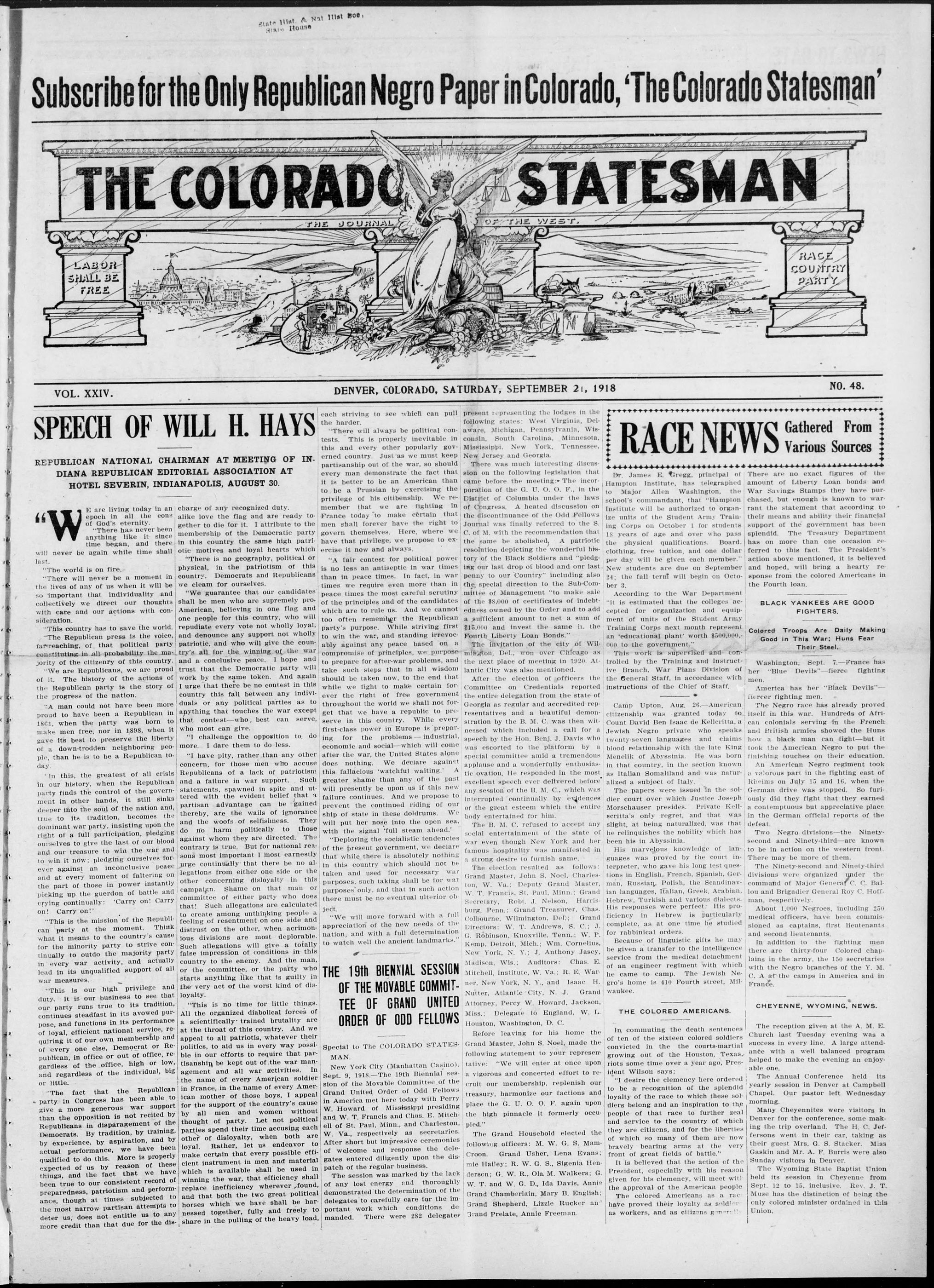
SPEECH OF WILL H. HAYS
REPUBLICAN NATIONAL CHAIRMAN AT MEETING OF INDIANA REPUBLICAN EDITORIAL ASSOCIATION AT HOTEL SEVERIN, INDIANAPOLIS, AUGUST 30.
VOL. XXIV.
E are living today in an epoch in all the eons of God's eternity
"W
or duobar technology.
"There has never been anything like it since time began, and there will never be again while time shall last.
"The world is on fire.
"The world is on fire.
"There will never be a moment in the lives of any of us when it will be so important that individuality and collectively we direct our thoughts with care and our actions with consideration.
"This country has to save the world.
"The Republican press is the voice, far-reaching, of that political party constituting in all probability the majority of the citizenry of this country.
"We are Republicans, we are proud of it. The history of the actions of the Republican party is the story of the progress of the nation.
"A man could not have been more proud to have been a Republican in 1861, when the party was born to make men free, nor in 1898, when it gave its best to preserve the liberty of a down-trodden neighboring people, than he is to be a Republican today.
"In this, the greatest of all crisis in our history, when the Republican party finds the control of the government in other hands, it still sinks deeper into the soul of the nation and, true to its tradition, becomes the dominant war party, insisting upon the right of a full participation, pledging ourselves to give the last of our blood and our treasure to win the war and to win it now; pledging ourselves forever against an inconclusive peace and at every moment of faltering on the part of those in power instantly picking up the guerdon of battle and crying continually: 'Carry on! Carry on! Carry on!'"
"This is the mission of the Republican party at the moment. Think what it means to the country's cause for the minority party to strive continually to outdo the majority party in every war activity, and actually lead in its unqualified support of all war measures."
"This is our high privilege and duty. It is our business to see that our party runs true to its tradition, continues steadfast in its avowed purpose, and functions in its performance of loyal, efficient national service, requiring it of our own membership and of every one else, Democrat or Republican, in office or out of office, regardless of the office, high or low, and regardless of the individual, big or little.
"The fact that the Republican party in Congress has been able to give a more generous war support than the opposition is not recited by Republicans in disparagement of the Democrats. By tradition, by training, by experience, by aspiration, and by actual performance, we have been qualified to do this. More is properly expected of us by reason of these things, and the fact that we have been true to our consistent record of preparedness, patriotism and performance, though at times subjected to the most narrow partisan attempts to deter us, does not entitle us to any more credit than that due for the dis
State Hist. & Nat Hist Bee
State House
The Only Republic
COLORA
WILL H. HAYS
AIRMAN AT MEETING OF IN- TORIAL ASSOCIATION AT ANAPOLIS, AUGUST 30.
charge of any recognized duty.
charge of any recognized duty. alike love the flag and are ready together to die for it. I attribute to the membership of the Democratic party in this country the same high patriotic motives and loyal hearts which "There is no geography, political or physical, in the patriotism of this country. Democrats and Republicans we clean for ourselves.
"We guarantee that our candidates shall be men who are supremely pro-American, believing in one flag and one people for this country, who will repudiate every vote not wholly loyal, and denounce any support not wholly patriotic, and who will give the country's all for the winning of the war and a conclusive peace. I hope and trust that the Democratic party will work by the same token. And again I urge that there be no contest in this country this fall between any individuals or any political parties as to anything that touches the war except that contest—who, best can serve, who most can give.
"I challenge the opposition to do more. I dare them to do less.
"I have pity, rather than any other concern, for those men who accuse Republicans of a lack of patriotism and a failure in war support. Such statements, spawned in spite and uttered with the evident belief that a partisan advantage can be gained thereby, are the wails of ignorance and the woofs of selfishness. They do no harm politically to those against whom they are directed. The contrary is true. But for national reasons most important I most earnestly urge continually that there be no allegations from either one side or the other concerning disloyalty in this campaign. Shame on that man or committee of either party who does that. Such allegations are calculated to create among unthinking people a feeling of resentment on one side and distrust on the other, when acrimonious divisions are most deplorable. Such allegations will give a totally false impression of conditions in this country to the enemy. And the man, or the committee, or the party who starts anything like that is guilty in the very act of the worst kind of disloyalty.
"This is no time for little things. All the organized diabolical forces of a scientifically trained brutality are at the throat of this country. And we appeal to all patriotis, whatever their politics, to aid us in every way possible in our efforts to require that partisanship be kept out of the war management and all war activities. In the name of every American soldier in France, in the name of every American mother of those boys, I appeal for the support of the country's cause by all men and women without thought of party. Let not political parties spend their time accusing each other of disloyalty, when both are loyal. Rather, let us endeavor to make certain that every possible efficient instrument in men and material which is available shall be used in winning the war, that efficiency shall replace inefficiency wherever found, and that both the two great political horses which we have shall be harnessed together, fully and freely to share in the pulling of the heavy load,
---
Italian Negro Pa
ADO
THE JOURNAL
DENVER, COLORADO, SAT
DENVER, COLORADO, SATURDAY, SEPTEMBER 21, 1918
each striving to see which can pull the harder.
"There will always be political contests. This is properly inevitable in this and every other popularly governed country. Just as we must keep partisanship out of the war, so should every man demonstrate the fact that it is better to be an American than to be a Prussian by exercising the privilege of his citibenship. We remember that we are fighting in France today to make certain that men shall forever have the right to govern themselves. Here, where we have that privilege, we propose to exercise it now and always.
"A fair contest for political power is no less an antiseptic in war times than in peace times. In fact, in war times we require even more than in peace times the most careful scrutiny of the principles and of the candidates which are to rule us. And we cannot too often remember the Republican party's purpose. While striving first to win the war, and standing irrevocably against any peace based on a compromise of principles, we purpose to prepare for after-war problems, and take such steps that in all wisdom should be taken now, to the end that while we fight to make certain forever the right of free government throughout the world we shall not forget that we have a republic to preserve in this country. While every first-class power in Europe is preparing for the problems—industrial, economic and social—which will come after the war, the United States alone does nothing. We declare against this fallacious 'watchful waiting.' A greater shame than any of the past will presently be upon us if this new failure continues. And we propose to prevent the continued riding of our ship of state in these doldrums. We will put her nose into the open sea with the signal 'full steam ahead.'
"Deploring the socialistic tendencies of the present government, we declare that while there is absolutely nothing in this country which should not be taken and used for necessary war purposes, such taking shall be for war purposes only, and that in such action there must be no eventual ulterior object.
"We will move forward with a full appreciation of the new needs of the nation, and with a full determination to watch well the ancient landmarks."
THE 19th BIENNIAL SESSION OF THE MOVABLE COMMITTEE OF GRAND UNITED ORDER OF ODD FELLOWS
THE 19th BIENNIAL SESSION OF THE MOVABLE COMMITTEE OF GRAND UNITED ORDER OF ODD FELLOWS
Special to The COLORADO STATESMAN.
New York City (Manhattan Casino), Sept. 9, 1918.—The 19th Biennial session of the Movable Committee of the Grand United Order of Odd Fellows in America met here today with Perry W. Howard of Mississippi presiding and W. T. Francis and Chas. E. Mitchell of St. Paul, Minn., and Charleston, W. Va., respectively as secretaries. After short but impressive ceremonies of welcome and response the delegates entered diligently upon the dispatch of the regular business.
The session was marked by the lack of any lost energy and thoroughly demonstrated the determination of the delegates to carefully care for the important work which conditions demanded. There were 282 delegates
present representing the lodges in the following states: West Virginia, Delaware, Michigan, Pennsylvania, Wisconsin, South Carolina, Minnesota, Mississippi, New York, Tennessee, New Jersey and Georgia.
There was much interesting discussion on the following legislation that came before the meeting. The incorporation of the G. U. O. O. F., in the District of Columbia under the laws of Congress. A heated discussion on the discontinuance of the Odd Fellows Journal was finally referred to the S. C. of M. with the recommendation that the same be abolished. A patriotic resolution depicting the wonderful history of the Black Soldiers and "pledging our last drop of blood and our last penny to our Country" including also the special direction to the Sub-Committee of Management "to make sale of the $8,000 of certificates of indebtedness owned by the Order and to add a sufficient amount to net a sum of $15,000 and invest the same in the Fourth Liberty Loan Bonds."
The invitation of the city of Wilmington, Del., won over Chicago as the next place of meeting in 1920. Atlantic City was also mentioned.
After the election of officers the Committee on Credentials reported the entire delegation from the state of Georgia as regular and accredited representatives and a beautiful demonstration by the B. M. C. was then witnessed which included a call for a speech by the Hon. Benj. J. Davis who was escorted to the platform by a special committee amid a tremendous applause and a wonderfully enthusiastic ovation. He responded in the most excellent speech ever delivered before any session of the B. M. C., which was interrupted continually by evidences of the great esteem which the entire body entertained for him.
The B. M. C. refused to accept any social entertainment of the state of war even though New York and her famous hospitality was manifested in a strong desire to furnish same.
The election resulted as follows: Grand Master, John S. Noel, Charleston, W. Va.; Deputy Grand Master, W. T. Francis, St. Paul, Minn.; Grand Secretary, Robt. J. Nelson, Harrisburg, Penn.; Grand Treasurer, Chas. Colbourne, Wilmington, Del.; Grand Directors: W. T. Andrews, S. C.; J. G. Robinson, Knoxville, Tenn.; W. P. Kemp, Detroit, Mich.; Wm. Cornelius, New York, N. Y.; J. Anthony Jasey, Madison, Wis.; Auditors: Chas. E. Mitchell, Institute, W. Va.; R. E. Warner, New York, N. Y., and Isaac H. Nutter, Atlantic City, N. J. Grand Attorney, Percy W. Howard, Jackson, Miss.; Delegate to England, W. L. Houston, Washington, D. C.
Before leaving for his home the Grand Master, John S. Noel, made the following statement to your representative: "We will enter at once upon a vigorous and concerted effort to recruit our membership, replenish our treasury, harmonize our factions and place the G. U. O. O. F. again upon the high pinnacle it formerly occupied."
The Grand Household elected the following officers: M. W. G. S. Mama Croon. Grand Usher, Lena Evans; mie Halley; R. W. G. S., Sigenia Henderson; G. W. R., Ola M. Walkers; G. W. T. and W. G. D., Ida Davis, Annis Grand Chamberlain, Mary B. English; Grand Shepherd, Lizzie Rucker and Grand Prelate, Annie Freeman.
RACENEWS Gathered From Various Sources
Dr. James E. Gregg, principal of Hampton Institute, has telegraphed to Major Allen Washington, the school's commandant, that "Hampton Institute will be authorized to organize units of the Student Army Training Corps on October 1 for students 18 years of age and over who pass the physical qualifications. Board, clothing, free tuition, and one dollar per day will be given each member." New students are due on September 24; the fall term will begin on October 3.
According to the War Department "it is estimated that the colleges accepted for organization and equipment of units of the Student Army Training Corps next month represent an 'educational plant' worth $500,000,000 to the government."
This work is supervised and controlled by the Training and Instructive Branch, War Plans Division of the General Staff, in accordance with instructions of the Chief of Staff.
Camp Upton, Aug. 26.—American citizenship was granted today to Count David Ben Isaac de Kellcritta, a Jewish Negro private who speaks twenty-seven languages and claims blood relationship with the late King Menelik of Abyssinia. He was born in that country, in the section known as Italian Somaliland and was naturalized a subject of Italy.
The papers were issued in the soldier court over which Justice Joseph Morschauser presides. Private Kellscritta's only regret, and that was slight, at being naturalized, was that he relinquishes the nobility which has been his in Abyssinia.
His marvelous knowledge of languages was proved by the court interpreter, who gave his long test questions in English, French, Spanish, German, Russian, Polish, the Scandinavian languages, Italian, Greek, Arabian, Hebrew, Turkish and various dialects. His responses were perfect. His proficiency in Hebrew is particularly complete, as at one time he studied for rabbinical orders.
Because of linguistic gifts he may be given a transfer to the intelligence service from the medical detachment of an engineer regiment with which he came to camp. The Jewish Negro's home is 410 Fourth street, Milwaukee.
THE COLORED AMERICANS
In commuting the death sentences of ten of the sixteen colored soldiers convicted in the the courts-martial growing out of the Houston, Texas, riots some time over a year ago, President Wilson says:
"I desire the clemency here ordered to be a recognition of the splendid loyalty of the race to which the soldiers belong and an inspiration to the people of that race to further zeal and service to the country of which they are citizens, and for the liberties of which so many of them are now bravely bearing arms at the very front of great fields of battle."
It is believed that the action of the President, especially with his reason given for his clemency, will meet with the approval of the American people.
The colored Americans as a race have proved their loyalty as soldiers as workers, and as citizens generally
NO.48.
There are no exact figures of the amount of Liberty Loan bonds and War Savings Stamps they have purchased, but enough is known to warrant the statement that according to their means and ability their financial support of the government has been splendid. The Treasury Department has on more than one occasion referred to this fact. The President's action above mentioned, it is believed and hoped, will bring a hearty response from the colored Americans in the Fourth loan.
BLACK YANKEES ARE GOOD FIGHTERS.
Colored Troops Are Daily Making Good in This War; Huns Fear Their Steel.
Washington, Sept. 7.—France has her "Blue Devils"—fierce fighting men.
America has her "Black Devils"—fiercer fighting men.
The Negro race has already proved itself in this war. Hundreds of African colonials serving in the French and British armies showed the Huns how a black man can fight—but it took the American Negro to put the finishing touches on their education.
An American Negro regiment took a valorous part in the fighting east of Rheims on July 15 and 16, when the German drive was stopped. So furiously did they fight that they earned a contemptuous but appreciative place in the German official reports of the defeat.
Two Negro divisions—the Ninety-second and Ninety-third—are known to be in action on the western front. There may be more of them.
The Ninety-second and Ninety-third divisions were organized under the command of Major General C. C. Ballou and Brigadier General Roy C. Hoffman, respectively.
About 1,000 Negroes, including 250 medical officers, have been commissioned as captains, first lieutenants and second lieutenants.
In addition to the fighting men there are thirty-four Colored chapains in the army, the 150 secretaries with the Negro branches of the Y. M. C. A rt the camps in America and in France.
CHEYENNE, WYOMING, NEWS.
The reception given at the A. M. E. Church last Tuesday evening was a success in every line. A large attendance with a well balanced program helped to make the evening an enjoyable one.
The Annual Conference held its yearly session in Denver at Campbell Chapel. Our pastor left Wednesday morning.
Many Cheyennites were visitors in Denver for the conference, some making the trip overland. The H. C. Jeffersons went in their car, taking as their guest Mrs. G. S. Stacker. Miss Gaskin and Mr. A. F. Burris were also Sunday visitors in Denver.
The Wyoming State Baptist Union held its session in Cheyenne from Sept. 12 to 15, inclusive. Rev. J. T. Muse has the distinction of being the only colored minister ordained in this Union.
FOREIGN
The Brazilian government has canceled the licenses of German insurance companies.
Six persons were killed and fifteen others were injured in Sunday night's air raid over Paris.
Back from the Far North, Vilhjalmur Stefansson, Canadian Arctic explorer, reached Vancouver, B. C.
Admiral Henry T. Mayo of the American navy, accompanied by his staff, has arrived in England on a tour of American activities in European waters.
Germany is demanding 200,000 from Austria in "payment" for the soldiers lent by Germany to Austria for the drive against the Italians during the autumn of last year, according to information from Berne.
King Christian has bestowed the Grand Cross of the Order of Dannebrog on Dr. Maurice F. Egan, former American minister to Denmark. This is the highest decoration which can be awarded a commoner.
One hundred and fifty-four persons are missing following the torpedoing of the British steamship Galway Castle, which was en route to South Africa. Of this number thirty-four were members of the crew.
Socialist members of the municipal council of Berlin raised the food question in the council meeting, according to the Telegramaf. One speaker exclaimed: "It is time the war came to an end." His words were greeted by loud applause from the public gallery.
Wholesale executions are increasing in Petrograd, according to private telegraphs received at Stockholm by way of Helsingfors. During the last week 812 persons were executed and more than 400 others are on the proscribed list. Most of them have already been made hostages. All persons of the rank of counselors of state have been imprisoned regardless of their political views.
While Austria was preparing her note to the belligerent nations, proposing that they meet in informal discussion of peace terms in a neutral country, Germany was making ready to make another offer of separate peace to Belgium. It is announced that the Belgian government has been approached with a proposal that if she will remain neutral during the remainder of the war Germany is ready to withdraw to the frontiers that were violated in August, 1914. It is affirmed from Berlin that the Austrian government acted on its initiative in sending out its proposals, but the offer of Germany to Belgium points to what may be said to be more than a coincidence and probably a desperate "peace offensive" is now well under way.
George Sisler, premier first baseman of the St. Louis Cardinals, has elected to fight the boche instead of accepting essential employment on war work. Athletic sports as formerly pursued, involving extended trips and specialized training, will not be permitted at colleges and other institutions having army students training corps, Col. R.J. Rees, chairman of the War Department committee on education and special training, has advised presidents of such institutions in a letter made public at Washington.
GENERAL
Cardinal John M. Farley died at his home at Mamaroneck, N. Y. The strike of machinists and tool makers in Bridgeport, Conn., munion factories was ended Monday. Three bombs made of old tin cans, cleverly concealed, were discovered on the main line of the Southern Pacific railroad near Benson, Ariz., fifty miles west of Bisbee. Approximately fifty miners employed by the Copper Mines Company at Kimberly, near Ely, Nev., refused to return to work, it is said, until they were guaranteed a wage of $6.25 a day. Influenza caused sixteen deaths in six hours in greater Boston. Several hundred new cases were reported.
William H. Taft, president of the League to Enforce Peace, has been invited to deliver the principal address at the first meeting of the League of Free Nations' Associations to be held in London, Oct. 10.
Lieut. Charles Kerney, Jr., of Covington, Ky., and E. H. Austin of Boston were killed when an army aeroplane from the Mineola aviation field crashed to earth in the Flatbush section of Brooklyn, N. Y.
Former President William H. Taft received another grandchild at Waterbury, Conn., when another daughter, Eleanor Kellogg Taft, was born to Lieut. and Mrs. Charles Phelps Taft, Lieutenant Taft is in Europe.
Austria's peace offensive is a closed incident so far as the American government is concerned. Secretary Lansing sent to the Swedish minister the note authorized by President Wilson flatly rejecting in two short sentences the proposal of the Austro-Hungarian government for secret and nonbinding peace discussions.
The American Red Cross and the Y. M. C. A. are planning greatly to extend their operations in Russia. Forty American and British Y. M. C. A. workers are en route to Siberia, and it was announced that the Japanese Y. M. C. A. will send a contingent to co-operate with the Americans. In the face of the order and opportunities of the Mine Workers, about 20,000 mine workers in the Ninth district went on strike at Pottsville, Pa., because the government had not granted them the increase in wages that they demanded.
NEWS TO DATE IN PARAGRAPHS
CAUGHT FROM THE NETWORK OF WIRES ROUND ABOUT THE WORLD.
DURING THE PAST WEEK
RECORD OF IMPORTANT EVENTS
CONDENSED FOR BUSY
PEOPLE.
Western Newspaper Union News Service.
ABOUT THE WAR
Japanese cavalry and an infantry
battalion captured the enemy naval
base of Khabarovsk on Sept. 7, according
to official announcement at Tokio.
In Macedonia the allied forces continue
their offensive against the Bulgarians with success. Important
positions have been taken and more
than 3,000 prisoners captured.
Gen. Petain's veterans are forging
ahead slowly but surely in their grim
and desperate struggle for the St. Gobain
forest, which the Germans have
been ordered to hold at all costs.
It seems probable that a new and mighty blow against the Teutonic armies in France will be the allies' answer to the peace proposals voiced by Austria on behalf of the central powers.
Maissemy, a village five miles northwest of St. Quentin, has been captured by the British. This adds another important position to those recently taken along the ridges west of St. Quentin.
The Germans apparently withdrawing along the whole thirty-three-mile front between Abeaucourt and the Moselle in an effort to improve the protection of communications in the vicinity of Metz.
The French took 7,000 prisoners in the St. Mihiel operations, including 5,000 Austrians, making a total of more than 27,000 prisoners taken by the Americans and French, the Echo de Paris announced.
British aviators have again bombed the railways at Metz-Sablons and Mainz, and docks and sidings at Karlsruhe. Seventeen direct hits were obtained on the Karlsruhe objectives, according to the London air ministry communication.
American, British and French detachments are reported by the Petrograd Pravda to have met the Bolshevik forces in battle on the Archangel front. The Bolshevik troops, after an initial success, were repulsed by British reinforcements and fled in panic.
The British gained ground Tuesday in the neighborhood of Holon village, northwest of St. Quentin, according to Field Marshal Haig's report. A German post west of La Basse was captured. New posts were established northeast of Neuve Chapelle and in the neighborhood of Ploegsteert.
Japanese cavalry and an infantry battalion have captured the enemy naval base of Khabarovsk, according to a Tokio official announcement. They took seventeen gunboats, four other vessels, a wireless station, 120 guns, eight ammunition depots, seven magazines, one munition warehouse, seventy horses, seven automobiles, barbed wire and much other material.
WESTERN
Women to fight fires in place of men called to war is a suggestion brought to a convention at Oakland, Cal., of Pacific coast fire chiefs by Chief William H. Bywater of Salt Lake City.
Twenty-five soldiers were killed and between fifty and sixty more were injured Tuesday night when a freight and a troop train crashed together one mile east of Marshfield, Mo.
The increased acreage of sugar beets produced in Utah this year will supply the population of Utah with sugar for one year, under the present ration of two pounds per month per person, it was announced at the Federal Food Administration's office in Salt Lake.
WASHINGTON
George Martin (Dem.), appointed to succeed the late Senator James of Kentucky, took the oath of office in the Senate.
Fifty-five hundred styles of rubber footwear have been eliminated for the duration of the war and remaining types are restricted, the War Industries Board announced.
Spanish influenza now has become epidemic in three army camps, Surgeon General Gorgas announced. There are 1,500 cases at Camp Devens, Massachusetts; 1,000 at Camp Lee, Virginia, and 350 at Camp Upton, New York.
Secret activities against the United States and the allies by the German-paid and controlled Russian Bolshevik government are the subject of Tuesday's chapter of confidential documents from Russia given to the public by the American government.
Frederick C. Howe, the federal immigration commissioner at New York, was attacked by Senator Lodge, Republican leader, during his speech approving President Wilson's rejection of Germany's peace feeler, as a writer of articles which the senator characterized as pro-German propaganda.
SPORT
Pithy News Notes From All Parts of Colorado
Western Newspaper Union News Service.
COMING EVENTS.
Sept. 23-28—Colorado State Fair at
Pueblo.
Sept. 26-28—Lincoln County Fair at
Hugo.
Sept. 26-28.—Grand County fair and race meeting.
race meeting.
Oct. 1- Fourth Red Cross home service
institute at Denver.
Snow fell in Denver Sunday night.
Show ten in Denver Sunday night.
Denver telephone workers have organized a union.
The Holyoke hospital is rapidly nearing completion.
Tag day in Denver for the blind netted several thousand dollars.
Chris Bracken has taken a lease on the Good Friday mine in Boulder county.
A school house will be erected in western Moffat county, near Iron Springs.
The Masonic grand bodies held their annual meetings in El Jebel temple in Denver.
A beet dump is under construction at Croft Spur, between Ordway and Sugar City.
A rich strike was encountered in the Congo Chief mine in Caribou at the 125-foot level.
Grand Junction streets from Sixth to Seventh avenues have been surfaced with clinders.
Charles Black has made a shipment of concentrates from the Vasco 4 mine in Boulder county.
Henry Brennan has sold his 160-acre irrigated farm near Mead to John Anderson for a consideration of $35,000.
A large concrete flume at the sugar factory at Fort Collins will greatly facilitate the work of carrying beets into the factory.
Albert T. Klaus of Avondale, Pueblo county, is reported missing in action in a telegram sent to his brother at Avondale.
Frederick D. Anderson was appointed by Governor Gunter as his private secretary to succeed Wendell Stephens, resigned.
Experimenting with the battery of a telephone and a dynamite cap at Fort Collins cost Earle Williams, 15 years old, three fingers and an eye.
The Mountain States Beet Growers' Association sent a delegation to Washington in an effort to secure from the War Finance Corporation a permit to build and operate a sugar factory at Fort Morgan.
The government has sent out an S. O. S. for stenographers. One bureau alone at Washington needs 600. Requests are filed for 3,000 women stenographers and typists. The minimum initial salary is $1,100.
W. G. Gunter and O. F. Victor of Eldora are doing extensive development work on their claims on Tennessee mountain. Location work is completed and cross-cutting is now in progress for a lead-silver vein forty feet east of the main tunnel.
Herbert C. Howe, son of Mr. and Mrs. Charles E. Howe of Pueblo, is reported as missing in action. Howe, who is 23 years of age, enlisted in ambulance corps No. 5, Third Sanitary division, at San Antonio Tex., last December and has been in France since last May.
The first call to the colors in October was issued by Provost Marshal General Crowder, and includes 808 Colorado white men. They are to be entrained for Camp Kearney during the five-day period beginning Oct. 7. The call will affect about 50 per cent of the men remaining in the special class of registrants of date Aug. 24 of this year, according to instructions.
County Supervisor A. L. Strawn has a small force clearing the brush on the survey of the La Manga state highway from the mouth of Elk creek to the Los Pinos below Cuibres pass.
After living the life of a "nature man", in the rugged hills of Box Cañon mountains in Lqrimer county for two weeks, following his escape from a penitentiary road camp, J. Arthur Montague, itinerant curio merchant, was captured in a cave near Livermore by the Colorado constabulary.
Two of the original band of seven bandits involved in the series of shooting affrays with police officers in Denver and Colorado Springs, Friday and Saturday, have been lost in the shuffle and the authorities are proceeding on the theory that there were but five members of the gang, aside from the women. Three of that number are under arrest and of the whereabouts of the two still at large—supposed to be the murderers of Chief of Detectives Rowan of Colorado Springs and presumably the slayers of Patrolman Luther McMahill of Denver—there was no tangible ciew on Monday.
Attacked by two submarines, one of which was sent to the bottom of the ocean and the other towed triumphantly at the stern of the vessel on which American troops were being conveyed to England, was an experience of a Denver boy, Charles E. Mace, according to letters which arrived in Denver. The mother of Ralph T. Wilkins of Idaho Springs has received a telegram from the War Department informing her that her son has been killed in action somewhere in France seven weeks ago.
```markdown
```
CENTENNIAL STATE ITEMS.
Tribute to Colorado's resources and possibilities was paid by the insurance commissioners of thirty-eight states in the closing session of the National Association of State Insurance Commissioners' convention at Denver. This expression came after several trips made by the visitors through the financial and business districts and into the hills, including Denver's mountain parks. Claude W. Fairchild, insurance commissioner of Colorado, is the new president of the association.
THE COLORADO STATESMAN
At a conference with several engineers Governor Gunter arranged to send State Engineer McCune to Washington to confer with Secretary Lane and representatives of other Western states in regard to providing land on reasonable terms for returning soldiers, and also to assist in laying plans similar to those in use in the British and French empires and in Australia for providing all farm equipment on long-time loans, carrying a low interest rate.
The Mouth-Piece of the People of Colorado and the Entire West
Mrs. May D. McMahill of Denver, widow of Luther McMahill, the patrolman who was killed by bandits on Colorado boulevard and Sixteenth avenue, told Captain Carter at police headquarters that McMahill's mother had called at the auditor's office and collected his salary, $57.50 for the first fifteen days in September. Mrs. McMahill, the widow, says she and her 8-year-old son by a former marriage are destitute.
Reprimanded by her mother because of a quarrel with her sister at the supper table, Alice Wright, 19, went to her bedroom on the second floor of the Wright home in Denver, and swallowed a quantity of poison. Police Surgeon Campbell administered emetics and took her to the Denver county hospital for further treatment, but she lapsed into unconsciousness and died two hours later.
The attempted suicide of Moritz Bernstein at the home of his daughter, Eva, in Denver, by shooting himself in the head, failed of its purpose, but instead, performed an operation which physicians had advised as the only thing possible to prolong his life. Bernstein is recovering from self-inflicted wounds in his head and leg at the county hospital.
ARELIABLE chronicle of their doings and progress; a faithful mirror of their wants, their hopes, their best aspirations.
Six boys from Colorado left Denver to join the student army training corps at Georgetown University, Washington, D. C. The boys, all of whom are 18 years old, are Leo P. Martin, Kremmling; Charles Donald Sheedy, Yuma; Paul V. Dunn, E. Mulroony, Edwin A. Henifen, Jr., and Albert Gartland Marion of Denver.
The executive staff of the Colorado state women's Liberty loan committee is being made up of experts from different parts of the country, in keeping with Chairman Helen Ring Robinson's efficiency program for every department of the organization, both in Denver and in every county throughout the state.
THE COLORADO STATESMAN
The vault of the Colorado constabulary used for storing bootleg whisky confiscated when making arrests contains 800 bottles more than it did. Four persons who were bringing the liquor into Colorado from Wyoming escaped, after a chase that extended more than 100 miles and ended at the Wyoming line.
Word has been received in Denver that Herman A. Anderson, one of the Denver boys who left Camp Kearny with the 157th infantry, has arrived safely in France. Mr. Anderson is an Idaho Springs boy who enlisted from Boulder and was stationed at the rifle range in Golden during the summer of 1917.
Unequaled as an advertising medium for the business of professional men and women.
Four brief months in the war, which ended in his death from wounds received in action somewhere in France, was the fate of Frank M. Shepard, whose mother, Mrs. Nettie M. Shepard, was advised of her son's death in a telegram which she received from the War Department.
"If I ever had the opportunity to again meet my father I surely would kill him." This was the declaration made by Frank Lewis, one of the alleged automobile bandits and bank robbers, who is held in the Pueblo county jail following his arrest at Palmer Lake by Colorado Springs officers, who took him to the Pueblo county jail for safe keeping. Lewis and other members of the gang are charged with having murdered a policeman at Colorado Springs and seriously wounding another.
An excellent family journal speaking to and for many thousand colored citizens.
Soldiers and sailors can obtain a free education at the University of Colorado at Boulder, according to announcement made by Secretary of War Baker. The institution will admit all who have been honorably discharged, and from many state, possessing the required educational qualifications.
Miss Mildred Waco Gates of Dallas, Tex., held up and taken a prisoner by the bandits Sept. 13, has had an experience that few girls would care for, but in her rooms in a Denver hotel she said she was thankful that she had escaped with her life. The same was the expression of W. D. Otter, her companion.
TWODOLLARSAYEAR
William J. Murray, one of the best known mining men of Colorado, died in La Jolla, Cal. Mr. Murray lived in Colorado nearly forty years and had been connected with coal mining in every occupation known to the industry.
It was practically decided by the board of directors of the American Yeomen, meeting at the Knights of Columbus hall in Denver, that the new $2,000,000 home and sanitarium for members permanently disabled in the war, tuberculars and old folks will be located in Denver.
LABORING MASSES
6c FARE NOW IN EFFECT
On All Tramway City Lines of Denver, Englewood and Aurora
Transfers Same As Heretofore in Every Respect
When you get on a car your fare will be 6 cents. If you have a nickel and penny in change, just drop them in the fare box as you have always dropped your nickels. You can get metal 6c tickets from any conductor. You can buy any number of metal tickets from one up; and regardless of quantity, the price is 6c each for adult tickets, 3c each for children.
If you buy five, ten or fifteen adult tickets at a time, you avoid pennies in change. Larger quantities may be purchased at room 602 Tramway Building.
Children under six years of age will be carried free. Children between the ages of six years and twelve years will be carrid for half fare, or 3c. A new metal ticket has also been made for these half fares. It is about the size of a nickel and in design is the same as the old half-fare ticket. The half-fare ticket must be dropped into the farebox by the person paying the fare.
To Avoid Carrying Pennies Buy Five, Ten or Fifteen Adult Tickets and Half-Fare Tickets
The new metal tickets used by the Denver Tramway were adopted after having found that they were the most convenient for the public in other cities where there is a 6c fare. You can get metal tickets, both adults' and children's, of any conductor. Within a few days you can get them at many stores, banks and offices of companies having many employés.
Conductors will give metal tickets as change, unless the passenger instructs otherwise. For instance, four metal tickets and a penny as change for a quarter.
We are trying to make this necessary change as convenient for the public as possible. Please let us know if you think of a way to improve upon our arrangements for handling this matter. Any suggestion that will contribute to speed and the convenience of the public will be much appreciated.
Adults 6c
On A Lines WO
Transfe
When you get and penny in change dropped your nickel can buy any number, the price is 60
If you buy five in change. Large Building.
Children under the ages of six year new metal ticket held of a nickel and in fare ticket must be
To Avail Five, T
The new metal having found that lies where there is dren's, of any stores, banks and etc.
Conductors will structs otherwise for a quarter.
We are to the public as improve upon gestion that will be much
The Der
15TH AND LARIMER STS.
DENVER, COLO.
The Big Store with little prices wants you to know that here
MEN
Can get a good
Suits or O'Coats FOR $20
and that's more than most Merchants can say, if they want to stick to the truth.
F. W. HILD, General Manager
Facts About Ship's Speed.
Facts About Ship's Speed.
A ship increases her speed more readily over deep water, but on the other hand, the faster a ship runs the more depth of water she requires to prevent the hindrance caused by the dragging influence of the friction which is always felt when the ship's keel "senses" bottom. Running ten knots an hour, a ship must have between 26 and 27 feet of depth, or she is dragged from below. If running 20 knots she needs a depth of 104 to 105 feet, and when running 30 knots she feels the drag over a depth of nearly 324 feet.
To Keep Cheese Fresh
Cheese can be kept fresh by rubbing the flat of a warm knife over the cut surface and wrapping it in oiled paper or in cheesecloth wrung out of salt water.
Who Built First Auto?
Just who built the first automobile in the United States is a matter of dispute. Elwood Haynes of the Haynes Automobile company of Kokomo, is one of the claimants of the honor. A machine built by him in 1893-4, which made a successful trial trip at the speed of six or seven miles an hour July 4, 1894, is on exhibition at the Smithsonian institution at Washington.
Children 3c
City
Engle-
boro
Secretofore
ct
If you have a nickel
as you have always
any conductor. You
regardless of quan-
children.
ne, you avoid pennies
room 602 Tramway
e. Children between
or half fare, or 3c. A
. It is about the size
are ticket. The half-
person paying the fare.
nies Buy
Tickets
cets
y were adopted after
the public in other cit-
both adults' and chil-
n get them at many
loyés.
pass the passenger in-
a penny as change
s convenient for
think of a way to
matter. Any sug-
ence of the public
Company
Must Have Regular Meals.
It is said that the native in India is extremely particular about regularity in his meals: once accustomed to eating at a certain hour he must stick to it at all costs. An English engineer had an awkward experience of this when erecting a 100-foot steel pole with the aid of about thirty natives and the minimum of tackle. The pole was halfway up when the "headman" intimated that it was dinner time. Only the most desperate entreaties, coupled with threats, prevented the men letting the pole come down with a run, though it had taken several hours to get it into this position.
French "Immortals."
The French "immortals" are the members of the French Academy, which is part of the Institute of France. The institute was founded by Cardinal Richelieu in 1635 and reorganized in 1816. The membership of the academy is limited to forty, and new members are elected by the old membership.
Those Straw Votes.
"I really never did take much stock in straw votes," said the defeated candidate, sorrowfully, "but I must admit that there is more comfort in them than there is sometimes in the real thing."
Papers Secured by U. S. Show Treachery of Bolshevik Chiefs.
BETRAYED RUSSIA FOR GOLD
Documents Given Member of Committee on Public Information Also Reveal How Germany Plotted Against U. S. in 1914.
Washington.—Proofs removing any doubts that Nicolai Lenine and Leon Trotzky, the bolshevik leaders, are paid German agents—if indeed any doubts have remained—are laid before the world by the United States government in an amazing series of official documents disclosed through the committee on public information.
Secured in Russia by Edgar G. Slisson, representing the committee (who was in that country during last winter, 1017-18) these documents not only show how the German government through its Imperial bank paid its gold to Lenine, Trotzky, and their immediate associates to betray Russia into deserting her allies, but give added proofs that Germany had perfected her plans for a war of world conquest long before the assassinations at Sarnjevo, which conveniently furnished her pretext.
Hun Plots Against America
These documents further show that before the world war was four months old, and more than two years before the United States was drawn into it (in 1914), Germany already was setting afoot her plans to "mobilize destructive agents and observers" to cause explosions, strikes, and outrages in this country, and planned the employment of "anarchists and escaped criminals" for the purpose. Almost ranking in their sensational nature with the notorious Zimmerman note proposing war by Mexico and Japan upon the United States, these documents lay bare new strata of Prussian intrigue, a new view of the workings of kultur to disrupt the allies standing between the world and kalserism. They disclosed also a new story of human treachery for gold.
The intrigue appears to have been carried down to the last detail of arrangement with typical German system.
Revolution Staged by Berlin.
Not only do the disclosures prove that Lenine, Trotzky, and their band are paid German agents. They show that the bolshevik revolution, which threw Russia into such orgy of murder and excesses as the world seldom has seen, actually was arranged by the German general staff.
They show how the paid agents of Germany betrayed Russia at the Brest-Litovsk "peace" conference; how German staff officers have been secretly received by the bolshevik as military advisers; how they have acted as spies upon the embassies of the nations with which Russia was allied or at peace; how they have directed the bolshevik foreign, domestic and economic policy wholly in the interest of Germany, and to the shame and degradation of Russia.
Originals of documents, photographs of originals, and typewritten circulars, some of them marked "very secret" or "private," and many of them bearing the annotations of the bolshevik leaders themselves; some of them containing references to "Comrade Trotzky" or "Comrade Lenine" comprise the record.
Some of the originals, it is shown, although deposited in the archives of the bolshevik, were required to be returned later to representatives of the German general staff in Petrograd that they might be destroyed.
JUST THE OLD HUN TRICK
London Press Asserts Austria's Peace Conference is Cynical and Insincere.
London.—The Daily Mail, under the heading "The Word of Austria, but the Kaiser's Voice," says the Austrian invitation to the allies to open "a confidential, nonbinding discussion" of peace terms is another form of the old German trick.
The Daily Telegraph says: "Negotiations at the present moment even though they brought temporary peace would only postpone the final struggle between might and right. So long as the kaiser and his pan-Germans direct with irresistible authority the destinies of Germany so long can there be no question of an armistice or purely academic negotiations. The note is disingenuous, cynical, and insincere—an attempt to divert the entente powers from a resolute prosecution of the war."
The Austrian note is regarded in this country as a maneuver to obtain needed breathing space for the sorely tried central empires and to impress their own people with the desires of their rulers for a cessation of the struggle which is wearing them to a shadow.
Undoubtedly it is a part of a combined peace offensive which has been expected for some time, and which has taken definite form within the last few days. It is one of three moves which have been made almost simultaneously by enemy states.
Atthe Man's Store
$9.00
The famous Pel's shoe for men is made in Union Factory No. 99. This is one of the best-made shoes in the U. S. A. The line is represented here with 26 styles. All the latest models are shown in ALL the leathers...The popular custom style with narrow recede toe—other styles with fuller toe and higher heels. Excellent for service—Real Shoe Values. Price ..... $9.00
Union Label Suitcases
Genuine Fibre Suitcase, good straps all around outside—
linen lined with shirt fold and four straps inside. Solid
cowhide reinforcements on corners—good lock and bolts.
UNION MADE—26-inch size. $6.00 value, at...$4.45
The Home of Society Brand Clothes
---
Rates.
12 pass...50c
1 addi.
1 ...25c
1dius...50c
n'l mle.25c
Motto: "Not slow but sure." Cash only.
Rates Per Hour.
$1.50 to $2.50.
Taxicab Rates.
Depot, 1 or 2 pass...50c
Depot, each addi-
tional pass ...25c
One mile radius...50c
Each addition'1 mile...25c
Bean A
HEA
COLE 8 AND 7
ean Auto Livery
HEATED TAX:CAB.
E 8 AND 7-PASSENGER 1918 LATE
MODEL CARS.
HEATED TAX CAB.
COLE 8 AND 7-PASSENGER 1918 LATE
MODEL CARS.
STAND: NIGHT AND DAY CAFE
1865-1867 Curtis St.
---
Phone Champa 5431
NIGHT AND DAY CAFE
AND COLD DRINK PARLOR
B. CARRUTH, Proprietor
A Full Line of Fresh Fish in Season
Oysters and Lobsters
Short Orders At All Hours Rest Room for Ladies
TIS STREET
DENVER, COLORADO
1865-1867 CURTIS STREET
---
---
FLORAL DESIGNS PUT UP WHILE YOU WAIT
CHOICE PLANTS AND CUT FLOWERS CONSTANTLY ON HAND
GREENHOUSES: Thirty-Fourth and Curtis Streets
TELEPHONE, MAIN 1511
DENVER, COLO
A
Motto: "Not slow but sure." Cash only.
Rates Per Hour.
$1.50 to $2.50.
Livery
B.
EP 1918 LATE
Denver, Colorado
Private Booths for Ladies
D DAY CAFE
DRINK PARLOR
TH, Proprietor
---
Phone Main 6699
THE COLORADO STATESMAN
THE ENVIRONMENTAL NEWS OF COLORADO
CABON SHALL BE FREE
CHASE COUNTRY PARTY
Entered as second-class matter at the postoffice in the City of Denver, Colo.
SUBSCRIPTION RATES.
One Year ..... $2.00
Six Months ..... 1.00
Three Months ..... .60
Reading notices, ten lines or less, 10 cents per line. Each additional line over ten lines, 5 cents per line. Display advertising, $1.00 per inch.
PAYABLE IN ADVANCE.
Communications to receive attention must be newsy, upon important subjects, plainly written only upon one side of the paper, must reach us Tuesday of the author. No manuscript returned, unless stamps are sent for postage. Days, if possible, may not later than Wednesday and bear the signature. All communications of a personalizing nature that are not complimentary will be withheld from the columns of this paper.
No discounts allowed on less than three months' contract. Cash must accompany all orders from parties unknown to us. Further particulars on application.
Remittances should be made by Express Money Order, Postoffice Money Order, Registered Letter or Bank Draft. Postage stamps will be received the same as cash for the fractional part of a dollar. Only 1c and 2c stamps taken.
CONDITIONS THAT CONFRONT US.
We have often contended that the conditions that confront us as a people must be accepted and faced, with a well-settled idea that the troubles we meet and the hardships we bear are the natural results of the times and circumstances through which we are passing, and that they can be removed only as we improve our own capacity for control, and by our higher attainments, overcome the causes out of which all of our difficulties have grown. We are too much given to looking to others for the removal of those inequalities of life which we so often complain, although with all of our supplications it is very evident that our burdens increase rather than diminish, unless we accept them as imposed, and start to make the best of them or to overcome them by our own patient energies and such reasonable improvement as we feel will fully meet the causes.
To feel that we are entitled to every right enjoyed by any citizen of the United States is justifiable and proper, but to expect to obtain and rest secure in the enjoyment of those rights without undergoing a slow process of self-vindication is to become altogether thoughtless and impracticable. This is where many of our brightest minded men go wrong. The rights supposed to be guaranteed to us by the constitution of the land and its several amendments are continually abridged, denied or obviated, and no power in the land is successfully invoked to defend us from the perils with which we are thereby beset. Then shall we indignantly claimor for defenders that never defend, or shall we begin to realize that all these impositions are strength and genius? The latter course is to be the inevitable one. The Negro of this country, however, it may seem, must expect his rights to remain in jeopardy until he meets prejudice with wealth and culture instead of poverty and indignation. He must expect his legal and equitable rights to be assailed and sacrificed until he can meet his assailants with unimpeachable judgment and compact force against which unjust laws cannot stand. But to attain these powers of self-sustenance he must acquire and run his own farms, his own stores, his own banks and commercial houses, his own business systems and his own places of amusement—with them all come ability and that concrete form which compels recognition in all ranks of American life.
There seems no escape from the conclusion that industrialism and wealth are to become the only sure foundation and bulwark of our peace and progress.
WHY WE COMPLAIN.
It is not at all in a spirit of hostility that we repeatedly urge the Republican leaders of Denver county and of the state to pay more attention to the colored vote, nor does it give us any pleasure to point out the ill results of past neglect. It is decidedly distasteful to us to be compelled to harp upon this score, but we know the conditions that exist among the colored people and we have seen these conditions grow up, year by year, and our complaints are founded as largely upon our desire for party unity and party success as upon our wish to see the colored vote make natural progress in his political sphere. Progress is just as essential, just as natural and just as certain to the colored people as to any other element, and if it cannot be attained through a plain and natural course of development, it is sure to find some way to demonstrate its resistless activity in every human rank. Restlessness among colored voters is the natural result of stinted privileges, for it is altogether unnatural for American citizens of any hue to remain content under actual conditions which do not measure up to those ideals which are the boast of free men.
For a long time past the colored vote has been handled as if it were a mere alienable adjunct to the Republican party, which required no consideration other than an eloquent reminder of its own history, to hold it loyal, in the main, to any candidate or principle that the party organization might endorse. This simple course has appeared successful, not because it was logical, but because other conditions have helped to support and maintain it. But the signs are abundant that it has run its full length, for despite the most earnest persuasion and the most solemn declaration of racial interest, we have seen our voters deserting our ranks and gaining more practical benefits from those that we have long considered our political enemies.
The policies of war apply in politics and everything becomes fair to the opposing forces in close campaigns. We are not unmindful of our modest representation in minor political places, but the clamor for a more honorable standing in the party organization is in our ears, and we are merely trying to impress Republican managers with the logic of the claims and demands of that progressive element among the colored folk which is awakening to a rational realization of its material needs.
Two $100 Bonds
WILL PROVIDE
Five thousand machine gun rifle
cartridges
Four $100 Bonds
Will Provide:
TEN CAVALRY SADDLES
Substantial Pensions for American Women of Red Cross and Y.M.C.A.
By ADDISON C. THOMAS, Chicago
Do the American people realize the important work for the war that our women are doing at home and abroad? With the greatest array of women that the world has ever known actively helping the fight for the freedom of mankind, it seems but fair that ample provision should be made at the earliest possible moment for their maintenance and support in case of disability, and in particular for the war nurses at the front.
PETER B.
Miss Kathryn Carlisle, who is at the front in France, has strikingly brought out in a letter to her parents, Col. and Mrs. Charles A. Carlisle of South Bend, Ind., the value of the wonderful service rendered by the women of the American Red Cross and the Young Men's Christian association. From this letter a movement has begun to take shape to pension any such women whose heroic efforts may make assistance a debt of honor on the part of the nation. Conferences with Colonel Carlisle have decided accordingly to submit to the American people through the press the following suggestion and petition:
"In behalf of all the American women at home and abroad who serve in the American Red Cross and the Y. M. C. A., and in behalf of the countless number who serve elsewhere, all with the same hope and desire, to be of real value and service to the American soldier, every American in the world is invited to contribute to a freewill offering for the express purpose of establishing the "American women's war fund," out of which shall be paid a substantial pension to every American woman who gives up her life, or who sacrifices opportunity at home that she may better serve 'our boys' or in other ways contribute to their welfare and comfort. "Every penny contributed shall go to the 'American women's war fund' and shall be held for distribution by a finance committee to be selected by the American Red Cross and the Y. M. C. A., and approved by the secretary of the treasury of the United States.
"Each penny contributed shall be held by the finance committee subject to order and distribution by an executive committee, who shall be selected and directed by the American Red Cross and the Y. M. C. A. head officers, and if they fail to agree the secretary of the treasury of the United States shall have full authority to take over all funds and direct how the money shall be distributed. So far as possible, and if and when these funds shall permit, the executive committee in its discretion shall pay to any American woman, or to the family or dependents of any such American woman who gives up her life in the service of the American soldier, or who makes any special sacrifice at home or abroad that she may better serve 'our boys,' a sum of money that in part may, in the discretion of the executive committee, show due appreciation by the American people who contribute and make possible this fund.
"To each person who contributes shall be given a certificate of membership, acknowledging receipt of the contribution, and once each year, so far as it is possible to do so, the executive committee, through the press or otherwise, shall make a comprehensive report."
Every child in Sunday schools, public schools and elsewhere is invited to contribute one penny or more each month for a period of one year, making the payments direct to teachers, who will deposit the funds with any national or state bank, for shipment to the national finance committee, care of the American Red Cross, Washington, D. C."
Best Time to Take Vacation Is in Extremely Cold Weather of Winter
By BRICE BELDEN, M. D.
It is customary with us to take vacations in the summer, although we really need them more in winter, when human powers are limited by low temperature. We are at our physical best in the autumn and spring. So it is not because we have been away in the summer that we feel better in the autumn, but because of the favorable conditions of the autumn season.
The best work in factories by operatives who take no summer vacations is done in the autumn. Such workers are most apt to lay off in the very cold months, and many factories shut down the week after Christmas because of the low energy of the operatives.
Throughout the spring factory charts show a rise in the efficiency curve until about the middle of June, or when the average temperature is 68 degrees. It then falls as the temperature rises. During the autumn the efficiency curve rises at an increasing rate as the temperature is gradually falling, but when the average temperature falls below 48 degrees the curve turns downward and reaches its lowest point in January.
The logic of all this is that we ought to take all our vacations in January. The reasons why we do not are because we prefer fine weather for our outings; because most out-of-door sports can be played to better advantage in the summer, and because sultry summer weather causes much bodily discomfort. Then we have a notion that cold weather is "exhilarating," and that we don't need a vacation at such a time because of this "bracing" quality of the season. The fact is that cold weather keeps us moving so as to quicken the circulation, which is depressed by low temperatures, and this activity is erroneously supposed to indicate a maximum of energy.
Reformers Busy Now Waging Campaign Against Use of Tobacco By Soldiers
Reformers Busy Now Waging Campaign Against Use of Tobacco By Soldiers
These so-called experts and investigators who periodically warn the race that it will be exterminated if the people do not reform their habits and abandon certain alleged vices will continue as long as the world lasts. I presume, to have a number of followers. They are busy just now waging a campaign against the use of cigarettes by the soldiers. It is true that our boys are smoking more than they ever did. There are not very many men in the armies of the United States, England, France, Italy and the other countries who do not smoke. They have got to do something, and smoking, in my opinion, injures them less than any other "vice" they could acquire.
on the
Hoover Electric Suction Sweeper
During September
Phone for a FREE Trial
The Hoover Beats, Sweeps and Shakes
A Child Can Operate It
The Denver Gas & Electric Light Co.
Beautiful Fall Shoes
Uncle Sam has taken hold of the shoe situation and after October 1 we will be unable to get any more fancy colored shoes, and nothing over 8 inches high.
OUR FALL LINE
Has all the new fancy shades—grays, dark and light, two or three shades of brown, field mouse, ivory and white; all kid, 3½ and 5-inch tops; beautiful heels and pretty styles, that we can actually save you from $3 to $5 a pair on.
Ladies' dark gray all kid, 9½-inch top, worth $11; our price.....$7.85
Ladies' washable kid, in white, ivory and pearl gray, worth $15.00; our price.....$9.45
Burgundy color, 9-inch top, Russian calf, worth $10.00; our price.....$6.85
Black vici kid, 9-inch top, beautiful curved heel, worth $7.50; our price.....$5.00
Brown and khaki colored military boots, with cloth tops to match, good shoes for hard wear.....$4.85
Bring this ad with you and see that you get just what we advertise, and you save a dollar or more
Ladies' dark gray all kid, 9½-inch top, worth $11; our price.....$7.85
Ladies' washable kid, in white, ivory and pearl gray, worth $15.00; our price.$9.45
Burgundy color, 9-inch top, Russian calf, worth $10.00; our price.....$6.85
Black vici kid, 9-inch top, beautiful curved heel, worth $7.50; our price.$5.00
Brown and khaki colored military boots, with cloth tops to match, good shoes for hard wear.....$4.85
Bring this ad with you and see that you get just what we advertise, and you save a dollar or more.
HENNING'S FAMILY SHOE STORE
820 AND 822 FIFTEENTH STREET
LOOK! IMPORTANT!
THE CO-OPERATIVT EDUCATIONAL COUNCIL BOARD will convene in Springfield, Ill., tomorrow for a three-day session. Some of the most prominent men of America will be present to discuss methods for bringing the race problem in all its phases into a working relationship.
The Janitofs 'Protective Union No. 15,641 meets the first and third Thursday of each month at 401 Club building, 1731 Arapahoe street. In all cities with organizations janitors receive 40 per cent more wages than unorganized ones. A few years ago plumbers received $3 per day. Now they receive $7, and just so with all organized trades and common labor. Unorganized labor is in keen competition with each other for a meager existence. Come, join, and let us help each other.
DOUGLASS UNDERTAKING CO.
Mrs. Eva Mildreth Hightower, 29 years, beloved wife of Mr. Frank Hightower, residence 2922 Glenarm Place, departed this life Sept. 15th. Funeral services were held Thursday, Sept. 19. 2 p. m., from residence. Rev. Ward officiated. Interment, Littleton cemetery.
Hairgrower and Teacher of Mme. C. J. Walker's Method of Growing Hair I Carry a Full Line of Her Goods Phone York 1765 J 2355 Ogden St
CARD OF THANKS.
We wish to thank our many friends for the beautiful floral offerings; also for the kindness rendered us during the illness and death of our beloved son and brother.
THREE $100 AND ONE $50 BOND
Will provide:
Five hundred trench knives
MRS. LELA WILLIAMS,
DEWAYNE WILLIAMS,
CHARLIE WILLIAMS
THE COLORADO STATESMAN
LEAD US
SMALL BE
FREE
BACK
GOVERNMENT
PARTY
---
J. J. James arrived home Wednesday from Vermont, where he has been several months.
Madam Crummer, professional scalp specialist, left last Tuesday for Chicago to visit her mother and other relatives.
Mrs. G. W. Anderson left this week to join her husband in Casper, Wyo. where she will be engaged in her millinery and hair work.
Born to Mr. and Mrs. Elkins of Seattle, Washington, last Sunday, a fine seven-pound boy. Mother and son doing nicely. Mrs. Elkins was formerly Miss Ethel Clark of Denver.
Charles Overton, popular townsman of several years' residence, will leave tomorrow for Los Angeles, where he will meet his better half. Charlie is generally liked by all the boys and will be very much missed.
Congratulations to Mr. and Mrs. W. H. Graham on being the possessors of a great boy, William the second, who was born in Kansas City last week, weighing nine pounds. Mother and son are doing well. Mr. Graham is our worthy musician of the West.
SEPTEMBER 26TH, at Fern Hall, 27th and Welton streets, is the next social attraction that the dancing public is looking forward to. So don't miss the grand affair given by THE SMART SET CLUB, who are making great preparations to entertain the large crowd that will be present. BILLY KNIGHT, Manager.
We take pleasure in stating that Mrs. Emma Moore, formerly of 1409 E. Twenty-fourth avenue, has been in Chicago for the past two months taking a complete course in hair dressing, manicuring, scalp treatment, face and body massage and electrical treatments, will complete her course Sept. 15th and will return about the 20th. Will be glad to receive and serve her customers and friends at her new home, 2459 Lafayette street hereafter.
Henry J. D. Sample, who has been local correspondent for the Colorado Statesman at Estes Park, Colo., during the summer, arrived in Denver on the 6:30 train en route to his home in Kansas City, Mo., where he will act in like capacity.
Mr. Sample succeeded in making many friends during his stay in Colorado and reports a successful season at the park, considering war times, when most of the hotels were closed to the public in the National parks.
Mr. Sample is staying at the Barnes hotel for a few days, and doing some shopping, as things of wearing material are much cheaper here than in Kansas City.
Mr. C. C. Smith of St. Joseph, Mo., came down from the Stanley in company with Mr. Sample. They were roommates and companions, during their stay in Estes Park.
RUSH L. HOLLAND SELECTED CHAIRMAN REPUBLICAN CENTRAL COMMITTEE.
With the selection of Rush-L. Holland of Colorado Springs for the position of chairman of the Republican Central Committee, and Miss Eleanor F. Young, vice chairman, it seems a real reunion of the party, and this is indicative of Republican success this fall. Telegrams received from Oliver Shoup, nominee for governor, and other noted Republicans, contain their indorsement and unqualified support for the chairman and his assistant, and now that supporters can see a worthy successor of our popular and esteemed former leader, John Vivian, there is sure to be a harmonious working on all sides resulting in victory for us. The Colorado Statesman in its loyalty to the Republican party congratulates it for its action.
MRS, ANNA BATISTE, POPULAR
CITY MATRON, LEAVES TODAY
FOR PASADENA, CALIFORNIA.
Mrs. Anna Butiste, a popular matron of our Denver society, and a resident of several years, leaves today to reside permanently in Pasadena, Cal. Her large circle of friends and acquaintances will surely miss this genial character whose association with us was everything desirable for the uplift of her people. Engaging in many philanthropic actions without blare of trumpet she quietly and unostentatiously rendered much aid to suffering humanity, and in her religious and social tendencies did much to improve the general environment of Denver. A long time friendship and subscriber of the Colorado Statesman, we wish her every success in her new residence and will cherish the most pleasant memories for her. Bon voyage!
"LEST WE FORGET."
IF THE Negro could be made to feel his own responsibility in the establishment of civil, social and moral standards, to feel that he is really a part of the big circus, and not merely a 10-cent side show, to be patronized by such of the passing crowd as may be waiting for the big show to open, his soul would be broadened and his manhood heightened. His self pride likewise would be confirmed thru appreciation, position and responsibility. When this truth sinks deep enough better results will follow.
Now that the primaries are over, it seems an opportune time to call attention to the fact that there will be two days of district registration before the November election, when a state ticket is to be elected, also a United States Senator and a Congressman.
I am personally calling attention to these facts because on primary day I met several who expressed a desire to vote, but were not registered.
The colored vote was a strong factor in the success of the primary candidates. This was made possible by the largest number ever registered in this city for any election.
We are proud of this showing, but being one of many ardent workers to the end that our strength will count for something, I know that there are hundreds who are not registered.
Some of these unregistered are in different and neglectful. Some get behind that old worn out, silly excuse "Women have no place in politics," but by far the greatest number who will not register comes from the class who seem to think that his or her qualification to vote by registering is to benefit one.
For those who are ignorant of this wonderful privilege let me remind you that men are dying by the thousands that the whole world is shaken from center to circumference that all men might enjoy democracy, and, what is democracy? Simply told, it is the right to vote and have a voice in the management of governmental affairs. Our boys, thank God, are "over there," helping to win the victory for democracy, thereby proving their right to its privileges. If there has ever been a time in this country when every colored man and woman need participate in affairs it is now. Now, while the battle is raging and our boys are making glorious history.
The cannon's roar will cease after a while, and we will have representatives from this country gathered around that peace table who will decide upon what ground peace must be established. It is up to us now to register and vote for big hearted, big brained men who not only know the meaning of true democracy but will act accordingly.
A. SUBSCRIBER.
ESTES PARK NEWS
Mr. E. G. Hyder of Denver, Colo., who has been chief clerk at the Stanley Hotel for the past two seasons, left with his wife for their home Sunday morning.
Mr. Hyder is of the South, born in Morrison, Tenn. He was manager of the hotel at Tate Springs, Tenn., for four years and is noted for his great memory of people and names. He could call every person in the hotel by name and give the number of their rooms at any time during the busiest part of the season without referring to the register.
Capt. Curtis Harris has received a large gold badge with the inscription "Head Bellman," on it, presented by Mr. Alfred Lamborn for excellent service. Captain Harris has enjoyed good health during the season, to the delight of his many friends. The Stanley Hotel is near the closing season. Most of the summer's crew left on the 12th inst. for their various homes.
Among the departing ones who had enjoyed some degree of popularity as well as a successful summer season were: Boyzie R. Hannah, 2534 Franklin street, Denver; Ralph Garrin of Denver, and Cortland E. Fields of 1416 Royer street, Colorado Springs. As bellmen, the young men were at all times very obliging and courteous in handling the mail and favoring the diningroom men. They are leaving with the best wishes of all the employés and also the manager.
Sunday evening was celebrated with the first snow fall of the season, but at noon Monday only the mountain tops showed any signs of it. The thermometer ranges between 50 and 60 degrees most of the time.
HOME FOLKS URGED TO KEEP FAITH WITH "YANKS" BY CONTINUED SAVING
"A Sword, a Spade and a Thought Should Never Be Allowed to Rust."
This was part of the wise philosophy of the women in Irish folk lore, and it is now rich in war-time symbolism. That the Allied sword is not being permitted to rust is evidenced in the recent victories on the western front. Firearms are bright and shining, and the enemy is on the run. There must be no relaxing of the military program. American soldiers must be kept going in a steady stream that the Allied forces may push on to a quicker victory.
These men must be fed. The civilian's spade must not rust. The greater our accomplishment in putting American soldiers in the European battlefield the greater is the civilian responsibility to keep their bodies fit and their spirits buoyed.
American agriculture has had a banner year. The patriotic response of the farmers coupled with favorable weather conditions has increased enormously the cereal production so that all fear of famine has been removed. Equally patriotic has been the response in the planting of war gardens. Recent reports on the planting for 1918 show 5,285,000 food plots or an increase over last year of 51 per cent. The estimated value of these food products is $25,000,000, or 50 per cent increase over last year. This is no time, however, to relax either in production or saving. This year's bountiful harvest may be followed by a correspondingly poor one next year. More men will gradually leave the fields for the army, and the reaction will be felt at next year's harvest. Now is the time to prepare for this by keeping up the conservation program and building up a surplus for possible leaner days ahead.
Equal in importance to the sword and spade is to keep the thought of the American people free from rust. The collective thought of the nation must be pitched on a high place and concentrated on the one goal—a conclusive peace.
A year ago last April America sent word that she was coming. And she has made good. Her men are there in rapidly increasing numbers and the allied fighters now know that her sword will not be allowed to rust.
The morale of both soldiers and civilians is based largely on being well fed. That America is ready and willing to share her food was shown in the wheat saving last year. She not only decreased her own consumption to meet the European demands, but she increased her production of all cereals.
America's sword and spade have injected new hope, and the thoughts of the American people must not now be allowed to rust. Europe has faith in us, and we must maintain this faith
SAVING STILL NEEDED IF NEW FOOD PROGRAM IS TO BE A SUCCESS
"During the coming year, America must ship to Europe 15,000,000 tons of food stuffs."
With this announcement, Herbert Hoover, federal food administrator, places on the American people a responsibility greater than any before. The 50-50 substitute rulings have been relaxed, the erstwhile ban upon beef products has been lessened—and yet Americans must send 15,000,000 tons of food next year to her allies.
This gigantic program means that every man, woman and child who is for Liberty against Tyranny, must make his eating, and his buying as sane and saving as possible, and keep the consumption of vital food stuffs in America down to the lowest point. The relaxation of the stricter rules is not meant to lower the bars so that boarding or excessive consumption is allowable. It is simply to relieve consumers from rules which worked a certain amount of hardship, but which were absolutely necessary during the wheat crisis of a few months ago.
The food administration still reserves the right to commandeer any or all flour consumers may have on hand should the need arise—as it did in the spring of 1917. It is hoped that consumers will realize that out of the great harvest this year, a reserve supply of food must be built if future short crops and decreased labor are to be discounted and made harmless.
"The food administration will expect every patriotic American to hold flour now purchased in trust, so to speak, for future use of the government, and to keep that flour in such a manner that it will not be damaged or ruined," declared T. B. Stearns, food administrator for Colorado, in a recent statement.
FOOD FACTS.
You can't eat your sugar and give it to the soldiers too.
The food program is a fighting program, and every fighter counts.
Constructive work at home must run well ahead of destructive work at the front.
Only the simple life is honorable or even decent today.
We are giving our work, our time and our money, but "They" are giving their lives.
Good crops are brave promises to the allies.
1st Grand Opening Dance
of the Season
Given by the
SSC FERN
HALL
Smart
Set
Club
Sept.
26
GRAND PRIZE WALTZ AND RAG CONTEST
FOUR HANDSOME PRIZES
Something Different and Unique in Hall Decorations—
twelve of Denver's society buds will act as hostesses.
BILLY KNIGHT, Floor Manager
MORGAN'S AUGMENTED ORCHESTRA
30 Cents - Admission - 30 Cents
THE DENVER DRY GOODS CO.
Fall and Winter COATS
A man in a trench coat salutes.
Through careful buying and foresight in purchasing we are prepared to offer better values in men's and young men's clothing than can be reasonably expected in these times of woolen scarcity and high prices.
Other Suits at $20, $22.50, $25, $35, $45
Overcoats at $25, $35, $40, $45, $50 and
Second Floor—15th Street
Housefurnishings &
Seasonable Items of Time
55, $35, $40 and upward to $65.
45, $50 and upward to $115.
5th Street Building
ings & Hardware
of Timely Interest
Other Suits at $20, $22.50, $25, $35, $40 and upward to $65.
Overcoats at $25, $35, $40, $45, $50 and upward to $115.
Second Floor—15th Street Building
Housefurnishings & Hardware Seasonable Items of Timely Interest
Japaned Mail Boxes 25c
Stove Boards.
24-in...80c 30-in...$2.45
28-in...$1.10 32-in...$2.95
28-in...$2.00 36-in...$3.50
Stove Pokers...15c, 20c, 35c
Heavy Coal Hods.
$1.25, $1.50
Fire Shovels .....10c, 25c
Furnace Scoops, $1.35, $1.95
Leather Bags and Suitcases Substantial reductions have been made suitcases for today's selling. Our large afford satisfactory selection and the spec vide true economies. Basement Store
Substantial reductions have been made in bags and suitcases for today's selling. Our large assortments afford satisfactory selection and the special prices provide true economies. Basement Store
Sewing Machines
The Denver Dry Goods sells Sewing Machines equaling in every way any machine yet invented, and as no solicitors or collectors are employed, you are saved $15.00 to $35.00 in the price. Small payments if you wish. Let us show you these good and properly priced machines before you buy.
Basement—Housefurnishing Department
DEATHS AND FUNERALS.
MOORE—Mr. Thomas Moore, the beloved husband of Mrs. Lillie Moore, 921 Twenty-seventh street, departed this life Saturday, September 14th. Funeral services were held from Cammel & Co.'s Chapel, Tuesday, September 17th, Rev. A. M. Ward officiating. Interment, Riverside.
---
Cedar Moss Sweeping Compound, package .....25c
Kaetus' Oil Furniture Polish at .....25c, 50c, $1.00
Kaetus Oil Floor Polish at .....75c, $1.25, $2.00
Perfection Oil Heaters..
A woman operating a machine.
KIMBERLING—Mrs. J. W. Kimberling, late of Cripple Creek, departed this life Thursday, September 12th, at her residence in Cripple Creek. The remains were received by Cammel & Co. Sunday, the 15th, accompanied by the husband. Funeral services were held Tuesday from the residence of her sister, Mrs. Roy Nelson, 1655 Gilpin street, Presiding Elder R. L. Pope officiating. Interment, Fairmount
THE KITCHEN CABINET
Give to your friends a cordial welcome, instead of a variety of cakes and pastry.
It is as much a duty we owe to the world to be ornamental as to be useful.
HOUSEKEEPING RUTS.
RE you in one? The present necessity of knowledge in preparing foods little used until recently is giving many housewives hard jolts, for the ruts have worn rather deep. One of these which is deep enough to engulf many an otherwise
RE you in one? The present necessity of knowledge in preparing foods little used until recently is giving many housewives hard jolts, for the ruts have worn rather deep. One of these which is deep enough to engulf many an otherwise successful household is monotony in its menu making. The same old thing in the same old way is repeated until appetite and interest in food are gone. The housekeeper who is mother, cook, nurse, seamstress and general manager has a man-sized job and only when she treats it as a business and brings system into its management does she make a success.
Try keeping a tabulated list of dishes liked by the family, adding to them in various ways to avoid repetition.
Take the common rice, for example. Make a list of ten or more ways of serving rice—as a main dish, as a vegetable, as a dessert or in combination with other foods. Prepare these dishes in turn, and it will not be necessary to inflict them oftener than once in five or six weeks. This plan can be followed with all kinds of foods, adding new dishes occasionally, as you surely will when you have the inspiration of such a chart before you. If this system has never been tried one can hardly realize what a help to make things run smoothly well-organized plans can be.
Meats are our expensive foods and they may be pieced out with dumplings, vegetables and cereals to make the meat go farther and lessen the expense.
The serving of chops, steaks and quickly cooked meats is the habit of the hand-to-mouth methods of many unthinking housewives; it is both extravagant and wasteful.
Mutton With Carrots.—Take a pound of mutton from the shoulder, cut in serving sized pieces, season well and roll in flour, brown in a little hot fat with a slice of onion, add a pint of shredded carrots, water to not quite cover and simmer for two hours on the back part of the stove.
Try to be half as wise as that little creature, the bee, who takes all the honey she can find, and leaves all the poisons.
Oh, if the berry that stains my lips
Could teach me the woodland chat.
Science would bow to my scholarship.
And theology doff the hat.
LEFTOVER FRUITS.
IPE fruit is so perishable that it should
never be bought beyond a day's supply.
An orange that shows
signs of softening is
not fit for food. Such
fruit given to children
may cause illness.
R
National War Garden
"Commission"
For canning fruit should always be fresh and free from imperfections. If a small dish of fruit is left, put it through a sieve, thicken with cornstarch, and sweeten if necessary, adding a bit of butter and use as a pudding sauce. When there are three or four kinds of fruit in small amounts use as garnish for a gelatin or jello pudding. By alternating the colors a very pretty dish will result. Bits of fruit either fresh or canned if put through a sieve may then be added to ice cream when partly frozen, making a great improvement on the plain ice cream. A sauce can be made of the fruit with a few chopped nuts and poured over the ice cream when it is ready to serve.
A small amount of fruit added to muffins or small cakes improves them. Do not let fruit spoil because there is not enough to go around. Two or three kinds combined are very acceptable as a salad or dessert.
Fruit Whip.—Put a mixture of crushed, sweetened fruit into lemonade glasses, fill up with whipped cream, sweetened and flavored, and serve with sponge cake for dessert.
Lemons may be prepared into lemon sirup and kept indefinitely, they are always ready for a quick, cool drink. Take one cupful of water, a third of a cupful of lemon juice, and a half cupful of sugar, boli for ten minutes, bottle and set in the ice chest. Add a spoonful of sirup to a glassful of water and serve with ice.
When making lemonade save the lemon cups to use in various ways. They make pretty receptacles for hard sauce, for cocktails, for fish or oyster sauces, for salad or dessert cup; any number of ways will be thought of to use them.
Emergency Salad.—Cut a few bits of cheese into next cubes; chop six or eight olives. Break a few walnut meats in pieces, add a few seeded and skinned grapes, a banana and an orange with a sour pickle all sliced thin. Mix all together and fill apple cups or grape fruit shells or orange cups with the mixture. Serve on paper dolly covered plates.
Nellie Maxwell
BROWNING GUN IN CLASS BY ITSELF
Remarkable New Tool Better Than Anything of Its Type. DIFFERENT FROM ANY OTHER
Fired From Shoulder or Hip In Bursts of Twenty Shots in Two and One-Half Seconds—Air Cooled, Gas Operated.
By JAMES H. COLLINS.
(From the Committee on Public Information, Washington, D. C.)
Three hundred senators, representatives, journalists, and army officers of the French, British, Italian, Belgian and American forces stood behind a little squad of ordnance men the other day at a rifle range outside of Washington.
"Attention!" commanded the officer in charge of the squad.
"Shoulder fire—one magazine—semi-automatic—Ready! Load! Alm! Fire!"
There was a popping like that, say, of half a dozen packs of giant firecrackers all set off at once. It lasted about ten seconds, the time required to fire 20 shots from what looked like an ordinary rifle in the hands of each soldier. Five hundred yards away, the dirt flew behind a row of small targets set up to represent men.
"Shoulder fire—one magazine—automatic—load!" was the next command given.
But a different volley was heard at the command "Fire!" It sounded like B-r-r-r-r! and lasted only two and a half seconds! If you want to estimate the rapidity, listen to the ticking of your watch, which averages about four ticks per second, and realize that the automatic fire of this weapon was just twice as fast—eight standard army rifle cartridges fired in a second with one pull of the trigger.
And that was the new Browning machine gun which Uncle Sam was about to manufacture at the rate of thousands a week, and had brought to this rifle range for its first public exhibition.
Other methods of firing were shown with the gun placed at the hip and with the soldiers marching toward the target, firing as they walked. Then the spectators crowded around and began asking questions.
"Is it air cooled or water cooled? What does it weigh? How fast can they be made? What do they cost? Is it a better weapon than this machine gun or that?"
All Were Convinced.
Among those present was one member of congress who, a few weeks before, during an anxious inquiry into our war preparations, had stated his belief that the Browning machine gun was only a dream. And now he was allowed to fire the weapon himself, and planted a succession of bullets in the distant target with an accuracy which left no question in his mind as to the tangibility or accuracy of this new tool of the American soldier.
On the following morning newspapers throughout the country published a detailed description of both this gun, known as the "light Browning," and another type called the "heavy Browning," which was also demonstrated, being fired from a tripod, water cooled, and fed with canvas belts containing 250 cartridges each. It has fired 20,000 shots in a little less than 48 minutes.
Each legislator and journalist asked his own questions, and there was an honest spirit of inquiry evident. Every American present, while admitting the impressive nature of the test, seemed to feel that he was personally representing the nation and bound to overlook no technical details touching the efficiency of these new weapons. And in that matter each American did truly represent the nation which has been keen to discover every part of our war program open to question, each according to his own light and reading.
The reader of this article, too, will want to ask his own technical questions, and for his information all the facts about both types of guns have been summarized separately, so that attention here may be concentrated upon another aspect of the machine-gun program—its tactical use as a tool apart from the mere details of how much it weighs, how fast it fires, how many shots a second, how many times it jams in a test, how it is cooled, how many parts it has, how quickly they can be taken down and put together again, etc.
One of the first questions asked by everybody concerning the light gun, for instance, was: "Is it cooled by air or water?" And the answer to that question is: "By air—but cooling is not a problem with the light Browning." Naturally, a statement of that sort comes as a surprise to the man in the street who has heard that machine guns are subject to the terrific heat of smokeless-powder gases, which sometimes develop the destructive temperature of 4,000 degrees Fahrenheit, and that keeping a machine cool in action is one of the chief problems with that type of weapon. But when the tactical use of this particular arm is understood, one easily understands how cooling may be disregarded in the light Browning, and its design developed in other directions for other purposes. So we will try to get the tactical point of view—which is the point of view of the American soldier carrying this light automatic rifle over the top in France by the hundreds and the thom-
sands, and probably the tens of thousands, and not inconceivably by hundreds of thousands before the Hun is beaten.
Provide Something Better.
Our ordnance department has been working since we entered the war to send American soldiers to France with a complete kit of tools representative of American inventive ability. First sizing up the job of cracking the Hun out of trench, shell box, and subterranean tunnel, and ascertaining what the allies have found useful in the way of saw, hammer and hatchet, the ordnance department has worked to provide something a little better in every case, from poison gas and gas musks to machine guns and high-explosive shrapnel.
The light Browning, also known as the "automatic rifle," requires no cooling apparatus, because in its tactical use in battle as a tool it will be called upon only for what are known as "bursts of firing." It is a remarkable new tool, better than anything of its particular type yet developed, and different from every other weapon in the world. Its nearest prototype is the French Chauchat automatic rifle, which has proved extremely effective.
At the present stage of tactics the Browning automatic rifle will be a superior tool for perhaps three definite jobs in trench warfare. First, being as portable as the ordinary army rifle, it can be quickly brought into action along every part of a trench by defenders to stop the advance of an enemy. With the heavier types of machine gun fired from a tripod and requiring considerable time for getting into position, if not permanent emplacement, such resistance of invaders in a pinch might prove difficult. With the new Browning firing 20 shots automatically in less than three seconds, or 20 shots semiautomatically as fast as one desires to pull the trigger, loading with a fresh magazine each 20 shots in a couple of seconds, an entire trench front can be protected with outbursts of machine-gun fire, which not have to be continued long to do the work—not long enough for heating of the gun to become a problem.
Sweeps the Trenches.
The third job for this characteristic Yankee notion comes when our fellows have reached the enemy trenches. At that moment, even though but a few arrive, the Browning automatic rifle is expected to replace the bayonet and bomb under certain conditions, and multiply the effectiveness of each soldier who gets across No Man's Land, for the rapidity and accuracy of the Browning fire is such that it will be only a matter of seconds to sweep an enemy trench in both directions.
There are other tactical uses for the weapon. As few as a dozen of these automatic rifles are sufficient to lay down a temporary barrage at right angles to a trench front, and even two of them quickly placed at opposite ends of a trench front can establish a cross fire as effective as a barrage under some circumstances. For with each gun firing along one leg of a letter V meeting and passing somewhere out in No Man's Land, the chances of an enemy getting through this V will be very slim—this will be a defense equivalent to frontless rifle fire from dozens of individual soldiers, and can be established with the minimum of exposure.
These are the tactical points of the new weapon, and one has only to consider it from this viewpoint to understand that technical questions such as have been raised by lymen during recent discussions of the merits of one machine gun as against another do not touch the heart of the military problem—both the design of this gun and its use as a tool in battle are palpably matters to be left to military men.
Another interesting viewpoint on both the light and heavy types of Browning guns can be gained by briefly considering the general development of machine guns as fighting tools. From the days of slings and stones and arrows fighting man has sought ways of delivering enough missiles into the ranks of an advancing foe to stop him. With gunpowder and portable guns the number of missiles increased, and also their deadliness. The matchlock fired clumsily from a tripod was replaced by smooth-bore muzzle-loading guns, and then muzzle-loading rifles, breech-loading rifles capable of firing shots singly, and finally the repeating rifle, with a capacity of five or six shots in rapid succession. Then came shrapnel, delivering a spray of bullets over a considerable range, and also the first machine guns equipped to fire hundreds of shots in rapid succession, but at first so heavy and clumsy that they could not be moved much more quickly than artillery.
Fired From Shoulder and Hip.
These first machine guns are known as the heavy types and were presently reduced in weight and developed in mobility, becoming what are known as the portable intermediate types of which the Lewis gun is an example. Still further lightness and mobility were wanted, however; something that would convert an ordinary rifle into an effective machine gun for brief outbursts of fire. In other words, the true type of light machine gun as exemplified first in the French Chauchat and now in the light Browning. These two fighting tools are thus far the only ones of their type, and at present only the French and American armies are equipped to use them tactically, the British army doing its machine-gun work with the portable intermediate Lewis gun. According to reports from our military observers in France, the drift of the French army is decidedly toward greater use of automatic rifles of the highly portable type. The Browning gun is the only gun of its type that can be fired from the shoulder and hip.
NATION PUTS WAR AHEAD OF POLITICS
SO REPORTS PROMINENT REPUB
LICAN WHO HAS BEEN TOUR-
ING THE COUNTRY.
ALL ARE BACKING PRESIDENT
Casualty Lists Show It Is Easier to Kill or Wound American Soldiers Than to Capture Them—Army Life Good for the Lads.
BY ARTHUR W. DUNN.
Washington.—Perhaps, after all, when President Wilson remarked that "politics is adjourned," he was stating a fact that existed throughout the country in spite of everything that the politicians are trying to do. A Republican of prominence who has been a member of the national committee recently returned from a trip throughout the country extending from Washington to California.
"The strongest thing that I observed," he remarked upon his arrival in Washington, "is the fact that I found no one who would talk politics. On the other hand, everybody was for the war and earnestly determined to support the administration in the prosecution of the war. As nearly as I could see, the country is behind President Wilson, and although I am a stance Republican, I firmly believe that if an election for president were to take place tomorrow, President Wilson would be elected regardless of its being a third term. So far as I observed, the people are in deadly earnest for this war and in support of the administration which is prosecuting it."
The debates in congress on the draft extension bill showed conclusively that a great many senators and representatives did not believe that a sufficient number of men for army service had been procured between the ages of 21 and 31. Senator Pomerene of Ohio made a very strong speech in which he criticized the failure of the "combing process" and he remarked that there were too many men placed in deferred classification. "Too many young married men have been allowed to escape military service," said the Ohio senator. "It is ridiculous to say that only such a small proportion of men between the ages of 21 and 31 were found available for military duty." Senator Pomerene was firmly of the opinion that it was unnecessary to take boys of 18 and 19 when so many well-to-do men had been placed in deferred classes under the previous draft.
A comparison of the totals mentioned in casualty lists and those listed as prisoners of war in Germany shows that it is easier for the Huns to kill or wound American soldiers than it is to capture them. No doubt the majority of the few Americans now in German prison* camps were temporarily disabled in some way before they could be captured. It is not an American trait to cry "kamerned," but rather to keep on fighting until death or unconsciousness steps until death or unconsciousness steps in.
Considerable comment was aroused in the house when Congressman Johnson of Washington exhibited a 108-pound page in a soldier's outfit as an argument that boys of 18 are too young to be drafted. One amusing reference to Johnson's action was made by Congressman Langley of Kentucky, "I do not believe," said Langley, "that there is a single member of this body, with the possible exception of Uncle Joe Cannon, who could not outpoint that boy in any physical contest, and I am not so sure but that even Uncle Joe might come out of cf it the master." But on the other hand, as one member put it, there are other eighteen-year-old boys that could outrun and outjump any man in the house and outfight any two of them.
When the report of the senate subcommittee to investigate aircraft production was ready for presentation it was brought up by Senator Thomas of Colorado, chairman of the subcommittee. In presenting the report he said that the committee on military affairs had instructed him to have it read, so the secretary of the senate began reading. Before very long, however, the Colorado senator interrupted: "In view of the fact that the reading of this report does not seem to command the presence of the senate, I ask that its further reading be dispensed with." That report was too important for senators to listen to it. They wanted to get a copy and read it.
Never a congressman or congressional party finishes a trip through the war area without at least one narrow escape from death. Stories that come back from time to time assert that Senator Blank or Congressman Dash has barely missed being exterminated in an air raid or by an enemy shell. Doubtless when the adventurous ones come back to this country they will also be subjected to many sarcastic remarks from their colleagues regarding their ability to withstand gas attacks because of experience with them before in senate or house.
What Speaker Clark terms "an excrecence upon the "body politic" is the pairing of members of congress when
any Important vote is taken. While complaint is not made very frequently about the pairs, it often happens that an injury or injustice is done to some member by being paired wrong. Results have not been affected very much in the house by pairs, although it was said that the woman suffrage amendment was aided to a considerable extent by the manipulation of pairs when that close vote was taken. The juggling of pairs in the senate has on several occasions affected the vote on very important measures. This has occurred also on occasions when two-thirds votes are taken. The question of pairs prevented a vote on the woman suffrage amendment two months ago, and as long as there are vacancies or very sick senators it may cause a delay when the suffrage amendment is again brought forward. But as the matter of pairs is one of personal arrangement between senators and representatives, there does not seem to be any way of remedying it.
That the German people as a whole are to blame for the war, and not merely the kaiser and his military associates, is the view expressed by Senator Lodge of Massachusetts in his able speech outlining the aims of the United States. "We are not engaged in this war to try to arrange a government for Germany," said Lodge. "The German people must do that themselves, and they will get precisely the government that they desire and deserve—just as they now have the government they prefer, whose purposes and ambitions and barbarism they share and sustain. Our part and our business is to put Germany in a position where she can do no more harm in the future to the rest of the world."
One of the strongest of the many speeches in favor of extending the age limits for the draft was made by Senator Knute Nelson of Minnesota. He called attention to the fact that soldiers of the Union army and the soldiers of the Confederacy returned to various walks of life and became the very best citizens. "So will it be with the boys of eighteen and nineteen years who go to Europe," he said. "They will come back better citizens, more loyal and with a higher spirit of patriotism than they ever had before. They will never be a menace or a danger to the community, and they will not come back as ruined men." At that point Senator Nelson was interrupted by Senator Fall of New Mexico, who asked: "Who run this country in every state and the national government for thirty-four years after the Civil war? Who filled the halls of this and the other house?"
"In the North that service was performed in large part by the old soldiers, and in the South the same rights were accorded their veterans," was the Minnesota senator's reply. "And what was true of the soldiers both North and South of the Civil war will undoubtedly be true of the men who return from the present war. They will be the successful politicians of the future."
Senator Nelson went on and showed how it was the young men, the boys, so to speak, who turned the tide of battle when the Germans made their farthest advance. Senator Smith of Michigan asked him how old he was when he entered the Union army, and Nelson replied that he was a little over eighteen years, entered as a private, "and attained the high rank of corporal." He went on to say that most of the men in the company in which he served were under twenty years of age. There was one man thirty-five years old, and they called him "Old Dad." This man was not an effective soldier, as he was on the stick list much of the time. Senator Nelson said that perhaps his years of experience both in the army and outside had made him rather callous, and he could not "indulge in this maudlent sentiment and go into hysterics in behalf of the boys of eighteen, nineteen and twenty. "Furthermore," he added, "I believe the best education these boys can get is that which will be derived from life and training in the army."
While pointing out the benefits which men who served in the Civil war received, Senator Nelson made a comparison of the manner in which men in the army are treated now and 55 years ago. They have benefits and comforts which were not accorded soldiers on either side in the Civil war, such as the Y. M. C. A. and other organizations, and the Red Cross. "The soldiers of the Union army never had ham and bacon," said Nelson; "we received nothing but salt pork and salt beef in the brine, and hardtack. In those days we were not even able to get 'Hoover bread,'"
In the debate on the extension of the ages for the draft the following interesting figures were brought out in regard to soldiers who served in the Union army during the Civil war: Under twenty-one years of age, 2,159,798; of these 1,551,438 were under eighteen years of age; 804,991 were under seventeen years, while 231,051 were under sixteen. And what is still more surprising, there were 104,987 under fifteen years.
During the debate on the extension of the draft nearly every time when a senator or a member of the house made a telling remark about "babies of eighteen years" being thrown into the battle front, the women in the galleries would applaud. "That is the best argument against woman suffrage that has been made," remarked a man in the gallery. "It goes to show that if women had control they never would allow a war because it would mem the sacrifice of their sons and relatives."
ONE OF THE MOST UP
MARKETS I
Fresh Oysters, Chitterlings, Pine
Neck Bones, Spare Ribs
Fresh and Cured Meats of All
and Fancy
Our Prices
the L
Free Delivery to A
PHONE CH
2048 LARIMER STREET
Opposite the
The Champ
Twentieth
Is the place
DRUGS, CHEMICALS AND
WE SERVE
Prescriptions
Phone us and we will deliver to
JAMES E. TH
PHONE M
Weatherh
TELEPHON
Establish
PIONEER HATTER
WE MAKE O
PRACTICAL
RENOVATORS, BLEACHER
Of Gents' and Ladies'
1624 Champa S
PHONE MAIN 3028
JOHN K.
Meats, Fancy and
1864 OURT
Corner Nineteenth.
The MARKET
C. E. SMITH, Manager
Wholesale and Retail Staple and
Hotels and Restaurants
Fresh a
Eastern Corr
Fruits, Vegetables,
Telephones Main 43
622-636 15th Street
BOLDEN BATH
BATHS, F
MASS
FIRST-CLAS
POST UP-TO-DATE
MARKETS IN THE CITY
Earlings, Pig Tails, Snack
Spare Ribs, Received
Parts of All Kinds. Free
and Fancy Groceries
Prices Are All
the Lowest
Every to All Parts of
PHONE CHAMPA 164
STEET
opposite the Three Rows
Champa D
Antieth and Cham
is the place to get your
DEALS AND PAT
SERVE DIE
ations Our S
deliver the goods to
E. THRALL
PHONE MAIN 2428
erhead
ELEPHONE MAIN 3
ONE OF THE MOST UP-TO-DATE AND SANITARY MARKETS IN THE CITY.
Fresh Oysters, Chitterlings, Pig Tails, Snouts, Ears, Pigs Feet, Neck Bones, Spare Ribs, Received Fresh Daily. Fresh and Cured Meats of All Kinds. Fresh Vegetables, Staple and Fancy Groceries.
PHONE CHAMPA 1641.
2048 LARIMER STREET DENVER, COLO.
Opposite the Three Rules.
The Champa Pharmacy
Twentieth and Champa,
Is the place to get your
DRUGS, CHEMICALS AND PATENT MEDICINES
WE SERVE DRINKS.
Prescriptions Our Specialty.
Phone us and we will deliver the goods to all parts of the city.
JAMES E. THRALL, PROPR.
PHONE MAIN 2426.
Weatherhead Hat Co. TELEPHONE MAIN 3203
A
Established 1876
HER HATTERS OF THE
MAKE OLD HATS IN
TICAL HAT
LEACHERS DYERS,
Ladies' Hats of Even
Champa St., Denver,
RES.
N K. RETI
y and Staple
64 OURTIS STREET
MARKET CO
, Manager, Res. Phon
Staple and Fancy Grocery
and Restaurants Our S
Fresh and Cured
Corn Fee
Vegetables, Poultry and
S Main 4302, 4303, 4
reet
BARBER
HS, ELECTRIC
MASSAGE
IRST-CLASS SERVICE
Brietor
Established 1876
PIONEER HATTERS OF THE WEST
WE MAKE OLD HATS NEW
PRACTICAL HATTERS
RENOVATORS, BLEACHERS DYERS AND FINISHERS
Of Gents' and Ladies' Hats of Every Description
1624 Champa St., Denver, Colo.
Meats, Fancy and Staple Groceries 1864 CURTIS STREET
The MARKET COMPANY
C. E. SMITH, Manager, Res. Phone South 1608
Wholesale and Retail Staple and Fancy Groceries, Fish and Oystern Hotels and Restaurants Our Specialty. Fresh and Cured Eastern Corn Fed Meats Fruits, Vegetables, Poultry and Game.
Telephones Main 4302, 4303, 4304, 4305
622-636 15th Street Denver. Colorado
R. B. BOLDEN, Proprietor
PRINTING Of All Kinds not the cheap kind but the good kind done here.
```markdown
```
Open Daily to 8:30 p. m.
```markdown
```
TO-DATE AND SANITARY
IN THE CITY.
Tails, Snouts, Ears, Pigs Feet,
Received Fresh Daily.
Minds. Fresh Vegetables, Staple
Groceries.
Are Always
Lowest
All Parts of the City.
AMPA 1641.
DENVER, COLO.
Three Rules.
Pharmacy
and Champa,
to get your
AND PATENT MEDICINES
DRINKS.
Our Specialty.
The goods to all parts of the city.
IRALL, PROPR.
MAIN 2425.
Head Hat Co.
MAIN 3203
Named 1876
ERS OF THE WEST
AND HATS NEW
HATTERS
DYERS AND FINISHERS
Gats of Every Description
Denver, Colo.
RES. PHONE GALLUP
RETTIG
Staple Groceries
STREET
T COMPANY
Res. Phone South 1608
Fancy Groceries, Fish and Oysters
Gants Our Specialty.
Cured
Fed Meats
Poultry and Game.
02, 4303, 4304, 4305
Denver. Colorado
BERER SHOP
ELECTRIC
AGE
SERVICE
Want Something?
Advertise
for it in
these columns
Sundays Until 2:00 p. m.
926 19th St., Denver
The Housewife and the War
(Special Information Service, United States Department of Agriculture.) MAKE CIDER VINEGAR AT HOME.
THE CHEF
Apples for Vinegar May Be Run Through a Food Chopper.
MAKING VINEGAR ON SMALL SCALE
Important for Housewife to Prepare Her Own Supply for Use This Year.
USE SOUND AND RIPE FRUIT
Contain More Sugar Than When Green or Underripe and Consequently Produce Stronger Article—Kegs Should Be Clean.
Since war industries are using great quantities of acetic acid, the acid present in vinegar, in the manufacture of airplane wings, and in many other ways in munitions of war, the demand on the commercial vinegar plants renders the making of vinegar in the home more important than ever before.
The directions given below are for making vinegar on a small scale for household use. While the principle is the same in manufacturing on a commercial scale, different methods are employed in handling large quantities.
The fruit used for making vinegar should be sound and fully ripe. Partially decayed fruit is no better for vinegar making than for eating and should not be used. Fruits, when ripe, contain more sugar than when green or underripe and consequently produce a stronger vinegar.
Clder Mill or Food Chopper.
For these reasons select sound, ripe fruit. - Wash thoroughly and remove all decayed portions. Crush either in a machine made for this purpose, such as a cider mill, or, for small quantities, run through a food chopper. Squeeze out the juice in a press and put into a clean barrel, keg or crock for fermentation. If press is not available, allow the mass to ferment for two or three days and then squeeze by hand through cheesecloth. More juice is obtained in this way. Great care should be taken to have all the utensils thoroughly clean and to handle the fruit in a cleanly manner. If old kegs or barrels, especially old vinegar barrels, are used, they should be cleansed thoroughly and all traces of the old vinegar removed. If this is not done, the old vinegar will interfere with the alcoholic fermentation and possibly spoil the product. After the juice has been squeezed out, add a fresh compressed yeast cake to every five gallons of the juice.
Work the yeast up thoroughly in about one-half cup of the juice and add to the expressed juice, stirring it thoroughly. Cover with a cloth to keep insects away and allow to ferment. The best temperature for fermentation is between 80 and 90 degrees F. Do not put in a cold cellar, as is the custom in many localities, or the fermentation will be too slow. At 80 to 90 degrees F, alcoholic fermentation will usually be complete in from three to four days to a week. In other words, it will stop "working," as indicated by the cessation of bubbling. It is now ready for the acetic acid fermentation, during which the alcohol is changed into acetic acid.
After the active alcoholic fermentation (bubbling) stops, it will be found advantageous to add some good, strong, fresh vinegar in the proportion of one gallon of vinegar to three gallons of fermented juice.
Instead of the vinegar one can add a good quantity of the so-called "mother." If "mother" is used, however, one should use only that growing on the surface of the vinegar, and not that which has gone to the bottom. Vinegar mother which has fallen to the bottom is no longer producing acetic acid.
After adding the vinegar, cover with a cloth and keep in a dark place be-
ORIGINAL IN POOR CONDITION
tween 70 and 80 degrees F., preferably at 80 to 85 degrees F. Do not disturb the film that forms, for this is the true mother, the acetic acid bacteria which turn the fermented juice to vinegar. Do not exclude the air. The acetic acid bacteria must have air for growth. Taste the juice every week, and when it is sour, as it will become—that is, doesn't increase in acid, or when it is as sour as desired—syphon off and store in kegs, jugs or bottles, filled full and stoppered tight. If this is not done after reaching the maximum acidity, the acid will gradually disappear and the vinegar will "turn to water." If stored in well-stopped, full receptacle, this cannot happen, for the absence of air prevents this change.
If the directions are followed, especially as regards temperature, the process will usually be completed in six weeks to two months in cases where only a few gallons of juice are used.
Apple vinegar may clarify itself spontaneously, but if it should remain cloudy and turbid, must be clarified to make a nice-appearing product. A common method is to store the vinegar in barrels, undisturbed for a considerable time, and then "track off;" that is, draw off carefully, so as not to disturb the sediment. This is repeated several times, and usually gives a fairly clear product.
VINEGAR DON'TS
1. Don't put the freshly expressed juice into old vinegar kegs or barrels without thoroughly cleansing and scalding.
2. Don't add "mother" to freshly pressed juice.
3. Don't add old "mother" from the bottom of an old vinegar barrel.
4. Don't put in a cold cellar.
5. Don't store in full barrels and expect it to make vinegar.
8. Don't leave vinegar exposed to the air after it is made.
Tomato Vinegar:
In attempting to utilize the tomato in as many ways as possible, it is not uncommon practice, especially with "tomato club" girls, to make what is termed "tomato vinegar." This product is not a vinegar, although it has a sour taste and to a certain extent, as in salads and for table purposes, can be used as a substitute for vinegar. It is really a lactic acid fermentation instead of acetic acid and for this reason is more like sour milk and sauerkraut juice. It spoils rapidly after fermentation unless it is put into bottles, filled as full as possible, and corked tight. After opening and exposure to the air the product will spoil unless kept very cold. In making this product the juice is collected and allowed to stand in a warm place for a few days. After it becomes sour it should be filtered or strained and stored in bottles filled full and corked tight. It is said that products of this type are being used as substitutes for vinegar in Austria. There appears to be no reason why such a product could not be used in salad and meat dressings with entire satisfaction.
Try washing the wristbands and collars of the men's shirts with a small, stiff scrubbing brush. Lay them flat on the board, wet the brush and rub it across the bar of soap, then scrub the cloth with short strokes of the brush.
Two dishpans instead of one make dishwashing much easier. The second should be filled with hot water, and when the dishes are drained they need only a touch of the cloth to dry them.
BALLOON IN WAR DOES GREAT WORK
"ELEPHANTS" USED FOR OBSERVATION AND TO DIRECT FIRE OF BATTERIES.
PILOTS PARACHUTE JUMPERS
Thousand Community Labor Boards Have Been Organized—Gun Production for Army Grows Rapidly—Iron Rations Ordered.
(From Committee on Public Information)
Washington—Up to a few years ago, in the public mind, all balloons were associated with parachute jumpers, county fairs and circuses. They were used very much like their rival the old side show, full of freaks, solely to draw a crowd. Today Uncle Sam is making balloons and training their operators for distinctly another purpose. The ungainly old balloon of circus days is now a rival of its smarter and more modern brother, the airplane, in the job of being eyes for the army and navy. A dead industry was revived when the war balloon was originated.
Swinging far aloft at the end of a cable, these "elephants," as they are now called, support trained observers who, by means of powerful field glasses and telephones, give range and direction to batteries. These in turn, with well directed shots, put enemy batteries out of business and break up infantry forming for attack. A stationary balloon four or five thousand feet in the air is an ideal place for an observer.
So Uncle Sam's parachute jumpers are being instructed today, not as entertainers to draw and thrill crowds by "leaps from the clouds," but for their own personal safety and the safety of their records made at high elevations, when a shell or an enemy airplane rips their balloon and they have to jump. For although their balloon may be destroyed, the men in the basket usually come safely to earth and bring their maps and photographs with them. It is a life full of excitement these men of the balloon lead, and to be a member one has to have plenty of nerve, courage and daring in his makeup.
Aviators take off their hats to the balloon men. One recently returned American air pilot told of an adventure he had on a trial trip in a balloon; how interested he was becoming in the work of the observer as the lafter explained the great panorama outstretched below him; when suddenly the balloon man interrupted his talk to see that his parachute straps were O. K., climbed to the edge of the basket, shouted: "Beat it; follow me," and disappeared over the side. The aviator said he took one look at the windlass pulling the balloon to earth below, another at the oncoming enemy plane and said to himself, "Not for mine." He said he did not have the courage to jump and did not. Fortunately the enemy plane was beaten off by allied planes before it could get any nearer.
Provost Marshal General Crowder was requested by the British embassy to give notice to the fact that British subjects, including declarants, who had registered before July 30, 1918, may enlist voluntarily in the British or Canadian army up to and including September 28, 1918. Those who registered on August 24, 1918, may so enlist up to and including September 23, 1918. Those who register on September 12, 1918, may so enlist up to and including October 12, 1918.
During the period so allowed for voluntary enlistment, British subjects may apply for exemption to the British ambassador.
At the end of the period allowed for voluntary enlistment, British subjects, in each of these classes, may no longer enlist in the British or Canadian army; but unless exempted by the British ambassador, they become liable to military service and may claim exemption under the United States Selective Service law.
Experiments in laundering shoes are being conducted at various camps by the conservation reclamation division of the quartermaster corps. The method used is the same employed by the American expeditionary forces.
A solution composed of one quart of strong disinfectant to 50 gallons of water was used to wash about 200 army shoes in a standard laundry machine. The solution used is germicide, antiseptic and deodorant. After 14 minutes' washing, the shoes were removed, dried for about an hour and then resolved. The results were found to be highly satisfactory. After the shoes are laundered and repaired they are greased with dubbing to make them more pliable and at the same time to preserve the leather.
Save a nutshell to help save a life!
Nuts, the shells of nuts and seeds and pits of several varieties of fruits are needed in quantity supply to make carbon for use in gas masks or respirators for our soldiers.
Coconut shells have furnished the material for this carbon, but the supply of such shells is wholly inadequate.
The seed and pits of peaches, prunes, dates, apricots, plums, olives and cherries, and English or native walnuts, hickory nuts, butternuts and their shells, and Brazil nut shells, are the best substitutes for the coconut shells.
Recent reports show that approximately 1,000 community labor boards of the United States employment service have been organized or are in final process of organization. Between 700 and 800 of them are ready to function and some already have begun work. Full and partial returns from 39 states and the District of Columbia give a total of 915 boards completed or in formation while four other states, two of them large industrial commonwealths, report the organization of boards but not the number. The five remaining states failed to report.
Each community labor board is composed of three members, one representing the community's employers, the second it employees and the third, who is chairman, the United States employment service. The employers' and employees' members are chosen by their respective local organizations, their appointment being approved by the director general of the employment service. It is the work of the community boards to generally supervise the recruitment and distribution of workers for war production, the actual recruiting and distributing being done by the local offices and agents of the employment service, including the agents of the public service reserve.
The federal directors of employment for the states have been notified by the director general to rush the organization of the boards for their states and their functioning as quickly as possible in order to provide relief for short-handed war industries.
Some facts about guns and munitions told by the secretary of war:
We are constructing a big gun plant at Neville Island. We signed a contract with United States Steel corporation to build and operate without profit this plant for guns of the larger calibers. This is the biggest plant of this kind ever conceived and will build guns of not less than 14 inch. The site is just below Pittsburgh and covers about 1,000 acres. The housing will be on the hills south of the island. The amount of money involved is $150,000,000 which is being supplied by the United States government. This plant will handle a tremendous amount of material, and will be retained by the government after the war. We have shipped two hundred and fifty 155-mm. howitzers to France.
We are producing between 25,000 and 30,000 machine guns per month. Of Browning heavy 6,000 to 7,000; Browning light automatic rifle from 8,000 to 9,000 per month.
We are making about 1,200 motor tractors per month. We are turning out all the smokeless power we need now.
The production of rifles has been about 200,000 per month.
We produce more than 50,000 pistols and revolvers per month.
Orders have been given for the supply of one million emergency rations by the subsistence division of the quartermaster corps. The emergency ration corresponds to the iron ration of the British troops. It is carried in an air-tight, gas-proof container and is sufficient to maintain a man for one day, sustaining his full strength and vigor. It is strapped in the pack of the soldier going over the top and may be used only according to the instructions given when the emergency ration is issued.
The emergency ration is composed of ground meat and wheat compressed into a cake. There is also a block of sweet chocolate. The bread and wheat component may be eaten dry or, if possible, stirred into cold water. The cake, when boiled for five minutes in three pints of water, results in a very palatable soup, or when boiled in one pint of water for five minutes it makes porridge which may be eaten hot or cold. When cold, it may be sliced and fried, if bacon or otter fat is available. The chocolate component of the emergency ration may be eaten dry or made into hot chocolate.
The quartermaster corps has just completed purchases of large quantities of foodstuffs for distribution by the American Red Cross. The food will be shipped to France, Switzerland and Denmark and used for civilian relief and at prison camps.
The order includes more than 2,500,000 pounds of hard bread; 250,000 pounds of oatmeal; 333,333 pounds of fresh beef and more than 500,000 cans of baked beans. Purchases also have been made for the Red Cross of 205,000 cans of fish flakes. These flakes are a combination of haddock and shad. About 350 pounds of fresh fish are required to make 100 pounds of fish flakes. Purchases also are being made by the subsistence division of the quartermaster corps of foodstuffs for use at American rest camps in England and France. Purchase for rest camps include more luxuries than are issued in the regular ration. Owing to the shortage of tonnage, canned corn and peas and other fancy staples are not now being sent overseas for general use, but sufficient quantities are available for men in rest camps and for the wounded in the hospitals.
More than 400 colleges have responded to the war department's call for cooperation in training the new branch of the army, the students' army training corps. Plans are being made to convert fraternity houses and dormitories into barracks for the period of the war. The S. A. T. C. has two branches, the collegiate, to which men qualified by high school graduation are eligible; and the vocational section, to which grammar school graduates are eligible. Recruits will be procured by voluntary induction.
EMPLOYERS HAVE DUTY
SHOULD HELP IN WORK OF CLASSIFYING THE NEW REGISTRANTS.
Pointing out the duty of employers of labor in assuming a proper share of responsibility for the classification of new registrants under the selective service act, a communication from Provost Marshal General Crowder has been made public. The points emphasized are as follows:
I have noticed, in the general expressions of the public attitude which reach this office, two frequent features which lead me to the present comments. One of these features is the belief that the process of awarding deferred classification to a registrant requires merely the filling out of the questionnaire, and that the selective service boards will perceive the propriety of making the deferment, without the assistance furnished by the registrant's formal claim indicating the deferment desired. The other feature is the employer's failure to realize his responsibility to intervene in aiding the board's determination, and therefore to inform himself fully on all the considerations which should affect the decision as to deferment.
1. As to the first mentioned belief, it must be pointed out that if it were universally acted upon, the process of classification would be seriously hampered and delayed. Someone must indicate that the individual case is one which should arrest the special attention of the boards in respect to the registrant's occupational status. The boards do not possess a superhuman omniscence. Boards Will Make Examination. The boards will do all that they possibly can, on their own initiative, to reach a just decision by a complete examination of the questionnaire, even where no claim is expressly made. A registrant is therefore at liberty, if he sees fit, to trust to the scrutiny of the boards to discover the necessity for his deferment.
Nevertheless, the boards will welcome and will need all the aid that can be furnished by the indication of a claim made for deferment.
2. Why should the employer, or other third person, in such cases, make the claim? Because the employer in this situation represents the nation, because (in the statutory phrase) "the maintenance of the military establishment or of national interest during the emergency" requires that some well-advised third person should look after that national interest, which the registrant himself may not have sufficiently considered.
It is often forgotten that the selective draft is only one element in the depletion of a particular industry's man-power. A second and large element is found in the voluntary withdrawals for enlistment; how large this is may be seen from the circumstance that the total inductions by draft have reached some 2,000,000, while the total enlistments in army and navy amount to some 1,400,000—nearly three-quarters as many. A third element, very large, but unknown as to its precise extent, has been the transfer of labor power from one industry to another, namely, into the distinctively war industries offering the inducements of higher wages. How relatively small, in actual effect, has been the effect of the selective draft is seen in the fact, that for all the occupations represented in the 8,700,000 classified registrants of January, 1918, the percentage of the entire industrial population represented by the class 1 registrants amounted to only 6 per cent. It ran as low as 3 per cent for some occupations, and correspondingly higher for some other occupations; but the national average was only 6 per cent. Any notably larger depletion in particular industries must therefore have been due, partly to enlistments, and in probably greater degree, to voluntary transfers into other industries.
Must Remember Nation's Needs.
These other influences are therefore to be kept in mind by employers and others, in weighing the question whether the best solution, in the national interest, is to ask for the deferment of individuals or groups of men. Such deferments may assist the immediate situation in the particular establishment; but they merely force the army and the navy to seek elsewhere for the same number of men thus deferred. The quantitative needs of the military forces are known and imperative; and any given quantity of deferments will ultimately have to be made up by the depletion of some other occupation. Thus it becomes the employer's duty to consider these aspects of deferment, in seeking that solution of his own problem which best compoorts with the national interest.
The keynote of purpose for all of us ought to be, and I am sure will be, that wise and profoundly significant phrase in the act of congress under which we operate, "the maintenance of the military establishment or the effective operation of the military forces or the maintenance of national interest during the emergency.
New York's Systematic Growth.
A remarkable forecast of population of New York is brought to light in copies of the Scientific American for September 8, 1800. A statistician for the manual of the common council shows the population of the city to increase until 1905 would have made the population of New York 5,257,493 a figure almost in accord with the census of that time.
Optimistic Thought.
When one science is learned others become easy.
Sales Daily at 2 p.m. Office Furniture a Specialty.
PRIVATE SALES AT ALL TIMES
HAVE MOVED TO—
1723-39 GLENARM ST.
PHONE MAIN 1675.
THE BEST ICE CREAM AND CANDIES AT
CATTERERS AND
CONFECTIONERS
Phone: 168
1512 Curtis Street, Denver, Colo.
JOSEPH CARTER
Express, Moving,
and Storage
COAL AND WOOD
PROMPT DELIVERY.
Phone Main 6544.
2415 WASHINGTON STREET.
1848 Arapahoe
Phone Champa 113
Miss M. Cowden Hair Dressing Parlor
Shampoo, cutting and curling. Scalp treatment, hair tonics, hair straightening, manicuring. Stage wigs for rent; theatrical use and masquerades. Goods delivered out of the city. All shades of hair matched by sending sample of hair; also combings made up.
Cheapest Switches 50 Cents
1223 21st St. Denver, Colo.
Phone Champa 3977
Don't Take It
For Granted
that just because you are in
business, everybody is aware
of the fact. Your goods may
be the finest in the market
but they will remain on your
shelves unless the people are
told about them.
ADVERTISE
if you want to move your merchandise. Reach the buyers in their homes through the columns of THIS PAPER, and you'll reap a handsome dividend.
THE Merchants who advertise in this paper will give you best values for your money.
SCIENTIFIC AND SANITARY SCALP AND HAIR TREATMENT
MASSAGING, MANICURING, TOILET ARTICLES
Motto—"Efficiency"
Mme. Lexie A. Brooks
2220 OGDEN STREET PHONE YORK 5997W
me. Lexie A. Brook
STREET PHON
1561 W. H. PR
TRIAL REALT
SALES, RENTAL
nd INVESTMENTS
ne DENV
N'S FAMOUS JAZZ OR
AND ENTERTAINERS
INDUSTRIAL REALTY
SALES, RENTAL
and INVESTMENTS
710 East 26 Avenue
DENV
MORRISON'S FAMOUS JAZZ OR
AND ENTERTAINERS
GEO. MORRISON, MANAGER
Music Furnished for all Occasions Phone Main 2707. Res. 2047 Stout St. DENVER,
NIGHT AND MERCANTY
866 15th St. Two Doors from Stout St.
Free Delivery—Shipping O
Notice: Open evenings until 12 o'clock
Meats--Gr
I have been running the NIGHT CO. for three years, and my whole operation of your trade, which we wish Now I am going to go after your bush before by giving you the advantage of meat and grocery buying. We buy on the middleman's profit. We can save on your order. SO GIVE US A TRIA
We carry a full line of Fresh Vegetables
Your co-operation of purchasing to undersell you right along from 20 other store.
THE BIGGEST THING TO BE PULLING
The Dearfield
SEPTEMBER 20 AND 21 AT THE DEARFIELD SETTLE
You should begin now to make your trip by auto, as there cannot be any risk of the war.
You should secure your reservations Fair Grounds or in the Townsite.
Dearfield is a good place to spend September. The watermelons are ripe, ing.
SEE O. T. JACKSON, 716 EAST SIDE small tracts and town lots. Write Error the Dearfield Fair Association, for full WRITE MRS. C. T. JACKSON, M for camp grounds in the Townsite.
Henry T. Cooper OPERATORS Henry J. M.
Rocky Mountain Shoe Repair Factory
NIGHT AND
MARCANTIL
Two Doors from Stout St. Phone
Free Delivery—Shipping Orders a S
Open evenings until 12 o'clock. All
Meats--Grocer
been running the NIGHT AND I
the years, and my whole success w
your trade, which we wish to tha
ing to go after your business stron
ing you the advantage of my many
grocery buying. We buy direct in o
man's profit. We can save you fro
r. SO GIVE US A TRIAL.
by a full line of Fresh Vegetables and
operation of purchasing goods from
you right along from 20 to 25 per
AT THING TO BE PULLED OFF
Dearfield
OCTBER 20 AND 21 AT CHAPEL
THE DEARFIELD SETTLEMENT
and begin now to make your arran
s there cannot be any railroad re
al secure your reservations for o
or in the Townsite.
is a good place to spend your v
watermelons are ripe, good fish
JACKSON, 716 EAST 26TH A
town lots. Write Ernest Mille
Fair Association, for full particu
ERS. C. T. JACKSON, MASTERS
ands in the Townsite.
NIGHT AND DAY MERCANTILECO.
866 15th St., Two Doors from Stout St. Phones Champa 3018-3673.
Free Delivery—Shipping Orders a Speciality.
Notice: Open evenings until 12 o'clock. All day Sundays.
I have been running the NIGHT AND DAY MERCANTILE CO. for three years, and my whole success was through the cooperation of your trade, which we wish to thank you one and all. Now I am going to go after your business stronger than I ever did before by giving you the advantage of my many years of experience of meat and grocery buying. We buy direct in carload lots and save the middleman's profit. We can save you from 20 to 30 per cent on our order. SO GIVE US A TRIAL.
We carry a full line of Fresh Vegetables and Fruits of all kinds. Your co-operation of purchasing goods from us will enable us to undersell you right along from 20 to 25 per cent less than any other store.
The Dearfield FAIR
You should begin now to make your arrangements for the trip by auto, as there cannot be any railroad rates on account of the war.
You should secure your reservations for camping on the Fair Grounds or in the Townsite.
Dearfield is a good place to spend your vacation during September. The watermelons are ripe, good fishing and hunting.
SEE O. T. JACKSON, 716 EAST 26TH AVENUE, about small tracts and town lots. Write Ernest Miller, Secretary of the Dearfield Fair Association, for full particulars.
WRITE MRS. C. T. JACKSON, MASTERS, COLORADO, for camp grounds in the Townsite.
Goods Called For and Delivered
2640 WELTON STREET
Patronize Race Business
When You
The Heads, Feet, Tails, Snouts, Neck
any other part of the hog except
EAST'S MA
en You W
et, Tails, Snouts, Neckbones or
part of the hog except the squ
ST'S MARK
Street Ph
The Heads, Feet, Tails, Snouts, Neckbones or Chiterlings, or any other part of the hog except the squeal, go to
2300-6 Larimer Street
Day and Night Phone: Main 2701
DR. C. E. TERRY
Physician and Surgeon
Office Hours: 12 to 2 p. m., 6 to 8 p. m., and Appointment.
1021 Twenty-first Street, Denver
---
Telephone York 4561
710 East 26 Avenue
W. H. PRITCHETTE Mgr.
REALTY CO.
RENTALS
STMENTS
US JAZZ ORCHESTRA
ERTAINERS
AND DAY
ENTILECO.
But St. Phones Champa 3018-3673.
Shipping Orders a Specialty.
with 12 o'clock. All day Sundays.
-Groceries
The NIGHT AND DAY MERCANTILE
whole success was through the co-
m we wish to thank you one and all,
your business stronger than I ever did.
Vantage of my many years of experience.
We buy direct in carload lots and save
can save you from 20 to 30 per cent
A TRIAL.
Fresh Vegetables and Fruits of all kinds,
chasing goods from us will enable us
from 20 to 25 per cent less than any
PULLED OFF THIS FALL IS
FIELD FAIR
21 AT CHAPELTON, IN
AND SETTLEMENT
make your arrangements for the
e any railroad rates on account
reservations for camping on the
rate.
to spend your vacation during
are ripe, good fishing and hunt-
EAST 26TH AVENUE, about
write Ernest Miller, Secretary of
for full particulars.
SON, MASTERS, COLORADO,
site.
RY J. M. Brown
Shoe
Phone
Champa 455
ou Want
s, Neckbones or Chiterlings, or
except the squeal, go to
MARKET
"The Man Who Conquered Failure." We know him; when his last shoestring broke he found an old corset string and dipped it in shoe polish, and it worked all right.
PHONE YORK 5997W
DENVER, COLORADO
DENVER, COLO.
Phone Main 1461
THE GARDEN
LUXURIOUS COATS THAT DEFY COLD
LUXURIOUS COATS THAT DEFY COLD
THE COAT
Anyone who can remember all of the new names by which the various and beautiful new pile fabrics are called may go to the head of the class in memory culture. They are all plushes in reality, and they promise a season that will be memorable for the rich effects they make possible in formal suits and in afternoon and dinner gowns. No commonplace designing is worthy such fabrics, and they have inspired artists in women's apparel to such efforts of elegance as appears in the costume pictured above. Among many handsome suits this was the star at the recent style show at Chicago.
This suit is made of a black fabric resembling panne velvet but having a longer nap and therefore a sturdier appearance. Black is never somber in these brilliant surfaces, and this fabric is both brilliant and rich. Its designer has acquiesced in the season's vogue for lengthened skirts, tunics, wide, soft, girdles, the straight-line silhouette, and incorporated all of them into an original model that handles them in a distinctive, individual manner.
The skirt in this suit has a tunic
LUXURIOUS COATS
"Where are you going, my pretty maid? I'm going to keep warm, kind str, she sayed." This might be a new version of the old nursery rhyme if the maid addressed were muffled up in one of the new winter coats which now await her pleasure. In spite of difficulties that follow in the wake of war, manufacturers have made ready lines of coats that make comparisons with those of former seasons odious.
Here are two examples, among many others that set forth the styles displayed at the recent Style Show. They were part of the goodly company assembled recently in Chicago when the Woman's Apparel association presented the work of its members to an admiring audience of critics and buyers. It was an extensive show, with two features that made it especially noteworthy. They were, the wearableness of the garments shown and the general excellence of their designing and workmanship.
At the right of the picture above a coat is made of one of the new sil-
that is uneven in length and a straight line, except for a bit of drapery at the back. The coat is more accurately described as a jacket, with high muffler collar and fronts much longer than the sides or the back. The fabric is just the right background for very handsome cut steel buttons, used with just the right reserve, in two sizes, on the front of the coat. There are four of the smaller buttons at the back. Coat and skirt are wedded by the most clever of wide girdles, which loses itself in the novel back drapery. The lengthened skirt may not be accepted for practical cloth street suits, but it is most appropriate for this affair, with its air of limousines, conservatories, and grand opera.
Batiste Ruffling.
Some of the prettiest white ruffling for collars is made of batiste of a fine sheer quality, combined with narrow Valencliennes lace gathered on in little frills. Fine tucks are run between the bandings of the lace.
Twenty girls from Hunter college, New York city, worked on farms in Burlington county, New Jersey.
THAT DEFY COLD
ver-tone cloths in which tiny flecks of white appear in brown, taupe, gray, blue or Burgundy-colored cloths. It is a straight-hanging garment with plats at the front and back, stitched down in accurate straight lines to the depth of the waistline and finished with arrow heads. Squirrel fur makes the convertible collar and deep cuffs on this coat and it harmonizes delightfully with the indistinct white flecks in the material.
The other coat is made of taupe-colored Yulama cloth, a new name for a smooth-faced heavy wool fabric. It is cleverly cut and machine-stitched and has large pockets cut in one with a panel at the front. Flying squirrel fur and very large taupe buttons finish off a coat that compels us to turn round and look again when it passes our way. It has the distinction of combining originality with beauty.
Julia Bottomley
The V. V. Hair Millinery S
V. V. Hair Goods Millinery Store
The V. V. Hair Goods and Millinery Store
r
Hats Made, Trimmed or Remodeled to Order
Mrs. G. W. Anderson, Prop.
Out of Town Orders Received.
244 N. CENTRAL, CASPER, WYO.
THE NEW WAY SHOE REP
NEW WAY SHOE REPAIRING
SHOE REPAIRING
THE NEW WAY SHOE REPAIRING
C. C. DENNIS, Prop.
HAIR GROWER A Wonderful Hair Dressing and Grower
THE STAR HAIR
STAR HAIR GROW A Wonderful Hair Dressing a
THE STAR HAIR GROWER
A Wonderful Hair Dressing and Grower.
One Thousand Agents Wanted. Good Money Made. We want Agents in every city and village to sell THE STAR HAIR GROWER. This is a wonderful preparation. Can be used with or without straightening irons Sells for 25 cents per box—One 25-cent box will prove its value. Any person that will use a 25-cent box will be convinced. No matter what has failed to grow your hair, just give THE STAR HAIR GROWER a trial and be convinced. Send 25 cents for a full size box. If you wish to be an agent, send $1 and we will send you a full supply that you can begin work at once; also agent's terms. Send all money by Money Order to
THE STAR HAIR GROWER, Mfr.
GREENSBORO, N. C. BOX 812
THE ATLAS DRUG COMPANY
CURTEOUS TREATMENT—RIGHT PRICE
Leaders in Prescription
line of Plough's Black and White Toilet
BELTON STREET
AS DRUG COMPANY
TREATMENT—RIGHT PRICES
Leaders in Prescription
H's Black and White Toilet Articles
ET Main 875
THE ATLAS DRUG
COURTEOUS TREATMENT
Leaders in Presc
Full Line of Plough's Black and
2701 WELTON STREET
Full Line of Plough's Black and White Toilet Articles
2701 WELTON STREET Main 875
THE WONDERFUL ART OF HAIR GROWING
A Complete Course by Mail or Personal Instruction.
The Peerless Walker System, Ready MONEY and the Doorway to Prosperity.
A Diploma From Lelia College of Hair Culture is the Magic Key.
HORT, BREAKING OFF, THIN OR FALLING OUT?
Zemma? Does your Scalp Itch? Have you more Dandruff?
AM C. J. WALKER'S WONDERFUL HAIR cures all Scalp Diseases. Stops the Hair from it once to growing. These remedies are manu-
J. WALKER M'F'G CO.
IS YOUR HAIR SHORT, BREAK
FALLING OUT
Have you Tetter or Eczema? Does you
than a normal amount of Dandruff?
If so, write for MADAM C. J. WALKH
GROWER, which positively cures all Scalp
Falling Out and starts it at once to growin
factured only by
THE ME. C. J. WALK
MR HAIR SHORT, BREAKING OFF, THE
FALLING OUT?
Tetter or Eczema? Does your Scalp Itch? Hair
amount of Dandruff?
Write for MADAM C. J. WALKER'S WONDER
which positively cures all Scalp Diseases. Stops t
and starts it at once to growing. These remed
by
ME. C. J. WALKER M'F
IS YOUR HAIR SHORT, BREAKING OFF, THIN OR FALLING OUT?
Have you Tetter or Eczema? Does your Scalp Itch? Have you more than a normal amount of Dandruff?
I no, write for ADAM C. WALKER'S WONDERFUL HAIR GROWER. We positively cure all Scalp Diseases. Stops the Hair from Falling Out and starts it at once to growing. These remedies are manufactured only by
THE MME.C. J.WALKER M'F'GCO.
640 North West Street, Indianapolis, Ind.
A SIX WEEKS TRIAL TREATMENT
Sent to any address by mail for $1.50. Make all Money Order
MME. C. J. WALKER. Send stamp for reply. AGENT
Write for terms.
Address by mail for $1.50. Make all Money Order
J. WALKER. Send stamp for reply. AGENT
terms.
il for $1.50. Make all Money Orders payable to Send stamp for reply. AGENTS WANTED.
Sent to any address by mail for $1.50. Make all Money Orders payable to KAKER. Send stamp for reply. AGENTS WANTED. Write for terms.
FOR RENT — Nicely furnished
rooms, all modern. 2447 Tremont
Place. Phone Champa 1856. Mrs.
John Perkins.
22-k. Gold Crowns, $5—Bridge Work
DR. W. K. DAMERON
ALBANY DENTAL PARLORS
17TH AND ARAPAHOE
Telephone Champa 2518
Modern Painless Dental Work at
Reasonable Prices
---
---
---
Straightening and Drying Comb,
Price $1.50.
Satisfaction Guaranteed.
Phone Main 3737.
1855 Champa St. Denver, Colo.
A
MADAM C. J. WALKER.
President of the Madam C. J.
Walker Manufacturing Co. and
the Leila College, 640 North
West Street, Indianapolis, Ind.
Dr. S. A. Huff, Office Phone is York 2313. If not reached at office or Home, York 8374J. Call Atlas Drug Co., Main 875.
Phone Main 8036
Res. Phone York 5774W
FRANK D. TAGGART
Attorney at Law—Notary Public
205-206 Cooper Building
Denver, Colorado