Colorado Statesman
Saturday, November 30, 1918
Denver, Colorado
Page text (machine-generated)
Subscribe for the Only Reliable Negro Paper in Colorado, "The Colorado Statesman"
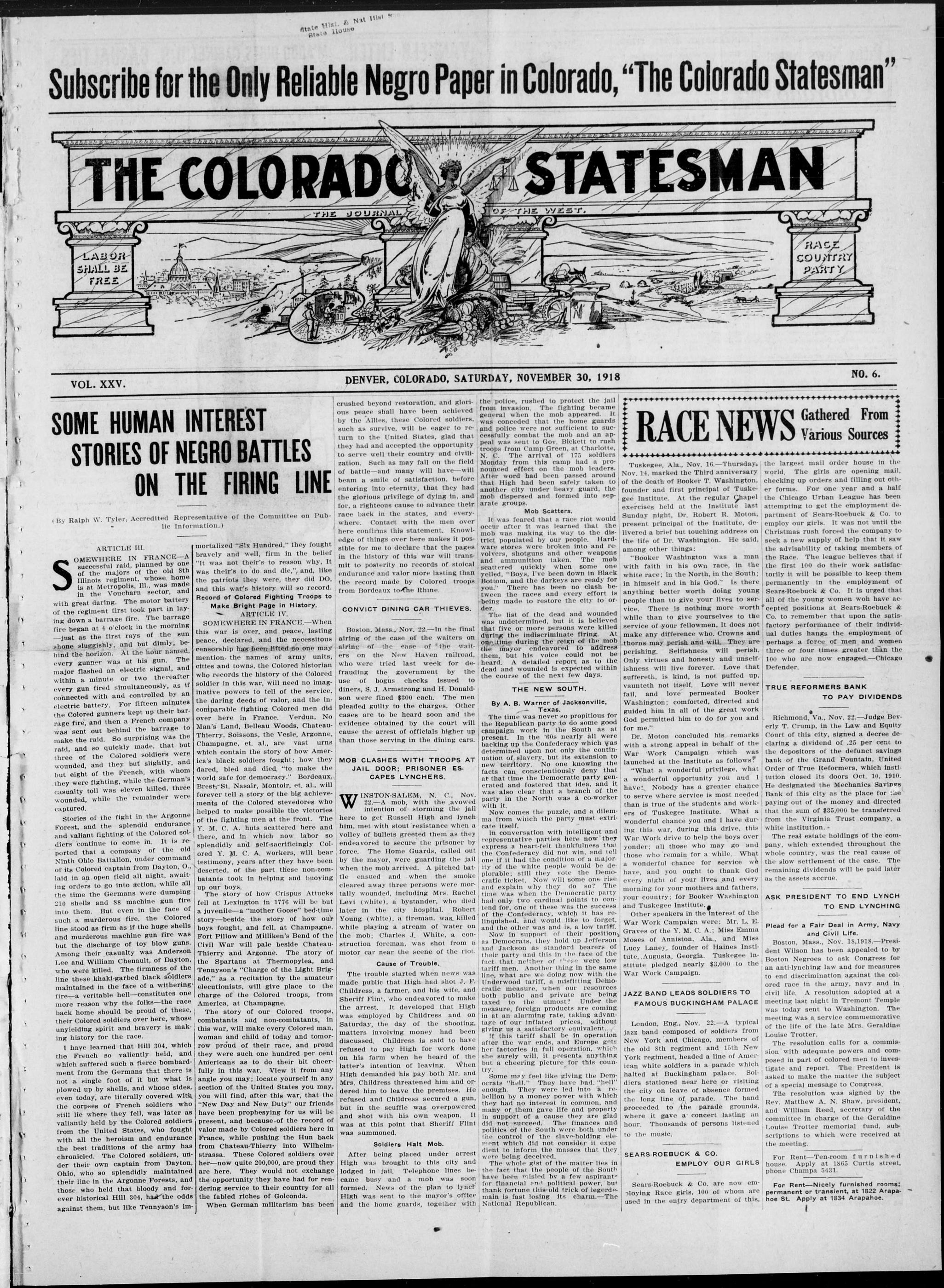
THE COLORADO STATESMAN
THE JOURNAL OF THE WEST.
LABOR SHALL BE FREE
RACE COUNTRY PARTY
SOME HUMAN INTEREST STORIES OF NEGRO BATTLES ON THE FIRING LINE
(By Ralph W. Tyler, Accredited Representative of the Committee on Public Information.)
VOL. XXV.
SOME HUMAN IN
STORIES OF NE
ON THE
(By Ralph W. Tyler, Accredited Repre
lic Infor
ARTICLE III.
SOMEWHERE IN FRANCE—A successful raid, planned by one of the majors of the old 88 Illinois regiment, whose home is at Metropolis, Ill., was made in the Voucharn sector, and with great daring. The motor battery of the regiment first took part in laying down a barrage fire. The barrage fire began at 4 o'clock in the morning—just as the first rays of the sun shone sluggishly, and dimly, behind the horizon. At the hour named, every gunner was at his gun. The major flashed an electric signal, and within a minute or two thereafter every gun fired simultaneously, as if connected with and controlled by an electric battery. For fifteen minutes the Colored gunners kept up their barrage fire, and then a French company was sent out behind the barrage to make the raid. So surprising was the raid, and so quickly made, that but three of the Colored soldiers were wounded, and they but slightly, and but eight of the French, with whom they were fighting, while the German's casualty toll was eleven killed, three wounded, while the remainder were captured.
Stories of the fight in the Argonne Forest, and the splendid endurance and valiant fighting of the Colored soldiers continue to come in. It is reported that a company of the old Ninth Ohio Battalion, under command of its Colored captain from Dayton, O., laid in an open field all night, awaiting orders to go into action, while all the time the Germans were dumping 210 shells and 88 machine gun fire into them. But even in the face of such a murderous fire, the Colored line stood as firm as if the huge shells and murderous machine gun fire was but the discharge of toy blow guns. Among their casualty was Anderson Lee and William Chenault, of Dayton, who were killed. The firmness of the line these khaki-garbed black soldiers maintained in the face of a withering fire—a veritable hell—constitutes one more reason why the folks—the race back home should be proud of these, their Colored soldiers over here, whose unyielding spirit and bravery is making history for the race.
I have learned that Hill 304, which the French so valiently held, and which suffered such a fierce bombardment from the Germans that there is not a single foot of it but what is plowed up by shells, and whose sides, even today, are literally covered with the corpses of French soldiers who still lie where they fell, was later as valiantly held by the Colored soldiers from the United States, who fought with all the heroism and endurance the best traditions of the army has chronicled. The Colored soldiers, under their own captain from Dayton, Ohio, who so splendidly maintained their line in the Argonne Forests, and those who held that bloody and forever historical Hill 304, had the odds against them, but like Tennyson's im-
mortalized "Six Hundred," they fought bravely and well, firm in the belief "It was not their's to reason why. It was their's to do and die," and, like the patriots they were, they did DO, and this war's history will so record. Record of Colored Fighting Troops to
SOMEWHERE IN FRANCE.—When this war is over, and peace, lasting peace, declared, and the necessitous censorship has been lifted so one may mention the names of army units, cities and towns, the Colored historian who records the history of the Colored soldier in this war, will need no imaginative powers to tell of the service, the daring deeds of valor, and the incomparable fighting Colored men did over here in France. Verdun, No Man's Land, Belleau Woods, Chateau Thierry, Soissons, the Vesle, Argonne, Champagne, et. al., are vast urns which contain the story of how America's black soldiers fought; how they dared, bled and died "to make the world safe for democracy." Bordeaux, Brest, St. Nasair, Montoir, et. al., will forever tell a story of the big achievements of the Colored stevedores who helped to make possible the victories of the fighting men at the front. The Y. M. C. A. huts scattered here and there, and in which now labor so splendidly and self-sacrificingly Colored Y. M. C. A. workers, will bear testimony, years after they have been deserted, of the part these non-combatants took in helping and buoying up our boys.
The story of how Crispus Attucks fell at Lexington in 1776 will be but a juvenile—a "mother Goose" bed-time story—beside the story of how our boys fought, and fell, at Champagne, Fort Pillow and Milliken's Bend of the Civil War will pale beside Chateau-Thierry and Argonne. The story of the Spartans at Thermopylea, and Tennyson's "Charge of the Light Brigade," as a recitation by the amateur executionists, will give place to the charge of the Colored troops, from America, at Champagne.
The story of our Colored troops, combatants and non-combatants, in this war, will make every Colored man, woman and child of today and tomorrow proud of their race, and proud they were such one hundred per cent Americans as to do their bit cheerfully in this war. View it from any angle you may; locate yourself in any section of the United States you may, you will find, after this war, that the "New Day and New Duty" our friends have been prophesying for us will be present, and because of the record of valor made by Colored soldiers here in France, while pushing the Hun back from Chateau-Thierry into Wilhelmstrassa. These Colored soldiers over her—now quite 200,000, are proud they are here. They would not exchange the opportunity they have had for rendering service to their country for all the fabled riches of Golconda. When German militarism has been
DENVER, COLORADO, SATURDAY, NOVEMBER 30, 1918
crushed beyond restoration, and glorious peace shall have been achieved by the Allies, these Colored soldiers, such as survive, will be eager to return to the United States, glad that they had and accepted the opportunity to serve well their country and civilization. Such as may fall on the field of battle—and many will have—will beam a smile of satisfaction, before entering into eternity, that they had the glorious privilege of dying in, and for, a righteous cause to advance their race back in the states, and everywhere. Contact with the men over here confirms this statement. Knowledge of things over here makes it possible for me to declare that the pages in the history of this war will transmit to posterity no records of stoical endurance and valor more lasting than the record made by Colored troops from Bordeaux to the Rhine.
CONVICT DINING CAR THIEVES.
Boston, Mass., Nov. 22.—In the final airing of the case of the waiters on airing of the case of the waiters on the New Haven railroad, who were tried last week for defrauding the government by the use of bogus checks issued to diners, S. J. Armstrong and H. Donaldson were fined $300 each. The men pleaded guilty to the charges. Other cases are to be heard soon and the evidence obtained by the court will cause the arrest of officials higher up than those serving in the dining cars.
MOB CLASHES WITH TROOPS AT JAIL DOOR; PRISONER ESCAPES LYNCHERS.
WINSTON-SALEM, N. C., Nov. 22.—A mob, with the avowed intention of storming the jail here to get Russell High and lynch him, met with stout resistance when a volley of bullets greeted them as they endeavored to secure the prisoner by force. The Home Guards, called out by the mayor, were guarding the jail when the mob arrived. A pitched battle ensued and when the smoke cleared away three persons were mortally wounded, including Mrs. Rachel Levi (white), a bystander, who died later in the city hospital. Robert Young (white), a fireman, was killed while playing a stream of water on the mob; Charles J. White, a construction foreman, was shot from a motor car near the scene of the riot.
Cause of Trouble.
The trouble started when news was made public that High had shot J. F. Childress, a farmer, and his wife, and Sheriff Flint', who endeavored to make the arrest. It developed that High was employed by Childress and on Saturday, the day of the shooting, matters involving money had been discussed. Childress is said to have refused to pay High for work done on his farm when he heard of the latter's intention of leaving. When High demanded his pay both Mr. and Mrs. Childress threatened him and ordered him to leave the premises. He refused and Childress secured a gun, but in the scuffle was overpowered and shot with his own weapon. It was at this point that Sheriff Flint was summoned.
Soldiers Halt Mob.
After being placed under arrest High was brought to this city and lodged in jail. Telephone lines became busy and a mob was soon formed. News of the plan to lynch High was sent to the mayor's office and the home guards, together with
the police, rushed to protect the jail from invasion. The fighting became general when the mob appeared. It was conceded that the home guards and police were not sufficient to successfully combat the mob and an appeal was sent to Gov. Bickett to rush troops from Camp Green, at Charlotte, N.C. The arrival of 175 soldiers Monday from this camp had a pronounced effect on the mob leaders. After word had been passed around that High had been safely taken to another city under heavy guard, the mob dispersed and formed into separate groups.
Mob Scatters.
It was feared that a race riot would occur after it was learned that the mob was making its way to the district populated by our people. Hardware stores were broken into and revolvers, shotguns and other weapons and ammunition taken. The mob scattered quickly when some one yelled, "Boys, I've been down in Black Bottom, and the darkkeys are ready for you." There has been no clash between the races and every effort being made to restore the city to order.
The list of the dead and wounded was undetermined, but it is believed that five or more persons were killed during the indiscriminate firing. At one time during the reign of the mob the mayor endeavored to address them, but his voice could not be heard. A detailed report as to the dead and wounded is expected within the course of the next few days.
THE NEW SOUTH
By A. B. Warner of Jacksonville, Texas
The time was never so propitious for the Republican party to do some good campaign work in the South as at present. In the '60s nearly all were backing up the Confederacy which was determined upon not only the continuation of slavery, but its extension to new territory. No one knowing the facts can consciously deny that at that time the Democratic party generated and fostered that idea, and it was also clear that a branch of the party in the North was a co-worker with it.
Now comes the puzzle, and a dilemma from which the party must extricate itself.
In conversation with intelligent and representative parties here now they express a heart-felt thankfulness that the Confederacy did not win, and tell one if it had the condition of a majority of the white people would be deplorable; still they vote the Democratic ticket. Now will some one rise and explain why they do so? The time was when the Democratic party had only two cardinal points to contend for, one of these was the success of the Confederacy, which it has relinquished, and would like to forget, and the other was and is, a low tariff.
Now in support of their position as Democrats, they hold up Jefferson and Jackson as standard bearers of their party and this in the face of the fact that neither of these were low tariff men. Another thing in the same line, what are we doing now with the Underwood tariff, a misfitting Democratic measure, when our resources both public and private are being taxed to the utmost? Under the measure, foreign products are coming in at an alarming rate, taking advantage of our inflated prices, without giving us a satisfactory equivalent.
If this tariff shall be in operation after the war ends, and Europe gets her factories in full operation, which she surely will, it presents anything but a cheering picture for this country.
Some may feel like giving the Democrats "hell." They have bad "hell" enough. They were led into a rebellion by a money power with which they had no interest in common, and many of them gave life and property in support of a cause they are glad did not succeed. The finances and politics of the South were both under the control of the slave-holding element which did not consider it expedient to inform the masses that they were being deceived.
The whole gist of the matter lies in the fact that the people of the South have been misled by a few aspirants for financial and political power, but thank fortune this old trick of legerdemain is fast losing its charm.—The National Republican.
RACENEWS Gathered From Various Sources
Tuskegee, Ala., Nov. 16.—Thursday. Nov. 14, marked the Third anniversary of the death of Booker T. Washington, founder and first principal of Tuskegee Institute. At the regular Chapel exercises held at the Institute last Sunday night, Dr. Robert R. Moton, present principal of the Institute, delivered a brief but touching address on the life of Dr. Washington. He said, among other things: the largest mail order house in the world. The girls are opening mail, checking up orders and filling out other forms. For one year and a half the Chicago Urban League has been attempting to get the employment department of Sears-Roebuck & Co. to employ our girls. It was not until the Christmas rush forced the company to seek a new supply of help that it saw the advisability of taking members of
"Booker Washington was a man with faith in his own race, in the white race; in the North, in the South; in himself and in his God." Is there anything better worth doing young people than to give your lives to service. There is nothing more worth while than to give yourselves to the service of your fellowmen. It does not make any difference who. Crowns and thorns may perish and will. They are perishing. Selfishness will perish. Only virtues and honesty and unselfishness will live forever. Love that suffereth, is kind, is not puffed up, vaunteth not itself. Love will never fail, and love permeated Booker Washington; comforted, directed and guided him in all of the great work God permitted him to do for you and for me." Dr. Motron concluded his remarks with a strong appeal in behalf of the War Work Campaign which was launched at the Institute as follows:
"What a wonderful privilege, what a wonderful opportunity you and I have! Nobody has a greater chance to serve where service is most needed than is true of the students and workers of Tuskegee Institute. What a wonderful chance you and I have during this war, during this drive, this War Work drive to help the boys over yonder; all those who may go and those who remain for a while. What a wonderful chance for service we have, and you ought to thank God every night of your lives and every morning for your mothers and fathers, your country; for Booker Washington and Tuskegee Institute.
Other speakers in the interest of the War Work Campaign were; Mr. L. E. Graves of the Y. M. C. A.; Miss Emma Moses of Anniston, Ala., and Miss Lucy Laney, founder of Haines Institute, Augusta, Georgia. Tuskegee Institute pledged nearly $3,000 to the War Work Campaign.
JAZZ BAND LEADS SOLDIERS TO
FAMOUS BUCKINGHAM PALACE
London, Eng., Nov. 22.—A typical jazz band composed of soldiers from New York and Chicago, members of the old 8th regiment and 15th New York regiment, headed a line of American white soldiers in a parade which halted at Buckingham palace. Soldiers stationed near here or visiting the city on leave of absence formed the long line of parade. The band proceeded to the parade grounds, where it gave a concert lasting an hour. Thousands of persons listened to the music.
SEARS-ROEBUCK & CO.
EMPLOY OUR GIRLS
Sears-Roebuck & Co. are now employing Race girls, 100 of whom are used in the entry department of this,
NO. 6.
the largest mail order house in the world. The girls are opening mail, checking up orders and filling out other forms. For one year and a half the Chicago Urban League has been attempting to get the employment department of Sears-Roebuck & Co. to employ our girls. It was not until the Christmas rush forced the company to seek a new supply of help that it saw the advisability of taking members of the Race. The league believes that if the first 100 do their work satisfactorily it will be possible to keep them permanently in the employment of Sears-Roebuck & Co. It is urged that all of the young women woh have accepted positions at Sears-Roebuck & Co. to remember that upon the satisfactory performance of their individual duties hangs the employment of perhaps a force of men and women three or four times greater than the 100 who are now engaged.—Chicago Defender.
TRUE REFORMERS BANK
Richmond, Va., Nov. 22.—Judge Beverly T. Crump, in the Law and Equity Court of this city, signed a decree declaring a dividend of .25 per cent to the depositors of the defunct savings bank of the Grand Fountain, United Order of True Reformers, which institution closed its doors Oct. 10, 1910. He designated the Mechanics Savings Bank of this city as the place for the paying out of the money and directed that the sum of $35,000 be transferred from the Virginia Trust company, a white institution.
The real estate holdings of the company, which extended throughout the whole country, was the real cause of the slow settlement of the case. The remaining dividends will be paid later as the assets accrue.
ASK PRESIDENT TO END LYNCH
TO END LYNCHING
Plead for a Fair Deal in Army, Navy and Civil Life.
Boston, Mass., Nov. 18,1918.—President Wilson has been appealed to by Boston Negroes to ask Congress for an anti-lynching law and for measures to end discrimination against the colored race in the army, navy and in civil life. A resolution adopted at a meeting last night in Tremont Temple was today sent to Washington. The meeting was a service commemorative of the life of the late Mrs. Geraldine Louise Trotter.
The resolution calls for a commission with adequate powers and composed in part of colored men to investigate and report. The President is asked to make the matter the subject of a special message to Congress.
The resolution was signed by the Rev. Matthew A. N. Shaw, president, and William Reed, secretary of the committee in charge of the Geraldine Louise Trotter memorial fund, subscriptions to which were received at the meeting.
For Rent—Ten-room furnished house. Apply at 1865 Curtis street, phone Champa 5431.
For Rent—Nicely furnished rooms; permanent or transient, at 1822 Arapahoe St. Apply at 1834 Arapahoe.
Pithy News Notes From All Parts of Colorado
Western Newspaper Union News Service.
COMING EVENTS.
Dec. 8-10—Colorado Farmers' and Farm Women's Congress at Fort Collins.
January—Western Stock Show at Denver.
If you have a mandolin you don't want it will be welcomed by the Soldiers' Mandolin club at Fort Logan.
Colorado's Third regiment of National Guard infantry is ready to be received as a complete unit by the war department.
A youth was killed at Fort Morgan and a man was so severely injured that he probably will die when autos turned over on the road.
Mrs. Lucille VanGrundy, 25, a widow of Lafayette, was fatally injured and William Weyman, also of Lafayette, was badly wounded in an automobile accident.
Robert J. Grant, Denver food administrator, wired Herbert C. Hoover offering his services to the government for duty in France during the reconstruction period.
A campaign for state-wide support of the Colorado Development federation as a permanent body to advance Colorado industries on a national basis is being made.
Former State Humane Officer Morton M. David, son of Mrs. Roy F. David of Denver, has been promoted to corporal in the quartermaster's corps at Camp Funston.
Word of the death of Otto Metzger, long a resident of Colorado, at his ranch near Meeker, was received by friends in Denver. Funeral services were held at the ranch on White river.
The meeting of the federal grand jury, first scheduled to be held Nov. 5, then postponed until Nov. 25, has been put off until Jan. 6 because of the latest closing order of the Denver health department. M. de Golyer, late manager of the Vernon Mining Company, Ironton, has secured an option on the McLennan-Dunmore tungsten property on Mount Hayden. The property is considered by those competent to judge to be the most promising tungsten proposition in the San Juan region. October production of Colorado coal mines shows a falling off over the August production and an increase over the September output, according to a statement issued by James Dairymple, state coal mine inspector. The October output was 1,121,101 tons, and the total for the first ten months 10,812,548 tons.
Reports through the state outside of Denver indicate that the Spanish influenza epidemic has spent itself in virtually every community, according to Dr. Erlo E. Kennedy, secretary of the state board of health. No new outbreaks have been reported, and in several of the towns the restrictions will be lifted before the week is ended.
Adventure, mingled with romance, was brought to a happy climax in Denver when Capt. Carl Nelson, the hero of a dozen adventures, and Miss Charlotte Lawhead, daughter of Capt. Edward M. Lawhead of Seattle, a partner in Captain Nelson's adventures, were married in the office of Governor Gunter by Chief Justice S. Harrison White of the Supreme Court.
Five Colorado boys are on the lists of casualties made public by the War Department Nov. 23. They are: George N. Arndt, Blaine, missing in action; William M. Wickhorst, Brighton, wounded, degree undetermined; and the following severely wounded in action: Louis Everett Baldwin, Denver; Lloyd B. Dunn, La Salle, and Joseph P. Gough, Rocky Ford.
The biennial moving season preceding the session of the Legislature is on at the state house.
Sergt. Edward Willis of Durango, cited for bravery at the front in France, was the first boy of La Plata county to enlist in the United States service after the declaration of war. Two of his brothers went into the service. One of these, Sergt. Herbert Willis, died of influenza at Camp Dodge Oct. 26. Another brother, Markley, died at Camp Funston of influenza Oct. 8.
Return of $1,350,000 in dividends to stockholders within a period of three years is the record of the Wellington mine at Breckenridge, owned and operated by the Wellington Mines Company. An index of the productive capacity of the property is had in the fact that during the past fiscal year alone the company paid federal taxes amounting to no less than $145,000. At present the property is working a reduced force, owing to the labor shortage resulting from draft inductions, demands of "essential" industries, inroads made by the influenza epidemic and other general oncicaps.
Voters in the recent election who expressed the desire for absolute prohibition by carrying the amendment sponsored by the Colorado Anti-Saloon league may find that the operation of the amended prohibition law will only serve to handicap the work of arresting officers and encourage bootlegging on a greater scale than in the past. The month of November has brought the heaviest death toll in the history of Logan county in a like period. The "flu" has killed seventy-one persons, most of whom have died during November month.
CENTENNIAL STATE ITEMS
Thirteen Colorado boys are on the casualty lists made public by the War Department Nov. 20. Of these four Denver boys are reported as follows: Erwin P, Greenewald, dead of disease; William Ernest Henry, missing in action; Carlyle Massey, slightly wounded, and Sidney Bridgewater, wounded, degree undetermined. Among the severely wounded in action are Corp. T J. B. Auflick, Ramah; Charles W. Abbott, Burlington; Lloyd Dunn, La Salle, and Paul L. Krilley, Canon City. The list of wounded, degree undetermined, includes Carl Lenhart, Lamar and George C. Rule, Leadville. Among the slightly wounded are Corp. August Albuer, Walsenburg; Floyd F. Brigen dine, Sunbeam, and Lieut. Thomas J. Kennedy, Cañon City.
Nine of the thirteen casualties among Colorado boys, reported in the lists made public by the War Department Nov. 22, record fatalities. Two were killed in action. They are John C. Cooper, Lamar, and William G. Crossley, Deer Trail. Two dead of wounds received in action are Frank J. Arndt, Denver, and Bruce D. Brown Craig. Five dead of disease are: Lleut, Raymond E. Peebler, Boulder; August Kitzmann, Goodrich; James W. McCrun, Aurora; Byron L. McGwire, Longmont, and Arthur E Sellers, Boulder. The list of wounded degree undetermined, includes Charles E. Rice, Steamboat Springs. Three slightly wounded are: Joseph B. Jordan, Denver; Lute Cordova, Walsen, and James A. Durning, Greeley.
With the announcement of General March in Washington that orders had been given General Pershing to start the return to the United States of soldiers not needed in France, plans for the welcoming of Colorado men now in khaki suddenly jumped from the abstract to the concrete. As soon as the official order designating the Red Cross as the agency to make arrangements for the welcoming home of the demobilized troops was received in Denver a committee to have charge of all such receptions was appointed.
The Denver health board revoked the closing order issued Friday, effective Saturday morning, and Saturday afternoon ordered that all persons riding on street cars, at picture shows and many other places, must wear masks to prevent the flu. Ten deaths were officially reported Sunday and seven unofficially from influenza, a large number of new cases developed and overcrowded hospitals were reported from many quarters.
Considerable interest is evident in Pueblo in a new song recently released by one of the big music publishing companies in the east, entitled "Don't Think I'll Forget, Beulah Dear," the words of which were written by Roy A. Williams, a Colorado boy, recently discharged from the United States navy due to a physical disability incurred in the line of duty after serving one year in the great world war.
With a big meeting at the Auditorium on Saturday night, Dec. 7, Denver will join in in the nation-wide celebration of "Britain day" which is being arranged by a group of patriotic American societies to celebrate Great Britain's part in the war and make formal acknowledgment of the debt which America owes for the defense of civilization.
To Miss Cheta Geary of Denver and Miss Letitia Curtis of San Francisco belongs the honor of being the first American women to enter Germany since the beginning of the war. Cable dispatches from Berne, Switzerland state that they crossed the Rhine into Baden at Loerrach, driving a motor truck filled with supplies for the hundreds of prisoners there.
D. Bernard of Conejos county, according to word received by the federal food administrator, doesn't need machinery or men to thresh his beans. He reported that he had threshed his entire crop of beans with boats and burros, and added that they did a fine job.
Why not the 16-ounce of bread for the same price as the 12-ounce loaf? That's the question federal food administration officers were asking after the announcement that bakers could now return to the loaves larger than the 12-ounce, which latter was put in effect as a conservation measure on flour.
Action to recover $1,220 in gold and a diamond ring, valued at $750, now in the hands of the Denver police, was begun by Mrs. Martha Babb, mother of Frank Lewis, leader of the Jones Lewis bandit gang, and of Eva Lewis queen of the gang, thru her attorney in the District Court of Colorado Springs.
When the victorious American contingents arrive at New York, they will find Colorado will have sent a welcome to her boys along with the soldiers of other states, who are like wise to be welcomed in Fifth avenue.
Colorado needs more ranchers to help relieve a shortage of meat and livestock due to war demands and to droughts in Texas, Oklahoma and Arizona the last three years, says F. J Alexander. Denver realtor.
That masks are the surest remedy for the prevention of influenza is the belief of Dr. Woods Hutchinson, well known doctor-author, who was in Denver. He is touring the country in the interest of a fight being made to prevent the spread of the influenza epidemic. Samuel Hartsel, 84, of Denver, Colorado pioneer settler and Indian fighter, founder of the town of Hartsel, wealthy South park rancher and for the last twelve years a Denver investor and large property owner, died suddenly of apoplexy.
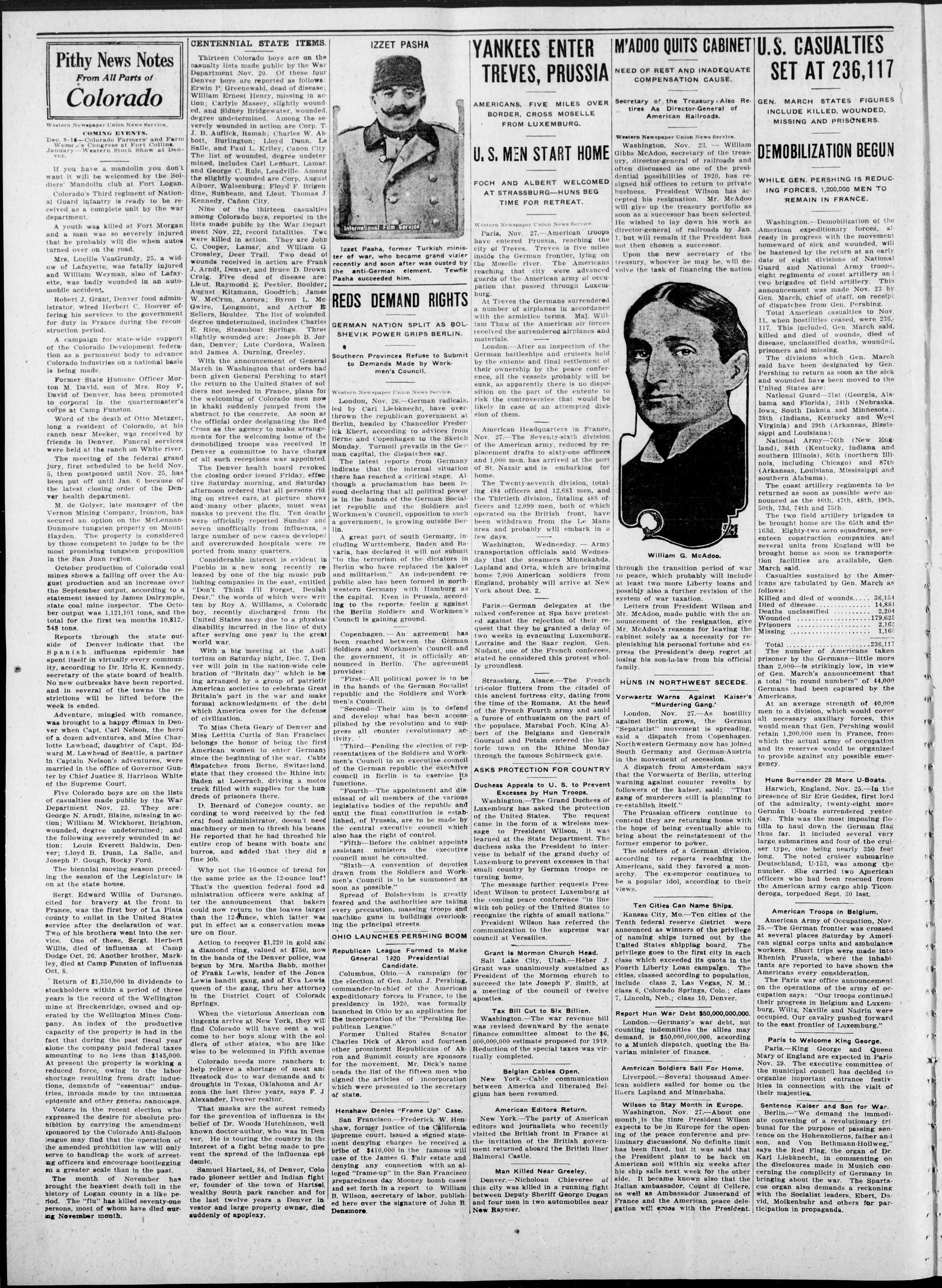
IZZET PASHA
International Film Service
Izzet Pasha, former Turkish minister of war, who became grand vizier recently and soon after was ousted by the anti-German element. Tewfik Pasha succeeded him.
REDS DEMAND RIGHTS
GERMAN NATION SPLIT AS BOLL-SHEVIK POWER GRIPS BERLIN.
Southern Provinces Refuse to Submit to Demands Made by Workmen's Council.
Western Newspaper Union News Service.
London, Nov. 26.—German radicals, led by Carl Liebknecht, have overthrown the republican government at Berlin, headed by Chancellor Frederick Ebert, according to advices from Berne and Copenhagen to the Sketch Monday. Turmoil prevails in the German capital, the dispatches say.
The latest reports from Germany indicate that the internal situation there has reached a critical stage. Although a proclamation has been issued declaring that all political power is in the hands of the German Socialist republic and the Soldiers and Workmen's Council, opposition to such a government, is growing outside Berlin.
A great part of south Germany, including Wurtemberg, Baden and Bavaria, has declared it will not submit "to the terrorism of the dictators in Berlin who have replaced the kaiser and militarism." An independent republic also has been formed in northwestern Germany with Hamburg as the capital. Even in Prussia, according to the reports, feeling g against the Berlin Soldiers and Workmen's Council is gaining ground.
Copenhagen. — An agreement has been reached between the German Soldiers and Workmen's Council, and the government, it is officially announced in Berlin. The agreement provides:
"First—All political power is to be in the hands of the German Socialist republic and the Soldiers and Workmen's Council.
"Second—Their aim is to defend and develop what has been accomplished by the revolution and to suppress all counter revolutionary activity.
"Third—Pending the election of representatives of the Soldiers and Workmen's Council to an executive council of the German republic the executive council in Berlin is to exercise its functions.
"Fourth—The appointment and dismissal of all members of the various legislative bodies of the republic and until the final constitution is established, of Prussia, are to be made by the central executive council which also has the right of control.
"Fifth—Before the cabinet appoints assistant ministers the executive council must be consulted.
"Sixth—a convention of deputies drawn from the Soldiers and Workmen's Council is to be summoned as soon as possible."
Spread of Bolshevism is greatly feared and the authorities are taking every precaution, massing troops and machine guns in buildings overlooking the principal streets.
OHIO LAUNCHES PERSHING BOOM
Republican League Formed to Make General 1920 Presidential Candidate.
Columbus, Ohio.—A campaign for the election of Gen. John J. Pershing, commander-in-chief of the American expeditionary forces in France, to the presidency in 1920, was formally launched in Ohio by an application for the incorporation of the "Pershing Republican League."
Former United States Senator Charles Dick of Akron and fourteen other prominent Republicans of Akron and Summit county are sponsors for the movement. Mr. Dick's name heads the list of the fifteen men who signed the articles of incorporation which were presented to the secretary of state.
Henshaw Denies "Frame Up" Case.
San Francisco.—Frederick W. Henshaw, former justice of the California Supreme court, issued a signed statement denying charges he received a bribe of $410,000 in the famous will case of the James G. Fair estate and denying any connection with an alleged "frame-up" in the San Francisco preparedness day Mooney bomb cases and set forth in a report to William B. Wilson, secretary of labor, published here over the signature of John B. Denmore.
YANKEES ENTER TREVES, PRUSSIA
AMERICANS, FIVE MILES OVER
BORDER, CROSS MOSELLE
FROM LUXEMBURG.
U. S. MEN START HOME
FOCH AND ALBERT WELCOMED
AT STRASSBURG—HUNS BEG
TIME FOR RETREAT.
Western Newspaper Union News Service.
Paris, Nov. 27.—American troops have entered Prussia, reaching the city of Treves. Treves is five miles inside the German frontier, lying on the Moselle river. The Americans reaching that city were advanced guards of the American army of occupation that passed through Luxemburg. At Treves the Germans surrendered a number of airplanes in accordance with the armistice terms. Maj. William Thaw of the American air forces received the surrendered airplanes and materials.
London. After an inspection of the German battleships and cruisers held by the entente and final settlement of their ownership by the peace conference, all the vessels probably will be sunk, as apparently there is no disposition on the part of the entente to risk the controversies that would be likely in case of an attempted division of them.
American Headquarters in France, Nov. 27. The Seventy-sixth division of the American army, reduced by replacement drafts to sixty-one officers and 1,000 men, has arrived at the port of St. Nazair and is embarking for home.
The Twenty-seventh division, totaling 484 officers and 12,681 men, and the Thirtieth division, totaling 488 officers and 12,099 men, both of which operated on the British front, have been withdrawn from the Le Mans area and probably will embark in a few days.
Washington, Wednesday. — Army transportation officials said Wednesday that the steamers Minnekahda, Lapland and Orta, which are bringing home 7,000 American soldiers from England, probably will arrive at New York about Dec. 2.
Paris.—German delegates at the mixed conference at Spa have protested against the rejection of their request that they be granted a delay of two weeks in evacuating Luxemburg, Lorraine and the Saar region. Gen. Nudant, one of the French conferees, stated he considered this protest wholly groundless.
Strassburg, Alsace.—The French tri-color flutters from the citadel of this ancient fortress city, dating from the time of the Romans. At the head of the French Fourth army and amid a furore of enthusiasm on the part of the populace, Marshal Foch, King Albert of the Belgians and Generals Gouraud and Petain entered the historic town on the Rhine Monday through the famous Schirmeck gate.
ASKS PROTECTION FOR COUNTRY
Duchess Appeals to U. S. to Prevent Excesses by Hun Troops.
Washington—The Grand Duchess of Luxemburg has asked the protection of the United States. The request came in the form of a wireless message to President Wilson, it was learned at the State Department. The duchess asks the President to intervene in behalf of the grand duchy of Luxemburg to prevent excesses in that small country by German troops returning home.
The message further requests President Wilson to protect Luxemburg at the coming peace conference "in line with teh policy of the United States to recognize the rights of small nations."
President Wilson has referred the communication to the supreme war council at Versailles.
Salt Lake City, Utah.—Heber J. Grant was unanimously sustained as President of the Mormon church to succeed the late Joseph F. Smith, at a meeting of the council of twelve apostles.
Tax Bill Cut to Six Billion.
Washington.—The war revenue bill was revised downward by the senate finance committee almost to the $6,000,000,000 estimate proposed for 1919. Reduction of the special taxes was virtually completed.
Belgian Cables Open.
New York.—Cable communication between America and liberated Belgium has been resumed.
American Editors Return.
New York.—The party of American editors and journalists who recently visited the British front in France at the invitation of the British government returned aboard the British liner Balmoral Castle.
Man Killed Near Greeley.
Denver.—Nicholoan Chieveree of this city was killed in a running fight between Deputy Sheriff George Dugan and four men in two automobiles near New Rayver.
M'ADOO QUITS CABINET
NEED OF REST AND INADEQUATE COMPENSATION CAUSE.
Secretary of the Treasury. Also Retires As Director-General of American Railroads.
Western Newspaper Union News Service.
Washington, Nov. 23. — William Gibbs McAdoo, secretary of the treasury, director-general of railroads and often discussed as one of the presidential possibilities of 1920, has resigned his offices to return to private business. President Wilson has accepted his resignation. Mr. McAdoo will give up the treasury portfolio as soon as a successor has been selected. He wished to lay down his work as director-general of railroads by Jan. 1, but will remain if the President has not then chosen a successor.
Upon the new secretary of the treasury, whoever he may be, will devolve the task of financing the nation
Q
William G. McAdoo. through the transition period of war to peace, which probably will include at least two more Liberty loans and possibly also a further revision of the system of war taxation. Letters from President Wilson and Mr. McAdoo, made public with the announcement of the resignation, give Mr. McAdoo's reasons for leaving the cabinet solely as a necessity for repleasing his personal fortune and express the President's deep regret at losing his son-in-law from his official family.
HUNS IN NORTHWEST SECEDE.
Vorwaertz Warns Against Kaiser's "Murdering Gang."
London, Nov. 27.—As hostility against Berlin grows, the German "Separatist" movement is spreading, said a dispatch from Copenhagen. Northwestern Germany now has joined South Germany and German-Austria in the movement of secession.
A dispatch from Amsterdam says that the Vorwaertz of Berlin, uttering warning against counter revolts by followers of the kaiser, said: "That gang of murderers still is planning to re-establish itself."
The Prussian officers continue to contend they are returning home with the hope of being eventually able to bring about the reinstatement of the former emperor to power.
The soldiers of a German division, according to reports reaching the Americans, said they favored a monarchy. The ex-emperor continues to be a popular idol, according to their views.
Ten Cities Can Name Ships.
Kansas City, Mo.—Ten cities of the Tenth federal reserve district were announced as winners of the privilege of naming ships turned out by the United States shipping board. The privilege goes to the first city in each class which exceeded its quota in the Fourth Liberty Loan campaign. The cities, classed according to population, include class 2, Las Vegas, N. M.; class 6, Colorado Springs, Colo.; class 7, Lincoln, Neb.; class 10, Denver.
Report Hun War Debt $50,000,000,000.
Report Hun War Debt $50,000,000,000.
London.—Germany's war debt, not counting indemnities the allies may demand, is $50,000,000,000, according to a Munich dispatch, quoting the Bavarian minister of finance.
American Soldiers Sall For Home.
Liverpool.—Several thousand American soldiers sailed for home on the liners Lapland and Minneaha.
Wilson to Stay Month in Europe.
Washington, Nov. 27.—About one month is the time President Wilson expects to be in Europe for the opening of the peace conference and preliminary discussions. No definite limit has been fixed, but it was said that the President plans to be back on American soil within six weeks after his ship sails next week for the other side. It became known also that the Italian ambassador, Count di Cellere, as well as Ambassador Jusserand of France and the American peace delegation will cross with the President.
U.S. CASUALTIES SET AT 236,117
GEN. MARCH STATES FIGURES INCLUDE KILLED, WOUNDED, MISSING AND PRISONERS.
DEMOBILIZATION BEGUN
WHILE GEN. PERSHING IS REDUC IN FORCES, 1,200,000 MEN TO REMAIN IN FRANCE.
Washington.—Demobilization of the American expeditionary forces, already in progress with the movement homeward of sick and wounded, will be hastened by the return at an early date of eight divisions of National Guard and National Army troops, eight regiments of coast artillery and two brigades of field artillery. This announcement was made Nov. 23 by Gen. March, chief of staff, on receipt of dispatches from Gen. Pershing.
Total American casualties to Nov. 11, when hostilities ceased, were 235, 117. This included, Gen. March said, killed and died of wounds, died of disease, unclassified deaths, wounded, prisoners and missing.
The divisions which Gen. March said have been designated by Gen. Pershing to return as soon as the sick and wounded have been moved to the United States are:
National Guard—31st (Georgia, Alabama and Florida), 34th (Nebraska, Iowa, South Dakota and Minnesota), 38th (Indiana, Kentucky and West Virginia) and 39th (Arkansas, Bississippi and Louisiana).
National Army—76th (New England), 84th (Kentucky, Indiana and southern Illinois), 86th (northern Illinois, including Chicago) and 87th (Arkansas, Louisiana, Mississippi and southern Alabama).
The coast artillery regiments to be returned as soon as possible were announced as the 46th, 47th, 48th, 49th, 50th, 73d, 74th and 75th.
The two field artillery brigades to be brought home are the 65th and the 163d. Eighty-two aero squadrons, seventeen construction companies and several units from England will be brought home as soon as transportation facilities are available, Gen. March said.
Casualties sustained by the Americans are tabulated by Gen. March as follows:
Killed and died of wounds..... 36,154
Died of disease..... 14,881
Deaths unclassified..... 2,204
Wounded..... 179,625
Prisoners..... 2,163
Missing..... 1,166
Total..... 236,117
The number of Americans taken prisoner by the Germans—little more than 2,000—is strikingly low, in view of Gen. March's announcement that a total "in round numbers" of 44,000 Germans had been captured by the Americans.
At an average strength of 40,000 men to a division, which would cover all necessary auxiliary forces, this would mean that Gen. Pershing would retain 1,200,000 men in France, from which the actual army of occupation and its reserves would be organized to provide against any possible emergency.
Huns Surrender 28 More U-Boats.
Huns Surrender 28 More U-Boats.
Harwich, England, Nov. 25.—In the presence of Sir Eric Geddes, first lord of the admiralty, twenty-eight more Germán U-boats surrendered yesterday. This was the most imposing flotilla to haul down the German flag thus far. It included several very large submarines and four of the cruiser type, one being nearly 350 feet long. The noted cruiser submarine Deutschland, U-153, was among the number. She carried two American officers who had been rescued from the American army cargo ship Tlonderoga, torpedoed Sept. 30 last.
American Troops in Belgium.
American Army of Occupation, Nov. 25.—The German frontier was crossed at several places Saturday by American signal corps units and ambulance workers. Short trips were made into Rhenish Prussia, where the inhabitants are reported to have shown the Americans every consideration. The Paris war office announcement on the operations of the army of occupation says: "Our troops continued their progress in Belgium and Luxemburg, Wiltz, Naville and Nadrin were occupied. Our cavalry pushed forward to the east frontier of Luxemburg."
Paris to Welcome King George.
Paris.—King George and Queen Mary of England are expected in Paris Nov. 29. The executive committee of the municipal council has decided to organize important entrance festivities in connection with the visit of their majesties.
Sentence Kaiser and Son for War. Berlin.—"We demand the immediate convening of a revolutionary tribunal for the purpose of passing sentence on the Hohenzollerns, father and son, and Von Bethmann-Hollweg," says the Red Flag, the organ of Dr. Karl Liebknecht, in commenting on the disclosures made in Munich concerning the complicity of Germany in bringing about the war. The Spartacus organ also demands a reckoning with the Socialist leaders, Ebert, David, Molkenbuhr and others for participation in propaganda.
Poro Hair Dressing Parlors
SCIENTIFIC AND SANITARY SCALP AND HAIR TREATMENT
MASSAGING, MANICURING, TOILET ARTICLES
Motto—"Efficiency"
Mme. Lexie A. Brooks
2220 OGDEN STREET PHONE YORK 5997W
2220 OGDEN STREET
PHONE MAIN 30231
John K. Rettig
MEATS, FANCY AND STAPLE GROCERIES 1864 CURTIS STREET
E CHAMPA PHARMA
TWENTIETH AND CHAMPA,
Is the place to get your
GES, CHEMICALS AND PATENT MEDICINE
WE SERVE DRINKS.
PRESCRIPTIONS OUR SPECIALTY.
us and we will deliver the goods to all parts of t
JAMES E. THRALL, Propr.
PHONE MAIN 2425.
atherhead Hat
THE CHAMPA
TWENTIETH
Is the place
DRUGS, CHEMICALS AND
WE SERVE
PRESCRIPTIONS
Phone us and we will deliver to
JAMES E. TH
PHONE M
Weatherhe
TELEPHONE
MAIN 3203
Established 1876
RENOVATORS, BLEACHER
Of Gents' and Ladies'
1624 CHAMPA ST
THE CHAMPA PHARMACY
TWENTIETH AND CHAMPA,
Is the place to get your
DRUGS, CHEMICALS AND PATENT MEDICINES
WE SERVE DRINKS.
PRESCRIPTIONS OUR SPECIALTY.
Phone us and we will deliver the goods to all parts of the city.
JAMES E. THRALL, Propr.
PHONE MAIN 2425.
Weatherhead Hat Co.
ONE
MAIN 3203
published 1876
PIONEER H
OF THE W
MAKE OLD
NEW
DVATORS, BLEACHERS, DYERS AND FINISH
Of Gents' and Ladies' Hats of Every Description
1624 CHAMPA ST., DENVER, COLO.
RENOVATORS, BLEACHERS, DYERS AND FINISHERS Of Gents' and Ladies' Hats of Every Description 1624 CHAMPA ST., DENVER, COLO.
C. E. SMITH, Manager, Res. Phone South 1608
The Market
Wholesale and Retail Staple and
Hotels and Restaurants Our
Eastern Cor
Fruits, Vegetables
Telephones Main 43
622-636 15TH STREET
Bolden Bath
Baths, Mast
e Market Company
and Retail Staple and Fancy Groceries, Fish and
dls and Restaurants Our Specialty. Fresh and C
Eastern Corn Fed Meats
Fruits, Vegetables, Poultry and Game.
Telephones Main 4302, 4303, 4304, 4305
5TH STREET DENVER, CO
Golden Barber Shop
Baths, Electric
Massages
Wholesale and Retail Staple and Fancy Groceries, Fish and Oysters.
Hotels and Restaurants Our Specialty. Fresh and Cured
Fruits, Vegetables, Poultry and Game.
Telephones Main 4302, 4303, 4304, 4305
622-636 15TH STREET DENVER, COLORADO
FIRST-CLASS SERVICE
R. B. BOLDEN, Proprietor
"Another thing that I've noticed in my adventurous career," observed the almost philosopher, "is that a fellow who has a breezy way about him is usually pretty fresh."
The Kangaroo Industry.
In Australia kangaroo farming is an important industry. The hides are valuable and the tendons extremely fine; indeed, they are the best known to surgeons for sewing up wounds, and especially for holding broken bones together, being much finer and tougher than catgut, which is used extensively.
The Right Kin
Reading Mat
The home news; the
town; the gossip of
the first kind of rea
Right Kind of
ling Matter
The home news; the doings of the peop
town; the gossip of our own communi
the first kind of reading matter you wa
more important, more interesting to
The Right Kind of Reading Matter
The home news; the doings of the people in this town; the gossip of our own community, that's the first kind of reading matter you want. It is more important, more interesting to you than that given by the paper or magazine from the outside world. It is the first reading matter you should buy. Each issue of this paper gives to you just what you will consider
The Right Kind of Reading Matter
Corner Nineteenth
PHONE YORK 5997W
RES. PHONE GALLUP 942
A PHARMACY
AND CHAMPA,
to get your
AND PATENT MEDICINES
DRINKS.
OUR SPECIALTY.
the goods to all parts of the city.
ARALL, Propr.
AIN 2425.
PIONEER HATTERS OF THE WEST. WE MAKE OLD HATS NEW.
S, DYERS AND FINISHERS
Hats of Every Description
, DENVER, COLO.
et Company
Fancy Groceries, Fish and Oysters.
Specialty. Fresh and Cured
n Fed Meats
Poultry and Game.
92, 4303, 4304, 4305
DENVER, COLORADO
rber Shop
Electric
sages
926 19th St., Denver
Pudding in History.
Pudding in its early form was made of minced meat of some sort, well seasoned and stuffed into an intestine, and then cooked by boiling. There are words in many early languages meaning pudding, but it seems originally to have come from some word meaning a short body or inflated skin.
Optimistic Thought.
He hath riches sufficient who hath enough to be charitable.
Daily Thought.
He who begs timidly courts a refusal.—Seneca.
nd of
ter
the doings of the people in this
our own community, that's
ding matter you want. It is
more interesting to you than
Denver, Colo.
CONTEST DUE FOR PLACE OF SPEAKER
CONTEST DUE FOR PLACE OF SPEAKER
SEVERAL REPUBLICANS WILL BE CANDIDATES FOR THIS VERY IMPORTANT OFFICE.
ILL HEALTH MAY BAR MANN
Shifting of Chairmanships That Will Come When Republicans Take Control of Senate—Department of Commerce Plans Trade Extension.
By ARTHUR W. DUNN.
Washington.—The first real speakership contest since 1891 is likely to follow the recent election. Ever since the famous Crisp-Mills contest the speakership has gone to some man by practically unanimous consent. With the Republicans returning to power after eight years, there is likely to be quite a spirited struggle among a number of men who will no doubt consider themselves eligible. If former Minority Leader Mann is in physical condition he will likely be a candidate. Gillett of Massachusetts, who has been acting minority leader, is sure to be a candidate. Then there are J. Hampton Moore of Pennsylvania, Frank W. Mondell of Wyoming, Julius Kahn of California, Nicholas Longworth and Simeon D. Fess of Ohio, and Joseph W. Fordney, of Michigan, all of whom may be in the race at least for a little while. As it is possible that the Republicans will restore to the speaker the power to appoint committees the position may be much more valuable than it has been during the past eight years.
When control of the senate passes to the Republicians there will be an interesting shifting of chairmanships. Of the most important committees the following are likely to be chairmen: Appropriations, Warren of Wyoming; banking and currency, McLean of Connecticut; finance, Penrose of Pennsylvania; foreign relations, Lodge of Massachusetts; judiciary, Nelson of Minnesota; commerce, Jones of Washington; agriculture, Page of Vermont; interstate commerce, Cummins of Iowa; military affairs, Wadsworth of New York; naval affairs, Poindexter of Washington; post offices, Townsend of Michigan.
Probably Senator Lodge will have his choice of two other positions, that of being majority leader, or president pro tempore of the senate. But more than either, the great gratification to him will be the chairmanship of the foreign relations committee at one of the most important periods of our history.
Indications are that trade between nations will be humming after the war. Already the department of commerce has arranged a program calling for a large increase in the number of commercial attaches in foreign countries. There are only 11 of these attaches at present, but the department has asked congress to appropriate for 18 altogether. Commercial attaches are employed for their ability to scent business from a distance, report on trade conditions in foreign countries and give advice and assistance to American firms desiring to do business with foreign houses. Great Britain proposes to have 27 of these attaches in her service, and Germany will probably have more than all other countries together. She will probably need them.
"How are the mighty fallen." Romance is nearly gone from war nowadays. Not only from war between men, but in the older war of men upon animals. Fifty years ago our Westerners killed wild animals for what? For their meat, their skins, or possibly in some instances because the animals came after them. Hundreds of men made their living by hunting then where one does now. There are a great many hunting parties which go out and "rough it" for a couple of weeks or a month. But the men who make their living hunting are making it by working for the department of agriculture—shooting and trapping sheep-killing wolves, coyotes, mountain lions and bears.
When in 1904 Missouri voted for Roosevelt and elected a Republican United States senator she earned the sobriquet, "The Mysterious Stranger." Once more Missouri cast its vote for a Republican when Taft was elected in 1908. And now, contrary to all expectations, Missouri returns a Republican United States senator, and hereafter that state will be considered debatable political territory.
Events intervened to prevent Champ Clark from realizing his great ambition. He wanted to be the one man who was elected speaker of the house of representatives for more than four successive times. There have been only three men who were elected speaker for four successive times. One was Stevenson of Virginia and the other two were Cannon of Illinois and Clark of Missouri. Henry Clay was elected six times, but not successively and then serving only short periods.
In all probability the woman suffrage amendment will be passed in the next congress, if it is not passed by the senate before this congress adjourns. This is not because different senators in one state or another have been successful, for it would probably
have followed, no matter which party had won the fight. It is also a fact that suffrage or anti-suffrage cut no figure in the elections. The only prominent anti-suffragist that was defeated was Weeks of Massachusetts, while Baird was elected in New Jersey, Saulsbury, an anti-suffragist, was defeated in Delaware, while Folk, a suffragist, was defeated in Missouri. It is evident that the election was fought on party lines, and such issues as suffrage and even prohibition had little to do with the success or defeat of different candidates.
A committee composed of members of a number of farming organizations recommended to President Wilson that the draft law be applied to farm workers who are not continuously employed in some agricultural pursuit. Under this arrangement, after a farmer had done all that was required on his own farm (if that ever happens) he could be ordered by a draft board to go over and help some neighbor who was behind in his work. As a compensation for this he would be given a badge. The president declined to make use of this idea, but gave his approval to a proposition for enrolling the farmers into an organization to do such work voluntarily.
Quite a number of American boys who have had a more or less hazy idea that kings were the worst class of people on earth, may come back from Europe after the war with a different view on that subject. King George of England seems to be making himself solid with the Yanks. He has eaten "flapjacks" and apple ple, and chatted with any number of wounded soldiers at hospitals in England. That is one of the great benefits to be got from this war. There is not a man who canes back from Europe who will not have gained a clearer and truer view of other peoples. Whether or not it has any good points, no one can deny that war is a great educator.
The recent election rearranges a number of presidential slates. Naturally the victory of the Republicans gives them a great deal of confidence, and they hope to elect the next president. It is pointed out that for more than 30 years the success of a party at the midterm congressional elections has forecast the result of the next presidential election.
Generally speaking, politicians believe that the election has given candidates other than President Wilson or Secretary McAdoo quite a boost, and eyes have been turned toward Governor Cox of Ohio. In fact, it might happen that both candidates in 1920 would be from Ohio, as Senator Harding might be the Republican nominee.
It is generally conceded that the election removes at least two eastern candidates, Senator Weeks of Massachusetts and Governor Whitman of New York, thus in the East clearing the way for Colonel Roosevelt if he should make the race.
Already there has been speculation as to the organization of the house of representatives and also in regard to the chairmanships of the several committees. The selection of a speaker will have something to do with the chairmanships. If Congressman Gillett of Massachusetts is elected speaker the chairmanship of the important committee on appropriations would go to Good of Iowa, but if Gillett is not speaker he will be chairman of that committee. Other chairmanships of first class committees are likely to be as follows: Ways and means, Fordney of Michigan: agriculture, Haugen of Iowa; banking and currency, Hayes of California; foreign affairs, Porter of Pennsylvania; interstate and foreign commerce, Esch of Wisconsin; Judiciary, Volstead of Minnesota; military affairs, Kahn of California; naval affairs, Butler of Pennsylvania; post offices, Steenerson of Minnesota; public lands, La Follette of Washington. The men thus named are ranking Republican members of these committees at the present time. Of course there may be a number of upsets in these calculations, but the probabilities are that nearly all of the ranking Republican members of committees will be advanced to chairmanships, particularly if the house elects the committees and they are not appointed by the speaker.
An interesting letter was put out by the National Woman's Liberty Loan committee, which showed the salaries paid officers and men of the allied and German armies. This table shows the Americans to be far better paid than any, of the others. A private in the United States army gets $1 a day; in Great Britain's forces he gets 30 cents; in France, 5 cents; Italy, 2 cents, and Germany, 10 cents. A second lieutenant with the Yanks draws $141.67 per month. His nearest competitor of the same rank is the Frenchman, with $60. England has the highest paid generals at $1,380 monthly. This country pays $833.33 a month for General Pershing's services.
Judging from reports that have been received, there is a whole lot of work for the Red Cross to do in the Holy Land, and all the neighboring regions. Some sections of that territory have been under Turkish military rule for four years, and what happened to the Christians in that time can be imagined. As usual, the Red Cross is not waiting for any grass to grow under its feet. Things are humming in that part of the world: hospitals are being established and additional workers are on their way. Probably a large portion of the money collected in the coming Red Cross drive will be spent in relieving these people who live in "the birthplace of Christianity."
Holiday Slippers
We illustrate here popular plush trimmed Juliets, show in all colors, with flexible leather soles. An excellent holiday slipper. Specially priced at. $1.65
WOMEN'S DELUX COMFYS
These are extra quality Comfys; shown in all colors, made with padded wool soles; ribbon trimmed. Spec- cially priced $2.15
BOUT
Shown in black kid a hand turned soles and Specially priced at...
BOUDOIR SLIPPERS
n black kid and colored cretonne; m
ned soles and neatly trimmed vamp.
priced at.....
Shown in black kid and colored cretonne; made with hand turned soles and neatly trimmed vamp. $1.65
Specially priced at .....
MEN'S HOLIDAY SLIPPERS
We are showing the O either black or brown lined with chamois ski fortable wide toes. S
showing the Opera and Everett style Sack or brown kid with hand turned in chamois skin and made with comwide toes. Specially priced at.....
We are showing the Opera and Everett style Slippers in either black or brown kid with hand turned soles and lined with chamois skin and made with comfortable wide toes. Specially priced at..... $2.85
MEN'S HOLIDAY SLIPPERS
Shown in Romeo, Oper
brown or black kid;
number of handsome m
THE M
Romeo, Opera and Everett styles; made
black kid; full leather lined. A
of handsome models. Specially priced at.
HE MAY
Shown in Romeo, Opera and Everett styles; made in either brown or black kid; full leather lined. A number of handsome models. Specially priced at. $3.45
The Home of Society Brand Clothes
Taxicab Rates.
Depot, 1 or 2 pass...50c
Depot, each addi-
tional pass .....25c
One mile radius...50c
Each addition'1 mile.25c
Bean A
HEL
COLE 8 AND 7
STAND: N
1865-1867 Curtis St.
Phone Champa 5431
Rates.
2 pass...50c
addi-
ess .....25c
radius...50c
non'l mile.25c
Motto: "sure." Cass
Rates P
$1.50
Phone Main 6699
Sean Auto Live
HEATED TAX!CAB.
LE 8 AND 7-PASSENGER 1918 L
MODEL CARS.
STAND: NIGHT AND DAY CAFE
57 Curtis St.
Denver,
Pa 5431
Private Booth
NIGHT AND DAY
AND COLD DRINK P
B. CARRUTH, Proprietor
A Full Line of Fresh Fish in
Oysters and Lobsters
Short Orders At All Hours Rest Room
Taxicab Rates.
Depot, 1 or pass...50c
Depot, each addi-
tional pass ...25c
One mile radius...50c
Each addition'l mile.25c
Motto: "Not slow but
sure." Cash only.
Rates Per Hour.
$1.50 to $2.50.
Phone Main 6699
Bean Auto Livery
HEATED TAX!CAB.
COLE 8 AND 7-PASSENGER 1918 LATE
MODEL CARS.
STAND: NIGHT AND DAY CAFE
1865-1867 Curtis St. Denver, Colorado
1865-1867 CURTIS STREET
```markdown
```
The
Curtis
Park
Floral
Company
FLORAL DESIGNS PUT UP WHILE
YOU WAIT
CHOICE PLANTS AND CUT FLOWERS CONSTANTLY
ON HAND
GREENHOUSES: Thirty-Fourth and Curtis Streets
TELEPHONE, MAIN 1511
DENVER, COLO
A
THE BOOTS OF THE WEEK
and colored cretonne; made with
neatly trimmed vamp. $1.65
HOLIDAY SLIPPERS
Bera and Everett style Slippers in
kid with hand turned soles and
and made with com-
specially priced at. $2.85
and Everett styles; made in either Full leather lined. A models. Specially priced at. $3.45 IAY CO.
---
THE COLORADO STATESMAN
THE COLORADO STATESMAN
LABOR
SHOULD
BE
FREE
RACE
COUNTRY
PARTY
One Year ..... $2.00
Six Months ..... 1.50
Three Months ..... 80
Entered as second-class matter at the postoffice in the City of Denver, Colo.
Reading notices, ten lines or less, 15 cents per line. Each additional line over ten lines, 10 cents per line. Display advertising 50c per inch
Remittances should be made by Express Money Order, Postoffice Money Order, Registered Letter or Bank Draft. Postage stamps will be received the same as cash for the fractional part of a dollar. Only 1c and 2c stamps taken.
No discounts allowed on less than three months' contract. Cash must accompany all orders from parties unknown to us. Further particulars on application.
WE GAVE THANKS.
Thanksgiving day, Thursday, November 28, seemed a special gift from the clerk of the weather as he believed that we had innumerable blessings to be thankful for during the period 1917-18, and so an ideal day gave everyone an opportunity to visit with friends, congregate in churches, or exchange ideas on the best way to celebrate the day. We, like many others, gave thanks for our existence and our continuance in business, also offered gratitude to our patrons and supporters for their timely aid. There were union services among our people at Shorter A. M. E. church, under the auspices of Denver Ministerial Alliance, Thanksgiving address by Rev. D. E. Over and sermon by Rev. T. S. McMorris of Scott M. E. church.
As a people—a race that is pressing on to reach the goal of success and achieve the highest standards possible, we have to be specially thankful, and our hearts must be glad at the opportunities that are being offered us in establishing our right to American citizenship, liberty and justice, and the recognition that is everywhere evinced by those who refuse to give us fair play, as also those who live in ignorance of our ability for service. Thanksgiving day! Yes, worthy of celebration, as the time has come when every right thinking and honest minded member of the Negro race in this country is beginning to rouse himself to a deeper sense of his manhood and responsibility to his race, to society, to the world at large, and in his aspiration to measure up will remove the shackles that bind him intellectually, throw off the Yoke of Prejudice that dominates him, resulting in his becoming a fearful, cringing coward, and viewing with pride the anxiously sought moments when in the general order of events, he will, by commanding the striking attention and admiration of his so-called superiors, make them bow to the inevitable conditions of all races of the earth. The greater the blessings the more we should be thankful.
THE CHRISTMAS MONTH.
December, commonly called or known as Christmas Month, is here again, and, although preparation for the usual indulgences is made by a few during the Autumnal period, yet the majority seem to specialize when December enters, and even some hold off until the week immediately preceding Christmas to procure their gifts and remembrances to relatives and friends.
In a former issue of our paper we addressed ourselves specially to the cause of the men who are at the front, and published instructions from the Postal Department as to the sending of gifts, etc., and we are pleased to be informed that many of our subscribers availed themselves of the opportunity of making glad the hearts of our representatives at war. Now we are offering a little suggestion TO DO YOUR SHOPPING EARLY, so that you may procure the best articles at reasonable prices 'ere it is too late, and the purposes intended be not served. The stores with their variety of choice and up-to-date merchandise extend the CHRISTMAS INVITATION, and in their advertisements show that their goods are listed at prices to suit all classes, but all emphasize the idea SHOP EARLY. It therefore does not necessitate any compelling advice but just a reminder, as with the unusual conditions surrounding us this Christmas season it is not only "first come, first served," but no risk will be run by merchants in keeping their stock on hand awaiting a last moment's rush, and so to insure the articles we require for ourselves, the presents of our friends, etc., it is wisdom to start in Monday; the second of December, to make your purchases. Read carefully the advertisements that appear in this paper during the season in every branch of the mercantile line, and you will find something at your price that will appeal to you, thereby supplying the need, eventually relieving the bother and worry generally attendant with the rush when time is lost.
Remember, time waits for no man; and he who starts early accomplishes his task without fear or loss or disappointment. POINT OF TIME ACTION IS THE ORDER OF THE DAY.
ARE WE GROWING?
We cannot be classed among the pessimists who never see any good in the conditions that we are passing through, but we are inclined to believe that many things which seem monstrously unjust and, as their crushing weight falls upon us, are, after all, necessary to our development, and therefore blessings in disguise. There are some facts, however, connected with the race problem in the United States, which, we believe, are not the rightful source of so much complacent assurance as a hopeful but tolerant people are inclined to give them. We are making indisputable progress in the channels of material success as the years go by, but the actual result of that progress is not altogether what we are prone to consider it. At the present time the colored people of the United States own more land and more personal property than they ever owned before. They can boast a higher educational standing, a material advance along the lines of intellectual and moral development and a greater adaptation to those industrial forces by which the strength and worth of a people are measured. We are growing along all lines which tend to make a people worthy of consideration and respect, and every sensible Negro can feel a high sense of satisfaction over the realization of this evidence of our advancement. But when we attempt to fix the comparative position which we should occupy as citizens among the country's associated elements, the expected ratio does not hold good. Up to a certain point our rights seem to be definitely recognized. That point is fixed more by a universal legal necessity than by any equitable or moral obligation. We are permitted to own property and generally to enjoy the fruits of it and of our labors upon it. We are permitted to share, to a certain extent, in the educational facilities of the country and to apply our education to our own further class development. Among ourselves we may instigate and carry out such moral or material movements or labors as may suggest themselves to our sense of self-improvement.
But the realm of civil and political liberty—that great source of associated governmental and business intercourse—we are worse off today than we were twenty-five years ago. In the South the pretended fear of Negro domination is made a pretext to deprive us of almost all political privilege. Our business relations with other elements, like those political, are hampered and hedged in by unwavering rules of prejudice. In these two great branches of progress we are at a standstill, and neither individual or race can see over the wall of racial separation. It does not augur well for our future tranquility, though, as we stated in the beginning, it may be for the best. At any rate, we will go ahead along the lines on which we are not hampered. We will increase our wealth, our knowledge and our worth; we will rely more upon ourselves and develop more within ourselves.
We are a patient, tolerant people and time is proving that we are not without inherent capabilities which must some day, somewhere, lead us to the full enjoyment of a freeman's rights.
Moving Picture Actors Giving Freely to Help Uncle Sam Win the War
Moving Picture Actors Giving Freely to Help Uncle Sam Win the War
By MARY PICKFORD
The million workers of the moving picture industry, including the players—by no means the least hardworking of all—have as one man consecrated their services, and themselves when possible, to their country's need.
© VENN
Perhaps the cinema has given more aid to the Liberty loan campaigns than to anything else. At any rate this was one of the first ways in which we were able to help. Pictures were made in which the best-known stars of the industry appeared, giving their time and labor, and these were distributed free of charge to the exhibitors throughout the country. Later Red Cross pictures, food conservation films and more Liberty loan pictures followed.
Besides large personal subscriptions to the Liberty loan, our personal services in the way of leading parades, speaking at Liberty loan rallies, Red Cross drives, and, wherever possible, have been freely given. I have led more than a dozen huge military parades alone for the purpose of stimulating recruiting and aiding the Liberty loans or the Red Cross drive.
More than ordinary effort has been necessary to raise the enormous funds used by the Red Cross in their work both here and abroad. Entertainments, bazaars and all sorts of social affairs are constantly being arranged at which the presence of moving picture actresses is an aid to drawing the public. I have often attended as many as eight or ten of these affairs in a week. At my home in Hollywood, Cal., we have been much occupied recently in securing and utilizing for the Red Cross material that would ordinarily be wasted.
Even the little "extra" girls at the studios, who often have barely enough for their own needs, may usually be seen industriously knitting while they await their turn before the camera.
Salvage of Ships Sunk by German U-Boat or Some Other Cause
By S. W. STRAUS, President of the American Society for Thrift
One of the most interesting phases of thrift work as related to the war is the salvage of vessels that have been sunk by the German U-boat or through some other disastrous cause.
A great arm of the British government is engaged in this work and ships by the dozens have been hauled up from the depths of sea, their wounds healed, their cargoes recovered, and their mastheads again decorated with one of the unconquered flags of an allied nation.
One great harbor on the other side of the Atlantic today is filled with salvaged shipping, which, like dead men come back from the tomb, stand proudly at their docks awaiting the day they shall again set forth on their missions of warfare against the Hun.
Some of these vessels with their cargoes represent a value of $15,000,-000 and the salvage cost of such wrecks frequently runs no more than $15,000.
When a cargo is salvaged there is very little waste. Even flour sunk in the sea can be rescued, for the salt water forms a crust in the flour two or three inches thick and when this is scraped away the rest of the sack is as good as new.
Recently a large cargo ship and a tanker collided in a fog off the coast of England. Oil poured out on the cargo vessel. There was a vast explosion and flames leaped up. Finally it was possible to start toward shore with the burning cargo ship. On the way she hit three wandering mines. They got her into shallow water finally where she burned for days. Eventually they had to torpedo and sink her to put out the fire. This ship is now floating again, as good as new. With her cargo she was valued at $10,000,000 and most of her cargo was saved. Moreover, the tanker which also had been beached and torpeded after she had blazed for days, was rescued and restored to normal condition while 10,000 tons of oil were pumped out of her as she lay in the muddy bottom of the ocean.
The salvage of wrecked ships has developed into a new science. The British have been making a special study of this work, and as a result ships that in former days would have been looked on as nothing but a pile of junk are now saved for future usefulness with a tremendous financial profit as compared with salvage costs, and with the savings of hundreds of tons of food. War is indeed bringing forth strange yet inspiring manifestations of thrift.
Be Careful in Judging the Foreign-Born Who Wears an Enemy Name
The soul of the nation is hot with resentment over the vile and unheard-of devilishness shown by the Hun. Let us not be unjust to the foreign-born who wears an enemy name. He may be as truly loyal to this country as you or I. Prove it. If he is aiding the Hun in any way, hang or intern him. If he is trying to be true to new-world ideas and government, encourage him.
To prove that there are men from enemy lands in our country today who are right Americans in thought and act, let me tell two incidents.
Recently my son wrote me from Mare Island navy yard where he is helping build destroyers:
"These men (the shipyard workers of the bay district) are patriotic, hard working men, regardless of race and color. One gang consisted of a German handling the gun, a negro holder-on, an Italian heater and an American catching and passing the rivets. The German bragged to me that his gang 'kriegt hundert fufzig mark in neun studen,' glad to speak his native language to one who understood it, but more than glad to help nail up the coffin of the kaiser's hopes."
In the little town where I was born, in northern Ohio, an Austrian, who works in a foundry, came to the Red Cross headquarters. He had been asked to donate $2. He took out four $10 gold pieces and laid one on each end of the cross.
"That is my share for this drive," he said.
Be careful, Americans, lest you do injustice to one who would be a loyal citizen if encouraged. Be sharply, aggressively decided in handling the pro-German, but be careful lest you hit the wrong man. When you are sure, then hit hard and often.
```markdown
```
COLORADO STATESMAN
---
The Mouth-Piece of the People of Colorado and the Entire West
---
RELIABLE chronicle of their doings and progress; a faithful mirror of their wants, their hopes, their best aspirations.
THE
COLORADO
STATESMAN
Unequaled as an advertising medium for the business of professional men and women.
An excellent family journal speaking to and for many thousand colored citizens. TWO DOLLARS A YEAR
THE GREAT ORGAN OF THE
LABORING MASSES
THE COLORADO STATESMAN
CABIN HALL OF FAIR
HASE COUNTY DAY!
PARTICULAR ATTENTION TO THE XMAS advertisements of merchants appearing in this paper will bring you bargains that you cannot get elsewhere. The firms are solid as the pyramids, the goods latest and best on the market, the courtesy unsurpassed. The reliability of the Colorado Statesman for these many years is an attestation of the ability of these merchants to please their patrons.
P. W. Walker of 1623 Gilpin street is numbered among the sick this week.
Mrs. Burt Moore of 3001 Lafayette street left for Texas points last week on a visit to relatives and friends.
Mr. and Mrs. Morris Campbell of 837 Elati street came in Wednesday from their ranch near Vallery, Colo. They report excellent crops this season.
Everbody keep off the Christmas date, as it is Red Hot. A real Santa Claus at Fern Hall.
Mrs. Herman Franklin, who left for a few weeks to be with her mother in Colorado Springs, returned this week reporting quite a change and improvement of the latters' health.
Mrs. Mary Green, 712 Twenty-ninth street, and Mr. G. W. White of Shorter Chapel choir, were called to La Junta last week to attend the funeral of their 3-year-old grandson, Chas, H. Green, who died after a brief illness last Wednesday evening.
Carl Shirley, president of the Brighton Drug Co., Brighton, Colo., dropped in Thanksgiving day for a few hours, returning with some of our musicians to take part in a Thanksgiving treat. His face at the Five Points had the familiar Denver appearance, and many of his former acquaintances were glad to see sim.
James Carriss, employé of G. B. Bosworth, dealers in stock and bonds, continues "making good" after his service of ten years. In the usual unassuming way but strictly attentive to business, Mr. Carriss adhering to the motto of "what is worth while doing is worth doing well," is holding his own, and he resolves in his faithfulness to duty to help to eradicate anything unfavorable towards him or his race from the other side.
JOHN MITCHELL at it again. This time a celebration which may well be called a pre-Thanksgiving event, as the few friends who shared his hospitality last Tuesday evening at the home of Miss Ada Williams, 2115 Champa street, assisted their host in giving thanks for his completion of another milestone along the journey of life. Mr. Mitchell, whose popularity among Denverites gives him prominence in the social circles, appears as young at for—— as the average twenty-one years youngster, and his spirit of contentment seems to be the influential agent which keeps this youthfulness intact. The Colorado Statesman in offering its congratulations to this youthful member of our town, wishes for him longer life and a further enjoyment of peace and happiness.
ELKS IN ELKDOM
What was really one of the best socials ever given by Mountain Lodge of Elks No. 39, I. B. P., O. E. of W. took place last Wednesday evening in the Elks hall, 2540 Washington street. The event was in the form of a special Thanksgiving social, where the brethren gathered and after a ceremonial performance in which thanks for past mercies was given to the Great Ruler, the spacious hall was turned over to the entertainment of visitors. A sumptuous repast provided for the gueses as only Elks can provide helped to enliven the proceedings and the expressions of appreciation were numerous and impressive. A few remarks from Exalted Ruler Duke Conway and a brother Elk John Levell on the importance of the order and the good it does to suffering humanity convinced many of the visitors of the sterling worth of the organization. "AN ELK NEVER DIES. HE'S GONE BUT NOT FORGOTTEN"—the motto of the Elks stands out prominently in the community, and now that the dispensation which opens
Dec. 1, in which men desirous of be-
coming members will be accepted for
$5.50 including medical examination,
it is to be hoped that the ranks of
Mountain Lodge will be swollen for
the year 1919.
THE ROANOKE MINING AND MILLING COMPANY.
A TRUE INVESTMENT. And there is no guessing about the stability of this company as we are well acquainted with its officials and we know that the security offered to investors is one that combines safety with the consistent growth in the value of the security itself. Being the owners of the famous Gilman group of mines that have been producing gold and silver in very large quantities, the company is now extending an opportunity to the public to make a sane and safe investment which is not only beneficial today but for all time. The demand for gold and silver is another proof of the wisdom of throwing in our lot with this company at this time, especially as the heads are known to this community as business men with an unimpeachable integrity, and as they have made a success in other lines, so can they do with this company that now offers the most advantageous transactions desired by any people. For full information apply to W. C. Johnston, vice president and secretary.
PEOPLE'S PRESBYTERIAN
East Twenty-third Ave. and Washington Street.
Presbyter; J. A. Thos.-Hazell, S. T. B.
Preaching will take place at both services tomorrow. The subjects of Sunday, the 24th will be discussed.
The Sabbath school will be reopened 9:30 every Sabbath. The midweek religious exercises will be conducted every Wednesday evening in the chapel at 8 o'clock. Choir rehearsal every Friday night at 7:30 o'clock and Sunday evenings 6:30 o'clock. The choir is asked to respond to all these exercises.
FILM OF "OUR COLORED FIGHT
ERS" TO BE RELEASED.
Announcement is made that the Division of Films of the United States Committee on Public Information has made arrangements for the release of an inspiring patriotic moving picture, "Our Colored Fighters," through the Downing Film Company, Astor Theater building, New York City. By communicating with this corporation colored patriotic organizations can secure this film and give the people of every section of the country an opportunity to see it and to assist in raising funds for the various war relief agencies that are conducting "drives" for the benefit of our boys at the front. "Our Colored Fighters' is a two-reel picture illustrating graphically the important part the Negro troops have taken in the World War. It pictorializes the enlistment and training of the colored soldiers in the cantonments and also shows them in action in some of the most thrilling combats overseas.
As an illustration of the international interest that the Negro's participation in the war is attracting, a number of striking comments have been made on the war work of the American Negro by "West Africa," an admirably gotten-up weekly newspaper published in London, England, and capably edited by Albert Cartwright. This is the only British weekly devoted exclusively to the Allies 'countries in West Africa, the majority of whose people are Africans, Mr. Cartwright, himself a native African, expresses a desire tor all possible information as to what the "African-descended people of the United States" are doing for the common cause.
In loving memory of my dear hus band, Frank Burnley, who passed to higher life one year ago, Dec. 2, 1917. E. H. BURNLEY
MICHAELSON'S FOR CHRISTMAS
BARGAINS.
A glance at Michaelson's, the special Christmas store, means a purchase, as the attractions in choice articles of clothing and everything in the dry goods line merit the patronage of the most hard-to-please. Fifteenth and Larimer street is the places. THE TIME IS NOW. To delay means a loss never to be regained. Get in early with the shopping and get first choice. The most courteous service awaits you and the best articles at the most moderate prices will be sold you. Merry Christmas.
COLORADO'S PART IN WORLD REBUILDING TO BE BEGUN WEEK OF DEC. 2
COLORADO'S PART IN WORLD REBUILDING TO BE BEGUN WEEK OF DEC. 2
"No government nor nation can stand if its people are starving. We must do our part if the world be not consumed in a flame of anarchy." This statement by Herbert Hoover is to be the keynote of one of the greatest and gravest weeks in Colorado's history—Conservation Week for World Relief, to be held December 1-8—when the state will assemble its forces to receive and carry out the Food Administration's program for helping to supply with food practically every nation in Europe until the next harvest.
Herbert Hoover's message covering the points of this unparalleled attempt will be read in the churches of Colorado, Sunday, December 1; brought before all fraternal organizations, Monday, December 2; the subject of special meetings in all the counties, Tuesday, December 3; read to women's organizations and patriotic societies, Wednesday, December 4; and made clear to the school children Friday afternoon, December 6.
Summarizing the situation in the great food commodities Herbert Hoover states:
WHEAT AND RYE; Sufficient supplies with ECONOMY IN CONSUMPTION.
PORK PRODUCTS, DAIRY PRODUCTS, VEGETABLE OILS: Shortage of about three billion pounds.
HIGH PROTEIN FEEDS FOR DAIRY ANIMALS: Shortage of three million tons.
BEANS, PEAS AND RICE: Sufficient supplies with ECONOMY IN CONSUMPTION.
BEEF: Sufficient supplies to load all refrigerating ships, now available, to capacity.
COFFEE: A surplus.
SUGAR: Sufficient supplies for our present consumption providing other nations maintain their present short rations—a shortage if they increase their rations.
HOOVER SAYS: "We have promised 20,000,000 tons of food for Europe. In forty days the shipping of this food will commence. Then the American people are going to begin feel the strain. The first commodities which will be affected will be butter and condensed milk. A sharp cut in their consumption will immediately have to be made. There will be a world shortage in dairy and pork fats for two or three years and our people will have to make great sacrifice to fill the ships bound for Europe with these commodities.
"In Europe I expect the most dreadful results of starvation beyond all human power to allay, but no one must die for lack of sacrifice on our part here in America."
AID FOR CATTLEMEN
WITHDRAWN.
According to a telegram received from the secretary of the Cattle Loan Agency of the War Finance Corporation at Kansas City by the livestock division of the United States Food Administration for Colorado, the corporation has been urged by its legal advisers that, being a war organization only, it must wind up its affairs by the time peace is declared and therefore "does not expect to do much more business through the agency."
This amounts to a practical closing of the Cattle Loan Agency at Kansas City as far as further loans to cattlemen is concerned.
"Congress may endeavor to help the cattle industry," H. H. Tompkins, Jr., head of the livestock division of the food administration said. "But Congress cannot take action until December and that will be too late to help the situation any this year."
CELEBRATE WITH DOUGH-NUTS.
Delicacies topped or sprinkled with powdered sugar have been made possible again by the United States Food Administration as a sort of holiday gift. The ban placed on household consumption of powdered sugar by the food board two months ago has been lifted and retailers are now permitted to let housewives take part of their allotment of sugar in the powdered form.
FRANCE HARVESTS WHEAT
IN RECONOERED LANDS
That France, unlike Germany, is not sitting supinely by and waiting for the American farmer to supply her with food, but has brought in a harvest from the very battlefields themselves, is clearly shown by a report recently made by the France Department Office of Agricultural Reconstruction to the United States Food Administration for Colorado. The report states that more than 137,500 acres of wheat recovered from the enemy in the successful counteroffensive of July and August were harvested under the direction of the department.
LID ON EXCESS PROFITS AND HOARDING STILL CLAMPED TIGHT.
Warning has been issued to dealers In the thirty-seven articles of food, now licensed by the United States Food Administration, that the regulation of the food administration have not been annulled by the armies. Modifications may be made from time to time but the regulations specifically limiting margins of profit and preventing hoarding will be as rigidly enforced as heretofore, the Food Administration statement reads.
THE KITCHEN CABINET
Looking too far ahead is likely to bring doubt—doubt of our ability and fear of the road. To do our best with what is just before us is the surest rule of success for that which is further on.
USE UP THE SMALL PORTIONS.
IERE the family is small and the recipe for ordinary things should serve five or six, it is economy to divide the recipe when preparing the food or hold over the leftover until the dish will appeal to the taste. The same
HERE the family is small and the recipe for ordinary things should serve five or six, it is economy to divide the recipe when preparing the food or hold over the leftover until the dish will appeal to the taste. The same kind of food, no matter how good, loses its charm if it appears too often. Here is a true demonstration of "familiarity breeds contempt." When beans are baked it seems a better economy to bake with the bean pot well filled, than a small dish, as both will bake in about the same time. Beans may be set away in cool weather or near ice and kept for a week in good condition, then their reappearing will be welcome.
A good-sized cabbage may be divided, shredded, and served as coldslaw one day, then the third or fourth day another portion may be cooked and seasoned with salt, sweet fat and milk; then if there is any left it may be chopped and added to potato or tomato or other vegetable as a salad. In these days, when it is a crime to waste any food that may be eaten, one may substitute corn oil for olive oil, thus saving quite an amount if oil is used freely.
Instead of using the bread for toast when it is slightly stale, try steaming it and serve it well buttered and a nicely seasoned dish of stewed tomatoes poured over it. A few slices of bread buttered and placed in a baking dish and a custard, using an egg to a cupful of milk, salt and cayenne pepper to taste, poured over it, a half cupful of grated cheese, sprinkled over and baked until the custard is set, make a good hot supper dish and is wholesome as well as economical.
When a cupful of leftover meat of any kind is at hand, add it to two cupfuls of cooked macaroni, a white or brown sauce and seasoning of onion, salt and pepper. Baked until thoroughly hot, it is a dish that will be sustaining enough for a main dish.
Small bits of leftover pastry may be rolled into tart or turnover pies, thus having a variety of filling if small portions of jelly, jam or fruit are waiting to be saved.
When making spice cake or molasses cookies use the cupful of cold coffee left from breakfast, for the liquid, saving milk for other foods.
A man compares courtship to running after a street car. He will put even a small piece of cheese with his outstretched hand catches the rail all effort is over. He takes his place naturally and is content. He does not look around and say, "Oh, what a beautiful, swift, comfortable car!" and keep on beaming his delight all the way to his destination. But a woman under the circumstance can put her face with radiant gratitude exchanging to the journey end: 'Oh, I'm so glad I caught it.'
GOOD THINGS FOR THE TABLE.
PPLES in various forms furnish a great variety of dishes, from soup to dessert.
Fathead War Garden
Commission
Apples Baked With Bread.—Remove the cores from good-sized apples, fill with jam and dot with bits of butter substitute. Place round slices of stale bread in a baking dish and put an apple on each slice. Pour scalded milk to which sugar has been added over the bread and bake in the oven until the apples are soft. Serve in the dish in which it was baked
Corn Waffles.—Sift a cupful of corn flour with a teaspoonful of baking powder and one-half teaspoonful of salt. Add the beaten yolks of two eggs with a cupful of milk. Mix in a cupful of canned corn, strained dry. Melt and add a tablespoonful of fat and the stiffly beaten whites of the eggs. Fill the waffle irons two-thirds full, and when baked a golden brown, serve with honey or lemon sirup. The liquid strained from the can of corn will make a delicious soup, adding milk and seasonings.
Banana Custard Pie.—Fill an unbaked pastry shell three-fourths full of sliced bananas. Sprinkle a few drops of lemon juice over them and add half a cupful of strained honey, a pinch of salt and a few drops of lemon extract, and enough milk to fill the tart, with a beaten egg added.
Baked Hominy.—Take two cupfuls of cold cooked hominy, the small cracked grain variety, or one of the larger grains; two cupfuls of milk, a table-spoonful each of fat and sugar, a sprinkling of salt and two egg yolks. Beat well, then fold in the stiffly-beaten whites and bake in a buttered dish.
Salt mackerel soaked in plenty of water overnight, skin slide up, then put to bake for twenty minutes with cream, makes a breakfast dish hard to equal.
Save the whey from cottage cheese to use in place of milk in cakes, gems, muffins, gingerbread and doughnuts.
Nellie Maxwell
JES. I. HANSEN
The most appropriate present to buy for a lady is a wrist watch. Our watches are carefully selected, guaranteed to run for a life time. See us before buying elsewhere.
PHONE MAIN 8012.
428 SIXTEENTH STREET. DENVER, COLORADO
N. m. H. Norl
MEN'S FURNIS
Special Christm
PHONE M
831 15TH ST., Bet. Champa & S
Henry T. Cooper OPERATORS Her
Rocky Mountain
Repair Factory
Henry T. Cooper OPERATORS Henry J. M. Brown
Goods Called For and Delivered
2640 WELTON STREET
Patronize Race Business
When You
The Heads, Feet, Tails, Snouts,
any other part of the hog
EAST'S
When You Want
When You Want
The Heads, Feet, Tails, Snouts, Neckbones or Chiterlings, or any other part of the hog except the squeal, go to
2300-6 Larimer Street A.J.STA
A.J.STARK&CO.
A.J.STARK&CO.
ESTABLISHED 1879
Designing, Manufacturing, Repairing. Experts and Specialists. Jewelers, Watchmakers and Engravers. Artists and Connoisseurs. Precious Metals and Rare Gems—all at your Service.
709-11 16th Street
I. GIBSON SMITH Art Dealer
and Manufacturer of Artistic Screens, Dressing Tables, Mirrors and Novelties 1638 Tremont Street.
PHONE MAIN 4843
Day and Night Phone Main 2701.
DR. C. E. TERRY,
PHYSICIAN AND SURGEON
Office Hours: 12 to 2 p. m., 6 to 8 p. m.
and appointment.
LEAVE CALLS AT ELITE DRUG
STORE.
1027 21st St., Denver, Colo.
Well Called Devil's Belt.
Long Island sound, in New York, was known before the revolution, and perhaps later, as the Devil's Belt, as may be seen on Sautherer's map of New York in the Revolution. It had Hell gate at one end and the nearly as tumultuous Race at the other.
Answer Letters Promptly.
Punctuality is as important in social and business correspondence as it is in personal conduct. Men and women in business learn the importance of replying to letters as soon as received. Formal social notes such as invitations, wedding announcements or death notices should be acknowledged as soon as received and even friendly letters demand a reply within a week after their receipt, if true courtesy is observed.—Biddy Bye.
Muchadgo About 0.
A little book with the title of "The Vest Pocket Argument Settler" has been observed at a book store. Now who in the world ever had such an argument about a vest pocket as to try to write a book about it? Maybe the book wasn't about vest pockets, after all.
ESTABLISHED
1879
Stark
JEWELERS
DENVER, COLORADO
WISHING GOODS
Christmas Bargains
MAIN 3535.
Stout. DENVER, COLO.
Shoe
Phone
Champa 455
ou Want
, Neckbones or Chiterlings, or
except the squeal, go to
MARKET
RK&CO. HED 1879
Denver, Colo
DENVER. COLORADO.
Scots All Lovers of Dogs.
Scotland is a great sheep-growing country, yet it loves the dog; gives him his due in life and reveals him in death. At the castle in Edinburgh there is a little plot of ground where the dogs of the Scottish soldiers are buried; it is a charming spot, and on many little tombstones there are tender tributes to departed friends. In front of Saint Giles cathedral in the same noble city, there is a monument to a little skye terrier, and upon it, carved in stone, an inscription to Robbie, who refused to leave the church yard where his master was buried, and died upon his grave.
America's
food pledge
20 million
tons
British soldiers out at Salonika have little love to spare for the place. "They say out there," remarked a Welsh warrior home on leave, "that it dropped out of God's pocket." Yet 18 centuries ago it had a Christian church so important that St. Paul devoted to it two of his immortal epistles.
Phone Main 1461
ESTABLISHED
1879
Stark
JEWELERS
$\textcircled{1}$
$\textcircled{2}$
$\textcircled{3}$
© Western Newspaper Union
I—General view of Prague, capital of the new Czecho-Slovak republic. 2—American engineers and infantrymen rebuilding a road in war-shattered France. 3—President Wilson inspecting an American Handley Page bombing plane which flew from Mineola to Washington, 230 miles, in three hours.
NEWS REVIEW OF CURRENT EVENTS
Armies of Allied Nations on Their Triumphant March to the Rhine.
GERMANY SURRENDERS FLEET
President Wilson Prepares to Leave for Europe to Take Part in the Peace Conference—Ukrainian Government Overthrown by Anti-Bolsheviks.
Bv EDWARD W. PICKARD
The triumphant march to the Rhine by the armies of the allies has been going on steadily all week. At last these brave troops move forward really "with bands playing and banners flying," and as they pass through the cities, towns and hamlets of northern France and Belgium the people of those places, released from years of barbarous slavery to the Huns, give them hysterical welcome. From holes where they had been hidden since the summer of 1914 their national flags are brought forth to decorate the buildings and streets and the ruins left by the invaders, and everywhere homemade specimens of the Stars and Stripes fly with the other banners. The wild joy of the inhabitants is pathetic in the extreme, and especially in Alsace and Lorraine, which is occupied by the Third American army together with the French under General Mangin. Those "lost provinces," now regained, have ever remained loyal at heart to France and they welcomed the Polius and the doughboys with open arms.
For Lorraine the great demonstration took place in Metz, which was entered by Mangin's army on Tuesday. That general was injured the day before when his horse fell, but Marshal Petain was there and, standing before the statue of Marshal Ney in the main square, reviewed the troops. The inhabitants had overturned the German statues in the city and made the place gay with the allied flags and with their own national costumes. Similar scenes were witnessed in Strassburg and other cities of Alsace. Near the Swiss border the French troops first reached the Rhine.
The American army of occupation, commanded by General Dickman, and about 250,000 strong, marched across the old German frontier into Lorraine and swung to the northward into Luxemburg, the marines on its right passing into Belgium. In the grand duchy no less than elsewhere the Yankees were enthusiastically greeted. Their advance was made always with due caution, however, and the task of moving so large an army forward steadily and keeping up its supplies and communications was performed in perfect manner.
Meanwhile the British and Belgian armies of occupation were keeping pace with their allies, advancing through Belgium close on the heels of the retiring Germans.
一图一
Everywhere the victors found vast stores of weapons and materials which the Huns left in accordance with the stipulations of the armistice, and in general it was said the Germans were carrying out the terms imposed on them. There, was pillaging in some places, and occasionally a storehouse was blown up, but these instances were comparatively infrequent. The worst charge against the conquered foe related to the released allied prisoners. Many of these, usually sick and half starved, were merely turned loose to make their way to their friends as best they might. England sent to Berlin a stern protest against such violations of the armistice terms.
The allied fleets have passed through the Dardanelles to the Black sea, and able troops have been landed in Constantinople and on the Gallipoll peninsula. In what was Austria-Hungary the process of occupation also goes on. French troops having entered Budapest.
At sea the surrender of the Germans was signalized last week by the turning over to the allies of the German high seas fleet and many submarines. These vessels were met by British warships and escorted to port, the submarines to Harwich and the battleships and cruisers to the Firth of Forth. The Huns, who have never shown good faith except under compulsion, were watched with utmost care. They were sullen and chagrined but attempted no treachery. The vessels they surrendered were dirty and stripped of nonessentials but otherwise were in working condition.
一
Conditions in Germany still are chaotic and Premier Ebert is not having his own way by any means. He decided that there should be a constituent assembly as soon as the franchise lists could be made out, but the soldiers' and workmen's council at Berlin declined this, demanding instead the summoning of a general soldiers' and workmen's congress "in order to make a decision as to the future of Germany." The extremists are in the great majority there and their strength is reported to be growing in many other German cities. The Socialist government is striving in various ways to bring to bear influences that may mitigate the rigors of the armistice and peace terms. Appeals for food continue to come, from both Germany and Austria. "If our stomachs are full we will behave much better," cry the Huns. As a matter of fact, shiplonds of food for hungry Europe already have been dispatched and the Germans are making agreements by which they will be able to obtain food from Denmark, Argentina and other countries. What the United States can spare probably will not go to them, but to more deserving sufferers, and even to Russia.
Considerable strir was caused by the rumor that the former kaiser intends to return to Germany because his presence in Holland was embarrassing the queen and government of the Dutch. Wilhelmina weathered the crisis and the radical Dutch abandoned their attempt to force her to abdicate, but doubtless she would be glad to get rid of William Hobenzollern. Germany might permit him to return, though the danger of his becoming the center of a reactionary movement is recognized. However, it is to be hoped the peace treaty will settle the future of the deposed ruler so that he need never again be considered. Charles of Austria is in better state than William, for, though he is said to be in poverty in Vienna, neither his people nor the allies have any serious charges to make against him.
---
President Wilson has ended the doubt as to his going to Europe by announcing that he will attend the opening of the peace conference, though he probably will not remain to preside over its sessions or take part in them. The entente governments seem to be pleased with this decision. The members of the American delegation had not been announced when this was written, but it was believed they would include former President Taft and perhaps Secretary of Agriculture Houston, as well as Secretary of State Lansing and Colonel House. According to the Washington correspondents, the president will seek to influence the peace conference in five matters especially. These are:
The creation of a league of nations to enforce peace.
An agreement to reduce military armaments.
An agreement making freedom of the seas in war as in peace subject to regulation by the league of nations.
A square deal for the German people.
Aid for Russia.
Four of these the people probably will willingly leave to Mr. Wilson and the other diplomats to settle, but the fifth, "a square deal for the German people," is calculated to arouse the apprehension of many millions of people in America and the countries of the entente. Even if they are not demanding revenge, they do demand that a square deal be given America, Great Britain, France, Belgium, Italy and the other nations that fought the central powers and whipped them, and that Germany and her fellow conspirators get only what is left, if anything. The governments of the allied nations have kent from the knowledge of the
people many facts concerning the war, and doubtless this has been wise, but they could not if they would conceal the part the German people as a whole have played. Every one of us knows that the latter, whatever their status or their politics, supported their government as long as it appeared to be winning. gloutingly approved all the crimes and outrages committed, and repudiated the leaders of the criminal conspiracy only when their failure was assured and it became necessary for them to look for some way of crawling out from under the wreckage.
Why, then, should the president of the United States or any other representative of the powers that defended Germany, feel it necessary to make a special plea for a square deal for the vanquished? Paraphrasing the old saying, what we demand for the Germans is plain justice, and d—d little of that.
图
Mr. Wilson is said to be especially concerned in the problem of establishing a stable government in Russia, and there is reason for his concern. That distracted country has bobbed up again in the news columns and the situation there is, if possible, more complicated than ever. The new all-Russian government that was established at Omsk and recognized by most of the anti-bolshevik elements is now in control of Admiral Alexander Kolchak. The council of ministers executed a coup d'etat and made Kolchak the virtual dictator and commander of the all-Russian army and navy. He is called "supreme governor." Several opposing ministers were imprisoned. What the course of the commissioners of the allied governments will be is not known.
Along the Dvina the bolshevkii attacked the allied forces and were repulsed with heavy losses. Since then they have contented themselves with shelling the Russo-armed positions from the gunboats, with which they are better supplied than their adversaries.
An event that was very gratifying to Washington and the entente capitals was the overthrow of the Ukrainian government and the capture of Kiev by anti-bolshevik troops from Astrakhan under General Denikine. This opens the way for the allies directly Into-the-heart of Russia. While they were being ousted at home, the Ukrainians were engaged in continuous fighting with the Poles in Galicia, where they had taken Lemberg, and in Bukowina, where they held Czernowitz. There, as in the Ukraine, the Ukrainians were heped by German officers.
No news has come from eastern Siberia, nor is much to be expected, since its dissemination is under the control of the Japanese. The recent lifting of the censorship does not seem to apply to that region.
一 二 一
The government took two steps last week that aroused much comment and not a little protest. The first was an order making effective governmental control of all the marine cable systems of the United States; and the second was the consolidation of the services of the Western Union and Postal Telegraph companies under governmental control. Postmaster General Burleson is in control.
一 一
Congress adjourned on November 21 in order that the members might have a brief rest before the short session opens on December 2. The president has planned that all important legislation shall be held up during his absence in Europe, the scheme being to have the vice president and speaker withhold their signatures to bills passed; but considerable opposition to this plan is developing. Many leaders in congress contend that there is urgent necessity for legislation in the line of reconstruction, in which America already is being outstripped by European nations.
---
President Wilson signed the food production stimulation bill with the Jones rider, and consequently the United States will be "one dry" from June 30 next until the time when the demobilization of its fighting forces has been completed. The importation of all intoxicating drinks stops at once, except that wines may be imported until May 1, 1919. The liquor interests may contest the constitutionality of the law.
NATION DEPENDS UPON HOME
Great Truth Revealed by the War Is Not Likely to Be Forgotten When It Ends.
"If the health of the people had been looked after properly, Britain would have a million more fighting men at the front. You cannot have an A-1 nation with a C-3 population," declared Premier Lloyd George in a recent speech at Manchester. Here in America the same thought was forced upon us by the disclosures of physical unfitness in the selective draft, and the comment was made that the military loss thus represented was just as much a loss to the nation industrially and economically.
The British statesman proposes to do more than talk about it. He says the abolition of the evil social conditions of pre-war days will be the greatest problem after the coming of peace. He uses a simile that will appeal to Pittsburgh: "With our machinery we take the greatest care. The way we look after it if the steel is defective through badly-ventilated or ill-constructed furnaces or insufficient fuel! The quality of the steel in the national fabric depends upon the home. If it is unhealthy, ill-equipped, ill-managed, the quality becomes defective and it cannot bear the strain."
To enable the nation to bear the gigantic burden of debt the war will impose on it and the still greater burden of recuperation and reconstruction, Lloyd George warns the national resources must be developed to the full. First among these is the human factor. Just as today everyone of us was expected to do his or her part toward the winning of the war, when the sense of common peril brought to each and all the sense of interdependence, Lloyd George insists that in the years to come we must carry the same spirit into the everyday life of the nation. We must concern ourselves with the care of our fellow citizens, the steel in the national machine upon which we all depend. We cannot after the war withdraw ourselves into our pre-war selfish isolation. We must constantly keep before us and act upon the same enlightened spirit of comradeship we exact today from every fellow citizen. If we want to remain an A-1 nation, we must see that we have the fewest possible C-3 men, women and children.
The Useful Penny.
Introduction of the penny transfer in the operation of the Indianapolis street car system, which caused the Indianapolis Traction and Terminal company to supply itself with 8,000 pennies the first day, brought to the mind of J. J. Mahoney, superintendent, a story of the eighties when Tom Johnson, afterward mayor of Cleveland, was treasurer, and a supply of pennies in the hands of the company helped to stop a run on a bank. Mr. Mahoney has been connected with the Indianapolis street car system for a long, long time.
In those days passengers dropped a nickel fare in a box and sometimes they put in five pennies. The company was usually overstocked with pennies, and had to send them to the United States mint to get rid of them. The pennies were put in bags. It happened that the company had a lot or bags full of pennies when a run started on a bank. There was a great throng of people at the bank demanding and getting back their deposits. Through an understanding, the bank and the street car company resorted to camouflage. Several street car employees were called in and directed to carry the bags of pennies into the bank. It was an impressive sight, as bag after bag was passed through the cashier's window, and Mr. Mahoney says it had the desired effect.
"Hard" and "Soft" News.
Japanese newspapers, according to Prof. F. L. Martin of the University of Missouri's school of journalism, divide their news into "hard" and "soft." The hard news consists of serious, important events. The soft news includes all sorts of "human interest" Incidents. What is called the "third page" of the soft news department consists of trivial stories which would be called gossip in this country. Here is a sample of "third page" soft news;
"Since Etsunnaka, a resident of Osakusa, has separated from her master, a coal dealer, she has lost a good opponent for her noted powers of quarrelling. The neighbors are breathing freely again at the prospect that they need no longer hear embarrassing quarrels which have made the neighborhood famous. The reaction has been so great that Etsunnaka has been downhearted. She says: 'I feel sick now that I have no one to quarrel with.'"—Outlook.
Midget Had Soldier Son.
Admiral Dot, P. T. Barnum's midget celebrity, who died a short time ago, lived to give a stalwart son to the American army in France. Both his parents were of normal size. As milgets go. Admiral Dot was of lesser eminence than Gen. Tom Thumb, but after the latter's death in 1883 he remained first among his kind until his retirement to become a hotelkeeper a quarter of a century ago.
Admiral Dot was American born and purely a native celebrity. He lived to be fifty-nine years old, while Gen. Tom Thumb died at forty-six, and the Polish dwarf Borulwaski missed becoming a centenarian by two years.
Its Sort.
"Looking at that letter you have just posted, makes me think you have one thing in common with the kaiser."
"What is it?"
"A mailed flist."
A
There are some pretty new boudoir caps for the holidays, made of the usual light-colored silks and various laces- Crepe georgette and net and crepe de chine furnish a variety of materials for them. The cap shown here is of light blue crepe de chine and has a graceful cape across the back. It is edged with lace and has a band of ribbon about it with a little cluster of pink ribbon flowers at each side near the temples. One could not ask for a daintier Christmas gift.
I
The chances are that grandma has gone into service by joining the ranks of those who knit sox for the soldiers. If so here is a knitting bag that she will like. It is made to hang over the arm and is of bright cretonne lined with plain sateen. A pretty pair of twin Chinese tassels of silk and gold tinsel set off this practical bag. It is just the right size and shape to carry yarn, needles and sox.
```markdown
```
One might as well expect Christmas to be observed without dinner as without the pretty tea aprons and serving aprons that help to make it joyous each year. They are useful and inexpensive—the sort of gifts to expect this year. The serving apron shown in the picture is of white muslin with an edge of rick-rack braid and the little tea apron is of batiste with pink dots embroidered on it. It is edged with lace and has pink ribbon rosettes and ties run through eyelets worked in the apron.
put the on
Among the belongings of every young girl one may expect to find a fudge apron, for what is life to the flapper devoid of fudge? Above is an apron, made of coarse linen, embroidered in cross-stitch with colored floss. It is bright with flowers, figures and letters.
不
From China came this brilliant black and gold kimono-jacket, but it is a simple affair that almost anyone can make. Uncle Sam advises useful Christmas presents this year and here is one that is useful and beautiful. It is made of black satin bordered with pale yellow ribbon and embroidered with yellow butterflies.
```markdown
```
Here is a collar and cuff set made of
white organdle, hemstitched, feather-
stitched and tucked, that will please
every fine lady, young or old—so why
not decide upon neckwear for this
year's gifts?
A FROY JILON
Happy Jack Squirrel and Peter Rabbit, made of thin leather and loosely filled with beans, make the most fascinating bean bags that ever were. If you can't find them in the shops it is easy to make them at home. The tops of worn, long kid gloves might be used for them, or very heavy cloth. They are cut out and painted and button-hole stitched about the edges.
The Housewife and the War
JOB GRIM MILK IN COOKING
A Nutritious Dish Made From Skim Milk Which Will Save You Enough for a Thrift Stamp.
NOVEL METHODS TO SAVE MONEY
One Housekeeper Found Two Quarts of Skim Milk to Equal One Pound of Beef.
SCHEME OF FARMER'S WIFE
Delicious Stew Made Appetizing Dish for Family Dinner—Numberless Ways to Make Meals Nourishing and Inexpensive.
Not every farmer's wife has a large supply of spending money but with a great enough incentive most women can manage somehow to save a little day by day. Many a housekeeper manages to save a little each day from the amount usually spent for food without reducing the nutritive value of the meals she serves her family.
The following tells one way it can be done. A farmer's wife not long ago cooked for her family a delicious stew. It was made from two pounds of beef, combined with vegetables—carrots, onions and potatoes, and was attractively served in a border of steamed rice. It made an appetizing dish for the family dinner.
The Stew Which Saved Meat.
A neighbor woman partook of the meal and went home and prepared another beef vegetable stew. Her stew furnished just as much nourishment for her family as her neighbor's but cost 25 cents less. She used but one pound of beef instead of two and the same kinds of vegetables. In both cases two cupfuls of rice were used but in the latter case the rice was cooked in two quarts of skim milk instead of water. One cupful of rice, as most housekeepers know, will absorb from four to six cupfuls of milk if cooked slowly in the double boiler or in the oven. Rice cooked in this way has a richness and flavor which that cooked in water does not possess. The two quarts of skim milk furnish the same amount of nourishment as the pound of beef left out, but skim milk can very often be bought in the country for five cents a quart while the pound of beef costs 35. If preferred the rice can be cooked in a mixture of milk and water and some of the milk reserved and used in the stew.
Used in Numberless Ways.
This is just one of the ways in which the use of skim milk can help save the pennies. If you live on a farm where it is plentiful you can use it in numberless ways to make your meals more nourishing and inexpensive. Use it to make vegetable soups and chowders. Use it in making bread and for dressing vegetables. Cook your breakfast cereal in it or make milk cereal or bread puddings, custards, or other milk desserts. The protein given in the form of a rice pudding or other milk desserts is just as valuable to your body as when served as the main dish of a meal.
Another way to make milk save meat is to utilize the skim milk for making cottage cheese. Cottage cheese is one of the most valuable meat substitutes and is easy to make. A nutritious and delicious recipe for its use tells how to make meat sausages from it.
Cottage Cheese Sauce.
1 cupful cottage ½ teaspoonful pow-
cheese
1 cupful dry bread
crumbs or ½ cupful
cold cooked rice
and ½ cupful of
bread crumbs
¼ cupful peanut
butter or 2 tablespoonful savory
fat
¼ cupful coarsely
chopped peanut
meats
The oread crumbs may be made
from left-over corn, barley or other
quick breads. Cook the onion in the
fat until tender but not brown. Mix
all the other dry ingredients thoroughly
with the bread crumbs. Blend peanut
butter and onion with the cheese
ORIGINAL IN FOOR CONDITION
and mix with them the bread crumbs. Form into flat cakes, dust with bread crumbs or cornmeal and fry in a little fat until a delicious brown. Variations: To utilize leftover cereals, use one cupful of cooked rice, oatmeal or cornmeal mush with three-fourths cupful of bread crumbs. Dry cornmeal or finely ground oatmeal may be used for stiffening the above mixture, but in such case it is better to form into a loaf and bake it in the oven about 25 minutes. Other seasonings may be used in place of the above. The amount of liquid will vary in every case. The mixture should be very stiff, since the cheese tends to soften it during the cooking.
Care of Kitchen Equipment.
American women as a class have not practiced economy to any extent in the care of household equipment, the states relations service of the department of agriculture believes. There generally has been sufficient money to buy a new article when it was needed, or when there was a wish to buy, and the market has been well supplied with new devices to tempt the housewife. Now it is impossible to purchase some of the simplest articles because they are not being manufactured. The housekeeper is suddenly confronted with the unusual value of little things and the present is the opportunity to acquire habits of thrift.
Are You Guilty of These Misdemeanors?
The want of thought in the care and use of equipment is often the cause of its short life. Some of the apparently trifling mistakes which cause utensils and tools to wear out before they should are the following:
Contents of saucepans and kettles boiled until dry and the metal overheated.
Handles, screws and fastenings of knives, forks, egg beaters, etc., loosened from having been left in hot water.
Metal utensils put away wet, causing them to rust.
Covers put away wet with steam as they are taken off the saucepan.
Brooms and brushes used continually on one side and worn to a point.
Brooms allowed to stand on the floor until their weight bends or breaks the straw.
Glasses broken because the bottom instead of the side is put into hot water. China dulled by washing with too strong soapsups. Liquids spilled on, rugs or polished surfaces because the container was too full. Contents of the saucepan boiled over on the stove or in the oven because allowance was not made for the expansion of liquids by heat. Burners of gas and oil stoves clogged and useless by burned food. Rugs torn by having been held by the edge while shaking in clenning.
Glazing of porcelain and enameled sinks, tubs and wash bowls scratched and broken by cleaning with coarse cleaning materials.
Finish of furniture marred by placing hot dishes, medicine bottles and by spilling liquids on it.
Furniture cracks and parts loosened because the oil bath and rub are not applied regularly.
China broken in the refrigerator by placing heavier dishes on it. Dish towels scorched and stained when used for oven cloths and to lift hot saucepans from the stove. Varnished and oiled woodwork spoiled by washing with soap. Springs in beds, couches and chairs and other pieces of furniture broken by allowing children to jump and play too roughly on them.
Use Left-over Boiled Rice.
Here is a use for small quantities of left-over boiled rice, suggested by the United States department of agriculture:
**Rice With Cheese.**—Heat one cupful of boiled rice in two tablespoonfuls of milk. Add one cupful of grated cheese, one-half teaspoonful of salt and other flavoring if desired, and cook slowly until the cheese is melted. Then add one egg well beaten. Serve on crackers or toast.
Always wash the can opener in hot water after using, to prevent the smell of the fish in the tin from clinging to it.
SAFEGUARDING THE HOME
Simple Directions on Home Nursing
By JANE A. DELANO
Director Department of Nursing
American Red Cross
"An Ounce of Prevention Is
Worth a Pound of Cure"
SIMPLE RULES FOR PREVENTING DISEASE
Spanish influenza, that serious form of acute gripe that ravaged the whole country, brought to American women a realization of the importance of home protection.
PETER H.
The accessibility of trained nurses and well-equipped hospitals, which has grown so rapidly in this country, has undoubtedly made our women less self-reliant in caring for their own sick. Every woman realizes that our soldiers must be cared for. The shortage of nurses and medical men places the responsibility of family health as far as safely possible on the shoulders of the women in the home.
There is nothing so dangerous as "amateur nursing," that is giving medicine without the doctor's orders, but there are certain things she can safely do for them when they are slick. First of all don't be afraid of "catching" a contagious disease, but take proper precautions, and then believe that you and your family will keep well.
Remember that a great number of communicable diseases are spread by actual contact with the germ causing them. These germs, as in the cases of influenza and pneumonia, are expelled into the air when the sick person coughs, sneezes, talks forcibly or carelessly expectorates.
When you are near such a person protect yourself by placing your handkerchief over your mouth and nose. When you cough or sneeze, whether sick or well, protect your neighbor by covering your own mouth and nose.
Avoid crowds and stay out in the open air as much as possible. Stay away from poorly ventilated places, such as moving picture theaters and crowded cars. Don't visit your neighbor with a contagious disease unless your services are needed. If you do go, take proper precautions not to inhale the germ, and wash your hands after touching the patient or anything belonging to him.
Get plenty of sleep; keep your bedroom windows wide open, but don't let your body get chilled. Use extra covering when necessary. Ignorance and carelessness can spoil the best living conditions, and sometimes, even in the country, fresh air and sunshine are excluded from sleeping and living rooms. Keep the living room well ventilated and not too warm.
Never use common drinking cups, common towels, powder puffs belonging to someone else, and, above all, keep the hands clean. It is hardly possible to overemphasize the importance of keeping the hands clean.
The human hand is a great carrier of disease germs both to and from the body. If unclean hands could be kept away from the mouth especially and washed before touching food, I have no doubt that many diseases might be avoided.
These measures are the purely mechanical means of preventing the spread of contagion. It is reassuring to know, however, that a really well person is in little danger of contracting a contagious disease, if he observes reasonable precautions.
A rundown condition, either from overwork or worry, is dangerous because such a person more easily contracts disease.
To stay well keep your body clean; use water and soap frequently; change your clothes often, and wear wraps suitable to the weather.
Don't take baths that are either too hot or too cold. Warm baths are the best. Don't eat too much food, but drink plenty of water—at least three pints a day.
If you are unable to be out of doors part of the day open the windows from time to time and breathe good fresh air into your lungs.
Observance of these few simple rules will lessen the danger of contracting disease.
EARLY RECOGNITION OF SYMPTOMS
There are certain early symptoms of disease that every mother of a family should know. In this time of war, regular nurses must take care of the soldiers in the camps, here and in France, and the women in the home must look after the health of their own families as well as that of their neighbors.
Any intelligent person can recognize certain early symptoms of serious illness, such as fever, cough, changes in the color of the skin,—eitheh too red or too pale—and any unusual appearance of the eyes. The other symp-
tombs, like pain, tiredness or great thirst, the patient will mention himself.
The usual symptoms of infections disease include fever, chill, sore throat, discharge from the nose and eyes, cough, headache, vomiting, looseness of the bowels, or the opposite, constipation; and a general feeling of being sick all over. The presence of any of these symptoms indicates sickness and during an epidemic should be closely watched. In the case of so-called Spanish influenza, the symptoms include a feeling of weakness, pains in the eyes, ears, head or back and a feeling of being sore all over. The rise in temperature is rapid, but in most cases the pulse remains comparatively slow. If you have a thermometer, and know how to use it, you will find the temperature rises to 100 or 104 degrees. In the case of children it sometimes rises higher.
The mouth temperature of a healthy person is between 98 degrees and 99. This may vary according to the time of the day. It is not unusual for the mouth temperature of a healthy person to be as low as 97 degrees in the morning, or as high as 99 in the late afternoon. The presence of fever is an indication of sickness, and should be watched. The pulse rate of a normal man at rest is about 72 beats a minute; that of a normal woman about 80 beats a minute. To take the pulse rate, place three fingers (not the thumb) on the thumb side of the patient's wrist and note the exact time by the second hand of the watch.
Any unusual changes in the face should be especially noted; whether it is drawn, anxious, excited, dull and tired, swollen or puffy under eyes. The voice is a frequent indication of weakness. Absence of appetite, loss of weight, extreme nervousness should also be watched, and, if taken in time, may prevent more serious trouble. Pain is a most important symptom and should never be treated lightly. It does not occur in persons who are well. It is nature's danger signal. A great many serious diseases begin in this way, so, if someone in your family has these symptoms, put him to bed, shut out the bright light—this does not mean that the room should be dark—have plenty of fresh air in the room and keep away visitors and other members of the family.
Persons are not always able to go to bed for an ordinary cold, but there is no doubt that they would, in the end, save time by so doing.
Common colds sometimes spread through an entire family, when they could have been prevented by going to bed, and keeping other members of the family away.
Common colds are most contagious when they first start. One should avoid being near a person who shows signs of getting a cold, by sneezing, coughing or any discharge from the nose. This will lessen the danger of contracting the more serious diseases like gripe, influenza and pneumonia, mild cases of which may, at first, be mistaken for an ordinary cold.
When possible, call a doctor the moment the person begins to feel sick; then follow his directions absolutely.
Curious Courtship.
Mr. Horace Hutchinson, the naturalist, relates the story, told him by a friend, of a swan and a pike, living on and in a small piece of ornamental water, becoming friendly. Wherever the swan went the pike went too, swimming alongside the bird. When the swan went ashore, it is not related that the pike tried to follow, but it is said that he waited beside the bank, swimming up and down in a forlorn, distracted way, until the swan came back again. It was a subject of some debate whether the swan returned the attachment, until the pike died, and the swan was so overcome with grief at his loss that he pined away and soon died also.
Farmhouses Modernized.
As farmhouses become adapted to the taste of the women who are, in so many cases, taking over their management, it is found that many of the old institutions of the farmhouse—the parlor, the many small rooms, the dark halls—are disappearing. Partitions are torn out to make spacious living rooms; porches are added, and everything is arranged for the utmost convenience of the housekeeper who is also tender of the fields.—Exchange.
Overcoming Obstacles.
Sir George Reld's golden rule for the attainment of old age: "I have aimed at health and happiness, and when confronted by a formidable obstacle I have first tried to knock it over; failing this, to get around it; if not, then under it; and if all these mneuvers failed I have been content to lie down in its grateful shade, lauding it as a beautiful blessing in disgulse." $ ^{c} $
Sublime Confidence!
Clair, like most small boys, was much interested in anything that took place. At this particular time his grandfather happened to be tending his bees. After being repeatedly told that he would get stung if he didn't stand back, one of the guests said: "Don't you know you'll get stung if you are not careful?" He said: "Aw, I can't afraid. They know me."
Possible Source of Tresses
The other day I, with a neighbor's child, went to a hairdresser's establishment. The child has red hair. While I was buying various things the child was busy looking about. She finally discovered some false hair the color of her own and came to me with this question: "I wonder if my red hair was bought here when I was born."—Chicago Tribune.
HOUSE, WHITE AND LANSING
SELECTED BY PRESIDENT WILSON AS DELEGATES TO PARIS PEACE CONFERENCE.
TOSIGNTREATY IN APRIL
PRELIMINARY CONFERENCES TO BE HELD THROUGH A NUMBER OF COMMITTEES.
Western Newspaper Union News Service.
Washington, Nov. 30. — President Wilson has definitively decided on 1°ee of the envoys who will compose the nation's delegation to the peace conference. They are Secretary of State Lansing, Col. E. M. House and Henry White, former ambassador to France. Mr. White will be the Republican member of the official party.
London. — It is authoritatively learned that Great Britain's delegates to the peace conference will be Premier Lloyd-George, Chancellor of the Exchequer Bonur Law, Foreign Minister Balfour, Viscount Reading.
The dominions will send the following representatives: Canada, Premier Borden; Australia, Premier Hughes; New Zealand, Premier Massey; South Africa, Gen. Botha.
The vatican announces that Cardinals Gibbons and Maniciri asked President Wilson to use his influence to obtain permission for representatives of the pope to be present at the peace conference.
Tokio.—The Marquis Kinnoshi Salonji, former premier; Baron Nobuaki Makino, member of the privy council and former foreign minister, Viscount Sutemi Chinda, ambassador to England, and Baron Keishiro Matsui, ambassador to France, have been selected as Japan's plenipotentiaries to the peace congress.
Paris.—At a meeting preliminary to the sitting of the delegates to the peace conference, it is announced, committees will be appointed to study different phases of the problems which will be involved, and present reports to the conferences, whose deliberations will by this means be of a more definite character. The conference, it is believed, will last for three months and it is not expected that a treaty will be signed before April. David Lloyd George, British premier, will arrive in Paris at the same time as President Wilson. The question of conducting the proceedings of the peace congress in English is being discussed, with some prospect that this innovation will be brought about. If it is, it will be the first great international congress with English as the official language, as French has long been recognized as the medium of diplomacy.
UNION THANKSGIVING SERVICES
Nation Celebrated Victorious Peace After Nineteen Months of Fighting.
Washington.—Deep feelings of gratitude and thankfulness, greater than can come to a nation through material prosperity, pervaded America's observance of Thanksgiving day. Peace with victory after nineteen months of war gave the day much added significance. Successes of the nation's military forces on land and sea made the occasion a "victory day" as well as a Thanksgiving day. There also came a realization, as expressed by the President, that "a new day shines about us in which our hearts take new courage and look forward with new hope to new and greater duties."
Many celebrations of the day centered directly around the soldiers and sailors. Community Thanksgiving services, community song services and "victory celebrations" were held in many parts of the country and in in every city and hamlet, on board ships at sea, in camps and homes, the national anthem was sung at the same hour.
In the training camps, in the navy forces over sea, all efforts tended toward making the day a memorable one.
Washington observed the day quietly and in accordance with the President's proclamation.
MOONEY'S SENTENCE COMMUTED
Governor Stephen's Act Fixes Life
Term for Labor Leader.
Sacramento, Cal.—Gov. William D. Stephens commuted to life imprisonment the sentence of death imposed on Thomas J. Mooney for murder growing out of the preparedness day bomb explosion. On July 22, 1916, ten persons—men, women and children—were killed and about fifty others wounded in a bomb explos.on during a preparedness parade in the city of San Francisco.
Allies to Demand Kaiser from Dutch.
Allies to Demand Kaiser from Dutch.
London, Nov. 29.—The entente allies have decided to demand that Holland surrender the former emperor of Germany to justice, according to the Daily Express.
Twenty-seven More U-Boats Surrender
Harwich, England.—Twenty-seven German submarines were surrendered Wednesday to the allies. This brings to 114 the total of German U-boats turned over.
Sales Daily at 2 p.m. Office Furniture a Specialty.
PRIVATE SALES AT ALL TIMES
HAVE MOVED TO—
1723-39 GLENARM ST.
PHONE MAIN 1675.
THE BEST ICE CREAM AND
CANDIES AT
O.P. BAUR & CO.
CATERERS AND
CONFECTIONERS
Phone: 168
1512 Curtis Street, Denver, Colo.
JOSEPH CARTER
Express, Moving,
and Storage
COAL AND WOOD
PROMPT DELIVERY.
Phone Main 6544.
2415 WASHINGTON STREET.
Phone Champa 113 1848 Arapahoe
乐泽轩
Miss M. Cowden Hair Dressing Parlor
Shampoo, cutting and curling. Scalp treatment, hair tonics, hair straightening, manicuring. Stage wigs for rent; theatrical use and masquerades. Goods delivered out of the city. All shades of hair matched by sending sample of hair; also combings made up.
Cheapest Switches 50 Cents
1223 21st St. Denver, Colo.
Phone Champa 3977
Don't Take It
For Granted
that just because you are in
business, everybody is aware
of the fact. Your goods may
be the finest in the market
but they will remain on your
shelves unless the people are
told about them.
ADVERTISE
if you want to move your merchandise. Reach the buyers in their homes through the columns of THIS PAPER every-four-tolar exudes you'll seep a hawksome dividend.
THE Merchants who advertise in this paper will give you best values for your money.
For Wife or Daughter
A Trimmed Hat
Which You Bu
1/4-1/3-1/2 Form
And so with everything
ment—during the holiday
stores are making their best
ting prices to cost and to les
plete clearance of the season
feathers, ornaments, all at
Which You Buy Now At
1/3-1/2 Former Prices
and so with everything else in this establish-
during the holiday season when most
are making their best profits—we are cut-
rices to cost and to less than cost for a com-
clearance of the season's stocks. Flowers,
rss, ornaments, all at bargain prices.
And so with everything else in this establishment—during the holiday season when most stores are making their best profits—we are cutting prices to cost and to less than cost for a complete clearance of the season's stocks. Flowers, feathers, ornaments, all at bargain prices.
1629-31 ARAPAHOE STREET. Just Around the Corner From the Tower.
GEORGE BELL, Pres.
A. L. SHELLEY, V.-Pres.
The George Bell
(Incorporated)
LAPIDARIES AND M
437 Seventeenth Street
NIGHT A
MERCAN
BELL, Pres.
LEY, V.-Pres.
H. H. ADDENBROOKE, Treas.
M. P. Bell, Sec'y.
George Bell Company
(Incorporated)
LAPIDARIES AND MFG. JEWELERS
North Street
Denver, Colorado
RIGHT AND DAY
ERCANTILE CO.
NIGHT AND DAY MERCANTILE CO.
S06 15th St. 2 doors from Stout St.
PRICES TALK
Bacon Squares, lb. ..... 29½¢
Pork Roast, lb. ..... 27½¢
Short Cut Steaks, ench. ..... 15¢
Calf Brains, dish. ..... 10¢
Liver, sliced, lb. ..... 10¢
Mackerel, reg. 29¢ val, ench. ..... 10¢
Troco Butter Substitute, lb. ..... 35¢
Sauce, Cheese, lb. ..... 50¢
Salt, Pork, lb. ..... 25¢
Mince Meat, pkg. ..... 10¢
Sugar Corn, Peas, Stringg Beans,
Lima Beans, regular 20c value,
16 cans, per case..... $3.83
MORRISON'S FAMOUS
SON'S FAMOUS JAZZ ORCHESTRA
MORRISON'S FAMOUS JAZZ ORCHESTRA
AND ENTERTAINERS
GEO. MORRISON, MANAGER
Music Furnished for all Occ
Phone Main 2707. Res. 2947 Stout St. DB
ic Furnished for all Occasions
2707. Res. 2947 Stout St. DENVER, COLO.
4561 W. H. PRITCHETTE Mgr.
STRIAL REALTY CO.
SALES, RENTALS
and INVESTMENTS
INDUSTRIAL SALES, RE and INVEST
INDUSTRIAL REALTY CO SALES, RENTALS and INVESTMENTS
STERN BEEF CO.
WESTERN
WESTERN BEEF CO.
```markdown
```
Open Daily to 830 p. m.
Sundays Until 2:00 p. m.
s, Chitterlings, Pig Tails, Snouts, Ears, Pigs Feet, Neck Bones, Spare Ribs Received Fresh Daily. Fired Meats of All Kinds. Fresh Vegetables, Staple and Fancy Groceries. Prices Are Always the Lowest
Fresh Oysters, Chitterlings, Pig Tail
Bones, Spare Ribs Rec
Fresh and Cured Meats of All Kinds
Fancy Groo
Our Prices Are Alw
Fresh Oysters, Chitterlings, Pig Tails, Snouts, Ears, Pigs Feet, Neck Bones, Spare Ribs Received Fresh Daily. Fresh and Cured Meats of All Kinds. Fresh Vegetables, Staple and Fancy Groceries.
Our Prices Are Always the Lowest
Free Delivery to All Parts of the City.
Phone Champa 1641.
2048 LARIMER STREET DE
Opposite the Three Rules.
Opposite the Three Rules.
Telephone York 4561
716 East 26 Avenue
Phone C. 3018-3673.
Campbell's Soups, can...10c Laundry Soaps, 7 bars for...25c Onions, best grade, 10 lbs...25c Prunes, reg. 15c grade, 1 lb...10c Large cans milk, reg. 20c can, can at...13½ Karo Syrup, gallon cans, can...83c Jello, reg. 15c pkg., at...11c Pancake Flour, 2 pkgs. for...25c Naphtha Soap, bar...5c Raisins, new stock, pkg...11c Macroni, reg. 8c pkg., pkg...5c
Crystal White and Water White
Soap, 10c size, bar ..... 5c
Pumpkin and Tomatoes, can ..... 10c
Log Cabin Syrup, can ..... 29c
W. H. PRITCHETTE Mgr.
DENVER, COLORADO
One of the Most Up-toDate and Sanitary Markets in the City.
DENVER, COLO.
Art and Excellence in Single Frocks
韶
Cozy Furs and Wraps for Children
THE FASHION WEEK
Sometimes a great designer chooses to show just what simple means will serve the ends of genius. Here is a simple afternoon gown of gray satin that has beauty and distinction written in all its lines and in every other item of its makeup. A great name appears on the small satin tip that is the signature to this lovely frock, and it gives the wearer a gratifying assurance of being correctly dressed. But the experienced student of fashionlons does not need to see it—art and excellence are written all over the gown and everyone can infer that the name of an artist belongs to it.
It takes good quality in the satin to achieve the effect sought in this very unpretentious but aristocratic bit of designing; this is imperative; but in color there is considerable latitude. As pictured it is in a light gray, but the lovely terra cotta or henna tones, the new "celestial" blues—virile and lovely—and the deep amethyst shades would be as effective as gray. But gray is the best choice when the frock is expected to meet the requirements of many functions, and for other colors the choice of fur would be differ-
Cozy Furs and W
Small girls, never too small to enjoy their pretty finery, are bobbing up on the promenades and in the parks, dressed in their new winter clothes. They are anticipating the snow with cozy furs and coats and bright hats and bonnets, destined to make them look like gay winter flowers against a white background, when it files. Their millinery is colorful and often their coats are in light tones and the shoes of the small fry, more often than not, have white uppers with black vamps. Rose, bright blues and the brown and custor colors are much in evidence in millinery and we may promise ourselves a liberal sprinkling of red tones as the winter advances. Solomon in all his glory may have been arrayed as gorgeously as one of these youngsters, but he never was better suited or dapper over it.
Of all her belongings the little girl seems to get the most pure joy out of fur neckpieces and muffs. Almost as soon as she can walk they are ready for her. What woman cannot recall the first fur set that came into her possession—usually at Christmas time, and her unmixed delight in it? Nothing but the first parasol and the first pocketbook can bring the same thrill to the childish heart. Here are at least two good hints for the holidays: Squirrel, beaver, imitation ermine, krimmer and other inexpensive skins are appropriate for children and are
ent, a dark fur as seal or black lynx,
probably.
The gown is made in two pieces and of the skirt there is nothing to say but that it is plain, shapely and perfectly adjusted. The overdress has a rather short tunic joined to the bodice under a girdle of satin. But this description is altogether inadequate if it doesn't include mention of the nne management of the lines in this overgarment. The tunic is banded with fur—what is called taupe lynx. The sleeves are of georgette crepe with deep cuffs of satin. The "V" shape' opening of the bodice is outlined with embroidery in gray silk and silver now the same embroidery appears on the cuffs. The little chemisette is or pain georgette. There is an interesting finishing touch in the girdle, where it is slipped through large rings covered with silk, crocheted over them. Two long ends, finished with silk and silver tassels, complete the 'girdle and these popular floating ends are placed at the right side. The accessories worn with a frock of this kind must be well considered—hose and hat may not be chosen at random.
Wraps for Children
liked best. There are many others, including those that have acquired names given them by the furriers, and the fine thing about them is that they are within the reach of nearly all people. For little girls of three and over there are miniature round muffs and flat scarfs that are delightfully cozy. So far as styles are concerned there is little variation in children's furs—they are much alike until the miss is well advanced in the flapper stage. The set illustrated is a familiar and reliable type for little folks. It is a long, crinkly white fur that looks best on the youngest wearers, where it usually finds itself in the company of bright-hued broadcloth coats and velvet hats or bonnets more or less fluffy with frills.
Julia Bottomley
To be up-to-date these days your community should have an old-clothes clinic, the department of agriculture suggests. Not the amount you spend on clothes but the amount you save is the criterion by which you are judged in this year of war. The home demonstration agents usually hold the clinics, and old garments are brought ripped and made over by the wouer under their direction.
The V. V. Hair Millinery
. Hair Goods and linery Store
Hats Made, Trimmed or Remodeled to Order
Mrs. G. W. Anderson, Prop.
Out of Town Orders Received.
244 N. CENTRAL, CASPER, WYO.
Straightening and Drying Comb.
Price $1.50.
THE NEW WAY SHOE REPA
SHOE REPAIRING
THE NEW WAY SHOE REPAIRING
C. C. DENNIS, Prop.
Satisfaction Guaranteed.
Phone Main 3737.
1855 Champa St. Denver, Colo.
HAIR GROWER
THE STAR HAIR GROWER
THE STAR HAIR GROWER
A
A Wonderful Hair Dressing and Grower
A Wonderful Hair Dressing and Grower.
One Thousand Agents Wanted. Good Money Made. We want Agents in every city and village to sell THE STAR HAIR GROWER. This is a wonderful preparation. Can be used with or without straightening irons Sells for 25 cents per box—One 25-cent box will prove its value. Any person that will use a 25-cent box will be convinced. No matter what has failed to grow your hair, just give TKE STAR HAIR GROWER a trial and be convinced. Send 25 cents for a full size box. If you wish to be an agent, send $1 and we will send you a full supply that you can begin work at once; also agent's terms.
Send all money by Money Order to
THE STAR HAIR GROWER, Mfr.
GREENSBORO, N. C. BOX 812
THE ATLAS DRUG
COURTEOUS TREATMENT
Leaders in Prescri
Full Line of Plough's Black and
2701 WELTON STREET
AS DRUG COMPANY
TREATMENT—RIGHT PRICES
Leaders in Prescription
h's Black and White Toilet Articles
ET Main 875
THE ATLAS DRUG COMPANY
COURTEOUS TREATMENT—RIGHT PRICES
Leaders in Prescription
Full Line of Plough's Black and White Toilet Articles
2701 WELTON STREET Main 875
MADAM C. J. WALKER.
President of the Madam C. J. Walker Manufacturing Co. and the Lella College, 640 North West Street, Indianapolis, Ind.
MORT, BREAKING OFF, THIN OR FALLING OUT?
Zema? Does your Scalp Itch? Have you more bandruff?
AM C. J. WALKER'S WONDERFUL HAIR cures all Scalp Diseases. Stops the Hair from once to growing. These remedies are manu-
J. WALKER M'F'G CO.
IS YOUR HAIR SHORT, BREAKING
FALLING OUT
Have you Tetter or Eczema? Does you
than a normal amount of Dandruff?
If so, write for MADAM C. J. WALKER
GROWER, which positively cures all Scalp
Falling Out and starts it at once to growin
factured only by
THE MME. C. J. WALK
IS YOUR HAIR SHORT, BREAKING OFF, THIN OR FALLING OUT?
Have you Tetter or Eczema? Does your Scalp Itch? Have you more than a normal amount of Dandruff?
If so, write for MADAM C. J. WALKER'S WONDERFUL HAIR GROWTH, which positively cures all Scalp Diseases, Stops the Hair from Falling Out and starts it at once to growing. These remedies are manufactured only by
THE MME.C. J.WALKER M'F'G CO.
A SIX WEEKS TRIAL TREATMENT
Sent to any address by mail for $1.50. Make all Money Ord
MME. C. J. WALKER. Send stamp for reply. AGENT
Write for terms.
l for $1.50. Make all Money Orders payable to Send stamp for reply. AGENTS WANTED.
Sent to any address by mail for $1.50. Make all Money Orders payable to MICHAEL KER. Send stamp for reply. AGENTS WANTED. Write for terms.
Dr. S. A. Huff, Office Phone is York 2313. If not reached at office or Home, York 8374J. Call Atlas Drug Co., Main 875.
Phone Main 8036
Res. Phone York 5774W
FRANK D. TAGGART
Attorney at Law—Notary Public
205-206 Cooper Building
Denver, Colorado
---
FRANK S. REED,
Licensed Embalmer and Director
Lady Assistant. Polite Service
to all.
Parlors, 2745 Welton Street.
DENVER, COLORADO.
```markdown
```
THE WONDERFUL ART OF HAIR GROWING
A Complete Course by Mail or Personal Instruction.
The Peerless Walker System, Ready MONEY and the Doorway to Prosperity.
A Diploma From Lelia College of Hair Culture is the Magic Key.
Nicely modern furnished rooms for rent or rooms for light housekeeping at 2424 Curtis street.
For Rent—Neatly furnished rooms, light and airy, all conveniences. On car line. Apply Mrs. Katherine Edwards, 2346 Curtis St. Phone Champa 5665.
For Rent—Two small houses. Call York 4809 J. Sunday or evenings after 6 o'clock.