Colorado Statesman
Saturday, January 4, 1919
Denver, Colorado
Page text (machine-generated)
Subscribe forthe Only Reliable Negro Paper in Colorado, "The Colorado Statesman"
THE COLORADO STATESMAN
THE JOURNAL OF THE WEST.
LABOR SHALL BE FREE
RAGE COUNTRY PARTY
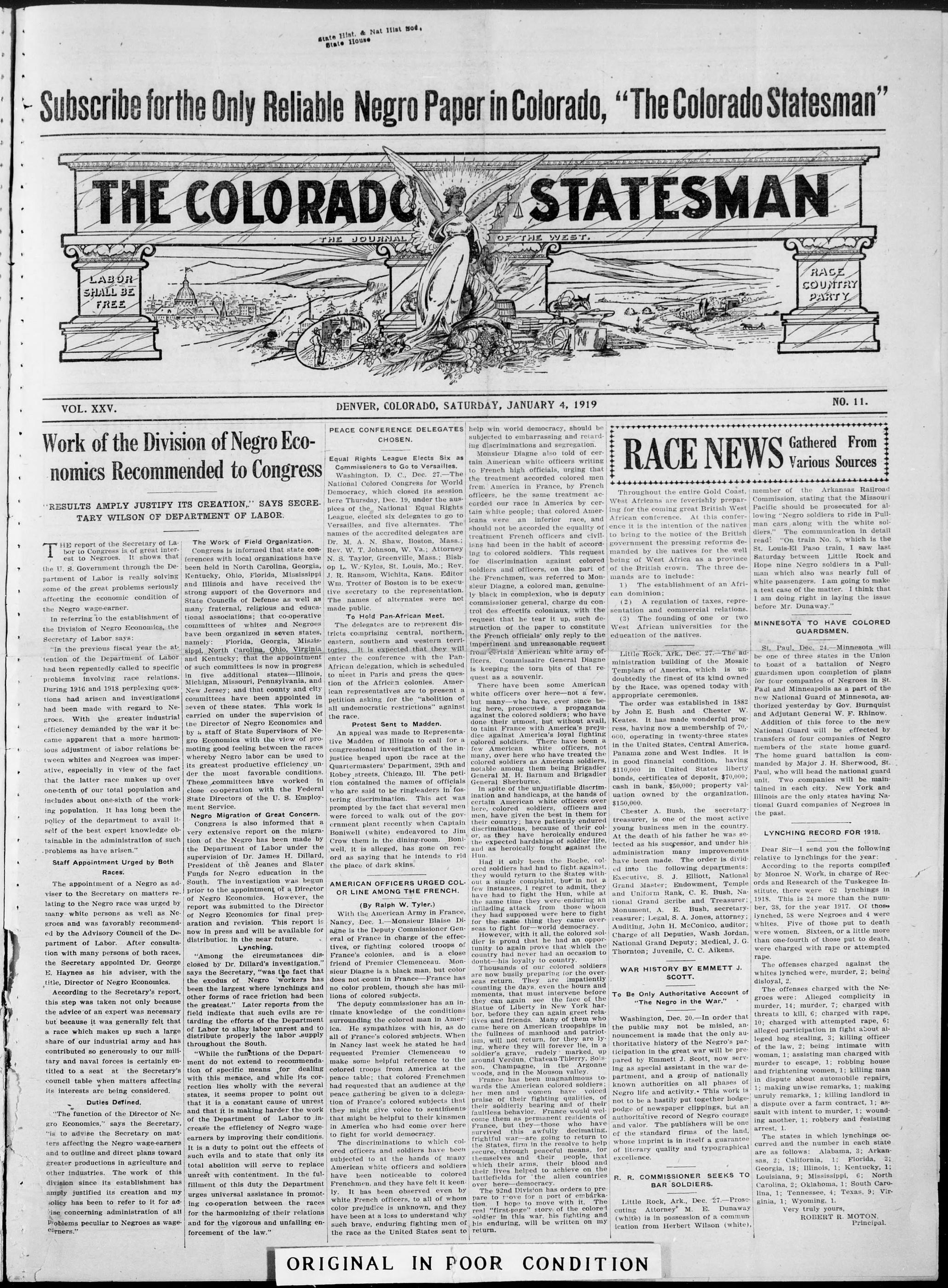
Work of the Division of Negro Economics Recommended to Congress
"RESULTS AMPLY JUSTIFY ITS CREATION," SAYS SECRETARY WILSON OF DEPARTMENT OF LABOR.
VOL. XXV.
Work of the Division economics Recommend
"RESULTS APLY JUSTIFY I TARY WILSON OF DEP
THE report of the Secretary of Labor to Congress is of great interest to Negroes. It shows that the U. S. Government through the Department of Labor is really solving some of the great problems seriously affecting the economic condition of the Negro wage-earner.
In referring to the establishment of the Division of Negro Economics, the Secretary of Labor says:
"In the previous fiscal year the attention of the Department of Labor had been repeatedly called to specific problems involving race relations. During 1916 and 1918 perplexing questions had arisen and investigations had been made with regard to Negroes. With the greater industrial efficiency demanded by the war it became apparent that a more harmonious adjustment of labor relations between whites and Negroes was imperative, especially in view of the fact that the latter race makes up over one-tenth of our total population and includes about one-sixth of the working population. It has long been the policy of the department to avail itself of the best expert knowledge obtainable in the administration of such problems as have arisen."
Staff Appointment Urged by Both Races.
The appointment of a Negro as adviser to the Secretary on matters relating to the Negro race was urged by many white persons as well as Negroes and was favorably recommended by the Advisory Council of the Department of Labor. After consultation with many persons of both races, the Secretary appointed Dr. George E. Haynes as his adviser, with the title, Director of Negro Economics. According to the Secretary's report, this step was taken not only because the advice of an expert was necessary but because it was generally felt that a race which makes up such a large share of our industrial army and has contributed so generously to our military and naval forces is certainly entitled to a seat at the Secretary's council table when matters affecting its interests are being considered.
Duties Defined.
"The function of the Director of Negro Economics," says the Secretary, "is to advise the Secretary on matters affecting the Negro wage-earners and to outline and direct plans toward greater productions in agriculture and other industries. The work of this division since its establishment has amply justified its creation and my policy has been to refer to it for advice concerning administration of all Problems peculiar to Negroes as wage-earners."
The Work of Field Organization. Congress is informed that state conferences with local organizations have been held in North Carolina, Georgia, Kentucky, Ohio, Florida, Mississippi and Illinois and have received the strong support of the Governors and State Councils of Defense as well as many fraternal, religious and educational associations; that co-operative committees of whites and Negroes have been organized in seven states, namely: Florida, Georgia, Mississippi, North Carolina, Ohio, Virginia and Kentucky; that the appointment of such committees is now in progress in five additional states—Illinois, Michigan, Missouri, Pennsylvania, and New Jersey; and that county and city committees have been appointed in seven of these states. This work is carried on under the supervision of the Director of Negro Economics and by a staff of State Supervisors of Negro Economics with the view of promoting good feeling between the races whereby Negro labor can be used to its greatest productive efficiency under the most favorable conditions. These committees have worked in close co-operation with the Federal State Directors of the U. S. Employment Service.
Negro Migration of Great Concern. Congress is also informed that a very extensive report on the migration of the Negro has been made by the Department of Labor under the supervision of Dr. James H. Dillard, President of the Jeanes and Slater Funds for Negro education in the South. The investigation was begun prior to the appointment of a Director of Negro Economics. However, the report was submitted to the Director of Negro Economics for final preparation and revision. This report is now in press and will be available for distribution, in the near future.
Lynching.
"Among the circumstances disclosed by Dr. Dillard's investigation," says the Secretary, "was the fact that the exodus of Negro workers has been the largest where lynchings and other forms of race friction had been the greatest." Later reports from the field indicate that such evils are retarding the efforts of the Department of Labor to allay labor unrest and to distribute properly the labor supply throughout the South.
"While the functions of the Department do not extend to recommendation of specific means for dealing with this menace, and while its correction lies wholly with the several states, it seems proper to point out that it is a constant cause of unrest and that it is making harder the work of the Department of Labor to increase the efficiency of Negro wage earners by improving their conditions. It is a duty to point out the effects of such evils and to state that only its total abolition will serve to replace unrest with contentment. In the fulfillment of this duty the Department urges universal assistance in promoting co-operation between the races for the harmonizing of their relations and for the vigorous and unfailing enforcement of the law."
DENVER, COLORADO, SATURDAY, JANUARY 4, 1919
State Hist. & Nat Hist Mod.
State House
ble Negro Paper
RADO
THE JOURNAL
DENVER, COLORADO, SATU
PEACE CONFERENCE DELEGATES CHOSEN.
Equal Rights League Elects Six as Commissioners to Go to Versailles
Washington, D. C., Dec. 27.—The National Colored Congress for World Democracy, which closed its session here Thursday, Dec. 19, under the auspices of the National Equal Rights League, elected six delegates to go to Versailles, and five alternates. The names of the accredited delegates are Dr. M. A. N. Shaw, Boston, Mass.; Rev. W. T. Johnson, W. Va.; Attorney N. S. Taylor, Greenville, Mass.; Bishop L. W. Kyles, St. Louis, Mo.; Rev. J. R. Ransom, Wichita, Kans. Editor Wm. Trotter of Boston is to be executive secretary to the representation. The names of alternates were not made public.
To Hold Pan-African Meet.
16 Hold Pan-African Meet
The delegates are to represent districts comprising central, northern, eastern, southern and western territories. It is expected that they will enter the conference with the Pan-African delegation, which is scheduled to meet in Paris and press the question of the African colonies. American representatives are to present a petition asking for the "abolition of all undemocratic restrictions" against the race.
Protest Sent to Madden.
An appeal was made to Representative Madden of Illinois to call for a congressional investigation of the injustice heaped upon the race at the Quartermasters' Department, 39th and Robey streets, Chicago, Ill. The petition contained the names of officials who are said to be ringleaders in fostering discrimination. This act was prompted by the fact that several men were forced to walk out of the government plant recently when Captain Boniwell (white) endeavored to Jim Boniwell, it is alleged, has gone on record as saying that he intends to rid the place of dark skins.
AMERICAN OFFICERS URGED COLOR LINE AMONG THE FRENCH.
(By Ralph W. Tyler.)
With the American Army in France, Nancy, Dec. 1.—Monsieur Blaise Diagne is the Deputy Commissioner General of France in charge of the effects, or righting colored troops of France's colonies, and is a close friend of Premier Clemenceau. Monsieur Diagne is a black man, but color does not count in France—France has no color problem, though she has millions of colored subjects. The deputy commissioner has an intimate knowledge of the conditions surrounding the colored man in America. He sympathizes with his, as do all of France's colored subjects. When in Nancy last week he stated he had requested Premier Clemenceau to make some helpful reference to the colored troops from America at the peace table; that colored Frenchmen had requested that an audience at the peace gathering be given to a delegation of France's colored subjects that they might give voice to sentiments that might be helpful to their kinsmen in America who had come over here to fight for world democracy.
The discriminations to which colored officers and soldiers have been subjected to at the hands of many American white officers and soldiers have been noticeable to colored Frenchmen, and they have felt it keenly. It has been observed even by white French officers, to all of whom color prejudice is unknown, and they have been at a loss to understand why such brave, enduring fighting men of the race as the United States sent to
help win world democracy, should be subjected to embarrassing and retarding discriminations and segregation. Monsieur Diagne also told of certain American white officers writing to French high officials, urging that the treatment accorded colored men from America in France, by French officers, be the same treatment accorded our race in America by certain white people; that colored Americans were an inferior race, and should not be accorded the equality of treatment French officers and civilians had been in the habit of according to colored soldiers. This request for discrimination against colored soldiers and officers, on the part of the Frenchmen, was referred to Monsieur Diagne, a colored man, genuinely black in complexion, who is deputy commissioner general, charge du control des effectifs coloniaux, with the request that he tear it up, such destruction of the paper to constitute the French officials' only reply to the impertinent and unreasonable request from certain American white officers. Commissaire General Diagne is keeping the torn bits of that request as a souvenir.
There have been some American white officers over here—not a few, but many—who have, ever since being here, prosecuted a propaganda against the colored soldiers; who have done their utmost, but without avail, to taint France with America's prejudice against America's loyal fighting colored soldiers. There have been a few American white officers, not many, over here who have treated the colored soldiers as American soldiers, notable among them being Brigadier General M. H. Barnum and Brigadier General Sherburne.
In spite of the unjustifiable discrimination and handicaps, at the hands of certain American white officers over here, colored soldiers, officers and men, have given the best in them for their country; have patiently endured discriminations, because of their color, as they have heroically endured the expected hardships of soldier life, and as heroically fought against the Hun.
Had it only been the Boche, colored soldiers had had to fight against, they would return to the States without a single complaint, but in not a few instances, I regret to admit, they have had to fight the Hun, while at the same time they were enduring an infilading attack from those whom they had supposed were here to fight for the same thing they came overseas to fight for—world democracy.
However, with it all, the colored soldier is proud that he had an opportunity to again prove that which the country had never had an occasion to doubt—his loyalty to country.
Thousands of our colored soldiers are now busily preparing for the overseas return. They are impatiently counting the days, even the hours and moments, that must intervene before they can again see the face of the Statue of Liberty in New York harbor, before they can again greet relatives and friends. Many of them who came here on American troopships in the fullness of manhood and patriotism, will not return, for they are lying, where they will forever lie, in a soldier's grave, rudely marked, up around Verdon, Chateau-Thierry, Solson, Champagne, in the Argonne woods, and in the Mousson valley. France has been magnanimous towards the American colored soldiers; her men and women have voiced praise of their fighting qualities, of their soldierly bearing and of their faultless behavior. France would welcome them as permanent residents of France, but they—those who have survived this awfully decimating, frightful war—are going to return to the States, firm in the resolve to help secure, through peaceful means, for themselves and their people, that which their arms, their blood and their lives helped to achieve on the battlefields for the alien countries over here—democracy.
The 92nd Division has orders to prepare to move for a port of embarkation. I hope to move with it. The real "first-page" story of the colored soldier in this war, his fighting and his enduring, will be written on my return.
RACE NEWS Gathered From Various Sources
Throughout the entire Gold Coast, West Africans are feverishly preparing for the coming great British West African conference. At this conference it is the intention of the natives to bring to the notice of the British government the pressing reforms demanded by the natives for the well being of West Africa as a province of the British crown. The three demands are to include:
1) The establishment of an African dominion;
2) A regulation of taxes, representation and commercial relations.
3) The founding of one or two West African universities for the education of the natives.
Little Rock, Ark., Dec. 27.—The administration building of the Mosaic Templars of America, which is undoubtedly the finest of its kind owned by the Race, was opened today with appropriate ceremonies.
The order was established in 1882 by John E. Bush and Chester W. Keates. It has made wonderful progress, having now a membership of 70,000, operating in twenty-three states in the United States, Central America, Panama zone and West Indies. It is in good financial condition, having $110,000 in United States liberty bonds, certificates of deposit, $70,000; cash in bank, $50,000; property valuation owned by the organization, $150,000.
Chester A. Bush, the secretary treasurer, is one of the most active young business men in the country. At the death of his father he was selected as his successor, and under his administration many improvements have been made. The order is divided into the following departments: Executive, S. J. Elliott, National Grand Master; Endowment, Temple and Uniform Rank, C. E. Bush, National Grand Scribe and Treasurer; Monument, A. E. Bush, secretary treasurer; Legal, S. A. Jones, attorney; Auditing, John H. McConico, auditor; Charge of all Deputies, Wash Jordan, National Grand Deputy; Medical, J. G. Thornton; Juvenile, C. C. Aikens,
WAR HISTORY BY EMMETT J.
SCOTT.
To Be Only Authoritative Account of "The Negro in the War."
Washington, Dec. 20.—In order that the public may not be misled, announcement is made that the only authoritative history of the Negro's participation in the great war will be prepared by Emmett J. Scott, now serving as special assistant in the war department, and a group of nationally known authorities on all phases of Negro life and activity. This work is not to be a hastily put together hodgepodge of newspaper clippings, but an authoritative record of Negro courage and valor. The publishers will be one of the standard firms of the land whose imprint is in itself a guarantee of literary quality and typographical excellence.
R. R. COMMISSIONER SEEKS TO BAR SOLDIERS.
Little Rock, Ark., Dec. 27.—Prosecuting Attorney $ ^{*} $ M. E. Dunaway (white) is in possession of a communication from Herbert Wilson (white),
NO.11.
member of the Arkansas Railroad Commission, stating that the Missouri Pacific should be prosecuted for allowing "Negro soldiers to ride in Pullman cars along with the white soldiers." The communication in detail read: "On train No. 5, which is the St. Louis-El Paso train, I saw last Saturday between Little Rock and Hope nine Negro soldiers in a Pullman which also was nearly full of white passengers. I am going to make a test case of the matter. I think that I am doing right in laying the issue before Mr. Dunaway."
MINNESOTA TO HAVE COLORED
GUARDSMEN.
St. Paul, Dec. 24. Minnesota will be one of three states in the Union to boast of a battalion of Negro guardsmen upon completion of plans for four companies of Negroes in St. Paul and Minneapolis as a part of the new National Guard of Minnesota, authorized yesterday by Gov. Burnquist and Adjutant General W. F. Rhinow. Addition of this force to the new National Guard will be effected by transfers of four companies of Negro members of the state home guard. The home guard battalion is commanded by Major J. H. Sherwood, St. Paul, who will head the national guard unit. Two companies will be maintained in each city. New York and Illinois are the only states having National Guard companies of Negroes in the past.
LYNCHING RECORD FOR 1918.
Dear Sir—I send you the following relative to lynchings for the year:
According to the reports compiled by Monroe N. Work, in charge of Records and Research of the Tuskegee Institute, there were 62 lynchings in 1918. This is 24 more than the number, 38, for the year 1917. Of those lynched, 58 were Negroes and 4 were whites. Five of those put to death were women. Sixteen, or a little more than one-fourth of those put to death, were charged with rape or attempted rape.
The offenses charged against the whites lynched were, murder, 2; being dislolov. 2
The offenses charged with the Negroes were: Alleged complicity in murder, 14; murder, 7; charged with threats to kill, 6; charged with rape, 10; charged with attempted rape, 6; alleged participation in fight about alleged hog stealing, 3; killing officer of the law, 2; being intimate with woman, 1; assisting man charged with murder to escape, 1; robbing house and frightening women, 1; killing man in dispute about automobile repairs, 1; making unwise remarks, 1; making unruly remarks, 1; killing landlord in a dispute over a farm contract, 1; assault with intent to murder, 1; wounding another, 1; robbery and resisting arrest, 1.
The states in which lynchings occurred and the number in each state are as follows: Alabama, 3; Arkansas, 2; California, 1; Florida, 2; Georgia, 18; Illinois, 1; Kentucky, 1; Louisiana, 9; Mississippi, 6; North Carolina, 2; Oklahoma, 1; South Carolina, 1; Tennessee, 4; Texas, 9; Virginia, 1; Wyoming, 1.
Very truly yours,
ROBERT R. MOTON.
Principal.
SOS. D. D. RIVERS.....Proprietor
1824 Curtis Street, Room 25.
P. O. Box 116 Phone Main 7417
SUBSCRIPTION RATES.
One Year ..... $2.00
Six Months ..... 1.25
Three Months ..... 75
Entered as second-class matter at the postoffice in the City of Denver, Colo.
Remittances should be made by Express Money Order, Postoffice Money Order, Registered Letter or Bank Draft. Postage stamps will be received the same as cash for the fractional part of a dollar. Only 1c and 2c stamps taken.
Reading notices, ten lines or less, 15 cents per line. Each additional line over ten lines, 10 cents per line. Display advertising 50c per inch.
No discounts allowed on less than three months' contract. Cash must accompany all orders from parties unknown to us. Further particulars on application.
Communications to receive attention must be newsy, upon important subjects, plainly written only upon one side of the paper, must reach us Tuesdays, if possible, anyway not later than Wednesdays, and bear the signature of the author. No manuscript returned, unless stamps are sent for postage. All communications of a personating nature that are not complimentary will be withheld from the columns of this paper.
We are now in the initial stage of 1919. Our resolutions made on the first day of January, if adhered to, will bring about a successful issue. If in previous years we have tried and not succeeded, LET US TRY AGAIN. The resolution for this year must be the doctrine of the one aim, the one purpose, the one cause. Leaders of the WHITE RACE are strongly advocating EDUCATION AMONG THE MASSES OF THEIR OWN. Let us truly ourselves to this most powerful and influential agent before whom all prejudice, racial discrimination, mob-rule and lawlessness must vanish, then enthroned majestically, environed by JUSTICE, LOVE and TRUTH, man being made to admit the fact of one common brotherhood, will reach the tenth of his power, and the very inhabitants of the heavens will sound and resound with joy at the accomplishments and achievement of God's highest creation. THE COLORADO STATESMAN wishes all A HAPPY, CHEERFUL merchant marine longer end at the of twenty-five mil ships with modern over the globe, and We will carry road rates—the cargo liners will be Africa, Australia. We must all ships home to the manufacturer more accessible as those carrying his wheeled new world market countries when he British police British empire. the fibers, the creed Bull may supply prosperity of Britain their trade and
THE progress of the world indicates that contentment is one of the greatest afflictions that can beset mankind. If contentment were an asset that could never be disturbed this assertion might not be regarded as true, but as progress brings power and power ever seeks its own increase, a contented people, and therefore a non-progressive people, is sure, in time, to become the prey and the serf of the restless elements of humanity. That dis-
THE COLORADO STATESMAN
CAPITOL SHALL BE FREE
HALE COURTIN PANTRY
MUST BE PAID IN ADVANCE.
Entered as second-class matter at the postoffice in the City of Denver, Colo.
Remittances should be made by Express Money Order, Postoffice Money Order, Registered Letter or Bank Draft. Postage stamps will be received the same as cash for the fractional part of a dollar. Only 1c and 2c stamps taken.
Reading notices, ten lines or less, 15 cents per line. Each additional line over ten lines, 10 cents per line. Display advertising 50c per inch.
No discounts allowed on less than three months' contract. Cash must accompany all orders from parties unknown to us. Further particulars on application.
Communications to receive attention must be newsy, upon important subjects, plainly written only upon one side of the paper, must reach us Tuesdays, if possible, anyway not later than Wednesdays, and bear the signature of the author. No manuscript returned, unless stamps are sent for postage. All communications of a personating nature that are not complimentary will be withheld from the columns of this paper.
We are now in the initial stage of 1919. Our resolutions made on the first day of January, if adhered to, will bring about a successful issue. If in previous years we have tried and not succeeded, LET US TRY AGAIN. The resolution for this year must be the doctrine of the one aim, the one purpose, the one cause. Leaders of the WHITE RACE are strongly advocating EDUCATION AMONG THE MASSES OF THEIR OWN. Let us ally ourselves to this most powerful and influential agent before whom all prejudice, racial discrimination, mob-rule and lawlessness must vanish, then enthroned majestically, environed by JUSTICE, LOVE and TRUTH, man being made to admit the fact of one common brotherhood, will reach the zenith of his power, and the very inhabitants of the heavens will sound and resound with joy at the accomplishments and achievement of God's highest creation. THE COLORADO STATESMAN wishes all A HAPPY, CHEERFUL
TOO EASILY CONTENTED.
THE progress of the world indicates that contentment is one of the greatest afflictions that can beset mankind. If contentment were an asset that could never be disturbed this assertion might not be regarded as true, but as progress brings power and power ever seeks its own increase, a contented people, and therefore a non-progressive people, is sure, in time, to become the prey and the serf of the restless elements of humanity. That discontent which makes a people strive ceaselessly for greater power is not an attribute of unhappiness, as unhappiness is measured in the minds of men, for the knowledge of increasing power is a greater source of happiness than the knowledge of temporary, but precarious peace and plenty.
The assurance of security and the inherent power of self-protection is the greatest asset of happiness that a people can attain, and this condition of self-sufficiency can only be maintained by ceaseless effort and striving.
The unequalled power of the Caucasian races has grown out of this unremitting effort for self-security and improvement. It has carried them to the nominal mastery of the world, and made all meek and contented races their subjects or their prey. It is asserted in the individual the same as in the collective race, and is reflected in the pride, the self-assumption and the authority over others which the power of their kind makes them to feel to be their heritage and their right. The development of a similar power in other races is the only thing that preserves the autonomy of those races and gives them respect and independent character and standing in the world.
The Negro remains the only great race on earth that is content. In the depth of barbarity there is no ground for censure, but the Negro in civilization is far too easily satisfied. The liberty for which he strives is not of that insatiable character which yearns for self-reliance and independent power. He has not yet caught the spirit of unrest, though of all freemen his lot is the hardest. Individually he is too content with peace and little. Those who direct the activities of this groping race, ought to endeavor to make more and more keen the discontent and unrest which its real progress depends.
A RESOLUTION FOR 1919.
IT has been the custom for many years for the individual to make a resolution on New Year's day and with that goes a determination to carry it out for the year. Some term it "fogyism," others express that the time has come to relegate such traditional roles to the scrap heap, but with all these peculiar notions and oddities we are asking the NEGRO RACE of this American Nation to make A RESOLUTION FOR 1919 and whether we are termed "fogy" or disciples of "oddity," let us make a special effort in the coming year and prove what results from PULLING TOGETHER. Some say that they rarely pick up a newspaper owned or edited by Negroes that they do not see some reference to or of the race, and in their opinion "the less said the better."
We would more than agree with these persons if our experience with the other side did not cover a large area and measure more than half a century; but, with every feeling of fellowship, we ask such persons, when in his history did the white man stop to boost, advertise and conspicuously present his race, his qualifications and everything that helps to impress on the less serious mind his right to domination of the other races and peoples of the world? In every historical period—ancient, mediaeval and up to the modern, we discover a systematic form of advertising the superiority of this race, and whenever those whom they held sovereign power over, gave way to the mocked idea of superiority, the ranks of the former were strengthened, their conceit became unparalleled, and the oppression that followed was almost indescribable. The Negro has existed in every age and has demonstrated his power of receptivity, from his environments in every country of the known world. He has proven himself the mechanic, the scientist, the philosopher, the explorer, the inventor, the musician, and formed every other entity that demands an exercise of mental and physical qualities to prove his fitness to contribute to the progressiveness of the human family in their mastery over the lower creation and their discovery and solution of problems in nature. Why, then, should he in this day be filling the position which makes him a receiver of mercy, charity and a kind of benevolence which comes to him at the will or pleasure of his so termed master? Our answer today is as of yesterday, and will continue to be, unless we resolve to do otherwise—LACK OF UNITY. "We are getting together," says one, "but it takes time." Fully alive to this situation we are, but we can hasten the consummation which means quick relief and a recognition as any other race, and THE COLORADO STATESMAN ASKS: Do the Negroes in Denver, in Colorado, think the time is NOW, and will they make a Resolution to get together in spiritual and temporal activities so that we can present a solid front, impregnable and invincible in making representations for the acceptance of us as full-fledged citizens giving greater evidences of unity in the American Nation by being true and loyal to ourselves and then be caught up in the net of that DEMOCRACY which measures a man, a people, by the ability to perform and not their creative appearance which they do not control.
"Let us then be up and doing, etc," and then will come the BOND of Unity which will harmonize all humanity.
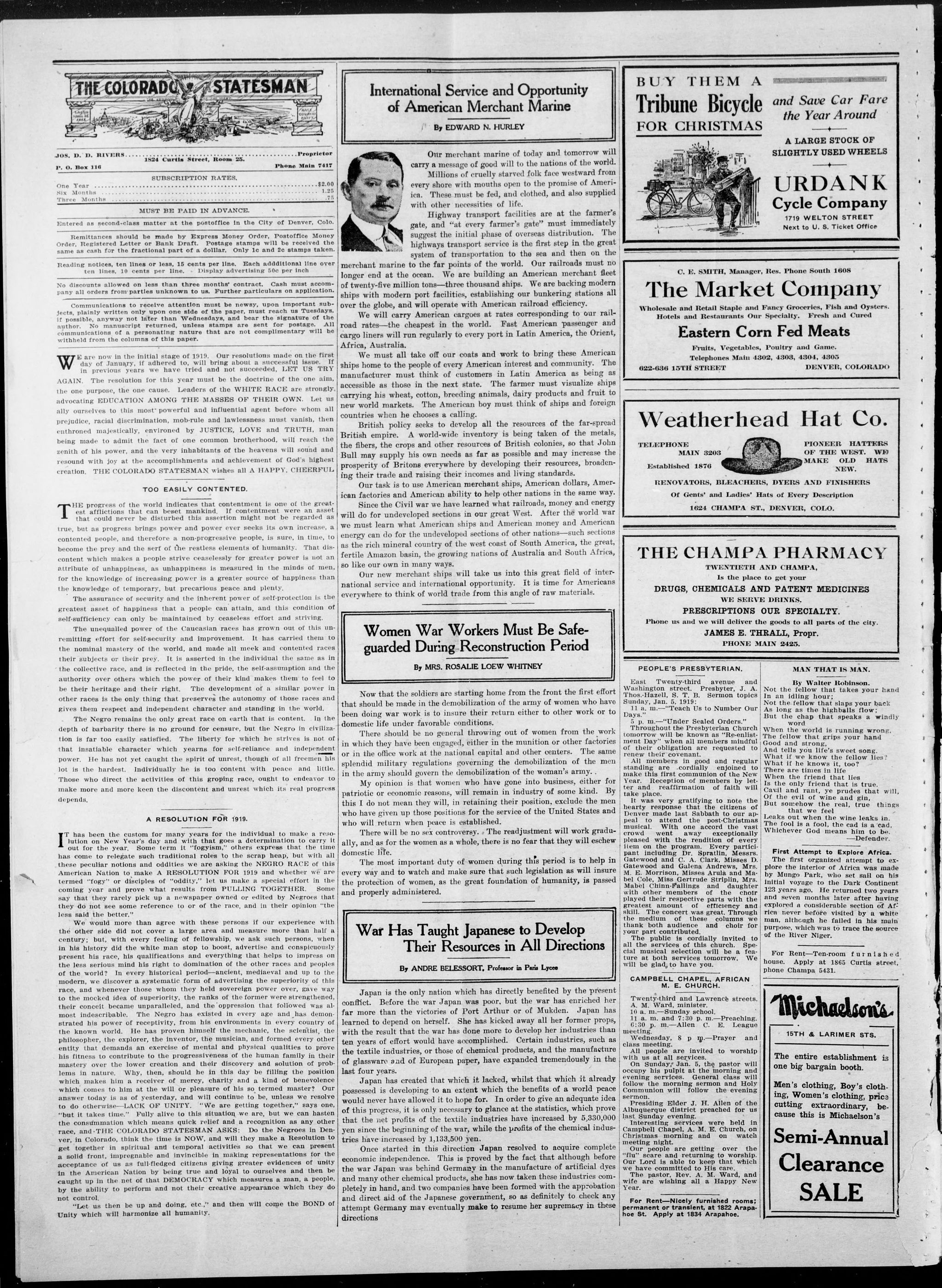
International Service and Opportunity of American Merchant Marine
merchant marine to the far points of the world. Our railroads must no longer end at the ocean. We are building an American merchant fleet twenty-five million tons—three thousand ships. We are backing modern ships with modern port facilities, establishing our bunkering stations all over the globe, and will operate with American railroad efficiency.
We will carry American cargoes at rates corresponding to our rail-rates—the cheapest in the world. Fast American passenger and cargo liners will run regularly to every port in Latin America, the Orient, Africa, Australia.
We must all take off our coats and work to bring these American jobs home to the people of every American interest and community. The manufacturer must think of customers in Latin America as being as possible as those in the next state. The farmer must visualize ships drying his wheat, cotton, breeding animals, dairy products and fruit to new world markets. The American boy must think of ships and foreign entries when he chooses a calling.
British policy seeks to develop all the resources of the far-spread British empire. A world-wide inventory is being taken of the metals, fibers, the crops and other resources of British colonies, so that John may supply his own needs as far as possible and may increase the prosperity of Britons everywhere by developing their resources, broaden their trade and raising their incomes and living standards.
Our task is to use American merchant ships, American dollars, American factories and American ability to help other nations in the same way.
Since the Civil war we have learned what railroads, money and energy do for undeveloped sections in our great West. After the world war we must learn what American ships and American money and American energy can do for the undeveloped sections of other nations—such sections the rich mineral country of the west coast of South America, the great, theile Amazon basin, the growing nations of Australia and South Africa, like our own in many ways.
Our new merchant ships will take us into this great field of international service and international opportunity. It is time for Americans anywhere to think of world trade from this angle of raw materials.
merchant marine to the far points of the world. Our railroads must no longer end at the ocean. We are building an American merchant fleet of twenty-five million tons—three thousand ships. We are backing modern ships with modern port facilities, establishing our bunkering stations all over the globe, and will operate with American railroad efficiency.
We will carry American cargoes at rates corresponding to our railroad rates—the cheapest in the world. Fast American passenger and cargo liners will run regularly to every port in Latin America, the Orient, Africa, Australia.
We must all take off our coats and work to bring these American ships home to the people of every American interest and community. The manufacturer must think of customers in Latin America as being as accessible as those in the next state. The farmer must visualize ships carrying his wheat, cotton, breeding animals, dairy products and fruit to new world markets. The American boy must think of ships and foreign countries when he chooses a calling.
British policy seeks to develop all the resources of the far-spread British empire. A world-wide inventory is being taken of the metals, the fibers, the crops and other resources of British colonies, so that John Bull may supply his own needs as far as possible and may increase the prosperity of Britons everywhere by developing their resources, broadening their trade and raising their incomes and living standards.
Our task is to use American merchant ships, American dollars, American factories and American ability to help other nations in the same way.
Since the Civil war we have learned what railroads, money and energy will do for undeveloped sections in our great West. After the world war we must learn what American ships and American money and American energy can do for the undeveloped sections of other nations—such sections as the rich mineral country of the west coast of South America, the great, fertile Amazon basin, the growing nations of Australia and South Africa, so like our own in many ways.
Our new merchant ships will take us into this great field of international service and international opportunity. It is time for Americans everywhere to think of world trade from this angle of raw materials.
Women War Workers Must Be Safeguarded During Reconstruction Period
Now that the soldiers are starting home from the front the first effort it should be made in the demobilization of the army of women who have been doing war work is to insure their return either to other work or to domestic life under favorable conditions.
There should be no general throwing out of women from the work which they have been engaged, either in the munition or other factories in the office work at the national capital and other centers. The same candid military regulations governing the demobilization of the men the army should govern the demobilization of the woman's army.
My opinion is that women who have gone into business, either for patriotic or economic reasons, will remain in industry of some kind. By as I do not mean they will, in retaining their position, exclude the men who have given up those positions for the service of the United States and who will return when peace is established.
There will be no sex controversy. The readjustment will work gradually, and as for the women as a whole, there is no fear that they will eschew domestic life.
The most important duty of women during this period is to help in every way and to watch and make sure that such legislation as will insure the protection of women, as the great foundation of humanity, is passed and properly administered.
Now that the soldiers are starting home from the front the first effort that should be made in the demobilization of the army of women who have been doing war work is to insure their return either to other work or to domestic life under favorable conditions.
There should be no general throwing out of women from the work in which they have been engaged, either in the munition or other factories or in the office work at the national capital and other centers. The same splendid military regulations governing the demobilization of the men in the army should govern the demobilization of the woman's army.
My opinion is that women who have gone into business, either for patriotic or economic reasons, will remain in industry of some kind. By this I do not mean they will, in retaining their position, exclude the men who have given up those positions for the service of the United States and who will return when peace is established.
There will be no sex controversy. The readjustment will work gradually, and as for the women as a whole, there is no fear that they will eschew domestic life.
The most important duty of women during this period is to help in every way and to watch and make sure that such legislation as will insure the protection of women, as the great foundation of humanity, is passed and properly administered.
War Has Taught Japanese to Develop Their Resources in All Directions
War Has Taught Japanese to Develop Their Resources in All Directions
Japan is the only nation which has directly benefited by the present conflict. Before the war Japan was poor, but the war has enriched her more than the victories of Port Arthur or of Mukden. Japan has learned to depend on herself. She has kicked away all her former props, in the result that the war has done more to develop her industries than years of effort would have accomplished. Certain industries, such as textile industries, or those of chemical products, and the manufacture glassware and of European paper, have expanded tremendously in the last four years. Japan has created that which it lacked, whilst that which it already assessed is developing to an extent which the benefits of a world peace would never have allowed it to hope for. In order to give an adequate idea
Japan is the only nation which has directly benefited by the present conflict. Before the war Japan was poor, but the war has enriched her far more than the victories of Port Arthur or of Mukden. Japan has learned to depend on herself. She has kicked away all her former props, with the result that the war has done more to develop her industries than ten years of effort would have accomplished. Certain industries, such as the textile industries, or those of chemical products, and the manufacture of glassware and of European paper, have expanded tremendously in the last four years.
Japan has created that which it lacked, whilst that which it already possessed is developing to an extent which the benefits of a world peace would never have allowed it to hope for. In order to give an adequate idea of this progress, it is only necessary to glance at the statistics, which prove that the net profits of the textile industries have increased by 5,330,000 yen since the beginning of the war, while the profits of the chemical industries have increased by 1,133,500 yen.
Once started in this direction Japan resolved to acquire complete economic independence. This is proved by the fact that although before the war Japan was behind Germany in the manufacture of artificial dyes and many other chemical products, she has now taken these industries completely in hand, and two companies have been formed with the approbation and direct aid of the Japanese government, so as definitely to check any attempt Germany may eventually make to resume her supremacy in these directions
PETER H. BURGESS
By EDWARD N. HURLEY
Our merchant marine of today and tomorrow will carry a message of good will to the nations of the world. Millions of cruelly starved folk face westward from every shore with mouths open to the promise of America. These must be fed, and clothed, and also supplied with other necessities of life. Highway transport facilities are at the farmer's gate, and "at every farmer's gate" must immediately suggest the initial phase of overseas distribution. The highways transport service is the first step in the great system of transportation to the sea and then on the
By MRS. ROSALIE LOEW WHITNEY
By ANDRE BELESSORT, Professor in Paris Lycee
BUY THEM A Tribune Bicycle FOR CHRISTMAS
C. E. SMITH, Manager, Res. Phone South 1608 The Market Company Wholesale and Retail Staple and Fancy Groceries, Fish and Oysters. Hotels and Restaurants Our Specialty. Fresh and Cured
Fruits, Vegetables, Poultry and Game.
Telephones Main 4302, 4303, 4304, 4305
622-636 15TH STREET DENVER, COLORADO
Weatherhead Hat Co.
Weatherhead Hat Co.
TELEPHONE
MAIN 3203
Established 1876
RENOVATORS, BLEACHERS
Of Gents' and Ladies' H
1624 CHAMPA ST.
```markdown
```
THE CHAMPA PHARMACY
TWENTIETH AND CHAMPA,
Is the place to get your
DRUGS, CHEMICALS AND PATENT MEDICINES
WE SERVE DRINKS.
PRESCRIPTIONS OUR SPECIALTY.
Phone us and we will deliver the goods to all parts of the city.
JAMES E. THRALL, Propr.
PHONE MAIN 2425.
PEOPLE'S PRESBYTERIAN.
East Twenty-third avenue and Washington street. Presbyter, J. A. Thos-Hazell, S. T. B. Sermon topics Sunday, Jan. 5, 1919; 11 a. m.—"Teach Us to Number Our Days." 5 p. m.—"Under Sealed Orders." Throughout the Presbyterian Church tomorrow will be known as "Re-enlistment Day" when all members mindful of their obligation are requested to renew their covenant. All members in good and regular standing are cordially enjoined to make this first communion of the New Year. Reception of members by letter and reaffirmation of faith will take place.
It was very gratifying to note the hearty response that the citizens of Denver made last Sabbath to our appeal to attend the post-Christmas musical. With one accord the vast crowd went away exceptionally pleased with the rendition of every item on the program. Every participant including Dr. Spratlin, Messrs. Gatewood and C. A. Clark, Miss D. Gatewood and Galena Andrews, Mrs. M. E. Morrison, Misses Arula and Mabel Cole, Miss Gertrude Striplin, Mrs. Mabel Chinn-Fallings and daughter with other members of the choir played their respective parts with the greatest amount of efficiency and skill. The concert was great. Through the medium of these columns we thank both audience and choir for your part contributed.
The public is cordially invited to all the services of this church. Special musical selection will be a feature at both services tomorrow. We will be glad to have you.
CAMPBELL CHAPEL, AFRICAN
M. E. CHURCH.
Twenty-third and Lawrence streets,
A. M. Ward, minister.
10 a. m.—Sunday school.
11 a. m. and 7:30 p. m.—Preaching.
6:30 p. m.—Allen C. E. League
meeting.
Wednesday, 8 p. m.—Prayer and
class meeting.
All people are invited to worship with us at all services.
On Sunday, Jan. 5, the pastor will occupy his pulpit at the morning and evening services. General class will follow the morning sermon and Holy Communion will follow the evening sermon.
Presiding Elder J. H. Allen of the Albuquerque district preached for us last Sunday evening.
Interesting services were held in Campbell Chapel, A. M. E. Church, on Christmas morning and on watch meeting night.
Our people are getting over the "flu" scare and returning to worship. Our Lord is able to keep that which we have committed to His care.
The pastor, Rev. A. M. Ward, and wife are wishing all a Happy New Year.
For Rent—Nicely furnished rooms; permanent or transient, at 1822 Arapahoe St. Apply at 1834 Arapahoe.
---
and Save Car Fare the Year Around
A LARGE STOCK OF
SLIGHTLY USED WHEELS
URDANK
Cycle Company
1719 WELTON STREET
Next to U. S. Ticket Office
---
S, DYERS AND FINISHERS
Mats of Every Description
., DENVER, COLO.
By Walter Robinson.
Not the fellow that takes your hand
In an idling hour;
Not the fellow that slaps your back
As long as the highballs flow;
But the chap that speaks a windy
word
When the world is running wrong.
The fellow that grips your hand
Good and strong,
And tells you life's sweet song.
What if we know the fellow lies?
What if he knows it, too?
There are times in life
When the friend that lies
Is the only friend that is true.
Cavil and rant, ye prudes that will,
Of the evil of wine and gin.
But somehow the real, true things
that we feel
Leaks out when the wine leaks in.
The fool is a fool, the cad is a cad.
Whichever God means him to be.
—Defender
First Attempt to Explore Africa.
First Attempt to Explore Africa.
The first organized attempt to explore the interior of Africa was made by Mungo Park, who set sail on his initial voyage to the Dark Continent 123 years ago. He returned two years and seven months later after having explored a considerable section of Africa never before visited by a white man, although he failed in his main purpose, which was to trace the source of the River Niger.
For Rent—Ten-room furnished house. Apply at 1865 Curtis street, phone Champa 5431.
Michaelson's
15TH & LARIMER STS.
The entire establishment is one big bargain booth.
Men's clothing, Boy's clothing, Women's clothing, price cutting extraordinary, because this is Michaelson's
Semi-Annual
Clearance
SALE
1
PIONEER HATTERS
OF THE WEST. WE
MAKE OLD HATS
NEW.
MAN THAT IS MAN.
THE COLORADO STATESMAN
The Colorado Statesman extends best wishes to its patrons, well-wishers and other members of the public for a happy and prosperous year.
Mrs. M. L. Sparks, who has been critically ill for some weeks, is now able to be out.
in Texas points for nearly six weeks returned last Monday, reporting health of her sick parents very much improved. When asked about general conditions for our people in the soil she replied, "that at least men are preparing themselves to ticipate in the universal democracie our new American propaganda."
Mrs. H. Morris of 2358 Tremont place is numbered among the sick this week.
Mrs. Robt. Russ and daughter, Frances, of 2612 South Logan are numbered among the sick. We wish them a speedy recovery.
Miss Pauline Haywood of Charlotte, N. C., arrived in the city to be at the bedside of her sister, Mrs. Sparks, during her serious illness.
Mrs. E. Williams, the renowned hair dresser of 2248 Clarkson street, left last Sunday for Oklahoma and Texas in the interest of her business.
Mr. and Mrs. Joseph Taylor of Hugo, Colo., and great baby boy William are spending the holiday season with their parents, at 2215 Cleveland place.
Mr. and Mrs. Carter of 3525 Williams street had as their guest for 6 o'clock dinner Sunday Mesdames Sparks, Phoenix and Miss Pauline Haywood of Charlotte, N. C.
Miss Ruth Jones, of the "Denver Star" composing staff, continues ill, undergoing an operation a few days ago. We join her many friends in offering our sympathy and hope she will soon recover.
Mr. and Mrs. Winston of Salt Lake City arrived in the city last Sunday evening and are the guests of Mrs. Castry, Twenty-eighth and Welton streets.
W. A. Dollison, clerk of the District Court and chairman of the Republican County Central Committee, returned to the city this week and is confined to bed. We wish him a speedy restoration to health.
Mrs. Matt Murray of 3931 Humboldt was hostess to a delightful turkey menu Christmas. Mrs. Minnie Sparks of Denver and sister, Miss Pauline Haywood of Charlotte, N. C., were guests of honor.
Sam Smith, reliable employe of the Colorado Fuel & Iron Company for nearly forty years, is reported to be sriously ill at his residence, Twenty-ninth street and Glenarm place. His many friends wish him a speedy recovery.
Sylvester Stewart and wife are in town for the holiday season. Mr. and Mrs. Stewart speak in glowing terms of Casper, Wyo., where the former is in business and they feel that quite an advantage presents itself for a real business man.
Mrs. C. H. Winters returned last Sunday from Chicago after a three months' visit. She reports that business is flourishing for our people and that her son, Sam Winters, and other Denver boys are still quarantined on account of the prevailing disease.
Mr. and Mrs. Samuel Alexander entertained at their residence, 517 Twenty-fourth street, thirty-five friends at a five-course Christmas dinner, which proved to be one of the grandest successes of the season. The home was beautifully decorated in red and green. Mr. and Mrs. Alexander received some very elaborate and useful presents.
M. W. Ashbie Hawkins, a prominent attorney of Baltimore, Md., and president of the Baltimore branch of the N. A. A. C. P., will preach at Shorter Chapel, Sunday afternoon, Jan. 12, at 13 p. m. A cordial invitation is extended to the general public.
Jacob Warren, father of William Warren, our popular townsman, arrived in the city last week on a visit to his son. Mr. Warren while nearing the four-score landmark looks a picture of good health and every possibility points to a few additional years. Mrs. Warren, who is here for sometime, welcomes his arrival.
Mrs. Burl Moore, who was visiting
in Texas points for nearly six weeks, returned last Monday, reporting the health of her sick parents very much improved. When asked about general conditions for our people in the southland she replied, "that at least our men are preparing themselves to participate in the universal democracy—our new American propaganda."
NEW REPUBLICAN WEEKLY IS TO
APPEAR SATURDAY.
Saturday will mark the initial appearance of another weekly newspaper in Denver. It will be known as the Colorado State Republican, and will be published by W. C. Blair, one of the best known of Colorado's state editors. Mr. Blair is publisher of the Lake City Silver World, which he will continue to edit. He was deputy insurance commissioner under E. E. Rittenhouse, and for several years was secretary of the Republican state central committee.
PIONEER CHRISTIAN AND SOCIAL WORKER PASSES AWAY.
Miss Laura Sherhorn, known to Denverites as a woman of Christian and social virtues, known in the houses of Denver citizens as a consoler and helper, especially in the time of domestic troubles, faithful to her trust and a standard bearer of things religious, popular in club circles and the care of the orphans, died suddenly last Tuesday evening. She will be greatly missed for her good works which were accomplished without any pomp or vanity and The Colorado Statesman joins her large circle of friends, acquaintances and recipients of her charity, in heartfelt sympathy over her demise. Peace be to her soul.
WILLIAM HILL, DENVER RESIDENT OF SEVERAL YEARS,
OBEYS THE LAST SUMMONS.
Death — the imperative summons which all mankind must obey—again invaded the ranks of our community and snatched from us William Hill, a Denverite of many, many years, who established a good reputation and whose departure into the Great Unknown leaves an aching void in the hearts of many citizens who were his friends and staunch supporters. One of the foundation members of the "People's Sunday Alliance," an ardent Y. M. C. A. booster, he was never found wanting at the post of duty, and his consistency in trying to do the best he could for whoever he came in contact with will cause a high estimate to be placed upon his memory and the beauty of his lifetime. Suffering for nearly two months with what he thought an abscess in his ear, and even though he was under the skilful care of specialists, the result was paralysis of the brain, and he breathed his last in the early morning of last Sunday, Dec. 29. in obedience to the will of His Maker. Mr. Hill was a man of large mental resources and had to his credit inventions which unfortunately were not patented. He has a number of children, all grown up and heads of families, and to them and his grief-stricken and deeply sorrowing widow. The Colorado Statesman extends its deepest sympathy. Funeral services will be held at Zion Baptist Church, Twenty-fourth avenue and Ogden street, at 1:30 o'clock today, when a host of friends and relatives will have an opportunity to pay their last respects. "He is not dead; he sleepeth." PEACE BE TO HIS SOUL.
DEATHS AND FUNERAL NOTICES
IRVING—Mrs. Lizzie Irving departed this life Dec. 24 at her residence, 2818 Glenarm place. Services were held Sunday at 2 p. m., Dec. 29, from Central Baptist church. Rev. P. J. Price officiated. Interment, Riverside.
GOODLOW—Mr. Sanders Goodlow departed this life at a local hospital, Dec. 19. Services were held Tuesday, Dec. 31, from Cammel & Co. parlors, 2 p. m. Rev. A. M. Ward officiated. Interment, Riverside.
MAY—Infant of Mr. and Mrs. C. W. T. May departed this life Dec. 29 at the residence. 2327 Lafavette street. Services were held Tuesday from Cammel & Co. parlors at 2 p. m. Rev. A. M. Ward officiated. Interment, Riverside.
HILL—Mr. J. W. Hill, one of Denver's pioneers, departed this life Dec. 29 at his residence. 1100 Rosemary street. Services will be held Saturday, Jan. 4, at 1:30 p. m. from Zion Baptist church, Rev. D. E. Over officiating, Interment, Fairmount. Curtis M. Harris, funeral director.
Day and Night Phone Main 2701.
DR. C. E. TERRY,
PHYSICIAN AND SURGEON
Office Hours: 12 to 2 p. m., 6 to 8 p. m.,
and appointment.
1027 21st St., Denver, Colo.
THE KITCHEN CABINET
To market, to market, to buy a fresh fish!
Serve it for dinner as Hoover would wish!
To market, to market, to purchase some beans!
Bake 'em and learn what economy means.
USE HONEY, SAVE SUGAR.
The keeping of bees is becoming a greater money-maker for both men
and women. The late sugar shortage brought many to realize the value of a good working bee hive. Men who are busy in offices all day find the care
and women late sugar shortage brought many to realize the value of a good working bee hive. Men who are busy in offices all day find the care of bees both healthful and interesting, keeping them out-doors and affording some recreation.
Honey is an unknown sweet to many of our families, due to the scarcity and often the price. Honey is equal in sweetness to sugar and may be used as a substitute. In using honey the liquid in any recipe is reduced one-quarter of a cup. Honey contains protein and some soluble minerals which are invaluable in rebuilding the broken-down tissues of the body. It is a good substitute for fats, which are scarce, high-priced and hence precious, and may be used on cereals and breakfast foods in place of sugar and cream.
Brown Bread With Honey—Beat one egg and stir into one-half cupful of honey and one cupful of sour milk. Sift together one-half cupful of flour, one teaspoonful of baking powder, one-half teaspoonful of soda and a teaspoonful of salt; add one and one-half cupfuls of cornmeal and a cupful of raisins, which should be steamed before adding; mix and steam in molds three hours. Serve hot or cold.
Fruit Pudding.—Take one-half cupful each of grated raw potatoes, carrots, chopped suet, raisins, honey, currants, one tablespoonful of grated orange peel, one-eighth of a teaspoonful of soda, one-half teaspoonful of salt, one-quarter of a teaspoonful of cloves, a half teaspoonful of cinnamon and one cupful of flour. Mix and sift the dry ingredients, adding more flour if needed to make batter stiff as for fruit cake. Oil a mold and pour the mixture into it, leaving space for expansion. Steam four hours.
Honey Sauce.—Boll together for 15 minutes one cupful of honey, one-quarter of a cupful of water, one tablespoonful of sweet fat, a pinch of salt, one-quarter of a teaspoonful each of nutmeg and cinnamon, the juice of one lemon and one orange, one-quarter of a cup of raisins. Serve hot for dessert on hot mug or boiled rice.
Italian Honey Candy.—Take one cupful of sirup, four tablespoonfuls of honey, one teaspoonful of vinegar or lemon juice. Boll until brittle when dropped in cold water. Pull while still warm.
The world is mine oyster, which I with sword will open.
DISHES SWEET AND OTHERWISE.
The season for small cakes and candies is here and with the desire to
I with the desire to conserve as much sugar as possible we will be glad to use the various slurps for sweetening.
BREAD
Coconut Sweets.
—Take a pound package of coconut and a pound can of Eagle condensed milk. Mix thoroughly and make into small flat cakes, then bake in a slow oven until brown. The reason for numing the brand is because of its consistency; it makes a more satisfactory cake.
Sorghum Brittle.—Take one cupful of sorghum and boll it until brittle in cold water. Just before removing from the heat add one-fourth of a teaspoonful of soda. Turn this over rolled or coarsely chopped peanuts in a shallow greased pan.
Peanut Candy.—Boll together three-fourths of a cupful of corn sirup and one-fourth of a cupful of sorghum until it forms a hard crack in cold water. Stir in one cupful of chopped peanuts and pour into a well-buttered pan. Mark in squares.
Peanut Brittle.—Take one cupful of corn sirup, one teaspoonful of vinegar, one-fourth of a teaspoonful of salt, one teaspoonful of vanilla, one cupful of peanuts. Cook sirup, vinegar and salt until it forms a soft ball when dropped in cold water. Add the peanuts to the sirup and cook in an iron kettle, until the sirup becomes golden brown, stirring all the time to keep from burning. Add vanilla and pour into a shallow pan. Break in pieces when cold.
Honeyed Orange Peel.—Boll the peel of two oranges in water until tender; then drain and remove as much of the white as possible. Cut in narrow strips with scissors. Boll one-half cupful of honey with the peel for five minutes. Pour on a shallow plate to
Hermits.—Cream one cupful of fat, add one and one-half cupfuls of sugar, three eggs, one cupful of minced raisins, one teaspoonful of soda, one-half a nutmeg grated, and a teaspoonful of cinnamon, flour to roll. Cut with a cooky cutter and bake in a quick oven.
Nellie Maxwell
Offers unparalleled price concessions on all lines of Men's and Young Men's Union Label Apparel
Men's and Young Men's Union Label Fancy Winter Suits and Overcoats $35 to $40 Values Sale Price
27
E MAY
THE HOME OF SOCIETY BRAND CLOTH
SON'S FAMOUS JAZZ ORC
$27
THE M
THE HOME OF SOO
MORRISON'S FAMO
MORRISON'S FAMOUS JAZZ ORCHESTRA
AND ENTERTAINERS
GEO. MORRISON, MANAGER
Music Furnished
Phone Main 2707. Res. 2947
Bolden Ba
Music Furnished for all Occasions
n 2707. Res. 2947 Stout St. DENV
olden Barber Sh
Music Furnished for all Occasions
Phone Main 2707. Res. 2947 Stout St. DENVER, COLO.
Bolden Barber Shop
Baths, Electric Massages
R. B. BOLDEN, Proprietor
When Y
The Heads, Feet, Tails, Snow
any other part of the he
EAST'S
When You Wish
Feet, Tails, Snouts, Neckbones or Chin
other part of the hog except the squeal,
EAST'S MARKET
Timber Street Phone
Hair Dressing Pa
AND SANITARY SCALP AND HAIR T
MESSAGING, MANICURING, TOILET ARTIC
When You Want
The Heads, Feet, Tails, Snouts, Neckbones or Chiterlings, or any other part of the hog except the squeal, go to
EAST'S MARKET
2300-6 Larimer Street
Poro Hair Dr
SCIENTIFIC AND SANITARY
MASSAGING, MANICUR
Motto—
Mme. Lexi
2220 OGDEN STREET
Poro Hair Dressing Parlors
SCIENTIFIC AND SANITARY SCALP AND HAIR TREATMENT
MASSAGING, MANICURING, TOILET ARTICLES
Motto—"Efficiency"
Mme. Lexie A. Brooks
2220 OGDEN STREET PHONE YORK 5997W
John K. Rettig
MEATS, FANCY AND
1864 CUR
Corner Nineteenth
ATS, FANCY AND STAPLE GROCERIES
1864 CURTIS STREET
eighteenth 18
MEATS, FANCY AND STAPLE GROCERIES
PHONE MAIN 3023
all Occasions
St. DENVER, COLO.
U Want
backbones or Chiterlings, or
ept the squeal, go to
MARKET
Raising Parlors
AND HAIR TREATMENT.
TOILET ARTICLES
agency"
L. Brooks
PHONE YORK 5997W
RES. PHONE GALLUP 942
APLE GROCERIES
STREET
Denver, Colo.
Phone Main 1461
Sales Daily at 2 p.m. Office Pursuit a Specialty.
PRIVATE SALES AT ALL TIMES
HAVE MOVED TO—
1723-39 GLENARM ST.
PHONE MAIN 1675.
THE BEST ICE CREAM AND CANDIES AT
O.P. BAUR & CO.
CATERERS AND
CONFECTIONERS
Phone: 168
1612 Curtis Street, Denver, Colo.
JOSEPH CARTER
Express, Moving,
and Storage
COAL AND WOOD
PROMPT DELIVERY.
Phone Main 6544.
2415 WA8HINGTON STREET.
ORIENTAL RESTAURANT
Chop Suey, Noodles and Short Orders
Phone Champa 113
1848 Arapahoe
东洋轩
ORIENTAL RESTAURANT Chop Suey, Noodles and Short Orders
Miss M. Cowden Hair Dressing Parlor
Shampoo, cutting and curling. Scalp treatment, hair tonics, hair straightening, manicuring. Stage wigs for rent; theatrical use and masquerades. Goods delivered out of the city. All shades of hair matched by sending sample of hair; also combings made up.
Cheapest Switches 50 Cents
1223 21st St. Denver, Colo.
Phone Champa 3977
Phone Champa 3977
Don't Take It For Granted
that just because you are in business, everybody is aware of the fact. Your goods may be the finest in the market but they will remain on your shelves unless the people are told about them.
ADVERTISE
If you want to move your merchandise. Reach the buyers in their homes through the columns of THIS PAPER and on every dollar expended you'll reap a handsome dividend.
THE Merchants who advertise in this paper will give you best values for your money.
NIGHT AND DAY MERCANTILE CO.
806 15th St. 2 doors from Stout St.
PRICES TALK
Bacon Squares, 1b ..... 203c
Pork Roasts, 1b ..... 273c
Short Cut Stenks, ench ..... 15c
Cuff Brains, dish ..... 10c
Liver, sliced, 1b ..... 10c
Minckerel, reg. 20c val., ench ..... 10c
Troco Butter Substitute, 1b ..... 35c
Fancy Swiss Cheese, 1b ..... 50c
Salt Pork, 1b ..... 25c
Mince Meat, pkg. ..... 10c
Sugar Corn, Peas, Stringg Beans,
Lima Beans, regular 29c value,
16 cans, per
case..... $3.83
k 4561 W. H. PRITCHETTE Mgr. STRIAL REALTY CO. SALES, RENTALS and INVESTMENTS
INDUSTRIAL SALES, RE and INVEST
INDUSTRIAL REALTY CO SALES, RENTALS and INVESTMENTS
STERN BEEF CO.
WESTERN
WESTERN BEEF CO.
WESTERN BEEF CO.
C
Open Daily to 830 p. m.
Sundays Until 2:00 p. m.
, Chitterlings, Pig Tails, Snouts, Ears, Pigs Feet, Neck Bones, Spare Ribs Received Fresh Daily. Fried Meats of All Kinds. Fresh Vegetables, Staple and Fancy Groceries.
Prices Are Always the Lowest
Fresh Oysters, Chitterlings, Pig Tails
Bones, Spare Ribs Reco
Fresh and Cared Meats of All Kinds
Fancy Groc
Our Prices Are Alw
Fresh Oysters, Chitterlings, Pig Tails, Snouts, Ears, Pigs Feet, Neck Bones, Spare Ribs Received Fresh Daily.
Fresh and Cared Meats of All Kinds. Fresh Vegetables, Staple and Fancy Groceries.
Our Prices Are Always the Lowest
Free Delivery to All Parts of the City.
Phone Champa 1641.
ER STREET DEE
Opposite the Three Rules.
Phone Main 6689
Clean Auto Livery
HEATED TAXI CAB.
E.8 AND 7-PASSENGER 1918 LATE
MODEL CARS.
Phone Main
Bean Auto
HEATED TAP
COLE 8 AND 7-PASS
MODEL C
Phone Main 6699
HEATED TAX:CAB.
COLE 8 AND 7-PASSENGEP 1918 LATE
MODEL CARS.
STAND: NIGHT AND DAY CAFE
1865-1867 Curtis St.
Private Booths for Ladies
NIGHT AND DAY CAFE
AND COLD DRINK PARLOR
B. CARRUTH, Proprietor
Phone Champa 5431
NIGHT AND DAY CAFE AND COLD DRINK PARLOR
A Full Line of Fresh Fish In Season Oysters and Lobsters
1865-1867 CURTIS STREET
```markdown
```
The
The
Curtis
Park
Floral
Company
FLORAL DESIGNS PUT UP WHILE
YOU WAIT
CHOICE PLANTS AND CUT FLOWERS CONSTANTLY
ON HAND
GREENHOUSES: Thirty-Fourth and Curtis Streets
TELEPHONE, MAIN 1511
DENVER, COLO
Telephone York 4561
716 East 26 Avenue
Taxicab Rates.
Depot, 1 or 2 pass...50c
Depot, each addi-
tional pass...25c
One mile radius...50c
Each additlon' mile...50c
THISTLE
Phone C. 3018-3073.
Campbell's, Soups, can ..... 10e
Laundry Soaps, 7 bins for ..... 25e
Onions, best grade, 10 lbs ..... 25e
Prunes, reg, 15c grade, 10 lbs ..... 25e
Large cans milk, reg, 20 cans, can ..... 13£
Kuro Syrup, gallon cans, can ..... 8se
Jello, reg, 155 pkg, at ..... 8se
Pancake flour, sour, pkgs, for ..... 22£
Pancake flour, sweet, pkgs, for ..... 5£
Raisins, new stock, pkg ..... 11e
Macaroni, reg, 5e pkg, pkg ..... 5e
Crystal White and Water White
Soap, 10c size, bar.....5c
Pumpkin and Tomatoes, can.....10c
Log Cabin Syrup, can.....20c
W. H. PRITCHETTE Mgr.
DENVER, COLORADO
One of the Most Up-to-Date and Sanitary Markets in the City.
DENVER, COLO.
Mottot: "Not slow but
sure." Cash only.
Rates Per Hour.
$1.50 to $2.50.
Denver, Colorado
DENVER, COLORADO
THE FASHION WEEKLY
Riding Togs for Cool Weather
Copyright
Brownfield
Brownfield
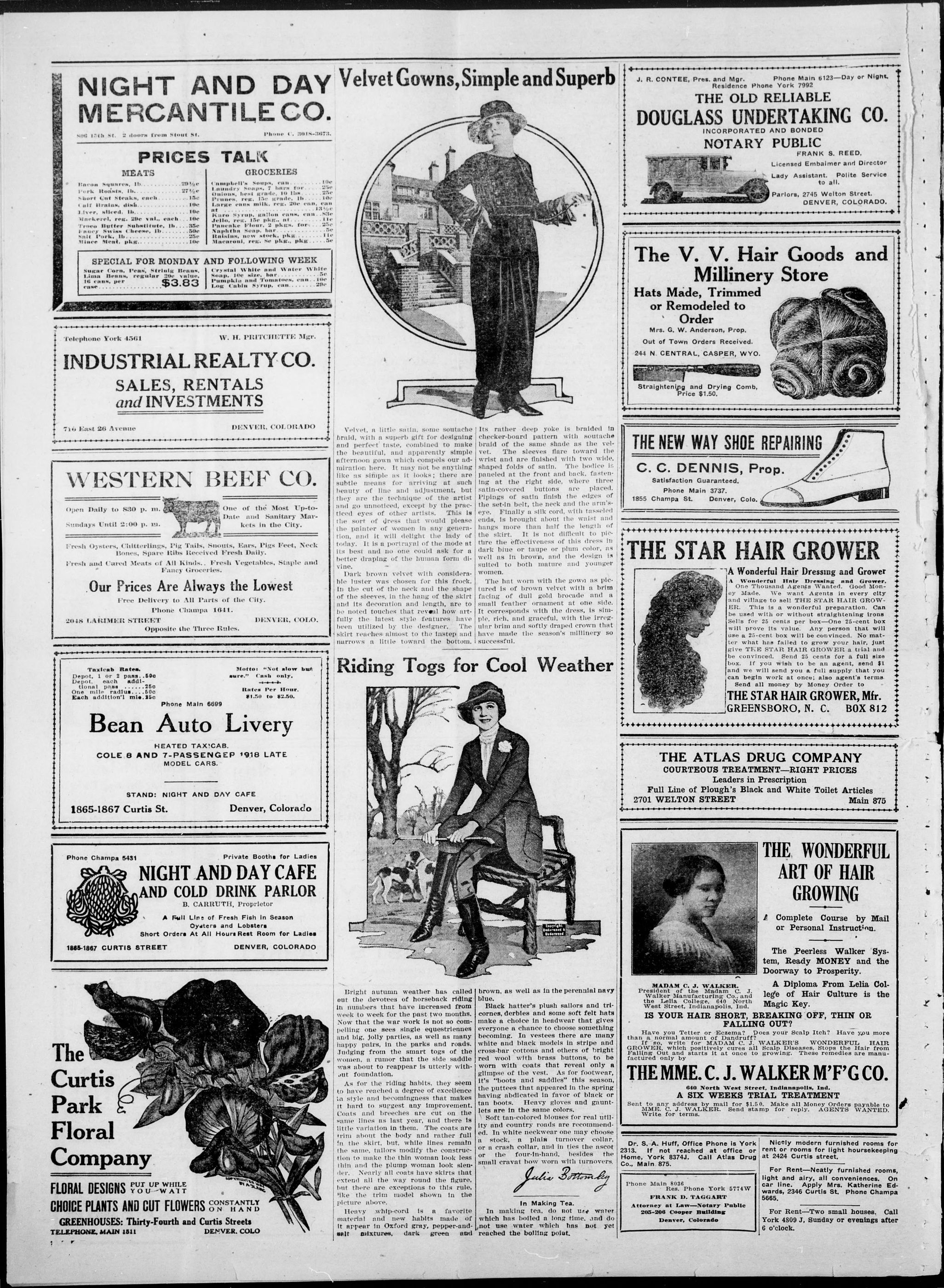
Velvet, a little satin, some soutache braid, with a superb gift for designing and perfect taste, combined to make the beautiful, and apparently simple afternoon gown which compels our admiration here. It may not be anything like as simple as it looks; there are subtle means for arriving at such beauty of line and adjustment, but they are the technique of the artist and go unnoticed, except by the practiced eyes of other artists. This is the sort of dress that would please the painter of women in any generation, and it will delight the lady of today. It is a portrayal of the mode at its best and no one could ask for a better draping of the human form divine.
Dark brown velvet with considerable luster was chosen for this frock. In the cut of the neck and the shape of the sleeves, in the hang of the skirt and its decoration and length, are to be noted touches that reveal how artfully the latest style features have been utilized by the designer. The skirt reaches almost to the instep and marrows a little toward the bottom.
Riding Togs for
Bright autumn weather has called out the devotees of horseback riding in numbers that have increased from week to week for the past two months. Now that the war work is not so compelling one sees single equestriennes and big, jolly parties, as well as many happy patrs, in the parks and roads. Judging from the smart togs of the women, a rumor that the side saddle was about to reappear is utterly without foundation.
As for the riding habits, they seem to have reached a degree of excellence in style and becomingness that makes it hard to suggest any improvement. Coats and breeches are cut on the same lines as last year, and there is little variation in them. The coats are trim about the body and rather full in the skirt, but, while lines remain the same, tailors modify the construction to make the thin woman look less thin and the plump woman look slender. Nearly all coats have skirts that extend all the way round the figure, but there are exceptions to this rule, like the trim model shown in the picture above.
Heavy whip-cord is a favorite material and new habits made of it appear in Oxford gray, pepper-and-salt mixtures, dark green and
---
Its rather deep yoke is braided in checker-board pattern with soutache braid of the same shade as the velvet. The sleeves flare toward the wrist and are finished with two wide, shaped folds of satin. The bodice is paneled at the front and back, fastening at the right side, where three satin-covered buttons are placed. Pipings of satin finish the edges of the set-in belt, the neck and the arm's-eye. Finally a silk cord, with tasseled ends, is brought about the waist and hangs more than half the length of the skirt. It is not difficult to picture the effectiveness of this dress in dark blue or taupe or plum color, as well as in brown, and the design is suited to both mature and younger women.
The hat worn with the gown as pictured is of brown velvet with a brim facing of dull gold brocade and a small feather ornament at one side. It corresponds with the dress, is simple, rich, and graceful, with the irregular brim and softly draped crown that have made the season's millinery so successful.
Cool Weather
brown, as well as in the perennial navy blue.
Black hatter's plush sailors and tricornes, derbies and some soft felt hats make a choice in headwear that gives everyone a chance to choose something becoming. In vestes there are many white and black models in stripe and cross-bar cottons and others of bright red wool with brass buttons, to be worn with coats that reveal only a glimpse of the vest. As for footwear, it's "boots and saddles" this season, the puttees that appeared in the spring having abdicated in favor of black or tan boots. Heavy gloves and gauntlets are in the same colors.
Soft tan-colored blouses for real utility and country roads are recommended. In white neckwear one may choose a stock, a plain turnover collar, or a crash collar, and in ties the ascot or the four-in-hand, besides the small cravat bown with turnovers.
Julia Bottomley
In Making Tea.
In making tea, do not use water which has boiled a long time, and do not use water which has not yet reached the boiling point.
J. R. CONTEE, Pres. and Mgr. Phone Main 6123—Day or Night. Residence Phone York 7992
The V. V. Hair Millinery
. Hair Goods and linery Store
The V. V. Hair Goods and Millinery Store
The V. V. Hair Goods and Millinery Store
Hats Made, Trimmed or Remodeled to Order
Mrs. G. W. Anderson, Prop.
Out of Town Orders Received.
244 N. CENTRAL, CASPER, WYO.
Straightening and Drying Comb,
Price $1.50.
THE NEW WAY SHOE REP
SHOE REPAIRING
THE NEW WAY SHOE REPAIRING
C. C. DENNIS, Prop.
Satisfaction Guaranteed.
Phone Main 3737.
1855 Champa St. Denver, Colo.
ver, Colo.
HAIR GROWER
A Wonderful Hair Dressing and Grower
THE STAR HAIR GROWER
THE STAR HAIR GROWER
A
A Wonderful Hair Dressing and Grower
One Thousand Agents Wanted. Good Money
and village to sell THE STAR HAIR GROWER.
This is a wonderful preparation. Can be used with or without straightening irons
Sells for 25 cents per box—One 25-cent box
will prove its value. Any person that will
use a 25-cent box will be convinced. No matter
what has failed to grow your hair, just
give THE STAR HAIR GROWER a trial and
be convinced. Send 25 cents for a full size
box. If you wish to be an agent, send $1
and we will send you a full supply that you
can begin work at once; also agent's terms.
Send all money by Money Order to
THE STAR HAIR GROWER, Mfr.
GREENSBORO, N. C. BOX 812
AS DRUG COMPANY
TREATMENT—RIGHT PRICES
Leaders in Prescription
h's Black and White Toilet Articles
ET Main 875
THE ATLAS DRUG
COURTEOUS TREATMENT
Leaders in Prescr
Full Line of Plough's Black and
2701 WELTON STREET
Full Line of Plough's Black and White Toilet Articles
2701 WELTON STREET Main 875
MADAM C. J. WALKER.
President of the Madam C. J. Walker Manufacturing Co. and the Lella College, 640 North West Street, Indianapolis, Ind.
PORT, BREAKING OFF, THIN OR FALLING OUT?
gema? Does your Scalp Itch? Have you more bandruff?
AM C. J. WALKER'S WONDERFUL HAIR
cures all Scalp Diseases. Stops the Hair from
t once to growing. These remedies are manu-
J. WALKER M'F'G CO.
IS YOUR HAIR SHORT, BREAK
FALLING OUT
Have you Tetter or Eczema? Does you
than a normal amount of Dandruff?
If so, write for MADAM C. J. WALK
GROWER, which positively cures all Scalp.
Falling Out and starts it at once to growin
factured only by
THE MME. C. J. WALK
IS YOUR HAIR SHORT, BREAKING OFF, THIN OR FALLING OUT?
Have you Tetter or Eczema? Does your Scalp Itch? Have you more than a normal amount of Dandruff?
If so, write for MADAM C. J. WALKER'S WONDERFUL HAIR GROWER, which positively cures all Scalp Diseases, Stops the Hair from Failing Out, and starts it at once to growing. These remedies are manu-
THE MME.C. J. WALKER M'F'GCO.
440 North West Street, Indianapolis, Ind.
A SIX WEEKS TRIAL TREATMENT
Sent to any address by mail for $1.50. Make all Money Ord.
MME. C. J. WALKER. Send stamp for reply. AGENT
Write for terms.
l for $1.50. Make all Money Orders payable to Send stamp for reply. AGENTS WANTED.
Sent to any address by mail for $1.50. Make all Money Orders payable to
KLEER. Send stamp for reply. AGENTS WANTED.
Write for terms.
Dr. S. A. Huff, Office Phone is York 2313. If not reached at office or Home, York 8374J. Call Atlas Drug Co., Main 875.
Phone Main 8036
Res. Phone York 5774W
FRANK D. TAGGART
Attorney at Law—Notary Public
205-206 Cooper Building
Denver, Colorado
1
FRANK S. REED.
Licensed Embalmer and Director
Lady Assistant. Polite Service
to all.
Parlors, 2745 Welton Street.
DENVER, COLORADO.
r
THE WONDERFUL ART OF HAIR GROWING
A Complete Course by Mail or Personal Instruction.
The Peerless Walker System, Ready MONEY and the Doorway to Prosperity.
A Diploma From Lelia College of Hair Culture is the Magic Key.
Nicely modern furnished rooms for rent or rooms for light hoursekeeping at 2424 Curtis street.
For Rent—Neatly furnished rooms, light and airy, all conveniences. On car line. Apply Mrs. Katherine Edwards, 2346 Curtis St. Phone Champa 5655.
For Rent—Two small houses. Call York 4809 J. Sunday or evenings after 6 o'clock.