Colorado Statesman
Saturday, February 1, 1919
Denver, Colorado
Page text (machine-generated)
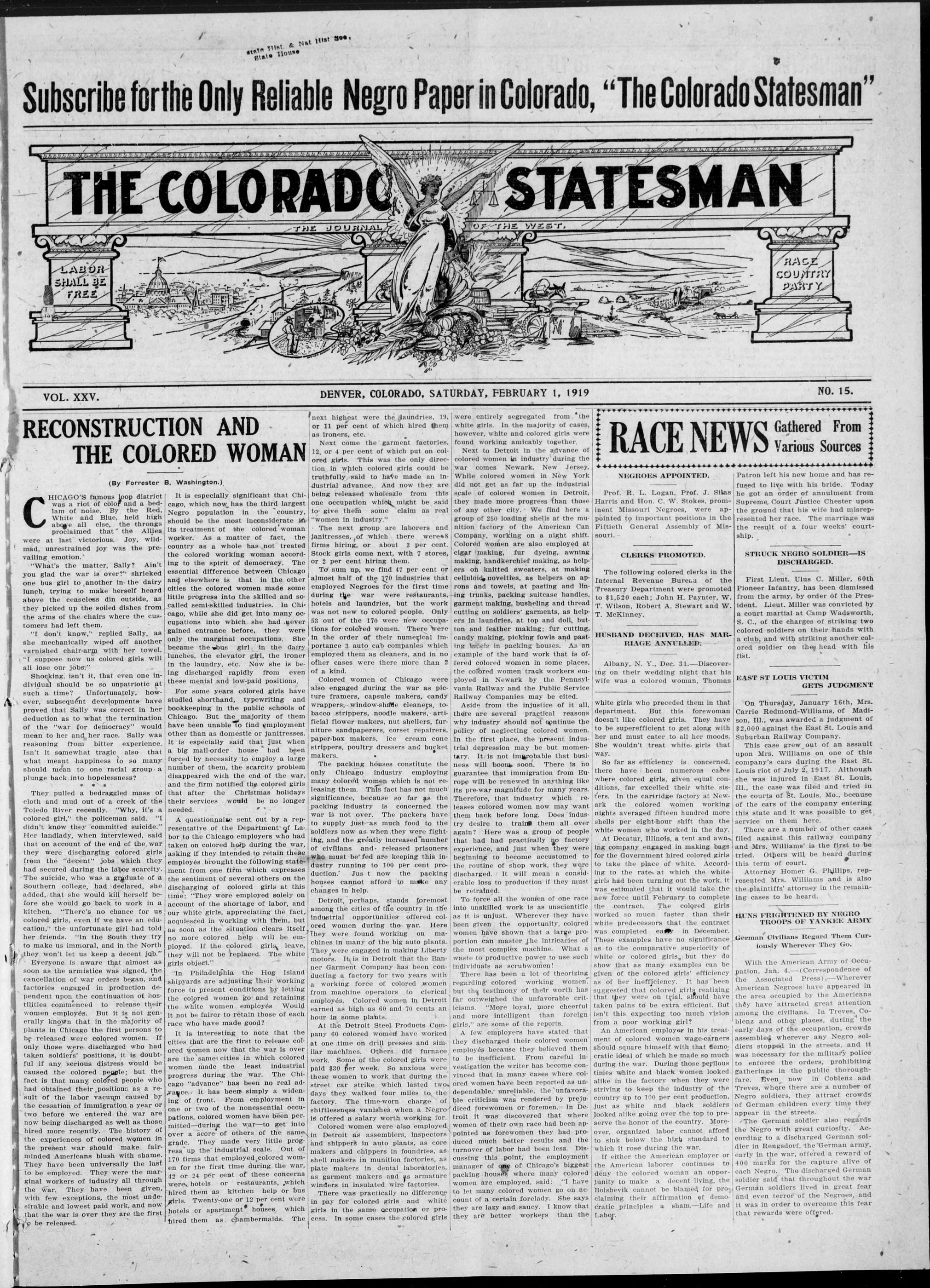
Subscribe for the Only Reliable Negro Paper in Colorado, "The Colorado Statesman"
THE COLORADO STATESMAN
THE JOURNAL OF THE WEST.
LABOR SHALL BE FREE
RACE COUNTRY PARTY
RECONSTRUCTION AND THE COLORED WOMAN
(By Forrester B. Washington.)
CHICAGO'S famous loop district was a riot of color and a bedlam of noise. By the Red, White and Blue, held high above all else, the throngs proclaimed that the Allies were at last victorious. Joy, wild-mad, unrestrained joy was the prevailing emotion.
"What's the matter, Sally? Ain't you glad the war is over?" shrieked one bus girl to another in the dairy lunch, trying to make herself heard above the ceaseless din outside, as they picked up the soiled dishes from the arms of the chairs where the customers had left them.
"I don't know," replied Sally, as she mechanically wiped off another varnished chair-arm with her towel. "I suppose now us colored girls will all lose our jobs."
Shocking, isn't it, that even one individual should be so unpatriotic at such a time? Unfortunately, however, subsequent developments have proved that Sally was correct in her deduction as to what the termination of the "war for democracy" would mean to her and her race. Sally was reasoning from bitter experience. Isn't it somewhat tragic also that what meant happiness to so many should mean to one racial group a plunge back into hopelessness?
They pulled a bedraggled mass of cloth and mud out of a creek of the Toledo River recently. "Why, it's a colored girl," the policeman said. "I didn't know they committed suicide." Her landlady, when interviewed, said that on account of the end of the war they were discharging colored girls from the "decent" jobs which they had secured during the labor scarcity. The suicide, who was a graduate of a Southern college, had declared, she added, that she would kill herself before she would go back to work in a kitchen. "There's no chance for us colored girls, even if we have an education," the unfortunate girl had told her friends. "In the South they try to make us immoral, and in the North they won't let us keep a decent job."
Everyone is aware that almost as soon as the armistice was signed, the cancellation of war orders began, and factories engaged in production dependent upon the continuation of hostilities commenced to release their women employes. But it is not generally known that in the majority of plants in Chicago the first persons to be released were colored women. If only those were discharged who had taken soldiers' positions, it is doubtful if any serious distress would be caused the colored people; but the fact is that many colored people who had obtained their positions as a result of the labor vacuum caused by the cessation of immigration a year or two before we entered the war are now being discharged as well as those hired more recently. The history of the experiences of colored women in the present war should make fair-minded Americans blush with shame. They have been universally the last to be employed. They were the marginal workers of industry all through the war. They have been given, with few exceptions, the most desirable and lowest paid work, and now that the war is over they are the first to be released.
VOL. XXV.
the Only Reliable
COLORA
TION AND
ORED WOMAN
It is especially significant that Chicago, which now has the third largest Negro population in the country, should be the most inconsiderate in its treatment of the colored woman worker. As a matter of fact, the country as a whole has not treated the colored working woman according to the spirit of democracy. The essential difference between Chicago and elsewhere is that in the other cities the colored women made some little progress into the skilled and so-called semi-skilled industries. In Chicago, while she did get into many occupations into which she had never gained entrance before, they were only the marginal occupations. She became the bus girl in the dairy lunches, the elevator girl, the ironer in the laundry, etc. Now she is being discharged rapidly from even these menial and low-paid positions.
For some years colored girls have studied shorthand, typewriting and bookkeeping in the public schools of Chicago. But the majority of them have been unable to find employment other than as domestic or janitresses. It is especially said that just when a big mail-order house had been forced by necessity to employ a large number of them, the scarcity problem disappeared with the end of the war, and the firm notified the colored girls that after the Christmas holidays their services would be no longer needed.
A questionnaire sent out by a representative of the Department of Labor to the Chicago employers who had taken on colored help during the war, asking if they intended to retain these employés brought the following statement from one firm which expresses the sentiment of several others on the discharging of colored girls at this time: "They were employed solely on account of the shortage of labor, and our white girls, appreciating the fact, acquiesced in working with them, but as soon as the situation clears itself no more colored help will be employed. If the colored girls leave, they will not be replaced. The white girls object."
In Philadelphia the Hog Island shipyards are adjusting their working force to present conditions by letting the colored women go and retaining the white women employés. Would it not be fairer to retain those of each race who have made good?
It is interesting to note that the cities that are the first to release colored women now that the war is over are the same cities in which colored women made the least industrial progress during the war. The Chicago "advance" has been no real advance. It has been simply a widening of front. From employment in one or two of the nonessential occupations, colored women have been permitted—during the war—to get into over a score of others of the same grade. They made very little progress up the industrial scale. Out of 170 firms that employed colored women for the first time during the war, 42 or 24 per cent of these concerns were hotels or restaurants, which hired them as kitchen help or bus girls. Twenty-one or 12 per cent were hotels or apartment houses which hired them as chambermaids. The
state IIist & Nat IIist Sce
state IIouse
ble Negro Pap
ADO
DE JOURNAL
DENVER, COLORADO, SAT
DENVER, COLORADO, SATURDAY, FEBRUARY 1, 1919
next highest were the laundries, 19, or 11 per cent of which hired them as ironers, etc.
Next come the garment factories, 12, or 4 per cent of which put on colored girls. This was the only direction in which colored girls could be truthfully said to have made an industrial advance. And now they are being released wholesale from this one occupation which might be said to give them some claim as real "women in industry."
The next group are laborers and janitresses, of which there were 8 firms hiring, or about 3 per cent. Stock girls come next, with 7 stores, or 2 per cent hiring them.
To sum up, we find 47 per cent or almost half of the 170 industries that employed Negroes for the first time during the war were restaurants, hotels and laundries, but the work was not new to colored people. Only 53 out of the 170 were new occupations for colored women. There were in the order of their numerical importance 3 auto cab companies which employed them as cleaners, and in no other cases were there more than 2 of a kind.
Colored women of Chicago were also engaged during the war as picture framers, capsule makers, candy wrappers, window-shade cleaners, tobacco strippers, noodle makers, artificial flower makers, nut shellers, furniture sandpaperers, corset repairers, paper-box makers, ice cream cone strippers, poultry dressers and bucket makers.
The packing houses constitute the only Chicago industry employing many colored women which is not releasing them. This fact has not much significance, because so far as the packing industry is concerned the war is not over. The packers have to supply just as much food to the soldiers now as when they were fighting, and the greatly increased number of civilians and released prisoners who must be fed are keeping this industry running to 100 per cent production.' Just t now the packing houses cannot afford to make any changes in help.
Detroit, perhaps, stands foremost among the cities of the country in the industrial opportunities offered colored women during the war. Here they were found working on machines in many of the big auto plants. They were engaged in making Liberty motors. It is in Detroit that the Banner Garment Company has been conducting a factory for two years with a working force of colored women from machine operators to clerical employés. Colored women in Detroit earned as high as 60 and 70 cents an hour in some plants.
At the Detroit Steel Products Company 60 colored women have worked at one time on drill presses and similar machines. Others did furnace work. Some of the colored girls were paid $30 per week. So anxious were these women to work that during the street car strike which lasted two days they walked four miles to the factory. The time-worn charge of shiftlessness vanishes when a Negro is offered a salary worth working for.
Colored women were also employed in Detroit as assemblers, inspectors and shippers in auto plants, as core makers and chippers in foundries, as shell makers in munition factories, as plate makers in dental laboratories, as garment makers and as armature winders in insulated wire factories.
There was practically no difference in pay for colored girls and white girls in the same occupation or process. In some cases the colored girls
were entirely segregated from the white girls. In the majority of cases, however, white and colored girls were found working amicably together.
Next to Detroit in the advance of colored women in industry during the war comes Newark, New Jersey. While colored women in New York did not get as far up the industrial scale of colored women in Detroit, they made more progress than those of any other city. We find here a group of 250 loading shells at the munition factory of the American Can Company, working on a night shift. Colored women are also employed at cigar making, fur dyeing, awning making, handkerchief making, as helpers on knitted sweaters, at making celluloid novelties, as helpers on aprons and towels, at pasting and lining trunks, packing suitcase and garment making, busheling and thread cutting on soldiers' garments, as helpers in laundries, at top and doll, button and feather making; fur cutting, candy making, picking fowls and pasting bells in packing houses. As an example of the hard work that is offered colored women in some places, the colored women track workers employed in Newark by the Pennsylvania Railway and the Public Service Railway Companies may be cited.
Aside from the injustice of it all, there are several practical reasons why industry should not continue the policy of neglecting colored women. In the first place, the present industrial depression may be but momentary. It is not improbable that business will boom soon. There is no guarantee that immigration from Europe will be renewed in anything like its pre-war magnitude for many years. Therefore, that industry which releases colored women now may want them back before long. Does industry desire to train them all over again? Here was a group of people that had had practically no factory experience, and just when they were beginning to become accustomed to the routine of shop work, they were discharged. It will mean a considerable loss to production if they must be retrained.
To force all the women of one race into unskilled work is as unscientific as it is unjust. Wherever they have been given the opportunity, colored women have shown that a large proportion can master the intricacies of the most complex machine. What a waste to productive power to use such individuals as scrubwomen!
There has been a lot of theorizing regarding colored working women, but the testimony of their worth has far outweighed the unfavorable criticisms. "More loyal, more cheerful and more intelligent than foreign girls," are some of the reports.
A few employers have stated that they discharged their colored women employees because they believed them to be inefficient. From careful investigation the writer has become convinced that in many cases where colored women have been reported as undependable, unreliable, the unfavorable criticism was rendered by prejudiced forewomen or foremen. In Detroit it was discovered that where women of their own race had been appointed as forewomen they had produced much better results and the turnover of labor had been less. Discussing this point, the employment manager of one of Chicago's biggest packing houses where many colored women are employed, said: "I have to let many colored women go on account of a certain forelady. She says they are lazy and saucy. I know that they are better workers than the
RACENEWS Gathered From Various Sources
RACENEWS Gathered From Various Sources
Prof. R. L. Logan, Prof. J. Silas Harris and Hon. C. W. Stokes, prominent Missouri Negroes, were appointed to important positions in the Fiftieth General Assembly of Missouri.
CLERKS PROMOTED.
The following colored clerks in the Internal Revenue Bureau of the Treasury Department were promoted to $1,520 each; John H. Paynter, W. T. Wilson, Robert A. Stewart and W. T. McKinney.
HUSBAND DECEIVED, HAS MARRIAGE ANNULLED.
Albany, N. Y., Dec. 31.—Discovering on their wedding night that his wife was a colored woman, Thomas
white girls who preceded them in that department. But this forewoman doesn't like colored girls. They have to be superefficient to get along with her and must cater to all her moods. She wouldn't treat white girls that way.
So far as efficiency is concerned, there have been numerous cases where colored girls, given equal conditions, far excelled their white sisters. In the cartridge factory at Newark the colored women working nights averaged fifteen hundred more shells per eight-hour shift than the white women who worked in the day.
At Decatur, Illinois, a tent and awning company engaged in making bags for the Government hired colored girls to take the place of white. According to the rate at which the white girls had been turning out the work, it was estimated that it would take the new force until February to complete the contract. The colored girls worked so much faster than their white predecessors that the contract was completed early in December. These examples have no significance as to the comparative superiority of white or colored girls, but they do show that as many examples can be given of the colored girls' efficiency as of her inefficiency. It has been suggested that colored girls realizing that they were on trial, should have taken pains to be extra efficient. But isn't this expecting too much vision from a poor working girl?
An American employer in his treatment of colored women wage-earners should square himself with that democratic ideal of which he made so much during the war. During those perilous times white and black women looked alike in the factory when they were striving to keep the industry of the country up to 100 per cent production, just as white and black soldiers looked alike going over the top to preserve the honor of the country. Moreover, organized labor cannot afford to sink below the high standard to which it rose during the war. If either the American employer or the American laborer continues to deny the colored woman an opportunity to make a decent living, the Bolshevik cannot be blamed for proclaiming their affirmation of democratic principles a sham.—Life and Labor.
NO.15.
Patron left his new home and has refused to live with his bride. Today he got an order of annulment from Supreme Court Justice Chester upon the ground that his wife had misrepresented her race. The marriage was the result of a four weeks' courtship.
STRUCK NEGRO SOLDIER—IS DISCHARGED.
First Lieut. Ulus C. Miller, 60th Pioneer Infantry, has been dismissed from the army, by order of the President. Lieut. Miller was convicted by a court martial at Camp Wadsworth, S. C., of the charges of striking two colored soldiers on their hands with a club, and with striking another colored soldier on the head with his fist.
EAST ST LOUIS VICTIM
GETS JUDGMENT
On Thursday, January 16th, Mrs. Carrie Redmond-Williams, of Madison, Ill., was awarded a judgment of $2,000 against the East St. Louis and Suburban Railway Company.
This case grew out of an assault upon Mrs. Williams on one of this company's cars during the East St. Louis riot of July 2, 1917. Although she was injured in East St. Louis, Ill., the case was filed and tried in the courts of St. Louis, Mo., because of the cars of the company entering this state and it was possible to get service on them here.
There are a number of other cases filed against this railway company and Mrs. Williams' is the first to be tried. Others will be heard during this term of court.
Attorney Homer G. Phillips, represented Mrs. Williams and is also the plaintiffs' attorney in the remaining cases to be heard.
HUNS FRIGHTENED BY NEGRO
TROOPS OF YANKEE ARMY
German Civilians Regard Them Curiously Wherever They Go.
With the American Army of Occupation, Jan. 4.—(Correspondence of the Associated Press).—Wherever American Negroes have appeared in the area occupied by the Americans they have attracted great attention among the civilians. In Treves, Coblenz and other places, during the early days of the occupation, crowds assembled wherever any Negro soldiers stopped in the streets, and it was necessary for the military police to enforce the orders, prohibiting gatherings in the public thoroughfare. Even now in Coblenz and Treves, where there are a number of Negro soldiers, they attract crowds of German children every time they appear in the streets.
The German soldier also regards the Negro with great curiosity. According to a discharged German soldier in Rengsdorf, the German army, early in the war, offered a reward of 400 marks for the capture alive of each Negro. The discharged German soldier said that throughout the war German soldiers lived in great fear and even terror of the Negroes, and it was in order to overcome this fear that rewards were offered.
FOREIGN
Alfonso Siller, according to a semi-official organ of the government, has been appointed Mexican minister to Bolivia.
As a result of the strike of marine workers the packing houses have with drawn from the cattle market in Buenos Aires.
Plans for the dismantling of the American naval stations in and around Queenstown are going forward rapidly.
German newspapers predict that Herr Naumann, Democratic party leader, will be the first president of the German republic.
Helsingfors forces say the Bolshevik army is evacuating Petrograd and that Trotsky has moved his headquarters to Nijil Novgorod.
Two thousand agents employed by a London insurance company have notified their employers' officers that they will strike unless their weekly wage is increased.
It is provided in the draft of the proposed new German constitution that the president of the empire is to be elected by the entire German people and that his term shall be seven years.
The Portuguese navy has remained loyal to the government, according to all accounts received at Madrid. Madrid newspapers, however, have advice saying that the army is on the side of the revolutionists.
Captain Conceiro, leader of the Portuguese monarchistic revolt, has organized an army of 4,000 and plans to march against the Lisbon garrison which is reported to be neutral, according to dispatches received at Madrid.
Settlement of the differences between Poland and Germany is reported near. Negotiations are under way for an economic exchange, Poland to send food to Germany and the latter to furnish the Poles with coal.
The Irish parliament held a private session. The official report of the meeting says that twenty-four deputies were present. A temporary prime minister was elected unanimously, and four other ministers, nominated by the speaker, were approved by parliament.
Bull fighting remains under an official ban in the Federal district and territories under the control of the central government in Mexico, an effort in the Chamber of Deputies to rescind the presidential decree prohibiting this sport having been defeated by one vote.
Pettitions circulated in the district of Voralberg, on the Austrian frontier, urging a union with Switzerland, have met with surprising support. In the first twenty towns and villages where the petitions were circulated between 90 and 98 per cent of the citizens signed them. They are addressed to the Swiss government and the peace conference.
The New York National League baseball team will train at Gainesville, Fla., next spring instead of Marlin Tex., where it has gone for eleven successive years.
Without a stop Roscoe Sarles won the 100-mile free-for-all automobile race at Ascot speedway at Los Angeles in 1:27:52 2-5, an average speed of 68:18 miles an hour.
Branch Rickey, president of the St. Louis Nationals, has announced he will accept the management of the club for 1919. Jack Hendricks having consented to terminate his contract as 1919 manager of the club.
Harry Greb of Pittsburg outpointed Soldier Bartfield of New York in their twelve-round bout at Columbus. The contest was uninteresting with the exception of the fourth round when Greb demonstrated his superiority.
GENERAL
Advices from Helsingfors state that the Bolshevik army is evacuating Petrograd and that War Minister Trotsky has moved his quarters to Didji Novgorod.
Supporters of the Cleveland Americans unanimously approve the action of President James C. Dunn in reelecting Lee Fohl manager of the club for 1919. It will be Fohl's fourth year.
Bishop Thomas Nicholson of Chicago sounded the keynote of the Methodist Episcopal church's plan for a missionary and educational campaign which contemplates the raising of a fund of $115,000,000 in five years, in an address delivered before the joint centenary committee of the denofination.
The German government is expecting a great Bolshevist invasion in the spring. It is preparing to raise an army of 2,000,000 to be commanded by Field Marshal von Hindenburg. One army group will be sent into east Prussia, another into Silesia, to ward off the anticipated invasion.
The release of 113 conscientious objectors, honorably discharged from the service by War Department orders, began at the disciplinary barracks at Fort Leavenworth this week. Two, however, refused to leave, saying it was against their religious scruples.
The proposed transatlantic airship flight is now set for August. According to plans revealed Tuesday, the air voyage will be made from Spain to Buenos Aires, and it is expected to take four days. There will be about fifteen persons on board.
CONDENSATION OF FRESH NEWS
THE LATEST IMPORTANT DIS PATCHES PUT INTO SHORT, CRISP PARAGRAPHS.
STORY OF THE WEEK
SHOWING THE PROGRESS OF EVENTS IN OUR OWN AND FOREIGN LANDS.
Western Newspaper Union News Service.
EASTERN
Big breaks in grain, resulting from from heavy selling and apparent lack of buying power occurred in Chicago this week.
The Royal mill at Riverpoint, one of the largest of the B. B. & R. Knight plants, was virtually destroyed by fire. The loss is estimated at $1,000,000.
United States Judge Mayer decided in a test case that stock dividends are not subject to federal income tax under the income tax law of 1916.
Organization of the council of national defense on a permanent basis is sought, according to the announcement of G. B. Clarkson, director of the council.
Information that seven men of the crew of ten of the American oil schooner Augustus H. Babcock were lost when fire consumed the vessel at sea last week.
Capt. Samuel Filgate, 100 years old New Year's day, a veteran navigator of the St. Lawrence, is dead at Montreal. He was born in Toronto and built and commanded the first iron steamer to ply the St. Lawrence. Harry S. Harkness, only son of the late Lamon V. Harkness, Standard Oil millionaire, died of Spanish influenza at his home in New York. Mr. Harkness was owner of the Sheepshead Bay speedway, where he promoted automobile racing. He was a pioneer aviator and had made many flights.
WESTERN
Idaho was benefited only to a slight extent by special war industries.
City commissioners of Portland, Ore., refused to grant permission to the recently organized Workers', Soldiers' and Sailors' Council to use the municipal auditorium for a meeting.
Secretary Daniels has commended twenty-seven men of the crew of the battleship Minnesota for courage and efficiency displayed when the ship struck a mine Sept. 29, 1917, off the Delaware breakwater. The ship made port under her own power.
The annual convention of the Western Retail Lumber Dealers' Association, set for Boise, Idaho, Feb. 20 to 22, has been postponed on account of the prevalence of influenza in Western states, it has been announced at Spokane.
Certain tribes of Indians on reservations in Utah have been almost decimated by the influenza epidemic, according to unconfirmed reports reaching the State Board of Health at Salt Lake. The scourge is said to have caused the death of at least 2,000 southern Utah and Arizona tribesmen on part of the Navajo reservation in southern Utah and Arizona.
The official biennial budget of the state of Utah was presented to the Legislature by Governor Bamberger. The estimated receipts for the two-year period beginning April 1, 1919, are given as $3,987,320. The budget asks the Legislature for approval of authorized expenditures of $3,446,899, making the estimated excess revenue for the two-year period $540,520.
WASHINGTON
Conference on the new revenue bill rescinded their adoption of the Senate 20 per cent tax on amusements and it went back to the House on a 10 per cent rate.
Prohibition of immigration for four years after the war except from Cuba, Mexico, Canada and Newfoundland, was agreed upon unanimously by the House immigration committee.
Inability to speak English and hesitancy in calling on Americans for aid because of the barrier of language, have been found to be prolific causes of distrust on the part of Mexican refugees in San Antonio, Texas.
Representative Gillett voiced the first open opposition to seating Victor Berger. He said the refusal to seat the Wisconsin Socialist should be the first act of the next House, because he is guilty of disloyalty.
Orders to ship yards not to begin work on ships aggregating from 1,000,000 to 1,250,000 deadweight tons, the keels for which ordinarily would not have been laid before next Aug. 1, are now being sent out by the shipping board.
Representative Heflin of Alabama announced in the House that he had asked the Department of Justice to investigate the New York cotton exchange, which he charged had violated the cotton futures act "in driving down" the price of cotton from 37 to 24 cents a pound.
Recognition of labor unions by employers as ordered in many war labor board awards does not mean a closed shop, Joint Chairman Taft declared in a statement at Washington recently
SPORT
UNIVERSAL CONFERENCE OF ALL
NATIONS AFTER PEACE
TERMS SIGNED.
WILL GIVE ALL A VOICE
CONTROL OF CAPTURED COL
ONIES UNDER WILSON PLAN
ACCEPTED.
Western Newspaper Union News Service
Paris, Jan. 31.—The war council at a meeting considered economic and financial questions and the subject of law materials. The sentiment was favorable to the relaxation of the blockade so far as it concerned south-eastern Europe, including the Balkans and Austria-Hungary.
Paris.—A universal conference of all states desiring to participate in a league of nations will be the final act in the formation of the league. This conference would be held after the peace conference had approved the scheme now drafted by representatives of the great allied and associated powers.
The universal conference will pass upon the admission of each state into the league, and enemy states will be accepted on the same footing as others. The enemy states, however, M. Bourgeois said, must give proof that they no longer foster lust of conquest and that they will "repay fully for the devastation and ruin they have caused."
The announcement was made in authoritative quarters that the great colonial powers, notably Great Britain and France, had accepted in principle the American proposal put forward-by President Wilson for the league of nations exercising supervision over the German colonies and allotting their administration to mandatory powers.
Import Embargo On:
Washington.—In clamping an import embargo on more than 300 commodities, the British have declared open commercial warfare on this country, many government officials and Congress members held. The new embargo has forced the fight, which has been smoldering for days, to a point where definite governmental trade policies must be outlined, it was believed by many members of Congress. They assert that the latest British action should be met with drastic reciprocal measures. Shipping men regarded the new ban as a British lever to pry loose all British-bound cargo for transportation in British-owned ships. It has been known for days that British buyers have been coming to the United States in flocks.
They have been buying commodities in which England already had an import embargo, as well as articles contained in the list made public. American manufacturers who sought to sell direct to English wholesalers without dealing through agents on this side have been very effectually stopped by numerous subterfuges, reports received here show. The British buyers have contracted heavily and every ton of goods bought has been taken on the express condition that it be shipped in British-owned vessels.
Fire at Los Angeles
Los Angeles, Cal.-A fire in the wholesale district here caused an estimated damage of $125,000. The burned-over area covered two city blocks.
Siege at Wilhelmshaven.
Copenhagen, Jan. 30.—When the Spartacans at Cuxhaven and Bremerhaven surrendered, according to advises reaching here, a state of siege was decided on at Wilhelmshaven. The advises say that when the Spartacans declared Wilhelmshaven an independent republic the people called a general strike. The authorities closed the postal lines, the telegraph and railway service, and a mass meeting was held, at which the arrest of the workmen and soldiers' delegates was demanded. After the Spartacans had raided the state bank, from which they took 2,000,000 marks, street fighting occurred, which resulted in the unconditional surrender of the Spartacans.
Williams of Cleveland Appointed.
Cleveland, Ohio.—William L. Williams of Cleveland has been appointed assistant director, division of operation, of the United States Shipping Board Fleet Corporation, it was anounced here.
Will Get Food C. O. D.
New York.—In the general food program outlined by the allies, Germany will be allowed about 6,000,000 bushels of breadstuffs a month, mostly from the United States, if she can find the money to pay for it, according to a detailed statement of foreign grain requirements, carried by Herber Hoover. The supreme food council under military advice has granted Germany the right to import 150,000,000 pounds of pork products per month as soon as she arranges payment and shipping.
LEGISLATIVE ACTIONS
LEGISLATIVE ACTIONS
GOOD ROADS BILL STILL HOLDS CENTER OF STAGE.
One Bill Would Prevent Weighing Hands With Provisions.
Western Newspaper Union News Service Denver.—Good roads legislation probably will not be reached in the Legislature until the middle of next month, according to a tentative agreement reached, following a point meeting of the constitutional amendments committee of the Senate and the roads and bridges committee of the House. Hearings, however, will be given to those who are interested in the $20,000,000 bond issue, or those who are opposing the passage of such a measure. Legislators of both houses will be guests at a uncheon to be given by the Colorado Good Roads Association on Lincoln's birthday. The matter of good roads will be discussed in detail. State officials and others will be invited to attend.
Legislators say they have first hand knowledge of some grocers weighing the scoop with the sugar and then removing the receptacle before tying the paper sack. Representative Charles A. Foster proposes a legal operation against the grocery clerk who weighs his hand with the article purchased and thereby shortweights the purchaser. His "net weight" bill would compel wholesalers and retailers and all others to mark every package, large or small, with the actual weight of the net contents. He says he has facts to prove that in some instances the bags or burlap or other covering used in the purchase of hams, for example, total 8 per cent of the gross weight, and that the consumer pays for something which he does not get.
Chickens in the vicinity of Pueblo may bring $100 apiece in fines—provided the bill of Senator W. O. Peterson becomes law. The chickens must be caught trespassing on "any cemetery in, adjacent to or within three miles" of Pueblo or any other city of 40,000 population or more. A bill by Representatives Girard and Dolan, both of Boulder, to create a new judicial district to consist of Boulder county, was referred by the House to the committee on state affairs and reapportionment. Several proposals for rearrangement of the judicial and representative districts are before this committee and will be considered together.
Representative Ernest Owen of Leadville, author of the bill to repeal the Sunday closing act, issued a reply to the criticism of him by G. Arthur Holloway, acting superintendent of the Colorado Anti-Saloon League, in which he says the fight Mr. Holloway threatened to make against him and his colleagues is merely an excuse to keep the league in existence after its work of making Colorado "dry" has been done.
The practice of passing resolutions in approval or disapproval of various actions of Congress was criticised by Representative Downing, a Republican, in a debate on such a resolution introduced by William Mellen. Mellen asked the House to indorse the action of Congress in authorizing medals for men who served on legal advisory boards in the draft.
The short appropriation bills of five state institutions were passed on third reading, and the emergency clause added without any objection. The Industrial Workshop for the Blind, the State Industrial School, the Training School for Mental Defectives, the penitentiary and the Home for Dependent Children are granted appropriations totaling $96,000.
The House declined to incorporate in a bill for the preparation of a digest of Colorado laws an amendment proposed by Representative John F. Rotruck that the authors of the book must be attorneys of ten years practice in Colorado. Several attorney members replied that ten years in the law business might put a good man in such a rut that he would be incapable of doing as well as he could when fresh from college, and objected to limiting the governor, to whom the appointing power is given, as to the class of attorneys he could select from.
Among those passed on second reading was Representative J. A. Phelps' bill changing the method of payment of justices of the peace and constables. At present they are paid from the fees of the office, which results, according to Phelps, in constables "drumming up" business. Under this bill their salaries will come from the general fund. The bill only applies to justice precincts of more than 50,000 population, which probably limits it to Pueblo, as Denver's justice courts are regulated by the city charter.
A bill by Senator Agnes Riddle authorizes the payment of interest on daily balances in county funds. There was discussion as to whether the interest should be 2 per cent or $2\frac{1}{2}$ per cent, the latter rate finally having been finally decided upon.
Another bill concerned the making of Saturday half-holidays for banking institutions. This would change the present law so as to extend the provision from cities of 100,000 population to include cities of 25,000 or more. This would directly benefit Duebble and Colorado Springs.
CENTENNIAL STATE ITEMS.
The public institution inspection committee of the Legislature visited the Colorado State Home for Mental Defectives at Ridge, Colo., and thoroughly investigated the request for a large appropriation to increase the facilities at the home. Dr. A. C. Bussy, superintendent of the home, has asked the state Legislature for an appropriation of $400,000 for improvements and expenses for the coming biennial period. Dr. Bussy said the capacity of the present institution was only eighty-two and that he had on file 315 applications for admittance. In addition, he said, efforts were being made to transfer to the home 300 children now cared for at the insane asylum at Pueblo.
Four hundred and two thousand, five hundred and six dry tons of Colorado ore were treated in the plants of the American Smelting and Refining Company during the last year, according to a statement from Manager R. P. Reynolds of the local plant at Durango. This brought 126,.927 ounces of gold, 5,239,318 ounces of silver, 54,131,063 pounds of lead and 5,350,094 pounds of copper. This brought a total of $13,055,581 to Colorado mining men.
Summit county soldiers returning from the war are sure of employment in the Breckenridge gold fields and elsewhere in the county. Three large employers of labor—the Tonopah Placers Company, the Royal Tiger Mines Company and the Wellington Mines Company—by their managers, have given notice that their former employees who entered the war forces of the United States will be given their former situations or better ones on their return.
At a large meeting of Pueblo real estate men a resolution was unanimously adopted requesting the city attorney to at once apply to the state Supreme Court for an order restraining the Pueblo Gas and Fuel Company from putting into effect the new gas rate calling for an increase of 35 cents per 1,000 feet. This increase was granted by the State Utilities Commission.
That the Colorado Development Federation continue its Washington bureau and other activities as a protective measure to Colorado interests was the request made by the state organization of county commissioners. By unanimous vote, the organization passed a resolution that each county pay at once its share of a fund to carry on the work of the federation.
The first prosecution of alleged bootleggers under the Webb law, which has recently been upheld by the United States Supreme Court, will take place in Denver in the near future, the offenders being two Denver men who were captured by the Colorado constabulary, fifteen miles south of the state line.
The general land office of the Department of the Interior, with the assistance of the federal geological survey, during the month of December classified 205,415 acres of Colorado land as applicable under the stock raising homestead law, which provides for grazing and raising stock on tracts of 640 acres or less.
Arapahoe county's valuation has increased $556,210 in the last year, according to figures of the county assessor. Settlers proving up land titles and a general increase of the county's prosperity are given as the reasons. The 1919 valuation of the county is $19,722,110. Samuel Cheesebrough, employed at the Terrible mine, Silver Plume, was killed when he was caught under a rock fall. Cheesebrough is survived by six small children. His wife died from the influenza some time ago. Montrose needs about fifty new homes and ten apartment buildings, according to a leading banker's statement, to take proper care of the town's increasing population.
Realizing that there will be an over supply of labor, the Board of County Commissioners of Routt county has reduced the pay for road overseers and laborers on the roads. The wages for all classes were lowered 50 cents a day. Because of this reduction, no applications for the position of road overseers were accepted, giving all applicants a chance to withdraw. Revival of the mining industry of Colorado through a unification of the forces that represent an investment in property running to the millions is proposed in the Girard bill, backed by the Colorado Metal Mining Association and the Colorado chapter of the American Mining Congress. The measure is in legislative committee.
A welcome arch to returned soldiers has been established at Platteville between the depot and the Springfield store. Forty-four stars grace one side of it, with three gold and one silver star among them.
Mrs. John Langley, 19-year-old war bride, was slugged and attacked by an unknown white man at Boulder, in a vacant lot directly across the street from the city police station on Pearl street.
The Apex Company is now under full operation at the improved refinery at Loomis, six miles east of Boulder. The plant is one of the finest in the West and is producing practically all the gasoline handled by the Apex Company in its extensive retailing business in Denver.
Eight sons in the draft, and all of them first-class scrappers, none being over 31. This is the record of the Webb family of Boyero. The parents are Mr. and Mrs. Charles Webb. There also are eight girls in the fam-
Pithy News Notes From All Parts of Colorado
Western Newspaper Union News Service.
Red Cross workers at Ordway completed 32,549 pieces of work and $7,000 was handed by the chapter.
Some $14,000 is to be expended in betterments on the United States post road between Breckenridge and Kremmling this season.
The Apishapa Irrigation Company has unloaded two cars of steel piling to be used in the construction of a big reservoir near Bloom.
Nebraska Aggies repeated their last year's performance and defeated the Colorado Aggies in the stock judging contests at the Western National Stock Show in Denver.
Grand Junction and Grand Valley business men are after a settlement of soldiers in the valley under the plan suggested by Franklin Kane, secretary of the interior.
Prof. C. M. Herron of La Junta entered several of his Single Comb Buff Leghorns in the Chicago National Poultry Show and won first prize on hen, first on pullet and second on cockerel.
Will Mathieson, a farmer of the Timnath district, accidentally killed his 18-months-old daughter by backing his automobile over the child. Her neck was broken and she died within a short time.
The Myron Stratton Home Corporation, as the holding company owning the Colorado Springs and Interurban Railway Company, has agreed to sell the street car lines to Colorado Springs, but no price has been named.
A dairy cow belonging to C. S. Donner of Great Bend pays for herself every fifteen days. She was purchased for $35 three years ago, and in fourteen months produced $847.80 worth of milk, an average of $2.24 a day.
Following the filing of protest petition by all the men of the student body, military drill has been suspended at Colorado College and it is likely that the Reserve Officers Training Corps program will be abandoned.
David Mulvaney, brakeman on the freight train from Laramie, which was held up at Greeley and eighty-one pints of contraband booze taken from the caboose, pleaded guilty in Judge Ewing's court and was fined $300 and costs.
The annual ski carnival which was to have been held in Steamboat Springs next month, has been called off, it was announced by the Steamboat Springs Ski Club, because most of the expert ski jumpers of the country are in military service.
Action by the Railroad Administration on the suggestion of shippers, backed by state officials of Colorado, that the government take over and operate the Colorado Midland railroad, which has been sold to be dismantled, is being withheld until a definite proposition is submitted.
Senator Charles S. Thomas notified the Civic and Commercial Association of Denver that the acting quartermaster general had declared that the War Department had the power to establish in Denver a military purchasing headquarters and a quartermaster's depot.
Arapahoe county's valuation has increased $536,210 in the last year, according to figures of the county assessor. Settlers proving up land titles and a general increase of the county's prosperity are given as the reasons. The 1919 valuation of the county is $19,722,110.
Spanish influenza took a toll of 2,871 lives in Colorado up to Jan. 1. All together 44,803 persons were taken down with the disease, according to official reports from county health officers to the State Board of Health. In other words, of every 100 persons who contracted the disease, 6.43 died.
Platteville's commercial club has received definite assurances from the Kuner company that the next factory for putting up pickles and other vegetables which the company establishes will be at Platteville, but that the sudden ending of the war has disarranged their plans so that it is not likely to be this year.
Keota's commercial club has made a proposition to the Union Pacific Railroad Company for the extension of the Briggsdale branch to Keota. If the company will build over a former survey the club has agreed to secure the right of way and donate 1,000 days' work with men and teams on the construction of the line, and also see that good roads are built and maintained along the right of way.
The following story is related by a Pueblo nurse who recently returned from the war front: An American Indian was wounded. He was taken to the hospital, and the comfort kit which had been given him when he left the States went with him. It was supposed to contain his personal belongings. A few days after the Indian was brought in a peculiar odor was noticed in the room. It was traced to the Indian's berth. Nurses brought the comfort kit from under his bed, and discovered in it the scalps of: twenty-one Germans.
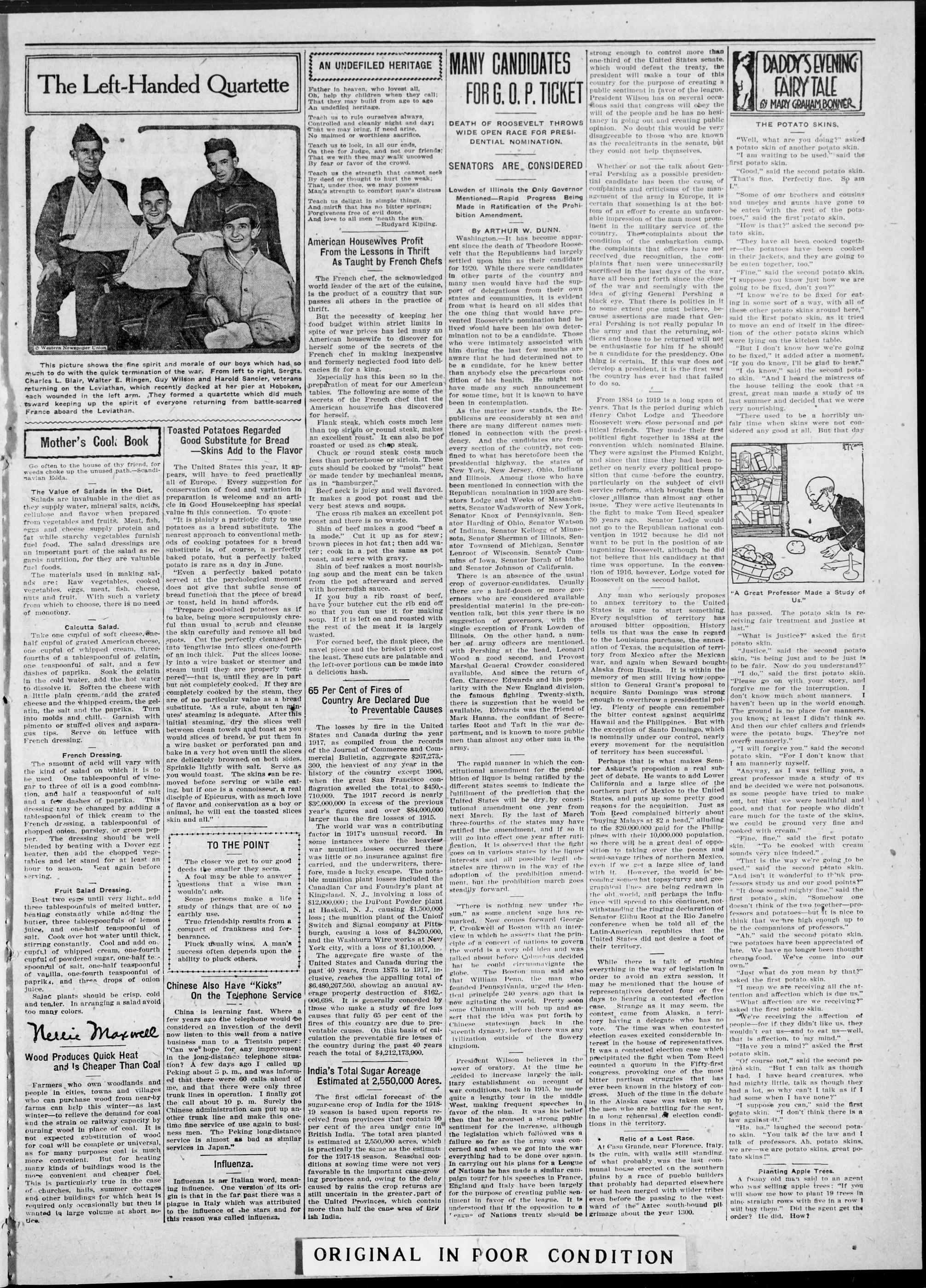
The Left-Handed Quartette
© Western Newspaper Union
This picture shows the fine spirit and morale of our boys which had so much to do with the quick termination of the war. From left to right, Sergts. Charles L. Blair, Walter E. Ringen, Guy Wilson and Harold Sancier, veterans returning on the Leviathan, which recently docked at her pier at Hoboken, each wounded in the left arm. They formed a quartette which did much esward keeping up the spirit of everyone returning from battle-scarred France aboard the Leviathan.
Mother's Cool Book
Go often to the house of thy friend, for weeds choke up the unused path.—Scandi-
navian Edda.
The Value of Salads in the Diet.
Salads are invaluable in the diet as they supply water, mineral salts, acids,
cellulose and flavor when prepared from vegetables and fruits. Meat, fish,
eggs and cheese supply protein and fat while starchy vegetables furnish
fuel food. The salad dressings are an important part of the salad as re-
gards nutrition, for they are valuable
fuel foods.
The materials used in making salads are: Raw vegetables, cooked
vegetables, eggs, meat, fish, cheese,
nuts and fruit. With such a variety
from which to choose, there is no need
of monotony.
Calcutta Salad.
Take one cupful of soft cheese, one half cupful of grated American cheese, one cupful of whipped cream, three-fourths of a tablespoonful of gelatin, one teaspoonful of salt, and a few dashes of paprika. Soak the gelatin in the cold water, add the hot water to dissolve it. Soften the cheese with a little plain cream, add the grated cheese and the whipped cream, the gelatin, the salt and the paprika. Turn into molds and chill. Garnish with pimento or stuffed olives and asparagus tips. Serve on lettuce with French dressing.
French Dressing.
The amount of acid will vary with the kind of salad on which it is to be used. One tablespoonful of vinegar to three of oil is a good combination, and half a teaspoonful of salt and a few dashes of paprika. This dressing may be changed by adding a tablespoonful of thick cream to the French dressing, a tablespoonful of chopped onion, parsley, or green pepper. The dressing should be well blended by beating with a Dover egg beater, then add the chopped vegetables and let stand for at least an hour to season. Beat again before serving.
Fruit Salad Dressing.
Beat two eggs until very light, add three tablespoonfuls of meited butter, beating constantly while adding the butter, three tablespoonfuls of lemon juice, and one-half teaspoonful of salt. Cook over hot water until thick, stirring constantly. Cool and add on cupful of whipped cream, one-fourth cupful of powdered sugar, one-half teaspoonful of salt, one-half teaspoonful of vanilla, one-fourth teaspoonful of paprika, and three drops of onion juice.
Salad plants should be crisp, cold and tender. In arranging a salad avoid too many colors.
Wood Produces Quick Heat and Is Cheaper Than Coal
Farmers who own woodlands and people in cities, towns and villages who can purchase wood from near-by farms can help this winter—as last winter—to relieve the demand for coal and the strain on railway capacity by ourning wood in place of coal. It is not expected substitution of wood for coal will be complete or universal, as for many purposes coal is much more convenient. But for heating many kinds of buildings wood is the more convenient and cheaper fuel. This is particularly true in the case of churches, halls, summer cottages and other buildings for which heat is required only occasionally but then is wanted in large volume at short notice.
Toasted Potatoes Regarded
Good Substitute for Bread
—Skins Add to the Flavor
The United States this year, it appears, will have to feed practically all of Europe. Every suggestion for conservation of food and variation in preparation is welcome and an article in Good Housekeeping has special value in this connection. To quote:
"It is plainly a patriotic duty to use potatoes as a bread substitute. The nearest approach to conventional methods of cooking potatoes for a bread substitute is, of course, a perfectly baked potato, but a perfectly baked potato is rare as a day in June.
"Even a perfectly baked potato served at the psychological moment does not give that subtle sense of bread function that the piece of bread or toast, held in hand affords.
"Prepare good-sized potatoes as if to bake, being more scrupulously careful than usual to scrub and cleanse the skin carefully and remove all bad spots. Cut the perfectly cleansed potato lengthwise into slices one-fourth of an inch thick. Put the slices loosely into a wire basket or steamer and steam until they are properly 'tempered'—that is, until they are in part but not completely cooked. If they are completely cooked by the steam, they are of no particular value as a bread substitute. 'As a rule, about ten minutes' steaming is adequate. After this initial steaming, dry the slices well between clean towels and toast as you would slices of bread, or put them in a wire basket or perforated pan and bake in a very hot oven until the slices are delicately browned, on both sides. Sprinkle lightly with salt. Serve as you would toast. The skins can be removed before serving or while eating, but if one is a connoisseur, a real disciple of Epicurus, with as much love of flavor and conservation as a boy or animal, he will eat the toasted slices skin and all."
The closer we get to our good deeds the smaller they seem.
A fool may be able to answer questions that a wise man wouldn't ask.
Some persons make a life study of things that are of no earthly use.
True friendship results from a compact of frankness and forbearance.
Pluck usually wins. A man's success often depends upon the ability to pluck others.
Chinese Also Have "Kicks" On the Telephone Service
China is learning fast. Where a few years ago the telephone would be considered an invention of the devil now listen to this wall from a native business man to a Tientsin paper: "Can we hope for any improvement in the long-distance telephone situation? A few days ago I called up Peking about 3 p. m., and was informed that there were 60 calls ahead of me, and that there were only three trunk lines in operation. I finally got the call about 10 p. m. Surely the Chinese administration can put up another trunk line and make this one-time fine service of use again to business men. The Peking long-distance service is almost as bad as similar services in Japan."
Influenza.
Influenza is an Italian word, meaning influence. One version of its origin is that in the far past there was a plague in Italy which was attributed to the influence of the stars and for this reason was called influenza.
ORIGINAL IN FOOR CONDITION
AN UNDEFILED HERITAGE
Father in heaven, who lovest all,
Oh, help thy children when they call;
That they may build from age to age
An undefiled heritage.
Teach us to rule ourselves always,
Controlled and cleanly night and day;
That we may bring, if need arise,
No maimed or worthless sacrifice.
Teach us to look, in all our ends,
On thee for Judge, and not our friends;
That we with thee may walk unwacned
By fear or favor of the crowd.
Teach us the strength that cannot seek
By deed or thought to hurt the weak;
That, under thee, we may possess
Man's strength to comfort man's distress
Teach us delight in simple things,
And mirth that has no bitter springs;
Forgiveness free of evil done,
And love to all men 'neath the sun.
—Rudyard Kipling.
American Housewives Profit From the Lessons in Thrift As Taught by French Chefs
The French chef, the acknowledged world leader of the art of the cuisine, is the product of a country that surpasses all others in the practice of thrift.
But the necessity of keeping her food budget within strict limits in spite of war prices has led many an American housewife to discover for herself some of the secrets of the French chef in making inexpensive and formerly neglected food into delicacies fit for a king.
Especially has this been so in the preparation of meat for our American tables. The following are some of the secrets of the French chef that the American housewife has discovered for herself.
Flank steak, which costs much less than top sirloin or round steak, makes an excellent roast. It can also be pot roasted or used as chop steak.
Chuck or round steak costs much less than porterhouse or sirloin. These cuts should be cooked by "moist" heat or made tender by mechanical means, as in "hamburger." Beef neck is juicy and well flavored. It makes a good pot roast and the very best stews and soups. The cross rib makes an excellent pot roast and there is no waste. Shin of beef makes a good "beef a la mode." Cut it up as for stew; brown pieces in hot fat; then add water; cook in a pot the same as pot roast, and serve with gravy. Shin of beef makes a most nourishing soup and the meat can be taken from the pot afterward and served with horseradish sauce.
If you buy a rib roast of beef, have your butcher cut the rib end off so that you can use it for making soup. If it is left on and roasted with the rest of the meat it is largely wasted. For corned beef, the flank piece, the navel piece and the brisket piece cost the least. These cuts are palatable and the left-over portions can be made into a delicious hash.
65 Per Cent of Fires of Country Are Declared Due to Preventable Causes
The losses by fire in the United States and Canada during the year 1917, as compiled from the records of the Journal of Commerce and Commercial Bulletin, aggregate $267,273,300, the heaviest of any year in the history of the country except 1906, when the great San Francisco conflagration swelled the total to $450,710,009. The 1917 record is nearly $32,000,000 in excess of the previous year's figures and over $84,000,000 larger than the fire losses of 1915.
The world war was a contributing factor in 1917's unusual record. In some instances where the heaviest war munition losses occurred there was little or no insurance against fire carried, and the underwriters, therefore, made a lucky escape. The notable munition plant losses included the Canadian Car and Foundry's plant at Kingsland. N. J., involving a loss of $12,000,000; the DuPont Powder plant at Haskell, N. J., causing $1,500,000 loss; the munition plant of the Union Switch and Signal company at Pittsburgh, causing a loss of $4,200,000, and the Washburn Wire works at New York city, with a loss of $1,100,000.
The aggregate fire waste of the United States and Canada during the past 40 years, from 1878 to 1917, inclusive, reaches the appalling total of $6,480,207,500, showing an annual average property destruction of $162,006,698. It is generally conceded by those who make a study of fire loss causes that fully 65 per cent of the fires of this country are due to preventable causes. On this basis of calculation the preventable fire losses of the country during the past 40 years reach the total of $4,212,173,900.
India's Total Sugar Acreage Estimated at 2,550,000 Acres.
The first official forecast of the sugar-cane crop of India for the 1918-19 season is based upon reports received from provinces that contain 99 per cent of the area under cane in British India. The total area planted is estimated at 2,550,000 acres, which is practically the same as the estimate for the 1917-18 season. Seasonal conditions at sowing time were not very favorable in the important cane-growing provinces and, owing to the delay caused by rains the crop returns are still uncertain in the greater part of the United Provinces, which contain more than half the cane area of British India.
MANY CANDIDATES FOR G.O.P. TICKET
DEATH OF ROOSEVELT THROWS
WIDE OPEN RACE FOR PRESIDENTIAL NOMINATION.
SENATORS ARE CONSIDERED
Lowden of Illinois the Only Governor Mentioned—Rapid Progress Being Made in Ratification of the Prohibition Amendment.
By ARTHUR W. DUNN.
Washington.—It has become apparent since the death of Theodore Roosevelt that the Republicans had largely settled upon him as their candidate for 1920. While there were candidates in other parts of the country and many men would have had the support of delegations from their own states and communities, it is evident from what is heard on all sides that the one thing that would have prevented Roosevelt's nomination had he lived would have been his own determination not to be a candidate. Those who were intimately associated with him during the last few months are aware that he had determined not to be a candidate, for he knew better than anybody else the precarious condition of his health. He might not have made any such announcement for some time, but it is known to have been in contemplation.
As the matter now stands, the Republicans are considerably at sea and there are many different names mentioned in connection with the presidency. And the candidates are from every section of the country, not confined to what has heretofore been the presidential highway, the states of New York, New Jersey, Ohio, Indiana and Illinois. Among those who have been mentioned in connection with the Republican nomination in 1920 are Senators Lodge and Weeks of Massachusetts, Senator Wadsworth of New York, Senator Knox of Pennsylvania, Senator Harding of Ohio, Senator Watson of Indiana, Senator Kellogg of Minnesota, Senator Sherman of Illinois, Senator Townsend of Michigan, Senator Lenroot of Wisconsin, Senator Cummins of Iowa, Senator Borah of Idaho and Senator Johnson of California.
There is an absence of the usual crop of governor-candidates. Usually there are a half-dozen or more governors who are considered available presidential material in the pre-convention talk, but this year there is no suggestion of governors, with the single exception of Frank Lowden of Illinois. On the other hand, a number of army officers are mentioned, with Pershing at the head, Leonard Wood a good second, and Provost Marshal General Crowder considered available. And since the return of Gen. Clarence Edwards and his popularity with the New England division, the famous fighting Twenty-sixth, there is suggestion that he would be available. Edwards was the friend of Mark Hanna, the confidant of Secretaries Root and Taft in the war department, and is known to more public men than almost any other man in the army.
The rapid manner in which the constitutional amendment for the prohibition of liquor is being ratified by the different states seems to indicate the fulfillment of the prediction that the United States will be dry by constitutional amendment one year from next March. By the last of March three-fourths of the states may have ratified the amendment, and if so it will go into effect one year after ratification. It is observed that the fight goes on in various states by the liquor interests and all possible legal obstacles are thrown in the way of the adoption of the prohibition amendment, but the prohibition march goes steadily forward.
"There is nothing new under the sun," as some ancient sage has remarked. Now comes forward George P. Crankwell of Boston with an interview in which he asserts that the principle of a concert of nations to govern the world is a very old idea and was talked about before Columbus decided that he could circumvagate the globe. The Boston man said also that William Penn, the man who founded Pennsylvania, urged the identical principle 240 years ago that is now agitating the world. Pretty soon some Chinaman will bob up and assert that the idea was put forth by Chinese statesmen back in the 'steenth dynasty, before there was any civilization outside of the flowery kingdom.
President Wilson believes in the power of oratory. At the time he decided to increase largely the military establishment on account of war conditions, back in 1915, he made quite a lengthy tour in the middle West, making frequent speeches in favor of the plan. It was his belief then that he aroused a strong public sentiment for the increase, although the legislation which followed was a failure so far as the army was concerned and when we got into the war everything had to be done over again. In carrying out his plans for a League of Nations he has made a similar campaign tour for his speeches in France, England and Italy have been largely for the purpose of creating public sentiment in favor of the league. It is understood that if the opposition to a league of Nations treaty should be
strong enough to control more than one-third of the United States senate, which would defeat the treaty, the president will make a tour of this country for the purpose of creating a public sentiment in favor of the league. President Wilson has on several occasions said that congress will obey the will of the people and he has no hesitancy in going out and creating public opinion. No doubt this would be very disagreeable to those who are known as the recalcitrants in the senate, but they could not help themselves.
Whether or not the talk about General Pershing as a possible presidential candidate has been the cause of complaints and criticisms of the management of the army in Europe, it is certain that something is at the bottom of an effort to create an unfavorable impression of the man most prominent in the military service of the country. The complaints about the condition of the embarkation camp, the complaints that officers have not received due recognition, the complaints that men were unnecessarily sacrificed in the last days of the war, have all been put forth since the close of the war and seemingly with the idea of giving General Pershing a black eye. That there is politics in it to some extent one must believe, because assertions are made that General Pershing is not really popular in the army and that the returning soldiers and those to be returned will not be enthusiastic for him if he should be a candidate for the presidency. One thing is certain. If this war does not develop a president, it is the first war the country has ever had that failed to do so.
From 1884 to 1919 is a long span of years. That is the period during which Henry Cabot Lodge and Theodore Roosevelt were close personal and political friends. They made their first political fight together in 1884 at the convention which nominated Blaine. They were against the Plumed Knight, and since that time they had been together on nearly every political proposition that came before the country, particularly on the subject of civil service reform, which brought them in closer alliance than almost any other issue. They were active lieutenants in the fight to make Tom Reed speaker 30 years ago. Senator Lodge would not go to the Republican national convention in 1912 because he did not want to be put in the position of antagonizing Roosevelt, although he did not believe that his candidacy at that time was opportune. In the convention of 1916, however, Lodge voted for Roosevelt on the second ballot.
Any man who seriously proposes to annex territory to the United States is sure to start something. Every acquisition of territory has aroused bitter opposition. History tells us that was the case in regard to the Louisiana purchase, the annexation of Texas, the acquisition of territory from Mexico after the Mexican war, and again when Seward bought Alaska from Russia. It is within the memory of men still living how opposition to General Grant's proposal to acquire Santo Domingo was strong enough to overthrow a presidential policy. Plenty of people can remember the bitter contest against acquiring Hawaii and the Phillippines. But with the exception of Santo Domingo, which is nominally under our control, nearly every movement for the acquisition of territory has been successful.
Perhaps that is what makes Senator Ashurst's proposition a real subject of debate. He wants to add Lower California and a large slice of the northern part of Mexico to the United States, and puts up some pretty good reasons for the acquisition. Just as Tom Reed complained bitterly about "buying Malays at $2 a head," alluding to the $20,000,000 paid for the Philippines with their 10,000,000 population, so there will be a great deal of opposition to taking over the peons and semi-savage tribes of northern Mexico, even if we get a large slice of land with it. However, the world is becoming somewhat topsy-turvy and geographical lines are being redrawn in the old world, and perhaps the influence will spread to this continent, notwithstanding the ringing declaration of Senator Elihu Root at the Rio Janelro conference when he told all of the Latin-American republics that the United States did not desire a foot of their territory.
While there is talk of rushing everything in the way of legislation in order to avoid an extra session, it may be mentioned that the house of representatives devoted four or five days to hearing a contested election case. Strange as it may seem, the contest came from Alaska, a territory having a delegate who has no vote. The time was when contested election cases excited considerable interest in the house of representatives. It was a contested election case which precipitated the fight when Tom Reed counted a quorum in the Fifty-first congress, provoking one of the most bitter partisan struggles that has ever been known in the history of congress. Much of the time in the debate in the Alaska case was taken up by the men who are battling for the seat, in a long rehearsal election conditions in the territory.
- Relic of a Lost Race.
At Casa Grande, near Florence, Italy, is the ruin, with walls still standing, of what probably was the last communal house erected on the southern plains by a race of pueblo builders that probably had departed elsewhere or had been merged with wilder tribes even before the passing to the west ward of the Aztec south-bound pilgrimage about the year 1300.
DADDY'S EVENING
FAIRY TALE
BY MARY GRAHAM BONNER
THE POTATO SKINS.
"Well, what are you doing?" asked a potato skin of another potato skin.
"I am waiting to be used," said the first potato skin.
"Good," said the second potato skin.
"That's fine. Perfectly fine. So am I."
"Some of our brothers and cousins and uncles and aunts have gone to be enten' with the rest of the potatoes," said the first potato skin.
"How is that?" asked the second potato skin.
"They have all been cooked together—the potatoes have been cooked in their jackets, and they are going to be eaten together, too."
"Fine," said the second potato skin.
"I suppose you know just how we are going to be fixed, don't you?
"I know we're to be fixed for eating in some sort of a way, with all of these other potato skins around here," said the first potato skin, as it tried to move an end of itself in the direction of the other potato skins which were lying on the kitchen table.
"But I don't know how we're going to be fixed," it added after a moment.
"If you do know, I'll be glad to hear."
"I do know," said the second potato skin. "And I heard the mistress of the house telling the cook that a great, great man made a study of us last summer and decided that we were very nourishing. *
"There used to be a horribly unfair time when skins were not considered any good at all. But that day
"A Great Professor Made a Study of Us."
has passed. The potato skin is receiving fair treatment and justice at last."
"What is justice?" asked the first potato skin.
"Justice," said the second potato skin, "is being just and to be just is to be fair. Now do you understand?" "I do," said the first potato skin. "Please go on with your story, and forgive me for the interruption. I don't know much about manners. I haven't been up in the world enough. The ground is no place for manners, you know; at least I didn't think so. And then our chief callers and friends were the potato bugs. They're not overly mannerly."
"I will forgive you," said the second potato skin. "For I don't know that I am mannerly myself.
"Anyway, as I was telling you, a great professor made a study of us and he decided we were not poisonous, as some people have tried to make out, but that we were healthful and good, and that for people who didn't care much for the taste of the skins, we could be ground very fine and cooked with cream."
"Fine, fine," said the first potato skin.
"To be cooked with cream sounds very nice indeed."
"That is the way we're going to be used," said the second potato skin.
"And isn't it wonderful to think professors study us and our good points?" "It does sound mighty fine," said the first potato skin.
"Somehow one doesn't think of the two together—professors and potatoes—but it is nice to think that we are high enough up to be the companions of professors."
"Ah," said the second potato skin, "we potatoes have been appreciated of late. We have no longer been thought cheap food. We've come into our own."
"Just what do you mean by that?" asked the first potato skin.
"I mean we are receiving all the attention and affection which is due us."
"What affection are we receiving?" asked the first potato skin.
"We're receiving the affection of people—for if they didn't like us, they wouldn't eat us—and to eat us—well, that is affection, to my mind."
"Have you a mind?" asked the first potato skin.
"Of course not," said the second potato skin. "But I can talk as though I had. I have heard creatures, who had mighty little, talk as though they had a lot, so why can't I talk as if I had some when I have none?"
"I suppose you can," said the first potato skin. "I don't think there is a law against it."
"Ha, ha," laughed the second potato skin. "You talk of the law and I talk of professors. Ah, potato skins, we are—we are potato skins, great potato skins!"
Planting Apple Trees
A foxy old man said to an agent who was selling apple trees; "If you will show me how to plant 19 trees in nine straight rows with five in a row I will buy them." Did the agent get the order? He did. How?
THE COLORADO STATESMAN
LABUN
BIDGES BE
FREE
BACK
COUNTRY
PARTY
Entered as second-class matter at the postoffice in the City of Denver, Colo.
Remittances should be made by Express Money Order, Postoffice Money Order, Registered Letter or Bank Draft. Postage stamps will be received the same as cash for the fractional part of a dollar. Only 1c and 2c stamps taken.
Reading notices, ten lines or less, 15 cents per line. Each additional line over ten lines, 10 cents per line. Display advertising 50c per inch.
No discounts allowed on less than three months' contract. Cash must accompany all orders from parties unknown to us. Further particulars on application.
Communications to receive attention must be newsy, upon important subjects, plainly written only upon one side of the paper, must reach us Tuesdays, if possible, anyway not later than Wednesdays, and bear the signature of the author. No manuscript returned, unless stamps are sent for postage. All communications of a personating nature that are not complimentary will be withheld from the columns of this paper.
HOW ENCOURAGING!—AN AFTER-WAR PHASE.
WE ARE ASKING our readers to carefully read and digest the article on the front page of this paper—"Reconstruction and the Colored Woman," by Forrester B. Washington, apply it to both sexes of the race, for the cruel effect is being felt on the masculine side also, and see how much encouragement we can have in the advance theory of some that the sudden cessation of hostilities will be specially beneficial to us, and that very soon. To impress our readers on the weight attached to this all-important subject contributed to the Life and Labor Magazine, a monthly journal, published by the National Women's Trade Union League of America, we feel duty bound to inform them briefly of the qualification of Mr. Washington, the same giving a complete proof of his ability to fully investigate and arrive at the conclusions which show the sieve-like nature of our DE-MOGRACY in the article written by him.
Service to his people and race is the directing force of Mr. Washington's life. Graduated from Tuft's College in 1909, he continued his studies at the Harvard Graduate School, the New York School of Philanthropy and Columbia University, with the vision of social work steadily before him. He became a Fellow of the National League on Urban Conditions Among Negroes in New York City, and in 1916-17 as organizer and director of the Urban League of Detroit, he inaugurated and promoted what is said to have been the most successful program of wholesome and helpful adjustment of Negro migrants into an industrial center of any attempted in the North. And always, when opportunity is offered, he has preached, with his pen and from the platform, industrial salvation for his race.
At present Mr. Washington is with the U. S. Employment Service in Chicago, in charge of all matters relating to the Negro in industry in Illinois. Seeing, therefore, that this member of our race is fully equipped to present matters affecting us in part or whole, we ought to read his article with more than ordinary interest, and when we note the arguments and facts placed before us from the standards of EFFICIENCY, the denouncement of SHIFT-LESSNESS with which we are commonly charged, the stern rebuke and admonition offered for the convenient democratic ideals presented during the war period, we are compelled to be proud of such a worthy champion and advocate of that true Americanism, which if dispensed righteously, will make this land and people the representatives of Universal Democracy instead of the mockery which the world now beholds in its glaring form.
The following extracts from the article should be ever present in our minds, as the purpose of inspiring us to push on will be served, and we can discover the kind of encouragement our government offers us in the role of LOYALTY, that they say we are first and most in. "So far as efficiency is concerned, there have been numerous cases where colored girls, given equal conditions, far excelled their white sisters. In the cartridge factory of Newark the colored women working nights averaged 1,500 more shells per eighth-hour shift than the white women who worked in the day. The time-worn charge of shiftlessness vanishes when a Negro is offered a salary worth working for. Organized labor cannot afford to sink below the high standard to which it rose during the war. If either American employer or the American laborer continues to deny the colored woman an opportunity to make a decent living, the Bolshevik cannot be blamed for proclaiming their affirmation of democratic principles a sham." These are among the many logical deductions that Mr. Washington has made from his personal knowledge and experience, and we can rely upon their being based on the soundest and most reasonable arguments that can be produced. The time, the opportunity and other things helpful to the cause present themselves. Let us seize them and act accordingly. MENS SANA. (A sound mind.)
AT THE PEACE TABLE—AMERICA PLAYING A GREAT PART.
IF IT IS DUE to the hurry-up action so as to shape economic conditions to save the starving Germans, as we are told, the new propaganda of the Bolshevik, which is causing so much of unrest, or the trouble over the distribution of German colonies won in the war and how to govern them, that this muddle is on, why not, we ask, add to the number of our delegates at Versailles or change representatives before any more complications arise? For our part we are glad that our Chief Executive is on the spot, as he gets everything first hand, and in his broad vision of world democracy, some of the things being advocated for the protection and security of other peoples and nations, may help us to an extent never dreamed of or antelpated.
The league of nations will, as a part of its official duty, be the guardian of the African Colonies formerly owned by Germany, if our President's plan is adopted. Can we remember the provisions of our Monroe Doctrine—a clause of which forbids any nation to interfere with any action of nations on the American continent? Does it seem likely as one of the signatories to the charter of the league of nations to exercise authority in other continents, that this same league from the power invested in them, and their spirit of internationalization may feel empowered through their good offices to help to correct some of our domestic issues? Who knows but this may be THE PLAN OF SALVATION FOR THE DARKER RACES OF THE EARTH? The warning is sounded again and again that "America will never yield her sovereignty to an international conference," and proving to the world that she is all-powerful and can defy any invader that attempts to tackle her, it seems not quite reasonable that she will allow dictation of her internal or domestic affairs.
There are countries in Europe that do not think German atrocities in times of war exceed our inhuman acts and phases of barbarism in time of peace, and they view us with suspicion around the peace table as to our intent and purpose, and will grasp everything that comes their way to show us up in our true light. We must confess (permitting the use of one of the latter day's choice) "we have no kick coming". The arm of protection to be thrown around the poor, suffering African of the East and Southwest may be extended by the time real democracy covers the earth to the struggling, misused and most cruelly treated of all persons in this country, and their souls will burn within for a longing to do the right by their fellow Americans whom they are now ashamed to be classified with (except in perilous adventure), and whom they refer to as an inferior specie of the human creation. We are anxious for a speedy session of the great peace conference hastening to a termination, which will extend adequate protection to us at home as well as other unfortunates abroad. Our Chief Magistrate being big and broad, it is very likely in his charitable disposition he may turn the helping hand towards us, giving us the advantages of the African whom he is now endeavoring to protect. Is Ethiopia crying out now, or is her cry heard? The members of the PEACE COMMISSION will answer. Let us anxiously await.
What Is to Be the Attitude Toward Labor of Leaders of Industry?
By JOHN D. ROCKEFELLER, Jr.
As the leaders of industry face this period of reconstruction, what will their attitude be? Will it be that of the "standpatters" who take no account of the extraordinary changes which have taken place in the minds of men, who say, "What has been and is must continue to be. With our backs to the wall we will fight it out along the same lines or go down with the ship;" who attempt stubbornly to resist the inevitable and, arming themselves to the teeth, invite open warfare with the other parties in industry, the certain outcome of which will be financial loss, inconvenience
As the leaders of industry face this period of reconstruction, what will their attitude be? Will it be that of the "standpatters" who take no account of the extraordinary changes which have taken place in the minds of men, who say, "What has been and is must continue to be. With our backs to the wall we will fight it out along the same lines or go down with the ship;" who attempt stubbornly to resist the inevitable and, arming themselves to the teeth, invite open warfare with the other parties in industry, the certain outcome of which will be financial loss, inconvenience and suffering to all, the development of bitterness and hatred, and in the end the bringing about through legislation, if not by force, of conditions far more drastic and radical than could now be amicably arrived at through mutual concession in friendly conference?
Or will it be an attitude, in which I myself profoundly believe, which takes cognizance of the inherent right and justice of the principles underlying the new order, which recognizes that mighty changes are inevitable, many of them desirable; which, not waiting until forced to adopt new methods, takes the lead in calling together the parties in interest for a round-table conference to be held in a spirit of justice, fair play and brotherhood with a view to working out some plan of co-operation which will insure to all those concerned adequate representation, an opportunity to earn a fair wage under proper working and living conditions, with such restrictions as to hours as shall leave time not alone for food and sleep but also for recreation and the development of the higher things of life?
Why the British Seaman has Boycotted the German for Seven Long Years
By CAPT. EDWARD TUPPER, Sailors' Union
When the war broke out and the authorities took 8,000 German sailors off British ships in British ports we insisted that they should not be treated as prisoners or as enemies. These men had been our shipmates. They were members of our union, many of them of five, ten, fifteen years' standing. Well, the authorities turned them over to us with ill grace. We went surety for them and made them the guests of our union. We housed them, clothed them, fed them better than ever before in their lives. I was on Lord Kitchener's recruiting committee; and wherever I went to speak I was challenged as a pro-German.
Then came the sinking of the Lusitania. These Germans broke forth in cheers. Then they began to sing "Die Wacht am Rhein," "Deutschland ueber Alles," and—well, they kept the celebration up all night. There could not have been a wilder celebration in Berlin.
Well, sir, we were awake at last. The next morning we went to the authorities and said, "Take these creatures off our hands." So we were rid of their care and company.
All this time we were of the opinion that by treating these German sailors as men and brothers we would assure our own poor fellows decent treatment in German prisons. We did not. We soon learned that our men were being treated worse than any white man would treat a dog. The full story of their treatment can never be told in a newspaper.
But even then we were not bitter. We began to plumb it when reports of U-boat outrages began to come in. All the world knows how the crew of the Belgian Prince were lined up on the deck of a U-boat and left to drown when she submerged. It does not know all the horrible stories of men shelled in open boats, of men and women and children, too, for that matter, cast adrift without food or oars or water. We ourselves do not know of all. We know of the orders "sink and leave no trace," and we know full well how thoroughly those orders were carried out.
About this time we decided on the boycott. Two years was the term we fixed, and we gave solemn warning that for every additional outrage we would add a month. Seven years is the total now—the price we demand for the 17,000 of our members we know the Germans murdered.
The sea is a hard life, yet those who follow it love it. It is a clean life and a free life. It is a life for men and not for dogs, and so far as lies in the British seamen's power, it will not be polluted by Germans.
The boycott is not of our choosing. Would to God we never had to consider, much less apply it. But it was forced on us when, against our wills, we were forced to realize that, come what may, go what may, a Hun is only a Hun.
It is to be hoped the work at the peace conference will be short, sharp and to the point, free from ambiguity. That it will settle territorial boundaries and the question of the colonies and fix indemnities and adjourn, leaving an ample military force in Germany to see to it that the terms of the peace are complied with. This conference is not a place for speechmaking or Utopian propaganda. The delegates meet there for business purposes only. They are not there to settle the business of the world for all time to come. They must leave something to future generations and incidentally to the Almighty.
The best preventive of future wars at this time is the sight of a nation being made to foot her war bills. To pay just and righteous indemnities for all her unrighteous despoliation of other nations. Let the nations see that war is not only hell but bad business that leads to bankruptcy. Remember we are dealing with a nation without a conscience and whose entire social edifice is reared on a substructure of economic interests. Money is the only key that fits the lock of the German problem. She is long on cash and short on conscience. It was when the prodigal was "broke" that he "came to himself" and returned in penitence.
People easily forget treaties, but taxes jog the memory. Years from now, when the passion of the hour has passed and Germany has had time to eat and inwardly digest some of the crop of her own sowing, and incidentally, let us hope, to repent and "to bring forth fruit meet for repentance"—then it will be time for the nations to meet at The Hague and talk/about a league of nations, but not until then.
```markdown
```
THE COLORADO STATESMAN
---
The Mouth-Piece of the People of Colorado and the Entire West
---
ARELIABLE chronicle of their doings and progress; a faithful mirror of their wants, their hopes, their best aspirations.
THE
COLORADO
STATESMAN
Unequaled as an advertising medium for the business of professional men and women.
An excellent family journal speaking to and for many thousand colored citizens. TWO DOLLARS A YEAR
THE GREAT ORGAN OF THE LABORING MASSES
Mrs. W. H. Gibson of 3230 Gilpin street, is reported quite sick this week. We hope her speedy recovery.
Our popular townsman and friend, Barber George Sample, is suffering with rheumatism. We wish him a speedy recovery.
recently, and commanding the respect of fellow ranchers of Peyton, Coloowing to strict attention to his own business coupled with consistency of action, Mr. Gatewood is in his own quiet way improving conditions for his race. We wish him abundant succes.
The many friends of T. W. Arrington will be glad to know that he is home from St. Luke's hospital, where he underwent an operation.
Mrs. C. H. Winters of 2555 Glenarm Place, who has been suffering from a nervous attack, is gradually recovering. We trust she will soon be herself again.
J. W. Jackson of 429 W. Eighth avenue, was on the sick list, the first of the week, suffering from hic coughs, but at this writing we are glad to report is much improved.
George W. Davis has resumed his employment after surviving a severe attack of pneumonia. Our friend George must remember he is nearing his twenty-first milestone, so he should be very careful.
Jas. Settles, one of the porters of Daniels & Fisher's, returned last week from an extensive trip through Arkansas, Texas and Louisiana, while on his vacation during the Christmas, and is now confined to his bed owing to illness.
February 24th, Monday—Denver's Best. Three Local Artists, Violin, Piano and Organ. Supported by a Select City Male Quartet. Zion Baptist Church. Exhibition of extraordinary
Former Sergeant Barney Reed and Wm. Berry of the motor branch of Company A, Infantry Quartermaster's Department, were presented with a three-bar silver chevron by Major J. Buell of the Colorado National Guards for special services. Both received praiseworthy recommendations also.
William Baker and crew of six gave very satisfactory service in the main dining room of the Oxford Hotel, famous western hostelry, during Stock Show week, according to Manager Dill, who agrees with giving our men a chance to make good. The establishing and maintaining such reputation is the desire of the Colorado Statesman.
Our famous violinist, George Morrison, had a splendid opportunity which he took advantage of when he played for the Edison Phonograph Company in concert with the far-famed and renowned Albert Spalding, one of America's foremost violinist. Mr. Morrison was highly commended by this eminent musician and was also applauded several times by the large audiences who listened with much attention to his interpretations of the masters at the Albany hotel during Stockshow week.
Edward Washington, a former popular townsman, dropped in on us last Saturday from Portland, Ore., where he reports our people are doing not only well, but adopting every measure intellectually to break down the last barriers of PREJUDICE. Conditions are being made better for our people," said Mr. Washington, "and an increase in the migration to those quarters will materially help to strengthen them." The ship "Denver" sails soon. How many will start?
Cornelius Rice and Oscar Seawright, real Denver products who ignored the stationery "home duty," and signed up for service with the gallant military representatives of the nation, returned recently to Denver on the demobilization of their regiment. Personal expressions of the worth of these young men were offered by their superiors in office, and they return to their relatives and friends bigger and broader from their experience, to combat with the eventualities that will confront us in the RECONSTRUCTION PERIOD.
A. A. Gatewood, son of our postal clerk and popular musician, William Gatewood of 3233 Marion, is setting a pace for young men on the development of his ranch, 60 miles from Denver and running southwest of Colorado Springs. His mother and father were the happy recipients of a 30011b. hog which the young man sent them
recently, and commanding the respect of fellow ranchers of Peyton, Colo., owing to strict attention to his own business coupled with consistency of action, Mr. Gatewood is in his own quiet way improving conditions for his race. We wish him abundant success.
Keep off Wednesday, Feb. 12, Lincoln's birthday. Greatest of the season's sportive events. Grand patriotic ball by the Five Points Patriots, Fern Hall. Morrison's wonderful Jazz Orchestra, Duke Conway, doorman.
The Bon Vi Vants in celebrating their eighteenth annual dinner held at the residence of Miss Ada Gibson, 1300 E. 28th avenue, last Thursday evening, gave another reminder of the beauties of the social side of life when pleasure and jollity in their gayest of form reigned supreme. This organization attractive in its name, its personnel and everything that goes to make it a standard of bliss in the sphere of fun and frolic has in its membership some of our leading citizens, and the enjoyment engaged in on this ever memorable occasion compared very favorably with the special events of the season anywhere in the Rocky Mountain region.
Trio of Musicians—Violinist, pianist, organist at Zion Baptist Church, Monday, Feb. 24th. Select City Male Quartet. Rare musical treat.
TOM WILLIAMS is not dissatisfied with the staff of men that he employs in his capacity as headwaiter at the exclusive Denver Club, and as he expresses, "any man who specializes on the job by which he earns his bread and butter making it not only successful but worthy of commendation, so in turn ought he to be shown appreciation for his services," and this Tom never hesitates to do, as is demonstrated by his ability to keep his men the year round. According to Mr. Williams his men and himself were very generously remembered by the members of the club during Xmastide, and they in turn show their keen appreciation by a continuance of the best services given to this club, which services the members unanimously declare are second to none in the Rocky Mountain region or any other part of the country. Another incident where efficient leadership counts. That leader and follower may keep this up is the best wish of the Colorado Statesman.
Y. M. C. A. NOTES
The Young Men's Christian Association wishes to announce through these NOTES that Secretary Thomas J. Bell is again on the way to complete recovery from his recent illness.
Mr. Bell, who went to New York City to spend his vacation with his family during the month of December, had been back only two days when he was suddenly stricken with influenza in its acute form while returning from a conference at the Central Y. M. C. A. So quickly and unexpectedly was the attack that although he was stricken only a few blocks from the Y building it was with great difficulty that he was able to reach the building. Pneumonia immediately set in, and he was removed to the County hospital, where for some time his life was almost despaired of. He is now thoroughly out of danger, and during the week has been convalescing at the home of the Rev. Dr. T. S. McMorris, pastor of the Scott M. E. Church.
The 'secretary will resume work at the Y. M. C. A. next Monday, February 3rd. Nearly two hundred memberships will be canvassed within in the next two weeks.
THE MANHATTAN LIFE INSUR
ANCE COMPANY.
THIS INSURANCE COMPANY which has given a guarantee of its reliability to take care of its patrons in every form and feature as represented to the public comes again to our people through their special agent, Wesley Frierson, whose name is rehearsed in the majority of the homes, by old and young, and in offering at special rates, endowment and other policies, the determination to do business on a greater scale than ever is engaging their immediate attention. Pullman porters especially should seize this opportunity now that they are in receipt of their bonus checks, to take out policies and make investments permanently beneficial to themselves and families. Remember THE RECONSTRUCTION PERIOD demands "the stitch in time" action
which saves time and exposure, and the Manhattan Insurance Company which needs no introduction to the public as its historic usefulness is universally acknowledged, is ready to cater to and take care of the smallest policyholder as well as the largest. Call Main 3309 or Main 3183 where our special agent, Wesley Frierson, will give you complete information on the great benefits to be achieved by investing in this all-saving proposition which has for a period of nearly seventy years materially aided humanity's wants.
February 24th, Monday—The best musical production of the season.
Rhoda Anderson-Chambers, piano;
George Morrison, violin; Valaurez Spratlin, organ. Famous City Male Quartet. Zion Baptist, 8:15 p. m.
CAPT. THOMAS CAMPBELL, WELL
KNOWN DENVERITE, GETS AP
POINTMENT IN CLERK OF DISTRICT COURT OFFICE.
THE old motto, "Honor to whom honor is due," appears again on the scene, this time being the appointment of Capt. Thomas Campbell of Spanish-American war fame, to a position in the office of the Clerk of the District Courts beginning today. Capt. Campbell, a true and loyal citizen of Denver, with a faithfulness to the Republican party and a zeal for the betterment of condition for his people, is accredited with the good fortune of helping to promote from a meritorious standpoint such impressions of ability found among our people that avenues are being opened for us, and only the qualified will be able to lay hold of such opportunity as are presenting and will present themselves to us in our city and state. Knowing this Denver resident for several years and being fully acquainted with his ability to hold, take care of and make possible for the filling of similar positions by members of his race, the Colorado Statesman bespeaks a very successful tenure of office, and joins with the many friends of Capt. Campbell in wishing him a very successful term, being convinced that the most harmonious relationship will exist between his associate employés and himself.
W. A. Dollison, chairman of the Republican County Central Committee, and recently elected clerk of the district courts, always respected in the public eye as a man who stands for right, and who fearless as a champion of equal rights, will stand for merit, did not hesitate to make this appointment, as Mr. Dollison feels that the time has come when the man, true to that which is committed to his charge and successfully discharging it, is entitled when qualified to representative positions setting standards for the people's ambitions and aspirations. With such men as our officials we will trust to merit—AND MERIT WILL TELL.
GEORGE PARSONS WINS FIRST AND FIFTH PRIZES AT DENVER STOCK SHOW.
George F. Parsons, one of our quiet, unassuming residents of several years in Denver, took first honors among a large body of competitors in the exhibition of Flemish Giants (a specie of thorough-bred rabbits) at the National Western Stock Show held here last week. He received first prize with Black Prince—a splendid black buck in the eight months class, the prize being a blue ribbon and check, and with "Colorado E" he won the yellow ribbon. Mr. Parsons competed with the celebrated Griffin (white) of Colorado Springs, who has been in the limelight for years with his prize-winning rabbits, and who won the silver cup in the all-round decision. It took the judges a long time to arrive at a decision between the two bucks of these owners for the prize of the cup, and finally Mr. Griffin secured the honors, his buck being a quarter of an inch longer than Mr. Parsons'. A visit to 2643 Marion street, the premises of the Parsons, will convince one of the standard of efficiency set by some of our people should be-imitated or adopted by all, as it is only the persistent character who believes in the equality of civic liberty and prides in the welfare of humanity, will enter anything where competition, generally termed the secret of success, proves the grit, stamina and usefulness of the man. The Colorado Statesman congratulates Mr. Parsons on his success and hopes his good purposes may be served in the help offered the members of his race TO DO SOMETHING.
Dr. S. A. Huff, physician and surgeon, 2538 Washington street; office hours 11 to 12 a. m., 3 to 5 p.m. Phone York 2313. Out of office, Main 875. Residence Phone York 4101.
For employment see the Industrial Realty Co. Employment Agency, 716 East Twenty-sixth Ave. York 4561.
BOOST FOR BOY SCOUT MOVEMENT.
Meeting at Zlon Last Tuesday Marks
New and Important Era in
Boys' Lives.
Last Tuesday evening will be long remembered by the men who were fortunate to listen to Colonel Hutchinson of the National Boy Scout Movement in his impressive address on this one of the most important movements of modern times. He gave some very soul-stirring illustrations and accounts of boys' needs, their rescue, and rescuers. The forty men consisting of our leading ministers, professionals, business men and those engaged in every walk of life expressed great satisfaction at the privileged opportunity extended them by the invitation extended them through William Parks, our popular Scoutmaster, and agreed unanimously to the formation of a permanent organization among our boys. A banquet of rare appointments preceded the address, which was heartily enjoyed by those present. We wish this movement every success in its entirety.
DOUGLASS UNDERTAKING CO.
Rhodes, James Henry, 52 years, beloved husband of Mammie Rhodes, residence 1627 Twenty-second avenue, departed this life January 25th. Funeral services were held at 10 a.m., Monday, January 27th, Rev. C. A. Williams officiated, assisted by Rev. A. M. Ward and Presiding Elder Allen. Body was accompanied by Mrs. Rhodes to Lebanon, Ill., where it will be interred. Mosley, Clifford William, infant of Mr. and Mrs. John W. Mosley, residence 2426 Marion street, departed this life January 25th. Services were held 10 a.m. Tuesday, January 28th, from Douglass Chapel. Rev. C. A. Williams officiated. Interment in family plot at Fairmount cemetery. Miles, Rosa, 42 years, residence 2541 Glenarm place, departed this life January 25th.
Brown, William, 4 years, infant of Mr. and Mrs. Fred Brown, Dearfield, Colo., departed this life Jan. 25th. Services were held Monday, 2 p.m., in the Colony. Dempsey, Henry, 61 years, departed this life January 28th.
CHEYENNE, WYOMING NEWS.
The Civic League met Thursday evening, January 23rd, at the Second Baptist Church, with an unusual good attendance. On account of the absence of the president, Rev. Smith, J. T. Muse was elected president protem for the meeting. C. J. Tolliver was elected assistant secretary. Questions of the highest importance to the race were discussed. Mr. Jack Brushwood of Thermopolis, Wyo., who is here holding the post of assistant sergeant at arms at the legislature, was the principal speaker for the evening. He dwelt upon the manifold duties of the organization. He pointed out the following facts: If the Negro race is to secure the recognition which as a race of loyal Americans it is entitled, it must stand absolutely united. It is the first duty of the Negro as of every good citizen to be governed by the laws of the land and when his rights are violated he should not make an infuriated and individual protest, but should take the matter up through the representatives of the Civic League.
The league as based on right and dedicated to making better citizens and upholding the laws of the land, will not and cannot be denied a fair hearing by the better element among the whites. All that we want is a fair hearing. Short addresses were made by Pastor Endicott of the A. M. E. Church, Messrs. Jefferson, C. J. Tolliver, A. Williams and others. The meeting was very interesting all the way through and several persons gave their names to become members of the league.
Rev. C. O. Smith, pastor of the Baptist Church, who left here December 23rd to spend the Christmas with his family in Hutchinson, Kansas, returned Sunday night, January 26th. The Reverend reports that he had a splendid good time. He also spoke very complimentary of Rev. Allan, pastor of the Baptist Church in Hutchinson. He says Rev. Allan is doing a splendid good work and is making great progress on his $20,000 church that he began last summer.
The funeral of Mrs. Clydie Davidson was held at the A. M. E. Church Sunday at 2 p. m., Rev. Endicott officiating.
Mrs. H. Craig, sister-in-law and Mrs. Ora Stone, niece of the deceased, both of Kansas City, Mo., who came here last week to attend the funeral of Mrs. Davidson, will leave this week for their homes.
Mrs. G. Walton of Denon, who was here visiting her sister, Mrs. Wm. Smith, has returned to her home.
Mr. and Mrs. S. M. Caves are the happy parents of a bouncing baby boy born January 29th. All Cheyenne is congratulating the couple, Mrs. Caves having been raised here and her parents being old timers of Cheyenne. Mother and babe are doing nicely at this writing.
CONGRESS VOTES DISCHARGED
SOLDIERS MONTH'S PAY
Washington, D. C., Jan. 24.—The United States Senate passed a bill Monday which will give every discharged soldier and sailor a month's pay, mileage to home at a rate of 5 cents per mile, a uniform and overcoat and permission to wear them for a month. The bill met hearty approval of every senator. An amendment to the bill to make it three months' pay will be offered by Senator Ashurst.
Weatherhead Hat Co.
LEPHONE
MAIN 3203
Established 1876
PIONEER HATT
OF THE WEST.
MAKE OLD H
NEW.
RENOVATORS, BLEACHERS, DYERS AND FINISHERS.
Of Gents' and Ladies' Hats of Every Description
1624 CHAMPA ST., DENVER, COLO.
MORRISON'S FAMOUS JAZZ ORCHESTRA
AND ENTERTAINERS
GEO. MORRISON, MANAGER
Music Furnished
Phone Main 2707. Res. 2947 S
THE CHAMPA
TWENTIETH
Is the place
DRUGS, CHEMICALS AND
WE SERVE
PRESCRIPTIONS
Phone us and we will deliver to
JAMES E. TH
PHONE M
Office Hours: 12 to 1 and 3 to 8 p.m.
CHIRO
MME. H. B.
Treatment at Your Home. E.
2913 Glenarm Place.
Music Furnished for all Occasions
Phone Main 2707. Res. 2947 Stout St. DENVER, COLO.
THE CHAMPA PHARMACY
TWENTIETH AND CHAMPA.
Is the place to get your
DRUGS, CHEMICALS AND PATENT MEDICINES
WE SERVE DRINKS.
PRESCRIPTIONS OUR SPECIALTY.
Phone us and we will deliver the goods to all parts of the city.
JAMES E. THRALL, Propr.
PHONE MAIN 2425.
Treatment at Your Home. Engagements by Appointment. 2913 Glenarm Place. Denver, Colorado
PEOPLE'S PRESBYTERIAN
East 23rd Ave. and Washington St.
Presbyter, J. A. Thos-Hazell, S. T. B.
Sermon Topics, Sunday, Feb. 2nd
Parents and children are specially invited to worship at 11 a. m. tomorrow with us. The lecture will be an appeal to the parents and heads of family for the establishment and reestablishment of the Family Altar.
The evening services will be of a "Memorial" nature on behalf of Rev. E. P. Cowan, D. D., secretary-treasurer of the Presbyterian Board of Missions for the Freedman for thirty-five years. The occasion will afford the worshippers an opportunity to contribute to the "E. P. Cowan Endowment Fund," the interest of which to be used exclusively to the further development of the Negro Race. Drs. Chas. G. Williams, Wm. M. Campbell, J. Mont Travis, R. Randolph, Prof. Geo. Morrison and other distinguished persons will participate on the program. The public is cordially welcomed to this feature of the Sabath's services.
CONGRESS ASKED TO SUPPRESS LYNCHING.
Cincinnati, Jan. 15.—The board of managers of the Freedmen's Aid Society of the Methodist Church meeting here, passed a resolution asking the Senate and the House of Representatives of the United States to pass a federal law for the suppression of lynching.
The society has at present twenty-two educational institutions under its care throughout the South. Appropriations aggregating half a million dollars were made to maintain work among negroes.
Mrs. R. Anderson-Chambers, graduate Oakland Conservatory of Music, having decided to remain indefinitely in Denver, Will be pleased to receive pupils for piano study. The latest methods of modern Pianoforte playing are taught.
References—Adolph Gregory, President Oakland Conservatory, California. Paul Stauffer, Denver Conservatory, Denver, Colo.
Residence, 2431 Court Place; phone Champa 1174.
E. P. BLAKEMORE, Attorney and Counsellor at Law. Office, Rooms 39 and 40 Arapahoe Bldg., 1622 Arapahoe Street. Phone Champa 5450.
Nicely furnished rooms for rent, all modern. 2346 Curtis street. Phone Champa 5065.
ANNOUNCEMENT
S, DYERS AND FINISHERS
Mats of Every Description
., DENVER, COLO.
for all Occasions
out St. DENVER, COLO.
A PHARMACY
AND CHAMPA,
to get your
AND PATENT MEDICINES
DRINKS.
OUR SPECIALTY.
the goods to all parts of the city.
RALL, Propr.
AIN 2425.
m. Res. Phone: Olive 27J2
PODIST
WILLIAMS
Engagements by Appointment.
Denver, Colorado
NEW WAR BOOK.
Our War for Human Rights, being an intensely human and brilliant account of the world war, and why and for what purpose America and the Allies fought.
J. N. Allen of 2642 California street, agent, Phone Main 5037. As a premium a picture of Kelly Miller, size 11x14 inches, or "Where the Color Line Fades," 11x14 inches, or "Colored Man No Slacker," size 16x20 inches, is given free to each purchaser of the book.
Dispensation call for 3 months, Elliott Temple No. 15, S. M. T. . Do you need a sister? Do you want a friend? Join us. Meeting every 2nd and 4th Thursday in each month, at Elks Hall, 2540 Washington St.
MRS. FLORENCE CARTER, W. P.
MRS. L. H. LANDERS, W. Sec.
Day and Night Phone Main 2701.
DR. C. E. TERRY,
PHYSICIAN AND SURGEON
Office Hours: 12 to 2 p. m., 6 to 8 p. m.
and appointment.
LEAVE CALLS AT ELITE DRUG
STORE.
1027 21st St., Denver, Colo.
For Rent—Nicely furnished rooms;
permanent or transient, at 1822 Arapahoe St. Apply at 1834 Arapahoe.
Elliott Temple No. 15 meets every
2nd and 4th Thursday nights in each
month. Elks Hall, 2540 Washington
Street.
Phone Main 8036
Res. Phone York 5774W
FRANK D. TAGGART
Attorney at Law—Notary Public
205-206 Cooper Building
Denver, Colorado
Michaelson's.
15TH & LARIMER STS.
The entire establishment is
one big bargain booth.
Men's clothing, Boy's clothing, Women's clothing, price cutting extraordinary, because this is Michaelson's
Semi-Annual Clearance SALE
PIONEER HATTERS
OF THE WEST. / WE
MAKE OLD HATS
NEW.
WASHINGTON GOSSIP
Facts About the Year 1919 of the Christian Era
WASHINGTON.—The year 1910 of the Christian ern, which began Wednesday, January 1, and ends on Wednesday, December 31, not being a "leap year," will contain 365 days and a small fraction. It very nearly corresponds
tion of Rome, according to Vavro, began on January 1, 1911, Julian calendar. The year 2579 of the Japanese era, being the eighth year of the period of Talsho, began January 1, 1919, Gregorian calendar. The year 1919 of the Christian era comprises the latter part of the one hundred and forty-third and the beginning of the one hundred and forty-fourth year of the independence of the United States. In the year 1919 there will be three eclipses, two of the sun and one of the moon: A total eclipse of the sun, May 28-29, invisible at Washington.
A total eclipse of the sun, July 20, 2020, invisible at Washington;
A partial eclipse of the moon, November 7, visible at Washington; the
beginning visible generally in North America except the extreme western
part.
An annual eclipse of the sun, November.22, visible at Washington as a
partial eclipse.
Silver and Gold Service Chevrons Make Trouble
PROTESTS reaching members of congress against the war department's service chevrons may lead to legislation prohibiting their use. Representative McKenzie of Illinois. Republican member of the house committee on military affairs, considers taking the
rons," said Mr. McKenzie. "Congressmen are being flooded with complaints of discrimination in the manner in which a distinction is drawn between those who served in this country and those in France.
"The gold chevrons are most highly prized, but this seems unfair. The men who served oversenss did so because they happened to be ordered, not because of any choice of their own. Some of those who remained in this country did far more valuable service than those who went across.
"The men who dodged real military service by going in as army field clerks are entitled to wear the gold chevrons. Most of them never saw a German soldier except possibly after one was captured. They scarcely got within sound of a battle. Yet these men with their gold chevrons in some way are made to appear superior to those who wear silver chevrons who were anxious to get into the fighting but were held in this country for one reason or another.
"To my mind, if there are to be service chevrons the most equitable system would be to have them worn by those who served in actual fighting. Certainly there could be no objection to some little distinction for those who clearly risked their lives."
This raises the question of the air service. The flyers who were kept here as instructors clearly risked their lives continuously.
Bolivia Asks Relief From the Peace Commission
THE government of Bolivia has sent to Paris the evidence upon which that country bases its claims arising out of the Tacna and Arica dispute between Chile and Peru. Bolivia admits that she was defeated by Chile in
through an examination of the controversy by a properly constituted tribunal. Bolivia's chief claim is that she be given an outlet to the sea in order to develop her resources. By treaty arrangements with Peru and Chile, Bolivia has a free port at Antofagasta and Mollendo, the latter in Peru, but she insists that this is not sufficient.
It is considered certain by Latin-American diplomats here that the Tacna-Arica question will be brought up at the peace congress in Paris.
It is learned that among the advisers who went to France with President Wilson were experts on Chile and Peru. It is stated here in official circles that Chile would not be surprised if the United States, and possibly an international tribunal to be set up by the peace congress, calls upon Chile to execute the provision of the treaty of Ancon which marked the end of the wait between Chile and Peru, for a plebiscite to be held in ten years, or 1893, to decide whether Tacna and Arica should remain Chilean territory or revert to Peru.
The nation losing the provinces would have to pay to the other $10,000,000.
The United States has sent notes to the presidents of Chile and Peru informing them that it "stands ready to tender alone, or in conjunction with other countries of this hemisphere, all possible assistance" to bring about an equitable solution.
Paris Now Has Wilsonitis; Americans in Danger
WORD comes from Paris that the French capital has Wilsonitis in a most virulent form. President Wilson just now is the hobby of every Parisian who's old enough to know what it's all about. They've already dedicated to him
The American civilian in Paris of about sixty or thereabouts who bears even the remotest resemblance to our president has certain embarrassments.
His joker friends are apt any evening, on the crowded boulevards, where the merrymakers throng, to point him out to a group of French Pollus and their girl friends and with a wink say: "There goes President Wilson incoquito." At least three very dignified American gentlemen were seen on different occasions, surrounded by pretty girls doing a May-pole dance end in their being kissed and kissed and k-iss-s-ed.
Paris's stock of "Vive Las" is almost exhausted.
A man in a hat is holding a sign that says "Sunny Day." He is standing on a hill with a small building in front of him.
tion of Rome, according to Varro, began
The year 2579 of the Japanese era
Talsho, began January 1, 1919, Gregorio
The year 1919 of the Christian era coded
and forty-third and the beginning
year of the independence of the United
In the year 1919 there will be thir
the moon:
A total eclipse of the sun, May 28
A partial eclipse of the moon. No
beginning visible generally in North
part.
An annual eclipse of the sun. Now
partial eclipse.
Silver and Gold Service
PROTESTS reaching members of co-
service chevrots may lead to leg-
sentative McKenzie of Illinois. Republic
military affairs, considers taking the
lead in the matter.
The recent action of the war department in providing for the wearing of silver chevrons by those who served in this country has brought to a head the issue which has been smoldering ever since gold chevrons were designated for overseas service.
"I am greatly concerned over the situation and am inclined to think congressional action may be necessary prohibiting all sorts of service chev-
rons," said Mr. McKenzie. "Congresss of discrimination in the manner in which served in this country and those in
"The gold chevroons are most high men who served oversens did so because of any choice of their own country did far more valuable service.
"The men who dodged real milit clerks are entitled to wear the gold German soldier except possibly after within sound of a battle. Yet these way are made to appear superior to the anxious to get into the fighting but w or another.
"To my mind, if there are to be a tem would be to have them worn by Certainly there could be no objection clearly risked their lives."
This raises the question of the here as instructors clearly risked the
Bolivia Asks Relief From
THE government of Bolivia has sent country bases its claims arising between Chile and Peru. Bolivia adm
TO PARIS
GROUCH ON PERU
WALTERS
through an examination of the controversy Bolivia's chief claim is that she be given develop her resources. By treaty•arrives a free port at Antofagasta and More that this is not sufficient.
It is considered certain by Latin-Arica question will be brought up at it. It is learned that among the advisers Wilson were experts on Chile and Peru that Chile would not be surprised if the national tribunal to be set up by the execute the provision of the treaty of a between Chile and Peru, for a plebiscite decide whether Tacna and Arica should Peru.
The nation losing the provinces wo. The United States has sent note informing them that it "stands ready" other countries of this hemisphere, all equitable solution.
Paris Now Has Wilsonite
WORD comes from Paris that the B virulent form. President Wilson who's old enough to know what it's all
the Wilson cocktail, Wilson highhall, Wilson hat, Wilson shoe, Wilson avenue and Wilson march.
Everywhere you go—restaurant, hotel, theater, in the street—you hear them discussing "Le President 'Vilson.'"
No matter who the Frenchman is who sits next to you or at a near-by table he finally draws you into conversation on the one topic that is uppermost in his mind—President Wilson.
The American civilian in Paris of about sixty or thereabouts who bears president has certain embarrassments. His joker friends are apt any eve the merrymakers throng, to point him their girl friends and with a wink say alto." At least three very dignified Agent occasions, surrounded by pretty their being kissed and kissed and k-Paris' stock of "Vive Las" is nim
with the year 6632 of the Julian period, which began January 14, 1919. It may be explained that 7,980 Julian years form the period of agreement of the solar and lunar cycles with the cycles of Indication. The year 5680 of the Jewish era will begin at sunset on September 24, 1919. It is computed from the assumed date of the creation of the world according to Hebrew chronology —namely, Oct. 7, in the year 3761, B. C. The year 3673, since the founda
on January 1, 1919, Julian calendar,
being the eighth year of the period of
ian calendar.
comprises the latter part of the one hung
of the one hundred and forty-fourth
States.
see eclipses, two of the sun and one of
29, invisible at Washington.
November 7, visible at Washington; the
America except the extreme western
November.22, visible at Washington as a
Chevrons Make Trouble
congress against the war department's
islation prohibiting their use. Repre-
can member of the house committee on
AN'T THEY WON'T LOOK AT ME BE-CAUSE MY CHEVRONS ARE SILVER
men are being flooded with complaints which a distinction is drawn between those in France. Only prized, but this seems unfair. The cause they happened to be ordered, not. Some of those who remained in this than those who went across. Military service by going in as army field chevrons. Most of them never saw a one was captured. They scarcely got men with their gold chevrons in some one who wear silver chevrons who were held in this country for one reason. Service chevrons the most equitable sys- those who served in actual fighting, to some little distinction for those who air service. The flyers who were kept for lives continuously.
In the Peace Commission
to Paris the evidence upon which that out of the Tacna and Arica dispute fits that she was defeated by Chile in
as that she was deceived by Cune in the war between Chile and Peru, in which Bolivia sided, with Peru, but she refused to sign a treaty of peace until 20 years after the Peruvian government formally concluded peace with Chile. Bolivia, as a result of the war, lost Antofogasta, her only outlet to the sea, and ever since, according to the statement of a diplomatic authority, she has been stifled as a nation. Bolivia proposes to see if what she considers the wrong done her in the last century cannot be righted
versely by a properly constituted tribunal, given an outlet to the sea in order to engagements with Peru and Chile, Bolivia, El Salvador, the latter in Peru, but she insists that American diplomats here that the Tacna-the peace congress in Paris, men who went to France with President Peru. It is stated here in official circles the United States, and possibly an inter-peace congress, calls upon Chile to Ancon which marked the end of the war to be held in ten years, or 1893, to hold remain Chilean territory or revert to would have to pay to the other $10,000,000, is to the presidents of Chile and Peru to tender alone, or in conjunction with possible assistance" to bring about an crisis; Americans in Danger
French capital has Wilsonitis in a most just now is the hobby of every Parisian about. They've already dedicated to him
UMACK
LE BON
HOMME,
I WEEL
KISS HEEM
VIVE VILSON
- ! !
WALTERS
even the remotest resemblance to our
ning, on the crowded boulevards, where
a out to a group of French Pollus and
: "There goes President Wilson inco-
merican gentlemen were seen on differ-
girls doing a Maypole dance end in
s-s-e-d.
post exhausted.
HONORED BY ALL
Praise Accorded American Soldiers Is Universal.
To Their Bravery and Chivalry on the Field of Battle Has Been Added Fine Generosity to an Unscrupulous Enemy.
"Let another man praise thee and not thine own mouth; a stranger and not thine own lips," says an ancient proverb; which is easier to obey than it has been sometimes, for the air is resonant with adulation for this country and its people—praises for its benevolence, energy, idealism, army and navy.
We have exulted in the praise bestowed upon the boys in khaki for their chivalry toward women, their gentleness to little children, their high morale amid great temptations, and their courage in battle. But these virtues were all exhibited to friends and allies.
Now comes, however, a testimony to their behavior toward their enemies, which ought, we think, to give us even a deeper joy.
"Especial praise," says a dispatch from Amsterdam, "wus given the American troops of occupation by a representative of the Berlin foreign ministry on his return from Treves.
"The judgment of all Germans, such as shopkeepers, hotel keepers and men on the street, is that the behavior of the Americans is blameless."
"Blameless!" "Sans peur et sans reproche!"
We pity the man or woman who can read that testimony without choking up a little bit. One ought not to forget that these young Americans are among a people whom they have learned to hate. If there has been one thing above all others upon which they universally agreed, it was loathing and horror for German frightfulness. In all their letters home they wrote of their irrepressible dread that the war might be stopped in some way before they had taken vengeance upon the Huns for their bestial conduct toward wounded men and helpless women and children.
And now they are moving across the country of their hated foes as conquerors! On every highway and at every street corner they see the men who have perpetrated these nameless horrors. Those men are at their mercy. And yet, upon the testimony of these brutes themselves, "their behavior is blameless."
We read that they march through these German cities grim and silent; their faces white and their jaws set; looking neither to the right hand nor to the left; self-contained and self-controlled. These are the men, remember, who went "over the top" in many a bloody battle, singing "We won't come back until it's over—over there."
"Blameless!" "Sans peur et sans reproche!"
What a miracle is such young manhood! How strangely its contemplation moves the hearts. What pride we take in thinking that these blameless youths belong to us! They are bur boys—yours and mine!
If the generation of lads now growing up in America is not fired with a spirit of emulation by the conduct of these soldiers of the American expeditionary forces, we shall feel like disowning them. There will be but little excuse for rowdyism, inefficiency, intemperance and cowardice for the boys whose fathers and big brothers have extorted such admiration not only from friends but foes.—Cincinnati Enquirer.
A new polish for concrete floors.
where a hard surface and a dustless one is desired consists of 95 per cent of iron dust or iron flour. It is added to the dry cement in the proportion of 15 to 25 pounds to each 100 pounds, and one part of the mixture is used with two parts of sand. This preparation is applied as a top coat to a thickness of one-half to one inch. It forms a hard and durable floor, claimed to be waterproof and not slippery. This composition is also made use of where it is desired to make new concrete units with old.
In the Old Sweet Way.
Christmas came in the old, sweet way; the Lord ain't forgotten where his homefolks stay!
Oh, they've been in the dark, but the dark made the day; the Lord knows the number where his homefolks stay!
Burn, little fire, in the humble place with the Christmas smillin' in a child's sweet face; sing, sweet Christmas, in the old, sweet way: "The Lord ain't forgotten where his homefolks stay!"—Frank L. Stanton in Atlanta Constitution.
No Economy.
"The Germans consider themselves great political economists." "Don't see why they should, after the way they wasted money on propaganda."
The Dizzy Life.
Miss Prittikid—Oh. I am so happy
Jack has bought a new auto; one-man
top, you know.
Mrs. Ryder—How nice! Now he can
take you for a spin.
None Turned Up.
"I can't tell just what nationality that tall stranger belongs to. He wears a drooping mustache."
"Oh, then, he must belong to the Prussian guards."
$\textcircled{1}$
$\textcircled{2}$
$\textcircled{3}$
1—American army trucks on the road between Coblenz and Bonn on the left bank of the Rhine. 2—Vanguard of the American army of occupation crossing the Rhine at Coblenz, one of the gateways to Germany. 3—Garden house of the governor's mansion at Archangel, Russia, used by the American Red Cross as part of its head-
NEWS REVIEW OF CURRENT EVENTS
Russian Factions Are Invited to Confer With Commission From the Allies.
ON SEA OF MARMORA ISLAND
ON SEA OF MARMORA ISLAND
Must First Cease Military Operations
—Majority Socialists Victors in
German Elections —British
Plan for League of Nations
Presented—Irish Par-
liament Meets.
By EDWARD W. PICKARD.
BY EDWARD W. PICKARD:
Realizing that they cannot establish peace in the world while Russia is at war with herself and her neighbors, the supreme council of the peace congress has invited all Russian factions to send representatives to the Princes islands in the sea of Marmora, that they may there confer with representatives of the associated powers with a view to bringing about an understanding by which Russia may work out her own purposes in peaceful ways. It was, stipulated that the Russian factions must first cease all military action, and the invitation made plain that the allied powers had no intention or desire of interfering with the right of the Russians to settle their differences in their own way. February 15 was set as the date of the opening of the conference.
This solution of the Russian problem was presented to the supreme council by President Wilson and in the main is on the lines of the action proposed by Premier Lloyd George. At first the French, who admittedly are afraid of the spread of bolshevism in their own country, were opposed to treating in any way with the Russian bolshevists, but they yielded to the opinion of the majority. It was believed that the contending factions would accept the invitation, since their resources are nearly exhausted. The bolsheviki were severely defeated very recently in northern Russia, and there are numerous and extensive peasant risings against their rule in the territory they have controlled.
It is understood that the allied commissioners who will meet the Russians will state these four conditions as being indispensable in bringing about an adjustment:
First—Peace at all points.
Second—Removal of all economic barriers which restrain the free circulation or exchange of food and commodities between the factional zones and the outside world.
Third—General elections on a representative basis.
Fourth—Some adequate arrangement for the payment of debts.
The plan of the he supreme council was very badly received by the anti-tolshevik Russian leaders now in Paris. Their comments were bitter in the extreme and Sergius Sazanoff, representative of the governments of Ekaterinodar and omsk, declared he would not sit in conference with the traitors who had betrayed his country.
---
Decision was reached by the supreme council last week on another very troublesome matter—the Polish question. It was determined to send at once to study this problem a mission composed of a military and a civil delegate from the United States, Great Britain, France and Italy. Probably if the Russian bolsheviks remain recalcitrant, the Polish state will be set up as a strong barrier between them and western Europe.
The Temps of Paris said last week that the peace congress is likely to create two commissions, one on the league of nations and one on the compensation Germany must pay. It added that the American delegates also proposed commissions on territorial questions, on overseas territories and on responsibilities. It is said in Paris that the American delegates are not yet satisfied as to the responsibility of the former kaiser and his chiefs for the war. In this matter they are likely to find themselves opposed
to the firm, even passionate, opinion of the British, French and Italians, to say nothing of the Belgians and Serbians.
Prince Lichnowsky, whose record entitles him to respectful hearing, urges a peace that will not grind the Germans in the dust. But it is only disgusting to read the plea of Bethmann Hollweg, who was imperial chancellor at the outbreak of the war. He begs for a peace of justice based on President Wilson's program, and says Justice will veil her head if the victor exploits the distressed conditions of the conquered. This would sound better if it did not come from one who is held largely to blame for the crime of the centuries. Such men as Bethmann Hollweg and Bernstorff will help their countrymen more by keeping silent.
---
Despite many riotous demonstrations by the Spartacans and Independent Socialists, the German elections for the constituent assembly were held and resulted in a substantial victory for the Ebert faction. The Majority Socialists elected more representatives than any other group. The former Liberals, now called the German Democrats, were second, and the Spartacans and Independents were snowed under, winning only in Frankfort-on-the-Main and Brunswick. It was estimated the Majority Socialists would hold 65 percent of the seats. The national assembly is to meet on February 6 in Wemar, capital of the grand duchy of Saxe-Weimar-Eisenach, in deference to the demand of the south German states, which wished to have the convention as far as possible removed from the influence of Prussia. Kurt Elsner, the Bavarian premier, failed of election to the convention.
The most radical elements in Germany are making capital out of the brutal murder of Liebknecht and Rosa Luxemburg, the Spartacan leaders, and in many places general strikes were started in protest. Bremen was reported to be in the hands of the workingmen, who had seized the barracks, the banks and public buildings and disarmed the garrison. At Remscheid all work was stopped. There were serious riots in Leipzig and other cities, but in Berlin the disturbers were scattered by the firm measures adopted by Gustav Noske, head of the government police.
One of the worst beatings the bolshevik of Russia have received was after the capture of Narva by the Estonianists, and the victors declare it amounted to a complete rout. The Estonian army at once moved on Petrograd, taking many prisoners and guns. London heard that Trotzky ordered the governor of Petrograd to surrender the city without a struggle. In the Archangel region the bolshevik kept up a vigorous attack on the advanced positions of the Americans and loyal Russians and were boasting that in the Kadish vielnity they would drive the allies into the White sea in March. They seem to be well supplied with artillery and shells, but are gaining no material advantages.
---
In addition to settling the dispute between the Italians and the JugoSlavs concerning Dalmatia and Flume the peace congress has another conflict of claims to adjudicate. The secret treaty between the entente allies gave to France the control of Syria and Armenia and now comes the king of the Hedjas, represented at Paris by his son, Prince Feisal, asking complete independence and autonomy for the Arabian state of the Hedjas to consist of Syria, upper and lower Mesopotamia, Yemen and Nejd. The conference is asked to send a commission to learn the desires of the peoples involved. The king of the Hedjas and his troops gave the British very considerable aid in the conquest of Palestine.
The British draft of a league of nations was submitted to the peace delegates last week by Lord Robert Cecil, who said it was his opinion that an international tribunal with absolutely binding powers is not practical at the present time. The British plan follows the ideas of General Smuts, the South African leader, and contemplates a league relying largely on public opinion and having the power to impose delay on disputants before resort to arms. The French plan for a league
was the next scheduled for presentation. It was said President Wilson would not submit his scheme until all others had been heard, not only out of deference to the European nations but in the belief that when the others have been discussed, his plan may serve to reconcile the differences that will have developed. That these differences will not be great is the belief of Lord Cecil, who says he found in conversations with the delegates that there was in very large measure an agreement on the principles he outlined.
---
The opening of the Sinn Féin parliament in Dublin, with its formal proclamation of the independence of Ireland, was perilously near to being a comedy, but may well develop into tragedy later. Only 25 members were present, the others being in jail. They elected Charles Burgess speaker and appointed Count Plumkett, Arthur Griffiths and Prof. Edward De Valera a committee to present to the peace conference at Paris the claims of Ireland to self-determination. The last two named are in English prisons. The proceedings of the "parliament" were conducted so far as possible in the Irish Celtic language, with lapses into English when the former failed.
The government took absolutely no notice of the meeting of the "Dail Eireann," as the Irish call their assembly, although it was in the Maston house, under the very shadow of Dublin castle. Loyal citizens hung out an unusual number of union jacks and some returned soldiers growled a bit, but there was no disorder. The British government apparently intends to ignore the Sinn Fein republic until it undertakes to enforce laws that are in conflict with those established by the British; then the trouble is likely to begin. In the opinion of the loyal Irish press, the purpose of the "parliament" is to attract the attention of the world, especially the peace conference, to the case of the Sinn Feiners, and the latter expected and hoped the assembly would be suppressed by the police. In this the British fooled them, not desiring to create any more Irish martyrys than necessity compels. If Count Plunkett takes the Sinn Fein declaration to the peace conference it is likely to be quietly pigeon-holed.
---
One result of the Irish matter was the killing of two policemen who were guarding a quantity of explosives in Tipperary and the theft of the explosives. Tipperary was at once placed under the crimes act, which means its inhabitants are under much the same restraint as the people in the occupied parts of Germany. The murder may be the beginning of a new period of terrorism and assassinations.
---
While new republics are springing up overnight in Europe, the reactionaries of Portugal have broken out and proclaimed the restoration of the monarchy. The movement is especially strong in the northern part of the country. The revolutionists have offered the throne to the former king, Manuel, and though he is absolved officially of any connection with the uprising, it is reported he is on a vessel off Oporto awaiting developments. His lord in waiting at London said Manuel would return to his country if wished him to do so. There is a report that, in case Manuel does not accept the invitation of the royalists, they will offer the throne to Dom Miguel of Braganza, who married Anita Stewart of New Jersey.
---
It may be the "Yellow Peril" alarmists in America will be somewhat silenced by the statement of Viscount Uchida, minister for foreign affairs, at the opening of the Japanese parliament. He declared that Japan had "no aspiration but to seek the consumption of a free and unfettered development of her national life along the highway of Justice and peace," and that she was "determined to pursue a fair and clean policy in all international relations." He especially emphasized his country's friendship for China and Russia and denied that it would be Japan's policy to take advantage of the domestic troubles of Russia to promote selfish aims of territorial or economic aggression. The Japanese foreign office also issued denials of "mischievous reports" of Japanese activities in China, particularly in regard to the granting of loans.
The Housewife and Her Work
SUITABLE DIET FOR THREE-YEAR-OLDS.
The Child Who Has Never Been Allowed Adult Food Does Not Tease for It.
PLENTY OF MILK VERY NECESSARY
Do Not Expect Children to Thrive on Meals Selected Primarily for Adults.
INCLUDE PROTEIN IN RATION
Little Forethought and Planning Needed to Enable Suitable Food Being Served to Youngsters—Some Recipes Given.
Many parents make the mistake of allowing their children to eat whatever has been prepared for the grown members of the family, no matter how unsuitable it may be. Sometimes this is from ignorance of the results to the child, but more often because the mother and housekeeper feels she is too busy to prepare a special diet for the small members of the family.
Oftentimes part, or even all, of the food in the child's ration may be selected from the family meals. When unsuitable food, however, comprises the adult menu, only a little forethought and planning will be needed to enable suitable food being served the children, according to specialists of the United States department of agriculture. The sturdiness of the youngsters will more than compensate for the extra work. The meals given below have been found to provide food sufficient in amount and variety for the average healthy child of three years of age. They are examples of well-chosen meals. Many others equally satisfactory could be planned.
Milk Always Advised.
One, at least, of the foods called for in each meal, milk, is needed by all children; in others, the string beans and the beans and the prunes, for example, can safely be replaced by other foods of the same general kind.
Meals like these could be prepared from the following daily food supply:
1½ pints milk
2 egg
4 oz. flour or other cereal (dry weight)
1 oz. or 2 level tablespoonfuls sugar or its equivalent in other sweets
1 oz. or 2 cubic ins.
or 2 level table-spoonfuls of butter or ½ cupful of cream
8 to 12 oz. vegetables or fruits, fresh weight, or their equivalent dried
This allowance of cereal will make six large (1 ounce) or eight medium-sized (three-fourths ounce) slices of bread or four ounces of bread and about one cup of cooked cereal.
Three Meals for Child of Three.
Breakfast.
Bread—1 small slice
(½ oz.)
Butter—2-3 cubic
inch (2-3 oz.)
Oatmeal—½ cupful
(½ oz. uncooked)
The pulp of 2 or 3
prunes cooked
with a teaspoon-
ful of sugar
Dinner.
Bread or toast — 1
large or 2 small
slices (1 oz.))
Butter—2-3 cubic
inch or 1-3 oz.
1 egg, poached or
boiled
1 glass milk
4 oz. string beans
served with 1 leve-
el teaspoonful
butter or a little
cream
½ cupful oatmeal
served with stew-
ed fruit
Supper.
Dinner.
Supper.
small or 1 large 1 oz. honey
slice bread (1 oz.) 1 glass milk
1-3 cubic inch or 1-3
oz. butter.
Not only is the health of the whole family improved, but less effort is required of the mother where the menu for the grown-ups is kept so simple that many of the dishes may be given the younger children. In this way the need of preparing special dishes for the youngsters under five is eliminated.
Sirups, molasses, honey, candy, or jelly can be used in place of the sugar, or very finely chopped dried fruits, such as raisins, dates and figs, may be used to give sweetness.
Leaf vegetables, such as lettuce and spinach, are particularly valuable because of the vitamins or the growth-producing substances they supply. One
```markdown
```
good way to serve them is to chop them fine, cook them in a little water, and make a soup by adding them to hot milk. Lettuce finely chopped can be mixed with butter to make a sandwich filling.
The daily allowance given above insures plenty of protein, vitamins, lime, iron and other mineral substances, and also enough fuel for the average chi.1. If more is desired, it can safely be furnished in the form of bread or other cereal food, which is often the cheapest item on the bill of fare.
MEAT NOT NECESSARY
The main dish for any meal need not contain meat if milk, egg and fat, combined with vegetables, are served. Dishes of this type are cream soups, souffles and vegetables utilized as the base for loaves, timbales, fritters and croquettes.
---
Breadless Stirring for Powl.
Often you may not have dry bread or chestnuts on hand to stuff a fowl or you may desire an entirely new recipe for a change. In either event try:
Potato Stuffing.
2 cupfuls mashed potatoes
1 egg (beaten)
1 small onion finely minced
1 tablespoonful fat
1 stalk celery finely minced or
½ teaspoonful celery salt
1 teaspoon salt Pepper
Mix the ingredients and use in place of ordinary bread stuffing.
Stand Washing.
A cloth of plain weave shows soil quickly, but if it is firmly woven it stands rubbing well and the dirt is easily removed by washing. On the other hand, a loosely woven plain cloth must not be rubbed hard and must be carefully handled in drying so that the threads will not be pulled out of place.
A twilled cloth does not show soil as readily as plain, but it seems to hold the dirt more tenaciously. Materials of satin weaves do not stand friction as well as those of plain weave.
Fancy, part gauze and part solid goods of the so-called leno weave not only stand very little friction, but when washed must be carefully pulled and stretched while drying to have the goods keep its original shape and size. Loosely woven materials of all kinds have greater absorption powers than the closely woven varieties; this means less bluing for the loosely woven goods.
These are suggestions made by home economics experts in the department of agriculture.
Feeding Fowls in Winter.
Feed grain in a deep litter on the floor and make the hens exercise for it. The mash may be fed either wet or dry, and should be so regulated that the fowls will get about equal parts of mash and of the scratch grains. It is necessary to give the fowls plenty to eat to get good results, but the birds should always be eager for each feed. In cold weather feed about one-third of the scratch grains in the morning and two-thirds at night. In this way the hens are forced to exercise more than if they receive all the grain they desire at the morning feed. Scratch grains, mash or ground grains, animal protein, green feed, grit and shell should be supplied in the winter. A good scratch mixture may be made of equal parts, by weight, of cracked corn, wheat, and oats; and a mash may be made of two parts cornmeal and one part each of wheat bran, wheat middlings and beef scrap. Green feed, such as cabbages, mangel wurzel beets, cut alfalfa, or sprouted oats, should be supplied to replace the green feed which the fowls have been securing in the fields; and beef or fish scrap, skim milk, cut green bone, or some similar feed is needed to replace the bugs which the fowls have been getting on the range. Beef scrap or feed of this nature is very essential in securing a good supply of eggs during the winter months.
A little ginger added to a salad dressing is a pleasant flavoring.
Kindergarten Helps for Parents
Articles Issued by the Department of the Interior, Bureau of Education and the National Kindergarten Association
NEED FOR KIDERGARTENS
By MARIE K. CHAFFEE.
BY MARIE K. CHAFFEE.
About a year and a half ago a number of mothers in a small town petitioned their school board for a public kindergarten. They knew that there were at least 25 children in the community who would attend and that there was a vacant room in one schoolhouse which could be used for the purpose. But the school board contended that there were too many other expenses for the coming year and that the town could not afford to establish a kindergarten.
The mothers, however, persisted in their idea that the need for a kindergarten was very great, and after many months of patient work they succeeded in persuading the school committee to give the use of the vacant room. A class of eight children has now been started; and it is in charge of a young pupil kindergartner who is taking this work as her senior practice teaching, charging only a small sum for each child. She is full of enthusiasm and the work has been progressing steadily under her inspiring direction.
The children who attend the kindergarten are nearly all from good families. It impressed me strongly as I canvassed the town in search of pupils, that the very parents who could and did give their children every possible advantage were the ones who were quick to realize the opportunities in kindergarten training. Other parents, whose children were "running wild" physically and mentally, so to speak, would say: "We don't think our child needs to go to a kindergarten," or "We cannot afford to pay so much for just having Mary amused."
Like Well Managed Home
Like Well Manage Home.
All mothers should know that the kindergarten is not a place where a child is "just amused." nor is it a school room where facts are drilled into a child's head for hours at a time. A well-managed kindergarten is like a well-managed home, a place where the children may develop naturally and normally. In the kindergarten they do this to the very best advantage under the careful guidance of a teacher trained for her work and in the companionship of other children.
After a kindergarten has been started, mothers should visit it frequently and attend the mothers' meetings which the kindergarten conducts in order to explain to them the purpose of the kindergarten and how they may help its work and influence. In this way they will come to understand the value of the games and other activities of the kindergarten, and will gain many helpful ideas and suggestions, which may be used equally as well in the home as in the kindergarten.
And right here should be pointed out the opportunity the kindergarten mother or the mother who knows something of kindergarten methods has in her community. She can start the right spirit among the mothers and children all about her if she so desires. She can form mothers' clubs and have a kindergarten training teacher or supervisor give talks. The spirit of kindergarten games can be carried into the whole community, gathering in the fathers and mothers, and thus greatly helping the child welfare movement.
How Mothers Applied Methods.
I know a mother who never had any kindergarten training, but became interested in it when her babies were small. She read all the books she could find on the subject and visited many kindergartens in order to understand more of the value of play as Froebel explains it. Then the mother began to apply Freebel's methods systematically in the home education of her children. One of her daughters when she grew up became a student of mathematics and the mother always says that the first lesson in mathematics began when her daughter was a little girl and wore curls. As the mother brushed the curls each morning, the child would count, and add and subtract them and thus an instructive as well as a merry game was made out of what is usually a tedious performance.
This mother has brought up four children, but even though the boys and girls are all grown, this family has never lost its play spirit. How far we stray from the path of youthfulness and joy in starving the play side of our makeup! A man is old only when he has lost the love of play. It is not merely, "Come, let us live with our children," but "Come, let us play with our children."
MUSIC FOR CHILDREN
Bv MRS JEAN N BARRETT
Dear old Mother Goose, the patron saint of children's muscle! How much the children of our family owe to her singles. I can very distinctly remember my father playing with us and trotting us to the rhythm of "Ride a trot horse." "To Boston, to Boston, to buy a penny bun," and "Little bow-wow to the mill." No child, thoroughly imbued with these rhymes, will have any trouble in comprehending three and four part rhythms with their varied subdivis
lons and accents. How much more delightful to have all this rhythm instinct grow up unconsciously from happy playtime than to have it left until a child is old enough to be conscious of his lack in this respect and has to go through exacting and tiresome drills to overcome it.
Happy the child whose lot is cast in a joyous musical atmosphere. There is thus implanted in his inner being a something which will help him to go through many trials with a brave heart and an unconquerable hope and faith that this is after all a good world.
We constantly hear mothers say, "No, my children have no talent for music and I shall not bother to have them learn anything about it."
If I could feel that I had in all my life made a few mothers, a few teachers, understand the difference between music as a performance and music as a life element, and thereby gained for a few children this power which more than any other stirs the vital forces by which we live, I should feel that my share of life's troubles were a small price to pay.
Bousing Feeling for Music.
Rousing Feeling for Music.
A like misapprehension in the domain of art would banish from home and school the beautiful pictures and art forms which awaken a love of all that wonderful world of beauty revealed to the seeing eye and the appreciative mind because, perforce, so very, very few children have any talent for drawing, painting or modeling.
One of the first steps in rousing a feeling for muscle is to lead a child to listen. How much stress is laid in our scheme of education upon teaching a child to observe, to see; how little upon teaching him to hear. The eye is made dominant in all things and we lose much enjoyment which a trained sense of hearing might bring us. God made the birds beautiful, but he also gave them songs, so tender, so thrilling that the very breath stops that we may listen, as we sit at twilight near the home of wood thrush or song sparrow.
To the open ear is not the gentle, silvery murmur of the brook as it calls through the forest as keen a delight as is its crystal shimmer in a setting of green, when we have followed its call and found its home?
Let us not forget that the morning stars sang together, and that he who created them meant his children to hear their music in the melodies and harmonies of all his great creation. The child brought up in the city hasn't the beautiful sounds of nature from which to get his first lessons in listening, but mother and kindergartner can make use of what they have. Even the scissors grinder and ragman help us out here. One of my little pupils, the daughter of musical parents, gained her first idea of imitating sounds correctly from a ragman's call.
Lesson From the Rag Man.
As we were having our lesson one day we heard this song come—I was going to say float—in at the window, but the ragman's tones are rather too strenuous to be called floating tones: "Rags, rags, rags; any old rags or bott's." The tune can be written thus, so la la sol sol sol do do, but no words can describe the quality of the tones. At once I imitated the theme and little Frances, to my great surprise, imitated me exactly, whereas before this she had hardly been able to get one single note correctly. His tune was unique and it appealed to her.
Lead the children to listen in every way you can think of. Tap on different substances, wood, glass, silver. You may find a lampshade that gives forth a definite musical pitch. Play tunes on tumblers, tuning them to musical pitches by varying the quantity of water in them and striking lightly with silver knife or spoon. This device I found most useful in arousing interest in music in a boy who seemed to have no musical instinct whatever. A writer says: "The greater part of children's time is spent in elaborate impersonation and make-belleve, and the entire basis of their education is acquired through this directly assimilative faculty." This applies most forcibly to music and gives to those who have the care of children almost unlimited opportunity for developing musical expression.
A lullaby song at the child's bedside at night is a benediction beyond estimate.
Menagerie Broken Up.
A little school of Indiana had three members on its faculty. And by a strange chance their names happened to be Wolfe, Crabb and Parrot. The children nicknamed their school building "The Menagerie" as a result. One of the faculty got married, another was transferred to another school, but the third remained. The children were one day talking of their loss. "Gee, it's tough on us," mourned one of the older pupils. "Here we used to be a whole menagerie, and now we've shrunk to a mere bird cage, in which a Parrot reigns alone."
Spiritual Princes.
There were Christians in Treves as early as the second century, and it had a bishop as early as 314. The archbishops of Treves became one of the leading spiritual princes of the early German empire. The Treves of today is a rich and active city of possibly 75,000 souls, a show city, a shrine city, and one in which the Yankee tourists should find much to interest them.
Magic Anticipated.
Mrs. Brgwn—Now, Delia, I'm going to show you how to cook a fowl in a paper bag.
New Cook (smilling)—Sure, iv ye do ma'am, I may be tinted to accept an engagement in vaudeville.—Buffalo Express.
MORE SWEETS.
We are so hungry for sweets that at this season when sugar is again plentiful the desire to make home-made candles must be gratified.
```markdown
```
Maple Creams.—Take four cupfuls of maple sugar, one cupful of water, one-fourth of a teaspoonful of cream of tartar, added when the mix-
ture begins to boil. Stir until the sugar is dissolved then remove the spoon and let it boil without stirring. If grains form on the sides of the kettle push them down with a bit of cloth on a fork, or just covering the kettle tightly for a minute or two will keep them dissolved. Test in cold water, and when the soft ball stage is reached pour onto a marble slab or lightly-buttered platter. Let cool until the finger can dent it, then stir from the outside to the center, working and kreading it until smooth and creamy. Put into a bowl, cover with a damp cloth and let stand for a day or two to ripen. When ready to be used, mold into small balls, flavor with mapleine if desired and press a nut on top of each.
Honey Caramels.—Take two cupfuls of strained honey and one square of chocolate; boil until it makes a firm ball when dropped into cold water. Take from the fire and stir until it begins to thicken, then add vanilla and chopped nuts. Pour into a shallow pan and mark off in squares when cool. Nut Maple Roll.—Roll fondant into long rolls an inch in diameter and cover with nuts. Cut in slices and wrap in waxed paper. A most delicious roll is first dipped in a caramel, then rolled in chopped nuts.
Parisian Sweets.—Take a pound each of dates and figs, a cupful of walnuts and a cupful of raisins. Put the fruit through the meat chopper and cut the nuts fine with a knife; mix into a roll; add a fourth of a teaspoonful of salt and wrap each roll in waxed paper. These may be dipped in melted fondant, then in chocolate, making a very elegant confection.
Orange marmalade mixed with a little confectioner's sugar to stiffen, then dipped in white sugar fondant flavored with orange or with orange juice makes another tasty tid-bit.
There is no duty we so much underrate as being happy. By being happy we sow anonymous benefits upon the world, which remain unknown even to ourselves.—R. L. Stevenson.
THE HOUSEWIFE'S PROBLEMS.
We hear much of the servant problem these days and it is truly a hard one to solve; the mistress problem is just as difficult. It is worthy of note that a good mistress usually finds a good serant; they stick, as does the bar of
one to solve; the mistress problem is just as difficult. It is worthy of note that a good mistress usually finds a good servant; they stick, as does the bar of steel to the magnet which attracts it. Fully 80 per cent, and some statistics say 90 per cent, of the homes of America are servantless, and the housewife is more exercised as to how to make ends meet than to worry over a servant that she cannot afford to keep. Let the fortunate 10 to 20 per cent attend to the servant problem and the rest learn better how to work without one.
There can be no business on earth more important or more elevating than that of making a good comfortable home with what one can afford of time, strength and money. "Be it ever so humble, there's no place like home." Do you feel it, sing it and speak of it even after the shortest absence? If not there is something the matter with you or with the home.
Everything worth while is sometimes hard, and even the artist, sculptor, musician or writer feels that his work is drudgery at times, so the housewife has no monopoly on hard work. Emerson says: "It is the office and right of the intellect to make, and not take its estimates." So if there lack sweetness and joy in the daily tasks it is largely our own estimate, and we have only to change our viewpoint to see the pleasure we are missing. To feed a family with intelligence in these days (not to consider economy, which is of itself a problem) is surely a task worthy the best effort of mind and hand.
In the accomplishment of daily work the best results are obtained by the women with system; not but that systems must be suspended at times to attend to more important things, but work may be turned off much quicker if a certain order is followed. We must be managers of our work, not let our work manage us. The woman who will wash on Monday, though the neavens fall, is letting her work manage her.
So far there is no practical or painless dishwasher that has been found useful in the ordinary home, so this task so distasteful to many will still be found necessary as long as we continue to use dishes not made of paper. Here Emerson may come to our aid and with the right thought make "drudgery divine."
Nerie Maxwell
The
WARD AUCTION
COMPANY
Sales Daily at 2 p.m. Office Furniture a Specialty.
PRIVATE SALES AT ALL TIMES
HAVE MOVED TO—
1723-39 GLENARM ST.
PHONE MAIN 1675.
THE BEST ICE CREAM AND
CANDIES AT
O.P. BAUR & CO.
CATERERS AND
CONFECTIONERS
Phone: 168
1512 Curtis Street, Denver, Cole.
JOSEPH CARTER
Express, Moving,
and Storage
COAL AND WOOD
PROMPT DELIVERY.
Phone Main 6544.
2415 WASHINGTON STREET.
ORIENTAL RESTAURANT
Chop Suey, Noodles and Short Orders
Phone Champa 113
1848 Arapahoe
不详轩
Miss M. Cowden Hair Dressing Parlor
Shampoo, cutting and curling. Scalp treatment, hair tonics, hair straightening, manicuring. Stage wigs for rent; theatrical use and masquerades. Goods delivered out of the city. All shades of hair matched by sending sample of hair; also combings made up.
Cheapest Switches 50 Cents
1223 21st St. Denver, Colo
Phone Champa 3977
Don't Take It For Granted
that just because you are in business, everybody is aware of the fact. Your goods may be the finest in the market but they will remain on your shelves unless the people are told about them.
ADVERTISE
if you want to move your merchandise. Reach the buyers in their homes through the columns of THIS PAPER and on every dollar expended you'll reap a handsome dividend.
THE Merchants who advertise in this paper will give you best values for your money.
WESTERN BEEF CO.
```markdown
```
Open Daily to 830 p. m.
Sundays Until 2:00 p. m.
Fresh Oysters, Chitterlings, Pig Tails,
Bones, Spare Ribs Receive
Fresh and Cured Meats of All Kinds...
Fancy Grocer
Our Prices Are Alwa
Free Delivery to All Pa
Phone, Champa
2048 LARIMER STREET
Opposite the Thre
Masters, Chitterlings, Pig Tails, Shouts, Ears, Pigs
Bones, Spare Ribs Received Fresh Daily.
Cured Meats of All Kinds.. Fresh Vegetables,
Fancy Groceries.
Our Prices Are Always the Lowest
Free Delivery to All Parts of the City.
Phone, Champa 1641.
HIMER STREET
DENVT
Opposite the Three Rules.
York 4561
INDUSTRIAL REALTY
RENTALS, INVESTMENTS AND EMPLOY
Fresh Oysters, Chitterlings, Pig Tails, Shouts, Ears, Pigs Feet, Neck Bones, Spare Ribs Received Fresh Daily.
Fresh and Cured Meats of All Kinds.. Fresh Vegetables, Staple and Fancy Groceries.
Our Prices Are Always the Lowest
E. Trotter
Telephone York 4561
INDUSTRIAL REALTY
SALES, RENTALS, INVESTMENTS AND EMPLOYMENT
Hermione L. Jones
Notary Public
716 East 26 Avenue
DENVER, CO
I. GIBSON SMITH
and Manufacturer of Artistic
Screens, Dressing Tables, Mirrors
and Novelties
1638 Tremont Street.
MAIN 4843 DENVER, CO
PHONE MAIN 4843 DENV
Bolden Barber S
Baths, Electric
Massages
FIRST-CLASS SERVICE
R. B. BOLDEN, Proprietor 926 19
When You
The Heads, Feet, Tails, Snouts, Need
any other part of the hog ex
EAST'S M
When You Wash
Hals, Feet, Tails, Snouts, Neckbones or Chiten
other part of the hog except the squeal, go
EAST'S MARKET
Primer Street Phone M
To Hair Dressing Par
BIG AND SANITARY SCALP AND HAIR TRE
MASSAGING, MANICURING, TOILET ARTICLES
When You Want
The Heads, Feet, Tails, Snouts, Neckbones or Chiterlings, or any other part of the hog except the squeal, go to
EAST'S MARKET
2300-6 Larimer Street
Poro Hair Dress
SCIENTIFIC AND SANITARY SCALI
MASSAGING, MANICURING,
Poro Hair Dressing Parlors
SCIENTIFIC AND SANITARY SCALP AND HAIR TREATMENT
MASSAGING, MANICURING, TOILET ARTICLES
Motto—"Efficiency"
Mme. Lexie A. Brooks
2220 OGDEN STREET PHONE YORK 5997W
THE NEW WAY SHOE REPAIRING
2220 OGDEN STREET
THE NEW WAY SHOE REP
THE NEW WAY SHOE REPAIRING
C. C. DENNIS, Prop
Satisfaction Guaranteed.
Phone Main 3737.
-1855 Champa St. Denver, Colo.
The Right Kind
Reading Matter
The home news; the dof
town; the gossip of our
the first kind of reading
more important. more
Right Kind of
ing Matter
The home news; the doings of the peop
own; the gossip of our own communi
the first kind of reading matter you wa
more important, more interesting to
The Right Kind of Reading Matter
The home news; the doings of the people in this town; the gossip of our own community, that's the first kind of reading matter you want. It is more important, more interesting to you than that given by the paper or magazine from the outside world. It is the first reading matter you should buy. Each issue of this paper gives to you just what you will consider
The Right Kind of Reading Matter
716 East 26 Avenue
One of the Most Up-to-Date and Sanitary Markets in the City.
nts, Ears, Pigs Feet, Neck Fresh Daily.
fresh Vegetables, Staple and
s the Lowest
of the City.
41.
ALTY CO.
S AND EMPLOYMENT
DENVER, COLORADO
DENVER, COLORADO.
926 19th St., Denver
Want
ones or Chiterlings, or
the squeal, go to
RKET
Phone Main 1461
ing Parlors
ND HAIR TREATMENT
LET ARTICLES
PHONE YORK 5997W
RING
DENVER, COLO.
R. L. Norman
THE FASHION OF THE TRENCH COAT.
Spring Styles Favor Airy Blouses
THE FASHION OF THE TWENTIES
The happy flapper takes no thought as to the wherewithal she shall be clothed and her mother is relieved of much responsibility also. For there is a specialist for everything these days, and the specialists in flapper clothes have made the most becoming and expressive and fascinating things, all for the little, growing bud of a schoolgirl. Sometimes they are naive and quaint and sometimes they are boyish; mostly they bespeak the romping schoolgirl, being simple and washable. But they do credit to the specialist, providing a variety of clever designs that suit youthful wearers completely.
Chambray, gingham, coarse linen and heavy cottons are the dependable and familiar materials that are translated into unusual and interesting school and play dresses for spring. These make their appearance in the depth of winter, at the time that these wash goods in new styles and weaves are first presented in the shops. It is therefore easy sailing for mothers who make or supervise the making of children's clothes at home. The new goods and the new garments are before them and there is time for sewing.
By way of showing how attractive the new styles are, here are two model "everyday dresses" designed for spring. They have plain skirts with jackets
Spring Styles Fa
Since separate skirts for spring have blossomed out in airy fabrics—organie, georgette and light crepy silks—there is but one character of blouse to wear with them. All the signposts of the highways leading springward point to dainty apparel of beautiful texture and flowerlike coloring. Severity, even in tailored-made things is to be tempered by the sheerness and colorfulness of fabrics. Restrictions on raw materials are removed and the reaction from wartime's plain and quiet dressing, has set in.
There is a great variety of new styles in blouses and in the materials of which they are made. In cottons there are examples in batiste, dimity, organdie, net, volle. But for every cotton waist just now there seem to be two of georgette crepe—such is the high regard in which women hold this beautiful fabric. Plaited frills, fine tucks, filet and other laces sparingly used are the chief items of ornamentation and sleeves with a few exceptions continue long. There are some examples in the new models that fasten in the back. The slipover styles are well represented, nearly always falling to simply slip over the head and accomplishing their fastening in the
```markdown
```
that are something between the mildy and the sweater coat. At the left the coat, or jacket, buttons down the tront with flat pearl buttons and has a narrow hem at the bottom that pursues its way without regard to the pockets that stand in its path. There are four of these convenient and ornamental happy thoughts. Each has a turnover scallop at the top faced with white. The turned back cuffs are finished in the same way and there is an emplacement of white on the collar and two large, flat pearl buttons on the revers. Blue, tan, yellow or pink gingham, or linen, offer themselves as candidates that will do all that is expected of them if chosen to make this dress.
Heavy white cotton, with emplacements of plain chambray in a color, will account for the slipover that has so much originality to its credit in the dress at the right. Pearl buttons and simulated buttonholes across the front are unexpected and ornamental. The sleeves flare and are caught in with a strap that actually buttons at the wrist. This makes the laundering easy. The pointed turnover on the pockets is decorated with a button, and there is a clever set-in collar in the colored goods. Both these dresses are finished off with narrow belts of patent leather that slip through straps of the material. They are worn with canvas shoes.
avor Airy Blouses
back or at the sides and shoulder.
A crepe de chine model to be worn with tailored or wash skirts appears at the left with plaits at the front and small buttons, set on in groups. Very small bead and embroidery motifs at each side show the tendency to elaborate even the tailored waists with a little cheerful color. The deep cuffs, turned back at the wrist, into which the full sleeves are gathered, illustrate the most popular of blouse sleeves. In so many of the tailored models the designer is of two minds apparently, adding an unexpected touch of frivolity to an otherwise plain style, but this inconsistency is managed cleverly and continues to be charming.
At the right a dressy slipover style is made of crepe georgette. It fastens along the shoulder and at one side. Needlework and beads join forces in its decoration.
Julia Bottomley
Wool and Bead.
New georgette blouses are trimmed with beads, coarsely fastened in place with bright-colored strands of worsted. The combination is interesting.
The V. V. Hai Millinery
V. V. Hair Goods Millinery Store
. Hair Goods and linery Store
The V. V. Hair Goods and Millinery Store
Hats Made, Trimmed or Remodeled to Order
Mrs. G. W. Anderson, Prop.
Out of Town Orders Received.
244 N. CENTRAL, CASPER, WYO.
Straightening and Drying Comb,
Price $1.50.
PHONE MAIN 3023
John K. Rettig
MEATS, FANCY AND STAPLE GROCERIES
1864 CURTIS STREET
Nineteenth Denver
E STAR HAIR GROWER
A Wonderful Hair Dressing and G
THE STAR HAL
HAIR GROWER
THE STAR HAIR GROWER
THE STAR HAIR GROWER
THE WOMAN
A Wonderful Hair Dressing and Grower.
One Thousand Agents Wanted. Good Money Made. We want Agents in every city and village to sell THE STAR HAIR GROWER. This is a wonderful preparation. Can be used with or without straightening trons Sells for 25 cents per box—One 25-cent box will prove its value. Any person that will use a 25-cent box will be convinced. No matter what has failed to grow your hair, just give TKE STAR HAIR GROWER a tial and be convinced. Send 25 cents for a full size box. If you wish to be an agent, send $1 and we will send you a full supply that you can begin work at once; also agent's terms. Send all money by Money Order to
THE STAR HAIR GROWER, Mfr.
GREENSBORO, N. C. BOX 812
C. E. SMITH, Manager, Res. Phone South 1600
The Market Company
and Retail Staple and Fancy Groceries, Fish
birds and Restaurants Our Specialty. Fresh and
Eastern Corn Fed Meats
Fruits, Vegetables, Poultry and Game.
Telephones Main 4302, 4303, 4304, 4305
55TH STREET DENVER,
Manager, Res. Phone South 1608
Market Company
Sample and Fancy Groceries, Fish and Oysters.
Givants Our Specialty. Fresh and Cured
Corn Fed Meats
Vegetables, Poultry and Game.
Main 4302, 4303, 4304, 4305
DENVER, COLORADO
C. E. SMITH, Manager, Re
The Market
Wholesale and Retail Staple and Fash
Hotels and Restaurants Our Sp
Eastern Corn
Fruits, Vegetables, Po
Telephones Main 4302,
622-636 15TH STREET
Wholesale and Retail Staple and Fancy Groceries, Fish and Oysters.
Hotels and Restaurants Our Specialty. Fresh and Cured
Fruits, Vegetables, Poultry and Game.
Telephones Main 4302, 4303, 4304, 4305
622-636 15TH STREET DENVER, COLORADO
MADAM C. J. WALKER.
President of the Madam C. J. Walker Manufacturing Co. and the Lolia College, 640 North West Street, Indianapolis, Ind.
IS YOUR HAIR SHORT, BREAK
FALLING?
Have you Tetter or Eczema? Does
than a normal amount of Dandruff?
If so, write for MADAM C. J, WA
GROWER, which positively cures all Sc
Falling Out and starts it at once to gr
actured only by
THE MME. C. J. WA
OUR HAIR SHORT, BREAKING OFF, THE
FALLING OUT?
Tetter or Eczema? Does your Scalp Itch? Has
a small amount of Dandruff?
write for MADAM C. J. WALKER'S WONDER
which positively cures all Scalp Diseases. Stops t
and starts it at once to growing. These remedy
by
ME. C. J. WALKER M'F'
MORT, BREAKING OFF, THIN OR FALLING OUT?
zema? Does your Scalp Itch? Have you more bandruff?
AM C. J. WALKER'S WONDERFUL HAIR cures all Scalp Diseases. Stops the Hair from once to growing. These remedies are manu-
J. WALKER M'F'GCO.
IS YOUR HAIR SHORT, BREAKING OFF, THIN OR FALLING OUT?
Have you Tetter or Eczema? Does your Scalp Itch? Have you more than a normal amount of Dandruff?
Make sure MADAM C. J. WALKER'S WONDERFUL HAIR GROWER, which positively cures all Scalp Diseases, Stops the Hair from Falling Out and starts it at once to growing. These remedies are manufactured only by
THEMME.C.J.WALKERM'F'GCO.
640 North West Street, Indianapolis, Ind.
A SIX WEEKS TRIAL TREATMENT
Sent to any address by*mail for $1.50. Make all Money Orders
MME. C. J. WALKER. Send stamp for reply. AGENT
Write for terms.
address by*mail for $1.50. Make all Money Orders
J. WALKER. Send stamp for reply. AGENT
terms.
1 for $1.5.0. Make all Money Orders payable to Send stamp for reply. AGENTS WANTED.
Sent to any address by*mail for $1.50. Make all Money Orders payable to
MARK LUKER. Send stamp for reply. AGENTS WANTED.
Write for terms.
Corner Nineteenth
2745 Welton Street.
DENVER, COLORADO.
```markdown
```
RES. PHONE GALLUP 942
THE WONDERFUL ART OF HAIR GROWING
A. Complete Course by Mail or Personal Instruction.
The Peerless Walker System, Ready MONEY and the Doorway to Prosperity.
A Diploma From Lelia College of Hair Culture is the Magic Key.
Denver, Colo.