Colorado Statesman
Saturday, February 8, 1919
Denver, Colorado
Page text (machine-generated)
Subscribe for the Only Reliable Negro Paper in Colorado, "The Colorado Statesman"
THE COLORADO STATESMAN
THE JOURNAL OF THE WEST.
LABOR SHALL BE FREE
RACE COUNTRY PARTY
DR. GEORGE E. HAYNES
Director of Negro Economics on Constructive Program for American Democracy
VOL. XXV.
THAT there should be a nationwide policy and program of work for adjusting Negroes to American life, and some national committee or commission made up of white and colored citizens to promote such a policy and program of work is set forth in an article by Dr. George E. Haynes, director of Negro economies, Department of Labor, which will appear in the Public (issue of February S), one of the leading weekly periodicals of the country.
Dr. Haynes speaks of the changes in conditions of working people and especially Negro workers that have taken place during the war. He points out that there is a growing feeling on the part of colored people that they should have larger justice as a result of their part in the war. He also states that the Negro soldiers' valiant conduct on the Western front has created very favorable sentiment among white Americans, who are asking what should be done to secure a larger justice for the Negroes in our democracy. As a policy that should gain nation-wide acceptance, he repeats a resolution adopted at a recent reconstruction conference as follows: "That every program for national and community reconstruction shall adequately and consciously include provision for our Negro fellow citizens and for their co-operation therein."
Outlining some of the elements of a nation-wide, constructive program of democratic adjustment of Negroes to American life, he discussed economic justice of both landless peasants and industrial workers, educational adjustment, improvement of housing and living conditions, and health and sanitation surroundings. He points out that such evils as lynching should be met by fore of national opposition.
Speaking of the public press, he says: "Last, but by no means least, if the public press of the country could be led to adopt a national attitude of seeking and giving publicity to the better side of Negro character and life, of emphasizing the better side of racial co-operation and racial relations, much good would be accomplished."
In the article in the Public, the writer cites an illustration of what a nation-wide program might accomplish, the effect of trained leadership which the educational work of fifty years promoted by the Church Missionary Societies that did the pioneer work for Negro education. He cites, too, the plan of organization so successfully undertaken by the Department of Labor in its Negro Workers Advisory Committees in nine states, four South and five North, following conferences of white and colored citizens who freely discussed co-operative plans and policies for meeting common labor problems.
In advocating in the article a national committee or commission, Dr. Haynes says:
"Now, that the war is over and the greater problems of reconstruction are confronting the nation, cannot a larger step be taken in making national and permanent this experiment in democratic race adjustment? The principle adopted by the Department of Labor of giving Negroes representation in council when matters affecting their interest are being considered
and decided should receive wider application. Might we not have a national co-operative committee or commission to stimulate and coordinate the many private and governmental efforts to secure just adjustment of Negroes in America? Such a national body should be composed of persons of broad, constructive minds, possessing the spirit of conciliation and cooperation. Such a commission might be a combination of liberal citizens from the North, the South, and from the Negroes. It might lay out a constructive plan, first, for the survey of community conditions as they relate to Negroes; second, for formulating a nation-wide program based upon the survey of the facts, and third, for seeking both private and governmental support and legislation to do whatever the broadest survey and the soundest wisdom suggests to better economic, educational, civic and other conditions of Negroes in American life. Something needs to be done as a beginning. Probably the economic field will be best as a starting point.
"The domestic and foreign relations of America are changing. The international relations will probably bring us close to many of the darker races of both the old and the new world. America wants to teach them democracy. In her twelve million Negroes, our nation has ambassadors who can be most effective in bearing the democratic message of peace and good-will to these darker peoples. But broad constructive statesmanship must develop these ambassadors through a national policy and program in keeping with the reconstruction now upon the land of the free and the home of the brave."
NEGRO TOYMAKER DISCOVERED
Des Moines, In., Jan. 31.—America isn't going to miss German made toys at all. Before the war the quaint wooden toys which bore the imposing stamp, "Made in Germany," were considered just a little better than any other.
In the war America found herself in more ways than one.
At Fort Des Moines an Alabama Negro soldier is daily turning out just as attractive wooden toys as Germany ever thought of making. Cunning little animals, birds mounted with the laughing heads of Colored Dinahs and Topsys—all these are being evolved under the nimble fingers of men who used to laugh and sing in the cotton fields and didn't even know the meaning of the word "boche" or "kultur" several years ago.
An effort is being made to have the toys put on the market.
MINNESOTA RACE LEADER AP
POINTED.
St. Paul, Minn.—M mayor Lawrence W. Hodgson of St. Paul, Minn., has appointed Attorney W. T. Francis on St. Paul's Legislative committee composed of professional and business men. The purpose of the committee is to look after St. Paul's interests at the coming session of the Legislature, and investigate all bills that will affect St. Paul in any manner. Attorney Francis is the leading Negro of Minnesota and an honor to his race and community.
DENVER, COLORADO, SATURDAY, FEBRUARY 8, 1919
DENVER, COLORADO, SATURDAY, FEBRUARY 8, 1919
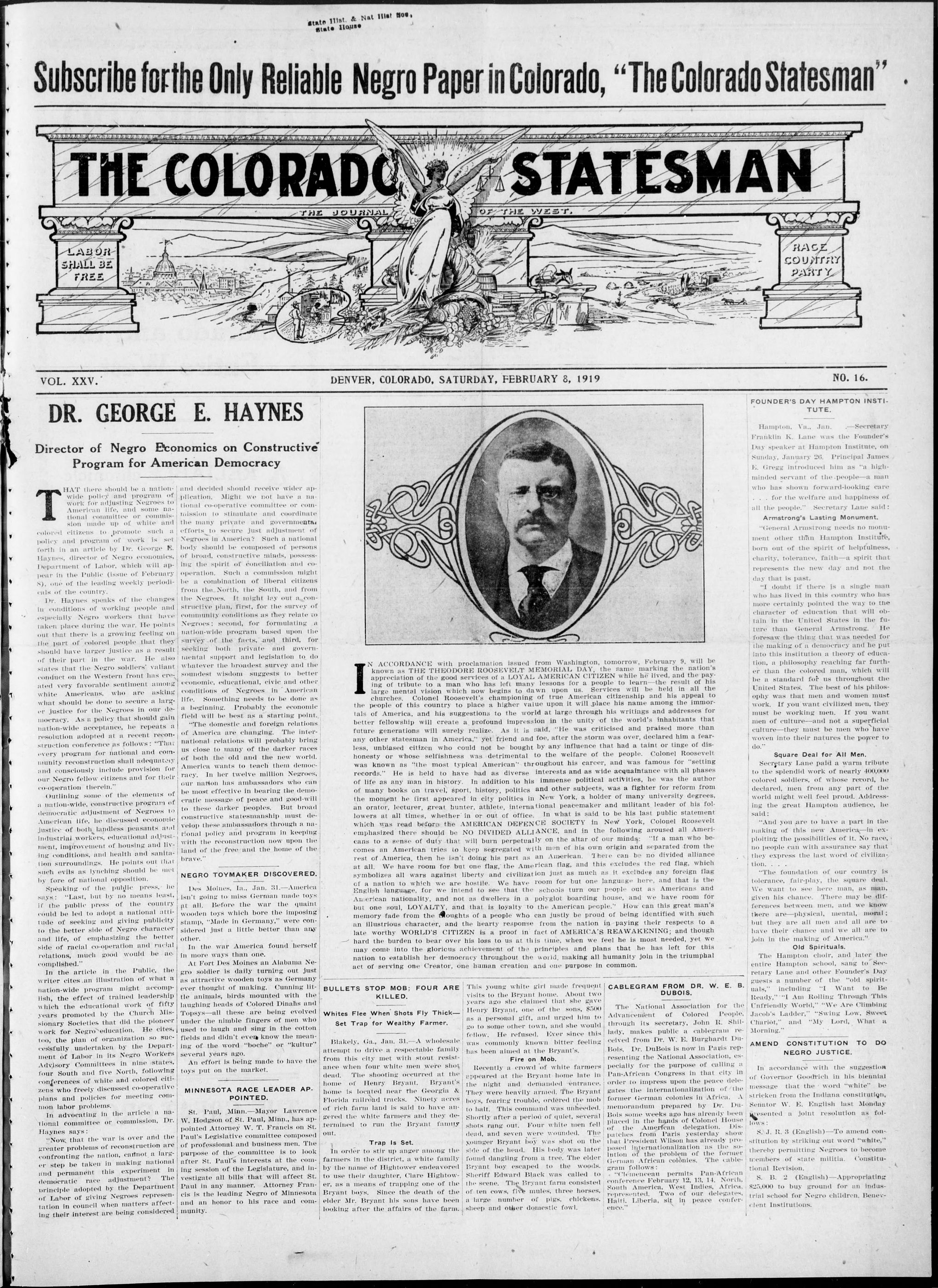
IN ACCORDANCE with proclamation issued from Washington, tomorrow, February 9, will be known as THE THEODORE ROOSEVELT MEMORIAL DAY, the same marking the nation's appreciation of the good services of a LOYAL AMERICAN CITIZEN while he lived, and the paying of tribute to a man who has left many lessons for a people to learn—the result of his large mental vision which now begins to dawn upon us. Services will be held in all the churches. Colonel Roosevelt's championing of true American citizenship and his appeal to the people of this country to place a higher value upon it will place his name among the immortals of America, and his suggestions to the world at large through his writings and addresses for better fellowship will create a profound impression in the unity of the world's inhabitants that future generations will surely realize. As it is said, "He was criticised and praised more than any other statesman in America," yet friend and foe, after the storm was over, declared him a fearless, unbiased citizen who could not be bought by any influence that had a taint or tinge of dishonesty or whose selfishness was detrimental to the welfare of the people. Colonel Roosevelt was known as "the most typical American" throughout his career, and was famous for "setting records." He is held to have had diverse interests and as wide acquaintance with all phases of life as any man in history. In addition to his immense political activities, he was the author of many books on travel, sport, history, politics and other subjects, was a fighter for reform from the moment he first appeared in city politics in New York, a holder of many university degrees, an orator, lecturer, great hunter, athlete, international peacemaker and militant leader of his followers at all times, whether in or out of office. In what is said to be his last public statement which was read before the AMERICAN DEFENCE SOCIETY in New York, Colonel Roosevelt emphasized there should be NO DIVIDED ALLIANCE, and in the following aroused all Americans to a sense of duty that will burn perpetually on the altar of our minds: "If a man who becomes an American tries to keep segregated with men of his own origin and separated from the rest of America, then he isn't doing his part as an American. There can be no divided alliance at all. We have room for but one flag, the American flag, and this excludes the red flag, which symbolizes all wars against liberty and civilization just as much as it excludes any foreign flag of a nation to which we are hostile. We have room for but one language here, and that is the English language, for we intend to see that the schools turn our people out as Americans and American nationality, and not as dwellers in a polyglot boarding house, and we have room for but one soul, LOYALTY, and that is loyalty to the American people." How can this great man's memory fade from the thoughts of a people who can justly be proud of being identified with such an illustrious character, and the hearty response from the nation in paying their respects to a late worthy WORLD'S CITIZEN is a proof in fact of AMERICA'S REAWAKENING; and though hard the burden to bear over his loss to us at this time, when we feel he is most needed, yet we may come into the glorious achievement of the principles and plans that he has left for this nation to establish her democracy throughout the world, making all humanity join in the triumphal act of serving one Creator, one human creation and one purpose in common.
State Hist. & Nat Hist Nos.
State House
IN ACCORDANCE with the known as THE THEODORE appreciation of the good ing of tribute to a man large mental vision which churches, Colonel Roos the people of this country to tals of America, and his suger better fellowship will create future generations will surely any other statesman in Amer less, unbiased citizen who o honesty or whose selfishness was known as "the most ty records." He is held to ha of life as any man in history of many books on travel, sp the moment he first appeare an orator, lecturer, great hu lowers at all times, whether which was read before the emphasized there should be cans to a sense of duty that comes an American tries to rest of America, then he isn at all. We have room for bu symbolizes all wars against of a nation to which we are English language, for we int American nationality, and not but one soul, LOYALTY, an memory fade from theough an illustrious character, and late worthy WORLD'S CITI hard the burden to bear over may come into the glorious nation to establish her dem oct of serving one Creator, or
BULLETS STOP MOB; FOUR ARE
KILLED.
Whites Flee When Shots Fly Thick—
Set Trap for Wealthy Farmer.
Blakely, Ga., Jan. 31.—A wholesale attempt to drive a respectable family from this city met with stout resistance when four white men were shot dead. The shooting occurred at the home of Henry Bryant. Bryant's home is located near the Georgia & Florida railroad tracks. Ninety acres of rich farm land is said to have angered the white farmers and they determined to run the Bryant family out.
Trap Is Set.
In order to stir up anger among the farmers in the district, a white family by the name of Hightower endeavored to use their daughter, Clare Hightower, as a means of trapping one of the Bryant boys. Since the death of the elder Mr. Bryant his sons have been looking after the affairs of the farm.
This young white girl made frequent visits to the Bryant home. About two years ago she claimed that she gave Henry Bryant, one of the sons, $500 as a personal gift, and urged him to go to some other town, and she would follow. He refused. Ever since this was commonly known bitter feeling has been aimed at the Bryant's.
Fire on Mob.
Recently a crowd of white farmers appeared at the Bryant home late in the night and demanded entrance. They were heavily armed. The Bryant boys, fearing trouble, ordered the mob to halt. This command was unheeded. Shortly after a period of quiet, several shots rang out. Four white men fell dead, and seven were wounded. The younger Bryant boy was shot on the side of the head. His body was later found dangling from a tree. The elder Bryant boy escaped to the woods. Sheriff Edward Black was called to the scene. The Bryant farm consisted of ten cows, five mules, three horses, a large number of pigs, chickens, sheep and other domestic fowl.
CABLEGRAM FROM DR. W. E. B.
DUBOIS.
The National Association for the Advancement of Colored People through its secretary, John R. Shillady, makes public a cablegram received from Dr. W. E. Burghardt DuBois. Dr. DuBois is now in Paris representing the National Association, especially for the purpose of calling a Pan-African Congress in that city in order to impress upon the peace delegates the internationalization of the former German colonies in Africa. A memorandum prepared by Dr. DuBois some weeks ago has already been placed in the hands of Colonel House of the American delegation. Dispatches from Paris yesterday show that President Wilson has already proposed internationalization as the solution of the problem of the former German African colonies. The cablegram follows:
"Clemenceau permits Pan-African conference February 12, 13, 14. North, South America, West Indies, Africa, represented. Two of our delegates, Haiti, Liberia, sit in peace conference."
FOUNDER'S DAY HAMPTON INSTITUTE.
Hampton, Va., Jan. —Secretary Franklin K. Lane was the Founder's Day speaker at Hampton Institute, on Sunday, January 26. Principal James E. Gregg introduced him as "a high-minded servant of the people—a man who has shown forward-looking care . . . for the welfare and happiness of all the people." Secretary Lane said:
Armstrong's Lasting Monument.
"General Armstrong needs no monument other than Hampton Institute, born out of the spirit of helpfulness, charity, tolerance, faith—a spirit that represents the new day and not the day that is past.
"I doubt if there is a single man who has lived in this country who has more certainly pointed the way to the character of education that will obtain in the United States in the future than General Armstrong. He foresaw the thing that was needed for the making of a democracy and he put into this institution a theory of education, a philosophy reaching far further than the colored man, which will be a standard for us throughout the United States. The best of his philosophy was that men and women must work. If you want civilized men, they must be working men. If you want men of culture—and not a superficial culture—they must be men who have woven into their natures the power to do."
Square Deal for All Men.
Secretary Lane paid a warm tribute to the splendid work of nearly 400,000 colored soldiers, of whose record, he declared, men from any part of the world might well feel proud. Addressing the great Hampton audience, he said:
"And you are to have a part in the making of this new America—in exploiting the possibilities of it. No race, no people can with assurance say that they express the last word of civilization.
"The foundation of our country is tolerance, fair-play, the square deal. We want to see here man, as man, given his chance. There may be differences between men, and we know there are—physical, mental, moral; but they are all men and all are to have their chance and we all are to join in the making of America."
Old Spirituals.
The Hampton choir, and later the entire Hampton school, sang to Secretary Lane and other Founder's Day guests a number of the "old spirituals," including "I Want to Be Ready," "I Am Rolling Through This Unfriendly World," "We Are Climbing Jacob's Ladder," "Swing Low, Sweet Chariot," and "My Lord, What a Morning."
AMEND CONSTITUTION TO DO
NEGRO JUSTICE.
In accordance with the suggestion of Governor Goodrich in his biennial message that the word "white" be stricken from the Indiana constitution, Senator W. E. English last Monday presented a joint resolution as follows:
S. J. R. 3 (English)—To amend constitution by striking out word "white," thereby permitting Negroes to become members of state militia. Constitutional Revision.
S. B. 2 (English)—Appropriating $25,000 to buy ground for an industrial school for Negro children. Benevcient Institutions.
FOREIGN
A serious railway strike has broken out in Sweden. Workmen stopped work on nineteen different lines.
As a result of the strike of marine workers the packing houses have withdrawn from the cattle market in Buenos Aires.
The railways of France on Oct. 1 next are to be again put on a peace footing except for certain minor restrictions.
Frederick William Hohenzollern, eldest son of the former German emperor, according to a Berlin dispatch, has instituted proceedings for a divorce.
Sixty German prisoners, three French officers and one American were killed and many injured when a munition train exploded on the railroad between Aubange and Longway, France. The accident was due to a soldier dropping a shell.
Detachment of 100 American soldiers arrived at Vienna with the first shipment of American food for relief purposes. The American shipment will enable the serving of a full bread ration to the population next week for the first time in many months.
Eight hundred women clerks employed by the Bank of England as a war measure have been notified that their service will no longer be required, but that 200 of them may make special applications for as many permanent positions in the clerical staff.
Detachments of aillied troops have arrived at Adrianople and put an end to Turkish terrorism of the inhabitants which had been in progress during the war. The Greek inhabitants of the city now are wearing hats instead of the fez which the Turk forcibly compelled them to wear.
That Apaches of all nationalities dressed in American uniform were mainly responsible for the acts of violence which have caused broadcast publicity to be given to an alleged American crime wave in Paris was shown by an investigation conducted by the newspapers.
Details of Japan's greater navy program were learned at Tokio. It includes the sister battleships Nagato, to be launched in July, and Mutsu, for October. Each battleship will be of 40,000 tons, with sixteen-inch guns. Work on two other great ships will be started soon, it is reported.
**SPORT**
Jack Dempsey stands ready to box Jess Willard upon any terms agreeable to Tex Rickard.
Manager Comiskey says plans will be made to send the Chicago White Sox and the Giants on a tour of South America next winter.
The controlling interest in the Boston National League Baseball Club has been bought by George Washington Grant, the moving picture manager of London.
An amendment to the Nevada boxing law, which would allow twenty-five-round contests, is introduced in the Assembly of the Nevada Legislature. This is the first step on the part of the state to bring the Willard-Dempsey fight to Reno. It is thought by members of the Legislature and others interested that the bill will pass with a high license clause for all contests.
GENERAL
Proposed constitutional reforms, some of them adding to the powers of the chief executive, are among the most important matters before the Mexican Congress.
Camp Kearney, Cal., and Camp Sevier, S. C., will be recommended for purchase and others will be returned to their owners at the expiration of the leases.
The Mexican and American Chambers of Commerce in the capital report the receipts of thousands of communications from commercial bodies in the United States and Europe asking details in regard to the demand in Mexico for foreign made goods.
William Hohenzollern has grown surly and rarely speaks to servants or guards, according to mails from the Amerongen correspondent.
El Pueblo, a semi-official government organ, states that the epidemic of influenza, in the state of Oaxaca alone has claimed 21,000 lives.
Sixteen hundred hogs were burned to death in a fire in the hog house of Morris & Co. at the National stockyards, St. Louis. The origin of the fire has not been determined. The damage was estimated at $60,000.
J. W. Kimpton, a London capitalist, is in Mexico City for the purpose of establishing a bank to provide mines long unworked with sufficient capital to purchase machinery and place themselves on a profitable basis.
The Federation of Union Workers, the most powerful labor organization in the Mexican republic, has appointed a committee to take up with other workers' organizations throughout the republic the question of uniting all the labor organizations of Mexico into one confederation. The leaders in this movement were delegates to the recent Pan-American Labor Conference in Laredo, Texas.
The exploration ship Endurance, formerly the sealing steamer Nimrod, which Sir Ernest Shackleton used in his explorations in the Antarctic and which had been engaged in the coal trade between France and England, was dashed to pieces on the sands off Yarmouth.
United States District Judge Horace W. Vaughn of Honolulu declared from the bench recently that he would see that action is instituted to denaturalize any foreign-born citizen who is reported to him to be a believer in the doctrines of anarchy or Bolshevism
CONDENSATION OF FRESH NEWS
THE LATEST IMPORTANT DIS PATCHES PUT INTO SHORT, CRISP PARAGRAPHS.
STORY OF THE WEEK
SHOWING THE PROGRESS OF EVENTS IN OUR OWN AND FOREIGN LANDS.
EASTERN
Porto Rico is consuming 50 per cent more coffee today than she did before the island "went dry," according to a San Juan coffee dealer.
The discipline taught the American youth in the American army and the hard knocks he received "over there," are destined to produce a "race of super-business men" in the United States, in the view of Lieut. Col. Charles W. Berry, adjutant general of New York state.
The strike of the textile operatives at Lawrence, Mass., to obtain fifty-four hours' pay for forty-eight hours' work is growing. It is estimated that in the city's twelve mills not more than 5,000 of the 30,000 workers were at their places. The other 25,000 were divided between strikers, persons forced out of work by closing of mills or departments, and those who stayed away to avoid trouble. All the mills except the Everett opened their gates.
WESTERN
Thomas Cowan Bell, one of the seven founders of the Sigma Chi fraternity and prominent as an educator, died at his home in Oakland. He was 86 years old.
Prohibition history recite numerous instances of men getting into jail for possessing liquor contrary to the law, but a reversal was recorded at Rigby, Idaho, recently when some person, or persons broke into the county jail and stole thirty cases of liquor.
Plans for a special election next June to vote bonds to cover the cost of construction of the state penitentiary and other public buildings of Oregon, as a means of employing charged soldiers and war workers, were taken up by the Legislature.
Gov. Esteban Cantu of Lower California issued a statement to "the people and government of the United States" against a continuation of the move to annex Lower California to the United States and referring to it as "a conspiracy framed by some citizens of the United States to assail the integrity and freedom of a friendly nation."
Through consolidation of five of the principal mines in the Rochester mining district in Humboldt county, Nevada, apex litigation which has threatened to tie up indefinitely the principal mining operations of the district has been averted and suit recently brought by the Rochester Elda Fina Mines Company against the Rochester Mines Company for $2,272,000 will be dismissed.
WASHINGTON
The annual pension bill, carrying $215,030,000, was passed by the House and sent to the Senate.
An official report to the State Department at Washington announced that the French and British authorities had assumed control of all railroads in European and Asiatic Turkey, in accordance with the terms of the armistice, and that the allies also had taken over control of the Constantinople police and the German and Austrian banks in the Turkish capital.
John Skelton Williams has been nominated by President Wilson for another term as controller of currency.
The House agreed to the Senate amendment to the revenue bill taxing campaign contributions over $500 for 100 per cent. The amendment provides that the tax should not be retroactive.
Gen, John Moulder Wilson, U. S. A., retired, died at his home in Washington after an illness of several months. General Wilson was chief of engineers during the Spanish-American war. Secretary Baker is urging the abandonment of fourteen of the sixteen national guard camps and the purchase of all national guard canonments, before the House military committee. Louis Swift, cross examined before the Senate agricultural committee at Washington, was asked by Senator Norris why Swift and Company's earnings last year showed a falling off when the three Swift Companies showed an enormous increase in the operation of their stocks. Senator Norris read a newspaper statement showing that these stocks gained in market value $140,310,000.
Congress faces its busiest time of the short session, with final enactment of the war revenue bill, legislation to validate informal war contracts and the oil land leasing measure, regarded by leaders as the most urgent matters at hand. Comforts and supplemental supplies are reaching the American troops on the Archangel front regularly through the American Red Cross, which has established a sled service between its base at Archangel and the outlying posts where the Americans are opposing the Bolshevki.
SPORT
Pithy News Notes From All Parts of Colorado
Western Newspaper Union News Service.
Washington county is again covered with a heavy blanket of snow, and as a result the wheat farmers are smiling.
An army Y. M. C. A. Club for returning soldiers and sailors is to be a feature of Denver's reception to the Yanks in the future.
An old landmark and relic of Greeley's earlier days will disappear soon when the old Colorado house is torn down and a modern business building is constructed.
J. A. Clay, general manager of the Western Colorado Power Company, which is moving its main offices from Montrose to Durango, has been elected president of the Durango Exchange.
The second annual convention of the American Sugar Beet Agriculturalists will be held in Denver late in January, 1920, it was decided at its meeting at Logan, Utah, at the closing session of the first gathering of the organization.
A plan to bring the Colorado Midland railroad under federal control by merging it with the Denver & Rio Grande railroad is being worked out to present to the United States railroad administration by a committee of western Colorado business men.
The livestock situation in southwestern Colorado and northwestern New Mexico is, to a considerable extent, in a precarious condition, due to the inability of the stockmen to get feed for their stock and the ranges are deeply covered with snow.
There are many surface indications that mining activity in the Clear Creek-Gilpin district will show wonderful increase during the coming season; in fact, 1919 gives promise of being one of the busiest years since the earliest boom days.
Owing to the severe winter weather, the coldest that has prevailed for many years on the Navajo reservation, and the influenza epidemic, that for the second time is visiting that portion of the San Juan basin, the Navajo Indians are reported to be in straightened circumstances.
Upon the finding of the Supreme Court will depend the outcome of the trial of Rienzi Dickens of Longmont, sentenced to serve eighteen years in the penitentiary from the District Court of Boulder on a conviction for the alleged killing of his father, W. H. Dickens, banker of Longmont.
All returning soldiers are invited to become honorary members of the Pueblo Commerce Club, with all the privileges of paid members with the exception of voting. A letter of invitation and a membership card is sent to each Pueblo man who returns from the army camps or from overseas service.
The Steamboat Spring Ski Club will hold a taunement this year, the dates selected being Feb. 21 and 22. As has always been the case, the tournament this year will eclipse all others as added attractions are being obtained and the top notch professionals of the world will be in attendance to try again to lower the world's record jump made on the local track.
Dr. George Norlin, acting president of the University of Colorado, announced at Boulder that the resignation of Dr. Livingston Farrand, president of the university, was expected by the board of regents. This statement follows closely upon the announcement from Washington that President Wilson had appointed Dr. Farrand as president of the American Red Cross, the appointment to take effect March 1.
A million-dollar copper enterprise for western Montrose county was announced by James N. McBride, representative of a syndicate of Michigan and Colorado mining men who have obtained an option on the old Cash In mine, long owned by a Michigan widow. McBride is on his way to the mine to arrange for a flotation mill which will employ 500 to 1,000 men. The mine is the only one with a native vein of copper in Colorado.
The number of cattle and sheep that may be grazed on national forests in Colorado and other points in the district under the five-year grazing permits will be slightly less than the number authorized for total grazing. The number of sheep and cattle authorized for grazing on the forests in the local district for 1919 is 612,280 and 570,000 respectively. The total of sheep and cattle that may be grazed under five-year permits is 1,298,100 for sheep and 339,700 for cattle. These figures for the five-year permits are less than those authorized for total grazing in order to allow holders of one-year permits to operate in the forests.
Complete casualties have been announced for the Eighty-ninth division, which is largely made up of Colorado men. The division obtained its fame in the war beginning with the first day of action when the men of the Eighty-ninth entered the St. Mihiel salient on Aug. 6 and fought through the succeeding days until the armistice was signed by the sacrifice of 8,473 men, according to a dispatch from the army of occupation. This total includes the men that were killed, wounded or missing in action during the three months' period.
---
CENTENNIAL STATE ITEMS.
The first step toward granting the leer of Colorado a six years' reprieve was taken by the House of Representatives, when an amendment to the present law restoring the closed season for that period passed on second reading. The open season was restored by the last Legislature. The section affecting deer is part of a bill making several modifications in the fish and game laws, and is sponsored by Representatives M. E. Bashor and Robert F. Rockwell. The representatives of mountain districts who favored retention of the open season of four days each year, from October 1st to October 4th, mustered twenty-four votes, while thirty-seven were cast by their opponents. If the law is amended, it will conform to the future open seasons on male mountain sheep with horns, male antelope having horns and elk having horns, all of which are protected under the law until 1924. It is proposed to change the dates of the open season on sage chickens from August 15th to September 1st.
THE COLORADO STATESMAN
The Mouth-Piece of the People of Colorado and the Entire West
Telegrams urging Colorado's delegation in Congress to work against the threatened cutting down of the appropriation for emergency work in the Department of Agriculture were sent by the agricultural and livestock bureau of the Denver Civic and Commercial Association. "Twenty-eight county agricultural agents and many household science demonstration agents are employed in Colorado through the aid of this federal emergency fund," says Secretary D. W. Thomas of the bureau. "The remainder of this expense is paid by the counties themselves and by the Colorado State Agricultural College.
Miss Mina Koperlik of Pueblo is the champion debater of Centennial high school. She obtains this title for having won both medals offered at the eleventh annual Vories medal contest. Two medals were offered. One was for the best debater in the school and the other was for the best nonsociety debater. By non-society is meant not belonging to a debating society or club where special training is given in debating. Miss Koperlik belonged to no such society but won all the honors.
RELIABLE chronicle of their doings and progress; a faithful mirror of their wants, their hopes, their best aspirations.
A twenty-ton process shale reduction plant is to be erected in Grand Junction by shale company boosters, according to announcements. The plant now being erected in Denver will be ready for shipment about Feb. 5. But a few days will be necessary to get the plant over to Grand Junction and about March 1 it will be producing oil, it is hoped. This is considered as the first great step in the development of the millions of acres of oil shale lands in that section.
James Van Pelt and Elmer McKay returned from Minturn to Leadville, crossing Tennessee pass with a sixhorse team. They reported the pass to be swept clear of snow in several places, but the general condition was one of deep snow, not impassable, however, to lighter teams. This is the earliest that the pass has been crossed in many years, and shows the light snowfall and open winter of this season.
THE COLORADO STATESMAN
The first installment of back pay due its employés was disbursed by the Denver Tranway Company. Nearly 1,000 men received a total of $21,250, which was 15 per cent of the $135,000, in back wages, ordered paid to the men by an award of the national war labor board. The men received from $15 to $40 each. The company will pay 15 per cent of the back pay on the first of every month.
Loveland Masons plan the erection of a $40,000 Masonic temple this year, equipped to house the postoffice. The project was launched more than a year ago, but because of war conditions was held up. It has taken on new life with the asking of bids by the postal department for quarters for the Loveland postoffice for five or ten years from Nov. 1, next.
Unequaled as an advertising medium for the business of professional men and women.
The building of roads and trails and performance of other needed development work in the Rocky Mountain park will be possible result of a bill passed by the national House of Representatives annulling the limit of $10,000 a year placed upon upkeep and development expenditures by the original law creating this national playground in Colorado.
An excellent family journal speaking to and for many thousand colored citizens.
Unanimous action favoring the installation of an ornamental street light system for the business district was taken at a mass meeting of business men called by the light committee of the City Council, to ascertain public sentiment on the matter. As a result of this meeting the City Council plans to install such a system at an early date.
The State Board of Immigration has just completed a state-wide survey of all uncompleted irrigation projects in Colorado. This survey was made for the guidance of the committee which is in charge of the movement for farm homes for returning soldiers and sailors. It is the most complete undertaking of its kind ever attempted in the state.
TWODOLLARSAYEAR
THE GREAT ORGAN OF THE
The county hospital records show that the number of patients each day has reached normal, the first time since the outbreak of Spanish influenza in Denver, Oct. 6 last. There were 225 patients in the institution, which is the normal daily number. The roadbed and right-of-way of the Cripple Creek Short Line railroad, which is to be junked as soon as the bondholders meet and take the necessary legal steps, probably will be purchased by Ei Paso county for a scenic highway.
45,000 OUT ON STRIKE IN SEAT TLE AND OTHER COAST CITIES.
INDUSTRIES PARALYZED
MAYOR DECLARES HE IS PRE- PARED TO HANDLE THE TROUBLE.
Western Newspaper Union News Service
Seattle, Wash., Feb. 7.—United
States troops from Camp Lewis are
quartered in Seattle and Tacoma to
stand ready for any emergency resu-
tting from the general strike of 45,
000 union men in sympathy with 25,
000 shipyard workers, who walked
out Jan. 21 to enforce demands for
increase of pay. Maj. John L. Hay-
den commands the contingent of 800
soldiers in Seattle and Brig. Gen.
Frank B. Watson has under him in
Tacoma, thirty-six miles from here,
two battalions and a machine gun
company. Equipment of the soldiers
included 200 hand grenades, Maj.
John McD. Thompson of the Camp
Lewis intelligence department said.
Authority for the use of troops was
granted by Secretary of War Baker
upon advices from Governor Ernest
Lister of the situation in Tacoma and
Seattle.
Thirty-five thousand union men in the vicinity of Seattle quit work, labor leaders said, but in Tacoma response was not so general and the principal unions involved there were the carmen, timber workers, barbers and retail clerks.
Street cars stopped running in Seattle, schools closed, restaurants and theaters closed their doors, newspapers suspended and other industries ceased operating. Twelve soup kitchens were established by culinary unions to feed strikers and others who depend upon restaurants for meals. Patrons of the kitchens were lined up and served in military "mess" fashion. Barber shops closed and elevators stopped running.
Only emergency telegraph business from Seattle was handled by the telegraph companies. The telephone system continued in service.
No disorder has resulted from the strike, Mayor Ole Hanson of Seattle said. The city government is prepared for any emergency, he added, and 10,000 extra police will be deputized if necessary.
Trouble in Saxony
* Paris.—Serious disorders have occurred in Magdeburg, capital of the province of Saxony, according to Berlin advises. Soldiers and sailors, armed with grenades and machine guns, broke down the doors of the court house, liberated 160 prisoners, smashed shop windows, pilaged shops and trained machine guns on the inhabitants. The government troops are vigorously attacking the revolutionists. Magdeburg lies on the Elba, seventy-six miles south of Berlin.
Big War Revenue Bill.
Washington — Conference report on America's $6,000,000,000 war revenue bill — greatest in nation's history — was presented to the House by Chair man Kitchin of the ways and means committee. In addition to raising about $6,000,000,000 in taxes, the bill gives every soldier, sailor and marine and all women nurses in the American forces a bonus of $60 upon discharge. This means an appropriation of more than $400,000,000.
Anarchist Would Settle.
London, Feb. 6.—The Russian soviet government, in a wireless message announcing that it is willing to begin conversations with the entente with the object of bringing about a cessation of military activities, declares it is willing to acknowledge financial obligations regarding the creditors of Russia of entente nationality.
Turks Want U. S. Rule.
Paris.—The American delegation to the peace conference has received numerous petitions from committees, municipalities and representatives of territories under Ottoman rule, askingobe put under the protection of the United States, or at least that America shall be the mandatory country entrusted with their government.
Vote on Women Suffrage.
Washington.—Arrangements for a vote by the senate on the House resolution proposing submission of a federal woman suffrage amendment were made informally between managers and opponents of the resolution. A vote before adjournment of Congress now is regarded assured.
Not Made in Germany.
Denver.—That the German people were confident of victory and were prepared to take advantage of it by pushing trade, is proven by a letter of a Colorado artillery officer, not far from Coblenz. He says: "They had clay products, poor quality articles; thousands of jardineries, stacked ready to ship. The major went into a pipe store. They had stacks of clay pipes ready for shipment to the United States, all stamped "Not Made in Germany."
PASS MANY GOOD LAWS AT PRESS.
ENT SESSION.
Eliminate Poor Bills and Discuss Many Big Measures.
Western Newspaper Union News Service.
Agitation for increased salaries for the teachers in the public schools of Colorado was begun in the House of Representatives by Representative Mabel Ruth Baker of Denver. Her bill would make $60 a month the minimum salary in third-class school districts, and provide a graduated minimum salary, ranging from $75 the first year to $100 after five years' service in first and second-class districts.
The employés of the Senate were paid for their January services through an arrangement whereby Lieut. Gov. George Stephan assumed the responsibility of later having their vouchers cashed. The pay roll amounted to $4,200.
House employees have received their wages, and now the only employees who are eagerly watching the outcome of the short pay bill are the clerks and stenographers on the regular pay roll of the state. The Knauss Senate bill, which seeks to clearly define the duties of the Colorado Utilities Commission and thereby remove any further doubt as to the right of Denver to regulate the rates of its public utilities, was finally adopted on second reading by a vote of 19 to 12 in the Senate.
House Bill No. 349, bearing on the game and fish laws, was passed on second reading. It had been before the House three days and was amended to provide a closed season on deer, doves and sage chickens. The question of permitting hunters to shoot bear without a license was solved by the insertion of a clause giving anyone the right to kill "grizzly or other stock-killing bears without a license."
With little discussion and virtually no opposition, the State Senate gave its approval to eight bills. The four bills which received final passage, and which go to the House, were: Senate bill No. 19, by Senator Coldren, providing that every school census taken hereafter shall include the place and date of birth of each pupil and the nationality of the pupil's parents; Senate bill No. 46, by Senator Tobin, increasing the salary of the state superintendent of public instruction from $3,000 to $4,000 per year; Senate bill No. 47, also by Senator Tobin, providing for a uniform grading of county teachers' certificates in Colorado by placing that work under direct charge of the State Department of Education, and Senate bill No. 67, by Senator Hetherington, which provides that diplomas in the State Normal School at Gunnison may be issued independently of the State Teachers' College in Greeley. Other bills passed on second reading were: Senate bill No. 218, by Senator Hattenbach, simplifying and making less expensive the procedure in special elections for bond issues in school districts; Senate bill No. 130, by Senator Hetherington, deeding surplus land on the State Normal School campus back to its donor, the city of Gunnison, for a high school site, and Senate bill No. 263, by Senator Booth, embodying recommendations of the Denver board of school directors, affecting the powers and duties of school district officers.
The Senate passed on second reading a bill changing the law with reference to mutual fire insurance companies. Instead of compelling mutual companies to put up $10,000 in cash with the State Insurance Commission er before it is permitted to do business, a mutual company, under the bill, will be licensed whenever it can show 100 risks and has on hand pre-umits double the amount of the max inum risk. For the first time during the pres ent session a woman presided over the deliberations of the House, Dr. May Bigelow being called to the chair by Speaker Cole when the House resolved itself into committee of the whole.
The Colorado Equal Suffrage Association went on record in support of the pending bill relating to minimum wages for women and minors at its regular meeting in Denver. A resolution was adopted endorsing the measure before the State Legislature.
Due to the fact that a number of automobile manufacturers have decreased the size of the cylinder bore of their machines and thus have reduced the horsepower rating of them Senators Booth and McWilliams, sponsors of the proposed motor vehicle law now pending in the Senate, have discarded the horsepower rating of automobiles as a basis for license fees for autos. If the bill is enacted into a law auto owners in Colorado will pay a license based upon the purchase price of their cars. As the bill stands now a license fee of 12 per cent of the purchase price will hereafter be charged in Colorado, with a minimum fee of $4 a year.
Two spirited contests were waged in the House when measures by Halsey Rhoads, affecting constitutional amendments, and by Representatives Bashor, Downing, Robeson and Mayer providing for extensive changes in the present primary law, came up for consideration in committee of the whole. The Rhoads bill was passed on second reading, but the opponents of the other measure succeeded in having it recommitted to the judiciary committee, with instructions to redraft it to include the elementary features of the present primary law.
Lincoln
Ameri
Martured Pr
Example o
Self-Made
M
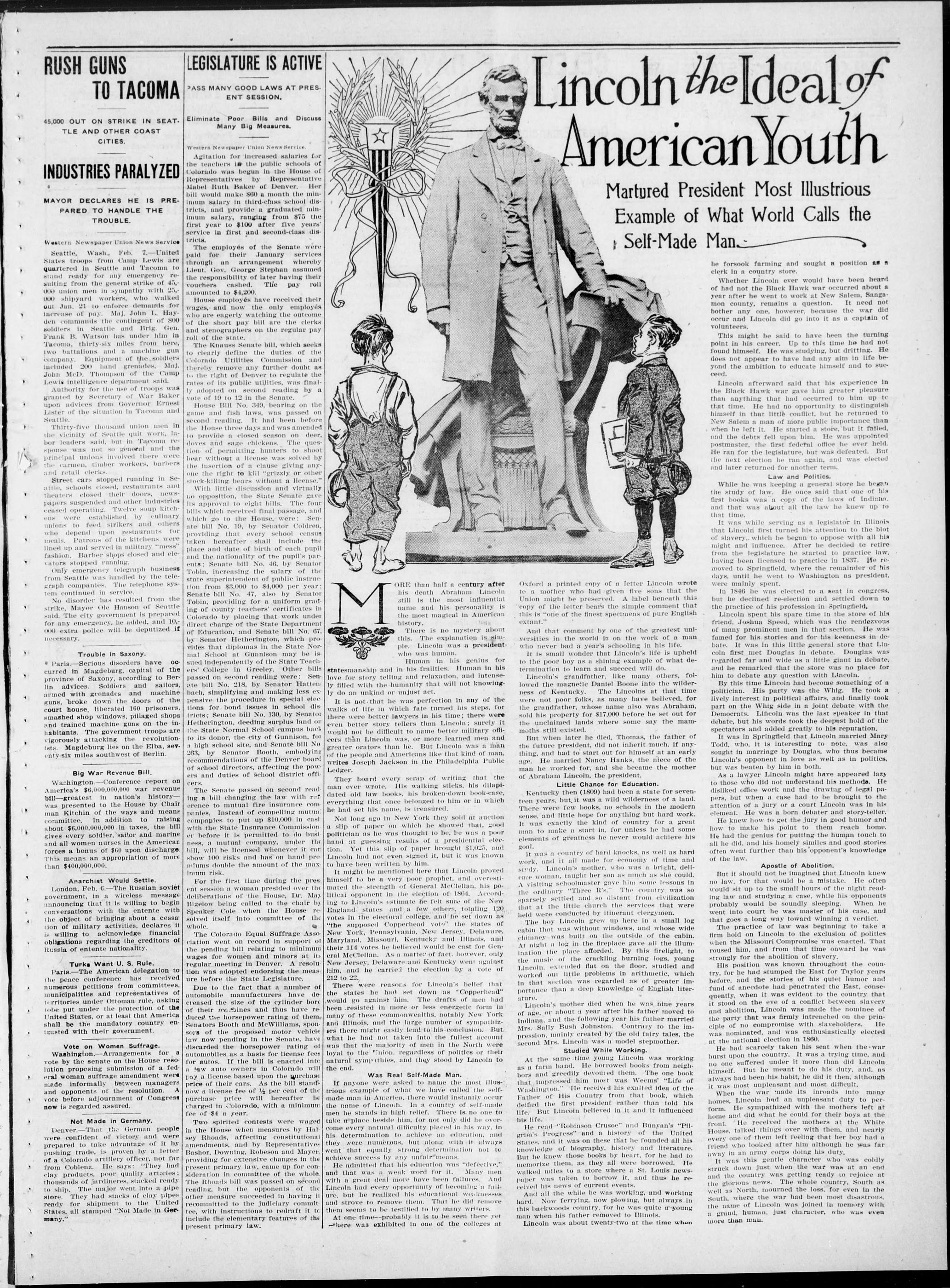
ORE than half a century after his death Abraham Lincoln still is the most influential name and his personality is the most magical in American history. There is no mystery about this. The explanation is simple. Lincoln was a president who was human.
Human in his genius for statesmanship and in his frailties. Human in his love for story telling and relaxation, and intensely filled with the humanity that will not knowingly do an unkind or unjust act.
It is not that he was perfection in any of the walks of life in which fate turned his steps, for there were better lawyers in his time; there were even better story tellers than Lincoln; surely it would not be difficult to name better military officers than Lincoln was, or more learned men and greater orators than he. But Lincoln was a man of the people and Americans like that kind of man, writes Joseph Jackson in the Philadelphia Public Ledger.
They hoard every scrap of writing that the man ever wrote. His walking sticks, his dilapidated old law books, his broken-down book-case, everything that once belonged to him or in which he had set his name, is treasured.
Not long ago in New York they sold at auction a slip of paper on which he showed that, good politician as he was thought to be, be was a poor hand at guessing results of a presidential election. Yet this slip of paper brought $1,025, and Lincoln had not even signed it, but it was known to have been written by him.
It might be mentioned here that Lincoln proved himself to be a very poor prophet, and overestimated the strength of General McClellan, his political opponent in the election of 1864. According to Lincoln's estimate he felt sure of the New England states and a few others, totalling 120 votes in the electoral college, and he set down as "the supposed Copperhead vote" the states of New York, Pennsylvania, New Jersey, Delaware, Maryland, Missouri, Kentucky and Illinois, and their 114 votes he believed would be cast for General McClellan. As a matter of fact, however, only New Jersey, Delaware and Kentucky went against him, and he carried the election by a vote of 212 to 22.
There were reasons for Lincoln's belief that the states he had set down as "Copperhead" would go against him. The drafts of men had been resisted in more or less energetic form in many of these commonwealths, notably New York and Illinois, and the large number of sympathizers there might easily lead to his conclusion. But what he had not taken into the fullest account was that the majority of men in the North were loyal to the Union, regardless of politics or their natural sympathies, and they stood by Lincoln to the end.
There were reasons for Lincoln's belief that the states he had set down as "Copperhead" would go against him. The drafts of men had been resisted in more or less energetic form in many of these commonwealths, notably New York and Illinois, and the large number of sympathizers there might easily lead to his conclusion. But what he had not taken into the fullest account was that the majority of men in the North were loyal to the Union, regardless of politics or their natural sympathies, and they stood by Lincoln to the end.
Was Real Self-Made Man.
If anyone were asked to name the most illustrious example of what we have called the self-made man in America, there would instantly occur the name of Linecoh. In a country of self-made men he stands in high relief. There is no one to take a place beside him, for not only did he overcome every natural difficulty placed in his way, in his determination to achieve an education, and they were numerous, but along with it always went that equally strong determination not to achieve success by any unfair"means.
If anyone were asked to name the most illustrious example of what we have called the self-made man in America, there would instantly occur the name of Lincoln. In a country of self-made men he stands in high relief. There is no one to take a place beside him, for not only did he overcome every natural difficulty placed in his way, in his determination to achieve an education, and they were numerous, but along with it always went that equally strong determination not to achieve success by any unfair" means.
He admitted that his education was "defective," and that was a weak word for it. Many men with a great deal more have been failures. And Lincoln had every opportunity of becoming a failure, but he realized his educational weaknesses and strove to remove them. That he did remove them seems to be testified to by many writers.
At one time—probably it is to be seen there yet—there was exhibited in one of the colleges at
---
Lincoln the Ideal of American Youth
Martured President Most Illustrious Example of What World Calls the Self-Made Man.
Oxford a printed copy of a letter Lincoln wrote to a mother who had given five sons that the Union might be preserved. A label beneath this copy of the letter bears the simple comment that this is "one of the finest specimens of pure English extant."
And that comment by one of the greatest universities in the world is on the work of a man who never had a year's schooling in his life.
It is small wonder that Lincoln's life is upheld to the poor boy as a shining example of what determination to learn and succeed will do.
Lincoln's grandfather, like many others, followed the magnetic Daniel Boone into the wilderness of Kentucky. The Lincolns at that time were not poor folks, as many have believed, for the grandfather, whose name also was Abraham, sold his property for $17,000 before he set out for the unclaimed lands where some say the mammoths still existed.
But when later he died, Thomas, the father of the future president, did not inherit much, if anything, and had to start out for himself at an early age. He married Nancy Hanks, the niece of the man he worked for, and she became the mother of Abraham Lincoln, the president.
Little Chance for Education.
Kentucky then (1809) had been a state for seventeen years, but it was a wild wilderness of a land. There were few books, no schools in the modern sense, and little hope for anything but hard work. It was exactly the kind of country for a great man to make a start in, for unless he had some elements of greatness he never would achieve his goal.
It was a country of hard knocks, as well as hard work, and it all made for economy of time and study. Lincoln's mother, who was a bright, delicacy woman, taught her son as much as she could. A visiting schoolmaster gave him some lessons in the ordinary "Three R's." The country was so sparsely settled and so distant from civilization that at the little church the services that were held were conducted by itinerant clergymen.
The boy Lincoln grew up here in a small log cabin that was without windows, and whose wide chimney was built on the outside of the cabin. At night a log in the fireplace gave all the illumination the place afforded. By this firelight, to the music of the crackling burning logs, young Lincoln, extended flat on the floor, studied and worked out little problems in arithmetic, which in that section was regarded as of greater importance than a deep knowledge of English literature.
Lincoln's mother died when he was nine years of age, or about a year after his father moved to Indiana, and the following year his father married Mrs. Sally Bush Johnston. Contrary to the impression, mainly created by the old fairy tales, the second Mrs. Lincoln was a model stepmother.
The boy Lincoln grew up here in a small log cabin that was without windows, and whose wide chimney was built on the outside of the cabin. At night a log in the fireplace gave all the illumination the place afforded. By this firelight, to the music of the crackling burning logs, young Lincoln, extended flat on the floor, studied and worked out little problems in arithmetic, which in that section was regarded as of greater importance than a deep knowledge of English literature.
Lincoln's mother died when he was nine years of age, or about a year after his father moved to Indiana, and the following year his father married Mrs. Sally Bush Johnston. Contrary to the impression, mainly created by the old fairy tales, the second Mrs. Lincoln was a model stepmother.
Studied While Working.
At the same time young Lincoln was working as a farm hand. He borrowed books from neighbors and greedily devoured them. The one book that impressed him most was Weems' "Life of Washington." He received his exalted idea of the Father of His Country from that book, which defied the first president rather than told his life. But Lincoln believed in it and it influenced his life.
He read "Robinson Crusoe" and Bunyan's "Pilgrim's Progress" and a history of the United States, and it was on these that he founded all his knowledge of biography, history and literature. But he knew those books by heart, for he had to memorize them, as they all were borrowed. He walked miles to a store where a St. Louis newspaper was taken to borrow it, and thus he received his news of current events.
And all the while he was working, and working hard. Now ferrying, now plowing, but always in this backwoods country, for he was quite a young man when his father removed to Illinois.
He read "Robinson Crusoe" and Bunyan's "Pilgrim's Progress" and a history of the United States, and it was on these that he founded all his knowledge of biography, history and literature. But he knew those books by heart, for he had to memorize them, as they all were borrowed. He walked miles to a store where a St. Louis newspaper was taken to borrow it, and thus he received his news of current events.
And all the while he was working, and working hard. Now ferrying, now plowing, but always in this backwoods country, for he was quite a young man when his father removed to Illinois.
Lincoln was about twenty-two at the time when
he forsook farming and sought a position a clerk in a country store.
Whether Lincoln ever would have been heard of had not the Black Hawk war occurred about a year after he went to work at New Salem, Sangamon county, remains a question. It need not bother any one, however, because the war did occur and Lincoln did go into it as a captain of volunteers.
This might be said to have been the turning point in his career. Up to this time he had not found himself. He was studying, but drifting. He does not appear to have had any aim in life beyond the ambition to educate himself and to succeed.
Lincoln afterward said that his experience in the Black Hawk war gave him greater pleasure than anything that had occurred to him up to that time. He had no opportunity to distinguish himself in that little conflict, but he returned to New Salem a man of more public importance than when he left it. He started a store, but it failed, and the debts fell upon him. He was appointed postmaster, the first federal office he ever held. He ran for the legislature, but was defeated. But the next election he ran again, and was elected and later returned for another term.
This might be said to have been the turning point in his career. Up to this time he had not found himself. He was studying, but drifting. He does not appear to have had any aim in life beyond the ambition to educate himself and to succeed.
Lincoln afterward said that his experience in the Black Hawk war gave him greater pleasure than anything that had occurred to him up to that time. He had no opportunity to distinguish himself in that little conflict, but he returned to New Salem a man of more public importance than when he left it. He started a store, but it failed, and the debts fell upon him. He was appointed postmaster, the first federal office he ever held. He ran for the legislature, but was defeated. But the next election he ran again, and was elected and later returned for another term.
Law and Politics.
While he was keeping a general store he began the study of law. He once said that one of his first books was a copy of the laws of Indiana, and that was about all the law he knew up to that time.
While he was keeping a general store he began the study of law. He once said that one of his first books was a copy of the laws of Indiana, and that was about all the law he knew up to that time.
It was while serving as a legislator in Illinois that Lincoln first turned his attention to the blot of slavery, which he began to oppose with all his night and influence. After he decided to retire from the legislature he started to practice law having been licensed to practice in 1837. He removed to Springfield, where the remainder of his days, until he went to Washington as president were mainly spent.
In 1846 he was elected to a seat in congress, but he declined re-election and settled down to the practice of his profession in Springfield.
Lincoln spent his spare time in the store of his friend, Joshua Speed, which was the rendezvous of many prominent men in that section. He was famed for his stories and for his keenness in debate. It was in this little general store that Lincoln first met Douglas in debate. Douglas was regarded far and wide as a little giant in debate and he remarked that the store was no place for him to debate any question with Lincoln.
By this time Lincoln had become something of a politician. His party was the Whig. He took a lively interest in political affairs, and finally took part on the Whig side in a joint debate with the Democrats. Lincoln was the last speaker in that debate, but his words took the deepest hold of the spectators and added greatly to his reputation.
It was while serving as a legislator in Illinois that Lincoln first turned his attention to the blot of slavery, which he began to oppose with all his might and influence. After he decided to retire from the legislature he started to practice law, having been licensed to practice in 1837. He removed to Springfield, where the remainder of his days, until he went to Washington as president, were mainly spent.
In 1846 he was elected to a seat in congress, but he declined re-election and settled down to the practice of his profession in Springfield.
Lincoln spent his spare time in the store of his friend, Joshua Speed, which was the rendezvous of many prominent men in that section. He was famed for his stories and for his keenness in debate. It was in this little general store that Lincoln first met Douglas in debate. Douglas was regarded far and wide as a giant in debate, and he remarked that the store was no place for him to debate any question with Lincoln.
By this time Lincoln had become something of a politician. His party was the Whig. He took a lively interest in political affairs, and finally took part on the Whig side in a joint debate with the Democrats. Lincoln was the last speaker in that debate, but his words took the deepest hold of the spectators and added greatly to his reputation.
It was in Springfield that Lincoln married Mary Todd, who, it is interesting to note, was also sought in marriage by Douglas, who thus became Lincoln's opponent in love as well as in politics, but was beaten by him in both.
As a lawyer Lincoln might have appeared lazy to those who did not understand his methods. He disliked office work and the drawing of legal papers, but when a case had to be brought to the attention of a jury or a court Lincoln was in his element. He was a born debater and story-teller. He knew how to get the jury in good humor and how to make his point to them reach home. He had the genius for putting the human touch to all he did, and his homely similes and good stories often went further than his opponent's knowledge of the law.
Apostle of Abolition.
But it should not be imagined that Lincoln knew no law, for that would be a mistake. He often would sit up to the small hours of the night reading law and studying a case, while his opponents probably would be soundly sleeping. When he went into court he was master of his case, and that goes a long way toward winning a verdict.
The practice of law was beginning to take a firm hold on Lincoln to the exclusion of politics when the Missouri Compromise was enacted. That roused him, and from that time onward he was strongly for the abolition of slavery.
His position was known throughout the country, for he had stumped the East for Taylor years before, and the stories of his quiet humor and fund of anecdote had penetrated the East, consequently, when it was evident to the country that it stood on the eve of a conflict between slavery and abolition, Lincoln was made the nominee of the party that was firmly intrenched on the principle of no compromise with slaveholders. He was nominated, and was enthusiastically elected at the national election in 1860.
He had scarcely taken his seat when the war burst upon the country. It was a trying time, and no one suffered under it more than did Lincoln himself. But he meant to do his duty, and, as always had been his habit, he did it then, although it was most unpleasant and most difficult.
When the war made its inroads into many homes, Lincoln had an unpleasant duty to perform. He sympathized with the mothers left at home and did what he could for their boys at the front. He received the mothers at the White House, talked things over with them, and nearly every one of them left feeling that her boy had a friend who looked after him although he was far away in an army corps doing his duty.
When the war made its inroads into many homes, Lincoln had an unpleasant duty to perform. He sympathized with the mothers left at home and did what he could for their boys at the front. He received the mothers at the White House, talked things over with them, and nearly every one of them left feeling that her boy had a friend who looked after him although he was far away in an army corps doing his duty. It was this gentle character who was coldly struck down just when the war was at an end and the country was getting ready to rejoice at the glorious news. The whole country, South as well as North, mourned the loss, for even in the South, where the war had been most disastrous, the name of Lincoln was joined in memory with a grand, human, just character, who was even more than man.
---
THE COLORADO STATESMAN
LABOR SHALL BE FREE
HACK COVINATI PARTY
Entered as second-class matter at the postoffice in the City of Denver, Colo.
Remittances should be made by Express Money Order, Postoffice Money Order, Registered Letter or Bank Draft. Postage stamps will be received the same as cash for the fractional part of a dollar. Only 1c and 2c stamps taken.
Reading notices, ten lines or less, 15 cents per line. Each additional line over ten lines, 10 cents per line. Display advertising 50c per inch
No discounts allowed on less than three months' contract. Cash must accompany all orders from parties unknown to us. Further particulars on application.
Communications to receive attention must be newsy, upon important subjects, plainly written only upon one side of the paper, must reach us Tuesdays, if possible, anyway not later than Wednesdays, and bear the signature of the author. No manuscript returned, unless stamps are sent for postage. All communications of a personating nature that are not complimentary will be withheld from the columns of this paper.
WEDNESDAY, February 12th, brings us to the one hundred and tenth anniversary of our beloved emancipator, Abraham Lincoln, the same to be celebrated by all Americans who are conscious of the great expression that came from Lincoln, "No nation can exist half bond, half free." Various events consisting of the usual platform exercises in which eulogies of a man who has made America a better place to live in and who out of the righteousness of his soul gave to the world a historical record that will never be effaced while time lasts.
But a little more than fifty years ago the principles on which our Republic was built belied themselves, and while the world looked on with utter contempt, this character Lincoln, we may say, was actually raised up from humble but religious parentage to perform an act which not only met the gratitude of the sons of earth but the approval of Heaven, whose creative Source brought to a successful termination the bloody war and sacrifice which lifted the yoke from humanity's neck. We, the beneficiaries of this freedom from physical enslavement, now find ourselves in combat with an ARCH ENEMY purposing mental serfdom which necessarily must result in ignorance, superstition and vice.
It therefore follows that even though by our resolutions we are instituting the action of self-help, yet it can clearly be seen that we must have some modern Lincolnns with hearts pulsating with the love of real freedom in the shape of our state and national representatives, to assist in opening avenues of learning whereby this mental slavery may be removed. In certain parts of our country, black and white alike are sadly in need of the intelligence that caters to self-respecting manhood and womanhood—inadequate school facilities, incompetent teaching staff and other contributory negligence comprising the agencies that reflect the unfortunate condition transpiring in our land of greatness. And as true disciples of our revered leader we feel that this is a fitting time to honor his memory by causing such reforms to be made as will be conducive to the betterment of our people and the success of the government. In celebrating the birthday of this illustrious character let us as good and loyal citizens of a democracy that admits no superior resolve to use our utmost influence to correct these evils within our nation, so that we may receive further blessings, being imbued with the spirit of Lincoln, who ever lives in our hearts as A TRUE STANDARD OF LIBERTY.
TOMORROW, in all places of worship in the United States of America, eulogies to one of America's greatest sons and an American that created a world's respect and recognition for his country and its people, will be given by speakers in every walk of life, and the words that will proceed from their lips cannot but lend inspiration to us in strictly adhering to the motto of our revered leader, COMPLETE AMERICANISM, without which a man cannot really feel his identification with this great nation. Former President Roosevelt's devotion, his love of country, his ideals of American life—all these are permanent legacies left to all the people of this country at a time when the supreme test of their patriotism and Americanism confronted them, and through his instrumentality the term Americanism is indicative of FEARLESSNESS which is the quality most needed, especially among the darker people that are not merely temporary residents as some would dare assert, but citizens who ally themselves with others in the most perilous adventures that our country has passed through, and now have the right to enjoy the privileges and advantages to be gotten from this government. The life that Colonel Roosevelt lived, the standards set by him for the possession of those good qualities that count for improvement of civilization by the suppression of internal disturbances arising from theorists and propagandists who try to wield undue influences, the outspoken truth and the singular stand for RIGHT which though ofttimes assailed and even almost becoming the victim of an assassin—these make famous and keep alive a cherished memory of a man who though passed from the flesh still lives, as the institutions erected by his unswerving support in every feature pertaining to the nation's welfare.
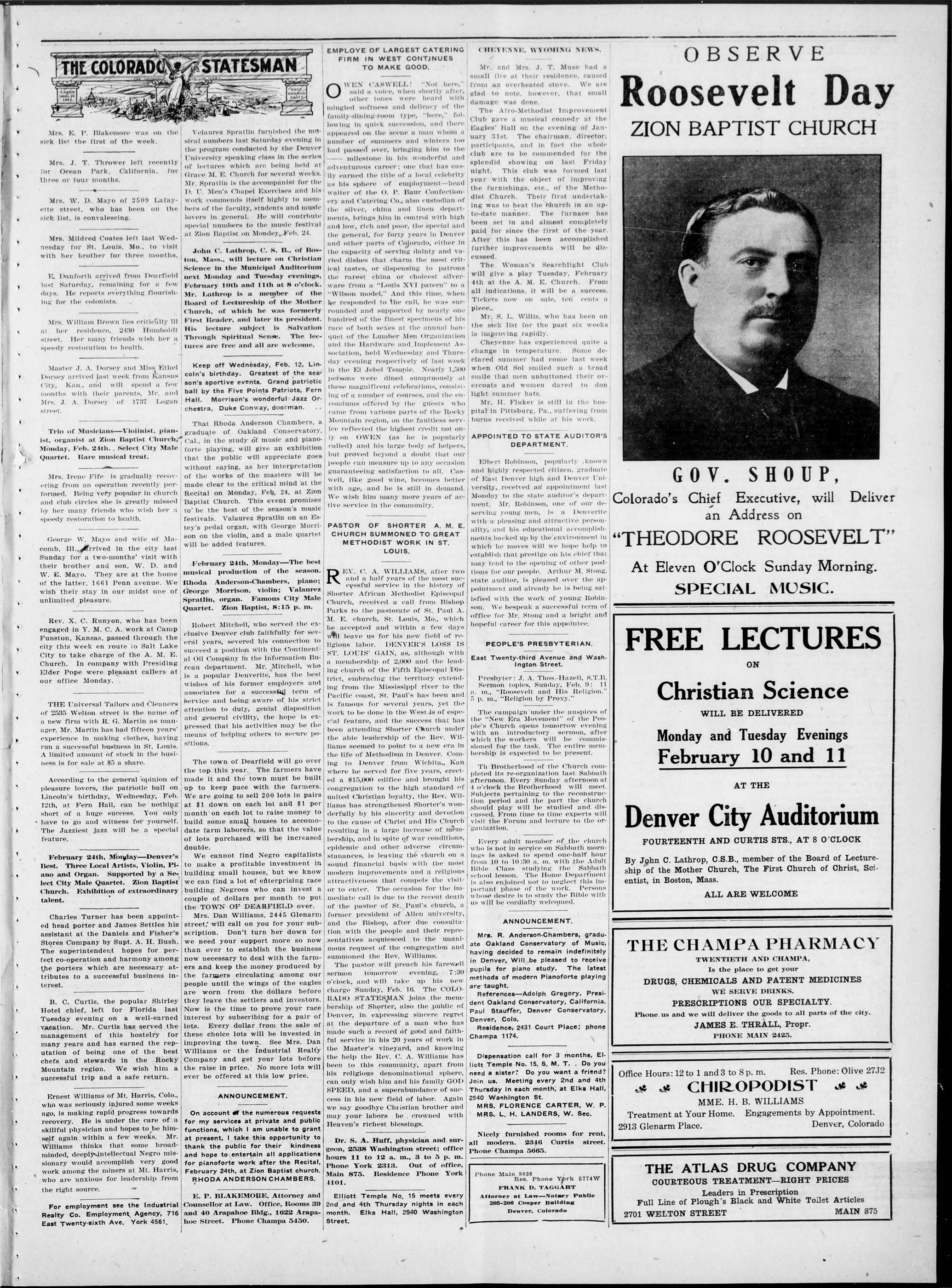
The Chief Executive of our state will from the pulpit of Zion Baptist Church, Twenty-fourth Avenue and Ogden Street, offer tribute to the life and works of this great man, and at this service, which takes place at 11 o'clock forenoon, every seat should be occupied in evidence of our appreciation of our former President Theodore Roosevelt, who endeared himself to the hearts of the American people, was highly respected by the world, and who can be well and correctly termed a citizen of the world who lived for the cause that lacked assistance and in whose death a nation, while being sad over his loss to them is glad that it gave to the world such an illustrious, distinguished and noble son. Mother Earth has taken him to her fond breast, but his spirit reflected in us will be the means we hope of making this country and nation a habitation where man may dwell in peace and love. Let every sacred edifice be filled tomorrow and prove by our presence that our hearts beat in unison with those who stand for the accomplishment of good for all the people, and in bowing to the will of Him that made us we in calm submission wish our departed fellow-citizen COLONEL THEODORE ROOSEVELT ETERNAL REST.
P. 0. Box 116
MUST BE PAID IN ADVANCE.
matter at the postoffice in the
and be made by Express Money Only
or Bank Draft. Postage stamp
transactional part of a dolllar. Only 1
times or less, 15 cents per line. Each
cents per line. Display advertis.
on less than three months' contract
articles unknown to us. Further par
to receive attention must be newsy,
only upon one side of the paper, most
later than Wednesdays, and be
returned, unless stamps are a
personating nature that are not
mms of this paper.
LINCOLN. THE IMMORTAL.
on February 12th, brings us to the one of our beloved emancipator. Abraham by all Americans who are consonant from Lincoln. "No nation can exist without the usual platform exercise made America a better place to live. His soul gave to the world a historic time lasts.
More than fifty years ago the principle themselves, and while the world after Lincoln, we may say, was a parentage to perform an act which of earth but the approval of He was successful termination the blood from humanity's neck. We, the real enslavement, now find ourselves using mental serfdom which necessit and vice.
We know that even though by our reself-self help, yet it can clearly be seen with hearts pulsating with the love and national representatives, whereby this mental slavery may entitle, black and white alike are said to self-respecting manhood and arts, incompetent teaching staff and the agencies that reflect the kind of greatness. And as true did this is a fitting time to honor his trade as will be conducive to the help of the government. In celebrating it set us as good and loyal citizens resolve to use our utmost influence that we may receive further blessing, who ever lives in our hearts.
ROOSEVELT MEMORIAL DAY.
all places of worship in the United of America's greatest sons and his respect and recognition for his workers in every walk of life, and that cannot but lend inspiration to us. red leader, COMPLETE AMERICA feel his identification with this devotion his love of country, b
Phone Main 7417
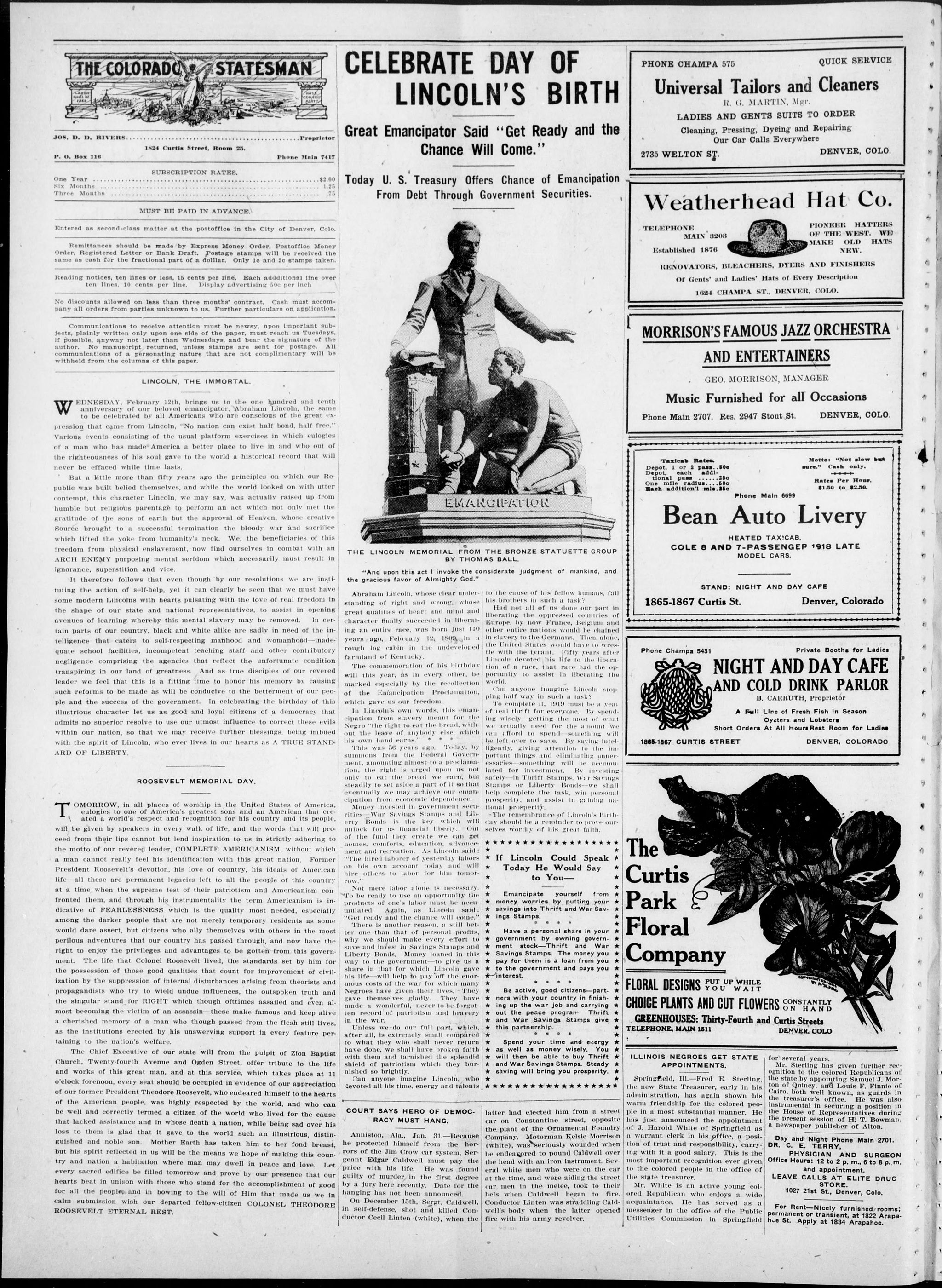
CELEBRATE DAY OF LINCOLN'S BIRTH
Great Emancipator Said "Get Ready and the Chance Will Come."
Today U. S. Treasury Offers Chance of Emancipation From Debt Through Government Securities.
EMANCIPATION
THE LINCOLN MEMORIAL FROM THE BRONZE STATUETTE GROUP BY THOMAS BALL.
THE LINCOLN MEMORIAL FROM THE BRONZE STATUETTE GROUP BY THOMAS BALL.
"And upon this act I invoke the considerate judgment of mankind, and the gracious favor of Almighty God."
Abraham Lincoln, whose clear understanding of right and wrong, whose great qualities of heart and mind and character finally succeeded in liberating an entire race, was born just 110 years ago, February 12, 1809, in a rough log cabin in the undeveloped farmland of Kentucky.
The commemoration of his birthday will this year, as in every other, be marked especially by the recollection of the Enafilpation Proclamation, which gave us our freedom.
to the cause of his fellow humans, fail his brothers in such a task?
Had not all of us done our part in liberating the oppressed countries of Europe, by now France, Belgium and other entire nations would be chained in slavery to the Germans. Then, alone the United States would have to wrest the with the tyrant. Fifty years after Lincoln devoted his life to the liberation of a race, that race had the opportunity to assist in liberating the world.
Can anyone imagine Lincoln stopping half way in such a task?
To complete it, 1010 must have been
In Lincoln's own words, this emancipation from slavery meant for the Negro "the right to eat the bread, without the leave of anybody else, which his own hand earns." * * * *
This was 56 years ago. Today, by summons from the Federal Government, amounting almost to a proclamation, the right is urged upon us not only to eat the bread we earn, but steadily to set aside a part of it so that eventually we may achieve our emancipation from economic dependence.
Money invested in government securities—War Savings Stamps and Liberty Bonds—is the key which will unlock for us financial liberty. Out of the fund they create we can get homes, comforts, education, advancement and recreation. As Lincoln said: "The hired laborer of yesterday labors on his own account today and will hire others to labor for him tomorrow."
Not mere labor alone is necessary. To be ready to use an opportunity the products of one's labor must be accumulated. Again, as Lincoln said: "Get ready and the chance will come." There is another reason, a still better one than that of personal profits, why we should make every effort to save and invest in Savings Stamps and Liberty Bonds. Money loaned in this way to the government—to give us a share in that for which Lincoln gave his life—will help to pay off the enormous costs of the war for which many Negroes have given their lives. They gave themselves gladly. They have made a wonderful, never-to-be-forgotten record of patriotism and bravery in the war.
Unless we do our full part, which, after all, is extremely small compared to what they who shall never return have done, we shall have broken faith with them and tarnished the splendid shield of patriotism which they burnished so brightly.
Can anyone imagine Lincoln, who sevoted all his time, energy and talents
COURT SAYS HERO OF DEMOCRACY MUST HANG.
Anniston, Ala., Jan. 31.—Because he protected himself from the horrors of the Jim Crow car system, Sergeant Edgar Caldwell must pay the price with his life. He was found guilty of murder in the first degree by a jury here recently. Date for the hanging has not been announced. On December 15th, Sergt. Caldwell, in self-defense, shot and killed Conductor Cecil Linten (white), when the
to the cause of his fellow humans, fail his brothers in such a task?
Had not all of us done our part in liberating the oppressed countries of Europe, by now France, Belgium and other entire nations would be chained in slavery to the Germans. Then, alone, the United States would have to wrestle with the tyrant. Fifty years after Lincoln devoted his life to the liberation of a race, that race had the opportunity to assist in liberating the world.
Can anyone imagine Lincoln stopping half way in such a task?
To complete it, 1919 must be a year of real thrift for everyone. By spending wisely—getting the most of what we actually need for the amount we can afford to spend—something will be left over to save. By saving intelligently, giving attention to the important things and eliminating unnecessary—something will be accumulated for investment. By investing safely—in Thrift Stamps, War Savings Stamps or Liberty Bonds—we shall help complete the task, win personal prosperity, and assist in gaining national prosperity.
> The remembrance of Lincoln's Birthday should be a reminder to prove ourselves worthy of his great faith.
* If Lincoln Could Speak
* Today He Would Say
* to You—
Emancipate yourself from money worries by putting your savings into Thrift and War Savings Stamps.
* * * * *
Have a personal share in your government by owning government stock—Thrift and War Savings Stamps. The money you pay for them is a loan from you to the government and pays you interest.
* * * * *
Be active, good citizens—partners with your country in finishing up the war job and carrying out the peace program Thrift and War Savings Stamps give this partnership.
Spend your time and energy as well as money wisely. You will then be able to buy Thrift and War Savings Stamps. Steady saving will bring you prosperity.
latter had ejected him from a street car on Constantine street, opposite the plant of the Ornamental Foundry Company. Motorman Kelsie Morrison (white), was seriously wounded when he endeavored to pound Caldwell over the head with an iron instrument. Several white men who were on the car at the time, and were aiding the street car men in the melee, took to their hels when Caldwell began to fire. Conductor Linten was straddling Caldwell's body when the latter opened fire with his army revolver.
Persal Tailors and Cleaners
R. G. MARTIN, Mgr.
MES AND GENTS SUITS TO ORDER
ning, Pressing, Dyeing and Repairing
Our Car Calls Everywhere
Universal Tailor
R. G. MA
LADIES AND GENTS
Cleaning, Pressing,
Our Car Cal
LADIES AND GENTS SUITS TO ORDER
Cleaning, Pressing, Dyeing and Repairing
Our Car Calls Everywhere
ELTON ST. DENVER, COLO.
Weatherhe
TELEPHONE
MAIN 3203
Established 1876
RENOVATORS, BLEACHE
Of Gents' and Ladies'
1624 CHAMPA ST
MORRISON'S FAMO
Weatherhead Hat Co.
N 3203
1876
PIONEER HATTERS
OF THE WEST. WE
MAKE OLD HATS
NEW.
ORS, BLEACHERS, DYERS AND FINISHERS
Hats' and Ladies' Hats of Every Description
624 CHAMPA ST., DENVER, COLO.
SON'S FAMOUS JAZZ ORCHESTRA
RENOVATORS, BLEACHERS, DYERS AND FINISHERS Of Gents' and Ladies' Hats of Every Description 1624 CHAMPA ST., DENVER, COLO.
MORRISON'S FAMOUS JAZZ ORCHESTRA
AND ENTERTAINERS
GEO. MORRISON, MANAGER
Music Furnished Phone Main 2707. Res. 2947
Furnished for all Occasions
707. Res. 2947 Stout St. DENVER, COLO.
Music Furnished for all Occasions
Phone Main 2707. Res. 2947 Stout St. DENVER, COLO.
Phone Main 6699
Bean Au
HEATED
COLE 8 AND 7-PAS
MODEL
an Auto Livery
HEATED TAX!CAB.
8 AND 7-PASSENGEP 1918 LATE
MODEL CARS.
HEATED TAX1CAB.
COLE 8 AND 7-PASSENGEP 1918 LATE
MODEL CARS.
STAND: NIGHT AND DAY CAFE
1865-1867 Curtis St.
---
Phone Champa 5431
NIGHT AND DAY CAFE
AND COLD DRINK PARLOR
B. CARRUTH, Proprietor
A Full Line of Fresh Fish in Season
Oysters and Lobsters
Short Orders At All Hours Rest Room for Ladies
IS STREET
DENVER, COLORADO
ny
PUT UP WHILE
YOU WAIT
AND CUT FLOWERS CONSTANTLY ON HAND
Thirty-Fourth and Curtis Streets
1511
DENVER, COLO
1865-1867 CURTIS STREET
The
Curtis
Park
Floral
Company
FLORAL DESIGNS PUT UP WHILE
YOU WAIT
CHOICE PLANTS AND CUT FLOWER
GREENHOUSES: Thirty-Fourth an
TELEPHONE, MAIN 1511
The
Curtis
Park
Floral
Company
FLORAL DESIGNS PUT UP WHILE
YOU WAIT
CHOICE PLANTS AND CUT FLOWERS CONSTANTLY
ON HAND
GREENHOUSES: Thirty-Fourth and Curtis Streets
TELEPHONE, MAIN 1811
DENVER, COLO
ILLINOIS NEGROES GET STATE
APPOINTMENTS.
Springfield, Ill.—Fred E. Sterling, the new State Treasurer, early in his administration, has again shown his warm friendship for the colored people in a most substantial manner. He has just announced the appointment of J. Harold White of Springfield as a warrant clerk in his office, a position of trust and responsibility, carrying with it a good salary. This is the most important recognition ever given to the colored people in the office of the state treasurer.
Mr. White is an active young colored Republican who enjoys a wide acquaintance. He has served as a messenger in the office of the Public Utilities Commission in Springfield
---
---
PHONE CHAMPA 575
2735 WELTON ST
Taxicab Rates.
Depot, 1 or 2 pass...50c
Depot, each additional pass...25c
One mile radius...50c
Each additional mile...35c
```markdown
```
QUICK SERVICE
DENVER, COLO.
PIONEER HATTERS OF THE WEST. WE MAKE OLD HATS NEW.
Motto: "Not slow but sure." Cash only.
Rates Per Hour.
$1.50 to $2.50.
Denver, Colorado
Private Booths for Ladies
for several years.
Mr. Sterling has given further recognition to the colored Republicans of the state by appointing Samuel J. Morton of Quincy, and Louis F. Finnie of Cairo, both well known, as guards in the treasurer's office. He was also instrumental in securing a position in the House of Representatives during the present session of H. T. Bowman, a newspaper publisher of Alton.
Day and Night Phone Main 2701.
DR. C. E. TERRY,
PHYSICIAN AND SURGEON
Office Hours: 12 to 2 p. m., 6 to 8 p. m.
and appointment.
For Rent—Nicely furnished rooms; permanent or transient, at 1822 Arapahoe St. Apply at 1834 Arapahoe.
THE COLORADO STATESMAN
CABUN
SHAUL BE
FREE
RACE
GOVERNMENT
PARTY
```markdown
```
Mrs. E. P. Blakemore was on the sick list the first of the week.
Mrs. J. T. Thrower left recently for Ocean Park, California, for three or four months.
Mrs. W. D. Mayo of 2509 Lafayette street, who has been on the sick list, is convalescing.
Mrs. Mildred Coates left last Wednesday for St. Louis, Mo., to visit with her brother for three months.
E. Danforth arrived from Dearfield last Saturday, remaining for a few days. He reports everything flourishing for the colonists.
Mrs. William Brown lies critically ill at her residence, 2430 Humboldt street. Her many friends wish her a speedy restoration to health.
Master J. A. Dorsey and Miss Ethel Dorsey arrived last week from Kansas City, Kan., and will spend a few months with their parents, Mr. and Mrs. J. A. Dorsey of 1737 Logan street.
Trio of Musicians—Violinist, pianist, organist at Zion Baptist Church, Monday, Feb. 24th., Select City Male Quartet, Rare musical treat.
---
Mrs. Irene Fife is gradually recovering from an operation recently performed. Being very popular in church and club circles she is greatly missed by her many friends who wish her a speedy restoration to health.
George W. Mayo and wife of Macomb, Ill., arrived in the city last Sunday for a two-months' visit with their brother and son, W. D. and W. E. Mayo. They are at the home of the latter, 1661 Penn avenue. We wish their stay in our midst one of unlimited pleasure.
Rev. X. C. Runyon, who has been engaged in Y. M. C. A. work at Camp Funston, Kansas, passed through the city this week en route to Salt Lake City to take charge of the A. M. E. Church. In company with Presiding Elder Pope were pleasant callers at our office Monday.
THE Universal Tailors and Cleaners of 2535 Welton street is the name of a new firm with R. G. Martin as manager. Mr. Martin has had fifteen years' experience in making clothes, having run a successful business in St. Louis. A limited amount of stock in the business is for sale at $5 a share.
According to the general opinion of pleasure lovers, the patriotic ball on Lincoln's birthday, Wednesday, Feb. 12th, at Fern Hall, can be nothing short of a huge success. You only have to go and witness for yourself. The Jazziest jazz will be a special feature.
February 24th, Monday—Denver's Best. Three Local Artists, Violin, Piano and Organ. Supported by a Select City Male Quartet. Zion Baptist Church. Exhibition of extraordinary talent.
Charles Turner has been appointed head porter and James Settles his assistant at the Daniels and Fisher's Stores Company by Supt. A. H. Bush. The superintendent hopes for perfect co-operation and harmony among the porters which are necessary attributes to a successful business interest.
B. C. Curtis, the popular Shirley Hotel chief, left for Florida last Tuesday evening on a well-earned vacation. Mr. Curtis has served the management of this hostelry for many years and has earned the reputation of being one of the best chefs and stewards in the Rocky Mountain region. We wish him a successful trip and a safe return.
Ernest Williams of Mt. Harris, Colo., who was seriously injured some weeks ago, is making rapid progress towards recovery. He is under the care of a skillful physician and hopes to be himself again within a few weeks. Mr. Williams thinks that some broad-minded, deeply intellectual Negro missionary would accomplish very good work among the miners at Mt. Harris, who are anxious for leadership from the right source.
For employment see the Industrial Realty Co. Employment Agency, 716 East Twenty-sixth Ave. York 4561.
---
Velaurez Spratlin furnished the musical numbers last Saturday evening in the program conducted by the Denver University speaking class in the series of lectures which are being held at Grace M. E. Church for several weeks. Mr. Spratlin is the accompanist for the D. U. Men's Chapel Exercises and his work commends itself highly to members of the faculty, students and music lovers in general. He will contribute special numbers to the music festival at Zion Baptist on Monday, Feb. 24.
John C. Lathrop, C. S. B., of Boston, Mass., will lecture on Christian Science in the Municipal Auditorium next Monday and Tuesday evenings, February 10th and 11th at 8 o'clock. Mr. Lathrop is a member of the Board of Lectureship of the Mother Church, of which he was formerly First Reader, and later its president. His lecture subject is Salvation Through Spiritual Sense. The lectures are free and all are welcome.
Keep off Wednesday, Feb. 12, Lincoln's birthday. Greatest of the season's sportive events. Grand patriotic ball by the Five Points Patriots, Fern Hall. Morrison's wonderful Jazz Orchestra, Duke Conway, doorman.
That Rhoda Anderson Chambers, a graduate of Oakland Conservatory Cal., in the study of music and piano forte playing, will give an exhibition that the public will appreciate goes without saying, as her interpretation of the works of the masters will be made clear to the critical mind at the Recital on Monday, Feb. 24, at Zion Baptist Church. This event promises to be the best of the season's music festivals. Valaurez Spratlin on an Estey's pedal organ, with George Morrison on the violin, and a male quartet will be added features.
February 24th, Monday—The best musical production of the season. Rhoda Anderson-Chambers, piano; George Morrison, violin; Valaurez Spratlin, organ. Famous City Male Quartet. Zion Baptist, 8:15 p. m.
Robert Mitchell, who served the exclusive Denver club faithfully for several years, severed his connection to succeed a position with the Continental Oil Company in the Information Bureau department. Mr. Mitchell, who is a popular Denverite, has the best wishes of his former employers and associates for a successful term of service and being aware of his strict attention to duty, genial disposition and general civility, the hope is expressed that his activities may be the means of helping others to secure positions.
The town of Dearfield will go over the top this year. The farmers have made it and the town must be built up to keep pace with the farmers. We are going to sell 200 lots in pairs at $1 down on each lot and $1 per month on each lot to raise money to build some small houses to accommodate farm laborers, so that the value of lots purchased will be increased double.
We cannot find Negro capitalists to make a profitable investment in building small houses, but we know we can find a lot of enterprising race building Negroes who can invest a couple of dollars per month to put the TOWN OF DEARFIELD over.
Mrs. Dan Williams, 2445 Glenarm street,' will call on you for your subscription. Don't turn her down for we need your support more so now than ever to establish the business now necessary to deal with the farmers and keep the money produced by the farmers circulating among our people until the wings of the eagles are worn from the dollars before they leave the settlers and investors. Now is the time to prove your race interest by subscribing for a pair of lots. Every dollar from the sale of these choice lots will be invested in improving the town. See Mrs. Dan Williams or the Industrial Realty Company and get your lots before the raise in price. No more lots will ever be offered at this low price.
ANNOUNCEMENT.
On account of the numerous requests for my services at private and public functions, which I am unable to grant at present, I take this opportunity to thank the public for their kindness and hope to entertain all applications for pianoforte work after the Recital, February 24th, at Zion Baptist church, RHODA ANDERSON CHAMBERS.
E. P. BLAKEMORE, Attorney and Counsellor at Law. Office, Rooms 39 and 40 Arapahoe Bldg., 1622 Arapahoe Street. Phone Champa 5450.
EMPLOYE OF LARGEST CATERING
FIRM IN WEST CONTINUES
TO MAKE GOOD.
OWEN CASWELL! "Not here," said a voice, when shortly after, other tones were heard with mingled softness and delicacy of the family-dining-room type, "here," following in quick succession, and there appeared on the scene a man whom a number of summers and winters too had passed over, bringing him to the milestone in his wonderful and adventurous career; one that has easily earned the title of a local celebrity as his sphere of employment—head waiter of the O. P. Baur Confectionery and Catering Co., also custodian of the silver, china and linen departments, brings him in control with high and low, rich and poor, the special and the general, for forty years in Denver and other parts of Colorado, either in the capacity of serving dainty and varied dishes that charm the most critical tastes, or dispensing to patrons the rarest china or choicest silverware from a "Louis XVI pattern" to a "Wilson model." And this time, when he responded to the call, he was surrounded and supported by nearly one hundred of the finest specimens of his race of both sexes at the annual banquet of the Lumber Men Organization and the Hardware and Implement Association, held Wednesday and Thursday evening respectively of last week in the El Jebel Temple. Nearly 1,500 persons were dined sumptuously at these magnificent celebrations, consisting of a number of courses, and the encomium offered by the guests who came from various parts of the Rocky Mountain region, on the faultless service reflected the highest credit not only on OWEN (as he is popularly called) and his large body of helpers, but proved beyond a doubt that our people can measure up to any occasion guaranteeing satisfaction to all. Caswell, like good wine, becomes better with age, and he is still in demand. We wish him many more years of active service in the community.
PASTOR OF SHORTER A. M. E CHURCH SUMMONED TO GREAT METHODIST WORK IN ST. LOUIS.
REV. C. A. WILLIAMS, after two and a half years of the most successful service in the history of Shorter African Methodist Episcopal Church, received a call from Bishop Parks to the pastorate of St. Paul A. M. E. church, St. Louis, Mo., which he accepted and within a few days will leave us for his new field of religious labor. DENVER'S LOSS IS ST. LOUIS' GAIN, as, although with a membership of 2,000 and the leading church of the Fifth Episcopal District, embracing the territory extending from the Mississippi river to the Pacific coast, St. Paul's has been and is famous for several years, yet the work to be done in the West is of especial feature, and the success that has been attending Shorter Church under the able leadership of the Rev. Williams seemed to point to a new era in the life of Methodism in Denver. Coming to Denver from Wichita., Kan where he served for five years, erected a $15,000 edifice and brought his congregation to the high standard of united Christian loyalty, the Rev. Williams has strengthened Shorter's wonderfully by his sincerity and devotion to the cause of Christ and His Church resulting in a large increase of membership, and in spite of war conditions, epidemic and other adverse circumstances, is leaving the church on a sound financial basis with the most modern improvements and a religious attractiveness that compels the visitor or enter. The occasion for the immediate call is due to the recent death of the pastor of St. Paul's church, a former president of Allen university, and the Bishop, after due consultation with the people and their representatives acquiesced to the unanimous request of the congregation and summoned the Rev. Williams.
The pastor will preach his farewell sermon tomorrow evening, 7:30 o'clock, and will take up his new charge Sunday, Feb. 16. The COLORADO STATESMAN joins the membership of Shorter, also the public of Denver, in expressing sincere regret at the departure of a man who has made such a record of good and faithful service in his 20 years of work in the Master's vineyard, and knowing the help the Rev. C. A. Williams has been to this community, apart from his religious denominational sphere, can only wish him and his family GOD SPEED, and a superabundance of success in his new field of labor. Again we say goodbye Christian brother and may your labors be crowned with Heaven's richest blessings.
Dr. S. A. Huff, physician and surgeon, 2538 Washington street; office hours 11 to 12 a. m., 3 to 5 p. m. Phone York 2313. Out of office, Main 875. Residence Phone York 4101.
Elliott Temple No. 15 meets every 2nd and 4th Thursday nights in each month. Elks Hall, 2540 Washington Street.
CHEYENNE, WYOMING NEWS. Mr. and Mrs. J. T. Muse had a small fire at their residence, caused from an overheated stove. We are glad to note, however, that small damage was done.
The Afro-Methodist Improvement Club gave a musical comedy at the Eagles' Hall on the evening of January 31st. The chairman, director, participants, and in fact the whole club are to be commended for the splendid showing on last Friday night. This club was formed last year with the object of improving the furnishings, etc., of the Methodist Church. Their first undertaking was to heat the church in an up-to-date manner. The furnace has been set in and almost completely paid for since the first of the year. After this has been accomplished further improvements will be discussed.
The Woman's Searchlight Club will give a play Tuesday, February 4th at the A. M. E. Church. From all indications, it will be a success. Tickets now on sale, ten cents a piece.
Mr. S. L. Willis, who has been on the sick list for the past six weeks is improving rapidly.
Cheyenne has experienced quite a change in temperature. Some declared summer had come last week when Old Sol smiled such a broad smile that men unbuttoned their overcoats and women dared to don light summer hats.
Mr. H. Fluker is still in the hospital in Pittsburg, Pa., suffering from burns received while at his work.
APPOINTED TO STATE AUDITOR'S DEPARTMENT.
Elbert Robinson, popularly known and highly respected citizen, graduate of East Denver high and Denver University, received af appointment last Monday to the state auditor's department. Mr. Robinson, one of our deserving young men, is a Denverite with a pleasing and attractive personality, and his educational accomplishments backed up by the environment in which he moves will we hope help to establish that prestige on his chief that may tend to the opening of other positions for our people. Arthur M. Stong, state auditor, is pleased over the appointment and already he is being satisfied with the work of young Robinson. We bespeak a successful term of office for Mr. Stong and a bright and hopeful career for this appointee.
PEOPLE'S PRESBYTERIAN
East Twenty-third Avenue and Wash Ington Street.
Presbyter; J. A. Thos, Hazell, ST.B. Sermon topics, Sunday, Feb. 9; 11 a. m., "Roosevelt and His Religion." 5 p. m., "Religion by Proxy."
The campaign under the auspices of the "New Era Movement" of the People's Church opens tomorrow evening with an introductory sermon, after which the workers will be commissioned for the task. The entire membership is expected to be present.
Th Brotherhood of the Church completed its re-organization last Sabbath afternoon. Every Sunday afternoon at 4 o'clock the Brotherhood will meet. Subjects pertaining to the reconstruction period and the part the church should play will be studied and discussed. From time to time experts will visit the Forum and lecture to the organization.
Every adult member of the church who is not in service on Sabbath mornings is asked to spend one-half hour from 10 to 10:30 a.m. with the Adult Bible Class studying the Sabbath school lesson. The Home Department is also enjoined not to neglect this important phase of the work. Persons whose desire is to study the Bible with us will be cordially welcomed.
ANNOUNCEMENT.
Mrs. R. Anderson-Chambers, graduate Oakland Conservatory of Music, having decided to remain indefinitely in Denver, Will be pleased to receive pupils for piano study. The latest methods of modern Pianooforte playing are taught.
References—Adolph Gregory, President Oakland Conservatory, California. Paul Stauffer, Denver Conservatory, Denver, Colo.
Residence, 2431 Court Place; phone Champa 1174.
Dispensation call for 3 months, Elliott Temple No. 15, S, M. T. . Do you need a sister? Do you want a friend? Join us. Meeting every 2nd and 4th Thursday in each month, at Elks Hall, 2540 Washington St.
MRS. FLORENCE CARTER, W. P.
MRS. L. H. LANDERS, W. Sec.
Nicely furnished rooms for rent,
all modern. 2346 Curtis street.
Phone Champa 5665.
Phone Main 8036
Res. Phone York 5774W
FRANK D. TAGGART
Attorney at Law—Notary Public
205-206 Cooper Building
Denver, Colorado
Roosevelt Day ZION BAPTIST CHURCH
[Picture of a man in a suit with a mustache].
Colorado's Chief Executive, will Deliver an Address on "THEODORE ROOSEVELT" At Eleven O'Clock Sunday Morning. SPECIAL MUSIC.
FREE LECTURES ON
Christian Science WILL BE DELIVERED Monday and Tuesday Evenings February 10 and 11 AT THE
City Aud
H AND CURTIS STS.,
p, C.S.B., member of th
Church, The First Ch
Mass.
Denver City Auditorium
FOURTEENTH AND CURTIS STS., AT 8 O'CLOCK By John C. Lathrop, C.S.B., member of the Board of Lectureship of the Mother Church, The First Church of Christ, Scientist, in Boston, Mass. ALL ARE WELCOME
THE CHAMPA PHARMACY
TWENTIETH AND CHAMPA,
Is the place to get your
DRUGS, CHEMICALS AND PATENT MEDICINES
WE SERVE DRINKS.
PRESCRIPTIONS OUR SPECIALTY.
Phone us and we will deliver the goods to all parts of the city.
JAMES E. THRALL, Propr.
PHONE MAIN 2425.
Treatment at Your Home. Engagements by Appointment. 2913 Glenarm Place. Denver, Colorado
THE ATLAS DRUG COMPANY
Leaders in Prescription
Full Line of Plough's Black and White Toilet Articles
2701 WELTON STREET MAIN 875
Her Valentine
BY NETTIE K. NEHAN
OUT of the heart of the long ago,
Faded and yellow, by time, you know,
But chirred it in shadow and shine,
Come to me for salvation!
Here is the couplet, quaint and true,
The rose is red,
The rose is red,
And I dream in the glaming soft and low
Of the lass who penned it long years ago.
A little砂 with the bluest eyes
That ever danced 'neath winter skies;
A rugish miss, whose love was told
To the sound of a kiss in a moonlit wold,
But here is the rest of her rhyming tunel
Love in sweet heart,
And so are you.
And a boy's cheeks flushed at the final line
Of a rustic sweetheart's valentine.
Deep in the past, but dimly hid,
Behind her soft eye's drooping lid,
Quivers her heart in a knot,
Shot at the Castle of Might have-been.
And plainer still the couplet true,
With a cherished thought for the love it told
I tenderly open each yellow fold.
I opened it with one day.
In a past that is hallowed and far away.
I can see the eyes that were deep and blue,
and
```markdown
```
Myra's Valentine
Clarissa Mackie
MYRA WATTS' black eyes darted busily to and fro as she sorted the mail on St. Valentine's day. Myra had been postmistress at Littleford for 12 years, and it was said that she knew the handwriting of every man, woman and child in the village. And gossips whispered that Myra always read messages on picture postals before handing them through the window to their indignant recipients. Outside the closed window was an expectant crowd pressing close to the pigeon-holes, watching Myra and her assistant as they poked letters into the boxes and twisted their necks in a vain endeavor to read addresses, for Myra had a most aggravating way of putting letters in with the addresses noside down.
All the time Myra was sorting the mail her eyes were wistfully searching for a letter addressed to herself—for Myra Watts had never received a valentine during all her 40 years.
"Humph!" she snifted impatiently, as she thrust a large embossed envelope into a box, "that Timpkins boy has sent a valentine to Lissy Edwards—I wonder what her ma'd say if she knew it? And here's one he's sent to May Weeks—the impudent young puppy—and here's—one for Ella—I wonder?" Mura deftly tucked the fancy envelope into her own private box, and, having finished distributing the morning's mail, pushed open the window and proceeded to hand it to the eager girls and boys who pressed into the tiny post office.
The last one to appear at the window was Ella Flagg, the little milliner whose shop was next door to the post office. Ella was a faded blond, with light blue eyes and a face that once had been vivaciously pretty, but now was sad and wistful. People had decided that Ella Flagg had begun to droop from the moment that Will Chandler left Littleford and went to California. Some wondered whether Ella ever heard from Will, but Myra could have told them that she did
```markdown
```
"That Timpkins Boy Has Sent a Valentine to Lissy Edwards."
not—only Myra didn't have much to say about Ella Flagg. Once they had been close friends, but for many years they had been estranged.
Ella's mute, questioning face appeared at the post office window. Myra nodded curtly, handed Ella a newspaper and a letter containing a circular. Then she turned her back and began to close up the office for the noon hour.
When she was all alone Myra locked the door and took Ella's valentine out of her own box. It was postmarked from a town in California and the
handwriting was unmistakably that of Will Chandler. Myra knew it at once. She had had several notes from Will before he fell in love with Ella Flagg. The envelope was addressed to Ella Flagg.
Myra's black eyes blazed jealously as she held the missive up to the light and discerned through the thin paper the dainty decoration of a lovely valentine.
A little printed verse could be plainly read:
Amid these wilds I wander in despair, I sigh for her, so faithless, yet so fair. Ye streams, ye woods, ye breezes tell The agonies of soul for her I feel.
A bit of doggerel verse—yet it set Myra's heart to beating rapidly.
Will Chandler had sent this valentine to Ella Flagg—what wonder-working thing was this Love which could bridge the long years of estrangement?
Year after year Will Chandler had sent a similar message to Ella Flagg—and Ella had never received it! Still, Will had doggedly sent the valentines. Nothing in between, but on the days devoted to the kindly saint, Will sent some message to his old sweetheart—and Ella never got it!
Myra Watts might have explained, but she didn't.
Today her eyes glowed fiercely as she hid the letters away in her bureau at home.
"They ought to be my valentines," she defended herself. "So I'll keep 'em here!"
That night Myra closed the post office at eight o'clock and started for home. Her way led past the little house where Ella Flagg lived with an invalid mother. When Myra passed Mrs. Jacob Hill's house that good lady ran out with a paper hat bag in her hand.
"Oh, Myra," she panted, "do you mind leaving this at Ella Flagg's house? She's promised to fix my mourning bonnet tonight so's I can go to Uncle Benny's funeral tomorrow. I'm much obliged," she called over her shoulder as she hurried into the house. Myra turned into the Flagg gate and went around the path to the side door. There was a light in the sitting room and Myra peeped through the glass panels of the door before she knocked. What she saw there stayed her hand.
Ella Flagg was all alone in the room. Myra knew that Mrs. Flagg was asleep in the adjoining bedroom. Ella's fair head was pressed disconsolately into the cushions of the soft and her thin shoulders were heaving convulsively. Clenched in one thin hand was a crumpled envelope and Myra shrewdly
```markdown
```
And Her Thin Shoulders Were Heaving Convulsively.
guessed it might be some old love letter from Will Chandler.
Myra's tough little heart suddenly melted—was this evening a repetition of many other endings of St. Valentine's day? Had Ella Flagg hoped each year that she would receive some message from her absent lover?
And then the full realization of the missery she had caused brought a dreadful feeling of wretchedness to her heart.
"I must tell her," decided Myra suddenly; "I must tell her about the letters I have kept back—and when he comes after her, I must tell him, too, and I must help her get ready for her wedding—it's my punishment!"
Softly she opened the door and went inside.
When Will Chandler came home to claim Ella Flagg for his bride, people marveled that Myra Watts appeared as Ella's maid of honor, and they could not understand what had healed the breach between the old friends.
Myra might have told you that it was a bundle of suppressed letters and valentines which Ella Flagg had burned that memorable night when Myra made confession of her wrongdoing; but she kept her secret, and so did Ella, and Will Chandler refused to listen to her story because he was so glad and eager to hold Ella in his arms again.
And when another valentine day came around Myra sorted the mail, quickly, deftly, and in another spirit. When at last she came to a large embossed envelope postmarked California, where Will and Ella were living with old Mrs. Flagg, a beautiful color suffused her dark face.
"Come out here and live with us," wrote Ella on the back of the valentine they sent. "Will knows of a splendid position for you, and it is summer all the time in California." Myra went, and she says it is summer all the time in her heart, too, ever since that night when she unburdened it to her friend and brought happiness to three sorrowing souls.
(Copyright, 1918, by McClure Newspaper Syndicate.)
Argument of Those Who Say, "United States Are," Instead of "Is"
their enemies, giving them aid and comfort. No person shall be convicted of treason unless on the testimony of two witnesses to the same overt act, or on confession in open court."
In Article XXVIII of the treaty with Great Britain of November 19, 1794, signed by John Jay, chief justice of the United States, and approved by Washington, after a reference to the United States, is the following:
"With the advice and consent of their senate." (Treaties and Conventions, 1776-1887, p. 393.)
Article IX of the treaty of 1814 with Great Britain, signed by John Quincy Adams, Henry Clay and Albert Gallatin, begins:
"The United States of America engage to put an end, immediately after the ratification of the present treaty, to hostilities with all the tribes or nations of Indians with whom they may be at war, etc." (Same volume, p. 404.)
In the treaty with Great Britain of 1862, signed by William H. Seward and approved by Abraham Lincoln, is the following:
"On the part of the United States and in that court which shall sit within their territories." (Same volume, p. 465.) Such instances could be multiplied without number, but these are sufficient to show that President Wilson is following a well-established precedent. The nature of our government is to be determined by the Constitution as amended and expounded and not by the use of "it" or "they."
How Much Indemnity Can Germany Pay? About Three Billions a Year?
How much indemnity can Germany pay? This is one important question before the conference that will fix the terms of indemnity, because the amount which she owes is so large as to be practically unlimited.
The mere property damage is one of the small items, for as a matter of equity she should reimburse the world not only for the property destroyed but also for the suspension of industry, the loss of life, the sufferings of the survivors and the war costs. Probably these items would add up to not less than $150,000,000,000, which is 50 per cent in excess of the entire wealth of the German people, personal and real, tangible and intangible. As it is impossible for her within any reasonable time to pay what she owes, the demands of our allies will doubtless be limited merely by her physical ability to pay.
What we wish to learn is the breaking point of her finances.
To impose upon her any less than the last dollar she can pay is an injustice to the peaceful civilized peoples whom she has destroyed as far as she could; and on the other hand to require of her too large an annual payment would defeat our own purposes in that it would break down her industries and render her a bankrupt nation from whom we could not collect.
In the nature of things we cannot have both reparation and punishment, if by the latter is meant any form of boycott. We must choose the one and forego the other. Therefore, as a means of collecting the damages from Germany, our allies will find it necessary to again admit her to the world's commerce.
Detailed figuring, which need not be set forth here, warrants the conclusion that an indemnity of about $2,700,000,000 per annum can be collected from the German nation without breaking down its industries; and this amount can be gradually increased within, say, a five-year period to about $3,500,000,000 per annum. To attempt to collect more would probably defeat our own purpose, and to collect any less would be an injustice to ourselves and our allies.
Great War Has Taught Us How to Save More Lives Than It Has Cost
The war has taught us how to save more lives than the war has cost. The countless improvements of practice, both in medicine and surgery, made in this war have advanced our science half a century in four years.
In surgery the value and technique of "chlorination"—or the use of some combination of chlorine for the destruction of malignant germs which give rise to pus—have been learned as never before. There is no longer any good excuse for persistence of pus.
The development of the "Carrel-Dakin" method of treating all manner of infected wounds by periodic irrigation with Dakin fluid (a noncaustic hypochlorite) marked an extraordinary advance. And in this the method is as important as the fluid. It is being taught to surgeons the world over.
Out of 45 patients in the War Demonstration hospital suffering from empyema we returned 35 to the front. Empyema is pus in the chest cavity. It often follows pneumonia, and hitherto has been highly fatal. There has been an unusual amount of empyema in New York this year of a very serious type. But the death rate has been lessened by the modern treatment.
Other wonderful advances have been made; for example, in X-ray work, in knowledge of the gas bacillus which causes a form of gangrene, in the serum treatment for prevention or cure of such diseases as typhoid fever, lockjaw, pneumonia, meningitis, etc. These lessons will save far more lives in the long run than the war has cost.
JOHN H. BURKE
President Wilson has been criticized for referring to the United States as "they," the idea being that in this country there is an irreconcilable conflict between people who think of the United States as "is" and people who think of it as "are." This criticism of the president puts him in the company of very distinguished Federalists.
Section III of Article III of the Constitution of the United States is as follows:
"Treason against the United States shall consist only in levying war against them or in adhering to giving them aid and comfort. No person shall be conson unless on the testimony of two witnesses to the same confession in open court."
XXVIII of the treaty with Great Britain of November 19, by John Jay, chief justice of the United States, and ap- washington, after a reference to the United States, is the fol-
a advice and consent of their senate." (Treaties and Con- 1887, p. 393.)
X of the treaty of 1814 with Great Britain, signed by John H. Henry Clay and Albert Gallatin, begins: United States of America engage to put an end, immediately creation of the present treaty, to hostilities with all the tribes Indians with whom they may be at war, etc." (Same vol-
treaty with Great Britain of 1862, signed by William H. Improved by Abraham Lincoln, is the following: part of the United States and in that court which shall bear territories." (Same volume, p. 465.)
Bances could be multiplied without number, but these are know that President Wilson is following a well-established nature of our government is to be determined by the amended and expounded and not by the use of "it" or
Much Indemnity Can Germany Pay? About Three Billions a Year?
with indemnity can Germany pay? This is one important
me the conference that will fix the terms of indemnity,
amount which she owes is so large as to be practically un-
property damage is one of the small items, for as a matter
should reimburse the world not only for the property
also for the suspension of industry, the loss of life, the
survivors and the war costs. Probably these items would
less than $150,000,000,000, which is 50 per cent in excess
wealth of the German people, personal and real, tangible
As it is impossible for her within any reasonable time
the owes, the demands of our allies will doubtless be limited
physical ability to pay.
wish to learn is the breaking point of her finances.
upon her any less than the last dollar she can pay is an
peaceful civilized peoples whom she has destroyed as far
and on the other hand to require of her too large an annual
defeat our own purposes in that it would break down her
render her a bankrupt nation from whom we could not
tature of things we cannot have both reparation and pun-
the latter is meant any form of boycott. We must choose
forego the other. Therefore, as a means of collecting the
Germany, our allies will find it necessary to again admit
world's commerce.
figuring, which need not be set forth here, warrants the
treat an indemnity of about $2,700,000,000 per annum can
from the German nation without breaking down its indus-
amount can be gradually increased within, say, a five-year
at $3,500,000,000 per annum. To attempt to collect more
defeat our own purpose, and to collect any less would be
ourselves and our allies.
War Has Taught Us How to Save
More Lives Than It Has Cost
has taught us how to save more lives than the war has cost. Improvements of practice, both in medicine and surgery, war have advanced our science half a century in four years. By the value and technique of "chlorination"—or the use nation of chlorine for the destruction of malignant germs to pus—have been learned as never before. There is no good excuse for persistence of pus. Appointment of the "Carrel-Dakin" method of treating all man- wounds by periodic irrigation with Dakin fluid (a non- chlorite) marked an extraordinary advance. And in this was important as the fluid. It is being taught to surgeons
By J. M. DICKINSON, Former Secretary of War
President Wilson has been criticized for referring to the United States as "they," the idea being that in this country there is an irreconcilable conflict between people who think of the United States as "is" and people who think of it as "are." This criticism of the president puts him in the company of very distinguished Federalists.
Section III of Article III of the Constitution of the United States is as follows:
"Treason against the United States shall consist only in levying war against them or in adhering to
By PAUL CLAY, Statistician
By MAJOR G. A. STEWART, Rockefeller Institute
What's This—No Capital City of Washington, D. C.?
WASHINGTON.—Senator Henry L. Myers of Montana introduced a bill (S. 5297) the other day of which the first section reads as follows: "Be it enacted, etc., That that city and community and all thereof situate
Washington; that it has no existence whatever; that the supposed city of Washington is wholly a myth. From time immemorial, at least from the time of the location of the permanent seat of government of the United States in the District of Columbia, all executive documents, all proclamations and messages of the president have had appended thereto the words, 'Done at the city of Washington,' on a certain date; until a few months ago, when some one in official life, who claims to be authority on the subject, informed President Wilson that there was no city of Washington. Since then the president has been appending to his official documents the words, 'Done in the District of Columbia' on a certain date.
"It seems to me that the people of the, United States ought to take sufficient pride in their capital to have it located in a city, and for the city to have a name, but it can only be given a name through congressional action. It has none at present. There is a post office here called 'Washington,' but the fact does not give a name to the city or community around it."
The bifl was referred to the committee on the judiciary.
Attention. Hunters! No Duck-Shooting This Spring
THE Associated Press sent out a hundred words or so the other day from here to the effect that the federal migratory bird act of 1913 had been in effect declared invalid by the Supreme court, which dismissed on the govern
stitutional. Now we'll have spring shooting as usual."
All wrong. Pot-hunters, market-hunters, game-hogs and imitation sportsmen should note that the federal migratory bird law is still the law of the land, that it is in full operation and that it will be enforced this spring as never before.
The case in question is known as the Shauver case. The doctrine of "state rights" is still strong in Arkansas and the court there was of the opinion that the regulation of game belongs to the state and not to the federal government. The federal government appealed from the decision to the Supreme court.
In the meantime sportsmen, statesmen and bird-lovers got together. They consulted the master-mind of this country—naming no names. The result was that the United States and Canada made a treaty containing the provisions of the act and that congress ratified the treaty and passed an enabling act putting its provisions in force.
So when the Shauver case came before the Supreme court the operation of the treaty had made the constitutionality of the original act an academic question. The court did not consider it on its merits and dismissed the government's appeal at the government's request.
The war being over, Uncle Sam will now have a chance to enforce this national law in those few places where public opinion runs to the contrary.
How Belgian Women Punish Unfaithful Sisters
MANY are the scars left by the great war. Stories are coming from Belgium of the way in which the women are imposing their own penalties upon the unfaithful of their own sex who reveled with the enemy during the
seen darting across the wide stretch of cobblestone toward the canal, shrieking every few steps.
From all directions came other women and girls. Men followed. Some of them grinned. They were making no effort to catch the girl.
The pursued scurried into the wreckage of a house blown up by a bomb. The pursurers dragged her out. They led her to the front of the railroad station. They formed a large circle. The girl fought for a few seconds, but three sturdy young women held her hands.
Two women stepped out from the ring. One of them drew a pair of scissors from her shawl. She chopped the girl's hair off short, straight across on a line between the lobes of the ears.
The girl was turned ioose. Her hair was thrown into the canal. The women opened the circle to let her go away, pulling their skirts around them and looking at her as only women can.
This young woman escaped easily. Others fare much worse. In many cases the women so punished by their sisters have pieces cut from their ears and slashes made in their cheeks.
One wonders how just are the punishments. Are extenuating circumstances considered? And as to these the imagination opens up wide fields.
New Underground and Through-Water Wireless
HOW underground and through-water wireless was put into practical use during the war was disclosed by navy department officials, giving to the public another of its secrets, carefully guarded so long as it might have been
elaborate and expensive air stations. In addition, it was revealed at the department, through an adaptation of the Rogers theory submarines under water were intercepting radio signals sent from shore, and with crude apparatus the scientist has succeeded in transmitting signals two miles from a submerged wire, simulating a submersible. Officials say it is possible, although not yet an accomplished fact, that ground or water sending can be developed to a considerable extent. They do not anticipate that the present method of sending from high towers will be superseded.
In war a great advantage is that submarines receive messages while submerged. This was done by wires trailing in the water.
P
AND I WAS SURE
I HAD A NAME
Washington; that it has no existence Washington is wholly a myth. From time of the location of the permanent in the District of Columbia, all exec messages of the president have had the city of Washington,' on a certain some one in official life, who claims to President Wilson that there was no president has been appending to his the District of Columbia' on a certain "It seems to me that the people of sufficient pride in their capital to have it have a name, but it can only be given It has none at present. There is a but the fact does not give a name to the bllf was referred to the comm
Attention, Hunters! No D
THE Associated Press sent out a bu here to the effect that the federal effect declared invalid by the Supreme
ment's motion an appeal from a decision of the Arkansas federal district court holding the act unconstitutional. The boss must have been away that day, for the statement, though true in every particular, was as misleading as is possible in the absence of the few necessary words of explanation. In consequence of the dispatch a chorus of jubilation went up from several duck-hunting points.
"Hurrah!" cried the duck-shooters. "we told you that law was uncon-
stitutional. Now we'll have spring she
All wrong. Pot-hunters, market-hun
men should note that the federal, nig
land, that it is in full operation and
never before.
The case in question is known as
"state rights" is still strong in Arka
opinion that the regulation of game
federal government. The federal gov
the Supreme court.
In the meantime sportsmen, states
consulted the mastermind of this coun
that the United States and Canada m
of the act and that congress ratified
putting its provisions in force.
So when the Shauver case came b
of the treaty had made the constitut
question. The court did not consider
erment's appeal at the government's.
The war being over, Uncle Sam w
national law in those few places where
How Belgian Women F
MANY are the scars left by the grea
of the way in which the women
the unfaithful of their own sex who
MARIE
seen darting across the wide stretch oi ing every few steps.
From all directions came other wi of them grinned. They were making g
The pursued scurried into the wre The pursuers dragged her out. They tion. They formed a large circle. T three sturdy young women held her h
Two women stepped out from the scissors from her shawl. She chopped on a line between the lobes of the ear
The girl was turned ioose. Her women opened the circle to let her go and looking at her as only women can
This young woman escaped easily cases the women so punished by their and slashes made in their cheeks.
One wonders how just are the p stances considered? And as to these
New Underground and
HOW underground and through-wate during the war was disclosed by r public another of its secrets, carefully of value to the enemy. Government officials regard this development, origi nated in private research by James H. Rogers, a scientist of Hyattsville, Md., as one of the war's major scientific advances of the kind.
In practical use the new system so far is employed only for receiving, Radio messages sent out from powerful stations in Europe are now being read at underground receiving stations in the United States, and in some cases better than when caught by the
elaborate and expensive air stations. department, through an adaptation of water were intercepting radio signals that the scientist has succeeded in the submerged wire, simulating a submerged though not yet an accomplished fact, developed to a considerable extent. The method of sending from high towers was In war a great advantage is that rubmerged. This was done by wires to
and now being within the District of Columbia is, and shall be, known and designated as the city of Washington, and the boundaries of the District of Columbia, now and heretofore established by law, are, and shall be, the boundaries thereof; and said city shall be and is the capital and permanent seat of government of the United States."
"Mr. President," said Senator Myers in part, "those who are authority in law claim that there is no city of
whatever; that the supposed city of a time immemorial, at least from the seat of government of the United States active documents, all proclamations and appended thereto the words, 'Done at date; until a few months ago, when be authority on the subject, informed city of Washington. Since then the official documents the words, 'Done in date. If the United States ought to take suit locate i in a city, and for the city to a name through congressional action. post office here called 'Washington,' the city or community around it.' ftee on the judiciary.
Duck-Shooting This Spring
hundred words or so the other day from immigratory bird act of 1913 had been in court, which dismissed on the govern-
CINEMA
NO SPRING
SHOOTING
booting as usual."
Hunters, game-hogs and imitation sports-
ratory bird law is still the law of the
that it will be enforced this spring as
is the Shauver case. The doctrine of
ansas and the court there was of the
belongs to the state and not to the
germant appealed from the decision to
men and bird-lovers got together. They
ry—naming no names. The result was
made a treaty containing the provisions
the treaty and passed an enabling act
before the Supreme court the operation
nality of the original act an academic
it on its merits and dismissed the gov-
request. (
will now have a chance to enforce this
the public opinion runs to the contrary.
Unish Unfaithful Sisters
war. Stories are coming from Belgium
are imposing their own penalties upon
revealed with the enemy during the
German occupation. In Ostend, for ex ample, the faithful have just put the brand upon the twenty-first unfaithful woman. In Bruges scores have paid the penalty, and it is the same in other Belgian cities. More than 600 women it is stated, escaped by joining the fleeing Germans. Here is the description of an eyewitness of a scene in Ostend:
There was a sudden shriek from a woman standing close by the tower of the railroad station. A girl was
cobblestone toward the canal, shriek-
omen and girls. Men followed. Some
no effort to catch the girl.
package of a house blown up by a bomb,
bed her to the front of the railroad sta-
the girl fought for a few seconds, but
ands.
e ring. One of them drew a pair of
the girl's hair off short, straight across
urs.
hair was thrown into the canal. The
away, pulling their skirts around them.
Others fare much worse. In many
sisters have pieces cut from their ears
punishments. Are extenuating circum-
the imagination opens up wide fields.
Through-Water Wireless
or wireless was put into practical use
navy department officials, giving to the
guarded so long as it might have been
WHAT TH-
In addition, it was revealed at the time the Rogers theory submarines under sent from shore, and with crude appar-transmitting signals two miles from a visible. Officials say it is possible, althat ground or water sending can be they do not anticipate that the present will be superseded. It submarines receive messages while calling in the water.
The Housewife and Her Work
(Special Information Service, United States Department of Agriculture.)
GIVE THE BOYS AND GIRLS A SQUARE MEAL
Big Girls Prepare the Hot Dishes—Whole School Enjoys Them.
simple foods, and when more extensive plans were desired, helped the teacher to organize the families of the children attending her school. The United States department of agriculture has a publication which tells how to make school lunches more attractive and more nutritious. It is Farmers' Bulletin 712, and will be sent on request.
In most schools all that is attempted to serve is hot cocoa, soup, or creamed dishes. But in some localities the whole lunch is a community affair, one family sending enough food of one kind for all. Many mothers with two or three lunch baskets to pack prefer instead to send a pan of baked beans, two loaves of raisin bread, or an entire cake. When this method is followed, the teacher plans so the burden is shared equally. Each family is furnished once a week with a slip telling what is expected from it on each school day. This works out successfully in localities where the community life is strong.
Many ways of distributing the work at the school are used. In some localities each child furnishes its own dishes; in others they are provided by the school. A community adopts the plan best fitted to its needs. One of the plans of the home demonstration agents for the coming year is to see that every rural child will have a fair chance to develop into the strong, useful citizen he was intended to be, and they feel the hot lunch is one of the potent factors.
To have fabrics, after laundering, possess their original appearance, care must be taken with colored materials that they do not fade, and with white materials that they remain snow white. Aside from this, suggests the department of agriculture, much depends on the sizing of cloth. Too much stiffening spoils its appearance and too little is quite as bad. Most housekeepers use starch for stiffening ordinary clothing. Starch keeps the clothes clean longer and also acts as an absorbent for stain, thus saving wear on the fiber by making excess friction in laundering unnecessary. Manufacturers add other substances besides starch to their finished mixture and their practices have been adopted in home laundry work with success.
For instance, borax gives smoothness; paraffin, wax or turpentine give gloss; and alum a certain degree of pliability. The substance used to whiten is bluing, which counteracts the yellow tinge. To use any finishing process successfully the mixture must be carefully worked into the fabric to insure uniform finish. This is done by dipping in and out of the starch and bluing and rubbing well between the hands.
Use the tea that is left over for cleaning the grained woodwork. It is excellent for this purpose, but should be used cold.
THIS YEAR'S HOME DEMONSTER
Leaders in 33 northern and western states b lowing projects for immediate work by the home o 1. Continuation of the thrift campaign, the laid in war conservation work. This is especially remain high and wages tend to return to lower le the whole nation unite in developing habits of thrif
THIS YEAR'S HOME DEMONSTRATON PLANS
THIS YEAR'S HOME DEMONSTRATON PLANS
Leaders in 33 northern and western states have recommended the following projects for immediate work by the home demonstration agents:
1. Continuation of the thrift campaign, the foundation for which was laid in war conservation work. This is especially necessary while prices remain high and wages tend to return to lower levels. It is imperative that the whole nation unite in developing habits of thrift.
4. Marketing of products of home industries.
5. Continuation and extension of food work inaugurated by the food administration with special emphasis on nutrition.
5. Continuation and extension of food work administration with special emphasis on nutrition.
6. Continuation of the work started by the emphasize the importance not only of proper fee conditions and care of infants and children.
7. Teaching of home nursing, the need for w the influenza epidemic and the shortage of nurses.
8. Improvement of living conditions of women receiving public benefit such as given by the civil or by the state (mothers' pensions).
9. Development of better housing conditions improvement of standards set for laborers in war.
10. Work with foreign women in both rural in Americanization.
6. Continuation of the work started by the children's bureau so as to emphasize the importance not only of proper feeding, but of right sanitary conditions and care of infants and children.
7. Teaching of home nursing, the need for which was demonstrated by the influenza epidemic and the shortage of nurses.
8. Improvement of living conditions of women in industry and of families receiving public benefit such as given by the civilian relief of the Red Cross or by the state (mothers' pensions).
9. Development of better housing conditions, as a continuation of the improvement of standards set for laborers in war industries.
10. Work with foreign women in both rural and urban districts tz aid in Americanization.
HOT LUNCH BIG HELP TO CHILD
Noon Meal for Youth Which Contains No Hot Dish Considered Back Number.
DEMONSTRATION AGENT AIDS
Department of Agriculture Officials Planned Easily Prepared Lunches and Taught Teachers How to Cook Simple Foods.
No, you didn't have any hot food at noon when you attended the little red school to which you trudged over two miles of roads that always seemed muddy, dusty, or waist deep with snow. But wouldn't even a hot cupful of cocoa have doubled your enjoyment of the stone-cold lunch?
Few grown-ups eat absolutely cold lunches day after day without grumbling, and yet that is what generations of school children have been supposed to do and to be able to recite brilliantly after stoking their little stomachs with that kind of fuel.
Hot Lunches in Rural Schools.
This is an age of progress, and what was considered good enough by grandfather is scorned by his grandson. Those who were in close touch with the educational problem, both in the city and country, realized what a manicapic the child labored under who ate the average school lunch. The hot school lunch was, and is, the solution of what to do for many an apparently full child.
Packing the noonday lunch for the school children is a very incidental part of the morning's work for most mothers, and the basket's contents show it. Cold griddle cakes, left from breakfast; soda biscuits, slabs of pie, pickles, and other unsuitables form the bulk of the lunch. Then Kitty and Dommy, after eating this, are expected to guess the location of Kamchatka at the first try.
Aid of Demonstration Agents.
Aid of Demonstration Agents.
Nearly every school superintendent realized the necessity of changing or supplementing this kind of a lunch, and it was done in many places. The rank and file of teachers, however, had had no training in dietetics and some of them couldn't cook at all. Here was where the home demonstration agent's help was found invaluable. In every state in the Union—almost in every county—the home demonstration agents from the department of agriculture, who work in co-operation with the state agricultural colleges, have helped with the school-lunch problem. They have planned easily prepared lunches, taught teachers how to cook
2. Home production of food.
3. Increased home conveniences.
Keep Cloth Looking Like New.
Kindergarten Helps for Parents
Articles Issued by the Department of the Interior. Bureau of Education and the National Kindergarten Association
BEING A GOOD MOTHER
By MRS. ISABEL S. WALLACE. The education of young girls should prepare them for the greatest work in the world—wifehood and motherhood, and I wish they could all have courses in home-nursing, domestic science and kindergarten training.
My training as a kindergartner taught me many things, among them keeping strictly to a schedule; so my baby was fed, bathed and put to bed regularly. Habit is formed early in life, and can help to make or mar character, depending on whether habits are good or bad. This carrying out of a regular schedule was not always easy, for it meant sacrifice of many pleasures. But I wanted to be a good mother first of all, and I was rewarded by having a happy, good baby. Even now at six years old there is no fuss at nap time or bedtime. One of the things taught unconsciously in the kindergarten is regularity and promptness, and these can be taught in the home just as well.
Long before baby could talk she knew the little play for the fingers, "Here's a ball for baby."
Here's a ball for Baby,
Big and soft and round!
Here is Baby's hammer—
O, how he can pound!
Here is Baby's music—
Clapping, clapping so!
Standing in a row!
Here's Baby's trumpet,
Toot-too-too. Too-too!
Here's the way that Baby!
Here's at "Peek-a-boo!"
Here's a big umbrella—
Keep the Baby dry!
Keep the Baby muddle—
Book-a-baby by!
The ball is made with the two hands rounded together; the hammer by doubling up the hands and pounding, one on top of the other. Baby's soldiers are made by holding all the fingers up straight. The hands are clapped together for the music, and doubled up, one in front of the other for a trumpet. For peekaboo the fingers are spread in front of the eyes so that baby can see between them. The umbrella is made by placing the palm of one hand on the index finger of the other and the cradle by putting the two hands together, insides of the palms touching and outer sides open.
Baby Tries to Imitate.
As I said the of this little play and made the motions, baby would try to make the motions, too. She also knew "Five Little Squirrels," "Good Mother Hen" and "Little Squirrel Living Here." Of course, she could not play them perfectly, but she loved them and wanted me to play them for her over and over.
Baby also loved music and even when very tiny would stop crying to listen to soft music. She has always loved stories also. First we took up "Mother Goose Rhymes." I would repeat them over and over to baby as I sat sewing and she played on the floor, and before she was two years old she knew a great many of them. She also knew the words of several little songs, such as "Rock-a-bye Baby." It was enchanting to hear her say them in her sweet baby way. I never actually taught her the songs, however, simply singing them over and over again.
Baby played with two other little girls from the age of three until over four. One was younger and the other older than she. The two little girls did not have much home training, as their mother was a society woman and left the children to the care of a maid. They almost lived at our house. When the children grew quarrelsome, I usually suggested a party. The little table and chairs were gayly set on the piazza, weather permitting, and milk, graham biscuits and dates were served or grape juice and arrowroot biscuit. Sometimes an apple or an orange was carefully prepared for the occasion. Such a party always stopped the quarreling. Sitting down rested them and eating quieted them. Then after they had finished I left my work and told them a story. Oh, how eager their little faces were!
One day, the younger visitor, who was spoiled and selfish and consequently quarrelsome, was making things unpleasant for the other two. I entered the room and quietly took her on my lap. She knew she had been naughty and was a little afraid of me and also curious as to what was going to happen. The other two children watched with awe and wonder on their little faces. Very quietly I told a story my grandmother used to tell me about "Naughty Spotty." It made a great impression on them all, and as I had foreseen, it was not necessary to say one word of direct censure to the naughty child.
Telling Stories.
Both of our little visitors were story hungry. Their mother said she could not tell stories. By reading a story over several times and getting its meaning and spirit, anyone can tell a story. Don't be afraid to put expression into your voice and face. No stories should be told which may frighten a child.
Then there are pictures. Good pictures and picture books are very necessary for children. One or two pictures that are worth while are better than many poor ones. Since baby-
hood my little girl has known and loved pictures. She learned nearly all of the animals in that way. She has also learned how to handle a valuable book and now she can be trusted to go to the bookcase and take out and replace a book after looking at the pictures, and asking about them. Good pictures are an education to all children and they love them.
In kindergarten children play with blocks, among other things, at first with the simplest kind, then with more complicated and larger sets. They are directed and taught how and what to build, and it trains the eyes and hands, teaching accuracy and construction.
LESSON IN CONSERVATION
By CAROLYN SHERWIN BAILEY7.
One of the greatest of the good impulses born of the recent struggle is the ideal of thrift and conservation that it is bringing to the children of American homes. Without feeling the pinch of actual want, they are learning the useful game of making the best and the most of things. New values are being discovered, economy is no longer looked down upon, but is raised to the level of an art, and simple living is going to make healthier bodies and stronger minds for the children who will be the citizens of tomorrow's freedom.
Help the children, through a story, to work out a plan of conservation that will fit their own lives. What, on his own plane can a little child do without, share, or put to a wider use? The story of "The Birthday Cake" suggests food economy, and after the children have heard it they may make their own application of the lesson in other home sacrifice. "It will need four eggs and a cupful of sugar and some milk and some flour," mother said, as she went to the pantry to get the yellow mixing bowl and the sifter to make Barbara's birthday cake.
"It needs sugar, too, for the frosting, and please make very thick frosting, mother dear." Barbara begged, She was standing beside the kitchen table, watching, for she was going to be slx years old in just a few days. It was to be her birthday cake, rich and sweet, and shining on the supper table with slx pink, lighted candles.
Plan to Be Saving.
"I am afraid that the cake and the frosting together will use up all our sugar," mother said as she came back, "I wonder," she went on, with just a little bit of worry in her voice, "if we could manage with two eggs instead of four. Eggs cost so much now."
"Well, we have to make a birthday cake, don't we mother, because I always cut it and share it?" Barbara said. Mother looked down in Barbara's kind little face and she thought a moment, too. That was the wonderful part about mother and Barbara, they so often thought the same things. Then they said something to each other, laughed, and hugged each other, and mother put away the big yellow mixing bowl and flour sifter.
The next day was Barbara's birthday and two people who didn't have birthdays had surprises.
Timothy, whose mother did the washing, had been very ill for a long time. He was getting better and could sit in the big rocking chair, all wrapped up in a quilt, and try to smile out through the window when Barbara passed. Barbara stopped at Timothy's door on the morning of her birthday. She had a basket on her arm. She took from it a bottle of creamy milk and a bag that held four white eggs.
"Here is a part of my birthday cake for you, Timothy." Barbara said. "It will make you get well faster."
Granny Blake was just putting her tea kettle on her stove when she heard a knock at the door of her little house. When she opened it she saw Barbara who loved Granny Blake so much. No one could make such nice rag dolls as Granny, and she was always cheerful and smiling, even when she had hardly enough coals to make her kettle boll.
Making Others Happy.
Barbarn still carried her basket, and she took a package of sugar and a freshly baked loaf of wheat bread out of it.
"Here is a part of my birthday cake for you, dear Granny," Barbara said. "This is sugar for your tea, and mother made the flour into a loaf of bread for you to eat with it." Then Barbara went home almost as happy as if she had eaten a large piece of frosted birthday cake. But when the day was almost over and it grew dark, Barbara began to wish that she could see the six pink fighter candles shining for her birthday. She went slowly in to supper, thinking of them. And, oh, what a surprise she found there!
In a rosy circle in the middle of the table shone six pink, lighted candles set in six pink rosebud holders. In the center of this birthday circle of lights was a bowl that held six beautiful pink roses and beside Barbara's plate was a parcel wrapped in pink tissue paper. When Barbara blew out the candles and opened the parcel she found a pink hair ribbon for a birthday present.
"What a beautiful birthday this has been, mother." Barbara said, "without a birthday cake!"
Why Delay?
"Take this medicine," said the young doctor. "If it doesn't cure you, come back in a few days and I shall give you something that will." The patient pocketed the dope reluctantly. In a few moments he returned. "If you don't mind, doc, I'll take some of that that will cure me right away."
THE KITCHEN CABINET Life means to each one of us just what each of us makes it mean. It is a blank check into which we ourselves must write the value.
SEASONABLE GOOD THINGS.
One of the most popular pies at this season of the year is mince. Each housekeeper has some favorite recipe which is cherished in her family; here is
```markdown
```
Mrs. Taft's Mincemeat.
—Take three pounds of lean beef, one pound of suet, two pounds each of seeded raisins, citron and currants, two teaspoonfuls of cinnamon, two quarts of cider, one pound of brown sugar, and one tablespoonful of salt.
Cook beef until tender and when cold chop very fine. Chop the suet and remove all of the stringy portion. Put all together with the fruit chopped into a jar, hoil the cider with sugar until reduced to one quart; when cool add to the other ingredients. When ready to be used add two chopped apples to the mincemeat for one pie.
Prince of Wales Cake.—Dark part—cream one-half cupful of butter, add one cupful of molasses, one-half-cupful of strong coffee; sift one teaspoonful each of soda, nutmeg, cinnamon and cloves with two cupfuls of flour. Add three well-benten yolks of eggs and one cupful of raisins. Light part—cream one-half cupful of butter, add one cupful of sugar gradually. Mix and sift together one cupful of flour with one-half cupful of cornstarch, and two teaspoonfuls of baking powder; add the dry ingredients alternately with half a cupful of milk. Cut and fold in the whites of the eggs. Bake in layers.
Golden Orange Cake.—Take one cupful of New Orleans molasses, half a cupful of shortening, one egg, the juice and rind of one orange, half a teaspoonful of soda dissolved in half a cupful of cold water, two cupfuls of flour with a little salt. Bake in a shallow pan. When hot rub with butter and sprinkle with powdered sugar.
Rice and Almond Cream.—Blanch one-half cupful of almonds, cut in thin shreds, put into a double boiler with three cupfuls of milk, one-fourth cupful of sugar and one-half teaspoonful of salt; when hot add one cupful of well-washed rice. Cook until the rice is tender. When ready to serve fill sherbet cups half full; add a teaspoonful of apple jelly, then sweetened whipped cream and another spoonful of jelly on top.
Girls—
Knowledge is now no more a fountain sealed:
Drink deep, until the habits of the slave.
The sins of emptiness, gossip and spite
And slander, die. Better not be at all
Than not be noble.
GENERALITIES.
In using bread crumbs for escaped dishes, season well with salt and
crumbs for esca-
nium with salt and
pepper, and add a
small quantity of
melted butter; stir
until well mixed.
Palm Tree
Clean currants by rubbing and rolling in a small amount of flour; wash them, dry, and they
are ready for use.
Cut the long and rough pieces from sirloin steak; use them in soup or put them through a meat grinder; season well with onion juice, a pinch of ground cloves and pepper and salt; add a portion of cooked oatmeal, breakfast cereal or bread crumbs; make into flat cakes and cook until brown on both sides.
Have small receptacles in which to save various kinds of fats; do not mix them, as they keep sweet better when unmixed.
Beef drippings mixed with lard may be used for deep frying or for shortening.
Coffee and tea stains may be removed from linen by rubbing on a little borax and soak half an hour in cold water; then hold over a deep dish and boiling water through the spot.
To deepen the color in any wash dress use a piece of crepe paper the color desired—a square foot soaked in cold water and used as bluing water. The result will be a delightful refreshing of the color.
Parsley may be kept fresh for two weeks or longer if dipped in water, then well shaken and put into a glass jar, sealing tightly. Keep in a cool place.
Drop the yolks of eggs into a bowl or cup, cover with cold water and they will keep several days.
Use a fiber vegetable brush to clean grates and scrub vegetables.
To get the flavor of orange for sauce or tea, or any kind of dessert, rub a few cubes of sugar over a well-washed orange, or grate off the rind and let it stand in a close jar with a handful of cubes of sugar or granulated sugar.
The water in which rice is cooked is too valuable to be thrown away; use it in tomato soup for the next day's luncheon.
The water in which peas, beans and cauliflower are cooked may be added to the water in which a leg of mutton or a piece of beef is boiled. This may be reserved for soups and sauces.
Neele Maxwell
The
WARD AUCTION
COMPANY
Sales Daily at 2 p.m. Office Furniture a Specialty.
PRIVATE SALES AT ALL TIMES
HAVE MOVED TO—
1723-39 GLENARM ST.
PHONE MAIN 1675.
THE BEST ICE CREAM AND CANDIES AT
O.P. BAUR & CO.
CATERERS AND
CONFECTIONERS
Phone: 168
1512 Curtis Street, Denver, Colo.
JOSEPH CARTER
Express, Moving,
and Storage
COAL AND WOOD
PROMPT DELIVERY.
Phone Main 6544.
2415 WASHINGTON STREET.
1848 Arapahoe
Phone Champa 113
东泽轩
Miss M. Cowden Hair Dressing Parlor
Shampoo, cutting and curling. Scalp treatment, hair tonics, hair straightening, manicuring. Stage wigs for rent; theatrical use and masquerades. Goods delivered out of the city. All shades of hair matched by sending sample of hair; also combings made up.
Cheapest Switches 50 Cents
1223 21st St. Denver, Cole.
Phone Champa 3977
Don't Take It
For Granted
that just because you are in
business, everybody is aware
of the fact. Your goods may
be the finest in the market
but they will remain on your
shelves unless the people are
told about them.
ADVERTISE
If you want to move your merchandise. Reach the buyers in their homes through the columns of THIS PAPER on every dollar expended you拿 a handsome dylindre
THE Merchants who advertise in this paper will give you best values for your money.
WESTERN BEEF CO.
```markdown
```
Open Daily to 830 p. m.
Sundays Until 2:00 p. m.
Fresh Oysters, Chitterlings, Pig Tails, Sn
Bones, Spare Ribs Received
Fresh and Cured Meats of All Kinds.. F
Fancy Groceries
Our Prices Are Always
Free Delivery to All Parts
Phone Champa 1
2048 LARIMER STREET
Opposite the Three
E. Trotter
Meters, Chitterlings, Pig Tails, Snouts, Ears, Pigs L
Bones, Spare Ribs Received Fresh Daily.
Cured Meats of All Kinds.. Fresh Vegetables, S
Fancy Groceries.
Our Prices Are Always the Lowest
Free Delivery to All Parts of the City.
Phone Champa 1641.
IMER STREET DENVIL
Opposite the Three Rules.
York 4561
USTRIALREALTY
RENTALS, INVESTMENTS AND EMPLOY
Fresh Oysters, Chitterlings, Pig Tails, Snouts, Ears, Pigs Feet, Neck Bones, Spare Ribs Received Fresh Daily.
Fresh and Cured Meats of All Kinds. Fresh Vegetables, Staple and Fancy Groceries.
Telephone York 4561
INDUSTRIALREALTY
SALES, RENTALS, INVESTMENTS AND EMPLOY
Hermione L. Jones
Notary Public
716 East 26 Avenue DENVER, CO
I. GIBSON SMITH Art Dealer
and Manufacturer of Artistic
Screens, Dressing Tables, Mirrors
and Novelties
1638 Tremont Street.
MAIN 4843 DENVER, CO
Golden Barber Sho
Baths, Electric
Massages
PHONE MAIN 4843
Bolden Barber
Baths, Electric
Massages
FIRST-CLASS SERVICE
R. B. BOLDEN, Proprietor 926
When You
The Heads, Feet, Tails, Snouts, Neck
any other part of the hog except
EAST'S MA
When You Wash
s, Feet, Tails, Snouts, Neckbones or Chiten
other part of the hog except the squeal, go
EAST'S MARKET
Primer Street Phone M
Hair Dressing Part
C AND SANITARY SCALP AND HAIR TRE
ASSAGING, MANICURING, TOILET ARTICLES
When You Want
The Heads, Feet, Tails, Snouts, Neckbones or Chiterlings, or any other part of the hog except the squeal, go to
2300-6 Larimer Street
Poro Hair Dress
SCIENTIFIC AND SANITARY SCALP
MASSAGING, MANICURING, TO
Poro Hair Dressing Parlors
SCIENTIFIC AND SANITARY SCALP AND HAIR TREATMENT
MASSAGING, MANICURING, TOILET ARTICLES
Motto—"Efficiency"
Mme. Lexie A. Brooks
2220 OGDEN STREET PHONE YORK 5997W
THE NEW WAY SHOE REPAIRING
EN STREET PHONE YORK NEW WAY SHOE REPAIRING
THE NEW WAY SHOE REPAIRING
C. C. DENNIS, Prop.
Satisfaction Guaranteed.
Phone Main 3737.
1855 Champa St. Denver, Colo.
The Right Kind
Reading Matter
The home news; the doin
town; the gossip of our
action Guaranteed.
one Main 3737.
pa St. Denver, Colo.
Right Kind of
ing Matter
The home news; the doings of the peop
own; the gossip of our own communi
The Right Kind of Reading Matter
The home news; the doings of the people in this town; the gossip of our own community, that's the first kind of reading matter you want. It is more important, more interesting to you than that given by the paper or magazine from the outside world. It is the first reading matter you should buy. Each issue of this paper gives to you just what you will consider
The Right Kind of Reading Matter
716 East 26 Avenue
One of the Most Up-to-Date and Sanitary Markets in the City.
nuts, Ears, Pigs Feet, Neck Fresh Daily.
fresh Vegetables, Staple and
is the Lowest
of the City.
41.
ALTYCO. S AND EMPLOYMENT DENVER, COLORADO
DENVER, COLORADO.
er Shop
etric
es
VICE
926 19th St., Denver
Want
ones or Chitenlings, or
the squeal, go to
RKET
Phone Main 1461
ing Parlors
ND HAIR TREATMENT
LET ARTICLES
PHONE YORK 5997W
RING
DENVER, COLO.
R. L. Norman
Underwood & Underwood
Chambray Finery Blooms in January
Chambray Finery Blooms in January
THE FASHION OF THE TWENTIES
The glory of evening wraps has returned. Sumptuous is a good word to use in describing them; they combine the richness of costly brocades and velvets with the handsome furs, and extravagance in furs is written into the history of this winter's fashions. But extravagance in furs is not recklessness; they have intrinsic value, like jewels or fine oriental rugs. The woman who owns good furs should cherish them, for it seems inevitable that they must advance in prince. There is nothing in apparel that may be remodeled more successfully or that gives such a certain return in satisfaction upon the required investment as good furs. Such a thing as a furless wrap is hardly to be found. In evening wraps ample fur collars are the rule, but there are gorgeous models in which wide borders of fur divide honors with regal fabrics in the body of the wrap. These wraps are full, voluminous, the
Chambray Finery
The little girl with saucy eyes and noobed hair shown in this picture is evidently posing under protest. Even so, she cannot contrive to look anything but pretty in this new finery of chambray, which anticipates spring flowers by blossoming out in January. Along comes a troop of pretty frocks early in the year, in gayly colored cotton and in white, so that the outfitting of the small fry and of lappers may be disposed of. Weightier matters will district the mind of mothers when Easter approaches, and the more serious matter of choosing her own or other grown-up apparel takes the attention of the head of the household.
Two of the new frocks made of chmbrray are shown here. Both employ white cotton material with a color, and the color may be any one of the usual popular tones of blue, pink, rose, tan, yellow or light green that are sure of a welcome every spring. These staple fabrics and colors are always used. It is the variation of design and simple ornamentation that add interest to the season's styles.
The frock at the left has a triple box plait down the front of the short-waisted body and the skirt. This is broken at the waistline with gatherings, and a narrow braid is sewn on in such fashion as to simulate smocking. The belt of white cotton termil-
---
style fitting the character of stuffs used for making them. A good example, not an extreme, but a handsome wrap, appears in the style shown in the picture above. Huge silver roses on a dark satin ground make the lovely brocade of which this capelike wrap is fashioned. Nothing could look better with it than the luxurious collar of dark, glossy and long-haired fox fur that finishes it. This collar fairly invites its wearer to cuddle down into it and makes a beautiful background for the evening dress it reveals when thrown back from the shoulders.
The dress in this particular instance appears to be of black satin and black velvet, which is a happy choice to wear with a glorious wrap. One must know where to leave off in the use of color. Everything in the toilette picture is commendable; the neatness of the coiffure and all the care of details which insures exquisite finish.
Blooms in January
nates at the sides of this panel. Organdie might be used for a belt of this kind, as it is laid in plaits. A pretty, childish decorative feature is made by two flat pearl buttons sewed down with black cotton. Diagonal slit pockets are outlined with needle work in black also, and little embroidered flower motifs are made to correspond. This piquant touch of black is noteworthy in spring style for little folks. With collar and cuffs of white this frock is a crisp and brilliant accomplishment, employing only simple and familiar means.
At the right an equally clever design shows the same simple means used in a different way. In this frock the bodice is lengthened into front, back and side panels, with the chambray set between them by inverted plaits. A tiny chemisette, set in at the front of the collar, adds one more unexpected joy to life for the small girl.
Julia Bottomley
Hats of Monkey Hair.
Monkey-hair hats are quite the thing in Paris, but are said to be rather unbecoming to any but the truly brunette type. Women with very light or gray hair find them impossible.
The V. V. Hair Millinery
Hats Made, Trimmed
or Remodeled to
Order
V. V. Hair Goods Millinery Store
. Hair Goods and linery Store
The V. V. Hair Goods and Millinery Store
Mrs. G. W. Anderson, Prop.
Out of Town Orders Received.
244 N. CENTRAL, CASPER, WYO.
Straightening and Drying Comb,
Price $1.50.
PHONE MAIN 3023
John K. Rettig
MEATS, FANCY AND STAPLE GROCERIES
1864 CURTIS STREET
Nineteenth Denver
E STAR HAIR GROWER
A Wonderful Hair Dressing and G
THE STAR HAL
HAIR GROWER A Wonderful Hair Dressing and Grower
THE STAR HAIR GROWER
A
A Wonderful Hair Dressing and Grower.
One Thousand Agents Wanted. Good Money Made. We want Agents in every city and village to sell THE STAR HAIR GROWER. This is a wonderful preparation. Can be used with or without straightening trons Sells for 25 cents per box—One 25-cent box will prove its value. Any person that will use a 25-cent box will be convinced. No matter what has failed to grow your hair, just give THE STAR HAIR GROWER a trial and be convinced. Send 25 cents for a full size box. If you wish to be an agent, send $1 and we will send you a full supply that you can begin work at once; also agent's terms. Send all money by Money Order to
THE STAR HAIR GROWER, Mfr.
GREENSBORO, N. C. BOX 812
C. E. SMITH, Manager, Res. Phone South 160
The Market Company
and Retail Staple and Fancy Groceries, Fish
s and Restaurants Our Specialty. Fresh and
Eastern Corn Fed Meat
Fruits, Vegetables, Poultry and Game.
Telephones Main 4302, 4303, 4304, 4305
5TH STREET DENVER,
Manager, Res. Phone South 1608
Market Company
Apples and Fancy Groceries, Fish and Oysters.
Grants Our Specialty. Fresh and Cured
Corn Fed Meats
Vegetables, Poultry and Game.
Us Main 4302, 4303, 4304, 4305
DENVER, COLORADO
C. E. SMITH, Manager, R
The Market
Wholesale and Retail Staple and Fash
Hotels and Restaurants Our Sp
Eastern Corn
Fruits, Vegetables, P
Telephones Main 4302
622-636 15TH STREET
Wholesale and Retail Staple and Fancy Groceries, Fish and Oysters, Hotels and Restaurants Our Specialty. Fresh and Cured
MADAM C. J. WALKER.
President of the Madam C. J. Walker Manufacturing Co. and the Lelia College, 640 North West Street, Indianapolis, Ind.
HORT, BREAKING OFF, THIN OR FALLING OUT?
zema? Does your Scalp Itch? Have you more bandruff?
AM C. J. WALKER'S WONDERFUL HAIR cures all Scalp Diseases, Stops the Hair from it once to growing. These remedies are manu-
J. WALKER M'F'G CO.
IS YOUR HAIR SHORT, BREAK
FALLING
Have you Tetter or Eczema? Does
than a normal amount of Dandruff?
If so, write for MADAM C. J. WA
GROWER, which positively cures all So
Falling Out and starts it at once to gr
factured only by
THE MME. C. J. WA
OUR HAIR SHORT, BREAKING OFF, THE
FALLING OUT?
Tetter or Eczema? Does your Scalp Itch? Hair
amount of Dandruff?
Write for MADAM C. J. WALKER'S WONDER
which positively cures all Scalp Diseases, Stops
and starts it at once to growing. These remed
by
ME. C. J. WALKER'F
IS YOUR HAIR SHORT, BREAKING OFF, THIN OR FALLING OUT?
Have you Tetter or Eczema? Does your Scalp Itch? Have you more than a normal amount of Dandruff?
Have you a normal amount for AMC WALKER'S WONDERFUL HAIR GROWER, which positively cures all Scalp Diseases. Stops the Hair from Falling Out and starts it at once to growing. These remedies are manufactured only by
THE MME. C. J. WALKER M'F'G CO.
640 North West Street, Indianapolis, Ind.
A SIX WEEKS TRIAL TREATMENT
Sent to any address by mail for $1.50. Make all Money Orde
MME, C. J. WALKER. Send stamp for reply. AGENT
Write for terms.
address by mail for $1.56. Make all Money Orders
J. WALKER. Send stamp for reply. AGENTS
terms.
All for $1.56. Make all Money Orders payable to Send stamp for reply. AGENTS WANTED.
Sent to any address by mail for $1.56. Make all Money Orders payable to
CARL KEIER. Send stamp for reply. AGENTS WANTED.
Write for terms.
Corner Nineteenth
FRANK S. REED,
Licensed Embalmer and Director
Lady Assistant. Polite Service
to all.
Parlors, 2745 Welton Street.
DENVER, COLORADO.
```markdown
```
RES. PHONE GALLUP 942
THE WONDERFUL ART OF HAIR GROWING
A. Complete Course by Mail or Personal Instruction.
The Peerless Walker System, Ready MONEY and the Doorway to Prosperity.
A Diploma From Lelia College of Hair Culture is the Magic Key.
Denver, Colo.