Colorado Statesman
Saturday, February 15, 1919
Denver, Colorado
Page text (machine-generated)
Subscribe forthe Only Reliable Negro Paper in Colorado, "The Colorado Statesman"
THE COLORADO STATESMAN
THE JOURNAL OF THE WEST.
LABOR SHALL BE FREE
RAGE COUNTRY PARTY
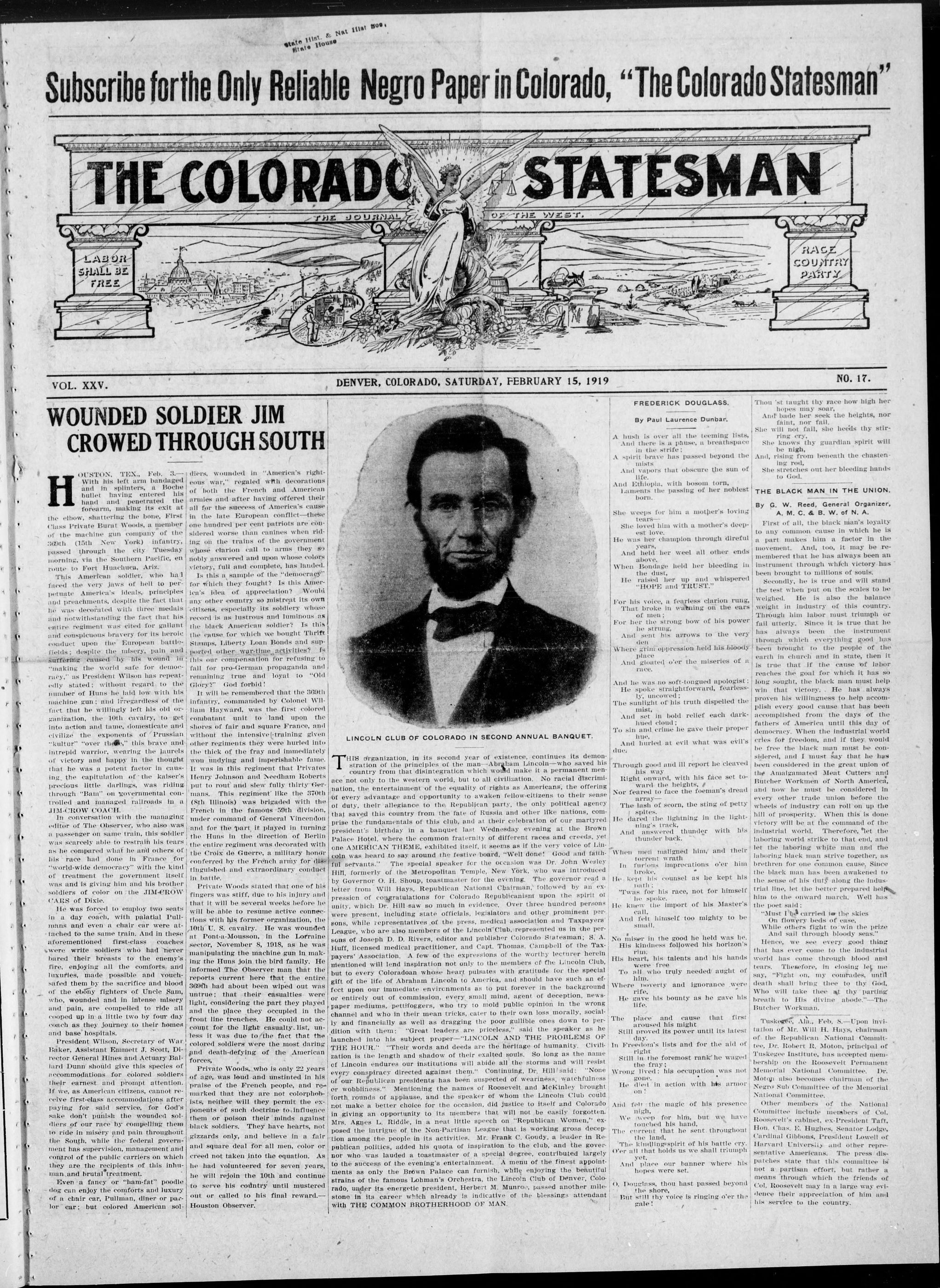
WOUNDED SOLDIER JIM CROWED THROUGH SOUTH
VOL. XXV.
HOUSTON, TEX., Feb. 3.—With his left arm bandaged and in splinters, a Boche bullet having entered his hand and penetrated the forearm, making its exit at the elbow, shattering the bone, First Class Private Burat Woods, a member of the machine gun company of the 369th (15th New York) infantry, passed through the city Tuesday morning, via the Southern Pacific, en route to Fort Huachuca, Ariz.
This American soldier, who had faced the very jaws of hell to perpetuate America's ideals, principles and preachments, despite the fact that he was decorated with three medals and notwithstanding the fact that his entire regiment was cited for gallant and conspicuous bravery for its heroic conduct upon the European battlefields; despite the misery, pain and suffering caused by his wound in "making the world safe for democracy," as President Wilson has repeatedly stated; without regard to the number of Huns he held low with his machine gun; and firegardess of the fact that he willingly left his old organization, the 10th cavalry, to get into action and tame, domesticate and civilize the exponents of Prussian "kultur" "over the earth," this brave and intrepid warrior, wearing the laurels of victory and happy in the thought that he was a potent factor in causing the capitulation of the kaiser's precious little darlings, was riding through "Bam" on governmental controlled and managed railroads in a JIM-CROW COACH.
In conversation with the managing editor of The Observer, who also was a passenger on same train, this soldier was scarcely able to restrain his tears as he compared what he and others of his race had done in France for "world-wide democracy" with the kind of treatment the government itself was and is giving him and his brother soldiers of color on the JIM-CROW CARS of Dixie.
He was forced to employ two seats in a day coach, with palatial Pullmans and even a chair car were attached to the same train. And in these aforementioned first-class coaches were write soldiers who had never bared their breasts to the enemy's fire, enjoying all the comforts and luxuries, made possible and vouch-safed them by the sacrifice and blood of the ebony fighters of Uncle Sam, who, wounded and in intense mlsery and pain, are compelled to ride all cooped up in a little two by four day coach as they journey to their homes and base hospitals.
President Wilson, Secretary of War Baker, Assistant Emmett J. Scott, Director General Hines and Actuary Ballard Dunn should give this species of accommodations for colored soldiers their earnest and prompt attention. If we, as American citizens, cannot receive first-class accommodations after paying for said service, for God's sake don't punish the wounded soldiers of our race by compelling them to ride in misery and pain throughout the South, while the federal government has supervision, management and control of the public carriers on which they are the recipients of this inhuman, and brutal treatment.
Even a fancy or "ham-fat" poodle dog can enjoy the comforts and luxury of a chair car, Pullman, diner or parlor car; but colored American sol-
State Hint. & Nat Hint Goo
State House
the Only Reliable
COLORA
LDIER JIM
ROUGH SOUTH
Reliable Ne
RADO
THE JOURNAL
DENVER,
diers, wounded in "America's righteous war," regaled with decorations of both the French and American armies and after having offered their all for the success of America's cause in the late European conflict—the one hundred per cent patriots are considered worse than canines when riding on the trains of the government whose clarion call to arms they so nobly answered and upon whose colors victory, full and complete, has landed. Is this a sample of the "democracy" for which they fought? Is this America's idea of appreciation? Would any other country so mistreat its own citizens, especially its soldiery whose record is as lustrous and luminous as the black American soldier? Is this the cause for which we bought Thrift Stamps, Liberty Loan Bonds and supported other war-time activities? Is this our compensation for refusing to fall for pro-German propaganda and remaining true and loyal to "Old Glory?" God forbid!
It will be remembered that the 369th infantry, commanded by Colonel William Hayward, was the first colored combatant unit to land upon the shores of fair and square France, and without the intensive training given other regiments they were hurled into the thick of the fray and immediately won undying and imperishable fame. It was in this regiment that Privates Henry Johnson and Needham Roberts put to rout and slew fully thirty Germans. This regiment like the 370th (8th Illinois) was brigaded with the French in the famous 59th division, under command of General Vincendon and for the part it played in turning the Huns in the direction of Berlin the entire regiment was decorated with the Croix de Guerre, a military honor conferred by the French army for distinguished and extraordinary conduct in battle.
Private Woods stated that one of his fingers was stiff, due to his injury and that it will be several weeks before he will be able to resume active connections with his former organization, the 10th U. S. cavalry. He was wounded at Pont-a-Mousson, in the Lorraine sector, November 8, 1918, as he was manipulating the machine gun in making the Huns join the bird family. He informed The Observer man that the reports current here that the entire 369th had about been wiped out was untrue; that their casualties were light, considering the part they played and the place they occupied in the front line trenches. He could not account for the light casualty list, unless it was due to the fact that the colored soldiers were the most daring and death-defying of the American forces.
Private Woods, who is only 22 years of age, was loud and unstinted in his praise of the French people, and remarked that they are not colorphobists, neither will they permit the exponents of such doctrine to influence them or poison their minds against black soldiers. They have hearts, not gizzards only, and believe in a fair and square deal for all men, color or creed not taken into the equation. As he had volunteered for seven years, he will rejoin the 10th and continue to serve his country until mustered out or called to his final reward.—Houston Observer.
---
DENVER, COLORADO, SATURDAY, FEBRUARY 15, 1919
A. B.
LINCOLN CLUB OF COLORADO IN SECOND ANNUAL BANQUET.
THIS organization, in its second year of existence, continues its demonstration of the principles of the man—Abraham Lincoln—who saved his country from that disintegration which would make it a permanent menace not only to the western world, but to all civilization. No racial discrimination, the entertainment of the equality of rights as Americans, the offering of every advantage and opportunity to awaken fellow-citizens to their sense of duty, their allegiance to the Republican party, the only political agency that saved this country from the fate of Russia and other like nations, comprise the fundamentals of this club, and at their celebration of our martyred president's birthday in a banquet last Wednesday evening at the Brown Palace Hotel, where the common fraternity of different races and creeds, yet one AMERICAN THEME, exhibited itself, it seems as if the very voice of Lincoln was heard to say around the festive board. "Well done! Good and faithful servants." The special speaker for the occasion was Dr. John Wesley Hill, formerly of the Metropolitan Temple, New York, who was introduced by Governor O. H. Shoup, toastmaster for the evening. The governor read a letter from Will Hays, Republican National Chairman, followed by an expression of congratulations for Colorado Republicanism upon the spirit of unity, which Dr. Hill saw so much in evidence. Over three hundred persons were present, including state officials, legislators and other prominent persons, while representatives of the press, medical association and Taxpayers' League, who are also members of the Lincoln Club, represented us in the persons of Joseph D. D. Rivers, editor and publisher Colorado Statesman; S. A. Huff, licensed medical practitioner, and Capt. Thomas, Campbell of the Taxpayers' Association. A few of the expressions of the worthy lecturer herein mentioned will lend inspiration not only to the members of the Lincoln Club, but to every Coloradoan whose heart pulsates with gratitude for the special gift of the life of Abraham Lincoln to America, and should have such an effect upon our immediate environments as to put forever in the background or entirely out of commission, every small mind, agent of deception, newspaper mediums, petifoggers, who try to mold public opinion in the wrong channel and who in their mean tricks, cater to their own loss morally, socially and financially as well as dragging the poor gullible ones down to perdition with them: "Great leaders are priceless," said the speaker as he launched into his subject proper—"LINCOLN AND THE PROBLEMS OF THE HOUR." "Their words and deeds are the heritage of humanity. Civilization is the length and shadow of their exalted souls. So long as the name of Lincoln endures our institutions will abide all the storms and will resist every conspiracy directed against them." Continuing, Dr. Hill said: "None of our Republican presidents has been suspected of weariness, watchfulness or wobbliness." Mentioning the names of Roosevelt and McKinley brought forth rounds of applause, and the speaker of whom the Lincoln Club could not make a better choice for the occasion, did justice to itself and Colorado in giving an opportunity to its members that will not be easily forgotten. Mrs. Agnes L. Riddle, in a neat little speech on "Republican Women," exposed the intrigue of the Non-Partisan League that is working deception among the people in its activities. Mr. Frank C. Goudy, a leader in Republican politics, added his quota of inspiration to the club, and the governor who was lauded a toastmaster of a special degree, contributed largely to the success of the evening's entertainment. A menu of the finest appointments as only the Brown Palace can furnish, while enjoying the beautiful strains of the famous Lohman's Orchestra, the Lincoln Club of Denver, Colorado, under its energetic president, Herbert M. Munro, passed another milestone in its career which already is indicative of the blessings attendant with THE COMMON BROTHERHOOD OF MAN.
No miser in the good he held was he. His kindness followed his horizon's rim.
NO.17.
Thou 'st taught thy race how high her hopes may soar,
And bade her seek the heights, nor faint, nor fail.
She will not fail, she heeds thy stirring cry,
She knows thy guardian spirit will be nigh,
And, rising from beneath the chastening rod,
She stretches out her bleeding hands to God.
By G. W. Reed, General Organizer,
A. M. C. & B. W. of N. A.
First of all, the black man's loyalty
to any common cause in which he is
a part makes him a factor in the
movement. And, too, it may be
remembered that he has always been an
instrument through which victory has
been brought to millions of souls.
Secondly, he is true and will stand the test when put on the scales to be weighed. He is also the balance weight in industry of this country. Through him labor must triumph or fail utterly. Since it is true that he has always been the instrument through which everything good has been brought to the people of the earth in church and in state, then it is true that if the cause of labor reaches the goal for which it has so long sought, the black man must help win that victory. He has always proven his willingness to help accomplish every good cause that has been accomplished from the days of the fathers of America until this day of democracy. When the industrial world cries for freedom, and if they would be free the black man must be considered, and I must say that he has been considered in the great union of the Amaigamated Ment Cutters and Butcher Workmen of North America, and now he must be considered in every other trade union before the wheels of industry can roll on up the hill of prosperity. When this is done victory will be at the command of the industrial world. Therefore, let the laboring world strike to that end, and let the laboring white man and the laboring black man strive together, as brethren for one common cause. Since the black man has been awakened to the sense of his duty along the industrial line, let the better prepared help him to the onward march. Well has the poet said:
"Must I be carried to the skies On flowery beds of ease. While others fight to win the prize And sail through bloody seas." Hence, we see every good thing that has ever come to the industrial world has come through blood and tears. Therefore, in closing let me say, "Fight on, my comrades, until death shall bring thee to thy God, Who will take thee at thy parting breath to His divine abode."—The Butcher Workman.
Tuskegee, Ala., Feb. S.—Upon invitation of Mr. Will H. Hays, chairman of the Republican National Committee, Dr. Robert R. Moton, principal of Tuskegee Institute, has accepted membership on the Roosevelt Permanent Memorial National Committee. Dr. Moton also becomes chairman of the Negro Sub Committee of the Memorial National Committee.
Other members of the National Committee include members of Col. Roosevelt's cabinet, ex-President Taff, Hon. Chas. E. Hughes, Senator Lodge, Cardinal Gibbons, President Lowell of Harvard University and other representative Americans. The press dispatches state that this committee is not a partisan effort, but rather a means through which the friends of Col. Roosevelt may in a large way evidence their appreciation of him and his service to the country.
FOREIGN
With the meeting of new Poland's first constitutional assembly at the Marius Institute at Warsaw the work of creating a permanent government is well under way.
In Westminster Abbey in London, the great shrine of the British empire, a splendid and impressive service was held to do honor to the memory of Theodore Roosevelt.
A Belgrade dispatch says typhus has broken out in the Serbian capital, especially among the Czech prisoners collected there and among Serbian soldiers from the south.
The Economical Association of Prague has issued a proclamation urging a boycott of everything German in the Czecho-Slovak republic. German shops, physicians and lawyers are to be avoided.
The Lithuanians have arrested the Bolshevist advance on the Lithuanian front, according to news received by the Lettish bureau in Berlin. The town of Ponlevsk, north of Kovno, has been taken by the Lithuanians.
The eye trouble which Viscount Grey, former British secretary of state for foreign affairs, has been afflicted with for years now has culminated-in total blindness, says reports from London. Viscount Grey is learning to read by the Braille system of characters for the blind.
The congress of soldiers' councils attached to various German army corps concluded its session at Berlin with the adoption of a resolution calling on the central council of the soldiers' and workmen's boards to summon a general congress of all the German soviets by Feb. 20.
Despite Paderewski's demand that the Polish national committee urge the allies to send a Polish army from France to Poland, the Supreme War Council will not transfer two Polish divisions under Gen. Haller, attached to the French army, to Poland. American opinion is strongly opposed to dispatching an expeditionary force to Poland—now, and France and Great Britain agree.
**SPORT**
Hank Gowdy's day at the Chicago Cubs' park was set for June 6. If available the Chicago doughboy battery, Alexander and Killifer, will work for the Cubs.
The Minnesota Boxing Commission, meeting at Minneapolis, voted to bar indefinitely Fred Fulton, Rochester, Minn., heavyweight fighter, from boxing or sparring in Minnesota rings.
Jack Dempsey has signed the articles calling for a fight with Jess Willard for the championship on July 4. The articles were signed in the waiting room of the West Shore railroad because the laws of New York prevented such arrangements being made in that state.
Hal Chase, stormy petrel of baseball, was cleared of the charge of "throwing" games, preferred against him by the Cincinnati club. He was declared "not guilty" by President John A. Heydler of the National League, who acted as judge, after a week's study of the evidence for and against him.
GENERAL
W. D. Childs, for many years chief representative of the Western Union Telegraph Company in Russia, is dead of starvation in Petrograd.
Nearly $45,000,000 worth of vehicles, harness, forage and raw materials wripped to the American expeditionary forces from the beginning of the war to Dec. 1, 1918, according to information made public by the War Department.
While the farmer would be paid the $2.26 government guarantee for the 1919 wheat crop, the wheat would be sold to the consumer at a price to be dictated by the law of supply and demand under legislation approved by the House agriculture committee. The government would lose the difference between the purchase and sale prices.
Coffee houses as a substitute for saloons when prohibition goes into effect next July is a plan now being supported by a number of prominent ministers in New York.
An American newspaper published in Germany was discovered when a group of soldiers in the city of Mayen were found reading the Fourth Corps Flare. It is a four-page weekly put out by members of the Fourth Corps artillery park. And it is a real newspaper. In addition to items on the latest society news, the four pages include a column of wireless picked up by the powerful radio operated at Colhem by the 310 Field Signal battalion.
The record of crimes attributed to the supposed organization popularly known as the "gray automobile robber band" has been augmented by the killing in the Mexican federal penitentiary of Francisco Oviedo. Oviedo had been a prisoner for a year and a half and was accused of, being one of the sub-chiefs of the robber band which has operated here for two years or more. He was slain with a dagger by a negro prisoner who was charged with nine other murders.
Total gross motor vehicle registration and license revenues for 1917, were $37,501,237.01. Of this sum, $23,235,897.82 was available for road work by or under the several state departments, $11,452,705.93 under the direction of local authorities and the remainder was diverted to other departments of government.
A world shortage of gasoline waits just around the corner for the motor-propelled world, according to Mark L Reqa, Standard Oil official, who has been directing the oil division activities of the Fuel Administration.
CONDENSATION OF FRESH NEWS
THE LATEST IMPORTANT DISP
PATCHES PUT INTO SHORT,
CRISP PARAGRAPHS.
SHOWING THE PROGRESS OF EVENTS IN OUR OWN AND FOREIGN LANDS.
EASTERN
By a vote of 20 to 14 the Connecticut Senate refused to ratify the federal prohibition amendment. Action by by the Connecticut Senate is the first vote against ratification thus far taken by any branch of a Legislature in the United States. Adolph S. Ochs, publisher of the New York Times, was called as a government witness in the federal trial of Jeremiah A. O'Leary, charged with violation of the espionage act, to refute charges made in O'Leary's paper, Bull, that the Times was controlled by British influence. Mr. Ochs denied that his paper was controlled by British influence or British money.
WESTERN
Dr. Richard Ernest Kunze, internationally famous as a naturalist, is dead at Phoenix.
Three persons were burned to death in a fire destroying the Tokio House at Seattle, a lodging house in the lower part of the city. Twelve are missing and fourteen were injured.
Thirty French veterans, including a number of aviators and tank experts, part of a contingent ordered to Siberia, received orders upon their arrival in Honolulu to return to France.
About 300 orange growers of the San Gabriel valley, many of them armed, drove from this vicinity 35 Russians, including four women, alleged to have attempted to intimidate Mexican orange pickers.
Harlan Talbert, secretary of the Oregon Socialist party, and four other men were arrested at Portland charged with violation of the newly enacted state criminal syndicalism law, by the distribution of alleged seditious literature.
Managers of copper properties at Latouche and Kennecott, Alaska, have begun making reductions in the number of employés because of the decline in the price of copper. Gold mines here have added extra shifts, operating now nearly on a pre-war basis.
At a mass meeting of members of local and district draft boards in Portland resolutions were adopted memorializing Congress to enact legislation to exclude from citizenship, and to deport from the United States, all aliens who withdrew their applications for citizenship during the war in order to evade military service.
WASHINGTON
Prof. George Herron and William Allen White have been appointed American delegates to the joint conference of the associated powers and Russian factions at Prinkipos. The House bill providing for a reduction of $15,000,000,000 in war appropriations and contract authorizations and making deficiency appropriations of $295,000,000, was passed by the Senate without a record vote.
To maintain facilities for training merchant seamen, the Shipping Board has decided to turn six of the wooden cargo steamers built during the war into training ships. More than 38,000 men have applied to take the training courses, and it is planned to add deep-sea cruises to the curriculum.
Plans for bringing home he bodies of all officers, sailors and marines now buried on foreign soil are being worked out by the Navy Department and the actual work will be undertaken within the next few months. The wishes of relatives, however, will govern not only as to the return of the bodies, but also as to their final disposition.
There were more than 370,000 trials by courts-martial of American soldiers during the war, Secretary Baker informed the Senate in response to a resolution of Senator Borah of Idaho, asking for the facts of trials of soldiers. Mr. Baker said that 22,000 cases were heard by general courts-martial and the remainder by special or summary courts.
If the United States is to sell its surplus wheat to the allies this year, the transaction must be on a credit basis. Julius Barnes, head of the Food Administration's Grain Corporation, told the House agriculture committee at a hearing on legislation to provide a method for carrying out the government's guaranteed price of $2.26 a bushel for the 1919 wheat crop.
Hospital reports from the expeditionary forces show there were 95,962 sick and wounded among the American soldiers on Jan. 16. This was a net decrease of 67,486 from that total on Dec. 19. The total for January comprised 67,293 soldiers incapacitated as a result of disease and 28,669 from injuries.
The annual postoffice appropriation bill carrying a total of $400,000,000, and providing for the expenditure of $200,000,000 additional for road building in the next three years, was passed by the Senate without a record vote.
SPORT
Pithy News Notes
From All Parts of
Colorado
Western Newspaper Union News Service.
Harry J. Wolf, mining professor at the State School of Mines, states that Colorado oil shale deposits are a state and national asset.
All the Weld county sugar mills are assured long campaigns next season, because of the immense beet tonnage contracted for the county.
A committee of citizens from Fruita, in Mesa county, is in Denver urging the State Legislature to pass a law creating the county of Pabor on the Western Slope.
The value of farm, orchard and garden crops grown in Colorado in 1918 was approximately $150,000,000, as compared with $50,974,958 for 1909 and $16,588 for 1899.
Hundreds of farmers are making good profits every year on nonirrigated land in Colorado that was considered worthless for agricultural purposes ten years ago.
Prof. William Black, instructor of mechanical engineering at the University of Colorado since 1917, died at Boulder at the university hospital following an operation for appendicitis.
Being at the crest of the continent, Colorado contains the headwaters of some of the principal rivers of the United States, including the Colorado Rio Grande, Platte, Arkansas and Republican.
The residents of Lake county are solidly in favor of the proposed $21,000 for repairs for the Battle Mountain road, in Eagle county, in place of the proposed repairs to the roads in the western part of that county.
Two Cripple Creek boys who fought with the famous "Devil Dogs" at Chateau Thierry have returned to their homes in Cripple Creek for a visit with relatives. Both were wounded in action. They are Dewey Nulph and Willard Allen.
The "fui" situation here continues with little improvement in Leadville. There is a crying need for nurses, for as yet but few women have proffered their services. More than one-third of the school pupils are absent, due to flu. Fear of the dread disease is temporarily crippling many business houses.
Although R. Lee Craft, special agent of the Department of Justice, went to Fowler to arrest one man on a charge of evading the draft, he brought to Pueblo another on the same charge, and through a peculiar circumstance, the name of the man caught is the same as the man sought. He is James M. George, and he is held in the local jail awaiting action on the part of government officials. All the Weld county sugar mills are assured long campaigns next season, because of the immense beet tonnage contracted for in the country, according to Hi Tymothy, agricultural superintendent of the Greeley factory. He says that the Greeley factory has contracted more than 9,000 acres, and that Windsor and Eaton have contracted about 26,000 acres between them.
Original jurisdiction was assumed by the Colorado Supreme Court in the civil service wrangle arising from the appointment of two commissions, one by the outgoing governor, Julius C. Gunter, and the other by Gov. Oliver H. Shoup. The court, sitting en banc, authorized a writ of ouster to issue, which compels the members of the Gunter commission to make reply as to why they should not be removed from office. In announcing that the writ may issue, the court let it be known that it would consider no disputed facts. This will limit the decision as to who in law constitutes the civil service commission.
The grand encampment of Odd Fellows will be held in Denver Feb. 17. It was scheduled to be held in Fort Collins last October, and was postponed on account of the influenza epidemic. The military council of Patriarchs Militant will meet the evening of the opening day at 1751 Champa. The final feature of the program will be a grand ball. The mysterious disease which has been killing many cattle around Crest, Colo., and which started in the western part of Morgan county, where it destroyed entire herds, has been diagnosed as corn stalk disease by veterinarians from the State Agricultural College at Fort Collins, and there is no cure for it save to keep the cattle out of the corn fields.
Dr. George Norlin, acting president of the University of Colorado, announced at Boulder that the resignation of Dr. Livingston Farrand, president of the university, was expected by the board of regents. This statement follows closely upon the announcement from Washington that President Wilson had appointed Dr. Farrand as president of the American Red Cross, the appointment to take effect March 1.
A steel and concrete bridge is being built across Black creek on the Kremmling-Dillon mail route, twenty miles south of Kremmling. Its cost, $3,000, is divided between Summit county and Flebbe Brothers, whose irrigation pipeline will be carried across the canyon on the new bridge.
Boulder people back of the company formed to purchase the Chamberlin sampler at Boulder have raised the $10,000 purchase price. This means employment at once for about seventy-five men, and ores from Jintown and Caribou insure plenty of work.
The desires of hundreds of thousands of Colorado citizens that the Moffat railroad be retained as a railroad and operated by the state, instead of being abandoned and possibly dismantled, were voiced by speakers representing the farmers of the state, the labor unions and many varied industries before a committee of the House of Representatives. The hearing was held publicly in the chamber of the House, and nearly all the members of both houses of the Legislature attended.
THE COLORADO STATESMAN
Angry because the teacher punished his son, Henry Izet went to the school house at Frederick and attacked the teacher striking him over the head and knocking him down with a heavy shovel. At the same time he made threats against the teacher. Izet was arrested on an assault charge and taken to Ggeeley, where the charge was changed to one of breach of peace. He was put under $500 bonds to keep the peace and fined, the costs of the case amounting to about $50.
The Mouth-Piece of the People of Colorado and the Entire West
President Wilson today renominated Robert J. McGrath as receiver of public moneys at Lamar, Colo. For registers of the land office the following were nominated for another term: Joseph T. Carruth, at Blackfoot, Ida.; Dallas G. Weyand, Glenwood Springs, Colo.; Edward J. Hoeffnagels, Leadville, Colo.; Nathaniel Campbell, Portland, Orc.; Alonzo L. Beavers, Lamar, Colo.
Resolutions condemning the repeal of the Sunday closing law and gambling on race horses were adopted at a meeting of the Ministerial alliance in Denver. The resolution against the Sunday closing law was aimed at a bill pending before the Legislature providing for the repeal of the statutes requiring the closing of places of amusement on Sunday.
The Arapahoe county commission is considering several road and bridge improvement projects. Among them is the proposal to continue the state road between Arapahoe and Adams counties for a distance of two miles between Strassburg and Byers. The improvement would start four miles east of Strassburg.
ARELIABLE chronicle of their doings and progress; a faithful mirror of their wants, their hopes, their best aspirations.
Friends of County Judge Ira Rothgerber are again urging him to become a candidate for mayor of Denver in the spring. Judge Rothgerber has been mentioned frequently as a likely candidate, but has not made any announcement of his intention to make the race.
With the arrest of Edgar Winston, a Pulman porter charged with importing and selling liquor, police at Colorado Springs have unearthed a ring of porters who have been working the trains between Kansas City and Colorado with great success.
With the killing of Joe Bruno at Walsburg the long-feared Black Hand society of Huerfano county is believed to have been partly broken up, and Sheriff Neelley hopes he has halted a long reign of terror on the part of Italian black handers.
THE COLORADO STATESMAN
A bill clamping the screws more tightly upon loan sharks who make a business of garnisheeing the wages of working men and women for small loans is being urged upon legislators by a committee on social legislation, headed by Henry Van Kleek. The livestock situation in southwestern Colorado and northwestern New Mexico is, to a considerable extent, in a precarious condition, due to the inability of the stockmen to get feed for their stock and the ranges are deeply covered with snow. R. B. Dixon, owner of a ranch a short distance above Steamboat Springs, received a check for $5,137 from the Yampa Valley Milling and Elevator Company as payment for part of the crop raised on seventy acres of dry land last year.
Unequaled as an advertising medium for the business of professional men and women.
Tom Foley, wealthy Chinese laundryman and a character for thirty-five years on the Western slope, was found murdered at Ouray. Robbery is believed to have been the motive. Greeley farmers and promoters of the bean industry are not happy over the prospects of the 1919 season for Weld county. Although plans have been made and equipment and capital gathered to handle 30,000 acres of seed beans annually, the prospects indicate that not more than 8,000 acres will be contracted, and at present only 4,000 are contracted. Prospects for the pinto bean industry are darker than those for the seed bean.
An excellent family journal speaking to and for many thousand colored citizens.
The United States Railroad Administration abandoned all hope of saving the Colorado Midland railroad from junk when John Barton Payne, legal adviser to Director General Hines, rejected a final proposition presented on behalf of the company that the government should take over the road, pay $140,000 a year rental and assume all costs of betterments and replacements.
A bill by Representative Bashor and Rockwell, with the dual purpose of protecting game and migratory birds and prohibiting foreign-born unnaturalized residents of Colorado from carrying firearms, was passed on second reading after several members of the House had expressed doubts as to its constitutionality.
TWODOLLARSAYEAR
THE GREAT ORGAN OF THE
All returning soldiers are invited to become honorary members of the Pueblo Commerce Club, with all the privileges of paid members with the exception of voting. A letter of invitation and a membership card is sent to each Pueblo man who returns from the army camps or from overseas service. Field peas are among the best feeds for fattening hogs and lambs. Colorado produced nearly $3,000,000 worth of field peas in 1918, and produced from them some of the finest meats in the country.
MUST LIST WAR MATERIAL
THE SUPREME COUNCIL OF AL LIES MAKE KNOWN
MAKE ARMY REDUCTION
London, Feb. 14.—A German wireless communication received here says: "The Superior Council of the allies has demanded from the German armistice administration at Spa a declaration of all stocks of war materials available in Germany or under construction, including guns, airplanes and motors. The demand was based on the attitude of the German army administration in connection with the Polish question and the necessity of settling conditions for an extension of the armistice."
Paris.—The Bourgeois proposition for an interallied military force to enforce peace was defeated by an overwhelming vote at the meeting of the society of nations' commission. The French and Czecho-Slovaks were the only representatives voting in the affirmative. The draft of the society of nations' plan was then unanimously adopted as a whole. The final draft consists of twenty-six articles.
Revolt in Rumania.
Berlin. A general insurrection is in progress throughout Rumania, according to a special dispatch from Vienna. King Ferdinand has been wounded slightly in attempting to flee from Bucharest with the royal family. Workmen blocked the roadway from the royal palace when the royal family attempted to flee to Jassy and the king and his family were forced to return. The king was wounded when the workers, according to report, fired upon the royal palace. Rioters in the streets of Bucharest are openly demanding the overthrow of the dynasty, crying "down with the puppets, long live the republic!"
Wounded Soldiers Sturdy.
Washington.—There were 12,248 wounded soldiers in hospitals in the United States registered Dec. 4 for various educational or other courses of instruction provided by the military authorities. A statement issued by the surgeon general shows that 3,917 who applied for instruction in handcraft work were men not able to go into the workshops and whose instruction was to be received in the wards, while 569 registered for academic study in the wards. Shop and trade courses attracted 2,012 men; commercial subjects, 1,117; agriculture, 564; recreational courses, 1,633 and the others were scattered. Such courses are now being given in twenty-three army hospitals.
$30 "Gob" Gets $64,000,000.
Chicago.—Daniel Tolman, 18, a $30-a-month "gob" at the Great Lakes naval training station, was granted a twenty-day furlough on request of the Surrogate Court of New York that he might be present at court proceedings there in connection with an estate of $64,000,000 bequeathed him by his grandfather, Daniel Tolman, founder of a string of loan brokerage offices throughout the United States.
Governor Gets Black Hand Letter.
Denver.—Threats of violence, even to the extent of cutting off the head of the chief of police and wrecking banks, was sent to Governor Oliver H. Shoup in a "Black Hand" letter through the mails. These dire penalties are ineffable unless the unemployed of Denver are given work. An impression of the outlines of a left hand, supposed to be that of the sender, and a scrawl in ink written by a right-handed person, are the sole clues that state officials are turning over to federal authorities for investigation.
Lincoln's Address Read.
Washington.—In accordance with long-established custom, Lincoln's Gettysburg address was read on his birthday in the House of Representative. Representative Russell of Missouri, for the first time in many years was unable to read the address, illness preventing his attendance. By designation of Speaker Clark, the address was read by Mr. Russell's colleague, Representative Ruthey.
- Raiding I. W. W.
Raiding I. W. W.
Seattle, Wash.-Four men, declared to have been leaders in distributing revolutionary and I. W. W. propaganda during Seattle's general strike are in jail here and warrants are out for seven others, charging criminal anarchy following three raids in which thirty-three additional men were arrested and are being held for investigation. County officials, government operatives, deputy sheriffs constables and a representative of the district attorney participated in the raids
WILL HAVE "BLUE-SKY"
WILL HAVE "BLUE-SKY"
CERTAIN OF PASSAGE OF IM-
PORTANT MEASURE.
Call Up Many Small Bills for Consideration Past Week.
Western Newspaper Union News Service.
Denver. - Differences of opinion between the Senate and House judiciary committees on the manner of bringing about blue-sky legislation is the first serious obstacle in the administration program that is confronting the Legislature. The Senate favors a speculative securities commission, while the House is inclined to discredit the idea of three men passing upon the purported sale of stocks. Hope that the trouble may be ironed out was expressed by legislators of the upper house, who called a meeting of the judiciary committee and invited the subcommittee of blue-sky legislation of the House judiciary committee to attend.
Salary increase for Supreme and District Court judges were favorably acted upon, the Senate voting to fix the salary of supreme judges at $6,000 and that of district judges at $5,000. The Slattery bill proposed to set the salaries at $7,000 and $5,500, but the Senate sustained a report of the constitutional amendments committee holding that those figures were too high. The increase allowed will have to be submitted to the people and approved by them before becoming law. The first Senate bill to receive the final favorable vote of the House was No. 56, by Senators Dunlap and Hattenbach, providing for a semi-monthly pay day for employers of labor.
Chief of Police Hamilton Armstrong of Denver sent to the judiciary committees of the two houses of the Legislature an appeal for favorable action on three bills which he believes will aid in checking the wave of juvenile crime. One bill is Senate bill No. 27, restoring the jurisdiction of the Juvenile Court, which was partly taken away by a recent decision of the Supreme Court. Another bill is House bill No. 151, designed to supplement the present laws against prostitution and criminal assault and to cover cases which old laws do not reach, especially those affecting young girls. House bill No. 9 to raise the age of delinquency and dependency from 16 to 18 years is also favored by Chief Armstrong. The passage of these three bills will materially aid the police in their work among young offenders, the chief asserts.
Graduates of the Colorado School of Mines will direct the future destinies of that institutions if the Fincher bill, passed on second reading in the Senate, receives a favorable vote on final reading and is given the approval of the other branch of the Legislature. The bill provides that three of the five members of the board of trustees appointed by the governor, shall be alumni of the school. At present, only one member of the board is a graduate of the institution.
The firsts top towards the erection of a fitting memorial in commemoration of Colorado's part in the war was taken when the Senate adopted, on second reading, the Knauss-Dodge bill setting aside $50,000 as a preliminary appropriation for that purpose.
Problems between the land owners and the bondholders of irrigation districts that embrace 1,250,000 acres of land which is for the most part unworkable at present were discussed by representatives of both sides before the Senate agricultural committee at the capitol. The North Sterling, Montezuma, Arkansas, Otero, Prult and Greeley-Poudre districts were represented. The bill calls for a commission which is to act as mediator between the landowners and bondholders in districts that are in financial distress for the purpose of liquidating the bonded indebtedness.
Representative Mabel Ruth Baker's bill establishing a graduated minimum wage for school teachers passed on third reading by a vote of 49 to 9.
Senate bills passed on second reading were: The McFadzean bill, allowing District Court reporters actual traveling costs and $3 a day additional expense allowance while on duty at court sessions held outside their district.
The camp-site bill before the State Legislature, which authorizes county commissioners to purchase camping places for motor tourists within their counties, introduced at the request of the State Highway Commission, has created considerable interest throughout the country. It is unique in relation to state government, although many Colorado cities, pioneered by Denver, have maintained these camps for several years. The motor tourist, however, finds difficulty in securing a suitable camping place along the country roads. It is easy to secure accommodations in the cities. The farmers have protested, and with some show of 'right, that their land should not be violated by innumerable camping parties.
The Stephen bill, under which public display of the red flag in Colorado, except as a railroad signal would be made a misdemeanor, and the Coldren bill, giving cities and towns the right to contract certain classes of indebtedness, were recommended for passage by the committee.
A resolution by Senators Puffer and McWilliams was passed, giving the state treasurer authority to destroy $1,000,000 worth of unissued, but signed and sealed state bonds of a series authorized during the Shafroth administration.
Washington
WHEN dreaming kings, at odds with swif-
paced time,
Would strike that banner down,
A nobler knight than ever writ or rhyme
With fame's bright wreath did crown,
Through armed hosts bore it till it floated high
Beyond the clouds, a light that can not diel
To a rageer race,
Great builder of a temple new!
Ruler, who sought no lordly place
Warrior, who sheathed the sword he drew!
Lover of men, who saw afar
A world unmarried by want or war,
Who knew the path, and yet forbore
To tread the ground,
Who saw the light and led the way
Where the gray world might greet the day;
Father and leader, prophet sure,
Whose will in vast works shall endure.
How shall we praise him on this day of days,
Great son of fame who has no need of praise?
How shall we praise him? Open wide the doors
Of the fair temple whose broad base he laid,
Through its white halls a shadowy cavalcade
Of heroes moves o'er unresounding floors—
Men whose brawned arms upraised the columns high
And reared the towers that vanish in the sky—
The strong who, flaving wrought, can never die.
"ONLY HIS RIGHT"
Washington Upheld Action of Man Who Would Not Make Way.
DESPIITE President Washington's dignity, he was ever democratic. He was also just. Both qualities are illustrated by a story of him told by Rev. Dr. Alfred Ely, a massachusetts clergyman, who died in 1836. Doctor Ely told the story in a Fourth of July address delivered some years before his death, and it was taken down and published in practically his exact words. The tale exemplifies Washington's magnanimity, as well as the almost idolatrous reverence felt for him in his own day.
"When a boy," said Doctor Ely, "I resided in West Springfield, Mass., and worked on a farm. In the autumn of the year 1789 I was engaged with my employer in gathering a load of cornstalks from a field not far distant from the Connecticut river. My employer had driven the loaded team from the lot and left me, as usual, to put up the bars. While thus occupied I noticed the approach of four fine horses and a large vehicle. There was no driver upon the carriage, but astride the young horse of each span was a young mulatto postilion. There were also two outriders and a footman. The vehicle, in which was seated a gentleman whose striking personal appearance impressed me, was called in those days a chartot. I saw the outriders gallop up in advance of the chariot and hold a parley with my employer, who occupied the entire road with his loaded cart. I perceived that my employer yielded none of his right to the road, and that the charlot was detained by the cart until they reached a turnout, where the cortege passed by. I soon overtook my employer and inquired who the distinguished personage was who had just passed us, and informed that it was George Washington. I obtained permission to run on and see if I could not catch another glimpse of the great chieftain, whose deeds during the war had so filled my wondering fancy. In this I was not disappointed. I found General Washington waiting for the ferry, on the bank of the river, dressed in a snuff-colored surtout, with a long lapeed-vest of the same color and material, and in small clothes and boots, the most majestic and dignified looking man that I ever saw.
"While I was gazing upon him one
*of his postitions drove up, and, dis
J.
"And So He Had!"
mounting and uncovering his head, said in the most deferential manner, and with an expression of injured dignity:
"Your excellency, as we were driving along, a little way back, we overtook a man with a loaded cart, who occupied the entire road. I asked him to stop his team that we might pass by. He declined. I then told him that President Washington was in the chariot. He again refused, and said that he would not stop—that he had as good a right road as George Washington had.
"The simple reply of Washington was: 'And so he had!' The postilion, after a moment's look of wonder and astonishment at the condescension of the president of the United States, quietly put up his hat and mounted his worse."
---
His Earliest
Lesson
Early English Home of Washingtons, Manor of Sulgrave.
ALTHOUGH Warton, in Lancashire, can claim to be the earliest of the discovered English homes of the Washingtonts, it is not until the family settled at Sulgrave, in Northamptonshire, that they emerge definitely into history. Even with that restriction the story is carried back to the sixteenth century, and introduces us to the Lawrence Washington whose curious brass-efligy is
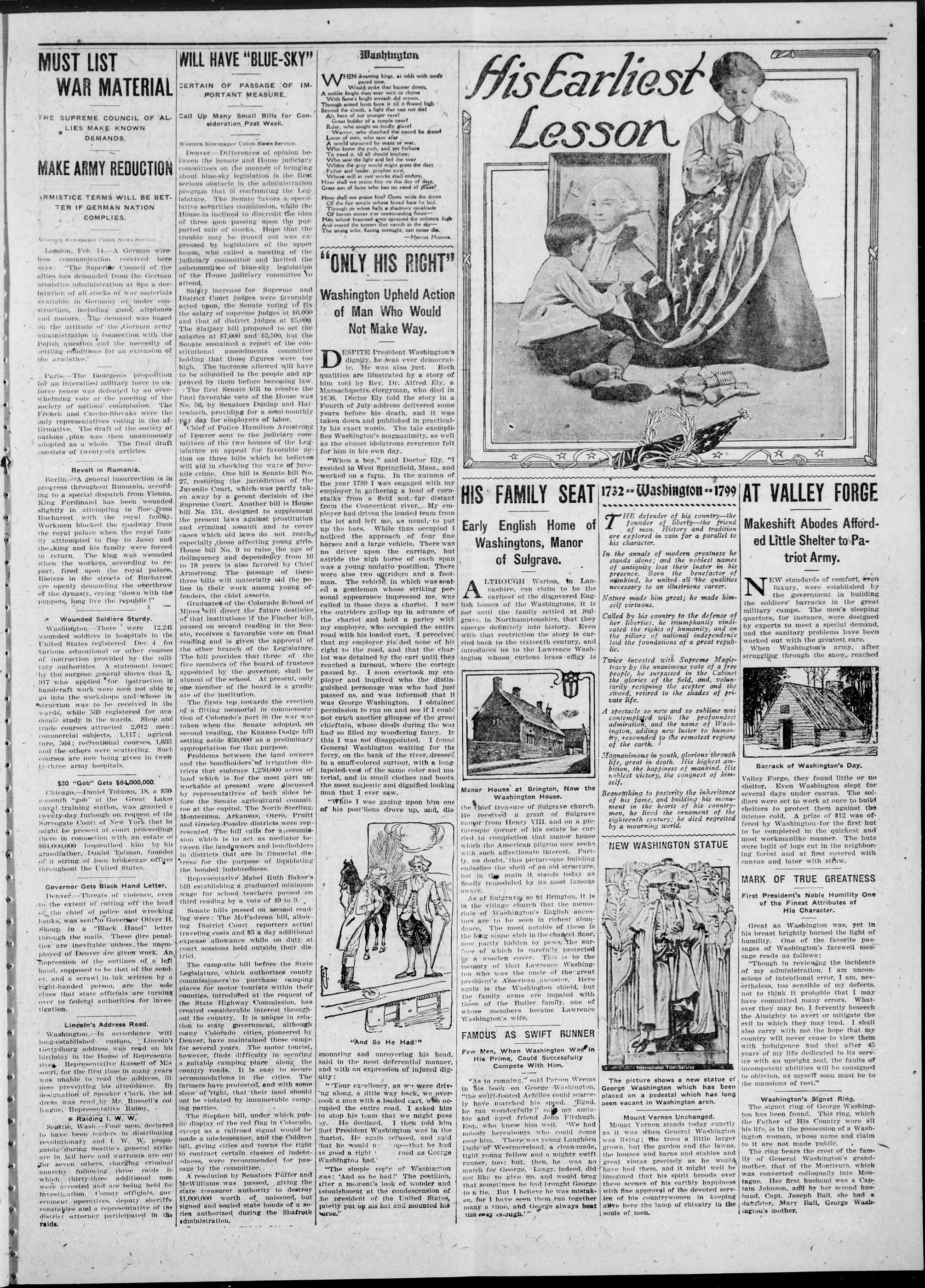
Manor House at Brington, Now the Washington House.
Manor House at Brington, Now the Washington House. the chief treasure of Sulgrave church. He received a grant of Sulgrave major from Henry VIII, and on a picturesque corner of his estate he carried to completion that manor house which the American pilgrim now seeks with such affectionate interest. Partly, no doubt, this picturesque building embodies the shell of an old structure, but in the main it stands today as finally remodeled by its most famous owner.
As at Sulgrave, so at Brington, it is in the village church that the memorials of Washington's English ancestors are to be seen in richest abundance. The most notable of these is the long stone slab in the chancel floor, now partly hidden by pews, the surface of which is carefully protected by a wooden cover. This is to the memory of that Lawrence Washington who was the uncle of the great president's American ancestor. Here again is the Washington shield, but the family arms are impaled with those of the Butler family, one of whose members became Lawrence Washington's wife.
FAMOUS AS SWIFT RUNNER
"As to running," said Parson Weems in his book on George Washington, "the swift-footed Achilles could scarcely have matched his speed. Egad, he ran wonderfully!" said my amiable and aged friend John Fitzhugh. Esq., who knew him well. "We had nobody hereabouts who could come near him. There was young Langhorn Dade of Westmoreland, a clean-made, tight young fellow and a mighty swift runner, too; but, then, he was no match for George. Langy, indeed, did not like to give up, and would brag that sometimes he had brought George to a tie. But I believe he was mistaken, for I have seen them, run together many a time, and George always beat him easy enough."
THE defender of his country—the founder of liberty—the friend of man. History and tradition are explored in vain for a parallel to his character.
In the annals of modern greatness he stands alone; and the noblest names of antiquity lose their luster in his presence. Born the benefactor of mankind, he united all the qualities necessary to an illustrious career.
Nature made him great; he made himself virtuous.
Called by his country to the defense of her liberties, he triumphantly vindicated the rights of humanity, and on the pillars of national independence laid the foundations of a great republic.
Twice invested with Supreme Magistracy by the unanimous vote of a free people, he surpassed in the Cabinet the glories of the field, and, voluntarily resigning the scepter and the sword, retired to the shades of private life.
A spectacle so new and so sublime was contemplated with the profoundest admiration, and the name of Washington, adding new luster to humanity, resounded to the remotest regions of the earth.
Magnanimous in youth, glorious through life, great in death. His highest ambition, the happiness of mankind. His noblest victory, the conquest of himself.
Bequeathing to posterity the inheritance of his fame, and building his monument in the hearts of his countrymen, he lived the ornament of the eighteenth century; he died regretted by a mourning world.
International Film Service
The picture shows a new statue of George Washington which has been placed on a pedestal which has long been vacant in Washington arch.
Mount Vernon Unchanged.
Mount Vernon stands today exactly as it was when General Washington was living; the trees a larger larger grown, but the garden and the lawns, the houses and barns and stables and great vistas precisely as he would have had them, and it might well be imagined that his spirit broods over these scenes of his earthly happiness with fine approval of the devoted service of his countrywomen in keeping alive here the lamp of chivalry in the souls of men.
AT VALLEY FORGE
Makeshift Abodes Afforded Little Shelter to Patriot Army.
NEW standards of comfort, even luxury, were established by the government in building the soldiers' barracks in the great military camps. The men's sleeping quarters, for instance, were designed by experts to meet a special demand, and the sanitary problems have been worked out with the greatest care. When Washington's army, after struggling through the snow, reached
Barrack of Washington's Day.
Valley Forge, they found little or no shelter. Even Washington slept for several days under canvas. The soldiers were set to work at once to build shelters to protect them against the intense cold. A prize of $12 was offered by Washington for the first hut to be completed in the quickest and most workmanlike manner. The huts were built of logs cut in the neighboring forest and at first covered with canvas and later with straw.
MARK OF TRUE GREATNESS
First President's Noble Humility One of the Finest Attributes of His Character.
Great as Washington was, yet in his breast brightly burned the light of humility. One of the favorite passages of Washington's farewell message reads as follows:
"Though in reviewing the incidents of my administration, I am unconscious of intentional error, I am, nevertheless, too sensible of my defects, not to think it probable that I may have committed many errors. Whatever they may be, I fervently beseech the Almighty to avert or mitigate the evil to which they may tend. I shall also carry with me the hope that my country will never cease to view them with indulgence and that after 45 years of my life dedicated to its service with an upright zeal, the faults of incompetent abilities will be consigned to oblivion, as myself soon must be to the mansions of rest."
Washington's Signet Ring.
The signet ring of George Washington has been found. This ring, which the Father of His Country wore all his life, is in the possession of a Washington woman, whose name and claim to it are not made public.
The ring bears the crest of the family of General Washington's grandmother, that of the Montivito, which was converted colloquially into Montague. Her first husband was a Captain Johnson, and by her second husband, Capt. Joseph Ball, she had a daughter, Mary Ball, George Washington's mother.
THE COLORADO STATESMAN
JOS. D. D. RIVERS.....Proprietor
1824 Curtis Street, Room 25.
P. O. Box 116
Phone Main 7417
SUBSCRIPTION RATES.
One Year ..... $2.00
Six Months ..... 1.25
Three Months ..... 7.75
MUST BE PAID IN ADVANCE.
Entered as second-class matter at the postoffice in the City of Denver, Colo.
Remittances should be made by Express Money Order, Postoffice Money Order, Registered Letter or Bank Draft. Postage stamps will be received the same as cash for the fractional part of a dollar. Only 1c and 2c stamps taken.
Reading notices, ten lines or less, 15 cents per line. Each additional line over ten lines, 10 cents per line. Display advertising 50c per inch.
No discounts allowed on less than three months' contract. Cash must accompany all orders from parties unknown to us. Further particulars on application.
Communications to receive attention must be newsy, upon important subjects, plainly written only upon one side of the paper, must reach us Tuesdays, if possible, anyway, not later than Wednesdays, and bear the signature of the author. No manuscript returned, unless stamps are sent for postage. All communications of a personating nature that are not complimentary will be withheld from the columns of this paper.
FREDERICK DOUGLASS, THE INSPIRER.
FREDERICK Douglas can be well termed the inspirer of his race as from the day of his birth, February 14, 1817, to the day of his death, February 20, 1895, he was endowed with an inclination to serve his people, and the history of this country of the nineteenth century would be incomplete if it did not contain a tribute to the memory of this great leader of our race, as well as one of the moving spirits in the cause of rescue from serfdom by his continuous agitation for the rights of humanity. Let us remember him as being worthy of the association of other great minds whose birthdays we celebrate, and in pondering over his accomplishments for his race, we say a word of encouragement to those of us who have profited by his life and works as well as pass an enconium upon his blissful memory. Lives of great men all remind us, etc."
SECRETARY LANE'S VIEW OF DEMOCRACY.
SECRETARY of the Interior Franklin K. Lane, in his recent address at the celebration of Founder's Day, Hampton Institute, prepared the minds of members of the faculty and students for the Lincoln Birthday event, which was celebrated throughout the country with a better understanding and a greater zeal than ever, last Wednesday, February 12; and as our government officials begin to give the proof of their realization of the greatness of men of the nation who, though dead in the flesh, seem to be ever present in the spirit, so ought we to profit by their talks and expressions of hope for the practical unity of all America, which must take place ere unrest and strife will cease to be in this great country of ours. In the course of his address, Secretary Lane advocated a SQUARE DEAL FOR ALL MEN, which cannot fail to impress the man highest up, the man farthest down, the capitalist, the laborer, as this phase of democracy must have complete control of the hearts of men to bring about a oneness of action that makes for the good of the nation, leaving a lasting benefit to us and our posterity. In paying a glowing tribute to the splendid work of nearly four hundred soldiers of our race, whose record the secretary declared, men from any part of the world might well feel proud, with much emphasis, he said to the very large and appreciative audience: "And you are to have a part in the making of this new America, in exploiting the possibilities of it. No race, no people can with assurance say they express the last word of civilization. The foundation of our country is tolerance, fair play, THE SQUARE DEAL. We want to see here man, as man, given his chance. There may be differences between men, and we know there are—physical, mental, moral; but they are all men and all are to have their chance, and we all are to join in the making of America." What an expression for serious thinking, at a time when the PEACE CONFERENCE is determining man's part to his fellow man, and when the nation that continues to divide its people by discriminatory laws and injustice must either abide by the doctrine of Secretary Lane, or share the fate of those nations, who failing to carry out such instructions, fell from their greatness, undergoing the retribution that history so often records and Time, the just paymaster, punishes for their breach of trust. Such addresses are inspiring to us, and reaching a point where men in national positions are unafraid to speak out for human rights, we can only urge our people to prepare so as to be ready for the gigantic task that will be thrust on us, sooner or later—the acceptance of this democracy which will give the real meaning to the Constitution of our country—EQUAL RIGHTS OF ALL MEN UNDER THE STARS AND STRIPES.
AN EYE TO BUSINESS
THERE is a record of the NEAU SCHOOL, founded for Negroes and Indians in New York, 1704. At that time, in the opinion of the all powerful and dominating race, this must have been a very happy combination, and must have contributed to the relentless oppression which it was—theirs to undergo as by the mockery of the same civilizing agencies, the slave traffice was such a successful enterprise, the victims were made to think that this new sphere of existence was a blessing. Later on we find provisions being made for the Indian, that separated him from the Negro, both from an economic and domestic standpoint, and the shrewd business agent in the furtherance of his traffic, with his ability to get a view of the future, resolved to widen the breach, so that today the Indian is made to feel, that he is unlike his brother, who in the centuries ago, shared the same educational facilities, and whose moral and financial status is looked after and put on a plane where he gets the justice accorded what is now termed HIS WHITE COLLEAGUE. "The yellow peril," as they designated him, in striking contrast, could not even obtain citizenship, yet his wonderful progress in the years succeeding the surrender of his civilization to the present, acquired for him the fame of a formidable world competitor, and the part he played physically in the recent war, and the position he now takes in the adjustment of the affairs of the world creates a recognition that may interfere (we hope not) in the stand he takes for the darker races of the human family. It has come to us that the Japanese language is being taught in the University of Southern California, and that bankers, secretaries of Chamber of Commerce and merchants' exchange are being instructed by an eminent Japanese professor. Another improvement in "world democracy." Language knits peoples, races. We often hear the expression, "The English-speaking race against the world." The Teuton race proved what is in a language when they tried to get it established in every quarter of the globe, and created even in this country a sympathy which did not hesitate to assert itself in more ordinary form. We know how much representation we have at Versailles. We knew what we had on the battlefields of France. Can we begin to cultivate that intellectuality which will command the respect of the powers that be, and in time compel the necessary recognition as the leading dark race of the Orient has won, or are we going to lose again as in the case of the Indian? Remember the power, the influence in the dissemination of a language among a people. CATCH THIS GLIMPSE!
America's Need of a Merchant Marine During the Transition Period
America's Need of a Merchant Marine During the Transition Period
By CHARLES M. SCHWAB
We may construct one hundred million tons of ships, but they will have no value to this great nation of ours unless we do what is more important than the construction of ships, and that is to devise the ways and means for their operation. A great merchant marine is essential to the United States. Its successful operation is not for the benefit of any one man or class of men, or for any one branch of business, but it is for the good of every individual citizen of the United States. I do not care what plan, in the opinion of our great legislators at Washington, may be best
We may construct one hundred million tons of ships, but they will have no value to this great nation of ours unless we do what is more important than the construction of ships, and that is to devise the ways and means for their operation. A great merchant marine is essential to the United States. Its successful operation is not for the benefit of any one man or class of men, or for any one branch of business, but it is for the good of every individual citizen of the United States. I do not care what plan, in the opinion of our great legislators at Washington, may be best for the operation of these ships, so long as they are operated economically and so long as the expense of operation is not borne by any one or few but by the whole people. No American shipbuilding can be profitable or successful or enlist private capital today as shipping is now operated.
I do not care in what form the people pay the bill. If the government operates the ships themselves and operates them at a loss, the people pay the bill. If the ships are operated by private concerns and a loss accrues that is made up in some form of subsidy, the people pay the bill.
I do not hesitate to say, however—not as a politician, because in that I have never had any part—that the real development of any great enterprise depends on the individual initiative of the American business man. I do not believe that we will ever get the full economical development of any great branch of American industry that is not developed under private enterprise and by private capital.
Our great outlet for all manufactures must be foreign markets. How are we going to get into the foreign markets? The shipyards of the United States during the year 1919 are capable of producing with ease and economically between eight million and ten million tons of ocean shipping.
The total ocean tonnage which the United States will possess at the end of that period will, if properly and economically operated, furnish a merchant marine that should make our industries secure in this transition period.
"Me-und Gott"; Why the Former Kaiser Called Upon His Gott in Vain
"Me-und Gott"; Why the Former Kaiser Called Upon His Gott in Vain
By HEREWARD CARRINGTON, Ph. D.
While the ex-kaiser was insisting upon his partnership—"Gott·mit uns," "Me und Gott"—the German army was performing deeds of cruelty and barbarism which are unparalleled in history. And we know that these deeds were performed by the soldiery under strict orders from the high command.
How are we to reconcile these two apparently irreconcilable factors? At first sight we seem to be in a madhouse, dealing with insane persons. It may be objected that the kaiser was merely posing—that he was not sincere. His religious convictions, however, appear to be genuine. We can only suppose that, believing in his divine right, he believed he could do no wrong; nothing mattered so long as Germany conquered. From this-viewpoint we can understand "terrorism." The divine German right to subjugate the world explains it. This was the view of the kaiser and the German aristocracy, without a doubt; and we can at once see that from this standpoint a man might be at once deeply religious and extremely cruel.
But what kind of a God can this man have? Surely not a God of love; it seems rather a God of hate, an angry, wrathful and revengeful monarch, a partisan of war, strife and might. He is a medieval, anthropomorphic Deity, corresponding to the older Teutonic conception of Thor. In short, the Gott of this man Hohenzollern was the product of his own brain, of his own imagination. William II created a being whom he worshiped and admired, which was a more or less counterpart of himself—more glorified. The God which the kaiser worshiped, to whom he prayed, is absolutely different from the being worshiped by the allies—as different as light from darkness, love from hate, sympathy from destruction and fear. The kaiser's Gott was, in fact, a typical God of hate—as opposed to the spirit of love, peace and justice.
Sherman Law Is Out of Business in Reconstruction of Railroads
By T. P. SHONTS
We must take government control of the railroads as now in effect as a fact—and let that be our point of departure. And we must agree that the present system of operation has in it certain merits which must never be sacrificed. Most of them, indeed, embody reforms for which railroad officers have clamored these many years.
First and foremost the Sherman law is out of business. It was toshed out of the window by Fairfax Harrison and the railroad war board as soon as war was declared; but President Wilson and Mr. McAdoo chloroformed and embalmed it on the 28th of December, 1917.
Let us briefly suggest the other obvious blessings of the present regime:
1. The pooling of equipment and terminals.
2. The elimination of unnecessary trains and duplicated service.
3. The more economical loading and routing of freight.
4. The unification of passenger ticket offices.
5. The elimination of the frills of the business, such as observation cars for which no adequate fare was paid, etc.
6. The frank recognition of the necessity on the part of government, which adds to the expenses of operation, to find the increased rates and fares with which to pay those expenses.
These are great gains, and it is the duty of every railroad man to see to it that they are brought clearly to public attention. We must face the fact very frankly that the decision of this momentous issue is absolutely in the hands of the public. As one with practical railroad experience and as an observer of government operation throughout the world, I am convinced that the most economical operation can be attained under private ownership. And the gains we have obtained from government operation can all be retained under private ownership.
QUICK SERVICE
PHONE CHAMPA 575
Universal Tailors and Cleaners
LADIES AND GENTS SUITS TO ORDER
Cleaning, Pressing, Dyeing and Repairing
Our Car Calls Everywhere
2735 WELTON ST. DENVER, COLO.
Weatherhead Hat Co.
```markdown
```
LEPHONE MAIN 3203 PIONEER HATTERS OF THE WEST. WE MAKE OLD HATS NEW. Established 1876 RENOVATORS, BLEACHERS, DYERS AND FINISHERS Of Gents' and Ladies' Hats of Every Description 1624 CHAMPA ST., DENVER, COLO.
MORRISON'S FAMOUS JAZZ ORCHESTRA
AND ENTERTAINERS
GEO. MORRISON, MANAGER
Music Furnished for all Occasions
Phone Main 2707. Res. 2947 Stout St. DENVER, COLO.
Office Hours: 12 to 1 and 3 to 8 p. m. Res. Phone: Olive 27J2
CHIROPODIST
MME. H. B. WILLIAMS
Treatment at Your Home. Engagements by Appointment.
2913 Glenarm Place. Denver, Colorado
THE ATLAS DRUG COMPANY
COURTEOUS TREATMENT—RIGHT PRICES
Leaders in Prescription
Full Line of Plough's Black and White Toilet Articles
2701 WELTON STREET MAIN 875
Taxicab Rates.
Depot, 1 or 2 pass...50c
Depot, each addi-
tional' pass .....25c
One mile radius...50c
Each addition'l mle.25c
Motto: "Not slow bus
sure." Cash only.
Rates Per Hour.
$1.50 to $2.50.
Phone Main 6699
Bean Auto Livery
HEATED TAX!CAB.
COLE 8 AND 7-PASSENGEP 1918 LATE
MODEL CARS.
STAND: NIGHT AND DAY CAFE
1865-1867 Curtis St. Denver, Colorado
Phone Champa 5431 Private Booths for Ladies
NIGHT AND DAY CAFE
AND COLD DRINK PARLOR
B. CARRUTH, Proprietor
A Full Line of Fresh Fish in Season
Oysters and Lobsters
Short Orders At All Hours Rest Room for Ladies
1865-1867 CURTIS STREET DENVER, COLORADO
A
The
Curtis
Park
Floral
Company
FLORAL DESIGNS PUT UP WHILE
YOU WAIT
CHOICE PLANTS AND CUT FLOWERS CONSTANTLY
ON HAND
GREENHOUSES: Thirty-Fourth and Curtis Streets
TELEPHONE, MAIN 1511
DENVER, COLO
---
The little daughter of Dr. and Mrs. T. E. McClain is ill.
Mrs. Robert Russ and daughter, Frances, are on the sick list this week.
The family of A. A. Waller is quite ill.
the church and the public press him with many tokens, including etery gifts and costly useful art as a faint appreciation of his service to the community, and after wishes for a successful ministry in new field, St. Paul A. M. E. Ch. St. Louis, Mo., a large number friends wished him God speed
Mrs. Coila Payne and Mrs. Carrie Smith, daughters of Mr. and Mrs. Geo. Gross, are numbered on the sick list. The family of Mr. and Mrs. A. Wal-
"March Militaire," prize winner composed by W. H. Graham of Denver, will be played by special public request at Music Festival, Zion Baptist Church, Monday, Feb. 24.
Mrs. W. M. Walton, one of our highly respected matrons, of 2946 Arapahoe, is gradually improving and hopes to be herself again.
Miss Elsie von Dickerssohn and her sister, Mrs. Thitterwahliä Ector will leave Sunday evening for Chicago, where Miss Elsie will resume her dramatic studies.
Mr. Green, the popular publicity agent of the Denver Dry Goods Co., is making rapid progress towards recovery, having resumed his work after being confined in an hospital for some time. We are glad to learn of his recovery.
A. A. Waller, our popular real estate agent of the Five Points district, is confined to bed. His physician states he has passed the worse stage of his illness and is on the road to recovery.
Feb. 24, Monday—Rhoda Anderson Chambers at Zion Baptist Church, Twenty-fourth Ave. and Ogden St., in Piano Recital.
G. W. Halsey is loud in his praises of Chicago and the efforts being put forth by our people for bettering their condition. Mr. Halsey says we are to be seen in nearly every position that counts for representation.
Richard Butler, our popular townman, of 2948 High, who was seriously ill, is gradually improving. His many friends join the Colorado Statesman in wishing our friend "Dick" a speedy recovery.
John Cebolt of Detroit, Mich., who is here for recuperation of health, is staying at Mrs. Williams, 721 Twenty-fourth Avenue. He is very much impressed with our climatic conditions and Denver's hospitality and hopes to invite his better half to enjoy the same with him.
Harry Wilson, one of our popular and well respected youths, who went to serve humanity's cause in France, returned recently on the steamer Lappland, arriving at his home in Denver last Sunday. Young Wilson, who was always a disciplinarian, has some good information to give of military life, and hopes to be the means of helping our boys to betterment of citizenship.
The Patriotic Ball under the auspices of the Five Points Patriots, held at Fern Hall last Wednesday night in honor of Lincoln's birthday, was attended by a large gathering who declared Duke Conway a pastmaster in the art of pleasing and catering to Denver's critical public. Every one enjoyed the event and a wish for a recurrence at an early date was expressed.
Greatest Musical Event of the season—Rhoda Anderson Chambers, Pianiste, Oakland Conservatory, California, assisted by Valaurez Spratlin, Pipe Organist; George Morrison, popular Violinist, and Select Male Voices. Zion Baptist Church, Monday, Feb. 24, 8:15 p. m.
PASTOR WILLIAMS OF SHORTER RECEIVES GREAT OVATION FROM CHURCH AUXILIARIES AND PUBLIC.
Last Sunday evening terminated the pastorate of the Rev. C. A. Williams at Shorter A. M. E. Church, when the building was packed to standing room with members, well wishers and friends, who came to hear the farewell sermon of the pastor. The words of truth were borne home with an impression that will not easily be effaced and the memory of a man who served his Master's cause faithfully will abide with the people of Denver. On Monday evening the auxiliaries of
the church and the public presented him with many tokens, including monetary gifts and costly useful articles, as a faint appreciation of his services to the community, and after the wishes for a successful ministry in his new field, St. Paul A. M. E. Church, St. Louis, Mo., a large number of friends wished him God speed and good-bye. The Colorado Statesman joins in wishing a long career of usefulness for the Rev. C. A. Williams.
The best musical treat of the season—Rhoda Anderson Chambers at the Piano, supported by George Morrison, Violinist; Valaurez Spratlin, Pipe Organist, and Select Male Voices, Zion, Monday, Feb. 24.
GOVERNOR O. H. SHOUP PAYS
GREAT TRIBUTE TO LATE EX-
PRESIDENT ROOSEVELT AT
ZION BAPTIST CHURCH.
RED-LETTER day at Zion last Sunday when a large body of representative citizens filled the sacred edifice to listen to the governor of Colorado in his address on the life of a man, scholar, statesman, leader and international character whose fame and good deeds are known in both hemispheres, and whose doctrine for love of country and loyalty to a nation places his name in the category of immortals, whose memory posterity will delight to honor as they worship at the shrine of the works of world characters. The governor was introduced by the pastor, Rev. D. E. Over, who briefly but in his usual choice manner prepared his audience for the eulogy that would follow, the same being a meritorious compliment of our revered ex-president. On the rostrum were professionals and business men, while the choir of select voices under the able leadership of Madam Jean Hodges added to the success that attended the morning worship of this historic church. The speaker's reminder of Colonel Roosevelt's democratic action in his invitation of one of the nation's greatest men, the late Booker T. Washington, to dine with him at the White House, resurrected the spirit and the principle of the Republican Party, and the audience expressed their gratitude by their chauauqua salutes. A baptism of a female member of the church and the pronouncing of the benediction brought a never-to-be forgotten event to a close.
Mrs. Charles Parsons of 2710 Willliams street is recovering from a severe cold.
AT FERN HALL.
Thursday night, March 6 (and every Thursday night thereafter) the great social dance series begin. Morrison, himself, and orchestra will furnish the music. Nuff sed. Keep off the date.
PEOPLE'S PRESBYTERIAN.
East Twenty-third avenue and Washington St. Presbyter, J. A. Thos-Hazell, S. T. B.
Sermon topics, Sunday, Feb. 16:
11 a. m.—"The Melody and Harmony of the Gospel."
5 p. m.—"Scientific Lessons to Catch Men."
The membership having been commissioned for service will avail itself of practical suggestions tomorrow at both services to successfully execute its mission.
The campaign for membership is now on. Persons interested in this announcement as relates to the People's Church are kindly requested to make it known to the presbyter or any of the workers.
The Presbytery of Denver in a pro-renaissance session met in the Central Presbyterian Church last Tuesday and adopted a benevolent budget of nearly $40,000 for the Presbyterian year, April 1, 1919-March 31, 1920. This is in addition to the local budget for each church. The People's Church will take care of its pro rata.
Miss Jennie Harris, a most ardent member of the choir, guild and church, after being entertained in a social in the chapel on Lincoln's birthday, leaves for respite at Texas on the 17th inst. Miss Harris carries with her the love and Christian welfare of the entire membership. We hope the rest will recuperate her health and that she will soon be able to return to resume the duties of the church. We will miss her during her absence.
AT FERN HALL.
Thursday night, March 6 (and every Thursday night thereafter) the great social dance series begin. Morrison, himself, and orchestra will furnish the music. Nuff sed. Keep off the date.
Dr. S. A. Huff, physician and surgeon, 2538 Washington street; office hours 11 to 12 a. m., 3 to 5 p. m. Phone York 2313. Out of office, Main 875. Residence Phone York 4101.
Elliott Temple No. 15 meets every 2nd and 4th Thursday nights in each month. Elks Hall, 2540 Washington Street.
CHEYENNE, WYO., NEWS.
Mr. and Mrs. Frank Gaskin are the proud parents of a fine baby boy, born to them Feb. 4. Both the child and his mother are reported as doing fine. Mrs. Peggie Anderson, who has been quite ill for over a year with stomach trouble, is reported to be slightly improved after spending two months in Kansas with her daughter, Mrs. Crutchfield. She returned home last week accompanied by her daughter, Mrs. Wm. Christian of Cheyenne, The Second Baptist church, Rev. C. O. Smith, pastor, has put on a revival effort commencing Sunday night, Feb. 9. The meeting will be conducted by Rev. J. T. Muse, pastor of Eaton, Colo.
The morning service was dispensed with at church, saving a season of prayers, after which in obedience to the proclamation the congregation listened to a well developed address by Brother E. W. Wright on the life and noble characteristics of Theo. Roosevelt as a soldier, statesman, president and a friend of the common people. His motto was, "All Men Up and None Down." Mr. Wright closed his remarks, leaving the congregation impressed that Colonel Roosevelt and the Hon. Dr. B. T. Washington were the two greatest men ever born in America. Mr. R. Henderson, who was injured in one of his limbs about six weeks ago while getting up ice, is able to get around in the house again. Miss Daisy Thompson is on the sick list this week.
On Thursday night, Feb. 6, the Civic League met in its usual meeting and had the pleasure of listening to a splendid address delivered by Hon. H. C. Jefferson, who pointed out the facts that to have a success of the league we would have to put God in front, be in unison, attend all meetings, and bring some one with you when you come. He also spoke of the need of a Civic League in Cheyenne and its benefits to the colored people and not only in Cheyenne but of the state of Wyoming. The league will dispense with their meeting during the revival meetings.
EATON, COLO., NEWS.
Mr. Fred Harper has been quite ill in the past few days with rheumatism, but is greatly improved at this writing.
Bert, Dabney, while he and his brother, Tilmon, were out hunting Sunday, shot his brother, Tilmon, accidently, shooting at a pheasant. Three or four of the shots entered his breast and one in his forehead. He was not seriously wounded but just enough to make him sick. The boys had agreed to keep the secret from their mother who had requested them to not leave the house with the gun. But after arriving home the boy began to get sick and revealed the secret to his mother, who was very much alarmed at the incident and called a doctor at once. Bert, age 15, and Tilmon, age 13.
Miss Edith Penn was a visitor in Chevenne one day last week.
Pastor and Mrs. J. T. Muse were here Sunday at their post. Real good services and good attendance. They were entertained both at dinner and an auto joyride to Greeley by Mr. and Mrs. Fred Jones.
Mr. Sam Smith, one of our best young men, who has been living in Greeley for the past eight or nine months, has returned to Eaton. We gladly welcome him in our midst again.
Mr. and Mrs. Fred Jones have purchased another piece of property and after some improvement on this place have made it a beautiful home. This makes three pieces of property owned by them in East Eaton.
Day and Night Phone Main 2701.
DR. C. E. TERRY,
PHYSICIAN AND SURGEON
Office Hours: 12 to 2 p. m., 6 to 8 p. m.,
and appointment.
LEAVE CALLS AT ELITE DRUG STORE.
1027 21st St., Denver, Colo.
Dispensation call for 3 months, Elliott Temple No. 15, S. M. T. Do you need a sister? Do you want a friend? Join us. Meeting every 2nd and 4th Thursday in each month, at Elks Hall, 2540 Washington St.
MRS. FLORENCE CARTER, W. P.
MRS. L. H. LANDERS, W. Sec.
STOCKHOLDERS' MEETING.
Notice is hereby given that the annual meeting of the stockholders of the Co. Willard Association Merchantville Co. will be held at its office, 720 East Twenty-sixth Avenue, Denver, Colorado, on the 26th day of March, 1919, at 3 o'clock p. m. of that day for the election of directors for the ensuing year and for the transaction of such other business as may properly come before said meeting.
Denver, Colo., February 13, 1919.
WALTER H. PRITCHETTE,
Secretary.
Michaelson's.
15TH & LARIMER STS.
THE ANNUAL CLEARANCE SALE is a real bargain event—a cleanup of all the broken or incomplete lines of fall and winter merchandise, at prices by which many are profiting—why not YOU?
A Joslin Sale of Girls' Dresses at $3.35
Gincham
Peter Pan Cloth
Peter Pan Cloth
Linene
Gincham
-This is a special purchase of fine Wash Dresses, at much below regular value.
-The Dresses are Gingham, Chambray, Linene, Poplin and Peter Pan Cloth; stripes, plaids and plain colors.
-They would sell regularly for $4.50, $4.95, $5.45 and $5.95.
GRAND Music Festival ZION BAPTIST CHURCH, (Twenty-fourth and Ogden St)
Monday Evening February 24, '19,
RHODA ANDERSON CHAMBERS PIANIST,
Oakland Conservatory Of Music, California,
ASSISTED BY
Valaurez Spratlin, at the Organ,
George Morrison, Popular Violinist,
and Select Male Voices.
Music lovers and students especially should not miss this rare treat which promises to be the best musical event of the season.
Admission 35 Cents Children under 12,20cls AUTO CARRIAGES AT 10:15 P.M.
THE CHAMPA PHARMACY
TWENTIETH AND CHAMPA,
Is the place to get your
DRUGS, CHEMICALS AND PATENT MEDICINES
WE SERVE DRINKS.
PRESCRIPTIONS OUR SPECIALTY.
Phone us and we will deliver the goods to all parts of the city.
JAMES E. THRALL, Propr.
PHONE MAIN 2425.
Sixteenth and Curtis Sts.
Sizes for School Girls 6 to 14 Years SALE ON THIRD FLOOR, JOSLIN'S.
THE JO
RAN
Fest
APTIST C
enty-fourth and Ogden
ay Even
uary 2
THE Joslin DRY GOOD CO.
AND
Festival
TIST CHURCH,
(arth and Ogden St)
Evening
ry 24, '19,
THE Joslin DRY GOODS CO.
8:15 SHARP
ANDERSON
IANIST
RSON CHAMBERS NIST,
Phone Main 3270
That Negroes are employed in large numbers in the foundries in Indianapolis as molders and core-makers of from two to fifteen years experience is shown by reports just made by the investigation and inspections service to the director of Negro economies of the U. S. Department of Labor. Over 250 of these men were employed in six foundries where investigations were made. In some of these foundries, as the foreigners withdrew, many of them to go home for war, the Negro molders were taken on. One curious experience has come, in that the accident rate among Negro molders and helpers has been found to be less than it was among foreigners engaged in the same work. Another very interesting fact is that both union and nonunion white molders have worked with these Negroes in most friendly cooperation and without friction. In Indianapolis this is considered unique in the case of one foundry which is employing Negro core-makers, as some employers have feared to employ colored men on this work lest the white core-makers would refuse to work with them. The general testimony of the foundry owners and managers in a number of foundries is that the Negro molders have given entire satisfaction under the strenuous war pace, and that the Negro is making good. Some managers say that the conditions that exist between workers depend upon the individual and not upon the race.
Nicely furnished rooms for rent, all modern. 2346 Curtis street. Phone Champa 5665.
E. P. BLAKEMORE, Attorney and Counsellor at Law. Office, Rooms 39 and 40 Arapahoe Bldg., 1622 Arapahoe Street. Phone Champa 5450.
For Rent—Nicely furnished rooms; permanent or transient, at 1822 Arapahoe St. Apply at 1834 Arapahoe.
For employment see the Industrial Realty Co. Employment Agency, 716 East Twenty-sixth Ave. York 4561.
Phone Main 8036
Res. Phone York 5774 W
FRANK D. TAGGART
Attorney at Law—Notary Public
205-206 Cooper Building
Denver, Colorado
At the Peace Conference
More than fifty treaties of peace will be signed by the conference being held at Versailles—for more than fifty declarations of war were made during the course of human events since that memorable day in 1914 when hostilities were declared. The exact number of treaties to be promulgated is hard to estimate, says a writer in Leslie's, for the crumbling of Austria-Hungary and of the German empire into segments and fragments may necessitate the drafting of extra treaties, unthought of when President Wilson stated his fourteen points in his address before congress.
As the matter stood then Austria-Hungary had declared war five times, Brazil once, Bulgaria once, China twice, Cuba once, France four times, Germany five times, Great Britain four times, Greece four times, Italy four times, Japan once, Liberia once, Montenegro twice, Panama twice, Portugal twice, Roumania once, Serbia twice, San Marino once, Siam twice, Turkey twice and the United States twice.
But since these declarations were made the whirligig of time and the pranks of fate have changed the aspect of things materially. Baden, Bavaria. Wurttemberg, Saxony, Hungary—and perchance a dozen other entities may demand and receive separate treaties. The Czecho-Slovaks and the Jugo-Slavs, Armenia, Palestine and the disintegrated parts of Russia from Esthonia to the Ukraine, may obtain separate treaties. So that when the gigantic labors of the Versailles conference are done more than seventy-five distinct international peace agreements may result.
When all the treaties are completed they will be subrutted to the treaty-making powers of the respective governments. In the United States the president is empowered to make a treaty, which must be ratified by a two-thirds vote of the senate.
In Great Britain the peace-making power is a crown prerogative, subject to the assent of the prime minister acting on the collective advice of the cabinet.
In France the president may negotiate and ratify treaties, according to Article 8 of the constitutional law of 1875, subject to the sanction of the chamber of deputies.
In Italy Act 5 of the fundamental statistics of 1848 empowers the king to make peace, communicating this fact to the chamber but not requiring its sanction.
In Belgium, under Article 68 of the constitution of 1838, the king makes peace treaties.
Who will accept the peace terms for Germany and for Austria-Hungary it is difficult to say. In Germany in worse days, now happily relegated into history, the kaiser had boundless powers, under Article 11 of the constitution of 1871. But the bundesrath was required to give assent and the rei-ing had to validate treaties.
In Austria, under Act 6 under the constitution of 1867, the emperor was the sole treaty-making power.
Leaping Tuna, Dolphin and Marlin Swordfish Plentiful Off the California Banks
Another world record in big game fishing was shattered in the Catalina island waters when James W. Jump recently landed a 314-pound marlin swordfish in 28 minutes with light tackle. Not only is this unprecedented with light tackle, but the fish was near the Tuna club record for a swordfish on any tackle. The biggest one ever caught was in 1916, which weighed 302 pounds.
Not in many years have the deep-sea fighters been so plentiful as recently off the famous southern California banks. Great swarms of yellow-tail and other light tackle prizes have been frequent. The teeping tuna, dolphin and marlin swordfish, varying in size from 50 to over 100 pounds, have been plentiful. W. C. Boschen of New York is credited with capturing 99 tuna and 5 swordfish for the season. His nearest competitor is James W. Jump of Los Angeles, with 86 tuna and 11 swordfish. Ralph Vandeniel holds the record for the season with the largest tuna caught. It weighed $149\frac{1}{2}$ pounds.
Prizes to be awarded by the Tuna club for the largest yellow-tail, white sea bass, bonita, albicore and tuna sea bass will go to novices in the big-game fishing sport from all parts of the country, some of whom have never previously caught anything larger than a fair-size trout.
Gold Crop of 1918 Lowest in the Last Twenty Years
One annual crop, and a highly important crop, too, was considerably below the five-year average in the United States yield last year. The gold yield from all the districts attached to or controlled by the United States sent to the mints during 1918 new gold to the value of $68,493,000, which, according to the statement of Director of the Mint Baker, is the lowest United States output within a period of 20 years.
WITH THE SAGES
There are degrees of ability for all things; and a man who can do anything, however little, should be made to do that little usefully.—Rusklin.
It is a good thing to be rich, and a good thing to be strong, but it is a better thing to be beloved of many friends.—Euripides.
He that is rich need not live sparingly, and be that can live sparingly need not be rich.—Benjamin Franklin.
Cheerfulness and content are great beautifiers and are famous preservers of youthful looks.—Charles Dickens.
IN THE MIDST OF LIFE
The jester won to the mountain peak
And turned to gaze behind—
"Was that a path for a step so weak?
Thank God that I was blind.
"The sunlit stretch where I laughed so
loud,
Did it skirt that precipice?
The bridge where I stood to sketch the
cloud.
Did it span that black abyss?
"When I turned aside to the little stream,
Was the somber turn so near?
Was the eagle's swoop in the evening gleam?
Oatmeal! I see from here?"
On the bones I see from here?"
He faced to the front again; his sight
Could scarce discern the track;
The slope on the left with mist was
white.
And the wood below was black.
In a hollow just ahead
The pathway crept along—
"Enough is hid for mirth" he said.
And the curlew heard his song.
—E. T. Hopkins.
Banyan Tree of India Will Shelter Thousands of Men
The most remarkable tree in the world, perhaps, is the banyan of India. A tree of this species, on an island in the Nedbudda river, is believed to be the same one that is mentioned by Alexander the Great. The branches send down numerous "aerial" roots that grow down to the soil and form props or additional trunks, until a single tree often covers so large an area that it will shelter thousands of men. At the time of Alexander the Great's visit, it sheltered 10,000 men. Under the protecting shade of these trees the Indian merchants still conduct their markets. The merchants are known as "banians," because they abstained from meat for many centuries, but modern customs have driven out many of the Hindu's traditions—People's Home Journal.
Alaska Has Proved a Good Investment for the U. S. A.
Alaska has been worth much more than its cost to the United States. A half-century ago Alaska was purchased at a cost of $7,200,000, and that original investment has been returned to the nation more than seventy fold, for from the products of the land and sea Alaska has added to the national wealth upward of $500,000,000. the greater part of which has been produced during the last 20 years. Two sources of large and steady income are copper ore and the fisheries.
Regarding Influenza.
Dogs sometimes contract flu, but more rarely than cats. Birds, however, can get it. In the great epidemic of 1581, it is on record that many birds died, while the rest absolutely deserted those parts of the country where the disease was at its worst.—Pearson's Weekly.
Doughboy Thought He Saw
Bcche Taunting Him While
Washing His Stolen Shirt
Near a bridgehead on the Moselle river, which marks the border of Rhenish Prussia and along the banks of which the American army rested for a few days preparatory to its peaceful invasion of Germany, there sat a donghoy on guard duty.
His assignment of two hours' watch was nearly up, but his eyes never left the bank on the other side to glance up the road to see whether the relief squad was in sight. He muttered and growled occasionally to himself and his eyes took on a fierce gleam as he watched the other side of the river.
His whole attention was focussed on a German soldier calmly washing an undershirt at the river edge. The German rubbed and scrubbed, held the shirt up, wrung it out and then rubbed some more. He paid not the slightest attention to the tense American dough boy on the other side.
The doughboy looked over his rifle every few minutes and fingered the trigger meditatively. Then along came a Red Cross car with cigarettes and other comforts following the troops into invaded territory.
"What's the trouble?" inquired the Red Cross man noting the doughboy's attentiveness to the figure on the opposite side.
"Well, I tell you," said the doghoy. "In the Chateau-Thierry fighting I took off my undershirt during a short rest to hunt for several cooties that were bothering me. The Boche made a counter-attack and took the place before I had time to put on my shirt. One of the Germans stole it. I just got a hunch that that guy on the other side of the river was the bird that took it, and I think he's washing it over there to tease me. He's been washing that shirt for half an-hour now. And here I stand with a loaded gun and can't shoot. The war is hell, but this armistice stuff—"
Pershing, Methodist, Born in Linn County, Missouri, a Graduate of West Point
General Pershing belongs to the Methodist Episcopal church. He was born in Linn county, Missouri, September 13, 1860, and went to West Point at twenty, from which military academy he was graduated in 1886. In the Spanish-American war he served in the volunteer army as a major. He served eight years in the Philippines, winning great fame. In 1903 he returned to the States and was serving on the general staff in Washington in 1905 when he married Miss Frances H. Warren of Wyoming. After that Pershing spent a year or so as military attache to the American embassy in Japan and two months in Manchuria during the Russo-Japanese war. In 1906 he was made brigadier general. Later he returned to the Philippines as governor of the Moros, but he returned to the States again to take command of the Eighth brigade, with headquarters in San Francisco. He went to the border, where he was chosen to lead the raid to capture Villa in March, 1916. In 1915, while he was on the border Pershing's wife and three children burned to death. He has a son left. Pershing was made a general in October, 1917, after having been sent to France as United States commander in chief. He was then a major general.
JESTS AND JINGLES
Sells His Stuff.
"Is Scribson a successful author?"
"I presume so."
"Why?"
"He seems to think magazine editors are an intelligent lot."
Retrouse.
A
Shoe — You
needn't make fun
of my nose; I
didn't choose it.
Her Brother—
That's all right,
sis; it turned up
unasked.
"No, he isn't violent, but there isn't the slightest doubt about his being as crazy as a loon."
"What form does his insanity take?" "His friends had him sent here when they discovered that he was trying to compile a 'Who's Who in Russia.'"
Off the Brew.
Landlady (presiding at the turkey)
—Do you prefer light or dark meat,
Mr. Leighton?
Border (absent-mindedly) —Make
mine a shot o' Scotch!
Time to Dispose Of.
"Can't you stay
a little while longer?"
asked the
criminal as his
kind, friend was
about to leave.
"No, Bob, I
haven't time today.
"Well," said Bob,
"Take some of
mine. I've got ten
years more than I
want here."
"Can't you stay a little while longer?" asked the criminal as his kind, friend was about to leave.
"No, Bob. I haven't time today.
"Well," said Bob.
"Take some of mine. I've got ten years more than I want here."
"You say he had no special bravery? Yet he single-handed fought a whole squad of Huns."
"I know, but he has been married four times."
1
2
3
© Western Newspaper Union
1—Representatives of the soldiers and workmen's council conducting their business in the relichsing building in Berlin. 2—Russian men and women being trained as rife shots in a free class established by the soviet government. 3—Beautiful figure of Liberty in the salon of the French ministry of foreign affairs which was decorated for the meetings of the peace delegates.
1—Representatives of the soldiers and workmen's council conducting their business in the relichsing building in Berlin. 2—Russian men and women being trained as rife shots in a free class established by the soviet government. 3—Beautiful figure of Liberty in the salon of the French ministry of foreign affairs which was decorated for the meetings of the peace delegates.
NEWS REVIEW OF CURRENT EVENTS
Ebert, Opening German National Assembly, Protests Against Harshness of Allies.
DELEGATES SHOUT APPROVAL
Huns Adopt Unique Attitude for a Conquered People—Peace Conference Makes Progress With the League of Nations—America May Be Asked to Govern Constantinople.
By EDWARD W. PICKARD.
Chancellor Ebert, in his speech at the opening of the German national assembly at Welmar, gave expression to the growing resentment of the Germans which has already been noted and commented on. Seemingly not recognizing that Germany is a conquered nation, he protested bitterly against the "unheard of and ruthless" terms of the armistice, and went so far as to warn the allies not to push the Huns too far. His hearers applauded his utterances, and shouted their indignation when he alluded to the 800,000 prisoners of war still held by the allied nations.
The reply of the allies was swift and decisive. The supreme council at Paris at once took up the discussion of the armistice terms with the apparent intention of putting on the clamps tighter and of compelling Germany to carry out certain of the terms that she has not been complied with yet.
History does not record another example of a thoroughly whipped people assuming toward their conquerors an attitude comparable with that the Huns are taking. Because their opponents announced they were fighting to wipe out German autocracy and militarism and because the German revolution, so called, says it has done away with these evils, the boches seem to think the issues of the war have been settled and that they are entitled to sit in with the victors on an equality in arranging the "peace of justice" of which they now prate. Prof. Hans Delbrueck predicts that the Germans will again plunge the world into war if their country is made the "wage slave" of its enemies.
Though the peace conference's commission on the league of nations is making very considerable progress with its task, the drafting of the plans for the organization is not without serious difficulties. These last week centered in the diversity between the desires of the great powers and the claims of the smaller nations as to representation in the league. Before the close of the week it was announced the commission had agreed provisionally on the preamble and two-thirds of the articles, but what these are was not revealed.
Two general plans were laid before the commission. The first, which was favored by the small nations, provided for a legislative branch on which the large and small nations would be equally represented, each as a unit; an executive branch consisting of two members from each of the five great powers and nine members chosen from the small powers; and arbitration of international disputes by three arbitrators. In the second plan the legislative branch was left unchanged, but the executive branch was made to consist chiefly of the great powers, and instead of arbitration, there was substituted an executive council of the great powers as a tribunal for judging international issues.
In a word, the great powers fear that if all nations are given equal representation in the league, they will find themselves in the minority though their interests might be much greater, and the small powers fear that, if not equally represented, they will be swamped. But the "big five" shows signs of yielding enough to satisfy them. Concurrently with the work on the league, the conflicting territorial
claims of the various nations are being heard and studied but the establishment of a principle on which such claims shall be decided depends so much on the creation of the league of nations that action on the report of the territory commission is not expected before the other matter is settled.
Just where the United States is going to "get off" in all this is a question that is worrying many others besides our senators, who debate it frequently. If the orders of the league are to be backed by force, it might be necessary to land European troops in a South American country, and that is in direct violation of the Monroe doctrine. If the former German colonies and parts of the Turkish empire are to be governed by mandatories of the league, the United States cannot well evade some of the responsibility and might be called on to administer the affairs of Constantinople, the Dardanelles, maintaining military as well as civil forces there. Conceivably, this would arouse the bifter opposition of a considerable portion of our population, but as we, through President Wilson, are taking a leading part in the reconstruction of the world by the nations that defeated Germany, we cannot avoid shouldering our share of the resultant labor.
Another interesting angle to the situation was disclosed by the statement by British Foreign Secretary Balfour that the establishment of the league of nations would not require the abrogation of international alliances hitherto entered into. Apparently Great Britain, France and Japan are not entirely sure of the full efficacy of the league and would have their offensive and defensive alliances to fall back upon in case of need. Mr. Balfour's statement also gave rise to the opinion that the allied nations might decline to abrogate the secret treaties they entered into for the division among them of certain territories of the central powers. France is perhaps especially interested in this as the secret treaties not only gave her Alsace-Lorraine, but also the entire coal district of the Saar valley, and provided that the German territories on the left bank of the Rhine should be freed from all political and economic dependence on Germany.
Lenine's foreign minister, Tehitcherin, has sent out a wireless message saying the soviet government is willing to participate in the proposed conference on the Princes' islands. He also intimates that his government will cease its propaganda in other countries if the entente powers will undertake not to interfere with Russia's internal affairs. The other Russian factions, as represented at Paris, were rather surprised by Tehitcherin's action and were not at all pleased. They are strongly opposed to the conference and had hoped a refusal by the soviet government would relieve them of the necessity of rejecting the plan. The bolshevists, or, to give them the more fitting appellation, the anarchists, in northern Russia, after a series of successes against the American and allied troops which were due to the difficulty the latter experienced in getting supplies, went a bit too far and were given a stinging defeat by the Yanks at Vistavka on the Vaga river. About the same time the Siberian troops under General Gaida practically annihilated two divisions of the anarchists at Kungur, 50 miles southeast of Perm, relieving the latter city from the danger of attack. General Gaida then advanced on Ufa, which the anarchists took some time ago. The central soviet of Moscow has called to the colors all men between the ages of twenty-nine and forty-five years, saying they will be thrown into the war if the conference on Prinkipo island is a failure.
In some directions the successes of the anarchists of Russia were continued. They were reported to have captured Windau, Courland's port, and to have gained control of virtually the whole of the Ukraine.
The Polish and Czecho-Slovak troops that had been fighting on the Silesian front signed an armistice which, it is presumed, will permit the emissaries of the peace conference to settle the quarrel between the two nations.
The authorities of the allied nations maintain their aloof attitude toward
the German "revolution," never permitting themselves to be quoted concerning it nor paying the slightest attention to the lucubrations of hypocrites such as Bernstorff. But they are watching with interest the international conferences of Socialists and trades unions that are in session in Berne, Switzerland. The former seems to be virtually dominated by the pro-Teuton elements. The Trades Union conference, in which are delegates from the United States and England, is discussing international labor legislation in conjunction with the Socialists.
Turkey let out a loud wall recently in protest against the proposition to put Constantinople, the Bosporus and the Dardanelles under international control. This idea is being promulgated in Paris especially by the entente nations, and they assert that the controlling nation should be the United States as the one disinterested power that could handle the territory. The Ottoman liberal party, which has been anti-German throughout the war, asked President Wilson to save Constantinople to Turkey by giving it a chance at self-determination. Several days later the sultan himself sent a secret letter to the liberal Turks in France and Switzerland, appealing to them to return home and save their country from the starvation and lawlessness prevalent under the regime by which the nominal ruler is dominated. Many communities and municipalities under Ottoman rule have sent petitions to the American peace delegates asking that they be put under the protection of the United States.
The labor situation grew better in Great Britain and worse in the United States last week. The British public apparently awoke to the fact that the strikes there, unauthorized by the trades union authorities, were being stirred up by alien anarchist leaders and the men began returning to their work pending peaceful settlement of the disputes. The railway men and electrical workers resumed their labor in London and the city began to get relief from conditions that had nearly paralyzed it for days. In Belfast the strike leaders were arrested on conspiracy charges.
The United States was hit hardest last week at points widely separated—New York and Seattle. In the metropolis building operations were virtually tied up by a lockout declared by the Building Trades Employers' association which affected 25,000 workers and which threatened to spread throughout the country and Canada. In Seattle the 30,000 shipbuilders who are on strike received the support of a general strike which was started on Thursday. Practically all union laborers quit work, though the engineers in the municipal lighting plants were exempt. The textile workers in Lawrence, Mass., struck for a 48-hour week with 54 hours' pay, and some of the big cotton mills in Fall River were closed owing to disputes with the employees.
One more "greatest war revenue bill in the country's history" was presented to the house last week by Chairman Kitchin of the ways and means committee. As fixed up by the conference it provides for the collection of about $6,000,000,000 in taxes from the American citizen, and in addition it gives a bonus of $60 to each soldier, sailor, marine and woman nurse in the American forces. Pretty nearly everything one possesses or does will be subject to tax. Even the president and all other federal officials must pay tax on their incomes, though state officials do not. The normal income tax for 1918 is 6 per cent on incomes up to $4,000 and 12 per cent on higher incomes. After 1918 the normal is 4 per cent on incomes up to $4,000 and 8 per cent on those over $4,000. The present normal is 4 per cent.
The income surtax rates begin at 1 per cent on incomes of $5,000 to $6,000 and run to 65 per cent on incomes of over $1,000,000. Provision is made for both war and excess profits taxes in the fiscal year, but after that the war profits tax comes off, except in certain specified cases where war contracts run over in later years.
WASHINGTON SIDELIGHTS
Wanted Everywhere: German Cannon or Fieldpiece
WASHINGTON.—The Congressional Record these days contains column after column of bills like the first four below. There is a national demand for captured German cannon as souvenirs of the great war.
A bill (H. R. 14138) authorizing the secretary of war to donate to the city of Boston, Mass., two German cannon or fieldpieces; to the committee on military affairs.
A bill (H. R. 14145) authorizing the secretary of war to donate to the Middle Tennessee State Normal school at Murfreesboro, Tenn., one German cannon or fieldpiece; to the committee on military affairs.
A bill (H. R. 14188) authorizing the secretary of war to donate German cannon or fieldpieces to towns in the state of Connecticut.
A bill (H. R. 14105) to provide for the equitable distribution of captured war devices and trophies to the states and territories of the United States and to the District of Columbia; to the committee on military affairs.
The bills show that every part of the country, from Massachusetts to California and from Minnesota to Texas, is equally interested; that every cross-roads village, county, city and state is after one or more guns and that schools and all sorts of public institutions are getting into line.
The last bill seems to indicate that the demand is so heavy that the supply will run short. It looks as if the secretary of war was planning to get out from under.
Roosevelt National Park as Memorial to "T. R."
THEODORE ROOSEVELT'S first national memorial is likely to be Roosevelt National park. The machinery of congress has been put in motion to make the necessary change in the Greater Sequoia National park bill.
beautiful that this national park in the High Sierras. The public lands committee reported the amended bill favorably and the senate passed it. In the house the amendment was moved by Representative Elston of California and was seconded by Representative Gillett of Massachusetts.
The present Sequoia National park contains 265 square miles. It was created in 1890 to preserve the big trees, Sequoia Washingtoniana, which are the oldest and largest living things on earth. The largest of them are 35 feet in diameter and are about 4,000 years old. The Greater Sequoia bill adds 1,335 square miles to the north and east, including the canyons of Kings river and Kern river, Tehipite and Paradise valleys and the western slope and the crest of Mount Whitney (14,501), the highest point in continental United States. This is scenic area of the first class. Roosevelt National park, with 1,600 square miles, will be exceeded in size by only Mount McKinley and Yellowstone and will rank with the best of the 17 national parks.
Grand Canyon National park has been created by congress. It includes practically all of the Grand Canyon of the Colorado in Arizona, probably the greatest natural wonder of earth. This area has been a national monument since 1908 by proclamation of President Roosevelt.
Are There Secret Prisoners Hidden in Germany?
Are There Secret Prisoners Hidden in Germany?
ARE there secret British, French and American prisoners in the hands of the Germans? It is evident that there are hundreds, if not thousands, of soldiers who have not been reported dead and whose absence is not ex-
that soldiers. Thus when the time for dispersal from the prisoners' camps came about the German bully would turn the rest loose to find their way, unaided and starving, into Holland and safety, but would detain the soldier who had insulted him, and afterward secretly send the man to work in his castle or on his estate, where he could torture and degrade him at will.
The second reason hinted at by my informant is that these men whose whereabouts are such a mystery have, by reason of their special knowledge or adaptability, been put to work on undertakings the nature of which Germans want to keep secret.
Although the actual fighting is over, the trade war with Germany is only just beginning, and if any of the men in question acquired, either accidentally or otherwise, a trade secret of any value—and such a contingency is by no means an impossibility—he would be kept a prisoner in secret.
The third reason is somewhat similar. The men are being kept prisoners through the instrumentality of individual officers or men. They have gained some knowledge which, if disclosed, would end in terrible retribution for the officer or man concerned.
Marconi Hopes to Talk With Stars by Wireless
AN INVENTOR must necessarily be a man with imagination; probably the larger his invention the greater his power of imagination. Anyway, the imagination of Marconi, inventor of wireless telegraphy, is just now busy over the possibility of communicating
"Communication with intelligences on other stars may some day be possible, and as many of the planets are much older than ours, the beings who live there ought to have information for us of enormous value.
"It is silly to say the other planets are uninhabited, because they have no atmosphere or are so hot or are so different from the earth. If there were no fish in the sea, we would say life there is impossible.
"You see, one might get through some such message as two plus two equals four, and go on repeating it until the answer came back signifying yes, which would be one word.
"Mathematics must be the same throughout the physical universe. By sticking to mathematics over a number of years one might come to speech it is certainly possible."
Dome
THEY THOUGHT WE COULDN'T DO IT.
FROM CHATEAU THERRY
MILTON
A bill (H. R. 14138) authorizing the city of Boston, Mass., two German cannons on military affairs.
A bill (H. R. 14145) authorizing the Middle Tennessee State Normal school cannon or fieldpiece; to the committee.
A bill (H. R. 14188) authorizing the cannon or fieldpieces to towns in the state.
A bill (H. R. 14105) to provide for war devices and trophies to the states and to the District of Columbia; to the bills show that every part of California and from Minnesota to Texas cross-roads village, county, city and state schools and all sorts of public institutes.
The last bill seems to indicate the supply will run short. It looks as if get out from under.
Roosevelt National Park
THEODORE ROOSEVELT'S first naval velt National park. The machinery to make the necessary change in the
Senator Phelan of California, who introduced the Greater Sequoia bill last year, moved the change of name in the senate upon the suggestion of Secretary Lane of the interior department and Director Mather of the national park service. He said that Roosevelt was early identified with the West; that the liberalizing influences of western life nationalized him for his later tasks; that there was no more fitting memorial for a man of his tastes, courage, generous nature and love of the
beautiful that this national park in committee reported the amended bill for the house the amendment was moved and was seconded by Representative.
The present Sequoia National park created in 1890 to preserve the big are the oldest and largest living things feet in diameter and are about 4,000 adds 1,335 square miles to the north Kings river and Kern river, Tehipite slope and the crest of Mount Whitman mental United States. This is scenic national park, with 1,600 square miles, with McKinley and Yellowstone and will r parks.
Grand Canyon National park has practically all of the Grand Canyon of greatest natural wonder of earth. This since 1908 by proclamation of Preside
Are There Secret Prison
ARE there secret British, French and Germans? It is evident that the soldiers who have not been reported
YTS-
I DO
YOU'LL NEVER
GET OUT
YOU KNOW
TOO MUCH
WALTERS
that soldiers. Thus when the time for came about the German bully would unald and starving, into Holland and who had insulted him, and afterward castle or on his estate, where he could. The second reason hinted at by whereabouts are such a mystery have or adaptability, been put to work on man's want to keep secret.
Although the actual fighting is only just beginning, and if any of accidentally or otherwise, a trade segency is by no means an impossibility.
The third reason is somewhat siners through the instrumentality of l gained some knowledge which, if disc for the officer or man concerned.
Marconi Hopes to Talk
AN INVENTOR must necessarily be larger his invention the greater his imagination of Marconi, inventor of
over the possibility of communicating wirelessly with the stars.
Marconi says he has often received strong signals out of the ether which seemed to come from some place outside the earth and which may conceivably have proceeded from the stars.
He also thinks waves of ether are eternal. He says that messages he sent off ten years ago are still going on through space.
This is why he hopes for communication with other stars. He says:
"Communication with intelligence possible, and as many of the planets who live there ought to have informati
"It is silly to say the other planets atmosphere or are so hot or are so d no fish in the sea, we would say life
"You see, one might get through equals four, and go on repeating it yes, which would be one word.
"Mathematics must be the same sticking to mathematics over a number it is certainly possible."
A bill (H. R. 14169) authorizing the secretary of war to donate to the village of Tangler, on the island of Tangler, county of Accomac, state of Virginia, one German cannon or fieldpiece; to the committee on military affairs.
A bill (H. R. 14026) donating a captured German cannon or field gun and carriage to the county of Boulder, state of Colorado, for decorative and patriotic purposes; to the committee on military affairs.
the secretary of war to donate to the
annon or fieldpieces; to the committee
the secretary of war to donate to the
col at Murfreesboro, Tenn., one German
one on military affairs.
the secretary of war to donate German
state of Connecticut.
for the equitable distribution of captured
less and territories of the United States
the committee on military affairs.
of the country, from Massachusetts to
Texas, is equally interested; that every
state is after one or more guns and that
tons are getting into line.
that the demand is so heavy that the
the secretary of war was planning to
as Memorial to "T. R."
national memorial is likely to be Roosey-
of congress has been put in motion
the Greater Sequoia National park bill.
THE
ROOSEVELT
NATIONAL PARK
in the High Sierras. The public lands
favorably and the senate passed it. In
by Representative Elston of California
Gillett of Massachusetts,
park contains 265 square miles. It was
trees, Sequoia Washingtoniana, which
is on earth. The largest of them are 35
years old. The Greater Sequoia bill
bath and east, including the canyons of
and Paradise valleys and the western
way (14,501), the highest point in conti-
nental area of the first class. Roosevelt Na-
will be exceeded in size by only Mount
rank with the best of the 17 national
been created by congress. It includes
of the Colorado in Arizona, probably the
this area has been a national monument
ent Roosevelt.
Men Hidden in Germany?
And American prisoners in the hands of the
here are hundreds, if not thousands, of
dead and whose absence is not ex-
plained. It may be that a commission will be appointed to search every nook and cranny of Germany.
There are three principal reasons for keeping these men in a secrecy and silence as deep as that of the grave.
In the first place the Hun never forgives and never forgets. If a soldier was rude to a German officer, that officer would go to considerable trouble to work out quite an elaborate revenge. The Hun officer would "mark"
for dispersal from the prisoners' camps
turn the rest loose to find their way,
and safety, but would detain the soldier
I secretly send the man to work in his
old torture and degrade him at will.
My informant is that these men whose
life, by reason of their special knowledge
undertakings the nature of which Ger-
over, the trade war with Germany is
the men in question acquired, either
secret of any value—and such a contin-
he would be kept a prisoner in secret
milar. The men are being kept prison
individual officers or men. They have
closed, would end in terrible retribution
With Stars by Wireless
be a man with imagination; probably the
his power of imagination. Anyway, the
wireless telegraphy, is just now busy
2021
less on other stars may some day be
less are much older than ours, the bein-
gitation for us of enormous value.
Less are uninhabited, because they have no
different from the earth. If there were
there is impossible.
In some such message as two plus two
until the answer came back signifying
it throughout the physical universe. By
number of years one might come to speech
Kindergarten Helps for Parents
Kindergarten Helps for Parents
Articles Issued by the Department of the Interior, Bureau of Education and the National Kindergarten Association
TEACHING OBEDIENCE
By MRS. LOUSE GULDLIN SIMEN-
SON.
A garden is a place where a plant
receives the nurture it needs for its
development, the proper amount of
heat, light and moisture. So a kind-
garden may be thought of as an in-
closure where each child is supplied
with the right conditions for its de-
velopment—no forcing nor pushing,
just a natural unfolding of life.
Considering how much a child
learns during his first six years, how
important it becomes that he should
be supplied with just the right ma-
terial and the most intelligent super-
vision!
All the virtues are developed in kindergarten. The first and most important one is obedience. We mothers know how difficult it is to establish this habit. Now the kindergarten believes that a child may be led into obedience without being forced into it and it uses many devices to strengthen the habit of obedience during the early years.
One of the ways in which kindness is taught in the kindergarten is to have the children prepare and give gifts at Easter, Valentine's day and May day.
Courtesy is developed through games and stories.
The habit of orderliness is started by requiring the children to put their playthings away neatly when they are through with them, and they instinctively acquire a sense of order from the orderly procedure followed in the plays and games and work.
Kiddies Love Stories.
The stories used in kindergarten are such as all children love to hear. They are written by experts in child study, and prepared and told in an interesting manner. While they are always amusing and delightful, they also contain a vital truth which sinks deep into the subconscious mind, imperceptibly teaching the children some important moral or ethical lesson. We mothers little know how much of the courtesy, cheerfulness and gentleness which our little ones seem naturally to possess may be traced back to some impressions made upon their plastic minds through these stories.
The music and songs of the kindergarten appeal strongly to the child. All that the child feels within he must be given frequent opportunity to express without, for, as Freebel says, even affection may die in a child if not properly nourished. The following song is part of a game in which the children play they are gathering flowers for father's birthday:
The Flower Basket.
Weave the little basket, fill it up with posies,
Roses from the garden, blossoms from the wood.
With our birthday wishes, with our songs
and kisses.
Give it to the father, dear and kind
and good.
We give without measure. -Emily Huntington Miller.
A child feels a great deal which he cannot express in words. Froebel noted the restlessness of the little child and his constant use of his hands. He therefore devised a series of occupations appropriate to this mental stage. Ella Flagg Young said that the child-mind to be trained efficiently must have much emotional as well as purely academic or intellectual experience. She spoke of the industrial work of the school as giving this in its most wholesome form and said that every time the child's hand grasped a tool with which he might work out an idea he had an emotional impulse that benefited him. Now the child in kindergarten is given material and tools and allowed to work out his own ideas. Thus the powers of imagination and creativeness are kept alive instead of being allowed to die out, perhaps never to appear again, as is the case with so many people.
Want to Make Things.
Such construction work has helped my children greatly, for, after they come home from kindergarten, they always want to make things, and if I supply material, appreciation and interest in what they are doing, they pass many busy happy hours during the afternoons in severe winter weather when it is too cold to play outdoors. It has developed their ingenuity to a remarkable extent, until now they see possibilities in almost everything.
For instance, from the cards found in milk chocolate packages they cut out the pretty houses and barns, mount them on stands and make villages.
They cut away one end of a gelatin box, put gables on the other end, and cut doors and windows in the sides.
From oatmeal boxes they cut out the figure of the man, and also cut out the letters for making little words or learning the alphabet. In a picture book which they had themselves colored and become tired of they found pictures of a wolf and some flowers. These they cut out and mounted. On an old calendar they found a picture of a little girl re-
sembling Red Riding Hood, which they also cut out and mounted. Thus, with the wolf and the flowers and the little girl, they were able to picture out the whole story, all from materials which would otherwise have been destroyed. I think it is their kindergarten training which has developed such ingenuity in the childen.
CONTROLLING CHILDREN
By MRS. ISABEL S. WALLACE.
How many things can be made by folding ordinary wrapping paper! Soldier caps for small boys kept them amused a long time. A house and furniture with a few cut-out dolls make such busy little girls. After all it is the simplest thing that makes children happiest.
When at my mother's home one time my little girl folded and cut a house, windows, doors and all. Her grandmother was delighted and the little one said: "We'll keep it to show grandpa and I guess he'll say I am a smart Tottie." With a little thought mothers can learn how to fold and teach their children to fold a number of things. It is excellent practice in accuracy and nentness, besides afford-ing the joy of making something.
In a regular kindergarten all the sets of blocks, which are of different sizes, are kept in boxes with covers, and each child puts his away carefully and correctly or else the cover will not fit. Then all the sets are collected and packed in a closet by a few of the children. Children love to help keep things in order and enjoy doing it.
At home, also, a child should have a place for his toys. A playroom is ideal, but if this cannot be provided, some place surely can be found, even in a small flat, which a child may have for his very own to keep his toys in. From the age of sixteen months I insisted that my little girl put her toys away neatly. We began it as play, and now it is a habit. Of course, sometimes she is in very much of a hurry to do something else, but the toys are put away in the end. We made her a large drygoods box, standing up on end! My husband put cheap castors on it and she shelves across it. There all the small toys are keep. The blocks have their own boxes; the small things have baskets; and crayons, pictures and papers go into a box with a cover. All of them fit into the shelves; also the animals, dolls trunks, washtubs and many other such things.
Teaching Good Order.
One day when my child was not at home, a little girl came in for a visit. I took her into the playroom and left her there very happy. After a short time she went home. When I returned to the playroom I found everything so scattered over the floor that there was hardly room to walk. The next time the little girl came, I had a talk with her. I have made it a rule, and it is a hard rule to keep, for some mothers are offended, that if a child will not help put away the toys carefully when he is ready to go home, then he cannot come back to play with that toy again until he is ready to do what I ask. My little girl was playing at a neighbor's a few days later. When it was time to come home I went for her. The children were cutting out pictures and had made a dreadful muss on the table, chairs and floor. I told my little girl to help pick them up before putting on her things. The mother said: "Oh, that's all right, Sadie never picks up scraps; I do that. So don't make your little girl do it." And my child smiled and calmly said: "It's all right, mother, I don't have to pick up here." Then I told the mother about my rule and explained that it wasn't very crankiness on my part, but a desire to form good habits in the children.
All children are naughty at times and it is so hard to know how to deal justly, with them. One day when I was very busy my little girl came in from playing in the garden. I suppose she was tired and hungry, but she did not herself know what was the matter. She began to try a new kind of naughtiness, lying down on the floor, kicking and screaming and saying naughty things to me. I was amazed, and quite puzzled as to how to treat such a proceeding. At first I ignored her, but she kept it up. I asked a few questions in a kindly way, but that seemed to fan the flame. I was busy, in a hurry, warm and tired and began to get very angry.
Controlling Temper.
Nevertheless I realized that if I could not control my temper, I could not expect a five-year-old child to do so. So I pondered over what to do. Finally I went and picked her up and carried her to a chair where we both sat, or flopped down, as it was no easy task carrying a kicking, crying mass of humanity. I never said a word, but rocked her quietly. After a little while she stopped, and I began to sing softly. She almost went to sleep. Then I knew she was "uply over-tired and I was so thankful that I had not indulged my own temper in any way. After a short time we had lunch and then she went to be for her afternoon nap. She slept hours, repairing the wasted energy and her nerves in blessed sleep. She has never tried that trick again.
I find a word of praise goes so much farther than blame, and the bright eyes give back such a grateful look.
Last autumn my little girl began to go to kindergarten. She loves the work and is always so proud to show what she has made. I was very anxious for her to go, as she was shy and needed to learn "team work" and to rub up against other children in order to polish the corners.
THE
KITCHEN
CABINET
Die we must, but why be dying
All our days?
Turn away from faithless sighing,
Turn to praise.
Take one cupful of sugar, one third of a cupful of shortening, two teaspoonfuls of cream of tartar and one of soda, one-half cupful of milk and a little flour sifted with the soda and cream of tartar; add the rest of the milk and flour. Roll out and place the following filling on
spoons of cream of tartar and one of soda, one-half cupful of milk and a little flour sifted with the soda and cream of tartar; add the rest of the milk and flour. Roll out and place the following filling on one and cover with another:
Filling.—Take one cupful of raisins, half a cupful of sugar, half a cupful of hot water, one tablespoonful of flour and the juice of half a lemon. Cook until smooth and thick. Put on the cookies and bake.
Ginger Cakes.—Take one and one half cupfuls of shortening, one cupful each of sugar and molasses, two eggs, one teaspoonful of soda, dissolved in a half cupful of boiling water. Ginger, cinnamon, cloves and salt to taste. Add flour to roll and let stand on ice to chill before rolling.
Fruit Cookies.—Take three eggs, one scant cupful of shortening, one and one-half cupfuls of sugar, two cupfuls of flour, one teaspoonful of cinnamon, a teaspoonful of soda dissolved in one half cupful of hot water. One cupful of grazed coconut, one pound of dates cut fine, one teaspoonful of salt and lemon or vanilla extract for flavoring. This makes 40 small cakes. Bake in small tins or patty pans.
Jumbles.—Take one cupful of molasses, one-fourth of a teaspoonful of soda, beat well, add three beaten eggs, one cupful of brown sugar, one cupful of shortening, a half teaspoonful of salt, one-half tablespoonful of ginger, the same of cinnamon and four cupfuls of flour. Drop like drop cookies.
Gingersnaps.—Take one cupful each of shortening, molasses, brown sugar, add one beaten egg, one tablespoonful of ginger, one-half teaspoonful of salt, one teaspoonful of soda and flour to roll. Cook for six minutes after it begins to boil, the sugar, molasses and shortening; cool and add the egg, then the rest of the ingredients.
It is a good and safe rule to sojourn in many places as if you meant to spend your life there, never omitting an opportunity of doing a kindness or speaking a true word or making a friend.—Ruskin.
DESIRABLE DESSERTS.
During the winter, steamed puddings and those rich in fat are more suitable and appetizing than in warm weather, so now is the time to make baked Indian puddings and suet puddings as well as others, rich with dried fruit. Steamed Graham Pudding.—Cream one-fourth cupful of milk. Sift to-
warm weather, so now is the time to make baked Indian puddings and suet puddings as well as others, rich with dried fruit. Steamed Graham Pudding.—Cream one-fourth cupful of milk. Sift together one and one-half cupful of sifted graham flour, three-fourths of a teaspoonful of salt, two teaspoonfuls of baking powder, one teaspoonful of mixed spices and a cupful of raisins. Add to the first mixture and turn into a well-greased mold, steam two and one-half hours. Serve with
Cream Pudding Sauce.—Cream one third of a cupful of butter substitute with two-thirds of a cupful of sugar; mix two teaspoonfuls of flour with one-half teaspoonful of salt, add four tablespoonfuls of cold water and when well mixed add one cupful of boiling water, stir and cook until smooth and thick. Just before serving add the butter and sugar and beat in with a wire whisk. Flavor with orange and serve.
Savoy Pudding.—When the hens are laying well will be a good time to serve this delicious pudding to the family. Scald one cupful of milk, add one-fourth of a cupful of butter substitute, one-fourth of a teaspoonful of salt; when the fat is melted add one-half cupful of flour and cook until the mixture becomes a smooth ball; add two tablespoonfuls of sugar, one cream cheese, grated rind of a lemon; press the cheese through a ricer and add to it the rind, then stir in the yolks of five eggs beaten thick and fold in the stiffly beaten whites. Put into a buttered baking dish and set in hot water; bake in a hot oven 40 minutes or until firm in the center. Serve with Currant Jelly Sauce.—Simmer one glass of jelly, one cupful of boiling water and one-fourth of a cupful of sugar. When smooth add two tablespoonfuls of cornstarch mixed with three tablespoonfuls of cold water and one-fourth of a teaspoonful of salt. Stir until boiling, then cook for ten minutes.
Steamed Date Pudding.—Cream one-half cupful of fat with two-thirds of a cupful of sugar, add two-thirds of a pound of cooked chopped dates (pour boiling water over them and then drain), two beaten eggs, two-thirds of a cupful of bread crumbs, and the same of flour, two-thirds of a cupful of milk, two teaspoonfuls of baking powder and half a teaspoonful of salt. Steam two hours. Serve surrounded with slices of lemon, holding hard sauce.
Nellie Maxwell
Sales Daily at 2 p.m. Office Furniture a Specialty.
PRIVATE SALES AT ALL TIMES
HAVE MOVED TO—
1723-39 GLENARM ST.
PHONE MAIN 1675.
THE BEST ICE CREAM AND CANDIES AT
CATERERS AND
CONFECTIONERS
Phone: 168
1512 Curtis Street, Denver, Colo.
JOSEPH CARTER
Express, Moving,
and Storage
COAL AND WOOD
PROMPT DELIVERY.
Phone Main 6544.
2415 WASHINGTON STREET.
1848 Arapahoe
Phone Champa 113
乐泽轩
Miss M. Cowden
Hair Dressing Parlor
Miss M. Cowden
Hair Dressing Parlor
Shampoo, cutting and curling. Scalp treatment, hair tonics, hair straightening, manicuring. Stage wigs for rent; theatrical use and masquerades. Goods delivered out of the city. All shades of hair matched by sending sample of hair; also combings made up.
Cheapest Switches 50 Cents
1223 21st St. Denver, Cole
Phone Chama 2077
Phone Champa 3977
Don't Take It For Granted
that just because you are in business, everybody is aware of the fact. Your goods may be the finest in the market but they will remain on your shelves unless the people are told about them.
ADVERTISE
if you want to move your merchandise. Reach the buyers in their homes through the columns of THIS PAPER and on every dollar expended you'll reap a handsome dividend.
THE Merchants who advertise in this paper will give you best values for your money.
WESTERN BEEF CO.
C
Open Daily to 830 p. m.
Sundays Until 2:00 p. m.
Fresh Oysters, Chitterlings, Pig Tails, Shr
Bones, Spare Ribs Receiver
Fresh and Cured Meats of All Kinds.. B
Fancy Grocery
Our Prices Are Always
Free Delivery to All Parts
Phone Champa
2048 LARIMER STREET
Opposite the Three
E. Trotter
Telephone York 4561
INDUSTRIALR
SALES, RENTALS, INVESTMENTS
Meters, Chitterlings, Pig Tails, Snouts, Ears, Pigs
Bones, Spare Ribs Received Fresh Daily.
Cured Meats of All Kinds.. Fresh Vegetables, S
Fancy Groceries.
Our Prices Are Always the Lowest
Free Delivery to All Parts of the City.
Phone Champa 1641.
HIMER STREET DENVER
Opposite the Three Rules.
York 4561
USTRIALREALTY
RENTALS, INVESTMENTS AND EMPLOY
Our Prices Are Always the Lowest
Hermione L. Jones
Notary Public
716 East 26 Avenue
6 Avenue DENVER, CO
I. GIBSON SMITH
Screens. Dressing Tables, Mirrors and Novelties
1638 Tremont Street.
MAIN 4843 DENVER, CO
Golden Barber Sho
Baths, Electric
Massages
PHONE MAIN 4843 DE
Bolden Barber
Baths, Electric
Massages
FIRST-CLASS SERVICE
R. E. BOLDEN, Proprietor 926
When You
The Heads, Feet, Tails, Snouts, Neck
any other part of the hog exce
EAST'S MA
When You Wear
Hals, Feet, Tails, Snouts, Neckbones or Chiten
other part of the hog except the squeal, go
EAST'S MARKET
Marimer Street Phone M
To Hair Dressing Part
MIC AND SANITARY SCALP AND HAIR TRE
MASSAGING, MANICURING, TOILET ARTICLES
When You Want
The Heads, Feet, Tails, Snouts, Neckbones or Chiterlings, or any other part of the hog except the squeal, go to
2300-6 Larimer Street
Poro Hair Dress
SCIENTIFIC AND SANITARY SCALP
MASSAGING, MANICURING, T
Poro Hair Dressing Parlors
SCIENTIFIC AND SANITARY SCALP AND HAIR TREATMENT
MASSAGING, MANICURING, TOILET ARTICLES
Motto—"Efficiency"
Mme. Lexie A. Brooks
2220 OGDEN STREET PHONE YORK 5997W
THE NEW WAY SHOE REPAIRING
EN STREET PHONE YOR
W WAY SHOE REPAIRING
THE NEW WAY SHOE REPAIRING
C. C. DENNIS, Prop.
Satisfaction Guaranteed.
Phone Main 3737.
1855 Champa St. Denver, Colo.
The Right Kind
Reading Matter
The home news; the doin
town; the gossip of our
action Guaranteed.
one Main 3737.
na St. Denver, Colo.
Right Kind of
ing Matter
The home news; the doings of the peo
own; the gossip of our own communi
The Right Kind of Reading Matter
The home news; the doings of the people in this town; the gossip of our own community, that's the first kind of reading matter you want. It is more important, more interesting to you than that given by the paper or magazine from the outside world. It is the first reading matter you should buy. Each issue of this paper gives to you just what you will consider
The Right Kind of Reading Matter
One of the Most Up-to-Date and Sanitary Markets in the City.
fruits, Ears, Pigs Feet, Neck Fresh Daily.
Fresh Vegetables, Staple and
is the Lowest
of the City.
141.
DENVER, COLO.
rules.
ALTY CO.
TTS AND EMPLOYMENT
DENVER, COLORADO
DENVER, COLORADO.
er Shop
etric
es
VICE
926 19th St., Denver
Want
bones or Chitenlings, or
the squeal, go to
MARKET
Phone Main 1461
ing Parlors
ND HAIR TREATMENT
LET ARTICLES
PHONE YORK 5997W
RING
DENVER, COLO.
R. L. Norman
Their Shimmer Before
P
ECONOMY CORNER
We shall have plenty of chances to sun after strange new gods in silk weaves; some of them glorious products of looms set to new tasks. There are wonderful silks among the novelties for spring; knitted-looking fabrics and fafillhar silks woven in an amazing variety of new patterns. Printed silks are slated for the new season and foulards in lovely colors are figured with flowers and leaves and made up often with plain georgette, in such lovely frocks that there are not two opinions as to their success. Their triumph is assured. Even tricot is shown in printed patterns and various tricot weaves proclaim that manufacturers aforesee a vogue for this material greater than that it has already had. In cross bars of contrasting colors it is best adapted to sport wear, but in plain colors it makes a handsome dress for the street.
In the vanguard of silk frocks for spring there are the taffetas that women so watch for and in which they have an abiding interest. Nothing so fat has supplanted the taffeta frock. It holds its own because it is so wearable; that is, it is a versatile gown suited to many of the goings on that occupy the time of the women of today. The two-piece dress—or suit—
Blouses of georgette crepe are at least as numerous as any other kind, and become soiled as quickly. But they require special, but not difficult, treatment in washing and ironing. This is a work that women do for themselves, and it is worth while to do this work for chiffon, light weight silk, satin and lace blouses. Nearly everyone has learned something of the art of tinting or dyeing blouses, when time and wear fade those that are colored or yellow those that were white. Women who have learned how to launder their own fine blouses turn them out as good as new after unnumbered washings, or tint them into first one color and then another, according to their fancy.
The various manufacturers of dyes have placed on the market many colors that may be used for tinting by mixing with water. Colored crepe papers, soaked in water, yield several lovely tints. But one may get almost any color desired or match any hue by using tube paints and gasoline as a tinting medium.
The washing of crepe and other sheer fabrics is simply a matter of handling them gently. Make a warm suds of water and white soap and dip the blouse repeatedly in this, squeezing the soiled portions in the hand or rubbing them very gently. If much soiled wash through a second suds and rinse in clear, tepid water. Do not twist or wring to dry, but lay in towel and run through a wringer. Do not allow to dry before ironing, but fold in a turkish towel for awhile and iron while damp. Use a moderately hot iron and iron on the wrong side, stretching the material to its proper shape—otherwise it will shrink. Do not allow any part of the waist to become dry before ironing. If it is necessary to iron part of a crepe or silk waist on the right side, owing to the way in which it is made, place a thin muslin between the iron and the fabric.
When a crepe waist is to be tinted it is first washed and rinsed. After that it is rinsed in a water to which color has been added. This color can be bought in drug stores and sometimes in other shops. For pink very pretty tints can be got from red tissue paper, and lovely yellow hues are obtained in
shown in the picture reveals as practical and pretty a frock as ever greeted a spring day. This new model embodies some very interesting details in its makeup. First the skirt narrows toward the bottom and has a wide hem. Rows of long running stitches, arranged in five groups, run around the skirt, beginning with a group of three, uppermost, and adding one row to each group until that above the hem numbers seven. These long stitches of heavy silk constitute one variety of the "thread embroidery" that plays a prominent part in the season's styles.
The jacket or short coat widens at the hips—a departure from the straight silhouette that is noteworthy. It may be the forerunner of more curved lines to follow and welcome for variety's sake. A panel set in the front of the jacket is embellished with this thread embroidery and a double row of small buttons. Revers that widen toward the bottom and a neck finish in a fold of white georgette are pretty and the girdle formed by three cords run in the silk is new. A buckle and three loops of silk-covered cord at each side finish it off. The cuffs command attention. They are made of deep plaits of the silk fastened down with little buttons.
this way, using much deeper shades of yellow paper to make them. To get just the right tint it may be necessary to experiment by first tinting small pieces of crepe or a portion of the waist that is covered by the skirt. The blouse will look lighter when it is dry than when it is wet. It is better to deepen the tint by redipping than to make it too strong at first. The method of tinting with gasoline will be given in another article.
Julia Bottomley
Scraps from old dancing frocks of taffeta or satin in pastel shades make very dainty quilts for the boudoir. One charming quilt of this kind was evolved from a cast-off evening coat of pale pink silk in a morning glory shade and a discarded dance frock of rose flowered white pussy willow taffeta. The pattern was done in blocks, flowered and plain silks cut in triangles, and the blocks joined by strips of pink satin ribbon. It was lined with plain thin silk with a sheet of cotton wadding laid between.
Veiled Shoulders.
The overdress of one evening model is made high in the back and low in the front, as it is now considered more becoming to vell the shoulders. The girdle of sapphires gives the finishing touch of richness. Such a design would be effective if carried out in a white satin with an overdress of black lace and a girdle of jet.
Furs and Velvets.
Taupe velvet is popular, because it is so soft in shade and so lovely with moleskin. Moleskin or beaver combines perfectly with shades of taupe. Ermine is used with best effect on black velvet, though this color is beautifully combined with kollnsky on account of the black markings which run through the brown hats.
Hat of Black Satin
An unusual hat is a Napoleonic model of black satin, the entire shape covered with an allover pattern of embroidery done in gold thread.
J. R. CONTEE, Pres. and Mgr. Phone Main 6123—Day or Night. Residence Phone York 7992
1910
The V. V. Hair Millinery
Hats Made, Trimmed or Remodeled to Order
Mrs. G. W. Anderson, Prop.
Out of Town Orders Received.
244 N. CENTRAL, CASPER, WYO.
V. V. Hair Goods Millinery Store
The V. V. Hair Goods and Millinery Store
Straightening and Drying Comb,
Price $1.50.
PHONE MAIN 3023
John K. Rettig
MEATS, FANCY AND STAPLE GROCERIES
1864 CURTIS STREET
Nineteenth Denver
E STAR HAIR GROWER
THE STAR HA
HAIR GROWER A Wonderful Hair Dressing and Grower
THE STAR HAIR GROWER
A
A Wonderful Hair Dressing and Grower.
One Thousand Agents Wanted. Good Money Made. We want Agents in every city and village to sell THE STAR HAIR GROWER. This is a wonderful preparation. Can be used with or without straightening irons Sells for 25 cents per box—One 25-cent box will prove its value. Any person that will use a 25-cent box will be convinced. No matter what has failed to grow your hair, just give THE STAR HAIR GROWER a trial and be convinced. Send 25 cents for a full size box. If you wish to be an agent, send $1 and we will send you a full supply that you can begin work at once; also agent's terms. Send all money by Money Order to THE STAR HAIR GROWER, Mfr. GREENSBORO, N. C. BOX 812
Manager, Res. Phone South 1608
Market Company
Apples and Fancy Groceries, Fish and Oysters.
Grants Our Specialty. Fresh and Cured
Corn Fed Meats
Vegetables, Poultry and Game.
Main 4302, 4303, 4304, 4305
DENVER, COLORADO
C. E. SMITH, Manager, R
The Market
Wholesale and Retail Staple and Fash
Hotels and Restaurants Our Sp
Eastern Corn
Fruits, Vegetables, Po
Telephones Main 4302,
622-636 15TH STREET
C. E. SMITH, Manager, Res. Phone South 160
The Market Company
Fruits and Retail Staple and Fancy Groceries, Fish
Bars and Restaurants Our Specialty. Fresh and
Eastern Corn Fed Meat
Fruits, Vegetables, Poultry and Game.
Telephones Main 4302, 4303, 4304, 4305
5TH STREET DENVER,
The Market Company
Wholesale and Retail Staple and Fancy Groceries, Fish and Oysters,
Hotels and Restaurants Our Specialty, 'Fresh and Cured
Fruits, Vegetables, Poultry and Game.
Telephones Main 4302, 4303, 4304, 4305
622-636 15TH STREET DENVER, COLORADO
MADAM C. J. WALKER.
President of the Madam C. J. Walker Manufacturing Co. and the Lella College, 640 North West Street, Indianapolis, Ind.
PORT, BREAKING OFF, THIN OR
FALLING OUT?
zema? Does your Scalp Itch? Have you more
bandruff?
AM C. J. WALKER'S WONDERFUL HAIR
cures all Scalp Diseases. Stops the Hair from
t once to growing. These remedies are manu-
J. WALKER M'F'G CO.
IS YOUR HAIR SHORT, BRE
FALLING
Have you Tetter or Eczema? Does
than a normal amount of Dandruff?
If so, write for MADAM C. J. WA
GROWER, which positively cures all So
Falling Out and starts it at once to gr
factured only by
THE MME. C. J. WA
UR HAIR SHORT, BREAKING OFF, THE
FALLING OUT?
Is Tetter or Eczema? Does your Scalp Itch? H
al amount of Dandruff?
write for MADAM C. J. WALKER'S WONDER
which positively cures all Scalp Diseases, Stops t
and starts it at once to growing. These remed
by
ME. C. J. WALKER M'F
IS YOUR HAIR SHORT, BREAKING OFF, THIN OR FALLING OUT?
Have you Tetter or Eczema? Does your Scalp Itch? Have you more than a normal amount of Dandruff?
If so, write for MADAM C. J. WALKER'S WONDERFUL HAIR GROOM. Which positively cures Upsalp Diseases, Stops the Hair from Falling Out and starts it at once to growing. These remedies are manufactured only by
THE MME.C. J. WALKER M'F'G CO.
640 North West Street, Indianapolis, Ind.
A SIX WEEKS TRIAL TREATMENT
Sent to any address by mail for $1.50. Make all Money Ord.
MME, C. J. WALKER. Send stamp for reply. AGENT
Write for terms.
address by mail for $1.50. Make all Money Order
J. WALKER. Send stamp for reply. AGENT
terms.
l for $1.50. Make all Money Orders payable to Send stamp for reply. AGENTS WANTED.
Sent to any address by mail for $1.50. Make all Money Orders payable to AGENTS WANTED. Send stamp for reply. AGENTS WANTED. Write for terms.
Corner Nineteenth
```markdown
```
RES. PHONE GALLUP 942
THE WONDERFUL ART OF HAIR GROWING
A. Complete Course by Mail or Personal Instruction.
The Peerless Walker System, Ready MONEY and the Doorway to Prosperity.
A Diploma From Lelia College of Hair Culture is the Magic Key.
Denver, Colo.