Colorado Statesman
Saturday, February 22, 1919
Denver, Colorado
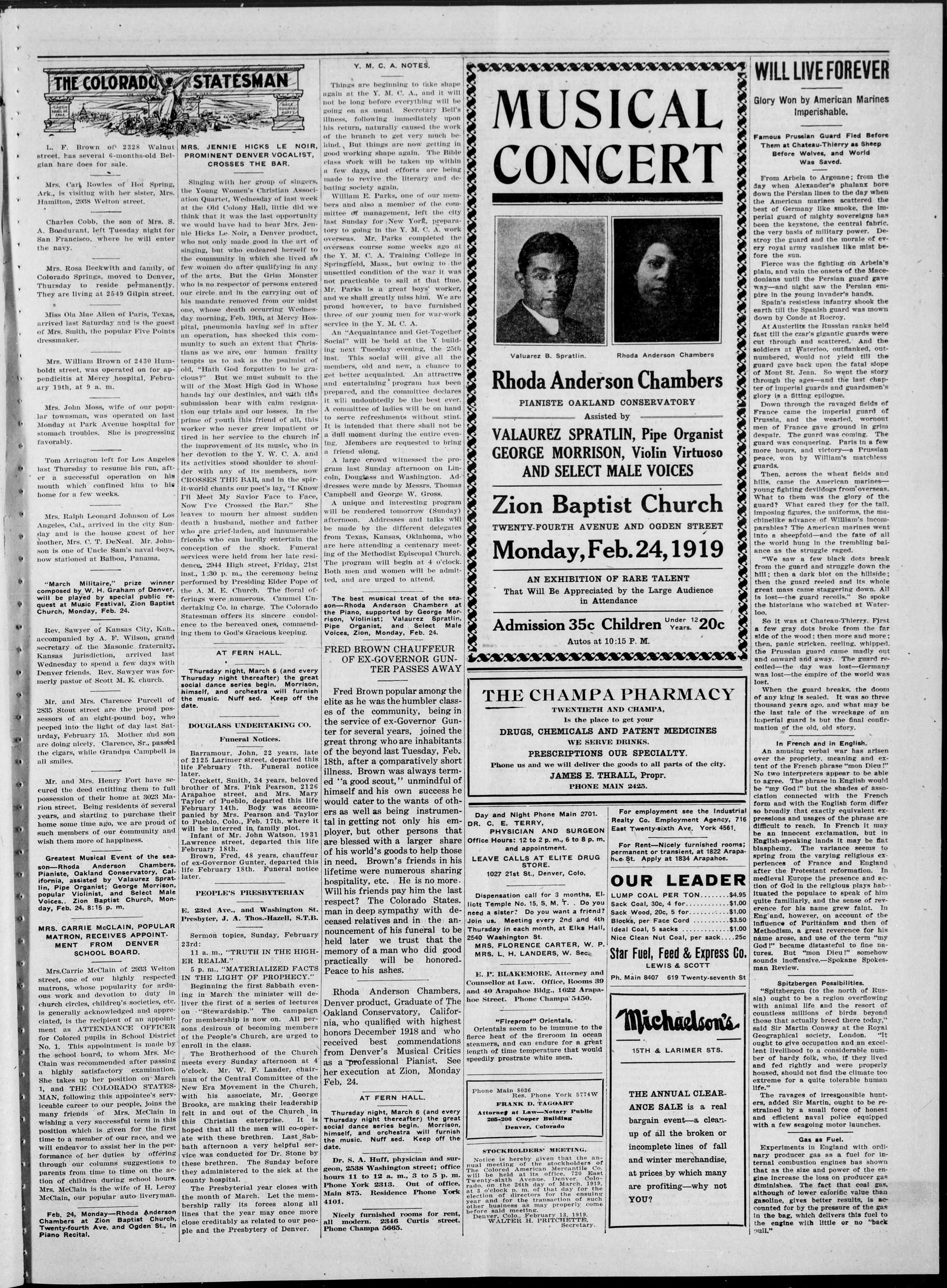
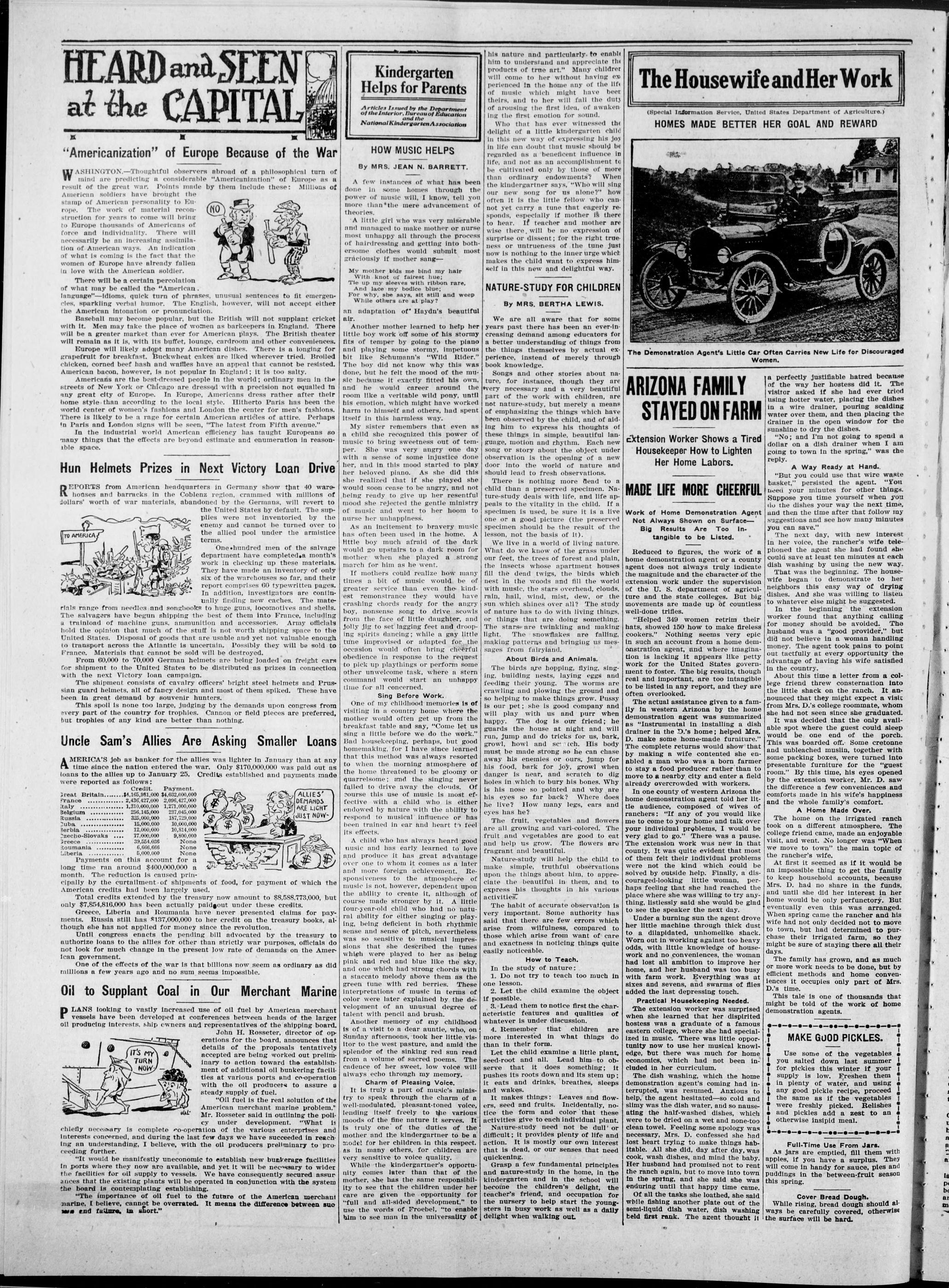
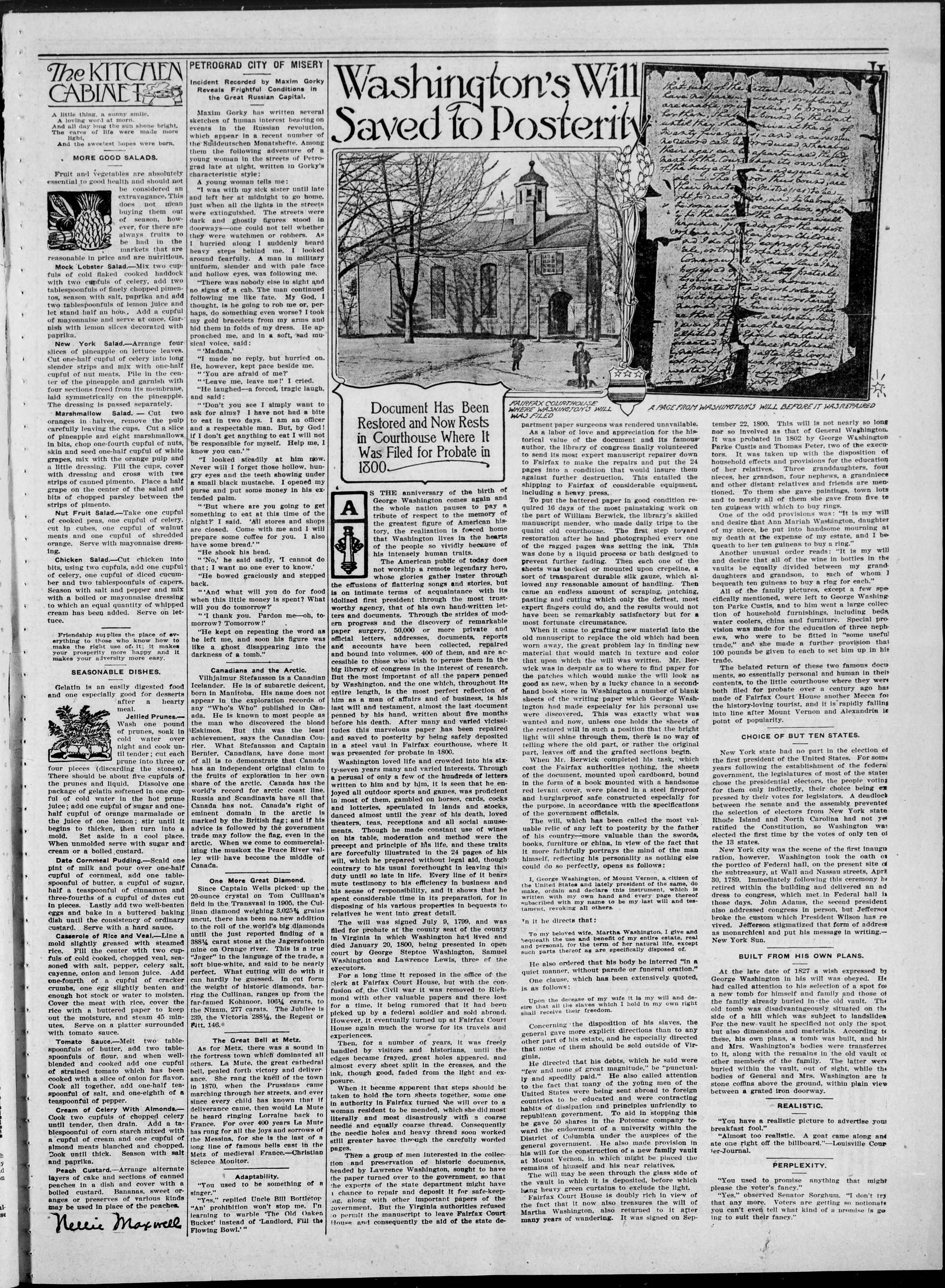
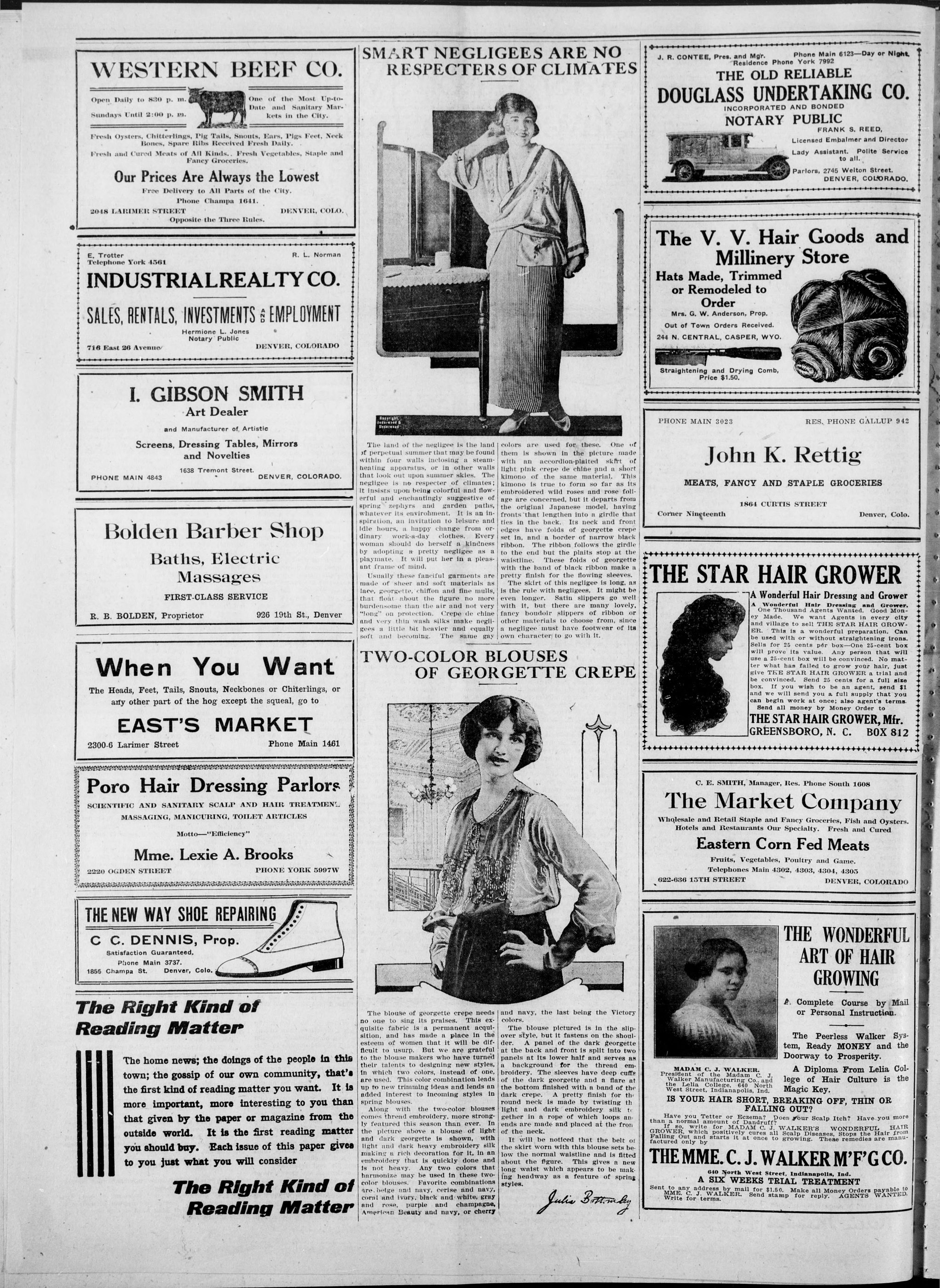
Page text (machine-generated)
Great Musical Treat, Concert Zion Baptist, 24th and Ogden, February 24
THE COLORADO STATESMAN
THE JOURNAL OF THE WEST.
LABOR SHALL BE FREE
RACE COUNTRY PARTY
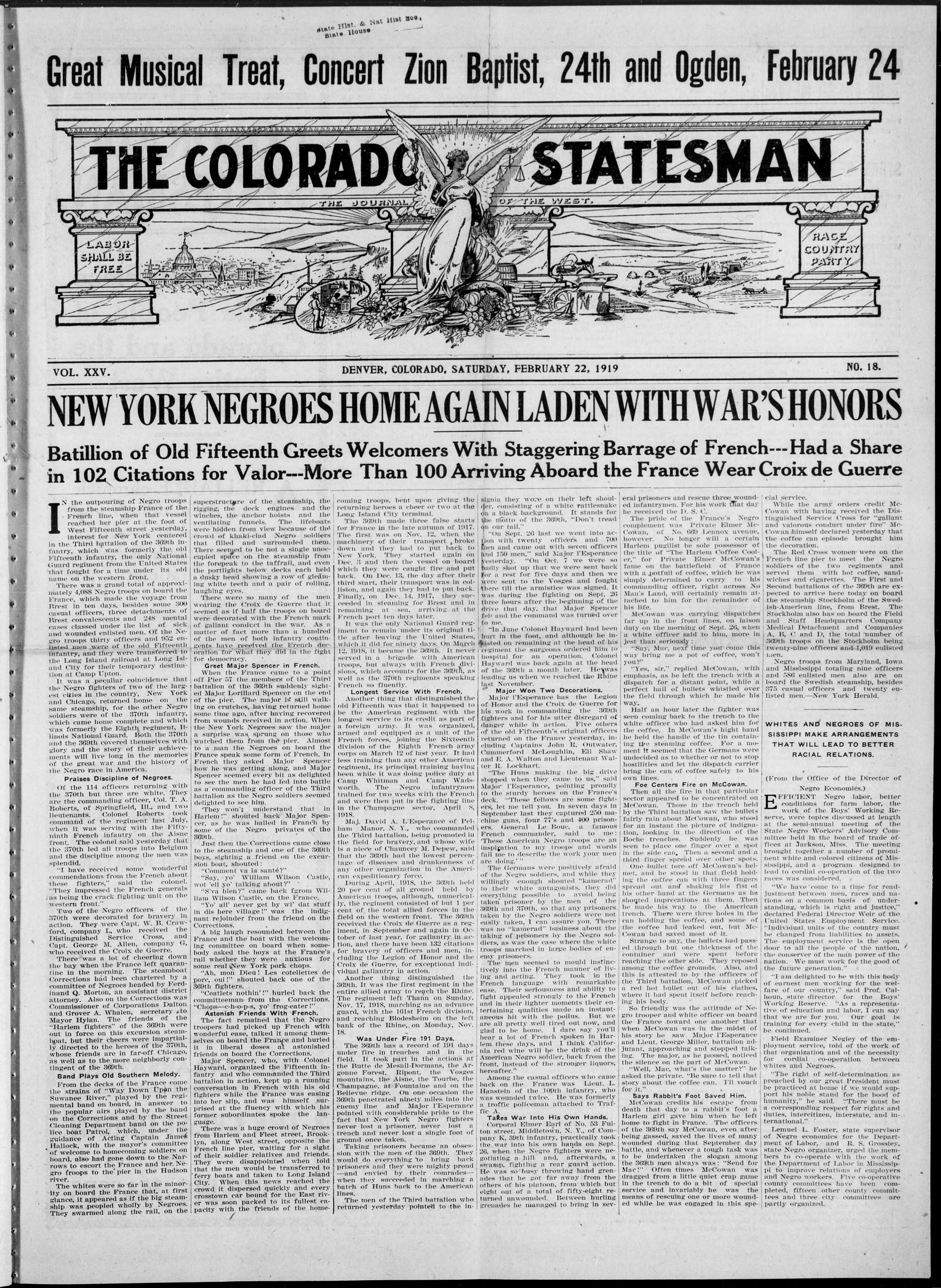
NEW YORK NEGROES HOME AGAIN LADEN WITH WAR'S HONORS
Batillion of Old Fifteenth Greets Welcomers With Staggering Barrage of French---Had a Share in 102 Citations for Valor---More Than 100 Arriving Aboard the France Wear Croix de Guerre
---
VOL. XXV.
NEW YORK
Batillion of Old in 102 Citations
IN the outpouring of Negro troops from the steamship France of the French line, when that vessel reached her pier at the foot of West Fifteenth street yesterday, interest for New York centered in the Third battalion of the 369th infantry, which was formerly the old Fifteenth infantry, the only National Guard regiment from the United States that fought for a time under its old name on the western front.
There was a grand total of approximately 4,088 Negro troops on board France, which made the voyage from Brest in ten days, besides some 300 casual officers, three detachments of Brest convalescents and 248 mental cases classed under the list of sick and wounded enlisted men. Of the Negro troops thirty officers and 952 enlisted men were of the old Fifteenth infantry, and they were transferred to the Long Island railroad at Long Island and City for their temporary destination at Camp Upton.
It was a peculiar coincidence that the Negro fighters of two of the largest cities in the country, New York and Chicago, returned home on the same steamship, for the other Negro soldiers were of the 370th infantry, which came home complete and which was formerly the Eighth regiment, Illinois National Guard. Both the 370th and the 369th covered themselves with glory and the story of their achievements will live long in the memories of the great war and the history of the Negro race in America.
Praises Discipline of Negroes.
Of the 114 officers returning with the 370th but three are white. They are the commanding officer, Col. T. A. Roberts, of Springfield, IL, and two lieutenants. Colonel Roberts took command of the regiment last July, when it was serving with the Fifty-ninth French infantry on the Alsine front. The colonel said yesterday that the 370th led all troops into Belgium and the discipline among the men was splendid.
"I have received some wonderful commendations from the French about these fighters," said the colonel, "They impressed the French generals as being the crack fighting unit on the western front."
Two of the Negro officers of the 370th were decorated for bravery in action. They were Capt. W. B. Crawford, company L, who received the Distinguished Service Cross, and Capt. George M. Allen, company G, who received the Croix de Guerre.
There was a lot of cheering down the bay when the France left quarantine in the morning. The steamboat Corrections had been chartered by a committee of Negroes headed by Ferdinand Q. Morton, an assistant district attorney. Also on the Corrections was Commissioner of Corporations Dalton and Grover A. Whalen, secretary to Mayor Hylan. The friends of the "Harlem fighters" of the 369th were out in force on this excursion steamboat, but their cheers were impartially directed to the heroes of the 370th, whose friends are in far-off Chicago, as well as to the more neighborly contingent of the 369th.
Band Plays Old Southern Melody.
From the decks of the France come the strains of "Way Down Upon the Suwanee River," played by the regimental band on board, in answer to the popular airs played by the band on the Corrections and by the Street Cleaning Department band on the police boat Patrol, which, under the guidance of Acting Captain James Hallock, with the mayor's committee of welcome to homecoming soldiers on board, also had gone down to the Narrows to escort the France and her Negro troops to the pier in the Hudson river.
The whites were so far in the minority on board the France that, at first glance, it appeared as if the big steamship was peopled wholly by Negroes. They swarmed along the rail, on the
superstructure of the steamship, the rigging, the deck engines and the winches, the anchor hoists and the ventilating funnels. The lifeboats were hidden from view because of the crowd of khaki-clad Negro soldiers that filled and surrounded them. There seemed to be not a single unoccupied space on the steamship from the forepeak to the taffrail, and even the portlights below decks each held a dusky head showing a row of gleaming white teeth and a pair of rolling, laughing eyes.
There were so many of the men wearing the Croix de Guerre that it seemed as if half the troops on board were decorated with the French mark of gallant conduct in the war. As a matter of fact more than a hundred of the men of both infantry contingents have received the French decoration for what they did in the fight for democracy.
Greet Major Spencer in French.
When the France came to a point off Pier 57 the members of the Third battalion of the 369th suddenly sighted Major Lorillard Spencer on the end of the pier. The major is still walking on crutches, having returned home some time ago, after having recovered from wounds received in action. When the New York Negroes saw the major a surprise was sprung on those who watched them from the pier. Almost to a man the Negroes on board the France speak some form of French. In French they asked Major Spencer how he was getting along, and Major Spencer seemed every bit as delighted to see the men he had fed into battle as a commanding officer of the Third battalion as the Negro soldiers seemed delighted to see him.
"They won't understand that in Harlem" shouted back Major Spencer, as he was hailed in Franch by some of the Negro privates of the 369th.
Just then the Corrections came close to the steamship and one of the 369th boys, sighting a friend on the excursion boat, shouted:
"Comment va la santé?"
"Say, ye" William Wilson Castle, wot, "ell ya, talking about?"
"Sva bien?" came back fgrom William Wilson Castle, on the France.
"Yo' all' never get by wi' dat stuff in dis here village!" was the indigant rejoinder from the friend on the Corrections.
A big laugh resounded between the France and the boat with the welcoming committee on board when somebody asked the boys at the France's rail whether they were anxious for some real New York pork chops.
"Ah, mon Dieu! Les cotellettes de porc, oul!" shouted back one of the 369 fighters.
"Coatlets nothin'!" hurled back the committeeman from the Corrections.
"Chops—c-h-o-p-s, yo' frog-eater!"
"Astonish Friends With French.
The fact remained that the Negro troopers had picked up French with wonderful ease, talked it among themselves on board the France and hurled it in liberal doses at astonished friends on board the Corrections.
Major Spencer, who, with Colonel Hayward, organized the Fifteenth infantry and who commanded the Third battalion in action, kept up a running conversation in French with his old fighters while the France was easing into her slip, and was himself surprised at the fluency with which his former subordinates spoke the language.
There was a huge crowd of Negroes from Harlem and Fleet street, Brooklyn, along West street, opposite the French line pier, waiting for a sight of their soldier relatives and friends. They were disappointed when told that the men would be transferred to ferry boats and taken to Long Island City. When this news reached the crowd it dispersed quickly and every crosstown car bound for the East river was soon packed to its fullest capacity with the friends of the home-
DENVER, COLORADO, SATURDAY, FEBRUARY 22, 1919
state Hist. & Nat Hist Soc.
State House
Concert Zion B
RADO
THE JOURNAL
DENVER, COLORADO, SATU
ES HOME AGA
eets Welcomers W
More Than 100 Ar
coming troops, bent upon giving the returning heroes a cheer or two at the Long Island City terminal. The 369th made three false starts for France in the late autumn of 1917. The first was on Nov. 12, when the machinery of their transport broke down and they had to put back to New York. They started again on Dec. 3 and then the vessel on board which they were caught fire and put back. On Dec. 13, the day after their third start, their transport was in collision, and again they had to put back. Finally, on Dec. 14, 1917, they succeeded in steaming for Brest and in remaining at sea, arriving at the French port ten days later.
It was the only National Guard regiment to remain under its original title after leaving the United States, which it did for ninety days. On March 12, 1918, it became the 369th. It never served in a brigade with American troops, but always with French divisions, which accounts for the 369th, as well as the 370th regiments speaking French so fluently.
Longest Service With French.
Longest Service With French.
Another thing that distinguished the old Fifteenth was that it happened to be the American regiment with the longest service to its credit as part of a foreign army. It was organized, armed and equipped as a unit of the French forces, joining the Sixteenth division of the Eighth French army corps on March 12 of last year. It had less training than any other American regiment, its principal training having been while it was doing police duty at Camp Whitman and Camp Wadsworth. The Negro infantrym trained for two weeks with the French and were then put in the fighting line in the Champagne sector, April 8, 1918.
Maj. David A. L'Esperance of Pelham Manor, N. Y., who commanded the Third battalion, being promoted in the field for bravery, and whose wife is a niece of Chaucey M. Depew, said that the 369th had the lowest percentage of diseases and drunkenness of any other organization in the American expeditionary force.
During April, 1918, the 369th held 20 per cent of all ground held by American troops, although, numerically, the regiment consisted of but 1 per cent of the total allied forces in the field on the western front. The 369th received the Croix de Guerre as a regiment, in September and again in October of last year, for gallantry in action, and there have been 132 citations for bravery of officers and men, including the Legion of Honor and the Croix de Guerre, for exceptional individual gallantry in action.
Another thing distinguished the 369th. It was the first regiment in the entire allied army to reach the Rhine. The regiment left Thann on Sunday, Nov. 17, 1918, marching as an advance guard, with the 161st French division, and reaching Blodesheim on the left bank of the Rhine, on Monday, Nov. 18.
Was Under Fire 191 Days.
The 369th has a record of 191 days under fire in trenches and in the field. It took part in the actions at the Butte de Mesnil-Dormans, the Argonne Forest, Ripont, the Vosges mountains, the Alsine, the Tourbe, the Champagne, at Fountaine and on the Bellevue ridge. On one occasion the 369th penetrated ninety miles into the enemy line and Major L'Esperance pointed with considerable pride to the fact that New York Negro fighters never lost a prisoner, never lost a trench and never lost a single foot of ground once taken.
Taking prisoners became an obsession with the men of the 369th. They would do everything to bring prisoners and they were mighty proud—and enviied their comrades—when they succeeded in marching a batch of Huns back to the American lines.
The men of the Third battalion who returned yesterday pointed to the in-
signia they wore on their left shoulder, consisting of a white rattlesnake on a black background. It stands for the motto of the 369th, "Don't tread on our tail."
"On Sept. 26 last we went into action with twenty officers and 700 then and came out with seven officers and 150 men," said Major l'Esperance yesterday. "On Oct. 7 we were so badly shot up that we were sent back for a rest for five days and then we were sent to the Vosges and fought there till the armistice was signed. It was during the fighting on Sept. 26 three hours after the beginning of the drive that day, that Major Spencer feb and the command was turned over to me.
"In June Colonel Hayward had been hurt in the foot, and although he insisted on remaining at the head of his regiment the surgeons ordered him to hospital for an operation. Colonel Hayward was back again at the head of the 369th a month later. He was leading us when we reached the Rhine last November.
Major Won Two Decorations.
Major l'Esperance has the Legion of Honor and the Croix de Guerre for his work in commanding the 369th fighters and for his utter disregard of danger while in action. Five others of the old Fifteenth's original officers returned on the France yesterday, including Captains John R. Outwater, Cummerford McLoughlin, Eli Shaw and E. A. Walton and Lieutenant Walter R. Lockhart.
"The Huns making the big drive stopped when they came to us," said Major l'Esperance, pointing proudly to the sturdy heroes on the France's deck. "These fellows are some fighters, let me tell you. In seven days in September last they captured 250 machine guns, four 77's and 400 prisoners. General Le Bouc, a famous French commander, said to me: 'These American Negro troops are an inspiration to my troops and words fail me to describe the work your men are doing.'"
The Germans were positively afraid of the Negro soldiers, and while they willingly enough shouted "kamaram" to their white antagonists, they did everything possible to avoid being taken prisoner by the men of the 369th and 370th, so that any prisoners taken by the Negro soldiers were not easily taken, I can assure you. There was no "kamaram" business about the taking of prisoners by the Negro soldiers, as was the case where the white troops marched in large bodies of enemy prisoners.
The men seemed to mould instinctively into the French manner of living and acting. They took in the French language with remarkable ease. Their seriousness and ability to fight appealed strongly to the French and in their lighter moments their entertaining qualities made an instantaneous hit with the poilus. But we are all pretty well tired out now, and glad to be home. I dare say you'll hear a lot of French spoken in Harlem these days, and I think California red wine will be the drink of the American Negro soldier, back from the front, instead of the stronger liquors, hereafter."
Among the casual officers who came back on the France was Lieut. L. Hanstein of the 106th infantry, who was wounded twice. He was formerly a troffic policeman attached to Traffic A.
Taresses War Into His Own Hands.
Corporal Elmer Earl of No. 53 Fulton street, Middletown, N. Y., of Company K, 39th infantry, practically took the war into his own hands on Sept. 26, when the Negro fighters were negotiating a hill and, afterwards, a swamp, fighting a rear guard action. He was so busy throwing hand grenades that he got far away from the others of his platoon, from which but eight out of a total of fifty-eight returned unwounded. Between hurling grenades he managed to bring in sev-
cial service.
While the army orders credit McCowan with having received the Distinguished Service Cross for "gallant and valorous conduct under fire" McCowan himself declared yesterday that the coffee can episode brought him the decoration.
The Red Cross women were on the French line pier to meet the Negro soldiers of the two regiments and served them with hot coffee, sandwiches and cigarettes. The First and Second battalions of the 369th are expected to arrive here today on board the steamship Stockholm of the Swedish-American line, from Brest. The Stockholm also has on board the Field and Staff Headquarters Company Medical Detachment and Companies A, B, C and D, the total number of 369th troops on the Stockholm being twenty-nine officers and 1,019 enlisted men.
Negro troops from Maryland, Iowa and Mississippi totaling nine officers and 586 enlisted men also are on board the Swedish steamship, besides 375 casual officers and twenty enlisted men—New York Herald.
WHITES AND NEGROES OF MISSISSIPPI MAKE ARRANGEMENTS THAT WILL LEAD TO BETTER RACIAL RELATIONS.
(From the Office of the Director of Negro Economics.)
EFFICIENT Negro labor, better conditions for farm labor, the work of the Boys' Working Reserve, were topics discussed at length at the semi-annual meeting of the State Negro Workers' Advisory Committee held in the board of trade offices at Jackson, Miss. The meeting brought together a number of prominent white and colored citizens of Mississippi, and a program designed to lead to cordial co-operation of the two races was considered.
"We have come to a time for readjustment between men, races and nations on a common basis of understanding, which is right and justice," declared Federal Director Weir of the United States Employment Service. "Individual units of the country must be changed from liabilities to assets. The employment service is the open door to all the people of the nation, the conserver of the man power of the nation. We must work for the good of the future generation."
"I am delighted to be with this body of earnest men working for the welfare of our country," said Prof. Calhoun, state director for the Boys' Working Reserve. "As a representative of education and labor, I can say that we are for you. Our goal is training for every child in the state," be continued.
Field Examiner Negley of the employment service, told of the work of that organization and of the necessity for cordial co-operation between whites and Negroes.
"The right of self-determination as preached by our great President must be practiced at home if we would support his noble stand for the bood of humanity," he said. "There must be a corresponding respect for rights and duties, intercitizen, interstate, and international."
Lemuel L. Foster, state supervisor of Negro economies for the Department of Labor, and R. S. Grossley, state Negro organizer, urged the members to co-operate with the work of the Department of Labor in Mississippi to improve relations of employers and Negro workers. Five co-operative county committees have been completed, fifteen other county committees and three city committees are partly organized.
eral prisoners and rescue three wounded infantrymen. For his work that day he received the D. S. C.
The pride of the France's Negro complement was Private Elmer McCowan, of No. 639 Lennox avenue, however. No longer will a certain Harlem pugilist be sole possessor of the title of "The Harlem Coffee Cooler," for Private Elmer McCowan's fame on the battlefield of France with a portful of coffee, which he was simply determined to carry to his commanding officer, right across No Man's Land, will certainly remain attached to him for the remainder of his life.
McCowan was carrying dispatches far up in the front lines, on laison duty on the morning of Sept. 26, when a white officer said to him, more in jest than seriously:
"Say, Mac, next time you come this way bring me a pot of coffee, won't you?
"Yes, sir," replied McCowan, with emphasis, as he left the trench with a dispatch for a distant point, while a perfect hail of bullets whistled over the field through which he made his way.
Half an hour later the fighter was seen coming back to the trench to the white officer who had asked him for the coffee. In McCowan's hight hand he held the handle of the tin containing the steaming coffee. For a moment it seemed that the Germans were undecided as to whether or not to stop hostilities and let the dispatch carrier bring the can of coffee safely to his own lines.
**Foe Centers Fire on McCowan.**
Then all the fire in that particular sector appeared to be concentrated on McCowan. Those in the trench held by the Third battalion saw the bullets fairly rain about McCowan, who stood for an instant the picture of indignation, looking in the direction of the Boche trenches. Suddenly he was seen to place one finger over a spot in the side can. Then a second and a third finger spread over other spots.
One bullet tore off McCowan's helmet, and he stood in that field holding the coffee can with three fingers spread out and shaking his fist of his other hand at the Germans as he shouted imprecations at them. Then he made his way to the American trench. There were three holes in the can holding the coffee, and some of the coffee had leaked out, but McCowan had saved most of it.
Strange to say, the bullets had passed through but one thickness of the container and were spent before reaching the other side. They reposed among the coffee grounds. Also, and this is attested to by the officers of the Third battalion, McCowan picked a red hot bullet out of his clathes, where it had spent itself before reaching his body.
So friendly was the attitude of Negro trooper and white officer on board the France toward one another that when McCowan was in the midst of his story he saw Major l'Esperance and Lieut. George Miller, battalion adjutant, approaching and stopped talking. The major, as he passed, noticed the silence on the part of McCowan.
"Well, Mac, what's the matter?" he asked the private. "Be sure to tell that story about the coffee can. I'll vouch for it."
Says Rabbit's Foot Saved Him.
NO.18.
FOREIGN
General Berdoulet has been appointed military governor of Paris.
To get an American husband is the idea of more than 40 per cent of Parisian young women. At least that is the result of an inquiry in Paris.
The situation at Kadish on the Archangel front is more satisfactory for the moment, according to an official statement issued by the British war officer.
Reports from Omsk state that the Russian government there has accepted an offer from Japan of men, money and arms to settle the Bolshevik difficulties.
Three American steamers, laden with foodstuffs for Poland, arrived at Neufahrwasser, on the Gulf of Danzig, according to Danzig advices received at Basle.
The French dreadnought Moravau has been driven ashore at Sebastopol in a snowstorm. At last accounts it seemed doubtful whether the big warship could be saved from destruction. Baron Nobauki, head of the Japanese delegation at the peace conference, has been instructed to disclose all the unpublished treaties between China and Japan, says a dispatch from Tokio.
Germany is preparing to raise a large loan in the United States as soon as peace is signed, says a Geneva dispatch. The money is to be used to pay for expected raw materials from allied countries.
The German government is considering the question of putting the ex-Kaiser on trial charged with stealing thirteen automobiles and $150,000 from the German treasury before he escaped into Holland.
Field Marshal von Hindenburg has issued from his headquarters at Colberg an appeal for volunteers. The document, given to the German press for general distribution, deplores the "general loss of willingness to sacrifice for patriotism" and urges the people to work energetically to preserve the native soil against the new enemy, Bolshevism.
The program of the new German government, which has just been published at Berlin, includes equal rights for men and women, the improvement of the educational system, conscription along democratic lines to establish a people's army, rationing at maximum prices of food and necessaries of life, care of the wounded and the families of those killed during the war, the socialization of all industries ripe for such treatment, particularly the coal and iron mines, and considerable additions to income taxes.
The Navy wrestlers had a walkover at Annapolis defeating the University of Pennsylvania team by a score of 33 to 0.
For the second time Bryan Downey of Columbus, Ohio, and Willie Laughlin of Bethlehem, Pa., fought fifteen rounds to a draw at Tulsa, Okla.
Wiladek Zbyszko, Polish wrestling champion, defeated Arvid Anderson of Boston in two straight falls of 29 and 9 minutes each respectively, at St. Louis.
The Chicago city council, by a vote of 54 to 2, approved the proposed boxing bill, which provides for state and city athletic commissions with powers to regulate ring exhibitions.
Alfredo de Oro, the Cuban cue expert from New York, wrested the three-cushion billiard championship from Angie Kleckkhefer of Chicago by winning the third block of their 150-point match.
Pal Moore gave Johnnie Ritchie of Chicago a thrashing at Memphis, but Ritchie took the beating about as gracefully as a beating was ever absorbed. Moore had every round of the eight, but from the beginning to the end Ritchie showed no signs of giving up.
GENERAL
Greater New York's daily consumption of water amounts to nearly 600,000,000 gallons.
Forty-nine declarations of war were made between 1914 and 1918.
Nearly 15,000,000 acres in Canada are devoted to wheat growing.
Wisconsin has granted women the right to vote at presidential elections. The Senate, by a vote of 27 to 4, passed the House bill to this effect.
Col. Harry Cutler of Providence, R. L., and other delegates of the Jewish-American Congress who are to present the so-called Jewish "bill of rights" to the peace conference at Paris, have sailed from New York.
Sergt. Earl Caddock of Anita, Iowa, heavyweight wrestling champion, is on his way home from France. It was declared Caddock had decided to quit the wrestling game and devote his time to operating a Wyoming ranch. Hard cider has officially been classed as liquor in 'Ithaca, N. Y. More than a dozen stores were recently raided, a few of them famous in Cornell traditions. On the premises were found large quantities of cider, which were confiscated by the raiding officers. Tested at Cornell chemical college the cider is said to have contained as high as 6.52 alcohol.
More than 100 women, representing every state in the Union, will go to France as Young Women's Christian Association workers, and be assigned to duty there in the twenty-two leave resorts of that organization, it was announced in New York. These women, who were chosen by the State Boards of the General Federation of Women's Clubs, are sent in answer to repeated appeals for soldiers for women workers from their home states.
The number of automobiles in the United States is expected to reach the 4,000,000 mark this year.
CONDENSATION OF FRESH NEWS
THE LATEST IMPORTANT DISP
PATCHES PUT INTO SHORT,
CRISP PARAGRAPHS.
STORY OF THE WEEK
SHOWING THE PROGRESS OF EVENTS IN OUR OWN AND FOREIGN LANDS.
WESTERN
Salt Lake county's first bond election, authorizing an issue of $1,500,000 worth of bonds to finance road improvements, carried by more than four to one.
Business is practically normal at Butte, following the strike of the miners Feb. 7 in protest against a reduction of $1 a day in wages. All mines are working again and running at their usual capacity.
Resolutions authorizing a legislative appropriation of $100,000 to probe the charges of election frauds in Silver Bow county at the last general election, has been introduced in the Montana Legislature.
Boats are patrolling the shores of Juneau, Alaska, to prevent the escape of Peter Jackson, a native, who shot and killed Deputy United States Marshal Clyde D. Calhoun of Craig, who had arrested Jackson.
Lava in the greatest quantity observed in forty years is flowing from Kilauea, the largest active volcano in the world. The lava is pouring over all sides of the central fire pit walls onto the old crater floor. Under provisions of a bill introduced in the Washington House of Representatives any public employe who joins a strike movement will lose his position and face a maximum term of imprisonment of ten years, or a maximum fine of $10,000, or both. The bill is a result of the general strikes at Seattle and Tacoma. A Senate bill would make sabotage a felony.
Harry A. Wheeler, president of the United States Chamber of Commerce, Washington, told 2,000 delegates to the Transmississippi Readjustment congress in Omaha that better railroad service is obtainable under private ownership of the railway lines than under public ownership. "There has been a sluffing of enthusiasm, ingenuity and initiative under government control," he declared.
Radical changes in Washington laws governing divorces are provided in a bill introduced by four state senators in the upper House of the Legislature. Absolute and limited forms of divorce would be granted, if the bill becomes law. The limited decree would not permit either party to marry during the lifetime of the other. Suit for divorce could not be brought without two years' residence in the state and six months in the county.
WASHINGTON
Senate Democrats again failed to press their program for holding late night sessions to expedite appropriation bills. Under the blue-sky bilf introduced in Congress prospectuses, advertisements and literature offering for sale new shares of stock in enterprises are required to have the approval of the secretary of treasury before being issued. In a message to Queen Wilhelmina, King George has expressed the gratitude of the British empire for the treatment accorded British soldiers interned by the Dutch, advices received at Washington by the Netherlands leagation said.
As another step toward restoration of normal pre-war conditions, the railroad administration has instructed that freight cars be restored to owner roads as fast as possible and that companies be given more authority to apply their individual standards of equipment.
Russia is more downtrodden under the Bolshevik than she ever was under the czar, the Senate propaganda investigating committee at Washington was told by Herman Bernstein, an American writer, who spent some time in Russia. He said this new slavery actually was brought about by the Germans.
Between 50,000 and 100,000 allens of neutral countries who had started the machinery to make them citizens of the United States before this country entered the world war and who avoided being drafted into the army by making affidavits stating that they had changed their intentions to renounce their native country, will be forever barred from becoming American citizens as the result of countrywide action taken last week by Richard Campbell, commissioner of naturalization at Washington.
Resolutions urging the establishment of a republic in Armenia and calling upon the Senate to indorse extension of the kingdom of Greece to include Epirus, southern Albania, Thrace, the islands of the Aegean sea and those parts of Anatolia having a preponderant Greek population, were introduced in the Senate by Senator King of Utah, and referred to the foreign relations committee.
All plans for considering railroad legislation at this session of Congress were abandoned by the House Interstate Commerce committee.
SPORT
Pithy News Notes From All Parts of Colorado
Western Newspaper Union News Service.
Nearly 100 cases of influenza are reported in the last week at Victor and Goldfield. There are only ten cases in Cripple Creek and the schools have reopened.
The acreage of wheat harvested in Colorado in 1918 was 742,000, as compared with 340,729 acres for 1909. The increase has been largely in the acreage devoted to winter wheat.
There are approximately 63,000 farms in Colorado, as compared with 46,170 in 1910, 24,700 in 1900 and 16,389 in 1890. The average size of farms has increased slightly since 1910.
The Summit County Winter Sports Club will hold its first ski tournament at Lake hill, near Dillon, March 8 and 9, immediately succeeding the winter carnival at Steamboat Springs.
The state of Colorado owned on Nov. 30, 1918, 3,113,606 acres of land, scattered through every county in the state. This land with the mineral it contains is worth more than $100,000,000.
The first concerted effort to obtain a high school building for Englewood was taken when, at a meeting the Parents and Teachers' club at Englewood, a petition was drafted asking the city school board to vote such an improvement.
Colorado's $16,000,000 investment in War Savings Stamps last year was a most excellent showing, according to Associate Director W. Ward Smith of the savings division of the United States Treasury Department, who was in Denver on a tour to study organization methods and results.
Jonathan Glover, Jr., recently discharged from Camp McArthur, Cal., met with an accident west of Greeley that resulted in his death. He was driving a team of horses on a beet wagon, and they started to run. Leaping for their heads he missed the lines, and fell in such a manner that the hind wheel of the wagon passed over his head.
W. C. Basey of Longmont has discovered a sure cure for the hiccough epidemic. Upon falling a victim to the malady Mr. Basey hiccoughed for the space of several days without stopping, and finally, after the doctors had failed him, he bought a pound of chocolate candy and started to eat it. Before he was half through the hiccoughs had ended.
Three Indian policemen from the Uintah district of eastern Utah have been taken to Clark county, Nev. to aid in tracking the murderers of William Taylor and Ether Hancock, Uintah county prospectors, slain there recently, presumably by Indians. The Indian policemen were taken to Nevada by insurance companies in which Clark carried a $10,000 policy. Fifty thousand dollars' damage was done when fire started at the rear of the New York store, owned by Rachofsky & Son, pioneer Colorado merchants of Loveland. The blaze was discovered by members of the Elks lodge, which occupies the second floor of the building, and is believed to have started from an ash plt or furnace. The damage to the stock is estimated at $40,000 and to the building $5,000.
Further assurance that the Rocky Mountain National park in Colorado at last is to be developed in a manner worthy of its unsurpassed scenic attractions was given in Washington when Senator John F. Shafroth obtained a unanimous agreement from the public lands committee of the Senate to support the removal of the limit of $10,000 upon annual appropriations for the upkeep of the great federal playground.
Thomas A. Rogen of Denver, formerly of Colorado Springs, pleaded not guilty at Littleton when given a preliminary hearing on the charges of bigamy and pertury.
Dave Shogrin, proprietor of a Montrose restaurant, is under arrest at Salida, his romance of a few hours ended by angry creditors in Montrose. He is alleged to have done a brisk business in meal tickets at half price and in checks for which the bank had no money and then closed up shop, departing with his head waitress, leaving unpaid bills for several thousand dollars.
Upon receipt of information that the Spanish trail had been accepted and designated as the westward continuation of the National Old trails, an invitation was extended for the association to hold its annual convention in Durango during the summer, and while the designation of the convention town likely will not be made until the April meeting of the National Old Trails Association, it has been intimated from high official sources that Durango is assured of the midsummer meeting, in which case it will be the first national convention ever held in that part of the state.
The case of Chris Schott, charged with assault, promises to become famous in Logan county. Properly docked and with a judge and jury called and ready to hear the evidence, it was discovered there was no prisoner, and so far as can be learned Schott never has been arrested.
Colorado Springs was selected as headquarters and T. W. Ross, a newspaper man of Colorado Springs elected secretary of the Pike's Peak Ocean-to-Ocean Highway Association at the sixth annual meeting in St. Joseph, Mo
---
CENTENNIAL STATE ITEMS.
Production of potash from the old mill tailings of the Cripple Creek district will be begun in Colorado Springs for the first time on a commercial basis about May 1, at the new $100,000 plant of the International Potash Company. This company is composed of Omaha capitalists, and is just completing its plant, at which sixty men will be employed. It has under lease the old Standard mill dump, formerly the property of the United States Reduction and Refining Company. The new company owns a process worked out after long experiments, by which potash may be obtained at a commercial profit from the old gold tailings.
THE COLORADO STATESMAN
Asserting that a Mexican forced her to live with him in a little one-room shack in "Peppersauce" bottoms and that he maintained a strict guard over her all the time and failed to provide food, Mrs. Lela Trodsham appealed to the police department at Pueblo in a letter and urged the police to rescue her. Detectives assigned to the case went to the place and arrested her, as well as her captor, Klatano Valdivia. When brought to the police station the woman was almost famished from lack of food. She says her captor refused to work or allow her to get employment and that he sold everything in the house to obtain money.
The Mouth-Piece of the People of Colorado and the Entire West
A committee was recently appointed by the Industrial Association of Rocky Ford to investigate the city manager form and the commission form of government and to report at the next meeting to be held March 4. There are a number $ ^{2} $ who are in favor of a decided change in the city management who believe that action should be taken at once in season to get the proposition before the people at the coming election in April, who have already taken the situation in hand, and a charter to embrace the needs of a city the size of Rocky Ford is being prepared.
La Salle, Mead, Fort Lupton and Milliken are prospective locations for the sugar factory which it is said the Industrial Sugar Company will locate some place in Weld county. The industrial company was recently organized at Fort Morgan and has filed articles of incorporation with a capital stock of $4,000,000 for the purpose of building and operating factories in Morgan, Logan, Weld and Larimer counties.
ARELIABLE chronicle of their doings and progress; a faithful mirror of their wants, their hopes, their best aspirations.
Another immense body of ore of reported fabulous worth, probably equal to the famous vug which was discovered several years ago, has been uncovered in the tenth level of the Cresson mine, Colorado's premier gold producer. While the extent of the find has not been definitely ascertained it is known to be very large while grab samples taken across the face of the vain indicate values of $200 a ton.
John Capra, Italian, who quit the business of tilling a truck garden on the outskirts of Denver last April to go "Over There" as a member of Uncle Sam's expeditionary forces, is coming back a hero. At present he is in debarkation hospital, New York City, recuperating from wounds inflicted by particles of a high explosive shell, which tore away a section of his left shin bone.
THE COLORADO STATESMAN
THE COLORADO STATESMAN
The greatest event of the year in school circles, the meeting of the Western Slope Athletic and Rhetorical Association, will be held in Montrose Thursday, Friday and Saturday, May 23, 24 and 25, this year, with eleven schools taking part, as follows: Grand Junction, Montrose, Delta, Ouray, Gunnison, Olathe, Hotchkiss, Nucla, Paonia, Ridgway and Telluride.
Unequaled as an advertising medium for the business of professional men and women.
In preparation for what is believed will be one of the best tourist seasons in years in Colorado Springs, hotel and amusement owners have arranged to keep publicity representative of the Pike's Peak region in Salt Lake City and Los Angeles during the tourist season there in an effort to bring tourists there on their return trip to the East.
Plans for paving the Denver road north from Colorado Springs through Palmer Lake were outlined in Colorado Springs by T. J. Ehrhart, state highway commissioner, and J. E. Maloney, engineer for the commission. Federal and state aid will be combined with county funds and work is to start as soon as the weather will permit. Traffic records show this road receives the heaviest travel of any in the Pike's Peak region.
An excellent family journal speaking to and for many thousand colored citizens.
A house fell on George Hubbard at Montrose and so severely crushed his left leg that amputation was necessary. Hubbard was engaged in moving the structure when his team lurched and the house slid from its trucks and planned him beneath. Declaring that Senate Bill No. 194, now before the Legislature, is an attempt to place the public schools under an educational bureaucracy, the Colorado Equal Suffrage Association has launched a fight against its passage.
TWODOLLARSAYEAR
Deluges of snow have been falling on the watersheds of the Gunnison and San Juan and Colorado the last few days, insuring ample water for western slope irrigation the coming season.
As a result of an affection which was not mutual, Miss Angelina Del Fraini is dead and Guglilemo Di Pasqua is probably fatally wounded at Salida. Di Pasqua, who was infuriated at Miss Del Fraini's refusal to marry him, first took her life and then sought to end his own.
Because his bride had left him and refused his efforts at a reconciliation, Jacob Weinmaster drew a revolver and fired three shots at her, none of which took effect. The shooting took place at the home of Mrs. Weinmaster's father at Eaton.
TEXT OF WORLD LEAGUE COVENANT
President Wilson Reads Report to Representatives of the Nations.
ARMAMENTS ARE CUT DOWN
Powers Will Defend Each Other From Attack—Countries Desiring to Join Must Give Guarantees and Be Self Rued.
Paris, France, Feb. 14.—The executive council of the proposed league of nations, as outlined in the covenant read by President Wilson today, will consist of representatives of the United States, Great Britain, France, Italy and Japan, with representatives of four other states. The covenant reads as follows:
Covenant.
Preamble—In order to promote international co-operation and to secure international peace and security by the acceptance of obligations not to resort to war, by the prescription of open, just and honorable relations between nations, by the firm establishment of the understandings of international law as the actual rule of conduct among governments, and by the maintenance of justice and a scrupulous respect for all treaty obligations in the dealings of organized people with one another, the powers signatory to this covenant adopt this constitution of the league of nations:
Article I.
The action of the high contracting parties under the terms of this covenant shall be effected through the instrumentality of a meeting of a body of delegates representing the high contracting parties, of meetings at more frequent intervals of an executive council, and of a permanent international secretariat to be established at the seat of the league.
Article II.
Meetings of the body of delegates shall be held at stated intervals and from time to time as occasion may require for the purpose of dealing with matters within the sphere of action of the league. Meetings of the body of delegates shall be held at the seat of the league or at such other places as may be found convenient, and shall consist of representatives of the high contracting parties. Each of the high contracting parties shall have one vote, but may have not more than three representatives.
Article III.
The executive council shall consist of representatives of the United States of America, the British empire, France, Italy and Japan, together with representatives of four other states, members of the league. The selection of these four states shall be made by the body of delegates on such principles and in such manner as they think fit. Pending the appointment of these representatives of the other states, representatives of (blank left for names) shall be members of the executive council.
Article IV.
All matters of procedure at meetings of the body of delegates or the executive council, including the appointment of committees to investigate particular matters, shall be regulated by the body of delegates or the executive council and may be decided by a majority of the states represented at the meeting. The first meeting of the body of delegates and the executive council shall be summoned by the President of the United States of America.
Article V.
The permanent secretariat of the league shall be established at (blank) which shall constitute the seat of the league. The secretariat shall comprise such secretaries and staff as may be required, under the general direction and control of a secretary general of the league, who shall be chosen by the executive council; the secretariat shall be appointed by the secretary general subject to confirmation by the executive council.
The expenses of the secretariat shall be borne by the states members of the league in accordance with the apportionment of the expenses of the international bureau of the Universal Postal union.
Article VI.
Representatives of the high contracting parties and officials of the league when engaged in the business of the league shall enjoy diplomatic privileges and immunities and the buildings occupied by the league or its officials or by representatives attending its meetings shall enjoy the benefits of extra territoriality.
Article VII.
Admission to the league of states not signatories to the covenant and not named in the protocol as states to be invited to adhere to the covenant, requires the assent of not less than two-thirds of the states represented in the body of delegates, and shall be limited to fully self-governing countries, including dominions and colonies. No state shall be admitted to the league unless it is able to give effective guarantees of its sincere intention to observe its international obligations, and unless it shall conform to such principles as may be prescribed by the tary forces and armaments.
Article VIII.
The high contracting parties recognize the principle that the maintenance of peace will require the reduction of national armament to the lowest point consistent with national safety and the enforcement by common consent of international obligations, having special regard to the geographical situation and circumstances of each state; and the executive council shall formulate plans for effecting such reduction.
The executive council shall also determine for the consideration and action of the several governments what military equipment and armament is fair and reasonable in proportion to the scale of forces laid down in the program of disarmament; and these limits, when adopted, shall not be exceeded without the permission of the executive council.
The high contracting parties agree that the manufacture by private enterprise of munitions and implements of war lends itself to grave objections, and direct the executive council to advise how the evil effects attendant upon such manufacture can be prevented, due regard being had to the necessities of these countries which are not able to manufacture for themselves the munitions and implements of war necessary for their safety.
Article IX.
A permanent commission shall be constituted to advise the league on the execution of the provisions of Article Eight and on military and naval questions generally.
Article X.
The high contracting parties shall undertake to respect and preserve, as against external aggression, the territorial integrity and existing political independence of all states, members of the league. In case of any such aggression, or in case of any threat or danger of such aggression, the executive council shall advise upon the means by which the obligation shall be fulfilled.
Article XI.
Any war or threat of war, whether immediately affecting any of the high contracting parties or not, is hereby declared a matter of concern to the league, and the high contracting parties reserve the right to take any action that may be deemed wise and effectual to safeguard the peace of nations.
Article XII.
The high contracting parties agree that should disputes arise between them which cannot be adjusted by the ordinary processes of diplomacy, they will in no case resort to war without previously submitting the questions and matters involved either to arbitration or to inquiry by the executive council, and until three months after the award by the arbitrators or a recommendation by the executive council; and that they will not even then resort to war as against a member of the league which complies with the award of arbitration or the recommendation of the executive council.
Article XIII.
The high contracting parties, whenever any dispute or difficulty shall arise between them which they recognize to be suitable to arbitration, and which cannot be satisfactorily settled by diplomacy, will submit the whole matter to arbitration. For this purpose the court of arbitration to which the case is referred shall be the court agreed on by the parties or stipulated in any convention existing between them. The high contracting parties agree that they will carry out in full good faith any award that may be rendered. In the event of any failure to carry out the award, the executive council shall propose what steps can best be taken to give effect thereto.
Article XIV.
The executive council shall formulate plans for the establishment of a permanent court of international justice and this court shall, when established, be competent to hear and determine any matter which the parties recognize as suitable for the submission to it for arbitration under the foregoing article.
Article XV.
If there should arise between states members of the league any dispute likely to lead to rupture, which is not submitted to arbitration as above, the high contracting parties agree that they will refer the matter to the executive council; either party to the dispute may give notice of the existence of the dispute to the secretary general, who will make all necessary arrangements for a full investigation and consideration thereof. For this purpose the parties agree to communicate to the secretary general, as promptly as possible, statements of their case with all the relevant facts and papers, and the executive council may forthwith direct the publication thereof.
Where the efforts of the council lead to the settlement of the dispute, a statement shall be published indicating the nature of the dispute and the terms of settlement, together with such explanations as may be appropriate. If the dispute has not been settled, a report by the council shall be published, setting forth with all necessary facts and explanations the recommendations which the council thinks just and proper for the settlement of the dispute. If the report is unanimously agreed to by the members of the council other than the parties to the dispute, the high contracting parties agree that they will not go to war with any party which complies with their mendations, and so on. If any party shall refuse so, simply, the council shall provide measures necessary to give effect to the reason. If no such unanimous report can be made, it shall be the duty of the majority and the privilege of the minority to issue statements indicating the beliefs to be the facts and containing the reasons which they consider to be just
amply
the executive council may in any case
under this article refer the dispute to the
body of delegates. The dispute shall be referred at the request of either party to the dispute, provided that such request must be made within fourteen days after the submission of the dispute. In any case referred to the body of delegates all the provisions of this article and of Article Twelve relating to the action and powers of the executive council shall apply to the action and powers of the body of delegates.
Article XVI.
Should any of the high contracting parties break or disregard its covenants under Article XII it shall thereby ipso facto be deemed to have committed an act of war against all the other members of the league, which hereby undertakes immediately to subject it to the severance of all trade or financial relations, the prohibition of all intercourse between their manifolds and the breach of their break-breaking state, and the prevention of all financial; commercial or personal intercourse between the nationals of the covenant-breaking state and the nationals of any other state, whether a member of the league or not.
It shall be the duty of the executive council in such case to recommend what effective military or naval force the members of the league shall eventually contribute to the armed forces to be used to protect the covenants of the league.
Article XVII.
In the event of disputes between one state member of the league and another state which is not a member of the league the high contracting parties agree that the state or states not members of the league shall be invited to accept the obligations of membership in the league for the purposes of such dispute, upon such conditions as the executive council may deem just, and upon acceptance of any such invitation the above provisions shall be applied with such modifications as may be deemed necessary by the court. In the event of a power so invited refinement of the obligations of membership in the league for the purposes of the league which in the case of a state member of the league would constitute a breach of Article XII, the provisions of Article XVI shall be applicable as against the state taking such action. If both parties to the dispute when so invited refuse to accept the obligations of membership in the league for the purposes of such dispute, the executive council may take such action, make such recompensations as will prevent hostilities and will result in the settlement of the dispute.
Article XVIII
The high contracting parties agree that the league shall be entrusted with general supervision of the trade in arms and ammunition with the countries in which the control of this traffic is necessary in the common interest.
Article XIX
To those colonies and territories which as a consequence of the late war have ceased to be under the sovereignty of the states which formerly governed them and which are inhabited by peoples not yet able to stand by themselves under the strenuous conditions of the modern world, there should be applied the principle that the wellbeing and development of such peoples should be protected by civilization and security for the performance of this trust should be embodied in the constitution of the league.
The best method of giving practical effect to this principle is that the tutelage of such peoples should be entrusted to advanced nations who by reason of their resources, their experience or their geographical position can act that this tutelage should be exercised by them as mandatory on behalf of the league.
Certain communities formerly belonging to the Turkish empire have reached a stage of development which their existence as independent nations can be provisionally recognized subject to the authority of the judiciary and assistance by mandatory power until such time as they are able to stand alone. The wishes of these communities must be a principal consideration in the selection of the mandatory power. There are territories, such as southwest Asia, occupied by the south Pacific islands, which, owing to the sparseness of their population, or their small size, or their remoteness from the centers of civilization, or their geographical continuity to the mandatory state, and other circumstances, can be best administered under the laws of the mandatory state as a result of the national safeguards above mentioned. in the interests of the indigenous population.
Article XX.
The high contracting parties will endeavor to secure and maintain fair and humane conditions of labor for men, women and children, both in their own countries and in all countries to which their commercial and industrial relations extend, and to that end agree to establish as part of the organization of the league a permanent bureau of labor.
Article XXI.
The high contracting parties agree that provision shall be made through the instrumentality of the league to secure and maintain freedom of transit and equitable treatment for the commerce of all states members of the league, having in mind, among other things, special arrangements with regard to the necessities of the regions devastated during the war of 1914-1918.
Article XXII.
The high contracting parties agree to place under the control of the league of international bureaus general treaties if the parties to such treaties consent. Furthermore, they agree that all such international bureaus to be constituted in future shall be placed under control of the league.
Article XXIII.
The high contracting parties agree that every treaty or international engagement entered into hereafter by any state member of the league shall be forthwith registered with the secretary general, and as soon as possible published by it, that no such treaty or international engagement shall be binding until so regis-
Article XXIV
It shall be the right of the body of delegates from time to time to advise the reconsideration by states members of the league of treaties which have become in-applicable, and of international conditions of which the treaty may endanger the world.
Article XXV.
The high contracting parties severally agree that the present covenant is accepted as abrogating all obligations interse which are inconsistent with the terms thereof, and solemnly engage that they will not hereafter enter into any engagements inconsistent with the terms thereof. In case any of the powers signatory hereto or subsequently admitted by the legislature shall, before consenting any to this covenant, have undertaken any obligations with inconsistent with the terms of this covenant, it shall be the duty of such power to take immediate steps to procure its release from such obligations.
Article XXVL
Amendments to this covenant will take effect when ratified by the states whose representatives compose the executive council and by three-fourths of the states whose representatives compose the body of delegates.
BERGER GETS TWENTY YEARS
FEDERAL JUDGE LANDIS GIVES
LIMIT TO SOCIALIST
LEADERS.
WILL TAKE CASE TO UNITED STATES SUPREME COURT, REPORTED.
Western Newspaper Union News Service.
Chicago, Feb. 21.—A maximum prison sentence of twenty years was imposed by Federal Judge Landis yesterday on Congressman-elect Victor L. Berger of Milwaukee, and four other Socialist leaders, who in final pleas likened themselves to history's greatest martyrs. The five men, convicted of conspiracy to obstruct the draft in violation of the espionage act, obtained release on bail from Judge Alschuler, and declared they would carry their legal fight to the United States Supreme Court if necessary. Besides Berger, publisher of the Milwaukee Leader, the other convicted men are: The Rev. Irwin St. John Tucker, lecturer and writer; Adolph Germer, national secretary of the Socialist party; J. Louis Engdahl, editor of the American Socialist; William F. Kruse, head of the Young People's Socialist League, Judge Landis granted a filing of a petition for a writ of error. Counsel for the convicted men then went before Judge Samuel P. Alschuler of the United States Circuit Court of Appeals and asked for bail.
Judge Alschuler said he hesitated to grant the motion for bail, lest the defendants continue their Socialistic agitation. He interviewed each of the five, and then granted them bail.
The new bonds had been fixed at $25,000 on each count and each of the five was found guilty on two counts. The surety, too, was required to be double the sum fixed, or $100,000 each, or $500,000 for all. Late yesterday $500,000 surety was given and approved by Judge Alschuler and the five men were released.
Berger and his four associates took full advantage of the customary inquiry of the judge whether they had anything to say before sentence was passed, and the Milwaukee congress-men elect finished reading his 2,000-word typewritten statement with tears streaming down his face. He professed no surprise at the verdict, though declaring his conviction was in violation of the constitution, and asserted he would retract nothing he had said or written. He declared that if the present "system" continued the "capitalists would surely creat anarchism," and "would prepare this country for a revolution such as the world has never seen before."
Heavy Penalty for Anarchists.
Washington.—Without waiting the outcome of the inquiry into radical propaganda now under way, the Senate judiciary committee unanimously recommended legislation to punish archaistic activities or propaganda and the display of flags or other emblems of violence. The bill drawn by the committee combines the "red flag" measure introduced by Senator New of Indiana and other bills designed to check unlawful agitation against the government, and is expected to meet the demands of authors of these other measures, which were aimed principally at the activities of the I. W. W. Persons convicted of violations of the new law would be subject to a fine of not more than $5,000 or imprisoned for not more than five years, or both.
American Run Out of Mexico.
New York.—Edgar M. Wilkins of Savannah, Ga., arrived on the Ward line steamship Monterey, accompanied by his wife and boy, after having been driven out of Mexico. Wilkins is an engineer with the Pueblo Tramway, Light and Power Company at Orizaba, Mexico, and recently was charged, he said, with furnishing dynamite to blow up the plant of a rival concern operated by Mexicans. He declared he established an alibi and the affair was dropped temporarily. The Mexican returned later, however, with an armed guard, and ordered him to leave the country. Wilkins is going to Washington to present his case to the federal authorities.
Mayor Morphine Peddler
Cedar Rapids, Iowa.—Dr. E. M. Prinneman, mayor and physician of Ackley, Iowa, was held to federal grand jury in $1,000 bonds here on charge of violation of the Harrison drug act. The government authorities charge he sold $15 worth of morphine to one person, and that he has been doing a wholesale business in narcotics for months.
Publicity for Navy Scandal.
Washington.—Fullest publicity on the alleged bribery conspiracy in the Third naval district, which enabled "draft dodgers" to secure landsmen's assignments in the navy, will be given as soon as the facts are available, it was learned at the Navy Department. Two officers, Lieut. Benjamin Davis, a medical examiner, and Ensign Paul Beck of New York, are held in the investigation. The charges involve a number of others, it was said. The names of the enlisted men who are involved have not been revealed.
WOULD CUT BOARDS
WOULD CUT BOARDS
WOULD CONSOLIDATE ADMINISTRATIVE AFFAIRS.
Eighty-three Bureaus and Commissions Now in State.
Western Newspaper Union News Service Denver.—The committee on commissions of the House of Representatives has decided to recommend to the legislators a constitutional convention as the first step necessary to bring about a consolidation of administrative duties of the commonwealth. The committee was appointed several weeks ago to prevent, if possible, the creation of new bureaus and commissions. After many conferences with state officials and leaders of both parties, the committee could find on other satisfactory solution to the problem of weeding out useless commissions and preventing the needless duplication of effort by the many bureaus now in existence. There are eighty-three boards, bureaus and commissions under state affairs at present, and a state board of control would reduce this to perhaps fifteen. The readjustment would also do away with something like 300 appointments, many of which are positions that carry no remuneration for services.
Fourteen bills have been passed in the House on final reading in the past few days. They are as follows: Thompson bill, calling for a transfer of property rights between the Gunnison high school and the Gunnison normal school; Rockwell bill, calling for a minimum speed of cattle trains of twelve miles an hour; Morris bill, increasing salaries of county clerks; Lake bill, enabling the state to dispose of armory sites of the Colorado National Guard; Rockwell bill, state purchase of public camping sites; Rockwell bill, extra appropriation to fight the alfalfa weevil; Rockwell bill, concerning the instruction of school children; Dillon bill, increasing the salary of the state veterinarian; Doyle bill, establishing two irrigation districts in Dólores and San Miguel counties; Girard bill, reducing the percentage of butter fat in ice cream from 12 per cent to 10 per cent; Gardner bill, exempting certain high schools districts from county taxation; Robeson bill, permitting an increased mill levy for the city of Georgetown; Rockwell bill, providing free instruction to soldiers in state institutions, and the Lambert bill, providing for the readjustment of salaries of commissors of Douglas county.
Payment of a maximum tax of $6 on every $1,000 worth of secured bonds, notes and debentures, in accordance with certain conditions, would exempt such securities from further taxation within the state, under the terms of a bill passed on second reading in the lower house of the Legislature. A bill by Senator Andrew provides that writs of execution shall hereafter be filed with the county clerk as well as with the sheriff's office, while the McWilliams bill increases the maximum number of directors of a corporation from fifteen to twenty-one. The Tobin bill provides for changes in the dates of terms of court of the Seventh judicial district.
Strict tab on some 2,500 physicians, chiropractors and midwives is proposed in the Knauss bill, which passed the Senate on second reading. The practitioners will be required to register annually with the Colorado Board of Health and pay a yearly license fee of $2. There are no such restrictions at present. Backed by residents of Grand Junction, a movement has been started among members of the General Assembly to make the buildings of the abandoned Indian school, one mile east of Grand Junction, available for the mental defectives whose care falls upon the state.
The State Inheritance Tax Department has received $26,348.28 from the estate of William R. Owen, who before his death was manager of the Denver Dry Goods Company, and the sum of $1,779.30 from the estate of the late Beulah Talbot. The two tax payments brought the total of inheritance collections from Feb. 1 to Feb. 15 to $40,123.49.
The Warren bill makes cattle stealing a felony instead of either a misdemeanor or a felony, as at present. The Coldren bill authorizes towns and cities greater privileges in increasing the bonded indebtedness of the communities, while the Andrew bill reduces the time for the adjudication of probated wills from one year to six months.
House bill No. 206 providing for a commission of five men with power to submit to the voters a bond issue for the purpose of purchasing the properties of the Moffat road and empowered with authority to condemn any intra-state railroad, was reported favorably in the House by the committee on finance, ways and means.
Probation of persons prosecuted for crimes other than felonies punishable by death or life imprisonment may be tried out in Colorado. The judiciary committee of the Senate agreed to recommend passage of Senate bill No. 08, by Senators Napier, Knauss and Hetherington, which would give courts of high record having jurisdiction over criminal cases the power to suspend sentence and place convicted persons under probation for a period not exceeding four years.
Sales Daily at 2 p.m. Office Furniture a Specialty.
PRIVATE SALES AT ALL TIMES
HAVE MOVED TO—
1723-39 GLENARM ST.
PHONE MAIN 1675.
THE BEST ICE CREAM AND
CANDIES AT
O.P. BAUR & CO.
CATERERS AND
CONFECTIONERS
Phone: 168.
1512 Curtis Street, Denver, Oso.
JOSEPH CARTER
Express, Moving,
and Storage
COAL AND WOOD
PROMPT DELIVERY.
Phone Main 6544.
2415 WASHINGTON STREET.
ORIENTAL RESTAURANT
Chop Suey, Noodles and Short Orders
Phone Champa 113
1848 Arapahoe
东洋轩
ORIENTAL RESTAURANT Chop Suev. Noodles and Short Orders
Miss M. Cowden Hair Dressing Parlor
Shampoo, cutting and curling. Scalp treatment, hair tonics, hair straightening, manicuring. Stage wigs for rent; theatrical use and masquerades. Goods delivered out of the city. All shades of hair matched by sending sample of hair; also combings made up.
Cheapest Switches 50 Cents
1223 21st St. Denver, Colo.
Phone Champa 3977
Don't Take It
For Granted
that just because you are in
business, everybody is aware
of the fact. Your goods may
be the finest in the market
but they will remain on your
shelves unless the people are
told about them.
ADVERTISE
if you want to move your merchandise. Reach the buyers in their homes through the columns of THIS PAPER and on every dollar expended you'll reap a handsome dividend.
THE Merchants who advertise in this paper will give you best values for your money.
THE COLORADO STATESMAN
LABOR
SMALLS
DE
FACE
RACE
COUNTRY
PARTY
Entered as second-class matter at the postoffice in the City of Denver, Colo.
Remittances should be made by Express Money Order, Postoffice Money Order, Registered Letter or Bank Draft. Postage stamps will be received the same as cash for the fractional part of a dollar. Only 1c and 2c stamps taken.
Reading notices, ten lines or less, 15 cents per line. Each additional line over ten lines, 10 cents per line. Display advertising 50c per inch
No discounts allowed on less than three months' contract. Cash must accompany all orders from parties unknown to us. Further particulars on application.
THE voice of the people," and this time the voice of the decent people of Texas, who, not content with being designated as belonging wholly to the gang of lynchers and lawless persons, has revolted, and now we can begin to be thankful to what ever agencies it may be credited for a possible reformation which seems to be rapidly approaching. The Denver Times, fearless in its demand for justice for all the people cries out against this MILLSTONE OF FIENDISH ACTION around the nation's neck, and offers a warning that if the usual careless and indifferent action is continued in the inability to exterminate mob rule, America cannot but reap the whirlwind by her sowing of the wind.
Wyoming by a unanimous adoption of a joint resolution in her state Legislature has sounded the death-knell to vindictive justice through organized mobs and lawless demonstrations, and for her righteous stand will get the commendation of every law-abiding citizen of the U. S. A. Now is the time, O fellow-citizens, to follow the teachings of the Good Book—"Quit ye like men, be strong," and let us enlist the practical sympathy and moral support of every legislator, congressman, senator, and if we cannot overthrow the action of the lawless, then it is time for us to prepare for that EXODUS which will lead us to a land where we will be accepted as human beings, pure and simple, and where respect for humanity and obedience to law will be the foundation of the nation.
WELCOME HOME! ANOTHER POINT GAINED.
WE HEARTILY join in welcoming our soldiers who have been privileged to return home after the performance of such valiant deeds on the battle front, but more especially are we concerned in that body of warriors who have distinguished themselves in such a manner, winning credit and honor not only for themselves, but adding laurels to this great American nation that cannot be omitted from the historical records of the world when the historian shall write same. This distinguishing feature is forcibly presented to us in the arrival of the Third battalion of the 369th Infantry, formerly the old Fifteenth Infantry of New York National Guard, and the 370th Infantry, formerly the Eighth Regiment Illinois National Guard.
On the front page of this issue we give in full an account of the reception these regiments received in New York, their wonderful performances collectively and in some instances individually, and we urge our readers to read the article with the utmost care, digesting thoroughly every item of fact, as the blood-curdling happenings that the soldiers of our race have experienced, the almost inconceivable feats of daring and valor they have accomplished should serve the ends that our leaders and propagators of EQUALITY OF CIVIL RIGHTS and the METING OUT OF JUSTICE TO THE DARK RACES of this country and other parts of the world, are striving for. We search here and there for points and hints to encourage our efforts, or to inspire us with the "never give up" spirit and occasionally we are fortunate in getting in contact with them—the same furnishing us with the hope that never dies, and creating such thoughts that bring a result whereby we leave to our posterity permanent legacies which in the end compel a recognition that of necessity destroys the barriers that retard our progress in this life. A quotation from the New York Herald, one of the great leading dailies of this country, and a journal universally accepted, which runs thus: "Both the 370th and the 369th covered themselves with glory and the story of their achievement will live long in the memories of the great war and the history of the Negro in America," and the following expression from the famous French Commander, General Le Bouc: "These American Negro troops are an inspiration to my troops and words fail me to describe the work your men are doing,"—these and other similar remarks should dispel this glom that seems to surround us—inferiority because of our black appearance, which the other side makes every attempt to impress with all the emphasis at their command, and which is used as the basis of his successful trade and the might of his commercial scheme—PREJUDICE, which is tootering, and in the not far distant future will crumble as the walls of some of our ancient cities where hardly a material indication is left to tell the story of their existence. BY THIS SIGN WE CONQUER—the sign that this arrogant, dominant self-appointed lord over the darker races and peoples of the world has been forced to accept, as even from the birth of this nation, the inception of this republic, the black man of America has contributed to the making of its history, and as it was remarked by one of our leading New York journals, not so long ago, "Who knows, but if some of the brave deeds, the great things that the black man did for this country were printed in the text books of our public schools, or placed in our libraries throughout this country, the terrible offensive conditions against him would long cease to be, and there would be an amelioration of the shameful situation that exists in our great land?" The war has not been fought in vain. Its sudden start, its almost abrupt ending leaves a puzzle not to us, but to the perpetrators of wrong-doing in the most cruel forms; to this vaunted superiority of the specially privileged race, ordered, as they say, by the Creative Agent, and at last the time has come when involuntarily they admit facts, accept the truths of our ability to defend, rescue and help them through with our bravery and valiant nature, in their perilous adventures, we with all the pride in our souls congratulating ourselves in possessing such great and glorious characters in our race as has been proven to the world in the commendation received from those who at heart are by their continuous deeds of opposition, support of lawlessness and crime against a peaceful and law-abiding element of this citizenry, are determined to exact full measure of all that our CONSTITUTION provides for us, as we have again subscribed to our greatest capacities to the RESTORATION OF WORLD PEACE AND HARMONY BY OUR DEATH.
P. O. Box 116
MUST BE PAID IN ADVANCE.
Second-class matter at the postoffice in the City of
Times should be made by Express Money Order, Post-
ward Letter or Bank Draft. Postage stamps will be
for the fractional part of a dolllar. Only 1c and 2c
Times, ten lines or less, 15 cents per line. Each additi-
lines, 10 cents per line. Display, advertising 50c p
allowed on less than three months' contract. Cas-
tails from parties unknown to us. Further particulars.
TEXAS-LYNCHING RENDEZVOUS REVOLTS.
Phone Main 7417
Cheyenne Wyo. News
At the Second Baptist Church Rev.
C. O. Smith, pastor, is conducting one of the greatest revival meetings that has been at this church for some time. Rev. J. T. Muse, the young Evangelist is preaching every night with great power, using interesting subjects and well delivered. Large attendance every night.
Mrs. P. Anderson was out to Church Sunday for the first time in several months on account of sickness.
Little Miss Hazel Jackson, who has been visiting her aunt, Mrs. T. Brown of this city, returned home to Denver Sunday.
Miss M. Gunphey has returned after a few weeks' visit with relatives and friends in Denver.
Mrs. Pauline Shelwin came in from her homestead last week quite ill, but greatly improved at this writing. Mr. Ben Davis is quite sick from the effect of a serious case of pneumonia last spring. Mr. R. Henderson is still improving. Mr.' and Mrs. W. G. Davis of Albea, Ja., and little Miss Mildrege English stopped over in the city for a couple of days with Mr. and Mrs. Willie Smith, on their way to Elko, Nevada. Mrs. Smith is the step-daughter of Mr. Davis.
Following you will find a copy of House Joint Resolution No. 11, introduced by Mr. Mart Hibbard of Johnson county. On the second reading of this resolution in the House of Representatives of the Fifteenth State Legislature of the State of Wyoming, on Lincoln's birthday, Mr. P. W. Jenkins of Fremont county, made a stirring address. He gave an accurate history of the Negro race in America, since 1804; drew a picture of this religious race of patriotic Americans—the most religious of all the races inhabiting the American continent. He told in glowing terms of their services in the wars of 1812-61, the Spanish-American war and the World war. He stated the Negro was the most patriotic and law-abiding citizens in the United States, and called upon the legislators and law-abiding people in the state of Wyoming to use every means possible to prevent lynching or discrimination within the borders of our great state. Mr. Jenkin's speech was remarkable from the fact that there was no race of people mentioned in the resolution. Mr. Ford E. Holdrige of Hot Springs county, moved the resolution be adopted; carried unanimous:
H. J. R. No. 11. Introduced by Mr. Mart Hibbard. HOUSE JOINT RESOLUTION.
A Joint Resolution Deprecating Mob and Lynch Law in the State Of Wyoming.
Whereas, There has been in different localities in the state of Wyoming in recent years a tendency toward what is known as mob or lynch law, and Whereas, Public demonstrations of this character recognize law violations which in their nature are fraught with difficulty in bringing the offenders to justice, encourage disrespect for law and order in the state and bring disgrace to the state of Wyoming among the peoples of sister states; now, therefore.
Be It Resolved, By the House of Representatives of the Fifteenth State Legislature of the State of Wyoming, the Senate concurring, That all attempts at vindictive justice through organized mobs and the summary punishment of alleged criminals without due process of law administered through the courts maintained for such purpose, be and they are hereby deplored and the peoples of each and every community of the sovereign state of Wyoming are respectfully urged and enjoined to refrain from demonstration and lawlessness of this character.
Mr. E. J. Sullivan of Big Horn county and speaker of the House, said in speaking to President C. O. Smith of the Cheyenne Colored Civic League, it was well the world should know that the respectable people of Wyoming stood for law and order.
Honorary President John Brushwood and Assistant Secretary C. J. Toliver and other members and friends of the Civic League have been in constant attendance at the House and Senate.
Mr. Jenkin's address received a tremendous applause from the floor and gallery. Mrs. Witte, Mrs. James Smith, Mr. Edwards and Mrs. De Wese sat in the gallery and listened to the most glowing tribute ever paid to our race in Wyoming legislative halls.
AFRICAN PEACE BODY DENIED
ROOM ON SHIP.
Cape Town, South Africa, Feb. 17.—The British steamer Durham Castle has sailed from Cape Town without the delegates representing the South African Nationalists who hoped to go to the peace conference in Paris. The crew refused to man the ship if the delegation went on board.
UNIT OF OUR WOMEN TO BE
SENT TO FRANCE.
Washington, D. C., Feb. 5.—Jesse E. Moorland, secretary of the Y. M. C. A., is selecting colored women of education for Y. M. C. A, workers in France for work among the colored troops who are there. These women are being sent at the request of the Paris office.
FATHER OF FORTY; HAS BEEN
THRICE MARRIED.
St. Louis, Mo., Feb. 5.—B. B. Banks, a Race man, who lives in Benton, St. Louis county, says he is the father of forty children. Banks asserts that all his "babies" are alive. He says he has six sons fighting in France. "I've been married three times," Banks said. "By my first wife I had eighteen children. She's dead. My second wife had no children. I divorced her. I had twenty-two children by my third wife.
"JIM-CROW" LAW UP IN MISSOURI
SENATE.
Jefferson City, Mo., Feb. 5.—Senator Mayes of Pemiscot introduced a "Jim Crow" law in the State Senate. The bill requires railroad companies to furnish separate accommodations for black and white passengers. Virtually the same bill has been before ten different legislatures and defeated each time.
PAN-AFRICAN COUNCIL TO BE HELD IN PARIS TO GAIN PROTECTION.
Paris, Feb. 15.—A pan-African congress is to assemble in Paris on Feb. 19 for a three-day session, with the declared purpose of obtaining the protection of the natives of Africa and the people of African descent in other countries. Fifty delegates will attend, representing the United States, the West Indies, South and Central America, Africa, Great Britain, Portugal, France, Liberia and Abyssinia.
NEGRO VETERANS FIND JOBS
SCARCE.
Chicago, Ill.—Service and wound stripes, testifying to overseas duty, do not get the returned Negro soldiers a job in Chicago, according to Forester S. Washington, of the United States Department of Labor, supervisor of Negro economics for Illinois. Washington said that many employers were unwilling to hire Negro soldiers and were in some instances, discharging members of the race. One graduate of Fiske University and a Yale divinity student was able only to get a job trucking at the stockyards.
OFFICERS TO BE TRAINED AT TUSKEGEE INSTITUTE.
Tuskegee, Ala., Feb. 3.—Warren Logan, acting principal of the Tuskegee Institute, announced that according to present plans, the Reserve Officers' Training Corps will begin here Feb. 1. The R. O. T. C. represents a splendid opportunity for young men of the colored race, as all male students over 14 years of age are eligible for enlistment; the government furnishing a full uniform for each student and also appointing a regular army officer to conduct the drills. Students maintaining highest records in military science and practice may be recommended for further training looking towards a commission in the Officers' Reserve.
Elliott Temple No. 15 meets every 2nd and 4th Thursday nights in each month. Elks Hall, 2540 Washington Street.
God In Nature.
More than ever we need to appreciate the works of God as shown in the material world. A blue sky, flickering shadows on the grass, the grace in the flight of a bird—these things should give us the sense that God is still in the world. Let us listen to the voices of the brook. Let us watch the waves of the lake. We may or may not know what is on the farther, unseen shore, but we can build mental pictures of great beauty. There are thousands of beautiful pictures all around us if we have eyes to see and soul to appreciate them.
PHONE CHAMPA 575
Universal T
R. G
LADIES AND
Cleaning, Press
Our Ca
LADIES AND GENTS SUITS TO ORDER Cleaning, Pressing, Dyeing and Repairing Our Car Calls Everywhere
Weather
TELEPHONE
MAIN 3203
Established 1876
RENOVATORS, BLEA
Of Gents' and La
1624 CHAM
MORRISON'S FA
Weatherhead Hat Co.
DRS, BLEACHERS, DYERS AND
Hats' and Ladies' Hats of Every Desi
324 CHAMPA ST., DENVER, COL
N'S FAMOUS JAZZ OR
RENOVATORS, BLEACHERS, DYERS AND FINISHERS Of Gents' and Ladies' Hats of Every Description 1624 CHAMPA ST., DENVER, COLO.
MORRISON'S FAMOUS JAZZ ORCHESTRA
AND ENTERTAINERS
GEO. MORRISON, MANAGER
Music Furniture
Phone Main 2707. Res.
Office Hours: 12 to 1 and 3 to 4
CHIRP
MME.
Treatment at Your Home
2913 Glenarm Place.
THE ATLAS
COURTEOUS TRANSIT
Leader
Full Line of Plough's
2701 WELTON STREET
Taxicab Rates.
Depot. 1 or 2 pass. 50c
Depot. each additional pass. 25c
One mile radius. 50c
Each addition'1 mile. 25c
Bean A
HE
COLE 8 AND 7
N
STAND: N
1865-1867 Curtis St
Phone Champa 5431
Music Furnished for all Occasions
Phone Main 2707. Res. 2947 Stout St. DENVER, COLO.
Office Hours: 12 to 1 and 3 to 8 p. m. Res. Phone: Olive 27J2
CHIROPODIST
MME. H. B. WILLIAMS
Treatment at Your Home. Engagements by Appointment.
2913 Glenarm Place. Denver, Colorado
Leaders in Prescription
Full Line of Plough's Black and White Toilet Articles
2701 WELTON STREET MAIN 875
Taxicab Rates.
Depot, 1 or 2 pass...50c
Depot, each addi-
tional pass.....25c
One mile radius...50c
Each addition'l mile.25c
Motto: "Not slow but
sure." Cash only.
Rates Per Hour.
$1.50 to $2.50.
Phone Main 6699
Bean Auto Livery
HEATED TAX!CAB.
COLE 8 AND 7-PASSENGER 1918 LATE
MODEL CARS.
STAND: NIGHT AND DAY CAFE
1865-1867 Curtis St. Denver, Colorado
1865-1867 CURTIS STREET
The
Curtis
Park
Floral
Company
FLORAL DESIGNS PUT UP WHILE
YOU WAIT
CHOICE PLANTS AND CUT FLOWERS CONSTANTLY
ON HAND
GREENHOUSES: Thirty-Fourth and Curtis Streets
TELEPHONE, MAIN 1811
DENVER, COLO
2735 WELTON ST.
THISTLE
```markdown
```
DENVER, COLO.
Hat Co.
PIONEER HATTERS
OF THE WEST. WE
MAKE OLD HATS
NEW.
THE COLORADO STATESMAN
L. F. Brown of 2328 Walnut street, has several 6-months-old Belgian hare does for sale.
Mrs. Carl Rowles of Hot Spring, Ark., is visiting with her sister, Mrs. Hamilton, 2338 Welton street.
MRS. JENNIE HICKS LE NO PROMINENT DENVER VOCALIS CROSSES THE BAR.
Singing with her group of sing the Young Women's Christian Association Quartet, Wednesday of last w
Charles Cobb, the son of Mrs. S. A. Bondurant, left Tuesday night for San Francisco, where he will enter the navy.
Mrs. Rosa Beckwith and family, of Colorado Springs, moved to Denver, Thursday to reside permanently. They are living at 2549 Gilpin street.
Miss Ola Mae Allen of Paris, Texas, arrived last Saturday and is the guest of Mrs. Smith, the popular Five Points dressmaker.
Mrs. William Brown of 2430 Humboldt street, was operated on for appendicitis at Mercy hospital, February 19th, at 9 a. m.
Mrs. John Moss, wife of our popular townsman, was operated on last Monday at Park Avenue hospital for stomach troubles. She is progressing favorably.
Tom Arrington left for Los Angeles last Thursday to resume his run, after a successful operation on his mouth which confined him to his home for a few weeks.
Mrs. Ralph Leonard Johnson of Los Angeles, Cal., arrived in the city Sunday and is the house guest of her mother, Mrs. C. T. DeNeal. Mr. Johnson is one of Uncle Sam's naval boys, now stationed at Balboa, Panama.
"March Militaire," prize winner composed by W. H. Graham of Denver, will be played by special public request at Music Festival, Zion Baptist Church, Monday, Feb. 24.
Rev. Sawyer of Kansas City, Kan., accompanied by A. F. Wilson, grand secretary of the Masonic fraternity, Kansas jurisdiction, arrived last Wednesday to spend a few days with Denver friends. Rev. Sawyer was formerly pastor of Scott M. E. church.
Mr. and Mrs. Clarence Purcell of 2835 Stout street are the proud possessors of an eight-pound boy, who peeped into the light of day last Saturday, February 15. Mother and son are doing nicely. Clarence, Sr., passed the cigars, while Grandpa Campbell is all smiles.
Mr. and Mrs. Henry Fort have secured the deed entitling them to full possession of their home at 3023 Marion street. Being residents of several years, and starting to purchase their home some time ago, we are proud of such members of our community and wish them more of happiness.
Greatest Musical Event of the season—Rhoda Anderson Chambers, Pianiste, Oakland Conservatory, California, assisted by Valaurez Spratlin, Pipe Organist; George Morrison, popular Violinist, and Select Male Voices. Zion Baptist Church, Monday, Feb. 24, 8:15 p. m.
MRS. CARRIE McCLAIN, POPULAR MATRON, RECEIVES APPOINTMENT FROM DENVER SCHOOL BOARD.
Mrs.Carrie McClain of 2033 Welton street, one of our highly respected matrons, whose popularity for arduous work and devotion to duty in church circles, children's societies, etc. is generally acknowledged and appreciated, is the recipient of an appointment as ATTENDANCE OFFICER for Colored pupils in School District No. 1. This appointment is made by the school board, to whom Mrs. McClain was recommended after passing a highly satisfactory examination. She takes up her position on March 1, and THE COLORADO STATESMAN, following this appointee's serviceable career to our people, joins the many friends of Mrs. McClain in wishing a very successful term in this position which is given for the first time to a member of our race, and we will endeavor to assist her in the performance of her duties by offering through our columns suggestions to actions of children during school hours. Mrs. McClain is the wife of H. Leroy McClain, our popular auto liverman.
Feb. 24, Monday—Rhoda Anderson Chambers at Zion Baptist Church, Twenty-fourth Ave. and Ogden St., in Piano Recital.
MRS. JENNIE HICKS LE NOIR
PROMINENT DENVER VOCALIST,
CROSSES THE BAR.
Singing with her group of singers, the Young Women's Christian Association Quartet, Wednesday of last week at the Old Colony Hall, little did we think that it was the last opportunity we would have had to hear Mrs. Jennie Hicks Le Noir, a Denver product, who not only made good in the art of singing, but who endeared herself to the community in which she lived as few women do after qualifying in any of the arts. But the Grim Monster who is no respector of persons entered our circle and in the carrying out of his mandate removed from our midst one, whose death occurring Wednesday morning, Feb. 19th, at Mercy Hospital, pneumonia having set in after an operation, has shocked this community to such an extent that Christians as we are, our human frailty tempts us to ask as the psalmist of old, "Hath God forgotten to be gracious?" But we must submit to the will of the Most High God in Whose hands lay our destinies, and with this submission bear with calm resignation our trials and our losses. In the prime of youth this friend of all, this worker who never grew impatient or tired in her service to the church in the improvement of its music, who in her devotion to the Y. W. C. A. and its activities stood shoulder to shoulder with any of its members, now CROSSES THE BAR, and in the spirit-world chants our poet's lay, "I Know I'll Meet My Savior Face to Face, Now I've Crossed the Bar." She leaves to mourn her almost sudden death a husband, mother and father who are grief-haden, and innumerable friends who can hardly entertain the conception of the shock. Funeral services were held from her late residence, 2944 High street, Friday, 21st inst., 1:30 p. m., the ceremony being performed by Presiding Elder Pope of the A. M. E. Church. The floral offerings were numerous. Cammel Undertaking Co. in charge. The Colorado Statesman offers its sincere condolence to the bereaved ones, commending them to God's Gracious keeping.
AT FERN HALL
Thursday night, March 6 (and every Thursday night thereafter) the great social dance series begin. Morrison, himself, and orchestra will furnish the music. Nuff sed. Keep off the date.
DOUGLASS UNDERTAKING CO.
Funeral Notices.
Barramour, John, 22 years, late of 2125 Larimer street, departed this life February 7th. Funeral notice later.
Crockett, Smith, 34 years, beloved brother of Mrs. Pink Pearson, 2126 Arapahoe street, and Mrs. Mary Taylor of Pueblo, departed this life February 14th. Body was accompanied by Mrs. Pearson and Taylor to Pueblo, Colo., Feb. 17th, where it will be interred in family plot.
Infant of Mr. John Watson, 1931 Lawrence street, departed this life February 18th.
Brown, Fred, 48 years, chauffeur of ex-Governor Gunter, departed this life February 18th. Funeral notice later.
PEOPLE'S PRESBYTERIAN
E. 23rd Ave., and Washington St. Presbyter, J. A. Thos.-Hazell, S.T.B.
Sermon topics, Sunday, February 23rd:
11 a. m., "TRUTH IN THE HIGHER REALM."
5 p. m., "MATERIALIZED FACTS IN THE LIGHT OF PROPHECY."
Beginning the first Sabbath evening in March the minister will deliver the first of a series of lectures on "Stewardship." The campaign for membership is now on. All persons desirous of becoming members of the People's Church, are urged to enroll in the class.
The Brotherhood of the Church meets every Sunday afternoon at 4 o'clock. Mr. W. F. Lander, chairman of the Central Committee of the New Era Movement in the Church, with his associate, Mr. George Brooks, are making their leadership felt in and out of the Church in this Christian enterprise. It is hoped that all the men will co-operate with these brethren. Last Sabbath afternoon a very helpful service was conducted for Dr. Stone by these brethren. The Sunday before they administered to the sick at the county hospital.
The Presbyterial year closes with the month of March. Let the membership rally its forces along all lines that the year may once more close creditably as related to our people and the Presbytery of Denver.
Y. M. C. A. NOTES.
Things are beginning to take shape again at the Y. M. C. A., and it will not be long before everything will be going on as usual. Secretary Bell's illness, following immediately upon his return, naturally caused the work of the branch to get very much behind. But things are now getting in good working shape again. The Bible class work will be taken up within a few days, and efforts are being made to revive the literary and debating society again.
William E. Parks, one of our members and also a member of the committee of management, left the city last Sunday for New York, preparatory to going in the Y. M. C. A. work overseas. Mr. Parks completed the overseas course some weeks ago at the Y. M. C. A. Training College in Springfield, Mass., but owing to the unsettled condition of the war it was not practicable to sail at that time. Mr. Parks is a great boys' worker, and we shall greatly miss him. We are proud however, to have furnished three of our young men for war-work service in the Y. M. C. A.
An "Acquaintance and Get-Together Social" will be held at the Y building next Tuesday evening, the 25th inst. This social will give all the members, old and new, a chance to get better acquainted. An attractive and entertaining program has been prepared, and the committee declares it will undoubtedly be the best ever. A committee of ladies will be on hand to serve refreshments without stint. It is intended that there shall not be a dull moment during the entire evening. Members are requested to bring a friend along.
A large crowd witnessed the program last Sunday afternoon on Lincoln, Douglass and Washington. Addresses were made by Messrs. Thomas Campbell and George W. Gross.
A unique and interesting program will be rendered tomorrow (Sunday) afternoon. Addresses and talks will be made by the different delegates from Texas, Kansas, Oklahoma, who are here attending a centenary meeting of the Methodist Episcopal Church. The program will begin at 4 o'clock. Both men and women will be admitted, and are urged to attend.
The best musical treat of the season—Rhoda Anderson Chambers at the Piano, supported by George Morrison, Violinist; Valaurez Spratlin, Pipe Organist, and Select Male Voices, Zion, Monday, Feb. 24.
FRED BROWN CHAUFFEUR OF EX-GOVERNOR GUN-TER PASSES AWAY
Fred Brown popular among the elite as he was the humbler classes of the community, being in the service of ex-Governor Gunter for several years, joined the great throng who are inhabitants of the beyond last Tuesday, Feb. 18th, after a comparatively short illness. Brown was always termed "a good scout," unmindful of himself and his own success he would cater to the wants of others as well as being instrumental in getting not only his employer, but other persons that are blessed with a larger share of his world's goods to help those in need. Brown's friends in his lifetime were numerous sharing hospitality, etc. He is no more. Will his friends pay him the last respect? The Colorado States man in deep sympathy with deceased relatives and in the announcement of his funeral to be held later we trust that the memory of a man who did good practically will be honored-Peace to his ashes.
Rhoda Anderson Chambers, Denver product, Graduate of The Oakland Conservatory, California, who qualified with highest honors December 1918 and who received best commendations from Denver's Musical Critics as a professional Pianist. See her execution at Zion, Monday Feb.24.
AT FERN HALL.
Thursday night, March 6 (and every Thursday night thereafter) the great social dance series begin. Morrison, himself, and orchestra will furnish the music. Nuff sed. Keep off the date.
Dr. S. A. Huff, physician and surgeon, 2538 Washington street; office hours 11 to 12 a. m., 3 to 5 p. m. Phone York 2313. Out of office, Main 875. Residence Phone York 4101.
Nicely furnished rooms for rent, all modern. 2346 Curtis street. Phone Champa 5665.
MUSICAL CONCERT
Valuarez B. Spratlin.
Rhoda Ander
Rhoda Anderson Chambers
PIANISTE OAKLAND CONSERVATORY
VALAUREZ SPRAT
GEORGE MORRIS
AND SELECT
Zion Bapt
TWENTY-FOURTH AVENUE
Monday, F
AN EXHIBITION
That Will Be Appreciated
in Attn
Admission 35c C
Autos at
THE CHAMPA
TWENTIETH
Is the place
DRUGS, CHEMICALS AT
WE SERVE
PRESCRIPTIONS
Phone us and we will deliver to
JAMES E. TH
PHONE M
VALAUREZ SPRATLIN, Pipe Organist GEORGE MORRISON, Violin Virtuoso AND SELECT MALE VOICES
Zion Baptist Church TWENTY-FOURTH AVENUE AND OGDEN STREET Monday,Feb.24,1919
AN EXHIBITION OF RARE TALENT That Will Be Appreciated by the Large Audience in Attendance
Autos at 10:15 P. M.
THE CHAMPAPHARMACY
DRUGS, CHEMICALS AND PATENT MEDICINES WE SERVE DRINKS. PRESCRIPTIONS OUR SPECIALTY. Phone us and we will deliver the goods to all parts of the city. JAMES E. THRALL, Propr. PHONE MAIN 3425
Day and Night Phone Main 2701.
DR. C. E. TERRY,
PHYSICIAN AND SURGEON
Office Hours: 12 to 2 p. m., 6 to 8 p. m.
and appointment.
LEAVE CALLS AT ELITE DRUG
STORE.
1027 21st St., Denver, Colo.
Dispensation call for 3 months, Elliott Temple No. 15, S. M. T. . Do you need a sister? Do you want a friend? Join us. Meeting every 2nd and 4th Thursday in each month, at Elks Hall, 2540 Washington St.
MRS. FLORENCE CARTER, W. P.
MRS. L. H. LANDERS, W. Sec.
E. P. BLAKEMORE, Attorney and Counsellor at Law, Office, Rooms 39 and 40 Arapahoe Bldg., 1622 Arapahoe Street. Phone Champa' 5450.
"Fireproof" Orientals.
Orientals seem to be immune to the fierce heat of the fireroom in ocean steamers, and can endure for a great length of time temperature that would speedily prostrate white men.
Phone Main 8036
Res. Phone York 5774W
FRANK D. TAGGART
Attorney at Law—Notary Public
205-206 Cooper Building
Denver, Colorado
STOCKHOLDERS' MEETING.
Notice is hereby given that the annual meeting of the stockholders of The Colored American Mercantile Co. will be held at its office, 720 East Twenty-sixth Avenue. Denver, Colorado, on the 28th day of March, 1919, at 3 o'clock in the day that day for the election of directors for the ensuing year and for the transaction of such other business as may properly come before said meeting.
Denver, Colo., February 13, 1919.
WALTER H. PRITCHETTE,
Secretary.
Rhoda Anderson Chambers
son Chambers
ed by
TLIN, Pipe Organist
ON, Violin Virtuoso
MALE VOICES
ist Church
UE AND OGDEN STREET
eb.24,1919
OF RARE TALENT
d by the Large Audience
ondance
Children Under 12 Years. 20c
A PHARMACY
AND CHAMPA,
to get your
AND PATENT MEDICINES
THE DRINKS.
OUR SPECIALTY.
the goods to all parts of the city.
IRALL, Propr.
MAIN 2425.
For employment see the Industrial Realty Co. Employment Agency, 716 East Twenty-sixth Ave. York 4561.
For Rent—Nicely furnished rooms; permanent or transient, at 1822 Arapahoe St. Apply at 1834 Arapahoe.
OUR LEADER
LUMP COAL PER TON.....$4.95
Sack Coal, 30c, 4 for.....$1.00
Sack Wood, 20c, 5 for.....$1.00
Blocks, per Face Cord.....$3.50
Ideal Coal, 5 sacks.....$1.00
Nice Clean Nut Coal, per sack.....25c
Ph. Main 8407 619 Twenty-seventh St
Michaelson's.
THE ANNUAL CLEARANCE SALE is a real bargain event—a cleanup of all the broken or incomplete lines of fall and winter merchandise, at prices by which many are profiting—why not YOU?
---
Assisted by
WILL LIVE FOREVER Glory Won by American Marines Imperishable.
Famous Prussian Guard Fled Before Them at Chateau-Thlerry as Sheep Before Wolves, and World Was Saved.
From Arbela to Argonne; from the day when Alexander's phalanx bore down the Persian lines to the day when the American marines scattered the best of Germany like smoke, the imperial guard of mighty sovereigns has been the keystone, the central fabric, the very basis of military power. Destroy the guard and the morale of every royal army vanishes like mist before the sun.
Fierce was the fighting on Arbela's plain, and vain the onsets of the Macedonians until the Persian guard gave way—and night saw the Persian empire in the young invader's hands.
Spain's resistless infantry shook the earth till the Spanish guard was mown down by Conde at Rocroy.
At Austerlitz the Russian ranks held fast till the czar's gigantic guards were cut through and scattered. And the soldiers at Waterloo, outflanked, outnumbered, would not yield till the guard gave back upon the fatal slope of Mont St. Jean. So went the story through the ages—and the last chapter of imperial guards and guardsmen's glory is a fitting epilogue.
Down through the ravaged fields of France came the imperial guard of Prussia, and the wearied, wormout men of France gave ground in grim despair. The guard was coming. The guard was conquering. Paris in a few more hours, and victory—a Prussian peace, won by William's matchless guards.
Then, across the wheat fields and hills, came the American marines—young fighting devildogs from overseas. What to them was the glory of the guard? What cared they for the tall, imposing figures, the uniforms, the machinelike advance of William's incomparables? The American marines went into a sheepfold—and the fate of all the world hung in the trembling balance as the struggle raged.
"We saw a few black dots break from the guard and struggle down the hill; then a dark blot on the hillside; then the guard reeled and its whole great mass came staggering down. All is lost—the guard recolls." So spoke the historians who watched at Waterloo.
So it was at Chateau-Thierry. First a few gray dots broke from the far side of the wood; then more and more; then, panic stricken, reeling, whipped, the Prussian guard came madly out and onward and away. The guard recolled—the day was lost—Germany was lost—the empire of the world was lost.
When the guard breaks, the doom of any king is sealed. It was so three thousand years ago, and what may be the last tale of the wreckage of an imperial guard is but the final confirmation of the old, old story.
In French and in English.
An amusing verbal war has arisen over the propriety, meaning and extent of the French phrase "mon Dieu!" No two interpreters appear to be able to agree. The phrase in English would be "my God!" but the shades of association connected with the French form and with the English form differ so broadly that exactly equivalent expressions and usages of the phrase are difficult to reach. In French it may be an innocent exclamation, but in English-speaking lands it may be flat blasphemy. The variance seems to spring from the varying religious experiences of France and England after the Protestant reformation. In medieval Europe the presence and action of God in the religious plays habituated the populace to speak of him quite familiarly, and the sense of reverence for his name grew faint. In Eng'and, however, on account of the influence of Puritanism and then of Methodism, a great reverence for his name arose, and use of the term "my God!" became distasteful to fine natures. But "mon Dieu!" somehow sounds inoffensive.—Spokane Spokesman Review.
Spitzbergen Possibilities.
"Spitzbergen (to the north of Russia) ought to be a region overflowing with animal life and the resort of countless millions of birds beyond those that actually breed there today," said Sir Martin Conway at the Royal Geographical society, London. "It ought to give occupation and an excellent livelihood to a considerable number of hardy folk, who, if they lived and fed rightly and were properly housed, should not find the climate too extreme for a quite tolerable human life."
The ravages of irresponsible hunters, added Sir Martin, ought to be restrained by a small force of honest and efficient naval police equipped with a few seagoing motor launches.
Gas as Fuel.
Experiments in England with ordinary producer gas as a fuel for internal combustion engines has shown that as the size and power of the engine increase the loss on producer gas diminishes. The fact that coal gas, although of lower calorific value than gasoline, gives better results, is accounted for by the pressure of the gas in the bag, which delivers this fuel to the engine with little or no "back pull."
HEARD and SEEN at the CAPITAL
WASHINGTON.—Thoughtful observers abroad of a philosophical turn of mind are predicting a considerable "Americanization" of Europe as a result of the great war. Points made by them include these: Millions of
language"—idioms, quick turn of phrases, unusual sentences to fit emergencies, sparkling verbal humor. The English, however, will not accept either the American intonation or pronunciation.
Baseball may become popular, but the British will not supplant cricket with it. Men may take the place of women as barkeepers in England. There will be a greater market than ever for American plays. The British theater will remain as it is, with its buffet, lounge, cardroom and other conveniences.
Europe will likely adopt many American dishes. There is a longing for grapefruit for breakfast. Buckwheat cakes are liked wherever tried. Broiled chicken, corned beef hash and waffles have an appeal that cannot be resisted. American bacon, however, is not popular in England; it is too salty.
Americans are the best-dressed people in the world; ordinary men in the streets of New York or Chicago are dressed with a precision not equalled in any great city of Europe. In Europe, Americans dress rather after their home style than according to the local style. Hitherto Paris has been the world center of women's fashions and London the center for men's fashions. There is likely to be a rage for certain American articles of attire. Perhaps in Paris and London signs will be seen, "The latest from Fifth avenue."
In the industrial world American efficiency has taught Europeans so many things that the effects are beyond estimate and enumeration in reasonable space.
Hun Helmets Prizes in Next Victory Loan Drive
Hun Helmets Prizes in Next Victory Loan Drive
REPORTS from American headquarters in Germany show that 40 warehouses and barracks in the Coblenz region, crammed with millions of dollars' worth of war materials, abandoned by the Germans, will revert to
ricals range from needles and songbooks to huge guns, locomotives and shells. The salvagers have begun shipping the best of them into France, including a trunload of machine guns, ammunition and accessories. Army officials hold the opinion that much of the stuff is not worth shipping space to the United States. Disposal of goods that are usable and yet not valuable enough to transport across the Atlantic is uncertain. Possibly they will be sold to France. Materials that cannot be sold will be destroyed.
From 60,000 to 70,000 German helmets are being loaded on freight cars for shipment to the United States to be distributed as prizes in connection with the next Victory loan campaign.
The shipment consists of cavalry officers' bright steel helmets and Prussian guard helmets, all of fancy design and most of them spiked. These have been in great demand by souvenir hunters.
This spoil is none too large, judging by the demands upon congress from every part of the country for trophies. Cannon or field pieces are preferred, but trophies of any kind are better than nothing.
Uncle Sam's Allies Are Asking Smaller Loans
Uncle Sam's Allies Are Asking Smaller Loans
AMERICA'S job as banker for the allies was lighter in January than at any time since the nation entered the war. Only $170,000,000 was paid out as loans to the allies up to January 25. Credits established and payments made were reported as follows:
cipally by the curtailment-of shipments of food, for payment of which the American credits had been largely used.
Total credits extended by the treasury now amount to $8,588,773,000, but only $7,854,816,000 has been actually paid out under these credits.
Greece, Liberia and Roumania have never presented claims for payments. Russia still has $137,000,000 to her credit on the treasury books, although she has not applied for money since the revolution.
Until congress enacts the pending bill advocated by the treasury to authorize loans to the allies for other than strictly war purposes, officials do not look for much change in the present low rate of demands on the American government.
One of the effects of the war is that billions now seem as ordinary as did millions a few years ago and no sum seems impossible.
Oil to Supplant Coal in Our Merchant Marine
PLANS looking to vastly increased use of oil fuel by American merchant vessels have been developed at conferences between heads of the larger oil producing interests, ship owners and representatives of the shipping board.
chiefly necessary is complete co-operation of the various enterprises and interests concerned, and during the last few days we have succeeded in reaching an understanding, I believe, with the oil producers preliminary to proceeding further.
"It would be manifestly uneconomic to establish new bunkerage facilities in ports where they now are available, and yet it will be necessary to wider the facilities for oil supply to vessels. We have consequently secured assurances that the existing plants will be operated in conjunction with the system the board is contemplating establishing.
"The importance of oil fuel to the future of the American merchant marine, I believe, cannot be overrated. It means the difference between suc- end failure, in short."
American soldiers have brought the stamp of American personality to Europe. The work of material reconstruction for years to come will bring to Europe thousands of Americans of force and individuality. There will necessarily be an increasing assimilation of American ways. An indication of what is coming is the fact that the women of Europe have already fallen in love with the American soldier.
There will be a certain percolation of what may be called the "American
language"—idioms, quick turn of phrases, sparkling verbal humor. The Entr the American intonation or pronunciation. Baseball may become popular, but with it. Men may take the place of wo will be a greater market than ever for will remain as it is, with its buffet, lou Europe will likely adopt many Am grapefruit for breakfast. Buckwheat c chicken, corned beef hash and waffles I American bacon, however, is not popul Americans are the best-dressed pe streets of New York or Chicago are d any great city of Europe. In Europe home style than according to the loc world center of women's fashions and There is likely to be a rage for certain in Paris and London signs will be seen In the industrial world American many things that the effects are beyond able space.
Hun Helmets Prizes in
REPORTS from American headquarter houses and barracks in the Coble dollars' worth of war materials, aban
TO AMERICA
rials range from needles and songbooks.
The salvagers have begun shipping tha
a trainload of machine guns, ammun
hold the opinion that much of the st
United States. Disposal of goods that
to transport across the Atlantic is un
France. Materials that cannot be sold
From 60,000 to 70,000 German hef
for shipment to the United States to
with the next Victory loan campaign
The shipment consists of cavalry
sian guard helmets, all of fancy design
been in great demand by souvenir h
This spoil is none too large, judgin
every part of the country for trophies,
but trophies of any kind are better to
Uncle Sam's Allies Are
AMERICA'S job as banker for the all
time since the nation entered the w
loans to the allies up to January 25. C
were reported as follows:
Great Britain ..... $4,165,951,000 $4,032,000,000
France ..... 2,436,427,000 2,096,427,000
Italy ..... 1,310,000,000 1,271,000,000
Belgium ..... 256,145,000 256,045,000
Russia ..... 325,000,000 187,729,000
Duba ..... 15,000,000 10,000,000
Serbia ..... 12,000,000 10,814,000
Nzecho-Slovaks ..... 17,000,000 9,800,000
Greece ..... 39,554,036 None
Roumania ..... 6,666,666 None
Liberia ..... 5,000,000 None
Payments on this account for a long time ran around $400,000,000 a month. The reduction is caused prin-
cipically by the curtailment of shipment
American credits had been largely us
Total credits extended by the treat
only $7,854,816,000 has been actually
Greece, Liberia and Roumania b
ments. Russia still has $137,000,000 t
though she has not applied for money
Until congress enacts the pending
authorize loans to the allies for other
not look for much change in the presi
can government.
One of the effects of the war is the
millions a few years ago and no sum
Oil to Supplant Coal in
PLANS looking to vastly increased
vessels have been developed at co
oil producing interests, ship owners and
IT'S MY TURN NOW
chiefly necessary is complete co-open interests concerned, and during the last ing an understanding, I believe, with ceeding further.
"It would be manifestly uneconomi in ports where they now are available, the facilities for oil supply to vessels. ances that the existing plants will be o the board is contemplating establishi
"The importance of oil fuel to t marine, I believe, cannot be overrated. end failure, in short."
NO
uses, unusual sentences to fit emergen-
glish, however, will not accept either
tion.
At the British will not supplant cricket
men as barkeepers in England. There
are American plays. The British theater
range, cardroom and other conveniences.
American dishes. There is a longing for
sakes are liked wherever tried. Broiled
have an appeal that cannot be resisted.
Dear in England; it is too salty.
People in the world; ordinary men in the
pressed with a precision not equalled in
life. Americans dress rather after their
real style. Hitherto Paris has been the
London the center for men's fashions.
An American articles of attire. Perhaps
, "The latest from Fifth avenue."
An efficiency has taught Europeans so
estimate and enumeration in reason-
Next Victory Loan Drive
letters in Germany show that 40 ware-
enz region, crammed with millions of
donated by the Germans, will revert to
the United States by default. The supplies were not inventoried by the enemy and cannot be turned over to the allied pool under the armistice terms.
One hundred men of the salvage department have completed.a month's work in checking up these materials. They have made an inventory of only six of the warehouses so far, and their report comprises 60 typewritten pages. In addition, investigators are continually finding new caches. The mate-
ars to huge guns, locomotives and shells,
the best of them into France, including
motion and accessories. Army officials
buff is not worth shipping space to the
are usable and yet not valuable enough
certain. Possibly they will be sold to
will be destroyed.
Immets are being loaded on freight cars
be distributed as prizes in connection
to.
officers' bright steel helmets and Prus-
and most of them spiked. These have
counters.
ing by the demands upon congress from
Cannon or field pieces are preferred,
than nothing.
The Asking Smaller Loans
files was lighter in January than at any
war. Only $170,000,000 was paid out as
Credits established and payments made
ALLIES'
DEMANDS
ARE LIGHT
JUST NOW
nts of food, for payment of which the issued.
tureury now amount to $8,588,773,000, but paid out under these credits.
have never presented claims for payo her credit on the treasury books, al-since the revolution.
g bill advocated by the treasury to than strictly war purposes, officials doent low rate of demands on the Amer-
that billions now seem as ordinary as did seems impossible.
On Our Merchant Marine
use of oil fuel by American merchant
nferences between heads of the larger
and representatives of the shipping board.
John H. Rosseter, director of operations for the board, announces that details of the proposals tentatively accepted are being worked out preliminary to action toward the establishment of additional oil bunkering facilities at various ports and cooperation with the oil producers to assure a steady supply of fuel.
"Oil fuel is the real solution of the American merchant marine problem." Mr. Rosseter said in outlining the policy under development. "What is
oration of the various enterprises and
few days we have succeeded in reach-
the oil producers preliminary to pro-
fic to establish new bunkerage facilities
, and yet it will be necessary to waler
We have consequently secured assur-
operated in conjunction with the system-
ing.
the future of the American merchant
. It means the difference between suc
Kindergarten Helps for Parents
Kindergarten Helps for Parents
Articles Issued by the Department of the Interior, Bureau of Education and the National Kindergarten Association
HOW MUSIC HELPS
By MRS. JEAN N. BARRETT.
A few instances of what has been done in some homes through the power of music will, I know, tell you more than* the mere advancement of theories.
A little girl who was very miserable and managed to make mother or nurse most unhappy all through the process of hairdressing and getting into bothersome clothes would submit most graciously if mother sang—
My mother bids me bind my hair
With knot of fairest hue;
Tie up my sleeves with ribbon rare.
And lace my bodice blue;
For why, she says, sit still and weep
While others are at play?
an adaptation of Haydn's beautiful air.
Another mother learned to help her little boy work off some of his stormy fits of temper by going to the piano and playing some stormy, impetuous bit like Schumann's "Wild Rider." The boy did not know why this was done, but he felt the mood of the music because it exactly fitted his own, and he would career around the room like a veritable wild pony, until his emotion, which might have worked harm to himself and others, had spent itself in this harmless way.
My sister remembers that even as a child she recognized this power of music to bring sweetness out of temper. She was very angry one day with a sense of some injustice done her, and in this mood started to play her beloved piano. As she did this she realized that if she played she would soon cease to be angry, and not being ready to give up her resentful mood she rejected the gentle ministry of music and went to her hoom to nurse her unhappiness.
As an incitement to bravery music has often been used in the home. A little boy much afraid of the dark would go upstairs to a dark room for mother when she played a strong march for him as he went.
If mothers could realize how many times a bit of music would be of greater service than even the kindest remonstrance they would have crashing chords ready for the angry boy, nonsense song to drive scowls from the face of little daughter, and jolly jig to set lagging feet and drooping spirits dancing; while a gay little tune improvised or adapted for the occasion would often bring cheerful obedience in response to the request to pick up playthings or perform some other unwelcome task, where a stern command would start an unhappy time for all concerned.
Sing Before Work.
One of my childhood memories is of visiting in a country home where the mother would often get up from the breakfast table and say, "Come let us sing a little before we do the work." Bad housekeeping, perhaps, but good homemaking, for I have since learned that this method was always resorted to when the morning atmosphere of the home threatened to be gloomy or quarrelsome; and the singing never failed to drive away the clouds. Of course this use of music is most effective with a child who is either endowed by nature with the ability to respond to musical influence or has been trained in ear and heart to feel its effects.
A child who has always heard good music and has early learned to love and produce it has great advantage over one to whom it comes as a later and more foreign achievement. Responsiveness to the atmosphere of music is not, however, dependent upon the ability to create it, although of course made stronger by it. A little four-year-old child who had no natural ability for either singing or playing, being deficient in both rhythmic sense and sense of pitch, nevertheless was so sensitive to musical impressions that she described the tunes which were played to her as being pink and red and blue like the sky, and one which had strong chords with a staccato melody above them as the green tune with red berries. These interpretations of music in terms of color were later explained by the development of an unusual degree of talent with pencil and brush.
Another memory of my childhood is of a visit to a dear auntie, who, on Sunday afternoons, took her little visitor to the west pasture, and amid the splendor of the sinking red sun read from a volume of sacred poems. The cendence of her sweet, low voice will always echo through my memory.
Charm of Pleasing Voice.
It is truly a part of music's ministry to speak through the charm of a well-modulated, pleasant-toned voice, lending itself freely to the various moods of the fine nature it serves. It is truly one of the duties of the mother and the kindergartner to be a model for her children in this respect, as in many others, for children are very sensitive to voice quality.
While the kindergartner's opportunity comes later than that of the mother, she has the same responsibility to see that the children under her care are given the opportunity for "full and all-sided development," to use the words of Froebel, "to enable blim to see man in the universality of
his nature and particularly to enable him to understand and appreciate the products of true art." Many children will come to her without having experienced in the home any of the life of music which might have been theirs, and to her will fall the duty of arousing the first idea, of awakening the first emotion for sound.
Who that has ever witnessed the delight of a little kindergarten child in this new way of expressing his joy in life can doubt that music should be regarded as a beneficial influence in life, and not as an accomplishment to be cultivated only by those of more than ordinary endowments? When the kindergartner says, "Who will sing our new song for us alone?" how often it is the little fellow who cannot yet carry a tune that eagerly responds, especially if mother is there to hear. If teacher and mother are wise there, will be no expression of surprise or dissent; for the right trueness or untrueness of the tune just now is nothing to the inner urge which makes the child want to express himself in this new and delightful way.
NATURE-STUDY FOR CHILDREN
By MRS. BERTHA LEWIS.
We are all aware that for some years past there has been an ever-increasing demand among educators for a better understanding of things from the things themselves by actual experience, instead of merely through book knowledge.
Songs and other stories about nature, for instance, though they are very necessary and a very beautiful part of the work with children, are not nature-study, but merely a means of emphasizing the things which have been observed by the child, and of aiding him to express his thoughts of these things in simple, beautiful language, motion and rhythm. Each new song or story about the object under observation is the opening of a new door into the world of nature and should lead to fresh observations.
There is nothing more dead to a child than a preserved specimen. Nature-study deals with life, and life appeals to the vitality in the child. If a specimen is used, be sure it is a live one or a good picture (the preserved specimen should be the result of the lesson, not the basis of it).
We live in a world of living nature. What do we know of the grass under our feet, the trees of forest and plain, the insects whose apartment houses fill the dead twigs, the birds which nest in the woods and fill the world with music, the stars overhead, clouds, rain, hall, wind, mist, dew, or the sun which shines over all? The study of nature has to do with living things, or things that are doing something. The stars are twinkling and making light. The snowflakes are falling, making patterns and bringing us messages from fairyland.
About Birds and Animals.
The birds are hopping, flying, singing, building nests, laying eggs and feeding their young. The worms are crawling and plowing the ground and so helping to make things grow. Pussy is our pet; she is good company and will play with us and purr when happy. The dog is our friend; he guards the house at night and will run, jump and do tricks for us, bark, growl, howl and scratch. His body must be made strong so he can chase away his enemies or ours, jump for his food, bark for joy, growl when danger is near, and scratch to dig holes in which to bury his bones. Why is his nose so pointed and why are his eyes so far back? Where does he live? How many legs, ears and eyes has he?
The fruit, vegetables and flowers are all growing and vari-colored. The fruit and vegetables are good to eat and help us grow. The flowers are fragrant and beautiful.
Nature-study will help the child to make simple, truthful observations upon the things about him, to appreciate the beautiful in them, and to express his thoughts in his various activities.
The habit of accurate observation is very important. Some authority has said that there are few errors which arise from wilfulness, compared to those which arise from want of care and exactness in noticing things quite easily noticeable.
How to Teach.
In the study of nature:
1. Do not try to teach too much in one lesson.
2. Let the child examine the object if possible.
3. Lead them to notice first the characteristic features and qualities of whatever is under discussion.
4. Remember that children are more interested in what things do than in their form.
Let the child examine a little plant, seed-root and all. Lead him to observe that it does something; it pushes its roots down and its stem up; it eats and drinks, breathes, sleeps and wakes.
It makes things: Leaves and flowers, seed and fruits. Incidentally, notice the form and color that these activities give to each individual plant.
Nature-study need not be dull' or difficult; it provides plenty of life and action. It is mostly our own interest that is dead, or our senses that need quickening. Grasp a few fundamental principles and nature-study in the home, in the kindergarten and in the school will become the children's delight, the teacher's friend, and occupation for the nursery to help start the youngsters in busy work as well as a daily delight when walking out.
The Housewife and Her Work
(Special Information Service, United States Department of Agriculture.) HOMES MADE BETTER HER GOAL AND REWARD
FORD
The Demonstration Agent's Little Car Often Carries New Life for Discouraged Women.
ARIZONA FAMILY STAYED ON FARM
Extension Worker Shows a Tired Housekeeper How to Lighten Her Home Labors.
MADE LIFE MORE CHEERFUL
Work of Home Demonstration Agent Not Always Shown on Surface— Big Results Are Too Intangible to be Listed.
Reduced to figures, the work of a home demonstration agent or a county agent does not always truly indicate the magnitude and the character of the extension work under the supervision of the U. S. department of agriculture and the state colleges. But big movements are made up of countless well-done trifles.
"Helped 349 women retrim their hats, showed 150 how to make fireless cookers." Nothing seems very epic in such an account from a home demonstration agent, and where imagination is lacking it appears like petty work for the United States government to foster. The big results, though real and important, are too intangible to be listed in any report, and they are often overlooked.
The actual assistance given to a family in western Arizona by the home demonstration agent was summarized as "Instrumental in installing a dish drainer in the D.'s home; helped Mrs. D. make some home-made furniture." The complete returns would show that by making a wife contented she enabled a man who was a born farmer to stay a food producer rather than to move to a nearby city and enter a field already overcrowded with workers.
In one county of western Arizona the home demonstration agent told her little audience, composed of wives of ranchers: "If any of you would like me to come to your home and talk over your individual problems, I would be very glad to go." There was a pause. The extension work was new in that county. It was quite evident that most of them felt their individual problems were not the kind which could be solved by outside help. Finally, a discouraged-looking little woman, perhaps feeling that she had reached the place where she was willing to try anything, listlessly said she would be glad to see the speaker the next day.
Under a burning sun the agent drove her little machine through thick dust to a dilapidated, unhomelike shack. Worn out in working against too heavy odds, with little knowledge of housework and no conveniences, the woman had lost all ambition to improve her home, and her husband was too busy with farm work. Everything was at sixes and sevens, and swarms of flies added the last depressing touch.
Practical Housekeeping Needed.
The extension worker was surprised when she learned that her dispirited hostess was a graduate of a famous eastern college, where she had specialized in music. There was little opportunity now to use her musical knowledge, but there was much for home economics, which had not been included in her curriculum.
The dish washing, which the home demonstration agent's coming had interrupted, was resumed. Anxious to help, the agent hesitated—so cold and slimy was the dish water, and so snapeating the half-washed dishes, which were to be dried on a wet and none-too clean towel. Feeling some apology was necessary, Mrs. D. confessed she had lost heart trying to make things habitable. All she did, day after day, was cook, wash dishes, and mind the baby. Her husband had promised not to rent the ranch again, but to move into town in the spring, and she said she was enduring until that happy time came.
Of all the tasks she loathed, she said while fishing another plate out of the semi-liquid water, dish washing held first rank. The agent thought it
```markdown
```
a perfectly justifiable hatred because of the way her hostess did it. The visitor asked if she had ever tried using hotter water, placing the dishes in a wire drainer, pouring scalding water over them, and then placing the drainer in the open window for the sunshine to dry the dishes.
"No; and I'm not going to spend a dollar on a dish drainer when I am going to town in the spring," was the reply.
A Way Ready at Hand.
"But you could use that wire waste basket," persisted the agent. "You need your minutes for other things. Suppose you time yourself when you do the dishes your way the next time, and then the time after that follow my suggestions and see how many minutes you can save."
The next day, with new interest in her voice, the rancher's wife telephoned the agent she had found she could save at least ten minutes at each dish washing by using the new way. That was the beginning. The housewife began to demonstrate to her neighbors this easy way of drying dishes. And she was willing to listen to whatever else might be suggested.
In the beginning the extension worker found that anything calling for money should be avoided. The husband was a a "good provider," but did not believe in a woman handling money. The agent took pains to point out tactfully at every opportunity the advantage of having his wife satisfied in the country. About this time a letter from a college friend threw consternation into the little shack on the ranch. It announced that they might expect a visit from Mrs. D.'s college roommate, whom she had not seen since she graduated.
It was decided that the only available spot where the guest could sleep would be one end of the porch. This was boarded off. Some cretonne and unbleached muslin, together with some packing boxes, were turned into presentable furniture for the "guest room." By this time, his eyes opened by the extension worker, Mr. D. saw the difference a few conveniences and comforts made in his wife's happiness and the whole family's comfort.
A Home Made Over.
The home on the irrigated ranch took on a different atmosphere. The college friend came, made an enjoyable visit, and went. No longer was "When we move to town" the main topic of the rancher's wife.
At first it seemed as if it would be an impossible thing to get the family to keep household accounts, because Mrs. D. had no share in the funds, and until she did her interest in her home would be only perfunctory. But eventually even this was arranged. When spring came the rancher and his wife had not only decided not to move to town, but had determined to purchase their irrigated farm, so they might be sure of staying there all their days.
The family has grown, and as much or more work needs to be done, but by efficient methods and home conveniences it occupies only part of Mrs. D.'s time.
This tale is one of thousands that might be told of the work of home demonstration agents.
MAKE GUOD PICKLES.
Use some of the vegetables you salted down last summer for pickles this winter if your supply is low. Freshen them in plenty of water, and using any good pickle recipe, proceed the same as if the vegetables were freshly picked. Relishes and pickles add a zest to an otherwise instipd meal.
Full-Time Use From Jars.
As jars are emptied, fill them with
apples, if you have a surplus. They
will come in handy for sauce, pies and
puddings in the between-fruit season
this spring.
Cover Bread Dough.
While rising, bread dough should always
be carefully covered, otherwise
the surface will be hard.
The KITCHEN CABINET
A little thing, a sunny smile,
A loving word at morn.
And all day long the sun shone bright,
The cares of life were made more
light,
And the sweetest hopes were born.
MORE GOOD SALADS.
Fruit and vegetables are absolutely essential to good health and should not be considered an extravagance. This does not mean buying them out of season, however, for there are always fruits to be had in the markets that are
be considered an extravagance. This does not mean buying them out of season, however, for there are always fruits to be had in the markets that are reasonable in price and are nutritious.
Mock 'Lobster Salad.'—Mix two cupfuls of cold finked cooked haddock with two cupfuls of celery, add two tablespoonfuls of finely chopped pimentos, season with salt, paprika and add two tablespoonfuls of lemon juice and let stand half an hour. Add a cupful of mayonnaise and serve once. Garnish with lemon slices decorated with paprika.
New York Salad.—Arrange four slices of pineapple on lettuce leaves. Cut one-half cupful of celery into long slender strips and mix with one-half cupful of nut meats. Pile in the center of the pineapple and garnish with four sections freed from its membrane, laid symmetrically on the pineapple. The dressing is passed separately.
Marshmallow Salad. — Cut two oranges in halves, remove the pulp carefully leaving the cups. Cut a slice of pineapple and eight marshmallows in bits, chop one-fourth cupful of nuts, skin and seed one-half cupful of white grapes, mix with the orange pulp and a little dressing. Fill the cups, cover with dressing and cross with two strips of canned pimento. Place a half grape on the center of the salad and bits of chopped parsley between the strips of pimento.
Nut Fruit Salad.—Take one cupful of cooked peas, one cupful of celery, cut in cubes, one cupful of walnut meats and one cupful of shredded orange. Serve with mayonnaise dressing.
Chicken Salad.—Cut chicken into bits, using two cupfuls, add one cupful of celery, one cupful of diced cucumber and two tablespoonfuls of capers. Season with salt and pepper and mix with a boiled or mayonnaise dressing to which an equal quantity of whipped cream has been added. Serve on lettuce.
Friendship supplies the place of everything to those who know how to make the right use of it; it makes your prosperity more happy and it makes your adversity more easy.
SEASONABLE DISHES.
Gelatin is an easily digested food and one especially good for desserts after a hearty meal.
Jellied Prunes.—Wash one pound of prunes, soak in cold water over night and cook until tender; cut each piece.
Jellied Prunes. Wash one pound of prunes, soak in cold water over night and cook until tender; cut each prune into three or four pieces (discarding the stones). There should be about five cupfuls of the prunes and liquid. Dissolve one package of gelatin softened in one cupful of cold water in the hot prune juice; add one cupful of sugar and one-half cupful of orange marmalade or the juice of one lemon; stir until it begins to thicken, then turn into a mold. Set aside in a cool place. When unmolded serve with sugar and cream or a boiled custard.
Date Cornmeal Pudding.—Scald one pint of milk and pour over one-half cupful of cornmeal, add one table-spoonful of butter, a cupful of sugar, half a teaspoonful of cinnamon and three-fourths of a cupful of dates cut in pieces. Lastly add two well-beaten eggs and bake in a buttered baking dish until the consistency of ordinary custard. Serve with a hard sauce.
Casserole of Rice and Veal.—Line a mold slightly greased with steamed rice. Fill the center with two cupfuls of cold cooked, chopped veal, seasoned with salt, pepper, celery salt, cayenne, onion and lemon juice. Add one-fourth of a cupful of cracker crumbs, one egg slightly beaten and enough hot stock or water to molten. Cover the meat with rice, cover the rice with a buttered paper to keep out the moisture, and steam 45 minutes. Serve on a platter surrounded with tomato sauce.
Tomato Sauce.—Melt two tablespoonfuls of butter, add two tablespoonfuls of flour, and when well-blended and cooked add one cupful of strained tomato which has been cooked with a slice of onion for flavor. Cook all together, add one-half teaspoonful of salt, and one-eighth of a teaspoonful of pepper.
Cream of Celery With Almonds.—Cook two cupfuls of chopped celery until tender, then drain. Add a tablespoonful of corn starch mixed with a cupful of cream and one cupful of almond meats blanched and chopped. Cook until thick. Season with salt and paprika.
Peach Custard.—Arrange alternate layers of cake and sections of canned peaches in a dish and cover with a boiled custard. Bananas, sweet oranges or preserves of various kinds may be used in place of the peaches.
Nellie Maxwell
Washington's Will Saved to Posterity
the effusions of flattering songs and stories, but is on intimate terms of acquaintance with its idolized first president through the most trustworthy agency, that of his own hand-written letters and documents. Through the strides of modern progress and the discovery of remarkable paper surgery, 50,000 or more private and official letters, addresses, documents, reports and accounts have been collected, repaired and bound into volumes, 400 of them, and are accessible to those who wish to peruse them in the big library of congress in the interest of research. But the most important of all the papers penned by Washington, and the one which, throughout its entire length, is the most perfect reflection of him as a man of affairs and of business, is his last will and testament, almost the last document penned by his hand, written about five months before his death. After many and varied vicissitudes this marvelous paper has been repaired and saved to posterity by being safely deposited in a steel vault in Fairfax courthouse, where it was presented for probate in 1800.
Washington loved life and crowded into his sixty-seven years many and varied interests. Through a perusal of only a few of the hundreds of letters written to him and by him, it is seen that he enjoyed all outdoor sports and games, was proficient in most of them, gambled on horses, cards, cocks and lotteries, speculated in lands and stocks, danced almost until the year of his death, loved theaters, teas, receptions and all social amusements. Though he made constant use of wines on his table, moderation and method were the precept and principle of his life, and these traits are forcefully illustrated in the 24 pages of his will, which he prepared without legal aid, though contrary to his usual forethought in leaving this duty until so late in life. Every line of it bears mute testimony to his efficiency in business and his sense of responsibility, and it shows that he spent considerable time in its preparation, for in disposing of his various properties in bequests to relatives he went into great detail.
The will was signed July 9, 1799, and was filed for probate at the county seat of the county in Virginia in which Washington had lived and died January 20, 1800, being presented in open court by George Steptoe Washington, Samuel Washington and Lawrence Lewis, three of the executors.
For a long time it reposed in the office of the clerk at Fairfax Court House, but with the confusion of the Civil war it was removed to Richmond with other valuable papers and there lost for a time, it being rumored that it had been picked up by a federal soldier and sold abroad. However, it eventually turned up at Fairfax Court House again much the worse for its travels and experiences.
Then, for a number of years, it was freely handled by visitors and historians, until the edges became frayed, great holes appeared, and almost every sheet split in the creases, and the ink, though good, faded from the light and exposure.
When it became apparent that steps should be taken to hold the torn sheets together, some one in authority in Fairfax turned the will over to a woman resident to be mended, which she did most literally and most disastrously with a coarse needle and equally coarse thread. Consequently the needle holes and heavy thread soon worked still greater havoc through the carefully worded pages.
Then a group of men interested in the collection and preservation of historic documents, headed by Lawrence Washington, sought to have the paper turned over to the government, so that the experts of the state department might have a chance to repair and deposit it for safe-keeping, along with other important papers of the government. But the Virginia authorities refused to permit the manuscript to leave Fairfax Court House, and consequently the aid of the state de-
PETROGRAD CITY OF MISERY
Incident Recorded by Maxim Gorky
Reveals Frightful Conditions in
the Great Russian Capital.
Maxim Gorky has written several
sketches of human interest bearing on
events in the Russian revolution,
which appear in a recent number of
the Süddeutschen Monatshefte. Among
them the following adventure of a
young woman in the streets of Petro-
grad late at night, written in Gorky's
characteristic style:
A young woman tells me:
"I was with my sick sister until late and left her at midnight to go home, just when all the lights in the streets were extinguished. The streets were dark and ghostly figures stood in doorways—one could not tell whether they were watchmen or robbers. As I hurried along I suddenly heard heavy steps behind me. I looked around fearfully. A man in military uniform, slender and with pale face and hollow eyes, was following me.
"There was nobody else in sight and no signs of a cab. The man continued following me like fate. My God, I thought, is he going to rob me or, perhaps, do something even worse? I took my gold bracelets from my arms and hid them in folds of my dress. He approached me, and in a soft, sad musical voice, said:
"I made no reply, but hurried on.
He, however, kept pace beside me.
"You are afraid of me?"
"Leave me, leave me!" I cried.
"Leave me, leave me!" I cried.
"He laughed—a forced, tragic laugh,
and said:
"Don't you see I simply want to
ask for alms? I have not had a bite
to eat in two days. I am an officer
and a respectable man. But, by God!
If I don't get anything to eat I will not
be responsible for myself. Help me, I
know you can."
"I looked steadily at him now.
Never will I forget those hollow, hungry eyes and the teeth showing under a small black mustache. I opened my purse and put some money in his extended palm.
A
"But where are you going to get something to eat at this time of the night?' I said. 'All stores and shops are closed. Come with me and I will prepare some coffee for you. I also have some bread.'" "He shook his head." "No,' he said sadly, 'I cannot do that; I want no one ever to know.'
that; I want no one ever to know.
"He bowed graciously and stepped back.
"'And what will you do for food when this little money is spent? What will you do tomorrow?'"
"'I thank you. Pardon me—oh, tomorrow? Tomorrow!"
"He kept on repeating the word as he left me, and soon his figure was like a ghost disappearing into the darkness of a tomb."
Canadians and the Arctic
Canadians and the Arctic.
Vilhjalmur Stefansson is a Canadian Icelander. He is of subarctic descent, born in Manitoba. His name does not appear in the exploration records of any "Who's Who" published in Canada. He is known to most people as the man who discovered the blond Eskimos. But this was the least achievement, says the Canadian Courier. What Stefansson and Captain Bernier, Canadians, have done most of all is to demonstrate that Canada has an independent original claim to the fruits of exploration in her own share of the arctic. Canada has the world's record for arctic coast line, Russia and Scandinavia have all that Canada has not. Canada's right of eminent domain in the arctic is marked by the British flag; and if his advice is followed by the government trade may follow the flag, even in the arctic. When we come to commercializing the muskox the Peace River valley will have become the middle of Canada.
One More Great Diamond.
Since Captain Wells picked up the 20-ounce crystal on Tom Cullinan's field in the Transvaal in 1905, the Cullinan diamond weighing 3,025% grains uncut, there has been no new addition to the roll of the world's big diamonds until the just reported finding of a $388\frac{1}{2}$ carat stone at the Jagersfontein mine on Orange river. This is a true "Jager" in the language of the trade, a soft blue-white, and said to be nearly perfect. What cutting will do with it can hardly be guessed. In cut form the weight of historic diamonds, barring the Cullinan, ranges up from the far-famed Kohinoor, $106\frac{1}{2}$ carats, to the Nizam, 277 carats. The Jubilee is 239, the Victoria $288\frac{1}{2}$, the Regent or Pitt, 146.
The Great Bell at Metz
As for Metz, there was a sound in the fortress town which dominated all others. La Mute, the great cathedral bell, pealed forth victory and deliverance. She rang the knell of the town in 1870, when the Prussians came marching through her streets, and ever since every child has known that if deliverance came, then would La Mute be heard ringing Lorraine back to France. For over 400 years La Mute has rung for all the joys and sorrows of the Messins, for she is the last of a long line of famous bells cast in the Metz of medieval France.—Christian Science Monitor.
Adaptability.
"You used to be something of a singer."
"Yes," replied Uncle Bill Bottletop. "An' prohibition won't stop me. I'm learning to warble 'The Old Onken Bucket' instead of 'Landlord, Fill the Flowing Bowl.'"
Document Has Been Restored and Now Rests in Courthouse Where It Was Filed for Probate in 1800
S THE anniversary of the birth of George Washington comes again and the whole nation pauses to pay a tribute of respect to the memory of the greatest figure of American history, the realization is focused home that Washington lives in the hearts of the people so vividly because of his intensely human traits. The American public of today does not worship a remote legendary hero, whose glories gather luster through
FAIRFAX COURTHOUSE
WHERE WASHINGTON'S WILL
WAS FILED
department paper surgeons was rend.
As a labor of love and appreciative value of the document author, the library of congress finishes to send its most expert manuscript to Fairfax to make the repairs to pages into a condition that would against further destruction. The shipping to Fairfax of consider including a heavy press.
To put the battered paper in required 16 days of the most painful part of William Berwick, the manuscript mender, who made quaint old courthouse. The first restoration after he had photographed the ragged pages was setting was done by a liquid process or prevent further fading. Then sheets was backed or mounted usort of transparent durable silk lowed any reasonable amount of came an endless amount of scrap pasting and cutting which only the expert fingers could do, and the r have been se remarkably satisfy most fortunate circumstance.
When it came to grafting new old manuscript to replace the old worn away, the great problem lay material that would match in that upon which the will was wicked was in despair as to where the patches which would make a good as new, when by a lucky chand book store in Washington a sheets of the writing paper whichington had made especially for were discovered. This was exewanted and now, unless one hold the restored will in such a position light will shine through them, the telling where the part, or rapart, leaves off and the grafted.
When Mr. Berwick completed the cost the Fairfax authorities not of the document, mounted upon in the form of a book mounted w red levant cover, were placed in and burglarproof safe constructed the purpose, in accordance with 6 of the government officials.
The will, which has been callable relic of any left to posterior of his country—more valuable to books, furniture or china, in view it more faithfully portrays the himself, reflecting his personality could do so perfectly, opens as f
I, George Washington, of Mount V the United States and lately presides make, maintain and declare this insti writen with my own hand and ev subscribed with my name to be my tament, revoking all others.
partment paper surgeons was rendered unavailable. As a labor of love and appreciation for the historical value of the document and its famous author, the library of congress finally volunteered to send its most expert manuscript repairer down to Fairfax to make the repairs and put the 24 pages into a condition that would insure them against further destruction. This entailed the shipping to Fairfax of considerable equipment, including a heavy press.
To put the battered paper in good condition required 16 days of the most painstaking work on the part of William Berwick, the library's skilled manuscript mender, who made daily trips to the quaint old courthouse. The first step toward restoration after he had photographed every one of the ragged pages was setting the ink. This was done by a liquid process or bath designed to prevent further fading. Then each one of the sheets was backed or mounted upon crepeline, a sort of transparent durable silk gauze, which allowed any reasonable amount of handling. Then came an endless amount of scraping, patching, pasting and cutting which only the defest, most expert fingers could do, and the results would not have been se remarkably satisfactory but for a most fortunate circumstance.
When it came to grafting new material into the old manuscript to replace the old which had been worn away, the great problem lay in finding new material that would match in texture and color that upon which the will was written. Mr. Berwick was in despair as to where to find paper for the patches which would make the will look as good as new, when by a lucky chance in a second-hand book store in Washington a number of blank sheets of the writing paper which George Washington had made especially for his personal use were discovered. This was exactly what was wanted and now, unless one holds the sheets of the restored will in such a position that the bright light will shine through them, there is no way of telling where the old part, or rather the original part, leaves off and the grafted sections begin.
When Mr. Berwick completed his task, which cost the Fairfax authorities nothing, the sheets of the document, mounted upon cardboard, bound in the form of a book mounted with a handsome red levant cover, were placed in a steel fireproof and burglarproof safe constructed especially for the purpose, in accordance with the specifications of the government officials.
The will, which has been called the most valuable relic of any left to posterity by the father of his country—more valuable than the swords, books, furniture or china, in view of the fact that it more faithfully portrays the mind of the man himself, reflecting his personality as nothing else could do so perfectly, opens as follows:
I. George Washington, of Mount Vernon, a citizen of the United States and lately president of the same, do make, ordain and declare this instrument, which is written with my own hand and every page thereof subscribed with my name to be my last will and testament, revoking all others.
In it he directs that:
To my beloved wife, Martha Wash,
bequeath the use and benefit of my
and personal, for the term of her n
such parts thereof as are specifically
He also ordered that his body be
quiet manner, without parade or
One clause, which has been exi
is as follows:
Upon the decease of my wife it is
To my beloved wife, Martha Washington. I give and bequeath the use and benefit of my entire estate, real and personal, for the term of her natural life, except such parts thereof as are specifically disposed of.
He also ordered that his body be interred "in a quiet manner, without parade or funeral oration."
One clause, which has been extensively quoted, is as follows:
Upon the decease of my wife it is my will and desire that all the slaves which I hold in my own right shall receive their freedom.
Concerning the disposition of his slaves, the general gave more explicit directions than to any other part of his estate, and he especially directed that none of them should be sold outside of Virginia.
He directed that his debts, which he said were "few and none of great magnitude," be "punctually and speedily paid." He also called attention to the fact that many of the young men of the United States were being sent abroad to foreign countries to be educated and were contracting habits of dissipation and principles unfriendly to republican government. To aid in stopping this he gave 50 shares in the Potomac company toward the endowment of a university within the District of Columbia under the auspices of the general government. He also made provision in his will for the construction of a new family vault at Mount Vernon, in which might be placed the remains of himself and his near relatives. The will may be seen through the glass side of the vault in which it is deposited, before which hang heavy green curtains to exclude the light. Fairfax Court House is doubly rich in view of the fact that it now also treasures the will of Martha Washington, also returned to it after many years of wandering. It was signed on Sep-
ember 22, 1800. This will is not nearly so long nor so involved as that of General Washington. It was probated in 1802 by George Washington Parke Custis and Thomas Peter, two of the executors. It was taken up with the disposition of household effects and provisions for the education of her relatives. Three granddaughters, four nieces, her grandson, four nephews, a grandniece and other distant relatives and friends are mentioned. To them she gave paintings, town lots and to nearly all of them she gave from five to ten guineas with which to buy rings.
One of the odd provisions was: "It is my will and desire that Ann Mariah Wastington, daughter of my niece, be put into handsome mourning at my death at the expense of my estate, and I bequeath to her ten guineas to buy a ring."
Another unusual order reads: "It is my will and desire that all of the wine in bottles in the vaults be equally divided between my granddaughters and grandson, to each of whom I bequeath ten guineas to buy a ring for each."
All of the family pictures, except a few specifically mentioned, were left to George Washington ton Parke Custis, and to him went a large collection of household furnishings, including beds water coolers, china and furniture. Special provision was made for the education of three nephews, who were to be fitted in "some useful trade," and she made a further provision that 100 pounds be given to each to set him up in his trade.
The belated return of these two famous documents, so essentially personal and human in their contents, to the little courthouse where they were both filed for probate over a century ago has made of Fairfax Court house another Mecca for the history-loving tourist, and it is rapidly falling into line after Mount Vernon and Alexandria in point of popularity.
CHOICE OF BUT TEN STATES.
New York state had no part in the election of the first president of the United States. For some years following the establishment of the federal government, the legislatures of most of the states chose the presidential electors, the people voting for them only indirectly, their choice being pressed by their votes for legislators. A deadlock between the senate and the assembly prevented the selection of electors from New York state. Rhode Island and North Carolina had not yet ratified the Constitution, so Washington was elected the first time by the votes of only ten of the 13 states.
New York city was the scene of the first inauguration, however. Washington took the oath on the portico of Federal hall, on the present site of the subtreasury, at Wall and Nassau streets, April 30, 1789. Immediately following this ceremony he retired within the building and delivered an address to congress, which met in Federal hall in those days. John Adams, the second president also addressed congress in person, but Jefferson broke the custom which President Wilson has revived. Jefferson stigmatized that form of address as monarchical and put his message in writing.—New York Sun.
New York state had no part in the election of the first president of the United States. For some years following the establishment of the federal government, the legislatures of most of the states chose the presidential electors, the people voting for them only indirectly, their choice being expressed by their votes for legislators. A deblock between the senate and the assembly prevented the selection of electors from New York state. Rhode Island and North Carolina had not yet ratified the Constitution, so Washington was elected the first time by the votes of only ten of the 13 states.
New York city was the scene of the first inauguration, however. Washington took the oath on the portico of Federal hall, on the present site of the subtreasury, at Wall and Nassau streets, April 30, 1789. Immediately following this ceremony he retired within the building and delivered an address to congress, which met in Federal hall in those days. John Adams, the second president also addressed congress in person, but Jefferson broke the custom which President Wilson has revived. Jefferson stigmatized that form of address as monarchical and put his message in writing.—New York Sun.
BUILT FROM HIS OWN PLANS.
At the late date of 1827 a wish expressed by George Washington in his will was obeyed. He had called attention to his selection of a spot for a new tomb for himself and family and those of the family already buried in the old vault. The old tomb was disadvantageously situated on the side of a hill which was subject to landslides. For the new vault he specified not only the spot but also dimensions and materials. According to these, his own plans, a tomb was built, and his Mrs. Washington's bodies were transferred to it, along with the remains in the old vault of other members of the family. The latter were buried within the vault, out of sight, while the bodies of General and Mrs. Washington are in stone coffins above the ground, within plain view between a grated iron doorway.
REALISTIC.
"You have a realistic picture to advertise your breakfast fool."
"Almost too realistic. A goat came along and ate one right off the billboard."—Louisville Courrier-Journal.
At the late date of 1827 a wish expressed by George Washington in his will was obeyed. He had called attention to his selection of a spot for a new tomb for himself and family and those of the family already buried in the old vault. The old tomb was disadvantageously situated on the side of a hill which was subject to landslides. For the new vault he specified not only the spot, but also dimensions and materials. According to these, his own plans, a tomb was built, and his and Mrs. Washington's bodies were transferred to it, along with the remains in the old vault of other members of the family. The latter were buried within the vault, out of sight, while the bodies of General and Mrs. Washington are in stone coffins above the ground, within plain view between a grated iron doorway.
REALISTIC.
"You have a realistic picture to advertise your breakfast fool." "Almost too realistic. A goat came along and ate one right off the billboard."—Louisville Courier-Journal.
PERPLEXITY
"You used to promise anything that might please the voter's fancy."
"Yes," observed Senator Sorghum. "I don't try that any more. Voters are getting so notionate you can't even tell what kind of a promise is going to suit their fancy."
Masters, Chitterlings, Pig Tails, Snouts, Ears, Pigs
Bones, Spare Ribs Received Fresh Daily.
Cured Meats of All Kinds., Fresh Vegetables,
Fancy Groceries.
Our Prices Are Always the Lowest
Free Delivery to All Parts of the City.
Phone Champa 1641.
RIMER STREET DENV
Opposite the Three Rules.
York 4561
USTRIALREALTY
RENTALS, INVESTMENTS AND EMPLOY
Hermione L. Jones Notary Public
716 East 26 Avenue
6 Avenue DENVER, CO
I. GIBSON SMITH
and Manufacturer of Artistic
Screens, Dressing Tables, Mirrors
and Novelties
1638 Tremont Street.
MAIN 4843 DENVER, CO
Golden Barber Sho
PHONE MAIN 4843 Bolden B
Bolden Barber Shop
Baths, Electric Massages FIRST-CLASS SERVICE
R. B. BOLDEN, Proprietor
When Y
The Heads, Feet, Tails, Snow
any other part of the
EAST'S
When You Wash
Hairs, Feet, Tails, Snouts, Neckbones or Chiten
other part of the hog except the squeal, go
EAST'S MARKET
Arimer Street Phone M
To Hair Dressing Part
MIC AND SANITARY SCALP AND HAIR TREAT
MASSAGING, MANICURING, TOILET ARTICLES
When You Want
The Heads, Feet, Tails, Snouts, Neckbones or Chiterlings, or any other part of the hog except the squeal, go to
2300-6 Larimer Street
Poro Hair D
SCIENTIFIC AND SANITARY
MASSAGING, MANICU
Motto—
Poro Hair Dressing Parlors
SCIENTIFIC AND SANITARY SCALP AND HAIR TREATMENT
MASSAGING, MANICURING, TOILET ARTICLES
Motto—"Efficiency"
Mme. Lexie A. Brooks
2220 OGDEN STREET
PHONE YORK 5997W
THE NEW WAY SHOE REPAIRING
BEN STREET PHONE YORK
NEW WAY SHOE REPAIRING
DENNIS, Prop.
action Guaranteed.
One Main 3737.
Pa St. Denver, Colo.
THE NEW WAY SHOE REPAIRING
The Right Kind of Reading Matter
The home news; the doings of the people in this town; the gossip of our own community, that's the first kind of reading matter you want. It is more important, more interesting to you than that given by the paper or magazine from the outside world. It is the first reading matter you should buy. Each issue of this paper gives to you just what you will consider
The Right Kind of Reading Matter
One of the Most Up-to-Date and Sanitary Markets in the City.
nts, Ears, Pigs Feet, Neck Fresh Daily.
fresh Vegetables, Staple and
s the Lowest
of the City.
41.
ALTYCO. S AND EMPLOYMENT DENVER, COLORADO
DENVER, COLORADO.
926 19th St., Denver
Want
ones or Chiterlings, or
the squeal, go to
RKET
Phone Main 1461
ing Parlors
ND HAIR TREATMENT
LET ARTICLES
PHONE YORK 5997W
RING
```markdown
```
DENVER, COLO.
R. L. Norman
SMART NEGLIGEES ARE NO RESPECTERS OF CLIMATES
Copyright
Judson and
Brownwood
TWO-COLOR BLOUSES OF GEORGETTE CREPE
I
The land of the negligee is the land of perpetual summer that may be found within four walls inclosing a steam-netting apparatus, or in other walls that look out upon summer skies. The negligee is no respecter of climates; it insists upon being colorful and powerful and enchantingly suggestive of spring zephyrs and garden paths, whatever its environment. It is an inspiration, an invitation to leisure and idle hours, a happy change from ordinary work-a-day clothes. Every woman should do herself a kindness by adopting a pretty negligee as a playmate. It will put her in a pleasant frame of mind.
Usually these fancy garments are made of sheer and soft materials as lace, georgette, chiffon and fine mulls, that float about the figure no more burdensome than the air and not very "long" on protection. Crepe de chine and very thin wash silks make negliges a little bit heavier and equally soft and becoming. The same gray
TWO-COLOR B
OF GEOR
The blouse of georgette crepe needs no one to sing its praises. This exquisite fabric is a permanent acquisition, and has made a place in the esteem of women that it will be difficult to usurp. But we are grateful to the blouse makers who have turned their talents to designing new styles, in which two colors, instead of one, are used. This color combination leads up to new trimming ideas and lends an added interest to incoming styles in spring blouses.
Along with the two-color blouses comes thread embroidery, more strongly featured this season than ever. In the picture above a blouse of light and dark georgette is shown, with light and dark heavy embroidery silk making a rich decoration for it, in an embroidery that is quickly done and is not heavy. Any two colors that harmonize may be used in these two-color blouses. Favorite combinations are, belge and navy, cerise and navy, coral and ivory, black and white, gray and rose, purple and champagne, American Beauty and navy, or cherry
colors are used for these. One of them is shown in the picture made with an accordion-plaited skirt of light pink crepe de chine and a short kimono of the same material. This kimono is true to form so far as its embroidered wild roses and rose foliage are concerned, but it departs from the original Japanese model, having fronts that lengthen into a girdle that ties in the back. Its neck and front edges have folds of georgette crepe set in, and a border of narrow black ribbon. The ribbon follows the girdle to the end but the plaits stop at the waistline. These folds of georgette with the band of black ribbon make a pretty finish for the flowing sleeves.
The skirt of this negligee is long, as is the rule with negligees. It might be even longer. Satin slippers go well with it, but there are many lovely, fancy boubour slippers of ribbon or other materials to choose from, since a negligee must have footwear of its own character to go with it.
LOUSES
RGETTE CREPE
and navy, the last being the Victory colors.
The blouse pictured is in the slip-over style, but it fastens on the shoulder. A panel of the dark georgette at the back and front is split into two panels at its lower half and serves as a background for the thread embroidery. The sleeves have deep cuffs of the dark georgette and a flare at the bottom finished with a band of the dark crepe. A pretty finish for the round neck is made by twisting the light and dark embroidery silk to gather in a rope of which loops and ends are made and placed at the front of the neck.
It will be noticed that the belt of the skirt worn with this blouse sets below the normal waistline and is fitted about the figure. This gives a new long waist which appears to be making headway as a feature of spring styles.
Julia Bettinley
MOTOR MACHINE
Parlors, 2745 Welton Street. DENVER, COLORADO. . Hair Goods and linery Store
The V. V. Hair Millinery
Hats Made, Trimmed or Remodeled to Order
Mrs. G. W. Anderson, Prop.
Out of Town Orders Received.
244 N. CENTRAL, CASPER, WYO.
V. V. Hair Goods Millinery Store
The V. V. Hair Goods and Millinery Store
Straightening and Drying Comb,
Price $1.50.
PHONE MAIN 3023
John K. Rettig
MEATS, FANCY AND STAPLE GROCERIES
1864 CURTIS STREET
Nineteenth Denver
E STAR HAIR GROWER
HAIR GROWER
THE STAR HA
THE STAR HAIR GROWER
A
A Wonderful Hair Dressing and Grower
A Wonderful Hair Dressing and Grower.
One Thousand Agents Wanted. Good Money Made. We want Agents in every city and village to sell THE STAR HAIR GROWER. This is a wonderful preparation. Can be used with or without straightening irons. Sells for 25 cents per box—One 25-cent box will prove its value. Any person that will use a 25-cent box will be convinced. No matter what has failed to grow your hair, just give TKE STAR HAIR GROWER a trial and be convinced. Send 25 cents for a full size box. If you wish to be an agent, send $1 and we will send you a full supply that you can begin work at once; also agent's terms.
Send all money by Money Order to
THE STAR HAIR GROWER, Mfr.
GREENSBORO, N. C. BOX 812
C. E. SMITH, Manager, Res. Phone South 160
The Market Company
and Retail Staple and Fancy Groceries, Fish
s and Restaurants Our Specialty. Fresh and
Eastern Corn Fed Meat
Fruits, Vegetables, Poultry and Game.
Telephones Main 4302, 4303, 4304, 4305
5TH STREET
DENVER,
Manager, Res. Phone South 1608
Market Company
Apples and Fancy Groceries, Fish and Oysters.
Grant's Our Specialty. Fresh and Cured
Corn Fed Meats
Vegetables, Poultry and Game.
Us Main 4302, 4303, 4304, 4305
DENVER, COLORADO
C. E. SMITH, Manager, R
The Market
Wholesale and Retail Staple and Fax
Hotels and Restaurants Our S
Eastern Corn
Fruits, Vegetables, P
Telephones Main 4302
622-636 15TH STREET
Wholesale and Retail Staple and Fancy Groceries, Fish and Oysters.
Hotels and Restaurants Our Specialty. Fresh and Cured
MADAM G. J. WALKER.
President of the Madam T. J. Walker Manufacturing Co., and the Lella College, 640 North West Street, Indianapolis, Ind.
HORT, BREAKING OFF, THIN OR FALLING OUT?
zema? Does your Scalp Itch? Have you more bandruff?
AM C. J. WALKER'S WONDERFUL HAIR
causes all Scalp Diseases, Stops the Hair from
once to growing. These remedies are manu-
J. WALKER M'F'G CO.
IS YOUR HAIR SHORT, BREAK
FALLING
Have you Tetter or Eczema? Doesn't
than a normal amount of Dandruff?
If so, write for MADAM C. J. WA
GROWER, which positively cures all So
Falling Out and starts it at once to gr
factured only by
THE MME. C. J. WA
OUR HAIR SHORT, BREAKING OFF, THE FALLING OUT?
Tetter or Eczema? Does your Scalp Itch? Has
amount of Dandruff?
Write for MADAM C. J. WALKER'S WONDER
positively cures all Scalp Diseases, Stops t
and starts it at once to growing. These remed
by
ME. C. J. WALKER M'F
IS YOUR HAIR SHORT, BREAKING OFF, THIN OR FALLING OUT?
Have you Tetter or Eczema? Does your Scalp Itch? Have you more than a normal amount of Dandruff?
If so, write for MADAM C. J. WALKER'S WONDERFUL HAIR GROWTH, which positively cures all Scalp Diseases, Stops the Hair from Falling Out and starts it at once to growing. These remedies are manu-
THE MME. C. J. WALKER M'F'G CO.
A SIX WEEKS TRIAL TREATMENT
Sent to any address by mail for $1.50. Make all Money Orde
MME, C. J. WALKER. Send stamp for reply. AGENT
Write for terms.
address by mail for $1.50. Make all Money Order
J. WALKER. Send stamp for reply. AGENT
terms.
l for $1.50. Make all Money Orders payable to Send stamp for reply. AGENTS WANTED.
Sent to any address by mail for $1.50. Make all Money Orders payable to WLKBR. Send stamp for reply. AGENTS WANTED. Write for terms.
Corner Nineteenth
FRANK S. REED,
Licensed Embalmer and Director
Lady Assistant. Polite Service
to all.
```markdown
```
RES. PHONE GALLUP 942
THE WONDERFUL ART OF HAIR GROWING
A. Complete Course by Mail or Personal Instruction.
The Peerless Walker System, Ready MONEY and the Doorway to Prosperity.
A Diploma From Lelia College of Hair Culture is the Magic Key.
Denver, Colo.