Colorado Statesman
Saturday, March 1, 1919
Denver, Colorado
Page text (machine-generated)
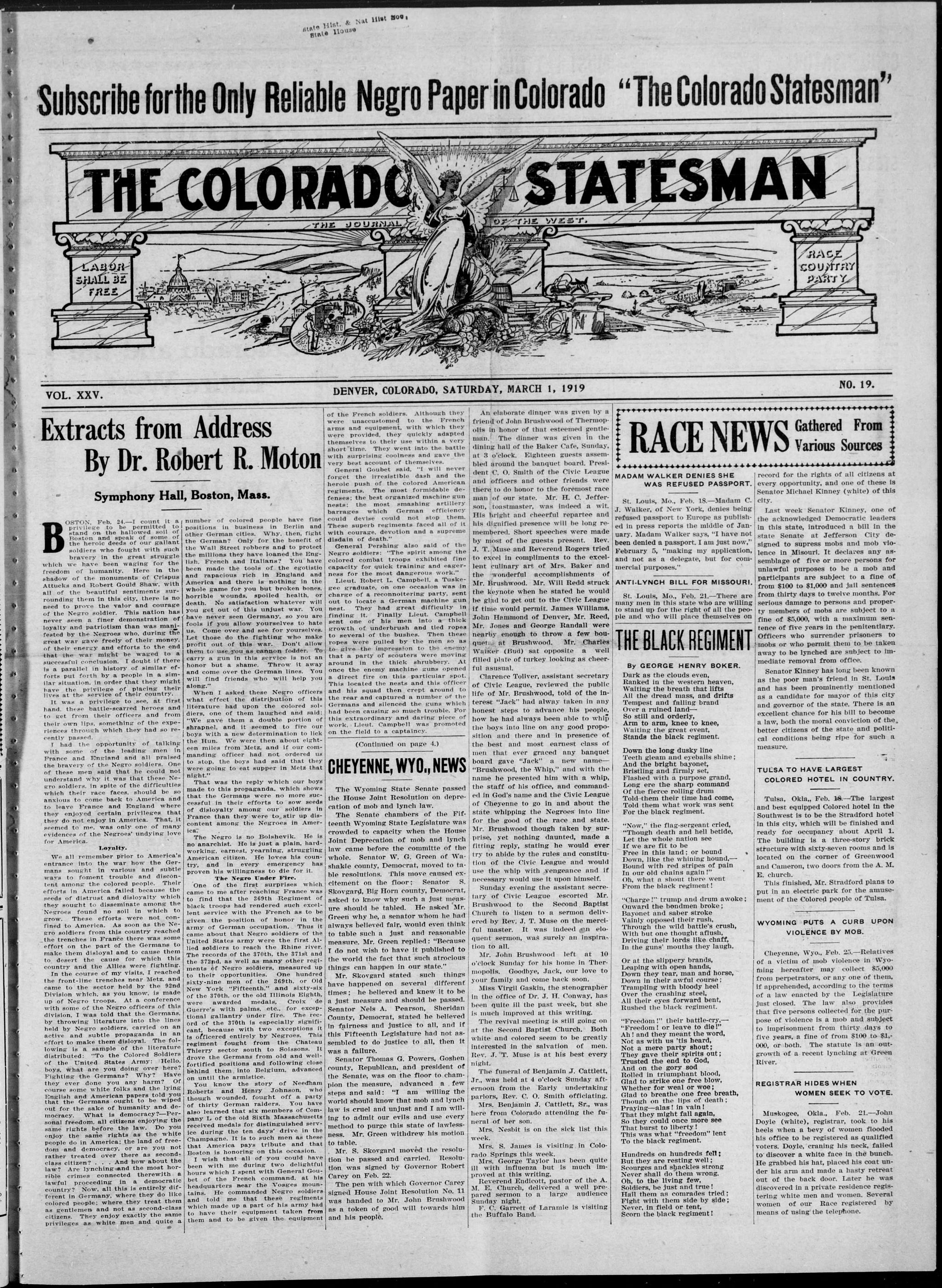
Subscribe forthe Only Reliable Negro Paper in Colorado "The Colorado Statesman"
THE COLORADO STATESMAN
THE JOURNAL OF THE WEST.
LABOR SHALL BE FREE
RACE COUNTRY PARTY
Extracts from Address By Dr. Robert R. Moton
Symphony Hall, Boston, Mass.
OSTON. Feb. 24.—I count it a privilege to be permitted to stand on the hallowed soil of Boston and speak of needs of the heroic deeds of our gallant soldiers who fought with such bravery in the great struggle which we have been waging for the freedom of humanity. Here in the shadow of the monuments of Crispus Attucks and Robert Gould Shaw, with all of the beautiful sentiments surrounding them in this city, there is no need to prove the valor and courage of the Negro soldier. This nation has never seen a finer demonstration of loyalty and patriotism than was manifested by the Negroes who, during the great war gave freely of their money, of their energy and efforts to the end that the war might be waged to a successful conclusion. I doubt if there is a parallel in history of similar efforts put forth by a people in a similar situation, in order that they might have the privilege of placing their lives at the service of their country. It was a privilege to see, at first hand, these battle-scarred heroes and to get from their officers and from their own lips, something of the experiences through which they had so recently passed.
I had the opportunity of talking with some of the leading men in France and England and all praised the bravery of the Negro soldiers. One of these men said that he could not understand why it was that these Negro soldiers, in spite of the difficulties which their race faces, should be so anxious to come back to America and to leave France and England where they enjoyed certain privileges that they do not enjoy in America. That, it seemed to me, was only one of many evidences of the Negroes' undying love for America.
Loyalty.
We all remember prior to America's entrance into the war how the Germans sought in various and subtle ways to foment trouble and discontent among the colored people. Their efforts in America failed because the seeds of distrust and disloyalty which they sought to disseminate among the Negroes found no soil in which to grow. These efforts were not confined to America. As soon as the Negro soldiers from this country reached the trenches in France there was some effort on the part of the Germans to make them disloyal and to cause them to desert the cause for which this country and the Allies were fighting.
In the course of my visits, I reached the front-line trenches near Metz, and came to the sector held by the 92nd Division which, as you know, is made up of Negro troops. At a conference with some of the Negro officers of this division, I was told that the Germans, by throwing literature into the lines held by Negro soldiers, carried on an active and subtle propaganda in an effort to make them disloyal. The following is a sample of the literature distributed: "To the Colored Soldiers of the United States Army: Hello, boys, what are you doing over here? Fighting the Germans? Why? Have they ever done you any harm? Of course some white folks and the lying English and American papers told you that the Germans ought to be wiped out for the sake of humanity and democracy. What is democracy? -Personal freedom, all citizens enjoying the same rights before the law. Do you enjoy the same rights as the white people do in America; the land of freedom and democracy, or are you not rather treated over there as second-class citizen? . . . And how about the law? Are lynching and the most horrible crimes connected therewith a lawful proceeding in a democratic country? Now, all this is entirely different in Germany, where they do like colored people; where they treat them as gentlemen and not as second-class citizens. They enjoy exactly the same privileges as white men and quite a
VOL. XXV.
Loyalty.
number of colored people have fine positions in business in Berlin and other German cities. Why, then, fight the German? Only for the benefit of the Wall Street robbers and to protect the millions they have loaned the English. French and Italians? You have been made the tools of the egotistic and rapacious rich in England and America and there is nothing in the whole game for you but broken bones, horrible wounds, spoiled health, or death. No satisfaction whatever will you get out of this unjust war. You have never seen Germany, so you are fools if you allow yourselves to hate us. Come over and see for yourselves. Let those do the fighting who make profit out of this war. Don't allow them to use you as cannon fodder. To carry a gun in this service is not an honor but a shame. Throw it away and come over the German lines. You will find friends who will help you along."
When I asked these Negro officers what effect the distribution of this literature had upon the colored soldiers, one of them laughed and said: "We gave them a double portion of shrapnel, and it seemed to fire our boys with a new determination to lick the Hum. We were then about eighteen miles from Metz, and if our commanding officer had not ordered us to stop, the boys had said that they were going to eat supper in Metz that night."
That was the reply which our boys made to this propaganda, which shows that the Germans were no more successful in their efforts to sow seeds of disloyalty among our soldiers in France than they were to stir up discontent among the Negroes in America.
The Negro is no Bolshevik. He is no anarchist. He is just a plain, hardworking, earnest, yearning, struggling American citizen. He loves his country, and in every emergency has proven his willingness to die for it.
One of the first surprises which came to me after reaching France was to find that the 369th Regiment of black troops had rendered such excellent service with the French as to be given the position of honor in the army of German occupation. Thus it came about that Negro soldiers of the United States army were the first Allied soldiers to reach the Rhine river. The records of the 370th, the 371st and the 372nd, as well as many other regiments of Negro soldiers, measured up to their opportunities. One hundred sixty-nine men of the 369th, or Old New York "Fifteenth," and sixty-six of the 370th, or the old Illinois Eighth, were awarded medals, Croix de Guerre's with palms, etc., for exceptional gallantry under fire. The record of the 370th is especially significant, because with two exceptions it is officered entirely by Negroes. This regiment fought from the Chateau Thierry sector south to Soissons. It drove the Germans from old and well-fortified positions and following close behind them into Belgium, advanced on until the armistice.
You know the story of Needham Roberts and Henry Johnson, who though wounded, fought off a party of thirty German raiders. You have also learned that six members of Company L of the old Sixth Massachusetts received medals for distinguished service during the ten days' drive in the Champagne. It is to such men as these that America pays tribute and that Boston is honoring on this occasion.
I wish that all of you could have been with me during two delightful hours which I spent with General Goubet of the French command, at his headquarters near the Vosges mountains. He commanded Negro soldiers and told me that these regiments which made up a part of his army had to have their equipment taken from them and to be given the equipment
DENVER, COLORADO, SATURDAY, MARCH 1, 1919
State Hist. & Nat Hist Gov.
State House
iable Negro Pap
RADO
THE JOURNAL
DENVER, COLORADO, SATU
of the French soldiers. Although they were unaccustomed to the French arms and equipment, with which they were provided, they quickly adapted themselves to their use within a very short time. They went into the battle with surprising coolness and gave the very best account of themselves.
General Goubet said, "I will never forget the irresistible dash and the heroic push of the colored American regiments. The most formidable defenses; the best organized machine gun nests; the most smashing artillery barrages which German efficiency could devise could not stop them. These superb regiments faced all of it with courage, devotion and a supreme disdain of death."
General Pershing also said of the Negro soldiers: "The spirit among the colored combat troops exhibited fine capacity for quick training and eagerness for the most dangerous work."
Lieut. Robert L. Campbell, a Tuskegee graduate, on one occasion was in charge of a reconnoitering party, sent out to locate a German machine gun nest. They had great difficulty in finding it. Finally Lieut. Campbell sent one of his men into a thick growth of underbrush and tied ropes to several of the bushes. Then these ropes were pulled by the men so as to give the impression to the enemy that a party of scouters were moving around in the thick shrubbery. At once the enemy machine guns opened a direct fire on this particular spot. This located the nests and this officer and his squad then crept around to the rear and captured a number of the Germans and silenced the guns which had been causing so much trouble. For this extraordinary and daring piece of work, Lieut. Campbell was promoted on the field to a captaincy.
(Continued on page 4.)
CHEYENNE, WYO., NEWS
The Wyoming State Senate passed the House Joint Resolution on depreciation of mob and lynch law.
The Senate chambers of the Fifteenth Wyoming State Legislature was crowded to capacity when the House Joint Deprecation of mob and lynch law came before the committee of the whole. Senator W. G. Green of Washakie county, Democrat, moved to table resolutions. This move caused excitement on the floor; Senator S. Skovgard, Big Horn county, Democrat, asked to know why such a just measure should be tabled. He asked Mr. Green why he, a senator whom he had always believed fair, would even think to table such a just and reasonable measure. Mr. Green replied: "Because I do not wish to have it published to the world the fact that such atrocious things can happen in our state."
Mr. Skovgard stated such things have happened on several different times; he believed and knew it to be a just measure and should be passed. Senator Nels A. Pearson, Sheridan County, Democrat, stated he believed in fairness and justice to all, and if this Fifteenth Legislature had not assembled to do justice to all, then it was a failure.
Senator Thomas G. Powers, Goshen county, Republican, and president of the Senate, was on the floor to champion the measure, advanced a few steps and said: "I am willing the world should know that mob and lynch law is cruel and unjust and I am willing to admit our evils and use every method to purge this state of lawlessness. Mr. Green withdrew his motion to table.
Mr. S. Skovgard moved the resolution be passed and carried. Resolution was signed by Governor Robert Carey on Feb. 22.
The pen with which Governor Carey signed House Joint Resolution No. 11 was handed to Mr. John Brushwood as a token of good will towards him and his people.
An elaborate dinner was given by a friend of John Brushwood of Thermopolis in honor of that esteemed gentleman. The dinner was given in the dining hall of the Baker Cafe, Sunday, at 3 o'clock. Eighteen guests assembled around the banquet board. President C. O. Smith of the Civic League and officers and other friends were there to do honor to the foremost race man of our state. Mr. H. C. Jefferson, toastmaster, was indeed a wit. His bright and cheerful repartee and his dignified presence will be long remembered. Short speeches were made by most of the guests present. Rev. J. T. Muse and Reverend Rogers tried to excel in compliments to the excellent culinary art of Mrs. Baker and the wonderful accomplishments of Mr. Brushwood. Mr. Will Redd struck the keynote when he stated he would be glad to get out to the Civic League if time would permit. James Williams, John Hammond of Denver, Mr. Reed, Mr. Jones and George Randall were nearby enough to throw a few bouquet at Brushwood. Mr. Charles Walker (Bud) sat opposite a well filled plate of turkey looking as cheerful as usual.
Clarence Toliver, assistant secretary of Civic League, reviewed the public life of Mr. Brushwood, told of the interest "Jack" had always taken in any honest steps to advance his people, how he had always been able to whip the boys into line on any good proposition and there and in presence of the best and most earnest class of men that ever graced any banquet board gave "Jack" a new name—"Brushwood, the Whip," and with the name he presented him with a whip, the staff of his office, and commanded in God's name and the Civic League of Cheyenne to go in and about the state whipping the Negroes into line for the good of the race and state. Mr. Brushwood though taken by surprise, yet nothing daunted, made a fitting reply, stating he would ever try to abide by the rules and constitution of the Civic League and would use the whip with vengeance and if necessary would use it upon himself.
Sunday evening the assistant secretary of Civic League escorted Mr. Brushwood to the Second Baptist Church to listen to a sermon delivered by Rev. J. T. Muse on the merciful master. It was indeed an eloquent sermon, was surely an inspiration to all.
Mr. John Brushwood left at 10 o'clock Sunday for his home in Thermopolis. Goodbye, Jack, our love to your family and come back soon.
Miss Virgil Gaskin, the stenographer in the office of Dr. J. H. Conway, has been quite ill the past week, but she is much improved at this writing.
The revival meeting is still going on at the Second Baptist Church. Both white and colored seem to be greatly interested in the salvation of men. Rev. J. T. Muse is at his best every night.
The funeral of Benjamin J. Cattlett, Jr., was held at 4 o'clock Sunday afternoon from the Early undertaking parlors, Rev. C. O. Smith officiating.
Mrs. Benjamin J. Cattlett, Sr., was here from Colorado attending the funeral of her son.
Mrs. Nesbit is on the sick list this week.
Mrs. S. James is visiting in Colorado Springs this week.
Mrs. George Taylor has been quite ill with influenza but is much improved at this writing.
Reverend Endicott, pastor of the A. M. E. Church, delivered a well prepared sermon to a large audience Sunday night. F. C. Garrett of Laramie is visiting the Buffalo Band.
RACENEWS Gathered From Various Sources
RACENEWS Gathered From Various Sources
St. Louis, Mo., Feb. 18.—Madam C. J. Walker, of New York, denies being refused passport to Europe as published in press reports the middle of January. Madam Walker says, "I have not been denied a passport. I am just now," February 5, "making my application, and not as a delegate, but for commercial purposes."
ANTI-LYNCH BILL FOR MISSOURI
St. Louis, Mo., Feb. 21. There are many men in this state who are willing to stand up for the right of all the people and who will place themselves on
THE BLACK REGIMENT
Dark as the clouds even,
Ranked in the western heaven,
Waiting the breath that lifts
All the dread mass, and drifts
Tempest and falling brand
Over a ruined land—
So still and orderly,
Arm to arm, knee to knee,
Waiting the great event,
Stands the black regiment.
Down the long dusky line
Teeth gleam and eyeballs shine;
And the bright bayonet,
Bristling and firmly set,
Flashed with a purpose grand,
Long ere the sharp command
Of the fierce rolling drum
Told them their time had come,
Told them what work was sent
For the black regiment.
"Now," the flag-sergeant cried,
"Though death and hell betide,
Let the whole nation see
If we are fit to be
Free in this land; or bound
Down, like the whining hound,—
Bound with red stripes of pain
In our old chains again!"
Oh, what a shout there went
From the black regiment!
"Charge!" trump and drum awoke; Onward the bondmen broke; Bayonet and saber stroke Vainly opposed their rush. Through the wild battle's crush, With but one thought affush, Driving their lords like chaff, In the guns' mouths they laugh.
Or at the slippery brands, Leaping with open hands, Down they tear, man and horse, Down in their awful course; Trampling with bloody heel Over the crashing steel, All their eyes forward bent, Rushed the black regiment.
"Freedom!" their battle-cry,— "Freedom! or leave to die!" Ah! and they meant the word, Not as with us 'tis heard, Not a mere party shout; They gave their spirits out; Trusted the end to God, And on the gory sod Rolled in triumphant blood, Glad to strike one free blow, Whether for weal or woe; Glad to breathe one free breath, Though on the lips of death; Praying—alas! in vain! That they might fall again, So they could once more see That burst to liberty! This was what "freedom" lent To the black regiment.
Hundreds on hundreds fell;
But they are resting well;
Scourges and shackles strong
Never shall do them wrong.
Oh, to the living few,
Soldiers, be just and true!
Hall them as comrades tried;
Fight with them side by side;
Never, in field or tent,
Scorn the black regiment!
NO.19.
record for the rights of all citizens at every opportunity, and one of these is Senator Michael Kinney (white) of this city.
Last week Senator Kinney, one of the acknowledged Democratic leaders in this state, introduced a bill in the state Senate at Jefferson City designed to supress mobs and mob violence in Missouri. It declares any assemblage of five or more persons for unlawful purposes to be a mob and participants are subject to a fine of from $100 to $1,000 and jail sentences from thirty days to twelve months. For serious damage to persons and property members of mobs are subject to a fine of $5,000, with a maximum sentence of five years in the penitentiary. Officers who surrender prisoners to mobs or who permit them to be taken away to be lynched are subject to immediate removal from office.
Senator Kinney has long been known as the poor man's friend in St. Louis and has been prominently mentioned as a candidate for mayor of this city and governor of the state. There is an excellent chance for his bill to become a law, both the moral conviction of the better citizens of the state and political conditions being ripe for such a measure.
TULSA TO HAVE LARGEST
COLORED HOTEL IN COUNTRY.
Tulsa, Okla., Feb. 18.—The largest and best equipped Colored hotel in the Southwest is to be the Stradford hotel in this city, which will be finished and ready for occupancy about April 1. The building is a three-story brick structure with sixty-seven rooms and is located on the corner of Greenwood and Cameron, two doors from the A. M. E. church.
This finished, Mr. Stradford plans to put in an electric park for the amusement of the Colored people of Tulsa.
WYOMING PUTS A CURB UPON VIOLENCE BY MOB.
Cheyenne, Wyo., Feb. 25.—Relatives of a victim of mob violence in Wyoming hereafter may collect $5,000 from perpetrators, or any one of them, if apprehended, according to the terms of a law enacted by the Legislature just closed. The law also provides that five persons collected for the purpose of violence is a mob and subject to imprisonment from thirty days to five years, a fine of from $100 to $1,000, or both. The statute is an outgrowth of a recent lynching at Green River.
REGISTRAR HIDES WHEN
WOMEN SEEK TO VOTE.
Muskogee, Okla., Feb. 21.—John Doyle (white), registrar, took to his heels when a bevy of women flooded his office to be registered as qualified voters. Doyle, craning his neck, failed to discover a white face in the bunch. He grabbed his hat, placed his coat under his arm and made a hasty retreat out of the back door. Later he was discovered in a private residence registering white men and women. Several women of our Race registered by means of using the telephone.
FOREIGN
More than 100 coal mines in Westphalia have been closed on account of the general strike called by the Spartacans.
Queen Helena of Italy has been in Paris to see her father, King Nicholas of Montenegro. She was accompanied by her daughters, Including Princess Yolande.
Dr. Friederich Adler, who assassinated Premier Stuergkh at Vienna in 1916, has been proclaimed President of the German-Austrian republic by the defense troops outside the town hall, according to reports from Viena.
A French aviation mission will leave France for the United States to demonstrate the degree of efficiency of the French airplanes. They will take the five fastest planes equipped with closed cabins. Five of the most noted French aces will be pilots.
Gen. Joseph Pilsudski has announced his intention of resigning as chief of the Polish state. General Pilsudski has been the military leader of, the new Polish government and previous to the reconstruction of the government by Ignace Paderewski he was director of Poland.
Princess Oyama, widow of the field marshal, Prince Oyama, who commanded the Manchurian army during the Russo-Japanese War, is dead of influenza. She was a graduate of Vassar college. The princess took a prominent part in the work of the Japanese Red Cross and was an active supporter of the American Red Cross.
The internalied commission appointed by the peace conference to investigate the situation in Poland is rapidly getting settled and is preparing to face many problems, the most important of which are the food supply and the differences between the Poles and the Ukrainians regarding the oil region near Lemberg, Galicia.
One of the German long-range guns which shelled Paris at intervals during the last few months of the war now on its way to that city and will be placed on exhibition in the Place de la Concorde, according to La Vioire. Marshal Foch demanded the surrender by the Germans of one of these guns, which was found by French officers near Mayence, and it is this weapon which is being sent to Paris.
The National Baseball Commissioner has restored Player Charles A.Bender of the Philadelphia Nationals to good standing.
Harry Coulon, a Buffalo bantamweight, gave ten pounds weight to Eddie Ketchell of Toledo, carried the fight to him in every round and earned the decision by a wide margin in eight rounds at Saginaw.
A house bill to legalize ten-round boxing matches and placing all public boxing exhibitions under control of boxing commissions of the various cities of the state has passed the Oregon Senate. It goes now to the governor.
Verne Clmons, for several seasons catcher for the Louisville American Association team, expects to play baseball again this season. He was discharged from the navy at Newport, Rhode Island, just fifteen minutes before naval discharges were discontinued. It is understood he will play with Louisville.
GENERAL
President John Grier Hibben of Princeton-university was decorated by the French government with the cross of the Legion of Honor. British Columbia apparently intends making a bid for the headquarters of the great codfishing fleet which operates about the Aleutian islands and which has heretofore worked out of San Francisco. The old Wigwam site in Chicago, where Lincoln was nominated for President, was swept by a $250,000 fire, which destroyed several buildings occupied by wholesale grocery establishments and coal houses.
Tambourines and free-will offering boxes, which for more than thirty-five years have been used by the Salvation Army in gathering funds, are to be abandoned, says a statement issued by Commander Evangeline Booth in announcing plans for a "drive" for $10,000,000 in May.
Twenty-three hundred stars, representing that number of University of Oklahoma faculty members, graduates and undergraduates in military or naval service at the time of the signing of the armistice, were in the university service flag, it was announced. Fourteen of these were gold stars.
Mrs. Stanislaws Lypchinski has been arrested at Manistee charged with the murder of Sister Mary Johns, who mysteriously disappeared from the convent at Isadore, Mich., eleven years ago and whose body, it recently became known, was exhumed last summer from a grave in the basement of the church. At the time of the disappearance of the nun Mrs. Lypchinski was the housekeeper of Father Andrew Bienowske, then in charge of the Isadore parish. Both denied any knowledge of the manner in which the nun met her death.
The packing house employees have been given a 10 per cent advance by the decision of the arbitrator, Judge Alschuler, it was announced in Chicago.
Private John LaCrosse has returned from France with five bullets still in his body. Eight have been extracted. He says he ended the career of one German for every bullet he received. Nine persons are known to have been killed and seventy-five others injured, many fatally, when a Baltimore & Ohio railroad passenger train crashed into a double-header locomotive at Pittsburg
CONDENSATION OF FRESH NEWS
THE LATEST IMPORTANT DIS
PATCHES PUT INTO SHORT,
CRISP PARAGRAPHS.
SHOWING THE PROGRESS OF EVENTS IN OUR OWN AND FOREIGN LANDS.
Western Newspaper Union News Service.
WESTERN
California will launch a referendum movement against national prohibition, it was announced in San Francisco by the executive committee of the California Grape Protective Association. Discharged soldiers and sailors will be urged to go back to their own "home town" whenever possible by the new state veterans' welfare commission, James H. Powell, chairman, announced at Seattle. Twenty-six men are in jail at Seattle awaiting trial in the state courts on charges of criminal anarchy in connection with the recent general strike of organized labor. The arrest of six additional men is sought on similar complaints.
The Hawaiian Pineapple Packers' Association has voted to expend $20,000 in the establishment of a sixty-acre experiment station. The principal object is to develop different varieties of pineapples which may be grown in Hawaii.
The Senate of the Oregon Legislature has adopted a joint resolution to extend the legislative session to sixty days, instead of forty, and increase the pay of lawmakers from $3 to $5 a day. The measure will be voted on at a special election in June.
Lieut. C. L. Price, stationed at Waco, Texas, was killed at Ellington field when an airplane in which he was flying "flipped off" at 150 feet from the ground and landed in a nose dive. Lieut Lee McGinn, a passenger, escaped without injury.
Employees of the American Smelting and Refining Company and other large American concerns operating in the state of Chihuahua have been ordered to concentrate in Chihuahua preparatory to leaving for the United States. Persistent rumors of impending bandit raids and rebel threats to destroy property are responsible for the proposed exodus of American mine and smelter men.
WASHINGTON
By order of President Wilson, American troops in Russia will be returned to the United States as soon as possible, possibly before June 1.
An appropriation of $750,000,000 for operating the railroads under government control have been approved by the house appropriations committee.
Philippines foreign trade showed a steady and encouraging increase during the calendar year of 1918, with the United States the dominant nation.
A bill for the repeal of the wartime prohibition law, which becomes effective July 1, introduced by representative Gallivan of Massachusetts, will be considered by the House agricultural committee within the next few days.
The Senate has passed the House bill directing the war risk insurance bureau to resume payment of allotments to enlisted men of the army and navy, which it discontinued last July. Because of minor senate amendments the bill was sent to a conference. The cases of more than 20,000 men in the service are affected by the measure.
The invitation from France for American participation in the interparliamentary union meeting next month was discussed at a conference of the Senate foreign relations committee and Chairman Flood and Representatives Linthicum and Ragsdale of the House foreign affairs committee.
Representative Fess of Ohio, chairman of the Republican congressional campaign committee, announced his withdrawal from the Republican contest for the speakership of the House in the next Congress. His action left the race between Representatives Mann of Illinois and Gillett of Massachusetts.
Thousands of public school teachers are exempted from income taxes on their salaries as teachers, according to an explanation by the internal revenue bureau in clarification of its recent announcement that salaries of all officers and employees of state, county, city or other municipal or local governments are not to be taxed. It was explained that this applies to teachers provided they receive pay from a public source and not from a private school. It also applies to policemen, firemen and other public employees.
In response to letters and petitions from farmers urging repeal of the daylight saving law Chairman Gore of the Senate agriculture committee announced that he planned to offer a rider to the annual agricultural appropriation providing for an annulment of the statute.
Restrictions on the use of grain in the manufacture of "near beer" and other nonintoxicating beverages were removed after receipt of the proclamation signed at Paris by President Wilson and Secretary Lansing several weeks ago.
SPORT
MUST LET THE PEOPLE DECIDE
OPINION OF ALL AMERICA WILL BE HEARD IN DECISION ON PEACE LEAGUE.
ALL FRIENDLY TO U. S.
WILSON DELIVERS SPEECH AT MECHANICS HALL IN BOSTON TO BIG CROWD.
Western Newspaper Union News Service Boston, Feb. 24.—President Wilson made the following speech at Mechanics Hall in Boston, after landing from his trip back from Europe.
"Governor Coolidge, Mr. Mayor, Fellow Citizens:
I wonder if you are half as glad to see me am to see you. I warm my heart to see a great body of my fellow citizens again, because in some respects during the recent months I have been lonely indeed without your commitment to a counsel and I tried at every step of the work which fell to me to recall what I was sure would be your counsel with regard to the great matters which were under consideration.
I do not want you to to think that I have not been appreciative of the extraordinary generous reception which was given to me on the other side, in saying that it makes me happy not to mean to say that I was not very deeply touched by the cries that came from the great crowds on the other side. But I want to say to you in all honesty that I felt a great sense of greeting to you, rather than to me.
"I did not feel that the greeting was personal. I had in my heart the overcrowning pride of being your representative, and of receiving thepleasure everywhere who felt to thank your hearts beat with theirs in the cause of liberty.
"There was no mistaking the tone in the voices of those great crowds. It was not a tone of mere greeting, it was not a tone of mere generous welcome, but a tone of pride to congrade, the cry that comes from men who say, "We have waited for this day when the friends of liberty should come across the sea and shake hands with us, and students upon a new basis and foundation of justice and right."
"I can't tell you the inspiration that came from the sentiments that came out of those simple voices in the crowds. And the proudest thing I have to say is that this country of ours is trusted throughout the world.
"I have not come to report the proceedings or the results of the proceedings of the peace conference; that I have received very happy impressions from this conference—the impression that, while there are many differences of judgment of the same person, there is nevertheless, a common spirit and a common realization of the necessity of setting up new standards of right in the world. Therefore realize as keenly as any American can realize that they are not the masters of their people, that they are not the masters of their people, that the spirit of their people has awakened to a new purpose and a new conception of their power to realize that purpose, and that no man dare go home from the city without being less noble than was expected of it.
"The conference seems to you to go slowly, from day to day in Paris it seems to go slowly; but I wonder what it will be, the result of what it has undertaken. It seems as if the settlements of this war affect, and affect directly, every great—and, I sometimes think, every small—nation in the world, and no one decision is made in with the great series of other decisions which must accompany it, and it must be reckoned on with the final result, if the real quality and character of the war is to be determined." "What we are doing is to hear the whole case; hear it from the mouths of the men most interested; hear it from those who are officially commissioned in the war; hear the claims that affect new nationalities, that affect new areas of the world, that affect new commercial and economic connections that have been established by the great war through which we have gone.
"And I have been struck by the moderateness of those who have presented national claims. I can testify that I have been in the midst of passion. I have seen earnestness. I have seen tears come to the eyes of men who pled for down-trodden peoples whom they were privileged to see, and whom they were not the team of anger, they were the tears of ardent hope.
"I don't see how any man can fail to have been subdued by these pleas, nor can there be an individual judgment of his own, but to try to assist the cause of humanity, and in the midst of it all every interest has the first of all, when it reaches Paris, the representatives of the United States. Why? Because—and I think I am stating the most wonderful fact in history because there no man in history suspects the motives of the United States.
"Was there ever so wonderful a thing seen before? Was there ever so moving a thing? Was there ever any fact that so bound the nation that we can do that esteem forever to deserve it?"
"I would not have you understand that the great men who represent the other nations there in conference are disesteemed by those who know them, and they are now using their stand the countries of Europe have again and again clashed with one another in competitive interests. It is impossible for men to forget the sharp issues that were drawn between them in the times."
"It is impossible for men to believe that all ambitions have all of a sudden been foregone. They remember territory that was coveted; they remember rights that it was attempted to start by the remember political ambitions which it was attempted to realize and while they believe that men have come into a different temper, they cannot forget these things and so they do not report to one another for a diseminate view of the potential and controversy. They resort to that nation which has won the enviable distinction
Geneva. — Prince Leopold, former commander-in-chief of the German armies on the Russian front, has been imprisoned at Munich on suspicion of being one of the instigators of the murder of Premier Eisner. A list of persons to be assassinated by the reactionaries is said to have been found, and it is asserted that it has been decided to take twenty hostages from among the aristocracy. All the students in the university have been searched. A provisional ministry has
of being regarded as the friend of mankind
---
"Whenever it is desired to send a small force of soldiers to occupy a piece of territory where it is thought nobody else will be welcome, they ask for American soldiers. And are other soldiers would be asked upon with suspicion and perhaps met with resistance, and American soldiers are with acclaim.
THE COLORADO STATESMAN
"I have had so many grounds for pride on the other side of the water that I am very thankful that are not grounds for personal pride, but grounds for personal pride. If they were grounds for personal pride I'd be the most stuckup man in the world. And it has been an infinite pleasure to me to see those gallant soldiers of whom the constellation United States the proud commander. "You may be proud of the Twenty-six division, but I commanded the Twenty-sixth division (haughtier and applause), and see what they did with the men. And everybody praises the American soldier with the feeling that in praising him he is subtracting from the credit of no one else.
"I have been searching for the fundamental fact that the coming war Europe did not believe in us as she does now. She did not believe in us throughout the first three years of the war, the seems to have believed that we were holding off because we thought we could make more by staying out than by going in. And all of a sudden, in a short eighteen months, there can be but one explanation for it. They saw what we did—that without making a single claim we put all our men and all our means at the disposal of their homes, in the first instance, but for a cause, the cause of human rights and justice, and that we went in, not to support their national claims, but to hold in common.
The Mouth-Piece of the People of Colorado and the Entire West
"And when they saw that America not only held ideals, but acted ideals, they were not alone. They became firm partisans of those ideals. "I met a group of scholars when I was in Paris. Some gentlemen from one of the most esteemed universities we come to see me, were there presence, or rather in the presence of whose traditions of learning I felt the most sacred. I told that I had had one of the delightful revenges that sometimes come to a man. All my life I have heard men speak of the condescensionists and particular separate, incloistered persons whom they chose to term academic, who were in the habit of uttering ideals in the free speech of their clash with nobody in particular.
"And I have said I have this sweet revenge. Speaking with perfect frankness in the name of the United States, we have been in great war, ideals and nothing but ideals, and the war has been won by that inspiration. Men were fighting with tense muscle and lowered head, and they were fighting for their feeling they were fighting for their lives and their country, and when these accounts of what it was all about reached them from America they lifted themselves to heaven; then they saw men in khaki coming across the sea in the spirit of crusaders and they found that those were strange men, reckless of their own power, but they seemed to see something that made danger worth while. Men have testified to me in Europe that men could only call religious fervor. They were not like any of the other soldiers. They had a vision, they had a dream, and they were fighting in the dream living in the dream they turned the whole side of battle and it never came back.
ARELIABLE chronicle of their doings and progress; a faithful mirror of their wants, their hopes, their best aspirations.
"And now do you realize this confidence we have established throughout the world imposes a burden upon us? the world imposes it a burden. is it of those burden which nation ought to be proud to carry. Any man who resists the present tides that run in the world will find, himself thrown upon a shore so high and barren that it will seem as if he had been ratched from his human kind forever.
THE COLORADO STATESMAN
"I invite him to test the sentiments of the nation. We set this nation up to make men free and we did not confirm conception and purpose to America.
"Now," said the President, "this conference we have established calls for the war and we have called for hope. The Europe of the third year of the war was sinking to a stubborn desperation. They thought the end of the war would eventually be a resumption of the old order. They never would be a Europe of settled peace.
"Now all the peoples of Europe are buoyed up in the hope that all the national moral and physical forces that right shall prevail. If America should fail the world of its hope, the nations will be set up as hostile camps again, and the peace conference go home with the world in their breasts because they will have failed. We would leave on the peace table nothing but a modern scrap of paper." America fails the world in its hopes we have America fail the world in its hopes saw only beyond the nearest horizon.
Unequaled as an advertising medium for the business of professional men and women.
"They do not know the sentiment of America." he said.
America, he said.
"We have many of the people of Europe for a lasting peace which he said was pinned to the United States as the "friend of mankind," the President said he had no more doubt of America in this matter than I have of the doubt of the blood that is in me."
"The nations of the world have set their heads now to do a great thing and want to stop short of their purpose," he said.
"I do not speak of the governments, but of the peoples who will see that if their present governments do not do the secret is out and the present government knows it.
"I have come back for an attempt to transact business for a little while in America, and that I have been trying to speak your thoughts. Probing deep in my heart and trying to see the things that are right rather than the things that are wrong, I am finding the heart of America."
An excellent family journal speaking to and for many thousand colored citizens.
"I find that in loving America I have
my fellow men
throughout the world."
U. S. Tonnage Big.
Washington.—Discussing the American merchant marine problem in the Senate, Senator Runsdell of Louisiana predicted that within a few months the shipping board would own one-half the ocean-going merchant vessels in the United States of over 500 gross tons, and that by 1920 ship construction in this country would have increased the total tonnage under the American flag to approximately 19,000,000 tons. "These figures," the senator said, "lead to the conclusion that from the quantitative point of view the problem of the American merchant marine is solved."
TWODOLLARSAYEAR
been constituted, consisting of nine members, instead of eight. Among the ministers is Prof. Friedrich Foerster, of the University of Munich. It is said the landtag will reassemble shortly, but outside of Munich. The Berne committee of Bavarians has voted an annual pension of 10,000 marks for Elsner's widow. A large number of the members of the Bavarian aristocracy have been arrested on suspicion of having been connected with Count Arco-Valley, who killed Premier Elsner, according to a dis patch from Munich.
```markdown
```
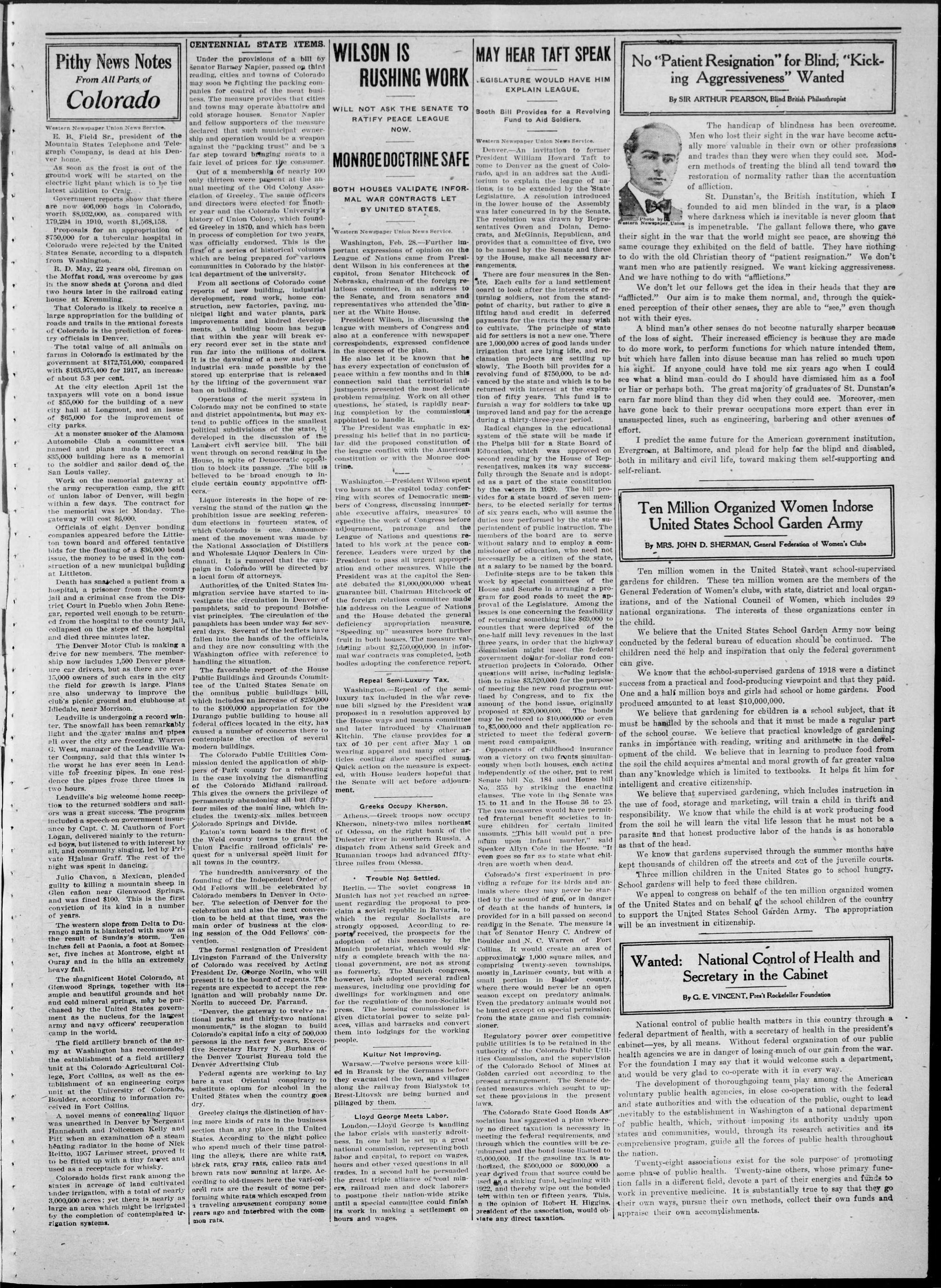
Pithy News Notes From All Parts of Colorado
Western Newspaper Union News Service.
E. B. Field Sr., president of the Mountain States Telephone and Telegraph Company, is dead at his Denver home.
As soon as the frost is out of the ground work will be started on the electric light plant which is to be the latest addition to Craig.
Government reports show that there are now 406,000 hogs in Colorado, worth $8,032,000, as compared with 179,294 in 1910, worth $1,568,158.
Proposals for an appropriation of $750,000 for a tubercular hospital in Colorado were rejected by the United States Senate, according to a dispatch from Washington.
R. D. May, 22 years old, fireman on the Moffat road, was overcome by gas in the snow sheds at Corona and died two hours later in the railroad eating house at Kremmling.
That Colorado is likely to receive a large appropriation for the building of roads and trails in the national forests of Colorado is the prediction of forestry officials in Denver.
The total value of all animals on farms in Colorado is estimated by the government at $172,751,000, compared with $163,975,400 for 1917, an increase of about 5.3 per cent.
At the city election April 1st the taxpayers will vote on a bond issue of $55,000 for the building of a new city hall at Longmont, and an issue of $65,000 for the improvement of city parks.
At a monster smoker of the Alamosa Automobile Club a committee was named and plans made to erect a $35,000 building here as a memorial to the soldier and sailor dead of the San Louis valley.
Work on the memorial gateway at the army recuperation camp, the gift of union labor of Denver, will begin within a few days. The contract for the memorial was let Monday. The gateway will cost $6,000.
Officials of eight Denver bonding companies appeared before the Littleton town board and offered tentative bids for the floating of a $36,000 bond issue, the money to be used in the construction of a new municipal building at Littleton.
Death has snatched a patient from a hospital, a prisoner from the county jail and a criminal case from the District Court in Pueblo when John Renegar, reported well enough to be returned from the hospital to the county jail, collapsed on the steps of the hospital and died three minutes later.
The Denver Motor Club is making a drive for new members. The membership now includes 1,500 Denver pleasure car drivers, but as there are over 15,000 owners of such cars in the city the field for growth is large. Plans are also underway to improve the club's picnic ground and clubhouse at Idledale, near Morrison.
Leadville is undergoing a record winter. The snowfall has been remarkably light and the water mains and pipes all over the city are freezing. Warren G. West, manager of the Leadville Water Company, said that this winter is the worst he has ever seen in Leadville for freezing pipes. In one residence the pipes froze three times in two hours.
Leadville's big welcome home reception to the returned soldiers and sailors was a great success. The program included a speech on government insurance by Capt. C. M. Cauthorn of Fort Logan, delivered mainly to the returned boys, but listened to with interest by all, and community singing, led by Private Hjalmar Graff. The rest of the night was spent in dancing.
Julio Chavon, a Mexican, pleaded guilty to killing a mountain sheep in Glen canon near Glenwood Springs, and was fined $100. This is the first conviction of its kind in a number of years.
The western slope from Delta to Durango again is blanketed with snow as the result of Sunday's storm. Ten inches fell at Paonia, a foot at Somerset, five inches at Montrose, eight at Ouray and in the hills an extremely heavy fall.
The magnificent Hotel Colorado, at Glenwood Springs, together with its ample and beautiful grounds and hot and cold mineral springs, may be purchased by the United States government as the nucleus for the largest army and navy officers' recuperation camp in the world.
The field artillery branch of the army at Washington has recommended the establishment of a field artillery unit at the Colorado-Agricultural College, Fort Collins, as well as the establishment of an engineering corps unit at the University of Colorado, Boulder, according to information received in Fort Collins.
A novel means of concealing liquor was unearthed in Denver by Sergeant Hannebuth and Policemen Kelly and Pitt when an examination of a steam heating radiator in the home of Nick Reitto, 1957 Larimer street, proved it to be fitted up with a tiny facet and used as a receptacle for whisky. Colorado holds first rank among the states in acreage of land cultivated under irrigation, with a total of nearly 3,000,000 acres; yet there is nearly as large an area which might be irrigated by the completion of contemplated irrigation systems.
CENTENNIAL STATE XTEMS.
Under the provisions of a bill by Senator Barney Napier, passed on third reading, cities and towns of Colorado may soon be fighting the packing companies for control of the meat business. The measure provides that cities and towns may operate abattoirs and cold storage houses. Senator Napier and fellow supporters of the measure declared that such municipal ownership and operation would be a weapon against the "packing trust" and be a far step toward bringing meats to a fair level of prices for the consumer.
Out of a membership of nearly 100 only thirteen were present at the annual meeting of the Old Colony Association of Greeley. The same officers and directors were elected for another year and the Colorado University's history of Union Colony, which founded Greeley in 1870, and which has been in process of completion for two years, was officially endorsed. This is the first of a series of historical volumes which are being prepared for various communities in Colorado by the historical department of the university.
From all sections of Colorado come reports of new building, industrial development, road work, home construction, new factories, paving, municipal light and water plants, park improvements and kindred developments. A building boom has begun that within the year will break every record ever set in the state and run far into the millions of dollars. It is the dawning of a new and great industrial era made possible by the stored up enterprise that is released by the lifting of the government war ban on building.
Operations of the merit system in Colorado may not be confined to state and district appointments, but may extend to public offices in the smallest political subdivisions of the state, it developed in the discussion of the Lambert civil service bill. The bill went through on second reading in the House, in spite of Democratic opposition to block its passage. The bill is believed to be broad enough to include certain county appointive officers.
Liquor interests in the hope of reversing the stand of the nation on the prohibition issue are seeking referendum elections in fourteen states, of which Colorado is one. Announcement of the movement was made by the National Association of Distillers and Wholesale Liquor Dealers in Cincinnati. It is rumored that the campaign in Colorado will be directed by a local form of attorneys.
Authorities of the United States immigration service have started to investigate the circulation in Denver of pamphlets, said to propound Bolshevist principles. The circulation of the pamphlets has been under way for several days. Several of the leaflets have fallen into the hands of the officials, and they are now consulting with the Washington office with reference to handling the situation.
The favorable report of the House Public Buildings and Grounds Committee of the United States Senate on the omnibus public buildings bill, which includes an increase of $250,000 to the $100,000 appropriation for the Durango public building to house all federal offices located in the city, has caused a number of concerns there to contemplate the erection of several modern buildings. The Colorado Public Utilities Commission denied the application of shippers of Park county for a rehearing in the case involving the dismantling of the Colorado Midhand railroad. This gives the owners the privilege of permanently abandoning all but fifty-four miles of the main line, which includes the twenty-six miles between Colorado Springs and Divide.
Eaton's town board is the first of the Weld county towns to grant the Union Pacific railroad officials' request for a universal speed limit for all towns in the country.
The hundredth anniversary of the founding of the Independent Order of Odd Fellows will be celebrated by Colorado members in Denver in October. The selection of Denver for the celebration and also the next convention to be held at that time, was the main order of business at the closing session of the Odd Fellows' convention.
The formal resignation of President Livingston Farrand of the University of Colorado was received by Acting President Dr. George Norlin, who will present it to the board of regents. The regents are expected to accept the resignation and will probably name Dr. Norlin to succeed Dr. Farrand.
"Denver, the gateway to twelve national parks and thirty-two national monuments," is the slogan to build Colorado's capital info a city of 500,000 persons in the next few years, Executive Secretary Harry N. Burhans of the Denver Tourist Bureau told the Denver Advertising Club Federal agents are working to lay bare a vast Oriental conspiracy to substitute opium for alcohol in the United States when the country goes dry.
Greeley claims the distinction of having more kinds of rats in the business section than any place in the United States. According to the night police who spend much of their time patrolling the alleys, there are white rats, black rats, gray rats, calico rats and brown rats now running at large. According to old-timers here the vari-colored rats are the result of some performing white rats which escaped from a traveling amusement company some years ago and interbred with the common rats.
WILSON IS RUSHING WORK
WILL NOT ASK THE SENATE TO RATIFY PEACE LEAGUE NOW.
MONROE DOCTRINE SAFE
BOTH HOUSES VALIDATE INFORMAL WAR CONTRACTS LET BY UNITED STATES.
Western Newspaper Union News Service.
Washington, Feb. 28.—Further important expressions of opinion on the League of Nations came from President Wilson in his conferences at the capitol, from Senator Hitchcock of Nebraska, chairman of the foreign relations committee, in an address to the Senate, and from senators and representatives who attended the dinner at the White House.
President Wilson, in discussing the league with members of Congress and also at a conference with newspaper correspondents, expressed confidence in the success of the plan.
He also let it be known that he has every expectation of conclusion of peace within a few months and in this connection said that territorial adjustments presented the most delicate problem remaining. Work on all other questions, he stated, is rapidly nearing completion by the commissions appointed to handle it.
The President was emphatic in expressing his belief that in no particular did the proposed constitution of the league conflict with the American constitution or with the Monroe doctrine.
Washington.—President Wilson spent two hours at the capitol today conferring with scores of Democratic members of Congress, discussing innumerable executive affairs, measures to expedite the work of Congress before adjournment, patronage and the League of Nations and questions related to his work at the peace conference. Leaders were urged by the President to pass all urgent appropriation and other measures. While the President was at the capitol the Senate debated the $1,000,000,000 wheat guarantee bill. Chairman Hitchcock of the foreign relations committee made his address on the League of Nations and the House debated the general deficiency appropriation measure. "Speeding up" measures bore further fruit in both houses. The measure validating about $2,750,000,000 in informal war contracts was completed, both bodies adopting the conference report.
Repeal Semi-Luxury Tax.
Washington.—Repeal of the semi-luxury tax included in the war revenue bill signed by the President was proposed in a resolution approved by the House ways and means committee and later introduced by Chairman Kitchin. The clause provides for a tax of 10 per cent after May 1 on wearing apparel and many other articles costing above specified sums. Quick action on the measure is expected, with House leaders hopeful that the Senate will act before adjournment.
Greeks Occupy Kherson.
Athens.—Greek troops now occupy Kherson, ninety-two miles northeast of Odessa, on the right bank of the Dnister river in southern Russia. A dispatch from Athens said Greek and Rumanian troops had advanced fifty-three miles from Odessa.
- Trouble Not Settled.
Berlin. — The soviet congress in Munich has not yet reached an agreement regarding the proposal to proclaim a soviet republic in Bavaria, to which the regular Socialists are strongly opposed. According to reports received, the prospects for the adoption of this measure by the Munich proletariat, which would signify a complete breach with the national government, are not as strong as formerly. The Munich congress, however, has adopted several radical measures, including one providing for dwellings for workingmen and one for the regulation of the non-Socialist press. The housing commissioner is given dictatorial power to seize palaces, villas and barracks and convert them into lodgings for the working people.
Kultur Not Improving.
Warsaw. Twelve persons were killed in Branskby the Germans before they evacuated the town, and villages along the railway from Bialystok to Brest-Litovsk are being burned and pillaged by them.
Lloyd George Meets Labor.
London.—Lloyd George is handling the labor crisis with masterly adroitness. In one hall he set up a great national commission, representing both labor and capital, to report on wages, hours and other vexed questions in all trades. In a second hall he persuaded the great triple alliance of coal miners, railroad men and dock laborers to postpone their nation-wide strike until a special committee could finish its work in making a settlement on hours and wages.
MAY HEAR TAFT SPEAK
LEGISLATURE WOULD HAVE HIM
EXPLAIN LEAGUE.
Booth Bill Provides for a Revolving Fund to Aid Soldiers.
Western Newspaper Union News Service.
Denver.—An invitation to former President William Howard Taft to come to Denver as the guest of Colorado, and in an address sat the Auditorium to explain the league of nations, is to be extended by the State Legislature. A resolution introduced in the lower house of the Assembly was later concurred in by the Senate. The resolution was drawn by Representatives Owen and Dolan, Democrats, and McGinnis, Republican, and provides that a committee of five, two to be named by the Senate and three by the House, make all necessary arrangements.
There are four measures in the Senate. Each calls for a land settlement board to look after the interests of returning soldiers, not from the standpoint of charity, but rather to give a lifting hand and credit in deferred payments for the tracts they may wish to cultivate. The principle of state aid for settlers is not a new one. There are 1,000,000 acres of good lands under irrigation that are lying idle, and reclamation projects are settling up slowly. The Booth bill provides for a revolving fund of $750,000, to be advanced by the state and which is to be returned with interest at the expiration of fifty years. This fund is to furnish a way for soldiers to take up improved land and pay for the acreage during a thirty-three-year period.
Radical changes in the educational system of the state will be made if the Phelps bill for a State Board of Education, which was approved on second reading by the House of Representatives, makes its way successfully through the Senate and is adopted as a part of the state constitution by the voters in 1920. The bill provides for a state board of seven members, to be elected serially for terms of six years each, who will assume the duties now performed by the state superintendent of public instruction. The members of the board are to serve without salary and to employ a commissioner of education, who need not necessarily be a citizen of the state, at a salary to be named by the board.
Definite steps are to be taken this week by special committees of the House and Senate in arranging a program for good roads to meet the approval of the Legislature. Among the issues is one concerning the feasibility of returning something like $69,000 to counties that were deprived of the one-half mill levy revenues in the last three years, in order that the highway commission might meet the federal government dollar-for-dollar road construction projects in Colorado. Other questions will arise, including legislation to raise $3,520,000 for the purpose of meeting the new road program outlined by Congress, and to fix the amount of the bond issue, originally proposed at $20,000,000. The bonds may be reduced to $10,000,000 or even to $5,000,000 and their application restricted to meet the federal government road campaigns.
Opponents of childhood insurance won a victory on two fronts simultaneously when both houses, each acting independently of the other, put to rest Senate bill No. 184 and House bill No. 355 by striking the enacting clauses. The vote in the Senate was 15 to 11 and in the House 36 to 25. The two measures would have permitted fraternal benefit societies to insure children for certain limited amounts. "This bill would put a premium upon infant murder," said Speaker Allyn Cole in the House. "It even goes so far as to state what children are worth when dead.
Colorado's first experiment in providing a refuge for its birds and animals where they may never be startled by the sound of gun, or in danger of death at the hands of hunters, is provided for in a bill passed on second reading in the Senate. The measure is that of Senator Henry C. Andrew of Boulder and N. C. Warren of Fort Collins. It would create an area of approximately 1,000 square miles, and comprising twenty-seven townships, mostly in Larimer county, but with a small portion in Boulder county, where there would never be an open season except on predatory animals. Even the predatory animals would not be hunted except on special permission from the state game and fish commissioner.
Regulatory power over competitive public utilities is to be retained in the authority of the Colorado Public Utilities Commission, and the supervision of the Colorado School of Mines at Golden carried out according to the present arrangement. The Senate defeated measures which sought to upset these provisions in the present laws.
The Colorado State Good Roads Association has suggested a plan whereby no direct taxation is necessary in meeting the federal requirements, and through which the counties will be reimbursed and the bond issue limited to $5,000,000. If the gasoline tax is authorized, the $500,000 or $600,000 a year derived from that source could be used as a sinking fund, beginning with 1922, and thereby wipe out the bonded debt within ten or fifteen years. This, in the opinion of Robert H. Higgins, president of the association, would obviate any direct taxation.
No "Patient Resignation" for Blind; "Kicking Aggressiveness" Wanted
By SIR ARTHUR PEARSON, Blind British Philanthropist
The handicap of blindness has been Men who lost their sight in the war have actually more valuable in their own or other and trades than they were when they couldern methods of treating the blind all ten restoration of normality rather than the aid of affliction.
St. Dunstan's, the British institution founded to aid men blinded in the war where darkness which is inevitable is never impenetrable. The gallant fellows then in the war that the world might see peace, are they exhibited on the field of battle. They are the old Christian theory of "patient resignation. Who are patiently resigned. We want kicking agenothing to do with "afflictions."
We let our fellows get the idea in their heads to Our aim is to make them normal, and, through formation of their other senses, they are able to "see," their eyes.
Man's other senses do not become naturally sharp of sight. Their increased efficiency is because their work, to perform functions for which nature intends, have fallen into disuse because man has relied so self anyone could have told me six years ago when blind man could do I should have dismissed him perhaps both. The great majority of graduates of State blind than they did when they could see. My back to their prewar occupations more expert on lines, such as engineering, barbering and other
At the same future for the American government at Baltimore, and plead for help for the blind and military and civil life, toward making them self-supervised.
One Million Organized Women In the United States School Garden Army
MRS. JOHN D. SHERMAN, General Federation of Women's
One million women in the United States want school children. These ten million women are the men of the Federation of Women's clubs, with state, district and board of the National Council of Women, which organizes. The interests of these organizations
We believe that the United States School Garden Army is the federal bureau of education should be conducted the help and inspiration that only the federal government can do.
We know that the school-supervised gardens of 1918 were a practical and food-producing viewpoint and the half million boys and girls had school or home gardens accounted to at least $10,000,000.
We believe that gardening for children is a school subject led by the schools and that it must be made a course. We believe that practical knowledge is important with reading, writing and arithmetic in the child. We believe that in learning to produce child acquires a mental and moral growth of far more knowledge which is limited to textbooks. It helps and creative citizenship.
We believe that supervised gardening, which includes in food, storage and marketing, will train a child in gardening. We know that while the child is at work prepares he will learn the vital life lesson that he must know that honest productive labor of the hands is at the head.
We know that gardens supervised through the summer kids of children off the streets and out of the juvenile children in the United States go to schools will help to feed these children.
We deal to congress on behalf of the ten million organized States and on behalf of the school children of the United States School Garden Army. The investment in citizenship.
Ed: National Control of Health Secretary in the Cabinet
their sight in the war that the world might see peace, are showing the same courage they exhibited on the field of battle. They have nothing to do with the old Christian theory of "patient resignation." We don't want men who are patiently resigned. We want kicking aggressiveness. And we have nothing to do with "afflictions."
We don't let our fellows get the idea in their heads that they are "afflicted." Our aim is to make them normal, and, through the quickened perception of their other senses, they are able to "see," even though not with their eyes.
A blind man's other senses do not become naturally sharper because of the loss of sight. Their increased efficiency is because they are made to do more work, to perform functions for which nature intended them, but which have fallen into disuse because man has relied so much upon his sight. If anyone could have told me six years ago when I could see what a blind man could do I should have dismissed him as a fool or liar or perhaps both. The great majority of graduates of St. Dunstan's earn far more blind than they did when they could see. Moreover, men have gone back to their prewar occupations more expert than ever in unsuspected lines, such as engineering, barbering and other avenues of effort.
I predict the same future for the American government institution, Evergreen, at Baltimore, and plead for help for the blind and disabled, both in military and civil life, toward making them self-supporting and self-reliant.
Ten million women in the United States want school-supervised gardens for children. These ten million women are the members of the General Federation of Women's clubs, with state, district and local organizations, and of the National Council of Women, which includes 29 national organizations. The interests of these organizations center in the child.
We believe that the United States School Garden Army now being conducted by the federal bureau of education should be continued. The children need the help and inspiration that only the federal government can give.
We know that the school-supervised gardens of 1918 were a distinct success from a practical and food-producing viewpoint and that they paid. One and a half million boys and girls had school or home gardens. Food produced amounted to at least $10,000,000.
We believe that gardening for children is a school subject, that it must be handled by the schools and that it must be made a regular part of the school course. We believe that practical knowledge of gardening ranks in importance with reading, writing and arithmetic in the development of the child. We believe that in learning to produce food from the soil the child acquires a mental and moral growth of far greater value than any knowledge which is limited to textbooks. It helps fit him for intelligent and creative citizenship.
We believe that supervised gardening, which includes instruction in the use of food, storage and marketing, will train a child in thrift and responsibility. We know that while the child is at work producing food from the soil he will learn the vital life lesson that he must not be a parasite and that honest productive labor of the hands is as honorable as that of the head.
We know that gardens supervised through the summer months have kept thousands of children off the streets and out of the juvenile courts. Three million children in the United States go to school hungry. School gardens will help to feed these children.
We appeal to congress on behalf of the ten million organized women of the United States and on behalf of the school children of the country to support the United States School Garden Army. The appropriation will be an investment in citizenship.
and control of public health matters in this country. Department of Health, with a secretary of health in the city by all means. Without federal organization or ties we are in danger of losing much of our gain for foundation I may say that it would welcome such a very glad to co-operate with it in every way. Development of thoroughgoing team play among the public health agencies, in close co-operation with authorities and with the education of the public, or the establishment in Washington of a national health, which, without imposing its authority upon communities, would, through its research activi
National control of public health matters in this country through a federal department of health, with a secretary of health in the president's cabinet—yes, by all means. Without federal organization of our public health agencies we are in danger of losing much of our gain from the war. For the foundation I may say that it would welcome such a department, and would be very glad to co-operate with it in every way.
The development of thoroughgoing team play among the American voluntary public health agencies, in close co-operation with the federal and state authorities and with the education of the public, ought to lead inevitably to the establishment in Washington of a national department of public health, which, without imposing its authority unduly upon states and communities, would, through its research activities and its comprehensive program, guide all the forces of public health throughout the nation.
Twenty-eight associations exist for the sole purpose of promoting some phase of public health. Twenty-nine others, whose primary function falls in a different field, devote a part of their energies and funds to work in preventive medicine. It is substantially true to say that they go their own ways, pursue their own methods, collect their own funds and appraise their own accomplishments.
Photo by
Western Newspaper Union
The handicap of blindness has been overcome. Men who lost their sight in the war have become actually more valuable in their own or other professions and trades than they were when they could see. Modern methods of treating the blind all tend toward the restoration of normality rather than the accentuation of affliction.
St. Dunstan's, the British institution, which I founded to aid men blinded in the war, is a place where darkness which is inevitable is never gloom that is impenetrable. The gallant fellows there, who gave
By G. E. VINCENT, Pres't Rockefeller Foundation
THE COLORADO STATESMAN
LAUGH
SMILE
BE
FINE.
JUDGE
COMMIT
PARTY.
Entered as second-class matter at the postoffice in the City of Denver, Colo.
Remittances should be made by Express Money Order, Postoffice Money Order, Registered Letter or Bank Draft. Postage stamps will be received the same as cash for the fractional part of a dollar. Only 1c and 2c stamps taken.
Reading notices, ten lines or less, 15 cents per line. Each additional line over ten lines, 10 cents per line. Display advertising 50c per inch.
No discounts allowed on less than three months' contract. Cash must accompany all orders from parties unknown to us. Further particulars on application.
Communications to receive attention must be newsy, upon important subjects, plainly written only upon one side of the paper, must reach us Tuesdays, if possible, anyway not later than Wednesdays, and bear the signature of the author. No manuscript returned, unless stamps are sent for postage. All communications of a personating nature that are not complimentary will be withheld from the columns of this paper.
PRESIDENT WILSON RETURNS HOME FOR A FEW DAYS.
PRESIDENT Wilson's return to this country last Tuesday paved the way for many discussions as to "the good" he accomplished in his recent trip to Europe to bring about the League of Nations and make the world safe for democracy. Arriving in Boston, where he passed thru streets lined by hundreds of thousands of his fellow-citizens the President gave a stirring address in Mechanics Hall, where he challenged the senatorial and other opponents of his policy to the fight of their lives. The president is firm in his opinion that a World League is needed to prevent future wars, and declaring that if America should desert Europe in her plan for place, troubles greater than before would arise. The president earnestly appended to his hearers to show their entire sympathy with the project when the time comes for action. The text of the president's speech appears in full in this issue and the same should be carefully read and with that interest as to create an intelligent understanding. The American people, thru their representatives, will follow very closely the proceedings as the importance of the president's mission to Europe is beginning to be realized, and when he leaves our shores immediately after March 4 for another session of the Peace Conference, it is to be hoped that a successful termination of events beneficial to all peoples and nations will be brought about. The president, in his request to the people of America to bear with him and give heed to his policy, offers the following:
"I have come back for a strenuous attempt to transact business for a little while in America, but I have really come back to say to you, in all soberness and honesty, that I have been trying my best to speak your thoughts. When I sample myself I think I find that I am a typical American, and if I sample deep enough and get down to what is probably the true stuff of a man, then I have hope that it is part of the stuff that is like the other fellow's at home. And therefore probing deep in my heart and trying to see the things that are right without regard to the things that may be debated as expedient, I feel that I am interpreting the purpose and the thought of America, and in loving America, I find I have joined the great majority of my fellow-men throut the world."
Isn't this real American, and hasn't it every feature of universal democracy, so beautiful is the expression? We wonder if BLACK AMERICA is included? We would like to think so. What think ye, reader?
EXPOSING THE DEMOCRATIC GAME.
In an editorial of last issue of the National Republican, entitled "Saving the U. S. for Political Hypocrisy," the editor puts clearly before the people of fair play, honest actions and sound judgment, the systematic order of hypocrisy engaged in by the Democratic party in spite of the propaganda being given to the world by our chief executive and some of his invaluable assistants, in the form of the secretary of the navy and others, who, while they preach to others warning them against the yoke of mental slavery, the rule of despots, and such other burdens, indulge in similar actions at home and to the detriment of their own people, by instituting practically political and industrial disfranchisement, which not only warps but permanently injures the mental vision of any body of people. The editor shows very clearly the action of the Democrat bosses in North Carolina in supporting measures that are aimed directly against the Republicans of the state and brings proof of the baneful influence that has laid hold of other states in the South. Two thousand Republicans from all parts of North Carolina assembled at Greensboro two weeks ago and protested vigorously to the Legislature relative to the unfair and undemocratic treatment accorded them, declaring it a deliberate violation of the principles that the president was endeavoring to have the world accept. In further exposing the Democratic party as to the number of votes according to population and the plan they adopt for securing them, the editor said:
"So long as these conditions continue, honest citizens of this Republic will regard with scorn the high-sounding professions of devotion to democracy emanating from the leadership of the present national administration. Judged by their words they are indeed apostles of human rights. Judged by their deeds they are exponents of political Prussianism. Under their sway the eleven slave states, plus Oklahoma, cast fewer votes at a national election than the single free Republican state of Illinois, with one-fifth as many representatives in the House of Representatives and the electoral college. If Democratic leadership were sincere in its talk about democracy, it would not reserve its crusading enthusiasm entirely for the export trade. Like charity, an honest devotion to democracy begins at home. Absent there it is not honest anywhere. It is mere vote-catching political pretense."
This is hitting squarely from the shoulders, but facts are facts and many long drawn out struggles will be settled next election by the instruction which the average voter is now getting in preparation for the great task in front of him.
STANDARDIZING APPRECIATION
OF LOCAL TALENT.
W HEN Hewetson Watson witnessed the response to his efforts for the past ten years to arouse the spirit of loyalty and devotion in the appreciation of LOCAL Talent, he did not fail to remind the very large audience at Zion Baptist Church last Monday evening of his admiration for the talent he found in Denver when he arrived here in the role of a musician to take charge of certain musical work in the community. The Rhoda Anderson Chambers recital was the event, which by strenuous work, extensive advertisement, through our two weekly Journals, courtesy of church announcements, house to house canvass, etc., it was proven that the good people of Denver were not unmindful of appreciating their home talent before now, but possibly not seriously impressed or perhaps like some other cities having a preference formerly for outside talent, they have resolved within the last year or so to give a manifestation of their ability to enjoy and support good things, whether home or foreign, and hence one of the largest, appreciative and critical audiences greeted the presentation of Rhoda Anderson Chambers, a pianist—real Denver girl, who received her first instructions from a Denver resident. Mrs. J. H. P. Westbrook, wife of our popular and skilful physician, afterwards becoming a pupil of the Denver Conservatory under the famous Paul Stauffer, completing her studies at the nationally reputed Western Conservatories, Oakland, California, under the international musical genius, Adolph Gregory. Each of these instructors with a special taste for the art of music, and highly commend her execution, and we can assert with much emphasis that she rendered her program with an artistic finish that only diligent study, careful training and constant application could bring about; and her personality, with a grace attractive as any of the foreign artists we have seen in Denver for the period of thirty years, filled Denver citizens with pride over the production of an artist of such rare accomplishments. We understand that Mrs. Chambers is hoping to establish a studio in this city, and if this is so the COLORADO STATESMAN is ready to open its columns to her for whatever aid that will contribute to success; but seeing that we have always opened our doors to outsiders and given them capacity houses, we would be more proud to see her represent Denver in some of the larger cities on a concert tour before she sets down to business. We were present at her debut last Monday evening and the consensus of opinion from the very large audience of all races assembled was, SHE IS A GENIUS AND A WONDERFUL ARTIST. We wish her superb abundance in her home and elsewhere, and we commend the people of Denver for the very cheerful reception of their own talented fellow-citizen.
WHITE LEADER URGES
Jackson, Miss., Feb. 16.—Hon. Cliff Williams (white), director of United States employment bureau for the Sixth Federal district, delivered one of the most remarkable addresses at the Forest county courthouse ever delivered in this section by a white man. Speaking before an intelligent audience of school teachers, representing several nearby counties, who had assembled for the purpose of hearing the address, Mr. Williams is quoted as having said as follows:
His Message.
"The southern white man is not your friend. That the so-called love of the South for you is nothing but high-handed hypocrisy. The Gulf states of the South have for a long time fed upon your labor and did not give you a fair return. I have studied the situation and I am not speaking on a subject I know nothing about," said Mr. Williams. "The best evidence of what is going to happen in the future is founded on what has happened in the past. Take an illustration the lynching of two of your Colored women at Shubuta and the recent Texas lynching. Are people your friends who will lynch your women?
An Honest Conviction.
"I urge the education of leaders present here to use their best endeavors to have their friends and relatives go North, where there is at least to be found some semblance of fair play. Now you women improve your appearance as much as possible, and go where your virtue will be protected, your children properly educated and where you will enjoy the right of suffrage and will not be taxed without representation."
JIM CROW BILL GETS
Jefferson City, Mo., Feb. 21.—The Missouri Legislature dealt a terrific blow to Senator Van Mayes, a German, representing Peniscot county, when the "Jim Crow" bill was killed by a vote in the committee. Von Mayes wept bitterly when the news was broken to him that his bill had been thrown out. Democrats and Republicans walloped Von Mayes as unpatriotic for suggesting such a measure. Everybody who had a vote gave the bill a kick.
EXTRACTS FROM ADDRESS BY
DR. R. R. MOTON.
(Continued from page 1.)
I heard many stories also of the Negroes' strict honesty. Prof. H. O. Cook of Kansas City, Mo., who was in France in the Y. M. C. A. work, while aiding two wounded members of the regiment in the Champagne offensive was gassed and when he became unconscious he carried on his person more than 180,000 francs which the boys in the regiment had handed him when they went over the top. Before he was sent to the hospital this money was taken from him and kept by the regimental sergeant, Major White, and when Prof. Cook regained consciousness his first thought was of the money which he had on his person, and in all of the steps necessary for him to have the bag containing the money returned to him—it must have passed through the hands of more than twenty-five men—there was not a penny missing.
General Sherburne, a citizen of Boston, who commanded the 167th Field Artillery Brigade of the 92nd Division, told me that the men at all times showed combativeness and a fine spirit of cheerfulness and willingness. The brigade, he said, performed every task it was called upon to perform and there was nothing but praise for its work.
Throughout my association with the officers and men of the brigade, they showed an eagerness to learn, a determination to excel and a fidelity to the rules and ideals of military service which I have never seen excelled.
In talking with General Goubet, he mentioned that he was never more touched than when he went to console one of these colored regiments under his command, which had come out of action with nearly one-half, either killed or wounded, and found the other half patching up the wounds and trying to help their wounded comrades, and that they sat around on the ground and on their kits and sang such music as he had never heard before. This seasoned soldier had to stop talking to mop the tears from his eyes at the spirit which enabled these men, amidst such disaster, to be so generous and so kind. He said, "That one thing alone will prevent forever your race from being rushed anywhere."
General C. C. Ballou and Col. Carpenter spoke in the highest praise of the valor and courage, almost to a man, of the officers and men of the 92nd Division, even under the most trying and difficult situation. This division was composed almost entirely of colored men.
We rode for about a thousand miles in the war zone, and everywhere were graves, razed buildings, artillery-plowed fields until it became almost depressing. Graves were everywhere to be seen. At many points there would be five or six off in the middle of a field, with nothing to mark them but wooden crosses and the helmets of the men who had worn them, each burted where he fell.
I afterwards came back down the mountains, riding in the automobile of the commanding officer. After a while this officer told the chauffeur to stop that we might get out, and we went over to a field where was a little graveyard with some fifty graves of colored soldiers, near Pont-a-Mousson, about midway between Nancy and Metz. The officer, Colonel Carpenter, from South Carolina, a West Point man, took off his hat, and as we stood reverently in silence he said: "These men, Dr. Moton, came over here with thousands of their fellowmen to fight for our country—for democracy. I do not know how much about democracy they understood, but to me no braver soldiers ever faced an enemy than is true of these men whose remains lie buried here. These men gave their lives—all they had—for humanity, and I believe that America is going to accord them, those who come back, a fuller measure of citizenship than they have ever before received: at least I think it ought to do it."
The Negro in this, as in other wars, has with other American citizens shown his courage, loyalty and valor and a willingness to give of his means as well as his life to the service of his country and humanity, and as he and the other members of his race take up life in our country when peace is finally declared as other American citizens, he asks no special sympathy or pity at the hands of other races or the American nation, but he does ask what every decent American should have—an absolutely equal chance with every other American citizen to live his life amidst wholesome surroundings; to be educated and trained, and to share equally with other Americans in the blessings and privileges of American citizenship.
NATIONAL HISTORICAL SOCIETY ORGANIZED.
Tuskegee, Ala., Feb. 22.—During a recent meeting of the A. & M. College presidents held at Tuskegee Institute, there was organized the National Historical Society.
The purpose of this organization is to collect for perpetuation in the archives of all the states of the Union historical facts relating and pertaining to Negro soldiers who participated in the late war, and such other facts as may illustrate the progress, loyalty and achievements of Negroes.
Dr. R. R. Wright, President of the State College at Savannah, Ga., was elected President, and Mr. Jas. B. Dudley, President of the A. & T. College, Greensboro, N. C., Secretary. Other members include: President N. B. Young of Tallahassee, Fla.; W. H. Hale of Tennessee, J. S. Clark of Louisiana, R. J. Rowan of Mississippi, J. G. Osborne of Texas, Monroe N. Work of Tuskegee Institute, and others.
PHONE CHAMPA 575
Universal T
R.
LADIES AND
Cleaning, Pre
Our C
Weather
TELEPHONE
MAIN 3203
Established 1876
RENOVATORS, BLU
Of Gents' and I
1624 CHA
MORRISON'S F
AND
Weatherhead Hat Co.
ORS, BLEACHERS, DYERS AND HATS' and Ladies' Hats of Every Deser 324 CHAMPA ST., DENVER, COLA N'S FAMOUS JAZZ OR AND ENTERTAINERS
RENOVATORS, BLEACHERS, DYERS AND FINISHERS Of Gents' and Ladies' Hats of Every Description 1624 CHAMPA ST., DENVER, COLO.
MORRISON'S FAMOUS JAZZ ORCHESTRA
GEO. MORRISON, MANAGER
Music Furniture
Phone Main 2707. Res
Office Hours: 12 to 1 and
CHI
MMI
Treatment at Your He
2913 Glenarm Place.
THE ATLAS
COURTEOUS T
Lea
Full Line of Plough
2701 WELTON STREET
Furnished for all Occasion
707. Res. 2947 Stout St. DE
to 1 and 3 to 8 p.m. Res. Ph.
CHIROPODISTRY
MME. H. B. WILLIAMS
Your Home. Engagements by
place. D
ATLAS DRUG COMPANY
REOUS TREATMENT—RIGHT N
Leaders in Prescription
of Plough's Black and White Toi
N STREET
Rates.
pass. 500
addl. 250
ius. 500
mle. 250
Motto
sure." C
Rate
$1.50
Phone Main 6699
Can Auto Liv
HEATED TAX!CAB.
8 AND 7-PASSENGER 1918
MODEL CARS.
Music Furnished for all Occasions
Phone Main 2707. Res. 2947 Stout St. DENVER, COLO.
Office Hours: 12 to 1 and 3 to 8 p. m. Res. Phone: Olive 27J2 CHIROPODIST MME. H. B. WILLIAMS Treatment at Your Home. Engagements by Appointment. 2913 Glenarm Place. Denver, Colorado
THE ATLAS DRUG COMPANY
COURTEOUS TREATMENT—RIGHT PRICES
Leaders in Prescription
Full Line of Plough's Black and White Toilet Articles
2701 WELTON STREET MAIN 875
Taxicab Rates.
Depot, 1 or 2 pass...50c
Depot, each addi-
tional pass .....25c
One mile radius.....50c
Each addition'l mile.25c
Bean
COLE 8 AND
HEATED TAXICAB.
COLE 8 AND 7-PASSENGEP 1918 LATE
MODEL CARS.
STAND: NIGHT AND DAY CAFE
1865-1867 Curtis S
Phone Champa 5431
Curtis St. Denver
4431 Private B
NIGHT AND DAY
1865-1867 CURT18 STREET
The Curtis Park Floral Company
FLORAL DESIGNS PUT UP WHILE YOU WAIT
CHOICE PLANTS AND CUT FLOWERS CONSTANTLY ON HAND
GREENHOUSES: Thirty-Fourth and Curtis Streets
TELEPHONE, MAIN 1811 DENVER, COLO
2735 WELTON ST.
```markdown
```
Cleaners
TO ORDER
Repairing
here
DENVER, COLO.
Hat Co.
PIONEER HATTERS
OF THE WEST. WE
MAKE OLD HATS
NEW.
```markdown
```
QUICK SERVICE
THE COLORADO STATESMAN
The offertory selection tomorrow will be a violin duet by Mrs. M. E. Morrison and Mr. W. A. Gatewood.
O T. Jackson of Dearfield, Colorado, was in the city the first of the week on business.
William Burks arrived last Monday from Fort Worth, where he visited relatives for many months.
PEOPLE'S PRESBYTERIAN,
East Twenty-third Avenue and Wasington Street.
Presbyter; J. A. Thomas Hazell, T. F. Sermon topics, Sunday, March 2nd; 11 a. m., "Money the Acid Test (n) "Stewardship;" 5 p. m., (b) "A quiring."
In pursuing the course outlined in "the new era movement" our pulp lectures for four Sabbaths beginn
The Lincoln-Douglass celebration under the auspices of the City Federation of Women's Clubs was held in Campbell Chapel, African Methodist Episcopal Church, at 3 o'clock on Sunday, February 16, 1919. A large and appreciative audience assembled. Mrs. Lexie Brooks presided. Mrs. Lydia Smith Ward read a paper on the "Life of Abraham Lincoln" and Mr. George Gross spoke on the "Life of Frederick Douglass."
Grand concert, Central Baptist church, California and Twenty-fourth streets, Thursday, March 20, under the auspices Woman's Home Missionary Society. Best city talent.
THREE NOTED AND HIGHLY RE SPECTED PIONEERS BID FARE-WELL TO MOTHER EARTH.
IN THE passing away of Mrs. Alexander R. Ealy, Mrs. Elizabeth Piper Ensley and Joseph Stewart, Denver has lost three of her most popular and highly respected pioneers who in point of Christian zeal, educational qualifications, devotion to duty were unsurpassed in their respective spheres and attributes. Mrs. Ealy, ever zealous in the Church, helping to bring the A. M. E. denomination in this city to the high standard it now attains; Mrs. Ensley, whose educational attainments made her an inspirer and leader among her people, also an intermediary between the two races in the adjustment of matters affecting the welfare of her people; Father Stewart, as he was generally called, a devotee to duty and a contributor to the training of the young to the exemplary life he lived—the three three prominent residents have into the Great Beyond where after giving an account of the deeds done in the flesh they will receive the reward, "Well done, good and faithful servants, etc." These three noble characters were summoned to eternity within a few hours of each other on Tuesday last, while a striking feature in their ages, being the Biblical allotment of the three score years and ten which they had passed, makes us use that they have lived their time and set up standards for posterity to be guided by." Mrs. Ensley was buried from the Douglass Undertaking Parlors last Thursday, while the funeral of Mrs. Ealy from Rogers' Undertaking Parlors took place last Friday at 2 o'clock, and Father Stewart's funeral services will be held tomorrow at 1:30 p. m. from Shorter Church. We bid our pioneers good-bye! and in the words of the poet say, "Farewell! a long farewell to all their greatness. This is the state of man."
We offer our sincere sympathy to the surviving relatives commending them to the Consolation which comes from Him Who presides over our destinies.
Y. M. C. .A. NOTES.
The meeting last Sunday afternoon though not largely attended was very interesting. Among those present were men who had attended the meetings for the first time. The singing was lively and spirited and the reading lesson was led by the Rev. A. E. Reynolds.
The Rev. G. Sterling Sawyer, for two years pastor of Scott Methodist Episcopal church in this city and now of Kansas City, Kansas, made the principal address. He told of his very pleasant relationships and his attachment for the Y work here and how he hoped the day might come when they might have one in his section of Kansas City. Rev. Dr. S. A. Stripling, district superintendent of Scott Methodist Episcopal church, also made brief remarks. He spoke of the disadvantages of being tied to small things, complimented the men on having made a beginning in association work here and in his strong way encouraged them to "keep at it."
The membership social on Tuesday evening was a very enjoyable affair, everybody seeming to have a good time. It was the first of the season and everyone seemed to enjoy it thoroughly. Different "stunts" made up the program in which several took part, Herman Fields and Hiram Gash competing in the "string-chewing" contest. Fields proved that he could work his lips faster than Gash and so won both packages of chocolates. He proved his gallantry, however, by giving them to the ladies who had come to serve the refreshments. Fields also won in the candle-blowing stunt. The singing stunt created no end of fun. But the one that created the greatest interest and curiosity was the "undrreading" contest conducted by Secretary Bell, who had to "magnetize" himself twice before pulling it off. J. W. Jackson and Milford Arthur were so strangely acted upon by the strange magnetic current radiating from the manager that they came near fainting and had to be led to seats. Mrs. T. S. Clinkscale, Mrs. L. H. Lightner and Miss Nelsine Howard served refreshments.
The meeting next Sunday afternoon will be held at 4 o'clock as usual. A good program is in preparation and all will be welcome.
PEOPLE'S PRESBYTERIAN
East Twenty-third Avenue and Washington Street.
Presbyter: J. A. Thomas Hazell, S. T. F. Sermon topics, Sunday, March 2nd: 11 a. m., "Money the Acid Test," (a) "Stewardship;" 5 p. m., (b) "Acquiring."
In pursuing the course outlined by "the new era movement" our pulpit lectures for four Sabbaths beginning tomorrow will be on "Money" as a sacred trust given man by God. The financial campaign to raise our apportionment assigned by the movement and approved by the congregation will take place Wednesday, March 12th, at 8 o'clock in the evening. The key man, Mr. W. F. Lander, as well as the minister and other officers are hopeful that all the people will avail themselves of the benefit of these lectures.
Side by side will be conducted the campaigns for membership and finance during the month of March. Candidates for membership can kindly refer their names to the Presbyter-in-charge or to any officer or member of the church. The class is now open for instruction.
DOUGLASS UNDERTAKING COMPANY FUNERAL NOTICES.
ENSLEY—Mrs. Elizabeth P., 72 years, beloved mother of Mrs. Charlotte E. Britton, residence Arvada Colorado, past away February 23rd. Funeral services were held 2 p. m. Thursday, February 27th, from the Douglass Undertaking Company chapel, Rev. A. M. Ward officiated. Interment in family plot at Riverside.
The following poem, composed by one of our Denver young men, Mr. Charles W. Brickler, Bugler of Company A, 815 Pioneer Infantry, who is in active service with the American Expeditionary forces in France:
THE HAPPY DAY.
Far, far out in the Golden West,
While fast the sun and daylight flee,
Somber thought becomes my guest,
And I think of a day that is to be.
I think of home and faithful friend,
Their patient vigil is kept for me;
It seems like time will never send
That blessed day that is to be.
When I throw away my grewsome pack
And corned willie and beans no more
will be,
When I discard my haversack
That will be a great day for me.
When I discard these O. D. clothes
And once more don a box back, gee!
Won't I shed hobnails from my toes
On that great day is store for me.
When once more I cross the briny
deep
And once more greet Dame Liberty,
I'll rouse the dead men from their
sleep.
On that big day that waits for me.
When I think of the prayers that were sajd for me,
And of the kisses reserved for me,
When I think of the tears that were shed for me
I am lost in deep anxiety.
Thus in my poor heart there is a yearning
For fond faces far over the sea,
And in my dark soul there is a burning
To hasten this day of days to me.
The day when the bugle shall sound
no more,
And the commanding voice in silence lavs.
The day when I meet my loved ones at the door,
This is the welcome Day of Days.
When I get that discharge that belongs to me,
I'll smile the smile that set me free;
I'll commemorate my long lost liberty
And die in living ecstacy.
P.
THE REV. A. M. WARD who has just been appointed by Bishop H. B. Parks to the pastorate of Shorter Chapel African M. E. Church, made vacant recently by the removal of the Rev. C. A. Williams to St. Paul A. M. E. Church, St. Louis, Mo., will occupy his pulpit in Shorter Chapel at 14 o'clock Sunday morning and will preach his parting sermon in Campbell Chapel at 7:30 o'clock Sunday evening, March 2, 1919. Bishop Parks wired that Rev. Ward's successor, the new pastor of Campbell Chapel, will be here soon.
Nicely furnished rooms for rent, all modern. 2346 Curtis street. Phone Champa 5665.
GRAND CONCERT ZION BAPTIST CHURCH MONDAY, FEBRUARY 24TH, RHODA ANDERSON CHAMBERS, PIANIST OF GREAT ABILITY, MAGNETIZES LARGE AUDIENCE.
Zion had a capacity house to hear Mrs. Rhoda Anderson Chambers, famous pianist, who began her studies in Denver and completed them at the Oakland conservatory, California, in 1918.
The representative and appreciative audience composed of the stable citizens of Denver in the majority assembled very early to listen to one of their own girls who studied hard to reach the goal of success, and when she appeared on the scene, opening her program with "Prelude" and "Eroica' from Liszt, the house rang down with applause. "Snoata" op. 57, Beethoven, consisting of four movements, proved Mrs. Chambers wonderful conception of the composition and her interpretation and technique of the master's composition showed an exhibition of rare talent. The powers of endurance in the Liszt numbers, coupled with that concentration and difficulty in the Beethoven number pre-
MADAME RHODA ANDERSON
CHAMBERS.
pared the interested listeners for the Chopin numbers, which were played with delicacy and feeling, portraying the thoughts of the great composer, Mrs. Anderson Chambers, who has been submitted to criticism of Paul Stauffer of the Denver Conservatory and other eminent music masters of the West, is pronounced to be a genius and the community looks forward to a great measure of success attending her future efforts. She was assisted on the program by Messrs. Valaurez Sprattlin at the organ and George Morrison on the violin and an octette of male volces who did justice to the items rendered. The artist was presented to the public by Hewetson Watson and the general opinion of her personality and exhibition was "She is a talented musician and can represent Denver anywhere in the musical world."
MADAME LILLIAN HAWKINS JONES returned home after an absence of more than two years from the city. She looks in very good health and we hope to have the pleasure of hearing her in song again.
U. S. DEPARTMENT OF LABOR INFORMATION AND EDUCATION SERVICE
Washington, Feb. 20.—An informal conference of welfare organizations touching the life of Negro workers and for the improvement of their condition, opportunities and relations with white workers and employers, has just closed after remarkable meetings Monday and Tuesday of this week held in the auditorium of the Public Library at Washington, D.C. Representatives were present from mission boards, welfare agencies and associations, of national scope, which have as their object the cooperation of Negro wage-earners, white workers and white employers and the improvement of conditions and opportunities of Negro workmen. The freest discussion of Negro economic problems resulted.
Addresses were made by the secretary of labor, the assistant secretary, the solicitor and other officials of the department. In welcoming the conference, the secretary said, "It is the duty of the Department of Labor to promote the welfare of wage workers and to advance their opportunities for profitable employment, whether men or women or children, and whether they are white or colored, native born or alien residents." Special plans for improving economic opportunities and improving race cooperation were recommended.
A full account of the meeting will be sent next week.
FIRST NATIONAL BANK OFFERS
SPECIAL ADVANTAGE TO
DEPOSITORS.
In the advertisement of the First National Bank in this and succeeding issues there is an opportunity offered to small depositors to provide, ere it is too late, and the savings, however small, with interest at 4 per cent, will give a result that contributes to successful living in one's declining years. This bank, with which we have been dealing for thirty-five years, and from which we gather the proof of reliability, willingness to serve the public and best interests, doing business to please every phase of the community, is of unlimited benefit to any of its investors, and its years of existence, coupled with its stability and promptness in settling all claims merits your deposits, for which you obtain increased VALUE RECEIVED.
Dr. S. A. Huff, physician and surgeon, 2538 Washington street; office hours 11 to 12 a. m., 3 to 5 p. m. Phone York 2313. Out of office, Main 875. Residence Phone York 4101.
E. P. BLAKEMORE, Attorney and Counsellor at Law. Office, Rooms 39 and 40 Arapahoe Bldg., 1622 Arapahoe Street. Phone Champa 5450.
For employment see the Industrial Realty Co. Employment Agency, 716 East Twenty-sixth Ave. York 4561.
DANCE
FERN HALL
(and every Thursday night thereafter)
PROF. MORRISON (HIMSELF) WILL LEAD MOUS JAZZERS AT EACH THURSDAY NIGHT'S DANCE
Don't miss a one of these dances. Something new dance. Thursday night, March 6th, Prof. Morrison ture the two latest eastern hits—
MORRISON (HIMSELF) WILL LEAD
MOUS JAZZERS AT EACH THURSDAY
NIGHT'S DANCE
is a one of these dances. Something n
thursday night, March 6th, Prof. Morrise
two latest eastern hits—
PROF. MORRISON (HIMSELF) WILL LEAD HIS FA-MOUS JAZZERS AT EACH THURSDAY NIGHT'S DANCE
Don't miss a one of these dances. Something new at each dance. Thursday night, March 6th, Prof. Morrison will feature the two latest eastern hits—
"THE INFLUENZA BLUES"
"EVERYBODY SHIMMIES NOW"
They are red hot—don't miss
and have the time of your life.
FIVE POINTS
FIRST NATIONAL BANK
176 Street
at Stout
THE CHAMP
TWENTIETH
Is the place
DRUGS, CHEMICALS A
WE SERV
PRESCRIPTIONS
Phone us and we will deliver
JAMES E. T.
PHONE
red hot—don't miss them. Come, do the time of your life.
POINTS DANCING
They are red hot—don't miss them. Come, do your stuff, and have the time of your life.
---
Suppose you are about 20 years old, you still have least twenty good dollar in years ahead of you.
Do you know that if you posit five dollars each week in our Savings Department, 4 per cent interest, pounded twice a year, will have accumulated an end of twenty years over twenty-five hundred dollars.
This amount you can out in cash or you can buy an annuity from a high Life Insurance Company, will pay you sixty dollar month as long as you live.
Accounts opened on or by March 5th draw interest the first of the month.
The First National Bank
CHAMPA PHARM
TWENTIETH AND CHAMPA,
Is the place to get your SS, CHEMICALS AND PATENT MED.
WE SERVE DRINKS.
PRESCRIPTIONS OUR SPECIALTY
and we will deliver the goods to all parts.
JAMES E. THRALL, Propr.
PHONE MAIN 2425.
THE CHAMPAPHARMACY
TWENTIETH AND CHAMPA,
Is the place to get your
DRUGS, CHEMICALS AND PATENT MEDICINES
WE SERVE DRINKS.
PRESCRIPTIONS OUR SPECIALTY.
Phone us and we will deliver the goods to all parts of the city.
JAMES E. THRALL, Propr.
PHONE MAIN 2425.
Day and Night Phone Main 2701.
DR. C. E. TERRY,
PHYSICIAN AND SURGEON
Office Hours: 12 to 2 p. m., 6 to 8 p. m.
and appointment.
LEAVE CALLS AT ELITE DRUG
STORE.
1027 21st St., Denver, Colo.
Dispensation call for 3 months, Elliott Temple No. 15, S. M. T. Do you need a sister? Do you want a friend?
Join us. Meeting every 2nd and 4th
Thursday in each month, at Elks Hall,
2540 Washington St.
MRS. FLORENCE CARTER, W. P.
MRS. L. H. LANDERS, W. Sec.
Phone Main 8036
Res. Phone York 5774W
FRANK D. TAGGART
Attorney at Law—Notary Public
205-206 Cooper Building
Denver, Colorado
OUR LEADER
LUMP COAL PER TON.....$4.95
Sack Coal, 30c, 4 for.....$1.00
Sack Wood, 20c, 5 for.....$1.00
Blocks, per Face Cord.....$3.50
Ideal Coal, 5 sacks.....$1.00
Nice Clean Nut Coal, per sack.....25c
Star Fuel, Feed & Express Co.
Ph. Main 8407 619 Twenty-seventh St
---
LF) WILL LEAD HIS FA- MEACH THURSDAY DANCE
ces. Something new at each
a 6th, Prof. Morrison will fea-
DANCING CLUB
Providing for the Future
pose you are about forty
years old, you still have at
at twenty good dollar mak-
years ahead of you.
you know that if you de-
t five dollars each week
your Savings Department at
over cent interest, com-
mended twice a year, you
have accumulated at the
of twenty years over sev-
-five hundred dollars.
is amount you can draw
in cash or you can buy an
quity from a high class
Insurance Company that
pay you sixty dollars a
month as long as you live.
amounts opened on or before
each 5th draw interest from
first of the month.
The First
National
Bank
A PHARMACY
AND CHAMPA,
to get your
AND PATENT MEDICINES
THE DRINKS.
OUR SPECIALTY.
The goods to all parts of the city.
MIRALL, Propr.
MAIN 2425.
STOCKHOLDERS' MEETING.
Notice is hereby given that the annual meeting of the stockholders of The Colored American Mercantile Co will be held at its office, 720 East Toulouse Ave., Toulouse, on the 26th day of March, 1919, at 3 o'clock p. m. of that day for the election of directors for the ensuing year and for the transaction of such other business as may properly come before said meeting.
Denver, Colo., February 13, 1919.
WALTER H. PRITCHETTE.
Secretary.
Michaelson's. 15TH & LARIMER STS.
THE ANNUAL CLEARANCE SALE is a real bargain event—a cleanup of all the broken or incomplete lines of fall and winter merchandise, at prices by which many are profiting—why not YOU?
---
EVERYBODY IS NOW FIGURING INCOME TAX
In Order to Be Helpful to Public, Internal Revenue Bureau Has Every Available Officer in Field.
SEVERE PENALTIES IF YOU DELAY BEYOND MARCH 15
With the due date for Income Taxes only a few weeks away, the collection of this far-reaching tax on 1918 incomes has started off with a bang. Everybody is figuring income tax. Payments and sworn statements of income must reach Internal Revenue offices on or before March 15, and there are severe penalties for delinquency.
Residents of Colorado and Wyoming are required to make their returns and pay their taxes to Mark A. Skinner, Collector of Internal Revenue, Denver, Colo., or to any of his deputy collectors who are now doing free advisory work on Income Tax.
"Pay your Income Tax by March 15," is the slogan of the Internal Revenue Bureau, which has sent every available officer into the field to help the public to understand the requirements and to prepare the returns.
Who Must Make Return.
It is estimated that many thousands of single and married persons in this section of the United States who have never before made annual returns are required to do so this year.
Income tax returns must be made between now and March 15 by persons who come under the following classifications:
Any unmarried person whose 1918 net income was $1,000 or over. Widows and widowers, divorcees and married persons who are living apart from their husbands or wives, are for the purposes of the Income Tax classed as unmarried.
Any married person living with wife or husband whose 1918 net income was $2,000 or over. The income of both husband and wife must be considered, together with the earnings of minor children, if any.
Revenue Bureau Offers Aid.
Each person in the United States who is in either of these classifications must get busy at once if penalties are to be avoided. He should secure a blank Form 1040 A for reporting net income up to $5,000, or Form 1040 if his net income exceeded that amount. Forms are being distributed by Collectors and their Deputies, also by banks. By following the instructions on the forms a correct return can be prepared at home. If a person needs advice or aid, the Deputy Collectors in the field will furnish this without charge.
The new Revenue law places the Income Tax duty on citizens and residents. The Internal Revenue Bureau is sending its men to work right with the public to get the tax and the returns in. With active co-operation, every tax due March 15 will be paid and every return required by law will be in the Revenue offices on time.
Exemptions Allowed.
A single person is allowed a personal exemption of $1,000. If he is supporting in his household relatives who are dependent upon him, he may claim the status of the head of a family who has the same exemption as if married. A married person, who lives with wife or husband, is allowed a personal exemption of $2,000. The head of a family is entitled to claim a similar personal exemption. An additional exemption of $200 is allowed for each person under eighteen or incapable of self support, who was dependent upon and received his chief support from the taxpayer. A husband and wife living together are entitled to but one personal exemption of $2,000. If they make separate returns, the exemption may be claimed by either or divided.
Absolute accuracy is necessary in making up income figures. Any person who is working for wages should find out exactly how much he received during the whole year 1918. Fees, bank interest, bond interest, dividends, rents received, and all other items must be reported correctly. Mere guesses are not accepted, for they are unjust allike to the taxpayer and the Government, and defeat the proper administration of the law.
★★★★★★★★★★★★★★★★★
INCOME TAX IS
TRULY POPULAR.
"The payment of Income taxes takes on a new significance which should be understood by every citizen. The taxation system of this country is truly popular, of the people, by the people and for the people. Every citizen is liable to tax, and the amount of the tax is graduated according to the success and fortune attained by each individual in availing himself of the opportunities created and preserved by our free institutions. The method and degree of the tax is determined by no favored class, but by the representatives of the people. The proceeds of the tax should be regarded as a national investment."—Daniel C. Roper, Commissioner of Internal Revenue.
War's Effect on Automobile Industry
Passenger Car Production of 1918 Only 60 Per Cent of That of 1917—Truck Production Increased 70 Per Cent
Because of its importance in what has been termed a "war of motors"—under the sea, on land, and in the air—the automobile industry has suffered substantially in the making of its normal product, according to Alfred Reeves, general manager of the National Automobile Chamber of Commerce. Passenger-car makers in some instances were almost entirely engaged on war materials when the armistice was signed and have had some difficulty in getting back to a peace basis. Contracts taken were not alone for cars and trucks but for guns, mine anchors, helmets, field kitchens, airplane motors, tanks, tractors, shells, depth bombs, and similar material which could be made by the modern equipment of the motor-car plants.
Passenger-car production was almost 700,000 cars short of 1917, being only 60 per cent of that year, while truck production increased from 128,157 to 219,056, or 70 per cent. Automobile manufacturers are now returning to normal production, but it will take some months. This year's production of passenger cars may not even reach the 1917 mark. The scheduled production of commercial vehicles for 1919 is 350,000.
The following figures are interesting in showing the war's effect on automobile making; the third largest manufacturing industry in this country:
1917 1918
Passenger cars produced in United States. 1,737,151 1,044,754
Commercial cars produced in United States. 128,157 219,056
Wholesale value passenger cars produced. $1,053,505,781 $801,937,925
Wholesale value commercial cars produced. $220,082,668 $434,168,992
Exports passenger cars 65,375 37,172
Exports motor trucks 14,876 9,904
Value of passenger cars exported. $50,026,358 $37,797,615
Value of motor trucks exported. $37,049,134 $25,741,080
Motor vehicles registered in United States Dec. 1. 4,941,276 5,945,442
(Of this number about 480,000 are trucks.)
April, 1917, to December, 1918.
Value of war contracts assumed by automobile and truck manufacturers (more than) $1,100,000,000
Passenger cars ordered by government 38,460
Motor trucks ordered by government 204,760
Passenger cars produced on war contracts 18,726
Motor trucks produced on war contracts 90,727
Passenger cars shipped overseas for American expeditionary 7,994
service ..... Federal taxes paid on sales of automobiles and trucks during twelve months ended Sept. 30, 1918.....
HINT'S FOR POULTRY GROWERS
The poultry grower who has not yet adopted sprouted oats as a part of the hen's bill of fare, especially during the winter months, is not only depriving his hens of feed that would be relished and which is most valuable in feeding for egg production, but is also overlooking one of his best opportunities to save on the cost of feeding. Town folks who keep only small flocks have been quicker to realize the advantages of feeding sprouted oats than have farmers, yet the latter are the ones who should be first to understand the food value and the results that might reasonably be expected from sprouted oats, because the oats sprouter is to the poultryman what the silo is to the dairyman.
A few poultry growers operate their oats sprouters the year round, they having found sprouted oats to be an excellent feed, for both laying hens and growing stock. This can be done very profitably when the chickens do not have free range, but is not necessary with the farm flock during that part of the year when there is plenty of natural green feed. The real advantage in feeding sprouted oats is that it provides succulent green feed when none other is available. In the sprouted form, none of the grain is lost or wasted. The hens eat all the tender green sprouts, roots and soft hulls.
Oregon Will Use Soldiers to Build Miles of Roads
The Oregon state highway commission has adopted the most extensive program of road improvement for the year 1919 of any ever proposed or carried through in that state in one season. It calls for an estimated expenditure of $3,525,200, and the money is to come partly from a $6,000,000 road fund already voted by the people and partly from automobile tax receipts and road taxes. It is estimated by the highway engineers that the labor of 3,000 men will be required in carrying out the program. It is intended to give preference to returning soldiers.
London Has Women Police.
London is trying out 100 police women, uniformed and assigned to beats as are the men. They are sworn in as constables and their particular duty is to assist others of their sex.
SHORT AND SNAPPY
The perfect man is usually a perfect imperfection.
An essay on man—a woman's attempt to marry him.
Absence may increase true love, but it is rough on the counterfeit.
The greater the bore a man is the smaller the hole he leaves behind him.
She who composes a cross baby is far greater than she who composes a ragtime melody.
Record Coinage by U. S. of Undespised Penny in 1918; Rising Prices Was Reason
Reports from the mints show a total of 307,614,000 one-cent pieces turned out by the United States in 1918. This is a record coinage. It stands for only a single year's progress, however, in a tide of pennies which has been rising steadily during the latter half of the war period. The average annual output of one-cent pieces from 1907 to 1916 was about 100,000,000.
Ostensibly the 1918 increase in our smallest of coins was made necessary by the call for small change to pay war taxes on goods sold at retail. Really, all sorts of economic causes are behind the rising demand for pennies. Rising prices of provisions and other staples have gone constantly into odd figures.
At times and places of old in the United States, down on the gulf and out on the gold coast, the cent has been despised. Men boasted of spending nothing less than a nickel. The copper coin now has its turn about. Nobody holds it in scorn.
THE CONQUEROR WORM
Lo! 'tia a gala night
Within the lonesome latter years,
An angel throng, bewinged, in tears,
Sit in a theater to see
A play of hopes and fears,
While the orchestra breathes fitfully
The music of the spheres.
Mimes, in the form of God on high,
Mutter and mumble low;
And hither and thither fly;
Mere puppets they, who come and go,
At bidding of vast formless things
That shift the scenery to and fro,
Flapping from out their condor wings
Invisible woe.
That motley drama—oh, be sure
It shall not be forgot!
With its Phantom chased for evermore
He will be forget it not,
Through a circle that ever returneth in
To the self-same spot;
And much of Madness, and more of Sin,
And Horror, the soul of the plot.
But see amid the mimic rout
A crawling shape intrude;
A blood-red thing that writhes from out
The scenic solitude!
The boast she sings
It whirls here, writhes—with mortal pangs
The names become its food,
And seraphs sob at vermin fangs
In human gore imbrued.
Out—out are the lights—out all,
And over each quivering form
The curtain, a funeral pall,
Comes down with the rush of a storm,
While the angels, all pallid and wan,
Uprising, unveiling, arimn
That the play is the tragedy, "Man,"
And its hero, the Conqueror Worm,
--Edgar Allan Poe.
"Umbrella Pants" and Prince Alberts May Be the Style
That the men of this country will soon have to wear baggy trousers, or "umbrella pants," was the intimation of tailors attending the twenty-third annual convention of the National Association of Clothiers in New York recently. The abrogation of personal liberty is expected because of the vast quantity of cloth left on the clothiers' hands by the war's sudden ending. The clothiers advocated the double-breasted coat and the Prince Albert as means of using up surplus cloth.
Victor Hugo's Prophecy of 1880 Which Excited Great Comment When It Appeared
In 1880 Victor Hugo, who was then in Paris, wrote the following remarkable words, which appeared in the French newspapers at that time and excited considerable comment. It was then not thought likely that his vision would in any way be realized, at least for a long time to come, as it was then not so many years after the Franco-Prussian war. In his usual masterly sty'e he wrote:
"Then France will suddenly arouse herself. She will become formidable. She will regain Alsace-Lorraine. Is it enough? No! no! She will capture—listen—Treves, Mainz, Cologne, Coblenz. And ye shall hear France cry: "The clock strikes my hour, Germany, hear me! Am I thine enemy? No, I am thy sister. I have taken all from thee, I return all to thee upon one condition; that we shall no longer be a divided people; that we shall be one united family, one republic. I will demolish my fortresses, thou-thine—my vendetta is brotherhood. No more frontier. The Rhine, mine and thine.
"We shall be the liberty of Europe. And now let us clasp hands, for we have rendered each a reciprocated service. Thou hast freed me from my emperor. I will free thee from thine."
American "Apollo" Is Found in the Great National Army
The American "Apollo" has been discovered and his proportions measured. A committee appointed by the National-Association of Merchant Tailors to seek the "perfect man" announced it had found him in the national army and would analyze him when the association convenes at Atlantic City. He is worthy of being a "world model," the committee asserted. "The idea that perfection among men should be measured by bulk is all wrong," said the investigators, who, after scrutinizing the best specimens at the various cantonments decided Apollo should be five feet eight in height, and weight $148\frac{1}{2}$ pounds. His chest must be 38 inches, his waist $32\frac{1}{2}$ inches, thigh $21\frac{1}{2}$ and calf $14\frac{1}{2}$.
Usefulness Always the Final, Determining Test
When a corporation looks around for a new president, a congregation for a new minister, a housewife for a new servant, a firm for a new clerk, a state for a new senator, a superintendent for a new foreman, a college for a new professor, what is the one test applied? Who is it each seeks to find? Usefulness is the final, determining test. All endeavor to choose the one who will prove most useful in the position. Every alm and end of society, of the world, is to produce men and women who will be useful, who will be helpful, who will be able to serve mankind.—Forbes Magazine.
FOR A LAUGH
To Keep From Yawning.
Mrs. A.—Which of your social duties do you find the most trying?
Mrs. B.—To appear interested in the things that don't interest *mo*.
"When I was a boy," said the lo-queous walter, "we kept chickens, and each one had a name."
LAUREN
"And how old are you now?" asked the diner, doing strenuous work with his knife on a bird. "Nearly sixty, sir." "Well, perhaps you recall the name of this chicken?"
Lingering.
"I didn't think Plunkville was big enough to support a stock company."
"It isn't. That's a road troupe what stranded here and can't raise enough money to get away."
Cooling Process.
A B
Yeast—Do they have electric fans in the restaurant where you get your lunch?
Crimsonbeak —No, I have to fan my soup with my hat.
"Do senators really tell all these stale anecdotes that are attributed to them?"
Dad's Concern.
"What did your father say when you asked for his daughter?"
"Wanted to know if I could support him in the manner in which he had been accustomed."
Novelty to Him
"It must be hard work, peddling books."
"It is," said the agent. "I'd like to get a chance to handle one of these best sellers you hear so much about."
Kindergarten Helps for Parents
Articles Issued by the Department of the Interior, Bureau of Education and the National Kindergarten Association
KIDDIES LIKE TO USE HANDS
By DOROTHY CANFIELD FISHER.
So many of our American farm houses are situated in very rigorous climates that a good many mothers will not think the out-of-doors a possible playground in wintertime. This is less true than they are apt to think. On almost any sunny day in winter, little children, if warmly dressed, will benefit far more by a brisk, romping, active half-hour's running and jumping than city babies do in their swathed, motionless outing in a baby carriage. And when really bad weather drives them in, as it should do very seldom, the country mother has a great advantage in space over a city one. For there is about a farm nearly always some corner, a woodshed, a corner of the barn, an attic, or an unused room where the little folks may romp and play actively. If necessary the sacred spare room is better used for this purpose than kept in idle emptiness. And all the varieties of handwork are resources for rainy days.
For, as the children advance beyond real babyhood and the mere need for constant romping and climbing and running like little animals, their instinctive desire to use their hands increases, and this is an instinct which should be encouraged in every possible way. Just as the wise mother sees to it that they are provided when babies with ample chance to roll and kick and tumble, so when they are older she is never more pleased than when they are doing something with their hands; and she has all around her ample material for beginning this handwork. A pan of beans or shelled corn, with a wide-mouthed bottle and a spoon, will keep a two or three-year-old happy and absorbed for a long time. A pack of cards to be shuffled or used to build houses is another "plaything" which does not need to be specially bought. A pan of bran and a handful of clothespins occupy even a baby of fourteen months as he pushes them into the closely packed bran and pulls them out. A big rag doll, the size of a small child, is easy to make and stuff with cotton.
Many Home-Made Toys.
And then there are blocks, perennial blocks, which need not at all be bought from a store. A father with a plane and a saw can plane a couple of two-by-four pieces and in about half an hour make as many square or oblong blocks (two by four by six inches is a good size) as any child needs to play with. These large blocks not only cost practically nothing, but are much better for the little children to use than the smaller expensive kind that are sold; and the set will outlast a family of most strenuous children.
A collection of empty spools of different sizes is a treasure for the child of three, who will rejoice in stringing them on a cord passed through a bodkin. When he is a little older and has acquired skill in this exercise he may graduate to stringing buttons with a real needle and thread. On baking days a small lump of dough (made less sticky by working more flour into it) which can be rolled and played with on a bit of smooth board is great fun for little folks; and let the mother constantly remember that any fun which is secured by using the hands does not only make the child happy, but is of educational value.
On washing day a basin of soapy water and some bits of cloth to be washed out will fill many happy minutes. The oilcloth apron is as indispensable for this play as for the outdoor water play and for clay modeling. This last is perhaps the most eternally interesting of the indoor occupations for little children. If the clay is kept on a bit of oilcloth on a low table, it is not an untidy element in a kitchen.
If dried peas are soaked for a few hours they are soft enough to be pierced with a needle and can be strung by four and five-year-olds into necklaces and bracelets, or they can be put together with wooden toothpicks into many fascinating shapes. Dried watermelon and sunflower seeds can be used in the same way. A box of dried corncobs can convert a free corner of the floor into a farm with log cabin house, rail fences and barns.
Rag Bag Is a Help.
A rag bag into which the children may dive and delve is a resource for rainy hours, and if the mother is at hand to keep an eye on the process and tell what colors and materials are, to suggest matching these colors and stuffs which are identical and to make agreeable combinations with others, rag-bag hour is as educational as any exercise in a carefully run modern school. The country mother has here again a great advantage over many city mothers in that her work is always at home, and of a nature which allows her to supervise the children's play without giving up all her time to them.
Provision should be made in the case of little children for their desire to handle all sorts of objects; the desire which makes them enjoy so greatly a tumbling over of mother's workbasket. There is no need to let them upset that when there are in every country house such a vast num-
ber of other articles which are not hurt by baby hands—spoons, tins pans, boxes, tongs, clothes baskets and darning eggs. Furthermore, instead of being told "Don't touch!" they should be encouraged to learn how neatly and competently to perform such ordinary operations as opening and shutting drawers and doors and boxes and gates, screwing the tops on cans, hanging up clothes and taking off rubbers.
EARLY EDUCATION IN HOME
By MRS. WINIFRED G. M'BROOM.
For those who intend to teach little children of four and five as a profession, a training in kindergarten methods is required by law in practically every state in the Union. Why is such training not equally necessary for those whose future work will probably be home-making? The broad principles underlying kindergarten training have been thought out for us by many great educators and philosophers of the past and present, and these principles will help the individual parent as well as the teacher to interpret his surroundings, to form a wiser attitude toward life, and to love and understand children. Such an education is almost indispensable to mothers who would give to their children the best of all opportunities—the opportunity to grow aright. But if, as mothers, we cannot have such training or cannot send our children to kindergarten, let us plan their early education in the home so that it will be based as far as possible upon sound principles of child-study.
The child between the ages of three and six years is very impressionable, and upon his early experiences must be based his whole future education. Therefore it is important to see that he receives only right impressions and has only right experiences. The child is and should be constantly handling objects and constantly inquiring about them. Such inquisitiveness is the greatest ald to education. How many interesting sights we pass over because we lack the keen observation of a child! "He who is interested in much has in advance a great advantage over the indifferent person and remains younger even in age; whereas the indifferent becomes old in the seasons of youth."
Let the child live with you. This is not easy for a busy farmer's wife such as I am. It does not mean. "Keep out of my way while I mix this bread." It means, "Roll up your sleeves and wash your hands. Now dip out four quarts of flour for me." Perhaps some of the flour may be spilled, but only by using the hands will the child learn motor control. What if the biscuits are not all smooth? By making three rows of four each, he will be learning valuable number facts.
The child may ask, "Why is the flour white? The wheat is not white." This question brings out the whole story of bread. Don't merely tell it; see it if possible—the wheat-seed, the growing wheat-field, the reaping, and threshing, the flour-mill, the bakery, Enrich the child's experience with pictures, stories and songs relating to this subject, and after this a slice of bread will be an object of new interest to the child.
Tell in the same way about the strawberries that he eats with his bread. Where do they come from? If you cannot show him the growing plants, find a picture or draw one so that he may not say, as a lady of my acquaintance did. "I've always had such a desire to see strawberry bushes."
City children ask, "Why is there a picture of a cow on the butter paper?" If you cannot visit a dairy or a creamery, buy a gallon of milk and let the child skim it and churn the cream into butter with the egg beater. Then after he has salted it, let him eat some on his bread. My country children ask, "How did the fireman know there was a fire?" Their father took them to the fire house to see the alarm bell and the boots, clothes and brass pole ready for the night alarm. When fathers go to the field to see the oats planted they should take their five-year-old boy or girl along and tell the story of the growth of the seed. On the way for the cows, sharp eyes may find a badger hote or see some muskrats in the creek.
Are Always Learning.
In play children are constantly educating themselves. They are learning to direct their attention and their motions persistently toward a definite end. We can suggest plays and tasks which will train the eye to see quickly and teach the colors, directions (front, back, up, down, right, left); the points of the compass, the time of day, and the days of the week. My little four-year-old learns much as she sits beside me at the sewing machine. She arranges my drawer of thread, learns the colors and plays a game, guessing which color is gone from a long row of spools.
A set of colored kindergarten balls, a box of crayons, or later a box of paints make an excellent gift and aid in color training. Colored papers and a small pair of scissors will occupy many a stormy day profitably. The mother who is at all musical can train the ear to detect high and low tones, loud or soft bells, and music for marching and skipping. Have the child bounce a large ball to music, or clap to music. This will help him to gain motor control. Play dominoes with him. Suggest "Hide the Thimble" or "Blind Man's Buff" or "Cobler." All these games help to train the eye, the ear and the hands.
DADDY'S EVENING FAIRY TALE
BY MARY GRAHAM BONWER
THE DOLL'S HOUSE.
"We've heard about the pet rag doll," said Daddy, "whose name was Allie Baa for short."
"Oh yes," said Nancy, "but I've forgotten her whole name. Won't you tell it to me, Daddy?"
"I remember it was a very, very long one," said Nick.
"Her whole name," said Daddy, "was Alice Gustava Ariel Star Jewel Bright Carol Carmen Cucumber-Green."
"That was a good long name, most certainly," said Nancy.
"And you remember, I suppose," continued Daddy, "that her mother called herself Mrs. Cucumber-Green, and h' dolls were all the Cucumber-Green children. She had named herself Mrs. Green one summer, and then she had thought it would be so nice and cool to call herself Mrs. Cucumber-Green."
"It sounds like rather a chilly name for the winter," said Nancy.
"Well, perhaps it does," said Daddy, "but still she didn't like to have a different name for summer and winter. And I suppose she liked a name which made her feel cool in the summer better than one which made her feel warm in the winter.
"Well, Mrs. Cucumber-Green thought she should make a winter castle for Allie Baa. So she set to work.
"'Allie Baa,' said Mrs. Cucumber-Green, 'I am going to make you a castle, or palace, or whatever you want to call it.'
"Allie Baa didn't say anything, for she wasn't able to talk real talk. She
CLEAR THE TRACK
Allie Baa Sat on a Sled.
was a rag doll, you see, but oh, she was so nice and so friendly and so very nice to hug.
"You won't tell me whether you are pleased or not," said Mrs. Cucumber-Green, 'but I know you are, precious old Allie Baa.'
"And then Allie Baa got a fine hug. I must set to work at once," said Mrs. Cucumber-Green. 'Allie Baa, you must not keep me from my work.'
"Allie Baa didn't say anything to this, but she looked as though she would not keep her mother from work any more.
"And such a palace or castle or fort as Mrs. Cucumber-Green did make! It was like a fine, fine dolls' house that is sometimes seen in wonderful shops.
"There were rooms and halls. There was an upstairs and a downstairs, and there were doors and windows. No dolls' house for a whole family of dolls could have been better, and Allie Baa's rag face looked very shining and beaming and happy as she saw what a gorgeous winter home she was to have.
During the time that this beautiful home was being built by Mrs. Cucumber-Green, Allie Baa sat on a sled called Clear-the-Track, because it went so fast that everything had to get out of its way.
"Allie Baa was dressed in a warm pink sweater and pink scarf and pink cap—all to match—which Mrs. Cucumber-Green's mother had made for Allie.
"The home for Allie grew more wonderful every moment. And what an honor to think that instead of being a home for many dolls it was a home for one doll, though, of course, Allie Baa would never have been so selfish that all the other dolls couldn't have shared her home with her.
"Allie Baa loved to share things anyway. That's what made her such a nice doll—that, and a good many other reasons too.
"Well, after a time the home was built and there was a fort near by so Allie could be well looked after in the snowball fights between Mrs. Cucumber-Green's brother and his friends.
"Mrs. Cucumber-Green had built the house near the fort. The fort had many holes so the people inside could see out and know just what the other side were doing.
"Oh, how proud Allie Baa was to think that her home was near the great fort and that she had so many floors and doors and windows in her home.
"We'll play here when the sun shines,' said Mrs. Cucumber-Green to Allie Baa, 'for at other times it will be too cold. We've been working this afternoon so we haven't felt the cold. We'll have fine times here.'
"And just to prove that they would Mr. Sun came out for the first time that day and beamed and smiled as though to say:
"You'll begin to have some sunshine for playing right away."
WASHINGTON SIDELIGHTS
"Field of Honor" for Fallen American Soldiers
WASHINGTON.—An American "field of honor" in France, in which may rest forever the bodies of American soldiers killed in the world war, is proposed in bills introduced by Representatives Fess of Ohio and Dent of
for all time to come. The idea here is to find in the most beautiful part of France a location near a city or town and to make the field the last thing in beauty that an artist can make it, to be developed under the approval of the Association of Fine Arts here in Washington.
"The idea is to build within the field a hall of records and a chapel. The graves will be marked by little headstones with simply the name or the initials of the soldier. The hall of records is to be the place where the records of all the bodies will be preserved. The grounds should be consecrated as to be open to Jew and Gentile, Protestant and Catholic.
"The government would be the final judge as to where the field should be located, with the permission and consent of the French government, and the government would, of course, remove the bodies and place them in the field. And the government would keep a guard of one or more companies of soldiers there, such a guard to be permanently maintained as a symbol of the government's perpetual presence upon the field."
The measure seeks to incorporate the American Field of Honor association, which would construct and maintain the proposed memorial cemetery, the plan for which has been approved by Secretary Baker.
Pensions of the Widows of American Presidents
Pensions of the Widows of American Presidents
THE granting by congress of a pension of $5,000 a year to Edith Carow Roosevelt, widow of Theodore Roosevelt, is in keeping with precedent. It has been the custom since the early days of the republic to honor the memory
Louise Catherine Adams and Dolly Madison got the frank, but no pension. William Henry Harrison died 31 days after his inauguration; congress voted Mrs. Harrison $25,000, her husband's salary for a year. The first straight pension was granted to the widow of John Tyler; it was $5,000 and established a precedent. Sarah Childers Polk was given a pension of $5,000.
Abraham Lincoln was assassinated while in office; his widow was given his salary of $25,000 and a pension of $5,000. U. S. Grant lived many years after his presidency and Julia Dent Grant got a pension and the frank. Lucretia R. Garfield was given $50,000, the presidential salary having been raised, a pension and the frank. This was also done for the widow of William McKinley.
Mrs. Benjamin Harrison and Mrs. Grover Cleveland were voted pensions by the senate, but upon objection in the house the bills were withdrawn. The question was raised whether the second marriage of Mrs. Cleveland did not invalidate her frank; it was ruled that she was entitled to it during her natural life.
Vice President Henry Wilson died in office; his widow was voted his salary. The widow of Vice President Thomas A. Hendricks was given his salary balance and his mileage and stationery allowance.
Navassa: American Freak Island With Odd History
Navassa: American Freak Island With Odd History
MARINER and tourist en route from the Atlantic ocean to the Panama canal by way of the Windward passage between Cuba and Haiti now see something new—the flash every half minute from an American lighthouse on
and pockets, some of which apparently have no bottom. There is no water, and rain is swallowed up in the cavities. A few stunted trees grow. The animal life consists of wild goats and wildcats, seabirds and landcrabs. The island has been uninhabited for many years.
The queerest thing about this queer island is the way in which the United States got title. The island originally contained deposits of phosphate earth and guano. In 1857 Peter Duncan took possession. A company built and operated a plant. In 1889 there was a riot among the employees and the superintendent and several of his assistants were killed. An American warship took the ringleaders to Baltimore for trial.
For the defense, the plea was set up that the court had no jurisdiction, inasmuch as the island was not an American possession. The prosecution dug up Duncan's memorial to the secretary of state in which he set forth that he had taken possession in the name of the United States under the guano act of 1856. The Supreme court affirmed jurisdiction and the murderers were executed.
The flash of a life-saving light from an uninhabited island in waters once infested with pirates sets the imagination working overtime.
Motortruck Puts the Horse to Flight at Last
Motortruck Puts the Horse to Flight at Last
THE year 1918 probably saw the climax—the turning point—in the great battle between animal power and gasoline in the United States. The horse is at last on the run and the motortruck has put him to flight. For many
department of agriculture. Of course, a large proportion of this decrease may be attributed to the use of horses in war. But against this must be set the fact that during the same year hogs increased in number 5,000,000, sheep 1,000,000, and cattle several hundred thousand. The drain on these latter animals for war purposes was undoubtedly much heavier than on horses. It is also significant that horses showed a sharp decrease in value per head, in spite of war demands and decreased numbers. For the first time in a decade they are rated below $100 a head, average value, making a decrease in value of horses for the one year of $128,261, while all other classes of animals showed large increases.
PUBLIC SCHOOL
Milton
for all time to come. The idea here in France a location near a city or town in beauty that an artist can make it, to be Association of Fine Arts here in Wash.
"The idea is to build within the five graves will be marked by little headstones of the soldier. The hall of records is all the bodies will be preserved. The be open to Jew and Gentle, Protesta
"The government would be the first located, with the permission and consular government would, of course, remove it. And the government would keep a gun there, such a guard to be permanently erment's perpetual presence upon the.
The measure seeks to incorporate, which would construct and main the plan for which has been approved by
Pensions of the Widows
THE granting by congress of a pen Roosevelt, widow of Theodore Roos has been the custom since the early day
of presidents by according some substantial recognition to their widows. There is, however, a wide variation in the precedents. Martha Washington, who lived two years after the death of George Washington, was given the franking privilege; there is no record of a pension. Since then the franking privilege has been bestowed without question, whether or not a pension was added: John Quincy Adams and James Madison left the office before death;
Louise Catherine Adams and Dolly M William Henry Harrison died 31 days. Mrs. Harrison $25,000, her husband's pension was granted to the widow of Jo a precedent. Sarah Childers Polk was. Abraham Lincoln was assassinate his salary of $25,000 and a pension of after his presidency and Julia Dent Lucretia R. Garfield was given $50,000, raised, a pension and the frank. This is McKinley. Mrs. Benjamin Harrison and Mrs. by the senate, but upon objection in the question was raised whether the seco invalidate her frank; it was ruled that life. Vice President Henry Wilson died ary. The widow of Vice President The balance and his mileage and stationed.
Navassa: American Freed
MARINER and tourist en route from by way of the Windward passage thing new—the flash every half min
Lighthouse
and pockets, some of which apparently and rain is swallowed up in the cave animal life consists of wild goats and island has been uninhabited for many The queerest thing about this queer States got title. The island originally and guano. In 1857 Peter Duncan t operated a plant. In 1889 there was a intendent and several of his assistant took the ringleaders to Baltimore for For the defense, the plea was set inasmuch as the island was not an Amu up Duncan's memorial to the secretary had taken possession in the name of t of 1856. The Supreme court affirmed ju cuted. The flash of a life-saving light fro infested with pirates sets the imagina
Motortruck Puts the H
THE year 1918 probably saw the ch battle between animal power and go is at last on the run and the motor
years automobiles have increased in number and horses have ceased to be a factor of any consequence for pleasure driving or transportation of passengers. Nevertheless they have increased in number each year up to 1918. There were a million and three-quarters more horses in the United States in 1917 than there were in 1909. The tide did not turn until last year, when the number of horses decreased by 21,000, as shown by the report of the bureau of crop estimates of the
department of agriculture. Of course, be attributed to the use of horses in fact that during the same year hogs in 000, and cattle several hundred thouss for war purposes was undoubtedly mue It is also significant that horses head, in spite of war demands and de a decade they are rated below $100 a in value of horses for the one year of males showed large increases.
Alabama. "Something like 63,000 American soldiers," said Representative Fess, in discussing the bills, "have made the supreme sacrifice in a foreign country. They were brigaded along a line 200 miles in length. "They were buried where they fell. The policy of the government is to return these dead if possible, but the difficulty is apparent. It is suggested that we establish in France a field of honor, to be beautifully embellished and to be a thing of beauty
to find in the most beautiful part of
and to make the field the last thing in
the developed under the approval of the
Washington.
field a hall of records and a chapel. The
names with simply the name or the initials
to be the place where the records of
the grounds should be consecrated as to
unt and Catholic.
final judge as to where the field should be
agent of the French government, and the
the bodies and place them in the field.
of one or more companies of soldiers
my maintained as a symbol of the gov-
field."
the American Field of Honor associat-
tain the proposed memorial cemetery,
by Secretary Baker.
of American Presidents
vision of $5,000 a year to Edith Carow
sevelt, is in keeping with precedent. It
yrs of the republic to honor the memory
PENSION TO
MRS. ROOSEVELT
Madison got the frank, but no pension, after his inauguration; congress voted salary for a year. The first straight John Tyler; it was $5,000 and established given a pension of $5,000. d while in office; his widow was given of $5,000. U. S. Grant lived many years Grant got a pension and the frank. 000, the presidential salary having been was also done for the widow of William. Grover Cleveland were voted pensions the house the bills were withdrawn. The end marriage of Mrs. Cleveland did not she was entitled to it during her natural in office; his widow was voted his salomas A. Hendricks was given his salary allowance.
Island With Odd History
the Atlantic ocean to the Panama canal between Cuba and Haiti now see someone from an American lighthouse on
Navassa island. The revolving light is powerful enough to be seen about 25 miles. It was needed, for the Windward passage and the neighboring sea are full of dangers for shipping.
The United States did not have to buy Navassa island, for it has owned this freak dot on the sea for more than half a century. And it is a natural freak. Its area is about a square mile and it is a tableland rising about 200 feet above the sea. Its formation is volcanic limestone pitted with holes
y have no bottom. There is no water, cities. A few stunted trees grow. The wildcats, seabirds and landcrabs. The 79 years. Her island is the way in which the United contained deposits of phosphate earth cook possession. A company built and script among the employees and the super-ats were killed. An American warship or trial. It up that the court had no jurisdiction, american possession. The prosecution dug y of state in which he set forth that he the United States under the guano act jurisdiction and the murderers were exe- from an uninhabited island in waters once tion working overtime.
Horse to Flight at Last
bilimax—the turning point—in the great gasoline in the United States. The horse truck has put him to flight. For many
W.H. Gorski
a large proportion of this decrease may war. But against this must be set the increased in number 5,000,000, sheep 1,000, and. The drain on these latter animals ch heavier than on horses. showed a sharp decrease in value per increased numbers. For the first time in head, average value, making a decrease $126,261, while all other classes of ani-
ANARCHISM PERIL NOW GETS NOTICE
BOLD EXPRESSIONS IN SHADOW OF WASHINGTON MONUMENT AROUSE PEOPLE.
ITS GROWTH IS ALARMING
Senators Thomas and King Are Successors of Eugene Hale as Gloom Dispensers, in the Senate—Farmers Reassured Concerning Wheat Price.
Bv ARTHUR W. DUNN.
Washington.—In a nation like the United States, where the vast majority of the people are contented to go their own way, performing the duties from which they gain a livelihood, and where there is general satisfaction with the form of government and the liberty which is granted under the Constitution, no particular alarm is felt in regard to sporadic attempts at the overthrow of the government and the beneficent institutions of the United States. Thus it has happened that the warnings which have been published from time to time about the growth of anarchism in this country have not attracted any particular attention. In this correspondence some time ago it was noted that the anarchistic or bolshevik sentiment was growing by leaps and bounds and that the mere fact that it promised something new, more active than socialism and more bloody than anything that has yet been offered, was making it attractive to the people of this country afflicted with the disease of unrest. But it was not until the anarchist sentiment was boldly expressed within a stone's throw of the White House and within reach of the shadow of the Washington monument that people woke up to the fact that under the guise of free speech this country was harboring an insidious propaganda which meant its overthrow if the promoters could have their way. But when the country does wake up it is more than likely that it will show these agitators that this is not a fertile field for anarchistic doctrines. It may be necessary for local communities to take this matter in hand, as the movement would have to become of large proportions before the general government would feel warranted in interfering.
The time was, many years ago, when Senator Eugene Hale of Maine, father of the present Senator Hale of that state, was the real gloom of the senate. He was forever making dire predictions. He saw in the demand for an increased army and navy danger to American institutions. The war with Spain and the acquisition of the Philippines he regarded as a step in the direction of imperialism and the destruction of our system of government.
The legitimate successor of Eugene Hale in the senate is Charles S. Thomas of Colorado. His lugubriousness has become very pronounced. Like Hale, he sees danger in the vast expenditures of the government. The growth of office-holding, the far-reaching influence of militarism, the spread of anarchism, and many other things cause the Colorado senator to rise in his place and solemnly warn the senate and the country that "the worst is yet to come."
Almost in the same class with Thomas is Senator King of Utah, who is not quite so outspoken but in private conversation sees many rocks ahead for the ship of state. The pessimistic predictions of these Democratic senators sometimes find an echo upon the Republican side, but in the main the senate goes ahead blithely, and usually a very good working majority votes down the propositions of Thomas and his fellow pessimists.
It seems that quite a number of farmers have been somewhat uneasy about the government's guaranty of $2.26 a bushel for wheat. The subject came up in the house the other day and Chalmman Lever of the committee on agriculture, replying to members who said that their constituents were doubtful, said: "You can give them the absolute assurance that so far as the committee on agriculture is concerned there is a unanimous feeling that the guaranty shall be kept. I do not believe that there will be a dissenting voice in the house of representatives against that proposition." In fact there is no real disposition to prevent the guaranty from being carried out, even though it is likely to cost the government well on to two billions of dollars.
If congress investigates everything concerning which charges are made it will not have time for anything else. It is natural to suppose that the incoming Republican congress will take quite a turn at investigation; in fact, the federal administration anticlpatates that many inquiries will be made and congress will make a thorough effort to overhaul everything that has been done, particularly in regard to the management of the war.
That investigation of the conduct of the war is bound to come is shown by the many complaints that have been received by members of congress. Some members say they have received as many as 500 letters of complaint of injustice to individual soldiers. Nearly every congressman has received a great many and while the average cannot be computed it is evident that individual officers and soldiers think they have received bad treatment at the
hands of their superiors and are searing redress through their congressmen, who they think should speak for them. It is evident that these complaints have made an impression upon many members of congress, for every time the subject is debated the criticisms are severe.
One of the consequences of every war is a long series of complaints. There are officers who never have had a fair show; there are courts-martial that are always too severe; there is ill treatment of soldiers either in the matter of food or medical supplies or in taking care of the wounded. Even the little Spanish war brought thousands and thousands of such complaints and in this great war where nearly 5,000,000 men were taken into the service the complaints will be in proportion.
Part of the "horrors of war" is the aftermath of complaints and criticisms.
Evidences of a real speakership contest crop out occasionally by the sharp words that are sometimes exchanged on the floor of the house. For instance Minority Leader Mann and Nicholas Longworth had a controversy the other day in which Mann was very severe and Longworth was equally resentful in what he had to say in reply. Up to within a short time ago there had been fairly amicable relations between Mann and Longworth because the latter never seemed to interfere with Mann. But those who have watched the course of events lately can understand what is the cause of the present irritation. Longworth does not believe Mann should be elected speaker. He may not have aspirations himself, but so far he is one of those who is doing what he can to upset Mann's speakership boom.
The house of representatives has its airplane expert in Congressman La Guardia, who made his record in the aviation service as a flyer for fifteen months, most of the time on the Italian-Austrian front. But the senate also has an aviation expert in the person of Senator Jones of Washington. Jones is not a real flyer, but he made the trip from Washington to New York and back on two cold days. Besides that, he has been with some of the air pilots when they were looping loops, doing the tailspin, and other air acrobatics, so he may be regarded as something of an expert. When the subject of airplane mail service was being considered in the senate the Washington senator came into the debate with a number of suggestions as to what ought to be done. His main idea was to have air service in Alaska, which would be more important than air mail routes between Washington and New York. In Alaska, without railroads and with snow-covered trails, they have great difficulty in getting their mail.
A year from now the nation will be in the throes of a presidential campaign. By that time the national committees will have met and chosen the cities for the next national conventions and fixed the dates of such conventions. That in itself starts politics humming. But even if it is a year before the national committees assemble for that purpose there is still a great deal of talk going on about various presidential candidates. Just now Senator Harding of Ohio is getting more prominence for the Republican nomination than almost any other man. For some reason or other the press notices of Harding appear more frequently than those of any other possibility. In fact, he is being boosted in the real Ohio way. When Ohio has an opportunity to get a president she goes out after the place without any hesitancy.
The way they are talking about appropriation bills in both house and senate indicates that there is not a very good chance of getting these supply bills passed before March 4. As usual, the men who handle these appropriation bills stuff them full of all kinds of legislation at the behest of the departments and also because they want to put something over themselves, with the result that long debates occur. Of course night sessions may have the effect of stopping the flow of discussion, but not unless there is a general desire on the part of everybody to put through the business and avoid an extra session. Night sessions cannot be held without a quorum and there seems to be a disposition among quite a number of men to see that a quorum is maintained most of the time.
Congressman Wood of Indiana called attention to a situation which is one of the many things complained of in congress at this time. He said there are companies in the army with five, six and seven captains, with the same number of first lieutenants and the same number of second lieutenants, with only perhaps a dozen privates. The private have got out because they only draw $30 a month, while the officers are getting better salaries than they perhaps could get elsewhere. This is just one of the many faults that have been found with the process of demobilization.
Not Forgetting.
Redd—That fellow Black has got a wonderful memory.
Greene—What are you talking about? He borrowed $5 from me four years ago and has never paid it yet!
"Well, he borrowed $10 of me eight years ago."
"Well, hasn't he forgiven it?"
"Why, no. Every time he sees me coming he goes down a side street."
Lake of Islands.
Lake Huron holds the curious record of having more islands than any other lake. It has at least 3,000.
THE KITCHEN CABINET
A slender acquaintance with the world must convince every man that actions, not words, are the true criterion of the attachment of friends; that the most liberal professions of good will are very far from being the surest marks of it.—George Washington.
WHOLESOME FOOD FOR THE FAMILY.
For the Sunday morning breakfast there is nothing more appetizing on
crisp winter days
than mackerel.
Soak the salt mackerel skin side up
in a large pan of water,
changing the water often.
Add a tablespoonful of vinegar to
than mackerel. Soak the salt mackerel skin side up in a large pan of water, changing the water often. Add a tablespoonful of vinegar to the water and let stand over night. In the morning drain well and place in a baking dish skin side down, cover with a half cup of boiling water and when that has all evaporated add a pint of cream or rich milk; bake until it is partly absorbed and serve as a sauce with the fish.
Breast of Veal—Take a three-pound breast of veal, make a pocket for the stuffing and fill with one cup of chopped onions, one cup of finely chopped celery fried in a little fat until soft; add two cupfuls of mashed potatoes, one teaspoonful of poultry dressing, one teaspoonful of paprika. Fill the pocket and sew it up with string. Rub the veal with plenty of fat, salt and pepper it well and dredge with a quarter of a cup of flour. Place in a baking pan and sear over in a hot oven. Baste often, using a little hot water at first. Bake one hour.
Cranberry Roll—Roll out a rich biscuit dough and spread with chopped cranberries. Roll up and place in a baking pan. Cover with one cupful each of boiling water and sugar, add a tablespoonful of butter and bake in a moderate oven one hour.
Beef and Corn Pudding.—Drain a can of corn, reserving the liquor for soup. Put a pound of round steak through the grinder. Brown a table-spoonful of fat with a teaspoonful of minced onion, cook and stir in one tablespoonful of flour. Add one cup of beef stock, salt and paprika to taste. Put the meat in layers in a baking dish with the corn, sprinkle with salt and paprika and moisten with the sauce. Sprinkle with buttered crumbs and bake a half hour, covered, then brown for twenty minutes.
Life is worth while. Its work is not useless. Its joys are not superficial. Its discipline is not necessary. When disappointments come face them cheerfully.
ECONOMICAL DISHES.
Milk as a food is one of the greatest importance. We are told that a quart of milk should be used daily for each member of the family before any meat is purchased. In thousands of homes where there are little children, milk, because it has increased in price, has been cut down to barely a pint per family.
used daily for each member of the family before any meat is purchased. In thousands of homes where there are little children, milk, because it has increased in price, has been cut down to barely a pint per family, while meat which is considered such a necessity is bought regardless of price. Milk, even at 15 cents a quart, is the cheapest protein food we can buy. Skim milk, which sells for half the price of whole milk, makes a most wholesome food and may be used in hundreds of dishes in which the whole milk was thought necessary. It is both unwise and false economy to save on milk and spend it on meat and more expensive protein products.
Dates at the present moment are not cheap and are not economical to buy often, at 50 or 60 cents a pound, but before long they may get back to the old price or near it and we will then feel that we can indulge in them with impunity.
Date Pudding.—Stone a pound of dates and lay them in a baking dish. Gever with milk and let stand an hour or two. Then bake in a slow oven, letting the dish stand in a dish of hot water. Serve either hot or cold. An egg for each cup of milk and a bit of salt and flavoring may be added, making a custard and a dish with more nourishment.
Fruit Rice Pudding—Take three-fourths of a cup of uncooked rice, four tart apples, one-half cup of raisins, three-fourths of a cup of syrup, one-half teaspoonful of cinnamon, one-third of a teaspoonful of nutmeg, and the juice and rind of a lemon. Wash the rice, add the apples pared and quartered to the rice with three cups of boiling water; add a half teaspoonful of salt and cook until the apples are done; add the remaining ingredients and cook until the rice is tender. Serve with a thin custard for sauce. Or the cooked mixture may be put into a baking dish and topped with a meringue and browned in the oven.
To save crumbs put them in a container so they will dry and not mold. Dry bread carefully in the oven, then roll it with a rolling pin. Do not allow too much to accumulate. Bread crumbs may be used to save flour, using one cupful of crumbs to displace a cupful of flour. Never substitute more than one-half of the flour.
Nellie Maxwell
Sales Daily at 2 p.m. Office Furniture a Specialty.
PRIVATE SALES AT ALL TIMES
HAVE MOVED TO-
1723-39 GLENARM ST.
PHONE MAIN 1675.
THE BEST ICE CREAM AND CANDIES AT
O.P. BAUR & CO.
CATERERS AND
CONFECTIONERS
Phone: 168
1512 Curtis Street, Denver, Cole.
JOSEPH CARTER
Express, Moving,
and Storage
COAL AND WOOD
PROMPT DELIVERY.
Phone Main 6544.
2415 WASHINGTON STREET.
ORIENTAL RESTAURANT
Chop Suey, Noodles and Short Orders
Phone Champa 113
1848 Arapahoe
乐泽轩
Miss M. Cowden Hair Dressing Parlor
Shampoo, cutting and curling.
Scalp treatment, hair tonics,
hair straightening, manicuring.
Stage wigs for rent; theatrical
use and masquerades.
Goods delivered out of the
city. All shades of hair matched
by sending sample of hair; also
combings made up.
Cheapest Switches 50 Cents
1223 21st St. Denver, Cole.
Phone Champa 3977
Don't Take It For Granted
that just because you are in business, everybody is aware of the fact. Your goods may be the finest in the market but they will remain on your shelves unless the people are told about them.
ADVERTISE
If you want to move your merchandise. Reach the buyers in their homes through the columns of THIS PAPER and on every dollar expended you'll reap a handsome dividend.
THE Merchants who advertise in this paper will give you best values for your money.
WESTERN BEEF CO.
Open Daily to 830 p. m.
Sundays Until 2:00 p. m.
Fresh Oysters, Chitterlings, Pigs
Bones, Spare Ribs
Fresh and Cured Meats of All
Fancy
Our Prices Are
taters, Chitterlings, Pig Tails, Snouts, Ears, Pigs
Bones, Spare Ribs Received Fresh Daily.
Cured Meats of All Kinds.. Fresh Vegetables,
Fancy Groceries.
Our Prices Are Always the Lowest
Fresh Oysters, Chitterlings, Pig Tails, Snouts, Ears, Pigs Feet, Neck Bones, Spare Ribs Received Fresh Daily. Fresh and Cured Meats of All Kinds. Fresh Vegetables, Staple and Fancy Groceries.
Our Prices Are Always the Lowest
Free Delivery to All Parts of the City.
Phone Champa 1641.
2048 LARIMER STREET DE
Opposite the Three Rules.
PRIMER STREET DENVER
Opposite the Three Rules.
York 4561
USTRIALREALTY
RENTALS, INVESTMENTS AND EMPLOY
E. Trotter
Telephone York 4561
INDUSTRIAL
SALES, RENTALS, INVEN
Hermie
Nota
Hermione L. Jones
Notary Public
6 Avenue DENVER, CO
I. GIBSON SMITH
and Manufacturer of Artistie
Screens, Dressing Tables, Mirrors
and Novelties
1638 Tremont Street.
MAIN 4843 DENVER, CO
Golden Barber Sho
Baths, Electric
Massages
PHONE MAIN 4843
Bolden Baths
Baths, Mas
Bolden Barber Shop
FIRST-CLASS SERVICE
R. B. BOLDEN, Proprietor
When Y
The Heads, Feet, Tails, Snow
any other part of the
EAST'S
When You Wake, Feet, Tails, Snouts, Neckbones or Chites, other part of the hog except the squeal, g EAST'S MARKET
When You Want
The Heads, Feet, Tails, Snouts, Neckbones or Chiterlings, or any other part of the hog except the squeal, go to
2300-6 Larimer Street
Poro Hair D
SCIENTIFIC AND SANITARY
MASSAGING, MANICU
Motto—
To Hair Dressing Par
FIC AND SANITARY SCALP AND HAIR TR
MASSAGING, MANICURING, TOILET ARTICLE
SCIENTIFIC AND SANITARY SCALP AND HAIR TREATMENT
MASSAGING, MANICURING, TOILET ARTICLES
Motto—"Efficiency"
Mme. Lexie A. Brooks
2220 OGDEN STREET PHONE YORK 5997W
THE NEW WAY SHOE REPAIRING
C. C. DENNIS, Prop.
Satisfaction Guaranteed.
Phone Main 3737.
1855 Champa St. Denver, Colo.
2220 OGDEN STREET
THE NEW WAY SHOE
C C. DENNIS,
Satisfaction Guaranteed.
Phone Main 3737.
1855 Champa St. Denver, Co
THE NEW WAY SHOE REPAIRING
The Right Kind of Reading Matter
The home news; the doings of the people in this town; the gossip of our own community, that's the first kind of reading matter you want. It is more important, more interesting to you than that given by the paper or magazine from the outside world. It is the first reading matter you should buy. Each issue of this paper gives to you just what you will consider
The Right Kind of Reading Matter
716 East 26 Avenue
One of the Most Up-to-Date and Sanitary Markets in the City.
Nuts, Ears, Pigs Feet, Neck Fresh Daily.
Fresh Vegetables, Staple and
is the Lowest
ALTY CO.
TS AND EMPLOYMENT
DENVER, COLORADO
er Shop
Electric
es
SERVICE
926 19th St., Denver
Want bones or Chiterlings, or at the squeal, go to MARKET
ing Parlors
AND HAIR TREATMENT
FILET ARTICLES
PHONE YORK 5997W
IRING
```markdown
```
DENVER, COLO.
R. L. Norman
Phone Main 1461
Economy Corner
Capes, Comfortable and Full of Style
A
Above all things one's millinery must be kept fresh looking and immaculately clean. There are many millinery materials that are always in style, as velvet and velvet ribbons, well-made flowers, laces, ribbons, straw hats, crepe, and chiffons. They become solled and mussed, but can be cleaned and freshened up by simple processes available at home. Now that spring is near, a becoming straw hat may only need repolishing, or to have the trimmings freshened up, to serve during the early spring and as a change throughout the season.
For colored straw hats there are dyes which are usually on sale in drug stores, ready to apply, which will restore the color of the straw or change it to another color. There are several reliable dyes that will change colored hats into black ones. Most of these dyes give the hat a fine luster and it takes practically new, after dyeing. Often a faded hat can be successfully restored to color by applying the colors mixed with gasoline, as described in a former article. Some hats can be scoured with soapsups, as leghorn or Panama straws. In this case the suds is used, but with a view to keeping the straw from getting very wet. To restore a natural straw color, a hat may be cleaned with lemon juice and sulphur. A white straw may be washed with oxalic acid diluted with water. After a leghorn hat has been cleaned it may be bleached by suspending it over a burning sulphur candle. Burn the sulphur in the bottom of a barrel, suspending the hat at the top so that it will not scorch. A felt hat may be successfully scoured with the finest sandpaper. Ammonia will often restore color in colored straw hats. Wring a cloth out of half a pint of hot water to which a teaspoonful of ammonia has been added and cover the hat with this cloth. Allow it to re-
Capes, Comfortable
Capes in great force stand ready to answer the demand for spring wraps, having gradually and surely ingratiated themselves into the likings of fashionable women. Nothing demonstrates better the inexhaustible genius of designers than the constantly varying interpretations of the cape which make it, just now, the most interesting of wraps. It is shown in unending variety.
Capes are long or short, as you will, but mostly long. They are always full and naturally loose. But in many new models the looseness disappears below the knees being restrained by means of cutting or by confining it in a hem that is rather tight about the figure. Among new capes for spring are long and short capes of Duffeta with collars—very ample and cozy looking, of swenter-weave silks or wool materials, and linings that lend them warmth. Navy silk with beige-colored linings and collars is the favorite combination. Duvetyn capes, in navy and marine blues, in brown, henna and tomato red, convince one that no other fabric could show these colors to such advantage. One of the simpler capes in marine blue duvetyn is shown in the accompanying
---
main a while. If the brim needs pressing, cover it with the cloth and iron with a warm iron. If the color is not sufficiently restored by this process mix tube paint and gasoline and dip the hat in it, or brush it on. There are several reliable hat dyes that can be bought with directions for using that will quickly renovate straw hats.
To Freshen Flowers.
Mix tube paint and gasoline with the color desired and dip faded flowers into this dye. Petals may be shaded and veined with tube paints. Flowers that are crumpled should be held over dry steam and gently shaken. When they have been steamed and tinted take small, sharp scissors and trim away any frayed edges. One can often make flowers look as good as new by these processes.
Jet Buckles. White Shoes.
White buckskin shoes shown for the South show jet buckles of various sorts. Usually they are very effective. One method of mounting the buckle is to place it on a foundation composed of closely plaited black ribbon, which extends just far enough to give the buckle a little backing. Sometimes, too, white satin evening slippers show jet buckles, or small jet buttons fastened flat against the tongue section or the edge of the shoe as it slopes up to the instep.
To Wash Chamols Skins
To wash chamois skin put it through warm soapsuds, rinse in several warm waters, draw it through the hand to squeeze the water out and hang up to dry. Pull while drying, if you would have it smooth.
A nice damask table cloth that has become worn in spots will make over into napkins.
e and Full of Style
illustration. It is a practical and graceful garment part cape and part cloak since it has sleeves. The body of it hangs from a small yoke and it contrives to hang in at the sides where it slopes toward the hem in the approved way. As a change from coats, and because it is more picturesque and becoming, the cape for spring deserves attention. In duvetyn, cinnamon brown, henna and tomato red they are delicously soft and rich looking and velours ought to be as good a vehicle for these colors that make wraps of so much distinction.
Capes are lined with crepe-de-chine to match in color or with checked or cross-bar silks; large checks, in quiet tones, being everywhere present in displays of new spring apparel.
The cape, pure and simple, is to be found, but the cape which borrows something of the coat or is posed on a jacket and is in reality a combining of two wraps into one is oftener in evidence. Nearly all of these wraps have cozy and ample collars. They are successful wraps from every point of view, comfortable and full of style.
Julia Bottomly
T
Parlors, 2745 Welton Street. DENVER, COLORADO. Hair Goods and linery Store
The V. V. Hai Millinery
V. V. Hair Goods Millinery Store
The V. V. Hair Goods and Millinery Store
Hats Made, Trimmed or Remodeled to Order
Mrs. G. W. Anderson, Prop.
Out of Town Orders Received.
244 N. CENTRAL, CASPER, WYO.
Straightening and Drying Comb,
Price $1.50.
John K. MEATS, FANCY AND S
John K. Rettig ATS, FANCY AND STAPLE GROCER
n K. Rettig
Y AND STAPLE GROCERIES
MEATS, FANCY AND STAPLE GROCERIES
1864 CURTIS STREET
Nineteenth Denver
E STAR HAIR GROWER
A Wonderful Hair Dressing and G
THE STAR HAL
HAIR GROWER A Wonderful Hair Dressing and Grower
THE STAR HAIR GROWER
A
A Wonderful Hair Dressing and Grower.
One Thousand Agents Wanted. Good Money Made. We want Agents in every city and village to sell THE STAR HAIR GROWER. This is a wonderful preparation. Can be used with or without straightening irons Sells for 25 cents per box—One 25-cent box will prove its value. Any person that will use a 25-cent box will be convinced. No matter what has failed to grow your hair, just give THE STAR HAIR GROWER a trial and be convinced. Send 25-cents for a full size box. If you wish to be an agent, send $1 and we will send you a full supply that you can begin work at once; also agent's terms.
Send all money by Money Order to
THE STAR HAIR GROWER, Mfr.
GREENSBORO, N. C. BOX 812
E. E. SMITH, Manager, Res. Phone South 1600
The Market Company
and Retail Staple and Fancy Groceries, Fish
and Restaurants Our Specialty. Fresh and
Eastern Corn Fed Meats
Fruits, Vegetables, Poultry and Game.
Telephones Main 4302, 4303, 4304, 4305
TH STREET
DENVER,
Manager, Res. Phone South 1608
Market Company
Maple and Fancy Groceries, Fish and Oysters.
Vendors Our Specialty. Fresh and Cured
Corn Fed Meats
Vegetables, Poultry and Game.
Us Main 4302, 4303, 4304, 4305
C. E. SMITH, Manager, R
The Market
Wholesale and Retail Staple and Fash
Hotels and Restaurants Our Sp
Eastern Corn
Fruits, Vegetables, P
Telephones Main 4302
Wholesale and Retail Staple and Fangy Groceries, Fish and Oysters.
Hotels and Restaurants Our Specialty. Fresh and Cured
622-636 15TH STREET
---
T
A
t
MADAM C. J. WALKER.
President of the Madam C. J.
Walker Manufacturing Co.
the Northwest Coast of North
West Street, Indianapolis, Ind.
HORT, BREAKING OFF, THIN OR FALLING OUT?
zema? Does your Scalp Itch? Have you more Dandruff?
DAM C. J. WALKER'S WONDERFUL HAIR
cures all Scalp Diseases, Stops the Hair from
at once to growing. These remedies are manu-
J. WALKER M'F'G CO.
IS YOUR HAIR SHORT, BRI
FALLING
Have you Tetter or Eczema? Doe
than a normal amount of Dandruff?
If so, write for MADAM C. J. W
GROWER, which positively cures all S
Falling Out and starts it at once to g
factured only by
THE MME. C. J. WA
OR HAIR SHORT, BREAKING OFF, THE
FALLING OUT?
Tetter or Eczema? Does your Scalp Itch? H
al amount of Dandruff?
Write for MADAM C. J. WALKER'S WONDER
which positively cures all Scalp Diseases. Stops t
and starts it at once to growing. These remed
by
ME. C. J. WALKER M'F
IS YOUR HAIR SHORT, BREAKING OFF, THIN OR FALLING OUT?
Have you Tetter or Eczema? Does your Scalp Itch? Have you more than a normal amount of Dandruff?
If so, write for MADAM C. J. WALKER'S WONDERFUL HAIR GROOMING, positively curse all Scalp Diseases. Stops the Hair from Falling Out and starts it at once to growing. These remedies are manufactured only by
THE MME.C.J.WALKER M'F'G CO.
640 North West Street, Indianapolis, Ind.
A SIX WEEKS TRIAL TREATMENT
Sent to any address by mail for $1.50. Make all Money Ord.
MME. C. J. WALKER. Send stamp for reply. AGENT
Write for terms.
Address by mall for $1.50. Make all Money Orde
J. WALKER. Send stamp for reply. AGENT
terms.
all for $1.50. Make all Money Orders payable to Send stamp for reply. AGENTS WANTED.
Sent to any address by mail for $1.50. Make all Money Orders payable to
JOHN LUKER. Send stamp for reply. AGENTS WANTED.
Write for terms.
PHONE MAIN 3023
Corner Nineteenth
Lady Assistant. Polite Service to all.
```markdown
```
RES. PHONE GALLUP 942
DENVER, COLORADO
THE WONDERFUL ART OF HAIR GROWING
A Complete Course by Mail or Personal Instruction.
The Peerless Walker System, Ready MONEY and the Doorway to Prosperity.
A Diploma From Lelia College of Hair Culture is the Magic Key.
Denver, Colo.