Colorado Statesman
Saturday, March 29, 1919
Denver, Colorado
Page text (machine-generated)
Subscribe for the Only Reliable People's Paper in Colorado "The Colorado Statesman"
THE COLORADO STATESMAN
THE JOURNAL OF THE WEST.
LABOR SHALL BE FREE
RACE COUNTRY PARTY
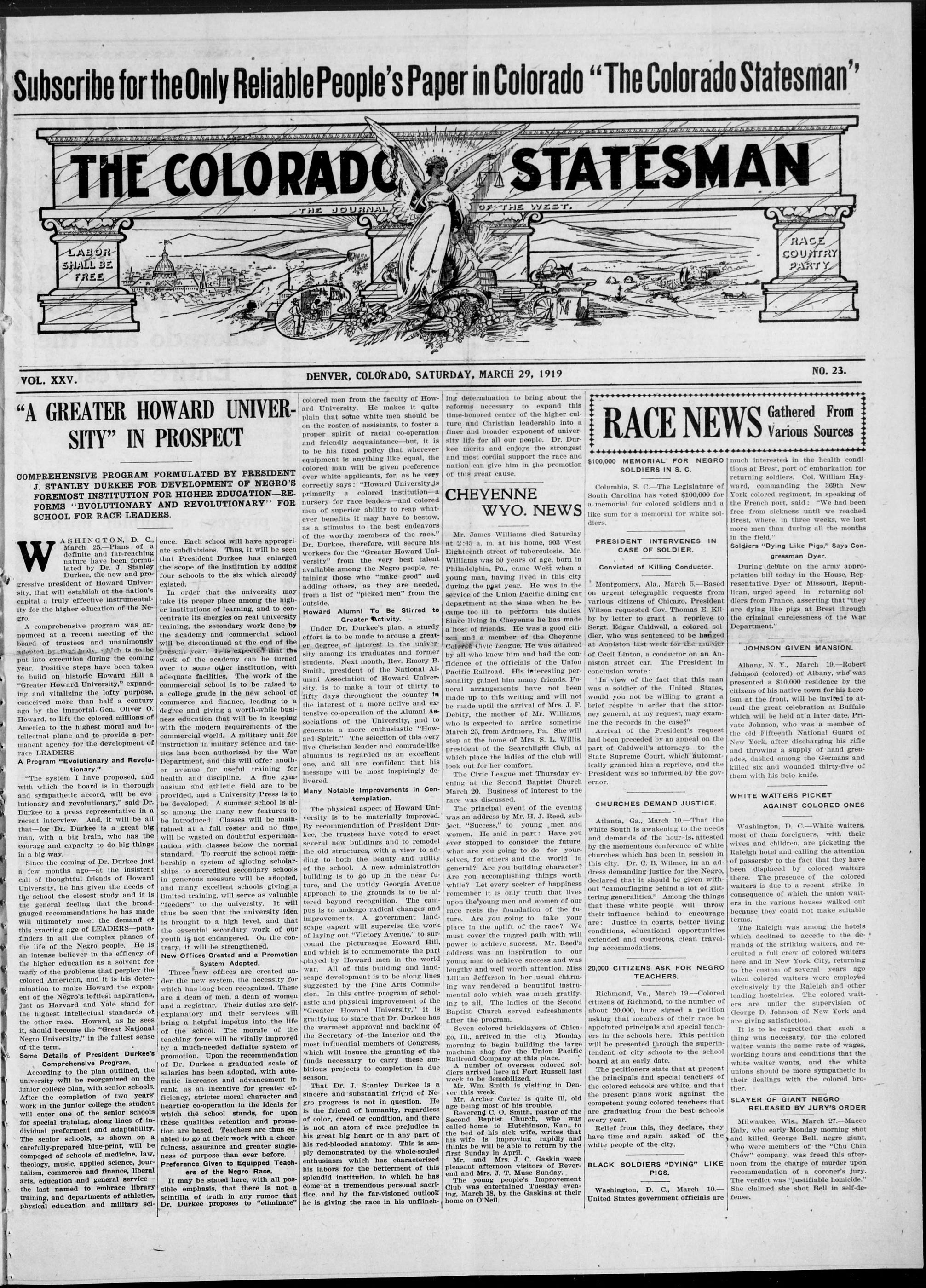
"A GREATER HOWARD UNIVERSITY" IN PROSPECT
COMPREHENSIVE PROGRAM FORMULATED BY PRESIDENT J. STANLEY DURKEE FOR DEVELOPMENT OF NEGRO'S FOREMOST INSTITUTION FOR HIGHER EDUCATION—REFORMS "EVOLUTIONARY AND REVOLUTIONARY" FOR SCHOOL FOR RACE LEADERS.
VOL. XXV.
"A GREATER HOS
SITY" IN
COMPREHENSIVE PROGRAM IN
J. STANLEY DURKEE FOR
FOREMOST INSTITUTION IN
FORMS "EVOLUTIONARY
SCHOOL FOR RACE LEADER
WASHINGTON, D. C.,
March 25.—Plans of a
definite and far-reaching
nature have been formu-
lated by Dr. J. Stanley
Durkee, the new and pro-
gressive president of Howard Uni-
sity, that will establish at the nation's
capital a truly effective instrumenta-
lity for the higher education of the Ne-
A comprehensive program was announced at a recent meeting of the board of trustees and unanimously adopted by that body, which is to be put into execution during the coming year. Positive steps have been taken to build on historic Howard Hill a "Greater Howard University," expanding and vitalizing the lofty purpose, conceived more than half a century ago by the immortal. Gen. Oliver O. Howard, to lift the colored millions of America to the highest moral and intellectual plane and to provide a permanent agency for the development of race LEADERS
A Program "Evolutionary and Revolutionary."
"The system I have proposed, and with which the board is in thorough and sympathetic accord, will be evolutionary and revolutionary," said Dr. Durkee to a press representative in a recent interview. And, it will be all that—for Dr. Durkee is a great big man, with a big brain, who has the courage and capacity to do big things in a big way.
Since the coming of Dr. Durkee just a few months ago—at the insistent call of thoughtful friends of Howard University, he has given the needs of the school the closest study and it is the general feeling that the broad-gauged recommendations he has made will ultimately meet the demand of this exacting age of LEADERS—pathfinders in all the complex phases of the life of the Negro people. He is an intense believer in the efficacy of the higher education as a solvent for many of the problems that perplex the colored American, and it is his determination to make Howard the exponent of the Negro's loftiest aspirations, just as Harvard and Yale stand for the highest intellectual standards of the other race. Howard, as he sees it, should become the "Great National Negro University," in the fullest sense of the term.
Some Details of President Durkee's Comprehensive Program.
According to the plan outlined, the university will be reorganized on the junior college plan, with senior schools. After the completion of two years' work in the junior college the student will enter one of the senior schools for special training, along lines of individual preferment and adaptability. The senior schools, as shown on a carefully-prepared blue-print, will be composed of schools of medicine, law, theology, music, applied science, journalism, commerce and finance, liberal arts, education and general service—the last named to embrace library training, and departments of athletics, physical education and military sci-
ence. Each school will have appropriate subdivisions. Thus, it will be seen that President Durkee has enlarged the scope of the institution by adding four schools to the six which already existed.
In order that the university may take its proper place among the higher institutions of learning, and to concentrate its energies on real university training, the secondary work done by the academy and commercial school will be discontinued at the end of the present year. It is expected that the work of the academy can be turned over to some other institution, with adequate facilities. The work of the commercial school is to be raised to a college grade in the new school of commerce and finance, leading to a degree and giving a worth-while business education that will be in keeping with the modern requirements of the commercial world. A military unit for instruction in military science and tactics has been authorized by the War Department, and this will offer another avenue for useful training for health and discipline. A fine gymnasium and athletic field are to be provided, and a University Press is to be developed. A summer school is also among the many new features to be introduced. Classes will be maintained at a full roster and no time will be wasted on doubtful experimentation with classes below the normal standard. To recruit the school membership a system of allotting scholarships to accredited secondary schools in generous measure will be adopted, and many excellent schools giving a limited training, will serve as valuable "feeders" to the university. It will thus be seen that the university idea is brought to a high level, and that the essential secondary work of our youth is not endangered. On the contrary, it will be strengthened.
New Offices Created and a Promotion System. Adopted
Three new offices are created under the new system, the necessity for which has long been recognized. These are a dean of men, a dean of women and a registrar. Their duties are self-explanatory and their services will bring a helpful impetus into the life of the school. The morale of the teaching force will be vitally improved by a much-needed definite system of promotion. Upon the recommendation of Dr. Durkee a graduated scale of salaries has been adopted, with automatic increases and advancement in rank, as an incentive for greater efficiency, stricter moral character and heartier co-operation in the ideals for which the school stands, for upon these qualities retention and promotion are based. Teachers are thus enabled to go at their work with a cheerfulness, assurance and greater singleness of purpose than ever before. Preference Given to Equipped Teachers of the Negro Race. It may be stated here, with all possible emphasis, that there is not a scintilla of truth in any rumor that Dr. Durkee proposes to "eliminate"
colored men from the faculty of Howard University. He makes it quite plain that some white men should be on the roster of assistants, to foster a proper spirit of racial co-operation and friendly acquaintance—but, it is to be his fixed policy that wherever equipment is anything like equal, the colored man will be given preference over white applicants, for, as he very correctly says: "Howard University is primarily a colored institution—a nursery for race leaders—and colored men of superior ability to reap whatever benefits it may have to bestow, as a stimulus to the best endeavors of the worthy members of the race." Dr. Durkee, therefore, will secure his workers for the "Greater Howard University" from the very best talent available among the Negro people, retaining those who "make good" and adding others, as they are needed, from a list of "picked men" from the outside.
ing determination to bring about reforms necessary to expand time-honored center of the higher ture and Christian leadership in finer and broader exponent of usiity life for all our people. Dr. kee merits and enjoys the stricth and most cordial support the race nation can give him in the prompt of this great cause.
CHEYENNE
WYO. NEW
Mr. James Williams died Sat at 2:45 a. m. at his home, 903 Eighteenth street of tuberculosis. Williams was 50 years of age, be Philadelphia, Pa., came West wi young man, having lived in this during the past year. He was in service of the Union Pacific dlin department at the time when h
Howard Alumni To Be Stirred to Greater Activity.
Under Dr. Durkee's plan, a sturdy effort is to be made to arouse a greater degree of interest in the university among its graduates and former students. Next month, Rev. Emory B. Smith, president of the National Alumni Association of Howard University, is to make a tour of thirty to fifty days throughout the country in the interest of a more active and extensive co-operation of the Alumni Associations of the University, and to generate a more enthusiastic "Howard Spirit." The selection of this very live Christian leader and comrade-like alumnus is regarded as an excellent one, and all are confident that his message will be most inspiringly delivered.
Many Notable Improvements in Contemplation.
The physical aspect of Howard University is to be materially improved. By recommendation of President Durkee, the trustees have voted to erect several new buildings and to remodel the old structures, with a view to adding to both the beauty and utility of the school. A new administration building is to go up in the near future, and the untidy Georgia Avenue approach to the grounds is to be altered beyond recognition. The campus is to undergo radical changes and improvements. A government landscape expert will supervise the work of laying out "Victory Avenue," to surround the picturesque Howard Hill, and which is to commemorate the part played by Howard men in the world war. All of this building and landscape development is to be along lines suggested by the Fine Arts Commission. In this entire program of scholastic and physical improvement of the "Greater Howard University," it is gratifying to state that Dr. Durkee has the warmest approval and backing of the Secretary of the Interior and the most influential members of Congress, which will insure the granting of the funds necessary to carry these ambitious projects to completion in due season.
That Dr. J. Stanley Durkee is a sincere and substantial friend of Negro progress is not in question. He is the friend of humanity, regardless of color, creed or condition, and there is not an atom of race prejudice in his great big heart or in any part of his red-blooded anatomy. This is amply demonstrated by the whole-souled enthusiasm which has characterized his labors for the betterment of this splendid institution, to which he has come at a tremendous personal sacrifice, and by the far-visioned outlook he is giving the race in his unflinch-
ing determination to bring about the reforms necessary to expand this time-honored center of the higher culture and Christian leadership into a finer and broader exponent of university life for all our people. Dr. Durkee merits and enjoys the strongest and most cordial support the race and nation can give him in the promotion of this great cause.
CHEYENNE WYO. NEWS
Mr. James Williams died Saturday at 2:45 a. m. at his home, 903 West Eighteenth street of tuberculosis. Mr. Williams was 50 years of age, born in Philadelphia, Pa., came West when a young man, having lived in this city during the past year. He was in the service of the Union Pacific dining car department at the time when he became too ill to perform his duties. Since living in Cheyenne he has made a host of friends. He was a good citizen and a member of the Cheyenne Colored Civic League. He was admired by all who knew him and had the confidence of the officials of the Union Pacific Railroad. His interesting personality gained him many friends. Funeral arrangements have not been made up to this writing and will not be made uptil the arrival of Mrs. J. F. Debity, the mother of Mr. Williams, who is expected to arrive sometime March 25, from Ardmore, Pa. She will stop at the home of Mrs. S. L. Willis, president of the Searchlight Club, at which place the ladies of the club will look out for her comfort.
The Civic League met Thursday evening at the Second Baptist Church March 20. Business of interest to the race was discussed.
The principal event of the evening was an address by Mr. H. J. Reed, subject, "Success," to young men and women. He said in part: Have you ever stopped to consider the future, what are you going to do for yourselves, for others and the world in general? Are you building character? Are you accomplishing things worth while? Let every seeker of happiness remember it is only truth that lives upon the young men and women of our race rests the foundation of the future. Are you going to take your place in the uplift of the race? We must cover the rugged path with will power to achieve success. Mr. Reed's address was an inspiration to our young men to achieve success and was lengthy and well worth attention. Miss Lillian Jefferson in her usual charming way rendered a beautiful instrumental solo which was much gratifying to all. The ladies of the Second Baptist Church served refreshments after the program.
Seven colored bricklayers of Chicago, Ill., arrived in the city Monday morning to begin building the large machine shop for the Union Pacific Railroad Company at this place.
A number of oversea colored soldiers arrived here at Fort Russell last week to be demobilized.
Mr. Wm. Smith is visiting in Denver this week.
Mr. Archer Carter is quite ill, old age being most of his trouble.
Revereng C. O. Smith, pastor of the Second Baptist Church, who was called home to Hutchinson, Kan., to the bed of his sick wife, writes that his wife is improving rapidly and thinks he will be able to return by the first Sunday in April. Mr. and Mrs. J. C. Gaskin were pleasant afternoon visitors of Reverend and Mrs. J. T. Muse Sunday. The young people's Improvement Club was entertained Tuesday evening, March 18, by the Gaskins at their home on O'Nell.
RACENEWS Gathered From Various Sources
$100,000 MEMORIAL FOR NEGRO
SOLDIERS IN S. C.
Columbia, S. C.—The Legislature of
South Carolina has voted $100,000 for
a memorial for colored soldiers and a
like sum for a memorial for white
soldiers.
PRESIDENT INTERVENES IN CASE OF SOLDIER.
Convicted of Killing Conductor.
Montgomery, Ala., March 5.—Based on urgent telegraphic requests from various citizens of Chicago, President Wilson requested Gov. Thomas E. Kilby by letter to grant a reprieve to Sergar Edgar Caldwell, a colored soldier, who was sentenced to be hunged at Anniston last week for the murder of Cecil Linton, a conductor on an Anniston street car. The President in conclusion wrote:
"In view of the fact that this man was a soldier of the United States, would you not be willing to grant a brief respite in order that the attorney general, at my request, may examine the records in the case?"
Arrival of the President's request had been preceded by an appeal on the part of Caldwell's attorneys to the State Supreme Court, which automatically granted him a reprieve, and the President was so informed by the governor.
CHURCHES DEMAND JUSTICE
Atlanta, Ga., March 10.—That the white South is awakening to the needs and demands of the hour-is, attested by the momentous conference of white churches which has been in session in this city. Dr. C. B. Wilmer, in an address demanding justice for the Negro, declared that it should be given without "camouflaging behind a lot of glittering generalities." Among the things that these white people will throw their influence behind to encourage are: Justice in courts, better living conditions, educational opportunities extended and courteous, clean traveling accommodations.
20,000 CITIZENS ASK FOR NEGRO TEACHERS.
Richmond, Va., March 19.—Colored citizens of Richmond, to the number of about 20,000, have signed a petition asking that members of their race be appointed principals and special teachers in the schools here. This petition will be presented through the superintendent of city schools to the school board at an early date. The petitioners state that at present the principals and special teachers of the colored schools are white, and that the present plans work against the competent young colored teachers that are graduating from the best schools every year. Relief from this, they declare, they have time and again asked of the white people of the city.
BLACK SOLDIERS "DYING" LIKE PIGS.
Washington, D. C., March 10. United States government officials are
NO.23.
much interested in the health conditions at Brest, port of embarkation for returning soldiers. Col. William Hayward, commanding the 369th New York colored regiment, in speaking of the French port, said: "We had been free from sickness until we reached Brest, where, in three weeks, we lost more men than during all the months in the field."
Soldiers "Dying Like Pigs." Says Congressman Dyer.
During debate on the army appropriation bill today in the House, Representative Dyer of Missouri, Republican, urged speed in returning soldiers from France, asserting that "they are dying like pigs at Brest through the criminal carelessness of the War Department."
JOHNSON GIVEN MANSION.
Albany, N. Y., March 19.—Robert Johnson (colored) of Albany, who was presented a $10,000 residence by the citizens of his native town for his heroism at the front, will be invited to attend the great celebration at Buffalo which will be held at a later date. Private Johnson, who was a member of the old Fifteenth National Guard of New York, after discharging his rifle and throwing a supply of hand grenades, dashed among the Germans and killed six and wounded thirty-five of them with his bolo knife.
WHITE WAITERS PICKET
AGAINST COLORED ONES
Washington, D. C.—White waiters, most of them foreigners, with their wives and children, are picketing the Raleigh hotel and calling the attention of passersby to the fact that they have been displaced by colored waiters there. The presence of the colored waiters is due to a recent strike in consequence of which the union waiters in the various houses walked out because they could not make suitable terms.
The Raleigh was among the hotels which declined to accede to the demands of the striking waiters, and recruited a full crew of colored waiters here and in New York City, returning to the custom of several years ago when colored waiters were employed exclusively by the Raleigh and other leading hostelries. The colored waiters are under the supervision of George D. Johnson of New York and are giving satisfaction.
It is to be regretted that such a thing was necessary, for the colored waiter wants the same rate of wages, working hours and conditions that the white waiter wants, and the white unions should be more sympathetic in their dealings with the colored brother.
SLAYER OF GIANT NEGRO
Milwaukee, Wis., March 27.—Maceo Ealy, who early Monday morning shot and killed George Bell, negro giant, who were members of the "Chu Chin Chow" company, was freed this afternoon from the charge of murder upon recommendation of a coroner's jury. The verdict was "justifiable homicide." She claimed she shot Bell in self-defense.
FOREIGN
Former Emperor Charles of Austria-Hungary and his family left Ekartau castle for Switzerland.
Alexandre Millerand, former minister of war, is reported to have been appointed governor of Alsace-Lorraine.
Premier Paderewski of Poland has sent to Herbert Hoover, director general of allied relief, a message of thanks for the food sent Poland.
Communication by wireless telephone has been established between Newcastle, New Brunswick, and Lyons, France, and also Belmar, N. J., by the Marconi Company.
The Chamber of Deputies of the duchy of Luxemburg has voted unanimously to maintain the independence and autonomy of that country, according to advices received in Paris.
The Dutch guard about the kaiser's residence was reinforced as the result of the receipt of letters threatening his life. Wilhelm was also said to have received a warning telegram from a friend.
Karl Radek, the leading Russian Bolshevik agent in Germany, who was arrested on Feb. 13 in connection with the Spartacan uprising, has been released by the German government, according to a Berlin dispatch.
During February more than 113,000 persons, or about 11 per cent of the entire population, died in Petrograd, according to Russian police statistics. American relief workers who left Moscow Feb. 12 say that deaths in that city early in February averaged 4,000 daily.
After successful trials of new British dirigibles of the rigid type of construction, the government, has ordered the building of two enormous airships. Each will be 800 feet in length and will have a capacity of 3,000,000 cubic feet. They will be driven by six engines which will generate a total of 1,800-horse power and, it is said, will have a lifting power of eighty tons compared with twenty-nine tons, the largest load carried by any known to be in existence.
SPORT
Ralph Brady of Syracuse, N. Y., and "K. O." Mars of Cincinnati fought a twelve-round draw at Boston.
H. Ralston and F. Smith of Detroit bowled into fifth place in the standings in the two-men events of the American Bowling Congress tournament at Toledo. Their score was 1.244.
Mike Gibbons, St. Paul middleweight, was given the newspaper decision over Leo Houck of Lancaster, Pa., in an eight-round bout at St. Louis. Local sport writers who viewed the exhibition from the ringside said Gibbons outfought his opponent in every round.
Edward J. Hannon of Sioux City, owner of the St. Joseph Western League baseball club, has made arrangements for the transfer of the team. Hannon made the final announcement that the club would be taken away from St. Joseph, but declined to say where it would go. The players have been ordered to report April 1 for practice. It is understood that the team will be transferred to Lincoln.
GENERAL
Two men held up the Iowa State Bank in the heart of the business district at Des Moines, and escaped with more than $20,000 in cash. The distillers of the United States are waiting only for the signing of a peace treaty in Paris to start a bitter war against the dry law of Nov. 21, last. The American Socialist Society was fined $3,000 in the Federal Court of New York by Judge Julius M. Mayer, on a conviction found Feb. 19 for violating the esplonage act. The conviction was based chiefly upon the publication by the society of "The Great Madness," a radical pamphlet.
According to information from London to local aviation fields at Dayton, Ohio, the altitude record of 28,900 feet made by Maj. W. R. Schroeder, McCook field, Sept. 18, 1918, stands unchallenged. A recount of Capt. Lang's English flight turns the honor of Maj. Schroeder, it was said by aviation officials.
A definite clew indicating that a pretty young woman may prove to be an important factor in the solution of the murder of Mrs. Julia Wilkins, whose husband, Dr. Walter K. Wilkins, is indicted, charged with murder in the first degree, has been found, according to detectives working on the case in Mineola, L. I.
Mrs. Margaret Reeves, wife of Melville Reeves, known as the "skyscraper burgler," was awarded $25,000 damages against Nicholas Hunt, former chief of detectives, and Detective Sergeant Charles Gratton, on her charge of false arrest. Mrs. Reeves charged the officers while seeking her husband, broke into her hotel apartment while she was in her bath and compelled her to dress in their presence. She sued for $75,000.
An offer to purchase American goods, which was interpreted as a bid for the United States to recognize the Bolshevik in Russia, was made in a statement issued by L. C. A. K. Martens in New York, who claimed to represent the soviet government in the matter.
Junius Spencer Morgan has begun his life work as a factor in New York's financial life. Despite the fact that he is but 22 years old, he has been elected to the directorate of the Liberty National Bank and will sit in council at the table with veteran financiers.
CONDENSATION OF FRESH NEWS
THE LATEST IMPORTANT DIS
PATCHES PUT INTO SHORT,
CRISP PARAGRAPHS.
STORY OF THE WEEK
SHOWING THE PROGRESS OF EVENTS IN OUR OWN AND FOREIGN LANDS.
Western Newspaper Union News Service.
WESTERN
The twelve I. W. W.'s in the Shawnee county jail at Topeka, on trial last week in Wichita, and which was postponed until September, are on a hunger strike.
A string of American motion picture theaters under American management will be established in Europe and the British isles by the "big four" combination of film stars forming the United Artists Corporation of Los Angeles, starring Miss Mary Pickford.
The trial of Frederic T. Woodman, mayor of Los Angeles, indicted on a charge of asking, agreeing to receive and receiving a bribe, is set for April 17. The early date was fixed at the request of the mayor's attorney, who said he wanted the case settled before the May municipal primaries.
William Rathbun, an Ida county farmer, in an affidavit introduced at the Iowa House judiciary committee's investigation of the pardon of his son, Ernest, after conviction of criminal assault, declared he gave George Clark, his attorney, $5,000 for the expressed purpose of delivering it to Governor W. L. Harding, for the pardon.
The Aviation Club of Chicago may make the first transatlantic air flight. Capt. B. B. Lipsner, president of the club, announced that an airplane capable of making the flight has been offered the club by a Dayton, Ohio, manufacturer, and that if present plans worked out a trial at a transatlantic flight will be made shortly.
A bullet intended for a target or for one of the small animals that make their homes in the Presidio hillsides at San Francisco took the life of 12-year-old Sallie Swift as she sat in her bedroom, in the opinion of the child's father, Maj. Eugene L. Swift, medical corps, and former chief surgeon of the Vancouver Barracks, Wash., base hospital.
Two men who burned their way into the vault of the First National Bank of Artesia, twelve miles southeast of Los Angeles, escaped with $3,000 in War Savings Stamps and $25,000 in Liberty Bonds. They used an acetylene torch and opened twenty-five safe deposit boxes. Fifty thousand dollars in cash in an inner safe was not taken.
WASHINGTON
Fraud or misrepresentation by private income tax advisers in many cities has been reported by revenue officers, and investigations are to be made by United States attorneys. Prosecutions are probable in a number of cases.
Between 500 and 600 Germans, no longer considered dangerous, will be released on parole from internment camps at Fort Oglethorpe and Fort Douglas within the next two weeks, it was announced at the Department of Justice.
All restrictions on sale or purchase of Italian lira exchange by "dealers" as described in the President's executive order of Jan. 26, 1918, covering foreign exchange restrictions, have been ordered removed by the Federal Reserve Board until further notice.
Cheaper food in the near future has been predicted by Chairman Peek of the Department of Commerce Industrial Board, as a result of a conference with Food Administration officials in New York.
An additional credit of $75,000,000 has been given Italy by the Treasury Department, bringing the Italian loans up to $1,496,500,000 and the total of credits to allied nations to $8,932,410,600.
Readjustment of shipbuilding costs to peace-time production is expected by experts of the Shipping Board to establish a basic price in the neighborhood of $150 a ton for future contracts let to American yards.
Differences between the management of the Postal Telegraph and Cable Company and Postmaster General Burleson, acute since the government assumed control of the telegraph and telephone systems, culminated in an order by the postmaster general summarily relieving the chief officers, directors and owners of the Postal Company from all duties in connection with government operation of their system.
Since the American troops overseas have stopped fighting they have taken to letter writing and remembering friends at home with souvenirs from the battlefields in France. This was indicated by a Postoffice Department announcement that the amount of mail from the American expeditionary forces had increased more than 20 per cent since cessation of hostilities.
Census report shows the cotton crop of 1918, excluding linters, to be 11,888,138 bales, counting round as half bales, compared with 11,248,242 for 1917.
SPORT
Pithy News Notes From All Parts of Colorado
Western Newspaper Union News Service.
The average wages of school teachers per month in Colorado vary from $68.84 in one-teacher schools to $103.45 in high schools.
The Child Welfare station is proving to be one of the most wonderful organizations in the city of Pueblo, both educationally and philanthropically.
The school board for the city of Englewood has tentatively sold bonds for $80,000 for construction of a new high school building during the coming months.
To Perry Majors, a Montezuma county rancher, belongs the honor for raising the biggest pig in the San Juan basin. The porker dressed 496 pounds and was sold for $84.24.
Colorado has more than 12,000,000 acres of agricultural land that has never been broken, or enough to support a farm population more than twice as great as the state now has.
Approximately 70,000 acres of sugar beets have been contracted in Weld county by the Great Western Sugar Company. This is almost double the normal acreage which is about 40,000 acres.
J. C. Cessma, 28, local manager of the Gilpin County Light, Heat and Power Company, was electrocuted at Central City on a pole when his hand slipped and came in contact with a high-powered wire.
Elmer McKee, 36, a Santa Fé locomotive engineer, died in La Junta as the result of leaping over a fence while going to assist a neighbor whose house was on fire. The jar tore loose a ligament near McKee's heart.
Colorado Springs and the Pike's Peak region will spend $20,000 in advertising during the coming year. In addition the hotels and amusement owners will spend an additional $5,000 as part of the publicity advertising campaign.
The Fort Collins House Building and Development Company is a corporation formed just recently, with a capitalization of $50,000, for the purpose of building fifty bungalows in Fort Collins, ranging in cost from $4,000 to $7,000 each.
A prairie fire that started in the Thomas Ord pasture near Falcon and about ten miles east of Colorado Springs caused damage to 3,000 acres of pasture land and completely destroyed 300 tons of hay before it could be checked.
With more than $250,000 worth of new buildings, public and private, already under process of erection and more in prospect, the building boom which has struck northern Colorado towns seems to be most pronounced at Windsor.
The annual dividend of the Grand Junction Fruit Growers' Association has just been paid out. The total business was $1,337,439 and the net profits $14,483.50. The dividend paid was 10 per cent and 1,025 stockholders received checks.
Silos are swelling the profits of the cattle and lamb feeders of the Greeley district. Silage raised on farms east of Greeley has been selling at $10 a ton from the silo. Some fields have yielded thirty tons to the acre, making a $300 crop on $250 land.
With a determined spirit to help put Denver and Colorado in the honor list for a 100 per cent subscription to the Fifth—and last—Liberty loan, the leaders of Denver's army of 2,000 women war workers are organizing their forces for the drive to start April 21.
Although totally blind, Emil Anderson, a Greeley farmer, pleaded his own case and cross-examined witnesses so cleverly that he won a $25 verdict against Robert Ragen of Loveland in Justice Court. Anderson claimed that Ragen took advantage of his blindness and misrepresented a team of horses sold to him.
The Greeley Home Building Company, a syndicate, will build sixty houses in Greeley this summer. Contracts for lumber and other material for the first group of six houses have been let to a lumber company and agents are buying every available lot in the residence district south of State Teachers' College.
Five Greeley banks and the bank of Keota will finance extensive experiments in the summer fallowing system of dry land farming in the Keota district, fifty miles east of Greeley. Units of ten farmers, each of whom will summer fallow fifty acres of land, are being made up, and the banks will advance $10 on each acre, plowed, summer fallowed and cropped. Thirty farmers have already entered the experiment, and the $15,000 necessary for financing them will be available May 1.
In looking for bootleggers, Sheriff Gormley of Brighton stopped a wagon-load of hay because he thought the driver looked suspicious. A case of whisky was discovered under the hay. A deputy went to the home of the owner and found several more cases in the haymow of the barn. He went to the nearest phone to notify the sheriff and while he was gone the booze disappeared. A search of the premises was made and it was found under a pile of rubbish in a ditch. The owner of the farm said the liquor was the property of another.
---
CENTENNIAL-STATE ITEMS.
Charles Mills, manager of the Brush Oil and Supply Company, had an exciting experience which he will not soon forget. The company had a car of gasoline to unload and in making the connection with the pipe line the car valve did not work and 4,600 gallons of gasoline were lost before the connection could be made. Mr. Mills and a car repairer for the Burlington were nearly drowned in the gasoline while frantically trying to make the connection. The gas flooded the tracks and ran down the alley. Bystanders cautioned everybody in the vicinity as to the danger of fire, which, had the gasoline become ignited, would have caused a serious disaster. About 3,500 gallons of gasoline were saved, but the loss of $066 worth of the liquid was suffered by the company.
THE COLORADO STATESMAN
An infestation by the bark beetle, more serious than any found since that in the Black Hills in 1901, has appeared in the Durango National forest. Thousands of acres are infested and immediate action is to be taken by officials of the Forestry Department to check its spread. The infestation is said to be similar to that which once appeared in the South Dakota forest. Although the pest has been found in Colorado before, no extensive infestation has appeared. At least 25,000 acres of timber in the Durango forest is more or less infested by the beetle.
The Mouth-Piece of the People of Colorado and the Entire West
Beet growers have contracted to plant more than 22,000 acres of sugar beets in the Brighton district. The contracted acreage last year was about 10,000. Some of the acreage this year is over in the Hudson country, twelve miles northeast of Brighton. Of this there are about 1,500 acres that cannot be handled unless new railroad spurs are built, and that matter is now being worked out by the sugar people and the railroad.
Tons upon tons of potatoes raised in the dry farm districts around Grover are being fed to hogs and cattle because farmers refuse to haul them ten or twelve miles to a railroad shipping point when they are selling at only 90 cents per 100. This condition has brought about a renewal of the agitation for more railroads and a committee is now actively at work endeavoring to induce the Union Pacific to extend its Briggsdale branch.
A RELIABLE chronicle of their doings and progress; a faithful mirror of their wants, their hopes, their best aspirations.
With but one dissenting vote, a drainage district embracing 1,200 acres of valuable land adjoining the town of Windsor was created at a special election. This is the first district of its kind to be created in northern Colorado and only the second one in the state since the passage of the law permitting formation of such districts. W. H. Teller, Charles Sorrels and G. W. Helps were elected directors of the district.
The annual report of the Buck Aircraft and Munitions Company of Pueblo has been cancelled by Secretary of State James R. Noland for alleged failure of company officials to meet the financial obligation covering corporation taxes. The company owed $449 for taxes and for the filing of the report, and according to the state officials, this amount was met in part by a check which was refused by the bank.
THE COLORADO STATESMAN
A baggage and mall express car on a west-bound Santa Fé passenger train caught fire while in motion east of Baxter, and, with its contents, was destroyed. The touring car was switched onto a sliding at Baxter and an engine summoned from Pueblo to bring it to Pueblo. The fire continued to burn until the car reached Pueblo, by which time it was practically consumed.
Unequaled as an advertising medium for the business of professional men and women.
The feed situation for stock in the San Juan basin is critical. Many of the stockmen are out of feed now and practically all the hay will be gone in a week or ten days. What hay is available is selling at $40 per ton, although some is being shipped in from the Grand valley section that costs approximately $32 per ton laid down.
In spite of severe injuries hopes are held for the recovery of Miss Doris Heller, who fell from a ledge of the twentieth floor of the Daniels & Fisher tower to the balcony of the seventeenth floor, forty feet below, miraculously escaping instant death in Denver. Miss Heller lay on the balcony calling for help from Saturday until Monday, when she was discovered by Joseph Taylor, an electrician. X-ray examinations revealed a severe fracture of the spine and fractures in both feet. Dr. Haskell Cohen, who attended the girl at Mercy hospital, declared that in spite of these developments she had a chance to recover.
An excellent family journal speaking to and for many thousand colored citizens.
The way of the "fake bootlegger" is destined to become harder and harder in this vicinity. James Martin, of color, of Atlanta, Ga., charged with selling water colored with coffee, and alleging it to be whisky, at $12 per quart, was fined $6 for vagrancy and an extra fine of $16 for his get-rich-quick scheme under the charge of selling without a license. Numerous cases have been reported of "honey" whiskey being sold at from $10 to $12 per quart.
TWODOLLARSAYEAR
THE GREAT ORGAN OF THE
For the second time within eight months the home of T. B. McPherson, rancher of the Masters district, was destroyed by fire. On both occasions the McPherson family was away from home when the fire broke out. Loss from the last fire is estimated at $4,000.
The Longmont district will raise the largest sugar beet acreage in any one section, or for any one factory, in Colorado, this year. There have been upwards of 22,000 acres already contracted for and additional acreage is being signed daily.
There Will Be No More Joy and Satisfaction at 1505 Lawrence St.
INSTEAD
WE WILL DEPOSIT OUR JO
CENTRAL SAVINGS BANK EU
COMPOUND INTEREST IN SE
DEPOSIT OUR JOY AND SATISFACTION IN THE SAVINGS BANK BUILDING, WHERE IT WILL BEAR INTEREST IN SERVICE AND QUALITY.
WE WILL DEPOSIT OUR JOY AND SATISFACTION IN THE CENTRAL SAVINGS BANK BUILDING, WHERE IT WILL BEAR COMPOUND INTEREST IN SERVICE AND QUALITY.
We have long been handicapped for more room and our large patronage has demanded it, so we have secured the best location in the city, where we will serve you.
Our new establishment will be the most modern and fully equipped in the country.
You will enjoy coming there as it will be convenient, beautifully lighted and artistic, a pleasant place to meet your friends as nearly all car lines enter the Loop, alongside the display windows of the new Joy shop.
In our new establishment the most courteous service (for which Joy's employees are noted) will be extended to you.
JOY'S BUTTER SHOP has moved to the Central Savings Bank Building on Fifteenth Street, between Lawrence and Arapahoe. MEET THE JO
MEET ME AT THE JOY SHOP
THE JOY SHOP
ADDRESS: TRAMWAY LOOP
Weatherh
TELEPHONE
MAIN 3203
atherhead Hat Co.
```markdown
```
```markdown
```
RENOVATORS, BLEACH
Of Gents' and Ladies'
1624 CHAMPA
DVATORS, BLEACHERS, DYERS AND FINISHERS Of Gents' and Ladies' Hats of Every Description 1624 CHAMPA ST., DENVER, COLO.
RENOVATORS, BLEACHERS, DYERS AND FINISHERS Of Gents' and Ladies' Hats of Every Description 1624 CHAMPA ST., DENVER, COLO.
Taxicab Rates.
Depot, 1 or 2 pass.....500
Depot, each addi-
tional pass.....250
One mile radius.....500
Each addition'1 mile.....500
pass .....250
radius.....500
dition'l mle.250
Rates Per Hour.
$1.50 to $2.50.
Phone Main 6699
Bean Auto Livery
HEATED TAXI CAB.
HOLE 8 AND 7-PASSENGEP 1918 LATE
MODEL CARS.
Bean Au
HEATER
COLE 8 AND 7-P
MOD
HEATED TAXICAB.
COLE 8 AND 7-PASSENGEP 1918 LATE
MODEL CARS.
STAND: NIGHT AND DAY CAFE
1865-1867 Curtis St.
---
Phone Champa 5431
NIGHT AND DAY CAFE AND COLD DRINK PARLOR
NIGHT AND DAY CAFE AND COLD DRINK PARLOR
A Full Line of Fresh Fish in Season
Oysters and Lobsters
Short Orders At All Hours Rest Room for Ladies
CURTIS STREET DENVER, COLORADO
1865-1867 CURTIS STREET
The
The
Curtis
Park
Floral
Company
FLORAL DESIGNS PUT UP WHILE
YOU WAIT
FLORAL DESIGNS PUT UP WHILE YOU WAIT
CHOICE PLANTS AND CUT FLOWERS CONSTANTLY ON HAND
GREENHOUSES: Thirty-Fourth and Curtis Streets
TELEPHONE, MAIN 1811 DENVER, COLO
REMEMBER:
Established 1876
```markdown
```
OUR NEW LOCATION
PHONE MAIN 6453
PIONEER HATTERS
OF THE WEST. WE
MAKE OLD HATS
NEW.
Motto: "Not slow but
sure." Cash only.
Rates Per Hour.
$1.50 to $2.50.
Denver, Colorado
Private Booths for Ladies
B. CARRUTH, Proprietor
MEDAL WAITS FOR AN UNKNOWN HERO
MAJOR SIBERT SEARCHING FOR CERTAIN STRETCHER BEARER OF 308TH INFANTRY.
STORY OF DESPERATE EXPLOIT
Flame and Gas Officer With Two Volunteers Had Exciting Experience Back of Enemy Lines—Gallant Deed of Unnamed Man.
By EDWARD B. CLARK.
Washington—Somewhere in the United States, or in France, is a soldier, name unknown, who if he can be found will learn that he has been or is to be recommended for a distinguished service medal for high conduct in face of the enemy.
This unknown soldier in late September last was acting as a stretcher bearer in Company K of the Three Hundred and Eighth United States infantry, which was a part of the Seventy-seventh United States division.
In Washington today a major of the army, William O. Sibert of the gas and flame service, is doing what he can to find out who this hero was in order that his name can be put into the proper place on the recommendation for a medal.
Major Sibert went to France with the writer hereof. The major had great luck. Almost immediately he got into the thick of the fight, but later his luck was not so great, for after a hard and heroic exploit he contracted double pneumonia and was invalided back to the United States with a fine record in the field to his credit. Today Sibert is entirely recovered and it is his desire to endeavor to locate the man who on an occasion in the Argonne forest showed himself to be such a gallant American.
Got Behind the German Lines.
On September 26 last Major Sibert, who was the division gas officer of the Seventy-seventh division, went out to the last post at the front and from there undertook, with three men who had volunteered for the service, to locate a certain position. They went over the top and worked their way as well as they could through all kinds of entanglements, artificial and natural. One of Sibert's men became lost, but later found his way to a detachment of engineers. The major and his two remaining volunteers then struck out straight north.
Before long, to their surprise, they realized that they were well behind the German lines. Instantly three Germans appeared round a corner of a knoll, an officer and two men. They never will appear on earth again. The Americans killed all three.
The Americans then endeavored to make their way back toward their own lines and on the way they picked up more German prisoners. Later they gathered in others, for almost in every instance the Americans succeeded in getting the drop on the surprised enemy, although before that day's journey was ended the detachment had several severe fights and several close-shave escapes.
Finally the little outfit ran into an American engineer platoon that also had got behind the German lines through some error of direction. The now enlarged detachment was making its way up a hill toward the place where it was thought a French outfit was stationed. It was opened on with heavy fire. The men broke for some dugouts, losing several in dead and wounded.
One of Sibert's original volunteers had a hole in the side of his head and died an hour afterward. Several of the German prisoners were killed by the fire of their own people. Gallant Deed of the Unknown Man.
Major Silbert called for two volunteers to crawl through to the American lines so that word could be passed to the artillery to get busy on a certain German battery, and also to inform the Americans of the exact position of the little lost contingent.
One of the men who volunteered was one of the three original privates who had volunteered in the first instance to go with Major Silbert on his perilous errand. As will be remembered, one of these three original volunteers got lost on the way and another was killed. This third man made his way through terrific fire back to the American lines and performed successfully his perilous errand.
It is for this man, name unknown, Major Sibert just now is searching. He wants him to get his decoration. Eventually his name probably will be made known and if alive he may get the medal that he deserves, and if dead his parents may be given it in his place.
**Army of Ball Players and Fans.**
A general officer of the American expeditionary forces spoke one day of our combined units in France as "an army of baseball players."
The general was not far from right. It is probable that every man in our forces on the other side at some time or other in his life had played the great national game. It also is probable that at least three-fourths of the men in the service overseas, and on this side, too, for that matter, regularly had given over their Saturday afternoons and their other times of release from work to the sport of baseball
There were many professional base-
bail players in the ranks of the men abroad. To name, only three or four of the better known ones among them, there were Christy Mathewson, Hank Gowdy, Ty Cobb and Eppa Rixey. When Mathewson, Cobb and Rixey were commissioned as captains in the gas and flame service of the United States there was some criticism of the action. Why, it was asked, should these men be given captaincles when they had had no previous military experience? There was a real reason for making men of this kind captains of the gas and flame service.
These men were known undoubtedly to every soldier in the American expeditionary forces. A gas officer has services of a peculiar kind to perform. It is necessary for him to have the close attention of his men when they are under instructions and it is necessary also that the instructor should be a man well qualified physically to do things well, and in a hurry, and should so impart the lessons to others that they will be equally capable and alert. Going to the Front With Rixey. With Eppa Rixey, the left-handed twirler of the Philadelphia Nationals, I had 24 hours of intimate acquaintance. A man can live a long time in 24 hours when he is on or near the battle front in France. Rixey is a fine type of soldier. He is still in service.
One day some time before the armistice went into effect I was in Soullily, not far from Verdun. This place then was the field headquarters of General Pershing. From Soullily I was to go to the front in the Argonne to report to Gen. Joseph T. Dickman, then in command of the First army corps.
At Soullily I was waiting for an opportunity to hop into a motorcar and proceed the 100 miles necessary to be traversed before reaching the First corps' headquarters. Along came Captain Rixey in an open motor with his bedding roon, his gas mask and his tin hat. He had been ordered to proceed to the far front to act as gas officer of one of the fighting divisions.
This baseball pitcher, who is a nephew of a former surgeon general of the United States navy and a graduate of the University of Virginia, stands about 6 feet 4 inches in his hiking shoes, and he is big in proportion.
It was some ride that Eppn Rixey and I undertook that day. It was as cold as France in October knows how to be, as windy as it was cold, and most of the time it was "training harder than both."
I came pretty near freezing, because my bones are not clothed with as much flesh as Rixey can boast. Moreover, I am old enough to be his father, and then some. That day he looked after me much as a good son looks after his father, and this was not due to the fact that I ranked him in the army.
Facts About the New Senate.
The senate of the United States, as it will be constituted in the Sixty-sixth congress, is as follows: Presiding officer, Thomas R. Marshall, vice president of the United States, Democrat; Republican senators, 49; Democratic senators, 47; total 96. It is easily conceivable, therefore, that occasionally Thomas R. Marshall may have the deciding vote as between the parties, provided a Republican is absent or elects to vote with the opposition on any particular measure.
One of the seats in the senate is a subject of controversy. It is that of Truman H. Newberry of Michigan, who holds the credentials. His right to the seat is contested by Henry Ford, automobile manufacturer. Newberry has the party advantage, and if things go in a straight party way he probably will hold on to his seat.
The men who will take their seats in the senate for the first time are Byron P. Harrison of Mississippi Augustus O. Stanley of Kentucky, Arthur Capper of Kansas, David I. Walsh of Massachusetts, Walter E. Edge of New Jersey, Henry W. Keyes of New Hampshire, Medill McCormick of Illinois, Truman H. Newberry of Michigan and Lawrence C. Phipps of Colorado.
Of the newly elected senators, four were the governors of their respective states at the time of their election. These are Stanley, Capper, Edge and Keyes. Walsh of Massachusetts is a former governor of that state.
Two Move Up From House.
Two senators have just received promotion from the house of representatives. They are Harrison of Mississippi and McCormick of Illinois. Senator-elect L. Helsler Ball of Delaware was formerly a member of the house of representatives and at one time was a senator of the United States. Davis Elkins, Republican senator-elect from West Virginia, some years ago was elected to the United States senate to fill 40 days of the unexpired term of a deceased senator. Some of the other senators-elect are not new to Washington life. Take Truman H. Newberry, for instance, who for a long time was assistant secretary of the navy and for a short time its secretary.
Newspaper men are not unknown in the United States senate. Warren G. Harding of Ohio is the proprietor of the Marlon Star. George H. Moses of New Hampshire was associated for 19 years with W. E. Chandler on the Concord (N. H.) Monitor. Senator Gilbert M. Hitchcock of Nebraska has his name closely connected with the Omaha World-Herald. Senator Arthur Capper of Kansas has the Topeka Capital and other papers. Harry S. New is an old time newspaper man, as was his father before him, although in recent years he has departed from the "feld alluring." So far as one can learn from the perusal of the senatorial list Robert N. La Follette is the only magazine editor among those present.
Buy his Easter Clothes at the Big Man's Store
MEN'S AND YOUNG MEN'S NEWEST SPRING SUITS
A mammoth selection of the world famous "Society Brand" make of clothes for men and young men, including the season's very newest models, extra quality fabrics, latest colorings and up to the minute patterns, specially priced for this sale at $31.50.
$31.50
Special
Sale
this week of
Splendid
$19.00 $31.50
Spring Suits for Men and Young Men Substantial savings offered on all new spring lines of Men's and Women's Shoes, Boy's Clothing, Men's Hats, Shirts, Neckwear and Leather Goods
Union Label Wear-
apparel
AY CO.
CITY BRAND CLOTHES
ressing Parlors
LOCAL P AND HAIR TREATMENT
ING, TOILET ARTICLES
Headquarters for Union Label Wear ing Apparel THE MAY CO. THE HOME OF SOCIETY BRAND CLOTHES
Poro Hair Dressing Parlors
SCIENTIFIC AND SANITARY SCALP AND HAIR TREATMENT
MASSAGING, MANICURING, TOILET ARTICLES
Motto—"Efficiency"
Mme. Lexie A. Brooks
2220 OGDEN STREET
PHONE YORK 5997W
To Friends and Strangers of Denver
Attention!
The Sun Beam
Wishes to welcome all to good home cooking and dainties of the seasons, any time from 6 a. m. to 11:30 p. m. Accurate service at all hours; so when down town stop, give us a trial and we will guarantee you will leave with a smile. MRS. M. J. FRANKLIN & S. BOWERS, Props. 924 19th St.
FIVE POINTS WHY YOU SHOULD DANCE AT FERN HALL
POINT ONE—Morrison's Full Orchestra furnishes the music.
POINT TWO—Thursday is in the middle of the week.
POINT THREE—We don't tolerate anything but decent actions at our dance.
POINT FOUR—Dancing is healthy. Science has proven it.
POINT FIVE—You can meet the prettiest girls in the whole world at
Fern Hall Every Thursday Night
FIVE POINTS DANCING CLUB.
MEN'S AND YOUNG MEN'S NEWEST SPRING SUITS
A great lot of fine Suits, comprising hundreds of smart novelty patterns and models in fancy Worstedes, Cassimeres and Cheviots; also splendid quality wire woven blue Serges in single or double-breasted styles, all included at the sale price of
$19.00.
O. A. D. B. C.
Society Brand Clothes
2220 OGDEN STREET
VINEGAR
PHONE YORK 5997W
THE COLORADO STATESMAN
DE JEWELS
DE THE VARS
CABUN
BANQUE DE
FRAI
HACK
COUNTRY
PARTY
One Year ..... $2.00
Six Months ..... 1.25
Three Months ..... .75
Remittances should be made by Express Money Order, Postoffice Money Order, Registered Letter or Bank Draft. Postage stamps will be received the same as cash for the fractional part of a dolllar. Only 1c and 2c stamps taken.
Reading notices 10 cents per line. Display advertising, $1.00 per inch for first insertion, 50 cents per inch for additional issues.
No discounts allowed on less than three months' contract. Cash must accompany all orders from parties unknown to us. Further particulars on application.
Communications to receive attention must be newsy, upon important subjects, plainly written only upon one side of the paper, must reach us Tuesdays, if possible, anyway not later than Wednesdays, and bear the signature of the author. No manuscript returned, unless stamps are sent for postage. All communications of a personating nature that are not complimentary will be withheld from the columns of this paper.
THE abuse of charitableness is a far too prevalent sin among colored people, and one that is not criticised enough for their own good. It is a common thing with many to consider themselves standing objects of provident consideration at the hands of their white acquaintances or employers, and if they do not thus secure a certain amount of their livelihood, they consider their lots cast in hard and thorny places. The excusable trait in the ante-bellum Negro of considering himself the natural object of private charity, has, by force of example, taken too strong hold upon the principles and energies of the younger element, so that many of them look for favors and charities merely on account of their race identity. It should not be forgotten that the character of improvidence and servility attaches to a donor's estimation of the man or woman who is always looking for, wanting or ready to accept donations and gifts. To provide for the common beggar the community establishes boards of charity and poorhouses, but those who regularly seek and expect charity contributions and favors, while not confessed beggars, come to be regarded as an improvident load and responsibility upon those who happen to be thrown into business relations with them. This causes many people to despise the Negro, while others soften their contempt into an idea of general indolence and worthlessness. Colored men, and especially those who pretent to be men of integrity and understanding, need to cultivate pride and self-dependence to the extent that all their dealings with white people shall be strictly upon a basis of right and merit. A colored business man who asks patronage or other favors because he is colored, or poor, or sick, or otherwise unfortunate, is not doing a legitimate business as white men do it, but is simply masking beggary. The only way to gain a respectable standing, either in the business world or the field of labor, is to go in upon your merits and give value received for the benefits and rewards that you earn. No merchant or other business man is under any obligation to show you favors because you are indigent; nobody is under obligation to employ or favor you because you are poor. You must learn to compete with others in your sphere upon the ground of individual merit. To accept such a competition manfully will not only instill a spirit of independence and worthiness in those that accept it, but a high respect in the minds of those that observe it. A colored business man who is able, energetic and full of business, inspires not only others of his own race, but all others with whom he comes in business contact. The lack of thrift, independence and business energy and the prevalence of charitable expectancy are probably the causes of many business failures among colored men. They expect charitable consideration for their inability or neglect to equal others in their line, and when people grow tired of such concessions, as they are soon bound to do, their enterprises collapse. Charity carries its limit. As a private virtue, its repetition entails the loss of respect, as a public necessity it is at the best a cold service. In both business and community relations the colored people will do well to get beyond its necessity as soon as they possibly can.
THE clash between American marines and the Japanese at Tien-Tsin ordinarily would be passed over as mere treaty port row such as has many times occurred and been smoothed over by a little diplomatic treatment. For the matter of that, it will probably pass away in that fashion, but just at the moment it is quite likely to be magnified into something more important. This is because it will be coupled with the demands made at Paris by the Japanese for recognition without regard to racial distinction. In so many words, the Japs insist that we recede from our Asiatic exclusion policy.
America did not adopt the restrictions against the Mongolian races entirely for economic reasons. Whether it be frankly admitted or not, there still persists in this country in strong degree the prejudice of the white against the colored races, whether black, brown or yellow. We have an unsolved problem in this connection, that of the treatment accorded the American Negro. Although under an amendment to the constitution we have granted him all the rights of the white man, in practice he is not allowed to enjoy those rights.
It is not merely for political effect the Bee refers to this, but because of a sincere concern for the interests of a race that has not had a square deal in America. Until we have been able to adjust relations between the whites and blacks in America, and have so provided that distinctions between individual citizens will not rest on the color line, it would seem unwise to further complicate the problem of the unrestricted admission of the yellow race.
We cannot lift the bars for the Japanese and not for the Chinese; with freedom for them, we are confronted by the Malays and the Hindus, and by a confusion that will be troublesome in the end. Our melting pot is already more than gorged, as we discovered when thrust into war. America may yet become the great amalgamation center of the world, but not until the habits of thought of our present population undergoes a decided change.—Omaha Bee.
P. O. Box 116
MUST BE PAID IN ADVANCE.
pass matter at the postoffice in the
should be made by Express Money On
letter or Bank Draft. Postage stamps
fractional part of a dollar. Only 2
cents per line. Display advertising.
on 50 cents per inch for additional
on less than three months' contra-
parties unknown to us. Further par-
to receive attention must be news,
only upon one side of the paper, not
not later than Wednesdays, and be-
script returned, unless stamps are
personating nature that are not
cums of this paper.
THE LIMITS OF CHARITY
charitableness is a far too prevalent one that is not criticised enough for with many to consider themselves at the hands of their white men do not thus secure a certain amount of lots cast in hard and thorny pallum Negro of considering himself, has, by force of example, taken an emerges of the younger element, and charities merely on account of the written that the character of improvisation of the man or woman is ready to accept donations and give to the community establishes boards who regularly seek and expect charitiesessed beggars, come to be regularity upon those who happen to be in contempt into an idea of general men, and especially those who are outstanding, need to cultivate pride and their dealings with white people and merit. A colored business man because he is colored, or poor, or suffering a legitimate business as wholly. The only way to gain a less world or the field of labor, is received for the benefits and real business man is under any objection indigent; nobody is under objection are poor. You must learn to the ground of individual merit. You will not only instill a spirit of indebted it, but a high respect in the old business man who is able, energetic others of his own race, but all contact. The lack of thrift, independence of charitable expectancy and failures among colored men. They are inability or neglect to equal other freed of such concessions, as they are slapse. Charity carries its limit. At the loss of respect, as a public In both business and community, to get beyond its necessity as soon
"A WHITE MAN'S COUNTRY."
In American marines and the Japs be passed over as mere treaty port, he been smoothed over by a little hat, it will probably pass away in quite likely to be magnified into because it will be coupled with the use for recognition without regard the Japs insist that we recede from
Phone Main 7417
Four Essentials of Boy's Success Are Health, Honesty, Education, Work
Four Essentials of Boy's Success Are Health, Honesty, Education, Work
By E. W. BEATTY, K. C., President Canadian Pacific Railway
tend to a man's success. The first is good health. It is impossible for a boy or man to work against the handicap of poor health. The next thing is honesty. No man in this or any other country who was not honest attained success. He may appear to do this for a time, but when his dishonesty is discovered—which it will be sooner or later—his success is at an end and his failure begins. The third essential is education; without education it is impossible to climb to any important position. The fourth essential is work. Nothing was ever accomplished without work, and if any man tells you differently it is not the truth. During the coming years many capable men will be required to fill important positions, and he who has the essentials to which I have referred is the one who will get the preference.
The things we admire most in other men are the qualities we should develop in ourselves. The first is honesty, the second courage, and the third modesty. Without courage one cannot go very far in this world. If a man is content to step aside for others he is bound to lose. Without modesty no man can secure the respect of his fellow beings. Every man's hand is against the man who shows he believes himself better than others. When I was a youngster my father, who was a very wise man, used to say, "Never think you are better than anybody else; but always think you are just as good." Modesty has become very unpopular and is now almost obsolete; nevertheless, it is one of the finest qualities a boy or man could have.
War Has Made the Woman Problem More Complex and Her Lot More Hard
War Has Made the Woman Problem More Complex and Her Lot More Hard
The effect of war-debt taxes will be to make living conditions for the laboring masses of Europe less tolerable. These conditions must tend to promote emigration from Europe to the countries of relatively less unpromising conditions—to the United States, for instance, where the war burdens will be comparatively light. One aspect of the post-war problem is most serious and most tragic. Europe, and measurably also America, has before it the series of problems that must attend a surplus of marriageable women over marriageable men. Society never runs safely or wholesomely on this basis. What must Europe immediately do with its millions of girls maturing into war spinsters?
Surely they will have to work. And certainly there will be need for their work. But it will be work under the stress of a new and dire necessity—not merely for self-maintenance but to help pay taxes for a war debt and to support the war invalids—work under even worse conditions than ever homeless, self-dependent, unmated, childless and hopeless women have earlier known. Emigration will therefore especially appeal to the women. Europe, no matter how rigorous in holding its men, will let its surplus women go; possibly it may assist them to go.
But in many parts of America the women somewhat outnumbered the men even before the war. How, then, shall America set about it to make room for the new women immigrants? Even those of our women that found and accepted work during the stress of war are now being discharged—a personal injustice and an institutional perversity past all belief.
Inevitably the war has added new aspects to the woman problem, not merely because of the men that are dead, the home fires that will not be lighted, the children that will not be born, but also because of the millions of women that, spinster-doomed, must now enter the struggle for a separate maintenance. But it is not entirely inevitable—in some part it is merely stupid and cruel—that this struggle the women now have to face in a world that has never more than grudgingly and partially shared its opportunities with them, and that now, debt-ridden, has only meager opportunities to share.
"If the Farmer Quits the Machinery of Human Endeavor Will Cease"
Agriculture is and must be the greatest factor in reconstruction. This is no time for little things. We need a chamber of agriculture that is big enough and broad enough to realize the importance of creating such conditions in the country that our best and brightest and brainiest people will be attracted to the farm, for the reason that the activities of the city are measured by the productive power of these farms.
We must not forget that agriculture calls for our best thought and our best effort. We must remember that farming is the biggest, the most important job on earth, because every other man's job depends upon the job of the farmer. If the farmer quits the merchant will have to quit, the manufacturer will have to quit, the railroad man will have to quit, the laboring man will have to quit. The whole machinery of human endeavor and human government will cease—even life itself. The most important thing on earth is a human being; the next most important thing is that which makes it possible for that human being to exist—the production of food.
Two great armies won the war—the army that served on the battlefield and the army that served in the harvest field. The latter army was mobilized within twenty-four hours after the declaration of war. As it was the first army to rally to the defense of the flag, so it will be the last army to cease fighting for world freedom. While the army of the battlefield is being demobilized the army of the farm is facing the tremendous task of furnishing 60 per cent of the world's food during the coming years
PETER B.
A man from his shoulders down is worth $2.50 a day; but from his shoulders up there is no limit to his earning capacity. I never saw a boy or man who got anywhere if he did not work. As a boy grows older he will find the competition between men very keen, and he who is fairly well educated has a distinct advantage over the man who is not.
Every boy has some kind of a vague idea that he would like to be something or other when he grows up, but he does not know just what. He will find, however, that there are three or four simple things that
By PROF. H. J. DAVENPORT, Cornell University
of war-debt taxes will be to make living costs of Europe less tolerable. These conditions migration from Europe to the countries of conditions—to the United States, for instance—will be comparatively light. One aspect is serious and most tragic. Europe, and before it the series of problems that must women over marriageable men. Society rests on this basic. What must Europe immigrate girls maturing into war spinsters? Why will have to work. And certainly there, it will be work under the stress of a new for self-maintenance but to help pay the war invalids—work under even without, self-dependent, unmated, childless earlier known. Emigration will therefore be Europe, no matter how rigorous in hold women go: possibly it may assist them to any parts of America the women somehow before the war. How, then, shall America the new women immigrants? Even those accepted work during the stress of war personal injustice and an institutional peril the war has added new aspects to the women of the men that are dead, the home fires children that will not be born, but also because that, spinster-doomed, must now enter aatenance. But it is not entirely inevitable rapid and cruel—that this struggle the women that has never more than grudgingly and with them, and that now, debt-ridden, share.
The Farmer Quits the Machine Human Endeavor Will Cease
he is and must be the greatest factor in for little things. We need a chamber of and broad enough to realize the importance the country that our best and brightest and to the farm, for the reason that the acti
Do Your Chickens Keep You?
Simpson's Hen Food.....$3.85 cwt.
Simpson's Buttermilk Mash.....$3.50 cwt.
SIMPSON SEED & FLORAL CO.
Fresh Vegetable and Flower Seeds 1551 CHAMPA ST.
Universal Tailors and Cleaners R.G.MARTIN Mgr
R. G. MARTIN, Mgr.
LADIES AND GENTLE
Cleaning, Pressing, I
Our Car Call
LADIES AND GENTS SUITS TO ORDER Cleaning, Pressing, Dyeing and Repairing Our Car Calls Everywhere
Use Time to Advantage.
Time, which never stands still itself, will not allow any one of us to stand still. It delivers into our hands sixty minutes every hour and compels us to dispose of them in some way. Whether we will or not, a constant accounting has to be rendered. One who falls into the habit of dissipating time dissipates not only opportunity but happiness, for the spendthrift of time becomes a spendthrift of the other things which make life worth while.—Forbes Magazine.
During the year 1840 Professor Boissoneau of France created what could honestly be called an eye that was human in appearance. The method of manufacturing was practically the same as that employed at the present time, with the exception that in the intervening years great improvements have been made in imitating the colors, that are almost lifelike in their effect. Besides, many improvements have been made in the shapes, which are practically molded to conform to the socket and fill all the available space.
Stephen Girard of Philadelphia, who lived from 1750 to 1831, was one of the first, if not the first, millionaire in this country. He began as a sailor, became a merchant, shipowner and banker, and at his death left $6,000,000 to found the Girard college, as well as other large benefactions. John Jacob Astor, who established the Astor fortunes by fur trading and land speculation, lived from 1762 to 1848, during which time he amassed about $30,000,000.
Beliefs Concerning Sneezing.
According to Aristotle, if a man was sick sneezing once forbode his death, but sneezing twice his recovery. If the patient was a woman the rule worked the opposite way. A traveler in the woods was threatened with an attack by brigands if he sneezed once, while sneezing twice presaged a happy journey. As a rule, the person sneezing twice in succession will be lucky, but unlucky if it occurs once.
The musk rat, as its name would indicate, is a species of rat. It is found nowhere but in America. Its body is shaped like that of the ordinary rat, but instead of the short, close hair of the land species, it is covered by a thick reddish-brown fur, and because it lives much in the water it has webbed toes. Although very awkward on land, it is lively and playful in water, and is a great swimmer and diver.
The feast of St. Agnes was formerly held as in a special degree a holiday for women. It was thought possible for a girl on the eve of St. Agnes to obtain by divination a knowledge of her future husband. She might take a row of pins and pluck them out, one after another, stick them in her sleeve, singing the while a paternoster, and in this way insure that her dreams would that night present the gentleman in question.
Obstinate Chests-of-Drawers
E. V. Lucas tells of an innkeeper who in his will set apart the interest on £300 for an annual supper to the newsboys of his town; and of another man who left the interest on £1,000 to pay for "a treat" to certain school children. "to be in the nature of a surprise." Mr. Lucas himself would like to leave the interest on £1,000 "to that maker of chests-of-drawers whose drawers presented least resistance to the user"!
There was an old fellow named Shreve who ran steamboats before Jackson fought the redcoats at New Orleans. In Shreve's time the cabins were curtained off just like these new-fangled sleeping-car berths. The old man built wooden rooms, and he named them after the different states, Kentucky, and Illinois and Pennsylvania. So that when a fellow came aboard he'd say: "What state am I in, Cap?" And from this remark the name stateroom has spread all over the world.
PHONE CHAMPA 575
2735 WELTON ST.
Artificial Eyes.
First Millionaire
The Musk Bat
St. Agnes' Eve.
Staterooms.
S SUITS TO ORDER
Dyeing and Repairing
s Everywhere
The Glee Club is having a hard time in getting together again. Three were present at the meeting last week. A strenuous effort is to be mode to get them together again next Wednesday evening. April 2nd.
When the All-Employed Boys Club met last Monday evening the members found a list of challenges waiting for them from the "Hi-Y" boys' club. They promptly accepted the challenge, sent a counter challenge to their challengers for contests in boxing and whistling, and appointed a committee to wait on the boys of the other club and arrange dates and conditions. They declare they are going to wipe those Hi-Ys "clean off the face of the earth." The Hi-Ys are equally defiant, and declare it their intention "to fight to the last man" before they shall let those All-Employed boys get the best of them. So hot times are just ahead for them all.
The Hi-Ys had a splendid and inspiring meeting Tuesday evening. They were out in full force, with their Bible instructor, Mr. Burke. They first listened to an address by the Rev. D. E. Over, who spoke on "Things That Enrich the Life." The address was highly inspirational, and, the speaker was cordially thanked after he had finished. They then had a half hour's Bible class study, and closed with a short business session. Altogether it was an hour well spent.
The club of smaller boys, about twenty-five strong, meets every Saturday morning from 9:30 to 11:30. Their sports this morning will be baseball, tug-of-war, boxing and wrestling. A Bible story will precede the sports.
A praise and song service will be held tomorrow (Sunday) afternoon at 4 o'clock. Inspirational remarks will also be made by different ones. All will be welcome.
FOR RENT—Four-room furnished apartments with modern conveniences for $20; also other furnished rooms. 3016 California street, within easy reach of car line. Mrs. Browning. Phone South 2804.
For employment see the Industrial Realty Co. Employment Agency, 716 East Twenty-sixth Ave. York 4561.
Nicely furnished rooms for rent, all modern. 2346 Curtis street. Phone Champa 5665.
Notice is hereby given that on the 14th of April, 1919, I will present to the County Court of the City and County of Delaware police department accounts for final settlement of administration of said estate, when and where all persons in interest may appear and object to them, if so desire.
JEFFERSON FISHER
Administratrix.
First publication, March 1919.
Last publication, April 5, 1919.
Michaelson's
15TH & LARIMER STS.
About Men's
Clothing
Will you, kind reader, bear in
mind that we sell
Alder Collegian Suits
Which for elegance of cloth, perfection of fit — and general worth, are not surpassed by any clothing made or sold anywhere. And these fine suits are so moderately priced here, because this store can, and does undersell.
QUICK SERVICE
DENVER, COLO.
Y. M. C. A. NOTES
THE COLORADO STATESMAN
Wm. Greenleaf, who was injured last week in a street car collision, has improved sufficiently to resume his work.
Mrs. Ed. Banks left last week for Los Angeles and other coast cities for several weeks' visit.
KNIGHTS OF PYTHIAS ANNUAL THANKSGIVING MADE QUITE A IMPRESSION ON PUBLIC.
LAST Sunday marked another RELETTER DAY in the history of Pythianism in Denver when accorded to custom the three lodges of the orc.
Mrs. Alice Kimbrough, who sprained her ankle two weeks ago, is much improved and will be able to be out next week.
Samuel Anderson of 3010 California street, reliable employé of the Scholtz Drug Co., California street branch, is recovering slowly from severe injuries, the result of an accident with an automobile three weeks ago.
Mrs. J. E. Thomas, who has been visiting relatives and friends in Texas for the past five months, returned home last Thursday much improved in health. Mrs. Thomas was accompanied home by her niece, Miss Mable Sherrell, who will visit a few weeks in Denver.
Private First-Class Charles Pett of the famous Buffalo (92nd) division, who was mustered out recently at Camp Sherman, Ohio, returned home last Friday. Mr. Pett, in company with his foster mother, Mrs. S. E. Williams, were pleasant callers at our office last Tuesday and gave us quite an interesting account of the eight month fighting they did in France.
Simon P. Tabb, who past away March 22nd, beloved husband of Mrs. Georgiana Tabb of 2209 Arapahoe street, and a loyal member of the Star of the West Lodge, No. 4, K. of P., Pueblo, Colo. Funeral services will be held Sunday, March 30th, 2:30 p.m., at Douglass Undertaking Co. Chapel under auspices of the Knights of Pythias Fraternity. Rev. A. M. Ward will officiate. Interment Riverside cemetery. Friends invited.
It is gratifying to note that already signs of the development of a class of musicians that Denver will be proud of are to be seen in the work of Mrs. Rhoda Anderson Chambers by the painstaking and careful training which she gives to pupils of every grade. Mrs. Chambers gave another exhibition of artistic piano playing last Monday evening when she contributed two pieces to the program on the occasion of the reception tendered Rev. Dr. E Over at Zion Baptist Church. We wish this addition to our professional circle continued success.
THE EPWORTH LEAGUE of the Scott M. E. Church, Twenty-sixth avenue and Clarkson street, having started on another year of service in the Master's cause, is putting forth greater efforts under the leadership of Mrs. Luella Phynix, its president, to increase its membership and also to add greater efficiency to the work. Mrs. Phynix, who is noted for her zeal and ceaseless energy, is determined to make this organization the equal of any in the city and therefore summons to her aid all members and friends of Scott church.
THE HOUSE FOR QUALITY.
A well-merited attribute of The Colorado Seed Company, as the class of goods they offer to their patrons complied with the civil and courteous treatment of their employees to the public attracts an attention and commands a support worthy of any desirable business place in the community. That a guarantee of success is assured them is the idea of the Colorado Statesman.
DENVER TO HONOR HER NEGRO YANKS.
In recognition of the services of the Negro men of the city, many of whom are returning home from service, both across seas and in the various camps and cantonments of the country, the local war camp community service, under the leadership of Freeman H. Talbot, executive secretary, is planning a series of home and church entertainments and hospitality, to include parties, dinners, dances, etc.
The entertainment will be directed by a Negro citizens' committee and will be up to the usual standards of the war camp community service. Mrs. Isabella Stewart will be in charge of the program.
E. P. BLAKEMORE, Attorney and Counsellor at Law. Office, Rooms 39 and 40 Arapahoe Bldg., 1622 Arapahoe Street. Phone Champa 5450.
KNIGHTS OF PYTHIAS ANNUAL
THANKSGIVING MADE QUITE AN
IMPRESSION ON PUBLIC.
LAST Sunday marked another RED LETTER DAY in the history of Pythianism in Denver when according to custom the three lodges of the order—Damon No. 5, Pythias No. 11 and Smith No. 15—united for the Annual Thanksgiving Service which took place at Shorter A. M. E. Church, the sermon having been delivered by Rev. A. M. Ward, the pastor of the church. Geo. W. Davis, as master of ceremonies carried out the program with credit to Pythian activities. The choir of the church, under the leadership of Mrs. Lillian Jones, who rendered a beautiful solo, contributed to the program, while the very able sermon by the Rev. Ward, oratorical display of C. S. Muse, Grand Chancellor Colorado Jurisdiction, and splendid papers on the Order of Calanthe by Mesdames Brown and Black well furnished a delightful treat for the large congregation. Messrs. Morrison and Spratlin rendered a musical item on the violin and piano, and thus was brought to a successful end the passing of another milestone in the life of Pythianism in Denver, Colorado. The offering taken up at the services was devoted to charitable purposes.
ANNOUNCEMENT.
Madame Callie Young Sugg begs to announce the opening of her Mininery Parlors at 1003 Twenty-sixth avenue, where she will be pleased to wait on the public. New hats furnished or made from your own material. Hats reblocked. Feathers cleaned, curled and dyed. Regular advertisement will appear later. Phone Champa 4087.
PROGRAM
To Be Rendered for the Fourth Annual Public Meeting of the N. A. A. C. P. at Shorter A. M. E. Church, Sunday, 3 P. M.
Organ Voluntary...Mr. V. Spratlin Invocation...Rev. David E. Over Vocal Solo—"By the Waters of Minnetonka"...Miss Mable Cole Address...Rev. Fr. Wm. O'Ryan Duett ..... Absent Miss Mable Cole, Mrs. Ada Clements.
Remarks .....N. A. A. C. P.
Dr. J. H. P. Westbrook.
Song—"America".....
Congregation.
CAMPBELL CHAPEL A. M. E.
CHURCH.
Corner Twenty-third and Lawrence Strets.
I. S. Wilson, Pastor.
Services for Sunday, March 30.
10 a. m.—Sunday school.
11 a. m.—Preaching by the pastor, subject, "Fatherhood of God."
6:30 p. m.—Christian Endeavor.
7:45 p. m.—Sermon by Rev. J. H. Wilson, presiding elder of the California conference, who arrived in the city, Thursday, the guest of his brother, Rev. I. S. Wilson, the pastor.
The public has a cordial invitation to these services, and will be welcomed at the door by the members of the Ushers' Club.
ZION BAPTIST CHURCH.
Endorses Ten Years of Faithful Servi
ive and Arduous Labor of
Rev. D. E. Over.
Last Monday evening when Zion turned out en masse to show appreciation of their pastor's faithful and laudable service for ten consecutive years, they were not alone, as by the presence on the rostrum of ministers of other denominations, in the auditorium proper of representatives of other churches, and the general population, the Rev. D. E. Over can well be termed a community minister, as these are the events that prove what a man has done and is doing in a community for the uplift of humanity. A great reception was given by the members of Zion, a program consisting of songs by the choir, speeches by leading ministers and laymen of the city on different phases of the honored pastor's work in Denver, piano solos, etc., the proceedings terminating with a receiving line where the minister, his helpmeet whom he praised for being materially helpful to his successful ministry, and a number of prominent citizens received and welcomed the hundreds
of persons who came to pay their respects. A presentation of a purse of gold from the loyal followers of this religious leader and the serving of dainty refreshments brought this never-to-be-forgotten event to a close. The Rev. Over, in a few well chosen remarks, expressed his gratitude, commending the help he received from the rank and file of the church and prayed for a larger and deeper spiritual activity among pastor and people for the future years of service.
PEOPLE'S PRESBYTERIAN.
East Twenty-third Ave. and Washington Street.
Presbyter: J. A. Thos.-Hazell, S.T.B.
Sermon topics, Sunday, March 30th:
11 a. m., "Non Possumus," 5 p. m.
"Ordination and Installation of Officers-Elect."
Tomorrow is the last Sabbath of the present church year. Let us hope that all the communicants will be out. Immediately after the ordination and installation services, the communion of the Lord's Supper will be celebrated.
We are pleased to report that the People's Church in common with other Presbytarian churches of Denver Presbytery went "over the top" last Sabbath in her effort to raise her quota of the nearly thirty-nine millions of dollars. We take this opportunity 'o thank the people for their generous contribution toward the budget.
The services tomorrow will be observed at 11 o'clock a. m. and 5 p. m. according to the new time should the time be changed, and if not they will be held as of yore.
We beg further to announce according to our custom for years the evening services will be changed from 5 o'clock to 5:30 o'clock the first Sabboth in April, being the 6th.
SHORTER CHAPEL, AFRICAN M. E
CHURCH.
Twenty-third and Washington Sts.
A. Milton Ward, Minister.
Ph. M. 5474. Res., 220 23rd St.
9:45 a. m., Sunday school.
11 a. m. next Sunday, preaching by the Rev. James H. Wilson, presiding elder of the California Annual Conference.
7:30 p. m., preaching by the pastor, who will deliver a special sermon. Music by the choir.
The Junior and Senior Allen Christian Endeavor Leagues will meet at 5:30 and 6:30 p. m. respectively. The public is invited to attend all services and worship with us.
Interesting services were held last Sunday. The pastor occupied his pulpit at 11 a. m. and Brother Burwell in the evening. There was a wonderful outpouring of the Holy spirit with one conversion and four added to the church.
The membership of Shorter Chapel met in a church conference at the call of the pastor and decided to make their first drive for $1,000 toward a building fund for a new Shorter. The meeting was largely attended and very enthusiastic. The date is to be Sunday, June 15.
Dr. S. A. Huff, physician and surgeon, 2538 Washington street; office hours 11 to 12 a. m., 3 to 5 p. m. Phone York 2313. Out of office, Main 875. Residence Phone York 4101.
Keep off the date of March 26th. Dance by the Jolly Farmers'. Club.
April24 and May1 Are Only Days for City Registration
The Election Commission has fixed April 24 and May 1 as the only two days upon which precinct registration will be allowed prior to the general city election of May 20. Those who voted at the last general election will not be required to reregister. No other opportunity, aside from the dates mentioned, will be given for registration, this spring, although changes of address may be made at any time from now until May 10 at the office of the Election Commission in the court house.
Day and Night Phone Main 2701.
DR. C. E. TERRY,
PHYSICIAN AND SURGEON
Office Hours: 12 to 2 p. m., 6 to 8 p. m.
and appointment.
1027 21st St., Denver, Colo.
For Rent—Nicely furnished rooms;
permanent or transient, at 1822 Arapa
hue St. Apply at 1834 Arapahoe.
Phone Main 8036
Res. Phone York 5774W
FRANK D. TAGGART
Attorney at Law—Notary Public
205-206 Cooper Building
Denver, Colorado
THE DENVER DRY GOODS CO. April Handkerchief Sale
24,000 Men's and Women's Handkerchiefs. ON SALE—5c, 10c, 15c, 25c, 39c.
5c Women's dainty embroidered corn colored designs, 10c qualities.
10c Men's Extra Fine Quality Bleach Cambric Handkerchiefs of fine. Women's Dainty White and Color embroidered Corner Handkerchiefs with embstitched hems, 15c qualities.
39c 50c Quality Women's Handkerchiefs with hand and fine machi embroidered corners, mostly all of the style some in linen.
5c Women's dainty embroidered corners, hemstitched and embroidered hems; white and colored designs, 10c qualities.
10c Men's Extra Fine Quality Bleached Cambric Handkerchiefs of full size. Women's Dainty White and Colored Embroidered Corner Handkerchiefs with hemstitched hems, 15c qualities.
39c 50c Quality Women's Handkerchiefs with hand and fine machine embroidered corners, mostly all of the styles come in linen.
15c Splendid Quality Handkerchiefs regularly sold at 20c and 25c. Mostly all imported Swiss and Irish embroidered corners in white and colors.
25c Women's All-Linen Handkerchiefs with embroidered corners. Men's 35c quality Initialed Handkerchiefs in extra fine quality cambric, full size, all initials.
White Cape Gloves $1.95
White Cape Gloves $1.95
The Denver's Glove Department always meets the fashionable demand for the latest and best. These fine Cape Gloves are all that could be asked for in quality and style.
One-clasp, pique sewn, embroidered backs; shown in black, gray and brown.
It is not uncommon to find gloves of this quality marked as high as $2.50.
BUY THESE Fine Embroideries
Those interested in embroideries for spring sewing can buy to advantage this week. The embroideries in this collection come in qualities that command a much higher price than our sale figure. Finest Swiss Embroideries manufactured to sell for no less than $3.50 a yard and as high as $7.50. While the assortment is offered special all this week the quantity is limited to 500 yards. Floundings in 18 to 45-inch widths; white and colored effects; many with bands to match.
A
A
—you submit the best, snappiest, most descriptive Slogan, telling where we are in relation to Sixteenth Street. You know where we are, but the stranger doesn't. Neither does the new comer know that great savings can be made on the very choicest of exclusive millinery—because of our location just off the beaten path—on Arapahoe Street.
That's why we want the Slogan—to quickly tell the new residents who are arriving every day, how to find our high-class store.
You Can Win
Perhaps an inspi
Slogan to you and en
And incidentally, you
fidence in your own a
Anyway come and see
Hats we are showing.
Spring Millin
Contest
You Can Win---Of Course You Can
Perhaps an inspection of our store would suggest a Slogan to you and enable you to win this handsome prize. And incidentally, you might select your Hat now. Confidence in your own ability will help you to be the winner. Anyway come and see what a beautiful selection of Spring Hats we are showing.
Spring Millinery Now on Display
Spring-Opening Sale.
Spring Opening Sale
IF
Contest Closes April Twelfth
stitched and embroidered hems; white and
15c Splendid Quality Handkerchief
regularly sold at 20c and 25c
Mostly all imported Swiss and Irish en-
embroidered corners in white and colors.
25c Women's All-Linen Handkerchief
with embroidered corners. Men's
5c quality Initialed Handkerchiefs in e-
ra fine quality cambric, full size, all in-
mals.
15c Splendid Quality Handkerchiefs regularly sold at 20c and 25c. Mostly all imported Swiss and Irish embroidered corners in white and colors.
25c Women's All-Linen Handkerchiefs with embroidered corners. Men's 35c quality Initialed Handkerchiefs in extra fine quality cambric, full size, all initials.
Extra Special Ribbon Offering
Printed Warps, 43/4 inches wide, latest patterns with light and dark grounds; on sale all this week, at, yard..... 35c
Handbag Offering
Handbags of black silk moire with silk tassel, plain nickle, covered or reproduction frames; fitted with coin purse and mirror; regularly $10.00; on sale all this week at the $4.95 special price of.....
---
it, snappiest, most descriptive Slogan, in relation to Sixteenth Street. You but the stranger doesn't. Neither does that great savings can be made on the active millinery—because of our location path—on Arapahoe Street. Ant the Slogan—to quickly tell the new living every day, how to find our high- f Course You Can
1629 Arapahoe Street Twelfth "Just a Step from the Tower"
Spring Opening Sale
EXTRA SPECIAL
Spring Opening Sale
You Get This $20 Hat FREE
Or Any $20 Hat in Stock
America's
Immortals
Most striking instances
of gallantry for which
the Distinguished Service
Cross has been awarded
No fiction has ever presented more amazing tales of physical prowess and gallantry under fire than are disclosed by the following official reports of deeds of American fighters in France for which the Distinguished Service Cross has been awarded. These were selected by General Pershing's staff out of hundreds of reports telling of remarkable bravery and fortitude displayed by American soldiers in action.
SIDNEY E. MANNING.
Corporal, Co. G, 167th Infantry.
Corporal Manning received the Disgusted Service Cross for conspicuous gallantry near Breuvannes, France July 28, 1918. Corporal Manning was in charge of an automatic rifle squad during an assault by his battalion on the strongly fortified heights overlooking the Ogrcq river for the purpose of exploiting the successful passage of the stream. During the advance on the hill his platoon commander was killed and just as the crest was reached the platoon sergeant was wounded. Corporal Manning then assumed command of the platoon, which was near the center of the assaulting line and was meeting with desperate resistance. Though he himself was severely wounded and was the only survivor of his squad, this soldier led forward the 35 effectives remaining in the platoon against an enemy strong point which was wired, intrenched and defended by machine guns and dominated the entire Ogrcq valley. He was repeatedly wounded, but he succeeded in getting a foothed at this strong point with but seven men remaining with him. While the latter consolidated their position under his direction, with the platoon on the flank, he held off a considerable number of the enemy 50 yards away by fire from his automatic rifle. He remained in this position until the entire line had been consolidated, when he crawled back to shelter, having received nine wounds. Mrs. Lizzie Manning, his mother, lives in Flomatin, Ala.
JOHN C. VILLEPIGUE.
Corporal, Company M, 118th Infantry. For unusual bravery displayed in action at Vaux-Andigny, France, October 15, 1918, Corp. Villepigue was awarded the Distinguished Service Cross. Having been sent out with two other soldiers to scout through the village of Vaux-Andigny, Corp. Villepigue met with strong resistance from enemy machine gun fire, which killed one of his men and wounded the other. Continuing his advance, without aid, 500 yards in advance of his platoon and in the face of artillery and machine gun fire, he encountered four of the enemy in a dugout, whom he attacked and killed with a hand grenade. Crawling forward to a point 150 yards in advance of his first encounter he rushed a machine gun nest, killing four and capturing six of the enemy, and taking two light machine guns. After being joined by his platoon, he was severely wounded in the arm. Corp. Villepigue's home is with his mother, Mrs. P. T. Villepigue, 1517 Lyttleton street, Camden, S. C.
GEORGE DILBOY,
Private, Company H, 103rd Infantry. Private Dilboy won the Distinguished Service Cross for conspicuous gallantry near Belleau, France, July 18, 1918. He died from wounds received at that time. After his platoon had gained its objective along a railroad embankment, Private Dilboy, accompanying his platoon leader to reconnoiter the ground beyond, was suddenly fired upon by an enemy machine gun from one hundred yards. From a standing position on the railroad track, fully exposed to view, he opened fire at once, but falling to silence the gun, rushed forward with his bayonet fixed, through a wheat field toward the gun emplacement, falling within twenty-five yards of the gun with his right leg nearly severed above the knee, and with several bullet holes in his body, with undaunted courage, he continued to fire into the emplacement from a prone position, killing two of the enemy and dispersing the rest of the crew. Private Dilboy's home was in Boston, Mass.
JAMES C. DOZIER
First Lieutenant, Company G, 113th Infantry.
For conspicuous bravery after being wounded near Montbrehain, France, October 8, 1918, Lleut. Dozler was awarded the Distingualished Service Cross. In command of two platoons, Lleut. Dozler was painfully wounded in the shoulder early in the attack, but he continued to lead his men, displaying the highest bravery and skill. When his command was held up by heavy machine gun fire, he disposed his men in the best cover available and with a soldier continued forward
to attack a machine gun nest. Creeping up to the position in the face of intense fire, he killed the entire crew with hand grenades and his pistol, and a little later captured a number of Germans who had taken refuge in a dugout nearby. Lieut. Dozler's home is with his father, John H. Dozler, 524 Asnafrel street, Rock Hill. S. C.
GEORGE G. M'MURTRY,
Captain. 308th Infantry.
Captain McMurtry received the Distinguished Service Cross for conspicuous gallantry in action at Charlevans, in the Forest d'Argonne, France, October 2 to 1918. Captain McMurtry commanded a battalion which was cut off and surrounded by the enemy and, although wounded in the knee by shrapnel on October 4, and suffering great pain, continued throughout the entire period to encourage his officers and men with a resistless optimism that contributed largely toward preventing panic and disorder among the troops who were without food, cut off from communication with our lines. October 4, during a heavy barrage, he personally directed and supervised the moving of the wounded to shelter before he himself sought shelter. October 6 he was wounded in the shoulder by a German grenade, but continued personally to organize and direct the defense against the German attack on the position until the attack was defended. He continued to direct and command his troops, refusing relief, and personally led his men out of the position after assistance arrived, before permitting himself to be taken to the hospital October 8. During this period the successful defense of the position was due largely to his efforts. His wife is at 22 East 70th street, New York.
HAROLD A. FURLONG.
First Lieutenant, Company M, 353rd Infantry.
Lieut. Furlong won the Distinguished Service Cross for bravery in action near Bantheville, France, November 1, 1918. Immediately after the opening of the attack in the Bolse de Bantheville, when his company was held up by severe machine gun fire from the front, which killed his company commander and several soldiers, Lieut. Furlong moved out in advance of the line with great courage and coolness, crossing an open space several hundred yards wide. Taking up a position behind the line of machine guns, he closed in on them, one at a time, killing a number of the enemy with his rifle, putting four machine gun nests out of action, and driving twenty German prisoners into our lines. Lieut. Furlong's home is at 2050 West Grand boulevard, Detroit, Mich.
MICHAEL J. PERKINS.
Private, First Class, Company D, 101st Infantry.
Private Perkins (deceased) was decorated for conspicuous gallantry in action with the enemy at Belleu Bois, France, October 27, 1918. He voluntarily crawled alone to a German "pillbox" machine gun emplacement, from which grenades were being thrown at his platoon. Awaiting his opportunity, when the door was again opened and another grenade thrown over him, he threw a bomb inside, bursting the door open, and then, drawing his trench knife, rushed into the emplacement. In a hand-to-hand struggle he killed and wounded several of the occupants and captured twenty-five prisoners, at the same time silencing seven machine guns. Michael Perkins, his father, lives at 247 E street, South Boston, Mass.
CARL F. PAYSON.
Sergeant, Company C, 125th Infantry.
Sergt. Payson (deceased) received the Distingualshed Service Cross for conspicuous gallantry in action with the enemy at Clerges, northeast of Chateau-Thierry, France, August 1, 1918. During the attack made by his company on the village of Clerges, Sergt. Payson was mortally wounded in the head by a machine gun bullet. He succeeded in keeping his feet, however, and with the attacking wave, encouraging them. By his strong will power he instilled in them all the spirit of fearlessness. Mrs. Minnie Timberman, his mother, lives in Monroe, Mich.
GARY EVANS FOSTER.
Sergeant, Company F, 118th Infantry.
Sergt. Foster, whose home is at Inman, S. C., was decorated for conspicuous bravery displayed near Montbrehain, France, October 8, 1918. When his company was held up by violent machine gun fire from a sunken road, Sergt. Foster, with an officer, went forward to attack the hostile machine gun nests. The officer was wounded, but Sergt. Foster continued on alone in the face of the heavy fire and by effective use of hand grenades and his pistol killed several of the enemy and captured eighteen.
WILLIAM M. FEIGLE.
Sergeant, 5th Regiment, U. S. Marine Corps.
Sergt. Feligel upheld the traditions of the marines and was decorated for conspicuous intrepidity at Beaumont, France, November 10, 1918. While an ammunition train was passing through the town one of the trucks was struck by a shell and set on fire. Knowing that it would soon explode and kill all those in the vicinity, Sergt. Feligel jumped on the truck and drove it to the outskirts of the town, thereby saving the lives of at least thirty-five people.
Kindergarten Helps for Parents
Articles Issued by the Department of the Interior. Bureau of Education and the National Kindergarten Association
THE STORY OF THE LOAF
By CARRIE S. NEWMAN.
Mary was standing by the kitchen table watching her mother deftly knead bread. "May I make a loaf all by myself some day?" she asked.
"Do you think you could make a loaf of bread all by yourself, darling?" was mother's reply.
"Why yes, mother!" said Mary. "I've watched you so often, I know just how to do it, and I am nearly nine years old, you know."
"Very well, daughter, some day you shall try to make a loaf all by yourself."
A few weeks later a letter from grandma called mother away from home for a day or two, and Mary became a proud housekeeper. "Now," said she to herself, as she hung up the tea-towel after wiping the cups, "I'll make a loaf of bread and surprise father."
But when she went to scoop some flour out of the flour barrel she found it completely empty. There was nothing to do but to go to the grocer's. "Good evening, Mr. Smith. Did mother order flour?" Mary inquired as the grocer turned to wait on her.
Grocer Out of Flour.
"I'm very sorry," replied the grocer,
"but I am just out of flour. I won't
have any until the miller sends it."
"but I am just out of flour. I won't have any until the miller sends it."
Mary looked quite crestfallen as she walked up the street. She did so want to make a loaf of bread. But promptly a light sprang into her eyes and she quickened her steps, saying: "I'll go to the miller and get some flour from him."
She knew exactly where the tall mill stood on the outskirts of the village, for she had often watched the dusty millers throwing the bags of flour into the big drays, or loitered to listen to the noisy machinery inside. But today the wheels were still and the usually busy miller stood with arms folded in the big doorway. "Good evening, Mr. Miller," said Mary. "I've come to see if you will sell me a little flour. The grocer has none and I want to make a loaf of bread."
"I'm very sorry," said the miller, gazing curiously into the eager little face, "I have no flour, and I can't make any until the farmer brings me some wheat to grind."
After thinking the matter over for a few seconds Mary looked up brightly and asked: "If I get some wheat from the farmer and bring it to you, will you grind it into flour for me?" "Indeed I will," said the miller.
But the farmer had to refuse her also. "It's too bad," he said, "I have no wheat ready to be ground. And pointing to a field near by, he added: "That wheat will be ready in a few days, but it must drink in more sunshine and rain before it will be ripe enough to cut and thresh ready for the miller."
Mary turned toward home, a very disappointed little girl. "What a lot of people have to work together, and how long it takes just to make a loaf of bread!" she thought.
As she was passing the miller's cottage, which stood in a pretty garden just opposite the mill, to her surprise the miller's wife appeared in the door and called out: "Are you the little girl who came to the mill to buy some flour?"
"Yes," said Mary, "I wanted some to make a loaf of bread to surprise my father."
Finda Enough for a Loaf.
"Well," said the kind woman, "I have a little flour left in my barrel and will give you enough to make a loaf."
"Oh, will you!" cried Mary. "I'll return it when we get ours." And her feet fairly danced along the road as she carried home the coveted package.
At luncheon next day when father helped himself to a slice of fresh bread, he exclaimed: "Fresh bread, and mother away! Where did it come from?" Mary's face was a picture. "Guess, father," she said. After mentioning several of the neighbors: "Surely you didn't make it!" he cried. "Yes, I did," replied a joyous little voice.
"All by yourself?" questioned father.
"No-o," said Mary. "I used to think I could do it all alone, but so many more people, as well as the sunshine and the rain and the wind, have to help."
"Yes," agreed father, "and God, also, who is the greatest helper and giver of all."
A happy light radiated Mary's little face as she thought of all she had to tell mother about making bread, when she came back from grandma's. She did hope that would be soon!
HOW TO TEACH REVERENCE
By FELIX ADLER.
One of the defects of American life, which is becoming more and more noticeable, is the lack of reverence evinced by children and young people. How can this fault be overcome?
One of the first points to remember is that the parent himself or herself must show reverence in order to teach it. No word of mouth, no prevent is as forceful as example.
Let me illustrate. There is striking
opportunity for teaching reverence in the home in the case of the grandparents. The parent must show respect for them. Then every chance should be taken to teach the children how to serve them, by saving them steps, by paying them little attentions. The child when taking a walk can bring home a flower for grandmother or shells from the seashore. He can see that grandfather has the newspaper in the morning. The child should learn to rise in their presence.
There is an old tale in the Norse legends which ages ago gave an example in grim fashion. In a primitive hut a little boy is carving a rude bowl. His father asks him: "For what dost thou fashion this bowl?" He answers: "This is like the bowl thou hast set before granddad, who may not sit at the board with us, but is put in a corner and must eat his food all from the same dish. So I am carving this bowl for thee, father, to use when thou shalt be old and sit in the corner like granddad."
Not only the grandparents, but all aged and helpless people should be treated with reverence by adults. The children can thus be taught to look upon those who need help with special interest, and with respect for those who, though feeble in body, are superior in age and dignity. How proudly happy a small boy or girl is apt to be when allowed to help a blind man across the street! How delighted when permitted to help grandfather or grandmother as they are beginning to walk after an illness! Let us encourage in the child this feeling of pride combined with reverence, and expand it until it takes in all those who are helpless, aged, or in need.
The following story may serve as further illustration. On a certain occasion the theater at Athens was crowded to overflowing and not a seat was left vacant in the vast amphitheater, when behold down the sloping rows of seats there came an old man, looking here and there and there and here, but looking in vain for a place. At last he came near the seats reserved for the most distinguished guests. Here sat ambassadors from Sparta, where old age was treated with the very greatest respect. As soon as they saw the old man they rose in a body to give him a seat. The spectators cheered and cheered again to the echo. Then said the Spartans: "The Athenians too seem to know how to treat the aged, but they do not seem to practice what they know." Is there not here a lesson that we may take to heart?
EASY TO MAKE OIL SOLID
Processes That Simplify Problem of Transportation Without Injuring Its Value as Fuel.
Oil can be made permanently solid with comparative ease. There are numerous processes—some patented, others supposed to be secret—for accomplishing this result; and the reason they are not employed is that as a rule it is more convenient to have oil in its liquid state. Especially is this so today, when oil is many times more valuable than it was some years ago, when most of these processes were talked of says the Mexican Review.
By the heating of the oil and the admixture of a substitute well known and very common, as well as cheap, the oil was quickly converted into a substance which, when cold, took on a solid form. In order that this form should be permanent it was necessary to add, during the latter part of the mixing, a small quantity of another well-known and cheap article, known as "blinder." If this was properly done, the oil, on cooling, assumed the form of a permanent solid; it could be cut into bricks, blocks or slices, and when burned in a furnace did not melt, but retained its solid form until consumed.
All varieties of crude oil, and most products, could be so treated. Lamp oil that, had undergone this process, and had been solidified, could be cut up afterward into small slices that were exceedingly handy for lighting fires, boiling a kettle and other operations for which only a limited amount of flame and heat was required. The large blocks of solid crude oil could be used with advantage as locomotive or other furnace fuel; and a test made on a British express train was entirely satisfactory, the journey being accomplished on this fuel to schedule time with the greatest ease.
WHALING INDUSTRY OF TODAY
Norwegians Have Wrested Supremacy From the British, Who Had Held It for Many Years.
The most expert whalers today are the Norwegians. Many years ago British whalers were supreme, but owing to the meanness and shortsightedness of the government, which withdrew the bounties which had been paid for the encouragement of the industry, the number of British whalers fell off, and we lost millions of pounds in consequence.
The most successful whaling ground just now is the South Atlantic, in the neighborhood of South Georgia, the South Shetlands, and the South Orkneys. The use of steam whalers has produced an enormous increase, for whereas in 1906 only 183 whales were caught in the Antarctic islands, last year 7,516 were caught, the total value of the products being £1,512,000.
No fewer than 288,000 barrels of oil valued at £1,010,000, were got from the whales; the bone fetched £1,750 and the guano £2,601. In addition there were 2,941 sea elephants and 77 see leopards killed, valued at £26,000.—London Tit-Bits.
THE KITCHEN CABINET
Think of the importance of friendship in the education of man. It will make a man honest; it will make him a hero; it will make him a saint. It is the state of the just dealing with the just; the magnanimous with the magnanimous; the sincere with the sincere; man with man...Thoreau.
GOOD THINGS FOR THE HOME TABLE.
The value of wholesome food well prepared and well seasoned, cannot be overestimated.
CHEF'S TABLE
Veronique Soup. — Add one cupful of stewed and strained tomatoes, to which is added one-eighth teaspoonful of soda, to three cupfuls of veal broth. Thicken with one and one-half tablespoonfuls each of butter and flour cooked together; then add one and one-half teaspoonfuls of salt, a dash of cayenne, one-half cupful of cooked rice, one and one-half plmentoes cut in strips, and one-fourth cupful of heavy cream.
Rhubarb Taploca Pudding.—Soak two-thirds cupful of pearl taploca over night in cold water to cover. Drain, put in a double boiler, add one and one-fourth cupfuls of boiling water and two-thirds teaspoonful of salt; cook until the taploca has absorbed the water. Peel rhubarb and cut in one-fourth inch pieces—there should be three cupfuls; then sprinkle with one-third cupful of sugar. Add to the taploca and cook until the taploca is transparent and rhubarb soft. Turn into a serving dish and accompany with sugar and thin cream.
Meat Loaf.—Chop one pound of veal and two pounds of beef. Mix and add one cupful of bread crumbs, one cupful of milk, one teaspoonful of salt, one-eighth teaspoonful of pepper and three eggs slightly beaten. Shape in loaf, put in pan and lay across the top six slices of fat salt pork. Roast one and one-half hours, basting every ten minutes at first with one-half cupful of hot water and the fat in the pan. Remove to a hot platter, pour around a tomato or brown sauce and garnish with parsley.
Stuffed Figs.—Mash cream cheese, molsten with heavy cream and season highly with salt and cayenne; make into balls three-fourths inch in diameter. Wash and dry figs, make an incision in each and stuff with the cheese balls. Arrange in piles on a plate covered with a lace paper dolly.
And the finest fellow of all would be the one who could be glad to have lived because the world was chiefly miserable, and his life had come to help one one who needed it.-George Elliot.
MORE STRAWBERRY DISHES.
A pint of nice berries will furnish plenty of dessert for a family of five or six, if the berries are used wisely. A most dainty dessert is either angel food or sponge cake cut in rounds, heaped with crushed berries mixed with whipped cream or the berries may be covered with the cream.
or six, if the berries are used wisely. A most dainty dessert is either angel food or sponge cake cut in rounds, heaped with crushed berries mixed with whipped cream or the berries may be covered with the cream.
Cottage Puddling
Strawberry Sauce.-Bake a cottage pudding in an angel cake pan, or a simple sponge cake mixture may be used. Remove from the pan to a serving dish, fill the center with sweetened and flavored whipped cream and pour around it a sauce using some crushed berries to make juice, sugar and a few sliced or quartered berries. Keep warm until serving time.
Strawberry Ice Cream.—Wash, hull and mash one quart of berries. Sprinkle with a cup of sugar and let stand for three hours, then mash and squeeze through a double thickness of cheese cloth. Mix one and one-half cupfuls of heavy cream, one and one-half cupfuls of milk, the whites of four eggs beaten stiff and a little salt. Freeze to a mush, then add the strawberry juice and continue freezing. More sugar may be added if the fruit is quite acid.
Steamed Rice-Strawberry Sauce.—Cook one cupful of rice in milk until well done but whole. For the sauce take three tablespoonfuls of softened butter, add one cupful of powdered sugar, mixing it until creamy, then stir in a half cupful of whipped cream and a pint of sliced strawberries, which have been slightly sweetened. Serve at once.
Lenox Strawberries.—Fill sherbet glasses with sliced strawberries that have been well chilled. Pour over the following mixture: Mix the juice of half an orange, four tablespoonfuls of sugar and a tablespoonful of charged water. Garnish with a ring of piped whipped cream around the edge. Allow this quantity for each portion.
A few strawberries add much to the appearance and flavor of any fruit salad, and as a garnish for ice cream nothing is nicer than fresh berries crushed with sugar, using equal parts of each. Berrries, the small ones, when crushed and mixed with equal parts of sugar, will keep indefinitely if in a cool place. This preserve may be used in countless ways.
Nevie Maxwell
Sales Daily at 2 p.m. Office Furniture a Specialty.
PRIVATE SALES AT ALL TIMES
HAVE MOVED TO—
1728-39 GLENARM ST.
PHONE MAIN 1678
THE BEST ICE CREAM AND
CANDIES AT
O.P. BAUR & CO.
CATERERS AND
CONFECTIONERS
Phone: 168
1512 Curtis Street, Denver, Cole.
JOSEPH CARTER
Express, Moving,
and Storage
COAL AND WOOD
PROMPT DELIVERY.
Phone Main 6544.
2415 WASHINGTON STREET.
1848 Arapahoe
Phone Champa 113
东泽轩
Miss M. Cowden Hair Dressing Parlor
Shampoo, cutting and curling. Scalp treatment, hair tonics, hair straightening, manicuring. Stage wigs for rent; theatrical use and masquerade. Goods delivered out of the city. All shades of hair matched by sending sample of hair; also combings made up.
Cheapest Switches 50 Cents
1223 21st St. Denver, Colo.
Phone Champa 3977
Don't Take It For Granted
that just because you are in business, everybody is aware of the fact. Your goods may be the finest in the market but they will remain on your shelves unless the people are told about them.
ADVERTISE
If you want to move your merchandise. Reach the buyers in their homes through the columns of THIS PAPER and on every dollar expended you'll reap a handsome dividend.
THE Merchants who advertise in this paper will give you best values for your money.
WASHINGTON SIDELIGHTS
Marines Lead U. S. Army With 664 D. S. C. Awards
WASHINGTON.—Gen. Peyton C. March gives out these facts regarding distinguished service crosses: Of the total of 3,181 distinguished service crosses for gallantry in action to American soldiers, 664, or more than double
The Twenty-seventh division (New York National Guard) received 139. The Seventy-seventh, also a New York division, received 146.
The other divisions in order, from the Thirtieth, which was the sixth in precedence, were as follows: Fifth, 163 awards; Twenty-ninth, 150; Seventy-seventh, 146; Twenty-seventh, 139; Thirty-second, 134; Ninety-first, 134; Eighty-ninth, 97; Seventy-eighth, 95; Seventy-ninth, 80; Thirty-third, 76; Fourth, 66; Twenty-eighth, 58; Ninethel, 57; Eightieth, 42; Eighty-second, 34; Seventh, 30; Thirty-seventh, 25; Thirty-sixth, 24; Ninety-second, 21; Eighty-first, 19; Thirty-fifth, 17; Sixth, 10; Eighty-eighth, 1.
In the various branches of the army the infantry, General March said, naturally led with 2,942 decorations out of the total. The air service was second with 251 awards; medical corps third, with 238; artillery, 183; engineers, 149; signal corps, 50; tank corps, 36, and the remaining awards divided among the other branches, with Y. M. C. A. attaches receiving three.
Boy Scouts Sell Millions of War Savings Stamps
BY THE savings division of the United States treasury credit is given the Boy Scouts of America with having sold $42,367,265.75 worth of stamps during 1918. The 250,000 boys enrolled secured from 2,156,005 persons the
Thrift Stamps. Scoutmaster Hodgssof of McKeesport, Pa., stands second; Scout James Campbell of troop No. 4, Loraine, O., is third, with a 1918 total of 460 subscriptions, worth $49,425.25,and fourth place belongs to Scout Gordon Bush of troop No. 1, Athens, O., with a score of 151 subscriptions amounting to $45,536.75.
The champion of the Seventh Federal Reserve district, on the face of the incomplete returns, seems to be Robert Clover of troop No. 2, La Grange, Ill. According to latest reports, young Clover had secured 633 subscriptions, for a total of $13,885.25. This will entitle him to the personal letter of thanks from President Wilson, unless later returns should bring forward some other scout as winner.
The boy scout movement is one of the great successes of the times. One cause of its success is that there is no such word as "Don't" in the scout vocabulary. The scout way puts the proposition the other end to. Just as the American fighting man at the front says, "Let's go!" the scout says, "Come on!"
Most boys would rather be good than bad, but a lot of them would rather be bad with company than good all alone. The boy scouts give a boy a chance to be good in company. At the same time the organization does not make an angel of a boy. If it did, the movement would have failed long ago.
Soldiers Keep Their Uniforms for Ceremonial Use
Soldiers Keep Their Uniforms for Ceremonial Use
TOWARD the end of the Sixty-fifth congress protests against the return of uniforms by soldiers poured into congress. For example, here is part of a memorial from the legislature of Montana:
outer clothing from the place of termination of his active service to his home, which clothing will be returned within four months after termination of his active service, by mail under a franked label;
Whereas these soldiers, marines, and sailors have taken much pride in their uniforms and wish the privilege of keeping them in their possession; Now, therefore, be it
Resolved by the house (the senate concurring) that we, the members of the Sixteenth legislative assembly of the state of Montana, do hereby petition and earnestly pray the congress of the United States to enact such legislation as may be necessary to change the provisions of paragraph 1165, army regulations, and make it possible for an honorably discharged man to retain one suit of uniform outer clothing."
The result was that a bill was passed and the act was signed by the president reversing previous orders that noncommissioned officers and privates must turn in their uniforms. The act provides that uniforms and personal equipment may be retained and may be worn on occasions of ceremony.
This act applies to soldiers, sailors and marines honorably discharged since November 11, 1918, or hereafter honorably discharged.
"Port of Missing Men" Finds "Lost" Soldiers
"Port of Missing Men" Finds "Lost" Soldiers
THOUSANDS of letters are pouring into the surgeon general's office of the United States army asking assistance from its new division—the "Port of Missing Men." From all parts of the country they come, and from
the date and name of the place where he was last reported to be. They are then mailed to the "Port of Missing Men." This is the interesting name that has been attached to a newspaper column appearing in all the army hospital papers, including the three large ones in New York, Newport News and Washington, and the 26 small ones scattered throughout the country. The total circulation of these papers is estimated at 50,000. In other words, 50,000 soldiers read these papers and note the names of the men reported under the head "The Port of Missing Men."
Out of the 50,000 there is almost certain to be one soldier who has known one of the men reported missing in the column. Maybe he was in the same company and knew where the man was last stationed. In the majority of instances he is even likely to know what ultimately became of him. In any event, he is apt to be able to shed some light on the situation.
The Twenty-seventh division (New York Seventy-seventh, also a New York division. The other divisions in order, from precedence, were as follows: Fifth, 16 seventh, 146; Twenty-seventh, 139; Eighty-ninth, 97; Seventy-eighth, 95; Fourth, 66; Twenty-eighth, 58; Nineth, 34; Seventh, 30; Thirty-seventh, 25; Eighty-first, 19; Thirty-fifth, 17; Sixth.
In the various branches of the army naturally led with 2,942 decorations of second with 251 awards; medical corps, 149; signal corps, 50; tank corps among the other branches, with Y. M. C.
Boy Scouts Sell Millions
BY THE savings division of the Unit Boy Scouts of America with having during 1918. The 250,000 boys enroll
signed pledge cards. Returns so far at hand for the month of January show the boys secured 74,795 subscriptions for a total of $1,479,721.75. This was without any street solicitation or active campaigning and merely resulted from the scouts' habit of constant alertness for sales opportunities. The champion for the United States, upon the face of the returns so far at hand, is G. Schuyler Tarbell, Jr., of Ithaca, N. Y. He sold in 1918 $77.-105.25 worth of War Savings and
Thrift Stamps. Scoutmaster Hodgson
Scout James Campbell of troop No. 4,
of 460 subscriptions, worth $49,425.25,a
Bush of troop No. 1, Athens, O., with
to $45,536.75.
The champion of the Seventh Fed,
incomplete returns, seems to be Robert
According to latest reports, young Clover
total of $13,885.25. This will entitle him
President Wilson, unless later returns
as winner.
The boy scout movement is one of
cause of its success is that there is a
vocabulary. The scout way puts the
the American fighting man at the fr
"Come on!"
Most boys would rather be good
rather be bad with company than good
a chance to be good in company. At t
make an angel of a boy. If it did, the
Soldiers Keep Their Uni
TOWARD the end of the Sixty-fifth
uniforms by soldiers poured into c
memorial from the legislature of Monta
SOLDIERS,
SAILORS, AND
MARINES
MAY KEEP
UNIFORMS
outer clothing from the place of termite which clothing will be returned within active service, by mail under a frank Whereas these soldiers, marines, their uniforms and wish the privilege Now, therefore, be it Resolved by the house (the senate the Sixteenth legislative assembly of t and earnestly pray the congress of the as may be necessary to change the pratiations, and make it possible for an h suit of uniform outer clothing."
The result was that a bill was passent reversing previous orders that must turn in their uniforms. The act equipment may be retained and may be This act applies to soldiers, sail since November 11, 1918, or hereafter
"Port of Missing Men"
THOUSANDS of letters are pouring United States army asking ass "Port of Missing Men." From all par
all classes of persons who lost track of their boys since they went to France, and are eager for any scrap of information. Some of them inclose photographs of soldiers, and some contain soiled envelopes that have carried letters to France and brought them back again, because the men to whom they were addressed could not be found. In the surgeon general's office the letters are stripped of their main facts—the name of the missing man, his company and regiment and the date and name of the place where then mailed to the "Port of Missing M has been attached to a newspaper colpapers, including the three large ones inington, and the 26 small ones scatter circulation of these papers is estimate diers read these papers and note the head "The Port of Missing Men."
Out of the 50,000 there is almost one of the men reported missing in the company and knew where the man w instances he is even likely to know w event, he is apt to be able to shed son
the number given to any other division, went to the Second regulars (marines). The First division of regulars came next with 300 crosses. The Third regulars, with 233, came third.
The Twenty-sixth (New England National Guard), the fourth in the list with 229 awards, led all National Guard and National army divisions.
The Forty-second (Rainbow) came next with 205 and then the Thirtieth (Tennessee, North Carolina and South Carolina National Guards) with 177. Rk National Guard) received 139. The colon, received 146.
the Thirtieth, which was the sixth in 133 awards; Twenty-ninth, 150; Seventy-thirty-second, 134; Ninety-first, 134; Seventy-ninth, 80; Thirty-third, 76; Thieft, 57; Eightieth, 42; Eighty-second, Thirty-sixth, 24; Ninety-second, 21; 10; Eighty-eighth, 1.
army the infantry, General March said, out of the total. The air service was out of the total, with 238; artillery, 183; engi-cles, 36, and the remaining awards divided. C. A. attaches receiving three.
of War Savings Stamps
United States treasury credit is given the long sold $42,367,265.75 worth of stamps secured from 2,156,005 persons the
HOW MANY STAMPS
DO YOU WANT ?
of McKeesport, Pa., stands second; of Loraine, O., is third, with a 1918 total and fourth place belongs to Scout Gordon a score of 151 subscriptions amounting to the general Reserve district, on the face of the first Clover of troop No. 2, La Grange, Ill. Ever had secured 633 subscriptions, for a team to the personal letter of thanks from should bring forward some other scout of the great successes of the times. One no such word as "Don't" in the scout proposition the other end to. Just as front says, "Let's go!" the scout says, I than bad, but a lot of them would all alone. The boy scouts give a boy the same time the organization does not a movement would have failed long ago.
Forms for Ceremonial Use
congress protests against the return of congress. For example, here is part of aana:
"Memorial to congress of the United States to enact such legislation as may be necessary to permit the honorably discharged soldier, marine, or sailor to retain in his possession such clothing as, under the provisions of paragraph 1165, army regulations, he is permitted to take to his home.
Whereas under provisions of paragraph 1165, army regulations, an enlisted man honorably discharged is permitted to wear one suit of uniform
tion of his active service to his home,
in four months after termination of his
sued label;
and sailors have taken much pride in
of keeping them in their possession;
the concurring) that we, the members of
the state of Montana, do hereby petition
United States to enact such legislation
provisions of paragraph 1165, army regu-
ronorably discharged man to retain one
used and the act was signed by the presi-
noncommissioned officers and private
t provides that uniforms and personal
we worn on occasions of ceremony.
ors and marines honorably discharged
honorably discharged.
"Finds "Lost" Soldiers
Into the surgeon general's office of the
distance from its new division—the
ts of the country they come, and from
he was last reported to be. They are men." This is the interesting name thatumn appearing in all the army hospital in New York, Newport News and Wash-hed throughout the country. The total id at 50,000. In other words, 50,000 sol-names of the men reported under the certain to be one soldier who has known the column. Maybe he was in the same was last stationed. In the majority of that ultimately became of him. In any one light on the situation.
RED CHIEF IS ADVISER
LENINE WARNS HUNGARIANS AGAINST IMITATION OF RUSSIAN TACTICS.
PERIL IS GROWING
ANARCHISTS FORM NEW ARMY AND MENACE EUROPEAN GOVERNMENTS.
Western Newspaper Union News Service.
Basile, March 28.—The new Hungarian government has begun reorganization of a revolutionary army to be recruited from the organized proletariat and the soldiers and workmen now mobilized. The chief of the Red army, reports from Budapest say, is the adviser of the revolutionary government, but control of the conduct and organization of the army will be in the hands of the people's commissioner for military affairs.
The soldiers will get 450 crowns monthly and will be equipped, armed and fed at the expense of the state. Two or more soldiers belonging to the same family will get an extra allowance of 50 crowns a month, and those who have dependents will get extra pay of 300 crowns every six months.
Copenhagen.—Premier Lenine of the Russian soviet government has sent a wireless dispatch to Bela Kun, the Hungarian minister of foreign affairs, asking for guarantees that the new Hungarian government is really communistic and not merely socialistic. Lenine warns Kun against imitating "our Russian tactics in detail."
Berlin.—Alleged secret orders of General von Luttwitz to his regimental commanders informing them that the Spartacans are planning a new revolution, to introduce the soviet system, not only among the troops, but among the civil population. A rumor broadcast in Berlin that a renewal of the Spartacan uprising is due about Whitsunday (June S) coincides with information in the alleged orders.
NOW IN COMMITTEE HANDS.
Jap Equality and Monroe Doctrine Not Included.
Paris.—Containing neither any reference to the Monroe doctrine nor to the Japanese proposal for recognition of the racial equality of nations, the draft of the covenant of the league of nations is in the hands of the special drafting committee. The two amendments around which has centered the greatest interest and much divergence of opinion, however, may be offered either in the council of ten or to the plenary peace conference, to which the covenant must go for final action.
Discontinue Casualty Lists.
Washington.—The War Department has discontinued the method of issuing casualty lists which has hitherto made them available for simultaneous publication in all newspapers throughout the country. This has been decided upon because practically all the casualties incurred in fighting have been announced and few remain except deaths from injury or disease since the signing of the armistice. The action was taken an the ground that the casualties are not "fighting" casualties, and that they are in the same class with deaths in the navy or in the army camps in this country, which are not formally announced.
Food Ships Reach Germany.
Berlin.—The arrival at German ports of the first American food ships was just in the nick of time to meet the crisis in the food situation. The potato ration in greater Berlin was reduced to three pounds and no fresh meat is available for issue to residents of cities. These residents are receiving canned meat from the remnants of the army's stores. Restaurant proprietors are able to get little food at any price simply because the supply no longer exists. Private persons with ample incomes also report the same trouble in obtaining food from long cultivated surreptitious sources.
Hold Up Frisco Train.
Mafion, Ark.-St. Louis and San Francisco train No. 80, en route from St. Louis to Memphis, was held up between Marion, and Bridge Junction by three masked men, who escaped with about $5,000 in cash, it is reported. A fourth member of the gang is said to have proceeded to Grand Junction to flag another train to prevent a collision.
Dump Reds on Black Sea.
London.—In pursuance of the government's policy to deport all known Russian Bolshevik from Great Britain, a batch of about 100 of the most notorious of these persons are to be shipped about mid-April to Odessa. If meantime, Odessa is captured by the Bolshevik, the deported persons will be landed on the beach under the guns of the British fleet. The Bolshevists in England are mostly congregated in East London.
CONFERENCE LIKELY
HOUSE PASSES BLUE-SKY BILL
ON SECOND READING.
Knausa-Peterson Measure Has Al ready Been Passed by the Senate.
Western Newspaper Union News Service Denver.—Differences between the Republicans of the two houses of the Legislature in the matter of legislation to curb fake promotion schemes and to regulate legitimate sales of speculative stocks in Colorado came to a showdown when the House passed on second reading the Girard-Fairfield blue-sky bill (No. 443). The Senate already has passed on final consideration the Knauss-Peterson blue-sky bill. The Girard House bill differs in many respects from the Senate measure, which calls for a commission to pass on the reasonableness of speculative securities and to drive the wildcatter from the state. The Girard bill is a publicity measure, aimed to aid the public by protecting the honest promoter of stocks. There is no securities commission or other body to check the actions of companies or brokers, reports being filed with the secretary of state's office. Indications are that the Senate and House measures will go to a conference, as the Senate measure is now slumbering in the House judiciary committee, and a like fate will meet the House bill when it reaches the Senate. Democrats are in the majority in the Senate. The blue-sky bill is an administration measure, which was passed on the approval of the Republicans and Democrats. The Girard bill was changed during the discussion on second reading to include within its operations all water or drainage district bonds. The judiciary committee had decided to exempt these bonds from the operation of the act, similar, in this regard, to the Senate measure. Little opposition was raised to the regulation of irrigation bonds, which were referred to by speakers as speculative securities. Another change in the bill does away with the attempt to define speculative securities and makes it mandatory upon the part of newspapers and other publications carrying advertisements of speculative securities to first verify the authenticity of the company's standing. If advertisements of a company, whether incorporated in Colorado or in another state, are published without the necessary permit granted to the company in the first place, the newspaper is held liable under the law.
The Bashor House bill giving 60 per cent of land owners along an irrigation lateral the power to incorporate and condemn the ditch water rights of the other 40 per cent was passed in the Senate. The object of the measure was to protect landholders farthest away from the head waters. Also was passed the Colgate and Gardner House bill appropriating $50,000 as a fund for the eradication of predatory animals, in conjunction with the government. The fund will be administered by the state game and fish commissioner, and will be added to by the government Biological Survey, which will cooperate with the state officers. Final victory over obstructionists in the lower house of the General Assembly was achieved by proponents of medical care of school children. With only three negative votes the Downing bill providing authority for school boards to employ physicians, nurses and dentists to aid in safeguarding the health of school pupils was passed on third reading. Colorado's proposed good road legislation was showed another step forward in the House of Representatives when the three road bills, by which an extra $2,000,000 is expected to be added to the road fund in 1920, passed on final reading. The revenues in 1919 will approximate $500,000.
The Dunklee-Starkweather Senate bill allowing cities of the first and second class, including Denver and its mountain parks system, to acquire lands for parks and giving them police power over them also passed on second reading in the House. Under the provisions of the measure Denver may correction of billboards near the parks which might tend to mar their beauty, and prevent speeding. The Lake House bill, providing for the purchase of sites and construction of armories at Denver, Colorado Springs and Trinidad passed the House on second reading after an unsuccessful attempt had been made to amend the bill so as to exclude Colorado Springs and Trinidad. An amendment reducing the appropriation from $750,000 to $400,000 was coupled to the bill before it was passed. The Wilson-Basbor bill, which aims to clear up the records of owners of irrigation ditches in the various districts and the Tobin Senate bill which, as amended, permits federal cooperation only where the federal laws conform to the constitution and laws of Colorado, passed on second reading in the House.
Bills making appropriations for the support of the State Industrial School at Golden for the coming two years, beginning Dec. 1, 1918; for the purchase of land for the State Home for Dependent and Neglected Children, and for improvements to the Colorado State Hospital at Pueblo also passed on second reading in the House. The Colgate House bill, making an eight-hour law for employés in and around cement manufacturing plants, oil wells and oil refineries, was among the bills which passed on final reading in the House.
OUR LEADER
Lump Coal 2.90 Lump Coal 4.95
Per Half Ton Fer Ton
Sack Coal, 30c, 4 for.....$1.00
Sack Wood, 20c, 5 for.....$1.00
Blocks, Per Face Cord.....$3.50
Ideal Coal, 5 Sacks.....$1.00
Nice Clean Nut Coal, Per Sack.....25c
Star Fuel, Feed & Express Co.
LEWIS & SCOTT
Phone, Main 8407 2550 Washington St
WESTERN BEEF CO.
Bolden Barber Shop
Baths, Electric
Massages
FIRST-CLASS SERVICE
R. B. BOLDEN, Proprietor 926 19th St., Denver
When You Want
The Heads, Feet, Tails, Snouts, Neckbones or Chiterlings, or any other part of the hog except the squeal, go to
2300-6 Larimer Street
THE CHAPTER
TWENTIETH
IS
DRUGS, CHEMIC
W
PRESCRIPT
Phone us and we will
JAMIE
MORRISON'S F
AND
THE CHAMPA PHARMACY
TWENTIETH AND CHAMPA,
Is the place to get your
DRUGS, CHEMICALS AND PATENT MEDICINES
WE SERVE DRINKS.
PRESCRIPTIONS OUR SPECIALTY.
Phone us and we will deliver the goods to all parts of the city.
JAMES E. THRALL, Propr.
PHONE MAIN 2425.
MORRISON'S FAMOUS JAZZ ORCHESTRA
GEO. MORRISON, MANAGER
Music Furnished for all Occasions
Phone Main 2707. Res. 2947 Stout St. DENVER, COLO.
THE ATLAS DRUG COMPANY
COURTEOUS TREATMENT—RIGHT PRICES
Leaders in Prescription
Full Line of Plough's Black and White Toilet Articles
2701 WELTON STREET MAIN 875
One of the Most Up-to-Date and Sanitary Markets in the City.
S nuts, Ears, Pigs Feet, Neck
Fresh Daily.
Fresh Vegetables, Staple and
is the Lowest
of the City.
411.
DENVER, COLO.
Rules.
R. L. Norman
ALTY CO.
BUTTS AND EMPLOYMENT
DENVER, COLORADO
er Shop
electric
es
VICE
926 19th St., Denver
Want
bones or Chiterlings, or
the squeal, go to
MARKET
Phone Main 1461
PHARMACY
AMPA,
your
MENT MEDICINES
KS.
SPECIALTY.
to all parts of the city.
Propr.
25.
ZZ ORCHESTRA
NERS
All Occasions
DENVER, COLO.
COMPANY
RIGHT PRICES
ion
This Is the Season for the Very Best
Get Our Garden Manual—Full of Information—and Plan the Garden Now,
The Colorado Wall Paper & Paint Company
THE COLORADO
WALL PAPER
& PAINT CO.
1454 Welton St. RHODA ANDERSO
A ANDERSON CHAMBERS
RHODA ANDERSON CHAMBERS
THE WORLD'S FIRST WOMAN
I. GIBSON Art De
N. GIBSON SMITH Art Dealer
I. GIBSON SMITH
and Manufacturer of Artistic
Screens, Dressing Tables, Mirrors
and Novelties
1638 Tremont Street.
AIN 4843
DENVER, COLORADO.
OF PALM PLANTS BY DAY, WEEK OR
-DECORATIONS FOR WEDDINGS, PARTIES
AND BALLS.
REENTER OF PALM PLANTS MONTH—DECORATIONS FOR AND BAL
RENTER OF PALM PLANTS BY DAY, WEEK OR MONTH—DECORATIONS FOR WEDDINGS, PARTIES AND BALLS.
Thurston H. U. Smith FLORAL DESIGNS FOR FUNERALS.
FLORAL DESIGNS FOR FUNERALS.
Residence and Green Houses
(Larimer Car Only to 30th St.)
2961 LAWRENCE STREET. DENVER, COLORADO.
C. C. DENNIS R. F. LONG
The New Way Shoe
Repairing Co.
AND
American Shoe Repairing
FIRST-CLASS WORK
1
C. C. DENNIS
Best Leather Used—Reasonable Prices
1855 Champa St. Phone Main 8737.
1221 Sixteenth St. Phone Champa 5389.
Opp. Golden Eagle. DENVER, COLO.
---
PHONE MAIN 4843
```markdown
```
HEADQUARTERS FOR
Wall Paper
and Paint
and Paint Sundries
INTERIOR AND EXTERIOR DECORATING A SPECIALTY.
A GOOD PAINT FOR ALL PURPOSES
$2.75 Per Gallon
Phone M. 871
Teacher of
Artistic Piano
Playing
From Elementary to Highest
Grades
Phone Champa 1174
2431 COURT PLACE
DENVER, COLORADO.
Telephone Main 5386.
Say It With Flowers.
(Larimer Car Only to 30th St.)
DENVER, COLORADO
R. F. LONG
5
The Flapper in Silk Attire
THE WEEKLY PRESS
Georgette combines well with all the fashionable silks for summer semidress gowns and these include foulards, satins and taffetas. The printed foulards, made up with plain georgette, have accounted for many of the most beautiful frocks, the two fabrics being used in about equal proportions. Satin and georgette, with a preponderance of satin, seem the rule a very dressy models. The reverse of this, a frock of georgette with trimming of satin, makes such intriguing afternoon dresses as that one pictured here. Printed chiffons and volles of the indestructible kind are also combined with satin and used as a trimming and in accessories for them.
There is nothing more beautiful than georgette in certain gray tones, especially the lighter ones. The dress shown here may be developed in any of the colors presented for spring, but it is a pleasure to imagine it in that tone of gray called "nickel" and in another known as "silver." In "belge" and "fawn" it is sure of making a triumph, and in "wistaria" and "hyacinth" blue it would be lovely.
This frock is made over an under-sirt and short bodice of satin and has a long tunic. A silk cord, used for the decoration, is couched on the georgette in a very simple pattern. It outlines an apron effect on the tunic, one of the numberless vagaries in designing that keep the tunic interest-
The Flapper
So far as clothes are concerned, the earth and the fullness thereof belong to the flapper. A few years ago she did not aspire to silks, or, if she did, her longings were likely to go unconsidered. But silks have been coming her way for several seasons, and the war let down all barriers in its way. This spring finds the younger girls sure of new silk frocks, among them many taffetas. Everyone, for that matter, will wear taffeta—from morning to night—nice negligees are made of it as well as afternoon and evening frocks.
But silk is not the only privilege which grown-ups are willing to share with the younger folks. The tunic appears on a few dresses for girls and is very pretty for them when it is as cleverly managed as it is in the frock pictured above. Here it is slashed at each side of the front, forming an apron-tunic, with small, silk-covered buttons, set in prim rows on it. Two rows of these little buttons on the simple bodice are rather oddly placed at the sides of the neck opening, where a white crepe de chine collar shows a departure from the usual neck finishing. The sleeves are plain, with turned-back, flared cuffs, and the skirt quite full and gathered into the belt. Organdie at the neck, with a
---
ing. The bodice has a round neck and fastens at the side under a band of satin. The flowing sleeves are a tribute to that popular innovation in this season's styles. Three bands of satin make a fine decoration for them. There is a crushed (or wrinkled) girdle of the crepe georgette that does not interfere with the graceful lines which, more than anything else, make the success of these soft frocks.
Riotously Youthful.
The spirit of youth is rampant in all the new fashions. Joyously, recklessly, it runs through every design. The whole glad world is rejuvenated through peace. The days of mourning and somber bitterness are over. So the psychological reaction has swept through everything pertaining to woman's apparel. Every woman looks ten years younger because the hearts of the world are glad with the spirit of hope. Young hearts demand young clothes, and so it has come to pass that youthful models characterize the fashions of the hour.
Accessories in Red.
One of the new contributions to colorful accessories are collar and cuff sets of bright ruby red. These are made of satin sometimes with navy blue linings, and are regarded as especially desirable to lighten up a dark blue frock.
in Silk Attire
harrow leather-stitched hem is even prettier than georgette for the collar. A sash, ending in a knot and short ends to the left side, is of striped taffeta. This gives opportunity for dashes of vivid color on the plain blues, brown and greens that are chosen for these quaint and dressy little frocks, and is just what they need to give them life. Besides these taffetas for daytime wear the flapper rejoices in party frocks simply made of taffeta in light colors—pink, blue, maize and pale green. Much pretty stitching embellishes them.
Julia Bottomley
We can look for all sorts of hand work now on everything; indeed it is safe to predict that trimming and then more trimming of every sort, braiding, stitching, embroidery, crocheting, every sort of fancy, even the long-ago punch work—is about to appear again. One of the recently imported French trotteur suits bearing out this idea shows a fine stitching of white silk threads on a dark blue serge and holding in place bands of black patent leather.
J. R. CONTEE, Pres. and Mgr. Phone Main 6123—Day or Night Residence Phone York 7992
MOTOR VEHICLE
Hair Goods and linery Store
The V. V. Hai Millinery
V. V. Hair Goods Millinery Store
The V. V. Hair Goods and Millinery Store
Hats Made, Trimmed or Remodeled to Order
Mrs. G. W. Anderson, Prop.
Out of Town Orders Received.
342 N. CENTER, CASPER, WYO.
Straightening and Drying Comb,
Price $1.50.
PHONE MAIN·3023
John K. Rettig
MEATS, FANCY AND STAPLE GROCERIES
1864 CURTIS STREET
Nineteenth Denver
E STAR HAIR GROW
THE STAR HAL
HAIR GROWER
THE STAR HAIR GROWER
A
A Wonderful Hair Dressing and Grower
A Wonderful Hair Dressing and Grower.
One Thousand Agents Wanted. Good Money
Made. We want Agents in every city
and village to sell THE STAR HAIR GROWER. This is a wonderful preparation. Can be used with or without straightening irons. Sells for 25 cents per box—One 25-cent box will prove its value. Any person that will use a 25-cent box will be convinced. No matter what has failed to grow your hair, just give TEE STAR HAIR GROWER a trial and be convinced. Send 25 cents for a full size box. If you wish to be an agent, send $1 and we will send you a full supply that you can begin work at once; also agent's terms.
Send all money by Money Order to
THE STAR HAIR GROWER, Mfr.
GREENSBORO, N. C. BOX 812
C. E. SMITH, Manager, Res. Phone South 160
e Market Compo
and Retail Staple and Fancy Groceries, Fish
s and Restaurants Our Specialty. Fresh and
Eastern Corn Fed Meat
Fruits, Vegetables, Poultry and Game.
Telephones Main 4302, 4303, 4304, 4305
5TH STREET
DENVER,
Manager, Res. Phone South 1608
Market Company
Apple and Fancy Groceries, Fish and Oysters.
Grants Our Specialty. Fresh and Cured
Corn Fed Meats
Vegetables, Poultry and Game.
Main 4302, 4303, 4304, 4305
C. E. SMITH, Manager, R
The Market
Wholesale and Retail Staple and Fash
Hotels and Restaurants Our Sp
Eastern Corn
Fruits, Vegetables, P
Telephones Main 4302
622-636 15TH STREET
Wholesale and Retail Staple and Fancy Groceries, Fish and Oysters.
Hotels and Restaurants Our Specialty. Fresh and Cured
---
MADAM C. J. WALKER.
President of the Madam C. J
Walker Manufacturing Co. and
the Lella College, 640 North
West Street, Indianapolis, Ind.
IS YOUR HAIR SHORT, BREAK
FALLING
Have you Tetter or Eczema? Does
than a normal amount of Dandruff?
If so, write for MADAM C. J. WA
GROWER, which positively cures all So
Falling out and starts it at once to gr
factured only by
THE MME. C. J. WA
OUR HAIR SHORT, BREAKING OFF, THE
FALLING OUT?
If Tetter or Eczema? Does your Scalp Itch? H
ial amount of Dandruff?
Write for MADAM C. J. WALKER'S WONDER
which positively cures all Scalp Diseases, Stops
and starts it at once to growing. These remedy
by
ME. C. J. WALKER M'F
MORT, BREAKING OFF, THIN OR FALLING OUT?
Zema? Does your Scalp Itch? Have you more bandruff?
AM C. J. WALKER'S WONDERFUL HAIR
cures all Scalp Diseases. Stops the Hair from
t once to growing. These remedies are manu-
J. WALKER M'F'G CO.
IS YOUR HAIR SHORT, BREAKING OFF, THIN OR FALLING OUT?
Have you Tetter or Eczema? Does your Scalp Itch? Have you more than an normal amount of Dandruff?
If so, write C. M. WALKER'S WONDERFUL HAIR GROWER, which positively cures all Scalp Diseases, Stops the Hair from Falling Out and starts it at once to growing. These remedies are manufactured only
A SIX WEEKS TRIAL TREATMENT
Sent to any address by mail for $1.50. Make all Money Orde
MME, C. J. WALKER. Send stamp for reply. AGENT
Write for terms.
address by mail for $1.50. Make all Money Orders
J. WALKER. Send stamp for reply. AGENT
terms.
al for $1.50. Make all Money Orders payable to Send stamp for reply. AGENTS WANTED.
Sent to any address by mail for $1.50. Make all Money Orders payable to MICHAEL KOER. Send stamp for reply. AGENTS WANTED. Write for terms.
Corner Nineteenth
Licensed Embalmer and Director
Lady Assistant. Polite Service
to all.
Parlors, 2745 Welton Street.
DENVER, COLORADO.
```markdown
```
RES. PHONE GALLUP 942
DENVER, COLORADO
THE WONDERFUL ART OF HAIR GROWING
A. Complete Course by Mail or Personal Instruction.
The Peerless Walker System, Ready MONEY and the Doorway to Prosperity. A Diploma From Lelia College of Hair Culture is the Magic Key.
Denver, Colo.
---