Colorado Statesman
Saturday, May 24, 1919
Denver, Colorado

Page text (machine-generated)
Subscribe for the Only Reliable People's Paper in Colorado "The Colorado Statesman"
THE COLORADO STATESMAN
THE JOURNAL OF THE WEST.
LABOR SHALL BE FREE
RACE COUNTRY PARTY
the Only Reliable
COLORA
GANIZE TO
D CITIZENSHIP
FOR THE ADVANCEMENT OF
ARTS HUGE INCREASE IN
BURING THE WAR.
In Army and Lynching.
NEGROES ORGANIZED SAFEGUARD CITY
NATIONAL ASSOCIATION FOR THE COLORED PEOPLE REPORTS HUGH MEMBERSHIP DURING THE
Fought Jim-Crowism in Army am
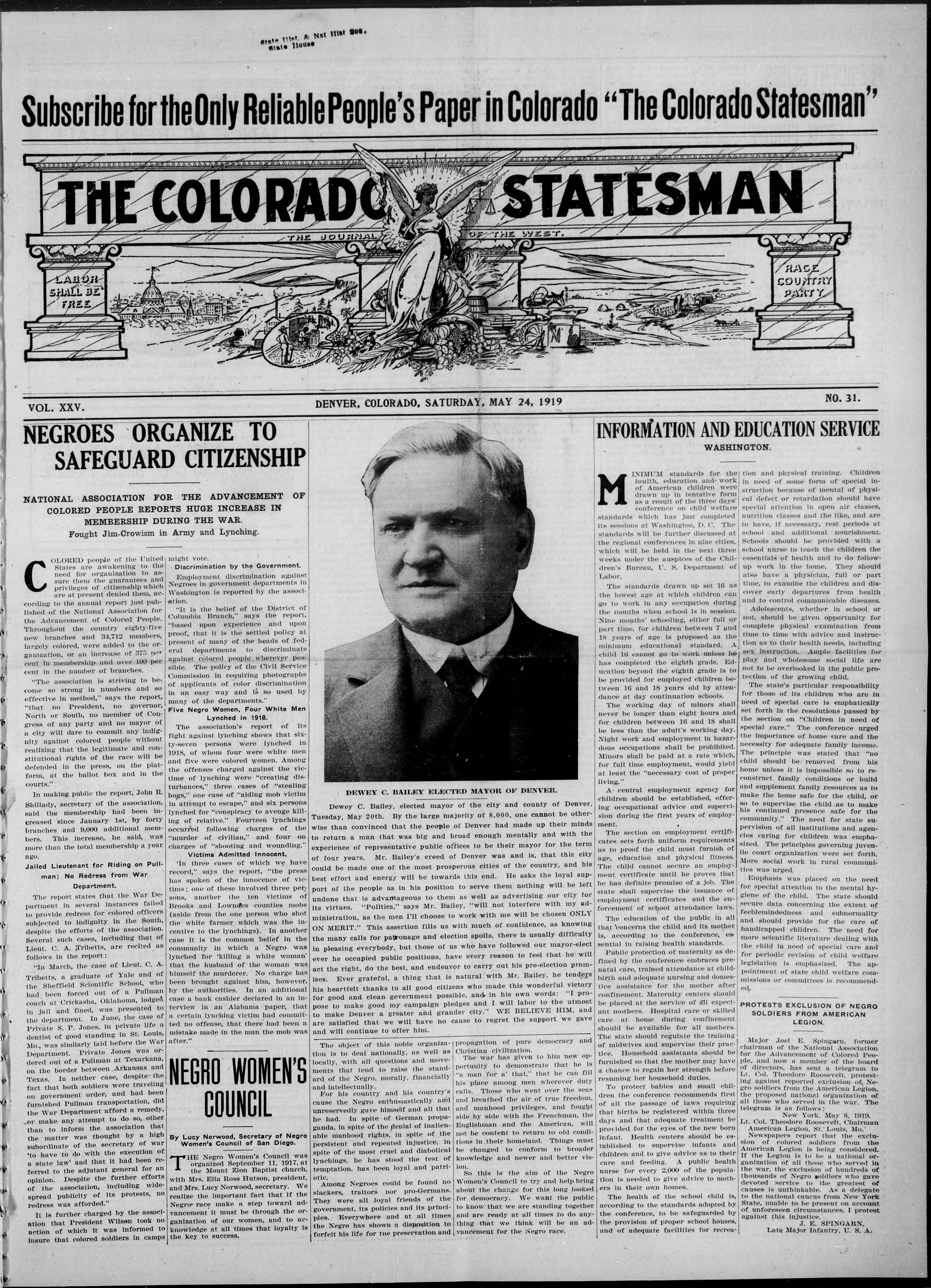
NEGROES ORGANIZE TO SAFEGUARD CITIZENSHIP
NATIONAL ASSOCIATION FOR THE ADVANCEMENT OF COLORED PEOPLE REPORTS HUGE INCREASE IN MEMBERSHIP DURING THE WAR. Fought Jim-Crowism in Army and Lynching.
might vote. Discrimination by the Government. Employment discrimination against Negroes in government departments in Washington is reported by the association. "It is the belief of the District of Columbia Branch," says the report, "based upon experience and upon proof, that it is the settled policy at present of many of the heads of federal departments to discriminate against colored people wherever possible. The policy of the Civil Service Commission in requiring photographs of applicants of color discrimination in an easy way and is so used by many of the departments."
The association's report of its fight against lynching shows that sixty-seven persons were lynched in 1918, of whom four were white men and five were colored women. Among the offenses charged against the victim of lynching were "creating disturbances," three cases of "stealing hogs," one case of "aiding mob victim in attempt to escape," and six persons lynched for "conspiracy to avenge killing of relative." Fourteen lynchings occurred following charges of the "murder of civilian," and four on charges of "shooting and wounding."
Victims Admitted Innocent.
'In three cases of which we have record,' says the report, "the press has spoken of the innocence of victims; one of these involved three persons, another the ten victims of Brooks and Lownes counties mobs (aside from the one person who shot the white farmer which was the incentive to the lynchings). In another case it is the common belief in the community in which a Negro was lynched for 'killing a white woman' that the husband of the woman was himself the murderer. No charge has been brought against him, however, by the authorities. In an additional case a bank cashier declared in an interview in an Alabama paper, that a certain lynching victim had committed no offense, that there had been a mistake made in the man the mob was after."
NEGRO WOMEN'S COUNCIL
By Lucy Norwood, Secretary of Negro Women's Council of San Diego.
THE Negro Women's Council was organized September 11, 1917, at the Mount Zion Baptist church, with Mrs. Ella Ross Hutson, president, and Mrs. Lucy Norwood, secretary. We realize the important fact that if the Negro race make a step toward advancement it must be through the organization of our women, and to acknowledge at all times that loyalty is the key to success.
---
VOL. XXV.
COLORED people of the United States are awakening to the need for organization to assure them the guarantees and privileges of citizenship which are at present denied them, according to the annual report just published of the National Association for the Advancement of Colored People. Throughout the country eighty-five new branches and 34,712 members, largely colored, were added to the organization, or an increase of 375 per cent in membership and over 100 per cent in the number of branches.
"The association is striving to become so strong in numbers and so effective in method," says the report, "that no President, no governor, North or South, no member of Congress of any party and no mayor of a city will dare to commit any indignity against colored people without realizing that the legitimate and constitutional rights of the race will be defended in the press, on the platform, at the ballot box and in the courts."
In making public the report, John R. Shillady, secretary of the association, said the membership had been increased since January 1st, by forty branches and 9,000 additional members. This increase, he said, was more than the total membership a year ago. Jailed Lieutenant for Riding on Pullman: No Redress from War
Department.
The report states that the War Department in several instances failed to provide redress for colored officers subjected to indignity in the South, despite the efforts of the association. Several such cases, including that of Lieut. C. A. Tribetts, are recited as follows in the report:
"In March, the case of Lleut. C. A. Tribetts, a graduate of Yale and of the Sheffield Scientific School, who had been forced out of a Pullman coach at Crickasha, Oklahoma, lodged in jail and fined, was presented to the department. In June, the case of Private S. P. Jones, in private life a dentist of good standing in St. Louis, Mo., was similarly laid before the War Department. Private Jones was ordered out of a Pullman at Texarkana, on the border between Arkansas and Texas. In neither case, despite the fact that both soldiers were traveling on government order, and had been furnished Pullman transportation, did the War Department afford a remedy, or make any attempt to do so, other than to inform the association that the matter was thought by a high subordinate of the secretary of war 'to have to do with the execution of a state law' and that it had been referred to the adjutant general for an opinion. Despite the further efforts of the association, including widespread publicity of its protests, no redress was afforded."
It is further charged by the association that President Wilson took no action of which it was informed to insure that colored soldiers in camps
State Hist. & Nat Hist Woe
State House
eliable Peo
RADO
THE JOURNAL
DENVER, C
TO
ISHIP
MENT OF
SE IN
```markdown
```
DEWEY C. BAILEY ELECT
Dewey C. Bailey, elected mayor Tuesday, May 20th. By the large wise than convinced that the people to return a man that was big and the experience of representative public office of four years. Mr. Bailey's creed could be made one of the most prosper best effort and energy will be toward port of the people as in his position undone that is advantageous to their virtues. "Politics," says Mr. Bailey ministration, as the men I'll choose to ON MERIT." This assertion fills us with the many calls for patronage and elec in pleasing everybody, but those of us ever he occupied public positions, he act the right, do the best, and endeavises. Ever grateful, a thing that is his heartfelt thanks to all good citizen for good and clean government posse to make good my campaign plan to make Denver a greater and gran are satisfied that we will have no and will continue to offer him.
DENVER, COLORADO, SATURDAY, MAY 24, 1919
M. B.
DEWEY C. BAILEY ELECTED MAYOR OF DENVER.
Dewey C. Bailey, elected mayor of the city and county of Denver, Tuesday, May 20th. By the large majority of 8,000, one cannot be otherwise than convinced that the people of Denver had made up their minds to return a man that was big and broad enough mentally and with the experience of representative public offices to be their mayor for the term of four years. Mr. Bailey's creed of Denver was and is, that this city could be made one of the most prosperous cities of the country, and his best effort and energy will be towards this end. He asks the loyal support of the people as in his position to serve them nothing will be left undone that is advantageous to them as well as advertising our city for its virtues. "Politics," says Mr. Bailey, "will not interfere with my administration, as the men I'll choose to work with me will be chosen ONLY ON MERIT." This assertion fills us with much of confidence, as knowing the many calls for patronage and election spoils, there is usually difficulty in pleasing everybody, but those of us who have followed our mayor-elect ever he occupied public positions, have every reason to feel that he will act the right, do the best, and endeavor to carry out his pre-election promises. Ever grateful, a thing that is natural with Mr. Bailey, he tenders his heartfelt thanks to all good citizens who made this wonderful victory for good and clean government possible, and in his own words: "I propose to make good my campaign pledges and I will labor to the utmost to make Denver a greater and grander city." WE BELIEVE HIM, and are satisfied that we will have no cause to regret the support we gave and will continue to offer him.
The object of this noble organization is to deal nationally, as well as locally, with all questions and movements that tend to raise the standard of the Negro, morally, financially and intellectually.
For his country and his country's cause the Negro enthusiastically and unreservedly gave himself and all that he had. In spite of German propaganda, in spite of the denial of inalienable manhood rights, in spite of the persistent and repeated injustice, in spite of the most cruel and diabolical lynchings, he has stood the test of temptation, has been loyal and patriotic.
Among Negroes could be found no slackers, traitors nor pro-Germans. They were all loyal friends of the government, its policies and its principles. Everywhere and at all times the Negro has shown a disposition to forfeit his life for the preservation and
propagation of pure democracy and Christian civilization.
The war has given to him new opportunity to demonstrate that he is "a man for a' that," that he can fill his place among men wherever duty calls. Those who went over the seas and breathed the air of true freedom, and manhood privileges, and fought side by side with the Frenchman, the Englishman and the American, will not be content to return to old conditions in their homeland. Things must be changed to conform to broader knowledge and newer and better vision.
So this is the aim of the Negro Women's Council to try and help bring about the change for this long looked for democracy. We want the public to know that we are standing together and are ready at all times to do anything that we think will be an advancement for the Negro race.
INFORMATION AND EDUCATION SERVICE
WASHINGTON.
MINIMUM standards for the health, education and work of American children were drawn up in tentative form as a result of the three days' conference on child welfare standards which has just completed its sessions at Washington, D. C. The standards will be further discussed at the regional conferences in nine cities, which will be held in the next three weeks under the auspices of the Children's Bureau, U. S. Department of Labor. The standards drawn up set 16 as the lowest age at which children can go to work in any occupation during the months when school is in session. Nine months' schooling, either full or part time, for children between 7 and 18 years of age is proposed as the minimum educational standard. A child 16 cannot go to work unless he has completed the eighth grade. Education beyond the eighth grade is to be provided for employed children between 16 and 18 years old by attendance at day continuation schools.
The working day of minors shall never be longer than eight hours and for children between 16 and 18 shall be less than the adult's working day. Night work and employment in hazardous occupations shall be prohibited. Minors shall be paid at a rate which, for full time employment, would yield at least the "necessary cost of proper living."
A central employment agency for children should be established, offering occupational advice and supervision during the first years of employment.
The section on employment certificates sets forth uniform requirements as to proof the child must furnish of age, education and physical fitness. The child cannot secure an employment certificate until he proves that he has definite promise of a job. The state shall supervise the issuance of employment certificates and the enforcement of school attendance laws.
The education of the public in all that concerns the child and its mother is, according to the conference, essential in raising health standards.
Public protection of maternity as defined by the conference embraces prenatal care, trained attendance at childbirth and adequate nursing and domestic assistance for the mother after confinement. Maternity centers should be placed at the service of all expectant mothers. Hospital care or skilled care at home during confinement should be available for all mothers. The state should regulate the training of midwives and supervise their practice. Household assistants should be furnished so that the mother may have a chance to regain her strength before resuming her household duties.
To protect babies and small children the conference recommends first of all the passage of laws requiring that births be registered within three days and that adequate treatment be provided for the eyes of the new born infant. Health centers should be established to supervise infants and children and to give advice as to their care and feeding. A public health nurse for every 2,000 of the population is needed to give advice to mothers in their own homes.
The health of the school child is according to the standards adopted by the conference, to be safeguarded by the provision of proper school houses, and of adequate facilities for recrea
tion and physical training. Children in need of some form of special instruction because of mental of physical defect or retardation should have special attention in open air classes, nutrition classes and the like, and are to have, if necessary, rest periods at school and additional nourishment. Schools should be provided with a school nurse to teach the children the essentials of health and to do follow-up work in the home. They should also have a physician, full or part time, to examine the children and discover early departures from health and to control communicable diseases. Adolescents, whether in school or not, should be given opportunity for complete physical examination from time to time with advice and instruction as to their health needs, including sex instruction. Ample facilities for play and wholesome social life are not to be overlooked in the public protection of the growing child.
The state's particular responsibility for those of its children who are in need of special care is emphatically set forth in the resolutions passed by the section on "Children in need of special care." The conference urged the importance of home care and the necessity for adequate family income. The principle was stated that "no child should be removed from his home unless it is impossible so to reconstruct family conditions or build and supplement family resources as to make the home safe for the child, or so to supervise the child.as to make his continued presence safe for the community." The need for state supervision of all institutions and agencies caring for children was emphasized. The principles governing juvenile court organization were set forth. More social work in rural communities was urged.
Emphasis was placed on the need for special attention to the mental hygiene of the child. The state should secure data concerning the extent of feeblemindedness and subnormality and should provide for the care of handicapped children. The need for more scientific literature dealing with the child in need of special care and for periodic revision of child welfare legislation is emphasized. The appointment of state child welfare commissions or committees is recommended.
PROTESTS EXCLUSION OF NEGRO SOLDIERS FROM AMERICAN LEGION
Major Joel E. Spingarn, former chairman of the National Association, for the Advancement of Colored People, and now a member of the board of directors, has sent a telegram to Lt. Col. Theodore Roosevelt, protesting against reported exclusion of Negro soldiers from the American Legion, the proposed national organization of all those who served in the war. The telegram is as follows:
New York, May 8, 1919.
Lt. Col. Theodore Roosevelt, Chairman American Legion, St. Louis, Mo.
Newspapers report that the exclusion of colored soldiers from the American Legion is being considered. If the Legion is to be a national organization of all those who served in the war, the exclusion of hundreds of thousands of Negro soldiers who gave devoted service to the greatest of causes is unthinkable. As a delegate to the national caucus from New York State, unable to be present on account of unforeseen circumstances, I protest against this injustice.
NO.31.
J. E. SPINGARN,
Late Major Infantry, U. S. A.
PRESIDENT SENDS SHORT MESSAGE FROM EUROPE
Address to Congress Is Read by Regular Reading Clerk.
EXPLAINS HIS STAY ABROAD
Imperative Duty Makes Absence of Chief Executive Necessary—Subject of Labor Unrest Doelt With Exhaustively—Suggestions for Domestic Legislation.
Washington, May 20.—For the first time in history a message from the president of the United States, cabled from Europe, was read to the congress today. It was as follows:
"Gentlemen of the Congress: I deeply regret my inability to be present at the opening of the extraordinary session of the congress. It still seems to be my duty to take part in the counsel of the peace conference and contribute what I can to the solution of the innumerable questions to whose settlement it has had to address itself; for they are questions which affect the peace of the whole world and from them, therefore, the United States cannot stand apart. I deemed it my duty to call the congress together at this time because it was not wise to postpone longer the provisions which must be made for the support of the government. Many of the appropriations which are absolutely necessary for the maintenance of the government and the fulfillment of its varied obligations for the fiscal year 1919-1920 have not yet been made; the end of the present fiscal year is at hand; and action upon these appropriations can no longer be prudently delayed. It is necessary, therefore, that I should immediately call your attention to this critical need. It is hardly necessary for me to urge that it may receive your prompt attention.
"I shall take the liberty of addressing you on my return on the subjects which have most engrossed our attention and the attention of the world during those anxious months, since the armistice of last November was signed, the international settlements which must form the subject matter of the present treaties of peace and of our national action in the immediate future. It would be premature to discuss them or to express a judgment about them before they are brought to their complete formulation by the agreements which are now being sought at the table of the conference. I shall hope to lay them before you in their many aspects so soon as arrangements have been reached.
Rights of the Worker.
"The question which stands at the front of all others in every country amidst the present great awakening is the question of labor; and perhaps I can speak of it with as great advantage while engrossed in the consideration of interests which affect all countries alike as I could at home and amidst the interests which naturally most affect my thought, because they are the interests of our own people.
"By the question of labor I do not mean the question of efficient industrial production, the question of how labor is to be obtained and made effective in the great process of sustaining populations and winning success amidst commercial and industrial rivalries. I mean that much greater and more vital question, how are the men and women who do the daily labor of the world to obtain progressive improvement in the conditions of their labor, to be made happier, and to be served better by the communities and the industries which their labor sustains and advances? How are they to be given their right advantage as citizens and human beings?
"We cannot go any further in our present direction. We have already gone too far. We cannot live our right life as a nation or achieve our proper success as an industrial community if capital and labor are to continue to be antagonistic instead of being partners. If they are to continue to distrust one another and controle how they can get the better of one another, or what perhaps amounts to the same thing, calculate by what form and degree of coercion they can manage to extort on the one hand work enough to make enterprise profitable, on the other justice and fair treatment enough to make life tolerable. That bad road has turned out a blind alley. It is no thoroughfare to real prosperity. We must find another, leading in another direction and to a very different destination. It must lead not merely to accommodation, but also to a genuine co-operation and partnership based upon a real community of interest and participation in control.
"There is now in fact a real community of interest between capital and labor, but it has never been made evident in action. It can be made operative and manifest only on a new organization of industry. The genius of our business men and the sound, practical sense of our workers can certainly work such a partnership out when once they realize exactly what it is that they seek, and sincerely adopt a common purpose with regard to it. "Labor legislation lies, of course,
chiefly with the states; but the new spirit and method of organization which must be effected are not to be brought by legislation so much as by the common counsel and voluntary co-operation of capitalist, manager and workman. Legislation can go only a very little way in commanding what shall be done. The organization of industry is a matter of corporate and individual initiative and of practical business arrangement. Those who really desire a new relationship between capital and labor can readily find a way to bring it about; and perhaps federal legislation can help more than state legislation could.
Industrial Democratization.
"The object of all reform in this essential matter must be the genuine democratization of industry, based upon a full recognition of the right of those who work, in whatever rank, to participate in some organic way in every decision which directly affects their welfare or the part they are to play in industry. Some positive legislation is practicable. The congress has already shown the way to one reform which should be world-wide, by establishing the eight-hour day as the standard day in every field of labor over which it can exercise control. It has sought to find the way to prevent child labor and will, I hope and believe, presently find it. It has served the whole country by leading the way in developing the means of preserving and safeguarding life and health in dangerous industries. It can now help in the difficult task of giving a new form and spirit to industrial organization by co-ordinating the several agencies of conciliation and adjustment which have been brought into existence by the difficulties and mistaken policies of the present management of industry, and by setting up and developing new federal agencies of advice and information which may serve as a clearing house for the best experience and best thought on this great matter, upon which every thinking man must be aware that the future development of society directly depends. Agencies of international counsel and suggestion are presently to be created in connection with the league of nations in this very field; but it is national action and the enlightened policy of individuals, corporations and societies within each nation that must bring about the actual reforms. The members of the committee on labor in the two houses will hardly need suggestions from me as to what means they shall seek to make the federal government the agent of the whole nation in pointing out, and if need be, guiding the process of reorganization and reform.
Duty to Returning Soldiers.
"I am sure that it is not necessary for me to remind that there is one immediate and very practical question of labor that we should meet in the most liberal spirit. We must see to it that our returning soldiers are assisted in every practicable way to find the places for which they are fitted in the daily work of this country. This can be done by developing and maintaining upon an adequate scale the admirable organization created by the department of labor for placing men seeking work; and it can also be done, in at least one very great field, by creating new opportunities for individual enterprise. The secretary of the interior has pointed out the way by which returning soldiers may be helped to find and take up land in the hitherto undeveloped regions of the country which the federal government has already prepared or can readily prepare for cultivation and also on many of the cut-over or neglected areas which lie within the limits of the older states; and I once more take the liberty of recommending very urgently that his plans shall receive the immediate and substantial support of the congress.
"Peculiar and very stimulating conditions await our commerce and industrial enterprise in the immediate future. Unusual opportunities will present themselves to our merchants and producers in foreign markets, and large fields for profitable investment will be opened to our free capital. But it is not only of that that I am thinking; it is not chiefly of that that I am thinking. Many great industries prostrated by the war wait to be rehabilitated, in many parts of the world where what will be lacking is not brains or willing hands or organizing capacity or experienced skill but machinery and raw materials and capital. I believe that our business men, our merchants, our manufacturers, and our capitalists will have the vision to see that prosperity in one part of the world ministers to prosperity everywhere; that there is in a very true sense a solidarity of interest throughout the world of enterprise, and that our dealings with the countries that have need of our products and our money will teach them to deem us more than ever friends whose necessities we seek in the right way to serve.
Future Commerce.
"Our new merchant ships, which have in some quarters been feared as destructive rivals, may prove helpful rivals, rather, and common servants very much needed and welcome. Our great shipyards, new and old, will be so opened to the use of the world that they will prove immensely serviceable to every martine people in restoring, much more rapidly than would otherwise have been possible, the tonnage wantonly destroyed in the war. I have only to suggest that there are many points at which we can facilitate American enterprise in foreign trade by opportune legislation and make it easy for American merchant ships where they will be wel-
comed as friends rather than as dreaded antagonists. America has a great and honorable service to perform in bringing the commercial and industrial undertakings of the world back to their old scope and swing again, and putting a solid structure of credit under them. Our legislation should be friendly to such plans and purposes.
"And credit and enterprise alike will be quickened by timely and helpful legislation with regard to taxation. I hope that the congress will find it possible to undertake an early reconsideration of federal taxes, in order to make our system of taxation more simple and easy of administration and the taxes themselves as little burdensome as they can be made and yet suffice to support the government and meet all its obligations. The figures to which these obligations have artisen are very great indeed, but they are not so great as to make it difficult for the nation to meet them, and meet them, perhaps, in a single generation, by taxes which will neither crush nor discourage. They are not so great as they seem, not so great as the immense sums we have had to borrow, added to the immense sums we have had to raise by taxation, would seem to indicate; for a very large proportion of these sums were raised in order that they might be loaned to the governments with which we were associated in the war, and those loans will, of course, constitute assets, not liabilities and will not have to be taken care of by our tax-payers.
Equitable Taxation.
"The main thing we shall have to care for is that our taxation shall rest as lightly as possible on the productive resources of the country, that its rates shall be stable, and that it shall be constant in its revenue-yielding power. We have found the main sources from which it must be drawn. I take it for granted that its mainstays will henceforth be the income tax, the excess profits tax and the estate tax. All these can be so adjusted to yield constant and adequate returns and yet not constitute a too grievous burden on the taxpayer. A revision of the income tax has already been provided for by the act of 1918, but I think you will find that further changes can be made to advantage both in the rates of the tax and in the method of its collection. The excess profits tax need not long be maintained at the rates which were necessary while the enormous expense of the war had to be borne; but it should be made the basis of a permanent system which will reach undue profits without discouraging the enterprise and activity of our business men. The tax on inheritances ought, no doubt, to be reconsidered in its relation to the fiscal systems of the several states, but it certainly ought to remain a permanent part of the fiscal system of the federal government also.
"Many of the minor taxes provided for in the revenue legislation of 1917 and 1918, though no doubt made necessary by the pressing necessities of the war time, can hardly find sufficient justification under the easier circumstances of peace, and can now happily be got rid of. Among these, I hope you will agree, are the excises upon various manufactures and the taxes upon retail sales. They are unequal in the incidence on different industries and on different individuals. Their collection is difficult and expensive. Those which are levied upon articles sold at retail are largely evaded by the readjustment of retail prices. On the other hand, I should assume that it is expedient to maintain a considerable range of indirect taxes; and the fact that alcoholic liquors will presently no longer afford a source of revenue by taxation makes it the more necessary that the field should be carefully restudied in order that equivalent sources of revenue may be found which it will be legitimate, and not burdensome, to draw upon. But you have at hand in the treasury department many experts who can advise you upon the matters much better than I can. I can only suggest the lines of a permanent and workable system, and the placing of the taxes where they will least hamper the life of the people.
"There is, fortunately, no occasion for undertaking in the immediate future, any general revision of our system of import duties. No serious danger of foreign competition now threatens American industries. Our country has emerged from the war less disturbed and less weakened than any of the European countries which are our competitors in manufacture. So far from there being any danger or need of accentuated foreign competition, it is likely that the conditions of the next few years will greatly facilitate the marketing of American manufactures abroad. Least of all should we depart from the policy adopted in the tariff act of 1913, of permitting the free entry into the United States of the raw materials needed to supplement and enrich our own abundant supplies.
Tariff Revision.
"Nevertheless, there are parts of our tariff system which need prompt attention. The experiences of the war have made it plain that in some cases too great reliance on foreign supply is dangerous, and that in determining certain parts of our tariff policy domestic considerations must be borne in mind which are political as well as economic. Among the industries to which special consideration should be given is that of the manufacture of dyestuffs and related chemicals. Our complete dependence upon German supplies before the war made the interruption of trade a cause of exceptional economic disturbance. The close relation between the manufacturer of dyestuffs, on the one hand, and of explosives and poisonous gases
on the other, moreover, has given the industry an exceptional significance and value. Although the United States will gladly and unhesitatingly join in the progress of international disarmament, it will, nevertheless, be a policy of obvious prudence to make certain of the successful maintenance of many strong and well-equipped chemical plants. The German chemical industry, with which we will be brought into competition, was and may well be again, a thoroughly knit monopoly capable of exercising competition of a peculiarly insidious and dangerous kind.
"The United States should, moreover, have the means of properly protecting itself whenever our trade is discriminated against by foreign nations, in order that we may be assured of that equality of treatment which we hope to accord and to promote the world over. Our tariff laws as they now stand provide no weapon of retaliation in case other governments should enact legislation unequal in its bearing on our products as compared with the products of other countries. Though we are as far as possible from desiring to enter upon any course of retaliation, we must frankly face the fact that hostile legislation by other nations is not beyond the range of possibility, and that it may have to be met by counter-legislation. This subject has, fortunately, been exhaustively investigated by the United States tariff commission. A recent report of that commission makes very clear that we lack and that we ought to have the instruments necessary for the assurance of equal and equitable treatment. The attention of the congress has been called to this matter on past occasions, and the past measures which are now recommended by the tariff commission are substantially the same that have been suggested by previous administrations. I recommend that his phase of the tariff question receive the early attention of the congress.
"Will you not permit me, turning from these matters, to speak once more, and very earnestly, of the proposed amendment to the constitution which would extend the suffrage to women and which passed the house of representatives at the last session of congress? It seems to me that every consideration of justice and of public advantage calls for the immediate adoption of that amendment and its submission forthwith to the legislatures of the several states. Throughout all the world this long delayed extension of the suffrage is looked for; in the United States longer, I believe than anywhere else, the necessity for it, and the immense advantage of it to the national life, has been urged and debated, by women and men who saw the need for it and urged the policy of it when it required steadfast courage to be so much beforehand with the common conviction; and I, for one, covet for our country the distinction of being among the first to act in a great reform.
Telegraph and Telephone.
"The telegraph and telephone lines will of course be returned to their owners so soon as the retransfer can be effected without administrative confusion, so soon that is, as the change can be made with least possible inconvenience to the public and to the owners themselves. The railroads will be handed over to their owners at the end of the calendar year; if I were in immediate contact with the administrative questions which must govern the retransfer of the telegraph and telephone lines. I could name the exact date for their return also. Until I am in direct contact with the practical questions involved I can only suggest in the case of the telegraphs and telephones, as in the case of the railways, it is clearly desirable in the public interest that some legislation should be considered which may tend to make of these indispensable instrumentalities of our modern life a uniform and co-ordinated system which will afford those who use them as complete and certain means of communication with all parts of the country as has so long been afforded by the postal system of the government, and at rates as uniform and intelligible. Expert advice is, of course, available in this very practical matter, and the public interest is manifest. Neither the telegraph nor the telephone service of the country can be said to be in any sense a national system. There are many confusions and inconsistencies of rates. The scientific means by which communication by such instrumentalities could be rendered more thorough and satisfactory has not been made full use of.
"The demobilization of the military forces of the country has progressed to such a point that it seems to me entirely safe now to remove the ban upon the manufacture and sale of wine and beers, but I am advised that without further legislation I have not the legal authority to remove the present restrictions. I therefore recommend that the act approved November 21, 1918, entitled "An act to enable the secretary of agriculture to carry out during the fiscal year ending June 30, 1919, the purpose of the act entitled "An act to provide further for the national security and defense by stimulating agriculture and facilitating the distribution of agricultural products," and for other purposes,' be amended or repealed in so far as it applies to wines and beers.
"I sincerely trust that I shall very soon be at my post in Washington again to report upon the matters which made my presence at the peace table apparently imperative, and to put myself at the service of the congress in every matter of administration or counsel that may seem to demand executive action or advice.
"WOODROW WILSON."
POINT ONE—Morrison's Full Orchestra furnishes the music.
POINT TWO—Thursday is in the middle of the week.
POINT THREE—We don't tolerate anything but decent actions at our dance.
POINT FOUR—Dancing is healthy. Science has proven it.
POINT FIVE—You can meet the prettiest girls in the whole world at
Fern Hall Every Thursday Night
FIVE POINTS DANCING CLUB.
RENOVATORS, BLEACHERS, DYERS AND FINISHERS
Gf Gents' and Ladies' Hats of Every Description
1624 CHAMPA ST., DENVER, COLO.
The
Curtis
Park
Floral
Company
FLORAL DESIGNS PUT UP WHILE
YOU WAIT
CHOICE PLANTS AND CUT FLOWERS CONSTANTLY
ON HAND
GREENHOUSES: Thirty-Fourth and Curtis Streets
TELEPHONE, MAIN 1811
DENVER, COLO
Wishes to welcome all to good home cooking and dainties of the seasons, any time from 6 a. m. to 11:30 p. m. Accurate service at all hours; so when down town stop, give us a trial and we will guarantee you will leave with a smile.
Eight (5) years experience in growing the hair. My own hair is my advertisement. My customer's hair grows. Full line of her hair goods for sale. System taught. Call for rates.
SILVER STATE SHINING PARLOR
The best in the city. Private booths for ladies. All kinds of Fancy Shoes cleaned, dyed, bronzed. All work guaranteed.
Phone Champa 5431
1865-1867 CURTIS 8
The
Curtis
Park
Floral
Company
FLORAL DESIGNS PU
VOICE PLANTS AND
GREENHOUSES: This
LEPHONE, MAIN 1811
To Friends
Wishes to
and daintie
a. m. to 1
hours; so w
and we will
smile.
MRS. M. J. FRAN
PIONEER HATTERS OF THE WEST. WE MAKE OLD HATS NEW.
AND FINISHERS
Mery Description
R, COLO.
Private Booths for Ladies
DAY CAFE
DRINK PARLOR
, Proprietor
BLEACHERS, DYERS AND FINISHERS
and Ladies' Hats of Every Description
CHAMPA ST., DENVER, COLO.
Private Booths for Ladies
NIGHT AND DAY CAFE
AND COLD DRINK PARLOR
B. CARRUTH, Proprietor
A Full Line of Fresh Fish in Season
Oysters and Lobsters
Short Orders At All Hours Rest Room for Ladies
STREET
DENVER, COLORADO
XULER
CONDENSATION OF FRESH NEWS
THE LATEST IMPORTANT DIS PATCHES PUT INTO SHORT, CRISP PARAGRAPH.
SHOWING THE PROGRESS OF EVENTS IN OUR OWN AND FOREIGN LANDS.
Western Newspaper Union News Service.
WESTERN
A jury in the breach of promise case of Mrs. A. P. Van Delinder against J. Richmond, a wealthy ranch owner at Vancouver, awarded $5,000 damages.
An increase of 50 cents a day, from $4.25 to $4.75, became effective in mines of the Coeur d'Alene district in Idaho according to bulletins posted in the principal mines.
An act authorizing issuance of $10,000,000 worth of good roads bonds has been passed by the Legislature of Oregon. An emergency clause makes the money immediately available.
A pool of 9,000 pounds of mohair was sold at Lebanon, Ore., for 64 cents a pound, the highest price paid this season for Oregon mohair. The figure is $3½ cents above last season's price.
"Blond Eskimos," discovered by Vilhjalmur Stefansson, the explorer, in the far northern Arctic are to be left alone in their uncivilized aboriginal state, according to Leo Wittenberg, a trader and whaler.
Final tabulations showing San Francisco's subscriptions to the Victory Liberty loan had exceeded the city's quota of $79,318,150, give the Twelfth federal reserve district a clean slate with every major division of the district "over the top."
Gov. John J. Frazier of South Dakota has called a special election for June 26 to permit the people to vote on seven measures enacted by the last legislature included in the Nonpartisan league program, and which are asked to be referred by petitions circulated by the Independent Voters' Association
WASHINGTON
Corsets are taxable under the federal luxury law, according to a ruling from Washington.
Authority to increase rates between the United States and Canada was asked by the American Railway Express Company in a petition filed with the Interstate Commerce Commission.
Charles F. Hoffman of Brooklyn, N.Y., a sergeant in the marine corps, was decorated with the congressional medal of honor by Secretary Daniels for exceptionally meritorious conduct in the battle of Soissons.
The repeal of the luxury taxes is provided in a bill introduced in the Senate by Senator Wadsworth of New York. A similar measure was introduced in the House by Representative Moore of Pennsylvania.
An increase of unemployment is reported by the United States employment service. In a total of eighty-three cities, only twelve had shortage of labor; in twenty-nine supply and demand balanced and forty-two reported an increase from 127,850 to 135,380 persons out of work.
With the ordering of twelve large steamers into the lumber trade from South Atlantic and Gulf ports, the shipping board at Washington took steps toward material expansion of the shipping facilities of the South and toward building up of trade between that section and South America.
Recommendations of the general staff that the course of instruction at West Point be reduced permanently to three years has been approved by Secretary Baker. The change is expected to go into effect with the next class, but no change from the present entrance requirement will be made.
The navy will have removed all but 400,000 men from overseas by July 1, Secretary Daniels announced at Washington. It would be possible, he added, to remove an additional 300,000 during the month of July, but that the number to be kept in France for emergency purposes and in the army of occupation was to be decided in Paris.
Official records of the War Department show that the Seventy-seventh division made a larger advance against the enemy than any other of the American divisions in France. The New York City national army men went forward a total of seventy-one and one-half kilometers. The Second (regular) division advanced a total of sixty kilometers, and the Forty-second (Rainbow) division, fifty-five kilometers. The foreign mail service, interrupted by the war, has been restored to normal, and the foreign parcel post has been considerably extended beyond points reached before the war, it has been announced by the Postoffice Department. Certain restrictions still apply to mail matter destined for enemy territory and parts of Russia.
The importation of nitrate of potash and nitrate of soda without restriction from countries with which general trade is authorized will be permitted beginning July 1, the war trade board announced in Washington.
PRESIDENT'S MESSAGE.
Repeal of the so-called "luxury tax."
Adoption of the suffrage amendment.
Maintenance of the United States employment service.
Return of the railroads under a more uniform systems.
Legislation to facilitate American enterprise in foreign trade.
Adoption of the land-for-soldiers bill sponsored by Secretary Lane.
Against general revision of import duties, but for protection of the American dye industry.
Return of the telegraph and telephone lines to their owners under more co-ordinated system.
Repeal or amendment of the wartime prohibition act in so far as applies to wines or beers.
Creation of a federal agency of advice and information as a clearing house for suggested improvement in industrial conditions. Reconsideration of federal taxes to relieve the burden, particularly on productive resources, making incomes, excess profits and estimates the mainstay of steady taxation.
FOREIGN
The American steamer Lake Placid struck a submerged mine near the island of Vinga and sank in five minutes. All those on board were rescued. Violent rioting is again reported at Stettin, where nine civilians and twenty soldiers have been killed. German troops occupy the station houses throughout the city. German war losses up to April 30 last were 2,050,460 dead; 4,207,028 wounded and 615,922 prisoners, a total of 6,873,410, according to figures published in Berlin. General Denekline, who is personally conducting the operations of his anti-Bolshevik army against the city of Tsaritzin, on the Volga, announces the capture of 10,000 prisoners and twenty-eight guns from the Bolshevik.
War insurance, as carried on by the British government, dropped some $85,000,000 net profit into the nation's coffers, according to a report just made public. The chief item of profit was $80,000,000 on the hulls of British steamships which survived German submarine warfare.
The marine corps and the state of Texas divided first honors in the closing event of the American expeditionary force competitions at the D'Avours range, Private Fred Kramer, Sixth marines of Remsen, Iowa, won the gold medal in the automatic rifle individual competition with a score of 403, while the Thirty-sixth division from the Lone Star state took the divisional championship.
SPORT
In a double-header of the French University Baseball league played in Paris the University of Paris won twice, defeating the University of Nancy 14 to 0 and the A. E. F. University of Beaune 10 to 9. All the players were American officers or soldiers studying in French schools. Tommy Milton won the Victory sweepstakes automobile race on the Uniontown speedway, Uniontown, Pa., covering the $112\frac{1}{2}$ miles in 1:10:00:33 an average speed of $96\frac{1}{2}$ miles an hour. Louis Chevrolet took second place, covering the last lap with a flat tire. Ralph Mulford was third.
GENERAL
Lieutenant Austrich and Machinist Hendricksen were drowned when a naval seaplanet fell into the sea off Chatham, Mass. Ensign Everett' P. Welsh was rescued.
Shortly after he was alleged to have shot and killed J. H. Rogers, manager of a sawmill, William Moore, a negro of Gulfport, Miss., was lynched by a mob at McHenry, Miss.
Samuel Gompers emphatically denied a report published that he would resign as president of the American Federation of Labor at that body's convention in Atlantic City in June.
Making 457 consecutive loops during a flight lasting one hour and fifty-four minutes, Lieutenants Ralph J. Johnson and Mark R. Woodward set a new world's record at Caristrom field, Arcadia, Fla. A Lapere two-seated fighting plane was used.
Yucca and bear grass are being harvested on the desert near Fort Bliss, Texas, like wild hay, baled and shipped to St. Louis for making coarse fiber brushes, brooms and other fiber articles. A St. Louis company has contracted for all the yucca and bear grass fiber to be found on the plains near here and it is being cut by Mexicans, baled and loaded on cars for shipment.
Six persons, including the captain's wife and four children, and the engineer, were drowned when the coal laden barge Nanticoke, owned by the Potter Transportation company of New York, sank off the Isle of Shoals. Capt. William Gray and Allen McDougall, a deck hand, were picked up by the coast guard at Rye beach after they had drifted about in a small boat for several nours. They are the only survivors.
American Liberty loans attract as much attention at Juarez, Mex., as they do in El Paso, across the Rio Grande. A number of Juarez business men who have close trade relations with American firms in El Paso have bought bonds of each issue and have applied for a number of the Victory Loan bonds to complete their collections. A special committee from El Paso called on these bond buyers, one of them being told by a prominent Mexican: "You fought our fight for us and there is no reason why we should not help pay the expenses."
UNIQUE CHARITY IN THE WALSH HOUSE
WONDERFUL WORK THE WIDOW OF MINING MAGNATE IS DOING IN WASHINGTON.
SHARES THE TOIL HERSELF
Great Quantities of Clothing Cleverly Made Over and Shipped to the Destitute Women and Children of the Allied Countries.
By EDWARD B. CLARK.
Washington—One of the great residences of this town of the kind that people call a mansion is given over today to a charity which stands individualized in its field. The overworked word "unique" applies to the place and to the things that are done therein.
On Massachusetts avenue stands the great brick and stone residence of Mrs. Thomas F. Walsh, widow of a man who made his fortune in the mines of the west, beginning work as a day-by-day miner in his own behalf. Thomas F. Walsh was successful, When he had made his money he came to Washington to live and here he built the great house in which his widow is now residing. Set into the foundation of the residence is a stone bordered with gilt. It was taken from one of the mines in which Mr. Walsh labored in his early days.
On the ground floor or the residence are four great rooms. In these rooms every day men and women toll in behalf of the destitute women and children of all the countries of Europe, allied or at any time allied with the nations which were striving to free the peoples of the earth from the domination of militarism and autocracy.
At half past 8 o'clock every morning Mrs. Walsh goes to one of the workrooms and starts at the labor of love. She works with her own hands as hard as any one of the employees and she keeps steadily at it with only an interval for luncheon until 7:30 o'clock in the evening.
Clothing for Women and Children. In earlier days Mrs. Walsh in the West learned the fine arts of a housewife. She was her husband's helpmate in the days of his struggles as she was his companion and helper in the days of his success. Today she is putting to a world's use the accomplishments, for they are nothing else, that she acquired in the days of struggle.
To the Walsh residence daily are sent by the people of Washington material of various kinds and cast-off clothing. These are taken, sterilized, ripped to pieces and made over into all kinds of wearing apparel for the women and children of the different countries of Europe, due regard being given to the clothing customs of the countries and to climatic conditions. Consideration is also given to the appeals which certain colors make to the women and children of different nationalities.
The boys and girls of the destitute regions of France are sent clothing of the kind which they wore in the days of prosperity and peace. The children of Italy get the clothing of those color schemes of which southern people are so fond. The general plan of providing not only what the people need but what the people like is carried out in all shipments sent to all countries.
General Dickman's New Job.
Maj. Gen. Joseph T. Dickman has been appointed president of a board which will meet in Chaumont, France, to consider lessons learned from the war in so far as they concern tactics and organization.
Prior to the outbreak of war, any American army board with anything of importance to consider was certain to have Joseph T. Dickman as one of its members. War department authorities always insisted on Dickman, and Dickman always responded. Now this Ohio soldier has the presidency of the most important board convened for many years.
General Dickman has been in command of the army of occupation in Germany. He is succeeded in that command by Lieut. Gen. Hunter Liggett. Just prior to taking command of the army of occupation General Dickman was in command of the First corps, fighting in the Argonne.
No one has been allowed to know much about the work of our army officers in France. All of the ranking officers doubtless deserve columns of space for the detailing of the deeds which they did when driving the Huns back from their advanced positions in France, but the exigencies of warfare or something else prevented the proper blazoning of the fighting qualities and battling accomplishments of these men.
Dickman's Division at the Marne.
One can write only concerning those of whom he knows something at first hand. Dickman has been appointed president of a high military board and of Dickman's deeds I know something personally, for I was attached to his headquarters during the closing days of the war.
In General Pershing's report to the secretary of War, dated November 20, 1918, this paragraph occurs:
"The Third division was holding the bank of the Marne from the bend east of the mouth of the Surmelin to the west of Mezy, opposite Chateau-Thier-
ry, where large forces of German infantry sought to force a passage under support of powerful artillery concentrations and under cover of smoke screens. A single regiment of the Third wrote one of the most brilliant pages in our military annals on this occasion. It prevented the crossing at certain points on its front, while on either flank the Germans who had ginned a footing pressed onward. Our men fired in three directions, met the German attacks with counter-attacks at critical points and succeeded in throwing two German divisions into complete confusion, capturing 600 prisoners."
Joseph T. Dickman was in command of the Third division on this occasion. In fact, most military men give the high honor of driving the Germans back across the Marne, and of saving the situation, to Dickman's troops. The Third pursued the enemy across the Marne, took the heights of Mont St. Fere and the villages of Charteves and Jaulgonne in the face of the heaviest machine gun and artillery fire, and from there it advanced into Roncheres wood.
St. Mihiel and the Argonne.
St. Mihiel and the Argonne.
General Dickman was ordered to the St. Mihiel section, where he took command of the Third corps, comprising the First, the Forty-second and the Eighty-ninth divisions. There the American troops drove the Germans from the sailent, took 16,000 prisoners and 443 guns, captured an enormous quantity of material, released the inhabitants of many villages and established our lines in a position to threaten Metz.
In the Argonne forest, when the commander of the First corps was promoted to the command of an army, General Dickman succeeded him. For three weeks he lived in dugouts, three weeks of unceasing anxiety, unceasing fighting and unceasing mastery. The First corps under Dickman drove through the hardest parts of the Argonne forest.
Memorial Day at Arlington.
Memorial day in Washington is to be a memorial and a memorable day in one. Preparations are now being made for the impressive ceremonies of May 30.
Arlington National cemetery, possibly the most beautiful burial ground of the world, is today in the colors of spring. There is nothing somber about Arlington except the thoughts which come to one as he threads his way through the paths which border the resting places of the fallen.
The color scheme of the place is beautiful. There is the purple of the wistarla, the pink and white of the dogwood, the subdued radiance of the redbud, the yellow of the dandelions, the white of the daisies, and the purple of the violets which there mingle with or glow beneath the coming green of the great tulip trees and the greater onks.
There are newly made graves in Arlington, those of the few victims of the great war who already have found rest in this section of fame's eternal camping ground. An added duty has come to the surviving veterans of the wars, and to the widows and children of the dead. The Memorial day of the future will find a greater host asleep which must be remembered with the hosts which had gone before.
Amphitheater Nearly Completed.
It is probable that on the coming Memorial day the great marble amphitheater which has been erected in Arlington will be used for the first time. It stands in a state of near completion, its white walls shining under Potomac's sun. Before long in the great corridor of the amphitheater there will repose the disinterred remains of some of America's greatest heroes, for this amphitheater in a sense is to be the Pantheon of America.
On the wall of each amphitheater tomb will be placed a tablet upon which in simple phrase will be detailed the deeds of the hero thus remembered. In some cases it will be impossible to place the bodies of the dead within receptacles, because of the disinclination of families to sanction the removal, or, as in one or two cases, because the transfer would be an actual physical impossibility. In such cases where the man's deeds have been admitted as deserving high recognition, the story of what he has done will be told on a tablet, while the hero blimself still rests far away.
Of the three great northern military figures of the Civil war period only one rests in Arlington—Sheridan. Grant lies on the banks of the Hudson, and Sherman on the banks of the Mississippi. Military thought always has held that all three of these Federal soldiers better might have been given a resting place in this national burial ground. The military thought has gone farther than this in these recent days of reunion and of the softening of Civil war animosities. Arlington was Robert E Lee's home prior to the outbreak of the war between the states. It was the hope, and perhaps still is the hope, that one day Lee and Jackson and others of the Southern army may rest beneath the oaks of Arlington.
The great trees of Arlington have shaded generations of men. Some of them were growing when the son of Martha Washington built the great mansion still standing today, and which overlooks the Potomac river. They are by far the noblest monuments of the cemetery.
"There's unfortunately a lot of difference between expectation and realization."
"You bet! As a concrete example, take reading a seed catalogue in the spring and looking at your garden in the fall."—Boston Transcript.
Get Into A May Co. Straw Today
The Right Kind of Reading Matter
The home news; the doings of the people in this town; the gossip of our own community, that's the first kind of reading matter you want. It is more important, more interesting to you than that given by the paper or magazine from the outside world. It is the first reading matter you should buy. Each issue of this paper gives to you just what you will consider
The Right Kind of Reading Matter
ANNOUNCEMENT.
Madame Callie Young Sugg begs to
announce the opening of her Millinery
Parlors at 1003 Twenty-sixth avenue,
where she will be pleased to wait on
the public. New hats furnished or
made from your own material. Hats
reblocked. Feathers cleaned, curled
and dyed. Regular advertisement
will appear later. Phone Champa
4087.
Day and Night Phone Main 2701.
DR. C. E. TERRY,
PHYSICIAN AND SURGEON
Office Hours: 12 to 2 p. m., 6 to 8 p. m.
and appointment.
LEAVE CALLS AT ELITE DRUG
STORE.
1027 21st St., Denver, Colo.
For employment see the Industrial
Realty Co. Employment Agency, 716
East Twenty-sixth Ave. York 4561.
E. P. BLAKEMORE, Attorney and Counsellor at Law. Office, Rooms 39 and 40 Arapahoe Bldg., 1622 Arapahoe Street. Phone Champa 5450.
In many cases it is as difficult to stay at the top of the ladder as it is to get there.
SANATITE
IS
FOOT COMFORT
OR YOUR MONEY BACK
The Right Kin
Reading Matt
Civilization was born in the East. For ages letters, art, religion flowed westward from Asia. When Europe was a wilderness, people only with savage, wandering tribes, learning and government flourished beyond the Dardanelles. From Armenia, Syria and Persia came both the Jewish and the Christian religions, the alphabet and much of science. Long since the tide turned. Civilization among these eastern peoples began to ebb, and they have slipped far back toward their pastoral days.
Famous Buildings in Weimar.
Famous Buildings in Welmar.
Conspicuous public buildings in Welmar are the Wittumspalais, the old ducal dower house, containing Preller's famous mural paintings of the Odysssey; the Goethe-Schiller archive, an imposing edifice on an eminence above the river Ulm, in which are treasured manuscripts by famous German writers; the Liszt museum; a gymnasium; a Realschule, or school for girls, founded by the Grand Duchess Sophia; a grand ducal school of art; technical, commercial and music schools, geographical institute, teachers' seminaries and other institutions of learning.
Beginning of Auto Craze.
Beginning of Auto Craze.
In September, 1895, there were on file in Washington more than 500 applications for patents on automobiles.
Three hundred different types of motor vehicles had been built or were in process of construction at that date.
THE COLORADO STATESMAN
CAGON SHALL BE FREE
HASE COUNTRY DISTRICT
JOS. D. D. RIVERS.....Proprietor
1824 Curtis Street, Room 25.
P. O. Box 116
Phone Main 7417
SUBSCRIPTION RATES.
One Year .....$2.00
Six Months .....1.25
Three Months .....7.75
MUST BE PAID IN ADVANCE.
Entered as second-class matter at the postoffice in the City of Denver, Colo.
Reading notices 10 cents per line. Display advertising, 50c per inch for first
Remittances should be made by Express Money Order, Postoffice Money Order, Registered Letter or Bank Draft. Postage stamps will be received the same as cash for the fractional part of a dollar. Only 1c and 2c stamps taken.
No discounts allowed on less than three months' contract. Cash must accompany all orders from parties unknown to us. Further particulars on application.
Communications to receive attention must be newsy, upon important subjects, plainly written only upon one side of the paper, must reach us Tuesdays, if possible, anyway not later than Wednesdays, and bear the signature of the author. No manuscript returned, unless stamps are sent for postage. All communications of a personating nature that are not complimentary will be withheld from the columns of this paper.
OUR NEW CITY COUNCIL.
WE HAVE up to the present no reason to be ashamed of the personnel of our new City Council, as with the return of a fair percentage of those who have served a term already and have materially assisted in improving conditions of our city, we begin to feel a certainty as to a successful city government for the term granted by the charter. Some of the councilmen are known to us for several years, and in their capacity as private residents of Denver always boosted for a bigger Denver, and now being in the position to make laws helpful to our growth and success, our entire support and encouragement should be given them, so that the administration will not be embarassed.
We predict the most harmonious relationship between the mayor, his cabinet and the City Council, and if as real Denver Boosters we meet our councilmen stating our grievances, if any, and placing the confidence that is necessary to guidance in their deliberations, we will surely boast of a city and county second to none in our great United States. We therefore wish our councilmen a successful term of office and are hopeful that the people's trust will be maintained.
DEWEY C. BAILEY ELECTED MAYOR OF DENVER.
"But he that filches from me my good name
Robs me of that which not enriches him
And makes me poor indeed!"
AND that was the action that some Denver citizens delighted to perform; that was the inglorious deed in which the propaganda of vice and its encouragement, immorality and all its attributes, selfishness, avarice and all the other ills played the great part among opposers of our candidate in their election campaign for several weeks preceding and up to the time of last Tuesday, May 20th, when the majority of the people by a plurality of 8,000 over Mr. Bailey's great opponent proved their belief in our mayor-elect, and saved our city from the wrong impressions that were being given out which meant a greater ruin now and the years to come more than we could imagine or describe. Following the good example set by Mr. Bailey, we will forgive his persecutors, also those who heaped abuse, vituperation, the calling of names, the numerous insults on his followers and supporters; but such characters should also be made to understand that the chailenging of one's integrity amounts to something more than passing notice, and therefore public men, the people's representatives, as well as others of the public, should not be traduced and exposed to such insults for the mere sake of WINNING AN ELECTION.
Now that we have fought and won, let us turn our attention to further loyal support of our honored city chief, who is not a stranger to public position, having filled federal as well as state duties creditably to the government, the people, and himself; and granting the request that he makes when with emphasis he asserts that being elected by the people he is in the position to do their bidding from a representative standpoint in serving their best interests, but must invite our support, our loyalty to accomplish a successful administration, let us resolve to devote ourselves to his cause which is our cause, resulting in a greater and better Denver, a business center, where the business man delights to remain, and where the outside world can prove its attractiveness from the tribute paid us from time to time on account of our advancement which is sure to follow a wise, experienced, cautious leader, who is conscious of the fact that the confidence of the governed insures success almost unlimited. The Colorado Statesman, on behalf of the large body of its subscribers and readers, pledges its support in its post-election attitude as in its pre-election, when its suggestion, advice and instruction were followed by that class of people in the community who think deeply, endeavoring to read between the lines before final action, and promises to open its columns to the use of our city head, the Hon. Dewey C. Bailey, for anything that tends to uplift, improve and cause to be progressive our community, which no sane or sober member would venture to exhibit as an object of scorn or to villify for the purpose of satiating their appetite of animosity and revenge. Again we wish a very successful administration for the mayor and his associates.
in this reconstruction preiod. The women of both races will have to accept the challenge to face squarely the problems and together work out their mutual economic, social and moral destiny.
Map Out Large Program to Raise $100,000—Every Woman to Be Enlisted.
A conference of representative white and colored women will be called at an early date. An intensive campaign of education is to be immediately launched.
New York, May 14.—All sections of the country were represented at a conference held in the Abyssinia Baptist Church, New York, May 7, in response to a call issued by Mrs. Mary B. Talbert, the president of the National Association of Colored Women.
Individuals, clubs and organizations of all kinds will be called upon to interpret in concrete terms the deeper meaning of democracy and the obligation it imposes upon its citizens.
Together the white and colored men fought for a great ideal, and together the white and colored women must work to make that ideal real. It is, therefore, heartening to the entire race to know that our women realize this fact and that definite plans are under way.
The whole scheme will be directed by a bureau of publicity.
The home of Frederick Douglass, recently reclaimed by the association, will be opened as headquarters and the work will be under a director general.
One hundred thousand dollars will be raised for the prosecution of this work, which will be immediately begun.—The Freeman.
Certainly, the full strength of the womanhood of America is needed and must be conserved and utilized
Merchants by Advertising Can Help to Get Business Going Once More
By ROGER W. BABSON, Department of Labor
Photo by
Western Newspaper Union
Business is reviving after the war, but the process is slow. Reasonable stimulation is highly desirable in order that unemployment and business stagnation may not threaten. There are opportunities in foreign trade and in the rebuilding of Europe, to say nothing of the restoration of our own stocks which were depleted by the war. America is short of almost everything except articles manufactured for war uses, but hesitation about wages and prices is preventing action. English economists agree with Prof. Irving Fisher of Yale and with the experts of the department of
labor that there is no economic basis for the expectation of much lower wages and prices. There will probably be reductions, but they may not be large. The opinion of these economists is that we have reached a new price level, just as we reached a new level when the aftermath of the Klondike rush brought a great mass of gold into this country.
If we have reached a new price level obviously little is to be gained by delay, and a great deal may be lost. Furthermore, reductions in wages cannot be seriously considered, particularly when prices are remaining so high. Wages, according to department of labor figures, have not kept pace by any means with prices. Some wage earners received no increases at all during the war, and the average was only 28 per cent. On the other hand the average increase in commodities making up the family budget—the cost of living—was 65 per cent. These figures speak for themselves, and direct serious attention to the fact that wages in goods are real, while wages in dollars are often deceptive.
To revive business there must be a market for goods. Business is a matter of buying and selling. If people have no money they cannot buy; if wages are low purchasing power is diminished.
It will be no disadvantage to anyone if wages and prices stay about where they are. To my mind the solution of the business problem now is this: Let the public buy now the things it needs; there are plenty of them, because during the war the government besought people not to buy and to devote all their energies toward winning the war. Let the manufacturers go ahead as rapidly as it is safe to do so with production. And let every man who has anything to sell tell his neighbors about it by judicious advertising.
Only by advertising can a demand be created and only through advertising are people enabled to buy wisely and well. Advertising is heavy, but it can't be too heavy so long as legitimate goods are advertised. In the long run everything depends on the consumer. If the consumer creates a demand business will go ahead. Merchants by advertising can help create the demand that will get business going once more.
It Is Up to America to Justify the Experiment of Marriage by Proxy
By the MARCHIONESS OF TOWNSEND
The announcement that "American soldiers in France are to be permitted to marry by proxy in states where the law allows such procedure" has created a boom in the American marriage market; and a very good thing, too.
I am interested to see the result of marriage by proxy. Curiously enough, Australia would have none of it. In fact, the mere suggestion of such a law was literally howled down in Australia.
Though I object to the proposal on principle it has its good points. Bearing a man's name, for instance, often protects a woman from attentions from other men.
Then marriage in these mad days is an anchor which keeps many a weak human bark off the quicksands, and gives a girl a better social standing than a long-drawn-out engagement.
And marriage by proxy would be a financial benefit in many cases. It would give a man an opportunity to help financially the woman he loves, or endow her with his world's goods without Mrs. Grundy turning up her nose.
But I think marriage by proxy a dangerous innovation, and not at all likely to cure the unrest on the part of separated lovers, nor will it revive "waning affections."
Human nature and modern conditions are against it. Both men and women find separation a strain. Faithful in thought, they miss the companionship which is natural. Some day the loneliness becomes unbearable, and there's the rub.
However, it is up to America to justify this bold experiment, as she has justified many another.
Camps for Physical Training Are Just as Necessary for Girls as for Boys
BY JOSEPHINE DASKAM BACON
Camps to teach citizenship and give physical training are just as necessary for girls as for boys; all classes of girls need the outdoor life and the training. The daughters of the wealthy families like the camp life and need some of the things it offers, just as much as the girls from poor districts. The needs of one group of girls may not be those of another group, but all can find work to do that will make them happier and more useful citizens. The Girl Scout camps supply something that the home and the church and the school have failed to give.
I believe that the state should recognize the benefits that can be derived from the training camps for girls. But the camps should be recreational and should provide the things that the girls themselves want.
As a parent I find that having my daughter a member of the scouts is a means of teaching her many things that she would not care to learn if I tried to give them to her as part of the routine of home life. In the scout work we have been able to get young girls to do housework, dishwashing and the drudgery that every woman should learn, and without a whimper from the girls. We try to supply every activity which they desire and give them the training to make themselves efficient. When you can make girls do dishwashing you can teach them anything they ought to learn and not make them unhappy.
```markdown
```
THE COLORADO STATESMAN
---
The Mouth-Piece of the People of Colorado and the Entire West
---
A RELIABLE chronicle of their doings and progress; a faithful mirror of their wants, their hopes, their best aspirations.
THE COLORADO STATESMAN
Unequaled as an advertising medium for the business of professional men and women.
An excellent family journal speaking to and for many thousand colored citizens. TWO DOLLARS A YEAR
THE GREAT ORGAN OF THE
LABORING MASSES
Mrs. W. M. Gibson, 3230 Gilpin, is on the sick list.
Whitson Long, who was dangerously ill with pleura-pneumonia, is out of danger, according to his physician, Dr. S. A. Huff.
his continued success is expresses the large circle of friends and quaintances he has made during sojourn here. He is also an art painter and cartoonist. We hop hear him again if his travels po him to come this way. Good
Mr. and Mrs. W. M. Thomas returned recently from Pittsburg, Pa., after an absence of several months from the city. They appear much improved in health.
All returned soldiers and sailors are cordially invited to attend the War Camp Community Service dance Saturday evening, May 21st, at Fern Hall, 2711 Welton street, 8:00 to 11:30 p. m.
Miss Emily Griffith, principal of the Opportunity school, will speak to the National Association for the Advancement of Colored People at Zion Baptist Church, Sunday afternoon at 3 o'clock. All are invited.
PRESIDENT WILSON'S MESSAGE to the special session of Congress is printed in full on another page of this issue. Read and thoroughly grasp the situation so as to be in a position to reason and be reasoned with.
The Pullman Porters Benefit Association made a fine showing in their first turn out for a sermon at Shorter Sunday afternoon. A large audience greeted them. The decorations were elaborate.
Mrs. Wm. Edwards, formerly of this city but now of Los Angeles, arrived in the city yesterday for an indefinite stay on business combined with pleasure. She is the guest of Mr. and Mrs. Jas. T. Hammond of 1625 South Lincoln.
Mr. and Mrs. Robert Roy, popular residents of our city for several years and who are noted for their special social functions, have purchased the latest model Dodge 1919 touring car, and the general expression is: "She is a beaut." These well-known citizens are also the possessors of a fine residence at 3032 Columbine.
Bishop Camphor of the Methodist Episcopal Church arrived in Denver last Monday evening and delivered an address to the members of Scott church on the great centenary movement of this denomination, which is making a strong appeal to our citizens for the evangelization of the world. The reverend divine was well received and owing to his very short stay we could not render him our usual Western hospitality to any great extent.
Seen the doctor's new Buick car, latest model with all the attachments necessary for controlling as well as averting accidents? And this is why Dr. Huff is right on the job for prompt attention, as to meet the demand which his increased practice brings, he equips himself with the best means of conveyance as he does his surgical office with the most improved instruments and apparatuses. Keep it up, Doc! Nothing succeeds as "the man who knows and knows that he knows."
Rhoda Anderson Chambers, Denver artist pianist, gave one of her special recitals at Payne Chapel, A. M. E. Church, last evening to an appreciable and critical audience. Rev. Wayman Ward, pastor of the church, and his flock, were highly pleased with the rendition and promises a return engagement for Mrs. Chambers when those who missed the rare treat will be given an opportunity to hear her. Local talent contributed to the program, their items consisting of violi selections, reading and singing, in which the participants acquitted themselves creditably. Mrs. Chambers is beginning to endear herself to the hearts of her people and with the constant encouragement which it takes to make an artist successful she is viewing the dawn of success.
John C. Boone, popular baritone and vaudeville actor, left the city last Monday for an engagement with the Poli Vaudeville circuit beginning at Omaha, Neb. Mr. Boone, who has been residing in Denver for nearly a year recuperating after arduous stage duties for several years, became very popular through his charitable aid to churches and other organizations in his contribution to their programs of special events as well as regular services. Among his recent events were the Y. M. C. A.'s annual celebration of Mothers' Day, Zion Baptist Church last Sunday morning and Scott M. E. Church in the evening prior to his departure. Mr. Boone has a voice of wonderful range and every wish for
his continued success is expressed by the large circle of friends and acquaintances he has made during his sojourn here. He is also an artistic painter and cartoonist. We hope to hear him again if his travels permit him to come this way. Good luck, John!
DEATH AND FUNERAL NOTICES Douglass Undertaking Company.
Frank Ward, late residence 2125
Larimer street, departed this life May
20th. Notice of funeral later.
Walter Hamilton, late of 3429 Wal-
nut street, departed this life May 21st.
Funeral notice later.
H. J. Foster of New York, beloved
husband of Mrs. Henrietta Howard
Foster and a member of Rocky Mountain
Lodge No. 1, F. & A. M., passed
away Monday, May 19th. Remains
will be received by the Douglass Undertaking Co. Sunday.
H. J. FOSTER, FORMER DENVER RESIDENT, BREATHES HIS LAST.
The sad and startling news of the death of our former popular resident, H. J. Foster, was received in Denver last Monday, when he departed this life in New York after an operation.
"Friend" Foster, as he was generally called, was highly respected in both Denver and New York communities, he having been in the service of the Midland railroad here for several years, afterwards leaving to accept a position as chef with Mr. Trumble, president of the New York Central. He was a member of the Masonic fraternity, Rocky Mountain A. F. & A. M. No. 1, and was in good standing to the time of his death. He leaves a widow, son and a large number of friends and acquaintances to sorrow over his sudden demise. The Colorado Statesman joins his many friends in extending heartfelt sympathy to his bereaved relatives.
The remains will arrive from New York tomorrow, when notification as to funeral services and burial will be announced. The Douglass Undertakers are in charge.
MISS GRIFIFFH TO GIVE TALK AT
ZION BAPTIST SUNDAY.
Miss Emily Griffith, principal of the Opportunity school, will speak to Negro citizens of Denver at the Zion Baptist Church at 3 o'clock Sunday afternoon. The topic of her address will be "Duties and Responsibilities of the Negroes During the Reconstruction Period," One or two delegates here to attend the Baptist convention also will speak. A special musical program will be given. The meeting is being held under the auspices of the National Association for the Advancement of the Negro.
SHORTER CHAPEL AFRICAN M. E.
CHURCH.
Twenty-third and Washington Avenue,
A. M. Ward, Minister, 220 Twenty-third Street, Phone Main
5474.
9:45 a. m.—Sunday School, Mrs.
Ruth Bright, superintendent.
11:00 a. m. and 8:00 p. m., preaching.
6:00 and 7:00 p. m., Junior and Senior Allen C. E. Leagues meet respectively, Miss Myra Glenn and Mr. Royal C. Brown, presidents.
The Rev. Arthur D. Chandler of Detroit, Michigan, will preach for us Sunday morning in Shorter Chapel and in the evening at 8 o'clock, Rev. A. M. Ward will preach a special sermon to the soldiers under the auspices of the Spanish-American War veterans. All people are invited, especially our returned soldiers.
PACIFIC GROVE NEWS, CALIFORNIA.
FIRST BAPTIST CHURCH.
Morning Service.
11 a. m.-12 noon, preaching.
12 noon-1 p. m., Sunday School.
Evening Service.
7 p. m.-8 p. m., B. Y. P. U.
8 p. m.-9 p. m., Preaching.
Sunday, May 11, the church and all its departments celebrated Mothers' Day. The Women's Home and Foreign Mission Society had charge of the finance. Their collection for the day was $5.39, which helped to increase their treasury. They have started out to make this a victory year. The Sunday School is doing well. Our B. Y. P. U. is second none in the state. Deacon J. N. Woodward staged a fine program Sunday evening before a large audience. Mrs. Buyer, Mrs. G. W. Smith and Mrs. J. N. Woodward contributed to the program, also a number of little boys and girls who did credit to themselves on the occasion.
BALTIMORE RACE CITIZENS EX-
HIBIT UNITY.
Cast More Than 16,000 Votes and Elect Two Councilmen and Favorite Mayoralty Candidate Women Vote.
Baltimore, Md., May 12.—With the election of two colored candidates to the city council, and in addition a Republican mayor, Baltimore went wild Tuesday night.
Warner T. McGuinan, the new councilman from the 14th ward, was elected by a majority of 18 votes, while Wm. L. Fitzgerald in the 17th ward got a plurality of 1,139. For the first time in the history of the city these two men will represent the colored people in municipal affairs.
The fact that William F. Broening, the newly elected mayor, came out in a stand for the election of McGunn and Fitzgerald practically insured his election. His plurality was less than ten thousand while more than sixteen thousand colored voters gave him their full support. Mr. Broening's largest majorities were in the 5th, 14th and 17th wards, where colored people reside and vote in large numbers. These four wards gave Mr. Broening a clear plurality of 3,632 votes. The 17th ward, where three thousand colored voters are registered and only a few white, gave Mr. Broening the largest plurality of any ward in the city.
While things were quiet in the 17th ward that elected Mr. Fitzgerald, because the predominating colored vote made his election certain, the 14th ward buzzed like a bee hive.
The night before the election the women of the ward, headed by Mrs. Jennie Ross and Mrs. Emma Truxon and others, held a meeting in Fulton Baptist church and threatened the men with dire results if they did not elect Mr. Gulnn. Mrs. Ross said: "Four years from now we will get the ballot and do it ourselves."
Straight through the campaign the women of the ward have worked with a push and pep to pull their candidate across. Tuesday they were on the job and went on foot and in autos after the voters, who were slow in getting out to the polls. Their arduous labors helped give Mr. McGuinn the bare majority of eighteen that will send him to the council.
While there is rejoicing in the McGuinn camp there is respect for the tough fight his opponent, Daniel C. Joseph, white, put up. Unfortunately the white Republicans in his ward actively fought his candidacy until Republican leaders whipped them into line. But this was too late to prevent many of the white Republicans from casting their votes for Josephs.
Canvass of the entire situation shows that only one Republican on the whole ticket failed to get the united support of the colored voter. This one was Wm. McAllister in the 27th ward, who lost to the Democratic candidate by the small majority of 97 votes. The 219 registered colored voters in this ward not only opposed McAllister who headed the opposition against Morgan College securing property at Hamilton, but they voted for his Democratic opponent. When seen Tuesday Mr. McAllister felt much chagrined and gave out the statement that he thought a mistake had been made.
NORTHERN BAPTIST CONVEN-
TION HELD IN DENVER
THIS WEEK.
THIRTY-FOUR STATES were represented in the Northern Baptist convention which was held in this city this week. Many delegates, prominent representatives of the denomination, greeted Denver with their presence, among them being some leading Baptists of our people. The services, addresses and noonday talks were very helpful to Denver citizens who have realized the power of religious institutions, and who were not slow to accept the lessons of guidance and instructions for uprightness in living.
Among the many delegates were members of our race in the persons of Revs. J. B. Bell, Phoenix, Ariz.; M. A. Eilometh, Casper, Wyo.; C. O. Smith, Cheyenne, Wyo.; I. H. Wallace, Trinidad, Colo.; W. J. Thornton, Joliet, Ill., and many others. At the closing session Governor Shoup and wife entertained the visitors at the Brown Palace hotel, and one of the most successful religious conventions was brought to a close.
GOVERNOR ENTERTAINS VISITING
BAPTIST DELEGATES.
Gov. Oliver H. Shoup gave a reception in honor of the visiting delegates to the Northern Baptist convention at the Brown Palace hotel Friday night. The reception was held in the ordinary on the second floor and was informal. In the receiving line were Governor and Mrs. Shoup, Dr. D. T. Pulliam of Loveland, Dr. George E. Burlingame, Dr. James W. Bailey, president of the Colorado Woman's College; Dr. Frederick Palmer, Fred Stackhouse, Judge F. W. Freeman, Charles R. Brock and E. V. Dunklee, chairman of the welcome committee of the Northern Baptist convention.
To Build and Foster
A COMMUNITY always welcomes the establishing of an institution that fills a recognized community need; unfortunately it doesn't always manifest a lively interest in the health of such an institution after it is established.
It is one thing to establish industries; it is quite another thing to build up, develop and maintain them.
An industry can be established by the investment of capital; its development and maintenance depend upon the attitude of the public toward the enterprise and toward the product.
Likewise, the permanency of an institution depends upon the willingness of its customers to pay a sufficient price for its product to enable it to continue strong and healthy financially.
The Mountain States Telephone and Telegraph Company's system of wires, furnishing the means of communication over mountains, plains and desert, is a tremendous factor in the development of the West.
Telephone service is a "home product" of every community in the mountain states, and is woven into the very warp and woof of commercial and social life. The permanency and adequacy of telephone service depend upon the same factors as are involved in the security and permanency of every other established industry.
With very, very few exceptions the people of the West recognize these principles and pursue a "live and let live" policy toward all legitimate business institutions.
The Mountain States Telephone and Telegraph Company
OR YOUR MONEY BACK
FOR RENT—Four-room furnished apartments with modern conveniences for $20; also other furnished rooms. 3016 California street, within easy reach of car line. Mrs. Browning. Phone South 2804.
Phone Main 8036
Res. Phone York 5774W
FRANK D. TAGGART
Attorney at Law—Notary Public
205-206 Cooper Building
Denver, Colorado
Prof.
W. M. Mackey
FIRST CLASS TONSORIAL
WORK
Shop remodeled in latest style.
2244 IMIMER ST., DENYER.
YOUR STRAW HATS
We want you to know that we have a wonderfully fine genuine South American Panama—a fine weave, in all the most wantable shapes, which we are selling at $5.00. And that we have Leghorns, Split Straws, Sennets, etc. Good Straw Hats here as low as $1.50. Better see them; you'll thank us for this reminder.
Michaelson's
15TH & LARIMER STS.
---
I. GIBSON SMITH
Screens, Dressing Tables, Mirrors and Novelties
MAIN 4843 1638 Tremont Street. DENVER, CO.
MOTTO: "Not Slow But Sure." Cash Only.
Phones—Main 6699 or Champa 5431
EAN AUTO LIVERY
HOLE EIGHT, SEVEN-PASSENGER, LATE
MODEL CARS
NEW CUT RATES
Stand: Night and Day Café
367 CURTIS STREET DENVER, COLO
No Hair Dressing Par
TIC AND SANITARY SCALP AND HAIR TRE
MASSAGING, MANICURING, TOILET ARTICLES
MOTTO: "Not Slow
Phones—Main 666
BEAN AUTO
COLE EIGHT, SEVEN
MODE
NEW CUR
Stand: Night
1865-1867 CURTIS STREET
Poro Hair Dr
SCIENTIFIC AND SANITARY
MASSAGING, MANICULI
Motto—
Mme. Lexi
MOTTO: "Not Slow But Sure." Cash Only Phones—Main 6699 or Champa 5431
COLE EIGHT, SEVEN-PASSENGER, LATE
MODEL CARS
NEW CUT RATES
Stand: Night and Day Café
1865-1867 CURTIS STREET DENVER, COLORADO
Poro Hair Dressing Parlors
SCIENTIFIC AND SANITARY SCALP AND HAIR TREATMENT
MASSAGING, MANICURING, TOILET ARTICLES
Motto—"Efficiency"
Mme. Lexie A. Brooks
2220 OGDEN STREET PHONE YORK 5997W
LUDY ROSE BARBER SHOP
—And—
2220 OGDEN STREET
LUDY ROSE B
—A
SHINING
ARTESIA
SHINING PARLOR. ARTESIAN BATHS.
1226 Eighteenth Street
Dr. S. A. Huff, physician and surgeon, 2538 Washington street; office hours 11 to 12 a. m., 3 to 5 p. m. Phone York 2313. Out of office, Main 875. Residence Phone York 4101.
FOR SALE, on easy terms, 7-room house, 2032 Ogden street. Phone York 7085J.
---
PHONE MAIN 4843
But Sure." Cash Only
99 or Champa 5431
TO LIVERY
N-PASSENGER, LATE
CARS
T RATES
and Day Café
DENVER, COLORADO
ressing Parlors
SCALP AND HAIR TREATMENT.
ING, TOILET ARTICLES
Efficiency"
e A. Brooks
ARBER SHOP
and—
PARLOR.
IN BATHS.
Denver, Colorado.
ESTATE OF PORTER BILLS, DECEASED, NO. 13237.
Notice is hereby given that on the 9th day of June, 1919, I will present to the County Court of the City and
County of Denver, Colorado, my accounts for final settlement of administration of said estate, when and where all persons in interest may ap-
and object to them, if they so
desire.
PAUL E. SPRATLIN.
Executor.
French Tribute to First Americans to Fall
Eulogy Spoken During Ceremony of Burial by a French Officer
The following eulogy was spoken during the ceremony of burial by a French officer as the French tribute to the first American soldiers who fell in battle:
"In the name of the division, in the name of the French army, and in the name of France I bid farewell to Private Enright, Private Gresham and Private Hay of the American army. Of their own free will they left a prosperous and happy country to come over here. They knew war was continuing in Europe; they knew that the forces fighting for honor, love of justice and civilization were still checked by the long-prepared forces serving the powers of brutal domination, oppression and oarbarity. They knew that efforts were still necessary. They wished to give us their generous hearts, and they have not forgotten old historical memories, while others forgot more recent ones. They ignored nothing of the circumstances and nothing has been concealed from them—neither the length and hardships of war nor the violence of battle, nor the dreadfulness of new weapons, nor the perfidy of the foe. Nothing stopped them. They accepted the hard and strenuous life; they crossed the ocean at great peril; they took their places on the front by our side, and they have fallen facing the foe in a hard and desperate hand-to-hand fight. Honor to them. Their families, friends and fellow citizens will be proud when they learn of their deaths. Men! These graves, the first to be dug in our national soil, and but a short distance from the enemy, are as a mark of the mighty land we and our allies firmly cling to in the common task, confirming the will of the people and the army of the United States to fight with us to the finish, ready to sacrifice as long as is necessary until the final victory for the most noble of causes, that of the liberty of nations, the weak as well as the mighty. Thus the deaths of these humble soldiers appear to us with extraordinary grandeur. We will therefore ask that the mortal remains of these young men be left here, left with us forever. We inscribe on the tombs, 'Here lie the first soldiers of the republic of the United States to fall on the soil of France for liberty and justice.' The passer by will stop and uncover his head. Travelers and men of heart will go out of their way to come here to pay their respective tributes. Private Enright, Private Gresham, Private Hay! In the name of France I thank you. God receive your souls. Farewell."
Affects Refreshments as Well as Wearing Apparel
The so-called luxury taxes provided in the new internal revenue law affects ice cream, sodas, sundaes, and all soft drinks, all bottled beverages made of cereals or substitutes and containing less than one-half of 1 per cent of alcohol, unfergented grape juice, root beer, sarsaparilla, pop, artificial mineral waters.
While not classed particularly as luxuries, carpets, rugs, picture frames, trunks, portable lighting fixtures, umbrellas, fans, women's and misses hats, bonnets and hoods and men's and boys' hats, shoes, neckties, shirts and pajamas also are taxed.
The tax on ice cream and soft drinks is 1 cent for each 10 cents or fraction thereof of the amount paid by the consumer. Of bottled beverages the tax is 15 per cent, while on grape juice, gluger ale, root beer, sarsaparilla, pop, and mineral waters the tax is 10 per cent.
The tax on carpets, rugs, etc., is 10 per cent of the price paid in excess of a certain amount fixed, which, in the case of women's hats is $15, and in the case of men's and boys' hats, neckwear, shirts, etc., is $5.
Before June 30 owners of pleasure boats will be taxed $1.25, and on July 1 a tax of $1 to $10, based on the length and power of such craft, will be due.
Millions of Boys and Girls Have Physical Defects Which Impede Their Development
Fifty per cent of 25,000,000 boys and girls of school age in this country have physical defects and alliments which impede their normal development, according to the annual report of the executive committee of the national physical education service. The estimate was made following numerous investigations conducted by members of the committee.
A lack of proper physical education, such as play, athletics, work and gymnastics was attributed by the committee as the cause for the physical disability, and a broad program of state and federal legislation for the required education was urged as a means of bringing children to the proper standard.
Members of the executive committee include Major-General W. C. Gorgas, Dr. Charles Mayo, John Mitchell, Dr. Thomas A. Storey, William Kent, Dr. Richard C. Cabot, Dr. J. H. McCurdy, Mrs. Percy V. Pennybacker and Mrs. Mary Roberts Rinehart.
FOOD FOR THOUGHT
Affectation is a greater enemy to the face than smallpox.
Affection is the broadest basis of a good life—George Ellot.
Affliction is the wholesome soil of virtue.
Africa always brings something new.—Latin proverb.
Arms and money require good hands.—Spanish Proverb.
A headless army fights badly.—Danish Proverb.
Polar Star and Some of the Wonders of This Great Beacon of the Far North
Most people, if they know nothing else of astronomy, at any rate know the pole star, the one star which seems to keep its place in the heavens without movement of any kind. There are a great many, however, says the Rebohoth Sunday Herald, who do not know what a wonderful thing it is, in the first place, it can be seen when looked at through a good telescope to be two stars and not one. There is one fairly bright one, of what is known as the second magnitude, and another of the ninth magnitude close to it.
But that is not all. The brighter of the two is really three stars revolving round one another, or, rather, round their common center of gravity, like three children playing "ring a ring of roses."
This secret is revealed to us by what is perhaps the most astonishing of all scientific instruments, the spectroscope. It not only tells us what the stars are made of, but whether they are moving toward us or away from us.
When you stand facing the star you are always facing north. The reason that it does not appear to move as the others do is that it is nearly in line with the axis of the earth. Its distance from us is enormous. This can be judged from the fact that although the earth in its journey around the sun is today about 190,000,000 miles from where it was six months ago, that makes no appreciable difference to its distance from the pole star. It must therefore be many times 190,000,000 miles away.
O little buds, break not so fast!
The spring's but now,
The skies will yet be brighter blue,
And sunny, too.
I would you might thus sweetly last
Till this glad season's overpast,
Nor hasten through.
It is so exquisite to feel
The light, warm sun;
To merely know the winter done,
And life begun;
And to my heart no blooms appeal
For tenderness so deep and real,
As anyone.
Of these first April buds, that hold
The hint of spring's
Rare perfectness that May-time brings
So take not wings!
Oh, linger, linger, nor unfold
Too swiftly through the mellow mould.
Sweet growing things!
And errant birds, and honey bees,
Seek not to wile;
And, sun, let not your warmest smile
Quite yet beguille
To young back-boughs and apple trees
To trust their beauty to the breeze;
Walt yet awhile!
—Evalen Stein.
Presidential Winners.
The successful candidates for president since 1860 were: In 1860, Abraham Lincoln received 180 electoral votes out of a total of 303; in 1864 he received 216 out of 237; in 1868 Grant received 214; in 1876, Hayes, 185 out of 369; in 1880, Garfield, 214 out of 369; in 1884, Cleveland, 219 out of 401; in 1888, Benjamin Harrison, 233 out of 401; in 1892, Cleveland, 277 out of 444; in 1896, McKinley, 271 out of 447; in 1900, McKinley, 292 out of 447; in 1904, Roosevelt, 336 out of 476; in 1908, Taft, 321 out of 483; in 1912, Wilson, 435 out of 531; in 1916, Wilson, 276 out of 531.
The best inheritance any parent can possibly give a child is a good education. This is something that nobody can take away and something which will be a joy forever, for we believe that what we acquire here we will use hereafter.
There are any number of kinds and flavors of gelatine desserts on the market which, by the addition of boiling water, are ready, when cold, to serve with cream and sugar. These desserts are good, easy to prepare, and easy of digestion, qualifications which make them popular; but one tires of things too easy and unvaried.
Here is a dessert, very dainty and rich, which will be good to serve the "grown-ups" who have good digestion:
Frangipan Ple.—Roll out very thin a rich pastry and cut it in rounds, using a ple tin for a marker. Bake three of these cakes, and put them together with a filling of crushed strawberries and cream, covering the top with the berries and sweetened whipped cream. Cut in ple-shaped pieces.
Stewed Lettuce.—This is a dish not sufficiently used to become common. When one is tired of serving the fresh lettuce, steam it until tender, and serve as a greens, with butter, salt, pepper and a dash of vinegar, if liked. Cucumbers are good cooked. Peel and cook until tender in boiling water or over steam, then serve with a drawn butter sauce. Onion juice may be added for variety of flavor.
Canterbury Chicken.—Cook together three and one-half tablespoonfuls of butter with one tablespoonful of finely chopped onion (when the onion is yellow, add one tablespoonful of cornstarch) and pour over one and one-half cupfuls of chicken stock. Bring to the boiling point and simmer for ten minutes, add one-half tablespoonful of lemon juice, three-fourths of a teaspoonful of salt, a few dashes of paprika and one and one-half cupfuls of chopped chicken. Serve very hot, garnished with toast points and persley.
Fillets of Beef With Bananas.—Cook the fillets cut one and a quarter inch thick, and arrange on a hot platter with the liquor from the pan poured over them. Cook quartered bananas in a little butter unfll well cooked, then place these quarters on the fillets and serve.
The busy housewife with but one pair of hands at her command must do away with frills in cookery, no matter how much she may enjoy them. A few minutes spent in arranging and garnishing a dish, however, is never wasted effort.
Carrot Pudding.—Take one cupful of grated carrot, one cupful of grated potato, one egg, one-half cupful of sugar, one-half cupful of shortening, one-half cupful of raisins, one teaspoonful of soda and one cupful of flour. Steam one hour.
Drop Doughnuts.—Take one-half cupful of sugar, one-half cupful of milk, one and one-half cupfuls of flour sifted with one teaspoonful of baking powder, one egg, a little salt, ginger and grated lemon rind. Beat the egg white stiff, then add the sugar gradually, then add the beaten yolk, lemon rind, salt and ginger and milk with the flour. Drop from a teaspoon into hot fat and fry brown. Roll in powdered sugar.
Chocolate Cookies.—Cream half a cupful of shortening with one cupful of sugar, one egg. Add one-half cupful of sour milk with one-half teaspoonful of soda, two squares of chocolate melted over hot water and one and one-half cupfuls of flour. A half cupful of nuts may be added if desired. Cover with a frosting, using one whole egg beaten, adding three cupfuls of confectioners' sugar and three tablespoonfuls of cream. This frosting will keep for some time. Put on the cookies when they are nearly cold.
Sour Cream Pie.—Mix together one cupful of chopped raisins, one cupful of sugar, one cupful of sour cream and one egg well beaten, one-half a teaspoonful each of cinnamon, nutmeg and salt, one-fourth of a teaspoonful of cloves and a teaspoonful of vinegar. Bake this in two crusts.
Cabbage Salad.—Shred very fine one small firm head of cabbage, add half a cupful of chopped almonds that have been blanched, four or five ripe bananas finely cut, mixed with a cupful or more of thick sour cream. Season with salt, red pepper and paprika and add a dash of vinegar, if it is not sufficiently acid.
Mock Rabbit.—Take a pound each of corned beef and veal, two onions and a green pepper; put all through the meat chopper, add three eggs and crumbs to make a loaf. Place in a baking pan with strips of bacon on top; bake three-quarters of an hour.
Asparagus Salad.—Tie a bunch of asparagus tips together and steam until tender. Cut rings of red peppers and thrust the tips through the rings. Serve on lettuce leaves with a spoonful of thick salad dressing.
Nessie Macwee
Cincinnati Reds Get Two in One When Slim Sallee Is Taken From New York
Sometimes when a ball club signs some particular player it really gets the equivalent of two athletes by a simple mathematical process, adding one man to its own roster and removing one from some other club—a fellow who has been special poison to the team. For instance, the signing by the Cincinnati Reds of Slim Sallee. In acquiring Sal the Reds get a good left-hander—one of the best of them all in his day, and
PATRICIA MAY FERMONT
Slim Sallee.
with probably another good season in his composition. But, besides adding a southpaw to the club, the Reds remove from the New York team a man who was arsenic and prussic acid to the Cincinnati club—a pitcher who could always beat Cincinnati and was sure to take at least five or six games away from the Reds each summer.
Mother's Cook Book.
The art of cooking cannot be learned out of a book any more than the art of swimming or the art of painting. The best teacher is practice; the best guide sentiment.
Seasonable Food for the Family.
A dainty breakfast or any other meal well served with a few well-prepared dishes is of far more value to the family than the mere food as nutrition; a good meal has a moral influence which we often fail to appreciate.
Fillet of Beef With Vegetables.
Wipe a three-pound fillet of beef and brown in a hot frying pan in hot drippings; when the entire surface is seared over, turn occasionally, cooking for thirty minutes. Remove the meat to a serving dish and garnish with a cupful each of cooked pans and carrots, the carrots cut in fancy shapes and well seasoned; add one half pound of mushrooms sautéed in a little butter for five minutes and serve with
Mushroom Sauce.
Take one-fourth of a cupful of fat add five tablespoonfuls of flour and stir until well browned; add a cupful of soup stock, a third of a cupful of mushroom liquor and half a pound of mushrooms cut in pieces and cooked in butter five minutes. Season with salt, pepper, and just before serving add a little more of the fat left from the frying pan. To obtain mushroom liquor cook the stems of the mushrooms in cold water to cover and reduce to a third of a cup.
Apricot Shortcake.
Prepare a rich biscuit dough, roll out rather thin, butter and place in two layers with the butter between. When the cake is baked it will split easily. Cover the shortcake when baked with stewed and slightly thickened apricots and juice. A little butter spread on the cake adds to its flavor.
Rice With Bananas.
Peel and scrape three ripe bananas and mash them until creamy, adding a few drops of lemon juice. Stir this lightly into cold, cooked rice and serve with sweetened cream. This is a dessert especially liked by the little people.
Savory Toast.
Chicken gravy poured over buttered toast makes a nice supper dish or good for luncheon. Served with a crisp salad and a cup of cocoa one has a fine meal.
Another dish similar to the above is a white sauce with chopped hard cooked eggs, poured over toast. The eggs may be leftovers from breakfast.
Date Salad.
Arrange stoned dates cut in quarters on lettuce with a small spoonful of mayonnaise in the center, with the dates forming rays like the petals of a flower. This is a salad which the children will be allowed to eat. Nellie Maxwell
WHAT TO EAT.
ket which, by the addition of boiling water, are ready, when cold, to serve with cream and sugar. These desserts are good, easy to prepare, and easy of digestion, qualifications which make them popular; but one tires of things too easy and unvaried.
POPULAR DISHES.
away with frills in cookery, no matter how much she may enjoy them. A few minutes spent in arranging and garnishing a dish, however, is never wasted effort. Carrot Pudding.—Take one cupful of grated carrot, one cupful of grated
MANY KILLED IN EXPLOSION
DOUGLAS STARCH WORKS AT
CEDAR RAPIDS, IOWA,
BURNS.
ONE HUNDRED INJURED
EVERY WINDOW IN CENTRAL PART OF CITY BROKEN BY EXPLOSION.
Western Newspaper Union News Service.
Cedar Rapids, Iowa, May 23.—A score of persons were killed and a hundred injured by an explosion at the Douglas Starch works. Of the 150 men and boys who had just gone to work on the night shift, few escaped injury or death. The entire plant was burned by resultant fire, which was confined to the Douglas plant. The loss is $3,000,000.
The shock was felt all over Cedar Rapids and for miles around the country. Fire broke out and consumed the shattered plant.
Firemen extricated dead and wounded from the debris hastily to avoid incineration. The injured were rushed to hospitals and homes as rapidly as volunteers with automobiles could be pestered.
So severe was the explosion that persons were thrown from chairs a mile away. The cause of the accident could not be determined, but is thought to have been due to either a defective boiler or spontaneous combustion.
Many of the hundreds of employés were in or near the factory buildings when the blast covered the ground for blocks with wreckage. Some were buried in the shattered buildings, while others were hit by flying remnants.
Within half an hour twenty-five bodies were reported removed.
Broken glass flew in veritable showers through the streets near the plant, cutting the faces and hands of many who were near the factory.
The blast blew in large windows many blocks from the Douglas plant, and persons within office buildings also suffered from the shattered glass.
With the fire raging, cries were heard coming from the drying room of the plant, but firemen were unable to cut their way in. Additional explosions from the oil rooms scattered the burning wreckage, and firemen were hard pressed to prevent the spreading of the flames to nearby industries. Men covered with starch were taken from the ruins by their comrades, and many thrilling rescues were made. Some of the victims were stark mad and did not know what had happened. Water mains were cut by the force of the explosions, making the work of the firemen harder because of the lack of water. Every window in the central part of the city was broken. Chimneys caved in on families at the supper table and guests in the dining rooms of hotels were thrown from their chairs.
Yank Shoots a German.
Coblenz.—A German who attempted to come down the Rhine in a small boat after sunset, in violation of regulations, was shot and killed by an American sentry, near Neiderheimbach. The deportation of Germans from Luxembourg continues. They are compelled to leave daily with only bundles of personal effects. The departure of so many has resulted in a shortage of labor in the Eiche iron and steel center.
Forcing Way to Petrograd.
London.—The Bolshevik们 have not succeeded in checking the advance on Petrograd. The Finnish forces, according to British reports, are within forty-five miles of the city, and the Estonians are within fifty. The British force at Laga bay is not important so far as concerns an attack on Petrograd being merely a landing force from warships. The allied troops on the north Russian front have carried out a successful turning movement against the main Bolshevist position. Several towns were captured and many prisoners taken, and the enemy also suffered heavy casualties.
Doctor Uses Airplane
Beaver City, Neb.—Employment of an airplane as a means of transportation for a physician who is called upon to make long distance professional calls was inaugurated here by Dr. F. A. Brewster. Dr. Brewster's initial flight was made in a machine of the biplane type with Wade Stevens of Beaver City, a former lieutenant, acting as pilot. Approximately 5,000 persons from nearby towns were here to witness the flight.
War Transportation Costs.
Washington.—It cost $35 to carry each American soldier to France and $60 to transport each ton of supplies or war material sent them, according to official estimates. Two million men were sent overseas at a total cost for passage of about $70,000,000. A total of 6,000,000 tons of food and equipment was sent to France—6,000 pounds for every soldier—at a transportation cost of $360,000,000. Foreign ships carried 600,000 tons of this material, which means a $360,000,000 freight bill.
The
WARD AUCTION
COMPANY
Sales Daily at 2 p.m. Office Furniture a Specialty.
PRIVATE SALES AT ALL TIMES
HAVE MOVED TO—
1723-39 GLENARM ST.
PHONE MAIN 1675.
THE BEST ICE CREAM AND CANDIES AT
O.P. BAUR & CO.
CATERERS AND
CONFECTIONERS
Phone: 168.
1513 Curtis Street, Denver, Colo.
JOSEPH CARTER
Express, Moving,
and Storage
COAL AND WOOD
PROMPT DELIVERY.
Phone Main 6544.
2415 WASHINGTON STREET.
ORIENTAL RESTAURANT
Chop Suey, Noodles and Short Orders
Phone Champa 113
1848 Arapahoe
乐洋轩
Miss M. Cowden Hair Dressing Parlor
Shampoo, cutting and curling. Scalp treatment, hair tonics, hair straightening, manicuring. Stage wigs for rent; theatrical use and masquerades. Goods delivered out of the city. All shades of hair matched by sending sample of hair; also combings made up.
Cheapest Switches 50 Cents
1223 21st St. Denver, Cole
Phone Champs 2073
Phone Champa 3977
★★★★★
Don't Take It For Granted
that just because you are in business, everybody is aware of the fact. Your goods may be the finest in the market but they will remain on your shelves unless the people are told about them.
ADVERTISE
if you want to move your merchandise. Reach the buyers in their homes through the columns of THIS PAPER and on every dollar expended you'll reap a handsome dividend.
THE Merchants who advertise in this paper will give you best values for your money.
NATIONAL CAPITAL AFFAIRS
WASHINGTON.—From the records of the United States patent office has come the carefully guarded secret of the as yet unnamed superfuel, invented for driving war planes and now being developed to supplant gasoline wherever motors run. This liquid fuel, past the experimental stage in development, was used in virtually every war plane put out by the government. The formula utilizes alcohol as a basis, with 25 per cent of gasoline and a heavy mixture of petroleum hydrocarbons. It develops a propelling power nearly as great as some of the high explosives.
It is the property of two companies which own and control about 95
to companies were producing more than or nonbeverage alcohol.
The inexhaustible character of the source glasses, the refuse from the refining of the blend.
Available supply of gasoline is multiplied yet immeasurable units in power are instant, practically odorless and absolutely the thing motorists the world over will beolation. To the government the products on the cost of production are still a cheaper than gasoline.
A chemist in the employ of one of the action.
country. Before the discovery the two companies were producing more than 100,000,000 gallons yearly of industrial or nonbeverage alcohol.
country. Before the discovery the two companies w
100,000,000 gallons yearly of industrial or nonbeverage
What is still more startling is the inexhaustible
of the basic elements. Black-strap molasses, the rea
sugar, is the source of the alcohol in the blend.
The invention means that the available supply
four times, it is said. At the same time yet immeas
obtained. It is free from all sediment, practically
smokeless.
What the market price will be—the thing motori
interested in—is still a matter of speculation. To the
has gone without cost. To date figures on the cost
secret, though it is known to be much cheaper than
Arthur A. Backhaus, a Baltimore chemist in the
companies, is credited with the invention.
What is still more startling is the inexhaustible character of the source of the basic elements. Black-strap molasses, the refuse from the refining of sugar, is the source of the alcohol in the blend.
The invention means that the available supply of gasoline is multiplied four times, it is said. At the same time yet immeasurable units in power are obtained. It is free from all sediment, practically odorless and absolutely smokeless.
What the market price will be—the thing motorists the world over will be interested in—is still a matter of speculation. To the government the product has gone without cost. To date figures on the cost of production are still a secret, though it is known to be much cheaper than gasoline.
Arthur A. Backhaus, a Baltimore chemist in the employ of one of the companies, is credited with the invention.
What about that threatened gasoline shortage?
And what, oh, what, is the price?
or Mustered-Out Soldiers national organization of soldiers of which take congress provide returned fightingion about a month and has branches in
The Legion for Jobs for Muster
"The LEGION" is the name of a national organizer the announced purpose is to make congress men with a job. It has been in formation about a m various parts
The Legion for Jobs for Mustered-Out Soldiers
The Legion for Jobs for Mustered-Out Soldiers
THE LEGION" is the name of a national organization of soldiers of which the announced purpose is to make congress provide returned fighting men with a job. It has been in formation about a month and has branches in various parts of the country. Marvin G. Sperry is national chairman of the organization. He is forty-five years of age, and before the war was a railroad engineer in Ironton, O. He was a former private in the Twelfth regiment of railroad engineers and was one of the first Yanks to land in France. He still wears his uniform with three gold stripes and a wound chevron.
The plan of organization is to establish one or more legions in every town. The town legions will elect
delegates to state conventions, and the state legions to the national convention, the first meeting of which Washington, when a permanent organization will be the fee for admission to membership is $2. 7 cents, payable in advance. Men who hold commission bership.
The declaration of principles says in part: "demobilized men of the United States service is the ment for all. This the government could and should November, as soon as demobilization began. The f government four months after the armistice was sign to provide employment for the millions of demobilizers was inexcusable, and the legion intends that it repeated at the special session of congress to be held. If congress does not meet these demands, the congress that will.
The legion also wants congress to pay every ret will cost the nation only about $2,000,000,000.
Katmai, Alaska: Valley of Ten T
WORD has been received by the National Geograp expedition of the society, headed by Prof. Robert famous Valley of Ten Thousand Smokes has arrived opposite the extensive volcanic area about Mount Katmal.
state legions will name representatives meeting of which will be held soon in institution will be perfected.
ship is $2. The monthly dues are 25 old commissions are ineligible for mem-
mers in part: "The first demand of the service is the opportunity for employ-
ld and should have provided them last began. The failure and neglect of the justice was signed to take any single step of demobilized soldiers and war work+ intends that this neglect shall not be less to be held this summer."
demands, the legion intends to elect
pay every returned soldier $500, which 500,000.
Of Ten Thousand Smokes
National Geographic society that the sixth yr. Prof. Robert F. Griggs, to explore the dies has arrived at Kodiak island, Alaska,
delegates to state conventions, and the state legions will name representatives to the national convention, the first meeting of which will be held soon in Washington, when a permanent organization will be perfected.
The fee for admission to membership is $2. The monthly dues are 25 cents, payable in advance. Men who hold commissions are ineligible for membership.
The declaration of principles says in part: "The first demand of the demobilized men of the United States service is the opportunity for employment for all. This the government could and should have provided them last November, as soon as demobilization began. The failure and neglect of the government four months after the armistice was signed to take any single step to provide employment for the millions of demobilized soldiers and war workers is inexcusable, and the legion intends that this neglect shall not be repeated at the special session of congress to be held this summer."
If congress does not meet these demands, the legion intends to elect congress that will.
The legion also wants congress to pay every returned soldier $500, which will cost the nation only about $2,000,000,000.
Katmai, Alaska: Valley of Ten Thousand Smokes
Katmai, Alaska: Valley of Ten Thousand Smokes
WORD has been received by the National Geographic society that the sixth expedition of the society, headed by Prof. Robert F. Griggs, to explore the famous Valley of Ten Thousand Smokes has arrived at Kodiak island, Alaska, opposite the extensive volcanic area about Mount Katmal.
A man standing on a tripod observes a stormy sky with swirling clouds.
This year the party includes chemists, a petrographer, a zoologist, other scientific men, and motion-picture photographer to determine whether helium, the noninflammable revolutionize the science of ballooning, is to be found.
The Katmai National monument contains about on the south shore of Alaska in a volcanic belt that volcanic activity of late years. The eruption of Mount ranks in the first order of volcanic explosions. This with a circumference of 8.4 miles. There is a lake a square mile in area. The precipice from the lake trim is 3,700 feet.
The Valley of Ten Thousand Smokes lies a few It is several miles long. From its bottom rise many Griggs believes—of jets of steam. Thousands of these rise 1,000 feet. All merge into one gigantic cloud. geysers in the making.
Spike a Tree and "Floragraph"
BEFORE the American Physical society, holding it at the United States bureau of standards, Maj chief signal officer of the army, has announced a disco startles the
the photographers. Efforts will be made to inflammable gas which is expected to be to be found about Katmal. It contains about one million acres. It liesamic belt that has shown extraordinaryruption of Mount Katmal in June, 1912,explosions. This explosion left a craterhere is a lake in the bottom of it aboutfrom the lake to the highest point in theakes lies a few miles west of the crater. from rise many thousands—millions, Mr. thousands of these jets rise 500 feet; manyorganic cloud. The valley is a land ofagraph" or "Floraphone"
fety, holding its annual spring meetingstandards, Maj. Gen. George O. Squier,ounced a discovery which in importance
lists, a petrographer, a zoologist, other scientific men, and motion-picture photographers. Efforts will be made to determine whether helium, the noninflammable gas which is expected to revolutionize the science of ballooning, is to be found about Katmal.
The Katmal National monument contains about one million acres. It lies on the south shore of Alaska in a volcanic belt that has shown extraordinary volcanic activity of late years. The eruption of Mount Katmal in June, 1912, ranks in the first order of volcanic explosions. This explosion left a crater with a circumference of 8.4 miles. There is a lake in the bottom of it about a square mile in area. The precipice from the lake to the highest point in the rim is 3,700 feet.
The Valley of Ten Thousand Smokes lies a few miles west of the crater. It is several miles long. From its bottom rise many thousands—millions, Mr. Griggs believes—of jets of steam. Thousands of these jets rise 500 feet; many rise 1,000 feet. All merge into one gigantic cloud. The valley is a land of geysers in the making.
Spike a Tree and "Floragraph" or "Floraphone"
BEFORE the American Physical society, holding its annual spring meeting at the United States bureau of standards, Maj. Gen. George O. Squiler, chief signal officer of the army, has announced a discovery which in importance
startles the world. It is the discovery that growing trees can be used as natural antennae for the radio telephone and telegraph, in both sending and receiving messages. By means of a metallic contact—simply a spike driven into a tree—it is possible to obtain and transmit dispatches from and to all the earth. General Squier has been in communication with Europe for several months by means of the tree radio apparatus. Messages have been received
from England, France, Germany and Italy. In add-
phone conversations, in which the voice is transmitter,
ordinary metallic circuit telephone, have been carried
the woods on the outskirts of Washington. Up to
have extended a distance of three miles, but there n
distance.
"It is possible," according to General Squier, "to
phone conversations, limited, of course, only to the
The messages carried over this tree telephone are
been named by General Squier. They are to be "flor-
phone is to be a "floraphone;" the tree telegraph a
With the floraphone and the airplane not even a
for not getting home to supper.
No wonder the government handed back the win
Italy. In addition to this, radio tele-
phone is transmitted just as clearly as in the
have been carried on from tree to tree in
ington. Up to date these conversations
less, but there never has been a test for
normal Squier, "to conduct long-range tele-
phone, only to the power of the apparatus."
The telephone and telegraph system have
are to be "florgrams." The tree telegraph a "floragraph."
None not even a golfer can find an excuse
to back the wire lines.
from England, France, Germany and Italy. In addition to this, radio telephone conversations, in which the voice is transmitted just as clearly as in the ordinary metallic circuit telephone, have been carried on from tree to tree in the woods on the outskirts of Washington. Up to date these conversations have extended a distance of three miles, but there never has been a test for distance.
"It is possible," according to General Squier, "to conduct long-range telephone conversations, limited, of course, only to the power of the apparatus."
The messages carried over this tree telephone and telegraph system have been named by General Squier. They are to be "floragrams." The tree telephone is to be a "floraphone;" the tree telegraph a "floragraph."
With the floraphone and the airplane not even a golfer can find an excuse for not getting home to supper.
No wonder the government handed back the wire lines.
wherever motors run. This liquid fuel, past the experimental stage in development, was used in virtually every war plane put out by the government. The formula utilizes alcohol as a basis, with 25 per cent of gasoline and a heavy mixture of petroleum hydrocarbons. It develops a propelling power nearly as great as some of the high explosives.
It is the property of two companies which own and control about 95 per cent of the alcohol capacity of the
SOLDIER LEGION FOR JOB'S CONGRESS
Professor Griggs headed the society's first expedition to the Katmai district in 1915. The following year he discovered the volcanic area there which has been called one of the greatest natural wonders of the world and which was set aside by President Wilson as a national monument September 24, 1918.
I'LL BE HOME FOR SUPER BY AIRPLANE
CENTENNIAL STATE ITEMS.
The State Department of Safety will go out of existence June 1st instead of July 15th, it was announced at the governor's office. The announcement came after Governor Oliver H. Shoup accepted the resignation of Col. Henry F. Allen superintendent of the department to take effect on that date. The Legislature at the last session provided the department with funds enough to last until July 15. According to a recent ruling of Attorney General Victor E. Keyes, however, the department will continue to exist in name, no law having specified its abolishment.
Colorado Springs is finally assured of an airplane and flights will be started shortly after June 1st. Arrangements are completed between Ira B. Humphrey of Denver and the management of the Broadmoor hotel for an airplane service at the Broadmoor and an $8,000 Curtiss machine, with room for two passengers and the pilot, now is being completed at the factories. Engineers have made the surveys for the landing field and work has already been started on four hangars.
One million dollars worth of tractors to take part in the Mountain States National Tractor demonstration in Denver, June 9th to 12th, are on the railroads en route. This aggregation of machines represents only about one third of the tractors and power machinery that will be seen at the demonstration, according to the executive committee in charge of arrangements for the demonstration, since it is estimated that at least $3,000,000 worth of machines will take part in the exhibit.
The sheriff's office at La Junta captured Ventura Antizeros while he was trying to dispose of some silk goods, and after an examination it was learned that he had a quantity of goods in the east end of town. His premises were searched and five silk dresses, silk waists and two coats, valued at $75 each, besides a number of trousers and overalls, were found. The goods were identified as those belonging to a store that was robbed in Pueblo of $1,500 worth of silk.
"The division of morale is soon to be organized as the seventh arm of service of the United States Army." This statement was made by Raymond F. Fosdick, chairman of the National Commission on War Camp Activities, who has just returned from five months in Europe with General Pershing. Mr. Fosdick is now at Broadmoor, at Colorado Springs, where he is enjoying a rest with his family after two strenuous years of service.
Greeley police are looking for a man, partly identified as the assailant of a 16-year-old Greeley girl on the campus of the Greeley high school. The girl was attacked by two men, but escaped and ran to the campus of the state teachers' college, where she fainted from terror and exhaustion and was found unconscious several hours later beside a clump of bushes, with most of her clothing torn away.
According to his own statement, John Jensen, a Denver & Rio Grande shopman of Grand Junction, established a new auto speed record on county roads in that vicinity by rambling thirty-five miles in thirty-five minutes. He made the record dash between Grand Junction and Garmesa.
The wild game in the Estes Rocky Mountain National Park region is quite tame this spring, affording many chances for visitors to the park to get close-up views of them. The deer are the most numerous of the bigger game, followed next by the Rocky Mountain Big Horn sheep, and these by the elk.
T. C. Jones burned up just exactly $1,000 in a half hour near Monte Vista, when a field of peas that he had just sold to a sheepman caught fire from weeds Mr. Jones was burning adjoining the pea field. Mr. Jones rode to town and handed back the $1,000 check. The spring wool clip from San Juan basin sheep this year will exceed 500,000 pounds, according to flockmasters, who, during the last week have encountered difficulties in securing warehouses in which to store their clip. Practically every warehouse in Durango is filled to capacity and a majority of the buildings used for such purposes at the other shipping points also are filled.
Two collie dogs, pets of the household, saved the life of L. A. Jewel, a farmer living ten miles northeast of Haxtun. Jewel was attacked by a bull, and had been repeatedly tossed and trampled until almost dead, when the two dogs attacked the bull from the rear, drawing his attack, and giving time for a neighbor to carry Jewel to a place of safety.
Construction work on Brighton's new factory for the National Beet Harvester Company has started under the direction of G. C. Cleeper, local capitalist and member of the board of directors of the company. The other directors decided to turn the matter entirely over to Mr. Cleeper and he is giving the work his personal attention.
Secretary Lane announced plans for establishing an automobile line from Denver to and through Rocky Mountain, Yellowstone and Glacier National Parks, via Boulder, Loveland, Colo.; Cheyenne, Douglas, Casper, Thermopolis and Cody, Wyo., and Livingston, Bozeman, Boulder, Townsend, Helena and Choteau, Mont.
It is estimated that 70,000 sheep were sheared in the Whitewater district, 30,000 at Mack and an equal number at Cisco. The wool is declared to be of high grade and of usual volume on the Western Slope.
Pithy News Notes
From All Parts of
Colorado
Western Newspaper Union News Service.
Capt. Harold Shoup, eldest son of Governor and Mrs. Shoup, who has been in service overseas for two and one-half years, has sailed from France for New York.
The third trail to the summit of Pike's Peak, said to excel both the present trails in scenic attractions, will be completed in time for the summer tourist season.
The final settlement of the estate of Winfield Scott Stratton, multi-millionaire mining man who died in 1902, will be made in the county court of El Paso county.
Dr. Livingstone Farrand, former president of the state university and now head of the Red Cross in Washington, will be in Boulder for commencement and deliver the address on June 25th.
Advance reports indicate that the cultivated acreage in Colorado in 1919 will be the largest on record for the state, the most substantial increase being in acreage devoted to sugar beets and wheat.
The lowest county tax levy in any county in Colorado for the year 1919 is 3.30 mills in Phillips county, and the highest is 16.75 in Hinsdale county. Seven counties have tax levies below 5 mills.
The first high-grader convicted in the San Miguel District Court in fourteen years was sentenced to the penitentiary for three years, when John Cataftakis was convicted of stealing rich ore from the Smuggler mine at Telluride.
The recent development of Kiowa county in eastern Colorado is forcibly illustrated by the increase in bank deposits from $244,330.11 on December 31, 1917, to $489,849.99 on December 31, 1918, an advance of approximately 100 per cent.
That residents of various Colorado towns may have an opportunity to hear the famous 157th Infantry band before it is disbanded, the organization will make a farewell tour of the state lasting six weeks, and commencing June 1st.
According to an announcement received from Seattle by the Skinner and Eddy Shipbuilding Corporation, the 9,600-ton shipping board steamship Colorado Springs will be launched there about June 10th, instead of May 22nd, as previously announced.
Marie Green, 2 years old, fell from the second story window of her home at La Junta, and outside of a severe shaking up, suffered no serious injury. The child was leaning against a screen when it gave way. She struck on an electric light wire which broke the fall.
Harold Monroe of Montrose is a member of the crack gun crew which captured the championship honors of the Pacific coast. This crew, as a result of this record, received a bonus of $1,400 and $8 a month extra pay for a period of two years, for the individual marksmanship.
The sales of school land in Colorado during the biennial period ending November 30, 1918, were 224,005 acres, and the total price was $3,218.847. Most of this sum goes into the permanent school fund of the state, and the interest it earns is used for the support of public schools.
O. S. Parker, of Denver, and John Hancock of Avondale, were both perhaps fatally injured when an auto in which they were driving collided with a street car at the intersection of C street and Union avenue in Pueblo. Both men were catapulted from their machine and landed on their heads.
Prof. Roosevelt P. Walker, for the last three months field organizer for the extension department of the University of Colorado, has resigned and will go to Athens, Ga., to become professor of English at the University of Georgia. He is returning to a position he held for several years before coming to Colorado.
One-half of the buildings in Fraser, Colo., were destroyed by a fire. Only four buildings were left on the north side of Main street, and the saving of these was due to a quick trip by a Moffat road train from Tabernash, bringing fire fighters. How the fire started is not known, for it was under good headway in a small building when discovered.
Sunflower ensilage is to be given a test by members of the Adams county farm bureau, acting under the direction of George R. Smith, county agriculturalist. Different members of the organization will plant an acre each to give the flower that made Kansas famous a chance to show what it can do for Northern Colorado. Over on the Western Slope sunflower ensilage has been given a test the last year, and proved a valuable feed. Having failed to receive any bids on the project for widening the grade in the Big Thompson canyon on the Estes Park road the State Highway Commission has decided to undertake the improvement on its own initiative by letting the contract to several parties.
Maj. Alfred Brown of U. S. army, stationed at Camp Dodge in the infantry service, has accepted a call to the University of Colorado as secretary of the Y. M. C. A. The call was sent by the student board and the major's acceptance received.
WESTERN BEEF CO.
Fresh Oysters, Chitterlings, Pig Tails, Snouts, Ears, Pigs Feet, Neck Bones, Spare Ribs Received Fresh Dally.
Fresh and Cured Meats of All Kinds.. Fresh Vegetables, Staple and Fancy Groceries.
R. B. BOLDEN, Proprietor
When Y
The Heads, Feet, Tails, Snow
any other part of the
EAST'S
en You W
reet, Tails, Snouts, Neckbones or
part of the hog except the squ
ST'S MARK
Street Pho
HAMPA PHAR
TWENTIETH AND CHAMPA,
Is the place to get your
CHEMICALS AND PATENT MIS
WE SERVE DRINKS.
DESCRIPTIONS OUR SPECIALT
we will deliver the goods to all par
JAMES E. THRALL, Propr.
PHONE MAIN 2425.
N'S FAMOUS JAZZ OR
When You Want
The Heads, Feet, Tails, Snouts, Neckbones or Chiterlings, or any other part of the hog except the squeal, go to
2300-6 Larimer Street
THE CHAMPION
TWENTIETH
Is the place
DRUGS, CHEMICALS
WE SEE
PRESCRIPTION
Phone us, and we will deliver
JAMES E. T.
PHONE
MORRISON'S FAMOUS
THE CHAMPA PHARMACY
TWENTIETH AND CHAMPA,
Is the place to get your
DRUGS, CHEMICALS AND PATENT MEDICINES
WE SERVE DRINKS.
PRESCRIPTIONS OUR SPECIALTY.
Phone us, and we will deliver the goods to all parts of the city.
JAMES E. THRALL, Propr.
PHONE MAIN 2425.
MORRISON'S FAMOUS JAZZ ORCHESTRA
AND ENTERTAINERS
GEO. MORRISON, MANAGER
Music Furnisher
Phone Main 2707. Res. 2947
Furnished for all Occasion
707. Res. 2947 Stout St. DE
Music Furnished for all Occasions Phone Main 2707. Res. 2947 Stout St. DENVER, COLO.
THE ATLAS DRUG COMPANY
COURTEOUS TREATMENT—RIGHT PRICES
Leaders in Prescription
Full Line of Plough's Black and White Toilet Articles
2701 WELTON STREET MAIN 875
Colorado Seed Co.
1515 CHAMPA STREET, Near 15th
This Is the Season for the Very Best
Get Our Garden Manual—Full of Information—and Plan the Garden Now.
The Colorado Wall Paper & Paint Company
THE COLD WALL PAPER & MARKET
THE COLORADO
BREWING
& PAPER CO.
1454 Welton St.
4561 R. L. Norman
STRIALREALTY CO.
TALS, INVESTMENTS AND EMPLOYMENT
INDUSTRIALREALTY CO.
SALES, RENTALS, INVESTMENTS AND EMPLOYMENT
Hermione L. Jones
Notary Public
716 East 26 Avenue DENVER, COLORADO
RENTER OF PALM PLANTS BY DAY, WEEK OR MONTH—DECORATIONS FOR WEDDINGS, PARTIES AND BALLS.
REENTER OF PALM PLANTS MONTH—DECORATIONS FOR AND BAN
RENTER OF PALM PLANTS BY DAY, WEEK OR MONTH—DECORATIONS FOR WEDDINGS, PARTIES AND BALLS.
Thurston H. U. Smith FLORAL DESIGNS FOR FUNERALS.
Residence and Green Houses
2961 LAWRENCE STREET.
(Larimer Car Only to 30th St.)
DENVER, COLORADO.
C. C. DENNIS R. F. LONG
The New Way Shoe
Repairing Co.
AND
C. C. DENNIS
American Shoe Repairing
FIRST-CLASS WORK
Best Leather Used—Reasonable Prices
1855 Champa St. Phone Main 3737.
1221 Sixteenth St. Phone Champa 5389.
Opp. Golden Eagle. DENVER, COLO.
TO: "CAREFUL DRIVING, BUT SURE"
LEWIS AUTO LIVERY
MOTTO: "CAREFUL DR J. V. LEWIS AU
J. V. LEWIS AUTO LIVERY
J. V. LEWIS AUTO LIVERY
7 PASSENGER WESTCOT 6 CARS.
TAXICAB RATES:
Depot, 1 or 2 Passenger, 50c; Depot, Each Additional Passenger, 25c; One Mile Radius, 50c; Each Additional Mile, 25c.
RATES PER HOUR, $1.50 TO $2.50.
STAND:
Night—Page Pool Hall, 2710 Welton, Phone Main 2759.
Day—2450 Washington, Phone York 8601-W.
DENVER, ::: ::: ::: ::: ::: COLORADO.
STAND:
Page Pool Hall, 2710 Welton, Phone Main 2759.
—2450 Washington, Phone York 8601-W.
::: ::: ::: ::: ::: COLORADO.
Night—Page Pool Hall, 2710 Welton, Phone Main 2759.
Day—2450 Washington, Phone York 8601-W.
Chas, Trotter
Telephone York 4561
716 East 26 Avenue
```markdown
```
1
HEADQUARTERS FOR Wall Paper and Paint
Phone M. 871
R. L. Norman
DENVER, COLORADO
Telephone Main 5386.
Say It With Flowers.
(Larimer Car Only to 30th St.)
T. DENVER, COLORADO
R. F. LONG
What Well Dressed Women Will Wear
Never a season is ushered in without a few models in suits made along the lines of the Russian blouse, and never do these suits go unconsidered. There is just one explanation for this state of things and that is the becomingness of this particular style and its "class." There are certain types of women, including those with slender figures, that are wedded to the Rus-
THE SEASON'S RUSSIAN BLOUSE SUITS.
sian blouse because they are wise mirrs of fine work. Enough to choose the thing they look best in; and there are other types that expensive and only pract en who can afford to be cannot wear it. However superb the
The Russian blouse is represented this season by suits more or less like that shown at the left of the two pictures above. This particular suit follows the original Russian blouse—its source of inspiration—at considerable distance owing to modifications that reveal its speaking acquaintance with new features in spring styles. But the flavor is there plain enough. The skirt is long and narrow, and this is the kind of skirt that looks best with the blouse. Whenever the narrow skirt comes in the blouse is sure to follow. In this case it has an overlapped seam at one side that is split up from the bottom and finished with buttons and buttonholes. It can be unfastened to give plenty of freedom in walking. The blouse takes note of current styles in sleeves that flare slightly and
THE FILM OF "THE LADY OF THE RING" BY JOHN BURTON.
1
THE FASHION WEEK
adopts a shawl collar that widens slightly at the back. It takes further liberties in the addition of a vestee and collar of figured satin, and vindicates its conduct by its attractiveness.
In the suit at the right the fancy of the designer is not hampered by any attempt to follow a definite type. Having disposed of the skirt by making it according to rule—long, narrow and plain—he spent his energies on the coat, which is a fanciful affair that puts this suit in a class where it has not many rivals. It has a collar and vest of striped tricolette and curious but much admired strap effects at the side that turn up at the bottom and end on the coat in large bone buttons.
novelty of designacter. The embroform panels and tset on the tab in the cuff, proclaim this blouses.
Softened Coat
Ginghams, in theors, are plaiding aselves for service. and dimities suggest Organdies daintilyselves in shadow diers. And everywh
The new arrivals in blouses are not very different from the models introduced at the beginning of the season, but they show little, original touches in the details of finishing that make them interesting. The only new de-
---
parture in the styles is heralded by a few very rich blouses, made of two or three kinds of lace, very skillfully combined, or of lace with fine embroidered batiste. Fine filet, hand-made val and cluny laces, with the heavier braid laces joined to them by lace stitches, look very much like the work of the French and are late arrivals in the displays that will captivate many ad-
1
mirrors of fine work. They are very expensive and only practical for women who can afford to be extravagant. However superb these new lace blouses may be, they detract nothing from the charm of dainty and far less costly blouses of georgette crepe. They flourish side by side and youthfulness ablides with the georgettes. Two of these are pictured here, modeled on lines that have grown familiar, but the blouse at the left displays thread embroidery so placed that it is unusual. It outlines the neck, apron and sleeves but runs into panels at each side that are extended to the bust line. Another pretty and novel feature of this blouse is the folded ribbon girdle. Made in dark colors to match tailored suits and worn over camisoles of wide ribbon, in figured patterns and strong colors, this blouse will prove a joy.
The blouse at the right depends upon an eccentric sleeve and a turnover collar that is cut in sections for the
A
novelty of design that gives it character. The embroidery is put on to form panels and the tiniest buttons, set on the tab in the sleeve above its cuff, proclaim this the last word in blouses.
Softened Colors Prevail.
Gingham, in the most beautiful colors, are plaiding and checking themselves for service. Muslims and mulls and dimities suggest old garden days. Organdies daintily decorate themselves in shadow disks, stripes or flowers. And everywhere colors, not the bright, flamboyant colors that gossip began to whisper several months ago, but a nice softening of tones that are too soft to be considered brilliant, and with two much character to be pastels—just lovely colors.
J. R. CONTEE, Pres. and Mgr. Phone Main 6123—Day or Night
Residence Phone York 7992
THE OLD RELIABLE
DOUGLASS UNDERTAKING CO.
INCORPORATED AND BONDED
NOTARY PUBLIC
GLASS UNDERTAKIN INCORPORATED AND BONDED NOTARY PUBLIC
UNDERTAKING CO. CORPORATED AND BONDED TARY PUBLIC
The V. V. Hair Millinery
Hats Made, Trimmed
or Remodeled to
Order
V. V. Hair Goods Millinery Store
. Hair Goods and linery Store
The V. V. Hair Goods and Millinery Store
Mrs. G. W. Anderson, Prop.
Out of Town Orders Received.
342 N. CENTER, CASPER, WYQ.
Straightening and Drying Comb,
Price $1.50.
John K. MEATS, FANCY AND
John K. Rettig EATS, FANCY AND STAPLE GROCER
n K. Rettig
JY AND STAPLE GROCERIES
MEATS, FANCY AND STAPLE GROCERIES
1864 CURTIS STREET
Nineteenth Denver
E STAR HAIR GROWER
THE STAR HAL
HAIR GROWER
THE STAR HAIR GROWER
A
A Wonderful Hair Dressing and Grower
A Wonderful Hair Dressing and Grower.
One Thousand Agents Wanted. Good Money Made. We want Agents in every city and village to sell THE STAR HAIR GROWER. This is a wonderful preparation. Can be used with or without straightening irons. Sells for 25 cents per box—One 25-cent box will prove its value. Any person that will use a 25-cent box will be convinced. No matter what has failed to grow your hair, just give TKE STAR HAIR GROWER a trial and be convinced. Send 25 cents for a full size box. If you wish to be an agent, send $1 and we will send you a full supply that you can begin work at once; also agent's terms.
Send all money by Money Order to
THE STAR HAIR GROWER, Mfr.
GREENSBORO, N. C. BOX 812
Manager, Res. Phone South 1608
Market Company
Apples and Fancy Groceries, Fish and Oysters.
Vants Our Specialty. Fresh and Cured
Corn Fed Meats
Vegetables, Poultry and Game.
Main 4302, 4303, 4304, 4305
DENVER, COLORADO
C. E. SMITH, Manager, R
The Market
Wholesale and Retail Staple and Fash
Hotels and Restaurants Our Sp
Eastern Corn
Fruits, Vegetables, P
Telephones Main 4302,
622-636 15TH STREET
C. E. SMITH, Manager, Res. Phone South 16
The Market Company
and Retail Staple and Fancy Groceries, Fish
s and Restaurants Our Specialty. Fresh and
Eastern Corn Fed Meat
Fruits, Vegetables, Poultry and Game.
Telephones Main 4302, 4303, 4304, 4305
9TH STREET DENVER,
Wholesale and Retail Staple and Fancy Groceries, Fish and Oysters, Hotels and Restaurants Our Specialty. Fresh and Cured
Fruits, Vegetables, Poultry and Game.
Telephones Main 4302, 4303, 4304, 4305
622-636 15TH STREET DENVER, COLORADO
MADAM C. J. WALKER.
President of the Madam C. J. Walker Manufacturing Co., and the Lelia College, 640 North West Street, Indianapolis, Ind.
HORT, BREAKING OFF, THIN OR FALLING OUT?
Zema? Does your Scalp Itch? Have you more bandruff?
AM C. J. WALKER'S WONDERFUL HAIR
causes all Scalp Diseases. Stops the Hair from
t once to growing. These remedies are manu-
J. WALKER M'F'GCO.
IS YOUR HAIR SHORT, BREAK
FALLING
Have you Tetter or Eczema? Does
than a normal amount of Dandruff?
If so, write for MADAM C. J. WA
GROWER, which positively cures all So
falling Out and starts it at once to gr
actured only by
THE MME. C. J. WA
OUR HAIR SHORT, BREAKING OFF, THE
FALLING OUT?
Tetter or Eczema? Does your Scalp Itch? H
and amount of Dandruff?
Write for MADAM C. J. WALKER'S WONDER
which positively cures all Scalp Diseases. Stops
and starts it at once to growing. These remed
by
ME. C. J. WALKER M'F
IS YOUR HAIR SHORT, BREAKING OFF, THIN OR FALLING OUT?
Have you Tetter or Eczema? Does your Scalp Itch? Have you more than a normal amount of Dandruff?
If so, write for MADAM C. J. WALKER'S WONDERFUL, HAIR GROWER, which positively cures all Scalp Diseases. Stops the Hair from Falling Out and starts it at once to growing. These remedies are manu-
640 North West Street, Indianapolis, Ind.
A SIX WEEKS TRIAL TREATMENT
Sent to any address by mail for $1.50. Make all Money Ord
MME. C. J. WALKER. Send stamp for reply. AGEN
Write for terms.
Address, by mail for $1.50. Make all Money Orde J. WALKER. Send stamp for reply. AGENT terms.
l for $1.50. Make all Meney Orders payable to Send stamp for reply. AGENTS WANTED.
Sent to any address by mail for $1.50. Make all Money Orders payable to
AGENTS WANTED. Send stamp for reply. AGENTS WANTED.
Write for terms.
PHONE MAIN 3023
Corner Nineteenth
FRANK S. REED,
Licensed Embalmer and Director
Lady Assistant. Polite Service
to all.
Parlors, 2745 Welton Street.
DENVER, COLORADO.
```markdown
```
RES. PHONE GALLUP 942
Denver, Colo.
THE WONDERFUL ART OF HAIR GROWING
A. Complete Course by Mail or Personal Instruction.
The Peerless Walker System, Ready MONEY and the Doorway to Prosperity. A Diploma From Lelia College of Hair Culture is the Magic Key.