Colorado Statesman
Saturday, May 31, 1919
Denver, Colorado
Page text (machine-generated)
Subscribe for the Only Reliable People's Paper in Colorado "The Colorado Statesman"
THE COLORADO STATESMAN
THE JOURNAL OF THE WEST.
LABOR SHALL BE FREE
RACE COUNTRY PARTY
State Illust. & Nat Illust Soe.
State House
Subscribe for t
THE
LABOR
SHALL BE
FREE
N. A. A. C. P. PROTEST AGA
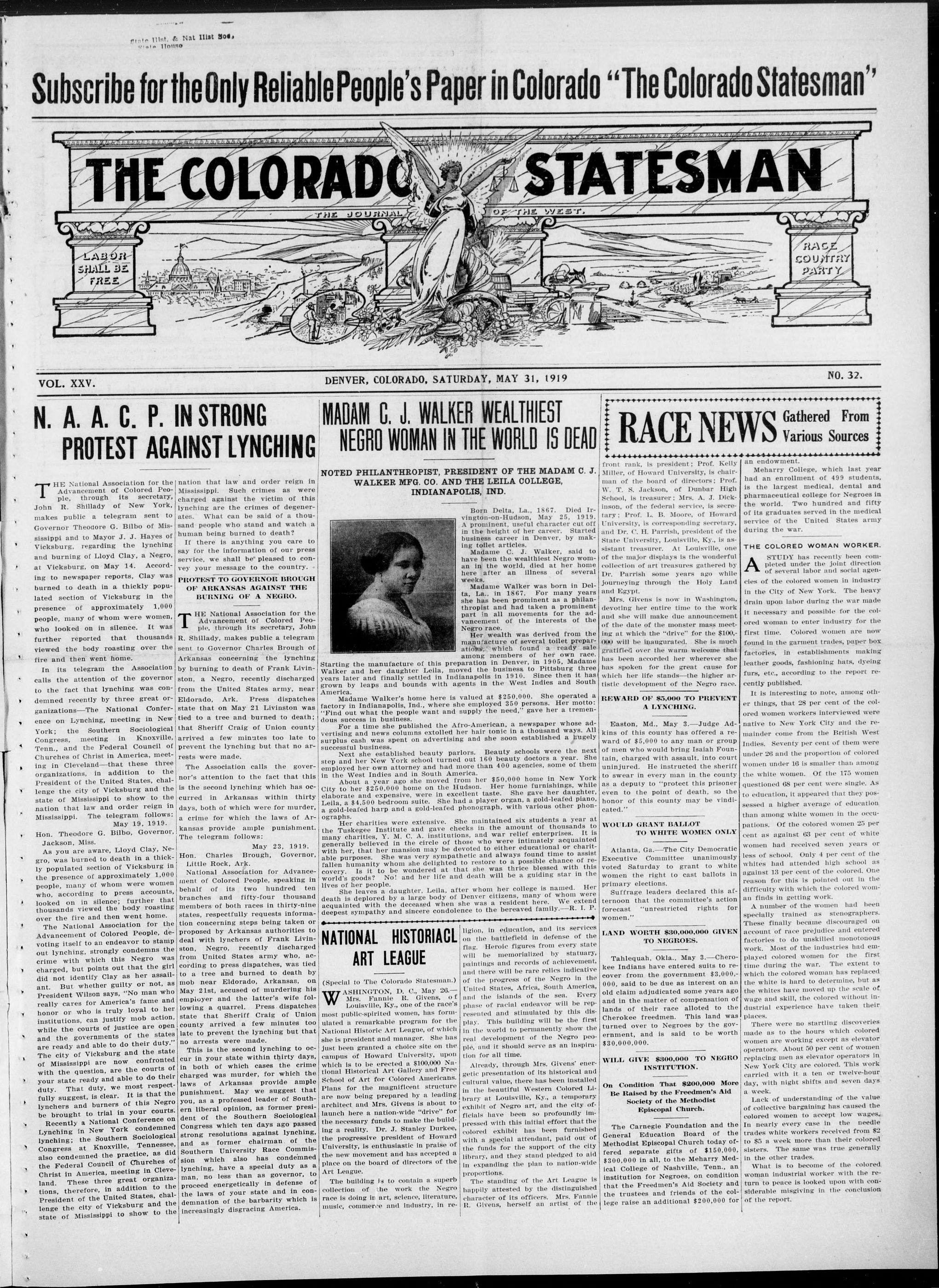
N. A. A. C. P. IN STRONG PROTEST AGAINST LYNCHING
THE National Association for the Advancement of Colored People, through its secretary, John R. Shillady of New York, makes public a telegram sent to Governor Theodore G. Bilbo of Mississippi and to Mayor J. J. Hayes of Vicksburg, regarding the lynching and burning of Lloyd Clay, a Negro, at Vicksburg, on May 14. According to newspaper reports, Clay was burned to death in a thickly populated section of Vicksburg in the presence of approximately 1,000 people, many of whom were women, who looked on in silence. It was further reported that thousands viewed the body roasting over the fire and then went home.
In its telegram the Association calls the attention of the governor to the fact that lynching was condemned recently by three great organizations—The National Conference on Lynching, meeting in New York; the Southern Sociological Congress, meeting in Knoxville, Tenn., and the Federal Council of Churches of Christ in America, meeting in Cleveland—that these three organizations, in addition to the President of the United States, challenge the city of Vicksburg and the state of Mississippi to show to the nation that law and order reign in Mississippi. The telegram follows: May 19, 1919. Hon. Theodore G. Bilbo, Governor, Jackson, Miss. As you are aware, Lloyd Clay, Negro, was burned to death in a thickly populated section of Vicksburg in the presence of approximately 1,000 people, many of whom were women who, according to press accounts, looked on in silence; further that thousands viewed the body roasting over the fire and then went home.
The National Association for the Advancement of Colored People, devoting itself to an endeavor to stamp out lynching, strongly condemns the crime with which this Negro was charged, but points out that the girl did not identify Clay as her assailant. But whether guilty or not, as President Wilson says, "No man who really cares for America's fame and honor or who is truly loyal to her institutions, can justify mob action, while the courts of justice are open and the governments of the states are ready and able to do their duty." The city of Vicksburg and the state of Mississippi are now confronted with the question, are the courts of your state ready and able to do their duty. That duty, we most respectfully suggest, is clear. It is that the lynchers and burners of this Negro be brought to trial in your courts.
Recently a National Conference on Lynching in New York condemned lynching; the Southern Sociological Congress at Knoxville, Tennessee, also condemned the practice, as did the Federal Council of Churches of Christ in America, meeting in Cleveland. These three great organizations, therefore, in addition to the President of the United States, challenge the city of Vicksburg and the state of Mississippi to show to the
VOL. XXV.
the Only Reliable
COLOR
IN STRONG
AINST LYNCHING
nation that law and order reign in Mississippi. Such crimes as were charged against the victim of this lynching are the crimes of degenerates. What can be said of a thousand people who stand and watch a human being burned to death? If there is anything you care to say for the information of our press service, we shall be pleased to convey your message to the country. PROTEST TO GOVERNOR BROUGH
THE National Association for the Advancement of Colored People, through its secretary, John R. Shillady, makes public a telegram sent to Governor Charles Brough of Arkansas concerning the lynching by burning to death of Frank Livinston, a Negro, recently discharged from the United States army, near Eldorado, Ark. Press dispatches state that on May 21 Livinston was tied to a tree and burned to death; that Sheriff Craig of Union county arrived a few minutes too late to prevent the lynching but that no arrests were made.
The Association calls the governor's attention to the fact that this is the second lynching which has occurred in Arkansas within thirty days, both of which were for murder, a crime for which the laws of Arkansas provide ample punishment. The telegram follows:
May 23, 1919.
Hon. Charles Brough, Governor, Little Rock, Ark.
National Association for Advancement of Colored People, speaking in behalf of its two hundred ten branches and fifty-four thousand members of both races in thirty-nine states, respectfully requests information concerning steps being taken or proposed by Arkansas authorities to deal with lynchers of Frank Livinston, Negro, recently discharged from United States army who, according to press dispatches, was tied to a tree and burned to death by mob near Eldorado, Arkansas, on May 21st, accused of murdering his employer and the latter's wife following a quarrel. Press dispatches state that Sheriff Craig of Union county arrived a few minutes too late to prevent the lynching but that no arrests were made.
This is the second lynching to occur in your state within thirty days, in both of which cases the crime charged was murder, for which the laws of Arkansas provide ample punishment. May we suggest that you, as a professed leader of Southern liberal opinion, as former president of the Southern Sociological Congress which ten days ago passed strong resolutions against lynching, and as former chairman of the Southern University Race Commission which also has condemned lynching, have a special duty as a man, no less than as governor, to proceed energetically in defense of the laws of your state and in condemnation of the barbarity which is increasingly disgracing America.
MADAM C. J. WALKER WEALTHIEST NEGRO WOMAN IN THE WORLD IS DEAD
NOTED PHILANTHROPIST, PRESIDENT OF THE MADAM C. J WALKER MFG. CO. AND THE LEILA COLLEGE, INDIANAPOLIS. IND.
Starting the manufacture of this preparation in Denver, in 1905, Madame Walker and her daughter Leila, moved the business to Pittsburg three years later and finally settled in Indianapolis in 1910. Since then it has grown by leaps and bounds with agents in the West Indies and South America.
Madame Walker's home here is valued at $250,000. She operated a factory in Indianapolis, Ind., where she employed 350 persons. Her motto: "Find out what the people want and supply the need," gave her a tremendous success in business.
For a time she published the Afro-American, a newspaper whose advertising and news columns extolled her hair tonic in a thousand ways. All surplus cash was spent on advertising and she soon established a hugely successful business.
Next she established beauty parlors. Beauty schools were the next step and her New York school turned out 160 beauty doctors a year. She employed her own attorney and had more than 400 agencies, some of them in the West Indies and in South America.
About a year ago she moved from her $50,000 home in New York City to her $250,000 home on the Hudson. Her home furnishings, while elaborate and expensive, were in excellent taste. She gave her daughter, Leila, a $4,500 bedroom suite. She had a player organ, a gold-leafed piano, a gold-leafed harp and a gold-leafed phonograph, with various other phonographs.
Her charities were extensive. She maintained six students a year at the Tuskegee Institute and gave checks in the amount of thousands to many charities, Y. M. C. A. institutions, and war relief enterprises. It is generally believed in the circle of those who were intimately acquainted with her, that her mansion may be devoted to either educational or charitable purposes. She was very sympathetic and always found time to assist fallen humanity whom she delighted to restore to a possible chance of recovery. Is it to be wondered at that she was thrice blessed with this world's goods? No! and her life and death will be a guiding star in the lives of her people.
She leaves a daughter, Leila, after whom her college is named. Her death is deplored by a large body of Denver citizens, many of whom were acquainted with the deceased when she was a resident here. We extend degenest sympathy and sincere condolence to the bereaved family.—R. I. P.
A. B.
Starting the manufacture of this press Walker and her daughter Leila, more years later and finally settled in India grown by leaps and bounds with an America.
Madame Walker's home here is a factory in Indianapolis, Ind., where she "Find out what the people want and dous success in business.
For a time she published the Advertising and news columns extolled her Surplus cash was spent on advertising successful business.
Next she established beauty past step and her New York school turned employed her own attorney and had in the West Indies and in South America.
About a year ago she moved for City to her $250,000 home on the Elaborate and expensive, were in exe Leila, a $4,500 bedroom suite. She has a gold-leafed harp and a gold-leafed ographs.
Her charities were extensive. She the Tuskegee Institute and gave many charities, Y. M. C. A. institute generally believed in the circle of t with her, that her mansion may be dable purposes. She was very sympat fallen humanity whom she delighted in. Is it to be wondered at the world's goods? No! and her life and lives of her people.
She leaves a daughter, Leila, after death is deplored by a large body of acquainted with the deceased when a deepest sympathy and sincere condolence.
NATIONAL HISTORIACL ART LEAGUE
(Special to The Colorado Statesman.)
WASHINGTON, D. C., May 26.—Mrs. Fannie R. Givens, of Louisville, Ky., one of the race's most public-spirited women, has formulated a remarkable program for the National Historic Art League, of which she is president and manager. She has just been granted a choice site on the campus of Howard University, upon which is to be erected a $100,000 National Historical Art Gallery and Free School of Art for Colored Americans. Plans for the magnificent structure are now being prepared by a leading architect and Mrs. Givens is about to launch here a nation-wide "drive" for the necessary funds to make the building a reality. Dr. J. Stanley Durkee, the progressive president of Howard University, is enthusiastic in praise of the new movement and has accepted a place on the board of directors of the Art League.
The building is to contain a superb collection of the work the Negro race is doing in art, science, literature, music, commerce and industry, in re-
---
Born Delta, La., 1867. Died Irvington-on-Hudson, May 25, 1919. A prominent, useful character cut off in the height of her career. Started business career in Denver, by making toilet articles. Madame C. J. Walker, said to have been the wealthiest Negro woman in the world, died at her home here after an illness of several weeks. Madame Walker was born in Delta, La., in 1867. For many years she has been prominent as a philanthropist and had taken a prominent part in all movements for the advancement of the interests of the Negro race. Her wealth was derived from the manufacture of several toilet preparations, which found a ready sale among members of her own race.
separation in Denver, in 1905, Madame loved the business to Pittsburgh three dianapolis in 1910. Since then it has agents in the West Indies and South valued at $250,000. She operated a employed 350 persons. Her motto: supply the need," gave her a tremen-fro-American, a newspaper whose adher hair tonic in a thousand ways. All and she soon established a hugely colors. Beauty schools were the next I out 160 beauty doctors a year. She more than 400 agencies, some of them verica, from her $50,000 home in New York Hudson. Her home furnishings, whileELLent taste. She gave her daughter, and a player organ, a gold-leafed piano, phonograph, with various other phon- she maintained six students a year at weeks in the amount of thousands to tons, and war relief enterprises. It is those who were intimately acquainted devoted to either educational or charithetic and always found time to assist to restore to a possible chance of reat she was thrice blessed with this death will be a guiding star in the latter whom her college is named. Her Denver citizens, many of whom were she was a resident here. We extendence to the bereaved family.—R. I. P.
ligion, in education, and its services on the battlefield in defense of the flag. Heroic figures from every state will be memorialized by statuary, paintings and records of achievement, and there will be rare relics indicative of the progress of the Negro in the United States, Africa, South America, and the islands of the sea. Every phase of racial endeavor will be represented and stimulated by this display. This building will be the first in the world to permanently show the real development of the Negro people, and it should serve as an inspiration for all time.
Already, through Mrs. Givens' energetic presentation of its historical and cultural value, there has been installed in the beautiful Western Colored Library at Louisville, Ky., a temporary exhibit of Negro art, and the city officials have been so profoundly impressed with this initial effort that the colored exhibit has been furnished with a special attendant, paid out of the funds for the support of the city library, and they stand pledged to aid in expanding the plan to nation-wide proportions.
The standing of the Art League is happily attested by the distinguished character of its officers. Mrs. Fannie R. Givens, herself an artist of the
RACENEWS Gathered From Various Sources
front rank, is president; Prof. Kelly Miller, of Howard University, is chairman of the board of directors; Prof. W. T. S. Jackson, of Dunbar High School, is treasurer; Mrs. A. J. Dickinson, of the federal service, is secretary; Prof. L. B. Moore, of Howard University, is corresponding secretary, and Dr. C. H. Parrish, president of the State University, Louisville, Ky., is assistant treasurer. At Louisville, one of the major displays is the wonderful collection of art treasures gathered by Dr. Parrish some years ago while journeying through the Holy Land and Egypt. Mrs. Givens is now in Washington, devoting her entire time to the work and she will make due announcement of the date of the monster mass meeting at which the "drive" for the $100,000 will be inaugurated. She is much gratified over the warm welcome that has been accorded her wherever she has spoken for the great cause for which her life stands—the higher artistic development of the Negro race.
REWARD OF $5,000 TO PREVENT A LYNCHING.
Easton, Md., May 3.—Judge Adkins of this county has offered a reward of $5,000 to any man or group of men who would bring Isaiah Fountain, charged with assault, into court uninjured. He instructed the sheriff to swear in every man in the county as a deputy to "protect this prisoner even to the point of death, so the honor of this county may be vindicated."
WOULD GRANT BALLOT
TO WHITE WOMEN ONLY
Atlanta, Ga.—The City Democratic Executive Committee unanimously voted Saturday to grant to white women the right to cast ballots in primary elections. Suffrage leaders declared this afternoon that the committee's action forecast "unrestricted rights for women."
LAND WORTH $30,000,000 GIVEN
TO NEGROES.
Tahlequah, Okla., May 3.—Cherokee Indians have entered suits to recover from the government $3,000,-000, said to be due as interest on an old claim adjudicated some years ago and in the matter of compensation of lands of their race allotted to the Cherokee freedmen. This land was turned over to Negroes by the government, and is said to be worth $30,000,000.
WILL GIVE $300,000 TO NEGRO
INSTITUTION.
On Condition That $200,000 More Be Raised by the Freedmen's Aid Society of the Methodist Episcopal Church.
The Carnegie Foundation and the General Education Board of the Methodist Episcopal Church today offered separate gifts of $150,000, $300,000 in all, to the Meharry Medical College of Nashville, Tenn., an institution for Negroes, on condition that the Freedmen's Aid Society and the trustees and friends of the college raise an additional $200,000 for
NO.32.
Meharry College, which last year had an enrollment of 499 students, is the largest medical, dental and pharmaceutical college for Negroes in the world. Two hundred and fifty of its graduates served in the medical service of the United States army during the war.
THE COLORED WOMAN WORKER
A STUDY has recently been completed under the joint direction of several labor and social agencies of the colored women in industry in the City of New York. The heavy drain upon labor during the war made it necessary and possible for the colored woman to enter industry for the first time. Colored women are now found in the garment trades, paper box factories, in establishments making leather goods, fashioning hats, dyeing furs, etc., according to the report recently published.
It is interesting to note, among other things, that 28 per cent of the colored women workers interviewed were native to New York City and the remainder come from the British West Indies. Seventy per cent of them were under 26 and the proportion of colored women under 16 is smaller than among the white women. Of the 175 women questioned 68 per cent were single. As to education, it appeared that they possessed a higher average of education than among white women in the occupations. Of the colored women 25 per cent as against 63 per cent of white women had received seven years or less of school. Only 4 per cent of the whites had attended high school as against 13 per cent of the colored. One reason for this is pointed out in the difficulty with which the colored woman finds in getting work.
A number of the women had been specially trained as stenographers. These finally became discouraged on account of race prejudice and entered factories to do unskilled monotonous work. Most of the industries had employed colored women for the first time during the war. The extent to which the colored woman has replaced the white is hard to determine, but as the whites have moved up the scale of wage and skill, the colored without industrial experience have taken their places.
There were no startling discoveries made as to the hours which colored women are working except as elevator operators. About 50 per cent of women replacing men as elevator operators in New York City are colored. This work carried with it a ten or twelve-hour day, with night shifts and seven days a week.
Lack of understanding of the value of collective bargaining has caused the colored women to accept low wages. In nearly every case in the needle trades white workers received from $2 to $5 a week more than their colored sisters. The same was true generally in the other trades.
What is to become of the colored woman industrial worker with the return to peace is looked upon with considerable misgiving in the conclusion of the report.
CAPITAL PETROLEUM
O (A PRODUCING, DIVIDEND-PAYING COMPANY) BRINGS IN WELL NO. 30
Telegraphic Advice Dated May 17th
LaFont well No. 2, one hundred fifty feet deep, twenty-five feet sand, shot with forty quarts; best showing so far on lease; think well will flow before morning.
The drilling in this field is from 130 to 150 feet deep, and we expect to bring in a well about every week. This makes sure dividend production; cost of drilling is small and we can easily keep the drills going here while we are also drilling and developing on deep territory in
TEXAS, THE NEW WONDERLAND OF OIL
AND ALSO IN THE TAMPICO FIELDS OF MEXICO, IN
The World's Richest Oil Field
The World's Richest Oil Field
TELEGRAPHIC ADVICE DATED MAY 16, 1919
There is great interest here in Tampico oil fields and many operators are making arrangements to go there immediately; will arrange banking connections and start for Tampico tomorrow.
This statement is borne out by recent letter advices from our Mr. Guthrey telling of a busy week in Tampico, financially, by reason of the visit of two groups of men: one composed of officers and technical men of a California company and on the day to New York via Havana; the other composed of twelve bankers and oil land investors with the representatives of a New York company which is already heavily interested in Tampico and will probably put in pipe lines in connection with another company's investments.
The American invasion is becoming so pronounced it is barely possible to secure offices, rooms or living quarters.
A fully established Publicity Bureau of Boston advises of quickened interest in oils in the East; of sharp activity on the Curb Market in Texas oils; of inquiries on Capitol and what it means to fully realize being interested in the World's Richest Oil Fields.
EYES OF OIL WORLD NOW TURNED ON AMARILLO
Heart of vast cattle empire now leased to the extent of many acres. Big companies prepare to sink steel drills. Reports of geologists point to Amarillo as center of next great Texas oil field. Strong companies have large acreage and individuals now scampering to pick up leases in Panhandle.
Capitol Petroleum has 6,000 acres in the heart of the Panhandle and Standard California type rig bought and being erected on choice location.
This recent acquisition in itself will make our stock worth $1.00 or more per share, and added to this what our company has in Kansas, Oklahoma and Mexico certainly makes this stock a most attractive investment at the present price of 25 cents. We urge our friends to buy now, as the price will soon be advanced to 50 cents or $1.00 per share.
Four equal monthly payments, or 5 per cent discount for all cash with order.
The Capital Petroleum Company
---
```markdown
```
413-414-415 DENHAM BUILDING
Law of Progress.
Let us then be of good cheer. From the great law of progress we may derive at once our duties and our encouragements. Humanity has ever advanced; thwarted sometimes by obstacles which have caused it for a time—a moment only; in the immensity of ages—to deviate from its true lines, or seem to retreat; but still ever onward.—Charles Sumner.
Western Oil Derrick says:
OIL WORLD NOW TURNED ON
fire now leased to the extent of many
ports of geologists point to Amarillo
have large acreage and individual
1000 acres in the heart of the Panha-
neted on choice location.
It itself will make our stock worth-
any has in Kansas, Oklahoma and
ment at the present price of 25 cents
can be advanced to 50 cents or $1.00.
Now 25 Cents a
payments, or 5 per cent discount f
al Petroleum
DING
Two Things Seemed Evident:
An Irishman was brought up for stealing ducks. The evidence against him was overwhelming, yet witnesses followed on each other's heels to testify to his white and blameless life and his stainless character. "Gentlemen of the Jury:" the judge summed up, "I think you will agree with me that the prisoner stole the ducks, and that he is the most popular man in the county."
1919 May 17 PM 8:25
feet sand, shot with forty before morning.
H. A. BEASLEY,
Asst. Field Mgr.
we expect to bring in a well of drilling is small and we g and developing on deep ter-
F OIL
MEXICO, IN
Oil Field
16, 1919
---
1919 May 16 PM 11:53
our Mr. Guthrey telling of a two groups of men: one command on the day to New York and investors with the repre-terested in Tampico and will investments.
very possible to secure offices,
quickened interest in oils in inquiries on Capitol and what Oil Fields.
AMARILLO
any acres. Big companies pre- as center of next great Texas oils now scampering to pick up
handle and Standard California
$1.00 or more per share, and Mexico certainly makes this events. We urge our friends to per share.
a Share
or all cash with order.
Company
DENVER, COLORADO
There Are Furs and Furs.
In considering the romance of furs one thinks always of the wild, free life of the woodland, but the common alley cat of the cities could tell a different story.
Next.
"It may seem a little strange, safe the facetious feller, "but ice is a lot smoother before it is shaved."
YANKS RELIEVED AT ARCHANGEL
NEW BRITISH VOLUNTEER ARMY REPLACE AMERICANS IN RUSSIA.
TROOPS COMING HOME
SIBERIAN TROOPS STORM ANAR
CHISTS' STRONGHOLD AT
ORENBURG.
Western Newspaper Union News Service.
Archangel, May 30.—The American cruiser Des Moines arrived here simultaneously with transports bringing new British volunteer army units to relieve the American and other troops who have been fighting since last August.
Rear Admiral McCully, commander of the American naval force in Russian waters, is on board the Des Moines. The gunboat Yankton is expected to arrive here within a few days.
The ships on which the new forces arrived will transport the first unit of American infantry, which it is expected will be homeward bound in one week.
The last American infantry on the Vologda railway front has just been relieved after nearly eight months' service. The Americans received a rousing farewell from the British and Russian command at Obozerskaya.
American Memorial Day services were observed at the Archangel cemetery, where are interred many of the 200 Americans who have been killed in action or died of disease in north Russia.
London.—Siberian troops of the Kolchak government were storming Orenburg, one of the last Bolshevist strongholds in southeastern Russia, and an important railway junction, on May 21, according to a telegram received here from Omsk.
The Bolsheviki are faced by further internal troubles and the official statement received here by wireless from Moscow refers to the "internal front" where "an advance against Vinnitsa has been stopped."
There has also been an uprising against the soviet in the district of Shunga around Lake Onega, northwest of Petrograd.
According to a telegram received here from Kem, the Bolshevist commissioners in the Shunga district were killed and the Red Guards dispersed. The Bolshevist statement also admits that the Bolshevist troops continue to retire in the Petrograd region before the Ukranians. A Russian wireless message denies the report that explosions had occurred in Petrograd due to its approaching evacuation. The dispatch declares there is no intention of abandoning the city, and that reinforcements already sent to the Gatchina front, south of Petrograd, are succeeding in driving back the enemy. The American and British minister at Warsaw have protested against the Polish offensive in east Galicia, according to a dispatch to the Exchange Telegraph from Vienna by way of Copenhagen.
Movie Actress Killed.
Portland, Ore.—Two persons were killed and five injured near here when an automobile bus carrying members of a moving picture company, overturned and threw out the thirteen passengers. Miss Edna Gaynor, 17, an actress, and George C. Held, a local camera man, were killed.
Lynch Sheriff's Slayer.
Lamar, Mo.—Jay Lynch, confessed slayer of Sheriff John Harlow of Barton county, and the sheriff's son, was hanged by a mob, which took him from the hands of officers in the court house and lynched him in the yard of the building. Lynch had pleaded guilty to the charge and had been given a sentence of life imprisonment by Judge B. G. Thurman. The murder of which he was convicted took place March 3. Lynch's wife, baby, mother and sister were in the judge's office when he was taken out by the mob. His handcuffs had been removed so that he might hold his baby, and he had just given the child back to its mother when the men entered. The courtyard was filled at the time of the hanging by persons who had come out of the courtroom.
Move Captain Eryatt's Body
London.—The body of Capt. Charles Fryatt, the British merchant officer executed by the Germans in 1916, will be taken to England and given a burial similar to that of Miss Edith Cavell. This was announced in the House of Commons.
Hawker Makes Speech.
London.—Speaking at a luncheon given by the Daily Mail in his and Lleutenant Commander Grieve's honor, Harry G. Hawker deprecated the organization which had won for the United States the honor of the first crossing of the Atlantic by a heavier than air machine. He declared it was not a serious attempt, with a ship stationed at "every twenty yards." Hawker continued: "If you put a ship every fifty miles, it shows you have no fight in your motor."
If All You Want
is just "a straw"---
why not wear
a shock of wheat?
If it's style
you're looking for
Get a May Co. Straw.
$2.45 to $8
THE MAY CO.
16th and Champa Sts.
Denver, Colo.
COLONEL SIMMONS CHARMS
HOOSIERS.
Indianapolis, Ind., May 23.—Roscoe Conkling Simmons never spoke with more power or eloquence, nor with more wisdom than when he spoke at Tomlinson hall, this city, on Thursday evening. A multitude of his ardent admirers enjoyed him as he delivered what many believe to have been the wisest and most eloquent speech Indianapolis has heard.
For two and a half hours he surveyed the world through eyes of the most advanced representatives of his race, and with a speech beyond that of any orator in America.
Speaks of "Lieut. Jim."
"Let me speak in the beginning," he said, "of the murder of James Reese Europe, a bright particular star in the recent story of my race. He died at the hands of a vagabond whom he had befriended; died at the moment of his greatest fame, when his own and all the world were eager to bestow upon him the honors won through years of labor and sacrifice. He was killed because one black man hated to take orders from a superior black man."
The tribute that the orator paid to the great composer was a touching one. "There is a lesson in this death for you and for me," he declared. "It is that slavery dies as hard within as from without, and that empty are our words about progress until we can act as well as talk equality."
Adding Nor Taking Away
"I will tell my story," declared the orator. "I will tell my story as it is, adding nothing and taking nothing away. I will speak of things I saw and heard. I cannot tell it all, but all I do remember. I recollect that one day in Verudin, in that Verudin against which the Germans moved without avail for four years, I saw a brown boy dressed in the uniform of my country and his. He was handsome and tall. His eye was as bright as the winter sun that poured its glory down from the free sky of France. He had a medal on his proud bosom. I asked him what he was doing standing there. 'On guard,' he replied. So far from home, I thought, and on guard for the land that gave him birth. I wondered who save God could be on guard for his mother in Baton Rouge, from whose bounds he had been called to speed away and guard the mystic city thirteen centuries old. Here is the lesson, I said; where are the pupils?"
Ernest G. Tidrington, noted Indiana leader, presided.—Chicago Defender.
FOR SALE, on easy terms, 7-room house, 2032 Ogden street. Phone York 7085J.
PACIFIC GROVE NEWS-CALIFORNIA
The farmers are all smiles over the bountiful return of their crops and are very hopeful as to future successes. The Baptist Church of Pacific Grove is progressing nicely and Deacons Rogers and Smith predict a glorious future for this house of worship. J. W. Woodward is completing his store building, where he will conduct business in a manner to meet the requirements of patrons. Mrs. J. W. Woodward, continues her activities in the Home and Foreign Missionary Society.
One temptation in making difficult decisions is to compromise. You aren't sure which way is the best, you seek to combine the advantages of both, and many a time merely combine all the disadvantages. To be sure, there are times when a compromise is the wisest course, but there are just as many times when it is cowardice and weakness. How can one tell which times are which? Well, that is simply another decision for you.
Provide Playground.
The truly normal, mischief-loving youngster (and all healthy children are both) simply cannot live without play. If this is denied him he will droop like a flower transplanted into unhealthy soil. However, if he finds it difficult to keep on friendly terms with his small neighbors his mother must see to it that he has his own playground at home. It won't cost much to fit up such a fairyland, and it will prove an investment that will pay back undreamed of returns.—New York Evening Telegram.
Paths of Democracy.
To accustom oneself to disregard the accidents of manner and station sufficiently to see the man as he is, to have a clear sight for genuine character under any of the disguises of unfamiliarity and prejudice, to know how simple and how common are the elements that go to the making of manhood, are the paths that lead to belief in democracy.—George E. Woodberry.
Ancient Needlework
The early Britons were expert in needlework, and the earliest (British) Church of England before the fifth century won fame from its "handmaids of the church," who made linens and altar frontals for numberless churches in Europe. Tapestry, the work of queens like Matilda and noble ladies in olden times was largely needlework.
You Win!
The man who is riding sixty miles per hour in a big machine is no happier than the man who is riding thirty miles per hour in a fliver, because the man in the fliver thinks he is going sixty.—Cincinnati Enquirer.
"Boxing," says the Chicago News, "if a healthful exercise." So it is—only due hygienic care should be exercised in selecting your opponent.
Phonograph in Photography:
A photographer has found a photograph a valuable aid in obtaining the desired facial expression in a subject. After studying the face of the person whose likeness he is to obtain he decides whether he vishes an animated, reserved, sad or pensive expression. He then places a record in the phonograph likely to stimulate the expression desired. For animation he will play such a tune as "Dixie," while to produce a sad or thoughtful expression "My Old Kentucky Home" may be played.
OLORADG
THE COLORADG\274 STATESMAN -
fm HE COLC “scaghet Or 4 Petar
a SSD ae Teme?
SE, pa Sees ax
| ieerae = bl ¢ . ee - [are
je ete 1k A CB en eb
ss i A > Ea ea ae
za £5 EEE SS :
SO ye EVR sce ty pe csv os oss sa apotaio
eid Gatiia Street, ‘Room’ a5:
6. 0. Box 116 Phone Main 7417
SUBSCRIPTION RATES.
Sa Monts... SME oy Le
Three Months ‘ont : 1
gels LI UTES PR O
MUST BE PAID IN ADVANCE.
Entered as second-class matter at the pustoffice in the City of Denver, Colo
Ree ee the Sly at vay COP,
Reading notices 10 Gente per line. Diaplay advertisingy wwe pun th
Remittances should be made by Express Money Order, Postoffice Money
Order, Registered Letter or Bank Draft. Postage gtamps will be received the
fame as cash for the fractional part of a dolllar. Only 1c and 2c stamps taken.
No discounts allowed on less than three months’ contract. Cash must accom-
Pany all orders from patties unknown to us. Further particulars on application,
Communications to receive attention must be hewsy, upon Important #ub-
Jects, plainly written only upon one side of the paper, must reach us Tuesdays,
if possible, anyway not later than Wednesdays, and bear the signature of the
author. No manuscript returned, unless stampa are sent for postage, All
communications of a personating mature that are not complimentary, will by
MEMORIAL DAY AT HOME AND ABROAD.
HIS DAY OF DAYS, marking an ever-memorable event, which seems to
Tranves a thought that becomes deeper, firmer, more precious ax exch
succeeding year of its celebration arouses the nation to a conselousness
that the mockery of democracy must cease and the spirit of Amerten—the
spirit that shall permeate the world, ALL MANKIND BEING BORN FREE
AND EQUAL, must prevail, thus thrusting the gloom that o’erhangs onr
nition aside and bringing us into a realization of that civilization which Gad
and Nature decreed from the beginning of creation,
With the cooperation of governors, mayors, state and local educational
authorities and Grand Army Reserve Posts in all parts of the country, the
National Security League announced a completion of plans for a nation-wide
special celebration of Memorial Day, and yesterday the keynote of the ob-
servances was a combination of reverence for service and sacrifice in past
witrs, with special recognition of the recently returned veterans of the world
War and those left on the battle-searred fields of France. ‘The services in
the churches, the ceremonies at the cemeteries, the continuous stream of rela-
lives, friends and acquaintances to the graves and tombs of their departed,
lent 4 touching spectacle far greater than former years, as in the bowels of
Mother Earth the remains of many victims of disease, wounds, ete. of the
world’s great war gave a forcible reminder of the toll paid for the reseuing
and freeing of the world of man’s inhumanity to man, But the lesson of
yonder European battlefield must be taught again, if man, especially in our
own United States, continues his disrespect for Jaw and honor; and the cele-
bration of Memorial Day being meaningless to him, he becoming callous in his
uncivilized and sayage-like habits to the extent of distrust by the world of
nations abroad, at lust bows to the inevitable, which compels the man,
the people, the nation to Surrender at a cost the magnitude of which surpasses
the greatest enlculation,
MEMORIAL DAY! Yes, a day when every heart wrung with sorrow for
the passing away of a loved one, should pulsate in unison with other hearts,
and if the woeful thoughts that flashed with electrical rapidity could find a
solace in other hearts in their acknowledgment of the common lot of man,
then such a harmonious relationship, such an international spirit, would exist
between us that the spirit of fear would forever be absent from our existence,
the theme of racial superiority forgotten, und the blessing of freedom unit-
ing hearts and minds into one common human family would extend its mighty
Influence over a world that would turn this event from sadness to glidness,
und from the blackness of darkness Into an effulgence of marvelous light.
MADAM ©. J. WALKER DIES.
“Leaves have their time to full,
And flowers to wither with the north wind’s breath;
But thou! thou hast all seasons for thine own, O death !°
HE mutability of human life and human institutions compels a thought
Toit makes us pause in our busy deliberations, our business transie-
tions, our inultiplied interests in things temporal, and though this comes
with clock-like regularity, yet It strikes us with an awful dread, an unfamiliar
strain, the resonance of which seems so inharmonious whenever we are con-
fronted with the experience,
Madam Walker, who passed from this life last Sunday morning, was an-
other example of what perseverance, thrift, business system and method could
accomplish among the people of her race, and her individual character, home
life and conduct as a citizen seemed to us to be the trinity working in unity,
that actunted her success, making her so conspicuous as to merit universil
adiniration, Following the career of this distinguished deceased representa-
tive of our race, and a citizen who came in for recognition from all classes,
we find every action in her business relationship lending an inspiration which
Was profitable to those who followed her, und her many wise sayings and gen-
tle admonitions to the members of her race gave un incentive for business
activities on lines that won respect in the market of competition, Slowly
and steadily she climbed the financial ladder of fame, then discovering the
virtue of advertising, she unhesitatingly grasped the opportunity and rapidly
rose to a woman of weulth and possibly the greatest of her race. But with
her original qualities she could not be separated from her acts of merey and
love, and therefore in her quiet, unassuming way she became prominent for
her works of philanthropy, engaging in every movement for the advancement
of the Interests of her people.
Oh how sud that she should be snatched from us in the height of her
usefulness, and in the performance of such great services to her people, which
would be of such value as to help to destroy the hand of oppression that
seems to fall heavier as we give proof of our ability to do! We can hardly
have the conception that this leader, helper and friend Is gone from us, but as
it Is suid, “Every cloud has a silver lining,” we believe there was never a
regret so, profound that there was not somewhere in the gloom a comforting
spirit—no sorrow ever so acute and helpless that some solacing thought did
not creep In to soothe the anguish of the heart.
We can remember her as one who had no pretense or affectation in her
nature. She disliked notoriety und despised hypocrisy. Many of her acts of”
service to humanity had never been heralded by the press, but Madam Walker
believed in and her life exemplified the sentiment: “This aboye all—to thine
own self be true, and it must follow, as the night the day, thou cunst not
then be false to any man.”
SHE IS GONE, Denyer mourns her loss and shares the sorrows of In-
dianapolis and New York, the deceased having spent several years of her
life here; and THE COLORADO STATESMAN on behalf of our citizens,
bowing in humble submission to the God Who gives and takes, in offering
deepest sympathy to Madam Walker's daughter, Leila, and other relatives,
can only say in its overwhelming grief at this time, that the life of the de-
ceased will serve as a permanent institution In our tives, and after drying
our tears, we will find consolation in the words of a great writer: “When I
go down to the grave I can say, like many others, ‘I have finished my day's
work. But I cannot say I have finished my life. My day's work will begin
again the next morning. ‘The tomb is not a blind alley; it is a thoroughfare,
It closes on the twilight; it opens on the dawn.” |
Few Jews Will Emigrate to Palestine
From America and Great Britain
By OSCAR S. STRAUS, New York Banker
I am not a Zionist, but I am in hearty sympathy
with Zionism’s idealistic enterprise. Nevertheless I am
convinced that the number of Jews who will emigrate
to Palestine from, let us say, Great Britain or the
United States is infinitesimal.
Jews in Britain and America have become pros-
perous and patriotic citizens and in numerous cases
prominent figures in the life of those countries. Mil-
lions of them, though Jewish by faith and ancestry, are
native-born citizens and feel themselves, as they are
entitled to do, full-fledged Britons or Americans, as
€& il a
a
the case may be. I think events of the past four years amply demon-
strated that their claims in this respect are justified. ‘The Jewish war
“record in the United States, I am proud to say, was a splendid one. I am
sure it was equally creditable in Great Britain.
Jews are domiciled in large numbers in the two great English-
speaking countries and become integral parts of them because of the
opportunities for spiritual freedom which they have so long offered. Why
should Jews dieert such an environment? I cannot conceive any circum-
stances under which considerable numbers of Jews will ever leave British
or American shores.
T am told that anti-Zionists frequently suggest that, with the estab-
lishment of a special Jewish state, Jewish citizens of other countries might
some day find themselves political outcasts and be told to “go back to
your owi country.” :
Nonsense! Stuff and nonsense! ‘To suggest such a thing is to erect
a ridiculous bogey. ‘To carry out such a suggestion would be to set back
the wheels of liberty which the war we have fought and won have set
so far ahead,
We rejoice in New Palestine’s foundation. We believe in its legiti-
macy. We are confident that sooner or later its mission will be accom-
plished—namely, to afford a comfortable, happy, prosperous national
home for the oppressed Jews of all lands. It is because British and
American Jews are not oppressed Jews that they will not go to Palestine
Time Is Ripe for National Financing
of the Movement for Farm Homes
By LAJOS STEINER, War Trade Board
The present appears to be the opportune time to furnish natives and
immigrants, soldiers and the others who are qualified a reliable deposi-
tory in which to accumulate their savings for the acquisition in time, on
acceptable terms, of farm homes.
Hotnes in farm communities, equipped with buildings, live stock and
implements, at fair prices and terms are bound to improve conditions. An
initial investment of $1,000 (and much of that should be waived for
our returning soldiers) should be sufficient for a fully equipped farm
home to be taken possession of by qualified families. The balance of the
purchace price to be paid out of crops in a long series of years, with a
reasonable rate of interest.
Agricultural communities on the Buropean village system, with
American improvements, should be established, financed and adminis-
tered. ‘This would dispose of the dreaded isolation. Churches, schools,
meeting halls, moving pictures, ete., could be provided for the settlers
living in villages. ‘This would complete their Americanization. ‘The com-
munity wood lot, pasture, thrashing and other machinery, blooded stallion,
bull, boar, ete., co-operation in cases of emergency, the co-operative pur-
chase of commodities and selling of farm products assure success.
Inasmuch as governmental action is considered to be paternalistic
and undesirable, a national corporation chartered by our federal govern-
ment and our several states should be established by our great financiers.
This would secure the confidence of the clients.
Farm ownership is the foundation of stable government, of loyal
citizenship and of the welfare of the population. Our safety and pros-
perity rest on the largest possible number of contented farm home owners.
The acquisition of farm homes should be encouraged, aided and assisted
in the proper and practical manner. The single family owners of farm
homes in thriving agricultural communities are obviously the best remedy
for our economic ills and remigration.
Five Million Europeans Have Their Eyes
Fixed on America for Homes
By F. C. HOWE, New York Immigration Commissioner
Five million Europeans, wearied by the war but still awakened to
new points of view by it, are turning their eyes and thoughts to new homes
across the sea.
If they can find these homes in the United States they will flock
here the moment the opportunity is afforded. Otherwise they will remain
where they are. Canada, Australia or South America are not considered
for an instant by the great majority.
France has her thousands ready to come. Italy has even more, and
England will be largely represented when a propitious time has come. But
it is Germany that has the most numerous and most eager company of
those who would be emigrants to this country.
‘The American doughboy is responsible for the new and fervent con-
sideration Europeans are giving the United States. With his head up,
a grin on his tanned face and his long legs swinging in a stride that seems
never to tire, the American doughboy is altogether the most lovable, the
most worth while man in Europe. He does things that nobody else has
been able to do; he goes to places that everybody else thinks cannot pos-
sibly be reached. There isn’t a corner in Europe that the man in khaki
hasn’t looked into; there isn’t a job that he hasn’t tackled and completed.
The European peoples want the things, the opportunities of the United
States, whence came the American doughboy, their new idol.
It is curious that no other land in the world seems to promise them
what they are sure they will find here. Not Canada, nor Australia, nor
the Argentine or any other country of South America. Politically or
by tradition these lands are too closely bound to Europe, and they want
no more of the old Europe.
/——THE——
COLORADO
STATESMAN
The Mouth-Piece
of the People of
Colorado and the
Entire West
A RELIABLE chronicle
of their doings and
progress; a faithful mirror
of their wants, their hopes,
their best aspirations.
> 4
THE |
R
‘
| COLORADO |
R
; STATESMAN |
aa ee ancl
R
:
: Unequaled as an advertising
; medium for the business
of professional men and
women.
,
:
} An excellent family journal
} speaking to and for many
: thousand colored citizens.
_—_—_———————_————_—_—————_—_—_—_—_
| TWO DOLLARS A YEAR
————————————————————
| THE GREAT ORGAN
a re ane
' LABORING MASSES
B66 SEIS IEE IEEE MEIER SENS
THE COLORADO STATESMAN
Sherman Keene of Eaton, Colorado, is in the city for a few days. He reports everything in flourishing condition and our people are doing well.
Born, to Mr. and Mrs. James Thomas of 520 Columbine street, a 10-pound baby boy. Mother and babe are doing nicely.
entreaties of the pastor for unity with the Greater Brother, and the frater organization felt a renewal of the spirit for more active work in the community as well as an inspiration to more effective work. A large offer was taken up—the same being devoted to charitable purposes.
E. V. Cammel, the local head of
W. E. Huntley left for the Stanley Hotels, Estes Park, last Wednesday, resigning his position as second waiter at the University Club after nearly a year's service. This is Mr. Huntley's third season at the Estes Park and he hopes to make good again.
Mrs. Ernestine Stevens of Fort Smith, Ark., who is residing in Denver for a few months, underwent a serious operation at St. Joseph's Hospital last week Friday. The operation was performed by Doctors Huff and Martin, and present reports show a gradual improvement of the patient.
Mrs. Martin of Omaha, who underwent a serious operation at one of our hospitals, is reported to be gradually improving. Having taken suddenly ill one week after her arrival in Denver the beginning of April. Much sympathy is extended towards her by our people who never forget the stranger.
Rev. E. W. Moore of Columbus, Ohio, and former pastor of Zion Baptist Church, attended the Northern Baptist Conference here and was the guest of Mr. A. A. Waller. Many friends and acquaintances were glad to meet him and express their best wishes for his success in the ministry.
Mr. and Mrs. Pinn have purchased a beautiful Ford Roadster, which for beauty and durability is the equal of any of the other manufactures on styles. "Just for two," says Mr. Pinn, as the size of the family does not warrant a touring car. Slowly but surely our well known business man and wife are coming into their own again.
The Denver Branch of the N. A. A. C. P. opened its drive for 700 members with a great meeting at Zion Baptist Church. Miss Emily Griffith of the Opportunity School, delivered the principal address and Miss Rhoda Anderson Chambers charmed the audience with one of her rich selections. Denver is going over the top in this drive which closes with a big meeting at Shorter Church, Sunday, June 8th.
The annual special service of the Spanish-American War Veterans, which is generally held the Sunday preceding Decoration day, was held at Shorter Church last Sunday when an invitation was extended to all men who were in service during the war as well as those in the recuperation camp. The Rev. A. M. Ward spoke very impressively upon our soldier representatives, past and present, and emphasized the necessity of the military disciplinary training as a guidance for systematic action in the lines of the members of our race which will help us to stand shoulder to shoulder with any other race. The whole service was acceptably rendered, meriting the enjoyment of the large congregation present.
Mrs. Mary E. Campbell, mother of Capt. Thos. Campbell and sister of Mr. Wm. G. Campbell, died at the residence of her son, 614 Delaware street, at 5 a. m. Thursday, May 29. The funeral will be held from her son's residence upon later announcement
She has a brother in Springfield, Mo., and a sister in Kansas City, Mo. She was born in Polk County, Missouri, and moved to Springfield, Mo., in the early 60's, where the family lived. She came to Denver about one year ago to make her home with her son. She was a good and loving mother and a pious Christian and great church worker, being one of the founders of the A. M. E. church in Springfield, Mo. The Colorado Statesman tenders its sincere sympathy to Capt. and Mrs. Campbell and Wm. G.
The annual thanksgiving celebration of the United Brothers of Friendship and the Sisters of the Mysterious Ten was held at Campbell A. M. E. Church last Sunday afternoon. A splendid program was rendered and the sermon by the Rev. I. B. Wilson, pastor of the church, gave a very forcible reminder of what is required of those who unite themselves with the idea and for the purpose of doing good unto all men. Many truths were brought home to the large audience visibly affected by the
entreaties of the pastor for unity with the Greater Brother, and the fraternal organization felt a renewal of the spirit it for more active work in the community as well as an inspiration for more effective work. A large offering was taken up—the same being devoted to charitable purposes. E. V. Cammel, the local head of the order, carried out his part as master of ceremonies satisfactorily while the songs and other items were beautifully rendered. This ended another chapter in the life of the U. B. F. and S. M. T.
BOY SCOUT WEEK JUNE 8-14.
This organization is taking hold on the hearts of the people and at last they are beginning to realize that the care of the youth is the greatest help to the life of the man.
The Boy Scout movement has become a national concern with us in America and having attracted the attention of the President, the Congress, and many of the leading business heads of the country, special attention is being given it, and in accordance with government proclamation the week of June 8-14 will be set apart to assist in reaching 10,000,000 boys between the ages of 12 and 21 to fit them for that manhood which uplifts a people and builds a nation. During this Boy Scout week it is the purpose of the campaign to acquire 1,000,000 associate members who will contribute $1 or more to assist in the upkeep of this great cause which of necessity must bring precious and wonderful results. The local Scout movement among our boys is in the hands of a district committee—L. H. Lightner being president and Chas. A. Clark, secretary, who can be reached personally or by communication at office of American Woodmen, Arapahoe building, and 2520 Lafayette street, respectively. A more worthy cause cannot be thought of than to START EARLY WITH OUR BOYS.
H. J. FOSTER LAID TO REST.
A most impressive funeral service marked the last sad rites performed over the body of the late H. J. Foster, the event being under the auspices of Rocky Mountain Lodge No. 1, Masonic fraternity. Silently the procession starting from the residence in Lafayette street, moved towards Shorter Church, escorted by the members of the order in regular formation. Here the cortege was met by Revs. A. Milton Ward, Stripling and Secretary Bell of the Y. M. C. A., the ceremony being performed by them. The obituary sent from New York from the pastor of the Abyssinian Baptist Church, spoke in glowing terms of the deceased, the same offering quite a consolation to the bereaved family. Prayer by the Rev. Stripling, Scripture Lesson by Secretary Bell and address by the Rev. Ward, a solo by Madam Lillian Hawkins-Jones, after which the Masonic brethren gave the rite to the severed link in their chain bringing a very sad event to a close. The deceased, who was formerly in the employ of Mr. Turnbull, was looked after in the best manner possible. The body came to Denver in an oak casket and three-quarter oak case, while the floral offerings were many and beautiful. A large assembly of friends and acquaintances paid their last respect to the bier, thence borne to its final resting place at Fairmount cemetery under the direction of the Douglass undertakers. The Colorado Statesman offers its sincere condolence to the bereaved widow and other relatives commending them to God's gracious care and keeping.
OBITUARY.
Brother H. J. Foster was born fifty-three years ago in North Carolina and departed this life in full triumph of the Christian faith about 4:30 o'clock Monday morning, May 19th.
When a small boy the deceased went to Helena, Montana, where he spent the major part of his early manhood. He then settled in Denver, Colorado. He perhaps loved Denver better than any spot in the world. He was fascinated with its healthy climate and unsurpassed natural scenery. Here he had the largest circle of friends. Here is the Rocky Mountain Lodge, No. 1, F. A. M., of which he was a member. Here, as he told me a few days ago, he spent the happiest years of his life and here he desired his remains to be buried.
For twenty-five years Mr. Foster was chef on the private car of Mr. Frank Trumbell, president of the C. & S. R. R. The fact that he held this important position for a quarter of a century speaks louder for his industry, honesty and efficiency than any words his best friends can utter. He was not only an employee of President Trumbell, but Mr. Trumbell and all the family were his personal friends. Everything that could
possibly be done to reinstate his health was done by the Trumbell family. The world is greatly agitated today about the labor problem. This agitation would disappear in less than five years if the relation that existed between Mr. Trumbell and Mr. Foster could be established between all employers and employés. The position of the deceased carried him not only all over the United States, but through Canada and Mexico. Very few men of our race are as well acquainted with the American continent as was Mr. Foster.
Seven years ago the deceased was united in holy matrimony to Miss Henrietta Howard, who comes from one of the best families of the race, by Dr. Jenkins of Waco, Texas. Theirs was one of the happiest marriages that has come under my observation during my twenty-seven years in the ministry. They were absolutely devoted to each other and gave every evidence that they were not only joined together by Dr. Jenkins, but by the Lord Himself. Mrs. Foster is not only an ideal woman but an unusual wife. One son is the onlyother relative that survives the deceased.
In the fall of 1917, Mr. Foster was happily converted to Christianity and on Sunday morning, December 30th, of the same year, was baptized into the fellowship of the Abyssinian Baptist Church. From that day on he grew more and more into the affections of our membership because of his devotion to the church and many Christian qualities which he constantly manifested. One of his last acts the day before passing away was to send a contribution to his church. The pastor will not only miss him as a member, but as a personal friend.
While Mr. and Mrs. Foster only lived in New York five years, they did not have warmer friends any place on the American continent than here. These friends will ever hold in their memory a picture of his splendid physical, mental, moral and spiritual manhood. And Mrs. Foster will nowhere find more sympathetic hearts and homes with a warmer welcome than in this city where her husband took his departure for that city that "hath foundations whose builder and maker is God." We do not think of Brother Foster as being dead. He has simply entered into a larger and better life. "He dead! Say the same of the sunshine When evening comes over the hill, Say music is dead, when in slumber, The hand of the player is still.
Behold the dimmed splendor has broken
In morning, eternal and calm,
And listen! the player is sweeping
The chords of an infinite psalm."
A. CLAYTON POWELL,
Pastor Abyssinian Baptist Church,
New York City.
MRS. I. W. WILSON, WIFE OF WELL KNOWN FORMER DENVERITE, PASSES AWAY AT CROWLEY, COLO.
Mrs. Wilson, the wife of I. W. Wilson, residing just west of Crowley, died at the family home on Tuesday night. Her death was partly due to an attack of the influenza which she had at Christmas time and from which she never fully recovered. The funeral services will be conducted at Crowley at the school house where church services have been held, at 2 o'clock this Friday afternoon, and interment will be made in the Olney Springs cemetery. The services had been arranged for Thursday afternoon, but a sister of Miss Wilson sent word that she would be here and the services were arranged for today.
Mrs. Wilson is survived by her husband and three children, Sherman and Arthur and Denella. She also has a brother and a sister living.
Mr. and Mrs. Wilson are among the best known people in Crowley county and have resided in the county for twenty years. Their ranch is located just west of Crowley and north of King Center, where they have prospered in their work and made friends by their thrift and pleasant ways. They are among the few colored residents of the county and they have been held in high esteem by all who know them. Mr. Wilson is among the most prosperous of the farmers of this vicinity and has taken a great pride, as did his wife, in their home and their family.
Mrs. Wilson was born at Paris, Mo., in 1865, and was the daughter of Mr. and Mrs. Ham Campbell. She and Mr. Wilson were married in Denver, March 7, 1888.
The last words of Mrs. Wilson, knowing that she was about to die, were, "The Lord came and blessed my soul and left the Comforter with me. Meet me on the other shore."—Ordway New Era, Friday, May 16th.
I. W. Wilson was formerly a resident of Denver and left this city twenty years ago to take up farming in Crowley county, and is today one of the most prosperous colored farmers in this state.
Mr. Wilson is a worthy member of Rocky Mountain Lodge No. 1, F. & A. M., of Denver, to which he has been loyal and true for twenty-five years.
We extend to him and family our deepest sympathy upon their loss.
WILLIAM SPRAGUE.
LAZAR
Watch Daily Papers for Interesting Details of Our
25th Anniversary Sale
Beginning Monday, June 2
CHEYENNE, WYOMING, NEWS.
The Civic League held its regular weekly meeting Thursday night, May 15th, at the Second Baptist Church. A very interesting meeting subject, "Progress and Common Sense," led by Rev. J. M. Endicott. The presiding elder Rev. R. L. Pope gave a very interesting address on the above subject which was enjoyed by all. Elder Pope was en route to Salt Lake City, Utah, and having stopped over a few hours and visited the Civic League. We felt very much honored in having the presiding elder with us.
Mrs. Charles Johnson left last week for Chicago, where she will visit with relatives and friends for the next thirty days.
Rev. M. A. Eilouth, pastor of the Baptist Church of Casper, Wyo., passed through the city last week en route to the Northern Baptist Convention, which convened in Denver, Colo., May 21st to 27th, stopping over night, and preached at the Second Baptist Church, departing next morning accompanied by Rev. C. O. Smith, to the convention, who was also a delegate from the Second Baptist Church of Cheyenne. Mrs. John Moss departed last week for Colorado Springs on business and will possibly not return until after the federation, which convenes in Denver about June 10th. Mrs. Richard Gaskin of Omaha, is here visiting with relatives and friends. Mrs. Silver Cook of Cliranda, Iowa, is here visiting her brother, Mr. Joe Baker and his family.
Mrs. George Taylor left last week on a visit to Kansas.
Rev. J. M. Endicott, pastor of the A. M. E. Church, is in Colorado Springs this week attending the S. S. Convention.
Mr. and Mrs. J. C. Gaskin gave an announcement party Friday, May 23rd, from 2 until 6 o'clock announcing the marriage of their eldest daughter, Virgil, to Mr. J. D. Bowen, of Lincoln, Neb., June 3, 1919. Miss Virgil is a bright young lady and has held the position as stenographer in the office of Dr. J. H. Conway for about two years. She is a graduate of Cheyenne High, in 1915.
Rev. C. O. Smith, pastor of the Second Baptist Church, and ex-president of the Civil League, and Mr. C. J. Tolliver, secretary of the league, were entertained at dinner Sunday May 18th, by Rev. and Mrs. J. T. Muse.
SANATITE IS FOOT COMFORT OR YOUR MONEY BACK
Poro Hair Dressing Parlors
SCIENTIFIC AND SANITARY SCALP AND HAIR TREATMENT MASSAGING, MANICURING, TOILET ARTICLES Motto—"Efficiency"
Mme. Lexie A. Brooks
2220 OGDEN STREET
SANATITE
IS
FOOT COMFORT
OR YOUR MONEY BACK
Day and Night Phone Main 2701.
DR. C. E. TERRY,
PHYSICIAN AND SURGEON
Office Hours: 12 to 2 p. m., 6 to 8 p. m.
and appointment.
LEAVE CALLS AT ELITE DRUG
STORE.
1027 21st St., Denver, Colo.
For employment see the Industrial Realty Co. Employment Agency, 716 East Twenty-sixth Ave. York 4561.
Dr. S. A. Huff, physician and surgeon, 2538 Washington street; office hours 11 to 12 a. m., 3 to 5 p. m. Phone York 2313. Out of office, Main 875. Residence Phone York 4101.
FOR RENT — Four-room furnished apartments with modern conveniences for $20; also other furnished rooms. 3016 California street, within easy reach of car line. Mrs. Browning. Phone South 2804.
Phone Main 8036
Res. Phone York 5774 W
FRANK D. TAGGART
Attorney at Law—Notary Public
205-206 Cooper Building
Denver, Colorado
ESTATE OF PORTER HILLS, DE-
CEASED, NO. 13237.
Notice is hereby given that on the
9th day of June, 1919, I will present to
the County Court of the City and
County of Denver, Colorado, my
accounts for final settlement of adminis-
tration of said estate, when and
where all persons in interest may
appear and object to them, if they so
desire.
PAUL E. SPRATLIN
Executor.
PHONE YORK 5997W
E. P. BLAKEMORE, Attorney and Counsellor at Law. Office, Rooms 39 and 40 Arapahoe Bldg., 1622 Arapahoe Street. Phone Champa 5450.
Prof. W. M. Mackey
FIRST CLASS TONSORIAL WORK
Hair Cutting a Specialty
Satisfaction Guaranteed
Shop remodeled in latest style.
2244 LARIMER ST., DENVER
YOUR STRAW
HATS
We want you to know that we
have a wonderfully fine genuine
South American Panama—a fine
weave, in all the most wantable
shapes, which we are selling at
$5.00
And that we have Leghorns,
Split Straws, Sennets, etc. Good
Straw Hats here as low as $1.50.
Better see them; you'll thank us
for this reminder.
Michaelson's.
15TH & LARIMER STS.
ROSES THRIVE AND GIVE SATISFACTORY RESULTS IN ANY OPEN, SUNNY POSITION
THE ROSE BOTTLE
Hybrid Tea Roses Furnish an Abundance of Cut Flowers.
(Prepared by the United States Department of Agriculture.)
If a vote were taken to ascertain the most popular flower, without a doubt the rose would receive a regular landslide victory over the rest of the floral candidates. Not only does "the queen of flowers" possess beauty of form and color together with delicious fragrance, but a rose is equally beautiful on the bush or cut and used for decorative purposes. Many people are deterred from growing and enjoying roses because of the seeming difficulties of cultivation—difficulties which are eliminated if varieties suitable to the climate, soil and location are chosen.
For the rose chafer frequent picking or screening with netting affords the only means venting their destructive woe the sucking insects a solitary per cent nicotine sulphate, pp fish-oil soap, kerosene emu lime-sulphur, applied in a fin is best, or if a garden hose able a strong stream of water remove the rose aphis. Powder phur or bordeaux mixture are mended in the control of the Farmers' Bulletin 750 gives directions for growing roses home garden.
Roses will grow and give good returns in any fertile, well-drained ground, but if the highest quality is desired it is necessary to select an open, sunny position, sheltered from north winds and clear of the roots of trees and shrubs. A soil capable of growing good garden or field crops is suitable for roses. The best soil is sod from an old pasture and well-rotted cow manure. Of the commercial fertilizers, ground bone is excellent to add as additional food, but will not answer as a substitute for compost. Cottonseed meal, wood ashes, lime and muriate of potash may be used. Dig out the bed to a depth of two or three feet, and if drainage is imperfect improve it by putting six inches to one foot of broken stones, cinders or any rough material in the bottom and providing an adequate outlet. Fill it with a mixture of soil and manure. It is better to make the beds some time in advance of planting to allow time for them to settle.
Can Plant in Spring.
In some parts of the United States fall planting has advantages over spring. Spring planting should be done as soon as the ground is dry enough to work, fall planting as soon as the leaves have fallen from the trees and bushes. Stock should be planted as soon as possible after it arrives. If the plant roots are dry when received soak them in water an hour or more. When ready to set the plants should be taken to the permanent location with roots thoroughly covered, no matter how short the distance. More plants are killed by undue exposure of roots at planting time than from any other cause.
Plant a little deeper than they were at the nursery. Trim off broken roots and any that are too long just before putting into the hole, which should be several inches larger across than the roots will extend and ample in depth, with a little loose earth on the bottom. Work the soil between the separated roots with the hand. When the roots are well covered the soil should be firmed.
When all are planted each may be watered, although this is not necessary if the roots have been soaked before planting. After planting do not water unless very dry weather follows and take care even then not to overdo it till after growth starts.
When and How to Prune.
When and How to Prune.
Roses should be planted far enough apart to reach maturity without crowding. At time of planting one-half to two-thirds of the wood should be removed. As far as practical, after cutting weak branches and canes which are too long, cut out whole branches rather than to cut off ends. After the first year pruning should consist in removing dead, dying or weak wood. All pruning of roses should be done in the spring.
The Hybrid Perpetuals, Hybrid Teas, Teas, Bengals, Bourbons and Chinas are the roses available for cut flowers. There is a multitude of varieties and everyone should be able to find some to his liking. The selection of varieties is best made after consultation with near-by growers or nurserymen who are familiar with local conditions. The size or age of the plant is largely a matter of choice. Three-year-old plants give the quickest results. Two-year-old plants transplant better than older ones and are rather more satisfactory. Cultivation should begin early and continue till within six weeks of the dormant season. At the first cultivation in the spring the winter manure mulch should be worked into the soil, or a good coating of manure specially applied. The first cultivation should be deep to incorporate the manure with the soil.
Insects Attack Roses.
Insects which commonly affect roses are of two general types, those which eat the foliage and those which suck the sap. For the first, a poison sprayed on both surfaces of the leaves is effectual for most kinds.
For the rose chafer frequent hand-picking or screening with mosquito netting affords the only means of preventing their destructive work. For the sucking insects a solution of 40 per cent nicotine sulphate, pyrethrum, fish-oil soap, kerosene emulsion, or lime-sulphur, applied in a fine spray, is best, or if a garden hose is available a strong stream of water will remove the rose aphis. Powdered sulphur or bordeaux mixture are recommended in the control of mildew. Farmers' Bulletin 750 gives complete directions for growing roses in the home garden.
REMOVAL OF SCORCH STAINS
Extension Specialists of Department of Agriculture Make Some Practical Suggestions.
(Prepared by the United States Department of Agriculture.)
If you have the misfortune to scorch a garment while ironing, United States department of agriculture extension specialists suggest the following:
Scorch upon cotton and linen sometimes can be removed if the fibers are not actually burned. Wool and silk are disintegrated at a lower temperature than cotton and linen and cannot be restored to their original condition after being scorched.
For removing slight scorch stains from cotton and linen, use one of the following agents:
Laundry Soap and Water.—This is sufficient to remove very slight stains. Water and Sunlight.—Wet the spot with water (or soap and water) and expose to the sun for a day, or longer, if necessary. The scorch disappears much more slowly if the material is not moistened before exposure. Bread Crust.—Very slight scorches on the surface of materials which are not especially delicate sometimes can be rubbed away with a bread crust.
MANGLING TO HELP IRONING
Various Kinds of Towels and Small Sheets Run Through Ordinary Wringer is Favored.
Have you ever tried mangling your kitchen hand towels, dish towels, small sheets and wiping towels with an ordinary clothes wringer? Fold them when dampened and run through the wringer with the screws quite tight. Then hang on the clothes rack to dry. You will find this will lessen the work of ironing quite considerably, and no one would know the difference.
REPAIR WORN BUTTONHOLES
Reverse, Sew Up Buttonholes, Cover Buttons and Sew Them on Over Old Buttonholes.
(Prepared by the United States Department of Agriculture.)
When buttonholes become worn on women's or children's coats, reverse, sew up buttonholes, cover buttons, and sew them on over the old buttonholes, and make new buttonholes on the reverse side of the coat. Or, if you prefer, fasten with loops of cord.
ALL AROUND
the HOUSE
Save rice water to make hasty pudding with, and cook the pudding all day in the fireless cooker.
When paraffin is taken off the top of jelly, etc., it should be melted at once to free it from the fruit.
When turning meat that is roasting use a spoon instead of a fork. The latter causes the juices to escape.
You will save fuel and have a better heated oven if the coal does not reach above the top of the fire bricks in your kitchen range.
Hardwood floors should never be cleaned with soap and water. Use equal parts of turpentine and benzine and do not use it sparingly.
Paint stains, even of long standing, can be removed by applying equal parts of turpentine and ammonia. Saturate the spot a few times with the mixture and wash out in soap suds.
MAY TRY TO PASS AN EXCLUSION BILL
CONGRESS IS ALMOST SURE TO ADOPT SOME IMMIGRATION LEGISLATION SOON.
IT'S A TICKLISH SUBJECT
Northern Members Not So Free to Act as the Southerners—Bomb Plot Increases the Chances for a Drastic Measure.
By EDWARD B. CLARK
Washington.—Congress at its extra session will undertake immigration legislation, which at all times has been charged with dynamite, but which this time will be charged with TNT.
Immigration legislation scares every politician north of the Mason and Dixon line. Most southern representatives in congress can vote for total exclusion of all would-be immigrants and never stir more than a ripple of opposition among their constituents. Northern representatives cannot do this except in the cases of a few men who represent districts which to a considerable extent are constituted—barring the negro—like the constituencies of the South. Republicans and Democrats in congress have voted on many occasions against certain restrictive legislation of which at heart they were in favor. They voted as they did to save themselves at the polls.
When labor began the demand more drastic immigration legislation, congressmen paid heed and voted in considerable measure for the reading and writing restriction which finally became a law after the bill containing it had been vetoed three times. President Taft and President Wilson, men of opposite parties, did the vetoing, but the measure finally was passed by the required two-thirds majority over the present president's "I forbid."
May Offer Bill Like Burnett's
May Offer Bill Like Burnett's.
Representative Burnett, Democrat, of Alabama, in the last congress was chairman of the house committee on immigration. He proposed that no foreigner, with the exception of a certain few commercial classes and others, be permitted to come to this country for five years. It is probable that a measure of this kind will be introduced at the extra session of congress, but the chances are that it will not have Republican sanction. It will come in as an offset bill to be presented by some member who is willing to take a longer stride than his colleagues.
Recent anarchistic manifestations seem to have moved the Republican majority to a willingness to go farther in restrictive legislation than three weeks ago it was thought possible. It is impossible to say just what form the legislation will take, but the feeling is that while no time limit of absolute exclusion will be set, something will be done to prevent the entry into this country of men who are perfectly able to pass the reading and writing test, but who could not pass any test of loyalty to any existing form of government. The desire will be to keep out the anarchists and the potential anarchists, and it is admitted that the literacy test is of little avail with these classes.
Representative Burnett, who put in the five-year exclusion bill, received a bomb the other day through the mails. So did ex-Senator Hardwick of Georgia, who was active in immigration legislation. The fact that these two men were recipients of bombs will do something to make more determined the men of the coming congress who will have immigration matters in charge. Bombings and attempted bombings always work that way. They tend to bring about the things which the bomb senders and bomb throwers seek to prevent.
White House Made Whiter.
White House Made White.
Today in Washington the White House stands lonely. The only scenes of activity within its walls are, to make a bull, not within its walls, or certainly not within its walls proper, for the only life visible is in the offices of the annex where Secretary Joseph P. Tumulty and Assistant Secretaries Rudolph Forster and Thomas W. Brahaney and a big staff of clerical assistants dally are at work.
The White House has been treated to a new coat of paint, and it stands white and glistening in the May sunshine. Every second year, or, at the longest, every third year, the painters come and put a white overcoat on the old house. It was paint which gave the building the name of White House. As every American presumably knows, the White House grounds are directly opposite Lafayette square, separated therefrom by the broad reach of Pennsylvania avenue. In the absence of the president and his family visitors are not admitted to the White House, nor, in fact, have they been admitted for a long time because of existing war conditions. Soon, however, it is believed that restrictions will be off and that the old mansion with its treasures will be thrown open in all its parts except the actual living quarters to the visitors from here, there and everywhere.
From the White House to Lafayette square being only a step, nearly all the spring visitors, and their name is multitude, who are coming into Washington at this season turn after a view of the White House to wander through the square and then to look upon the fine old houses with their historic
memories which front the square from three sides, the fourth side being the White House side.
Interesting Houses Near By.
Interesting Houses Near By.
One can spend a whole day interestedly in this immediate section. At the corner of H street and Madison place, fronting Kosclusko's monument on Lafayette square, is the old Dolly Madison house, now the quarters of the scientific club known as the Cosmos club. After James Madison died his widow continued to occupy this house for many years and there she held her famous levees. The main part of the house is as it was in "Dolly's" day. The Cosmos club, however, has added to the original structure until now the scientists have plenty of room for the increasing membership of their organization.
Fronting Lafayette square from the north is a brown stone house which many years ago was the home of the British minister, for at that time Great Britain maintained a minister and not an ambassador in the capital of the United States. In a room of this house Owen Meredith, a nephew of Bulwer Lytton, wrote the somewhat famous poem of "Lucile," or at any rate it was here that he wrote a large part of it. At the corner of H street and Connecticut avenue is a fine old home with a large yard inclosed with a high brick wall. In this house Daniel Webster lived while he was secretary of state, and it was within its doors that the Ashburton treaty was considered and sanctioned by American officials.
At the corner of Jackson place and H street, fronting Lafayette square, is a large but plain brick house built and occupied at one time by Stephen Decatur. It was from this house that Decatur went forth to his duel with Commodore James Barron, a duel in which he met his death.
Gather for Extra Session.
Senators and representatives in congress we happen now to be at home are packing up their belongings preparatory to moving on Washington for the extra session. Many of the members of both houses already are here and are engaged in home seeking, for many a new one has no house except the one to which he is elected, the lower house or the upper house of the congress of the United States. Notwithstanding the fact that the capitol is Republican and the White House is Democratic, a large amount of legislation will be attempted this year, some of which is certain to be vetoed and some of which is certain to become the law of the land.
In Washington for some weeks have been leading representatives of both political parties, the Republicans planning for legislation which they will attempt to enact and the Democrats studying what the Republicans intend to do so that they may know whether to acquiesce or to fight.
It seems altogether likely that a new "party rule" will be in force in the senate. Some of the Republicans determined recently that legislation in the upper house should not be determined upon, pro or con, by a handful of men, but by all the Republicans acting together. This rule already has been sanctioned in advance by the Republican senators. The Democrats acted on this principle to some extent during the time that they were in control of the senate.
Change From Old Method.
In the old days three or four men of their party, with power delegated to them by the other members, constituted themselves into a court to "try" legislation. If this little group agreed that certain bills should be pressed to a passage, or should be shelved, the party members generally agreed with them, and the result was that bills were passed or defeated at the whim of the few rather than on the sanction of the many. It was a case of a party blindly following its leaders. It is probable that hereafter in the United States senate, no matter which party is in control, the entire party membership will take a hand in suggesting what should be done and what should not be done.
Congress will meet in extra session May 19. The two houses are in control of the Republicans, although the upper house is held by that party by such a slim majority that it may be difficult at times to get legislation through. It will be necessary to bring to the support of Republican bills the votes of some senators who in recent years have not been strongly Republican, but more or less independent. It will take a good deal of diplomacy on the part of Republican leaders to secure the adherence of all the members of the party majority on all occasions.
Republicans of the house will start in at once to frame a tariff measure. It is as yet undecided whether it will be an old-fashioned Republican bill, or one which simply will attempt to make readjustments in the existing schedules. An old-fashioned Republican tariff bill would be almost sure to meet with a veto, but a readjustment bill probably would be signed. If the Republicans follow the readjustment plan they will do it because apparently they hope that in two years they can start in on a comprehensive measure and hand it over to a Republican president to sign. While there is a sort of a cocksuredness in Republican ranks that the next presidential election is to go their way, the optimism of the Republicans is no greater than that of the Democrats, who fully expect that their candidate will be elected.
Bridegroom.
Contrary to general opinion, "bride-groom" has nothing to do with groom. It is from an old English word guma, a man; hence brydguma, the bride's man.
WITH ROOSEVELT IN AFRICA
Hunting Companion Tella of Incident That Demonstrated the Colonel's Complete Fearlessness.
R. J. Cunningham, the famous African hunter, who was in charge of Colonel Roosevelt's hunting expedition in East Africa, said he had never found "any other so easy to get along with and no other man who, by his character, made every man in his service so anxious to do the best possible for him." He tells the following story of "One very near squeak" the colonel had. Said he:
"The colonel was determined to get an elephant and a tusker at that. I told him what that meant and how much risk there was, but he said that he was willing to face it. That was the colonel all over.
"We found an elephant in a forest on Kenia mountain. We had been hunting for three days, and it was hard work for a man of the colonel's bulk in that heat and at that altitude, 11,000 feet. At last I caught sight, through a thick bush, of elephant hide and a tusk, about thirty-five feet away, just near enough to tell me it was a fine specimen. I pointed it out to the colonel. He fired with complete coolness, got the elephant in the ear and dropped him.
"As the shot went off the forest all around roared aloud with trumpetings. We were in the midst of a herd of cows and young bulls, and one of the latter thrust his head through the bushes right over the colonel's head. I was right behind him, fired at once and howled him over.
"Then I rushed up to the colonel and said, 'Are you all right, sir?' But I could see he was before I spoke. He hadn't turned a hair. At any moment the cows might have blundered through the bush over us, but he never thought of that. He went up to the old chap he had killed and gave it the coup de grace and then let himself loose. I never saw a man so boyishly jubilant."
Found Her Theory Wrong.
Jeanousy has no place in the love psychology of Mrs. George Lamb of Chicago.
"Vamp love is not true love," she says. "It's only temporary. Men do not love women they cannot respect." Mrs. Lamb does not think a real man can respect "a rag, a bone and a hank of hair."
"I studied this psychology even before I knew that George was living with another woman," Mrs. Lamb said. "I was so positive it would work that I invited the 'other woman' to come and live in my house. If I could not win back the love of my husband over the wiles of a vampire—then I will be ready to admit the theories are all wrong."
Her husband refused to accept the test, she says, and left her, giving her $10 a week for the support of their son.
"Think of it," she says. "I forgave him after his blonde went back to her husband and he returned to me. Later his blonde beckoned and he left. My theory was all wrong—all wrong."—St. Louis Republic.
A Guest at His Wedding.
The beautifully engraved wedding invitation had blidden us to the wedding of a girl friend. The guests felt a certain anxiety at the girl marrying a man who was such a stranger to her and to all our townspeople. We wished she had married a man who had been her suitor for years.
When the ceremony had begun and the bride marched in to meet the bridegroom, a detective laid his hand upon the bridegroom's shoulder and asked him to watch the ceremony, then come with him. The former suitor stepped to the place and the wedding proceeded.
It seemed that the bride had discovered the bridegroom of the invitations to have committed a serious crime. Her knowledge came a few hours previous to the ceremony. Her old lover was sent for and she "showed" the culprit. — Chicago Tribune.
Where It Couldn't Be Lost.
When I was asked to be the best man at a friend's wedding I thought right away of the many stories that I had heard of losing the ring and not being able to find it at the right moment. As I walked to the altar on the wedding day my fear grew, so I reached in my vest pocket, found the ring, and slipped it on my finger. I felt relieved, but after the last "I do" had been said and the ring was asked for I found that I could not get it off. My hands got cold and perspiration came out on my forehead. I twisted and pulled—moments stretched into ages. At last, in desperation, I put my finger in my mouth and sucked the ring off.—Exchange.
Literal Obedience.
My little nephew, who was continually saying that he was mad at one of his playmates, had been told by his mother to say "provoked" instead of "mad." One day he came running into the room where I was sitting and in gasps told me he had just seen a provoked dog running down the street.—Exchange.
Alaska's Government
Alaska is an unorganized territory, controlled by the laws passed by the United States congress and its administrative and judicial officers, including the governor, are appointed by the president of the United States. There is no general legislative body, but the larger towns are allowed to incorporate and elect governing officials.
The
WARD AUCTION
COMPANY
Sales Daily at 2 p.m. Office Furniture a Specialty.
PRIVATE SALES AT ALL TIMES
HAVE MOVED TO—
1723-39 GLENARM ST.
PHONE MAIN 1675.
THE BEST ICE CREAM AND
CANDIES AT
O.P. BAUR & CO.
CATERERS AND
CONFECTIONERS
Phone: 168.
1512 Curtis Street, Denver, Colo.
JOSEPH CARTER
Express, Moving,
and Storage
COAL AND WOOD
PROMPT DELIVERY.
Phone Main 6544.
2415 WASHINGTON STREET.
ORIENTAL RESTAURANT
Chop Suey, Noodles and Short Orders
Phone Champa 113
1848 Arapahoe
乐洋轩
Miss M. Cowden Hair Dressing Parlor
Shampoo, cutting and curling. Scalp treatment, hair tonics, hair straightening, manicuring. Stage wigs for rent; theatrical use and masquerades. Goods delivered out of the city. All shades of hair matched by sending sample of hair; also combings made up.
Cheapest Switches 50 Cents
1223 21st St. Denver, Cola.
Phone Champa 3977
Phone Champa 3977
✿✿✿✿✿✿✿✿✿✿✿✿✿✿✿✿✿✿✿✿✿✿✿✿✿✿✿✿✿✿✿✿✿✿✿✿✿✿✿✿✿✿✿✿✿✿✿✿✿✿✿✿✿✿✿✿✿✿✿✿✿✿✿✿✿✿✿✿✿✿✿✿✿✿✿✿✿✿✿✿✿✿✿✿✿✿✿✿✿✿✿✿✿✿✿✿✿✿✿✿✿
Don't Take It
For Granted
that just because you are in
business, everybody is aware
of the fact. Your goods may
be the finest in the market
but they will remain on your
shelves unless the people are
told about them.
ADVERTISE
if you want to move your
merchandise. Reach the
buyers in their homes through
the columns of THIS PAPER
and on every dollar expended
you'll reap a handsome
dividend.
THE Merchants
who advertise in
this paper will give
you best values for
your money.
---
The Phantom Review.
as seen by Bret Harte.
READ last night of the grand re-
view
Had led our patriot sires:
Whose face was turned to the slee
In Washington's chiefest avenue—
Two hundred thousand men in
blue,
I think they said was the number—
Till I seemed to hear their tramping
feet,
The bugle blast and the drum's quick
beat,
The clatter of hoofs in the stony street,
The cheers of people who came to
greet,
And the thousand details that to repeat
Would only my verse encumber—
Till I fell in a reverie, sad and sweet,
And then to a fitful slumber.
When, lo! In a vision I seemed to
stand
In the lonely Capitol. On each hand
Far stretched the portico, dim and
grand.
Its columns ranged like a martial band
Of sheeted specters, whom some command
Had called to a last reviewing.
And the streets of the city were white
and bare;
No footfall echoed across the square;
But out of the misty midnight air
I heard in the distance a trumpet blare,
And the wandering night winds seemed to hear
Then I held my breath with fear and dread;
For into the square, with a brazen tread,
There rode a figure whose stately head
O'erlooked the review that morning;
That never bowed from its firm-set seat
When the living column passed its feet,
Yet now rode steadily up the street
To the phantom bugle's warning:
Till it reached the Capitol Square, and wheeled,
And there in the moonlight stood revealed
A well-known form that in state and field
Found high on the hill, in the valley,
And dotting the green-meadowed plain
Today let us solemnly rally
To deck the fair graves of the slain.
Bring garlands, twine wreaths and fair flowers.
Bring the flag that they died to uphold:
For the freedom which Washington founded,
that blends justice with peace.
Through them won a future unbounded,
and a triumph that cannot decrease.
THE FLAG OF OUR COUNTRY
Henry Ward Beecher's Eloquent Tribute to the Majesty of the Stars and Stripes.
A thoughtful mind, when it sees a nation's flag, sees not the flag only, but the nation itself, and, whatever may be its symbols, its insignia, it reads chiefly in the flag the government, the principles, the truths, the history which belong to the nation that sets it forth.
This nation has a banner, and wherever it streamed abroad men saw daybreak bursting on their eyes, for the American flag has been the symbol of liberty, and men rejoiced in it. Not another flag on the globe has such an errand or went forth upon the sea carrying everywhere the world around such hope for the captive and such glorious tidings. The stars upon it were to the pining nations like the morning stars of God, and the stripes upon it were the beams of morning light. And wherever the flag comes and men behold it they see in its sacred blazonry no rampant lion and fierce eagle, but only light, and every fold significant of liberty.
Let us then twine each thread of the glorious tissue of our country's flag about our heartstrings, and, looking upon our homes and catching the spirit that breathes upon us from the battlefields of our fathers, let us resolve, come weal or woe, we will in life and death stand by the Stars and Stripes.—Henry Ward Beecher.
There is a general observance of the last Thursday of November as a Thanksgiving day in all or almost all the states. If different days were set apart for rendering thanks for blessings received during the year, of course the spirit of gratitude to God would be in evidence, but would not its effectiveness as an inspiration of thanksgiving be weaker than if there were one common day?—Exchange.
The sound of a far tattooing.
ON MEMORIAL DAY.
While duty and valor men cherish,
While devotion is dear to the race,
In no age shall their memory perish;
In our hearts it must hold first place
In the splendor of May be it ours
To see their great story retold.
Had led our patriot sires:
Whose face was turned to the sleeping camp,
Afar through the river's fog and damp,
That showed no flicker, nor waning lamp,
Nor wasted bivouac fires.
And I saw a phantom army come,
With never a sound of fife or drum,
But keeping time to a throbbing hum
Of wailing and lamentation.
The martyrred heroes of Malvern Hill,
Of Gettysburg and Chancellorsville,
The men whose wasted figures fill
The patriot graves of the nation.
And there came the nameless dead—the men
Who perished in fever swamp and fen,
The slowly starved of the prison pen;
And, marching beside the others,
Came the dusky martyrs of Pillows' fight
With limbs enfranchised and bearing bright;
I thought—perhaps 't was the pale moonlight—
They looked as white as their brothers!
And so all night marched the Nation's dead,
With never a banner above them spread,
Nor a badge, nor a motto brandished;
No mark—save the bare uncovered head
Of the silent bronze Reviewer;
With never an arch saved the vaulted sky;
With never a flower save those that lie
On the distant graves—for love could buy
No gift that was purer or truer.
So all night long swept the strange array
So all night long till the morning gray
I watched for one who had passed
away,
With a reverent awe and wonder—
Till a blue cap waved in the length'ning
line,
And I knew that one that was kin of
mine
Had come; and I spake—and lo! that sign
Awakened me from my slumber.
TWENTY YEARS AFTER
TWENTY YEARS AFTER
Reunion of Officers of High Rank,
Each of Whom Had Thought
the Other Dead.
T one time during the battle of Gettysburg General
Gordon of Georgia had
charged across Rock creek
and reached the summit
of a hill now known as Barlow's knoll. He observed a Union officer of high rank lying on the ground. He dismounted,
and finding the officer was
T one time during the battle of Gettysburg General Gordon of Georgia had charged across Rock creek and reached the summit of a hill now known as Barlow's knoll. He observed a Union officer of high rank lying on the ground. He dismounted, and finding the officer was General Barlow he asked if he could do anything for him. Barlow declared that he was dying, and expressed a wish to see his wife before death came. General Gordon rode away and dispatched a messenger to Mrs. Barlow, who was staying at the Eleventh corps headquarters. She was conducted through the Confederate lines, and found her husband still alive on the field. She had him taken to the Bender home near by, where by her
careful nursing he recovered. Twenty years after the battle General Gordon and General Barlow met at a banquet in Washington.
A man in a warrior's costume stands in front of a tree, looking at a man lying on the ground.
"Are you any relation to General Barlow who was killed at Gettysburg?" General Gordon asked. "Yes, I am the man," answered Barlow. "Are you any relation to the General Gordon who was reported dead at Gettysburg?" General Gordon was under the impression that Barlow had died soon after he left him on the field, and as there was a General Gordon of the Confederate army killed each thought the other dead.
What the men of 'G1 did for their country, what it is the duty of every patriot to do in case of need, has been set forth by men before whom the memory of the past rises like a dream. The examples of the heroes who when titan forces struggled for the overthrow of the Union went forth to battle for its preservation and overcame all its foes and handed down the precious heritage of liberty under the aegis of the Constitution, for the blessing of those who followed, is still revered and has the potency of inspiring exalted patriotism in the future.
The Nation's Toast
The Nation's Toast
In the Hour of Victory
GEORGE MORROW MAYO
In the Marietta (Ga.) Booster
HERE'S to the blue of the wind-sweep
North.
When we meet on the fields of France
May the spirit of Grant be with you all
As the Sons of the North advance
Here's to the gray of the sun-kissed South
When we meet on the fields of France:
May the spirit of Lee be with you all
As the Sons of the South advance
Here's to the Blue and the Gray as Onel
When we meet on the fields of France.
May the spirit of God be with us all
As the Sons of the Flag advance
ALL ENMITY ENDED
Brave Men Forgot Everything Except Their Former Friendship.
DISCUSSING a G. A. R. parade, Secretary Daniels related an interesting story of Lieutenant Commander James E. Jouett (afterward admiral), and his friend, Peter Umstead Murphy of the Confederate navy. Jouett commanded the U. S. S. Metacomet at the battle of Mobile Bay, and Murphy commanded the Confederate gunboat Selma, which was captured after a hard fight by the Metacomet.
Murphy has been a lieutenant in the United States navy, and had resigned to fight on the Confederate side. In the old days, before the war, Murphy, then a lieutenant, had been very kind to Jouett, then a midshipman. Two days before the battle of Mobile Bay, so the story runs, Jouett, while at Pensacola, remembering that Murphy was fond of good eating, bought a quantity of crabs and oysters and other delicacies and placed them on ice. Three Confederate gunboats, including the Selma, Murphy's ship, were then lying under Fort Morgan, and Jouett, knowing that Murphy commanded them, told the officers that he was fond of "Pete Murphy," as he was called, and hoped to catch him, and he always kept on hand some good wines and cigars for him. It happened as Jouett had hoped. The Metacomet was ordered by Farragut to pursue the Selma, and Jouett did catch Murphy. When the fight was over, Jouett ordered his
As Though They Had Never Been Sworn Enemies.
As Though They Had Never Been Sworn Enemies.
steward to prepare a breakfast. When the Selma had struck her colors, Murphy, his right arm in a sling from a wound received in the battle, came aboard the Metacomet to surrender his sword.
Jouett had sent the crew forward, in order that Murphy might be spared any unnecessary mortification, and only two officers were at the gangway with Jouett to receive Murphy. Murphy came up the gangway, drew himself to his full height, held out his sword and began a speech, but Jouett took his hand, put his arm around his shoulder and said: "I am glad to see you, Murphy. Come below; your breakfast has been waiting some time."
When they reached the cabin, Murphy saw a beautiful table laden with oysters, crabs, beefsteaks, wines, etc. Turning to Jouett in astonishment, he said: "Why didn't you let me know you had all this? I would have surrendered sooner." And the officers sat down at the table as though they had never drawn swords against each other.
OUR MARTYRED DEAD.
UR martyred dead:
On each low bed,
Green be the chaplet,
Fresh the roses;
Oh, lightly rest,
On each calm breast,
The turf where each
In peace reposes.
UNITED STATES OF AMERICA
Hall, hero shades!
Your battle blades
A wall of steel
No marble cold
May guard your mould,
But living hearts,
Around, are swelling;
Beach dawn dared
Shall gain the meed
Of praise from all hearts
Richly flowing.
Your sacred dust
Be the choice trust
Of Freedom's grateful
Sons and daughters;
While future days
Your fame shall raise,
From Atlantic's
Tower Pacific waters.
—Rev Mark Trafton. From "Beacon
Lights of Patriotism."
THE KITCHEN CABINET
Let me but do my work from day to day.
In field or forest, at the desk or loom.
In roaring market-place, or tranquil room.
WISDOM IN FEEDING THE FAMILY.
Food is not necessarily nutritious in proportion to its cost. Humanly, the
high-priced foods appeal to the imagination and they seem very desirable, but by stiffening the back bone and developing will power we are able to pass them by with but
a longing glance, though tempted. The mother of a family should, of all people, understand food values, for she is in a position to build up healthy bodies or tear down and ruin digestions. "Bad habits ruin life, as do weak bones the bodies."
Protein foods are those most expensive and complex, such as meat, fish, eggs, cheese and milk. Carbohydrates are the starches and sugars, potatoes, rice, macaroni and the various sugars.
It is important that we balance our meals, but it is not necessary that each meal should be; each day's dietary should contain proteins, fats, carbohydrates in the correct proportion, which is one part of protein to five of carbohydrates.
Plant protein, such as peas, beans and lentils, take the place of meat. When the meat allowance is small these vegetables should be used freely, rather than cabbage, turnips and beets.
An excess of meat is especially bad, as that which is not assimilated clogs the system and causes self-polsoning.
Brain workers need easily digested food; muscle workers find coarser foods better suited to their needs. However, all need roughage (foods that contain cellulose) to give bulk and increase intestinal activity.
Let us not forget that milk and butter, yolk of egg and green leaves of plants contain a growth determinant absolutely essential to the growing child, without which he will be stunted and handicapped through life.
Diet should be varied as well as mixed, substituting occasionally such foods as rice and macaroni for potatoes.
By planning meals several days ahead it will be much easier to arrange a rightly balanced and varied diet. We do not tire of the common staple foods, but we find them very monotonous served in the same old way. It is not possible to fix a general dietary standard, as many things, such as age, occupation, health and climate enter in to qualify it.
Nothing is given for nothing in this world; there can be no true love even on your own side without devotion; it is not worse also by which it grows.-R. I. Stevenson.
HELPFUL SUGGESTIONS.
When replacing papers in drawers to keep them firm, put a small sticker half on the paper and the other half on the drawer.
When setting dishes on ice, use old can rubbers to keep them from slipping.
A little sand in a small top-heavy vase will make it quite stable.
Fill salt and pepper
er half on the paper and the other half on the drawer.
When setting dishes on ice, use old can rubbers to keep them from slipping.
A little sand in a small top-heavy vase will make it quite stable.
Fill salt and pepper shakers with an orange spoon or make a paper funnel, which may be used more quickly.
A piece of macaroni placed in a berry pie when put in the oven will save the loss of the good juice, as the macaroni will serve as a chimney for the juice to boil up in.
Grease the cork of the glue bottle, so that it will not be glued in when it is wanted.
A piece of ice held in the mouth a moment before disagreeable medicine is to be taken, will dull the sense of taste.
Keep on your desk a list of things to do—calls, letter-writing and household tasks; as they are done, cross off. It is a most satisfactory way of knowing what is accomplished during the week or month. The same method is a good one to use in the kitchen; various things are forgotten that, with the list before one, will spur on the worker.
A camp chair that will slip under the table, out of the way or can be hung from a hook, is a great convenience in a kitchen with small space.
A roomy market basket with a strong, well-fastened handle, makes a fine bed for the small child when traveling, and one in which it may be carried with its belongings. The basket is picked up and carried without disturbing the baby or exposing him to the weather.
Carry a package of courtplaster of different colors. This may be used when traveling to mend a garment or stocking in an emergency.
Transplant a few asters and other favorite flowers in the garden after the vegetables are gone. In the fall they will be pleasant to look at.
Kitchen aprons of unbleached cotton made with a good fitting style are most desirable, as they may be bolled and kept white.
Tennis shoes are fine to use when scrubbing floors or porches, as they protect the feet from the moisture and are comfortable to wear.
Nellie Maxwell
FIVE POINTS
POINT ONE—Morrison's Full Orchestra furnishes the music.
POINT TWO—Thursday is in the middle of the week.
POINT THREE—We don't tolerate anything but decent actions at our dance.
POINT FOUR—Dancing is healthy. Science has proven it.
POINT FIVE—You can meet the prettiest girls in the whole world at
Fern Hall Every Thursday Night
FIVE POINTS DANCING CLUB.
Weatherhead Hat Co.
```markdown
```
RENOVATORS, BLEACHERS
Of Gents' and Ladies' Ha
1624 CHAMPA ST.,
S, BLEACHERS, DYERS AND FINISHERS and Ladies' Hats of Every Description CHAMPA ST., DENVER, COLO.
NIGHT AND DAY CAFE AND COLD DRINK PARLOR
A Full Lines of Fresh Fish in Season
Oysters and Lobsters
Short Orders At All Hours Rest Room for Ladies
STREET DENVER, COLORADO
PUT UP WHILE YOU WAIT
D CUT FLOWERS CONSTANTLY ON HAND
Thirty-Fourth and Curtis Streets
DENVER, COLO
Is and Strangers of Denver
Attention!
The Sun Beam
Cafe
welcome all to good home cooking
ties of the seasons, any time from 6
11:30 p.m. Accurate service at all
when down town stop, give us a trial
will guarantee you will leave with a
BINKLIN & S. BOWERS, Props. 924 19th St.
KER'S SCIENTIFIC ART OF GROWING HAIR
By Mrs. Mary Bolden of
---
FLORAL DESIGNS PUT UP WHILE YOU WAIT
CHOICE PLANTS AND CUT FLOWER
GREENHOUSES: Thirty-Fourth and TELEPHONE, MAIN 1511
To Friends and Strings
The S
Wishes to welcome all the and dainties of the season a. m. to 11:30 p. m. A hours; so when down town and we will guarantee y smile.
MRS. M. J. FRANKLIN & S. B.
MADAM C.J. WALKER'S SCIENTIST
By Mrs. Mary
2540 Glena
Eight (8) years experience in growth advertisement. My customer's hair for sale. System taught. Call for r
SILVER STATE SH
The best in the city. Pr
All kinds of Fancy Shoes
All work guaranteed.
FLORAL DESIGNS PUT UP WHILE YOU WAIT
CHOICE PLANTS AND CUT FLOWERS CONSTANTLY ON HAND
GREENHOUSES: Thirty-Fourth and Curtis Streets
TELEPHONE, MAIN 1611 DENVER, COLO
To Friends and Strangers of Denver Attention! The Sun Beam Cafe
Wishes to welcome all to good home cooking and dainties of the seasons, any time from 6 a. m. to 11:30 p. m. Accurate service at all hours; so when down town stop, give us a trial and we will guarantee you will leave with a smile. MRS. M. J. FRANKLIN & S. BOWERS, Props. 924 19th St.
2540 Glenarm Place
experience in growing the hair. My own hair is my customer's hair grows. Full line of her hair goods bought. Call for rates.
ESTATE SHINING PARLOR
in the city. Private booths for ladies.
If Fancy Shoes cleaned, dyed, bronzed.
guaranteed.
Eight (8) years experience in growing the hair. My own hair is my advertisement. My customer's hair grows. Full line of her hair goods for sale. System taught. Call for rates.
SILVER STATE SHINING PARLOR
SILVER STATE SHINING PARLOR
The best in the city. Private booths for ladies.
All kinds of Fancy Shoes cleaned, dyed, bronzed.
All work guaranteed.
TOM BROWN, Proprietor
726 EIGHTEENTH STREET DENW
2
Established 1876
Phone Champa 5431
NIG
AND
Short C
1865-1867 CURTIS STREET
The Curtis Park Floral Company
PIONEER HATTERS
OF THE WEST. WE
MAKE OLD HATS
NEW.
AND FINISHERS
Very Description
R, COLO.
B. CARRUTH, Proprietor
Fish Fish In Season
Lobsters
Rest Room for Ladies
DENVER, COLORADO
ANTLY
HAND
streets
R. COLO
Arts of Denver
ation!
In Beam
Life
come cooking
at time from 6
service at all
live us a trial
leave with a
Props. 924 19th St.
T OF GROWING HAIR
of
hair. My own hair is my
full line of her hair goods
G PARLOR
ths for ladies.
dlyed, bronzed.
DENVER
Colorado Seed Co.
1515 CHAMPA STREET, Near 15th
This Is the Season for the Very Best
Get Our Garden Manual—Full of Information—and Plan the Garden Now.
The Colorado Wall Paper & Paint Company
The Colorado Wall Paper & Paint Company
THE LOFT MILL PAPER HOMEFIELD
The COLORADO
COLORADO
& PAINT CO
1454 Welton St.
4561 R. L. Norman
STRIALREALTY CO.
TALS, INVESTMENTS AND EMPLOYMENT
INDUSTRIALREALTY CO.
SALES, RENTALS, INVESTMENTS AND EMPLOYMENT
Hermione L. Jones
Notary Public
716 East 26 Avenue
DENVER, COLORADO
RENTER OF PALM PLANTS BY DAY, WEEK OR MONTH—DECORATIONS FOR WEDDINGS, PARTIES AND BALLS.
REENTER OF PALM PLANTS MONTH—DECORATIONS FOR AND BAI
RENTER OF PALM PLANTS BY DAY, WEEK OR MONTH—DECORATIONS FOR WEDDINGS, PARTIES AND BALLS.
Thurston H. U. Smith
FLORAL DESIGNS FOR FUNERALS.
Residence and Green Houses (Larimer Car Only to 30th St.)
2961 LAWRENCE STREET. DENVER, COLORADO.
C. C. DENNIS R. F. LONG
1
C. C. DENNIS R. F. LONG
The New Way Shoe
Repairing Co.
AND
American Shoe Repairing
FIRST-CLASS WORK
Best Leather Used—Reasonable Prices
1855 Champa St. Phone Main 3737.
1221 Sixteenth St. Phone Champa 5389.
Opp. Golden Eagle. DENVER, COLO.
TO: "CAREFUL DRIVING, BUT SURE" LEWIS AUTO LIVERY
MOTTO: "CAREFUL DR J. V. LEWIS AU
MOTTO: "CAREFUL DRIVING, BUT SURE"
J. V. LEWIS AUTO LIVERY
7 PASSENGER WESTCOT 6 CARS.
TAXICAB RATES:
Depot, 1 or 2 Passenger, 50c; Depot, Each Additional Passenger, 25c; One Mile Radius, 50c; Each Additional Mile, 25c. RATES PER HOUR, $1.50 TO $2.50.
Depot, 1 or 2 Passenger, 50c; Depot
25c; One Mile Radius, 50c; E
RATES PER HOUR,
STAND
Night—Page Pool Hall, 2740 W
Day—2450 Washington, H
DENVER, :--: :--: :--:
Passenger, 50c; Depot, Each Additional Passenger,
Mile Radius, 50c; Each Additional Mile, 25c.
RATES PER HOUR, $1.50 TO $2.50.
STAND:
Page Pool Hall, 2710 Welton, Phone Main 2759.
W—2450 Washington, Phone York 8601-W.
::: ::: ::: ::: ::: COLORADO.
Night—Page Pool Hall, 2710 Welton, Phone Main 2759.
Day—2450 Washington, Phone York 8601-W.
Chas. Trotter
Telephone York 4561
716 East 26 Avenue
```markdown
```
HEADQUARTERS FOR
Wall Paper
and Paint
and Paint Sundries
INTERIOR AND EXTERIOR DECORATING A SPECIALTY.
A GOGD PAINT FOR ALL PURPOSES
$2.75 Per Gallon
Phone M. 871
R. L. Norman
DENVER, COLORADO
Telephone Main 5386.
Say It With Flowers.
(Larimer Car Only to 30th St.)
T. DENVER, COLORADO
R. F. LONG
1
If anything were needed to foster the success of the separate skirt, that thing has come to the front, in the lovely Russian blouse of georgette crepe, or other material, which has been brought out for the summer season. It is an aristocratic garment, very graceful, and at its loveliest in crepes and other sheer fabrics. But certain of the new weaves in silk are running a close second to the sheerer materials. With a few of these blouses one may face the summer with confidence.
The separate skirt of white satin, or other fabric, and the separate skirt of black satin make the right background for these Russian blouses, having sufficient class and character of their own. Provided with these one may use all sorts of waistls and blouses to make combinations that result in dress suitable for any hour of the day or evening. Then there are the utility skirts of sturdy cloth fabrics and the sports skirts that are so useful for occasions where one must be smartly but not formally dressed. A very attractive model for a cloth skirt appears at the left of the two
Those Practical Taffeta Suits
1
THE FASHION OF THE TWENTIETH CENTURY
If manufacturers of ready-to-wear clothes were to neglect to provide taffeta suits for summer wear the chances are that women would have them made to order rather than face a summer without them. Taffeta makes a crisp, cool, smart and often inexpensive suit that may be made more or less dressy, according to the accessories worn with it and is most practical and comfortable for warm weather. As there is a perennial demand for it we may count on new designs each season, at least until some other silk displaces taffeta. But all the new weaves are of a totally different character and cannot rival a silk to which they bear no likeness, so the taffeta suits continue to fill their own particular niche. Suits of silk jersey and the latest arrivals, made of the lightest weight in tricolette, may come to divide honors with taffeta suits when they are as well known.
Navy blue is as much a favorite in silk as in wool and the suit at the left of the two shown above is in this color. Its skirt is cut with a slight inward slope toward the bottom and is plain. The coat is straight but belted at the waistline with a wide belt of the taffeta, having a buckle at each
skirts pictured above, and is to be recommended for women who have slender figures. Its wide front panel is extended at the sides near the top and perfectly tailored side pieces plaited lengthwise, are set in below these extensions, the plaiting extending across the back. The panel provides a good background for buttons and buttonholes that are decorative.
The skirt at the right is another of the smart, plaited models which are not so frequently seen this season. It is made of a new weave in silk in which stripes, differing in color and weave, make the way of the designer easy. These run round the figure and the plaits in the skirt are arranged to form a panel at the back and front. Almost without exception, belts and girdles are made of the same material as the skirts.
Posies for Decorations.
The hothouse is rivalling the simple field in what it brings to flower hats and beflowered brims this year, for roses, opulent jasmine and broad, full pansies are the style.
1
side of the back. The side pieces are pointed at the bottom with pockets that are also pointed and shirred across the top, the shirring forming a narrow standing frill. There is a narrow turnover collar and deep cuffs. The suit at the right is as plain as a serge suit but is, nevertheless, a smart model. The skirt, with overlapped seams at each side, begins narrowing toward the bottom just below the hipa. Rows of buttons, covered with taffeta, are set on these overlapped seams, terminating about eight inches above the very narrow hem. Covered buttons finish the sleeves and ornament the lower part of the coat fronts and a narrow sash, made of the silk, is finished with tassels. The crepe de chine collar and vestee are in a light beige color.
Julia Bottomly
The New Linings.
Satin capes shown at the Paris openings were lined with a soft pile fabric like duvetyn. These must add materially to the warmth of the garment.
The V. V. Hai Millinery
V. V. Hair Goods Millinery Store
The V. V. Hair Goods and Millinery Store
Hats Made, Trimmed or Remodeled to Order
Mrs. G. W. Anderson, Prop.
Out of Town Orders Received.
342 N. CENTER, CASPER, WYO.
Straightening and Drying Comb,
Price $1.50.
PHONE MAIN 3023
John K. Rettig EATS, FANCY AND STAPLE GROCERI
n K. Rettig
JY AND STAPLE GROCERIES
John K. MEATS, FANCY AND
MEATS, FANCY AND STAPLE GROCERIES
1864 CURTIS STREET
Nineteenth Denver
THE STAR HAIR GROWER
THE STAR HA
HAIR GROWER
THE STAR HAIR GROWER
A
A Wonderful Hair Dressing and Grower
A Wonderful Hair Dressing and Grower,
One Thousand Agents Wanted. Good Money
Made. We want Agents in every city
and village to sell THE STAR HAIR GROWER.
This is a wonderful preparation. Can be
used with or without straightening irons
Sells for 25 cents per box—One 25-cent box
will prove its value. Any person that will
use a 25-cent box will be convinced. No matter
what has failed to grow your hair, just
give THE STAR HAIR GROWER a trial and
be convinced. Send 25 cents for a full size
box. If you wish to be an agent, send $1
and we will send you a full supply that
you can begin work at once; also agent's terms.
Send all money by Money Order to
THE STAR HAIR GROWER, Mfr.
GREENSBORO, N. C. BOX 812
C. E. SMITH, Manager, Res. Phone South 16080
e Market Company
and Retail Staple, and Fancy Groceries, Fish and
is and Restaurants Our Specialty. Fresh and C
Eastern Corn Fed Meats
Fruits, Vegetables, Poultry and Game.
Telephones Main 4302, 4303, 4304, 4305
15TH STREET
DENVER, CO
MOTTO: "Not Slow But Sure." Cash Only
Phones—Main 6699 or Champa 5431
EAN AUTO LIVEN
HOLE EIGHT, SEVEN-PASSENGER, LATE
MODEL CARS
NEW CUT RATES
Stand: Night and Day Café
367 CURTIS STREET
DENVER, COLO
Y ROSE BARBER SHOP
—And—
Manager, Res. Phone South 1608
Market Company
Maple and Fancy Groceries, Fish and Oysters.
Gifts Our Specialty. Fresh and Cured
Corn Fed Meats
Vegetables, Poultry and Game.
Main 4302, 4303, 4304, 4305
DENVER, COLORADO
Not Slow But Sure." Cash Only
Main 6699 or Champa 5431
AUTO LIVERY
SEVEN-PASSENGER, LATE
MODEL CARS
NEW CUT RATES
N: Night and Day Café
STREET DENVER, COLORADO
E BARBER SHOP
—And—
C. E. SMITH, Manager, I
The Market
Wholesale and Retail Staple, and F
Hotels and Restaurants Our S
Eastern Corn
Fruits, Vegetables, I
Telephones Main 4302
622-636 15TH STREET
MOTTO: "Not Slow Bu
Phones—Main 6699
BEAN AUTO
COLE EIGHT, SEVEN-
MODEL
NEW CUT
Stand: Night a
1865-1867 CURTIS STREET
LUDY ROSE BAY
—And
C. E. SMITH, Manager, Res. Phone South 1608
The Market Company
Wholesale and Retail Staple, and Fancy Groceries, Fish and Oysters,
Hotels and Restaurants Our Specialty. Fresh and Cured
Fruits, Vegetables, Poultry and Game.
Telephones Main 4302, 4303, 4304, 4305
622-636 15TH STREET DENVER, COLORADO
MOTTO: "Not Slow But Sure." Cash Only Phones—Main 6699 or Champa 5431
SHINING PARLOR. ARTESIAN BATHS.
1226 Eighteenth Street.
I. GIBSON SMITH
and Manufacturer of Artistic
1638 Tremont Street.
PHONE MAIN 4843
MAIN 4843 DENVER, CO
---
---
Corner Nineteenth
.
RES. PHONE GALLUP 942
Denver, Colorado.
DENVER, COLORADO.
Denver, Colo.