Colorado Statesman
Saturday, June 14, 1919
Denver, Colorado
Page text (machine-generated)
Subscribe for the Only Reliable People's Paper in Colorado "The Colorado Statesman"
THE COLORADO STATESMAN
THE JOURNAL OF THE WEST.
LABOR SHALL BE FREE
RACE COUNTRY PARTY
FIFTY YEARS
HOWARD U
COMMENCEMENT EXERCISES
TUTION FOR HIGHER
FERRED UPON 112 GRADU
BY SECRETARY LANE AND
KEE'S PHENOMENAL PRO
FIFTY YEARS OF HOWARD UNIVERSITY
COMMENCEMENT EXERCISES AT RACE'S FOREMOST INSTITUTION FOR HIGHER EDUCATION—DEGREES CONFERRED UPON 112 GRADUATES—INSPIRING ADDRESSES BY SECRETARY LANE AND BISHOP HARDING—DR. DURKEE'S PHENOMENAL PROGRESS. By R. W. THOMPSON
WASHINGTON, D. C., June 7. Under ideal skies and amid stately elms on the broad campus, the fiftieth annual commencement of Howard University was held Wednesday afternoon, with the largest attendance known in many years. President J. Stanley Durkee, making his first appearance on an occasion of this kind, was greeted with prolonged applause when he arose to begin the impressive ceremonies. The procession, including the graduating classes, the faculty and the Alumni of the University, was a glint of bright colors in the sunlight as it wended its way across the greensward from Carnegie Library to the al fresco auditorium near Clark Hall. The scene was picturesque and imposing.
Secretary Lane and Bishop Harding Give Wise Counsel.
The orator of the day was the Hon. Franklin K. Lane, Secretary of the Interior, the branch of the government having control of the University. In his able address, Secretary Lane emphasized the futility of force and unlawful acts in the solution of great social and economic questions and counselled his hearers to appeal to the power of time and right systems of education to bring permanent peace among peoples and nations. The present unrest throughout the land he attributed to the too prevalent desire of groups of individuals to get something without work. No enduring success nor any real happiness can be built upon a foundation of idleness or any get-rich-quick nostrum. The Secretary laid stress upon the value of good citizenship, of the necessity for practical training to meet the responsibilities of life, and gave as a pertinent example of the failure of false standards in the striving for power, the downfall of the autocratic German Empire.
The Right Reverend Alfred Harding, Bishop of Washington, was introduced by Dr. Durkee, and spoke along the lines laid down by Secretary Lane. He declared service to humanity to be the royal road to progress and happiness. He paid a glowing tribute to the valor, skill and loyalty displayed by the colored soldiers who aided in the recent war for liberty and democracy, and insisted that the Stars and Stripes should wave for all Americans alike, from ocean to ocean. He was proud of the record made by the millions of Negroes since emancipation, and lauded Howard University as one of the uplifting agencies that would continue to leaven the lump of intellectual and moral darkness that make for the hardships and inequalities with which the social and economic leaders of the age have to deal. Both Secretary Lane and Bishop Harding were liberally applauded.
Music was furnished by a section of the regimental band of the 368th infantry, and patriotic airs were played at
---
VOL. XXV.
intervals throughout the program, including "The Star-Spangled Banner," which brought the immense throng to its feet in spontaneous enthusiasm. Rev, Walter H. Brooks delivered the invocation and Rev. A. C. Garner pronounced the benediction.
President Durkee Confers Degrees. President Durkee, by authority vested in him by the University, conferred degrees upon one hundred and twelve graduates, constituting the "Class of 1919." In the College of Arts and Sciences thirty-four candidates received the degree of Bachelor of Arts and seventeen the degree of Bachelor of Science. A touching incident in connection with this part of the program was the award of the degree of B. S. to John Ephriam Williams, who passed away just a few days prior to his graduation, but had fully won his honors. The entire class stood uncovered as President Durkee solemnly conferred the post-mortem distinction upon their departed fellow-student. Four young men were given special mention and honor because of their military service, and financial consideration will be given them by the University that they may later gain the degree they desire. This class was presented for honors by Dean Kelly Miller. In the other departments the following awards of degrees were made: In the Teachers' College, "A. B. in Education," seven; "B. S. in Education," nine. In the School of Theology, "Bachelor of Divinity," three. In the School of Medicine, "M. D.," twenty-one; Dental College, "D. D. S.," one. (The course in dentistry was lengthened from three to four years.) In the Pharmaceutical College, degree of "Phar. D.," five. In the School of Law, degree of Bachelor of Laws, fourteen. In Graduate Work, the degree of Master of Arts in the Field of Education was conferred upon Helen Brooks Irvin. The candidates from the Teachers' College were presented by Acting Dean Thomas W. Turner; from School of Theology by Dean D. Butler Pratt; from the Medical College by Dean E. A. Ballock; from the School of Law by Acting Dean William H. Richards.
Presentation of Prizes.
In addition to the presentation of diplomas, President Durkee awarded the following prizes: Alpha Kappa Sorority prize, highest scholarship, Miss Jennie Mustapha; Senior Fellowship in Physics at Clark University, Worcester, Mass., valued at $300, Kelly Miller, Jr.; Cyclopedic dictionary from a Chicago publishing house, highest general average, George Arthur Parker; public speaking, Edward M. Johnson; Internship, Mercy Hospital, Philadelphia, Miss Sarah Ella Marle Kinner; Internship, Freedmen's Hospital (in order of standing in competitive examination), Jonathan Richard Contee Cook, Archie Royal Fleming, Herbert Owen Matthews, Harold Counselor Stratton, Lawrence Waters Jackson, Ralph Johnson Young, Stansbury
DENVER, COLORADO, SATURDAY, JUNE 14, 1919
DENVER, COLORADO, SATURDAY, JUNE 14, 1919
Murray Carter, Eugene Heriot Dibble, Jr., Henry James Austin, John Benjamin Walker and Charles Henry Boyd; the E. D. Williston prize for highest mark in obstetrics, Jonathan Richard Contee Cook. A prize from the French class was presented in French by Prof. Lochard.
Changes in Faculty and Official Staff.
During the week beginning May 28th, the several departments held class functions, including a reunion luncheon and field day athletics by the Alumni, and an "At Home" to the Class of 19 by President and Mrs. Durkee. The baccalaureate sermon was delivered by Dr. Durkee in Andrew Rankin Memorial Chapel on Sunday. The Board of Trustees Tuesday announced the election of the following members of the faculty and official staff:
Private Jackson now finds the city has no objection to a cop who has given the other of his country. This ruling of the municipal Civil Service Commission on a par with its general attitude returned soldiers and sailors.
The Municipal Civil Service mission is about to hold examinations for firemen and patrolmen. The amination for firemen will take July 9, and that for patrolmen member 9. Five hundred returners and sailors have already fled their intention of taking the man's examination and it is evident that an even greater number will participate in the patrolman's election.
To help these candidates, the mission has suggested to the of Education that it might special classes for all honors.
Secretary - Treasurer, Emmett J. Scott; Dean of School of Liberal Arts, Carter G. Woodson; Registrar and Professor in Education, Dwight O. W. Holmes; Acting Dean of Women and Instructor in Physical Education for Women, Miss Helen Tuck; Dean of Men and Professor of Economics, Edward L. Parks; Dean of School of Commerce and Finance and Professor of Commercial and International Law, George W. Cook; Dean of Junior College and Professor of Sociology, Kelly Miller.
Ground will be broken in a few days for the new building on the east side of the campus, to be the home of the School of Theology, forming the nucleus of a new center in this vicinity, and many other substantial improvements are in contemplation. "The Greater Howard University," planned by the ever-progressive President Durkee, is moving rapidly toward a realization.
Edw. Jackson Member of Old 15th Gets Appointment
Edw. Jackson Member of Old 15th Gets Appointment
Although Disabled Municipal Civil Commission Rules Soldiers Should Be Protected.
WHEN Edward Jackson qualified in 1917 for appointment as patrolman it was found that he could not accept the appointment because he was a member of the old Fifteenth Regiment, fighting in France. When Jackson came home and was mustered out, his mind turned again to the position of patrolman and he was informed that he probably could not be appointed now by reason of physical disability. The disability was due to the fact that his right eye had been torn out by shrapnel.
The matter was brought to the attention of the Municipal Civil Service Commission and it immediately recertified Jackson under the following rule, which it promulgated last July: "2. No candidate in an open competitive examination shall be disqualified by reason of his suffering from injuries received in the military or naval service of the United States during the present war, where the claim of such candidate is substantiated to the satisfaction of the commission, provided such candidate was, at the time of entering the service of the United States, a resident of the City of New York; and provided further that the commission finds that the appointment of such candidate would not be prejudicial to the best interests of the city."
Private Jackson now finds that the city has no objection to a one-eyed cop who has given the other eye for his country. This ruling of the Municipal Civil Service Commission is on a par with its general attitude to returned soldiers and sailors.
The Municipal Civil Service Commission is about to hold examinations for firemen and patrolmen. The examination for firemen will take place July 9, and that for patrolmen, September 9. Five hundred returned soldiers and sailors have already signified their intention of taking the fireman's examination and it is expected that an even greater number will participate in the patrolman's examination.
To help these candidates, the commission has suggested to the Board of Education that it might conduct special classes for all honorably discharged soldiers and sailors to enable them to brush up for the mental examinations and this extremely practical way of helping the boys is receiving the most serious consideration of the Department of Education. Not satisfied with showing this interest, the Municipal Civil Service Commission has created a new subject for examination called citizenship. This test will apply to the patrolman's examination and all subsequent examinations. By it soldiers and sailors will be able to secure higher places on the lists than they would have been able to secure by the old methods, as it gives them substantial consideration for their military or naval service without discouraging candidates who lacked this service.—The New Age.
ANNIVERSARY CONFERENCE, N. A. A. C. P.
ANNIVERSARY CONFERENCE, N. A. A. C. P.
MAYOR HARRY L. DAVIS of Cleveland, and Paul L. Feissa, president of the Cleveland Chamber of Commerce, are to deliver addresses of welcome at the tenth anniversary conference of the National Association for the Advancement of Colored People which opens in Cleveland on June 21st and will last through June 28th. At this conference it is expected that announcement of a membership exceeding 100,000 throughout the United States will be made.
"The Battlefield of America" is announced as the subject of the opening mass meeting on Sunday, June 22nd, which is to be addressed by Hon. Emmett J. Scott, special assistant to the secretary of war, Moorfield Storey of Boston, is to preside at this meeting and among the speakers are James Weldon Johnson and Dean William Pickens of Morgan College, Baltimore.
During May 22nd, five churches in Cleveland are to be thrown open to the conference and addresses are to be delivered by five members of the conference, four of them colored. The speakers in the churches of Cleveland are to be Dr. W. E. B. DuMois, editor of the Crisis; John R. Shillady, secretary of the association; James Weldon Johnson, Dean William Pickens and Dr. J. Max Barber of Philadelphia.
Negro migration from south to north during the war, and the Negro in labor and industry are among the subjects on which speakers will deliver
addresses. Among the prominent men and women who will speak are George E. Haynes, director of the Bureau of Negro Economics of the Department of Labor; Julia Lathrop, director of the Federal Children's Bureau; Oswald Garrison Villard, editor of the Nation; Dr. E. T. Bosworth, acting president of Oberlin College; W. H. Phillips, mayor of Oberlin; Charles F. Thwing, president of Western Reserve University; E. H. Baker, editor of the Cleveland Plain Dealer and Professor George A. Towns of Atlanta University.
A feature of the conference will be the presence of wounded Negro soldiers and Negro children who have received medals and decorations.
LEARN TO SAVE
In setting aside June 22nd as National Thrift Sunday, the United States government makes a special appeal to all Negro communions to disseminate among their people the gospel of true thrift—saving first and steadily spending wisely and investing safely.
The savings division of the Treasury Department, which is promoting thrift and avoidance of waste in every nook and corner of the country, urges that pastors preach special sermons on the subject of "Thrift," on that day.
A letter has been sent to all Negro pastors by Harold Braddock, director of the savings division, calling attention to National Thrift Sunday, and urging the clergymen to scotch the evil of wastefulness by advocating the practise of sensible saving and investing in sound securities, such as War Savings Stamps and Thrift Stamps.
A message from Secretary of the Treasury Glass, urging the adoption of the thrift doctrine by the Negro race in America, will be read in church pulpits on June 22nd.
Mr. Braddock's statement, in part, follows:
"We are hoping that you will be able to assist the local savings director in carrying on the savings campaign in his community, and that you will impress upon the members of the organizations connected with your church the desirability of careful saving for some worthy object. It would seem that, in the organizations which are desirious of saving for this purpose, it would be to their interest to be enrolled as Government Savings Societies. The Savings and Thrift Stamp securities offered by the government are so safe and so accessible to the investor of such small amounts that we fell that they should be well adapted to the needs of any church organization. We also feel that if the members of these organizations begin investing their savings in government securities it will aid the members to feel that they have a direct stake and interest in their government, and make them more active and intelligent citizens.
"We are counting on your assistance in this great movement for peace-time patriotism."
CLERK OF IMPORTANT NAVAL COMMITTEE.
Washington, D. C., June 4.—Frank A. Byron, who for a number of years has been attached to the naval affairs committee, has been selected as assistant clerk of the important committee under the new Congress. This is the first time a member of the race has ever held such a position.
NO.34.
Cheyenne News
Mr. E. J. Goodall of Masters, Colo., was here last week seeking health, and spent the week, but found that his condition was not improving any and he left Saturday for Greeley hospital.
The announcements are being received here by the friends of Mrs. M. Nesbit that she and Mr. John Pearson of Pocatello, Idaho, were married June 3, 1919, and reception June 12th. Mrs. Nesbit is known and well liked in Cheyenne. She was an active member in the A. M. E. Church and also a charter member of the Cheyenne Civil League.
Rev. Dr. Albert W. Moore of the American Baptist Home Mission Society of New York City, passed through Cheyenne Thursday of last week, stopping over with Rev. C. O. Smith a few hours, leaving in the afternoon for Denver. Dr. Moore is in the interest of the colored Baptist of the North.
Pettrie White, a member of the police force, was shot Saturday morning about 2 o'clock and instantly killed. The slayer is thought to be a Mexican. Pettrie was in the service only a week before his death.
Mrs. Daisy Thompson, Mrs. J. E. Smith, and Mrs. Deweese are attending the federation in Denver this week.
Mrs. Sarah James and Mr. Albert Leggs were united in marriage Monday evening.
The Union Pacific Store Department employed eight colored women laborers this week.
The children of the A. M. E. Church had quite a Children's Day Sunday They raised over $28.
The Civic League are having some very interesting meetings each week discussing the various questions that have confronted our race in the past few months. They are having a splendid attendance.
The Second Baptist Church is having its four nights' congress this week. Sunday night a splendid program was rendered. Mrs. Lizzie Christian read a paper on the history of the church, which was indeed interesting to hear. Mr. H. J. Reed made a splendid talk, subject, "Future." Mr. M. Cain on the "Eight Reasons Why He Believed the Bible Is the Word of God." Mrs. J. T. Muse sang a beautiful solo.
Monday night, Mr. C. J. Toliver, secretary of the Civic League, made an interesting address on the subject, Tuesday night a big chicken supper. "Future Manhood." Mrs. Ollie Redd is attending the federation in Denver this week.
Chicago, June 5. With the recent riot between the students of Yale College at New Haven, Conn., between students and soldiers and the lynching of a white man in Missouri, Jay Lynch, there is a new awakening on the subjects of mobs and riots.
In the New Haven case one man was shot and several severely wounded otherwise, the cause being the report that certain students had made slurring remarks to returned soldiers.
One of the leaders remarked on the subject: "It is necessary for this government of ours to take some radical action against riots and mob violence, but it is expecting a great deal of any American soldier to have him remain quiet and passive when he is ridiculed by slackers, while he bared his breast to German cannon."
Jay Lynch was accused of murder, and had been tried and sentenced. Twenty-four white men broke into the judge's private room and took Lynch out from the presence of his wife, mother, baby and other relatives, and lynched him in the presence of a great crowd of people.
FOREIGN
Petrograd has been thrown into a panic by a bombardment directed against the city from the sea, according to a news agency dispatch received in London.
The Pan-German union proposes to introduce in the German national assembly a resolution inviting the former German emperor to return to Germany, according to an Exchange Telegraph dispatch from Berlin.
The Mexican government has ordered the withdrawal of the Mexican delegates from the Pan-American commercial congress as a protest against the speech recently made before the congress by Speaker Gillett of the House of Representatives.
Direct telephone service between Key West and Havana will be a reality by December, according to Colonel Sosthenes Behn, who announces that the submarine telephone cable connecting the mainland and Cuba which was planned before the war will be laid within the next few months.
Captain Funck of the Austrian army has been tried and sentenced to death as a spy by a secret court-martial at Paris. Captain Funck was in Paris before the war began and remained in the city throughout the hostilities and it was alleged that he made the enemy acquainted with information regarding air raids
For the first time mineral oil of high quality and in considerable quantities, even at its first flow, has been discovered in England. For some months past, through the initiative of Lord Cowdray, experimental borings have have been in progress near Westerfield in Derbyshire. Oil was first struck at a depth of approximately 3,000 feet.
Allied seaplanes attacked four Bolshevik craft on Lake Onega, south of Kem. The bombs dropped by the seaplanes did not hit the Bolshevik boats but the machine guns carried by the aircraft raked the decks of the lake boats and silenced the anti-aircraft guns which were mounted there. The Bolshevik flotilla fled and was pursued for a great distance. One allied plane returned to its base, reloaded bombs and rejoined the others in the pursuit. After the engagement all the allied machines returned.
**SPORT**
Benny Leonard, champion lightweight of the world, defeated Charlie Pitts, Australian, in a ten-round bout at Montreal.
Billy Miske of St. Paul was outpointed by Kid Norfolk of New York in a ten-round bout at Pittsburgh.
Eddie McGoorty, an American middleweight boxer, knocked out an English fighter, "Bandsman" Rice, in the first round of a fifteen-round bout. The fight took place at Blacktool, a summer resort on the Lancashire coast.
Ad Santel of San Francisco won two straight falls at Boise, Idaho, from Konstantine Romonoff of Omaha, the first with a flying cradle, in one hour, two minutes and two seconds, and the second with a toe hold in 19 minutes, 24 seconds.
GENERAL
The Wisconsin Legislature ratified the federal suffrage amendment, the Assembly voting 54 to 2 and the Senate 23 to 1.
An alleged conspiracy to defraud the government of $30,000,000 worth of munitions supplies has been uncovered by Department of Justice agents at Detroit.
Lawrence Smith, aged recluse, reported to the police at Port Townsend that some one entered his cabin on the beach and took $65,000 worth of Liberty bonds from his clothes.
Carl Duede and George Barnett, both of Guthrie Center, landed at Guthrie, having completed an airplane trip of approximately 900 miles from Toronto, Canada. The actual flying time was approximately fifteen hours.
The mammoth British dirigible R-34, assigned to begin a flight from England to the United States, by way of Newfoundland, about June 20, probably will attempt a return cruise, if the westward voyage is successful, British aviation officials connected with the venture declared on their arrival in New York. Federal Judge Carpenter of Chicago set for trial on Sept. 22 the case of eleven officials and promoters of the Pan Motor Company of St. Cloud, Minn., charged with using the mails to defraud. June 22 the defendants must file any demurrers. District Attorney Cline charges the indicted men obtained about $7,000,000 by stock sales, but that the company's assets are less than $2,000,000.
Increased telephone rates for the more than 500,000 subscribers in Chicago effective June 16 and the advanced toll rates in Illinois promulgated by Postmaster General Burleson Jan. 21 "now effective" has been announced by B. E. Sunny, president of the Chicago Telephone Company. He said during the nine months under government control the telephone company had lost $1,950,000.
Illinois went on record Tuesday as favoring woman suffrage. She set the pace for all the other states in the Union when the General Assembly voted for the adoption of Senator Cornwell's joint resolution ratifying the suffrage amendment as passed by Congress a few days ago.
Federal Judge Hand of New York dismissed writs of habeas corpus sworn out in an attempt to prevent deportation of seven members of the L. W. W., found guilty by the Department of Labor of inciting industrial unrest in the Northwest.
CONDENSATION OF FRESH NEWS
THE LATEST IMPORTANT DISP
PATCHES PUT INTO SHORT,
CRISP PARAGRAPHS.
SHOWING THE PROGRESS OF EVENTS IN OUR OWN AND FOREIGN LANDS.
WESTERN
At least one life was lost and $100,000 damage was caused to property and growing crops by a cloudburst at Tulsa, Okla. More than five inches of water fell in two hours.
Vincent J. Sylvia, former manager of a confectionery company at Lewisville, Me, was arrested at Los Angeles by local officers charged with the embezzlement of $20,000. The police held ten warrants against him.
Sought throughout the West for over two years, after conviction as a white slaver and repeated jail breaks, Angelo Gleka, alias John Mitchell, a Greek, was arrested at Redding by federal authorities and taken to San Francisco.
California cotton growers will receive approximately $20,000,000 for this season's crop, according to statements made by cotton-seed oil brokers, who have completed surveys of the Imperial valley and Palo Verde districts.
Tests by the State Board of Health last April and in June, 1918, revealed physical defects among 46.6 per cent of 53,402 babies examined in the state of California, according to a report of the board issued at Sacramento. The principal physical defects were abnormal tonsils and adenoids.
Max Asch, bellboy at a Santa Barbara hotel, has been sentenced to six months in the county jail for the theft of a $2,500 bracelet from Mrs. E. W. Fayben of Manchester, Mass., a guest at the hotel. The bracelet was recovered after having been buried on the beach.
Dr. M. B. Shipp, head of a firm of advertising physicians at Salt Lake City, was shot and probably fatally wounded by Mike Granapolus, a dissatisfied patient. Granapolus, according to the police, called on the doctor for a refund of fees and when refused shot the physician in the breast, near the heart.
WASHINGTON
As reported out of the House Military Committee, the 1920 army bill carries only $810,000,000, a decrease of $400,000,000 from the estimates made by the War Department.
A bill authorizing the appointment of a commission to acquire and maintain a great national cemetery in France where soldiers who lost their lives in the great war would be burled, and another proposing an equitable distribution of captured war trophies among states and territories were ordered favorably reported by the Senate military committee.
One woman was included in the list of citations made public by the War Department as the basis for awards of the distinguished service cross. Miss Jane Jeffrey, an English woman serving as an American Red Cross nurse, was cited for extraordinary bravery in action. While on duty in a hospital she was wounded by an exploding aerial bomb, but refused to leave her post, "though suffering great pain. Her devotion to the task of helping others was inspiring to her associates."
During the absence of the President from the country for a period exceeding twenty-four hours, the duties of the office would be performed by the vice president, under provisions of a joint resolution introduced by Representative Walsh, Republican, of Massachusetts.
The nation's public debt reached a new high mark of $25,921,151,270 at the end of May, an increase of $1,096,-649,750 during the month, resulting from new issues of certificates of indebtedness and payments on Victory Loan subscriptions. Ordinary disbursements in May amounted to $907,492,-920, only slightly less than the $1,068,-203,020 in the same month last year.
A wheat production of 1,236,000,000 bushels this year combining winter and spring wheat crop was forecast by the Department of Agriculture for the condition of the crop June 1. Winter wheat production is forecast at 893,-000,000 bushels, compared with 899,-915,000 bushels forecast last month, making it the largest ever grown. Condition of winter wheat was 94.9 percent normal, compared with 100.5 last month and 83.8 last year.
Secretary Daniels ordered reduction of the naval personnel to 250,000 men or less by July 1. Commandants of all shore stations and districts were directed to discharge immediately every man who could possibly be spared without impairing the efficiency of the navy. Alarmed at the rate at which government bonds are being converted into other investments, the federal reserve board has ordered all branch federal reserve banks to investigate the activities of speculators in their districts.
SPORT
Pithy News Notes
From All Parts of
Colorado
Western Newspaper Union News Service.
Vandals have looted the building belonging to the Breckenridge Gun Club at Breckenridge and caused destruction to valuable property.
Wolf creek pass is open. Several cars have crossed already, making the trip from Pagosa Springs to Del Norte in five hours. The pass is open two weeks earlier than last season.
Colorado leads all states in the production of beets, and the 1919 crop, according to present indications, will be the largest in the history of the sugar beet industry here.
Clifton H. Wilder, editor of the Courier of Alamosa, has been appointed as head of the state department of safety to fill the term of Charles J. Wall, who resigned recently.
Samuel R. Womack, 99 years and 7 months old, who claimed to be the discoverer of the first silver mine in Colorado and father of Robert Womack, who discovered the first gold mine in the Cripple Creek district, died at his home in Colorado Springs.
A complete counterfeiting plant ready for operation was unearthed and the two men held responsible for its erection taken into custody in Boulder canyon, eighteen miles west of Boulder, by Roland K. Goddard of the United States secret service, Sheriff Robert Euler and two deputies.
An offer of 500 acres of land by the city of Colorado Springs for a site for a military sanatorium cannot be accepted by the government, the controller of the treasury ruled because Congress in authorizing construction of military hospitals did not include Colorado Springs among the places named.
The first distinguished service medal presented in Colorado was given to Wendell W. Jacobs of Colorado Springs by Lieut. Col. C. M. Barney, commander of the Denver army recruiting station. Private Jacobs was with Company C, 341st Machine Gun Battallion, and was cited for extraordinary heroism.
The Greeley Commercial Club will protest efforts of the railroads to change the minimum loading requirements for lambs shipped from northern Colorado. Local shippers say that the proposed change will cause an additional charge of $30 upon every carload of lambs shipped from the Greeley and Fort Collins district.
The week of June 22nd to 28th, inclusive, has been declared "no accident week" by Hale Haddon, regional director of railroads, and in this week the 305,000 railroad employés in the central western region will not only be watchful against accidents to themselves, but to the public. It is an educational week designed to prevent railroad accidents.
Denver will receive six pieces of German artillery and two machine guns with shells for display purposes, if a bill introduced in the federal House of Representatives by Congressman William N. Vaile is passed. The bill provides that the guns shall be from the captures made by the American expeditionary forces and delivered to the United States under the terms of the peace treaty.
Salida stockmen and business men have signed a contract for six airplane flights to be held in that city July 4th and 5th by Aviator Brock of Chicago, one of the most daring exhibition filers in the country. Two flights will be given each afternoon and one at night accompanied by fire works bombardment. Ten thousand visitors are expected in Salida on the two days from western and southern Colorado. Hay is Colorado's banner crop. Its value last year was about $42,000,000, or approximately as much as the value of the state's total metal output for the same year.
The gold ore production in the Cripple Creek district in May amounted to 55,376 tons, carrying a gross bullion value of $691,861.45, which is an increase over April of $20,000. The general average of all ore produced was $10.58. Nine hundred and ninety tons were shipped to the smelters, which returned $80 per ton. The dividends paid during the month by the Cresson and the Golden Cycle Companies amounted to $167,000.
Ernest Jannucci, a coal miner, was shot in the left arm and left hip at Louisville, by three unknown holdups. Jannucci had just alighted from a car from Denver and was walking up the street toward home when three men stepped out of an alley and commanded him to throw up his hands. The coal miner refused and dashed away amid the flying bullets. One bullet lodging in his left arm and another in his left hip. He was rushed to the hospital where his condition is not considered serious.
All public offices in cities having a population of 25,000 or more closed at 1 o'clock Saturday afternoon and will be closed every Saturday at that hour during June, July and August. The Twenty-second General Assembly enacted a law which extended the provisions of the half holiday act during the summer months to cities with a population of at least 25,000 inhabitants of at least 25,000 inhabitants. Heretofore the law applied to Denver only. Pueblo and Colorado Springs officials will enjoy the provisions of the law from now on.
CENTENNIAL STATE ITEMS.
Among the 100,000 or more of America's citizens who expect to spend their vacation in the Estes-Rocky Mountain National Park this year are numbered some of her most noted literary men. Chief of those who have so far expressed their intentions of visiting Estes for more or less lengthy periods are Irvin S. Cobb, humorist; Karl Harriman, editor of the Red Book magazine; Robert W. Serviss, Jack Lait and Opie Read. These have made reservations at the Big Thompson hotel, operated by Clem C. Yore, an old newspaper man. Walt Mason, the prose-poet, and William Allen White, newspaper man and novelist, each have summer homes in the park and are expected to spend their summers there with their families.
More than 1,000 persons attended the commencement exercises at the State Agriculture College at Fort Collins. Company B, headed by Captain Scott, captured the Whede trophy, and Carl Harger, formerly of the West Denver High School, won the gold medal in the Sunset drill, which was the feature event of the program. This was followed by the presentation of a medal to Charles Davis for being the leading musician. After this affair the 1919 tribe held a conference and presented to the class of 1920 the pipe of peace. The pipe was passed from boy to girl and each of the students took a puff and passed it along the line to instill good spirit among the students.
In lieu of the Fourth of July celebration at Montrose, which was called off in favor of the event which will be held in Ouray that day, it is proposed to give the soldiers, sailors and marines a monster celebration at Montrose early in August, in which every soldier in Montrose, Ouray and Delta counties will be urged to participate. A grand barbecue, parade, dance and other features will form the entertainment that will be given the fighting men that day.
All of northern and eastern Weld county will be represented at the Northern fair, which is to be held in Grover Sept. 12. Products from all townships within a fifty-mile radius of Grover will be on exhibition, making the largest non-irrigated farming exhibition in the state this year. Grover people are planning to buy and improve permanent fair grounds near town this summer.
The death of Joseph Milton Lamb at his home at Cotopaxi, in the western part of Fremont county, removes one of Colorado's most renowned pioneers and Indian fighters. He came to Cafon City in 1860 and soon after entered the Union army and fought through the Civil war. He took part in the battle of Sand creek, near Fort Lyon, Colo., Nov. 29, 1864.
Although officials have been unable to identify the body found in the Grande river near Fruita, it is believed that it is the body of James Peyton, a miner of Palisade, who disappeared several weeks ago. The body was found by Thomas Brown, a local stockman. Nothing was in the pockets of the clothing and the body was so badly damaged that the features could not be discerned.
The Supreme Court has handed down decisions under which the telephone rates of 1918 must continue to be paid while the case is refought; Will R. Murphy is given office as engineer of the State Land Board; Judge Ben B. Lindsey must pay a $500 fine for contempt of court, and A. F. Enyart, Ordway, Colo., bank president, gets a new trial on the charge of murder.
The Denver mint, after July 1st, will pay the regular market price for silver. Instructions to this effect were received by Superintendent Thomas Annear from the director of the mint at Washington, D. C. During the war the price paid for silver by the mint was $1 an ounce. This fixed price was only a war measure and is to be abandoned on July 1st.
John Russ, 31 years of age, was instantly killed near Leadville, when he was struck by lightning. Russ went fishing up Tennessee pass. Late in the afternoon he started home, as a rising storm put a stop to fishing. He was standing on the railway tracks of the Denver & Rio Grande railroad, and under the high tension electric line from Shoshone, when the bolt struck him.
The school board of Denver is preparing to submit to the taxpayers at a special election to be held some time in the coming fall the proposition of issuing $8,000,000 for new school buildings which has been in preparation for several months. Of the issue $6,345,000 is to go to building and the remainder for furnishing three new high, six new junior high and twenty-three new elementary schoolhouses.
Auto polo, considered one of the most thrilling games of modern times, will be one of the big attractions at the Colorado State Fair, September 22nd to 27th, at Pueblo. Manager J. L. Beaman of the fair commission has arranged with a well-equipped specialty amusement company to pull off auto polo.
Reports received by the co-operative crop reporting service indicate a substantial increase in the number of chickens on farms in Colorado since the report of the census bureau in 1910. The total number of chickens on farms in 1910, as reported by the Census Bureau was 1,644,471. The inquiry this year applies only to number of hens on farms, and though reports will not be nearly so complete as were obtained by the census bureau, they will apparently show an increase of at least 35 per cent in the number of chickens over 1910.
WESTERN BEEF CO.
When You Want
The Heads, Feet, Tails, Snouts, Neckbones or Chiterlings, or any other part of the hog except the squeal, go to
THE CHAMPA PHARMACY
TWENTIETH AND CHAMPA,
Is the place to get your
DRUGS, CHEMICALS AND PATENT MEDICINES
WE SERVE DRINKS.
PRESCRIPTIONS OUR SPECIALTY.
Phone us and we will deliver the goods to all parts of the city.
JAMES E. THRALL, Propr.
PHONE MAIN 2425.
MORRISON'S FAMOUS JAZZ ORCHESTRA
AND ENTERTAINERS
Music Furnished for all Occasions Phone Main 2707. Res. 2947 Stout St. DENVER, COLO.
THE ATLAS DRUG COMPANY
COURTEOUS TREATMENT—RIGHT PRICES
Leaders in Prescription
Full Line of Plough's Black and White Toilet Articles
2701 WELTON STREET MAIN 875
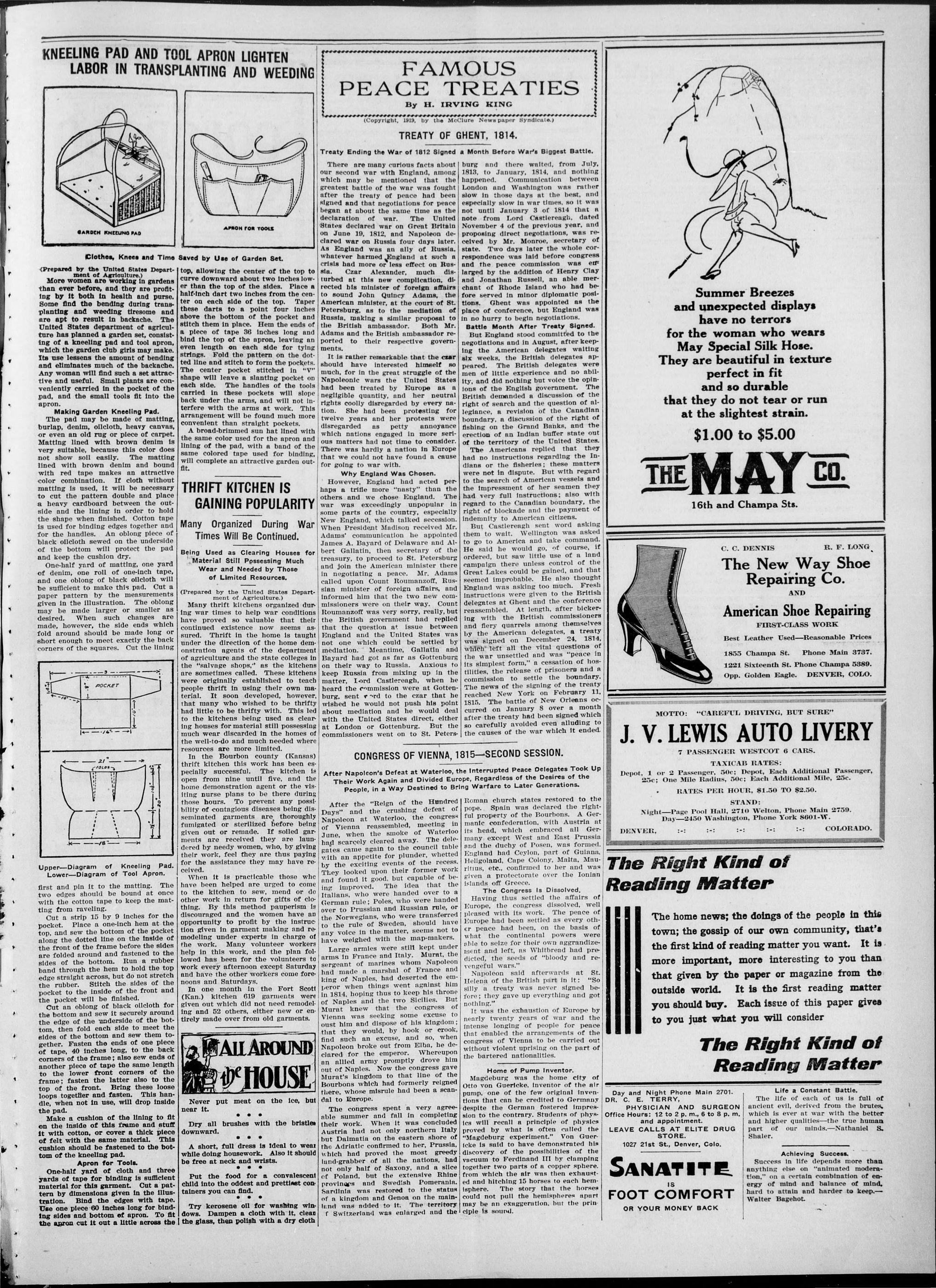
GARDEN KNEEZING PAD
APRON FOR TOOLE
Clothes, Knees and Time Saved by Use of Garden Set.
(Prepared by the United States Depart-
ment of Agriculture.)
More women are working in gardens than ever before, and they are profiting by it both in health and purse. Some find the bending during transplanting and weeding tiresome and are apt to result in backache. The United States department of agriculture has planned a garden set, consisting of a kneeling pad and tool apron, which the garden club girls may make. Its use lessens the amount of bending and eliminates much of the backache. Any woman will find such a set attractive and useful. Small plants are conveniently carried in the pocket of the pad, and the small tools fit into the apron.
Making Garden Kneeling Pad.
Making Garden Kneeling Pad. The pad may be made of matting, burlap, denim, oilcloth, heavy canvas, or even an old rug or piece of carpet. Matting lined with brown denim is very suitable, because this color does not show soil easily. The matting lined with brown denim and bound with red tape makes an attractive color combination. If cloth without matting is used, it will be necessary to cut the pattern double and place a heavy cardboard between the outside and the lining in order to hold the shape when finished. Cotton tape is used for binding edges together and for the handles. An oblong piece of black oilcloth sewed on the underside of the bottom will protect the pad and keep the cushion dry.
One-half yard of matting, one yard of denim, one roll of one-inch tape, and one oblong of black olel cloth will be sufficient to make this pad. Cut a paper pattern by the measurements given in the illustration. The oblong may be made larger or smaller as desired. When such changes are made, however, the side ends which fold around should be made long or short enough to meet exactly the back corners of the squares. Cut the lining
POCKET
21°
10LBS
74°
102°
18°
Upper—Diagram of Kneeling Pad.
Lower—Diagram of Tool Apron.
first and pin it to the matting. The two edges should be bound at once with the cotton tape to keep the matting from raveling.
Cut a strip 15 by 9 inches for the pocket. Place a one-inch hem at the top, and sew the bottom of the pocket along the dotted line on the inside of the front of the frame before the sides are folded around and fastened to the sides of the bottom. Run a rubber band through the hem to hold the top edge straight across, but do not stretch the rubber. Stitch the sides of the pocket to the inside of the front and the pocket will be finished.
Cut an oblong of black oilcloth for the bottom and sew it securely around the edge of the underside of the bottom, then fold each side to meet the sides of the bottom and sew them together. Fasten the ends of one piece of tape, 40 inches long, to the back corners of the frame; also sew ends of another piece of tape the same length to the lower front corners of the frame; fasten the latter also to the top of the front. Bring these loose loops together and fasten. This handle, when not in use, will drop inside the pad.
Make a cushion of the lining to fit on the inside of this frame and stuff it with cotton, or cover a thick piece of felt with the same material. This cushion should be fastened to the bottom of the kneeling pad.
Apron for Tools.
One-half yard of cloth and three yards of tape for binding is sufficient material for this garment. Cut a pattern by dimensions given in the illustration. Bind the edges with tape. Use one piece 60 inches long for binding sides and bottom of apron. To fit the apron cut it out a little across the
top, allowing the center of the top to curve downward about two inches lower than the top of the sides. Place a half-inch dart two inches from the center on each side of the top. Taper these darts to a point four inches above the bottom of the pocket and stitch them in place. Hem the ends of a piece of tape 36 inches long and bind the top of the apron, leaving an even length on each side for tying strings. Fold the pattern on the dotted line and stitch to form the pockets. The center pocket stitched in "V" shape will leave a slanting pocket on each side. The handles of the tools carried in these pockets will slope back under the arms, and will not interfere with the arms at work. This arrangement will be found much more convenient than straight pockets.
A broad-brimmed sun hat lined with the same color used for the apron and lining of the pad, with a band of the same colored tape used for binding, will complete an attractive garden outfit.
Many Organized During War Times Will Be Continued.
Being Used as Clearing Houses for Material Still Possessing Much Wear and Needed by Those of Limited Resources.
(Prepared by the United States Department of Agriculture.)
Many thrift kitchens organized during war times to help war conditions have proved so valuable that their continued existence now seems assured. Thrift in the home is taught under the direction of the home demonstration agents of the department of agriculture and the state colleges in the "salvage shops," as the kitchens are sometimes called. These kitchens were originally established to teach people thrift in using their own material. It soon developed, however, that many who wished to be thrifty had little to be thrifty with. This led to the kitchens being used as clearing houses for material still possessing much wear discarded in the homes of the well-to-do and much needed where resources are more limited.
In the Bourbon county (Kansas) thrift kitchen this work has been especially successful. The kitchen is open from nine until five, and the home demonstration agent or the visiting nurse plans to be there during those hours. To prevent any possibility of contagious diseases being disseminated garments are thoroughly fumigated or sterilized before being given out or remade. If solled garments are received they are laundered by needy women, who, by giving their work, feel they are thus paying for the assistance they may have received.
When it is practicable those who have been helped are urged to come to the kitchen to sew, mend or do other work in return for gifts of clothing. By this method pauperism is discouraged and the women have an opportunity to profit by the instruction given in garment making and remodeling under experts in charge of the work. Many volunteer workers help in this work, and the plan followed has been for the volunteers to work every afternoon except Saturday and have the other workers come forenoons and Saturdays.
In one month in the Fort Scott (Kan.) kitchen 619 garments were given out which did not need remodeling and 52 others, either new or entirely made over from old garments.
ALL AROUND
the HOUSE
Never put meat on the ice, but
near it.
Dry all brushes with the bristles
downward.
A short, full dress is ideal to wear
while doing housework. Also it should
be free at neck and wrists.
Put the food for a convalescent
child into the oddest and prettiest
containers you can find.
Try kerosene oil for washing windows. Dampen a cloth with it, clear the glass, then polish with a dry cloth
FAMOUS PEACE TREATIES BY H. IRVING KING
(Copyright, 1819, by the McClure Newspaper Syndicate.)
TREATY OF GHENT, 1814.
Treaty Ending the War of 1812 Signed a Month Before War's Biggest Battle.
There are many curious facts about our second war with England, among which may be mentioned that the greatest battle of the war was fought after the treaty of peace had been signed and that negotiations for peace began at about the same time as the declaration of war. The United States declared war on Great Britain on June 19, 1812, and Napoleon declared war on Russia four days later. As England was an ally of Russia, whatever harmed England at such a crisis had more or less effect on Russia. Czar Alexander, much disturbed at this new complication, directed his minister of foreign affairs to sound John Quincy Adams, the American minister, at the court of St. Petersburg, as to the mediation of Russia, making a similar proposal to the British ambassador. Both Mr. Adams and the British ambassador reported to their respective governments.
It is rather remarkable that the czar should have interested himself so much, for in the great struggle of the Napoleonic wars the United States had been treated by Europe as a negligible quantity, and her neutral rights coolly disregarded by every nation. She had been protesting for twelve years and her protests were disregarded as petty annoyance which nations engaged in more serious matters had not time to consider. There was hardly a nation in Europe that we could not have found a cause for going to war with.
Why England Was Chosen.
Why England Was Chosen.
However, England had acted perhaps a trifle more "nasty" than the others and we chose England. The war was exceedingly unpopular in some parts of the country, especially New England, which talked secession. When President Madison received Mr. Adams' communication he appointed James A. Bayard of Delaware and Albert Gallatin, then secretary of the treasury, to proceed to St. Petersburg and join the American minister there in negotiating a peace. Mr. Adams called upon Count Roumanoff, Russian minister of foreign affairs, and informed him that the two new commissioners were on their way. Count Roumanoff was very sorry, really, but the British government had replied that the question at issue between England and the United States was not one which could be settled by mediation. Meantime, Gallatin and Bayard had got as far as Gottenburg on their way to Russia. Anxious to keep Russia from mixing up in the matter, Lord Castlereagh, when he heard the commission were at Gottenburg, sent word to the czar that he wished he would not push his point about mediation and he would deal with the United States direct, either at London or Gottenburg. But the commissioners went on to St. Peters-
CONGRESS OF VIENNA, 1815—SECOND SESSION.
After Napoleon's Defeat at Waterloo, the Interrupted Peace Delegates Took Up Their Work Again and Divided Europe, Regardless of the Desires of the People, in a Way Destined to Bring Warfare to Later Generations.
After the "Reign of the Hundred Days" and the crushing defeat of Napoleon at Waterloo, the congress of Vienna reassembled, meeting in June, when the smoke of Waterloo had scarcely cleared away. The delegates came again to the council table with an appetite for plunder, whetted by the exciting events of the recess. They looked upon their former work and found it good, but capable of being improved. The idea that the Italians, who were handed over to a German rule; Poles, who were handed over to Prussian and Russian rule, or the Norwegians, who were transferred to the rule of Sweden, should have any voice in the matter, seems not to have weighed with the map-makers.
Roman church states restored to the pope. Spain was declared the rightful property of the Bourbons. A Germanic confederation, with Austria at its head, which embraced all Germany except West and East Prussia and the duchy of Posen, was formed. England had Ceylon, part of Guiana, Heligoland, Cape Colony, Malta, Mauritius, etc., confirmed to her and was given a protectorate over the Ionian islands off Greece.
The Congress is Dissolved. Having thus settled the affairs of Europe, the congress dissolved, well pleased with its work. The peace of Europe had been settled as every other peace had been, on the basis of what the continental powers were able to reign for their own aggrandize-
Large armies were still kept under arms in France and Italy. Murat, the sergeant of marines whom Napoleon had made a marshal of France and king of Naples, had deserted the emperor when things went against him in 1814, hoping thus to keep his throne of Naples and the two Sicilies. But Murat knew that the congress of Vienna was seeking some excuse to oust him and dispose of his kingdom; that they would, by hook or crook, find such an excuse, and so, when Napoleon broke out from Elba, he declared for the emperor. Whereupon an allied army promptly drove him out of Naples. Now the congress gave Murat's kingdom to that line of the Bourbons which had formerly reigned there, whose misrule had been a scandal to Europe.
The congress spent a very agreeable summer and fall in completing their work. When it was concluded Austria had not only northern Italy but Dalmatia on the eastern shore of the Adriatic confirmed to her, Prussia, which had proved the most greedy land-grabber of all the nations, had not only half of Saxony, and a slice of Poland, but the extensive Rhine provinces and Swedish Pomerania. Sardinia was restored to the status of a kingdom and Genoa on the mainland was added to it. The territory of Switzerland was enlarged and the
burg and there waited, from July, 1813, to January, 1814, and nothing happened. Communication between London and Washington was rather slow in those days at the best, and especially slow in war times, so it was not until January 3 of 1814 that a note from Lord Castiereagh, dated November 4 of the previous year, and proposing direct negotiations, was received by Mr. Monroe, secretary of state. Two days later the whole correspondence was laid before congress and the peace commission was enlarged by the addition of Henry Clay and Jonathan Russell, an able merchant of Rhode Island who had before served in minor diplomatic positions. Ghent was appointed as the place of conference, but England was in no hurry to begin negotiations.
Battle Month After Treaty Signed.
But England stood committed to the negotiations, and in August, after keeping the American delegates waiting six weeks, the British delegates appeared. The British delegates were men of little experience and no ability, and did nothing but voice the opinions of the English government. The British demanded a discussion of the right of search and the question of allegiance, a revision of the Canadian boundary, a discussion of the right of fishing on the Grand Banks, and the erection of an Indian buffer state out of the territory of the United States.
The Americans replied that they had no instructions regarding the Indians or the fisheries; these matters were not in dispute. But with regard to the search of American vessels and the impressment of her seamen they had very full instructions; also with regard to the Canadian boundary, the right of blockade and the payment of indemnity to American citizens.
But Castlereagh sent word asking them to wait. Wellington was asked to go to America and take command. He said he would go, of course, if ordered, but saw little use of a land campaign there unless control of the Great Lakes could be gained, and that seemed improbable. He also thought England was asking too much. Fresh instructions were given to the British delegates at Ghent and the conference reassembled. At length, after bickering with the British commissioners and fiery quarrels among themselves by the American delegates, a treaty was signed on December 24, 1814, which left all the vital questions of the war unsettled and was "peace in its simplest form," a cessation of hostilities, the release of prisoners and a commission to settle the boundary. The news of the signing of the treaty reached New York on February 11, 1815. The battle of New Orleans occurred on January 8 over a month after the treaty had been signed which so carefully avoided even alluding to the causes of the war which it ended.
Roman church states restored to the pope. Spain was declared the rightful property of the Bourbons. A Germanic confederation, with Austria at its head, which embraced all Germany except West and East Prussia and the duchy of Posen, was formed. England had Ceylon, part of Guiana, Heliogoland, Cape Colony, Malta, Mauritius, etc., confirmed to her and was given a protectorate over the Ionian islands of Greece.
The Congress Is Dissolved
Having thus settled the affairs of Europe, the congress dissolved, well pleased with its work. The peace of Europe had been settled as every other peace had been, on the basis of what the continental powers were able to seize for their own aggrandizement and left, as Whitbread had predicted, the seeds of "bloody and revengeful wars." Napoleon said afterwards at St. Helena of the British part in it: "So silly a treaty was never signed before; they gave up everything and got nothing." It was the exhaustion of Europe by nearly twenty years of war and the intense longing of people for peace that enabled the arrangements of the congress of Vienna to be carried out without violent uprising on the part of the bartered nationalities.
Home of Pump Inventor
Home of Pump inventor.
Magdeburg was the home city of Otto von Guericke, inventor of the air pump, one of the few original inventions that can be credited to Germany despite the German fostered impression to the contrary. Students of physics will recall a principle of physics proved by what is often called the "Magdeburg experiment." Von Guericke is said to have demonstrated his discovery of the possibilities of the vacuum to Ferdinand III by clamping together two parts of a copper sphere, from which the air was then exhausted and hitching 15 horses to each hemisphere. The story that the horses could not pull the hemispheres apart may be an exaggeration, but the principle is sound.
```markdown
```
Summer Breezes and unexpected displays have no terrors for the woman who wears May Special Silk Hose. They are beautiful in texture perfect in fit and so durable that they do not tear or run at the slightest strain. $1.00 to $5.00
THE M
MAY
THE MAY CO. 16th and Champa Sts.
H
MOTTO: "CAREFU
J. V. LEWIS A
7 PASSENGER
TAXIC
Depot, 1 or 2 Passenger, 50c;
25c; One Mile Radius, 50
RATES PER HO
ST
Night—Page Pool Hall, 27
Day—2450 Washington
DENVER,
The Right Kid
Reading Mat
The home news; the
town; the gossip o
the first kind of re
more important,
that given by the
outside world. B
you should buy. B
to you just what
The
Re
MOTTO: "CAREFUL DRIVING, BUT SURELY
Y. LEWIS AUTO LIVES
7 PASSENGER WESTCOT 6 CARS.
TAXICAB RATES:
For 2 Passenger, 50c; Depot, Each Additional Mile;
One Mile Radius, 50c; Each Additional Mile.
RATES PER HOUR, $1.50 TO $2.50.
STAND:
Bent—Page Pool Hall, 2710 Welton, Phone Main
Day—2450 Washington, Phone York 8601-W.
Right Kind of
Reading Matter
The home news; the doings of the people
own; the gossip of our own community;
the first kind of reading matter you will
more important, more interesting to
that given by the paper or magazine
outside world. It is the first reading
you should buy. Each issue of this p
o you just what you will consider
The Right Kid
Reading M
J. V. LEWIS AUTO LIVERY
The Right Kind of Reading Matter
The home news; the doings of the people in this town; the gossip of our own community, that's the first kind of reading matter you want. It is more important, more interesting to you than that given by the paper or magazine from the outside world. It is the first reading matter you should buy. Each issue of this paper gives to you just what you will consider
The Right Kind of Reading Matter
Day and Night Phone Main 2701.
DR. C. E. TERRY,
PHYSICIAN AND SURGEON
Office Hours: 12 to 2 p. m., 6 to 8 p. m.
and appointment.
LEAVE CALLS AT ELITE DRUG
STORE.
1027 21st St., Denver, Colo.
SANATITE
IS
FOOT COMFORT
OR YOUR MONEY BACK
R MONEY BACK
LAY CO.
C. C. DENNIS R. F. LONG
The New Way Shoe Repairing Co.
AND
American Shoe Repairing
FIRST-CLASS WORK
Best Leather Used—Reasonable Prices
1855 Champa St. Phone Main 3737.
1221 Sixteenth St. Phone Champa 5389.
Opp. Golden Eagle. DENVER, COLO.
FEFUL DRIVING, BUT SURE"
S AUTO LIVERY
MERGER WESTCOT 6 CARS.
LEXICAB RATES:
250c; Depot, Each Additional Passenger,
25c, 50c; Each Additional Mile, 25c.
PER HOUR, $1.50 TO $2.50.
STAND:
Bell, 2710 Welton, Phone Main 2759.
Washington, Phone York 8601-W.
::: ::: ::: COLORADO.
Kind of
matter
; the doings of the people in this
ship of our own community, that's
of reading matter you want. It is
nt, more interesting to you than
the paper or magazine from the
It is the first reading matter
y. Each issue of this paper gives
what you will consider
The Right Kind of
Reading Matter
Life a Constant Battle.
Life a Constant Battle.
The life of each of us is full of ancient evil, derived from the brutes, which is ever at war with the better and higher qualities—the true human part of our minds.—Nathaniel S. Shaler.
Achieving Success.
Success in life depends more than anything else on "animated moderation," on a certain combination of energy of mind and balance of mind, hard to attain and harder to keep.—Walter Bagehot.
THE COLORADO STATESMAN
CARON SHALL BE FAIR
IRACLE COUNTRY PARTY
JOS. D. D. RIVERS.....Proprietor
P. O. Box 116
Phone Main 7417
One Year ..... $2.00
Six Months ..... 1.50
Three Months ..... 7.75
MUST BE PAID IN ADVANCE.
Entered as second-class matter at the postoffice in the City of Denver, Colo.
Reading notices, ten lines or less, 10 cents per line. Each additional line over ten lines, 5 cents per line. Display advertising 50 cents per inch.
Remittances should be made by Express Money Order, Postoffice Money Order, Registered Letter or Bank Draft. Postage stamps will be received the same as cash for the fractional part of a dollar. Only 1c and 2c stamps taken.
No discounts allowed on less than three months' contract. Cash must accompany all orders from parties unknown to us. Further particulars on application.
LITTLE BIG WORDS.
THERE are many little words in the English language which are very significant. They mean so much. To this class belong such words as "if," "no," "up." Words of two letters only, but with what a wealth of meaning they are fraught. Upon these little big words may hinge the issues of life. Their utterance have been known to spell success or failure in many a life. What issues sometimes hang upon an "IF." What moral tragedies have been caused or averted by a decided "NO." What victories, military, moral, material and spiritual, have been won by "UP."
"Up, guards, and at them," was the command that turned defeat into victory in an historic military campaign. "Up, my boy, the morning calls," has sounded the keynote of every successful life. "Up with the sun" has been the motto of many who would achieve great things.
"If" suggests deliberation. Use it, before entering upon any course of action. "No" calls for decision and conviction. Learn when to use this little big word wisely. "Up" suggests aspiration, inspiration, progress. These should be dominant notes in every normal human being.
Think about these little big words and do not use them lightly or thoughtlessly. Preach a little sermon to yourself on the two-lettered words, "If," "No," and "Up," and we are quite sure that you will find in this exercise or diversion much to help you. At any rate, try your skill in extracting lessons from these little big words.—The Monitor.
HOWARD UNIVERSITY A GREAT UPLIFTING AGENCY.
AND who would dare deny, when for fifty years this institution has in its striving for the uplift of the human family, trained and sent forth men and women throughout our United States, Central and South America, in the Asiatic and African continents and islands beyond the seas, to lay the foundation for the beautiful superstructure that is gradually rising until it shall exhibit its majestic pillars and towering columns, the magnificence of which will be displayed by the beneficiaries of intellectual instructions received from this Agent of Knowledge?
It was a wonderful day—Commencement Day of Howard University, Wednesday, June 4th, when with all the pomp and splendor accompanying graduation exercises one hundred and twelve graduates constituted the "Class of 1919," and the GOLDEN JUBILEE COMMENCEMENT of Howard University became another historical event in our educational lives in this country. The article on our front page gives a description of the proceedings, but we cannot help from emphasizing the importance to be attached to the Secretary of the Interior, Hon. Franklin K. Lane, who was the orator of the day, when he spoke of "the value of good citizenship and the necessity for practical training to meet the responsibilities of life;" also the very timely remarks of the Right Reverend Alfred Harding, Bishop of Washington who, after paying a glowing tribute to the colored soldiers, expressed himself as being proud of the record of the millions of Negroes since emancipation, and lauded Howard University as ONE OF THE UPLIFTING AGENCIES that would continue to leaven the lump of intellectual and moral darkness that make for the hardships and inequalities with which the social and economic leaders of the age have to deal. What precious statements. Oh, if the lawless and mob-spirit could heed such instructions, what a glorious inheritance would be ours in America! Thanks for Howard and other like institutions! We have a few Denver residents, graduates of this great institution, whom we know are proud of their Alma Mater, and we join them in wishing the Howard University at Washington, D. C., a brighter, greater and long continued career of service to humanity at home as well as abroad in the journey for the century mark.
PRIDE OF RACE.
THOSE whose good fortune it was to hear the Rev. Dr. E. W. Moore of Columbus, Ohio, in his address last Sunday afternoon at the Young Men's Christian Association will never forget the awakening and arousing of their consciousness to the great quality that should be possessed by all peoples—THE PRIDE OF RACE. Starting with the Jew and his history in Judaistic times and seasons when he boasted of his great ancestry in Father Abraham, and showing how it was inculcated in their posterity to be thoroughly conversant with their genealogical tree, so that with all the persecutions, prejudices, etc., towards him, his ancestral tie, his lineage, encouraged and strengthened him to forge his way to the front resulting in a solidarity of his race that seemed impregnable, the same becoming the actuating agency that compels the attraction of the world, the speaker arrested the attention of his auditors when he took them back to the history of the ancient, the mediaeval and down to the modern period where the Anglo-Saxon delights in his vaunted aristocracy and his superiority to other races. Then like a thunderbolt from out a clear sky Dr. Moore gave the proofs of the Negro's contribution to all this civilization—in the arts and sciences in military achievements, in philosophy, geographical discoveries, and every other feature of world progress, and yet how deplorable, we today are the victims of what may be termed an educational conspiracy, as right in our home America, in the text books of our schools and the literature of other educational departments an untrue, misleading account is given of the race to which we belong. The Doctor cited the description and qualification of the various races expressed in the geography and history of our American schools and colleges, and with all the spirit of his manhood, his love for his people and pride in his race denounced the methods employed and the unfairness in forcing an inferiority on his people that do not belong to them, and then he implored his hearers to join the great movement that is being launched to eliminate the publication of such reflecting and revolting theories and put a stop to the teaching of such falsities as far as possible in our-public schools. After giving a number of illustrations as to what constitutes RACE PRIDE and impressing upon his hearers the necessity of the instruction that should be given the less informed people of our race by the educated or learned ones, the speaker made a plea for more energy and greater interest for this cause which is the individual duty of every man, woman and child. "I am proud of my race because I can trace its nobility of purpose, and all I ask the spirit of fairness in the dispensing of laws, the carrying out of the constitutional provisions which do not particularize a race, a color, and my people will measure up to the standards of any that merit commendation." These words fell on "good ground" (using a Biblical expression) and the inspiration that the all-interesting audience received from them could be visibly noticed by the apparent illumination of countenances, and the expressions of gladness for the privileged opportunity were heard on every hand at the close of the meeting. An ever memorable thought that Dr. Moore left with us after commending our Denver citizens for their progress in beautiful homes, and business, etc., was couched in the following:
"Pride in Race, Pride in Place, Pride in Face, Pride in Grace."
A Nation of Spenders, We Must Become Instead a Money-Saving People
A Nation of Spenders, We Must Become Instead a Money-Saving People
BY THE WIFE OF THE SECRETARY OF WAR
As a people we have always been regarded as extravagant, and the accusation is not unjust. We have been wasteful in many different ways, and in looking for compensation for all the cruel sacrifices we have been forced to make during the war one's attention is called to the material benefits we can derive from the bitter experience if we are willing to learn the lesson. If we become a nation of savers instead of a nation of spenders some of the sacrifices will not have been in vain. When the actual fighting was over our interest in our country's welfare rather "slumped."
As a people we have always been regarded as extravagant, and the accusation is not unjust. We have been wasteful in many different ways, and in looking for compensation for all the cruel sacrifices we have been forced to make during the war one's attention is called to the material benefits we can derive from the bitter experience if we are willing to learn the lesson. If we become a nation of savers instead of a nation of spenders some of the sacrifices will not have been in vain. When the actual fighting was over our interest in our country's welfare rather "slumped." It was, perhaps, the natural reaction from a long period of strain and excitement, but it was none the less to be regretted. Our country needs our assistance just as truly today as it did a year ago, and it is the plain duty of every citizen, man, woman or child, to ask himself the question: "How can I help?"
One of the most obvious ways is to give our financial support. This, however, differs from most of our war service in that it involves no sacrifice. It is absolutely the safest and most paying investment one can make, and one is no longer forced to argue that he should do this thing for his country's sake, or for his soul's sake, but it can now be put on the lower plane of a thing done for one's own interest which incidentally helps the nation's credit.
No amount of money is too small to be put away profitably in Thrift stamps, and there are always conveniently at hand places where the investment can be made, including the postman at our doors and the schools where we send our children.
When we open our purses we should address to ourselves the question: "Am I spending this money wisely, or could I make better use of it?" The trouble is that if we do not take this matter under more serious consideration than we have in the past our country's credit may be at stake.
With an apology for the bad taste of a personal allusion, my children spend a portion of their money allowance each week for Thrift stamps, and the competition involved in seeing who can possess the largest number has run the aggregate to a surprising extent. Thrift stamps and War Savings stamps have the value not only of creating a fund for a definite purpose, such as the education of a child, but teach the value of money and the lasting returns which can be gotten for it, at the same time inculcating all the traditional virtues which flow from saving a part of all the money coming into one's possession.
One of the permanent benefits that we can extract from this cruel and wasteful war, beyond the determination that it must never happen again, is the consciousness of a personal responsibility to our government, without which it cannot hope to hold the respect of the rest of the world.
Elizabeth Baker.
Army Intelligence Test Proposed as College Entrance Examination
By PROF. WALTER T. MARVIN, Rutgers College
The question, who is the college man? has always meant who is the college man relatively to the remainder of the population? We have always known that the college man is an extraordinary person, that he has been selected from a vastly larger group; for he has formed but one or two per cent of the male population of America of his age.
The data resulting from the application of the army intelligence test to the undergraduates of Rutgers college warrants the conclusion that the record of the college man in the years following graduation is not due primarily to the education he has received in the high school and the college, but is the result of a remarkable and extraordinary inborn intelligence.
We have been told by college presidents and others, "Here we behold the product of education"; whereas what we behold is chiefly the product of extraordinary capacity, given as a gift of Mother Nature, or heredity.
Imperfect as is the army intelligence test, because of its emphasis on mere speed, it is still capable of finding whether or not a man has the capacity required by the college. This fact has suggested the substitution of an intelligence test for the traditional college entrance examination.
Such a substitution is not only permissible but desirable, because it can be better trusted to tell us whether or not it is advisable for him, in his own interest, to spend four years in such an environment as the college instead of going at once out into the world to learn the trade or vocation that is to be his life's career.
Carranza's Government Soon to Fall; Mandatory in Mexico Advisable
By RICHARD H. COLE, Former Carranza Representative
Carranza's government can't last six months longer. The German merchants in Mexico helped him along until Germany was beaten. Then supplies were cut off. Now Carranza has lost large numbers of his army. He has no money. Sixty per cent of Mexico is in rebellion. Fourteen different rebel commanders, all independent, are in the field.
There will be a mandatory in Mexico. I do not think any Mexican faction or group of factions can organize a stable government in Mexico. Mexico is too far gone in anarchy to be reorganized by Mexicans. Only a strong outside power can restore order and law in Mexico.
I would not advise military intervention. Any strong power could conquer Mexico in sixty days. But it would be a shame and a crime to do so. What the Mexicans want is food, not force. About sixteen million of Mexico's seventeen million people will welcome Americans who come with food and the help they are entitled to.
A few trainloads of food—beans, sugar and coffee—enough soldiers to police the country, about ten thousand men in all, and we can do a more profitable business in Mexico in a year than we can do in Russia in a lifetime.
COLORADO STATESMAN
---
The Mouth-Piece of the People of Colorado and the Entire West
---
A RELIABLE chronicle of their doings and progress; a faithful mirror of their wants, their hopes, their best aspirations.
THE COLORADO STATESMAN
Unequaled as an advertising medium for the business of professional men and women.
An excellent family journal speaking to and for many thousand colored citizens. TWO DOLLARS A YEAR
THE GREAT ORGAN OF THE LABORING MASSES
THE COLORADO STATESMAN
LABOR
SHARE
TIME
HACK
COUNTRY
PARTY
---
Porter Simpson of Colorado Springs was in the city Thursday on business.
Mr. and Mrs. Steen of Pueblo were visitors in the city this week.
Mrs. Lucy Hall of Chicago arrived in the city Tuesday to spend the summer.
The Ladies of Central Baptist Church present local artists in Grand Concert Monday evening, June 16th, Benefit building fund. Admission 35 cents.
FOR SALE—A 7-room, 1½-story brick house at 2255 Curtis street. For further information inquire at this office.
Mrs. Jane Vernell arrived home last Tuesday from San Diego, Cal., where she spent several months visiting her sister.
Mrs. Ada Simpson of 813 West Tenth avenue left the city this week for Chicago, Ill., to visit her daughter, also to meet her son, who has just arrived from France.
Cornelius Rice, employé of the Continental Oil Co., who is temporarily absent from duty on account of sickness, is gradually improving. "Neal" says he's beginning to feel like himself again.
James F. Clark, who has been confined to his bed for several months with rheumatism, is able to be about again, to the delight of his many friends.
Such artists as Mme. Lillian Hawkins-Jones, Rhoda Anderson Chambers and Valaurez Spratlin will participate in Concert at Central Baptist Church Monday, June 16th.
The annual sermon of the International Order of Twelve Knights and Daughters of Tabor will take place at Campbell A. M. E. Church at 2 o'clock tomorrow afternoon.
Mrs. Ralph Garvin arrived home last Monday from a month's visit with relatives and friends in Salina, Kan., and Kansas City, Mo. She reports a delightful time.
The Rev. W. E. Moore of Columbus, Ohio, and former pastor of Zion Baptist Church, left last Tuesday for other Western points after a delightful stay among his former members and friends. He preached at Zion, and also made several addresses to different organizations, while Mrs. Moore, who is a talented singer, gave much of service.
George Morrison and his famous orchestra played for the Motor Club and their guests of the tractor convention at Iredale last Monday and Tuesday evenings, winning the plaudits of the visitors from all over the country. The orchestra went to Cheyenne on Thursday to play for Mrs. Hines, leading society lady. Mr. Morrison has insured the contract at Iredale.
NEPHEW OF DENVER PIONEER
RESIDENT GRADUATES WITH
HIGH HONORS IN MEDICINE
AT HOWARD, WASHING-
TON, D. C.
Jonathan Richard Contee Cook, who graduated from Howard University last week Wednesday, took first place in the final competitive examination of Interneship, Freedom's Hospital, winning also the Williston prize for highest mark in Obstetrics. These high honors won by Dr. Contee Cook reflect the highest credit on him, as his uncle, our pioneer citizens and highly respected townsman, Jonathan Contee, declares that he was diligent and persevering in his studies and he predicted a bright future for him. We congratulate friend John on his relative's success and wish for this addition to our country's medical fraternity every success in the professional sphere, trusting he will be an added blessing to our race.
ESTABLISHES SANITARIUM
(By Associated Negro Press.)
Baltimore, June 4.—Plans for the establishment of a sanatarium near the city for our tubercular people of the state are being developed rapidly by directors of the Maryland State Sanatarium. The Legislature has appropriated $75,000 to begin the work.
E. P. BLAKEMORE, Attorney and Counsellor at Law. Office, Rooms 39 and 40 Arapahoe Bldg., 1622 Arapahoe Street. Phone Champa 5450.
For employment see the Industrial Realty Co. Employment Agency, 716 East Twenty-sixth Ave. York 4561.
STATE FEDERATION OF WOMAN'S CLUBS HOLD SUCCESSFUL SESSION.
The State Federation of Woman's Clubs held a very successful meeting here this week. Delegates from many parts of the state were present, and interest in the activities of this organization seems to be increasing. A pageant of nations was held last Tuesday in which there were very good representations, and a public meeting at which Mayor Bailey gave a welcome address encouraging our women to continue their good works, also the election of officers for the present term brought a successful meeting to a close. The Colorado Statesman offers its best wishes and continued support to this desirable and helpful organization among our people. Welcome to our visitors!
DOUGLAS UNDERTAKING CO
Funeral Notices
Hutchinson, Albert Reid, 24 years, beloved son of Mr. and Mrs. Moses Hutchinson, Chicago, Ill., departed this life June 4th. Remains were shipped to Chicago, June 6th, for interment in family plot.
IN MEMORIAM.
In loving memory of my beloved husband, who departed this life June 12, 1918. He was a friend to all, while he was respected and loved by his many friends and acquaintances. He is gone to rest where the spirits of just men are made perfect. He can not come back to me, but I hope to meet him in heaven.
MRS. DOROTHY WILLIS.
Y. M. C. A. NOTES.
The croquet fans are certainly making it lively on the splendid new court in the rear of the building, the long afternoons affording opportunity for players. Seldom does an afternoon pass that does not witness, a large group of players on the grounds and a large number of spectators seated around the court to witness the games. It is a little too early in the season to forecast the winners of this summer's honors. It is safe to say, however, that they lie between the Lightner brothers, Buford or King, with Sims as a close competitor or a possible winner. A mighty game is scheduled for this (Saturday) afternoon at 3:30 o'clock. Visitors welcome.
Those who were absent from the meeting last Sunday afternoon certainly missed one of the treats of their lives. Dr. E. W. Moore, the speaker, was in his very best frame, and held his audience enapt by the force of his logic and the beauty of his rhetoric. His subject was "Pride of Race, Pride of Face, Pride of Place and Pride of Grace."
At the meeting tomorrow (Sunday) afternoon, Mrs. Moore will sing several selections. Mrs. Moore is a talented singer, and the friends will hear her with pleasure. Both men and women will be welcome. Program at 4 o'clock.
CORNELIUS JAMES HYLAND, deputy commissioner of supplies, is the right man in the right place, as Commissioner J. J. Vick Roy will fond a hard-working, painstaking official who will be always on the job, an advocate of right and a man who takes a special delight in serving the public. Mr. Hyland's former connection with the Liberty Press, a very newsy weekly journal, gained for him much experience and public confidence, and therefore it is very likely that he will become a valuable asset in the department of supplies, supporting his chief, a man of large parts, who requires men of broad vision on his staff for public service. Knowing the deputy for quite a number of years, also his ability for the job and his usual devoted attention to whatever duties are assigned him, the Colorado Statesman is satisfied that Mr. Hyland will give every satisfaction, and we wish him every success.
CAMPBELL CHAPEL A. M. E.
CHURCH.
Lawrence Street, Corner Twenty-third,
I. S. Wilson, Pastor—Residence,
1218 23rd. Phone Main 1312.
10:00 a. m.—Sunday School, Wendell
Dell Allen, superintendent.
11:00 a. m.—Preaching, Rev. Thomas
J. Bell, B. D., will fill the stand.
Come and hear this gospel minister.
3:00 p. m.—Annual sermon for the
Knights and Daughters of Tabor, by
the pastor.
6:45—Christian Endeavor, Subject,
"What We Owe and How to Pay It."
Lead by Callie Crumwell, LeDora
Donaldson, president.
7:45 Preaching by the pastor.
7:43—Predicating by the pastor.
Last Sunday was a splendid day with Campbell, the closing sermon of the series with the Sunday School, was delivered by the pastor, and the class to be "banqueted" will be announced Sunday.
The Rev. J. C. Carter of Rock Springs, Wyo., preached an excellent sermon at night, following which two persons came forward and united with the Church. We are steadily on the increase in each department of the Church, and hope to continue. An announcement will be made Sunday night of the actual cash on hand from our special effort for the mortgage indebtedness.
Dr. S. A. Huff, physician and surgeon, 2538 Washington street; office hours 11 to 12 a. m., 3 to 5 p. m.
Phone York 2313. Out of office,
Main 875. Residence Phone York 4101.
CAPITOL PETROLEUM
(A PRODUCING, DIVIDEND-PAYING COMPANY)
IS MAKING GOOD PROGRESS IN THE TAMPICO OIL FIELDS OF MEXICO, IN THE WORLD'S RICHEST OIL FIELD
CAPITOL PETROLEUM CO.'S (MEXICAN) WELL NO. 1—Carr Lease: Camp established; dam being constructed large enough to hold a 9-month's water supply; active drilling will not be started until later owing to distance from transportation and water problem.
CAPITOL PETROLEUM CO.'S (MEXICAN) WELL NO. 2—Espino Lease: On Panuco river; immediate to transportation; loading wharf built; drilling in progress; over 1,800 feet deep; oil shows 32 gravity in first sand.
CAPITOL PETROLEUM CO.'S (MEXICAN) WELL NO. 3—Smith Lease: On Panuco river; immediate to transportation; not far from C. P. No. 2; lumber on ground; all arrangements for drilling being completed; active drilling to start as soon as No. 2 1s finished.
A FORTY-THOUSAND-BARREL GUSHER
Directly Across Panuco River From Our Mexican Well No. 2.
Capitol Petroleum Company, Denver, Colorado.
Gentlemen: Mr. Powell has been with me three days and we have been throughout the Tampico field and visited many of the large fields. We will have it to Mr. Powell to explain to you his experience.
We are putting in today and tomorrow on business and legal details, besides investigating the industrial conditions and future prospects of this port.
In our visit to the various properties we have obtained some fairly good photographs for cloudy days.
Yours truly, H.R. GUTHEYRE
Capitol Petroleum The Mexican incorporation will be known as the Campanilla Petrolera Capitol de Mexico, S. A. (Capitol Petroleum Company of Mexico). This has been approved by Mr. Powell, and is now in the
hands of the notary and work with Mr. Powell is no problem preparing minutes and by-laws and having them translated by Mr. McDaniels in the American Chamber of Commerce. I will have a copy of the original papers forwarded to you. We have everything satisfactorily arranged for big business. Of course a few details will have to be worked out, but that is only a part of the ordinary day's work. You truly,
THE OIL TANK
Capitol Petroleum Company, Denver, Colorado. Gentleman: I have put in three days with Mr. Guthrey, and we have been over all the company's brief description of the property and outline of plans.
Gentlemen: I have put in three units with properties. In this letter will give only a brief description of the property and outline of plans.
All our active properties are located on the banks of the Panuco, river frontage, and we have enough acreage here to keep us at work for several years to come. This work is all mapped out, and we know what to do for the next two years. We will devote no time to the other properties at present because of their distance from transportation. Our entire system will be confined to the river frontage properties.
for the present.
Many things entered into the decision to remain by the river; some of them being sure production, possibility of large production, convenience to Tumpleco and market, convenience for shipping supplies used in operations, and absolute assurance of a ready market for oil. Also here a well can be brought in satisfactory, does it be convenient and desirable for us to do so.
about every day. In preparing the Carr property, where "Dr. East Camp" is established, and location for Capitol Petroleum Company's (Mexican) Well No. 1 is made, Mr. Guthrey is rapidly completing a large water reservoir in preparation for the active drilling of this well, which will not be until some time in the future. Regarding our Espino lease on which Capitol Petroleum Company's (Mexican) Well No. 2 is being drilled, will state that this lease is on the Pauco river in Tampleo. There are several big producers within a stone's throw away from our loading station on the Pauco.
well, regarding the Smith lease, on which Capitol Petroleum Company's (Mexican) Well No. 3 is being started, will state that this consists of fifty acres, of which forty-four acres are owned by the Pamoco, and is about 19 miles from Tampleco to about ten miles from our No. 2, and on the same side of the river. We have complete drilling outfit ready to commence drilling as soon as No. 2 is finished. Wells of large production also surround
this lease. We have completed the organization and protocolizing of the local holding company, about which you will receive full details later. Yours very truly, JOHN C. POWELL
1930
B437S 13 Vln Laredo Jct. Tampleo, Mex. 23.
The Capitol Petroleum Company, Denver, Colo.
Capitol Number Two, Espino lease, indicating good production; top oil thirty-two gravity.
H. B. GUTHREY.
Owing to recent developments all indications now point to an early over-subscription of the 25-cent allotment, therefore we cannot promise to fill your orders for any definite length of time; but, in fairness to everybody, we reserve the right to refund your money if developments should justify this course, at the time your subscription is received. However, we will be fair to all, and subscriptions # will be filled in the order they are received as long as our Board of Directors allows the present allotment to be drawn upon to fill orders. "First come, first served."
STOCK NOW 25 CENTS A SHARE
Four equal monthly payments, or 5 per cent discount for all cash with order.
---
Drilling Rig on Capitol Pe- Capitol troleum Co.'s Well No. 2
(1)
Capitol Petroleum Company, Denw Gentleman: I have put in the properties. In this letter will give all our information. All our information here is to keep us at work what to do for the next two years their distance from transportation for the present.
Many things entered into the possible large production, co used in operations, and absolute about every thirty days should it. Regarding the Carr property, leum Company (Georgetown) will in preparation for the active drill Regarding our Espino lease a drilled, will state that this lease a big producers within a stone's thief well. Oil will be brought to the edge of the Smith lease, or started, will state that this consol forty acres. This also has a fro and about ten miles from our No outfit ready to commence drilling this lease.
We have completed the orga you will receive full details inter.
I
Gas Pressure So Great
at This Big Well
Ice Is Formed.
B437S 13 Via Laredo Jet.
The Capitol Petroleum Company
Capitol Number Two, Espri
Owing to recent development
allotment, therefore we cannot pre
to everybody, we reserve the right
the time your subscription is rec
in the order they are received as
upon to fill orders.. "First come
STOCK NOW 25 C
THE CAPITO
413-414-415 DENHAM BUILDING
---
Capitol Petroleum Co.'s Workmen Building Big Reservoir on Carr Lease—This
Reservoir, Will Hold a Nine Months' Water Supply.
TELEGRAPHIC ADVICE DATED MAY 29TH.)
(Copled from the Tampico Tribune of May 24, 1919.)
John G. Powell of Denver, Colo., representing strong financial interests of the Tampico. This week he made a tour of oil fields looking after his company's interests.
George Blindone made a business trip to Panuco this week. (From the Inter-American Gathering of May 24, 1919.)
150,000-BARREL GUSHER STRUCK BY TEPETE CO.
Pay Struck at Precisely Same Depth as Co.'s Similar Gusher Last Year.
SHUT IN WITHOUT TROUBLE
Company Now Operating Under the Name of Agwil Refining Company.
Tampico, May 17.—Amatun well No. 2 of the Tepetate Oil Co.'s No. 2 on lot 251 of the Tepetate Oil Co. 2:30 with a production of 150,000 barrels. The drill stem was blown 100 feet above the top of the derrick, which is 114 feet high. Every precaution had been taken in advance and the well was shut in within a few minutes, only being let flow long enough to get an estimate of its capacity.
1).
Tampico, Mexico, May 23, 1910.
I been throughout the Tampico fieldplain to you his experience.
Is, besides investigating the indus-good photographs for cloudy days.
very truly.
(Signed) H. B. GUTHREY.
1).
Tampico, Mexico, May 24, 1910.
Spanla Petrolera Capitol de Mexico, led by Mr. Powell, and is now in the mans translated by Mr. McDaniels in final papers forwarded to you. Course a few details will have to be truly, (Signed) H. B. GUTHREY.
Big Reservoir on Carr Lease—This Months' Water Supply.
Tampaico, Mexico, May 24, 1919.
Have been over all the company's property and outline of plans. River frontage, and we have enough park is all mapped out, and we know her properties at present because of led to the river frontage properties so and location for Capitol Petrochemical completing a large water reservoir until some time in the future.
Mexican) Well No. 2 is now being used from Tampaico. There are several marine tract, large enough for three Panuco.
Mexican) Well No. 3 is being erects, one of ten and the other of and is about 19 miles from Tampaico. We have here complete drilling of large production also surround real holding company, about which very truly.
JOHN G. POWELL.
1919 May 29 PM 9:13
top oil thirty-two gravity.
H. H. GUTHREY.
Only over-subscription of the 25-cent white length of time; but, in fairness, cents should justify this course, at all, and subscriptions will be filled the present allotment to be drawn.
Total monthly payments, or 5 per account for all cash with order.
M COMPANY
DENVER, COLORADO
The KITCHEN CABINET Good housekeeping is not necessarily good home making. Spotless floors may grace a house not a home. Real living means comfort, happiness and growth.
FAVORITE FOOD.
Sherbets, parfaits, mousses, and trappes are not always in the market
and no matter how we may like the different flavors of ice cream, an occasional frozen dish prepared at home is a treat. Here is one:
Spoon
Lemon Sherbet.—Take a quart of milk, good rich milk of course; two cupfuls of sugar and the juice of three lemons. Stir all together, regardless of the curdled appearance, and freeze. The freezing will result in a velvety smooth sherbet called Velvet, but most of us pronounce it "so good."
Beaten Biscuit.—Into a pint of flour stir a teaspoonful of salt, and a cupful of cold water. Work to a stiff dough, transfer to a floured board and a rolling pin beat the dough for minutes, turning and folding so the dough may receive the treatment in all parts. Cut into biscuit, prick with a fork and bake a light brown.
Cherry Pudding—Mix together the following ingredients: one and one-third cupfuls of sugar, two tablespoonfuls of butter, one cupful of milk, two cupfuls of flour sifted with two teaspoonfuls of baking powder, the yolk of an egg and the white beaten stiff and folded in. Pour this batter over a quart of berries from which the juice has been drained, and steam one hour. To make the sauce add a tablespoonful of flour with the same amount of sugar well mixed to the juice, cook stirring until well blended, add butter and nutmeg for seasoning. Cook until smooth.
Vanities.—Beat three eggs until light, add a tablespoonful of sugar, one of cold water, and a pinch of salt. Stir in flour to make a stiff dough. Knead well and roll out after dividing it into four portions. Roll very thin—as thin as paper, tear off a piece the size of the hand and drop into hot fat to brown. The more irregular they are the prettier. When brown sift powdered sugar over them and serve. Kept in a closely covered can they will keep crisp some time.
A pretty dessert is bananas cut in halves lengthwise and raspberry jam used; spread sandwich fashion. Put two halves together, lay on a plate and cover with whipped cream.
There is a shady side of life,
And a sunny side as well,
And 'tis for every one to say
On which side he'd choose to dwell
For every one unto himself
Commits a grievous sin,
Who bars the blessed sunshine out
And shuts the shadows in.
—Josephine Pollard.
THE SUNDAY EVENING MEAL.
The family meal for Sunday night
is one which admits of much variety,
depending upon
the appetites and
tastes of those
served. In some
homes bread and
milk is the usual
Sunday night lunch
with a bit of cake
for a finish. There
the appetites and tastes of those served. In some homes bread and milk is the usual Sunday night lunch with a bit of cake for a finish. There are other families who enjoy mush and milk even during the warm weather. Whatever is served one must bear in mind that it must not be anything very hearty.
A simple little salad which is wholesome and appetizing is stewed prunes served on lettuce with a little mayonnaise dressing. Another even simpler is cottage cheese with dates; no salad dressing is needed for this salad. Arrange the well-seasoned cheese on lettuce and decorate with washed and stoned dates.
If the night is chilly a bowl of hot soup of any kind will be relished. Hot cocoa or tea or hot milk are good drinks for a night lunch.
Milk toast, made of nicely toasted bread, well buttered and covered with hot milk, thickened or not as one likes, is an especially good dish for the little people. Grated cheese added to the dish for those a little older adds zest to the dish.
Sandwiches of different kinds are in great favor. Figs and nuts ground together, mixed with cream to molten, a bit of salt, makes a good filling.
Chopped green onions, seasoned with oil and vinegar, salt and pepper, is another good sandwich filling.
A spring sandwich very refreshing is made by using sliced cucumber, seasoned with onion juice, with a bit of salad dressing as a filling.
For a simple dessert a dish of sauce or berries, fresh fruit or preserved, with a plain sponge cake, dropped or baked in gem pans will be found satisfying.
For a special occasion, sponge cakes baked in gem pans, the top cut off and some of the crumb scooped out, then filled with sweetened whipped cream or some other favorite filling.
Cheese Fingers.—These are nice to serve with a salad or hot soup. Best the whites of two eggs to a stiff froth, add a cupful of grated cheese, added very lightly, season with salt and paprika and spread on long salted crackers. Bake until brown. Serve hot or cold.
Nellie Maxwell
On History's crimson pages, high upon the roll of Fame.
The story of Old Glory burns in deathless words of flame.
"Twas cradled in war's blinding smoke,
amid the roar of guns,
Its lullables were battle-cries—the shouts
of freedom's sons;
It is the old Red, White and Blue, proud
emblem of the free,
It is the flag that floats about our land
of liberty;
Uncover when the flag goes oys, boys.
Tis freedom's starry banner that you
All honor to the Star and Stripes, our glory and our pride,
All honor to the flag for which our
fathers fought and died;
And if again 'mid shot and shell its folds
must be unfurled.
God grant that we may keep it still
unstained before the world;
All hall the flag we love! May it victorious ever fly.
And hats off all along the line — then Freedom's flag goes by!
Uncover when the flag goes by, boys.
'Tis freedom's starry banner that you greet.
Flag famed in song and story.
Long may it wave, Old Glory.
The flag that has never known defeat!
—Charles L. Benjamin.
BRIEF HISTORY OF THE FLAG
Glorious Record From January 18, 1776, to Its Proud Position in the World in 1919.
The Stars and Stripes was raised on the heights near Boston on January 18, 1776, and the British troops believed it to be evidence of submission to the king. The Betsy Ross flag, the official flag, came later.
After the declaration of independence, July 4, 1776, the first salute to it was given by the Dutch island of St. Eustatious in the West Indies by Johannes de Graff, commander of the port.
When Kentucky and Vermont came into the Union in 1784 two additional stars were placed on the field, but they were discarded after much debate in congress and the original thirteen were restored in 1818.
The first flag that floated over a foreign and captured fort was at Nassau, January 28, 1778. The first carried to London was on a vessel February 3, 1783. It floated in China in 1784. It was carried around the world from 1787 to 1790. The first blood shed under it was in Ireland in 1790 during a mob riot over a bridge built by American engineers. The first salute to it given by an English vessel was in May, 1791. One of Napoleon's generals remarked to the illustrious man that sentiment had no place in the thought of a country. Napoleon replied: "Sentiment concerns what most enriches life."
The Finding of Old Glory
When the day came that our revolutionary fathers needed to design a flag for the new nation of their heroic founding, they had but to lift their eyes to the heavens to find the banner of their faith and pride.
In the glowing West, in the burning clouds of a sunset sky—streaming across the wide horizon in alternate bands of flame and mist—they saw the symbol of their own fair dreams, mystic, mighty and baffling.
And as they looked, there came a sudden rending of the fleecy mass by a wind of liberty's own sending, and through the monster rift thus made they then beheld a patch of azure sky set thick with silver stars.
The stars—the stripes the blue—Old Glory, blazoned in beauty across the wonder of God's great heaven, for all the world to see. It is our flag—God make us worthy of it.—Anne Rankin in Southern Woman's Magazine.
---
What the Flag Symbolizes.
In 1777, within a few days of one year after the declaration of independence, the congress of the colonies in the confederated states assembled and ordained this glorious national flag and advanced it full high before God and all men as the flag of liberty. It was no holiday flag, gorgeously emblazoned for gayety or vanity. It was a solemn national signal. When that banner first unrolled to the sun, it was the symbol of all those holy truths and purposes which brought together the colonial American congress! The flag means now all that our fathers meant in the Revolutionary war. It means all that the Declaration of Independence means. It means all that the Constitution of our people meant in organizing for justice, for liberty, for happiness.
```markdown
```
Flag Day
THE first American flag, formally adopted by congress on June 14, 1777, is said to have been made out of a soldier's white shirt, an old blue army overcoat and a red flannel petticoat. It was first hoisted by the Revolutionary army during Burgoyne's campaign and was first flung to the ocean breeze by Paul Jones. We have not advanced so far from those humble but glorious beginnings as to have lost the savor. The combination that went into the making of the first flag answered all requirements. History has neglected the owner of the white shirt and the old overcoat. It has likewise courteously refrained from mentioning the original possessor of the petticoat. It is enough that all were Americans.
But the vicissitudes of history have not dimmed the luster of those first Stars and Stripes. Rather have they grown more glorious in the eyes of the people over whom they float.
The observances of 1919, while commemorating the glories of the past, must necessarily take account of the new epoch upon which we have entered. But there is no change in the significance of the national emblem. As before, it stands for justice, freedom and humanity. There will be no new teachings, but a fresh consecration of the old.
WHAT FLAG MEANS TO ALL
Days of Sacrifice and Devotion Have Made It Cause of Pride to Every American.
The flag means more to Americans in the year 1919 than it has ever meant in our lives. And why? Not, surely, because it is more familiar. Nor yet because it floats over hosts of soldiers and mighty fleets. There were soldiers and fleets before. Not, therefore, because of its new part in the panoply of war.
It means more to us because we have put more into it. Because, after years of peace and plenty in which we thought of our flag chiefly as something to protect and guard us, we have in time of war and grief and hardship learned to know our flag as something for us to protect and guard and serve.
A flag, in short, is as great as its people—and no greater. When they are great and generous and courageous, it is great and beautiful and holy. When they falter and haggle, their flag is less than nothing to them, as to the world at large.
Ours to love and cherish and die for in the greatest of causes! Therefore a source of pride and of deep emotion to every American. That is the lesson we are learning in these days of sacrifice and devotion, when a flying bit of color becomes the most glorious and joyous and sacred thing in the whole wide world.—New York Tribune.
Q.
Where the flag flew aloft
She saluted with pride,
With mien of a soldier
And blush of a bride.
The rills of resolution that recently have inspired earnest and impressive but locally scattered manifestations of disapproval for demonstrations of disloyalty or erroneous concepts of civic obligation are gathered into one mighty stream. The symbolism of the flag, of which the disloyal prove the correctness by their acts of desecration, was never more clear and luminous than on this fourteenth day of June in this tremendous year of history, 1919.
Outside the Game
(Copyright, 1919, by the McClure Newspaper Syndicate.)
"Rah-Rah-Rah! Camden!" "Warren! Warren! Warren!" Camden's oldest inhabitants could not remember a finer Thanksgiving day—sunny and dry, and the big yellow chrysanthemums Herman Seidler, Camden's florist, had brought to perfection in his greenhouses near the football grounds, quivered under the volume of yellis of the boosters of the rival teams.
Camden and Warren colleges had taken up athletics in general and football in particular a little late in life; perhaps for this reason their enthusiasm was all the greater.
And nearest the two warring teams were the two most enthusiastic football men in Camden town—Branham Riker, the young professor of Greek in Camden college, and Clement Sea, bookkeeper for Grimes & Quincy, the Camden wholesale grocers.
Sea's enthusiasm was of the silent variety. Though his blue eyes saw every move, he stood as quiet as a post. But Riker's black eyes flashed; his dark, Spanish-looking face glowed or glowered as his team scored or lost.
Pretty Jane Fithian, the daughter of the professor of mathematics, watched the two enthusiasts rather than the game, a worried expression in her hazel eyes.
Clement Sea loved her—that she knew, and Riker was going to tell her this evening that he loved her. Which did she care for? Clement had never asked her to marry him; he had not even called on her since Professor Riker had been going out with her so much, but it wasn't that he didn't wish to—but because he believed she loved Riker. That, too, Jane knew.
If she accepted Riker she would be the envy of the other girls of the town. Most any of them would think they were lucky to marry a college professor that looked like Branham Riker.
Out driving the day before in Riker's new car, Jane saw Clement, released from his afternoon's work, watching the teams at practice.
"It's a bit queer to see a slissy interested in football," Riker remarked.
"Indeed Clement Sea is no sissy!" Jane averred indignantly. Riker laughed. "Well, anyway, he's the kind that gets henpecked after marriage and tells everything he knows to his wifey!" Jane laughed a bit unwillingly, but under the spell of his fascination her resentment soon died. "Warren! Warren!" The yell was louder, more exultant than ever. A crowd of visitors from Warren waved Warren's colors, red and blue. The white and yellow of Camden, too, waved defiantly, but it was evident that Camden was playing a losing game. Then the ugly thing happened.
The spectators had crowded up close. Jane and one other only saw a sudden mad act. The next instant the game was won by Warren. When the "wounded" were helped off the field, it was found that the coach of the Warren team was suffering from three fractured ribs. When the young man was treated at the home of President Sayre, black and blue spots were found on his side, inflicted by the hard heel of a shoe not in the game and not by accident. Who did it? Jane Fithian could have told. Jane, who, in the twinkling of an eye, had had the cobwebs of fancy swept from her brain and the illusions of attractive personality, unaccompanied by decent self-control, dispelled.
The college president entertained the winning team at dinner, and at a two-o'clock feast, held at the home of the English professor, Shelby Frederick, Riker was one of the guests; Jane Fithian, an animated creature, with brilliant flags of color in her cheeks, another.
Soon after the guests left the dining room Jane sought her young hostess in the dressing room.
"You're not going, Jane?" she exclaimed in surprise. "Are you forgetting we're all going for a moonlight ride this evening—and—and isn't Professor Riker taking you?"
"I've got to go home, Elsie," Jane answered. "They're all dining out—there's nobody there, and I've just remembered something I—perhaps I will come back after a while."
"Let Upton take you in the car if you must go, Jane," her friend suggested. Jane shook her brown head.
"I'm behind on my work since I've been losing sleep of night. I've got to go to the office now and begin a long afternoon's work," Jane had heard a man say in refusing a dinner invitation at the grounds that morning.
When Clement Sea took down the telephone receiver the voice that came over the wire sent his heart leaping.
"Will you please come up to the house—right now?" it said.
"I—I am very busy," he stammered.
"Oh, Clement," the voice was tremulous, "I will keep you but a few minutes, I—I must see you."
Five minutes later Jane answered his ring at the Fithian doorbell and led him to the parlor.
*Why haven't you been around to
see us this long time?" she demanded lightly.
He tried to answer her as lightly, but ended in the stammered truth.
"I—I—Jane, do you think a fellow wants to hang around the girl he's loving until his heart aches for her—when he knows he's outside the game?"
Jane's breath came quick, then she smiled coquettishly.
"Clement," she asked irrelevantly, "who was it hurt Mr. Swift today. Who was it kicked him when he slipped and fell?"
Clement reddened to the roots of his hair, then as quickly paled. He had thought he alone saw that rash act.
"Jane—I—nobody would believe me if I told what I saw. I—I mustn't tell you!"
"I would believe you," she answered.
"That's all the more reason why I shouldn't tell you," he said soberly; "it might make you unhappy. I can't tell you that, Jane; don't ask me!"
Jane's heart beat a rapturous tune. "I knew he wouldn't," she exulted. "I knew all the time that he wouldn't!"
"I—Clem—" she went on, "if I tell you I want one—do you think you can get Innis or the other jeweler to open his shop this afternoon to—to get me an engagement ring?"
The petals of the pink chrysanthemum she held in her fingers fell to the floor. Clement looked at her in a happy agony of incredulity. He felt like the heavens had opened and a messenger had called to him—who had stood for years at the gate, to come in.
"Why the engagement ring to day, my sweet?" he demanded tenderly some moments later, of the ear that was not resting on his rough serge coat. "Can't we be engaged until to-morrow without the ring?" The face that belonged to the ear raised a trifle. "Clem, there's a man—no, a thing—going to ask me to marry him this evening, and I want—I want—" "Go on," prompted Sea, as she hesitated, holding her a little closer; "I can stand even that now!" "I want to be wearing your ring then!" she cried. "I want to show him I belong— He's so—so dominant and sure, and—and—cruel—I'm afraid of him!" Clement released her. "Little coward," he said. "Show me the telephone. I think I know where Innis is spending his afternoon."
BATHS ON ANCIENT VESSEL
Wonders of Old Greek Ship As They Were Described in Lecture by Harvard Professor.
An ancient Syracusan ship—a Greek Mauretania—that carried vast cargoes and had a gymnasium, bath, lounge and gardens aboard, was described by Prof. W. S. Ferguson of Harvard in a lecture on Greek economic development.
Professor Ferguson said it was of the three-deck type, with 20 banks of oars, that required one whole year in building, and which was manned by a crew of 300 sailors, together with 600 marines.
In its hold it would carry 110,000 bushels of wheat, wool, thousands of jars of salt fish and other foodstuffs. Its cabins were decorated with elaborate mosaics, one set of them picturing all of the Illad.
Es chambers included a gymnasium, a lounge with a "book shelf," a bath provided with 50 gallons of water, stalls for horses, "gardens" or conservatories, and, in addition to all these luxuries and necessities, it had equipment and engines of defense which gave it the character almost of a shipp of war.
Suspicion.
There are minds so habituated to intrigue and mystery in themselves, and so prone to expect it from others, that they will never accept of a plain reason for a plain fact, if it be possible to devise causes for it that are obscure, far-fetched and usually not worth the carriage. Like the missef of Berkshire, who would ruin a good horse to escape a turnpike, so these gentlemen ride their highbred theories to death, in order to come at truth through bypaths, lanes and alleys, while she herself is jogging quietly upon the high and beaten road of common sense. The consequence is, that they who take this mode of arriving at truth are sometimes before her and sometimes behind her, but very seldom with her.—Anonymous.
Curious Clock.
Everybody stops to look at a clock in the offices of the Manufacturers' association in Seattle, Wash. It is a curious timepiece, the works of which are incased in a hollow section of a Douglas fir log, about 250 years old. The section of the log serves admirably as a dial for the clock. The appearance of the clock is not its only claim to distinction. Its size only warrants more than ordinary interest. The dial of this clock is more than three and a half feet in diameter and the minute hand more than four feet long.
Chinese National Art
The Chinese have a national art in the production of porcelain. Not until the time Palissy and Wedgewood can Europe be said to have entered into rivalry with the best work of China. Chinese work in porcelain represents ideals and symbolic usages, which have their counterpart in the medieval stained glass to be seen in many of the oldest cathedrals.
HIGH ON SCROLL OF FAME
Is Written the Name of Frank Luke
One of the Best of American
Air Fighters.
What Lleutenant Luke, famous
American aviator, would, and often
did, attempt was illustrated by his last
light. Starting out alone to attack
three "drachens," or observation balloons, he had seen behind the German lines in front of Verdun, he was intercepted by ten enemy machines. He engaged them all, got two of them, and escaped the others by seeming himself to be disabled. His "fall" was from directly over the balloons, and before they could be lowered or protected he shot all three of them in flames. But then Luke disappeared, and what became of him was not known until after the armistice.
When the allies entered the village of Murvaux the rest of the story was learned from the peasants. The American had been forced by wounds or the displacement of his machine to descend, but he did not land until he had used his machine gun to the extent of killing eleven of the many German soldiers stationed there. Then he alighted safely in a nearby field and was seen to quit his machine and start for a little stream as if to get water. German soldiers ran up, and either by them or by a shot from further away he was killed. The German officer in command kicked the body and ordered that no one touch it. There it lay till the next morning, when the villagers were allowed to take it, uncovered, in a cart, to their cemetery and bury it. So ended Frank Luke at the age of 20. He had lived much, if not long, and down in Phoenix, Ariz., where he was born, they are justly proud of him. He does not lack appreciation elsewhere, for Captain Rickenbacker says: "Had he lived he would have put me out of business long ago as America's leading ace. I wouldn't have had a show against him."
Bruges of Today.
Mrs. B. O. Tufnell, writing in reference to Bruges, says: "I think it may be of interest to you to know that Bruges is extraordinarily little changed since the war. We were most agreeably surprised to find our things left behind intact and only one case had been opened. The hotel was still well run and comfortable, and the food was good, only the pre-war prices had changed for the worse! The beautiful old city looked much the same as before. The carillon is still pealing in the belfry, and few of the public buildings have suffered. The port has been greatly altered, and there the signs of war are very evident, not only in the huge works started by the enemy, but in the effectual destruction of them by our airmen. The shops are open, and the life of Bruges goes on as it did. Only the welcome appearance of khakl-clad men or businesslike W. A. A. C.'s strikes a strange note in the cobbled spaces of the Grande Place."
Memorial to Great Naval Deed.
Memorial to Great Naval Deed.
Were it possible for the British people to forget that greatly daring naval deed of the war known by the uninspiring title of the Zeebrugge raid, the present movement on foot to commemorate it will assure for it perpetual fame. Happily the initiative has been taken by the city of Bruges, so there is not the slightest element of valgory in the idea of a memorial to be erected on a suitable site within a few yards of the spot where the blockships Intrepid and Iphigenia were successfully sunk. The actual sinking of these vessels for the purpose of preventing the German submarines using the canal to Bruges, was rendered possible only by the gallantry of the attack made by the old cruiser Vindictive, which was afterward sunk across the fairway at Ostend. Standing on an elevation, the monument will be visible far out to sea.—Christian Science Monitor.
Suspense Worse Than Attack.
There are sailors who will tell you that the actual torpedoing of a vessel was not very much worse than the suspense and the many false alarms—any of which might have proved to be an enemy submarine. A merchant captain was looking out to sea one day, when in the distance he thought he saw something dark and round. He watched to see whether it would move. It did move, and then suddenly it dived. There was no time to do anything, since he did not know from what direction the torpedo might come. He waited. To his horror the dark, round object rose from the waves only 30 yards away from the boat. He said it was the worst moment in his life until he realized on further inspection that the "periscope" was in actual fact a large seal with a dirty yellow neck and a full crop of whiskers.
War and Roller Skates.
It is a far cry from the world war to a child's roller skates, but according to the fashion expert of Popular Mechanics Magazine, roller skates of the latest approved model are after the style of British fighting tanks. Novelty always being uppermost in the juvenile heart, it matters not that the new skates are a bit snowshoellek in size. The new skates are like all others except that they are surrounded by tanklike bodies made of light sheet metal.
The Source of Most Good Luck.
"How do you happen to have such good luck with roses?" asked the neighbor.
"Don't know," replied the amateur gardener, "unless it is because I hoe the ground a lot and spray them a lot, and work with them a lot."
The
WARD AUCTION
COMPANY
Sales Daily at 2 p.m. Office Furniture a Specialty.
PRIVATE SALES AT ALL TIMES
HAVE MOVED TO—
1723-39 GLENARM ST.
PHONE MAIN 1675.
THE BEST ICE CREAM AND CANDIES AT
O.P. BAUR & CO.
CATERERS AND
CONFECTIONERS
Phone: 168.
1512 Curtis Street, Denver, Colo.
JOSEPH CARTER
Express, Moving,
and Storage
COAL AND WOOD
PROMPT DELIVERY.
Phone Main 6544.
2415 WASHINGTON STREET.
1848 Arapahoe
Phone Champa 113
东泽轩
Miss M. Cowden Hair Dressing Parlor
Shampoo, cutting and curling. Scalp treatment, hair tonics, hair straightening, manicuring. Stage wigs for rent; theatrical use and masquerades. Goods delivered out of the city. All shades of hair matched by sending sample of hair; also combings made up.
Cheapest Switches 50 Cents
1223 21st St. Denver, Cole
Phone Champa 3977
Don't Take It For Granted
that just because you are in business, everybody is aware of the fact. Your goods may be the finest in the market but they will remain on your shelves unless the people are told about them.
ADVERTISE
if you want to move your merchandise. Resch the buyers in their homes through the columns of THIS PAPER every dollar expended you'll snap a handaome dividend.
THE Merchants who advertise in this paper will give you best values for your money.
WAS TURNING OUT GUNS BY MILLIONS
HOW THEY FENCED IN THE GERMANS
LAPILLA
UNICOMPALE
MUNICIPAL
This fence was built about the Hotel Trianon in Versailles as a necessary safety adjunct to the German delegates, who are at present staying there pending the signing of the peace treaty.
TAKE LOOT FROM HUN
United States Producing Arms at High Speed When Fighting Ended.
WORK OF WINNING THE WAR
History of Rifle Production Shows Great Record—Many Tanks Under Construction When Armistice Came—Pistols Efficient.
Washington, D. C.—Machine guns and small arms produced by the millions, ammunition turned out by the billions of rounds and tanks built by thousands when the armistice ended hostilities, furnish the subject of chapters just made public of the war department's history of the "material" side of winning the war.
In regard to machine gun production, about which such a hot controversy waged in congress as a result of the failure of the American army to adopt for standard general use the Lewis weapon used successfully abroad, the report says manufacturing facilities for machine guns in this country were much more limited in extent than the public had any notion of when the United States entered the war or today, and that there were at the outbreak of the war only two factories which were actually producing machine guns in any quantity at all.
Dearth of Aircraft Guns.
The report says there was great dearth of heavy machine guns for aircraft work, to be synchronized with propellers. The Browning aircraft gun would have met the requirements, but it would be a long time before it could be produced in quantity. In seeking a stop gap weapon until the Browning could be ready, the ordnance department, by "one of those surprising and almost accidental successes" sometimes encountered, found that a modified Marlin gun which could be quickly produced met all requirements.
The work of the Brownings is declared to have been spectacular as compared with any existing weapons of this character. Up to November 11 the production of Browning rifles was 52,238, a majority of which were in France. In addition 29,000 Chauchat guns had been purchased, so that enough light automatic rifles were on hand to supply 100 divisions, or an army of 3,500,000 men. In the same time 41,804 heavy Brownings and enough Vickers guns had been produced to make, with the Hotchkiss weapons purchased from the French, a total of 54,627 of this type, or enough to equip 200 divisions, or an army of 7,000,000.
Other production struggles described include items varying in size from trench knives to the 45-ton Mark VIII tanks of British design, of which 1,500 were being constructed in co-operation with the British and 1,450 additional wholly by American enterprise.
HOW THEY FENCED
This fence was built about the Ho safety adjunct to the German delegation pending the signing of the peace treaty
TAKE LOOT
Four Billion Dollars' Worth Captured by British.
Immense Amount of Stolen Property
Left Behind in Hurried German Retreat.
Namur, France.—Four billion dollars is the most conservative estimate of the value of the war loot captured from the German army by the British because of the haste of the Hun retreat.
Eight hundred barge loads, each carrying 800 tons, and 20,000 trucks held a part of the treasure.
Some of the loads were coming to supply the German army. Some were cargoes taken from the allies and loaded for shipment to Germany. But the latter was the least part. One barge carried 400 tons of iron bolts.
In one small area was seized 30,000
DISQUIET IS SEEN AMONG SLOVAKS
On November 11 64 tanks of the French six-ton type had been delivered and by January 31 of this year 291. Of these six were shipped abroad. Orders for 1,000 Mark I light tanks were canceled as were orders for 15,015 three-ton tanks, 15 of which had been completed on November 11.
The history of the rifle production, including all of the considerations which led to the adoption of the standardized British Enfield weapon for American use, also is fully outlined. The department states that it sees no reason now to change its view that the wisest course was that which was followed. The total rifle production in the United States from the beginning of the war up to November 9, 1918, was 2,506,307, of which a little more than 300,000 were Springfield rifles.
Pistols of U. S. Type Valuable.
Considerable attention is devoted to the production of automatic pistols and revolvers for the troops. European countries failed to appreciate the value of a large caliber, hard-hitting weapon of the American type and the chief use of pistols and revolvers in European armies had been as orna-
DISQUIET IS AMONG
Pressburg, Slovakia, Bohemia.—Generally speaking, the situation in Slovakia, formerly a province of Hungary, now annexed to Czecho-Slovakia, is not without disquieting features. The honeymoon of the revolution has passed and some of the disillusionment bound to follow the introduction of a new regime has set in. The Magyars and the Magyarized elements have not as yet been reconciled to the new regime, and the peasants have recovered from their first enthusiasm. A difficult task of reconciliation remains to be performed by the Czechs.
The population of Slovakia is made up of three elements—Slovak intelligencia, which has always been very strong for the union with Bohemia; the Magyars and Magyarized Germans, and the peasantry. The intelligencia has been completely satisfied by the Czecho-Slovak government. The administration has been handed over completely to the very small number of Slovak doctors, lawyers, authors and professors that could be mustered for service.
Magyars Ignored.
Meanwhile the Magyars and Magyarized elements have been quite ignored by the government except where the government could not find a Slovak to fill the job. Intense loyalty to the old Hungarian rule characterizes these people. They could be reconciled to new conditions were they taken into the Czech administration. But the government at present prefers to fill
IN THE GERMANS
Hotel Trianon in Versailles as a necessary
tates, who are at present staying there
ity.
FROM HUN
tons of chlory, 100,000 candles, 1,100 tons of soda, 200 dynamos, 1,000 farm implements, 8,000 shovels and picks. In one sale of loot 90,000 stoves have been disposed of, mostly to Belgians and French. A cargo of rags was bid up to $350 a ton before the auctioneer discovered what the bidders already had learned, that the rags covered a store of copper.
Here is just a partial list of the articles seized and now being sold by the disposing board: Brooms, buckets, trench mirrors, dried tripe, toilet paper, water bottles, hammers, lamps, pumps, blunderbuses, carbide, beds, spring mattresses, mousetraps, bells, rotary pumps, wheelbarrows, harness, mosquito netting (by the 1,000 yards), churns, oil, paint, shovels, wire cutters, bags, paper string, paper bags, medical stores, huts, field forges, uniforms, bells, Klaxton horns, gas alarm strens.
Mexicans Think Rebel Chief Burst His Coffin
Chantila, Mexico.—Legends already are beginning to spring up among the superstitious and ignorant regarding Emilliano Zapata, the rebel chief who met death here on April 10. In an attempt to preserve the bandit's body as long as possible to give the greatest number of his followers a chance to see it, it was packed in ice, in the absence of embalming fluids. The ice burst the sides and top of the filmsy coffin and gave rise to superstitious tales that the "Attila of the South," as Zapata was called, was not really dead, but had burst his coffin and escaped.
ments for officers' uniforms, it is said. With the standard army automatic it is stated, "any average soldier with average training can hit what he shoots at. In almost the first skirmish it proved its superior usefulness in trench fighting. Such incidents as that of the single American soldier who dispersed or killed a whole squad of German bayoneteers which had surrounded him struck the enemy with fear of Yankee prowess with the pistol."
the vacancies left by the Slovak intelligence with officials from Bohemia and Moravia. This naturally angers both the Magyarized element and those Slovaks who are unfit but would like to occupy all the jobs.
A decided sentiment for real local autonomy is making itself felt. On the whole, the government may not be opposed to granting an outspoken demand for home rule in the province. The peasants do not take much interest in theoretical politics. They complain that the republic lasted only three days. By this they mean that they were allowed to plunder the Jews for only three days in the interval between the withdrawal of the Hungarians and the arrival of the Czechs.
During this time the peasants had a very free hand. There were very few towns or villages where they did not completely clean up the Jewish population, who are the shopkeepers and small traders, and at times lessors of estates. Now the peasants have no longer the Jews to plunder their interest in the new state has diminished. They were kept in a state of illiteracy by the Hungarians and therefore are by no means ripe for real self-government. However, just now they are very bitter because they claim the Czechs take their food supplies away.
Bolshevism Not Popular.
Bolshevism has not taken a great grip on the peasantry. Slovakia is largely an agricultural district and we know farmers are always the most conservative element. In the few industrial communities in the more mountainous north and east a certain amount of unrest has developed. In Kassav, far eastward, the large mills are not working and the food situation is very bad, as it is in most of the industrial districts. Here the workmen hold meetings and growl in bolshevik tone. Naturally Kassav is rather near the Hungarian border. So that bolshevism there would be natural. In the other industrial districts the workmen seem to have taken out their class-consciousness in making big demands upon their employers. Not unusual was it for workmen to come to their employers and demand that they receive a percentage of all profits accrued since the war's beginning. With all this discontent the food situation is very much involved.
Generally speaking, Slovakia would not be the first province to go up in anarchic flames. For the time being the bolshevik overturn in Hungaria has had indeed a rather quieting effect on Slovakia. The wealthy or well to do who were most attached to their old fatherland now do not relish the idea of returning to a Hungary which will take all their property.
ORDER KAISER'S BUSTS OUT
German Ministry of Education Directe Removal From Schoolrooms of Country.
Coblenz. — According to German newspapers published in the unoccupied districts beyond the American bridgehead many schoolmasters during the revolution removed the busts of the emperor and the crown prince which decorated their classrooms. Some time afterward the busts were restored to their places, but recently the ministry of education has ordered them down again. There was also a proposal to change the names of all streets in Germany named in honor of royalties. This has been met by the press with some hilarity and suggestions that there were more important topics for discussion just now than names of streets.
Lived Over a Century.
Albuquerque, N. M. — Agapite Madrid of Luz Canyon, N. M., died at the age of 115 years, according to reports received here
JULY 4 SET AS DATE TO BLOW
UP MANY PROMINENT
PEOPLE.
SECRET SERVICE ACTS
EXISTENCE HAS BEEN KNOWN TO DEPARTMENT ABOUT TWO MONTHS.
Western Newmaper Union News Service.
Washington, June 13.—Following an appeal to Congress by Attorney General Palmer for an appropriation of $500,000 to run down the authors of the recent attempts to assassinate public officials, it became known that 200 secret agents of the Navy Intelligence Bureau are investigating a gigantic plot to explode bombs in Chicago and more than a score of other large cities July 4.
About fifty government detectives are working in Chicago, suspected of being headquarters of the plotters.
Others are pursuing leads in Detroit, Indianapolis, East Chicago, Hammond and other Middle West industrial centers. Suspects are under surveillance in Milwaukee, Minneapolis, St. Louis, Louisville, Cleveland, Akron, Toledo and Moline.
The plot called for July 4 bomb demonstrations in all of these cities except Milwaukee, and in Pittsburg, Philadelphia, Baltimore, Washington, New York, Trenton, Newark, Jersey City, Bridgeport, Taunton, Fall River, Providence, Boston, Pittsburg, Memphis, Atlanta, Savannah, Charleston, Birmingham and New Orleans.
Navy intelligence operatives were assigned to the investigation at the request of the Department of Justice, whose own detectives have become too well known to the Reds.
Existence of the plot became known to Department of Justice operatives about two months ago, when an operative who had joined a terrorist group and gained the confidence of members of the inner circles at Chicago headquarters of the organization succeeded in purloining papers containing a program of bomb explosions for a large number of cities where Fourth of July celebrations on a large scale were to be held. In many of the cities where the celebrations planned were to be municipal in character, the point at which the largest crowds might be expected to assemble were indicated. Evidence of the widespread nature of the plot includes a large number of pieces of mail, telegrams and messages delivered personally found in places where raids had been made on radical centers.
The subject matter of these messages has been communicated to chiefs of police in the cities concerned and the local police officials are cooperating with the government in the investigation.
The $500,000 asked of Congress by the attorney general to fight the bomb plotters is in addition to $1,500,000 for the department's bureau of investigation.
"The comparatively recent violence and the attempted violence on the part of individuals associated with anarchistic organizations," said Mr. Palmer in his letter to Congress, "discloses existing conditions which renders the supplemental estimate necessary in order that there may be ample means for protecting the public and enforcing the laws of the United States."
Mr. Palmer also requested authority to appoint a director of the bureau of investigation at a salary of $7,500. This is the post to which William Flynn has been appointed.
Ships in Collision.
New York.—One ship was sunk and three others were damaged in collisions in a fog off New York harbor, according to messages received here. The steamer Yankee, a United States shipping board vessel, went down after crashing into the Italian steamer Argentina, off Fire Island. The Argentina was damaged. She saved all hands from the Yankee. The 13,000-ton transport Graf Waldersee, a former Hamburg-American liner, was rammed by the hipping board steamer Redondo off Sandy Hook while outward bound from New York to Brest. Her wireless distress calls brought the transport Leviathan and the Patricia to the rescue. Most of those aboard the Graf Waldersee were transferred to the Patricia.
Pass Deficit Measure.
Washington.—The Senate in two minutes passed the House bill appropriating $750,000,000 for deficiencies in the railroad administration.
Japs Rush Warships.
Tokio.—Advices received here from China show that there has been a serious spread of anti-Japanese agitation, especially in Shanghai, Hankow, Nanking, Canton, with indications that it may develop into a general anti-foreign movement. Several warships of the Japanese China squadron have been hurried to Shanghai. Shippings at Chinese ports has virtually ceased, owing to a boycott resulting in great monetary losses to steamship companies and exporters.
POINT ONE—Morrison's Full Orchestra furnishes the music.
POINT TWO—Thursday is in the middle of the week.
POINT THREE—We don't tolerate anything but decent actions at our dance.
POINT FOUR—Dancing is healthy. Science has proven it.
POINT FIVE—You can meet the prettiest girls in the whole world at
Fern Hall Every Thursday Night
FIVE POINTS DANCING CLUB.
Weatherhead Hat Co.
TELEPHONE
MAIN 8203
Established 1876
RENOVATORS, BLEACHERS, DYERS
Of Gents' and Ladies' Hats of Ever
1624 CHAMPA ST., DENVER
Phone Champa 5431
S, BLEACHERS, DYERS AND FINISHERS and Ladies' Hats of Every Description CHAMPA ST., DENVER, COLO.
Private Booths for Ladies
NIGHT AND DAY CAFE AND COLD DRINK PARLOR
B. CARRUTH, Proprietor
RENOVATORS, BLEACHERS, DYERS AND FINISHERS Of Gents' and Ladies' Hats of Every Description 1624 CHAMPA ST., DENVER, COLO.
A Full Line of Fresh Fish In Season
Oysters and Lobsters
Short Orders At All Hours Rest Room for Ladies
TREET DENVER, COLORADO
PUT UP WHILE YOU WAIT
D CUT FLOWERS CONSTANTLY ON HAND
Thirty-Fourth and Curtis Streets
DENVER, COLO
Is and Strangers of Denver
Attention!
The Sun Beam
Cafe
We welcome all to good home cooking
series of the seasons, any time from 6
11:30 p.m. Accurate service at all
when down town stop, give us a trial
will guarantee you will leave with a
BINKLIN & S. BOWERS, Props. 924 19th St.
WALKER'S SCIENTIFIC ART OF GROWING HAIR
By Mrs. Mary Bolden of
2540 Glenarm Place
Experience in growing the hair. My own hair is my
customer's hair grows. Full line of her hair goods
ought. Call for rates.
STATE SHINING PARLOR
In the city. Private booths for ladies.
Of Fancy Shoes cleaned, dyed, bronzed.
Guaranteed.
The
Curtis
Park
Floral
Company
FLORAL DESIGNS PUT UP WHILE
YOU WAIT
NOICE PLANTS AND CUT FLOWER
GREENHOUSES: Thirty-Fourth and
LEPHONE, MAIN 1511
To Friends and Str
FLORAL DESIGNS PUT UP WHILE YOU WAIT
CHOICE PLANTS AND CUT FLOWERS CONSTANTLY ON HAND
GREENHOUSES: Thirty-Fourth and Curtis Streets
TELEPHONE, MAIN 1811 DENVER, COLO
Wishes to welcome all the and dainties of the season. a. m. to 11:30 p. m. A hours; so when down town and we will guarantee you smile.
MRS. M. J. FRANKLIN & S. B.
MADAM C.J. WALKER'S SCIENTIST
By Mrs. Mary
2540 Glenair
Eight (8) years experience in growth advertisement. My customer's hair g for sale. System taught. Call for r
SILVER STATE SH
The best in the city. Pr
All kinds of Fancy Shoes
All work guaranteed.
Wishes to welcome all to good home cooking and dainties of the seasons, any time from 6 a. m. to 11:30 p. m. Accurate service at all hours; so when down town stop, give us a trial and we will guarantee you will leave with a smile. MRS. M. J. FRANKLIN & S. BOWERS, Props. 924 19th St.
Eight (8) years experience in growing the hair. My own hair is my advertisement. My customer's hair grows. Full line of her hair goods for sale. System taught. Call for rates.
SILVER STATE SHINING PARLOR
The best in the city. Private booths for ladies.
All kinds of Fancy Shoes cleaned, dyed, bronzed.
All work guaranteed.
TOM BROWN, Proprietor
726 EIGHTEENTH STREET DENW
---
NIG
AND
Short C
1865-1867 CURTIS STREET
VINEGAR
PIONEER HATTERS
OF THE WEST. WE
MAKE OLD HATS
NEW.
AND FINISHERS
Mary Description
R., COLO.
Private Booths for Ladies
DAY CAFE
DRINK PARLOR
, Proprietor
SCIENTIFIC AND SANITARY SCALP AND HAIR TREATMENT MASSAGING, MANICURING, TOILET ARTICLES Motto—"Efficiency"
Mme. Lexie A. Brooks
N STREET
PHONE Y
ork 4561
USTRIALREALTY
RENTALS, INVESTMENTS AND EMPLOY
2220 OGDEN STREET
INDUSTRIAL SALES, RENTALS, INVES Hermion Notary
Hermione L. Jones Notary Public
Avenue DENVER, CO
DOTTO: "Not Slow But Sure." Cash On
Phones—Main 6699 or Champa 5431
MAN AUTO LIVES
LE EIGHT, SEVEN-PASSENGER, LATE
MODEL CARS
NEW CUT RATES
Stand: Night and Day Café
7 CURTIS STREET DENVER, COL
. GIBSON SMITH
Art Dealer
MOTTO: "Not Slow
Phones—Main 66
BEAN AUTO
COLE EIGHT, SEVEN
MODE
NEW CUR
Stand: Night
1865-1867 CURTIS STREET
I. GIBSO
Art
MOTTO: "Not Slow But Sure." Cash Only Phones—Main 6699 or Champa 5431
and Manufacturer of Artistle Screens, Dressing Tables, Mirrors and Novelties 1638 Tremont Street.
Work With Others.
No matter how much enthusiasm, how much ardor, how much brilliance we may have, if it is misdirected it cannot help, but it must hinder the work of the world. Learn to work with people, not against them. Stand always for what is right and against that which is wrong, but do not throw your energy into constant striving against theories and opinions, and even actions of others. Let your ardor and enthusiasm and your love of life be constructive. Strive to build up and not to tear down, for that is the way to help on in the scheme of living.
SANATITE
IS
FOOT COMFORT
OR YOUR MONEY BACK
Phone Main 8036
Res. Phone York 5774W
FRANK D. TAGGART
Attorney at Law—Notary Public
205-206 Cooper Building
Denver, Colorado
Prof.
W. M. Mackey
FIRST CLASS TONSORIAL
WORK
Hair Cutting a Specialty
Satisfaction Guaranteed
Shop remodeled in latest style.
2244 LARIMER ST., DENVER
---
This is our Semi-Annual event, during which profits are almost entirely ignored in the interest of business building.
Every department in the store contributes its quota of truly matchless values.
Michaelson's
15TH & LARIMER STS.
---
---
Chas. Trotter
Telephone York 4561
716 East 26 Avenue
PHONE MAIN 4843
June Jubilee Sale
PHONE YORK 5997W
REALTY CO.
MENTS AND EMPLOYMENT
L. Jones
Public
DENVER, COLORADO
But Sure." Cash Only
9 or Champa 5431
TO LIVERY
N-PASSENGER, LATE
L CARS
T RATES
and Day Café
DENVER, COLORADO
N SMITH
Dealer
DENVER, COLORADO.
"Runes" were the letters of the alphabet used by the old Teutonic tribes. The word means hidden lore. The earliest runes were merely facelight signs supposed to possess mysterious power. The letters were even considered magical, and were cast into the air, written separately upon chips, to fall as fate determined, on a cloth and to be read by the interpreters. The association of the runic letters with heathen superstitions caused the first Christian teachers to discourage their use.
Renews Carbon Paper.
An additional period of usefulness may be secured from a partially used sheet of carbon or transfer paper by simply holding it over an open flame such as a lamp, candle or match, with the carbon side down. The wax substances of the unused parts will melt and run into the thinner sections of the parts which are worn out.
Be Agreeable.
The true art of being agreeable is to appear well pleased with all the company, and rather to see, well entertained with them than to bring entertainment to them. A man thus disposed may not have much learning, nor any wit; but if he has common sense, and something friendly in his behavior, it conciliates men's minds more than the brightest parts without the disposition.—Addison.
A Gallop in the Country.
What pleasure is keener than that afforded by an early morning gallop in the country? Choose a bright, fresh May day, a little after sunrise, when dawn and flowers and bird-song and wind-rustle and all the sweets and perfumes are at their best; mount and away. Your good horse will know what you are going to do, and will show the liveliest interest, for he likes these early flights as well as you do. . . He hears the bird-song, too.—Maurice Thompson.
Animal Disease Costly.
Animal disease, such as hog cholera, the foot-and-mouth disease, etc., are costing the farmers and the general public an enormous sum each year, although agricultural leaders have been waging an effective fight upon such epidemics. Ultimately the farmers will be enjoying the use of about $200,000,000 which they now lose each year through these causes.
Saint-Saens a Prodigy.
Saint-Saens commenced to play the piano almost as soon as he learned to walk. He could tell as a child the notes struck by all the clock chimes in the house.
Enough Is Plenty.
"Talk am sumpin' like rain," ruminated Shinbone; "a certain 'mount am welcome an' necessary, but doggone a deluge!"
R. L. Norman
Runes.
L
New and Versatile All-Day Dress
THE WORLD'S FIRST WORLDWIDE FASHION SHOW
The call of the wild makes itself heard in the cities but finds few listeners in the rural districts. There the call of gay summer resorts entices those who have had enough of solitude and are looking to be refreshed by companionship rather than quiet. The shops are full of outfittings to suit the needs of everybody bound everywhere, whether to the wilderness, the mountains, the sea or cityward and it is noteworthy that stout service suits find a place in all displays. These are intended for women who will camp, climb, tramp, ride and enjoy living out doors for a time this summer, and they are the straws that show the direction of the wind; for all the best outfitters have inexpensive outing suits of this kind.
A suit that will do to live in, come what may in way of weather and roughing it, is shown above at the right. It provides knickerbockers with leggings attached, a detachable skirt
New and Versati
The days are not long enough for all the affairs of up-to-date, busy women, and so they are providing themselves with time-saving expedients. A new and versatile dress, called "the all-day dress," is one of these modern conveniences. It must do duty from the beginning of the business day until the end of the same at least, and may be longer. Designers are called upon to keep in mind that the all-day dress must be informal enough for morning wear and smart enough for afternoon; helped out with certain accessories it will pass for all hours and occasions in everyday affairs. They have worked out their task in several ways, and one example of their successful effort is pictured here.
This is a plain one-piece frock of wool trimmed with narrow braid and angora cloth.
It is belted across the front and has a semifitted bodice, with skirt set on at the back. The coat sleeves that button along the forearm, the plain neck finish and the long skirt are items that are approved in present fashions. It is the trimming of nar-
that buttons at the front, and a good-looking coat with big patch pockets. One can imagine the blouse of brown linen, pongee, cotton or shirting silk and whatever stout boots are comfortable. The hat might be of cloth, felt or straw so long as it fits well and shades the eyes a little.
Where no very strenuous demands are to be made upon an outing dress, the outfit at the left may be chosen to fit in with almost any background. It has a skirt of strong ribbed silk bound with a plain wool cloth and a coat of the same material as this binding. Large buttons are set down the front by way of ornament for the skirt and the coat is finished with shawl collar and patch pockets. There is an odd bag to match this coat, that will carry a good many things—as a little lunch, a book, writing requisites, or a bit of needlework. A panama hat fits into the scheme of things here and carries a sash about its crown.
le All-Day Dress
row braid and angora cloth that gives this dress distinction. It is original and effective and looks "tallored," therefore appropriate for street wear. This is only one of many smart and practical frocks for street wear. In some of them serge and satin are combined with embroidery as an embellishment. If embroidery is left out a rich sash may be added or the frock, no matter how quiet in color, achieve distinction by originality in cut, chic lines and a hint of a wrap in the bodice. We may look for very novel things now that costumers have in mind all-day frocks that will replace the tallored suit. They will brighten and add interest to our streets and save time for women who must attend to many things.
Julie Bottomley
Much Trimmed Hats. It is at least ten years since hats were trimmed as profusely as many of the summer hats will be, so the milliners say.
MOTOR MILLIARD
Parlors, 2745 Welton Street. DENVER, COLORADO. . Hair Goods and linery Store
The V. V. Hai Millinery
V. V. Hair Goods Millinery Store
The V. V. Hair Goods and Millinery Store
Hats Made, Trimmed or Remodeled to Order Mrs. G. W. Anderson, Prop. Out of Town Orders Received. 342 N. CENTER, CASPER, WYO.
Straightening and Drying Comb,
Price $1.50.
---
---
PHONE MAIN 3023
John K.
MEATS, FANCY AND S
John K. Rettig ATS, FANCY AND STAPLE GROCER
n K. Rettig
JY AND STAPLE GROCERIES
MEATS, FANCY AND STAPLE GROCERIES
1864 CURTIS STREET
Nineteenth Denver
E STAR HAIR GROWER
A Wonderful Hair Dressing and G
THE STAR HAL
HAIR GROWER
THE STAR HAIR GROWER
THE STAR HAIR GROWER
A
A Wonderful Hair Dressing and Grower.
One Thousand Agents Wanted. Good Money Made. We want Agents in every city and village to sell THE STAR HAIR GROWER. This is a wonderful preparation. Can be used with or without straightening irons. Sells for 25 cents per box—One 25-cent box will prove its value. Any person that will use a 25-cent box will be convinced. No matter what has failed to grow your hair, just give THE STAR HAIR GROWER a trial and be convinced. Send 25 cents for a full size box. If you wish to be an agent, send $1 and we will send you a full supply that you can begin work at once; also agent's terms.
Send all money by Money Order to
THE STAR HAIR GROWER, Mfr.
GREENSBORO, N. C. BOX 812
C. E. SMITH, Manager, Res. Phone South 160
e Market Comp
and Retail Staple and Fancy Groceries, Fish
and Restaurants Our Specialty. Fresh and
Eastern Corn Fed Meat
Fruits, Vegetables, Poultry and Game.
Telephones Main 4302, 4303, 4304, 4305
TH STREET DENVER,
Manager, Res. Phone South 1608
Market Company
Apples and Fancy Groceries, Fish and Oysters.
Apples Our Specialty. Fresh and Cured
Corn Fed Meats
Vegetables, Poultry and Game.
Main 4302, 4303, 4304, 4305
DENVER, COLORADO
C. E. SMITH, Manager, R
The Market
Wholesale and Retail Staple and Fare
Hotels and Restaurants Our Sp
Eastern Corn
Fruits, Vegetables, P
Telephones Main 4302,
622-636 15TH STREET
Wholesale and Retail Staple and Fancy Groceries, Fish and Oysters.
Hotels and Restaurants Our Specialty. Fresh and Cured
Eastern Corn Fed Meats
Fruits, Vegetables, Poultry and Game.
Telephones Main 4302, 4303, 4304, 4305
622-636 15TH STREET DENVER, COLORADO
MADAM C. J. WALKER.
President of the Madam C. J.
Walker Manufacturing Co. and
the Lelia College, 640 North
West Street, Indiana polls, Ind.
ORT, BREAKING OFF, THIN OR FALLING OUT?
Zema? Does your Scalp Itch? Have you more Dandruff?
AM C. J. WALKER'S WONDERFUL HAIR cures all Scalp Diseases, Stops the Hair from it once to growing. These remedies are manu-
J. WALKER M'F'G CO.
IS YOUR HAIR SHORT, BRE
FALLING
Have you Tetter or Eczema? Does
than a normal amount of Dandruff?
If so, write for MADAM C. J. WA
GROWER, which positively cures all So
falling Out and starts it at once to gr
actured only by
THE MME. C. J. WA
MR HAIR SHORT, BREAKING OFF, THE
FALLING OUT?
Is Tetter or Eczema? Does your Scalp Itch? H
real amount of Dandruff?
Write for MADAM C. J. WALKER'S WONDER
which positively cures all Scalp Diseases, Stops
and starts it at once to growing. These remedy
by
ME. C. J. WALKER M'F
IS YOUR HAIR SHORT, BREAKING OFF, THIN OR FALLING OUT?
Have you Tetter or Eczema? Does your Scalp Itch? Have you more than a normal amount of Dandruff?
If so, write for MADAM C. J. WALKER'S WONDERFUL HAIR GROWER, which positively cures all Scalp Diseases, Stops the Hair from Falling out, and starts it at once to growing. These remedies are manufactured only by
THE MME. C. J. WALKER M'F'G CO.
640 North West Street, Indianapolis, Ind.
A SIX WEEKS TRIAL TREATMENT
Sent to any address by mail for $1.50. Make all Money Ord MME. C. J. WALKER. Send stamp for reply. AGENT Write for terms.
address by mail for $1.50. Make all Money Orders J. WALKER. Send stamp for reply. AGENTS terms.
All for $1.50. Make all Money Orders payable to Send stamp for reply. AGENTS WANTED.
Sent to any address by mail for $1.50. Make all Money Orders payable to MARK KER. Send stamp for reply. AGENTS WANTED. Write for terms.
Corner Nineteenth
Lady Assistant. Polite Service to all.
```markdown
```
RES. PHONE GALLUP 942
THE WONDERFUL ART OF HAIR GROWING
A. Complete Course by Mail or Personal Instruction.
The Peerless Walker System, Ready MONEY and the Doorway to Prosperity.
A Diploma From Lelia College of Hair Culture is the Magic Key.
Denver, Colo.
---