Colorado Statesman
Saturday, June 28, 1919
Denver, Colorado
Page text (machine-generated)
Subscribe for the Only Reliable People's Paper in Colorado "The Colorado Statesman"
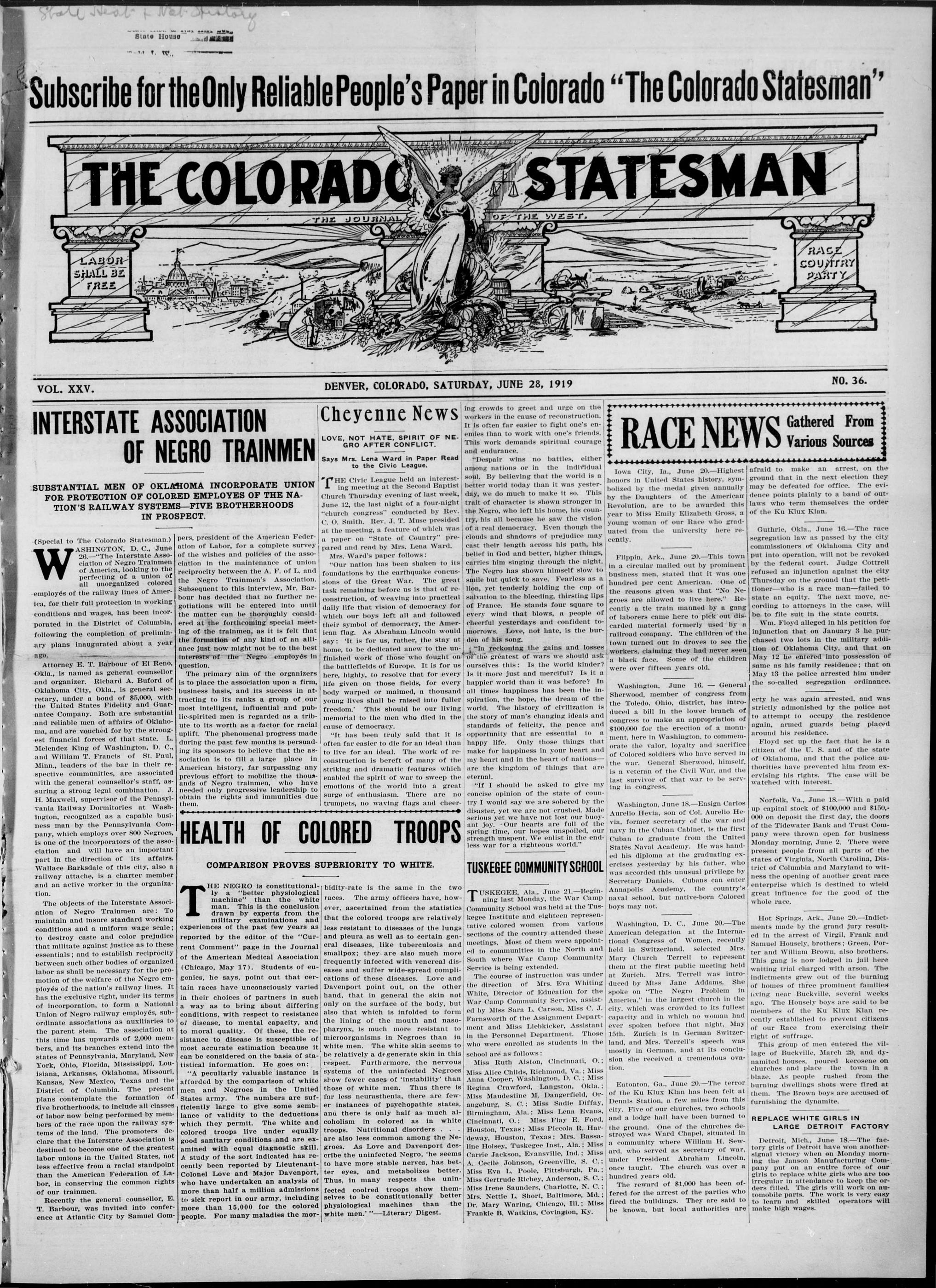
THE COLORADO STATESMAN
THE JOURNAL OF THE WEST.
LABOR SHALL BE FREE
RACE COUNTRY PARTY
State House
Subscribe for t
THE
LABOR
SHALL BE
FREE
INTERSTATE ASS
OF NE
SUBSTANTIAL MEN OF OKLA
FOR PROTECTION OF COLOR
TION'S RAILWAY SYSTEM
IN PRO
INTERSTATE ASSOCIATION OF NEGRO TRAINMEN
SUBSTANTIAL MEN OF OKLAHOMA INCORPORATE UNION FOR PROTECTION OF COLORED EMPLOYES OF THE NATION'S RAILWAY SYSTEMS—FIVE BROTHERHOODS IN PROSPECT.
(Special to The Colorado Statesman.)
WASHINGTON, D. C., June 26.—"The Interstate Association of Negro Trainmen of America, looking to the perfecting of a union of all unorganized colored employés of the railway lines of America, for their full protection in working conditions and wages, has been incorporated in the District of Columbia, following the completion of preliminary plans inaugurated about a year ago.
Attorney E. T. Barbour of El Reno, Okla., is named as general counsellor and organizer. Richard A. Buford of Oklahoma City, Okla., is general secretary, under a bond of $5,000, with the United States Fidelity and Guarantee Company. Both are substantial and reliable men of affairs of Oklahoma, and are vouchered for by the strongest financial forces of that state. L. Melendez King of Washington, D. C., and William T. Francis of St. Paul, Minn., leaders of the bar in their respective communities, are associated with the general counsellor's staff, assuring a strong legal combination. J. H. Maxwell, supervisor of the Pennsylvania Railway Dormitories at Washington, recognized as a capable business man by the Pennsylvania Company, which employs over 800 Negroes, is one of the incorporators of the association and will have an important part in the direction of its affairs. Wallace Barkskale of this city, also a railway attache, is a charter member and an active worker in the organization.
The objects of the Interstate Association of Negro Trainmen are: To maintain and insure standard working conditions and a uniform wage scale; to destroy caste and color prejudice that militate against justice as to these essentials; and to establish reciprocity between such other bodies of organized labor as shall be necessary for the promotion of the welfare of the Negro employés of the nation's railway lines. It has the exclusive right, under its terms of incorporation, to form a National Union of Negro railway employés, subordinate associations as auxiliaries to the parent stem. The association at this time has upwards of 2,000 members, and its branches extend into the states of Pennsylvania, Maryland, New York, Ohio, Florida, Mississippi, Louisiana, Arkansas, Oklahoma, Missouri, Kansas, New Mexico, Texas and the District of Columbia. The present plans contemplate the formation of five brotherhoods, to include all classes of labor now being performed by members of the race upon the railway systems of the land. The promoters declare that the Interstate Association is destined to become one of the greatest labor unions in the United States, not less effective from a racial standpoint than the American Federation of Labor, in conserving the common rights of our trainmen.
Recently the general counsellor, E. T. Barbour, was invited into conference at Atlantic City by Samuel Gom-
VOL. XXV.
the Only Reliable
COLOR
ASSOCIATION
NEGRO TRAINMEN
THOMA INCORPORATE UNION
LED EMPLOYES OF THE NA-
S—FIVE BROTHERHOODS
SPECT.
pers, president of the American Federation of Labor, for a complete survey of the wishes and policies of the association in the maintenance of union reciprocity between the A. F. of L. and the Negro Trainmen's Association. Subsequent to this interview, Mr. Barbour has decided that no further negotiations will be entered into until the matter can be thoroughly considered at the forthcoming special meeting of the trainmen, as it is felt that the formation of any kind of an alliance just now might not be to the best interests of the Negro employés in question.
The primary aim of the organizers is to place the association upon a firm, business basis, and its success in attracting to its ranks a group of our most intelligent, influential and public-spirited men is regarded as a tribute to its worth as a factor for racial uplift. The phenomenal progress made during the past few months is persuading its sponsors to believe that the association is to fill a large place in American history, far surpassing any previous effort to mobilize the thousands of Negro trainmen, who have needed only progressive leadership to obtain the rights and immunities due them.
HEALTH OF CO COMPARISON PROVES
HEALTH OF COLORED TROOPS
THE NEGRO is constitutionally a "better physiological machine" than the white man. This is the conclusion drawn by experts from the military examinations and experiences of the past few years as reported by the editor of the "Current Comment" page in the Journal of the American Medical Association (Chicago, May 17). Students of eugenics, he says, point out that certain races have unconsciously varied in their choices of partners in such a way as to bring about differing conditions, with respect to resistance of disease, to mental capacity, and to moral quality. Of these, the resistance to disease is susceptible of most accurate estimation because it can be considered on the basis of statistical information. He goes on:
bidity-rate is the same in the races. The army officers have ever, ascertained from the study that the colored troops are less resistant to diseases of the head and pleura as well as to certain diseases, like tuberculosis, smallpox; they are also much frequently infected with vener diseases and suffer wide-spread cations of these diseases. Lo Davenport point out, on the hand, that in general the skin only on the surface of the body also that which is infolded to the lining of the mouth and pharynx, is much more resistant microorganisms in Negroes to white men. The white skin is relatively a degenerate skin respect. Furthermore, the
"A peculiarly valuable instance is afforded by the comparison of white men and Negroes in the United States army. The numbers are sufficiently large to give some semblance of validity to the deductions which they permit. The white and colored troops live under equally good sanitary conditions and are examined with equal diagnostic skill. A study of the sort indicated has recently been reported by Lieutenant-Colonel Love and Major Davenport, who have undertaken an analysis of more than half a million admissions to sick report in our army, including more than 15,000 for the colored people. For many maladies the mor-
DENVER, COLORADO, SATURDAY, JUNE 28, 1919
Cheyenne News
LOVE, NOT HATE, SPIRIT OF NEGRO AFTER CONFLICT.
Says Mrs. Lena Ward in Paper Read to the Civic League.
THE Civic League held an interesting meeting at the Second Baptist Church Thursday evening of last week, June 12, the last night of a four-night "church congress" conducted by Rev. C. O. Smith. Rev. J. T. Muse presided at the meeting, a feature of which was a paper on "State of Country" prepared and read by Mrs. Lena Ward.
"Our nation has been shaken to its foundations by the earthquake concussions of the Great War. The great task remaining before us is that of reconstruction, of weaving into practical daily life that vision of democracy for which our boys left all and followed their symbol of democracy, the American flag. As Abraham Lincoln would say: 'It is for us, rather, the stay at home, to be dedicated anew to the unfinished work of those who fought on the battlefields of Europe. It is for us here, highly, to resolve that for every life given on those fields, for every body warped or maimed, a thousand young lives shall be raised into fuller freedom.' This should be our living memorial to the men who died in the cause of democracy.
"It has been truly said that it is often far easier to die for an ideal than to live for an ideal. The work of reconstruction is bereft of many of the striking and dramatic features which enabled the spirit of war to sweep the emotions of the world into a great surge of enthusiasm. There are no trumpets, no waving flags and cheer-
bidity-rate is the same in the two races. The army officers have, however, ascertained from the statistics that the colored troops are relatively less resistant to diseases of the lungs and pleura as well as to certain general diseases, like tuberculosis and smallpox; they are also much more frequently infected with venereal diseases and suffer wide-spread complications of these diseases. Love and Davenport point out, on the other hand, that in general the skin not only on the surface of the body, but also that which is infolded to form the lining of the mouth and nasopharynx, is much more resistant to microorganisms in Negroes than in white men. The white skin seems to be relatively a degenerate skin in this respect. Furthermore, the nervous systems of the uninfected Negroes show fewer cases of 'instability' than those of white men. Thus there is far less neurasthenia, there are fewer instances of psychopathic states, and there is only half as much alcoholism in colored as in white troops. Nutritional disorders . . . are also less common among the Negroes. As Love and Davenport describe the uninfected Negro, 'he seems to have more stable nerves, has better eyes, and metabolizes better. Thus, in many respects the uninfected cooled troops show themselves to be constitutionally better physiological machines than the white men."—Literary Digest.
ing crowds to greet and urge on the workers in the cause of reconstruction. It is often far easier to fight one's enemies than to work with one's friends. This work demands spiritual courage and endurance.
"Despair wins no battles, either among nations or in the individual soul. By believing that the world is a better world today than it was yesterday, we do much to make it so. This trait of character is shown stronger in the Negro, who left his home, his country, his all because he saw the vision of a real democracy. Even though the clouds and shadows of prejudice may cast their length across his path, his belief in God and better, higher things, carries him singing through the night. The Negro has shown himself slow to smile but quick to save. Fearless as a lion, yet tenderly holding the cup of salvation to the bleeding, thirsting lips of France. He stands four square to every wind that blows, a people of cheerful yesterday and confident tomorrow. Love, not hate, is the burden of his song.
"In reckoning the gains and losses of the greatest of wars we should ask ourselves this: Is the world kinder? Is it more just and merciful? Is it a happier world than it was before? In all times happiness has been the inspiration, the hope, the dream of the world. The history of civilization is the story of man's changing ideals and standards of felicity, the peace and opportunity that are essential to a happy life. Only those things that make for happiness in your heart and my heart and in the heart of nations—are the kingdom of things that are eternal.
"If I should be asked to give my concise opinion of the state of country I would say we are sobered by the disaster, yet we are not crushed. Made serious yet we have not lost our buoyant joy. Our hearts are full of the spring time, our hopes unspilled, our strength unspent. We enlist in the endless war for a righteous world."
TUSKEGEE COMMUNITY SCHOOL
TUSKEGEE, Ala., June 21. Beginning last Monday, the War Camp Community School was held at the Tuskegee Institute and eighteen representative colored women from various sections of the country attended these meetings. Most of them were appointed to communities in the North and South where War Camp Community Service is being extended. The course of instruction was under the direction of Mrs. Eva Whiting White, Director of Education for the War Camp Community Service, assisted by Miss Sara L. Carson, Miss C. J. Farnsworth of the Assignment Department and Miss Liebkicker, Assistant in the Personnel Department. Those who were enrolled as students in the school are as follows:
Miss Ruth Alston, Cincinnati, O.; Miss Alice Childs, Richmond, Va.; Miss Anna Cooper, Washington, D. C.; Miss Regina Crawford, Langston, Okla.; Miss Maudestine M. Dangerfield, Orangeburg, S. C.; Miss Sadie Diffay, Birmingham, Ala.; Miss Lena Evans, Cincinnati, O.; Miss Flay E. Ford, Houston, Texas; Miss Piccola R. Hardeway, Houston, Texas; Mrs. Bassaline Holsey, Tuskegee Inst., Ala.; Miss Carrie Jackson, Evansville, Ind.; Miss A. Cecile Johnson, Greenville, S. C.; Miss Eva L. Poole, Pittsburgh, Pa.; Miss Gertrude Richey, Anderson, S. C.; Miss Irene Saunders, Charlotte, N. C.; Mrs. Nettie L. Short, Baltimore, Md.; Dr. Mary Warling, Chicago, Ill.; Miss Frankie B. Watkins, Covington, Ky.
RACENEWS Gathered From Various Sources
Iowa City, Ia., June 20.—Highest honors in United States history, symbolized by the medal given annually by the Daughters of the American Revolution, are to be awarded this year to Miss Emily Elizabeth Gross, a young woman of our Race who graduated from the university here recently.
Flippin, Ark., June 20.—This town in a circular mailed out by prominent business men, stated that it was one hundred per cent American. One of the reasons given was that "No Negroes are allowed to live here." Recently a tie train manned by a gang of laborers came here to pick out discarded material formerly used by a railroad company. The children of the town turned out in droves to see the workers, claiming they had never seen a black face. Some of the children were over fifteen years old.
Washington, June 16. — General Sherwood, member of congress from the Toledo, Ohio, district, has introduced a bill in the lower branch of congress to make an appropriation of $100,000 for the erection of a monument, here in Washington, to commemorate the valor, loyalty and sacrifice of Colored soldiers who have served in the war. General Sherwood, himself, is a veteran of the Civil War, and the last survivor of that war to be serving in congress.
Washington, June 18.—Ensign Carlos Aurelio Hevia, son of Col. Aurelio Hevia, former secretary of the war and navy in the Cuban Cabinet, is the first Cuban to graduate from the United States Naval Academy. He was handed his diploma at the graduating exercises yesterday by his father, who was accorded this unusual privilege by Secretary Daniels. Cubans can enter Annapolis Academy, the country's naval school, but native-born Colored boys may not.
Washington, D. C., June 20.—The American delegation at the International Congress of Women, recently held in Switzerland, selected Mrs. Mary Church Terrell to represent them at the first public meeting held at Zurich. Mrs. Terrell was introduced by Miss Jane Addams. She spoke on "The Negro Problem in America," in the largest church in the city, which was crowded to its fullest capacity and in which no woman had ever spoken before that night, May 15th. Zurich is in German Switzerland, and Mrs. Terrell's speech was mostly in German, and at its conclusion she received a tremendous ovation.
Eatonton, Ga., June 20.—The terror of the Ku Klux Klan has been felt at Dennis Station, a few miles from this city. Five of our churches, two schools and a lodge hall have been burned to the ground. One of the churches destroyed was Ward Chapel, situated in a community where William H. Seward, who served as secretary of war, under President Abraham Lincoln, once taught. The church was over a hundred years old.
The reward of $1,000 has been offered for the arrest of the parties who fired the buildings. They are said to be known, but local authorities are
NO.36.
afraid to make an arrest, on the ground that in the next election they may be defeated for office. The evidence points plainly to a band of outlaws who term themselves the order of the Ku Klux Klan.
Guthrie, Okla., June 16.—The race segregation law as passed by the city commissioners of Oklahoma City and put into operation, will not be revoked by the federal court. Judge Cottrell refused an injunction against the city Thursday on the ground that the petitioner—who is a race man—failed to state an equity. The next move, according to attorneys in the case, will be to file suit in the state courts.
Wm. Floyd alleged in his petition for injunction that on January 3 he purchased two lots in the military addition of Oklahoma City, and that on May 12 he entered into possession of same as his family residence; that on May 13 the police arrested him under the so-called segregation ordinance.
erty he was again arrested, and was strictly admonished by the police not to attempt to occupy the residence again, armed guards being placed around his residence.
Floyd set up the fact that he is a citizen of the U. S. and of the state of Oklahoma, and that the police authorities have prevented him from exercising his rights. The case will be watched with interest.
Norfolk, Va., June 18.—With a paid up capital stock of $100,000 and $150,-000 on deposit the first day, the doors of the Tidewater Bank and Trust Company were thrown open for business Monday morning, June 2. There were present people from all parts of the states of Virginia, North Carolina, District of Columbia and Maryland to witness the opening of another great race enterprise which is destined to wield great influence for the good of the whole race.
Hot Springs, Ark., June 20.—Indictments made by the grand jury resulted in the arrest of Virgil, Frank and Samuel Housely, brothers; Green, Porter and William Brown, also brothers. This gang is now lodged in jail here waiting charged with arson. The indictments grew out of the burning of homes of three prominent families living near Buckville, several weeks ago. The Housely boys are said to be members of the Ku Klux Klan recently established to prevent citizens of our Race from exercising their right of suffrage.
This group of men entered the village of Buckville, March 29, and dynamited houses, poured kerosene on churches and place the town in a blaze. As people rushed from the burning dwellings shots were fired at them. The Brown boys are accused of furnishing the dynamite.
REPLACE WHITE GIRLS IN
LARGE DETROIT FACTORY
Detroit, Mich., June 18.—The factory girls of Detroit have won another signal victory when on Monday morning the Janson Manufacturing Company put on an entire force of our girls to replace white girls who are too irregular in attendance to keep the orders filled. The girls will work on automobile parts. The work is very easy to learn and skilled operators will make high wages.
NEWS TO DATE IN PARAGRAPHS
CAUGHT FROM THE NETWORK OF
WIRES ROUND ABOUT.
THE WORLD.
DURING THE PAST WEEK
RECORD OF IMPORTANT EVENTS
CONDENSED FOR BUSY
PEOPLE.
Western Newspaper Union News Service.
WESTERN
The, Mexico City newspapers estimate that the government's deficit this year will be less than 10,000,000 pesos and that the financial situation is improving daily. The government has authorized expenditures of 7,458,269 pesos for the War Department and 11,840,109 pesos for military supplies.
Selection of a jury to hear the evidence in the trial of William H. ("Lone Star") Dietz, former football coach and Indian motion picture actor, on charges of false registration under the draft law and falsification of his draft questionnaire, has been started in the United States District Court at Spokane.
The federal government failed in a decision filed in the United States District Court in Los Angeles to set aside mineral locations on 160 acres of rich oil-bearing land in Kern county, filed by L. B. McMurtry for several individual oil operators, and which the government alleged were secured illegally and by fraud by McMurtry.
Manila is in the throes of a street car strike. Acting Governor Yeater refused the request of labor organizations to remove the constabulary guards, who are assisting the traction company in maintaining service. Manila officials declare agitators are seeking to oust foreign capital because of alleged opposition of labor.
Burlington passenger train No. 6, from Lincoln to Chicago, ran five miles without an engineer when Engineer James Edgar Johnson of Lincoln fell from the cab a mile east of Waverly after being hit by a mail crane. The train ran from Waverly to Greenwood before the engineer was missed. Fireman Karl J. Zimmerman stopped the train at Greenwood and ran the engine back to Waverly. There the engineer was found dead beside the tracks.
Establishment of a branch of the Interior Department in some Western state with several of the department's bureaus removed there from Washington, was proposed in a bill introduced by Representative Mays (Dem.) of Utah. His measure would appropriate $1,000,000 for the branch headquarters, which would house the general land office, the geological survey, the bureau of mines, the reclamation service, the Indian bureau and the national park and forest services.
WASHINGTON
As a result of successful operation of the aerial mail service between Chicago and Cleveland, the Postoffice Department, it was announced, is considering extension in the fall of the service from Chicago to Omaha, which would mean a total reduction in train mail time between the Atlantic and Pacific coasts of approximately twenty-four hours.
The United States food administration announced that the licenses of C. H. Wayne of Reynold, Ill., had been revoked until further notice for violating the section of the food control act, which makes it unlawful to hoard grain and certain other commodities.
Mr. Wayne is alleged to have stored grain for speculative purposes at a time when a corn shortage existed.
A forest fire near Canyon Ferry, which burned out Helena's light and power lines, leaving the city in darkness and without street cars for many hours, has been put under control.
Total casualties of the American expeditionary forces reported to date was announced by the War Department as 289,016, including: Killed in action (including 381 lost at sea), 33,754. Died of wounds, 13,570. Died of disease, 23,396. Died from accidents and other causes, 4,942. Total deaths, 75,662. Wounded in action, 210,984. Missing in action (not including prisoners released or returned), 2,370.
An increase of approximately $200,000,000 in the $276,000,000 appropriation for government shipbuilding carried in the sundry civil appropriation bill, was urged by Chairman Hurley of the shipping board, at the beginning of hearings on the measure before the Senate appropriations committee. Mr. Hurley said if the increase were not granted, the government would lose heavily in disposing of ships now under construction. Unemployment of men in the shipyards also would result, he said.
Without a record vote, the Senate adopted committee amendments to the army appropriation bill providing for an average army of 400,000 men for the year beginning July 1. The bill as passed by the House provided for an army of 300,000 and Secretary Baker had recommended that the total be placed at 500,000 officers and men.
A measure providing for indiscriminate search of private homes for intoxicating liquor after prohibition goes into effect was voted down by the House Judiciary Committee at Washington.
FOREIGN
Martial law has been proclaimed in the entire zone of Hamburg harbor as a consequence of an increase in raids upon food depots.
Count von Bernstorff will go to Rome as German ambassador as soon as the peace treaty is ratified, it was learned at Weimar.
A divorce craze is sweeping England. Three courts granted decrees in one day at the rate of fifteen an hour. The total number on the calendar is 808, and in 452 of these husbands are the petitioners.
The German Officers' Association has telegraphed the Dutch government, warning it not to deliver the former kaiser to the allies for trial. "We can protect the kaiser with our bodies, but we rely upon the generosity of the Dutch people," the message concluded.
Five million dollars are to be set aside by the British government to conduct a search for petroleum in Great Britain, the financial secretary to the treasury told the House of Commons. He also stated that $1,000,000 would be devoted to aid flax production, principally in Ireland.
Premier Clemenceau has expressed his intention to resign from office as soon as the treaty is promulgated, feeling that he has accomplished the task for which he assumed the premiership, says Marcel Hutin in the Echo de Paris. It is expected that parliament will ratify the treaty late in July.
Fifteen flags captured from the French, which were returned after signing of the peace treaty, were taken from a museum in Berlin by a crowd of German officers and soldiers and publicly burned near the statue of Frederick the Great. As the flags burned a great crowd sang "Deutschland Uber Alles."
SPORT
Al Norton of California, a heavyweight, won the decision over Herscovitz of Canada in ten rounds in the boxing events of the interallied games in France.
Jole Ray, crack middle distance runner of the Illinois Athletic Club, won the first annual Chicago Daily News marathon of six and three-fourths miles on the boulebard in the time of 35:42:02.
Aggressiveness won for Harry Greb, middleweight, over Mike Gibbons of St. Paul in their ten-round bout at Pittsburg. Greb was given six of the rounds, Gibbons three and one was even.
Mrs. George W. Wightman, Longwood Cricket Club, won the women's national lawn tennis championship when she defeated Miss Marion Zinderstein, her clubmate at the Philadelphia Cricket Club. 6-1, 6-2.
W. S. Hoon of Jewell Junction, Iowa, captured the cup for high score in the state trap shoot which closed at Mason City with 591 out of 600 targets thrown in three days. A. R. Chazik, Portal, N. D., made a score of 592, but, as a non-resident, was barred from claiming the cup. B. F. Elbert, Des Molines, winner of individual honors, was the runner-up with 590.
GENERAL
The steamer Vauban left New York for South American points with more than $15,000,000 in gold aboard. This is said to be the largest single cargo of gold that ever left New York.
Another of the many clews to the lost collier Cyclops—all of which so far have been exploded—turned up at Columbia, S. C., when the mother of Otis Ramsey, a seaman on the ship, received a telegram from New York, saying he was "safe in this country again" and that the missing vessel was in a German port. The navy records show that Otis Ramsey of Columbia was a seaman on the Cyclops and he is listed as "lost at sea" with the ship. Officials think the message a hoax, but as they expect to solve the mystery some day, they are carefully looking up every clew.
Commencement exercises in Woolsel Hall, in New Haven, were those of Yale University's 219th year. Thirteen honorary degrees and 508 degrees for work in courses were given.
The Lower House of the Ohio Legislature have adopted a resolution asking Governor Cox to stop the Willard-Dempsey heavyweight championship prize fight to be held at Toledo, July 4th.
Samuel Gompers was re-elected president of the American Federation of Labor, in convention at Atlantic City, and his salary raised from $7,500 to $10,000. Mr. Gompers in a speech sald the selection was American labor's answer to its traducers and opponents.
Full confessions are expected by the police from Antony Kunski, a building contractor, and Miss Frances Mann, arrested in connection with a $500,000 "fire-bug" ring, which is alleged to have been responsible for more than 200 fires in Chicago and in surrounding towns in Illinois, Michigan, Wisconsin, Indiana and Iowa. The police believe Kunski to be the "brains" of the arson gang. James Kabulis also is under arrest as an alleged member of the gang.
A bombing airplane piloted by Lieut. Col. H. B. Claggett struck and killed two children and injured another in landing at Franklin field in Boston. Capt. William H. Chandler, observer of the machine, was slightly hurt. The plane, one of seven which arrived from Albany, N. Y., on the last leg of a flight from Dallas, Texas, was wrecked.
Governor Lowden of Illinois signed the "search and seizure" bill, passed by the Fifty-first General Assembly and designed to enforce prohibition in "dry" territory.
Pithy News Notes
From All Parts of
Colorado
Western Newspaper Union News Service.
COMING EVENTS.
The Colorado Editorial Association meet in Denver, July 11, 12, 1919.
Logan county, which leads all other counties of the state in the percentage of its land in cultivation, has approximately 2,300 farms, with a total of 614,731 acres. This county has approximately 200,000 acres of wheat for the 1919 harvest.
George W. Olinger of Denver was elected president of the Colorado State Sunday School Association for the coming year at the closing session of the annual convention of that organization in Pueblo. Twelve hundred delegates attended the meeting.
With the price of wheat still fixed until the 1919 crop is sold Colorado farmers will receive from their output this year if conditions remain favorable until harvest, approximately $40,000,000, or only about $10,000,000 less than the farm value of all crops grown in the state in 1909.
An exceedingly rich strike of gold and silver ore has just been reported in the Golconda mine in Horseshoe basin, fifteen miles up Hanson creek from Lake City. There is, according to the report, over six feet of ore, three feet of which will run from $1,000 to $5,000 per ton, about equally in gold and silver.
Hurled sixty feet from the side car of a motorcycle when a southbound Union Pacific train crashed into the machine in which sie was riding five miles east of Loveland, Mrs. William Tracy, was instantly killed, and Mrs. Verne Tippits, driver of the vehicle received injuries which it is feared may cause her death.
Boys' and girls' pig-raising clubs have now been organized by County Agent M. E. Knapp and his assistants in practically every large town in Weld county. Clubs are in existence at Greeley, Kersey, Johnstown, Ault, Eaton, Windsor and Platteville. More than 100 pure-bred pigs have been purchased by the club members.
Albert Bevan, 15, and Frank McCarthy, 14, rescued Jack Simpson, 10, from drowning at Colorado Springs. It was Bevan's fourth life-saving exploit and McCarthy's second. The Simpson boy, too, participated in the event for the second time, as Bevan pulled him out of a reservoir last summer after he had sunk for the third time.
Flock-masters in the San Juan basin, particularly in the Mancos district, report the constant loss of sheep from their bands, which, they say, if continued throughout the season, will rob them of a major portion of the year's profits. The sheepmen also say that when sheep were selling at low prices they seldom if ever lost sheep in any way except through raids by predatory animals. An organized effort is being made to find out whether there is a band of sheep rustlers who are systematically robbing the herds by taking only a few head of sheep at a time.
Colorado's public school fund has produced in the last six months more than $400,000, which is to be distributed July 1 to the sixty-three counties of the state on the basis of school population for use of the county schools. This is the largest sum in the history of the state which has been produced and distributed in this manner, the previous high figure having been the $321,000 distributed Jan. 1 last. The public school fund now amounts to $5,393,860, that being the total June 1. The sum to be distributed next month is made up of the interest on the total fund, rentals on state lands and interest on deferred payments paid into the fund by buyers of state land.
The Pikes Peak region will become the background of a series of pictures of Bible times which are to be produced at Colorado Springs. A studio has been erected and the Garden of the Gods, Seven Falls, Cheyenne mountain and the slopes and summit of Pikes Peak soon will become the setting for a screen drama which had its origin in Palestine.
George Engel, pioneer Douglas county rancher, committed suicide by hanging near his home in Lower Lake gulch, about eight miles southwest from Castle Rock. Members of the family being unable to find the father called for assistance from Castle Rock and, after untiring search, he was located in an unfrequented gulch, hanging from a limb of a tree.
George Bosko, convicted of killing Elton C. Parks and Will T. Hunter on the Rye road near Pueblo on the afternoon of April 11, was sentenced to be hanged during the week beginning Sept. 22. Tom Bosko, a brother of the doomed man, was given life imprisonment. It is likely that appeal to the Supreme Court will be made. The attorneys have sixty days in which to file their bill of exceptions.
Believing that male juvenile delinquency and incorrigibility are largely due to nasal malformations, diseased or enlarged adenoids and tonsils, Judge Karl W. Farr of the Teller county court, has decided that surgical operations will effect more reforms than the imposition of sentences to penal or semi-penal institutions.
The acreage of land farmed without irrigation in Colorado has increased more than 200 per cent in the past ten years, and thousands of acres of raw nonirrigated land is being put in cultivation each year.
CENTENNIAL STATE ITEMS
Colorado holds the distinction of being the foremost producer in the world of molybdenum ore, according to the fifteenth biennial report of the State Bureau of Mines, recently compiled. This report covers the years 1917 and 1918, and was submitted by Fred Carroll, state commissioner of mines during the above period. The total mineral production of the state since 1858 was $1,405,484,255. Gold production in 1918 alone is estimated at $12,944,600, as compared with the 1917 output of $15,729,224. The decrease in gold production was due to the closing of mines caused by the constantly increasing costs, the report states. The report further states that Colorado is producing most of the vanadium of the United States, and in the world markets is vicing with the Peruvian mines. A greater part of the world's supply of uranium and radium is being mined from Colorado deposits.
A new record in one day's mining of precious metals has been established by Fred Dopp of Jamestown, so far as the Central district is concerned, by the opening up of a vein of high-grade silver and gold ore. The find was made on the new Rival claim of the Black Rose group about two and one-half miles south of the camp. His shipment, which was of more than two tons, was brought to the Boulder Sampling works and yielded him a pay check of $1,708.40.
The Rocky Mountain National park will receive from Congress this year only the $10,000 annual allowance for maintenance heretofore granted, although a fight was made by Parks Director Stephen T. Mather to have added to the regular appropriation $50,000 for road building. The sundry civil bill reported to the House of Representatives carries only the $10,000 for expenditure during the fiscal year ending June 30, 1920.
Unless it suffers further damage from unfavorable weather or disease, the wheat crop in Colorado this year will be approximately 20,600,000 bushels, or about 7,000,000 bushels more than the reported production for 1917, the state's banner wheat year to date. The Colorado co-operative crop reporting service in its June report forecasts the production of winter wheat at 12,651,780 bushels and spring wheat at 7,990,000 bushels.
A bullet fired by an unknown Mexican at Grand Junction, passed through the leg of Guy McCammon, a white man, and struck Mary Johnson, a negress, in the right leg. McCammon is in a local hospital and the negress is unhurt in that the bullet merely struck her clothing and lodged in a pocket of her skirt. She was sitting on the porch of her own home fifty feet away from where McCammon was struck.
Figures prepared by Horace Havens, mineral superintendent of the State Board of Land Commissioners, show that more than 200,000 acres of state school land are under lease to oil companies. From these leases the school fund derives more than $10,000 annually. Recent reports to the Land Board show that ten wells are being drilled in the state and that several others are to commence operations soon.
A battle-scarred phonograph which the Elks' Lodge of Montrose donated to the members of Battery F of the 341st Division of the American Expeditionary Forces, has been returned to them by the boys, who are now at Camp Funston. This instrument was carried through many battles by the local boys, but is still in good playing condition, although there are several bullet wounds in its framework
Patients from forty-four states are receiving treatment at Hospital No. 21 at Aurora, according to information compiled from Red Cross records by Miss Grace M. Smith, librarian at the recuperation camp. There are also patients from Finland, Canada, Italy, Sweden, Ireland, England and the Philippine Islands.
In honor of Congressman Guy U. Hardy of Cañon City, who is president of the National Editorial Association which convenes in Seattle, Wash., in August, one of the big ships of the new United States merchant marine which will be launched in that city on August 16th, will be named Cañon City, in honor of Mr. Hardy's home town. Members of the National Editorial association will be guests of honor on this occasion and Mrs. Hardy will act as sponsor at the launching. The vessel is of the newest pattern, being of steel construction and possesses all the modern features of maritime construction.
There is nearly $500,000 worth of buildings being erected in Greeley at the present time, and contractors have plans for at least twenty-five more residences ranging in price from $3,500 to $5,000, which will be started as soon as workmen are available. These buildings represent fifty-one residences from $3,500 to $8,000 each, the new Presbyterian church at $70,000, a business block at $29,000, remodelling of the Union National Bank at $70,000, a new hotel at $25,000, and a new garage at $20,000.
Grasshoppers swarmed to upper parts of the Paradox valley by the millions this spring, but a campaign conducted by the Paradox Valley Land and Irrigation Company and many of the farmers of that section of this county resulted in their total extinction.
Lake county, Colorado's premier mineral producing county, shipped metals to the value of $410,000,000 to the end of 1918. Silver leads in value, with a production worth approximately $184,000,000, and zinc stands second, with about $80,000,000.
POINT ONE—Morrison's Full Orchestra furnishes the music.
POINT TWO—Thursday is in the middle of the week.
POINT THREE—We don't tolerate anything but decent actions at our dance.
Fern Hall Every Thursday Night FIVE POINTS DANCING CLUB.
Weatherhead Hat Co.
RENOVATORS, BLEACHERS, DYERS AND FINISHERS Of Gents' and Ladies' Hats of Every Description 1624 CHAMPA ST., DENVER, COLO.
The
Curtis
Park
Floral
Company
FLORAL DESIGNS PUT UP WHILE
YOU WAIT
CHOICE PLANTS AND CUT FLOWERS CONSTANTLY
ON HAND
GREENHOUSES: Thirty-Fourth and Curtis Streets
TELEPHONE, MAIN 1811
DENVER, COLO
Wishes to welcome all to good home cooking and dainties of the seasons, any time from 6 a. m. to 11:30 p. m. Accurate service at all hours; so when down town stop, give us a trial and we will guarantee you will leave with a smile. MRS. M. J. FRANKLIN & S. BOWERS. Props. 924 19th St.
Eight (8) years experience in growing the hair. My own hair is my advertisement. My customer's hair grows. Full line of her hair goods for sale. System taught. Call for rates.
SILVER STATE SHINING PARLOR
The best in the city. Private booths for ladies. All kinds of Fancy Shoes cleaned, dyed, bronzed. All work guaranteed.
```markdown
```
1865-1867 CURTIS 8
The Curtis Park Floral Company
FLORAL DESIGNS P
NOICE PLANTS AND
GREENHOUSES: THE
TELEPHONE, MAIN 1811
To Friend
Wishes to
and dainti
a. m. to J
hours; so w
and we w
smile.
MRS. M. J. FRAN
PIONEER HATTERS OF THE WEST. WE MAKE OLD HATS NEW.
AND FINISHERS
Mary Description
R, COLO.
Private Booths for Ladies
DAY CAFE
DRINK PARLOR
, Proprietor
B, BLEACHERS, DYERS AND FINISHERS
and Ladies' Hats of Every Description
CHAMPA ST., DENVER, COLO.
Private Boothe for Ladies
NIGHT AND DAY CAFE
AND COLD DRINK PARLOR
B. CARRUTH, Proprietor
A Full Lines of Fresh Fish in Season
Oysters and Lobsters
Short Orders At All Hours Rest Room for Ladies
STREET
DENVER, COLORADO
```markdown
```
Ge EY
-§ SO LS of
yo Y
Fy 7)
WE Le
“Now, Mr. Tailor,
are you sure
this is a good style
this summer?”
“Well, it ought to be,
I’m taking it right out
of the Society Brand
Summer Style Book!”
Summer Suits
by Society Brand
$30 to $60
| Noose,
THE MAY ©.
See eee ee oe
a7 ©. C. DENNIS R. F. LONG
I 4 i The New Way Shoe
| Repairing Co.
see || AND
== \ . oe
e it American Shoe Repairing
\ \) FIRST-CLASS WORK
ri : eo Best Leather Used—Reasonable Prices
V 1 1855 Champa St. Phone Main 3787.
ee 1221 Sixteenth St. Phone Champa 5389.
Opp. Golden Eagle. DENVER, COLO.
MOTTO: “CAREFUL DRIVING, BUT SURE”
J. V. LEWIS AUTO LIVERY
7 PASSENGER WESTCOT 6 CARS.
TAXICAB RATES:
Depot, 1 or 2 Passenger, 50c; Depot, Each Additional Passenger,
25c; One Mile Radius, 50c; Each Additional Mile, 25c.
RATES PER HOUR, $1.50 TO $2.50.
STAND:
Night—Page Pool Hall, 2710 Welton, Phone Main 2759.
Day—2450 Washington, Phone York 8601-W.
DENVER, bee fet ret tet tet COLORADO.
The Right Kind of
Reesing Matter
| The home news; the doings of the people in this
town; the gossip of our own community, that’s
the first kind of reading matter you want. It is
more important, more interesting to you than
that given by the paper or magazine from the
outside world. It is the first reading matter
you should buy. Each issue of this paper gives
to you just what you will consider
| The Right Kind of
| Reading Matter
POOR WAY TO WOO SLEEP
PENN NNN NNN NAR EERE OO
(A PRODUCING, DIVIDE ND-PAYING COMPANY)
BRINGS IN WELL NO, 32 IN MID-CONTINENT FIELD
TELEGRAPHIC ADVICE DATED JUNE 18, 1919.
A510KS 48 Collect NIL
1919 June 18 PM 6:23 Coffeyville, Kans, 18.
Capitol Petroleum Company, 415 Denham Bldg., Denver, Colo.
Number seven shot; showing up fine; flowed today while cleaning out; hope to send you pic-
tures tomorrow. 1, A. BEASLEY.
Man Who Experimented Pronounces
Insomnia “Cure” to Be at Least
ef Doubtful Value.
_. A new cure for insomnia, we read, ts
to “list the first names of all your
friends and acquaintances, taking each
letter of the alphabet in order.”
Of course this {s only a variant of
the old device of counting imaginary
| sheep Jumping over a wall. Personally
“We never found that to work at all.
We counted between 11,000 and 12,000
of these alleged soporific sheep one
night, and then the alarm clock went
(off and it was time to get up, which
we did with a groan, a headache and a
‘pair of astigmatic eyes. ;
‘Making an alphabetical catalogue of
your friends’ first names {s an even
more stimulating and nerve-exciting
process, We would be willing to wager
that no normal persons could get fur-
ther than the N’s before being inter-
‘rupted by the first call for breakfast.
It is doubtful, at least, if the night con-
| tains enough time to go through with
| the whole list from Alfred to Zorilla.
| We should say that this might be the
surest way to banish sleep altogether.
|. The best way to woo slumber, we
"have been told, is to go into the si-
‘lence, relax all muscles and nerves, and
then {n a mental way, pull all the edges
of the mind into a dead mental center
and fold them in. It ts hard to say
Just how this 1s done, but it sounds
penne Frequently, of course, there
are some difficulties merely in going
into a silence. Somewhere on the prem-
ises, perhaps in an adjacent apartment,
there may be someone who has gone
| to sleep without going into the silence.
This interferes materially with the
| working of all anti-insomnia devices.
If there ts no neighboring obstacle of
this sort it is a much easier matter.
And yet, even after the silence 1s ar
ranged, the mind Is apt to go on pro-
| viding its own disturbance. Arithmet-
| {eal and alphabetical diversions only
| accentuate the tumult. The only thing
to do ts to regard the very center of
the mind as a hypothetical hole, or vac-
‘uum, contract the mind until it is all
pulled into this hole, and then pull the
hole in after it. And there you are.
| Of course if there is a certain degree
| of reality in this Imagined condition,
| one does not have to exercise the hy-
| pothesis, and that makes it so much
| easier—i. H. Young in Providence
| Journal,
= aoe oEee 18 PM 6:23 Coffeyville, Kans,, 18.
Capitol Petroleum Company, 445 Denham Bldg., Denver, Colo.
cere shot; showing up fine; flowed today while cleaning out; hope to send you pic-
as . A, BEASLEY.
Mid-Conti Fi i
=
id-Continent Fields Booming
“Oil operators from all corners of the world have rushed into the Mid-Continent Fi
- ield; leases
are taken by the scores; wagon trains of lumber aand casing for derricks and wells can be scen on
the roads spreading into Oklahoma, Texas, Kansas, and proven oil lands of the West and South.
New wells come every day; new towns call to homeseeker and business men.”
‘Magnificent cities spring up now where a short time ago there were trails and shacks. In for-
mer pastures, now throb engine and drill amidst a veritable forest of derricks, topping wells from
which flow unlimited wealth, and in unbroken brush on hills, forming picturesque landscape; and in
fields where unused streams flow, the oil pump is drawing millions of dollars, sending them flowing
into pipe lines, which after raised to view resemble a giant spider web spreading over the greater
part of Oklahoma.”
...-“No one in visiting this wonder country understands the enthusiasm that grips when viewing the
steady flow of wealth from well to tank, to pipe line,-pipe line to refinery. At this entrance upon
an oil age, and the market consuming today more than the prolific sub-soils of Mid-Continent Fields
produce, conviction comes with force to the investigator that even though unaccountable wealth has
been tapped, present-day development is but the beginning of things in the oil industry.”—Oil and
Gas Journal.
(CLIPPING FROM TAMPICO, MEXICO, NEWSPAPERS)
(Tampico Tribune, May 31, 1919.) was the principal hindrance heretofore, is at an
PANUCO OIL FIELDS PRODUCE ANOTHER end, it is logical to suppose that our country is
40,000-BBL. WELL. fast approaching a period of prosperity, welfare
and aggrandisement.” (MUNDIAL. )
Big Gusher Came In Last Sunday on Orvananos eee
Nt, Lot 10) Maiets and Ie Securely (Mexican Commerce, May 3, 1919.)
Closed In, PROMINENT OIL MEN ARRIVE IN TAMPICO
ALUISON SMUD: DRAULEL WRLY To Acquire Personal Familiarity With Condi-
Lease Recently Purchased by the Mex. Refining tions and Erovertiet in Which They
& Producing Co. re Interested.
Orvananos well No. 1 on lot 19, Isleta, belong- BUSINESS MEN GIVE LUNCH
ing to the Mexican Refining & Producing Com- —-
pany came in last Sunday afternoon at 6 ‘o'clock ‘Tampico, April 26.—Captain John Barneson,
with an estimated production of 40,000 barrels | president of the General Petroleum Corporation
of petroleum: dady. | with a party of guests, including prominent fig-
ae eer eee a4 ures in the oil and financial world, arrived in
(Mexican Commerce, May 24, 1919.) | Tampico aboard the yacht Invader, Tuesday eve-
MEXICO LOOKS FORWARD TO PROSPERITY ning. Members of the party are interested in
—_—— companies operating in the Mexican oil fields
By General ALVARO OBREGON, and the present visit is with a view to acquir-
Noxales, Arizona. ing greater personal familiarity with these in-
Original Manuscript In Spanish. vestments.
2S Will Invest Strongly.
“The resourcefulness of the Mexican soil had Mr. C. W. Hamilton, president of the Ameri-
never before been duly estimated either in this can Chamber of Commerce, acted as host at the
country or abroad, until now at the end of a luncheon, Capt. Barneson ‘said that he was sur-
prolonged period of civil strife, unprecedented in prised and pleased to note the progressive spirit
the history of Mexico. Her vitality had been of Tampico, particularly the Americans. He ex-
evidenced, perhaps, due, exclusively to her own pressed his intention of becoming a member of
natural resources, which stood strong and un- the American Chamber of Commerce. He also
exhausted against the destructiveness and in- said that it is the intention of his company to
tensity of the conflict. = come into the Mexican fields strong in the near
“Business men, convinced of the fact that future. The company now has some very de-
capital invested in Mexico: will bring the most sirable acreage in the south country and they
profitable results are now making considerable intend to erect a tank farm and topping plant
investments there, and as the world war, which to take care of their production.
pole Puce ane ee Stee
Capitol Petroleum Co.'s (Mexican) Well No. 2 Near Completion in
3 y
THE WORLD'S RICHEST OIL FIELD
Smee eee, caeetes se ee
TELEGRAPHIC ADVICE DATED JUNE 18, 1919
A466GS 28 Via Laredo Jct. 1919 June 18 P. M, 10:42
‘Tampico, Mex., 18.
Capitol Petroleum Company, Denham Bldg., Denver, Colo.
eg Teeady to set ene but pipe not arrived account labor strike Tampico; will be delayed
few days; Capitol Number Two shows more oil as we go down, H. B. GUTHREY.
‘TELEGRAPHIC ADVICE DATED JUNE 18, 1919
A147CH 26 NL 1919 June 18 A.M. 5:00.
TW Washington, D. C., June 17.
Capitol Petroleum Company, Denham Bldg., Denver, Colo.
Shipping Board advises immediate release of boats for oil_ transportation from, ‘Tampico to
States; will confer on details with transportation executive at ‘Custom House, New York, tomorrow.
JOHN G. POWELL.
CAPITOL PETROLEUM ©O’S (TEXAS) WELL NO 1 IN
will be spudded in as quickly as tools and supplies, now on the way, can be delivered and the make-
ready completed.
Gee ees tess, eS ee
BE PAID ON JULY 15, 1919, TO
3
STOCKHOLDERS OF RECORD
JULY 5, 1919
onrd of Directors hax decided to withdraw the Treasury Stock
ovine to recent developments the Moned,of Directors hat, declded, eit ta" wartisinate in ihe Su
from the market on July 3 1049, wilel ls tide stock in placed on the market again the price will prob-
dividend, which will be 15 per cent of WON. of! Gur friendn; therefore we urge you to buy now.
{ily be beyond the reach of 4 srent maMy TE endrawn July 5. However, all indications now point to
Am ntaded above, the Trarard. cent allotments therefore, wwe chnnet Bromine 0 tit grain on the
fon gariy, overnubacrivtlcr Quem ag received am Hong as the Hoard of Directors will permit drawing on the
25-cent allotment.
‘To get Treasury Stock at present ae and Me pees ante July dividend
your subseription must be dated and mailed on or before July 9, Ivy.
5 PERCENT OFF FOR CASH,OR 4 EQUAL MONTHLY PAYMENTS
Lithuania and Its People.
Lithuania is situated in the basin
of the Niemen and Dvina rivers on the
southeastern const of the Baltic sea:
The capital is Vilna. Its area {s ap
proximately 80,000 square miles, the
population about 9,000,000, of whom
7,000,000 are Lithuanians 3,500,000
Lithuanians proper, 1,500,000 using
Slavic dialects and 2,000,000 Letts. The
country also contains a third of a mil-
lion Poles. The rest of the population
consists of Jews, White Russians, Ger
mans and Mongols. It is said that
there is no trace in the world’s history
of any other people having lived in
these regions. Although situated be-
tween the Slavs and the Teutons, the
Lithuanians are in no way related to
them. They claim that their language
is one of the oldest now spoken in the
world. It is said strikingly to re
semble ancient Sanskrit.
aah Se RENE se x
Many Tyrants.
He was a high school pupil, and was
imbibing many bits of philosophy. At
home he watched the women folk ant
the ways they devised for doing as they
pleased and for getting every other
person to do as they wished them
to do. And from these he drew con:
clusions which he later voiced.
“Times have changed since my bis:
tory was written,” he told his father
one night. “Then the tyrants were
the men who used to stamp around
and kill and frighten people into sub-
mission. Today the tyrants have drop-
ped those weapons and use much more
subtle ones—tears. I think a woman
who cries in order to get her own way
is a bigger tyrant than ever those old
fellows of long ago were.”
Anyway, it set father to work think-
ing.
Primroses of Picardy,
Nature in her own way Is looking
after the solitary war graves scat
tered throughout the shell-shattered
Pleardy countryside, according to
writer In the London Daily Chronicle.
‘Those that le in the thrice-fought-over
ground between Albert and Combles
fare covered with early spring prim.
roses. In Lieramont the daffodils are
blooming, and the brambles on the
graves in Bernatay wood are green
with new leaves. The lonely war.
rlors are to be gathered together In
the central cemeteries under the care
of the imperial war graves commis
sion. The French government, in com
pliment to the British soldier, has pur
chased the necessary land, and has
presented It for all time to England.
Hotel Chateau Thierry.
‘There is sald to be a plot on foot for
a large American-managed hotel at
Chateau Thierry. If it is built a small
bet might be placed that the services
of a German-speaking clerk will not be
wequired there on the opening day.
Their memories of that section will
not be so keenly pleasurable that Ger-
mans will return there in great num-
bers.
a \
Rhetorical Spendthrifts.
“How's politics coming out your
way?”
“It isn't what it used to be. Every
time anybody would think up a good
husky epithet he'd use it on the Hohen-
zollerns instead of saving it up for the
local campaign.”
| &. P, BLAKEMORE, Attorney and
‘Counsellor at Law. Office, Rooms 39
‘and 40 Arapahoe Bldg., 1622 Arapa-
‘hoe Street. Phone Champa 5450.
For employment see the Industrial
Realty Co. Employment Agency, 716
‘East Twenty-sixth Ave, York 4561,
_ Dr. S. A, Huff, physician and sur-
eon, 2538 Washington street; office
hours 11 to 12 a, m,, 8 to 5 p. m.
Phone York 2313. Out of office,
Main 875. Residence Phone York
4101.
"Day and Night Phone Main 2701.
DR. C. E. TERRY,
PHYSICIAN AND SURGEON
Office Hours: 12 to 2p. m., 6 to 8 p.m,
and appointment.
LEAVE CALLS AT ELITE DRUG
STORE.
1027 21st St, Denver, Colo,
Is
OR YOUR MONEY BACK
Cfo Aone Rae ARORad, U4 pid agar i manatee eset apse
THE COLODADONSAXSTATESMAN
(EAS q ADUNSA 1 SIV
c a Cot Ma - _
A a he Pg ry
Ge Sie GS
Pease] ae sl oo i
ia een er Dre Ag ee 2 4
bE Ae iN 2 AGA eb
ea Ah PO Se I ea
ROSS AES Stes
° yee
BOS. Dew. REVI sss o6. 56515 sel pet NS ls ba 0 <vee ss «s Biwprtater,
¥. 0. Hox 116 Phone Main 7417
1824 Curtin Street, Room 25.
SUBSCRIPTION RATES.
One Year ose Ann $2.00
Six Months SeE ers hcd RO een ed : 1.50
‘Three Months fn Cobh ease aN Re 75
MUST BE PAID IN ADVANCE
Entered ax second-class matter at the postoffice in the City of Denver, Colo.
Reading noticen, ten lines oF Jens, 10 cents per line, Each additional line over
ten lines, § cents per line, Display advertising 50 cents per inch
Remittances should be made by Express Money Order, Postoffice Money
Order, Registered Letter or Bank Draft. Postage stamps will be received the
same an cash for the fractional part of a dollar, Only 1c and 2c stamps taken
No diacounta allowed on less than three months’ contract. Cash myst accom-
pany all orders from parties unknown to us, Further particulars on application.
Communications to receive attention must be newsy, upon Important sub-
jects, plainly written only upon one aide of the Paper, must reach us Tucsdaym,
{Roading anyway not later than Wednesdays, and bear the signature of the
eee, se manuactipt ‘returned, wniesn stampa are nent for postage. Ail
sere tnteationt of a personatine nacure that are mot complimentary will Be
Sour from the columns of thia paper.
‘THE FRANCHISE—BOOST WOMAN'S RIGHT.
NE of our bishops, speaking at a mass meeting in St. Louis, said in
oO reference to our race and the franchise: ‘The man who is good enough
to carry a musket is good enough to carry a ballot in Mississippi.”
‘This stirred the un-American spirit of the editor of the Jackson Daily News,
a leading Mississippi newspaper, and arousing his ire he replied in the
following:
“He may as well understand now, as the real leaders of the Negro
race in the South already understand, that the franchise laws in this ‘sec-
tion are fixed and unalterable; that the white people of the South have
closed the door for ever to the Negro race, in so far as political conditions
are concerned, and any Negro, whether he be a bishop or a bandit, who
attempts to start an argument on the subject is going to encounter serious
trouble.””
This is so clearly given us and we have no reason to doubt that it ex-
presses the sentiment of the average Mississippian (white) that there is
no other conclusion to arrive at, but, that we can never reach the standards
of qualification for this class of Americans under any conditions or by any
means, He is determined, and hfs action being something after the old
Jaw of the Medes and Persians, UNALTERABLE, we should not waste
time over him, but get an inspiration to help our women in the getting
of the ballot and beat him at his own game. Our women, with the power
of the franchise, can and will help to ameliorate conditions if properly
instructed, and every one of us who is already enjoying this NATIONAL
RIGHT—the all-powerful agent that will correct all evils against us—
should boost and support heartily the amendment to the constitution for
WOMAN'S RIGHT TO THE BALLOT. No Southern newspaper, with its
Confederate policy, no Ku Klux Klan, or any other source will be able to
stem the tide that will flow, and supporting this amendment in its entirety
will bring blessings to our race that must fight if we must win. The
Colorado Statesman is a booster for the WOMAN'S SUFFRAGE AMEND-
MENTT and we ask our thousands of subscribers, readers and well wishers
to joirf us and win a complete victory from the enemy.
‘THE DARKEST HOUR.
T SEEMS as if this hour has come, as in our reviewing of the wave of
crime that is greatly increasing, the refusal of state executives to act
in accordance with the oath taken when they were elected and inducted
in office; the apparent forgetfulness that we are part and parcel of this
Great Commonwealth, and therefore our demand that justice be meted
out to us in the dispensing of the legally constituted laws of our country
is righteous, The day of the fearful, crouching, scared-to-death members
of our race is rapidly disappearing, and now that the Negro, profiting by
his war experience thereby becoming broader in his intellect, deeper in his
thought relative to the preservation of his race, and firmer in his convic-
tions that he is being used to and for the other man’s convenience, resolves
to champion his cause for right, a new ray of hope can be seen penetrat-
ing this dark hour, this gloom that is presenting itself in a more conspicu-
ous form than in all the years of our trials and tribulations from our task-
masters. When we recall the cold-blooded, barbarous, savage-like actions
recently of the mob in Star City, Ark., in which Clyde Ellison was the vic-
tim, being put to death because he refused to work for a white farmer for
85 cents a day; the severe whipping and beating of a school principal, Pro-
fessor J. M. Hicks, also James Little and George Young, prosperous mer-|
chants, on account of jealousy over their prosperity and answering white
people “yes” and “no” in Macon, Miss., the deliberate shooting and killing
of Sergt-Major John Green in Birmingham, Ala., because he reminded a
street car conductor about his change from money with which he paid his
fare; the terrible beating and maiming of his body when Licut. Marion R.
Perry requested an explanation from a postoffice clerk in a department store,
Little Rock, Ark., why he was refused the sale of money order; the burn-
ing of homes and churches by a present-day Ku Klux Klan as they call
themselves in Eaton, Ga., when these incidents impress themselves forcibly
upon our memory, shaking the very foundation of our loyalty,the columns
of our patriotism, is it to be wondered at that the Negro is brimful today
cof that something that will help him to secure both the recognition and
the fair treatment it should be his privilege to enjoy alike other citizens?
‘Truly it is said, “the darkest hour comes before the dawn,” but the latter
appears too far away in the distant future, that now we implore with much
ansiety this needed dawn and are bending every effort to secure through
legislation a just and lawful action towards us as other Americans receive.
No longer can America cover up its unlawful acts, claiming non-interfer-
ence from outsiders in its domestic policy, as in going out to the world
with this propaganda of “saving humanity and making earth a better habi-
tation for the use of mankind,” the right is ours to request that the first
dose of the medicine be given to the patient at home who is very badly in|
need of the physician’s help. With these facts confronting us, and while
our Negro associations are doing good work in advocating our cause, there
must not be the lack of individual interest, as herein lies our strength, and
the more we are individually worked up over the unjust treatment of us,
the greater will be the incentive for combined action, which must result
in unifying our forces, strengthening our ties, enabling us to make a-rep-
resentation that the nations of the world, whether in league or otherwise,
will see into the justice of our demands, and render us that aid necessary
to relieve us in our times of stress in the same manner that this nation
begged and received and up to the present shows gratitude, Bishop Isaac
Lane of our Methodist Episcopal Church, a man of 85 years and now re-
tired, on a visit to Jackson, Mies., recently, entertasas great hopes for our
race during the reconstruction period and advises us.to qualify and be
ready to grasp this opportunity that will change this darkness that hangs
over us, and therefore in reminding ourseives of the sacrifices we have
made and are still making, let our resolution inspire us to know no halting,
but with stronger and steadier step march firmly through THIS DARKEST
HOUR and behold the GLORIOUS DAWN THAT AWAITS US.
American Common Sense Will Recognize
Soon the Value of Thrift Stamps
BY THE WIFE OF THE SECRETARY OF AGRICULTURE
: Lessons have crowded thick and fast on Ameri-
cans in the last five years. . We have all learned some-
_ thing, some a great deal, others only @ little, but the
a lessons which touched the highest and the lowest were
4 the increased cost of commodities and the consequently
= diminished purchasing power of the dollar.
‘ In this fortunate land of ours we have thought
7 that food, like air, was a natural possession; we awake
: to find half the world starving and to realize the neces-
P, sity of careful buying on our part for years to come.
Ptagrter Wwe have spent money more freely than any nation on
earth; we find now that a dollar is made up of a hundred cents, and what
only by saving them can we save the dollar.
To meet these conditions, to inoculate the habit of thrift necessary
in the changing conditions of life, and to educate its citizens, the govern-
ment has inaugurated the use of Thrift and War Savings stamps. They
are a new thing in American life, but with our strong native common
sense we shall soon recognize their value.
I find in my own case that the Thrift stamps are particularly useful
for my children. Their pocket money is divided into three parts: one,
a very small one, for immediate expenditure, one to go toward the Ohrist-
mas present to their adopted French orphan sister, and one for invest-
ment in Thrift stamps. For the little children the joy of purchasing
the stamp and fixing it in place on its card is sufficient inducement.
The older ones must sometimes be persuaded to sacrifice an immedi-
ate pleasure for a future need, but the conversion into War Savings
stamps and the promised increase finally satisfy them.
My little girl is saving toward a bicycle—not a high patriotic motive,
but very appealing at seven. Indeed, War Savings stamps make excellent
presents for very small children, to whom the stamp is quite as lovely
as a gold piece, and will yield excelient returns when they are old enough
to spend it.
Of course War Savings stamps are a splendid investment for all
people who can put aside only small sums. Their high rate of interest
and ease of conversion make them a good investment. Everyone who buys
a stamp becomes a shareholder in the government and is educated and
interested to that degree. We should make a personal effort to see that
buying is universal, if only for the reason that bolshevism cannot thrive
ameng those who have a stake in the government.
Let us show our appreciation of an opportunity for safe investment
bringing god returns and aiding in the support of the government and
the establishment of thrift.
“One Common Slough of Despondency for
the Purpose of Experiment”
By W. G. LEE, Brotherhood of Railroad Trainmen
‘The Brotherhood of Railroad Trainmen has no part or sympathy in
any of the plans that pretend the hope of the world is only to be found
in its destruction. ‘The organization is 100 per cent American. It does
not subscribe to any theory that proposes to throw everybody into one
common slough of despondency for the purpose of experimenting in the
hope that out of this general mental and physical misery an average may
come that will bring about a general better condition of affairs for 9
majority of the people.
We stand for no such doctrine of destruction and ruin; we believe
in the government, and stand as 100 per cent Americans ready to defend
our principles and our faith.
As proof of the brotherhood’s loyalty and Americanism 16,000 mem-
bers of the organization took their places willingly in the ranks, and
almost two hundred are “sleeping in France.”
The Brotherhood of Railroad Trainmen has neither part nor pur-
pose in any scheme that proposes to destroy this government or take from
any citizen either privilege or property that properly belongs to him; we
have no sympathy with any plan that finds its basic purpose in the destruc-
tion of government or the organized forms of law and order; we do uot
subscribe to any propaganda that proposes a policy of destruction to find
in a common basis of misery its expected hopes for reconstruction.
Make Schoolboy’s Soul a Temple and No
Fanatic Can Change It To a Sewer
By WILLIAM HEYLIGER, Writer of Boys’ Books
Today, for the first time im the history of the world, victorious
nations seek to create a peace based on justice rather than on greed. ‘That
ideal of that peace was nourished in America. It sprang from the soil
of a nation conceived in human liberty. It seeks to banish forever years
of horror such as blanched the cheeks of civilization from 1914 to 1918.
It may succeed, it may fail; but it marks a turning point in the ethics
and conscience of the world.
And yet, even as this great call from America is debated at the
peace conference, in the schoolhouses of America, according to charges
made by prominent educators, wolves in sheep’s clothing are carrying on
a vicious propaganda to inoculate the American boy with the virus of
‘a diluted anarchy. What a ghastly calamity if our own boys, born to a
heritage of American freedom, absorb the poison that whispers that Amer-
ican idealiam is nothing but a meaningless phrase and that anarchy and
murder are to be preferred to law and order.
‘As against the sinister propaganda of anarchy cunningly urged on
him by men who have won his confidence by reason of the close associa-
tion of the classroom, give the boy the book that upholds the American
ideal of fair play and honor. Give him the book that spells life to him
in terms of decency and right living. Give him the book that tells him
the glorious truth that his land is blest above all lands of the earth. Help
him to cultivate in his soul an eternal love of the true and the clean.
Make his soul a temple, and no crack-brained fanatic will ever succeed in
transforming it into a sewer.
——THE=——=
COLORADO
STATESMAN
~The Mouth-Piece
of the People of
Colorado and the
| Entire West
AE chronicle
of their doings and
progress; a faithful mirror
of their wants, their hopes,
| their best aspirations.
: THE
: Unequaled as an advertising
; medium for the business
; of professional men and
; women.
| An excellent family journal
_ speaking to and for many |
_ thousand colored citizens.
TWO DOLLARSA YEAR >
eS
THE GREAT ORGAN |
THE COLORADO STATESMAN
During the months of July and August this paper will be published on Thursday for the benefit of our advertisers and subscribers who engage in the half-holiday session during summer. Subscribers and other patrons leaving the city for the usual vacation period can have their papers changed to their temporary addresses free of cost.
performed at high noon Monday June 17, by Rev. A. Milton Watt and the bridal couple left in the evening for Cheyenne, where they will "at home" to their friends at 922 W. Tenth street, after June 24. We will them every happiness on the matiorial sea of life.
MISS FANNIE WILSON, a form
Mrs. Mattie Scott has as her house guest, Mrs. John Bailey of Manila, P. L., and Mr. Floyd Roberts of Omaha, Nebr.
Mrs. C. Anderson, mother of our popular townsman, Leonard Anderson, left last Tuesday for Flagstaff, Ariz., and San Diego, Cal., to spend the summer with her sisters.
Mr. and Mrs. Lee S. Walker, the brother and sister of Mrs. Mabel Fallings and Julia Frazier, a teacher of Dallas, Tex., were the pleasant visitors of Mrs. Fallings last week.
Curtis Harris left last Wednesday for his usual summer resort, the Stanley hotels, Estes Park. Accompanying him were the other members of his bellmen staff. Mr. Harris predicts a season of seasons this year in speaking of the financial end.
George Parsons, employee of the Mountain States Telephone and Telegraph company, spent his vacation with his mother at Santa Fe, N. Mex. Mr. Parsons returned this week and speaks highly of the improved conditions and prosperous outlook of that section of the country.
Rev. Joseph William Miller of Portland, Ore., is visiting with his brother and sister, Mr. and Mrs. Burl Moore, 2228 Downing street, for the summer. While here he will attend the A. M. E. conference to be held at Shorter's next month. The reverend wears a pleasing personality.
MISS CLEO HOBSON, who has been absent from the city for one year regaining her health in Los Angeles, Calif., underwent an operation recently in which her tonsils were extracted. She is improving at this writing and hopes to be in "dear old Denver" as she expresses, in August.
Edward B. Manley arrived this week from Los Angeles. He is a musician, and played with the Eighth Illinois regiment for some time. Those who have heard him declare he is a trombone player of the first class, and an effort is being made to retain his services for our famous Morrison orchestra if he decides to remain here.
Rev. John Eliot Allen and wife of Hutchinson, Kan., spent a few days in the city as the guests of the pastor's mother. He filled the pulpit of Zion very satisfactorily last Sunday during the illness of Rev. D. E. Over. Rev. Allen is in charge of the Second Baptist Church, Hutchinson, Kan., and is doing a splendid work with his faithful congregation.
Mrs. Ollie Elliott, well known in church and lodge circles, is appointed supreme grand deputy of the Fraternal Order of Ancient Sons and Daughters of Jerusalem. She is now invested with the power to inaugurate lodges. Mrs. Elliott is one of our pioneer and highly respected citizens, and we congratulate her upon her promotion in her fraternal circle.
William Helm, mechanical chauffeur with the Southard company, automobile manufacturers, Detroit, Mich, who is in Denver for a few weeks, is one of the entrants in the Denver-Cheyenne races, which take place next month. He will drive a "Revere Special." From his expert driving, as we see him around town, Mr. Helm bids fair to be a keen competitor in the forthcoming event.
Members of the city council announced Thursday that the council will pass the fare ordinance Monday and that Denver will have a 5-cent street car fare next Thursday morning.
Mayor Bailey declared Thursday that if the council passed the ordinance providing for the repeal of the 6-cent fare measure, thereby restoring the 5-cent fare, he would sign it as soon as the ordinance was presented.
A pretty little wedding, witnessed only by intimate friends, took place at the residence of Mr. and Mrs. Louis Smith, 2569 Clarkson, the contracting parties being Mrs. De Marge De Weese, daughter of Mrs. Helen Stocker, and Clarence J. Toliver, both of Cheyenne, Wyo. The ceremony was
performed at high noon Monday, June 17, by Rev. A. Milton Ward, and the bridal couple left in the evening for Cheyenne, where they will be "at home" to their friends at 922 West Tenth street, after June 24. We wish them every happiness on the matrimonial sea of life.
MISS FANNIE WILSON, a former Denverite, remembered the Colorado Statesman by sending an invitation to her graduation exercises from the Los Angeles high school, Friday evening, June 20. Miss Wilson, though absent for about five years from us, always has a place in our hearts as we always felt she would make good. She is becoming quite a musician and her determination to enter the California University will, we trust, give us another rare representative in the arts.
The newly opened colored Soldiers and Sailors' Club at 2404 Clarkson street, which has been established with the view of furnishing an attractive clubroom and suitable amusements for the colored lads who wore or are wearing the khakl or the naval or marine garb, has been pronounced one of the finest of its kind in America. The club was opened by the war camp community service at a cost exceeding $2,000, and has already been the scene of a number of interesting functions. It has ten commodious rooms. The upper floor is used as a dormitory, and on the lower floor three rooms, thrown into one, make a homelike lounging room, in which are comfortable couches, chairs, pianos and facilities for pool, billiards and other amusements.
MOUNTAIN LODGE OF ELKS NO. 39 held their installation of the newly elected officers last Wednesday evening at their hall, 2520 Washington street. The following are the officers for the present term, who were installed by Past Exalted Ruler Willis S. Evans: Burl Moore, exalted ruler; E. V. Cammel, esteemed loyal knight; W. F. Anderson, esteemed leading knight; George Duke Conway, esteemed lecturing knight; Oliver Hardwicke, treasurer; Americus Hughes, secretary; W. S. Evans, chaplain; Pablo Walskino and John W. Level, trustees. After the installation ceremony the proceedings were brought to a close with the usual Elks' conviviality. This lodge is progressing very favorably, as by their motto, "A benefit to humanity during lifetime," an attraction is necessarily offered the public. "A good Elk never dies" is the slogan of the order, and now that a special dispensation is on for new members, exalted ruler Burl Moore is determined, with the valuable assistance of his brother Elks, to make Mountain Lodge No. 39 second to none in the Rocky Mountain region. We wish them a successful career.
DEATHS AND FUNERALS.
BOURLAND — Warren Bourland, who departed this life June 16. Funeral services were held from Camel & Co. parlors, Thursday, June 26. Interment Riverside. THOMAS—Baby Thomas, the infant son of Mr. and Mrs. Willie Thomas of 819 East Twenty-fifth avenue, departed this life Monday, June 23. Interment Riverside Cemetery Tuesday; Camel & Co. in charge. BEAN—Mr. Hugh Bean, late of 2723 California street, departed this life at St. Anthony's hospital following an operation Tuesday, June 24. Remains at Camel & Co. parlors awaiting arrival of the son. Funeral notice later.
RHODES—Mrs. Ida Rhodes, the beloved wife of Mr. Collis Rhodes, formerly of Nashville, Tenn., departed this life Wednesday, June 25, at their residence, 1417 East Twenty-fourth avenue. The remains will be shipped to her former home, accompanied by her husband.
DOUGLASS UNDERTAKING COM
PANY FUNERAL NOTICES.
HUTCHINSON, JACK — Seventy-three years; beloved father of Mrs. Ellen Epperson, Mrs. J. P. Hammond and Mr. John Hutchinson. Departed this life June 20. Funeral services were held Monday, June 23, 2 p. m. from residence, 2220 Washington street. Rev. P. J. Price officiated. Inte-ment Fairmount Cemetery.
ZION'S PASTOR VERY ILL.
Rev. David E. Vver continues ill. He is still under the skilful care and treatment of Dr. J. H. P. Westbrook, who has every hope of restoring his patient to his former vigorous health if he is allowed to have absolute rest and quietude. The Colorado Statesman joins the large body of citizens, besides the minister's flock of Zion
Baptist, in offering its deep sympathy over his illness, assuring him and his relatives that our prayers are constantly ascending for his speedy recovery.
OUR BOYS IN BASEBALLDOM
Much interest is being centered in the realm of baseball as the White Elephants, A. B. C. and Bolden Bros. teams are in real earnest to be topnotchers in the game. Success has attended the three teams in many of their games, but the White Elephants, who are leading the city league, are determined to carry out their plan of pennant-winning this season. Last Sunday, in the game White Elephants vs. Union Pacific team (white), the former won with a score of 18 to 5 on the grounds at Thirty-first and Curtis streets. The general work was good but special mention must be made of Cooper, Goss and Anderson, who play like professionals. Fred Hill is the captain of this team. The other teams are playing good ball too.
CITY AUTHORITIES ARE GIVING FAIR PERCENTAGE OF EMPLOY-
Now that our merit begins to be recognized it is wisdom for us to qualify, as with a mayor like Dewey C. Bailey, and a cabinet who has promised the most harmonious business relationship, we begin to see that from this time on we will get a recognition not necessarily for election services but our positions as tax payers and citizens who stand for a progressive city in all the forms and features that will make it permanently attractive and beneficial to us as well as outsiders.
RACING AT OVERLAND PARK
FREDERICK W. JEFFERAY.
Y. M. C. A. NOTES.
A pleasing and instructive program marked the closing of the summer Sunday afternoon meetings at the Y. M. C. a last Sunday afternoon. The program was under the management of Mr. Rucker, one of the students of Denver University. The participants were Miss Washington and Mr. Valarez Spratlin of the university and Miss Ora de Moss, a teacher in the public schools of Topeka, who read a strong and interesting paper on "Characteristics Which the Colored Girl of Today Should Possess." Miss Washington and Miss Spratlin rendered piano numbers. Helpful and spirited remarks were also made by Rev. Dr. Stripling, pastor of Scott M. E. Church, Mr. L. H. Lightner of the American Woodmen, Mr. Jackson of Texas and now connected with the Woodmen, and Mr. Murray, a prominent young business man of Washington, D. C. Plans are now being made for the annual outing of the Y. M. and Y. W. C. A. at Rocky Mountain Lake next Friday, the Fourth. A pleasant day
In Our Girl's Style Shop
—A new line of Wash Dresses,
pretty, plaid gingham and plain
colored chambrays; sizes 3 to 6
years, at ..... $1.75
—Children's Smocks, just the thing
for vacation and out-door wear;
very pretty; sizes 6 to 12 years,
at ..... $3.45, $3.95 and $1.75
—One special rack of odd Dresses,
reduced for quick selling—
$1.95, $3.95 and $5.95
—Girls' Sleeveless Slip-On Sweaters,
good quality and in tan only; sizes
6 to 14 years, at ..... $1.69
—A new arrival of "Paul Jones"
Middies, all white; 6 to 22 years, at $2.45
16th and
Curtis
Merriment, Melody
and the Greatest of These
The
Columbia Gra
will sit up all night to give you music—
in the east, still as fresh as a daisy, tirel
mirth and joy.
Your home is incomplete without MUSI
We will place the Grafonola you sele
$1—$2—$3—$4—$
Small Weekly or Monthly
“Every Grafonola—Every Rec
The Grafonola
633 Sixteenth
Joslin DRY GOODS CO.
, Melody and Mirtle
greatest of These is MELODY
Grafonola
give you music—and then play the su-
as a daisy, tireless, happy, full of da-
lete without MUSIC.
Grafonola you select in YOUR home for
—$3—$4—$5—Down
Weekly or Monthly Payments
Grafola—Every Record—Every Day"
Grafola Store
533 Sixteenth St.
Merriment, Melody and Mirth
and the Greatest of These is MELODY
The Columbia Grafonola
will sit up all night to give you music—and then play the sun up
in the east, still as fresh as a daisy, tireless, happy, full of dancing
mirth and joy.
Your home is incomplete without MUSIC.
We will place the Grafonola you select in YOUR home for
$1—$2—$3—$4—$5—Down
Small Weekly or Monthly Payments
“Every Grafonola—Every Record—Every Day”
The Grafonola Store Co.
633 Sixteenth St.
make the affair as enjoyable as possible. The usual events will be pulled off, though reduced in number owing to the heat. Scout Master Brickler will have general charge of the sports, assisted by Mr. Rucker of the Denver University. An effort will be made to stage the sports early in the morning before the heat of the day. A committee of eight from each branch has been selected to have charge of the refreshments, which will be served in abundance and at popular prices. The usual good order will be preserved. The entire public, including children of all ages, is invited. Grounds open at 8:30 in the morning. Free!
On Wednesday evening, last, at the mission congress of the Second Baptist church, three very interesting papers were read by members, J. T. Muse, A. J. Smith and Wm. Samuel James, on the following subjects, respectively: "For What is Woman Responsible?" "The Immigration of the Negro from the South," and "The Negro as a Soldier." Wm. Smith sang a beautiful solo. A sad incident occurred on Thursday evening, on West Tenth street, when William Kelly, of the Morrison orchestra of Denver, dropped dead while walking along the street. His mother was immediately notified at Pueblo, Colo. She arrived the next day and took charge of his remains. It is said he was the only support of his mother. Mr. and Mrs. J. A. Baker have purchased a two-story business block on West Seventeenth street. Mrs. George Taylor has returned from Missouri, where she has been visiting relatives and friends.
Mrs. Watson, the evangelist, was in the city for a few days. Mr. J. H. Moss has returned from Colorado Springs after visiting for the past ten days.
Rev, C. O. Smith, pastor of the Section Baptist church, filled his pulpit Sunday morning and Rev. T. J. Muse preached in the evening.
Seen Orna McCormack? Why, he's still passing cigars as his bouncing three weeks' old boy and its mother, Marguerite, will soon be in their new home at Thirty-first avenue and High street. Orna believes in the motto, "Unity is Strength," and wants it to be clearly understood that he is an ace in the multiplication and hopes to beat down prejudice with numbers.
---
16th and Curtis
is anticipated, and it is trusted that all the friends will attend and take their children out also.
The croquet court is in daily use by lovers of the game and those who enjoy seeing it played. Young Stripping, though only 17 years of age, is rapidly developing into a player who will soon have to be reckoned with. In a six-game contest this week he played Sims to a draw. Everyone misses King, and deeply sympathizes with him both in his illness and that of his sister in Mississippi. The fans hope both a speedy recovery.
Mr. Charles Stewart, the famous newspaper man, will lecture to men only next Monday evening, the 30th, at Campbell A. M. E. Church. The Y. M. C. A. men are especially asked to be present. This is a great treat, and all should hear him.
CAMPBELL CHAPEL, A. M. E.
CHURCH.
Corner Lawrence and Twenty-third streets, I. S. Wilson, pastor. Residence, 1218 Twenty-third street. Phone Main 1312.
11 a. m.—Sunday School. Wendell Allen, superintendent.
11 a. m.—Preaching by the pastor.
2:15 p. m.—Annual sermon for the "Building Laborers Union," by I. S. Wilson.
6:45 p. m.—Christian Endeavor meeting. Subject, "What Does Loyalty to Our Church and Country Call For?" Callie Crumwill, leader; LeDora Donaldson, president.
8 p. m.—Preaching by the pastor.
8 p. m. Monday—Lecture by Professor Stewart of Chicago, Ill., to men only. We invite all the men in Denver to come and hear Professor Stewart, a man with a wide experience and an interesting talker from start to finish.
There was nothing out of the ordinary last Sunday in our service. We had a good crowd all day. The Lord was with us, and we received by letter one member, Mrs. S. J. Dunein, recently of Kansas City, but formerly of Denver.
Y. M. AND Y. W. C. A. OUTING.
Following their usual custom, the Y. m. and W. W. C. A. will hold their fourth annual outing on next Friday, July 4th, at the Rocky Mountain Lake Park. Everything is being done to
—New Middy Skirts, pleated styles with bodice top, at.....$1.75
—Girls' Gingham Dresses, in plain colors and plaids; 6 to 14 years, at.....$3.45
—Girls' Khaki Skirts; a limited number in sizes 22 to 30, at.....$3.45
—Khaki Bloomers for girls; sizes 10 to 16, at.....$2.25
—Khaki Blouses for boys; 5 to 15 years, at.....$1.29
—Black Straw Hats for boys, 3 to 8 years, at.....$1.75 to $2.25
—Boys' Swearters in Scotch mixtures, 8 to 14 years, at.....$5.00
—Boys' Jerseys in red and navy; 6 to 12 years, at.....$3.95
—THIRD FLOOR—
CHEYENNE NEWS
Phone Main
3270
SHORTER CHAPEL, AFRICAN M. E. CHURCH.
Twenty-third and Washington. A. Milton Ward, minister. 220 Twenty-third street.
9:45 a. m.—Sunday School. Mrs. Ruth B. Bright, superintendent.
11 a. m. and 8 p. m.—Preaching.
6 and 7 p. m.—The Junior and Senior A. C. E. Leagues. Miss Myra Glenn and Mr. Roy C. Brown, respectively, presidents. The Shorter Sunday School will render June Praise at its Children's Day exercises at 3 p. m. Sunday. The June drive for $1,000 in Shorter Chapel is to come to a close Sunday night after preaching by Dr. Charles Stewart of Chicago, the noted newspaper man. Dr. Stewart will lecture to women over 16 years of age at Shorter Chapel Monday, June 30, at 3 o'clock in the afternoon. All women are invited.
A very pretty home wedding was that of Mr. Clarence J. Toliver to Mrs. De Marge De Weese at the residence of Mr. and Mrs. Louis Smith on Clarkson street at high noon on Monday, June 17. The Rev. A. Milton Ward officiated. Mr. and Mrs. Clarence J. Toliver are at home to their many friends in Cheyenne, Wyo., having left Denver with best wishes of their friends Monday afternoon.
NOTICE OF SPECIAL STOCKHOLDERS' MEETING OF THE NATURAL EPSOM SALTS COMPANY.
Denver, Colorado, June 17, 1919.
Notice is hereby given that a special natural Epson Salts Company will be held at 444 Fourteenth Street, in the City of Denver, State of Colorado, on June 17, 1919, at 4 o'clock in the afternoon of said day, for the purpose of considering a resolution authorizing and instructing the company of the company bonds in the amount of four hundred thousand dollars ($100,000,000) for the purpose of paying the present and past debts and obligations of the company bonds in the amount of the financing expenses and to secure said bond issue by deed of trust upon the property of the company, and to do such other necessary in issuing said bonds and securing the same by said deed of trust.
NATURAL EPSON SALTS.COM
THE NATURAL EPSOM SALTS COMPANY.
By WILLIAM B. BELL.
President.
FAMOUS PEACE TREATIES By H. IRVING KING
(Copyright, 1899, by the McClure Newspaper Syndicate)
CONVENTION OF OLMUTZ. 1850.
A Peace That Brought Triumph to Austria at Prussia's Expense.
At the signing of the Convention of Olmutz, Austria appeared for the last time as the wielder of the hegemony of Germany; the convention marked the last stage of Prussia's descent in the scale of Germanic influence under Frederick William IV and the beginning of the rise of that nation to the supreme Teutonic power.
After the Congress of Vienna in 1815 there had been constituted the Germanic confederation to take the place of the defunct Holy Roman empire. It was a more or less shadowy affair, born in trouble and filled with troubles to the end of its days. In this confederation Austria, backed by the states of South Germany, had the preponderance of power. The revolutionary movement which swept Europe in 1848 shook all Germany. In Berlin Frederick William was obliged to make terms with the revolutionists and at one time the Austrian emperor was driven from his capital only to be reinstated by force of arms. The question of succession to the throne of the duchies of Schleswig and Holstein was in agitation and Prussia declared war on Denmark. The Russian czar, who as representative of the elder branch of the former reigning house of Gottorp, sovereigns of the duchies, was personally interested, and took a hand. Russia and England brought pressure to bear and a truce was arranged between Denmark and Prussia while a conference met in October, 1848, at London, to settle the dispute. Denmark demanded that both duchies should be "indissolubly connected" with the Danish crown. Prussia refused to agree and on April 3, 1849, the war was renewed.
Prussia Desired Peace.
But, harassed by the actions of the confederated council at Frankfort, Prussia desired peace, soon opened direct negotiations with Denmark and another truce was proclaimed on July 10. The rest of Germany, led by Austria, declared this independent action of Prussia a betrayal of the confederation which claimed the duchies as "reichland." The czar said that the right of the king of Denmark to the duchies must be recognized; the Holsteners—Holstein was preponderatingly German—were rebels and if Denmark could not restore order in that duchy he could. Napoleon II alone supported Prussia and, talking of "the principle of nationalities," which we have altered over into the phrase "self-determination," made overtures to Frederick William who, rather than listen to "the devil's nephew," as he called Louis Napoleon, placed himself in the hands of Russia; and on July 2, 1850, a definitive treaty was signed between Prussia and Den-
TREATY OF ZURICH, 1859.
TREATY OF ZURICH, 1859.
A Peace That Brought About the Unification of Italy.
The treaty of Zurich, signed on November 10, 1859, virtually created the modern kingdom of Italy. It put an end to the war which Sardinia and France had been waging against Austria, and so increased the size and power of the kingdom of Sardinia that after further annexations the year following, Victor Emanuel proclaimed himself king of Italy and the kingdom of Sardinia vanished.
It was a curious piece of nomenclature that of the "kingdom of Sardinia;" for while the house of Savoy took its kingly title from an unconsidered island, its domains lay in northern Italy and also comprised what is now the southeastern corner of France. Under the guidance of Carvour the king of Sardinia had become the head and front of the nationalistic movement which was stirring all Italy when he threw his troops into the Crimean war and gained an ally in France. When the Peace of Paris closed that war Carvour boldly told the assembled delegates that Italy would never cease to be a hotbed of unrest and revolution until the Austrians were expelled. With this idea he had filled the ear and mind of Napoleon III, who timorously hesitated, posing as the friend and champion of Sardinian aspirations but failing to act. At last, on July 20, 1858, Carvour and the emperor had a secret meeting at the water-place of Plombieres, in the Vosges. It was agreed that for the first favorable opportunity France should attack Austria with an army of 200,000, and Sardinia with an army of half that number. Peace was not to be made until Austria was expelled from Italy. If necessary, the allies would dictate terms in Vienna itself. Lombardy, Venetia and the Italian duchies and that part of Italy known as the "Legations" were, with the kingdom of Sardinia, to form a kingdom of Northern Italy. A kingdom of Central Italy was to be formed out of Umbria and Tuscany.
Certain to Defeat Austria.
The kingdom of Naples, the southern part of Italy, was to be left to itself, as a popular revolution was certain to overthrow the Austrian power there. The pope was to keep Rome and the district about it under a garrison of French troops. In return, the emperor
mark by which Schleswig was given to Denmark and the king of Denmark was recognized as duke of Holstein and authorized to restore order in that duchy.
Meantime, with the aid of Russia, Austria had crushed the Hungarian rebellion and was stronger than ever. The outcome of the Danish war had been a humiliation for Prussia and Frederick William had formed a league of Prussia, Hanover and Saxony, offensive and defensive.
Signed the Convention.
The alliance formed by Prussia from the first was insincere and soon broke up, and a league of the four kings of Saxony, Bavaria, Hanover and Wurtemburg was formed against Prussia under the patronage of Austria. Prussia, however, drew to her league some of the smaller German states, among them Hesse. After the signing of the treaty which closed the war between Denmark and Prussia, Austria, which had taken hold of and revived the power of the diet, promised the czar that she would enter Holstein, which was still in revolt, and restore order. The elector of Hesse withdrew from his alliance with Prussia and abrogated a constitution which had been forced upon him in 1848. A revolution drove him from his throne and he fled to Frankfort to ask aid from the diet. Bavarian troops were ordered to occupy Hesse. Prussian troops had also entered the electorate and there was some little fighting between the outposts. Austria, backed by Russia, demanded the dissolution of the Northern league formed by Prussia and sent an ultimatum demanding the instant withdrawal of the Prussian troops from Hesse. Prussia was helpless and Frederick William dispatched Baron Manteuffel to Olmutz in Austria where he was met by the Austrian general, Schwazenberg, and on November 29, 1850, the two envoys signed the Convention of Olmutz.
It was complete triumph for Austria and a deep humiliation for Prussia. Prussia agreed to withdraw all her troops from Hesse, except one battalion at Cassel, and the right of the Austrian emperor to protect Hesse was recognized. The full significance of this will be realized from the fact that electoral Hesse lay between the two halves of the Prussian kingdom and its occupation by Austria would mean an Austrian garrison in the heart of Prussia. Also Prussia was obliged to go back on her treaty with Denmark and agree to help Austria force out the Holsteiners who had invaded Schleswig and, finally, to break up the League of the North.
demanded the cession to France of Nice and the duchy of Savoy. This cession would be the first breach in those treaties of 1815, by which the demarcations of European nations had been settled after the Napoleonic wars, and the emperor saw in it not only the establishment of the Alps as the natural boundary of France in that section, but an entering wedge, perhaps, toward gaining for France farther north her natural boundary of the Rhine.
Then came a villainous item of the contract. Princess Clotilde of Savoy, only sixteen years old, was to be given in marriage to the emperor's cousin, Prince Napoleon, called Plon-Plon, a middle-aged roue of the very worst character, the poor girl's wishes in the matter not counting in the least. Sardinia began to assemble troops and the king in opening parliament at Turin declared that he was "not insensible to the cry of woe that reached him from so many parts of Italy." Something of the compact of Plombieres leaked out, and when, at his New Year's reception at the beginning of 1850; the emperor said to the Austrian ambassador that he was sorry the relations between the two empires were not as good as they used to be, all Europe saw that a war was impending, and set about trying to prevent it.
Emperor Declared War.
On April 26 the emperor declared war. The French and Sardinian armies won the battle of Montabello, May 20; Magenta June 4, and Solferino June 24. The northern powers were alarmed. Prussia called out her reserves and offered her "mediation" to Austria. Napoleon, without consulting the Italians, proposed an armistice, and met Emperor Joseph at Villafranca on July 9. The Austrian emperor agreed to cede Lombardy to France, to be handed over to Sardinia. Parma was to be annexed also but Tuscany and Modern returned to their former rulers; the pope was to keep Romagna, while Venice and the famous Quadrilateral, consisting of four strongly fortified cities in northwestern Italy were to remain Austrian possessions. Victor Emanuel, insulted and disappointed, at first talked of going on with the war single-handed.
TREMENDOUS TASK BEFORE CONGRESS
NUMBER OF BIG PIECES OF LEGISLATION ON PROGRAM IS UNPRECEDENTED.
LONG DEBATES ARE CERTAIN
Appropriation Bills Must Be Put Through in a Hurry, but Some Other Measures Will Require a Great Deal of Time.
By EDWARD B. CLARK.
Washington.—Congress is considering, or already has considered in part, a program of legislation on which nearly every measure appears as a topliner. It is doubtful if ever before in the history of the country there were so many big pieces of legislation before congress at one time as is the case today, and in saying this one is mindful of those congressional periods in which the country was engaged in war.
It is only necessary to take a list of the comparatively few things which were given either full or partial consideration in one or the other of the two houses within the space of four days in order to prove the point of the legislative importance of this session.
In less than a handful of extremely hot weather days congress discussed the woman suffrage amendment; the peace treaty; legislation for the return of telegraph and telephone lines to private operation; the repeal of the luxury tax section of the war revenue bill; a resolution for the investigation of war department expenditures; the agricultural appropriation bill, with its rider to repeal the daylight saving law; the request of the railroad administration for $1,200,000,000 for use in operating the rail lines during the calendar year; army and navy appropriation bills; enforcement of war-time and constitutional prohibition, and legislation concerning the display of the red flag in public demonstrations.
Will Require Months of Work.
Will Require Months of Work. It is some list, is it not? One or two of these things already have been acted upon, but weeks and perhaps months of discussion must follow before even this comparatively small section of the congressional calendar can be cleared up. It is perfectly futile to attempt at this early stage of the session to prophesy what congress will do in many of these matters. The Republican majority, of course, must consider the possibility of presidential vetoes, and must make up its mind whether it will profit more by a veto than by holding off on legislation which is certain to meet the "I forbid."
For two or three weeks prior to the convening of the extra session the belie' of bystanders and onlookers in Washington was that September would see the close of debates and that at that time the congressmen might return to their homes to get three months' rest before coming back again for the regular session in December. Now all such thoughts have gone down the wind. Congressmen are all planning to stay here at least until convention time next year. It is believed that unless something comes to change the complexion of things the senate will debate the pact of peace and the covenant of the league of nations for months.
Haste With Appropriation Bills.
There is speed being made on the appropriation bills. It is absolutely necessary in order to run certain branches of the government that these bills shall be put through and signed by the president before the advent of July. Not very many times in the history of the government have departments been compelled to run moneyless. Once on a time the army got along a while without any pay. Congress passed an army appropriation bill, but tacked a rider on to it which the president of the United States did not like. Hayes was president at the time.
The president cannot sign part of a bill while vetuing part of it. He must either sign or veto the whole thing. It is likely some day that the occasional mounting of riders in the saddles of appropriation bills will be discontinued. As a rule the riders never reach their destination.
"Uncle Sam Roused by "Reds."
The lesons that the officials who believe in punitive measures draw from the attempted assassination of Attorney General A. Mitchell Palmer in Washington, and from other entirely lawless proceedings elsewhere, is that the mollycoddling of anarchists is more dangerous to the public than hanging them.
It is promised now by the Washington officials that the attacks by bomb throwers "will only increase and extend the activities of our crime detecting forces. We are determined now as heretofore that organized crime directed against organized government in this country shall be stopped."
There is a difference of opinion in Washington as to whether or not the government officials have been as active against law breakers of all kinds since the war began as they should have been. The friends of the department of justice and of other departments say that everything that could be done has been done and that it is a mistake to believe that lenency with certain classes of disturbers has been the rule and that as a result attempts at terrorism have increased. It is necessary to go into an account.
of war time conditions to show the development of the anarchistic propaganda which has resulted in overt acts against life and property in the United States.
Hun Pronaganda Aided Anarchist.
When the United States entered into the war with Germany government officials found there were in existence in the United States all kinds of organizations, formed for purposes which could not fall in their effect to help the cause of the Huns. These organizations were not anarchistic in their nature, but that they helped anarchy no one can doubt.
There were associations formed for the purpose of keeping young Americans out of the army through the extending of old to men who pretended that they were conscientious objectors. There were organizations which preached the doctrine of "lying down" and that the way to overcome the German was to kiss him on both cheeks and put his back.
When the government began to get after these associations which, while professedly loyal and professedly simply human in their endeavors, in reality were helping the Germans, they discovered that it was an exceedingly difficult thing to differentiate between this society and that society. One organization might well be within the law while another was outside of the law, but the difficulty which the government officials met was to define accurately the fields of legality and illegality. The natural result followed.
Liberty Plea Shielded License.
Many lawbreakers who were helping the Germans indirectly escaped the lash of the law. The plea of infringement of the right of free speech was used constantly to enable men to escape the penalties which they should have suffered. It followed naturally from the escape of men and organizations of this type that men and organizations of other types took courage and believed that under the plea of the right to talk as they wished in a free country they could escape justice.
Anarchy was emboldened. It masqueraded under all sorts of gulses. It became difficult to tell just what was an anarchistic society and just what was some other kind of a society. The result was that the government prosecutions frequently did not reach their goal. Leniency was charged against the government officials when in truth perhaps their only crime was their inability to get the required proof.
White House Virtually Closed.
The White House for some time has stood lonely and aloof. Seemingly the old place must miss the hurlyburly which it has housed through the years, or at least which one of its wings has sheltered, for the westernmost part of the old mansion has been the scene of cabinet meetings, of the rabble of beseech politicians, of open and of closed conferences, and of general political and legislative planning activities through the four administrations during which this adjunct of the White House has had its builted existence.
During all the time of the president's absence in Europe, and during all the time of the actual warfare, the White House proper was closed to visitors. Today a few fortunate ones under proper guidance are admitted to the lower rooms, but for the main part its isolation is complete.
The White House itself is a beautiful structure, but its beauty is as nothing to the colorful glow of its environment. The few fortunate ones who today are allowed to enter the mansion occasionally are led thither from the office wing through the wonderful garden planted and tended through three seasons by Mrs. Woodrow Wilson. This garden is a hedged-in place, hedged in by the most wonderful "hedge product" ever seen even in this country of hedges. The green wall which encloses three sides of this garden spot of the great White House grounds is six feet high and three feet in depth. It flourishes literally like the green bay tree. Its only rival in the Potomac country is the fine box hedge planted at Mount Vernon by the hands of George Washington.
Garden Planted by Mrs. Roosevelt.
This White House garden, which forms of course only a small part of the White House grounds, has been an institution of three administrations. When Mrs. Roosevelt lived in the White House she planned an old-fashioned garden, and she put her plan into effect. From the windows of the White House one looked down on a garden in which bloomed geraniums, pansies, nasturtiums, hollyhocks, forgetmenets, roses, bachelor buttons, fuchsias, sweet williams, and all the rest of the old time favorites.
It was Mrs. Roosevelt's custom to invite her intimate friends to afternoon tea in the old-fashioned garden. There in the late afternoon the garden lay under the shadows of the great trees which have stood as sentinels in the White House grounds for many years. The place was quaint, old-fashioned and fragrant and the elders of Washington life renewed the days of their youth before the plain flowers had been supplanted by the exotics which modern gardeners insist must have the place of prominence in sun and in shade.
Mrs. Taft continued the old-fashioned garden, and so did the first Mrs. Wilson. The present mistress of the White House loves roses. The garden of today is a mass of rose blooms and the air all about is surcharged with the fragrance of these wonderful flowers. In Washington the roses bloom from early May until well on toward Thanksgiving, and so the beauty of the rose garden is assured for many months to come.
Rain water is "soft" because it contains no mineral matter.
The
WARD AUCTION
COMPANY
Sales Daily at 2 p.m. Office Furniture a Speciality.
PRIVATE SALES AT ALL TIMES
HAVE MOVED TO—
1723-39 GLENARM ST.
PHONE MAIN 1678.
THE BEST ICE CREAM AND
CANDIES AT
O.P. BAUR & CO.
CATERERS AND
CONFECTIONERS
Phone: 168.
1512 Curtis Street, Denver, Ocala.
JOSEPH CARTER Express, Moving, and Storage
Cheapest Switches 50 Cents
1223 21st St. Denver, Cole.
Phone Champa 3977
Don't Take It
For Granted
that just because you are in
business, everybody is aware
of the fact. Your goods may
be the finest in the market
but they will remain on your
shelves unless the people are
told about them.
ADVERTISE
---
The food supply would be probably better selected, varied and cooked, if the daily supervision were allotted definitely to one who has been trained for the purpose, and chosen because of capacity for the office.
Cake is to the appetite what mirth is to the melancholy.
CAKE MAKING.
Just a word to those who are yet inexperienced in the art of cake making. First of all, have all the materials to be used ready at hand before beginning, or in the midst you will find some important ingredient missing which will need a change of plans.
17
Most cooks have some standard recipe which they will vary with flavoring, spice or fruit, or bake in different shaped tins with different fillings or frostings, which will give a large variety.
The time was when much creaming of butter and stirring of sugar and butter was thought the only way to make a butter cake, but these busy days are teaching us many ways of simplifying our work, and cake making must keep pace. The shortening, if softened—not melted—will mix with the sugar and it takes but a short time to cream it; add a little hot water or milk if hurried for time and then give the mixture a good beating, adding the eggs beaten and give another good beating. A fair cake, good enough for every-day use, is one using three tablespoonfuls of butter or butter substitute, one cupful of sugar, half a cupful of milk, two eggs, two teaspoonfuls of baking powder and a cupful and three-quarters of sifted flour. Add flavoring and bake in a hot oven. A circle of well-greased paper placed in the layer tins, as well as deeper tins, will help to remove the cake without breaking.
A cake that is baked with as little flour as will hold it up makes a much more tender and delicate one. The baking is a most important factor in good cake making. Have the oven very hot for layer cake and bake from 10 to 12 minutes. For a loaf cake which needs 40 minutes to bake, divide the time into quarters. The first ten minutes see that the cake begins to rise, the second ten minutes it finishes rising and begins to brown, the third ten minutes it finishes browning and begins to shrink from the pan, then the last ten or quarter it finishes baking. If a cake crackles as if still cooking when taken from the oven, put it back for a few minutes.
Fruit Layer Cake.—For a delicious cake to use for company or on special occasions, this is excellent. Cream a cupful of shortening, add two cupfuls of warmed sugar to hasten the creaming, add six well beaten eggs, two and one-half cupfuls of flour, a cupful of milk, a teaspoonful of vanilla and three teaspoonfuls of baking powder. Beat well and bake in three layers.
Only the possessions which we use are of present value to us. A man may have a money fortune, and yet be poverty stricken in the very things which money may buy; but the money is his all the time; but it is of little or no value to him because he lets it alone.
WHAT TO EAT.
There are few people who feel that a meal has been satisfying that is not finished with some kind of dessert, and usually feel if none is provided that the dinner is not a success.
Baking
Peach Sherbet.
—Put a pound of sugar and a quart of water on to boil 20 minutes; let cool, then add one and one-half cupfuls of peach pulp, the strained juice of an orange and the juice of half a lemon. Freeze.
Date Crackers.—Put a pound of washed and pitted dates, with a cupful of sugar and half a cupful of water, in a sauce pan and cook until soft and smooth. Cool. Cream a cupful of shortening, add a cup of brown sugar, two and one-half cupfuls of rolled oats which have been parched to a light brown, two cupfuls of flour; stir and mix well; add a teaspoonful of soda to half a cupful of hot water and stir into the mixture. Roll out, cut and place a spoonful of the fruit on a cooky, cover with another, then bake.
Mint Sherbet—Soak half a cup of chopped mint leaves in the juice of two lemons and three oranges half an hour. Boll two cupfuls of sugar and a cup of water five minutes, then pour over the other ingredients. When cold strain into a freezer, add the grated rind of the fruit and the white of an egg beaten stiff with a cup of whipped cream. This Sherbet may be served as a dessert or as an accompaniment to a lamb roast.
Junket is a most delicious dessert for a hot day when one wants just a dalty finish to the meal. Add a tablet of rennin to a quart of lukewarm milk, sweetened and flavored. Stir well after crushing the tablet and dissolving it in a tablespoonful of water. Then pour the mixture into the Sherbet cups or glasses in which it is to be served. When well set put on ice to chill.
Chocolate pie may be prepared in the same way, adding two squares of melted chocolate, or a prune pie, adding a cup of prunes which have been put through a ricer. Nellie Maxwell
COAL AND WOOD PROMPT DELIVERY.
2415 WASHINGTON STREET.
Phone Champa 113 1848 Arapahoe
乐泽轩
ORIENTAL RESTAURANT Chop Suey, Noodles and Short Orders
Miss M. Cowden Hair Dressing Parlor
Shampoo, cutting and curling. Scalp treatment, hair tonics, hair straightening, manicuring. Stage wigs for rent; theatrical use and masquerade. Goods delivered out of the city. All shades of hair matched by sending sample of hair; also combings made up.
if you want to move your merchandise. Reach the buyers in their homes through the columns of THIS PAPER and on every dollar expended you'll reap a handsome dividend.
THE Merchants who advertise in this paper will give you best values for your money.
EAMERICAS. PRIDE
Wf : \
Ai A \s ns \y
ed a “> =
eae
Wee Ah a ee hg
AMERICA’S DEBT
TO LAFAYETTE
Washington Paid Tribute
to Great Services
Rendered.
HEN the Revolution began
Americans were still pio-
neers and straight shooters.
‘The country was full of men
who had seen service in war against
the French and Indians. Washington
had been all his life a soldier. It is
not surprising that American officers
felt quite able to handle the military
situation without assistance from the
host of applicants for commissions
from abroad. Therefore when Wash-
ington heard that a young Frenchman
pamed Lafayette had left his wife and
Child and crossed the ocean to serve
the American cause as a volunteer
Without pay, he muttered: “One more
incumbrance.” But Lafayette pleaded:
“Give me a chance; I do not want to
be an honorary soldier.”
He went to Washington's camp and
there began a friendship which ran
through so many years like an {dyl. In
1788 Brissot visited Washington at Mt.
Vernon with a letter from Lafayette.
FS
Pee i
&
= oy Grr
“gf
emere
Ty ¥
i= Rae
RS av sn yo
Sey
Lafayette.
He says Washington “spoke to me of
M. De Lafayette with emotion; Se
considers him as his child.” Later,
Lafayette sent to Washington the key
to the destroyed Bastile, saying: “It
is a tribute which I owe as a son to my
adopted father, as an ald-de-camp to
my general, as 2 missionary of liberty
to its patriarch.”
French Eager in Liberty's Cause.
The spirit of Lafayette was the
spirit of Rochambeau’s army. A host
of young French officers looked on the
expedition as a crusade for liberty, and
crowded for places. Young Berthier
was a volunteer at Yorktown, and he
became a marshal of France, Viscount
De Noailles marched afoot the whole
756 miles from Newport to Yorktown.
Young Saint-Simon, Closen, Chastel-
lux, a brother of Mirabeau, a brother
of Talleyrand, Barras, later Director
Barras, and many other enthusiasts
for liberty were in the expedition.
‘They understood Americans, Equality
was the particular American trait
which impressed them most, and this
idea was imported by them from
America into France.
Rochambeau placed himself and his
army under the command of Washing-
ton. The ragged Americans always
had the right of the line. In case of
equality of rank, the American officer
always took command. Not so much
as a cabbage was taken without pay-
ment, Before Yorktown the Ameri-
cans were not skilled in siege opera-
tlons, and Washington gratefully ac-
knowledged the service of the French
‘engineers. The French fleet closed the
river, and the surrender came, With-
out that French help we tremble to
think what might have happened.
Fired Lafayette’s Ardor.
Toward the close of the year 1776,
the duke of Cumberland, who was the
brother of King George IIT of England,
was traveling in France, and one day
he arrived at the town of Metz, then a
French possession, A certain count De
Broglie, a veteran of many battles,
was in command of the garrison, and,
to do honor to his distinguished visitor,
he inyited some of his officers to meet
‘him at dinner, Now it happened that
‘the duke of Cumberland was in dis-
favor with his royal brother—he was,
‘in fact, in banishment. He had lately
received news that certain of his
majesty's colonies in America had re-
‘belled and declared themselves free,
‘declining to be subject any longer to a
‘tyrannical king. It would seem that
the duke of Cumberland told the story
with some gusto, as if he were not al-
‘together sorry that his brother was in
trouble. One officer listened with par-
ticular attention. He was a youth of
nineteen, tall and thin, with a long
nose and reddish hair. His solemn ex-
| presston and his somewhat awkward
manner contrasted strongly with the
frivolous ease and grace of the other
young officers present. He was a mar-
‘quis of long descent, connected by
marriage with one of the greatest
families in France, and he had at his
own disposition a very large income.
He listened intently, he asked many
eager questions, and when he rose
from the table he had made a moment-
ous and historic resolution. He had
resolved to abandon the pleasures and
luxurles of the gayest court in the
world, even to leave his young wife
and child, and to cast in his lot with
these strange rebels in America. In
his own words, “When first I heard of
American independence, my heart was
enlisted!” That young man was La-
fayette; and when the American army
went to the front in France, it merely
paid a small part of the debt of grati-
tude we owe that splendid young of-
ficer—that true nobleman.
‘Appointed a major general by Wash-
ington in July, he fought at the battle
of Brandywine in September and re-
ceived an ugly wound. Soon again In
the saddle, he went through many vi-
cissitudes and privations with Wash-
ington at Valley Forge, his crowning
exploit being the forcing of the retreat
of Lord Cornwallis, leading to his sur-
render at Yorktown, in 1781, Although
Washington and other famous Ameri-
can generals had joined him previous
to the surrender, Lafayette, with a
small force, had initiated the rout of
Cornwallis at the battle of Albemarle.
‘That the highest credit was due to La-
fayette is shown by the fact that
Washington warmly thanked and com-
plimented him in the presence of the
troops, after the great surrender which
practically ended the war.
Patriot of Marblehead.
General Lafayette paid a tribute to
Marblehead, Mass., by making two
visits to the people, by whom he was
tae
Lane seat aia "ee 43
parton, ©!
aN ers. *
ae m=
Rene
7 aa = fie
ee ,
\ Se ee
oe Ce ea
a]
eee
eae SY
An Old-Time Patriot Cut Off the Cor-
ner of His House That Lafayette’s
Carriage Might Go Through His
received with bands of music and »
huge procession of citizens. It is re-
lated that on his first visit in 1784
there was a controversy as to how the
procession was to proceed through the
main streets of the town, owing to the
fact that at one of the sharp turns, a
house so jutted into the road that the
general's coach could not pass. On the
morning of the great event, it was dis
covered that the patriotic family occu
pying the property had cut off a sec
tion of the house, removing the offend
ing corner and thus the coach was
driven without a hitch through the
street. The house with part of the
first story missing can still be seen in
this year of 1919, and is shown in the
{llustration.
CROWN PRINCE
IN GERMANY
-OUR LEADER
, —— eee
» Lump Coal oom Coal 4%
Per Half Ton — Fer Ton —
Sack Coal, 80c, 4 for......+sseseeseeeee- $1.00
Sack Wood, 20¢, 5 for....+.ssssseseeeeee-$1.00
Blocks, Per Face Cord......-+++. eee++++-$3.50
Tdeal Coal, 6 Sacks.........ccseseeesovee 8100
Nice Clean Nut Coal, Per Sack....+.+-++++-25¢
: Star Fuel, Feed & Express Co.
LEWIS.°
a a i ir
FLEES FROM HOLLAND AND |S
NOW IN HIDING IN EAST
PRUSSIA.
MAY LEAD NEW REVOLT AFTER
SIGNING OF TREATY, iS
REPORT.
‘Western Newspaper Union News Service
London, June 27.—With the crown
prince returned to Germany, supposed-
ly to attempt the leadership of a mill-
tarist coup d'etat ; and with increasing
clashes between the populace and
troops in Berlin and Hamburg, it is
feared that the upheaval prophesied
when Germany should sign the peace
treaty has already begun.
No definite word of the crown
prince's whereabouts, or of his plans,
has been received beyond the bare
fact that he has crossed the frontier
of Holland and is again on German
soil. It is suggested that his flight
mag have been merely to escape selz-
ure and trial by the allies.
In Berlin many streets are barricad-
ed and there have been bitter engage-
ments between the government troops
and mobs for the past several days.
Militarist circles in the German capital
discuss openly the plans for a counter
revolution, aimed to suppress the com-
munist uprising, which apparently has
already been launched, and to place
the royalist-Junker faction again in
power.
Armed resistance to the allies is
likewise being considered. Field Mar-
shal von Hindenburg, in reply to a re-
quest from the minister of defense
concerning the allied rejection of Ger-
man reservations in the peace treaty,
said that in the event of a resump-
| tion of hostilities the Germans would
‘be able to reconquer Posen and main-
|tain the frontiers to the east, but
hardly would be able to reckon on
success in the west. The field mar-
shal is sald to have added:
“A favorable issue to our operations
is, therefore, very doubtful, but as a
soldier, I must prefer an honorable
fall to an ignominous peace.”
A report from Berlin said that Field
Marshal von Hindenburg had resigned
from the chief command, Later dis-
patches suid that General Groener had
succeeded him, but that Groener like-
wis had resigned, but had agreed to
remain in command until the situation
had, hecome tranquilized. Rebels are
in complete control of Hamburg, a
news agency dispatch from Berlin re-
ported, General yon Lettow, the dis-
patch added, has been ordered to crush
the revolt by force.
Washington. — Confidential reports
that the former German crown prince,
and also probably the former emperor,
would attempt to re-enter Germany
after the signing of the peace treaty,
were received recently by government
officials here, This became known
after a dispatch telling of the escape
of the crown prince had been received
recently by government officials here.
‘The former German crown prince was
interned by the Dutch government on
the Island of Wieringen, and if he pre-
‘serves his status as a soldier the opin-
‘jon of international law authorities
‘here is that the Netherlands govern-
ment may be held accountable by the
“associated powers for his escape. Of-
ficials said one effect of the escape
undoubtedly would be to cause the au-
thorities of Holland to renew precau-
tions to prevent the escape of the for-
mer emperor.
WESTERN BEEF CO.
4 .
Open Daily to 830 p. m. One of the Most Up-to-
Date and Sanitary Mar-
Sundays Until 2:00 p.m. kets in. the City.
Fresh Oysters, Chitterlings, Pig Tails, Snouts, Ears, Pigs Feet, Neck
Bones, Spare Ribs Received Fresh Daily.
Fresh and Cured Meats of All Kinds.. Fresh Vegetables, Staple and
Fancy Groceries.
Our Prices Are Always the Lowest
Free Delivery to All Parts of the City.
Phone Champa 1641.
2048 LARIMER STREET DENVER, COLO.
Opposite the Three Rules.
INDUSTRIALREALTY CO.
SHLES, RENTALS, IVESTMENTS & EMPLOYMENT
Bolden Barber Shop
Baths, Electric
Massages
FIRST-CLASS SERVICE
R. B. BOLDEN, Proprietor 926 19th St., Denver
When You Want
The Heads, Feet, Tails, Snouts, Neckbones or Chiterlings, or
any other part of the hog except the squeal, go to
EAST’S MARKET
2300-6 Larimer Street Phone Main 1461
THE CHAMPA PHARMACY
TWENTIETH AND CHAMPA,
Is the place to get your
DRUGS, CHEMICALS AND PATENT MEDICINES
WE SERVE DRINKS.
PRESCRIPTIONS OUR SPECIALTY.
Phone us and we will deliver the goods to all parts of the city.
JAMES E, THRALL, Propr.
PHONE MAIN 2425,
To Smash Anarchists.
Washington.—Provision for vigorous
steps by the federal government
against bomb throwers and other an-
archists and radicals—declared by gov:
emment officials to. be plotting the
overthrow of the government and
spending $2,000,000 monthly to that
end—were made in the sundry civil
appropriation bill as reported to the
Senate. Among the measures recom-
mended were large additional appro:
priations for the department of Justice
and legislation continuing permanent
ly the wartime regulations as to explo-
‘nivel
MORRISON'S FAMOUS JAZZ ORCHESTRA
AND ENTERTAINERS
GEO. MORRISON, MANAGER
Music Furnished for all Occasions
Phone Main 2707. Res. 2947 Stout St. DENVER, COLO.
Hang and Burn Negro.
Ellisville, Miss.—Trailed for ten days
through southern Mississippi by posses
which Included several hundred mem-
bers of his own race, John Hartfield,
negro, confessed assailant of an Ellis-
ville young woman, was captured des:
perately wounded in a cane brake,
rushed by automobile to the scene
of his crime, hanged to a gum tree und
burned to ashes. His victim identified
him and witnessed his execution.
Big Shipments in Gold.
New York.—The last ten days have
witnessed the movement of large
amounts of gold coin from the United
States to the Orient and South Amer-
ica. Shipments of several million dol-
lars to China have been made during
that period and it is estimated before
the present moyement is terminated
$10,000,000 will have been sent to that
country. To date approximately $9,-
000,000 has gone to Japan and it Is
probable that a similar amount will
be sent within the next few days.
THE ATLAS DRUG COMPANY
COURTEOUS TREATMENT—RIGHT PRICES
Leaders in Prescription
Full Line of Plough’s Black and White Toilet Articles
2701 WELTON STREET MAIN 875 ©
SCIENTIFIC AND SANITARY SCALP AND HAIR TREATMENT MASSAGING, MANICURING, TOILET ARTICLES Motto—"Efficiency"
2220 OGDEN STREET
INDUSTRIAL SALES, RENTALS, INVEST Hermione Notary
Hermione L. Jones Notary Public
MOTTO: "Not Slow
Phones—Main 669
BEAN AUTO
COLE EIGHT, SEVEN
MODEL
NEW CUR
Stand: Night
1865-1867 CURTIS STREET
I. GIBSO
Art I
MOTTO: "Not Slow But Sure." Cash Only Phones—Main 6699 or Champa 5431
and Manufacturer of Artistle Screens, Dressing Tables, Mirrors and Novelties 1638 Tremont Street.
Ancient Needlework.
The early Britons were expert in needlework, and the earliest (British) Church of England before the fifth century won fame from its "handmails of the church," who made linens and altar frontals for numberless churches in Europe. Tapestry, the work of queens like Matilda and noble ladies in olden times was largely needlework.
Song Thrown In.
Eggs that are cheap sometimes do when you put them to your ear.—Boston Transcript.
SANATITE
IS
FOOT COMFORT
OR YOUR MONEY BACK
Phone Main 8036
Res. Phone York 5774W
FRANK D. TAGGART
Attorney at Law—Notary Public
205-206 Cooper Building
Denver, Colorado
Prof.
W. M. Mackey
FIRST CLASS TONSORIAL
WORK
Hair Cutting a Specialty
Satisfaction Guaranteed
Shop remodeled in latest style.
2244 LARIMER ST., DENVER
This is our Semi-Annual event, during which profits are almost entirely ignored in the interest of business building.
Every department in the store contributes its quota of truly matchless values.
Michaelson's
15TH & LARIMER STS.
---
Chas. Trotter Telephons York 4561
716 East 26 Avenue
PHONE MAIN 4843
June Jubilee Sale
PHONE YORK 5997W
REALTYCO.
MENTS AND EMPLOYMENT
L. Jones
Public
DENVER, COLORADO
But Sure." Cash Only
9 or Champa 5431
TO LIVERY
N-PASSENGER, LATE
L CARS
T RATES
and Day Café
DENVER, COLORADO
N SMITH
Dealer
DENVER, COLORADO.
A photographer has found a phonograph a valuable aid in obtaining the desired facial expression in a subject. After studying the face of the person whose likeness he is to obtain he decides whether he wishes an animated, reserved, sad or pensive expression. He then places a record in the phonograph likely to stimulate the expression desired. For animation he will play such a tune as "Dixie," while to produce a sad or thoughtful expression "My Old Kentucky Home" may be played.
Improved Lightship Ball.
A new lightship also has a bell, which is made to ring automatically by means of a highly ingenious device which utilizes the gas as it passes from the tanks to the lantern, to actuate the bell clapper. The light is not interfered with in the slightest degree by the operation of the bell-striking device. It is only set in motion, however, in very foggy weather, when the light cannot be distinguished at any great distance.
Honey Found in Tree Tops.
Quantities of honey are found in the African forests by the natives in hollow trees. The honey is generally at the summit of the tree, and the men knock down the tree, and smoke the bees out of their lodging with burning grass. The honey is then quickly collected and taken to camp.
Two Things Seemed Evident:
An Irishman was brought up for stealing ducks. The evidence against him was overwhelming, yet witnesses followed on each other's heels to testify to his white and blameless life and his stainless character. "Gentlemen of the Jury:" the judge summed up, "I think you will agree with me that the prisoner stole the ducks, and that he is the most popular man in the county."
Work With Others.
No matter how much enthusiasm, how much ardor, how much brilliance we may have, if it is misdirected it cannot help, but it must hinder the work of the world. Learn to work with people, not against them. Stand always for what is right and against that which is wrong, but do not throw your energy into constant striving against theories and opinions, and even actions of others. Let your ardor and enthusiasm and your love of life be constructive. Strive to build up and not to tear down, for that is the way to help on in the scheme of living.
Bede Cottage Sold.
Bede cottage, the scene of George Ellot's novel and the original home of "Adam Bede," situated on Roston common, Derbyshire, was recently sold by auction for $2,675. The cottage still has the building attached which formed the workshop of Adam and Seth Bede.
R. L. Norman
1
For Morning Hours and Country Wear
T
Manufacturers of children's clothes have certainly anticipated every need of the little girl, and of the flapper, too, this season. At the beginning, practical cotton frocks revealed that neatness was to be the dominant note in styles for the youthful and, with the advance of the season, sheer midsummer dresses reflected this quality. Designers delight in beautifully finished, simply constructed frocks, not much adorned, but showing careful needwork and, above all, little unexpected and clever touches in making.
Of course there are exceptions to all rules, and the frock for a girl of six, shown at the left of the picture above, is one of those that departs from the rule of utmost simplicity. It has a plaited skirt set to a plain bodice, with turn-over collar and tie and serves as a good background for a novel and pretty little sleeveless
For Morning Hours
If the female of the species longs to know in what sort of dress she is most fatal to the peace of mind of man, let her ask a few husbands; adroitly, of course, and not with a bald question. If you ask him what sort of dress he likes best the chances are he can't tell you, but if you ask him what sort of dress his wife wore when he met her or when he fell in love with her, his answer will be enlightening. Gentle lady, the chances are that she was dressed in gingham and doing some useful thing—like sewing on buttons, or dusting the furniture, when she first looked good to him. Or maybe she was walking along a country road or gathering cherries. So here's the simple morning dress, may it continue to flourish!
Two sweet dresses of the simple but effective kind just referred to keep one another company in the picture above. One of them is a smart little gingham, a one-piece frock with straight skirt slightly fulled to the bodice. It has pockets with an upper portion turned back and fastened down with a button, sleeves that end in a simple band at the wrist and a demure surplice that crosses and has ends that are looped over in the back. This surplice is overlaid with a col-
coatie, which may be made of flowered silk or wide, fancy ribbon, or of plain colored organdie. The coat is cut into points at the bottom and fastens with one large button at the front and when a plain fabric is used for making it, simple embroidered designs finish the tabs.
A gingham frock for a girl of eleven, or somewhere near it, shown at the right of the group, is one of many in which white percale or plain chambray are used with gingham, to the advantage of the dress. In this case the collar and cuffs are white, with a finish of fancy stitching in a color. The skirt has plaits at front and back, and a bib and pockets are cut on the bias of the plaid, as in nearly all this season's models. The small cravat tie must not be overlooked, for ties are nifty little items in children's clothes that help give them character. This one is prim and neat and very little-girlish.
and Country Wear
lar of white bastiste edged with narrow crochet or other strong lace.
The dress at the left of the picture employs striped and plain cotton in its conspiracy to be crisp and becoming in order to fit in with bright mornings and country ways. The wide girdle and front panel, with the lower part of the rounded pockets are all of the plain material. There are any number of striped and plain cottons in lovely colors that are made to go together in these morning frocks. The bodice is fastened with snap fasteners at the left of the panel and with three large buttons at the left side of the girdle.
Julia Bottomly
Gowns cut on straight lines are much affected by smart women this season. At a recent opening not only were the gowns exhibited straight of line, but there were several capes which were straight and narrow. One showed a cluster of deep tucks which encircled the wrap from the shoulder points to the elbow.
TOMMY'S
MOTOR
CAR
The V. V. Hair Millinery
Hats Made, Trimmed or Remodeled to Order
Mrs. G. W. Anderson, Prop.
Out of Town Orders Received.
342 N. CENTER, CASPER, WYO.
V. V. Hair Goods Millinery Store
The V. V. Hair Goods and Millinery Store
Straightening and Drying Comb,
Price $1.50.
---
---
PHONE MAIN 3023
John K.
MEATS, FANCY AND
John K. Rettig ATS, FANCY AND STAPLE GROCER
n K. Rettig
JY AND STAPLE GROCERIES
MEATS, FANCY AND STAPLE GROCERIES
1864 CURTIS STREET
Nineteenth Denver
E STAR HAIR GROW
THE STAR HAL
HAIR GROWER
THE STAR HAIR GROWER
A
A Wonderful Hair Dressing and Grower
A Wonderful Hair Dressing and Grower.
One Thousand Agents Wanted. Good Money
Made. We want Agents in every city
and village to sell THE STAR HAIR GROWER.
This is a wonderful preparation. Can be used with or without straightening irons.
Sells for 25 cents per box—One 25-cent box will prove its value. Any person that will use a 25-cent box will be convinced. No matter what has failed to grow your hair, just give TKE STAR HAIR GROWER a trial and be convinced. Send 25 cents for a full size box. If you wish to be an agent, send $1 and we will send you a full supply that you can begin work at once; also agent's terms.
Send all money by Money Order to
THE STAR HAIR GROWER, Mfr.
GREENSBORO, N. C. BOX 812
U. E. SMITH, Manager, Res. Phone South 160
e Market Comp
and Retail Staple and Fancy Groceries, Fish
and Restaurants Our Specialty. Fresh and
Eastern Corn Fed Meat
Fruits, Vegetables, Poultry and Game.
Telephones Main 4302, 4303, 4304, 4305
TH STREET
DENVER,
Manager, Res. Phone South 1608
Market Company
Maple and Fancy Groceries, Fish and Oysters.
Grants Our Specialty. Fresh and Cured
Corn Fed Meats
Vegetables, Poultry and Game.
Main 4302, 4303, 4304, 4305
DENVER, COLORADO
C. E. SMITH, Manager, H
The Market
Wholesale and Retail Staple and Fash
Hotels and Restaurants Our S
Eastern Corm
Fruits, Vegetables, P
Telephones Main 4302
622-636 15TH STREET
Wholesale and Retail Staple and Fancy Groceries, Fish and Oysters. Hotels and Restaurants Our Specialty. Fresh and Cured
Eastern Corn Fed Meats
Fruits, Vegetables, Poultry and Game.
Telephones Main 4302, 4303, 4304, 4305
622-636 15TH STREET DENVER, COLORADO
MADAM C. J. WALKER.
President of the Madam C. J. Walker Manufacturing Co. and the Lella College, 640 North West Street, Indianapolis, Ind.
HORT, BREAKING OFF, THIN OR
FALLING OUT?
Eczema? Does your Scalp Itch? Have you more
Dandruff?
AM C. J. WALKER'S WONDERFUL HAIR
cures all Scalp Diseases, Stops the Hair from
it once to growing. These remedies are manu-
J. WALKERM'F'G CO.
IS YOUR HAIR SHORT, BR
FALLING
Have you Tetter or Eczema? Doe
than a normal amount of Dandruff?
If so, write for MADAM C. J. W.
BROWER, which positively cures all S
Falling. Out and starts it at once to g
factured only by
THE MME. C. J. WA
MR HAIR SHORT, BREAKING OFF, THE FALLING OUT?
Is Tetter or Ecsema? Does your Scalp Itch? Has all amount of Dandruff?
Write for MADAM C. J. WALKER'S WONDER which positively cures all Scalp Diseases, Stops it and starts it at once to growing. These remedies by ME. C. J. WALKER'F
IS YOUR HAIR SHORT, BREAKING OFF, THIN OR FALLING OUT?
Have you Tetter or Eczema? Does your Scalp Itch? Have you more than a normal amount of Dandruff?
I am write for MADAM C. J. WALKER'S WONDERFUL HAIR GROWER, who positively cures all Scalp Diseases, Stops the Hair from Falling Out and starts it at once to growing. These remedies are manufactured only by
A SIX WEEKS TRIAL TREATMENT
Sent to any address by mail for $1.50. Make all Money Ordn
MME. C. J. WALKER. Send stamp for reply. AGENT
Write for terms.
address by mail for $1.50. Make all Money Orders J. WALKER. Send stamp for reply. AGENTS terms.
all for $1.50. Make all Money Orders payable to Send stamp for reply. AGENTS WANTED.
Send to an address by mail for $1.50. Make all Money Orders payable to MENY WAKER. Send stamp for reply. AGENTS WANTED. Write for terms.
Corner Nineteenth
```markdown
```
RES. PHONE GALLUP 942
THE WONDERFUL ART OF HAIR GROWING
A. Complete Course by Mail or Personal Instruction.
The Peerless Walker System, Ready MONEY and the Doorway to Prosperity.
A Diploma From Lelia College of Hair Culture is the Magic Key.
Denver, Colo.