Colorado Statesman
Saturday, July 5, 1919
Denver, Colorado
Page text (machine-generated)
Subscribe for the Only Reliable People's Paper in Colorado "The Colorado Statesman"
THE COLORADO STATESMAN
THE JOURNAL OF THE WEST.
LABOR SHALL BE FREE
RACE COUNTRY PARTY
State Hist. & Nat Hist Soc.
State House
Subscribe for
THE
LABOR
SHALL BE
FREE
THE NEGRO
AVENUES FOR NEGRO LABOR
THE GREAT WAR—HE I
LINES OF INDUSTRIAL LA
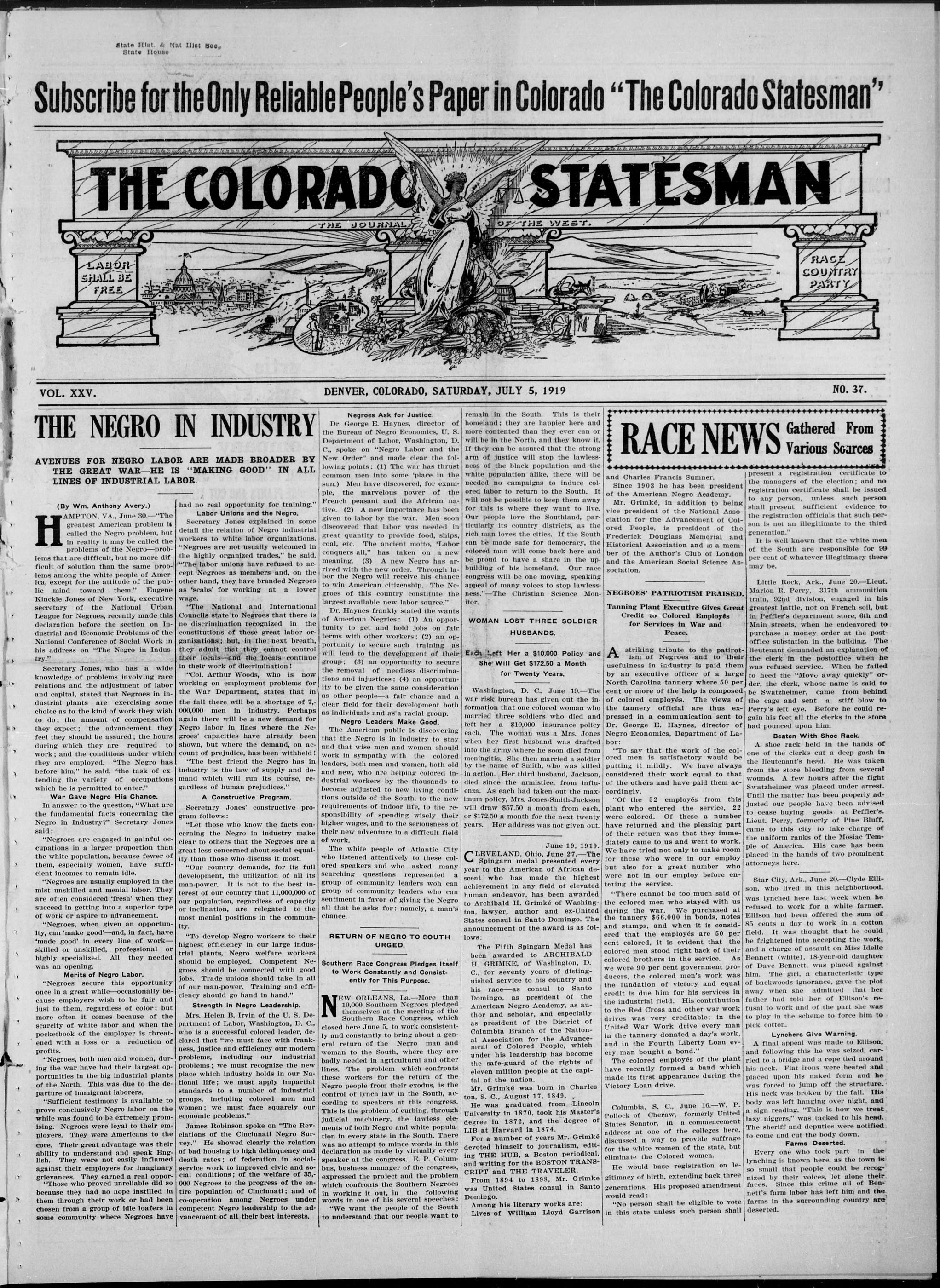
THE NEGRO IN INDUSTRY
AVENUES FOR NEGRO LABOR ARE MADE BROADER BY THE GREAT WAR—HE IS "MAKING GOOD" IN ALL LINES OF INDUSTRIAL LABOR.
HAMPTON, VA, June 30.—"The greatest American problem is called the Negro problem, but in reality it may be called the problems of the Negro—problems that are difficult, but no more difficult of solution than the same problems among the white people of America, except for the attitude of the public mind toward them." Eugene Kinckle Jones of New York, executive secretary of the National Urban League for Negroes, recently made this declaration before the section on Industrial and Economic Problems of the National Conference of Social Work in his address on "The Negro in Industry."
Secretary Jones, who has a wide knowledge of problems involving race relations and the adjustment of labor and capital, stated that Negroes in industrial plants are exercising some choice as to the kind of work they wish to do; the amount of compensation they expect; the advancement they feel they should be assured; the hours during which they are required to work; and the conditions under which they are employed. "The Negro has before him," he said, "the task of extending the variety of occupations which he is permitted to enter."
War Gave Negro His Chance.
In answer to the question, "What are the fundamental facts concerning the Negro in Industry?" Secretary Jones said:
"Negroes are engaged in gainful occupations in a larger proportion than the white population, because fewer of them, especially women, have sufficient incomes to remain idle.
"Negroes are usually employed in the mist unskilled and menial labor. They are often considered 'fresh' when they succeed in getting into a superior type of work or aspire to advancement.
"Negroes, when given an opportunity, can 'make good'—and, in fact, have 'made good' in every line of work—skilled or unskilled, professional or highly specialized. All they needed was an opening.
Merits of Negro Labor.
"Negroes secure this opportunity once in a great while—occasionally because employers wish to be fair and just to them, regardless of color; but more often it comes because of the scarcity of white labor and when the pocketbook of the employer is threatened with a loss or a reduction of profits.
"Negroes, both men and women, during the war have had their largest opportunities in the big industrial plants of the North. This was due to the departure of immigrant laborers.
"Sufficient testimony is available to prove conclusively Negro labor on the while was found to be extremely promising. Negroes were loyal to their employers. They were Americans to the core. Their great advantage was their ability to understand and speak English. They were not easily inflamed against their employers for imaginary grievances. They earned a real oppor- "Those who proved unreliable did so because they had no hope instilled in them through their work or had been chosen from a group of idle loafers in some community where Negroes have
---
VOL. XXV.
the Only Reliable
COLOR
IN INDUSTRY
OR ARE MADE BROADER BY
S "MAKING GOOD" IN ALL
BOR.
had no real opportunity for training."
Labor Unions and the Negro.
Secretary Jones explained in some detail the relation of Negro industrial workers to white labor organizations. "Negroes are not usually welcomed in the highly organized trades," he said. "The labor unions have refused to accept Negroes as members and, on the other hand, they have branded Negroes as 'scabs' for working at a lower wage.
"The National and International Councils state to Negroes that there is no discrimination recognized in the constitutions of these great labor organizations; but, in the next breath, they admit that they cannot control their locals—and the locals continue in their work of discrimination!
"Col. Arthur Woods, who is now working on employment problems for the War Department, states that in the fall there will be a shortage of 7,000,000 men in industry. Perhaps again there will be a new demand for Negro labor in lines where the Negroes' capacities have already been shown, but where the demand, on account of prejudice, has been withheld!
"The best friend the Negro has in industry is the law of supply and demand which will run its course, regardless of human prejudices."
A Constructive Program.
Secretary Jones' constructive program follows:
"Let those who know the facts concerning the Negro in industry make clear to others that the Negroes are a great less concerned about social equality than those who discuss it most.
"Our country demands, for its full development, the utilization of all its man-power. It is not to the best interest of our country that 11,000,000 of our population, regardless of capacity or inclination, are relegated to the most menial positions in the community.
"To develop Negro workers to their highest efficiency in our large industrial plants, Negro welfare workers should be employed. Competent Negroes should be connected with good jobs. Trade unions should take in all of our man-power. Training and efficiency should go hand in hand."
Strength in Negro Leadership.
Mrs. Helen B. Irvin of the U. S. Department of Labor, Washington, D. C., who is a successful colored leader, declared that "we must face with frankness, justice and efficiency our modern problems, including our industrial problems; we must recognize the new place which industry holds in our National life; we must apply impartial standards to a number of industrial groups, including colored men and women; we must face squarely our economic problems."
James Robinson spoke on "The Revelations of the Cincinnati Negro Survey." He showed clearly the relation of bad housing to high delinquency and death rates; of federation in social-service work to improved civic and social conditions; of the welfare of 35,000 Negroes to the progress of the entire population of Cincinnati; and of co-operation among Negroes under competent Negro leadership to the advancement of all their best interests.
DENVER, COLORADO, SATURDAY, JULY 5, 1919
Negroes Ask for Justice.
Dr. George E. Haynes, director of the Bureau of Negro Economics, U. S. Department of Labor, Washington, D. C., spoke on "Negro Labor and the New Order" and made clear the following points: (1) The war has thrust common men into some 'place in the sun.' Men have discovered, for example, the marvelous power of the French peasant and the African native. (2) A new importance has been given to labor by the war. Men soon discovered that labor was needed in great quantity to provide food, ships, coal, etc. The ancient motto, 'Labor conquers all,' has taken on a new meaning. (3) A new Negro has arrived with the new order. Through labor the Negro will receive his chance to win American citizenship. The Negroes of this country constitute the largest available new labor source."
Dr. Haynes frankly stated the wants of American Negries: (1) An opportunity to get and hold jobs on fair terms with other workers; (2) an opportunity to secure such training as will lead to the development of their group; (3) an opportunity to secure the removal of needless discriminations and injustices; (4) an opportunity to be given the same consideration as other people—a fair chance and a clear field for their development both as individuals and as a racial group. Negro Leaders Make Good. The American public is discovering that the Negro is in industry to stay and that wise men and women should work in sympathy with the colored leaders, both men and women, both old and new, who are helping colored industrial workers by the thousands to become adjusted to new living conditions outside of the South, to the new requirements of indoor life, to the responsibility of spending wisely their higher wages, and to the seriousness of their new adventure in a difficult field of work.
The white people of Atlantic City who listened attentively to these colored speakers and who asked many searching questions represented a group of community leaders who can group of community leaders who can sentiment in favor of giving the Negro all that he asks for: namely, a man's chance.
RETURN OF NEGRO TO SOUTH URGED.
Southern Race Congress Pledges Itself to Work Constantly and Consistently for This Purpose.
NEW ORLEANS, La.—More than 10,000 Southern Negroes pledged themselves at the meeting of the Southern Race Congress, which closed here June 5, to work consistently and constantly to bring about a general return of the Negro man and woman to the South, where they are badly needed in agricultural and other lines. The problem which confronts these workers for the return of the Negro people from their exodus, is the control of lynch law in the South, according to speakers at this congress. This is the problem of curbing, through judicial machinery, the lawless elements of both Negro and white population in every state in the South. There was no attempt to mince words in this declaration as made by virtually every speaker at the congress. E. P. Columbus, business manager of the congress, expressed the project and the problem which confronts the Southern Negroes in working it out, in the following words in one of his several speeches:
"We want the people of the South to understand that our people want to
remain in the South. This is their homeland; they are happier here and more contented than they ever can or will be in the North, and they know it. If they can be assured that the strong arm of justice will stop the lawlessness of the black population and the white population alike, there will be needed no campaigns to induce colored labor to return to the South. It will not be possible to keep them away for this is where they want to live. Our people love the Southland, particularly its country districts, as the rich man loves the cities. If the South can be made safe for democracy, the colored man will come back here and be proud to have a share in the upbuilding of his homeland. Our race congress will be one moving, speaking appeal of many voices to stop lawlessness."—The Christian Science Monitor.
WOMAN LOST THREE SOLDIER HUSBANDS.
Each Left Her a $10,000 Policy and
She Will Get $172.50 a Month
Washington, D. C., June 19.—The war risk bureau has given out the information that one colored woman who married three soldiers who died and left her a $10,000 insurance policy each. The woman was a Mrs. Jones when her first husband was drafted into the army.where he soon died from meningitis. She then married a soldier by the name of Smith, who was killed in action. Her third husband, Jackson, died since the armistice, from influenza. As each had taken out the maximum policy, Mrs. Jones-Smith-Jackson will draw $57.50 a month from each, or $172.50 a month for the next twenty years. Her address was not given out.
June 19, 1919.
CLEVELAND, Ohio, June 27.—The Spingarn medal presented every year to the American of African descent who has made the highest achievement in any field of elevated human endeavor, has been awarded to Archibald H. Grimké of Washington, lawyer, author and ex-United States consul in Santo Domingo. The announcement of the award is as follows:
The Fifth Spingarn Medal has been awarded to ARCHIBALD H. GRIMKE, of Washington, D. C., for seventy years of distinguished service to his country and his race—as consul to Santo Domingo, as president of the American Negro Academy, as author and scholar, and especially as president of the District of Columbia Branch of the National Association for the Advancement of Colored People, which under his leadership has become the safe-guard of the rights of eleven million people at the capital of the nation.
Mr. Grimké was born in Charleston S. C. August 17, 1849.
He was graduated from Lincoln University in 1870, took his Master's degree in 1872, and the degree of LIB at Harvard in 1874. For a number of years Mr. Grimke devoted himself to journalism, editing THE HUB, a Boston periodical, and writing for the BOSTON TRANSCRIPT and THE TRAVELER. From 1894 to 1898, Mr. Grimke was United States consul in Santo Domingo. Among his literary works are: Lives of William Lloyd Garrison
RACENEWS Gathered From Various Sources
Since 1903 he has been president of the American Negro Academy. Mr. Grimké, in addition to being vice president of the National Association for the Advancement of Colored People, is president of the Frederick Douglass Memorial and Historical Association and is a member of the Author's Club of London and the American Social Science Association.
NEGROES' PATRIOTISM PRAISED
Tanning Plant Executive Gives Great Credit to Colored Employés for Services in War and Peace.
A striking tribute to the patriotism of Negroes and to their usefulness in industry is paid them by an executive officer of a large North Carolina tannery where 50 per cent or more of the help is composed of colored employés. The views of the tannery official are thus expressed in a communication sent to Dr. George E. Haynes, director of Negro Economics, Department of Labor:
"To say that the work of the colored men is satisfactory would be putting it mildly. We have always considered their work equal to that of the others and have paid them accordingly.
"Of the 52 employés from this plant who entered the service, 22 were colored. Of these a number have returned and the pleasing part of their return was that they immediately came to us and went to work. We have tried not only to make room for those who were in our employ but also for a great number who were not in our employ before entering the service.
"There cannot be too much said of the colored men who stayed with us during the war. We purchased at the tannery $66,000 in bonds, notes and stamps, and when it is considered that the employés are 50 per cent colored, it is evident that the colored men stood right back of their colored brothers in the service. As we were 90 per cent government producers, the colored men's work was the foundation of victory and equal credit is due him for his services in the industrial field. His contribution to the Red Cross and other war work drives was very creditable; in the United War Work drive every man in the tannery donated a day's work, and in the Fourth Liberty Loan every man bought a bond."
The colored employés of the plant have recently formed a band which made its first appearance during the Victory Loan drive.
Columbia, S. C., June 16.—W. P. Pollock of Cheraw, formerly United States Senator, in a commencement address at one of the colleges here, discussed a way to provide suffrage for the white women of the state, but eliminate the Colored women.
He would base registration on legitimacy of birth, extending back three generations. His proposed amendment would read:
"No person shall be eligible to vote in this state unless such person shall
NO.37.
present a registration certificate to the managers of the election; and no registration certificate shall be issued to any person, unless such person shall present sufficient evidence to the registration officials that such person is not an illegitimate to the third generation."
It is well known that the white men of the South are responsible for 99 per cent of whatever illegitimacy there may be.
Little Rock, Ark., June 20.—Lieut. Marion R. Perry, 317th ammunition train, 92nd division, engaged in his greatest battle, not on French soil, but in Peffler's department store, 6th and Main streets, when he endeavored to purchase a money order at the post-office substation in the building. The lieutenant demanded an explanation of the clerk in the postoffice when he was refused service. When he failed to heed the "Move away quickly" order, the clerk, whose name is said to be Swatzheimer, came from behind the cage and sent a stiff blow to Perry's left eye. Before he could regain his feet all the clerks in the store had pouced upon him.
Beaten With Shoe Rack.
A shoe rack held in the hands of one of the clerks cut a deep gash in the lieutenant's head. He was taken from the store bleeding from several wounds. A few hours after the fight Swatzheimer was placed under arrest. Until the matter has been properly adjusted our people have been advised to cease buying goods at Peffler's. Lieut. Perry, formerly of Pine Bluff, came to this city to take charge of the uniform ranks of the Mosiac Temple of America. His case has been placed in the hands of two prominent attorneys here.
Star City, Ark., June 20.—Clyde Ellison, who lived in this neighborhood, was lynched here last week when he refused to work for a white farmer. Ellison had been offered the sum of 85 cents a day to work in a cotton field. It was thought that he could be frightened into accepting the work, and a charge of assault on Miss Idelle Bennett (white), 18-year-old daughter of Dave Bennett, was placed against him. The girl, a characteristic type of backwoods ignorance, gave the plot away when she admitted that her father had told her of Ellison's refusal to work and of the part she was to play in the scheme to force him to pick cotton.
Lynchers Give Warning.
A final appeal was made to Ellison, and following this he was seized, carried to a bridge and a rope tied around his neck. Flat irons were heated and placed upon his naked form and he was forced to jump off the structure. His neck was broken by the fall. His body was left hanging over night, and a sign reading, "This is how we treat lazy niggers," was tacked to his head. The sheriff and deputies were notified to come and cut the body down.
Farms Deserted.
Every one who took part in the lynching is known here, as the town is so small that people could be recognized by their voices, let alone their faces. Since this crime all of Bennett's farm labor has left him and the farms in the surrounding country are deserted.
FOREIGN
Count von Bernstorff will go to Rome as German ambassador as soon as the peace treaty is ratified, it was learned at Welmar.
Ella Wheeler Wilcox, the noted poet, who recently was critically ill in London, is speedily recovering.
Mrs. Wilcox plans to return to the United States immediately.
The Ukrainians have defeated Bolshevik forces all along the front, capturing Odessa and threatening Kieff, according to a Ukrainian official statement received at Berne.
The Krupp works at Munich have been sold to Americans, according to dispatches from Munich quoting newspapers there. It is added several industrial concerns in the Bavarian capital also have passed into American hands.
A dispatch from Oswestry, Shropshire, says Admiral von Reuter, commander of the German fleet sunk in Scapa Flow, was recognized when he called at a local bank. He was struck in the face with a rotten egg and was otherwise halted.
London learned of the signing of the peace treaty at Versailles at 3:40 o'clock. The news became known thru the firing of guns which had been installed during the war to warn the city of air raids. They now were used as harbingers of the long-awaited peace.
The Paris correspondent says that Holland, as a member of the League of Nations, will be asked to inform the ex-kaiser that he must appear for trial before an international court or leave Dutch territory. The correspondent further said he understands the court will inflict either the death penalty or imprisonment.
Capt. Walter Schulaz of Chicago, Ill., a member of the 138th Aero Squadron, was killed at Coblenz when an aeroplane in which he was distributing an extra edition of the Amaroe News, the soldiers' daily newspaper, announcing the details of the signing of the treaty of peace, fell near Montahaur, headquarters of the First Division.
The Pan-German Deutsche Zeitung printed the following across its front page: "German honor today will be carried to its grave in the hall of mirrors, in which in the glorious year of 71 the German empire was resurrected in all its former splendor. Lest we forget! In restless labor the German people will again strive to attain that place among the nations of the world to which it is entitled. Then vengeance for the disgrace of 1919!" SPORT
Georges Carpentier has received by cable from Tex Rickard, the boxing promoter, an offer of $45,000 for a match with Jack Dempsey in the United States in January next.
Roland Roberts of San Francisco, Pacific Coast champion, was defeated by William Johnston, San Francisco, former national champion, in the final round of the Pacific coast tennis championship tournament, 6-2, 6-4, 6-2.
Governor Frank O. Lowden vetoed the boxing bill providing for ten-round fights in Illinois under supervision of a commission of three. He held that the bill was unconstitutional as passed by the Legislature, which cannot now re-enact the measure at this session.
GENERAL
Secretary Lane asked the Senate to increase the appropriation in the sundry civil bill for education of Alaskan natives from $215,000 to $265,000.
A country-wide search for Mrs. Dollie Chesher, a nurse who disappeared last February, came to an end when her body was found floating in Lake Michigan, near Chicago.
Two new series of short term $4\%$ per cent certificates of indebtedness have been announced by the treasury department dated July 1. One issue will mature Sept 15 and the other Dec. 15, dates on which the income and excess taxes are due.
A 10-cent car fare will be established by the Boston Elevated Railway Company July 10th, the public trustees of the road announced. The present rate is 8 cents. It was 5 cents when the road was placed under public control last year.
Mrs. Lennie Torfs, during the great war, made more than 2,500 cakes of home-made soap and sent them to hospitals in France. She is now in possession of the medal of Queen Elizabeth, awarded by the King of Belgium to civilians for patriotic work.
Four firemen have been killed and tobacco, said by officials to be worth $1,000,000, so far has been burned in a fire which threatened to destroy a warehouse at Norfolk, Va., of the Imperial Tobacco Company. The building and contents are valued at $4,000,-000.
A record flight from Atlantic City, N. J., to New York was established when Lieut. Kenneth H. Murray, formerly of the American air service, piloted a Sopwith "Camel" over the route, 140 miles in 61 minutes. The time was officially recorded by the Aero Club of America.
Another of the many clews to the lost collier Cyclops—all of which so far have been exploded—turned up at Columbia, S. C., when the mother of Otis Ramsey, a seaman on the ship, received a telegram from New York, saying he was "safe in this country again" and that the missing vessel was in a German port. The navy records show that Otis Ramsey of Columbia was a seaman on the Cyclops and he is listed as "lost at sea" with the ship. Officials think the message a hoax, but as they expect to solve the mystery they are looking up every clew.
NEWS TO DATE IN PARAGRAPHS
CAUGHT FROM THE NETWORK OF WIRES ROUND ABOUT. THE WORLD.
RECORD OF IMPORTANT EVENTS CONDENSED FOR BUSY
Western Newspaper Union News Service.
WESTERN
Formal announcement of the candidacy of General Alvaro Obregon for the presidency of Mexico at the election in 1920 was made public this week.
Six persons were killed and one badly injured a mile west of Oxford, Nebr., when an automobile carrying a party of seven was struck by a fast Burlington passenger train at a grade crossing.
Twelve miners are known to be dead and three more are expected to die as a result of an explosion in a mine of the Rock Island Coal Company at Alderson, Okla., five miles east of McAulester, Okla.
Governor McKelvie tentatively decided to call the Nebraska Legislature in special session Monday, July 21, for the purpose of ratifying the woman suffrage amendment to the constitution of the United States.
As a means of reducing delays incidental to making change in war tax payments, the San Francisco mint is working twenty-four hours daily making 100,000,000 pennies monthly, to go as far east as Chicago.
Altho the supply of men for work in the harvest fields of Kansas is normal, it must increase immediately, and 5,000 workers can be placed at once, according to an announcement by A. L. Barkman, director of the United States employment service at Kansas City.
Crops on 700 acres of Yakima valley land, most of it belonging to the Union Orchards Company and planted to apples, were endangered when the concrete standpipe by the Wenas dam was blown up by dynamite. The perpetrator is not known. There has been high feeling in regard to the water rights of the Wenas valley for several years.
The Kansas winter wheat crop, now being harvested, was estimated at 229,217,00 bushels in the monthly report issued by J. C. Mohler, secretary of the State Board of Horticulture. This is an increase of more than 11,000,000 bushels over Mohler's May report and it is approximately 33,000,000 bushels greater than the last federal monthly report.
Wichita, Kan.—Two brothers, John and Edward Fitch, both veterans of the Civil war, who had not seen each other for more than thirty-seven years, met in Wichita for the first time during the recent G. A. R. encampment. Both enlisted in Iowa regiments, John with the Thirty-first Iowa infantry and Edward in troop C. First Iowa cavalry.
Several British airplanes will start across the Pacific on October 15th, from San Diego, bound for Australia, according to a statement made by Capt. William McDonald of Melbourne, formerly in the Canadian flying service, who is on his way to southern California, via Seattle. He stated that while full details of the trip have not been decided on, the date of the start has been set and that the trip would be made with stops at Honolulu, a small British island near Guam and Nagasaki.
WASHINGTON
The United States employment service will not be forced to go out of existence entirely. An appropriation of $200,000, enough to maintain an organization in Washington, but not sufficient for a field service, was decided upon by conference on the sundry civil bill.
President Wilson furnished America with another precedent when he received from the steamer Great Northern, as it passed the George Washington in mid-ocean the railroad deficiency and Indian appropriation bills. He read the bills, signed them and made them laws.
Western and southern senators and representatives, pressing for water power legislation to unlock resources of their states, now expect to win their fight in Congress during the next few weeks after years of effort. Senator Jones of Washington, chairman of the commerce committee, author of one of the pending water power bills in the Senate and who will take charge of legislation on the floor, announced that "after a long delay Congress is about to act."
Evidence that Nikolai Lenine, premier of the Russian soviet republic, is the "master brain" directing radical propaganda in this country, was submitted before the Lusk committee investigating alleged Bolshevism in New York.
The War Department announced award of the distinguished service cross by General Pershing to Capt. Albert F. Baxter, Fairmount, Neb.; Corp. Thomas Stirling, Denver, Colo.; Privates Clifford C. Kidd and Fred S. Smith, Denver, Colo., all members of the A. E. F.
Pithy News Notes
From All Parts of
Colorado
Western Newpaper Union News Service.
COMING EVENTS.
The Colorado Editorial Association meet in Denver, July 11, 12, 1919.
The Colorado penitentiary at Cafon City has experienced the first escape made by a woman prisoner ever recorded in its history. The escape took place last week.
L. A. Toothaker, peach grower of Palisade, has the distinction this year of sending the first shipment of fruit from that section. The shipment was made to Denver.
Teller county, Colorado's banner gold producer, has added to the world's gold supply up to the end of 1918 approximately $300,000,000. Gold is practically the only valuable metal produced in the famous Cripple Creek district.
Two experienced yeggs, working with a crowbar, prowled four Denver insurance offices, cracked five safes and nine desks and made away with Liberty bonds, currency and jewelry valued at more than $7,000 in one night.
Tentative plans for a $200,000 building and loan association have been accepted by leading business men of Montrose. This is a direct result of the unusual demand for houses in this city, which at present greatly exceeds the supply.
Weld, the most important agricultural county in Colorado, has approximately 530,000 acres of land in cultivation this year. Wheat is the largest crop, with nearly 180,000 acres, hay ranks second, with about 82,000 acres and corn third, with 81,000 acres.
The Rico mining district has been producing steadily for nearly forty years. There has been some agricultural development in the river valleys and stock raising is carried on to a limited extent. Lumbering and tiemaking have also been important industries at various times in the past.
One hundred and sixty-one graduates received their diplomas at the University of Colorado. Dr. Livingston Farrand, former president of the university, delivered the commencement address. Governor Oliver Shoup gave a short talk on the work the institution has done during the year.
Two motorcycle police are to be appointed by W. F. R. Mills, manager of parks and improvements, to help police Denver's mountain highways and parks, it has been announced. The authority of the city to police the parks was given through an act created at the last session of the Twenty-second General Assembly. Forty volunteers, including five prisoners from the county jail at Colorado Springs, fought a forest fire which threatened for a time to sweep Engleman's cafon. Sheriff John H. Weil and Forest Ranger Patterson led the fire fighters. The blaze was extinguished after five hours' unremitting labor.
Thirty-six five-ton Packard army trucks in addition to the 200 trucks and passenger cars previously allotted to Colorado by the War Department for use on state and county roads have been shipped, Elmer E. Somers, chairman of the State Highway Commission, was informed in a telegram from Washington.
The registration for the boys' camp at Kahnah creek closed at Grand Junction with sixty-seven enrolled. The party will spend the entire week fishing and otherwise occupying themselves along the creeks and in the woods of that vicinity. It is the first annual boys' camp to be given in that city under the auspices of the Y. M. C. A.
Charles T. Crockett, son of Mr. and Mrs. E. L. Crockett of Pueblo, was awarded the highest honors obtainable at Colorado College when he was graduated with summa cum laude. The honor bestowed upon Crockett is the fourth of its kind in the history of the school, and it is the first time in nine years that anyone has won the honor.
Two million feet of timber, valued at $2 a thousand feet, was destroyed in the forest fire in the San Isabel National Forest, seven miles north of Beulah, according to a rough estimate made by A. G. Hamel, forest supervisor. Watchers are still on duty in the fire area for the purpose of preventing the fire spreading if it breaks out in a new place.
The Lafayette Farmers' Elevator Company has let to the Burchard Construction Company of Lincoln, Neb., the contract for the erection of a new elevator at this place. The building will be 40x75 feet in dimensions, and will be located on a site recently purchased from Frank Miller just south of town on the right of way of the Colorado & Southern railway. The cost of the building will be $14,000.
Fifty of about ninety land owners in the Orchard mesa section have voted unanimously to bond their property, totaling more than 6,000 acres, to the government to guarantee the reclamation of 10,000 acres in that section. A committee, composed of C. P. McCormick, chairman; Beman C. Fox, secretary; R. A. Hill, V. Gilchrist and E. C. Bryan, was given almost unlimited authority to secure signatures of other land owners and make such arrangements as are necessary to meet the demands of the government.
CENTENNIAL STATE ITEMS.
Investigation of Colorado oil shale fields will be assured if a bill now before Congress passes, according to word received by Gov. Oliver H. Shoup from Senator Lawrence C. Phipps. The message said an appropriation of $100,000 for the work had passed the lower House and had been increased to $150,000 in the Senate. The request for an appropriation for an investigation of the state oil shale fields with a view of developing the shale for commercial use, was made by the federal bureau of mines after representatives of the bureau had been here to confer with the governor and members of the State Bureau of Mines.
The correct assessed valuation of all property in the state for purposes of taxation in 1918 was $1,424,811,288, according to data compiled by the state Immigration Department from the records of the State Tax Commission for use in the Colorado Year Book. Denver county ranks first, with $348,187,545; Weld county second, with $96,449,230; and Pueblo county third, with $70,463,333. The smallest valuation reported is $1,021,236, in Hinsdale county. Mineral county ranks next above Hinsdale, with $1,531,885, and Dolores county next, with $1,774,125. But six counties in the state report valuations below $5,000,000.
Congress probably will be asked to appropriate $1,250,000 for the reclamation of 10,000 acres on Orchard mesa, lying immediately across the Grand river from Grand Junction. Frank W. Howbert, former United States deputy internal revenue collector and a resident of Denver, is a special representative of Senator Lawrence Phipps, to investigate the Orchard mesa project. "Unless the federal government lends financial assistance," said Mr. Howbert, "scores of homes will be literally destroyed. The project, too, is unlike going into an uninhabited area. This tract is 'entirely surrounded by civilization.'"
Word that Colorado probably will receive a portion of the 219 army automobile trucks recently allotted to it by the War Department within the next few weeks was received by the State Highway Commission from E. E. Sommers, chairman of the commission, who is in Washington. Colorado is also to receive seventeen Ford cars and nine pleasure cars of other makes. The trucks and cars make up Colorado's portion of the $20,000,000 worth of automobiles the War Department had on hand at the close of the war and decided to allot to the various states.
The City Council, by a vote of 7 to 2, has authorized the restoration of the 5-cent fare on the Denver Tramway Company's city lines, when the Horan bill, calling for the repeal of the 6-cent fare was considered on final reading. The 6-cent fare was granted last September as a war emergency. The ordinance must be signed by the mayor and published in a newspaper before it becomes effective. Despite the cold, wet spring, the crops in the Arkansas valley are making wonderful strides. Corn in particular is the best ever, and according to the farmers in that section many records will be broken in harvesting. P. K. Blinn of the State Experimental Station, and County Agent Droge are having much success in experimental plants, and expect to have some startling demonstrations.
Altitudinous temperatures and the daylight saving law combined forces at Grand Junction and put the First Congregational Church movie out of commission. It was announced by the Rev, Henry M. McDowell, pastor, that entertainments be discontinued until early September.
Eric Berton, 25 years old, the man who accidentally shot himself May 13th while cleaning a revolver, died today at St. Mary's hospital in Pueblo, where he had been since the accident.
Two miles of the Santa Fé trail, leading south from Pueblo, will be paved, work to start as soon as the United States Bureau of Public Roads has approved the action of the State Highway Commission, which has recommended that the contract be awarded to A. Hewitt, the lowest bidder. The contract price is $48,000. This will be the first section of the Santa Fé trail to be paved.
The dairy business is rapidly increasing in the Uncompaghre valley, according to the reports of the creameries, who state that during the last year they have handled 100,000 pounds of butter as compared with 70,000 during the year before. In the upper valley the cheese factory at Delta has handled an enormous business during the last year.
Taxpayers voted to bond the district for $13,500 for the erection of a modern school building at Agate, Colo. Work will begin at once, so it will be ready for next fall. Five new buildings were erected this spring, among them the new Peterson hotel, which will be one of the most modern on the Union Pacific. It has electric lights, running water and heated throughout.
An inheritance tax, amounting approximately to $50,000 will be collected by the state from the heirs of Kenneth Dows, the attorney general's office, which has charge of inheritance tax collections, announced. An investigation, Attorney General Victor E. Keyes said, revealed that Dows had $1,000,000 worth of property in the state of New York besides the name at 140 Gilpin street, recently sold to Herman B. Gates, and other property in Colorado. Mr. Dows died several months ago.
To Friends and Strangers of Denver Attention! The Sun Beam Cafe
Wishes to welcome all to good home cooking and dainties of the seasons, any time from 6 a. m. to 11:30 p. m. Accurate service at all hours; so when down town stop, give us a trial and we will guarantee you will leave with a smile.
The
Curtis
Park
Floral
Company
FLORAL DESIGNS PUT UP WHILE
YOU WAIT
CHOICE PLANTS AND CUT FLOWERS CONSTANTLY
ON HAND
GREENHOUSES: Thirty-Fourth and Curtis Streets
TELEPHONE, MAIN 1811
DEMVER, COLO
Weatherhead Hat Co.
TELEPHONE
MAIN 3203
Established 1876
RENOVATORS, BLUE
Of Gents' and I
1624 CHA
Phone Champa 5431
NOVATORS, BLEACHERS, DYERS AND FINISHERS
Of Gents' and Ladies' Hats of Every Description
1624 CHAMPA ST., DENVER, COLO.
champa 5431 Private Boothe for Ladies
NIGHT AND DAY CAFE
AND COLD DRINK PARLOR
B. CARRUTH, Proprietor
RENOVATORS, BLEACHERS, DYERS AND FINISHERS Of Gents' and Ladies' Hats of Every Description 1624 CHAMPA ST., DENVER, COLO.
1865-1867 CURTIS STREET
Poro Hair
SCIENTIFIC AND SANITARY
MASSAGING, M
Mme.
o Hair Dressing Parlors FIC AND SANITARY SCALP AND HAIR TREATMENT MASSAGING, MANICURING, TOILET ARTICLES
SCIENTIFIC AND SANITARY SCALP AND HAIR TREATMENT MASSAGING, MANICURING, TOILET ARTICLES
Mme. Lexie A. Brooks
DEN STREET PHONE YORK 5997W
2220 OGDEN STREET
MOTTO: "CAREFUL DRIVING, BUT SURE"
J. V. LEWIS AUTO LIV
7 PASSENGER WESTCOT 6 CARS.
TAXICAB RATES:
Depot, 1 or 2 Passenger, 50c; Depot, Each Additional
25c; One Mile Radius, 50c; Each Additional Mile,
RATES PER HOUR, $1.50 TO $2.50.
STAND:
Night—Page Pool Hall, 2710 Welton, Phone Main 2
Day—2450 Washington, Phone York 8601-W.
DENVER, ::: ::: ::: ::: :::
W. LEWIS AUTO LIVERY
7 PASSENGER WESTCOT 6 CARS.
TAXICAB RATES:
or 2 Passenger, 50c; Depot, Each Additional Passenger,
; One Mile Radius, 50c; Each Additional Mile, 25c.
RATES PER HOUR, $1.50 TO $2.50.
STAND:
Right—Page Pool Hall, 2710 Welton, Phone Main 2759.
Day—2450 Washington, Phone York 8601-W.
C. C. DENNIS R. F. LONG
The New Way Shoe Repairing Co.
AND
J. V. LEWIS AUTO LIVERY
Depot, 1 or 2 Passenger, 50c; Depot, Each Additional Passenger, 25c; One Mile Radius, 50c; Each Additional Mile, 25c.
Night—Page Pool Hall, 2710 Welton, Phone Main 2759.
Day—2450 Washington, Phone 8601W.
1
---
---
Oak
```markdown
```
PIONEER HATTERS
OF THE WEST. WE
MAKE OLD HATS
NEW.
A Rail Line of Fresh Fish In Season Oysters and Lobsters Short Orders At All Hours Rest Room for Ladies STREET DENVER, COLORADO
Motto—"Efficiency"
American Shoe Repairing
FIRST-CLASS WORK
Best Leather Used—Reasonable Prices
1855 Champa St. Phone Main 3737.
1221 Sixteenth St. Phone Champa 5889.
Opp. Golden Eagle. DENVER, COLO.
CAPITOL PETROLEUM
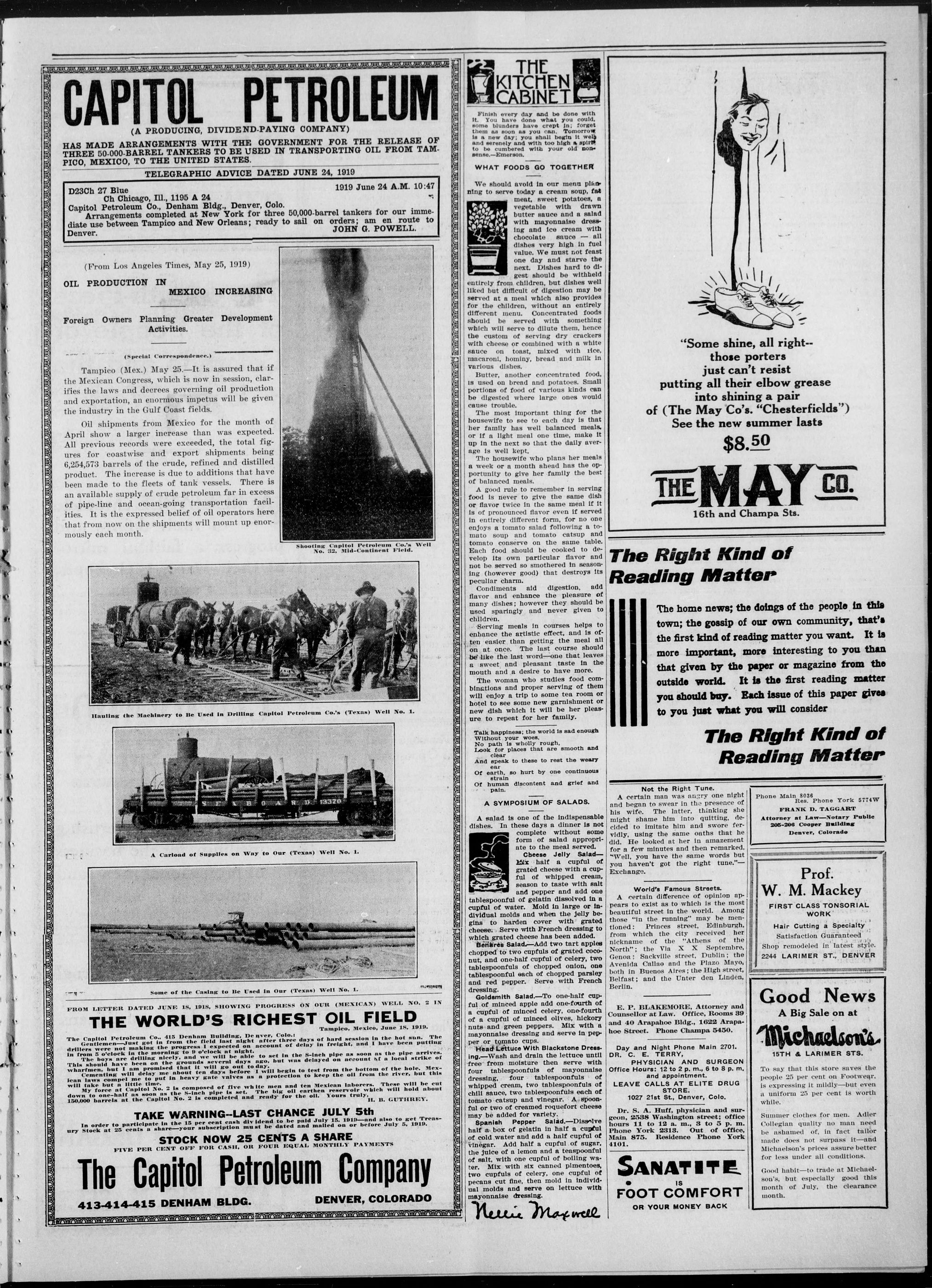
HAS MADE ARRANGEMENTS WITH THE GOVERNMENT FOR THE RELEASE OF THREE 50-000-BARREL TANKERS TO BE USED IN TRANSPORTING OIL FROM TAMPICO, MEXICO, TO THE UNITED STATES.
Capitol Petroleum Co., Denham Bldg., Denver, CO. Arrangements completed at New York for three 50,000-barrel tankers for our immediate use between Tampico and New Orleans; ready to sail on orders; am en route to Denver. JOHN G. POWELL.
(From Los Angeles Times, May 25, 1919)
OIL PRODUCTION IN
MEXICO INCREASE
Foreign Owners Planning Greater Develop
Activities.
Sign Owners Planning Greater Develop Activities.
Foreign Owners Planning Greater Development Activities.
(Special Correspondence.)
Tampico (Mex.) May 25.—It is assured that if the Mexican Congress, which is now in session, clarifies the laws and decrees governing oil production and exportation, an enormous impetus will be given the industry in the Gulf Coast fields.
Oil shipments from Mexico for the month of April show a larger increase than was expected. All previous records were exceeded, the total figures for coastwise and export shipments being 6,254,573 barrels of the crude, refined and distilled product. The increase is due to additions that have been made to the fleets of tank vessels. There is an available supply of crude petroleum far in excess of pipe-line and ocean-going transportation facilities. It is the expressed belief of oil operators here that from now on the shipments will mount up enormously each month.
Hauling the Machinery to Be Used in Drilling Capitol Petroleum Co.'s (Texas) Well No. 1.
SEABOARD 13320
```markdown
```
THE WORLD'S RICHEST OIL FIELD
The Capitol Petroleum Co. 415 Denham Building, Denver, Colo. Gentlemen—Just got in from the field last night after three days of hard session in the hot sun. The drillers were not making the progress I expected on account of delay in freight, and I have been putting drillers in the morning to 9 o'clock at night.
in from 5 o'clock in the morning. The boys are drilling nicely, and we will be able to set in the 8-inch pipe as soon as the pipe arrives. This should have been the grounds several days ago, but was delayed on account of a local strike of wharfmen, but it was promised that it will go out to day. Cementing will delay me about ten days before I will begin to test from the bottom of the hole. Mexican laws compel me to put in heavy valve valves as a protection to keep the oil from the river, but this law will cut but a little time.
will take but a little time.
My force at Capitol No. 2 is composed of five white men and ten Mexican laborers. These will be cut down to one-half as soon as the S-inch pipe is set. The big oil earthen reservoir which will hold about 150,000 barrels at the Capitol No. 2 is completed and ready for the oil. Yours truly.
H. B. GUTHREY.
TAKE WARNING--LAST CHANCE JULY 5th
In order to participate in the 15 per cent cash dividend to be paid July 15, 1910—and also to get Treasury Stock at 25 cents a share—your subscription must be dated and mailed on or before July 5, 1919.
STOCK NOW 25 CENTS A SHARE
FIXE PER CENT OFF FOR CASH, OR FOUR EQUAL MONTHLY PAYMENTS
```markdown
```
MEXICO INCREASING
ing Greater Development
vities.
A Carload of Supplies on Way to Our (Texas) Well No. 1.
e 50,000-barrel tankers for our imme- to sail on orders; am en route to JOHN G. POWELL.
Petroleum Co.'s (Texas) Well No. 1.
Our (Texas) Well No. 1.
PRESS ON OUR (MEXICAN) WELL NO. 2 IN
WEST OIL FIELD
Oloo: three days of hard session in the hot sun. The
t of delay in freight, and I have been putting
in the 8-inch pipe as soon as the pipe arrives.
but was delayed on account of a local strike of
begin to test from the bottom of the hole. Mex-
cction to keep the oil from the river, but this
and ten Mexican laborers. These will be cut
ing oil earthen reservoir which will hold about
for the oil. Yours truly,
H. B. GUTHREY.
HANCE JULY 5th
To be paid July 15, 1919—and also to get Trans-
nated and mailed on or before July 5, 1919.
ITS A SHARE
EQUAL MONTHLY PAYMENTS
eum Company
New
1919 June 24 A.M. 10:47
```markdown
```
Shooting Capitol Petroleum Co.'s Well No. 32, Mid-Continent Field.
Tampico, Mexico, June 18, 1919.
DENVER, COLORADO
THE KITCHEN CABINET
Finish every day and be done with it. You have done what you could, some blunders have crept in; forget them as soon as you can. Tomorrow is a new day; you shall begin it well and serenely and with too high a spirit to be cumbered with your old nonsense.—Emerson.
WHAT FOODS GO TOGETHER
We should avoid in our menu planning to serve today a cream soup, fat
meat, sweet potatoes, a vegetable with drawn butter sauce and a salad with mayonnaise dressing and ice cream with chocolate sauce — all dishes very high in fuel value. We must not feast one day and starve the next. Dishes hard to digest should be withheld
meat, sweet potatoes, a vegetable with drawn butter sauce and a salad with mayonnaise dressing and ice cream with chocolate sauce — all dishes very high in fuel value. We must not feast one day and starve the next. Dishes hard to digest should be withheld entirely from children, but dishes well liked but difficult of digestion may be served at a meal which also provides for the children, without an entirely different menu. Concentrated foods should be served with something which will serve to dilute them, hence the custom of serving dry crackers with cheese or combined with a white sauce on toast, mixed with ice, macaroni, hominy, bread and milk in various dishes.
Butter, another concentrated food, is used on bread and potatoes. Small portions of food of various kinds can be digested where large ones would cause trouble. The most important thing for the housewife to see to each day is that her family has well balanced meals, or if a light meal one time, make it up in the next so that the daily average is well kept. The housewife who plans her meals a week or a month ahead has the opportunity to give her family the best of balanced meals.
A good rule to remember in serving food is never to give the same dish or flavor twice in the same meal if it is of pronounced flavor even if served in entirely different form, for no one enjoys a tomato salad following a tomato soup and tomato catsup and tomato conserve on the same table. Each food should be cooked to develop its own particular flavor and not be served so smothered in seasoning (however good) that destroys its peculiar charm.
Condiments aid digestion, add flavor and enhance the pleasure of many dishes; however they should be used sparingly and never given to children.
Serving meals in courses helps to enhance the artistic effect, and is often easier than getting the meal all on at once. The last course should be like the last word—one that leaves a sweet and pleasant taste in the mouth and a desire to have more.
The woman who studies food combinations and proper serving of them will enjoy a trip to some tea room or hotel to see some new garnishment or new dish which it will be her pleasure to repeat for her family.
Talk happiness; the world is sad enough Without your woes.
No path is wholly rough,
Look for places that are smooth and clear
And speak to these to rest the weary ear
Of earth, so hurt by one continuous strain
Of human discontent and grief and pain.
A SYMPOSIUM OF SALADS.
A salad is one of the indispensable dishes. In these days a dinner is not complete without some form of salad appropriate to the meal served.
Bread
Cheese Jelly Salad
Mix half a cupful of grated cheese with a cupful of whipped cream, season to taste with salt and pepper and add one tablespoonful of gelatin dissolved in a cupful of water. Mold in large or individual molds and when the jelly begins to harden cover with grated cheese. Serve with French dressing to which grated cheese has been added.
Benarez Salad. Add two tart apples chopped to two cupfuls of grated coconut, and one-half cupful of celery, two tablespoonfuls of chopped onion, one tablespoonful each of chopped parsley and red pepper. Serve with French dressing.
Goldsmith Salad.—To one-half cupful of minced apple add one-fourth of a cupful of minced celery, one-fourth of a cupful of minced olives, hickory nuts and green peppers. Mix with a mayonnaise dressing and serve in pepper or tomato cups.
Head Lettuce With Blackstone Dressing.—Wash and drain the lettuce until free from moisture then serve with four tablespoonfuls of mayonnaise dressing, four tablespoonfuls of whipped cream, two tablespoonfuls of chill sauce, two tablespoonfuls each of tomato cusps and vinegar. A, spoonful or two of creamed roquefort cheese may be added for variety.
Spanish Pepper Salad.—Dissolve half a box of gelatin in half a cupful of cold water and add a half cupful of vinegar. Add half a cupful of sugar, the juice of a lemon and a teaspoonful of salt, with one cupful of boiling water. Mix with six canned pimentoes, two cupfuls of celery, one cupful of pecans cut fine, then mold in individual molds and serve on lettuce with mayonnaise dressing.
A man in a suit is standing on a pair of shoes. He is smiling and appears to be happy. The background is plain black.
"Some shining
those we
just can
putting all thei
into shining
of (The May Co'
See the new
$8
THE M
16th and C
The Right Kind
Reading Matt
The home news; th
town; the gossip of
the first kind of rea
more important, n
that given by the
outside world. It
you should buy. I
to you just what
The
Re
"Some shine, all right-- those porters just can't resist sitting all their elbow great into shining a pair the May Co's. "Chesterfield see the new summer last $8.50
THE MAY
16th and Champa Sts.
Right Kind of Matter
home news; the doings of the; the gossip of our own com; first kind of reading matter you important, more interesting given by the paper or magazine world. It is the first r should buy. Each issue of the you just what you will consider
The Right Reading
"Some shine, all right--
those porters
just can't resist
putting all their elbow grease
into shining a pair
of (The May Co's. "Chesterfields")
See the new summer lasts
$8.50
THE MAY CO.
The Right Kind of Reading Matter
The home news; the doings of the people in this town; the gossip of our own community, that's the first kind of reading matter you want. It is more important, more interesting to you than that given by the paper or magazine from the outside world. It is the first reading matter you should buy. Each issue of this paper gives to you just what you will consider
The Right Kind of Reading Matter
Not the Right Tune.
A certain man was angry one night and began to swear in the presence of his wife. The latter, thinking she might shame him into quitting, decided to imitate him and swore fervidly, using the same onths that he did. He looked at her in amazement for a few minutes and then remarked, "Well, you have the same words but you haven't got the right tune."—Exchange.
World's Famous Streets.
A certain difference of opinion appears to exist as to which is the most beautiful street in the world. Among those "in the running" may be mentioned; Princes street, Edinburgh, from which the city received her nickname of the "Athens of the North"; the Via X X Septembre, Genoa; Sackville street, Dublin; the Avenida Callao and the Plazo Mayo, both in Buenos Aires; the High street, Belfast; and the Unter den Linden, Berlin.
E. P. BLAKEMORE, Attorney and Counsellor at Law. Office, Rooms 39 and 40 Arapahoe Bldg., 1622 Arapahoe Street. Phone Champa 5450.
Day and Night Phone Main 2701. DR. C. E. TERRY,
PHYSICIAN AND SURGEON
Office Hours: 12 to 2 p. m., 6 to 8 p. m.
and appointment.
LEAVE CALLS AT ELITE DRUG
STORE.
1027 21st St., Denver, Colo.
Dr. S. A. Huff, physician and surgeon, 2538 Washington street; office hours 11 to 12 a. m., 3 to 5 p. m.
Phone York 2313. Out of office,
Main 875. Residence Phone York
4101.
SANATITE
IS
FOOT COMFORT
OR YOUR MONEY BACK
---
---
all right--
porters
it resist
elbow grease
ing a pair
"Chesterfields")
summer lasts
50
AY CO.
Gamma Sts.
d of
er
doings of the people in this
your own community, that'
ing matter you want. It is
more interesting to you than
paper or magazine from th
is the first reading matter
such issue of this paper give
you will consider
Right Kind of
ending Matter
Phone Main 8036
Res. Phone York 5774W
FRANK D. TAGGART
Attorney at Law—Notary Public
205-206 Cooper Building
Denver, Colorado
Prof.
W. M. Mackey
FIRST CLASS TONSORIAL
WORK
Hair Cutting a Specialty
Satisfaction Guaranteed
Shop remodeled in latest style.
2244 LARIMER ST., DENVER
Good News A Big Sale on at Michaelson's
To say that this store saves the people 25 per cent on Footwear, is expressing it mildly—but even a uniform 25 per cent is worth while.
Summer clothes for men. Adler Collegian quality no man need be ashamed of, in fact tailor made does not surpass it—and Michaelson's prices assure better for less under all conditions.
Good habit—to trade at Michaelson's, but especially good this month of July, the clearance month.
---
THE COLORADO STATESMAN
LABOR SHALL BE FREE
RACE COUNTRY PARTY
JOS. D. D. RIVERS.....Proprietor
P. O. Box 116
Phone Main 7417
One Year ..... $2.00
Six Months ..... 1.50
Three Months ..... .75
MUST BE PAID IN ADVANCE.
Entered as second-class matter at the postoffice in the City of Denver, Colo.
Reading notices, ten lines or less, 10 cents per line. Each additional line over ten lines, 5 cents per line. Display advertising 50 cents per inch.
Remittances should be made by Express Money Order, Postoffice Money Order, Registered Letter or Bank Draft. Postage stamps will be received the same as cash for the fractional part of a dollar. Only 1c and 2c stamps taken.
No discounts allowed on less than three months' contract. Cash must accompany all orders from parties unknown to us. Further particulars on application.
Communications to receive attention must be newsy, upon important subjects, plainly written only upon one side of the paper, must reach us Tuesdays, if possible, anyway not later than Wednesdays, and bear the signature of the person. No manuscript returned, unless stamps are sent for postage. All communications of a personating nature that are not complimentary will be withheld from the columns of this paper.
THE WAR CLOSES; PEACE TREATY SIGNED.
AFTER seven months and seventeen days from the granting of the armistice to Germany, and after a series of requests for modifying the terms of the allies by the elimination of certain clauses, that, according to Germany, will strike at the root of her present and future existence, the representatives of the greatest foe the world has ever seen, affixed their signatures to the Peace Treaty at Versailles, France, in the Hall of Mirrors, Saturday, June 28, 1919, the same marking another world event in the historic city so famous in all the centuries for the closing ceremonies of national and international warfare. The war is therefore officially ended, as besides the signatures of the vanquished are those also of the victor, and this instrument, finding its place among the archives of the world, will not be written or signed in vain if the people of the world resolve on making obedience to it imperative. The "scrap of paper," as other treaties prior to this have been termed by the defeated, will demonstrate its power by bringing such reformations that will halt ambitious man and nation in their lust for fame and world-power, and cause such a co-relationship between the nations of the earth, that it will be almost impossible for any single power to create a recurrence of that "hideous nightmare" of nearly five years, which caused such a paroxysm that the world can and will never forget. Unfortunately, China has not yet signed, but provision is made for her to do so whenever she desires. The Chinese are displeased at the giving of the province of Shantung to the Japanese, and protesting as they do, a condition will be presented that may give rise to a temporary annoyance that the inter-allied council, we trust, will adjust satisfactory to all parties concerned.
But with this new world-policy can be seen a phase of apprehension relative to the ruling of the world, or the dominant power among the races. Men of the white races have at last boldly come forward and asserted that the numerical strength of the darker races exceed them to a grat extent, and if the right instruction is given them in governing and how to govern, engaging in the various forms and features, and adopting the standards and ideals that develop a people—a nation, there is little to doubt that a new competitor shall have entered, and improved conditions must be given or the demand will be made in such a manner as to compel fair treatment and justice for all humanity. The Peace Treaty is a great, wonderful, and most invaluable asset to the world's progressiveness. Let us contribute in as large a measure as we can and share in the profits that will result from HUMAN INTEREST IN COMMON.
INDEPENDENCE DAY, 1919. SHOULD HAVE GREATER SIGNIFICANCE.
EMERGING from a struggle, though of gigantic proportions and universal in its way, in the part that we played in the recent world's greatest war, and while the comparison of physical action may not be equal to our event of 1776, yet the principle involved in the aid we gave this time is the same as the spirit that guided the revolutionists of this country when conscious of the beauty of freedom, they rose with all their might and removed the terrible oppression, lifted the great burden, and after sacrifice to an unmeasured extent, opened to themselves the door of liberty and gained an emancipation, the celebration of which occurs annually for nearly one hundred and fifty years. It is this SPIRIT OF FREEDOM proudly possessed by the American Commoner that arouses him to a sense of duty to his fellowmen sympathy for humanity, loyalty to a principle that is hereditary, and makes him unflinchingly and unhesitatingly rush to the assistance and rescue of others who are endeavoring to become participants of this joy and beneficiaries of this legacy—FREEDOM. This year's celebration offers a grave and deeper thought, as with the experience gathered from the proof of combined force, unity of action, oneness of purpose, and clearness of vision, men of all races, creeds and tongues gave all they had, made the greatest of all sacrifices—the laying down of their lives, to rid the world of a yoke, of a prejudice, of an ambition that meant a perpetual menace to our civilization. THEY SUCCEEDED. And now they have relaxed; now that they return to things normal; now that conscience cannot but revolt at the bondage, the serfdom, the deprivation of the same freedom that they assisted others to secure, in respect to a certain class of members of the American Commonwealth, who on many occasions have proven themselves worthy of this liberty, this freedom, especially in the recent war, the same principle that guided them to help the stranger, the man abroad, should fill them to the utmost with their brother at home. Ireland in her clamor for freedom is getting the sympathy of a large percentage of Americans, and it looks a matter of a short time that the Irish Republic will be other than a dream or an idle tale. The black or dark skinned American is not ripe for secession, as he has no friend in anyone else but himself, and in his clamor for freedom and the launching for the real and larger human liberty, he is ridiculed, denounced, assaulted and murdered by his fellow white Americans who glory in their fight for freedom for the class (racially) while the other member of his own country must be left to the mercies of the Higher Being, or luck, chance or some other agent. INDEPENDENCE DAY CELEBRATION! Can the Negro celebrate from his heart, wheen up to the present moment he is undergoing oppression grater and mor trying than any other race of the boasted civilization that the world (white) indulges in? The question is easily answered by us, and our part of this great celebration will be the promise to ourselves and our people to place before them continually the necessity of uniting their efforts for the purpose of obtaining a share in this freedom without which man in the estimation of his fellowman is equal to the brute beast of creation. We then can celebrate inwardly as well as outwardly when the SPIRIT OF FREEDOM AND LIBERTY SHALL BE OURS.
To Build American Prosperity on the Impregnable Rock of Economy
To Build American Prosperity on the Impregnable Rock of Economy
BY THE WIFE OF THE JUNIOR SENATOR FROM NEW YORK
How many of the women who worked so ardently for the war are now working with equal ardor for peace? A certain service is badly needed just now by our country. It is a vital service and can be performed at no loss of time and at a monetary gain.
C HARRIS & EWING
While money is needed by the United States to carry out the extensive program of readjustment which peace brings in its train, a part of the readjustment program and one which is far more important than just the gathering of money is the great task we have before us of learning what intelligent thrift is and putting our knowledge into such effective practice that we shall not only eliminate waste during 1919 but shall accustom countless generations of Americans to build prosperity on the impregnable rock of sensible economy.
The savings division of the United States treasury is calling upon every person to model life on the following lines: To save intelligently, to spend wisely, to avoid waste, and to invest safely. It may sound easy, it may sound like things you have heard often before, but apply it conscientiously for a week to every bit of time, energy and money over which you have control, and you will be amazed to see the immense amount of personal readjustment there is waiting for you to do.
And every individual who brings this power of thrift into his life adds just that amount of vitality to the life of the nation.
Besides pointing out the particular mountain at the peak of which is a promised land for every climber, the treasury is furnishing an easy and convenient ascension by means of Thrift and War Savings stamps. Through them the smallest saving can be converted into a profitable investment. Twenty-five cents buys a Thrift stamp and sixteen Thrift stamps are exchangeable with a few pennies additional for a five-dollar War Savings stamp, bearing 4 per cent interest compounded quarterly. In other words a War Savings stamp bought now for a trifle over four dollars will be redeemed for five dollars five years from now. But of course, if necessary, they can be cashed in at any post office on ten days' notice. Taking the maximum purchase allowed—two hundred War Savings stamps—a little over eight hundred dollars invested at convenience during the year will return a thousand dollars January 1, 1924. War Savings stamps indeed offer the best and safest small investment.
It must not be forgotten that besides this personal monetary gain there are two other distinct benefits. The money thus loaned the government is accomplishing those tasks of national readjustment in which every woman should be just as eager to do her share as she has been in serving for the war. Lastly, while accumulating W. S. S., often with just odds and ends of unnecessary expenditure, we are acquiring firm habits of sensible economy on which depend our own and our country's future.
This is truly a special post-war work for women, who are directly responsible for the ideals of the next generation. Let us make a nation of wise spenders and farsighted savers. No child will rest satisfied until he has acquired enough "Thrifties" to fill his card. And when that is done he will not be content until another card has been begun.
If you want to train your child in the all-paying ways of economy, start him today with a 25-cent Thrift stamp.
Germany Lives for Revenge and Will Seek It at First Opportunity
By LIEUT, COL. B. M. CHIPERFIELD, Judge Advocate 33rd Division
I do not think I overstate the case when I say that the German people are not conquered. They have in their hearts a great hate for England and France, and while they will sign the peace treaty and make the best of it, yet they will do it, in my judgment, with the reservation that the time will come when they can have their revenge.
The German people along the Rhine paid the American soldiers great respect and implicit obedience. But they have a holy hate for the British and French. They also have a bitter feeling for the American nation, because they now believe that they would have won the war if the United States had not come in.
The constant surprise along the Rhine and in Germany for the American today is the great number of children in all the towns. I never saw so many children, and the military idea is born in them. Scores of these youngsters everywhere were playing at war with sticks for rifles.
These children will not grow up with a horror of war in their hearts, because Germany has not been hurt at home with horrors, as have France and Belgium.
I am certain they will feel that somehow, sometime they will yet realize their slogan—"Der Tag." Germany lives for revenge and will seek it at the first opportunity.
Why Every Citizen Who Can Should Own His Home and Should Build Now
By GEORGE M. REYNOLDS, Chicago Bank President
It should be every man's ambition to own his home. In realizing that ambition he will be providing for the future of his family and himself. He will be doing far more than merely furnishing a roof over the heads of those he loves; he will be laying the foundation upon which his children will build firmness and nobility of character.
A permanent residence in the home you own means the development of a higher type of citizenship, for the home owners have pride in the community. They know that the general standard of the community will be raised or lowered by the interest or lack of interest they take in civic affairs.
Apparently not much is to be gained by waiting for a decline in prices of building materials, for authorities tell us it is impossible for prices to recede to any considerable extent in the face of costs of production which are likely to continue without much change for at least a year or two longer.
```markdown
```
COLORADO STATESMAN
---
The Mouth-Piece of the People of Colorado and the Entire West
---
ARELIABLE chronicle of their doings and progress; a faithful mirror of their wants, their hopes, their best aspirations.
THE
COLORADO
STATESMAN
Unequaled as an advertising medium for the business of professional men and women.
An excellent family journal speaking to and for many thousand colored citizens. TWO DOLLARSA YEAR
THE GREAT ORGAN OF THE LABORING MASSES
During the months of July and August this paper will be published on Thursday for the benefit of our advertisers and subscribers who engage in the half-holiday session during summer. Subscribers and other patrons leaving the city for the usual vacation period can have their papers changed to their temporary addresses free of cost.
more than forty years in Denver, with one of its well known and much spected citizens and, although she has these number of years to her credit yet she was in good physical health until a few weeks ago, when Nature and Natures' God seemed, in their asonning, to 'intimate to her that I departure from this earth was hand.
Editor Rivers made a trip to Boulder last Thursday in the interest of business.
Mrs. Bessie Keelan returned to the city last Monday after a visit of many months to New York and other Eastern cities. She loks in fine health.
Victor Walker, deputy sheriff, left for New York this week, where he will combine business with a little sightseeing.
Mrs. Claire Gilmore Smith, employee of the Burton-Frierson Investment and Insurance Company, has recovered from her recent illness and is at her desk again.
Clarence Fulbright arrived this week from Missoula, Montana, to attend the funeral of his aunt, Mrs. Laura Moore, who departed this life last Sunday.
Miss Mabel Grissom arrived last Tuesday from St. Joseph, Mo., and is the house guest of Mr. and Mrs. Lang of 2729 Welton street. She is here for the summer and hopes to have an enjoyable time.
Mrs. Joseph Moore arrived home Thursday of last week from Navasota, Texas, where she had been for the past three months at the bedside of her sister, Mrs. Ophelia Price, who accompanied her to Denver and will remain indefinitely in the interest of her health.
Mrs. William Gatewood, wife of our popular postoffice employee, last left Wednesday for the Gatewood ranch at Peyton, El Paso county. She was accompanied by her little grandson and will remain for the summer with her son, who is in charge of the ranch.
William Norris Moore, former Denverite and nephew of our popular townsman, John Moore, arrived from Omaha last Sunday to attend the funeral of his aunt, Mrs. Laura Moore, one of the pioneer residents of Denver, Colo. Mrs. Norris is well known and was quite a favorite among Denver folks when he resided here.
CARD OF APPRECIATION
Mrs. Lelia Walker Robinson begs to acknowledge through the columns of The Colorado Statesman, her grateful appreciation of the kindly interest and sympathy exhibited throughout the United States by the Walker agents, a host of friends and the press, during the illness of and after the demise of her beloved mother, Mme. C. J. Walker.
DEATHS AND FUNERALS. CAMMEL & CO.
Mr. Hugh Bean, who departed this life June 24. Funeral was held Monday, June 30, at Campbell A. M. E. church at 2 p. m., Rev. Wilson officiating. Interment at Fairmount cemetery.
Miss Laura Moore departed this life Sunday, June 29, at her residence, 2755 Welton st. Funeral services were held from Zion Baptist church Thursday, July 3, at 2 p. m., Rev. P. J. Price officiating. Interment, Fairmount cemetery.
"The Church of the Living God."
3122 Larmier Street.
Tuesday evening, 8:30, Bible class.
Thursday evening, 8:30 prayer meet ing. '
Sunday morning, 10 o'clock, Sunday school.
Sunday evening, 8:30 o'clock, preaching.
Elder A. C. Taylor, pastor.
Residence, 2056 Champa street.
MRS LAURA MOORE, PIONEER CITIZEN AND DEVOTED CHRISTIAN BIDS FARE- WELL TO EARTH.
Living beyond the age of the Biblical allotment of three-score years and ten, and devoting the major portion of her life to the Master's cause, Mrs. Laura Moore, during her residence of
more than forty years in Denver, was one of its well known and much respected citizens and, although she had these number of years to her credit, yet she was in good physical health until a few weeks ago, when Nature and Natures' God seemed, in their reasoning, to intimate to her that her departure from this earth was at hand.
She was confined to her bed for a few days and with a consciousness that she was going from labor to reward, she yielded to the call of the inevitable that temporarily separates man from his fellow man, according to the faith in our religious doctrine. She died Sunday when a number of relatives, friends were in attendance and was buried last Thursday from Zion Baptist church of which she was a faithful member for over thirty-five years. Owing to the illness of the Rev. Over, the Rev. P. J. Price officiated, and a host of friends, acquaintances, besides her relatives, paid their last respects. Out-of-town relatives also attended the funeral.
The Colorado Statesman extends its deepest sympathy to the bereaved. She was the sister of our popular townsman, Jno B. Moore.
Cheyenne News
THE Carnival that was given Friday night of last week by the young People's Improvement Club of the A. M. E. Church, was just fine. One of the most pleasing events of the evening was a love song sung by Mrs. Beulah Baker and Mr. Walter Davis for which they received much applause. The club is doing good work under the leadership of President J. C. Gaskin. Rev. H. A. Marangeopa, a Malay missionary, is here. He preached at the A. M. E. Church Sunday and lectured Tuesday night to an appreciative audience.
Rev. Marangeopa spoke along the line of the customs and habits of the people of Africa and various other nationalities. He claims to have walked 116,325 miles on a journey around the earth that has been in progress twenty-one years. He arrived in Cheyenne Sunday, en route to San Francisco, where he says his long journey will end and he will receive a reward of £10,000 ($50,000) from a British nobleman. Rev. Harrabellio A. Marangeopa says that he started his journey around the world at Capetown, South Africa, January 1, 1897, and that when he arrives at San Francisco he will have walked through every civilized country that it was possible for him to reach. He arrived in Cheyenne after a 45-mile stroll from Ault, Colorado, between sunrise and sunset Sunday.
The Rev. says he thinks he is about 49 years old, but is not certain, having been born of savage parents in Africa and having no record of his birth. He speaks twenty-nine languages and dialects, preaching in nineteen of these. His lecture was good, interesting and inspiring to all that heard him. Mr. C. J. Tolliver, secretary of the Civic League, and Mrs. D. Dewees were united in hold wedlock Monday noon in Denver June 23, returning Monday night. Mrs. Deweese is an active member of the A. M. E. Church and also an active member of the Women Searchlight Club.
Mr. Tolliver, the groom, holds a very responsible position with the Union Pacific Railroad Company, being in charge of the rooming quarters at White City, at which place a large number of both white and colored employees of the Union Pacific are furnished with sleeping quarters. Mrs. J. T. Muse has been somewhat ill during the past week or ten days, but is much improved at this writing. Mr. Thomas Travick, the foreman of the bricklayers (colored) left last week for Chicago, the home office of the company in which he is employed. He will be sent to some big job in the East, as this job is about completed at the Union Pacific machine shops.
Rev. Brannon of Kansas, en route to Ogden, Utah, stopped over in Cheyenne for a couple of days, and gave the Civic League a most eloquent address on Thursday, June 26th. The league felt greatly honored to have the Rev. Branom with them.
He also preached for Rev. C. O. Smith on Friday night to a large audience.
Rev. C. O. Smith went to Thermopolis, Wyo., Monday, looking after mission work.
Miss Ethel Gaskin has accepted the position as bookkeeper in the office of J. T. Muse. Mr. Muse is section storekeeper of the Union Pacific Store Department. Miss Gaskin is one of the twenty-eight that were graduated at the Cheyenne High School June 26th. Mrs. A. Bright, Mr. and Mrs. G. W. Walton and Mrs. J. Smith, all of Den-
ver, were pleasant visitors of Mr. and Mrs. Wm. Smith last week.
Mrs. Walton is sister of Mrs. Wm. Smith.
On Monday night, June 30th, at 12 o'clock sharp, Mr. John Barleycorn bade farewell to dear old Cheyenne. During his stay in Cheyenne he has been the cause of many victims and many homes wrecked, and daughter and son led astray. He has been the cause of many divorces, many mothers and wives have been made to shed tears from the influence of Mr. Barleycorn. Some say that he is dead and some say that he is only asleep, but I say if he is only asleep for God's sake don't wake him up. We hope that those who have participated in the use of alcoholic liquors in the past that their eyes may now be opened so that they may see the great benefit in abstaining from the use of such drinks, and will now strive for a better and higher aim in life.
Clay and Cork for Insulation.
A new heat insulating material, composed of a mixture of a special clay and cork, has been discovered by a Norwegian engineer. The clay and cork mixture is burned and the result is the formation of a very light substance that is said to be eminently suitable for all heat insulating purposes.—Indianapolis News.
To Remove Paint:
Paint stains that are not fresh and yet have not entirely hardened can be softened by moistening them with ammonia and sprinkling them with a little turpentine. Roll the fabric up for fifteen or twenty minutes or soils it for several hours if necessary and then wash it with warm water and soap and hang it out in the air to remove the turpentine odor.
Tight Lacing.
A New York lady while visiting in the West had some experience with a cyclone. While asleep at a friend's, the house was blown down and the lady pinned to the earth by a rafter. It was supposed she was crushed, but when they dug her out she opened her eyes and sleepily murmured: "Jane, I feel a little uncomfortable; unfasten my corsets."
Race of Boat Builders.
The Irish from time immemorial have been boat builders, although the west coast mackerel fishermen, or the hake coast to the south, or the haddock fisheries on the southeast must be visited to understand the real ingenuity of the Irish native boat builder. In a large way Belfast represents the high development of the shipbuilding industry.
Know She Would Be Asked.
Knew she Would be Amazed
Tillie was leaving to go over to her little chum's house, when she suddenly turned in the door and called to her mother, "Mamma, has baby brother got any teeth yet?" When asked why she wished to know, she replied, "So I can tell Mabel's mother. She always asks me if he has any teeth yet when I goes over to play with Mabel."
To Care for Oilcloth.
To clean oilcloth rub with a flannel dipped in turpentine. Then shave half an ounce of beeswax into a large cup and stand the cup in boiling water. Add a saucerful of turpentine, a little shaved castile soap and a few drops of oil of citronella. Whip until it begins to get stiff. A little of this rubbed into the oilcloth will make it clean.
Mends Granite Ware.
The government suggests we economize on kitchen utensils. To mend a hole in granite ware work a piece of putty until perfectly soft, then take a piece of the putty large enough to cover the hole and put one piece on either side of the metal, pressing together inside and out, smoothing down the edges. Place the vessel in a slow oven and bake until the putty is a deep brown. For containing water the vessel will be as good as new.
Salt Used as Money.
The value of salt is recognized in all countries, and in those parts of the world where it is scarce it is used as money. In some parts of Abyssinia bars of salt and rifle cartridges are the only small change in circulation. The bars are ten inches long and two inches in length and breadth. Five or eight "salts" make one dollar, depending on the distance of the source of supply. Three cartridges have the value of one salt.
Glorious Climate of Tasmania.
Tasmania is supposed to be the healthiest spot in the British empire and this character got a great testimonial some years ago. A young officer of a British shipping line was given up by the London doctors at the age of 21 and went to Tasmania to die, the company granting him a pension. Instead of promptly dying he drew that pension for 83 years, dying in Tasmania recently at the great age of 104.
Drum's Place in Music.
The drum is a relic of ancient ages. Music in its crudest form is fundamentally rhythm—later to develop into harmony. The drum, lacking pitch, lacking true musical expression, nevertheless essentially registers rhythm. It represents music in its infancy as devised by primitive peoples.
LAST CHANCE
In order to participate in the 15 per cent cash dividend to be paid July 15, 1919—and also to get Treasury Stock at 25 cents a share—your subscription must be dated and mailed on or before July 5, 1919.
415 DENHAM BLDG., DENVER, COLORADO.
CAPITOL 2 LOOKS GOOD; PASSED GOVERNMENT INSPECTION; GATE
VALVE SET; EVERY PRECAUTION TAKEN; DRILLERS EXPECT A
BIG WELL, BUT I WILL NOT RUSH IT.
H. B. GHUTHEY.
Take Warning---Last Chance July 5 Stock Now 25c Per Share Four equal monthly payments or 5 per cent discount for all cash with order The Capitol Petroleum Company
OUR BOYS IN BASEBALLDOM.
Bolden Bros. lost to Barnum All Stars (white) last Sunday by a score of 10 to 8, while the A. B. C. and White Elephants won from the Merchant Biscuit Company and the Lombardi Grocers, both white teams, in the scores of 18 to 2 and 6 to 5 respectively. Our boys are exponents of the game and if they continue at the rate they are going, with the usual strict attention to business and adherence to their captain's instructions, there is every reason to be hopeful of a bright future in professional sphere for them. Baseballdom will be proud of its "ballers" and the fans among us will do everything to encourage us. The great Fourth of July game, between the White Elephants and Bolden Bros., at Twenty-third and Welton streets, will be very keenly contested.
Cleanliness Necessary.
When our daughter was six years old she was taken to see her first vaudeville performance. One number on the program was a dancer, who wore very little, and Lova's first remark when she saw the dancer was: "Oh, mamma, but she has to wash herself clean, so much of her shows."—Cleveland Plain Dealer.
Spasmodic Sermon.
The world may owe every man a living, but some fellows are convinced that the world has been holding out back pay on 'em for a long time.
We Will Give You $12 FOR THAT OLD SEWING MACHINE
WHATEVER ITS MAKE OR CONDITION.
The amount to apply on your purchase of The FI
Machine. This, together with a cash payment of $5.00
in your home any of the beautiful FREE models and your
payments thereafter at the rate of $5.00 a month until a
no charge for interest and none for delivery even when
of town.
The FREE is the handsomest machine—on account
able ease and beautiful finish. The lightest running—
the new Rotoscillo movement.
purchase of The Free Sewing payment of $5.00, will place FREE models and you may make 5.00 a month until all is paid—delivery even when shipped out machine—on account of its adorable lightest running—because of
The most noiseless—it runs without friction.
The most easily understood—because of its simple and durable construction.
The most easily understood—because of its simple and durable construction.
The highest development in sewing machine art—the are necessary to the comfort of a perfect home.
THE DENVER DRY GOODS CO.
ST CHANCE
FINAL NOTICE
Rate in the 15 per cent cash dividend to be paid July 1st. Get Treasury Stock at 25 cents a share—your subscriber and mailed on or before July 5, 1919.
LEGRAPHIC ADVICE DATED JUNE 28, 1919.
cause of its simple and
ing machine art—there-
perfect home.
GOODS CO.
NCE
CE
d to be paid July 15,
share — your subscrip-
19.
28, 1919.
TELEGRAPHIC ADVICE DATED JUNE 28, 1919.
1919 JUNE 28 PM, 11:35
DEX. 28.
BLEUM COMPANY,
BLM BLDG., DENVER, COLORADO.
KS GOOD; PASSED GOVERNMENT INSPECTION; GATE
ERY PRECAUTION TAKEN; DRILLERS EXPECT A
I WILL NOT RUSH IT. H. B. GUTHREY.
Warning---Last Chance July
k Now 25c Per Share
payments or 5 per cent discount for all cash with orc
Petroleum Company
4-415 Denham Building, Denver, Colorado
INSPECTION; GATE
COLLEGEERS EXPECT A
M. B. GUTHREY.
ence July 5
Share
for all cash with order
Company
Colorado
413-414-415 Denham Building, Denver, Colorado
Haven't you observed that most of the world's mistakes are due to the circumstances that it refrains from doing things as you would have them done?—Houston Post.
"Out of the Mouths of Babes."
Willie, to talkative caller—"Well, now that you've come, I suppose I shall have to go for the doctor." Talkative Caller—"Why, Willie?" Willie—"Father says you always make him ill!"
A thought, good or evil; an act, in time a habit, so runs life's law; what you live in your thought world, that, sooner or later, you will find objectified in your life.—Ralph Waldo Trine.
When a shoe becomes scarred or a piece is scuffed up from walking on rough ground, apply fresh mucilage and press down firmly with finger. After polishing you can't discover the rent.
White-Liue Producer
By substituting other metals for mercury in a vapor electric lamp a European scientist produces a pure white light.
The outcome of a proposal frequently depends upon the income of the proposer.—Boston Transcript.
---
NOTICE OF SPECIAL STOCKHOLDERS' MEETING OF THE NATURAL EPSOM SALTS COMPANY.
Denver, Colorado, June 17, 1918.
Notice of the special meeting of the stockholders of The Natural EPSom Salts Company will be held at 444 Fourteenth Street, in the City of Denver, State of Colorado, on Tuesday, the 22nd day of July, A. D.
on the purpose and dole of paying the present and past debts and obligations of the company and to provide capital for operating expenses and to secure said bond issue by deed of trust upon the proprietor of the company and further things as may be necessary in issuing said bonds and securing the same by said deed of trust.
NATURAL EPSOM SALTS.COM
THE NATURAL EPSOM SALTS COMPANY.
By WILLIAM B. BELL.
President.
For employment see the Industrial Realty Co. Employment Agency, 716 East Twenty-sixth Ave. York 4561.
Not What He Meant
"The paths up this mountain are too steep for even an ass to climb; therefore I did not attempt the ascent!" were the words in a lecture which aroused untimely mirth.
SANATITE IS FOOT COMFORT OR YOUR MONEY BACK
Many Times
Law of Life.
To Patch Shoes.
The Main Chance.
The DECLARATION OF INDEPENDENCE
FROM MARTIN BY SARAN DALL DODJON
SIGNING THE DECLARATION OF INDEPENDENCE
BENJAMIN HARRISON
THOMAS JEFFERSON
ROBERT LIVINGSTON
SAMUEL ADAMS
JOHN ADAMC
BENJAMIN PRIANKLIN
LEWIS MORRIS
JOHN HANCOCK
ROGER SHERMAN
RICHARD HENRY LEE
JOSIAH BARTLETT
PHILIP LIVINGSTON
HOMAS JEFFERSON wrote the Declaration of Independence. And congress signed it. And the Liberty Bell rang forth the glad tidings, proclaiming liberty in the land. And George Washington began to fight the British— This is about the way the average schoolboy—not to say some older Americans—thinks the Declaration of Independence came into existence, the independence of the United States of America was secured and the Fourth of July became a national holiday. While some of the details concerning the Declaration of Independence will always be a matter of argument among historians, the sequence of events is clear and runs like this:
Fighting between the Americans and the British began April 19, 1775, at Lexington. Even after the fighting was on It was some time before the movement for independence gained much headway in the public mind. February 13, 1776, a committee appointed to prepare an address to the country presented its report to congress. This report reads in part:
"We have been accused of carrying on the war for the purpose of establishing an empire. We disavow the intention. We declare that what we aimed at and what we are entrusted by you to pursue is the defense and re-establishment of the constitutional rights of the colonies."
It was not until June 7, 1776, that Richard Henry Lee of Virginia introduced a resolution which was to become only less familiar than the Declaration itself. This resolution contains the famous sentence: "That these United States are and of right ought to be free and independent states; that they are absolved from all allegiance to the British crown, and that all political connection between them and the state of Great Britain is and ought to be dissolved."
This resolution was debated many times by congress. The chief speakers for separation were John Adams, his cousin, Samuel Adams; Roger Sherman, Oliver Olcott, Richard Henry Lee and George Wythe. John Dickinson of Pennsylvania led the opposition for delay, prominent among his followers being John Jay, James Wilson, James Duane, Edward Rutledge and Robert R. Livingston, but it was evident from the beginning that they were in the minority.
To save time a committee was appointed on June 11 to frame the Declaration of Independence. Strange to say, Richard Henry Lee, who was the father of the resolution, and by parliamentary right should have had the chairmanship of the committee, was left out of it. The reasons for this omission have been variously explained. It is a fact that he was absent when the committee was named, having been called home by the illness of his wife.
The five members were Thomas Jefferson of Virginia, John Adams of Massachusetts, Benjamin Franklin of Pennsylvania, Roger Sherman of Connecticut and Robert R. Livingston of New York. All five were prominent in the congress and in national affairs. Roger Sherman is unique in American history as a signer of the four great documents: the Articles of Association, the Declaration of Independence,
THAT DREADED SPRING DOSE
Who of Middle Age Forgets the Brimstone and Treacle of His Youthful Days?
It stood on the kitchen cupboard, a bowl of yellow pottery containing a sticky mass of the same color and strangely familiar. Could it be the spring dose of her childhood? It was! Sulphur and molasses! And the mid-Victorian woman had mixed it for her grandeillid, remarks the New York Sun. "You take it three days running,
the Articles of Confederation and the Constitution—all of which he was instrumental in preparing.
The committee elected Jefferson chairman and instructed him to make a draft of a declaration. The committee submitted its first draft June 28. July 2 the congress adopted the resolution presented by Lee and resolved to take further consideration on the morrow. On the third the committee had not finished its labors, but on July 4 it presented a completed draft to the body, and after a long debate, which continued until the night, the congress adopted the Declaration of Independence. After the committee of the whole had debated the paper for hours Benjamin Harrison reported to congress that the Declaration of Independence had been agreed to by the committee of the whole. The paper was again read and ordered printed.
The Declaration was committed to the printer, Dunlap, immediately, and the broadside was ready on the following day, July 5, when it received the signatures of John Hancock and of Charles Thomson, president and secretary of congress, respectively, authenticating the copy to be forwarded to the governments of the thirteen states. The signatures were followed by the words: "By Order and in Befalf of the Congress."
Copies of the broadside were sent to the various states and to the commanding officers of the continental troops. It is not certain that each of these bore the signatures of the president and the secretary.
On July 19 it was ordered that the Declaration "passed on the fourth, should be fairly engrossed on parchment with the title and style of The Unanimous Declaration of the Thirteen United States of America," and that the same, when engrossed, be signed by every member of congress."
On August 2 the journal records that "The Declaration of Independence, being engrossed, and compared at the table, was signed by the members."
As to the signatures to the Declaration, a volume might be written. The common understanding is that the fifty-five men whose names are appended were present in congress on July 4, 1776, and assenting to the Declaration. This understanding is far from the truth.
Signatures appear on the document of men who were not members of the congress at the time the Declaration was agreed on. It has been suggested that the proper interpretation of the orders of congress to have the document signed by every member, was intended to include those who became members about this time.
But Henry Wisner of New York, who voted for independence, did not sign, and Robert Morris, who did not cast his vote for the Declaration, did. Wisner was absent in New York on August 2 to attend the provincial congress, to which he had been elected, and evidently never had an opportunity to affix his signature to the document.
There was a reason for the delay in appending the signatures apart from the time necessary to have the document engrossed. It was intended to have the Declaration go out to the world as the unanimous declaration of all the colonies, and on July Fourth,
a tablespoonful before breakfast, and then omit it for three days, then take it again, and so on until you have repeated this three times," the creator of the dose explained. "No need to tell me; I was brought up on it," the visitor said. "Without it I should never have been able to understand the feeling of the poor wretches of Dotheboys Hall when Mrs. Squeers fed their brimstone and treacle. Our was mixed in the same sort of bowl and mother always set it on the sideboard, lest we forget."
1776, the delegates from New York felt some diffidence in voting, as they had no instructions. Wisner, however, did cast a vote in favor of independence, and before August 2 New York had instructed her delegation to agree to the Declaration.
There was a hearty response when it became known that signatures were to be appended to the document. Samuel Chase of Maryland was absent from congress on July 4 and the next day he wrote from Annapolis to John Adams, "How shall I transmit to posterity that I gave my assent?" On the ninth Adams replied, "As soon as an American seal is prepared I conjecture the Declaration will be subscribed to by all the members, which will give you the opportunity you wish for of transmitting your name among the votaries of independence."
Elbridge Gerry of New York had to leave Philadelphia two weeks after the Declaration had been adopted, and he wrote to John and to Samuel Adams, "Pray subscribe for me ye Declaration of Independence if ye same is to be signed as proposed. I think we ought to have ye privilege when necessarily absent of voting and signing by proxy."
Of the signers who did not vote for the Declaration because they were not members at that time William Williams of Connecticut was not elected until July 11; Rush, Clymer, Smith, Taylor and Ross of Pensylvania were not elected until July 20. Charles Carroll of Carrollton, as well as Chase, was attending a meeting of the Maryland convention on July 4. George Wythe of Virginia on the same day was chairman of the committee of the whole of the Virginia convention, and Richard Henry Lee was in the convention, having been compelled to return from Philadelphia on account of sickness in his family, having left on June 13. William Hooper of North Carolina was absent from Philadelphia at least as late as July 8. Yet all of these members signed the Declaration, although some of them, it has been shown, were not even members at that time, and four members were absent.
Themas McLean of Delaware was the last to sign and did not do so until five years after the adoption of the Declaration and at a time when the war virtually was at an end. It was through no fault of McLean. His name was omitted from the printed copy in the journal. ""
The popular, traditional idea of the signing of the Declaration of Independence presents it as a graceful and formal function taking place July 4, 1776, in a large, handsomely furnished chamber in Independence hall, Philadelphia. To give the necessary touch of vivacity to give the picture there is the scene of the small boy darting from the door as the last signer sets his autograph to the parchment and dashing down the street, calling to his grandfather to "Ring! Oh, ring for liberty!"
As a matter of fact the Declaration of Independence was signed behind locked doors. The city was not breathlessly awaiting the event outside, nor did the Liberty Bell peal forth on that day the triumphal note of freedom. From these facts it appears that the "Fourth of July" might with good reason have fallen upon either July 2 or August 2 instead of upon July 4.
And she shuddered as she spoke. But even at that she knew that the shudder was for effect. So strong is the force of tradition that she went home that very day and mixed herself the childhood dose, deciding that if there were any virtue in the combination of spring and a blood purifier she might as well benefit by it. At all events it could not hurt her.
The middleman should not be self-centered and content to do middling well.
FAMOUS PEACE TREATIES
TREATY OF GUADALUPE-HIDALGO, 1848.
The End of the War Between Mexico and the United States.
In April of 1845 the United States entered into war with Mexico. By September 1847, the American flag—as a pacifist orator of the day put it—"waved in insolent triumph in the halls of the Montezumas," and on February 2 of the following year a wholly unauthorized private citizen signed on the part of the Americans a treaty by which the United States obtained undisputed sovereignty over a territory more than four times the size of the German empire as it was before the recent debacle, paying Mexico in return $15,000,000 and assuming $3,250,000 of Mexico's debts. By the treaty with Spain in 1819, the United States had, indeed, acquired Florida, but she had released her claims to Texas, over a part of which at least she had claimed a right under the Louisiana Purchase. When the last Spanish successor of Cortez as vexoroy of Mexico was deposed in 1821, Mexico succeeded to the right of Spain in Texas, but left that vast territory as forlorn and undeveloped as it had been under Spanish rule.
A year of war ensued. Everybody remembers the name of Sam Houston and the fact that Thermopylae had its messengers of death; the Alamo had none." From 1836 to 1845 Texas was an independent republic under the "banner of the Lone Star." In 1845 it was annexed to the United States and a dispute at once arose with Mexico over the southwestern boundary of the newly acquired state, Mexico claiming that boundary to be the Nueces while the United States claimed it to be the Rio Grande. John Slidel, afterwards so well known in the Mason and Slidel affair of the Civil war, was sent to Mexico to try and arrange the matter in dispute, but was refused a hearing.
Early in 1846 General Taylor was ordered to move to the Rio Grande. Mexico had severed diplomatic relations with the United States upon the annexation of Texas. General Taylor established his headquarters at a point opposite Matamoras. His force consisted of a little over 3,500 regulars. Learning that the Mexicans were preparing to cross the river higher up, Tayler sent out a reconnoitering party consisting of 63 dragoons under Captain Thornton who, on April 26, was surprised and captured by the Mexicans after the loss of 16 men. The war had begun. The news of Thornton's capture reached Washington on May 9. President Polk sent a message to congress stating that "Mexico has passed the boundary of the United States and shed American blood on American soil." Congress passed a bill providing for the enrollment of 50,000 volunteers and a war appropriation of $10,000,000, congress agreeing with the president that "war exists by the act of Mexico."
General Taylor gained the victories of Palo Alto May 8, Resaca de la Palma May 9, captured Monterey September 24, and won the hard fight of
TREATY OF PRAGUE, 1866.
Another Adjustment of Austrian and Prussian Affairs
Austria and Prussia having obtained the joint possession of Schleswig-Holstein by the treaty of Vienna, the question now arose what should be done with it. The two powers who had overcome Denmark argued over the division of the spoils for nearly two years. The question itself might have been settled, but it was only a symptom of a larger question which had for centuries been agitating Germany, the question as to whether the northern section or the southern section should predominate; and Bismarck saw in it an excuse for driving Austria forever out of a participation in German affairs—the only way by which Prussia could be made supreme.
Austria began to see that she had been made a cat's paw and favored the claims of the young duke of Augustenburg to the sovereignty of the duchies, that young man having set up a court at Kiel. In fact King William and the Prussian parliament were inclined to favor the duke's pretensions. But Bismarck carried everything before him and caused the king to set up a claim to be by descent entitled to the throne of the duchies himself. The time for a breach with Austria, however, had not yet arrived. Von Moltke reported that the Prussian army was ready; but Bismarck desired to assure the help, or at least the neutrality of the great powers before he struck. He went personally to Blarritz and had a series of interviews with Napoleon III. What dreams he encouraged the emperor in, what he promised him and what he showed him by way of argument, are only surprises.
Demands of Blismarck.
In December, 1864, Bismarck declared that Prussia would be satisfied with nothing less than the incorporation of the duchies in her military, commercial and postal systems. In the duchies the Austrians were embarked on a policy of obstruction and the stolen land was in disorder. King William wrote to the Austrian emperor that if Austria did not take steps to preserve order in the duchies he would. The emperor and the king met at
Buena Vista on February 23 of the next year. In March of 1847 General Scott captured Vera Cruz and marched to the City of Mexico, winning the battles of Cerro Gordo April 18, Contreras August 19, Churubusco August 20, Molino del Rey September 8, and Chapultepec September 13. The next day he stormed the Belem gate and entered the Mexican capital.
When Vera Cruz fell President Polk decided that it would be well to have along with Scott's army a commissioner authorized to sign a peace with the Mexicans as soon as they had been sufficiently defeated to be amenable to terms. N. P. Trist, chief clerk of the state department, was chosen and having been given the rough draft of a treaty reached Vera Cruz on May 6 of 1847 and joined Scott. Mr. Trist got no opportunity to exercise his diplomatic powers until after the battle of Churubusco. The morning after that battle Scott was met by commissioners from the Mexican president, Santa Anna, with proposals for an armistice. This was agreed to and Mr. Trist wrote to the Mexican minister of foreign relations that he was ready to enter into negotiations.
A Treaty Without Authority.
Five Mexican commissioners met Mr. Trist at a village lying between the American and Mexican lines which bore the impossible Aztec name of Atzcopozalen. Mr. Trist wanted Lower California but was willing to concede that point, but he would not give up the demand for New Mexico (then comprising what is now New Mexico and Arizona) south of the thirty-seventh degree. Nor would the Mexicans give it up. The negotiations came to nothing, the armistice was ended and Scott resumed his advance. Counter propositions which the Mexican commissioners had made were referred by Mr. Trist to Washington, but he was generally thought to have been too wavering at the village with the unpronounceable name—and, without waiting to hear from him officially, President Polk revoked his authority and sent him a letter of recall.
After the capture of the City of Mexico the Mexicans saw that further struggle was hopeless. California had meantime been occupied by Commodores Sloat and Stockton and the land forces of Generals Fremont and Kearny. Santa Anna resigned the presidency, which passed to General Anaya, who summoned a congress at Queretaro. One of his first acts was to appoint a commission to proceed to the City of Mexico and confer with Mr. Trist. Mr. Trist had already received his letter of recall. The Mexican commissioners, with singular reasoning suggested that they had "not been officially notified of the American envoy's recall" and Mr. Trist agreed to treat. Mr. Trist met the Mexican commissioners at Guadaloupe-Hidalgo, a town about three miles north of the City of Mexico, where the treaty was signed on February 2, 1848.
Gasteln on August 20, 1855, and after talking matters over agreed that Duke Augustenburg should be thrown overboard and that Prussia should have Holstein. At the same time the little duchy of Lauenburg, a part of the greater duchies, was assigned to Prussia absolutely; and from this unconsidered trifle Bismarckk subsequently took his title of duke of Lauenburg.
Early in June, 1866, Prussia brought forward in the diet at Frankfurt a proposition to "reform" the Germanic confederation, the reform to consist of the expulsion of Austria, the establishment of an elected German parliament to take the place of the diet and the formation of an army of North Germany to be commanded by the king of Prussia. Naturally these drastic propositions were rejected and Bismarck frankly warned the diet that he would destroy the confederation.
Austrian Motion Prevalled.
The Prussian governor of Schleswig on June 10 announced that owing to the failure of Austria to preserve order in Holstein he was compelled to take over the administration of that province—which he did. Austria and Prussia recalled their ambassadors and both nations appealed to the diet, Austria demanding that Prussia should be disciplined and Prussia demanding that Austria should get out. Bismarck declared that if the Austrian motion prevailed Prussia would declare the confederation ended, and threatened with loss of sovereignty such German states as should support Austria in the coming war. The Austrian motion prevailed and Prussia withdrew from the confederation. All the German states except Mecklenburg sided with Austria while Italy became an ally of Prussia and attacked Austria.
Negotiations for peace began and a treaty was signed at Prague on September 3, 1866. Austria agreed to the dissolution of the Germanic confederation and to withdraw entirely from German affairs, Prussia was to annex Schleswig-Holstein, Hanover, a portion of Hesse-Darmstadt, the electorate of Hesse and the city of Frankfurt.
Sales Daily at 2 p.m. Office Furniture a Specialty.
PRIVATE SALES AT ALL TIMES
HAVE MOVED TO—
1723-39 GLENARM ST.
PHONE MAIN 1675.
THE BEST ICE CREAM AND
CANDIES AT
O.P. BAUR & CO.
CATERERS AND
CONFECTIONERS
Phone: 168.
1512 Curtis Street, Denver, Colo.
JOSEPH CARTER
Express, Moving,
and Storage
COAL AND WOOD
PROMPT DELIVERY.
Phone Main 6544.
2415 WASHINGTON STREET.
ORIENTAL RESTAURANT
Chop Suey, Noodles and Short Orders
Phone Champa 113
1848 Arapahoe
乐绎轩
Miss M. Cowden Hair Dressing Parlor
Shampoo, cutting and curling. Scalp treatment, hair tonics, hair straightening, manicuring. Stage wigs for rent; theatrical use and masquerades. Goods delivered out of the city. All shades of hair matched by sending sample of hair; also combings made up.
Cheapest Switches 50 Cents
1223 21st st. Denver, Cole
Phone Champa 3977
Don't Take It For Granted
that just because you are in business, everybody is aware of the fact. Your goods may be the finest in the market but they will remain on your shelves unless the people are told about them.
ADVERTISE
If you want to move your merchandise. Reach the buyers in their homes through the columns of THIS PAPER and on every dollar expended you'll reap a handsome dividend.
THE Merchants who advertise in this paper will give you best values for your money.
AMERICAN PROFESSIONAL AND BUSINESS MEN MAY FIND OPPORTUNITIES THERE.
DEVASTATION WAS APPALLING
Varenne and Sermaize Cited as Examples of the Way in Which the Germans Willfully Destroyed Thousands of Towns.
By EDWARD B. CLARK.
Washington.—Scores of inquiries are being made in Washington by professional and business men as to future opportunities for American enterprise in France, and in the upbuilding of the devastated territories. It seems probable that if France cannot supply from her own population engineers enough and enough men of the professions and trades generally to do the work of reconstruction, the United States may bear a considerable part of the work. Many of the inquiries have come from discharged soldiers, officers and men, for the American Expeditionary forces contained both in the commissioned and non-commissioned ranks many men of a training which fits them for the work which is ahead.
Thousands of reams of manuscript have been written about the devastation in France, but no one who has not seen it can, by any chance, have a realizing sense of what this devastation is. It is appalling, and a large part of it is devilish because it was caused by devilish intention without the slightest excuse of the necessities of warfare. When one has seen the terrible ravages in the fair land of France he readily can understand why the French people today are so insistent that full preparation shall be made by Germany. Varenne an Example of Devilishness.
There are some interesting if comparatively small towns in France which the Germans destroyed without excuse. These towns have high places in history. They contained priceless monuments of the past which today are level with the dust. Monuments can be rebuilt but they are not the same monuments, nor have they in them the interest which centers on things sacredly ancient.
Take the town of Varenne, for instance. It is close to the Argonne Forest. Varenne five years ago was a thriving place with several beautiful public buildings, a compellingly beautiful church, while all about the place was the nimbus of history. Today the only thing left in Varenne is the shell of an apothecary shop. The sign still is over the door. It is the only sign left in Varenne except the sign of German desolation.
Varenne is known to every reader of history as the place where Louis XVI and Marie Antoinette were arrested while on their flight from Paris to get out of the hands of the Revolutionists. I passed through Varenne last fall in the wake of the advancing army. Even amidst desolation one occasionally can find something to arouse a sense of humor. I saw a number of men disappearing down a ladder which led to a deep hole in the ground underneath the demolished apothecary shop. I wondered what they were doing down there. In a few minutes I found out. It seems that in the subterranean regions of this drug store the men had discovered something which occasionally is found in drug stores in dry territory in the United States. Apparently the Germans had overlooked it, and if my eyes did not deceive me the boys had made some find.
What the Huns Did to Sermaize.
There is the town of Sermalize in France. The Germans did everything that they could to Sermalize and everything that they could means that they entirely demolished it. It was a place of 5,000 inhabitants, beautifully laid out and with one of the most wonderful churches in all France.
When war had done its worst to Sermalize there was nothing left of it except the church tower, which was punctured with shell holes. It may be that there were older churches in France, probably there are, but when one reads as I did the date 1093 on the facade of a sanctuary he realizes that he is in the presence of an ancient and honorable.
Mention has been made of only two towns which today are in a state of desolation like unto that of the Cities of the Plain. There was no excuse for the destruction of these fair old towns of France. Only two have been named. Multiply the two by 1,000 and the multiplicand will give you close to the number of villages the destruction of which France mourns today, and which Americans may help to rebuild.
Army Plans Depend on League.
In the hot weather a house committee has been holding hearings on a bill for the support of the army as it exists, and indirectly getting information which may be of service when the time comes to reorganize the regular army. How can men decide on regular army reorganization when they do not know definitely what the fate of the covenant of the League of Nations is to be? It seems likely that if the league takes the field one day fully caprisoned, the larger part of the proposed American army may never get into the ranks. An accepted League of Nations might have no effect on the
American plans for universal military training, but it certainly would affect the size of the standing army. The plan of the general staff for army reorganization which was submitted at the last session involved the recruiting of a regular army of a little more than half a million men. This plan, although it received no attention at the last session, forms in part the basis of present discussion, and out of it eventually will be brought the new organization scheme, whatever it may be, a scheme which if adopted may go by the board as soon as the League of Nations becomes a reality.
Fight Over General Staff Plan.
It would be untruthful to say that the majority of representatives and senators believes that even with a peace-among-all-nations pact the strength of the regular army of the United States should be diminished close to the vanishing point. The Republicans, it is said, intend to give the country a standing army of diminished numbers. Whether or not they will sanction universal military training of course yet remains to be determined.
It is useless to try to hide the fact that there is a pretty row going on among the ranking officials of the regular army today. The general staff, many army officers say, is a rather close corporation. The charge is that the staff's intention is, if it can secure congressional sanction for its general plan, to make the general staff the all-in-all of army administration. The chiefs of army departments and bureaus as they exist today are antagonistic, bitterly so, to many of the plans which the general staff is trying to put into effect with legislative sanction. Congress must determine the right in the matter.
Army officers who are opposed to the staff plan say that if it is put into effect it will mean the complete subordination of the views of men who know their business to the views of men who only think they know their business. It would be a tedious and thankless job to go into the details of the things which the general staff seems to want to accomplish. Putting it broadly, the staff critics say that it wants to run the army; that it wants to be chief of artillery, chief of infantry, chief of engineers, chief of ordinance and chief of everything else, unless it be the medical corps.
Officers May Criticize Freely.
Within the next few weeks, if the purveyors of the news consider the matter of importance enough, the country will learn that army officers of high rank are not afraid to speak their opinions when the shield of congress is thrown about them. An army officer giving his views before a committee of congress is protected in his right to criticize the doings of his superiors, although, of course, he is expected to keep away from personalities that are personalities only.
Discipline and a feeling of loyalty to the service have kept scores of ranking officers of the army quiet during the past few months. An immense amount of bitterness of feeling has been engendered by the reorganization plans of the general staff. The staff will defend itself and officers of other bureaus will attack.
Women's Legion of Great War. Washington is taking the initiative in organizing the wives, mothers and daughters of men who fought in the great war. An association has been completed in the IDstrict of Columbia. It is to be known as the American Women's Legion of the Great War. This is a local organization, but the belief here is that eventually the scope of the work will be nation wide. In fact, some of the friends of the movement believe the women of the country who have close relatives in the war should undertake to form an organization somewhat like that of the American Legion recently formed in St. Louis, and which has for its object the banding together in fellowship of the soldiers who fought against Germany.
It is true that the American Legion will admit to membership women who did war work of a certain kind. It does not contemplate, however, the admission to membership of women simply because they were either the wives, mothers, daughters or sisters of active combatants. The Washington organization offers membership to the female "next of kin" to veterans of the war. The wives, mothers and daughters of enlisted men are just as welcome as are the women relatives of officers. The intention is to make the thing thoroughly democratic. Representative women have the organization in charge, and for a time will conduct its activities. It is likely that before long officers of the organization will be chosen from the ranks of the women whose next of kin were enlisted men.
Mrs. Eustis Is President.
Mrs. William Cochran Eustis has been elected president of this District of Columbia association. She is the daughter of former Vice President Levi P. Morton, who in his ninety-sixth year is still living. Mrs. Eustis is the wife of a soldier who saw service in France.
The organization is open to "womanfolk" of men of the army, navy and marine corps. Among the officers are Mrs. William M. Black, wife of the chief of engineers; Mrs. A. F. Niblack, wife of an admiral of the navy, and Mrs. George Barnett, wife of the chief of the marine corps.
The association has a twofold aim; First, "to be a living memorial to the cause which sent America into the war," and second, "to strive to fill some useful purpose with consequent benefit to the nation."
HUNS SIGN PEACE TREATY
ALLIED CHIEFS ARE CHEERED BY VAST CROWDS AT VERSAILLES.
SIGNED AND SEALED
GERMAN DELEGATES PROTEST AGAINST LACK OF COURTESY
Versailles, June 30.—World peace was signed and sealed in the historic hall of mirrors at Versailles June 28, but under circumstances which somewhat dimmed the expectations of those who had worked and fought during long years of war and months of negotiations for its achievement.
Germany and the allied and associated powers signed the peace terms in the same imperial hall where the Germans humbled the French so ignominously forty-eight years ago.
This formally ended the world war which lasted just thirty-seven days less than five years. Today, the day of peace, is the fifth anniversary of the murder of Archduke Frances Ferdinand at Serajevo.
The ceremony of signing the pence terms was brief. Premier Clemenceau called the session to order in the Hall of Mirrors of the Chateau of Versailles at 3:10 o'clock The signing began when Dr. Hermann Mueller and Johannes Bell, the German signatories, affixed their names.
The German correspondents were ushered into the hall shortly before 3 o'clock and were given standing room in a window at the rear of the correspondents' section.
When Premier Lloyd George arrived many of the delegates sought autographs from the members of the council of four, and they busied themselves signing copies of the official program until the Germans entered the room.
At 3 o'clock a hush fell over the hall and the crowds shouted for the officials who were standing to sit down so as not to block the view. The delegates showed some surprise at the disorder, which did not cease until all spectators either had seated themselves or found places against the walls.
At seven minutes past 3 Dr. Hermann Mueller, the German secretary for foreign affairs, and Dr. Bell, the colonial secretary, were shown into the hall and quietly took seats at the left end of the U-shaped table. They showed composure and manifested none of the uneasiness Count von Brockdorff-Rantzau, head of the German peace delegation, displayed when handed the treaty at Versailles.
M. Clemenceau, as president of the conference, made a brief speech inviting the Germans to sign the treaty, and there was a tense pause. William Martin, master of ceremonies, after a moments' delay, escorted the German plenipotentaries to the signature table, where they signed the treaty, the protocol and the Polish undertaking. Because of the confusion and the crowd, the signing lost much of its expected dignity. After the Germans had signed, President Wilson, followed by the other American delegates, made his way to the table and he and the others speedily affixed their signatures. Premier Lloyd George came next with the English delegation. The British dominions followed—Canada, Australia, New Zealand, South Africa and India in the order named.
A murmur of surprise passed around the hall when it became known that General Smuts, representing South Africa, signed under protest and filed a document declaring that the peace was unsatisfactory.
M. Clemenceau, with the French delegates, were the next in line for the signing, and then Baron Saionji and the other Japanese delegates. The Italians came after the Japanese and were followed by the representatives of the smaller powers.
During the attaching of the signatures of the great powers and the Germans a battery of moving picture machines and cameras clicking away could be neared above the general disorder.
At 3:45 o'clock the booming of cannon in celebration of the peace broke the monotony in the hall of mirrors, where the crowd had tired of the almost endless signing.
American War Record.
Paris.—The French government is preparing a volume giving the record of American cooperation during an after the war. A copy will be given to every American soldier who served in France, according to reports.
Wilson Coming Home.
Brest.—President Wilson has sailed from Brest on his return to the United States. The United States steamship George Washington, carrying the presidential party, steamed from the harbor Sunday at 2:20 o'clock. The departure of the President from France caused little excitement at this port. There was only a distance of fifty feet from where his special train stopped to where a motor launch was waiting to convey him to the George Washington.
RUSSIA GETS U. S. WARNING
WILL NOT COUNTENANCE ANY
REPRISALS FROM TROTZKY
GOVERNMENT.
NO ARRESTS ARE MADE
DENIAL SENT TO SOVIET BY SECRETARY OF STATE PHILLIPS.
Washington, July 2.2. The protest of the Lenine-Trotzky government in Russia against the reported arrest of its representative, Martens, in New York was met by the State Department with a denial and a warning that the threatened reprisals against American citizens in Russia would arouse overwhelming indignation in this country.
Dr. Martens has not been arrested, Acting Secretary of State Phillips informs the soviet authorities. He claims to represent a regime at Moscow which this government has never recognized and is at the same time a German citizen, according to his own declaration when he entered the country in 1916. The indignities and hardships to which American consuls have been subjected in Russia are reviewed and the plain statement is made that the threat of further illegal measures against Americans is viewed with "grave concern."
The Russian note, received through Swedish officials and cabled on June 24 by the American legation at Stockholm, is as follows:
"The commissariat for foreign affairs has learned with indignation of the arrest of Mr. Martens, its representative in New York. The commissariat wishes to point out that all the diplomatic and consular representatives of the American government in Russia have been treated by the soviet authorities with the utmost courtesy in spite of the fact that since June 1 last year the American government openly sided with all the Russian and foreign dark forces ranged against the workers and peasants of Russia with the sole object of crushing the great revolution and restoring the czardom and bureaucratic capitalistic rule.
"The Russian government fears that this arrest may not be an isolated case, but forms part of a general persecution of Russian citizens loyal to their people's government, and demands the cessation of such persecutions and the immediate release of Mr. Martens.
"The Soviet government expects to be accordingly informed at an early date, and not compelled reluctantly to take reprisals against American citizenz to be found on Russian territory."
In reply to this message, Acting Secretary Phillips cabled the following instructions to the American legation at Stockholm:
"Please inform proper Swedish authorities at once as follows: The statement purporting to emanate from Moscow is wholly untrue. Mr. Martens has not been arrested, nor does this government contemplate any action against law-abiding Russian citizens in this country. It is understood that Mr. Martens claims official status as representative of a regime at Moscow which the United States has not recognized as a government. At the same time he is a German citizen, having voluntarily so declared himself when he entered the country in 1916.
"This government has not forgotten the unwarrantable arrest and detention for months of Consul Treadwell and the illegal and unjustifiable imprisonment under severe hardships of Vice Consuls Durri and Leonard, contrary to the fundamental practice of civilized nations. Nor has it forgotten that an American citizen, Kalamatino, has been held in prison at Moscow for months under sentence of death, without proper trial, and without opportunity for his government to assist him. The government of the United States now views with grave concern the reported threat of the authorities at Moscow to take further illegal measures in the form of reprisals against American citizens in Russia. Such a course, if adopted, would be certain to arouse in the United States an overwhelming public sentiment of indignation against the authorities at Moscow responsible for such acts."
Gold Goes to South America.
New York.-Gold coin valued at $5,715,000 was withdrawn from the subtreasury for shipment to South America. This brings the total of gold withdrawn for export to South America, Mexico and Spain since the embargo was lifted to $73,929,000.
Dirigible Explodes.
Baltimore, Md.—The big navy dirigible C-8, bound from Cape May, N. J., to Washington, exploded with terrific force just after landing at Camp Holabird, near Baltimore. The great balloon instantly became a mass of flames. Shooting flames and bits of blazing fragments scattered over the crowd of nearly 200 persons, men, women and children, who had gathered on the camp field. Seventy-five persons, mostly women and children, were burned or otherwise injured.
WESTERN BEEF CO.
When You Want
The Heads, Feet, Tails, Snouts, Neckbones or Chiterlings, or any other part of the hog except the squeal, go to
THE CHAMPA PHARMACY
TWENTIETH AND CHAMPA,
Is the place to get your
DRUGS, CHEMICALS AND PATENT MEDICINES
WE SERVE DRINKS.
PRESCRIPTIONS OUR SPECIALTY.
Phone us and we will deliver the goods to all parts of the city.
JAMES E. THRALL, Propr.
PHONE MAIN 2425.
MORRISON'S FAMOUS JAZZ ORCHESTRA
Music Furnished for all Occasions
Phone Main 2707. Res. 2947 Stout St. DENVER, COLO.
THE ATLAS DRUG COMPANY
COURTEOUS TREATMENT—RIGHT PRICES
Leaders in Prescription
Full Line of Plough's Black and White Toilet Articles
2701 WELTON STREET MAIN 875
R. B. BOLDEN, Proprietor
One of the Most Up-to- Date and Sanitary Markets in the City.
Economy Corner
M.
There are right and wrong ways of putting on gloves. The right way does not injure them; the wrong way weakens and tears the skin or fabric in a very short time. Black kid gloves should be kept in paraffin or oiled paper. A black glove is a white skin painted. This paint will harden and dry if not properly cared for. All gloves should be kept away from salt or damp air as much as possible. They should be kept dry, but away from heat. Time and great care should be taken in putting them on the first time, so that the seams may not be stretched.
Mending the Gloves.
Use cotton thread for mending the gloves, as silk thread will cut the kid. Do not use the over and over stitch, as it always shows so plainly. Take a stitch on one side of the seam and then a stitch on the opposite side, and draw them together. This keeps the regular seam intact and conceals the fact that the glove is mended.
To Keep Evening Gloves Clean.
To keep evening gloves clean in a street car or train draw a pair of loose white silk or lisle gloves over the kid. The outer gloves may be easily drawn off and slipped into muff or pocket.
Cut off the hand part of long gloves.
Gowns for Sum
There is a fashion for wearing an overslip of silk or satin that admits of several overdresses to one underslip. It is most convenient and economical, because, with one or two underslips, one may achieve a variety of toilettes that will do duty for afternoon and evening wear. Satin slips in black, navy blue, dark brown, or gray prove their adaptability to overdresses of printed georgette, volle and similar fabrics and slips of plain or shot taffeta in light colors make the lovely foundations used in lace, net and all the other light colored sheer dress stuffs. Besides being useful for long overdresses the dark slips are worn with hip-length and knee-length blouses or smocks.
The last arrivals in afternoon frocks could not ask for better representation than the two that speak so well for the season's styles in the picture above. Nearly all of them have soft sashes or easy girdles at the waist line and there are many very dainty laces used over the light colored slips. Volles and nets and crisp organdle are lovely over them and seem to add distinction to their dainty charm when worn over black slips. One of these lace dresses over a taffeta slip is shown at the left of the two models in the picture. The sash and the cluster of blossoms set in the front of it are both in the same color as the underslip. There is a fad for placing blossoms at the front of the girdle. They indicate that their loveliness inspired the color of the rock.
A printed georgette in a dark color with light tan figures is shown in the model at the right. Georgette much like this has been shown since the beginning of the season and never managed with greater success than in this gown. There is a vest of moire ribbon set together with needlework and full richings of ribbon used in bands about the sleeves at the end of panels and
The arm part is perfectly good. Take it to a glove factory, and have a short pair of gloves, that match in color, sewed on the arm part, or you can do it yourself, using a feather or embroidery stitch.
Many Designs for Fall.
The extreme novelties that are being featured in the fall clothing lines should, in the opinion of manufacturers' representatives, prove somewhat puzzling to the retailer called upon to make a selection. It was pointed out that, after a dearth of variety during the war, the change to extreme styles may turn out very disconcerting. With the manufacturers already urging the retail trade to be quick about their selections and order plenty of merchandise the retailer faces a difficult situation. He must decide on what he wants from a multitude of new and novel designs.
Handkerchiefs.
Colored linen handkerchiefs in the conventional shades of lavender, pink, yellow and blue, show a drawnwork band set in a little from the hemstitched hem. These handkerchiefs are especially dainty and any woman who likes colored handkerchiefs would be sure to find them attractive.
mer Afternoons
around the bottom of the overdress. It would be hard to pick out a combination of color for this frock more cool and elegant looking than blue and tan, but there is no doubt it will be elegant in any of the season's popular colors.
Julia Bottomly
Of Good Quality.
More clothing retailers than ever before, it was stated by the representative of a leading clothing house, have decided not to wait for salesmen to get to them but have put in their initial orders for fall merchandise, says the New York Times. The result of this desire to get their orders in early has so far made the volume of fall business done better than in any previous season. Prices have had no effect in curtailing orders, and the one idea of the retail trade seems to be to get quality. Many of them have mentioned that the wholesale trade has shown good judgment in making high standards of goods and workmanship of first consideration this season, and they say that this policy is in line with conditions that they have found.
Hata for Sport Wear.
A smart sport hat that is being introduced by millinery manufacturers is made of a combination of heavy batavia cloth and milan hemp. The cloth is treated with stiffening and is stretched firmly over the top of a large sailor or mushroom shape. Manila color is used in conjunction with facings of different hues. Tittian, Jay blue, henna and navy are effectively combined with the shade of the cloth. Novelty ribbons to match the facings are used as bands, and are finished with bows, cockades and short ends, which lie flat on the upper brim.
HEARD and SEEN at the CAPITAL
Club Women Plan "Neighborhood Americanization"
WASHINGTON.—The General Federation of Women's Clubs, with a membership of 2,000,000, has adopted an Americanization plan of work presented by Mrs. John Dickinson Sherman, chairman of the conservation depart-
ment. Mrs. Thomas G. Winter, second vice president, has been appointed director of the Americanization work. The federation will use "neighborhood Americanization" methods. A joint publication, comprehending the suggestions of all the 11 departments, will soon be put in the hands of club women. The suggestions for work which will be elaborated involve: Americanization institutes for practical work, getting together club women, teachers and members of other
women, teach organizations which will act in sympathy with the n Americanization conferences, inviting all women community to send representatives, and including the racial group, to advise on the needs and the methods born woman in the home. Community gatherings of foreign and American born shall show the gifts of their nations in music, etc., and the definite contribution these gifts can This may be elaborated through community singing
chy with the movement.
Bring all women's organizations in the
and including the leading women of each
and the methods of reaching the foreign-
and American born at which the foreign
ons in music, art, food, the industries,
the gifts can make to American life,
unity singing and pageantry.
Americanization conferences, inviting all women's organizations in the community to send representatives, and including the leading women of each racial group, to advise on the needs and the methods of reaching the foreign-born woman in the home.
Community gatherings of foreign and American born at which the foreign born shall show the gifts of their nations in music, art, food, the industries, etc., and the definite contribution these gifts can make to American life. This may be elaborated through community singing and pageantry.
Fostering of the handicraft of the foreign born.
Organization of clubs of girls whose parents are foreign born.
Organization of clubs of girls whose parents are Committees to visit the naturalization courts and of naturalization and to report such observations by the general federation division of Americanization. Opening of public school buildings for day and new citizens and furthering classes in industrial place Establishment of bureaus of information on nat with public schools. Comparative study of naturalization laws in var
These parents are foreign born.
Court courts and observe the processes
observations back to the clubs and to
Americanization.
For day and night schools for training
industrial plants.
Information on naturalization in connection
on laws in various states.
City centers.
uses for General Purposes
Element supply of horses of the type most
purpose usage. The movement, which
face, which is to be made a permanent
Committees to visit the naturalization courts and observe the processes of naturalization and to report such observations back to the clubs and to the general federation division of Americanization.
Opening of public school buildings for day and night schools for training new citizens and furthering classes in industrial plants.
Establishment of bureaus of information on naturalization in connection with public schools.
Comparative study of naturalization laws in various states.
Use of public libraries as community centers.
Uncle Sam to Breed Horses for General Purposes
THE United States is to have a permanent supply of horses of the type most useful for military as well as general purpose usage. The movement, which has the support of the remount service, which is to be made a permanent
Uncle Sam to Breed Horses for General Purposes
THE United States is to have a permanent supply of horses of the type most useful for military as well as general purpose usage. The movement, which has the support of the remount service, which is to be made a permanent organization, and the bureau of animal husbandry, is along lines of demonstrated success.
A board of 14, composed of governmental authorities and civilian experts, will prepare a program of breeding operations. The remount service will furnish the stallions to be used for service with selected mares of farmers, stockmen, and others at a nominal fee. State universities, agricultural colleges, state granges, agri-
will all have a part in the work. It is eventually be necessary to produce the rats for one field army. It was demonstrated that there was a United States. The acquirement by pursekey club and gentlemen interested in follows. These were placed at the Oklahoma and Virginia. Permanented at a dozen places and the United acts.
School Garden Army
let light on one of the several feudal departments. The bureau of educated the "United States school garden
inent farmers, breeders and horsemen will all have a part in the work. It is considered that 300 stallions will eventually be necessary to produce the requisite annual replacement of remounts for one field army.
inent farmers, breeders and horsemen will all have a considered that 300 stallions will eventually be no requisite annual replacement of remounts for one fleec. The plan had its inception when it was demon shortage of military horses in the United States. chase and through donations of the Jockey club and racing of 50 head of thoroughbred sires followed. "federal remount depots in Montana, Oklahoma and remount stations will now be established at a doze States will be divided into five districts.
Two-Million United States School
DEBATE in the house the other day let light on between the interior and agricultural department of the interior department has enlisted the "Un army," with
The plan had its inception when it was demonstrated that there was a shortage of military horses in the United States. The acquirement by purchase and through donations of the Jockey club and gentlemen interested in racing of 50 head of thoroughbred sires followed. These were placed at the federal remount depots in Montana, Oklahoma and Virginia. Permanent remount stations will now be established at a dozen places and the United States will be divided into five districts.
Two-Million United States School Garden Army
Two-Million United States School Garden Army
DEBATE in the house the other day let light on one of the several feuds between the interior and agricultural departments. The bureau of education of the interior department has enlisted the "United States school garden
army," with 2,000,000 members. The agricultural department is trying to prevent the interior department from getting an appropriation to carry on the work and is endeavoring to gobble up the whole army. Raker of California read a letter from Secretary Houston of the agricultural department assuming ownership of these 2,000,000 boys and girls. Baer of North Dakota got the floor and said, among other things:
department called the 'United States school garden army that includes the 2,000,000 children as member tary of agriculture in his letter to the gentleman in mentions these 2,000,000 children, must refer to the States school garden army and not to the agriculture.
"I do not think that this school-garden movement department of agriculture. I believe it should be unction. It is purely an educational matter. School into the curriculum of our schools today. We are bureau of education for this great work.
"Reports say the school garden army connected cation has 2,000,000 children enrolled, and that the tional work with the teachers, sending out lecturers throughout the country, and are really getting some cities over 2,000 in population.
"I think it is time for this congress, which is to co-ordinate these different activities of school-garden head in one department, and make one appropriat one department."
Even-Month Calendar Would Prev
CONGRESS is to be asked to substitute a millil present one. The Equal-Month Calendar associate Minneapolis, is pushing the movement. With the
"The bureau of education has a school garden army." Now, this is the men as members, and I think the secrete gentleman from California, when he first refer to the children in the United to the agricultural department. Garden movement should come under the it should be under the bureau of educator. School gardening is being taken day. We are spending $200,000 in the work. Army connected with the bureau of edu- and that they are carrying on educa- out lecturers and putting on pageants getting somewhere. It is working in ass, which is talking about economy, to of school-garden movement under one one appropriation to take care of it in Should Prevent Date-Mixing Institute a million-year calendar for theendar association, with headquarters in t. With the adoption of exactly four
department called the 'United States school garden army.' Now, this is the army that includes the 2,000,000 children as members, and I think the secretary of agriculture in his letter to the gentleman from California, when he mentions these 2,000,000 children, must refer to the children in the United States school garden army and not to the agricultural department.
"I do not think that this school-garden movement should come under the department of agriculture. I believe it should be under the bureau of education. It is purely an educational matter. School gardening is being taken into the curriculum of our schools today. We are spending $200,000 in the bureau of education for this great work.
"Reports say the school garden army connected with the bureau of education has 2,000,000 children enrolled, and that they are carrying on educational work with the teachers, sending out lecturers and putting on pageants throughout the country, and are really getting somewhere. It is working in cities over 2,000 in population.
"I think it is time for this congress, which is talking about economy, to co-ordinate these different activities of school-garden movement under one head in one department, and make one appropriation to take care of it in one department."
Even-Month Calendar Would Prevent Date-Mixing
CONGRESS is to be asked to substitute a million-year calendar for the present one. The Equal-Month Calendar association, with headquarters in Minneapolis, is pushing the movement. With the adoption of exactly four weeks per month, there will be days enough pushed over from the present reckoning for another month of 28 days, which it is proposed to call Liberty and to insert between February and March. There will also be a day additional to make 365, and an extra day every four years, as in leap year. The new plan will take care of the regular additional day by placing it between December 28 and January 1, unattached to any week or month, and
in day, as the leap year extra would be between convenient dates, belonging to its own except Correction. Having thus, the calendar would be perpetual and Joseph U. Barnes, president, "could be the first day of the year 1922, and six would make us wonder why we put up so month would have exactly four weeks end with Sunday. Days in a month to upset all our calcn-
provision would be made for Correction day, as the called, which would be sandwiched between convex no month and having no day name of its own except disposed of all possible days and extras, the calendar uniform through all the years.
"The simplified calendar," argues Joseph U. Bard adopted by congress to take effect the first day of months under this simplified form would make us well with the present form. Every month would and would commence with Monday and end with Sunday."
"There would be no more five Sundays in a more nations."
provision would be made for Correction day, as the leap year extra would be called, which would be sandwiched between convenient dates, belonging to no month and having no day name of its own except Correction. Having thus disposed of all possible days and extras, the calendar would be perpetual and uniform through all the years.
"The simplified calendar," argues Joseph U. Barnes, president, "could be adopted by congress to take effect the first day of the year 1922, and six months under this simplified form would make us wonder why we put up so long with the present form. Every month would have exactly four weeks and would commence with Monday and end with Sunday.
"There would be no more five Sundays in a month to upset all our calculations."
AMERICA FIRST
organization, and the bureau of animal husbandry, is along lines of demonstrated success. A board of 14, composed of governmental authorities and civilian experts, will prepare a program of breeding operations. The remount service will furnish the stallions to be used for service with selected mares of farmers, stockmen, and others at a nominal fee. State universities, agricultural colleges, state granges, agricultural societies, county agents, prom-
U.S.S.G.A.
2000,000
STRONG
weeks per month, there will be days enough pushed over from the present reckoning for another month of 28 days, which it is proposed to call Liberty and to insert between February and March. There will also be a day additional to make 365, and an extra day every four years, as in leap year. The new plan will take care of the regular additional day by placing it between December 28 and January 1, unattached to any week or month, and selling it. New Year's day. Similar
1915
The V. V. Hair Millinery
Hats Made, Trimmed
or Remodeled to
Order
Mrs. G. W. Anderson, Prop.
Out of Town Orders Received.
342 N. CENTER, CASPER, WYO.
V. V. Hair Goods Millinery Store
The V. V. Hair Goods and Millinery Store
Straightening and Drying Comb,
Price $1.50.
---
---
PHONE MAIN 3023
John K. Rettig
MEATS, FANCY AND STAPLE GROCERIES
1864 CURTIS STREET
Nineteenth Denver
THE STAR HAIR GROWER
THE STAR HA
HAIR GROWER
THE STAR HAIR GROWER
THE STAR HAIR GROWER
A
A Wonderful Hair Dressing and Grower
One Thousand Agents Wanted. Good Money
Made. We want Agents in every city
and village to sell THE STAR HAIR GROWER.
This is a wonderful preparation. Can
be used with or without straightening irons.
Sells for 25 cents per box—One 25-cent box
will prove its value. Any person that will
use a 25-cent box will be convinced. No matter
what has failed to grow your hair, just
give TKE STAR HAIR GROWER a trial and
be convinced. Send 25 cents for a full size
box. If you wish to be an agent, send $1
and we will send you a full supply that
you can begin work at once; also agent's terms.
Send all money by Money Order to
THE STAR HAIR GROWER, Mfr.
GREENSBORO, N. C. BOX 812
C. E. SMITH, Manager, Res. Phone South 160
e Market Comp
and Retail Staple and Fancy Groceries, Fish
and Restaurants Our Specialty. Fresh and
Eastern Corn Fed Meat
Fruits, Vegetables, Poultry and Game.
Telephones Main 4302, 4303, 4304, 4305
TH STREET
DENVER,
Manager, Res. Phone South 1608
Market Company
Apples and Fancy Groceries, Fish and Oysters.
Vendors Our Specialty. Fresh and Cured
Corn Fed Meats
Vegetables, Poultry and Game.
Main 4302, 4303, 4304, 4305
DENVER, COLORADO
C. E. SMITH, Manager, R
The Market
Wholesale and Retail Staple and Fash
Hotels and Restaurants Our Sp
Eastern Corn
Fruits, Vegetables, P
Telephones Main 4302
622-636 15TH STREET
Wholesale and Retail Staple and Fancy Groceries, Fish and Oysters.
Hotels and Restaurants Our Specialty. Fresh and Cruel.
Fruits, Vegetables, Poultry and Game.
Telephones Main 4302, 4303, 4304, 4305
622-636 15TH STREET DENVER, COLORADO
MADAM C. J. WALKER.
President of the Madam C. J.
Walker Manufacturing Co. and
the Lelia College, 640 North
West Street, Indianapolis, Ind.
IS YOUR HAIR SHORT, BRE
FALLING
Have you Tetter or Eczema? Does
than a normal amount of Dandruff?
If so, write for MADAM C. J. W.
GROWER, which positively cures all S
Falling. Out and starts it at once to g
factured only by
THE MME. C. J. WA
HR HAIR SHORT, BREAKING OFF, THE
FALLING OUT?
Tetter or Eczema? Does your Scalp Itch? H
al amount of Dandruff?
Write for MADAM C. J. WALKER'S WONDER
which positively cures all Scalp Diseases. Stops
and starts it at once to growing. These remed
by
ME. C. J. WALKERM'F
HORT, BREAKING OFF, THIN OR
FALLING OUT?
Azzema? Does your Scalp Itch? Have you more
Dandruff?
AM C. J. WALKER'S WONDERFUL HAIR
cures all Scalp Diseases, Stops the Hair from
it once to growing. These remedies are manu-
J. WALKERM'F'GCO.
IS YOUR HAIR SHORT, BREAKING OFF, THIN OR FALLING OUT?
Have you Tetter or Eczema? Does your Scalp Itch? Have you more than normal amount of Dandruff?
Is it so, write for MADAM C. J. WALKER'S WONDERFUL HAIR GROWER, who positively cures all Scalp Diseases, Stops the Hair from Falling Out and starts it at once to growing. These remedies are manufactured only by
640 North West Street, Indianapolis, Ind.
A SIX WEEKS TRIAL TREATMENT
Sent to any address by mail for $1.50. Make all Money Ord
MME. C. J. WALKER. Send stamp for reply. AGEN
Write for terms.
Address by mail for $1.50. Make all Money Ord J. WALKER. Send stamp for reply. AGENT terms.
All for $1.50. Make all Money Orders payable to Send stamp for reply. AGENTS WANTED.
mess. add address by mail for $1.50. Make all Money Orders payable to MME. C. WILKER. Send stamp for reply. AGENTS WANTED. Write for terms.
Corner Nineteenth
1.
RES. PHONE GALLUP 942
THE WONDERFUL ART OF HAIR GROWING
A. Complete Course by Mail or Personal Instruction.
The Peerless Walker System, Ready MONEY and the Doorway to Prosperity. A Diploma From Lelia College of Hair Culture is the Magic Key.
Denver, Colo.