Colorado Statesman
Saturday, July 12, 1919
Denver, Colorado
Page text (machine-generated)
Subscribe for the Only Reliable People's Paper in Colorado "The Colorado Statesman"
THE COLORADO STATESMAN
THE JOURNAL OF THE WEST.
LABOR SHALL BE FREE
RACE COUNTRY PARTY
State Hist. & Nat Hist Soc.
State House
LABOR
SHALL BE
FREE
"NEW ERA WEEK" AND GREAT WORLD Conditions Among Op Greatly
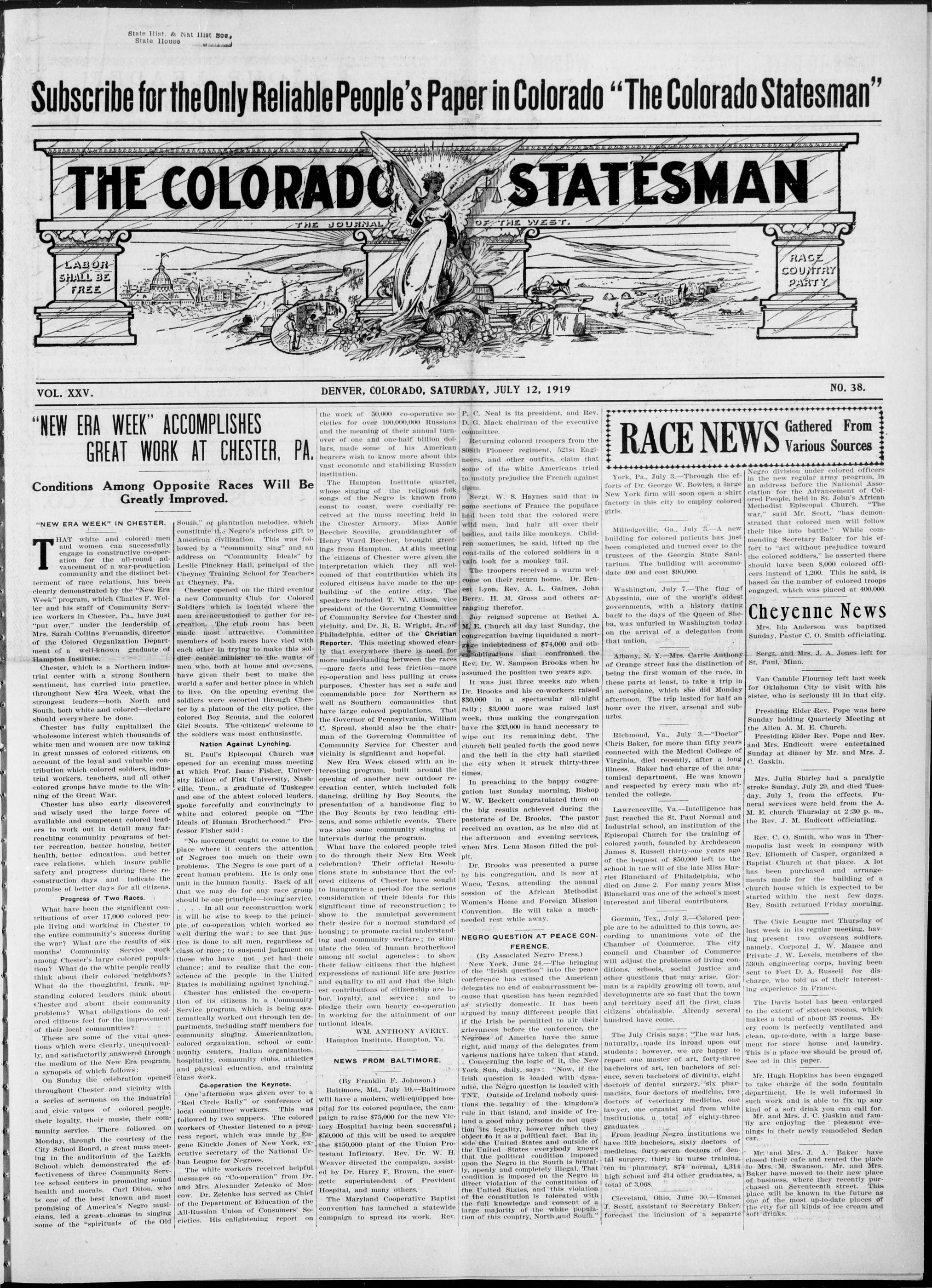
"NEW ERA WEEK" ACCOMPLISHES GREAT WORK AT CHESTER, PA.
Conditions Among Opposite Races Will Be Greatly Improved.
"NEW ERA WEEK" IN CHESTER.
THAT white and colored men and women can successfully engage in constructive co-operation for the all-round advancement of a war-production community and the distinct betterment of race relations, has been clearly demonstrated by the "New Era Week" program, which Charles F. Weller and his staff of Community Service workers in Chester, Pa., have just "put over," under the leadership of Mrs. Sarah Collins Fernandis, director of the Colored Organization Department of a well-known graduate of Hampton Institute.
Chester, which is a Northern industrial center with a strong Southern sentiment, has carried into practice, throughout New Era Week, what the strongest leaders—both North and South, both white and colored—declare should everywhere be done.
South," or plantation melodies, which constitute the Negro's priceless gift to American civilization. This was followed by a "community sing" and an address on "Community Ideals" by Leslie Pinckney Hall, principal of the Cheyney Training School for Teachers at Cheyney, Pa.
Chester opened on the third evening a new Community Club for Colored Soldiers which is located where the men are accustomed to gather for recreation. The club room has been made most attractive. Committee members of both races have vied with each other in trying to make this soldier center minister to the wants of men who, both at home and overseas, have given their best to make the world a safer and better place in which to live. On the opening evening the soldiers were escorted through Chester by a platoon of the city police, the colored Boy Scouts, and the colored
Chester has fully capitalized the wholesome interest which thousands of white men and women are now taking in great masses of colored citizens, on account of the loyal and valuable contribution which colored soldiers, industrial workers, teachers, and all other colored groups have made to the winning of the Great War. Chester has also early discovered and wisely used the large force of available and competent colored leaders to work out in detail many farreaching community programs of better recreation, better housing, better health, better education, and better race relations, which insure public safety and progress during these reconstruction days and indicate the promise of better days for all citizens.
Progress of Two Races.
What have been the significant contributions of over 17,000 colored people living and working in Chester to the entire community's success during the war? What are the results of six months' Community Service work among Chester's large colored population? What do the white people really think about their colored neighbors? What do the thoughtful, frank, upstanding colored leaders think about Chester and about their community problems? What obligations do colored citizens feel for the improvement of their local communities? These are some of the vital questions which were clearly, unequivocally, and satisfactorily answered through the medium of the New Era program, a synopsis of which follows:
On Sunday the celebration opened throughout Chester and vicinity with a series of sermons on the industrial and civic values of colored people, their loyalty, their music, their community service. There followed on Monday, through the courtesy of the City School Board, a great mass meeting in the auditorium of the Larkin School which demonstrated the effectiveness of three Community Service school centers in promoting sound health and morals. Carl Diton, who is one of the best known and most promising of America's Negro musicians, led a great chorus in singing some of the "spirituals of the Old
VOL. XXV.
the Only Reliable
COLORA
CCOMPLISHES
K AT CHESTER, PA.
posite Races Will Be
Improved.
South," or plantation melodies, which constitute the Negro's priceless gift to American civilization. This was followed by a "community sing" and an address on "Community Ideals" by Leslie Pinckney Hall, principal of the Cheyney Training School for Teachers at Cheyney, Pa.
Chester opened on the third evening a new Community Club for Colored Soldiers which is located where the men are accustomed to gather for recreation. The club room has been made most attractive. Committee members of both races have vied with each other in trying to make this soldier center minister to the wants of men who, both at home and overseas, have given their best to make the world a safer and better place in which to live. On the opening evening the soldiers were escorted through Chester by a platoon of the city police, the colored Boy Scouts, and the colored Girl Scouts. The citizens' welcome to the soldiers was most enthusiastic.
Nation Against Lynching.
St. Paul's Episcopal Church was opened for an evening mass meeting at which Prof. Isaac Fisher, University Editor of Fisk University, Nashville, Tenn., a graduate of Tuskegee and one of the ablest colored leaders, spoke forcefully and convincingly to white and colored people on "The Ideals of Human Brotherhood." Professor Fisher said:
"No movement ought to come to the place where it centers the attention of Negroes too much on their own problems. The Negro is one part of a great human problem. He is only one unit in the human family. Back of all that we may do for any race group should be one principle—loving service. . . . In all our reconstruction work it will be wise to keep to the principle of co-operation which worked so well during the war; to see that justice is done to all men, regardless of class or race; to suspend judgment on those who have not yet had their chance; and to realize that the conscience of the people in the United States is mobilizing against lynching."
Chester has enlisted the co-operation of its citizens in a Community Service program, which is being systematically worked out through ten departments, including staff members for community singing, Americanization, colored organization, school or community centers, Italian organization, hospitality, community clubs, athletics and physical education, and training class work.
Co-operation the Keynote.
One afternoon was given over to a "Red Circle Rally" or conference of local committee workers. This was followed by two suppers. The colored workers of Chester listened to a progress report, which was made by Eugene Kinckle Jones of New York, executive secretary of the National Urban League for Negroes.
The white workers received helpful messages on "Co-operation" from Dr. and Mrs. Alexander Zelenko of Moscow. Dr. Zelenko has served as Chief of the Department of Education of the All-Russian Union of Consumers' Societies. His enlightening report on
DENVER, COLORADO, SATURDAY, JULY 12, 1919
the work of 50,000 co-operative societies for over 100,000,000 Russians and the meaning of their annual turnover of one and one-half billion dollars, made some of his American hearers wish to know more about this vast economic and stabilizing Russian institution.
The Hampton Institute quartet, whose singing of the religious folk songs of the Negro is known from coast to coast, were cordially received at the mass meeting held in the Chester Armory. Miss Annie Beecher Scoville, granddaughter of Henry Ward Beecher, brought greetings from Hampton. At this meeting the citizens of Chester were given the interpretation which they all welcomed of that contribution which its colored citizens have made to the upbuilding of the entire city. The speakers included T. W. Allison, vice president of the Governing Committee of Community Service for Chester and vicinity, and Dr. R. R. Wright, Jr., of Philadelphia, editor of the Christian Reporter. This meeting showed clearly that everywhere there is need for more understanding between the races—more facts and less friction—more co-operation and less pulling at cross purposes. Chester has set a safe and commendable pace for Northern as well as Southern communities that have large colored populations. That the Governor of Pennsylvania, William C. Sproul, should also be the chairman of the Governing Committee of Community Service for Chester and vicinity is significant and hopeful.
New Era Week closed with an interesting program, built around the opening of another new outdoor recreation center, which included folk dancing, drilling by Boy Scouts, the presentation of a handsome flag to the Boy Scouts by two leading citizens, and some athletic events. There was also some community singing at intervals during the program.
What have the colored people tried to do through their New Era Week celebration? Their official Resolutions state in substance that the colored citizens of Chester have sought to inaugurate a period for the serious consideration of their ideals for this significant time of reconstruction; to show to the municipal government their desire for a normal standard of housing; to promote racial understanding and community welfare; to stimulate the idea of human brotherhood among all social agencies; to show their fellow citizens that the highest expressions of national life are justice and equality to all and that the highest contributions of citizenship are labor, loyalty, and service; and to pledge their own hearty co-operation in working for the attainment of our national ideals.
WM. ANTHONY AVERY.
Hampton Institute, Hampton, Va.
NEWS FROM BALTIMORE.
Baltimore, Md., July 10.-Baltimore will have a modern, well-equipped hospital for its colored populace, the campaign to raise $75,000 for the new Victory Hospital having been successful; $50,000 of this will be used to acquire the $150,000 plant of the Union Protestant Infirmary. Rev. Dr. W. H. Weaver directed the campaign, assisted by Dr. Harry F. Brown, the energetic superintendent of Provident Hospital, and many others. The Maryland Cooperative Baptist convention has launched a statewide campaign to spread its work. Rev.
P. C. Neal is its president, and Rev. D. G. Mack chairman of the executive committee.
Returning colored troopers from the 808th Pioneer regiment, 521st Engineers, and other outfits, claim that some of the white Americans tried to unduly prejudice the French against them.
Sergt. W. S. Haynes said that in some sections of France the populace had been told that the colored were wild men, had hair all over their bodies, and tails like monkeys. Children sometimes, he said, lifted up the coat-tails of the colored soldiers in a vain look for a monkey tail.
The troopers received a warm welcome on their return home. Dr. Ernest Lyon, Rev. A. L. Gaines, John Berry. H. M. Gross and others arranging therefor.
Joy reigned supreme at Bethel A. M. E. Church all day last Sunday, the congregation having liquidated a mortgage indebtedness of $74,000 and other obligations that confronted the Rev. Dr. W. Sampson Brooks when he assumed the position two years ago.
It was just three weeks ago when Dr. Brooks and his co-workers raised $30,000 in a spectacular all-night rally; $3,000 more was raised last week, thus making the congregation have the $33,000 in hand necessary to wipe out its remaining debt. The church bell pealed forth the good news and the bell in the city hall startled the city when it struck thirty-three times.
In preaching to the happy congregation last Sunday morning, Bishop W. W. Beckett congratulated them on the big results achieved during the pastorate of Dr. Brooks. The pastor received an ovation, as he also did at the afternoon and evening services, when Mrs. Lena Mason filled the pulpit.
Dr. Brooks was presented a purse by his congregation, and is now at Waco, Texas, attending the annual session of the African Methodist Women's Home and Foreign Mission Convention. He will take a much-needed rest while away.
NEGRO QUESTION AT PEACE CON-
FERENCE.
(By Associated Negro Press.)
(By Associated Negro Press.)
New York, June 24.—The bringing of the "Irish question" into the peace conference has caused the American delegates no end of embarrassment because that question has been regarded as strictly domestic. It has been argued by many different people that if the Irish be permitted to air their grievances before the conference, the Negroes of America have the same right, and many of the delegates from various nations have taken that stand. Concerning the logic of it, the New York Sun, daily, says: "Now, if the Irish question is loaded with dynamite, the Negro question is loaded with TNT. Outside of Ireland nobody questions the legality of the kingdom's rule in that island, and inside of Ireland a good many persons do not question its legality, however much they object to it as a political fact. But inside the United States and outside of the United States everybody knows that the political condition imposed upon the Negro in the South is brutally, openly and completely illegal. That condition is imposed on the Negro in direct violation of the constitution of the United States, and this violation of the constitution is tolerated with the full knowledge and consent of a large majority of the white population of this country, North and South."
RACENEWS Gathered From Various Sources
RACENEWS Gathered From Various Sources
York, Pa., July 3.—Through the efforts of Dr. George W. Bowles, a large New York firm will soon open a shirt factory in this city to employ colored girls.
Milledgeville, Ga., July 3.—A new building for colored patients has just been completed and turned over to the trustees of the Georgia State Sanitarium. The building will accommodate 400 and cost $00,000.
Washington, July 7.—The flag of Abyssinia, one of the world's oldest governments, with a history dating back to the days of the Queen of Sheba, was unfurled in Washington today on the arrival of a delegation from that nation.
Albany, N. Y.—Mrs. Carrie Anthony of Orange street has the distinction of being the first woman of the race, in these parts at least, to take a trip in an aeroplane, which she did Monday afternoon. The trip lasted for half an hour over the river, arsenal and suburbs.
Richmond, Va., July 3.—"Doctor" Chris Baker, for more than fifty years connected with the Medical College of Virginia, died recently, after a long illness. Baker had charge of the anatomical department. He was known and respected by every man who attended the college.
Lawrenceville, Va.—Intelligence has just reached the St. Paul Normal and Industrial school, an institution of the Episcopal Church for the training of colored youth, founded by Archdeacon James S. Russell thirty-one years ago of the bequest of $50,000 left to the school in the tie will of the late Miss Harriet Blanchard of Philadelphia, who died on June 2. For many years Miss Blanchard was one of the school's most interested and liberal contributors.
Gorman, Tex., July 3.—Colored people are to be admitted to this town, according to unanimous vote of the Chamber of Commerce. The city council and Chamber of Commerce will adjust the problems of living conditions, schools, social justice and other questions that may arise. Gorman is a rapidly growing oil town, and developments are so fast that the town and territory need all the first class citizens obtainable. Already several hundred have come.
The July Crisis says: "The war has, naturally, made its inroad upon our students; however, we are happy to report one master of art, forty-three bachelors of art, ten bachelors of science, seven bachelors of divinity, eight doctors of dental surgery, six pharmacists, four doctors of medicine, two doctors of veterinary medicine, one lawyer, one organist and from white institutions, a total of eighty-three graduates.
From leading Negro institutions we have 319 bachelors, sixty doctors of medicine, forty-seven doctors of dental surgery, thirty in nurse training, ten in pharmacy, 874 normal, 1,314 high school and 414 other graduates, a total of 3,008.
Cleveland, Ohio, June 30.—Emmet J. Scott, assistant to Secretary Baker, forecast the inclusion of a separate
NO.38.
Negro division under colored officers in the new regular army program, in an address before the National Association for the Advancement of Colored People, held in St. John's African Methodist Episcopal Church. "The war," said Mr. Scott, "has demonstrated that colored men will follow their like into battle." While commending Secretary Baker for his effort to "act without prejudice toward the colored soldiers," he asserted there should have been 8,000 colored officers instead of 1,200. This he said, is based on the number of colored troops engaged, which was placed at 400,000
Chevenne News
Chevenne News
Mrs. Ida Anderson was baptized Sunday, Pastor C. O. Smith officiating.
Sergt. and Mrs. J. A. Jones left for St. Paul, Minn.
Van-Camble Flournoy left last week for Oklahoma City to visit with his sister, who is seriously ill in that city.
Presiding Elder Rev. Pope was here Sunday holding Quarterly Meeting at the Allen A. M. E. Church.
Presiding Elder Rev. Pope and Rev. and Mrs. Endicott were entertained Sunday at dinner by Mr. and Mrs. J. C. Gaskin.
Mrs. Julia Shirley had a paralytic stroke Sunday, July 29, and died Tuesday, July 1, from the effects. Funeral services were held from the A. M. E. church Thursday at 2:30 p. m., the Rev. J. M. Endicott officiating.
Rev. C. O. Smith, who was in Thermopolis last week in company with Rev. Ellometh of Casper, organized a Baptist Church at that place. A lot has been purchased and arrangements made for the building of a church house which is expected to be started within the next few days. Rev. Smith returned Friday morning.
The Civic League met Thursday of last week in its regular meeting, having present two overseas soldiers, namely, Corporal J. W. Mance and Private J. W. Levels, members of the 530th engineering corps, having been sent to Fort D. A. Russell for discharge, who told us of their interesting experience in France.
The Davis hotel has been enlarged to the extent of sixteen rooms, which makes a total of about 33 rooms. Every room is perfectly ventilated and clean, up-to-date, with a large basement for store house and laundry. This is a place we should be proud of. See ad in this paper.
Mr. Hugh Hopkins has been engaged to take charge of the soda fountain department. He is well informed in such work and is able to fix up any kind of a soft drink you can call for. Mr. and Mrs. J. C. Gaskin and family are enjoying the pleasant evenings in their newly remodeled Sedan car.
Mr. and Mrs. J. A. Baker have closed their cafe and rented the place to Mrs. M. Swanson. Mr. and Mrs. Baker have moved to their new place of business, where they recently purchased on Seventeenth street. This place will be known in the future as one of the most up-to-date places of the city for all kinds of ice cream and soft drinks.
FOREIGN
Great Britain will demand that Admiral von Turpitz, author of Germany's submarine war, be brought to trial, according to reports in London.
Several persons were killed and a large number wounded in disturbances at Kattowitz, Upper Silesia, according to advices from Beuthen. Germans and Poles took part in the disorders.
The doctors of Paris have decided to increase their fees and they will charge double their rates before the war. Fees for services at night will be three times the pre-war rate.
Field Marshal Hindenburg has addressed an open letter to Marshal Foch begging him to use his influence to save the former kaiser from trial by the allies. He repeats his offer to substitute himself for the former emperor for trial.
Through the mediation of allied representatives an armistice between the Esthonians and Germans has been signed at Riga. It provides that all German troops shall leave Riga and that the Germans evacuate Letvia at the earliest possible moment.
Approval of a plan for a concerted attack upon Petrograd by Finnish troops and the forces of the Kolchak government at Omsk was given by the council of five. A joint note has been sent the military attaches of the United States, Great Britain, France and Italy at Helsingfors, instructing them to support the Finnish government if it decided to accede to the request of Admiral Kolchak to assist him in the campaign.
Premier Clemenceau has begun his visit to the devastated regions, entering the zone of protracted warfare at St. Quentin. The premier encouraged the people to question him and bring forward any complaints which they had to make, and they were not slow in so doing. In addressing the population of St. Quentin, M. Clemenceau declared now that peace is concluded, the work of reconstruction and reform would be the government's foremost care.
SPORT
Jack Dempsey won the heavyweight championship of the world from Jess Willard in three rounds at Toledo, O., July 4th. Dempsey received $27,000, while Willard got $100,000.
Carl Macke knocked out Young Jack Dillon of Denver in the fourth round of a scheduled ten-round fight at Wallace, Idaho. The battle was fast and furious while it lasted.
Tex Rickard may promote another championship fight and it may be held in the arena built for the Willard-Dempsey fight. If he does it will be between Lightweight Champion Benny Leonard and Charlie White of Chicago.
There was a difference of fifty-six pounds in the weight of Jess Willard and Jack Dempsey when they entered the ring for their heavyweight championship contest. The new champion weighed 187 pounds, while Willard scaled 243.
A world's record for two-year-old trotters was broken at North Randall when Mr. Dudley, a bay gelding, owned and driven by Lyman Brusie of Chester, N. Y., was timed 1:02 3-4 in a half-mile dash during the Grand Circuit races. The quarter was raced in $31\frac{1}{2}$ seconds.
GENERAL
Calumet and Hecla and subsidiary mines in Michigan announced re-employment for all underground men. Three thousand men returned to work. Three of the men who robbed the First National Bank of Downers Grove of $22,000 on July 3, are under arrest, the police declare, and $18,000 of the loot has been recovered.
As the Princess Matoika with 1,804 Germans slipped out of the harbor for Holland, she passed the transport Otsego with 1,000 Yankees returning from France. With the sailing of the Matoika almost 3,000 Germans have been repatriated through the local port.
Arthur S. Raymond, a mining engineer from Joplin, Mo., leaped to his death from the roof of the twenty-story Commodore hotel in New York. No reason for his act is known
President Wilson set foot on American soil for the first time in five months at the port of embarkation, Hoboken, N. J. Just before the George Washington was made fast, President Wilson stood on the bridge of the steamer, which had brought him back from the peace conference in Paris, acknowledging the cheers of thousands of persons, afloat and ashore.
A mob of 3,000 persons at Lancaster, Pa., attacked W. W. Cox while he was addressing a street meeting at Columbia. Cox, who was severely beaten, was placed under arrest. The crowd then turned its attention to the Socialist headquarters and completely ransacked it, later marching to the home of J. T. Brenner, a prominent Socialist. Constable Blair of the borough appealed to the crowd to be calm and promised to place Brenner under arrest. The officer entered Brenner's home and found him armed with a shotgun and a revolver. He was arrested.
Benjamin E. Burr, an attorney, was shot and seriously wounded in his office at Chicago by a 17-year-old girl who told the police she was avenging dishonor he had brought her. The girl gave the name of Margaret Seithamier when taken to police headquarters. Burr died a few hours later at the hospital to which he was taken. Lieut. Jules Biscayart, an aviator, was burned to death at Hemstead, N. Y., when his airplane, a new type of machine in which he was making his initial flight, fell. The gasoline tank exploded.
NEWS TO DATE IN PARAGRAPHS
CAUGHT FROM THE NETWORK OF WIRES ROUND ABOUT THE WORLD.
DURING THE PAST WEEK
RECORD OF IMPORTANT EVENTS
CONDENSED FOR BUSY
PEOPLE.
Gen. Luis Terrazas, reputed the wealthiest citizen of Mexico until his large holdings in land and cattle were swept out of his control by revolutions, has arrived in Los Angeles to live.
Three children named Fuller, the eldest of whom was 15, were burned to death twenty-five miles east of Chehalis, Wash. Their grandmother, a Mrs. McClanahan, with whom they were staying, also was badly burned.
One man was burned to death and two were drowned at Stockton, Calif., in a water front fire which destroyed property valued at $150,000. A fourth man is missing. Twelve men were trapped on a barge loaded with hemp. Eight were rescued.
Harry S. New, Jr., confessed slayer of his 20-year-old fiancé, Miss Freda Lesser, in Topango cañon, near Los Angeles, has been charged with murder in the first degree in a complaint issued by Deputy District Attorney Keys at the request of Police Detective Herman Cline.
The first fatality from "sleeping sickness" in Santa Barbara and said to be the third in the United States, is the death of Matsue Fujitsubo, wife of a local Japanese. She had been in a state of coma since her illness with influenza last February. An autopsy revealed the cause of death.
Chicago will have the largest railway passenger station in the world, if the plans underlying the Illinois Central railroad electrification ordinance, to be submitted to the City Council by the railway terminals committee, are approved. The proposed new station will be more than an eighth of a mile in width and have train sheds more than half a mile in length. The Illinois Central railroad plans to expend $72,000,000 on the new terminal.
A white man, an Indian interpreter and a Navajo Indian have been killed in a gun fight on the Navajo reservation near Chin Lee, 100 miles north of Flagstaff, according to an unconfirmed report received. A veterinarian is said to have called on the Navajo to examine his diseased horse. Argument followed and the Indian, it is reported, shot the interpreter and the veterinary surgeon. Both fell mortally wounded, but the latter is said to have killed his assailant before losing consciousness.
WASHINGTON
The flag of Abyssinia, one of the world's oldest governments, with a history dating back to the days of the queen of Sheba, was unfurled in Washington on the arrival of a delegation from that nation.
In the absence of their statutory limitations, war measures effective until the end of the war, will continue in operation until the exchange of ratifications of the treaty of peace between this country and its enemies. This interpretation of several much disputed phrases was given by Attorney General Palmer as the accepted meaning of the termination of hostilities, and the one on which administration officials would proceed.
Secretary of State Lansing feels that his presence in Washington in the near future will be necessary because of the greatly increased duties of the State Department, due to the problems growing out of the peace settlement. It was for this reason that he decided recently to return to the United States. All certificates of indebtedness issued by the railroads, following the failure of the appropriation in the last Congress were called for redemption July 15. The total amount of certificates issued between March 4 and July 1 when the new appropriations became available was $282,511,704. Arrangements have been made for redemption of the certificates at all federal reserve banks.
Officers in the Finnish army have been promised 5,000 marks each to desert to the Bolshevist forces, according to dispatches quoting Swedish press reports received by the State Department at Washington. Bolshevist proclamations smuggled across the Finnish gulf also promised 20,000 marks for each gun and 300 marks for each pair of shoes turned over to the soviet authorities by the Finns.
Already possessed of the greatest single stock of gold in history, the United States could lay claim to most of the remaining free gold of the world in payment of its favorable merchandise balance, the federal reserve bulletin will say in its July issue. The balance approximated $9,000,000,000 in the last three years, and bids fair to continue at the same rate this year, affording a problem to arrange payments without bankrupting debtor nations and still further enhancing the cost of living here through the importation of more metal.
SPORT
WILSON TALKS TO U.S. SENATE
SAYS WORLD'S HEART WOULD
BE BROKEN IF LEAGUE
IS REJECTED.
U. S. TURNED THE WAR
PAYS GLOWING TRIBUTE TO AMERICAN SOLDIERS ABROAD.
Western Newspaper Union News Service.
Washington, July 11.—President Wilson, in presenting the peace treaty with Germany to the Senate, declared that "a league of free nations had become a practical necessity," to which the framers of the treaty felt obliged to turn "as an indispensable instrumentality for the maintenance of the new order it has been their purpose to set up in the world."
The President declared that:
The treaty would be a scrap of paper without the League of Nations.
The people demand the league and will brook no denial.
America's material aid to Europe will be indispensable in days to come.
If the league should be rejected, the world's heart would be broken.
America is the friend of all nations.
America has just reached her majority as a world power.
America's isolation ended twenty years ago.
Moral leadership of the world is offered America; the question is whether we accept or reject it.
America shall in truth show the way to the world.
The treaty squares with the fourteen points as well as with the practical needs of the situation.
It is not exactly the sort of treaty the United States would have written.
"We have sought no special repairation for ourselves, but only the restoration of right and the assurance of liberty everywhere."
America's fighting made victory certain.
The President began his speech by outlining how American troops, to whom he paid a warm tribute as "men terrible in battle, but gentle and helpful out of it," turned the tide of the war.
Coming to the making of peace, Wilson reviewed in every detail the many complex questions presented and the difficulties growing out of a disposition in some quarters to cling to the old order.
"Old entanglements," he said, "stood in the way of peace. It was not easy," he added, "to graft the new order of ideas on the old, and some of the fruits of the grafting may, I fear, for a time be bitter."
But on the whole, the President declared, Europe welcomed American participation in the peace-making as eagerly as it welcomed our armies and accomplished American principles of peace.
He asserted emphatically that the treaty is thoroughly consistent with the principles he laid down in the fourteen points, and at the same time meets the practical needs of the situation.
"We were welcomed as disinterested friends," said the President. "It was recognized that our material aid would be indispensable in the days to come when industry and credit must be brought back to their normal operation, . . . and it was taken for granted, I am proud to say, that we would play the helpful friend."
In view of all this, the President said, the question is put squarely up to the United States whether it will try to resume its old policy of isolation or will continue, through the League of Nations the task of maintaining "the new order set up in the world, the world of civilized men."
The United States, the President said, has reached its majority as a world power.
He hinted, it was believed, at acceptance of a mandatory by the United States when he said that "weak peoples everywhere stand ready to give us any authority among them that will assure them a friendly oversight and direction."
The President announced that he later will present the treaty of defense, under which American aid is pledged to France against unprovoked German aggression. "The "most skeptical" of the peace conferees at Paris, the President said, had turned more and more to the league as discussion progressed in seeking solution of the problems that arose in framing the terms of the treaty itself. The fact that the covenant of the league was the first substantial part of the treaty to be worked out and agreed upon," the President said, "while all else was in solution, helped to make the formulation of the rest easier."
Mr. Wilson said the agreement on the covenant had given the conferences a feeling that their work was to be permanent and that the most practical among them "were at last the most ready to refer to the League of Nations the superintendence of all interests which did not admit of immediate determination, of all administrative problems which were to require a continuing oversight."
"What had seemed a counsel of perfection," said the President, "had come
Against Unrestricted Immigration.
Against Unrestricted Immigration. New York.—Opposition of the American Federation of Labor to unrestricted immigration during the next four yearsr is based largely on a desire to checkmate "a combination of corporations, trusts and shipping companies" to bring immigrants to the United States under contracts which made them virtually "slaves to these trusts." Samuel Gompers, president of the federation, declared in an address before the Pan-American Federation of Labor meeting in New York.
to seem a plain counsel of necessity. The League of Nations was the practical statesman's hope of success in many of the most difficult things he was attempting."
Immediately after President Wilson left the Senate chamber Senator Borah (Idaho) introduced a resolution asking the President to send to the Senate, "if not incompatible with public interest," letters and protests from members of the peace commission relative to Shantung. The resolution asks particularly for a letter of protest alleged to have been written to the President by Gen. Tasker H. Bliss on behalf of himself, Secretary Lansing and Henry White of the peace commission.
The President also is asked to submit any memoranda available which would indicate that Japan attempted to coerce Chinese delegates in the Shantung matter.
President Wilson, conferring with newspaper correspondents at the White House, indicated that he was extremely gratified that the treaty of peace had been ratified so promptly by the German national assembly. The President also indicated that he felt trade relations between Germany and the associated nations should be resumed at the earliest moment possible, for without trade Germany could not be met the reparations demanded of her.
It was made clear that the President felt troops should be maintained in Germany until the Germans had complied with all the military terms of the treaty. It was pointed out that there were several million veteran soldiers in Germany and munitions sufficient for them to operate.
The Germans have from one to four months in which to deliver all material except that sufficient for the reduced Germany army provided for in the peace treaty, and the President believes American troops should stay on the Rhine until the material is delivered.
Discussing the peace negotiations at Paris, President Wilson let it be known that the League of Nations covenant will be in every treaty negotiated at Versailles, including that with Bulgaria, with which country the United States never was at war.
The President made it clear that demobilization of the American army would depend upon the speed with which the military conditions of the peace treaty were executed by Germany and the treaty was ratified by the various governments.
In response to questions regarding the Flume situation, the President pointed out that the treaty of London provided that Flume was to go to Croatia and that Italy did not lay claim to the city when that treaty was signed.
Mr. Wilson feels that the United States must play a generous part in the reconstruction of Europe, but he believes this should be accomplished by establishing some sound basis of credit rather than by direct government aid.
President Wilson is understood to take the position that a two-thirds majority will be required to adopt any Senate reservations in ratifying the peace treaty. The impression of opposition leaders in the Senate has been that only a simple majority would be required.
President Wilson plans to submit to the Senate only the treaty containing the covenant of the League of Nations. The proposed supplementary treaty under which the United States would agree to go to the aid of France in case of an unprovoked assault on that country by Germany will be presented separately at a later date. Mr. Wilson is preparing a separate address to the Senate explaining this agreement.
Mr. Wilson's purpose to present the peace treaty and the agreement with France separately was disclosed at a conference with press representatives. It was indicated that his time thus far had been devoted entirely to preparing his address on the treaty with Germany and that opportunity had been lacking to complete a similar explanation of the proposed pact with France.
Mr. Wilson let it be known to the correspondents that the treaty with France was designed for the protection of France until such time as this special guarantee would no longer be needed because of the protection to be afforded all nations by the League of Nations.
Mr. Wilson has the impression that the French people would be cut to the heart if the United States should fail to approve the special treaty. He does not believe there would be any difficulty in recognizing such an act of aggression by Germany as would necessitate American aid to France under the pact.
Demands Campaign Stop.
Paris.—High tension between the Austrian and the Hungarian governments is indicated in dispatches received here from Vienna and Budapest. The Austrian foreign minister, Dr. Otto Bauer, has demanded the recall from Vienna of the Hungarian minister. Bela Kun, head of the Hungarian Soviet government, in return, has demanded the campaign against the Hungarian legation at Vienna be stopped.
Two Killed in Tornado.
Bradford, Pa.—Two persons were killed, many others suffered injuries and twenty-five houses were demolished by a tornado which swept a narrow path through Bradford. About fifty houses were damaged. One small dwelling was carried 1,000 feet by the twister.
U-Boat Commanders Flee.
Berlin.—Residents of Wilhelmshaven, former German submarine base, say the allies may have to look a long time to find some U-boat commanders whose delivery is demanded. Nearly all have left Germany, they say, and most interesting of their statements is that many entered the service of an eastern power which joined in the demand for their surrender. A large number of army officers, supposed to be listed in the allies' black list, are said to be in Russia.
WESTERN BEEF CO.
Fresh Oysters, Chitterlings, Pig Tails, Snouts, Ears, Pigs Feet, Neck Bones, Spare Ribs Received Fresh Daily.
Fresh and Cured Meats of All Kinds.. Fresh Vegetables, Staple and Fancy Groceries.
When You Want
The Heads, Feet, Tails, Snouts, Neckbones or Chiterlings, or any other part of the hog except the squeal, go to
THE CHAMPA PHARMACY
TWENTIETH AND CHAMPA,
Is the place to get your
DRUGS, CHEMICALS AND PATENT MEDICINES
WE SERVE DRINKS.
PRESCRIPTIONS OUR SPECIALTY.
Phone us and we will deliver the goods to all parts of the city.
JAMES E. THRALL, Propr.
PHONE MAIN 2425.
MORRISON'S FAMOUS JAZZ ORCHESTRA
Music Furnished for all Occasions
Phone Main 2707. Res. 2947 Stout St. DENVER, COLO.
Leaders in Prescription
Full Line of Plough's Black and White Toilet Articles
2701 WELTON STREET MAIN 875
2300-6 Larimer Street
One of the Most Up-toDate and Sanitary Markets in the City.
CAPITOL PETROLEUM
(A Producing Dividend Paying Company)
DESIRES to extend thanks to its many friends and patrons for their liberal patronage, hearty co-operation, and assistance in making CAPITOL a Success.
WE are sure you will never have occasion to regret having become a stockholder in CAPITOL, as the company is rapidly forging ahead toward the goal which all our stockholders are expecting it to reach.
WHETHER the treasury stock will be offered to the investing public again we cannot say at this time; but if it is, it will be at a price, as has been in the past, that will be consistent with the progress and development of the company.
The Capitol Petroleum Company
413-414-415 Denham Building, Denver, Colorado
DOES
SHE?
AL JOLSON
Business is the Chief Pioneer of Human Civilization
Business is the chief pioneer els over the dangerous fields to where it brings men into friend removes prejudices and binds the Wherever we go, abroad or at h the great interest of the world in tion and love; regardless of colo
Business is the chief pioneer of human civilization. It travels over the dangerous fields to secure its noble ends. Everywhere it brings men into friendly relations and it removes prejudices and binds the unity of men together. Wherever you go, go home, the home, it is business that controls the great interest of the world in the name of humanity, civilization and love; regardless of color or nationality.
DAVIS HOTEL
Reopened for business. Ref Hot air furnace, hot and cold water from business district.
MRS. LUCY
Reopened for business. Refitted. All modern conveniences. Hot air furnace, and cold water and electric lights. One block district.
NO. 522 W. SEVENTEENTH ST.
The V. V. Hair Good Millinery Store
Hats Made, Trimmed or Remodeled to Order
The V. V. Hair Goods and Millinery Store
Mrs. G. W. Anderson, Prop.
Out of Town Orders Received.
342 N. CENTER, CASPER, WYO.
Straightening and Drying Comb,
Price $1.50.
NOTICE OF SPECIAL STOCKHOLDERS' MEETING OF THE NATURAL EPSOM SALTS COMPANY.
Denver, Colorado, July 17, 1919.
Notice is hereby hereby that a special medical stockholders of The Natural Epsom Salts Company will be held at 444 Fourteenth Street, in the City of Denver, State of Colorado, on Tuesday, the 22nd day of October, 1919, at o'clock the afternoon of the purpose of considering a resolution authorizing and instructing the officers of the company to issue bonds in the sum of one hundred thousand dollars the purpose of the present and past obligations of the company and to provide capital for operating expenses and to secure said bondery of the company as to do such necessary in issuing said bonds and securing the same by said deed of trust.
THE NATURAL EPSOM SALTS COMPANY. By WILLIAM B. BELL. President.
Dr. S. A. Huff, physician and surgeon, 2538 Washington street; office hours 11 to 12 a. m., 3 to 5 p. m. Phone York 2313. Out of office, Main 875. Residence Phone York 4101.
of human civilization. It trav-
secure its noble ends. Every-
ly relations with each other. It
is whole family of men together.
home, it is business that controls
in the name of humanity, civiliza-
tor or nationality.
HOTEL
littled. All modern conveniences.
ater and electric lights. One block
DAVIS, Prop.
ir Goods and y Store
```markdown
```
"THE FREE"—AT THE DENVER DRY GOODS STORE.
What is it? The best modern-made sewing machine that should be in the possession of every seamstress, housewife and milliner. It merits its name, as from tis light running and adorable ease, simple and durable construction, it is considered the highest development in the sewing machine art. The amount of $12, allowed for your old machine, while a payment of $5 down and $5 a month will adorn your home with this beautiful and necessary furniture which gives comfort.
E. P. BLAKEMORE, Attorney and Counsellor at Law. Office, Rooms 39 and 40 Arapahoe Bldg., 1622 Arapahoe Street. Phone Champa 5450.
A Quick Freeze.
In freezing ice cream remember that time will be saved if you do the freezing in a warm place, as the more rapidly the ice melts the more quickly the ice cream or sherbet will be frozen.
A FINE EXHIBITION ON JULY 4TH.
A contest that will be long remembered, as it not only attracted so much interest, but helped to remove the false impression that colored competitors are not drawing cards in the land of sportdom, took place last Friday, July 4th, when the baseball league leaders of the amateur class, the White Elephants, played the famous Bolden Bros. team for a large purse in addition to voluntary receipts from spectators. A very large crowd assembled to witness the keenly contested game, and a very noticeable feature was the strict obedience to the umpire's decision, with a decorum almost unparalleled in the history of corner-lot baseball. The game was graced by an unusual gathering of lady fans who rooted for their respective teams in tones which were inaudible as they were suppressed by the vociferous yells of their masculine competitors. The game ended in a victory for the White Elephants, 8 to 3, with Fred Hill, pitcher, and Theodore Epperson, catcher, George Parsons, who must be accredited as our baseball authority, was the umpire, and a better selection could not have been made, as every decision was greeted with the approval of both sides. It was a splendid game, and spectators, black and white, declared that a professional league game could not have been managed better than the sportive exhibition that was given by these two teams. They will try themselves again tomorrow at Thirty-first and Champa, when Manager Bolden intends to carry off the honors.
Early Irish Culture
The evidences of early and medieval culture in Ireland are a multitude of beautiful things, classics of literature but likewise wonders of creative art Thus at Cong abbey, where sleep many of Ireland's ancient dead, and among them Rory O'Connor, the last king there is an exquisite cross with gold traceries and delicate beauty of silver and copper and enamel and bronze, a proof of the civilization built up with in Ireland long before the Normans crossed to her shores. Such instances might be multiplied.
Well, she is. Isn't she?
Poor man! He can spend a full day making himself look pretty and nobody notices him, while a wee slip of a girl can come out just any old way and the entire populace will say, "Aln't she sweet?"—South Charleston Sentinel.
Good News
A Big Sale on at
Michaelson's
15TH & LARIMER STS.
To say that this store saves the people 25 per cent on Footwear, is expressing it mildly—but even a uniform 25 per cent is worth while.
Summer clothes for men. Adler Collegian quality no man need be ashamed of, in fact tailor made does not surpass it—and Michaelson's prices assure better for less under all conditions.
Good habit—to trade at Michaelson's, but especially good this month of July, the clearance month.
---
GERMAN - JAPANESE ALLIANCE
WOULD EXCLUDE
ENGLAND.
U. S. OUT OF ASIA
HODGES MAKES PUBLIC NEW TREATY FOUND AT PERM, SIBERIA.
Western Newspaper Union News Service.
Washington, July 11.—G. Charles Hodges, assistant director of the Far Eastern bureau, New York, has made public the text of an alleged secret alliance relative to Russia and China.
The text as made public by Mr. Hodges follows:
"Paragraph 1. Both high contracting parties bind themselves as soon as the world political situation permits, to help the third party, Russia, to obtain under their direction the settlement of her internal affairs and the position of a world power.
"Paragraph 2. One of the high contracting parties, Japan, binds herself to allow the other high contracting power, Germany, the enjoyment of the prerogatives growing out of her treaties with the third party, Russia, as far as they concern central Asia and Persia and assist in the conclusion of a most favored nation's treaty with mutual guarantees between this third power and the two contracting powers.
"Paragraph 3. One of the high contracting parties, Japan, binds herself to allow the other contracting party, Germany, the enjoyment of the rights of most favored nation, given to her by the treaties in southern China, and of certain privileges growing out of this treaty, as yet to be defined in a special treaty, and in this connection both contracting parties bind themselves not to allow the passing of further concessions in regions yet to be definitely defined, into the hands of foreign powers, American and English.
"Paragraph 4. One of the high contracting parties, Japan, binds herself indirectly to protect the interests of the other high contracting party, Germany, in the coming peace conference, in a manner agreeable to that party in order that she might suffer as little as possible from the terms of peace in respect to territorial and financial losses.
"Paragraph 5. One of the two highest contracting parties binds herself on the basis of a treaty to be concluded with the third power after her restoration to secure for the other contracting party, Germany, the conclusion of a treaty of mutual (reciprocal) guarantees, military, political and economic, and to lend her services to the other party, Germany, in this direction.
"Paragraph 6. In return for this the other high contracting party, Germany, blinds herself to conclude a secret military convention on land and sea with the aim of an alliance of mutual (reciprocal) guarantees and mutual protection against the aggressive intentions of America and England, the details to be worked out immediately after the conclusion of peace by specially empowered delegates of both high contracting parties.
"Paragraph 7. The secret treaty resulting herefrom will define the basic of foreign policy of the three high contracting parties and may in its full extent and in all its individual paragraphs be worked out immediately after the re-establishment of the third high contracting party, Russia.
"Paragraph 8. The present treaty is concluded for a period of five years counting from the moment of the restoration of the third party, with the exception of Paragraph 4, which goes into effect immediately on receipt of ratification. In case none of the high contracting parties announces six months before the end of the five years period the intention of discontinuing the action of the treaty, it automatically remains in force for a further five years' period, until one or another of the contracting parties signifies its intention of discontinuing it.
"Paragraph 9. The present treaty should be ratified as soon as possible and certificates of ratification should be prepared in duplicate in French and German, the German text being the authentic one for Germany and the French text for Japan."
Steel Orders Unfilled.
New York.—Unfilled orders of the United States Steel Corporation on June 30 were 4,892,855 tons, according to the corporation's monthly statement. This is an increase of 610,545 tons compared with the orders May 31.
Gets Legion of Honor.
Washington.—Rear Admiral William S. Sims, who commanded American naval forces in European waters during the war, has been decorated with the rank and cross of a grand officer of the Legion of Honor. Only two other American naval officers, Admirals Henry T. Mayo and William B. Wilson, hold this rank in the Legion of Honor. Lieutenant Commander James G. Ware, who commanded the American destroyer Truxton, was made a chevalier of the Legion of Honor.
The Great Semi-Annual Clearance Sale Now in Full Swing at
Men's and Young Men's Fancy Summer Suits $22.50 TO $25.00 VALUES
$17
$33
THE HOME OF SOCIETY BRAND CLOTHES
SIXTEENTH AND CHAMPA STREETS
DENVER, COLO
HEADQUARTERS FOR UNION LABEL WEARING APPAREL
IS FOOT COMFORT OR YOUR MONEY BACK
Education Through Parties.
The average man's initials are familiar to the people of his community. But nobody ever knows his full name until his wife gives a party.—Topeki Capitol.
THE COLORADO STATESMAN
LABOR
HALF DE
FREE
HACK
COUNTRY
PARTY
Entered as second-class matter at the postoffice in the City of Denver, Colo.
Reading notices, ten lines or less, 10 cents per line. Each additional line over ten lines, 5 cents per line. Display advertising 50 cents per inch.
Remittances should be made by Express Money Order, Postoffice Money Order, Registered Letter or Bank Draft. Postage stamps will be received the same as cash for the fractional part of a dollar. Only 1c and 2c stamps taken.
No discounts allowed on less than three months' contract. Cash must accompany all orders from parties unknown to us. Further particulars on application.
Communications to receive attention must be neway, upon important subjects, plainly written only upon one side of the paper, must reach us Tuesdays, if possible, anyway not later than Wednesdays, and bear the signature of the author. No manuscript returned, unless stamps are sent for postage. All communications of a personating nature that are not complimentary will be withheld from the columns of this paper.
IS THE DAY OF RECKONING AT HAND?
WHY SO MUCH FEAR? Senator Reed' of Missouri but a short while ago remarked with much emphasis that, according to the present rules governing the League of Nations, the black, brown and yellow races would dominate the world. Now comes Senator Phelan of California, expressing grave concern over the silent invasion of the Pacific coast by the Japanese, and offers the prediction that unless this is checked, it means the end of the white race on the Pacific coast, and the "end of our Western civilization." The senator provided himself with the statistical account of the birth rate of the white race and the Japanese in the last ten years, which places the white at a decrease of about 9 per cent, while the Japanese is 300 per cent on the increase. Said the senator, "I do not think we require any further confirmation of the silent invasion of California, directed from Japan, because Japan controls her nationals wherever they go. California is now just as Hawaii has been for some time—a tributary colony to Japan. If this is not checked now, it means the end of the white race in California, the subversion of American institutions, and the end of our Western civilization. The fight is on. On which side do you stand?"
If we must take the foregoing remarks seriously, we can discover a point where Senators Reed and Phelan focus their thoughts, and that is, THE FEAR OF THE DARKER RACES in the new civilization, or the Reconstruction period, that is beginning to dawn upon us, and especially is the matter clearly set forth in the question, "On what side do you stand?" If this question is addressed to the American nation with its cosmopolitan population, its composition of all races and tongues, we believe that, instead of an immediate answer satisfactory to the questioner, another question would be asked in which the request would come, whether the reference was being made with a racial or patriotic view? To be conscientious, and from experience by our daily contact with the members of Senator Phelan's race, we feel that he is voicing the sentiment of the majority, but a little problem presents itself, in that while they fear the Japanese and ascribe all manner of ills to him, yet they will enter into commercial relationship, confer on financial matters of a large scale, entertain delegation after delegation to study various Western phases of moral, intellectual and financial improvement, all tending to the advancement of this character that is causing all this fear, worry and anxiety to his white neighbor and leader.
We think it was Holmes who, when he felt the necessity for united action, for the permanent success of his country and nation, gave from the fullness of his heart the following expression: "ONE FLAG, ONE LAND, ONE HEART, ONE NATION EVERMORE," and we ask ourselves whether men like Senator Phelen are ever impressed with the weight of such expressions and what they intend to convey. With such an emphatic pronouncement coming from these two representatives of the people of our law-making body, we are inclined to think that this is a case of "a hint to the wise," etc., as, while we have not gotten the Japanese strength in military and naval influence, nor commercial prestige to create fear, yet as a member of the dark races, if the senator's question is from a racial viewpoint, he knows how we feel at heart whenever he narrows the principles and foundations of our government to a thin, transparent form of action. According, therefore, to the expressions offered by these two gentlemen in their instructions to our government to beware of the dark races, and especially "this horde of non-assimilable aliens," as they are termed by Senator Phelan, it is apparent that THE DAY OF RECKONING IS AT HAND, and the mighty power in his boastings of racial superiority and world domination begins to think, history may repeat itself as in many events of the world.
BISHOP McCONNELL ON "THE NEGRO," AT GREAT CENTENARY EVENT.
T TAKES EVENTS of this order and incidents of this kind to get distinguished characters in a nation to pour forth from their hearts such truths concerning the welfare of a people that form one-ninth of the population of a country, the same baring facts that are astonishing when they inform of the achievements of such persons that are persecuted because of their endeavors to improve. On another page will be found an extract of Bishop McConnell's speech—a speech coming from a fearless, strong, courageous ambassador of righteousness, and those whose good fortune it was to have heard him before, and who are acquainted with his spirit of fair play, could substantiate his declaration THAT THE NEGRO IS NO MENACE TO THIS COUNTRY.
This address, coming at a time when the world must be rescued from its disease of narrowness, vile prejudice, unfair treatment to classes or sections of the human family for uncontrollable conditions and circumstances attending their creation, ought to establish an impression that can never be effaced as to the merits and good qualities possessed by the desirable members of the human race. No wonder the bishop struck the "own-your-own-home" proposition, as being fully cognizant of the numerous laws of segregated property ownership in many of the states and cities of this Union, even though the courts pronounce such actions unconstitutional, with a tendency to disrupt the peace, harmony and good will of such communities, he could state facts that have come to his personal knowledge of the perseverance of these people to contribute to the nation's welfare, to the nation's progress.
The article goes on to say that other bishops joined in praising the Negro for his contribution to religious causes, especially the help to the Methodist Church, and in this movement of the great Centenary plan, the idea of intensive co-operation in religious as well as other uplifting roles will be vigorously carried on. The raising of $150,000,000 to carry the tidings of Christianity to foreign fields as well as improve the general conditions of the work at home is the purpose of this event, and the large-hearted, true-hearted men interested therein are sure to bring about results that will hasten the fraternalizing of the world in the one common brotherhood that comprises the essence of Christianity. Bishop McConnell is well known to the people of Denver and other Western cities, and apart from his denominational sphere of labor, he has assisted the government in offering suggestions on the conditions of the Mexican field and how certain problems pertaining to the moral and spiritual uplift of the people can be solved. We are glad to have such champions of right among us, and we hope more will be raised up to combat with the REAL MENACE TO OUR NATION'S SUCCESS.
It Is the Easiest Thing in the World to Invest in War Savings Stamps
It Is the Easiest Thing in the World to Invest in War Savings Stamps
BY THE WIFE OF A FORMER U. S. ATTORNEY GENERAL
If anyone is not accumulating a stock of War Savings stamps surely that person is not acquainted with all the advantages that W. S. S. hold for their owner.
MARIA MAYER
Without exception every person knows something he wishes to have which takes a sum of money he cannot well afford to spend. In the case of adults it is often a trip they would like to take, the purchase of a piano, a collection of books, or some special educational course, or it may be funds for some philanthropic project. In the case of youth it is more often the opportunity to go to college or train for a favorite career; but whether the dream is of pleasure or advancement or altruism, the United States government has found a way to make it come true by giving everyone a chance to invest every spare bit of change at interest.
No one thinks of running to a savings institution with an extra quarter, nor would he stop to invest a dollar gained unexpectedly by purchasing some article a little cheaper than anticipated, but it is the easiest thing in the world to buy a Thrift stamp with the quarter, or four or them with the extra dollar, right at the store where the purchase was made, for Thrift stamps are sold at all banks and post offices and almost every large store, factory and office in the country. And when sixteen Thrift stamps have been acquired they can be exchanged for a War Savings stamp which bears over 4 per cent interest. Thus a little pile of money is accumulated without a person feeling that he is denying himself anything. For a little over $800 (to take the maximum purchase allowed) collected and loaned to the government in this way, five years from now the government will return a thousand dollars.
Besides this high rate of interest it must not be forgotten that government securities offer an absolutely safe investment.
As I said above, one has only to know War Savings stamps to buy them. They are the safest, the most convenient and most profitable investment in the country for savings and they afford an opportunity for patriotic action.
Julian R. Gregory.
Don't Damn by Faint Praise, but Jump In and Make Ideals Realities
Don't Damn by Faint Praise, but Jump In and Make Ideals Realities
EDITORIAL in "CARRY ON," Reconstruction Magazine
Efforts have been made to tell every wounded soldier, either in France, on the transport bringing him home, or upon his arrival in this country about the plans of his government to cure him as far as is humanly possible, and then retrain him for a new occupation if this is necessary. Pamphlets by the million have been distributed telling these men of their rights, first in the hospitals, then under the federal board of vocational education act and finally the provisions made for their compensation.
In spite of these efforts many of these disabled men are still skeptical; still think that the government plans to cheat them out of their pensions; that since they have become permanently disabled fighting for their country this country is simply going to throw them on the scrap heap.
These views are due to an insidious propaganda which consciously or otherwise has been spread around.
A one-armed soldier who had just returned from overseas and was in the Greenhut hospital in New York stepped into a drug store while out walking.
"Where's your artificial arm?" asked the druggist.
"Haven't got it yet from the government," replied the soldier.
"No, and you never will. That's all bunk about Uncle Sam giving you a new arm; you better go and buy an Easifit arm for yourself."
Three disabled soldiers were talking the other day. One of them said: "I rode downtown with a man today in his auto. This fellow said there was so much red tape in Washington that us disabled guys wouldn't ever get any pensions. He also said we were fools to believe all that 'bull' about being retrained for new jobs. Guess he was right. I'm going to get my discharge and go home and try to find a job before they're all gone."
Every patriotic citizen should stamp out such propaganda just as thoroughly as they did the Hun propaganda during the war. The gigantic task which confronted certain departments of the government may have slowed them up in the beginning, but every agency intrusted with this work is now hitting its stride. Our disabled soldiers will be reeducated, will be furnished with the necessary appliances when they are ready for the same, and will be retrained and placed in profitable employment.
It is your government and you have a part in this great work. Don't damn by faint praise but jump in and help make these high ideals realities.
Chicago Is Only One of Many; Every Big City Has Thousands of Offenders
Recently thousands of armfuls of purple phlox were carried away. The uprooted plants, withered and torn, scattered the roads for miles where motorists had thrown them away because they had faded, and the floors of railway cars were littered with dead violets, crabapple bloom and phlox. The savage instinct for grabbing thousands of phlox, trilliums and frail flowers of spring is kindred to the same passion that devastated Belgium. It is destructive. The Friends of Our Native Landscape, the Wild Flower Preservation society, the Audubon society, the Prairie club, Geographic society, Nature club, many teachers in schools and flower lovers everywhere are trying to educate children to enjoy flowers and birds and not to destroy them.
2015
```markdown
```
THE COLORADO STATESMAN
---
The Mouth-Piece of the People of Colorado and the Entire West
---
ARELIABLE chronicle of their doings and progress; a faithful mirror of their wants, their hopes, their best aspirations.
THE
COLORADO
STATESMAN
Unequaled as an advertising medium for the business of professional men and women.
An excellent family journal speaking to and for many thousand colored citizens. TWO DOLLARS A YEAR
THE GREAT ORGAN OF THE LABORING MASSES
Mr. and Mrs. Oscar White of 2202 Goss Street, Boulder, have an abundant crop of cherries this season, which proves them real artists in the cultivation of the luscious fruit.
Mr. M. Sheppard, Mrs. Jeanette Thomas' brother, and uncle of Miss Thelma Thomas returned to Winnepeg, Canada this week after pleasant visit with relatives.
leading hair culturist in the Oil C and in an interview with our ser she expresses every hope and has confidence in her people to brnd down the walls of cruel prejudice their untiring efforts to combine the success of the race as a wh Madame Buford is very much pressed with Denver and its pee and hopes to pay another visit in near future. We wish her abunda
Willis F. Evans of 1868 Marion street received the sad news of the death of his mother, Mrs. Harriet Evans, which occurred in Kansas City, Mo., July 3rd.
Miss Ernestine Copeland of Portland, Ore., head of the English Department at Branch Normal College, Pinebluff, Ark., is visiting with Mrs. E. P. Blakemore, wife of our popular attorney-at-law, at Twenty-sixth Avenue and Downing Street.
Mr. Henry Scott Nell and Mrs. Alberta Jones were united in the holy bonds of wedlock last Tuesday at the parsonage of Campbell Chapel. The ceremony was performed by the pastor, Rev. I. S. Wilson.
Mr. and Mrs. C. A. Allen of 2004 Goss Street, Boulder, have remodeled their home, which makes it more attractive and beautiful in appearance. These persevering citizens are a credit to the community and their motto, "what is worth while doing is worth doing well" is the means by which they enjoy life. We wish them more of success.
Mrs. J. J. Richards of 837 Broadway returned to the city last week after a three months visit to points in Michigan, Indiana and Illinois, where she met many of the friends of the old home. She has improved very much, having gained a few pounds, and now "John J" says he is already beginning to feel twenty years his junior.
We are glad to acknowledge news from Baltimore relative to the progress being made among our people in religious, social and financial circles. Mr. Franklin Johnson has our thanks for sending communication and we will be glad to publish in our future issues. For the summer we are publishing on Thursdays, so that all communications must be in our hands not later than Tuesday.
Julius B. Ragsville, employé of the Denver and Rio Grande branch of the United States railway system, and who has been in poor health for some time, left Denver for the company's hospital at Salida, Colo. Mr. Ragsville, who has resided here for several years, and is well known, has the sympathy of his large circle of friends and acquaintances, who hope for him a speedy restoration to health.
THE GRAFONOLA STORE CO
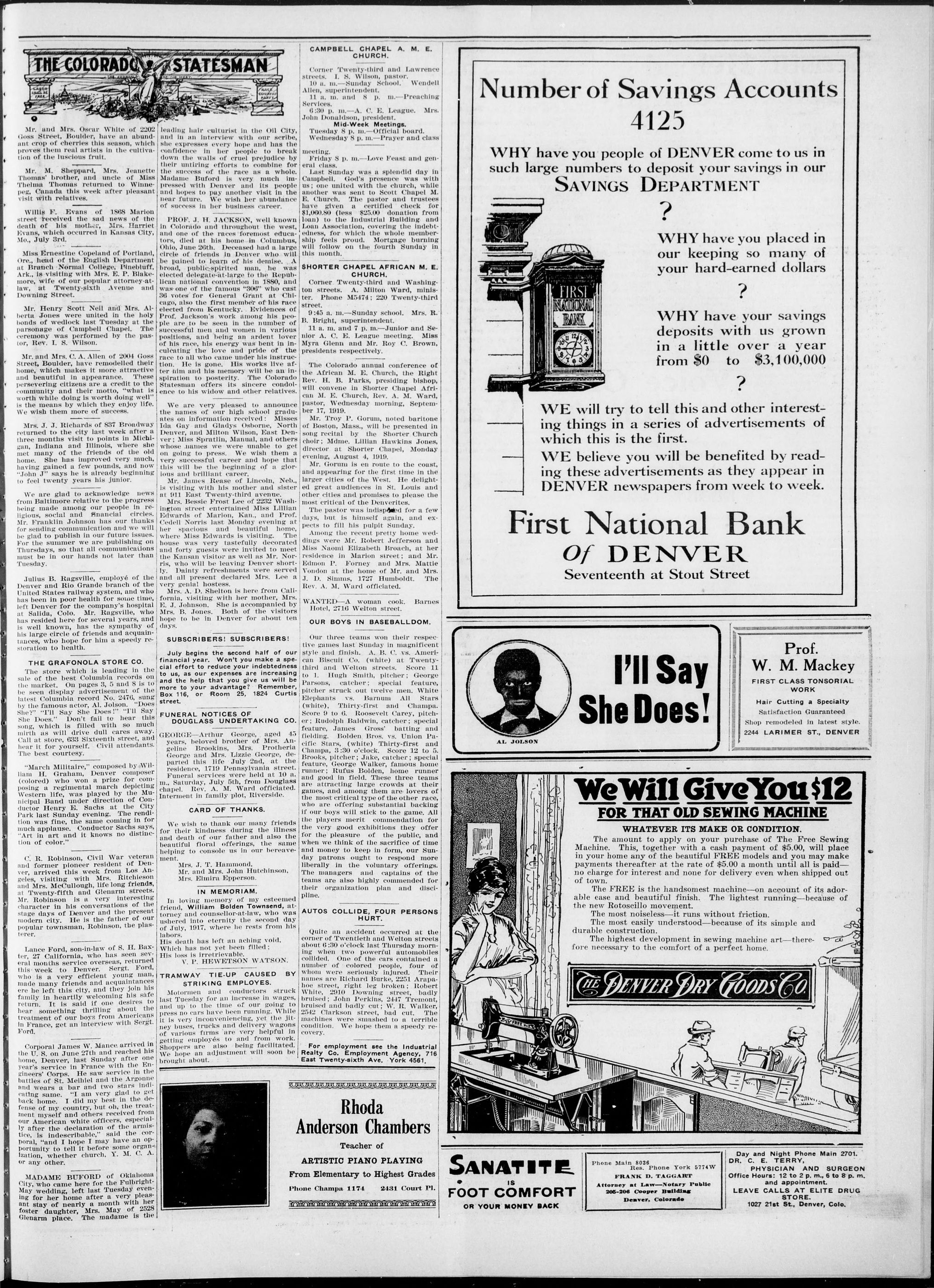
The store which is leading in the sale of the best Columbia records on the market. On pages 3, 5 and 8 is to be seen display advertisement of the latest Columbia record No. 2476, sung by the famous actor, Al. Jolson. "Does She? "Till Say She Does!" "Till Say She Does." Don't fail to hear this song, which is filled with so much mirth as will drive dull cares away. Call at store, 633 Sixteenth street, and hear it for yourself. Civil attendants. The best courtesy.
"March Militaire," composed by William H. Graham, Denver composer (colored) who won a prize for composing a regimental march depicting Western life, was played by the Municipal Band under direction of Conductor Henry E. Sachs at the City Park last Sunday evening. The rendition was fine, the same coming in for much aplause. Conductor Sachs says, "Art in art and it knows no distinction of color."
C. R. Robinson, Civil War veteran and former pioneer resident of Denver, arrived this week from Los Angeles, visiting with Mrs. Ritchleson and Mrs. McCullough, life long friends, at Twenty-fifth and Glenarm streets, Mr. Robinson is a very interesting character in his conversations of the stage days of Denver and the present modern city. He is the father of our popular townsman, Robinson, the plasterer.
Lance Ford, son-in-law of S. H. Baxter, 27 California, who has seen several months service overseas, returned this week to Denver. Sergt. Ford, who is a very efficient young man, made many friends and acquaintances he left this city, and they join his family in heartily welcoming his safe return. It is said if one desires to hear something thrilling about the treatment of our boys from Americans in France, get an interview with Sergt. Ford.
Corporal James W. Mance arrived in the U. S. on June 27th and reached his home, Denver, last Sunday after one year's service in France with the Engineers' Corps. He saw service in the battles of St. Mehiel and the Argonne and wears a bar and two stars indicating same. "I am very glad to get back home. I did my best in the defense of my country, but oh, the treatment myself and others received from our American white officers, especially after the declaration of the armistice, is indescribable," said the corporal, "and I hope I may have an opportunity to tell it before some organization, whether church, Y. M. C. A. or any other.
MADAME BUFORD of Oklahoma City, who came here for the Fulbright-May wedding, left last Tuesday evening for her home after a very pleasant stay of nearly a month with her foster daughter, Mrs. May of 2528 Glenarm place. The madame is the
---
Rhoda Anderson Chambers
ARTISTIC PIANO PLAYING
From Elementary to Highest Grades
Phone Champa 1174 2431 Court Pl.
leading hair culturist in the Oil City, and in an interview with our scribe she expresses every hope and has the confidence in her people to break down the walls of cruel prejudice by their untiring efforts to combine for the success of the race as a whole. Madame Buford is very much impressed with Denver and its people and hopes to pay another visit in the near future. We wish her abundance of success in her business career.
PROF. J. H. JACKSON, well known in Colorado and throughout the west, and one of the races foremost educators, died at his home in Columbus, Ohio, June 26th. Deceased had a large circle of friends in Denver who will be pained to learn of his demise. A broad, public-spirited man, he was elected delegate-at-large to the Republican national convention in 1880, and was one of the famous "306" who cast 36 votes for General Grant at Chicago, also the first member of his race elected from Kentucky. Evidences of Prof. Jackson's work among his people are to be seen in the number of successful men and women in various positions, and being an ardent lover of his race, his energy was bent in inculcating the love and pride of the race to all who came under his instruction. He is gone. His works live after him and his memory will be an inspiration to posterity. The Colorado Statesman offers its sincere condolence to his widow and other relatives.
We are very pleased to announce the names of our high school graduates on information received: Misses Ida Gay and Gladys Osborne, North Denver, and Milton Wilson, East Denver; Miss Spratlin, Manual, and others whose names we were unable to get on going to press. We wish them a very successful career and hope that this will be the beginning of a glorious and brilliant career.
Mr. James Rease of Lincoln, Neb., is visiting with his mother and sister at 911 East Twenty-third avenue.
Mrs. Bessie Frost Lee of 2232 Washington street entertained Miss Lillian Edwards of Marion, Kan., and Prof. Cedell Norris last Monday evening at her spacious and beautiful home, where Miss Edwards is visiting. The house was very tastefully decorated and forty guests were invited to meet the Kansan visitor as well as Mr. Norris, who will be leaving Denver shortly. Dainty refreshments were served and all present declared Mrs. Lee a very genial hostess.
Mrs. A. D. Shelton is here from California, visiting with her mother, Mrs. E. J. Johnson. She is accompanied by Mrs. B. Jones. Both of the visitors hope to be in Denver for about ten days.
SUBSCRIBERS! SUBSCRIBERS!
July begins the second half of our financial year. Won't you make a special effort to reduce your indebtedness to us, as our expenses are increasing and the help that you give us will be more to your advantage? Remember, Box 116, or Room 25, 1824 Curtis street.
FUNERAL NOTICES OF DOUGLASS UNDERTAKING CO.
Funeral services were held at 10 a.m., Saturday, July 5th, from Douglass chapel. Rev. A. M. Ward officiated. Interment in family plot, Riverside.
CARD OF THANKS
We wish to thank our many friends for their kindness during the illness and death of our father and also the beautiful floral offerings, the same helping to console us in our bereavement.
Mrs. J. T. Hammond,
Mr. and Mrs. John Hutchinson,
Mrs. Elmira Epperson.
IN MEMORIAM
In loving memory of my esteemed friend, William Bolden Townsend, attorney and counsellor-at-law, who was ushered into eternity the second day of July, 1917, where he rests from his labors.
His death has left an aching void.
Which has not yet been filled;
His loss is irretrievable.
V. P. HEWETSON WATSON.
TRAMWAY TIE-UP CAUSED
STRIKING EMPLOYES.
Motormen and conductors struck last Tuesday for an increase in wages, and up to the time of our going to press no cars have been running. While it is very inconveniencing, yet the jitney buses, trucks and delivery wagons of various firms are very helpful in getting employees to and from work. Shoppers are also being facilitated. We hope an adjustment will soon be brought about.
1970
CAMPBELL CHAPEL A. M. E.
CHURCH.
Corner Twenty-third and Lawrence streets. I. S. Wilson, pastor. Wardell
10 a. m.—Sunday School, Wendell Allen, superintendent.
A. superintendent.
11 a. m. 8 p. m. —Preaching
Services.
6:30 p. m.—A. C. E. League. Mrs. John Donaldson, president.
Mid-Week Meetings.
Tuesday 8 p. m.—Official board.
Wednesday 8 p. m.—Prayer and class meeting.
Friday 8 p. m.—Love Feast and general class.
Last Sunday was a splendid day in Campbell. God's presence was with us; one united with the church, while another was sent to Scott Chapel M. E. Church. The pastor and trustees have given a certified check for $1,060.80 (less $25.00 donation from loan) to the Industrial Building and Loan Association, covering the indebtedness, for which the whole membership feels proud. Mortgage burning will follow on the fourth Sunday in this month.
SHORTER CHAPEL AFRICAN M. E.
CHURCH.
Corner Twenty-third and Washington streets. A. Milton Ward, minister. Phone M5474; 220 Twenty-third street.
9:45 a. m.—Sunday school. Mrs. R. B. Bright, superintendent.
11 a. m. and 7 p. m.—Junior and Senior A. C. E. League meeting. Miss Myra Glenn and Mr. Roy C. Brown, presidents respectively.
The Colorado annual conference of the African M. E. Church, the Right Rev. H. B. Parks, presiding bishop, will convene in Shorter Chapel African M. E. Church, Rev. A. M. Ward, pastor, Wednesday morning, September 17, 1919.
Mr. Troy P. Gorum, noted baritone of Boston, Mass., will be presented in song recital by the Shorter Church choir; MDme. Lillian Hawkins Jones, director at Shorter Chapel, Monday evening, August 4, 1919.
Mr. Gorum is en route to the coast, and appearing for the first time in the larger cities of the West. He delighted great audiences in St. Louis and other cities and promises to please the most critical of the Denverites.
The pastor was indisposed for a few days, but is himself again, and expects to fill his pulpit Sunday.
Among the recent pretty home weddings were Mr. Robert Jefferson and Miss Naomi Elizabeth Broach, at her residence in Marion street; and Mr. Edmon P. Forney and Mrs. Mattie Vondon at the home of Mr. and Mrs. J. D. Sinmus, 1727 Humboldt. The Rev. A. M. Ward officiated.
WANTED—A woman cook. Barnes Hotel, 2716 Welton street.
OUR BOYS IN BASEBALLDOM.
Our three teams won their respective games last Sunday in magnificent style and finish. A. B. C. vs. American Biscuit Co. (white) at Twenty-third and Welton streets. Score 11 to 1. Hugh Smith, pitcher; George Parsons, catcher; special feature, pitcher struck out twelve men. White Elephants vs. Barnum All Stars (white), Thirty-first and Champa. Score 9 to 6. Roosevelt Carey, pitcher; Rudolph Baldwin, catcher; special feature, James Gross' batting and fielding. Bolden Bros. vs. Union Pacific Stars, (white) Thirty-first and Champa, 3:30 o'clock. Score 12 to 5. Brooks, pitcher; Jake, catcher; special feature, George Walker, famous home runner; Rufus Bolden, home runner and good in field. These three teams are attracting large crowds at their games, and among them are lovers of the most critical type of the other race, who are offering substantial backing if our boys will stick to the game. All the players merit commendation for the very good exhibitions they offer for the pleasure of the public, and when we think of the sacrifice of time and money to keep in form, our Sunday patrons ought to respond more liberally in the voluntary offerings. The managers and captains of the teams are also highly commended for their organization plan and discipline.
AUTOS COLLIDE, FOUR PERSONS
HURT.
Quite an accident occurred at the corner of Twentieth and Welton streets about 6:30 o'clock last Thursday morning when two powerful automobiles collided. One of the cars contained a number of colored people, four of whom were seriously injured. Their names are Richard Burke, 2251 Arapahoe street, right leg broken; Robert White, 2910 Downing street, badly bruised; John Perkins, 2447 Tremont, bruised and badly cut; W. R. Walker, 2542 Clarkson street, bad cut. The machines were smashed to a terrible condition. We hope them a speedy recovery.
For employment see the Industrial Realty Co. Employment Agency, 716 East twenty-sixth Ave. York 4561
Teacher of
Number of Savings Accounts 4125
WHY have you people of DENVER come to us in such large numbers to deposit your savings in our SAVINGS DEPARTMENT
WE will try to tell this and other interesting things in a series of advertisements of which this is the first. WE believe you will be benefited by reading these advertisements as they appear in DENVER newspapers from week to week.
First National Bank Of DENVER Seventeenth at Stout Street
The amount to apply on your purchase of The Free Sewing Machine. This, together with a cash payment of $5.00, will place in your home any of the beautiful FREE models and you may make payments thereafter at the rate of $5.00 a month until all is paid—no charge for interest and none for delivery even when shipped out of town.
The FREE is the handsomest machine—on account of its adorable case and beautiful finish. The lightest running—because of the new Rotoscillo movement.
The most noiseless—it runs without friction.
The most easily understood—because of its simple and durable construction.
The highest development in sewing machine art—therefore necessary to the comfort of a perfect home.
FIRST
NATIONAL
BANK
WE will ing things which this WE believe ing these a DENVER
First N
Of
Sevent
AL JOLSON
W
F
The
Machine
in your
payment
no charge
of town
The
able ease
the new
The
The
durable
The
fore need
THE
FREE
SANATITE
IS
FOOT COMFORT
OR YOUR MONEY BACK
WHY have you placed in our keeping so many of your hard-earned dollars
WHY have your savings deposits with us grown in a little over a year from $0 to $3,100,000
will try to tell this am
ings in a series of ac
this is the first.
I'll Say
She Does!
We Will Give
FOR THAT OLD SHE
WHATEVER ITS MAY
The amount to apply on your
shine. This, together with a ca
our home any of the beautiful
ments thereafter at the rate of
charge for interest and none for
own.
The FREE is the handsomest m
case and beautiful finish. The
new Rotoscillo movement.
The most noiseless—it runs with
The most easily understood—b
ble construction.
The highest development in se
necessary to the comfort of a p
THE DENVER DRY
ell this and other interest- series of advertisements of first. will be benefited by read- sements as they appear in papers from week to week. National Bank NVER at Stout Street
Will Give You $1
AT OLD SEWING MACHINE
NEVER ITS MAKE OR CONDITION.
To apply on your purchase of The Free Sew
together with a cash payment of $5.00, will
of the beautiful FREE models and you may
at the rate of $5.00 a month until all is p
est and none for delivery even when shippe
the handsomest machine—on account of its
beautiful finish. The lightest running—becau
movement.
Press—it runs without friction.
Understood—because of its simple and
development in sewing machine art—there-
e comfort of a perfect home.
ER DRY GOODS CO.
WHATEVER ITS MAKE OR CONDITION.
The most noiseless—it runs without friction.
Phone Main 8036
Res. Phone York 5774W
FRANK D. TAGGART
Attorney at Law—Notary Public
205-206 Cooper Building
Denver, Colorado
---
?
other interest- vertisements of
benefited by read- they appear in a week to week.
Bank
R
reet
Prof.
W. M. Mackey
FIRST CLASS TONSORIAL
WORK
Hair Cutting a Specialty
Satisfaction Guaranteed
Shop remodeled in latest style.
2244 LARIMER ST., DENVER
Save You $12
SEWING MACHINE
OR CONDITION.
Purchase of The Free Sewing
payment of $5.00, will place
free models and you may make
$0.00 a month until all is paid—
delivery even when shipped out
machine—on account of its ador-
lightest running—because of
out friction.
because of its simple and
ing machine art—there-
fect home.
Goods Co.
Day and Night Phone Main 2701.
DR. C. E. TERRY,
PHYSICIAN AND SURGEON
Office Hours: 12 to 2 p. m., 6 to 8 p. m.
and appointment.
LEAVE CALLS AT ELITE DRUG
STORE.
1027 21st St., Denver, Colo.
Censor Helped Defeat Germany
POSTWAR ACTIVITIES ON THE THAMES
POSTWAR ACTIVITIES ON THE THAMES
© Western Newspaper Union
With the end of the war the locks of the Thames river are becoming alive with pleasure craft again. Great crowds flock to this river to enjoy the pleasures it affords. Our photograph shows Boulter's lock on a warm Sunday.
Performed Great Service Guarding Allies' Interests During War.
THWART MANY FOE SCHEMES
British Official Expunged "Lord of Hosts" From Lloyd George's Speech as Kaiser's "Aid de Camp" —Smuggling Prevented.
The British postal censor is soon going the way of the telegraph and cable censorship—out. Judging from criticisms in America, such as that of the Merchants' association to the postmaster general, the going of this war institution will be just as joyously welcomed abroad as in England. But whatever the petulance of those who think war restrictions have held over too long, the postal censor, in the opinion of those who have watched his work from the viewpoint of British and allied security throughout the war, has been of the greatest service in defeating Germany.
The nearness of the date of the demise of this institution has called forth considerable information about its work. Thus far, however, there has been no amusing side such as was shown during the obsequies for the cable censorship.
Just after Mr. Lloyd George succeeded Lord Kitchener as secretary for war it is related that he provided the ammunition for the censor to give the paragraphers a lease on war life. Mr. Lloyd George went to Bramshott to bid good by to a Canadian division about to cross the channel. After the inspection he made a speech from his motorcar, concluding with a quotation from the Bible: "And may the Lord of Hosts be with you." Correspondents who sent their dispatches first to the censor were surprised to find the final words of the secretary running in this fashion: "And may _____ be with you." It was amusing, but also serious, in the minds of the news writers, so they protested. However, they got their reply from the censor's department: "The kalser, having claimed the Lord as his aid-de-camp, no reference must be made to the Divinity in this connection."
Enemy Schemes Thwarted.
As I said, the postal censorship has as yet turned up no morsel of relative choleness. The postal censorship, however, has thwarted many enemy schemes that make just as interesting or more interesting reading. Furthermore, the British postal censorship was a much farther reaching organization than was attempted in America, simply because England was the channel through which virtually all questionable mail matter flowed.
POSTWAR ACTIVITIES
With the end of the war the locks with pleasure craft again. Great pleasures it affords. Our photograph
Cotton Seized in 1867 Is Paid for by U. S.
Savannah, Ga.—The claim of the Imperial Importing and Exporting Company of Georgia for $176,666.69 for cotton illegally seized by the federal government in 1867 has been paid, it developed through the filing of a petition in superior court here for permission to notify by advertisements stockholders and others interested.
The money is to be divided among residents of Alabama, Florida, Georgia, Louisiana, Mississippi, North and South Carolina, Tennessee, Texas and Virginia. Lawyers, however, will get half of the total. The case reached final decision in federal courts recently after ten years of litigation.
Truth is mighty—mighty scarce.
---
Voice Orders Rule Air War
ALIENS GOING HOME
The postal censor in London was the dam which held the flood of continental mail until each portion of it could be passed upon and approved before being scattered over the wide world. An idea of the immensity of the task can be obtained from the fact that a staff of nearly a hundred expert linguists was constantly employed to examine and approve mail matter written and printed in more than a hundred languages and dialects. Manuscripts in every conceivable tongue found their place in this great mass of mail, estimated at about 150,000 letters daily.
Much of the mail was passed with only mechanical inspection, so sure did the examiners become of certain categories of communications. But considerable more than the time saved on harmless mail was consumed in exhaustive examination and tests of questionable matter, some of which was subjected to all manner of acid and X-ray inquiry to detect hidden messages.
Smuggling Prevented.
There was also for a time a great smuggling campaign, harmless looking bundles such as newspapers contain-
Voice On Rule
Development of Radio Telephone Permits Personal Direction of Fleets.
PREVENTS MANY ACCIDENTS
At Signing of Armistice Training in Voice-Commanded Flying Was Well Under Way—Pilots Directed From Ground.
Washington.—Previous to the entry of the United States into the war, the problem of airplane radio development had received attention from the army. In August, 1910, the first wireless transmission from airplanes was made. In the years following the development of the airplane radio was carried on through a series of accomplishments. These may be summed as follows:
1912—Message transmitted from airplane to ground by wireless telegraph over a distance of 50 miles.
1915—Fan type of driving the wireless power plant on the airplane developed and adopted.
1916—Radio telegraph transmission from airplane successful over 140
ES ON THE THAMES
of the Thames river are becoming alive crowds flock to this river to enjoy the shows Boulter's lock on a warm Sunday.
ALIENS GO
1,300,000 Will Take $4,000,000,-000 With Them.
Chicago Expert Figures on Vast Exodus for the Department of Labor.
Washington, D. C.—One million three hundred thousand aliens in the United States are planning to desert this country for their homeland and they will take with them approximate-4,000,000,000 American dollars.
These facts were disclosed in a report by Ethelbert Stewart of Chicago, director of the investigation and inspection service of the department of labor, after an investigation of prospective emigration from America.
The estimate, Mr. Stewart says, is conservative. That the aliens will take $4,000,000,000 is figured on the basis
---
ing various commodities then obtainable in enemy countries, such as coffee, rice, tobacco, sugar, and so on. Some even contained rubber hiddtn between the pages of the papers.
The most-sought-after evidence was that of military character, and the censorship of mails more than repaid its expensive outlay in detecting information that might have wrought havoc with allied arms, or at least helped Germany in no uncertain degree. There is little doubt that none of that character of information which the censorship obtained will be made public, but officials directing Britain's war machines have not been slow to say that thanks to the postal censorship much valuable military information, of every conceivable character, came to their attention.
Propaganda was the greatest and most constant effort of the Germans. The most harmless appearing sets of newspapers and magazines, some of them with covers dated before the war, dispatched from neutral nations to individuals or societies, such as scientific organizations, were often found to contain the latest German accusations of British mismanagement in Egypt, India or Ireland. Books, not always in German, were found to contain everything except what the title proclaimed. The postal censorship today possesses an intensely interesting museum of many of the propaganda carriers the Germans sent out, or caused to be sent out from their agents in neutral countries.
miles of distance; radio messages transmitted between airplanes in flight; airplane radio telephone constructed. 1917—The human voice transmitted by radio telephone from airplane to ground.
Talk Thousands of Miles.
Contemporaneous with this was the commercial development of the radio telephone for ground and ship use by engineers of the American Telephone and Telegraph company. This culminated in a successful transmission from the naval radio station at Arlington to stations thousands of miles away.
In May, 1917, steps were taken to combine the experience of the engineers and of the army in developing the airplane wireless.
Six weeks later the airplane telephone was a fact, and in October, 1917, a long-range test was made. Telephonic communication was carried on between airplanes in flight up to 25 miles apart and from airplane to ground up to a distance of 45 miles.
The development of voice commanded flying was definitely begun at Gerstner field, La., in May, 1918. On June 1 an aerial review was given by an air fleet of two squadrons of 18 planes each, followed by a close order drill by a section of six airplanes. Throughout the review and the drill command was exercised by the voice of the commander flying with the fleet. In September following, voice commanded flying was instituted at several other fields.
Avoids Many Accidents.
By using the airplane radio telephone in instructing aviators in aerial gunnery it was found possible to reach the same efficiency with a saving of one-third of the time. By exercising control over pilots in the air, accidents were practically eliminated.
At the signing of the armistice, development and training in voice commanded flying was well under way. Numerous demonstrations were held during November and December and a fleet of 204 airplanes was maneuvered in the air at San Diego by voice command.
In the practical application of the airplane radio telephone to airplanes, over 6,000 flights have been made with this apparatus in this country. In the last 2,000 flights there have been only 74 cases of airplane trouble and only 25 cases of radio trouble.
Shipments of the apparatus to France in quantities began August and September, 1918, and of trained air service radio personnel in October. Had the war continued the voice-commanded military air unit would undoubtedly have made itself felt.
that the average amount each allen will carry is $3,000.
An official statement from the department of labor says that up to June 1 investigationls covered Chicago, the Indiana steel mill district (South Chicago, East Chicago, Indiana Harbor, South Bend, Gary, etc.), Detroit, Pittsburgh and surrounding steel districts, Johnstown, Pa., Youngstown, O., and Wilkesbarre, Pa., and surrounding coal mining area.
Of 163,498 Poles covered by the investigation, 24,590, or 15.04 per cent, will retrun to Poland, Austro-Hungarians, 28.02 per cent; Russians, 35.70 per cent; Croatians, 21.75 per cent; Lithuanians, 9.72 per cent; Roumanians, 64.29 per cent; Itallians and Greeks, 11 per cent; Serbs, 36.90 per cent; Slovaks, 84.50 per cent.
The center of the quinine cultivation activity until recently in Perue has been transferred to Java.
SENATE TO RATIFY TREATY AND LEAGUE
BELIEF IS IT WILL DO THIS
HOWEVER, WITH SERIES OF
RESERVATIONS FOR FUTURE.
ALLIES WOULD NOT OBJECT
England and France Want United States in the League of Nations as Next Best Thing to an Actual Alliance.
By EDWARD B. CLARK.
Washington.—Men who are accounted keen observers of legislative situations seem to believe today that the peace treaty and the league covenant will be sanctioned by the United States senate in the form that they are written, but that there will be a series of written reservations passed by the senators which will concern themselves with the attitude of the United States in the future towards certain provisions of the document or documents.
Of course it cannot yet be definitely determined whether this view of the situation is a correct one, but it is a fact that men who are opposed to the covenant as it stands and men who are in favor of it agree in effect that the outcome is to be as above written.
What the reservations will be in their entirety cannot be told, but it is known that in part they will concern themselves with immigration questions, with the Monroe doctrine, and probably with some things connected with rights of withdrawal from the league and with suggestions concerning the armed part which the United States is expected to bear in case of embroglitos.
I have talked with men who are in touch with the foreign feeling on such an outcome as that outlined above. It seems that the British and the French are perfectly willing to allow the United States to make its reservations. Reservations or no reservations, the covenant will go into effect and the future, so far as the senate's action is concerned, will be allowed to take care of itself, the belief of the foreigners apparently being that nothing which the senate shall insist upon in separate document will affect the smoothness of the running of the world's affairs.
Bunau Varilla Favors League.
Bunau Varilla, the great French engineer who directed the work on the Isthmus of Panama when the French company had it in charge, is in Washington. This Frenchman lost a leg at Soulilly, not far from Verdun, about two years ago. He was the engineer in charge of providing the water supply for the French armies and it was some job. A Boche airplane dropped a bomb near the general's headquarters and he was maimed, but notwithstanding the number of his years he recovered, later to return to the front and still later to journey to the United States.
Bunau Varilla is in favor of a League of Nations. So it is understood are most other Frenchmen of high official standing. This also is true of the British of like estate. One learns one thing, however, in Washington through direct and indirect touch with visiting foreigners, and the facts may just as well be faced. It is not to be supposed that the French and British are in love with the League of Nations so much because they believe it will solve all the war problems of the universe, or that it will prevent for all time territorial and racial bickering. They want the League of Nations mainly because the United States will be a party to it, and France and England, barring the possibility of an actual alliance with the United States, feel that the league is the next best thing.
Hun Army Was Whipped.
An American correspondent, Frank H. Simonds, cabling from Paris, says: "German public men are making desperate efforts, with certain success in some directions, to give the impression that the German surrender last November was due solely to the principles of the fourteen points." This simply means that the German officials are trying to make their people believe their army and their navy were undefeated last November, and that when surrender came it was not forced but voluntary, because of a desire to end the war in behalf of all peoples.
American army officers, some of whom are in Washington, and scores of them still in France, know that this German contention is a lie, that the German authorities know that it is a lie, and that the people of Germany ought to be made to know that it is a lie.
One of the worst features of this attempt on the part of the German high command is to make it appear that their armies were not in a bad way last November is that thousands of Americans seem to think the same thing. They are just as badly informed on the subject as are many of the German people.
What All Americans Should Know.
It ought to do some good to let all Americans know that while Germany could have fought for a while longer, she could have fought nothing but a defensive battle on a line that would have crumbled quickly and laid open her country to the invading forces.
Your correspondent was north of the Argonne forest at the headquarters of an American major general at the time that the armistice was signed. The entire situation as regards the German army was thoroughly understood by high commanding Americans, and it was a very mentally dense doughboy who did not know for himself just how things stood with the foe that was confronting him from Metz to Belgium. It is true that the Germans ranagged to keep their battle line intact; that is, they had troops confronting every unit of the allied forces, but they had no reserves worthy of the name, and while their supply of ammunition was sufficient for some weeks' fighting, the end of the supply was in sight.
All these things were known to the American commanders. The Intelligence service of the armies of the allies was of the best. Information was obtained from captured prisoners, from raids on German trenches, from airplain observation and by other means. The Germans had a railroad line and a high road running from Metz in Lorraine, which was one of their great military strengths, to the army lines back of Verdun.
Nothing Left But Retreat.
The Americans cut off the St. Michel salient and drove the Germans back north of Hatton Chatel, where the enemy established a new line. North of the Argonne the enemy was driven back to Sedan, which fell some days prior to November 11.
The railroads and highways from Metz to the west were under American artillery fire. In a few days at the most the German armies from north of Sedan to Metz could have been supplied only in a roundabout way, a way so difficult that it virtually was impossible to use it adequately.
There was nothing left for the German army except retreat, which meant soon the isolation of Metz, the fall of that stronghold, and a precipitate retreat of the Germans into their own territory. There was no other way out of it.
The German army of November 11 last was licked out of its boots. Its commanding officers knew it. They saw the inevitable facing them and hastily they took advantage of the opportunity to enter into an armistice.
Army of 500,000 Urged.
Military men say that 500,000 regular troops will be necessary to maintain America's part of its obligations under the League of Nations. General Peyton C. March, chief of staff, has testified to this effect before the senate committee on military affairs.
There is apt to be a misunderstanding concerning what is said before the committees of congress on army matters. The administration has asked for appropriations for continuing a force of 500,000 in service until peace becomes stable and the League of Nations becomes a reality, if it is to become one. In addition to this, the belief of military men is that a large force of regulars must be maintained after the present war is a thing of the past and the League of Nations is in existence.
This is a mere statement of the things that have been presented by military chieftains and by the secretary of war to the house and to the senate committee which has been taking under consideration the matter of appropriations for the army as it is to continue until peace is an actuality. In the heartings which have been held the future has been gone into as well as the present, and it is for this reason that the regular army of the future has been under discussion.
Wide Variance of OpInion.
There seems to be a feeling among majority members in congress that the United States regular army safely can be cut to 125,000 men after peace definitely is established. Therefore the country can see at once how wide the variance is between congress and military chieftains on the subject of the force necessary for the country to maintain under the ordinary conditions of world affairs. It seems that the chief of staff believes the provisions of the League of Nations will make it necessary for us to maintain an army of half a million, notwithstanding the fact that the league in its provisions aims to make military forces to a considerable extent unnecessary. However, as the chief of staff views it, the force will be necessary in case the provisions of the league are violated and the United States intends to live up to its obligations under the covenant.
Secretary of Baker in urging that present appropriations be based on an army of 500,000 men is moved by his desire to make recreational and educational work in the army an abiding feature thereof in order to stimulate enlistments and to make the army not only a fighting force, but a school in which men can fit themselves for certain lines of activity in civil life. It has been the endeavor to get from army men their views of the possibilities of enlisting by the volunteer plan enough men to keep filled the ranks of an army of half a million men. No army officer has been found who believes that in peace times the ordinary enlistment methods will be sufficient to maintain the half million force which March thinks will be necessary.
It is the secretary of war's view that if recreational and educational features are added to the service of the soldier, young men will be willing to enlist in order to get the benefits which the service will afford.
"Y." of Course.
Before they were married she thought him a treasury, now she considers him a treasury.—Edinburgh Scotsman.
The
WARD AUCTION
COMPANY
Sales Daily at 2 p.m. Office Furniture a Specialty.
PRIVATE SALES AT ALL TIMES
HAVE MOVED TO—
1723-39 GLENARM ST.
PHONE MAIN 1675.
THE BEST ICE CREAM AND
CANDIES AT
O.P. BAUR & CO.
CATERERS AND
CONFECTIONERS
Phone: 168.
1513 Curtis Street, Denver, Cola.
JOSEPH CARTER
Express, Moving,
and Storage
COAL AND WOOD
PROMPT DELIVERY.
Phone Main 6544.
2415 WASHINGTON STREET.
ORIENTAL RESTAURANT
Chop Suey, Noodles and Short Orders
Phone Champa 113
1848 Arapahoe
东洋轩
Miss M. Cowden Hair Dressing Parlor
Shampoo, cutting and curling. Scalp treatment, hair tonics, hair straightening, manicuring. Stage wigs for rent; theatrical use and masquerades. Goods delivered out of the city. All shades of hair matched by sending sample of hair; also combings made up.
Cheapest Switches 50 Cents
1223 21st St. Denver, Cele.
Phone Champa 3977
Don't Take It
For Granted
that just because you are in
business, everybody is aware
of the fact. Your goods may
be the finest in the market
but they will remain on your
shelves unless the people are
told about them.
ADVERTISE
If you want to move your merchandise. Reach the buyers in their homes through columns of THIS PAPER and on every dollar expended you'll reap a handsome dividend.
THE Merchants who advertise in this paper will give you best values for your money.
Pithy News Notes
From All Parts of
Colorado
Western Newspaper Union News Service.
The total acreage of corn grown in Colorado in 1909, according to the census report, was 326,559 acres. In 1919 five counties in the eastern part of the state have more than 350,000 acres of corn in cultivation.
San Juan county, the smallest county in the state save Denver, has produced since 1873 metals to the value of about $65,000,000, the chief value being in gold, approximately $25,000,000. This is one of the leading metal producing counties in the state.
Cherries in the Uncompahgre valley are bringing as high as $20 a ton this year. This is one of the best prices ever recorded for sweet cherries and the growers are having no difficulty in disposing of their entire outputs to the many shippers who are bidding for the cherries.
Sixty thousand dollars in improvements will be made on the water system of the Modern Woodman sanatorium at Colorado Springs, according to an announcement by Dr. J. A. Rutledge. The authorization was made by the sanatorium committee of the board of directors.
While Colorado ranchers are employing all the harvest hands they can obtain, calls are coming in dally from other Western states for more and more workers, the latest of these being a message from the Nebraska State Labor Department's employment bureau which asked for 2,000 men.
Raymond Embler Walker, twenty-two years old, son of Mr. and Mrs. C. A. Walker, loiving in the Haskell neighborhood, was drowned at Hugo while fishing in the Blue lakes. Mr. Walker returned recently from war service in France, and was one of the most popular boys in Hugo.
The Great Western Sugar Company, with headquarters in Denver, set a precedent for sugar companies by announcing an eight-hour day for all employees in its factories, the company, according to W. D. Hoover of the firm, being the first sugar concern to establish the new hour basis. R. L. Stringer, 53, during a family quarrel at Cannon City, shot and killed his son-in-law, O. A. Stephen, 34. News of the killing did not become public until Stringer surrendered to Sheriff Newcomb. Stringer refused to give any details of the tragedy to the sheriff, except to state that he killed his son-in-law during a quarrel.
Charles Bellamy was killed and Charles Cleary of Fleming, Colo., was probably fatally injured when a roadster driven by Fred Sharp hit a ditch and overturned near Haxtun. The latter was only slightly scratched. Bellamy's chest was crushed and his head nearly severed from his body. He was taken to a hospital for treatment, but lived only an hour.
Denver got its first glimpse of the completed lighting system on the Civic Center when the lights were turned on to test them and judge the effect, preparatory to the dedicatory ceremonies, which are planned for Colorado Day, Aug. 1. Experts pronounced the system perfect. The lights are so placed that there is scarcely a suspicion of a shadow anywhere within the grounds.
Total collections by the inheritance tax department for the last fifteen days of June amounted to $12,960.79, bringing the total for the new biennial period to $415,515.36, according to figures given out by Attorney General Victor E. Keyes. The largest tax against any estate was that of Isaac Berlin of Denver, the amount being $5,859. The estate of Albert Hahenwald was given the second highest tax, it being $240.95
Building operations in Denver for June totaled $521,650, or more than double the cost of operations for June, 1918, according to the monthly report issued by Frank M. Ladd, chief of the building inspection department. Permits were issued for the erection of fifty-three brick residences at a cost of $278,500. This item alone is greater than the total for June of last year, which was $225,600. Seventy-three garages, two churches, a hospital and an airplane hangar are also included in the month's building activity.
The lophole by which many auto owners have escaped the paying of their automobile licenses was closed when the Supreme Court rendered a decision against Samuel Ard of Logan county, asserting that he had violated the motor vehicle law by not paying his license. Ard had been fined by the District Court in his home county but had appealed the case on the ground that the state was using the police power to produce revenue, and that, therefore, the law authorizing the license fee was unconstitutional. He also contended that the tax placed a burden on some and exempted others, thus creating "class legislation."
George Coburn, 15, son of Earl Coburn of Greeley, and Harold Coburn, 17, his cousin, son of Charles D. Coburn of La Salle, were drowned in Seeley lake, four miles northwest of Greeley, when they became alarmed by a high wind which arose on the lake and attempted to swim 115 yards to shore from a raft which they had been poling. Jess Fraker, who was with them, was pulled from the water unconscious after he had swam most of the distance, and was revived through energetic first-ald efforts on the part of the rescuing party.
CENTENNIAL STATE ITEMS.
The United States mint in Denver, for the fiscal year ending June 30, minted 55,114,400 coins to the value in real money of $3,175,368, according to the statement made by Thomas Anneur, superintendent of the mint. The superintendent's report shows that of these totals there were 2,882,600 half dollars, $1,414,300; 2,801,000 quarters, $700,250; 4,645,000 dimes, $464,500; 3,036,500 5-cent pieces, $151,825, and 41,749,300 pennies, $417,493. No gold coins were minted during the year. For the fiscal year ending June 30, 1918, there were 89,200,000 pieces to the value of $6,500,000 minted. In the last fiscal year the demand for pennies all over the United States, principally caused by war taxes, caused the enormous coinage of this money.
Declaring that the grave in which the bodies of two Mexicans were found was dug by them in which to bury his body, Joe Borrere confessed to Sheriff Wilson of Delta county that he had killed the men, but had acted in self-defense. The bodies of the two Mexicans were found in the grave in a beet field. Borrere subsequently was arrested, and he was taken to the scene of the double tragedy, where, according to Sheriff Wilson, he made his confession after undergoing a rigid examination.
An inheritance tax, amounting approximately to $50,000 will be collected by the state from the heirs of Kenneth Dows, the attorney general's office, which has charge of inheritance tax collections, announced. An investigation, Attorney General Victor E. Keyes said, revealed that Dows had $1,000,000 worth of property in the state of New York besides the home at 140 Gilpin street, recently sold to Herman B. Gates, and other property in Colorado. Mr. Dows died several months ago.
The Gold King Extension mill, located at Gladstone, Colo., is in operation again. This mill is one of the largest in the San Juan district. It has a capacity of 500 tons, and about fifty or sixty tons of concentrates, which carry gold, silver and copper, are made daily. The most important piece of machinery that has recently been installed is a Gates gyratory crusher, Amalgamating tables, card tables and the machinery for the tube mill also have been installed.
The biggest business done in the history of the Denver postoffice was recorded at the close of the fiscal year for 1918-19, June 30. Figures announced by Charles F. Trotter, assistant postmaster, show an increase of 8 per cent, or $162,628.75 in the postal receipts over the preceding fiscal year. The total receipts for the fiscal year ending June 30 were $2,190,331.18, compared with $2,027,702.43 for the preceding year.
Two broken elbows, a fractured leg and internal injuries were sustained by Ben H. Harris, a telephone lineman, who fell from a pole at Manitou. He was climbing the pole and carrying a roll of wire when a loose end came in contact with a trolley feeder wire and the shock threw him from his perch. If he had worn his safety belt it was believed that he would have been electrocuted, but the fall saved his life.
The first attempt ever made to sail an airplane over Pike's Peak will be made about July 20 when the flying circus from Ellington field performs at Colorado Springs. Lleut. C. C. McNutt, the Denver aviator, who made the Houston-to-Denver flight during the Liberty loan drive and also made many spectacular flights in Denver and along the route, will attempt the feat.
A. T. Ransom and Ted Dobbell, Colorado Springs men, were held up and robbed of $9 on the Denver road by a lone robber, who overlooked their watches and billbooks. His haul would have been worth $500 to him if he had searched his victims carefully. He was unmasked and stopped Ransom's car with a request for a ride before he drew his revolver.
During June Cripple Creek produced 62,900 tons of ore, having a gross value of $648,893. Of the ore produced 850 tons were shipped to the smelters. The balance was treated at the various mills in the Cripple Creek district and Colorado Springs. The mill ore averaged $10 per ton in value, ranging from $1.42 average at the Vindicator mill to $20 at the Golden Cycle mill, Colorado Springs. The May output amounted to 65,376 tons, with a gross value of $691,861.
Judge W. P. Kinney was re-elected president of the Colorado Springs Mining Stock Association at its annual meeting held at Colorado Springs. Irving Howbert was elected to succeed the late J. Addison Hayes as vice president and Fred H. Shantz succeeds Charles D. Hopkins as secretary. It is the twenty-fifth year of the exchange.
Twenty-nine more army trucks have reached Denver consigned to the Colorado Highway Commission, according to announcement by E. E. Sommers of the commission. The state now has forty-six of these trucks, including this shipment. The twenty-nine trucks arriving came from Fort Benjamin Harrison, Ind., and are mostly "heavies." Casualties among the prairie dogs, which are considered the worst farm pests, have passed the million mark since G. W. Boyd of Denver introduced the famous prairie dog poison around Montrose. Up until that time the pests did an annual damage of more than $75,000 on deeded land alone, with another $25,000 for the government-owned land. More than 2,100 gallons of this poison have been used in this campaign and more than fifty users report that it has practically eliminated the elusive prairie dog from their property.
The KITCHEN CABINET A recipe for proud cooks-When you taste a blueberry pie that you have just made and feel a thrill of pride at its delicious flavor, always remember that you didn't make the blueberries.
MEALS FOR OCCASIONS.
We never lose our desire for something new, and when a combination a little unusual is heard about we wish to try it. Squabs Mirabeau. Prepare squabs as for roasting, broil five minutes in broth, and then remove them. Silt them down the back, without breaking the breast
Squabs Mirabeau. Prepare squabs as for roasting, broll five minutes in broth, and then remove them. Slit them down the back, without breaking the breast bone, season with salt and pepper, cover with egg and crumbs and cook in butter fifteen minutes. Garnish with small onions and potatoes browned in butter.
Codfish Bonnefemme.—Butter a long baking dish and place half a codfish, skin side down in the dish, surrounded with potato balls, season with salt and pepper and put butter on top of the fish. Put into the oven to bake, baste frequently, cooking about 15 minutes. Just before serving baste again and brown, then sprinkle with minced parsley and serve.
Raspberries a la Astor.—Take two cupfuls of raspberries, add a little lemon juice and powdered sugar and a pinch of nutmeg. Mix thoroughly with whipped cream and flavor with maraschino. Sprinkle with pistachio nuts finely minced, place on ice to chill for two hours before serving.
Braised Tongue. — Cook a beef tongue slowly for two hours or until tender, skin it and put it in a casserole. Melt three tablespoonfuls of butter, add three of flour and cook until smooth; add a pint of broth in which the tongue was cooked and a pint of stewed and strained tomatoes. Cook until thick, adding one chopped onion and half a carrot finely minced, half a tablespoonful of Worcestershire sauce, a few dashes of red pepper and the tongue. Cover and simmer for two hours. Serve from the casserole.
Cherry Olives.—Fill quart jars with the fruit well washed but not stemmed. Add a level teaspoonful of salt and fill the jar with good vinegar. Seal and put away for later use. The cherries may be eaten from the stems and are a delicious relish, keeping well if the vinegar is good, for two or three years.
If you have a few tablespoonfuls of cooked corn left over, add it to the potato salad; it gives a most appetizing flavor.
Half the joy of life is in little things taken on the run.
MISS CELLANEOUS.
Miss Cellaneous, though a small and dainty damsel, is one of the most extravagant. She never buys anything much over five or ten cents, but what enormous bills they foot up, at the end of the month. Miss Cellaneous, too, has to
never buys anything much over five or ten cents, but what enormous bills they foot up, at the end of the month. Miss Cellaneous, too, has to bear the burden in our expense account of the things we cannot remember about, because we must balance our accounts. Five, ten, fifteen cents, or a quarter seems so little, so we go to the movie, buy a little candy, a magazine or a new ribbon, often things we do not need, and the sum mounts up to quite a showing at the end of a month. It is the smallness of the amount which is our undoing. The old saw which tells us to "look out for the pennies, for the pounds will take care of themselves," is one we should heed.
It is the experience of those who have observed, that the person who buys hothouse fruits and vegetables early in the season is the one who finds it necessary to call for help when it comes time to buy coal.
It is the little leak, the small bill that we need to watch, for most of us find it necessary to deliberate with caution when spending large amounts. One does not wish to be penurious or miserly, traits which are decidedly unpopular, but we must, if we live within our income, use discretion in our buying.
The family with small income can by careful management, lay by a small amount each week. The small sum grows and even the children in such a home form thrifty habits. When misfortune and sickness come there is a sense of security in the tidy little bank account, which makes them independent.
It is fully as inconsiderate for a woman to use the earnings of her husband in riotous spending. Our girls need training in marketing and shopping as well as in cooking and homemaking. No two families with the same income can follow the same rule c' expenditure, for happily we all have individuality and like different things. Each housewife has her own problem to solve; she may get great help and inspiration by reading or by conference with other housekeepers, but her problem is hers alone to work out, and the efficient, up-to-date woman is constantly looking to improve her methods. In these days of high prices and stationary salaries we are called to put forth the best effort to make every cent do its full duty.
Nellie Maxwell
BUSINESS MEN IN HISTORY
Interesting Question as to Whether It Is Better to Be Owner or Employee.
The main object of life is doubtless to get something out of it besides trouble, and so any critical comparison of rival methods of earning a living cannot fall to be interesting to all men. The only ones not affected are the carefree hobo flitting from place to place and the wise lad who early in life took the precaution to marry the lovely daughter of the capitalist.
Now, about the matter of running your own business or working for some one else on salary and commission. If we go into history the testimony is somewhat conflicting, writes J. R. Sprague in Sunset. Moses was a salaried man for the Pharaoh corporation and did very well for himself. On the other hand, our old friend Bismarck, also a salaried man, built up a wonderful business for his firm, but, as so often happens, was thrown out of a job when he got along in years, and the young fellow stepped in and took over the business.
Among those who went into business for themselves, Mark Antony did well and would probably have become head of the world's greatest corporation if he had not got into fast company and wasted his time on wine suppers, houseboat parties, and so on.
Alexander the Great, strictly a business man with no foolishness about him, in ten years built up such a tremendous organization that he fretted because there were no more good-sized towns where he could establish branch houses. Napoleon, who was in business for himself, prospered exceedingly for a number of years and probably would have died rich except for an unwise second marriage and the fact that he tried to spread out too much for his capital.
We all know the outcome of the business owned and managed by William Hohenzollern. Interested creditors would do well to compare a Dun or Bradstreet report on his affairs made in the spring of 1914 with his rating at the present time.
See Stockyards First.
Jim, his father's pride and mother's joy, had been "over word" for nearly two years. Finally word was received that he had reached an Eastern port and would soon be heading for camp to receive his little red discharge chevron.
Eagerly the home folks had waited to welcome back their hero and planned to make the day of his arrival here en route to camp a big one.
At four o'clock one afternoon Jim's voice came over the telephone to his dad: "Leaving in fifteen minutes for camp."
Unable to understand the short stop-over, the father inquired the time of his arrival in Chl.
"Well, now, it was this way," explained the warrior: "We got in at nine o'clock this morning, but I had a couple of pals with me who had never seen the stockyards, and I took them out to show them the place."—Chicago Tribune.
His Girl
Dewey was six and it was his first year at school. He remained after school each evening, not because of falling to get ideas, for Dewey had plenty of ideas and room for more, but for sufficient reasons he had a special permit to stay. This gave him good opportunity to confide in Miss O., his teacher, about his "girl"—and every little brown curl around his neck nodded approval to all he said.
On this particular afternoon, after the others had gone and all was still, Dewey, with wistful, big brown eyes, said: "Miss O., you can't guess who my girl is now?" as if he were accustomed to changing. "It's Margaret," and as he turned his head this way and that the little brown curls always assenting, he waded deeper: "I never knew what love was till I saw Margaret."—Indianapolis News.
Those Yankee Vandals.
A huge electric cross formed part of a German holiday celebration in one of the bridgehead towns. On New Year's eve a private had "fraternized" to the extent of several schnapps and was walking toward his billet when he came upon a small group of Germans.
"Nob-end," said the buck genially. "Schoen," answered the admiring German, looking up at the sign.
The buck looked up. "Ja wohl." He straightened himself and charged forward. "She's erste classe. She's mine."
A friendly M. P. soothed a sputtering burgomeister and escorted the souvenir hunter to his bunk.—Sergt. L. E. Wralthman, A. E. F., in Judge.
Americans Led in Aviation Peak.
The first aviators to fly from or to the deck of a warship were Americans. Eugene Ely flew from the deck of the scout cruiser Birmingham on November 14, 1910, and on January 18, 1911, the same aviator in a flight made by him at San Francisco allighted on the deck of the battleship Pennsylvania. He then made a return flight from the deck of that warship. Other American aviators have since performed the same feat.
Stirring Incident.
"Did you find your first airplane flight exciting?"
"I certainly did," said the venturesome citizen. "At the last moment friend wife rushed up and tried to prevent me from going and when the propeller began to whirl she did a nose dive into the arms of her nearest relative."—Birmingham Age-Herald.
To Friends and Strangers of Denver Attention! The Sun Beam Cafe
Wishes to welcome all to good home cooking and dainties of the seasons, any time from 6 a. m. to 11:30 p. m. Accurate service at all hours; so when down town stop, give us a trial and we will guarantee you will leave with a smile. MRS. M. J. FRANKLIN & S. BOWERS, Props. 924 19th St.
The Curtis Park Floral Company
FLORAL DESIGNS PUT UP W
YOU W
CHOICE PLANTS AND CUT
GREENHOUSES: Thirty-Four
TELEPHONE, MAIN 1811
Weather
FLORAL DESIGNS PUT UP WHILE YOU WAIT
CHOICE PLANTS AND CUT FLOWERS CONSTANTLY ON HAND
GREENHOUSES: Thirty-Fourth and Curtis Streets
TELEPHONE, MAIN 1811
DENVER, COLO
Weatherhead Hat Co.
TELEPHONE
MAIN 3203
Established 1876
RENOVATORS, BLEA
Of Gents' and La
1624 CHAM
Phone Champa 5431
NOVATORS, BLEACHERS, DYERS AND FINISHERS
Of Gents' and Ladies' Hats of Every Description
1624 CHAMPA ST., DENVER, COLO.
hampa 5431 Private Booths for Ladies
NIGHT AND DAY CAFE
AND COLD DRINK PARLOR
B. CARRUTH, Proprietor
RENOVATORS, BLEACHERS, DYERS AND FINISHERS Of Gents' and Ladies' Hats of Every Description 1624 CHAMPA ST., DENVER, COLO.
A Full Line of Fresh Fish In Season Oysters and Lobsters Short Orders At All Hours Rest Room for Ladies STREET DENVER, COLORADO
1865-1867 CURTIS STREET
Poro Hair
SCIENTIFIC AND SANITIZ
MASSAGING, MA
Mme. L
o Hair Dressing Parlors
FIC AND SANITARY SCALP AND HAIR TREATMENT
MASSAGING, MANICURING, TOILET ARTICLES
SCIENTIFIC AND SANITARY SCALP AND HAIR TREATMENT MASSAGING, MANICURING, TOILET ARTICLES
Mme. Lexie A. Brooks
DEN STREET PHONE YORK 5997W
2220 OGDEN STREET
MOTTO: "CAREFUL DRIVING, BUT SURE"
J. V. LEWIS AUTO LIV
7 PASSENGER WESTCOT 6 CARS.
TAXICAB RATES:
Depot, 1 or 2 Passenger, 50c; Depot, Each Additional
25c; One Mile Radius, 50c; Each Additional Mile,
RATES PER HOUR, $1.50 TO $2.50.
STAND:
Night—Page Pool Hall, 2710 Welton, Phone Main 1
Day—2450 Washington, Phone York 8601-W.
DENVER, ::: ::: ::: :::
W. LEWIS AUTO LIVERY
7 PASSENGER WESTCOT 6 CARS.
TAXICAB RATES:
or 2 Passenger, 50c; Depot, Each Additional Passenger,
; One Mile Radius, 50c; Each Additional Mile, 25c.
RATES PER HOUR, $1.50 TO $2.50.
STAND:
Right—Page Pool Hall, 2710 Welton, Phone Main 2759.
Day—2450 Washington, Phone York 8601-W.
C. C. DENNIS R. F. LONG
The New Way Shoe
Repairing Co.
AND
American Shoe Repairing
FIRST-CLASS WORK
J. V. LEWIS AUTO LIVERY
Depot, 1 or 2 Passenger, 50c; Depot, Each Additional Passenger,
25c; One Mile Radius, 50c; Each Additional Mile, 25c.
RATES PER HOUR, $1.50 TO $2.50.
STAND:
Night—Page Pool Hall, 2710 Welton, Phone Main 2759.
Day—2450 Washington, Phone York 8601-W.
```markdown
```
---
---
```markdown
```
```markdown
```
PIONEER HATTERS OF THE WEST. WE MAKE OLD HATS NEW.
Motto—"Effliency"
Best Leather Used—Reasonable Prices
1855 Champa St. Phone Main 3737.
1221 Sixteenth St. Phone Champa 5889.
Opp. Golden Eagle. DENVER, COLO.
Caprices in Summer Dress Accessories
THE FASHION
Separate Skirts, Smart and Informal
A
In dress accessories Fashion can indulge her fondness for caprice with greatest certainty of success. Modistes who turn out the beautiful hats of midsummer, take advantage of this and occasionally take the same materials they have used for millinery to make bags. They help to furnish values in these indispensable belongings and demonstrate how chic hats and bags to match may be. Even the happy owner of a fine bead bag might fast approving eyes upon these matched sets, for novelty makes the strongest kind of appeal and she who may not have the much-admitted bead bag may achieve a triumph in one of these millinery affairs.
Every woman knows the loveliness of leghorn hats. They have come down to us through generations of fair women. In the picture one of them has sacrificed its straw crown and replaced it with one of draped taffeta, with a rose and immortelles posed at the front. In the bag to match, a plaque of leghorn makes the bottom of a bag of taffeta like that on the crown of the hat and we infer that it is made from the top of the original crown. A big silk tassel hangs from
Separate S
Smart an
It is gala day for separate skirts. They appear this summer in all sorts of fabrics for nearly all sorts of occasions. Starting out as purely practical and utility garments, they progressed into the more practical of dressy afternoon clothes, and then advanced into the smartest of sport wear. The advent of new weaves in silk boosted the cause of the separate skirt along, and now fabric is too sheer and dainty to make the dressiest of these convenient belongings. Organdie, volle, georgette crepe lend a summery charm to them. Occasions where one wishes to be smartly but informally dressed seem to multiply and the separate skirt fits in with them perfectly.
The two skirts shown in the picture are of fantasi silk and are worn with georgette blouses. The heavy rib and lustrous surface of this silk take the place of trimming. By using the silk so that the rib in it runs one way in the skirt and another in bands or gir-
this plaque. Bands and puffs of tafeta finish the top of the bag and form its handle. A rose and immortelles appear again on the bag as on the hat. It was a bright idea of the designer to pose these little everlasting flowers on leghorn.
Two colors in a faille ribbon are set together to form the handsome bag at the center of the picture. The colors alternate and the point at the bottom is set off with those fashionable little, flower-like straw ornaments that have held good throughout the season, in millinery. The hat to match has a braid brim and ribbon crown, the ribbon woven 'over and under' about the wide crown and lying in strips on the top. The same small straw ornaments nestle against the brim.
The daintiest of these sets is worked out in hair braid. It appears at the right in a hat with hair braid brim and crown, draped with a striped ribbon and trimmed with roses. The bag is made of two plaques of hair braid, joined by a puff of ribbon like that on the hat and lined with satin. Velvet ribbon is used for the handle and bow on the bag and flowers find it the best of all backgrounds.
kirts,
nd Informal
dle, there is all the ornament that good designing requires. This is illustrated in the skirt model at the left in which the wide girdle is made of alternating bands of the silk, two of them with the rib running perpendicularly set together and edged by narrow bands in which the rib is horizontal. There are small set-in pockets at each side. Silk in two colors and of two kinds gives a good account of itself in the skirt at the right of the picture. The lower part of the model is of colored fantasil silk, set onto a plain white satin yoke at the hip line. The joining is managed well by cutting the top of the fantasil portion into a "battlement" line. There are five small pearl buttons at the front of the skirt near the bottom and its wide girdle of the fantasil silk fastens with two very large pearl buttons at the front.
Julia Bottomley
FAMOUS PEACE TREATIES
By H. IRVING KING
(Copyright, 1919, by the McClure Newspaper Syndicate.)
TREATY OF VIENNA, 1864.
Schleswig and Holstein to Prussia.
The treaty of Vienna, signed in 1864, between Denmark on one side and Austria and Prussia on the other, put an end to the war which the two latter powers had been waging against the former and tore the duchies of Schleswig and Holstein from the Danish crown. The revolutionary spirit which had swept Germany in 1848 had gradually died away and a period of reaction had set in. Nowhere was the reaction so strong as in Prussia. In 1857 Frederick William, under whom Prussia had suffered so many humiliations, became insane and his brother William became first regent and, early in 1861, king. He was a Hohenzollern of the true type, deeply imbued with the spirit of militarism. Bismarck had already made for himself a reputation as the exponent of force and the new king employed him as just the man he wanted to work out his plans. William proposed a great increase in the Prussian amy and navy, and when the Prussian parliament rejected his plans sent for Bismarck and, making him minister-president, told him to "tame" the parliament. He tamed it, or acted without it, as he pleased.
"The German problem." he told them, "could not be solved by parliamentary decrees, but by blood and iron." He forced bills through by employing every means in his power; he instituted the army reforms; he framed a trade treaty with France which Austria declared unfriendly and, upon Austria's protesting, he recognized the new kingdom of Italy. He dispatched an ultimatum to the elector of Hesse, which brought that potentate to reason with regard to the affairs of his electorate.
Illegal and Arbitrary Powers
Illegal and Arbitrary Powers.
To the Austrian delegate to the diet
—Count Karolyi, ancestor of the Count
Karolyi who has just played so important a part in the affairs of Hungary—he said: "Our relations with Austria must soon become either better or worse—we sincerely desire the former of the two alternatives." His entire policy was directed to driving Austria out of Germany and giving to Prussia the hegemony of the confederation. In other words, Austria was to be driven out and Prussia would eat up what remained. To build up Prussia, King William did not hesitate to use illegal and arbitrary power. Von Moltke appeared in the military councils of Prussia and the country
TREATY OF FRANKFORT. 1871.
Terms of Peace After the Franco-Prussian War.
The treaty of Frankfort, which officially put an end to the Franco-Prussian war, was but a ratification of the "preliminaries of peace," which had been signed at Versailles on February 26, 1871. Some matters of minor importance had not been settled at Versailles, which were reserved for the "definitive treaty."
"I do not quite like so men brought into our their will."
At German headquarteration: "We will white" was a common demnity proposed by six millards—about of hundred million in Ar
The ostensible cause of the Franco-Prussian war was the refusal of Prussia to guarantee that a prince of the house of Hohenzollern should not be a candidate for the Spanish throne. In reality both Paris and Berlin were only waiting for an excuse and Bismarck was making every effort to bring about a rupture. Official relations becoming strained and the Prussian army having mobilized and approached the French frontier, the Emperor Napoleon III declared war on July 19, 1870, the chamber of deputies having before that voted a war supply and the reserves having been called out. Prussia was joined in the war by the other German states and the Teutonic armies had an unbroken series of victories that brought them to Paris, which city surrendered on January 28, 1871.
Gravelotte was fought on August 18 of 1870 and the French emperor with his army surrendered at Sedan on September 2, 1870.
Bismarck Dictated Peace Terms. A republic had been proclaimed in France upon the surrender of the emperor and Thiers was at the head of it. Upon being elected as chief executive by the assembly sitting at Bordaux, the provisional French government had already effected an armistice with the Germans. Already the king of Prussia had been proclaimed German emperor in the halls of Versallies. Thiers met Bismarck at that splendid palace of the great Louis and the preliminaries of peace were signed on February 26. The terms were dictated by Bismarck. Only on one point did Thiers rebel. He refused to sign a peace ceding to Prussia the fortified city of Belfort, which commands the passage between the Vosges and the Jura. This was the only strong fortress in France which had not been reduced by the Germans. If now handed over to Germany it would open to her a path into Burgundy and the Lyonnais which her armies could tread at will. Thiers had struggled to retain Metz, but Bismarck would not listen to him. The Germans had Metz and were resolved to keep it.
Bismarck yielded. Prussia was not quite as ready in 1871 to defy the whole world as she was in 1914. Besides, the city of Belfort was entirely French by population and Bismarck had already said with regard to Metz:
was at once thoroughly "militarized." The Polish insurrection in 1863 gave Bismarck a chance to make friends with Russia, and he declared that if Russia were driven out of Poland Prussia would march in. The affairs of the "duchies" gave Bismarck another opportunity. The Danish government had prepared a constitution for Schleswig which made that duchy an integral part of the Danish kingdom, which was contrary to the last of the many settlements of the "Schleswig-Holstein question." The Germanic confederation refused to take any steps and Bismarck made advances to Austria—he would enveigle her and then destroy her.
The Danes counted upon aid from France and England, in both of which countries there had been an outbreak of sympathy for a small nation menaced by two powerful ones, and in March of 1863 a royal proclamation issued at Copenhagen repudiated the settlement of 1852 and offered the gage of battle.
Beginning of War.
On January 16, 1864, Prussia and Austria sent an ultimatum to Denmark demanding that the constitution of Schleswig be withdrawn within two days. The Danish foreign minister pointed out that as the Danish parliament was not in session this was impossible.
The Prussian troops massed on the Eider at once crossed the frontier and war began. Austrian troops joined the Prussians and the Danes fought valiantly but unavailingly against the invaders. The fortress of Duple fell on April 18 and the Danes, driven from the mainland, took refuge on the island of Alsen. There came a pause in the war and a conference of the powers was hastily assembled in London. But Bismarck would listen to no compromise and the war was renewed. It was now clear that Prussia designed both the duchies for herself; but while Austria saw this she was scared by a "fire in the rear." For taking advantage of Austria's engagements elsewhere, Italy was threatening Venetia. Prussian troops had already crossed the borders of Jutland and were prepared for advance.
Denmark surrendered and the peace treaty was signed at Vienna on October 30. By it Denmark relinquished both duchies to be administered jointly by Austria and Prussia.
"I do not quite like so many Frenchmen brought into our house against their will."
At German headquarters the expression: "We will bleed France white" was a common saying, and indemnity proposed by Bismarck was six millards—about one billion two hundred million in American money. But British influence had been at work urging Germany to abate her demand, and Thiers obtained from Bismarck a reduction of a millard—$200,000,000. Alsace and Lorraine were ceded to Germany. There was no help for it. Germany was to hold certain fortresses in France until indemnity was paid.
The German army had not as yet entered Paris, though that city had surrendered. It was now insisted that if France retained Belfort a part of the invading army should enter the French capital. This demand was made simply for the purpose of the theatrical effect. The world must see the German kalser leading his legions through the Arch of Triumph. Thiers protested that this would only cause irritation and effect nothing. Bismarck insisted, the emperor William made a point of it, and so 30,000 German troops marched under the great triumphal arch of Napoleon I and occupied for two days the Champs Elysees.
It was calculated that it would take ten years for France to pay off the indemnity and the German troops were to be withdrawn gradually as its installments were paid. All the expenses of the army of occupation were, in the meantime, to be paid by France. When the terms of this treaty were presented to the national assembly sitting at Bordeaux the members from Alsace-Lorraine lodged a solemn protest against their expatriation and some of the more radical members resigned their seats rather than confirm the treaty. The treaty was confirmed by the assembly on March 2 and the definitive treaty signed at Frankfort on May 10.
Sloths Ancient and Modern
Not more than 100,000 years ago there were on this continent giant sloths, as big as fair-sized elephants. The skeletons of specimens are preserved today in museums, one of the largest species being called the megatherium. At the present time their race is represented in tropical America by a small and degenerate breed. These modern sloths live in trees hanging from branches for hours with out moving. Thus it is not easy, to discover their presence; and, as a special and peculiar disguise, a grayish green lichen grows on their fur.
MOTOR MACHINE
Parlors, 2745 Welton Street.
DENVER, COLORADO.
---
---
PHONE MAIN 3023
John K. Rettig EATS, FANCY AND STAPLE GROCER
n K. Rettig
Y AND STAPLE GROCERIES
John K. MEATS, FANCY AND
MEATS, FANCY AND STAPLE GROCERIES
1864 CURTIS STREET
I'll S
She Do
Columbia Record
sung by AL JOLSON
a wonder' Don''
hear it.
Every Grafonola, Every
Day
The Grafonola Store
... 633 16th St...
STAR HAIR GROW
"I'll Say
She Does"
Columbia Record No. 2476,
sung by AL JOLSON. It's
a wonder. Don't fail to
hear it.
Every Grafonola, Every Record
Every Day
Grafonola Store Co
533 16th St...
HAIR GROWER
AL JOLSON
The Grafono
-- 633
"I'll Say
She Does"
Columbia Record No. 2476,
sung by AL JOLSON. It's
a wonder' Don't fail to
hear it.
Every Grafonola, Every Record
Every Day
The Grafonola Store Co
633 16th St.
THE STAR HAIR GROWER
THE STAR HAIR GROWER
A
A Wonderful Hair Dressing and Grower
A Wonderful Hair Dressing and Grower.
One Thousand Agents Wanted. Good Money Made. We want Agents in every city and village to sell THE STAR HAIR GROWER. This is a wonderful preparation. Can be used with or without straightening irons. Sells for 25 cents per box—One 25-cent box will prove its value. Any person that will use a 25-cent box will be convinced. No matter what has failed to grow your hair, just give TKE STAR HAIR GROWER a trial and be convinced. Send 25 cents for a full size box. If you wish to be an agent, send $1 and we will send you a full supply that you can begin work at once; also agent's terms.
Send all money by Money Order to
THE STAR HAIR GROWER, Mfr.
GREENSBORO, N. C. BOX 812
C. E. SMITH, Manager, Res. Phone South 1600
The Market Company
and Retail Staple and Fancy Groceries, Fish and
Bis and Restaurants Our Specialty. Fresh and
Eastern Corn Fed Meats
Fruits, Vegetables, Poultry and Game.
Telephones Main 4302, 4303, 4304, 4305
5TH STREET
DENVER,
Manager, Res. Phone South 1608
Market Company
Apples and Fancy Groceries, Fish and Oysters.
Grants Our Specialty. Fresh and Cured
In Corn Fed Meats
Vegetables, Poultry and Game.
Us Main 4302, 4303, 4304, 4305
DENVER, COLORADO
C. E. SMITH, Manager, R
The Market
Wholesale and Retail Staple and Fry
Hotels and Restaurants Our S
Eastern Corn
Fruits, Vegetables, P
Telephones Main 4302
622-636 15TH STREET
Wholesale and Retail Staple and Fancy Groceries, Fish and Oysters. Hotels and Restaurants Our Specialty. Fresh and Cured
Fruits, Vegetables, Poultry and Game.
Telephones Main 4302, 4303, 4304, 4305
622-636 15TH STREET DENVER, COLORADO
MADAM C. J. WALKER.
President of the Madam C. J. Walker Manufacturing Co. and the Lella College, 640 North West Street, Indianapolis, Ind.
HORT, BREAKING OFF, THIN OR
FALLING OUT?
Azema? Does your Scalp Itch? Have you more
Dandruff?
AM C. J. WALKER'S WONDERPUL HAIR
cures all Scalp Diseases, Stops the Hair from
t once to growing. These remedies are manu-
J. WALKERM'F'GCO.
IS YOUR HAIR SHORT, BRE
FALLING
Have you Tetter or Eczema? Does
than a normal amount of Dandruff?
If so, write for MADAM C. J. W.
GROWER, which positively cures all So
Falling. Out and starts it at once to g
actured only by
THE MME. C. J. WA
OUR HAIR SHORT, BREAKING OFF, THE
FALLING OUT?
Is Tetter or Eczema? Does your Scalp Itch? Has
real amount of Dandruff?
Wits for MADAM C. J. WALKER'S WONDER
which positively cures all Scalp Diseases. Stops t
and starts it at once to growing. These remedy
by
ME. C. J. WALKER'F'
IS YOUR HAIR SHORT, BREAKING OFF, THIN OR FALLING OUT?
Have you Tetter or Eczema? Does your Scalp Itch? Have you more than a normal amount of Dandruff?
If so, write for MADAM C. J. WALKER'S WONDERFUL HAIR GROWER, which relatively curses all Scalp Diseases, Stops the Hair from Falling. Out and starts it at once to growing. These remedies are manufactured only by
640 North West Street, Indianapolis, Ind.
A SIX WEEKS TRIAL TREATMENT
Sent to any address by mail for $1.50. Make all Money Order
MME, C. J. WALKER. Send stamp for reply. AGENT
Write for terms.
address by mail for $1.50. Make all Money Order
J. WALKER. Send stamp for reply. AGENT
terms.
all for $1.50. Make all Money Orders payable to Send stamp for reply. AGENTS WANTED.
Sent to any address by mail for $1.50. Make all Money Orders payable to
WILEKER. Send stam for reply. AGENTS WANTED.
Write for terms.
Corner Nineteenth
Licensed Embalmer and Director Lady Assistant. Polite Service to all.
RES. PHONE GALLUP 942
THE WONDERFUL ART OF HAIR GROWING
A. Complete Course by Mail or Personal Instruction.
The Peerless Walker System, Ready MONEY and the Doorway to Prosperity. A Diploma From Lelia College of Hair Culture is the Magic Key.
Denver, Colo.