Colorado Statesman
Saturday, July 26, 1919
Denver, Colorado
Page text (machine-generated)
Subscribe for the Only Reliable People's Paper in Colorado "The Colorado Statesman"
THE COLORADO STATESMAN
THE JOURNAL OF THE WEST.
LABOR SHALL BE FREE
RACE COUNTRY PARTY
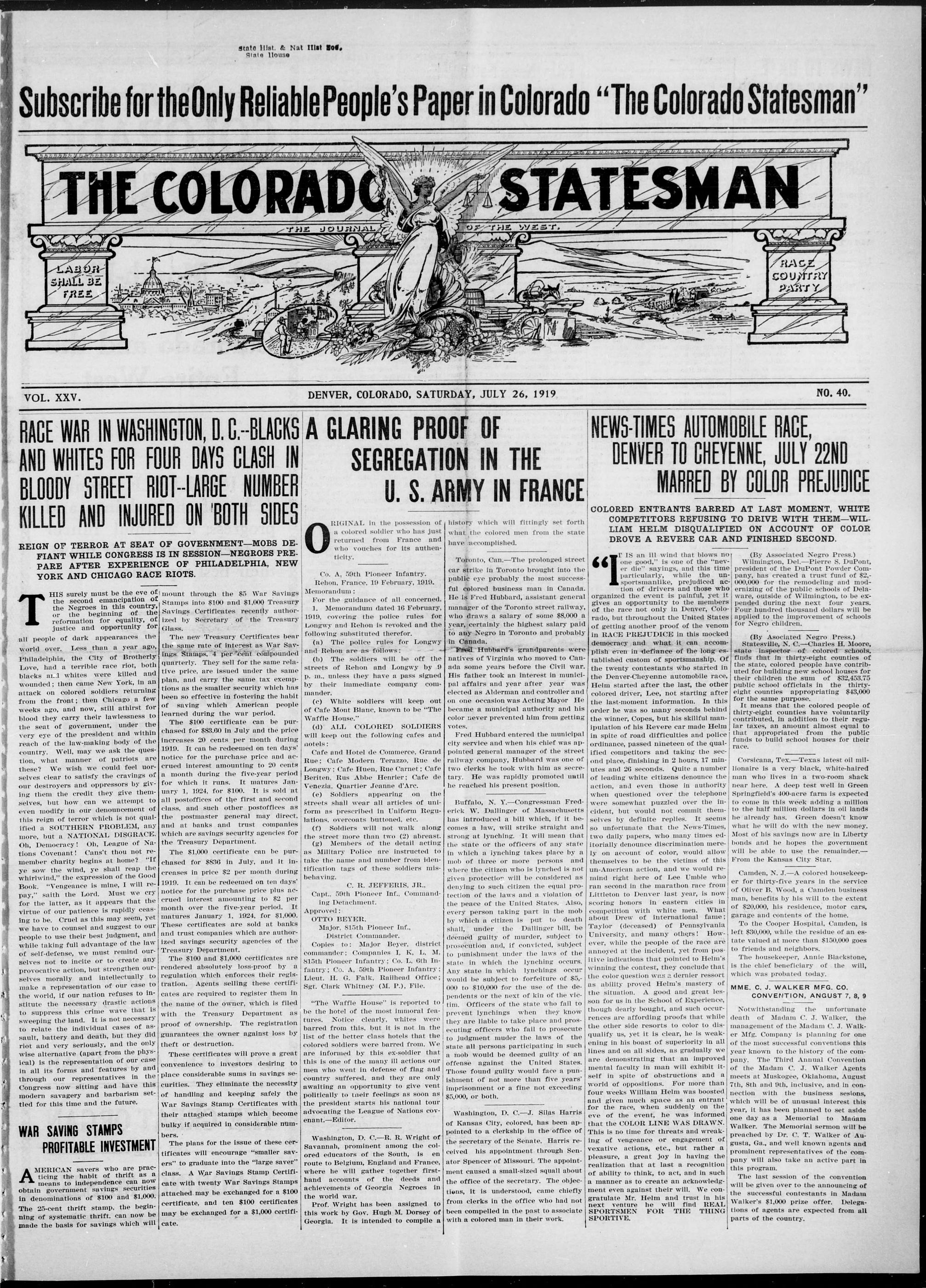
RACE WAR IN WASHINGTON, D. C.--BLACKS AND WHITES FOR FOUR DAYS CLASH IN BLOODY STREET RIOT--LARGE NUMBER KILLED AND INJURED ON 'BOTH SIDES
REIGN OF TERROR AT SEAT OF GOVERNMENT—MOBS DEFIANT WHILE CONGRESS IS IN SESSION—NEGROES PREPARE AFTER EXPERIENCE OF PHILADELPHIA, NEW YORK AND CHICAGO RACE RIOTS.
VOL. XXV.
RACE WAR IN WASHING
AND WHITES FOR FOR
BLOODY STREET RE
KILLED AND INJURY
REIGN OF TERROR AT SEAT
FIANT WHILE CONGRESS I
PARE AFTER EXPERIENCE
YORK AND CHICAGO RACE
THIS surely must be the eve of
the second emancipation of
the Negroes in this country,
or the beginning of the
reformation for equality, of
justice and opportunity for
all people of dark appearances the world over. Less than a year ago, Philadelphia, the City of Brotherly Love, had a terrible race riot, both blacks an.1 whites were killed and wounded; then came New York, in an attack on colored soldiers returning from the front; then Chicago a few weeks ago, and now, still athirst for blood they carry their lawlessness to the seat of government, under the very eye of the president and within reach of the law-making body of the country. Well, may we ask the question, what manner of patriots are these? We wish we could feel ourselves clear to satisfy the cravings of our destroyers and oppressors by giving them the credit they give themselves, but how can we attempt to even modify in our denouncement of this reign of terror which is not qualified a SOUTHERN PROBLEM, any more, but a NATIONAL DISGRACE. Oh, Democracy! Oh, League of Nations Covenant! Cans't thou not remember charity begins at home? "If ye sow the wind, ye shall reap the whirlwind," the expression of the Good Book. "Vengeance is mine, I will repay," saith the Lord. Must we cry for the latter, as it appears that the virtue of our patience is rapidly ceasing to be. Cruel as this may seem, yet we have to counsel and suggest to our people to use their best judgment, and while taking full advantage of the law of self-defense, we must remind ourselves not to incite or to create any provocative action, but strengthen ourselves morally and intellectually to make a representation of our case to the world, if our nation refuses to institute the necessary drastic actions to suppress this crime wave that is sweeping the land. It is not necessary to relate the individual cases of assault, battery and death, but they did riot and very seriously, and the only wise alternative (apart from the physical) is the representation of our case in all its forms and features by and through our representatives in the Congress now sitting and have this modern savagery and barbarism settled for this time and the future.
WAR SAVING STAMPS PROFITABLE INVESTMENT
AMERICAN savers who are practicing the habit of thrift as a means to independence can now obtain government savings securities in denominations of $100 and $1,000. The 25-cent thrift stamp, the beginning of systematic thrift, can now be made the basis for savings which will
state Hist. & Nat Hist Bod.
State House
the Only Reliable
COLORA
INGTON, D. C.--BLACKS
OUR DAYS CLASH IN
NOT--LARGE NUMBER
ED ON 'BOTH SIDES
OF GOVERNMENT—MOBS DE-
SIS IN SESSION—NEGROES PRE-
CE OF PHILADELPHIA, NEW
E RIOTS.
mount through the $5 War Savings Stamps into $100 and $1,000 Treasury Savings Certificates recently authorized by Secretary of the Treasury Glass.
The new Treasury Certificates bear the same rate of interest as War Savings Stamps, 4 per cent compounded quarterly. They sell for the same relative price, are issued under the same plan, and carry the same tax exemptions as the smaller security which has been so effective in fostering the habit of saving which American people learned during the war period.
The $100 certificate can be purchased for $83.60 in July and the price increases 20 cents per month during 1919. It can be redeemed on ten days' notice for the purchase price and accrued interest amounting to 20 cents a month during the five-year period for which it runs. It matures January 1, 1924, for $100. It is sold at all postoffices of the first and second class, and such other postoffices as the postmaster general may direct, and at banks and trust companies which are savings security agencies for the Treasury Department.
The $1,000 certificate can be purchased for $836 in July, and it increases in price $2 per month during 1919. It can be redeemed on ten days' notice for the purchase price plus accrued interest amounting to $2 per month over the five-year period. It matures January 1, 1924, for $1,000. These certificates are sold at banks and trust companies which are authorized savings security agencies of the Treasury Department. The $100 and $1,000 certificates are rendered absolutely loss-proof by a regulation which enforces their registration. Agents selling these certificates are required to register them in the name of the owner, which is filed with the Treasury Department as proof of ownership. The registration guarantees the owner against loss by theft or destruction.
These certificates will prove a great convenience to investors desiring to place considerable sums in savings securities. They eliminate the necessity of handling and keeping safely the War Savings Stamp Certificates with their attached stamps which become bulky if acquired in considerable numbers.
The plans for the issue of these certificates will encourage "smaller savers" to graduate into the "large saver" class. A War Savings Stamp Certificate with twenty War Savings Stamps attached may be exchanged for a $100 certificate, and ten $100 certificates may be exchanged for a $1,000 certificate.
DENVER, COLORADO, SATURDAY, JULY 26, 1919
A GLARING PROOF OF SEGREGATION IN THE U. S. ARMY IN FRANCE
Co. A, 50th Pioneer Infantry.
Rehon, France, 19 February, 1919.
Memorandum:
For the guidance of all concerned.
1. Memorandum dated 16 February, 1919, covering the police rules for Longwy and Rehon is revoked and the following substituted therefor.
(a) The police rules for Longwy and Rehon are as follows:
(b) The soldiers will be off the streets of Rehon and Longwy by 9 p. m., unless they have a pass signed by their immediate company commander.
(c) White soldiers will keep out of Cafe Mont Blanc, known to be "The Waffle House."
(d) ALL COLORED SOLDIERS will keep out the following cafes and notels:
Cafe and Hotel de Commerce, Grand Rue; Cafe Modern Terazzo, Rue de Longwy; Cafe Huen, Rue Carnet; Cafe Beriten, Rus Abbe Henrier; Cafe de Venezia, Quartier Jeanne d'Arc.
(e) Soldiers appearing on the streets shall wear all articles of uniform as prescribed in Uniform Regulations, overcoats buttoned, etc.
(f) Soldiers will not walk along the street more than two (2) abreast.
(g) Members of the detail acting as Military Police are instructed to take the name and number from identification tags of these soldiers misbehaving.
C. R. JEFFERIS, JR..
Capt., 59th Pioneer Inf., Commanding Detachment.
Approved:
OTTO BEYER,
Major, 815th Pioneer Inf.,
District Commander.
Copies to: Major Beyer, district commander; Companies I, K, L, M, 815th Pioneer Infantry; Co. L, 6th Infantry; Co. A, 59th Pioneer Infantry; Lieut. H. G. Falk, Railhead Office; Sgt. Clark Whitney (M. P.), File.
"The Waffle House" is reported to be the hotel of the most immoral features. Notice clearly, whites were barred from this, but it is not in the list of the better class hotels that the colored soldiers were barred from. We are informed by this ex-soldier that this is one of the many ill actions our men who went in defense of flag and country suffered, and they are only awaiting an opportunity to give vent politically to their feelings as soon as the president starts his national tour advocating the League of Nations covenant.—Editor.
Washington, D. C.—R. R. Wright of Savannah, prominent among the colored educators of the South, is en route to Belgium, England and France, where he will gather together first-hand accounts of the deeds and achievements of Georgia Negroes in the world war.
Prof. Wright has been assigned to this work by Gov. Hugh M. Dorsey of Georgia. It is intended to compile a
RIGINAL in the possession of a colored soldier who has just returned from France and who vouches for its authenticity.
C. R. JEFFERIS, JR..
history which will fittingly set forth what the colored men from the state have accomplished.
Toronto, Can.—The prolonged street car strike in Toronto brought into the public eye probably the most successful colored business man in Canada. He is Fred Hubbard, assistant general manager of the Toronto street railway, who draws a salary of some $8,000 a year, certainly the highest salary paid to any Negro in Toronto and probably in Canada.
Fred Hubbard's grandparents were natives of Virginia who moved to Canada some years before the Civil war. His father took an interest in municipal affairs and year after year was elected as Alderman and controller and on one occasion was Acting Mayor. He became a municipal authority and his color never prevented him from getting votes.
Fred Hubbard entered the municipal city service and when his chief was appointed general manager of the street railway company, Hubbard was one of two clerks he took with him as secretary. He was rapidly promoted until he reached his present position.
Buffalo, N. Y.—Congressman Frederick W. Dallinger of Massachusetts has introduced a bill which, if it becomes a law, will strike straight and strong at lynching. It will mean that the state or the officers of any state in which a lynching takes place by a mob of three or more persons and where the citizen who is lynched is not given protection will be considered as denying to such citizen the equal protection of the laws and a violation of the peace of the United States. Also, every person taking part in the mob by which a citizen is put to death shall, under the Dallinger bill, be deemed guilty of murder, subject to prosecution and, if convicted, subject to punishment under the laws of the state in which the lynching occurs. Any state in which lynchings occur would be subject to forfeiture of $5,000 to $10,000 for the use of the dependents or the next of kin of the victim. Officers of the state who fail to prevent lynchings when they know they are liable to take place and prosecuting officers who fail to prosecute to judgment muder the laws of the state all persons participating in such a mob would be deemed guilty of an offense against the United States. Those found guilty would face a punishment of not more than five years' imprisonment or a fine not exceeding $5,000, or both.
Washington, D. C.—J. Silas Harris of Kansas City, colored, has been appointed to a clerkship in the office of the secretary of the Senate. Harris received his appointment through Senator Spencer of Missouri. The appointment caused a small-sized squall about the office of the secretary. The objections, it is understood, came chiefly from clerks in the office who had not been compelled in the past to associate with a colored man in their work.
NEWS-TIMES AUTOMOBILE RACE, DENVER TO CHEYENNE, JULY 22ND MARRED BY COLOR PREJUDICE
COLORED ENTRANTS BARRED AT LAST MOMENT, WHITE COMPETITORS REFUSING TO DRIVE WITH THEM-WILLIAM HELM DISQUALIFIED ON ACCOUNT OF COLOR DROVE A REVERE CAR AND FINISHED SECOND. F IS an ill wind that blows no one good," is one of the "never die" sayings, and this time particularly, while the unsportsmanlike, prejudiced ac (By Associated Negro Press,) Wilmington, Del.—Pierre S. DuPont, president of the DuPont Powder Company, has created a trust fund of $2,000,000 for the remodeling and mod-
tion of drivers and those who organized the event is painful, yet it gives an opportunity to the members of the race not only in Denver, Colorado, but throughout the United States of getting another proof of the venom in RACE PREJUDICE in this mocked democracy and what it can accomplish even in defiance of the long established custom of sportsmanship. Or the twenty contestants who started in the Denver-Cheyenne automobile race Helm started after the last, the other colored driver, Lee, not starting after the last-moment information. In this order he was so many seconds behind the winner, Copes, but his skillful manipulation of his Revere car made Helm in spite of road difficulties and police ordinance, passed nineteen of the qualified competitors and taking the second place, finishing in 2 hours, 17 minutes and 26 seconds. Quite a number of leading white citizens denounce the action, and even those in authority when questioned over the telephone were somewhat puzzled over the incident, but would not commit themselves by definite replies. It seems so unfortunate that the News-Times, two daily papers, who many times editorially denounce discrimination merely on account of color, would allow themselves to be the victims of this un-American action, and we would remind right here of Lee Umble who ran second in the marathon race from Littleton to Denver last year, is now scoring honors in eastern cities in competition with white men. What about Drew of international fame; Taylor (deceased) of Pennsylvania University, and many others! However, while the people of the race are annoyed at the incident, yet from positive indications that pointed to Helm's winning the contest, they conclude that the color question was a dernier ressort as ability proved Helm's mastery of the situation. A good and great lesson for us in the School of Experience, though dearly bought, and such occurrences are affording proofs that while the other side resorts to color to disqualify us, yet it is clear, he is weakening in his boast of superiority in all lines and on all sides, as gradually we are demonstrating that an improved mental faculty in man will exhibit itself in spite of obstructions and a world of oppositions. For more than four weeks William Helm was boosted and given much space as an entrant for the race, when suddenly on the eve of the event, he was informed that the COLOR LINE WAS DRAWN. This is no time for threats and wreaking of vengeance or engagement of vexative actions, etc., but rather a pleasure, a great joy in having the realization that at last a recognition of ability to think, to act, and in such a manner as to create an acknowledgment even against their will. We congratulate Mr. Helm and trust in his next venture he will find REAL SPORTSMEN FOR THE THING SPORTIVE.
NO. 40.
(By Associated Negro Press.)
Wilmington, Del.—Pierre S. DuPont, president of the DuPont Powder Company, has created a trust fund of $2,000,000 for the remodeling and modernizing of the public schools of Delaware, outside of Wilmington, to be expended during the next four years. Four hundred thousand dollars will be applied to the improvement of schools for Negro children.
(By Associated Negro Press.)
Statesville, N. C.—Charles H. Moore, state inspector of colored schools, finds that in thirty-eight counties of the state, colored people have contributed for building new school houses for their children the sum of $32,453.75 public school officials in the thirty-eight counties appropriating $43,000 for the same purpose.
It means that the colored people of thirty-eight counties have voluntarily contributed, in addition to their regular taxes, an amount almost equal to that appropriated from the public funds to build school houses for their race.
Corsicana, Tex.—Texas latest oil millionaire is a very black, white-haired man who lives in a two-room shack near here. A deep test well in Green Springfield's 400-acre farm is expected to come in this week adding a million to the half million dollars in oil lands he already has. Green doesn't know what he will do with the new money. Most of his savings now are in Liberty bonds and he hopes the government will be able to use the remainder.—From the Kansas City Star.
Camden, N. J.—A colored housekeeper for thirty-five years in the service of Oliver B, Wood, a Camden business man, benefits by his will to the extent of $20,000, his residence, motor cars, garage and contents of the home.
To the Cooper Hospital, Camden, is left $30,000, while the residue of an estate valued at more than $150,000 goes to friends and neighbors.
The housekeeper, Annie Blackstone, is the chief beneficiary of the will, which was probated today.
MME, C. J. WALKER MFG. CO.
CONVENTION, ANGUST 7, 8, 9
Notwithstanding the unfortunate death of Madam C. J. Walker, the management of the Madam C. J. Walker Mfg. Company is planning for one of the most successful conventions this year known to the history of the company. The Third Annual Convention of the Madam C. J. Walker Agents meets at Muskogee, Oklahoma, August 7th, 8th and 9th, inclusive, and in connection with the business sessions, which will be of unusual interest this year, it has been planned to set aside one day as a Memorial to Madam Walker. The Memorial sermon will be preached by Dr. C. T. Walker of Augusta, Ga., and well known agents and prominent representatives of the company will also take an active part in this program.
The last session of the convention will be given over to the announcing of the successful contestants in Madam Walker's $1,000 prize offer. Delegations of agents are expected from all parts of the country.
FOREIGN
The electoral committee of the French Senate decided to report unfavorably the bill adopted by the Chamber of Deputies giving the vote to women.
The Silesian News reports the German government has finally agreed that Upper Silesia shall become a free state. The inhabitants of Upper Silesia, it is added, are still demanding that the district remain German.
Lady Diana Manners Cooper, while watching the display of fireworks in Hyde Park from the roof of her house in London, accidentally stepped into a skylight and fell twenty feet, breaking a thigh and suffering other injuries.
Jack Dempsey, world's heavyweight champion, will meet either Joe Beckett, British champion, or Georges Carpentier, European champion, in London early in 1920, according to an announcement in London by Promoter G. B. Cochran.
A Helsingfors dispatch to London gives a refugee from Petrograd as authority for the statement that the Bolsheviks are offering a quarter of a million dollars for the assassination of Gen. Justus Mannerheim, the Finnish regent, with the object of paralyzing Finnish resistance.
Gen. Franchet D'Esperey, commander of the allied forces in the Near East, announces that he is preparing to advance upon Budapest, the Hungarian capital, with 150,000 troops. The army is made up of French colonials, Rumanians, Jugo-Slavs, Italians and Hungarians.
Four million children in Europe are being fed under the auspices of the American relief administration. This work probably will be continued through private charity and under American direction, even after the conclusion of the work of the American food administration in Europe.
Replying to a question in the House of Commons, Dr. Frederick G. Kellaway, parliamentary secretary to the ministry of supply, said the government was considering co-ordinating all the sources of oil supply within the empire with a view to preventing establishment of a world oil monoply by financiers
The work of recovering stolen Belgian machinery from Germany is proceeding with full swing. Approximately 3,000 tons of machinery are being shipped back weekly to the original owners by German industrial firms, who have set them up in their own factories. The total tonnage returned on July 1st was 18,000.
**SPORT**
Miss Ryan of California won the "Irish ladies' lawn tennis championship" at Dublin from Janet Jackson, the English representative. The score was 6-0, 6-1.
Norman Ross of San Francisco, United States army, won the swimming match in the Seine across Paris, a distance of about 6,500 meters, in one hour and thirty minutes. Backgalupo, Italian, was only four-fifths of a second behind Ross. Morris, Australian, was third. An immense crowd lined both banks of the Seine and gave evidence of the popularity of Ross, as a consequence of his victories during the interallied games, by heartily cheering him.
GENERAL
James A. Hart, one of the pioneers of baseball and former president and owner of the Chicago National League club, died at his home in Chicago. Mr. Hart, who was 64 years old, had been in failing health for several years. Death was caused by organic heart disease. He is survived by a widow and two children.
Twelve hundred sacks of mail for Germany, the first to be sent to that country since the United States entered the war, were carried by the Scandinavian-American line steamship United States, which sailed from New York for Copenhagen. From Denmark the mail will be sent overland to Germany.
Chicago's weirdest tragedy occurred when a giant dirigible balloon, the first army style blimp to visit the city, caught fire and hurtled through the skylight of the Illinois Trust and Savings Bank, killing 12 persons, injuring twenty-eight and turning the counting room of the bank into a channel house of horror.
More than 2,000 airplanes of the pleasure type could be sold immediately if manufacturers could make deliveries and more than 500 have been purchased or ordered in the United States in the last three months, according to a statement issued by Henry Woodhouse, vice president of the Aerial League of America.
The high cost of traveling has been solved by Mrs. J. M. Franklin, a young graduate nurse of Seattle, Wash. She is in New York after making the transcontinental trip at a cost of $23. The trip was made as the result of a $2,000 wager. She walked 432 miles, the rest of the way being covered on hay wagons, side cars of motorcycles, mule wagons and automobiles. She saved hotel bills by camping along the roadside.
Nathan Strauss, wealthy New York merchant and philanthropist, may be the first mayor of Jerusalem, when, under the pact made by Britain after its conquest, the ancient Hebraic city becomes a Jewish commonwealth in Palestine.
In a presidential decree issued in Panama prohibiting the supplying of intoxicating drinks to members of the army and navy of the United States, it is declared that "beer containing not more than 4 per cent alcohol will not be classified as an intoxicating liquor."
NEWS TO DATE IN PARAGRAPHS
CAUGHT FROM THE NETWORK OF WIRES ROUND ABOUT THE WORLD.
DURING THE PAST WEEK
RECORD OF IMPORTANT EVENTS
CONDENSED FOR BUSY
PEOPLZ.
Western Newspaper Union News Service.
WESTERN
A man, stumbling headlong downstairs, at Nevada City, Calif., struck William Bluett, who was passing on the sidewalk. The falling man suffered a few bruises, but Bluett died of a broken back after the collision.
The Jury in the case of Roy Emerson of Creston, In., charged with beating his mother to death with an iron brace and throwing her body down an elevator shaft, returned a verdict of guilty of murder in the second degree.
Five persons were killed and a sixth so badly injured that his life is despaired of when an interurban electric car ran into an automobile at a railroad crossing four miles north of Nampa, Idaho, on the Boise-Nampa electric line.
Charles D. Greenfield, state commissioner of agriculture, said that newspaper reports regarding Montana crop conditions are exaggerated. He has prepared a review showing that 1,075,000 acres in the state will produce good crops.
Forested areas in the eastern section of the Thunder mountain region of southern Idaho are a cauldron of smoke, and there is no way to estimate how many new fires are eating into the timber of that region underneath the hazy pall.
One man suspected of being a highwayman is dead, two others were seriously injured and Detective James Britton, former chief of police, probably was fatally wounded following a pistol fight between detectives and robber suspects in a restaurant at Sioux City, Iowa.
Dr. Charles R. Krueger and party, traveling by automobile to California, were attacked by a band of timber wolves on the transcontinental highway east of Flagstaff. They killed three of the animals with their revolvers and wounded five others before the band was driven off.
Her 3-year-old infant clasped in her arms, Mrs. Candelaria Galvan, 36, of Hurley, N. M., and nine children were drowned when a wagon in which they were riding was swept away in a swollen stream. Five of the children, whose ages ranged from 2 to 15 years, were those of Mrs. Galvan.
Francisco Villa and General Felipe Angeles have disbanded their forces until September and announced to their troops they would go to Japan in an effort to obtain ammunition for the Villa revolution, Americans who arrived in El Paso from Chihuahua City reported. They said Villa issued an order to his men telling them to return to their homes until fall, when he would call them together again.
WASHINGTON
Sentences imposed on American soldiers by courts-martial during the war would aggregate about 28,000 years, Senator Chemberlain of Oregon, ranking Democratic member of the Segate Military Affairs Committee, declared in introducing a bill in the Senate providing for the restoration of military rank and granting of amnesty to soldiers, sailors and marines so sentenced.
Yeggmen blew the safe in a postoffice on the outskirts of the national capital and got a haul of $1,000 in cash and war savings stamps.
By a vote of 386 to 47 the House passed the bill providing a minimum wage of $3 for all government employees except those in the postal service. The wage is exclusive of the war-time bonus of $240 a year allowed employés.
Secretary Daniels said that he expects to leave Washington for the Pacific coast about Aug. 1, arriving in San Diego Aug. 6 to meet the Pacific fleet which is due there the morning of Aug. 7. The President, it is understood, will arrange to be on the Pacific coast in mid-August and probably will review the fleet in San Francisco.
Carrying increased appropriations for the rehabilitation and education of disabled soldiers, sailors and marines, the $613,000,000 sundry civil appropriation bill was passed by the Senate. It now goes to the President, who vetoed the original bill because it limited funds for training wounded service men.
Appointment by the President of a special commission to investigate the high cost of living would be authorized under a resolution introduced by Representative Tinkham, Republican, Massachusetts. The commission would make its report by December 15th.
Henry P. Fletcher, American ambassador to Mexico, told the House Rules Committee in Washington that since his appointment three years ago, about fifty Americans had been killed in Mexico without a single prosecution being made by the Mexican authorities.
SPORT
Pithy News Notes From All Parts of Colorado
Western Newspaper Union News Service.
James W. Bucklin, lawyer, state legislator, capitalist and one of the founders of Grand Junction, died at his home in Palo Alto, Calif., according to messages received.
A team composed of seventeen men of Colorado's National Guard will represent the State at the national rifle matches to be held at Caldwell, N. J., the week of August 25.
Former Governor James Bradley Orman, receiver of the United States land office in Pueblo, and a dominant figure in the history of Colorado since the early '80's, succumbed to a stroke of paralysis at the family residence in that city.
The acreage cultivated without irrigation in Colorado has increased close to 150 per cent since 1909, while there has been a comparatively slight increase in the acreage cultivated under irrigation. The result has been a sharp decrease in the yields per acre of almost all crops.
What is believed to be the first case of typhus fever ever recorded in Denver caused the death of Harley Wilson, a decorator. Wilson, who was 31 years of age and has been employed by the Denver Omnibus and Cab Company, became ill June 23. The attending physicians recognized the disease, but were unable to stop its progress.
That the bee acreage tributary to the Windsor factory of the Great Western Sugar Company has been reduced from 14,500 to about 10,000 acres by the ravages of web worms and drouth is the estimate of factory officials. The officials expect another attack from the worms early in August and have made big preparations to fight the pest.
Mrs. Guy U. Hardy, wife of Representative Hardy of the Third Congressional district of Colorado, has accepted an invitation to sponsor a 9,600-ton steel steamer, which is to be launched in Seattle Aug. 16. Mrs. Hardy will go to Seattle with her husband to attend the convention of the National Editorial Association, of which her husband is president.
James Luttrell, a negro, who for years was employed as a wire drawer at the steel plant at Pueblo, who died recently, had diamonds in his teeth. Luttrell had a passion for diamonds, it is said, and this passion led him to have his front teeth set with diamonds by a local dentist, and they were valued at several hundred dollars. Whenever he smiled, the effect was particularly brilliant, and it is said that he rarely had his lips closed.
Mrs. Jennie Murphy, six months' bride of John J. Murphy, is in jail with her husband charged with attempting to aid him to escape from the county jail, where he is held on a charge of forgery at Pueblo. It is claimed that Mrs. Murphy visited the jail and gave her husband some bananas. Inside each banana was a hard steel saw capable of cutting through the steel bars in rapid time. Murphy hid the saws in his cell, but the jailer in making his rounds and searching the prisoners discovered them.
Better roads boosting received new encouragement upon advices that the State Highway Commission had allotted $100,000 to Mesa county for road construction. The amount, it is understood, will be equally divided between the Palisade concrete road and the proposed concrete road between Grand Junction and Fruita. The Palisade road has been under construction for some time. The Fruita road was ordered surveyed by the county commissioners several weeks ago with a view of asking for state and federal aid.
Denver will begin the construction of the south wing to the Colorado Museum of Natural History in City Park shortly, as the result of a gift of $100,000 for that purpose to the city by a Denver citizen whose name is being withheld for the present by Mayor Dewey C. Bailey. The name of the donor will be revealed at the formal opening of the Civic Center Aug. 1. Colorado will produce this year 18,827,000 bushels of wheat, compared with a production of 13,335,000 bushels last year, according to estimates just completed by the Colorado Co-operative Crop Reporting service. The production of corn, if conditions remain favorable until harvest, will be approximately 23,148,000 bushels, compared with 23,585,000 bushels for 1918.
The old car barn on Colfax avenue, near Aurora, which then tate highway commission recently purchased from the Tramway company in Denver, is being repaired for the storing of some of the army trucks now being received from the War Department. Forty-seven trucks have been received thus far, and will be sent to the counties for use on county roads as soon as they can be replaced with the dump bodies. Greeley business men will furnish funds to provide a life guard and safety equipment for Seeleys lake, the scene of several recent drownings, during the remainder of the bathing season. They have also inaugurated a campaign to construct a large concrete bathing pool in one of the city parks which will cost at least $10,000.
Michigan, Colorado and Utah show big increases in beet sugar prospects Forecasts show Colorado's crop as 2, 024,000 tons, an increase of 580,000 and Utah's 1,208,000 tons, an increase of 205,000 tons.
```markdown
```
CENTENNIAL STATE ITEMS.
The total production of coal in Colorado for the first six months of the year shows a decrease of 1,490,539 tons as compared to the production from January 1 to July 1, 1918, according to the report of James Dalrymple, state coal mine inspector. Every coal-producing county in the state, with the exception of Routt and Rio Blanco counties, shows a decrease for the six months' period as compared to the same period in 1918. The number of miners employed last month was 10,928, as compared to 13,679 employed in the previous year. The total production of coal in the state during the first six months of 1918 was 6,414,117 tons. The production for the first six months of this year was 4,923,578 tons. The average number of miners employed during the six months of 1919 was 12,420.
THE COLORADO STATESMAN
One woman was caught in the act of making "moonshine" whisky and three stills were confiscated as a result of two rails made in Denver by the state constabulary on the eve of the discontinuance of the body through the expiration of the appropriation made by the last Legislature. The woman, who gave her name as Mrs. Elsie Charline Mock, 51 years old, was arrested when the officers raided the residence at 300 Birch street, a mile east of the Country club district, in Denver. Two stills, other paraphernalia incidental to the business and sixteen gallons of whisky were confiscated at the house in Birch street. The other still was found in the rear of the residence of William Phillips, 1035 Julian street
The Mouth-Piece of the People of Colorado and the Entire West
"The Good Ship Minnequa" is afloat and taking cargo aboard for her first cruise in the Pacific ocean as a member of the United States Merchant marine. The Minnequa is Pueblo's Victory ship and her name would have been "Pueblo" if it were not for the fact that there is already a battleship in the United States navy by that name. The ship was christened by Mrs. J. C. Brooking of Pueblo and the name "Minnequa" was given it because of the beautiful Lake Minnequa at Pueblo. A bottle of water from Lake Minnequa was broken over the bow of the ship in the christening exercises.
ARELIABLE chronicle of their doings and progress; a faithful mirror of their wants, their hopes, their best aspirations.
Colorado's wheat and corn crops this year will exceed last year's crops by millions of bushels, according to estimates by the Colorado co-operative crop reporting service, based on acreage returns sent in by the county assessors, in accordance with the new agricultural statistics law adopted by the last Legislature. These estimates place the wheat crop this year at 18,627,000 bushels for both spring and winter wheat, as compared with 13,335,000 bushels last year; and the corn crop at 23,148,000 bushels as against 20,585,000 bushels in 1918.
The 1,200 doctors, dentists and drugists of Colorado and Wyoming who have not yet made their narcotic return to the department of internal revenue must do so immediately, according to C. O'B. Berry, chief field deputy of the department. After the expiration of the time limit, July 30, any doctor registering prescriptions or any pharmacist filling them who has not complied with the law will be liable to five years in the penitentiary and a fine of $2,000. he said.
THE COLORADO STATESMAN
Plans have been started by the Jobbers' bureau of the Civic and Commercial Association to bring 25,000 merchants into Denver this fall. The plan is to bring the merchants, in the territory served by Denver, to the city, not in a body, but 100 each day. A committee has been appointed to outline the campaign. The jobbers believe by bringing the merchants into Denver they will be able to look over the stock and also they will be entertained.
Unequaled as an advertising medium for the business of professional men and women.
More paving will be done on county and state roads during the next year than has been done in all the previous years together, J. E. Maloney, state highway engineer, said following the three-day conference of the State Highway Commission.
Charles Graves, 43 years old, a rancher at Shaffer's Crossing, a few miles south of Golden, was shot by Wade Williams, 32 years old, a farm hand, following an argument over the latter's work on the farm. Two bullets lodged in Graves' chest. Williams surrendered to Sheriff Jones of Golden and declared, according to the sheriff, that he shot Graves because the latter "drove him about the farm like a slave."
An excellent family journal speaking to and for many thousand colored citizens.
A 60 to 65 per cent, beet crop is estimated for Boulder County by Agriculturist H. H. Simpson, who said that conditions were so improved that he felt compelled to revise his original estimate of a 40 per cent, yield. The webworm, which has been causing much damage to the beets, has disappeared as a result of spraying and natural causes. Colorado is to have an initial National Guard unit consisting of 1,200 men, to be reorganized during the year, with 50 per cent, to be added each year for succeeding years until the total State strength is 4,400 men, according to plans announced by the War Department at Washington.
TWODOLLARSAYEAR
THE GREAT ORGAN OF THE LABORING MASSES
Governor O. H. Shoup, in a proclamation issued, designated Friday, August 1, "Colorado Day," a legal holiday, and urged that "wherever possible appropriate services be held, and that the productions of Colorado soil and energy be used exclusively in the celebration of the day." State officials have agreed to cooperate with the City of Denver in the event the municipality calls an election for the purpose of voting between $4,000,000 and $6,000,000 in bonds for the boring of the James Peak tunnel along the Moffat Road.
FORTY MILLIONS FOR AIR SERVICE
CONGRESS GRANTS ENOUGH TO KEEP UP EQUIPMENT AND RECRUIT PERSONNEL.
NOT ALL AIRMEN ASKED FOR
Vast Sum Was Needed to Put Aircraft Manufacturing Industry on Production Basis, but America Was Ready When Armistice Came.
Bv EDWARD B. CLARK.
Washington.—Congress has appropriated $40,000,000 through the army supply bill for the use of the air service. This is not as much money as the airmen asked, but it will enable the service to keep up its equipment and a fairly strong personnel, and will enable the United States probably to have airplanes enough for an ordinary emergency.
People have been wondering what became of all the money that was voted for the air service in war time. It seems likely that some of it was wasted, but there has been perhaps no proper appreciation of the enormous initial cost which the government had to stand in order to get the great aircraft manufacturing industry started on the basis of production that seemingly was necessary.
Brig. Gen. William Mitchell, who is in charge of aviation operations in the war department, was in command of the American aviation service in the St. Mihiel drive. He has just testified that when the drive was started more airships were concentrated in the immediate vicinity than ever had been brought together within a like area since the war began. During the drive 1,500 planes were sent into action. General Mitchell was the first American officer to fly over the Hun line. It is said to be necessary that the airplane service of the United States should be reconstructed. As General Mitchell put it:
"The personnel which has been trained as a result of this war is largely scattered throughout the country. We have a wonderful basis of personnel returning from Europe, but they had to go home. A great majority of them would not stay in the service because it looked like a hopeless future for them, as very little encouragement for an air service of any importance in the near future was held out."
Air Forces Were About Ready.
It is pretty generally agreed that when the armistice went into effect the United States, so far as its forces were concerned, was just getting ready "to do business" on a proper scale. It is true that the St. Mihiel drive took place two months before the armistice went into effect, but the concentration of flyers at that place left some other places without proper Americas air equipment. Not many planes were lost in the St. Mihiel engagement. Later in the Argonne the losses were heavy, but no heavier and perhaps not as heavy as it was expected would be the case in hard engagements of that kind. Of the 1,500 machines at St. Mihiel 550 were American and operated by Americans.
It is understood that the airplane service of the United States with the Army of Occupation was on a basis of efficiency, one that would have enabled the Americans to conduct operations in Germany, if they had been necessary, on a proper scale so far as the air service was concerned.
Along the Mexican border today there is a considerable number of airplanes, but not enough, it is understood, to meet even the minor warfare which it is possible may have to be conducted there within the near future. With its $40,000,000 it is probable the air service of the United States can be put on a strong peace basis with sufficient additional strength to meet any small war in which this country may be compelled to engage.
"Archies" Seldom Hit Planes.
"Archies" Seldom Hit Planes.
While on the western front in 1915 and again in 1918 I witnessed considerable air action. The thing which as early as 1915 was the most striking feature of air service was the seeming impossibility, or almost impossibility of destroying an airplane by fire from the ground. Another striking thing was the apparent inability of the bombers in the airplanes to hit any specific object on the ground at which they were alming.
Toward the end of the war the bombers were getting more accurate, but there was little change in the situation so far as it affected the accuracy of fire of the anti-aircraft gunmen.
War Brings Out No Candidates. Politicians in Washington have taken note of the fact, and are interested in it, that the front line of battle in the great world's war has produced no candidate for the presidency of the United States, and this thought takes cognizance of the truth that both Generals Leonard Wood and John J. Pershing are mentioned in connection with the nomination of the Republican party.
So far as one can determine, there is no active campaign in behalf of General Pershing, and thus far the politicians seem to think he has little chance of the nomination. In fact republicans in Washington of all kinds of views seem to believe that Pershing will not seek the nomination and that no active effort will be made in his behalf.
So far as Leonard Wood is concerned the feeling is that, while he is
a candidate, his candidacy is in no sense a product of the present war. Politicians say Wood's name would have been mentioned for the nomination, more than mentioned, probably, if there had been no war. No other war in which the United States has been engaged has failed to produce its presidential candidate.
Reason for the Condition.
There is a reason for the failure of this war to produce presidential candidates. The general officers who served in France did not come into close personal touch with their men, except in the cases of one or two major generals, and quite a number of brigadier generals, none of whom, however, have been considered as constituting presidential timber.
In previous times the soldiers themselves have not always been the prime means of securing honors for their leaders. The civilans of the United States nominated and elected Grant. Roosevelt's following in the Spanish war was only that of a regiment. He was not elected president, of course, immediately on his return from Cuba, but his record there made him governor of New York and vice president of the United States, an office which, of course, carried with it the possibility, and in his case, the certainty of his becoming president.
The instant the United States entered the war with Germany the policy of the suppression of the names of commanding officers went into effect. Pershing's name was the only one mentioned except that of the commanding officer of the first division which went to France. His name got into the papers frequently through no fault or desire of his own. It was printed because his division was the only American outfit in France, and the newspaper correspondents then had just one unit of American troops to write about, and naturally they "broke bounds" and had considerable to say about the commanding officer. Not long after this this major general commanding the division was ordered back to the United States, and there are men who think the fact that his name, without his consent, got into print, was the only reason why he was ordered to return to this country.
Why Names Were Suppressed.
Why Names Were Suppressed. The deeds of men like Liggett, Dickman, Bundy, Edwards, Bullard and some others were of high enough degree to arouse the enthusiasm of the American people and to insure their plaudits if the deeds had been allowed to appear in print with the names of the men who, with their divisions, had accomplished them.
The general officers who commanded armies, corps and divisions in France are some of them Democrats and some of them Republicans. They are divided between the two parties about equally, in fact. Yet today no one seemingly cares whether Bullard, for instance, is a Republican, which he is not, or a Democrat, which he is. Dickman also is a Democrat, so it is said, while Bundy and Edwards are said to be Republicans. An inquiry has failed to disclose the politics of Liggett. It is taken for granted by the politicians that Pershing is a Republican, although he seems to have been silent on the subject of his affiliations.
Possibly the American people do not understand thoroughly why it was supposed to be necessary to keep the names of the general officers out of print. The Germans, long before the war began, had a perfect system of study and esploration. They knew the characteristics and the bent of mind of every high ranking officer in the American army. It was thought it would be an advantage to the Germans to know just what general officers of the American forces were on their immediate fronts. It was taken for granted that the Germans, if they heard this man or that man was on the Moselle front, for instance, would adapt their tactics in accordance with their ideas of the opposing general's temperament and experience, or lack of experience, in the field.
Diplomats May Shun America.
When several weeks had gone by and no one had been appointed to take the place of Lord Reading as the ambassador of Great Britain to the United States, wonder began to grow in Washington. "Why the delay?" A jocose answer to the question was given by a member of parliament who suggested to the brethren that it was possible the fact that the United States had gone dry was responsible for the disinclination of any Englishman of high rank to serve his country in Washington.
Now, British humor is sometimes past the fathoming. There were people in these good United States who thought that the member of parliament was serious when he unburdened himself of his reason for the lack of ambassadorial material for the Washington post. Probably the truth is that it was a case of dry humor. However, let it be said that it is a pretty safe assumption that no Britisher, no Frenchman, and nobody else who lives in a foreign country and who has some chance of representing his nation in this land of the free, is entirely happy over the prospect of a dry time in the capital of the U. S., "S" in this case, as some put it, standing for Sahara
Jap Industry Increasing.
The plateglass industry in Japan has greatly expanded since the world war. Before the war about 550,000 boxes of glass were consumed annually, 420,000 boxes of which were imported from Belgium and Germany, the remainder being of home manufacture. During the past year 850,000 boxes were manufactured in Japan, of which 600,000 boxes were consumed at home, and the remaining 250,000 boxes were exported.
The KITCHEN CABINET Welcome, a thousand times welcome, ye dear and delicate neighbors- Bird and bee and butterfly, and hum-
Proud am I to offer you field for your
graceful labors;
All the honey and all the seeds are
yours in this garden of mines
— Cella Thaxter.
MORE HOT WEATHER DISHES.
Eggs will have reached the lowest figure for the year, during the summer, and if ever, now is the time to indulge in egg dishes galore, as well as in packing them for winter use.
19
19
19
Beauregard Eggs.—Take five hard-cooked eggs, one tablespoonful of corn-starch, five squares of toast, one cupful of milk, one tablespoonful of butter with salt and pepper to taste. Chop the egg whites, rub the yolks through a sieve. Scald milk and add butter and corn-starch rubbed together. Now add the whitks, then add salt and paprika to taste. Put the toast on a hot dish, cover with a layer of white sauce, then a layer of the yolks, then the whites, and finish with the yolks on top. Sprinkle with salt and pepper and put into the oven for a few minutes.
Deviled Eggs.—One dozen cooked eggs, one teaspoonful of French mustard, four tablespoonfuls of minced ham or tongue, one tablespoonful of olive oil, salt and cayenne to taste.
Cut the eggs lengthwise. Take out the yolks carefully, not to break the whites. Rub the yolks to a smooth paste with the mustard and oil, then add the ham or tongue finely chopped. Fill the whites with this mixture and press the halves together.
Eggs Poached in Tomatoes. Peel and cut into small pieces six medium sized tomatoes. Chop fine one small green onion. Put the onion and tomatoes into a sauce pan and cook slowly 15 minutes, adding salt and pepper. Have ready slices of well-browned toast, buttered. Carefully drop six eggs into the tomatoes, and when well poached place them carefully on the toast; pour the tomatoes around them and serve at once.
Peach Omelet—Pare and stone three ripe peaches, then press them through a sieve, add two tablespoonfuls of powdered sugar, and the well-beaten yolks of three eggs; add carefully the stiffly beaten whites of skim, and pour into a well-greased baking dish. Bake 15 or 20 minutes and serve at once.
FRUIT COCKTAILS
There is no more appetizing beginning for a summer meal than a fruit
cocktail. They should be served very cold in small glasses or in fruit cups such as lemon, orange, apple or grapefruit. Vegetables are also used as
should be served very cold in small glasses or in fruit cups such as lemon, orange, apple or grapefruit. Vegetables are also used as cocktails, the tomato being the especial favorite.
In preparing fruits for cocktails two things should be remembered: The fruit should stand in a sirup or sprinkled with sugar to be well sweetened. To prepare the sirup use twice as much sugar as water and cook it until thoroughly dissolved.
The entire menu should be considered when serving a fruit cocktail, as other fruits do not appear at the same meal. If a vegetable cocktail (put together with some sort of a salad dressing) is served, the salad is omitted for that meal.
One of the most attractive cocktails may be made by using watermelon or muskmelon for the foundation. Cut the melon with a French potato cutter into small balls and cover with a ginger sip, using the Canton ginger and bits of ginger; pour over the balls of canteloupe. For watermelon the dainty color makes a most effective dish; use the heart of the melon for balls and simple, lightly flavored sip of sugar water and lemon juice. It is unwise to add a sipu too highly flavored, for the fruit flavor itself should be first.
A pineapple and raspberry combination is very good. Cut the pineapple with a small potato cutter and let the fruits stand in sipu uncombined for three hours, then chill them together one hour.
Equal parts of sliced peaches and stoned cherries marinated in sugar sirup and garnished with frosted mint. Dip a sprig of mint in egg white then in sugar, having the mint well chilled.
Twice as much diced peach as very ripe blackberries, treated with the sirup and flavored with a little lemon and orange juice.
Vegetable cocktails may be made of various combinations, but those most suitable are:
Two tablespoonfuls of minced tomato, one of minced celery, one tablespoonful of aspic jelly cut in bits, half a teaspoonful of chives, three drops of tobasco sauce. French dressing and mayonnaise to molsten.
Nellie Maxwell
CAPITOL BUYS 80,000 ACRES IN
PECOS COUNTY OIL FIELD.
CAPITOL PETROLEUM COMPANY with 10,000 acres of excellently located oil lands in the Tampico, Mexico; Nowata County, Oklahoma, and the Purvines tract near Amarillo, Carson County, Texas, in the center of the great oil excitement now obtaining in the Panhandle district, and ever watchful for good bargains, has just closed a deal for 80,000 acres additional oil land in Pecos County, Texas, "The Wonder Oil State of the Union." The company is already both a producing and dividend-paying corporation, and recently, through release by the government of tankers to be used in the transportation of oil from the Tampico field to the United States, has completed arrangements at New York for three 50,000-barrel tankers for immediate use between Tampico and New Orleans.
In expectation of a heavy flow from the Capitol No. 2 at Tampico, the management has just completed a large earthen reservoir with capacity for 150,000 barrels, at the well, an eight-inch pipe has been set at 1,400 feet, and everything is in readiness for the anticipated heavy flow. The well has passed government inspection, the gate valve has been set, and every precaution taken. The Tampascus well, located but a short distance from the Capitol No. 2, is now reported good for 60,000 barrels and has been successfully harnessed.
Capitol Petroleum has thirty-two producing wells in the Mid-Continent field, and the company is also preparing to drill a test on the Purvines tract, in Carson County, near Amarillo, Texas. Material is being hauled in and the derrick is erected. An aggressive campaign is also under consideration for the development in Pecos County, Texas. Capitol Petroleum, as previously stated, is on a dividend-paying basis with dividends Nos. 1, 2 and 3, amounting to $11,902.37, already paid stockholders.
The financial statement as of July 16, duly signed by George Fruth, Denver, as chairman of the executive committee, shows cash in banks and accounts, receivable, $59,566.64. Resources: Leases operating and producing, $81,000; leases operating, $272,750; leases non-operating, $384,990. Total assets, including equipment and tools of, $513,612.76, with no liabilities of any kind excepting current bills for the present month not yet reported.
At the annual stockholders' meeting held July 18, the former board of directors were unanimously elected. The splendid constructive work this board has done in the past year has attracted unusual commendation, and the latest action of the stockholders pays this tribute of confidence and assures them their undivided, strongest support.
New York, N. Y.—The following appeared editorially in the New York Call, one of the great dailies of this city. It is regarded as one of the worst editorials ever made in America by a daily newspaper:
"If the Negroes in the slave states should attempt to resist the fiendish violence and cruelty of their oppressors by violence and cruelty it would be like gambling with a gambler to put him out of business. It is of no use to tell the Negro that his remedy is in the ballot-box. He cannot vote. But if the Negroes were in one big union, and 100 per cent organized, and would not do another tap of work unless upon a guarantee of decent treatment, the whole of the idle, do-less, shiftless, incompetent South would be at their mercy. Put that idea into the mind of every Negro that you meet."
Boston, Mass.—The act of Clarence R. Van Allen, a Negro, corporal of Company L, 372nd Infantry regiment, in putting out of action single handed a Hun machine gun, killing four of its crew and capturing three others, was recognized today when he was decorated with the Medallie Militaire, the highest honor for heroism that France confers on an enlisted man. Officers of the Northeastern Department turned out in a body to honor Van Allen, formerly a waiter at a restaurant here.
Lie Takes Many Shapes.
It is not only the tongue that can speak falsehoods. A turn of the eye or a shake of the head may be as much of a lie as any ever spoken.
FOR SALE.—Boxes and barrels for kindling purposes. W. Cowan, 2824 California St. Phone Champa 3490.
ESTATE OF RHODA BROWNING,
DECEASED NO. 34445.
All persons having claims against said estate are hereby notified to pre- sent them for adjustment to the County Court of the City and County of Denver, Colorado, on the 15th day of August, 1919.
TEMPLE M. OUTLAW.
Administratrix.
Frank D. Taggart, Attorney.
First publication, July 26, 1919.
Last publication, August 25, 1919.
Michaelson's
JULY
CLEARANCE SALE
Sounds ridiculous to even mention SALE these days, when for every dollars' worth of merchandise to be replaced the merchant pays $1.25 or $1.50 or more, as manufacturers are, advancing prices on almost everything wearable.
But, nevertheless, we are cutting prices on summer merchandise—Footwear, Ladies' Dresses, Men's Suits, Boys' Suits, Straw Hats—because to close out each season's stock before the season's end is the policy of this store.
So then, save money by buying at Michaelson's, corner Fifteenth and Larimer Streets.
The Man's Store
A man from the oil fields said that when he struck oil the first time he thought of a new car and a new home and so on but the really big idea in his mind was, "Now to the May Co. for a
UNION-MADE SUI
THE MAY CO
The Home of Society Brand Clothes
MADE SUIT
I.AY CO.
f Society Brand Clothes
THE MAY CO.
SIXTEENTH AND CHAMPA STREETS
DENVER, COLORADO
HEADQUARTERS FOR UNION
LABOR WEARING APPART
The Value Is Here
the Saving Is Here
clean-up sale at Henning's will continue for
week. We are going to start the
season with a complete new line of
To do this we are compelled to
the short lines at a sacrifice,
this is a bad time to sacrifice
we will have to pay double
new lines.
Look at our windows and
prices. You can see at a g
the $3.00 to $4.00 you can
TERS FOR UNION
BEARING APPAREL
ue Is Here
ng Is Here
unning's will continue for
he going to start the
complete new line of
are compelled to
at a sacrifice,
e to sacrifice
ay double
Look at our windows and the
prices. You can see at a gl
the $3.00 to $4.00 you can
HEADQUARTERS FOR UNION LABOR WEARING APPAREL
The Value Is Here The Saving Is Here
The clean-up sale at Henning's will continue for another week. We are going to start the fall season with a complete new line of styles. To do this we are compelled to sell all the short lines at a sacrifice, while this is a bad time to sacrifice when we will have to pay double for the new lines.
Our Men's lines are broken and we are going to clean them out at about one-third off. You will see when you go to buy your winter shoes this fall that you have saved $3.00 to $4.00 a pair on your shoes.
kenning 820 and 822 Fifteenth St.
ing 820 and 822 Fifteenth St.
THE COLORADO STATESMAN
CARSON SHOULD BE FREE
MACE COUNTRY PARTY
JOS. D. D. RIVERS.....Proprietor
P. O. Box 116
Phone Main 7417
One Year ..... $2.00
Six Months ..... 1.50
Three Months ..... .75
Entered as second-class matter at the postoffice in the City of Denver, Colo.
Reading notices, ten lines or less, 10 cents per line. Each additional line over ten lines, 5 cents per line. Display advertising 50 cents per inch.
Remittances should be made by Express Money Order, Postoffice Money Order, Registered Letter or Bank Draft. Postage stamps will be received the same as cash for the fractional part of a dollar. Only 1c and 2c stamps taken.
No discounts allowed on less than three months' contract. Cash must accompany all orders from parties unknown to us. Further particulars on application.
Communications to receive attention must be newsy, upon important subjects, plainly written only upon one side of the paper, must reach us. The day, if possible, anyway not later than Wednesday, and bear the Tuesday, the fourth. No manuscript returned, unless stamps are sent for postage. All communications of a personating nature that are not complimentary will be withheld from the columns of this paper.
EXCERPTS FROM SPEECH OF CHAIRMAN HAYS, NATIONAL REPUBLICAN COMMITTEE.
THE TURMOIL of conflict has stirred in this country the deepest-running water from the purest springs, but it has also pulled into the current foul matter from bayous and sluices which, unless there is filtration, may befoul the stream. All these matters we will meet as Americans, and in that spirit of fairness which must be the natural resultant from the experience of fire and blood which has
taken away the dross and left the gold of an honest purpose to give to all men and to all women an equality of opportunity to develop to the last degree the good that is within them. Peace and order and security and liberty are safe so long as enough love of country burns in the hearts of the people, but it must not be forgotten that liberty does not give us a license to break them. Liberty is responsibility, and responsibility is duty, and that duty is to preserve the exceptional liberty which we enjoy within the law and by the law without any temporizing or compromise whatever. There will never be again in this country any tolerance for a DIVIDED LOYALTY. There was a divided loyalty, and it was in places where it was a shame subjectively and objectively. For shame that an individual would accept the privileges of our liberties and leave his soul-homage in other lands, and shame on us for tolerating in our body politic an undigested mass making for nothing but internal disorder. If a man is loyal to another flag—foreign, red or black—he is disloyal to the Stars and Stripes. If they are traitors they should be interned, deported or shot. If they are thorough-going Americans, they are entitled to the fullest consideration due every true citizen of a republic built on equality of opportunity. Let us not permit the development in this country of any line of cleavage between sect, sex or race on the fundamentals of American ideals; no real division except between traitors and patriots. Let us destroy the one and respect the other. The Republican party is the party of the future or there is no use for the party. Our past record of fifty years of achievement is the best guarantee to the country of our future fulfillment that our usefulness will depend. The Republican party will continue to be the instrument in this country to apply to new conditions and changing conditions the wisdom of experience and the efficacy of honest, zealous service. Remember—there is but one possible rule for a party organization, and that is that the rights of the individual membership of the party to participate in the party's affairs must be and must remain equally sacred and sacredly equal. The Republican party, guaranteed by its past, underwritten by its present, will measure its future steps forward by the new needs of the nation. What a mission, what a work is ahead for the manhood of this great organization! Never has it been found wanting, and it shall not fail now. We have always believed we should "live and let live." That is not enough. We must and shall say, LIVE AND HELP LIVE. With a determination for an execution consistent with our great record, squaring performances with promises, with our every action measured by our hopes and aspirations, we proceed to the fulfilment of the party's mission. God helping, it shall be accomplished."
One cannot help from commending Chairman Will H. Hayes for the party guidance that he has offered in his great speech at the state-wide Republican conference held at Tulsa, Okla., a few weeks ago, as it touches all the fundamentals of the Republican party, and while we have only given excerpts of the speech, yet there is so much to be gathered by thoughtful Americans as to merit their greatest activity in the campaign that will soon appear on the scene and in which we must be vitally interested. It is not our intention to discuss the many important points in these extracts, as they are so plainly put before us that the most careful analysis must result in more than an ordinary improvement of the people's interests; but the all-important—"What a mission, what a work is ahead for the manhood of this great organization!" strikes us with a force as to make us come to our senses and start out with a determination that our party shall again prove to the American nation our ability to cause this government to win the admiration of the world by the preservation of our noble institutions and the equal justice to be meted out to all citizens of this republic.
The Republican party has a work to do, the success of which will strengthen the foundation of our country and reinforce the pillars of our nation which will withstand any attempt at disintegration the plan of the enemy within our shores. Enough of inspiration is to be found in this speech in part to arouse every member of our Republican party to engage actively from now on in the launching of our propaganda, the same providing the means by which our party will be victorious, restoring conditions to the normal, which have been absent for so many years.
THE CONSTRUCTIVE.
It has occurred to me that certain processes of destruction must precede reached, however, after certain schemes or plans have been carried out. Old material has been discarded and then the idea begins to express itself in the fact of a new edifice.
THE CONSTRUCTIVE.
It has occurred to me that certain processes of destruction must precede most schemes of constructive work. Because the constructive means either change or develop. To build even an original building on virgin soil necessitates altering the ground work ere a solid foundation is effected. How much more is it necessary to destroy or alter an old building in order to build a new one in its place. If the building that is to supplant the old one is designed to be superior in strength, grace and utility, then the foundation becomes at once the first all-important question. All this is only
This, I claim, is the only procedure we can follow in order to effect new Ideals in Leadership and Race Progress in this community. We must tear down the old Shacks which are an eyesore and heartache to this Center and design new buildings of a solid concrete order. Leaders who have led and misled the people must be cast aside. New material must be used. There is no place in present plans for rotten stuff. Because, if used, it will only weaken the new structure. So down with the Old Shacks! Out with the Junk!—The Call.
Labor Must Now Have the Opportunity to Enjoy the Good Things of Life
Labor Must Now Have the Opportunity to Enjoy the Good Things of Life
By LORD SHAUGHNESSY, Canadian Pacific Railway
I have just returned from England. There the situation of labor is a cause of anxiety. Nominally the problem between labor and employers is a question of hours and rates of pay. To my mind, and it will be so here, there is something beyond that now.
PETER H. BURKE
It is not only a question of hours and rates of pay, but of the actual status of men who are performing such a large portion of the work of building up industries and making themselves as strong an influence as the capitalists and employers. It is a question of what their social status is to be in the future. We may take it for granted beyond question that the working man of the future, the working man of today, must be permitted and enabled and assisted, he and his wife and children, to lead quite a different existence to that of the past.
They must not be confined to the narrow, sordid lives that have been theirs hitherto.
They must have the opportunity to enjoy the good things of life that those in higher positions have enjoyed.
Paternalism Is Sure in Time to Kill Spontaneity of Human Intellect
By DR. FRANKLIN H. GIDDINGS, Columbia University
The intellectual life can prosper only where liberty of conscience and of thinking are cherished. It has seemed to some among us that of late our American life has drifted too strongly toward paternalism. Possibly this drift has been caused in part by the inconvenience and dangers of social disorder and anarchistic propaganda.
But let us not in our war upon these perils forget that, while they may violently destroy, paternalism will inevitably stifle and in time will kill all spontaneity and outreaching of the human intellect.
Americanism then at last comes down to this: We want an Americanism that will produce men and women that are not only self-reliant in the practical sense, but who also are self-reliant, strong, outreaching, fearless, creative in the spiritual sense, and such men and women can live and do their part in the world if we have a particular kind of law and a particular kind of liberty, a liberty-making law and a law-abiding liberty.
Like the Pilgrims and the Puritans who created our institutions, like the patriots who made us an independent nation, like the men who saved and consolidated our Union, and like the men who now have given their lives to save the whole fabric of civilization, we must continue to make and to safeguard such law and such liberty.
Personal Issue to Every American: The United States Constitution
By JAMES M. BECK, Former Ass't U. S. Attorney General
Unless the present tendency to change the Constitution of the United States by amendment, interpretation or usage is checked by a sound public opinion, it will one day become a noble and splendid ruin like the Parthenon, but, like the Parthenon, useless for practical purposes and an object of melancholy interest only. Let all patriotic Americans take up the cry: "Save the Constitution!"
This nation has spent its treasure like water, and the blood of its gallant youth to make "the world safe for democracy." The task is accomplished, but in the mighty reaction from the supreme exertions of the war it is now apparent to thoughtful men that a new problem confronts mankind—and that is to make democracy safe for the world.
Kaiserism has been haled to the bar of civilization and has been convicted and sentence of execution pronounced.
And now the world is slowly perceiving that democracy is also on trial, charged by its foes with unduly restraining the will of the majority to inflict their will upon the inalienable rights of the individual, and, by its friends, with inefficiency.
In this period of popular fermentation, the end of which no man can predict, the Constitution of the United States, with its fine equilibrium between efficient power and individual liberty, still remains the best hope of the world.
If it should perish the cause of true democracy would receive a fatal wound and the best hopes of mankind would be irreparably disappointed.
The Bravery of Mother Love Knows Not Age, Race, Creed or Social Degree
The Bravery of Mother Love Knows Not Age, Race, Creed or Social Degree
By JOHN KENLON, New York Fire Chief
Bravery—and who are the bravest of the brave? Forsooth how can one say who is the bravest when all firemen are brave? But if one is to talk of the bravery of a woman fighting flames and smoke and falling rafters and glowing, crumbling walls to rescue her young—ah! there is something to talk about!
Men are brave, certainly. Bravery from the soldier or the fireman is quite an ordinary thing. It is expected of him just as earning a living for his dependents is expected of the head of a family.
But a woman will cheerfully wade through all the flames of the seven circles of hell to save her baby the pain of a scorched thumb. She is capable of looking with clear, understanding eyes into the blazing mouth of certain death and then walking into the flames if she thinks that by so doing there is one chance in a thousand of her protecting her children from death by fire?
A man is, after all, only an ordinary mortal, even when his own are in danger, but a mother becomes a superwoman when her little ones are in peril. Hers in such a case is the bravery that will suffer crucifixion, the faggot and the stake with only a smile for the pain.
The same spirit is manifested throughout the races of the world. It knows not age, race, creed or social degree.
I SAY SHE AM!
MONDAY,
AUG. 4
BIG
EMANCIPATION
DAY
Picnic
AND DINNER
ATV.J.GRAVES'FARM 28th St., West of Old Fair Grounds, Boulder
BIG FRIED CHICKEN DINNER
Ice Cream, Lemonade, Soda Pop, Trimmin's
DANCING
All Day and Evening by Prof. Morrison's Big Jazz Orchestra
NOTE—PASSENGERS ON INTERURBAN TELL CONDUCTOR TO LET YOU OFF AT TWENTY-EIGHTH STREET, BOULDER. WALK TWO BLOCKS NORTH. COME AND CELEBRATE THE DAY.
SPECIAL TRAIN LEAVES INTERURBAN DEPOT AT 10 A. M. RETURNING LEAVE BOULDER AT MIDNIGHT. TICKETS $1.57 ROUND TRIP.
Business is the Chief Pioneer of Human Civilization
Business is the chief pioneer of human civilization. It travels over the dangerous fields to secure its noble ends. Everybody brings men into friendly relations with each other. It removes people from the whole family of men together. Wherever we go, abroad or at home, business that controls the great interest of the world in the name of humanity, civilization and love; regardless of color or nationality.
Reopened for business. Refitted. All modern conveniences. Hot air furnace, hot and cold water and electric lights. One block from business district.
MRS. LUCY DAVIS, Prop.
NO. 522 W. SEVENTEENTH ST.
Dr. S. A. Huff, physician and surgeon, 2538 Washington street; office hours 11 to 12 a. m., 3 to 5 p. m. Phone York 2313. Out of office, Main 875. Residence Phone York 4101.
Day and Night Phone Main 2701.
DR. C. E. TERRY,
PHYSICIAN AND SURGEON
Day and Night Phone Main 2701.
DR. C. E. TERRY,
PHYSICIAN AND SURGEON
Office Hours: 12 to 2 p. m., 6 to 8 p. m.
and appointment.
LEAVE CALLS AT ELITE DRUG
STORE.
1027 21st St., Denver, Colo.
E. P. BLAKEMORE, Attorney and Counsellor at Law, Office, Rooms 39 and 40 Arapahoe Bldg., 1622 Arapahoe Street. Phone Champa 5450.
LEAVE CALLS AT ELITE DRUG STORE.
1027 21st St., Denver, Colo.
Mrs. V. J. Graves of Boulder was in the city this week on business.
Octavius Dishman, our popular post-office employé, is on his vacation.
Clark Craig is spending a few days at home enjoying his usual annual rest.
Miss Helen Coleman returned Sunday evening after a three-weeks' visit in Newton, Kans.
Matthews. Batteries: Brooks Walker.
A. B. C. lost to Tom's All S. (white) by a score of 4 to 1. Ge Anderson scored the only run for team with a homer. Batteries, A. C., H. Smith and G. Parsons.
Our boys are doing nicely and being their own in the majority of games.
Mrs. Edmund Hawkins of Chicago is the house guest of Mrs. A. R. Robinson for the summer.
Mrs. H. A. Perkins is spending a few days in the city, the guest of Mrs. J. R. Contee, 2444 Franklin.
Mr. Frank H. Gross arrived in Denver Tuesday last, after a year in France with the 806th Pioneer Infantry.
Mr. and Mrs. George W. Gross moved into the beautiful home recently purchased by them at 1627 East Twenty-second avenue.
Bishop and Mrs. H. B. Parks arrived in Denver on Wednesday and are guests of Rev. and Mrs. A. M. Ward at 220 Twenty-third street.
Mr. and Mrs. H. Pratt of 2232 Washington are the proud parents of a bouncing baby boy, who visited this earth Friday, July 18th. Mother and son are doing well.
Miss Eunice Russell of Meeker, Colo., underwent an operation last Monday at Mercy Hospital and is doing as well as can be expected. She is a relative of Mrs. James Russell of 1621 East Thirtieth avenue, who is one of our leading citizens. We hope the sick lady a speedy restoration to health.
Miss Ethel Rense left this week for Omaha with her brother, who holds a lucrative position there. Miss Rease is one of our beautiful young ladies, who is held in much esteem here, and we are sure she will be surrounded by friends there as she was in Denver. She is the sister of Miss Darlene Rease and is very musical.
Watch this paper for series of articles beginning during the month of August on Dearfield Colony, Chapelton, Colo., where after years of sacrifice and great hardships our people are beginning to see the dawn of success and the wonderful possibilities to be achieved. Colonists desiring to subscribe will apply to this office. Room 25, 1824 Curtis street, Denver, Colo. Money order by mail accepted also. Rates $2 per year, $1 for six months.
Complimentary to Mrs. Rhodes, who with her three little daughters, leaves this week for her home in Lebanon, Ill, a delightful tea was given by Mrs. Howard Jenkins, 2746 Williams, Tuesday afternoon, at 4 o'clock. About forty guests were invited. Mrs. Rhodes, with her three little daughters, returns this week to her home in Lebanon, Ill., after having resided in our city for several months. She possesses a pleasing personality and endeared herself to many friends who regret her departure.
Mrs. Myra Hunter Reeves, president of the Northwestern Federated Clubs for Colored Women, and Mrs. Eliza Johnson, delegate, visited in Denver for a few days last week. Mrs. Reeves is president of the Young Matron's Culture Club and Mrs. Johnson is a director for the Phyllis Wheatley Home, a home for colored women and girls. These ladies left Tuesday evening for Omaha and Beatrice, Neb., where they will spend a short visit, afterwards returning to their home in Chicago.
Branch of the Taka Art Club at Dearfield Chapelton, entertained Mrs. Porter of the Chicago Women's Club, who was a delegate to the Northwestern Federation, last Sunday, at the A. M. E. Church. Mrs. Porter gave a very nice talk to the congregation at the morning service, impressing the usefulness of the clubs and informing them of their accomplishments. Dinner was served to more than 100 persons by the Takas, among whom were Mesdames Derry, Byrd, Lexie, Brooks and Coleman, visitors from Denver, Mrs. Brooks also addressed the meeting. All Dearfield turned out in their best and gave quite a welcome to their guests.
GRAND PICNIC AT BOULDER.
That the Emancipation Day picnic and dinner, Monday, August 4th, at Boulder, will be an event in a class by itself, is generally conceded by the large number of persons that will avail themselves of this rare treat at Graves' Farm. Morrison's Augmented Jazz Orchestra will furnish the music for the dancers, who will trip the light fantastic from the verdant meadow to the highly polished and specially prepared floor. As this will be the treat of the season YE FOLKS HAD BETTER NOT MISS IT.
OUR BOYS IN BASEBALLDOM.
Last Sunday afternoon at Twenty-third and Welton, the White Elephants clashed with the crack Mile High team and succeeded in defeating them in the score of 6 to 5. Batteries were M. H. Allen and Farmularo for the Mile High, and W. E. Corrie and Baldwin for the W. E. Special features of the game: Corrie's pitching and Joe Reed's batting, and fast fielding of White Elephants' infield. Bolden Bros. defeated the famous Lombardi Grocery Co. (white) by score of 8 to 2. Special features were the pitching of Brooks and the batting of Jake and
ORIGINAL IN POOR CONDITION
Matthews. Batteries; Brooks and Walker.
A. B. C. lost to Tom's All Stars (white) by a score of 4 to 1. George Anderson scored the only run for his team with a homer. Batteries, A. B. C., H. Smith and G. Parsons.
Our boys are doing nicely and holding their own in the majority of the games.
[Picture of a man in a suit and tie].
BENEFIT FOR REV. OVER
The public is generally aware that Rev. D. E. Over, pastor of Zion Church, was suddenly stricken in health last month and that during the intervening weeks his condition has been such that grave fears have been entertained relative to his recovery.
It is now evident that recovery is probable and that with a period of complete rest and quiet the health and usefulness of this splendid leader may be saved to the community.
Upon the advice of his physicians, Zion Church has determined to send him away for recuperation, and, while realizing the heavy responsibility involved, we believe that the many friends who appreciate the character of the great service he has rendered this community during the past ten years will consider it a privilege to make some contribution toward this worthy end.
Sunday, August 3d, has been designated as "Pastor 3's Benefit Day." Any offerings for this purpose may be given at the church or sent to C. M. Hughes, church treasurer, 2400 Humboldt street.
J. W. JACKSON,
C. M. HUGHES,
J. W. WILLIAMS,
U. S. BAKER,
J. L. LITTLE,
Committee.
REV. McCULLY'S WIFE DIES.
Mrs. Mary Ann McCully, wife of Rev. McCully, former pastor of Ward's Mission, A. M. E. Church, of this city and now pastor of the Dearfield A. M. E. Church, passed into the Great Beyond last Sunday evening at 8 o'clock after undergoing an operation for appendicitis. She was a zealous church worker, and for nearly twenty-four years of married life assisted her husband in every performance of duty. In the church work at Dearfield, she was very helpful, and will be very much missed by the members and colonists in general.
Funeral services were held from Campbell Chapel Thursday, July 24th. Rev. I. S. Wilson officiated, assisted by Rev. A. M. Ward and Presiding Elder R. L. Pope. Quite a number of friends and acquaintances gathered to pay their last respects to the deceased, who was generally beloved. The floral offerings were beautiful. Interment at Riverside cemetery.
The Colorado Statesman offers sincere condolence to the Rev. McCully and other relatives.
The Misses Oresa and Odessa McCullough returned Tuesday from an enjoyable visit in Dearfield. They were the house guests of Miss Carrie Hicks and Mrs. E. A. Danforth. Miss Odessa was re-employed as teacher in the vicinity with an increase of salary. An addition to the school building is contemplated for this fall making it necessary for another teacher to be employed. We wish "our own girl" much success in her chosen field.
NOTICE.
To the C. M.'s and H. P.'s and Queen
Mothers of Denver:
Please hear in mind that Tuesday,
August 12, 1919, is our anniversary
day for celebration. It is hoped that
each Temple and Tabernacle and Tent
will see to it. We make this gathering
and service a little better than last year.
C. M. St. James Temple, No. 457.
A REAL TABORIAN SPIRIT
A REAL TABORIAN was manifested last Wednesday evening at D. F. Boykins Tabernacle. A splendid business meeting held, splendid reports by the delegates and H. P. from the grand session held in Colorado Springs last week. The Spirit of Honor Roll drafted in this Tabernacle and sum $50 was subscribed. This will be to the support of the grand session which will be held here in 1920. Following this same spirit, Dt. Trouser, member of Boykins Tabernacle, had prepared a lovely room of refreshments, where visiting Daughters and Sir Knights partook and enjoyed themselves to the highest. So much for such spirit among the Sir Knights and Daughters. C. M.
SHORTER CHAPEL, AFRICAN M. E. CHURCH.
Twenty-third Street and Washington
A. MILTON WARD, Minister.
Phone Main 5474. Res., 220 23d St.
Bishop H. B. Parks of Chicago, Ill., presiding bishop of the Fifth Episcopal District, African M. E. Church, will occupy the pulpit of Shorter Chapel on Sunday morning, July 27th, at 11 o'clock.
The young people of Shorter Chapel, under auspices of the Allen C. E. League, will furnish a special program at 8 o'clock Sunday evening.
Arrangements are complete for the coming of Troy P. Gorum, noted baritone solist of Boston, Mass., at Shorter Chapel Monday evening, August 4th. Mr. Gorum is presented by the choir and Helping Hand of Shorter.
CAMPBELL CHAPEL, A. M. E.
CHURCH.
Twenty-third and Lawrence Streets.
L. S. WILSON, Pastor
I. S. WILSON, Pastor.
Phone Main 1312. Res., 1218 23d St.
SUNDAY—MORTGAGE-BURNING
SERVICE.
6 A. M.-Old Saints Prayer and
Praise Meeting.
8:30 A. M.-Baptising in the pool
at Shorter Chapel, Washington and
Twenty-third streets.
10 A. M.—Sunday School.
11 A. M.—Preaching by the pastor.
Subject, "The Song of Moses and the Lamb."
3 P. M.—Program. Prayer and Praise Service. Singing. Shorter's Choir, Address, Dr. J. H. P. Westbrook, M. D. Solo, Madam Lillian Hawkins Jones, Address, Edward Johnson, Remarks, A. M. Ward.
8 P. M.—The Rt. Rev. H. B. Parks, D.D. of, Chicago, bishop of the Fifth Episcopal, will preach. Hear the bishop, one of the greatest orators of his day.
Following will be the burning of the mortgage and the pouring of the seven Vials of Wrath.
DEATHS AND FUNERALS.
Cammel & Co.
MARSHALL—Baby Marshall, the infant daughter of Mr. and Mrs. Alonzo Marshall departed this life at their residence, 1866 Downing, Sunday, July 13th. Funeral services Tuesday from Cammel & Co. parlors. Interment Riverside.
DE VORE—Mrs. Phoebe Wright De Vore departed this life at her residence, 659 Fox street, July 15th; aged 65 years. The funeral services were held from Cammel & Co.'s parlors Friday, July 18, 1919. Rev. L. S. Wilson officiated. Interment Riverside cemetery.
McCULLY—Mrs. Mary A. McCully, the beloved wife of Rev. B. F. McCully of Chapelton, Colo., departed this life at a local hospital Sunday, July 20th. The funeral services were held from Campbell Chapel, A. M. E. Church, Thursday, July 24th. Rev. I. S. Wilson officiated, assisted by Rev. A. M. Ward and Presiding Elder R. L. Pope, Interment Riverside.
THOMAS—Earnest Thomas, formerly of Cheyenne, Wyo., departed this life Monday, July 21st, at a local hospital. Remains at Cammel & Co. parlors. Funeral notice later.
Y. M. C. A. NOTES.
Beginning with next week the fall program for the educational, religious and social work will be taken up by proper committees, which will begin to make outlines for that season. By thus beginning in time it is hoped that a better system for all the departments can better be worked out than by waiting until the middle of September, as is usually the case.
The boys are having a better time this season than for any summer past. Besides the regular indoor games, they are having baseball and croquet. They have a regular organization that looks after the croquet games and grounds. Artinus Stripling is manager, Underwood Spriggs assistant manager, and Richard Kirk secretary. Hoffard Irving is assistant manager of the carrem club. Just as fast as the boys pay their dues they are admitted into one of the clubs. Beginning with next week the "Y" will be open for the boys four days in the week, except otherwise announced. It will not be open Monday afternoons, Thursdays and Saturday afternoons.
Sims has returned with a challenge for King. It is claimed that the two are each afraid of the other on the croquet court, so the first of what might be a series of games between the two was played yesterday evening. In an exciting domino contest last week Buford beat Sims by a score of 2 to 1. Exciting games of croquet have been played during the week by different members of the club with ladies for partners. Much amusement is on ahead for the next two months.
"THE FREE"—AT THE DENVER
DRY GOODS STORE.
What is it? The best modern-made sewing machine that should be in the possession of every seamstress, housewife and milliner. It merits its name, as from its light running and adorable ease, simple and durable construction, it is considered the highest development in the sewing machine art. The amount of $12, allowed for your old machine, while a payment of $5 down and $5 a month will adorn your home with this beautiful and necessary furniture which gives comfort.
SUBSCRIBERS! SUBSCRIBERS!
July begins the second half of our financial year. Won't you make a special effort to reduce your indebtedness to us, as our expenses are increasing and the help that you give us will be more to your advantage? Remember, Box 116, or Room 25, 1824 Curtis street.
Rooms over the Atlas Drug Co., Twenty-seventh street entrance, can be had for office purposes by seeing Charles West of the above popular drug company, Twenty-seventh and Welton streets.
THE CAPITOL PETROLEUM COMPANY
(From all sources as per reports rendered.)
Sale of Capital Stock (net).....$255,295.01
Sale of Oil and Gas (net).....10,497.97
Sale of Leases.....25,600.00
Operating
Drilling.....
Supplies.....
Field Supt. and Labor.....
Lease Expense.....
Administration
Office.....
Legal.....
Taxes, Gov't and State.....
Exploration and Investigation.....
Miscellaneous Expense....
Operating—
Drilling..... $ 11,343.88
Supplies..... 3,586.74
Field Supt. and Labor..... 6,283.33
Lease Expense..... 212.93
_____ $ 21,426.88
Administration—
Office..... 2,414.13
Legal..... 1,839.86
Taxes, Gov't and State..... 244.26
Exploration and Investigation..... 2,625.64
Miscellaneous Expense..... 5,679.31
Property
Leases and acreage in fee.....Capitol Petroleum Company of Mexico, Acct. Current.....Equipment and Tools Purchase Account.....Dividends Nos. 1, 2 and 3.....
Receivables
Accounts re-stock sales.....
Balance
Cash in banks
Notes Receivable
Property
Leases operatin
(per inventor
Leases operatin
Leases non-op
ventory).....
Balance
Cash in banks.....
Notes Receivable.....
RESOU
Property
Leases operating and producing
(per inventory).....
Leases operating (per inv'y).....
Leases non-operating (per in-
ventory)....
Leases operating and producing
(per inventory)..... $ 81,000.00
Leases operating (per inv'y)..... 272,750.00
Leases non-operating (per in-
ventory)..... 31,240.00
Equipment and Tools (per in-
ventory)
Supplies (per inventory)
Notes and Accounts Receivable
Cash in Banks
LIABILITIES
LIABII
Accounts Payable
(No indebtedness or liabilities of any kind except current bills for present month not yet reported.)
Capital Stock
Excess of Resources over Capital Stock
Taking into co-
perations, and tha
controlled by this
leases recently acqur-
ered to have a capita
Certified to an
Finance Committe
George Fruth,
George A. Her
William Berg,
F. D. Ekyleboo
Dr. W. B. McC
Springs, Colo.
THE CAPIT
413-414-415 Denha
Taking into consideration the operations, and the results shown in controlled by this company, as city leases recently acquired, contracts needed to have a capital value of $10,000. Certified to and elements there
(Signed)
APPR
Finance Committee:
George Fruth, Chairman Exe
George A. Henderson, President
William Berg, Insurance and L.
F. D. Ekyleboom, Vice President
Dr. W. B. McCorkle, President
Springs, Colo.
Respectful
THE CAPITOL PETR
413-414-415 Denham Building
Taking into consideration the present drilling and development operations, and the results shown thereby, the properties and leases controlled by this company, as cited above, and in addition thereto leases recently acquired, contracts now in transit, can justly be considered to have a capital value of $10,000,000.00. Certified to and elements thereof approved. (Signed) ALBERT A, MILLER, Certified Public Accountant.
George Fruth, Chairman Executive Committee, Denver, Colo. George A. Henderson, President First Nat'l Bank, Sterling, Colo. William Berg, Insurance and Investments, Chicago, Ill. F. D. Ekyleboom, Vice President Denver State B'k, Denver, Colo. Dr. W. B. McCorkle, President Broadway Oil & Gas Co., Colorado Springs, Colo. Respectfully submitted, THE CAPITOL PETROLEUM COMPANY 413-414-415 Denham Building Denver, Colorado.
A.
SANATITE
IS
FOOT COMFORT
OR YOUR MONEY BACK
OR CONDIT
CONDITION
Financial Statement, July 16, 1919. RECEIPTS
APPLICATION AS FOLLOWS:
$ 11,343.88
3,586.74
6,283.33
212.93
$ 21
2,414.13
1,839.86
244.26
2,625.64
5,679.31
12
28,591.64
30,975.00 59,
RESOURCES
ing and producing
ory)..... $ 81,000.00
ing (per inv'y)..... 272,750.00
operating (per in-
..... 31,240.00
384
LIABILITIES
in consideration the present drilling of the results shown thereby, the prepares company, as cited above, and is required, contracts now in transit, capital value of $10,000,000.00. and elements thereof approved. (Signed) ALBERT A, M Certified Pu
tee:
n, Chairman Executive Committee
Henderson, President First Nat'l Ba-
tle Insurance and Investments, Chicago
Room, Vice President Denver State
Corkle, President Broadway Oil &
Respectfully submitted,
TOL PETROLEUM
nam Building
---
Rhoda Anderson Chambers
ARTISTIC PIANO PLAYING
From Elementary to Highest Grades
Phone Champa 1174 2431 Court Pl.
Phone Main 8036
Res. Phone York 5774W
FRANK D. TAGGART
Attorney at Law—Notary Public
205-206 Cooper Building
Denver, Colorado
APPROVED
1,426.88
2,803.20
0,833.24
7,011.33
9,405.44
1,903.37
9,253.88
566.64 $291,392.98
990.00
429.94
372.30
228.88
591.64
$ 21,426.88
12,803.20
140,833.24
27,011.33
9,405.44
11,903.37
9,253.88
59,566.64
384,990.00
51,429.94
8,372.30
40,228.88
28,591.64
---
0,000.00
3,612.76
$100,000.00
413,612.76
milling and
the properties
and in addi-
tit, can justly
ed.
A, MILLEM
and Public Acq.
committee, De-
l Bank, Ste-
Chicago, Ill.
State B'k, D
Oil & Gas C
ed,
SIM CON
Denver
and development
properties and leases
in addition thereto
can justly be consid-
MILLER,
Public Accountant.
tee, Denver, Colo.
bank, Sterling, Colo.
cago, Ill.
B'k, Denver, Colo.
t Gas Co., Colorado
COMPANY
Denver, Colorado.
SANATITE
IS
FOOT COMFORT
OR YOUR MONEY BACK
For employment see the Industrial Realty Co. Employment Agency, 716- East Twenty-sixth Ave. York 4581.
Prof.
W. M. Mackey
FIRST CLASS TONSORIAL
WORK
Hair Cutting a Specialty
Satisfaction Guaranteed
Shop remodeled in latest style.
2244 LARIMER ST., DENVER
1.
1.
$291,392.98
$513,612.76
$513,612.76
GOOD FROM WORK OF HOME-DEMONSTRATION
AGENTS IS DECLARED TO BE TREMENDOUS
yy aes
: rs a
ee te |omats
Bh a ae aka
— acl? <A mae
nem ft Nee TEES i a ae
Seen. he lneeee ie
ee eee... po ee
ee a
A Most Excellent Helper on Wash Day.
rability. We made a sample hat on
which they learned some of the stitches
and the problems of hat making.
They worked very industriously on
this, for we had agreed we would
not use new material until they had
learned how to us@ the old. In the
meantime we sent to Los Angeles for
a consignment of millinery supplies
on approval. These we got at cost,
thus providing the material for becom-
ing, suitable and durable hats at small
expense.
“There were incidents both amusing
and pathetic. One woman, the moth-
er of five children, said she had not
had any dressup clothes for years, and
that she thought it wasn’t worth while
for her to have a hat herself, so she'd
Just make some hats for the two little
girls.
What a Hat Did.
“I sald: ‘Mother should be especially
well dressed. I'll make your hat’ 1
made the best-looking hat I could.
When it was finished I sent for her
to come to see If it fitted. She was
delighted with it, but she said: ‘It will
make me look too young’ I straight-
ened her collar, rearranged her hatr,
and set the hat above ft, and she did
look ten years younger. ‘Then she
was afraid her husband would not like
the hat. But a short time after she
left the husband telephoned and said
he had lost his former wife and a
very good-looking young woman had
come Into his home and wanted to
stay. He said ‘T'd like to let the old
one go and keep the new one.’
“The next week the club women
sald: ‘Now, we have some good-look-
ing hats and dresses, we want to learn
your way of cooking.’
“The study of foods led the mothers
to confer with the school teacher and
later to assist In making plans for a
hot dish for the school lunch, The
help given during the ‘flu’ epidemte
brought courses In Invalid cookery
and home nursing. Then, because one
woman cannot do everything for a
whole county, und because the work
develops the nelghborly spirit, a school
of instructions was organized to train
volunteer workers from the commu:
nity eager to help in other parts of the
country.”
(Prepared by the United States Depart-
ment of Agriculture.)
For several years Uncle Sam,
through the state relations service of
the United States department of ag-
riculture, has been sending home-dem-
onstration agents Into the highways
and byways to help housewives with
their problems. Approximately 1,700
of these trained workers are In city
or country, and the help they have
been able to give is represented by a
long list of activities varied to sult
the section in which the agent works,
Some of their work, such as helping
women retrim hats, may seem petty,
but In the aggregate, the good from
the work of the home-demonstration
agents is believed to be tremendous.
Work of Many Kinds.
In addition to the universal prob-
lems of feeding the famfly, baking
prize-winning bread, canning vege-
tables, coaxing hens to lay, trimming
hats, making fireless cookers, and
bathing the baby properly, there has
been the work growing out of war con-
ditions—the use of substitutes for
wheat, meat, fats, and sugar, how to
save fuel, learning to make and use
cottage cheese, Americanization, thrift,
‘and loan campaigns, salvage of cloth-
ing, Belgian relief, and a host of
other activities.
Gulded by the home demonstration
agents, many women have learned to
cgn and store all kinds of food; to
prepare well-balanced one-dish meals
that save time and strength; and to
rearrange their kitchens and add la-
bor-saving machines; to establish com:
munity liundries, canneries, drying
plants, and storage houses. In one
county where there was no man coun-
ty agent, the home demonstration
agent planned and conducted a seed
corn campaign, took the labor census,
kept the records of the thrasher rings,
and published a Farm Bureau News.
Work in the West.
‘The home demonstration agent in a
western state showed farmers how to
; | a
samo 2 /
|
pe yA
eet NN ff
me wf | CO
Loe CY
eC a. é 4)
fap am
he ae ae
HORSERADISH TO MAKE SAUCE
Especially Good With Boiled Beef or
Steak—Add Little Vinegar With
Whipped Cream.
(@repared by the United States Depart-
ment of Agriculture)
A paintable sauce, especially good
with bolled beef or steak, is made by
adding grated horseradish and a little
vinegar to a little whipped cream, or
as follows:
‘Thicken milk with cracker crumbs
by heating them together in a double
boiler, using three tablespoonfuls of
cracker crumbs to one and a half cup-
fuls of milk, Add one-third of a cup-
ful of grated horseradish, three table-
spoonfuls of butter, and one-half tea-
spoonful of salt; or thicken with but-
ter and flour some of the water in
which the meat was boiled, add a gen-
‘erous quantity—one or two tablespoon-
fuls—ot grated horseradish, boll a
abort time, and serve.
A Kitchen Cabinet Saves Many Steps.
poison grasshoppers, secured positions
for 20 workers, and found homes
for three old people.
On a big reclamation project in
‘Nevada the home demonstration agent
found a group of women enduring the
hardships of pioneering in an alkall
country just made over by Irrigation.
After talking over various problems,
this group decided that the thing they
wanted most was some instruction in
making dresses and hats. They said:
“We can ‘get by’ in some fashion with
the cooking, but we cannot make good-
looking clothes and hats,” so they
asked for a class in millinery.
“It is marvelous the way they took
to the work,” the home demonstration
agent related. “Never before did I
have such eager pupils. They came
to my office and plied me with ques-
tions. I had classes twice a day and
again at night. First we talked about
textures, lines, and colors that make
for becomingness, suitability, and du-
‘Wear practicable wash aprons while
at work.
eee
Boots and shoes hardened by water
are softened by kerosene.
eee
When making bisque ice cream add
the crumbs when nearly frozen.
eee
‘Whiten your clothes by boiling a
tablespoonful of turpentine with them,
ee
Sponging with hot vinegar will make
the “shiny part” of any garment less
noticeable.
eee
When not in use hang outside gar-
ments, well brushed, on suitable
hangers away from dust.
see
While shoes are not in use keep
shoe trees in them to preserve thelr
shape, or stuff with tissue papon
V VASHIN ( ONG }
),
fiauistt tin,
< neers
“pe 940): Cael -
Fire Don’ts” for Vacation Campers in Forests
WASHINGTON —Now is the time to stop forest fires by not having any,
; says a warning from the American Forestry association. The Minnesota
‘fire last year is still fresh in the public mind and when it is estimated the
ere loss In 1918 was $28,500,000 and
that 8,400,000 acres were burned, every yy 1: i ow
omer should be taken by sum- fag DONT 7p) % A é
mei campers. Here are some “don'ts” AM THRO we 3
to be posted on every tent door flap: J i YOU ARE Oe ff .
Don't throw your match away un- y) ‘TURE is Our es
till you are sure It 1s out. y prow cicnner |S}
Don't drop cigarette or cigar butts Wf or ciaansuts| “of
until the glow is extinguished. *Y until THE GLOW | GS eS
| Don't knock out your pipe ashes ,. is ExNGUSKED
while hot or where they will fall into ere £0. tbs a
dry leaves or other inflammable ma-
terial.
Don't build a camp fire any larger than 1s absolutely necessary.
| Don't leave a fire until you are sure it 1s out; {f necessary smother It with
earth or water.
Don't burn brush or refuse in or near the woods If there Is any chance
the fire may spread beyond your control, or that the wind may carry sparks
where they would start a new fire.
Don't be any more careless with fire In the woods than you are In your
own home.
Don't be idle when you discover a fire in the woods; if you cannot put It
out yourself, get help. Where a forest guard, ranger or state fire warden can
be reached, call him on the nearest telephone you can find.
Divorce on the Increase in the United States
OEE ct every ten marriages in the United States one ends in divorce, These
figures from the United States census bureau are startling or not, as one
may view them, The ratio is increasing rapidly. In 1890 6 per cent of all
marriages ended in the divorce courts.
> a In 1900 the ratio was 8 per cent. Now
Ss AS ise) it is 10, It ts noted that in the Dis-
31% =P Y trict of Columbia there were only 13
eh divorces for every 100,000 of popula-
Ory & tion, but in Nevada there were 607 for
Se o> the same unit of population, Outsid-
pA SF some ers raised Nevada’s showing.
atte ‘The wife applies for the divorce
\4 Q vert in two-thirds of the cases, but here
AS oe, again statistics mislead. When a pair
agree to separate it is customary for
Gam, « In 1900 the ratio was 8 per cent. Now
‘iy he aS it is 10, It is noted that in the Dis-
V7 wy Y trict of Columbia there were only 13
al divorces for every 100,000 of popula-
Ory & tion, but in Nevada there were 607 for
: ss o> the same unit of population. Outsid-
PaO) b> Fes ers raised Nevada’s showing.
CTS The wife applies for the divorce
\4 c weet in two-thirds of the cases, but here
AS ae again statistics mislead. When a pair
agree to separate It is customary for
. man to permit his wife to bring the
sult to end a condition of which they are equally tired. Moreover, the wife
has more legal grounds for divorce than the husband. A husband can be
divorced for cruelty, for instance, and the statistics show that she advances
this cause four times as often as the husband. Then she can divorce her
husband ff he fails to provide for her, but a husband can only in rare instances
‘bring such a charge against his wife’ Of the 108,702 divorces granted in 1916,
only 12,486 were based on unfaithfulness.
‘Those who believe that the increuse of divorce is due to a growing desire
for freedom on the part of women, and to their now economic independence,
will be shocked to learn that more and more of the women demand and get
alimony, indicating that freedom is not the only thing they want. In the 20-
year period preceding 1906 ullmony was sought in only 13.2 per cent of the
cases, and granted In only 9.2 per cent. But in 1916 alimony was sought in
20.2 per cent of all cases and was granted in 15.2 per cent.
Aliens Going Home With Good American Dollars
AVENS to the number of 1,800,000 tn the United States are planning to
desert this country for their homeland and they will take with them
approximately 4,000,000,000 American dollars. ‘These facts are disclosed in
‘@ report by mthelbert Stewart Of wa
cago, director of the investigation and
Inspection service of the department
of labor, after an investigation of pro-
spective emigration from America.
‘The estimate, Mr. Stewart says, 1s
conservative, That the allens will take
$4,000,000,000 1s figured on the basis
that the average amount each allen
will carry 1s $3,000.
An official statement from the de-
partment of labor says that up to June
1 investigations covered Chicago, the
cago, director of the investigation and
inspection service of the department Stat
of labor, after an investigation of pro- 2 To EuNee CAB
spective emigration from America. of iL is_ Nap
The estimate, Mr. Stewart says, 13 AR}
conservative, That the allens will take l| \ IL x x
$4,000,000,000 1s figured on the basis steeds
that the average amount each allen AG Dee e gs)
will carry {s $3,000. Poinwae ah Ee
An official statement from the de- ao ei Z
Partment of labor says that up to June pee
1 investigations covered Chicago, the
Indiana steel mi district (South Chicago, Bast Chicago, Indiana Harbor, South
Bend, Gory, etc.), Detrolt, Pittsburgh and surrounding steel districts, Johns-
town, Pa.; Youngstown, O., and Wilkes-Barre, Pa., and surrounding coal min-
ing area.
| Of 163,498 Poles covered by the investigation, 24,950, or 15.04 per cent,
will return to Potand; Austro-Hungarians, 28.02 per cent; Russlans, 85.70 per
cent; Croatians, 21.75 per cent; Lithuanians, 9.72 per cent; Roumantans, 64.29
per cent; Itallans and Greeks, 11 per cent; Serbs, 86.90 per cent; Slovaks, 84.50
per cent.
Lajos Steiner of the intelligence bureau of the war trade board puts the
money to be taken out at $1,500,000. He says the abolishment of several thou-
sand postal savings stations, unscrupulous “private bankers,” steamship
agents, hard-up foreign language newspapers that grab at advertising urging
the foreigners here to send thelr money back to Europe and an alluring
picture by the schemers that Burope 1s ubout to experience a great wave of
prosperity—these are some of the causes of the failure of this government to
assimilate the raw immigrant.
Uncle Sam to Campaign for a Healthier Nation
1 ‘THH hope of meeting the physical deficiencies revealed by the draft
examinations the United States public health service, under Surgeon Gen-
eral Rupert Blue, has prepared for congressional consideration a far-reaching
health program designed to raise the
standard of physical fitness tlvough-
SB out the country by correcting the con-
ote ditions responsible for the poor show-
Cy ing made in 1917,
(fede RY) “For that it was a poor showing,
3 Ait i 9 nobody can deny,” Doctor Blue says.
3h CEN bss “Think of it! Out of over 8,000,000
an men examined—men whose age should
oe (7 wy M have constituted them the very flower
AFL) acy lemme aS of this country's manhood—only 70
eras 7 per cent were found to be fit for full
‘military service!”
glance pee Sra ten home aed a Narita ot esate de. ak
SB out the country by correcting the con-
ote ditions responsible for the poor show-
QF eur ing made in 1917,
ON a hae “For that it was a poor showing,
ey Yl Wey 3 nobody can deny,” Doctor Blue says.
ay GAR a se “Think of It! Out of over 8,000,000
wo men examined—men whose age should
oe ( wy id have constituted them the very flower
AFL) acy lemme aS of this country's manhood—only 70
eras *© per cent were found to be fit for full
military service!”
Among the rejections for military service, 13.7 were due to affections of
the heart and blood vessels: 12.85, bones and joints; 8.65 to eye troubles; 8.7
to tuberculosis; 8.87, development defects (helght, weight, chest measurement,
muscles) ; 6.04, hernia; 6.24 to mental deficiency, and 5.07 to nervous and
mental disorders.
“Many of the conditions discovered,” according to Doctor Blue, “could
have been prevented or corrected, especially if there had been proper health
supervision in early life.” Doctor Blue's program includes:
‘The adoption of measures for the adequate care and instruction of ex-
pectant mothers.
Safeguarding the health of expectant mothers engaged in industry.
Accurate registration of all births.
Adequate care of babies in homes, welfare stations and day nurseries.
Instruction of mothers in baby hygiene.
Safeguarding of milk supplies and establishment of pasteurization plants
Health supervision of children of preschool age.
Supervision of home and school environment of school children, including
sanitation of school grounds and school buildings. 4
Medical inspection of school children, including provision for the correc-
tion and treatment of physical defects.
Mental examination of school children and to determine and prescribe
vaitable treatment and training for children who fall in class work.
AUER JERE EN DAE EE TTS Ssh Aad att le lS
‘ ‘i f
To Friends and Strangers of Denver |
i ° i
| Sipe. Attention!
4 6 ex he f
| ee The Sun Beam |
‘ pare b
| oP Cafe
| Wishes to welcome all to good home cooking k
and dainties of the seasons, any time from 6 k
4 a.m. to 11:30 p. m. Accurate service at all k
| hours; so when down town stop, give us a trial ¥
‘1 and we will guarantee you will leave with a ,
smile. ,
| MRS. M. J. FRANKLIN & S. BOWERS, Props. 924 19th St.
Neer arr SPS ME
The B At A
Curtis 4a ae eee
Park ° V7 o Ws, yA
Floral a...
Company ak Ba y
FLORAL DESIGNS PUTt
CHOICE PLANTS AND GUT FLOWERS Sovsrast: “WN
GREENHOUSES: Thirty-Fourth and Curtis Streets
TELEPHONE, MAIN 1811 DEMVER. COLO i
Weatherhead Hat Co.
TELEPHONE PIONEER HATTERS
MAIN 38208 OF THE WEST. WHE
Established 1876 a sony. ae
RENOVATORS, BLEACHERS, DYERS AND FINISHERS
Of Gents’ and Ladies’ Hats of Every Description
1624 CHAMPA ST., DENVER, COLO.
Phone Champa 8431 Private Booths for Ladies
Sake NIGHT AND DAY CAFE
DOs
aioe AND COLD DRINK PARLOR
c init B. CARRUTH, Proprietor
ANS Vo A Full Line of Fresh Fish In Season
ree” Oysters and Lobsters
GS Short Orders At All HouraRest Room for Ladies
1866-1867 CURTIS STREET DENVER, COLORADO
Poro Hair Dressing Parlors
SCIENTIFIC AND SANITARY SCALP AND HAIR TREATMENT
MASSAGING, MANICURING, TOILET ARTICLES
Motto—"Efficiency”
Mme. Lexie A. Brooks
2220 OGDEN STRLuUT PHONE YORK 5997W
Wie eae nanan we Mock. te, me meee me
MOTTO: “CAREFUL DRIVING, BUT SURE”
J. V. LEWIS AUTO LIVERY
7 PASSENGER WESTCOT 6 CARS.
TAXICAB RATES:
Depot, 1 or 2 Passenger, 50c; Depot, Each Additional Passenger,
25c; One Mile Radius, 50c; Each Additional Mile, 25c.
RATES PER HOUR, $1.50 TO $2.50.
STAND:
Night—Page Pool Hall, 2710 Welton, Phone Main 2759.
Day—2450 Washington, Phone York 8601-W.
DENVER, ret tet fet it ie COLORADO.
Fa a a Sn te
Oe
ere a c. C., DENNIS: R. F. LONG
eee The New Way Shoe
f | Repairing Co.
7 | AND
\
oe: \ American Shoe Repairing
PNG: \ FIRST-CLASS WORK
} rs 3 iB. Best Leather Used—Reasonable Prices
b \ - 1855 Ohampa St. Phone Main 8787.
e ~~ 1221 Sixteenth St. Phone Champa 5889.
XD Opp. Golden Eagle. DENVER, COLO.
eeipesisr > Se
Sales Daily at 2 p.m. Office Furniture a Specialty.
PRIVATE SALES AT ALL TIMES
HAVE MOVED TO-
1723-39 GLENARM ST.
PHONE MAIN 1675.
THE BEST ICE CREAM AND
CANDIES AT
O.P. BAUR & CO.
CATERERS AND
CONFECTIONERS
Phone: 168.
1512 Curtis Street, Denver, Cole.
JOSEPH CARTER
Express, Moving,
and Storage
COAL AND WOOD
PROMPT DELIVERY.
Phone Main 6544.
2415 WASHINGTON STREET.
ORIENTAL RESTAURANT
Chop Suey, Noodles and Short Orders
Phone Champa 113
1848 Arapahoe
东洋轩
ORIENTAL RESTAURANT Chop Suey, Noodles and Short Orders
Miss M. Cowden Hair Dressing Parlor
Shampoo, cutting and curling. Scalp treatment, hair tonics, hair straightening, manicuring. Stage wigs for rent; theatrical use and masquerade.
Goods delivered out of the city. All shades of hair matched by sending sample of hair; also combings made up.
Cheapest Switches 50 Cents
1223 21st St. Denver, Cole.
Phone Champa 3977
Don't Take It For Granted
that just because you are in business, everybody is aware of the fact. Your goods may be the finest in the market but they will remain on your shelves unless the people are told about them.
ADVERTISE
If you want to move your merchandise. Reach the buyers in their homes through the columns of THIS PAPER and on every dollar expended you'll reap a handsome dividend.
THE Merchants who advertise in this paper will give you best values for your money.
By IZOLA FORRESTER
(Copyright, 1919, by the McClure Newspaper Syndicate.)
They had called him "Eleventh Hour Pete" at home long before he had ever gone into training camps all through his leisurely boyhood days and later through his 'teens when he helped his father at the old sawmill on the side of Rocky Knob.
"Randy's purty slow going," old Halsey would say, watching his overgrown, lanky son toss slabs out the side door to the big pile on the sloping hillside. "But he's as steady as the river. It goes down and it ain't good for nothin' half the year, but when it does start off it makes up for lost time."
The other boys at school had nicknamed him "Eleventh Hour Pete" as soon as they discovered his propensity for landing right at the last minute. Just before the bell rang at nine, Randy's bare feet would get over the door sill of the entry. Just a minute before the teacher was ready to mark him down a failure, he would spell the word right, and as Elva laughingly said, "Just when a girl thought he didn't have nerve enough to kiss a rag baby, he'd grab you around the neck and kiss you rougher than any of the other boys." And Elva was somewhat of a judge when it came to methods, even at twelve.
"Reckon you'll marry Elviry Wilson some day, won't you, Randy?" his mother would ask tentatively, and Randy'd look self-conscious and dodge the direct issue with a smile. But all the years at home Elva had led his fancy by a golden cord. Just the sight of her dancing ahead along the country road was enough. Her hair was red, not bright carrot red, but a shiny sort of chestnut, and it hung in long, thin, home-tended curls below her waist. Then her eyes were hazel, cat's eyes, the other girls called them, and there was a provocative lift to her upper lip that started even Randy's slow blood to moving faster.
Yet he enlisted without asking her to marry him, and went overseas with everybody at the Knob prophesying Elva would marry somebody else while he was gone, and asking why on earth he hadn't taken her, when she was willing.
"Of course I'd marry Randy," she said flatly and proudly, when they teased her about him. "Why not? He's the only fellow on the mountain with any good looks or nerve."
"Didn't have nerve enough to ask you, just the same," Tuck Phillips chuckled.
"He had nerve enough not to, didn't he? Randy isn't the sort to marry a girl so as to give her an allotment and then run the chance of leaving her a widow." Elva's big eyes were bright with anger. "And, say, Tuck, just because you're over age is no reason why you can't enlist. They're taking them in the marines, you know, bigger and older than you are."
Two years later Tuck drove down to the county seat after a marriage license. No news had come from Randy after the first year, and he had been reported missing after the big spring drive. When the troops began coming home, Elva watched every day for news of him, but the days passed and months until Tuck found her in a tired, helpless mood one day. Her father had had a stroke after one of his usual election fights. Election on Rocky Knob was something more than a mere form of government. It was the one day in the year when custom almost commanded all loyal citizens to uphold their personal principles and prejudices against all comers, and the judge was famous for his election titls.
But this day they had carried him back up the mountain a quiet, limp old figure, and Elva had cared for him. Tuck came daily. In his way he was gentle and tactful, and the judge liked him. There were three hundred and some odd acres of land to look after, and all the timber besides.
"I'm gone by, Elva," he said. "Better get a man you can trust to look after things. Tuck's right next to us, and he's been a good neighbor. I give my consent right now."
"But Randy may come back."
"He can't never had the gumption to ask you, has he? Ain't you got any pride at all for a girl that don't have to pick up with the first one that comes along?"
Elva had winced, and when Tuck asked her again that night, she had nodded wearily.
"Only just one thing, Tuck," she added with a flash of her old spirit. "I think I ought to tell you this. There ain't any man on earth ever can be to me what Randy was."
"Well, I guess I don't have to worry over that. He ain't on earth," he told her slowly.
"He's never been listed dead."
Tuck toed the ground industriously and looked at the pattern he traced.
"I didn't want to tell you, but Harley Evans came back last night, and he was Randy's bunkie for months after they went over. He says he saw Randy die just before they picked him up to take to the hospital. They left Randy behind."
He stopped short. She had dropped her face in her two hands and her stillness startled him. He laid his hand on her shoulder appealingly. "I'll be good to you, Elva."
The day before the wedding she sat with her father in the sunny little side room whose windows overlooked the valley. One by one the women neighbors dropped in and her girl friend, but Elva was like "one called," as old Miss Carter put it.
"Got a look in her eyes never was on land or sea. Bet two cents to a collar button she's sorrowing after Randy yet."
It was nearly ten that night when she slipped out of the house. It was a good mile down the valley road to the sawmill, but she followed it easily in the moonlight. It was just to take a last look at his home, at the river winding through the valley meadows where they had played as children, and the falls whose music she had always loved. There was a point of land that jutted out above them with a clump of short, scrub pines on it, and a little curve of sandy shore. Here Randy had always kept his boat, an old, red, flat-bottomed one, and they had rowed out in it, she baling water with an old sardine can, he tipping it up as he stood on the stern seat, and fished for perch and sunfisk and the slippery pickerel.
She went down to the beach and found his boat half buried in the drifting sand, and while she knelt there, her head against it, she heard Randy singing far down the valley road. It came to her like a dream the clear boyish lilt. And it was no new song he sang, but a little old melody they had both known years ago.
"Take the long, long road with me, dear,
And I'll be true to you.
For I'm going far away, dear,
Upon the waters blue!"
"Randy!" She held her hands against her breast, the tears blinding her, as she stumbled out of the pines to face him, and Randy covered the last lap on the homestretch in quicker time than he ever had any march abroad.
"Thought I'd get here in time," he said finally, releasing her and holding her away so he could see her face. "Dad wrote me you were going to marry Tuck, and the blame letter followed me around till it hit me finally just as we were leaving the last hospital."
"Why did he tell me you were dead?"
"Maybe he thought so," Randy grinned happily. "I found out how to play 'possum good many years ago, tell him.'"
Stories of Longfellow.
A Massachusetts paper has this reminiscence of the poet Longfellow, a story which he related himself:
"One of the many visitors who came to his house rushed up to him with the exclamation, 'Mr. Longfellow, I have long desired the honor of knowing you, sir. I am one of the few men who have read your 'Evangeline.' And another minor bard who was visiting him, noticing the handsome trees on his place, said, 'I see, Mr. Longfellow, that you have many handsome trees. I love trees,' condescendingly. In telling of this incident Mr. Longfellow remarked, 'It was as if the man gave a certificate to all the neighboring vegetation.' An English visitor, without letters of introduction, gave the following embarrassed excuse for his visit: 'Is this Mr. Longfellow? Well, sir, as you have no ruins in your country I thought—I thought—I would call to see you,'
Wouldn't Do at All.
Gerry had an unreasonable fear of dogs. Thinking to cure him of this his father decided to get one for him. Gerry didn't much like the idea, but nevertheless he was greatly excited when his father telephoned the new pet would arrive at noon. Visions of the butcher's colle that had tried to scrape acquaintance with him, and of the Newfounland puppy belonging to a cousin filled his mind, so that when his father arrived Gerry nearly fell headlong down the stairs in his eagerness to see his new playmate. When his father produced from a small basket a stubby-tailed Boston bull, Gerry eyed it fearfully, then said with a pout, "That ain't no kind of a dawg to have, how'm I gonna tell when he ain't gonna bite? I want a dawg with a long wag!"
Gipsy Vocabulary.
Some curious and interesting information regarding gipsies is to be found in an old book dated 1816. It mentions a report freely circulated at that time, that a member of the English parliament had stated to the house of commons that there were no less than 36,000 gipsies in Great Britain. It gives a vocabulary of many of their words. They call the sun "chum," the moon "chun," bread and butter "kalmaro," drink "levn dag jukou," beer "limbar," old day "shil dewes," silver "dupe," hot day "tal dewes," and night "raut." At that time, it is stated, not one gypsy in a thousand could read.
Rat Plague in England.
Brown rats are increasing so rapidly in rural England that they have become a plague and the board of agriculture is preparing for a campaign against the rapacious rodent. Immense loss of wheat has been caused by the rats. In some districts unthreshed stacks have been riddled with rat runs and are almost fallen in. It is estimated that a grown rat can eat two ounces of wheat a day and spoil much more.
Its Fate.
"Sometimes I am tempted to believe that as far as dignity is concerned, legislative bodies have not a rag left." "Oh, yes, they have; they're chewing it."
COAL FAMINE IS THREATENED
GREAT BRITAIN FORBIDS EXPORT
—FACTORIES ARE CLOSING
—TRAINS STOP.
LIMIT COAL DELIVERY
HOPE THAT STRIKE WILL BE ENDED SHORTLY, SAYS LLOYD GEORGE.
Western Newspaper Union News Service.
London, July 25.—In addition to an embargo on the export of coal the British government is attempting to meet the seriousness of the domestic situation by allowing no deliveries of amounts of more than 200 pounds.
With train service curtailed, factories shutting down everywhere for lack of fuel, Belgium, France and Italy, all dependent on English and Welsh collieries, face serious disaster through the stoppage of shipments.
The gravity of the European situation can be understood when it is realzed that only a maximum output through the entire summer can begin to accumulate the stores without which there must be the greatest suffering in the coming winter. London coal dealers are frantic over the 200-pound order, claiming that twenty trips will be required to deliver the usual load.
London.—The whole force of the British government "will be exerted to protect the people from any undue pressure," Andrew Bonar Law, government leader, told the House of Commons when asked what was being done regarding the confusion and disorder resulting from dock workers' and miners' strikes. "The government is well aware that there are a number of people—not a very large number, fortunately—who are aiming at the destruction of our whole social and political situation." Mr. Bonar Law added. As to the agitators, he said, "the government is not overlooking these people, and will do whatever it thinks effective for that purpose."
One result of a conference between the premier and the miners' executive was a new piece rate offer on the part of the government, which the miners' federation appointed a subcommittee to consider.
The subcommittee held a conference with the coal controller. No official report of this conference has been issued, but it was unofficially stated that when the miners' federation meets to consider the subcommittee's report, there is every prospect that a settlement will be reached.
In the event of the government's offer being accepted it involves the appointment of a small committee representing the coal mines department and the miners' federation to adjust a formula adapted to the requirements of the different districts.
The settlement will come none too soon. Evidence is accumulating hourly of how heavy the coal shortage is pressing on all industries and public services. The government has already stopped the export of coal from Cardiff, and the railways have plans laid for a severe restriction of their services, if the strike is not settled.
George Primrose Dead.
San Diego, Calif.-George Primrose, famous minstrel, is dead in San Diego, following a severe illness that began some time ago. He was born in London, Ont., 66 years ago. A widow and brother survive him here.
Two-Cent Postage on Airplanes.
Washington.—Postmaster Gen. Burleson reduced postage rate on airplane mail to 2 cents an ounce, the regular rate for first class mail matter, and placed the air mail service on the same footing with all other means of mail transportation. The effect of the order, Second Assistant Postmaster General Otto Pragger explained, is to place all first-class mail on the same basis and the question of time in mailing will determine whether or not a letter will go by airplane instead of by train. Postmaster General Burleson, in making the announcement o. the reduction of air post mail, said: "The success of the airship in carrying the mail, in quantity of mail that can be carried and certainty of operation make it improbable that the air transportation of mail will ever be stopped, but will increase from year to year by leaps and bounds, especially over long distances."
57.919 U. S. Graves in France.
Washington.—There had been registered in Europe 57,919 graves of American soldiers on June 30 last, the War Department announced in Washington.
Still Skirmishing.
Vienna.—Skirmishing continues between the Rumanians and Hungarians. The latter have crossed the river Theiss at points between Tokal, 110 miles northeast of Budapest, and Csongrad, seventy-five miles southeast of Budapest, the river being low. The Hungarians used rafts as the bridges were blown up two months ago by the Rumanians at Czaba, Szolnok and Csongrad. The Hungarians claim to have captured a number of prisoners, food and munitions.
WESTERN BEEF CO.
Phitterlings, Pig Tails, Snouts, Ears, Noses, Spare Ribs Received Fresh Daily. Meats of All Kinds.. Fresh Vegetable, Fancy Groceries.
Services Are Always the Latest Delivery to All Parts of the City. Phone Champa 1641.
STREET Opposite the Three Rules.
561
TRIALREALTY
MALS, INVESTMENTS AND EMULSION
Hermione L. Jones
Notary Public
venue DENVER
Hen Barber S
Baths, Electric Massages
FIRST-CLASS SERVICE
N, Proprietor 926 19
en You W
et, Tails, Snouts, Neckbones or the part of the hog except the squee
ST'S MARKET
Street Phone
HAMPA PHARMA
TWENTIETH AND CHAMPA,
Is the place to get your
CHEMICALS AND PATENT ME
WE SERVE DRINKS.
DESCRIPTIONS OUR SPECIALTY
we will deliver the goods to all pars
JAMES E..THRALL, Propr.
PHONE MAIN 2425.
N'S FAMOUS JAZZ OR
Fresh Oysters, Chitterlings, Pig Tails, Snouts, Ears, Pigs Feet, Neck Bones, Spare Ribs Received Fresh Daily.
Fresh and Cured Meats of All Kinds.. Fresh Vegetables, Staple and Fancy Groceries.
Bolden Barber Shop
Baths, Electric
Massages
FIRST-CLASS SERVICE
R. B. BOLDEN, Proprietor 926 19th St., Denver
When You Want
The Heads, Feet, Tails, Snouts, Neckbones or Chiterlings, or any other part of the hog except the squeal, go to
2300-6 Larimer Street
THE CHAPTER
TWENTIETH
IS
DRUGS, CHEMIC
W
PRESCRIBE
Phone us and we will
JAMES
1
MORRISON'S FACE
THE CHAMPA PHARMACY
TWENTIETH AND CHAMPA.
Is the place to get your
DRUGS, CHEMICALS AND PATENT MEDICINES
WE SERVE DRINKS.
PRESCRIPTIONS OUR SPECIALTY.
Phone us and we will deliver the goods to all parts of the city.
JAMES E. THRALL, Propr.
PHONE MAIN 2425.
MORRISON'S FAMOUS JAZZ ORCHESTRA
AND ENTERTAINERS
GEO. MORRISON, MANAGER
Furnished for all Occ
07. Res. 2947 Stout St. DE
ATLAS DRUG COM
PEOUS TREATMENT—RIGHT H
Leaders in Prescription
Blanch's Black and White Toil
Music Furnished for all Occasions Phone Main 2707. Res. 2947 Stout St. DENVER, COLO.
THE ATLAS DRUG COMPANY
COURTEOUS TREATMENT—RIGHT PRICES
Leaders in Prescription
Full Line of Plough's Black and White Toilet Articles
2701 WELTON STREET MAIN 875
One of the Most Up-to-Date and Sanitary Markets in the City.
S nuts, Ears, Pigs Feet, Neck
Fresh Daily.
Fresh Vegetables, Staple and
is the Lowest
of the City.
141.
DENVER, COLO.
Rules.
Norman
REALTY CO.
BETTS AND EMPLOYMENT
DENVER, COLORADO
er Shop
electric
es
SERVICE
926 19th St., Denver
Want
bones or Chiterlings, or
at the squeal, go to
MARKET
Phone Main 1461
PHARMACY
NAMPA,
your
ENT MEDICINES
BKS.
SPECIALTY.
to all parts of the city.
Propr.
125.
BZZ ORCHESTRA
All Occasions
DENVER, COLO
COMPANY
RIGHT PRICES
otion
White Toilet Articles
```markdown
```
THE FASHION OF THE TWENTIETH CENTURY
The Last Arrivals in Blouses
THE FASHION OF THE TWENTIETH CENTURY
The long underslip of satin or fou- ard, used as a foundation for afternoon or evening dresses has proved a wonderful help in the summer ward- cobe. The same slip serves for wear with long blouses, and the very popular smocks that just now hold the center of fashion's stage, as well as for the original and special overdress that caused it to be made. Dresses made with an underslip with various kinds of overdress are not outrivaled by any others for afternoon wear. Sometimes the underslip is plain, with overdress in a figured fabric and sometimes this order is reversed, as in the afternoon gown at the left of the two shown above.
Foulard and georgette make the most popular of all combinations for dresses of this kind. Here they appear in a long underslip of figured foulard with bodice and overskirt of plain georgette, laid in box plats and with a border of foulard about the bottom of the overdress. The georgette provides the sleeves, girdle and collar, but foulard accounts for the suffs. There is a lace collar also and
The Last Arriv
The latest arrivals in blouses are not different from those that came early in the season, except in inconspicuous details of making or trimming. There is no good reason why designers should run after strange gods as long as there is an insistent demand for the styles now in vogue or until some change in skirts opens the way for a change in blouses. What women are most concerned in is knowledge of the merits of materials used in blouses and of the most practical and becoming styles for various uses.
The most durable and at the same time dainty blouses for daily wear are made of fine cotton volle. It does not seem possible that so sheer and fine fabric could have such powers of resistance to wear and tubbing, but the fact remains that it will outlast any other. When made up with strong cluny or fillet, or hand-crochet laces, one may depend upon a volle blouse for two years' wear, some times more. Tatting makes as fine a finish as the most fastidious taste can ask for blouses made of volle or other cottons. Bastiste is a softer material than volle and gives good service. It is not expected to last as long, and the finer lingerie laces, val, cluny and fillet are used with it. It is a beautiful background for head embroidery so
---
lace appears in the sleeves. Evidently the plain neck is passing and few will regret it for the plain neck finish is not becoming.
A later arrival in styles for afternoon frocks is shown at the right of the picture and it foreshadows something new for fall. This is a gown made of shot taffeta silk, and it suggests the "bustle dress" of two or three years ago. One material and cleverly managed drapery of it, are the means at hand with which the designer has succeeded in making an interesting and very pleasing dress. Bunchy drapery is caught at the right side below the hip, with ribbon in long loops and ends. Frills of lace set off the neck and make a pretty chem-sette, adding their daintiness to the sleeves. This model, modified a little and made up in light-colored silks, makes a lovely evening dress. One of these in blue taffeta shot with gray, has the silk draped at both sides of the skirt, a slip-over bodice (with Chinese collar) that extends below the waistline in front and forms a sash. This is tied in a buoyant bow at the back.
vals in Blouses
that very fine blouses are made by hand of it and rank with the best of silk blouses. The hand-made blouses are expensive, the time required to make them being the chief item in their cost. Women who are expert with the needle can make them for themselves and in this way own walsts that are far out of reach of the average pocketbook.
In silks, crepe georgette, crepe de chine, pongee and silk shirtings are all dependable if carefully laundered, and crepe georgette, most fragile looking of all, will wear as long as any of them. It is of all silks the most popular for blouses. One of the two blouses pictured is made entirely of it and the other is a combination of georgette and crepe de chine. In the latter, shown at the left of the picture, a skeleton waist of crepe de chine is slipped over a blouse of georgette. Edges are finished with piping. This makes a "V" of georgette at the front which is embroidered with silk. The blouse at the right reflects the Chinese inspiration and is handsomely ornamented with soutache braid sewed "on edge." The short, looped-over girdle at each side is made of the crepe.
Julia Bottomly
FAMOUS PEACE TREATIES
TREATY OF PORTSMOUTH, 1905.
Japan's Ability to Fight the European.
If the war which Japan waged against China in 1894 demonstrated to the world that a new power had appeared in the Pacific, still it was argued by the western nations that she had only fought with Asiatics. They spoke rather patronizingly of her military exploits after the treaty of Shimonoseki; after the treaty of Portsmouth they spoke with an admiration no less sincere because grudgingly bestowed. After Shimonoseki Japan was a promising younger brother; after Portsmouth she was a nation to be treated with as an equal and one to make alliances with.
Japan, naturally alarmed, demanded that Russia evacuate Manchuria, and Russia repeatedly promised to do so but never fulfilled her promises. Japan saw a great European power confronting her in a threatening attitude; per haps threatening her very existence as an independent nation. On February of 1904 she severed diplomatic relations with Russia and two days later Admiral Togo made a torpedo attack upon the Russian fleet lying at Port Arthur, followed by a fleet attack the following day. By these two attack the Russian fleet at Port Arthur was practically put out of commission. On
No sooner had France, Germany and Russia forced Japan after the treaty of Shimonoseki to retrocede to China the best fruits of the war, the peninsula of Liao-tung, than China turned around and leased Port Arthur and Liao-tung to Russia by a lease which was only a cover for a direct cession. This little deal between Russia and China rather chagrined the other two powers which had Joined with Russia in forcing Japan to retrocede Liao-tung. Germany at once demanded as an equivalent that China leave to her the city and bay of Kiao-chau on the same terms as those by which Russia held Port Arthur—and China did so. France, being an ally of Russia in the triple entente, valuing that alliance very highly, swallowed her chagrin at her false diplomatic move in Joining in the coercion of Japan, while Great Britain demanded as an offset to the Russian occupation of Port Arthur a lease of the Chinese naval station of Wei-hai-wei on the north shore of the Shan-tung peninsula, Pe-chili.
To dispose of the subsequent fate of these British and German acquisitions here it may be said that England did nothing with Wei-hai-wel and finally gave it back to China, while Germany, on the pretext of a murdered missionary, formally annexed Klaochau and the surrounding territory and heavily fortified the place. It was captured by the Japanese in the recent war and is now held by them.
As soon as Russia got Port Arthur she turned it into a fortress as nearly impregnable as she could make it and constructed a great commercial port in the neighboring bay of Tallen-wan. She concluded a treaty with China which gave her control of the Manchurian railroad and linked it up with her Trans-Siberian railroad. The Boxer uprising of 1899-1900 gave Russia and excuse to pour troops into Manchuria. Manchuria became, in fact, a Russian province, and Russia began to encroach upon Korea.
Our relations with France have generally been of such a friendly nature from the founding of the nation until the present day that most people have forgotten that we were ever at war with her. But we were, from the spring of 1798 to September, 1800.
what staggered at these Talleyrand's messenger suit not seem to understand. Tition of money, a great deal Speak to the point. What swer?" One of the envoys replied
James Monroe was minister to France in 1796 when the Directory which had succeeded to the "Terror of Robesplierre" informed him that the treaty of 1778 between France and the United States was at an end because America had signed the treaty with England known as Jay's treaty. Mr. Monroe replied that the treaty of 1778 had already been brought to nothing by the constant capture of American ships by French men of war. France, under the Terror, had regarded the rest of the world in the same light as the Russian bolshevists do now. American merchant ships were captured and condemned and sold.
Mr. Monroe was too pliant; he was recalled, and Charles Cotesworth Pinckney was sent over in his place. The Directory from purely selfish motives continued the policy of claiming exemption from international law which the Terror had begun in the name of liberty. The French government would not receive Pinckney and ordered him out of the country. President Adams called a special session of congress and recommended the prompt formation of a navy and the permission for merchant ships to arm themselves.
Pinckney was in Holland. The president appointed Elbridge Gerry and John Marshall as extra envoys to join Pinckney, to go to Paris and negotiate. On reaching Paris the commissioners found that Talleyrand was minister of foreign affairs. Talleyrand sent go-betweens to the commissioners telling them that before the Directory would negotiate they must pay a bribe of $250,000. The bribe was to be divided among all the directors except one who, it was explained, was already making enough money by his rake-off on the condemnation of American ships. And there was another little matter; the United States must make a loan to the French government of $2,800,000. These matters being agreed to the American claims for damages would be submitted to arbitration provided America would advance money to pay any damages assessed against the Directory government of France. The American envoys being some-
Japan, naturally alarmed, demanded that Russia evacuate Manchuria, and Russia repeatedly promised to do so, but never fulfilled her promises. Japan saw a great European power confronting her in a threatening attitude; perhaps threatening her very existence as an independent nation. On February of 1004 she severed diplomatic relations with Russia and two days later Admiral Togo made a torpedo attack upon the Russian fleet lying at Port Arthur, followed by a fleet attack the following day. By these two attacks the Russian fleet at Port Arthur was practically put out of commission. On the day of the last attack a Japanese fleet defeated the Russian squadron lying off Chemulpo.
Japan Declared War.
The next day Japan formally declared war.
The subsequent events of the war were the bombardment of Vladivostok March 6; bombardment of Port Arthur March 21; occupation of Wiju at the mouth of the Yalu river April 6, and the passage of the river and the defeat of the Russian army opposing on May 1. The Japanese army was now in Manchuria and another Japanese army occupied Korea. The Japanese navy utterly destroyed Russia's sea power in the Pacific and the Japanese army, after a series of victories, laid siege to Port Arthur. Another Japanese army drove the Russians northward in Manchuria and administered a crushing defeat at Mukden.
The Russian transportation and supply corps utterly broke down and became useless; grand dukes at the Manchurian headquarters revealed in carloads of courtesans and champagne while the soldiers needed food and clothing, and there was an orgy of official graft.
Port Arthur made a vallant defense but surrendered on January 1, 1905.
By this treaty Japan and Russia mutually agreed to evacuate Manchuria, excepting the Liao-tung peninsula, which was taken over by Japan. Russia transferred her lease of Port Arthur to Japan, as well as the railroad connecting Port Arthur with the Manchurian railroad. The Manchurian railroads were to be used for commercial purposes only. Russia ceded to Japan the island of Saghalin, a great island stretching north and south along the Siberian coast, and gave Japan fishing rights on all the Pacific waters of Russia. The Russian humiliation was complete. Japan had "arrived," and not long afterward Great Britain became her ally.
what staggered at these propositions. Talleyrand's messenger said: "You do not seem to understand. It is a question of money, a great deal of money. Speak to the point. What is your answer?"
One of the envoys replied: "Our answer is "No, no, no—not a sixpence." This reply was soon thrilling the United States under the more ornate form of "Million for defense, but not a cent for tribute." Talleyrand sent Pinckney and Marshall out of the country, but asked Gerry to stay, but upon an imperative order from Washington Gerry, too, withdrew. A storm of indignation swept the country when the president gave to congress the results of the American mission. Bills for increasing the navy and purchasing iron works were passed and the navy made for the first time a separate department. The president was authorized to enlist 10,000 regulars and 10,000 volunteers.
In the winter of 1798-9 an American fleet consisting of the United States, Constitution, George Washington, Merrimac, Portsmouth, Pleckering, Eagle, Herald, Scamnel and Dillgence met in the West Indies and tackled the French men-of-war and privateers which swarmed there. The Merrimac took the French ship Le Phoenix of 14 guns and the Magicienne of the same number. The Portsmouth captured the Bonaparte, La Brilliante and La Bon Pere, all small men-of-war, while seven captures of privateers were made by ships of the squadron. On February 3, the United States sank the French privateer Amour de la Patrie and soon after the privateer Tartufe. Captain Barry in the United States bombarded and temporarily silenced the batteries at Basse Terre on the Island of Guadaloupe. Captain Truxton's squadron, cruising off Porto Rico, captured nine privateers and a third squadron under Captain Tingey, cruising between Cuba and Hayti, captured or sank six more. Another naval force made captures off Havana. In all 60 French privateers were sunk or captured. On the 9th of February Captain Truxton in the Constellation, in a battle oxford St. Kitt's lasting two hours, captured the French frigate Insurgent.
Adams sent another embassy to France where Napoleon had now come into power as first consul and on September 30, 1800, a new treaty was signed. Both parties to the treaty abandoned their claims for damages.
---
---
AIN 3023 RES. PHONE GALLUP 942
John K. Rettig
ATS, FANCY AND STAPLE GROCERIES
n K. Rettig
Y AND STAPLE GROCERIES
John K. MEATS, FANCY AND
MEATS, FANCY AND STAPLE GROCERIES
1864 CURTIS STREET
Nineteenth Denver
e V. V. Hair Goods a
Millinery Store
Hair Goods and
The V. V. Hair Millinery
Hats Made, Trimmed
or Remodeled to
Order
Mrs. G. W. Anderson, Prop.
Out of Town Orders Received.
342 N. CENTER, CASPER, WYO.
Straightening and Drying Comb,
Price $1.50.
STAR HAIR GROW
HAIR GROWER
THE STAR HAIR GROWER
THE LADY
A Wonderful Hair Dressing and Grower
A Wonderful Hair Dressing and Grower.
One Thousand Agents Wanted. Good Money Made. We want Agents in every city and village to sell THE STAR HAIR GROWER. This is a wonderful preparation. Can be used with or without straightening irons.
Sells for 25 cents per box—One 25-cent box will prove its value. Any person that will use a 25-cent box will be convinced. No matter what has failed to grow your hair, just give TKE STAR HAIR GROWER a trial and be convinced. Send 25 cents for a full size box. If you wish to be an agent, send $1 and we will send you a full supply that you can begin work at once; also agent's terms.
Send all money by Money Order to
THE STAR HAIR GROWER, Mfr.
GREENSBORO, N. C. BOX 812
D. E. SMITH, Manager, Res. Phone South 1600
The Market Company
and Retail Staple and Fancy Groceries, Fish and
and Restaurants Our Specialty. Fresh and
Eastern Corn Fed Meats
Fruits, Vegetables, Poultry and Game.
Telephones Main 4302, 4303, 4304, 4305
TH STREET
DENVER,
Manager, Res. Phone South 1608
Market Company
Apples and Fancy Groceries, Fish and Oysters.
Grants Our Specialty. Fresh and Cured
Corn Fed Meats
Vegetables, Poultry and Game.
Main 4302, 4303, 4304, 4305
DENVER, COLORADO
C. E. SMITH, Manager, H
The Market
Wholesale and Retail Staple and Fash
Hotels and Restaurants Our S
Eastern Corn
Fruits, Vegetables, H
Telephones Main 4302
622-636 15TH STREET
Fruits, Vegetables, Poultry and Game.
Telephones Main 4302, 4303, 4304, 4305
622-636 15TH STREET DENVER, COLORADO
MADAM C. J. WALKER.
President of the Madam C. J. Walker Manufacturing Co., and the Lella College, 640 North West Street, Indianapolis, Ind.
HORT, BREAKING OFF, THIN OR FALLING OUT?
Iszema? Does your Scalp Itch? Have you more Dandruff?
RAM C. J. WALKER'S WONDERFUL HAIR
cures all Scalp Diseases, Stops the Hair from at once to growing. These remedies are manu-
J. WALKERM'F'GCO.
IS YOUR HAIR SHORT, BREAKING OFF, THIN OR FALLING OUT?
IS YOUR HAIR SHORT, BR
FALLING
Have you Tetter or Eczema? Doe
than a normal amount of Dandruff?
If so, write for MADAM C. J. W
GROWER, which positively cures all S
FALLING. Out and starts it at once to g
factured only by
THE MME. C. J. WA
ER HAIR SHORT, BREAKING OFF, THE
FALLING OUT?
Tetter or Eczema? Does your Scalp Itch? H
al amount of Dandruff?
Hite for MADAM C. J. WALKER'S WONDER
which positively cures all Scalp Diseases. Stops t
and starts it at once to growing. These remed
by
ME. C. J. WALKERM'F
Have you Tetter or Eczema? Does your Scalp Itch? Have you more than a normal amount of Dandruff?
If so, write for MADAM C. J. WALKER'S WONDERFUL HAIR GROWER, which positively cures all Scalp Diseases, Stops the Hair from Falling. Out and starts it at once to growing. These remedies are manufactured only by
THE MME.C.J.WALKERM'F'GCO.
640 North West Street, Indianapolis, Ind.
A SIX WEEKS TRIAL TREATMENT
Sent to any address by mail for $1.50. Make all Money Order
MME. C. J. WALKER. Send stamp for reply. AGENT
Write for terms.
Address by mail for $1.50. Make all Money Order
J. WALKER. Send stamp for reply. AGENT
terms.
ll. for $1.50. Make all Money Orders payable to Send stamp for reply. AGENTS WANTED.
Sent to any address by mail for $1.50. Make all Money Orders payable to
AGENTS WANTED. Send stamp for reply. AGENTS WANTED.
Write for terms.
PHONE MAIN 3023
Corner Nineteenth
FRANK S. REED,
Licensed Embalmer and Director
Lady Assistant. Polite Service
to all.
Parlors, 2745 Welton Street.
DENVER, COLORADO.
RES. PHONE GALLUP 942
.
THE WONDERFUL ART OF HAIR GROWING
A. Complete Course by Mail or Personal Instruction.
The Peerless Walker System, Ready MONEY and the Doorway to Prosperity.
A Diploma From Lelia College of Hair Culture is the Magic Key.
Denver, Colo.