Colorado Statesman
Saturday, August 9, 1919
Denver, Colorado
Page text (machine-generated)
Subscribe for the Only Reliable People's Paper in Colorado "The Colorado Statesman"
THE COLORADO STATESMAN
THE JOURNAL OF THE WEST.
LABOR SHALL BE FREE
RACE COUNTRY PARTY
WORLD'S FAMOUS MAGAZINE MAKES STRONG PLEA FOR EQUAL RIGHTS OF BLACK CITIZENS
BROAD-MINDED EDITOR OFFERS OPINION THAT SHOULD ADJUST RACE DIFFERENCES—NEGROES DESERVE SUPPORT.
VOL. XXV.
WORLD'S FAMOUS M
MAKES STRONG
RIGHTS
BROAD-MINDED EDITOR OFF
ADJUST RACE DIFF
DESERVE
THERE is a touch of irony, a
good many observers find, in
the chance that brought a
race riot to President Wilson's door in Washington so
soon after he had returned
from looking after the needs of suppressed nationalities and subject races in Europe. "One of the most brutal forms of oppression," asserts the New York World in an editorial entitled "Our Own Subject Race," "is the punishment of a whole race for the crimes of individuals. For many years this has been, and still is, the practice in American states that do not recognize the citizenship of the Negro." In the Washington riots, for the first time on any considerable scale, the Negroes met "mobs with mobs," and inflicted at least as many casualties as were inflicted on them. This rebellion against injustice was "bound to come," according to the World, which concludes: "We grieve over the hardships of many subject peoples a long way off, and on occasion manifest something resembling indignation, but in all the world there is hardly a population so God-forsaken and law-forsaken as our own blacks."
The trouble in Washington had its roots, according to most observers, in crimes committed by Negroes; "as a matter of fact," observes the New York Times, "practically all the crimes of violence in Washington were committed by Negroes." In the last few months violence has so increased that the Washington Herald called the country's capital "the most lawless city in the Union." "Crimes against women," "daylight hold-ups" and "other outrages," we read, incited white men, mainly soldiers and sailors, to a general attack upon the Negroes. The Negroes armed themselves and fought back. Automobiles loaded with black rioters fired on convalescent soldiers on the lawns of a Washington hospital. Eight persons were killed, and some hundreds wounded, before troops called out through the initiative of Secretary Baker and President Wilson finally got the situation in hand. Throughout the whole trouble, complains the New York Times, the Washington police, "trained for at least a generation to expect comparatively few crimes from the whites, and to regard the Negro population as in the main not only law-abiding, but even submissive," were incapable of handling the situation. They failed, since all their training had been that of constables doing duty in a peaceful town, just as they failed to protect the women suffrage-paraders from rioters a few years ago. But to say that the magnitude of the trouble was the fault of the police is simply keeping our race question "in abeyance," in the words of the New York Globe. The Amsterdam News (New York), which refers to itself in a subtitle as "The Leading Colored Newspaper," probes the recent outbreak to this effect:
---
State Hist. & Nat Hist Boo
State House
the Only Reliable
COLOR
MAGAZINE
PLEA FOR EQUAL
OF BLACK CITIZENS
ERS OPINION THAT SHOULD
REFERENCES—NEGROES
SUPPORT.
Reliable Peo
ORAD
THE JOURN
DENVE
DUAL
CITIZENS
T SHOULD
S
"What is the matter with the white soldiers and marines that they have come back from 'over there' determined to give the Afro-American soldiers, sailors and people all the trouble they possibly can?
"We have had violent outbreaks of white soldiers and sailors at Norfolk, Charleston, Pensacola and now at Washington, with isolated instances in all parts of the country, against black soldiers and sailors, some seven of whom, it is said, have been lynched, without justifying provocation; and there is no justifying provocation for lynch-law.
"There must be something at the bottom of this new hatred which the white soldiers and sailors have fetched back from France against the black soldiers and sailors. It is said that the cause is to be found in the unusual valor of the black soldiers, brigaded with the French and commanded by French officers, and the splendid recognition of their heroic services that the French government and commanders bestowed upon them, in decorations and citations, in orders, and the like, together with the open-arms hospitality that the French people extended to them. They accepted them as men and brethren.
"The southern white soldiers and their sympathizers resented this generous treatment of the French government and people, and the conclusion is, irresistibly, that they are now, through the methods of the lynchocrat, undertaking to keep the Negro in his place—the place that the white soldiers and sailors and their sympathizers think he should occupy, and not the place he made for himself as a soldier in action and as an industrial force in essential industries at home."
Ex-Senator Vardaman of Mississippi, whose Weekly is strongly of the opinion that "the mob is the only protection of the white man's home," and who is, therefore, calling upon "the bravest and best" in Mississippi to organize, "since there is no doubt that hell will be to pay in this country in the near future," agrees with the Amsterdam News at least in admitting that the American Negro's experience in France has sharpened our own race problem. The colored man in France was received by the inhabitants on a basis of social equality. Senator Vardaman describes these returned Negroes as "French-women-ruined," and holds the threat of Judge Lynch over their heads. "His sole thought is of hangings and burnings at the stake," comments the New York Evening Post, "whenever, as he elegantly expressed it in connection with a recent lynching where an innocent Negro was done to death, 'the infuriated mob demanded a victim upon which to wreck their revenge.'" (Continued on Page 4.)
1.
---
EIGHT HUNDRED AND
AMERICAN EXPED
DENVER, COLORADO, SATURDAY, AUGUST 9, 1919
THE FIRST BATTLE OF THE WORLD WAR II
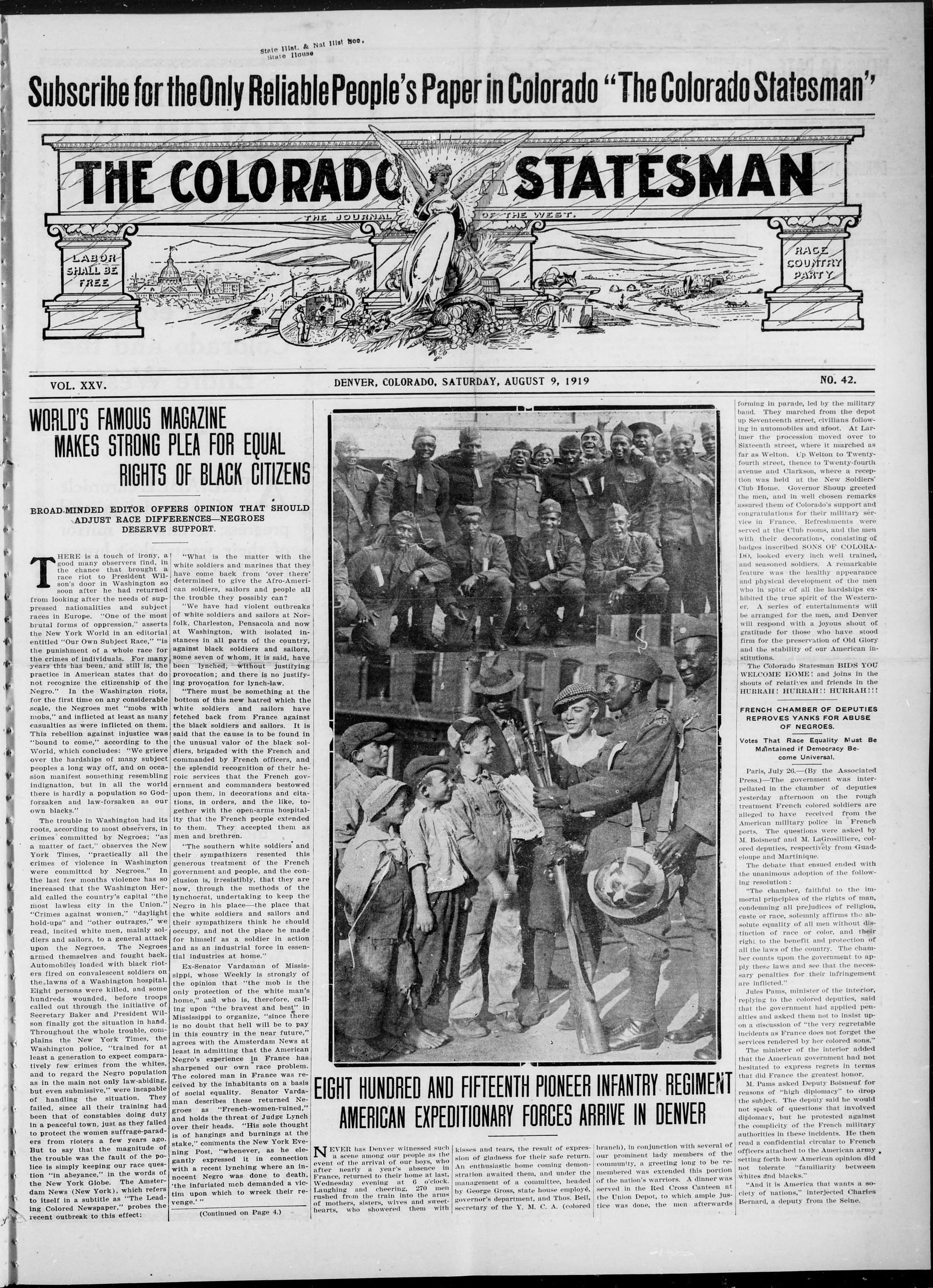
EIGHT HUNDRED AND FIFTEENTH PIONEER INFANTRY REGIMENT AMERICAN EXPEDITIONARY FORCES ARRIVE IN DENVER
NEVER has Denver witnessed such a scene among our people as the event of the arrival of our boys, who after nearly a year's absence in France, returned to their home at last, Wednesday evening at 6 o'clock. Laughing and cheering, 270 men rushed from the train into the arms of mothers, sisters, wives and sweet-hearts, who showered them with
kisses and tears, the result of expression of gladness for their safe return. An enthusiastic home coming demonstration awaited them, and under the management of a committee, headed by George Gross, state house employé, governor's department, and Thos. Bell, secretary of the Y. M. C. A. (colored
branch), in conjunction with several of our prominent lady members of the community, a greeting long to be remembered was extended this portion of the nation's warriors. A dinner was served in the Red Cross Canteen at the Union Depot, to which ample justice was done, the men afterwards
NO. 42.
forming in parade, led by the military band. They marched from the depot up Seventeenth street, civilians following in automobiles and afoot. At Larimer the procession moved over to Sixteenth street, where it marched as far as Welton. Up Welton to Twenty-fourth street, thence to Twenty-fourth avenue and Clarkson, where a reception was held at the New Soldiers' Club Home. Governor Shoup greeted the men, and in well chosen remarks assured them of Colorado's support and congratulations for their military service in France. Refreshments were served at the Club rooms, and the men with their decorations, consisting of badges inscribed SONS OF COLORADO, looked every inch well trained, and seasoned soldiers. A remarkable feature was the healthy appearance and physical development of the men who in spite of all the hardships exhibited the true spirit of the Westerner. A series of entertainments will be arranged for the men, and Denver will respond with a joyous shout of gratitude for those who have stood firm for the preservation of Old Glory and the stability of our American institutions.
The Colorado Statesman BIDS YOU
WELCOME HOME! and joins in the
shouts of relatives and friends in the
HURRAH! HURRAH!! HURRAH!!!
FRENCH CHAMBER OF DEPUTIES
REPROVES YANKS FOR ABUSE
OF NEGROES.
Votes That Race Equality Must Be
Maintained if Democracy Be-
come Universal.
Paris, July 26.—(By the Associated Press.)—The government was interpellated in the chamber of deputies yesterday afternoon on the rough treatment French colored soldiers are alleged to have received from the American military police in French ports. The questions were asked by M. Bolsneuf and M. LaGrosilliere, colored deputies, respectively from Guadeloupe and Martinique.
The debate that ensued ended with the unanimous adoption of the following resolution:
"The chamber, faithful to the immortal principles of the rights of man, condemning all prejudices of religion, caste or race, solemnly affirms the absolute equality of all men without distinction of race or color, and their right to the benefit and protection of all the laws of the country. The chamber counts upon the government to apply these laws and see that the necessary penalties for their infringement are inflicted."
Jules Pams, minister of the interior, replying to the colored deputies, said that the government had applied penalties and asked them not to insist upon a discussion of "the very regretable incidents as France does not forget the services rendered by her colored sons." The minister of the interior added that the American government had not hesitated to express regrets in terms that did France the greatest honor.
M. Pams asked Deputy Boisneuf for reasons of "high diplomacy" to drop the subject. The deputy said he would not speak of questions that involved diplomacy, but he protested against the complicity of the French military authorities in these incidents. He then read a confidential circular to French officers attached to the American army setting forth how American opinion did not tolerate "familiarity between whites and blacks."
"And it is America that wants a society of nations," interjected Charles Bernard, a deputy from the Seine.
FOREIGN
The Austrian cabinet, headed by Dr. Karl Renner, has decided to resign.
The recent British victory loan subscriptions amounted to £767,800,000, it was announced in the House of Commons.
Pirates operating on the Black sea have held up and robbed the steamer Constantine of $15,000,000 worth of notes and gold, says a dispatch from Constantinople.
The first passenger airship to fly to Rio de Janeiro from England will leave next month from Barrow. The fare will be $5,000 a round trip, which will be made via West Africa.
A shortage of more than 70,000,000 tons of coal, as compared with the 1913 output, is faced by Great Britain in the coming year, according to Sir Auckland Geddes, president of the Board of Trade.
Budapest is occupied by Rumanian troops who advanced from the river Theiss, in spite of representations made by Lieutenant Colonel Romanelli, the Italian representative of the allies at Vienna.
George Johnson, a United States army officer, committed suicide in dramatic fashion at Nice. He waded out into the sea in sight of numbers of pleasure seckers and then drew a revolver and shot himself.
The United States is not the only prohibition country, Belgium having followed suit so far as whisky, gin and other highly alcoholic liquors are concerned. Soon after the armistice was signed a law was passed forbidding the manufacture and sale of such beverages.
Advices from Berlin report that trunks belonging to the allied armistice commission in Germany have been stolen. The trunks contained important documents concerning agreements for the restitution to Belgium and France of machinery that had been removed by the Germans.
An extraordinary attempt of eleven Koreans to commit suicide by tying themselves together with a rope and then jumping overboard is reported from Chemulpo. The incident occurred on a ferrybont. All were picked up, but three were dead. The act is believed to have been inspired by Buddhist superstition.
The Prussian government, according to American reports, is planning to organize a new and "separate police force," to consist of from 100,000 to 300,000 trained soldiers, solely as a force to suppress disorder. It is planned to arm this force with the latest type of military weapons and to put the men in garrisons throughout Germany. Germany has cut the high cost of living in half. The reduction applies to all rational food, principally flour, potatoes, meat and fat. The government is spending one and a half billion marks ($375,000,000) in an attempt to bring food prices down to a permanently lower level. At the same time the meat and fat ration is being increased. American imports be assured.
GENERAL
A sample loaf of bread refused to explode when Chicago police shot at it within a package. They thought the box Judge Landis got in the mail was a bomb.
Quentin Roosevelt, killed in aerial combat in France, left an estate of only $1,100, it was learned when his mother, widow of Colonel Roosevelt, applied for letters of administration.
A petition bearing the signatures of 142,548 voters, asking the submission to the Ohio electorate at the November election of a constitutional amendment repealing the state-wide prohibition amendment and re-establishing the liquor license system and home rule local option, and defining intoxicating beverages as those containing in excess of 2.75 per cent alcohol, has been filled with Secretary of State Smith Saturday by L. P. Gibson, manager of the Ohio Home Rule Association.
The abnormal demand for pennies is still taxing the capacity of the presses in the Philadelphia mint, the enormous total of 38,931,000 having been struck during July. The other coinage consisted of 950,000 dimes and 9,306,000 nickels.
The Black Hills mining district of South Dakota produced $6,565,209 in gold and 159,246 ounces of silver in 1918. From Jan. 1, 1918, to Oct. 27, 1918, the Homestake mine and mills were operated at full capacity, but during the remainder of the year the property was operated at only 71 per cent capacity, says the geological survey.
The National Geographic Society has been asked to investigate the claim of John Shell, a mountaineer of Leslie county, Kentucky, that he is 130 years old. Shell's neighbors corroborate the statement concerning his age. Shell has nine children. He says the oldest is 90 years old. He is said to have 200 descendants in his home section, several being great-great grandchildren. The mountaineer, who claims excellent eyesight, steady nerve and general good health, attributes his long life to outdoor living and temperate habits.
The demand for tobacco is the greatest in the world's history, according to a statement made by Benjamin Duke. He declared that America is supplying much of the world's output and that 1,000,000,000 cigarettes are made in the United States every three days to meet the demand.
More than $4,000,000 worth of surplus textiles were auctioned in New York in about three hours by the surplus property division of the army, with representatives of Admiral Kolchak's Siberian government taking more than $1,000,000 of it.
NEWS TO DATE IN PARAGRAPHS
CAUGHT FROM THE NETWORK OP WIRES ROUND ABOUT THE WORLD.
DURING THE PAST WEEK
RECORD OF IMPORTANT EVENTS
CONDENSED FOR BUSY
PEOPLE.
Western Newspaper Union News Service.
WESTERN
More than two score persons were
injured, many seriously, when two in-
terurban cars on the Peninsula rail-
way collided head-on, nine miles from
San Jose, Calif.
Noticing that his automobile was
leaking badly, W. O. Turner of Musco-
tah, Kan., took a lantern and crawled
underneath the car to find the leak.
He found it. It was the gasoline tank
instead of the radiator. He will re-
cover his physician says.
Lawrence L. Shipley, an American of Yerington, Nev., who was captured by bandits at Fresnillo, Mex., July 19, has been released, according to Mexico newspaper dispatches forwarded to the State Department by the American embassy at Mexico City.
Oscar Lawler, former assistant United States attorney general for the Interior Department, was seriously burned, and Mrs. Lawler was badly burned when their home virtually was destroyed at Los Angeles by what the police believe to have been a gasoline bomb.
Texas schools will open next month with a shortage of teachers estimated at 4,000. The situation is the most serious in the history of the state's school system, according to a statement by the State Teachers' Association, made public. Low wages is given as cause for lack of applicants for schools.
Loss from forest fires in Montana and northern Idaho this season, up to July 31, amounted to $755,000, it was estimated by Glen A. Smith, assistant district forester. Heavy rains have removed the fire menace in Montana, though fires in Idaho still are threatening. A total of $815,000 has been spent in fighting forest fires in Montana and northern Idaho this season.
A protest against the policy of the Navy Department which, it was charged, compelled California oil interests to sell to the navy at tidewater at 80 cents a barrel, "plus a vague promise of 'final adjustment,'" crude oil, for which producers received $1.23 at the well, was embodied in a statement sponsored by the executives of several of the leading oil companies of the state. Under a contract which expired July 1 the companies had been supplying the navy with crude oil at $1.47 a barrel, at an aggregate loss, the statement said, to the oil interests of the state of $500,000.
WASHINGTON
Complete government ownership of radio systems in the United States is strongly recommended by Secretary of the Navy Daniels in a letter sent to Congress.
Surplus food held by the War Department July 19 was valued at $132,137,700. Bacon totalled $35,818,492. Other subsistence items were corned beef, $26,183,638; roast beef, $20,860,458; fresh frozen beef, $16,543,636; corned beef hash, $10,175,930; tomatoes, $5,509,967; baked beans, $2,835,646; canned sweet corn, $2,107,084; fresh pork, $2,072,942; granulated sugar, $1,478,947; canned peas, $1,282,495; fresh frozen poultry, $1,136,964; miscellaneous, $5,827,501.
Army surplus clothing and equipment, including $17,000,000 worth of underclothes and $9,500,000 worth of blankets, may be marketed in the same way surplus food is being sold if present plans are successful. Total value of all items classed as clothing and equipment, including cloth and leather, is $84,356,341.
The hundred steamships built on the great lakes during the war have been sold by the Shipping Board to the Anderson Overseas Corporation of New York for approximately $80,000,000. This is probably the largest ship sale on record, the board said in announcing the deal and the vessels will eventually pass into French and Italian ownership.
President Wilson has saved a number of the United States army from a death sentence. His commutation of the sentence to be hanged, imposed on Second Lieutenant Halber E. Perry, 51st Infantry, for the murder of Capt. Abram Posner, also of the 51st Infantry, on the highway between San Diego and Escondito, California, last December, to imprisonment at hard labor for life.
The State Department has been advised of efforts on the part of Japanese oil companies to acquire properties in the Tampico oil fields of Mexico and that American companies have been approached with a view to selling to the Japanese.
One new article of war and changes in thirty others have been recommended by the special board of officers appointed early in the war to investigate the army court-martial system. In making this announcement, Secretary Baker said he soon would transmit the board's report to Congress.
Pithy News Notes
From All Parts of
Colorado
Western Newspaper Union Newss Service.
COMING EXPERTS
Sept. 2-5.
Routt County Fair, Hayden, Sept. 3-5.
Logan County Fair, Sterling, Sept. 9-
12.
Delta County Fair, Hotchkiss, Sept. 9-
12.
Conejos County Fair, Manassa, Sept.
17-18.
17-18.
Wyoming Slope Fair, Montrose, Sept.
16-19.
Central Community Fair, Greeley, Sept.
16-20.
Wyoming County Fair, Yuma, Sept. 17-20.
Phillips County Fair, Holyoke, Sept.
24-27.
Saguache County Fair, Saguache, Sept.
18-20.
Colorado-New Mexico Fair, Durango,
Sept. 23-26.
Colorado State Fair, Pueblo, Sept. 22-
27.
Inter-Mountain Live Stock and Fair,
Grand Junction, Sept. 30 to Oct. 3.
Douglas County Fair, Castle Rock,
Oct. 7-9.
Colorado has collected $443,699.03 in
inheritance taxes since January 1st,
says Attorney General Victor E. Keyes,
head of the inheritance department.
Of this amount, according to the
report issued, $21,456.82 was collected
the last two weeks of July.
The figures show that there are
approximately 22,000 motor cars in the
city and county of Denver alone and
120,000 elsewhere in the state. The
increase of machines in Denver this
year will easily be 20 per cent, it is
estimated.
Approximately 21 per cent of the wheat grown in Colorado this year is on irrigated land, compared with 51 per cent in 1909. The acreage of wheat on nonirrigated land in the state has increased nearly 700 per cent in the past ten years.
Every part of Weld county has been drenched by heavy and repeated rains recently. Both the Platte and the Poure rivers have big flows of water and all danger of damage to late crops such as potatoes and cabbage resulting from drouth is believed to be past.
Joseph Koleski, a rancher residing at Einstlake, in Adams county, was instantly killed by lightning. Koleski left his home during a severe storm for the purpose of looking after some livestock. When he did not return, a searching party was organized and he was found dead in a field. He is survived by his widow and several children.
Coal prices at the mine have gone up 25 cents a ton and was followed at once by the retailers announcing an advance of from 25 cents to 35 cents a ton on coal, with the information that further advances would probably follow Sept. 1 and still more as the winter wore on. The explanation for the retail advances is that increased cost at the mine, increases in freight rates and wages would force them to advance the prices to the consumer.
Inquiries received by the State Board of Immigration indicate that the demand for Colorado lands, which has been exceptionally strong for the past eighteen months, is continuing and promises to be almost as good during the coming fall and winter as it was last fall and winter. Such checks as it is possible to make through the agencies at the command of the board indicate that people from other states have invested fully $2,000,000 in Colorado lands in the past twelve months.
The Colorado registration law was enacted in 1913, when 13,130 cars were licensed; in 1914 the number increased to 43,206; in 1917, to 66,850; in 1918, to 33,244, and to date this year approximately 100,000 cars have been registered. This number will total 110,000 before Dec. 31. The 1919 revenues will reach about $450,000, to be divided accordingly between the county and state road funds, after deducting 5 per cent for administering the law.
Statistics compiled in the assessors' reports on agriculture, and submitted to the State Immigration Department, indicate that there are more than 2,500 farm tractors now owned and operated by farmers in Colorado. The reports, not yet complete, show that there are 2,330 farm tractors owned by farmers who are actively engaged in farming in the state this year. There are also a large number of tractors, owned by town residents, that are being rented to farmers. Weld county leads in the number of farm tractors with 365, and the eastern plains section has more than 75 per cent of the total number in the state.
Any homestender who has failed to produce a crop and wishes to be excused from living on his land for the remainder of 1919 to seek other employment may obtain leave without being penalized. The homestender, before evacuating, must file notice with the land registrar.
A larger percentage of rye is grown without irrigation in Colorado than any other important crop. Preliminary figures indicate that the total acreage of rye in the state this year is 160,000 acres, of which only about 5,000 acres is irrigated.
```markdown
```
CENTENNIAL STATE ITEMS.
Assessors' reports on agricultural statistics made to the State Immigration Department, indicate that there are in excess of 2,500 farm tractors now owned and being operated by farmers in the state. The report is not complete and shows at this time 2,330 farm tractors owned by farmers who are actually engaged in farming in the state this year. In addition to the tractors owned by farmers there is a considerable number owned by persons living in cities and towns who use them in farm work on a rental basis. Weld county leads in the number of farm tractors, with 365, and the eastern plains section has more than 75 per cent of the total number in the state.
THE COLORADO STATESMAN
Approximately 21 per cent of the wheat in the state at the present time is grown on irrigated land, according to reports made by county assessors to the State Board of Immigration. The census report for 1909 indicated at that time 51 per cent of the wheat grown in the state was irrigated. The very rapid increase in acreage of wheat cultivated since 1909 has been accounted for chiefly by the breaking of new non-irrigated land. One of the results of this large excess of non-irrigated over irrigated wheat has been a very marked decrease in the average yield per acre for this crop.
The Mouth-Piece of the People of Colorado and the Entire West
Miners of Boulder county and representatives of various civic organizations have lately held a meeting and decided to hold a silver jubilee at Chautauqua park on Labor day. The jubilee will be to celebrate the fiftieth anniversary of the discovery of silver at Caribou. Sam Conger, who prospected in Boulder county in the early days will be in Boulder to take part in the celebration. W. M. Martin, discoverer of Caribou mine, will also take part in the jubilee.
Mesa county, according to the tax roll just completed by the assessor, is a million dollars wealthier than last year. The increase is attributed to the larger number and better grade of automobiles and the increased valuation of farm property directly resulting from the rapid development of the country. It is stated that the number of automobiles in the county is practically 100 per cent greater than last year.
A RELIABLE chronicle of their doings and progress; a faithful mirror of their wants, their hopes, their best aspirations.
The Board of County Commissioners has advertised for bids for the construction of a concrete road from the corporate limits of Grand Junction into Fruitvale. The estimated cost of the construction will be $61,000. It was stated that the contract probably will be let within the next thirty days and that construction work will start immediately afterwards. The money, it is reported, is available at this time. A thorough examination of the wheat fields of Montrose county revealed only one place where the barberry rust had attacked the grain. Walter J. Roth and several assistants of the United States Department of Agriculture under the supervision of the Colorado Experimental Station have completed a two-day inspection of the wheat fields of the county and gives this encouraging report.
THE COLORADO STATESMAN
The name, The Editor, was ordered given to a 9,600-ton steel ship to be launched at Seattle Aug. 16 in honor of the National Editorial Association's convention, which will meet in Seattle. Chairman E. N. Hurley of the shipping board assigned the name, Mrs. Guy U. Hardy, wife of Congressman Hardy of Cañon City, Colo., president of the association, will sponsor the vessel.
* Colorado Elks will hold a Liberty-Victory reunion at Loveland Aug. 25 to 27. Between 7,000 and 8,000 members are expected to attend the celebration, which is the first state reunion since America entered the war.
Unequaled as an advertising medium for the business of professional men and women.
The American Beet Sugar Company has purchased a large tract of valuable land near Rocky Ford. Plans are under way to erect in the immediate future thirty dwelling houses with modern conveniences for their help.
Margaret Ennis of Denver and Englewood has been appointed deputy sheriff of Arapahoe county. She is said to be the first woman deputy sheriff in Colorado. Miss Ennis is a daughter of Thomas Ennis, prominent Grand county rancher, and sister of Mrs. R. A. Blackman, state inheritance tax appraiser. During the war Miss Ennis was chief clerk of the local draft board of Arapahoe county, and attained many high honors for her good work during her fifteen months' service.
An excellent family journal speaking to and for many thousand colored citizens.
Total destruction of the large beet crop of Montrose county was averted only by the timely application of a spray of arsenic of lead to kill the army worms which were rapidly eating up the beet leaves and thereby killing the plant. This danger was experienced on the eastern slope recently, with considerable loss; however, an inspection of the fields where the spray was applied without delay shows that the loss is light in Montrose county.
TWODOLLARSAYEAR
All building records in Denver for any one month since 1912 were broken in July, when 203 permits, valued at $963,000, were issued by the city building department.
THE GREAT ORGAN OF THE LABORING MASSES
The 1919 issue of the Colorado Year Book is now in the hands of the printers and will be issued early in August. An effort was made to have the book ready for publication about July 1st, but the difficulties encountered by county assessors in some counties in completing their work of collecting agricultural statistics delayed the work materially. The volume will contain for the first time a set of tables showing by counties the acreage of all the principal crops planted for the harvest of the current year.
Work Should Not Be Undertaken Solely in Order to Provide the Work
period, which will be one of the most critical in the history of our nation. Now during the past two or three years our public improvements have lagged. Our federal government has not engaged in the usual public improvements; neither have the state governments nor the municipalities. There were two reasons for that; the shortage of workmen and the inability to properly finance, because of the control that the federal government had to have over finances in order to make sure that its own financial situation would be secure. Both of those conditions have changed, and there is now a surplus of labor, and the federal government has released control of the finances so that credits are now available. To me the one great method of forming a reservoir for buffer employment is to have the federal government engage in its normal improvement activities, and to have every state and municipal government do likewise.
I would not ask that work be undertaken solely for the purpose of providing work. To place men at work on any job, where the results from it are not needed, is just so much waste of time and energy and man power. But there is a tremendous amount of work, a tremendous amount of improvement that is needed; and so that the minds of our workers will not be fertile fields for the propagation of false philosophy it is our duty to see to it that these activities are now engaged in to the fullest extent.
Road to Reconstruction Is Well Marked by Three Reliable Guide Posts
The road to wise reconstruction is well marked. The first guide post says, "Faith in Business." The next one reads, "Employment for All." And the third one is, "Gradual Readjustment."
Faith in the future business of this nation is justified. All the elements which make for prosperity are present. Chief among these is the financial situation. We are on a sound basis. Our credit system is more highly organized, and it has vindicated itself under the severe strain of war.
Of course money is only one of the requisites of business. Equally important is a steady consuming market. This nation in itself is the best consuming market in the world. Our one hundred millions of people are free spenders and their aggregate buying power is greater than exists in any other nation under the sun.
But the home market is not our only market. Partly as a result of the war we have developed the facilities for entering into world commerce to a degree impossible a few years ago. We now have or shortly will possess merchant ships that will carry our products to the far corners of the earth and American ingenuity and enterprise, if given rein, will find markets for Yankee-made goods wherever there is money to pay the price.
Employment for all is essential. We must enable our returned soldiers to be productive and prosperous. It is not sufficient to give them jobs which furnish an excuse for wages. What they will prefer and what the nation would give them is work which will add new wealth to the world's store. Our government possesses millions of acres of arable land. It has millions more that can be reclaimed and made arable. I advocate the opening up of this government land, its apportionment among soldiers who wish to enter into productive work.
The stimulation of the work of production will provide much other work, and employment is in itself a panacea for most national ills. There has never been a time when an abundance of work was not accompanied by prosperity.
A display of patriotism, forbearance and common sense on the part of both capital and labor will enable us to go through the readjustment period with such success that we will get back on the highway of human progress without delay or accident.
Could anything be more "awful" than the hardness and thickness and uncompromising ugliness of this military model? This is a day when every girl is dreaming over a khaki coat and silver bars? Let women adopt whatever is farthest from the masculine in the way of clothes. No matter how thin the frocks or how "lo and behold" they are in front or "vee de Boheme" in back, no matter how short the skirts and how sleeveless the bodices, give us beauty and femininity—or look for a perishing world!
Women are of three types: No.1, the maternal; No.2, the intellectually creative; No.3, the weak and selfish. The larger proportion of women are in the first group. They are the ones who wear the fluffs and frills and all the pretties that attract men. They want to attract men. They should want to attract men. And they do attract men. And men marry them. And take care of them. And are happy with them.
The second sort of women substitute the creations of their brains for the creation of families. They are usually the tailor-made, shirt-waisted, sailor-hatted girls. They sometimes marry, but they rarely have children, or worth-while children. As a rule the world takes care of them, and fame is their reward.
The third type—the weak, selfish—are the ones oftentest criticized by reformers. They are either sophisticated enough to take care of themselves (in the ballroom or elsewhere) or are the "weak sisters" who are the inevitable mistakes of nature.
RAIOS & LOWE
By WILLIAM B. WILSON, Secretary of Labor
We are short in our normal supply where between three million and five million so if we could engage in our prewar action war basis immediately there would be the supply of labor. But we are not in a that.
How are we going to provide em
are we going to create a reservoir that we surplus labor during the period of dem
keep it busily employed? And there is for our people being busily em
will be one of the most critical in the history of the past two or three years our public imp
federal government has not engaged in the two reasons for that; the shortage of work properly finance, because of the control that we have over finances in order to make sursion would be secure. Both of those conditions now a surplus of labor, and the federal gov
of the finances so that credits are now availe one great method of forming a reservoir have the federal government engage in its results, and to have every state and municipal
not ask that work be undertaken solely for it. To place men at work on any job, where they need, is just so much waste of time and exthere is a tremendous amount of work, a tremat that is needed; and so that the minds of or fields for the propagation of false philosophy at these activities are now engaged in to the
To Reconstruction Is Well Born
Three Reliable Guide Poems
We are short in our normal supply of labor somewhere between three million and five million workers; so if we could engage in our prewar activities on a postwar basis immediately there would be a shortage of the supply of labor. But we are not in a position to do that.
How are we going to provide employment; how are we going to create a reservoir that will take up the surplus labor during the period of demobilization and keep it busily employed? And there is great necessity for our people being busily employed during that
By J. OGDEN ARMOUR, Chicago Packer
to wise reconstruction is well marked. The in Business." The next one reads, "Employ one is, "Gradual Readjustment." The future business of this nation is justifie makes for prosperity are present. Chief amo
PUNISH OFFICERS WHO WERE CRUEL
CASES OF BRUTALITY FEW IN PROPORTION TO NUMBER OF MEN IN ARMY.
"A. W. O. L." SERIOUS OFFENSE
Tendency Among People of United States to Belittle Charge, Because They Do Not Realize What Offense Really Means in Time of Battle.
By EDWARD B. CLARK.
Washington.—A special committee of the house of representatives is investigating the charges of cruelty to American soldiers in France who were confined to the guardhouse on various charges of bad conduct. Six American soldiers, now discharged from the service, have testified that they were brutally treated while under arrest.
It appeared at the hearings that several officers who were accused of cruelty to prisoners have been convicted and that others are awaiting trial. Of course the statement that American soldiers who were prisoners in our guardhouses were cruelly treated is one to arouse the anger of the American people, but it ought to be remembered that the cases of alleged brutality are few and that 2,000,000 men were serving the colors in France.
Army officials believe that the mothers and fathers of the soldiers should know that these cases are isolated ones; that every charge of ill-treatment had been investigated, and that those proved to be guilty of cruelty to the men have been brought to justice, or are about to be so brought.
There are two sides to every army question, as there are to every question in civil life, but the tendency of the American people as shown by the Washington records, is to believe everything ill that is spoken of the army. There are many guardhouses in France. There had to be places where the unruly, the mutinous, the shirks and others charged with military offenses could be confined.
Small in Proportion.
The number of prisoners charged with offenses was large, but it was very small in proportion to the number of men in the army.
There has been a tendency among the people of the United States to be little the charge known in the army as "A. W. O. L," otherwise "absent without leave." A good many of the guard-house cases were men charged with this offense. One hears frequently in Washington, as apparently elsewhere, how shameful a thing it is to lock a man up simply because he has taken a day or two days' leave without permission. Doubtless fathers and mothers of many American soldiers feel this way.
How would the fathers and mothers of some of the soldiers killed on the battlefield feel today on this subject if they knew that perhaps their sons' lives were lost because the sons of other fathers and mothers had shirked their duty, and had gone "A. W. O. L." at critical times, thus necessitating service in the first line for men who already had served there and were in rest billets?
So it is that "A. W. O. L." on occasion means much more than people think it means. Cruelties to prisoners, whether they absented themselves from their commands at a critical time or not, is something that the American people will not stand for, but the expressions of sympathy for well-treated prisoners simply because they are prisoners is sometimes misplaced. It is no lie to say that some American soldiers lost their lives while doing the work which it was the duty of other soldiers to do.
The special committee of the house of representatives is investigating charges of cruelties to guardhouse prisoners in France. Any officer or noncommissioned officer who is cruel to a prisoner, no matter what his offense, will be punished, for such always has been the way of the military authorities in the field, but so far as sentiment and sympathy concern themselves with legal punishments for men who shirked their duty that others might do it, the American people in many cases, perhaps, justly might stop sentimentalizing and sympathizing.
Senate Debate Not Convincing.
The senate of the United States these days is literally an international debating society with a national setting. The representatives of a nation are discussing proposed relations with virtually all the other nations on the face of the earth. The senate is an interesting place, but admittedly it is a place where one cannot get the light of conviction.
The man with an open mind on the subject of the League of Nations who goes into the senate galleries to get the illumination of conviction has his troubles. Within an hour the League of Nations covenant first will be pronounced the world's greatest document, "marking the beginning of a new and better order in world's affairs," and then denounced as "a pact which if given the life of law will undermine Americanism, destroy nationalism and bring war and tumult into the world."
Men have come to Washington to listen to the debates of the League of Nations and gone away saying: "We must make up our minds for ourselves." It is a huge subject, this League of Nations, and no one knows it better than those devoted ones who
have read it as one United States senator was said to have read the Bible, "from kiver to klver." When a printed copy of the covenant and the peace pact is read section by section, and an application is had of the multitudinous national interests involved. It is easy enough to understand why criticism should pass concerning the length of time which it took the conference in Paris to reach its decision.
Fall to Get Light.
There are persons who go into the galleries of the senate to listen to the debate and who come away unilluminated, and who because of the tortuous paths of the arguments are willing to leave the following of them to the senators, and to shift the responsibility from their shoulders to those of the men who are intrusted with the business of making decisions in high matters of state.
The galleries of the senate today are interesting places, interesting in part because of the diversified natures of those who attend the daily sessions. Scores upon scores of men and women go to the galleries for one day and leave with the decision not to return. There are scores of others, however, who return day after day to listen to the senators on this side and to the senators on that side, enjoying the debate for the very warmth of it and probably hoping that some day a spark will fly which will supply light sufficient for the gallery student to see his own way clear to an opinion on this world pact.
Perhaps it is the fact that enfranchisement has come to them in so large a degree recently that makes the women journey to the galleries in far greater numbers than the men. It has been noticeable in the senate, and in the house, too, for that matter, in recent months that the women are showing a strong interest in matters of legislation and of government generally.
Wrath Hits Them.
There are in the gallery day by day many men and women whose minds already are made up. They are the ones whose enthusiasm get away from them once in a while, and who by their demonstrations call down upon their heads the wrath of the vice president, or the president pro tempore, whichever happens to be presiding.
It is against the rules of the senate to evidence vocally or by hand clapping or foot-stamping, approval or disapproval of anything which is said on the floor. Once in a while the galleries are cleared by order of the vice president because of these demonstrations.
"Day of Glory" for France.
"The day of glory has arrived." It was with these words that a dispatch describing the Bastille day celebration in Paris began. The arrival of this message stirred Washington. It quickened the beating of the pulses of all the soldiers here, the ablebodied and those others in the hospitals who, with their comrades sound of body and of limb, helped to make possible the day of glory in Paris. The French know how to keep fete days. They have a genius for such things. It is innate with them. They do not have to study to produce effects, because every Frenchman personally is an effect-producing factory.
On Bastile day soldiers of every one of the allied and the associate nations in the war against Germany appeared in the parade which was what the French planned to make it—a pageant of glory and yet a pageant of simplicity. The Arc de Triomphe, as usual, was made the apex of the triumphant demonstration. Immediately after the entry of the Germans into Paris in 1871 the French drew chains across what may be called the gateways of the Arc de Triomphe. Those chains never were to be taken down until French armies could pass through them returning triumphant from the fields where victorious battle had been waged in behalf of free France.
Chains Come Down.
On Bastile day the chains were down and representatives of the triumphant armies of France, Great Britain, Belgium, Italy, Serbia and the United States passed through. Every American soldier who saw Paris saw the Arc de Triomphe. Their footsteps passed along the wonderful avenue of the Elysees to the point where the avenue radiated from the Arc to make the star. The lesson of the Arc de Triomphe was borne in upon every American soldier who stood under its shadow.
When the treaty of peace was signed in the Hall of Mirrors in the palace of Versailles the French officials, with that keen perception of the eternal fitness of things, had invited to be present delegations of enlisted men of all the allied nations. It was a peculiarly French conception. To be present there were the dignitaries of the great nations, but the French with that keenness of perception which is their own saw that the bulwarks of freedom, the plain manhood of the countries, must be represented to make the occasion logical, complete and, yes, dramatic.
It was in this spirit that Bastile day was celebrated. It was a celebration not in honor of the president of France, nor even in honor of the great generals who commanded the armies of the allies, nor yet even in special honor of the pollus and the doughboys and Tommies who had made victory certain, but in honor of a world freed from the peril of militaristic domination, and of freedom once more triumphant.
I have seen several celebrations in Paris. The same spirit imbued all of them. They were dramatic and yet simple. It was possible to read a lesson in every detail.
KK
Don't Be a
Scarecrow!
Nowadays
one is judged
by his appearance—
he is taken
at his own valuation.
If you expect to be accepted
as a useful member
of society,
dress the part—
and the first step
is the step into The May Co.
Clothing Department.
THE MAY
AY CO.
THE MAY CO. The Home of Society Brand Clothes
---
The Oldest
National
in Colorado—a ba
sources of over t
million dollars—h
Saving
Department
and pay
4% Int
on saving
We are splendidly
to render patron
by mail in both
Comme
Accou
The Oldest National Bank
in Colorado—a bank with resources of over twenty-seven million dollars—has opened a Savings Department and pays
We are splendidly organized to render patrons real service by mail in both savings and Commercial Accounts
The B
Nation
Ban
The First National Bank
AUGUST
HOUSE-CLEANING
SALE
AT
Michaelson's
15TH AND LARIMER STS.
Get your share of the matchless values in every department.
---
Sixteenth and Champa Streets
Seventeenth Street at Stout
Opinion is divided into four parts—what we want our friends to think of us, what we think they think of us, what they do think of us, and what we think they think we think they think of us.
Moral Purpose.
The greatest work has always gone hand in hand with the most fervent moral purpose.-Sidney Lanfer.
ESTATE OF RHODA BROWNING.
DECEASED, NO. 24445.
All persons having claims against said estate are hereby notified to present them for adjustment to the County Court of the City and County of Denver, Colorado, on the 25th day of August, 1919.
TEMPLE M. OUTLAW.
Administratrix.
Frank D. Taggart, Attorney.
First publication, July 26, 1919.
Last publication, August 23, 1919.
SANATITE
IS
FOOT COMFORT
OR YOUR MONEY BACK
Denver, Colo.
on savings
The Store of Better Values
THE COLORADO STATESMAN
LABOR SHELLS THE FREEL
FLOW COURTIN PARTY
JOS. D. D. RIVERS.....Proprietor
P. O. Box 116
Phone Main 7417
One Year ..... $2.00
Six Months ..... 1.50
Three Months ..... .75
MUST BE PAID IN ADVANCE.
Entered as second-class matter at the postoffice in the City of Denver, Colo.
Reading notices, ten lines or less, 10 cents per line. Each additional line over ten lines, 5 cents per line. Display advertising 50 cents per inch.
Remittances should be made by Express Money Order, Postoffice Money Order, Registered Letter or Bank Draft. Postage stamps will be received the same as cash for the fractional part of a dollar. Only 1c and 2c stamps taken.
No discounts allowed on less than three months' contract. Cash must accompany all orders from parties unknown to us. Further particulars on application.
Communications to receive attention must be newsy, upon important subjects, plainly written only upon one side of the paper, must reach us Tuesdays, if possible, anyway not later than Wednesdays, and bear the signature of the author. No manuscript returned, unless stamps are sent for postage. All communications of a personning nature that are not complimentary will be withheld from the columns of this paper.
NEGROES BEING DECEIVED BY THE "GET-TOGETHER" SCHEME.
RETURNING to Denver recently after having a splendid opportunity to hear discussion on the NEGRO PROBLEM AND ITS SOLUTION from seventy-five eminent educational leaders of both races at the recent national assembly of the National Association for the Advancement of Colored People, held in Cleveland, Ohio, a delegate of color told us of some of the expressions of sympathy offered by the white speakers over the unfortunate occurrences towards us, also the scoldings from both white and colored speakers for our continuous refusal TO GET TOGETHER. This delegate, with much emphasis, said how deplorable every one thought our case was, especially from the fact of our helping others to fight their cause successfully and achieve their objective in this country while our case is left alone, and the lack of agreeableness, concerted action and combination of efforts compels the result detrimental to our progress and the amelioration of existing conditions. "I can't understand why the colored people won't get together," said one of the speakers, and the chorus from this representative gathering sounded and resounded in the convention hall, "We cannot understand;" and if they cannot understand because possibly of their inexperience of our condition in the Southland, (all the delegates we presume being from parts other than the South) their ignorance of unfair dispensing of law and the injustice of local governmental authorities, the suppression or abolition of those principles that go toward human uplift, these delegates can get the understanding very easily by becoming residents for thirty days of the portion of this country where the pro-slavish doctrine is still being taught and where the ante Civil war instruction of "Servants, be obedient to your masters," is greatly in evidence. Indeed this is nothing short of mockery, when neither black man or white man, pretending to be ignorant of the reasons of our not getting together, when the proofs are so clearly placed before them, the facts so impressive, the reasoning beyond dispute when in the speeches of Morefield Storey, president of the N. A. A. C. P., he has disclosed the terrible conditions as regards educational disadvantages to the Negro on the one hand, the small per capita appropriation and the incompetent staff of teachers appointed and re-appointed by the respective school boards of the rural districts, their delight being in having the masses of our people inferior in the mental sphere, in other words, the possessors of the "little learning" which make them a very strong opponent to their brother who is not only environed with the superior intellectual forces, but who is fortunate to be trained by a faculty, very competent, and under a curriculum equal to any white school. Surely we should not allow ourselves to be longer deceived by this GET-TOGETHER SCHEME as is flaunted to us by those whites who cannot understand because they will not understand, and also those Negroes who are natives of every where else but the South and who are foreign to the gross deception practiced by the other side, for in our opinion (the result of our contact with him for over half a century) if the other thought would give its visible form after he expresses his denouncement of our not getting together, you would discover indelibly written on the chambers of his heart, I HOPE THEY WILL NOT GET TOGETHER. We, although fighting the influence of hypocrisy and ill-action are getting together. It may appear a slow process, but guided by honesty of purpose towards one another, that integrity that will commend itself to the world, thereby commanding respect at home and abroad, we will get together when the dominating power least expects, and our demand for civic liberty and right as citizens according to our constitution, will be given us as were the principles that made this country free from a tyrannical reign of a despot who believed in his might. Fellow Negroes who are strong in the get-together doctrine that our white citizens are preaching, ask them if that spirit is intended for you in the North, East and West, eliminating the South, or if it means the whole black population of the American family. You will then be able to furnish the materials for your permanent foundation and superstructure if they mean the latter.
BETTER CLASS WHITES SHOULD DECLARE PUBLICLY AGAINST SOUTHERN PROPAGANDA.
IN "The Commercial Appeal," a daily paper of Memphis, Tenn., recently appeared the following article: "Negroes in Chicago hear call of South;" and under glaring sub-head lines, "Lured by equality promise, dream is blasted," "North's need ceases," "Packers to give whites preference. Wish to return Negroes to South. Talk segregation of races. Social equality idea abandoned." After giving a graphic account of the riot, the writer concluded the article thus: "Chicago has emerged from the race riots, but the Negro's dream is blasted. Those who recently came from the South want to return and are returning as fast as they can secure passage. The Negroes who have lived in Chicago for years will remain. But leaders of both races admit it will be a long time before the scare of the riots will be effaced. The better element in Chicago did not participate in the rioting. It was the hoodlum element of both races that started and continued the trouble. In official quarters the opinion is held there will be a limited segregation of the races. Plans are discussed for providing Negro families with better housing conditions in neighborhoods exclusively colored. There is no longer any thought of social equality, but the better element of both races believes an understanding will be reached where each will respect the rights of the other and live in harmony as they do in the better apportioned communities of the South." It seems quite clear from the above that the writer's main object is the RETURN OF THE NEGRO TO THE SOUTH, hence the hobby-horse SOCIAL EQUALITY and its pet company LIMITED SEGREGATION, prove the doctrine of the South inculcated for several years in the hearts and souls of this class of Americans, who are bold to assert that they maintain the claim of our being still their goods and chattels and our liberty is merely a temporary loan, the collection of which will soon be demanded and must be repaid. If the better class of white citizens in this country continue to play with this fire from the South, that has never been extinguished, according to the proofs given from time to time in this country, as sure as the breath of life remains with us there will be a conflagration in our United States of America that will burn perpetually, and the great civilization of the West that is endeavoring to be heralded to what is termed the semi-savage and uncultured nations of the globe will, like the dog, "return to its vomit," or "the hog that was washed to its wallowing in the mire." Unmistakable proofs within recent times and late events have established the fact that we are prepared to prgserve and maintain this liberty that we have so dearly bought with the last drop of our blood, and with all sincerity we assure our white brother that professes the real American spirit which
makes one an advocate of right and justice, that the race to which we belong has no desire to divide, and if they will come out in the open and declare against this hellish propaganda that is emanating from the South, and disseminating its wicked action in the form of race riot and blood-shed so as to destroy the premises of the North, East and West, we will, with every vestige of our manhood, with every spark of life, bare our breast once more to the cannon's mouth, to the rain of shot and shell, to forever exterminate this arch-fiend, this disturber of good government, this cancerous agent that is making such inroads and invasions on our nation as to permanently arnihilate us from our national self-respect and international prestige. The idea of German propaganda is rot; the labor trouble will adjust itself as soon as the vision falls on the average laborer and he too forgets his idea of race discrimination, but as sure as the seasons come and go if the class of the white population who stand for right is contented to remain awaiting the passive resistance, leaving it to time, the Civil war that rent this country in twain, the late war that caused the world to shudder will not have a phase of comparison to the internal strife that will be our lot. There is no German propaganda when it comes on the infernal RACE HATE from this Southern white man, who like the spider weaves and weaves until he entangles his own race in the meshes of his web, and then he retires in thought, chuckling over his successful achievements. The expression of revenge uttered at the close of the Civil war lives in his breast; the avenging thought lives in his memory, and he will move in his attempt the very planetary system if he can, to him him to win his goal. We therefore urge the white man who is impressed and who is satisfied with the help that the Negro citizenry of this country has given ever its inception to fearlessly denounce this cruel, unlawful and distasteful propaganda with pen and tongue, in pulpit, in pew, in state, in nation and if needs be with the sword, and if his heart beats true, the Negro will, with his back to the wall, FACE THE ENEMY ONCE MORE.
CLASS CONSCIOUSNESS OF NEGRO
EDITOR OF CHRISTIAN SCIENCE MONITOR OPINES OPPORTUNITY FOR SELF-DETERMINATION WILL HELP TO REMOVE OPPRESSION.
NE THING obvious in the period through which the world is now passing is that all sorts of people are becoming class-conscious. The conflict of class interests
always latent, has become acute. On all sides, individuals are finding poignant reasons for analyzing their status, discovering those whose interests appear to be allied or opposed, and are tending to unite with their fellows. Such a result was only to be expected from the work of the peace conference. That little phrase, "self-determination," whirring up and down the lanes of world progress, has brought out into the open every nation, race or class having a special interest to be maintained or a particular grievance to require correction. And amid countless claims with which the world is unfamiliar have come, resurgent, some of those older claims, those problems, that have long been awaiting attention.
It is not surprising, for example, that the Negroes in the United States have seen in the present situation an opportunity for self-determination. Perhaps they did not at first realize the potential effect of the American Negro as a soldier in the United States army in this war, but they realize it now. They are pointing out that the Negro was on a par with the white man as a fighter, and are pressing the logic of the situation to secure his recognition on a par with the white man in civil life. This appears to be a dominant phase of Negro thought in this country just now, and it is being applied with such emphasis to the evil of lynching as to create a new feeling throughout the country, that this form of lawlessness must be reached and ended. Along with this claim for consideration on the basis of national service is another claim, less readily expressed in words yet perhaps even more assertive, namely, the claim of the Negro to consideration as a factor in industry. We hear it said, here and there, that the war was the "industrial salvation of the Negro." We see Negroes, in the northern cities, at least, more numerous and better dressed than before the war, often with every appearance of what the world calls "easy circumstances." There is very little of the old-time shiftlessness. The Negro of the industrial centers is, generally, more alert than he was before the wave of good jobs with good wages was sufficiently widespread to include him.
But what makes it clearly apparent that Negroes are now unitedly thinking of their status, and definitely pressing for the betterment of Negroes as a class, is their activity in organizations having that for an object, and the industry and skill with which they plead their cause in print. Not the most active of the self-determining "small nations" interested in the European peace terms has more effectively circularized the newspaper offices in this country since the armistice than have the Negroes, through publicity matter and personal letters. They believe they know what they want, and they are using all proper means to bring their contentions to public-notice. That these contentions are becoming known throughout the world is indicated by the fact that the Pan-African Congress, having had its initial meeting in Paris early this year, has been organized as a permanent body, and has adopted resolutions of which perhaps the two most significant paragraphs are as follows:
"Wherever persons of African descent are civilized and able to meet
the tests of surrounding culture, they shall be accorded the same rights as their fellow citizens; they shall not be denied on account of race or color a voice in their own government, justice before the courts and economic and social equality according to ability and desert. "Whenever it is proven that African natives are not receiving just treatment at the hands of any state, or that any state deliberately excludes its civilized citizens or subjects of Negro descent from its body politic and cultural, it shall be the duty of the League of Nations to bring the matter to the attention of the civilized world."
Another significant gathering since the beginning of the year, namely, the first national conference on lynching, at which twenty-five states were represented in New York in May, has resulted in the passage of resolutions favoring federal legislation against lynching and the formation of a committee of lawyers to deal with any legal questions that may be involved. A national conference in Cleveland, Ohio, in June, focused the work of the National Association for the Advancement of Colored People on the effort to organize 100,000 members to defend the rights of the Negro. And a very tangible improvement in the situation of the Negroes in the United States seems likely to grow out of the establishment of their status in the American Federation of Labor.
On the whole, this activity of the Negro on his own behalf is something to be welcomed. He has been often told that his salvation depends upon himself, and his agitation in defense of his rights can hardly fail to bring out into the free light of public discussion a subject that has been often avoided yet must eventually be dealt with. If there has been, on the white side of the question, a tendency to shirk responsibility and to be unjust, it may be discovered, on the black side, that there has been a tendency to ascribe to color alone certain social divergencies which obtain between various classes of whites as well as between whites and blacks. There has been, at any rate, too ready a willingness to deal with this problem by wholesale, to judge both sides by typical instances of individuals, instead of considering each instance and each individual on their merits. There are, it is to be remembered, a good many white men in the world who do not get all the recognition on all the justice they would be glad to enjoy. While it is right that Negroes should have justice, it is right also that they should remember that not all injustice in the world is suffered by Negroes. The problem, like most of those that now claim the world's attention, calls for consideration that shall be equable, as well as equitable.—The Christian Science Monitor.
FOR RENT: Oneu nfurnished room at 2737 California St. Phone Champa 4540.
Walking Downstairs.
It is not so difficult to walk downstairs as to walk up, as everybody knows. Why not try it? It takes very little longer time and the many calls for the elevator for descending passengers could be reduced by a half at least if we were a bit thoughtful. The saving in current and fuel would be remarkable.
New Potatoes Grow Old.
If you place two-year-old potatoes in a box in a perfectly dry dark place and leave them for a few weeks you will find that new potatoes have grown on the old ones. They will continue to grow until the old potatoes have shriveled to dry skins.
Eyeglasses.
The suggestion of the use of lenses for the cure of eye defects was made by Roger Bacon, the great scientist of the thirteenth century. The making of the spectacles was carried out by Italians. Physicians of those days, however, did not know the true theory upon which they were based.
THE DENVER DRY GOODS CO.
Low Shoes at Low Prices During the Summer Sale
Low Shoes at Low Prices During the Summer Sale
Our shoes were bought before last increase went into effect. There is not only this saving accomplished, but a further important reduction that applies in this event.
If you have not already taken advantage of the special values in this sale you will have the opportunity to do so this week.
Entire Stock of Low Shoes for Men,
Women, Boys, Misses and Children
At 15%, 20% and 25% Shoe Department-M
THE DENVER'S SUMMER CLUB
WOMEN'S AND M
Blouses, Bath
Bathing Tights, Smooth
Aprons, Porch Dress
At 15%, 20% and 25% Discount Shoe Department—Main Floor THE DENVER'S SUMMER CLEARANCE SALE OF WOMEN'S AND MISSES'
Bathing Tights, Smocks, Bungalow Aprons, Porch Dresses, Waist Coats and Vestees
Blouses—118 Georgettes, Voiles and in all colors; regular $8.75 to $10 price
Blouses—90 beautiful Blouses in play wonderful coloring; regular $15.00 price
Bathing Suits—All-wool, two-in-one, $8.75. Summer clearance price
Bathing Tights—Cotton and silk, go $1.50 to $4.50. Summer clearance to
Smocks—Charming styles in cotton crash, handsomely embroidered and Summer clearance price
Waistcoats and Vests—Very smart, co and georgettes, all colors; regular clearance price, one-half
Bungalow Aprons—Made of splendid percales, stripe, plaid and solid color Summer clearance price
House Dresses—In plain gingham, 100 choice dresses; regular $5.75 to price
House and Porch Frocks—All white percales, linene, plain and fancy m be cleared away at one-half price; Summer clearance, one-half
GRAND JURY WOULD NOT DISCRIMINATE AGAINST NEGROES IN CHICAGO RACE RIOT INVESTIGATION.
Walk out Court Room—District Attorney Maclay Hoyne, Twentieth Century Reformer, Exhibits Great Race Prejudice.
First Chapter in the Fight for Human Rights—Negroes Will Defend to the Last Cent.
Chicago, Aug. 6.—Prosecution of the race riots was halted abruptly today by a break between the county grand jury and State's Attorney Maclay Hoyne. The jury literally dropped its consideration of evidence in a body and walked out, flinging charges at the prosecutor that he is discriminating against Negroes
To this Mr. Hoyne replied immediately by issuing a statement in which he vigorously denied discrimination, and in substance told the jury to mind its own business and do its duty, as the state's attorney is attempting to do his. He declared he was not to be dictated to regarding the manner and order in which the riot cases he has prepared are presented to the jury for action.
The clash came just after the jury had voted an indictment against three Negro youths on charges of rioting and carrying weapons. Assistant State's Attorney Robert Rolla had started to present another case, that of Emma Jackson, Kate Elder and three Negro men, accused of killing Walter Rignadell, a white youth.
"Why are we getting cases against black men only? Why don't you present some cases against white rioters, too?" was the general cry of the jury. Rollo waded through a mass of evidence to see whether he had a case ready to present against a white offender. He had none. Assistant Attorney General Middlekauff then made an effort to hold the jury together for the purpose of having Attorney General Brundage "make a statement" to the body. Prosecutor William H. Duval opposed this, saying no one, unless he had evidence to present, should appear before the jury. While this question was being threshed out the jurors donned their hats and coats and left the building. State's Attorney Hoyne, in his statement, declared he could see the hand of "vicious black belt politics in this tempest in a teapot."
He asserted he feared the outbreaks as an evidence the grand jury was "talking outside the grand jury room to persons who are not public officials, or who, if they are public officials, are playing politics."
What's gone and what's past help
should be past grief.—Shakeagare.
FOR SALE—2½ lots 145x62½, corner 20th and Clarkson, one 5-room and alcove modern dwelling, 1 large 5-room dwelling, bath and toilet. All improvements paid. Price $7,000. Terms. Inquire owner. Phone Gallup 962.
Daily Thought
1
and 25% Discount
ent—Main Floor
ER CLEARANCE SALE OF
AND MISSES'
athing Suits,
Smocks, Bungalow
Dresses, Waist
ales and Crepe de Chine Blouses
to $12.50. Summer clearance
$5.95
in plain and fancy georgettes,
$15.00 to $19.50. Clearance
$9.75
in-one styles, all colors; regular
e. $6.95
silk, good quality; regular price,
clearance price, one-half, 75¢
$2.25
cotton, voile, crepe, linene and
ed and smocked; regular $7.50.
$4.95
mart, of taffettes, crepe de chines
regular $3.00 to $8.75. Summer
$1.50 to $4.38
splendid quality ginghams and
id colors; regular $3.50 to $4.00.
$1.95
gham, stripes and plaids; about
.75 to $7.50. Summer clearance
$4.95
all white, in fine quality piques,
ncy madras; slightly soiled; to
price; regular $4.00 to $11.50.
$2.00 to $5.75
WORLD'S FAMOUS MAGAZINE
MAKES STRONG PLEA FOR EQUAL
RIGHTS OF BLACK CITIZENS
Broad-Minded Editor Offers Opinion
That Should Adjust Race Differ-
ences—Negroes Deserve Support.
(Continued from Page 1.)
While the Washington Star remarks that the "unusual spectacle" of rioting in Washington is "enough to shock the community seriously," the New York Globe calls it "a humiliating and shameful business," in which the only discoverable moral is that "we make no pretense nowadays of settling the race question; we simply keep it in abeyance." The National Association for the Advancement of Colored People, when asked by the Digest for an expression of opinion on the matter, forwarded their "Ninth Annual Report," with a marked paragraph. This paragraph not only contains a criticism of the mob tactics employed by the Negroes to meet the mob tactics of the whites, but suggests one large source of trouble that most other commentators neglect. It runs:
"We would deeply deplore the forcible defense of Negroes by other Negroes, since it would perhaps lead to sanguinary conflicts between the lower element of whites and the Negroes, but no sane observer can fail to reflect that either white men, who make and enforce the laws, must stop mob attacks upon black men, no matter what reason may be given for the attacks, or confess themselves unable to maintain law and order and protect all citizens from unlawful attack.
"No class of citizens can be denied the protection of the law with impunity."—The Literary Digest.
New Potatoes Grow Old
If you place two-year-old potatoes in a box in a perfectly dry dark place and leave them for a few weeks you will find that new potatoes have grown on the old ones. They will continue to grow until the old potatoes have shriveled to dry skins.
Better Off Than His Dad.
Nowadays a man thinks he is having a rough time when he has to help move the furniture around a bit, forgetting that his glorious dad used to spend a week out in the back yard beating the dust out of carpets and thought nothing of it.
Ray Clark, former Denverite, arrived in the city this week to visit his mother, who is very ill.
The daughter of Chester McClelland, popular Boulderite, is visiting with her father at 1032 Water St.
C. D. Kemp and wife visited for a few days with old time friends, who were glad to see them again.
Miss Clara Montgomery, daughter Mrs. William Slade, is enjoying vacation in Colorado Springs, former residence of several years.
Rhoda Anderson Chambers, our pix artist, will fulfill her promise to a public in the opening of her studio on Monday, August 11th, in the space and accommodating quarters above Atlas Drug Company, Twenty-seven
Grant Jones, popular townman, returned after visiting various points in the state of Kansas. He is in residence at 1073 Lincoln.
Mrs. I. H. Hickman and daughter, Miss Lillian E., spent their vacation in Colorado Springs and Cripple Creek last week.
Miss Edwards and Mrs. Patton of Fort Worth, Texas, are visiting in the city as the guests of Mrs. White, 1415 East Twenty-second Ave.
Mrs. Mattle Helms of Las Vegas, N. M., arrived this week and is the guest of her sister at 2422 Lafayette street. After spending a few weeks she will continue her trip to Chicago and other Eastern points.
Mrs. Cordelia Rogers Webb was hostess at an informal luncheon last Saturday in honor of Mrs. W. B. Coleman of Pine Bluff, Ark., and Miss Mayme Gillam of Little Rock, Ark.
Mr. and Mrs. Emanuel Lewis of Telluride, Colo., spent a few days in the city this week visiting friends. Mrs. Lewis left for Billings, Montana, to visit friends and old acquaintances, while Mr. Lewis went to Missouri to visit his father.
We beg to acknowledge receipt of the Portland Times, a bright, newsy illustrated organ which Portland ought to be proud of and which we welcome into our field of journalism as an Advocate of Truth and Right. May every success attend the publication.
Mrs. Carrie S. McClaim, employe of the Education Board in the city schools for the welfare of coloured children, spent five days in Estes Park, the guest of Mrs. Jessie Johnson. While there she and her host were royally entertained by Mr. Curtis Harris of the Stanley Hotel.
MR. C. PARKHILL HARVEY, manager of the office department of the Rocky Mountain News, is accredited by the public as the right man in the right place, as by his painstaking manner and instructions 'to his staff in their action towards the people the popularity of this famous daily paper of the West is ever increasing and establishing a very good permanent record.
The Dearfield Colony series of articles beginning Saturday, August 16, will give facts from first-hand knowledge, personal observation and information from authentic sources. The geographical and geological phases will be discussed. Persons intending to secure accurate information of this sound and safe investment should send in their subscriptions to Colorado Statesman, Box 116, Denver, Colo. early. Already there is a rush. Get in you are too late; $2.00 per year.
The Masons' entertainment at East Turner hall was successful from every angle. It seems as if Nature always offers from her bountiful storehouse everything advantageous to successful entertainments of this fraternity, as we were in the throes of a great heat wave for a few days, a gentle breeze came on the scene, neutralizing the effect of the scorching rays of the sun. The vari-colored lights of the hall, supported by the summer gowns of the ladies, in harmonious action with the military garb of our recently returned military gentlemen, and our usually bedecked townsmen in their summer apparel, made this event something extraordinary, and we must congratulate our Masonic brethren for maintaining their social prestige which counts for much in this community. The management scored another hit. More of success to the Masons.
The Misses O. A. Anderson, N. Allen, O. McCullough and Messrs. J. Walker, T. Von Dickerson, C. Norris spent a very pleasant evening last Friday at cards and dancing at the home of Miss Carrie Hicks.
A party of young people entertained at Miss Russ's beautiful home, 2612 South Logan last Monday evening, in honor of Miss Wilmer Dellams of Corciana, Texas, Miss Jones and Miss Ross of Kansas City, Mrs. Myers of Kansas City, Mr. James Walker, and Mr. and Mrs. Parker. The evening was spent in playing whist, and dancing. Mr. George Morrison, Mr. Lee Morrison, Mr. Cedel Norris, Mr. Cedel Norris, Mr. James Walker, Miss Oletta Anderson and Mr. Eugene Montgomery furnished numerous musical selections during the evening.
Miss Maude Wright and Miss Franzes Russ were hostess at the Soldiers and Sailors' Home Sunday evening. They served seventeen boys to light refreshments.
Mr. and Mrs. James V. Sherrill, formerly of Binghampton, New York, having decided to join the rank and file of Westerners, have purchased a beautiful residence at 1623 E. 30th avenue. They are very much impressed with western hospitality and sceneries, and with their son, who has been employed ever since his arrival, have resolved to be permanently located. Mr. Sherrill is the chief butler of Mr. Lawrence Phipps, Jr., very wealthy citizen.
Miss Clara Montgomery, daughter of Mrs. William Slade, is enjoying her vacation in Colorado Springs, her former residence of several years.
Rhoda Anderson Chambers, our piano artist, will fulfil her promise to the public in the opening of her studio next Monday, August 11th, in the spacious and accomodating quarters above the Atlas Drug Company, Twenty-seventh and Welton streets. The entrance is on Twenty-seventh, and a cordial invitation is extended to the public.
Rev. David E. Over, pastor of Zion Baptist Church, accompanied by Mrs. Over, left the city last Tuesday morning for Pasadena, where he will remain until his health is completely restored.
The members of Zion Baptist Church, also friends of different races, pastors of several churches, colored and white, assisted materially in raising over $220 to help Rev. D. E. Over in the regaining of his health.
Emancipation Day picnic at Graves' Farm, Boulder, last Monday was conceded by the large concourse of people who were present to be the best event ever given in a long time in this part of Colorado. Quite a large representation from Denver, Colorado Springs, Eaton and other sections of the state graced the beautiful premises with their presence, and what with the specially prepared "eats," the great jazzy orchestra, and the ideal day that it was their fortune to have, nothing could be heard but "Graves' Farm, what a pleasant resort!"
MISS MYRTLE B. ANDERSON AT
ZION BAPSTEI CHURCH LAST
TUESDAY IN HER LECTURE,
"PLEA FOR JUSTICE."
Zion was filled to seating capacity in main auditorium as well as the Sunday School annex to hear the youthful lecturer, Miss Myrtle Bernice Anderson in her famous lecture—"THE HUMAN CRY, A PLEA FOR JUSTICE." Coming at this time when our country is at such unrest, when it appears as the foundations of good government in the world seem to be crumbling; when at our own fires the cruel arm of prejudice, discrimination and general cruelty is being laid heavily upon us, this youth of a few years brought a message of consolation and cheer at a time when most needed, as the succession of atrocious events is beginning to create a feeling that must result in our becoming other than patriotic if the lawless actions do not quickly terminate. Apart from her matchless oratorical powers, her logical reasonings and coagent arguments, she forcefully reminded us of our contribution to this country's cause, to the nation's development, to the preservation and maintenance of its honor and dignity, and its prestige which the world reveres and admires. Then after her fluent, eloquent and rhetorical recitation of our part in the glorious achievements of the United States of America, from the shedding of our blood in her freedom from monarchical yoke, from an enslavement characteristic of monarchies and sovereignies, she offered a chastisement for the little wrongs among us like petty jealousies, disclosing of our business ventures, lack of pride and admiration in and for the race, and then with much emphasis she gave the good advice—MANAGE YOUR OWN AFFAIRS—the essence of which meant have faith and confidence in yourselves, your professionals of your race and entrust your business among your people who can and will give service the most, the best. The speaker was listened to with rapt attention and after a forty-five minutes talk which impressed very strongly race uplift, and race determination for better treatment from our government, she offered her PLEA FOR JUSTICE and requested us to join the great army of our people that are pleading for this cause. The lecture was free, but Denver in her usual large-hearted and appreciative manner, expressed their readiness to assist her in carrying the message to other cities by a free will offering of nearly $80. Our best wishes go with her and we hope for her a long career of usefulness after Miss Anderson completes her law course in the Chicago University, this being her senior year. Rev. A. M. Ward presided, and a nice and spicy little program consisting of a piano solo by Miss Lucy Perkins, songs by Mme. Lillian Hawkins-Jones, and introduction of the lecturer by Mrs. George Ross added delightfully to the event.
NEW HOME BAKERY.
James Wims and wife have opened a home bakery at 2049 Stout street, where everything in the line of good, clean, home-made articles in the bakery line will be offered their patrons, whom it is our pleasure to please. Give us a trial and be convinced. We are in the heart of the business section and fill all orders promptly.
OUR BOYS IN BASEBALLDOM.
Games last Sunday as follows: A. B. C. vs. Brotherhood of Railway Clerks. Batteries, Smith and Parsons. Score 2 to 1 in favor A. B. C. Bolden Bros. vs. Barnum All Stars. Score 3 to 0 in favor of Bolden. Batteries Brooks and Walker; Parker and Moriarity. White Elephant vs. Lombardi Grocery. Score 11 to 3 favor of Lombardi. Batteries, W. E., Carrie.
Hill, Howard, Lombardi, Colloss and Hill, Howard, Lombardi, Colloss and Rose. Although the White Elephants lost their game last Sunday they are still in the lead and setting the pace for the other teams. This is the first game the team has lost since its organization and it has inspired the players to come back stronger than ever under the leadership of Freddie Hill.
The Final Clearance of Women's Low Shoes at $4.35 a pair
16th and Curtis
Cheyenne News
About 500 overseas colored boys arrived at Fort Russell early Tuesday morning, Aug. 5, for demobilization. These boys are draftees of Wyoming, Colorado and Utah. We are glad to see the return of these heroes who so willingly gave up their loved ones and their homes to go across the bosom of the ocean to fight for democracy. There is no doubt that they experienced some very disagreeable life while there, but nevertheless they return looking cheerful.
Wednesday of last week, Mr. C. J. Toliver, secretary of the Civic League, caught two white burglaries breaking into his home on Fifth and Snyder streets. The two young men, who gave their names as Walter Brown and Roy Schuller, were seen for some time by Toliver apparently hiding out in the neighborhood of his home. They came there on horses, Mrs. Toliver had been instructed by her spouse to keep an eye on them while she was about home, but she went into town that morning and Toliver, from where he works in the Union Pacific shops happened to see them approach his home at Fifth and Snyder and break out a window pane. Toliver immediately telephoned the police and Chief Embery and Patrolman Kranz set out for the scene of the daylight robbery. Then followed a long chase which terminated after about a mile, when the two young house breakers were captured near the Bressenham artesian well. The horses of the two men are also in custody though not in the city jail.
Mrs. Charles Rhone and son, Bobert, motored to Laramie Sunday morning early, returning early Sunday evening. Mrs. Rhone was also accompanied by her daughter, Blossie, and a company of young boys and girls, who reported a splendid time, plenty of good things to eat, lovely scenery, as well as excellent roads and good luck on account of their careful driver, Master Robert Rhone.
Mrs. Charles Johnston has returned from Chicago, where she has been visiting relatives and friends for about three months.
The rally at the Second Baptist Church Sunday was a success. About $75 was raised. Pastor C. O. Smith preached both morning and evening.
Mrs. B. F. Gaskin entertained at dinner Thursday in honor of Captain York and Mr. and Mrs. Wayne Gaskin, who were visiting relatives in Cheyenne. Later on in the evening a company of young boys and girls joined them and the evening was very pleasantly spent. Delicious refreshments were served, which concluded a very pleasant evening. Among those enjoying the hospitality of Mrs. Gaskin were the Misses Ethel Gaskin, Hattle Brown and Mrs. Gaskin's charming daughters, and Masters James, Walter and Robert.
Captain York left Aug. 1 for Washington, D. C., where he will be stationed in the future.
Rev. J. M. Endicott, pastor of the A. M. E. Church, is busy getting ready for the conference.
Mrs. Daisy Thompson entertained at dinner Sunday. The guests were Mr. Walter Davis, Mrs. James and little daughter, and Rev. and Mrs. J. T. Muse.
Mrs. James is a visitor of Mrs. Thompson from Denver. Mrs. Norman Peniston is here from Chicago. She will make her future home here with her husband, Mr. Norman Peniston.
Y. M. C. A. NOTES.
Quite a number of men visited the building during the week, some of whom were visitors who have come from other sections and are visiting friends in Denver. Surprise is expressed at times by some of them that Denver has not a large, modern building such as is found in quite a number of cities back in the East and Middle West. It is necessary to explain to them all the reason why—namely, that just as the board of directors were preparing to bring on a campaign for such a building over two years ago the war situation became so acute that the plan had to be given over for the time, but that it is hoped by another year things will be different. On account of the marriage of one of the leaders of the croquet club early in the week, some of the games scheduled could not be played. Some good games were played on the upper court, however, the most exciting being between King and Sims. Each of the players had blood in their eyes when
Joslin DRY GOODS CO.
they walked on the court. Determined to follow up the advantage which he gained the week before when he defeated Sims in a 5 to 0 series, King walked upon the court last Monday afternoon and gave Sims such a "walloping" as he had not received for three years. In a later series Sims defeated Dr. Stripling 2 to 1 in a three-series contest. King and Jones also defeated Bennett and Stripling. The members of the Committee of Management are requested to meet at the building next Wednesday evening, the 13th, at 8:30 o'clock to consider matters of importance looking towards the fall work which will be taken up in September.
SHORTER CHAPEL, AFRICAN M. E. CHURCH.
Twenty-third Street and Washington
Rev. A. Milton Ward, Minister. Phone M. 5414, 220 23rd Street. 9:45 a.m., Sunday School, Mrs. Ruth B. Bright, superintendent.
11 a. m. and 8 p. m., preaching.
6 and 7 p. m., the Junior and Senior A. C. E. Leagues, Miss Myra Glenn and Mr. Roy C. Brown, presidents respectively, will meet.
Chaplain Henry M. Collins, who spent fourteen months abroad with the American Expeditionary Forces, will preach at Shorter's Chapel Sunday morning, August 10, and will deliver his famous lecture upon "The Negro Soldier in Foreign Lands" at Shorter Chapel on Monday evening, August 11. The public is invited to enjoy a literary treat.
Last Sunday was the fourth and last quarterly meeting day for this conference year at Shorter Chapel. The Rev. S. A. Stripling, pastor of Scott M. E. Church, delivered a good old Methodist communion sermon and Presiding Elder Pope occupied the pulpit morning and evening, preaching to large audiences. The services were good, but there were no accessions.
The Ladies' Aid of Shorter Chapel, Mrs. Nannie Johnson, president, has planned a tacky drill for the evening of August 28. Mrs. F. O. Miller of Wichita, Kansas, was the guest of Rev. and Mrs. A. Milton Ward during the past week. Mrs. Miller is an Ohioan and a graduate of Wilberforce University. Dr. Miller, her husband, is the county physician of Wichita. Mrs. F. O. Miller gave a pleasing talk to the women of Julia Shorter Woman's Mite Missionary Society on Thursday, Mrs. Mae Stell and Mrs. Nannie Brown were hostesses.
Troy P. Gorum, the youthful baritone soloist of Boston, Mass., scored a big victory in his first appearance before a Denver, Colorado audience in his recital at Shorter Chapel, African M. E. Church, on Monday evening, August 4, 1919. He was greeted by a large and entusiastic audience which filled the main auditorium of the church. Mr. Gorum's selections were pleasing and well rendered to, the delight of his audience, and there were frequent encores.
Mr. Gorum was assisted by Valerez Spratlin, pianist accompanist, George Morrison, violinist, and Shorter A. M. E. Church Choir, Lillian Hawkins Jones, director.
Mr. Gorum was presented by the Helping Hand Club of which Mrs. Maggie Stamps is president, and the choir, of which Mr. Samuel Bondurant is president.
The affair was a pronounced success and the Rev. A. Milton Ward thanks all who assisted in any way to make Mr. Gorum's coming a success. Mr. Gorum has a pleasing personality and his people and all music lovers are justly proud of him.
1930
Phone Main
3270
FOR SALE.—Boxes and barrels for kindling purposes. W. Cowan, 2824 California St. Phone Champa 3490.
For employment see the Industrial Realty Co. Employment Agency, 718 East Twenty-sixth Ave. York 4561.
FOR SALE: SIX-ROOM BRICK HOUSE, near Whitties School, modern except stationary tub, $2,625. Address F. H. Droney, 2707 W. 29th Ave.
Dr. S. A. Huff, physician and surgeon, 2538 Washington street; office hours 11 to 12 a. m., 3 to 5 p. m. Phone York 2313. Out of office, Main 875. Residence Phone York 4101.
E. P. BLAKEMORE, Attorney and Counsellor at Law. Office, Rooms 39 and 40 Arapahoe Bldg., 1622 Arapahoe Street. Phone Champa 5450.
Day and Night Phone Main 2701. DR. C. E. TERRY, PHYSICIAN AND SURGEON Office Hours: 12 to 2 p. m., 6 to 8 p. m. and appointment. LEAVE CALLS AT ELITE DRUG, STORE. 1027 21st St., Denver, Colo.
Phone Main 8036
Res. Phone York 5774W
FRANK D. TAGGART
Attorney at Law—Notary Public
205-206 Cooper Building
Denver, Colorado
SANATITE
IS
FOOT COMFORT
OR YOUR MONEY BACK
Prof. W. M. Mackey
FIRST CLASS TONSORIAL WORK
Hair Cutting a Specialty
Satisfaction Guaranteed
Shop remodeled in latest style.
2244 LARIMER ST., DENVER
Good showing of oil in our first well now drilling and nearing pay sand. We have 1,320 acres in heart of Muddy Creek field, Carbon County, Wyoming. Limited amount of stock for sale at 2c per share. Buy before first well sends stock to 10c. For information call, write or phone
KEY OIL
& REFINING CO.
Main 2449 210 Cooper Bldg.
DENVER, COLO.
---
Rhoda Anderson Chambers
Teacher of
ARTISTIC PIANO PLAYING
From Elementary to Highest Grades
Phone Champa 1174 2431 Court Pl.
JUSTICE DEPARTMENT THINKS SENTIMENT WILL BACK THEM IN PROFITEERING FIGHT.
PRESIDENT REFUSES TO TREAT
UNTIL SHOP EMPLOYES
GO BACK.
Western Newspaper Union News Service.
Washington, Aug. 8.—Justice Department officials are convinced, they said, that strong sentiment will back them in demanding jail sentences for those convicted of profiteering or food hoarding, and that no court would feel content to let off profiteers with fines. As defined in section No. 6 "necessities shall be deemed to be hoarded within the meaning of this act when either "A-Held, contracted for, or arranged for by any person in a quantity in excess of his reasonable requirements for use or consumption by himself and dependents within a reasonable time:
"B—Held, contracted for, or arranged for by any manufacturer, wholesaler, retailer or other dealer in a quantity in excess of the reasonable requirements of his business for use or sale by him for a reasonable time, or reasonably required to furnish necessaries produced in surplus quantities seasonably throughout the period of scant or no production, or "C—Withheld, whether by possession or under contract or arrangement from the market by any person for the purpose of unreasonably increasing or diminishing the price." Much evidence against hoarders and profiteers already is said to be in possession of Department of Justice officials. For anti-trust investigation and prosecutions Palmer now has a balance of nearly $100,000 under an appropriation which became available July 1.
All district attorneys in the United States have been ordered, by Attorney General Palmer to proceed immediately in the prosecution of all persons guilty of hoarding foodstuffs and to label the foodstuffs for condemnation.
"This is the most important business before the country today," Mr. Palmer said, in announcing his action.
"I propose to have the law-enforcement machinery of the government sidetrue everything to handle this job."
Washington, Aug. 8.—President Wilson tonight notified Director General Hines that he was authorized to take up the demands of railroad shop employees for higher wages and decide them on their merits. The President said that the letter sent him by Senator Cummins, chairman of the committee on interstate commerce, "had set me free to deal as I think best with the difficult question of the wages of certain classes of the railroad employés," but added: "The chief obstacle to a decision has been created by the men themselves. They have gone out on a strike and repudiated the authority of their officers at the very moment when they were urging action in regard to their interests."
The President's decision was announced tonight from the White House in the form of a letter sent by him to Mr. Hines. The President said that "until the employés return to work and again recognize the authority of their organization, the whole matter must be at a standstill."
Leaps to Death.
Los Angeles, Calif.-Charles McGwire, suspected of having knowledge of those responsible for the dynamitting of the home of Oscar Lawler here and who was being questioned by District Attorney Thomas Lee Wooline in the latter's office here, escaped from two detectives who were guarding him and leaped from the eleventh floor of the hall of records to the pavement in New High street. He was dead when picked up.
Twenty People Drowned.
Halifax.—Twenty persons are believed to have lost their lives when the schooner Gallia was sunk in a collision with the British Steamer War Witch. The schooner is reported to have carried a crew of at least fifteen and possibly a dozen passengers and only seven survivors are named in wireless messages from the steamer. The War Witch was bound for North Sydney from Wabana, N. F., while the Gallia was on her way to St. Pierre from France.
Powers Must Accept Changes.
Washington.—A determination to stand against any reservations to the peace treaty which do not specifically require acceptance by the other powers before the United States enters the league of nations, was voiced in Senate debate by Senator Lodge, who declared that while in general practice a reservation might become valid if unobjected to by the other parties to the treaty he hoped there would be a definite declaration by the Senate to make the treaty binding on all powers.
WOMEN AND GIRLS WHO ARE MEMBERS OF CLUBS ARE ENCOURAGED TO GROW HERBS
1
Club Girl in Her Herb Garden—Sage Plant Before Cutting.
(Prepared by, the United States Department of Agriculture.)
The old-fashioned kitchen garden was not considered complete without its small collection of "pot-herbs"—sage, thyme, and other medicinal and savory herbs. French cooking is noted for its fine flavor, and this is largely because French cooks excel in the skilful use of herbs.
The United States department of agriculture is encouraging women and girls who are members of clubs organized by extension workers to grow more savory herbs. Not only is the daily diet varied by the use of "pot-herbs," but in nearly all communities the surplus is easily marketed.
size, three and four feet across this reason they should be given of space. One plant will use all the sage required by a. The broad-leaved variety is co-grown. Two or three cutting young, tender shoots can be ming the season. As a rule, the tips of the branches are cut at inches in length and tied in bunches to dry. Sage is used only for flavoring pork sausage dressings for poultry.
Other savory herbs which isirable for home use or market, mint, tarragon, sweet basil, dwarf coriander, balm, thyme, hot summer savory, sweet femel a
Selecting and Preparing Soil.
Herbs usually occupy the same ground for some years, and should be conveniently located in one corner or at one side of the regular garden. It is a good plan to apply a quantity of well-rotted manure to the soil in the autumn and spade it in deeply. If the soil can be trenched or broken two spadings in depth, all the better, as this will break up the subsoil and give the roots more space for development. One good method is to mark off the rows where the plants are to be set, then remove the top soil and place it to one side; two or three inches of manure is then spread in the furrow and spaded into the subsoil. The top soil is then returned and allowed to settle a few days before the plants are set out. One of the main things to consider is placing the perennials or permanent plants together in one row or corner where they will not be disturbed. The biennials may be placed next, and the annuals in a collection by themselves.
The general cultural methods are practically the same for all — good, clean cultivation during the summer, and a mulch of leaves, straw or manure around the plants during the winter. The mulch protects them from winter-killing, and at the same time adds fertility for next season's growth. Sage, turapon, mint, anise, caraway and dill are the herbs found most often on the markets, but in growing for commercial purposes it is best to learn what particular herbs are most in demand in the locality.
How to Grow Some Varieties.
Anise is an annual and the seeds do not retain their vitality after the second year, so they should be strictly fresh when planted. The seeds should be sown indoors and the young plants transplanted. They may also be sown in the open ground and thinned 12 to 14 inches apart in the row. The plants grow to a height of about two feet. The seeds are borne in heads which should be cut from the plants when the seeds are nearly ripe. The seeds of anise are used for flavoring, especially in cookies, and for sprinkling over cakes when sugar or frosting is used.
Caraway seeds are usually planted in the garden, but should be sown early in the spring. The plants should be thinned to about 15 or 18 inches in the row. Sometimes seeds are produced the first season, but more often not until the second season. The seeds are used for flavoring bread and pastry. The seeds are saved in the same way as those of anise.
The culture and the uses of dill are very much the same as those for caraway. The leaves are also used for flavoring soups. The tender leaves and stems, together with the seed heads, are dried and used for flavoring cucumber pickles, making the famous commercial "dill" pickles. For home use watermelon rind and chayotes, when treated with brine and dill, make an excellent pickle.
Sage is one of the oldest and most common of the garden herbs. The plants live for several years if protected from extreme cold, and are most easily started by taking rooted off-shoots from the side of an old plant. In rich soil the plants grow to a great
cestry. Several, however, trace their in-
nental congress, and one announced hie-
d of Hannah Dustin" of colonial and Inc
"best known as a platform orator."
Other members with an eye to thrif
firm originated a well-known cloth, an
biles into this country from Europe,
press-clipping bureau. One recites he
getting into congress after his "char
through an untiring campaign in a pr
ralised on a dairy farm," another lives "in
public school at an early age."
U. S. Mints Making 100,
F RAY BAKER, director of the Unit
person who created the slogan. "Ta
will take care of themselves," somebody
cestry. Several, however, trace their lineage back to members of the Continental congress, and one announced he is a "direct descendant of the father of Hannah Dustin" of colonial and Indian fame. Another member said he is "best known as a platform orator."
Other members with an eye to thrift did not fail to advertise. One said his firm originated a well-known cloth, another that he brought the first automobiles into this country from Europe, and another that he is president of a press-clipping bureau. One recites his collegiate achievements, and admits getting into congress after his "characteristic determination" carried him through an untiring campaign in a popular automobile. One member "was raised on a dairy farm," another lives "on a gravel road," and another "entered public school at an early age."
U. S. Mints Making 100,000,000 Pennies a Month
IF RAY BAKER, director of the United States mint, ever lays hands on the person who created the slogan. "Take care of the pennies and the dollars will take care of themselves," somebody will have to call out the reserves. For do you know, working the mints at their topmost speed and turning out 100,000,000 pennies monthly, Ray just naturally cannot keep up with the demand for coppers in this country.
ite hiding places for coins with pennies to go round.
Of course the demand for pennies, penny taxes on lollypops and such, be penny supply should not, under ordinal pennies the government has made. Since the time of the Revolutionary war, one cents. The total to date is more than the government had in all of its depo. Came then the new and insistent d that Ray took his complete force off out 100,000 pennies a month.
He has even set the San Francisco delphia has hitherto coined all the cop.
White House Pickets Are
SUFFRAGE damage suits totaling $80,000 the commissioners and other officials than a year have been postponed for t
Superintendent Whittaker of Occoquan suits were brought, but still are resp during their terms of office.
Suffragists think the government is in the belief that the suits might be suffrage amendment by congress. Miss Woman's party, however, has announced
The eight suffragists suing for day Winters Brannan, Miss Dorothy Day, York; Miss Julia Emory of Baltimore Mary A. Nolan of Jacksonville Fla.
Uncle Sam's Taxes Vs. t
P RESIDENT WILSON'S experience law of 1918, which has subtracted a siderable sum of $21,430, is likely to
PRESIDENT WILSON'S experience with the workings of the income tax law of 1918, which has subtracted from his salary of $75,000 the not inconsiderable sum of $21,430, is likely to direct the presidential attention to the
high cost of living. The cost of living has increased at the White House as well as everywhere else, and, with the prospect of having to entertain official visitors from England, France, Belgium, and possibly Italy, President Wilson will find his second encounter with the income tax no joke.
Subtracting *from his salary of $75,000, the exemption of $2,000 allowed him as a married man, the president now pays at the rate of 6 per cent on the first $4,000 of his income sub-
on the first $4,000 of his income to
subject to the normal tax, amounting to $93,000, bringing his normal tax up to
from 1 to 36 per cent, amounts to $12.9,
leaving him but $53,570 of his original
by private additions to his income the s
Every state reception given in the
of $5,000.
In normal times at least four are
dinners in honor of the vice president
diplomatic corps, and the speaker of t
So it looks as if the president will
if he hopes to keep expenses within the
der of his term.
IN SPREAD OF CIVILIZATION
ject to the normal tax, amounting to $240, and 12 per cent on the remaining $69,000, bringing his normal tax up to $8,280. His graduated surtax, rising from 1 to 36 per cent, amounts to $12,910, and makes a grand total of $21,430, leaving him but $53,570 of his original salary. And if his salary is increased by private additions to his income the surtax will be heavier in proportion.
Every state reception given in the White House costs in the neighborhood of $5,000.
In normal times at least four are given each year, together with official dinners in honor of the vice president, the judges of the Supreme court, the diplomatic corps, and the speaker of the house.
So it looks as if the president will need to exercise considerable ingenuity if he hopes to keep expenses within the limits of his salary during the remainder of his term.
Deposition of Theebaw, Monarch of Upper Burma, Paved Way for Country's Peace and Prosperity.
The recent death of Theebaw, once an Indian king, recalls memories of the horrors of his rule and the overthrow of his dynasty, and the British annexation of Upper Burma 31 years ago, the London Times states. He was one of the junior members of a large family of sons and daughters of
size, three and four feet across. For this reason they should be given plenty of space. One plant will usually produce all the sage required by a family. The broad-leaved variety is commonly grown. Two or three cuttings of the young, tender shoots can be made during the season. As a rule, the tender tips of the branches are cut about four inches in length and tied in small bunches to dry. Sage is used especially for flavoring pork sausage and in dressings for poultry.
Other savory herbs which are desirable for home use or marketing are mint, tarragon, sweet basil, dwarf basil coriander, balm, thyme, horehound, summer savory, sweet fennel and sweet marjoram.
Curing and Storing Herbs. The most important point in connection with producing good savory herbs is proper curing. The tender stems, leaves and flowers, where included, should be taken from the plants at the proper stage and then dried in the shade. A very good plan is to tie them in small bunches, allowing some space on the string between each bunch, then roll loosely in a piece of paper, leaving both ends of the roll open so that the air will pass through. The roll may be held by rubber bands or short pieces of string and hung up in the shade to dry. In order to prevent the bunches of herbs sliding out of the paper the string should be attached to the nail, or whatever they are to be hung upon, and then wrapped around the roll of paper and tied. After being thoroughly dry, the herbs should be taken down and each individual bunch of herbs wrapped in paraffin paper to retain its color and flavor and also to protect the herbs from dust.
For marketing, the small packages can be packed in pasteboard boxes in any desired number. They are usually sold by the dozen. Much depends upon the attractiveness and appearance of the herbs when they are put up for the market. Exposure to dust does not conform to modern ideas. Care should be taken that the herbs do not become crushed in handling.
GOOD ICELESS REFRIGERATOR
Household Conveniences Are Inexpensive and Easily Constructed— Ice Not Needed.
(Prepared by the United States Department of Agriculture.)
Are you having trouble this summer because you can't keep food cool without ice and ice you cannot get?
Send to the U. S. department of agriculture for Farmers' Bulletin 927 and get directions for making "An Iceless Refrigerator." It can be made easily and will aid greatly in keeping meats, fruits and vegetables cool, and will extend the period for keeping milk and butter. It costs little to build the refrigerator and nothing to operate it.
ALL AROUND
the HOUSE
A little kerosene in the wash boiler helps to whiten the clothes.
* * *
If china is carefully wrapped and boiled before using it will last longer.
* * * *
Soap and water will take the paint from woodwork. You can easily remove finger marks by rubbing them with a piece of clean flannel dipped into kerosene.
* * * *
You can clean your coral beads beautifully by washing them in warm borax water, using one teaspoonful of borax to one pint of water, then rinsing in tepid water. Dry by rolling in a soft towel.
WASHINGTON SIDELIGHTS
Politics Makes Strange Members of Congress, Too
Politics Makes Strange Members of Congress, Too
WASHINGTON.—An epitome of mankind's virtues, occupations, aspirations and deeds is found in congress. Within the pages of the congressional directory—that of the Sixty-sixth congress has just been issued—senators and
ite hiding places for coins with pennies, and that is why he cannot find enough to go round.
Of course the demand for pennies has grown greatly with the slapping of penny taxes on lollypops and such, but even this additional drain upon the penny supply should not, under ordinary circumstances, swallow up all of the pennies the government has made. Since it first began to coin money, about the time of the Revolutionary war, one-tenth of all the coins made have been cents. The total to date is more than $3,000,000,000. And yet, at last reports, the government had in all of its depositories only about $177,000 in coppers.
Came then the new and insistent demand for more coppers, with the result that Ray took his complete force off all other work and started in grinding out 100,000,000 pennies a month.
He has even set the San Francisco mint at work making pennies. Philadelphia has hitherto coined all the copper money.
White House Pickets Are Bent on Sweet Revenge
White House Pickets Are Bent on Sweet Revenge
SUFFRAGE damage suits totaling $800,000 which have been pending against the commissioners and other officials of the District of Columbia for more than a year have been postponed for the fifth time, at the request of the gov-
Superintendent Whittaker of Occoquan has resigned under charges since these suits were brought, but still are responsible for the treatment of prisoners during their terms of office.
Suffragists think the government has asked for postponement of the trial in the belief that the suits might be withdrawn after the passage of the suffrage amendment by congress. Miss Alice Paul, chairman of the National Woman's party, however, has announced that the suits will be pressed.
The eight suffragists suing for damages are Miss Lucy Burns, Mrs. John Winters Brannan, Miss Dorothy Day, and Mrs. Henry Butterworth of New York; Miss Julia Emory of Baltimore, Mrs. Cosu of New Orleans, and Mrs. Mary A. Nolan of Jacksonville Fla.
Uncle Sam's Taxes Vs. the President's Pocketbook
Uncle Sam's Taxes Vs. the President's Pocketbook
P
PSST
He has been one of the government's strongest advocates of it ever since the war started, but he feels that people have taken the admonition to save pennies too literally. As nearly as he can figure out, folks have been gorging their hearthstones, lisle banks, old copper teakettles and other favor-
FINAL SUMMORS
NATIONAL WOMANS
PARTY VS
DISTRICT OF
COLUMBIA
representatives record their own biographies.
Most of the lawmakers are lawyers, but among the membership are an iron molder, banker, stock raiser, tree surgeon, physician, cheese manufacturer, glass blower, baggage master and "a business man and political accident."
Although autobiographies deal with the authors' past, a surprising feature was that many members did not have more to say about their an-
lineage back to members of the Contine is a "direct descendant of the father Indian fame. Another member said he is left did not fall to advertise. One said his mother that he brought the first auto-motor and another that he is president of a his collegiate achievements, and admits characteristic determination" carried him popular automobile. One member "was "on a gravel road," and another "entered 000,000 Pennies a Month United States mint, ever lays hands on the lake care of the pennies and the dollars y will have to call out the reserves. For
PENNIES
s, and that is why he cannot find enough
has grown greatly with the slapping of
out even this additional drain upon the
ary circumstances, swallow up all of the
since it first began to coin money, about
e-tenth of all the coins made have been
$3,000,000,000. And yet, at last reports,
distories only about $177,000 in coppers,
demand for more coppers, with the result
all other work and started in grinding
to mint at work making pennies. Phlla-
apper money.
The Bent on Sweet Revenge
600,000 which have been pending against
als of the District of Columbia for more
the fifth time, at the request of the gov-
ernment. According to Judge Waddell this will be the last postponement granted to the defense.
The cases were brought by members of the National Woman's party following the alleged illegal transfer of suffrage pickets arrested at the White House from the District jail to the workhouse at Occoquan, Va., and alleged brutalities suffered by them in that institution.
Superintendent Zinkham of the District jail has been dismissed and
has resigned under charges since these
responsible for the treatment of prisoners
has asked for postponement of the trial
he withdrawn after the passage of the
Miss Alice Paul, chairman of the National
ced that the suits will be pressed.
images are Miss Lucy Burns, Mrs. John
, and Mrs. Henry Butterworth of New
e, Mrs. Cosu of New Orleans, and Mrs.
the President's Pocketbook
with the workings of the income tax
from his salary of $75,000 the not inco-
direct the presidential attention to the
CALLERS
SIR
HIGH COST
OF
LIVING
HOME PAY
of $240, and 12 per cent on the remaining to $8,280. His graduated surtax, rising from 910, and makes a grand total of $21,430, and salary. And if his salary is increased surtax will be heavier in proportion. White House costs in the neighborhood are given each year, together with official, the judges of the Supreme court, the house. We need to exercise considerable ingenuity the limits of his salary during the remain-
King Mindoon, who ruled Ava despotically, but on the whole prosperously, for 26 years. After undergoing the usual novitiate in a Buddhist monastery, he became with three of his brothers, a pupil of the late Dr. J. E. Marks, who built a school and church at Mandalay almost entirely at the cost of the king. Doctor Marks often testified to the engaging and kindly qualities and bookish tastes of the youth, who soon afterward, under the influence of a woman, allowed terrible atrocities to be committed.
OUR LEADER
Lump Coal 2.90 Lump Coal 4.95
Per Half Ton Per Ton
Sack Coal, 30c, 4 for.....$1.00
Sack Wood, 20c, 5 for.....$1.00
Blocks, Per Face Cord.....$3.50
Ideal Coal, 5 Sacks.....$1.00
Nice Clean Nut Coal, Per Sack.....25c
Star Fuel, Feed & Express Co.
LEWIS.
WESTERN BEEF CO.
Fresh Oysters, Chitterlings, Pig Tails, Snouts, Ears, Pigs Feet, Neck Bones, Spare Ribs Received Fresh Daily. Fresh and Cured Meats of All Kinds.. Fresh Vegetables, Staple and Fancy Groceries.
Trotter
Telephone York 4561
Norman
INDUSTRIALREALTY CO.
SALES, RENTALS, INVESTMENTS AND EMPLOYMENT
Hermione L. Jones
Notary Public
716 East 26 Avenue
DENVER, COLORADO
Bolden Barber Shop
Baths, Electric Massages FIRST-CLASS SERVICE
R. B. BOLDEN, Proprietor
When Y
The Heads, Feet, Tails, Snow
any other part of the
EAST'S
EN You W
reet, Tails, Snouts, Neckbones or O
part of the hog except the squee
ST'S MARK
Street Phone
HAMPA PHAR
TWENTIETH AND CHAMPA,
Is the place to get your
CHEMICALS AND PATENT ME
WE SERVE DRINKS.
DESCRIPTIONS OUR SPECIALT
we will deliver the goods to all par
JAMES E. THRALL, Propr.
PHONE MAIN 2425.
N'S FAMOUS JAZZ ORG
When You Want
The Heads, Feet, Tails, Snouts, Neckbones or Chiterlings, or any other part of the hog except the squeal, go to
2300-6 Larimer Street
THE CHAMBER
TWENTIETH
Is the pl
DRUGS, CHEMICALS
WE SEE
PRESCRIPTION
Phone us and we will deliver
JAMES E.
PHONE
MORRISON'S FAMO
THE CHAMPA PHARMACY
TWENTIETH AND CHAMPA,
Is the place to get your
DRUGS, CHEMICALS AND PATENT MEDICINES
WE SERVE DRINKS.
PRESCRIPTIONS OUR SPECIALTY.
Phone us and we will deliver the goods to all parts of the city.
JAMES E. THRALL, Propr.
PHONE MAIN 2425.
MORRISON'S FAMOUS JAZZ ORCHESTRA
AND ENTERTAINERS
GEO. MORRISON, MANAGER
Music Furnishe
Phone Main 2707. Res. 2947
Furnished for all Occasions
707. Res. 2947 Stout St. DE
Music Furnished for all Occasions Phone Main 2707. Res. 2947 Stout St. DENVER, COLO.
THE ATLAS DRUG COMPANY
Leaders in Prescription
Full Line of Plough's Black and White Toilet Articles
2701 WELTON STREET MAIN 875
One of the Most Up-to-Date and Sanitary Markets in the City.
S nuts, Ears, Pigs Feet, Neck
Fresh Daily.
Fresh Vegetables, Staple and
is the Lowest
of the City.
41.
DENVER, COLO.
Rules.
Norman
REALTY CO.
TTS AND EMPLOYMENT
DENVER, COLORADO
er Shop
VICE
926 19th St., Denver
Want
boones or Chiterlings, or
the squeal, go to
MARKET
PHARMACY
AMPA,
your
ENT MEDICINES
KS.
SPECIALTY.
to all parts of the city.
Propr.
25.
ZZ ORCHESTRA
All Occasions
DENVER, COLO.
COMPANY
RIGHT PRICES
tion
Phone Main 1461
Sales Daily at 2 p.m. Office Furniture a Specialty.
PRIVATE SALES AT ALL TIMES
HAVE MOVED TO—
1723-39 GLENARM ST.
PHONE MAIN 1675
THE BEST ICE CREAM AND GANDIES AT
CATERERS AND
CONFECTIONERS
Phone: 168.
1512 Curtis Street, Denver, Cole.
JOSEPH CARTER
Express, Moving,
and Storage
COAL AND WOOD
PROMPT DELIVERY.
Phone Main 6544.
2415 WASHINGTON STREET.
Phone Champa 113
1848 Arapahoe
乐泽轩
Miss M. Cowden Hair Dressing Parlor
Shampoo, cutting and curling. Scalp treatment, hair tonics, hair straightening, manicuring. Stage wigs for rent; theatrical use and masquerade. Goods delivered out of the city. All shades of hair matched by sending sample of hair; also combings made up.
Cheapest Switches 50 Cents
1223 21st St. Denver, Cola.
Phone Champa 3977
Don't Take It
For Granted
that just because you are in
business, everybody is aware
of the fact. Your goods may
be the finest in the market
but they will remain on your
shelves unless the people are
told about them.
ADVERTISE
if you want to move your merchandise. Reach the buyers in their homes through the columns of THIS PAPER every dollar expended you'll reap a handsome dividend.
THE Merchants who advertise in this paper will give you best values for your money.
FAMOUS PEACE TREATIES
By H. IRVING. KING
(Copyright* 1919, by the McClure Newspaper Syndicate.)
TREATY OF ST. PETERSBURG, 1772.
One of the Many Efforts to Straighten Out Poland.
Poland, having been taken off the map by a treaty, is now to be put back again by another treaty. In the latter part of the fourteenth century Poland was the dominant power in eastern Europe. Her dominion extended from the Baltic to the Dnieper and pressed down upon Austria to the south, while Red Russia, White Russia, Black Russia and the Ukraine were hers. Prussia was a little state huddled up in a corner on the Baltic, and surrounded on the other sides by Poland. Courland and Livonia were Polish provinces. The Prussians or Borussians, were an idolatrous tribe who indulged in human sacrifices and Poland called in the Teutonic knights to subdue them.
The Teutonic knights subdued the Borussians, but they turned Prussia into a militant little state which began at once wars to increase its territory. A Hohenzollern had himself elected head of the Teutonic knights and thus began the house of Hohenzollern, and that power desired to have such a large share in the downfall of Poland and to be such a menace to the world, sprung from a race of savages led by an adventurer. As late as 1663, when the American colonies were already settled commonwealths, Poland was so powerful that her king, John Sobleski, marching with a Polish army, relieved the siege of Vienna and saved Europe from being overrun by the Turk.
Dynasty Came to an End.
Dynasty came to an end.
With the death of Sigismund Augustus in 1572, the dynasty of the old kings came to an end and Poland adopted a system of elective kings, and a new constitution which worked out badly and contributed to the downfall of the nation. The Polish diet elected the king. It consisted of a chamber of peers and a house of representatives of the lesser nobles. The diet sat only six weeks each year and its decisions were obliged to be unanimous to be effective. Also there was a recognized right of any nobles confederating together to enforce their will by the power of arms. Naturally the result was discord and sometimes civil war. Russia, the growing Prussia and Austria fostered these internal disagreements with hungry looks on Polish territory.
A large number of Germans found
TREATY OF PARIS, 1898
After all, it took four months after the signing of the armistice to sign a treaty with Spain after the Spanish war. And that was a comparatively simple affair with only two nations involved. The protocol, or armistice, was signed on August 12, 1898, and the treaty signed on December 10—four months lacking two days from the ceasing of hostilities. The treaty was not ratified by the senate until April 11 of 1899. So, theoretically, we were at war with Spain for a year lacking a few days, although actual military operations did not last many days over three months.
cross the Atlantic and attack the shores of Spain. As soon as it came evident that the purpose was reality and not a bluff other European powers put "diplomatic pressure" Spain to end the war. The prospect American guns awakening the echoes European hills was not looked forward to in 1898 with the eager pleasure that it was anticipated by some nations year and a half ago. Spain did not need much urging, and on July 22 the Spanish minister of state transmitted through the French ambassador Washington a letter to President M. Kinley asking for peace. This let
The principal events of the Spanish-American war most people remember. War was declared by Spain on April 24 and by the United States on April 25. There was a curious little exhibition of "Castilian pride" about that. Spain learned on April 24 that the United States was going to declare war the next day and promptly declared it herself. Another interesting point is that the United States began the blockade of a part only of the Cuban coast at first and began it two days before Spain declared war and three days before we declared it. And the American proclamation of war was made retroactive to April 21. Dewey entered Manila bay May 1 and destroyed the Spanish fleet there. Cervera's fleet got into Santiago on May 19, where it was bottled up by the fleet under Sampson and Schley—Sampson being senior officer. The American expedition landed at Dulquire June 20-22, and the battles of El Caney and San Juan Hill took place on July 1-2. On July 3 the Spanish fleet attempted to escape and was destroyed in the naval battle of Santiago. Santiago surrendered on July 17 and the campaign in Porto Rico began on July 25, and was in progress at the signing of the armistice. Manila was captured on August 13, the day after the protocol was signed. Manila had been practically at the mercy of the Americans since the May morning on which Dewey destroyed the Spanish fleet. It had been only a question of getting American troops there to occupy the place in sufficient force.
Spain Was Sullen.
Spain's attempt to stand against the power of the United States had everywhere resulted in disaster to the Spanish arms. Her fleets had been swept from the seas and her colonial possessions were in American hands. She could carry on no more war overseas, but threatened to sit sullenly at home and defy the United States still. But after the battle of Santiago the United States began preparing a fleet to
their way into the country, gathered to themselves business and industries and worked their propaganda. In 1773 the election of Augustus III to the Polish throne was accomplished by open bribery and under the guard of Russian soldiers.
But Poland did not die without a struggle. Kosciusko, who had served under Washington during the American revolution, returned to the native country, inspired the spirit of patriotism into his fellow Poles and stirred all Poland into war against her oppressors. The Poles fought bravely and defeated the Russians in the fierce battle of Dubienka. But now a Prussian army entered Poland, Kosciusko was defeated and Poland overrun. The Austrian troops had joined with the armies of Russia and Prussia and the three powers, in the face of the protests of the western powers and the outbursts of indignation from all upright men, proceeded to a third partition which gave to Prussia 22,000 square miles of territory with 1,100,000 inhabitants, to Russia 96,000 square miles with 3,000,000 inhabitants; Austria had been slow and got nothing this time. A general rising of the Poles followed and again the leader was Kosciusko. Hordes of Russian and German soldiers were poured into Poland and at length, on October 10, at the battle of Maciejowice, Kosciusko was defended and taken prisoner, and "Freedom shrieked as Kosciusko fell," wrote the poet Campbell. The victorious Austrians, Russians and Prussians now proceeded to finish their work by taking Poland off the map altogether. Of what they had not stolen before they proceeded to portion out to themselves the remnants of the kingdom was as follows: Russia, 45,000 square miles with 1,200,000 inhabitants; Prussia, 21,000 square miles with 1,000,000 inhabitants. Austria had taken part in this last subjugation of Kosciusko and got 18,000 square miles with 1,000,000 inhabitants. The deal begun at the signing of the treaty of St. Petersburg on August 5, 1772, was completed. Poland ceased to exist. As full of crimes as history is it contains no record of such another cold-blooded crime by civilized and Christian powers as the annihilation of Poland.
cross the Atlantic and attack the shores of Spain. As soon as it became evident that the purpose was a reality and not a bluff other European powers put "diplomatic pressure" on Spain to end the war. The prospect of American guns awakening the echoes of European hills was not looked forward to in 1898 with the eager pleasure that it was anticipated by some nations a year and a half ago. Spain did not need much urging, and on July 22 the Spanish minister of state transmitted through the French ambassador at Washington a letter to President McKinley asking for peace. This letter reached the president on July 26, and four days later the secretary of state, Mr. Day, replied, stating the terms upon which an armistice would be concluded. They were: The evacuation of Cuba by Spain and the relinquishment of all claims of sovereignty over that island; the cession of Porto Rico and all other Spanish West Indian islands to the United States; the cession to the United States of an island in the Ladrones to be selected by the United States, and the occupation by the United States of the city and bay of Manila pending a treaty of peace which should determine the disposition of the Philippines.
On August 12 M. Jules Cambon, the French ambassador, signed on behalf of Spain the protocol, or terms of armistice, in which were embodied not only the demands stated but three other articles providing for the method of evacuating Cuba and Porto Rico. Fighting stopped. It was arranged that peace delegates should meet at Paris in October. Mr. Day resigned his office as secretary of state in order to accept an appointment as first delegate. The other delegates were Senators Davis of Minnesota and Frye of Maine, and Whitelaw Reid of New York. Spain sent a like delegation.
Philippines Stumbling Block.
The principal stumbling block was reached when the commissioners came to consider the Philippines. Having taken them and destroyed the only government in the islands the United States could hardly go away and leave them loose in the world, as it were. Other nations had envious eyes on them and stood ready to grasp the fruits of American success. Spain refused to give them up and threatened to break off negotiations. The United States made the cession of the island's ultimatum and, "running true to form" in paying cash for what she had already obtained by conquest, offered Spain twenty million dollars if she gave them up. Spain yielded and the treaty was signed on December 10.
ORIGINAL IN FOOR CONDITION
THE KITCHEN CABINET
Self-condemnation with its allied thoughts and emotions has been productive of a far greater loss in initiative, in will-power, and of a far greater degree of lowered vitality, both mental and physical, than any of us have perhaps realized.—Ralph Waldo Trine.
DISHES FOR QUICK LUNCHEON.
A choice may be made from these dishes, depending upon the foods at
hand. With tomato soup and croutons for a beginning follow up with Ox Tongue and Spinach.—The canned tongue may be used as well as the canned spinach. Heat the cooked tongue and place on a platter neatly sliced. Surround with chopped seasoned spinach, garnished with sliced hard-cooked eggs. Cornbread or gems may be served with this meal, French fried potatoes and finish with Pineapple and Coconut Cup.—Cut canned pineapple in cubes and sprinkle with grated coconut; make a layer of each; sprinkle with sugar and serve in glass cups. Strawberries and pineapple, covered with a sugar srup, make a most tasty dessert. Almost any kind of fruit or combination may be used.
Tuna Fish and Rice.—Boll one-half cupful of rice until soft and mix with a large can of tuna fish which has been flaked with a fork. Molsten with cream sauce, using one tablespoonful each of butter and flour and a half cupful of milk. Cook until smooth and thick. Season, put into individual ramekins and sprinkle with sifted crumbs over the top. Bake in a hot oven until the crumbs are brown.
Corn Fritters.—To a can of kormlet or finely chopped corn add two beaten eggs, half a teaspoonful of salt, one tablespoonful of sugar, and flour with a teaspoonful of baking powder to make a drop batter. Drop by teaspoonfuls into hot fat and cook until brown.
Peach Mallows. — Fill halves of canned peaches with marshmallows. Take a cup of peach juice, add a teaspoonful of corn starch and the yolk of one egg. Flavor with a few drops of almond extract, added after cooking, and pour when cool over the peaches. Serve very cold in glass dishes or stemmed sherbet cups.
Corned-Beef Hash.—Empty a can of corned beef and grind it with five potatoes through the coarse part of the meat grinder. Mix and season well. Put into a hot frying pan a table-spoonful of sweet fat; when hot add the hash. If too dry, molsten with broth, milk or water. Cook slowly until well browned, then turn out on a hot platter. Arrange poached eggs around the hash and serve hot.
How sweet and gracious, even in common speech,
Is that fine sense which men call courtesy!
Wholesome as air and genial as light,
Welcome in every clime as breath of flowers—
It trammutes allens into trusting friends
And gives its owner passport round the globe.
—James T. Fields.
There is nothing so appealing to the palate during hot weather as refreshing frozen things.
Maple Parfait—Pour a cupful of boiling hot maple sirup over the well-beaten yolks of four eggs; add a pint of thin cream when cool and freeze as usual, by packing in ice and salt.
Golden Parfait—Cook together one cupful of sugar, the rind of an orange, grated, and one-half cupful of water. Pour the hot sirup over the well-beaten yolks of four eggs, add a pint of cream or rich milk and freeze.
To make Nesselrode pudding, add one cupful of cooked and mashed chestnuts, one cupful of minced candied fruit soaked in orange juice until soft and one cupful of pineapple. Flavor with almond and rose and freeze as usual.
Cocoa Parfait.—Boll a cupful of sugar with one-half cupful of water ten minutes: pour the sirup over four tablespoonfuls of cocoa which has been beaten with four egg yolks; cook over hot water until of the consistency of soft custard. Beat until cold; add two cupfuls of cream which has been beaten stiff, a teaspoonful of vanilla and one-quarter of a teaspoonful of salt. Turn into a mold and pack in equal measures of ice and salt. Let stand four hours; unmold and garnish with sweetened and flavored whipped cream pined around with parfait.
Velvet Sherbet—Take two cupfuls of sugar, the juice of three lemons and a quart of good rich milk. Freeze and let stand for two hours to ripen. Strawberry and raspberry ice cream are most delicious. Mash a quart of the berries, strain carefully and sweeten with a sriup made of sugar and water cooked together and cooled. Add a quart of rich milk or milk and cream or thin cream, which is better; then freeze. A pinch of salt should be added to all frozen dishes. The sriup used instead of sugar in this recipe insures a firmer frozen dish.
Ox Tongue and Spinach—The canned tongue may be used as well as the canned spinach. Heat the cooked tongue and place on a platter neatly
FROZEN DISHES.
Maple Parfait—Pour a cupful of boiling hot maple sipup over the well-beaten yolks of four eggs; add a pint of thin cream when cool and freeze as usual, by packing in ice and salt.
Golden Parfait—Cook together one cupful of
Wishes to welcome and dainties of the a. m. to 11:30 p. hours; so when do and we will guard smile.
MRS. M. J. FRANKLIN
The Curtis Park Floral Company
FLORAL DESIGNS PUT UP WITH YOU W
CHOICE PLANTS AND CUT F
GREENHOUSES: Thirty-Four
TELEPHONE, MAIN 1811
Weatherl
Wishes to welcome all to good home cooking and dainties of the seasons, any time from 6 a. m. to 11:30 p.m. Accurate service at all hours; so when down town stop, give us a trial and we will guarantee you will leave with a smile. MRS. M. J. FRANKLIN & S. BOWERS, Props. 924 19th St.
The
Curtis
Park
Floral
Company
FLORAL DESIGNS PUT UP WHILE
YOU WAIT
CHOICE PLANTS AND CUT FLOWERS CONSTANTLY
ON HAND
GREENHOUSES: Thirty-Fourth and Curtis Streets
TELEPHONE, MAIN 1811
DENVER, COLO
Weatherhead Hat Co.
TELEPHONE
MAIN 3208
Established 1876
RENOVATORS, BLEA
Of Gents' and Lad
1624 CHAM
Phone Champa 5431
VATORS, BLEACHERS, DYERS AND FINISHERS
Gents' and Ladies' Hats of Every Description
1624 CHAMPA ST., DENVER, COLO.
pa 5431 Private Booths for Ladies
NIGHT AND DAY CAFE
AND COLD DRINK PARLOR
B. CARRUTH, Proprietor
RENOVATORS, BLEACHERS, DYERS AND FINISHERS Of Gents' and Ladies' Hats of Every Description 1624 CHAMPA ST., DENVER, COLO.
A Full Lines of Fresh Fish In Season
Oysters and Lobsters
Short Orders At All Hours Rest Room for Ladies
STREET DENVER, COLORADO
1865-1867 CURT18 STREET
Hair Dressing Parlors AND SANITARY SCALP AND HAIR TREATMENT MASSAGING, MANICURING, TOILET ARTICLES
Poro Hair
SCIENTIFIC AND SANITARY
MASSAGING, MAN
Poro Hair Dressing Parlors
SCIENTIFIC AND SANITARY SCALP AND HAIR TREATMENT MASSAGING, MANICURING, TOILET ARTICLES
Mme. Lexie A. Brooks
N STREET PHONE YORK 5997W
OTTO: "CAREFUL DRIVING, BUT SURE"
LEWIS AUTO LIVERY
2220 OGDEN STREET
MOTTO: "CARR
J. V. LEWIS
J. V. LEWIS AUTO LIVERY
7 PASSENGER WESTCOT 6 CARS.
TA
Depot, 1 or 2 Passenger, 8
25c; One Mile Radius
RATES PER
Night—Page Pool Hall
Day—2450 Wash
DENVER, :--: :--:
TAXICAB RATES:
2 Passenger, 50c; Depot, Each Additional Passenger,
One Mile Radius, 50c; Each Additional Mile, 25c.
RATES PER HOUR, $1.50 TO $2.50.
STAND:
—Page Pool Hall, 2710 Welton, Phone Main 2759.
Day—2450 Washington, Phone York 8601-W.
C. C. DENNIS R. F. LONG
The New Way Shoe
Repairing Co.
AND
American Shoe Repairing
FIRST-CLASS WORK
TAXICAB RATES:
Depot, 1 or 2 Passenger, 50c; Depot, Each Additional Passenger,
25c; One Mile Radius, 50c; Each Additional Mile, 25c.
Night—Page Pool Hall, 2710 Welton, Phone Main 2759.
Day—2450 Washington, Phone York 8601-W.
1
ION
NDITION
Fruit Bowl
A
```markdown
```
PIONEER HATTERS
OF THE WEST. WE
MAKE OLD HATS
NEW.
Motto—"Efficiency"
C. C. DENNIS
Best Leather Used—Reasonable Prices
1855 Champa St. Phone Main 3737.
1221 Sixteenth St. Phone Champa 5389.
Opp. Golden Eagle. DENVER, COLO.
R. F. LONG
THE FASHION WEEK
入
Women, having taken a violent fancy to smocks for summer wear, have replaced a few blouses with these newer garments. The smock has not arrived at the place where it rivals the blouse in popularity, but its advance toward that stage has caused blousemakers to consider it and adapt their designs to its lines. A great many of the new blouses have a peplum and a very loose girdle at the waist so that they are very close kin to the smocks that have no waistline other than that made by a loose cord or narrow girdle placed in the most casual manner possible.
Among the blouses that extend below the waistline and some inches over the skirt there are many that have this extension only at the back and front. Like those shown in the picture above. They carry a strong suggestion of the smock, and stout women like them because they make the figure look more slender than those blouses that have a peplum or the smock.
The blouse at the left is made of dark blue georgette with a very narrow binding of satin to match, about the neck. Other edges are finished with a picot and seams are hemstitched. Slashes in the front and back are finished with picot edges and a narrow girdle of the georgette as slipped through them. This is a novel and very pretty management of
Fall Cloaks Hav
The cape, pure and simple, having had its day of high favor, must pass on to make place for cloaks and coats more novel. But the cape is graceful and practical; a garment that women love to wear and manufacturers have capitalized their fondness for it by turning out new garments that preserve its flowing lines.. These new styles, at first glance, are very capelike. They are long and ample, with sleeves that are merely continuations of drapery. Their collars are managed in a variety of clever ways, and some of them are collarless, while others are so amply supplied with this accessory that it becomes the dominant feature of their style.
The cape, unmodified, is never wholly absent, and is represented this season in handsome evening wraps of silk. Also there are fur capes that are gulltless of sleeves, that will play their usual part in adding to the richness of fall and winter costumes, and the owner of a fine cloth cape need not feel that it is antiquated.
But the purchaser of a new cloak will be likely to buy something similar to the very attractive garment shown in the picture in which a full, capelike body is set on to a plain, deep roke. The coat hangs straight in the pack and is weighted with rows of covered buttons that make an excel-
the waistline. Another distinguishing new touch appears in the wide band about the flaring sleeve. An embroidery pattern in chain stitching in the same color as the blouse makes an interesting ending to this chapter in the story of new styles in blouses. At the right of the picture white crepe de chine proves once more its adaptability to practical blouses. The panels at the back and front of this blouse are finished with hems and hem-stitching, and a crushed girdle of crepe de chine lies easily about the waist. The flaring sleeves are cut into an odd shape and faced back with a band of the crepe de chine. Two little silk crochet balls call attention to the originality of the sleeve and help to make it hang well.
Clusters of grapes with leaves and tendrils outlined are embroidered on the front of the blouse in three groups. As in the dark blouse, this embroidery is machine made, but in this instance it is just as effective as handwork. As harbinger of the new styles for fall these blouses do not foretell any very radical changes. A few new models have round necks higher than those in the picture, and a greater proportion of blouses in dark colors indicate that skirts will probably match the waist worn with them. But it is a little too early to do more than draw conclusions which may not prove conclusive.
e Flowing Lines
lent ornament. They are used to finish the deep, turned-back cuffs and the front of the coat, their neat precision of arrangement lending the charm of fine tailoring to this tasteful model. In place of a collar a satin scarf with fringed ends makes protection for the neck when it is needed. Soft wool velours, pile fabrics, broadcloth and heavy woolens in new weaves are used for making the new cloaks for practical wear. The tendency in weaving is toward more complicated cloths than were made in war times. For evening satin and velvet are unrivaled, but there are attractive taffeta wraps that must not be overlooked.
Julia Bottomly
New and Interesting.
The milliners have invented a veil of dark blue tulle which has a border of tiny blue ostrich tips. The veil is worn in the new way, drooping loosely under the chin to the collarbone over the bare neck and running straight up behind the ears to the top of the hat. The edge of this type of veil is always ornamental, in order to give the directore bridle under the chin. The use of ostrich feathers on a silk net veil is new and interesting.
By DORA MOLLAN
(Copyright, 1919, by the McClure Newspaper Syndicate.)
"By golly!" suddenly exclaimed Doris is from where she stood by the window, "if that job doesn't end soon there won't be a clam left in the cove."
"Doris!" came the reproachful voice of her mother, "please don't use such unhadylike words."
"Find me one as expressive and I won't," responded the irrepressible Doris. "I'm dying for some clams, and those laborers laying the new gas pipes are just digging them all up before I get a look-in."
"But they are busy putting in the pipes, aren't they, dear?" mildly queried Doris' mother. "How can they dig clams at the same time?"
"Oh, they're just stalling on the job, mother, waiting for some pipe, The little foreman told me so yesterday. Meanwhile they're just digging up all the clams." "Doris," the mother again started to remonstrate with her lively young daughter, but as often happened, that some daughter took the words from her mouth. "I know, mother, what you're going to say—'Please don't go around talking to that strange young man.' You needn't worry. I've only seen one worth speaking to since we came—and he was clamming, too. Came from over across the cove somewhere. Got a lot, too. If he'd had any decency he'd have offered me some. Goodness knows I hinted broadly enough."
The little mother remarked in a resigned tone: "He thought you were a child, probably, with your bobbed hair and that short, red skirt."
"I should worry what he thought; he's some country clam himself." Doris replied, laughingly. "All the same, I wish my boots would arrive. It was so stupid of us to forget them." Then speculatively: "That water's too cold to go into barelegged."
"I should say so," the mother made baste to reply. "Doris, don't you think of such a thing."
"No, mother. I won't." cutfully spoke the daughter, busily scheming in her impatient young head some way of getting over those clam flats, where at the moment several Italians were industriously digging.
Now, Mrs. Dort, Doris' mother, had possibly omitted packing those boots. She had a rather guilty feeling all day, as Doris watched for the parcels post. This clever, up-to-date young daughter was rather beyond the old-fashioned mother.
She was proud of her, of course, for didn't that same cleverness enable doris to "hold up the government at the rate of thirty-five per, with a month's vacation," as Doris herself expressed it.
And didn't that weekly thirty-five make possible the yearly vacations at the shore, even if sometimes they had to come at an unheard-of early dute? But oh dear! if the child would only care about clothes like other girls and not insist on bobbing her hair with the ridiculous excuse that it saved time.
And then those awful knickers—and boots—that she insisted on wearing out fishing and clamming! But Mrs. Dart preferred not to think about them.
Doris was a wizard at finding a way out of a dilemma. Probably that was why she succeeded so well in business. The only way out of her present one, she decided, was over a bridge farthest up the cove.
This bridge had been started with a flourish by some bunko amusement company and finished in a fizzle. It locked five feet of reaching the flat island in the center of the cove. But on that island were clams—that could be gotten at without the aid of boots. So on the following day, no boots having arrived and low tide coinciding with her mother's rest hour, Doris got into the obnoxious knickers and, armed with short-handled hoe and a bag, walked over the unfinished bridge, took a flying downward leap—and there she was!
The clams were plentiful. This was a place the laborers had not hit upon. Doris dug and dug, and the tide crept up and up. Clam digging is a time-consuming work; so when the bag was nearly filled the strenuous young lady was relieved to find by a glance at her watch that it was not quite time for her mother's nap to be over. But at the bridge she found, somewhat to her Mismay, ten feet of water, shallow to be sure, but growing deeper every moment between the low shore and the much higher end of the bridge.
"Time and tide," quoted Doris, ruefully, as she started bravely through it. The water was knee deep when she managed to throw the bag up onto the bridge; but getting herself up was quite another proposition. The sand was soft and her feet sank into it.
Doris didn't give up easily once she started to do a thing, but when her feet grew numb she accepted the futility of further effort and waded back to the island.
No one was in sight. Even the laborers had gone home. A loud "Hello!" brought the little mother running from the cottage and out onto the bridge, but she was powerless to help.
In the tower windows of a large house situated some distance across the cove a young man, with the old of binoculars, watched the maneuvers of a seaplane out on the bay. It disappeared up the river and the watcher,
taking the glasses from his eyes glanced indifferently over the immediate landscape.
"Hello! There's that kid digging clams down on the island." He brought the glasses into play just as Doris started for the bridge, and laughed as she made the first unsuccessful attempt to gain the structure. But when the second and third ended in failure his face sobered. "She's mighty plucky, anyway; looks like it's up to me to get a boat out and give her a lift."
Mrs. Dart sped the young man running down toward the cove and pointed at him. Doris ran over to that side of the island. As the boat approached she recognized the occupant as the "clam man."
"Hello, there!" he called up cheerily; "you seem to be in a pickle. Be long on the other side of the cove don't you? Hop in and I'll take you around. How did you get here, any way?" "Jumped off the bridge," returned Doris shortly, for on close view he keen eyes noticed that his corduroy suff and gray flannel shirt were of the finest quality. Her rescue thoughts ran something like this "Pretty as well as plucky—and older than I thought." Mrs. Dart's anxiety over her daughter's plight had obliterated from her consciousness the abhorrence of knuckers. Now, as she stood on the shore where the skiff was making its landing, she became acutely aware of them. Her voice held more than mothery anxiety when she said:
"Hurry right into the house, child and put on some dry clothes. I will thank the young man." Her thanks in included an invitation to come in and have some tea; and, nothing loath, the young man went.
When Doris appeared Mrs. Dale was already on friendly terms with her guest, whom she addressed as Mr. Martin. She invited him to dinner the next day. After he left she showed his card to her daughter, and the latter, glancing at it, exclaimed excitedly, if ineligently: "Hully gee, mother! He's one of the 'Four Hundred'—a blooming millionaire; and you've invited him to corned beef and cabbage!"
The next winter the following marriage notice appeared in a society magazine: "Married—December 12, 1918 at the home of the bride's mother, Towson Martin and Doris Randal Dart!"
And Sally Dewire, a young debtante, remarked to her chum: "Wonder where he ever picked up that little nobody! But, then, he always was queer. We'll never see her in society, if that's what she's aiming for. He hates it. He's a regular clam."
NOT MEANT FOR CIRCULATION
Volumes in Ancient Library of Alexandria, Egypt. Were Not Infrequently 150 Feet Long.
How would you like to have to read a story written on a sheet of paper 150 feet long?
This task faced those who made use of the famous library at Alexandria, for the universal writing material in that day was papyrus, parchment not coming into use until three centuries later. This collection contained 490,000 books, and when it was burned treasures of the literature and history of ancient days beyond all price were lost. The library was destroyed by accident when flames spread to the shore from the fleet which Caesar had set on fire.
The reed, from the inner covering of which papyrus was made, still grows in Egyptian marshes. Thin strips of it were cut off and laid close together. A sheet was formed by laying strips across these at right angles, after which the material was moistened, pressed and dried. The paper thus made had a fair writing surface, but was not very durable. Unless handled with extreme care papyrus scrolls found nowadays will crumble into dust. The sheets, sometimes made 150 feet long, were called "biblot," from which the modern Bible and book are derived. The ink used was made of gum and lampblack. Papyrus was not only used in Egypt, but a large amount of it was exported. Excavations in the ruins of Herculaneum have brought to light many thousands of these scrolls.
John Boyle O'Reilly.
An Irish-American poet and journalist, born at Dowth castle, County Meath, Ireland. June 28, 1844, John Boyle O'Reilly arose rapidly in his chosen career and came to be beloved for his earnestness of purpose and the human interest which he interjected into his writings. At the age of eighteen he went to London as an agent of the Fenland society, and later was sentenced to be shot by the British government, but this sentence was commuted to penal servitude for 20 years. O'Reilly escaped from western Australia, was rescued by an American whaler and carried to the United States. He settled in Boston and devoted his talents to literary work and public activity, and died August 10, 1890.
The Yosemite Valley
Geologists have determined, by unerring fact, that the river did by far the most of the work of forming the Yosemite gorge and that the great glacier which followed the water ages afterwards did little more than square its corners and steepen its cliffs. It may have increased the depth from 700 to 1,000 feet, and more. During the uncountable years since the glaciers vanished erosion has again marvelously used its wonder chusel. With the lessening of the Merced's volume the effect was no longer to deepen the channel but to amazingly curve and decorate the walls.
THE OLD RELIABLE DOUGLASS UNDERTAKING CO. INCORPORATED AND BONDED NOTARY PUBLIC
---
THE WONDERFUL
ART OF HAIR
GROWING
A Complete Course by Mail
or Personal Instruction.
The Peerless Walker System, Ready MONEY and the Doorway to Prosperity.
MADAM C. J. WALKER.
President of the Madam C. J.
Walker Manufacturing Co., and
the Lella College, 640 North
West Street, Indianapolis, Ind.
IS YOUR HAIR SHORT, BR
FALLING
If so, try Madam C. J. Walker's
THE MME. C. J. WA
UR HAIR SHORT, BREAKING OFF, THIN OR FALLING OUT?
try Madam C. J. Walker's Wonderful Hair Grower.
ME. C. J. WALKER M'F'GCO.
IS YOUR HAIR SHORT, BREAKING OFF, THIN OR FALLING OUT?
If so, try Madam C. J. Walker's Wonderful Hair Grower.
THEMME.C.J.WALKER M'F'GCO.
640 North West Street, Indianapolis, Ind.
A SIX WEEKS TRIAL TREATMENT
Sent to any address by mail for $1.50. Make all Money Ord
MME. C. J. WALKER. Send stamp for reply. AGEN
Write for terms.
Address by mail for $1.50. Make all Money Orders payable to J. WALKER. Send stamp for reply. AGENTS WANTED. terms.
Sent to any address by mail for $1.50. Make all Money Orders payable to
MME. C. J. WALKER. Send stamp for reply. AGENTS WANTED.
Write for terms.
John K. Rettig
MEATS, FANCY AND STAPLE GROCERIES
1864 CURTIS STREET
Nineteenth Denver, Colo.
e V. V. Hair Goods and
Millinery Store
The V. V. Hair Millinery
Hats Made, Trimmed
or Remodeled to
Order
The V. V. Hair Goods and Millinery Store
Mrs. G. W. Anderson, Prop.
Out of Town Orders Received.
342 N. CENTER, CASPER, WYO.
Straightening and Drying Comb,
Price $1.50.
C. E. SMITH, Manager, R
The Market
Wholesale and Retail Staple and Fa
Hotels and Restaurants Our Sp
Eastern Corn
Fruits, Vegetables, P
Telephones Main 4302
622-636 15TH STREET
THE STAR HAR
E. E. SMITH, Manager, Res. Phone South 1608
The Market Company
and Retail Staple and Fancy Groceries, Fish and Oysters.
and Restaurants Our Specialty. Fresh and Cured
Eastern Corn Fed Meats
Fruits, Vegetables, Poultry and Game.
Telephones Main 4302, 4303, 4304, 4305
TH STREET DENVER, COLORADO
STAR HAIR GROWER
Wholesale and Retail Staple and Fancy Groceries, Fish and Oysters.
Hotels and Restaurants Our Specialty. Fresh and Cured
THE STAR HAIR GROWER
A Wonderful Hair Dressing and Grower
A Wonderful Hair Dressing and Grower.
One Thousand Agents Wanted. Good Money Made. We want Agents in every city and village to sell THE STAR HAIR GROWER. This is a wonderful preparation. Can be used with or without straightening irons. Sells for 25 cents per box—One 25-cent box will prove its value. Any person that will use a 25-cent box will be convinced. No matter what has failed to grow your hair, just give TKE STAR HAIR GROWER a trial and be convinced. Send 25 cents for a full size box. If you wish to be an agent, send $1 and we will send you a full supply that you can begin work at once; also agent's terms.
Send all money by Money Order to
THE STAR HAIR GROWER, Mfr.
GREENSBORO, N. C. BOX 812
---
---
PHONE MAIN 3023
Corner Nineteenth
A
FRANK S. REED,
Licensed Embalmer and Director
Lady Assistant. Polite Service
to all.
Parlors, 2745 Welton Street.
DENVER, COLORADO.
THE WONDERFUL ART OF HAIR GROWING
A Complete Course by Mail or Personal Instruction.
The Pee-less Walker System, Ready MONEY and the Doorway to Prosperity. A Diploma From Lelia College of Hair Culture is the Magic Key.
RES. PHONE GALLUP 942
Denver, Colo.
.