Colorado Statesman
Saturday, August 23, 1919
Denver, Colorado
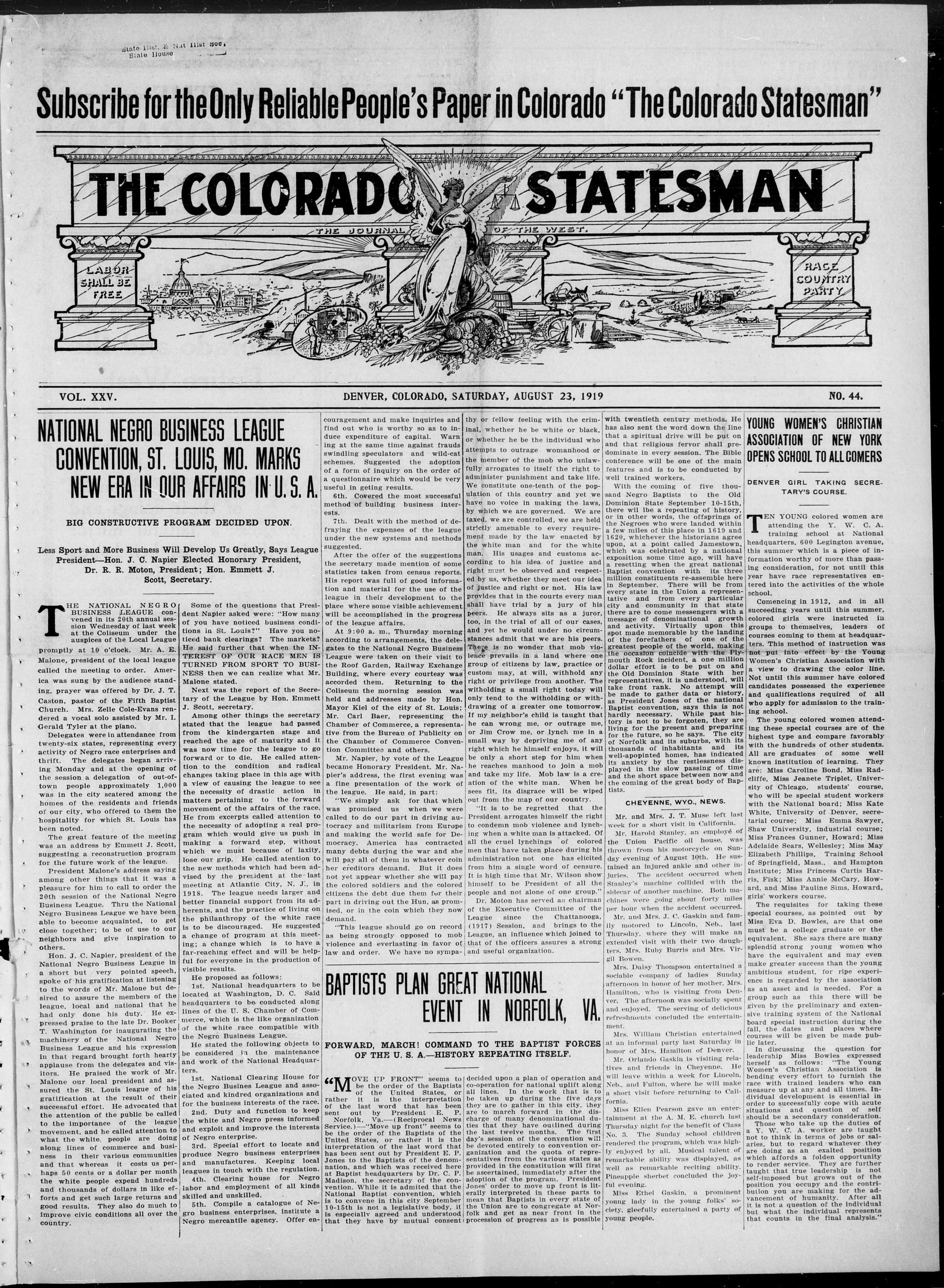
Page text (machine-generated)
Subscribe for the Only Reliable People's Paper in Colorado "The Colorado Statesman"
THE COLORADO STATESMAN
THE JOURNAL OF THE WEST.
LABOR SHALL BE FREE
RAGE COUNTRY PARTY
State Hist. & Nat Hist Book
State House
THE
LABOR
SHALL BE
FREE
NATIONAL NEGRO BUILD
CONVENTION, ST. L.
NEW ERA IN QU
BIG CONSTRUCTIVE PRO
Less Sport and More Business Will
President—Hon. J. C. Napier
Dr. R. R. Moton, Press
Scott, S
NATIONAL NEGRO BUSINESS LEAGUE CONVENTION, ST. LOUIS, MO. MARKS NEW ERA IN OUR AFFAIRS IN U.S.A
BIG CONSTRUCTIVE PROGRAM DECIDED UPON.
Less Sport and More Business Will Develop Us Greatly, Says League President—Hon. J. C. Napier Elected Honorary President, Dr. R. R. Moton, President; Hon. Emmett J. Scott, Secretary.
THE NATIONAL NEGRO BUSINESS LEAGUE convened in its 20th annual session Wednesday of last week at the Coliseum under the auspices of the Local League promptly at 10 o'clock. Mr. A. E. Malone, president of the local league called the meeting to order. America was sung by the audience standing, prayer was offered by Dr. J. T. Caston, pastor of the Fifth Baptist Church. Mrs. Zelle Cole-Evans rendered a vocal solo assisted by Mr. I. Gerald Tyler at the piano. Delegates were in attendance from twenty-six states, representing every activity of Negro race enterprises and thrift. The delegates began arriving Monday and at the opening of the session a delegation of out-of-town people approximately 1,000 was in the city scattered among the homes of the residents and friends of our city, who offered to them the hospitality for which St. Louis has been noted. The great feature of the meeting was an address by Emmett J. Scott, suggesting a reconstruction program for the future work of the league.
President Malone's address saying among other things that it was a pleasure for him to call to order the 20th session of the National Negro Business League. Thru the National Negro Business League we have been able to become acquainted, to get close together; to be of use to our neighbors and give inspiration to others.
Hon. J. C. Napier, president of the National Negro Business League in a short but very pointed speech, spoke of his gratification at listening to the words of Mr. Malone but desired to assure the members of the league, local and national that he had only done his duty. He expressed praise to the late Dr. Booker T. Washington for inaugurating the machinery of the National Negro Business League and his expression in that regard brought forth hearty applause from the delegates and visitors. He praised the work of Mr. Malone our local president and assured the St. Louis league of his gratification at the result of their successful effort. He advocated that the attention of the public be called to the importance of the league movement, and he called attention to what the white people are doing along lines of commerce and business in their various communities and that whereas it costs us perhaps 50 cents or a dollar per month the white people expend hundreds and thousands of dollars in like efforts and get such large returns and good results. They also do much to improve civic conditions all over the country.
---
VOL. XXV.
the Only Reliable
COLOR
BUSINESS LEAGUE
LOUIS, MO. MARKS
FOR AFFAIRS IN U. S. A.
GRAM DECIDED UPON.
Develop Us Greatly, Says League
Elected Honorary President,
ident; Hon. Emmett J.
secretary.
Some of the questions that President Napier asked were: "How many of you have noticed business conditions in St. Louis?" Have you noticed bank clearings? The markets? He said further that when the INTEREST OF OUR RACE MEN IS TURNED FROM SPORT TO BUSINESS then we can realize what Mr. Malone stated.
Next was the report of the Secretary of the League by Hon. Emmett J. Scott, secretary.
Among other things the secretary stated that the league had passed from the kindergarten stage and reached the age of maturity and it was now time for the league to go forward or to die. He called attention to the condition and radical changes taking place in this age with a view of causing the league to see the necessity of drastic action in matters pertaining to the forward movement of the affairs of the race. He from excerpts called attention to the necessity of adopting a real program which would give us push in making a forward step, without which we must because of laxity, lose our grip. He called attention to the new methods which had been advised by the president at the last meeting at Atlantic City, N. J., in 1918. The league needs larger and better financial support from its adherents, and the practice of living on the philanthropy of the white race is to be discouraged. He suggested a change of program at this meeting; a change which is to have a far-reaching effect and will be helpful for everyone in the production of visible results.
He proposed as follows:
1st. National headquarters to be located at Washington, D. C. Said headquarters to be conducted along lines of the U. S. Chamber of Commerce, which is the like organization of the white race compatible with the Negro Business League.
He stated the following objects to be considered in the maintenance and work of the National Headquarters.
1st. National Clearing House for the Negro Business League and associated and kindred organizations and for the business interests of the race.
2nd. Duty and function to keep the white and Negro press informed and exploit and improve the interests of Negro enterprise.
3rd. Special effort to locate and produce Negro business enterprises and manufactures. Keeping local leagues in touch with the regulation.
4th. Clearing house for Negro labor and employment of all kinds skilled and unskilled.
5th. Compile a catalogue of Negro business enterprises, institute a Negro mercantile agency. Offer en-
---
DENVER, COLORADO, SATURDAY, AUGUST 23, 1919
BAPTISTS PLAN GREAT NATIONAL EVENT IN NORFOLK,
FORWARD, MARCH! COMMAND TO THE BAPTIST FORCES OF THE U. S. A.—HISTORY REPEATING ITSELF.
couragement and make inquiries and find out who is worthy so as to induce expenditure of capital. Warning at the same time against frauds swindling speculators and wild-cat schemes. Suggested the adoption of a form of inquiry on the order of a questionnaire which would be very useful in getting results. 6th. Covered the most successful method of building business interests. 7th. Dealt with the method of defraying the expenses of the league under the new systems and methods suggested. After the offer of the suggestions the secretary made mention of some statistics taken from census reports. His report was full of good information and material for the use of the league in their development to the place where some visible achievement will be accomplished in the progress of the league affairs.
At 9:00 a. m., Thursday morning according to arrangements, the delegates to the National Negro Business League were taken on their visit to the Roof Garden, Railway Exchange Building, where every courtesy was accorded them. Returning to the Coliseum the morning session was held and addresses made by Hon. Mayor Kiel of the city of St. Louis; Mr. Carl Baer, representing the Chamber of Commerce, a representative from the Bureau of Publicity on the Chamber of Commerce Convention Committee and others. Mr. Napier, by vote of the League became Honorary President, Mr. Napier's address, the first evening was a fine presentation of the work of the league. He said, in part:
"We simply ask for that which was promised us when we were called to do our part in driving autocracy and militarism from Europe and making the world safe for Democracy. America has contracted many debts during the war and she will pay all of them in whatever coin her creditors demand. But it does not yet appear whether she will pay the colored soldiers and the colored citizens the debt due them for their part in driving out the Hun, as promised, or in the coin which they now demand.
"This league should go on record as being strongly opposed to mob violence and everlasting in favor of law and order. We have no sympa-
BAPTISTS PLAN GREE EVENT
FORWARD, MARCH! COMMAND OF THE U. S. A.—HISTO
"MOVE UP FRONT" seems to be the order of the Baptists of the United States, or rather it is the interpretation of the last word that has been sent out by President E. P. Norfolk, Va.—(Reciprocal News Service.)—"Move up front" seems to be the order of the Baptists of the United States, or rather it is the interpretation of the last word that has been sent out by President E. P. Jones to the Baptists of the denomination, and which was received here at Baptist headquarters by Dr. C. P. Madison, the secretary of the convention. While it is admitted that the National Baptist convention, which is to convene in this city September 10-15th is not a legislative body, it is especially agreed and understood that they have by mutual consent
---
thy or fellow feeling with the criminal, whether he be white or black, or whether he be the individual who attempts to outrage womanhood or the member of the mob who unlawfully arrogates to itself the right to administer punishment and take life. We constitute one-tenth of the population of this country and yet we have no voice in making the laws, by which we are governed. We are taxed, we are controlled, we are held strictly amenable to every requirement made by the law enacted by the white man and for the white man. His usages and customs according to his idea of justice and right must be observed and respected by us, whether they meet our idea of justice and right or not. His law provides that in the courts every man shall have trial by a jury of his peers. He always sits as a juror, too, in the trial of all of our cases, and yet he would under no circumstances admit that we are his peers. There is no wonder that mob violence prevails in a land where one group of citizens by law, practice or custom may, at will, withhold any right or privilege from another. The withholding a small right today will only tend to the withholding or withdrawing of a greater one tomorrow. If my neighbor's child is taught that he can wrong me, or outrage me, or Jim Crow me, or lynch me in a small way by depriving me of any right which he himself enjoys, it will be only a short step for him when he reaches manhood to join a mob and take my life. Mob law is a creation of the white man. When he sees fit, its disgrace will be wiped out from the map of our country.
"It is to be regretted that the President arrogates himself the right to condemn mob violence and lynching when a white man is attacked. Of all the cruel lynchings of colored men that have taken place during his administration not one has elicited from him a single word of censure. It is high time that Mr. Wilson show himself to be President of all the people and not alone of one group." Dr. Moton has served as chairman of the Executive Committee of the League since the Chattanooga, (1917) Session, and brings to the League, an influence which joined to that of the officers assures a strong and useful organization.
decided upon a plan of operation and co-operation for national uplift along all lines. In the work that is to be taken up during the five days they are to gather in this city, they are to march forward in the discharge of many denominational duties that they have outlined during the last twelve months. The first day's session of the convention will be devoted entirely to convention organization and the quota of representatives from the various states as provided in the constitution will first be ascertained, immediately after the adoption of the program. President Jones' order to move up front is literally interpreted in these parts to mean that Baptists in every state of the Union are to congregate at Norfolk and get as near front in the procession of progress as is possible
with twentieth century methods. He has also sent the word down the line that a spiritual drive will be put on and that religious fervor shall predominate in every session. The Bible conference will be one of the main features and is to be conducted by well trained workers.
With the coming of five thousand Negro Baptists to the Old Dominion State September 10-15th, there will be a repeating of history, or in other words, the offsprings of the Negroes who were landed within a few miles of this place in 1619 and 1620, whichever the historians agree upon, at a point called Jamestown, which was celebrated by a national exposition some time ago, will have a resetting when the great national Baptist convention with its three million constituents re-assemble here in September. There will be from every state in the Union a representative and from every particular city and community in that state there are to come messengers with a message of denominational growth and activity. Virtually upon this spot made memorable by the landing of the forefathers of one of the greatest people of the world, making the occasion coincide with the Plymouth Rock incident, a one million dollar effort is to be put on and the Old Dominion State with her representatives, it is understood, will take front rank. No attempt will be made to gather data or history, as President Jones of the national Baptist convention, says this is not hardly necessary. While past history is not to be forgotten, they are living for the present and preparing for the future, so he says. The city of Norfolk and its suburbs, with its thousands of inhabitants and its well-apopinted homes, has indicated its anxiety by the restlessness displayed in the slow passing of time and the short space between now and the coming of the great body of Baptists.
CHEYENNE, WYO., NEWS.
Mr. and Mrs. J. T. Muse left last week for a short visit in California.
Mr. Harold Stanley, an employé of the Union Pacific oil house, was thrown from his motorcycle on Sunday evening of August 10th. He sustained an injured ankle and other injuries. The accident occurred when Stanley's machine collided with the sidecar of another machine. Both machines were going about forty miles per hour when the accident occurred.
Mr. and Mrs. J. C. Gaskin and family motored to Lincoln, Neb., last Thursday, where they will make an extended visit with their two daughters, Mrs. Ruby Burris and Mrs. Virgil Bowen.
Mrs. Daisy Thompson entertained a sociable company of ladies Sunday afternoon in honor of her mother, Mrs. Hamilton, who is visiting from Denver. The afternoon was socially spent and enjoyed. The serving of delicious refreshments concluded the entertainment.
Mrs. William Christian entertained at an informal party last Saturday in honor of Mrs. Hamilton of Denver.
Mr. Orlando Gaskin is visiting relatives and friends in Cheyenne. He will leave within a week for Lincoln, Neb., and Fulton, where he will make a short visit before returning to California.
Miss Ellen Pearson gave an entertainment at the A. M. E. church last Thursday night for the benefit of Class No. 3. The Sunday school children rendered the program, which was highly enjoyed by all. Musical talent of remarkable ability was displayed, as well as remarkable reciting ability. Pineapple sherbet concluded the joyful evening.
Miss Ethel Gaskin, a prominent young lady in the young folks' society, gleefully entertained a party of young people.
NO. 44.
YOUNG WOMEN'S CHRISTIAN ASSOCIATION OF NEW YORK OPENS SCHOOL TO ALL COMERS
DENVER GIRL TAKING SECRET
TARY'S COURSE.
TEN YOUNG colored women are attending the Y. W. C. A. training school at National headquarters, 600 Legington avenue, this summer which is a piece of information worthy of more than passing consideration, for not until this year have race representatives entered into the activities of the whole school. Comencing in 1912, and in all succeeding years until this summer, colored girls were instructed in groups to themselves, leaders of courses coming to them at headquarters. This method of instruction was not put into effect by the Young Women's Christian Association with a view to drawing the color line. Not until this summer have colored candidates possessed the experience and qualifications required of all who apply for admission to the training school.
The young colored women attending these special courses are of the highest type and compare favorably with the hundreds of other students. All are graduates of some well known institution of learning. They are: Miss Caroline Bond, Miss Radcliffe, Miss Jeanete Triplet, University of Chicago, students' course, who will be special student workers with the National board; Miss Kate White, University of Denver, secretarial course; Miss Emma Sawyer, Shaw University, industrial course; Miss Frances Gunner, Howard; Miss Adelaide Sears, Wellesley; Miss May Elizabeth Phillips, Training School of Springfield, Mass., and Hampton Institute; Miss Princess Curtis Harris, Fisk; Miss Annie McCary, Howard, and Miss Pauline Sims, Howard, girls' workers course.
The requisites for taking these special courses, as pointed out by Miss Eva D. Bowles, are that one must be a college graduate or the equivalent. She says there are many splendid strong young women who have the equivalent and may even make greater success than the young ambitious student, for ripe experience is regarded by the association as an asset and is needed. For a group such as this there will be given by the preliminary and extensive training system of the National board special instruction during the fall, the dates and places where courses will be given be made public later.
In discussing the question for leadership Miss Bowles expressed herself as follows: "The Young Women's Christian Association is bending every effort to furnish the race with trained leaders who can measure up at any and all times. Individual development is essential in order to successfully cope with acute situations and question of self should be a secondary consideration.
Those who take up the duties of a Y. W. C. A. worker are taught not to think in terms of jobs or salaries, but to regard whatever they are doing as an exalted position which affords a folden opportunity to render service. They are further taught that true leadership is not self-imposed but grows out of the position you occupy and the contribution you are making for the advancement of humanity. After all it is not a question of the individual but what the individual represents that counts in the final analysis."
FOREIGN
Canadian cannon, which fired the last shots at the Germans on armistice day, November 11th, were presented to the village of Mons, Belgium, with elaborate ceremonies.
Seven persons were killed and thirty-four injured in a collision between an express train and a troop train in France. The express was running from Paris to Nancy and Strasbourg.
Several collisions occurred between food dealers and consumers in France in the southeastern provinces and elsewhere. At Brest the dock workers seized provisions in the central markets and sold them at half prices.
French pilots and observers killed and wounded during the war aggregated 60 per cent of the total flying personnel of slightly less than 13,000 men. The percentage of loss was greater than that of any other branch of the French army.
Former Emperor William, who has been living at Amerongen since his arrival in Holland, has purchased the estate and house of Doorn at the village of Doorn, near Utrecht, according to the Daghail. The estate was bought from Barones de Baufort. It is about five miles north of Amerongen, in the direction of Utrecht.
Germany is a broken nation, both in body and spirit, and a long time will elapse before the efficiency of her people is restored, it is declared in a report of British scientists on food conditions in Germany. The wartime semisarvation of the people is responsible for the slowness with which recovery will be effected, according to these authorities.
To recover more than $3,000,000 in gold, part of the fortune of the late Oom Paul Kruger, once president of the Transvaal, which is believed to be cemented in the hold of the bark Dorothen, sunk on Tenedoes reef off the coast of Zululand, is one of the projects which may be revived as a result of improvement in the science of salvaging sunken ships.
The magnificent former imperial yacht Meteor, in which the ex-kaiser used to make his annual summer cruises in northern waters, is offered for sale at the price of a half million marks ($125,000). German kaiserist newspapers are denouncing the offer, first, because they consider "the very idea" an insult to the ex-monarch, and secondly, because they regard the price as "ridiculously low."
SPORT
Jack Dempsey, heavyweight champion pugilist, will meet Willie Meehan in an eight-round, no-decision bout in the East in November, according to a statement issued by Meehan, who said he had the promise of Jack Kearns, Dempsey's manager, for the match.
GENERAL
Postal authorities at Winnipeg have been notified that $50,000 was stolen some might recently from the interior deposit valuels of the postoffice at Edmonton, Alta. No clew to the thieves has been found.
George Peters, 55, a farmer of Arundel, Prince Georges county, Maryland, was murdered and his body set afire by an unidentified negro. Catherine Peters, his daughter, was shot through the breast and arm and taken to Washington hospital.
Three members of the board of directors of the American League, constituting a majority of the board, ordered Pitcher Carl Mays reinstated at a special meeting in New York, thus nullifying the action of President Johnson in suspending him.
Agents of the investigation branch at Detroit of the Department of Justice said that in one cold storage plant visited a frozen hog was found which they were told had been in storage twenty-five years. The officials declared that while they believed that if the hog really had been held for that length of time, it was through an oversight; they intend to investigate further.
More than a million eggs, hundreds of thousands of tins of canned foods and 27,500 pounds of sugar were seized at Jacksonville, Fla., in a raid on wholesale food warehouses and cold storage plants by federal authorities.
Charges of "extortionate profits" by Dallas retail merchants were made by P. H. Spencer, chief of the bureau of investigation of the Department of Justice, and W. B. Burrell, assistant United States district attorney at Dallas.
Three children were killed in Patterson park, Baltimore, Md., when an airplane of the 88th areo squadron, stationed at Langley field, Va., crashed into a fence behind which were several hundred spectators. Seven were injured.
Police are combing Detroit for three automobile bandits who in broad daylight held up William Baldwin, aged 27, collector for the Standard Oil Company, in Spruce street, and robbed him of a leather bag containing $3,000 cash, checks and oil coupons which he had collected from substations of the company. The holdup was witnessed by a number of pedestrians.
District Attorney Winfred Zabel, who resigned from the Socialist party, said that his action came because he refused to be held up by the executive committee, which told him to pay $1,200 into the treasury or be expelled. Zabel said he had been paying $500 a year for seven years, but when they raised his assessment to $1,200 he balked.
The Hotel Victory was destroyed by fire at Put In Bay, Ohio, at an estimated loss of $500,000. The cause was not determined. The fifty guests escaped.
NEWS TO DATE IN PARAGRAPHS
CAUCHT FROM THE NETWORK OF WIRES ROUND ABCUT. THE WORLD.
DURING THE PAST WEEK
RECORD OF IMPORTANT EVENTS
CONDENSED FOR BUSY
PEOPLE
Western Newspaper Union News Service.
WESTERN
Giving prohibition as their reason,
an average of 100 foreign-born persons daily are applying for permits to
return to their native lands, according
to customs officials at San Francisco.
A majority of those applying are said
to be Italians and Portuguese.
Apportionment of more than $1,000,000 of automobile license funds will
take place when warrants are drawn
by the state auditor's office at Des
Moines. One thousand six hundred
fifty-six townships in Iowa will receive
$730 each under the distribution.
Gen. John J. Pershing will arrive in Lincoln about October 1st to visit members of his family, according to a telephone message received by the Lincoln Commercial Club from Chicago. The message was sent by Frank Woods of Lincoln, a former president of the Commercial Club.
One of the few American women who gained the French croix de guerre for bravery and heroism under fire in France, was Miss Oril Elsie Henthorne of Portland, Ore., who has returned from France. She, with her sister, Agnes, were civilian alces with the Y. M. C. A. in the canteen service in France.
Representatives of the Theodore Roosevelt Memorial Association from five states met at Dallas, Texas, and fixed state quotas and dates for conferences. The Texas quota is $150,-000. The conference will be held September 18th, 19th and 20th; the New Mexico quota is $10,000. September 10th was set as the conference date.
Reported out of danger, Mrs. Edwin Greene and Mrs. Leo J. Trost of El Paso, Tex., are well on the way to recovery following a miraculous escape from death by fire in an aeroplane. The clothing of both women was ignited by the backfire of the engine of the aeroplane in which they were riding here while 1,500 feet in the air. A nose dive by Pilot Howard Patterson landed the machine in a small lagoon.
WASHINGTON
President Wilson has again vetored the bill repealing the daylight saving law.
The Senate has ordered an investigation into alleged profitering in coal and into charges of conspiracy to keep up prices.
Repeal of the daylight savings law was practically assured when the House passed the bill over President Wilson's veto.
The great government dam across the Tennessee river at Muscle Shoals, Aia., has been named "Wilson dam" in honor of President Wilson.
General Pershing will sail for home on the first available transport sailing after August 31st, the commander in chief of the A. E. F. cabled Secretary Baker.
The proposed treaty by which the United States would go to the aid of France in event of an unprovoked attack by Germany is not in conflict with the constitution, in the opinion of the Senate Judiciary Subcommittee.
Discharges from the army now total 3,208,759, the War Department has announced, leaving a net strength on Aug. 12 of 500,649 officers and men, of whom 109,938 still were in Europe.
A resolution directing the Federal Trade Commission to investigate the high cost of shoes and determine the cause for increased prices was adopted by the House, which refused to extend the inquiry to clothing and food.
A congressional investigation of the charges of Glenn E. Plumb, author of labor's plan for the nationalization of railroads, that Wall street has systematically plundered practically all the roads of the country was asked in a resolution introduced in the House by Representative Huddleston, Alabama. The allied governments have informed the Austrian government that it will be held responsible for Bela Kun, the Hungarian communist leader, and for his delivery for trial by an allied tribunal, according to a dispatch from Innsbruck. Bela Kun, it is added, will be tried for hanging and shooting Hungarians during his reign in Budapest.
General increases of about 80 per cent in the cost of living during the period from December, 1914, to June, 1919, were shown in tables made public by the Department of Labor. The tables were based on investigations in various representative cities over the country. Appointment of Joseph E. Murphy, now in charge of the White House secret service corps, as assistant chief of the United States secret service, has been announced at the treasury. He succeeds W. H. Moran, recently promoted to be chief of the service.
SPORT
Pithy News Notes
From All Parts of
Colorado
Pithy News Notes
From All Parts of
Colorado
Western Newspaper Union News Service.
COMING INSTITUTE
Conejos County Fair, Manassa, Sept.
17-19.
Western Slope Fair, Montrose, Sept.
16-19.
Central Community Fair, Greeley, Sept.
16-20.
York County Fair, Yuma, Sept. 17-20.
Phillips County Fair, Holyoke, Sept.
24-27.
Saguache County Fair, Saguache, Sept.
18-20.
Crowley County Fair, Sugar City, Aug. 27-28.
Inter-Mountain Live Stock and Fair,
Grand Junction, Sept. 30 to Oct. 3.
Douglas County Fair, Castle Rock,
Oct. 7.
By removing a glass in a window,
thieves gained entrance to the French
Electric Cleaning shop at La Junta,
and made away with a number of fine
dresses and several suits of clothes.
According to advices by W. P. Ela,
secretary of the Chamber of Commerce,
the United States Dehydration
Company of Denver will establish a
branch dehydration plant at Grand
Junction.
Restoration of the pinto bean industry
in eastern Colorado by placing an
import duty on Japanese beans, which
have demoralized the market for pintos,
is to be asked of Congress by bean
growers of Weld county.
That the war on prairie dogs, inaugurated in La Plata county last spring and which still is being waged, has been fruitful in results, is the announcement of G. W. Boyd, field foreman of the Bureau of Biological Survey.
Grasshopper hill, the site of Denver's proposed Presbyterian hospital, was sold to the organization committee of the Hospital Association for $75,000, according to announcement by Frank N. Briggs, chairman. Work on the erection of the building will begin next year.
Waunita is certainly coming to the front, as one of the leading resorts in Colorado. The popular resort is attracting hundreds of visitors this year, twice the number of last year. Fishing has been remarkably good and there have been numerous big catches made all season.
Construction work on an irrigation project lying five to fifteen miles south of Las Animas, which will make an immense tract of land productive, will begin immediately, Will R. Murphy of the state land board announced after the land commissioners approved a $250,000 contract and bond posted by W. A. Colt & Son of Las Animas for building the irrigation system for the Mutual Carey Act Irrigation Company.
The Midland Cereal Products Company have signed a contract with the Farmers and Merchants' Association which calls for the erection of a factory building in Brighton to cost $150,000. The company will manufacture a breakfast food to be known as "Whole Wheat Nuggets." The Brighton factory is one of three owned by the company. The others are at Sioux Falls, S. D., and Omaha, Neb. The factory will use all the wheat grown within hauling distance of Brighton and will pay the market price.
One of the most disastrous losses in the dairy industry occurred at Holly when twenty-seven pure-bred Holstein cows and a pure-bred Holstein bull died as the result of eating cane when they broke into a field on the farm of Jens Jensen. The loss will total $4,000. The entire herd died within a few hours.
The first state fair ever held in Colorado under state supervision and financed and supported by the state is to be held at Pueblo, September 22nd to 27th. The state has acquired title to the fair grounds through purchase with funds granted in a special appropriation. The tax levy is being used in the payment of premiums and other items of expense of an educational character. In addition the State Fair Commission is spending $50,000 on the sports and amusement program. It is to be Colorado's first $100,000 fair. The contests in all departments have been thrown open to the world and the liberal premiums have attracted entries from all surrounding states.
A. W. Engle, 35, of Colorado Springs, an oil company official and promoter at Electra, Texas, was killed, and two women, Mrs. Joe Atter and Josephine Chavez of Delagau, Colo., escaped without injury, when an automobile driven by Engle plunged through the railing of a wooden bridge near Hastings, a coal mining camp, near Trinidad, into an arroya.
By a coincidence, the only two Golden boys entitled to wear wound stripes arrived home from overseas on the same day. They are Capt. Orville Dennis and Private Delbert Parshall.
---
CENTENNIAL STATE ITEMS.
Two masked robbers beat the night watchman into unconsciousness, bound and gagged the night clerk and escaped with several cans of gold concentrates said to be valued at $7,000 a can from the Independence mill at Victor. John Franklin, aged 50, and James Guriaux, aged 20, victims of the robbery, are in the district hospital. Franklin, the watchman, is said to be in a serious condition. Guriaux is suffering from shock. The robbery was discovered when the day shift went on duty. The watchman and night clerk were found locked in a closet. The elder man was unconscious and his companion almost strangled by the gag.
THE COLORADO STATESMAN
The first aero club in Colorado to handle airplanes on a commercial scale, to give instructions in flying and do a general passenger, mail and express business, has been organized at Haxtun. A company has been formed to push the airplane business. An English training plane has been bought and will be kept in stock, to be used by Hartman, who is recently from the air service of the army. Regular flights will be made, and the charge for passengers who desire to go up will be $20 a flight. The company is known as the Haxtun Aero Club.
The Mouth-Piece of the People of Colorado and the Entire West
Frank Gable, director of the Durango round-up, to be held from Sept. 23 to 26 inclusive, is arranging one of the classiest wild west programs ever offered. There will be bull riding, cowgirls' races, running races, goat roping contests, trick roping contests, steer bulldogging, Indian races, cowboys' relay races, bareback riding, cowboys' bucking contest, trick riding, farmers' wagon races, in all twenty events a day and $5,000 to be distributed to the winning contestants during the four-day celebration.
Marked success is being had by the State Fish and Game Department in the use of retaining ponds adjacent to natural streams for the growing of trout to a finger's length before placing them in the creeks and rivers, according to Roland G. Parvin, state fish and game commissioner. Already ten such ponds in different parts of the state have been established under direction of Commissioner Parvin, who is the first head of the department to carry out the idea on a state-wide scale.
ARELIABLE chronicle of their doings and progress; a faithful mirror of their wants, their hopes, their best aspirations.
Fifteen cars of potatoes will be shipped daily from the Montrose, Olathe and Delta spud district, when the busiest part of the season will start. This is the early potato harvest and will continue at this rate for several weeks. The spuds are being moved to the markets in refrigerator cars, which, however, will not interfere with the regular shipments of fruit from the western slope, about which the growers were alarmed recently when a car shortage seemed apparent.
THE COLORADO STATESMAN
THE COLORADO STATESMAN
William T. Myera, who was arrested several weeks ago charged with "highgrading" gold amalgam from the Powder River Gold Dredging Company's dredge, and who was released on a $500 bond, failed to appear either on the day set for a hearing by the justice of the pence or before the District Court, is now a fugitive from justice and his bondsmen have had to pay over the $500 of the forfeited bond to Sheriff J. G. Detwiler of Summit county.
C. L. Waite has sold the Lost Creek and the Lockhard ranches, situated thirty-five miles from Greeley in the Roggen district, together with 700 head of cattle, to C. V. Owens of Eaton for a consideration of $210,000.
Governor Oliver H. Shoup has accepted an invitation to speak at the Western Slope fair meeting at Montrose, September 17, which is a special soldiers day, with every soldier in the western slope invited.
Unequaled as an advertising medium for the business of professional men and women.
At an election held at Breckenridge, taxpayers voted on $25,000 bonds for the erection of a new schoolhouse. The vote was 44 for the amendment and 23 against.
Greeley is to have one mile of paved county highways on both the north and the south sides of the city limits before winter sets in. Money for these projects has been appropriated by the State Highway Commission and the location of the two miles determined by the county commissioners. Two of the worst stretches of the Lincoln Highway between Denver and Cheyenne will be eliminated by the improvement.
An excellent family journal speaking to and for many thousand colored citizens.
Frank F. Wood, 63 years old, the oldest man in point of service running out of Denver in the railway mail service, is dead. Mr. Wood was known as the most unlucky clerk in the service so far as wrecks were concerned. His associates say he had been in more wrecks than any other railway mail clerk in the country. He entered the service in 1888, running between Leadville and Aspen.
TWODOLLARSAYEAR
In Baca county, which not many years ago was regarded as a worthless waste, the acreage of land in cultivation has increased more than 400 per cent in the past ten years and it now ranks about twentieth among the counties in total cultivated area.
According to the report of County Assessor Charles Conroy of La Plata county, who has completed an abstract of the county agricultural report, there are 555 ranch owners with a combined acreage of 104,685 acres; 121 renters with an acreage of 20,847; tenure not specified of eighty-three with an acreage of 1,630. The average size of those reporting is 192.00 acres. Ninety-seven farmers failed to report their total acreage, but estimated on the general average given, amounts to 18,632.73, giving a total of 145,794.73 acres.
We Are Responsible for All Damages to Foreigners in Mexico Since 1910
interfered diplomatically in Mexico to recover damages for any of our citizens, either for death or otherwise.
In 1913, prior to the recognition of Carranza when he proclaimed himself first chief of the revolutionary forces, and when he was seekings recognition, he issued a decree known as the Calvo decree, and in that decree he pledged himself to us, because he filed it in the state department of the United States government, that immediately upon the success of his revolution he would go back to the year 1910, to the inception of the Madero revolution, and that he would, by a joint commission, ascertain all damages done to any foreigner or to his property up to the time that he founded his government substantially in the City of Mexico, no matter from what source, whether by revolution or by riot; in other words, that he would not do as they had continuously done, put in a defense that the damage had occurred by revolution.
But the decree of 1915, which the president sent to the senate, as the foundation of his recognition of Carranza, repudiated the decree of 1913 and adopted the Calvo rule and we recognized him upon it; and what is the consequence today? That we are bound by every rule not only of morality but of international law to every government under the sun for every dollar of damage done to any foreigner in the Republic of Mexico from the time the revolution occurred in 1910 down to date, because the secretary of state and the president of the United States called upon France and Germany and Great Britain to yield to us in handling Mexican affairs, as was announced by the state department, and they yielded. When they yielded Carranza's decree agreeing to pay damages was in full force and effect. We handled Mexican affairs, and when we recognized Carranza we recognized him under an absolute repudiation of that decree.
Have we not placed the Monroe doctrine at least in pawn to every foreign government?
"World Statesmanship Will Be Sorely Tried in the Next Few Years"
Undoubtedly there is a great danger in the world today. Western civilization is still dazed by the shock of four and a half years of destruction. Industry and commerce are not yet restored. All of Europe is impoverished; parts of it are starving. Its whole political fiber has been shot through.
World statesmanship will be sorely tried in the next few years. Two things are essential: first an alert, intelligent, interested public opinion; and second co-operation of the nations.
The former is needed both as a check on any sinister purposes that may crop up and as the great support for common action. The second is essential, unless the nations are to return to a selfish particularism which can only breed the most dangerous dispute.
The peace conference has been history's greatest instance of a unified world statesmanship directing the moral and material resources of the world's family of nations. To allow the spirit behind it to disintegrate at this moment of emergency, when united action is imperative, would be fatal to all the hopes of permanent peace with which we entered the war.
If it is true that one nation can destroy the equilibrium of all it is all the more true that each nation is bound by its own law of self-preservation to co-operate with the others to check troubles before they get their headway.
So I come home pleased but not complacent with the outcome of the past six months and hopeful but not in the least unmindful of the problems of the next few years.
World Is Forced Into New Activity for the Protection of All Children
It is not too much to say that the world is being forced willy nilly to a new activity for the protection of all children—not a few, not favored children, but all children. War losses of population and of wealth force Europe. A decent self-respect would force the United States even if it were not plain that the nations which are to maintain leadership will be those which most wisely and generously equip the children of today and tomorrow.
First, as to illiteracy, the United States is perhaps ninth among civilized nations; that is, Australia, the United Kingdom, New Zealand, the Netherlands, Switzerland, Denmark, Sweden, Germany all have a larger proportion of the population who can read and write than has the United States.
Second, as to maternal mortality, the United States is fourteenth in the list of civilized nations, judged by the proportion of deaths of mothers from causes incident to child-bearing. That is, in thirteen countries the mother's life is safer than it is in the United States.
Third, the United States is eleventh among civilized countries, tested by its infant mortality rate, a rate whose searching value as a sign of social wellbeing is axiomatic.
Considering the exemption this country enjoys from the poverty and hunger and devastation of Europe, it is not less than our reasonable service to make the United States stand first in every phase of child welfare in any list of countries. The war has left us no sectional questions. We have only the issue of a nation's welfare.
C. BARRE 4.1890
By SENATOR A. B. FALL—Debate in Congress
The Calvo doctrine, as acknowledged by Latin-American countries, provides significant effect:
No government shall be responsible to any of its citizens occurring during a war by virtue of a riot.
No citizen of a foreign country shall to collect damages against this government citizen of this country would be entitled to ages. Under the Calvo doctrine, as it was at The Hague tribunal and refused, we can dramatically in Mexico to recover damages for any or death or otherwise.
Up prior to the recognition of Carranza when he chief of the revolutionary forces, and when he issued a decree known as the Calvo decree, engaged himself to us, because he filed it in the United States government, that immediately upon the he would go back to the year 1910, to the institution, and that he would, by a joint commission, none to any foreigner or to his property up to his government substantially in the City of Mexico, whether by revolution or by riot; in other do as they had continuously done, put in a deed occurred by revolution.
The decree of 1915, which the president sent to him of his recognition of Carranza, repudiated the Calvo rule and we recognized him upon evidence today? That we are bound by every rule of international law to every government under of damage done to any foreigner in the Republic the revolution occurred in 1910 down to date state and the president of the United States Germany and Great Britain to yield to us in his was announced by the state department, and they yielded Carranza’s decree agreeing to pay and effect. We handled Mexican affairs, and we recognized him under an absolute repudiation.
Is not placed the Monroe doctrine at least in punishment?
The Calvo doctrine, as acknowledged and accepted by Latin-American countries, provides simply this, in effect:
No government shall be responsible for damages to any of its citizens occurring during a revolution, or by virtue of a riot.
No citizen of a foreign country shall be entitled to collect damages against this government except as a citizen of this country would be entitled to collect damages. Under the Calvo doctrine, as it was presented at The Hague tribunal and refused, we could not have
By ROBERT LANSING, U. S. Secretary of State
fiedly there is a great danger in the world today, still dazed by the shock of four and a half years and commerce are not yet restored. All of the parts of it are starving. Its whole political fiber statesmanship will be sorely tried in the next few essential: first an alert, intelligent, interested pro-operation of the nations.erner is needed both as a check on any sinister and as the great support for common action, unless the nations are to return to a selfishly breed the most dangerous dispute. The conference has been history's greatest instance of emergency, when united action is imperative the hopes of permanent peace with which we en-true that one nation can destroy the equilibrium.true that each nation is bound by its own law of operate with the others to check troubles before one home pleased but not complacent with the others and hopeful but not in the least unmindful next few years.
All Is Forced Into New Active
the Protection of All Children
It too much to say that the world is being forced
activity for the protection of all children—not a few
all children. War losses of population and o
decent self-respect would force the United Sta
n that the nations which are to maintain lead
most wisely and generously equip the children.
to illiteracy, the United States is perhaps nint
; that is, Australia, the United Kingdom, New
Switzerland, Denmark, Sweden, Germany all
the population who can read and write than h
FAMOUS PEACE TREATIES By H. IRVING KING
TREATY OF CONSTANTINOPLE, 1841 When the Present Egypt Was Evolved.
The British possession of Egypt is something into which England "just naturally drifted." The force of circumstances was stronger than treaties and diplomacy, and after the occupation of the country subsequent to the Arabi Bey incident in 1882, England found herself in the position of the man who held the bear by both paws around a tree—it was more dangerous to let go than to hold on. Yet up to the recent proclamation of a British protectorate over the land of the Nile and the setting up of a sultan independent of Turkey following the sliding of the Khedive abbas with the Germans, Egypt remained a part of the Turkish empire, a vassal state paying an annual tribute of $3,000,000 and governed nominally by a hereditary vassal prince. It was governed under the treaty of 1841, which the powers forced upon the sublime porte and its victorious rebel governor of Egypt, Mehemet Ali. By this treaty the western powers obtained their first foothold in the land of the Pharaohs.
Mehemet Ali was a Turkish officer who first went to Egypt in 1799 as commander of the forces. He did so well in restoring order there that in 1805 the sultan appointed him governor. But Ali found his government constantly threatened by the famous Mamelukes, a cavalry corps of the Egyptian army consisting of the descendants of those Mingrelian, Turkish and other slaves sold by Genhil Khan to the Egyptian sultan in the thirteenth century who, uniting in revolt in 1251, made themselves masters of the country. The Turkish government overthrew the Mameluke government in 1517 and Egypt became a Turkish province. But the military caste of the Mamelukes was continued as a portion of the Egyptian army until All's time.
Massacre of the Mamelukes. In 1811, seeing that it was a question of survival between the Mamelukes and himself, All settled the matter by a massacre of the Mamelukes. The citadel of Cairo was the scene of the principal slaughter; the Mamelukes were annihilated. Now absolute master of Egypt, Mehemet Ali threw off his Turkish allegiance and conquered Syria in 1831-2. In 1839 he defeated the Turks in so many engagements that it seemed as if his banners were certain to wave in the mosque of St. Sophia. The powers took alarm. That old idea which for so many centuries has prevented the Turk from being driven out of Europe—the idea that the status quo at Constantinople must not be disturbed, lest the Turk being out of Constantinople, a general war should ensue for
TREATY OF SHIMONOSEKI, 1895
The western nations woke up to the fact that a great power had appeared in the East when in 1894 Japan declared war on the vast empire of China and speedily brought it to its knees. The realization that a naval and military power of the first class had come into being on the western shores of the Pacific was not a pleasant one and caused a great fluttering among the "chancelleries" of Europe and was not viewed without concern in the United States.
to interfere except as a "friendly neutral," and would join no other nation even in that interference.
On July 31 Japan declared war upon the Celestial empire. The militar and naval supremacy of Japan at one became startlingly apparent. A Japanese army swept through Korea, an advancing down the Liaotung pen-sula, took Port Arthur. The Chinese were driven out of southern Mar-churia. The Japanese fleet destroye the Chinese fleet and captured Wei
It was because of her war with China and her subsequent war with Russia that Japan occupies the position she does today among the nations. The treaty of Shimonoseki and the treaty of Portsmouth placed her among the leading nations of the world. The war between China and Japan arose over the affairs of Korea. In the olden days Korea had paid tribute to Japan and after the abolition of the Shogunate in 1868 and the coming of the Mikado into his own, repeated demands were made upon the Koreans for a continuation of this tribute. Chinese and Japanese intrigued at the Korean court for the predominating influence in the land of the morning calm and transformed it into a land which knew no calm.
Japan Allied Infraction.
In June of 1894 a Chinese army was sent into Korea for the ostensible purpose of putting down a rebellion which threatened the Korean king. Japan declared this to be an infraction of the treaty between herself and China made in 1885, and dispatched a Japanese army which occupied the Korean capital and its port of Chemulpo, and fortified the route connecting the two cities. Somehow the rebellion disappeared, but the king of Korea found a Chinese army and a Japanese facing each other in hostile guise upon his territory and asked them to withdraw—which they refused to do. The king appealed to the United States. Mr. Gresham, secretary of state, asked China and Japan please to get out of Korea. China said she was perfectly willing to get out if Japan would. Japan said she would not get out until Korea had reformed her internal affairs.
It was evident that Japan meant war, and on July 8, 1894, England proposed that the United States Join with her in an intervention to prevent the war. The United States refused
its possession—caused them to join together for an armed intervention, and Ali was forced to give up Syria. On January 30, 1841, a treaty was concluded at Constantinople by which, in return for the relinquishment of Syria and the renewal of his allegiance to the sultan, Ali and his descendants were created hereditary rulers of Egypt.
Egypt for Egyptians.
In 1881 appeared an Egyptian colonel, Arabi Bey, who started the cry of "Egypt for the Egyptians." He overthrew the ministry of that year and massacres of Europeans took place in Cairo and Alexandria. He was openly encouraged by the Turkish government which, even when Arabi had flouted the authority of the Khedive and, becoming minister of war, placed himself at the head of an armed revolt which swept the country, refused to declare him a rebel. He withdrew the budgets from the French and British financial advisers and manning the old forts and constructing new ones at Alexandria, threatened the fleets of England, France and the United States.
On July 10, 1882, the British admiral demanded the cessation of hostile preparations and the delivery of some of the forts into British hands within 24 hours, or he said he would open fire. Cablegrams flew back and forth between Alexandria and Europe, and the British invited the French to join with them in an intervention. The French refused and the French fleet steamed out of the harbor for Port Said. The American fleet withdrew.
At 7 a. m. the British fleet opened fire. The engagement lasted until noon by which time most of the forts had been silenced. Fort Pharos fired until four o'clock. The next morning Arabi asked for a truce which was granted, and under cover of which he escaped with his army from the city. Seymour landed a force to restore order in the city, the American marines landing also. A British expedition under Sir Garnet Wolseley, was rushed to Egypt, and Arabi was crushingly defeated at the battle of Tel-el-Kebir, on September 13. Caliro surrendered the next day; Arabi was taken prisoner and exiled to Ceylon. The authority of the Khedive was restored. Upon advice of the British, he abolished the Dual Control and appointed a British financial adviser. Abbas succeeded Tewfik and an Englishman was appointed head of the Egyptian army. The treaty of 1841 was still observed until Abbas declared for Germany and fled to Austria, when a British protectorate was declared.
to interfere except as a "friendly neutral," and would join no other nation, even in that interference.
On July 31 Japan declared war upon the Celestial empire. The military and naval supremacy of Japan at once became startlingly apparent. A Japanese army swept through Korea, and advancing down the Liaotung peninsula, took Port Arthur. The Chinese were driven out of southern Manchuria. The Japanese fleet destroyed the Chinese fleet and captured Weihai-wei. At the beginning of the war the Chinese emperor had commanded his generals: "Go drive me these pigmies into the sea," but now a Japanese army was ready to advance on Peking. Everywhere China was utterly defeated.
Negotiated Four Weeks.
China thereupon authorized the American minister at Pekin to transmit direct to Japan a proposal for peace. Japan agreed to receive Li Hung Chang as peace commissioner. He landed at Shimonoseki on March 19, 1895, where he was met by the Marquis Ito, and after four weeks of negotiation the treaty was signed on April 17. The complete independence of Korea was recognized; the Liao-tung peninsula, Formosa and the Pescadores islands were ceded to Japan and China agreed to pay a war indemnity of two hundred million taels open four new ports and grant special trade privilege to the victors Korea had been occupied and organized by Japan during the war and though its complete independence had been guaranteed by the treaty, Japanese influence was now supreme there.
England was disturbed. Germany displeased and Russia angry and alarmed at the treaty of Shimonoseki. A great power had suddenly appeared to threaten Russian possessions and block her aspiration on the Pacific coast. The czar threateningly demanded the retrocession to China of the Liaotung peninsula. Germany and France backed up the demand of Russia. Had Russia been alone to be considered, Japan might have thrown down the gauntlet then as she did later. But in the face of threats from three powers, she dared not refuse, and gave up the best fruits of the war—which Russia stepped in and grabbed for herself.
THE NEW YORKER
Saturday and Monday the Last Days of the Great Semi Annual Clearance Sale at
This Unparalelled Value-CivingEvent Offers Big Savings on All Lines of Men's, Young Men's and Boys' High Grade Clothing
THE HOME OF SOCIETY BRAND CLOTHES
SIXTEENTH AND CHAMPA STREETS
DENVER, COLO
HEADQUARTERS FOR UNION
LABEL WEARING APPAREL
$22.50 TO $25.00
VALUES
$17
$35.00 TO $40.00
VALUES
$27
THE M
THE HOME OF SOCI
SIXTEENTH AND
DENVE
HEADQUARTER
LABEL WEAR
REGISTER W. S. S. CERTIFICATES
Lost or Stolen Certificates Will Not
Be Replaced Unless They Are
Registered.
A War Savings Certificate which
has been lost or destroyed will not be
paid nor will a duplicate thereof be
issued, unless the certificate has been
registered in accordance with the regu-
lations and instructions issued by the
Postmaster General, announces the
Treasury Department at Washington.
In the event of the loss or destruc-
tion of a registered certificate, the
registrant may apply to the postoffice
where the certificate was registered
either for a duplicate certificate or
for the payment thereof. After the
issuance of the duplicate certificate,
the original becomes invalid. No
duplicate certificate will be issued after
maturity of the original.
War Savings Certificates may be registered without cost at any post office. Unless registered, the Government will not be liable if payment of any certificate is made to a person who is not the rightful owner.
$30.00 TO $32.50
VALUES
$23
$45.00 TO $48.00
VALUES
$33
AY CO.
TY BRAND CLOTHES
CHAMPA STREETS
R, COLO
RS FOR UNION
ING APPAREL
Rich Silver Coins.
In the republic of Honduras the silver currency was for years minted from Socorro bullion. This nearly always contains a certain proportion of gold, which used not to be separated before it went to the mint; so the Honduras silver coins prior to 1911 generally contain a certain proportion of gold.
Resist the Impulse.
The impulse to write poetry is one that at one time or another convulses every one of us, but our notion is that quite a number ought to control and smother it and very few ought to attempt it without first consulting friends and the family physician.—Houston Post.
Daily thought.
Zeal is very blind, or badly regulated, when it encroaches upon the rights of others.—Fasquier Quesnel.
Daily Thought.
Man is but a reed, the weakest in nature, but he is a thinking reed.— Blaise Pascal.
THE COLORADO STATESMAN
CAN ON SHOULD BE FREE
TRACE COUNTRY PARTY
MUST BE PAID IN ADVANCE.
Entered as second-class matter at the postoffice in the City of Denver, Colo.
Reading notices, ten lines or less, 10 cents per line. Each additional line over ten lines, 5 cents per line. Display advertising 50 cents per inch.
Remittances should be made by Express Money Order, Postoffice Money Order, Registered Letter or Bank Draft. Postage stamps will be received the same as cash for the fractional part of a dollar. Only 1c and 2c stamps taken.
No discounts allowed on less than three months' contract. Cash must accompany all orders from parties unknown to us. Further particulars on application.
Communications to receive attention must be newsy, upon important subjects, plainly written only upon one side of the paper, must reach us Tuesdays, if possible, anyway not later than Wednesdays, and bear the signature of the author. No manuscript returned, unless stamps are sent for postage. All communications of a personating nature that are not complimentary will be withheld from the columns of this paper.
ADVANCEMENT OF OUR RACE WINNING RECOGNITION.
FACTS are facts, and we must look them squarely in the face. When we note with pride the Twentieth Annual Session of the National Negro Business Men's League held last week in St. Louis, Mo., the initial Session of the National Negro Musical Association recently held in Chicago; the N. A. A. C. P. Convention in Cleveland, Ohio; the Madam C. J. Walker Manufacturing Co. convention in Oklahoma, and a number of other important events of organized business bodies among our people, in spite of all the adverse circumstances, in spite of the abuses, lynchings and murders, we are esatblishing a national prestige that will be as permanent as that of any other people or race on this earth. PROUD! of course we are, when on the front page of this paper we give a full account of the Business League and its unanimous action for the adoption of measures for constructive work.
BUSINESS, ART, PROFESSION, firm in their resolution to work on intelligent lines; to build on a foundation acceptable to all, and winning the recognition that will make us think progress, live progress, sleep and wake with the thing progressive on our minds, and then there will be no time for THINKING BLACK; for entertaining the idea that the Creator before our conception marked out disappointment, failure, destruction and consignment to an endless punishment for us. Keep with the times; follow our business organizations, our artists and professionals in their upward and onward movement, and we will wager by all the powers that be, if our oponents rise, we will rise with them, if they fall, we will let them fall alone.
Remember, "the quality of mercy is not strained." Don't gloat over the past, as it stands ever still. Let us grasp the present opportunity. Cach a glimpse of the future. Don't bother about minor obstructions. Join the great and mighty throng for constructive work and live THE LIFE OF A MAN.
REV. FRED INGLEY, ST. MARK'S EPISCOPAL CHURCH, MAKES STRONG PLEA FOR NEGROES.
WE HAVE always admitted that there are a few members of the white race in this country who are not disposed to allow lawlessness, mob rule, injustice and unfair dispensing of the laws of this American commonwealth to continue, and sooner or later their hearts set on fire with repugnance for the return of our nation to the barbarism and savagery of the ancients; their souls rebellious at the common proof given as the days succeed themselves, that our vaunted Christian Civilization on account of the wanton destruction of human life, the cruel deprivation of human rights, the continuous abuse of a certain element of the people, would make it a duty to their sovereign Creator, to humanity, to society, to the world at large to come out boldly, and lifting their voices with trumpet-like sounds declare for RIGHT AND JUSTICE for all the people. This paper, fearless in its championship for RIGHT, is always bringing forcibly to the mind of the better class of white citizens this fact, that if they fail to lay hold of the opportunity to suppress the wrongs that are being perpetrated by the lawlessness of their race in this country, it would only be a matter of time, and that not very far off, when possibly after an extermination of the present sufferers, the thirst for blood, the spirit of riot of the mob in its endeavor to satiate its morbid appetite would find an outlet in turning upon themselves, resulting in an internal strife bringing about disintegration among them and final destruction of their race and country. But two weeks ago, in our issue of Aug. 9, in our editorial "Better Class Whites Should Declare Publicly Against Southern Propaganda," we again offered our reminder, emphasizing the appeal to the better element of the white people to denounce this unlawful act with yen and tongue, in pulpit and pew, in state and nation, and if needs be with the sword; and the Negro true now as in the past years when he defended and helped to save the honor of the white race by the protection and the preservation of the chastity of their women from the greedy, sensuous passions of their own, would stand firmly with his back to the wall, ready to face the enemy once more. A ready response comes to this appeal; not by a communication to us privately, not by a messenger or over the telephone or some secluded agent, but in a public utterance last Sunday morning from his pulpit of the St. Mark's Episcopal Church, Twentfth and Lincoln streets, the Rev. Fred Ingley, a fitting successor to that large-hearted, broad, whole-souled man, the children's shepherd, the people's leader, the late lamented Rev. Dr. John Houghton, made this urgent appeal to the people of Denver and in turn to the nation in the following: "GIVE THE NEGRO A SQUARE DEAL; AND FORGIVE THE HUN." Continuing he said, "If we withdraw forgiveness from the Hun, our condemnation is assured. Now that justice has prevailed, as far as may be, what next? The follower of Christ can give but one answer, 'Forgive.' The wall of prejudice which causes race antagonism must also be broken. WE MUST GIVE THE NEGRO A SQUARE DEAL. Insisting on the separation of races, we must still help the Negro to develop the best that is in him."
We thank the Rev. Ingley on behalf of the Negro citizens of Denver and Colorado, the many thousand readers and subscribers of The Colorado Statesman, and the 12,000,000 and more of Negroes identified with this government, this nation, speaking the English language; and we are also glad to inform this dispenser of the Christian religion that he is not alone in his appeal as there are other ministers of our city who have expressed themselves in our behalf, and even in the Southland, Bishop Gailor of Tennessee came out boldly for dealing righteously with us, also the pastor of the Euclid Baptist Church, St. Louis, these men having been convinced of the misdeeds of their white brothers and did not hesitate to express freely and fearlessly. When white men can feel the enormity of their fellow-men's unfair and unjust treatment of other human beings to such an extent as to make such appeals to the nation, we ought to express our appreciation and gratitude by giving publicity to their expressions to the farthest ends of the earth, proving that there are some men, especially among leaders who champion the cause of th old Biblical exhortation, "RIGHTEOUSNESS EXALTETH A NATION."
NEGRO MUSICIANS FORM
NATIONAL ASSOCIATION
Chicago Entertains Artists Royally.
IN THE development and furtherance of his art, the Negro musician has ever been alert, active and persistent. But the master stroke in this direction was made when nearly 200 of the most talented musicians of the race, representing every section of the country, met in Chicago, July 29th to August 2nd, and formed what is to be henceforth known as "The NATIONAL ASSOCIATION OF NEGRO MUSICIANS." To Clarence Cameron White, one of America's most renowned violin virtuosos, must be given the credit for having set in motion the agitation which culminated in this great organization of artists.
Despite the fact that Chicago, the convention city, was being shattered and torn by a raging mob of rioters, Tuesday morning, July 29th found in the auditorium of the Chicago Y. M. C. A. building, a gathering of Negro disciples of the art Euterpean, which would have done credit to the men and women of any country or clime.
One of the very interesting features of the opening session was the "get acquainted meeting," in which one was given an opportunity to make a brief but rather accurate study of the personnel of the men and women who made up the association. Each of the persons present was required to stand, announce his or her name, place of residence and the line of musical activities pursued. Among the persons of note who participated in the opening sessions were Miss Alice C. Simmons, instructor of music, Tuskegee; Mr. Kemper Harrold, violinist, teacher of music, Atlanta University; Miss Adelaide Thornton, supervisor of music in public schools of Indianapolis, Ind.; Mr. Sidney Woodward, tenor, teacher of piano and voice, New York City; Miss C. Mae Brooks, supervisor of music in public schools, Wilmington, Del.; Mme. Anita Pita Brown, Coloratura, Chicago; Miss Cleota Collins, organist, teacher of music, New York City; Mr. Fred Work, pianist and teacher, Nashville, Tenn.; Mme. Bell Tyler, soprano soloist, Seattle, Washington; Mrs. Emma Collins-Payne, contralto, Kansas City, Mo.; Prof. H. B. P. Johnson, director of music, National Baptist Publishing Board, Nashville, Tenn.; Mme. Florence Cole-Talbert, Coloratura, teacher of piano and voice, Detroit, Mich.; Miss Pauline J. Lee, contralto, director of pageant, Chicago; "Deacon" Johnson, president of the "Cef Club," New York City; F. Solano Perdoma, violin teacher, Tampa, Fla., and many others, just as talented and just as renowned.
The object of this association, as shown in its constitution, is (1) "To promote a closer fellowship and to strive for the economic betterment of the Negro musician;" and to stimulate racial expression.
With this end in view, a "Scholarship Fund" was started, that the association might be able to give substantial aid to deserving young men and women of the race, when and wherever it can do so.
It was unanimously decided that the first beneficiary fund is to be Miss Anderson, Philadelphia's marvelous contralto, who, through the efforts of Deacon Johnson, of New York City, was given an opportunity to appear before the association.
While every session of the association was highly interesting, the "crowning event" however, was the "All Stars Concert," which was given in the auditorium of the "Y" Friday morning, August 1st, for the benefit of the members of the association and their friends. Never before, in all the history of our race, has so many real artists appeared on one program in a concert of any sort.
Mr. T. Theodore Taylor of Chicago, who had charge of the program, stated that the affair would be somewhat impromptu, and that each person called upon would announce his or her own selections. A very noticeable thing about the program was the complete tabooing of the regulation "stage costume," each participant being clad in regular business or street attire.
At the close of the concert, Mrs. Lena Douglass-Holt of Chicago, gave $50 to start the scholarship fund. This was followed by Miss Naomi Parks, daughter of Bishop Parks, who gave $25. A number of persons donated $10, $5 and lesser amounts until about $210 was raised.
The next meeting of the association will be held in New York City. All persons who are interested in music are invited to join.
First Land Sale.
We should say the first land sale on record was the purchase of the field of Machpelah by Abram, who paid 400 shekels of silver for the field in which he buried his wife.
Companionship.
Nature loves nothing solitary, and always reaches out to something, as a support, which ever in the sincerest friend is most delightful.—Clero.
BANDITS ROB AN AMERICAN
CLAIMS TO HAVE LOST $12,600
ON WAY OUT OF
MEXICO.
FOUR OUTLAWS KILLED
REPORT BROUGHT BY AIRPLANE
THAT SOLDIERS KILL
OUTLAWS.
Western Newspaper Union News Service.
Laredo, Tex. Aug. 22.—Albert von Hoffman of St. Louis who arrived at the border from Vera Cruz and reported to local federal authorities that he had been held up on a train en route to Laredo and robbed of $10,000 cash and jewelry valued at $2,600. Von Hoffman, who is an American citizen, said he was returning from a visit to his coffee plantation in the state of Vera Cruz when the robbery occurred, and charged that it was committed by Carranaz soldiers.
Marfa, Tex.—Four Mexican bandits have been killed by American troops in Mexico, Capt. Leonard Mattack, who arrived here by airplane, reported. They were surrounded in an adobe blockhouse that the Mexicans had constructed in a mountain pass. The bandits fought desperately when they found they were trapped, and two escaped. When the American troops approached the blockhouse with the intention of searching it for hidden bandits, the Mexicans opened fire from port holes.
The fire was returned and the blockhouse charged by the American cavalry troops.
Three of the four Mexicans killed has been identified as Jesus Janir, Francisco Janir and Jose Fuentes. The identity of the fourth bandit has not yet been ascertained.
All four of the men are known to Captain Mattack as bandits operating along the Big Bend border for years. The two men that escaped were pursued, but the trail was lost in the mountain canons. It is known that Jesus Renteria, leader of the outlaw band that captured Lieuts, Harold G. Peterson and Paul H. Davis, American aviators, was not among the dead. Captain Mattack said he passed a column of 200 Carranza troops below the border. The Carranza commander, Mattack reported, asked where the American troops were going. When he was informed that the Americans were pursuing bandits who had held American aviators, the Carranza commander waved his hand and said, "Go ahead." No effort was made to hinder the punitive expedition.
TO HEAR EUROPEANS
Foreign Relations Committee to Hold Complaint Court.
Washington.—Defying the administration ukase for quick and unqualified ratification of the peace treaty, the Senate foreign relations committee voted to grant "a day in court" to all the subject peoples denied a hearing at the Paris conference. Seventeen such peoples have opened headquarters in Washington to carry their protests to the United States Senate. The committee will hear the Egyptians first. Failing to get their demands for self-rule before the Paris conference, the representatives of Egyptian nationalism have come to Washington.
Murders Stepfather.
Dubuque, Iowa.—James Townsend, 20, returned soldier, has confessed that he had murdered his stepfather, F. Trees, and had thrown his body into the Mississippi river, according to the police. The body was found. Both legs and the right arm were bound and a 100-pound rock was found tied around the neck. Mrs. Trees, in a statement to the authorities, declared her husband was insane and that Townsend killed him when, she said, he made an attempt to assault her two daughters.
Wants Jury of Women.
Kalamazoo, Mich.—George S. Hocknell, charged with murder of Mrs. Bessie Voeth of Detroit, has requested that he be tried before a jury of twelve women, and seems quite enthusiastic over the prospects of his wish being granted. "Women will have a better understanding of the case and will be more sympathetic," he said. "I'm looking for sympathy, however, because I am innocent."
Anarchists Kill Children
London.—The Bolsheviks have plundered the town of Stanizas, in the district of the upper Don river, according to advices reaching here. Cruelties were inflicted on the population by the Bolsheviks, who are reported to have killed children in their cradles and to have burned old people. In the towns of Migulnskala and Kazanskala, in the same region, the advices add, 5,000 persons have been executed, and more than 800 have been put to death in that territory.
Country Faces Critical Fuel Shortage
Says U. S. Government
PHONE COKE DEPT. Main 4000
The Denver G
Light C
RHODA ANDERS
TEACH
Artistic Pia
From Elementary
Phone Champa 3874
The Denver Gas & Electric Light Company
RHODA ANDERSON CHAMBERS
TEACHER OF
Artistic Piano Playing
From Elementary to Highhst Grades
Phone Champa 3874 609 Twenty-seventh St.
SANATITE
IS
FOOT COMFORT
OR YOUR MONEY BACK
Good showing of oil in our first well now drilling and nearing pay sand. We have 1,320 acres in heart of Muddy Creek field, Carbon County,
Not Going To Withdraw It.
A man who had a very bad impediment in his speech once got into an argument with an acquaintance to whom he had taken a great dislike. The dispute became hotter and hotter until the unfortunate stammerer completely lost his temper. "You're a f-f-f-fool!" he shouted furiously. "Sir," replied the acquaintance coldly, "you must retract that at once." "Never!" retorted the stammerer. "I'm only too glad to g-g-get it out!"
Office 600 27th St. Ph. Champa 1142
S. E. CARY
ATTORNEY-AT-LAW
Six Years City and County Attorney
At Russell Springs, Logan County,
Kansas
Office Hours:
9:00 A. M. to 12:00 M.
2:00 P. M. to 4:00 P. M.
DENVER, COLO.
Prof.
W. M. Mackey
FIRST CLASS TONSORIAL
WORK
Hair Cutting a Specialty
Satisfaction Guaranteed
Shop remodeled in latest style.
2244 LARIMER ST., DENVER
as & Electric
ompany
ON CHAMBERS
ER OF
no Playing
o Highhst Grades
609 Twenty-seventh St.
Good showing of oil in our first well now drilling and nearing pay sand. We have 1,320 acres in heart of Muddy Creek field, Carbon County, Wyoming. Limited amount of stock for sale at 2c per share. Buy before first well sends stock to 10c. For information call, write or phone
KEY OIL & REFINING CO.
Main 2449 210 Cooper Bldg.
DENVER, COLO.
AUGUST
HOUSE-CLEANING
SALE
AT
Michaelson's.
The Store of
Better Values
15TH AND LARIMER STS.
Get your share of the match-
less values in every depart-
ment.
---
Miss Ollie Pratt of Oacala, Fla., is visiting with Mrs. Bertha Jones of 2457 Lafayette street.
Rev. Robert Ewing and wife left last Wednesday for Omaha, Neb., en route to his field of labor.
Mrs. J. M. Donaldson of Dallas, Texas, is a guest at the Barnes Hotel, en route to her home from California.
dence of his being here to stay become one of us, he has purc a fine residence at 2330 Marion s His office is over the Atlas Drug pany, Twenty-seventh and W streets, and every courtesy and attention will be given patrons. is the third attorney the State of sas has given us in ten years, an hope a successful practice for our professional
Mrs. Mollie Roffle and daughter,
Mrs. Sarah Mason of Lawrence, Kan.,
are visiting in Denver at 3001 Lafayette street.
Mrs. L. V. Keith of Lawrence, Kan.,
is in the city visiting her daughter,
Mrs. Lon Payne of 814 Mariposa street.
A. J. Young of Leadville, Colo., is visiting his wife and son after attending the Masonic Grand Lodge at Trinidad, Colo.
The Misses Pauline and Mary Jones of Kansas City, Kan., are having a most enjoyable time as the house guests of Mr. and Mrs. Tompkins, at 2512 Glenarm place.
Mrs. Arthur Johnson and son, also Miss Essie Anderson of Lawrence, Kan., are in the city at 1627 Twenty-second avenue. Miss Anderson is a teacher in Hennington, Va.
E. W. Russell, resident of this city for several years, purchased a beautiful home at 2753 Glenarm place. Mr. Russell advises that becoming a member of the "Own Your Own Home" movement is a very wise action.
Mr. George Cotwell of Victor, Colo., is visiting with Mr. and Mrs. Jesse T. Thrower, Denver Motor Club, Fredale, Colo. Mr. Cotwell is negotiating for the purchase of a fine residence in Denver in the near future.
A party of Denverites spent a delightful week in Colorado Springs and Manitou, returning last Tuesday. The following persons comprised the party: Mr. and Mrs. Hall and Mr. and Mrs. C. W. Grant.
Music lovers, organists, teachers, choristers and others of our people should make an effort to attend the noon-day organ recitals on the great pipe organ at the Auditorium, given by Henry Houseley, Doctor of Music. Attendance at these recitals would be to their advantage.
Hear the renowned Miss Hallie Q. Brown, vice president at large National Association of Colored Women's Clubs and Professor of English Literature of Wilberforce University, the oldest Negro College in America, at shorter Chapel, African M. E. Church, on Friday evening, Aug. 29, 1919.
Mrs. Fay Holt recently returned from an extended visit in Kansas City, Mo. She reports our people in flourishing condition and that their progress in business is attracting much attention. Mrs. Holt looks very healthy, and, judging from her appearance, has added largely to her avoirdupois.
Mrs. Charlotte Hickerson of Topeka, Kan., is here for the summer visiting her daughter, Mrs. Pope, of 2214 Curts street; also her grandson, Prince Elmore and Mrs. Elmore, 2835 California street, where she resides. Mrs. Hickerson, though very advanced in years, is pleased, with the West and may decide to remani.
Little Miss V. Manning, the bright and intelligent granddaughter of Mrs. M. V. Bolden of Greenville, Mississippi, is enjoying herself immensely with Mr. and Mrs. H. La Rue McLain of 2033 Welton, whose guest she is for the summer. Sight-seeing trips and numerous entertainments form the program of both adult and juvenile visitors and their hosts.
Miss Willma Dellans of Corsicana, Texas, after spending a delightful time with her relatives, Mrs. Baker and sons of 1344 Kalamath街, and during her stay was the guest of honor of many beautiful parties and other entertainments, last left Monday to resume her work as teacher in the schools of Beaumont, Texas. Everyone was impressed with the pleasing personality of this young lady and wished her a bright future career.
Mr. and Mrs. Harry Polk entertained Sunday, August 17th, at their beautiful home, 1763 Marion street, to an elaborate, wholesome and appetizing dinner in honor of Mrs. A. V. Bolden and granddaughter and Mrs. Ludie B. Smith, both of Greenville, Miss.; Mr. Will T. Jones of St. Louis, Mo.; Miss Birdie Buckner, Denver. Covers were laid for fifteen. Each guest had an enjoyable afternoon, as Miss Lucille Polk added to their pleasure by the beautiful selections rendered at the piano.
Revs. Franklin and Hardemann, Methodist Episcopal ministers of Texas, are visitors to the city in attendance at the special course of lectures at the Iliff School of Theology at the Denver University. They occupied the pulpit at Scott M. E. church last Sunday and delivered two able addresses to large congregations, who were very much impressed. Both clerical gentlemen hope to be here a week longer and hope to worship again at the above church.
Attorney-at-Law S. E. Cary is the latest addition to our legal fraternity and roster of lawyers. He comes from Kansas, where he has had quite an experience in practice covering a number of years, six of which he was city and county attorney of Russell Springs, Logan County. The lawyer comes highly recommended, and as an evi-
dence of his being here to stay and become one of us, he has purchased a fine residence at 2330 Marion street. His office is over the Atlas Drug Company, Twenty-seventh and Welton streets, and every courtesy and legal attention will be given patrons. This is the third attorney the State of Kansas has given us in ten years, and we hope a successful practice for our new professional.
"The Bumble Bee," a bright, sparkling, up-to-the-minute periodical, has just reached Denver, its initial copy being in the hands of Hewetson Watson, who will be pleased to have all persons read same, especially if interested in activities in Washington, Philadelphia, New York, Boston, Baltimore, Chicago, Denver, and other cities north, south, east and west, in our United States. Its motto is "Keeping the World Young," and the impression it will establish on any community from its flashes and sparks and other breezy items cannot be otherwise than lasting. This beautiful pocket magazine is published at 611 N. 43rd street, Philadelphia, Pa., and matters for publication can be sent through their Colorado agent, whose name is aforementioned and whose live-wire action ought to make "The Bumble Bee" an additional invaluable asset in every home in the city and state.
The First National can be well called the bank of banks, as it gets its name meritoriously. It offers the best advantages to the small business man, as it does to the large, and while the character of the borrower commands its confidence, it will come to his assistance as quickly as the long-established big business that has been dealing with them for several years. To encourage savings among people of small means, the youth and others, their savings department is open to all, and anyone starting with a dollar is stimulated and inspired with the pyramidlike strength and durability of pyramid-like strength and durability of which spreads far and near. Mr. Beatty is in charge of the savings department for the small depositors, window 22-22, and every courtesy from the well-trained corps of clerks employed by this banking institution is shown the small investor, as well as the bigger fellow. The Colorado Statesman again finds a pleasure in putting its O. K. on this long-established reliability of the First National Bank of Denver, and urges our people to start now with them.
THE LATE MADAM WALKER'S DAUGHTER AND HUSBAND ARRIVED IN CITY.
Dr. and Mrs. Wilson, the latter the daughter of the late Madam C. J. Walker, passed through the city last Thursday, stopping for a short while to lunch with Mrs. B. F. Glvens, 2515 Curtis street, an old friend of the families. The doctor and wife appeared very happy and cheerful, and as the trip was more on business, could not remain longer. They were bound for New York, via Kansas City, St. Louis and Chicago, having attended the Madam C. J. Walker convention in Oklahoma.
MASONS' GRAND LODGE SESSION
AT TRINIDAD, COLO.
Titus Rector, Prominent Denver Citizen, Gives Result of Interview With Farmers.
Past Master Titus S. Rector has returned from attending the Grand Lodge Session of Free and Accepted Masons which convened in Trinidad, Colorado. He reports a harmonious session. The election was as follows: William Sprague, Grand Master; Samuel N. Nelson, Deputy Grand Master; Samuel N. Duncan, Senior Grand Warden; George W. Carse, Junior Grand Warden; James L. Williams, Grand Treasurer; Dr. Paul E. Sprattlin, Grand Secretary. The next place of meeting will be Colorado Springs, Colorado, August, 1920.
After the Grand Lodge had closed, Mr. Rector went to see his sister and brother-in-law, Mr. and Mrs. T. A. Brown, farmers near Olney Springs, Colorado. Mr. Brown is an extensive and prosperous farmer having under cultivation 320 acres of irrigated land under the great Arkansas Valley ditch. He says there are millions of dollars to be made on irrigated farms by men who do not go to sleep on their jobs. He is engaged in general farming, raising corn, wheat, barley, sugar beets, alfalfa, hay and chickens and turkeys. He uses modern ways of farming, having plenty of good heavy horses and over $3,000 worth of modern farming implements. He works mixed crews. Anyone who wishes may find all the work he can do, but he cannot sleep on the job. He pays good wages and must have good work. Any one who wishes to grow up with the country would do well to go out to the Arkansas Valley. The opportunity is still waiting for the right kind of men who have plenty of pep and the get-up-and-go spirit and who are not found sleeping at the switch.
Mr. Rector also called on Mr. I. W. Wilson, another up-to-date prosperous farmer, near Ordway, Colorado. Mr. Wilson is considered one of the best farmers in the Arkansas Valley who has something to show that he has kept awake during the past twenty-five years he has spent in that section. He is an old Denverite and a member of Rocky Mountain Lodge No. 1, Free and Accepted Masons. He is a director of the Ordway National Bank. He begs to say to all of his old friends that he is boarding at home. He, too, has everything that goes to make up a first-class farm. Mr. Rector is so impressed with the farmers that next August when attending the Grand Lodge in Colorado Springs he is going to run down to Olney and Ordway and give these two gentlemen the "once over."
OUR BOYS IN BASEBALLDOM.
A. B. C. almost shut out their formidable opponents, the Union Pacific team, when they walloped them in the score of 8 to 1. A. B. C. battery, Smith and Parsons.
White Elephants regained their playing form after their ill-luck streak of losing two games in succession and once more proved to the Bolden Bros, that youth and cool-headed action will always surpass the idiosyncracies generally attendant with senility by shattering the last ray of hope in the Bolden team, defeating them in the score of 8 to 2. Batteries: Bolden Bros.—Brooks, Walker, Walker; White Elephants—Hill and Epperson. Special feature of the game: Hill struck out thirteen men.
Games tomorrow: A. B. C. vs. Tom's All-Stars (white), Twenty-third and Welton, 3 p. m.; Bolden vs. Lombardi Grocery Co. (white), Thirty-first and Champa, 1 p. m.; White Elephants vs. Bolden Bros., Thirty-first and Curtis, 3 p. m. A very large attendance will be present to root for our boys, as they hope to gain another point towards the goal of victory.
FORMER DENVERITES PAY VISIT TO OLD HOME.
The many friends and acquaintances of Mrs. Vivian Rivers Greenwood will be delighted to know she will return to Denver tomorrow noon, after an absence of nearly two years, accompanied by her son, William Rivers and her mother, Mrs. Ritchie Rivers, from Los Angeles, Calif. Other members making up the party of Denverites who were sojourning in this city of the "El Dorado," are Mrs. Ruth Watson (nee Jackson), Mrs. Samuel Hobson and daughter, Miss Cleo, the latter being completely recovered from a severe attack of illness after remaining over a year in California. Mrs. Greenwood will remain for a few months with her parents, Mr. and Mrs. J. D. D. Rivers, at 225 W. Eleventh Ave., ere she returns to her home.
SHORTER CHAPEL, AFRICAN M. E. CHURCH.
Twenty-third Street and Washington,
A Milton Ward, minister. Residence
220 Twenty-third Street. Phone Main
5474.
9:45 a. m.-Sunday School, Mrs. R.
B. Bright, superintendent.
11:00 a. m. and 8:00 p. m.-Preaching.
6:00 and 7:00 p. m.—Junior and Senior A. C. E. League, Miss Myra Glenn and Mr. Roy C. Brown, presidents, respectively.
Eight o'clock Sunday evening, Aug. 24, a special program is to be furnished by the visitors.
Interesting services were held last Sunday. The pastor occupied his pulpit at 11 a. m. and the visitors furnished a good program at 8 p. m. Those taking part in the evening program were Mrs. Bolden of Mississippi, Mrs. Burt of Des Moines, Iowa, and Mr. W. F. Jones of St. Louis, Mo., in speech; Mrs. E. J. V. Gwinn of Texas and our own church choir in song. The evening program was in charge of the Woman's Mite Missionary Society, Mrs. Lydia Smith Ward presided. There were six additions to the church membership during the day and large audiences at both morning and evening services.
The Ladies' Aid will give a tacky drill at the church lecture room, Thursday evening, Aug. 28.
FUNERAL NOTICE
Douglass Undertaking Company
Green, Noodie, beloved brother of William Green, St. Joseph, Mo., departed this life August 17th. Residence, 729 Walnut street. Awaiting brother's arrival. Funeral notice later.
Get in now on the 5-CENT PER SHARE STOCK, as the oil is running over the casino of the first well, and the purchase of another rig for drilling, etc., is under way. Send your check or money order for number of shares required to 210 Cooper Building, Denver, Colo.
E. P. BLAKEMORE, Attorney and Counsellor at Law. Office, Rooms 39 and 40 Arapahoe Bldg., 1622 Arapahoe Street. Phone Champa 5450.
For employment see the Industrial Reality Co. Employment Agency, 716 East Twenty-sixth Ave. York 4561.
Dr. S. A. Huff, physician and surgeon, 2538 Washington street; office hours 11 to 12 a. m., 3 to 5 p. m. Phone York 2313. Out of office, Main 875. Residence Phone York 4101.
FOR SALE—A fine modern seven-room house on easy terms, within easy reach of the commercial center of the town and bounded by car lines on either side. Apply to owner, 2941 Welfon.
FOR SALE—Barber shop fixtures, chairs, etc., of the O. K. Barber Shop, 1834 Arapahoe street, estate of the late Ed Fountain. See or call Mrs. Fountain, 1217 Gaylord street, York 6556. A good bargain.
FOR SALE—Boxes and Barrels for crating purposes. Specially strong for storage or shipping. Also quantities of kindling. W. Cowan, 2824 California street. Phone Champa 3490.
DR. C. E. TERRY
Physician and Surgeon, 1027 Twenty-first street. Office hours: 12-2 p.m. 6-8 p. m., and appointment. Phone Main 2701. Residence, Champa 3303.
Phone Main 8036
Res. Phone York 5774W
FRANK D. TAGGART
Attorney at Law—Notary Public
205-206 Cooper Building
Denver, Colorado
Making Money for the First National
MAKING money is the object of all business, including banking.
MONEY is made by a bank through loaning in one form or another ---buying bonds, buying commercial paper, direct lending to customers on their promissory note or on collateral, etc.
MANY people of Denver borrow money from the First National as needed for carrying on their business.
MORE people business just mands our con
MAY no one be big business small borrower and will receive
First
A COMMUNITY that fills always m tution after it is
It is one the build up, develop
An industry development and toward the enter
Likewise, the ingness of its cus it to continue str
The Mountain wires, furnishing and desert, is a t
Telephone se mountain states, cial and social li depend upon the manency of every
With very, these principles legitimate busine
The Mountain
MORE people of Denver can business justifies borrowing hands our confidence.
MAY no one have the idea that big business at the expense small borrower as well as the and will receive fair treatment.
First Nation of DENVER
Seventeenth at
The Public Company
A COMMUNITY always welcomes that fills a recognized community always manifest a lively interest tution after it is established.
It is one thing to establish industry build up, develop and maintain them.
An industry can be established in development and maintenance depend toward the enterprise and toward the
Likewise, the permanency of an ingness of its customers to pay a suffice it to continue strong and healthy finance.
The Mountain States Telephone and wires, furnishing the means of communication and desert, is a tremendous factor in the
Telephone service is a "home process mountain states, and is woven into the cial and social life. The permanency and depend upon the same factors as are manency of every other established in
With very, very few exceptions to these principles and pursue a "live legitimate business institutions.
MORE people of Denver can borrow from us if their business justifies borrowing and their character commands our confidence. MAY no one have the idea that the First National favors big business at the expense of little business. The small borrower as well as the large one is welcome here and will receive fair treatment.
First National Bank of DENVER Seventeenth at Stout Street
The Public and the Company
COMMUNITY always welcomes the establishing of an institution that fills a recognized community need; unfortunately it doesn't always manifest a lively interest in the health of such an institution after it is established.
It is one thing to establish industries; it is quite another thing to build up, develop and maintain them.
An industry can be established by the investment of capital; its development and maintenance depend upon the attitude of the public toward the enterprise and toward the product.
Likewise, the permanency of an institution depends upon the willingness of its customers to pay a sufficient price for its product to enable it to continue strong and healthy financially.
The Mountain States Telephone and Telegraph Company's system of wires, furnishing the means of communication over mountains, plains and desert, is a tremendous factor in the development of the West.
Telephone service is a "home product" of every community in the mountain states, and is woven into the very warp and woof of commercial and social life. The permanency and adequacy of telephone service depend upon the same factors as are involved in the security and permanency of every other established industry.
With very, very few exceptions the people of the West recognize these principles and pursue a "live and let live" policy toward all legitimate business institutions.
The Mountain States Telephone and Telegraph Company
SANATITE IS FOOT COMFORT OR YOUR MONEY BACK
---
of Denver can borrow
ties borrowing and their
confidence.
Have the idea that the First
at the expense of little
as well as the large one
fair treatment.
At National B
of DENVER
seventeenth at Stout Stre
Public a
Company
TY always welcomes the establishment
recognized community need; unfers
a lively interest in the hea
established.
go to establish industries; it is qu
and maintain them.
can be established by the invest
maintenance depend upon the at
rise and toward the product.
permanency of an institution de
omers to pay a sufficient price for
ing and healthy financially.
States Telephone and Telegraph Co
the means of communication over
mendous factor in the development
device is a "home product" of every
and is woven into the very warp and
. The permanency and adequacy
same factors as are involved in the
other established industry.
very few exceptions the people of
and pursue a "live and let live"
is institutions.
States Telephone
Company
Old Friendship Sweet.
The years have taught some sweet, some bitter lessons—none wiser than this: To spend in all things else, but of old friends to be most miserly.—Lowell.
CHRISTIAN HOLT
and the company
the establishing of an institution need; unfortunately it doesn't in the health of such an institu-
s; it is quite another thing to
the investment of capital; its upon the attitude of the public product.
institution depends upon the will-t price for its product to enable fully.
Telegraph Company's system of location over mountains, plains development of the West.
"of every community in the very warp and woof of commercial adequacy of telephone service solved in the security and perstry.
people of the West recognize and let live" policy toward all
---
and the city
of an institution
fortunately it doesn't
h of such an insti-
te another thing to
ment of capital; its
tude of the public
ends upon the will-
s product to enable
company's system of
mountains, plains
of the West.
community in the
d woof of commer-
of telephone service
security and per-
the West recognize
policy toward all
and Telegraph
Happiness in Cheerfulness. The mind that is cheerful in its present state will be averse to all solicitude as to the future, and will meet the bitter occurrences of life with placid smile.—Horace.
FIGURES OF AMERICA'S PART IN WAR PASS ALL FORMER RECORDS
Col. Leonard P. Ayers Prepares a Remarkable Statistical Summary Showing Comparative Costs in Men, Money and Material for All the Countries Engaged—Cost to the United States Is $22,000,000,000.
BRITISH AIRSHIP PREPARING TO FLY TO INDIA
BRITISH AIRSHIP PREPARING TO FLY TO INDIA
SERVICIANS
RESTORED &
SERVICIED
The R-33, sister ship to the R-34 which recently made the flight to the United States and back to England, is reported to be making preparations for a flight to India. The photograph shows drums being hoisted aboard the R-33 prior to the airship's 31-hour trip over the British isles. Insert is a portrait of Capt. M. G. Thomas, her commander.
Washington.—The war cost the United States directly about $22,000,000,000, or nearly enough to pay the entire cost of running the American government from 1731 up to the outbreak of the European war. For every hundred American soldiers and sailors who served in the war with Germany two were killed or died of disease during the period of hostilities. The number of men serving in the armed forces of the nation during the war was 4,800,000, of whom 4,000,000 served in the army.
These facts are set forth in a statistical summary of "The War With Germany," compiled under the direction of Col. Leonard P. Ayers, chief of the statistics branch of the general staff of the army.
This summary, just published by Colonel Ayers by direction of the secretary of war, is a complete review of America's participation in the war against Germany condensed into less than 150 pages. It is a detailed summary of American military operations, and yet the long statistical tables usually found in official reports are entirely lacking.
Col. Leonard P. Ayers is the only officer from civilian life who has risen to the position of chief of a division of the general staff. Before the war he was a director of the Russell Sage Foundation. He was chief statistical officer of the peace committee. After his return here he received the distinguished service medal.
Some of the Figures.
Some of the statistical summaries in the report show:
The war cost the United States considerably more than $1,000,000 an hour for over two years.
America's expenditures in the war were sufficient to have carried on the Revolutionary war continuously for more than a thousand years at the rate of expenditure which that war actually involved.
During the first three months expenditures were at the rate of $2,000,-900 a day. During the next year they averaged more than $22,000,000 a day. For the final ten months the daily average was over $44,000,000.
The total war costs of all nations were about $186,000,000,000, of which the allies and the United States spent two-thirds and the enemy one-third.
The three nations spending the greatest amounts were Germany, Great Britain and France, In that order. After them come the United States and Austria-Hungary, with substantially equal expenditures. The United States spent about one-eighth of the entire cost of the war
Orphaned Fawn Adopts Man as Its Guardian
Williamsport, Pa. — George Hummel, a resident of Liberty, while fishing at the head of Gray's run, heard a fawn bleating in the woods up the mountain side, and upon investigation came upon a strange sight. On the ground lay a dead doe with a dead fawn by her side, while a live fawn stood guard nearby. The live animal had worn a path where it had trotted around the body of the mother. There were no bullet holes in the carcass. Mr. Hummel had some cookies in his pocket which he fed to the little fawn, and the animal followed him home, apparently content that it had found a friend. Mr. Hummel reported the case to a game protector and is caring for the fawn.
and something less than one-fifth of the expenditures of the allied side. The total battle deaths of all nations in this war were greater than all deaths in all the wars in the previous hundred years. Russian battle deaths were 34 times as heavy as those of the United States, those of Germany 32 times as great, France 28 times and the British 18 times as large. Infantry Suffered Most.
In the American army the casualty rate in the infantry was higher than in any other service, and that for officers was higher than for men. For every man killed in battle seven were wounded. Five out of every six men sent to hospitals on account of wounds were cured and returned to duty. Pneumonia killed more soldiers than were killed in battle. Meningitis was the next most serious disease. The British sent more men to France in their first year of war than we did in our first year, but it took England three years to reach a strength of 2,000,000 men in France. and the United States accomplished it in one-half of that time.
In the physical examinations the states of the middle West made the best showing. Country boys did better than city boys, white better than colored and native better than foreign born.
Most of the troops who sailed for France left New York. Half of them landed in England and the other half in France.
Of every 100 Americans who went over, 49 went in British ships, 45 in American ships, three in Italian, two in French and one in Russian shipping under English control.
American cargo ships averaged one complete trip every 70 days and troop ships one complete trip every 35 days.
The cargo fleet was almost entirely American. It reached the size of 2,600,000 deadweight tons, and carried to Europe about 7,500,000 tons of cargo.
Work of Engineers.
American engineers built in France 83 new ship berths, 1,000 miles of standard gauge track and 538 miles of narrow gauge track. The signal corps strung in France 100,000 miles of telephone and telegraph wire. Prior to the armistice 40,000 trucks were shipped to the forces in France.
Construction projects in the United States cost twice as much as the Panama canal, and construction overseas was on nearly twice as large a scale. The entire number of American machine guns produced to the end of 1918 was 227,000. The Brownning machine guns are believed to be more effective than the corresponding weapons used in any other army. American production of rifle ammunition amounted to approximately 3,500,000,000 rounds, of which 1,500,000,000 rounds were shipped overseas. The number of rounds of complete artillery ammunition produced in American plants was in excess of 20,000,000, compared with 9,000,000 rounds secured from the French and British.
In the first 20 months after the declaration of war by each country the British did better than the United States in the production of light artillery, and the United States excelled them in producing heavy artillery and both light and heavy ammunition. At the end of the war American production of smokeless powder was 45 per cent greater than the French and British production combined. The American production of high explosives was 40 per cent greater than Great Britain's and nearly double that of France. Out of every hundred days that
Copyright
Bondowood &
Underwood
Dr. Salas Marchan, prominent Chilean scholar, who with his wife is in this country studying the educational system for the benefit of his government.
American combat divisions were in line in France they were supported by their own artillery for 75 days, by British artillery for five days and by French for one and a half days.
In round numbers, America had in France 3,500 pieces of artillery, of which nearly 500 were made in America, and Americans used on the firing line 2,250 pieces, of which over 100 were made in America.
Airplane Production.
When the United States entered the war the allies made the designs of their planes available to Americans, and before the end of hostilities furnished from their own manufacture 3,800 service planes. Aviation training schools in the United States graduated 8,602 men from elementary courses and 4,028 from advanced courses. More than 5,000 plots and observers were sent overseas. There were produced in the United States to November 30, 1918, more than 8,000 training planes and more than 16,000 training engines. The American air force at the front grew from three squadrons in April to 45 in November, 1918. On November 11 the 45 squadrons had an equipment of 740 planes.
Of 2,698 planes sent to the zone of the advance for American aviators, 667, or nearly one-fourth, were of American production.
American air squadrons brought down in combat 755 enemy planes, while their own losses of planes numbered only 357.
American divisions were in battle for 200 days and engaged in 13 major operations.
From the middle of August until the end of the war the American divisions held during the greater part of the time a front longer than that held by the British.
In October the American divisions held 101 miles of line, or 23 per cent of the entire western front.
In the battle of St. Mihiel 550,000 Americans were engaged, compared with about 100,000 on the northern side in the battle of Gettysburg. The artillery fired more than 1,000,000 shells in four hours, which is the most intense concentration of artillery fire recorded in history. The Meuse-Argonne battle lasted for 47 days, during which 1,200,000 American troops were engaged.
WRESTLING PARSON IN ARMY
Soldiers Thrown by Chaplain Currie of Second Division Promise to Go to Church.
With the American Forces in Germany.—Chaplain E. S. Currie of the Second division has become known among the American forces on the Rhine as "the wrestling parson" in his go-to-church campaign, which he inaugurated recently among the soldiers.
Chaplain Currie has been putting on an exhibition in Leutesdorf every night the last few weeks, and each man he throws promises to induce five other soldiers to accompany him to church the Sunday following the wrestling match.
The contests have been held in the Leutesdorf plkhouse. Chaplain Currie has been taking on different men from the Third battalion of the Sixth marines each night. Reports to the chaplain's office of the Second division say that Chaplain Currie has been winning about 75 per cent of the matches.
VERMIN OLD PEST OF ARMIES
Reference to Them Found in Writings of the Romans, and in English Literature.
The newspapers have had much to say about the "delousing" of the returning troops. Philip Hale writes in the Boston Herald. The word is not a pretty one and it is not to be found in the dictionaries, but the war has brought with it many new words, some of which will disappear, some of which will soon be regarded as orthodox and of good and regular standing.
No soldier need be ashamed of necessary submission to the process. It may console him to recall the case of Thomas Otway, an Oxford man, the author of "Venice Preserved" and "The Orphan." As a cornet in a regiment of horse, he joined in 1678 the army under Monmouth in Flanders. It was reported that he came back from Flanders "mangy and covered with vermin." Rochester taunted him with this in his "Session of the Poets." It should also be remembered that when the troops were disbanded and recalled, the money voted by the commons for their payment was misappropriated. The soldiers were paid only by debentures, and the credit of these was so low that they were hardly salable.
It was observed in the sixteenth century that "lice cometh also of that cloth that is trained in the wool with the fat or grease of a horse or of a swine, and therefore the northern cloths worn of a sweating body do breed lice in 12 hours." The "humor" of an individual had much to do with the character of the pest. Lice gendered of sanguine humor were red and great; of phlegmatic, white; of choleric, yellow, long, swift and sharp; of melancholic, ashen colored, lean and slow in moving. Anyone of these pests "grieveth more in the skin with the feet and with creeping, than he doth with bitin. . . . And the leaner that a louse is, the sharper she biteth and grieveth. There were many approved remedies even in the elder Pliny's time, thus: "The old skin or slough that snakes do cast off in the spring, whosoever drinketh in his ordinary drink, it will kill all the vermin of the body within three days."
Story of a Dog.
"Marathon races in the woods will never become universal for the reason that speed and stamina like that of Buell Crannell's dog are not universal in the four-footed hunters," says Warwick S. Carpenter, secretary of the conservation commission. "Mr. Crannell lives at West Glens Falls, and while hunting near there recently his dog picked up a fox track. The dog was picked up next day near Cranberry lake, more than seventy miles away.
"Accounts do not state whether the dog was still going strong or whether he might have taken the fox back to Mr. Crannell, but simply that identification of the dog was made by the conservation commission license tag and that Mr. Crannell went after the dog.
"The moral of all this is that if one owns a dog good enough to run a fox through two counties she should surely be protected by an identification disk."-New York Times.
Salutes.
Some clever Englishman, commenting on French politeness, once remarked that when a Frenchman bows, two-thirds of the bow is to himself. That may be true, and we have to admit that even the other third is quite a fraction more than most Anglo-Saxons offer.
Saluting is the same proposition. A snappy salute pulled by a buck to the most second of second lieutenants draws heavy interest; and the colonel who jerks his hand a few centimeters from his still affixed cigar is only insulting himself and the army.
If some privates were a little more polite to themselves, the saluting trap never would be sprung and the joke would all be on the other side of the military fence.—Stars and Stripes.
Something Worth While.
Rankin—I never was so disappointed in my life!
Phyle—What's the trouble?
"In the city the other day I saw an aquatic exhibition advertised—"
"Yes—"
"And I immediately bought tickets."
"You were disappointed?"
"Yes, all I saw was a lot of men in diving suits."
"But what did you expect in an aquatic exhibition?"
"Girls in bathing suits, at least."—Youngstown Telegram.
M. Heron de Villefosse, the eminent French archeologist, whose death has just taken place, was for many years head of the Greek and Roman sculpture department of the Louvre. Twice in his career he had to superintend the removal of that priceless art treasure the Venus of Milo to a place of safety—in 1870, and again in 1914. In each case the same enemy was concerned. Heron de Villefosse was seventy-four years old.
Going to Look Him Up.
"That fellow Glipping called me 'Old Silenus,'" remarked Mr. Jagsby. "He seemed to think it a great joke." "What are you going to do about it?" "I haven't decided yet. I have forgotten about all I ever knew about Silenus, but I have an idea that he was neither a pillar in the church nor an ornament to society."—Birmingham Age-Herald.
WESTERN BEEF CO.
Open Daily to 830 p. m.
Sundays Until 2:00 p. m.
s, Chitterlings, Pig Tails, Snouts, Ears, Pigs Feet, Neck Bones, Spare Ribs Received Fresh Daily. Fried Meats of All Kinds.. Fresh Vegetables, Staple and Fancy Groceries. Prices Are Always the Lowest
Fresh Oysters, Chitterlings, Pig T
Bones, Spare Ribs H
Fresh and Cured Meats of All Kis
Fancy O
Our Prices Are A
Fresh Oysters, Chitterlings, Pig Tails, Snouts, Ears, Pigs Feet, Neck Bones, Spare Ribs Received Fresh Daily. Fresh and Cured Meats of All Kinds.. Fresh Vegetables, Staple and Fancy Groceries.
Our Prices Are Always the Lowest
Free Delivery to All Parts of the City.
Phone Champa 1641.
2048 LARIMER STREET DE
Opposite the Three Rules.
Opposite the Three Rules.
Bolden Barber Shop
Baths, Electric
Massages
FIRST-CLASS SERVICE
R. B. BOLDEN, Proprietor 926 19th St., Denver
en You Want
Feet, Tails, Snouts, Neckbones or Chiterlings, or
her part of the hog except the squeal, go to
EAST'S MARKET
When You
The Heads, Feet, Tails, Snouts
any other part of the hog
EAST'S
The Heads, Feet, Tails, Snouts, Neckbones or Chiterlings, or any other part of the hog except the squeal, go to
THE CHAMPA
TWENTIETH
Is the place
DRUGS, CHEMICALS AND
WE SERVE
PRESCRIPTIONS
Phone us and we will deliver the
JAMES E. TE
PHONE M
MORRISON'S FAMOU
CHAMPA PHARMACY
TWENTIETH AND CHAMPA,
Is the place to get your
CHEMICALS AND PATENT MEDICINES
WE SERVE DRINKS.
PRESCRIPTIONS OUR SPECIALTY.
and we will deliver the goods to all parts of the city.
JAMES E. THRALL, Propr.
PHONE MAIN 2425.
SON'S FAMOUS JAZZ ORCHESTRA
THE CHAMPAPHARMACY
TWENTIETH AND CHAMPA,
Is the place to get your
DRUGS, CHEMICALS AND PATENT MEDICINES
WE SERVE DRINKS.
PRESCRIPTIONS OUR SPECIALTY.
Phone us and we will deliver the goods to all parts of the city.
JAMES E. THRALL, Propr.
PHONE MAIN 2425
AND ENTERTAINERS
GEO. MORRISON, MANAGER
Music Furnished
Phone Main 2707. Res. 2947 S
THE ATLAS DE
COURTEOUS TREATM
Leaders in
Full Line of Plough's Black
2701 WELTON STREET
THE STAR HA
Basic Furnished for all Occasions
2707. Res. 2947 Stout St. DENVER, COLO.
ATLAS DRUG COMPANY
MORTEOUS TREATMENT—RIGHT PRICES
Leaders in Prescription
of Plough's Black and White Toilet Articles
ON STREET MAIN 875
STAR HAIR GROWER
A Wonderful Hair Dressing and Groom
Music Furnished for all Occasions Phone Main 2707. Res. 2947 Stout St. DENVER. COLO.
Leaders in Prescription
Full Line of Plough's Black and White Toilet Articles
2701 WELTON STREET MAIN 875
THE STAR HAIR GROWER
A Wonderful Hair Dressing and Grower
One Thousand Agents Wanted. Good Money Made. We want Agents in every city and village to sell THE STAR HAIR GROWER. This is a wonderful preparation. Can be used with or without straightening irons. Sells for 25 cents per box—One 25-cent box will prove its value. A r.y person that will use a 25-cent box will be convinced. No matter what has failed to grow your hair, just give TKE STAR HAIR GROWER a trial and be convinced. Send 25 cents for a full size box. If you wish to be an agent, send $1 and we will send you a full supply that you can begin work at once; also agent's terms.
Send all money by Money Order to
THE STAR HAIR GROWER, Mfr.
GREENSBORO, N. C. BOX 812
We Are Always Ready
to serve you with good printing. No matter what the nature of the job may be we are ready to do it at a price that will be Satisfactory
---
2300-6 Larimer Street
A
```markdown
```
One of the Most Up-to Date and Sanitary Markets in the City.
DENVER, COLO.
926 19th St., Denver
Phone Main 1481
Some Time
You will be in need of printing of some kind. Whether it be letterheads, statements wedding invitations or public sale bills, remember we can turn out the work at the lowest cost consistent with good work.
Sales Daily at 2 p.m. Office Furniture a Specialty.
PRIVATE SALES AT ALL TIMES
HAVE MOVED TO—
1723-39 GLENARM ST.
PHONE MAIN 1675.
THE BEST ICE CREAM AND
CANDIES AT
O.P. BAUR & CO.
CATERERS AND
CONFECTIONERS
Phone: 168.
1512 Curtis Street, Denver, Cole.
JOSEPH CARTER
Express, Moving, and Storage COAL AND WOOD PROMPT DELIVERY.
2415 WASHINGTON STREET.
ORIENTAL RESTAURANT
Chop Suey, Noodles and Short Orders
Phone Champa 113
1848 Arapahoe
东洋轩
Miss M. Cowden Hair Dressing Parlor
Shampoo, cutting and curling. Scalp treatment, hair tonics, hair straightening, manicuring. Stage wigs for rent; theatrical use and masquerades.
Goods delivered out of the city. All shades of hair matched by sending sample of hair; also combings made up.
Cheapest Switches 50 Cents
1223 21st St. Denver, Cola.
Phone Champa 3977
Don't Take It For Granted
that just because you are in business, everybody is aware of the fact. Your goods may be the finest in the market but they will remain on your shelves unless the people are told about them.
ADVERTISE
If you want to move your merchandise. Reach the buyers in their homes through the columns of THIS PAPER and on every dollar expended you'll reap a handsome dividend.
THE Merchants who advertise in this paper will give you best values for your money.
STORIES From the BIG CITIES
Jilted by the Girl He Saved From Firing Squad
Jilted by the Girl He Saved From Firing Squad
BOSTON, MASS.—Miss Gertrude Barish, Simmons college girl, is being sued for $10,000 in the Suffolk superior court for alleged breach of promise by Leonard A. Swarthe, draughtsman in the signal corps, Northeastern depart-
was sentenced to be shot. Swarthe, falling in love at first sight, rescued her, hid her and with her came to America.
During the escape he asserts they planned to be married, but decided to delay the ceremony until they saved some money. This decision made, Swarthe claims he loaned Miss Barish $1,700 and she began her studies at Simmons college.
He called on her at intervals, but at length noted that her attitude toward him was different from what it had been during the dismal journey across the Atlantic. He asserts that she became enamored of another man.
Finally, he says, in the presence of the third member of this eternal triangle, she told him that she loved the other man, and that the engagement between herself and Swarthe was broken.
Seattle Woman "Hoboes" to New York on a Wager
NEW YORK.—Mrs. J. M. Franklin of Seattle hobbed her way here from that city in 28 days at a cost of $23 on a wager of $2,000. She and Miss Eva Wilcott bet they could get to New York for one-third of the railroad fare. Miss Wilcott, quit at Ogden, Utah.
passed. Altogether I walked but 432 miles. I don't think there is any make of automobile that I have not had a ride in. I rode in hay wagons, in limousines, in flivvers, trucks, milk wagons, one-horse shays, and motorcycles. And every blessed 'lift' I had was accepted after the second invitation.
"In places where a dear, motherly soul would refuse payment for a night's lodging, I paid my way by chopping wood or washing dishes or milking cows, or doing any odd chores about the house."
Mrs. Franklin's khaki uniform of breeches, blouse, and jacket and her high tan boots show the strain of the journey considerably more than she does. She is twenty-eight years old and wears her hair bobbed. "I couldn't bother fussing with it," she explained. "All I carried was my 18-pound camping outfit and a change of linen."
Goose That Laid the Golden Egg Outclassed Here
Goose That Laid the Golden Egg Outclassed Here
A CROSSE, WIS.—Here is the egg-laying record of a three-year-old White Rock hen owned by Gus Rhodes, a farmer near West Salem. On May 3 she laid four eggs; May 4, three; May 5, four; May 6, five; May 7, six; May
fused to lay any other place. She would wait for Mr. Rhodes to come home and unlock the barn at noon so she could sneak into her chosen refuge and carry on her magic unmolested. When her wonderful performances were reported neighbors were skeptical and when the reports were carried to expert poultrymen in distant cities they, too, refused to believe them, so J. H Benson of LaCrosse was appointed to go to the Rhodes farm and make observations.
He remained two days and watched the hen closely. On the second day he saw her with his own eyes lay thirteen eggs in four hours out of a total of sixteen laid by her during the day. He went before the county judge and made affidavit to the fact and it is on record for any doubting Thomas to see. Mr. Rhodes also made affidavit that he watched the hen while she laid three or four eggs at a sitting.
The eggs laid by this hen are not freak eggs in any way.
A number of them were set and found fertile.
If the progeny of this hen should run true to type they will put the egg trust out of business in a few years.
Not Assembled According to the Orthodox Method
Not Assembled According to the Orthodox Method
C HICAGO.—The anatomical tribulations of H. W. Matthias are something enormous. Back in the seventies Mr. Matthias was not assembled according to orthodox plan. No one knew exactly just what the matter was. The ambitious M. D.s of Goodnow, where
passed. "They tell me he's considerable anatomical sleuth."
Matthias packed his grip, kissed his wife and children, and locomotived to Chicago. There Doctor Waterman gave him the professional stare and felt him over. Then he applied an inquiring ear upon the left sector of his chest. "Your heart's stopped," he gasped, reaching for the pulmotor. "No, 'it hasn't, either. Here it is, over on your right side."
An X-ray examination followed, with the discovery that the liver was also on the wrong side and the colon piled up in a knot on the right. Moreover, his spleen was out of place and his lungs transposed.
The patient was taken to the American hospital, 850 Irving Park boulevard, and Dr. Max Thorek made the second trip in search of that elusive appendix. He found it this time, way over on the left side of Mr. Matthias' person.
"What did they get on that first operation when they thought they had your appendix?" the patient was asked.
YES
—AN YOU LOVE
HIM MORE'M
ME—AFTER
ALL IVE
DONE?
was sentenced to be shot. Swarthe, fa-
hid her and with her came to American
During the escape he asserts they
delay the ceremony until they saved son
claims he loaned Miss Barish $1,700 a
college.
He called on her at intervals, but a
him was different from what it had be-
Atlantic. He asserts that she became
Finally, he says, in the presence of
angle, she told him that she loved the
between herself and Swarthe was bro
Seattle Woman "Hoboes"
NEW YORK.—Mrs. J. M. Franklin of
city in 28 days at a cost of $23 on
Wilcott bet they could get to New Y
Miss Wilcott quit at Orden, Utah.
"I have won the wager fairly and squarely—and I shall give the money to the American Red Cross," said Mrs. Franklin. "I agreed that I would not ride on any trains; that I would not ask for a ride on any vehicle, nor would I accept any proffered ride until I had been invited twice, and that I would not accept food or lodgings for which I did not work or pay. Also I had to report to the chamber of commerce in every city through which I
passed. Altogether I walked but 482 2 of automobile that I have not had a rines, in flivvers, trucks, milk wagons, every blessed 'lift' I had was accepted "In places where a dear, motherly lodging, I paid my way by chopping wi or doing any odd chores about the house Mrs. Franklin's khaki uniform of b tan boots show the strain of the jou She is twenty-eight years old and wea fussing with it," she explained. "All I fit and a change of linen."
Goose That Laid the Gold
A CROSSE, WIS.—Here is the eggs Rock hen owned by Gus Rhodes, she laid four eggs; May 4, three; May
今小
fused to lay any other place. She woe and unlock the barn at noon so she carry on her magic unmolested. Who reported neighbors were skeptical and expert poultrymen in distant cities the Benson of LaCrosse was appointed to vations.
He remained two days and watch he saw her with his own eyes lay this of sixteen laid by her during the day, made affidavit to the fact and it is on Mr. Rhodes also made affidavit that he or four eggs at a sitting.
The eggs laid by this hen are not A number of them were set and If the progeny of this hen should trust out of business in a few years.
Not Assembled According
CHICAGO.—The anatomical tribulation enormous. Back in the seventies Ming to orthodox plan. No one knew e
ambitious M. D.s of Goodnow, where Matthias dwelt amid his progeny, looked him over at several dollars per inspection and shook their heads.
Then it occurred to some one that he might have appendicitis. So he came to Chicago Heights, where a medic explored in the usual vicinity of the "worm" and drew forth an alleged appendix. Mr. Matthias felt no better.
"Try Doctor Waterman up at the Hotel Sherman," suggested a sympathetic friend after several years had passed. "Then tell me he's considered
passed. They ten he he he's considerate
Matthias packed his grip, kissed he
Chicago. There Doctor Waterman gave
him over. Then he applied an inquirin
"Your heart's stopped," he gaspe
hasn't, either. Here it is, over on you.
An X-ray examination followed, wi
on the wrong side and the colon piled
his spleen was out of place and his lu
The patient was taken to the Amer
and Dr. Max Thorek made the second
He found it this time, way over on the
"What did they get on that first
your appendix?" the patient was ask
"Money," he groaned.
ment. Swarthe says he saved the girl from imminent death at the hands of a Russian firing squad, paid her passage to the United States and loaned her $1,700 to pay her living expenses and tuition at Simmons college, only to have her jilt him for a handsomer man. He wants the $1,700 back and also $10,000 for a broken heart.
The plaintiff says they met in Russia about a year ago. The girl had got into trouble with the authorities because of her political views and
ralling in love at first sight, rescued her,
planned to be married, but decided to
one money. This decision made, Swarthe
and she began her studies at Simmons
at length noted that her attitude toward
en during the dismal journey across the
enamored of another man.
of the third member of this eternal tri-
e other man, and that the engagement
ken.
to New York on a Wager
Seattle hobbed her way here from that
a wager of $2,000. She and Miss Eva
ork for one-third of the railroad fare.
HOME
HELP
I HOPE ME
ASKS ME TO
RIDE
TO
NEW YORK
miles. I don't think there is any make
ride in. I rode in hay wagons, in limou-
one-horse shays, and motorcycles. And
after the second invitation,
soul would refuse payment for a night's
food or washing dishes or milking cows,
se."
freeeches, blouse, and jacket and her high
ney considerably more than she does.
irs her hair bobbed. "I couldn't bother
carried was my 18-pound camping out-
den Egg Outclassed Here
playing record of a three-year-old White
a farmer near West Salem. On May 3
5, four; May 6, five; May 7, six; May
8, four; May 9, three. She laid no more eggs until May 20, when she started on a new series with five and then the record ran: May 21, none; May 22, six; May 27, nine; May 28, eleven; May 29, ten; May 30, fourteen; May 31, fourteen; June 1, one; June 2, sixteen; June 3, eleven; June 4, one.
Now this hen had picked out a nest in a manger in the barn to which no other hen had access and she re
could wait for Mr. Rhodes to come home
could sneak into her chosen refuge and
when her wonderful performances were
and when the reports were carried to
joy, too, refused to believe them, so J. H.
go to the Rhodes farm and make observ-
ed the hen closely. On the second day
eighteen eggs in four hours out of a total
He went before the county judge and
record for any doubting Thomas to see.
he watched the hen while she laid three
freak eggs in any way.
found fertile.
run true to type they will put the egg
to the Orthodox Method
tons of H. W. Matthias are something
Mr. Matthias was not assembled accord-
exactly just what the matter was. The
YOUR HEART'S
STOPPED
!!!
the anatomical sleuth."
His wife and children, and locomotived to give him the professional stare and felt ear upon the left sector of his chest, and reaching for the pulmotor. "No, it right side."
With the discovery that the liver was also up in a knot on the right. Moreover, lungs transposed. American hospital, 850 Irving Park boulevard, trip in search of that elusive appendix. Left side of Mr. Matthias' person. Operation when they thought they had died.
The KITCHEN CABINET
It has been said that a man is known by absorption, meaning that we can tell the quality and type of any one's life by the things he allows to absorb him
DISHES FROM CORN AND EDIBLE GRAINS.
The coarser foods are quite necessary in our diet and should be used
T
Hominy Gems.—
Pour one cupful of
scalded milk over
half a cupful of
cornmeal, add one
fourth of a cupful
of cooked hominy,
a tablespoonful of sugar, the same of shortening; mix well, cool and add yolk beaten thick and the white stiff. Sift in one and one-half teaspoonfuls of baking powder and a little salt; beat well and bake in hot buttered gem pans.
Hominy and Pecan Croquettes.—Boll a half cupful of hominy with a half-teaspoonful of salt in two cupfuls of water five minutes, then put into a double boiler and cook two hours or over night in a double boiler. Add two tablespoonfuls of shortening, half a cupful of chopped pecans and a teaspoonful of scraped onion. Cool and shape in cylinders. Bent one egg lightly, add two tablespoonfuls of cold water, roll croquettes in crumbs and egg, then in crumbs again and fry in deep fat. This makes one dozen croquettes.
Scotch Oat Crackers.—Put two cupfuls of rolled oats through the meat grinder, add one-fourth of a cupful each of milk and molasses, one and a half tablespoonfuls of fat, one-fourth of a teaspoonful of soda, one teaspoonful of salt and one-fourth of a cupful of raisins or nuts cut in bits. Mix well, roll very thin and cut in fancy shapes. Bake 20 minutes in a moderate oven.
Oatmeal Tomato Soup.—Take half a can of tomatoes, one-third of a cupful of oatmeal, two cupfuls of water, one tablespoonful of sugar, half a small onion, pepper and salt to taste, a bit of bayleaf and two tablespoonfuls of peanut butter. Cook one hour; rub through a strainer, add seasoning, if needed, and serve hot.
Corn Flour Griddle Cakes.—Take one and one-half cupfuls of sour milk, the same of corn flour, three-fourths of a teaspoonful of soda, one teaspoonful of salt and one well-beaten egg. Beat well with a wire whisk and bake on a hot griddle.
It would be narrowness to suppose that an artist can only care for the impressions of those who know the methods of art as well as its effects. Art works for all whom it can touch.—Elliot.
BALANCING THE MEAL.
We hear much about well-balance meals these days and it is the desire
of every home keeper to have her meals well balanced, appetizing as well as attractive. When we speak of balancing a meal we mean giving all
keeper to have her meals well balanced, appetizing as well as attractive. When we speak of balancing a meal we mean giving all the food principals in their proper proportion in each menu, or getting the amounts in during the day; if lacking in one meal, make it up in the next, so that the day's meals will give the proper balance.
The amount of food to be taken by individuals differs so greatly that there is no fixed rule that one may follow. Age, climate, physical condition as well as occupation are important factors in determining the amount to serve, but it is safe to say that in the average dietary we may cut out one-third of the food we daily consume, masticate the two-thirds twice as long as is the habit and great benefit will be noted in one's health. This advice is only given to the well padded individual; those who are thin are so because even if good eaters, the food is not assimilated.
When serving a heavy main dish with the accompanying vegetable or two, the dessert should be light, one easy of digestion and with little bulk. If the main part of the meal is light, not preceded by a cream soup, let the dessert be a richer one.
The generous use of milk in desserts will give a better balance to the dinner in which only a small amount of meat is served, while at meatless meals more milk may be used as well as fish, cheese, beans and peas in order that there may be no lack of protein (the tissue building body) in the diet.
Coffee Custard.—Scald two cupfuls of milk with two tablespoonfuls of finely ground coffee, and strain. Bent three eggs lightly, add one-quarter cupful of sugar, one-eighth teaspoonful of salt and one-quarter teaspoonful of vanilla. Strain into buttered molds and bake in a pan of hot water. Unmold and serve well chilled with whipped cream.
Grape Juice Cream.—Take one cupful of grape juice, one tablespoonful of lemon juice, sugar to sweeten and a plint of thin cream. Freeze by stirring in the ice cream freezer. When this is carefully made it is the most beautiful watermelon pink and tastes as good as it looks. Nellie Maxwell
Attention! The Sun Beam Cafe
wishes to welcome all to good home cooking and dainties of the seasons, any time from 6 m. to 11:30 p. m. Accurate service at all hours; so when down town stop, give us a trial and we will guarantee you will leave with a smile.
M. J. FRANKLIN & S. BOWERS, Props. 924 19th St.
IS
al
pany
SIGNS PUT UP WHILE
YOU WAIT
DEPTS AND CUT FLOWERS CONSTANTLY
ON HAND
USES: Thirty-Fourth and Curtis Streets
MAIN 1511
DENVER, COLO
eatherhead Hat Co.
Wishes to welcome
and dainties of
a. m. to 11:30
hours; so when o
and we will gua
smile.
MRS. M. J. FRANKLIN
The
Curtis
Park
Floral
Company
FLORAL DESIGNS PUT UP
YOU
CHOICE PLANTS AND CUT
GREENHOUSES: Thirty-F
TELEPHONE, MAIN 1511
Weather
TELEPHONE
MAIN 3203
Established 1876
RENOVATORS, BLUE
Of Gents' and I
1624 CHA
Poro Hair
SCIENTIFIC AND SAN
MASSAGING, M
Wishes to welcome all to good home cooking and dainties of the seasons, any time from 6 a. m. to 11:30 p. m. Accurate service at all hours; so when down town stop, give us a trial and we will guarantee you will leave with a smile.
MRS. M. J. FRANKLIN & S. BOWERS, Props. 924 19th St.
The
Curtis
Park
Floral
Company
FLORAL DESIGNS PUT UP WHILE
YOU WAIT
CHOICE PLANTS AND CUT FLOWERS CONSTANTLY
ON HAND
GREENHOUSES: Thirty-Fourth and Curtis Streets
TELEPHONE, MAIN 1811 DENVER, COLO
Weatherhead Hat Co.
OVATORS, BLEACHERS, DYERS AND FINISHERS Of Gents' and Ladies' Hats of Every Description 1624 CHAMPA ST., DENVER, COLO.
To Hair Dressing Parlors
FIC AND SANITARY SCALP AND HAIR TREATMENT
MASSAGING, MANICURING, TOILET ARTICLES
RENOVATORS, BLEACHERS, DYERS AND FINISHERS Of Gents' and Ladies' Hats of Every Description 1624 CHAMPA ST., DENVER, COLO.
SCIENTIFIC AND SANITARY SCALP AND HAIR TREATMENT MASSAGING, MANICURING, TOILET ARTICLES
Mme. Lexie A. Brooks
2220 OGDEN STREET
MOTTO: "CAREFUL DRIVING, BUT SURE"
J. V. LEWIS AUTO LIVERY
7 PASSENGER WESTCOT 6 CARS.
Depot, 1 or 2 Passenger
25c; One Mile Rad
RATES P
Night—Page Pool I
Day—2450 W
DENVER, ::: :::
TAXICAB RATES:
For 2 Passenger, 50c; Depot, Each Additional Passenger,
; One Mile Radius, 50c; Each Additional Mile, 25c.
RATES PER HOUR, $1.50 TO $2.50.
STAND:
Htt—Page Pool Hall, 2710 Welton, Phone Main 2759.
Day—2450 Washington, Phone York 8601-W.
C. C. DENNIS R. F. LONG
The New Way Shoe Repairing Co.
AND
American Shoe Repairing
FIRST-CLASS WORK
Best Leather Used—Reasonable Prices
Depot, 1 or 2 Passenger, 50c; Depot, Each Additional Passenger, 25c; One Mile Radius, 50c; Each Additional Mile, 25c.
Night—Page Pool Hall, 2710 Welton, Phone Main 2759.
Day—2450 Washington, Phone York 8601-W.
1
C. E. SMITH, Manager, Res. Phone South 1608
The Market Company
Wholesale and Retail Staple and Fancy Groceries, Fish and Hotels and Restaurants Our Specialty. Fresh and
Eastern Corn Fed Meats
Fruits, Vegetables, Poultry and Game.
Telephones Main 4302, 4303, 4304, 4305
622-636 15TH STREET DENVER, CO
e Market Company
and Retail Staple and Fancy Groceries, Fish and Oysters.
als and Restaurants Our Specialty. Fresh and Cured
Eastern Corn Fed Meats
Fruits, Vegetables, Poultry and Game.
Telephones Main 4302, 4303, 4304, 4305
15TH STREET
DENVER, COLO SADO
Wholesale and Retail Staple and Fancy Groceries, Fish and Oysters.
Hotels and Restaurants Our Specialty. Fresh and Cured
Fruits, Vegetables, Poultry and Game.
Telephones Math 4302, 4303, 4304, 4305
632-636 15TH STREET
DENVER, COLO ADO
VINEGAR
```markdown
```
PIONEER HATTERS OF THE WEST. WE MAKE OLD HATS NEW.
Motto—"Efficiency"
PHONE YORK 5997W
1855 Champa St. Phone Main 3737.
1221 Sixteenth St. Phone Champa 5389.
Opp. Golden Eagle. DENVER, COLO.
When One Frock Serves for Two
THE FASHION OF THE TWENTIETH CENTURY
RidingHabitsTrim andFlattering
© Western Newspaper Union
The present styles in afternoon gowns play into the hands of many women who have learned to make one frock serve for both afternoon and evening. They managed very well in this same matter during the war, when evening dress was taboo, and now Karls has denied the cards so that the game becomes easy. There is a vogue for bare arms, or very abbreviated sleeves, on French gowns, that is reflected here in short sleeves made of the sheerest fabrics that merely vell the arms. It doesn't take much maneuvering on the part of a clever woman to place an afternoon frock of this kind in the class of evening gowns. The addition of the right accessory—the removal of a gulpe, the arrangement of the coifure—and the trick is turned.
An alluring frock for afternoon has been presented by a famous Fifth avenue house and is shown at the right of the picture above. It is made
RidingHabitsTri
© Western Newspaper Union
The time has come to frankly glory in perfect health and vigor, for the up-to-date girl cannot be a good sportswoman without them. And the healthy woman who is fond of sports is an agreeable person to have about. She has interests that will keep her young, charms that will last and activities that will prevent her from getting disastrously fat. Costumers see to it that she is clad becomingly for whatever sports she elects to follow, and they have made the riding habit, of all sports clothes, the trimmest and the most flattering.
There are some special habits for summer wear that are worn by enthusiastic horsewomen who are devoted to this sport all the year round. They are made of heavy cotton basket weaves and whipcords, and are patterned after the habits of wool. White china silk blouses are worn with them and top boots in black or brown leather.
A very chic outfit is made up of cotton whipcord breeches, china silk blouse and sleeveless coat of black or dark blue serge. The combination looks as crisp and cool as snow.
of cream-colored net and embroidered in little beads in pale rose color. The skirt is very cleverly draped and there is a flat ribbon girdle about the waistline. One can imagine it with a more brilliant girdle, evening slippers and a high collar, more than holding its own when compared with regulation evening gowns.
Net and wide lace make the simpler frock at the left, with four straight panels of plaited net set in the overdress. It is worn over a satin slip and has a satin girdle. The bodice is very full, cut low at the front, and worn with a dainty vestee of narrow lace and net. The very plain sleeves are a little longer than elbow length but can be gathered up in small plaits and shortened for evening. This, and a girdle of bright ribbon, fastened with one of the big rhinstone buckles will place this frock in the evening class. Or a broocaded girdle or one of cloth of silver will accomplish this matter
im and Flattering
One of the smart new habits of covert cloth is shown above. It is the offering of an experienced and enthusiastic designer, and is an example of beautiful tailoring in the best of cloths. The breeches are re-enforced with inserts of leather at the knee, the coat has a little less flare below the waistline than last year's models, and is more straight-hanging. This makes an opportunity for a belt of the cloth. It fastens with a button and button-hole at the front, and the coat also buttons at the waistline, leaving more of the blouse and tie visible than is usual. Puttees, over trim brown walking shoes, are a left-over wartime style which young women are loath to part with, and a pretty, three-cornered hat, with square crown and rolling brim, is so convincingly becoming that it puts the good taste of this outfit above question.
question.
Julia Bottomley
A failure is but the slipping of a wheel. Give it sand, and go on.
Sunk in the Pacific
By R. RAY BAKER
If Inza Richardson had been less quick tempered she would have missed being the heroine of a story that starts in San Francisco and ends in the South Pacific.
She regretted it five minutes after she uttered the words that sent Arthur Westridge away from her home, and she would have called after him and pleaded with him to return if he had not walked so swiftly down the street and if she had been able to thrust her pride into the background. While she hesitated he disappeared from view.
"He'll never come back," she told herself, and she went to her room and shut herself in. When a friend called the next morning to take her motoring Inza had a severe headache and could not see her.
It all started over nonning—nothing when the results were considered. Arthur was kept busy late one evening at the office of the Trans-Pacific ship office where he worked, and was half an hour behind time when he called to take Inza to the theater. That was bad enough, Inza thought, but when it developed that he had failed to get tickets and she had to wait in the foyer while he stood in line before the box office, she felt that the limit had been reached.
When he had bought the tickets she made him tear them up and take her straight home, where a warm verbal battle, in which he took no part, occurred. It terminated when she took the engagement ring from her finger and handed it to him with the words: "Don't ever show up here again. The idea of humiliating me as you did this evening! It shows how much you care for me. Good by."
Arthur went, because he had a temper of his own and was afraid he would unleash it if he remained. He felt she was unreasonable, because he had told her he was detained by business, but he complied with her wishes, or what she stated to be her wishes, and left her.
A week passed and Inza heard nothing from Arthur. By this time she was worrying. Her love for him could not be questioned, but there was her pride to consider. When that week terminated, however, with silence on the part of her erstwhile fiance, she crushed her pride ruthlessly under her heel and called up the office where he worked. It took a lot of bravery for her to ask for that number, but she did it.
"Mr. Westridge is not employed here any more," she was told over the wire. "He resigned his office position a week ago and took a berth as a sailor on the stenner John Richard, which started the next day for Australia."
Inza was agasthet at this intelligence. "Why," she faltered, "why did he do that?"
She knew very well why he did it, because she knew Arthur. However, she listened to the reply:
"Said he was tired of being cooped up in an office, and wanted to get out in the air and see some real life and some foreign country."
Then a real cloud of despair settled over the Richardson residence. Inza lost her usually healthy appetite, and although she had no flesh to spare she became as "thin as a fence rail," as her father put it. She held no one to blame but herself, but that did not assuage the pain in her heart.
Inza watched the mail carrier every day from the time he came into sight around the corner until he either passed the Richardson home or mounted the porch; and he never found it necessary to use the mail box. Inza received what he had to offer, and always there was a feeling of deep disappointment gripping her when she entered the house.
The big crash came a month later, the crash that crumbled her spirit and sent her over the very brink of hope into the chasm through which flowed the river of sorrow. It was a headline that stared up at her from a newspaper:
"Steamer Richard Sinks in Storm; All Aboard Lost."
It happened in the south seas, so the story went. The British steamer Thurston answered the Richard's wireless S. O. S., and arrived on the scene just in time to see the distressed vessel go beneath the waves. That part of the ocean was searched as diligently as possible with the storm in progress, but not a survivor could be found. Inza broke down completely and the doctor warned that severe illness was ahead for her unless she experienced a radical change. Her father offered to finance a voyage to Europe, but she said she cared nothing for a visit on that continent.
"Make it Australia, and I'll go," she said; and Mr. Richardson consented to this, proposing that her mother should accompany her. Inza demurred. "I want to go alone," she contended, and her father, after a few moments of silent debate with himself, said he would agree even to that, if only it would improve her health. However, he succeeded in arranging with another passenger on the same sail to keep Inza under close watch without her knowledge.
Fair weather was enjoyed until the Hawaiian islands were reached.
Shortly after traversing that part of the sea the steamer encountered a severe storm, which grew more violent
as the days passed. The ship was tossed on giant waves and even the veteran ocean travelers were indisposed.
Finally a warning was issued by the officers for every passenger to keep a life preserver on, awake or asleep. The precaution was well founded, for that very night the big ship was driven off her course and in the darkness hurled itself on a rock. She clung to the obstruction for two hours, which gave ample time for the lifeboats to be launched. The sea was running so high, however, that many of these were swamped before they could get any distance from the wrecked vessel. Finally the steamer slipped from the rock, the sea poured into the hold through the hole that had been made, and one more craft joined the armada of sunken hulks on the bottom of the South Pacific.
Just how she got there Inza never knew, but she came out of a long period of unconsciousness to find herself lying high on a beach, whence she evidently had been cast by the waves. She was bedraggled and cold, her clothes having been drenched by the brine, while the life preserver about her was an oppressive weight. Nearby was a lifeboat, overturned, also high and dry on the shore.
Inza scanned the sea, which was almost calm. The sun was high in the heavens and the sky was clear. Looking back toward some low hills, her eyes caught a black speck which appeared to be moving. While she watched it grew larger and finally developed into the shape of a man.
But such a man! His hair fell in a tangled mass over his shoulders and his beard was long and kinky, while his clothing was in tatters.
"Don't run away; I'm harmless. Let me welcome you to Crussoe island. I named it myself. How do you like it?" He came closer, and suddenly as he looked at her his eyes took a peculiar glitter. Wonder and astonishment shone from them, and he muttered incoherently. She stood, held powerless by his gaze, until he was almost upon her. Then:
"Inza!" he cried. "It can't—no, it can't be."
The voice sounded familiar. She scrutinized his face and slowly it took on some aspects that made him seem less like a stranger.
A piercing blast shook the island, and a steamer rounded the shore a short distance out. But just then Inza and Arthur were too busily occupied with each other to notice that rescue was close at hand.
VARIETY IN LIFE AT OMSK
Siberian City, However, Holds Out Little Inducement to the Timid, Pleasure-Seeking Traveler.
Omsk is a little city, or a big town—whichever you like—in Siberia. The buildings of Omsk keep close to the ground. The home of the settler is a one-story log affair. The public buildings and shops are ornate with pillars and carvings, but their grandeur extends upward little farther than the log hut, of which they are an elaboration.
Omsk has more than its share of lawbreaking and crime. The number of persons who die inopportunity there is large enough to inspire more caution than bravado in one enjoying a nighttime walk through the lanes which pass for streets.
There is a jail in this rustic metropolis, but its inmates are, as a rule, only the most recent malefactors, who have been so careless as to be apprehended by the wooden-shoed policemen who rattle about the streets at night to assure the city that the law is not sleeping. The majority of those who have resorted to violence or stealth to gain their ends are always at large. Knowledge of this is not reassuring, but it adds to the stimulating atmosphere of the Siberian life to wonder whether the queer-looking shop clerk or waiter who serves you is a pillar of the church or the man who mysteriously made away with a fur trader the week before.—"Niksah," in Chicago Daily News.
All Enjoyed the Toapco.
The first tobacco and pipes which found their way to England were presented to Sir Walter Raleigh by Ralph Lane and Sir Francis Drake. With the novel curios in his pockets, Sir Walter hled, on a stormy night, to "Mermal Tavern," favorite haunt of that famous coterie of poets and pals. Will Shakespere, Ned Spenser, Ben Jonson, Beaumont, Fletcher, Selden. He found these good fellows all there, as he knew he should, merrily swapping yarns and slipping ale, and forthwith distributed the pipes among them and initiated them into the mysteries of smoking. He was rewarded by having "Rare Ben" give him a toast in which tobacco was declared to be "the most soothing, sovereign, precious weed that ever our dear old mother earth tended to the use of man."
Discovered Many Planets
Jerome Coggia, whose name is attached to the great comet of 1874, died in France, where he served as assistant at Marseilles observatory from 1866 to 1917. He was the discoverer of seven comets besides the one that bears his name; also of five minor planets.
Generous Freddie.
Deciding that he was tired of being scolded, Freddie informed his mother that he was going to run away. As this his mother began to pack a suit case for him. Noticing her serious intentions he became alarmed and said "Don't pack it now, mummy. I've decided to give you another chance."
J. R. CONTEE, Pres. and Mgr. Phone Main 6123—Day or Night. Residence Phone York 7992
---
THE WONDER
ART OF THE
GROWTH
A. Complete Course
or Personal Ins
The Peerless V
tem, Ready MON
Doorway to Prosper
MADAM C. J. WALKER.
President of the Madam C. J.
Walker Manufacturing Co. and
the Lelia College, 640 North
West Street, Indianapolis, Ind.
IS YOUR HAIR SHORT, BR
FALLING
If so, try Madam C. J. Walker'
THE MME. C. J. WA
640 North West Street
UR HAIR SHORT, BREAKING OFF, THE FALLING OUT?
try Madam C. J. Walker's Wonderful Hair Gr
ME. C. J. WALKER M'F
640 North West Street, Indianapolis, Ind.
IS YOUR HAIR SHORT, BREAKING OFF, THIN OR FALLING OUT? If so, try Madam C. J. Walker's Wonderful Hair Grower.
THEMME.C.J.WALKER M'F'GCO.
A SIX WEEKS TRIAL TREATMENT
Sent to any address by mail for $1.50. Make all Money Ord
MME. C. J. WALKER. Send stamp for reply. AGENT
Write for terms.
Address by mail for $1.50. Make all Money Ord
J. WALKER. Send stamp for reply. AGEN
terms.
Sent to any address by mail for $1.5.0. Make all Money Orders payable to
MME. C. J. WALKER. Send stamp for reply. AGENTS WANTED.
Write for terms.
PHONE MAIN 3023
John K.
MEATS, FANCY AND
John K. Rettig ATS, FANCY AND STAPLE GROCER
MEATS, FANCY AND STAPLE GROCERIES
1864 CURTIS STREET
Nineteenth Denver
e V. V. Hair Goods a
Millinery Store
The V. V. Hair Millinery
Hats Made, Trimmed or Remodeled to Order
The V. V. Hair Goods and Millinery Store
Mrs. G. W. Anderson, Prop.
Out of Town Orders Received.
342 N. CENTER, CASPER, WYO.
Straightening and Drying Comb,
Price $1.50.
R.
York 4561
JUSTRIALREALTY
Chas. Trotter Telephone York 4561 INDUSTRIALI SALES, RENTALS, INVEST
SALES, RENTALS, INVESTMENTS AND EMPLOYMENT
716 East 26 Avenue
DENVER, COLORADO
The Right Kind of
Reading Matter
The home news; the doings of the people in the
town; the gossip of our own community, that
the first kind of reading matter you want. It
The Right Kind of Reading Matter
The home news; the doings of the people in this town; the gossip of our own community, that's the first kind of reading matter you want. It is more important, more interesting to you than that given by the paper or magazine from the outside world. It is the first reading matter you should buy. Each issue of this paper gives to you just what you will consider
The Right Kind of Reading Matter
Corner Nineteenth
716 East 26 Avenue
FRANK S. REED,
Licensed Embalmer and Director
Lady Assistant. Polite Service
to all.
Parlors, 2745 Welton Street.
DENVER, COLORADO.
THE WONDERFUL ART OF HAIR GROWING
A. Complete Course by Mail or Personal Instruction.
The Peerless Walker System, Ready MONEY and the Doorway to Prosperity.
A Diploma From Lelia College of Hair Culture is the Magic Key.
BREAKING OFF, THIN OR OUT?
It's Wonderful Hair Grower.
WALKER M'F'GCO.
t, Indianapolis, Ind.
Make all Money Orders payable to
ump for reply. AGENTS WANTED.
RES. PHONE GALLUP 942
Rettig
STAPLE GROCERIES
ir Goods and y Store
```markdown
```
REALTY CO.
MENTS AND EMPLOYMENT
DENVER, COLORADO
nd of
ter
doings of the people in this
our own community, that' s
ing matter you want. It i
Denver, Colo.
R. L. Norman